
Analysis by Keith Rankin.
Role: Economic historian.
Keith Rankin, 14 October 2026 – Last weekend, the political leader of ACT New Zealand, David Seymour, announced his party’s fiscal policy for the 7 November election. The policy announced represents the epitome of the dominant elite narrative in New Zealand in particular and the Euro West in general. That narrative is best called ‘financial mercantilism’. The word ‘mercantilism’ is a conjunction of ‘merchant’ and ‘capitalism’.
Narrative versus Ideology
‘Neoconservatism’ and ‘neoliberalism’ are ideologies which have much in common. The word ‘neoconservative’ is more prominent in the United States; reflecting United States elite culture – the neocons – a particular American brand of imperialism and partisan pre-Trump ‘Republicanism’ (distinct from generic ‘republicanism’). An ideology is a package of beliefs about what ‘should be’ or ‘could be’.
In New Zealand, David Seymour, I think, would happily call himself a ‘neoliberal’ but not a ‘neoconservative’. Neoliberals, while having a near-identical economic philosophy to neoconservatives – called economic liberalism, formerly known as laissez-faire – would class themselves as ‘socially liberal’; neoconservatives as ‘socially conservative’. (Thus Christopher Luxon very much fits the bill as a ‘neoconservative’, though he does not embody the overt eurosupremacism – the ‘rightful’ hegemony of the West – characteristic of American ‘neocons’.)
Mercantilism is both a narrative about what the elite world is (as opposed to what someone might wish it to be), and a prescription for success within that world. That prescription may be best summarised as ‘mining money’.
The concession to liberal ideology is a preference for ‘competitive’ mining; though competitive miners might themselves be mined by their owner-class ‘higher-ups’. The essence of economic liberalism is the primacy of the private property rights of the owner-class; a legality principle which ACT and Seymour keep coming back to.
Money Mining
Whether running a mining business, some other business, a government, a school, or a hospital – financial mercantilists mine their resources (including their labour and their suppliers) to maximise monetary profit or to otherwise minimise their costs. And they mine their customers. Customer-mining techniques include hard-sell advertising, peddling addictive products, peddling insecurity narratives with technological solutions, and offering ‘free’ products in ways that “if something is free, you’re not the customer; you’re the product“.
It is apparent in the United States that insurance companies mine their policy-holders; exploiting inelastic demand for insurance products (meaning high premiums), while finding any opportunity they can to minimise their payouts on claims. It applies to social insurance, too; that’s a mercantilist frame for social welfare.
Trade Mercantilism
Mercantilism, as understood in the political economy literature, is ‘trade mercantilism’, an ideology of nationalist economic imperialism through trade ‘success’; where trade success is defined as a long-term experience of trade surpluses – making money through excess exports – by a nation state in which big business and executive government act as a ruling coalition. (The most famous mercantilist enterprise in world history was that of the Dutch East India Company, which – incidentally – ‘discovered’ and named New Zealand.)
Donald Trump is an unreconstructed trade mercantilist. And, in this century, China is understood as the world’s most successful mercantilist nation; with a history of trade surpluses – especially as a physically large country – translating into an ability to wield geopolitical power.
In global economic and political history, the third quarter of the second millennium was (literally and figuratively) the ‘golden era’ of trade mercantilism; the era of the establishment of euro-imperialism over the world, in which the rivalrous European nations dominated world trade by fair means and foul (mostly foul). So it was a period in which European nations fought against each other to dominate the non-European world, and fought the non-European world to establish their dominance over it.
The final struggle of that trade-mercantilist epoch took place through the eighteenth century and culminated with the final defeat in 1815, by a British-led alliance, of Napoleon Bonaparte’s France. That tussle can rightfully be called World War Zero. It ushered in 99 years of geopolitical Anglo-supremacy over the world; from 1815 to 1914.
The American Revolutionary War of 1776 to 1783 was a part of this geopolitical struggle, in which the American ‘Rebels’ teamed with the French super-state to inflict Great Britain’s major defeat within a war in which Britain eventually prevailed. It took until 1917 before the Americans had fully aligned with Great Britain – Britain becoming the United Kingdom in 1801.
The American Revolutionary War was very much a product of the virulent trade-mercantilist ideology which dominated those times. The British establishment – especially the English – saw its then ‘colonies’ as economic machines which would ‘mine money’ for the landed and mercantile elites of England. Trade mercantilism was actually a class-based nationalist project; much narrower than a project from which the nation as a whole could benefit. The American settlers wanted to create their own mercantilist project; and not be subsumed into the English project as mere hewers of wood and drawers of water. (And of course, especially but not only in the first industrial revolution, the British working class were themselves heavily mined.)
After 1815, and especially after the 1840s – under the leadership of the United Kingdom and to a lesser extent France – trade mercantilism morphed into financial mercantilism. Britain’s early form of financial mercantilism came to be understood as free-trade imperialism. (And note Bernard Semmel’s 1970 book The Rise of Free Trade Imperialism 1750-1850.)
Financial Mercantilism is a False Narrative rather than an Ideology
The core tenet of mercantilism is that money equals wealth, and the central metaphor for money is ‘gold‘.
‘Mercantilism’ is understood, by anyone who knows how to use that word, to be a false narrative; a King Midas narrative; as that king discovered, you cannot eat gold. Just as it is practically false to assert that base metals can be transmuted into gold, and that such a creation – were it possible – could be called ‘wealth’. It follows therefore, that any measure of success derived from a mercantilist narrative must itself be meaningless if not false.
We note that money, in any form, is never actually wealth. It is a set of ‘claims’ on wealth; promises. Economic wealth is resources priced in accordance with their capacity to produce (ie augment) present or future sustenance and happiness. Money – unlike land, machines, human labour – does not produce anything; though, through its circulation, it does lubricate the processes of production and enjoyment. Hoarded money does not even do that. (Money may provide psychic wealth to those who have it, but that must be offset by the psychic poverty of those who do not have it.) A society with an inflated or compounded set of financial assets is not wealthy. Asset inflation is not wealth. Nor can a society with too many dollars and not enough sense be called wealthy.
In trade mercantilism, the winning nation would be the nation that made – effectively mined, where ‘mined’ best translates as ‘extracted’ rather than ‘dug up’ – the most money. British mercantilism began, in earnest, in the reign of Queen Elizabeth with its royal sponsored anti-Spanish piracy in the Caribbean Sea and with its Irish ‘plantations’. Mercantilism began as a sanctioned criminal enterprise.
So, mercantilism is the narrative which equates wealth with the accumulation of money as extracted or otherwise expropriated profit. Money is understood as a ‘stock of wealth’ or a ‘store of value’ – rather than as a circulating medium. It’s a narrative – not an ideology – in that its adherents believe the representation of money as wealth is truth rather than aspiration. The mercantilist narrative is that imperial or national or class or individual success is achieved by ‘making money’; making more money than one’s rivals.
Thus financial mercantilism is a ‘financial race’ which can utilise the ‘equality of opportunity’ trope; each person starts with the same amount of money (possibly zero), and the individual winners – the ‘gold’ medallists – are the people or nations who make the most money.
Re nations as rivalrous competitors, we may think of the Sydney-Hobart yacht race. The biggest fastest boat gains ‘line honours’. The most successful little boat may gain ‘overall honours’ (aka ‘handicap honours’), which are equivalent to population-adjusted success.
(Liberal competition, by the way, has ‘win-win’ outcomes, in which everyone gets something they want; the principal principle here is called ‘comparative advantage’. Mercantilist competition – ie rivalrous competition – is ‘win-lose’, meaning that for every winner there are one or more losers. In economic science, this kind of competition is called game-playing, and it is quite plausible in some game simulations that all game-participants lose. Modern geopolitical games can easily take this ‘lose-lose’ form. In political economy, gaining the upper hand in illiberal – ie mercantilist – competition, is called ‘competitive advantage’.)
Various tropes – ‘getting ahead’, the ‘property ladder’, ‘compound interest’, ‘nest egg’ – all relate to financial mercantilism as applied to individuals or households. In financial mercantilism, money is an ‘end’; whereas in normal market-based life, money is a means. Mercantilists seek to hoard their money. Normal people spend their money, interpreting their prosperity through the enjoyment of what they buy, rather than from holding a portfolio of assets.
In financial mercantilism, liabilities (such as debt) are ‘anti-money’. Financial mercantilist success, when applied to governments, is to have hold less ‘net debt’ than other nations’ governments. For households, success is to have more ‘net assets’ than other households.
Geo-mercantilism
So, mercantilism is akin to a race or a game – or, to use a golf analogy, akin to match-play. A race-to-the-bottom is a valid mercantilist tactic; you win by defeating your rivals, and not simply by gaining a high score. To win is to be better off in relative terms, though not necessarily in absolute terms. You can ‘win’ a war by incurring 1.1 million casualties compared to your opponents’ 1.2 million casualties.
Geopolitics today – or should I say ‘geo-mercantilism’ – is like a set of regional contests which will eventually set up a USA-China grand-final. If the planet gets trashed in the process, in the run-up to the grand-final, then that’s OK; the point is to establish a winner at ‘the end’. The United States adopts a belligerent tone, much as Great Britain did in the eighteenth and nineteenth centuries; whereas China adopts a defiant tone.
ACT New Zealand’s financial mercantilism
Re ACT’s Fiscal Plan Cuts the Waste to Grow the Country, press release, Scoop 11 October 2026, the first phrase to note is “truth-telling”. ACT is working to a narrative which it believes to be ‘truth’. The next expression is “cut waste”. This is not about the environment; this is ‘financial waste’, which means the minimisation of government outlays such as expenditure and transfer payments. “Grow the economy” means to extract more financial assets for the national balance sheet.
(In financial mercantilism, spending is essentially waste, though may be excused if it can be classed as ‘investment’. Hence, the culture of mercantilists – such as religious puritans – is parsimonious. There are also Epstein-type mercantilists, who make very much money and also spend very much, but seeing their spending as investment; for example, investing in power-networks.)
In the ACT press release, “Balance the books with no new taxes” means to stem ‘public-to-private money flows’ – government spending, social security, superannuation – even more than curbing ‘private-to-public’ flows such as taxes. There is no concept of price-based public economics, such as government borrowing when the price is right; capitalists follow price signals, mercantilists don’t. Governments are expected to be price-insensitive and austere. ACT’s financial mercantilism is a game played by financially wealthy private organisations and households to ‘get ahead’; or, more pertinently today, to not get behind.
“Taxpayers know the Government has too much debt”, ACT says. Well, this recent video The Global Debt Crisis is just a Side Show…This is the Main Event by George Gammon shows that public debt levels, per se, make no difference to a country’s economic ‘performance variables’. Gammon compares countries with governments with high debt (Japan), medium-high debt (US), and low debt (Australia). The performances were practically identical. Australia’s debt was given as 51% of GDP – and Australia has a much higher GDP per capita than New Zealand. Most measures of New Zealand’s government debt in 2026 are between 40 and 49%, lower than Australia’s despite the low GDP denominator. As I heard on RNZ recently, New Zealand has a public debt ‘problem’ that most countries would be envious of. (Private debt in New Zealand is another matter.)
We note The only thing NZ has to fear is…fear of debt itself, 23 July 2026, by Bernard Hickey. Hickey says, “For a PM who professes confidence about the country’s future and is eager for ‘growth, growth, growth’, Christopher Luxon is remarkably fearful about using the tools at his disposal to generate that growth.” This applies even more to David Seymour, who wants to cut public debt in dollar terms, by $12.4 billion in four years, and seems to be not satisfied with reductions to public debt relative to GDP. I suspect that Seymour does understand that he’s embarking on a crusade that is not conducive to growth, despite the title of ACT’s policy document.
(It was ‘The Communists’ who most vehemently sought to pay off public debt; most prominently Romania’s Nicolae Ceaușescu in the 1980s. Arguably, Romania has still not recovered from Ceaușescu’s ravagings, just as New Zealand Inc remains structurally bankrupt from the ravagings in the 1990s of our ‘greatest ever’ financial mercantilist, Ruth Richardson. But see this – ‘Bankrupt’ Western Governments Need ‘Ruthanasia’ – on CNBC from 8 September 2010, as Europe’s austerity crisis was just getting underway.)
Government deficits worldwide constitute one of the great macroeconomic stabilisers. Public debt levels are stable in both Japan and Australia. Sound fiscal management, for non-boom non-bust years, is to have a fiscal deficit – as a percentage of GDP – that is as close as possible to the rate of nominal economic growth. For New Zealand for the last year, that would be a deficit of 4.8% of GDP; not a surplus. (In boom years, fiscal deficits will be and should be smaller than five percent; in bust years, fiscal deficits will be and should be greater than five percent. Governments need never run fiscal surpluses; when they do run surpluses, there is likely to be something unsustainable or otherwise wrong in the private sector.)
Usury: Making Money from Money
The centrepiece of David Seymour’s financial policy is the very usury that led to Christianity breaking away from Judaism almost exactly 2,000 years ago; as documented in the New Testament. Until the Reformation of 500 years ago, the central ethic of Christianity was its disavowal of the practice of leveraging money in order to extract more money.
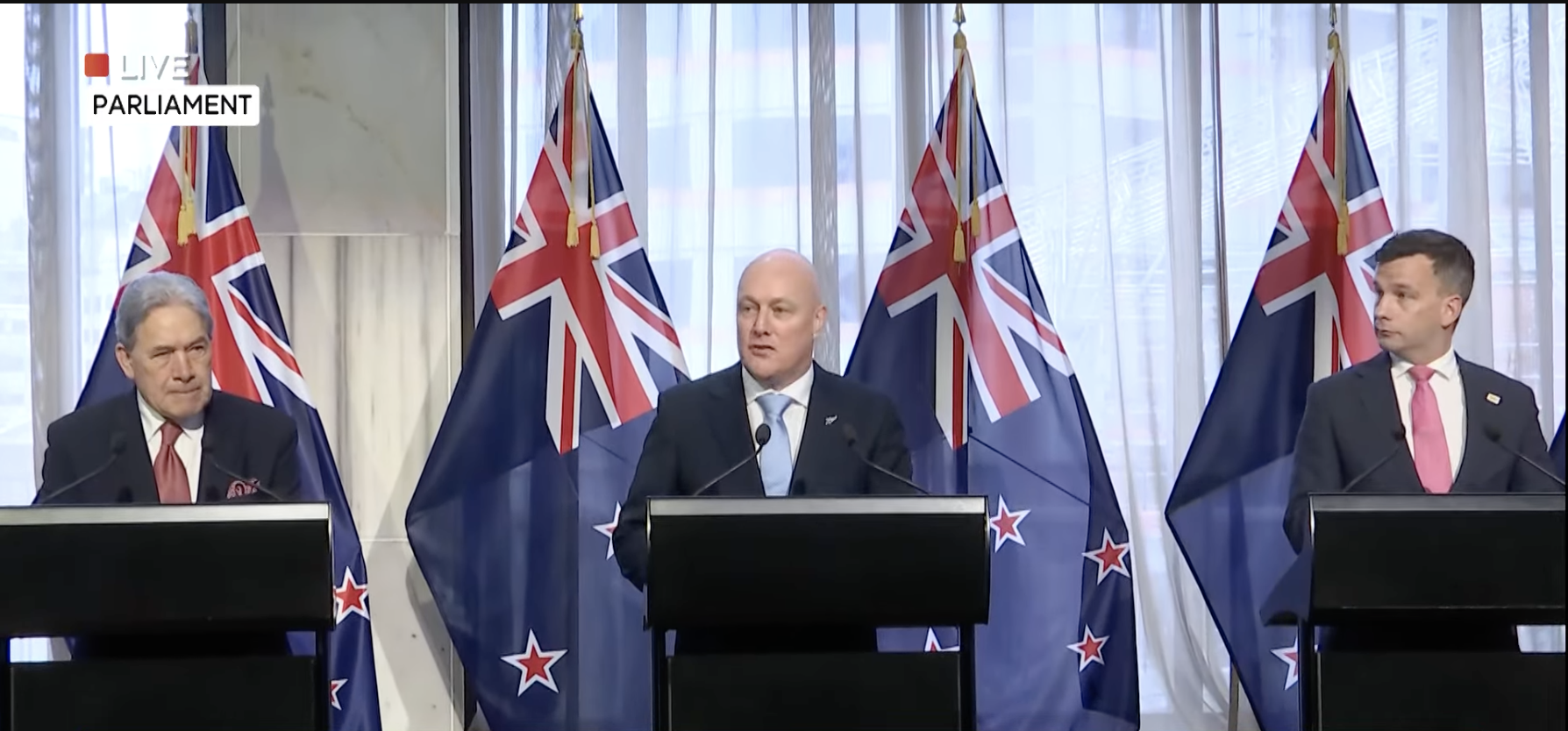
Such usurious sentiment is summarised in ACT’s desire to “boost KiwiSaver, [and] cryptocurrency adoption”. This is particularly epitomised – and clearly enunciated by David Seymour in last night’s ‘multiparty’ leaders’ television debate – in ACT’s policy to not tax compounding interest income, so that it can compound at a higher exponential rate, ‘creating’ magical sums of dollars decades into the future. (Refer Election 2026: Here’s how the multi-party leaders’ debate unfolded, Joel MacManus for The Spinoff, 13 October 2026.)
In the televised debate, the first thing said by any party leader was Seymour (in his priority statement, and not in response to a question) saying “We’ll take tax off your KiwiSaver returns. People need to be able to save for their retirement, and the biggest impediment to that is that when you put your money away it starts compounding but the government takes its share every year, and the cost of that compounded over years is enormous.”
(We note from the larger document that ACT wants to “gradually increase the superannuation age” [from 65 to 67], following a somewhat less gradual age-formula than most other proposals. Presumably, Seymour favours using the same formula to raise the age in which KiwiSaver funds may be accessed. Treasury would like the ‘retirement age’ – which means the KiwiSaver access age as well as the pension entitlement age – to be gradually raised to 72; refer Retirement age will rise to cover superannuation cost, investment company predicts, RNZ 13 February 2026.)
We note that ACT’s clear policy around compound interest is that interest rates should be comfortably above the inflation rate. And we note that ACT, in its press release, fails to mention economic growth. (Though there is an allusion to growth in the title of main document, as if the elimination of waste is itself a recipe for magical growth. Wellington has eliminated much of its ‘human waste’ since 2023 – meaning ‘wastefully-employed humans’, referencing “the size of the bureaucracy”; ie not meaning sewage, although there is that too – but has not yet grown up like an entrepreneurial phoenix from the litter of restructuring.)
Only financial mercantilists – not economists – can conceive of compound interest independent of commensurate economic growth. (Adherence to financial mercantilism is tantamount to adherence to a cult.) Compound interest is fully, literally, and explicitly predicated on exponential growth – the inflation of savings’ balances. So, the expectation is that those exponentially adjusted credit balances will be realised through future transfers of real wealth, as extractions from those who have experienced compounding debit balances. It is a policy of exponentially compounding inequality.
ACT: “Stop kicking the can down the road on hard issues like Superannuation”
What is ACT’s mercantilist vision of retirement living? We note that Seymour’s principal vision is based on exponentially compounded interest, whereby a few nominally rich ‘rentier’ retirees – having rented out their money for above-inflation returns – may live well in retirement, extracting large lump sums or annuities from those who have incurred debit interest compounded at even higher exponential rates; and even these savers might not be allowed to retire until they are 72 year-olds.
(It’s practically impossible to have above-inflation compound-interest returns for forty years in a capitalist economy. Either there is a bout of significant inflation within that time – which favours debtors over creditors, acting as a debt-stabilising correction – or the economy breaks completely, as in the Great Depression and the ensuing World War, leading to a financial levelling event. Such events hit – in percentage wealth losses – the surviving rich harder than the surviving poor.)
Under ACT’s policy, most of us aged under 60 will have to wait until they are 67 years-old before they can get a universal pension; a pension which will probably be indexed at the lower of average wages or average prices. Or they will have to go through an intrusive bureaucratic process to apply for their retirement pension. ACT has much to say about bureaucracy, but very little to say about the cruel and wasteful bureaucratic procedures which entrench the welfare poverty traps faced by the lower classes.
The mercantilist narrative is that a person’s worth lies in their compounding savings’ balances. This story posits that working class people, serfs, slaves, livestock and robots are all very much the same thing; dispensable economic resources which incur maintenance costs.
We note that ACT’s greatest political achievement so far has been the legalisation of euthanasia in Aotearoa New Zealand, as acknowledged in the television debate. What happens to most racehorses when their working careers are over?
About the writer:
Keith Rankin (keith at rankin dot nz), trained as an economic historian, is a retired lecturer in Economics and Statistics. He lives in Auckland, New Zealand.