

Source: The Conversation – UK
The Bayeux tapestry is back after a thousand years. Made in England at the end of the 11th century, the 70-metre masterpiece has returned for the first time in a blockbuster exhibition at the British Museum.
The origins of this embroidery are mysterious. Although there is general agreement now that it was most likely designed by the monks of St Augustine’s in Canterbury, and crafted by highly skilled embroideresses, so much of its medieval life is unknowable.
The tapestry may have been commissioned by Bishop Odo of Bayeux, possibly as a gift for William the Conqueror, his half brother. It could have been displayed in the refectory of a monastery, or draped magisterially at a palace or church of immense political power.
There is evidence of other vast, but now lost, early medieval tapestries. A 12th-century chronicle known as the Liber Eliensis tells of a tapestry donated to Ely Abbey by Æfflæd, formidable widow of Byrhtnoth, the ealdorman (regional governor) of Essex who died at the Battle of Maldon in 991.
But nothing survives that compares with the Bayeux tapestry. The inventory of Bayeux cathedral is where it emerges into the historical record, but this was written in 1476 – around 400 years after the last stitches were embroidered. No one knows how it made its way to Bayeux.
What we do know is that this remarkable early medieval tapestry occupies a unique position in European history, culture and politics. It continues to re-emerge as an object that inspires important creative, artistic and political acts in the 20th and 21st centuries.
Where does its modern history begin?
Unsurprisingly, perhaps, we should look to the Victorian period – and, perhaps more surprisingly, to Staffordshire. In the mid-1880s, Elizabeth Wardle, a founder and superintendent of the Leek Embroidery Society and highly learned and skilled artisan, made a replica of the tapestry in collaboration with around 35 needlewomen.
She visited Bayeux, consulted facsimiles held by the Victoria & Albert Museum, and led her collective so that this new Bayeux tapestry could be exhibited in June 1886.
In a connection with the original embroidery, Wardle’s replica would also leave England, although this time to tour the United States. In 1895, the replica was bought by a former mayor of Reading and is now displayed in Reading Museum.
In 1944, the American artist and designer Rea Irvin reworked the tapestry to commemorate the D-Day landings for the cover of the New Yorker magazine. In the opening scene of Irvin’s reimagining, Edward the Confessor and Harold become King George VI, Winston Churchill and Franklin D. Roosevelt. Troops travel by plane and tank rather than boat and horse. A swastika flies from a castle’s tower.
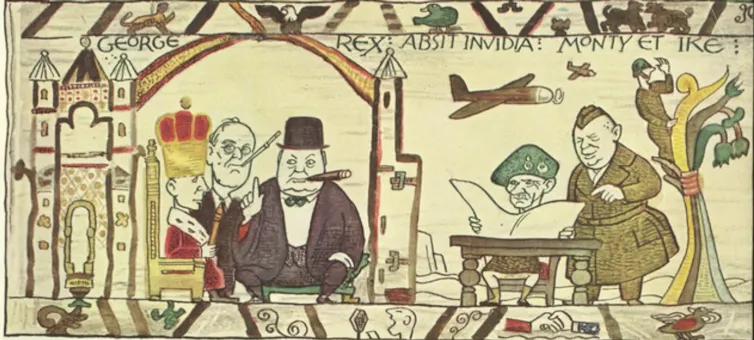
Bayeux Museum
Irvin’s re-envisioning recreated the tapestry to accentuate the historical significance of D-Day. It engaged with the tapestry’s interest in morality to reflect on the politics of the second world war, the horror of Nazism, and the heroics of the Allied troops.
The sheer ubiquity of the Bayeux tapestry was cemented from the second half of the 20th century, featuring in films as diverse as Bedknobs and Broomsticks (1971), Robin Hood: Prince of Thieves (1991) and Shrek the Third (2007). Now, the embroidery has a strange familiarity – no doubt known to millions in one form or another – and is rightly celebrated as a piece of cultural heritage.
Its status as cultural icon, however, threatens to disguise its complexities. The difficulties of the tapestry – making sense of the sometimes bawdy and often violent scenes within its margins, for example – might also be said to be an invitation to contemporary artists and thinkers to respond.
Artist Fiona Banner’s installation 1066, first exhibited in 2010, is what she calls a “still film” – a textual account of an image written on gallery walls, which defamiliarises the tapestry and asks viewers to try to see it with fresh eyes.
Politics is central to the tapestry’s origin, story and history. As a document of conquest, for some it forms part of the myth known as “The Norman Yoke”, bound up in ideas of English exceptionalism.
This may explain why Reform UK leader Nigel Farage wore a tie decorated with scenes from the Bayeux tapestry so often in the years running up to the Brexit referendum. At the time, he said it was a reminder “of the last time we were invaded and taken over”.
Similarly, it may be why the Sun newspaper commemorated the UK’s departure from the EU by making its own Brexit-inspired version, the “Bye-EU tapestry”.
There is only one Bayeux tapestry. Or perhaps we should say there is only one medieval Bayeux tapestry, because for the last couple of centuries, this wonder of medieval art has demanded creative and cultural responses, and new Bayeux tapestries have emerged.
This is both down to the tapestry’s sophisticated artistry, and because so many of its details continue to stir up debate and conversation – ranging from its possible political commitments to how many images of penises it contains.
The history of this embroidery, in both the middle ages and modernity, teaches us that surviving medieval objects move through time in ways more complicated than we might expect. The most important lesson, perhaps, is that the past never stays in the past for long.
The Bayeux tapestry is on display at the British Museum until July 2027

The authors do not work for, consult, own shares in or receive funding from any company or organisation that would benefit from this article, and have disclosed no relevant affiliations beyond their academic appointment.
Original source: https://analysis1.mil-osi.com/2026/09/18/the-bayeux-tapestry-how-this-medieval-wonder-was-reinvented-for-modern-times/