
Analysis by Keith Rankin.
Role: Economic historian.
Keith Rankin, 21 August 2026 – On RNZ (Morning Report) on Monday, John Campbell said “Recent figures from Stats NZ show more than a third of 15 to 24 year-olds are unemployed or underemployed.” It’s still there on the website, in print, so has not been corrected. (Refer Butchery bucks trend with good job prospects, 17 August 2026.)
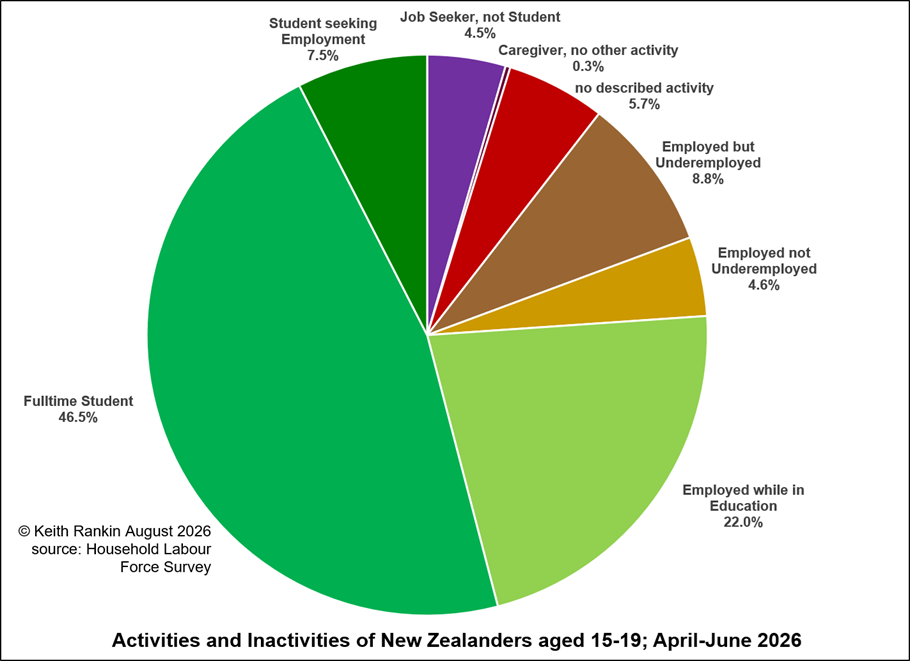
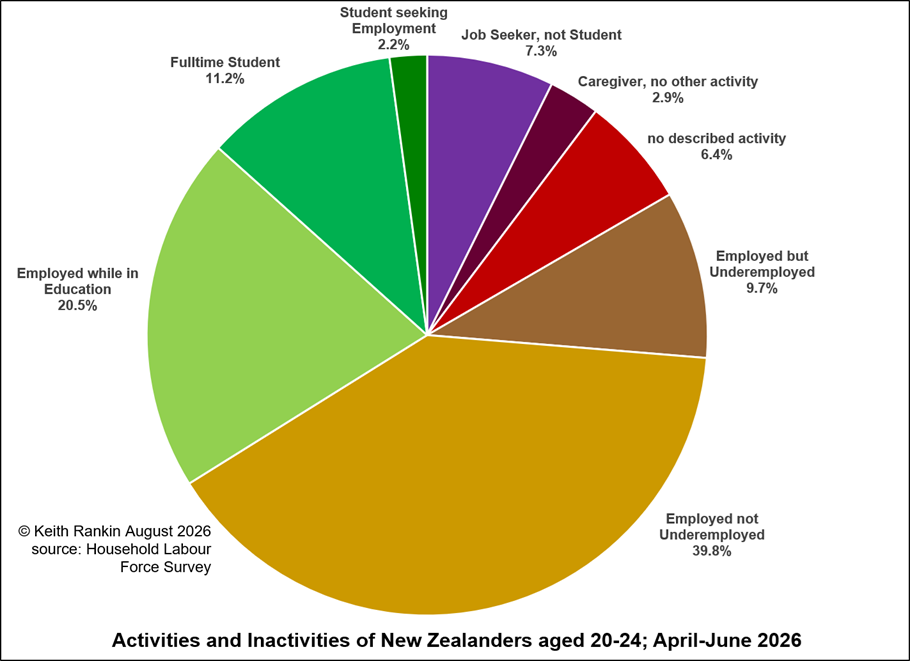
The above charts show what young New Zealanders actually were doing (and not-doing) around May 2026. It’s actually quite hard for researchers to compile these statistics properly, because of the ways they are presented by Statistics New Zealand; the diminishing number of RNZ backroomers probably do not have the time or the conceptual knowledge for this task.
To see the people in the categories mentioned by RNZ – unemployed or underemployed young people – look at the chunks of the pie charts from dark green to brown. For both charts, its just over a quarter; just over 25%. (In fact it’s 27% for 15-19 year-olds and 28% for 20-24 year-olds; “more than a third” means around 34%, or more.)
But even these more accurate numbers need to be unpacked. The major malaise intimated by Campbell is confined to two sub-categories shown: ‘job-seeker not student’ and ‘no described activity’. That’s 10.2% for 20-24 year-olds and 13.7% for 20-24 year-olds; bad enough for sure, but nowhere near the alluded-to 34%.
One of the other ‘problem’ sub-categories is much smaller than it used to be: ‘caregiver, no other activity’, aka ‘fulltime mum’. That sub-category, along with the two mentioned in the previous paragraph, are the so-called NEETs: ‘not in employment, education and training’. Actually, it is inappropriate to include fulltime mothers as part of a problem classification. (In the 1950s they would have been more like 25% than 3% of 20-24 year-olds!)
The majority of those 15-19 year-olds mentioned by John Campbell are in two other sub-categories: ‘student seeking employment’ and ’employed but underemployed’. If we add these underemployed to the NEETs we still get under 20% of that age-demographic.
The sub-category which most needs examining is ‘student seeking employment’. These are part of the official unemployment tally. Some of these 7.5% of 15-19 year-olds – perhaps a third of them, 2.5% of 15-19 year-olds – are functionally unemployed, in that they would leave education immediately as soon as they get a job, meaning that their ‘education’ is really youth childcare. But most of these 7.5% are part-time or fulltime students who are actively seeking some paid work, willing and able to commence work immediately, but who would continue to be students; they are aspiring to join the light-green group rather than the tan group.
The real tally of unemployed and underemployed 15-19 year-olds is about 22% (2.5%+4.5%+5.7%+8.8%) of their demographic. And, similarly, the real tally of unemployed and underemployed 20-24 year-olds is 24% (0.7%+7.3%+6.4%+9.7%) of their demographic.
Both are high – too high – but not over 33%!
The following two charts show these data for every quarter-year from January 2004.
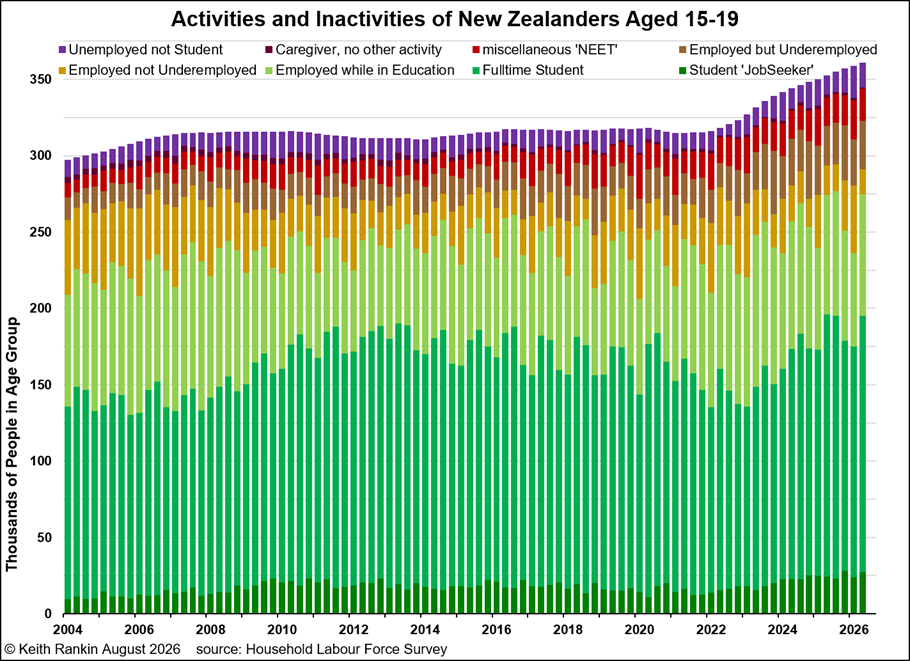
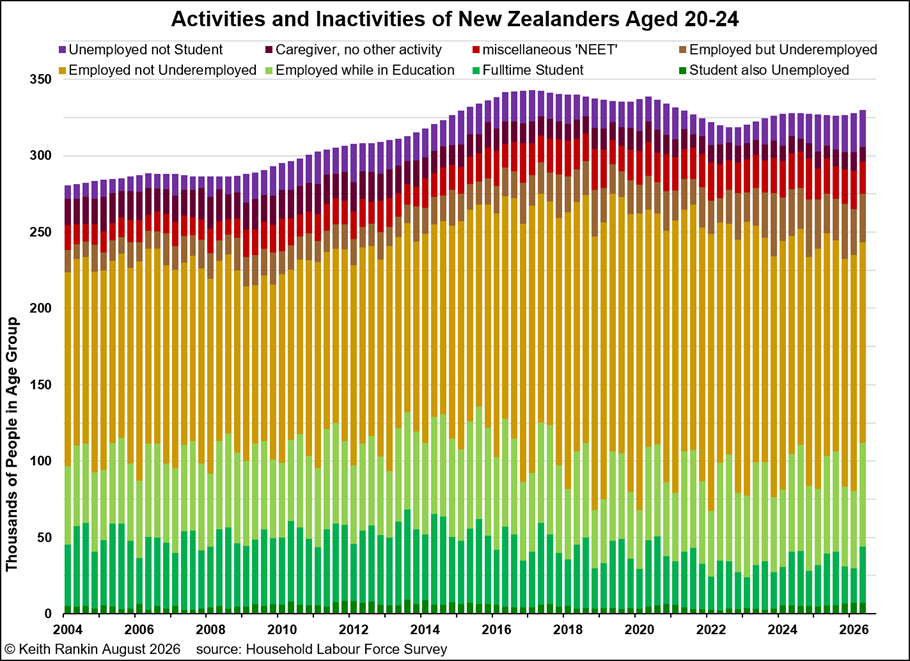
As we would expected, the education data is seasonal, with people in holiday jobs during the holidays. Looking beyond that, the NEETS and underemployed are those shaded at the top, from purple to brown.
In May 2004 there were about 33,000 NEETS aged 15-19, out of a population of 300,000. In May 2026 there were about 70,000 NEETS aged 15-19, out of a population of 360,000.
In May 2004 there were about 49,000 NEETS aged 20-24 (including 17,000 fulltime parents), out of a population of 280,000. In May 2026 there were about 87,000 NEETS aged 20-24 (including 10,000 fulltime parents), out of a population of 330,000.
The NEET problem has doubled for 15-19 year-olds, and more-than-doubled for 20-24 year-olds.
Two particularly interesting young-person statistics for 2026
One. Since the end of the Covid19 pandemic quarantine (January 2022), the total population of 15-19 year-olds has increased from 315,000 to 360,000 (14% increase). Before 2022, the population of 15-19 year-olds had been steady at around 315,000 ever since 2006. While New Zealand today may be seeing rising numbers of older people, it is also seeing significantly higher total numbers of teenagers. Indeed, unlike many other countries with majority European or East-Asian populations, New Zealand should continue to have a proportionately adequate working-age population. New Zealand’s number one socio-economic priority is to invest in the capabilities of our substantial population aged 15-19, and our remnant and immigrant population aged 20-24. Investing means spending money now and soon, not squirreling it away.
For 20-24 year-olds, while the population increase since 2006 is somewhat higher than for 15-19 year-olds, the post-Covid19 population increase is negligible; and total population is well-down on what it was in the late 2010s. New Zealand is seeing a substantial impact, through emigration, of its failure to invest in its young adult population; a result of the government’s emphasis on a futile attempt to get back to fiscal surplus while sanctioning the depreciation of the government’s revenue base. Government cutting off its nose to spite its face.
Two. The number of people aged 15-19 in employment as their only measured activity was in May just 16,500 out of 360,000; that’s just 4.6%! In the Great Depression years of the early 1930s, this figure would have been over 50%, with another 30% seeking more hours. And it would also have been around 50% in the 1960s.
For 20-24 year-olds, this employment-enough figure is now 40%, along with 3% as fulltime caregivers. In the 1960s, the total of these two numbers would have been around 90%.
Education and Training and Daycare
Some might say that, with education and training much more dominant today as measured activities, New Zealand is investing in its young people. But investment in people is a ‘game of two halves’. New Zealand is only really playing the first half; that is, formal education.
Further, it’s not entirely clear that secondary and tertiary education in New Zealand really are investment activities; to some extent, it might be argued, they are becoming a young-adult extension of childcare, a place during the day to put (physically or virtually) a growing excess of people because there is nowhere else for them to go. Young people are not scarce. Not yet.
About the writer:
Keith Rankin (keith at rankin dot nz), trained as an economic historian, is a retired lecturer in Economics and Statistics. He lives in Auckland, New Zealand.