
Analysis by Keith Rankin.
Role: Economic historian.
Keith Rankin, 5 July 2026 – World War Two (WW2) was always a conflation of two wars, with three of the protagonists – United Kingdom, United States, Soviet Russia – playing significant roles in both wars.
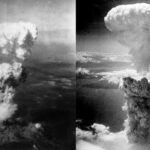
Today I write on the eve of the 81st anniversary of the successful nuclear strike on the hapless Japanese city of Hiroshima. That targeted atrocity was committed by the United States military, under conditions of total secrecy, on the civilians of Hiroshima; it took place on 6 August 1945. It was a test-run, using an untested uranium explosive device. The main event was to be the aerial assault on the city of Kokura, scheduled for 9 August 1945; the dropping of duplicate of the already-tested plutonium bomb, as featured in the movie Oppenheimer.
My assessment is that WW2 ended on 30 July 1945, with the final acts of kamikaze resistance by Japan on the United States, and with the sinking of the USS Indianapolis in Philippine waters. There were no more Japanese attacks on the United States military.
After that, there was a round of gratuitous United States aggression on Japan’s mainland and a fully tightened noose. (Wikipedia August 1945: “In the heaviest raid of the war, on 2 August 1945, 800 B-29s dropped more than 6,000 tons of incendiary bombs on Japanese cities and killed 80,000 people.” and “The American government announced that every Japanese and Korean harbor of consequence had been mined, leaving Japan totally blockaded.” Checkmate.) It was now just a matter of creating a bit of ‘carrot’ to persuade Japan to sign the necessary paperwork. No more ‘stick’ could make a difference. (80,000 was the approximate toll of the subsequent Hiroshima bomb.)
Cold? War
Both the German and Japanese wars ushered in, not peace, but a new war in which the victorious western Allies turned against their two victorious eastern Allies. The effective declaration of war against Soviet Russia was immediate, and that against China was four years subsequent. Further, of the five ‘victorious’ Allies, two were not victorious at all. In no way was the position in the world of United Kingdom and France strengthened. Indeed we can say their positions in the world were substantially weakened; we can however say that these two former great powers were undefeated in any formal sense.
At the Potsdam Conference of late July 1945 – where Churchill was replaced by Attlee mid conference – US President Truman informed Stalin on 24 July of the threat of their decisive new weapon. (“He casually told Stalin that the US had a new weapon of unusual and destructive force” [Google AI].) That was an implicit declaration of ‘cold war’.
The Cold War rapidly heated at Hiroshima on 6 August. Russia’s near-immediate response was to declare war on Japan on 8 August, indicating a resolve to defend their interests in far-eastern Asia. Soviet Union forces entered Korea – notionally still a Japanese possession – on 10 August 1945. In the meantime, the United States dropped a duplicate of their tested plutonium bomb, on 9 August on the return journey from cloudy Kokura; on Japan’s city most connected with western culture, Nagasaki.
Under pressure from Soviet Russia’s advances, and still not fully understanding what had hit them – given that, by the beginning of August 1945, Japan had already been bombed, in five months, more than Germany had been bombed in three years – Japan and the United States were both under pressure to sign a quick peace deal with each other. The United States finally agreed to make an all important concession, and retain the role and status of the Imperial Emperor; these formalities were signed on 15 August.
Technically, based on paperwork, the Pacific War did not end until 2 September 1945, with the initial agreement between the United States and Soviet Russia to partition Korea. But that is best understood as a part the setting of the battle-lines for the Cold War, as were the partition of Germany and the ethnic cleanings of Eastern Europe
So I would date the end of World War Two to 30 July 1945, with the end of Japan’s offensive resistance (ie Japan’s final military action on foreign territory or international waters). And the beginning of the Cold War was 24 July 1945, when President Truman first used nuclear weapons to threaten Joseph Stalin. There was an overlap of about a week.
This means that, the atomic explosion over Hiroshima on 6 August 1945 was the first and most dramatic of many hot incidents in the Cold War. World War Two – or at least the war between The West and The Axis – was already over except for the paperwork.
Note that the Cold War was a mix of hot proxy wars and nuclear brinkmanship
The Cold War started as an asymmetric war in Japan and Korea, and it continued to be a war fought almost entirely in locations other than the home territories of the protagonist and antagonist countries. (We may say that in 1949 China changed sides in the Cold War, and that there was overt civil war and US covert action in the islands – Kinmen and Matsu – just off China’s Fujian coast in the 1950s. Those islands are Chinese sovereign territory, but have never been subject to the control of the administration of the Peoples Republic of China. The United States did incur fatalities in 1954; and, that year, the then Secretary of State [John Foster Dulles] had advocated the use of “massive retaliatory power” against the Soviet Union, not appreciating the significance of Stalin’s death the year before, or the Peoples Republic of China.)
And from Google AI (link effective for seven days):
March 1955: “During the First Taiwan Strait Crisis, Dulles publicly advocated for treating tactical nuclear weapons as conventional ordnance, stating that the US would likely use small atomic weapons in a general Far East conflict.”
January 1956: “In a famous interview with Life magazine, Dulles formalized his philosophy of ‘Brinkmanship’, boasting that intentionally pushing the Soviet Union and China to the very verge of nuclear war was a ‘necessary art’ to secure peace.”
Is such Dulles-style brinkmanship Nato’s present doctrine against Russia? Are we now in a new hot Cold War in which only one side is fighting through a proxy? Are we on the brink?
And/or maybe we are in the latest hot phase of a cold Anglo-American war against Russia which began in Crimea on 28 March 1854? Or which began in 1839, as a Great Game fought for the most part through proxies in central Asia?
Geopolitics is still largely treated as a game by its more entitled protagonists, despite all having changed for the world to see on 6 August 1945. Nuclear civilian collateral damage dates back 81 years.
Mass civilian damage precedes Hiroshima, of course.
Q. Which ship sinking, in world history, had the most ever fatalities?
A. The Sinking of the Wilhelm Gustloff in the Baltic Sea in January 1945, by a torpedo from a Soviet Russian submarine S-13, killed 9,000 German refugees, mostly jam-packed women and children. (Story from the National WWII Museum, New Orleans, 30 January 2020.) Lest we forget. Or maybe this is one of so many stories we were never told? Anyone who flirts with the idea of world war needs to be aware of such tragedies.
About the writer:
Keith Rankin (keith at rankin dot nz), trained as an economic historian, is a retired lecturer in Economics and Statistics. He lives in Auckland, New Zealand.