

ANALYSIS: By Laurens Ikinia in Jakarta
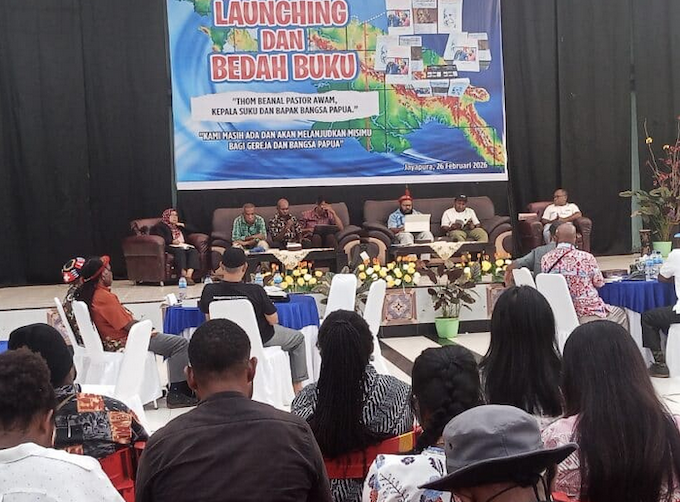
The eighth floor of the Tempo building in Jakarta became the setting for a gathering rich with meaning.
What brought together community leaders, politicians, academics, religious figures, journalists, and the family of the late Thom Beanal was not merely a book launch. It was an earnest attempt to revisit the essence of struggle, leadership, and hope for the land of Papua.
The event, which took the form of a discussion and review of a three-volume book series on Thom Beanal, opened with greetings in multiple traditions — from an Amungme war cry to salutations representing all major tribes in Papua.
That gesture alone reflected the very spirit of the man being honoured: a leader who embraced diversity and respected every single man and woman.
The gathering coincided with three historic moments, making it even more significant.
First, it marked exactly 27 years since Thom Beanal, standing before President B. J. Habibie, boldly expressed the heartfelt desire of his people. With courage and clarity, he called for recognition as a nation that wanted to cooperate honestly, peacefully, and democratically.
Second, the event served as a memorial, three years after Beanal’s passing — a man who left a deep imprint on the struggle of Indigenous Papuans.
Third, it celebrated the culmination of two years of work by a writing team, resulting in a trilogy that chronicles the journey of a lay pastor, a tribal chief, and what many now call a “father” to the indigenous Papuan.
From lay pastor to Indigenous defender
Thom Beanal was no ordinary leader. Born on 11 July 1947 into the Amungme tribe in Timika, he completed his education from primary school to a Catholic theological academy, then served as a catechist teacher in Wamena and Paniai and as a lay pastor in several parishes.
Yet behind his calming smile and disciplined demeanour lay a profoundly thoughtful mind.
Witnessing firsthand the human rights abuses and ecological destruction caused by PT Freeport Indonesia, Beanal resigned from his pastoral duties. He felt a more urgent calling: to defend indigenous communities whose lands and lives were being uprooted.
In 1994, he founded LEMASA, the Amungme Traditional Deliberative Council, as a vehicle for indigenous advocacy. Two years later, he took an audacious step — suing Freeport in a New Orleans court. That legal action set a precedent: for the first time, a Papuan had dared to take on a multinational giant on foreign soil.
His fight did not stop there. Beanal went on to push for a one percent allocation of mining revenue for affected communities. Although limited in scope, that achievement brought a measure of justice to people who, for decades, had borne the negative impacts of mining without enjoying the wealth of their own land.
Reform era and a unique role
Entering the reform era, Beanal’s role expanded. Together with other Papuan figures and students, he helped establish FORERI, a forum that channelled Papuan aspirations during the early wave of reform.
When the Papuan Council (Dewan Papua) was formed in 2000, he served as its vice chairman. He later became chairman of the Papuan Traditional Council from 2002 to 2007. Remarkably, President Abdurrahman Wahid — known as Gus Dur, a leader with genuine concern for justice in Papua — appointed Beanal as a commissioner of PT Freeport Indonesia.
Serving until 2018, Beanal found himself in a unique position: an indigenous rights fighter sitting on the board of the very company he had long opposed.
Yet despite those strategic roles, speakers at the book launch event described Thom Beanal as a humble man, disciplined and rich in metaphor. He never offered instant answers.
Instead, he opened spaces for collective reason to search for truth. In every balance of history, he arrived precisely when the Papuan people were not in a good state. And sadly, three years after his passing, the reality facing Papua remains far from encouraging.
A grim reality for Papua today
The presentations at the Tempo building painted a grim picture. Terms like genocide, ecocide, and ethnocide were mentioned as ongoing threats to Indigenous life. Papua’s gold and other natural resources, it was argued, remain mortgaged until 2061 under a contract deemed uncivilised because it ignores the basic rights of the customary landowners.
Suffering, the speakers said, is still the daily bread of Papuans. It is against this backdrop that the three books on Thom Beanal were written — not to lament the past, but to read the present clearly and to weave solutions for the future.
The 47 contributors to the third volume, divided into six sections, provided reflections and testimonies that enrich the books. They came from diverse backgrounds: family members, prominent figures of the Amungme tribe, academics, activists, and religious leaders.
The head of the writing team, Markus Haluk, expressed his highest appreciation to everyone who supported the two year process. Moral support and advice from religious, traditional, and political leaders were cited as a key source of strength.
Special thanks were directed to the book’s reviewers, including Dr Budi Hernawan, Dr Suraya Afiff, Yorrys Raweyai, Inayah Wahid, and Emanuel Gobay, for their critical engagement with the content.
Six strategic demands for the future
More than a launch, the event became a platform for six strategic recommendations and hopes. First, the books should serve as historical source material and references for young Papuans and the wider public. The concern that the struggles of national figures might vanish with time underscores why documentation and dissemination are so urgent.
Without conscious efforts to write and spread the stories of past heroes, dark chapters could repeat, and the sacrifices of predecessors might become meaningless.
Second, the book launch was not meant to be a time for complaining or blaming one another. Instead, it is time to speak honestly about Papua’s current realities and then collectively formulate comprehensive, strategic solutions.
This constructive mindset is a legacy of Beanal’s way of thinking — seeing problems as challenges to be solved, not excuses for despair.
Third, participants were called to continue the prophetic voice exemplified by several great figures. Mentioned were bishops such as Monsignor Staverman, Monsignor Monninghoff, Monsignor Laba Ladjar, Monsignor John Philip Saklil, Father Neles Tebay, Monsignor Yanuarius You, and Monsignor Bernardus Baru OSA.
Among executive leaders, two presidents known for their deep concern for Papua — B. J. Habibie and Gus Dur — were hailed as models of dignified, peaceful struggle. The goal is noble: to save the people, culture, and natural world of Papua, which remains the last remaining lung of the Asia Pacific region. Achieving this requires genuine solidarity across sectors and religions.
Fourth, a firm call was directed at the Indonesian government, especially President Prabowo Subianto and relevant ministers: stop the mortgaging of Papua’s natural wealth, stop the gold theft, and stop the destruction of the universe that is the Papuan people’s home.
The contract binding Papua until 2061 is seen as a form of structural injustice that must be corrected. Rejection of all forms of natural resource pledging for the benefit of a few — especially to foreign parties — was voiced loudly before dozens of attendees.
Fifth, recognition of and respect for the rights of the Papuan people over politics, land, natural resources, and human dignity are non negotiable demands. The threats of genocide, ethnocide, and structural violence must be halted immediately. The absence of genuine recognition of these basic rights has been the root of decades of conflict and suffering in the land of Papua.
Sixth, and perhaps most fundamental, is the call to build honest, peaceful, and democratic negotiations between the Papuan people and the Indonesian government. This is not a new idea. It is precisely what Thom Beanal himself voiced when he stood at the State Palace on 26 February 1999.
He laid before the president the sincere desire of his people, offering equal dialogue based on honesty and peace. Twenty seven years later, the same call must be repeated — proof that a massive homework assignment still lies before the Indonesian government.
Continuing the struggle, not grieving
The subsequent discussion session opened the floor for strategic ideas from participants. The emphasis was that this gathering was not for grieving or lamenting fate, but for continuing the struggle. Attendees were encouraged to step out of their comfort zones and contribute according to their capacities.
An academic might contribute through critical research, a journalist through balanced and in-depth reporting, a politician through pro-people policy advocacy, a religious leader through moral and spiritual reinforcement, and an artist through works that raise awareness.
The event closed with a beautiful, touching metaphor drawn from Thom Beanal himself. He once reflected on the rain that welcomed his funeral in Timika. In his poetic logic, he hoped that the words spoken by those who continue his struggle would water the still thirsty soil of the fight.
The land of Papua, with all its natural wealth and cultural diversity, has long been like an arid field waiting for the rain of justice, recognition, and respect from the wider Indonesians.
A test of national commitment
The gathering at the Tempo building ultimately served as a test of Indonesia’s national commitment. Do we truly want to learn from a figure like Thom Beanal? Can we draw wisdom from the journey of a lay pastor who left his religious duties to pursue social justice? Do we have the courage to admit that for decades, systematic structural injustice has occurred in Papua?
And most importantly, do we possess the political will to stop all forms of exploitation and violence, and to build equal, dignified dialogue?
The trilogy on Thom Beanal, launched that day, is not merely a collection of stories from the past. It is a mirror for understanding today’s reality, and a compass for stepping into the future. It is a document of courage from a child of the nation who chose not to remain silent, despite great risks.
It is a legacy for young Papuans so they do not lose their historical roots, and for young Indonesians outside Papua, so they do not lose empathy and a sense of justice.
In the end, the gathering affirmed that Thom Beanal’s struggle is unfinished. His legacy still needs many hands to carry it forward. Amid threats of genocide, ecocide, and various forms of structural violence, prophetic voices like those modelled by the bishops, priests, and presidents who dared to side with justice are still desperately needed.
Will the Indonesian government listen? Will today’s leaders — including President Prabowo Subianto and his ministers — respond to the call to stop mortgaging natural wealth and to start honest, democratic negotiations? These questions still hang in Jakarta’s hot air, while in Timika, the rain may continue to fall, waiting for the words that can water the still thirsty land.
Laurens Ikinia is a Papuan lecturer and researcher at the Institute of Pacific Studies, Indonesian Christian University, Jakarta. He is also an honorary member of the Asia Pacific Media Network (APMN) in Aotearoa New Zealand, and a contributor to Asia Pacific Report.

Article by AsiaPacificReport.nz