

ANALYSIS: By Patrick Decloitre, RNZ Pacific correspondent French Pacific desk
As New Caledonia marks the second anniversary of a spate of unrest and riots that broke out on 13 May 2024, the situation on the ground remains tense, on the political, economic and security levels.
Politically, over the past two years, there have been sequences of discussion between local stakeholders and the French State.
Under the now former Minister for Overseas Territories, Manuel Valls, a series of talks in the suburbs of Paris (Bougival) in July 2025, led to a document that seems to provide a roadmap for more powers for the French Pacific territory, including the prospect of a “State” of New Caledonia, with its associated “nationality”.
This Bougival process was, however, denounced by the FLNKS (Kanak and Socialist National Liberation Front) which said, after its delegates had initially signed the agreement, that their signatures were withdrawn.
Other parties, including the “moderate” pro-independence PALIKA and UPM, committed to the agreement.
But the legislative byproducts of the Bougival document, including a constitutional amendment and an organic law, could not be enacted, especially as a result of a rebuke from the French National Assembly on April 2 this year.
Through a game of alliances between local and mainland French parties, the rejection of the Bougival-inspired bills came from both left (Socialists) and far-left (La France Insoumise) parties and even from the far-right Rassemblement National (RN).
As French Prime Minister Sébastien Lecornu announced earlier this month, after holding a fresh series of talks with local politicians, he had decided that crucial local elections should be held on June 28, most of the local parties have now entered into campaign mode.
The poll, which had been postponed three times since May 2024 (the date originally set) is now once again at the centre of debates, especially on the sensitive question of who will be qualified to cast their votes.
Since the Nouméa Accord was signed in 1998, and as part of its implementation, the electoral roll is currently “frozen”. It means it excludes people who were born or have resided in New Caledonia for an uninterrupted 10 years after November 1998.
There have been talks on an “adjustment” of the sensitive electoral roll to at least include people who were born in New Caledonia and have reached voting age since 1998.
Relaxing this criterion — which was originally designed as a temporary measure to guard against a potential risk of “diluting” the indigenous Kanak population vote — would concern about 10,000 new voters, usually referred to as “the natives”.
But this issue is crystallising again tensions and passions in New Caledonia, just like it did in reaction to an earlier attempted constitutional amendment which, in May 2024, was also perceived as the main trigger for the demonstrations, followed by unrest, staged by pro-independence parties.
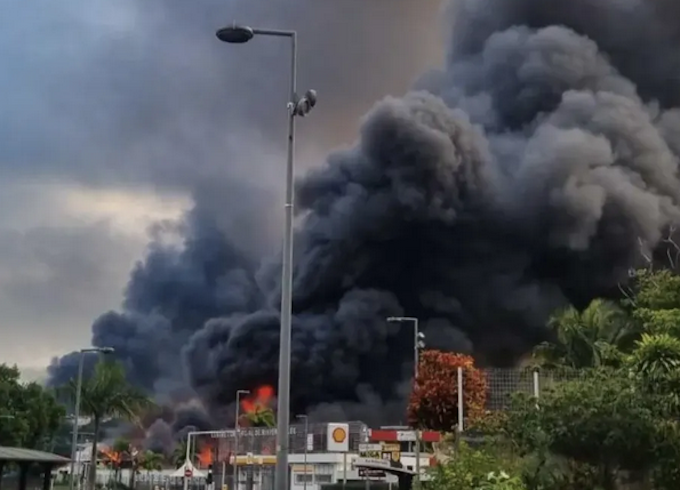
The violence caused 14 deaths and more than 2 billion euros (NZ$3.9 billion) in material damage, thousands of jobs lost due to the destruction of businesses, as well as a 13.5 percent drop in New Caledonia’s GNP.
But two years on, French Minister for Overseas Naïma Moutchou and French PM Lecornu, have launched another attempt to “adjust” the provincial roll, focusing on the inclusion of the “natives”.
The provincial elections in New Caledonia elects new members for the three provincial assemblies. Based on the results, they will also determine proportionally, the makeup of New Caledonia’s Congress, the makeup of New Caledonia’s collegial government and its president.
The organic law to integrate the natives is scheduled to be tabled before the Senate on May 18, and later before the Lower House, the National Assembly.
On the same day in Nouméa, the local Congress will be asked to vote and therefore express its position on the same matter, even though the vote would be non-binding for the French lawmakers.

Under a particularly tight schedule, the proposed organic law is also supposed to be endorsed by France’s Constitutional Council before the end of May 2026.
If it fails, New Caledonia’s provincial elections will still take place, but without any change to the “frozen” electoral roll.
In a special, 30-minute long address dedicated to New Caledonia, on social networks on May 8, Lecornu said the “status quo is not a destiny”.
After the provincial polls, Lecornu intends to bring politicians together again sometime in July to resume wider talks on New Caledonia’s political future.
In preparation for the poll, most of New Caledonia’s political parties and groups, whether pro-independence or pro-France (those who wish New Caledonia to remain a part of France), have already positioned themselves, especially on the electoral roll issue.
In the pro-France camp, there are ructions within leading parties, such as Rassemblement-LR and other components, such as Les Loyalistes or Nicolas Metzdorf’s Génération NC.
Rassemblement president and head of the local government Alcide Ponga’s suggestion that his party should run the provincial elections behind Metzdorf — who is also one of New Caledonia’s two representatives at the French National Assembly — has drawn criticism and several resignations from Rassemblement.
Since August 2024, the FLNKS has lost two of its pillars: the PALIKA (Kanak Liberation Party) and the UPM (Progressist Union in Melanesia) have formed their own “UNI” (Union Nationale pour l’Indépendance) group, mostly based on their disapproval of the hardline approach promoted by the main component of FLNKS, Union Calédonienne and its allied “pressure groups”.
One of those groups, the CCAT (Field Action Coordination Committee), was perceived as the main force behind the protests that later degenerated into riots, in May 2024.
In August 2024, CCAT leader Christian Téin was elected as FLNKS president, even though he was at the time serving a pre-trial jail term in Mulhouse (north-east of mainland France).
Pending the ruling on his case for alleged crime-related charges, which has not happened yet, Téin was allowed to return to New Caledonia.
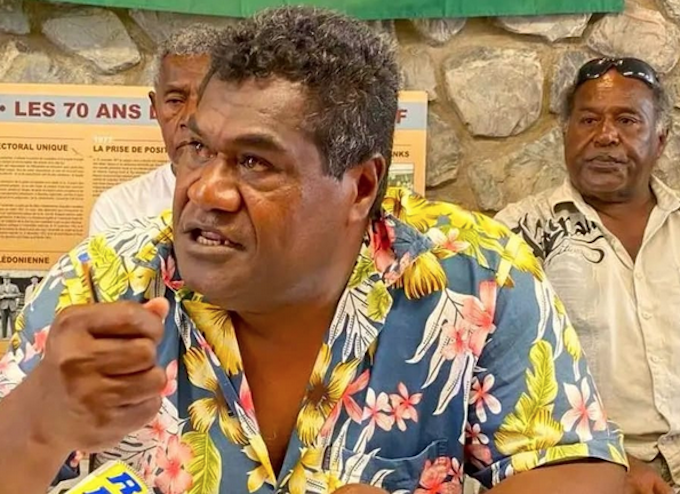
‘The fight is not over’: FLNKS
On Wednesday, CCAT and FLNKS leaders and supporters staged another protest, gathering an estimated 200 participants in Nouméa’s popular neighbourhood of Vallée-du-Tir.
The purpose of the march was to reaffirm that “the fight is not over” and to pay homage to the Kanak “martyrs” of May 2024.
“We are here because what happened in 2024 is about to happen again,” FLNKS politburo member Henri Juni told the crowd, denouncing what he terms another “passage en force” from the French State.
Juni said the FLNKS now aimed at restoring “maximal unity” within the pro-independence camp to obtain maximal results at the coming provincial elections.
FLNKS’s official stance on the matter is that the electoral roll can be modified, but that this can only take place as part of a comprehensive agreement on the future of New Caledonia.
PALIKA, on its part, held an extraordinary congress over the weekend that mostly concluded that its commitment to the Bougival process, further reinforced by more talks in January 2026, had now de facto come to an end, since it regarded this process as also de facto ended due to the April 2026 French parliament’s rejection.
In view of the June 2026 provincial polls, PALIKA is now calling for “mobilisation” from voters “in order to create the conditions of a ‘rapport de force’ to support our project of full sovereignty in partnership”.
On the sensitive issues of relaxing the restrictions of the electoral roll, PALIKA says in a release published on Tuesday that they are in favour of a readjustment for the “natives”.
One heart, one voice
On the pro-France side, parties are in support of the relaxation of the electoral roll, not only for the “natives”, but also for qualified “spouses”.
A local association named “Un, Coeur, une voix” (One heart, one voice, or OHOV) is campaigning against the minimal inclusion of “natives”, but calls for a wider opening for the roll.
“This is a minimal adjustment that institutionalises a durable exclusion”, OHOV wrote to French President Emmanuel Macron early in May 2026.
OHOV is also preparing to bring the matter to a court, in opposition to the partial “readjustment” of the proposed organic law to eventually contest the future outcome of the provincial polls.
“You have thousands of (New) Caledonians who were born there, or their spouses, … And they cannot vote… This is a matter of justice, of balance also and this is not a great demographic upset, it’s a point of equilibrium”, Minister Moutchou pleaded earlier this week during an interview with French national media France Info.
Security issues
On the security front, French High commissioner Jacques Billant has already enforced a ban on the sale of alcohol between 11 and 17 May 2026. The only exception being the sale of alcohol at New Caledonia’s international airport, Nouméa-La Tontouta.
Billant said this was “to prevent any public order unrest”, or “events and demonstrations” taking place around the symbolic date of 13 May 2024.
Earlier in April, 3-star Lieutenant-General Pierre Poty, who commands all gendarmerie forces in France’s Overseas Territories, told New Caledonian media French forces were “ready to confront fresh unrest, thanks to its prepositioned forces and their armoured components”.
But he said he did not see “any precursor sign of a resumption of violence”.
Meanwhile, in Nouméa, a neighbourhood watch group of so-called “Citizen Resistance Collective” (CRC), said earlier this week they have remained vigilant and would not allow “another May 13 to happen, because the response would be immediate and determined”.
The CRC was formed during the 2024 unrest, mainly to protect their property against burning and looting from protesters.
Early in May 2026, the French High Commission in Nouméa revealed latest statistics showing that in 2025, the number of burglaries on residential properties has risen by 46.7 percent, mostly in the capital Nouméa and its urban surroundings.
Economy
New Caledonia’s economic situation remains a matter for concern.
Most private sector stakeholders have sounded the alarm bell over the past months, despite French assistance being deployed over the past two years, mostly to refinance the construction of destroyed public buildings and infrastructure.
Businesses, employers and employees are up in arms against the current situation which deprives business leaders and investors of the required “visibility” to regain confidence.
Most of them are demanding that a political agreement be reached, which would provide them a minimum of predictability in the long term.
“We don’t believe things are getting better”, New Caledonia’s Chamber of Commerce and Industry (CCI) vice president Stéphane Yoteau told an economic forum earlier this month.
Yoteau said businesses in New Caledonia have now reached “a degree of absolute urgency”.
“The situation is catastrophic, we’re now caught in a vicious circle that is feeding itself: less business (-20 percent), less employment (-12,000), less spending revenues (household budgets have lost 10 percent on average), so there is less consumption, therefore less public tax income, etc. And so on”, the CCI leader explained.
The forum gathered representatives from employers federations MEDEF-NC, CPME-NC (small and medium industries confederation) and FEINC (federation of industries of New Caledonia).
‘A degree of absolute urgency’
They are asking for five emergency measures, including a postponement or a tax holiday for some social contributions.
They said these measure could be drawn from French government assistance and re-directed to help small and medium businesses keep their heads above water.
They say New Caledonia’s economy is “on the verge of collapse” and “economic breakdown”.
“The question today is not even to access financing faculties. There is no more business in New Caledonia. Everything stops,” FEINC President Xavier Benoist told local media.
He said 40 percent of businesses only have a few weeks of visibility and 45 percent have only three months left in terms of cash flow.
Despite the recent announcement from the French PM of a “re-foundation” plan for more than 2 billion euros over the next five years, business leaders are asking for an immediate emergency package to “save New Caledonia’s economy”.
“What we are asking is not a favour, it’s not assistance. It’s something to keep our economic fabric alive. Otherwise, it will continue to go down”, said Sonia Critg, vice-president of the small industries branch of the CPME.
“Not doing anything today amounts to deliberately choosing a much deeper and much more expensive social crisis tomorrow”, she stressed.
On May 11, more than 100 business leaders, employees, unemployed, retired workers, staged a protest march in front of New Caledonia’s government building in downtown Nouméa.
Once again, at the heart of their plea, was a cry for assistance to ease their situation which, they said, was “no longer bearable”.
Minister for Economy Christopher Gygès received a delegation and promised some exemption measures were in the pipeline, especially targeting small and very small businesses.
Recently appointed head of the French inter-ministerial mission for reconstruction, Amaury Decludt recently completed his first mission in the French Pacific territory.

He assured that out of the more than 2 billion euros earmarked by France, about 10 percent was ready to be mobilised, mainly for large infrastructure projects such as one road across New Caledonia’s main island or a project to build bus exchange stations in rural areas.
He said talks were ongoing regarding New Caledonia’s crucial nickel mining sector and has been facing major difficulties over the past few years..
Out of the three companies currently in existence, two (one in the North of the main island, the other in the South) were currently up for sale.
Decludt also said the French government was also in contact with the European Union to persuade Brussels of the appeal of New Caledonia’s nickel.
New Caledonia’s nickel industry has been facing major structural challenges over the past few years, mainly due to the rise of world-class competitors in Indonesia, as well as high costs of production mainly related to high cost of the energy.
This article is republished under a community partnership agreement with RNZ.

Article by AsiaPacificReport.nz