

By Johnny Blades, RNZ Pacific senior journalist
Vanuatu’s government has urged the French ambassador in Port Vila to use established diplomatic channels rather than social media to communicate his concerns about state-to-state relations.
It is the latest development in a diplomatic spat that emerged this week when New Caledonia’s territorial government took umbrage at Vanuatu for hosting the leadership of the pro-independence Kanak and Socialist National Liberation Front (FLNKS) group as part of a trade forum earlier this week in Port Vila.
The ambassador, Jean-Baptiste Jeangène Vilmer, has made multiple Facebook posts in the past few days explaining his concerns. But he also found time to hit out at Vanuatu’s main daily newspaper Daily Post over its reporting of the dispute between the Melanesian country and France over the Matthew and Hunter (Umaenupne and Umaeneag/Leka) islets.
In a statement, Vanuatu’s government noted “with unreserved interest”, the ambassador’s “extraordinary decision” to go public through social media.
Vanuatu hosted a series of talks under the theme “VOICE 2030” (Vanuatu Opportunities for Investment and Caledonian Enterprises) dedicated to exploring the strengthening of trade relations with the neighbouring French Pacific territory of New Caledonia.
The FLNKS delegation attending was led by its president Christian Téin — who until recently was held in pre-trial custody in France on charges relating to independence unrest in New Caledonia in 2024.
The delegation also included government minister, Mickaël Forrest, who holds the Youth and Sports portfolio, but is not in charge of trade.
New Caledonia’s government issued a statement on Monday, May 5 — before the Ambassador’s comments on social media — stating that the delegation in Port Vila could not be regarded as an official delegation of the government and that those attending were not acting in any official governmental capacity.
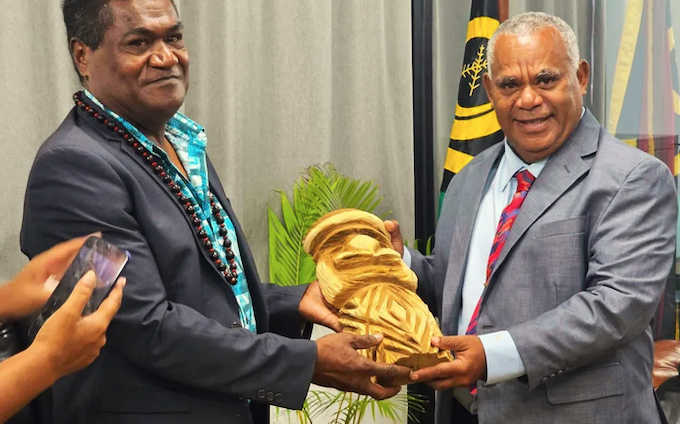
That same day, Christopher Gygès, the member of New Caledonia’s government who is responsible for trade, announced that he was suspending work relating to the proposed trade cooperation agreement currently under negotiation between New Caledonia and Vanuatu.
The ambassador then made a series of posts on Facebook attempting to explain the crux of the problem from the French viewpoint.
“It was the president of the FLNKS — an opposition political party with no jurisdiction in this matter — who was presented as head of the delegation and officially welcomed at the airport by the head of protocol at the Ministry of Foreign Affairs and the chief-of-staff to the Minister of Trade,” Vilmer said.
In another post he explained he had met with Vanuatu’s Foreign Minister Marc Ati to give him a better understanding of France’s position “so that it is properly understood”.
‘Extremely unfortunate’
However, Vanuatu’s government said the delegation from New Caledonia “participated with the full approval of the Government of New Caledonia to engage with the Government of Vanuatu on opportunities relating to trade, investment, and broader economic cooperation”.
“It is therefore extremely unfortunate that the Ambassador’s posts on social media have unnecessarily provoked public misunderstanding and divided national opinions on the actual state of play.”
In its statement, the government of Prime Minister Jotham Napat also explained that the FLNKS’ attendance was part of Vanuatu’s “longstanding engagement with stakeholders involved in the New Caledonia decolonization process”, consistent with established foreign policy principles as well as the deep links between ni-Vanuatu and the indigenous Kanak people of New Caledonia.

The government said this did not diminish the importance Vanuatu placed on its “longstanding and constructive relationship” with France.
While Vilmer has insisted he was attempting “constructive dialogue”, his social media posts have been anything but that in the eyes of Vanuatu’s government.
Matthew and Hunter
The relations between the ambassador and Vanuatu further deteriorated today with a Facebook post indicating that the Vanuatu Daily Post had quoted him out of context in a recent article on the Kanak position regarding Matthew and Hunter.
Vilmer’s post noted that he had not made any “press statement” about this issue, as claimed in the article.
In a subsequent Daily Post piece today, encompassing the ambassador’s claim, Vilmer is further quoted as suggesting changes of leadership in Vanuatu’s government in recent years coincided with a stalling of negotiations on the disputed islets, suggesting it was not a priority for Vanuatu.
This drew a stern rebuke from former prime minister, Charlot Salwai, who is the leader of the Reunification of Movements for Change party, one of the parties in Vanuatu’s coalition government.
Salwai described Vilmer’s remark as misleading, and said Vanuatu always discussed Matthew and Hunter at every bilateral meeting with France or New Caledonia.
The next meeting between French and Vanuatu officials in which the dispute would be discussed is expected in the next couple of months.
Meanwhile, the disagreements this week have not prevented the broader economic relationship continuing, nor the ambassador continuing to work constructively on other matters with the government in Vila.
Yesterday, Vilmer joined the Deputy Prime Minister, Johnny Koanapo, to inaugurate a new maritime freight service linking Nouméa, Port Vila and Luganville, operated by the Compagnie Maritime des Îles’ vessel Karaka, with a capacity of 1700 tonnes of cargo and 80 containers — the first such maritime freight link in about 15 years.
This article is republished under a community partnership agreement with RNZ.

Article by AsiaPacificReport.nz