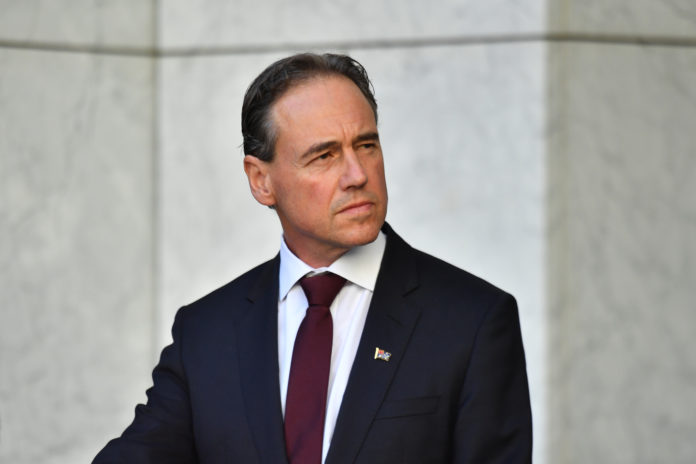
Greg Hunt is set to become the lead ministerial face of the sales effort for the proposed controversial new COVID-19 tracing app, aided by the government’s health professionals.
Federal cabinet discussed the app at its Wednesday meeting, and the national cabinet on Friday will be briefed on it.
The main ministerial responsibility for the app so far has been carried by the Minister for Government Services, Stuart Robert, who oversees the Digital Transformation Agency.
But it is recognised in government circles that having Hunt and the health professionals – the latter dubbed the “lab coats” – spearheading the app’s promotion will give a better chance of boosting its take up.
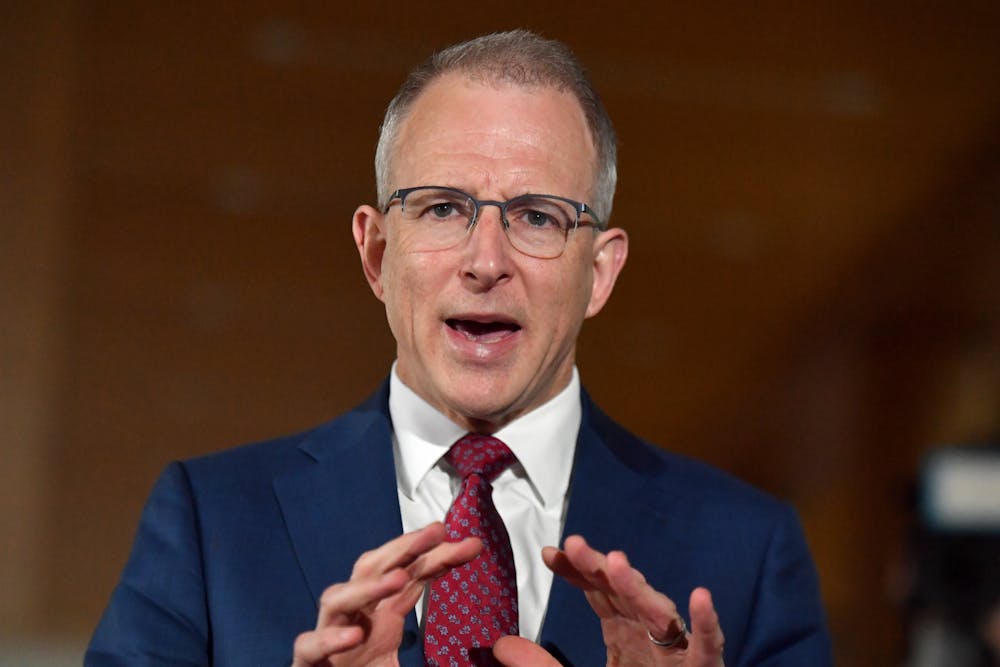
Brendan Murphy, the chief medical officer, has become a familiar and credible public figure in recent weeks, as have deputies Paul Kelly and Nick Coatsworth.
The use of the health experts is reinforced by government research.
Hunt has been carrying a great deal of the messaging during the crisis. Robert is a poor performer who blundered when he gave false information about a crash of the Centrelink computer system.
Kelly on Wednesday appealed to the public to “please consider” the app.
“It’s important because if we can really get on top of [contact tracing], it will allow us much more leeway to change the social distancing measures,” Kelly said.
When a person developed COVID-19 the app would enable the quick identification of the contacts they’d had with other people.
Currently tracking a patient’s contacts is done manually by so-called virus “detectives”. But it can be a slow process, and has the problem of relying on the patient’s memory.
It would also be logical to have Hunt as the frontman because downloading the information from the app, with the person’s permission, would be done by state health departments which are responsible for contact tracing.
The federal government, anxious to allay community suspicions, has been emphasising the states’ primary role. The federal government would not be able to access names or details from the app material. Information would disappear after three weeks.
It is not clear whether a multi-national company would be involved in the storage of the data, where it would be stored, and what penalties there would be for any misuse.
Scott Morrison is very keen on the app, which would be voluntary, but the government recognises there are extensive community doubts. To be most effective, a high proportion of the population would have to be willing to download the app, although just how high is a subject of dispute. Kelly claimed it would be advantageous even if only taken up by a small proportion: “anything more than zero is going to be useful”.
The government has emphasised the app would not be a geographic tracking device. But this misses the point that some people would be dubious about the device identifying who they were with, rather than being worried about the actual place of contact.
Material before Wednesday’s cabinet came from Robert, Hunt and Attorney-General Christian Porter, who oversees privacy.
Porter said in a Wednesday radio interview, “In terms of the type of information that any of your listeners might consent to being provided commercially or to government, there will be no information in the system more safe and more private and more narrowly used for the specific health purpose than this information”.
While the app, based on overseas experience, notably in Singapore, apparently originated from the Home Affairs department, it is understood no Home Affairs powers would be involved in its use.
Essential Research published responses this week to a series of propositions about the app.
Only 38% said they would download it onto their mobile phone and only 35% were confident the government would not misuse the data.
More than six in ten (63%) said they would be concerned about the security of their personal data if the app was on their phone.
Some 52% agreed the app would help limit the spread of the virus, and 42% said it would speed up removal of physical distancing restrictions.
Former deputy prime minister Barnaby Joyce has criticised the app saying “I treasure the government knowing as little about me as possible”.
Labor leader Anthony Albanese has given broad support for the app but says the government needs to be very clear about the protections that would be put in place.
Recent headlines have suggested COVID-19 can spread up to four meters, drawing into question the current advice to maintain 1.5 metres between people to prevent the spread of the virus.
The news was based on a study conducted in Wuhan, China, and published in the journal Emerging Infectious Diseases.
Meanwhile, a review published last week in the Journal of Infectious Diseases has concluded respiratory droplets, which may carry the virus, can travel up to eight metres.
So what can we make of these findings? And should we really be standing much further apart than we’ve been told?
First, how does coronavirus spread?
Coronavirus spreads through droplets when a person with COVID-19 coughs, sneezes or talks.
This means it can spread during close contact between an infected and uninfected person, when it’s inhaled, or enters the body via the eyes, mouth or nose.
Infection can also occur when an uninfected person touches a surface contaminated with these droplets, and then touches their face.
Some respiratory pathogens can also transmit through the air, when tiny particles, or aerosols, hang around.
Aerosols can be generated through coughing and sneezing, and sometimes from breathing and talking.
We know some infectious diseases like measles can be transmitted this way. But we need more research to understand to what degree this could be true for COVID-19.
Aerosols containing viruses like SARS-CoV-2, the virus that causes COVID-19, are more likely to be generated through hospital procedures such as intubation and manual ventilation.
This may go some way to explaining the results of the four metres study, which took place in a hospital. Let’s take a look at the research.
Over 12 days, the researchers collected swab samples four hours after the morning clean from floors, bins, air outlets, computer mice, bed rails, personal protective equipment and patient masks.
To determine whether aerosolised particles containing SARS-CoV-2 were present in the air, the researchers also took samples upstream and downstream of the air flow in both wards.
What did they find?
They detected SARS-CoV-2 widely on hospital surfaces and frequently touched hospital equipment. The ICU had a greater amount of virus than the general ward.
Most swabs, including computer mice and doorknobs, were positive for the virus. The highest virus concentrations were found on the floor, likely from virus-containing droplets falling to the ground. People then tracked the virus to the hospital pharmacy, presumably on the soles of their shoes.
The study looked at possible transmission through aerosol particles in the ICU by taking samples from three sites. Two sites were along the direction of the airflow, about one meter away from patients’ beds. One site was further away, approximately four meters from a patient’s bed and against the airflow.
Virus was detected in 35.7% (5/14) of samples taken near air outlets, and 44.4% (8/18) of samples in a patient’s cubicle. At the site located against the airflow – four metres away from the patient’s bed – virus was detected in 12.5% (1/8) of samples.
Although virus was detected in air samples from the general ward, the numbers of positive samples were fewer. Studies have shown people with less severe disease shed less of the virus, so this may be why.
How should we interpret the results?
We should consider the results from this study with caution. The study tests for the presence of the virus on surfaces and in the air, but doesn’t indicate if the virus was living and infectious.
The authors didn’t describe the nature of medical procedures undertaken in these wards, particularly if any might be likely to generate aerosols.
The way a virus behaves in a hospital setting is likely to be different to the way it behaves in the community.Shutterstock
The virus sample detected four meters away was described as a “weak positive”. Both “intense positive” and “weak positive” samples were grouped together as positive samples in the results without defining what a “positive sample” was or explaining the distinction between the two outcomes.
The study had a small sample size and importantly, researchers didn’t use any statistical tests to determine the significance of their findings. So the results have limited utility in the real world.
What does this all mean?
The study adds to the evidence SARS-CoV-2 can be detected on surfaces.
But the finding that the virus could spread four metres is less convincing. Even if we disregard the study’s limitations, evidence of SARS-CoV-2 in the air isn’t evidence it’s infectious in that form.
The review assessed horizontal distance travelled by droplets from ten experimental and modelling studies. It found evidence droplets could travel beyond two meters, even up to eight meters using physical science experiments.
Of the ten studies, five were conducted using human subjects. These studies looked at the dynamics of droplet transmission but were not specifically related to SARS-CoV-2-containing droplets.
So we need more research to better understand transmission of SARS-CoV-2 in hospital settings.
But in the community, we’d encourage everyone to continue to practise the recommended physical distancing measures of staying 1.5 metres away from others.
The near-total shutdown of elective surgery across Australia will end soon, following National Cabinet consideration on Tuesday.
The shutdown was imposed to ensure there would be enough personal protective equipment (PPE) for doctors and nurses to manage a projected tsunami of COVID-19 patients in our hospitals.
But now there is a big backlog of Australians waiting for elective procedures.
Elective surgery waiting times are the bane of every state health minister’s life. Better ways to manage such procedures could be a major benefit from the shutdown and restart.
But we have to act quickly if we are to change how we manage these wait lists, as federal Health Minister Greg Hunt wants a staged reintroduction to begin on April 27.
Rethink priorities
Currently, elective surgery is classified as urgent (category 1), semi-urgent (category 2) and non-urgent (category 3). But different hospitals and different surgeons actually classify patients in different ways.
What’s worse is that some procedures are undoubtedly unnecessary, such as spinal fusion or removing healthy ovaries during a hysterectomy, and would provide no value for the patient, as Adam Elshaug and I have argued before.
Of course, not all of the backlog is low-value procedures. As states consider how to recommence elective surgery, they should seize this opportunity to introduce new systems, especially in metropolitan areas.
A properly managed elective procedures system should have three key elements:
there should be a consistent process for assessing a patient’s need for the procedure, and ranking that patient’s priority against others
the team performing the procedure, and caring for the patient afterwards, should be highly experienced in the procedure
the procedure should be performed at an efficient hospital or other facility, so the cost to the health system is as low as possible.
Unfortunately, Australia sometimes fails on all three measures.
Stop the inconsistencies
There is no consistent assessment process across hospitals. Even different surgeons in the same hospital seeing the same patient sometimes make different recommendations about the need for a procedure.
This means a patient lucky enough to be seen at hospital A may be assigned to category 2, but the same patient seen at hospital B might be assigned to category 3 and so have to wait longer.
Patient characteristics, such as gender or level of education, also seem to inappropriately affect categorisation decisions.
Yet most states ignore these facts. They have done little to rationalise services for the benefit of both the patient and the taxpayer.
Time for change
The large backlog of demand creates the opportunity for a new way of doing things. States should develop agreed assessment processes for high-volume procedures, such as knee and hip replacements and cataract operations, and reassess all patients on hospital waiting lists.
Reassessment could be done remotely using telehealth. Specialists in each area should be invited to develop evidence-based criteria for setting priorities. Where appropriate, patients should be diverted to treatment options other than surgery.
Private health insurers should be empowered to participate in funding diversion options so patients are able to have their rehabilitation at home rather than in a hospital bed.
A new, coordinated, single waiting list priority system in each state would enable all patients to know where they stand. A patient on the top of the list would be offered the first available place, regardless of whether it was closest to their home.
They could refuse the offer, without losing their place in the queue, if they wanted to wait for a closer location.
The health minister says it’s up to hospitals to decide which patients get to undergo elective surgery.Roman Zaiets/Shutterstock
The single waiting list should include both regional and metropolitan patients, to ensure as much as possible that city patients do not get faster treatment than people in regional and remote area.
Patients with private health insurance can opt to be treated as a private patient in a public hospital. So the waiting list should include public and private patients, to prevent private patients gaining faster admission to public hospitals.
The system should be further centralised in metropolitan areas. The full range of elective procedures should not be re-established in every hospital. Some surgeons would need to be offered new appointments if elective surgery in their specialty was no longer being performed at the hospital where they previously had their main appointment.
States should consider signing contracts with private hospitals, at or below the public hospital efficient price, for elective procedures to be performed in these hospitals to help clear the elective surgery backlog.
The pandemic is not over yet and policymakers are right to be turning their minds to the transition back to something approaching business as usual. But the new, post-pandemic normal should be nothing like the old.
Physical distancing seems to be beating the virus, but the second victim might be health reform. Not wasting the crisis is the cliché on everyone’s lips. Australia has the chance to improve our elective surgery system. For the sake of taxpayers and patients, we should grasp it.
Federal Communications Minister Paul Fletcher announced three measures last week to help commercial TV broadcasters deal with COVID-19 financial stress.
First, the spectrum tax broadcasters pay the government for access to audiences will be waived for 12 months.
Second, the government has released an options paper on how to make Australian storytelling on our screens fair across new and old platforms.
But it’s the third measure that is a shock: for the rest of 2020, all quotas requiring commercial TV networks to make Australian drama, documentary and children’s television have been shelved. Fletcher said networks can’t create the content because COVID-19 constraints have stalled most production.
But arts, screen directing and screenwriting bodies disagree. They say the quota pause across two financial years will cost jobs. And they’re worried this measure signals how the government will act on regulation options in the paper released at the same time.
Communications Minister Paul Fletcher in Canberra this week.AAP/Mick Tsikas
4 ways forward
The paper from Screen Australia and the Australian Communications and Media Authority (ACMA) explores two issues: firstly, how to promote Australian drama, documentary and children’s television across all home screen platforms; secondly, how to level the regulatory playing field across those platforms.
Commercial TV broadcasters have had to meet a 55% Australian content quota for decades – including sub-quotas of drama, documentary and children’s programs. Meanwhile, the global streaming services Australian audiences are flooding to, such as Netflix and Stan, do not have to meet any quotas. Nor do other digital platforms in Australia.
The Screen Australia/ACMA paper presents four possible ways forward:
keep the status quo: leave commercial networks as the only platform bound to content quotas
minimal change: ask streaming services to invest voluntarily in Australian content and revise what commercial networks have to produce (maybe axing children’s TV quotas)
establish a “platform-neutral” system to compel and encourage Australian content-making across all of commercial television, digital platforms and global streaming services
deregulation: no one – including commercial networks – would have to meet any content quota requirements.
There is still time for industry bodies to respond to these choices. But option 3, cross-platform incentives and Australian content rules for all, would appeal most to the arts sector. It is the only option of the four which genuinely promotes Australian storytelling on our screens and the jobs that go with it.
Streaming services such as Netflix and Stan will hate that proposition. They and other digital platforms will resist having to follow content rules.
Would hit kids’ show Bluey have been made without content quotas?ABC
Levelling the field or throwing away the rules?
Commercial networks have long sought a level playing field – and the platform-neutral option offers that. But what they really want is the freedom the other platforms have now: to make and deliver whatever content they think audiences will watch. That’s option 4: total deregulation and all content obligations removed.
Deregulation would hurt Australian creative production jobs. A PricewaterhouseCoopers (PwC) study quoted in the Screen Australia/ACMA paper predicts that if quotas were dropped from commercial television, children’s TV production there would end, drama production would fall 90% and documentary making would halve.
Enter the government’s Relief for Australian media during COVID-19: commercial networks still have to broadcast 55% Australia content in 2020. But they don’t have to make drama, documentary or children’s content as part of that quota.
The Australian Writers Guild (AWG) – representing drama and documentary screen writers – has slammed the quotas pause. They say the government has abandoned creative workers to help a handful of media companies. They’re worried this trial deregulation will change the production landscape forever. And they accuse networks of using COVID-19 as “the excuse they need in their quest to end the quota system once and for all”.
The Directors Guild, Screen Producers Australia and the Media Entertainment and Arts Alliance are also anxious about screen jobs – and where the federal government will go on the quotas issue.
That’s understandable.
We’ve just seen the government dismiss Australian content quotas as “red tape”. We can only guess where its sympathy for corona-stressed TV networks will take us next.
Source: The Conversation (Au and NZ) – By Arnagretta Hunter, ANU Human Futures Fellow 2020; Cardiologist and Physician., Australian National University
Four months in, this year has already been a remarkable showcase for existential and catastrophic risk. A severe drought, devastating bushfires, hazardous smoke, towns running dry – these events all demonstrate the consequences of human-induced climate change.
While the above may seem like isolated threats, they are parts of a larger puzzle of which the pieces are all interconnected. A report titled Surviving and Thriving in the 21st Century, published today by the Commission for the Human Future, has isolated ten potentially catastrophic threats to human survival.
Not prioritised over one another, these risks are:
decline of natural resources, particularly water
collapse of ecosystems and loss of biodiversity
human population growth beyond Earth’s carrying capacity
global warming and human-induced climate change
chemical pollution of the Earth system, including the atmosphere and oceans
rising food insecurity and failing nutritional quality
nuclear weapons and other weapons of mass destruction
pandemics of new and untreatable disease
the advent of powerful, uncontrolled new technology
national and global failure to understand and act preventatively on these risks.
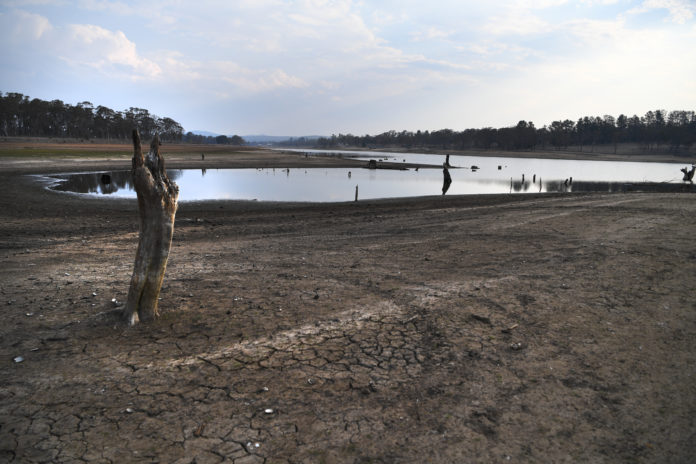
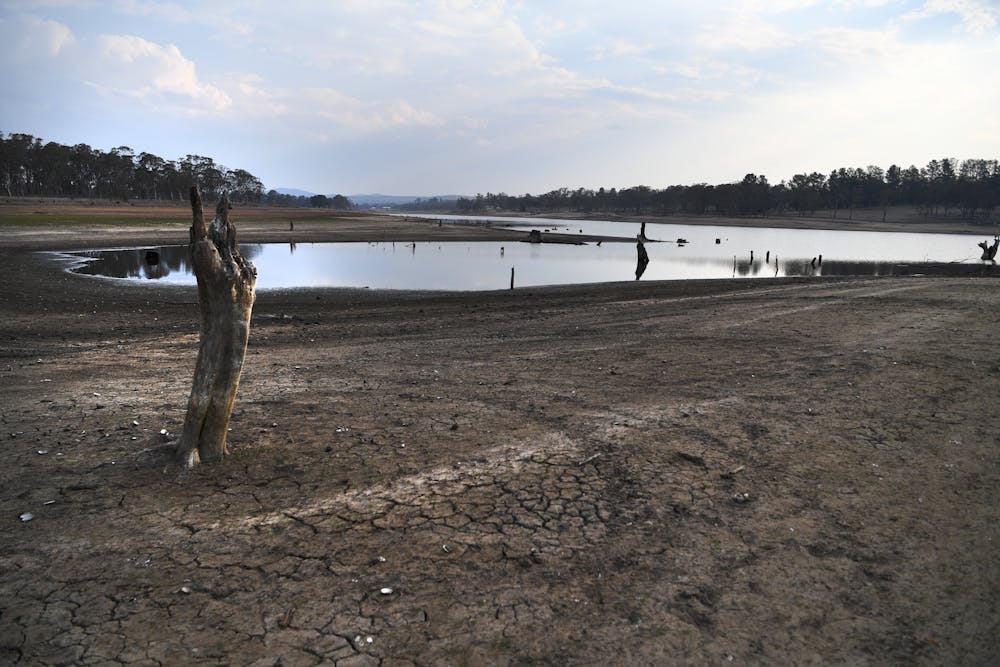
In October, low water levels and dry land was recorded at Storm King Dam near Stanthorpe, Queensland. The dam’s water level was at 25%.DAN PELED/AAP
The start of ongoing discussions
The Commission for the Human Future formed last year, following earlier discussions within emeritus faculty at the Australian National University about the major risks faced by humanity, how they should be approached and how they might be solved. We hosted our first round-table discussion last month, bringing together more than 40 academics, thinkers and policy leaders.
The commission’s report states our species’ ability to cause mass harm to itself has been accelerating since the mid-20th century. Global trends in demographics, information, politics, warfare, climate, environmental damage and technology have culminated in an entirely new level of risk.
The risks emerging now are varied, global and complex. Each one poses a “significant” risk to human civilisation, a “catastrophic risk”, or could actually extinguish the human species and is therefore an “existential risk”.
The risks are interconnected. They originate from the same basic causes and must be solved in ways that make no individual threat worse. This means many existing systems we take for granted, including our economic, food, energy, production and waste, community life and governance systems – along with our relationship with the Earth’s natural systems – must undergo searching examination and reform.
COVID-19: a lesson in interconnection
It’s tempting to examine these threats individually, and yet with the coronavirus crisis we see their interconnection.
It’s not possible to “solve” COVID-19 without affecting other risks in some way.
Shared future, shared approach
The commission’s report does not aim to solve each risk, but rather to outline current thinking and identify unifying themes. Understanding science, evidence and analysis will be key to adequately addressing the threats and finding solutions. An evidence-based approach to policy has been needed for many years. Under-appreciating science and evidence leads to unmitigated risks, as we have seen with climate change.
The human future involves us all. Shaping it requires a collaborative, inclusive and diverse discussion. We should heed advice from political and social scientists on how to engage all people in this conversation.
Imagination, creativity and new narratives will be needed for challenges that test our civil society and humanity. The bushfire smoke over the summer was unprecedented, and COVID-19 is a new virus.
If our policymakers and government had spent more time using the available climate science to understand and then imagine the potential risks of the 2019-20 summer, we would have recognised the potential for a catastrophic season and would likely have been able to prepare better. Unprecedented events are not always unexpected.
This photo from December shows NSW Rural Fire Service crews protecting properties as the Wrights Creek fire approaches Mangrove Mountain, north of Sydney.DAN HIMBRECHTS/AAP
The commission’s report highlights the failure of governments to address these threats and particularly notes the short-term thinking that has increasingly dominated Australian and global politics. This has seriously undermined our potential to decrease risks such as climate change.
The shift from short to longer term thinking can began at home and in our daily lives. We should make decisions today that acknowledge the future, and practise this not only in our own lives but also demand it of our policy makers.
We’re living in unprecedented times. The catastrophic and existential risks for humanity are serious and multifaceted. And this conversation is the most important one we have today.
Despite nearly three decades without a recession, Australia’s last proper budget surplus came a dozen years ago – just before the Global Financial Crisis hit.
Two or three months back, Prime Minister Scott Morrison and Treasurer Josh Frydenberg were on the cusp of fixing that.
Now, the next surplus may be further off again.
Yet so deep are the ideological battlelines that some will never give credit to the pair for finding A$214 billion of new spending in the most dramatic political shape-shift in the federation’s history.
Some reticence is reasonable given that:
the assistance came too slowly to save some enterprises
some employees and some sectors were excluded
as currently legislated, assistance would fall off a cliff in six months, risking a second wave of economic distress.
Announced in three eye-watering tranches as the scale of the coronavirus disaster revealed itself, the Coalition’s escalating response charts a stunning right-to-left expansion of government via colossal deficit spending freighted with intergenerational liability.
Until 2020, the Coalition’s somewhat niche lesson from the GFC was not a new appreciation of how Keynesian budget policy ameliorates economic pain, but rather a keener sense of what political advantage could be taken from the “fiscal hangover” from such anti-cyclical spending.
Grappling with the crisis, the Morrison government declared the usual ideology would be benched in order to protect the community, shield the economy and retain as much “snap-back” potential as possible following an enforced hibernation.
The biggest ticket spend is the A$130 billion (in just six months) JobKeeper package, which pays $1,500 a fortnight to employers to keep employees on the books. It follows a A$66 billion doubling of the Newstart pension (JobSeeker), and free childcare, among a suite of other measures.
Psychologically, it is not hard to see why entrenched Coalition critics would ask, “Where’s the catch?”
After all, how to make sense of such an about-face by a party that vilified Labor’s (smaller) GFC spending as excessive and the genesis of a “debt and deficit disaster”; lionised “lifters” over “leaners”; and most recently secured a third term on the prosaic pledge of delivering surplus budgets no matter what?
Of course, all this changed when the “what” turned out to be a global pandemic packing the harshest economic punch since the Great Depression.
Preening talk of large surpluses and even of economic growth disappeared. Australia’s enforced economic shutdown, its well-observed social distancing measures and a slice of good luck have combined to deliver remarkable progress against the disease threat. Even the suppression strategy now looks like eliminating the virus without the acute pain of eradication restrictions used in New Zealand.
And what if all of this non-ideological spending falls short anyway because at the margins, and for what appear to be ideological reasons, recovery is slowed down by deeper sectoral recession?
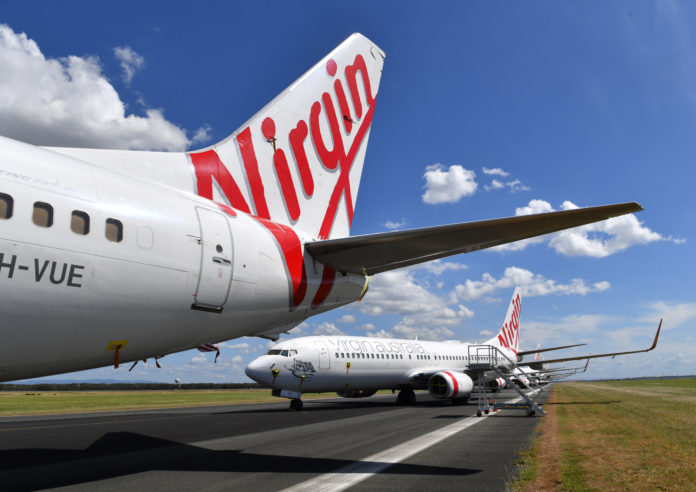
Aviation – the most visible and immediate casualty of the stay-home/don’t-travel imperative, stands out. The government has refused a A$1.4 billion loan to Virgin Australia on logic that appears partly ideological.
Telling Virgin’s international owners to look to their own “deep pockets”, Frydenberg explained on April 16 that more than A$1 billion had already been directed to the sector:
We want to see Virgin continue, we want to see two airlines in the domestic market, but we’re not in the business of owning an airline.
Yet even with that support, Virgin had grounded its fleet and stood down some 90% of its 10,000-strong direct workforce, while Qantas had done likewise with 20,000 of its 30,000 employees.
A game of ideological “chicken” is under way, with the Coalition betting that somebody else will step in to rescue the airline.
Several questions arise. Why let such a crucial sector crumble right now of all times? Why allow the shutdown to force a return to a monopoly? And, importantly, how would the collapse of such a large regionally significant employer, with all of its myriad interdependencies across the tourism and hospitality sectors, serve the ambition of a rapidly rebounding economy?
In 2009, the new Obama administration took equity stakes in automotive manufacturers to keep them afloat and was able to sell down those shares later when the car makers bounced back. Analysts argued that neither Chevrolet nor Chrysler were viable long term. They were wrong.
Beyond small government ideology, is that not a template for aviation now – especially if a monopoly is deemed unacceptable?
Another case is the JobSeeker payment. Generous though it is, this emergency assistance has eligibility limits. Those on work visas – who provide most of the regional seasonal workforce – are ineligible, and even Australian citizens employed on casual contracts of less than 12 months duration miss out. In some industries like education (university research assistants, casual school teachers, aged-care workers, entertainers), short-term contracts are the norm. Hundreds of thousands of workers – perhaps as many as a million – never receive contracts of greater than 12 months.
Again, given the importance of these workers in key sectors of the economy, the question arises as to why some jobs are worth protecting and others are not.
The ACTU warns that if Virgin falls over the Commonwealth could be up for hundreds of millions in workers’ payments from its “Fair Entitlements Fund”. And that’s before paying out unemployment benefits for some – particularly older workers – indefinitely.
If it would take three-and-a-half fire-tankers to save an apartment block that is on fire, and you stop at three to save water, haven’t you just wasted three tankers’ worth?
Morrison and Frydenberg have done extremely well in responding to this crisis. It would be a pity if, after all this spending, residual “old” thinking still left the recovery “a day late and a dollar short”.
Source: The Conversation (Au and NZ) – By Graeme Smith, Research Fellow, Department of Pacific Affairs, Coral Bell School of Asia Pacific Affairs, Australian National University
Australian Foreign Minister Marise Payne has led a bipartisan call for a global inquiry into the origins of the coronavirus, noting Australia will insist on an independent review, not one conducted by the World Health Organisation.
Labor’s shadow health minister, Chris Bowen, has given his full backing to the idea, saying
we would expect and trust that China would cooperate.
Their views of the possibility of China — and the US — displaying moral leadership during this crisis are bleak.
In Nye’s blunt assessment, both countries are only interested in tactical leadership on global issues like COVID-19 and climate change. Both China and the US seem focused on wielding power, rather than achieving joint goals by exercising power with other nations.
As he put it,
Both the Chinese leadership and the American leadership are focused almost entirely on competitive power over who came out ahead [after COVID-19] and how well we dealt with it.
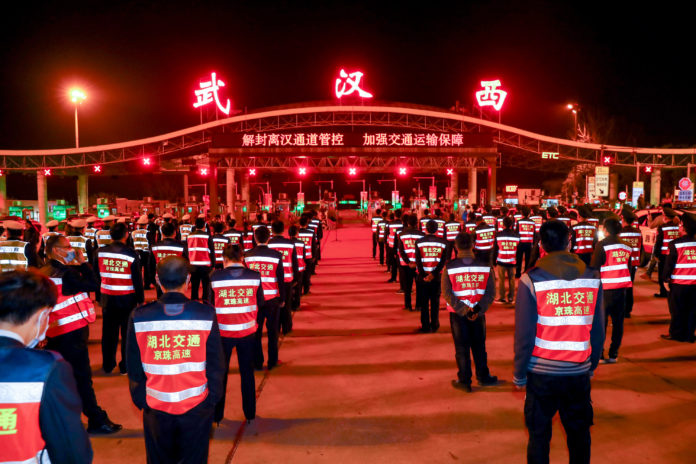
Re-opening the highway to Wuhan, the epicentre of the virus, after the city’s 76-day lockdown.Top Photo/Sipa USA
China has settled on its own telling of the story
The main barrier to Payne’s call for an inquiry is China has already settled on a narrative that the origins of the virus are unclear – Italy and the United States have been named as possible sources – and that if it did arise in China, it was not the result of a laboratory accident.
Researchers in China looking to publish anything related to the origins of the virus also now face an extra level of scrutiny.
As a result, the Chinese Communist Party (CCP) will have no interest in cooperating with any effort that might challenge that narrative.
Indeed, Payne’s call has already met with a sharp reprimand from China’s Foreign Ministry spokesman Geng Shuang, who accused Australia of
dancing to the tune of a certain country to hype up the situation.
In disputes such as these, Australia is seen as a proxy for the United States, and by extension the colonial powers behind China’s “century of humiliation”, the term used to describe the period of foreign subjugation from the mid-19th century to the Communist Revolution after the second world war.
Overturning humiliation by foreign powers is the basis for President Xi Jinping’s project of national rejuvenation. Allowing a team of foreign investigators into China to ask awkward questions about biosecurity is never going to be on the agenda.
There was a brief period in February when China looked open to entertaining a different narrative around the origin of the virus. But that window quickly closed when the US media began to run stories questioning whether it was accidentally spread from one of two institutions in Wuhan studying bat coronaviruses.
Unleash the ‘wolf warriors’
Here’s the rub: both China and the US are playing to domestic audiences.
In the case of China, that audience is not even the Chinese public, writ large. As Bates Gill argues,
the primary target of what we’re seeing in all the so-called soft power is the party itself. It is an attempt to remind party members, reassure them about Xi Jinping’s leadership and first and foremost, feel good about themselves.
While there is mixed evidence to support the lab accident theory, as soon as the story is taken up by outlets such as Fox News, the matter enters the realm of information warfare, which both the US and Chinese governments have turned to in this crisis.
US Secretary of State Mike Pompeo has called on China to “come clean” on what it knows, echoing language frequently used by President Donald Trump. A recent Pew Poll found nearly 30% of the US population subscribes to the theory the virus is a Chinese “bioweapon”.
Meanwhile, China has ramped up its own disinformation about the virus originating in the US.
The number of Twitter accounts opened by Chinese embassies, consulates and ambassadors has increased by more than 250% since March 2019. These diplomats are now being described as “wolf warriors” in China for their newly aggressive stance on social media toward western countries.
As Natasha Kassam observes in our podcast,
Conspiracy theories have been floated and then taken away, just trying to muddy the waters rather than actually change someone’s mind. This is reminiscent of Russian disinformation efforts.
‘Soft power is in the eye of the beholder’
In some countries, China’s “face mask diplomacy” – its recent move to provide protective equipment and respirators to all corners of the globe – will improve trust in the country as a global power.
You see Chinese companies delivering products to Serbia and Hungary and their leaders are … calling Xi Jinping a brother and a friend. When those same companies are delivering products to Australia, they get delivered late at night, no fanfare, no embassy reception at the airport.
China’s assistance is in stark contrast to the US ban on exports of personal protective equipment, as is their projection of competence in dealing with the virus.
But polling indicates that, as Nye puts it, “soft power is in the eye of the beholder”. Where China is not trusted, mistrust is likely to grow.
A recipe that can’t be altered
Herein lies the dilemma for Australia. Unless a broad coalition of countries from across the ideological spectrum back its call for an independent inquiry into the origins of the pandemic, it’s going nowhere.
Thanks to China’s all-court disinformation campaign abroad, including an effort to own and influence global media, paired with an ever-more tightly controlled media landscape inside China, the transparency Payne and Bowen call for is simply impossible.
Under Xi’s predecessors, there was some room for divergent views, even from civil society. But under Xi, all information that meets Foreign Ministry spokesman Geng Shuang’s definition of “objective” and “scientific” is prepared in a centralised “kitchen”, as the Chinese media describes it.
The head chef has already decided on the dish. Regardless of how many deaths this virus will cause, alternative recipes from abroad are not welcome.
NSW Premier Gladys Berejiklian yesterday announced school students would return to face-to-face classrooms in a staggered fashion from May 11, the third week of term. She said students would initially return for one day a week, and their time at school would be increased as the term progressed.
She said by term three, she hoped all students would be back at school full time.
But schools were given flexibility on how this return may look. NSW education minister Sarah Mitchell said
We want them [schools] to make sure they are having about a quarter of students [from each grade] on campus each day […] But how they break that group up will be a matter for them.
The NSW government said students would complete the same coursework whether they were at home or on campus during the staggered return.
This announcement is a quick turnaround from only a few weeks ago, when the NSW government said parents must keep their children at home if they could. In the latest press conference, the government said 95% of students were working from home during the final weeks of term one.
There are a few possible reasons for NSW to have made this decision. It allows children to re-connect with teachers and peers; it is one way to have fewer students on campus at any one time; it helps parents observe physical distancing during drop-off and pick-up times; and it allows a systematic escalation to two days, then three days and so on.
A staggered return to school starts moving the wheels of school campuses and infrastructure out of hibernation, at the same time helping some parents and carers return to work.
But as an educational psychologist, I am also considering this difficult decision from the perspective of the students who may be most at need of returning to class. These include those in year 12 and students in kindergarten.
Specific year groups should take precedence
It’s worth schools considering staggering the return to school from a “whole-cohort perspective” (such as all of year 12). This tries to take into account what specific cohorts of students need, developmentally and educationally.
Schools will differ in how they implement these ideas and will need to balance educational with physical distancing concerns – and their capacity to manage groups of students in the context of their physical and staffing environment.
Year 12s
The cohort that has the least amount of time to acquire time-sensitive learning would be all of year 12. There are university-bound year 12 students who would benefit from being well on top of the syllabus knowledge that is assumed in their target university course.
There are also students bound for TAFE and apprenticeships who need to get practical experience, key competencies or work placement hours.
So if the health advice allows for the staggered approach the NSW government is proposing, it is worth considering that all year 12s return to school five days per week.
Kindergarten
Moving into “big school” is a massive developmental transition which has been disrupted for the 2020 kindergarten cohort.
These children need a solid early foundation of core social, emotional, literacy and numeracy competencies.
Year six is the final year of primary school. It is where social, emotional and academic competencies are being honed and rounded ready for high school. And for year sevens, the transition to high school is a major psychological and academic adjustment, laying important foundations for their high school journey.
Year 11
Some universities are considering last year’s year 11 results for application for 2021 course entry. While the hope is everything will be back to normal come next year, there is the brutal reality that some nations have experienced second waves of COVID-19.
There is no vaccine yet, and we are only very gingerly taking baby-steps in easing restrictions.
This means we may need to take actions this year to insure year 11s against the possibility of school and assessment disruptions when they are in year 12 next year.
Disadvantaged students
We need to do our best to avoid widening any existing learning gaps during the remote learning period. Schools could encourage academically at-risk students – such as those with learning disorders, or executive function disorders such as ADHD – to start attending targeted in-class learning. This could allow for some bridging instruction so these students can make a strong start when the rest of their year group returns to in-class instruction.
Managing the numbers
An approach where initially only some year levels go to school while others remain learning remotely may make it easier for teachers.
It is not straightforward to develop both an in-class and a remote learning instructional program to accommodate a one day return, then two days and the like. Teachers are concerned at the extra workload this approach may mean for them.
There may also be significant between-school and between-teacher differences in how this is done – potentially leading to an uneven playing field for a given year group.
Teachers know how to teach a whole year group in class for five days of the week – and students know very well how to learn in this mode.
As we continue to navigate uncharted waters, there will be no perfect approach. Whatever the decision and however it is implemented, we must continue to be guided by our health experts, and we must hasten slowly.
While Virgin’s future hangs in the balance, over the one hundred years of civil aviation in Australia there has been a long list of airline casualties. Regardless of what the future holds for Virgin and its staff, the future of the company (and air travel) is certain to be irreparably changed by the pandemic.
Airline crew tend to consider their occupation as not just a job but a way of life. As teary cabin supervisor Tony Smith told the media:
Virgin is my home away from home. They are my brother, my sister, my mum and dad, my grandfather and my grandmother. They’re people I can turn to, to help me get through things, and it’s not just me, it’s a lot of other crew as well … It’s a sense of worth, it’s what keeps a lot of us sane, it keeps our mental health in check.
This strong allegiance to the company is due in part to the emotional labour required to be a flight attendant – the hard work of endlessly smiling and always being polite – and the personal sacrifices of the job. Flight crew routinely miss birthday parties, weddings, funerals and school concerts because of their service to an industry that works around the clock.
Pilots and cabin crew give up a lot to be in the industry – something of themselves and the lives that they might have otherwise lived. This means when airlines collapse they lose more than just a place to go to work: they lose a key part of their identity.
The luxury and the labour of air travel
There is a long history of loyal workers being badly affected by corporate collapses and changes in government aviation policies in Australia, but long-defunct regional airlines have dedicated custodians in regional museums and collections all around Australia.
The Queensland Air Museum maintains relics from an Australian-registered Douglas DC-6 airliner Resolution, which crashed outside San Francisco in 1953. Its loss was the final straw for the financially precarious British Commonwealth Pacific Airlines.
An advertisement for British Commonwealth Pacific Airlines in Australian Women’s Weekly, 1952.Trove
In Cooma, the Aviation Pioneers Memorial marks the loss of the Avro Ten airliner Southern Cloud in 1931, which spelled the end of the short-lived Australian National Airways established by Charles Kingsford Smith in 1929.
The shock of the 2001 collapse of Ansett Airlines was as profound and unsettling as the concurrent September 11 terrorist attacks. Two days earlier, the airline had gone into voluntary administration. On the 14th, the airline was grounded. Thousands of passengers and crew were left stranded.
Over the next few months there were attempts to keep a few flight services operational, but the company closed completely on March 4 2002, leaving 16,000 without jobs.
Established in 1935, by the 1960s Ansett was a mainstay of domestic air travel under the government’s “two-airline policy”. At the time of its collapse, Ansett accounted for almost half of the domestic aviation market.
The fallout ran deep: families were separated as pilots sought work overseas, there was a high rate of marriage breakdowns, and a number of crew died by suicide.
There wasn’t great value in being thrown around the sky every day. But the value was in the people that were there and what you could do for them. You were, very often, their lifeline.
A classified ad for TAA air hostesses published in 1968. Applicants should ‘be of attractive appearance with a good speaking voice’.Trove
If you visit the Trans-Australia Airlines Museum on any Tuesday morning, you will meet a vibrant group of volunteers who care for the unique collection of memorabilia for the company that flew from 1946 until it merged with Qantas in 1992.
The volunteers include former “hosties” who mingle with technicians and retired pilots. They are eager to share reminiscences about having to “weigh in” when flight attendants’ weight was monitored, or about apprenticeships working alongside fathers and brothers.
John Wren, president of the TAA 25 Year Club, remembers the airline as “a community and source of lifetime employment for my family. In comparison, Qantas was more like the public service!”
More than an industry
Our Heritage of the Air project has been researching Australia’s civil aviation to build a better understanding of what it is about this industry that inspires loyalty.
But aviation is not just an industry: it’s a complex linkage of technology, imagination, design and fashion, with a special kind of emotional attachment.
As airlines have been shut under coronavirus, the flow of people made possible through technologies of flight is being challenged in a way never seen before.
Yet, even as we see aircraft standing idle and airport halls eerily silent, we still rely on airlines and their workers to get everyone home. Air crews are frontline workers and are well aware of the value and necessity of their skills.
As Miranda Diack, vice president of the Flight Attendants’ Association of Australia, told ABC’s The Drum last month:
[The] aviation industry has been always there in every major disaster to rescue people. We’ve been there to bring our citizens home when they have needed help. Maybe it’s time for the government to remember … it might be time to rescue us for a change.
Source: The Conversation (Au and NZ) – By Joshua Black, PhD Candidate, School of History, National Centre of Biography, Australian National University
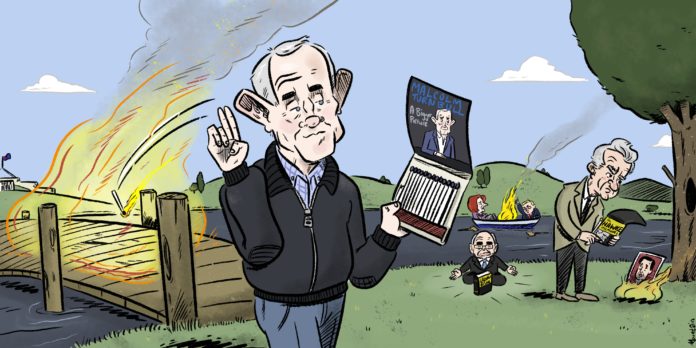
Landing in the middle of the coronavirus pandemic, it may seem strange former prime minister Malcolm Turnbull’s memoir has generated so much political controversy.
In A Bigger Picture, Turnbull deals candidly with his antagonists inside the Coalition, who fought him bitterly on the same-sex marriage reform and climate policy. Similarly, he names and shames those he blames for the leadership insurgency of August 2018. All of this was expected, but none of it must please the current government.
But is the book any more inflammatory than previous prime ministerial memoirs?
Political controversy is a trademark of political memoir publishing in Australia. A Bigger Picture is just another page in that story.
Until the 1960s, prime ministerial memoirs were the exception, not the rule. Between 1945 and 1990, just three former prime ministers chose to publish books about their political lives. Two of them – Billy Hughes and Robert Menzies – produced two books each, and both political veterans sought to avoid “telling tales out of school”. Both seemed more interested in foreign affairs, particularly our imperial relationship to the UK in the case of Menzies.
The dismissal of the Whitlam government provoked both Sir John Kerr and Gough Whitlam to publish their memoirs. After reading extracts of Kerr’s Matters for Judgement, Whitlam decided to “set the record straight immediately” by writing The Truth of the Matter. His second book, The Whitlam Government, was also designed to make a political splash. Promising to explain the “development and implementation” of his policy program, the book was timed for release on the tenth anniversary of the dismissal itself, ensuring maximum publicity.
Since then, political controversy has accompanied prime ministerial memoirs, in part because incumbent political parties and leaders have had a vested interest in how these books might affect their popularity.
In his 1994 political memoir, Bob Hawke accused his rival and successor, Paul Keating, of calling Australia “the arse-end of the world” during an argument about the Labor leadership. Further, Hawke accused Keating of failing to support Australia’s involvement in the Gulf War against Saddam Hussein’s invasion of Kuwait in 1990.
Keating, who was attacked in parliament in October 1994 over the claims, called both allegations “lies”. Hawke offered to take a lie-detector test to prove his sincerity. Senior ALP figures recorded their outrage at Hawke’s memoir. But Hawke hit back, describing them as “precious self-appointed guardians of proper behaviour”.
Hawke’s predecessor also damaged his relationship with his own party in the process of publishing his memoirs. Malcolm Fraser’s Political Memoirs, written with journalist Margaret Simons, was recognised as one of Australia’s top ten books of 2010. His outspokenness – in the book and in his post-prime-ministerial life more generally – earned him many attacks from Coalition MPs.
John Howard handled the politics of his memoirs better than most politicians. Though the book was antagonistic toward his former treasurer, Peter Costello, Howard promised to “deal objectively” with events and relationships in Lazarus Rising. Ever the party stalwart, Howard and his publishers re-issued the book after the 2013 election with a new chapter that touted Tony Abbott’s “high intelligence, discipline […] good people skills”.
Kevin Rudd and Julia Gillard both publicly took aim at one another in their memoirs, which made for plenty of media fodder. In My Story, Gillard described Rudd’s leadership as a descent into “paralysis and misery”. Rudd returned fire, calling her book her “latest contribution to Australian fiction”. However, he was unable to dent the book’s commercial success.
Four years later, Rudd in The PM Years accused Gillard of plotting “with the faceless men” to become prime minister. In a bid to patch over the historic rifts, he subsequently promised the Labor Party’s 2018 National Conference that the “time for healing” had come.
Critics of Turnbull’s book – such as Sky News’ Andrew Bolt and 2GB’s Ben Fordham – have argued that he and his publishers, Hardie Grant, were wrong to “betray confidences” and divulge “private conversations”.
In reality, political memoirs have always pushed against conventions of political secrecy. In the 1970s, British cabinet minister Richard Crossman published his Diaries, which included detailed descriptions of how cabinet functioned. The British establishment subsequently conducted the Radcliffe review into political memoirs and diaries. It found such material should be kept secret for 15 years, but that civil servants could do little to stop their political masters from publishing.
In 1999, Australia’s Neal Blewett was warned that publishing his A Cabinet Diary, recorded seven years earlier, could lead to prosecution under the Crimes Act because it revealed confidential cabinet discussions. Calling the public service’s bluff, Blewett published anyway. He explained in the book that “a few egos will be bruised, but cabinet ministers are a robust lot”. His diary shed significant light on the trials and tribulations of a ministerial life.
Since then, countless MPs and ministers have published books that claim to accurately represent personal conversations, some based on private notes (as Costello claimed in his memoirs), others on diary entries (as is the case in Turnbull’s book). In recent years, politicians have reproduced text messages and email exchanges in their books, as Bob Carr did in his 2014 book, Diary of a Foreign Minister. In each version of history, the author is the essential policymaker.
In his book, Turnbull reveals private conversations and WhatsApp exchanges with colleagues, world leaders, public servants and more. His accounts of cabinet discussions are hardly ground-breaking: cabinet debates about the economy and national security under the Abbott government, for instance, were thoroughly detailed in Niki Savva’s The Road to Ruin, while the acrimonious debates about energy policy, same-sex marriage and home affairs inside the Turnbull government were laid bare in David Crowe’s Venom. Similarly, Turnbull’s criticisms of News Corporation’s biased reporting have been aired elsewhere, and stop short of Rudd’s argument in The PM Years that Rupert Murdoch should be the subject of a royal commission.
Turnbull’s book is another addition to the history of incendiary political memoir publishing in Australia. Political parties and their media associates have confirmed once again that a successful parliamentary memoir requires deft political management.
Ultimately, A Bigger Picture is not the compendium of revelations that some may perceive. Instead, it is another picture of politics in which “character” and “leadership” reign supreme at the expense of all other political forces.
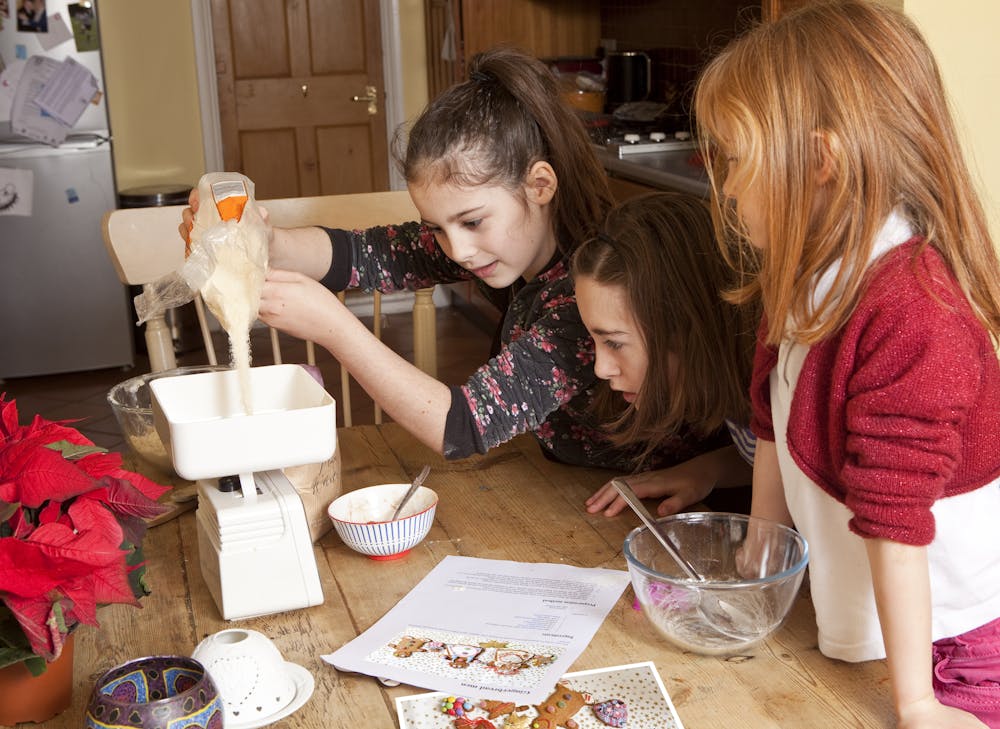
If you’re schooling your children at home, chances are you’re very time poor. By teaching your children to cook, you could bundle up some learning while also getting dinner or lunch prepared.
Teaching children to cook healthy food helps them gain knowledge and skills across a range of subjects simultaneously. The bonus is, you could get a healthy meal prepared as well.
Learning to follow a recipe and prepare food spans a number of core subjects such as English, through reading and comprehension. Being able to weigh and measure out ingredients draws on maths concepts of volume and measurement, and the skills of inquiry and problem solving are central to science.
Teaching children to cook, and focusing on preparing healthy foods, integrates knowledge from all these subjects and maximises learning opportunities by helping your children develop motivation and communication skills.
A review of classroom healthy eating interventions found active learning activities such as cooking, food preparation and school gardening had the biggest impact on improving nutrition knowledge and dietary patterns.
This was especially the case when it came to getting children to eat more fruit and vegetables and reducing their intake of sugar and total daily kilojoules.
The Australian Guide to Healthy Eating recommends we keep junk food intakes low, while aiming for five serves of vegetables and two serves of fruit daily to stay healthy and prevent chronic diseases like type two diabetes and heart disease.
Involving children and teenagers in food preparation helps promote healthy eating habits, including eating more vegetables and fruit. An experimental study with 47 children aged 6-10 found when children cooked with their parents, they ate 26% more chicken and 76% more salad and felt happier compared to when the parent cooked alone.
This clear link between cooking, nutrition and maths highlights the potential to enhance learning in both subject areas.
To challenge your children’s maths ability even further, try limiting the cooking utensils used so more calculation is needed. For example, when a recipe calls for one cup (250mL) of rice, use the ¼ cup (62.5mL) measure and ask your children to work out how many of these they need to add.
Cooking helps children put abstract maths concepts into practice.Shutterstock
Or use different types of kitchen utensils such as a measuring jug rather than a measuring cup to work out the gradations and pour the content of the cup into the jug and vice versa.
Cooking also provides the opportunity to discuss important nutrition topics with your child. Children find it easier to work out which foods are healthy and harder to identify which are unhealthy and why.
Arranging healthy foods in fun and creative ways helps kids like these foods more. An international study with 433 children from 14 countries showed beautiful food designs created using spinach and fruit increased children’s desire to eat these foods.
Using food art to improve enjoyment of healthy eating is a promising way to help picky eaters eat healthy foods.
Lots of resources are available to help make healthy cooking fun, fast and inexpensive.
Our healthy fast food cooking challenge is a collection of videos that show how well-liked classics such as burgers and pizza can be prepared in healthy ways, just as fast and at lower cost.
Climate Explained is a collaboration between The Conversation, Stuff and the New Zealand Science Media Centre to answer your questions about climate change.
If you have a question you’d like an expert to answer, please send it to climate.change@stuff.co.nz
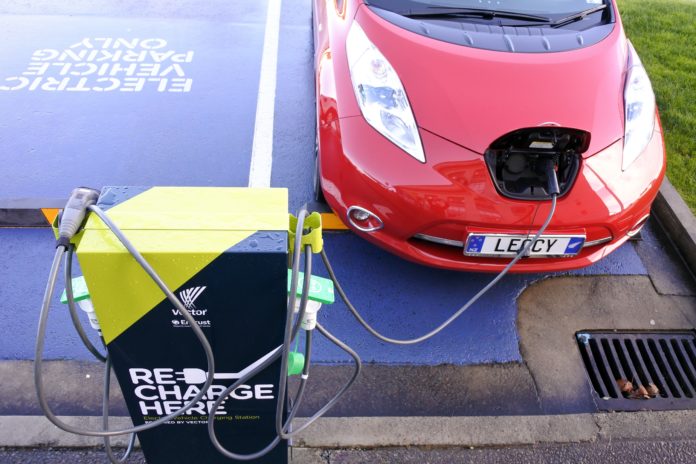
I have a question about the charging of electric cars. I understand New Zealand is not 100% self-sufficient in renewable energy (about 80%, supplemented by 20% generally produced by coal-fired stations). If I were to buy an electric vehicle it would add to the load on the national grid. Is the only way we are currently able to add the extra power to burn more coal? Does this not make these vehicles basically “coal fired”?
New Zealand is indeed well supplied with renewable electricity. In recent years, New Zealand has averaged 83% from renewable sources (including 60% hydropower, 17% geothermal, and 5% wind) and 17% from fossil fuels (4% coal and 13% gas).
In addition to being cheap and renewable, hydropower has another great advantage. Its production can ramp up and down very quickly (by turning the turbines on and off) during the day to match demand.
Looking at a typical winter’s day (I’ve taken July 4, 2018), demand at 3am was 3,480 megawatts (MW) and 85% was met by renewable sources. By the early evening peak, demand was up to 5,950MW, but was met by 88% renewable sources. Fossil fuel sources did ramp up, but hydropower ramped up much more.
Even an EV charged purely on coal- or gas-fired electricity still has lower emissions than a petrol or diesel car, which comes to around 240g CO₂/km (if one includes the emissions needed to extract, refine, and transport the fuel).
An EV run on coal-fired electricity emits around 180g CO₂/km during use, while the figure for gas-fired electricity is about 90g CO₂/km. This is possible because internal combustion engines are less efficient than the turbines used in power stations.
Looking longer term, a mass conversion of transport in New Zealand to walking, cycling and electric trains, buses, cars and trucks is one of the best and most urgent strategies to reduce emissions. It will take a few decades, but on balance it may not be too expensive, because of the fuel savings that will accrue (NZ$11 billion of fuel was imported in 2018.)
This conversion will increase electricity use by about a quarter. To meet it we can look at both supply and demand.
More renewable electricity
On the supply side, more renewable electricity is planned – construction of three large wind farms began in 2019, and more are expected. The potential supply is significant, especially considering that, compared to many other countries, we’ve hardly begun to start using solar power.
But at some point, adding too much of these intermittent sources starts to strain the ability of the hydro lakes to balance them. This is at the core of the present debate about whether New Zealand should be aiming for 100% or 95% renewable electricity.
There are various ways of dealing with this, including storage batteries, building more geothermal power stations or “pumped hydro” stations. In pumped hydro, water is pumped uphill into a storage lake when there is an excess of wind and solar electricity available, to be released later. If the lake is large enough, this technology can also address New Zealand’s persistent risk of dry years that can lead to a shortage of hydropower.
On the demand side, a survey is under way to measure the actual charging patterns of EV drivers. Information available so far suggests that many people charge their EV late at night to take advantage of cheap night rates.
If demand gets too high at certain times, then the cost of both generation and transmission will likely rise. To avoid this, electricity suppliers are exploring smart demand responses, based on the hot water ripple control New Zealand began using in the 1950s. This allows electricity suppliers to remotely turn off hot water heaters for a few hours to limit demand.
In modern versions, consumers or suppliers can moderate demand in response to price signals, either in real time using an app or ahead of time through a contract.
New Zealand’s emissions from land transport continue to rise, up by another 2% in 2018 and almost double on 1990 levels.
To address climate change, we have to stop burning fossil fuels. Passenger cars are among the biggest users and also one of the easiest to change. Fossil fuel cannot be recycled or made clean. In contrast, electricity is getting cleaner all the time, both in New Zealand and in car factories.
If you switch to an EV now, your impact is far greater than just your personal reduction in emissions. Early adopters are vital. The more EVs we have, the more people will get used to them, the easier it will be to counter misinformation, and the more pressure there will be to cater for them.
Many people have found that switching to an electric car has been empowering and has galvanised them to start taking other actions for the climate.
Have you recently come across photos of cities around the world with clear skies and more visibility?
In an unexpected silver lining to this tragic crisis, urban centres, such as around Wuhan in China, northern Italy and Spain, have recorded a vastly lower concentration of air pollution since confinement measures began to fight the spread of COVID-19.
Likewise, the Himalayas have been visible from northern India for the first time in 30 years.
But what about Australia?
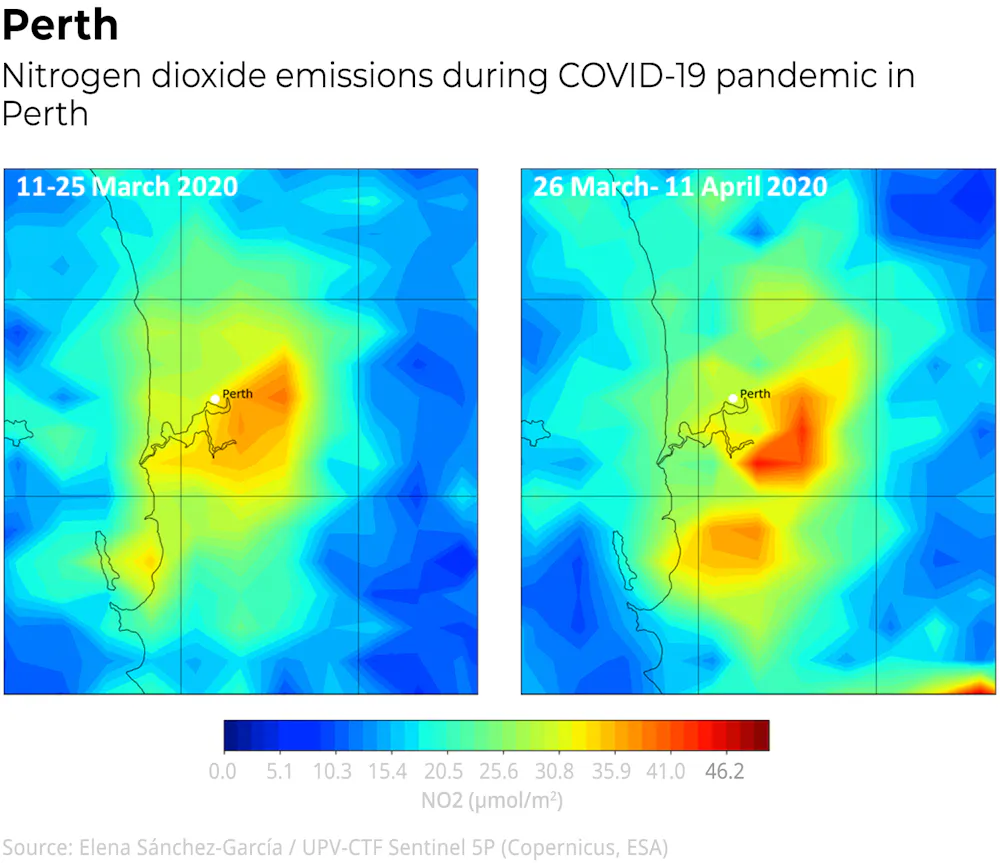
Researchers from the Land and Atmosphere Remote Sensing group at the Physical Technology Center in the Polytechnic University of Valencia – Elena Sánchez García, Itziar Irakulis Loitxate and Luis Guanter – have analysed satellite data from the new Sentinel-5P satellite mission of the Copernicus program of the European Space Agency.
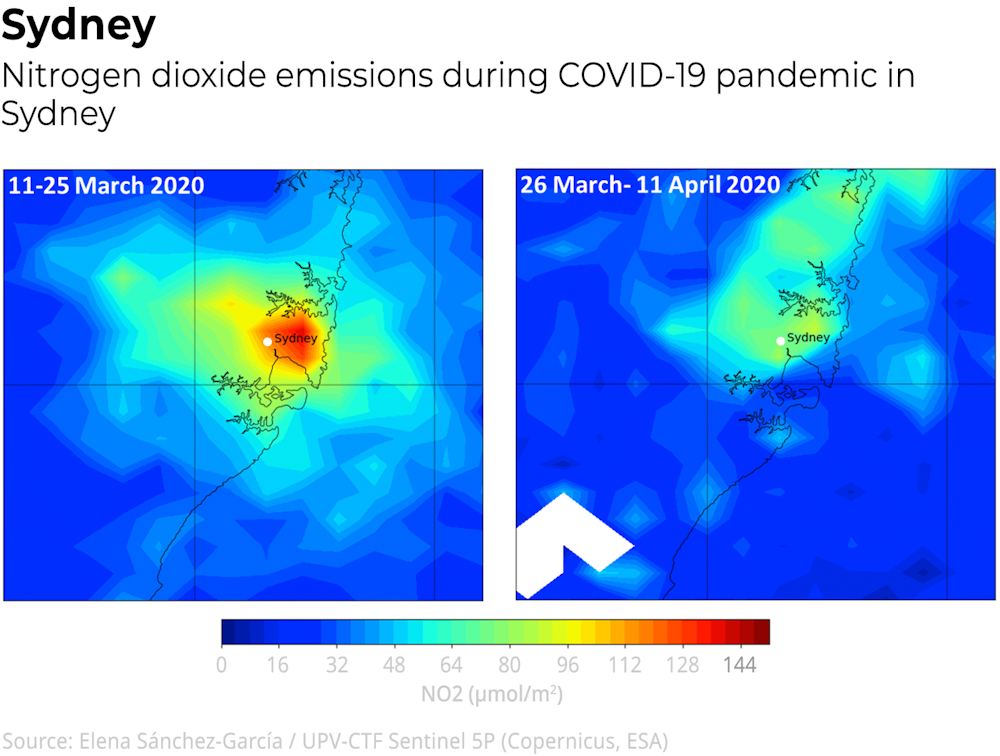
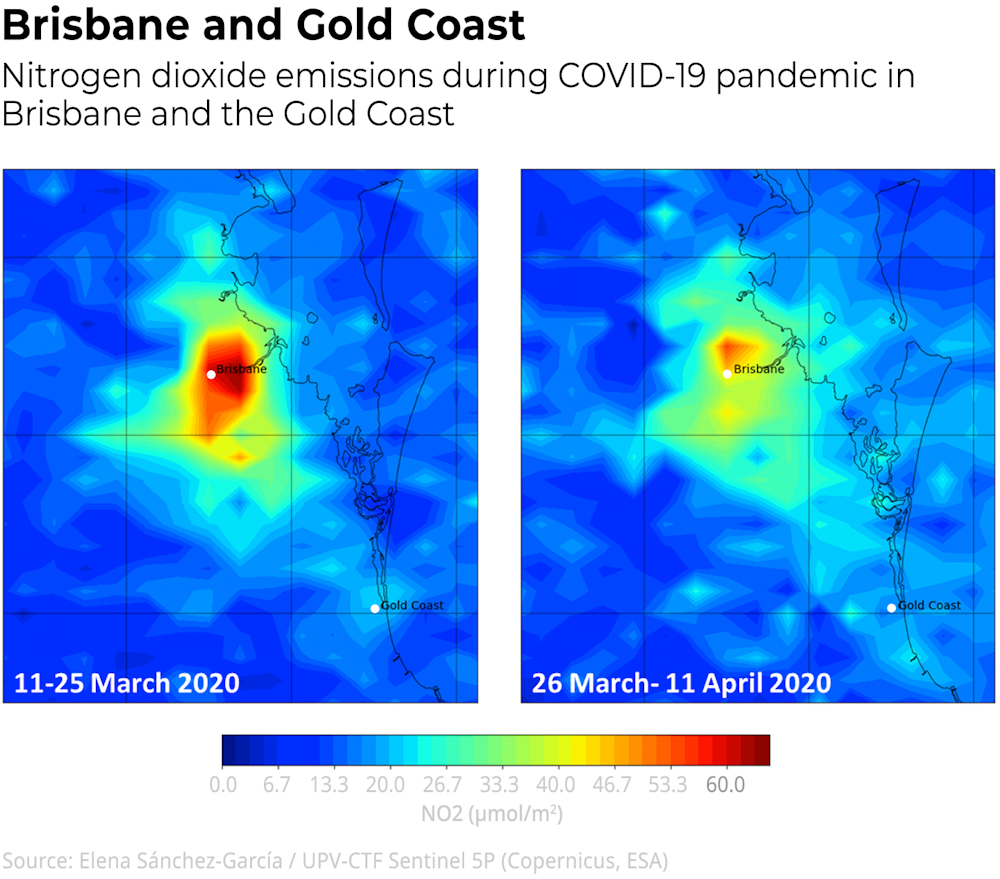
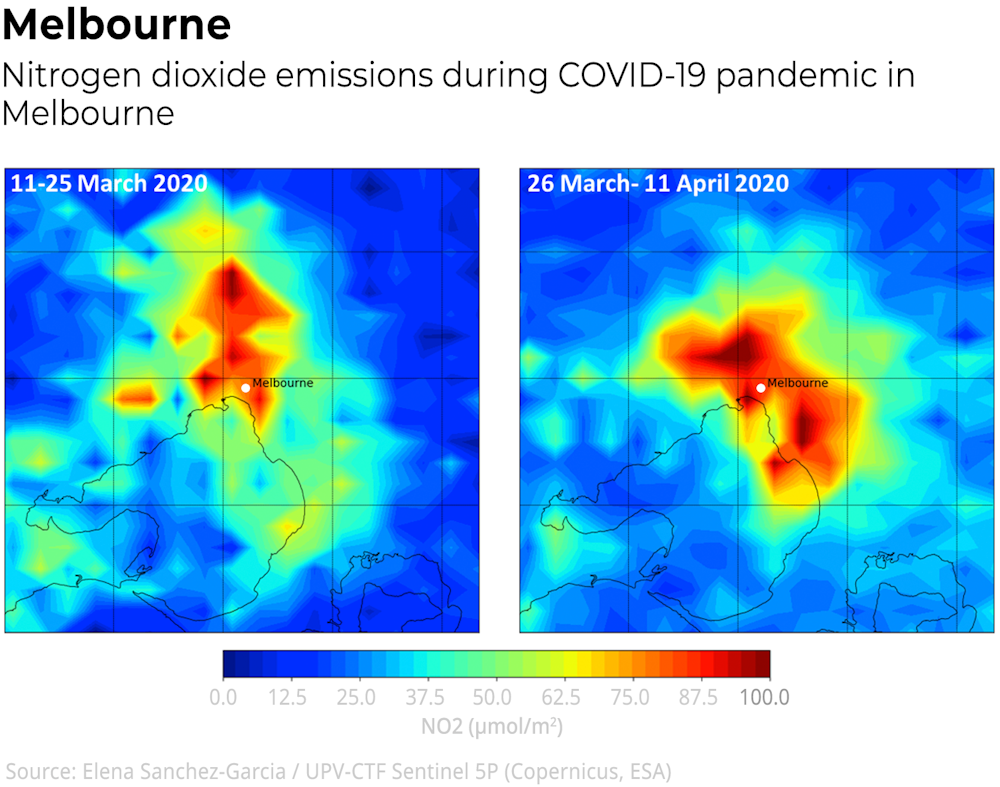
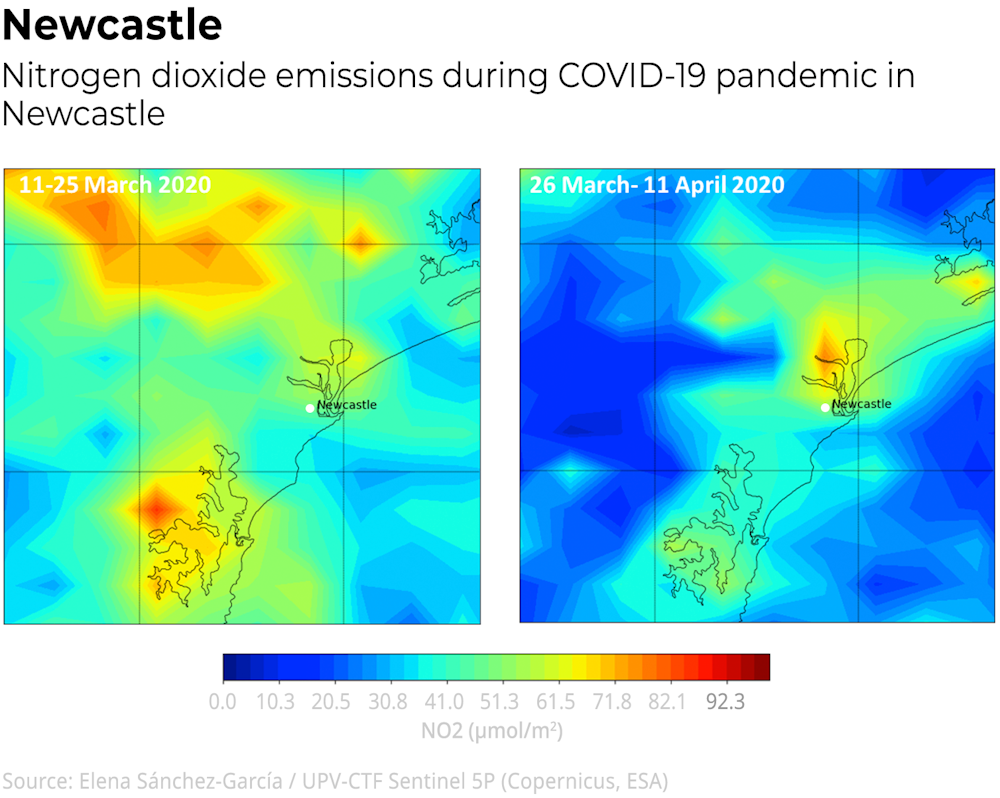
The data shows a big improvement to pollution levels over some of our major cities – but in others, pollution has, perhaps surprisingly, increased.
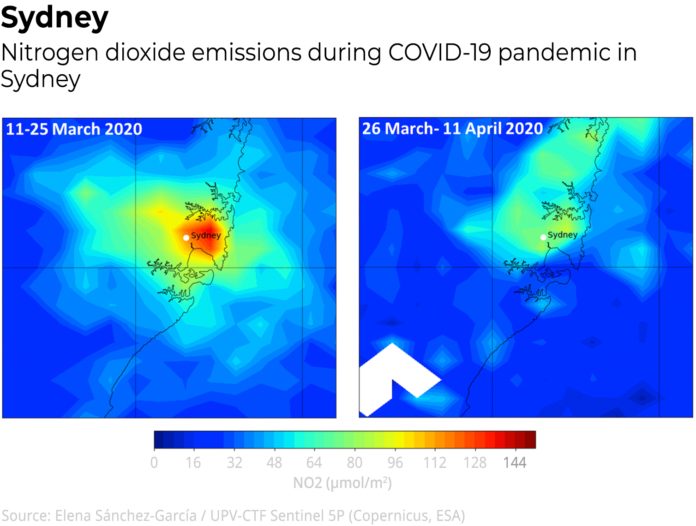
These images measure level of nitrogen dioxide in the atmosphere, an important indicator of air quality. They show changes in nitrogen dioxide concentrations between March 11 to March 25 (before lockdown) and March 26 to April 11 (after lockdown).
Why nitrogen dioxide?
Nitrogen dioxide in urban air originates from combustion reactions at high temperatures. It’s mainly produced from coal in power plants and from vehicles.
High concentrations of this gas can affect the respiratory system and aggravate certain medical conditions, such as asthma. At extreme levels, this gas helps form acid rain.
Coronavirus: nitrogen dioxide emissions drop over Italy.
Declining nitrogen dioxide concentrations across Europe in the northern hemisphere are normally expected around this time – between the end of winter and beginning of spring – due to increased air motion.
But the observed decreases in many metropolises across Europe, India and China since partial and full lockdowns began seem to be unprecedented.
Nitrogen dioxide levels across Australia
Preliminary results of the satellite data analysis are a mixed bag. Some urban centres such as Brisbane and Sydney are indeed showing an expected decrease in nitrogen dioxide concentrations that correlates with the containment measures to fight COVID-19.
On average, pollution in both cities fell by 30% after the containment measures.
Like a heat map, the red in the images shows a higher concentration of nitrogen dioxide, while the green and yellow show less.
On the other hand, nitrogen dioxide concentrations have actually increased by 20% for Newcastle, the country’s largest concentration of coal-burning heavy industry, and by 40% for Melbourne, a sprawling city with a high level of car dependency. Perth does not show a significant change.
We don’t know why pollution has increased in these cities across this time period, especially since 75% of Melbourne’s pollution normally comes from vehicle emissions and most people are travelling less.
It could be because the autumn hazard reduction burns have begun in Melbourne. Or it may be due to other human activities, such as more people using electricity and gas while they stay home.
Pollution changes with the weather
Understanding how air pollution changes is challenging, and requires thorough research because of its variable nature.
We know atmospheric conditions, especially strong winds and rain, are a big influence to pollution patterns – wind and rain can scatter pollution, so it’s less concentrated.
Blue skies over Chinese cities as COVID-19 lockdown temporarily cuts air pollution.
Other factors, such as the presence of additional gases and particles lingering in the atmosphere – like those resulting from the recent bushfires – also can change air pollution levels, but their persistence and extent aren’t clear.
If the decrease in nitrogen dioxide concentration across cities such as Brisbane and Sydney is from containment measures to fight COVID-19, it’s important we try to keep pollution from increasing again.
We know air pollution kills. The Australian Institute of Health and Welfare estimates around 3,000 deaths per year in Australia can be attributed to urban air pollution.
Yet, Australia lags on policies to reduce air pollution.
COVID-19 has given us the rare opportunity to empirically observe the positive effects of changing our behaviours and slowing down industry and transport.
But to make it last, we need permanent changes. We can do this by improving public transport to reduce the number of cars on the road; electrifying mass transit; and, most importantly, replacing fossil fuel generation with renewable energy and other low-carbon sources. These changes would bring us immediate health benefits.
Source: The Conversation (Au and NZ) – By Melanie Davern, Senior Research Fellow, Director Australian Urban Observatory, Co-Director Healthy Liveable Cities Group, Centre for Urban Research, RMIT University
We are witnessing changes in the ways we use our cities in response to the COVID-19 pandemic. The liveability of our local neighbourhoods has never been more important.
Right now, we are working together to flatten the curve by staying home to control the spread of COVID-19 and reduce demand on health services. This means spending a lot more time at home and in our local neighbourhoods. We are all finding out about the strengths and weaknesses in the liveability of our neighbourhoods.
This experience can teach us some lessons about how to live and plan our communities in the future. A liveable neighbourhood promotes good health and social cohesion, both now and after this pandemic passes.
Anybody who has left their home in the past few weeks will have noticed more people are using local streets and public open spaces. Parks and other public spaces are more popular than ever. Some are becoming too crowded for comfort.
Accessible public space is a key ingredient of healthy and liveable places. Public green spaces provide multiple benefits for mental and physical health, urban cooling, biodiversity, air pollution and stormwater runoff as identified in a previous review for the Heart Foundation.
Access to local public open spaces has become even more important as the current need to stay home adds to the impacts of increased density in the form of smaller houses, lot sizes and apartment living. Yet not everyone has access to local parks.
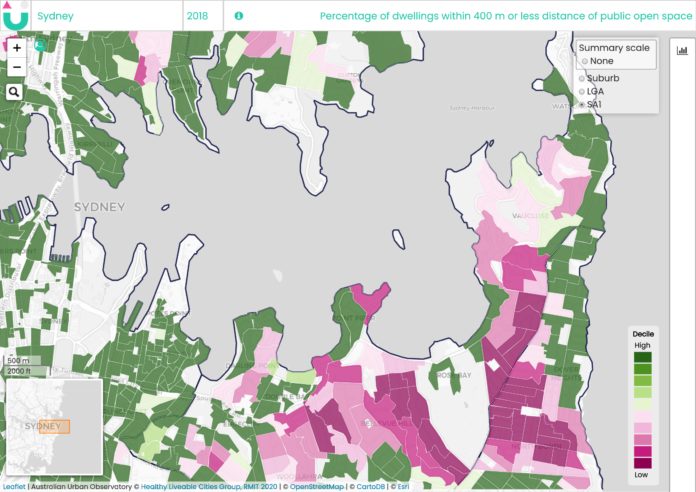
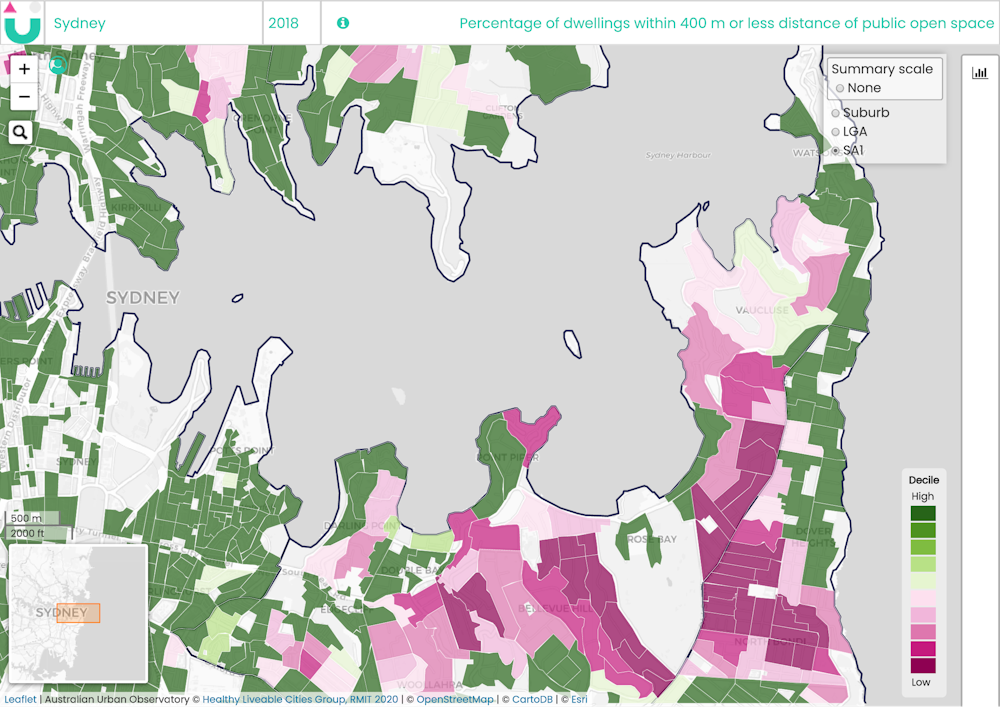
We looked at neighbourhood access to public open space using our liveability indicators included in the Australian Urban Observatory. Not all neighbourhoods have access to public open space within 400 metres. We see this in neighbourhoods just north of the beach in North Bondi, Sydney, as the liveability map below shows.
Residents of neighbourhoods north of Bondi Beach in Sydney lack good access to nearby public open space.Australian Urban Observatory, Author provided
We found a similar pattern in neighbourhoods of St Kilda East in Melbourne. It’s a pattern repeated in many neighbourhoods across cities in Australia.
Private green spaces and backyards are also being appreciated more than ever. Many people are rushing to plant fruits and vegetables at home.
Dogs are also enjoying more time with their owners in local green spaces and pet ownership is increasing. Office video conferences often feature furry friends at home. Let’s hope the increase in pet adoptions helps people cope with social distancing but also provides the animals with good long-term homes.
Fewer cars, more cycling and walking
Reduced car traffic is making local streets safer and more usable for residents.Tony Bowler/Shutterstock
One of the noticeable differences in our cities right now is the reduced car traffic in typically busy neighbourhoods where more people (including children) are out on bicycles and walking. Walkable environments with paths and cycleways are providing supportive and safe spaces for both recreational physical activity and for getting to places such as local shops and supermarkets and offices without unnecessary exposure to other people.
However, our new lives during this pandemic also highlight inequities in local access to health, community and social services. Research shows access to these services is poorer in the low-density outer suburbs that are common across Australian cities.
Homes, schools and care facilities located within 300 metres of major roads are more exposed to air pollution and risk of disease. Those risks are likely to have decreased during the COVID-19 crisis.
At the moment, many of us are living and shopping locally and enjoying the co-benefits of the “slow walkable city”: less traffic, more active modes of transport, better air quality and less noise.
Loneliness is a serious public health problem. It causes premature deaths on a scale similar to that of smoking or obesity.
Pre-pandemic lifestyles involved time-poor people travelling widely to destinations for employment, education, recreation, socialising and extracurricular activities. The suburbs were places of much social isolation.
Neighbourhoods have joined in a mass ‘bear hunt’ to entertain children during the coronavirus lockdown.Michael Dodge/AAP
With these activities now reined in, are we are seeing a rise in neighbourhood social connections due to people staying at home? Anecdotally, yes. It’s emerging through new or reinvigorated conversations with neighbours, support and sharing of goods (toilet paper anyone?), and coordinated neighbourhood support systems, such as WhatsApp groups and neighbourhood happy hours. Across the world, we can see this sense of neighbourhood belonging in the form of bear hunts and rainbow chalk drawings.
These are just some of the more obvious reflections about the liveability of our neighbourhoods as we stay home to help contain the spread of COVID-19. No doubt there will be many more lessons to come that we need to remember and act on after the pandemic passes.
Source: The Conversation (Au and NZ) – By Benjamin Nickl, Lecturer in International Comparative Literature and Translation Studies, University of Sydney
War film is serious business. It has been from the beginning, when William Wellman’s Wings (1927) became the first World War I romantic drama to win an Oscar for best picture. One hundred years later, the supply of war films seems inexhaustible and their box-office attraction unbroken.
There we sit, watching generations get wiped out. We see terrifying technological inventions like the atomic bomb being dropped on Hiroshima. Removed from actual war in time and place, these big-screen productions are horrible yet spellbinding at the same time.
War Horse (2011) is a particularly effective exploration of this experience and what it gives to audiences. Steven Spielberg’s film tells the story of a young horse and his owner forced from the idyllic fields of rural England into the bloody trenches of first world war France.
War Horse illustrates the fragile balance of peace, and how sacrifice forms lasting bonds across borders, languages and species, echoing the Great War’s hard-won reconciliation process as Europeans bonded over grief and common trauma. Spielberg pairs moral guidance and a sense of what really matters in life with breathtaking landscape shots and fast-paced action sequences.
But this is only one story and only one way to present war as a noble sacrifice to forge unity. There is no standard formula to explain why the experience of war continuously attracts millions of viewers. The answer is different for each war story, and it is different in each nation.
The national war complex
The first Australian film to win an Academy Award was Damien Parer’s documentary of the fighting in New Guinea in 1942. The film garnered a Best Documentary Oscar for bringing the immediate experience of humanity at war to Australia: the wounded; the anxiety; the young soldiers’ fear of death far from home.
Parer himself was killed in action in 1944 in the Palau archipelago in Micronesia. His cinematic legacy is a sobering documentation of Australians at war without flagwavers or hyper-masculine action heroes.
Damien Parer also shot photographs while in New Guinea, including this one at a rest spot on the Kokoda Trail.Australian War Memorial
SBS recently ran a week of war films in the lead-up to ANZAC Day, leading with Churchill (2017), which portrays the inner world of Britain’s wartime prime minister.
Downfall (2004) looks at Hitler’s final days barricaded in his Berlin Führerbunker. Testament of Youth (2015) is a heart-swollen romance of WWI nurse Vera Brittain’s literary memoirs and her calls for pacifism.
SBS’s War Week included no actual documentary footage like that of Parer’s.
Today, the idea of an authentic representation of war seems less appealing to audiences. Marvel Studios broke box-office records all over the world with its fantasy battle and sci-fi war film Avengers: Endgame (2019). Perhaps too much reality in depicting war, the starkest of all modern realities, is simply unbearable. And so the re-enchantment of war comes with laser battles and magic gauntlets.
Fact versus fiction
How we explore war on film has sparked heated debates.
One argument holds the true horror of war is increasingly obscured by technology, Hollywood star power, and clever marketing campaigns.
The popular HBO documentary television miniseries Band of Brothers (2001) and The Pacific (2010) caused controversy among military historians who accused the series of endorsing war nostalgia, making the audience take sides, and actively shaping collective modern memory through re-enacted combat scenes.
War has been co-opted as an entertainment favourite in countries all across the world, allowing audiences to think of it as a metaphor to explore issues like sexism or mortality.
One of the most popular South Korean war films, Jang Hoon’s The Front Line (2011), suggests the meaning of life cannot be found in senseless wars. The Cave (2019), a war documentary by Syrian director Feras Fayyad, shows how a group of female doctors in Ghouta struggle with systemic sexism while tending to thousands of the injured.
Jackson’s film produces a modern war experience by enhancing documentary footage of the first world war. We see the real faces of war: they talk, they smoke makeshift cigarettes, they are shellshocked victims of their time.
Jackson used computerised colouration and recordings of veteran interviews as voiceovers. He hired forensic lip readers to superimpose dialogue on the previously silent combatants’ voices.
The result is a conflicting truth about war and how its memories grow truer and more real before our eyes and in our ears if we want them to, rather than feeling safe in the fact those bombastic Hollywood scenes on screen can never become our reality.
We have just witnessed an oil price crash like never before taking prices of West Texas Intermediate into deeply negative territory.
The spot price of West Texas, the US benchmark, reached minus US$40.32 a barrel and the May futures price (which is deliverable in a physical form) went to minus US$37.63 a barrel, the lowest price in the history of oil futures contracts.
There has been no better indicator of the extent of the economic impacts of coronavirus. With borders closed and much of the world’s population being urged to stay at home, transport has come to a near halt.
How can a price turn negative?
Oklahoma’s Cushing oil storage facility, the largest in the world.Crude Oil Daily
The industry has not been able to slow production fast enough to counter the drop in demand. The other mechanism that normally stabilises prices, US oil storage, appears to be nearing capacity.
West Texas Intermediate is typically stored at the Cushing facility in Oklahoma which is on the way to being full.
Cushing is said to be able to hold 62 million barrels of oil – enough to fill all the tanks of half the cars in United States.
That’s why prices have gone negative. Traders with contracts to take delivery of oil in May fear they won’t be able to store it. They are willing to pay not to have to take it and have nowhere to put it.
Not all oil contracts went negative. West Texas Intermediate contracts for June and subsequent months are still positive, reflecting a feeling that the supply and demand imbalance will soon be corrected.
Brent, the international price benchmark, remained positive, dropping to US$25.57 – a fall of about 9%. Unlike West Texas Intermediate, Brent deliveries can be put on ships and transported to storage facilities anywhere in the world.
Not confined to the US
There is no guarantee the problems of storage evident in the US won’t spread to other markets.
This is despite the decision of OPEC-Plus (the mainly Middle Eastern member of the Organisation of the Petroleum Exporting Countries plus Russia and other former Soviet states) to respond to the free fall by cutting output by 9.7 million barrels per day, ending the recent duel over production levels between OPEC and Russia.
Adding another element to the COVID-19 story, on March 9, the day of the Black Monday stock market crash, the Chicago Mercantile Exchange reported a new daily record for West Texas Intermediate trading, reaching 4.8 million contracts, surpassing the 4.3 million recorded on September 2019 following the drone attacks on Saudi oil facilities.
The future does not look good. With rising unemployment, stuttering economies, and collapsing financial markets the prospects for substantial recovery in the oil markets seems far away.
Restrictions are to be eased on elective surgery, enabling a “gradual restart” to procedures next week.
But as national cabinet took early baby steps towards restoring normality, Reserve Bank Governor Phil Lowe warned the first half of this year would likely see the biggest contraction in Australia’s national output and income since the 1930s depression.
After Tuesday’s national cabinet meeting, Scott Morrison announced that from Monday, category 2 and some important category 3 procedures can restart in public and private hospitals. These were earlier suspended amid uncertainty about how hard COVID-19 would hit the hospital system.
Category 2 covers cases needing treatment within 90 days; category 3 are ones that require treatment in the next year.
The easing will cover:
IVF
screening programs (cancer and other diseases)
post cancer reconstruction procedures (such as breast reconstruction)
procedures for children under 18 years of age
joint replacements (incl knees, hips, shoulders)
cataracts and eye procedures
endoscopy and colonoscopy procedures.
More dentistry services will also be available.
The elective surgery easing has been facilitated by the extra availability of protective equipment; also, the low numbers of COVID-19 cases has meant the pandemic has not placed as much demand on beds as had been feared.
It is estimated the announced easing will lead to reopening about 25% of elective surgery activity in private and public hospitals.
Morrison said the situation would be reviewed on May 11 to decide whether all surgeries and procedures could recommence and numbers increase.
Clinical decisions will determine the priority given to cases.
The Prime Minister said the easing “is an important decision because it marks another step on the way back. There is a road back”.
On aged care, national cabinet was concerned some nursing homes are being too extreme, with full lockdowns that do not allow residents to have any visitors.
People in nursing homes are particularly vulnerable to the coronavirus and there have been outbreaks and deaths in the sector.
But “there is great concern that the isolation of elderly people in residential care facilities, where they have been prevented from having any visitors … is not good for their wellbeing, is not good for their health,” Morrison said.
The national cabinet gave a “strong reminder” that its earlier decision was “not to shut people off or to lock them away in their rooms.”
This decision was to allow a maximum of two visitors at one time a day, with the visit taking place in the resident’s room. Apart from that, residents should be able to move around the facility.
Further restrictions would apply where there was an outbreak in a facility, or in the area.
On the economic front, in an indication of the devastating job losses that have already occurred, Morrison said since March 16, 517,000 JobSeeker claims had been processed. JobSeeker used to knwon as Newstart.
“By the end of this week we will have processed as many JobSeeker claims in six weeks than we would normally do in the entirety of the year,” he said.
In a speech at the Reserve Bank Lowe said it was difficult to be precise about the size of the contraction underway.
But on the bank’s current thinking:
national output was likely to fall by about 10% over the first half of 2020, with most of the decline in the June quarter
total hours worked were likely to decline by about 20% in the first half of the year
unemployment was likely to be about 10% by June, “although I am hopeful that it might be lower than this if businesses are able to retain their employees on lower hours.”
Lowe said inflation would turn negative in the June quarter, and was likely prices would turn out to have fallen over the entirity of this financial year, the first time that had happened in 60 years
Lowe expressed confidence the economy would “bounce back”, but stressed the recovery’s timing and pace would depend on “how long we need to restrict our economic activities, which in turn depends on how effectively we contain the virus”.
“One plausible scenario is that the various restrictions begin to be progressively lessened as we get closer to the middle of the year, and are mostly removed by late in the year, except perhaps the restrictions on international travel.
“Under this scenario we could expect the economy to begin its bounce-back in the September quarter and for that bounce-back to strengthen from there.
“If this is how things play out, the economy could be expected to grow very strongly next year, with GDP growth of perhaps 6–7%, after a fall of around 6% this year,” Lowe said.
He said unemployment was likely to remain above 6% over the next couple of years.
“Whatever the timing of the recovery, when it does come, we should not be expecting that we will return quickly to business as usual.”
“It is highly probable that the severe shocks we are now experiencing will change the mindsets of some people and businesses. Even after the restrictions are lifted, it is likely that some of the precautionary behaviour will persist.
“And in the months ahead, we are likely to lose some businesses, despite best efforts, and some of these businesses will not reopen. There will also be a higher level of debt and some households might revaluate the risks of having highly leveraged balance sheets.
“It is also probable that there will be structural changes in the economy. We are all learning to work, shop and travel differently. Some of these changes will probably stay with us, requiring a rethinking of business models. So the crisis will have reverberations through our economy for some time to come.”
Source: The Conversation (Au and NZ) – By Louise D. Hickman, A/Professor and Director Palliative Care Studies at IMPACCT (Improving Palliative, Aged & Chronic Care through Clinical Research & Translation), University of Technology Sydney
If you become seriously unwell with COVID-19 and are likely to benefit from active treatment and need a ventilator or are dying, do those closest to you know what type of care you would want?
COVID-19 steals the luxury of time but these are the questions busy health-care providers assessing you will want to know to inform your treatment.
If you haven’t had these important conversations, start them today. Have them with someone who will be able to advocate for your care preferences and wishes when you are unable to do it yourself.
Who should be having these discussions?
Older people have more chronic health conditions that place them at higher risk of severe illness or death. They are more likely to find themselves in a variety of situations where health-care decisions need to be made.
Although older people and those with chronic conditions are at more risk, no one is protected against COVID-19, so everyone should have these conversations.
What are the options?
COVID-19 is a respiratory virus that can cause lung infection. If you were likely to benefit, you could be sent to an intensive care unit (ICU). Some patients will need to have a tube put down their throat so they can be attached to a ventilator to help their body breath. Would you want this to happen to you?
In crisis situations, who can be with you in hospital while you are sick or dying changes. You may be allowed one person with you or no-one.
Health-care providers are working creatively to ensure patients and their families remain connected through the use of technology, such as FaceTime, WhatsApp, Viber, Zoom or texting. Would you still decide to go to ICU if you knew you could only communicate with those you love using technology?
What if you don’t want aggressive treatment?
Good health care involves understanding people’s preferences and wishes, and developing clear goals of care. Not everyone will want to have aggressive treatment, which can be burdensome and difficult to cope with if you have other chronic illnesses or are very old.
If you elect to have good symptom management only, rather than aggressive treatment, do you know what palliative care might look like for you in this situation?
Palliative care aims to relieve symptoms and promote quality of life.
COVID-19 symptom management is focused on making you as comfortable as possible, by managing any distress, breathlessness, anxiety and pain. The health-care providers will endeavour to communicate regularly with your family and keep them informed about your situation and how you are responding to these comfort measures.
If you do not want to receive aggressive medical treatments, then Advance Care Planning Australia has some great resources to help you frame and document your care preferences.
What questions do you need to think about?
This list provides some helpful questions for a written plan. You can also give your answers to your advocate, someone you want to speak to the treating doctor or nurse on your behalf if you’re too sick to talk.
1) Who is the nominated person you want to speak on your behalf?
2) What are your:
goals of care?
health priorities?
current conditions?
3) Do you know what treatment you want or do not want should you be too sick to tell health professionals yourself?
4) If it becomes clear you are dying, what does a comfortable dignified death look like to you?
5) What is your preference if your condition gets worse, even after health professionals try everything? If you are dying, do you want to be put on a ventilator?
6) Do you want be resuscitated (with CPR) if your heart and lungs stop working?
7) Would you rather not go to the hospital and prefer to stay in your home or residential aged care home if given the choice?
8) Have you had your wishes documented and does your advocate have a copy of your care preferences and wishes?
If we fail to have these conversations now and are unfortunate to present to hospital acutely unwell, then there may not be the luxury of time to discuss these issues in detail with our family and the treating health-care team.
With its plea for a $A1.4 billion government loan rebuffed, Australia’s second major airline has entered voluntary administration.
Virgin Australia’s chief executive, Paul Scurrah, said the decision to appoint external administrators (from Deloitte) “was about securing the future of the Virgin Australia Group and emerging on the other side of the COVID-19 crisis”.
Voluntary administration means the board of an insolvent company – one that can’t pay its bills – hands full control to independent administrators. They then work out if it can be saved by being restructured or sold to other investors. This is similar to what is called Chapter 11 bankruptcy protection in the United States.
If the administrators can’t save the company, their job is to wind up operations and sell off assets to pay creditors (including staff owed entitlements).
For now, with almost all of Virgin Australia’s fleet grounded and the federal government subsidising it flying a few critical routes, voluntary administration won’t make much difference to customers. The company says it will continue to operate its scheduled international and domestic flights.
Virgin Australia isn’t the first airline victim of the COVID-19 pandemic.
Norway’s largest airline, Norwegian Air, announced on Monday it had “no choice but to apply for bankruptcy” for three subsidiaries in Denmark and one in Sweden.
Like Virgin, it too entered this crisis in far from tip-top shape, as it struggled over several years to make its long-haul low-cost airline model work.
Virgin Australia has long been financially fragile. Last financial year it posted a A$349 million loss, its seventh consecutive annual loss. In response the airline announced a “rightsizing” program that included cutting about 750 jobs (about 7.5% of its workforce).
The question now is whether the Deloitte administrators can do better.
It is possible.
Three of the world’s biggest airlines – Delta, United, and American Airlines – have survived near-death experiences.
Delta filed for Chapter 11 bankruptcy in 2005, United in 2002, and American Airlines in 2011. All were restructured over several years and all emerged from the process as more efficient operations. They are now the world’s first, second and fourth-biggest airlines (by passenger capacity).
Reports suggest, however, that Virgin Australia’s administrators are looking for a much shorter timeline – about eight weeks – to find new owners for the airline.
This would make the process far different to that of Ansett Australia, the last major Australian airline to go into voluntary administration. Ansett entered administration on September 12 2001. Its last flight landed in Sydney on March 5 2002. Liquidating its assets and paying money owed to creditors and staff took almost a decade.
If the administrators can work out a deal that injects new investments and wipes Virgin’s debts of about A$5 billion – a major obstacle to the federal government lending it A$1.4 billion – Australia’s airline industry will arguably be more competitive than it is now.
Consequences for customers
If new owners cannot be found, Virgin Australia’s collapse would leave the Australian market dominated by Qantas (and its budget subsidiary Jetstar) – at least in the short to medium term.
Less competition almost always means reduced services and higher prices for customers.
But the airline market is complicated. As I’ve noted previously of the US market, there can be many competitors yet still effective monopolies on some “thin” routes. What economists call “multi-market contact” can lead to “tacit collusion”, in which competition is tempered without any explicit agreement among the market participants.
Research shows, for example, that airfares are about 5% higher in markets with two legacy airline competitors than on the monopoly routes. But when a legacy carrier faces new competition from a low-cost airline, the prices can go down by as much as a third.
Demand factors
Tempering the likelihood that market dominance by one company will lead to higher prices is that demand will take time to return to pre-pandemic levels after restrictions are lifted.
In China, for example, domestic passenger numbers for 2020 are expected to be 20% lower than 2019, and international passenger numbers 50% lower.
Fuel costs, which accounted for about 24% of the global airline industry’s operating costs in 2019, are also likely to be lower. The oil price is at its lowest level in history – so low, in fact, oil producers are now paying customers to take it.
Both these factors suggest ticket prices won’t rise in the short term.
In the medium term, once demand recovers, lack of competition could well lead to higher airfares.
But in the long run there is better news.
As any economics textbook will tell you, profitable markets attract new competitors.
With more airline bankruptcies around the world quite likely, conditions will be ripe for new airlines to be established. There will be no shortage of aircraft and skilled workers. If oil prices stay low, new entrants could even be competitive using older, less fuel-efficient aircraft.
For the sake of Virgin Australia’s 10,000 employers, and the jobs of thousands more that depend on it indirectly, I hope the airline survives administration and emerges better for it, as US carriers have done with Chapter 11 bankruptcies.
But if it doesn’t, the pain for customers through higher prices is likely to be temporary. The laws of economics tell us that, so long as governments ensure markets remain open to new entrants, monopolies do not last.
The curve of the COVID-19 epidemic has been flattened in many countries around the world, and it hasn’t been new antivirals or a vaccine that has done it. We are being saved by non-drug interventions such as quarantine, social distancing, handwashing, and – for health-care workers – masks and other protective equipment.
We are all hoping for a vaccine in 2021. But what do we do in the meantime? And more importantly, what if no vaccine emerges?
The world has bet most of its research funding on finding a vaccine and effective drugs. That effort is vital, but it must be accompanied by research on how to target and improve the non-drug interventions that are the only things that work so far.
Debates still rage over basic questions such as whether the public should use face masks; whether we should stand 1, 2 or 4 metres apart; and whether we should wash our hands with soap or sanitiser. We need the answers now.
Across all health research, non-drug interventions are the subject of about 40% of clinical trials. Yet they receive far less attention than drug development and testing.
In the COVID-19 pandemic, millions of dollars have already been given to research groups around the world to develop vaccines and trial potential drug cures. Hundreds of clinical trials on drugs and vaccines are under way, but we could find only a handful of trials of non-drug interventions, and no trials on how to improve the adherence to them.
While holding our breath for the vaccine …
We all hope the massive global effort to develop a vaccine or drug treatment for COVID-19 is successful. But many experts, including Ian Frazer, who developed Australia’s HPV vaccine, think it will not be easy or quick.
If an effective vaccine or drug doesn’t materialise, we will need a Plan B that uses only non-drug interventions. That’s why we need high-quality research to find out which ones work and how to do them as effectively as possible.
Aren’t non-drug interventions straightforward?
You might think hand washing, masks and social distancing are simple things and don’t need research. In fact, non-drug interventions are often very complex.
It takes research to understand not only the “active components” of the intervention (washing your hands, for example), but also how much is needed, how to help people start and keep doing it, and how to communicate these messages to people. Developing and implementing an effective non-drug intervention is very different from developing a vaccine or a drug, but it can be just as complex.
To take one example, there has been a #Masks4All campaign to encourage everyone to wear face masks. But what type of mask, and what should it be made of? Who should wear masks – people who are ill, people who are caring for people who are ill, or everyone? And when and where? There is little agreement on these detailed questions.
Washing your hands also sounds simple. But how often? Twice a day, 10 times a day, or at specific trigger times? What’s the best way to teach people to wash their hands correctly? If people don’t have perfect technique, is hand sanitiser be better than soap and water? Is wearing masks and doing hand hygiene more effective than doing just either of them?
These are just are some of the things that we don’t know about non-drug interventions.
Existing research is lacking
We recently reviewed all the randomised controlledtrials for physical interventions to interrupt the spread of respiratory viruses, including interventions such as masks, hand hygiene, eye protection, social distancing, quarantining, and any combination of these. We found a messy and varied bunch of trials, many of low quality or small sample size, and for some types of interventions, no randomised trials.
Other non-drug options to research include the built environment, such as heating, ventilation, air conditioning circulation, and surfaces (for example, the SARS-CoV-2 virus “dies” much more rapidly on copper than other hard surfaces).
Are some of the things we are doing now ineffective? Probably. The problem is we don’t know which ones. We need to know this urgently so we’re not wasting time, effort, and resources on things that don’t work.
At a time when we need to achieve rapid behaviour change on a massive scale, inconsistent and conflicting messages only creates confusion and makes achieving behaviour change much harder.
What about the next pandemic?
If a successful COVID-19 vaccine is developed, we’re out of the woods for now. But what happens when the next pandemic or epidemic arrives? Vaccines are virus-specific, so next time a new virus threatens us, we will again be in the same situation. However, what we learn now about non-drug interventions can be used to protect us against other viruses, while we wait again for another new vaccine or drug.
We have had opportunities to study non-drug interventions for respiratory viruses in the recent past, particularly during the Severe Acute Respiratory Syndrome (SARS) epidemic in 2003 and the H1N1 influenza pandemic in 2009. However, the chances for rigorous studies were largely wasted and we now find ourselves desperately scrambling for answers.
To prepare for the future and Plan B, the case where a vaccine doesn’t arrive, we need to conduct randomised trials into non-drug interventions to prevent the spread of respiratory viruses. The current pandemic is presenting us with a rare opportunity to rapidly conduct trials to answer many of the unknowns about this set of non-drug interventions.
Concentrating all our funding, efforts, and resources into vaccine and drug research may turn out to be a devastating and costly mistake in both healthcare and economic terms. The results will be felt not only in this pandemic, but also in future ones.
We investigate how principles of wellness such as healthy eating and exercise are incorporated into health care, particularly in general practice. I spent the summer planning how to support my team for the next five years, focusing on impact and research translation into real-world settings.
Big things were in the works. It was an exciting time. But as it turns out, wellness in health care isn’t a priority during the COVID-19 crisis.
Many of my team’s projects relied on doctors, nurses and other health professionals to collect or provide data. With the strain placed on health care by the pandemic, continuing was no longer viable. Grant applications, domestic and international travel, conferences and meetings have all been cancelled or postponed indefinitely.
As a supervisor, the hardest part was withdrawing research students and interns I’d lined up to start projects in clinics. This pandemic has challenged the relevance, impact and productivity of our work.
This shock comes shortly after a summer of devastating bushfires which hindered research progress by forcing experts out of fire-affected regions, destroying expanses of equipment and reportedly setting some studies “back months or years”.
This photo was taken in Junee, New South Wales, in January. According to reports, the total tangible cost estimate of the summer bushfires was close to A$100 billion.Shutterstock
Stoppages across the field
Social distancing, travel bans and quarantine restrictions mean scientific fieldwork across the world has almost completely stopped.
The Australian Antarctic Program, led by the federal Department of Agriculture, Water and the Environment has been reduced to essential staff only to keep the Antarctic continent COVID-19-free. Instead of sending 500 expeditioners in the next summer season, the Australian Antarctic Division will only send about 150.
Delays have also impacted one of the world’s largest efforts to investigate the nature of dark matter. The XENON experiment based in Italy is worth more than US$30 million, according to the New York Times. It faced a multitude of roadblocks when the country was forced into lockdown earlier this year.
Young research stars missing opportunities
For young researchers, social distancing and event cancellations are especially damaging to professional development. Scientific conferences and meetings foster collaboration and can also lead to employment opportunities.
This crisis has left the next generation of researchers unsupported, and have negative flow-on effects for all research areas. In health and disease prevention, research efforts apart from vaccinations are still vital, as the onset of COVID-19 hasn’t stopped the rise of chronic disease.
There are positives
Australia boasts a robust and passionate research workforce, which means we can divert resources to a united cause such as the coronavirus crisis. As the race for a vaccine continues, the value of research has never been more apparent to the non-scientific community. This may help weaken anti-science messages.
The pandemic is also providing opportunity for future university leaders to understand university management, funding and governance decisions. Never before has information been so accessible on where funding comes from.
Online conferencing and collaboration related to research has also made participation more accessible and affordable. This increases inclusively by removing barriers for people who may not be able to attend in-person gatherings, such as people living with a physical disability, full-time carers and people experiencing financial hardship. Less domestic and international travel is also helping reduce carbon footprints.
Charging forward
The health system isn’t working normally, which means my team’s research isn’t working normally. Nonetheless, we’re pivoting well in this uncertain time. We’re helping plan the first online conference for Australian primary care to improve access to relevant research across the country.
New grant opportunities are aligning COVID-19 to our research focus, such as the Royal Australian College of General Practitioners’s and the Hospitals Contribution Fund’s special call for projects on COVID-19 in general practice.
Some may think non-COVID-19 research isn’t currently necessary, but it will be once we combat this disease. And when that happens, we’ll be ready to continue right where we left off.
But some people don’t even get symptoms. Recent studies suggest as many as 80%or more of those infected are “silent carriers”, showing no or very mild symptoms.
But to calculate the true proportions of people who have no symptoms right through to severe illness, testing would need to be expanded across whole populations, and this hasn’t been feasible yet.
We don’t know exactly why some people with coronavirus are asymptomatic while others develop life-threatening illness. But here’s what we know so far.
What happens when coronavirus enters your body?
Like all viruses, SARS-CoV-2 needs to get inside human cells to multiply and survive.
To do this, a particle on the outer shell of the virus latches onto a matching protein receptor, called ACE2, like a lock and key. ACE2 receptors are normally found in the lungs, kidneys, heart and the gut.
Here the SARS-CoV-2 virus (in green and orange) attaches to the ACE2 receptor (in pink).Shutterstock
Once a person has been infected with the virus, it can take up to 14 days for symptoms to appear (if they do at all) – known as the incubation period.
The path from the point of infection can vary enormously. The body’s immune system is critical for determining this.
Having a strong immune response during the incubation period can prevent the infection taking hold, reduce the actual quantity of virus in the body and prevent it from getting to the lungs.
Our immune system offers us two lines of defence against viruses.
The first is the innate system and includes physical barriers such as skin and mucous membranes (the lining of the throat and nose), various proteins and molecules found in tissues, as well as some of the white blood cells that attack invading organisms. This immune response is general, non-specific and kicks in quickly.
Children have immature immune systems, but one hypothesis to explain why they don’t seem to get as sick with COVID-19 is that their innate immune response to coronavirus is greater than in adults.
This may lead to a reduced viral load – the quantity of virus particles that survive in the body – because they’re able to clear the virus more quickly.
Children’s resilience to coronavirus might be due to their innate immune response.Shutterstock
The second line of defence is the adaptive immune response. This takes longer to initiate but once established, is much more efficient at eradicating a specific infection when encountering it again.
It’s thought that very specific genetic variations in some people might play a part in how sick they get. By generating an early adaptive immune response, the body seems to recognise the virus during the incubation period and fight it off.
After the incubation period, what determines how sick you get?
If the SARS-CoV-2 virus survives beyond the point of entry to the body (nose, eyes, throat) it might then make its way down the respiratory tract into the lungs.
In the lungs, it latches onto ACE2 receptors and continues replicating itself, triggering further immune responses to clean out infected cells. The amount of virus that gets deep into the lungs may be another important factor determining how sick you get.
As the battle between virus and immune responses proceeds, infected airway linings produce large amounts of fluid that fill the air sacs, leaving less room for transferring oxygen into the bloodstream and removing carbon dioxide.
Symptoms of pneumonia appear, such as fever, cough with sputum (phlegm) and shortness of breath.
Fluid in the lungs makes it difficult to breathe.Shutterstock
For some people, the immune response is excessive or prolonged and causes what’s known as a “cytokine storm”. Cytokines are a group of proteins that send signals to cells in the immune system, helping direct the response.
A cytokine storm is a catastrophic overreaction that causes so much inflammation and organ damage, it can be fatal.
Elderly people and those with chronic lung disorders are more likely to develop ARDS and therefore to die. This is currently thought to be due to these groups of people having fewer ACE2 receptors in their lungs.
This seems counter-intuitive, because the virus attaches itself to these receptors. However, ACE2 receptors have an important role in regulating the immune response, particularly in managing the degree of inflammation.
So the reduced levels of ACE2 receptors in the elderly may actually make them more at risk of a cytokine storm and severe lung disease.
Conversely, children have more ACE2 receptors in their lungs which might explain why they do not get as sick.
In some cases, medications that work to suppress the immune system have successfully treated this excessive immune response in people with COVID-19.
Older people’s immune systems respond very differently to children’s.Shutterstock
Can people without symptoms pass it on?
Some studies have indicated people with COVID-19 tend to have a high viral load just before and shortly after they start getting symptoms.
This suggests they can transmit it when they first get sick and up to 48 hours before, while they’re pre-symptomatic.
However, there is no good evidence that asymptomatic people who never develop symptoms are able to pass it on.
Researchers and clinicians are working around the clock to understand the complex relationship between humans’ immune systems and SARS-CoV-2 but it remains very much a work in progress.
Few people can fault the government’s zeal in staring down the coronavirus and steering a path for Australia to emerge on the other side ready to do business again.
Unlike the crowds amassing in some US cities to declare their scorn for “stay at home” rules, Australians, generally speaking, have been supportive of federal and state government strategies to tackle the pandemic.
Prime Minister Scott Morrison has added a potential new weapon to his armoury – a COVID-19 tracing app. Government Services Minister Stuart Robert has been spruiking the plan to introduce the app, which is based on technology in use in Singapore.
But the idea of a government potentially monitoring our daily travels and interactions has drawn suspicion or even scorn. Nationals MP Barnaby Joyce says he won’t be downloading the app.
So if your app has been within 15 minutes’ duration of someone within 1.5 metres proximity, there’ll be a ping or swapping of phone numbers, and that’ll stay on your phone. And then of course if you test positive … you’ll give consent and those numbers will be provided securely to health professionals, and they’ll be able to call people you’ve been in contact with … Those numbers will be on your phone, nowhere else, encrypted. You can’t access them, no one else can.
Downloading the app is to be voluntary. But its effectiveness would be enhanced, Robert says, if a significant proportion of the population embraced the idea.
On ABC Radio National Breakfast this week he backed away from a previously mentioned minimum 40% community commitment. Instead, Robert said: “Any digital take-up … is of great value.”
He has strong support from other quarters. Epidemiologist Marion Kainer said the adoption of such an app would allow contact tracing to occur much more quickly.
Having the rapid contact tracing is essential in controlling this, so having an app may allow us to open up society to a much greater extent than if we didn’t have an app.
This all sounds well and good. But there are potential problems. Our starting point is that governments must ensure no policy sacrifices our democratic liberties in the pursuit of a goal that could be attained by other, less intrusive, schemes.
The immediate concern comes down to the age-old (and important) debate about how much freedom we are prepared to give up in fighting an existential threat, be it a virus, terrorism, or crime more generally.
Law academic Katharine Kemp last week highlighted her concerns about the dangers of adopting a poorly thought-through strategy before safeguards are in place.
The app, she said:
will require a clear and accurate privacy policy; strict limits on the data collected and the purposes for which it can be used; strict limits on data sharing; and clear rules about when the data will be deleted.
Other commentators have warned more broadly against “mission creep”: that is, with the tool in place, what’s to stop a government insisting upon an expanded surveillance tool down the track?
True, downloading the app is voluntary, but the government has threatened that the price of not volunteering is a longer time-frame for the current restrictions. That threat fails any “pub” test of voluntariness.
On the other hand, there is a privacy trade-off that most people are willing to make if the benefits are manifestly clear. For example, our in-car mapping devices are clever enough (based on the speed of other road users with similar devices) to warn us of traffic problems ahead.
Remember, too, that Australians have had a 20-year love affair with smart technologies. We’re a generation away from the naysayers who argued successfully against the Hawke government’s failed Australia Card in the mid-1980s.
By the same token, the Coalition does not have a strong record of inspiring confidence in large-scale data collection and retrieval. One need only recall the lack of enthusiasm healthcare provider organisations showed for the My Health Record system. In 2019, the National Audit Office found the system had failed to manage its cybersecurity risks adequately.
So where do we go from here? The government sought to allay public concerns about the metadata retention scheme, a program introduced in 2015 to amass private telecommunications data, by giving a role to the Commonwealth Ombudsman to assess police agencies’ compliance with their legislated powers. In the case of the COVID-19 tracing app, the government has, appropriately, enlisted the support of the Office of the Australian Information Commissioner. Robert has said:
Right now a privacy impact assessment is being conducted, the Privacy Commissioner is involved, and all of that will be made public.
While that is an admirable sentiment, one would hope the government would put specific legislation in place to set out all of the conditions of use, and that the commissioner would not be asked for her view unless and until that legislation is in order. The Law Council of Australia has today joined this chorus.
Once the commissioner gives the “all clear”, I will be happy to download the app. Let’s hope it then works as intended.
Patents and related intellectual property rights can present formidable barriers to procuring medicines, vaccines, diagnostic tests and medical devices.
They can cost lives, particularly during a public health emergency.
Two examples from the United States illustrate the point.
The US conglomerate 3M holds hundreds of patents on N95 face masks. The Governor of Kentucky has asked it to release them so other manufacturers can make the masks.
Gilead Sciences holds a range of patents for remdesivir, one of the leading candidates for treating COVID-19.
It recently applied for an extra period of exclusivity which would have extended the length of time other firms were prevented from manufacturing the drug without its permission. It withdrew its application after a public outcry.
In the past few weeks 150 civil society organisations, including Médecins Sans Frontières, have called on Gilead to forgo its patents.
There are three things Australia should do to manage these sorts of situations.
1. Prepare to over-ride patents
First, Australia should prepare to take advantage of some rarely-used but vitally important safeguards in the Commonwealth Patents Act.
They enable patents to be over-ridden when necessary to prevent shortages of vital medical supplies.
Under Sections 132-133, the Federal Court can order that a compulsory license be granted for a patented invention, meaning that a third party (such as a company that produces generic medicines or face masks) can manufacture copies of the invention without the permission of the patent owner.
This can be done under conditions outlined in Section 133, Para 3, which include that
demand in Australia for the original invention is not being met on reasonable terms
authorisation to exploit the original invention is essential to meet that demand
the applicant has tried for a reasonable period, but without success, to obtain authority from the patentee to exploit the original invention on reasonable terms and conditions
the patentee has given no satisfactory reason for failing to exploit the patent to the extent necessary to meet the demand for the original invention in Australia
Although the requirement that the applicant has tried for a reasonable period without success to obtain authority can slow down the process, the World Trade Organisation’s Agreement on Trade-Related Intellectual Property Rights allows for legislation that bypasses the need for negotiations in an emergency.
Last month Canada passed such legislation, specifying that it was for the period of the coronavirus emergency.
The Patent Act’s crown use provisions (Sections 163-170) provide another (potentially easier) mechanism allowing Australian governments to over-ride a patent in an emergency in order to provide a service primarily provided or funded by a government.
These provisions could also be redrafted to reduce ambiguity and make them easier to use in an emergency.
Using these provisions, particularly if they are made more workable, could mean that medical technologies could be manufactured locally if there are shortages or if they are not available from the patent holder at a reasonable price.
2. Reinstate the right to import low-cost medicines
Australia should also reverse its earlier decision to voluntarily waive its right to import medicines manufactured in another country under a compulsory license.
If Australia doesn’t have the manufacturing capacity to produce a particular drug, or to produce enough of it to meet its population’s needs, it should be able to import a low-cost version from another country.
To reverse the waiver, the Australian Government needs to notify the World Trade Organization that it has changed its policy and now considers itself an eligible importing country, at least in the context of an emergency.
3. Support Costa Rica’s proposal for a global COVID-19 pool
Finally, the Australian Government should follow The Netherlands in supporting Costa Rica’s proposal for a World Health Organization global pool for rights on data and knowledge that can be of use for the prevention, detection and treatment of COVID-19.
Now put forward by the European Union as a draft resolution for the World Health Assembly, the initiative aims to provide free access to existing knowledge about diagnostic tests, devices, drugs and vaccines, enabling all countries to quickly access or produce affordable products.
Each of three simple practical actions could prevent intellectual property rights from becoming an insurmountable barrier to accessing essential products during the emergency.
Stephen Wolfram is a cult figure in programming and mathematics. He is the brains behind Wolfram Alpha, a website that tries to answer questions by using algorithms to sift through a massive database of information. He is also responsible for Mathematica, a computer system used by scientists the world over.
Last week, Wolfram launched a new venture: the Wolfram Physics Project, an ambitious attempt to develop a new physics of our universe. The new physics, he declares, is computational. The guiding idea is that everything can be boiled down to the application of simple rules to fundamental building blocks.
What’s the point of the ‘new physics’?
Why do we need such a theory? After all, we already have two extraordinarily successful physical theories. These are general relativity – a theory of gravity and the large-scale structure of the universe – and quantum mechanics – a theory of the basic constituents of matter, sub-atomic particles, and their interactions. Haven’t we got physics licked?
Not quite. While we have an excellent theory of how gravity works for large objects, such as stars and planets and even people, we don’t understand gravity at extremely high energies or for extremely small things.
General relativity “breaks down” when we try to extend it into the miniature realm where quantum mechanics rules. This has led to a quest for the holy grail of physics: a theory of quantum gravity, which would combine what we know from general relativity with what we know from quantum mechanics to produce an entirely new physical theory.
The current best approach we have to quantum gravity is string theory. This theory has been a work in progress for 50 years or so, and while it has achieved some success there is a growing dissatisfaction with it as an approach.
Wolfram is attempting to provide an alternative to string theory. He does so via a branch of mathematics called graph theory, which studies groups of points or nodes connected by lines or edges.
Think of a social networking platform. Start with one person: Betty. Next, add a simple rule: every person adds three friends. Apply the rule to Betty: now she has three friends. Apply the rule again to every person (including the one you started with, namely: Betty). Keep applying the rule and, pretty soon, the network of friends forms a complex graph.
In Wolfram’s theory, applying a simple rule multiple times creates a complex network of points and connections.Samuel Baron
Wolfram’s proposal is that the universe can be modelled in much the same way. The goal of physics, he suggests, is to work out the rules that the universal graph obeys.
Key to his suggestion is that a suitably complicated graph looks like a geometry. For instance, imagine a cube and a graph that resembles it.
In the same way that a collection of points and lines can approximate a solid cube, Wolfram argues that space itself may be a mesh that knits together a series of nodes.Samuel Baron, Author provided
Wolfram argues that extremely complex graphs resemble surfaces and volumes: add enough nodes and connect them with enough lines and you form a kind of mesh. He maintains that space itself can be thought of as a mesh that knits together a series of nodes in this fashion.
What does this have to do with physics?
How can complicated meshes of nodes help with the project of reconciling general relativity and quantum mechanics? Well, quantum theory deals with discrete objects with discrete properties. General relativity, on the other hand, treats the universe as a continuum and gravity as a continuous force.
If we can build a theory that can do what general relativity does but that starts from discrete structures like graphs, then the prospects for reconciling general relativity and quantum mechanics start to look more promising. If we can build a geometry that resembles the one given to us by general relativity using a discrete structure, then the prospects look even better.
Stephen Wolfram believes that space itself may be a complex mesh of points connected together by means of a simple rule that is iterated many times.Wolfram Physics Project
So is it time to get excited?
While Wolfram’s project is promising, it does contain more than a hint of hubris. Wolfram is going up against the Einsteins and Hawkings of the world, and he’s doing it without a life spent publishing in physics journals. (He did publish several physics papers as a teenage prodigy, but that was 40 years ago, as well as a book A New Kind of Science, which is the spiritual predecessor of the Wolfram Physics Project.)
Moreover, his approach is not wholly original. It is similar to two existing approaches to quantum gravity: causal set theory and loop quantum gravity, neither of which get much of a mention in Wolfram’s grand designs.
Nonetheless, the project is notable for three reasons. First, Wolfram has a broad audience and he will do a lot to popularise the approach that he advocates. Proponents of loop quantum gravity in particular lament the predominance of string theory within the physics community. Wolfram may help to underwrite a paradigm shift in physics.
Second, Wolfram provides a very careful overview of the project from the basic principles of graph theory up to general relativity. This will make it easier for individuals to get up to speed with the general approach and potentially make contributions of their own.
Third, the project is “open source”, inviting contributions from citizen scientists. If nothing else, this gives us all something to do at the moment – in between baking sourdough and playing Animal Crossing, that is.
Humans are innately social creatures. But as we stay home to limit the spread of COVID-19, video calls only go so far to satisfy our need for connection.
The good news is the relationships we have with fictional characters from books, TV shows, movies, and video games – called parasocial relationships – serve many of the same functions as our friendships with real people, without the infection risks.
Some of us already spend vast swathes of time with our heads in fictional worlds.
Psychologist and novelist Jennifer Lynn Barnes estimated that across the globe, people have collectively spent 235,000 years engaging with Harry Potter books and movies alone. And that was a conservative estimate, based on a reading speed of three hours per book and no rereading of books or rewatching of movies.
This human predilection for becoming attached to fictional characters is lifelong, or at least from the time toddlers begin to engage in pretend play. About half of all children create an imaginary friend (think comic strip Calvin’s tiger pal Hobbes).
Preschool children often form attachments to media characters and believe these parasocial friendships are reciprocal — asserting that the character (even an animated one) can hear what they say and know what they feel.
Older children and adults, of course, know that book and TV characters do not actually exist. But our knowledge of that reality doesn’t stop us from feeling these relationships are real, or that they could be reciprocal.
When we finish a beloved book or television series and continue to think about what the characters will do next, or what they could have done differently, we are having a parasocial interaction. Often, we entertain these thoughts and feelings to cope with the sadness — even grief — that we feel at the end of a book or series.
Some people sustain these relationships by writing new adventures in the form of fan fiction for their favourite characters after a popular series has ended. Not surprisingly, Harry Potter is one of the most popular fanfic topics. And steamy blockbuster Fifty Shades of Grey began as fan fiction for the Twilight series.
As good as the real thing?
So, imaginary friendships are common even among adults. But are they good for us? Or are they a sign we’re losing our grip on reality?
The evidence so far shows these imaginary friendships are a sign of well-being, not dysfunction, and that they can be good for us in many of the same ways that real friendships are good for us. Young children with imaginary friends show more creativity in their storytelling, and higher levels of empathy compared to children without imaginary friends. Older children who create whole imaginary worlds (called paracosms) are more creative in dealing with social situations, and may be better problem-solvers when faced with a stressful event.
As adults, we can turn to parasocial relationships with fictional characters to feel less lonely and boost our mood when we’re feeling low.
Collectively, humans have spent more than an estimated 200,000 years in the world of Harry Potter. And that’s not counting rereading or rewatching.Chekyravaa/Shutterstock
Get by with a little help
We need our fictional friends more than ever right now as we endure weeks in isolation. When we do venture outside for a walk or to go the supermarket and someone avoids us, it feels like social rejection, even though we know physical distancing is recommended. Engaging with familiar TV or book characters is one way to rejuvenate our sense of connection.
Plus, parasocial relationships are enjoyable and, as American literature professor Patricia Meyer Spacks noted in On Rereading, revisiting fictional friends might tell us more about ourselves than the book.
So cuddle up on the couch in your comfiest clothes and devote some time to your fictional friendships. Reread an old favourite – even one from your childhood. Revisiting a familiar fictional world creates a sense of nostalgia, which is another way to feel less lonely and bored.
Take turns reading the Harry Potter series aloud with your family or housemates, or watch a TV series together and bond over which characters you love the most. (I recommend Gilmore Girls for all mothers marooned with teenage daughters.)
Fostering fictional friendships together can strengthen real-life relationships. So as we stay home and save lives, we can be cementing the familial and parasocial relationships that will shape us – and our children – for life.
The COVID-19 pandemic has turned our lives upside down. Amidst the upheavals, it has laid bare how little we normally pay for “women’s work”.
Australia has very low gender equality when it comes to remuneration, ranking 49th on the World Economic Forum Gender Participation and Opportunity Index 2020 that measures workforce participation, remuneration and advancement.
Partly this is because paid women’s work is more concentrated in the caring and service industries than men’s work, and is more likely to be low paid, casual and part-time.
But also, compared to many other countries, Australian women do more unpaid domestic work and care, 311 minutes per day compared the OECD female average of 262.
Over their adult lifetimes most Australian women move in and out of the paid workforce or limit their paid work hours or career prospects to care for children and other family members.
This unpaid caring work supports society. It reproduces and sustains the workforce, and saves the government from spending much more on public services such as aged care and childcare.
Yet unpaid care has long been taken for granted, its value discounted by governments as if it were a costless renewable resource, like a magic pudding.
The costs in lost lifetime earnings fall privately, on individual women and their families. An indicator is that near retirement women’s average super balances are less than half those of men. Older women are the fastest growing group of homeless in the country.
Yet unpaid care has not been counted in GDP figures and has been largely invisible in economic policy.
It is not so invisible now. The fact that care is an essential bedrock to the economy has become more obvious in these last few chaotic weeks. Faced with a collapsing economy, the prime minister announced that he does not want Australians to have to choose between earning money and caring for their children.
All of a sudden, child care is an ‘essential service’
Free, for the moment.DEAN LEWINS/AAP
After years of it being treated as a commodity, formal childcare is for the moment free.
Until this crisis measure, Australian childcare was among the most expensive in the world – more expensive than private schooling.
In a strictly financial sense it wasn’t worthwhile for most parents to put their kids in formal day care for more than two or three days a week.
Many mothers have been working for no extra net income. Many more have had to choose between earning and caring for their children.
Paid employment is not the only productive activity.
The belief that it is has obscured the deeper truth that caring work, most of it performed unpaid by women in families, is also productive.
It turns out that through the clarifying lens of a global pandemic, the government can see its value more clearly.
Indeed, it is striking how many of the jobs that are now seen as essential involve care, and how many of them are female-dominated.
Not coincidentally, they also pay well below the level the skills and qualifications would require if they were predominantly done by men.
Childcare workers, aged care and disability workers are among the lowest paid workers in the country, so much so that during the last election Labor promised to top up childcare wages.
Nurses and teachers earn less than equivalently or less qualified professionals in similar occupations. 32% of police and 27% of ambulance officers earn more than $2000 per week, compared to 10% of nurses and 12% of teachers.
And it is now clear teachers do much more than educate the nation’s children.
One of the prime minister’s stated reasons for keeping schools open has been to provide safe supervised spaces for the children of essential workers.
It’d be wise to pay our essential workers well
In addition to its day job of educating, one expert female-dominated workforce is expected to provide childcare for another.
Alongside care workers we are also newly realising our debt to the public facing workers in retail and food supply. And our need to keep them safe and well.
Even if schools and childcare centres remain open, many families will decide to care for the children at home. For many women in these families that won’t remove the stressful daily juggle between time in paid work and time in care. It will move it to the home, under more trying and confined conditions.
As the COVID-19 curve starts to flatten in Australia and New Zealand, people are rightly wondering how we will roll back current lockdown policies. Australia’s federal health minister Greg Hunt says Australia is looking to South Korea, Japan and Singapore to inform our exit strategy. New Zealand is relaxing some measures from next week.
A long-term solution – a vaccine – is many months, probably years, away.
In the meantime, we must rely on social distancing policies to contain the epidemic – and begin to accept the idea that an “exit strategy” may really look more like a more flexible version of lockdown.
What can we learn from other countries?
Total lockdown is not a prerequisite for success, but nonetheless seems to be where most countries are going.
In a study of more than 100 countries, currently under peer review, my colleagues and I find that on average, stricter policies (as measured by what we called a “stringency index”) lead to lower death rates after two to four weeks.
When looking at most of the other countries mentioned by Australian health minister Greg Hunt we see that they are not exiting lockdown but are, in fact, getting stricter.
Indeed, of Minister Hunt’s countries, Japan is the only one that has not escalated its policies recently. It has, however, seen an uptick in daily deaths over the last week, going from an average of five deaths per day to 20.
(COVID-19 deaths is a better measure of epidemic severity than case numbers, as case numbers are vastly underestimated in some countries. For instance, some researchers have estimated that the United Kingdom might have over 10 times more cases than reported.)
South Korea, Hong Kong and Singapore all initially managed to keep their curve flat through aggressive testing, a small amount of targeted closures, and voluntary social distancing by citizens.
But from mid-March onwards, these countries started banning small gatherings and closing businesses. First South Korea, then Hong Kong and finally Singapore (with their April 7 “circuit breaker” measures).
Even though they aren’t exiting lockdown, there are still useful lessons: despite being officially “open” at the time, these countries had slow infection growth rates over February and March.
We should add Taiwan to the list of countries to watch. They seem to have the epidemic under control – or close to it – without a national lockdown. The key seems to have been rapid tracing and quarantining, community measures (such as temperature testing checkpoints), and citizen compliance. They have been preparing for a major pandemic since SARS in 2004.
a more extensive testing regime (including asymptomatic people)
industrial scale contact tracing
stronger local response capabilities.
Broadly speaking, these mirror the criteria set by the WHO director general, Dr Tedros Adhanom Ghebreyesus, three days earlier. Tedros also included that epidemic transmission should be under control and communities must be adjusted to the “new normal”.
On these criteria, Australia is one of the leading countries in the world. For testing, South Korea used to be at the front of the pack, but now we’ve conducted more tests per person than most countries (although not as many as New Zealand or Italy).
For testing, South Korea used to be at the front of the pack but not any more.EPA/YNA/AAP
In terms of controlling the epidemic, we are averaging around one or two deaths each day. Australia ramped up its policy approach three and half weeks ago; and now we are seeing the curve start to flatten.
So we’re approaching the point where it makes sense to start thinking about loosening rules. But there aren’t really any examples to learn from. China has made the most significant reductions in policy strictness, but it is still too early to assess the impact of this.
What does life look like after lockdown?
Ultimately, we can’t think of lockdown as a national on-off switch. Just as there is an epidemic curve of cases, so too there is a curve of policy responses. Over 200 Australian economists signed an open letter on Monday urging the government not to roll back too far too quickly.
All eyes will be on New Zealand as they reduce their lockdown level next week. It is the first step of a slow and measured roll back – many aspects of a “lockdown” will remain. Some businesses must stay closed. People must still stay at home unless working or making essential trips.
Until a vaccine arrives, containing the virus is about reducing how often people come into contact and how closely – as we saw from Taiwan, a formal lockdown may not be necessary. Data from firms such as Apple and Google can serve as a proxy for people’s movement and likelihood of coming into contact with others.
As Australia was heading into the pandemic, the data in the chart above suggest it took blunt lockdown measures (late-March) for people to reduce their contact with each other (for example, Bondi Beach was closed after crowds gathered there in defiance of social distancing recommendations).
Conversely, individual Singaporeans and South Koreans reduced their level of interaction back in February, without the strict lockdowns that are only just now being implemented in their countries.
Exiting the lockdown doesn’t mean going back to business-as-usual. Under the “new normal” we will need people to behave like Singaporeans and South Koreans did in February: voluntarily limiting contact. Hiking will be back on the cards; big barbecues might not be.
We might need to scale lockdown up and down in local areas as needed.AAP/Scott Barbour
What’s more, we will need to figure out how to scale the response up and down as needed – possibly several times and in ways you might not expect.
We might need to return to full lockdown in a specific place when a flare-up is detected there. This requires new policy instruments to flexible and locally switch areas on and off – not the whole country – to deal with isolated outbreaks.
We can’t remain in a nationwide lockdown forever. If people can voluntarily practise the behaviours that slow the virus’ spread, then the formal lockdown can relax. But life can’t return to how it was before. At least not yet.
The Oxford data on policy measures is available on GitHub, and the data on movement is available from Apple’s website.
Death rates spiked tenfold in mid-November 1918. Chart by Keith Rankin.
Analysis by Keith Rankin
Today’s chart looks back to the years 1917 to 1920, using a sampling device I call the ‘Smithometer’. I have counted the weekly deaths of all people named Smith, from the beginning of 1917 to the end of 1920. At that time New Zealand was a country of 1.2 million people.
There are a number of death peaks due to World War 1, the largest of these being the Passchendaele battles of October 1917. Each peak represents a two-week period, effectively the middle of the week before the plotted week to the middle of the week after. For the Passchendaele peak we can say that the fortnightly death rate of New Zealand Smiths was four times normal.
We can apply that more generally, concluding that about 75 percent of New Zealand deaths in the period from 3 October to 17 October 1917 were due to WW1 activities; most notably the Passchendaele battle of 12 October.
The influenza pandemic hit New Zealand hard and fast, in mid-November 1918. Over two weeks the Smith toll was ten times greater than the baseline rate of 2.6 Smith deaths per week. (Note that the influenza figures are slightly muddied by the WW1 battle of Le Quesnoy on 4 November.) Otherwise it would look like a perfect spike in the chart. Also, a number of New Zealand soldiers succumbed to the pandemic while in Europe or the United Kingdom; the peak dates differed in different countries.
The overall influenza pandemic death toll of New Zealanders was somewhere between 5,000 and 10,000; that’s between half a percent and three-quarters of a percent of the New Zealand population. (Compare this to the likely worst case for Covid19 – Belgium – which will end up with a death rate from Covid19 infection at less than one in a thousand.) Given that we already know about the severity of the 1918 pandemic, the surprise is how quickly the event in New Zealand finished. The chart shows that by mid-December 1918 Smith deaths were back to normal.
What will a Smithometer chart for 2019 to 2022 look like? First, we should note that Smiths today are a smaller proportion of the population, and a Smith sample would be biased against non-Pakeha.
However, we know that Pakeha are overrepresented in New Zealand in Covid19 cases, and – to the best of my knowledge – all deaths so far have been Pakeha. So far, not a single death has been recorded in Auckland, and the known incidence of Covid19 is 44 percent higher in the Pakeha-dominated South Island than in the North Island.
It is unlikely that deaths of Covid19 (ie deaths with Covid19 in the death certificate) will register on the New Zealand Smithometer, though they will cause a bump on a United Kingdom Smithometer.
The important question, however, is the impact of Covid19 on the overall death rate, and for that we would want to go at least until the end of 2021.
In 2020 it is likely that the Covid19 influence on the Smithometer will be negative, because ongoing social distancing will most likely substantially reduce the rate of deaths from influenza and pneumonia.
So the question will be the extent of economic chaos in the wake of Covid19, and the extent that such chaos may translate into extra deaths. My guess, from having studied the Great Depression of the early 1930s, is that the overall effect on deaths will also be negative. (Certainly the New Zealand death rates did not rise during or after the 1930s’ Depression, though it could be argued that World War 2 would not have happened had there been no Great Depression in Europe; the Depression was an economic pandemic.)
At least in terms of deaths, I am also optimistic that there will be very little economic chaos in New Zealand in 2020 and 2021. I am expecting a soft-landing here, though not necessarily in Europe. The overall impact of Covid19 in New Zealand will almost certainly depend on what happens outside of New Zealand.
We will also need to be careful about interpreting global death rates in the 2020s. With the huge public health issues around unaffordable housing, around antibiotic resistance, around obesity, and substance abuse/addiction (eg opioids in the United States) there have been signs that First World life expectancy was already peaking. It seems to me more likely that, if life expectancy rates fall this decade, then Covid19 will not have been the main cause.
We have some reasons to be optimistic about how the world will turn out this decade, especially as Covid19 has caused many of us to reflect on improvements we will make to our own lives (and to our understandings of the weaknesses of the form of capitalism – based on private property – that we have taken for granted), rather than waiting for THEY (ie someone else) to fix things. One of the great legacies of the Great Depression – a legacy for the better – was the intellectual activism that it precipitated.
Covid19 will not be the short and sharp event that the 1918 (1919 in some other countries, such as Samoa) influenza pandemic was. It will be useful to run the Smithometer on the present period. It is possible that the overall impact of Covid19 on deaths will be negative, meaning that fewer deaths may occur in the 2020s than would otherwise have occurred.
PS
The chart shows higher 1919 and 1920 death rates than usual in the early spring of those years. That may be due to a return to regular patterns of deaths peaking as a result of the ‘winter flu season’. It will be interesting to see if that seasonal pattern persists into later years. Indeed, returning to this century, possibly in this year’s northern hemisphere spring, many of the deaths have been of people who in other more familiar years would have died from other more familiar viruses.
Source: The Conversation (Au and NZ) – By Maria O’Sullivan, Senior Lecturer, Faculty of Law, and Deputy Director, Castan Centre for Human Rights Law, Monash University
Protests are increasingly breaking out around the world as people begin to chafe against lockdown restrictions to prevent the spread of COVID-19.
Protest is one of the most important ways we can express disagreement with government action. However, the ability of people to protest in an emergency situation such as the current pandemic is very unclear.
Can we protest outside if we are in cars, maintaining social distancing, for instance? Is protest considered an “essential” activity?
Protests have broken out in the US from Washington state to North Carolina. Some cities have begun fining people.Alex Milan Tracy/Sipa USA
What’s at stake when protests are disallowed?
On April 10, activists staged a car convoy protest in Melbourne to highlight the plight of refugees in detention who face a heightened risk of contracting COVID-19 due to overcrowded conditions.
Despite the fact everyone was social distancing in cars, police arrested one man and fined 26 others a total of $43,000 because they were not in public for an allowable reason (for instance, work, exercise, shopping for essentials or caregiving).
The ability to voice dissent is vital for a functioning democracy. It is therefore arguable that people should be able to protest against what they see as government overreach in social restrictions or the enforcement of these rules by police.
This is especially true if one considers the role of protesters in giving voice to those who are marginalised or unable to demonstrate publicly themselves, such as asylum seekers in detention.
These protests are different in that they are not about the restrictions themselves or disagreement with policymakers; rather, they are in response to a legitimate health concern and questions of violations of human rights (the right to health and liberty).
Asylum seekers protesting their continued detention during the pandemic in Brisbane.Dan Peled/AAP
Is limiting protest against our constitution?
In many democratic countries, COVID-19 restrictions must be balanced with protections enshrined in human rights charters.
Although Australia does not have a human rights charter at the federal level and there is no guaranteed “right to protest”, we do have a concept called the “implied freedom of political communication”.
This implied freedom stems from provisions in our constitution about representative government, and has been quite influential in protecting certain forms of protest. For instance, in 2017, former Australian Greens leader Bob Brown successfully challenged Tasmania’s anti-protest law in the High Court, arguing it targeted the freedom of political expression and was therefore unconstitutional.
To determine if this implied freedom is being curtailed, there are several key points to examine.
Does the law impinge on political discussion?
Does it serve a legitimate purpose?
And is it disproportionate in its impact?
As part of the proportionality question, we can examine whether there is an alternative practical or legislative means of achieving the purpose of the law – in this case, reducing the spread of a virus – that has a less burdensome effect on the implied freedom of political communication.
If we apply these tests to the coronavirus restrictions, it is quite clear they do limit our political expression, but also serve a legitimate purpose (by ensuring the safety and well-being of the community).
However, I would argue the requirements imposed by the law are not proportionate. Specifically, I do believe there is way to protect public health while simultaneously allowing a form of protest.
Instead of a wholesale ban on protesting, for instance, the restrictions could be changed to allow protest as a permitted reason to leave home if protesters observe social distancing rules. This could include limiting cars to members from the same household or to a maximum of two people in states where gatherings are severely restricted.
Israelis protesting against government corruption while maintaining social distancing.Abir Sultan/EPA
Aren’t there other ways to protest?
Online or virtual protests are a possibility. Climate change activist Greta Thunberg has recommended people avoid mass gatherings during the pandemic and instead engage in online campaigns and digital strikes.
However, one of the hallmarks of effective protest is its public, visual impact. And often media coverage of protests is a means of garnering greater public support. This is why taking over city streets or occupying buildings has been a key strategy of protest groups such as Extinction Rebellion.
In this light, online protests are not a substitute for traditional street protests, as they will not necessarily have the same potential to drive change – which is often the whole reason for protesting in the first place.
So, as the pandemic continues, we are likely to see more people protesting on the streets – not fewer. And it is the responsibility of governments to avoid responding with increasingly heavy-handed tactics, such as widespread arrests and fines, as this could inflame public anger even more and further call into question the legality of the restrictions.
During this time, we also need to reflect on the way our legal system operates in Australia to ensure the COVID-19 restrictions do not disproportionately affect the most marginalised in our community. And, ultimately, we need to ask ourselves whether our fundamental human rights protections could be strengthened by a federal charter of human rights.
Inland Australia’s complex system of winding rivers, extensive wetlands, ancient waterholes and seemingly endless parched floodplains are rarely given more than a passing thought by many Australians who live on the coastal fringes.
Yet these waterways are lifelines along which communities, agriculture and trade have flourished.
Etched into the psyche of regional Australia, these river systems are the pulse of the outback. Before asking a local how things are going, peek over the bridge in town for an indication.
When relaxing in the shade of an old river red gum alongside one of Australia’s lazy inland rivers, it’s natural to think of them as timeless and resilient to environmental change.
And we already know from previous studies that future climate change is likely to reduce stream flow and water availability in drylands around the world.
But what our new research has shown, for the first time, is that these declines in stream flow may trigger a dramatic change in the physical structure and function (the geomorphology) of Australia’s inland rivers.
The Macquarie River in dry (2008) and wet (2010) conditions.Tim Ralph, Author provided
Meandering rivers and flat, wide floodplains
The physical structure of a river depends on how much water flows through it, and the sediment that water carries.
Reductions in water flow – as expected due to climate change – can lead to a build-up of sediment downstream. In extreme cases, this “silting up” can cause complete disintegration of river channels, where water flows out across the floodplain.
Not all rivers are alike, and the rivers of the Murray-Darling and Lake Eyre basins (covering 1.8 million square kilometres) are particularly diverse. Many of these rivers and wetlands are internationally recognised for their hydrological and ecological importance.
They range from large meandering rivers swollen by seasonal spring flows (the Upper Murray, Mitta Mitta, Kiewa, and Ovens rivers), to rivers that progressively get smaller until they become exhausted on flat, wide floodplains and disintegrate into large, boom-and-bust wetlands (the Lachlan, Macquarie, and Gwydir rivers).
Dry channel of the lower Warrego River, northwest NSW.Author provided
In the drier areas of central Australia, rivers typically persist as a string of isolated waterholes for years at a time, occasionally punctuated by very large floods (Warrego, Paroo, Diamantina, and Cooper Creek).
A sobering future
For Australia’s inland rivers, the average dryness, or “aridity”, of the catchment is the best predictor of what the overall structure and function of the rivers within look like.
The results are sobering. Over the next 50 years, the arid zone – containing the areas of true desert – is projected to expand well into the Murray-Darling Basin and almost entirely envelope the Lake Eyre Basin.
Modern aridity index and the projected aridification of Australia by 2070. The red outlines show the extent of the Murray-Darling and Lake Eyre basins.
At the same time, the humid and dry subhumid fringes around the Great Dividing Range and coastal areas are expected to contract.
This is concerning because the relatively wet western slopes of the Great Dividing Range are where many inland Australian rivers begin, with most of their water sourced in these smaller sub-catchments.
Evolution of our inland rivers
The impact of this projected drying pattern on Australia’s inland rivers is expected to be profound.
Despite only occupying around 3.8% of the Murray-Darling Basin, the Upper Murray, Mitta Mitta, Kiewa, and Ovens rivers presently provide a large amount of flow within the lower Basin (33% of average annual flows).
These rivers flow out of the southeastern highlands towards the Murray River, but over the next 50 years they’re expected to experience declining downstream flows. This leads to less efficient flushing of sediment downstream, which, in turn, will increase sediment deposition within these rivers, reducing their size.
Channel breakdown along Eldee Creek in far western NSW.Tim Ralph, Author provided
Other rivers – such as the Murrumbidgee and Macintyre rivers – are expected to undergo even more dramatic changes to their structure and behaviour.
Right now these rivers maintain a winding course to the central Murray and Barwon rivers, respectively. But our projections suggest these continuous channels won’t be supported, and are likely to be interrupted by sections of channel breakdown.
Under a drier climate, rivers such as the Lachlan and Macquarie may come to resemble present-day central Australian rivers – only persisting as disconnected waterholes for long periods of time, with internationally important wetlands (Great Cumbung Swamp and Macquarie Marshes) much less frequently inundated.
Such changes to river structure and function will have long-lasting impacts on water, sediment, and nutrient distribution. This will likely change the dynamics of the river ecosystem, as well as the way we manage and use these rivers.
A parched future
While our research hasn’t investigated the potential ecological, socio-economic or cultural effects of structural changes, we can expect them to be very significant, and potentially irreversible.
Many of Australia’s native aquatic and dryland flora and fauna are adapted to a highly variable climate regime, but there are limits beyond which these ecosystems cannot recover or survive. For example, seeds and invertebrate eggs can survive many years buried in dry soil waiting for a flood, but if water doesn’t come, eventually they won’t be viable.
Parched soil in the Macquarie Marshes, NSW.Gavin Smith, Author provided
What’s more, extracting too much water from our inland river systems for agriculture or other uses will exacerbate the threats posed by a drying climate.
Given the complexity and tensions surrounding water use and water sharing in Australia’s inland rivers, particularly in the Murray-Darling Basin, understanding how these critical systems might respond in the future is now more important than ever.
Water is one of the most contested resources in Australia, and it’s the fundamentally important river and wetland ecosystems and agricultural industries that will bear the brunt of a drying climate.
To make sure outback communities can continue to survive, it’s vital we protect their lifeline. Water resource planning must include consideration of climate change, as the projected changes will likely increase pressure on already vulnerable systems.
Spending time at the beach or taking a walk in the park can help us recover from the mental and physical impacts of life’s stresses. But physical distancing measures to contain COVID-19 have included closing beaches, playgrounds and parks, adding to the challenges to our mental health. When we stay home to flatten the curve, how can we help ourselves by taking advantage of the benefits associated with nature?
Public playgrounds have been closed to encourage distancing and limit infection.Peter Lead, Author provided
The evidence for nature supporting human well-being has grown in recent decades. We researched the links between nature and urban residents’ well-being and found there are benefits of nature that we can still enjoy now, even in lockdown. Our findings point to some of the ways we can improve our well-being by engaging with everyday nature close to home.
We reviewed the evidence, collected survey data on self-reported well-being and biodiversity indicators, and organised focus groups in Sydney and Melbourne, Australia, and Auckland and Wellington, New Zealand, to better understand participants’ relationship with urban nature.
If you’re stuck at home, the good news is there is plenty of research that suggests a view through a window of vegetation or a body of water can provide a micro-break. A view of nature through a window has even aided hospital patients’ recovery from surgery. A short, 40-second glance at a green roof supports cognitive restoration better than a view of concrete.
Our research found urban residents had greater self-reported well-being when they had nature nearby or visible from their homes. Participants valued a view of vegetated areas – green space – and bodies of water – blue space. One participant said:
I could live in something that was pretty grim if it had a balcony that looked out [at nature].
Participants in our focus groups also highlighted the importance of seeing changes in the natural world, such as change in the weather or the seasons. Even if your view does not have a lot of vegetation or water, a view of the sky can allow engagement with nature’s dynamism.
A view out a window at nature’s dynamism can improve our well-being.Lucy Taylor, Author provided
If you’re lucky enough to have a yard or balcony, now may be a good time to do some gardening. Gardening can offer benefits such as reductions in stress, anxiety and depression. As a physical activity, gardening can also improve physical fitness and support weight loss.
Our study found strong links between gardening and self-reported well-being. If you don’t have a yard, gardening on a balcony or tending to indoor plants also has benefits. One participant explained:
Having a small vegetable garden and flowers in pots makes me feel happy and content … It is wonderful to see things grow in the city.
Gardening in a yard, on a balcony, or even tending indoor plants does us good.Peter Lead, Author provided
Our study found strong links between how often urban residents exercised and their self-reported well-being. One participant described how important green exercise is to them:
Being able to walk my dog down at the beach or go up into the hills is a great stress relief and keeps me fit and healthy and, best of all, it’s free.
I feel significantly calmer, [my] breathing rate goes down. I love the feel of that moist air going into my lungs from all the trees and I really do feel different.
To limit infection, residents of cities around the world are subject to a range of national and local constraints on when and how they leave the house to exercise. It is important to follow physical distancing guidelines, but it is also important to exercise rather than be both isolated and sedentary.
Taking time to notice nature – via a glance outside, tending plants in pots or gardens, or via green exercise – will improve your well-being. Appreciating nature and having access to it has never been so important.
Appreciating urban nature has never been more important.Lucy Taylor, Author provided
Why do you lose your voice approximately 12 hours after you scream too much? If I scream a lot one day the next morning I can barely speak. However, I can speak right after I scream. Kheenav, age 11, from Glen Waverley, Victoria
Hi Kheenav, thank you for your question!
First, I’ll explain a bit about your voice. Then we can look at what happens after shouting or screaming.
How does your voice work?
When you talk, sing, shout, or scream, the voice sounds you make happen because of the very fast vibration of your vocal cords.
These vocal cords are two small folds of muscle in your voice box which is in the front of your neck.
Your vocal cords make sound by vibrating many times each second.
If you gently put your fingers around your voice box and say “ahhh”, you will feel your vocal cords vibrating.
See if you can feel the vibration.Shutterstock
If you then say “ahhh” and make your voice go up and down, you will feel your voice box go up and down.
Your voice works hard
When you make sounds, your vocal cords open and close many times each second (move apart and together again) to make the air vibrate.
The opening and closing is like putting your palms together, and then separating them but keeping the tips of your fingers touching. Each opening and closing is one vibration.
Vocal cords: the first is open, the second is closed
A grown man’s vocal cords open and close about 120 times each second when singing “ahhh”.
A kid’s vocal cords open and close more times per second than an adult’s. Their vocal cords are also smaller. This is why children’s voices sound higher.
As an 11 year old boy, your vocal cords will open and close about 237 times each second when you sing “ahhh”. This means if you said “ahhh” for a minute, that would be 14,220 vibrations!
An hour of voice would be 853,200 vibrations!
Now think how much you normally talk, and you can see that your vocal cords are vibrating many thousands of times over a whole day.
When you yell or scream, you are bashing your vocal cords together extra hard with each vibration. This can make you get a hoarse voice.
If you imagine doing that with your hands many times over, they would get red, sore and swollen.
This is what is happening to your vocal cords. They can’t vibrate properly when they are swollen so the sound of your voice will change.
Your age affects how your voice sounds.Shutterstock
Sometimes, the swelling and soreness continues to develop for a few hours after screaming.
This is why you might be able to talk right after yelling but only notice losing your voice the next day.
Now what?
The best thing you can do if you wake up having lost your voice is to be gentle with your voice, talk less, talk quietly (but not whispered as this can also push your cords together) and drink plenty of water.
Walk over to someone to talk to him or her rather than yell across a distance. Talking over noise means you are probably shouting without realising it so try not to talk loudly.
As the world approaches 2.5 million coronavirus cases, some regions have reached the peak of the virus and the number of new cases and deaths is slowing.
This includes New York, the epicentre of the pandemic in the United States. It has had almost 15,000 deaths so far, but is seeing fewer deaths each day. Meanwhile, case numbers in Europe have surpassed a million, with the virus claiming more than 100,000 lives so far. But numbers are now declining.
In many regions, it’s too early to lift lockdown restrictions, but the planning for this is underway. Over the past week on The Conversation, experts from around the world have delivered advice to governments based on local trends, threats and resources available.
The situation is different for each region, but most experts agree any exit needs to be a staged response, with a strong focus on testing and tracking to avoid a second wave of infection.
This is our weekly roundup of expert info about the Coronavirus. The Conversation, a not-for-profit group, works with a wide range of academics across its global network. Together we produce evidence-based analysis and insights from across academia. The articles are free to read – there is no paywall – and to republish.
This seventh weekly column by our team of international health editors highlights some of the recently published articles from The Conversation’s global network.
Exit strategy considerations
Some countries appear to have reached the peak of their coronavirus cases but before easing restrictions, it’s important to ensure it’s not just a temporary suppression of cases.
Here’s what governments need to keep in mind when planning their exit strategies:
Don’t rush it. Without a vaccine or effective treatments, relaxing the lockdown too early could lead to a second wave of infections. As Jasmina Panovska-Griffiths from UCL warns, in some past pandemics, the second wave has killed more people than the first.
Learn from other countries. Rather than a total lockdown, South Korea implemented border closures, extensive social distancing, and focused on testing and tracing contacts, explains Alex van den Heever and his colleagues at the University of the Witwatersrand in South Africa. This allowed it to keep a larger proportion of its economy open.
Work out who has immunity. The economy can be gradually and carefully reopened by testing to see who has been infected in the past and developed immunity, argues Eric Muraille and colleagues (in French) from the Free University of Brussels. They say those with immunity could return to work, minimising the risk of additional waves, while others stay at home.
Tailor the response. New Zealand has among the strictest lockdown measures in place and will scale back these restrictions from April 28. This will strike the right balance between protecting people’s health and livelihoods, writes Martin Berka from Massey University.
One step forward, two steps back
Donald Trump recently halted US funding to the World Health Organization, accusing it of “mismanaging and covering up the spread” of the virus.
Adam Kamradt-Scott from the University of Sydney warns such cuts could cause the WHO to go bankrupt in the middle of a pandemic. This would mean having to lay off staff and being less able to assist efforts in low and middle-income countries.
Some countries are just at the start of their coronavirus virus pandemic and will rely on the World Health Organization.Pacific Press/Sipa USA/AAP
How have countries responded so far?
We hear a lot about the coronavirus response in the UK, US, China and parts of Europe. But what’s the situation in other parts of the world?
Calls for assistance in Indonesia. Coronavirus has hit Indonesia hard – it now has the highest death toll in South-East Asia. China has committed to helping Indonesia but to make a real difference, this should also include sending experienced medical staff and testing technology, argues Muhammad Zulfikar Rakhmat from Universitas Islam Indonesia.
Some surprises in Greece. Greece appears to have been lightly hit by coronavirus, with just over 100 deaths so far, despite just coming out of a ten-year financial crisis. Stella Ladi from Queen Mary University of London explains that the country learned from the financial crisis and acted quickly to close schools, ban public gatherings and ensure consistent messaging.
Welfare buffer in Mauritius. The tiny island nation of Mauritius has been under a curfew since March 24 and the impact of coronavirus has devastated its economy. But with a strong social welfare system, it heads into the epidemic on a stronger footing than many sub-Saharan African countries, argues Myriam Blin from Charles Telfair Campus in Mauritius.
What’s the latest evidence on COVID-19 and pets?
You don’t need to worry about getting coronavirus from your pet.Shutterstock
Pets are vulnerable in other ways, too. More people are adopting pets to keep them company while in isolation. But these pets are at risk of abandonment after lockdowns ease and owners either no longer want them or can’t afford to keep them, writes Heather Fraser from Queensland University of Technology in Australia and her colleagues.
Lessons from history
On conspiracy theories. Despite science delivering more answers about coronavirus every day, conspiracy theories abound. Humans have always found explanations for the unknown, writes Hanna Tervanotko from McMaster University in Canada, and we can look at how the ancient Israelites dealt with epidemics to help understand why.
Learning from mistakes. The course of human history has been shaped by infectious diseases, and the current crisis certainly won’t be the last time. David Griffin from the Doherty Institute and Justin Denholm from Melbourne Health in Australia outline what we’ve learnt from past pandemics.
We got a head start on some aspects of COVID-19 because of what we learned from SARS and MERS.LaPresse/Sipa USA/AAP
How socioeconomic status affects your coronavirus risk. In this pandemic, the poor are packed into small living quarters and compelled to keep showing up to work, while the wealthy work remotely and flee to their second homes. This has eerie similarities to how the rich reacted during the bubonic plague, explains Kathryn McKinley from the University of Maryland, Baltimore County in the United States.
Get the latest news and advice on COVID-19, direct from the experts in your inbox. Join hundreds of thousands who trust experts by subscribing to our newsletter.
In this episode of Politics with Michelle Grattan, former prime minister Malcolm Turnbull gives his frank assessment of Scott Morrison as a former colleague and as prime minister, warns about the right of the Liberal party, and tongue lashes News Corp.
As Treasurer, Morrison at times infuriated then PM Turnbull by leaking to the media and “frontrunning” positions before decision were made.
“Morrison and I worked together very productively” but “he had an approach to frontrunning policy which created real problems for us,” Turnbull says.
As for now, Morrison’s “obviously got massive, completely unanticipated challenges to face … I think he’s doing well with them by the way. … I think the response of Australian governments generally [on coronavirus] has been a very effective one”.
Turnbull’s anger against both the Liberal right wing and News Corp continues to burn undiminished.
The right, “amplified and supported by their friends in the media, basically operate like terrorists”.
News Corp “I think was well described as ‘a political organisation that employs a lot of journalists’”; The Australian “defends its friends, it attacks its enemies, it attacks its friends’ enemies, and the tabloids do the same.”
New to podcasts?
Podcasts are often best enjoyed using a podcast app. All iPhones come with the Apple Podcasts app already installed, or you may want to listen and subscribe on another app such as Pocket Casts (click here to listen to Politics with Michelle Grattan on Pocket Casts).
You can also hear it on Stitcher, Spotify or any of the apps below. Just pick a service from one of those listed below and click on the icon to find Politics with Michelle Grattan.
New Zealand will begin easing its national lockdown from next Tuesday, but only after a five-day extension of some of the world’s strictest COVID-19 restrictions.
New Zealand will then remain at alert level 3 for two weeks, before a further government review and decision on May 11 about whether to relax restrictions further.
Prime Minister Jacinda Ardern announcing that New Zealand will stay at level 4 until midnight on Monday.
Prime Minister Jacinda Ardern said the sacrifice New Zealanders have made to date has been huge, but the short extension of level 4 conditions – to cover a public holiday long weekend – locks in the gains made and provides added certainty.
Waiting to move alert levels next week cost us just two more business days but gives us much greater long-term health and economic returns down the track. It means we are less likely to have to go backwards.
She also reiterated New Zealand’s goal of eliminating COVID-19.
Elimination doesn’t mean zero cases, it means zero tolerance for cases. It means when a case emerges, and it will, we test, we contact trace, we isolate, and we do that every single time with the ambition that when we see COVID-19, we eliminate it. That is how we will keep our transmission rate under 1, and it is how we will keep succeeding.
As of Monday April 20, New Zealand has had 1,440 cases of COVID-19. 12 people have died from COVID-19 in New Zealand, while 974 people have recovered.
Below, New Zealand experts in public health, psychology, economics and politics give their take on the government’s decision.
A cautious welcome from a leading elimination advocate
Today’s announcement about stepping down the response levels is a welcome one. Last month New Zealand made the big decision to adopt an elimination goal in response to COVID-19 and go into a very tight lockdown. That move has achieved much in terms of reducing virus transmission and giving us time to get key systems working to ensure we can sustain elimination.
The discussion now is all about coming out of alert level 4 in a way that provides a high level of certainty we will achieve elimination. This is very different to coming out of lockdown in most countries, where the goal is just to suppress transmission rather than achieve elimination.
There are reasons we need to be cautious. The modelling work conducted by Te Pūnaha Matatini suggests we need two more weeks in lockdown to improve the chances of virus elimination. There are also concerns about partial opening of schools and early childhood centres at alert level 3 when there is uncertainty about the role of children in COVID-19 transmission.
That said, the move to level 3 on April 28 is probably a manageable compromise. We need to get businesses working again for the health of people and the economy.
– Professor of public health at the University of Otago Michael Baker
New clusters will emerge, but COVID-19 is under control
As Prime Minister Ardern stated today, the effective reproduction number is now less than 0.5 (~0.48). If you contrast this to the situation roughly one month back, this number was around 2, and the infection was taking on an exponential growth.
In the absence of a vaccine, New Zealand have been successful in containing the epidemic using strong public health measures. When you combine this with increasing numbers of tests and contact tracing, the claim that community transmission is under control and transmission rate is low is fully justified.
Contact tracing works best during the “tail” of the epidemic, either during the first phase when the epidemic is “rising” or situations such as this in New Zealand when the infection is “dying out”.
We have ramped up our contact tracing at this stage and this will be sure to interrupt the chain of transmission of new outbreaks, as contact tracing and isolation will quickly bring the effective reproduction number under control. We may continue to see some new clusters emerge but they can be quickly addressed and mitigated.
– Associate professor of epidemiology and environmental health at the University of Canterbury Arindam Basu
Many New Zealanders will likely feel a sense of relief about the government’s announcement that we will come out of level 4 lockdown next Monday night. Most seemed to be hoping for this response and to have stayed at Level 4 for any longer may have prompted exhaustion and frustration.
However, we are now on the home straight and the finish line is in sight. Moving out of level 4 with too little warning could have increased panic again, with schools and businesses rushing to prepare themselves and in doing so risking tripping up before the race is completed.
The allowance for businesses and schools to be restocked and cleaned this week may give people a sense of purpose and some level of control over their situation, perhaps cleverly diverting any restless energy into something productive. The timeline for when we might move out of level 3 further helps us psychologically, as clear expectations and boundaries assist us to feel calm and stick to the limits for one more week.
– Clinical psychologist at Te Herenga Waka — Victoria University of Wellington Dougal Sutherland
One key aspect of our response to COVID-19 continues to be understanding where the virus is being transmitted. Regardless of how the decision could have turned out today, we really do need to keep track of our movements.
This means we should keep a diary of where we’ve been and who we’ve been with for the foreseeable future. If we ever become infected with COVID-19 or a close contact of someone who has the virus, tracing 80% of all our close contacts within three days is the “gold standard”.
We can all help speed this up by tracking our movements. To remind us where we’ve all been, we could use social media check-ins, Google location history, or, if we have been shopping, we can look at our receipts or credit card and EFTPOS records.
There has also been discussion about technology and apps as one solution to controlling the pandemic. But, let’s not forget, we need COVID-19 testing for any apps to work. No tests, no point in an app, because these apps rely on testing. The apps are only ever a support to the hard work of testing and contact tracing.
– Associate professor in health and medical geography at the University of Canterbury Malcolm Campbell
Protecting lives as well as livelihoods
I am delighted with the decision of our government to extend the level 4 restrictions by only five days. The prime minister noted that our estimate of the transmission rate of the virus dropped to 0.48. This is not only far less than elsewhere in the world, but also less than the assumptions made by some modellers. It highlights how rigorously most Kiwis adhere to level 4 restrictions.
Political realities aside – and noting that the key coalition partner obviously had to be taken on board – the decision gives us the ability to take sufficiently good control of the epidemic before allowing some 400,000 New Zealanders to return to some form of paid employment, which is essential for their well-being.
I am particularly delighted the prime minister was again able to find the middle ground and balance the protection of our lives and livelihoods.
– Professor of macroeconomics at Massey University Martin Berka
The prime minister made it clear today’s decision was based on the recommendation of the director-general of health. So there is science in here – but there is politics too.
Jacinda Ardern heads a coalition government containing ministers from three different parties. The challenges of holding a multi-party government together in the best of times are formidable, and call for a range of political leadership skills that are not always required of single party governments. These are not the best of times, of course, so the fact no one in Ardern’s government has – so far – publicly broken ranks on the government’s approach to the COVID-19 crisis speaks volumes for the way the government is being run.
One other advantage of coalition governments is they can bring a wider range of perspectives and voices to policy decision making than is sometimes possible under single party government. When three parties govern together they necessarily bring a significant swathe of public opinion into the process. Decisions, therefore, are likely to be supported and to endure in ways that do not always occur when there is just one party at the cabinet table.
But no matter how many parties there are in government, there can only be one government and one message. The prime minister’s job today was to ensure each of the governing parties’ perspectives contributed to the final decision to come out of alert level 4.
It is still too soon to tell, but the early indications are that she got the call right.
– Professor of politics at Massey University Richard Shaw
Stay in touch with The Conversation’s coverage from New Zealand experts by signing up for our weekly NZ newsletter – delivered to you each Wednesday.
The Conversation is expanding our New Zealand coverage by appointing Finlay Macdonald as the new NZ Editor: Politics, Business + Arts.
Finlay is an award-winning journalist, editor, publisher and broadcaster with 30 years’ experience in the New Zealand media. He has been editor of current affairs magazine The Listener, a publisher at Penguin Books and HarperCollins, a weekly columnist for the Sunday Star-Times, and has written and presented for television and radio.
Finlay will now work alongside Veronika Meduna, who becomes the New Zealand Editor: Science, Health + Environment, as well as our team of Australian-based editors.
Since starting at The Conversation in 2017, Veronika has published more than 400 stories by New Zealand experts, reaching a global audience of more than 11.7 million article views.
The Conversation delivers news differently. Articles are commissioned and edited by journalists but written only by academic experts. Everything we do is free to read, share and republish.
With Finlay joining our team, we will be able to share even more New Zealand expertise on global issues like COVID-19 with our many existing NZ media republishers – including Stuff, The New Zealand Herald, RNZ, The Spinoff, Newsroom – as well as international republishers including the BBC, ABC News, Scientific American, The Washington Post, Jakarta Globe and more.
Some of The Conversation’s 20,000+ global media republishers.
Last month, The Conversation audience in Australia and New Zealand doubled to more than 26 million reads to articles, on The Conversation site and via republishers.
You can stay in touch with The Conversation’s coverage from New Zealand experts by signing up for our free weekly NZ newsletter – delivered to you each Wednesday.
And if you would like to support The Conversation’s Australia and New Zealand’s work, please consider becoming a Friend and voluntary donor to The Conversation. (Please note that donations are in Australian dollars, but all donations will be used to support our joint New Zealand and Australian team.)
Thank you again for your support. And if you’d like to welcome Finlay, or have any questions or comments about our New Zealand coverage, please leave your comment below and I’ll do my best to get back to you.
New Zealand will begin easing its national lockdown from next Tuesday, but only after a five-day extension of some of the world’s strictest COVID-19 restrictions.
New Zealand will then remain at alert level 3 for two weeks, before a further government review and decision on May 11 about whether to relax restrictions further.
Prime Minister Jacinda Ardern announcing that New Zealand will stay at level 4 until midnight on Monday.
Prime Minister Jacinda Ardern said the sacrifice New Zealanders have made to date has been huge, but the short extension of level 4 conditions – to cover a public holiday long weekend – locks in the gains made and provides added certainty.
Waiting to move alert levels next week cost us just two more business days but gives us much greater long-term health and economic returns down the track. It means we are less likely to have to go backwards.
She also reiterated New Zealand’s goal of eliminating COVID-19.
Elimination doesn’t mean zero cases, it means zero tolerance for cases. It means when a case emerges, and it will, we test, we contact trace, we isolate, and we do that every single time with the ambition that when we see COVID-19, we eliminate it. That is how we will keep our transmission rate under 1, and it is how we will keep succeeding.
As of Monday April 20, New Zealand has had 1,440 cases of COVID-19. 12 people have died from COVID-19 in New Zealand, while 974 people have recovered.
Below, New Zealand experts in public health, psychology, economics and politics give their take on the government’s decision.
New clusters will emerge, but COVID-19 is under control
As Prime Minister Ardern stated today, the effective reproduction number is now less than 0.5 (~0.48). If you contrast this to the situation roughly one month back, this number was around 2, and the infection was taking on an exponential growth.
In the absence of a vaccine, New Zealand have been successful in containing the epidemic using strong public health measures. When you combine this with increasing numbers of tests and contact tracing, the claim that community transmission is under control and transmission rate is low is fully justified.
Contact tracing works best during the “tail” of the epidemic, either during the first phase when the epidemic is “rising” or situations such as this in New Zealand when the infection is “dying out”.
We have ramped up our contact tracing at this stage and this will be sure to interrupt the chain of transmission of new outbreaks, as contact tracing and isolation will quickly bring the effective reproduction number under control. We may continue to see some new clusters emerge but they can be quickly addressed and mitigated.
– Associate professor of epidemiology and environmental health at the University of Canterbury Arindam Basu
Many New Zealanders will likely feel a sense of relief about the government’s announcement that we will come out of level 4 lockdown next Monday night. Most seemed to be hoping for this response and to have stayed at Level 4 for any longer may have prompted exhaustion and frustration.
However, we are now on the home straight and the finish line is in sight. Moving out of level 4 with too little warning could have increased panic again, with schools and businesses rushing to prepare themselves and in doing so risking tripping up before the race is completed.
The allowance for businesses and schools to be restocked and cleaned this week may give people a sense of purpose and some level of control over their situation, perhaps cleverly diverting any restless energy into something productive. The timeline for when we might move out of level 3 further helps us psychologically, as clear expectations and boundaries assist us to feel calm and stick to the limits for one more week.
– Clinical psychologist at Te Herenga Waka — Victoria University of Wellington Dougal Sutherland
One key aspect of our response to COVID-19 continues to be understanding where the virus is being transmitted. Regardless of how the decision could have turned out today, we really do need to keep track of our movements.
This means we should keep a diary of where we’ve been and who we’ve been with for the foreseeable future. If we ever become infected with COVID-19 or a close contact of someone who has the virus, tracing 80% of all our close contacts within three days is the “gold standard”.
We can all help speed this up by tracking our movements. To remind us where we’ve all been, we could use social media check-ins, Google location history, or, if we have been shopping, we can look at our receipts or credit card and EFTPOS records.
There has also been discussion about technology and apps as one solution to controlling the pandemic. But, let’s not forget, we need COVID-19 testing for any apps to work. No tests, no point in an app, because these apps rely on testing. The apps are only ever a support to the hard work of testing and contact tracing.
– Associate professor in health and medical geography at the University of Canterbury Malcolm Campbell
Protecting lives as well as livelihoods
I am delighted with the decision of our government to extend the level 4 restrictions by only five days. The prime minister noted that our estimate of the transmission rate of the virus dropped to 0.48. This is not only far less than elsewhere in the world, but also less than the assumptions made by some modellers. It highlights how rigorously most Kiwis adhere to level 4 restrictions.
Political realities aside – and noting that the key coalition partner obviously had to be taken on board – the decision gives us the ability to take sufficiently good control of the epidemic before allowing some 400,000 New Zealanders to return to some form of paid employment, which is essential for their well-being.
I am particularly delighted the prime minister was again able to find the middle ground and balance the protection of our lives and livelihoods.
– Professor of macroeconomics at Massey University Martin Berka
The prime minister made it clear today’s decision was based on the recommendation of the director-general of health. So there is science in here – but there is politics too.
Jacinda Ardern heads a coalition government containing ministers from three different parties. The challenges of holding a multi-party government together in the best of times are formidable, and call for a range of political leadership skills that are not always required of single party governments. These are not the best of times, of course, so the fact no one in Ardern’s government has – so far – publicly broken ranks on the government’s approach to the COVID-19 crisis speaks volumes for the way the government is being run.
One other advantage of coalition governments is they can bring a wider range of perspectives and voices to policy decision making than is sometimes possible under single party government. When three parties govern together they necessarily bring a significant swathe of public opinion into the process. Decisions, therefore, are likely to be supported and to endure in ways that do not always occur when there is just one party at the cabinet table.
But no matter how many parties there are in government, there can only be one government and one message. The prime minister’s job today was to ensure each of the governing parties’ perspectives contributed to the final decision to come out of alert level 4.
It is still too soon to tell, but the early indications are that she got the call right.
– Professor of politics at Massey University Richard Shaw
Source: The Conversation (Au and NZ) – By Katharine Kemp, Senior Lecturer, Faculty of Law, UNSW, and Academic Lead, UNSW Grand Challenge on Trust, UNSW
Digital platforms such as Google and Facebook will be forced to compensate news media companies for using their content, under a new mandatory code to be drawn up by Australia’s competition watchdog.
The announcement, made by Treasurer Josh Frydenberg today, follows last year’s landmark report by the Australian Competition and Consumer Commission (ACCC), which found that news media businesses lack bargaining power in their negotiations with digital giants.
News media businesses have complained for years that the loss of advertising revenue to Google and Facebook threatens their survival. The economic crash caused by the COVID-19 pandemic has turned that crisis into an emergency.
Frydenberg pledged that the latest move will “level the playing field”, adding: “It’s only fair that those that generate content get paid for it.”
Power imbalance and tumbling profits
A mandatory code of conduct was not the original plan. When the ACCC released its report last year, it suggested that Google and Facebook should each negotiate with news media businesses to agree on how they should fairly share revenues generated when “the digital platform obtains value, directly or indirectly, from content produced by news media businesses”.
The report concluded that tech giants are currently enjoying the benefit of news businesses’ content without paying for the privilege.
For example, Google’s search results feature “news snippets” including content from news websites. Both Google and Facebook have quick-loading versions of news businesses’ articles that don’t display the full range of paid advertising that appears on the news websites’ own pages.
These tactics make it less likely users will click through to the actual news website, thus depriving media businesses of the ensuing subscription and advertising revenue. Meanwhile, as the ACCC report showed, media companies’ share of advertising revenue has itself been slashed over the past decade, as advertisers flock to Google and Facebook.
Platforms giveth, platforms taketh away
Why don’t news businesses negotiate compensation payments with the platforms themselves, rather than asking the government to step in?
The answer is the vast mismatch in bargaining power between Australian media companies and global digital giants.
The ACCC report found that digital platforms such as Google and Facebook are “an essential gateway for news for many consumers”, meaning the news businesses rely on them for “referral traffic”.
Put simply, much of news companies’ web traffic comes via readers clicking on links from Google and Facebook. But at the same time, these digital giants are dominating advertising revenues and using news companies’ content in competition with them.
The pandemic effect
The COVID-19 crisis has dealt a further blow to media companies’ advertising revenue, as potential advertisers are forced into economic hibernation or simply go out of business.
Content licensing payments from Google and Facebook could provide crucial alternative revenue. But if the payments are structured as a share of advertising income, the publishers will share in Google and Facebook’s own advertising downturn.
The ACCC will not unveil the draft code until July, so it is still unclear how the obligations will be implemented or enforced.
ACCC chief Rod Sims has pledged that Australia’s mandatory code of conduct will feature “heavy penalties” for Facebook and Google if they fail to comply, involving fines that are “large enough to matter”.
How might Google and Facebook react?
The platforms could conceivably attempt to sidestep the compensation rules by no longer providing users with quick-loading versions of news articles. Google could also cease publishing news snippets at the top of its search results, as it did in Spain when faced with similar obligations.
Australia’s decision to abandon negotiations in favour of mandatory rules stands in contrast to the situation in France, the European state most advanced in the implementation of a similar policy flowing from the European Union’s 2019 Copyright Directive.
Earlier this month, France’s competition regulator ordered Google to negotiate in good faith with publishers on remuneration for use of content. Any agreed compensation will be backdated to October 24, 2019, when the Copyright Directive became law in France.
Google’s previous solution had been to require that publishers license the use of snippets of their content to Google at no charge. But France’s watchdog argued this was an abuse of Google’s dominant position.
Google and Facebook are likely to continue to resist these developments in Australia, knowing they could be copied in other jurisdictions.
Even if they do cooperate, it’s not yet clear that “levelling the playing field” with the tech giants will make any difference to the collapse of media advertising revenue driven by the coronavirus.