Page 928

Research Check: should we be worried that the chemicals from sunscreen can get into our blood?

Source: The Conversation (Au and NZ) – By Ian Musgrave, Senior lecturer in Pharmacology, University of Adelaide

A recent study published in the Journal of the American Medical Association (JAMA) has attracted widespread media attention after it found chemicals contained in sunscreen could get into people’s bloodstreams:

A variety of different chemicals in sunscreen are used to absorb or scatter UV light – both long wavelength (UVA) and short wavelength (UVB) – to protect us from the harmful effects of the Sun.


Read more: Explainer: how does sunscreen work, what is SPF and can I still tan with it on?


But while small amounts of these chemicals may enter the bloodsteam, there is no evidence they are harmful. Ultimately, using sunscreen reduces your risk of skin cancer, and this study gives us no reason to stop using it.

Why was the study done?

The US Federal Drug Administration (FDA) recently updated its guidelines on sunscreen safety. The guidelines indicate that if long-term users were likely to have a plasma concentration of greater than 0.5 nanograms per millilitre of blood, further safety studies would need to be undertaken.

This level is just a trigger for investigation; it does not indicate whether the chemical has any actual toxic effect.

The JAMA study was done to determine whether commonly used sunscreen compounds exceeded these limits, which would indicate that further safety studies were required under the new guidelines.

So what did the study do?

The study looked at the absorption of some common organic sunscreen ingredients (avobenzone, oxybenzone, octocrylene, and ecamsule), in 24 healthy participants after they applied four commercially available sunscreen formulations.

Each formulation contained three of the four organic sunscreen ingredients listed above. The concentrations of each individual compound were typical of commercial sunscreens and well within the permitted levels. For example, they all contained 3% avobenzone, and the maximum permitted concentration is 5%.

The researchers split the participants into four groups: two groups used a spray, one used cream, and the other used a lotion. The participants applied their assigned product to 75% of their body four times a day, for four days.

The researchers then examined the absorption of these compounds by measuring participants’ blood over seven days using highly sensitive tests.

What did they find?

In all subjects, the blood levels of the sunscreen chemicals rapidly rose above the FDA guidance levels regardless of the sunscreen formulation (spray, lotion or cream).

The levels remained above the FDA guidance levels for at least two days.

But the conditions of the test were extreme. Some 75% of body surface was covered, and the sunscreen was reapplied every two hours and under conditions where the compounds were unlikely to be broken down or removed (for example by swimming or sweating).

Sunscreen comes off in the water. Xolodan/Shutterstock

This was deliberately a test of a worst-case scenario, as mandated by FDA guidelines to determine whether safety testing was needed.

Of course, going above the FDA guidance levels does not indicate there is a risk; only that evaluation is required.

What about in Australia?

Australia’s FDA-equivalent body uses the European Union’s “non-clinical” guidelines to evaluate sunscreens and ensure they are safe to use.

The EU guidelines are based on several studies which show the components of sunscreens are not poisonous or harmful to human health.

Looking specifically at the chemical avobenzone, the safety studies show no toxic effect or potential harm to human health, aside from a small risk of skin sensitivity.

The level of avobenzone reported in the blood after regularly applying sunscreen, (around 4 nanograms per millilitre) is around 1,000 times lower than the threshold levels for harm to skin cells. And the safety studies report no increased risk for cancer.

European researchers have also investigated whether the chemicals in sunscreens can mimic the effects of the female sex hormone estrogen. They found the levels would have to be 100 times higher than are absorbed during normal sunscreen use to have any effect.

The bottom line

This study found that under a worst case scenario, blood levels of organic sunscreen chemicals exceeded the FDA guidance threshold. Under more realistic use the levels will be even lower.

But even under this worst case scenario, the levels are at least 100 times below the European Union’s safety threshold.

Given the known safety margins and the proven ability of sunscreen to prevent skin cancer, there is no reason to avoid or reduce your sunscreen use. – Ian Musgrave


Blind peer review

The research check is a fair and reasonable summary and interpretation of the JAMA paper on the absorption of active sunscreen ingredients.

It is worth noting that the reference to “extreme” conditions in which the research was conducted is correct, however, in terms of dose, it does align with the recommended level of use of sunscreen. That is, reapply every two hours and use 2mg per 1cm₂. A single “dose” is recommended at 5ml for each arm, leg, front torso, back and head and face, or 7 x 5 = 35ml.

Four such doses suggest each subject would have applied 140ml of sunscreen each day; more than a full 110ml tube, which is a common package size for sunscreen in Australia. This is extremely unlikely to occur. Most people use half or less of the recommended dose per application, and few reapply. Even fewer do so four times in a day. – Terry Slevin


Read more: There’s insufficient evidence your sunscreen harms coral reefs


Research Checks interrogate newly published studies and how they’re reported in the media. The analysis is undertaken by one or more academics not involved with the study, and reviewed by another, to make sure it’s accurate.

ref. Research Check: should we be worried that the chemicals from sunscreen can get into our blood? – http://theconversation.com/research-check-should-we-be-worried-that-the-chemicals-from-sunscreen-can-get-into-our-blood-116738

Australia’s in the Fungus Olympics, the race to find new ways to tackle disease

Source: The Conversation (Au and NZ) – By Bryan Coad, Senior Research Fellow, University of Adelaide

We don’t often think of microscopic organisms such as fungi as being particularly athletic. Certainly not Olympic champions.

But understanding more about fungi – which includes moulds and yeasts – could lead to new ways to prevent the devastating diseases they can cause. That’s why we’re competing in this year’s Fungus Olympics.

It’s an international competition in which teams had to find ways to encourage certain fungi to navigate a microscopic obstacle course. There will be a winner, but everyone benefits from the knowledge gained in the tournament.

The good and the bad in fungi

Fungal yeasts and moulds are highly perceptive of surfaces they colonise, and can navigate according to a basic sense of “touch” and chemical sensing.


Read more: Kitchen Science: bacteria and fungi are your foody friends


This sensing ability makes fungi devastating to the plants we grow for food. For example, fungi that cause rust diseases in cereal crops perceive ridges on plant leaves and can grow to invade pores in the leaf surface.

But not all fungi are bad. Some beneficial mycorrhizal fungi colonise plant roots and help plants grow by providing nutrients.

In human health, fungi also have benefits and harms.

The antibacterial compounds extracted from the mould Penicillium notatum heralded the antibiotic age with unprecedented improvements in human health in the 20th century.

But the global impact of human fungal diseases is a neglected issue. It’s estimated that fungi kill more people per year than tuberculosis and malaria combined.

With their invasive filaments, known as hyphae, some fungi are adapted to locate and penetrate susceptible tissues to spread life-threatening infections.

Invasive hyphae penetrate human tissues and spread fungal disease. Dr David Ellis, University of Adelaide

The thought of sneaky hyphal filaments infiltrating human tissues and searching for ways to spread infection is the stuff of nightmares.

When fungicides no longer work

Controlling harmful fungal plant and human disease will become more difficult in the future.

Similar to the issue of antibacterial drug resistance, antifungal drugs and fungicides are becoming less effective due to acquired resistance.

It is also becoming harder and more expensive to develop new antifungal compounds that can kill fungal cells while remaining non-toxic to host cells.

A new idea is to find alternatives to killing fungal cells, such as ways to take out their sensing abilities to stop them from recognising a plant or animal hosts.

This is why understanding how fungi sense and respond to surfaces is an important area of research.

An unconventional Olympics

In 2018 I learned about the inaugural Fungus Olympics where fungi are the competitors and the events are held in microscopic mazes.

This year, at least 29 teams are involved, including us. All we needed was a memorable team name.

But in this Olympiad, competitors didn’t go to the Olympics; the Olympics came to us.

The events consisted of fabricated microscopic channels moulded in soft polymers in small petri dishes, and sent to us by mail. The competitors are different fungal organisms, selected by each team.

Live cell imaging microscope and microfluidic device. Bryan Coad, Author provided

To observe the microscopic events the organisers couriered small digital microscopes to capture live-cell images as fungal hyphae (filaments) raced around and through the maze device.

At the “ready” stage of the race, fungal cells were injected into the maze and on “go”, images of the fungus were captured in time-lapse video and uploaded to cloud storage.

Our lab’s 4th competitor quickly outgrew this small event.

In the interest of fairness, only the organisers could access the runs of all the competitors, meaning that each team was blind to the fungal species and the specific conditions used by other teams.

This is highly secretive business because in the Fungus Olympics, the use of performance enhancing substances is actually encouraged. Each team is free to choose whatever growth medium and supplements are needed for optimal performance.

With fungi, adjusting the temperature by a few degrees here or there, or giving them a bit of extra glucose, can turn a lacklustre competitor into an Olympic champ.

Different events presented unique challenges for the fungi to overcome. There was the:

  • “100 metre dash” and “hurdles” designed to test speed and agility
  • “weightlifting” to judge their ability to force their way through a tight space
  • “intelligence” and “thoroughness” events to judge how fast they can navigate through a maze, and explore different paths.
Microfluidic device and microscope image of the different events. 1.‘100 metre’ dash, 2. ‘hurdles’, 3. ‘weightlifting/squeeze’, 4. ‘intelligence/navigation’, 5. ‘thoroughness/exploration’ Bryan Coad, Author provided

The last competitors completed their runs at the end of April, and it’s now up to the judges to select the winners based on the performance of the fungi.

The results are expected to be announced on twitter @FungusOlympics and the prizes awarded in August the at the Mycological Society of America meeting.

Making sense of fungal sensing

While fun events such as the Fungus Olympics show fungi can navigate obstacles and overcome barriers, there are valuable lessons to be learnt about the relationships between fungi and the properties of materials.

My lab is using these ideas to design new materials that mimic the chemical and physical properties of plant and animal host tissues. The goal is to better understand how fungi use surface sensing to plan their attack.


Read more: How we used CRISPR to narrow in on a possible antidote to box jellyfish venom


If we can identify any inhibitors of fungal sensing to confuse them and prevent host recognition, then essentially we can disarm them and thus prevent them from causing any damage.

This is a promising new strategy for stopping harmful plant and human diseases that does not rely on the use of toxic drugs to which fungi can develop resistance.

This is why understanding more about how fungi sense makes sense in outsmarting these cunning pathogens.

So fingers crossed for a medal for our contribution to the Fungus Olympics.


The Fugus Olympics was conceived by Daniel Irimia and Michelle Momany, organised by Alex Hopke and Felix Ellett designed the events.

ref. Australia’s in the Fungus Olympics, the race to find new ways to tackle disease – http://theconversation.com/australias-in-the-fungus-olympics-the-race-to-find-new-ways-to-tackle-disease-115380

Media Files: Facebook’s Mia Garlick on #Ausvotes2019 and how Australian MPs use social media

Source: The Conversation (Au and NZ) – By Andrea Carson, Associate Professor at La Trobe University. Department of Politics, Media and Philosophy, La Trobe University

As we enter the final straight of the Australian election campaign, we ask you: how much of your information about the issues and the candidates comes from social media?

Today’s Media Files podcast examines the role of social media in election campaigns, including the spread of “fake news” and foreign political interference.

Joining us is Facebook’s policy director Mia Garlick to help us understand the scale of traffic on social media.

New to podcasts?

Podcasts are often best enjoyed using a podcast app. All iPhones come with the Apple Podcasts app already installed, or you may want to listen and subscribe on another app such as Pocket Casts (click here to listen to Media Files on Pocket Casts).

You can also hear us on any of the apps below. Just pick a service from one of those listed below and click on the icon to find Media Files.


Additional credits

Producers: Andy Hazel and Marg Purdam.

Theme music: Susie Wilkins.

Image

Mick Tsikas/AAP

ref. Media Files: Facebook’s Mia Garlick on #Ausvotes2019 and how Australian MPs use social media – http://theconversation.com/media-files-facebooks-mia-garlick-on-ausvotes2019-and-how-australian-mps-use-social-media-116998

That election promise. It will help first home buyers, but they better be cautious

Source: The Conversation (Au and NZ) – By Nigel Stapledon, Research Fellow in Real Estate, Centre for Applied Economic Research, UNSW

The Coalition has put forward a scheme to help first home buyers get into homes, under which the government will underwrite a loan of 15% of the value of the home, to be treated as part of their deposit, taking a deposit of 5% up to 20%. Labor adopted it within hours of the announcement on Sunday, meaning that in one form or another it seems likely to become part of housing policy.

Home ownership benefits from significant tax advantages, which are at their strongest when owners have built up their equity. Partly for that reason, it has always been a major pillar of savings for Australians. But the benefits tend to be priced into the cost of housing, which helps explain why it is so expensive. Yes, it is not only those pesky investors.

Home prices are high because of tax breaks…

Blaming investors for this situation can be politically acceptable, but blaming homeowners more broadly or even hinting that tax advantages are to blame is political poison.

Blaming an insufficient supply of new houses is also unacceptable as it can be portrayed as a cop out, even though it is probably the biggest factor explaining the high cost of housing in Australian cities and cities in other countries and states such as Canada and California. In any event it is seen as a “states issue”.


Read more: To make housing more affordable this is what state governments need to do


This means the first point to make is that efforts to assist first home buyers are second-best options. Given that we are not tackling the problems we’ve got, whatever things we do do won’t be prefect.

…and an insufficient supply of homes

The latest proposal isn’t the first or only measure directed at first home buyers. The first home buyers grant introduced in 2000 as part of the goods and services tax package was similar but, at A$7000, on a smaller scale. State government concessions on conveyancing tax have also helped.

These measures have been criticised as simply putting upward pressure on prices, and as a result not benefitting first home buyers. This criticism is not correct. They benefit first home buyers by much more than they push up prices. They would only harm first home buyers if all buyers got the concession and it didn’t result in extra houses being built.

Neither is the case.

It is possible to help first home buyers…

In recent years we have seen a substantial supply response which should have put to rest notions that the market does not respond to shifts in demand. And first homes don’t make up that much of the market; less than 20% of buyers overall, although more in some sectors.

Measures to help first home buyers do have an upward impact on prices, but nothing like to the extent that they help first home buyers.

They hurt people swapping homes. They have to pay marginally more, as do investors, meaning renters have to pay more.

The major concern with the proposal is the risk that buyers might enter the market and then get into trouble.

…but they’ll need to be careful

One of the big problems in the US in the lead-up to the global financial crisis (GFC) were policies designed to get low-income households into the market.

When the GFC hit, they were the biggest losers. So policymakers will need to be very wary in designing the policy.

First home buyers will win, but they will need to be cautious.

Housing is not risk free. House prices can fall as well as rise, as recent history has confirmed only too well.


Read more: The Game of Homes: how the vested interests lie about negative gearing


ref. That election promise. It will help first home buyers, but they better be cautious – http://theconversation.com/that-election-promise-it-will-help-first-home-buyers-but-they-better-be-cautious-116993

Curious Kids: can snails fart?

Source: The Conversation (Au and NZ) – By Bill Bateman, Associate professor, Curtin University

Curious Kids is a series for children. If you have a question you’d like an expert to answer, send it to curiouskids@theconversation.edu.au You might also like the podcast Imagine This, a co-production between ABC KIDS listen and The Conversation, based on Curious Kids.


Can snails fart? Thank you. – Avalon, age 9, Scotts Head, NSW.


Lots of animals fart because of what they eat, but it was not easy for me to find a clear answer on whether snails really do. More research is needed to know exactly how the digestive system of a snail really works.

You might have heard about methane. It is a gas found in a lot of animal farts. I did find one study that said that scientists kept some snails in a glass container for one day and one night and checked if they would produce methane. And the snails did not.

(For the adults in the audience, the paper noted that, “In this aspect, the structure of the microbiota and in consequence the functioning of the digestive microbial ecosystem of the snails differs markedly from those of vertebrates, especially herbivores.”)

You may have seen reports that scientists built a database showing which animals do and don’t fart. Not every animal in the world is on there, but it does say that mussels and clams (which, like snails, are part of a group of animals called molluscs) do not fart. Moon snails, which live in the sea, were also listed as a no.

One thing we do know is that a snail’s bottom is right near its head. Flickr/Yamanaka Tamaki, CC BY

Read more: Curious Kids: How long would garden snails live if they were not eaten by another animal?


One thing I can tell you is that a snail’s bottom is right over its head. This is because snails are very different from other molluscs (which includes things like octopus and squid as well). Because they are squashed into a protective shell, their body is twisted round to fit in. As a result, their bottom is just above and to the side of where their head comes out.

Gassy molluscs

Water snails, mussels and other molluscs do produce a gas called nitrous oxide if they live in polluted water.

You might have heard of nitrous oxide. It’s also called “laughing gas”. But this can be a problem, as nitrous oxide is a greenhouse gas and lots of it will add to climate change.

These mussels, when they are not producing laughing gas, produce something called “pseudo-faeces” which literally means “false poo”. Because the food they eat (little plants and animals floating in the water which they suck in) can contain a lot of sand, they sometimes have to squirt it all out. This doesn’t come out of their bottom, but out of something called a siphon, through which they suck their food.


Read more: Curious Kids: is water blue or is it just reflecting off the sky?


Hello, curious kids! Have you got a question you’d like an expert to answer? Ask an adult to send your question to curiouskids@theconversation.edu.au

CC BY-ND

Please tell us your name, age and which city you live in. We won’t be able to answer every question but we will do our best.

ref. Curious Kids: can snails fart? – http://theconversation.com/curious-kids-can-snails-fart-114747

Anti-independence bloc holds majority in New Caledonian provincial elections

By RNZ Pacific

Preliminary results from New Caledonia’s provincial elections show that the anti-independence parties will retain their slim majority in the 54-member Congress.

Local television projections show that the new anti-independence majority will get 28 seats, including three of a new party, Pacific Awakening, which emanates from the Wallisian community.

This is two more than the 26 seats of the pro-independence bloc of five parties.

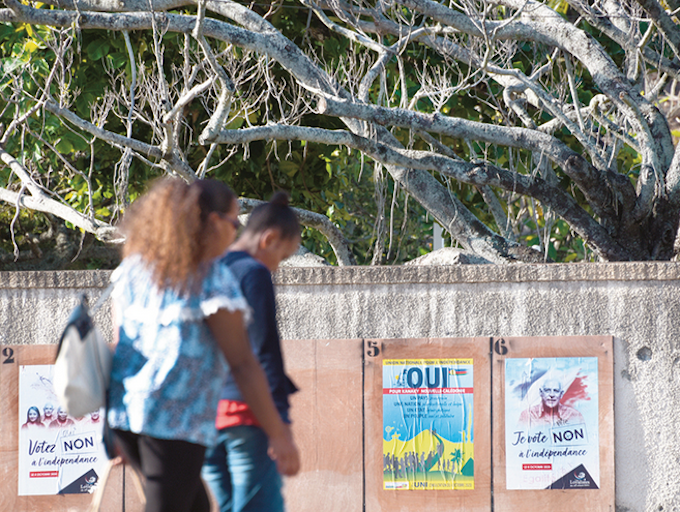
Les Nouvelles Calédoniennes front page today. Image: PMC screenshot

In the new Congress, which will be made up of members of the three provincial assemblies, the Future with Confidence coalition led by Sonia Backes will be the biggest party with a projected 18 seats.

Caledonia Together, which used to be the biggest party, is set to slump from 15 seats to seven.

According to unofficial results in the southern province, Backes’ coalition, which was formed for this election, won an absolute majority in the provincial assembly.

-Partners-

In the Loyalty Islands province, all seats went to pro-independence parties.

In the northern province, the pro-independence Uni/Palika list of the incumbent president Paul Neaoutyine came first, narrowly ahead of another pro-independence list.

Turnout was about 66 percent.

The new Congress will elect an 11-member collegial government for a five-year term.

Under the collegial system enshrined in the Noumea Accord, the government seats will be shared among the parties in proportion to their strength in Congress.

Les Nouvelles Calédoniennes, New Caledonia’s only daily newspaper, described the result as “The great upheaval” in its front page report, describing the massive southern provincial reshuffle while the north and the Loyalty islands provinces had little change.

  • This article is published under the Pacific Media Centre’s content partnership with Radio New Zealand.
  • Les Nouvelles Calédoniennes coverage
    The projected lineup in the new Congress, according to the Les Nouvelles Calédoniennes. Image: LNC
Print Friendly, PDF & Email

Article by AsiaPacificReport.nz

‘Great goal’ wins Hienghéne victory in Oceania Champions League

By RNZ Pacific

Hienghéne Sport won their maiden OFC Champions League football title after a sensational 60 metre strike by substitute Amy Antoine Roine earned a 1-0 victory over AS Magenta in an all New Caledonian final in Noumea.

With the match still scoreless approaching the halfway point of the second half at Stade Numa Daly, Roine won the ball from a clearance and took two touches to bring the ball under control before spotting the Magenta goalkeeper off his line.

Just six minutes after being sent onto the pitch by head coach Felix Tagawa, Roine let fly with an audacious long-range lob from inside his own half which sailed over Steeve Ioxee’s head and into the goal, in what proved to be the decisive moment of the match.

“Any player, whether on the field or not, is important and we were clear that they couldn’t just be spectators. He showed that he listened, he scored a great goal and we had an impressive goalkeeper too. It was a great final.” said Tagawa.

A stunned Magenta went in search of the equaliser and it should have come in the 71st minute, but Hienghéne keeper Rocky Nyiekene saved Wilsen Poameno’s effort from point-blank range as the New Caledonia domestic champions held on to clinch their first regional title.

“It’s a huge moment for the club, and for the country too. I hope that it will continue, we know we’ve won, what we’ve done in winning this match,” said Felix Tagawa. “It’s been a long journey, today we were patient, we know how to bounce back.”

-Partners-

Rocky Nyiekene capped off a standout performance by winning the OFC Champions League Golden Glove award.

“Of course I’m really touched to be elected the best goalkeeper. You have to be prepared for matches like this and I was. For now, no, I don’t think it’s sunk in that we’ve qualified for the Club World Cup. Maybe later, but right now, no,” reflected Nyiekene.

Hienghéne captain Bertrand Kai was awarded the Golden Ball for best overall player while Team Wellington striker Ross Allen collected the Golden Boot after finding the net 11 times during the season, while Auckland City received the Fair Play Award.

  • This article is published under the Pacific Media Centre’s content partnership with Radio New Zealand.
Hienghéne Sport celebrate their maiden OFC Champions League title. Image: RNZ/Phototek
Print Friendly, PDF & Email

Article by AsiaPacificReport.nz

After six years as opposition leader, history beckons Bill Shorten. Will the ‘drover’s dog’ have its day?

Source: The Conversation (Au and NZ) – By Paul Strangio, Associate Professor of Politics, Monash University

Today we run two longer reads on the men who are vying to become prime minister at the 2019 federal election. In this essay, Associate Professor Paul Strangio examines Labor leader Bill Shorten – where he’s come from and, if he wins, what kind of a prime minister he might be. You can read Michelle Grattan’s essay on Scott Morrison here.


“I believe a drover’s dog could lead the Labor Party to victory the way the country is and the way the opinion polls are.”

Uttered by Labor’s Bill Hayden on the day the 1983 election was called, as he dramatically announced his resignation as opposition leader to make way for the irresistible force of Bob Hawke, these words are part of Australian political folklore.

Hayden had every right to feel bitter, as his last-minute supplanting by Hawke robbed him of the opportunity to become prime minister. He had inherited Labor’s leadership more than five years before, when it was reeling from crushing defeat. He had worked conscientiously to restore the party’s shattered stocks by building around him a united and talented front bench, and had overseen a major renovation of the party’s policy program.

Hayden had also made sizeable ground in his first election campaign as leader, winning more than a dozen seats to bring Labor within striking distance of government. Yet his lack of public appeal fuelled nagging questions about him diminishing Labor’s chances of claiming office. He was a stolid media performer, with his speaking style and dress sense the butt of criticism.

Sound familiar?

Of course, we should not overstate the historical analogy; the Australia of the early 1980s and its political circumstances are far removed from the present, and Hayden and Bill Shorten are dissimilar in many ways. Still, an intriguing thing about the 2019 election is that we will discover whether a “drover’s dog” can actually win.

There is no Hawke-like messiah waiting in the wings for Labor and, even if there was an obvious charismatic alternative, the party’s new rules for the selection and deselection of leaders would have impeded any five-minutes-to-midnight change. For Labor, it is the leadership ugly duckling Shorten, or bust.

For Labor, it is the ‘leadership ugly duckling’ Shorten, or bust. AAP/Lukas Coch

At this stage, the auguries remain promising for Shorten. Despite narrowing through the campaign, the opinion polls have monotonously pointed to a Labor victory. The arithmetic of the electoral pendulum is also strongly on his side.

If Shorten becomes prime minister on Saturday, he will create his own piece of political history. The two-election recovery strategy has mostly been a comforting myth for Australia’s major parties and leaders when regrouping from major defeat.

Since the second world war, several opposition leaders — all Labor — have had consecutive shots at delivering electoral redemption and failed: Bert Evatt, Arthur Calwell, and Kim Beazley. Hayden, as noted, was agonisingly denied a second run.

This leaves only Robert Menzies and Gough Whitlam who have steered their parties back into office after being opposition leader through the preceding two terms: during 1943-49 and 1967-72, respectively. And neither of these giants of Australian politics was crowned opposition leader immediately upon their party’s previous loss of government.

How will Shorten have done it? The longer one pores over the annals of political leadership, the more evident it becomes that good timing and luck are fundamental to success. The political gods have smiled generously on Shorten. While the public’s image of him is still tainted by his factional power plays during the civil war between Kevin Rudd and Julia Gillard from 2010 to 2013, the legacy of that internecine fighting has buttressed his leadership. A traumatised Labor Party has taken refuge in unity and stability since that time, while the leadership selection rules imposed by Rudd during his prime-ministerial second coming have safeguarded Shorten from the risk of precipitous challenge.


Read more: Grattan on Friday: Bill Shorten’s moment of ‘connection’ brings back memories of Beaconsfield


His Coalition adversaries have also consistently blessed Shorten. He was gifted early political traction and the mantra for his leadership project (fairness versus inequality) by the Abbott government’s first budget of May 2014, with its litany of broken promises and punitive measures.

Tony Abbott kept giving. Indeed, with so much emphasis on Shorten’s stubbornly poor leadership ratings in the opinion polls, it is easy to forget he enjoyed patches when he led Abbott as preferred prime minister, the most sustained spell coming in the wake of the latter’s Australia Day 2015 knighting of Prince Philip.

Malcolm Turnbull was never less popular than Shorten in the polls, yet he too did the opposition leader his share of favours. Turnbull’s pusillanimity towards his conservative Coalition colleagues, and failure to capitalise on the electorate’s bountiful goodwill towards him in late 2015, saved Shorten from drowning at a point when his prospects seemed most hopeless.

Malcolm Turnbull (right), like Tony Abbott before him, did Shorten several unwitting political favours. AAP/Mick Tsikas

Turnbull followed with a lacklustre 2016 election campaign that aided Shorten, who won enough seats to fortify his leadership against the aspiring Anthony Albanese. And when there were reports of Albanese circling Shorten in the winter of 2018, Turnbull badly misfired by framing the so-called “Super Saturday” by-elections as a test of leadership, only for the Coalition to suffer a serious setback in the Queensland seat of Longman.

Once again, Shorten was thrown a lifeline. Finally, he has richly profited from the Coalition’s destructive divisions and paralysis over climate policy as public anxiety over the issue has escalated.

In that timeless manual of political leadership, The Prince, Machiavelli observed that “fortuna” is not alone sufficient for a leader to prosper; they must adapt to and take advantage of the prevailing circumstances. In Shorten’s case, this attribute has been evident in at least two ways. The first is that he has practised a leadership style perfectly attuned to binding the wounds of Labor’s Rudd-Gillard era. His leadership has centred around the team rather than the individual, prioritising consultation and collegiality.

That leadership style has been the product of necessity and instinct. With the polls relentlessly telegraphing this message, Shorten is surely aware that he possesses neither the easy appeal nor magnetism to play leadership diva. He can only dream of enjoying the pop star popularity of his hero, Bob Hawke.

But where Shorten is confident he matches Hawke – and here their shared background as trade union bosses is significant – is in a capacity for orchestrating groups. Like Hawke, Shorten can talk out differences and coax agreement, giving others a sense of agency and ownership of consensually achieved decisions.

Shorten with his hero, Bob Hawke, in 2016. AAP/Joel Carrett

Interviewed by journalist Laura Tingle for a recent profile in The Monthly, Shorten said of his leadership of the Labor Party:

I don’t have to win every argument. My colleagues are capable and smart. I’m part of a much bigger movement. I’ve learnt that to lead you’ve got to be willing to listen, you’ve got to be willing to give some ground.

That team projection was obvious at Labor’s official campaign launch. Shorten insists he will bring the same approach to the prime ministership. He has regularly employed the term “coach” to describe how he will perform the role.

Appearing on the ABC’s Q&A, he declared

I’m not going to be a messiah. I don’t believe in the … authoritarian strongman.

Speaking to The Australian’s Troy Bramston, Shorten expanded on his leadership method:

I always try to find, in any negotiation, the creation of mutual value. I will always try to understand your interests as well as mine, and then I look to where we can work together to create additional value.

An illustration of this shared, enabling model of leadership was Labor’s reproductive health strategy announced earlier this year. Following the plan’s announcement, which among other things is designed to improve women’s access to abortion services in public hospitals, it was revealed that the policy was the result of two years of extensive consultations within Labor’s ranks and with health experts and women’s groups. Its development had been stewarded by the head of the party’s federal caucus committee on women, shadow health minister Catherine King, and Shorten’s deputy, Tanya Plibersek. The policy had risked unsettling the party’s conservative elements and Shorten was inconspicuous in its announcement, but he had clearly empowered it under his watch.

Another example of how Shorten has capitalised on circumstances is in reading the mood of an era in which the market liberalisation paradigm that dominated policy-making for a quarter of a century from the early 1980s has run out of puff. Under his leadership, Labor has resuscitated the idea of an activist government, promising expanded investment in services and strategic interventions in the marketplace (for example, in wage setting).


Read more: Bill Shorten’s promise of a living wage is both realistic and necessary. But it’s not enough


Labor has boldly committed to wealth redistribution and ameliorating inequalities that are economic and generation-based. There were portents of this direction early in Shorten’s leadership — his 2014 budget reply speech established themes of countering inequality and injustice that he has built on in the five years since.

As in the 2016 election campaign, News Corp commentators have been incandescent at Shorten’s market apostasies. Yet their doyen, Paul Kelly, grudgingly acknowledged earlier this year:

Shorten’s skill has been conspicuous. Acting with audacity, he has picked much of the spirit of the times.

Ironically, that daring has also been reflected in the Labor leader jilting, rather than courting, News Corp.

Shorten’s leadership has not been without weaknesses. There is the persistent shadow of his inability to win personal favour with the electorate. A trawl through past Newspolls confirms that his ratings have been chronically poor. Apart from a brief honeymoon in the months following his election as opposition leader in October 2013, approval of his performance has only outstripped disapproval on a handful of occasions, and then only barely.

He has mostly trailed badly on the question of preferred prime minister. His defenders protest that opinion polls are seldom kind to opposition leaders, and history shows that lagging as preferred prime minister is not a serious obstacle to winning office. These are valid points. Leadership ratings do not strongly correlate with election results. Nevertheless, Shorten’s popularity deficit has been more pronounced than any of the past three opposition leaders during their countdown to becoming prime minister: John Howard in 1996, certainly Kevin Rudd in 2007, and even the unloved Abbott in 2013.

The 2016 Australian Election Study provides insight into the nature of Shorten’s image problem in the electorate. Although scoring creditably on the qualities of “intelligent” and “knowledgeable” (albeit not as highly as Turnbull), survey respondents marked him low on the qualities of “honest”, “trustworthy” and “inspiring”.

Images have a habit of becoming baked in. The perception of Shorten as shifty, which originated during the Rudd-Gillard era, is an abiding problem for him. The author George Megalogenis has identified the opposition leader’s prosaic rhetorical skills as typical of the “apparatchik age” politician. But Shorten has peculiar difficulty in projecting authenticity down the barrel of the television camera or generating a positive emotional reaction among voters from afar. His on-screen ungainliness contrasts with his reputation as a deft worker of small rooms.

Maybe Shorten’s emotionally charged rebuttal of the News Corp tabloids’ snide disputing of his mother’s life story will thaw the electorate’s view of him. More likely, it will take the prime minister’s mantle to significantly reset attitudes towards him and even then, the respect he receives is likely to be stinting in this reflexively sceptical age.

Perhaps, though, there has been a silver lining to voters’ coolness towards Shorten. As already noted, it has reinforced his natural inclination to be a team player. Moreover, his batting on despite the public withholding approval suggests someone with the internal resilience and self-belief required of a head of government to weather the maelstroms that inevitably come their way.

If Shorten becomes prime minister, how will he fare? There are grounds for optimism. As Peter van Onselen observed in The Australian earlier this year, there is something analogous between the situation of Shorten and his team and the incoming Hawke Labor ministry of 1983.

Just as the excesses of the Whitlam experiment were imprinted in the minds of the latter, so too a Shorten government would surely be at pains to avoid a repeat of the follies of the Rudd-Gillard years. Equally, Shorten places great stock on his learning from nearly six years as opposition leader. He told journalist Troy Bramston that:

…the best training ground to become prime minister of Australia is to be leader of the opposition.

Indeed, Shorten’s extended period as opposition leader separates him from most of the recent prime-ministerial incumbents, who served in the former role only briefly (Rudd and Turnbull) or not at all (Gillard and Morrison).

History corroborates Shorten’s belief that enduring the slings and arrows of opposition is a firm foundation for government. It is an opportunity to test and refine leadership practice, and it steels temperament.

And it is a steady temperament — the pioneering social scientist Max Weber wrote about “the firm taming of the soul” — that is arguably the quintessence of successful leadership. That kind of self-mastery is intimately connected with self-knowledge, something for which Howard was renowned. Shorten claims his time in opposition has been a voyage of self-discovery: “I’ve learnt a lot about myself.”

Shorten kisses his wife Chloe at Labor’s campaign launch. He says that nearly six years as opposition leader has taught him a lot about himself. AAP/Darren England

Another positive is that, if elected, Prime Minister Shorten will be armed with a more comprehensive program for government than have any of his predecessors for decades. This has been a considered strategy — again informed by the mistakes of recent governments, and perhaps most notably by the predicament of the Coalition after it gained office in 2013 on the back of an Abbott-led crusade that accentuated the negative and was threadbare in terms of constructive policies.

Shorten noted to Tingle that “one of the big problems” for incoming governments and prime ministers over recent years is that “they are like the proverbial dog that caught the truck. What do we do now?”

On the other hand, there are real questions about how Shorten will manage the larger forces that have conspired against the post-Howard set of prime ministers – for instance, a balkanised electorate riven by jarring interests and identities.

If Labor does form government, it looks like doing so with a primary vote of less than 40% — this would be the lowest starting core support base for any federal government since the settlement of Australia’s party system more than a century ago. It will narrow the foundation of Shorten’s prime ministership and leave him with less secure political capital to push through an agenda. It will render his government more vulnerable and potentially prone to skittishness.

In addition, Shorten will have to contend with the anarchic and fragmented contemporary media environment that, as each recent prime minister has discovered, greatly complicates the task of constructing and sustaining a unifying narrative and dissipates their powers of persuasion.

In the end, of course, we cannot forecast with confidence Shorten’s prime-ministerial destiny should he emerge victorious on Saturday. But, if defeated, we can be sure of the fate of his leadership: it will be an unceremonious end of the line. Shorten will join the likes of Evatt, Calwell, Hayden and Beazley who, for all their other notable achievements in public life, will be forever remembered as also-rans in the competition for the most glittering prize in Australian politics.

And we will belatedly learn that the drover’s dog could not win after all.

ref. After six years as opposition leader, history beckons Bill Shorten. Will the ‘drover’s dog’ have its day? – http://theconversation.com/after-six-years-as-opposition-leader-history-beckons-bill-shorten-will-the-drovers-dog-have-its-day-115490

Against the odds, Scott Morrison wants to be returned as prime minister. But who the bloody hell is he?

Source: The Conversation (Au and NZ) – By Michelle Grattan, Professorial Fellow, University of Canberra

Today we run two longer reads on the men who are vying to become prime minister at the 2019 federal election. In this piece, Michelle Grattan examines Scott Morrison’s political history and his prime ministership. You can read Professor Paul Strangio’s essay on Bill Shorten here.


Jim Molan, the former major-general who was the co-author with Scott Morrison of the Coalition’s Operation Sovereign Borders, remembers vividly Morrison’s mood immediately after the 2013 victory.

The election was on September 7, but the new government wasn’t sworn in until September 18. “He was frustrated because he was so ready to start his job, but he couldn’t start it on Day One,” Molan says.

So it was predictable that when Morrison seized the leadership after the fall of Malcolm Turnbull last August, he was on the road almost immediately, visiting drought-stricken Queensland. And it was unsurprising that Morrison soon started to come through the Labor research as a PM “getting on with the job”.

Colleagues and commentators looking at Morrison default to “action” and “ambition”. For some, those descriptions are positives; for others, negatives.

It’s possible to over-think Morrison. Long time political associate and friend David Gazard is probably right when he says “what you see is what you get”.

As he fights against the odds in this election, we see in Morrison a leader who’s tough, pragmatic, indefatigable. He’s simultaneously authentic (more people can relate to him than could to Malcolm Turnbull) and a chameleon (it’s hard to know what the beliefs are that they’re relating to, because he adapts to the circumstances he finds himself in).


Read more: The end of uncertainty? How the 2019 federal election might bring stability at last to Australian politics


Gazard attests to Morrison’s prodigious capacity for work. When Gazard was chief-of-staff to NSW opposition leader John Brogden, he would call Morrison, who was Liberal state director, at the end of the day for his help with speeches.

He’d show up at 7.30 pm for a couple of hours. If you went to the bathroom and came back, he’d be sitting in your chair, writing.

If you had to describe Morrison in a single word, perhaps you’d call him a “journeyman” of politics, in the dictionary definition a player who’s “reliable but not outstanding”. He’s not cerebral but he’s clever and cunning; he’s competent, but not charismatic nor inspiring.

His combative style was evident during the second debate when he advanced on Bill Shorten, who quipped he was a “space invader”. But comparisons with Mark Latham’s notorious handshake with John Howard late in the 2004 campaign were false.

Morrison had long been steadily climbing towards the leadership, though it seemed more likely this would come after a government defeat. There is debate about whether or to what degree he intrigued in the August 2018 coup against Malcolm Turnbull. But his capacity to don a mask was evident on Wednesday August 22, two days before Turnbull’s fall when, asked at a news conference to rule out having any leadership ambitions, he put a comradely arm around Turnbull’s shoulder and said “Me, this is my leader and I’m ambitious for him!”

Morrison with Turnbull in August 2018: ‘This is my leader and I’m ambitious for him!’ AAP/Lukas Coch

One Liberal observer declares: “I’m very sure he was very much aware of what was going on – others on his behalf were active”. Pamela Williams, writing in The Monthly, reported that, by the Wednesday, Morrison was simultaneously standing by Turnbull and giving “the green light for his own tight group to start counting numbers”, so he could move in the event of Turnbull’s collapse.

Whatever the ins and outs, Morrison obtained the prime ministership in circumstances in which he was likely soon to lose it.

Initially, the opinion polls plunged, and he was dogged by the question “why isn’t Malcolm Turnbull prime minister?”. It’s a question that never entirely disappeared. But Morrison’s performance was better than many expected and the polls narrowed back to where Turnbull had them.

His opponents are wrong in trying to dismiss him as simply the one-time advertising man turned political showman, but certainly Morrison (who as a kid did some acting and appeared in a few TV advertisements) knows the value of creating a “set”, whether visual or atmospheric, and galvanising attention.

After becoming leader, he took his road show to Albury, scene of one of the Liberal party’s founding conferences in 1944, and invoked the spirit of Robert Menzies. The backdrop appealed to the loyalists. “I like rituals,” he told his audience.

His standout example of conjuring up a “moment” was the Great Strawberry Crisis. Needles had been put into some strawberries; from the start, it was believed the culprit was a disgruntled employee, which turned out to be the case, but there was concern about “copycat” activity. All a problem, of course, though hardly needing federal parliament to leap into action.

Morrison announced legislation with draconian penalties – despite the strong existing regime and the fact this was mainly a state matter. Parliament rushed the bill through.


Read more: What will the Turnbull-Morrison government be remembered for?


Morrison had elevated a limited issue requiring only the enforcement of the existing law into a mega story. Politically, the importance of the incident was it showed the new PM acting decisively.

Another, more dramatic example of Morrison’s use of “framing” was his taking the media to Christmas Island to mark the detention centre’s re-opening, after the passage of the medevac legislation to facilitate medical transfers. In the event, the wave of transfers the government had warned of didn’t materialise.

In the wake of the medevac bill passing, Morrison took the media on an expensive trip to Christmas Island. AAP/Lukas Coch

As a former party official, Morrison is steeped in the dark arts of the political tactician as well as, from his advertising days, the techniques of marketing. He’s master of the sharp slogan, the quick denial (never mind whether accurate or not), the abrupt walk off when a news conference threatens to become awkward. He has the knack of smothering a line of questioning.

If someone asked the “real Scott Morrison to please stand up”, two men might rise to their feet. The uncompromising, don’t-give-an-inch Scott, and a more conciliatory, flexible character.

As immigration minister cracking down on the borders, he closed off information, selectively leaked stories that were later discredited, seemed untroubled by human rights issues. He had taken a different line in opposition when it had suited him, for example expressing concern about the welfare of people who might be dispatched under Labor’s proposed “Malaysia solution”.

When he moved to social services, he emerged as a negotiator, with the welfare lobby and the Senate. Cassandra Goldie, CEO of Australian Council of Social Service, recalls Morrison from that time as “adaptable, pragmatic and able to spot a political opportunity. He showed he was capable of changing direction to build support.” Another source puts it more harshly: “He’s a shape-shifter. He pivots for the opportunity, and his gospel is the gospel of politics”.


Read more: View from The Hill: Lots of ministry spots to fill if Morrison wins, while many Shorten ministers would return to a familiar cabinet room


His period as treasurer – a post to which Turnbull appointed him after Tony Abbott was deposed – revealed much about him as an operator.

His part in that coup had been typical Morrison. He’d voted for Abbott but some of his small group of followers had (it was presumed with his support) put their backing behind Turnbull. Abbott was incandescent. Shock-jock Ray Hadley excoriated Morrison in an excruciating interview in which he demanded Morrison swear his innocence on a bible.

Morrison was determined to make his mark in Treasury. Turnbull and Morrison considered an ambitious reform of the GST, with the aim of enabling big income tax cuts. Morrison ran the issue hard in the media. Turnbull became alarmed he was getting too far out in front. Treasury work showed the plan (in any politically acceptable form) didn’t stack up and, to Morrison’s embarrassment, he was reined by his boss.

One source – a critic of Morrison – who observed the internal debate says he “didn’t seem to care” about the Treasury work. “For him, [GST reform] was a political flag. I don’t know if I’ve ever seen a more purely political operator.”

Morrison had “a propensity to grab a stick and then run off with it”, according to a bureaucrat. His more cautious ministerial partner, Mathias Cormann in finance, “talked him off the ledge” on various occasions.

A Liberal backbencher recalls Morrison, in those days, using his authority to lean on people.

When he runs out of intellectual runway, he’ll just say, I’m asking for your support on this one and I think I deserve it.

Gazard, an admirer, says Morrison “comes to a view by consulting a whole range of people”. But “when he comes to a view he can be hard to move – he won’t give up on that conviction easily”. Morrison paints this as a virtue, saying at his campaign launch, “When I get determined, I get very determined”.

In the election campaign, Morrison hasn’t been sharing the limelight with his team, in contrast to Shorten, who has sought to neutralise his unpopularity by surrounding himself with strong colleagues.

At his campaign launch, Shorten had his bevy of frontbenchers on stage and three former PMs in the audience. The “team” was a theme.

Morrison said repeatedly ahead of his formal launch on Sunday that it would be “different”.

It’s not about the Liberal Party and it’s not about the National Party.[…] I just want to have a conversation with people on Sunday directly about the choice.

Given the thinness of his ranks, with multiple high profile Coalition figures leaving at the election, it would have been hard for Morrison to accentuate the team. And the coups meant the past two PMs couldn’t or wouldn’t be there – and that made it impossible to have party icon John Howard.

So the event, coinciding by chance or design with Mother’s Day, was a plain, homespun affair, with all the Morrison family who could be mustered, a video of Scott and Jen talking about each other, and (appropriately) a promise to help aspiring young homeowners to bridge the deposit gap – that got blown away within a couple of hours by Labor matching it.

As one Liberal remarked of the launch: “It was the best we could do in the circumstances.”

Despite the obvious drawbacks, shouldering all the weight of the campaign, being ultra “presidential” (even if that term seems ridiculously overblown for him) suits Morrison’s temperament. He’s a natural one-man-band, filling the stage, pounding at the drums.

The bones of the Morrison story are well known. He was brought up in a middle-class home in the Sydney suburb of Bronte, son of a senior policeman who was community-minded and active in local government (as an independent), including becoming mayor of Waverley). Morrison as PM understands the importance of the “local” in politics.

The most notable parts of his pre-parliamentary career were his stints in tourism, in New Zealand and Australia, both of which ended badly, and, in between, his time as a Liberal official.

He was in the NSW Liberal post when Malcolm Turnbull ousted sitting member Peter King in the 2004 bitter Wentworth preselection, which involved a great deal of branch-stacking. Some sources will tell you Morrison favoured Turnbull, while others think he wanted King to hang on.

One view is that, as state director, Morrison practised “pan-factionalism” in the deeply-riven NSW party.

Liberals used to joke about Morrison’s penchant for walking both sides of the street after he attended the private gatherings of both right and left factions at a Liberal function.

Morrison entered parliament for the seat of Cook in the Sutherland Shire in 2007, after a highly controversial pre-selection. Although he’d come from another part of Sydney, he has adopted “The Shire” and everything about it, especially the Sharks rugby league team, as though his family were original settlers.

His prime ministerial persona plays up the footy-loving, suburban, family-oriented, curry-cooking dad. It works with some voters but others are cynical.

Focus group research in Wentworth last week, done for The Conversation, highlighted the conflicting views about Morrison. Some saw him as “basically decent”, “genuine”, “well-meaning”, “approachable”, a “family man”, someone who could “relate to an ordinary guy in the street”.

But on the negative side, older voters viewed him as a “Sharks-supporting salesman”, “a typical bogan”, “a typical politician”, a “bully”, while younger voters described him as “the local butcher, not the PM”, “a privileged white guy”, “insipid, religious, racist”, “sly”, an “arrogant hypocrite”.

Morrison allowed the media into an Easter service at his Horizon church. AAP/Mick Tsikas

Perhaps the one thing that’s not “mainstream” about Morrison is his deep Pentecostal religious commitment. On all the evidence, he is very literalist in his religious convictions. Politically, it might have seemed a gamble to let the media into an Easter service of his Horizon church, but Morrison chose to be expansive about his faith. It was certainly an arresting sight to see the PM standing, arm raised, in full voice, praising the Lord.

Writing about Morrison’s Pentecostalism, James Boyce says his “idea of what it means to be PM is influenced by his experience of what it means to be a pastor – his constant positivity, enthusiastic hand gestures, fondness for a parliamentary clap and cheer, and wealth-enhancing ethics come straight from Horizon Church”.

Morrison says his religion is quite separate from his politics. He told parliament in his maiden speech:

My personal faith in Jesus Christ is not a political agenda.

But it influences his views, for example his opposition to same-sex marriage, and last year he told Sky he had concerns about the “trajectory” in relation to freedom of speech and religious freedom. The latter remains unfinished business for the Coalition.

Politically, Morrison’s strength is in the economic sphere. He’s been hardly tested on foreign affairs, although he did the “summit season” soon after becoming leader last year. His big foray, in a pitch for the Wentworth byelection, was to consider moving Australia’s embassy from Tel Aviv to Jerusalem; after much reaction, including from Indonesia, the government announced a compromise position.

Like Turnbull before him, Morrison launched his election campaign from the platform of a budget. Turnbull promised company tax cuts, only some of which he could eventually deliver. Morrison is running on income tax cuts, with a lot of the program way into the future.

Economic management is historically the Coalition’s strong campaigning ground, and economic credibility is a strength for Morrison in focus groups. But, weighed down by the government’s record of division, with minimal pledges for the future beyond the tax cuts, infrastructure and being a safe pair of hands, Morrison has little beyond his own energy and a scare campaign against Labor to carry through until polling day.

Morrison embraces his family at the Liberal Party campaign launch. AAP/David Crosling

And what then? If Morrison loses but respectably, it’s most likely he’d be opposition leader. Peter Dutton has indicated he would not challenge him for the job (anyway, it is an open question whether Dutton will be returned).

In what on the polls is the more unlikely event of a Coalition win, there aren’t many pointers to how a Morrison government would handle the next term.

Morrison would have immense authority, having done the apparently impossible. On the other hand, a re-elected Coalition would likely have a very small majority or be in minority government, which would impose constraints and probably see the Liberal party, beyond the initial elation of survival, as fractured as before.

Morrison says he would lead “from the middle”. Asked on the ABC who’d have the upper hand in driving Liberal party policy if he were re-elected, the right of the party or its mainstream, Morrison said, quickly and firmly, “I will”.

That fits with his personality, but leaves a heap of questions.

ref. Against the odds, Scott Morrison wants to be returned as prime minister. But who the bloody hell is he? – http://theconversation.com/against-the-odds-scott-morrison-wants-to-be-returned-as-prime-minister-but-who-the-bloody-hell-is-he-116732

Mounting evidence the tide is turning on News Corp, and its owner

Source: The Conversation (Au and NZ) – By Denis Muller, Senior Research Fellow in the Centre for Advancing Journalism, University of Melbourne

There is mounting evidence that Australia is sick of Rupert Murdoch and the political propaganda machine he runs in the guise of a news organisation.

In January, Bill Shorten rebuffed an open-ended offer to meet Murdoch whenever the opposition leader was in the United States. According to the ABC’s 7.30 political editor, Laura Tingle, Shorten replied that any dealings he had with News Corp would be conducted with the company’s representatives in Australia.

This was a bold break with tradition. For decades, Labor leaders have paid court to Murdoch. During the prime ministership of Bob Hawke, there was memorable footage of a cortege of ministerial cars driving in procession through the gates of Murdoch’s farm outside Canberra.

It was Paul Keating who changed the media ownership rules in 1987 so that Murdoch was able to buy the Herald and Weekly Times, giving him what has turned into a newspaper monopoly in Brisbane, Adelaide and Hobart, as well as ownership of the Herald Sun in Melbourne.

Shorten’s two predecessors, Kevin Rudd and Julia Gillard, both met Murdoch in New York in an attempt to obtain his blessing.

Much good it did any of them. Rudd has bitterly repented, saying last August that Murdoch was “the greatest cancer on Australian democracy” and calling for a royal commission into News Corp.

More dramatic, however, has been the fallout from last week’s attack by the Daily Telegraph on Shorten over the life story of his deceased mother.


Read more: Grattan on Friday: Bill Shorten’s moment of ‘connection’ brings back memories of Beaconsfield


Not only did the media as a whole stand back at a news conference and allow Shorten to let rip for ten minutes at this “gotcha shit”, but two high-profile journalists with News Corp credentials have spoken out against the organisation’s culture.

The courage this took should not be underestimated. They must know the relentless personal vilification that befalls anyone who ends up on the News Corp hate list.

One of them, Rick Morton, is on the staff of The Australian, where he is social affairs editor.

He told a seminar at the University of Technology Sydney on May 9 that in recent months, “the craziness has been dialled up” at the newspaper.

He said openly what other insiders have been saying for years: that senior writers know what the editorial line is and write stories to fit. “It’s not always a Murdoch line; it’s just that Murdoch hires editors who are very much like him.”

Asked whether the paper’s journalists were uncomfortable with The Australian’s barracking for the Coalition in the election, Morton said they were “more uncomfortable certainly now than at any time I’ve been there in the past seven years”.

“There is a real mood that something has gone wrong.”

A second attack came from Tony Koch. He worked for News Corp for 30 years and is a very distinguished journalist: winner of five Walkley Awards, recipient of the Graham Perkin Journalist of the Year Award and – ironically – of the Sir Keith Murdoch News Limited Award.

He did not mince words:

No editor I worked for would have put up with the biased anti-Labor rubbish that, shamefully, the papers now produce on a daily basis.

Gone is the requirement for balance. One has only to look at the story selection and headlines on the front pages of the papers each day to see that an anti-Labor angle has been taken, however contorted had been the literary gymnastics required to finally arrive at that particular bit of stupidity.

It was notable that both went well beyond the specific case of the Telegraph, assailing the performance of the group’s flagship, The Australian, and the craven nature of the organisation’s editorial leadership.

As if to confirm the bias they spoke of, the lead headline on page 12 of The Weekend Australian on May 11-12 contained this magnificent Freudian slip: “Hypocritical” ALP must back our tax package. Our tax package? The story was about Scott Morrison claiming a mandate for the Coalition’s $158 billion tax package.

In the current issue of The Monthly, the magazine’s US correspondent Richard Cooke has weighed in with a substantial essay arguing that News Corp represents a grave threat to democracy.

Cooke has just published a book based on his observations of life in the United States during and after the election of Donald Trump. He writes of News Corp in Australia:

… [I]t isn’t a normal news organisation any longer. At News Corp – in an inversion of journalism’s ideal– the old-fashioned, straight-down-the-line reporting is expendable and surplus to requirements. It is the unhinged propaganda outfit that is central to the identity of the company. It is the core that is lunatic, not the fringe.

In the US and UK, where Murdoch is a big player, some rival media organisations have confronted him. The most recent instance was a three-part series in April by The New York Times called How Rupert Murdoch’s Empire of Influence Remade the World.

Now the uprising has spread to Australia, driven by politicians and journalists, people with skin in the game.

Why?

No doubt the decline in readership of the News Corp newspapers is a factor. Roy Morgan newspaper readership data for the year ended March 2019 show year-on-year declines for The Australian, the Telegraph, the Courier-Mail and the Herald Sun. The Adelaide Advertiser and Hobart Mercury were up Monday to Friday but down at weekends.


Read more: View from The Hill: Shorten turns Daily Telegraph sledge to advantage


This is part of the overall decline in newspaper readership that also afflicts The Sydney Morning Herald, The Age and the Australian Financial Review.

But this decline has been a trend for several years, so it cannot fully explain the recent rebellion.

Shorten’s refusal to meet Murdoch, the searing attacks by him and other politicians on the Daily Telegraph, the criticism from News Corp-related journalists and the attacks by rival publishers suggest something is happening in the political zeitgeist, and not just in Australia: that at some level, democratic societies have had enough of Murdoch and his propaganda operation masquerading as a news service.

ref. Mounting evidence the tide is turning on News Corp, and its owner – http://theconversation.com/mounting-evidence-the-tide-is-turning-on-news-corp-and-its-owner-116892

Avoid the politics and let artificial intelligence decide your vote in the next election

Source: The Conversation (Au and NZ) – By Frank Mols, Senior Lecturer in Political Science, The University of Queensland

If trust in our politicians is at an all time low, maybe it’s time to reconsider how we elect them in the first place.

Can artificial intelligence (AI) help with our voting decisions?

Music and video streaming services already suggest songs, movies or TV shows that we will probably enjoy. Online shopping sites helpfully suggest other products we might like to buy. All this is based on what we’ve already watched, listened to or bought.


Read more: When AI meets your shopping experience it knows what you buy – and what you ought to buy


So why not have a similar system to suggest whom we should vote for?

With preferential voting, political parties and candidates already issue how-to-vote cards. But what if an AI service could create a personalised how-to-vote card for each and every one of us?

How do we decide?

Some of us are “rusted on” voters who back the same party, come what may, while others are “swinging voters” who compare options before making a choice.

Politicians tend to focus on the latter during election campaigns, as they know these voters may well decide their fate.

Politicians may have different beliefs, values and policy proposals. But if we analyse their persuasion techniques, there are striking similarities in the way in which politicians try to persuade us to vote for them.

They talk of “objective evidence” and warn voters about the “real cost” of their opponent’s policies.

Yet research shows we tend to overrate the persuasiveness of “hip-pocket” warnings and underestimate the impact of party identification.

When it comes to debating politics, we may try to find a rational or logical argument based on expertise to silence our opponent.

Or we may resort to the argument that our opponent will be the one who ends up having to pay for their misguided beliefs.

But it’s these kinds of arguments (about money or logic) that prove remarkably ineffective. What is more likely to win over swinging voters are appeals that arouse emotion (particularly fear) and tribal sentiments (“us-them thinking”).

US social psychologist Jonathan Haidt says we tend to accept new information more readily if it aligns with our deeply held beliefs and values, while Australian psychologist Katharine Greenaway and colleagues say we find information useful and trustworthy if it’s presented to us by someone we regard as “one of us”.

So is there a better way for us voters to determine whom we should be voting for? Is there a way to take values, emotions and tribalism out of the equation? That’s where AI comes in.

AI is already ‘helping’ us decide things

Political parties have the same problem that faces retailers, hotels, banks and many other businesses, in that the public is constantly bombarded with too much marketing noise and far too many messages.

To solve this problem of selling, business has turned to AI.

When booking accommodation on a hotel website, you may find yourself in a conversation with an AI chatbot. Based on the information you provide, the chatbot may suggest activities or persuade you to upgrade your room, book a hire car, or even get a massage.

Call your bank, telco or other service provider and you most likely interact with an AI voice assistant: “In a few words, please tell us the reason for your call.”

Retailers are capturing and analysing your purchase data to develop personalised offers, and using AI to influence and predict what you are about to buy next.

Supermarkets such as the UK-based Tesco, US giant Walmart, and even Woolworths in Australia are investing heavily in this area.


Read more: When AI meets your shopping experience it knows what you buy – and what you ought to buy


Politicians already use AI to target you

Given voters are more likely to respond positively to a political message if it resonates with them, political parties try to target voters with relevant messages. To do that, they too employ AI.

In the same way businesses use retargeting strategies to persuade us to buy or act, politicians now do the same.

Retargeting is the activity of tracking a person’s online activity. It includes what they comment on, what sites they visit, the products they research, and what articles they “like”.

Using this information, a politician can then send a customised message.

AI for the people

If politicians are using AI to try to persuade us how to vote, why not flip this around and give us the AI tools needed to help us decide how to vote?

Some media companies already have online questionnaires – such as the ABC’s Vote Compass and News Corp’s How should I vote? – that try to predict your political leaning.

While this may be a useful tool for some, you still need to follow political news and current affairs to make sense of many of the questions. So tools like these appear targeted at the already politically engaged.


Read more: To protect us from the risks of advanced artificial intelligence, we need to act now


What if there was a tool that did not ask you anything but instead you gave it access to your digital footprint. This could be your browsing history, your shopping habits, your location data, and even your social media activity. In fact, anything that showed how you lived, but on your terms.

Unfortunately, no such tool exists yet, as far as we are aware.

But why should the politicians have the AI and not you, the voter? Surely it’s only a matter of time before such a tool is available to us.

Who knows what it might say about you? It might even change the mind of a “rusted on” voter. Now that would be something new for political parties to consider.

ref. Avoid the politics and let artificial intelligence decide your vote in the next election – http://theconversation.com/avoid-the-politics-and-let-artificial-intelligence-decide-your-vote-in-the-next-election-116507

Nearly 1 in 4 of us aren’t native English speakers. In a health-care setting, interpreters are essential

Source: The Conversation (Au and NZ) – By Sarah Verdon, Research Fellow and Senior Lecturer in Speech and Language Pathology, Charles Sturt University

This article is the third part in a series, Where culture meets health.


Almost one quarter of the Australian population speaks a language other than English at home. But health services in Australia are largely delivered in English only.

We know Australians from culturally and linguistically diverse backgrounds are less likely to access health services, which leads to poorer health outcomes. One major reason for this is the language barrier between health-care providers and consumers.

Access to interpreters in health care should be seen as a basic human right.


Read more: Translation technology is useful, but should not replace learning languages


Interpreters benefit both patients and practitioners

Interpreters are a vital bridge between health services and consumers. Interpreters enable consumers to be fully informed about their health condition and options for treatment.

They also give consumers a voice to express themselves freely in their dominant language. This means people can share exactly what they need to say to health-care professionals and can ask the questions they want answered.

Research has found the use of professional interpreters improves the experience of medical care for patients with limited English proficiency.

The use of professional interpreters significantly reduces the risk of communication errors that can lead to negative clinical consequences. Errors could include gaps in information about patient allergies, and instructions around the use of prescription medicines being misconstrued.


Read more: Missed something the doctor said? Recording your appointments gives you a chance to go back


But failure to provide access to interpreters in health settings can literally be a matter of life or death.

Particularly in an emergency, if a patient and their loved ones are unable to communicate details about the patient’s medical situation to the treating doctors, this may impact whether the patient receives appropriate and timely treatment.

In one case in the United States, a hospital acted on advice provided by a Spanish-speaking family with limited English proficiency when admitting their son. A court found language confusion contributed to delayed diagnosis of a brain haemmorhage, which resulted in the patient becoming a paraplegic.

But not everyone is given access to an interpreter

Despite the benefits of using an interpreter, a recent study in a Sydney hospital found although interpreters were required in 15.7% of admissions, just 3.7% of patients were actually provided with an interpreter.

A person who needs an interpreter may not get one because they’re deemed not to require the service, because an interpreter can’t be sourced within the required timeframe (for example, in emergency situations), or because there’s no interpreter available in the language or dialect required by the patient.

Patients who need interpreters aren’t always able to access them. From shutterstock.com

The use of interpreters in regional, rural and remote Australia may be even lower given the lack of available interpreters in those areas.

When health professionals and consumers don’t speak the same language, delivering health services without an interpreter raises a number of ethical issues.

For example, if a person is unable to understand what is being said to them by a health-care practitioner, they can’t give their informed consent. Proceeding with any treatment without informed consent is in breach of the code of conduct of all health professions in Australia.


Read more: The cultural assumptions behind Western medicine


Family members as interpreters

The Australian government funds the provision of professional interpreters in health-care settings free of charge. But professional interpreters are not always on hand when they are needed. This often results in the use of family members as interpreters.

This practice is fraught with issues and in some instances this can do more harm than good for both the interpreter and the patient.

Relatives don’t have formal training as interpreters and may not be familiar with the medical terminology being used or how to translate it.

Family members may add their own interpretation or opinion in the delivery of the message, thereby not delivering the message intended by the health-care practitioner or the patient.

Children and teenagers often act as translators for their older relatives. From shutterstock.com

In many migrant families, children or young adults have the best knowledge of English in the family and so are often called upon to be the interpreter. The use of underage interpreters raises further ethical issues as they are tasked with interpreting sensitive health information about a loved one.

So caution is needed when using family members as interpreters.


Read more: Australia’s ethnic face is changing, and so are our blood types


How can the use of interpreters be increased and improved?

There are some key actions that should be taken to improve health-care experiences and outcomes for people with limited English proficiency.

First, training for both interpreters and health-care professionals is essential to develop skills for effective collaboration.

Second, there should be additional time allocated for appointments where interpreters are used. This is because each sentence must be said twice during the exchange of information and time is needed for briefing and debriefing about the session.

Third, health services need to collect accurate information to determine whether an interpreter is needed. A person may present with functional English but still require an interpreter for ease of communication given the complex terminology and the seriousness of medical conversations.


Read more: Between health and faith: managing type 2 diabetes during Ramadan


And finally, professionally trained interpreters must be available in the languages and dialects required. There are more than 300 languages spoken in Australia and many have multiple dialects.

Investment in interpreting services is essential to ensure the provision of equitable, high quality health care to all Australians. In a country where interpreters may improve care for one quarter of the population, we can’t afford not to.

ref. Nearly 1 in 4 of us aren’t native English speakers. In a health-care setting, interpreters are essential – http://theconversation.com/nearly-1-in-4-of-us-arent-native-english-speakers-in-a-health-care-setting-interpreters-are-essential-115125

Australia’s major parties’ climate policies side-by-side

Source: The Conversation (Au and NZ) – By Kate Dooley, Research fellow, Climate and Energy College, University of Melbourne

The majority of Australians see climate change as the number one threat to national interests. However in 2018 Australia was ranked 55th out of 60 countries in a Climate Change Performance Index.

Research from the University of Melbourne found if all countries’ climate action was as inadequate as Australia’s, the world would be on track for 4°C warming.

With an election on Saturday, lets dig into the major parties’ climate policies, and see how they track against Australia’s Paris commitments.

Kids are taking to the streets to call for stronger action on climate change. Brisbane, March 16, 2019. AAP

Liberal

The Liberal Party introduced the Climate Solutions Package in February 2019. The package includes a range of measures, but most notably a continuation of the Emissions Reduction Fund (ERF), which remains the coalition’s key climate policy.

The Climate Solutions Fund includes another $2 billion to be used for ERF auctions until 2030. The package does not include any plan to increase renewables beyond the current 23.5% 2020 target.

The package also retains Australia’s current emissions reduction target of 26%-28% below 2005 levels by 2030. This target falls far short of what is required to meet the Paris climate agreement goals.


Labor

Labor has released a Climate Change Action Plan that leads with a renewable energy target of 50% electricity generation by 2030, household rebates for solar batteries, and investment in energy efficiency.

Labor will extend the existing “safeguard mechanism” to function as a pollution cap for industry, while the agriculture sector will participate in a revived Carbon Farming Initiative.


Read more: Fixing the gap between Labor’s greenhouse gas goals and their policies


Labor’s climate target will commit Australia to emission reductions of 45% on 2005 levels by 2030, and to reach net zero emissions by 2050.

Labor’s policy document states this target is informed by advice from the independent Climate Change Authority (CCA), yet the CCA’s 2015 targets review concluded Australia’s fair share of a global target for 2°C was an emissions reduction of between 40-60% below 2000 levels by 2030.

The CCA review pre-dated the adoption of the Paris Agreement in December 2015, which raised global ambition to keep warming “well below 2°C” and ideally below 1.5°C. The CCA 2015 targets review can therefore be considered out of date, so Australia’s fair contribution to the Paris climate agreement would have to sit at the upper end of (if not above) the 40-60% range.

Labor’s target is still inadequate from a global perspective and would not put Australia on track to meet its Paris commitments. But it is a big step forward from our current targets, and would at least bring Australia in line with the inadequate action pledged by the rest of the world – current global pledges put the world on track for 3°C warming.


Greens

The Greens are the only political party in Australia with climate policies that put forward targets that would enable us to meet our international obligations according to the science.

They have an emissions reduction target of 63-82% by 2030 and a trajectory to get emissions to net-zero by 2040. The Greens manifesto calls for a total transition away from fossil fuels.


Cost of climate (in)action

The Liberals claim their climate policies meet our climate commitments “without wrecking the economy” and have released economic modelling suggesting Labor’s 45% target will cost the economy billions.

This modelling has been widely debunked, and Labor’s budget costings show climate policies to have a cost of around $800 million to 2023.

Labor in its manifesto emphasises the “devastating costs” climate change will have for the Australian economy over the long term, and points out that the cost of not acting on climate change must also be factored in. Research in 2018 estimated the global cost of 4℃ warming would eventually reach US$23 trillion per year, costing Australia A$159 billion every year.

In light of the IPCC report on the urgency of limiting warming to 1.5°C, this may be a more salient point than the year on year costs of implementation of any near-term climate policy.

What are other countries doing?

Far greater ambition is required from all nations, including Australia, for the world to meet the goals of the Paris Agreement. The UN has invited Paris Agreement signatories to submit revised national targets in 2020.

Several countries are raising their national climate commitments. The UK Parliament has just declared a climate emergency and has been advised by its independent Committee on Climate Change to adopt a target of net-zero emissions by 2050.

The European Union has set an emission reductions target of 55% by 2030 and the EU Parliament has endorsed a net-zero climate target for 2050.

Nearer to home, on Wednesday the New Zealand prime minister introduced the Zero Carbon Bill, which calls for net-zero carbon-dioxide emissions by 2050, and creates a legal obligation to plan for supporting New Zealand towns and cities, business and farmers to adapt to increasingly severe storms, floods, fires and droughts caused by climate change.

While all of these actions are far more ambitious than Australia’s targets, the IPCC found net-zero emissions will need to be reached earlier than 2050 for a chance of limiting warming to 1.5°C without overshoot (overshoot risks potentially irreversible ecosystem loss).


Read more: Keeping warming below 1.5℃ is possible – but we can’t rely on removing carbon from the atmosphere


So far no developed nation is taking seriously the equity considerations of the Paris Agreement, which require financial and technology support to help developing countries both reduce emissions and adapt to the already severe consequences of climate change.

Limiting warming to well below 2°C and aiming for 1.5°C as required by the Paris Agreement will indeed require that fossil fuel use declines to zero over the next few decades. This is a trajectory that governments around the world – the UK, the EU, NZ and others – are beginning to acknowledge.

If Australia sees more of the same in terms of climate policy we will inevitably continue our dismal track record of inaction – with devastating consequences.

ref. Australia’s major parties’ climate policies side-by-side – http://theconversation.com/australias-major-parties-climate-policies-side-by-side-116896

A referendum won’t save the Murray-Darling Basin

Source: The Conversation (Au and NZ) – By Adam Webster, Departmental Lecturer in Law and Public Policy, Blavatnik School of Government, University of Oxford

As part of its election campaign the Centre Alliance party (formerly the Nick Xenophon Team) has proposed a referendum give the Commonwealth power to regulate the waters of the Murray-Darling Basin.

The proposal would amend the constitution to give the Commonwealth legislative power over:

the use and management of water resources that extend beyond the limits of a State.

The proposal is intended to give the Commonwealth “clear authority” to regulate water resources that cross state borders, such as the Murray-Darling Basin and the Great Artesian Basin.


Read more: The Darling River is simply not supposed to dry out, even in drought


But it’s not clear a referendum would solve any of the problems currently facing the Basin. The Commonwealth already has plenty of power: it’s cooperation and environmental consciousness we lack.

Who controls the Murray-Darling Basin?

At a Basin-wide level, the distribution of water within the Murray-Darling Basin is presently governed by the Water Act 2007. The Act requires the creation of a Basin Plan, which provides a framework for water management across the Basin. The current Plan came into force in 2012.

The power to implement parts of the Water Act is supported by a referral of power from the states. That is, the states have passed their legislative power to the Commonwealth.

It is legally uncertain as to the extent this referral of power is necessary, and what would happen if a state withdrew its referral. The High Court has not had to consider these difficult constitutional questions.

Is a referendum necessary?

Before resorting to a referendum, it’s worth considering the extent of the Commonwealth’s existing power to regulate the Murray-Darling Basin. Although the Water Act is supported partly by a referral of power from the states, the Commonwealth has considerable legislative power it can deploy to regulate the Basin.

The constitution gives the Commonwealth power to make laws with respect to external affairs, corporations, and trade and commerce.


Read more: Aboriginal voices are missing from the Murray-Darling Basin crisis


In particular, the “external affairs” power – which gives the Commonwealth legislative power to meet international obligations – is relied upon considerably to support the Commonwealth enacting the Water Act.

These conventions include the Ramsar Convention on Wetlands of International Importance, the Biodiversity Convention, the Bonn Convention and the United Nations Convention to Combat Desertification.

While the Commonwealth probably has greater power to regulate interstate rivers than it currently exercises, it has not sought to flex its muscle and test the limits of these powers.

Mass fish deaths in the Darling river earlier this year have raised serious concerns about the future of the Basin. AAP Image/Dean Lewins

What is the problem with the current Water Act and Basin Plan?

The South Australian Murray-Darling Basin Royal Commission examined the constitutional basis for the Water Act as well as other legal issues surrounding the operation of the Act and implementation of the Basin Plan.

This commission found the fundamental issue with the Basin Plan is it did not prioritise environmental sustainability highly enough, as the Water Act requires.

The Murray-Darling Basin Authority (MDBA) uses a “triple bottom line” – taking into account environmental, economic and social factors – when deciding how much water to take out of the rivers.

While this approach is supported by legal advice from the Australian government solicitor, the commissioner said relying on that advice was an error.

The Water Act requires the Plan include a:

maximum long-term annual average quantities of water than can be taken, on a sustainable basis, from the Basin water resources as a whole.

The commissioner concluded that this means the MDBA should put environmental priorities above social and economic considerations. This would mean more water returned to the environment.

Crucially, the commissioner did not take issue with the constitutional basis of the Water Act. The problem is one of priorities and interpretation of the Water Act, not the scope of the Commonwealth’s power.

Does a referendum solve the current problems?

Even if the proposed referendum went ahead, it would be unlikely to resolve interstate disputes concerning the distribution of water.

The constitutional amendment proposed by Centre Alliance would also place a limit on Commonwealth legislative power by prohibiting any federal law from having:

an effect on water resources that would have an overall detrimental effect on the environment.

This amendment raises as many questions as it seeks to resolve. What would constitute an “overall detrimental effect” on the environment? As a question of constitutional interpretation, it would be for the High Court to determine the meaning of these words. Any ambiguity surrounding the meaning of this provision is only likely to shift the battle over the Murray-Darling Basin to the courtroom.


Read more: Murray-Darling report shows public authorities must take climate change risk seriously


The solution does not lie in constitutional amendment or a courtroom battle. Instead, as the Royal Commissioner noted, the solution lies in “co-operative federalism”. The states and the Commonwealth must put “short-sighted, vested self-interests” to one side and work together in a manner that ensures the long-term viability of the Basin.

ref. A referendum won’t save the Murray-Darling Basin – http://theconversation.com/a-referendum-wont-save-the-murray-darling-basin-116750

Crowded trains? Planning focus on cars misses new apartment impacts

Source: The Conversation (Au and NZ) – By Chris De Gruyter, Vice-Chancellor’s Research Fellow, RMIT University

Wondering why you can’t get a seat on the train? Perhaps it’s because we don’t actually know how many extra people will use public transport when new building developments are planned. As a result, you’re probably in for a bit of a crush.

A traffic impact assessment is usually required when planning a major building development in Australia. This is supposed to assess the impacts of the development on the movement of people and goods. But, in practice, these assessments mainly focus on the movement of cars.

However, car trips are often in the minority when developments have good access to walking, cycling and public transport networks. Trip generation surveys at apartment buildings in inner Melbourne show cars account for only 30-40% of all trips.


Read more: Nightingale’s sustainability song falls on deaf ears as car-centric planning rules hold sway


Despite this shift away from cars, current planning guidelines in Australia fall short when it comes to planning for other modes of transport associated with new development. Little or no quantitative assessment of trips by walking, cycling and public transport is required.

Planning focus is still on cars

Planning for new development in Australia does very little to adequately support public transport, walking and cycling. Investment is geared towards roads at the expense of more sustainable forms of transport.

There is a lack of data on walking, cycling and public transport trips generated by land use developments. Unfortunately, greater resources are required to collect this data as we need to ask people about their travel, rather than simply count cars.

A review of more than 150 trip generation studies conducted worldwide since 1982 found nearly all of these counted car trips from land use developments. Much fewer measured public transport, walking or bicycle trips. Fortunately, though, this situation has been changing over the last 10 years.

Measurement of travel by transport mode at building developments. De Gruyter (2019)

Read more: Cycling and walking are short-changed when it comes to transport funding in Australia


Good practice properly considers all transport

So why is so much focus on the car in traffic impact assessments for such developments? Good practice has long recognised the importance of considering all forms of transport.

Good practice shifts the emphasis from assessing traffic impacts to assessing transport impacts. It recognises that most land use developments generate demand for all forms of transport.

When new apartments go up, planning assessments should consider how many public transport, walking, cycling and vehicle trips these developments generate. James Ross/AAP

In the UK, recommended practice is to quantify the number of trips a proposed development is expected to generate for each transport mode, not just the car. These numbers can then be compared against the actual capacity of public transport, walking, cycling and road networks. A comprehensive database, with trip data from more than 2,000 developments, supports this process.

Once we know how many public transport, walking, cycling and vehicle trips a development is likely to generate, we can then actively plan for these modes of travel.

For example, will the public transport network have enough capacity to cope with the extra demand? Will new services be required? Will footpaths need to be upgraded? What infrastructure is available for cycling and is this sufficient? Will the extra demand for car trips need to be managed?

Without quantifying the expected number of trips by each transport mode, it’s not possible to answer such questions. We can’t properly manage what we can’t measure.


Read more: Rethinking traffic congestion to make our cities more like the places we want them to be


So how can we do better?

Practice in Australian traffic impact assessments needs to shift towards a multimodal transport focus. Being able to quantify the expected number of trips from a development, by each transport mode, will go a long way to giving more sustainable forms of transport the attention they need.

Sure, collecting data on walking, cycling and public transport trips is more resource-intensive and costs more. But without this data the long-term cost to society is greater.

Recent efforts have integrated the UK and Australasian trip databases, but this needs more data on non-car modes for Australia.

Australian state and national guidelines on traffic impact assessments also need to change. This will far better support practitioners in assessing the real transport impacts of proposed building developments.

Above all, we need to picture what type of future we want for our cities. Do we want a future dominated by the car? Or do we want to prioritise liveability in cities where walking, cycling and public transport are real options?


Read more: This is what our cities need to do to be truly liveable for all


Once built, developments typically remain in place for a very long time. It’s therefore important that traffic impact assessments can influence the development of our transport systems in the right manner.

Properly considering all modes of transport will allow us to plan more effectively for walking, cycling and public transport. This will help to reduce our reliance on the car and enhance the liveability of our cities.

ref. Crowded trains? Planning focus on cars misses new apartment impacts – http://theconversation.com/crowded-trains-planning-focus-on-cars-misses-new-apartment-impacts-116514

Trick question: who’s the better economic manager?

Source: The Conversation (Au and NZ) – By Mark Crosby, Professor, Monash University

In 1995 I co-authored a paper with Diane Brown and Louise Malady which examined economic outcomes under Labor and Liberal governments in Australia to that time.

We found very little difference in the economic performance of the two sides of politics, once proper controls had been put in place for the state of the world economy and other things that affect Australia.

Despite the Liberals making much of their economic credentials, I don’t think we’ll see any difference in economic outcomes such as the unemployment rate, GDP growth, or inflation under a Labor or a Liberal government, and in other writings in this outlet Anne Garnett and I have argued that government spending and government debt and deficit are typically little different under either side of politics.

Little difference then, little difference since

The table below shows some data relevant to questions about economic outcomes under different governments since the Hawke government won the federal election in March 1983.

It shows clearly a drop in the rate of growth of Australia’s gross domestic product since the Howard government left office, but there’s little difference between the rates under Rudd/Gillard (RG) and Abbott/Turnbull/Morrison (ATM).

Economists would explain the drop in the rate of growth since Howard more by pointing to the the global financial crisis and the end of the mining boom than by weaker economic management by either side.


Note: The columns show averages of growth in real GDP, CPI inflation, the RBA target cash rate, the unemployment rate, tax receipts and government spending as a share of GDP over each term in office. (Only the first PM is listed, though they should not be given sole credit/responsibility for the outcomes!) Sources: RBA Bulletin Database, ABS, and MYEFO

The rest of the table provide little evidence of better macroeconomic management by one political party or the other.

Inflation and the Reserve Bank’s cash rate were higher under Hawke/Keating (HK), but that was a time of globally high inflation and interest rates. The “recession we had to have” in the early 1990s brought the inflation rate down, and also explains the high unemployment rate average under HK.

As far as unemployment goes, it is the state of the world economy that would explain most of the differences between the governments in the table.

On spending and tax, the Howard government benefited greatly from the mining boom and were able to keep spending below tax revenue on average. Since then the ATM Liberals have had no more success than the RG Labor government in keeping spending below tax.

Success has many fathers

Hawke and Keating have recently been claiming responsibility for Australia’s recent strong economic performance on the grounds that they initiated many of the reforms that have put Australia in good stead since the last recession in the 1990s.

I think they are overstating their case a little. Earlier reforms such as the Whitlam tariff cut in the 1970s and later reforms such as Howard government’s labour market changes and the introduction of the goods and services were also important.

Australia has been fortunate to have had a well managed economy over much of the past 40 years and prime ministers and treasurers on both sides of politics who have been equally up to the job and responsible for our relatively good outcomes.

Labor (and Liberals) can manage money

Currently I would be equally comfortable with the ability of the incumbent (Josh Frydenberg) and his shadow (Chris Bowen) to deliver solid economic outcomes as treasurer over the next three years. I would be much more comfortable if either of them showed a stronger commitment to further economic reform.

Of course we will see different decisions under a Labor or a Liberal government leading to different economic outcomes. Labor’s proposed tax and other reforms will benefit some and hurt others, but the point here is the differnce in their overall impact on the macroeconomy is likely be minimal.


Read more: Vital Signs: When it came to the surplus, both Bill and Scott were having a lend


Things are much more interesting when it comes to their effects on income inequality. But even on that front it isn’t clear to me which party’s policies will deliver better outcomes.

So who should you vote for on Saturday? I’ll leave that to you, but don’t make your decision on the basis that it will make any difference to the state of the economy.

ref. Trick question: who’s the better economic manager? – http://theconversation.com/trick-question-whos-the-better-economic-manager-116968

Inside the story: writing trauma in Cynthia Banham’s A Certain Light

Source: The Conversation (Au and NZ) – By Tess Scholfield-Peters, PhD candidate in Creative Arts, University of Technology Sydney

Why do we tell stories, and how are they crafted? In a new series, we unpick the work of the writer on both page and screen.


Former Fairfax journalist and lawyer Cynthia Banham voices the silenced pain of generations in A Certain Light, her evocative, hybrid work of docu-memoir.

In an effort to process the trauma she experienced while on assignment more than ten years ago – a plane crash over Indonesia claimed both her legs and left 60% of her body covered in full thickness burns – Banham locates her own experience within her wider family’s narrative.

Banham’s memoir was released in 2018. Her story was once again in the news earlier this year, when Eddie McGuire mocked her pre-match coin toss at an AFL game (McGuire later apologised and said his comments were not about Banham).

In the book, Banham confronts the impact of the accident on her identity, and the ways in which her own resilience can be traced backwards through her heritage. She writes of her family: “We were shaped by each other’s trauma, just like we were shaped by each other’s love.”

Her voice shifts between the investigative (she incorporates historiography, images, documents, footnotes and parentheses) and the insightful and emotional first person. Yet her journalistic attention to detail is constant. Woven together, these voices comprise her fragmentary memoir, an arduous journey into the past and ultimately, resolution.

Allen & Unwin

Banham says A Certain Light is written for her young son, so he will one day know about his family’s history. The book begins with an epistolary prologue that speaks directly to him, predominantly through first person but sometimes in second.

We are invited by Banham into the intensely personal space of the text. She reveals to us her maternal indecision – the desire for her son to know, yet be shielded from, her trauma’s painful excesses.

Banham writes: “Will you, my son, grow up with memories of your mother’s suffering, feeling that you are somehow my compensation?” The first of many rhetorical questions throughout the text reminds us of her vulnerability, and the fraught task of communicating trauma through generations.

Connected narratives

Banham’s painful telling of her rehabilitation after the crash is threaded through other, broader stories of the past, an act of deflection perhaps signifying the difficulty endured in writing about the crash itself.

She retraces the trauma narratives of her grandfather, Alfredo; Alfredo’s sister, Amelia; and Banham’s mother, Loredana. She collects memories from family members across Europe, and artefacts and documents she has chosen to incorporate into the text, reflective of her own pieced-together family narrative.

The images are haunting at times and lend an immense gravity to Banham’s storytelling. Connecting stories of suffering to a face or a real artefact allows the reader to explore her own empathic ties with the story.

Banham finds a connection between the experiences of these relatives and her own. While her grandfather’s plight as an Italian prisoner of war in Nazi Germany is of course different to her own experience, Banham draws effective comparisons.

For example, she likens her thirst immediately after the plane crash as she waited, unable to move, in a foreign hospital hallway, to the excruciating thirst felt by victims of war.

In her research she encounters an image of German soldiers who had lost their legs. “War wounds”, she writes, “how did I end up with war wounds?” These comparisons show a lingering resonance of war in her mind, of the shared, transcendental suffering that connects generations.

Through her mother’s story as an Italian immigrant to Australia during the 1950s, Banham connects to a deep feeling of shame – the shame of difference, of abnormality. Shame was so innate that her mother was reluctant to let the surgeons amputate Banham’s legs in life-saving surgery, for fear of what her daughter’s life might be like without a “normal” body.

Banham leans painfully into her trauma in the final chapter of the book, titled Crashing. She revisits the site of the plane crash, and the days immediately before and after – the most distressing moments.

Cynthia Banham is evacuated from Sardjito hospital, in Yogyakarta, Wednesday, 07 March 2007. Weda/EPA

Tension builds as she recalls a handful of details: the description of her hotel room; the clothes she chose to wear that morning (might her life be different now if she had worn pants instead of a skirt?); the trivial pre-flight conversation she had with fellow journalists about Indonesia’s air crash record.

The actual recount of the crash is surreal. Banham writes: “Shit, I was thinking. Is this really happening? Then: Oh God.” On the next page: “Shit, actually, this could be it, this could be the end, maybe this is how I am going to die.”

The terror Banham experienced in those moments is beyond comprehension, and yet the incredibly human, common thoughts of panic incite an immense sense of empathy in the reader. It reminds us this could happen to anyone.

This is Banham’s second book – her first, Liberal Democracies and the Torture of Their Citizens, was derived from her PhD undertaken at the Australian National University several years after her accident.

A Certain Light reconciles the woman she was before the plane crash with the woman who writes this text. Banham explores the fragility of memory and the shared longing to know the stories of family members who can no longer speak, or perhaps do not want to.

“Memory is fluid, malleable, untrustworthy”, Banham writes, yet ultimately it’s memory that has created her narrative, her identity reclaimed from trauma. A Certain Light is a reminder that despite even the greatest tragedy, time moves on and there is light in the darkness – if we choose to see it.

ref. Inside the story: writing trauma in Cynthia Banham’s A Certain Light – http://theconversation.com/inside-the-story-writing-trauma-in-cynthia-banhams-a-certain-light-115301

Student winner tells of ‘tui nesting’ leadership in race speech award

Pacific Media Centre Newsdesk

A New Plymouth Boys’ High School student has won a national race relations competition with a speech citing examples of past and present New Zealand leaders who have helped forge unity in Aotearoa.

The year 11 student, Robbie White, used the metaphor of a tui building a nest to explain how to unify people of different backgrounds.

“What is a tui? A leader, a march, a call, a movement, a word, an action, a stand, a physical structure, an event, the voice of unity, bringing people together with common purpose, understanding and connection,” he asked during his speech in the Race Unity Speech Awards at Auckland’s Te Mahurehure Marae last night.

“…I think of Te Whiti O Rongomai and Dame Whina Cooper.”

READ MORE: The national Race Unity Speech Awards

White also recognised former New Plymouth mayor Andrew Judd as a leader who has built racial unity.

-Partners-

“On my doorstep, in my forest, Andrew Judd is also a tui. Once a self-proclaimed racist himself, …his ‘peace march’ stamped a monumental mark on race unity in the Taranaki region,” White said.

The student wove te reo Māori strongly into his speech.

At the prizegiving last night, chief judge Wallace Haumaha, Deputy Commissioner of Police, joked that Robbie White was from the Taranaki iwi Te Āti Awa because of his excellent use of te reo Māori.

The 22 students who competed in the final round of the NZ Race Unity Speech Awards at St Columba Centre, Ponsonby, on Friday night before the finals last night. Image: David Robie/PMC

Struggle over hair
Zimbabwean New Zealander Takunda Muzondiwa of Mt Albert Grammar School talked about internalised racism and her struggle to accept her natural hair due to society’s narrow concept of beauty.

Muzondiwa recited a poem she wrote about a recent incident where a man had touched her hair on a train in Auckland without asking.

“But luckily my hair, my hair speaks volumes. Tangled and twisted there are stories in these in curls. Stories of a mother, father stamped with a number marked as objects sold for property,” she said.

“Stories of my ancestors shackled in cages displayed in zoos the same way you stroke me like an exhibit in a petting zoo.

“It’s twisted and tangled there are stories in these curls. A beautiful possession of my history’s oppression.”

The national final of the Race Unity Speech Awards at Te Mahurehure Marae featured the top six speakers from 180 students who had entered this year’s awards.

The speech awards provide a national platform for senior high school students to express their ideas on how New Zealanders can improve race relations.

Increasing diversity
Organisers said participants this year again reflected New Zealand’s increasing diversity of more than 200 ethnicities and 100 plus languages.

Speech finalists represented immigrant communities from Egypt, Philippines, Russia and Samoa who now call Aotearoa home.

In a letter, Prime Minister Jacinda Ardern acknowledged the students who participated in the speech awards.

“Following the tragic events in Christchurch, this year’s Race Unity Speech Awards and hui hold even greater significance,” she said in the message.

“We need to think deeply and carefully about our country’s rich and precious diversity, and what we need to do to remain an inclusive, multicultural country.”

Many of the speeches touched on New Zealanders’ response to the terrorist attack on two Christchurch mosques that killed 50 people with another dying later.

Runner-up Nina Gelashvili of Kuranui College in Wairarapa said: “It shouldn’t take 50 lives for us to finally realise that racism still lives in New Zealand and it shouldn’t take 50 lives for us to come together as one.”

‘Oneness of humanity’
The Race Unity Speech Awards are organised by the New Zealand Baha’i Community, a religious community concerned with promoting the oneness of humanity at the local, national and international levels.

The awards are also sponsored by NZ Police, the Human Rights Commission and the Hedi Moani Charitable Trust, and supported by Multicultural NZ, the Office of Ethnic Communities and Speech NZ.

Print Friendly, PDF & Email

Article by AsiaPacificReport.nz

View from the Hill: Quick on the draw Labor matches Morrison’s first home owners scheme

Source: The Conversation (Au and NZ) – By Michelle Grattan, Professorial Fellow, University of Canberra

Scott Morrison has made a late bid for the support of younger voters with a promise that a re-elected Coalition government would provide a guarantee to help them bridge the deposit gap for their first home.

But as the campaign enters its desperate last days, Labor immediately declared that it would match the government’s initiative.

Shadow treasurer Chris Bowen said in a statement: “After six years of failure, and six days before an election, the Liberals are desperately trying to tell young Australians they understand their struggles to buy their first home.

“We back genuine support for first home buyers – that’s why we are also reforming negative gearing for future purchases, so young Australians don’t have to keeping losing out to wealthy property speculators.”

Under the Morrison scheme, those who saved at least a 5% deposit would be able to take advantage of the guarantee.

Deposits of 20% are often required to buy a house.

The plan, which would start on January 1, would be directed to first home buyers earning up to A$125,000 a year, or $200,000 for couples. The value of homes eligible under the scheme would be determined on a regional basis, given the different property markets.

Although the pitch is primarily directed to younger people trying to get into the housing market, the political thinking behind it also takes into account the fact that many parents are concerned about the difficulty their children have in getting together enough finance for a house, unless they can call on their families for assistance.

The timing of the promise appears to be designed to make an impact, without leaving much time for examination of the detail. But with Labor promising to match it the political effect of this initiative will presumably be lost.

Mostly the government has relied in this campaign on its economic record and an attack on Labor for proposing tax increases. Apart from the budget tax plan, much of which would not be delivered for years and infrastructure commitments, it has not made many headline promises.

The housing pledge came in Morrison’s low key launch in Melbourne. Victoria has been a weak state for the Liberals, who are pulling out all stops to minimise their losses in the state. Sarah Henderson – who holds the ultra-marginal seat of Corangamite, which is now notionally Labor, was the first speaker.

In contrast to the razzmatazz of Bill Shorten’s launch last weekend in Brisbane, Morrison’s was an exercise in minimalism.

It very much concentrated on Morrison and his family – he was introduced by his mother Marion, his wife Jenny and his two daughters, Abbey and Lily. A video featured he and Jenny talking about their courtship and their struggle to have children. There was a heavy emphasis on Mother’s Day.

Attack ads on Labor were prominent in the other video material shown at the launch.

While Morrison’s team was not featured in the prominent way that Shorten highlighted his last week, the prime minister did go out of his way to mention particular ministers in his speech.

Deputy Liberal leader and Treasurer Josh Frydenberg got a rousing response when he addressed his hometown audience. The Nationals leader and deputy prime minister Michael McCormack also spoke.

Announcing the housing plan Morrison told the launch: “I want more Australians to be able to realise the dream of owning their own home.” He said there were 112,000 new first home owners last year, a nine year high.

But “it’s hard to save for a deposit, especially with the banks pulling back and larger deposits of 20% now being standard. It’s not getting easier.

“We want to help make the dreams of first home buyers a reality.”

He said the scheme was similar to one that had been running in New Zealand. It would cut the time to save for a deposit by at least half or more. The plan would give preference to working with smaller banks and non-bank lenders to boost competition.

The lenders would do the normal checks to make sure the borrowers could meet their repayments, Morrison said, stressing that “this isn’t free money”. He said the support would remain in place for the life of the loan – when people refinanced after their equity increased the guarantee would cease.

While the plan is a guarantee scheme it would be underpinned by $500 million in government money. The government says the scheme will also save people about $10,000 by not having to pay lenders mortgage insurance.

The National Housing Finance and Investment Corporation would partner with private lenders to deliver the scheme, with the government investing $25 million in the corporation to establish the plan.

Morrison also announced $53 million to tackle perinatal depression, declaring this was a cause close to his own family. “Too many parents have suffered in silence,” he said.

In a bid to put a floor under votes in Melbourne’s east, the government is promising $4 billion for the East-West link project, which has previously been blocked by the state government. This is $1 billion more than the federal Coalition originally promised. The remaining money would come from the private sector. The project would require no state government money but it would require state approval.

Morrison cast next Saturday’s election as a series of choices.

“The choice of who you can trust to keep the promise of Australia, to all Australians as Prime Minister. Myself or Bill Shorten.

“The choice between a government that knows how to manage money, has returned the budget to surplus and will now pay down debt. Or Bill Shorten and Labor, whose reckless spending and higher taxes will put all of that risk, at the worst possible time. “There are storm clouds and tensions ahead. The choice between a government that will ensure you keep more of what you earn, or Bill Shorten and Labor that will hit you and weaken our economy, which impacts all 25 million Australians with $387 billion in new and higher taxes. “The choice between a stronger economy under my government, that can guarantee funding, real funding, for hospitals, schools and roads, and Labor who always runs out of money and always comes after yours. “It’s the choice between a prime minister in myself who just wants to back, acknowledge and cheer on the decent and simple and honest aspirations of Australians – and Bill Shorten, who just wants to tax all of those aspirations more.” So far about 2.2 million people have cast their votes at pre-polling.

ref. View from the Hill: Quick on the draw Labor matches Morrison’s first home owners scheme – http://theconversation.com/view-from-the-hill-quick-on-the-draw-labor-matches-morrisons-first-home-owners-scheme-116969

Labor’s costings broadly check out. The days of black holes are behind us, thankfully

Source: The Conversation (Au and NZ) – By Peter Martin, Visiting Fellow, Crawford School of Public Policy, Australian National University

Is there a “big black hole” in Labor’s election costings? It’s unlikely.

The final campaign before the arrival of the Parliamentary Budget Office in 2012, the 2010 Gillard versus Abbott contest, was full them.

Abbott was in opposition, Joe Hockey was his treasury spokesman. A treasury analysis of the costings document he produced, delivered to the newly-elected independent members of parliament to help them decide who would form government found errors including double counting, purporting to spend money from funds that sweren’t there, using the wrong time period to calculate savings, and booking debt interest saved from a privatisation without booking the dividends that would be lost.

All up, the mistakes were said to amount to A$11 billion.

Opposition costings used to be awful

In order to give his calculations a veneer of respectability Hockey engaged two accountants from the Perth office of a firm then known as WHK Horwath and wrongly said they had audited them.

“If the fifth-biggest accounting firm in Australia signs off on our numbers it is a brave person to start saying there are accounting tricks,” he told the ABC. “I tell you it is audited. This is an audited statement.”

It wasn’t. The letter of engagement later seen by Fairfax Media explicitly said the work was “not of an audit nature”. Its purpose was to “review the arithmetic accuracy” of Hockey’s work.

The Institute of Chartered Accountants later fined the two accountants who it found had breached professional standards by allowing their work to be represented as an audit.

Three years on, with the Parliamentary Budget Office in place, Hockey’s costings were comparatively controversy-free, as were Chris Bowen’s when Labor was in opposition in 2016.

Now, they’re fairly controversy-free

Costings have become straightforward. The Parliamentary Budget Office prepares the best possible estimate of the cost of each policy, then a panel of eminent Australians goes over its calculations and adds the costs together.

Labor’s panel this time was the same as its panel last time: Professor Bob Officer, who chaired the commissions of audit for the Howard and Kennett Coalition governments, Dr Michael Keating, who used to head the department of prime minister and cabinet and finance under the Hawke and Keating governments, and company director James MacKenzie.

They found the Parliamentary Budget Office costings to be “of a similar quality as budget estimates generally”.

They provided “a reasonable basis for assessing the net financial impact on the Commonwealth budget”.

Labor’s costings are propped up by savings

That impact was a return to “strong surplus” of $22 billion under Labor in 2022-23, four years ahead of the Coalition, in a year which the Coalition is forecasting a surplus of less than half the size – $9.2 billion.


Extract from Labor’s costings document. Australian Labor Party

Labor is able to do it because it will raise (or avoid spending) more than the Coalition. Over ten years it will save

  • $58 billion by winding back payouts of dividend imputation cheques to people who don’t pay tax

  • $32.5 billion by winding back negative gearing and capital gains tax concessions

  • $29.8 billion by reducing superannuation tax concessions

  • $26.9 billion by more fully taxing trusts

  • $6.9 billion by cracking down on multinational tax avoidance and the use of high fees for tax advice as tax deductions, and

  • $6.3 billion from reintroducing for four years the Coalition’s temporary budget repair levy of 2% on the part of high earners’ income that exceed $180,000

Treasurer Josh Frydenberg attacked the costing saying Labor had confirmed “$387 billion in higher taxes; higher taxes on retirees, higher taxes on superannuants, higher taxes on family businesses, on homeowners and renters and low-income earners,” which it had, although it had hardly been a secret.

The tax measures are how Labor builds its bigger surpluses.

The best an opposition can produce

Frydenberg said Labor had failed explain the “economic impact these higher taxes will have across the economy”, a charge Labor had responded to earlier by saying that wasn’t a service the Parliamentary Budget Office provided.

It was work the treasury was able to do, but the resources of the treasury weren’t available to the opposition.

Besides which, a fair chunk of those savings would be spent, on programs such as Labor’s Medicare cancer plan, its pensioner dental plan, extra hospital funding and greater childcare subsidies. They would boost the economy.

Unlike the Coalition, Labor isn’t locking in tax changes years out into the future (although its costings set aside $200 billion for extra tax cuts at some point over the next ten years); it is giving itself flexibility in order to manage the economy as needed when the time came.


Read more: Why Labor’s childcare policy is the biggest economic news of the election campaign


Frydenberg identified as the “big black hole in Labor’s costings”, what he said was its “failure to account for the increase in spending that they have promised with changes to Newstart, to aid, to research and development”.

Four years out is conventional

It wasn’t much of black hole. Labor has not promised changes to the Newstart unemployment benefit – it has instead promised to review it. Without the result of the review or without an indication of how much Newstart might be lifted or when it would be lifted, it’d be a hard thing to cost.

Frydenberg’s other beef was with programs Labor’s document costed in detail for four years but not in detail for ten. But that is how his own budget presented its figures. It’s how every previous budget has presented its costings.

Since the late 1980s it’s been the convention to cost programs in detail only four years ahead. Before that, the budget convention was to cost programs in detail only one year ahead.


Read more: Mine are bigger than yours. Labor’s surpluses are the Coalition’s worst nightmare


It is possible that Labor’s costings document is less than perfect. It is possible that the three eminent Australians who lent their names to it have been hoodwinked. But the contours of the document are clear. Labor will tax more and spend more than the Coalition, and deliver bigger surpluses.

But it only plans to tax more up to a certain point: 24.3% of gross domestic product, which was the tax take in the final year of the Howard government. The Coalition’s limit is 23.9% of GDP, which will mean it finds it harder than Labor to build up a big surplus quickly.

The days of black holes are behind us, thankfully.

ref. Labor’s costings broadly check out. The days of black holes are behind us, thankfully – http://theconversation.com/labors-costings-broadly-check-out-the-days-of-black-holes-are-behind-us-thankfully-116904

The zen of portraiture: Tony Costa wins the 2019 Archibald Prize

Source: The Conversation (Au and NZ) – By Joanna Mendelssohn, Honorary Associate Professor, Art & Design: UNSW Australia. Editor in Chief, Design and Art of Australia Online, UNSW

Tony Costa’s portrait of fellow artist Lindy Lee has won the 2019 Archibald Prize. His subject, Lindy Lee is both one of Australia’s most distinguished artists and a former trustee of the Art Gallery of New South Wales. Costa has painted her wearing a traditional robe, in meditation, a reminder of both her Chinese heritage and her Zen Buddhist faith.

The annual announcement of the Archibald Prize is one of Sydney’s great spectacles. There is the crowd of journalists, photographers, television crew, some of the artists, their dealers, friends and many of the subjects.

Those of us who have been here before try to read the runes in the positioning of the podium from where the announcement is made.

This year it is directly in front of David Griggs’ large portrait of Alexie Glass-Kantor. That means this was not in the final group of works to be considered, as cameras require an uncluttered view of the winner the instant it is announced. No furniture can get in the way.

Sulman Prize 2019 winner, McLean Edwards, ‘The first girl that knocked on his door’, oil on canvas, 153 x 122.5 cm, © the artist. Photo: AGNSW, Mim Stirling

The Chairman of Trustees, David Gonski, is one of the most experienced of showmen, and knows how to string out an announcement. He starts with the lesser prizes. First, the Sulman, judged this year by Fiona Lowry, awarded to McLean Edwards for The first girl that knocked on his door, an almost plaintive expression of emotional vulnerability.

Then he slowly moves onto the Wynne, teasing the waiting journalists with the two lesser prizes – the Trustees’ Watercolour Prize goes to Robyn Sweaney for her country cottage, Perfect Uncertainty. This is followed by the awarding of the Roberts Family Prize to Noŋgirrŋa Marawili for Pink Lightning, a luminous account of the lightning snake that spits fire into the sky in her Baraltja country.

The Wynne Prize goes to Sylvia Ken who, with her sisters, was awarded the same prize in 2016. Her subject, Seven Sisters, is one of the great songlines of Aboriginal Australia.

Wynne Prize 2019 winner, Sylvia Ken, ‘Seven Sisters’, acrylic on linen, 200x240cm, © the artist. Photo: AGNSW, Jenni Carter

And now, for the big one, the room goes silent. Gonski thanks all 919 people who entered the prize. It’s a reminder of the achievement of the 51 who have been selected to hang. He points out how arduous the process of judging has been and highly commends Jude Rae’s portrait of Sarah Peirse as Miss Docker in Patrick White’s A cheery soul. Rae’s portrait captures the actor in character, isolated on the stage. Not getting the prize, but being signalled out for praise, is a good omen for future years.

Read more: Puckish charm and no politicians: the 2019 Archibald Prize


Archibald Prize 2019 winner, Tony Costa, ‘Lindy Lee’, oil on canvas, 182.5 x 152 cm, © the artist. Photo: AGNSW, Felicity Jenkins

But as Gonski says, there is only one winner. This is the fourth time Costa has been an Archibald finalist, so he fits the criteria of recent winners.

There is a tranquility to this painting, echoing the meditative quality of Lee’s own work. Costa has painted a portrait that is both a reflection of his subject’s culture, faith, and approach to making art.

The strong lines that define the shapes within the painting almost appear to quote archaic prints. It’s a similar approach to that taken by Costa in previous portraits, notably last year’s portrait of Claudia Chan Shaw and Simon Chan in 2017.

As Archibald Winner, Tony Costa is in for a dizzying time of feasting and fun, but that will fade with the next news cycle. The real impact of the prize will last a lifetime.

The 1985 winner, Guy Warren, was able to buy a studio in Leichhardt with his winnings. Sadly, even with the decline of Sydney real estate, the prize money (now $100,000) won’t go so far these days. But there will most likely be future portrait commissions, successful exhibitions, and a slightly less precarious life for the artist.

ref. The zen of portraiture: Tony Costa wins the 2019 Archibald Prize – http://theconversation.com/the-zen-of-portraiture-tony-costa-wins-the-2019-archibald-prize-116807

New laws in Western Australia will help victims of family violence end their tenancies

Source: The Conversation (Au and NZ) – By Eileen Webb, Professor, School of Law, The University of South Australia; Adjunct Professor, Curtin Law School, University of South Australia

New laws in Western Australia will make it easier for people escaping family violence to “break” their leases.

The laws are “unashamedly victim-focused” – the latest development in a legal shift across Australia that seeks to alleviate the legal and financial barriers to leaving an abusive household. The WA legislation draws heavily on Canadian and US models to make the process of leaving timely and more efficient.

Under traditional laws, joint tenants are equally liable for lease expenses. If a lease is terminated early, the tenants remain responsible for expenses – including rent. Failure to comply has serious consequences, including the loss of a security deposit (often essential to find new accommodation) and “black-listing” on a tenancy database.

This places a person experiencing family violence in a vulnerable position if they need to leave. To stay is unsafe, but a victim may be unable to find a new, affordable home without being burdened by expenses arising from the previous lease.


Read more: Why doesn’t she just leave? The realities of escaping domestic violence


What the new laws do

Here’s what the new laws mean for people experiencing family violence in Western Australia.

Reduced notice period

Under the legislation, tenants can end a tenancy directly with the landlord or agent with seven days’ notice. They need to provide a termination notice, along with evidence that the circumstances involve family violence.

This development is significant because, unlike in most other states and territories, a person experiencing family violence won’t necessarily have to navigate law enforcement or the court system before they can leave.

Evidence might take the form of a court order, but it could also be a declaration signed by a medical professional or other independent third party to confirm that the lease is being terminated because of family violence. A broad range of people can make the declaration, including police, psychologists, social workers or people in charge of refuges. This means the evidence can be obtained in a timely and uncomplicated way.

The tenant may leave immediately for safety, although is responsible for the rent until the end of the seven-day notice period. This means the lease can be terminated quickly and cleanly with less financial burden than there would be in the case of the usual notice period.

Fast dispute resolution

The legislation also provides an efficient system to address disputes about unpaid rent, property damage and the disbursement of the security bond. The aim of the provisions is to allow for financial issues to be resolved quickly and ease the victim’s pathway out of the lease. For example, a victim will not be responsible to pay for any damage caused by the perpetrator.


Read more: How housing affordability hurts women and kids fleeing violence


Removal of perpetrator from lease

Should the tenant choose to do so, the legislation allows a tenant to stay in the rented premises, but remove the perpetrator from the lease by application to the Magistrates Court.

If children are in school in the local area, for example, it’s best for a tenant to be able to remain in the rented premises. The court may make an order terminating the perpetrator’s interest in the lease after considering matters such as the best interests of any child living on the premises, or the effect the order might have on any pets kept on the premises.

Permission to install extra security

A tenant can change or add locks and security devices without the landlord’s permission if the tenant believes, on reasonable grounds, that an act of violence is likely to be committed against them or any of their dependants.

This is an important development because, although some jurisdictions permit this in an emergency, generally residential tenancy laws require that a tenant must obtain the permission of the landlord prior to making any alteration. That included for locks, alarms and security screens. In some cases, there is an unacceptable, and dangerous delay in obtaining consent and enhancing security.

Legislation can be beneficial to landlords too

The new laws draw heavily on models from the US and, in particular Canada. Indeed, the WA provisions are modelled on those operating in Alberta and, although controversial to some, do not go as far as those in some jurisdictions. In Ontario, for example, a lease can be terminated through the use of an online form and a tenant’s statement about sexual or domestic violence.

Obviously, these amendments have concerned landlord and real estate representatives because of the potential to “use” the new laws as an excuse to break leases and disadvantage landlords. But evidence suggests that this type of legislation can actually be beneficial to landlords.

In Canadian provinces such as Alberta, where similar legislation has been operating for several years, there has been little to no evidence of the provisions being misused. And, in comparison to the expense of having to go through a court or tribunal process to terminate the lease in the usual way, the new process is more efficient and cost effective for the landlord.

The landlord has the certainty of knowing that the lease will be terminated in seven days, there is less risk of damage to the premises, and the property can be advertised promptly (rather than wait for court or abandonment processes). Of course, in a slow rental market there may be a delay in finding a new tenant, but, on balance, the process is likely to be beneficial to both the tenant and the landlord.


Read more: After a deadly month for domestic violence, the message doesn’t appear to be getting through


The scourge of family violence touches many. Although all Australian states and territories have introduced some measures to alleviate the difficulties faced by a person wanting to end a lease because of family violence, the Western Australian provisions provide an example of best practice in balancing safety, efficiency and the interests of both tenant and landlord.

ref. New laws in Western Australia will help victims of family violence end their tenancies – http://theconversation.com/new-laws-in-western-australia-will-help-victims-of-family-violence-end-their-tenancies-116800

How I stumbled on a lost plant just north of Antarctica

Source: The Conversation (Au and NZ) – By Nick Fitzgerald, PhD candidate, University of Tasmania

Sunny interludes punctuate showers of rain, hail and sleet as furious winds sweep clouds across the sky. It’s a typical summer day on Macquarie Island, a sliver of ocean floor that rose more than 2.5 km from the depths of the Southern Ocean, halfway between Tasmania and Antarctica, around 12 million years ago.

On this February day in 2013, my colleague Jennie Whinam and I are visiting monitoring sites for the critically endangered Macquarie Island cushion plant, Azorella macquariensis, which has been suffering extensive dieback.

It is a short walk from our cosy field hut to Skua Lake on the opposite side of the island – a mere four kilometres of steep off-track walking, head-first into the icy wind.

We make a small detour to the shoreline of Skua Lake, the only known location for perhaps the rarest plant on the island, the subantarctic bedstraw (Galium antarcticum). This small herb had not been seen since it was first recorded on Macquarie Island in the early 1980s, despite several searches in the subsequent 30 years.


The Conversation

It seemed likely the humble bedstraw was extinct on Macquarie Island, and we weren’t confident we’d see one that day. It is a small herb, growing to a few centimetres in size, with reddish leaves clustered on sprawling stems and tiny inconspicuous white flowers. Not the easiest plant to spot amongst the lush growth of a subantarctic meadow.

But within five minutes of arriving at the shoreline of Skua Lake, we spotted a reddish-coloured herb unlike any other plant there, partly hidden among dense mosses and grasses.

Excitedly, we set about searching for others, finding hundreds of the tiny plants!

But our celebratory feeling was soon blown away by a flurry of horizontal snow carried across the lake. Skua Lake is perched on the top of an escarpment 130 metres above the ocean with no shelter from the winds that travel unimpeded around the globe at these latitudes.

We were so cold we had to start moving again. And turning our backs to the wind, we marched across grassy hills dusted with fresh snow.

Subantarctic bedstraw (Galium antarcticum) Author provided (No reuse)

Hidden for three decades

Our rediscovery of this critically endangered species raised a couple of questions. Where had it been hiding for 30 years? And, given the abundance of apparently suitable habitat on the island, why was it restricted to one location?

These questions remain unanswered. But four years later, in 2017, botanists Cath Dickson and Alex Fergus stumbled upon a second population of subantarctic bedstraw on the opposite side of Skua Lake, comprising an estimated 1,000 plants. But why it is not even more widespread remains a mystery.

Perhaps the bedstraw was preferentially grazed by invasive rabbits, which have had a dramatic impact on the vegetation of Macquarie Island. Or, the plant could be a recent immigrant to the island yet to expand its range.

Galium is a large and widespread genus of herbs (commonly called bedstraw) in the Rubiaceae family, with several native and introduced species in Australia including the familiar garden weed cleavers or sticky weed. Many species have distinctive bristly hairs, whereas G. antarcticum is hairless.

With a total known population of 1,500 plants confined to a few square metres of windswept tundra, Galium antarcticum remains critically endangered in Australia.

The Skua Lake habitat for subantarctic bedstraw. Author provided (No reuse)

Travelled across vast seas

Macquarie Island is a young and very remote landmass with an unusual cold maritime climate. Its flora was born from long-distance dispersal and largely composed of subantarctic specialists.

Subantarctic bedstraw is one such specialist, and is also found in Patagonia, South Georgia, the Falklands, Crozet and Kerguelen islands. This wide distribution throughout most of the Subantarctic, including islands separated by thousands of kilometres of ocean, suggests this species has been dispersed by seabirds.

The future prospects for the species on Macquarie Island are uncertain. It may benefit from the recent eradication of rabbits, expanding its range, or it may struggle to compete with taller growing plants as the short grassland transitions to a more closed vegetation community in the absence of grazing pressure. Or it may continue to be a mystery.

ref. How I stumbled on a lost plant just north of Antarctica – http://theconversation.com/how-i-stumbled-on-a-lost-plant-just-north-of-antarctica-115631

Teaching is too often seen as a fall-back option, and that’s unlikely to change anytime soon

Source: The Conversation (Au and NZ) – By Kellie Bousfield, Associate Head of School, School of Education, Charles Sturt University

Bill Shorten shared his mother’s story on Q&A this week. Dr Ann Shorten aspired to a career in law. But financial responsibilities led her to teaching instead. In response to Shorten’s heartfelt anecdote #MyMum began trending on twitter. Tweeters shared stories of “wasted potential”, of those who aspired to medicine, law, and science but, through lack of opportunity, were made to settle for less.

While these tweets were well-intentioned, the association of teaching with wasted potential touches on a narrative all too prevalent in Australia. A discourse that deems teaching second-rate, a fall-back position, something one does when marks fall short. It speaks directly to Australia’s current crisis in the status of teaching – a crisis that threatens and undermines the importance and significance of teachers’ work.

Why teaching status matters

Teacher status is measured by social standing, career desirability, remuneration, trust, and autonomy. The status of teaching impacts teacher recruitment, teacher retention, job satisfaction, teacher performance and student outcomes.

In short, teachers’ status matters.

The state of teacher status in Australia, however, is of continued concern. The issue is complex, but current research suggests the following as significant contributors to teachers’ status decline:

The representation of teachers in the media is a key factor in teachers’ public image. In Australia this is particularly problematic. For example, research demonstrates how teachers are frequently portrayed as:

Such criticism is disturbingly widespread. While more often than not lacking credibility or recognition of the broader context of education, “teacher bashing” is not the domain of journalists alone.

Criticism stems from politicians, parents, and in some cases, even teaching colleagues. When it comes to education, what is being done, and what should be done, it seems everyone is an expert. That is, except teaching professionals themselves.

It’s little surprise such representations leave teachers feeling both undermined, and undervalued. It should.

An inquiry shelved

November 2018 saw a glimmer of hope for Australian teachers. In recognition of growing concerns around teachers’ status, Education Minister Dan Tehan launched an inquiry into the status of the teaching profession. Teachers welcomed the opportunity for productive conversation and informed solutions. It also offered the chance to reaffirm the vital role of teachers in community, economy, and society.


Read more: To raise status of teaching, Australia needs to lift pay and cut teacher numbers


The formal intention of the inquiry was to not only report on the status of the profession but also consider opportunities to improve in a range of areas. The inquiry launch also prioritised valuing Australia’s teachers. The terms of reference were to:

  • increasing the attractiveness of the profession

  • provide appropriate support services

  • reduce the burden of out-of-work hours

  • increase teacher retention rates.

The inquiry was met with enthusiasm. Beyond the six public hearings held in venues across Queensland, Victoria, New South Wales and South Australia, there were 90 individual written submissions, comprised of almost 1,200 pages of considered responses. These included contributions from teaching associations, universities, parent associations, unions, government departments, and individual teachers.

The final report produced from the inquiry, however, was both underwhelming and disappointing. In its entirety, a four-page word document summarising issues that arose from the public hearings, and a one-page media release. No acknowledgement of the 90 individual submissions. No clear way forward.

The inquiry lapsed on the dissolution of the House of Representatives in April 2019, prior to the federal election. While teachers – those at the heart of the inquiry – may (and arguably should) be disappointed, it seems the government is satisfied with the outcome. According to the committee, the four-page summary will “lay the foundation for any further examination of these matters in a future Parliament”.


Read more: Seven reasons people no longer want to be teachers


Chair of the standing committee MP Andrew Laming claimed production of the final report as “warp speed for an inquiry of this size” and as “a pretty good achievement”. Forgive us if we don’t agree.

The regard with which this inquiry evolved is telling. That a government inquiry concerned with valuing teachers can lapse with barely a murmur and no concrete government response is indicative of the regard with which issues of teacher status are held in the political sphere.

Is this the best teachers’ can hope for? If so, the status of the profession is unlikely to change any time soon.

ref. Teaching is too often seen as a fall-back option, and that’s unlikely to change anytime soon – http://theconversation.com/teaching-is-too-often-seen-as-a-fall-back-option-and-thats-unlikely-to-change-anytime-soon-116805

FactCheck: do 86% of people visit the doctor for free?

Source: The Conversation (Au and NZ) – By Peter Sivey, Associate Professor, School of Economics, Finance and Marketing, RMIT University

The number of people who attend the doctor for free has gone from 82% under Labor to 86% under us.

– Health minister Greg Hunt, during the health policy federal election debate at the National Press Club, May 2, 2019.

During a debate with shadow health minister Catherine King, Hunt was defending the Coalition government’s track record on bulk-billing, claiming the number of people who visit their doctor without having to pay any out-of-pocket expense has risen since Labor’s time in power.

Verdict

The figures are accurate, but bulk-billing rates for GPs have been rising since a low point of 68.6% in 2004, meaning rates have risen during Labor’s time in office as well as since the Coalition won power in 2013.

Bulk-billing rates for specialist consultations are much lower than for GP visits, although they too have risen during the past decade.

Checking the source

In response to a request for a source on which the claim was based, a spokesperson for Hunt provided The Conversation with a spreadsheet of Department of Health data documenting annual Medicare statistics from 1984-85 to 2017-18.

It shows that 86.3% of “non-referred attendances (excluding practice nurse items)” at doctors’ surgeries were bulk-billed in 2017-18. In 2012-13, the last full financial year of the Labor government, the rate was 82.5%.

Free doctor visits

Patients who are bulk-billed when they visit the doctor do not pay a fee; the doctor accepts the Medicare rebate as full payment. In this sense, bulk-billed patients can be said to be visiting the doctor “for free”.

Bulk-billing rates are published annually by the Department of Health, and so are easy to compare over time. (The spreadsheet referenced by Hunt’s office can be downloaded via this page.)

The bulk-billing rate for GP consultations over the past 20 years has been steadily increasing, from a low of 68.6% in 2003-4 to the most recent figure of 86.3% in 2017-18. In the last full financial year of the Labor government, in 2012-13, the rate was 82.5%.

There is no specific entry for “GP visits” in the government figures. The closest approximation is the data for “total non-referred attendances (excluding practice nurse items) out of hospital”. The bulk-billing rates for these services are shown in the upper line of the graph below.

The lower line in the graph shows bulk-billing rates for specialists. Patients visit non-hospital specialists (such as dermatologists) when referred by a GP, but bulk-billing is less common for these consultations.

Bulk-billing rates for these services have increased over the past decade, but are still quite low at 41.3%. This means most patients who use these specialist consultations make an out-of-pocket payment for them.

Why is GP bulk-billing on the rise?

The long-run increase in bulk-billing rates for GPs (and to a lesser extent, for specialists) is a bit of a mystery. In the mid-2000s, when the rising trend began, it seems likely this was spurred by the introduction of bulk-billing incentives which offer extra payments to GPs who don’t charge an out-of-pocket fee to patients, and the increase in the Medicare benefit to 100% of the Medicare Benefits Schedule (MBS) fee for GP services – this was a one-off A$4.60 increase in the Medicare rebate for a standard patient visit.

However, when government funding for GP services began to be cut in real terms by the medicare rebate freeze in 2013, bulk-billing rates nevertheless continued to rise.

One possible explanation is that competition between GPs is keeping bulk-billing rates high. This theory is supported by the fact that the number of GPs in Australia is growing faster than the population.

Also worth noting is that while the proportion of GP consultations that are bulk-billed has continued to rise, the fees paid by the minority of patients who aren’t bulk-billed has continued to rise faster than inflation. – Peter Sivey

Blind review

This FactCheck is fair and accurate with respect to the data presented on the percentage of GP consultations that are bulk-billed. However, the minister’s quote referred to the percentage of people who are bulk-billed. This is a slightly different metric to the percentage of consultations.

This is because the people who are more likely to be bulk-billed (such as concession card holders) are also more frequent users of GP services. In fact, there is evidence that the reforms in the mid-2000s, referred to above, led to higher costs for patients who were not concession card holders. This is further evidenced by a 2018 report from the Australian Institute of Health and Welfare (AIHW, which compiles official government statistics on health benefits) showing that in the 2016-17 financial year, 34% of patients who made at least one Medicare-subsidised GP visit incurred an out-of-pocket cost. In other words, only 66% of people were consistently bulk-billed during that year.

As these data have not been routinely reported by the AIHW, we cannot judge whether the percentage of people bulk-billed rose or fell during the Coalition’s term in office. We can say that in 2016-17 this percentage was much lower than that claimed by the health minister. – Kees Van Gool


The Conversation FactCheck is accredited by the International Fact-Checking Network.

The Conversation’s FactCheck unit was the first fact-checking team in Australia and one of the first worldwide to be accredited by the International Fact-Checking Network, an alliance of fact-checkers hosted at the Poynter Institute in the US. Read more here.

Have you seen a “fact” worth checking? The Conversation’s FactCheck asks academic experts to test claims and see how true they are. We then ask a second academic to review an anonymous copy of the article. You can request a check at checkit@theconversation.edu.au. Please include the statement you would like us to check, the date it was made, and a link if possible.

ref. FactCheck: do 86% of people visit the doctor for free? – http://theconversation.com/factcheck-do-86-of-people-visit-the-doctor-for-free-116726

Egging the question: can your employer sack you for what you say or do in your own time?

Source: The Conversation (Au and NZ) – By Anthony Forsyth, Professor of Workplace Law, RMIT University

It probably wasn’t exactly how egg-tossing activist Amber Holt thought her hit on prime minister Scott Morrision would go down. The egg bounced off his head. He cracked jokes about it. She’s been charged with common assault, and may yet lose her job for her efforts.

“I’ve got to go to work, no comment,” she told media after the incident, with a Cotton On Kids lanyard visible around her neck. The clothing company has since confirmed Holt is a casual employee and that it is “investigating” the incident.

“The Cotton On Group is disappointed to hear about yesterday’s incident involving one of our team members,” it said in a statement. “While individuals are entitled to hold their own opinions, we do not condone this behaviour and it does not align with our company values.”

Does Cotton On, or any other employer, have the right to sack an employee for something they say or do in their own time?

The short answer is, in many cases, yes – especially if the business can show the employee’s actions reflect badly on it. In this case the company might find Holt has breached her obligations as an employee to protect the company’s image.

Amber Holt, with Cotton On Kids lanyard, after attempting to egg Scott Morrison on Tuesday, May 7, 2019. Mick Tsikas/AAP

Employment law

Australian employment law requires that an employee cooperate with their employer, and not engage in any conduct that would undermine the business or bring it into disrepute.

These are terms implied into every employee’s contract of employment by the common law. Over the past 30 years or so, the courts have increasingly interpreted these principles to enable employers to control the private or out-of-hours conduct of employees.

You could therefore find yourself lawfully sacked for untoward behaviour at a work Christmas party, or for posting derogatory comments about the business on Facebook – so long as your employer can show there is a sufficient connection to the employment.

That connection will exist where, for example, drunken behaviour at a party affects your workplace relationships (or constitutes sexual harassment), or where your “private” Facebook post damages the employer’s reputation.

This is why Fair Work Australia upheld a Good Guys franchise dismissing an employee because of his Facebook comments about colleagues, including one interpreted as a threat.

On the other hand Fair Work ruled lighting company LED Technologies had unfairly dismissed an employee for “rude and vulgar” Facebook comments, which he argued was about his mother’s workplace, not his own.

Codes of conduct

Employers have also sought to extend the common law obligations of employees through company policies and codes of conduct. Typically these documents impose very high standards of employee behaviour in a wide range of situations. The employer is then able to discipline or dismiss you for behavioural breaches, even outside the workplace or work hours, especially where (as is common) you have signed a contract in which you agree to observe company policies.

In the past five years we have seen many examples of the collision between “corporate values” and employees’ right to a “private life”.

In 2015, SBS dismissed sports journalist Scott McIntyre for tweeting on Anzac Day a series of comments critical of Australia’s obsession with the Anzac legend. McIntyre’s Twitter account identified him as an SBS employee, and he had more than 30,000 followers. SBS sacked him the next day on the grounds his “disrespectful” comments breached the public broadcaster’s code of conduct and social media policy.

One of Scott McIntyre’s offending tweets.

McIntyre contested his dismissal in the Fair Work Commission. He argued he had a legal right to express a political opinion and had been discriminated against for exercising that right. The parties reached a settlement out of court, so we didn’t get a ruling on a few important issues. Did the tweets amount to “political opinion”? If they did, would anti-discrimination laws have trumped employer policies?


Read more: Anzacs behaving badly: Scott McIntyre and contested history


Last month, the Federal Circuit Court ruled James Cook University had unlawfully dismissed a physics professor, Peter Ridd, for making public comments critical of university colleagues for their research on the effects of climate change on the Great Barrier Reef.

This case was a bit different, though. The university argued Ridd breached its code of conduct. But the court decided Ridd had a right to intellectual freedom under the university’s enterprise agreement (a common feature of academic employment).

Later this year the High Court will consider an appeal by Comcare, the federal workers’ compensation agency, against an Administrative Appeals Tribunal ruling that the Department of Immigration and Border Protection unfairly dismissed public servant Michaela Banerji in 2013 for (anonymously) tweeting comments critical of the federal government’s immigration policy.

The tribunal determined Banerji’s right to make such comments was protected by the implied constitutional freedom of political communication. Her dismissal therefore constituted unlawful administrative action. The tribunal likened seeking to control the anonymous political comments of a departmental employee to the Orwellian notion of “thoughtcrime” in 1984.


Read more: Is liking something on Facebook ‘protected political speech’? It depends


In 2017 the Australian Public Service Commission was widely criticised for issuing a new social media policy seen to intrude excessively on the right of government employees to engage in free speech.

And of course we’re now witnessing the Israel Folau case. A Rugby Australia panel this week decided he breached the players’ contract through his social media posts critical of homosexuality. It is yet to decide on a penalty but if he’s sacked, I can definitely see this one being challenged, Folau arguing discrimination on the basis of his religion.

Employer’s prerogative

Cotton On’s employee code of conduct is not publicly available – possibly because of the adverse publicity it received in 2015, when it was revealed its code required employees to “keep it real” and observe other company values like being “fun”, “ethical” and “entrepreneurial”.

However, I expect the code of conduct would include language broad enough for Cotton On to argue Holt has engaged in misconduct that has damaged its public reputation. An important factor here is that she is charged with high-profile criminal behaviour. She might try to argue she was expressing political views, protected by discrimination law, but this doesn’t look like the right “test case” to win that argument.

Only where there are clear protections of employee free speech (such as for academics) is the steady march of employer policies controlling employees’ private conduct likely to be halted. Unfortunately most of the Australian workforce is not covered by these protections.

ref. Egging the question: can your employer sack you for what you say or do in your own time? – http://theconversation.com/egging-the-question-can-your-employer-sack-you-for-what-you-say-or-do-in-your-own-time-116880

Ex-top judges, ombudsmen endorse Chel Diokno for Philippines election

By Lian Buan in Manila

Opposition senatorial canidate Chel Diokno, a veteran human rights lawyer, won the endorsement of former justices of the Philippines Supreme Court and ombudsmen as the campaign draws to a close.

Former SC justices Antonio Nachura and Roberto Abad and former ombudsmen Conchita Carpio Morales and Simeon Marcelo threw their support behind Diokno in a news conference yesterday for Monday’s general election.

Nachura said Diokno showed promise for his work as a member of the prosecution of the Joseph Estrada impeachment trial more than a decade ago.

READ MORE: Rene Saguisag endorses Diokno, the ‘voice of human rights’ in Senate

“Noong nalaman kong kakandidato si Chel (When I found out Chel would run for senator), I enlisted myself as a volunteer for him because of his passion for justice and his passion for quality education,” Nachura said.

Nachura, who served as SC justice under the Gloria Arroyo administration, said: “Pagkakataon ko nang makapagbayad kahit kaunti para sa nagawa ni Chel sa ating lahat.” (This is my chance to repay him for what he has done for all of us.)

-Partners-

Diokno heads the 45-year-old Free Legal Assistance Group, which has handled clients such as relatives of those who died in the 1987 MV Doña Paz tragedy, witnesses in the kidnapping case against retired army major-general Jovito Palparan, and most recently, victims of drug war killings, indigenous groups against martial law in Mindanao, fishermen against commercial fishing, and fishermen against the neglect of the West Philippine Sea.

Diokno scored small wins recently, when the SC compelled the Duterte administration to publicly release tens of thousands of drug war documents, and when the High Court issued a writ of kalikasan for the fishermen who complained against government neglect in the Spratly territories.

Founding dean
Diokno is also the founding dean of the De La Salle University College of Law.

“He worked with me, when the Supreme Court invited him to help us in the revision of the rules of civil procedure and he did fine work in his assignment,” said Abad, whose first work out of law school was for Diokno’s father, former senator Jose W. Diokno.

“We have a wonderful guy here, who can really serve our country more than many of our candidates who may be popular because they’re exposed to media,” said Abad.

Marcelo told reporters he has long promised not to be involved in politics after his term as ombudsman, but that supporting Diokno in his campaign was a chance he could not pass up.

“Kilalang-kilala siya bilang abogado na tagapagtanggol ng karapatang pantao at ating mga naaaping kababayan, mga mahihirap,” said Marcelo.

(He is well known as a lawyer who defends human rights of poor and oppressed Filipinos.)

Morales, who has been shying away from political statements since retiring as ombudsman in 2018, did not speak but told reporters she supports Diokno.

Uphill battle
Before the press conference, Morales said that while Diokno’s candidacy may be an uphill battle, “everything is possible”.

Far Eastern University Institute of Law dean Mel Sta Maria and Lyceum of the Philippines University College of Law dean Sol Mawis also endorsed Diokno.

“Mahal ni Chel higit sa lahat ang batas. Pero mas may mahal pa siya sa batas – ang katarungan,” Mawis said. (Chel loves the law most of all. But more than the law, what he loves is justice.)

Asia Pacific Report republishes Rappler articles in collaboration.

Print Friendly, PDF & Email

Article by AsiaPacificReport.nz

View from The Hill: Focus groups suggest Wentworth is embracing Phelps, but Sharma helped by fear of Labor

Source: The Conversation (Au and NZ) – By Michelle Grattan, Professorial Fellow, University of Canberra

Independent Kerryn Phelps has dug herself into the Sydney seat of Wentworth, with the Liberals facing a tough battle to dislodge her, according to focus group research done this week.

“Traditional Liberal voters who gave Phelps a go at the byelection like what they’ve seen, or haven’t seen enough and are prepared to give her another go,” the report on the research says. “The byelection handed these voters a brave new world of life with an independent”.

The four groups, held on Monday and Tuesday, totalled 41 “soft” or “switched” voters (those who are undecided or have switched their vote to a different party or person since the November byelection, which was prompted by Malcolm Turnbull’s resignation). The work was done by Landscape Research for The Conversation.

It should be stressed this is qualitative research – a guide to attitudes and not predictive. Also, campaigns are moveable feasts, sometimes right to the end.


Read more: Grattan on Friday: Bill Shorten’s moment of ‘connection’ brings back memories of Beaconsfield


Wentworth, which has borne its name since federation, stretches along the southern shore of the Harbour, and has been traditionally Liberal.

The Australian Electoral Commission describes its commercial makeup as including “finance, property, service, wholesale and retail trade, tourism, education, sport and recreation”. Its voters are more prosperous than average: in the 2016 census the median weekly household income was $2380, compared with the national figure of $1438.

The seat’s voters tend to be politically switched on, especially given the attention they received at the byelection.

The government has been hopeful that, with the efflux of time since the August coup that so angered these voters, the electorate might move to Liberal candidate Dave Sharma, who lost by just 1,850 votes in November. Sharma, 43, a former diplomat who served as ambassador to Israel, has moved into the electorate since the byelection.

But the research found that while some people might have voted for Phelps initially in reaction to the skewering of Turnbull “they now see her as a viable option in her own right. The genie is out of the bottle and the Liberal party may struggle to get it back in, if enough switched voters are prepared to give Phelps a go of a full term,” the report says.

“Phelps should be given more time,” said an older semi-retired salesman who’d been a lifelong Liberal voter.

Phelps, 61, is also appealing to younger voters in a way Sharma, though much younger, so far is not. “I feel she’s very in touch with us youth much more than any other politician,” said a 19-year-old university student.

Phelps’ professional background and personal profile appeals to voters as much as that she is an independent. In spite of high name recognition, Sharma is far less well-known. “I have no sense of his personality,” said a semi-retired woman from Waverley.

Sharma has been campaigning as a self-proclaimed “Modern Liberal” – a moniker used by high-profile Victorian Liberal Tim Wilson – which has voters guessing about what that really means. “Caring while still staying economically grounded?” suggested a 20-year-old university student from Clovelly. And voters have widely noted Sharma has removed traditional Liberal branding from his campaign posters, causing them to wonder if he’s trying to distance himself from the party.

“I question his motivation by removing the Liberal logos,” said a 46-year-old project manager from Bellevue Hill. “It’s like a marketing ploy. It’s trying to incentivise people to vote for him,” a Rose Bay university student said.


Read more: Labor and Greens unlikely to win a Senate majority on current polling; Greens jump in Essential poll


Unsurprisingly, given the nature of this electorate, Scott Morrison is almost universally more trusted to lead Australia than Bill Shorten. But that alone isn’t doing enough to help bolster Sharma.

“Morrison is not the charismatic Turnbull or the statesmanlike Howard. At best, he is seen as ‘basically decent’, ‘honest’, ‘genuine’, ‘pleasant’, ‘well-meaning’, a ‘family-man’; a ‘larrikin’, and ‘approachable’ – someone who can ‘relate to an ordinary guy in the street’,” the research found.

At worst, Morrison is seen by older voters as a “Sharks-supporting salesman’, ‘a typical bogan’, ‘a typical politician’, a ‘bully’, and by younger voters as ‘the local butcher, not the PM’, ‘a privileged white guy’, ‘insipid, religious, racist’, ‘sly’ and an ‘arrogant hypocrite’”.

“Some see him as opportunistic for the way in which he claimed the leadership, describing him as ‘smirking’, ‘smug’ and a ‘backstabber’. The youngest voters (aged 20-23) don’t buy that Morrison wasn’t involved in Turnbull’s downfall. Middle-aged and older voters don’t particularly blame Morrison but see the Liberals as undifferentiated from Labor with respect to toppling their leaders,” the report said.

The PM’s message about strong economic management resonates in this affluent inner city seat, as does the Liberal advertising message “The Bill you can’t afford” with those who are financially engaged. Labor’s “Top end of town” tag for Morrison isn’t achieving the desired cut through here because the don’t see themselves as the top end of town. Middle-aged and older voters feel Shorten’s policies will hurt many of them, even if they are not personally affected by franking credits and negative gearing. One young student lamented the cutting back of investment opportunities in the future.

Labor is viewed as playing class politics with its negative gearing and franking credits policies. While many voters agree with the intent (to make things more equitable), they think the policies are poorly crafted and have unintended consequences not thought through. This leads them to question Labor’s credibility and capability in government, if they can’t target these policies correctly. “It’s a wrongly-targeted, mean policy,” one older voter said of changes to negative gearing. “It’s ideological, but a damp squib because it’s grandfathered and still allows negative gearing on new properties,” said another.

(Phelps is opposing Labor’s negative gearing and franking credits policies “in their current form”.)

A factor working for Sharma is voters having an eye to the national outcome – as distinct from that in Wentworth – and not wanting a Labor win. “An independent vote is a wasted vote, as much as I like Kerryn. I want my vote to help go towards a Liberal government,” said a 52-year-old female travel specialist from Bellevue Hill. And as one switched Liberal described voting for an independent: “A change is as good as a holiday. But sometimes holidays have to be short.”

Shorten isn’t much liked, and some voters are sceptical of his stress on stability. Despite Labor’s change to rules making it hard to change its PM, some think Shorten’s “wishy washy” leadership is being tolerated by Labor for now, until someone replaces him later. “He’s likely to join the revolving door that is our prime ministership,” said a woman in her 30s from North Bondi.

As they lament Australia’s uninspiring leadership, these Wentworth voters gaze across the ditch. As one puts it:“We are all looking at [Jacinda] Ardern and saying: why can’t we have a leader like that?”

Most of these voters include climate change when they name the issues important for the nation. (Indeed a couple of sceptics were howled down.) But in Wentworth this is not a “climate change election”. Rather, seen to be having the right views on the subject is just a necessary condition for being in the race.

“You can’t be elected now by saying you don’t believe,” said one younger voter from Bellevue Hill. “Even Tony Abbott is talking about the environment in a more sustainable way.”

Notwithstanding their views on climate change, some are more circumspect when it comes to specifics like coal mining. While both younger and older voters are looking for a transition away from coal, and many eschew the Adani mine going ahead, they acknowledge there is no quick fix in the short term. “We’re not ready to go 100% to renewables yet,” said one younger voter. “You take away coal and a company like BHP will go broke,” said another.


Read more: Look at me! Look at me! How image-conscious but visionless leaders have made for a dreary campaign


A stable economy and budget surplus are also seen as critical for the nation. Even those with scant understanding of fiscal policy intuitively believe a budget surplus is a good thing. “It means more money to spend on hospitals and schools,” said a 40 year old administration officer from Paddington.

Wentworth voters are also concerned about living in an equitable and inclusive country, including treating refugees and indigenous people better, and they point to the policy failures of both major parties in this regard.

“It’s all about expectations. You expect the Liberals to be opposed to refugees, whereas Labor, you expect to be disappointed,” said one participant.

Local issues weighing on these voters included housing affordability in the area, over-development, traffic congestion and public transport.

Wentworth remains one of the most interesting individual contests in this campaign, in which there has been so much talk about centre right independents, often women, who are small-l liberal on social issues but inclined to be Liberal-leaning on key economic questions. One could argue that Wentworth voters are spoilt for choice, in that both Phelps and Sharma tick many of the boxes important to them.

ref. View from The Hill: Focus groups suggest Wentworth is embracing Phelps, but Sharma helped by fear of Labor – http://theconversation.com/view-from-the-hill-focus-groups-suggest-wentworth-is-embracing-phelps-but-sharma-helped-by-fear-of-labor-116897

NZ’s ‘toothless’ Zero Carbon Bill has no bite, says Greenpeace chief

Pacific Media Centre Newsdesk

New Zealand’s Zero Carbon Amendment Bill has no ability to enforce its climate change targets, warns Greenpeace Aotearoa’s chief, a former co-leader of the Green Party.

The bill, released on Wednesday, aims to outline a framework for New Zealand to develop climate change policies that contribute to the effort under the Paris Agreement to limit global temperature increase to 1.5 degrees by 2050.

But Greenpeace executive director Dr Russel Norman said the bill would have little direct effect because it had specifically written out any mechanism that would hold any person or body to account for not adhering to it.

READ MORE: NZ’s Zero Carbon Bill revealed – all you need to know

“What we’ve got here is a reasonably ambitious piece of legislation that’s then had the teeth ripped out of it. There’s bark, but there’s no bite,” he said.

However, Samoa’s Deputy Prime Minister Fiame Naomi Mata’afa welcomed the newly-announced climate change strategy, reports RNZ Pacific.

-Partners-

Dr Norman said: “The bill sends some good signals until you get to the section at the end that negates everything else you’ve just read.

“This section states there is no remedy or relief for failure to meet the 2050 target, meaning there’s no legal compulsion for anyone to take any notice.

“The most anyone can do is get a court to make a ‘declaration’ that the government isn’t achieving its climate goals, but this declaration doesn’t make the government actually do anything.”

Norman said without a legal mechanism to enforce targets, the only way the bill could achieve its targets in practice was through public pressure.

Samoa’s Deputy Prime Minister, Fiame Naomi Mata’afa … happy that NZ policy is now more aligned with the Pacific. Image: Dominic Godfrey/RNZ Pacific

Fiame Naomi Mata’afa, who is in New Zealand to speak at the Just Transition Summit in Taranaki, which aims to help plot New Zealand’s course to a low-emissions economy, reports RNZ Pacific.

New Zealand’s government this week introduced a bill to provide a framework for the country’s transition to carbon neutrality over the next 30 years.

The Taranaki summit is part of the NZ bill’s framework implementation.

Fiame, who is also Minister for Natural Resources and the Environment, said Samoa was pleased about the climate policy shift which was now more aligned with the Pacific’s.

“For us in the Pacific, we’re very happy that this has occurred because the role that New Zealand and Australia play in the region, they’re both members of the Pacific Island Leaders’ Forum, and it’s always good to have most of the family having a consensus around critical issues and climate change is a critical issue,” she said.

Samoa’s strategy to prioritise renewable energy and other environmentally sustainable measures are the subject of her presentation at the summit.

“Moving away from fossil fuels is not only climatically the correct thing to do, but it also assists with our budgetary circumstances and the dependence on that, and moving into the more renewable energy technologies that are now available,” said Fiame Naomi Mata’afa.

The Cook Islands’ Prime Minister, Henry Puna, was also due to talk about efforts to combat global warming.

This article is published under the Pacific Media Centre’s content partnership with Radio New Zealand.

Print Friendly, PDF & Email

Article by AsiaPacificReport.nz

VIDEO: Michelle Grattan on Shorten’s campaign moment – and Morrison’s battle plan

Source: The Conversation (Au and NZ) – By Michelle Grattan, Professorial Fellow, University of Canberra

University of Canberra Vice-Chancellor Deep Saini speaks with Michelle Grattan about the week in politics. They discuss the final impressions made at the leaders debates, the leaders’ prospective cabinets, Bill Shorten’s campaign moment in relation to his late mother, Labor’s policy costings, and Scott Morrison’s strategy for the Liberal party launch on Sunday.

ref. VIDEO: Michelle Grattan on Shorten’s campaign moment – and Morrison’s battle plan – http://theconversation.com/video-michelle-grattan-on-shortens-campaign-moment-and-morrisons-battle-plan-116884

Ten ethical flaws in the Caster Semenya decision on intersex in sport

Source: The Conversation (Au and NZ) – By Julian Savulescu, Visiting Professor in Biomedical Ethics, Murdoch Children’s Research Institute; Distinguished Visiting Professor in Law, University of Melbourne; Uehiro Chair in Practical Ethics, University of Oxford

This essay is part of our occasional series Zoom Out, where authors explore key ideas in science and technology in the broader context of society and humanity.


Middle-distance runner Caster Semenya will need to take hormone-lowering agents, or have surgery, if she wishes to continue her career in her chosen athletic events.

The Court of Arbitration in Sport (CAS) decided last week to uphold a rule requiring athletes with certain forms of what they call “disorders of sex development” (DSD) – more commonly called “intersex” conditions – to lower their testosterone levels in order to still be eligible to compete as women in certain elite races.

The case was brought to CAS by Semenya, as she argued discrimination linked to a 2018 decision preventing some women, including herself, from competing in some female events.

This ruling is flawed. On the basis of science and ethical reasoning, there are ten reasons CAS’s decision does not stand up.

But first let’s take a quick look at the biology involved.


Read more: Caster Semenya: how much testosterone is too much for a female athlete?


Semenya underwent medical testing in 2009: at the time she was told it was a doping test. The results are confidential, but it has been widely reported that she does have an intersex condition. It seems reasonable to assume she has XY chromosomes, as she is covered by the CAS ruling. Her testosterone levels have not been disclosed, but since the ruling applies to her, they must almost certainly be in what they classify as the “male range”.

According to CAS, the DSD regulations require athletes who want to compete in some female events, who have XY chromosomes and in whom testosterone has a biological effect to reduce their natural testosterone levels to an agreed concentration (below 5 nmol/L).

In women referred to as “46 XY DSD” – the most common intersex condition among female athletes – the presence of a Y chromosome causes the development of testes. These do not descend from the abdomen but do produce testosterone. However the receptors for testosterone are abnormal, with the result that the individual develops as female with a vagina, but no ovaries or uterus. Circulating testosterone may have no biological effect in the case of complete androgen insensitivity syndrome (AIS), or some effect in partial AIS.

Now let’s consider what’s wrong with the ruling.

1. It confuses sex with gender

Sex refers to biology, and gender refers to social role or self-identification. In sport, the definition of male and female used to be based solely on sex. This was assessed anatomically in the 1960s, then by biological tests such as the presence of a structure called a “Barr body” in cells (found only in genetic females), or the gene for testicular development.

Sex determination was abandoned in the 1990s in favour of gender. From the 2000 Sydney Olympics forwards, there were no tests of gender other than self-identification.

Caster Semenya’s gender is uncontroversially female. She is legally female, was from birth raised as female and identifies as a female. So, on the current definition, Semenya is a female. Indeed, there has been no question of her gender.

Sex determination itself is not simple, with chromosomal, gonadal (presence of ovaries or testes), or secondary sex characteristics (physical) all possible definitions that would include or exclude different groups.


Read more: What makes you a man or a woman? Geneticist Jenny Graves explains


The CAS decision relates to “XY females with disorders of sexual development.” XY denotes the male sex chromosomes. This reverts back to the old biological categories. Behind this ruling is the view that Semenya is really a man competing in the women’s category. This view is embodied beautifully in an article entitled “A victory for female athletes everywhere.”

But Semenya is a female by the rules used by the International Association of Athletics Federations (IAAF) – so she should be allowed to compete to the best of her potential in her category.

An alternative is to retreat to the old sex-based definition based on the presence of a Y chromosome. But that carries its own questions on definitions, and also comes at great political and individual cost. It would imply that Semenya is a male with a disorder of sexual development.

2. It discriminates against some forms of hyperandrogenism

Hyperandrogenism is a term used to describe high levels of testosterone.

But the CAS decision does not cover all forms of hyperandrogenism. It only refers to women who have XY chromosomes, such as partial androgen insensitivity syndrome (AIS).

It does not cover a condition called congenital adrenal hyperplasia, which can cause elevated levels of testosterone in women with XX chromosomes.

The implication is that XX females are real women, while those with XY chromosomes are not.

3. It’s based on inadequate science

The significant problem in partial AIS is that although testosterone is elevated in the blood, the receptors for testosterone do not respond to the hormone in the usual way. That is why these individuals have typical external female physical characteristics.

While the testosterone may have some impact on how the body works, it is impossible to quantify how much effect it is having. For example, the difference testosterone makes between males and females in all events is estimated to be up to 12% (all other items being equal). But Semenya’s best time is only 2% faster than her competitors. It is not possible to determine how much of this 2% is due to testosterone, and how much due to other factors about her as an athlete, or her psychology.

The study on which the current decision is based contains only correlations and is flawed in several ways, with a call for its retraction on scientific grounds. It is a single study, conducted by the IAAF and the full data have not been released for independent replication. The sole ground for the claim that Semenya derives “material androgenizing effect” (that is, biological impact) appears to be the “statistical over-representation of female athletes with 46 XY DSD” in the relevant events, as documented in this single, poorly conducted study.

Even if Semenya’s times were to drop after the reduction of testosterone, this could be a side-effect of the drugs used to reduce testosterone, or a function of reductions in mental or physical functions which are themselves legitimate entitlements of the athlete.

Her body has grown up in the presence of a certain level of testosterone of uncertain function. Our bodies are complex, and still poorly understood. A change of this kind may lead to unexpected results. Some of these reductions in functions may be unjust.


Read more: Testosterone: why defining a ‘normal’ level is hard to do


No one has given a complete description of the role of testosterone in someone like Semenya, nor how much it ought to be reduced to achieve a supposedly fair outcome. The comparisons are only with XX chromosome women, who have a very different physiology and normal functioning testosterone receptors.

Put simply, a level of 5 nMol/L testosterone is meaningless in Semenya’s case because the receptors are not responding in the usual way. It does not achieve a “level hormonal playing field”.

This is an example of “decimal point science smokescreen.” There is the impression of much greater confidence and sensitivity than the science warrants by appealing to figures with multiple decimal points. The science around testosterone in intersex conditions is poorly understood, let alone as it applies to individuals. This is a level chosen for convenience, not a level that will negate any perceived advantage, but go no further.

4. It’s inconsistent with values of sport and human rights

The self-professed values of sport include the development of one’s own talent .

Yet Semenya is asked to cobble her natural potential as a female competitor. She must take risky biological interventions to reduce her performance.

The United Nations Human Rights Council has stated that the regulations contravene human rights “including the right to equality and non-discrimination […] and full respect for the dignity, bodily integrity and bodily autonomy of the person”.


Read more: It’s not clear where human rights fit in the legal ruling on athlete Caster Semenya


5. It’s inconsistent with treatment of other athletes

Other women with disorders resulting in higher than expected levels of testosterone, such as congenital adrenal hyperplasia, are not required to reduce their biological advantage.

Competitors with genetic mutations causing increases in red blood cell mass, and who experience enhanced oxygen-carrying capacity as a result, are not required to reduce their biological levels.

The Finnish skier Eero Mäntyranta had a genetic mutation that boosted his red blood cell count by 25-50% (he produced more blood hormone erythropoetin, or EPO). He and won several Olympic medals with this natural form of doping.

6. It’s unjust

The decision is unjust in several ways.

Firstly, it was the IAAF which moved from sex to gender definition of female in 1990s. Semenya has entered competition, trained and competed fairly under the rules. To change them now will be undermine her capacity to compete, work and live, after a lifetime of investment.

If the rules are to be changed, they should not affect athletes who agreed to the current rules, but future athletes. There should be a “grandmother clause” for current athletes, like Semenya or else they are unfairly burdened by the bungles of the IAAF. Even if these rules could be considered justified, they should apply to future athletes as soon as possible after puberty.

Secondly, justice is about giving priority to the worst off in our society – but this ruling adds disadvantage to the worst off. Those with intersex conditions are already stigmatised, discriminated against, in many cases cannot bear children even if they want to. They are the socially disadvantaged. This ruling adds further discrimination and disadvantage.

Thirdly, it sets back integration of intersex people, by stigmatising and marginalising them. We have told them: be yourself, society will accept you. But this sends the message: you are really male, we don’t accept you, you should be castrated.

7. It is an inappropriate reaction to fear of a ‘slippery slope’

At the heart of this decision is the fear of displacement of cisgender women on the podia by increasing debate over transgender athletes. The concern is that if “XY females” are allowed to compete in the female category, formerly male transgender females will follow and rob cisgender women of their medals.


Read more: Explainer: what does it mean to be ‘cisgender’?


This is a separate issue. Transgender athletes have normal testosterone receptors and would have grown up in the presence of male levels of testosterone acting on normal receptors. Intersex athletes have not grown up in this way and are typically raised as female.

The perceived problem of transgender domination of female sports can be dealt with by separate rules that do not disadvantage existing intersex athletes, though they will raise contentious issues of their own.

8. It is disproportionate and unreasonable

All methods of reducing testosterone involve some risk. For example, the administration of high-dose birth control medication involves risk of clots, including fatal lung clots.


Read more: How to choose the right contraceptive pill for you


These interventions interfere with a normally functioning organism for highly uncertain benefits to other people. This is disproportionate and unreasonable.

9. It can’t be implemented

The World Medical Association has advised doctors not to administer testosterone-lowering interventions, describing the regulation as “contrary to international medical ethics and human rights standards”.

Their use would be “off label” and is for purposes other than the athlete’s health. The rules involve “strict liability” which means the athlete is responsible for any failure to comply, even if unintentional and outside of the athlete’s control.

10. There are fairer, safer alternatives

I have argued athletes should be able take performance-enhancing substances within the normal physiological range. This would mean cisgender female athletes could take testosterone up to 5 nMol/L. This would reduce any advantage Semenya may have.

It would also deal with the problem that up to 40% of elite athletes are currently doping anyway. Semenya received the London 2012 800m gold medal after the original winner was disqualified for doping. It is highly likely that some of her current competitors are also doping.

No doubt part of the resistance to allowing Semenya to “naturally dope” is that it will encourage other athletes to engage in doping. But they already are, and a better approach to “de-enhancing” Semenya is to regulate and monitor the enhancement of other athletes.

Spectacular fail

Rarely does a public policy fail so spectacularly on so many ethical grounds.

CAS acknowledged that its decision constituted discrimination:

“The panel found that the DSD Regulations are discriminatory but the majority of the panel found that, on the basis of the evidence submitted by the parties, such discrimination is a necessary, reasonable and proportionate means of achieving the IAAF’s aim of preserving the integrity of female athletics in the restricted events.”

The UNHRC has refuted this claim of proportionality: “there is no clear relationship of proportionality between the aim of the regulations and the proposed measures and their impact”.

This ruling is neither necessary, reasonable nor proportionate. It is simply unjust discrimination.


Read more: Caster Semenya’s impossible situation: Testosterone gets special scrutiny but doesn’t necessarily make her faster


Thanks to Michelle Telfer and Ken Pang for comments

This article builds on arguments presented in the paper Time to re-evaluate gender segregation in athletics?.

ref. Ten ethical flaws in the Caster Semenya decision on intersex in sport – http://theconversation.com/ten-ethical-flaws-in-the-caster-semenya-decision-on-intersex-in-sport-116448

More First Nations people in parliament matters. Here’s why.

Source: The Conversation (Au and NZ) – By Diana Perche, Senior Lecturer and Academic Coordinator, Nura Gili Indigenous Programs Unit, UNSW

First Nations people in Australia face structural barriers to political participation. The institutions of government remain predominantly white, and almost 60 years after being given the right to vote, very few Indigenous people have been elected to parliament in a system dominated by two major parties. Candidates who do stand for election are subjected to racism and open discrimination.

But things are beginning to change for the better. The 2016 election resulted in the highest-ever number of Indigenous members of parliament with Ken Wyatt (Liberal, Hasluck) and Linda Burney (Labor, Barton) elected to the House of Representatives, and Patrick Dodson (Labor, WA), Malarndirri McCarthy (Labor, NT) and Jacqui Lambie (Jacqui Lambie Network, Tasmania) in the Senate. (Lambie was later forced to resign under Section 44 of the constitution due to dual citizenship.)

The 2016 federal election campaign also saw a record number of First Nations candidates, with 17 standing for election, including 11 pre-selected for one of the major parties. For the upcoming election, that record has been broken, with at least 22 candidates counted on the IndigenousX website. However, only eight of these are running for the major parties, and even fewer in winnable seats.


Read more: Constitutional reform made easy: how to achieve the Uluru statement and a First Nations voice


Another sign of progress: Wyatt was appointed minister for Aged Care and Indigenous Health in 2017 – the first Indigenous MP to be promoted to the ministry – and Burney and Dodson currently serve on the frontbench of the opposition. If Labor is elected, Dodson will be named Indigenous Affairs minister, another first for First Nations people.

Indigenous MPs Linda Burney and Malarndirri McCarthy bless members of the Labor party during a welcome ceremony at the start of a caucus meeting. Lukas Coch/AAP

Indigenous candidates to watch

In the House of Representatives, Wyatt is recontesting the marginal seat of Hasluck in WA, and Burney, the ALP shadow minister for social services, is recontesting the safer NSW seat of Barton. In the Senate, McCarthy and Dodson will also likely be re-elected.

Other candidates to watch include Liberal Warren Mundine, who has been controversially “parachuted” in to contest the NSW seat of [Gilmore]. Mundine was national president of the ALP in 2006-7 and previously contested elections for Labor. In this election, he is running against a strong ALP candidate in Fiona Phillips, the Nationals’ Katrina Hodgkinson, and Grant Schultz, who lost his pre-selection to Mundine and is standing as an independent.

In the NT, two First Nations candidates are competing against ALP member Warren Snowdon in Lingiari – Jacinta Price for the Country Liberal Party and George Hanna for the Greens. (Price has called for Hanna to be dropped by the Greens after he posted a racially insensitive meme about her on social media.)

Most other First Nations candidates face long odds to win their races.

In New South Wales, Susan Moylan-Coombs is running as an independent in Warringah against Tony Abbott, but is overshadowed in media coverage by independent Zali Steggall. In Wentworth, Dominic Wy Kanak is running again for the Greens against high-profile candidates Kerryn Phelps and David Sharma.

Likewise, Labor’s Jana Stewart has little chance of unseating Treasurer Josh Frydenberg in the safe Liberal seat of Kooyong.

At least eight more Indigenous candidates are standing for the Senate, but their chances of election are also not strong. Former Senator Jacqui Lambie is recontesting in Tasmania for her Jacqui Lambie Network. And former Senator Joanna Lindgren is standing for the Australian Conservatives in Queensland after losing her seat in the 2016 election as Coalition candidate against Pauline Hanson.

Respected Ngarrindjeri elder Major Moogy Sumner is on the Greens ticket in South Australia, but his chances are very slim. And Tania Major, who is well-known in Queensland for her work with Noel Pearson’s Cape York Institute and was Young Australian of the Year in 2007, is standing for the ALP in Queensland. After a bitter pre-selection, though, she has been relegated to fourth on the ticket and is unlikely to be successful.

A balancing act for many

Research shows that First Peoples face “representational dilemmas” once in parliament, as they are forced to manage expectations of diverse First Nations communities, while also serving the needs of non-Indigenous constituents and supporting their party’s overall policies.

While the support of a major party is often critical to getting elected, the challenges of obeying party discipline once in parliament can be deeply frustrating. In 2014, Wyatt notably persuaded the Liberal Party room to reverse its decision to soften racial vilification laws by threatening to cross the floor of parliament. Two years later, he indicated he would be open to reviewing the language in the act.

Wyatt has also been unable to convince his party to move forward on constitutional recognition of Indigenous peoples and has been forced to defend the Coalition government’s lack of progress on Indigenous issues.

Ken Wyatt hugging Linda Burney after her maiden speech to parliament in 2016. Mick Tsikas/AAP

Why representation matters

In the same way that Julia Gillard’s rise to prime minister prompted more women to take an active interest in politics, the visible presence of First Nations MPs can encourage other Indigenous candidates to stand for election, recognising the power and everyday impact of the decisions made by parliamentarians. This may help lift the chronically low levels of Indigenous voter enrolment and turnout, and support efforts by the Australian Electoral Commission to increase participation, particularly in remote areas.

Another critical element of Indigenous representation in parliament is the diversity of viewpoints it brings to policy-making. First Nations MPs have frequently spoken of their own personal histories and life experiences in debates, especially in their first speeches.

Pat Dodson’s first speech to parliament.

Their connections with First Nations communities are also vital in holding the government accountable. McCarthy and Dodson have played a critical role in questioning Nigel Scullion, the current minister for Indigenous Affairs, in Senate estimates hearings about the impact of government policies on Indigenous communities. In 2016, for instance, Dodson said Scullion showed:

An appalling demonstration of ignorance about the criminal justice system and its interface with Indigenous peoples, about existing cultures in prisons, within police departments.

First Nations representation in parliament has also had a policy impact. Burney has observed that First Nations MPs actively work together across the party divide to raise issues of importance to Indigenous communities, including constitutional recognition.

Within the Labor Party, they have formed a First Nations caucus, which has played a significant role in developing policy. Dodson credited the caucus with the development of Labor’s “Fair Go for First Nations” platform, which includes enshrining an Indigenous voice to parliament in the constitution and creating regional assemblies to get First Nations input on policy-making. Dodson says the ALP wants to be the “party of choice” for First Nations people.


Read more: How the major parties’ Indigenous health election commitments stack up


The significance of the role played by these First Nations MPs in changing the policy agenda, even in opposition, cannot be overstated. The Coalition government’s Indigenous Advancement Strategy, cashless welfare card and remote employment program have come under sustained and informed criticism by Indigenous members of the opposition and remain important issues in this campaign.

And importantly, despite the Turnbull government’s rejection of the demands of the Uluru Statement from the Heart, the issues of “voice, treaty, truth” remain on the agenda, thanks to the unstinting efforts of activists and supporters both outside and inside parliament.

ref. More First Nations people in parliament matters. Here’s why. – http://theconversation.com/more-first-nations-people-in-parliament-matters-heres-why-115633

State of the states: will Whelan disendorsement make a difference in Tasmania?

Source: The Conversation (Au and NZ) – By Chris Aulich, Adjunct Professor at the University of Canberra, University of Canberra

Our “state of the states” series takes stock of the key issues, seats and policies affecting the vote in each of Australia’s states.

We’ll check in with our expert political analysts around the country every week of the campaign for updates on how it is playing out.


New South Wales

Chris Aulich, Adjunct Professor at the University of Canberra

The Senate election in NSW has drawn 105 candidates for the six seats on offer. Senate representation in NSW has traditionally been stable, with the Coalition and Labor winning a similar number of seats and the final one or two seats a contest between minor parties. 2019 is likely to follow that pattern.

In the 2016 double dissolution election, a lower quota of just 7.7% was required, enabling the election of three candidates from minor parties: the Greens, the Liberal Democrats and United Australia Party (originally Pauline Hanson’s One Nation). These three positions are now up for reelection, together with two Coalition and one Labor vacancy.

Given that a quota this time will be more than 14%, it is likely that the two major parties will each secure two representatives with the final two positions contested between Labor, the Coalition and a number of minor parties, such as the Greens, the Liberal Democrats, United Australia Party (UAP) and Pauline Hanson’s One Nation (PHON).

This will be the first half-Senate poll based on optional preferential voting. Voters need only mark six parties if they choose to vote above-the-line, or they can vote below-the-line for a minimum of 12 candidates.

Most people vote above the line (94% nationally in 2016) needing only to select six parties to cast a formal vote. For this Senate election in NSW, it means that voters are likely to ignore 29 of the 35 parties standing. But it also means that, for many, their votes will be “exhausted” before all vacancies are filled. This represents a significant number of votes that will not count towards the election of the final one or two members, making it very difficult to predict the final result.

Voting below the line is not likely to influence the outcome, unless there is a candidate with a huge personal following. NSW conservative, Jim Molan, is counting on that. A replacement for the Nationals’ Fiona Nash, who was excluded under a section 44 breach, Molan has been relegated to what is usually an unwinnable fourth position on the Coalition ticket. Backed by colleagues from the conservative right of the party, including Tony Abbott, Molan is trying to pull off the rare feat of winning at least 150,000 below-the-line votes.

A how-to-vote card from the 2019 federal election campaign of Liberal senator Jim Molan in Sydney. PR Handout/AAP

He has broken with tradition by appealing directly to voters, hoping to emulate the success of Tasmania’s Lisa Singh, who won from an extremely difficult ballot position in 2016. Singh successfully conducted a campaign separate from that of her party. Molan’s campaign focuses on his leadership credentials and expertise in national security strategy, but it will be an extraordinary achievement for him to win in NSW. The parallel with Singh is best understood as a result of factional arrangements, rather than any particular strength or weakness of the two candidates.


Read more: Explainer: how does preferential voting work in the Senate?


Victoria

Nick Economou, Senior Lecturer in the School of Political and Social Inquiry at Monash University

There have been few new developments in the Victorian campaign. The two major party leaders have been in Melbourne, with Bill Shorten returning to Monash University (where he was once a student) to participate in the ABC’s Q&A program, beamed to Australia from the Robert Blackwood Hall. Scott Morrison, meanwhile, was out and about “sandbagging” electorates like Deakin, La Trobe and Corangamite that the government simply must hold on to if it is to have any hope of being returned on May 18.

There have been more ugly developments in the conduct of the campaign. Campaign posters for sitting Liberal member Josh Frydenberg were vandalised with anti-Semitic graffiti during the week. Albury is in New South Wales, of course, but the goings on in this major regional centre – and this includes throwing an egg at the prime minister in protest at his government’s asylum seeker policy – can have an influence on the perspectives of voters in the Victorian north-east, including the seat of Indi. The Liberal cause to retake the seat formerly held by independent Cathy McGowan might have received a boost as a result of this incident.

Labor, meanwhile, thinks it has flushed out another Liberal candidate with a record of having made discriminatory anti-marriage equality statements and has called on the Liberal candidate for Scullin, Gurpal Singh, to withdraw from the contest.

These rather puerile manifestations of the campaign actually reflect the reemergence of a recurring theme in national elections, where a comparative lack of truly marginal seats renders Victoria of tertiary importance to New South Wales and Queensland in the ranking of states that are important to the federal contest.

Queensland

Maxine Newlands, Senior Lecturer in Political Science at James Cook University

With eight days to go until the country goes to the polls, nearly a quarter of a million people have already voted in Queensland. The hubris and big ticket items early in the campaign have seen many already make up their minds.

More than 10,000 voters in the country’s tightest seat, Herbert, have already decided. The LNP is claiming victory in the pre-polling, with a constant repetition of their mantra of jobs for locals. Neighbouring Dawson is close behind, with 10,065 by Tuesday.

Traditionally, the larger parties spend big in the last few days of a campaign. In a push to capture the dwindling undecided voters, the minor parties – Katter’s Australia Party (KAP), PHON, the Animal Justice Party, and Fraser Anning’s Conservative National Party – will need something special to be heard in the final week.

To date, minor parties remain relatively under the radar, with the silence from candidates almost deafening. The usual bold statements from Bob Katter are gone; Clive Palmer has been lying low in Brisbane, focusing on the national, not local, messaging. Neither Pauline Hanson nor Fraser Anning have been seen with their candidates, and the Greens and the Animal Justice Party are quiet.

Cash was splashed early in the election period. The LNP promised over A$200 million for infrastructure projects, and Labor promised A$300,000 if elected. These big dollar tickets may be why pre-polling has been so high.

Dickson also began strongly on pre-polling, and it’s gathering momentum with 3,093 people pre-polling in the first two days of this week. Incumbent Peter Dutton was back in the spotlight with former Prime Minister John Howard shoring up support in this marginal seat of 1.6%. GetUp! will ramp up their Ditch Dutton campaign this week, with the first in a series of events starting Saturday.

Queensland is a key target for both the Coalition and Labor, so we can expect more focus on jobs and climate change policy in the final few days.


Read more: Labor and Greens unlikely to win a Senate majority on current polling; Greens jump in Essential poll


Western Australia

Ian Cook, Senior Lecturer of Australian Politics at Murdoch University

It wasn’t exactly bad news for the Coalition government out of the West this week. But it wasn’t exactly good news either.

This week, The West Australian published results from a YouGov Galaxy poll showing that the Liberal Party is staying just ahead of Labor in two of its marginal seats in WA: Pearce and Swan. And it’s making no progress in winning Labor’s most marginal seat: Cowan.

Perhaps the worst news for the Coalition was that they didn’t bother polling voters in Hasluck, which the Liberals hold by 2.1%. According to this poll, support for the Liberals has fallen by around 5.5%, so it’s no surprise that they saved their money by not polling the seat.

Both Pearce and Swan are sitting on a two-party preferred of 51 to the Liberals and 49 to Labor. But the two-party preferred distribution assumes that UAP and PHON voters give their second preference to the Liberals. Whether they will do so is not that clear.

UAP and PHON are different sorts of parties – as revealed by a story about a WA PHON candidate owning his semi-naked Instagram posts from 2018 – so predicting how UAP and PHON voters will direct second preferences is never easy.

The report in The West also said that the polling indicated that the Greens primary support has taken “a pummelling”:

primary support for the Greens has fallen from 15% in 2016 to 11% in Swan, 7.6% in 2016 to 6% in Cowan, and remained steady in Pearce at 11%.

The Greens in WA are sorely missing Scott Ludlam.

It was also a mixed week for election night tragics in WA after Clive Palmer’s High Court bid to make Eastern staters wait until 7.30 WST failed. This means that we won’t make everyone else wait for us to finish voting before they start to see results. But it also means that the High Court doesn’t accept that Western Australian voters have been jumping on the bandwagon of whichever party is leading after the vote counting over east.

South Australia

Rob Manwaring, Senior Lecturer in Politics and Public Policy at Flinders University

In common with the rest of the country, the overall amount of early voting in South Australia is at records levels. In two critical seats in SA, voters seem to have made up their minds.

In the critical non-Labor seat of Mayo, over 6,000 people voted in the first week. The other striking number of early voters is in the marginal seat of Boothby, where Liberal incumbent Nicolle Flint is facing a strong challenge from Labor’s Nadia Clancy.

Will this matter? As The Tally Room blogger Ben Raue rightly notes, the timing of vote decision might in and of itself prove decisive. Yet, this leaves open to question how the parties will shape their campaigns, given that the Liberals have not yet even had their official campaign launch.

Rebekha Sharkie, the Centre Alliance MP in the seat of Mayo, did receive a strong boost this week, with a positive poll commissioned by The Advertiser. With 557 people polled, the indicative results suggest that Sharkie is now firmly entrenched in the seat and has a primary support of 43% compared to Liberal Georgina Downer’s 38%. If this result plays out, then Sharkie should win with 57% of the vote.

The same poll also contained a really interesting result: showing that Clive Palmer’s UAP was only polling at 3% in the seat. This could prove intriguing, as on one level it would suggest that despite the extraordinary media blitz, the UAP vote may not be particularly high in SA. This makes the Senate race in South Australia all the more complex to read.

We might expect the majors to win at least two seats apiece, and Labor remain optimistic of a potential third. There have been doubts cast that the Greens Sarah Hanson-Young might lose out, but it remains far from clear how preferences will play out. There will be a strong tussle between the Greens, The Centre Alliance, the Australian Conservatives and of course the UAP picking up Senate seats.

A strong Centre Alliance showing could well prove difficult for a fresh Shorten Labor government, with clear opposition to a number of key policies.


Read more: Shorten and Morrison make their final cases in third leaders’ debate: our experts respond


Tasmania

Richard Eccleston, Professor of Political Science and Director of the Institute for the Study of Social Change at the University of Tasmania

Dain Bolwell, Research Associate with the Institute for the Study of Social Change at the University of Tasmania

The rural Tasmanian seat of Lyons has been in the national spotlight in recent days following revelations that Liberal candidate Jessica Whelan had made a series of Islamophobic comments on social media.

The Liberal party responded by disendorsing Whelan, who, in turn, resigned from the party. There are some parallels with Pauline Hanson’s original campaign in Oxley in 1996, although there are important differences too.

Like Hanson, Whelan has decided – after some indecision – to contest Lyons as an independent. She will still appear as a Liberal candidate as it’s too late to change ballot papers. Unlike Hanson, Whelan, an elected councillor in Brighton, north of Hobart, insists she isn’t anti-Muslim and that her posts have been taken out of context.

Is the “Whelan affair” likely to influence the final election outcome in Tasmania?

Even before the events of last week, most pundits expected Labor’s Brian Mitchell to hold Lyons because, with the exception of 2013, the seat has been safe Labor territory since 1993. Also, as in most rural seats, incumbency matters, and Mitchell has had three years to build his profile in country towns and communities across the length and breadth of the state.

An embarrassed Liberal party will urge supporters in Lyons to vote for National Party candidate Deanna Hutchinson. But the Nationals did not have a serious presence in Tasmania until Jacqui Lambie’s successor, Steve Martin, joined the party in May 2018, so the prospects of unseating Mitchell seem slim.

The unanswered question is whether the Liberals’ campaign woes in Lyons will have any impact on the neighbouring battleground seats of Bass or Braddon, which recent polls suggest the Liberals could regain.

If there is a late swing back to Labor in northern Tasmania, then indiscretions on social media may not only have ended a candidate’s political career, but may have cruelled the Coalition’s chances in two key marginal electorates.

ref. State of the states: will Whelan disendorsement make a difference in Tasmania? – http://theconversation.com/state-of-the-states-will-whelan-disendorsement-make-a-difference-in-tasmania-116797

Many young women find pleasure in sexually explicit material but it still reinforces gender inequality

Source: The Conversation (Au and NZ) – By Sarah Ashton, PhD Candidate, Monash University

Pornography is ubiquitous, highly accessible, and vivid. It is increasingly influential in the sex lives and sexual development of consumers around the world.

Public discussion of pornography tends to emphasise its potential for harm. However, our research investigating what pornography means to women aged 18-30 who have (or intend to have) sex with men, found its contribution to their lives was complex and often contradictory.

Most of the 27 women we interviewed said they found pleasure in pornography. It gave them new sexual ideas and could make them feel like their body and their sexual preferences were normal.

We were forced to conclude, however, that pornography reinforces existing social inequalities and stigma. We found that, when they spoke about sexual pleasure and pornography, women’s focus tended not to be on their own pleasure but on their male partner’s needs, desires, and expectations.

Women said female pleasure was often misrepresented in the pornography they had seen, with women actors always ready for sex, easily aroused to noisy orgasm, and prepared to try anything their partners wanted. It made some young women feel abnormal and set up unrealistic expectations in them and their partners.

It was assumed, by their partners and sometimes also by the women, that they would go along with their partner’s pornography-informed preferences, even if the women did not enjoy it.


Read more: Porn viewers prefer women’s pleasure over violence


Sometimes women participated in sexual acts they had seen in pornography, despite their lack of enjoyment, because it was so important to them to do what (they thought) their partners desired. In effect, women turned themselves into objects to be acted upon by another person.

Understanding women’s pleasure

The meaning of pleasure in solo or partnered sex varies from woman to woman and is influenced by physiological, psychological, relational, and cultural factors. All of this must be considered in order to understand her pleasure.

Because each woman is different and pleasure is contextual, communication and experimentation are essential for a woman to understand how she experiences pleasure on any occasion. Such diversity is rarely acknowledged or featured in mainstream pornography.

Most pornography is made by men, for men. What it depicts, therefore, tends to cater for what the makers assume men might find pleasurable.


Read more: How highly sexualised imagery is shaping ‘influence’ on Instagram – and harassment is rife


Pornography communicates specific, detailed models of gendered relationships and sexual behaviour relevant to the representation of men’s pleasure, including their sexual and social dominance.

When these models are linked to sexual arousal (which increases the power of the message) and repeated consumption, it is clear that pornography is a potent, compelling source of information and influence.

Gender inequality is bigger than porn

Pornography isn’t the source of the problem. Pornography is one of many vehicles that distribute public discourse and reinforce the status quo. Sexual pleasure is just an (often hidden) example of more widespread gendered inequality.

Women’s sexuality more generally has historically been seen in an extreme binary: the Madonna and the whore.

Women who express sexual desire or pursue sexual pleasure tend to be judged as promiscuous, unlike sexually active men who are heroic studs. These men are praised; the women are slut-shamed.

A sexually naïve woman is identified as virtuous and nurturing. If she resists a man, of course, she is called frigid.

This limited positioning of sexual expression denies women their right to sexual pleasure on their own terms.

Men have been socialised within the same culture that encourages the prioritisation and pursuit of their pleasure as intrinsic to masculinity and a requirement of their social status.

Men may not have had the opportunity to learn about women’s pleasure or what it’s like to prioritise or even consider women in sex and relationships. If they use pornography as their point of reference, even the most well-meaning man may be misinformed about how to pleasure his female partner.

So, what can we do?

To challenge entrenched cultural expectations, we need to invite discussion about sexual needs and preference in the public domain, in health care, and in relationships.

We need to be asking our sexual partners what feels good and what doesn’t, without judgement or agenda.


Read more: We need a new definition of pornography – with consent at the centre


We need to speak up about what we do and don’t enjoy, and expect to be heard. These conversations are important for women, men, and people who don’t identify as either.

Sexual equality contributes to healthy relationships through increased intimacy and enjoyment. The hormones released when we experience pleasure promote improvements in physical and psychological health.

Sexual pleasure is fundamental to the human experience. It’s time we started talking about it.

ref. Many young women find pleasure in sexually explicit material but it still reinforces gender inequality – http://theconversation.com/many-young-women-find-pleasure-in-sexually-explicit-material-but-it-still-reinforces-gender-inequality-114370

We must rip up our environmental laws to address the extinction crisis

Source: The Conversation (Au and NZ) – By Don Driscoll, Professor in Terrestrial Ecology, Deakin University

Humans are causing the Earth’s sixth mass extinction event, with an estimated one million species at risk of extinction.

Addressing this crisis requires transformative change, including more effective environmental law and implementation.

Improved legislation is one of five main levers for realising change identified in the recent United Nation’s global biodiversity report and the key lesson arising from the Senate’s interim report into Australia’s faunal extinction crisis.


Read more: ‘Revolutionary change’ needed to stop unprecedented global extinction crisis


The Senate’s interim report, based on 420 submissions and five hearings, shows Australia is a world leader in causing species extinctions, in part because Australia’s systems for conserving our natural heritage are grossly inadequate.

To allow the continued erosion of this continent’s spectacular and remarkable array of globally unique plants and animals is a travesty of the highest order.

Inadequate protections

One of the problems is species may decline from common to extinct quite rapidly – faster than the time it takes species to be listed as threatened under the federal Environment Protection and Biodiversity Conservation (EPBC) Act.

The Christmas Island forest skink was formally listed as a threatened species only four months before the last individual died in captivity, but 15 years after the decline was first reported.

Extinction of the forest skink, Bramble Cay melomys and Christmas Island pipistrelle between 2009 and 2014 may have been averted if the risk was formally recognised in a more timely manner and effective conservation actions, such as captive breeding programs, were implemented.

Currently, if a species is not listed, it is not a “matter of national environmental significance” and federal agency staff generally have no legal basis for acting to protect it.

The Christmas Island forest skink (left), Bramble Cay melomys (centre) and Christmas Island pipistrelle (right) all became extinct in 2009-14. Left: Hal Cogger; centre: Queensland Department of Environment and Heritage Protection; right: Lindy Lumsden.

The black-throated finch has been listed as threatened on the EPBC Act for 14 years and during this time 600,000 ha of potential finch habitat has been destroyed. Worse still, five large coal mines, including the Carmichael Coal Mine, have been given approval (pending environmental conditions being met in Queensland) to clear more than 29,000 ha of black-throated finch habitat in one of its final strongholds, the Galilee Basin.

Coal mining will drive these finches into the critically endangered threat category, pushing them perilously close to extinction, and all with federal government approval.


Read more: Why Adani’s finch plan was rejected, and what comes next


The controversial Toondah Harbour development in Brisbane is another example of how ministerial discretion can allow disastrous environmental outcomes. The project plans to build 3,600 apartments on wetlands that provide habitat for migratory waterbirds, including the critically endangered eastern curlew.

Despite being described as “clearly unacceptable” by the federal environment department and knocking it back twice, the minister allowed a third submission to proceed for further assessment.

It was reported this decision was made in the context of legal threats and donations from the developer in question. If true, this context would make it very difficult to make impartial decisions that protect biodiversity, as environmental law intends.

Increasing ministerial discretion was a key result of 2007 amendments to the EPBC act, which meant recovery plans were no longer required for threatened species.

The amendment allowed the minister to develop “conservation advices” instead of recovery plans. This amendment downgraded protections for threatened species because a minister can legally make decisions that are inconsistent with conservation advice, but not a recovery plan.


Read more: It’s not worth wiping out a species for the Yeelirrie uranium mine


New environmental legislation

Based on these examples and many others that demonstrate the failings of current laws, the interim report concludes that we should rip up the EPBC act and develop stronger and more effective environmental legislation.

This includes establishing an independent Environmental Protection Agency to ensure enforcement of environmental laws, and, in a forward-looking addition by the Greens senators, an independent National Environmental Commission to monitor effectiveness of environmental legislation and propose improvements.

Australia needs a well-resourced, independent umpire for the environment, with powers to investigate environmental concerns and scrutinise government policy, akin to New Zealand’s Parliamentary Commissioner for the Environment. While Australia’s Threatened Species Commissioner is an excellent champion for the environment, this role provides no ability to question government actions regarding environmental protection and nature conservation.


Read more: Australia’s species need an independent champion


Although replacing the EPBC act with new legislation may seem like a radical step to some (but not all), the interim Senate report, and the global UN report, have independently concluded major reform is essential. We are not in a moment of time when tweaking the current system will do the trick.

Changing Australia’s environmental legislation is a relatively minor update compared with the fundamental social and economic changes recommended by the UN report.

Such changes are already recommended by scientific societies like the Ecological Society of Australia, non-government organisations like Birdlife Australia and the Australian Conservation Foundation, and are demanded by a growing section of society. New, fit-for-purpose legislation must be enforceable, apolitical and responsive.


Read more: Australia’s draft ‘Strategy for nature’ doesn’t cut it. Here are nine ways to fix it


Opinion polls show that the level of environmental concern is higher in Australia than in other countries , while 29% of ABC Vote Compass respondents ranked the environment as the most important issue, up from 9% in 2016.

This groundswell of environmental concern has spawned mass protest movements like Extinction Rebellion. Young Australians also have shown their concern. In March 2019, thousands of school students took part in 50 rallies across the country to protest against “the destruction of our future”.

Decisions about what and how much we buy, what we eat, how much we travel and by what means, and family size, all contribute to our environmental footprints, and are the fundamental instigators of the biodiversity crisis.

However, we must also look to our political leaders to support effective change. The simplest and most powerful action you can take to reverse the extinction crisis is to vote for a party with policies best aligned with credible scientific advice on how we can get out of this mess.

ref. We must rip up our environmental laws to address the extinction crisis – http://theconversation.com/we-must-rip-up-our-environmental-laws-to-address-the-extinction-crisis-116746

- ADVERT -

MIL PODCASTS
Bookmark
| Follow | Subscribe Listen on Apple Podcasts

Foreign policy + Intel + Security

Subscribe | Follow | Bookmark
and join Buchanan & Manning LIVE Thursdays @ midday

MIL Public Webcast Service


- Advertisement -
- Advertisement -
- Advertisement -
- Advertisement -
- Advertisement -