Source: The Conversation (Au and NZ) – By Joseph Ibrahim, Professor, Health Law and Ageing Research Unit, Department of Forensic Medicine, Monash University
Amid the ongoing disaster in Victorian aged-care homes, the Royal Commission into Aged Care Quality and Safety yesterday released its special report into the COVID-19 pandemic.
This report finally states who is responsible for aged care — the federal government — finding its actions were “insufficient” to ensure the aged-care sector was prepared for the pandemic.
But the report doesn’t offer us a clear picture of what went wrong and why.
Importantly, its recommendations largely fall short and come too late.
5 main recommendations that don’t go far enough
The report’s first key recommendation addresses the vexed issue of isolating residents from family and friends during lockdowns. The commissioners have asked the government to fund providers to ensure adequate staff are available to facilitate loved ones to visit.
This addresses the universally recognised need for a humane and proportionate response to lockdown, and the need to reduce the mental and physical harms associated with isolation.
But a better approach would be to introduce a mandatory code for visits to aged-care homes during COVID-19, rather than the voluntary code we currently have. We’d also need a way of enforcing this code, including a process to address family concerns immediately.
Second, the commission recommends the government create Medicare Benefits Schedule items to increase the provision of allied health services, including mental health services, to aged-care residents.
While this will assist to some degree, a better recommendation would be instituting structured rehabilitation plans for residents with support from care workers. This would ensure the allied health advice provided through these new Medicare items is followed.
This recommendation also fails to address the fact many allied health staff work across multiple services, which increases the risk of infection spread.
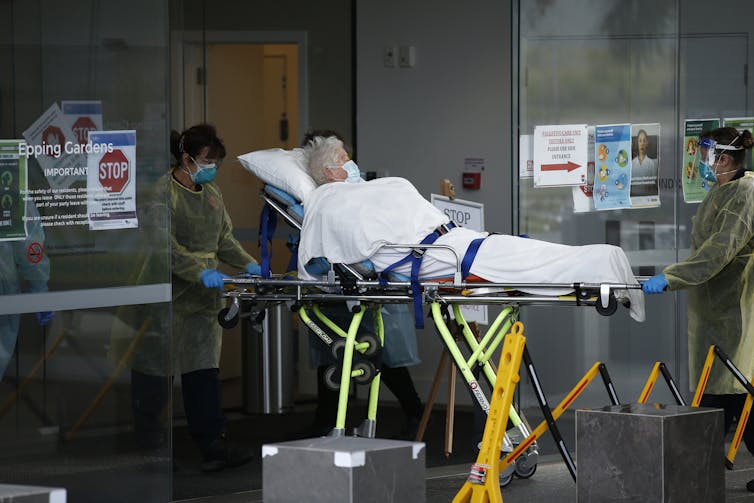
Victoria’s second wave of COVID-19 has been heavily concentrated in aged-care homes.Daniel Pockett/AAP
The third recommendation requires establishing a national aged-care plan for COVID-19, including setting up a national aged-care advisory body. This is the most obvious step in any emergency response.
The commission indicates the plan should establish protocols between the federal government and states and territories, which may reduce some confusion around who is responsible for what. The plan should also set up procedures regarding who decides whether residents with COVID-19 are transferred to hospital.
As part of the plan, significant outbreaks in facilities are to be investigated by an independent expert, and any lessons promptly disseminated to the sector.
But the commission doesn’t provide any detail on what constitutes an independent expert, a major oversight. Ideally, the experts shouldn’t be directly involved with government departments, the regulator or affiliated groups involved in the pandemic response.
Perhaps most disappointing is the commission did not highlight that multiple outbreaks in aged-care homes reflect systemic issues rather than individual organisational failures. The most useful information is obtained by investigating every aspect of the sector as a whole. This is a missed opportunity and does not serve the best interests of older Australians.
As for the advisory body, the commission was clear the group Prime Minister Scott Morrison established in August was not sufficient — it lacked the right skill mix and was temporary.
But it’s extremely disappointing the commission has not directed that senior nurses, family members and residents (ideally supported by human rights lawyers) be appointed to the group. The people who will be most affected by the decisions should be directly involved in making them.
The fourth recommendation stipulates all aged-care homes should have one or more trained infection control officers as a condition of accreditation.
The fifth is for governments to deploy accredited infection prevention and control experts into aged-care homes to provide training, and assist with preparing for and managing outbreaks.
These are sound recommendations, but should have been in place more than a decade ago, had we learnt from Hong Kong’s experience with SARS.
The challenges with implementing these recommendations will be having the human resources for such a workforce, including addressing the longstanding issue of health professionals’ willingness to work in regional and remote areas.
Some key omissions
The report’s recommendations are worthwhile, yet all are late in arriving and incomplete. Each recommendation provides a solution to an entirely foreseeable problem.
Notably, there’s an absence of strategies to address the known structural problems in aged care. These are issues the commission itself has previously described, around workforce limitations, widespread neglect of residents, and regulatory failures. They represent barriers to implementing the recommendations.
Dedicated staff will be deployed to enhance infection control procedures in nursing homes.Shutterstock
The commissioners also fell into the trap of inappropriate comparisons. References to Australia faring better than selected European and North American countries fail to acknowledge our advantages of being an island continent with lower community transmission and an extra three months to prepare. This provides false reassurance to the public.
We should judge our performance on the disparity between what we could have done and what we did do, rather than against countries in different situations.
Ultimately, this report was not designed, nor did it deliver, an understanding of what went wrong in aged care, and why.
Similarly, the recommendations do not go to the heart of the information gleaned from the appalling and tragic lived experiences of residents, families, aged-care workers and health professionals.
With so many outbreaks, many still ongoing, and tragically, several hundred deaths in aged care already, there remains much we need to uncover.
The Australian government has released a series of manufacturing industry policies in the lead-up to the October 6 budget. Yesterday, Prime Minister Scott Morrison spoke about a A$1.5 billion strategy to strengthen Australian manufacturing and supply chains. Last week, Education Minister Dan Tehan announced a A$7.2 million extension of advanced apprenticeship pilot programs across the country to teach students the high-level, specialist knowledge and skills they’ll need for industry jobs of the future.
COVID-19 has exposed the vulnerabilities of Australian manufacturing. Recent research ranked Australia lowest in the OECD for manufacturing self-sufficiency.
The government wants to expand work-integrated learning. Its aim is to strengthen the link between training and future industry needs, and significantly lift workforce skills to meet the requirements of the digitally driven Fourth Industrial Revolution.
The investments in Australia’s future workforce, businesses and economy are welcome. However, the training program will not solve the unemployment problems and skills mismatch in the short term, given COVID-19’s impact on the economy.
Where do advanced apprenticeships fit into this?
The main aim of advanced apprenticeships is to strengthen relationships between universities and industry to produce highly skilled graduates for an Industry 4.0-driven economy. This is all the more important in light of the government’s JobMaker Digital Business Plan to drive economic recovery.
This approach is the basis of the German education and training system. In recent years, concerns about manufacturing’s decline in many developed economies have prompted governments to adopt aspects of the German model.
In Australia, Siemens, the AiGroup and Swinburne University launched the first digital technologies advanced apprenticeships pilot in 2017. In a two-year Associate Degree in Applied Technologies, student-apprentices work for a host employer and attend university for periods of 6-8 weeks followed by similar periods of applied learning in the workplace. They do 22 weeks of full-time study a year, with 26 weeks in the workplace and four weeks’ annual leave. The program has won industry awards.
In advanced apprenticeship programs students divide their time by university and the workplace.Shutterstock
The extra funding will extend the program beyond Victoria to New South Wales, Queensland, Tasmania and Western Australia.
Preparing skills for future jobs
Advanced apprenticeships are especially relevant to rapidly changing sectors such as advanced manufacturing. Higher-level skills are increasingly in demand as emerging and disruptive technologies automate lower-level tasks.
Jobs that draw on digital and related skills have been growing more rapidly than jobs in the so-called legacy economy. This is because the technological innovations underpinning the digital economy demand higher-level skills. These disruptive technologies include artificial intelligence, robotics, machine learning and digitisation.
COVID-19 has accelerated this trend. The need for up-skilling and training is urgent, to ensure tomorrow’s graduates, as well as the existing workforce, have the skills to take advantage of job opportunities in the digital economy.
The federal government believes in the power of free markets. But it recognises market failure exists when it comes to students’ preferences for skills development versus educational institutions having the right training to meet future industry needs. As a result, many young people’s career expectations were concentrated in ten so-called “20th century” careers such as doctors, teachers, lawyers and business managers. They could struggle to find relevant and consistent work in the future.
Our research highlights a major gap in Australia between what education and training providers are delivering and what business and industry need. Programs such as advanced apprenticeships in digital technologies will help to reduce this mismatch.
However, the pilot programs are not a silver bullet to solve the problems of skills and employability in Australian manufacturing, for several reasons.
First, this is a long-term solution. In advanced apprenticeship programs, students take two years to gain the associate degree and longer for a full university degree. Swinburne University’s first pilot intake in 2017 has only just gained undergraduate qualifications.
Students undertaking advanced apprenticeships take two years to complete an associate degree and longer for a full university degree.Shutterstock
This training will not solve the mass unemployment due to the COVID-19 shock nor cushion the impacts of the roll-back of Jobkeeper and Jobseeker.
Second, while the government says its manufacturing strategy will create up to 80,000 direct jobs and about 300,000 more indirect jobs, advanced apprenticeships will not be the main training pathway. These programs have relatively small intakes and are niche in nature.
The first Swinburne pilot enrolled only 20 students. Similar small intakes are likely at other universities in the extended program.
The lack of detail in the apprenticeship announcement raises other questions.
First, it is unclear to what extent the government has collaborated or consulted with the states and territories and industry bodies. This is essential because the pilots involve both vocational and higher education aspects of learning. The Joyce Review and the Productivity Commission both emphasised the need for collaboration.
Second, why are only universities being targeted? And why do the extended pilots include only two dual-sector universities (Swinburne and RMIT)?
Perhaps the aim was to align the training element with the research element for the federally funded Industry 4.0 Testlabs in six selected universities. However, not all these universities are part of the advanced apprenticeship pilots.
Despite the positive spin about inter-government collaborations as a result of COVID-19, this does not appear to be happening in skills and training. Industry groups have therefore taken the initiative to work directly with the states and territories and with vocational education providers.
For pilot programs to be successful, especially in the context of high market uncertainty and rapid technological development, they need to be given room for experimentation. The extended advanced apprenticeship pilots are welcome steps in this direction. They will help overcome the inaction of recent times on the changes needed in education, skills and training to ensure students are better able to meet the future needs of employers.
Aboriginal and Torres Strait Islander readers are advised this article contains names and images of deceased people.
What’s in a name? A rose might very well smell as sweet if it was called a turnip, but clearly there is more cultural cache invested in nomenclature than Shakespeare would have us believe.
Why else would our forefathers have been so intent on reserving the lion’s share of geographic names in Australia for men if there was not real value in the symbolic real estate?
Why are there so many streets, buildings, bridges, public institutions and private firms named after dudes, and not women?
This cavernous gender gap in public naming practices is precisely why there should be intense scrutiny of the Australian Electoral Commission as it designates a new federal electorate later this month.
The AEC is currently taking public submissions on the name for the new electorate, which is being created in Victoria in 2021 due to a federal redistribution.
Gender equality activists (including, I hope, some of those fabled Male Champions of Change) are busy compiling extensive lists of women, including Indigenous women, who meet the AEC’s criteria for naming divisions: that is, deceased Australians who have rendered outstanding service to their country.
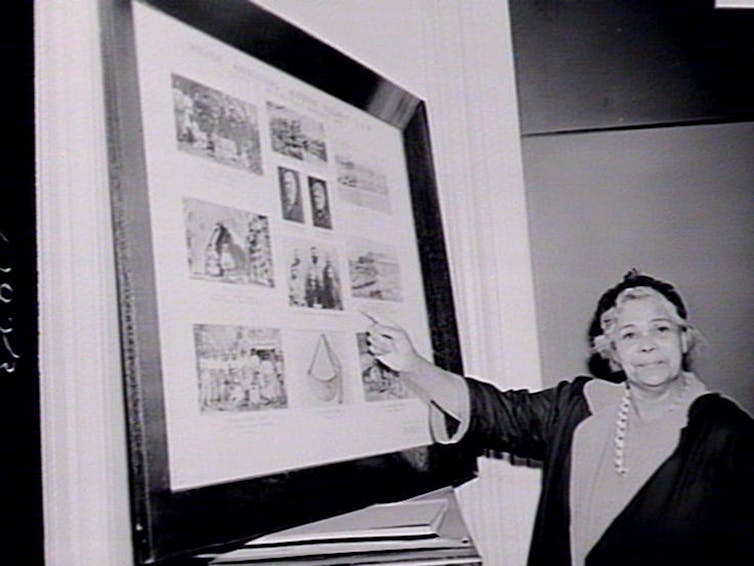
Aboriginal activist Margaret Tucker is one name worth considering for the new electorate.State Library of New South Wales
Place names have always been a means for exerting power
Like statues and monuments, we’ve been taught to treat official names with veneration. As New Yorker journalist Hua Hsu has argued about statues to historical figures in the wake of Black Lives Matters protests,
we are also taught to read them as unitary and their message as unified, rooted in consensus.
We are rarely encouraged to consider whose names — and whose stories and histories — are silenced in the christening process.
Geographic place names have also long been a means for exerting power.
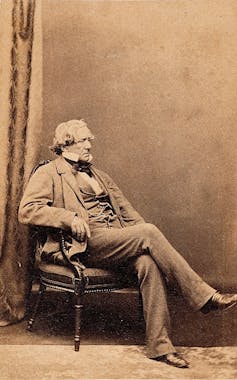
William Charles Wentworth has a federal electorate, town, streets, buildings and even a waterfall named after him.Wikimedia Commons
Recasting a mountain, river or plain from its Indigenous designation to a European name is one of the first and most enduring acts of colonial dispossession. Ensuring those European names belong to exalted or aspirational men is patriarchy’s way of pissing on the post of dominion.
And so it was that when the new Australian nation branded its first federal electorates in 1901 for the 75 House of Representative seats, not one was named after a European woman, let alone a First Australian.
Wentworth, Lang, Oxley, Parkes, Kennedy, Cowper, yes. But not Goldstein, Lee, Windeyer or Wolstenholme — all women who had contributed to the successful inauguration of the Federation. (Look them up.)
But what about the naming of electorates more recently, in the supposedly more enlightened modern Australia that has witnessed two waves of feminism and – if you believe the Murdoch media — a tsunami of political correctness?
Women’s names are still disproportionately unrepresented. At a federal level, 114 out of the current 150 House seats are named after one or more people. Eighty-nine are named after a man and eight are jointly named for a husband and wife (for example, Lyons) or a family. A mere 17 — or 11% — are named after a woman.
Perhaps even more remarkable, only six electorates bear the name of a First Nations person.
Of those original Federation electoral division names, 36 remain.
In a nation that claims to value equality and fairness, these numbers are simply not good enough. (Neither are they inevitable: in New Zealand, where seats are exclusively given place names, 37 of 71 have Maori names.)
Electoral boundaries ebb and flow according to demographic fluctuations, but for the names of divisions to reflect our current values when it comes to gender parity — not to mention cultural diversity — will take leadership and commitment on the part of the AEC.
The AEC’s most recent fails: Monash and Bean
The AEC’s most recent opportunity to level the scales of commemorative justice was an abject failure.
Two years ago, the AEC reviewed the federal seat of McMillan, which was first proclaimed in 1949 and encompasses the region of Gippsland in Victoria. The seat was named after colonial “explorer” Angus McMillan, who is now widely acknowledged as the perpetrator of massacres of the Gunaikurnai people. Even Wikipedia calls McMillan “a mass murderer”.
Many Gippsland residents and other civic-minded folk tendered the names of suitable women to help erase McMillan’s sullied legacy. These were all rejected in favour of the electorate’s new name: Monash.
As co-founder of the Honour a Woman campaign, Ruth McGowan lamented in an email to me
a freeway, a university, a local council and a hospital were not enough for the good general.
Nobody disputes John Monash’s valour, but seriously? Come on Australia.
The list of places named after John Monash, Australian military commander, is extensive.Wikimedia Commons
Similarly, the creation of a third Commonwealth electorate in Canberra in 2018 witnessed the birth of the division of Bean, honouring the memory of Australian Imperial Force war correspondent Charles Bean.
(Ironically, one of the many objections to the Bean nomination focused on his anti-Semitic comments about Monash during the first world war.)
Was the problem the AEC didn’t receive public support for or suggestions of names of worthy female and Indigenous citizens? Of course not. There were plenty. They were simply overlooked.
Fortunately, we now have another chance to circumvent what Kim Rubenstein, the co-director of the 50/50 By 2030 Foundation, and law student Katrina Hall have pointed out is
effectively a system of affirmative action in favour of men.
Pulling down statues is one way to make a statement about the ruins of history. Naming places is an equally powerful — and arguably more creative and cohesive — way of demonstrating, as Hsu puts it,
whether a nation’s story is finished or a work in progress.
The 2021 redistribution will test the AEC’s mettle: instrument of the Canberra boys’ club or, as its mission statement asserts, independent electoral service which meets the needs of the Australian people.
Facebook Messenger and Instragram’s direct messaging services will be integrated into one system, Facebook has announced.
The merge will allow shared messaging across both platforms, as well as video calls and the use of a range of tools drawn from both platforms. It’s currently being rolled out across countries on an opt-in basis, but hasn’t yet reached Australia.
Facebook CEO Mark Zuckerberg announced plans in March last year to integrate Messenger, Instagram Direct and WhatsApp into a unified messaging experience.
At the crux of this was the goal to administer end-to-end encryption across the whole messaging “ecosystem”.
Ostensibly, this was part of Facebook’s renewed focus on privacy, in the wake of several highly publicised scandals. Most notable was its poor data protection that allowed political consulting firm Cambridge Analytica to steal data from 87 million Facebook accounts and use it to target users with political ads ahead of the 2016 US presidential election.
In a statement released yesterday on the new merge, Instagram CEO Adam Mosseri and Messenger vice president Stan Chudnovsky wrote:
… one out of three people sometimes find it difficult to remember where to find a certain conversation thread. With this update, it will be even easier to stay connected without thinking about which app to use to reach your friends and family.
While that may seem harmless, it’s likely Facebook is actually attempting to make its apps inseparable, ahead of a potential anti-trust lawsuit in the US that may try to see the company sell Instagram and WhatsApp.
Together, with Facebook, 24/7
The Messenger/Instagram Direct merge will extend to features rolled out during the pandemic, such as the “Watch Together” tool for Messenger. As the name suggests, this lets users watch videos together in real time. Now, both Messenger and Instagram users will be able to use it, regardless of which app they’re on.
With the integration, new privacy challenges emerge. Facebook has already acknowledged this. And these challenges will present despite Facebook’s overarching privacy policy applying to every app in its app “family”.
For example, in the new merged messaging ecosystem, a user you previously blocked on Messenger won’t automatically be blocked on Instagram. Thus, the blocked person will be able to once again contact you. This could open doors to a plethora of unexpected online abuse.
Why this is good for Mark Zuckerberg
This first step – and Facebook’s full roadmap for the encrypted integration of WhatsApp, Instagram Direct and Messenger – has three clear outcomes.
Firstly, end-to-end encryption means Facebook will have complete deniability for anything that travels across its messaging tools.
It won’t be able to “see” the messages. While this might be good from a user privacy perspective, it also means anything from bullying, to scams, to illegal drug sales, to paedophilia can’t be policed if it happens via these tools.
This would stop Facebook being blamed for hurtful or illegal uses of its services. As far as moderating the platform goes, Facebook would effectively become “invisible” (not to mention moderation is expensive and complicated).
This is all great news for Mark Zuckerberg, especially as Facebook stares down the barrel of potential anti-trust litigation.
The US Federal Trade Commission has been investigating Facebook for more than a year over whether it is harming competition. A Bloomberg report from last month said competition enforcers were preparing a possible anti-trust lawsuit against the company.Andrew Harnik/AP
Secondly, once the apps are merged, functionally they will no longer be separate platforms. They will still exist as separate apps with some separate features, but the vast amount of personal data underpinning them will live in one giant, shared database.
Deeper data integration will let Facebook know users more intimately. Moreover, it will be able to leverage this new insight to target users with more advertising and expand further.
Finally, and perhaps most concerning, is that by integrating its apps Facebook could legitimately respond to anti-trust lawsuits by saying it can’t separate Instagram or WhatsApp from the main Facebook platform – because they’re the same thing now.
And if they can’t be separated, there’s no way Facebook could sell Instagram or WhatsApp, even if it wanted to.
100 billion messages a day
The messaging traffic across Facebook’s platforms is vast, with more than 100 billion messages sent daily. And this has onlyincreased during the COVID-19 pandemic.
With the sheer size of its user database, Facebook continues to either purchase, or squash, its competition. Concerns about the company being a monopoly aren’t without merit.
Just a few months ago, Facebook released its Instagram-housed tool Reels which bears a striking resemblance to TikTok, another social app sweeping the globe.
It seems this is just another example of Facebook trying to use the sheer size of its network to stifle growing competition, aided (perhaps unwittingly) by Donald Trump’s anti-China sentiment.
If competition is important to encouraging innovation and diversity, then the newest development from Facebook discourages both these things. It further entrenches Facebook and its services into the lives of consumers, making it harder to pull away. And this certainly isn’t far from monopolistic behaviour.
Source: The Conversation (Au and NZ) – By Robyn J. Whitaker, Senior Lecturer in New Testament, Pilgrim Theological College, University of Divinity
Most of us are living through a year that is unprecedented in our lifetimes. Too young to remember the Spanish flu, we’ve grown up in a world where we take Western wonder drugs and life-saving vaccines for granted. We have no memory of a time when disease brought the world to a standstill or shut down entire economies. We could not have predicted life in Melbourne in 2020 would include a 5-kilometre travel limit or a curfew.
A longer view of history reminds us we are not the first community to experience and reflect on life during a time of plague or pandemic. So what might we learn from history as we continue to navigate life during a pandemic?
Given the ubiquity of religion in most human communities throughout history, it is not surprising reflections on pandemics often begin with God. Plagues and diseases on such a scale feel “biblical” in the sense they are beyond the norm and therefore supernatural in some way. While modern science gives us insight into COVID-19, we still look for someone, anyone, to blame for its presence.
In antiquity, that someone was often God.
One of the earliest records of plagues comes from the Hebrew Bible. Anyone who has celebrated Passover, read the biblical book of Exodus, or seen the animated Dreamworks movie Prince of Egypt will be familiar with the plagues that Moses (or God) unleashed on Egypt when Pharaoh would not free the enslaved Hebrews.
Not all of the plagues were disease, but they all brought destruction and potential death. In that ancient narrative, a plague served two functions: it is divine punishment for injustice, and an assertion of religious power in the battle between Egypt’s gods and the god of the Hebrews. In the Hebrew Bible texts, Pharaoh’s refusal to release the slaves is to blame. It is his fault.
Throughout history, humans have sought explanations for things that are beyond our normal control or understanding. While God is often credited as the sender of plagues or pestilence – usually to teach some moral lesson – we tend to focus our wrath on human scapegoats. In the 1980s, the HIV-AIDS viral pandemic was blamed on the gay community or Haitians, revealing the racism and homophobia behind such views.
US President Donald Trump’s constant reference to COVID-19 as the “China virus” reflects a similar desire for a scapegoat. In its worst form, the blame game leads to widespread retribution against anyone identified with that group.
Role of government is key to protecting the community
Another link with the past is the role of government in containing disease. Governments have for centuries used quarantine as a way to preserve public health, often with great success.
Yet resistance to forced quarantine has an equally long history, with reports of those in isolation being “unruly” and needing to be contained during the Great Plague in 17th-century England. During this period, quarantine procedures made a marked difference to the mortality rate when comparing cities.
The Black Plague in England of the 1660s was widely believed to be an act of God.historic-uk.com
Balancing individual freedom with the health of whole communities is a tricky business. Karen Jillings’s work on the social history of the plague in 17th-century Scotland shows that, while physicians, magistrates and preachers all regarded the plague as supernatural (either directly from God or by God working through nature), the responses of those of faith differed.
Jillings describes the arrest of a Scottish preacher in 1603 for refusing to comply with the government’s health measures because he thought they were of no use as it was all up to God. The preacher was imprisoned because he was viewed as dangerous: his individual freedoms and beliefs were deemed less important than the safety of the community as a whole.
Being religious does not mean being anti-science
Being a person of faith, however, does not necessarily make one anti-science.
COVID sceptics take a wide variety of forms in contemporary culture, including anti-religious conspiracy theorists. Yet anti-science views are often associated with people of faith thanks, in part, to some now tragicexamples from North America.
Martin Luther cared for the dying during the plague.Wikicommons
One example of a cleric who did not pit faith against reason was Martin Luther, the 16th-century theologian and reformer. Luther wrote about living through the plague in a pamphlet titled Whether One May Flee from a Deadly Plague.
Oxford University professor Lyndal Roper writes that while many fled Wittenberg in 1527 when the plague struck, Luther stayed out of a sense of duty to help nurse and care for the dying. This is what he thought all leaders should do.
His staying was not the decision of a martyr, nor was it born of a naïve idea that God would necessarily save or protect him. Luther, writes Roper, “advocates social distancing”, the use of hospitals, and necessary precautions according to the science of his time. While he believed that God was ultimately in control, he also affirmed human responsibility. Luther harshly condemned those who went about knowing they were sick and spreading the disease.
A historical perspective does not make living through a pandemic easy. But perhaps there is a small comfort in realising we are not the first community to live through such times, and neither will we be the last.
The things we find hard to balance – individual freedoms versus the group, accountability versus blame, science versus personal beliefs – are centuries old and deeply human.
And, like others in centuries past, we too are capable of incredible acts of care and sacrifice for the sake of the sick and vulnerable.
Source: The Conversation (Au and NZ) – By Albert Van Dijk, Professor, Water and Landscape Dynamics, Fenner School of Environment & Society, Australian National University
From Tasmania’s majestic forest giants to the eucalypt on your nature strip, trees in Australia are many, varied and sometimes huge. But how many are there exactly? And how does their number change over time?
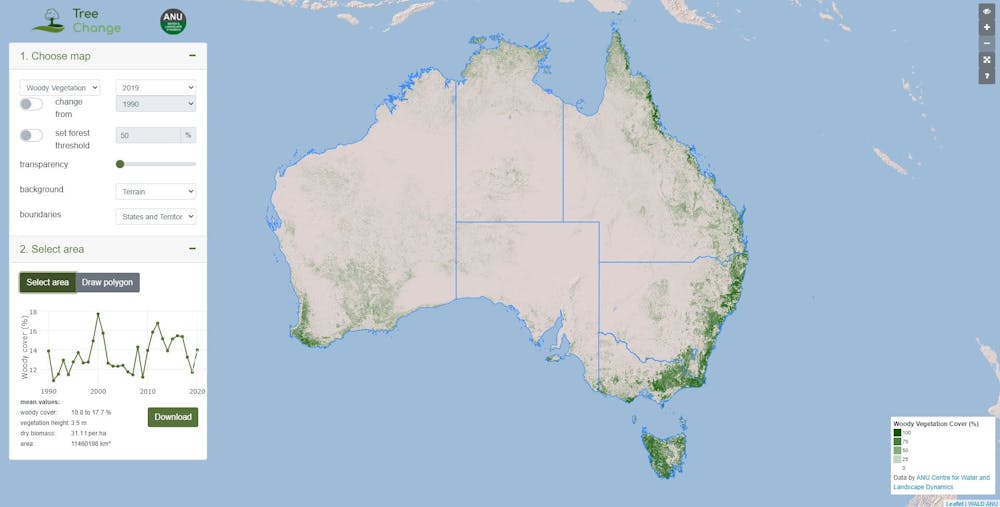
To answer such questions, we mapped changes in Australia’s tree cover in detail, using 30 years of satellite images. We published the results in a recent paper and made the data available for everyone in our new TreeChange web interactive.
Perhaps surprisingly, it turns out that since 1990 we’ve been gaining trees faster than we are losing them. On average, we’ve been gaining eight “standard trees” per year for every Australian.
In total, we found there is currently the equivalent of 1,000 standard trees for every Australian. But this doesn’t mean all our forests are doing well.
There are 24 billion standard trees in Australia
Counting trees is difficult, as there are always more small trees than big ones. So we defined a “standard”: imagine a gum tree with a trunk 30 centimetres in diameter, standing about 15 metres tall.
It’s the sort of good-sized tree you might find in your street or backyard — not huge, but not small either. It might have been planted 15 or 20 years ago. Cut it down and let it dry out, and it will weigh about half a ton.
To count the number of trees in Australia, we first estimated the total mass of trees by combining satellite and field measurements. Then we compared this result to the weight of a standard tree.
We found the total forest biomass across Australia holds the equivalent of about 24 billion standard trees.
If you want to know how forests and woodlands are faring in your state, council or on any property, you can use our TreeChange interactive.
What this means for forests and carbon emissions
If the total mass and number of trees has increased in Australia, does this mean the area of forests has expanded, too? To determine that, you need to decide how many trees make a forest.
By this definition, we gained a staggering 28 million hectares of forest over the last 30 years, plus another 24 million hectares of woodland.
So where did they come from, and why wasn’t it reported in the news? Probably because most of the trees were already there. They just grew larger and denser, and crossed the threshold of our definition of a forest, so were counted in.
Examples of standard trees, pictured outside my office.
And are eight new trees each year, per person, enough to soak up our greenhouse gas emissions? No.
And additional carbon is stored on the forest floor in, for example, logs and branches, as well as under the surface as organic matter. This is worth, perhaps, several more trees of carbon. But it is not clear how safe those carbon deposits are from fire and drought.
Still, if you wanted to set yourself a new year’s resolution, planting those additional 16 trees would be a great start.
Gains and losses
The increasing trend in forest extent has not been smooth — there have been big swings corresponding to wet and dry periods.
For example, the climate of northern Australia has become wetter over the last 30 years, which has helped tree growth. Changes in fire regime and the fertilising effect of our carbon dioxide emissions into the atmosphere may also have played a role.
And just like increased rainfall can help increase the area of forests, drought and bushfire can cause them to disappear.
Bushfires can thin vegetation so it falls short of the definition of a forest.Shutterstock
Bushfires may not remove or even kill most trees, but they can cause enough dieback, scorching or thinning for the vegetation to fall short of the definition of a forest or woodland.
Logging can also cause a patchwork of gains and losses when it goes through cycles of harvesting, regrowth and replanting. And land clearing of native forests still occurs in Australia, such as in the old growth forests of Tasmania, which are vital for native wildlife.
It’s not all good news
While we found the total area and biomass of forests and woodlands has been rising, quality can be more important than quantity when it comes to our ecosystems.
Many things are required to make up a high quality forest, such as a rich understory of perennial species, including grasses and shrubs, and even logs and branches on the ground. These features provide important habitats for many native animals.
Large old trees are also important. Some trees take hundreds of years to reach their greatest size, towering up to 100 meters tall.
These forest giants are an ecosystem in themselves, with birds and tree-dwelling mammals, such as sugargliders, relying on their nooks and crannies. Old growth forests also hold far more carbon than a new forest.
Many native birds rely on the nooks and crannies of old growth trees.Shutterstock
In some cases, a few remaining forests and woodlands are all that’s left of an endangered ecosystem, such as once-abundant box gum grassy woodlands.
Such old or rare forests are difficult or impossible to replace once lost. So creating new forests should never be seen as an alternative for protecting our existing ones.
Year 12 exams can be stressful at the best of times; this is particularly true for the Class of 2020.
Here are five ways parents and carers of Year 12 students preparing for their final exams can support them.
1. Check in and listen
It is important to remember teenagers are often more resilient than we think. In most cases, they can cope well with challenges. But some students find exams more stressful than others, and some may also be worried about the influence of COVID on their future.
Research consistently shows parental monitoring that supports the autonomy of the young people is linked with their better psychological adjustment and performance during difficult times. This means checking-in with your teen, seeing how they are going and empowering them to use whatever coping skills they need.
Unfortunately, in times of stress, many parents use a high-monitoring low-autonomy style. Parents may still monitor their teen’s coping but also take over, hurry to suggest solutions, and criticise the strategies their child is trying.
This is a low-autonomy style, which may signal to the young person their parent doesn’t believe in their ability to cope.
So, to not come across as controlling or undermining their autonomy:
ask your teen, “How are you coping?”
listen to their answers
check you have understood and ask if they need your support.
Let your actions be guided by their response. If they say “I’m very stressed”, ask if there is something you can do. You could say: “Tell me what you need to do and we’ll work it out together”.
If they do the famous “I dunno”, say something like “OK, think about it, I’ll come back in a bit, and we can chat”. Follow through and let them know you will check in more regularly over the coming weeks.
2. Encourage them to take care of their physical and mental health
Support your teen to get exercise, downtime and sleep. Exercise helps produce endorphins — a feel-good chemical that can improve concentration and mental health.
Downtime that is relaxing and enjoyable such as reading, sport, hanging out with friends or video games, can also help young people recharge physically and mentally. If you see your Year 12 child studying for numerous hours without a break, encourage them to do something more fun for a while.
Good sleep is important for alertness, and teenagers should aim for eight to ten hours per day. Sleep also helps memory consolidation: a neural process in which the brain beds down what has been learnt that day.
To ensure your child priorises self-care, help them put together a routine. This may involve scheduling specific times for exercise, meals and downtime each day, and breaking up blocks of study time with short breaks.
Also negotiate a nominated time for them to turn their phone off at night. Stopping phone use one hour before bedtime can increase sleep.
But also be aware of the risks. Talking with friends over and over about problems can actually make young people feel worse. Your son or daughter may find their friends are increasingly leaning on them for support too, which can exhaust their own emotional reserves.
Connections with friends are important for stress.Unsplash, CC BY
Encourage your child to use time with friends as time away from studying. It’s OK to seek support from friends, but help your child think about when might be too much — and to have a balance of happy and serious conversations when they are together.
Encourage your child to continue talking to you and to ask their teachers for help with academic concerns.
4. Help your child understand their own brain
When asked, most young people report frequently using rehearsal — which involves simply going over textbooks, notes or other material — as a study technique. This is one of the least efficient memory strategies.
The more active the brain is when studying — by moving information around, connecting different types of information and making decisions — the more likely that information will be remembered. Active study sometimes feels harder, but this is great for memory.
Encourage your child to study actively by making their own test questions, reorganising information into concept maps, or explaining the topics to you. It can also help to “intersperse” different study topics: the brain grows more connections that way. It also gets more practice reactivating the original material from memory.
5. Look out for warning signs
While most teens are resilient, some may more frequently report negative mood, uncertainties about the future or a loss of control. This is particularly true in 2020. You might hear evidence of “catastrophic thinking” (“what’s the point?” or “this is the worst thing ever”).
You can help by modelling hopeful attitudes and coping strategies. Reactive coping strategies are things like taking a break, selectively using distractions and going for a run to clear your head.
Pair these with proactive coping strategies, which prevent or help manage stressful situations. These include helping the young person get organised and reminding them that if they don’t have life figured out right now, that’s OK. Help them see opportunities that come with challenges. These include self-development (learning what they like and don’t like), self-knowledge (knowing their limits and character strengths) and skill development (organisational and coping strategies).
Some teens may be struggling more than they let on. Look out for warning signs. These can include:
not participating in previously enjoyed activities
avoiding friends or partners
drastic changes in weight, eating or sleeping
irritability over minor things
preoccupation with death or expressing how difficult it is to be alive.
If these behaviours occur most of the time you are with them or seem out of character, consult a mental health professional as soon as possible. This is particularly so if your teen has a history of mental health concerns.
On Monday “mutual obligation” was switched back on for programs such as ParentsNext.
In the case of ParentsNext that means parents selected for it are required to
attend initial and three-monthly appointments (by phone/online if preferred)
negotiate and agree to a participation plan
participate in and report on having done the activities they agreed to do
Other than in Victoria, parents who do not meet these requirements without a valid reason can have their payments suspended.
The “big stick” of suspension was present right from the beginning of ParentsNext as a pilot program aimed at helping teenage mothers, although it was wielded gently.
Mothers were required to take part in activities that would prepare them for work (and in some cases parenting) such as resume writing classes, vocational training and taking their children to libraries.
Targeted compliance not pre-tested
The evaluation merely noted that non-compliance “could potentially have resulted in the parents’ income support payments being suspended”.
When the pilots were declared a success and the program was taken national in 2018, it came with a more rigid Targeted Compliance Framework that hadn’t been tested.
Service providers, engaged to help participants, were also required to monitor and record their compliance with requirements which would move them through zones, the “green zone”, the “warning zone” and the “penalty zone” mediated with demerit points.
If a participant’s parenting payment was cancelled, they had to serve a four-week preclusion period before they could be paid again.
A parliamentary inquiry found that by placing conditions on the social security of parents and potentially reducing their income, the program did not appear to consider the best interests of children.
The Australian Human Rights Commission said the compliance framework allowed social security to be reduced below the minimum level essential for parents caring for young children.
In the first six months, one in five participants had their payments suspended. Among Indigenous parents, it was one in four.
Providers themselves complained that the emphasis on compliance prevented parents from fully benefiting from the program.
Parents were having to choose between using petrol to take their children to school and saving it to come to appointments.
The ABC and Guardian reported on the case of “Sue”, an Indigenous woman who took on seven children after her sister was murdered by an estranged partner.
She was placed on ParentsNext and her parenting payments were cut off multiple times, usually because she was unable to attend appointments.
In August last year the government rejected recommendations from the parliamentary inquiry that ParentsNext should not continue in its present form and that participants who miss their first appointment should be given an opportunity to address their failure before their payments were suspended.
But in March COVID-19 forced it to temporarily lift the mutual obligation requirements. Once connected with your provider, “all future appointments and activities” were voluntary.
Until this week. Now ParentsNext participants will still be able to meet with providers over the phone or online, but they will be required to participate in activities and report online to demonstrate they have done so.
It means little has changed.
My scans of ParentsNext Facebook groups tell me parents are once again stressed-out about the reporting requirements and the threat of losing their payments.
It needn’t be this way. The good things about ParentsNext continued while the mutual obligation requirements were put on hold.
For some parents the contacts and confidence provided by the training programs are valuable, although much less so when they are linked to burdensome and punitive obligations.
Other parents aren’t ready for paid work. The COVID schools closures have reminded us that parenting is itself work.
A better program could be designed in partnership with the parents it is meant to help.
It’s unlikely The New York Times’ publication of Donald Trump’s tax records just before the first presidential candidates’ debate was a coincidence.
This looks like a classic example of what political scientists and commentators call an “October Surprise” – a news story deliberately timed to influence the US presidential election.
Much is at stake – the presidency, as well the entire House of Representatives and one-third of the Senate. What is in the minds of voters before they vote is crucial. This gives interested parties great incentive to strategically time the release of information they might have been holding on to for some time.
A well-timed “bombshell” can sway the outcome. But what is the best timing? The first Tuesday in November is still a long way off. Why not wait?
Remember what happened last election
Remember 2016, when both Trump and rival Hillary Clinton faced last-minute scandals.
Trump had his “Access Hollywood tape”, featuring him talking crudely about women. The Washington Post published the tape on October 7, two days before his second debate with Clinton. Given the recording was from 2005, it is hard to conclude the timing of the Post’s publication wasn’t strategic – if not by the newspaper then by the source of the material.
But this October Surprise arguably proved far less damaging than the bombshell that hit Clinton just 11 days before the election, when FBI director James Comey announced the bureau was reopening its investigation into Clinton’s use of a private email server while US Secretary of State.
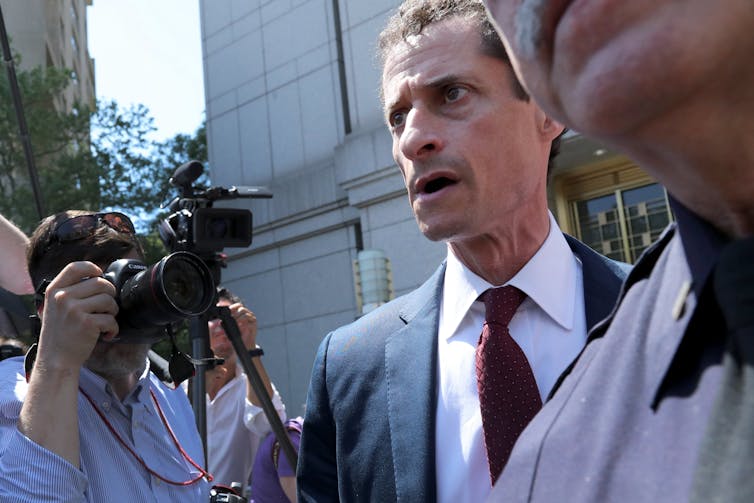
The FBI had previously investigated and deemed Clinton and her team extremely careless in not using secure government emails to handle classified information. But it recommended no charges. The case was reopened when more emails, sent by Clinton aide Huma Abedin on the laptop of her husband Anthony Weiner, were found. Making the story even juicier was that the FBI found the emails while investigating Weiner for sending sexually explicit messages to a 15-year-old girl.
Anthony Weiner leaves court in New York on May 19 2017 after pleading guilty to sexting with a 15-year-old girl.Andrew Gombert
While there is no suggestion Comey’s announcement was a deliberate October Surprise, its timing certainly didn’t help Clinton. Nothing came of the reopened case. Had Comey made the announcement a few weeks earlier, the election might have gone to Clinton.
The superficial lesson from 2016 might appear to be that the closer to the election you can drop a bombshell, the better.
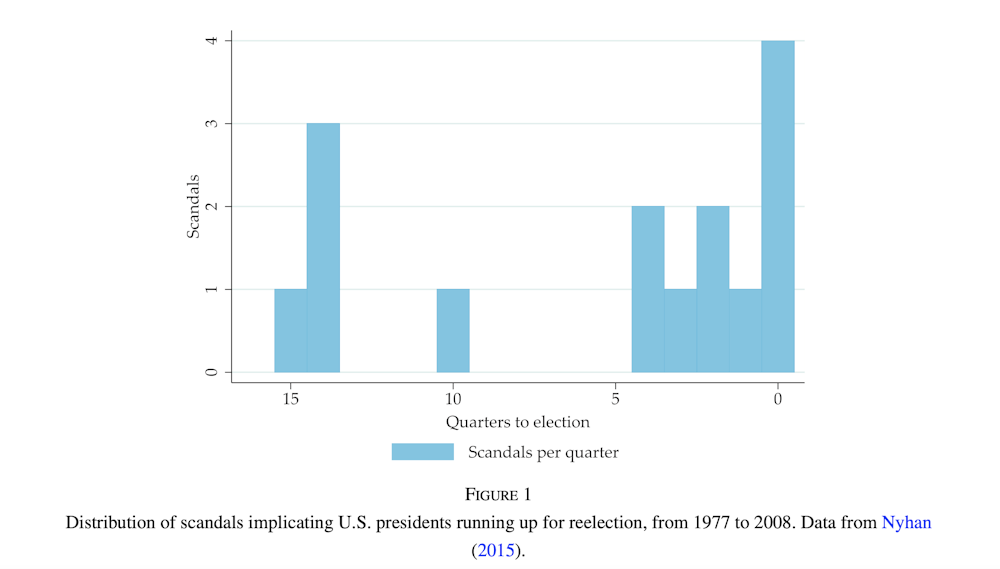
Indeed analysis of political scandals since the late 1970s show more occur with as as an election get closer.
Gabriele Gratton, Richard Holden and Anton Kolotolin, ‘When to Drop a Bombshell’, Review of Economic Studies, 85(4), 2018: 2139-2172.
But too many scandals bunched too close to an election is likely to blunt their impact. Voters might rationally assume scandals are more likely to be fake the closer they erupt to election day. They have good reason to be sceptical. It is also rational for anyone wanting to influence the outcome with fake news to deny voters the time to distinguish between fact and fiction.
So when is the best time to drop a bombshell for maximum impact?
My analysis with colleagues Gabriele Gratton and Anton Kolotilin (in the Review of Economic Studies) shows fake scandals are more likely closer to elections. This includes “Billygate” claims in October 1980 that President Jimmy Carter’s brother Billy was a Libyan agent of influence, and “Filegate” claims in 1996 the Clinton White House had improperly acquired access to FBI files on political opponents.
So there is a strategic trade-off between credibility and scrutiny.
On the one hand, dropping the bombshell earlier is more credible, in that it signals that its sender has nothing to hide. On the other hand, it exposes the bombshell to scrutiny for a longer period of time — possibly revealing that the bombshell is a fake.
Time adds credibility
The New York Times reveals Donald Trump’s tax information on September 27 2020.The New York Times
What, then, to make of the New York Times’ bombshell on September 27, two days before Trump’s first debate with Joe Biden, that:
Donald J. Trump paid [US]$750 in federal income taxes the year he won the presidency. In his first year in the White House, he paid another [US]$750.
He had paid no income taxes at all in 10 of the previous 15 years — largely because he reported losing much more money than he made.
Only the Times knows when it first could have run this story. But it has released its story far enough before election day that there is time for a good deal of scrutiny. Given the nature of the story, the newspaper’s claims are likely to be proven true or false quickly. The lead time is reason to have confidence in the story’s accuracy.
Adding to the story’s credibility is what economists call a high “prior belief” about Trump being someone who lies and cheats.
We can probably count on more than a few more bombshells about Trump or Biden as November 3 draws closer.
But the basic strategic considerations highlighted by our model suggests the closer a bombshell drops to election day a bombshell drops, the greater the reason to question its credibility.
Source: The Conversation (Au and NZ) – By Steven Hamilton, Visiting Fellow, Tax and Transfer Policy Institute, Crawford School of Public Policy, Australian National University
For three decades, Australia’s economic story has been marked by abundance and wealth. Much of it has flowed from minerals, and a good deal more from earlier economic reforms.
COVID-19 has exposed how unprepared we are for a new uncertain reality.
Next week’s budget most certainly does have to address the recession we are in. But it also has to get us in shape for what’s ahead.
Property and resources booms have masked structural weaknesses.
Even before this crisis, our productivity growth had begun to lag other nations – and this was in the midst of a widespread productivity slowdown among advanced nations, dubbed “secular stagnation” by former US Treasury Secretary Larry Summers.
The Budget Blueprint we released this week suggests a five-prong plan.
1. Continued financial support
We need to set aside any usual concerns about public debt for the good of the nation. Providing too little support or withdrawing it too quickly would threaten our fledgling recovery. But we should prioritise support that has the best bang for buck, avoids perverse incentives, and adapts to changing circumstances.
We are suggesting
Bringing forward planned personal tax cuts
Revenue-contingent loans for small and medium businesses.
Immediate capital expensing and hiring incentives for small and medium businesses
Investment in projects high on Infrastructure Australia’s priority list
Household cash stimulus payments of A$1,000 per adult earning less than $100,000 plus $500 for each dependent, and a further $750 for government payment recipients
(The stimulus payments would hardly be a first. The Rudd government handed out two cash payments during the global financial crisis. The Morrison government handed $750 to pensioners, Newstart recipients, family tax beneficiaries, and other social security recipients early in the coronavirus crisis.)
2. Medium-term fiscal discipline
A ratcheting up of government debt over time poses big risks. Our existing fiscal and tax settings are ill-equipped to repay a net debt approaching A$1 trillion.
We suggest
Accounting separately in the budget papers for the cyclical and structural deficits
Credibly committing to drawing down net debt faster than through bracket creep alone
Increasing the cap on tax receipts from its current level of 23.9% of GDP
Committing to overhauling our tax and transfer system
3. Compassionate social initiatives
During the crisis we have taken welcome steps to protect vulnerable Australians, but we need to do more. Societies are judged by how they treat their most vulnerable.
We suggest
Targeted interventions and retraining to address the pandemic’s disproportionate impact on women and young people in the workforce
Additional funding for support services and strengthen legal protections to combat domestic violence
Permanent Medicare funding for bulk-billed telehealth services (psychologists, psychiatrists, and GPs) for those at risk of mental illness and suicide
Boosting funding for social housing to reduce the impact of homelessness and housing insecurity while supporting economic activity
4. Clean, cheap and reliable energy
Many governments have leveraged COVID-19 stimulus to invest in clean energy. With excellent renewable resources and a strong clean-technology sector, Australia can play a key role in accelerating the transition to a low-carbon world.
We suggest
Increasing funding to the Clean Energy Financing Corporation’s Innovation Fund and decrease its required rate of return
Creating a “Grid Expansion Fund” to publicly finance critical electricity transmission projects
Recasting the regulatory investment test for transmission infrastructure to include carbon emissions
Conducting rigorous cost-benefit analyses of investment options in the technologies other nations are investing in during the crisis such as green hydrogen and steel
5. Setting things up for the next boom
The record-high debt incurred in World War II was followed by rapid growth that helped us pay it down. Getting us on a similar path today will require an industry policy that supports dynamism.
We suggest
Redesigning JobSeeker, offering more generous support in a smarter way to encourage better matches of workers to firms discourage over-reliance on welfare
Reforming and better funding the higher-education sector to promote competition and better prepare workers for the jobs of the future
Committing to supporting research, development, and deployment in science, technology, engineering, and related fields to drive innovation and productivity
Improving access to capital for young and fast-growing firms, learning from successful international efforts such as the Israel Innovation Fund
Nothing focuses the mind like a crisis.
We think that with the right policy settings it is possible to get out of the slump we are in while creating the conditions that will ignite the next boom.
We are living through the greatest disruption of the postwar era; what is likely to be the defining historical period of our lives. And the disrupter is a piece of RNA surrounded by fat, a virus human beings have never before encountered.
A virus that ticks all the boxes for disaster: it is novel, it is highly contagious, it is transmitted by asymptomatic carriers, and it attacks and kills people whose immune systems have been undermined by disease, inequality, malnutrition, stress and age.
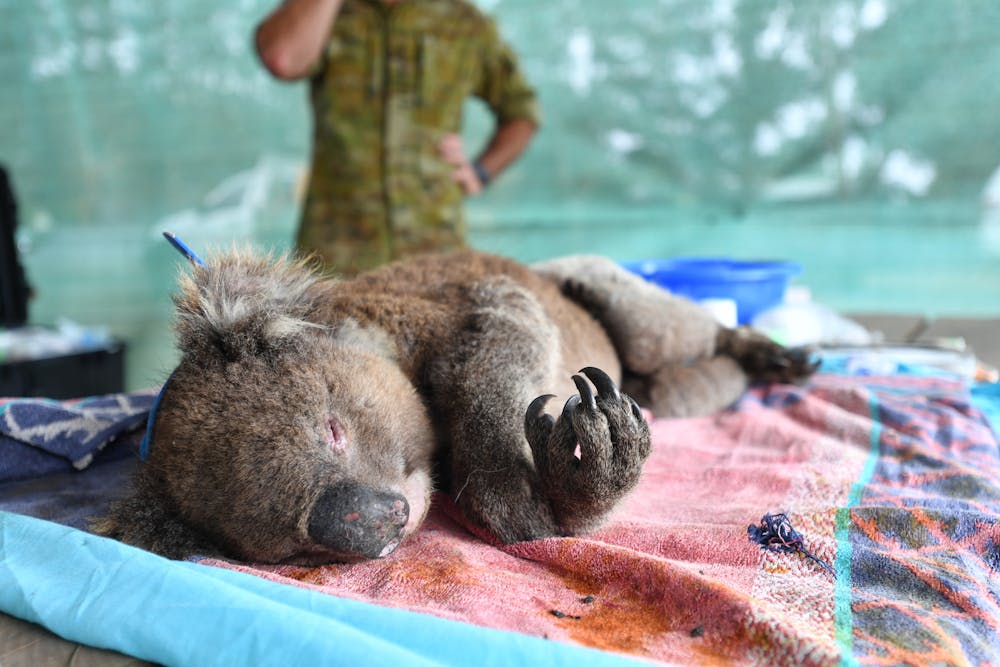
It’s only months since we were overwhelmed with the bushfire disaster. The climate emergency was upon us more viscerally than ever before. Sydney lost its summer to choking smoke; the glorious forests of the Great Dividing Range and eastern sea- board burnt with an unstoppable ferocity. Lives were lost, as were homes, businesses, communities, and a billion native animals. The koalas screaming in agony were heard around the world. This was our global future burning before our eyes.
A koala rescued from the Kangaroo Island fires in January.David Mariuz/AAP
Then came this virus. And it has shut down much of the world by freezing markets and informal economies that daily feed and service most of the people of the planet. But we should understand the virus as an ecological disaster, just like the climate emergency. They are not causally related. Rather, they are expressions of the same profound overburdening of the planet by anthropogenic excess.
The climate emergency has not abated with the pandemic. Extreme weather is everywhere on the planet. Syria is gripped by its worst drought in 900 years. Locusts are swarming over East Africa. We are warned the climatic sweet spot of the Holocene that has made complex societies possible for the last 6,000 years is coming to an end, to be replaced by unbearable heat in some of the world’s most populous places.
This is the end of the “good times” for the world, but it has been a long time coming. COVID-19 is simply an accelerant. Therefore, it is important now to focus on what has to be done, for all that stands between us and disaster is good government.
Many young people feel deeply pessimistic about the future. They have little confidence organised society can face profound threats, survive them and rebuild. But the world has done so, even within living memory with the astonishing recovery in Europe and Asia after World War II.
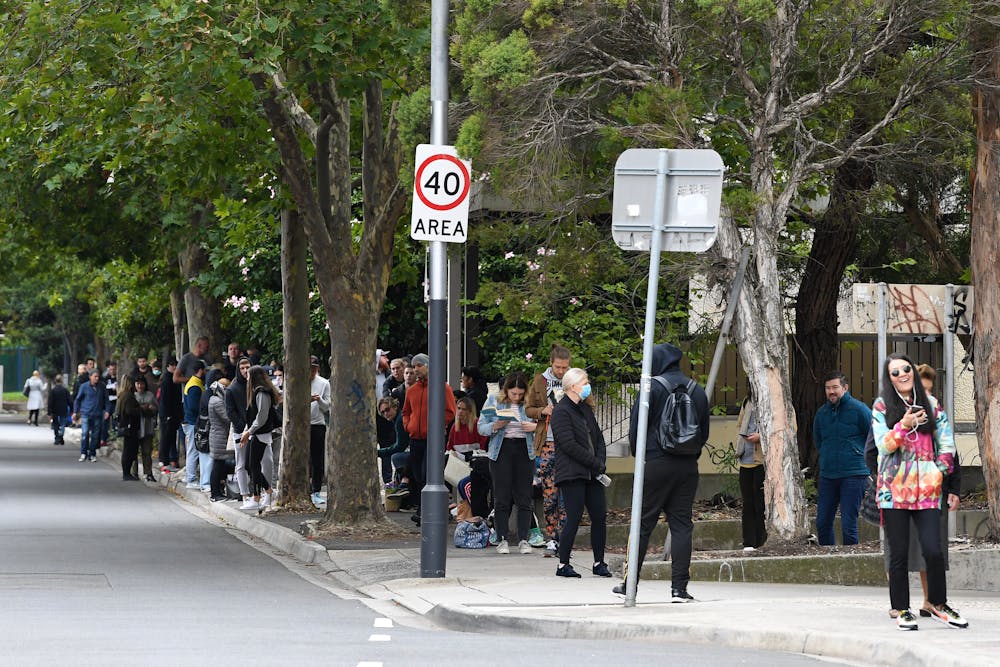
People wait in line at the Prahran Centrelink office in Melbourne in March. Many young people are pessimistic about the future.James Ross/AAP
Critical moral decisions
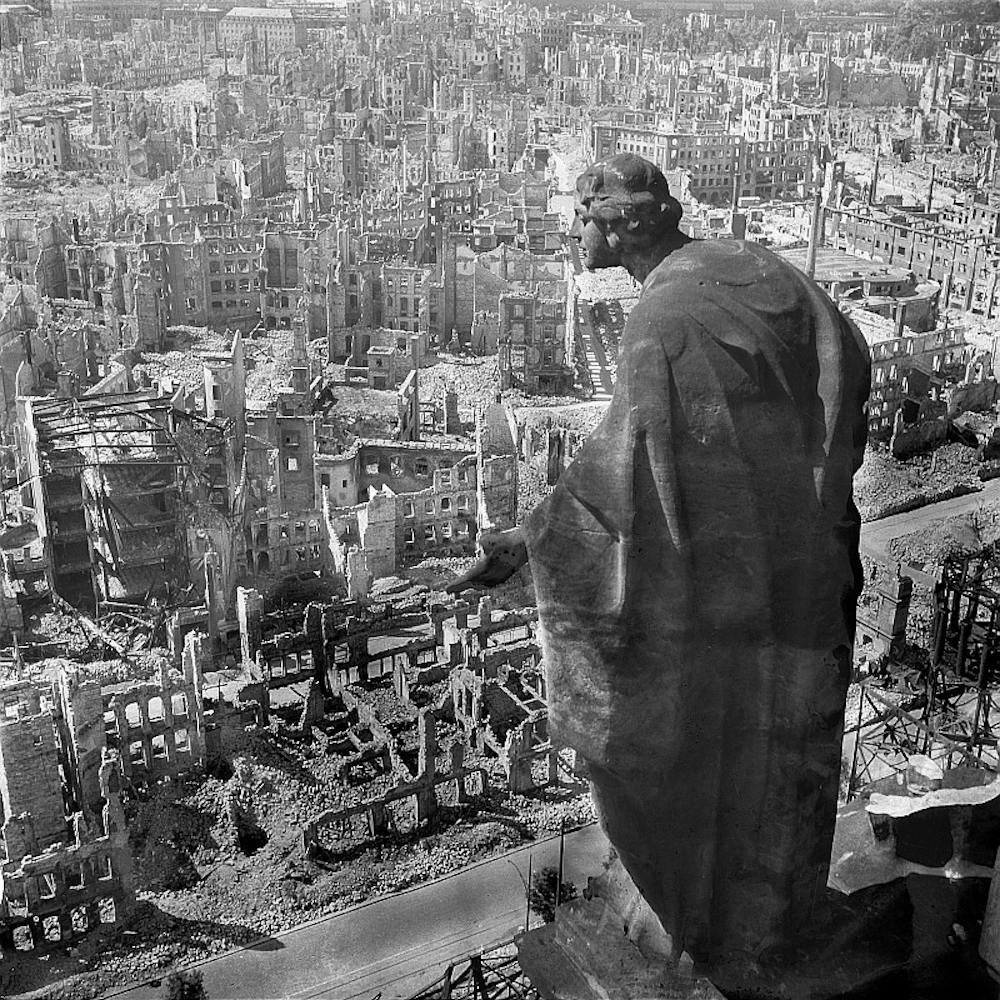
In 1945, Europe lay in ruins. Eighty-five million people had perished, most of them civilians, deliberately murdered by starvation or industrial slaughter or burnt alive in their torched villages or fire-bombed cities. Sixty million people were displaced and took to the roads.
The total of lost or orphaned children has never been tallied. The 1944–45 winter had been terrible, crops had not been planted and there was no food. In Berlin, only the Russians seemed to know how to ration food and rebuild civil society: the other Allies were at a loss.
The view from the town hall over the destroyed city of Dresden in 1945.Wikimedia Commons
Civil society had been destroyed by oppression, cruelty and hunger. Scarcely any civilian who survived occupation ended the war with a clear conscience. People had to kill, steal, lie, inform on neighbours, refuse to help when asked, fail to fight when needed. And at the end, they had nothing. They amounted to millions upon millions of destitute, damaged people. A friend’s mother who spent the war in Trieste once admitted that there was no human depravity she had not witnessed.
Not only had the physical world been consumed by fire, so also had institutions, communities and infrastructure. Yet out of the carnage, modern Europe and the Soviet Union rebuilt their cities and homes and their civil societies. If the European Union and the former Eastern Bloc have problems now, their flourishing since 1945 has been a miracle. All have experienced a dramatic improvement in living standards in the past three-quarters of a century.
When this pandemic crisis ends, things will be very bad for those with weak, corrupt and incompetent governments. For those with good governments, critical moral decisions will be required: do we reinvest and rebuild positively, or do we inflict austerity to pay down the debt quickly?
The deaths will be proportionately fewer than in World War II, the buildings won’t be smashed, nor the sewers, water pipes and gas pipes shattered. Physically the world will still be there. Farms will still be producing food except where severe weather has destroyed crops. The shock and grief will be awful, and it will be the world’s turning point between collapse or recovery towards a new resilience.
JM Keynes’ 1940 book How to Pay for the War outlined a program of rationing, war bonds and currency creation that could produce the necessary funds without generating inflation. But the minute the second world war ended, 42% of the British workforce was made redundant.
Office workers make their way to work through debris after a heavy air raid over London during the second world war.Imperial War Museum
How did the Allies pay for the peace without a return to the misery and chaos that were experienced after World War I? Rationing and austerity continued, but governments did not stop spending. The new British Labour government passed legislation mandating full employment; the existing Labor government in Australia in May 1945, issued its famous white paper, written by Dr HC Coombs titled Full Employment in Australia. We pre-empted the British, but we were of like mind.
Australia, by comparison, got off lightly from World War II. And Australia also had arguably the best government in its history under prime ministers Curtin and Chifley. They believed in the social contract that government was there to serve the people; that our Commonwealth was formed for the “common good”. They were great internationalists. They prosecuted the war, but they also committed from 1943 to building a better Australia for the people who had sacrificed so much to win it.
Their postwar reconstruction scheme, in just four years of war and four years of peace, established a welfare state and addressed historic injustices to Indigenous people who came under Commonwealth laws. They legislated to mandate full employment after the war, despite the demobilisation of the military and of war industries — and it worked.
They reformed the economy from the factory to the farm: General Motors-Holden, the Snowy Mountains Scheme and, this time, soldier settlements that were better planned and more successful. They invested in national and international air travel. They trained hundreds of thousands of unskilled workers to be skilled workers, and sent ex-service people to university. They opened Australia to non- British migration, changing us forever.
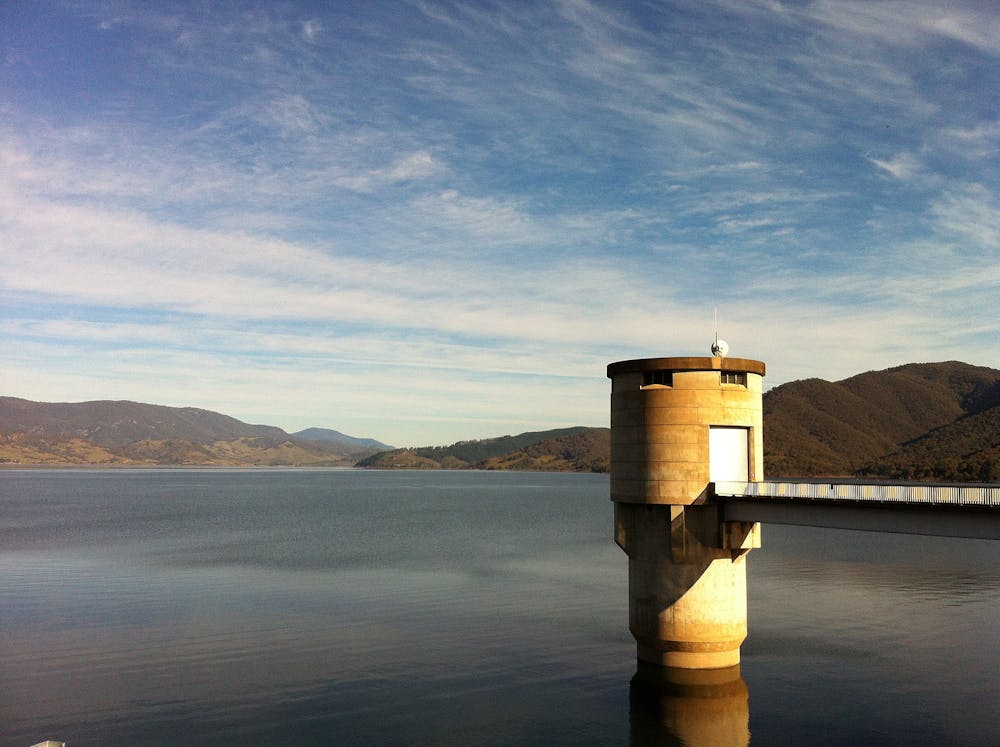
Blowering Reservoir from Blowering Dam, part of the massive Snowy Mountains Scheme constructed between 1949 and 1974.Wikimedia Commons
They lost office before they could implement Professor Sam Wadham’s massive Rural Reconstruction Scheme. But they also believed that the future depended on education and research, establishing our first research university, the Australian National University, to be a Princeton in the Pacific.
They inaugurated Commonwealth Scholarships and research funding. Our first PhDs began to graduate, and our academic gaze turned away from Oxbridge towards our Asian neighbours for the first time. They invested in the CSIRO. Another term of office may have delivered a national health service. We had to wait almost another 40 years for Medicare, but the four years after the war set up modern Australia.
A new accord?
This story is important to retell because it gives us hope — and a model. We need national reconstruction again: to transition to renewable energy, to restore fairness and security to our economy, to rebuild our rural and regional sectors that are beset by poverty, environmental stress and long-time marginalisation.
Climate change imperils our food security as it does our natural environment and wildlife. If we are to reconstruct Australia as a sustainable economy and society, then perhaps 60% of that effort needs to be in the bush.
National reconstruction requires political will, and political will needs a measure of bipartisan support to be effective. Menzies followed the social democratic Labor lead — social housing, support for universities, infrastructure construction. In the 1980s, the Prices and Incomes Accord was struck between unions and employers under the leadership of the Hawke Government. The accord lost its way after time, but initially it did bring down unemployment and inflation, in return for Medicare and new social transfers.
Bob Hawke, pictured here on election night in March 1983: his government struck a prices and incomes accord between unions and employers.National Archives of Australia
A new accord would be a different social contract. It would require a summit as before, after consultation and planning. It could be led by First Nations people with a mission to heal the nation and the land, starting with the Uluru Statement from the Heart.
This time its participants would be drawn from across the spectrum: farmers, business big and small, unions, universities and research, state and local government, the health and welfare sectors, culture and the arts. (Universities have played a vital role in changing course for this country in times of crisis and will do so again, just as their researchers, along with the CSIRO, are leading the fight against COVID-19.)
The accord itself could be a commitment to the guiding principles of the United Nations Sustainable Development Goals, which connect social and economic justice to environmental justice.
This new accord would be a commitment to principles of practice that open doors to funding, tax incentives, advice and collaboration among sectors to build a new sustainable economy, turning Australia into the renewable energy powerhouse that the distinguished economist Professor Ross Garnaut envisages.
A wind farm near Bungendore, 40km east of Canberra.Mick Tsikas/AAP
There would be no compulsion for businesses to sign on, but if they chose to be outside the tent, then they would not receive any benefits and opportunities.
Likewise, government’s role is not to take the lead on every issue — it can’t, because it doesn’t have expertise to match that already in the community. Rather, it is to ensure that law and order prevail, that there is no corruption or favouritism. We have forgotten the power of the law to bring about social as well as judicial justice.
No nation can truly flourish if its hinterland is degraded and unproductive. Global warming threatens our food security, our pastoralists and, as we saw in the summer of 2019–20, our forests and native wildlife. National reconstruction needs not merely to be bipartisan at the top: it must offer genuine participation in decision-making in how to transition to new industries and farming technologies.
Joeys rescued from the summer bushfires. Global warming threatens our native wildlife.RSPCA
We may need to start growing some crops under cover in highly controlled environments with careful water use and no pesticides. If the Netherlands can become the world’s second-largest food exporter after the United States, then we, too, in a more environmentally sensitive way than the Dutch, can build a high-tech food exporting industry that could replace coal and help feed a hungry world.
To do all this, we need a partnership between farmers, the private sector, workers, government and universities. If employers are to receive funding and research support from the public sector, then as their part of the accord they should commit to providing secure jobs and vocational training. They must be prepared to negotiate improving wages and support more generous welfare provision.
Above all, they need to endorse a government-funded Jobs Guarantee to get people back into the workforce with dignity and security: that is, real jobs with award wages, not work for the dole. The economy will not ‘bounce back’ if no one has money in their pocket.
It is to be hoped that the pandemic will bring an end to the distrust of science and learning that neo-liberalism has spread like poison through the rich world.
It will be time to rethink the tertiary and vocational sectors and fund research infrastructure in universities, alongside restoring the CSIRO and providing more job security for researchers. Our universities could then return to being servants of the public rather than fragile, semi-private corporations.
All this is fiscally possible if we accept that we can only pay back the debt by economic growth. Artificially balancing the budget via austerity leads to further impoverishment; investing in people and their enterprises to get on with it restores prosperity so that we can grow our way out of debt.
A fresh narrative
Government cannot do it all. Business is the larger part of society, and reconstruction cannot be done without their cooperative engagement, expertise, creativity and resources. But what is possible with the new accord is not a series of precise prescriptions for reform, but rather a narrative that can capture the trust and enthusiasm of an electorate that is disenchanted with politics and politicians.
Denise Bowden, Yothu Yindi CEO, signing the Uluru Statement from the Heart, in Central Australia in 2017. A new accord could be led by First Nations people with a mission to heal the nation and the land.Australian Human Rights Commission/flickr
People want our leaders to “come together”. The “Green New Deal” is an American idea; the United Kingdom wants a “green industrial revolution”; but we in Australia know how to strike accords and build institutionalised fairness.
Perhaps it does not matter what we call it: perhaps First Nations people will one day permit us to use their term Makarrata to express a new national social compact. We need to reconstruct Australia, better than we have before, and we need to do it for our very survival.
No one—no politician, no scientist, no economist, no bureaucrat, no business leader, no farmer, no pundit and no political party — has all the answers. But collectively we do, provided we can devolve consultation and much decision-making to the communities and regions directly affected. That will build resilience and draw on the experience and knowledge of those who are experts in their own worlds.
The great power of the human mind is that it can work with other minds: our greatest strength lies in each other.
This is an edited extract from What Happens Next? edited by Emma Dawson and Prof Janet McCalman AC, published by Melbourne University Publishing.
Source: The Conversation (Au and NZ) – By Dominic O’Sullivan, Adjunct Professor, Faculty of Health and Environmental Sciences, Auckland University of Technology, and Associate Professor of Political Science, Charles Sturt University
New Zealand, Australia, Canada and the United States were the only UN members to oppose the declaration when it was adopted in 2007. They were worried about the constraints they thought it would place on state authority, in particular over Indigenous land.
All four have since changed their positions. In 2010, then New Zealand Prime Minister John Key argued:
While the declaration is non-binding, it both affirms accepted rights and establishes future aspirations. My objective is to build better relationships between Māori and the Crown, and I believe that supporting the declaration is a small but significant step in that direction.
The state’s right to govern is not absolute
The declaration recognises the state’s right to govern. But it also constrains it by recognising self-determination as a right that belongs to everybody — to Indigenous peoples as much as anybody else.
Self-determination has far-reaching implications for rights to land, language and culture and for government policy in areas such as health, education and economic development.
The declaration’s 46 articles challenge the idea of state sovereignty as an exclusive and absolute right to exercise authority over Indigenous peoples. It parallels New Zealand’s Treaty of Waitangi by affirming Indigenous peoples’ authority over their own affairs and their right to meaningful influence as citizens of the state.
The fact that 144 UN member states voted for the declaration shows that the international community regards these assumptions as fair and reasonable. The declaration states:
Indigenous peoples have the right to maintain and strengthen their distinct political, legal, economic, social and cultural institutions, while retaining their right to participate fully, if they so choose, in the political, economic, social and cultural life of the State.
Indigenous people’s right to make their own decisions
The declaration provides different ways of thinking about political authority. The Māori right to make their own decisions, through iwi (tribes) and other independent institutions, and to participate as members of the wider political community implies a distinctive Māori presence in the sovereign state.
The Waitangi Tribunal, which was established in 1975 to hear alleged breaches of the Treaty of Waitangi, is a forum for thinking about these questions. In a tribunal report concerning Māori culture and identity, Justice Joe Williams, subsequently the first Māori appointed to the Supreme Court of New Zealand, argued:
Fundamentally, there is a need for a mindset shift away from the pervasive assumption that the Crown is Pākehā [non-Māori], English-speaking, and distinct from Māori rather than representative of them. Increasingly, in the 21st century, the Crown is also Māori. If the nation is to move forward, this reality must be grasped.
From this perspective, the Crown is an inclusive and unifying institution. It is neither the Pākehā political community, nor the dominant party in a bi-cultural treaty partnership.
Beyond partnership to independence and authority
In 2019, the state’s solution to allegations of racist and ineffective practices in its child welfare agency Oranga Tamariki was to call for stronger partnerships between Māori and the state.
It is too early to say whether partnership agreements will reduce the numbers of Māori children taken from their families into state care.
But in 2020 independent reports into Oranga Tamariki show measures more robust than partnership may be required to assure Māori of the declaration’s undertaking that:
Indigenous peoples have the collective right to live in freedom, peace and security as distinct peoples and shall not be subjected to any act of genocide or any other act of violence, including forcibly removing children of the group to another group.
Claims to the Waitangi Tribunal, arguing for independent authority in health and education and ensuring that Māori benefit fully from international trade agreements, have had mixed success for the Māori claimants. However, the declaration gives international authority to the arguments made.
Indigenous peoples have the right to determine and develop priorities and strategies for exercising their right to development. In particular, Indigenous peoples have the right to be actively involved in developing and determining health, housing and other economic and social programs affecting them and, as far as possible, to administer such programs through their own institutions.
A colonial state may never be just. But as New Zealand considers its implementation of the declaration, the important moral question is whether the declaration can help people to work out what a state will look like if it no longer reflects the colonial insistence on power over others.
Australians belonging to the vaccine refusal movement consider themselves a science advocacy group, according to a study published today.
My colleagues and I found this group believes it lobbies for unbiased research against increasing industry interference. We also found vaccine refusers construct their identities around developing health literacy, engaging with science and being informed when making decisions about their health.
Other research shows people who refuse vaccines seek to take control of their health decisions. And conversely, they think people who follow public health advice to vaccinate lose out by not educating themselves.
It may be tempting to dismiss these self-perceptions. But that would be to miss the point.
The vaccine refusal movement is a loosely connected community that organises to resist vaccination programs. Not all Australians who refuse vaccines are part of the movement. There is great diversity in the extent to which people refuse vaccines, and in their reasons for doing so.
On average, Australians who refuse vaccines know more about vaccination than do those who fully vaccinate, perhaps because their scepticism prompts them to seek out information. They access both mainstream and alternative vaccine information. People who refuse vaccines are often more likely to have higher health literacy.
Refusing vaccines is risky, and it can be linked to problematic health beliefs and behaviours. But people who refuse vaccines also embody many traits we desire among modern patients, including seeking to be informed, engaged and empowered in their health decision-making.
Australians who refuse vaccines tend to have higher health literacy than the average citizen.Neil Hall/EPA/AAP
The public and policy makers often treat health literacy as an antidote to health conspiracy movements like the vaccine-refusal movement.
Pro-vaccine Australians generally think vaccine misinformation is only accepted by people who are too foolish or too health illiterate to know better.
The president of the Australian Medical Association, in response to growing vaccine refusal, called in May for educational resources to help Australians “differentiate the good from the bad and the downright deadly”.
After all, it makes a lot of sense. Increased public health literacy often leads to improved health. Evidence suggests it can correct some beliefs in health misinformation. It’s easy to assume that all Australians would be pro-vaccine, if only they had adequate health literacy and critical thinking
Higher health literacy is unlikely to counter refusers’ beliefs
As far as we know, people who refuse vaccines use their health literacy skills to dive deeper into vaccine information, develop more sophisticated views and greater confidence in those views.
But health literacy doesn’t appear to make pro-vaccine evidence look more convincing to refusers. In fact, when people who distrust vaccination also have higher health literacy, they are even more likely to choose information that matches their biases, and to think that information supports their beliefs. Indeed high health literacy seems to help reinforce anti-vaccination beliefs among people who refuse vaccines.
Vaccine refusers’ “pro-science, health literate” identity is not benign. In their eyes, it makes them highly credible, which helps them resist public health messages. It also makes them look more credible to others, who may in turn be persuaded to question vaccines.
We need to understand the limitations of health literacy
People who refuse vaccines sometimes hold different health beliefs compared with people who accept vaccination, and lean towards conspiracies (though sometimes they don’t).
But their views are built on mainstream trends. These include trends towards consumer-driven health care, exposure to alternative health paradigms, distrust in “big pharma” and in government.
If people who refuse vaccines can go down health misinformation “rabbit holes” despite having high health literacy, it’s feasible any of us could also be misled by health misinformation.
We undoubtedly need higher public health literacy in Australia. It has clear and well established benefits. But the vaccine-refusal movement shows we may be placing too much faith in health literacy as a solution for health misinformation. It also shows we need to understand its potential to lead some people to internalise harmful health beliefs.
This understanding is sorely needed amid the COVID-19 “infodemic”, where we are confronted with an overwhelming amount of health information. It’s particularly crucial given the public needs to understand and accept credible information to follow public health directives to slow the spread of the virus.
Winston Peters has long been described as a populist, both in New Zealand and internationally. At different times during his career he has embraced the label.
As he said recently, populism to him “means that you’re talking to the ordinary people and you’re placing their views far higher than the beltway and the paparazzi”.
But across much of the world, political analysts and commentators see the politics of populism as a menace. Parties described as populist are often associated with the radical right, authoritarianism, xenophobia and a rejection of pluralism and diversity.
While Peters and New Zealand First have sometimes leaned in those directions, it’s been inconsistent and intermittent. The party has retained a significant number of Māori among its MPs, members and voters — including, of course, Peters himself.
At this point in the election campaign, however, New Zealand First’s problem is not populism but popularity. Polls show its support significantly below the 5% it needs to stay in parliament. Where have those voters gone?
Two populisms: Jacinda Ardern and Winston Peters shake hands during a coalition agreement signing after the 2017 election.GettyImages
Populism of the left
In our recently launched book on the 2017 New Zealand general election, drawing on data from the New Zealand Election Study (NZES), we argue that populism has another side: in its origins as a social movement, populism was of the left, not the right.
James Carroll, NZ’s first Māori deputy (and twice acting) prime minister.National Library of New Zealand, CC BY-NC
Those who originally called themselves populists sought to mobilise and unite the vast majority of people to challenge the excessive economic and political power of a narrow elite. This form of democratic populism emerged in New Zealand in a wave of reforms that, by the 1890s, had made the young country one of the first fully fledged representative democracies in the world.
Populism flowered under the Liberal governments of the early 20th century, personified by the prime minister Richard Seddon (“King Dick”). His government championed the interests of the working class and small farmers by encouraging trade unionism and breaking up the big estates held by the colonial rich.
The Liberals were less successful at defending the interests of Māori. But New Zealand’s first Māori deputy prime minister and sometime acting prime minister was Liberal MP James Carroll (Ngāti Kahungunu) — not Winston Peters.
We define populism in two senses: first, as a set of democratic norms that takes seriously the idea of “the sovereignty of the people”; second, as rhetoric that uses populist language to attract support, but not necessarily for populist ends.
We also argue that it is necessary to distinguish between authoritarian or exclusionary populism, which seeks to divide the people by ethnicity or national origins, and inclusive populism, which seeks to build majorities on the foundations of what most members of a society have in common.
We found that in 2017 New Zealand populists were located predominantly on the left, with few exhibiting authoritarian views. For the minority of voters who expressed preferences for both populism and authoritarianism, their party of choice tended to be New Zealand First — the party that in 2017 won just over 7% of the vote and is now polling at 2% or less.
So, does the decline in support for New Zealand First in 2020 represent a shift in populist sentiment?
Where have authoritarian populists gone?
New Zealand First’s brand of populism over the past three years has shifted between the exclusive and the inclusive. In the 2017 election campaign, the party’s rhetoric was true to form, focusing on reducing immigration and a desire to give more voice to the regions.
NZES data show the majority of New Zealand First voters wanted the party to form a coalition with National, but a sizeable minority also wanted to see political change. Indeed, New Zealand First’s campaign policies in 2017 were closely aligned with Labour’s, with a few exceptions: water quality and climate change mitigation being the two most clearly incompatible.
Our study shows that in 2017 New Zealand First appealed to voters who were older, Pākehā, male, on low incomes and lived outside the major cities.
In the end, New Zealand First entered into a government with Labour, led by Jacinda Ardern, a relatively young woman whose rhetoric, feminism and policy orientation aligned with a more inclusive version of populism. This challenged some New Zealand First voters but won over others.
More recently, the issue of immigration has all but disappeared from the political agenda, removing New Zealand First’s key populist plank. Peters has been championing various versions of border reopening over the past three months, suggesting he may be an internationalist at heart, at least when the economy is at stake.
It’s too early to be sure where New Zealand’s small percentage of authoritarian populists have gone. Are they the roughly 2% that remain committed to New Zealand First? Or has National Party leader Judith Collins’ aggressive labelling of Labour as anti-farmer and anti-aspirational been gaining traction?
Or has the resolve with which Labour closed the borders struck a chord with New Zealand First’s authoritarians? Some recent polling analysis suggests much of the 2017 New Zealand First vote has indeed shifted to Labour.
National Party leader Judith Collins: has her aggressive campaigning taken authoritarian populist voters away from New Zealand First?AAP
The rise of moderate populism
Our analysis of the 2017 election reveals Ardern’s inclusionary campaign rhetoric was appealing. Voters found her likeable, competent and trustworthy. She also struck a chord with the onset of COVID-19. Her phrase “a team of 5 million” clearly evoked the populist ethos.
Trust in Ardern’s leadership, despite the centralised nature of our political institutions, has remained high. At the same time, satisfaction with our political process has not declined as it has in the other democracies, making a spike in authoritarian populism even less likely.
Those who fear and lament populism tend to see only the dark side of the phenomenon and often discount the idea that “the people” represent anything other than a threat. Liberal democratic critics of populism therefore admire or hanker after constitutional checks to insulate governments from public opinion.
While we concede that protection of human rights requires some limits on majorities, our analysis of contemporary New Zealand politics indicates that the best antidote to authoritarian populism is a democratic and inclusive form of moderate populism.
Certainly Ardern’s version of moderate populism has proved popular. With immigration not a focus this election, New Zealand First’s appeal to authoritarian populist voters appears to have all but disappeared. To know where these voters go next we will need to wait for the results of the 2020 New Zealand Election Study.
The royal commission into aged care has said government did not prepare the sector well enough for the pandemic.
In a damning report the commission rejected the government’s repeated claim it had a plan for aged care, which is a federal responsibility.
The commission said that now “is not the time for blame” for what happened in aged care, where most of the Australian deaths have occurred – as at September 19, 629 out of 844 total deaths. The latest number of deaths from residential aged care is 665.
But, the commission said, it was clear the measures implemented by the federal government on advice from the Australian Health Protection Principal Committee “were in some respects insufficient to ensure preparedness of the aged care sector”.
It called for immediate action on infection prevention and to ensure residents weren’t cut off from visitors.
In its special report into COVID, the commission said the government should establish a national aged care plan and a permanent aged care advisory body.
Under pressure from evidence to the commission, the government belatedly set up an advisory committee in August but made it clear it was temporary.
As soon as the report was tabled on Thursday, Aged Care minister Richard Colbeck said the government was accepting all its recommendations.
But he continued to insist the government did have a plan for the sector.
“Never before has the aged care sector in Australia faced a challenge like COVID-19,” the report said.
It said the government should fund providers to ensure there were adequate staff available to deal with visits from family and friends.
The understandable restriction of visits “has had tragic, irreparable and lasting effects which must immediately be addressed as much as possible”.
“Maintaining the quality of life of those people living in residential aged care throughout the pandemic is just as important as preparing for and responding to outbreaks,” the report said.
“Funding to support increased visits is needed immediately.”
The commission recommended the Medicare schedule be changed to increase the provision of allied health and mental health services to residents during the pandemic, and the government should “arrange for the deployment of accredited infection prevention and control experts” into facilities.
Announcing $40.6 million as an initial response, Colbeck said the government was already well progressed in delivering some of the recommendations.
The commission said that “confused and inconsistent messaging” from providers, the federal government, state and territory governments had been themes in submissions to it.
“All too often, providers, care recipients and their families, and health workers did not have an answer to the critical question: who is in charge?
“At a time of crisis, such as this pandemic, clear leadership, direction and lines of communication are essential”.
The commission said much had been made during its hearing about whether there was an aged care specific plan for COVID.
“There was not a COVID-19 plan devoted solely to aged care. But there was a national COVID-19 plan that the Australian Government sought to adapt and apply to the aged care sector.”
However “there is a clear need for a defined, consolidated, national aged care COVID-19 plan”.
The commission said the recommended plan should establish federal-state protocols, maximise the ability for residents in facilities to have visitors, and establish a mechanism for consultation with the sector about the use of “Hospital in the Home” programs.
It should establish protocols on who would decide about transfers to hospitals of residents with COVID, and ensure significant outbreaks were investigated by an independent expert, with the results disseminated to the sector.
The commission said the government should report to parliament no later than December 1 on the implementation of the recommendations in its report.
The pandemic is the worst of times to be governing but Scott Morrison is determined to make it the best of opportunities to be seen to be doing things.
It’s also the most difficult period to be an opposition. In contrast to Morrison, Anthony Albanese is struggling to find any political chances.
The government has used the last nearly three weeks to launch a tsunami of policies in the run up to Tuesday’s budget. We’re seeing a reform agenda, although it’s not big bang stuff.
Labor complains about particular measures and keeps calling for “a real plan” for recovery but it is not cutting through.
In theory, such an age of anxiety could play for the government, or for its critics. In practice, it has elevated Morrison (and premiers too) and swamped Albanese.
The recent policy announcements include a clutch of initiatives on fuel storage, energy and emissions reduction, upgrading the NBN, a digital business plan, relaxing restrictions on credit assessments, a revamped insolvency regime, and a manufacturing plan.
There are several takeouts from this hyper-activity. Morrison favours both intervention and deregulation. He’s big on “road maps” (in energy, manufacturing) but wary of tying himself to long term destinations. He’s untroubled by what was previously said and done by his own side.
Morrison isn’t called “Scotty from marketing” for nothing. Policy releases are carefully controlled. They’re given to the newspapers in the afternoon on an embargoed basis – no comment can be sought. They then dominate the morning headlines, surf through the news day, and usually are on that night’s TV.
The $1.5 billion manufacturing blueprint Morrison announced on Thursday selected six areas for special assistance. In terms of sectors, it is unashamedly picking winners.
The energy policy embraces one big controversial winner – gas. “If you’re not for gas, you’re not for jobs in our manufacturing and heavy industries,” Morrison says, in bold overstatement. Specific new and emerging emission-reduction technologies have also been nominated for encouragement.
The government’s preoccupation with removing what it sees as excessive regulation stretches from environmental approval processes to borrowing to buy a house.
Last week’s decision to free up access to credit by easing the checks banks have to make on borrowers aims to help stimulate the economy. The government brushes off fears it could lead to people financially over-extending.
The energy policy concentrates on the immediate and medium term; Morrison refuses to embrace a 2050 target of zero net emissions, despite this being accepted by a wide range of stakeholders and countries. One reason is he doesn’t want to stir dissent in his ranks.
In its commitment to an NBN upgrade, embracing fibre running past homes that will be able to connect for a price, the government argues it is following a course it had in mind from the start. Some commentators agree; the more common interpretation has been this is belatedly catching up with a version of what the Labor government planned.
There are more policy changes to come, notably in industrial relations although we don’t yet have a fix on how far the government will be willing to go in stirring that hornets’ nest. Morrison was bellicose about the waterfront dispute this week.
Much of the reform program needs legislation – for measures due to start early next year, this will require some parliamentary haste. The senate crossbench is easier for the government than it once was, but not a pushover.
An immediate test will be an earlier announced reform – the proposed (and contested) restructuring of higher education fees, due to start in 2021.
Aged care is looming as one of the most challenging reform areas the government must tackle, where it is hostage to a royal commission Morrison set up.
COVID is a “stress tester” – it locates systemic weaknesses. Morrison has highlighted this in relation to Australia’s supply chains. The PM promised “sovereign manufacturing capability plans” in vulnerable areas. They’re likely to be assisted through procurement and contracting arrangements.
The pandemic also exposed a very different sort of vulnerability, in the nation’s nursing homes. Here we saw the result of years of loose regulation, inadequate staffing requirements and poor oversight.
The aged care royal commission in a special report on COVID tabled on Thursday said the government should establish a national aged care plan for COVID and a permanent national aged care advisory body.
The report’s various recommendations have been quickly accepted but these stick in the government’s craw because it has insisted it had a plan and that the advisory group it (reluctantly) set up was temporary.
What’s happened in aged care is a disgrace – comprehensive reform is imperative after the commision’s final report early next year. It will require more money but that’s only part of it. Much better and tighter regulation is vital and there is a wider issue about the “for profit” industry.
Looking to the other side of politics, in textbook terms Albanese has done what an opposition leader should do in the first half of a term. He has outlined broad approaches to policy in so-called “vision statements”. Not unreasonably, he hasn’t wanted to be tied down to detail, especially in such quickly-changing times.
But he’s up against it. His party is split on energy/climate policy, and it’s increasingly hard to paper over the wide rift between resources spokesman Joel Fitzgibbon and climate change and energy spokesman Mark Butler.
Butler is seen much less than he used to be. Fitzgibbon is bluntly outspoken.
This clash has the potential to become dangerously destructive for the opposition. Climate is one of Labor’s core issues. If compromises that accommodate both Butler and Fitzgibbon can’t be found, the falling out could be extremely serious for the party. Fitzgibbon has floated the threat of leaving the frontbench.
Labor’s critiques of the government encounter two hurdles. Firstly, with so much happening, and Morrison occupying such a huge political space, people aren’t listening to the opposition.
Secondly, the public are still not in a mood for partisanship. The opposition has felt it necessary to dial up the conflict metre but that does not match where people are at.
Of course the dynamics will change when the election gets close.
The poll (due early 2022) could be late next year. That is still a long way off. Politicians tend to be in-the-moment sort of people and Labor MPs are frustrated their attacks are having little impact.
On the other hand, from Albanese’s point of view, a possible late 2021 election is frighteningly close, given he has yet even to begin to establish himself as a strong alternative.
All this makes Albanese’s budget reply next Thursday more than usually important for Labor. The speech is being talked up as policy-rich. Budget week is the government’s, but Albanese knows his performance is also crucial, to show he’s still in the game.
There’s a telling scene in Peter Bogdanovich’s 1972 screwball comedy What’s Up, Doc? in which a judge asks an academic to tell the court what kind of doctor he is. When he responds “music”, the judge then demands to know whether he can “fix a hi-fi”? The answer is, unsurprisingly, “No”.
The scene works as comedy, one imagines, because few people outside schools of music or humanities departments have much of an idea what a practising doctor of music (or “musicologist”) actually does.
As it happens, music is one of the original fields of study for a university. It formed part of a group of four of liberal arts subjects (known as a quadrivum) along with arithmetic, geometry, and astronomy.
The Lute Player by Caravaggio (1595). Music was once one of the original fields of study for a university.Wikimedia Commons
This is because, according to Ancient Greek natural philosophy, music had an especially deep connection to the natural world.
It was believed the production of consonant harmonies (combinations of sounds that are agreeable to the ear) involved simple numerical ratios that were mirrored in the motion of the planets.
By the time universities were founded in Australia, the Copernican Revolution had long consigned such esoteric speculation to history. Music was reduced to having a much more marginal place in a typical university curriculum, if it appeared at all. Instead, a new institution, the “conservatorium”, arose, focused on elite performance training, not music scholarship.
In 1895, the founder of Melbourne’s first conservatorium, Professor George W. L. Marshall-Hall, nevertheless recognised that an ideal higher education in music needed to be more than just about producing graduates who could perform to a high standard.
Portrait of George Marshall-Hall painted by Tom Roberts in 1900.Wikimedia Commons
He argued musicians needed also to be able to understand their art form in its broader historical and cultural context. Music graduates should not just be performers, but also historians, analysers, critics, and explorers of the musical culture they inhabited.
This is what the discipline of musicology, broadly conceived, aims to do.
Marshall-Hall’s vision owed more than a little to the ideas of the Prussian scientist and educational reformer, Wilhelm von Humboldt (1767–1835). Humboldt argued the transmission of technical knowledge alone was not a sufficient foundation for a fully rounded higher educational system.
He believed a modern university needed to include the study of the “speculative sciences”: disciplines such as fine art, music, and philosophy. Equally as crucially, all these fields should be advanced through research.
The rise of ethnomusicology
Ethnomusicology arose as a separate disciplinary area towards the end of the 19th century. Concerned principally with the study of music in its social context, it is especially (but not exclusively) interested in popular, folk, indigenous, and non-Western musical cultures.
Percy Grainger (pictured here in 1915) was a pioneer ethnomusicologist.Wikimedia Commons
Monash’s Professor Margaret Kartomi is widely acknowledged as Australia’s leading ethnomusicologist. Her work centres on the diverse music cultures of Australia’s most populous neighbour, Indonesia.
Only last year, Kartomi was awarded the Guido Adler Prize – a prestigious international prize named after one of the pioneers of modern musicology – for her outstanding contribution to research and teaching in this field.
That her entire scholarly area might now be forced to “shut up shop” should be a matter of considerable concern.
A spokeswoman for Monash said this week the university’s musicology and theatre degree subjects were being closed “due to consistently low unit enrolments”. The staffing union, however, disputes this, saying musicology had healthy enrolments.
Whatever the truth of the matter, we know the impact of COVID-19 on Australian university finances – caused by the loss of revenue from international students – is profound. But must it serve to dictate what universities teach our students for what might be generations to come?
‘The big issues’
Sure, musicologists and ethnomusicologists might not be able to repair a hi-fi, but what they can do, as Monash’s own website trumpets, is engage with “big issues” such as:
Why does music matter? How do understandings of music differ across time, place and culture? How can we help facilitate the sustainability of diverse musical knowledge and practice across the planet for future generations?
Last week, a joint letter signed by over 70 music academics from across the UK, Ireland, Europe, USA, India, Japan, and Australia, was sent to Monash Vice-Chancellor Professor Margaret Gardner.
It asked if there were compelling scholarly and educational reasons for the abolition of these specialisations, and if so, urged the university to make those reasons known. Otherwise, Monash should reconsider its decision.
In fact, the Monash proposal should give us all pause to consider just what kinds of knowledge, ultimately, we still want our public universities to preserve, discover, and teach.
Today ABC, BBC Studios and Screen Australia announced series three of the award-winning animation series Bluey will commence production in Brisbane later this year.
But despite Bluey’s global success, policy changes announced yesterday mean that we may see fewer Australian-made children’s shows on broadcast TV in the future.
The federal government has scrapped quotas for minimum hours of local children’s content for commercial television networks. Foxtel’s obligation to Australian content has also been halved.
These changes represent a rapid unravelling of regulatory infrastructure established in the 1970s — and refined over decades — to support production and broadcast of quality Australian children’s content.
Responding to the policy changes, Australian Children’s Television Foundation (ACTF) CEO Jenny Buckland explained:
The argument about children’s content quotas has been going ever since they were introduced nearly 40 years ago. The broadcasters never wanted to do it and they didn’t treat the shows well.
Under the existing system, commercial networks must abide by strict requirements to broadcast a certain amount of children’s content each year: 130 hours for pre-school children, and 260 hours for children under 14, including at least 25 hours of new drama.
From 2021, commercial networks will have no such obligation.
Children’s content quotas were suspended in April 2020, a decision Minister for Communications, Cyber Safety and the Arts Paul Fletcher said was in response to COVID-19.
Now a decision initially described as “an emergency red tape reduction measure” has been enshrined into policy.
Locally made kids’ shows like Round the Twist remain popular, 30-odd years since their first airing.IMDB
The government’s decision to remove children’s quotas responds to intense lobbying from commercial networks. In February 2020, Seven declared it planned to halt the production of Australian children’s content, a decision that would likely have resulted in a breach of children’s content quotas in 2021 if the current system was sustained. Seven’s Chief Executive explained he wanted the government to take “immediate action” to remove the quotas.
ACTF CEO Jenny Buckland notes that over the past decade, commercial broadcasters have halved their spending on children’s drama. International co-productions also count towards the quotas, resulting in a surfeit of “co-produced animated series based on international concepts”.
The networks also argue the rising popularity of streaming services has made the quota system outdated. Indeed, an increasing number of Australian children are turning to streaming services such as Netflix and YouTube, however the Australian Communication and Media Authority’s research has found that children still watch broadcast TV programs made specifically for them.
Bluey is the most popular show in the history of the ABC’s streaming app ABC iView, demonstrating there is demand for quality local children’s content.
But rather than seeing this as an endorsement, commercial broadcasters claim the popularity of children’s content on the ABC diminishes the need for quotas.
Budget restrictions make the ABC’s track record of quality local children’s content difficult to sustain. Government analysis in 2017 raised concerns that the ABC may have “reduced its commitment to producing children’s content”.
Despite the ABC’s role in broadcasting quality Australian content, and even directly helping with remote education during the pandemic, the government has pressed pause on the indexation of ABC funding until July 2022. This means by end of the financial year (2020–21), the ABC’s operational funding base will have reduced by 10% since 2013.
Children’s content was a key target of a recent round of redundancies at the ABC. June saw the closure of Melbourne children’s division ME TV and the cancellation of kids’ show Definitely Not News. The Media Entertainment and Arts Alliance warns changes to production quotas could “mean the demise of children’s content on commercial TV, leaving a cash-strapped ABC to pick up the slack”.
Definitely Not News was cancelled in June.
Defending local children’s TV
The government has announced a welcome A$20 million in funding for the ACTF for children’s content, supplemented by $30 million in funding for Screen Australia.
Jenny Buckland notes,
we’ll be working very hard with producers to try and open those commissioning doors to new content, and tracking what happens to production over the 2-year period.
Perhaps this funding will stave off the end of local children’s content for now. Though the policy and budgetary ecosystem that supports a robust domestic children’s content sector is in flux, Buckland is still hopeful:
… there needs to be Australian children’s content on all the places that children go to watch content — that includes having well-resourced public broadcasters with a major commitment to kids, as well as content on commercial video-on-demand platforms and other destinations. We were hoping there would be Australian content expenditure requirements on these platforms, and the door might still be open for that.
There’s no shortage of scientific studies projecting a bleak future for the planet and her people, but none have led to real change. It’s clear we need better ways to envisage the futures we want.
Take, for example, the current review of Australia’s federal environment law. Among its recommendations are that developers consider the effect of their project on “specified climate change scenarios” — essentially computer-generated models of the future. These models are important. But achieving a radically different tomorrow will require more than a purely technocratic approach.
As we argue in our recent paper, our imaginations allow us to engage with emotions that motivate action, such as hope, fear and grief. Can we imagine a future with no koalas or orange-bellied parrots or wollemi pines? Or of bushfires that destroy the natural wonders of our childhoods?
Storytelling can help in this task. In the following vignettes, we’ve imagined three possible futures for Australia. They involve different challenges, trade-offs and worldviews. We hope these stories stimulate new ways to consider the consequences of our current decisions and actions. So now, imagine you are in the year 2050 …
Can we imagine a future of childhood wonders lost?Shutterstock
1. Basic needs
You sit in a communal kitchen as you sip your low-food-mile oat latte. You watch the news through a holographic vid-cast floating beside you.
Governments and societies have prioritised equality and social welfare over consumerism and industrialisation. The myth of trickle-down economics has been exposed. Countries have turned to localised food production. Reduced consumption, trade and travel have caused carbon emissions to flatline, but it may be too little too late.
Your vid-cast tells of winter bushfires in Tasmania and water shortages in all Australian capital cities. You wonder if more spending on technological innovation might have averted these crises.
Nature considered “useful” is doing well. Brisbane’s restored mangroves are flourishing; the city no longer floods, even with sea-level rise. But there is little funding to protect wildlife, and iconic species such as mountain pygmy possums are extinct.
Would better technology have averted catastrophic bushfires?Warren Frey/Tasmanian Fire Service
2. Wildlife rules
You wake up with lab-engineered coffee, then eat breakfast cereal grown at an indoor climate-controlled farm.
You log onto the annual Australasian Conservation Summit. A virtual reality tour takes you to the Great Western Sydney Reserve. There, koalas shipped from Kangaroo Island brought local populations back from the brink. Data from their geo-location tags confirm they now occur across their historic range.
You welcome preservation of this iconic species. But the region’s traditional Dharug clans were not consulted in setting up the reserve. You wonder why they continue to be excluded from walking the Country of their ancestors.
Australia has a significant wildlife-conservation sector, supported by the military, which has created many “green” jobs. But society as a whole is disconnected from nature: most people now experience it via zoos and tree museums.
Some wildlife species may be thriving, but the Great Barrier Reef is not. Global heating is worsening and the burning of fossil fuels continues. Successive years of extreme bleaching has left the reef all but decimated.
Under one scenario, the Great Barrier Reef has been decimated.
3. Climate first
You munch breakfast from locally farmed oats. As you inject your carbon-neutral caffeine hit into an arm vein, you feel a wave of nostalgia for a good ‘ol long black in a mug.
Thanks to radical technological solutions, the most catastrophic climate impacts have been averted. Global governance is now dominated by the ideologies of the Radical Climate Action Alliance. In 2021, environmental and human rights treaties were revoked in favour of the Climate First Charter.
In one imagined version of the future, wind farms decimate swift parrot numbers.Markets for Change
Your Unity BCI (Brain Computer Implant) receives drone footage from the alliance. It shows Australia’s red centre covered in solar farms, agricultural lands swamped by biofuel crops and South Australia’s Flinders Ranges dotted with nuclear reactors.
The clip closes with images of carbon-capturing radiata pines dominating vast landscapes of the Adani and Rocky Hill carbon sanctuaries. You wonder what it’s like inside — carbon sanctuaries are closed to all except the Carbon Rangers. Even Traditional Owners are excluded from the Country they sustained for millennia. Meanwhile, corporations benefit from green energy ventures while social inequality rises.
The Great Barrier Reef no longer suffers from summer bleaching events. But indiscriminately placed wind farms have brought the swift parrot and grey-headed flying fox almost to extinction.
None of these futures are inevitable. But exploring the logical conclusions of present-day attitudes and decisions can prompt us to ask: what futures do we want?
Together, the three scenarios raise questions such as whether:
revolutionary economic interventions should be used to address social inequality
local biodiversity should be valued only to the extent that it is useful to humans
iconic species and landscapes should be protected through fortress-style conservation, at the expense of local and Indigenous communities and direct climate change action
governments should prioritise climate action above all else, particularly via technological solutions
biodiversity matters only to the extent it can mitigate climate impacts.
Using our imaginations can help us decide the futures we want.Shutterstock
All this matters. Research shows projections of the future shape how problems are understood and communicated, and which strategies are developed to address them.
So how might this apply to the review of Australia’s environment laws? Further reform should involve a range of groups coming together to discuss questions such as: what do we value? What do we want to change? What trade-offs are we willing to make? By collectively deploying our imaginations, we may create better futures for all.
The pandemic has posed unprecedented challenges. Many of us have lost work, gained carer responsibilities and grappled with social isolation. Experts have warned of a looming wave of mental illness as a result.
Research suggests they’re largely correct. Surveys in Australia, the UK and the USA point to rates of depression, anxiety and suicidal thinking substantially higher than in previous years.
But over time, people have changed how they have responded to the threat of COVID-19. Google searches have shifted from the harm of the pandemic itself to ways of dealing with it, such as exercising and learning new skills.
This pivot points to a new focus on coping with COVID-19.
Many ways of coping
Copingis the process of responding effectively to problems and challenges. To cope well is to respond to the threat in ways that minimise its damaging impact.
Coping can involve many different strategies and it’s likely you have your own preferred ones. These strategies can be classified in many ways, but a key distinction is between problem-focused and emotion-focused strategies.
What’s the difference?
Problem-focused coping involves actively engaging with the outside world. This might mean making action plans, seeking further information about a threat, or confronting an adversary.
Emotion-focused coping, in contrast, is directed inward, attempting to change how we respond emotionally to stressful events and conditions, rather than to change them at their source.
Effective emotion-focused strategies include meditation, humour and reappraising difficulties to find benefits.
Less effective emotion-focused strategies include seeking distractions, denial and substance use. Although these tactics may stave off distress in the short term, they neither address its causes nor prevent its longer term effects.
Drinking to stave off distress is one example of an emotion-based coping strategy. But this way of coping doesn’t work in the long term.Shutterstock
Which is best?
Neither of these coping strategies is intrinsically more or less effective than the other. Both can be effective for different kinds of challenges.
Problem-focused strategies are said to work best when we can control the problem.
However, when we face an immovable challenge, it can be better to adjust our response to it using emotion-focused strategies, rather than battling fruitlessly against it.
But there’s more evidence around coping strategies to avoid. Rising levels of substance use during the pandemic are associated with greater distress.
Eating too many snacks and accessing too much COVID-related media have also been linked to higher levels of stress and depression. So these should be consumed in moderation.
Exercise might be a good strategy for coping with stress associated with the pandemic.Shutterstock
How can I tell if I’m not coping well?
We should be able to assess how well we are coping with the pandemic by judging how we’re going compared to our previous normal.
Think of yourself this time last year. Are you drinking more, sleeping poorly or experiencing fewer positive emotions and more negative emotions now?
If the answer to any of these questions is “yes”, then compared to your previous normal, your coping may not been as good as it could be. But before you judge your coping critically, it’s worth considering a few things.
Your coping is relative to your challenge
The pandemic may be shared, but its impacts have been unequal.
If you live alone, are a caregiver or have lost work, the pandemic has been a larger threat for you than for many others. If you’ve suffered more distress than others, or more than you did last year, it doesn’t mean you have coped less well — you may have just had more to cope with.
Experiencing some anxiety in the face of a threat like COVID-19 is justified. Experiencing sadness at separation from loved ones under lockdown is also inevitable. Suffering does not mean maladjustment.
In fact, unpleasant emotions draw our attention to problems and motivate us to tackle them, rather than just being signs of mental fragility or not coping.
We should, of course, be vigilant for serious problems, such as thoughts of self-harm, but we should also avoid pathologising ordinary distress. Not all distress is a symptom of a mental health problem.
Feeling distressed during the pandemic is to be expected and it can actually motivate us to tackle adversity. But watch out for serious problems.Shutterstock
Coping isn’t all about how we feel. It’s also about action and finding a sense of meaning and purpose in life, despite our distress. Perhaps if we’ve sustained our relationships and done our jobs passably during the pandemic, we have coped well enough, even if we have sometimes been miserable.
Social distancing and lockdowns have left us with a reduced coping repertoire. Seeking emotional and practical support from others, also known as “social coping”, is made more difficult by pandemic restrictions. Without our usual supports, many of us have had to cope with one arm tied behind our backs.
So remember to cut yourself some slack. For most people, the pandemic has been a unique challenge. When judging how well we’ve coped we should practise self-compassion. Let’s not make things worse by criticising ourselves for failing to cope better.
If this article has raised issues for you, or if you’re concerned about someone you know, call Lifeline on 13 11 14.
Source: The Conversation (Au and NZ) – By Patrick van Esch, Senior Lecturer in Marketing, AUT Business School, Auckland University of Technology
The latest poll shows a drop in support by New Zealanders for the recreational use of cannabis ahead of next month’s referendum on the issue.
The 1 NEWS Colmar Brunton Poll found only 35% of people polled said they supported the bill, down from 40% in June’s poll. Those who said they did not support the bill were at 53%, up from 49% in June. Another 11% either did not know or refused to answer.
National leader Judith Collins says the party caucus will vote no in the referendum. Prime Minister Jacinda Ardern has maintained a strict “no comment” on her voting intentions, despite admitting she once smoked cannabis “a long time ago”.
So with less than a month to go to the vote, if you’re undecided, here’s a list of the pros and cons of what the consequences could be.
Pros: taking control
Branding Pot/Shutterstock
1. Economic growth
Establishing a legal cannabis industry creates a range of skilled and unskilled jobs. It could generate more than NZ$640 million in tax revenue for the NZ government.
The cannabis industry is one of the fastest-growing job markets in the United States. In one year, cannabis retailers netted the state of Massachusetts US$393 million in gross sales.
Two years after launching a legal cannabis market, California has surpassed US$1 billion in tax revenue.
Prohibition has not stopped New Zealanders from using cannabis. Research shows 15% of men and 8% of women in NZ used cannabis over a 12-month period in 2012-13.
Legalising cannabis could save the NZ justice system a staggering NZ$11.4 million a year. Not to mention the social benefit of no longer incarcerating non-violent, otherwise law-abiding citizens who then have to cope with a life-long criminal record.
Māori have higher rates of cannabis use than non-Māori. Even accounting for higher usage rates, research found Māori are more likely to be convicted on cannabis charges then non-Māori.
By legalising cannabis, use becomes an issue of health and social welfare rather than a criminal one.
3. Improves access for health patients
Cannabis is used as therapy for a number of health applications. It has been legally available for medical use in NZ since April 2020.
Cannabis is used to treat nausea and vomiting, the common side effects of cancer treatment. It may be a therapy to treat epileptic seizures.
It has been used to treat muscle spasms among those with multiple sclerosis. It has also helped people alleviate chronic pain, headaches and anxiety.
If cannabis is legalised for recreational use, those using it for medical purposes will have greater access at a more affordable price.
4. Regulated for consumer safety
A standard requirement for legalised cannabis markets includes product testing, which means consumers know more about the products they are using.
Cannabis bought off the street can contain fungus, harmful substances, mould and pesticides. Mandatory testing ensures the cannabis is free of toxins.
To protect children in the United States from exposure to cannabis, Alaska, Colorado, Oregon and Washington all passed child-resistant packaging regulations.
Under New Zealand’s referendum, any retailers who sell cannabis to people aged under 20 would face serious penalties. To further deter youth, the NZ Drug Foundation, which is leading a yes vote, unequivocally supports the referendum’s inclusion of advertising bans.
5. Takes money away from street gangs
Over the past two-and-half years, street gangs in New Zealand have grown by more than 30%. The illegal cannabis market, estimated to be worth NZ$1–3 billion, potentially funds these gangs to some extent.
In Colorado in the US, 90% of the cannabis market is supplied under regulation. Over the past decade there, cannabis seizures by border control are at their lowest levels and their value has reduced by millions of dollars.
Legalising cannabis places control of the market in the hands of the government rather then criminals.
Overseas eyes are watching the referendum, which could go either way.Shutterstock/Maxx Studio
Cons: social and fiscal
Branding Pot/Shutterstock
1. Unknown costs for society and taxpayers
The long-term health effects are not fully understood. Similar to tobacco, the negative health consequences of cannabis might not be realised for decades. Again, in Colorado, for every cannabis tax dollar raised, its citizens spend US$4.50 to offset the negative effects of legalisation.
2. It will turn NZ’s youth to other drugs
A Christchurch Health and Development study shows adolescent weekly users of cannabis were 100 times more likely to use other illicit drugs.
Concerns have been raised about the level of influence the cannabis industry has over the drafting of legislation since its motivation is profit maximisation, not public health.
3. Workplace safety and productivity
A 25-year study in Norway shows workers who use cannabis are less dedicated to their work than those who don’t.
In the US, cannabis use by employees leads to increases in absenteeism, accidents, job turnover and worker compensation claims.
4. Bad for the environment
Cannabis plants require double the water needed to grow grapes for wine. Growing cannabis may cause deforestation, habitat destruction, river diversion and soil erosion.
When grown hydroponically, yearly greenhouse gas emissions in the US equal that of 3 million cars.
5. Property prices could rise, or fall
Once again in Colorado in the US, legalising cannabis was found to increase the value of property prices by up to 6%.
A separate study in Colorado found house prices could increase by up to 8.4% if they were within 160m of a retail outlet selling cannabis.
But 42% of Canadians believe a cannabis retailer will negatively affect their home values.
The median housing market price in NZ recently rose by 12% in one year. Further sharp growth could price many out of the market.
Still undecided?
There are just over two weeks to go now before New Zealanders vote on the cannabis referendum. If you still can’t decide, then head to the Prime Minister’s Science Adviser website for more information, or watch the video below.
Source: The Conversation (Au and NZ) – By Kate Fitz-Gibbon, Director, Monash Gender and Family Violence Prevention Centre; Associate Professor of Criminology, Faculty of Arts, Monash University
There are increasing calls to making coercive control a criminal offence across Australia.
It is important to recognise the serious impact of non-physical forms of domestic violence.
But this does not mean Australia is ready for a stand-alone offence of coercive control. In fact, it would be risky to introduce one at this stage.
What is coercive control?
The term, “coercive control” is used to capture the ongoing nature of domestic violence, where the abuse is not always physical but pervades a victim’s daily life.
It refers to a wide variety of abusive behaviours including social, financial, psychological and technology-facilitated abuse.
The killing of Hannah Clarke increased debate surrounding responses to coercive control.Sarah Marshall/AAP
It can include isolating a partner from their friends and family, restricting their movements, using tracking devices on their phone and controlling their appearance and access to money.
It has a devastating impact on victims’ independence, well-being and safety. It is the most common risk factor leading up to an intimate partner homicide.
Coercive control in Australia
In Australia, there is significant evidence about the nature and extent of coercive control. However, outside the specialist family violence sector, there is limited understanding of what it is and how best to respond to it.
While some states and territories recognise coercive control under civil law, Tasmania is the only Australian jurisdiction that has introduced specific criminal offences covering elements of coercive control. Research has found the use of these offences (of economic abuse, and emotional abuse and intimidation) has been limited.
Oversees, law reforms have been underway for a number of years. For example, new offences of coercive control have been introduced in England and Wales and Scotland .
Australian advocates in favour of criminalisation argue such an offence will help change our legal response — focusing on domestic violence as a pattern of abuse, rather than an isolated incident. They also say it will improve community awareness and enhance women’s safety and perpetrator accountability.
We must be cautious about criminalising coercive control.
In the first instance, successful law reform would rely on victims’ willingness and ability to involve police. But there are many reasons why victims are hesitant to report abuse.
This includes fears they will not be believed, the abuse will escalate if police intervene, or they will be blamed for the abuse committed against them.
Police officers also need to know what to look for — they need to be able to identify the coercive and controlling behaviours and get the right information from the victim.
For cases proceeding to court, a key issue is how to prove coercion. An offence of coercive control focuses on a pattern of abusive behaviour. This may involve unremarkable acts — such as undermining relationships with family and friends or monitoring spending — that when viewed in isolation, are not criminal and rarely leave physical evidence.
The behaviours may also not have been witnessed by any third party who can corroborate their occurrence.
Any new legislation would need to address these challenges, as victims will have to prove their accounts of abuse to the requisite legal standard.
Without careful consideration, a new law may give victims a false sense of security that in turn, adversely affects their safety.
We need more evidence
As yet, there is limited evidence about the impact of criminalising coercive control. The number of charges, prosecutions and convictions in the United Kingdom is often cited as evidence of effectiveness. But the use of the offence in and of itself cannot be assumed as evidence of better outcomes for victims.
There is not yet enough evidence to understand the impacts of criminalising coercive control.James Ross/ AAP
We do not know, for example, what proportion of women seeking help for coercive control succeed in court. We also do not know if women feel safer following their partner’s conviction — and whether the justice process validates their experience and achieves perpetrator accountability.
In many cases, the legislated punishment for coercive control is significantly lower than that permitted for assault and other related offences. We do not yet know to what extent “coercive control” has been used to downgrade behaviours attracting a higher penalty — for example, attempted murder.
Research has shown how adversarial court proceedings can be used by perpetrators to extend their coercive control, in what is called “systems abuse”. Careful consideration must be given to ensuring any reforms do not make this form of abuse easier to perpetrate.
What action is needed now
In Australia, the first, critical step forward is a national definition of domestic and family violence that includes coercive control, along with consistency in all risk assessment and management frameworks.
Victims of domestic violence can be hesitant to report to police.www.shutterstock.com
This requires consistent and mandatory training to identify and respond to coercive and controlling behaviours for police, lawyers, judicial officers, frontline health workers, child protection workers as well as other child and family service workers.
There may be a place for coercive control in criminal law, but until Australia has undertaken a thorough consultation and set up a rigorous evidence base for change, we need to press pause.
If your well-being is threatened by staying home and you are in Melbourne, you can travel more than 5km to find safety. Contact Safe Steps on 1800 015 188 or visit safesteps.org.au for specialist help.
If you believe a friend, family member, neighbour or work colleague is at risk of family violence or you have concerns for their safety contact 1800 RESPECT to speak to a counsellor. If you believe you are in immediate danger call 000.
On October 4, the people of New Caledonia will go to the polls. For the second time in the past two years, they will be asked if they wish to remain a part of France or become an independent country.
In the first vote in November 2018, 57% voted in favour of maintaining the status quo — remaining a French territory. This was a much narrower margin than had been anticipated, with some pre-referendum polls suggesting up to 75% would support staying with France.
These referendums take place under the Noumea Accord, an agreement signed by France in 1998 allowing New Caledonians three referendums on independence. If there is another “Non” vote this year, a third referendum will be held, most likely in 2022.
Why independence might be likely
Even in the short time since the last referendum, a number of relevant things have changed. Most significantly, local elections were held last year, which deepened the polarisation in the territory between those favouring independence and those opposed.
In the “Non” camp, an alliance of six political groupings has come together under the umbrella of the “loyalists”. On the “Oui” side, advocates are working harder to get young people politically involved.
There is some sense the independence “struggle” is an issue for the older generation of indigenous Kanaks and not embraced fully by those who were born after the violence of the 1980s when Kanaks revolted against French rule. This is what led to the Noumea Accord being signed.
Casting ballots in the 2018 referendum.Mathurin Derel/AP
There will be 6,000 new voters eligible to take part in this year’s referendum who weren’t old enough to vote in 2018.
In France, a new prime minister, Jean Castex, has also recently been appointed, as well as a new overseas minister. Neither has engaged significantly with New Caledonia, nor do they have much experience with self-determination issues.
However, just days out from the vote, some on the right of French politics have spoken out strongly against New Caledonia becoming independent. National Rally leader Marine Le Pen warned a vote for independence would lead to uncertainty and danger.
And Castex has said in recent days he will meet with New Caledonia’s political leaders after the referendum.
French President Emmanuel Macron visited New Caledonia just days before the 2018 vote.Theo Rouby/AP
A key aspect of the debate around independence is what the economic future would hold. Magalie Tingal, a member in the Northern Provincial Congress, was recently at pains to point out that France currently provides only 10% of the territory’s budget.
However, French rule has certainly led to a higher level of development than in the neighbouring countries of Vanuatu and the Solomon Islands — at least in and around the capital, Noumea.
One of the major concerns of the pro-independence movement is the lack of equitable development in New Caledonia. The lack of services in predominantly Kanak areas is a source of significant discontent.
The COVID-19 pandemic will also likely affect the level of scrutiny on the forthcoming vote.
In 2018, there were numerous delegations of international observers in New Caledonia for the vote, but that presence will be significantly reduced this time around. The same goes for the amount of international reporting we can expect, with only French journalists likely to be present.
Perhaps more significantly, there is the question of whether COVID-19 will significantly reduce voter turnout, despite the fact New Caledonia has had no cases of community transmission.
In 2018, turnout was exceptionally high, at more than 80%, which no doubt caused the vote to be closer than expected.
Would a new nation drift toward China?
Officials in Australia and New Zealand have not taken a position on the referendum. However, in security and strategy circles, there is no doubt concern that an independent New Caledonia (also known as Kanaky by the Kanak people) may become a target for Chinese influence.
China is already New Caledonia’s number one trading partner and it is reasonable to expect this would be one of several relationships an independent Kanaky/New Caledonia would focus on as it built an international presence as a new country.
As Patricia Goa, a member of New Caledonia’s Congress said in the webinar, independence would offer a choice.
What’s wrong with having cooperation with China and others?
The unfinished business of decolonisation
New Caledonia’s trajectory towards possible independence is also part of a wider discussion taking place in the Pacific on decolonisation and sovereignty.
Just last year, we saw the people of Bougainville vote for independence from Papua New Guinea by an overwhelming majority.
People lining up to vote in Bougainville’s referendum last year.Post Courier/AP
There are ongoing calls for the people of French Polynesia to be given an opportunity to vote on independence from France.
And in West Papua, the struggle for self-determination has gained renewed attention, with Vanuatu’s prime minister calling out Indonesia for “human rights abuses” at the UN General Assembly.
All of these movements are significant not only for the people who live in these territories, but for the stability of the region more generally. With increased geo-strategic focus on this part of the world, these are important shifts to watch and understand, whether from near or far.
In 2018 a team of Italian scientists announced to the world that there was a lake on Mars. Using satellite radar data, the team detected a very bright area approximately 20 kilometres across located about 1.5 kilometres deep under the ice and dust of the south polar cap.
After analysis, they concluded that the bright area was a subglacial lake filled with liquid water. The discovery raised some fundamental questions.
Was this the only lake hidden beneath the ice on Mars? How could liquid water exist in the extreme cold of the Martian south polar region, where the average surface temperatures are lower than -100 °C?
After acquiring additional satellite data, my colleagues and I have discovered three more distinct “lakes” near the one found in 2018 and confirmed that all four bodies contain liquid water.
The radar sounder MARSIS (Mars Advanced Radar for Subsurface and Ionosphere Sounding) is one of eight instruments on board the European Space Agency orbiter Mars Express. This scientific spacecraft has been circling the red planet since December 2003.
The orbiting radar directs radio “chirps” toward the planetary surface. These signals are partly reflected back by the surface, and partly penetrate deeper, where they may be absorbed, scattered, or reflected back to the radar. Liquid water reflects radar signals better than many other materials, so the surface of a body of liquid water shines brightly in a radar image.
Radar sounders are used on Earth to detect subglacial lakes in Antarctica, Greenland and Canada. Here, a technique called radio-echo sounding (RES) is commonly used to analyse the signals.
There are some obvious differences between how radar sounding is used on Earth and on Mars. For a start, MARSIS operates from altitudes between 250 km and 900 km above the surface, it has a 40-metre long antenna, and it operates at much lower frequencies (1.8-5 MHz) than Earth-based radar sounders.
An illustration of the Mars Express satellite with the 40-metre MARSIS radar antenna.NASA / JPL / Corby Waste
These differences meant we had to do some work to adapt standard radio-echo sounding techniques for use with signals from MARSIS. However, we were able to analyse data from 134 MARSIS tracks acquired between 2010 and 2019 over an area 250 km wide and 300 km long near the south pole of Mars.
In this area, we identified three distinct bright patches around the lake already “seen” in 2018. We then used an unconventional probabilistic method to confirm that the bright patches really do represent bodies of liquid water.
We also obtained a much clearer picture of the shape and extent of the lake discovered in 2018. It is still the largest of the bodies of water, measuring 20 km across on its shortest axis and 30 km on its longest.
How could liquid water exist beneath the Martian ice?
The surface temperatures in our study area are around -110 °C on average. The temperatures at the base of the ice cap may be slightly warmer, but still way below the freezing point of pure water.
So how can bodies of liquid water exist here, let alone persist for periods of time long enough for us to detect them?
After the first lake was found in 2018, other groups had suggested the area might be warmed from below by magma within the planet crust. However, there is to date no evidence this is the case, so we think extremely high salt levels in the water are a more likely explanation.
Perchlorate salts, which contain chlorine, oxygen, and another element, such as magnesium or calcium, are everywhere in the Martian soil. These salts absorb moisture from the atmosphere and turn to liquid (this process is termed “deliquescence”), producing hypersaline aqueous solutions (brines), which crystallise at temperatures far below the freezing point of pure water. Furthermore, laboratory experiments have shown that solutions formed by deliquescence can stay liquid for long periods even after temperatures drop below their own freezing points.
We therefore suggested in our paper that the waters in the south polar subglacial lakes are “salty”. This is particularly fascinating, because it has been shown that brines like these can hold enough dissolved oxygen to support microbial life.
Could conditions be right for life beneath the ice?
Our discoveries raise new questions. Is the chemistry of the water in the south polar subglacial lakes suitable for life? How does this modify our definitions of habitable environments? Was there ever life on Mars?
To address these questions new experiments and new missions must be planned. In the meantime, we are gearing up to continue acquiring MARSIS data to collect as much evidence as possible from the Martian subsurface.
Each new piece of evidence brings us one step closer to answering some of the most fundamental scientific questions about Mars, the solar system and the universe.
Hi I’m Selwyn Manning and you are watching… A View from Afar.
Today we examine how a within a global leadership vacuum we are witnessing regionalised conflicts as middle and rising powers juxtaposition for influence.
Are we witnessing the rise of a new global order, or the beginning of a decade of conventional war?
What will significant powers like China and Russia make of the United States presidential debate?
Does the chaotic nature of the campaign highlight the shape of domestic USA, or, speak to the destructive, wrecking-ball nature of incumbent Donald Trump? And, is Joe Biden the answer to the US’s problems?
To discuss these issues we are joined by political scientist, and former US Pentagon analyst, Paul Buchanan.
INTERACTION: Remember, if you are joining us LIVE via social media (SEE LINKS BELOW), you can make comments and include questions. We will be able to see your interaction, and include this in the LIVE show.
You can interact with the LIVE programme by joining these social media channels. Here are the links:
We have long been accustomed in Australia to the Commonwealth’s pre-eminence over the states and prime ministers dwarfing premiers. The COVID-19 pandemic, however, has given us a practical reminder of the extensive day-to-day powers that still sit with state governments in our federation. Premiers can have an influence and prominence that transcends their own jurisdictions.
In a situation he no doubt would prefer to have forgone, Victorian Premier Daniel Andrews has loomed large over the national landscape since a second wave of the pandemic gripped his state in July. One indicator of how many eyes have been glued on the premier: a database of Australian media outlets shows there have been almost as many mentions of him as of Prime Minister Scott Morrison over the past three months. Andrews has had nearly as many hits as all the other state leaders combined.
Elected in November 2014, Andrews is Australia’s longest-serving head of government. The next closest is Queensland’s Annastacia Palaszczuk, who has been premier since February 2015.
Two things stand out about Andrews’ pathway to office. First, it exhibits the hallmarks of a quintessential Labor apparatchik. Second is its rapidity.
Following graduation from Monash University where he majored in politics, Andrews became an electorate officer and factional enforcer for federal Labor MP Alan Griffin, before stints as an organiser and then assistant state secretary for the Victorian ALP. In November 2002, aged 30, he won a seat in the Legislative Assembly. He was immediately appointed as a parliamentary secretary in the second Steve Bracks-led Labor government.
Four years later, Andrews was promoted to the ministry and, after the ALP lost office in November 2010, he was elected opposition leader. By age 42, he was premier of Victoria.
One of the perversities of the modern party apparatchik scheming their way into parliamentary office from a tender age is that, once there, they commonly lack the wherewithal to meaningfully exercise power. They resemble a dog that chases and catches the truck. It is as if they have spent too much time obsessing about the object of their ambition at the expense of bothering to understand its purpose.
Andrews is different. Early this year, I attended the memorial service for the former Labor premier John Cain, who presided over a period of watershed reform in Victoria in the 1980s. A story Andrews chose to tell about Cain said as much about him as it did about the late premier. He recalled that Cain rang him on the eve of the November 2014 state election with Andrews poised to win government. An emotional Cain impressed on Andrews the opportunities of office and implored him not to waste a day of power.
If his own instincts to leave an imprint on the state and Cain’s urgings weren’t enough, Andrews had another reason to be an activist premier. The Liberal-National government Labor defeated in 2014 had mostly seemed becalmed during its single term in office, exacerbating the state’s infrastructure shortfall and squandering the goodwill of an impatient, fast-growing Victorian community.
It was a very different scenario from the last time Labor had won power from opposition in 1999, when Steve Bracks surprisingly triumphed over Jeff Kennett. Then, the imperative had been for a period of healing and consensus following Kennett’s steamroller leadership. The amiable and cautious Bracks was perfectly attuned to that need, but some problems were put in the too-hard basket. Eventually, time ran out for Bracks’ successor, John Brumby, not least because of discontent with Melbourne’s overstretched public transport system.
Andrews, by contrast, styled himself as an assertive premier from the moment he took office. This was exemplified by an ambitious infrastructure building agenda: signature policies were a major program of level-crossing removals and the Metro tunnel rail project.
Andrews has led an ambitious infrastructure program, including the Metro tunnel.AAP/James Ross
Andrews the earnest reformer coexists with a powerful streak of the political hard man. He demonstrated a willingness to barge through controversies unapologetically (whether cancelling the contract for the East West Link project, the prolonged dispute over reforming the Country Fire Authority, or revelations about Labor’s deployment of taxpayer-funded electoral staff in its 2014 election campaign — the so-called “red shirts” affair).
Similarly, Andrews seemed to derive satisfaction and affirmation in provoking critics. He thumbed his nose at Melbourne’s top-rating commercial talkback radio host, Neil Mitchell, and appeared unfazed at earning the enmity of the state’s News Corp tabloid, the Herald Sun.
Enter the ‘Danslide’
The Murdoch-owned Herald Sun has attacked Andrews relentlessly.michaelsmithnews.com
The formula worked. Despite vociferous attacks by the Herald Sun but aided by a tin-ear law-and-order campaign by the Liberal opposition, which jarred in a community defined by complexity and diversity, the Andrews government was triumphantly returned in November 2018. The victory was so comprehensive that it was dubbed the “Danslide”.
Former Liberal prime minister John Howard sought to console devastated Victorian Liberals by christening the state the “Massachusetts of Australia”. Yet in a review of the election for the Victorian Liberal Party, Howard’s former principal adviser, Tony Nutt, acknowledged the effectiveness of Andrews’ leadership over the previous four years. In private circles, Liberals conceded he was one of the most formidable politicians of the generation.
When Andrews so emphatically won a second term, I wrote that a potential danger was that, emboldened, he might grow too domineering.
That, of course, was long before the COVID-19 pandemic dramatically impacted the political landscape. Early in the crisis, Andrews’ decisive style appeared ideally equipped for the challenge. As head of one of the senior states, he had an influential presence in Morrison’s specially formed national cabinet.
In common with his fellow leaders, Andrews’ management of the first wave of the virus won strong public endorsement. In late April, Newspoll recorded him enjoying an approval rating of 75%, with 85% of respondents believing he had handled the pandemic well.
Then came the botched hotel quarantine program, the unleashing of a second wave of the virus and the imposition of strict restrictions on Victorians in early July. For Andrews, who has prided himself on his control of his government and mastery of detail, it has no doubt been a humbling experience.
He has responded in perhaps the only way he knows how: by asserting still tighter hold over his government and upping an already onerous workload. Day in and day out for the past three months, he has fronted a media conference to announce the latest COVID numbers, exhausting the questions of a frequently hostile journalist pack.
Andrews has answered often hostile media questions every day during Victoria’s COVID-19 crisis.AAP/James Ross
Any semblance of bipartisanship over the management of the virus disintegrated. The state opposition and Morrison government ministers have roundly condemned Andrews.
Predictably, the News Corp press has been especially strident. They resent what they regard as Andrews’ ideological adventurism and also seem actuated by revenge for the 2018 election result.
The legitimate criticisms that can be made of his government for its defective co-ordination, lack of accountability and occasionally tactless overreach have been overshadowed in their pages by hyperbolic columns depicting Victoria as a kind of failed state in which “Dictator Dan” tramples civil liberties. One wonders how many of these columnists have actually walked the streets of Melbourne during the lockdown: the public hardly gives the impression of being cowered under the jackboot of a police state.
Last week, through gritted teeth, The Australian reported the results of a Newspoll that indicated support for Andrews was holding up in Victoria. His approval rating was 62%. Two-thirds of those surveyed believed his government was doing well in handling COVID-19.
What this suggests is that the shrillest voices of criticism are not representative of public opinion at large. The public stoically accepts the restrictions and also has a sense of proportion about what has happened in Victoria when compared to the severity of the crisis in many other countries.
Even as the second wave of the virus is contained, the challenges for Andrews are many. Like his counterparts federally and in the other states, the premier’s destiny will likely be determined by how dire the economic reckoning is and how effectively his government handles the task of recovery.
Andrews may also need to moderate his leadership approach. Crises have a habit of leaving a legacy of centralised authority in governments — think of Kevin Rudd’s federal Labor government and the GFC — but monopolising too much power is ultimately neither sustainable nor wise for any leader. Unless tempered, his ruthlessness, most recently displayed by publicly cutting adrift Health Minister Jenny Mikakos, risks eventually seeding an internal revolt.
There are some predictions a wounded Andrews, emulating what Bracks did in 2007, will resign the premiership before the next state election. I’m unpersuaded. There are amends to be made and to walk away now would be tantamount to conceding to his detractors.
Besides, relinquishing power would go against the grain.
Source: The Conversation (Au and NZ) – By Vasso Apostolopoulos, Professor of Immunology and Pro Vice-Chancellor, Research Partnerships, Victoria University
Vaccines are traditionally administered with a needle, but this isn’t the only way. For example, certain vaccines can be delivered orally, as a drop on the tongue, or via a jet-like device.
Vaccines that appear particularly suitable to needle-free technology are DNA-based ones, including a COVID-19 vaccine being developed in Australia.
Needle-free vaccines are attractive as they cause less pain and stress to people with needle phobias. But they have other benefits.
The earliest needle-free injection systems date back to 1866 and used jet injectors. These hand-held devices used pressure to penetrate the skin and deliver medicine.
They became increasingly popular around the middle of the 20th century, and were used to deliver vaccines against typhus, polio and smallpox.
A hepatitis B outbreak linked to their use meant they were discontinued in the 1980s. However, research picked up again in the 1990s. Variations included a spring-loaded jet injector (a spring is released to deliver the drug), a battery-powered jet injector, and a gas-powered jet injector.
Jet injection has also been used in dental care to deliver local anaesthetic.
Beyond jet injection, oral vaccinesincluding rotavirus, cholera, polio and typhoid have been around for several decades, and are still used today in various parts of the world. They can come as a liquid or tablet.
More recently, researchers and biotechnology companies have developed vaccines you inhale, such as nasal sprays, as well as skin patches. These are mostly still in clinical testing.
Oral vaccines have been around for many years.Shutterstock
With a DNA vaccine, a small section of the genetic material of the virus is delivered into cells under the skin. These cells then express the DNA as viral proteins. The body recognises these as foreign and stimulates an immune response.
DNA vaccines are simple and cheap to produce in large quantities, and they’re relatively safe as they don’t contain any infective agents, such as live virus.
Scientists have explored a number of ways to deliver DNA vaccines, either with a needle or needle free. The needle-free methods include ultrasound (sound waves) and electroporation (electrical pulses) that disrupt cell membranes, allowing DNA into the cells.
The gene gun or “biojector 2000”, a form of jet injector, seems to be the most effective method. This uses pressure to inject DNA into deep layers of the skin. Because it improves the distribution of the vaccine deeper into the injection site, this method uses far less DNA than injection with a needle to generate the same immune response.
But no DNA vaccine has been licensed for use in humans yet. Although needle-free DNA vaccines have shown success in pre-clinical and early clinical trials, DNA vaccines in general are also not as effective in generating immune responses against diseases such as HIV and cancer.
Needle-free COVID-19 contenders
The University of Sydney recently received federal government funding to commence human trials using a “liquid jet” injector to deliver its DNA-vaccine.
Liquid jet injectors use small volumes of liquid forced through a tiny opening (smaller than a human hair). This ultra-fine high pressure stream penetrates the skin where cells then take up the vaccine and stimulate immune cells.
This method was effective in several clinical trials against HIV and is currently used to deliver some influenza vaccines.
Needle-free vaccine technologies may be appealing to many people who dislike needles, including children.Shutterstock
they eliminate needle disposal (up to 500 million needles are thrown in landfill every year after vaccinations, and 75 million of these could be infected with blood-borne diseases)
they improve vaccine delivery into the skin and use a lower vaccine volume.
This week, 156 people from the Autonomous Region of Bougainville, an island in Papua New Guinea, petitioned the Australian government to investigate Rio Tinto over a copper mine that devastated their homeland.
In 1988, disputes around the notorious Panguna mine sparked a lengthy civil war in Bougainville, leading to the deaths of up to 20,000 people. The war is long over and the mine has been closed for 30 years, but its brutal legacy continues.
When I conducted research in Bougainville in 2015, I estimated the deposit of the mine’s waste rock (tailings) downstream from the mine to be at least a kilometre wide at its greatest point. Local residents informed me it was tens of metres deep in places.
I spent several nights in a large two-story house built entirely from a single tree dragged out of the tailings — dragged upright, with a tractor. Every new rainfall brought more tailings downstream and changed the course of the waterways, making life especially challenging for the hundreds of people who eke out a precarious existence panning the tailings for remnants of gold.
The petition has brought the plight of these communities back into the media, but calls for Rio Tinto to clean up its mess have been made for decades. Let’s examine what led to the ongoing crisis.
Triggering a civil war
The Panguna mine was developed in the 1960s, when PNG was still an Australian colony, and operated between 1972 and 1989. It was, at the time, one of the world’s largest copper and gold mines.
A no-go zone around the Panguna mine, set up by the Meekamui Defence Force, is signposted in Bougainville, 2008.AAP Image/Ilya Gridneff
It was operated by Bougainville Copper Limited, a subsidiary of what is now Rio Tinto, until 2016 when Rio handed its shares to the governments of Bougainville and PNG.
When a large-scale mining project reaches the end of its commercial life, a comprehensive mine closure and rehabilitation plan is usually put in place.
But Bougainville Copper simply abandoned the site in the face of a landowner rebellion. This was largely triggered by the mine’s environmental and social impacts, including disputes over the sharing of its economic benefits and the impacts of those benefits on predominantly cashless societies.
Following PNG security forces’ heavy-handed intervention — allegedly under strong political pressure from Bougainville Copper — the rebellion quickly escalated into a full-blown separatist conflict that eventually engulfed all parts of the province.
By the time the hostilities ended in 1997, thousands of Bougainvilleans had lost their lives, including from an air and sea blockade the PNG military had imposed, which prevented essential medical supplies reaching the island.
The mine’s gigantic footprint
The Panguna mine’s footprint was gigantic, stretching across the full breadth of the central part of the island.
The disposal of hundreds of millions of tonnes of tailings into the Kawerong-Jaba river system created enormous problems.
Rivers and streams became filled with silt and significantly widened. Water flows were blocked in many places, creating large areas of swampland and disrupting the livelihoods of hundreds of people in communities downstream of the mine. These communities used the rivers for drinking water and the adjacent lands for subsistence food gardening.
Part of the gigantic Panguna copper mine, one of the largest copper and gold deposits in the world.AAP Image/Ilya Gridneff
Several villages had to be relocated to make way for the mining operations, with around 200 households resettled between 1969 and 1989.
In the absence of any sort of mine closure or “mothballing” arrangements, the environmental and socio-economic impacts of the Panguna mine have only been compounded.
Since the end of mining activities 30 years ago, tailings have continued to move down the rivers and the waterways have never been treated for suspected chemical contamination.
The 156 complainants live in communities around and downstream of the mine. Many are from the long-suffering village of Dapera.
In 1975, the people of Dapera were relocated to make way for mining activities. Today, it’s in the immediate vicinity of the abandoned mine pit. As one woman from Dapera told me in 2015:
I have travelled all over Bougainville, and I can say that they [in Dapera] are the poorest of the poor.
The Panguna mine’s footprint was gigantic, stretching across the full breadth of the central part of the island.Matthew Allen
The complainants say by not ensuring its operations didn’t infringe on the local people’s human rights, Rio Tinto breached OECD guidelines for multinational enterprises.
The Conversation contacted Rio Tinto for comment. A spokesperson said:
We believe the 2016 arrangement provided a platform for the Autonomous Bougainville Government (ABG) and PNG to work together on future options for the resource with all stakeholders.
While it is our belief that from 1990 to 2016 no Rio Tinto personnel had access to the mine site due to on-going security concerns, we are aware of the deterioration of mining infrastructure at the site and surrounding areas, and claims of resulting adverse environmental and social, including human rights, impacts.
We are ready to enter into discussions with the communities that have filed the complaint, along with other relevant parties such as BCL and the governments of ABG and PNG.
A long time coming
This week’s petition comes after a long succession of calls for Rio Tinto to be held to account for the Panguna mine’s legacies and the resulting conflict.
A recent example is when, after Rio Tinto divested from Bougainville Copper in 2016, former Bougainville President John Momis said Rio must take full responsibility for an environmental clean-up.
And in an unsuccessful class action, launched by Bougainvilleans in the United States in 2000, Rio was accused of collaborating with the PNG state to commit human rights abuses during the conflict and was also sued for environmental damages. The case ultimately foundered on jurisdictional grounds.
Hundreds of millions of tonnes of tailings were deposited in the rivers.Matthew Allen, Author provided
Taking social responsibility
This highlights the enormous challenges in seeking redress from mining companies for their operations in foreign jurisdictions, and, in this case, for “historical” impacts.
The colonial-era approach to mining when Panguna was developed in the 1960s stands in stark contrast to the corporate social responsibility paradigm supposedly governing the global mining industry today.
Indeed, Panguna — along with the socially and environmentally disastrous Ok Tedi mine in the western highlands of PNG — are widely credited with forcing the industry to reassess its “social license to operate”.
It’s clear the time has come for Rio to finally take responsibility for cleaning up the mess on Bougainville.
But the cause of the problem may lie not so much in COVID border closures but in fragile business and financial models adopted by some schools.
It was getting worse before COVID
Some schools with large boarding communities, including The King’s School and St Joseph’s College in Sydney, have accessed JobKeeper payments as their income met the 30% downturn threshold, while their total income is fewer than A$1 billion. These schools enrol large numbers of regional and rural students, as well as international students.
The last few years have also seen a steady increase in weekly boarders — who come from families for whom juggling work and study is facilitated by boarding, even when they live in relative proximity to the school.
The costs associated with running these residential facilities is significant, so it’s unsurprising the loss of boarding income for these schools is acute.
The loss of international student enrolments for most schools, though, is unlikely to cause many of these schools to reach the 30% downturn threshold. The Australian Boarding Schools’ Association notes only 10% of its 21,000 residential students are from overseas. With these smaller numbers, some principals now find themselves with an increasingly stressed financial situation and little direct support.
This is not new, as the history of the global financial crisis shows. In the five years between 2008 to 2013, international student enrolments in Australian schools fell from 28,291 to 17,739. The number of new enrolments also fell from 14,281 to 8,753. Both represent nearly 40% declines — far in excess of the 18% decline of international school enrolments reported by Austrade in July 2020.
And international school enrolments flatlined over the period 2016-2019, even as the higher education and vocational education sectors increased by more than 30% across the same period.
Independent Schools Australia, the peak advocacy body for schools where most international students enrol, also notes while overall international education enrolments increased by 9.7% in 2019 from the year before, international student enrolments in non-government schools declined by 4.7% in the same period.
The case for government intervention due to COVID weakens somewhat in light of these data.
Some private schools need to rethink their models
Parental choice — often the preferred ground of legitimacy for non-government schools — may also require some principals to rethink the sustainability of their models. International enrolments are not subsidised by the Australian government and their fees can be very high compared to domestic students. For example, Wesley College in Melbourne charges A$42,850 for international students in Years 9 to 12 (not including the additional $27,000 for boarding), while domestic students in Year 10 to 12 are charged $34,610.
A reduction of this income can have a significant and material impact on school operations. When parents cannot afford the fees, they will shift their child’s enrolment to a school with more sustainable fee levels.
When school enrolments deteriorate, there is significant human cost to teachers, administration and support staff. That loss, while painful for those directly impacted, could be a gain for other schools in both government and non-government sectors.
As enrolments drift elsewhere, so too does the need to increase staffing in those schools to accommodate additional enrolments. The data above suggest solutions will need to emerge from within the schools themselves as they did post-GFC, rather than from government.
The non-government school sector has long benefited from the marketisation of education in Australia. The challenge now is how some schools will reconfigure their operations in light of these changing circumstances. If they do not, or cannot, the future looks quite dire.
In response to COVID-related financial pressures, some private schools have reportedly offered fee cuts and deferrals, and asked alumni to help pay the fees of students at risk of quitting due to economic pressures in the family.
Some private schools will likely need to adjust their staffing levels as their enrolments change; if they can do so successfully, their future may be more secure, if not quite the future those school communities and principals may have envisaged.
The economic crises that have punctuated the 21st century, most notably the global financial crisis and the COVID-19 crisis, have led to a growing realisation that alternatives to our present system are possible and perhaps inevitable.
In particular, there has been an erosion of the belief that the economy is able to provide a decent income to everyone who wants to work.
A number of proposals have been put forward in the wake of this realisation, among them
universal basic income, which would unconditionally provide every resident (children and adults) with a regular subsistence wage
a job guarantee in which the government would provide real jobs, at the minimum wage, to all unemployed Australians
Many seem utopian, which isn’t necessarily a bad thing – it’s good to look beyond the day-to-day to consider how things could be done differently.
In a new Australian National University Policy Brief we propose something practical, which we are calling a Liveable Income Guarantee (LIG).
Take the age pension..
It starts with one of the most successful institutions we’ve got: the age pension.
Before the age pension was introduced in 1908, retired Australians were highly likely to be poor. But now, on some measures, retired Australians are less likely to be in poverty than Australians of less than pension age.
Our proposal is to replicate this success for the entire population.
We are proposing a payment equal to the pension, and subject to the same asset and income tests, that would be provided to everyone who is willing to make a contribution to society consistent with their ability to do so.
…extend it to others
“Contribution” would be defined broadly to maximise contributions. Examples would include full-time study, volunteering, caring for children, ecological care, and starting a small business.
The biggest shift relates to the treatment of unemployed workers and single parents.
We are suggesting that instead it be lifted to the rate of the age pension, which is about where it used to be before unemployment benefits were frozen in real terms in the 1990s.
Newstart versus the age pension
Dollars per fortnight, single.Source: Ben Phillips ANU, DSS
Parenting Payments have also been notoriously low, especially for single parents, whose support has been cut consecutively by five prime ministers from Howard to Turnbull.
Unlike some proposals for a universal payment to all citizens, the increased expenditure required for the liveable income guarantee would be relatively modest, as little as A$20 billion a year.
Do it for the price of tax cuts…
This is roughly comparable to the budget cost of the income tax cuts, primarily directed to high earners, legislated to take effect in 2022 and 2024.
The real barriers to the adoption of the proposal are ideological. The central assumption underlying economic policy in Australia has been that in a market economy everyone who wants a decent job is capable getting one.
It has followed that the unemployed are seen as either unwilling to work or suffering from particular deficits that need to be remedied by training and job readiness programs case by case.
Over the first two decades of this century, it has become evident this assumption is incorrect. The global financial crisis and the subsequent swing to austerity produced sustained high unemployment in much of the developed world.
While Australia avoided the worst consequences thanks to well-timed stimulus (here and in China) the unemployment rate has failed to fall below 5% as underemployment has climbed for more than a decade.
Any prospect of a rapid return to full employment have been dashed by the pandemic.
Longer term it is clear that many existing jobs will disappear as a result of technological change, and it isn’t clear that our current institutions will be able to managing the process.
While governments should commit to a return to full employment, they are unlikely to be completely successful.
Ready us for the future
The implementation of a liveable income guarantee would allow us to be better prepared in case they are not and to be better prepared for future disruptions, be they pandemics or anything else.
On the brighter side, technological progress has increased our productive capacity to the point where we can afford to support a much wider range of non-market contributions to a market economy. The crisis has shown us how important many of those contributions are.
Looking beyond the crisis, it is possible (relatively simple) to create a society in which everyone has a decent standard of living, and no one is excluded.
Providing dignity to everyone who makes a contribution would benefit us all.
Source: The Conversation (Au and NZ) – By Paul S.C.Taçon, Chair in Rock Art Research and Director of the Place, Evolution and Rock Art Heritage Unit (PERAHU), Griffith University
Western Arnhem Land, Northern Territory, has a remarkable range and number of rock art sites, rivalling that of Europe, southern Africa and various parts of Asia. Several thousand sites have been documented and each year new discoveries are made by various research teams working closely with local Aboriginal communities.
Today, in the journal Australian Archaeology, we and colleagues introduce an important previously undescribed rock art style. Consisting of large human figures and animals, the style is primarily found in northwest Arnhem Land, and has been named Maliwawa Figures by senior Traditional Owner Ronald Lamilami.
Infographic summarising some of the main features of Maliwawa rock art .Infographic: P. Taçon; digital tracing: Fiona Brady
We recorded 572 Maliwawa paintings at 87 rock shelters over a 130-kilometre east-west distance, from Awunbarna (Mount Borradaile) to the Namunidjbuk clan estate of the Wellington Range, a region home to unique and internationally significant rock art of various types.
Maliwawa Figures consist of red to mulberry naturalistic human and animal forms shaded with stroked lines. Occasionally they are in outline with just a few strokes within. Almost all were painted but there is one drawing.
The figures are often large (over 50 cm high), sometimes life-size, although there are also some small ones (20–50 cm in height). Various lines of evidence suggest the figures most likely date to between 6,000 to 9,400 years of age.
Map of Kakadu/Arnhem Land showing the general location of the Awunbarna and Namunidjbuk areas.Produced by A. Jalandoni; base map by Stamen Design [OpenStreetMap].
Animal-human relationships
In the Maliwawa paintings, human figures are frequently depicted with animals, especially macropods (kangaroos and wallabies), and these animal-human relationships appear to be central to the artists’ message. In some instances, animals almost appear to be participating in or watching some human activity.
Another key theme is a male or indeterminate human figure holding an animal, often a snake, or another human figure or an object.
Such scenes are rare in early rock art, not just in Australia but worldwide. They provide a remarkable glimpse into past Aboriginal life and cultural beliefs.
Scene of two male Maliwawas with ball headdresses reaching down to a shorter indeterminate human figure with a snake behind the male on the right and behind the left male a female and a macropod, Namunidjbuk. An indeterminate human figure with a cone and feather headdress is above.P Tacon
Maliwawa animals are usually in profile. Some macropods are shown in a human-like sitting pose with paws in front, resembling a person playing a piano. Depictions of animal tracks (footprints) and geometric designs are rare.
Macropods, birds, snakes and longtom fish are the most frequent animal subjects, comprising three quarters of total fauna. But, more generally, mammals are most common.
There are seven depictions of animals long extinct in the Arnhem Land region, consisting of four thylacines and three bilby-like creatures. At one Namunidjbuk site there is a rare depiction of a dugong.
Digital tracing of panel of three bilby-like animals, Awunbarna.Digital tracing: Fiona Brady
A third of human depictions were classified as male because they have male genitalia depicted. Females, identified because breasts were shown, are rare, comprising only 5% of human depictions. Almost 59% of human figures could not be determined to be either male or female because they lack sex-specific characteristics.
Human figures generally have round-shaped or oval-shaped heads; some have lines on the head suggestive of hair. 30% of human figures are shown with headdresses, of which there are ten different forms. The most common is a ball headdress, followed by oval, cone and feather.
Large male Maliwawa human figures from an Awunbarna site. The largest male is 1.15 metres wide by 1.95 metres high.P Tacon.
Maliwawa males are usually in profile and often have a bulging stomach above a penis. A few Maliwawa females are also shown with an extended abdomen.
National significance
Most Maliwawa Figures are in accessible or visible places at low landscape elevations rather than hidden away, or at shelters high in the landscape. This suggests they were meant to be seen, possibly from some distance. Often, Maliwawa Figures dominate shelter walls with rows of figures in various arrangements.
We first found some of these figures during a survey in 2008-2009 but they became the focus of further field research from 2016 to 2018.
Back-to-back Maliwawa macropods in the ‘piano player’ pose, Namuidjbuk.P. Tacon
In Australia, we are spoiled with rock art — paintings, drawings, stencils, prints, petroglyphs (engravings) and even designs made from native beeswax in rock shelters and small caves, on boulders and rock platforms. Often in spectacular and spiritually significant landscapes, rock art remains very important to First Nation communities as a part of living culture.
There are as many as 100,000 sites here, representing tens of thousands of years of artistic activity. But even in 2020, new styles are being identified for the first time.
What if the Maliwawa Figures were in France? Surely, they would be the subject of national pride with different levels of government working together to ensure their protection and researchers endeavouring to better understand and protect them.
We must not allow Australia’s abundance of rock art to lead to a national ambivalence towards its appreciation and protection.
The Maliwawa Figures demonstrate how much more we have to learn from Australia’s early artists. And who knows what else is out there waiting to be found.
If social media engagement rates determined which parties form the next government, New Zealand’s parliament would soon look a lot different.
With its daily social media interactions commanding an average 7.7% engagement rate, Advance NZ (incorporating the NZ Public Party) would be streets ahead of Labour and National.
Advance NZ’s livestreamed anti-lockdown march in August netted 255,600 views — 86% of them generated by only 4,793 people who shared the posted video.
That’s a higher engagement rate than many posts by the acknowledged Facebook champion of New Zealand politics, the prime minister and Labour leader, Jacinda Ardern, whose own posts routinely attract between 120,000 and 500,000 views.
Politics in the attention economy
Across the political spectrum, parties have seen the greatest boost in visibility when they post about hot-button issues: taxation, lockdowns, economic stress, mask wearing — even tobacco prices.
A photo meme of New Zealand First leader Winston Peters pledging to remove tobacco excise tax was among the highest-performing posts, gaining 24 times the party’s usual number of comments, likes, shares and views.
The platform algorithms reward posts that outperform a party page’s usual engagement rates. In a kind of snowball effect, high-performing posts are pushed higher into news feeds and deeper into the minds of voters.
Social media algorithms are proprietary and tweaked often. But their purpose is clear — to read the user’s searches and interactions in order to serve them more related content and keep them continually engaged.
With this persuasive power built into the technology and our attention now a commodity to be bought and sold, no politician can ignore social media nowadays.
In New Zealand from July to September 25, there were 9,537 paid advertisements on Facebook and Instagram related to social issues, elections and politics, costing a total of $NZ 1,054,713.
Parties are particularly paying for attention when their content has limited organic reach.
Labour and Jacinda Ardern have the greatest organic reach, with 1.6 million Facebook fans combined (the lion’s share being Ardern’s). The party spent only $41,396 on posts in one 30-day period ending in September.
By contrast, National and its leader Judith Collins lack organic reach. With only 180,000 fans across their Facebook pages, they need to spend to keep up — $143,825 in the same 30-day period.
Of that, $35,000 was devoted to a massive push for people seeing Collins’ social media advertisements to “like my page to stay up to date”. Ultimately, the strategy is about boosting party votes and building greater organic reach in future.
But even smaller parties have outspent Labour. The Greens paid $82,000 for social advertising in the same period.
However, Greens Auckland Central candidate Chloe Swarbrick (who has a bigger social following than party co-leaders James Shaw or Marama Davidson) went organically viral with a simple photo of herself wearing a vintage party jumper.
Replica garments were rushed into production and sold out overnight on the party’s fundraising site.
So, social media do work, as ACT and its leader, David Seymour, would no doubt also attest. Having spent $78,000 to promote their “Change your future” bus tour and “Holding the other parties accountable” message, the party is climbing in the polls.
And despite its organic strength, Advance NZ has spent nearly $7,000 on social media. Half of that was dedicated to boosting numbers at the anti-lockdown protests, but such spending is also clearly designed to reach voters who aren’t already fans or friends of fans.
Cultivating reality
The benign view is that social channels allow parties to stay in the conversations and thoughts of voters. Voters in return become more connected to politicians and informed on the issues they care about.
But because of the way those algorithms work, voters may rarely see the other side of policies and issues. Instead, those first clicks, views and interactions lead down the rabbit hole and create filter bubbles.
Filter bubbles have been blamed for slowly polarising audiences, causing gradual changes in voter behaviour and perception. This is a vastly different political sphere than existed even five years ago.
For example, anyone following only certain politicians might not have known that several social posts misrepresenting Ardern’s comments about farming in the first TV leaders’ debate had been subsequently fact-checked and debunked.
But is there evidence that digital messaging influences voting behaviour? Yes, according to at least one major US study, especially when shared with friends and family. Such forms of social transmission seem more effective than politicians’ own use of social media.
If attitudes cultivated online translate into real-world voting behaviour, then Advance NZ may be merely a forerunner of what’s to come in New Zealand.
New Zealanders are polarised on climate change policy, according to a recent Stuff/Massey University survey of 55,000 readers. This puts the two major political parties in a difficult position as they seek options that are credible yet appealing to voters.
Just 30% of Labour voters and 22% of National voters think the country is “more or less on the right path” on climate action.
The majority of voters on one side of the political spectrum wants to see “urgent action and radical change”, while at the other end most recommend caution and scepticism.
The survey helps explain the deep distrust climate advocates have for the National Party, and their demands for bolder choices from Labour.
Although the government’s COVID-19 recovery spending has been criticised for not being green enough, Labour seems aligned with a “just transition” approach championed by the International Labour Organisation.
The party has dropped the electric car rebate, which the National Party has attacked on the grounds it could increase the price of popular vehicles. A similar approach worked for the Australian Liberal Party in 2019.
The Green Party would go further. While also promising 100% renewable electricity by 2030, the party promotes home solar and insulation and community clean energy. More boldly, it would immediately ban new fossil-fuelled industrial boilers and end industrial coal use by 2030 and gas by 2035. It would prioritise free public transport for under-18s, ban petrol car imports from 2030 and create a NZ$1.5 billion cycleway fund.
The National Party has released its electric vehicle policy, with a target of 80,000 electric vehicles on the road by 2023 (up from 16,000 now). It would exempt these vehicles from fringe benefit tax until 2025 and from road user charges until at least 2023 to encourage uptake by commercial fleets.
It would also target a third of government vehicles to be electric by 2023 and allow electric vehicles to use bus and carpool lanes. The last point has been criticised for impeding the flow of buses.
On the other hand, National’s climate spokesperson, Scott Simpson, has called the party a “broad church” and pledged to amend the Zero Carbon Act to emphasise that food production should not be sacrificed for climate goals.
The ACT Party, which on current polling would increase from one to ten MPs, was the only party to oppose the Zero Carbon Act. It now proposes repealing the act and tying the price of carbon to that of New Zealand’s five top trading partners.
What a difference three years make
At the time of New Zealand’s last general election in September 2017, Extinction Rebellion and the School Strike 4 Climate movements did not yet exist. Greta Thunberg was unknown to the world.
Climate protesters demonstrating in Wellington.Shutterstock/ Natalia Ramirez Roman
Now climate activism has increased globally. Climate-change impacts, including temperature records of 38℃ in northern Siberia to 54℃ in Death Valley, have attracted widespread attention. Orange skies in San Francisco are a reminder of apocalyptic Australian bushfires less than a year ago.
There are also signs of bolder climate action that may fulfil the declarations of the Paris Agreement. In the European Union, negotiations are under way to cut 2030 emissions to 40-45% of 1990 levels. This target would require halving emissions in the next decade.
In the US, the Democratic presidential candidate, Joe Biden, has a US$2 trillion proposal for rapid decarbonisation. Ireland’s new government has agreed to emission cuts of 7% per year. China has pledged to be carbon-neutral before 2060.
In New Zealand, both Auckland and Wellington councils have released highly ambitious climate plans that will require sweeping changes to housing and transport.
But this year’s New Zealand general election won’t be about climate change. The COVID-19 crisis and the high level of uncertainty about economic recovery and employment have made issues of leadership, trust and party branding more important than ever.
In this context, Labour’s nod to the Lake Onslow pumped hydro project could be a winner. Its storage potential is enormous – more than all of New Zealand’s present hydro lakes combined and 15 times the size of Australia’s Snowy 2.0 project.
It could decarbonise not just all electricity generation, but a lot of industrial process heat and transport as well. It would address the seasonal imbalance between lake inflows and electricity demand, and protect against dry years. But it’s also a traditional civil engineering project far in the future and doesn’t threaten anybody’s lifestyle today.
In New Zealand, as elsewhere, climate politics means finding support for actions now whose benefits extend far into the future.
The federal government is selecting six priority areas for support in a $1.5 billion manufacturing plan Scott Morrison will outline in a pre-budget address.
They are resources technology and critical minerals processing, food and beverage, medical products, recycling and clean energy, defence, and space.
The plan will also focus on building “supply chain resilience” after the COVID pandemic exposed the risks of not having enough capability to quickly produce large amounts of vital items such as personal protective equipment.
The funding will be provided over the budget’s forward estimates period.
In a Thursday speech to the National Press Club, released ahead of delivery, Scott Morrison says this budget “will be one of the most important since the end of the second world war”.
“This budget will be necessarily different in scale to those we have seen for generations. It will respond responsibly to the challenge of our time.
“The budget will confirm the strong plan we have to recover from the COVID-19 recession and to build our economy for the future.”
Morrison says Australia needs “to keep making things”. Manufacturing employs about 860,000 and before COVID generated more than $100 billion in value annually for the economy and more than $50 billion in exports.
“Our government is determined to set a ten-year time horizon where all parties – industry, workforce (including unions), governments at all levels, capital (including superannuation funds) and our scientific and research community – are pulling in the one direction,” Morrison says.
He says the government’s “practical strategy” has three elements: creating a business environment where manufacturers can be more competitive, aligning resources to build scale in areas of competitive strength, and securing sovereign capability in areas of national interest.
The policy involves considerable government intervention – picking winners in terms of sectors, and collaborating with them in planning.
A $1.3 billion “modern manufacturing initiative”, focused on the priority areas, will invest in projects to help manufacturers “scale up” and create jobs.
The government and industry will partner to develop industry-led roadmaps to identify growth opportunities, barriers to scale and what is needed along the value chain in each area.
These maps, to be prepared by April, will be guides for investment and actions by both government and industry.
They will set goals and performance indicators – in jobs, research and development, investment – for the following two, five and ten years.
The manufacturing plan is one of a series of policy initiatives the government is announcing in the run up to the budget.
Others have included deregulation of credit policy to stimulate lending, changes to insolvency provisions to cushion struggling businesses, measures to promote digitalisation, and policies on energy.
Morrison in his speech again strongly talks up the importance of gas for the economic recovery generally and the manufacturing sector in particular.
“If you’re not for gas, you’re not for jobs in our manufacturing and heavy industries,” he declares. “For many manufacturers, it is half the problem.”
The National Covid-19 Co-ordination Commission had advised that gas was 20-40% of many industries’ cost structures.
“Combined with higher electricity costs, the NCCC said that has moved many firms into a ‘doom loop’ where they are living ‘turnaround to turnaround’, making existential decisions at each point of the next major maintenance decision, rather than decisions to invest in technology and much-needed productivity improvements to remain competitive. This needs to change,” Morrisons says.
“That is why, as part of our gas-fired recovery plan, we have committed to resetting our east coast gas markets, unlocking gas supplies, establishing a new gas hub and improving our gas grid distribution systems.”
His speech comes as Santos’s $3.6 billion controversial Narrabri coal seam gas project has this week been given “phased approval” by the NSW Independent Planning Commission, with its development subject to it meeting a range of conditions.
Morrison says the government’s “modern manufacturing initiative” will provide a new investment vehicle to help overcome the barriers to scale. It will leverage co-investment with states and territories, industry and research institutions across three activities
collaboration: investments of an average of $80 million each to foster long-term, large-scale production or R&D facilities involving consortia of businesses and other organisations, including physical clusters (such as at the Western Sydney Aerotropolis)
translation: investments of about $4 million for industry-led projects translating research and commercialising new products
integration: investments of about $4 million connecting local firms with export markets.
The national sovereignty part of the manufacturing plan has more than $107 million earmarked for “supply chain resilience”.
“We cannot ignore the obvious. The efficiency benefits of hyper-globalisation and highly fragmented supply chains can evaporate quickly in the event of a major global shock like the COVID-19 pandemic.
“It is only sensible that Australia consider more options to guard against supply chain vulnerability for critical necessities and to secure us against future shocks,” Morrison says.
Currently, a government review is being done of Australia’s supply chain vulnerabilities in the wake of the pandemic.
The resilience initiative “will support Australian manufacturers investing in capabilities to address areas of identified acute vulnerability domestically, and to ensure they are in a position to contribute to the supply chains of trusted partners and like-minded countries.
“Sovereign Manufacturing Capability Plans will be developed in key areas and a range of policy options will be considered including procurement and long-term contracting arrangements, as well as actions to promote better information sharing and collaboration between government and industry.”
But Morrison stresses this does not herald a return to protectionist policies.
He says Australia is complementing its actions to boost domestic sovereign capability through greater collaboration with like-minded countries.
The manufacturing policy also includes $52.8 million for the existing manufacturing modernisation fund which gives grants to support transformational technologies and processes.
In a Wednesday pre-budget speech Anthony Albanese renewed his calls for trains to be built locally.
“State governments will invest billions of dollars in new public transport projects over the next two decades, requiring hundreds of new rail carriages.
“We should build them here. We have the facilities in Maryborough, Ballarat, Bendigo, Newcastle and Perth. We also have the skills,” he said.
“What we need is a government prepared to back in Australian-made trains and Australian-based jobs.
“This is just one example of how the government should use its purchasing power to create good, secure jobs while strengthening our sovereign industrial and research capabilities.”
On Tuesday, the 2020 budget will be brought down. It will show a huge deficit for this financial year and massive government spending, aimed at promoting economic recovery and reducing unemployment. In the wake of COVID, the Coalition’s usual preoccupation with “debt and deficit” has become very yesterday.
On this week’s Politics podcast, we speaks with Chris Richardson, partner at Deloitte Access Economics. Deloitte’s Economics Budget Monitor, released this week, favoured bringing forward the tax cuts as one measure to stimulate the economy and expected the deficit to be holding up better than earlier thought.
Like economists in a recent survey Richardson says the budget should prioritise a permanent boost to JobSeeker and fund more social housing:
“The least noticed thing about this crisis is how geographically specific it is,” he says.
“The job losses in Australia have been far and away the biggest where unemployment rates, suburb by suburb, town by town, out in the bush, were already the highest. … The areas that were struggling are now struggling a lot more. The areas that weren’t struggling haven’t been that hard hit.”
“And one real advantage of boosting unemployment benefits. It’s probably the single most targeted regional spend you can do in Australia at a time when that is needed most.”
And on social housing: “Think of what this virus has done all around the world. It’s found the weakest link in every nation.
“It’s travelled through the political system, the political divide in the US, it’s travelled through the migrant workers, construction workers in Singapore.
“In Australia, it showed up or could have shown up through our very low unemployment benefit… And social housing. You saw those towers locked down, as the virus got away on us in Melbourne. And again, both social housing and unemployment benefits. That’s money that would be spent. It makes it good stimulus.”
With a fresh industrial dispute underway at the Patrick container terminals, are we on track for another war on the waterfront? And what will this mean for medication and food supplies?
What is this dispute about?
Patrick Terminals is one of Australia’s biggest container terminal operators.
About seven months ago, Patrick and the Maritime Union of Australia (MUA) started negotiations over a new nationwide enterprise agreement, which expired on June 30.
Negotiations between Patrick and the Maritime Union of Australia have been going for months.Joel Carrett/AAP
The dispute centres around a wage increase, improved rostering arrangements, minimising casualisation of the workforce and increased superannuation contributions. The union initially asked for a 6% annual pay increase but is now negotiating for 2.5%.
Unhappy with the progress of negotiations, the wharfies voted in late August to take protected action against the company, including 24-hour strikes, stop-work meetings and bans on overtime. Patrick says this severely limits its ability to run the business, including efficiently to service ships, trucks and trains.
Normally, negotiations would run over a longer period before industrial action would be taken. But given recent industrial action with another container stevedore, DP World, (which has now ceased), the effect of the delays built up quickly and Patrick went to the Fair Work Commission (FWC).
Patrick says ships face lengthy delays to find a berth in Port Botany. Or they are being diverted to other ports, which has seen additional expenses for importers and exporters.
The cost to run a ship can amount to A$25,000 per day. In an effort to recoup the costs they incur in having to wait at sea for a berth, shipping lines have instigated so-called “port congestion charges” of up to US$350 per container (A$492).
On top of incurring delays to their cargo, importers and exporters also have to absorb these additional costs.
Supply chains, already under pressure due to COVID-19, will come under more strain if the dispute is not resolved quickly. If it drags on much longer, cargo will bank up further and it will become harder to catch up in time to get imported goods on shelves before Christmas.
This could result in additional costs for imported goods, as well as shortages leading up to the usually busy festive period. Exporters will also lose out if they cannot get their goods overseas.
we cannot have the militant end of the union movement effectively engaging in a campaign of extortion against the Australian people in the middle of a COVID-19 recession.
Prime Minister Scott Morrison has accused the unions of ‘extortion’.Mick Tsikas/AAP
The National Farmers’ Federation says the dispute is threatening the sector’s recovery from the drought and COVID-19, while the Australian Industry Group has raised concerns about the flow of white goods, construction supplies and food manufacturing.
The MUA’s national secretary Paddy Crumlin, meanwhile, says talk of huge delays is “fake news”. He says Patrick is trying to
slash the conditions of their workforce under the cover of the COVID crisis.
All key parties are highlighting their own interests — using examples to suit their case and try and resonate with the public.
Will it be resolved?
On Wednesday, Patrick and the MUA went to the FWC for a conciliation hearing.
Ahead of this, the union offered a peace deal. It proposed the existing workplace agreement is rolled over for 12 months in return for a 2.5% pay rise and both parties to negotiate in good faith during the next 12 months.
As of 6pm on Wednesday, the hearing – which started at 10am – was still going. There is a further FWC hearing scheduled for Thursday to try to settle the dispute.
Remember the history
We need to heed the lessons of 1998. As the infamous waterfront dispute dragged on, more parties were affected and became involved, resulting in long, drawn out legal arguments in the courts.
It’s time for cool heads to prevail. Inflammatory language from parties not directly involved in the dispute will do nothing to ensure a negotiated outcome.
Source: The Conversation (Au and NZ) – By Marcus Banks, Social policy and consumer finance researcher, School of Economics, Finance and Marketing, RMIT University
In 1988, then federal education minister, John Dawkins, drew upon the politics of class privilege to justify rolling out HECS student loans. A university user-pays system was needed, he argued, because Labor was not in the business of funding “middle-class welfare”. At the time, one reason a neoliberal appeal by Labor to its base could deflate widespread public opposition was that just 7% of working-age Australians held a degree.
Three decades on, Education Minister Dan Tehan is also dog-whistling up the politics of class to cut off the loans system to first-year students who fail half their subjects, ramp up fees for many others, deny JobKeeper to workers in the sector and cut funding.
Today 33% of working-age Australians have a degree, a big jump from 7% in the time of John Dawkins.National Archives of Australia/AAP
Dawkins’s representation of the policy problem framed higher education as a bastion of privilege. It relied on the relative absence of working-class students and the irrelevance of higher education to their parents.
For Tehan the problem is represented by these students’ overabundance — particularly in courses that do not produce workers with the specific technical skills he claims are in demand by employers. Tehan’s call to rid the system of failing students is couched in paternalism, a hallmark of the welfare system.
Agenda predates COVID
On the surface, a small cohort of students mostly from low socioeconomic backgrounds appear to be the target. Politically, however, it neatly links with the government’s broader restructuring agenda across the campuses. For higher education students and staff alike, it epitomises what the National Union of Students (NUS) president has called a neoliberal way to “incentivise success through fear of punishment”.
The restructuring goes well beyond the crisis triggered by the COVID-19 pandemic. An explosion of casual employee networks across the country and a recent national assembly of nearly 500 academics voting to build towards unprotected industrial action have boosted campaigning by the National Tertiary Education Union (NTEU) and NUS against the current cuts and broader restructuring agenda.
There are optimistic grounds for thinking that broader societal support is now more likely than in 1988 for this defence of universities as a freely accessible public good.
In May 2019, a third of the working-age population (20-64 years) held at least a bachelor degree. That’s almost five times more than in 1988. And nearly two-thirds of this group had a degree, diploma or post-school certificate.
Some 46% of women and 35% of men between the ages of 25 and 34 have a degree. Soon most women in this key working-age cohort will be university graduates, alongside a significant proportion of men.
This mainstreaming of university education means the sector joins health and welfare as a core part of the social wage. Australian government spending on keeping the workforce skilled, fit and able to work accounted for more than 60% of its 2019-20 budget. Health-care spending, whether provided by employers (such as US insurance schemes) or more commonly via the state, is in reality part of our wages whether it is paid in cash or kind or goes to workers collectively rather than individually.
The social wage came to prominence in the 1980s as a key part of the Prices and Incomes Accord. The Labor government reached agreement with trade unions and employers that they would trade off wage increases for better social security benefits and progressive education and health reforms. Political economist Elizabeth Humphrys has explained how these trade-offs strengthened the hold of neoliberalism and weakened trade unions.
The social wage is the collective part of our overall wages. This understanding provides broad-based, industrial grounds to defend its provision.
Just as it has been unfortunately shown that wage cuts are not stopping job cuts in the university sector, cuts to our social wage are also not in our collective self-interest.
For example, we need to loudly call out that the framing of social security payments as handouts for the poor is a cynical attempt to cultivate “them and us” divisions. In reality, between 2001 and 2015, over 70% of Australian working-age households required income support at some stage. These payments helped smooth the financial risks of unemployment, low wages, caring responsibilities, injury, frailty or disability.
Arguments for the JobSeeker supplement to be kept after the pandemic – such as by the Raise the Rate campaign – are gaining widespread traction.
A similar basis of mass support exists for campaigns to have equitable, accessible and quality higher education. Secondary school students and their parents, casualised and ongoing staff and the wider trade union movement all have a stake in rejecting the current round of university cuts and restructuring. Higher education is now firmly part of our social wage, and we must defend it.
“Show business”, Helen Reddy once said, “was the only business that allowed you to earn the same salary as a man and to keep your name”.
The singer and actress best known for her trailblazing feminist anthem I Am Woman has died in Los Angeles, aged 78. She was one of the most famous Australians in the world during the 1970s, and an icon of women’s liberation.
Born in Melbourne in 1941 to vaudeville performers Max Reddy and Stella Lamond, Reddy learned to sing, dance and play piano as a child. By her late teens, she was performing in her father’s touring show.
At 20, she married the musician Kenneth Weate. The marriage was brief and, after it was over, she and her daughter Traci moved to Sydney.
Ambitious and keen to try her luck in the United States, in 1966 she entered and won a singing competition. A trip to the US and a recording contract were her prize. Arriving in New York with three-year-old Traci, the promised contract evaporated. Reddy performed in clubs in the US and Canada to stay afloat.
She had the good fortune, however, to meet the expat Australian journalist Lilian Roxon (author of the groundbreaking Rock Encyclopedia) who organised a rent party for Reddy on her birthday. There, she met her second husband (and manager) Jeff Wald. They married shortly after, moving to Los Angeles in 1968.
Persistence
Reddy and Wald initially encountered resistance from the music industry when trying to build her career. But their persistence paid off: in 1970 she recorded a cover of I Don’t Know How to Love Him from the musical Jesus Christ Superstar. The song made it to number 13 in the US charts and number one in Australia.
After moving to Los Angeles, Reddy became involved in the women’s movement. As she recalled in her 2005 memoir, The Woman I Am, her growing interest in women’s liberation drove her to try to find songs that expressed her pride in being female.
Unable to find one, she “finally realised I was going to have to write the song myself”. While Ray Burton wrote the music, the lyrics to I Am Woman were Reddy’s.
Helen Reddy wins a Grammy Award for the best female song of the year in 1973.AP
“I am strong, I am invincible,” encapsulates its powerful message of female empowerment. The song found its audience as the women’s liberation movement took off across the world. It went to number one on the US charts in October 1972, and number two on the Australian charts in 1973.
The song made Reddy a star, and a celebrity feminist: one of a small group of women, including Gloria Steinem and Germaine Greer, whose high profile and media savvy helped communicate feminist ideas to wide audiences.
The song became the official theme song of International Women’s Year in 1975. It has been a feature of feminist protests and celebrations ever since.
‘She makes everything possible’
While I Am Woman made Reddy famous, her Grammy acceptance speech in 1973 made her notorious: thanking “God, because she makes everything possible”.
Her win was said by Brisbane’s Courier Mail at the time to have “sent a thrill through the bra-less bosoms of Women’s Liberationists around the world.”
Reddy followed I Am Woman with a string of pop hits over the following five years including Delta Dawn and Ain’t No Way to Treat a Lady.
She built a successful career in television, film and theatre, with roles in Airport 1975 (1974) and Pete’s Dragon (1977), guest appearances in TV series including The Love Boat (1977–87) and Fantasy Island (1977–84), and even had her own variety program, The Helen Reddy Show in 1973. She was awarded a star on the Hollywood walk of fame the following year.
She performed until the early 2000s, released her memoir in 2005, and was inducted into the ARIA Hall of Fame in 2006.
While she kept a lower profile in the last years of her life, she appeared in the 2017 Women’s March in the US. A biopic directed by Unjoo Moon, I Am Woman, was released on Stan just last month.
Reddy in 2005.AAP image/Mick Tsikas
Alice Cooper famously dismissed Reddy as the “queen of housewife rock” in the 1970s. I doubt Helen Reddy saw this as the insult Cooper perhaps intended it to be.
In a male-dominated music industry, and a sexist society where women were routinely discriminated against, Reddy’s music made women feel strong and invincible.
When I researched the impact I Am Woman had on Australian women, many said the song had helped them through tough times and changed the way they thought about themselves.
One woman, who had endured a long, violent marriage, told me:
I think I Am Woman was a life saver for me, as to play it was my little bit of rebellion. I am sure that it would have been the same for many other women.
There could be no greater tribute to this extraordinary, trailblazing feminist than that.