Page 901

Editor tells how US nuclear testing legacy ‘festers on’ in Marshall Islands

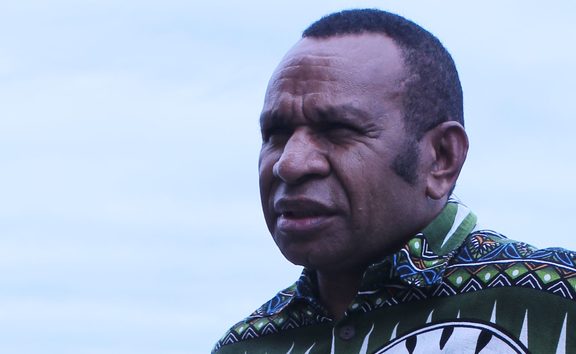
Marshall Islands Journal editor Giff Johnson … “The nuclear weapons test legacy is the overriding issue in the Marshall Islands with the United States and it remains a festering problem.” Image: Giff Johnson/RNZ

By RNZ Saturday Morning

The US detonated its largest nuclear bombs around the Marshall Islands in the 1940s and 50s – but the Marshallese are still campaigning for adequate compensation.

The Marshall Islands are two chains of 29 coral atolls in the middle of the Pacific Ocean between Papua New Guinea and Hawai’i.

Following the tests, whole islands ceased to exist, hundreds of native Marshallese had to be relocated off their home islands and many were affected by fallout from the testing.

In 1977, US authorities put the most contaminated debris and soil into a huge concrete dome called the Runit Dome, which sits on Enewetak Atoll and houses 88,000 square metres of contaminated soil and debris.

It has recently received media attention as it appears to be leaking, due to cracking and the threat from rising sea levels, while some Marshallese have fears it may eventually collapse.

However, American officials have said it is not their problem and responsibility falls on the Marshallese, as it is their land.

The US has cited a 1986 compact of free association, which released the US government from further liability, which will go up for renegotiation in 2023.

Meanwhile, the Marshallese continue to campaign for adequate compensation from the US.

First hand experience
Giff Johnson, editor of the country’s only newspaper, Marshall Islands Journal, and a RNZ correspondent,  has experienced the unfolding legacy of US nuclear testing first hand. His wife Darlene Keju, an outspoken advocate for test victims and nuclear survivors, herself died of cancer in 1996.
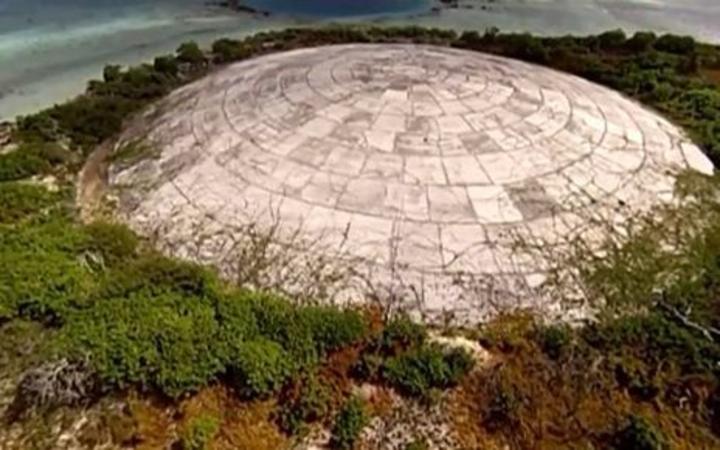
Runit Dome
The Runit Dome was constructed in 1977 on Enewetak Atoll in the Marshall Islands to temporarily store radioactive waste produced from nuclear testing by the US military during the 1950s and 1960s. Image: RNZ

While Johnson said said suggestions that the Rumit Dome – nicknamed “The Tomb” by locals – was about to collapse were alarmist, there were still major concerns surrouding it.

“I wouldn’t say the dome is on the verge of collapse, there’s concern about its leaking, about cracks, and also about the overall contamination of that atoll,” he said.

“The issue is it’s got plutonium, which has a half-life of 24,000 years, and how long does concrete last?”

Describing the structure as a “symbol of the nuclear legacy here”, Johnson said that US government scientists had reported there was already so much contamination in the area that it would be difficult to find what leakage from the dome had added.

The United States has continued to refuse to accept responsibility for the Runit Dome’s condition, despite its history of nuclear testing in the country.

In 1954, the US carried out their first nuclear weapon test, Castle Bravo, at Bikini Atoll in 1954 – which resulted in the contamination of 15 islands and atolls. Only three years later, residents on the affected atolls of Rongelap and Utirik were encouraged to return to their homes, so researchers could study the effects of radiation.

Full compensation never paid
“The nuclear weapons test legacy is the overriding issue in the Marshall Islands with the United States and it remains a festering problem, because US compensation and medical care and so forth was only partial for what was needed,” Johnson said.

The first compact to free association between the Marshall Islands and the US contained a compensation agreement, including the establishment of a nuclear claims tribunal to adjudicate all claims. While it determined there was a large amount of compensation due to Marshallese on various atolls, this has never been paid out, apart from funding of $150 million in 1986.

Since then, the US has accepted no more liability on nuclear compensation, as the compact resulted in the Marshall Islands being an independent country, able to join the United Nations.

However, Johnson said the US Congress had taken a different position on this.

“For example, while the US executive branch would say, well the Marshall Islands is in charge of all the former nuclear test sites, the US Congress a few years back passed legislation requiring the US Department of Energy to monitor the Runit Dome, where so much radioactive waste is stored.”

There have also been big differences in the treatment of Marshallese nuclear victims and those in the United States

“The US used Bikini and Enewetak  to test its biggest hydrogen bombs,” Johnson said.

“While it maintained a nuclear test site in Nevada, it only tested relatively small nuclear devices there, because it simply could not test hydrogen bombs in the continental United States – Americans wouldn’t have stood for it.”

Not long after the 1986 free association compact ended American responsibility for nuclear compensation in the Marshall Islands, the US Congress enacted a radiation compensation act for Americans – which Johnson said really emphasised the unfairness of the situation.

‘Long story short’
“Long story short, they appropriated $100 million and then they ran out, the US Congress appropriated more, again ran out, appropriated more and fast-forward to 2020 and they’re over $2 billion in compensation awarded to American nuclear victims.

“Then the question comes, that if they’re willing to just keep recapitalising the compensation fund for American nuclear victims, why aren’t they able to reinstitute the compensation fund for Marshallese, who were exposed to far more nuclear fallout than the downwinders in Utah and Nevada?”

Johnson also had concerns about the lack of a baseline epidemiological study by the US, following the tests. Studies on the affects of radiation centred around thyroid issues, but many islanders have reported cancer, miscarriages and stillbirths in the years following.

His wife Darlene Keju died of breast cancer, which also affected her mother and father – she grew up on one of the islands in the downwind zone of the tests.

The US had never looked at rates of cancer, or studied the differences between low fallout and high fallout areas, he said.

Johnson hoped the nuclear legacy between the countries could be worked out amicably, but he was not too optimistic.

“The original compensation agreement was negotiated in a period of the Cold War and the US did it in an adversarial way with the Marshall Islands, which had no standing because it wasn’t a country at the time, information was withheld, they didn’t know what they know today, and it needs to be worked out, a suitable decent fair agreement needs to be sorted out.”
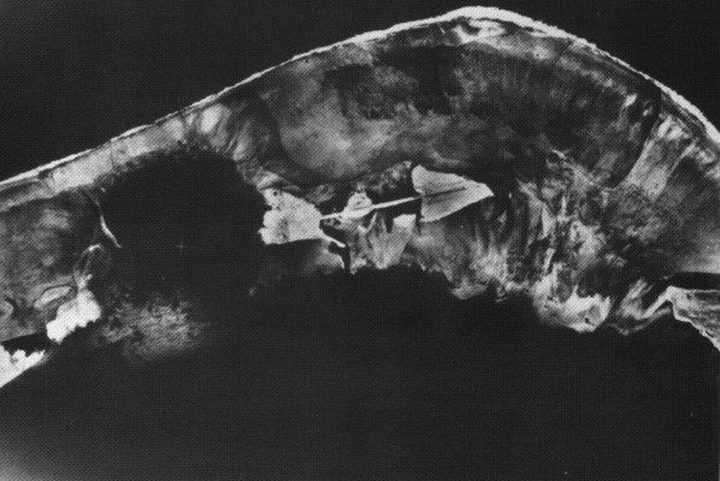
An aerial shot of the Enewetak Atoll
An aerial shot of the Enewetak Atoll in the Marshall Islands, after it was used for the first ever hydrogen bomb test. Image: RNZ/AFP/US Department of Energy

‘Black mark’ on good relationship
Despite this tension, Johnson said the Marshallese did not harbour anti-American sentiment and the compensation issues were a “black mark on an otherwise good relationship” between the two countries.

He said around 30 to 40 percent of all Marshallese were living in the US.

“The Marshall Islands, since WWII, has had a very long standing high regard and strong relationship with the US that came out of the end of the Japanese period of militarism and the execution of many islanders and privation, into a period where the US fostered democratic institutions, created opportunities for education, providing scholarships, opening the door to people going to the US and the unpacked treaty really put this together, in terms of the relationship that’s of benefit to both sides.”

However, ongoing tensions between the US and China may help the Marshall Islands in their push for further compensation.

“In the current situation where we have the US continuing to be in an uproar over China … that has elevated the strategic importance of the Marshall Islands, the Federated States of Micronesia, Palau – the three north Pacific countries that are all in free association with the US. It does give the Marshall Islands a bit more leverage in negotiating and talking with Washington.

“Possibly the changing geopolitical situation out here might offer an opening to get some interest to try to amicably do something to resolve the whole thing,” Johnson said.

But the nuclear legacy is not the only issue affecting the island – climate change is looming large and reports by US scientists have said that the Marshall Islands could be uninhabitable by the 2030s, due to rising sea levels.

“Because the Marshall Islands has such little land, these are really small islands, it magnifies the importance of land to Marshallese people,” Johnson said.

“I think people care about their islands and want to find a way to make them liveable for the long term, but that may depend on the world community to a great extent now.”

This article is republished by the Pacific Media Centre under a partnership agreement with RNZ.

Print Friendly, PDF & Email

Article by AsiaPacificReport.nz

Hong Kong police charge Apple Daily founder Lai with ‘foreign collusion’

Pacific Media Watch newsdesk

The Hong Kong police force has charged media entrepreneur Jimmy Lai, founder of Next Digital Limited, which owns the Apple Daily newspaper, with collusion with foreign forces under Hong Kong’s controversial new national security law, reports the Committee to Protect Journalists.

It is a charge that carries up to life in prison if convicted, according to the Apple Daily and news reports.

“Charging Jimmy Lai under Hong Kong’s new national security law marks a dangerous escalation in China’s attacks on Hong Kong’s independent media,” said Steven Butler, CPJ’s Asia programme coordinator, in Washington, DC.

“China appears intent on crushing what remains of Hong Kong’s much vaunted tradition of press freedom. Lai should be freed at once, and all the charges he is facing should be dropped,” he said.

Lai has been in custody since police detained him and two Apple Daily executives on a fraud charge on December 2, as CPJ documented at the time.

He is expected to remain in jail at least until a court hearing on April 16, 2021, as a court rejected his bail bid on December 3, according to news reports.

Lai’s collusion charge will enter court proceedings tomorrow at the West Kowloon Courts, according to those reports.

The Hong Kong Police Force did not immediately respond to CPJ’s emailed request for comment.

Print Friendly, PDF & Email

Article by AsiaPacificReport.nz

Rights group records 40 violations in Papua in 2020 – cases every month

By Nicholas Ryan Aditya in Jakarta

Indonesia’s Commission for Missing Persons and Victims of Violence (Kontras) has found 40 incidents of human rights violations in Papua between January and November 2020, a new report says.

The report by Kontras researcher Arif Nur Fikri was released yesterday to commemorate International Human Rights Day.

“Kontras recorded that throughout almost all of 2020, there was at least one incidence of violence every month which befell the Papuan people”, said Fikri during an event held virtually along with media.

Fikri said that these 40 cases were dominated by cases of violence in the form of shootings, abuses and arbitrary arrests by security forces.

Kontras documented that these 40 cases involved at least 276 people who were victims of arrest, were wounded or died.

“In general the victims were civilians. And this continues repeatedly every year,” he said.

Because of this, he believes that the militaristic approach by the government has been “ineffective” in dealing with violence in Papua.

Urgent reevaluation needed
According to Fikri, urgent reevaluation was needed by the government and the House of Representatives (DPR).

“Because so far there has not been any evaluation from the military actors related to human rights violations in Papua,” he said.

In addition to this, Fikri also said that the figures or total number of incidences of violence in Papua have not been accompanied by transparency which should guarantee accountability.

He gave as an example when the government blocked the internet in response to the riots in Papua in late August and early September 2019.

This incident began with a racist attack on students in Surabaya, East Java, in August 2019. This was responded to by demonstrations in several parts of the land of Cendrawasih, as Papua is known.

The government responded to the massive demonstrations in Papua by blocking or throttling the internet connection in Papua.

As has been reported, the Jakarta Administrative Court (PTUN) also declared that President Joko “Jokowi” Widodo and the Information and Communications Ministry were guilty of wrongdoing in the case.

“This is homework for the government and we always remind the government to think about the levels of violence in Papua which in the future [they] should at least minimise this figure,” said Fikri.

Based on its records, in January 2020 there were five cases of human rights violations in Papua, three in February, two in March, three in April, four in May, two in June, four in July, four in August, six in September, two in October and five cases in November.

Translated by James Balowski of IndoLeft News. The original title of the article was “Total 40 Pelanggaran HAM di Papua Sepanjang 2020, Kontras: Setiap Bulan Pasti Ada Kasus“.

Print Friendly, PDF & Email

Article by AsiaPacificReport.nz

‘Admirable leadership’ of young Pacific Climate Warriors clinches peace prize

Pacific Media Centre newsdesk

The Pacific Climate Warriors are the winners of the Pax Christi International Peace Prize 2020.

On making the judgment, the members of the Pax Christi International board acknowledged the “admirable leadership shown by young people” on this critical issue.

The award tribute said: “[The board members] also want to draw attention to the region of Oceania, a beautiful part of the world which is too often overlooked.

“The brave, nonviolent and tenacious actions of the Pacific Climate Warriors are to be applauded and encouraged.”

The Pacific Media Centre’s Del Abcede was on hand to capture the international presentation this week at St Columba Centre, Ponsonby, Auckland, in Aotearoa New Zealand.

Print Friendly, PDF & Email

Article by AsiaPacificReport.nz

An Australia–NZ travel bubble needs a unified COVID contact-tracing app. We’re not there.

Source: The Conversation (Au and NZ) – By Mahmoud Elkhodr, Lecturer in Information and Communication Technologies, CQUniversity Australia

New Zealand’s coronavirus contact-tracing app COVID Tracer was revamped yesterday.

It now uses the Bluetooth-based Google/Apple exposure notification (GAEN) framework. This allows Android and Apple (iOS) devices to communicate via a contact-tracing mechanism built into the devices’ operating systems.

Meanwhile, Australia continues to use the COVIDSafe app, which also uses Bluetooth, but with a different underlying system.

With both countries indicating they’ll likely wait several weeks before a vaccine rollout, current trans-Tasman travel arrangements continue to be a protective barrier.

Quarantine-free travel is allowed from New Zealand to certain safe travel zones in Australia, as long as travellers haven’t visited a New Zealand COVID hotspot in the preceding fortnight.

As of tomorrow, Queensland will be included in the safe zones. And discussions around expanding the “travel bubble” further are ongoing.

But in this context, New Zealand’s COVID Tracer upgrade is unlikely to help. Both countries are using different contact tracing systems that can’t communicate.

Comparing COVID Tracer and COVIDSafe

While COVIDSafe and COVID Tracer both use Bluetooth to determine proximity between users, and log close contacts with “digital handshakes” between devices, both have different approaches to reporting close contact information to authorities.

COVID Tracer requires Bluetooth to work.

If a COVID Tracer user tests positive for COVID-19, they can alert their close contacts who also have the app. These contacts then receive a notification and are advised to self isolate.

New Zealand health authorities can’t know the contacts’ details at any point, unless they themselves come forward.

On the other hand, if a COVIDSafe user tests positive, they can choose to send information about their close contacts directly to Australian health authorities — who can then follow up with manual contact tracing.

Will the apps help form a travel bubble?

Although both COVIDSafe and COVID Tracer use Bluetooth, their underlying systems are different and therefore can’t work together. This means Australians visiting New Zealand would have to download the COVID Tracer app and use it during their visit.

If a COVID Tracer user tests positive for COVID-19 they can alert their close contacts, who are advised to call the health line, wear a face mask and stay away from public spaces.

Similarly, a New Zealand resident visiting Australia would need to download and use COVIDSafe. But this may actually not be possible for many, as setting up COVIDSafe requires a verified Australian phone number and postcode.

And even if travellers do use the other country’s app during their visit, this alone won’t mitigate the risk of bringing home the coronavirus.

For instance, if they contract the virus shortly before returning home (from someone who didn’t know they were infectious) and then delete the app as soon as they return, the news of potential infection won’t reach them.

Global approaches

The Australian government reportedly updated COVIDSafe last month to address previous functionality issues, particularly for iPhone users. While the update was needed, critics pointed out adopting the GAEN framework would have been a better option.

Th GAEN framework functions more reliably and lays the foundation for potential cross-border contact tracing. It’s also relatively straightforward to redevelop existing apps to integrate it.


Read more: By persisting with COVIDSafe, Australia risks missing out on globally trusted contact tracing


But even if COVIDSafe were redeveloped to adopt this framework, developers would still need to put in more time before both COVIDSafe and COVID Trace could work together.

Such a cohesive cross-border contact-tracing solution would also require agreement by both countries on several fronts. This includes the policies governing the technology, data access permission and the location of physical data servers.

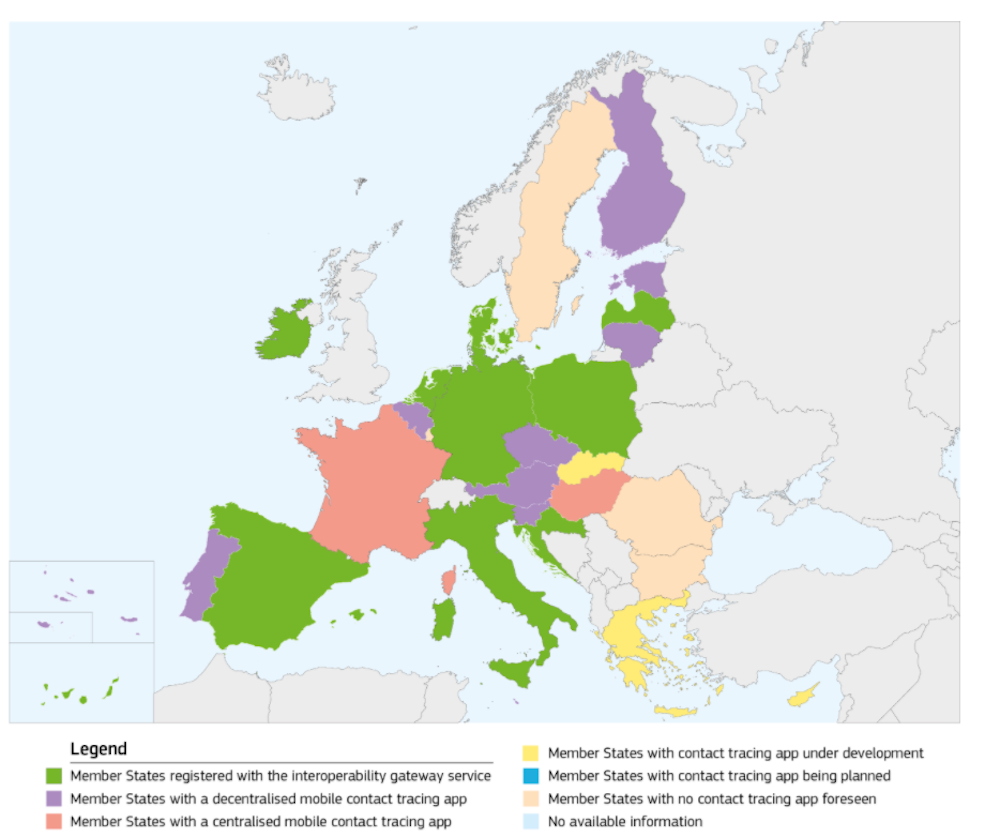
But this isn’t impossible. Australia and New Zealand could choose to follow the European Union’s efforts. Several EU member states, including Germany, Italy and Ireland, have adopted an EU-established service called the “gateway”.

Map showing which EU member states have a contact tracing app using the 'gateway' system.
This map shows which EU member states have a national contact tracing app using the ‘gateway’ system. EU, CC BY

The gateway acts as a middle man which relays information between different EU countries’ contact-tracing apps. Contact tracing can still occur while a person is travelling between the various countries, as long as their home country’s app has adopted the gateway system.

Where to from here?

Using mobile-based technologies for contact tracing comes with a range of challenges. Besides the issues discussed above, it’s also crucial for contact-tracing systems to be widely adopted by the communities they are meant to service.

This has proven challenging. Uptake of COVID-19 contact-tracing apps remains low globally, despite governments pushing for mass use.

Meanwhile, Bluetooth itself is fallible. Determining distance between two devices using Bluetooth has limitations. Signal strength (and therefore accuracy) can be impacted by environmental factors.


Read more: False positives, false negatives: it’s hard to say if the COVIDSafe app can overcome its shortcomings


For example, the signal may be weaker if a phone is kept inside a thick pocket. Or the app may pick up a signal from someone on the other side of a wall, with whom the user never came into contact.

There’s probably no quick fix. But if more time and effort are invested, we may discover a more suitable technology that can provide secure and user-friendly cross-border contact tracing.

ref. An Australia–NZ travel bubble needs a unified COVID contact-tracing app. We’re not there. – https://theconversation.com/an-australia-nz-travel-bubble-needs-a-unified-covid-contact-tracing-app-were-not-there-151761

The truth about much ‘casual’ work: it’s really about permanent insecurity

Source: The Conversation (Au and NZ) – By David Peetz, Professor of Employment Relations, Centre for Work, Organisation and Wellbeing, Griffith University

The federal government’s industrial relations “reform” bill offers a new definition of “casual” employment that creates more problems than it solves.

It effectively defines a casual job as anything described that way by the employer at the time a job commences, so long as the employer initially makes “no firm advance commitment to continuing and indefinite work”.

Anyone defined as such loses any entitlement to leave they might otherwise have got through two recent Federal Court decisions.

Fair enough, you might think. Casual jobs are meant to be flexible. There can’t be an ongoing commitment.

But that’s not what the data on “casual employment” tell us.

I’ve drilled into previously unpublished data from the Australian Bureau of Statistics to get a better sense of what “casual employment” means for those employed as such.

Overall, what I’ve found suggests the “casual” employment relationship is not about doing work for which employers need flexibility. It’s not about workers doing things that need doing at varying times for short periods.

The flexibility is really in employers’ ability to hire and fire, thereby increasing their power. For many casual employees there’s no real flexibility, only permanent insecurity.

The federal government’s new bill will not solve this. It will reinforce it.


Read more: So much for consensus: Morrison government’s industrial relations bill is a business wish list


Casual definitions

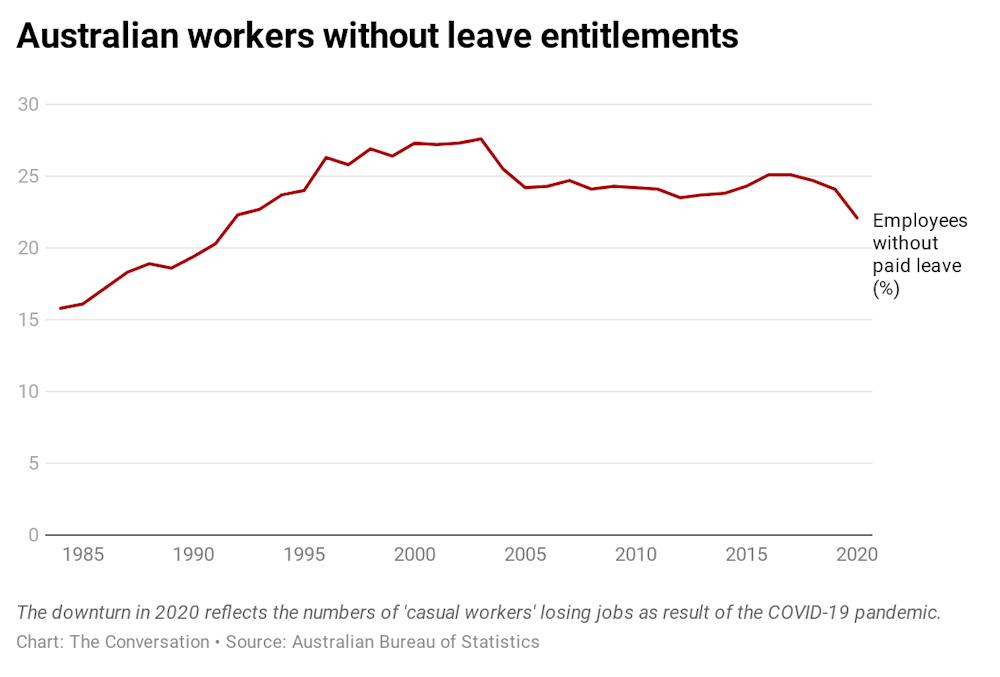
Technically the ABS does not routinely estimate the numbers of casual employees. For a few years (to 2013) it published data on workers who received a casual loading, and it occasionally asks people to self-identify whether they are casuals. But mostly its data on “workers without leave entitlements” (collected quarterly) is used as a proxy measure of casual employment.

About 24% of Australian employees were in this boat in 2019 – a high proportion compared with most other industrialised countries.


CC BY-NC-ND

Theory versus reality

The ABS data I’ve analysed includes statistics collected before 2012. But since the proportion of employees without leave entitlements has been relatively stable since the mid-1990s, the results remain relevant. They show:

  • about 33% of “casuals” worked full-time hours

  • about 53% had the same working hours from week to week, and were not on standby

  • about 56% could not choose the days on which they worked

  • almost 60% had been with their employer for more than a year

  • about 80% expected to be with the same employer in a year’s time.

Very few (6% of “casuals”) work varying hours or are on standby, have been with their employer for a short time, and expect to be there for a short time.

There are many reasons to question whether an employee without leave entitlements could really be defined as a genuinely flexible casual worker. It’s better to just call them “leave-deprived” employees.


Read more: Self-employment and casual work aren’t increasing but so many jobs are insecure – what’s going on?


A common feature: powerlessness

The common features of all leave-deprived employees are permanent insecurity and low power.

Leave-deprived employees are about twice as likely as “permanent” workers (with leave entitlements) to have variable hours. But almost all “permanent” workers with variable hours have a guaranteed number of minimum hours. Yet less than a third of leave-deprived employees have that guarantee.

Overall, 27% of leave-deprived employees have variable hours and no minimum guarantee of hours. That is the case for only 2% of “permanent” workers (see chart).


CC BY-NC-ND

We can think of variable hours as reflecting employers’ flexibility needs, and a guarantee of minimum hours as reflecting employees’ power. The big difference between leave-deprived employees and “permanents” is in the power employees have.

Sometimes you hear the term “permanent casuals”. They should more accurately be called “permanently insecure”.

Casual loading

Another sign of low power is how few leave-deprived workers receive the casual loading – the 25% extra pay meant to compensate them for their lack of leave entitlements.

When the ABS used to ask about casual loading, less than half of leave-deprived workers said they got it. That’s hardly surprising, given how often breaches of awards have been uncovered.

A study published in 2019 found low-paid leave-deprived workers in Australia, on average, were paid less than equivalent “permanent” employees.

Low power is what should be expected when an employment contract only lasts as long as the current shift. A worker might not even get formally terminated, just not be given any more hours.

Why have casual employment?

There may be good reasons to have casual employment when work is genuinely intermittent and uncertain.

But that’s not the case for most leave-deprived jobs. They are, instead, long-term and stable – yet still insecure for the employee. The only flexibility in them lies with the employer’s power to withhold work.

Allowing employers to overrule previous court decisions and define who is and is not a casual, as proposed in the current bill, will not overcome any of these problems.

Instead, it will just entrench the practice of employers using “casual employment” to increase their power.

ref. The truth about much ‘casual’ work: it’s really about permanent insecurity – https://theconversation.com/the-truth-about-much-casual-work-its-really-about-permanent-insecurity-151687

Global emissions are down by an unprecedented 7% — but don’t start celebrating just yet

Source: The Conversation (Au and NZ) – By Pep Canadell, Chief research scientist, Climate Science Centre, CSIRO Oceans and Atmosphere; and Executive Director, Global Carbon Project, CSIRO

Global emissions are expected to decline by about 7% in 2020 (or 2.4 billion tonnes of carbon dioxide) compared to 2019 — an unprecedented drop due to the slowdown in economic activity associated with the COVID-19 pandemic.

To put this into perspective, the Global Financial Crisis in 2008 saw a 1.5% drop in global emissions compared to 2007. This year’s emissions decline is more than four times larger.

These are the findings we show in the 15th global carbon budget, an annual report card of the Global Carbon Project on the sources and removals of carbon dioxide, the primary driver of human caused climate change.

It may sound like welcome news, but we can’t celebrate yet. A rapid bounce back of emissions to pre-COVID levels is likely, possibly by as soon as next year. A recent study found emissions in China snapped back to above last year’s levels during late spring when economic activity began to return to normal.

These findings come ahead of the Climate Ambition Summit on Saturday, where global leaders will demonstrate their commitments to climate action five years since the Paris Agreement. This huge drop in emissions should be taken as a unique opportunity to divert the historical course of emissions growth for good.

Emissions in the pandemic year

The total global fossil carbon dioxide emissions for 2020 are estimated to be 34 billion tonnes of carbon dioxide.

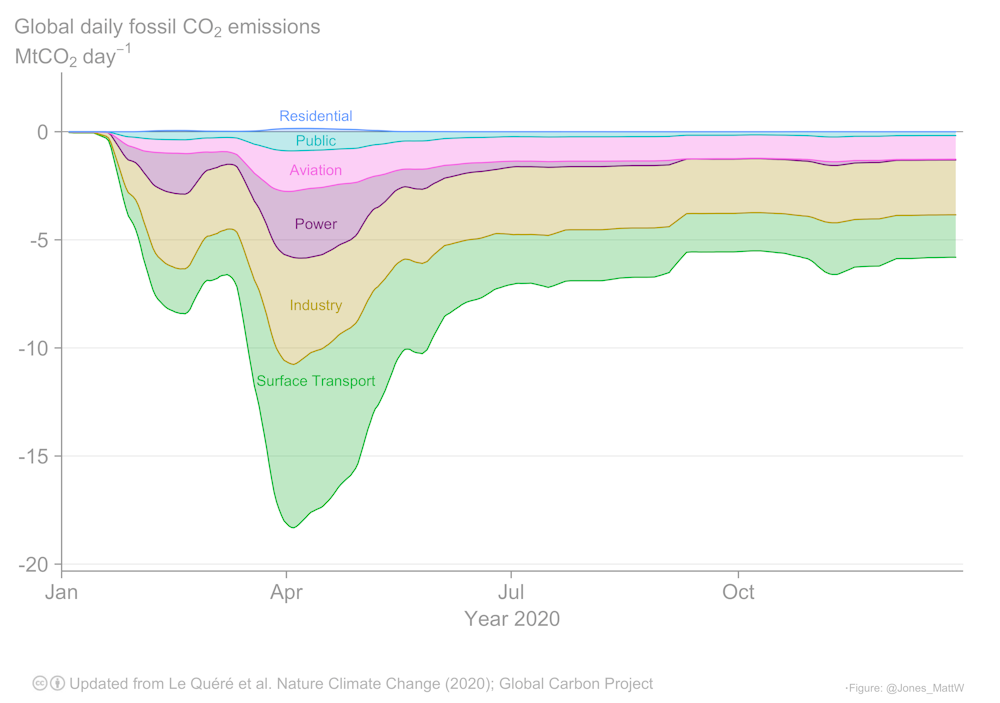
Estimated emissions at the beginning of December are lower than their levels in December last year, at least in the transport sectors. However, emissions have been edging back up since the peak global daily decline of 17% in early April.


Read more: The world endured 2 extra heatwave days per decade since 1950 – but the worst is yet to come


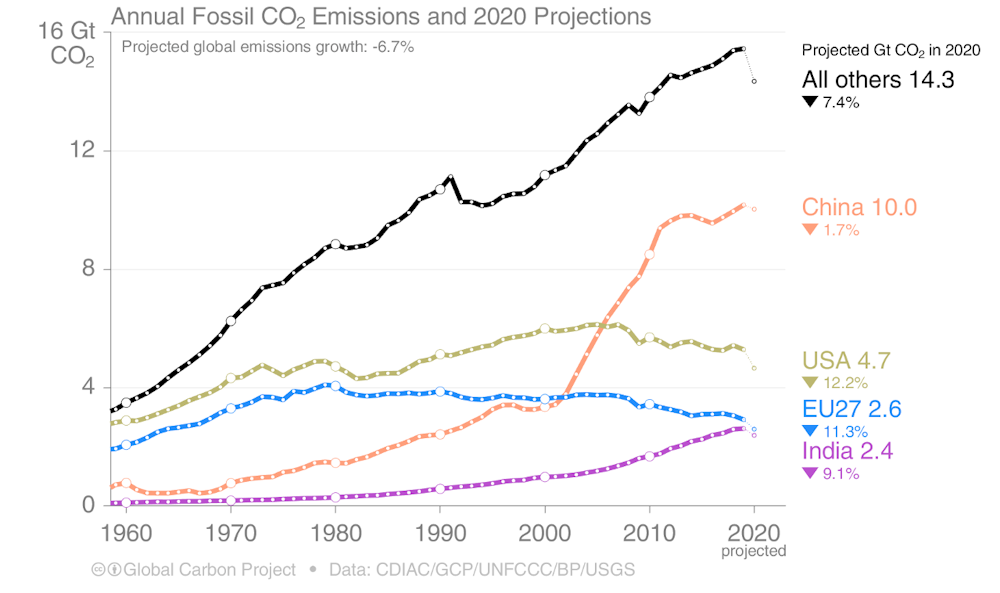
The decline in emissions in 2020 was particularly steep in the United States (12%) and European Union (11%), where emissions were already declining before the pandemic, mainly from reductions in coal use.

Emissions from India dropped by 9%, while emissions from China, which have returned to close or above 2019 values, saw an estimated drop of only about 1.7%.

Australian greenhouse gas emissions during the peak of the pandemic lockdown (the quarter of March to June 2020) were lower by 6.2% compared to the previous quarter. The largest declines were seen in transport and fugitive emissions (emissions released during the extraction, processing and transport of fossil fuels).

A chart showing the emissions decline for China, US, India, EU, and the rest of the world.
The 2020 emission decline was particularly steep in the United States and European Union. While China’s emissions also dropped steeply, they snapped back later in the year. Pep Canadell, Author provided

Globally, the transport sector also contributed the most to the 2020 emissions drop, particularly “surface transport” (cars, vans and trucks). At the peak of the pandemic lockdowns, the usual levels of transport emissions were halved in many countries, such as in the US and Europe.

While aviation activity collapsed by 75%, its contribution to the total decline was relatively small given the sector only accounts for about 2.8% of the total emissions on an average year. The number of global flights was still down 45% as of the first week of December.

A chart showing the emissions decline for different sectors.
The industry sector, specifically metals production, chemicals and manufacturing, was the second largest contributor in emissions declines. Pep Canadell, Author provided

Global emissions were already slowing down pre-COVID

Overall, global emissions have increased by 61% since 1990. But the pace of this growth has varied.

In the early 1990s, the growth in emissions slowed down due to the collapse of the former Soviet Union, but then increased very quickly during the 2000s, by 3% per year on average. This was, in part, due to the rise of China as an economic power.


Read more: South Korea’s Green New Deal shows the world what a smart economic recovery looks like


Over the last decade, however, the pace of emissions began to slow again, with an increase just below 1% per year. And emissions in 2019 didn’t grow much, if at all, when compared to 2018.

Behind the global slowing trend, there are 24 countries that had carbon dioxide fossil emissions declining for at least one decade while their economy continued to grow. They include many European countries such as the Denmark, the UK and Spain, and the USA, Mexico and Japan. For the rest of the world, emissions continued to grow until 2019.

This chart shows how global fossil carbon dioxide emissions has increased.
This chart shows how global fossil carbon dioxide emissions has increased since the 1990s. Note the drops in the early 1990s, in 2008, and the huge drop in 2020. Pep Canadell, Author provided

An opportunity to boost ambition

The pandemic, along with other recent trends such as the shift towards clean energy, have placed us at a crossroad: the choices we make today can change the course of global emissions.

In addition to the slow down in global emissions in recent years, and this year’s drop, there are now dozens of countries that have pledged to reach net zero emissions by mid century or soon after.

How the emissions of different countries have changed over time.

Importantly, the first (China), second (USA), third (European Union), sixth (Japan) and ninth (South Korea) top emitters — together responsible for over 60% of the global fossil carbon dioxide emissions — have either legally binding pledges or serious ambitions to reach net zero emissions by 2050 or soon after.


Read more: China just stunned the world with its step-up on climate action – and the implications for Australia may be huge


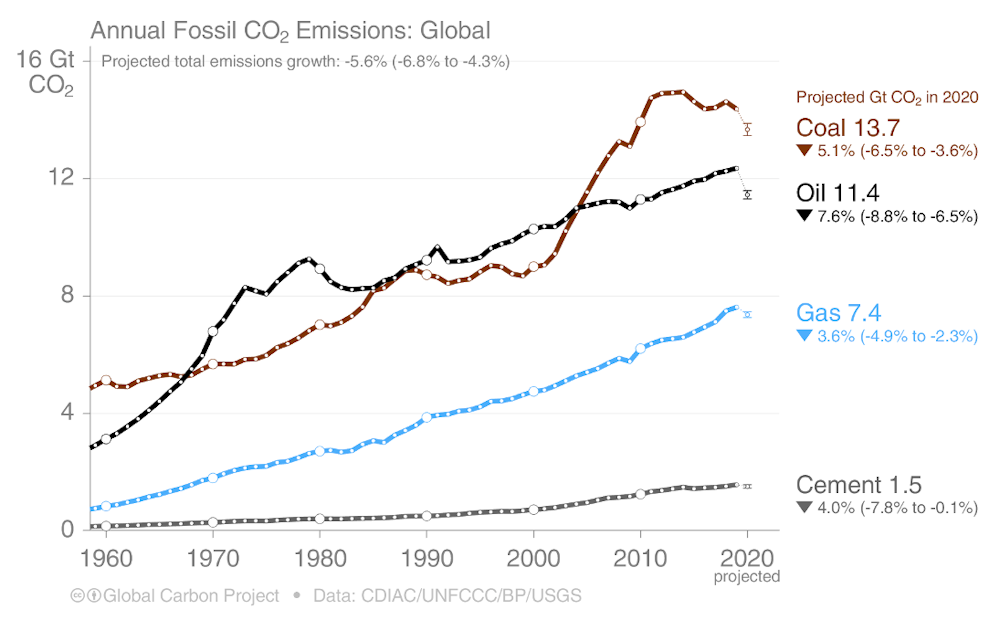
Coal production, the largest fossil fuel source of carbon dioxide emissions, peaked in 2013. Its decline continues to this date; however, increasing natural gas and oil negate much of this decline in emissions.

How the emissions from coal, oil, gas, and cement sectors changed over time.
How the emissions from coal, oil, gas, and cement sectors changed over time. Pep Canadell, Author provided

We are in the midst of extraordinary levels of economic investment in response to the pandemic. If economic investment is appropriately directed, it could enable the rapid expansion of technologies and services to put us on track towards net zero emissions.

Many countries have already committed to green recovery plans, such as South Korea and the EU, although investments continue to be dominated by the support of fossil-based infrastructure.

As global leaders prepare for tomorrow’s summit, they have an opportunity like never before. The choices we make now can have a disproportionate impact on the future trajectory of emissions, and keep temperature rise well and truly below 2℃.


Read more: Coronavirus is a ‘sliding doors’ moment. What we do now could change Earth’s trajectory


ref. Global emissions are down by an unprecedented 7% — but don’t start celebrating just yet – https://theconversation.com/global-emissions-are-down-by-an-unprecedented-7-but-dont-start-celebrating-just-yet-151757

Keith Rankin Chart Analysis – Covid-19: Worsening Incidence in Asia, USA, and Denmark

South Korea not looking so good. Chart by Keith Rankin.

Analysis by Keith Rankin – estimates, magnitudes, and new countries to be concerned about.

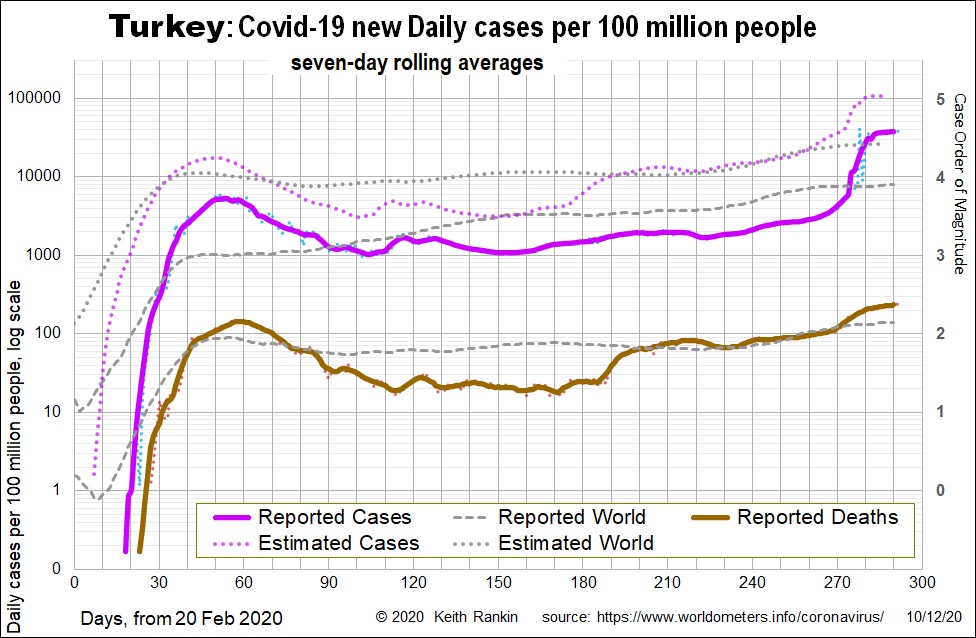
Turkey has suddenly discovered many more cases. Chart by Keith Rankin.

In mid-November, I published Covid-19: Orders of Magnitude. I used Turkey as my example of a Covid19  magnitude 3 country, and South Korea as my magnitude 2 example. Today, less than a month later, Turkey is now looking like a magnitude 4.5 country; magnitude five if you take estimates of unreported cases into account. Turkey’s situation represents a mix of past underreporting, and a recent and substantial new outbreak. It has gone from being near average compared to the rest of the world, to well above average.

Note that New Zealand and Australia, while technically magnitude 2 countries today, should really be understood as magnitude 1, because practically all cases are confined to the international border.

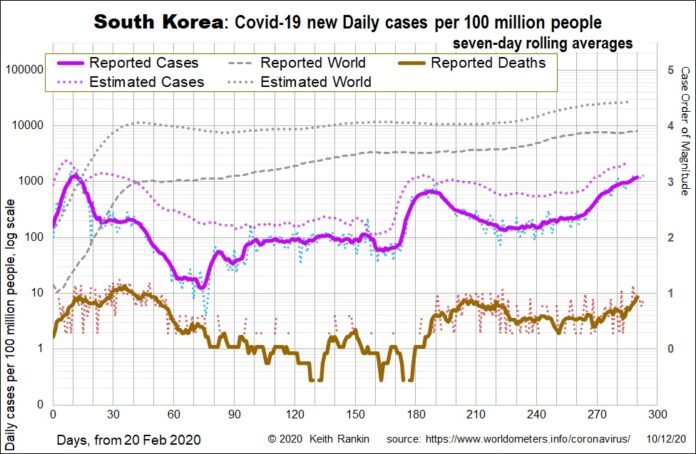
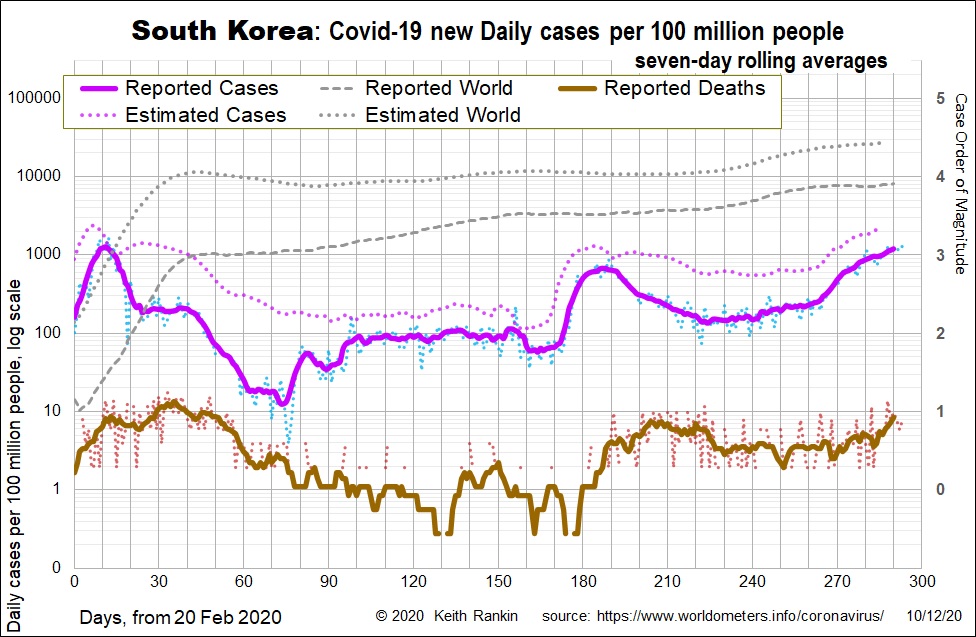
South Korea not looking so good. Chart by Keith Rankin.

South Korea is one of those Asian exemplars, where mask use is widespread, and contact tracing is legendary. It is now clearly magnitude 3, with its latest outbreak more complex and worrying than previous outbreaks. If New Zealand abandons the ’emergency levels’ approach next time there is a community outbreak, then this South Korea experience is a likely indicator of what New Zealand will look like in the winter of 2021.

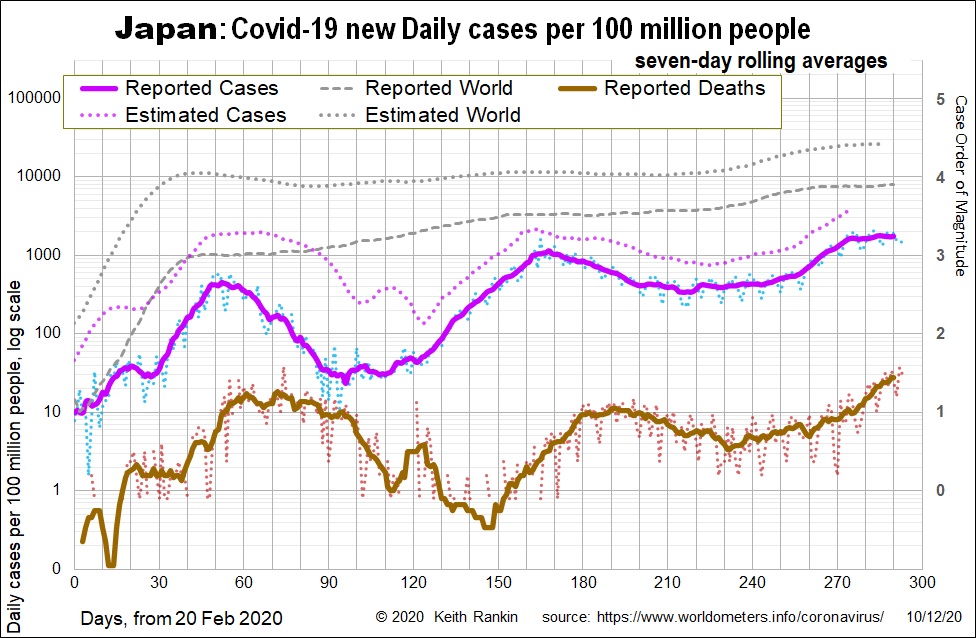
Japan is like South Korea, but has been magnitude 3 for four months. Chart by Keith Rankin.

Japan is another Asian country with a widespread culture of mask use, and which has not suffered nearly as much as Europe or the Americas. It will also host the July 2021 Olympic Games. While Japan’s cases were much lower than South Korea’s initially, Covid19 has been significantly more prevalent in Japan than Korea for the last six months. If we in New Zealand ever get Covid19 incidence on the scale of Japan, this would be seen as a substantial case of government failure.

USA should now be understood to be a Covid-19 magnitude 5 country. Chart by Keith Rankin.

The United States has now recorded 3,000 deaths in one day. That number of deaths implies a true infection level 200 times higher; 600,000 new cases per day, 15 cases per day in every American town the size of Te Puke. Before Thanksgiving Day, the United States looked to have turned the corner, at least for the present wave of infections. But its now looking like USA will reach 100,000 recorded daily cases per 100 million people (that’s 330,000 recorded daily cases) in the New Year. And 4,000 daily deaths.

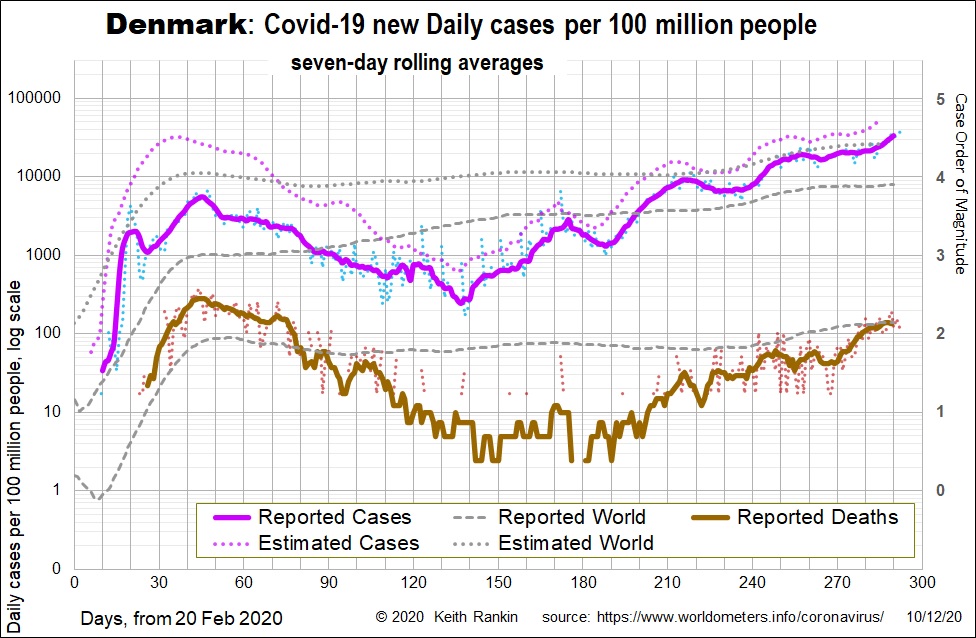
Denmark still on the rise. Chart by Keith Rankin.

Denmark is a Scandinavian country with a population just 750,000 higher than New Zealand, and which implemented much more restrictive policies than did its neighbour Sweden. Denmark has had an extended facemask requirement from October 29 (due to be lifted on 2 January 2021). The policy has not worked! Denmark’s incidence of Covid19 is nearly as high as Sweden’s.

VIDEO: Michelle Grattan on national cabinet, media bargaining, and 2021

Source: The Conversation (Au and NZ) – By Michelle Grattan, Professorial Fellow, University of Canberra

University of Canberra Professorial Fellow Michelle Grattan and University of Canberra Assistant Professor Caroline Fisher discuss the week in politics.

This week the pair discuss the international climate conference that Prime Minister Scott Morrison has not been invited to speak at, the array of legislation pushed through the last sitting week of parliament for the year, as well as how the government and opposition will fare in 2021.

ref. VIDEO: Michelle Grattan on national cabinet, media bargaining, and 2021 – https://theconversation.com/video-michelle-grattan-on-national-cabinet-media-bargaining-and-2021-151916

Up to 90% of electricity from solar and wind the cheapest option by 2030: CSIRO analysis

Source: The Conversation (Au and NZ) – By Paul Graham, Chief economist, CSIRO energy, CSIRO

With the cost of energy generated from wind and solar now less than coal, the share of Australia’s electricity coming from renewables has reached 23%. The federal government projects the share will reach 50% by 2030.

It is at this point that integrating renewables into the energy system becomes more costly.

We can add wind and solar farms at little extra cost when their share is low and other sources – such as coal and gas generators now – can compensate for their variability. At a certain point, however, there comes a need to invest in supporting infrastructure to ensure supply from mostly renewable generation can meet demand.

But by 2030, even with these extra costs, adding new variable renewable generation (solar and wind) to as high as a 90% share of the grid will still be cheaper than non-renewable options, according to new estimates from the CSIRO and Australian Energy Market Operator.

Calculating energy costs

International research, including from the International Renewable Energy Agency, suggests solar and wind power are now the cheapest new sources of electricity in most parts of the world.

Our estimates, made for the third annual “GenCost” report (short for generation cost), confirm this is also now the case in Australia.

We compare the cost of new-build coal, gas, nuclear, solar photovoltaics (both small and large scale), solar-thermal, wind and a number of speculative options (such as nuclear).

What we’ve been able to more accurately estimate in the new report is the cost of integrating more and more renewable energy into the energy system, as coal and gas generators are retired.

The two key extra integration costs are energy storage and more transmission lines.


Read more: Sure, no-one likes a blackout. But keeping the lights on is about to get expensive


Storage costs

For any system dominated by renewables, storing energy is essential.

Storage means renewable energy can be saved when it is overproducing relative to demand – for example, in the middle of the day for solar, or during extended windy conditions. Stored energy can then be used when renewables cannot meet demand – such as overcast days or at night for solar.

Among options being considered for large-scale investment in Australia are batteries and pumped hydro energy storage (using excess renewable power to pump water back up to dams to again drive hydroelectric turbines).


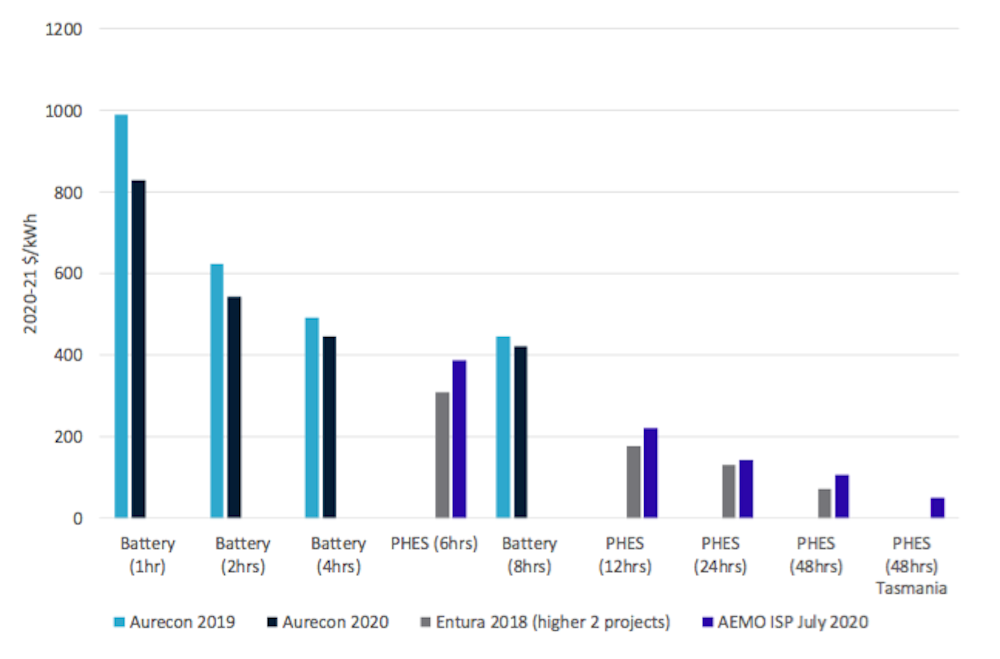
Capital costs of storage technologies in $/kWh (total cost basis). Aurecon and Entura are engingeering businesses who publish project cost estimates. AEMO ISP is the Australian Energy Market Operator’s Integrated System Plan, which also includes technology cost estimates. CSIRO

Pumped hydro sites can provide storage for hours or days. There are three schemes in Australia: Talbingo and Shoalhaven in New South Wales, and Wivenhoe near Brisbane.

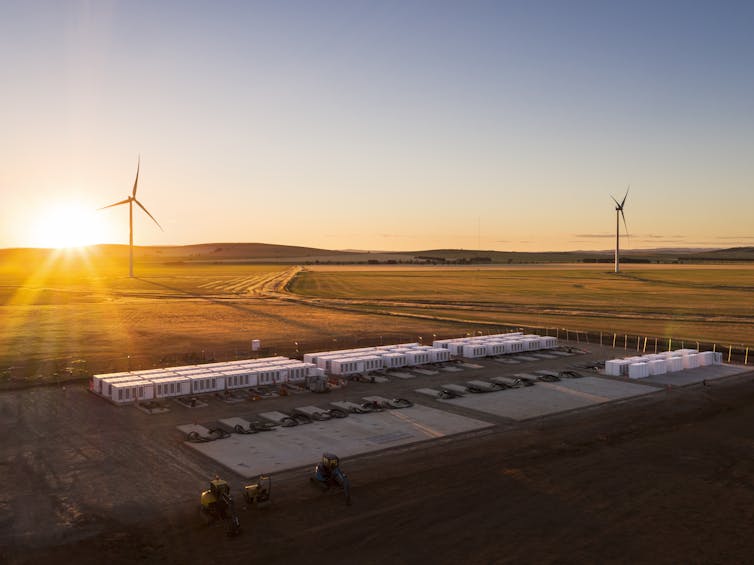
Battery costs have been falling steadily and tend to be most competitive for storage electricity for less than eight hours. South Australia’s big battery (officially known as the Hornsdale Power Reserve) is the most obvious example.

The Hornsdale Power Reserve, better known as the 'big battery', in South Australia.
The Hornsdale Power Reserve, better known as the ‘big battery’, in South Australia. Hornsdale Power Reserve/AAP

Transmission costs

The other key cost to integrate more renewable energy generation into the electricity grid is building more transmission lines. Right now those lines mostly run from coal and gas power stations near coal mines.

But this not where new large-scale renewable generation will be. Solar farms are best placed inland, where there is less cloud cover, and in the mid to northern regions of Australia. Wind farms are generally better located in elevated areas and in the southern regions. We’ll need to build new transmission links to these “renewable energy zones”.

Transmission links between the states in the National Electricity Market (Queensland, New South Wales, Australian Capital Territory, Victoria, Tasmania and South Australia) will need to be improved so they can better support each other if one or more are experiencing low renewable energy output.


Read more: After two decades, the national electricity market is on its way out, and that’s alright


Total integration costs

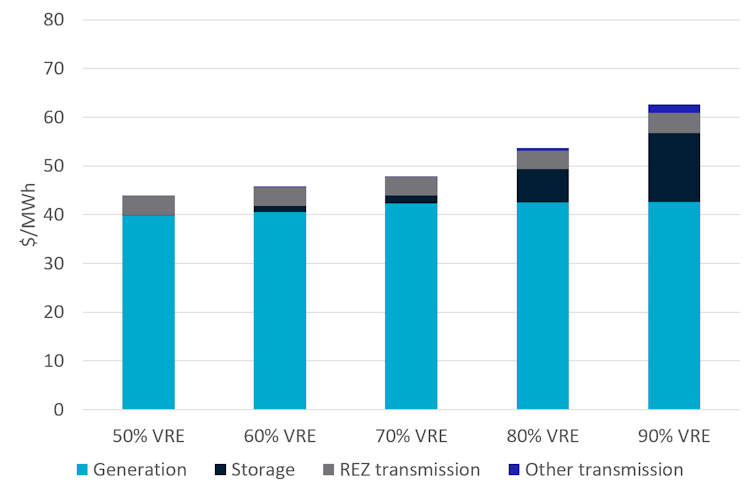
So how much extra will it cost for Australia to have a higher share (up to 90%) of electricity from wind and solar (variable renewable energy)? The following graph summarises our findings based on 2030 cost projections.


Projected renewable generation and integration costs by variable renewable energy share in 2030.
Projected renewable energy generation and integration costs by variable renewable energy share in 2030. CSIRO

The cost of generating energy from wind and solar (shown in light blue) is about A$40 per megawatt-hour (MWh). This is is slightly below current average market prices.

A higher share of renewable energy adds storage costs (in black) and transmission costs (grey and dark blue). These integration costs increase from A$4/MWh to A$20/MWh as the variable renewable energy share increases from 50% to 90%.

At 90% renewable energy, the total cost is A$63/MWh. But that’s still cheaper than the cost of new coal and gas-fired electricity generation, which is in the range of A$70 to A$90/MWh (under ideal assumptions of low fuel pricing and no climate policy risk).


The 2020-21 GenCost report is now in the formal consultation period with stakeholders including industry, government, regulators and academia. The final report is due to be published in March 2021.

ref. Up to 90% of electricity from solar and wind the cheapest option by 2030: CSIRO analysis – https://theconversation.com/up-to-90-of-electricity-from-solar-and-wind-the-cheapest-option-by-2030-csiro-analysis-151831

How did the University of Queensland/CSL vaccine fail due to ‘false positive’ HIV tests? A vaccine expert explains

Source: The Conversation (Au and NZ) – By Adam Taylor, Early Career Research Leader, Emerging Viruses, Inflammation and Therapeutics Group, Menzies Health Institute Queensland, Griffith University

Australia’s hopes of producing a locally developed COVID-19 vaccine have been dashed with news today the University of Queensland/CSL vaccine would not proceed to further clinical trials.

However, unlike news about the Pfizer/BioNTech COVID vaccine earlier this week, there were no safety concerns with the UQ/CSL vaccine.

According to a statement to the Australian Stock Exchange (ASX) earlier today, CSL said participants in the phase 1 trial received “false positive” results to HIV tests. They were not infected with HIV, nor did the vaccine contain the entire HIV virus.

Rather, the vaccine’s signature “molecular clamp” technology was formulated with parts of an HIV protein. When injected, these prompted the production of antibodies that were picked up in a range of HIV tests. In other words, if the vaccine had been widely rolled out, this could lead many people to think they had HIV when they didn’t.

The news prompted the federal government to announce it had cancelled its agreement to supply the UQ/CSL vaccine, which was always contingent on successfully completing clinical trials.

Instead, the government will supply more doses of other vaccines, including 20 million extra doses of the University of Oxford/AstraZeneca vaccine, to be made by CSL.

The Oxford/AstraZeneca vaccine is the first COVID vaccine with published peer-reviewed results from phase 3 clinical trials, a significant milestone.


Read more: The Oxford/AstraZeneca vaccine is the first to publish peer-reviewed efficacy results. Here’s what they tell us — and what they don’t


As well as the Oxford/AstraZeneca vaccine, existing arrangements are in place to supply Australians with the Pfizer/BioNTech and Novavax vaccines, should they prove safe and effective. That’s as well as vaccines available under the World Health Organisation-backed COVAX agreement.


Read more: Australia’s just signed up for a shot at 9 COVID-19 vaccines. Here’s what to expect


How could a COVID vaccine lead to a positive HIV test?

The UQ/CSL vaccine uses “molecular clamp” technology to present the coronavirus spike protein in the best orientation to elicit an immune response. In other words, the molecular clamp stops the spike protein from “wobbling about”. This more stable presentation is more likely to lead to a protective immune response.

The molecular clamp in UQ’s vaccine contains part of an HIV protein, a string of 80 amino acids. By itself, this is harmless and cannot cause an HIV infection or AIDS.

But there was always a theoretical possibility that once injected as part of the vaccine formulation, people’s immune systems would recognise it as “foreign” and raise antibodies against it. Until now, the research team thought the chance of that happening was low. And in its ASX statement CSL said people in the 216-person trial were fully informed of this possibility.

However, from what we’ve heard today, it’s clear that people’s immune systems did recognise the HIV protein fragment in the molecular clamp.

Had we rolled out this vaccine on a wider scale, we would have seen many more “false positive” HIV tests. This would have meant unnecessary anxiety while people sought further clarification about their HIV status.

It would also have undermined the public’s confidence in the COVID vaccination program. You have to have the public on board. So by acting early to clearly communicate concerns, the researchers have acted appropriately. And this should reinforce the public’s confidence in Australia’s COVID vaccination program, due to start from March 2021.


Read more: What will Australia’s COVID vaccination program look like? 4 key questions answered


Is this the end of UQ’s ‘molecular clamp’ technology?

This particular molecular clamp is unique to UQ. So while this particular type will not be used for future vaccines, it’s likely the researchers will investigate and modify it to reduce the chance of any further HIV cross-reactivity.

I certainly don’t think it’s the end of this technology.


Read more: From adenoviruses to RNA: the pros and cons of different COVID vaccine technologies


So where does this leave us?

We’ve known all along that not all COVID-19 vaccines in early clinical trials would be successful. Safety issues or a lack of protection will halt some. But in this case, we had something different — a complication that would lead people to believe they had HIV when they didn’t, undermining people’s confidence in the COVID vaccine program.

That’s why it’s still important to pursue a broad portfolio of vaccine approaches and technologies. We don’t want to put all our eggs in one basket.

It’s also important to remember that even though the UQ/CSL vaccine will not proceed to late-stage clinical trials, phase 1 trials will continue, with results submitted for peer review in due course. That means researchers can analyse the results in more detail.

ref. How did the University of Queensland/CSL vaccine fail due to ‘false positive’ HIV tests? A vaccine expert explains – https://theconversation.com/how-did-the-university-of-queensland-csl-vaccine-fail-due-to-false-positive-hiv-tests-a-vaccine-expert-explains-151911

Far-right groups have used COVID to expand their footprint in Australia. Here are the ones you need to know about

Source: The Conversation (Au and NZ) – By Kaz Ross, Lecturer in Humanities (Asian Studies), University of Tasmania

The threat of far-right terrorism has loomed large in Australia this week. An 18-year-old from NSW has been arrested on charges of advocating terrorism and inciting others to violence. According to police, he had not only been sharing white supremacist and neo-Nazi views online, but had expressed support for being involved in a “mass casualty” event.

The arrest coincided with the launch of an inquiry into extremist movements in Australia by the parliamentary joint committee on intelligence and security. Headed by Liberal MP Andrew Hastie, the inquiry will consider both right-wing and left-wing extremism.

The teenager from Albury arrested this week by the NSW Joint Counter Terrorism Team. AUSTRALIAN FEDERAL POLICE

Also this week, the royal commission report into the Christchurch terrorist attack reported that New Zealand security and intelligence services had mistakenly ignored the potential of far-right groups to commit acts of terrorism due to an overwhelming focus on Islamist threats.

The commissioners confirmed the convicted terrorist behind the attack that killed 51 people had been active in Australian extremist groups before moving to New Zealand.

The far right becoming more visible during pandemic

Far-right extremism is not a new phenomenon in Australia, but it has certainly been on the rise in the past year in response to federal and state governments’ handling of the coronavirus pandemic.

In September, ASIO revealed that up to 40% of its counterterrorism efforts were now directed at far-right extremist activities, an increase from 10-15% before 2016.

ASIO has also warned that far-right groups were exploiting the pandemic to expand their operations. New groups have emerged and existing groups have become more radicalised and increased their memberships.


Read more: Australia recognises the threat posted by far-right groups. So, why aren’t they listed on the terror register?


One such right-wing group is the Proud Boys. They received what seemed like an endorsement this year from US President Donald Trump when, after being asked to condemn white supremacist and militia groups during the first presidential election debate in September, he said they should “stand back and stand by”.

The group has also been growing in Australia this year. Its vetting channel on the encrypted app Telegram has been increasingly active, with a steady stream of new applicants. And members have participated in protests throughout the year.

At the Melbourne Invasion Day rally, a group of Proud Boys posed at Flinders Street Station wearing T-shirts that said “Governor Arthur Phillip did nothing wrong”. They dispersed before the rally commenced.

By November, however, they were bolder and appeared wearing their signature Fred Perry polo shirts at an anti-lockdown protest at Victoria’s Parliament House. They scuffled with police before being pepper-sprayed, arrested and fined.

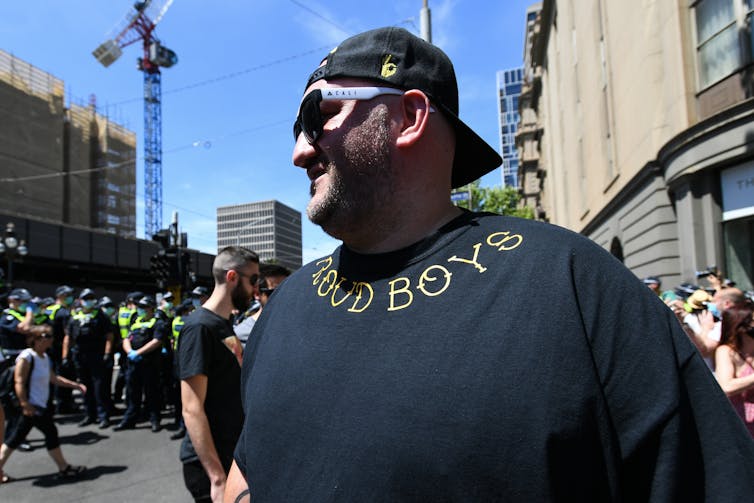
The Proud Boys became more of a visible presence at a November protest in Melbourne. Erik Anderson/AAP

The Proud Boys are a self-described “Western chauvinist” street-fighting gang for men. They claim to be non-racist, but members must take an oath upholding Western civilisation as supreme. Their process for becoming a member also involves violence against each other and against antifascists or “antifa”.


Read more: Why Australia should be wary of the Proud Boys and their violent, alt-right views


This year, Proud Boys members in America have been arrested for assault, street brawls and weapons offences. They are an increasingly visible presence on the streets there, frequently wearing military body armour and carrying high-powered weapons.

The increased visibility of Proud Boys at demonstrations is concerning if it signals a new strategy by the group to engage in street violence either with police or left-wing protesters.

Proud Boys members protesting the presidential election outcome in Washington. Note right Wing Death Squad badge. KYDPL KYODO/AP

Other far-right groups emerging

Other right-wing groups in Australia have benefited from public anger to the government’s coronavirus responses, as well.

Relatively new groups such as the Townsville Free Corps and the National Socialist Network, an offshoot of the Lads Society and incorporating ex-Antipodean Resistance members, have stepped up their recruitment and propaganda activities in Melbourne, Sydney and Queensland over the past year.

The Southern Poverty Law Centre in the US, which tracks far-right extremist groups, revealed in August that the white supremacist terror group The Base had also interviewed potential Australian members using its Perth-based recruiter to set up cells. By late 2019, at least a dozen Australian men had applied to join The Base.

One potential member had been a former political candidate for One Nation, the SPLC reported.

Many of these far-right groups are adherents to the same “great replacement theory” that motivated the Christchurch killer. According to this theory, white Europeans are threatened by increasing non-white immigration and are therefore facing “white genocide”.


Read more: Coronavirus and conspiracies: how the far right is exploiting the pandemic


The Base follows an “accelerationist” ideology, which aims to bring about societal collapse as a way of “winning the race war” for whites.

The National Socialist Network, which has more than 2,000 members on Telegram, uses the “great replacement theory” to recruit. Its leader, Thomas Sewell, specifically targets young, white, “disgruntled” men.

When hateful speech turns into violence

Tyler Jakovac, the 18-year-old man arrested in Albury this week, fits this description. According to NSW police assistant commissioner Mark Walton, he hated anyone who did not look like him and was specifically opposed to Jews, Muslims and immigrants.

The National Socialist Network issued a statement via an encrypted app claiming that Jakovac applied to join six months ago, but didn’t pass the vetting process. The group claims that after being rejected, Jakovac abused it as being “too moderate”.

The Christchurch killer, meanwhile, had been invited to join an earlier version of Sewell’s group. He declined and went on to act alone.

This raises a problem: extremist groups with a public propaganda strategy are easier to identify, but as the inquiry into the Christchurch attack noted, lone actors can be almost invisible to authorities.


Read more: The royal commission report on the Christchurch atrocity is a beginning, not an end


There are communities on gaming platforms, message boards and in encrypted apps that share racist, anti-semitic and hateful material every day. By ““weaponising” irony, users can hide behind plausible deniability (“it’s just a joke”) when challenged about the violence stated in their posts. But to outsiders, the language used can be confronting.

It is often insiders who have a more finely tuned sense of when someone is crossing over from sharing memes to something more sinister. We need to educate and support internet users to follow their hunches by identifying and reporting other users who are edging toward violent action.

The Christchurch murderer was reported to police in 2016 for threatening someone with retribution on the “day of the rope”, according to the inquiry report. This is neo-Nazi shorthand for the mass murder of race traitors. Unfortunately, no police action was taken.

There are thousands of references to the “day of the rope” in online groups — knowing when to step in is the challenge. And, as the events of this week show, disruptive preemptive action is essential to reduce the risk of another mass murder.

ref. Far-right groups have used COVID to expand their footprint in Australia. Here are the ones you need to know about – https://theconversation.com/far-right-groups-have-used-covid-to-expand-their-footprint-in-australia-here-are-the-ones-you-need-to-know-about-151203

Tension rises in New Caledonia over Brazilian miner Vale’s bail out efforts

BACKGROUNDER: By Michael Field

Efforts by Brazilian miner Vale SA to extract itself from one of the world’s largest nickel and cobalt operations are creating deeping tensions and confusion in the French Pacific territory of New Caledonia.

On Wednesday night Vale announced a vague deal, without disclosing full financials, but by Thursday there was uncertainty as Paris officials entered a political maze around it all.

Violence broke out this week in the capital Noumea with indigenous pro-independence groups trying to take control of the mining as small bands of white settlers, some armed, supported Vale’s exit plans.

It comes soon after New Caledonia, population 286,000, held a second referendum on independence in October, narrowly voting to retain French control.

A third referendum in 2022 may yet be held.

Indigenous “Kanaks” account for 39 percent of the population.

New Caledonia has around a quarter of the world’s known nickel reserves.

Conrontation over nickel
The current confrontation involves the Goro Nickel Project, 60 km east of Noumea which commenced production in 2010 planning to produce 60,000 tonnes a year of nickel and up to 5000 tonnes of cobalt.

It has 55 million tonnes of estimated measured and indicated mineral reserves.

Vale obtained the rights as part of a 2007 US$19 billion takeover of Canadian company Inco. But it ran several years behind creating the project, worth over US$6 billion.

Start up decisions left an operation only producing around a third of its promised annual capacity. Using a difficult technology to convert ore to nickel oxides, Vale has been unable to produce preferential battery material nickel sulfate.

Nickel production at the Goro mine reached its peak 37,400 tonnes in 2017. The mine was expected to produce 31,000 tonnes this year in 2020.

Les Nouvelles Calédoniennes 111220
Evacuation … today’s Les Nouvelles Calédoniennes front page. Image: PMC screenshot

The Goro project, which includes open cast mining, refining and a port, has been 95 percent owned by Vale Nouvelle-Calédonie with the balance held by the local government.

Vale’s plant is the second-largest employer in the Southern Province, with some 3500 employees and contractors.

Vale trying to get out
Vale has been attempting to get out, to the extent of simply closing the operation and walking away.

Earlier this year Australian-based zinc producer New Century said it was seeking a deal to buy but backed out after failing to raise enough cash.

Les Nouvelles Calédoniennes website 111220
Conflict over plans for the future of nickel lining at Goro, New Caledonia. Image: Les Nouvelles Calédoniennes/PMC screenshot

Indigenous groups sought to promote a bid from Sofinor, the financial arm of New Caledonia’s Kanak-run and majority population Northern Province and its partner Korea Zinc.

While Vale had rejected the offer, it stayed political live until last week when, as violence escalated, Korea Zinc pulled out.

University of New Caledonia law professor Dr Mathias Chauchat said the situation was a mess with five areas of concern. These included a difference in treatment between how the Prony and Sofinor bids were treated and possible conflicts of interest among directors of Vale New Caledonia.

There is also “the ecological risk of a residue dam, like in Brazil”. There was also concern over the move away from exporting finished goods and the question of whether in changed New Caledonia there was to be public sector development, or not.

In early December Vale said they would only negotiate with a new group, Prony Resources, named after the local port. Prony is led by Vale’s current New Caledonia management and employees, supported by New Caledonian and French authorities.

Singaporean group
Twenty five percent of Prony’s shares are held by Trafigura Group, a Singaporean multinational commodity trading company.

On Thursday Vale said it had a “binding put option” to formalise the sale to Prony Resources. It said the new structure offered “significant domestic participation and that takes into account the aims of social and environmental responsibility….”

It would continue long standing commitments to maintain benefits for the indigenous people of New Caledonia’s Southern Province.

“All parties to this negotiation have invested a significant amount of time and effort to reach a solution for the sustainable future of (Vale),” said Mark Travers, Vale’s executive director of Base Metals.

“Vale and everyone involved in the divestment process – including the South Province of New Caledonia, the French State and (Vale) employees and management – can be proud of the fact that those efforts have yielded such a positive result.”

As a result of the deal Vale said they expect it completed by the first quarter of next year and that “a reserve of US$500 million will be reflected on Vale’s consolidated financial statements.”

The deal remains subject to the approval of New Caledonian authorities and the French state.

Noumea at a standstill
But as the maneuvering continued this month Noumea has come to much of a standstill in the wake of demonstrations and roadblocks. Mines, shops, the port and several major roads to Goro have been blocked.

The main independence group, the Kanak Socialist National Liberation Front (Front de Libération Nationale Kanake et Socialiste; FLNKS) say their fight over Goro “is a fight against multinationals who try to loot the wealth of all New Caledonians and pollute our country”.

They want the indigenous to be majority owners.

FLNKS, which controls Northern Province, has especially objected to Trafigura, saying it amounts to “plundering of the country’s resources by multinationals”.

Europe-based public affairs consultant Sebastien Goulard, a specialist on European Union-China relations and New Caledonia said the local people did not want Trafigura, because of questions over its role in possible environmental damage.

He said the Vale-favoured deal gives more power to the French loyalists in the Southern Province, meaning the FLNKS would not be able to control the southern mine and the jobs that the mine provides.

“It is not only about economics,” he said, “and that’s why it is so difficult to conduct business in New Caledonia.”

Industrial strategy
Another point was the industrial strategy presented by Trafigura.

“Trafigura would continue the recent strategy adopted by Vale: that is to say the production of NHC (nickel hydroxyde cake), and nickel saprolite type ore to be exported to China (and Finland, if Trafigura’s option is chosen).”

Goulard asked whether it was really possible to refine nickel in New Caledonia in a competitive way.

“The pro-independence supporters prefer to keep control over the island’s main economic sectors,” he said.

“But is it really the best choice when you want to be independent and you will need bigger foreign investment in the coming years? The current crisis gives a terrible image of New Caledonia to possible foreign investors.”

Michael Field, who writes for Nikkei Asia, has provided this article for Asia Pacific Report.

Print Friendly, PDF & Email

Article by AsiaPacificReport.nz

People with severe allergies warned off Pfizer COVID vaccine for now. But that may change as more details emerge

Source: The Conversation (Au and NZ) – By Nicholas Wood, Associate Professor, Discipline of Childhood and Adolescent Health, University of Sydney

Two people in the United Kingdom have experienced an allergic reaction to the Pfizer/BioNTech COVID-19 vaccine. This led the UK medicines regulator to issue precautionary advice earlier this week that “people with a significant history of allergic reactions” should not be given this vaccine for now.

This is an appropriate cautious move. The advice may change once we understand more about what caused these reactions.

Both people reportedly had known allergies and carried adrenaline autoinjectors, suggesting they had a prior history of severe allergic reactions, such as anaphylaxis, a severe and rapid form of allergy.

At this stage, we do not have many further details about the reported allergic reactions to the vaccine.

How common are these types of reactions?

Severe allergic reactions to vaccines are extremely rare, with anaphylaxis occurring after approximately one per million vaccine doses.

Most reactions reported as possible allergic reactions to vaccines are most likely not true allergies.

Regardless, every person is normally asked about their medical history by their immunisation provider, including whether they have any known allergies, especially to a vaccine or its ingredients, before being vaccinated.


Read more: 5 ways our immune responses to COVID vaccines are unique


As almost all severe allergic reactions occur within 15 minutes of exposure to the trigger, it is common around the world to monitor patients for at least 15 minutes after vaccination.

In Australia, it is recommended that any facility where vaccinations are delivered is equipped with the equipment and trained staff to recognise and treat allergic reactions. This applies to all vaccines, including COVID-19 vaccines.

What types of allergens are we talking about?

People can be allergic to a wide range of substances (called allergens), including foods and medications. If someone has a known allergy to a vaccine ingredient, they may be advised not to have that vaccine.

The Pfizer/BioNTech COVID-19 vaccine does not contain any ingredients that commonly cause allergic reactions, and the full list of ingredients has been published by the UK medicines regulator.

It is likely the two people who may have had an allergic reaction after the Pfizer vaccine will be reviewed by an allergy/immunology specialist. If found that they truly had anaphylaxis they would be unlikely to be given the second dose of the vaccine.

However in some situations, people who have had allergic reactions after one dose may be able to receive further doses of the same vaccine using a specialised approach, such as graded dosing, which can avoid triggering a reaction. This approach has not yet been reported for any COVID-19 vaccine.


Read more: Should Australians be worried about waiting for a COVID vaccine when the UK has just approved Pfizer’s?


Aren’t clinical trials supposed to pick up issues like this?

People with a history of severe allergic reaction to a vaccine or to any ingredient of the Pfizer/BioNTech vaccine were not included in the late phase clinical trial for this vaccine.

This is a precaution designed to protect the safety of the trial participants. Clinical trials usually focus on healthy people without underlying medical conditions, although the Pfizer phase 2/3 trial allowed enrolment of people with stable pre-existing chronic conditions.

Once the safety and effectiveness of a vaccine is well established in healthy people, it can then be offered to other populations, such as people with severe underlying medical conditions.

This trial includes more than 40,000 participants and has shown the vaccine to be safe and well tolerated, with no serious safety concerns. The incidence of allergic-type symptoms after vaccination was slightly higher in the vaccinated group at 0.63% compared with the placebo group at 0.51%, however it is not clear whether this slight difference is due to chance.


Read more: ‘Very convincing evidence’: Pfizer now has the data it needs to apply for COVID vaccine approval


What are the implications for people with significant allergies?

As to the implications of this latest news for people with significant allergies, it’s too early to tell. We still don’t know if these reports were true allergic reactions.

There is also no theoretical reason to suspect allergic reactions would be more common with COVID-19 vaccines than with other vaccines, even those using newer technologies.

As always, people should discuss their medical history with their vaccine provider, including any history of allergy.


Read more: From adenoviruses to RNA: the pros and cons of different COVID vaccine technologies


We still need ongoing monitoring

Given COVID-19 vaccines will be delivered to millions of people around the world, it’s inevitable some adverse events will be reported. There is potential for an adverse reaction with any medication or vaccine, and that’s why people are monitored after being given a vaccine. A consideration of the risks and benefits is always important when considering whether to have a vaccine.

More than 1.5 million people have died from COVID-19 so far, and thousands more are dying each day. The benefits of vaccination will far outweigh the risks, particularly for the priority population groups most vulnerable to COVID-19.

Ongoing monitoring of COVID-19 vaccine safety is also crucial and will allow us to detect side effects that may be very rare, or which may be related to an underlying medical condition.

In Australia, we’ll be doing this with a robust vaccine safety surveillance system, which will be used to monitor the safety of any licensed COVID-19 vaccines in near-real time, and which will provide publicly available updates.

ref. People with severe allergies warned off Pfizer COVID vaccine for now. But that may change as more details emerge – https://theconversation.com/people-with-severe-allergies-warned-off-pfizer-covid-vaccine-for-now-but-that-may-change-as-more-details-emerge-151837

Tasmanian devils look set to conquer their own pandemic

Source: The Conversation (Au and NZ) – By Hamish McCallum, Professor, Griffith School of Environment and Science, Griffith University

In the midst of a human pandemic, we have some good news about a wildlife one: our new research, published today in Science, shows Tasmanian devils are likely to survive despite the infectious cancer that has ravaged their populations.

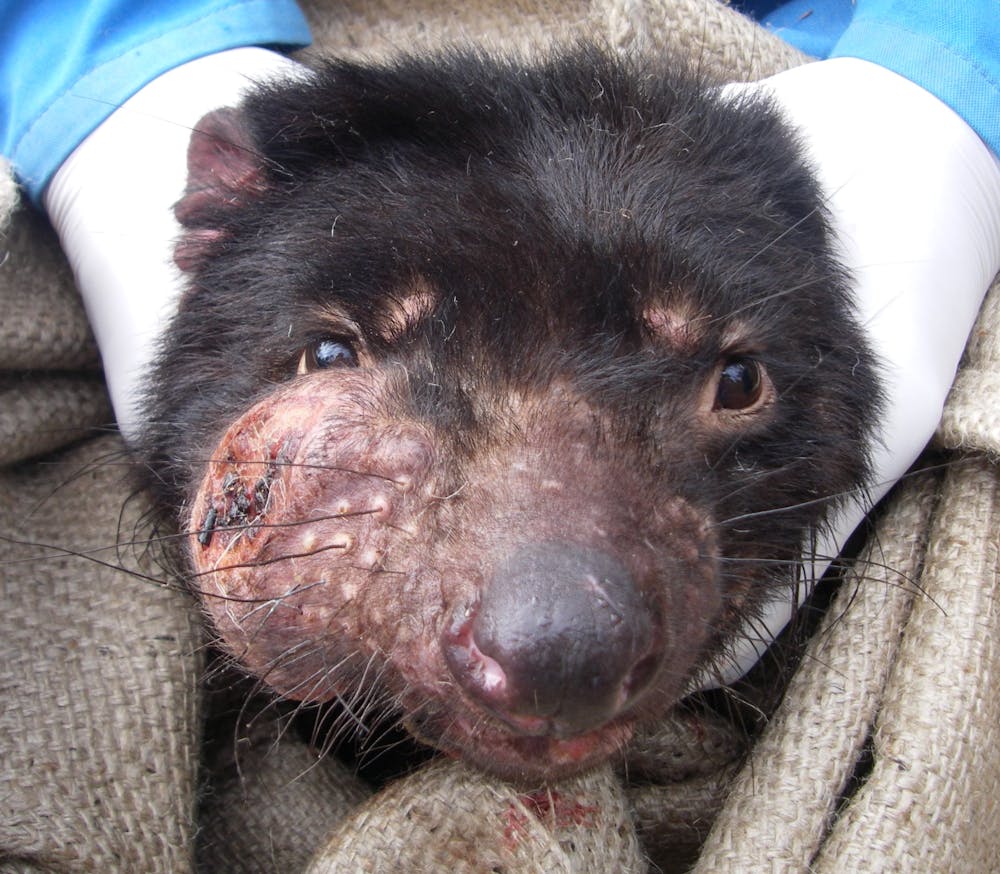
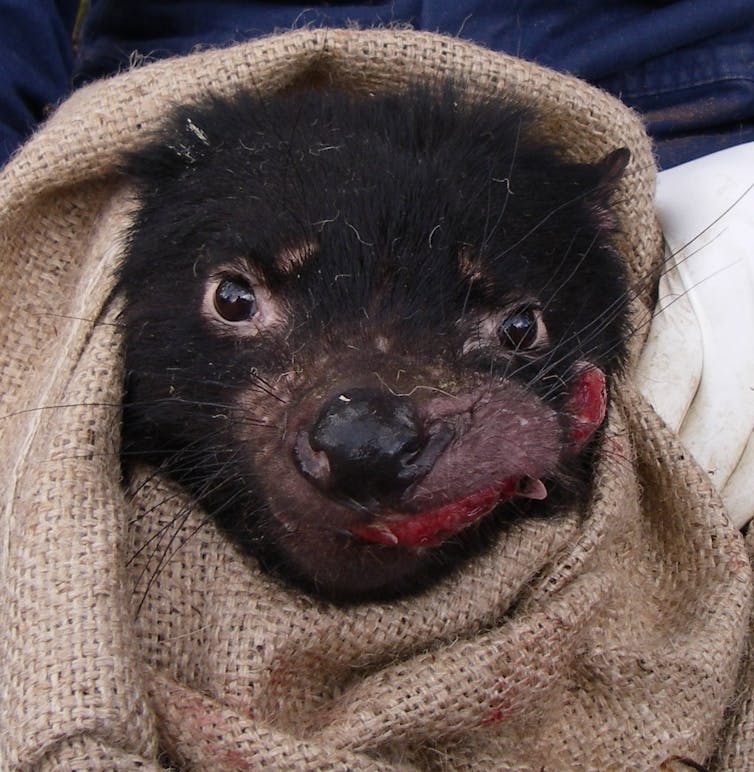
Tasmanian devils have been devastated by a bizarre transmissible cancer. Devil facial tumour disease, or DFTD for short, was first detected in 1996 in northeast Tasmania. Transmitted via biting, DFTD has spread over almost the entire state, reaching the west coast in the past two or three years. It has led to a decline of at least 80% in the total devil population.

Tasmanian devil with facial tumour
The infectious tumours are spread by biting. CREDIT, Author provided

Ten years ago, we thought there was a real chance DFTD would drive the Tasmanian devil to extinction. Our concern arose not just because the cancer was almost inevitably lethal, but also because the transmission rate did not appear to slow down, even as devils became very rare.

Our new research has some good news: by pioneering application of genomic analysis typically used for viruses, we have discovered the curve has flattened and the rate of increase of infections has slowed. This means while the disease is probably not going away, neither are Tasmanian devils.

Genomics is a relatively new field of science that uses the vast amounts of data available from modern genetic sequencing techniques to answer some of the most difficult and important questions in biology.


Read more: We developed tools to study cancer in Tasmanian devils. They could help fight disease in humans


The genomic approach we used is called phylodynamics. It uses sophisticated mathematical analysis of small changes in DNA to reconstruct the evolution and spread of the tumour through devil populations. This is the same method used to track the COVID-19 pandemic, and it was first developed to study the influenza virus. Viruses have small genomes and evolve rapidly. This is the first time the method has been used for a pathogen with a much more complex and slowly evolving genome.

Screening more than 11,000 genes, we found the R number (the average number of secondary cases for each primary case, now familiar from COVID-19) has fallen from about 3.5 at the peak of the epidemic to about one now. This suggests some sort of steady state has been reached, and the disease and devils are now coexisting.

Reproduction number RE of DFTD from 1990 to the present.
Reproduction number RE of DFTD from 1990 to the present. CREDIT, Author provided

This discovery backs up a paper we published last year, in which we reached a similar conclusion using mathematical models based on marking and recapturing Tasmanian devils at a single study site, without taking genetics into account.

Our new study is based on samples collected across Tasmania since the early 2000s. Given the very different nature of the two methods, the agreement between the results lends us increased confidence in our conclusions.

This paper, in addition to several we have published recently, shows there have been rapid evolutionary changes in Tasmanian devils and in the tumours themselves since the emergence of this transmissible cancer. Already, frequencies of gene variants known to be associated with immune function in humans have increased in Tasmanian devil populations, suggesting the devils are evolving and adapting to the threat.

We also now know a relatively small number of genes has a large influence on whether devils become infected, and whether they survive if they do.

Finally, and perhaps most encouragingly of all, we have now seen tumours shrink and disappear — something that was unheard of when the disease first emerged. What’s more, we also know this has a strong genetic basis, again suggesting the devils are genetically adapting to their foe.

Together, all of these discoveries show wild Tasmanian devils can evolve very rapidly — over just five generations or so — in response to this disease. This has profoundly encouraging implications for their likely future survival.

Baby Tasmanian devil
Tasmanian devils now have much better genetic defences against the disease. Rodrigo Hamede, Author provided

There is still much more to learn about the evolution of the devils and their tumours. But meanwhile, our results provide a warning that a strategy of reintroducing captive-reared animals to supplement diseased wild devil populations is likely to be counterproductive.

When devils from populations that have never been exposed to the disease interbreed with wild animals in diseased populations, the evolution we have seen in wild populations is likely to slow down or even reverse, endangering those populations.

What’s more, the slowing rate of disease transmission may be partly a consequence of reduced devil population densities, resulting in fewer bites. Artificially boosting population densities might accelerate disease transmission, the opposite of the intended effect.


Read more: Sexual aggression key to spread of deadly tumours in Tasmanian devils


With the growing body of evidence showing extinction of devils is quite unlikely even over the next 100 years, we have time for careful consideration of management strategies. Specifically, models can be developed to assess the evolutionary and epidemiological consequences of reintroductions or translocations.

One possibility would be to captively breed devils that have the right genes to boost their chance of surviving the disease. More broadly, our research underlines the vital importance of taking evolutionary considerations into account when managing endangered species. We now have the genomic tools to do so.


Many thanks to Andrew Storfer at Washington State University, Menna Jones and Rodrigo Hamede at the University of Tasmania, and Paul Hohenlohe at the University of Idaho for their contributions to this article and the research it describes.

ref. Tasmanian devils look set to conquer their own pandemic – https://theconversation.com/tasmanian-devils-look-set-to-conquer-their-own-pandemic-151842

Yes, the coronavirus mutates. But that shouldn’t affect the current crop of vaccines

Source: The Conversation (Au and NZ) – By Rebecca Rockett, Virologist, University of Sydney

“Coronavirus” has already established itself as the scary new word of 2020. Add the word “mutant”, and you’ve got an even stronger candidate for the scary new phrase of 2021.

One fear is that critical parts of the coronavirus genome will mutate, making any vaccine obsolete before it’s widely rolled out next year.

But how much of an issue is this really? As we’ll see, SARS-CoV-2, the coronavirus that causes COVID-19, mutates, as do all viruses. But unlike other RNA viruses, it’s actually quite stable.

That’s largely good news for the first crop of vaccines that are set to be rolled out around the world in 2021.

What’s a mutation anyway?

In genetic terms, a mutation is just a scary word for a mistake. As cells make new copies of a virus, mistakes happen. These mistakes sometimes result in a stronger virus, sometimes a weaker virus.

But in most cases mutations in the coronavirus are irrelevant anomalies that cause changes to the genetic material (RNA) but not the resulting proteins that make up its composition and structure.

In fact, SARS-CoV-2 seems to have a slower rate of mutation than other RNA viruses. That’s because it belongs to a family of viruses with genetic proofreading mechanisms that can identify and remove most mistakes in its RNA when the virus replicates.

This means SARS-CoV-2 has about half the mutation rate of influenza and a quarter the mutation rate of HIV.


Read more: Mutating coronavirus: what it means for all of us


What about mutations and spike proteins?

If there are lots of mutations in non-essential regions of a virus’ genetic material, it can likely still function. But mutations in critical regions can disable a virus, so these don’t occur very often.

This is why vaccines are typically designed against these critical regions — to safeguard against mutations that would make them ineffective.

And it’s mutations in one of these critical regions, the COVID-19 spike protein, that has gained significant attention recently.

This is the protein many COVID-19 vaccines use to generate a protective immune response. In fact, the four vaccines Australia has signed agreements for, should they pass clinical trials, all either contain the virus’ spike protein or carry the instructions your body needs to make it.

What’s all this to do with mink?

One mutation that has attracted controversy is the D614G mutation, partly because it leads to a spike protein with a slightly altered shape.

And some scientists were concerned this mutation, plus three others in the spike protein, would help the virus bypass the type of immunity generated following vaccination.

These mutations emerged when the coronavirus jumped from humans to minks and back again.

To avoid the potentially disastrous implications of this new combination of variants rapidly spreading in humans, millions of minks were culled in Denmark, Spain and the Netherlands.

However, not all scientists are convinced of the potential impact of this combination of mutations. So studies are currently under way to better understand their impact.


Read more: Denmark to cull mink herd over coronavirus mutation fears – here’s what the science says


Syringes at ten paces

Considering what we know about how the virus mutates and the rate of these mutations, the first generation of COVID-19 vaccines look likely to provide some protection against currently circulating SARS-CoV-2 strains.

However, researchers are monitoring the possible emergence of any new mutations in the spike protein from isolates around the world to ensure ongoing vaccine effectiveness.

We can identify any mutations using a technique called genome sequencing, which allows scientists to read the complete genetic sequence, or genome, of the virus.

Since January, scientists around the world have generated and made publicly available more than 246,000 COVID-19 genomes. Scientists can then compare these with the early COVID-19 genomes sequenced in Wuhan. These early sequences are the templates for the vaccines we are waiting impatiently for.

This surveillance will provide an early warning system for potentially critical mutations. And if researchers find mutations, they need to work out what these mutations actually do, using so-called “functional tests”.

Such tests can tell us whether a new mutation influences our immune response to the spike protein, compared to those induced by the original Wuhan strain. We can also investigate if antibodies following vaccination can continue to bind to the spike protein of emerging strains and prevent the virus from infecting human cells.

So should we be worried?

Researchers have only been able to study this coronavirus for a very short time. So only time will tell if it mutates at a frequency and at limited positions in the essential regions, as we have come to expect. That’s why surveillance is so important.

The current crop of vaccines have been developed using decades of accumulated scientific knowledge and are based on what we know about mutations in this and other coronaviruses. So we shouldn’t be too worried when we read scary headlines about a “mutant coronavirus”.

This past year has demonstrated the capacity to rapidly produce vaccines, which hopefully can be modified to reflect new mutations and merging strains should they occur.

ref. Yes, the coronavirus mutates. But that shouldn’t affect the current crop of vaccines – https://theconversation.com/yes-the-coronavirus-mutates-but-that-shouldnt-affect-the-current-crop-of-vaccines-150541

Feel free to disagree on campus … by learning to do it well

Source: The Conversation (Au and NZ) – By Geoff Sharrock, Honorary Senior Fellow, Centre for Vocational and Educational Policy, University of Melbourne

The French Review didn’t confirm a “free speech crisis” in Australian universities. But nor did its report last year confirm free speech was “alive and well”, as Universities Australia would have it. In many university policies the report found vague language, which could rule out voicing a view deemed offensive.

Most universities have updated their policies in response to the French Review’s Model Code on Freedom of Speech and Academic Freedom, and related amendments to higher education legislation are before the parliament. On Wednesday, the Walker Review of universities’ implementation of the code reported that many don’t fully reflect the code yet.


Read more: University free speech bill a sop to Pauline Hanson and other critics, but what difference will it make?


Sally Walker talking at a media conference
Former vice-chancellor Sally Walker has found policies are fully aligned with the French model code at nine universities, mostly aligned at 14, partly aligned at four and not aligned at six, with the rest still finalising their policies. Lukas Coch/AAP

However they fare on this, many will also recall the French Review’s observation:

A culture powerfully predisposed to the exercise of freedom of speech and academic freedom is ultimately a more effective protection than the most tightly drawn rule. A culture not so predisposed will undermine the most emphatic statement of principles.

Of course, universities promote respect for others’ rights, and civility more generally. They have a duty to foster the well-being of students and staff. But in the model code this doesn’t “extend to a duty to protect any person from feeling offended or shocked or insulted by the lawful speech of another”.

Like the Chicago Principles, the model code reflects legal limits on free expression, but doesn’t seek to enforce civility as a formal campus rule. It recognises universities as institutions where disagreement runs deep and where diverse views — even those some find offensive — should be exchanged freely and challenged openly.


Read more: Four fundamental principles for upholding freedom of speech on campus


So, apart from clarifying policy, how can universities promote a “free to disagree” culture on campus? Not just in name, but in norms?

Learning how to disagree well

One way may be to focus more on teaching students how to argue persuasively. On topics where positions are polarised, ad hominem attacks are common. On the topic of climate change, for example, debates often slide into shouting matches between “deniers” and “zealots”. Or they may proceed mainly in the form of petty point-scoring, as in the recent US presidential debates.


Read more: The first US presidential debate was pure chaos. Here’s what our experts thought


To keep debates robust and constructive, it helps to recognise other diversionary tactics and defensive routines. My “Disagree Well On Campus” model (shown below — click to enlarge) calls on scholars to aim high.

Disagree Well On Campus model. For robust and open debate, aim high. Make your case at levels 1-2. Avoid (and recognise) level 3 tactics. Author provided

This means they should contest an opponent’s claims with logic and evidence, a level 2 counter argument. If they can do this well enough, the case at hand — whether mainstream or minority — may be refuted (or reframed, or reaffirmed) to a scholarly standard, level 1.

But, as the list of level 3 “dogmatic avoidance” tactics suggests, there are many ways to differ without resolving anything. At the low end, personal accusations and name-calling aren’t arguments in a level 2 sense. Often they signal a refusal to debate the substance of this kind of topic with that kind of person.

Consider how your last big argument went. Was it level 1, 2 or 3?

Level 3 tactics explained

At level 3, the first two “appeal” tactics enlist support for a view by appealing to a higher authority or greater good. (But how far do we rely on one, or prioritise the other?)

The next four “misdirection” tactics evade the point of an opponent’s view. This is done mainly by raising other concerns. (But how relevant and significant are these to the main argument?)

The final three “exclusion” tactics withdraw the commitment to engage with an opponent’s viewpoint, or take it seriously, by casting doubt on their morality, sincerity or credibility.

At level 3, common avoidance tactics include “straw man” arguments (Misdirect 4). An opponent’s view is restated in a way that gives it unintended meanings. This caricature is then refuted, instead of the actual claim.

Another tactic is to cite a technical fact as a trump card, which seems to settle which side is right (Misdirect 2). But this may be a “red herring” that leads away from the point at issue (Misdirect 1). Or it may be an unreliable form of evidence. The phrase “lies, damned lies and statistics” refers to the use of carefully selected factoids to prop up or put down a case. Often this amounts to spin by omission, not the level of proof that independent experts would accept.

Another level 3 tactic is to take offence at the tone or terms of an opposing view, without addressing its substance (BadHom 1). This is more civil than calling someone an FBDZS — a fool, bigot, denier, zealot or snowflake (BadHom 3). But by shifting off-topic to invoke rules of civility, it offers scope to censor or end the exchange without conceding any substantive point.

protesters attempt to disrupt a speech on campus
Attempts have been made to disrupt speeches on some Australian university campuses. Brenton Edwards/AAP

Read more: There are differences between free speech, hate speech and academic freedom – and they matter


‘Heretic protection’ on campus – but with rigour

Many debates mix level 2 and level 3 ways of arguing. Some are “won on the day” with level 3 tactics alone. But rhetorical point-scoring doesn’t amount to scholarly refutation.

Once a majority view seems settled on this basis, any dissenting minority view — even one with valid points to make — may become undiscussable. In a university context, this is where the principle of academic freedom does its work. As one scholar observes: “popular or mainstream ideas generally need no protection”.

As places of higher learning, universities assume responsibility for protecting free expression and open exchange when views diverge, while also promoting the practice of scholarly refutation. This stance affords “heretic protection” to minority views, while also exposing them to robust counter-argument.

As future leaders and experts, university graduates will need to reach and justify decisions that have wide real-world consequences. Often these decisions will be made in the face of firm opposition from many of those affected. Being able to argue clearly and persuasively, and to tell the difference between a well-reasoned case and slippery rhetoric, will be critical professional skills.

ref. Feel free to disagree on campus … by learning to do it well – https://theconversation.com/feel-free-to-disagree-on-campus-by-learning-to-do-it-well-151019

Tramping the city to find enchantment in a disenchanting world

Source: The Conversation (Au and NZ) – By Samuel Alexander, Research fellow, Melbourne Sustainable Society Institute, University of Melbourne

Based in Melbourne, we set out to find new ways of seeing and understanding aspects of Australian urban life in the 21st century. We did this by walking the city without preconceptions, open and ready to absorb what the streets and sidewalks had to teach.

In search of disturbance and enchantment, we moved, journeyed, observed, discovered, wandered (and wondered), got lost, found ourselves, listened, smelled and meandered through the main streets and back alleyways, the CBDs and suburbs, the parks, cemeteries, buildings and cultures of Melbourne.

Cover of Urban Awakenings book
Melbourne Sustainable Society Institute/Palgrave

We have reported our year-long project in our new book, Urban Awakenings. We conceived it in early 2019 as a series of urban investigations. We were inspired and guided by the thesis set out in American philosopher Jane Bennett’s book The Enchantment of Modern Life.

Bennett acknowledges that modern life in industrialised society comes with heavy environmental burdens and deep social justice concerns. But, troubled though modern life is, she argues it still has the capacity to enchant (and disturb) in ways that inspire engagement with the world and each other.

Why seek out enchantment?

In Bennett’s hands, a willingness to seek enchantment in everyday life is a necessary precondition of ethical practice and political engagement. It can create the emotional capacity for wonder, compassion, engagement and generosity.

Conversely, disenchantment with life poses an ethical and political problem, she maintains, in that it can lead to apathy and resignation. To be disenchanted is to feel one lives in a world that lacks meaning and purpose. A better world becomes unimaginable and so not worth fighting for.

Readers might agree it is easy to feel disenchanted in a modern, industrial city, with its concrete, cars, noise, pollution and crowding.

people waiting to cross a busy city intersection
Disenchantment with the crowded, noisy and hectic life of industrial cities can blind us to the possibilities of change. Shuang Li/Shutterstock

Read more: What actually is a good city?


On the other hand, to actively seek out and appreciate moments of urban enchantment has ethical potential. It can give people the energy — the impulse — to care and engage in a world desperately in need of ethical and political re-evaluation and provocation.

To be enchanted — if only for a moment — is to see life as worth living. We can then start to see the world as a place that has the latent capacity to be transformed in more humane and ecologically sane ways.

More importantly, enchantment, as we are using the term, provides the propulsion to act and engage. It’s an antidote to apathy, resignation and perhaps even despair.

Based on these insights, we contend that effective urban politics must change or challenge not only the way we think about the world, but also how we feel, perceive, judge and experience the world.

Urban tramping as method

In our book we apply Bennett’s critical philosophy to the urban landscape. We did this by walking our home city, Melbourne, with eyes open to the possibility of enchantment.

We describe this as “urban tramping”. We urban tramps were to be free-thinking, free walkers of the city, encumbered only by the duty to absorb what the city had to teach.

The “tramp” was to be a distinguishing critical identity that at the same time related us to the various traditions of urban observation: flâneurs, slum journalists, ethnographers, psychogeographers, and so on.


Read more: Psychogeography: a way to delve into the soul of a city


In other words, we set out to sojourn through urban landscapes with the same sense of wonder and critical attention that a nature walker like Henry David Thoreau embodied as he sauntered through Walden Woods. Nature can enchant and disturb, but what about the city?

foggy morning in a Melbourne park
The quest for enchantment took in all parts of Melbourne. ProDesign studio/Shutterstock

Urban Awakenings draws inspiration and content from the variety of our urban tramps over the past year or so. We started out from grounds never ceded by the Aboriginal peoples who have lived in what we call Melbourne for countless generations. We recognise the false claims to exclusive sovereignty of a social order established through invasion and violence.

In a collection of brief essays based on our perambulations, we record the myriad ways in which we found holes in the main narrative of Western societies today — that free markets and economic growth are the necessary and natural preconditions for modern urban life. Indeed, one journey took us through various cemeteries of Melbourne, inviting reflection on themes of death and finitude even in this (second-most-liveable) city.


Read more: Imagining a better world: the art of degrowth


A disturbed book

Little did we know a pandemic would disrupt our book midway through. It was split into two parts — before-COVID (BC) and after-COVID (AC).

Heraclitus, the ancient Greek philosopher, famously said one can never step into the same river twice, since it is always in flux. We would say the same thing about cities. Our BC and AC experience of Melbourne testifies to this rather starkly.

feet of person standing on rocks in a river
Just as one can never step into the same river twice, each time we set out into the city it is changing. Pavel_Markevych/Shutterstock

As it unfolded, the pandemic was yet another historical proof of the vulnerability and contingency of capitalism, especially its latest form, globalised neoliberalism. We recognised this huge, sudden superimposition on our project as an affirmation of its purpose. We walked Melbourne under lockdown (in accordance with the rules) with a keen eye for the many disruptions the virus imposed on free market societies like Australia, especially their paid and unpaid working lives.


Read more: I’ve seriously tried to believe capitalism and the planet can coexist, but I’ve lost faith


Without diminishing the social and physical injuries of the pandemic, it was clear that many of the apparently rigid processes and rhythms of the industrial order could in fact be rapidly suspended and even permanently changed.

The sudden relocalisation of everyday life, for example, showed the stressful, polluting rhythms of urban commuting were part of a constructed, not natural, order. In traffic-calmed cities, nature took a breather and found new friends in social hordes who happily occupied newly available green spaces, even median strips in once-busy roads.

Many more disturbing enchantments and enchanting disturbances were observable to the tramps’ eyes.

Our project ended just as the long lockdown in Melbourne was relaxing. Everyone began to wonder what permanent changes might have been wrought on the hard-wiring of Australia’s “growth machine” cities. It was a good time to reflect on Bennett’s point that to seek enchantment is not to seek magic but rather possibilities for change in the stultifying and unjust workings of the industrial order.

The tramps took the project out on the road in Melbourne in 2020 at a time when change was certainly in the air. When we step into the city again tomorrow, no doubt we will find the urban landscape and its inhabitants still in flux.

ref. Tramping the city to find enchantment in a disenchanting world – https://theconversation.com/tramping-the-city-to-find-enchantment-in-a-disenchanting-world-150938

Home ownership and super are far more entwined than you might think

Source: The Conversation (Au and NZ) – By Deborah Ralston, Professorial fellow, Monash University

When the government’s retirement incomes review of which I was a part examined superannuation, the age pension and voluntary savings, home ownership had a surprisingly important role.

The home is the largest form of voluntary saving and is far more entwined with super and the pension than might be thought, with threads that travel from homeownership to access to the pension, from homeownership to the size of the pension, and from superannuation to homeownership.

Homeownership keeps pension costs low

At present, about 76% of retirees own the homes they live in, about 12% rent and a further 11% either live rent-free with family or are in residential care or another arrangement.

Retired Australians have been unusually likely to own the homes in which they live.

This is an unusually high rate of homeownership by international standards that not only benefits individuals but the public purse.

It lowers age pensioners’ living expenses and lowers the required size of the pension.

At 2.4% of gross domestic product, Australia has one of the lowest-cost age pension schemes in the OECD.

But there are indications that homeownership is on the decline.

People are entering the workforce, marrying, forming households and buying their first home later in life.

Between 1981 and 2016 the average age at which Australians purchased a home climbed from 24 to 33.

As a consequence, the average age at which mortgages were paid out climbed from 52 to 62.

Now, one in every ten retired Australians enters retirement with a mortgage.

Wealth tied up in homes escapes the assets test

As wealth tied up in housing is exempt from the age pension assets test, it is for many people a preferred form of retirement saving.

At present, around 15% of age pensioners live in homes valued at more than A$1 million, although these figures partly reflect Sydney and Melbourne property prices which have escalated over recent years.

These retirees are often “asset rich and income poor”, having chosen to store their wealth in an asset that doesn’t pay income.

They do well out of the pension. One fifth of age pension expenditure goes to the wealthiest two fifths of retirees.

Non-homeowners live poorly

Non-homeowners, on the other hand, are among those most likely to experience poverty in retirement.

Commonwealth Rent Assistance helps with the rent of those reliant on the pension and other payments and is much more targeted than the pension, with 90% going to the poorest fifth of retirees.

But the indexation of rent assistance payments to the consumer price index instead of rents for more than three decades has eroded their value to the point where they now cover less than half the rental costs of the people who get them.

Boosting rent assistance would help, but it is only part of the solution.


Income poverty rates of retirees

Retirement Incomes Review, notes

Other parts of the solution include increasing the supply and affordability of housing, creating a market in longer-term rental contracts, and boosting access to public housing, outside the terms of the review.

Super supports home ownership

Super gets diverted into financing homeownership in three ways.

First, voluntary contributions can be redrawn by first homebuyers for the purpose of a home deposit, for a sum of up to $15,000 from any one year and up to up to a maximum of $30,000 plus earnings across all years.

Super encourages people to borrow.

For couples, this can provide up to $60,000 plus earnings to buy a house.

Second, retirees can make a downsizer contribution into their super fund of up to $300,000 per person from the proceeds of selling one home to buy another. Such contributions don’t count towards their super contributions caps.

The third way in which super is financing home ownership is the increasing tendency for people to use their super payouts on retirement to pay out their mortgages.

In addition there is what’s known as the “wealth effect”, a phenomenon seen in contributory pension systems around the world.

Research conducted for the review found that increasing compulsory super balances increase household wealth and provide a degree of confidence for households to increase debt to invest in property, knowing that superannuation savings can be accessed to extinguish debt in the future and that the residential home is not counted in the age pension assets test.


Read more: What matters is the home: review finds most retirees well off, some very badly off


Over a four-year period, it was found that a $1 contribution to compulsory super increased net household wealth by $2.51, through an increase in super wealth of $1.51 plus an increase in housing wealth of $1.21, offset by a 51 cent decline in non-super, non-housing savings.

In each of these ways super makes a contribution to homeownership. The review did not conclude there was a case for allowing further withdrawals from super to enable it to more.

Homes can contribute to retirement incomes

For typical homeowner at retirement, home equity represents about two to three times as much of their wealth as does super.

It ought to make accessing the equity in the home through a schemes such as the government’s Pension Loans Scheme attractive.

As an example, drawing down $5,000 each year against the equity in a $500,000 home would eat into only a quarter of its value by the time retiree reached 92.

Consumer protections around the pension loans scheme and other reverse mortgage products limit loan to value ratios, ensure that retirees have guaranteed occupancy and can’t run up negative equity in their homes.

It’s time to use them

These schemes are at last becoming more popular, perhaps in part to the growing proportion of lifetime income tied up in homes, a figure that has grown from about 6% in the mid 1990s to around 16% for homes bought today.

Homes are a critical part of the retirement system. They are not only a place to live, but are a substantial part of householder wealth and should be considered when planning retirement income. Especially for those older Australians who have not had the benefit of higher superannuation contributions over their working lives.


Read more: Retirement incomes review finds problems more super won’t solve


ref. Home ownership and super are far more entwined than you might think – https://theconversation.com/home-ownership-and-super-are-far-more-entwined-than-you-might-think-151693

Brand activism is moving up the supply chain — corporate accountability or commercial censorship?

Source: The Conversation (Au and NZ) – By Sommer Kapitan, Senior Lecturer in Marketing, Auckland University of Technology

When New Zealand digital media giant Stuff stopped using Facebook as an advertising partner in July this year, it joined the ranks of other openly activist brands. But it also showed how brand activism is moving from speaking directly to consumers to companies policing their own supply chains.

The trial decision was in response to concerns over “fake news, hate speech and fraudulent advertising” on Facebook, which conflicted with Stuff’s charter under its new local ownership.

As such, it is part of a broad trend towards companies applying their own checks and balances on commercial ethics and activity. But this evolving role for business-to-business (B2B) brands is not without controversy or risk of financial blowback.

When does the act of removing products from stock, or boycotting a major supplier, move beyond marketing strategy to moral act? And when does it become censorship?

These questions relate directly to the tangible impacts of B2B activism: removing products from shelves, terminating licensing contracts, removing content from online platforms and firing clients and supply-chain partners who don’t align with a corporate brand’s avowed values and purpose.

Supply-chain activism is growing

Such activism may happen behind the retail face of a brand, but is nevertheless often about the perceptions of the end consumer.

For example, when Australian celebrity chef Pete Evans tweeted a neo-Nazi meme in November, publisher Pan Macmillan and licensed cookware makers Baccarat and House ended their partnerships with him. Baccarat said in a statement:

In our view, the images and views expressed by Mr Evans are abhorrent, unacceptable and deeply offensive.

Retailers across Australasia followed suit, pulling cookbooks and kitchenware lines from their shelves. There’s an important distinction here between retailers simply refusing to stock products because they are offensive or defective, and refusing to stock products because of something a supplier has said or done.


Read more: Athlete activism or corporate woke washing? Getting it right in the age of Black Lives Matter is a tough game


This has been likened to “cancel culture” by some supply-chain partners vetoed by activist brands, and is forcing businesses to ask where they draw the line on perceived moral and ethical issues.

Consumers demand transparency

This is new territory for manufacturing and client-facing corporate brands, which had been somewhat exempted from the first wave of authentic brand activism.

Because B2B companies are insulated from direct customer contact, managers or buyers tasked with justifying corporate decision-making have tended to put costs ahead of social or emotional considerations.

But the rapid acceleration of brands as arbiters of social causes has inevitably moved back up the supply chain. Shoppers are increasingly aware of, and driven by, transparency.

For example, consumer watchdog groups wary of greenwashing or deceptive claims about green product performance have led to the rise of green supply-chain monitoring.


Read more: Woke washing: what happens when marketing communications don’t match corporate practice


Not business as usual

But end-consumer expectations now extend to social causes. This means we are witnessing the rise of the “pro-social supply chain”, increasingly driven by social and political considerations rather than the bottom line.

Locally, apparel maker Icebreaker followed Stuff and stopped advertising on Facebook. And online retailer Mighty Ape pulled books by an author who mocked New Zealand’s new foreign minister’s moko kauae (facial tatoo).

Overseas, the Facebook boycott movement #StopHateForProfit organised by civil rights groups saw more than 1,000 companies join and cut their advertising spends.

Elsewhere, American hotel brand Motel 6 and others fired its longstanding advertising agency due to the founder’s reportedly racist comments. And law firms Jones Day and Porter Wright pulled back from representing outgoing president Donald Trump in post-election lawsuits.

No actions without consequences

B2B brand activism in the supply chain is not without consequences, however. Suppliers can lose contracts, revenue and livelihoods when they are “cancelled” by clients further down the supply chain.

Activist brands are also at financial risk themselves — as Stuff would have been by forgoing market share due to its Facebook decision. The ideal outcome is that positive brand awareness drives business to offset any losses.

But, as our work on brand activism shows, authenticity is paramount: B2B brands’ marketing and communication must align with purpose and genuine action. Once a corporate brand takes a stand, it must continue to advocate for sustainable ethical supply-chain practices — or risk being accused of “woke washing”.

The next challenge is clear: B2B brand activism must also involve actively infiltrating the supply chain to prioritise workplace safety, workers’ rights and sustainability to keep pace with consumer demand for social purpose.

ref. Brand activism is moving up the supply chain — corporate accountability or commercial censorship? – https://theconversation.com/brand-activism-is-moving-up-the-supply-chain-corporate-accountability-or-commercial-censorship-151749

Friday essay: the hidden agenda of royal experts circling The Crown series 4

Source: The Conversation (Au and NZ) – By Giselle Bastin, Associate Professor of English, Flinders University

The recent outcry from royal biographers about the accuracy and fairness of series 4 of The Crown taps into narratives that have surrounded the field of royal life writing since it emerged in the early 20th century.

There has been much hand-wringing by (royal) trainspotters, biographers, journalists and even Britain’s Culture Secretary Oliver Dowden and the actor who plays Princess Margaret, Helena Bonham Carter, about the accuracy of the Netflix series written and produced by Peter Morgan.

Criticisms of series 4 have ranged from historical inaccuracy (the Queen being wrongly dressed for the Trooping the Colour; Princess Anne’s horsemanship) to a propensity to flesh out the narrative with half-truths and downright falsities. (For example, the suggestion that Charles and Camilla remained an item all the way through his marriage to Diana, and the idea that Prince Philip gave Diana a veiled threat about what could await her if she didn’t play by the script.)

Olivia Colman as the Queen at the Trooping the Colour. Netflix

One royal biographer, Hugo Vickers, has been so incensed by The Crown’s playing hard and fast with the facts he’s sprung to action and released his own book devoted to fact-checking it.

In addition to criticising the biopic’s misrepresentation of royal lives, the show’s detractors express concerns long aired about popular history — that an admiring and gullible viewing public will assume the program is factual and treat it as real history. The public, it is implied, need protection from fake news turning into fake history.

Critics of The Crown profess to have the royals’ best interests at heart because the royal family is not prone — at least it wasn’t before Harry and Meghan — to going to the courts or on the public record to defend itself. The Windsors, they imply, are being subject to unethical treatment and are also in need of protection.

Erin Doherty as Princess Anne in The Crown. Des Willie/Netflix

Peter Morgan and Robert Lacey (a leading royal expert consulting on The Crown) have been open about the program’s blending of fact and fiction. Netflix has announced there is no need for it to carry a disclaimer about efficacy or accuracy. People will know it’s drama, they’ve said, so move on.


Read more: The Crown season 4 review: a triumphant portrait of the 1980s with a perfectly wide-eyed Diana


I would contend there is a lot more going on than first meets the eye with these debates about The Crown’s legitimacy and accuracy. What we are witnessing are discourses that surround notions of who has the legitimate right to talk about royal lives.

In this, the field of royal biography is unique. It is tied implicitly, and often explicitly, to the systems governing the royal houses, and derives meaning and stature from its relative proximity to the locus of royal power — the monarch and inner circle of royal members and their senior servants.

In the case of current criticisms of The Crown, the chorus of disapproving voices is sending coded messages to the royals (and their royal handlers) about their social and professional suitability to qualify for the holiest of holy grails: to be the official biographer of Queen Elizabeth II upon her death.

Queen Elizabeth II: who will write her biography? Glyn Kirk/AP

They may have missed out on the riches and splendours of co-writing and advising on The Crown, but they’ll scramble cheerfully to secure their place in the royal firmament.

Touching ‘sore places’

In the early 20th century, a culture of royal life writing developed that saw an intricate interplay between palace courtiers and the biographers who were screened, vetted, and given (or not given) access to the details of royal lives. Royal biographers commissioned to write the official or approved biographies of the monarch entered into a tacit agreement to abide by the codes of deference and discretion. In this sense, they came to resemble the royal courtier, with all the trappings, grace, favour, honours and financial reward this role bestowed.

Indeed, royal biographer John Wheeler-Bennett cautioned those who would enter the fold it was something “not to be entered into inadvisedly or lightly; but reverently, discreetly, advisedly, soberly and in the fear of God”.

The culture of royal biography arguably began with royal courtier Lord Esher’s recruitment of Etonian school master A.C. Benson to help him edit Queen Victoria’s vast piles of correspondence.


Read more: Sydney’s 9,189 ‘sister politicians’ who petitioned Queen Victoria


Historian Yvonne M. Ward has charted how 1st Baron Stamfordham, Private Secretary to Queen Victoria and later to King George V, issued warnings to Esher and Benson that some of the queen’s letters were not to be made public.

They were of “no importance historically and would only supply matter for gossip and possibly ill-natured criticism”.

Queen Victoria in 1863. Wikimedia Commons

Esher brought in high-ranking friends to help edit Benson’s choices and to make especial note of “anything [that might] slip in which can give pain or offence”. One such friend assured Esher he “had kept a keen look-out […] for references or quotations that might touch sore places”.

As the century progressed, senior palace officials designed the template supposed to be followed to this day, setting the tone for how the royals should be represented on the public record. The rewards of access to the Royal Archives at Windsor, to the sacred spaces of the royal court, and the bestowment of status in the form of honours and titles awaited those who toed the line.

For those deemed to have broken the codes, social, professional and economic consequences quickly followed.

Sacred and not to be pried into

Royal biographer Jane Ridley, for instance, has shown the challenges met by Sir Sidney Lee (real name Solomon Lazarus Lee) after he was commissioned in the 1910s to be official biographer of Edward VII (Bertie).

According to Ridley, Lee wanted to exercise autonomy in his treatment of his royal subject; he also wanted to control the publication of the biography itself. Most of all, Lee did not comply with the gentlemanly codes of the royal court: “[t]he feeling against Lee was charged with anti-Semitism” and he was denigrated as a “Jew who is out for money”.

King Edward VII in the 1900s. Wikimedia Commons

Despite his official biographer status, Lee was obstructed at every turn. Senior courtier Sir Arthur Davidson announced it would be impossible for Lee to “run riot amongst [the] chaos of the late King’s letters”. Sir John Fortescue, Keeper of the Archives, “did his best to be unhelpful […] ‘I have always treated [the royal papers] […] as sacred and not to be pried into’”.

Another eminent courtier, writes Ridley, obstructed Lee at every turn, responding to a request to see Bertie’s diaries by saying “there are no diaries and if there were the King said no one should see them!” The palace made Lee’s task impossible achieving the aim of “making him write a hagiography”.

Andrew Morton in 1999. Jeff Geissler/AP

Lee had misunderstood the tacit agreement that the biographer is supposed to act as an extension of the royal courtier, playing his part (and the use of the masculine “he” is relevant here) in protecting the privacy and reputation of the court.

This was nowhere more apparent than in denunciations of the royal life writer who preceded Peter Morgan for special criticism and ignominy: Andrew Morton, author of 1992’s Diana: Her True Story. Morton, a tabloid journalist who went to a comprehensive school, was not deemed to be of the right character or background to be the author of royal stories.


Read more: ‘Finding Freedom’: the new Harry and Meghan book is the latest, risky move in a royal PR war


The jilted ratpack

Before Diana’s commissioning of, and collusion with, Morton became known, he bore the brunt of fury from journalists, biographers and establishment figures.

They could not believe a royal biography would air so much “dirty laundry” — and, to them, false dirty laundry — in public. Figures such as Lord McGregor, chairman of the Press Complaints Commission, Sir Max Hastings, editor of The Daily Telegraph, Sir Peregrine Worsthorne , columnist for The Sunday Telegraph, and Sir Arthur Nicholas Winston Soames ), British Conservative Party politician, were astonished by Morton’s unsanctioned act of lèse-majesté.

Princess Diana, seen here with Prince Charles and baby Harry in 1984, had helped shape her own story. AP

Unaware Diana had shaped the content of Diana: Her True Story herself, the royal court granted tacit approval for its supporters to go out and champion their cause. Morton notes in his postscript to the 1993 edition of the book that there were many in royal circles who “were keen to shut [me] away in the Tower of London”.

After Diana’s collusion with Morton became known, she became the one accused of breaking the codes of royal discretion and secrecy. As Tina Brown wrote, “the rat pack felt jilted. Their pin-up girl had bestowed her favours elsewhere, handed the ingrate freelance Andrew Morton access his colleagues had been denied”.


Read more: Diana revived the monarchy – and airing old tapes won’t change a thing


By 2009, the royal court wrested back control of the royal narrative with the commissioning of William Shawcross’s official biography of Queen Elizabeth, The Queen Mother. Shawcross managed, in over 943 pages, to tell the reader practically nothing whatsoever about the private character of his subject. His biography manages not only to avoid sore places, but to sketch a royal world where such places barely exist.

Honours and prestige

For those royal storytellers who abide by the rules, reward comes in the form of financial benefit along with awards and honours.

In the early-mid 20th century, it was normal for official biographers to receive the Knight of the Grand Cross. These were later downgraded somewhat slightly to lower honours (unsurprisingly, one was awarded to Shawcross).

Similarly, the withholding or downgrading of honours has been used by the palace to express disapproval in cases where biographical indiscretions have occurred.

Kenneth Rose, a biographer of King George V , long felt he had compromised his chances of receiving honours because he addressed the sensitive topic of George V’s role in turning down the Russian Tsar’s request to seek sanctuary in Britain during the first world war.

According to an anecdote told by Hugo Vickers, Rose was informed by the Queen Mother’s private secretary that his chances of an honour had “just floated down to 20 to one!” and that he would be awarded a mere Commander of the Order of the British Empire) instead.

Peter Morgan and Gillian Anderson, who plays Margaret Thatcher in The Crown. Chris Pizzello/AP

Royal biography evolved to become, in every sense, a “gentleman’s sport”, with all the intonations of class, gender inscription, social connection, networking, and appropriate “amateur” status this phrase implies.

One simply cannot be seen to be in it just for the money, as we saw in the criticisms levelled at Lee and Morton. Yet, economic capital is contiguous to royal access, and vice versa.

Peter Morgan, despite ticking some of the boxes that qualify him to be a suitable “gentleman” biographer (he went to a couple of seriously posh English public schools, although neither were Eton, and went only to the University of Leeds), has overstepped the rules by making too much money out of the royals.

Pleasing the palace

The chorus of disapproving voices declaiming Morgan’s approach are angling for the biographers’ holy grail and seeking to protect and promote their own lucrative market share.

Morgan’s The Crown is big business. So was Morton’s book (and so, interestingly, was Martin Bashir’s 1995 BBC Panorama scoop interview with Diana, now the subject of an inquiry as to whether Bashir tricked Diana into granting it). The voices of detractors seem to grow louder in direct relation to the size of the financial rewards royal writers reap.

It is notable that when a swathe of not very well-known, low-budget and low financial yield television biopics about Charles and Diana (and Charles and Camilla, Andrew and Sarah, and Princess Margaret), such as The Royal Romance of Charles and Diana 1982 and Whatever Love Means, were released throughout the 1980s-2009, barely a murmur was heard about their accuracy or ethical imperatives.

Emerald Fennell as Camilla Parker-Bowles in The Crown. Previous biopics barely raised a murmur. Des Willie/Netflix

Simply, they hadn’t made enough money nor been seen by large enough audiences in need of protection from false histories.

Similarly, debates about the first three series of The Crown were relatively muted compared to the attention series 4 is attracting. The reason may well be that the royal biographical community has started to realise a relative interloper has landed the biggest golden goose of all time.

Meanwhile, Morgan’s royal storytelling is offering some serious royalties in return, which allows him to cheerfully ignore the unofficial rule that biographical representations of the royals need to be acts of tactful omission and discretion rather than full-scale re-imaginings of life behind palace walls. He might even point out that earlier royal biographies were made up of just as much fiction and fantasy as The Crown.

ref. Friday essay: the hidden agenda of royal experts circling The Crown series 4 – https://theconversation.com/friday-essay-the-hidden-agenda-of-royal-experts-circling-the-crown-series-4-151293

Parliamentary electoral committee floats bigger parliament, longer terms and no byelections

Source: The Conversation (Au and NZ) – By Michelle Grattan, Professorial Fellow, University of Canberra

A government-dominated parliamentary committee has recommended the voting system for federal elections should become optional preferential and pre-polling should be reduced from three to two weeks.

The Joint Standing Committee on Electoral Matters in its report on the 2019 election also urges ID, such as a driver’s licence or Medicare card, be required for voters, with special arrangements for certain disadvantaged people.

In a set of radical proposals the report says a referendum should be considered to break the constitutional nexus between the numbers in the Senate and House of Representatives.

The government should consider asking the committee to inquire into the size of the lower house, given the growing size and demands of electorates, the report says.

It should also consider having the committee examine extending the parliamentary term to a non-fixed four years, with eight years for senators.

The report suggests looking at the viability of replacing by-elections with alternative methods of selecting the new MP, and declaring a seat “vacant when the sitting MP resigns from or leaves the party under which they were elected”.

In his forward to the report, Queensland Liberal National Party senator James McGrath says replacing compulsory preferential voting with optional preferential would maximise voter choice.

Prepolling time should be reduced to a maximum of two weeks and those “who choose to vote early should be required to explain why they are unable to attend on the day rather than it being a matter of convenience,” he writes.

Labor put in a dissenting report opposing a number of recommendations.

The shadow special minister of state, Don Farrell, accused the government of launching “an outrageous authoritarian-style assault on Australian democracy”.

Through its control of the committee, “the government is proposing drastic measures designed to silence its critics, suppress the vote and stop workers and grass-roots campaigners from participating in our democracy,” Farrell said in a statement.

He said moving to optional preferential voting would undermine the compulsory voting system, while voter ID laws would disenfranchise vulnerable citizens, including homeless people and many indigenous Australians.

Abolishing by-elections and allowing the retiring member’s party to choose their replacement would erode democratic rights, Farrell said.

ref. Parliamentary electoral committee floats bigger parliament, longer terms and no byelections – https://theconversation.com/parliamentary-electoral-committee-floats-bigger-parliament-longer-terms-and-no-byelections-151863

Grattan on Friday: Who would have thought John Setka could be such a unifying force?

Source: The Conversation (Au and NZ) – By Michelle Grattan, Professorial Fellow, University of Canberra

You didn’t need Nostradamus to predict the Labor and union blasts when the government released its industrial relations reforms this week.

But who – except the few in the know – would have foreseen the government-union-Labor unity ticket to land a massive “hit” on very bad boy John Setka?

The legislative rush to pass the bill allowing parts of unions – by which we mean divisions of the Construction, Forestry, Maritime, Mining And Energy Union – to leave the mother ship was remarkable. There was tripartite agreement on getting this done instantly.

Setka, Victorian boss of the union’s construction division, has over the years been a bane for the Labor Party, the ACTU and others in his own union. He’s been an industrial rogue and the union has caused endless trouble; as well, his private life was in the public domain, with a conviction for harassing his wife.

After a battle, Anthony Albanese finally forced Setka to resign from the Labor Party last year. ACTU secretary Sally McManus was not as successful when she tried to get him to step down from his union position. No way, Setka said, and his loyal union mates backed him 100 percent.

The Setka forces in the construction division were making life hell for the union’s president, Tony Maher, who heads the mining division, and national secretary Michael O’Connor, chief of the manufacturing division. Eventually, both resigned their national posts.

Then came the fightback. Maher hatched a plot with an unlikely new friend, Industrial Relations Minister Christian Porter, for the demerger legislation.

The workplace implications of COVID had brought Porter and Maher together, as it did Porter and McManus.

Porter was delighted to dance – the government had been after the construction union for years, but had been thwarted.

To get the deed done this week (and without a Senate inquiry into the bill), Albanese’s support was needed, and given. When caucus discussed the legislation on Tuesday, there were a couple of questions, but no one opposed. It’s worth remembering that Michael O’Connor is the brother of Labor frontbencher Brendan O’Connor, so there’s a lot of knowledge within Labor about the CFMMEU’s “internals”.

On Wednesday, Porter introduced the bill at 9.34am; it passed the House of Representatives at 10.16am. At 4.38pm it went into the Senate; it was done by 5.15pm.


Read more: Government set for quick passage of bill to facilitate CFMMEU breakup, with Labor support


Next year Maher’s mining division will be heading out of the CFMMEU; the manufacturing division may follow. Setka will still be around and is unlikely to change his ways. The union will be weakened, but its escapees will be able to get on with more ordinary industrial lives.

The “fix” to deal with the CFMMEU had been extremely quick (at least at the end) and supremely united. In contrast, bedding down the government’s industrial relations changes will be an extended and argumentative process.

The government’s omnibus bill covers wide ground, including: treatment of casuals and the transition to permanent employment; changes to enterprise bargaining; part-time flexible working conditions; stronger penalties for wage theft and underpayment; and new arrangements for greenfield sites.

The initial big flashpoint is the plan to streamline and loosen the Better Off Overall Test (BOOT). The BOOT considers whether workers would be better off if a proposed agreement applied rather than the relevant award.

The existing legislation allows the BOOT to be put aside if there are “exceptional circumstances” (that’s been there since 2009 and seldom used, and then overwhelmingly in relation to non-wage conditions).

The change effectively makes COVID an “exceptional circumstance” for two years before the clause “sunsets”. The safeguards are that the Fair Work Commission would have to consider the extent of support for a proposed agreement from workers and employers, as well as the public interest.

The unions and Labor say COVID has affected businesses so broadly that this would be a pathway to general wage-cutting. Porter argues it would be used only on a “small handful” of occasions. He declares it is “absolutely absurd” to think a business could apply when it was doing well.

Importantly, Porter has flagged he’s open to compromise on the BOOT and other measures in the bill.

The government insists its ambitions on industrial relations are modest. Asked on 6PR what the reforms were trying to achieve, Porter said: “this isn’t about changing the fundamentals of the system; it’s about fixing problems”.

The omnibus bill won’t be voted on until February-March. Although the government is anxious to deliver some reform, it does not want an acrimonious debate to drag on deep into 2021. Scott Morrison likes to play politics on his ground and his terms, and industrial relations is very rocky terrain for the Coalition. It’s always good for a Labor scare campaign, with WorkChoices still within sharp political memory and the union movement with backup resources.

While the government is willing to compromise to minimise Labor’s scope to make IR a major election issue, Albanese is desperate to stoke the conflict. For the opposition leader, the omnibus bill is manna.

Albanese is ending the year in a bad place. His problems go beyond COVID putting a restraint on the opposition. There is substantial questioning of his leadership among his colleagues, and it has grown recently. He can’t any longer be sure he’ll lead the party to the election and this uncertainty feeds back into his performance.

The other issue Labor will be looking to early next year is the future of the superannuation guarantee.

It’s obvious the government would like to overturn the legislated rise, set for July, from 9.5% to 10% (and progressively to 12%). There is a strong lobby, including in the Liberal Party, trying to stop the increases.

But politically this would be tricky, and that’s apart from the need to get Senate support. The argument that without the rise wages would be higher is disputed by critics.

If the government devised a trade-off – for example, letting people use some of their super for a first home – that might be an attractive middle course.

In political terms, Labor will be hoping the government simply attempts to stop further increases because, like the industrial relations debate, this would be a useful campaign issue.

Both sides know many of the legacies of COVID will last a very long time. But if we remain relatively virus-free, politics in 2021 should become more normal than in 2020. And that will affect strategies on both sides.

ref. Grattan on Friday: Who would have thought John Setka could be such a unifying force? – https://theconversation.com/grattan-on-friday-who-would-have-thought-john-setka-could-be-such-a-unifying-force-151852

Who’s really behaving badly? Confronting Australia’s cashless welfare card

Source: The Conversation (Au and NZ) – By Elise Klein, Senior Lecturer, Australian National University

The government’s Cashless Debit Card almost fell apart last night.

Senator Rex Patrick’s refusal to support the government’s plans to make the scheme permanent gave some hope that this expensive, ideological and cruel policy would end.

Yet in the final Senate vote, it was revealed that Centre Alliance had done a deal with the government to extend the current four trial sites by another two years and to give people in the Northern Territory the option to move from the green BasicsCard to the silver Cashless Debit Card (known searingly in East Kimberley as the “white” card).

The deal, which Centre Alliance’s Stirling Griff abstained from voting in order to give the government the numbers, will enable people in the Territory to replace one form of compulsory income management with another.

On one hand, the government failed to make the cashless debit card permanent.

On the other, it can continue to subject people to the card and use the Northern Territory as cover to continue to spend public money setting up the infrastructure it would need for a national roll out.

Only 10 per cent of the 132 submissions to the latest Senate inquiry backed the extension.

People opposing the Cashless Debit Card have research on their side. Peer-reviewed research shows that by limiting access to cash and restricting what people can use money for, compulsory income management can cause problems from hardship, stigma to the reduction of birth weight in babies.

Two more years of income quarantining

The trials underway in the East Kimberley and Goldfields regions of Western Australia, the Ceduna region of South Australia and the Bundaberg and Hervey Bay region in Queensland direct 80% of each welfare payment to a card, leaving only 20% to be accessed as cash.

The green Territory BasicsCard was introduced in 2007 as part of the Howard government’s 2007 Northern Territory Emergency Response, made possible by the temporary suspension of the Racial Discrimination Act.

The silver cashless debit card.

The silver cashless debit card came about as a key recommendation in mining billionaire Andrew Forrest’s 2014 National Indigenous Jobs and Training Review.

Both compulsory income management programs disproportionately target First Nations people.

The government avoids acknowledging this by saying they are targeting places rather than people, but that doesn’t change the fact that in the East Kimberley for example, 82% of the people in trial are First Nations people.


Read more: ‘I don’t want anybody to see me using it’: cashless welfare cards do more harm than good


Real community support?

Throughout the debate in the Senate last night, politicians campaigning for the card referred to “community support” as a reason for the Card needing to continue. Various Senators said that the “community was consulted” and that the “community had asked for the card”.

The truth is that rather than being a local initiative, both cards were developed by and lobbied for by the Australian political and business elite.

The Northern Territory Emergency Response was a heavy handed approach that involved the use of the military.

The Cashless Debit Card involved power of another sort, using sweeteners of much needed funding for government starved community services. One community was even told it might [miss out on funds] if it didn’t support the card (https://caepr.cass.anu.edu.au/sites/default/files/docs/Working_Paper_121_2017.pdf).

Decisions, then consultation

The limited consultation that followed has been more like select information sessions aimed at selling the card, flying in the face of what ought to be an indigenous right to free, prior and informed consent.

Real community participation, let alone self-determination, might have led to the experiment being aborted.

The government picked people to speak on behalf of the communities affected and claimed their views were representative. The views of people who opposed the card or had been forced to endure it were given less prominence.


Read more: Why is the government trying to make the cashless debit card permanent? Research shows it does not work


It seemed disturbingly out of the settler colonial playbook – divide and conquer.

More than A$1 billion has been spent on compulsory income management to date without credible evidence to show that it works. And yet the government is persisting.

This rubbishing of the public policy process needs to stop and the political and business elite need to get out of the way to allow genuine self-determined community development to flourish.

ref. Who’s really behaving badly? Confronting Australia’s cashless welfare card – https://theconversation.com/whos-really-behaving-badly-confronting-australias-cashless-welfare-card-151847

Prime Minister’s Literary Awards: The Yield and The Lost Arabs throw fragile lines across cultural and linguistic divides

Source: The Conversation (Au and NZ) – By Jen Webb, Dean, Graduate Research, University of Canberra

Tara June Winch’s The Yield has won the fiction category of the Prime Minister’s Literary Awards. I wrote an enthusiastic review of this novel earlier in 2020, and my admiration has not abated in the months since it won the Miles Franklin award. If anything, the heart of the story — one of reclaiming language, culture, identity, and a possible future — seems only more potent now.

There is nothing new about the knowledge that whose stories are told, and how they are told, matters enormously. Or understanding that a significant part of what becomes the shared “truth” of a time and culture is the product of the stories told and told again until they are embedded in a reader’s sense of the world.

Nor is it new to recognise that language shapes our thinking; particular languages see the world in particular ways; and understanding the many ways in which the world is seen and told can only enrich the human community. But for so long, Indigenous languages have been smothered and Indigenous stories ignored.

It is not possible to keep ignoring writers of the quality of Tara June Winch. The Yield is, I am confident, a novel that is going to be read and reread over the coming years and decades.

There are three main stories braided together in the novel. The first is that of Poppy Albert, who has built a dictionary of his language, salted with personal stories that imbue words with sensibility. The second story belongs to his granddaughter August, returned home for his funeral, and in time to join a protest against the mining company that is about to desecrate the region. The third story is presented in the form of notes, reports and letters written in the 19th century by the Reverend Ferdinand Greenleaf, who claims the position of defender of “the decent Natives whom I have lived amongst”.

Together these three stories of past, recent past, and a present becoming future, offer a powerful account of settler violence and its continuing impacts, whether the direct assault of forces of power, or the exhausting paternalism enacted by do-gooders like Greenleaf.

For me, it is impossible to read this story, particularly the sections told by Poppy Albert, without shivering in empathy, hearing and feeling the passion, the ethics, and resilience.

Books like this will be profoundly important building blocks for a more equitable and ethical Australia.

The power of language to shape understandings of the world is a theme of other winners this year: the Gay’wu Group of Women’s Songspirals: Sharing Women’s Wisdom of Country through Songlines shared the non-fiction award with Christina Thompson, author of Sea People: The Puzzle of Polynesia.

And the Darug duo of Jasmine Seymour and Leanne Mulgo Watson won the children’s category for Cooee Mittigar: A Story on Darug Songlines, described by its publisher as “introducing children and adults alike to Darug Nura (Country) and language”.

‘Old fashioned, elitist, white’

In an interview early this year, Omar Sakr, winner of the Prime Minister’s Award for poetry, said of poetry, “I always had a skewed perception of it as being old-fashioned, elitist, white, and concerning subjects that had nothing to do with me”. He’s not alone in that perception.

Academic Natalie Kon-yu has written eloquently about the lack of diversity in Australian literature and similar issues emerge across the Anglophone world. Add in the apparent elitism of poetry, and it can quickly appear to be a domain inaccessible to anyone whose identity is categorised as “diverse”.


Read more: Diversity, the Stella Count and the whiteness of Australian publishing


Omar Sakr accepts his award. Pew Pew Studio

Fortunately, the walls of privilege are capable of being scaled, and Sakr has shown commendable facility here. His first collection, These Wild Houses, was shortlisted for the Kenneth Slessor Prize in 2018. I read it hungrily, relishing the depictions of migrant life, of family interactions, of place and politics.

What was evident in that volume is only richer and stronger in the new, prize-winning collection, The Lost Arabs. As The Guardian noted, Sakr is “the first Arab Australian Muslim poet to be shortlisted — and then to win”.

And what a worthy win. The poems in this collection shimmer with energy, the imagery confronts and captivates, and Sakr’s lovely style blends control with compassion, moving fluidly between expressions of rage and of delight.

His writing is lyrical and closely observant; his poems shape words and lines in ways that make meanings tremble across the body, much as the mother in one poem, Sailor’s knot, feels the angels “dancing on my skin”.

At the end of an exhausting year, these two prize-winning books speak volumes about how we face trying times; how we might recognise the beauty in brokenness; how we can throw fragile lines across the cultural and linguistic and all the other divides to connect as humans, in all our flawed histories. And maybe — who knows? — find ways to repair the wounds of the past.

ref. Prime Minister’s Literary Awards: The Yield and The Lost Arabs throw fragile lines across cultural and linguistic divides – https://theconversation.com/prime-ministers-literary-awards-the-yield-and-the-lost-arabs-throw-fragile-lines-across-cultural-and-linguistic-divides-151848

Pacific Climate Warriors win global award as struggle gets ‘personal’

Pacific Media Centre Newsdesk

A Pacific Climate Warrior today told of personal struggles that impact on island people in the region and how this inspires them to take action for climate justice.

But Wellington coordinator of the Pacific warriors Mary Moeono-Kolio appealed to politicians and policy leaders to take real action fast – before it is too late for the world’s children.

She was making an acceptance speech on behalf of the laureates for the Pax Christi International Peace Prize 2020 at the St Columba community centre in Ponsonby in a livestream broadcast organised by the local chapter Pax Christi Aotearoa.

The audience was called into the community hall by the blowing of a conch shell, followed by a mihi whakatau.

“Climate change is more than just an environmental issue, but a manifestation of the much larger ecological crisis not of our making – one that the Pacific are evidently the first ones to suffer from,” said Moeono-Kolio.

“In my own home of Falefa in Samoa, my dad – who is here today with my mother – has seen within a period of just 50 years, his primary school grounds disappear under the waves.

“His mother’s village of Ti’avea – where he grew up as a young boy playing with his friends – is today, essentially deserted due to the frequent severe weather events such as cyclones and floods that have rendered the village uninhabitable.

‘Our lives are being destroyed’
“For me and my fellow Warriors here today and around the world, examples such as this is why climate change is so personal.

“It’s personal because it is the lives and livelihoods of our families that are being destroyed and continue to suffer due to the consequences of inaction by some and the complicit silence of so many others.”

The Pacific Climate Warriors introduced themselves in turn, and global messages of congratulations and hope were broadcast along with a video of the young campaigners saying how climate changes had impacted on them.

The Pacific Climate Warriors – linked to the global non-governmental climate action organisation 350.org-  is a vibrant network of young people who live in 17 Pacific island nations and diaspora communities in the United States, New Zealand and Australia.

Their mission is to peacefully raise awareness of their communities’ vulnerability to climate change, to show their people’s strength and resilience in the face of extraordinary challenges, and to nonviolently resist the fossil fuel industry whose activities damage their environment.

Past winners of the international peace award have included Brazilian Farmworkers Union president Margarida Maria Alves (1988), the Women’s Active Museum on War and Peace in Tokyo (2007), music peace ambassadors Pontanima (2011), and European Lawyers in Lesbos (2019).

Pacific Climate Warriors
Pacific Climate Warriors and family … celebrating the peace award for their struggle on behalf on Pacific Islanders and people impacted on by the climate crisis. Image: PMC
Print Friendly, PDF & Email

Article by AsiaPacificReport.nz

Pressure builds on PNG’s Marape as Parliament showdown looms

James Marape
PNG Prime Minister James Marape … Parliament appears evenly split. Image: PNG govt/RNZ

By Johnny Blades, RNZ Pacific journalist

Papua New Guinea’s Prime Minister James Marape has rejected opposition leader Belden Namah’s call for him to resign.

Namah’s call came after the Supreme Court yesterday ordered Parliament to sit next Monday, quashing the government’s recent adjournment of Parliament until April.

The court ruled that the Speaker’s move to overrule an earlier adjournment allowed by his deputy and recall Parliament last month, when the opposition was not present, was unconstitutional.

Welcoming the ruling outside the court in Port Moresby, Namah told media that his group was ready to form government.

“We are ready to go into Parliament. We are ready to deliver the government to the people of PNG. We have the majority already,” he said.

“I’m now calling on the Honourable James Marape to do the right thing by the people of this country, to resign as the prime minister effective as of today.”

Marape, who lost his majority a month ago but has since clawed back support from several MPs, said he understood the opposition was preparing for a vote of no-confidence.

‘Proper place is no-confidence vote’
“Some are asking for my resignation. At no instance will I resign from office. I don’t see any legitimate reasons for my resignation,” he said.

PNG MP Belden Namah
Opposition leader Belden Namah … says his group is ready to form a new government. Image: Alex Smith/RNZ

“If you want to get me out of office, then the proper place is contest through a vote of no-confidence process on the floor of Parliament.”

Parliament appears evenly split, with Marape saying he had the support of 55 of the 111 MPs.

Marape said the MPs with him could “not be bought or sold”, characterising the opposition’s move to remove him as driven by some MPs’ personal interest to be prime minister.

But his government is under significant parliamentary pressure, as the Supreme Court ruling rendered all Parliamentary business on November 17 invalid.

That included the government’s passing of the 2021 budget, which will have to be tabled again – although this time the opposition MPs will be present.

The opposition has not revealed who its nomination for alternative prime minister would be.

O’Neill key player
The former prime minister Peter O’Neill, who filed the successful Supreme Court challenge, remains a key player in efforts to remove Marape.

Last year, Marape led moves to oust O’Neill, who resigned before a Parliamentary vote elevated his former close ally to the leadership.

O’Neill said that Marape should do what he did when he had lost a clear majority and resign.

Marape has meanwhile appealed for the public to remain calm, despite the political turbulence.

This article is republished by the Pacific Media Centre under a partnership agreement with RNZ.
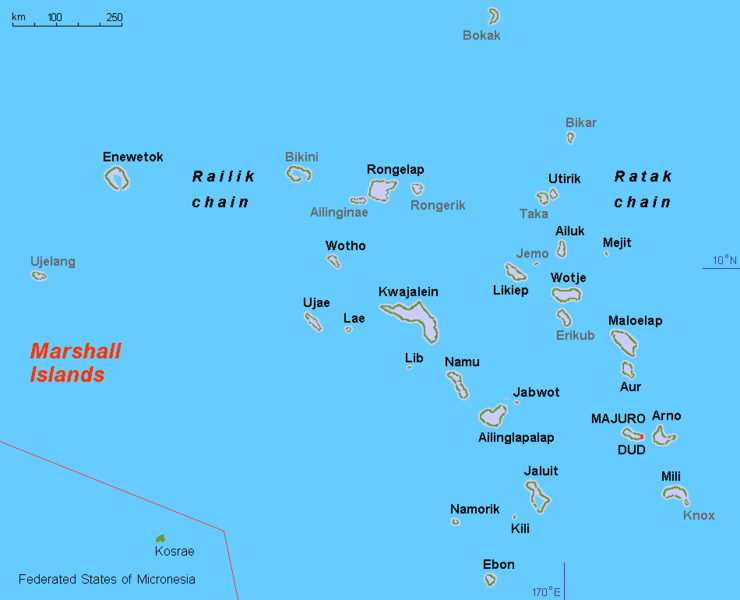
Print Friendly, PDF & Email

Article by AsiaPacificReport.nz
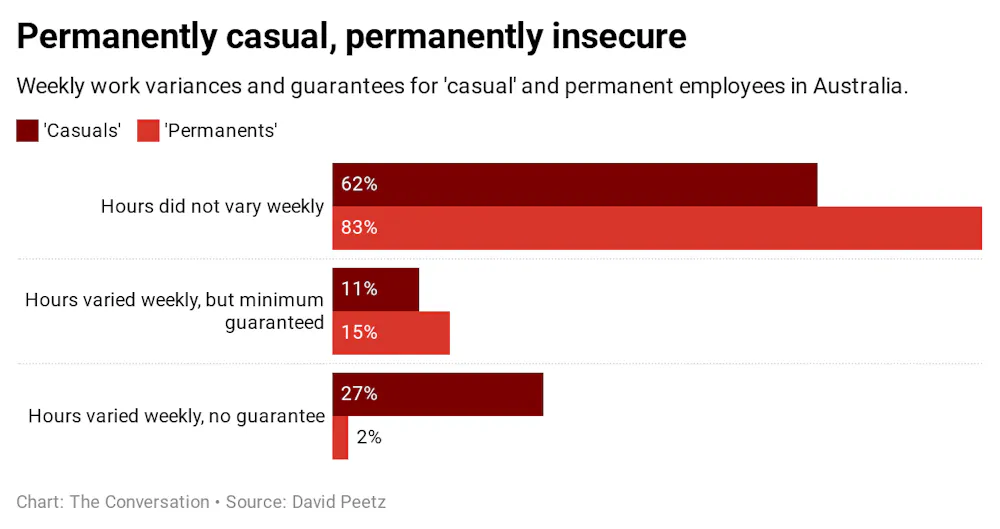
Upheaval at Google signals pushback against biased algorithms and unaccountable AI

Source: The Conversation (Au and NZ) – By Michael Walker, Adjunct Fellow, Macquarie University

Artificial intelligence (AI) is no longer the stuff of science fiction. In the form of machine learning tools and decision-making algorithms, it’s all around us. AI determines what news you get served up on the internet. It plays a key role in online matchmaking, which is now the way most romantic couples get together. It will tell you how to get to your next meeting, and what time to leave home so you’re not late.

AI often appears both omniscient and neutral, but on closer inspection we find AI learns from and adopts human biases. As a result, algorithms replicate familiar forms of discrimination but hide them in a “black box” that makes seemingly objective decisions.


Read more: Algorithms workers can’t see are increasingly pulling the management strings


For many workers, such as delivery drivers, AI has replaced human managers. Algorithms tell them what to do, evaluate their performance and decide whether to fire them.

But as the use of AI grows and its drawbacks become more clear, workers in the very companies that make the tools of algorithmic management are beginning to push back.

Trouble at Google

One of the most familiar forms of AI is the Google algorithm, and the order in which it presents search results. Google has an 88% market share of internet searches, and the Google homepage is the most visited page on the entire internet. How it determines its search results is hugely influential but completely opaque to users.

Earlier this month, one of Google’s lead researchers on AI ethics and bias, Timnit Gebru, abruptly left the company. Gebru says she was fired after an internal email sent to colleagues about racial discrimination and toxic work conditions at Google, while senior management maintains Gebru resigned over the publication of a research paper.

Gebru’s departure came after she put her name to a paper flagging the risk of bias in large language models (the kind used by Google). The paper argued such language models could hurt marginalised communities.

Gebru has previously shown that facial recognition technology was highly inaccurate for Black people.

Google’s response rapidly stirred unrest among Google’s workforce, with many of Gebru’s colleagues supporting her account of events.

Further annoying Gebru’s coworkers and academic sympathisers was the perceived attempt to muzzle unwelcome research findings, compromising the perception of any research published by in-house researchers.

When algorithms make decisions

Here are a few examples of how algorithms can recycle and reinforce existing prejudices:

  • Automated resume-scanning systems have been found to discriminate against African-American names, graduates of women’s colleges, and even the word “women” in a job application.

  • Credit-scoring AI that can cut people off from public benefits such as health care, unemployment and child support has been found to penalise low-income individuals.

  • Misplaced trust in algorithms lay at the heart of Australia’s Robodebt debacle in which the assumption of a regular week-to-week wage packet was baked into the system.


Read more: From robodebt to racism: what can go wrong when governments let algorithms make the decisions


Human systems have checks and balances and higher authorities that can be appealed to when there is an apparent error. Algorithmic decisions often do not.

In our research forthcoming in the journal Organization my colleagues and I found that this lack of a right of appeal, or even a pathway to appeal, reinforces forms of power and control in workplaces.

Now what?

So AI, an influential tool of the world’s largest corporations, appears to systematically disadvantage minorities and economically marginalised people. What can be done?

The protest initiated and led by Google’s own employees may yet bring about change inside the company. Internal discontent at the online giant did get results two years ago, when protest over the kid-glove treatment of executives facing complaints of sexual misconduct led to a change in the company’s policy.


Read more: The Google walkout is a watershed moment in 21st century labour activism


Outsiders are also beginning to take more of an interest. The European Union’s General Data Protection Regulation (GDPR), which has boosted privacy standards since 2018, taught regulators around the world that the black box of algorithmic decision-making can indeed be prised open.

The G7 group of leading economies recently set up a Global Partnership on Artificial Intelligence to drive discussion around regulatory solutions to these problems, but it is still in its infancy.

As an industrial relations issue, the use of AI in hiring and management needs to be brought into the scope of collective bargaining agreements. Current workplace grievance procedures may allow human decisions to be appealed to a higher authority, but will be inadequate when the decisions are not made by humans – and people in authority may not even know how the AI arrived at its conclusions.

Until internal protests or outside intervention start to impact on the way AI is designed, we will continue to rely on self-regulation. Given the events of the past week, this may not inspire a great deal of confidence.

ref. Upheaval at Google signals pushback against biased algorithms and unaccountable AI – https://theconversation.com/upheaval-at-google-signals-pushback-against-biased-algorithms-and-unaccountable-ai-151768

The Oxford/AstraZeneca vaccine is the first to publish peer-reviewed efficacy results. Here’s what they tell us — and what they don’t

Source: The Conversation (Au and NZ) – By Kirsty Wilson, Postdoctoral Research Fellow, RMIT University

The Oxford/AstraZeneca vaccine this week became the first major COVID vaccine candidate to have efficacy results from phase 3 trials published in a peer-reviewed journal.

The vaccine, AZD1222, is a viral vector vaccine. Researchers took an adenovirus from chimpanzees and modified it with the aim of training the immune system to mount a strong response against SARS-CoV-2 (the virus that causes COVID-19).

The Lancet paper confirms interim analysis AstraZeneca released last month showing the vaccine is safe and has an overall efficacy of 70% in protecting against symptomatic COVID-19.

Let’s take a look at these latest results — and why they’re important.

Safety first

The published article consolidated safety data across four human trials with 23,848 volunteers from Brazil, South Africa and the United Kingdom.

Only three people experienced serious adverse events (which were possibly related to the vaccine, but we don’t know for sure) over more than three months of follow-up. Each of these cases is recovering or has recovered.

While safety monitoring will be ongoing, this analysis gives us confidence the Oxford/AstraZeneca vaccine is safe.


Read more: Oxford COVID-19 vaccine: newly published results show it is safe – but questions remain over its efficacy


Efficacy

The authors also analysed efficacy data for two of the above trials with a total of 11,636 participants. The follow-up period of the remaining two trials hasn’t yet been long enough to get a good sense of the vaccine’s efficacy — but this data will be coming.

Among the participants, there were 131 cases of symptomatic COVID-19. This included 30/5,807 (0.5%) in the vaccine group, and 101/5,829 (1.7%) in the control group. Based on the formulae researchers use to calculate how well vaccines work in clinical trials, this equates to an efficacy of 70%.

Of ten COVID-related hospital admissions, none were among the AZD1222 vaccine recipients — they were all people who received the placebo.

Although these numbers are small and will need confirmation with further data, this indicates the vaccine has strong potential to prevent severe COVID-19 disease.

An older man wearing a mask has his sleeve rolled up in preparation for a vaccination.
The study looked at the vaccine’s safety and efficacy at preventing symptomatic COVID-19. Shutterstock

The dosing debacle

While 70% is the overall efficacy figure, we learnt in AstraZeneca’s interim analysis that there were actually two separate dosing regimens. Variation in dose measurement methods — widely reported to have been an error — meant some participants received half of the expected dose for their first of the two shots.

The latest analysis confirmed that for people who received the low dose initially, followed by the standard dose, the vaccine displayed 90% efficacy, compared to 62.1% in participants who received the full dose at both time points.

While this error appears to have had a positive outcome, it’s concerning that we don’t really understand why the regimen with the half dose worked better.

The full, higher first dose may have induced more antibodies that recognise the vaccine’s chimpanzee adenovirus components than the half first dose did, and it’s possible these “anti-vaccine vehicle” antibodies could have interfered with the efficacy of the booster dose. This is a recognised concern when using adenoviruses as vaccine components.

Alternatively, the Lancet authors speculate the low dose may have induced a different type of immune response that we are yet to know about. If this were the case, it could raise questions for other vaccine developers too about the way the immune system behaves.


Read more: How to read results from COVID vaccine trials like a pro


A unique candidate

It’s exciting the Oxford/AstraZeneca vaccine could potentially work comparably well to the other front-runners from Pfizer/BioNTech and Moderna, because this vaccine is one of the most practical vaccines to produce, store and distribute.

It only needs to be stored at 2-8°C — so in a normal fridge — compared to the mRNA-based vaccines, which need to be stored around -70°C.

It’s also the cheapest so far, at about US$4 a dose (roughly A$5), making it highly attractive for global deployment. Oxford/AstraZeneca has an agreement with the COVAX facility which will enable equitable access for countries who may not be able to afford the more expensive mRNA vaccines from Pfizer and Moderna.

A health worker dressed in full PPE holds a syringe and a vial.
The Oxford/AstraZeneca vaccine would be easier than some of the other candidates to store and distribute. Shutterstock

Australia has signed a deal to receive 3.8 million doses of the Oxford/AstraZeneca vaccine should it be approved for use. Meanwhile, biotechnology company CSL has been upscaling its manufacturing capacity for this vaccine, which will enable it to produce a further 30 million doses in Australia next year.

If a lower initial dose is recommended, this would also mean the available supply could be distributed to more people.

Some questions remain

One factor we still need to consider is the efficacy in older people (70 and above), as this age group is most susceptible to severe disease.

The current published efficacy results are mostly based on 18 to 55-year-olds. Although these trials do have older participants, they were recruited later, so collection of efficacy data for this group is ongoing.

A recent paper which looked at immune responses to the vaccine showed similar levels of antibodies across age groups (18-55, 56-69, and >70), which is encouraging. So it will be interesting to see efficacy results in older people as they become available.


Read more: Why the Oxford AstraZeneca vaccine is now a global gamechanger


Publication in a peer-reviewed journal means the data has been evaluated by expert independent reviewers whose job is to find any holes or problems. With this, the Oxford/AstraZeneca data now becomes more credible to the scientific community.

The data will likely encourage developers to move rapidly to request regulatory approvals for this vaccine, while awaiting further analysis on efficacy — and, importantly, how dosage affects this vaccine’s efficacy.

ref. The Oxford/AstraZeneca vaccine is the first to publish peer-reviewed efficacy results. Here’s what they tell us — and what they don’t – https://theconversation.com/the-oxford-astrazeneca-vaccine-is-the-first-to-publish-peer-reviewed-efficacy-results-heres-what-they-tell-us-and-what-they-dont-151755

3 reasons meeting climate targets and dumping Kyoto credits won’t salvage Australia’s international reputation

Source: The Conversation (Au and NZ) – By Matt McDonald, Associate Professor of International Relations, The University of Queensland

Today, the Morrison government released updated projections of Australia’s greenhouse gas emissions, which indicate Australia is on track to meet 2030 Paris targets without using “carryover” credits earned from the Kyoto Protocol period.

Australia’s plan to use Kyoto carryover credits to meet Paris targets have long been contentious. The government claims that because emissions fell by more than Australia had committed to under the Kyoto Protocol, they should be allowed to carry these “credits” forward to the Paris agreement. Yet legal experts and other governments have suggested there’s no basis for applying these to the Paris agreement, which is a separate agreement.

The new modelling is good news for the Morrison government, which has been under increasing domestic and international pressure over its climate policy. And Prime Minister Scott Morrison is likely to announce this development proudly at the virtual Pacific Islands Forum on Friday night.

So are the latest projections enough to salvage Australia’s reputation on this issue? That appears unlikely.

Dumping credits

Under the Paris Agreement, Australia committed to reducing emissions by 26-28% of 2005 levels by 2030. This target has been widely criticised for years for being too meagre, but previous modelling had suggested even meeting this target was unlikely unless carryover credits were used.


Read more: Emissions projections indicate Australia won’t need carryover credits to meet Paris targets


The latest modelling suggests if the recently-announced technology roadmap — a policy which will support new and emerging clean energy technologies — is taken into account, then Australia would beat its 2030 target by 145 million tonnes. In other words, by 2030 Australia could be 29% under 2005 levels, without using carryover credits.

Morrison had flagged he would announce that Australia will dump the Kyoto credits at a global leaders’ climate summit at the weekend. However, it’s unlikely he’ll be given a speaking slot by the hosts, a reflection of his failure to make meaningful climate commitments. This is why he’ll probably make the announcement to Pacific leaders tomorrow night instead.

Pacific Island leaders were unimpressed with Australia’s climate commitments after last year’s Pacific Islands Forum. AAP Image/Mick Tsikas

But even if Morrison announces he’ll scrap the controversial carryovers tomorrow, our international counterparts will still regard Australia as a climate change laggard. There are three big reasons why.

1. Our Paris target is still unambitious

A reduction of 26-28% by 2030 from 2005 levels is well below the commitments of other countries under the Paris Agreement. And under the Paris Agreement, states were encouraged to ratchet up their commitments to emissions over time.

Yet unlike other countries, Australia has not made any indication of a plan to outline a more ambitious contribution ahead of the CoP26 meeting in Glasgow next year.


Read more: Biden says the US will rejoin the Paris climate agreement in 77 days. Then Australia will really feel the heat


It’s also worth recalling Australia’s 2005 baseline is a comparatively easy starting point. Under the Kyoto Protocol, Australia was one of only two developed countries allowed to increase its greenhouse gas emissions from 1990 levels by 2008-12.

This means most other developed countries had already reduced emissions in sectors where it was easiest for them to do so — the “low hanging fruit”. This makes further commitments under Paris more challenging for those countries than Australia.

2. Improved projections are no thanks to federal policy

If we don’t have to use Kyoto carry-over credits to meet Paris targets, it may be despite — rather than because — of federal government policy.

Simply put, much of the decline in (projected) emissions can be attributed to the actions of state governments, which have more actively supported the renewable energy sector.

Wind turbines against a sunet
The revision in the 2020 projections partly reflects new measures to speed up development and deployment of low emissions technologies in the recent budget. Shutterstock

By contrast (and despite claims to the contrary) the government continues to commit billions of dollars to subsidising the fossil fuel industry. Yet there are clear indications of a declining future market for coal in particular.


Read more: Matt Canavan says Australia doesn’t subsidise the fossil fuel industry, an expert says it does


While the technology investment roadmap, a federal policy, may serve to further drive down emissions, this is still far from clear.

3. There’s still no commitment to a net zero emissions timetable

The European Union has had a long-standing commitment to net zero emissions by 2050. More recently it has been joined by other major emitters in Japan and South Korea, while emissions giant China has committed to net zero emissions by 2060.

US President-elect Joe Biden has also committed the US to reach net zero emissions by 2050, and to return the US to the Paris agreement.

Joe Biden
Under a Biden administration, the US will have the most progressive position on climate change in the nation’s history. AP Photo/Susan Walsh

And yet, the Morrison government continues to baulk at setting a net zero emissions timetable, preferring to describe this as a general ambition rather than endorse a specific target or date.


Read more: China just stunned the world with its step-up on climate action – and the implications for Australia may be huge


The response from the Pacific will be telling

Australia consistently ranks among the worst performers internationally on the Climate Change Performance Index, and there are indications already that other states will actively pressure Australia on climate ambition and action in the lead up to the 2021 United Nations Climate Change Conference in Glasgow (COP26).

Combined with steadily growing domestic pressure to act on climate change and weakening financial prospects for Australia’s coal exports, international pressure may contribute to a perfect storm for the Morrison government on climate policy.

The response Morrison receives at the virtual Pacific Islands Forum to this position will be telling.


Read more: Pacific Island nations will no longer stand for Australia’s inaction on climate change


The region has long been deeply critical of Australia’s climate policy, and is at the frontlines of climate change impacts such as sea level rises, natural disasters and ocean acidification.

While Morrison may avoid the same diplomatic fallout from the 2019 Pacific Islands Forum on this issue, he’s unlikely to find an audience wholly convinced Australia now recognises the scale of the threat climate change poses.

ref. 3 reasons meeting climate targets and dumping Kyoto credits won’t salvage Australia’s international reputation – https://theconversation.com/3-reasons-meeting-climate-targets-and-dumping-kyoto-credits-wont-salvage-australias-international-reputation-151836

No, Education Minister, we don’t have enough evidence to support banning mobile phones in schools

Source: The Conversation (Au and NZ) – By Marilyn Campbell, Professor Faculty of Education, School of Cultural and Professional Learning, Queensland University of Technology

Last week, South Australia announced a mobile phone ban in primary schools. Federal Education Minister Dan Tehan endorsed the ban, saying:

Data shows a correlation between the uptake of mobile phones by young people and a downturn in student performance.

The federal government put “mobile phones on the agenda” in a September 2019 meeting with the Education Council. The minister then quoted research from Canadian Assistant Professor Louis-Philippe Beland, that he said:

[…] found the positive effect of banning mobile phones was equivalent to an additional hour a week in school, or increasing the school year by five days.

He went on to say the research:

[…] also found the positive effect was even greater for low-achieving students, with a mobile phone ban the equivalent of an additional two hours a week, or ten school days a year.

The study the minister is referring to was published in 2016 about schools in the United Kingdom. The authors — Beland and Murphy — actually showed only a very minor correlation between students’ exam scores and their schools’ mobile phone policies.

The claim students’ use of mobile phones at school is connected with lower academic performance has consistently featured in the popular debate around school mobile phone bans. It has been used to justify blanket bans, both in Australia — such as the one in NSW public primary schools and all Victorian state primary and secondary schools — and overseas.

Despite the claims, we actually don’t have sufficient data to back the policy.

What the science actually says

The best kind of policy is grounded in evidence. But not all evidence is created equal and, when cited out of context, can obscure rather than illuminate the path forward.

Unfortunately, the ways evidence has been mobilised in the school mobile phone ban debate in Australia has turned children’s digital practices — and potentially their digital futures — into a political football.


Read more: Should mobile phones be banned in schools? We asked five experts


Beland and Murphy’s study surveyed 91 high schools in four English cities about their mobile phone policies. It then matched those schools’ mobile phone policies with students’ standardised test scores to estimate the effect of mobile phone bans on student performance.

The study reported that, when schools instituted a ban, student test scores improved by 6.41% of a standard deviation — which is an effect size of 0.06.

Let’s unpack what this means.

A small ‘effect size’

First, the “data” did not show that students’ “uptake” of mobile phones related to a “downturn” in their performance. Rather, it showed restrictive school mobile phone policies related to an upturn in student performance. These are different things.

Second, the study did not find a strong correlation between schools’ restrictive mobile phone policies and student performance. An improvement in student performance of 6.41% of a standard deviation is actually an effect size of 0.06 — though it has been reported as a 6% improvement.

Dan Tehan in parliament
Federal Education Minister Dan Tehan has been in support of mobile phone bans in schools. MICK TSIKAS/AAP

Effect sizes of 0.24 are considered small, 0.50 is moderate and 0.75 is large. So, an effect size of 0.06 is insignificant.

Students in the lowest quintile (fifth) of prior achievement gained slightly more in test scores when mobile phone bans were in place: 0.14% of a standard deviation, which is still very small. School bans neither positively nor negatively affected the test performance of students in the top quintile.

As for bans granting the equivalent of ten days of extra class time for low-achieving students quoted by the minister, this number doesn’t seem to be in the study.

In a Conversation article by Murphy and Beland about their study, they write:

We found the impact of banning phones for these [low-achieving] students equivalent to an additional hour a week in school, or to increasing the school year by five days.

But even in this case, the data was collected from 2001 to 2011 in the United Kingdom. So the specific number of days of extra class time don’t directly apply to the Australian context.


Read more: How smart is it to allow students to use mobile phones at school?


Correlation is not causation

Third, although media coverage correctly reported the study found a correlation, many people mistake correlation for causation. Cheese consumption strongly correlates to death by bedsheet entanglement, but we wouldn’t say cheese causes such deaths.

If we noted a strong correlation between increased ice-cream sales and sunglass purchasing, we might infer, not that wearing sunglasses causes one to eat ice-cream, but that a third variable influences both outcomes — namely hot, sunny weather.

A woman in bed holding a pizza.
This woman is unlikely to be strangled by her sheets because she ate cheese. Shutterstock

In the same way, the correlation between mobile phone bans and student performance could be caused by other variables simultaneously impacting the school environment and student performance.

Beland and Murphy acknowledge this limitation when they write: “We may be concerned that student sorting by observable or unobservable characteristics may be driving this estimate”.


Read more: Banning mobile phones in schools: beneficial or risky? Here’s what the evidence says


The results haven’t been replicated

Lastly, good science means repeating studies and finding similar results. Two other studies replicated Beland and Murphy’s research design.

A Norwegian study found no significant effect of mobile phone bans on academic results. However, when they divided the sample into public and private schools, they did find private schools experienced a somewhat positive effect of a mobile phone ban on academic performance.

This points to the fact school culture could make a difference to whether or not bans improve student performance. Or, put differently, blanket bans may not serve the best interests of all schools and their students.

And a study in Sweden found school mobile phone bans had zero impact on student performance. The authors said:

In Sweden, we find no impact of mobile phone bans on student performance and can reject even small-sized gains.

The main problem, though, is not the limitations of Beland and Murphy’s specific study. The real issue is the dearth of evidence to drive decision making about students’ use of mobile phones at school.

Until this vacuum is addressed, we cannot know for certain mobile phone bans in schools are a good idea. And it remains possible current policies are compromising students’ best interests, both now and into the future.


Read more: How creative use of technology may have helped save schooling during the pandemic


ref. No, Education Minister, we don’t have enough evidence to support banning mobile phones in schools – https://theconversation.com/no-education-minister-we-dont-have-enough-evidence-to-support-banning-mobile-phones-in-schools-151574

Podcast: Royal Commission of Inquiry into Christchurch Terrorist Attack – Paul G Buchanan + Selwyn Manning consider the report

A View from Afar
A View from Afar
Podcast: Royal Commission of Inquiry into Christchurch Terrorist Attack - Paul G Buchanan + Selwyn Manning consider the report
Loading
/

VIDEO: In what is a precursor episode to a planned Evening Report panel-series through 2021, Selwyn Manning and Paul Buchanan discuss and respond to elements of the Commission of Inquiry into the Christchurch terrorist attacks of March 15, 2019.

The Inquiry’s terms of reference contained three areas:

  • The terrorist’s actions
  • Actions of public sector agencies
  • Recommended changes that could prevent future terrorist attacks of this kind.

LIVE DISCUSSION POINTS:

This A View from Afar discussion will explore takeouts from the Inquiry’s report and will include (Ref. https://chchroyalinquiry.cwp.govt.nz/the-report/)

Listen on Apple Podcasts

Keith Rankin Analysis – Easter Sunday 2019

Keith Rankin.

Analysis by Keith Rankin.

Keith Rankin.

I was in Victoria, Canada over Easter weekend in 2019. On Easter Sunday I returned to my hotel, to the shocking news of a set of coordinated suicide bombings in Colombo, Sri Lanka.

267 people died that day, and at least 500 others were injured. The target groups were Christian churchgoers, and western tourists. The perpetrators were jihadists. My immediate reaction was that this was utu for the Christchurch mosque shooting, just one month earlier. My partner’s reaction was the same.

I have heard nothing at all about the matter since returning to New Zealand in June 2019, neither in the New Zealand media nor the international media. While no other credible reason for the Easter Sunday massacre has come to light, I have heard it suggested that an accumulation of weaponry before March 2019 by the Sri Lankan jihadists represents evidence that they were already planning an anti-Christian mass killing for April 2019, an act of terrorism with no motive.

The important and obvious, but often overlooked, feature of the Christchurch 15 March terror attack was that this was an international event that happened to take place on New Zealand soil. The perpetrator was someone who belonged to an international community, and who played to an international audience. He happened to be living in New Zealand at the time, and New Zealand – for reasons perhaps more good than bad – represented a softish venue for such an atrocity. The terrorist’s target group was also an international group, members of one of the largest faith communities in the world. From the terrorist’s point of view the fact that many of the victims were citizens or permanent residents of New Zealand was incidental; so was the fact that almost certainly none of the people who would pray at those mosques that day had ever been perpetrators of violent crime. To the terrorist, they were simply members of a global target group who were relatively accessible.

These same comments are equally applicable to the Colombo bombings. In Sri Lanka, Islam is the third biggest faith group, and Christianity is the fourth biggest. Sri Lanka is no stranger to ethnic and sectarian violence, including suicide bombings; it’s just that the violence has generally been between the two biggest ethnic/faith groups, the Buddhist Sinhalese and the Hindu Tamils.

Antipathy by Sinhalese towards Muslims almost certainly was inflamed by the terrorist attack in Lahore (Pakistan) on the Sri Lankan cricket team in 2009. There were significant anti-Muslim pogroms by Sinhalese Buddhist groups in 2018. Hence the reason why Islamic groups were accumulating weapons before March 2019. These Sri Lankan groups were well placed to retarget Christians, following the Christchurch killings.

The small Christian community in Sri Lanka has not before been a focus there of group hate. This was an international event that happened in Sri Lanka, and was able to happen there for essentially the same reason that the Christchurch attack was able to take place in New Zealand; namely, Sri Lanka was just about the last place in the world that Christians would expect to be attacked because they were Christians. By understanding both events as essentially global rather than national events, it makes perfect sense to understand one as being utu for the other.

For us in New Zealand, Sri Lanka is not really on our radar (except when there is a cricket World Cup). However, New Zealand certainly is on Sri Lanka’s radar. People in Sri Lanka are generally more aware of New Zealand events than people of New Zealand are of Sri Lankan events. Sri Lankans understand that both countries are small island nations with much larger neighbours. Sri Lanka strongly values its sporting ties with New Zealand, buys lots of food imports from New Zealand, and has been an important source of international students in New Zealand for a long time; ie going back to the Colombo Plan days in the 1960s. Over the last decade there have been various reports of refugee boat people trying to get to New Zealand (example). All of these ‘boat people’ reports that I am aware of are reports about people from Sri Lanka.

Because we New Zealanders are citizens of the world, we should feel able to (indeed feel obliged to) express sympathy and condolences to the victims of the Sri Lanka massacre; just as we rightly express sympathy and condolences towards the victims of the smaller event in Christchurch. While the jury may still be out on the precise motivation (or motivations) of the Sri Lankan jihadists, on the balance of probability the Colombo tragedy would not have happened if the Christchurch shootings a month earlier had not happened. 318 people – 310 innocent people – lost their lives. The good news is that no ongoing chain of revenge attacks has been set in motion. RIP.

The good, the bad and the lonely: how coronavirus changed Australian family life

Source: The Conversation (Au and NZ) – By Megan Carroll, Senior research officer, Australian Institute of Family Studies

COVID-19 has brought about big changes in Australia and across the world, with much attention focused on the way governments are responding to the health and economic challenges of the pandemic.

Interactions with family and friends have been the focus of many of the public health restrictions and have been identified as a source of spreading infection. Less attention has been paid to the role families and social networks have played in supporting each other through a difficult year.

Findings from the first wave of the Families in Australia Survey have highlighted that Australians still turn to family for support in times of crisis.

The survey of 7,306 respondents, by the Australian Institute of Family Studies, ran from May 1 to June 9 2020, when most Australians were subject to multiple restrictions due to COVID. These forced them to spend more time with some family members, while separating them from others. The survey aimed to provide a better understanding of how Australian families adjusted during the pandemic.


Read more: Lonely in lockdown? You’re not alone. 1 in 2 Australians feel more lonely since coronavirus


New ways to connect

While limitations were placed on how families could meet in person, most people talked to family living elsewhere at least as often as before. A good proportion (44%) talked to them more than before. We heard stories of people connecting through new technologies, such as using video calls to share meals, or through more traditional means of sending care packages through the post.

In addition to social connections, family members living elsewhere were the primary source of help for those who needed extra assistance. This help included practical assistance with groceries, errands and other care-giving, as well as financial and emotional support.

Experiences of connection to family living elsewhere were mixed, with similar numbers reporting feeling more and less connected. For many, sharing lockdown led to an increased level of connection with those in their immediate household.

Changes to family life

This increase in connection is likely driven, at least in part, by spending more time together. When asked about time spent with children, many parents reported an increase in quality time, playing games, reading to their children and having meaningful conversations.

However, it wasn’t all quality time. Many families had to negotiate shared work spaces and juggling childcare while working from home.

Financial support from families

The financial impacts of the pandemic have hit some families hard. One in six survey respondents said their family income had reduced a little. Almost a quarter said it had been reduced a lot.

For many families, this resulted in cutting back on non-essential expenses such as take-away meals. While some dipped into savings to make up the shortfall, others reported cutting down on essential expenses like groceries or pausing rent and mortgage payments. More people asked for financial support from family and friends than from welfare or community organisations.

Among those who had not experienced a drop in income, many reported saving money, as they spent less on things like childcare and petrol. While some said they made changes to their savings and investments, financial actions taken as a result of COVID-19 were commonly aimed at helping family members who had a drop in income, and supporting their community by spending more at local businesses.

When asked about their level of concern about their family’s current financial situation, three out of five respondents said they were at least “a little concerned”. Those whose income had reduced as a result of COVID-19 expressed higher levels of concern. Over 70% of respondents said they were at least a little concerned about their family’s future financial situation.

Comments by respondents show their concern was not just for themselves and their partners. They included the financial situation of adult children living at home and family members living elsewhere. While some felt lucky not to have been affected financially by the pandemic, others worried about those who lost their jobs or income, businesses or investments.


Read more: We asked over 2,000 Australian parents how they fared in lockdown. Here’s what they said


Towards COVID normal

With Australia now negotiating “COVID normal”, we need to know more about what types of supports families need, and how to support those who may not have a family they can rely on.

The second wave of the Families in Australia Survey aims to do just that.

If you would like to share your experiences, please go to towardscovidnormal.com.au

ref. The good, the bad and the lonely: how coronavirus changed Australian family life – https://theconversation.com/the-good-the-bad-and-the-lonely-how-coronavirus-changed-australian-family-life-151688

‘Wild enchantment’: how Daniel Thomas’s writings conveyed the joy of art to Australians

Source: The Conversation (Au and NZ) – By Joanna Mendelssohn, Principal Fellow (Hon), Victorian College of the Arts, University of Melbourne. Editor in Chief, Design and Art of Australia Online, University of Melbourne

Review: Daniel Thomas, recent past: writing Australian art, edited by Hannah Fink and Stephen Miller (Thames & Hudson Australia)

In 1958, when the young Daniel Thomas was first appointed at the Art Gallery of New South Wales, the word “curator” was not in the Public Service Board lexicon. He felt his official title of “professional assistant” was inaccurate so he signed his letters “curatorial assistant”.

In time, the bureaucracy adopted his language and the term is still used to describe the entry level curatorial position for new graduates.

The years I spent working for Thomas as a curatorial assistant in the 1970s transformed my understanding of what art can do. His generous pedantry means that even now I sometimes hear his voice in my ear, questioning the precise meaning of a word I want to use.

Robert Walker, Daniel Thomas in his apartment at Elizabeth. Bay, from the Robert Walker archive 1965 black and white negative, 6 x 6 cm National Art Archive|, Art Gallery of New South Wales © Estate of Robert Walker

Thomas has been such a force for change in Australian art that he has influenced almost every institution, curator and artist.


Read more: Beauty and audacity: Know My Name presents a new, female story of Australian art


He was, in turn, the first curator at the AGNSW, the inaugural Head of Australian art at the National Gallery of Australia and Director of the Art Gallery of South Australia, before retiring to Tasmania, close to where he was born 89 years ago. Here he continues to write and mentor those who wish to know both the small details and large visions of art in Australia.

In the 1960s and 70s, however, Thomas was perhaps better known as the witty and informative art critic of first the Sunday Telegraph and later the Sydney Morning Herald. His initial appointment, which today would be regarded as a conflict of interest, was seen at the time as a way of educating the public about the importance of art.

He also wrote perceptive extended essays for Art and Australia and later Art Monthly, as well as essays in scholarly catalogues. Steven Miller and Hannah Fink’s anthology, Recent Past: writing Australian art, has managed the Herculean task of condensing the essence of Thomas’s writing into one enjoyable volume, a scholarly resource that also delights the general reader.

Thomas has little time for theoretical constructs. Instead he focuses on art, artists and circumstance. “Fieldwork is more fun than library research,” he writes as he discusses both the landscape where John Glover painted and the mirrored wardrobe, which was the subject of many of Grace Cossington Smith’s late, great paintings.


Read more: How our art museums finally opened their eyes to Australian women artists


A brief to educate

Some scholars hug their knowledge to themselves, content to communicate only with their peers. Thomas sees his mission to spread the word, to let as many people as possible know the profound joy of art.

He soon became the master of the deft phrase. John Brack is described as “a clever painter, clever to the point of teasing”. Fred Williams’ paintings are “invested with magic”. An early painting by Janet Dawson is described with gusto as “an exhilarating event”. In later critiques he notes with pleasure Rosalie Gascoigne’s “well-made things” and describes Dorrit Black as one of “the reserved but passionate temperaments” in her art.


Read more: Fred Williams in the You Yangs: a turning point for Australian art


In this new book, Thomas has provided a written commentary on both his past writing and the illustrations. These intriguing, informative and often humorous notes are marked as “DT20”.

Martin Sharp. Miss Australia 1975 synthetic polymer paint on hardboard, 181.7 x 147.3 cm Art Gallery of New South Wales © Estate of Martin Sharp

In a note on Martin Sharp’s Miss Australia, for instance, he writes that the artist “emphasised it was painted entirely by him”. Then, almost as an aside, Thomas tells the reader Sharp did not physically paint some works attributed to him, but rather delegated the hard slog to his studio assistant, Tim Lewis.

Obituaries written for artists are written with an eye to the longer judgement of history. In his considered obituary for Arthur Boyd, Thomas concludes “an uneven painter must be judged on his best works”, a subtle reminder that Boyd made many potboilers.

Pop artist Robert Rooney, he wrote, “failed a Swinburne Technical College commercial-art-diploma course in illustration and design but did not waste the experience.”

‘More exciting museums’

As the articles are arranged in chronological order it is possible to track how Thomas has long used his privileged background for good.

His “first schoolboy glimpse of the wild enchantment of art” came when he was a student at Geelong Grammar, inspired by the Bauhaus refugee artist Ludwig Hirschfeld-Mack. An Oxford degree and a deep knowledge of European art could have led to a career in the UK, but he chose to work in Australia as, “I wanted our art museums to be more exciting.”

Ludwig Hirschfeld-Mack. The world to come 1940 pencil, watercolour on ivory wove paper, varnish, 17.7 x 24.8 cm Art Gallery of New South Wales © Estate of Ludwig Hirschfeld-Mack

The penultimate essay, Spirit of Place, written in 2018, can be described as a meditation on rock, trees, life and art. Thomas considers how the land he has known since childhood has changed “under unkind management by thoughtless humans”. Plastic is washed on the Bass Strait seashore when once it was kelp.

He has named his house, Loeyunnila, the word Aboriginal people from Port Sorrell use for “high wind”. But he remembers, too, how Aboriginal people from this place were taken by boat in “an exile equivalent to a death sentence”.

There is a tension between his appreciation of enduring Aboriginal cultures and knowledge that it was his direct ancestors who dispossessed them of their land. He resolves this by suggesting that “Aboriginal people are re-conquering the minds of their invaders, just as the Greeks re-conquered the ancient Romans.”

As with much of Thomas’s writing, it is an idea worth debating.

ref. ‘Wild enchantment’: how Daniel Thomas’s writings conveyed the joy of art to Australians – https://theconversation.com/wild-enchantment-how-daniel-thomass-writings-conveyed-the-joy-of-art-to-australians-150737

Breakdancing in the Olympics? The Games have a long history of taking chances, from pesapallo (yes, it’s a sport) to kite flying

Source: The Conversation (Au and NZ) – By Richard Baka, Senior Lecturer, College of Sport & Exercise Science, Victoria University

Surfing, skateboarding, karate and sport climbing will be the new sports included in the Tokyo 2021 Olympic Games, with BMX freestyle (think halfpipe snowboarding but on bikes) and 3×3 basketball (teams of three playing on a half court with on basket) added as disciplines in existing sports.

The Beijing 2022 Winter Games will feature seven new events — freestyle skiing big air (men’s and women’s), women’s monobob (solo bobsledding) and mixed team events in short-track speed skating, ski jumping, freestyle skiing aerials and snowboard cross.

The latest Olympic sport added to the 2024 Paris Games is “breaking”, which started as a form of dancing associated with hip hop culture and has morphed into a well-organised competitive sport governed by the World DanceSport Federation.

Not everyone is thrilled by the inclusion of breakdancing in the games, but this is all part of the ongoing transformation of the Olympics as it seeks to remain relevant to younger audiences more familiar with halfpipes than equestrian dressage.

A push for younger, more extreme sports

In fact, new sports are continually being added to the Olympics, while others are dropped.

Wrestling (a sport dating back to the ancient Olympics) was axed from the Tokyo Olympics only to be reinstated several months later. Baseball and softball were both in the games, then out, then in again (Tokyo 2021), then out again (Paris 2024).

South Korea won gold in baseball at the 2008 Olympics before the sport was cut from the program for 2012 and 2016. Yonhap/AAP

Other sports, such as golf and rugby, were part of the Olympics in the early 1900s, then dropped for decades before being added back in.

The impetus for some of these changes can be traced to the International Olympic Committee’s Agenda 2020 policy document released in 2014. The objective was to usher the Olympic movement into a new modern era with a focus on sports that are more youth-oriented, do not require expensive venues, can ensure more gender balance and are television-friendly.

With the IOC often criticised as being male-centric and old-fashioned, the current IOC president, Thomas Bach, has been a major driver of this new way of thinking and modernising of the Olympics.


Read more: Everyone’s a winner with new events at the Winter Games


The IOC has also been pushed in some ways by the strong influence of the Extreme Games, launched in 1995 and later rebranded the X Games.

This event, with both a summer and winter version, was developed by the ESPN sports network. And it’s certainly made for TV: the focus is on action sports that have a high degree of “spectacle”.

Due to their success, the Olympic movement was reasonably quick to embrace several sports that originated in the X Games.

Summer Games are maxed out in terms of size

In 1994, the Olympics shifted to a new two-year, alternating cycle for the summer and winter games. This brought increased visibility for the Winter Olympics, which began adding new sports and grew rapidly in size.

Curling, women’s hockey and snowboarding were added to the 1998 Nagano Games program. Fourteen years later, an unprecedented 12 new events had their debut at the Sochi 2014 Winter Games.

Slopestyle skiing is one of many new Winter Olympic sports. SERGEI ILNITSKY/EPA

As a result, the Winter Games have blossomed from 16 events and 49 medals in 1924 to a record 109 events and 327 medals at the 2022 Beijing Winter Games.

Although the summer games have also grown gradually, they have been unable to add as many new sports due to size limitations and logistical factors. The summer games are over twice as large as the winter games in terms of budget and the number of athletes that take part. They also require far more purpose-built venues.


Read more: Snowboarding and freeskiing got to the Olympics by carving their own path


The Tokyo games are expected to feature 11,092 athletes in 339 events, but this will actually shrink to 10,500 athletes and 329 events for the 2024 Paris Olympics.

Logically, if new contemporary sports like breakdancing are added, others (like baseball and softball) will have to go. Athlete numbers will also need to be reduced in existing sports, as will happen at the Paris games.

The IOC also has a gender-balance goal for athletes and it is expecting to reach 50-50 parity for the first time in Paris.

A history of obscure events, from pesapallo to kite flying

Until 1992, numerous sports were included in the Olympics as “demonstration” events. Medals were awarded, but they were not included in the official tally. The idea was to showcase a local sport of the host country or to trial a sport that could possibly be added as a full medal sport in the future.

There have been a number of unusual and obscure demonstration events in the Games, such as bandy (a mix of ice hockey and field hockey), dogsled racing, tug of war, military patrol (a skiing and shooting sport similar to biathlon), bicycle polo, roller hockey, rope climbing, pesapallo (a Finnish version of baseball) and Australian Rules football.

The 1900 Paris Olympics included a catalogue of strange events, such as cannon firing, fishing, pigeon racing, fire fighting, hot air ballooning and kite flying, though some were part of the adjacent World’s Fair and not considered “official” Olympic events.

The Olympics also have a long tradition of including various forms of arts competitions, as well. From 1912–48, an “Art Olympics” ran alongside the summer games, with medals across five categories: architecture, music, literature, sculpture and painting.

Not everyone is embracing the addition of breakdancing to the Olympic program. Some sports like netball and squash have lobbied unsuccessfully to be included in the Olympics for years — and were disappointed yet again for being passed over for the 2024 games.


Read more: Going for gold: why tenpin bowling should become an Olympic sport


Some purists are not fans of the Olympics’ embrace of youth-oriented sports, either. Bob Costas, the veteran US sports commentator, once compared slopestyle skiing to the types of pranks shown on the MTV television program Jackass.

Breaking may be the lucky winner for 2024, but many other new sports are knocking on the door to get into the summer games.

As the IOC attempts to keep pace with a changing world, it is likely we will see even more changes to the Olympic landscape for the Los Angeles 2028 summer games.

And if Brisbane does follow through on a bid to host the 2032 games, could we expect to see Aussie rules football back on the program?

ref. Breakdancing in the Olympics? The Games have a long history of taking chances, from pesapallo (yes, it’s a sport) to kite flying – https://theconversation.com/breakdancing-in-the-olympics-the-games-have-a-long-history-of-taking-chances-from-pesapallo-yes-its-a-sport-to-kite-flying-151750

Bad space weather may make life impossible near Proxima Centauri

Source: The Conversation (Au and NZ) – By Andrew Zic, Postdoctoral Research Fellow at Macquarie University, CSIRO

If you look up in the southern sky you can see the “pointer” stars, pointing towards the Southern Cross. One of these pointers is Alpha Centauri, which is actually a pair of Sun-like stars that are too close together to tell apart by eye.

There is a third member of the Alpha Centauri system as well: Proxima Centauri (Proxima Cen for short), which circles the central two stars in a wide orbit. This is the Sun’s nearest neighbour, at a distance of just 4.2 light years.

It is possible one of Proxima Cen’s planets is suitable for life. However, we recently detected the signature of fierce space weather from Proxima Cen, which implies an orbiting planet could be blasted with hazardous particles and magnetic fields.

Five of the 36 ASKAP antennas poised below a vista of the Milky Way. The Southern Cross and the Pointers are visible just above the central antenna in the image. CSIRO/Alex Cherney

Our neighbour is not like the Sun

Our Sun is a relatively unremarkable yellow dwarf star, hosting the only known life-bearing planet in the Universe: our Earth.

Proxima Cen is very different. It is a red dwarf star, with a diameter only 15% of the Sun’s, and a surface temperature of 3,000K (degrees Kelvin), much cooler than the Sun’s 6,000K.

Because Proxima Cen is relatively cool, the “Goldilocks zone” of orbits around it – where the temperature is just right for liquid water – is around one-twentieth the Earth’s distance from the Sun. We are interested in planets in a star’s Goldilocks zone because liquid water is necessary for life as we know it.


Read more: Say hello to the Earth’s nearest exoplanet neighbour: Proxima Centauri b


We know Proxima Cen has at least two planets: Proxima Cen b, a rocky “super-Earth” located in the middle of Proxima Cen’s Goldilocks zone, and Proxima Cen c, a “sub-Neptune” located further out.

For years, astronomers have suspected planets like Proxima Cen b may be a dangerous home for life because they are so close to their host stars. Many red dwarf stars produce frequent, powerful flares – intense bursts of radiation travelling out into space. If planets like Proxima Cen b don’t have protective features such as a thick atmosphere or a strong magnetic field, they would be exposed to perilous levels of radiation.

But what’s the weather like around these stars?

The “space weather” of red dwarfs is another important factor in determining how hospitable they are to life. While flares involve intense bursts of light, space weather events mean the magnetic field and charged particles from the star can interact with planets directly.

The most energetic space weather events are known as coronal mass ejections (or CMEs). These massive eruptions escape the atmosphere of a star and travel through space at millions of kilometres per hour.

If the space weather conditions are extreme enough, the planetary atmosphere can be blown away and its magnetic field can be pushed backwards, leaving the surface exposed to deadly flare radiation.

CMEs have been detected around the Sun since the 1970s, but detecting space weather events around distant stars is much harder.

A sequence of powerful coronal mass ejections from the Sun, observed by the ESA/NASA Solar and Heliospheric Observatory (SOHO). The Sun is located behind the central masked circle. ESA/NASA/SOHO

For updates on the weather, tune into the radio

CMEs on the Sun produce characteristic bursts of radio noise, such as “type II” and “type IV” bursts. By detecting similar signatures on other stars, we can indirectly identify stellar CMEs.

In early 2019, we pointed our telescopes at Proxima Cen for 11 nights. We used CSIRO’s new radio telescope, the Australian Square Kilometre Array Pathfinder (ASKAP), as well as the Zadko Telescope, the ANU 2.3m Telescope, and NASA’s Transiting Exoplanet Survey Satellite (TESS).

Our goal was to detect the signature of a CME.

On the night of May 2, 2019, we observed a massive optical flare with an estimated total energy output of 16 septillion joules. (That’s nearly 17 million years’ worth of Australia’s current electricity output.) On the Sun, flares this big happen only once every decade or two. But on Proxima Cen, they happen every few weeks.

Using ASKAP, we observed a spectacular sequence of intense radio bursts.

Radio and optical data from Proxima Cen on the night of May 2 2019. The top panel shows the ASKAP ‘dynamic spectrum’, showing how the intensity varies with radio frequency and time. The bottom panel shows data from optical telescopes, revealing a powerful outburst of radiation. When paired together, the occurrence of powerful radio bursts associated with flaring activity becomes clear. Andrew Zic/University of Sydney/CSIRO

With the amazing detail revealed with ASKAP, we could see we had detected the best example of a solar-like type IV radio burst from another star to date.

This blast of radio waves implies the space weather environment around Proxima Cen is quite violent.

‘One swallow does not make a summer’

In 1859, British astronomers Richard Carrington and Richard Hodgson made the first observations of a solar flare, which was followed by a massive space weather storm named the “Carrington event”. We now know the storm was caused by a massive coronal mass ejection hitting Earth.

Carrington noted the coincidence between these extraordinary events, but was cautious to draw any connection between them, famously stating “one swallow does not make a summer”. We now find ourselves in a similar situation to Carrington.

We have observed a radio burst signature implying a CME erupting from Proxima Cen. But to confirm the relationship of these stellar radio bursts with CMEs, we need to harness information from other wavelengths. Once we can do this, we should soon know exactly how hazardous it is to live next to a star like Proxima Centauri.


Read more: Is Alpha Centauri the right place to search for life elsewhere?


ref. Bad space weather may make life impossible near Proxima Centauri – https://theconversation.com/bad-space-weather-may-make-life-impossible-near-proxima-centauri-150979

China’s COVID vaccines are already being distributed. But how do they work, and where are they up to in trials?

Source: The Conversation (Au and NZ) – By Adam Taylor, Early Career Research Leader, Emerging Viruses, Inflammation and Therapeutics Group, Menzies Health Institute Queensland, Griffith University

Chinese authorities have already approved multiple COVID vaccines for emergency use in the country, and nearly a million Chinese have already been vaccinated with one candidate.

Several local governments are already placing orders for domestically developed vaccines, though the Chinese government hasn’t confirmed how many people it’s aiming to vaccinate as part of emergency approval.

The first international shipments of the vaccine, by private Chinese company Sinovac, have also already arrived in Indonesia this week in preparation for a mass vaccination campaign ahead of expected local approval.

China is developing at least five COVID vaccines from four producers. These vaccines, which have progressed through development very rapidly, are largely based on traditional vaccine manufacturing techniques such as inactivating the virus.

These methods provide some benefits to the vaccines over others. For example, some of the Chinese-developed vaccines can be stored in regular fridges, making distribution much easier. This is in contrast to Pfizer’s jab, which must be kept at around -70℃.

Too early to tell if they’re safe and effective in the long term

The results of clinical trials of vaccines developed by Chinese-based companies have for the most part been published in leading international journals. These journals are independently reviewed by members of the global scientific community who provide open and critical analysis before acceptance of the work. They’re also some of the most trusted medical research journals in the world, a testament to the quality of the science being carried out in China.

The emergency approval for use of a number of the vaccines developed in China has come exceptionally early in the clinical trial process. This is likely to have raised concerns that the correct due diligence for safety isn’t being followed. These are, however, exceptional times. It should also be noted the vaccine developed by Pfizer, and granted emergency approval in the United Kingdom, hasn’t yet received full regulatory approval with phase 3 clinical trials set to conclude soon.


Read more: ‘Very convincing evidence’: Pfizer now has the data it needs to apply for COVID vaccine approval


The early rollout of these vaccines into the general population should really be viewed as an unofficial extension of phase 3 clinical trials, rather than an ultimate seal of approval. People who have been vaccinated should continue to be monitored for adverse events and lasting immune responses. Any subsequent reports of serious adverse events due to vaccination will halt use of that vaccine, but could also erode confidence in vaccination and vaccine uptake internationally.

So who are the companies developing these vaccines in China, and what do we know about them?

Sinovac

Sinovac Life Sciences is a private Chinese company that focuses on research, development and manufacturing of human and animal vaccines. It has developed and commercialised six vaccines for human use, and one for animals.

The company’s COVID vaccine, called CoronaVac, is an inactivated vaccine. It has recently been shipped to Indonesia.

Workers unload a container containing the Sinovac vaccine at an Indonesian airport
Sinovac’s vaccine has already been shipped to Indonesia, even though it hasn’t yet been approved by Indonesia’s food and drug agency. Indonesian Presidential Palace/AP/AAP

It’s manufactured by growing the COVID virus in laboratories and treating it with a chemical that inactivates it. The chemical locks the virus in a state where it’s unable to replicate, but its structure is maintained, allowing the body to recognise it as foreign and mount an immune response.

It’s also delivered with an adjuvant, an immune stimulant that’s given to improve the protective response.

Having shown a substantial immune response and minimal safety concerns (mostly mild pain at the injection site) in phase 1 and 2 clinical trials, CoronaVac is now in phase 3 clinical trials.

The phase 3 trials have recruited tens of thousands of participants to test vaccine efficacy and safety, and are taking place in Brazil, Indonesia and Turkey.

Brazilian officials claimed in October that the vaccine is safe, amid phase 3 trials.

However, the death of a phase 3 trial participant in October led Brazilian authorities to temporarily halt the Sinovac trial. Although details of the death were unclear, the trial was quickly resumed with the Brazilian institute involved in the trial confirming the participant’s death was unrelated to the vaccine. The outcome of phase 3 trials may be released in a matter of days.

Despite not knowing the results of phase 3 trials, a condition typically required to receive regulatory approval, CoronaVac has been approved for emergency use in China to vaccinate high-risk groups since July 2020.

This emergency approval is likely to have followed positive data from the vaccine’s phase 1 and 2 trials.

A person receiving a vaccine by a health-care worker
Sinovac’s jab is currently being tested in phase 3 trials in Turkey, as well as in Brazil and Indonesia. Emrah Gurel/AP/AAP

Sinopharm

Sinopharm is a state-owned Chinese company that researches, develops and distributes vaccines and other pharmaceuticals. It has produced a number of drugs that’ve been approved by the US Food and Drug Administration, and by EU authorities.

The two COVID-19 vaccines being developed by Sinopharm are both inactivated vaccines. Both follow a similar inactivation process as the Sinovac vaccine, and also use adjuvants to stimulate an immune response.

Both have undergone phase 1 and 2 clinical trials with encouraging results. They produced an effective immune response in participants and reported adverse reactions, including pain at the injection site and fever, were mild and quickly resolved. Certain doses generated SARS-CoV-2 specific antibodies in all phase 1 and 2 trial participants.

Both vaccines are currently in phase 3 trials. Again, despite incomplete clinical trials, both are reported to have been distributed for use by Chinese government officials and health-care workers.

What’s more, the United Arab Emirates, a site of ongoing phase 3 trials, granted emergency use for one of Sinopharm’s vaccines in September, following testing in 31,000 participants.

Despite this unusual early use of the vaccines, phase 3 testing is still required to determine if it’s safe and effective in the long run.

CanSino Biologics

This Chinese company has developed a COVID vaccine based on an adenovirus in partnership with the Chinese Academy of Military Medical Sciences. The adenovirus is unable to cause disease itself, but is used to deliver a coronavirus protein.

Phase 2 clinical trials reported the vaccine to be safe and induce significant immune responses in most participants.

This vaccine was also approved for limited use by the Chinese military in June, around the time of the conclusion of phase 2 trials.

Phase 3 clinical trials, which began in August, are ongoing in countries including Saudi Arabia.

Anhui Zhifei Longcom Biopharmaceutical

Chinese-based company, Anhui Zhifei Longcom, has developed a protein subunit COVID-19 vaccine. Subunit vaccines use a purified piece of the virus, a protein, to trigger an immune response. It has recently started phase 3 clinical trials. There hasn’t yet been any announcement or published report of the results of phase 1 and 2 trials.

ref. China’s COVID vaccines are already being distributed. But how do they work, and where are they up to in trials? – https://theconversation.com/chinas-covid-vaccines-are-already-being-distributed-but-how-do-they-work-and-where-are-they-up-to-in-trials-151589