Early exposure to diverse story characters, including in ethnicity, gender and ability, helps young people develop a strong sense of identity and belonging. It is also crucial in cultivating compassion towards others.
Children from minority backgrounds rarely see themselves reflected in the books they’re exposed to. Research over the past two decades shows the world presented in children’s books is overwhelmingly white, male and middle class.
A 2020 study in four Western Australian childcare centres showed only 18% of books available included non-white characters. Animal characters made up around half the books available and largely led “human” lives, adhering to the values of middle-class Caucasians.
In our recent research of award-winning and shortlisted picture books, we looked at diversity in representations of Indigenous Australians, linguistically and culturally diverse characters, characters from regional or rural Australia, gender, sex and sexually diverse characters, and characters with a disability.
From these, we have compiled a list of recommended picture books that depict each of these five aspects of diversity.
Tom Tom, by Rosemary Sullivan and Dee Huxley (2010), depicts the daily life of a young Aboriginal boy Tom (Tommy) in a fictional Aboriginal community — Lemonade Springs. The community’s landscape, in many ways, resembles the Top End of Australia.
Tom’s 22 cousins and other relatives call him Tom Tom. His day starts with a swim with cousins in the waters of Lemonade Springs, which is covered with budding and blossoming water lilies. The children swing on paperbark branches and splash into the water. Tom Tom walks to Granny Annie’s for lunch and spends the night at Granny May’s. At preschool, he enjoys painting.
Through this picture book, non-Indigenous readers will have a glimpse of the intimate relationship between people and nature and how, in Lemonade Springs, a whole village comes together to raise a child.
That’s not a daffodil! by Elizabeth Honey (2012) is a story about a young boy’s (Tom) relationship with his neighbour, Mr Yilmaz, who comes from Turkey. Together, Tom and Mr Yilmaz plant, nurture and watch a seed grow into a beautiful daffodil.
The author uses the last page of the book to explain that, in Turkish, Mr Yilmaz’s name does not have a dotted “i”, as in the English alphabet, and his name should be pronounced “Yuhlmuz”.
While non-white characters, Mr Yilmaz and his grandchildren, only play supporting roles in the story, the book nevertheless captures the reality of our everyday encounters with neighbours from diverse ethnic backgrounds.
All I Want for Christmas is Rain, by Cori Brooke and Megan Forward (2017), depicts scenery and characters from regional or rural Australia. The story centres on the little girl Jane’s experience of severe drought on the farm.
Granny Grommet and Me, by Dianne Wolfer and Karen Blair (2014), is full of beautiful illustrations of the Australian beach and surfing grannies.
Told from the first-person point of view, it documents the narrator’s experiences of going snorkelling, surfing and rockpool swimming with granny and her grommet (amateur surfer) friends.
In an age of parents’ increasing concern about gender stereotyping (blue for boy, pink for girl) of story characters in popular culture, Granny Grommet and Me’s representation of its main character “Me” is uniquely free from such bias.
The main character wears a black wetsuit and a white sunhat and is not named in the book (a potential means of assigning gender).
This gender-neutral representation of the character does not reduce the pleasure of reading this book. And it shows we can minimise attributes that symbolise stereotypes such as clothing, other accessories and naming.
Boy, by Phil Cummings and Shane Devries (2018), is a story about a boy who is Deaf.
He uses sign language to communicate but people who live in the same village rarely understand him. That is, until he steps into the middle of a war between the king and the dragon that frightens the villagers.
He resolves the conflict using his unique communication style and the villagers resolve to learn to communicate better with him by learning his language.
We are hearing an unusual amount from the Reserve Bank this week.
On Tuesday, after its first board meeting for the year, the bank outlined plans to spend another A$100 billion it didn’t have (“created money”), to buy government bonds in order to keep interest rates down – so-called quantitative easing.
On Wednesday Governor Philip Lowe said he expected to keep the closely-watched inter-bank cash rate at its present all-time low of 0.10% for at least another three years.
Lowe told the press club that while Australia had a long way to go with its recovery, its economy had bounced back earlier and stronger than he expected.
He identified two key reasons. One was Australia’s success in containing the virus.
As is increasingly clear from our experience in Australia and the experience elsewhere around the world, the health of the population and the health of the economy are linked.
The second was spending by Australian governments amounting to 15% of GDP.
It has provided a welcome boost to incomes and jobs and helped front load the recovery by creating incentives for people to bring forward spending.
But there’s no necessary reason to assume these successes will continue.
Lowe is optimistic about household spending, while acknowledging that over the next six months household income is likely to decline as JobKeeper and the JobSeeker extension unwind.
“Normally when income falls, so does consumption,” he said, before adding that “we are not in normal times”.
The extra savings over the past six months and the bigger financial buffers can support future spending – people will have more freedom to spend as restrictions are eased and be more willing to spend as uncertainty recedes.
Australian households have indeed been saving an unprecedented proportion of their income, but will they really unwind this and the process of repairing their balance sheets at a time when the global pandemic is far from over and its anyone’s guess when the next one comes.
Health risks aplenty
On the health front, there are reasons to be concerned about Australia’s vaccine rollout strategy, as Steven Hamilton and I outlined this week.
On Thursday the prime minister announced that he had secured an extra 10 million doses of the Pfizer vaccine, taking the total to 20 million, to which will be added 53.8 million doses of the Oxford University/AstraZeneca vaccine and 51 million doses of the Novavax vaccine.
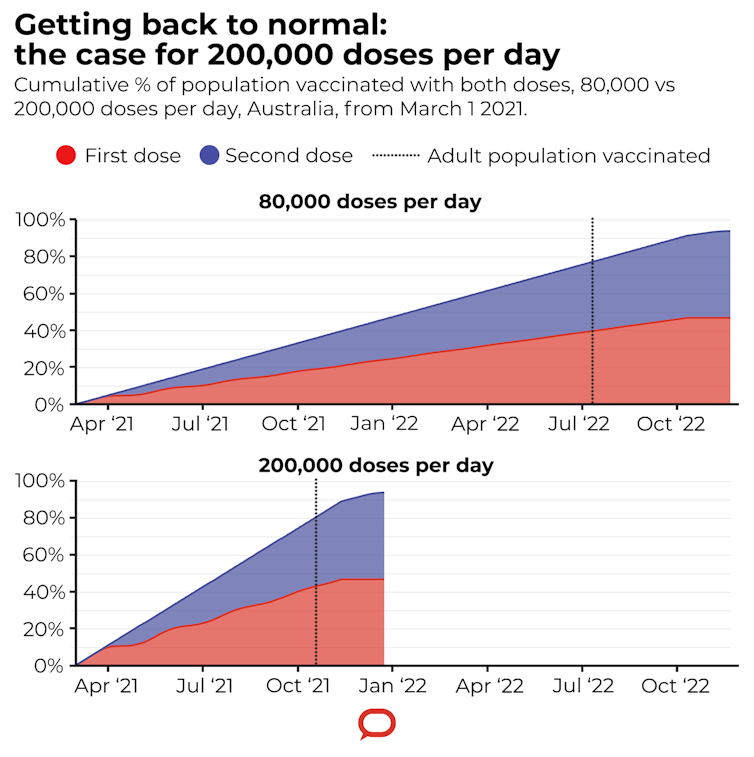
But to start with the rollout will be slow – only 80,000 Pfizer doses per week.
A slow rollout means a slow recovery. The bank is forecasting an unemployment rate not much better than the one we’ve got by the end of the year.
Economic risks continue
One thing the governor clarified in his address to the press is that he is committed to the present inflation-targeting regime that aims to keep consumer price inflation between 2% and 3% on average over time.
Economists Warwick McKibbin, John Quiggin and I have argued that the bank should instead target growth in nominal gross domestic product, which is easier to identify than inflation and more directly impacts living standards.
Rosaleen Norton, or “the witch of Kings Cross,” is finally receiving the attention she deserves. Born in Dunedin in 1917, emigrating with her family to Sydney in 1925, and dying in 1979, Norton was a trailblazing woman and under-appreciated cultural touchstone of 20th century Australia.
A self proclaimed witch, Norton experienced childhood visions. From around the age of 23, she practised trance magic and, later, sex magic in various flats and squats in inner-city Sydney.
Trance magic involved Norton meditating (sometimes with the assistance of various substances, ingested and/or inhaled) and raising her consciousness. The aim was to transcend her physical body and conscious mind to experience higher forms of existence.
Sex magic was developed by the infamous occultist, Aleister Crowley around 1904, and involves a complicated series of sexual rituals designed for a variety of perceived needs (depending on the practitioner), including spiritual awakening.
FireBird by Rosaleen Norton.Black Jelly Films, courtesy Burgess Family
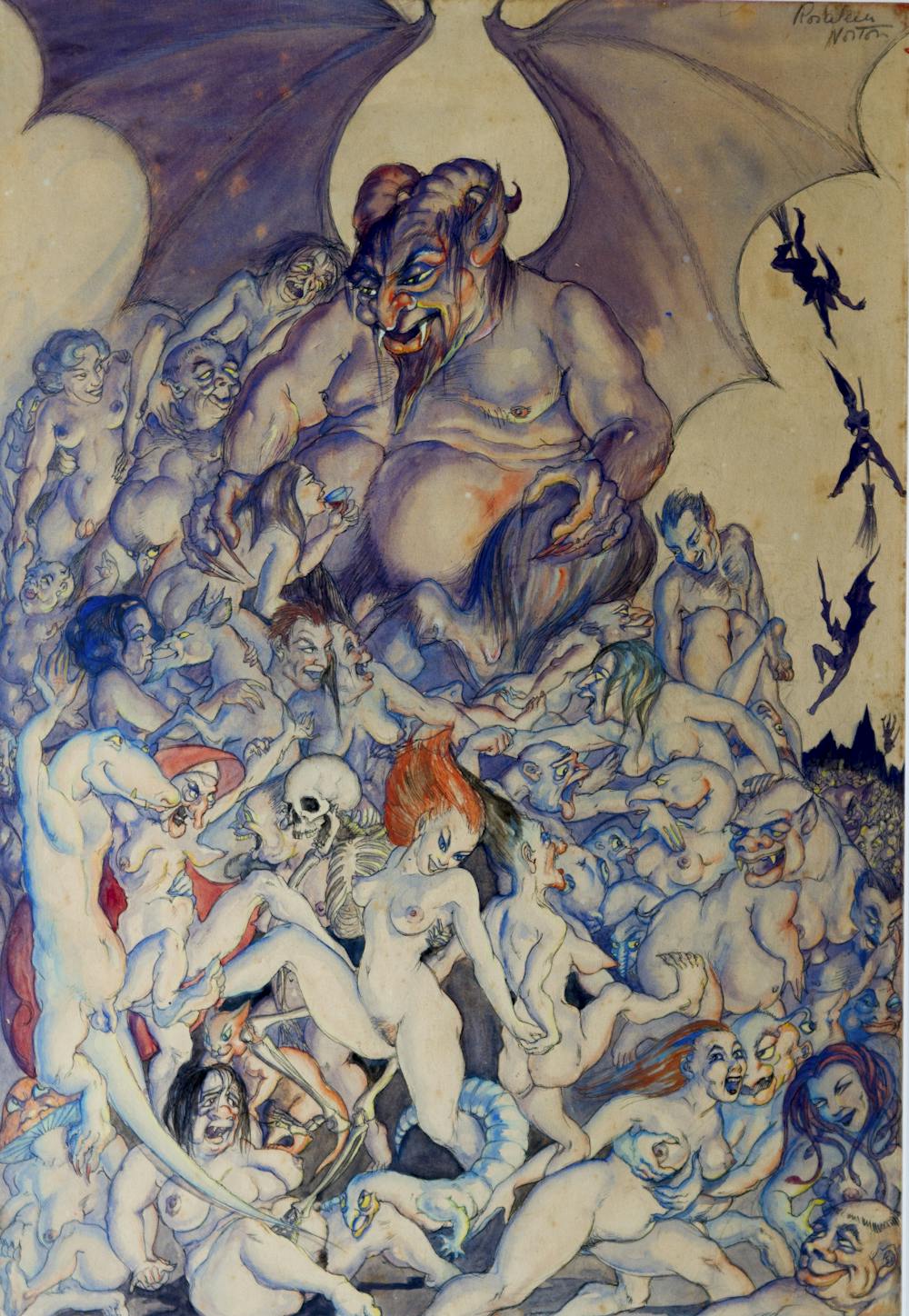
As an artist, Norton drew and painted her beliefs and the gods, goddesses, and spiritual beings who were central to it. She also lived free from societal expectations. Not only a witch, but openly bisexual, Norton robustly challenged a predominantly Christian Australia. But she was reviled for doing so, attacked by the media for her art, her beliefs, her lifestyle, and sometimes, her appearance. She experienced police surveillance and faced obscenity charges over her art.
Norton defied cultural norms and, though she did not identify as a feminist, was a powerfully unconventional woman. Poor but not without imaginative style, she had distinctive arched eyebrows, sometimes dressed in male attire, and was often photographed wearing all black. With a new film about her life being released next week, it is timely to look at her legacy.
Freedom and creativity
Norton’s story has fascinated me from the age of five, when I began to devour the 1970s tabloid newspapers and magazines that featured her. During those years, Norton had become something of a recluse, rarely appearing in public but graciously agreeing to be interviewed about her life. By this time, the legend of “the witch of Kings Cross” was entrenched. Norton was not averse to it, even donning a pointed hat for photos.
This passionate interest went on to inform my adult life. As a classicist, I have explored Norton’s occult belief system, which embraced the old gods. Beings such as Hecate, an ancient Greek goddess who presided over witches, Lilith, the ancient female demon originating in Mesopotamia, and the Egyptian goddess Isis, were at the heart of Norton’s magical practice.
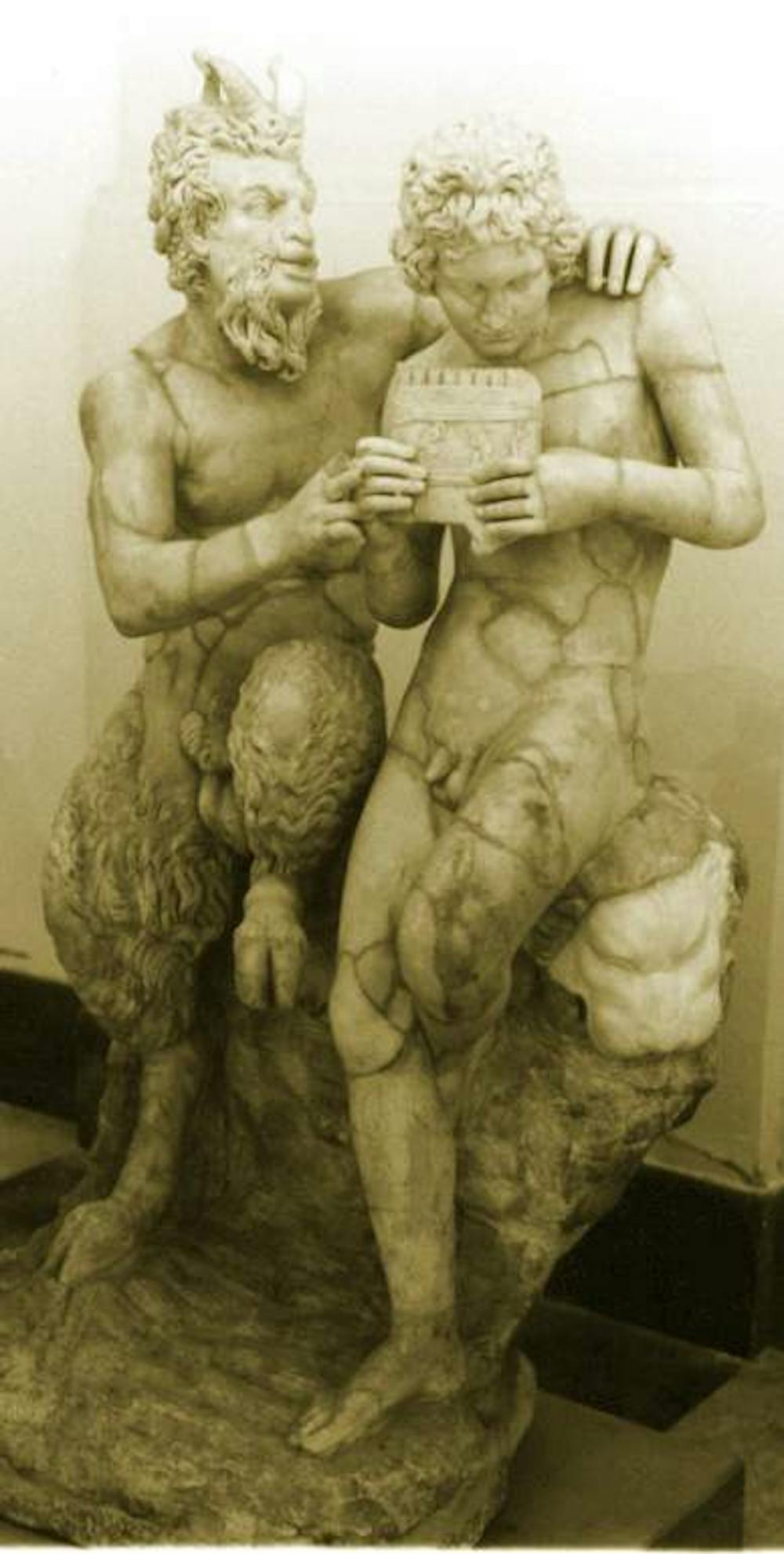
Pan and Daphnis. Roman copy of Greek original c. 100 BC, found in Pompeii.Wikimedia Commons
But the Greek god Pan was at the centre of her pantheon. To the ancient Greeks, Pan was the god of nature, regularly associated with pastureland and its human and animal inhabitants.
Half-man, half-goat, Pan also embodied the sexual drive, the uninhibited urge to copulate. As the “High Priestess at the Altar of Pan”, Norton performed rituals both alone and with members of her inner magical circle in his honour.
In my own research, I have studied witchcraft through the ages and how, especially from Victorian times, it provided an outlet for unconventional women to leverage freedom (and sometimes power) and express their creativity. (Even as a child, I baulked at the media’s determination to cast Norton as a woman to be judged, feared or, worse still, mocked.)
As an academic, I extended my research into the worlds of Greece and Rome with a focus on sexual histories and belief systems — and explored Norton’s life through the same lens. Along the way, I acquired enough material to donate a personal archive on Norton to the library at The University of Newcastle.
Norton’s identity as a witch was formed early. As a child, she was drawn to the night, to nature, and to drawing and recording the preternatural world. In an article published in Australasian Post in January 1957, she describes visions from the age of five (a lady in a grey dress, a dragon) and trance states (which she called “Big Things and Little Things”) to capture the experience of her body growing in size as she “floated,” as if in a dream. She also records the appearance of “witch marks” on her left knee when she was seven (in the form of two small, blue dots).
Bored and frustrated by her middle-class life in Lindfield on the North Shore, Norton left home for inner-city Sydney at the age of 17 and never returned. She found employment as an artist model (including a stint modelling for Norman Lindsay), a pavement artist, and as a contributor to the avant-garde publication, Pertinent.
Eventually, she based herself in Kings Cross. There, she was free to explore and develop her beliefs and practices. In the late 1940s, it was where she met one of her companions in life and magic, the poet Gavin Greenlees (1930-1983).
Rosaleen Norton and poet Gavin Greenlees, one of her lovers, photographed on Darlinghurst Road in 1950.Sydney Morning Herald
Strands of magic
Norton and Greenlees practised several strands of magic, including trance magic, sex magic, and ceremonies combining and improvising elements from several traditions. These included Kundalini (the feminine, creative force of infinite wisdom that “lives” inside us, usually represented by a snake) and Tantra (encompassing esoteric rituals and practices from Hindu and Buddhist traditions).
Norton explained that she employed these practices to augment her unconscious, inspire and empower her art, and commune with entities on other planes.
Norton’s trance magic, in states of self-hypnosis, was a continuation of her childhood visions and visitations. In correspondence with a psychologist in 1949, she described experiencing deities and projecting her astral body to contact other practitioners in alternative spiritual spheres. The idea, she wrote, was “to induce an abnormal state of consciousness and manifest the results, if any, in drawing”.
These experiences informed and inspired her art. Norton’s paintings were produced for her own ritual spaces, as well as for exhibitions and publications. In a well-known photograph from the 1950s, Norton is shown crouching at the base of her altar to Pan, replete with a large portrait of the god.
Norton in front of her altar to the god Pan, photographed in 1950.The Sydney Morning Herald/Black Jelly Films
Pan features in many other works. As Norton said in 1957, his “pipes are a symbol of magic and mystery”, while his “horns and hooves stand for natural energies and fleet-footed freedom”.
Norton’s worship of Pan reflected her passion for animals, insects and nature in general. While she did not publicly campaign for animal rights, she was, in some respects, a forerunner of the movement. Regularly the target of outrageous media allegations, she was particularly incensed when asked whether, as a witch, she performed animal sacrifice.
In 1954, 89.4% of the Australian population identified as Christian. Unfortunately for Norton, the ancient Greek god Pan also resembles Christian representations of Satan or the Devil. Indeed with his goat legs, pointed ears, and lascivious face, Pan most likely inspired early Christian images of Satan. Norton was regularly asked whether she was a Satanist. She wasn’t. But, accusations of Satanism haunted her.
Journalists accused her of Devil worship, police occasionally placed her and Greenlees under surveillance, and her private life became fair game. By the 1950s, the tabloid press’ preferred name for Norton — “the witch of Kings Cross” — had stuck. It featured in news stories on her even after her death.
Sensationalist claims about Norton were frequently published in Sydney’s newspapers, like here in the Sunday Telegraph.The Sunday Telegraph/Black Jelly Films
Censorship and court proceedings
Norton’s run-ins with authorities are partly what make her such an important historical figure. Her early exhibitions were subject to media attention and sensationalism, censorship and court proceedings. During an exhibition of her art at Rowden-White Library, University of Melbourne, in 1949, the Vice Squad seized several works deemed to be profane. Norton appeared in court on obscenity charges — the first such case against a woman in Victoria.
While Norton was acquitted, more scandals erupted. Her collaboration with Greenlees on a book titled, The Art of Rosaleen Norton, with poems by Gavin Greenlees, published privately by Walter Glover in 1952, landed Glover and printer, Tonecraft Pty Ltd, in court on charges of producing an obscene publication.
Fohat, one of Norton’s most famous and controversial works.Black Jelly Films, courtesy Burgess Family
Glover was fined £5 and Tonecraft £1. The book was subject to a customs ban (copies sent to New York were confiscated and burnt by United States Customs) and it became a prohibited import to Australia.
Norton’s Fohat (one of the book’s notorious images) was a representation of her beliefs. The goat, she said, “is a symbol of energy and creativity: the serpent of elemental force and eternity”. As with the images of Pan (and many other artworks), the meaning behind Fohat was misconstrued, deemed obscene and Satanic.
The case of Sir Eugene Goossens
Norton’s practice of sex magic was at the centre of one sensational court case. Her private rituals concerning the practice (including, among other acts, anal and oral sex, and sado-masochism) involved a discrete group of devotees. One of them was the revered composer and conductor Sir Eugene Goossens (1893-1962).
As director of the New South Wales State Conservatorium and chief conductor of the ABC’s Sydney Symphony Orchestra, the English-born Goossens was a cultural and social giant in a still very parochial Australia. Having seen a copy of the infamous book by Norton and Greenlees, Goossens sought out the couple and soon became part of their occult practices and personal lives.
Caught up in their world, Goossens became an unsuspecting target of police surveillance. In March 1956, returning from an overseas trip, he was confronted with officers waiting to search his luggage and subsequently charged with importing prohibited items, allegedly including “indecent works and articles, namely a number of books, prints and photographs, and a quantity of film”.
Goossens was besieged day and night at his home, and newspapers screamed headlines, such as “BIG NAMES IN DEVIL RITE PROBE”.
Norton photographed with her cat in 1949.News Ltd
Goossens’ life and career were ruined. He pleaded guilty to pornography charges in absentia at a hearing in Martin Place Court of Petty Sessions, was fined £100, and returned to the United Kingdom a broken man.
While the media and some biographers of Goossens still tend to blame Norton for contaminating him by inducting him into her unholy cult of sex magic, this could not be further from the truth.
In fact, Goossens came to Australia with significant experience in occult practices, actively seeking out Norton and Greenlees. Personal correspondence from Goossens to Norton reveals his role in mentoring his new friends in more advanced magic, and hints at a network of practitioners in the UK and Europe. Three of the extant letters are signed with Goossens’ magical name, “Djinn”.
Later life
Norton retired from public view during the 1970s, living in a basement flat in Roslyn Garden, with her sister, Cecily Boothman (1905-1991), close by in the same apartment block. Frail, in poor health, but an artist and witch to the end, Norton practised her rituals, painted and communed with animals and nature.
Rosaleen Norton’s Bacchanal.Black Jelly Films, courtesy Burgess Family
She and Boothman were visited by Greenlees on his days of temporary release from the Alma Mater Nursing Home, Kensington, where he had been sectioned after a lengthy stay at Callan Park Mental Hospital at the age of 25.
At the age of 61, Norton was diagnosed with colon cancer. She died at the Sacred Heart Hospice for the Dying, in Darlinghurst, on 5 December 1979.
Norton has been the subject of biographies by Nevill Drury, a fictionalised account, Pagan, by Inez Baranay, and several plays (including a student production, on which I was dramaturg).
Rare footage also captures her at her rebellious best: ensconced in a Kings Cross cafe, talking about rejecting the ordinary life of wife and mother, the thought of which prompts her to say: “I’d go mad”.
Norton was more than a witch. When we look closer at a woman reviled by the media, we see a groundbreaking bohemian, committed to living freely and authentically, who challenged censorship.
In many ways, she helped to push Australia out of the safety of the Menzies era, into the civilising forces of the sexual revolution and the freedoms it brought.
The Witch of Kings Cross, written and directed by Sonia Bible, will be released on Amazon, iTunes, Vimeo and GooglePlay on 9th February and opens in selected cinemas from February 11.
USP’s Canadian Professor Pal Ahluwalia … deported today on a flight to Brisbane.
Image: PMW
By Pacific Media Watch
POLITICIANS, educators and civil society advocates around the region today condemned the “barbaric” and “shameful” detention and deportation of the regional University of the South Pacific’s vice-chancellor Professor Pal Ahluwalia and his wife.
Reformist Professor Ahluwalia, a Canadian, and his wife, Sandra, were detained by Fiji authorities at their Suva home late last night and deported on a flight to Brisbane this morning.
The USP Council is due to meet in Suva tomorrow and the chancellor, Nauru Lionel Aingimea said today a statement would be made later.
National Federation Party leader Professor Biman Prasad said at a time when Fiji should be supporting victims of cyclones Yasa and Ana, government was “instead focused [on] its own petty jealousies”.
Social Democratic Liberal Party leader Viliame Gavoka condemned the arrest and deportation of Professor Ahluwalia and his wife as “barbaric treatment”.
“We are alarmed by the way that the government of Fiji broke into the vice-chancellor’s residence in the middle of the night (03.02.21) and orchestrated the removal of VCP Pal and his wife,” the unions said.
“The manner in which the VCP and his wife were removed is a violation of human rights and due process.
“Given the seriousness of the decision, we demand the Fiji government … provide the justification for this Gestapo tactic.”
The unions said USP was a regional organisation like Pacific Islands Forum Secretariat, SPREP, FFA, SPC and demanded the same respect given to any regional organisation.
Managing the vaccine rollout and recalibrating the government’s climate policy are vastly different issues but both confront Scott Morrison as major challenges as he settles into the 2021 political year.
Foremost but not entirely, the rollout is about getting right a highly intricate planning and administration exercise. The health and economic consequences of serious bungles could be substantial.
In contrast, foremost but not entirely, shifting climate policy is for Morrison about managing the politics, especially within the Coalition.
Morrison will win points if the vaccine rollout is smooth – though there’d be some discount factor, with people being more likely to mark down failure than mark up success.
If he finally executes the climate policy pivot to embrace the emissions target of net zero by 2050, he will have left less room for Labor at the election – but at the cost of tensions within government ranks and a section of its base.
This week’s COVID case in a Victorian hotel quarantine worker, prompting some tightening of restrictions, and the Perth lockdown underlined how vital the vaccine rollout is.
The vaccine won’t be a total, let alone immediate, protection for the community. Its efficacy in preventing transmission, as opposed to combatting the illness, remains unclear. But it will be the big gun in the armoury against the virus.
Morrison wants no political distraction from the rollout, as his eventual shutting down of rebel backbencher Craig Kelly showed.
Unlike with some other aspects of COVID management, in particular quarantine, the federal government has taken ownership of the vaccination effort. So whatever the role of the states, political accountability will be sheeted home to Morrison.
The prime minister is always lecturing ministers and public servants about the importance of “delivery” of services and policies. In earlier days, he’d never have imagined he would face a “delivery” test of this magnitude.
To give the required two doses to everyone aged 16 and over by October, the government’s nominated deadline, will mean administering more than a million jabs a week.
The government is investing several billion dollars in an operation that will involve states and territories, hospitals, doctors, chemists, Aboriginal health services, and a “surge” workforce. Distributing the vaccine to remote areas will be logistically complex.
Despite confident statements from the government about its plan, there is still much detail to be nailed down.
Keeping account of who has received their two shots and – given the newness of the vaccines – making sure any adverse reactions are reported, will require an effective IT tracking system.
Like earlier steps in the fight against COVID, decisions have to be made with imperfect and changing information.
The government has lined up a portfolio of vaccines, with critics debating the mix. It announced on Thursday the acquisition of an extra 10 million doses of the Pfizer one, the first to be rolled out.
With the situation so desperate in many countries, availability and delivery timelines become less certain.
Morrison has put a caveat on his commitment to begin the rollout late this month, saying “the final commencement date will ultimately depend on some of these developments we’re seeing overseas”.
Early recipients will include quarantine, border, aged care and health workers, residents in aged care, older people generally, those with health issues, and Indigenous people over 55.
These cohorts should not be hard to reach. Many of the very elderly will be in facilities; others vulnerable to COVID are likely to be alert to their need for the vaccine.
Some younger people could be less accessible – not because of scepticism about the vaccine, but because they don’t feel under as much threat from COVID and might be disinclined to bother (just as some don’t get flu injections). In its promotion, the government must both reassure the doubters and motivate the laggards.
If the government is in a gallop to prepare the rollout, the PM is creeping when it comes to moving towards the 2050 target of net-zero emissions.
In his latest step this week Morrison said: “Our goal is to reach net-zero emissions as soon as possible, and preferably by 2050.” He’d added the word “preferably” to his formulation.
Climate change was canvassed when Morrison and Joe Biden spoke on Thursday, in their first conversation since the US president’s inauguration.
Biden’s April 22 leaders’ conference on climate will provide a pinch point for Australia.
Asked whether the president had invited him to the summit and, if so, whether he’d go, Morrison gave a vague answer. “There are invitations coming, and we’ll be addressing those once they’re received. We spoke positively about these initiatives and so we look forward to being able to participate.”
There’s no doubt that international pressure, notably Biden’s election, and domestic politics are pushing Morrison towards signing up to the 2050 target later this year.
But as he inches towards the target, critics within the Nationals are making it clear they’ll go all out to prevent him adopting it.
Former Nationals resources minister Matt Canavan says: “I’m dead-set opposed to any commitment to net-zero emissions – because it would wipe out massive farming opportunities and cost thousands of jobs in the mining industry.”
Persuading the Nationals to accept the target would be very difficult. Nationals leader Michael McCormack lacks the political capital to give Morrison much help. At the least, the minor party would want exemptions and trade-offs.
The difficulty with the Nationals is a main reason why it is still up in the air whether Morrison will take the final step.
As the government and opposition rejoin battle, there’s the inevitable speculation about Morrison calling the election this year. The chatter has been fuelled by questions over Anthony Albanese’s leadership, only partly quieted by this week’s Newspoll showing government and opposition 50-50 on a two-party basis.
Morrison has hosed down the early election talk, saying more than once that 2022 is poll year.
Talking up next year and then calling an election this year would be a foolish strategy, and face punishment from voters.
While things can always change, the evidence suggests Morrison means what he says, not least because, by allowing for some slippage, a 2022 poll would ensure time for the vaccine program to be fully rolled out.
Radio images of the sky have revealed hundreds of “baby” and supermassive black holes in distant galaxies, with the galaxies’ light bouncing around in unexpected ways.
Galaxies are vast cosmic bodies, tens of thousands of light years in size, made up of gas, dust, and stars (like our Sun).
Given their size, you’d expect the amount of light emitted from galaxies would change slowly and steadily, over timescales far beyond a person’s lifetime.
But our research, published in the Monthly Notices of the Royal Astronomical Society, found a surprising population of galaxies whose light changes much more quickly, in just a matter of years.
What is a radio galaxy?
Astronomers think there’s a supermassive black hole at the centre of most galaxies. Some of these are “active”, which means they emit a lot of radiation.
Their powerful gravitational fields pull in matter from their surroundings and rip it apart into an orbiting donut of hot plasma called an “accretion disk”.
This disk orbits the black hole at nearly the speed of light. Magnetic fields accelerate high-energy particles from the disk in long, thin streams or “jets” along the rotational axes of the black hole. As they get further from the black hole, these jets blossom into large mushroom-shaped clouds or “lobes”.
The radio galaxy Hercules A has an active supermassive black hole at its centre. Here it is pictured emitting high energy particles in jets expanding out into radio lobes.NASA/ESA/NRAO
This entire structure is what makes up a radio galaxy, so called because it gives off a lot of radio-frequency radiation. It can be hundreds, thousands or even millions of light years across and therefore can take aeons to show any dramatic changes.
Astronomers have long questioned why some radio galaxies host enormous lobes, while others remain small and confined. Two theories exist. One is that the jets are held back by dense material around the black hole, often referred to as frustrated lobes.
However, the details around this phenomenon remain unknown. It’s still unclear whether the lobes are only temporarily confined by a small, extremely dense surrounding environment — or if they’re slowly pushing through a larger but less dense environment.
The second theory to explain smaller lobes is the jets are young and have not yet extended to great distances.
Old ones are red, babies are blue
Both young and old radio galaxies can be identified by a clever use of modern radio astronomy: looking at their “radio colour”.
From the data, baby radio galaxies appear blue, which means they’re brighter at higher radio frequencies. Meanwhile the old and dying radio galaxies appear red and are brighter in the lower radio frequencies.
We identified 554 baby radio galaxies. When we looked at identical data taken a year later, we were surprised to see 123 of these were bouncing around in their brightness, appearing to flicker. This left us with a puzzle.
Something more than one light year in size can’t vary so much in brightness over less than one year without breaking the laws of physics. So, either our galaxies were far smaller than expected, or something else was happening.
Luckily, we had the data we needed to find out.
Past research on the variability of radio galaxies has used either a small number of galaxies, archival data collected from many different telescopes, or was conducted using only a single frequency.
For our research, we surveyed more than 21,000 galaxies over one year across multiple radio frequencies. This makes it the first “spectral variability” survey, enabling us to see how galaxies change brightness at different frequencies.
Some of our bouncing baby radio galaxies changed so much over the year we doubt they are babies at all. There’s a chance these compact radio galaxies are actually angsty teens rapidly growing into adults much faster than we expected.
While most of our variable galaxies increased or decreased in brightness by roughly the same amount across all radio colours, some didn’t. Also, 51 galaxies changed in both brightness and colour, which may be a clue as to what causes the variability.
3 possibilities for what is happening
1) Twinkling galaxies
As light from stars travels through Earth’s atmosphere, it is distorted. This creates the twinkling effect of stars we see in the night sky, called “scintillation”. The light from the radio galaxies in this survey passed through our Milky Way galaxy to reach our telescopes on Earth.
Thus, the gas and dust within our galaxy could have distorted it the same way, resulting in a twinkling effect.
2) Looking down the barrel
In our three-dimensional Universe, sometimes black holes shoot high energy particles directly towards us on Earth. These radio galaxies are called “blazars”.
Instead of seeing long thin jets and large mushroom-shaped lobes, we see blazars as a very tiny bright dot. They can show extreme variability in short timescales, since any little ejection of matter from the supermassive black hole itself is directed straight towards us.
3) Black hole burps
When the central supermassive black hole “burps” some extra particles they form a clump slowly travelling along the jets. As the clump propagates outwards, we can detect it first in the “radio blue” and then later in the “radio red”.
So we may be detecting giant black hole burps slowly travelling through space.
Where to now?
This is the first time we’ve had the technological ability to conduct a large-scale variability survey over multiple radio colours. The results suggest our understanding of the radio sky is lacking and perhaps radio galaxies are more dynamic than we expected.
An artist’s impression of the SKA telescope. On the left is SKA-Mid, fading into SKA-Low on the right.SKAO/ICRAR/SARAO
As the next generation of telescopes come online, in particular the Square Kilometre Array (SKA), astronomers will build up a dynamic picture of the sky over many years.
In the meantime, it’s worth watching these weirdly behaving radio galaxies and keeping a particularly close eye on the bouncing babies, too.
After Victoria yesterday recorded 28 days without a locally acquired case — widely regarded as indicating we’ve most likely eliminated COVID-19 — a positive case in a hotel quarantine worker has set the clock back to zero.
Some restrictions that were previously eased have been reimposed, including mandatory masks in indoor public spaces. Household gathering limits have been pulled back from 30 to 15.
Meanwhile, authorities are working to identify anyone who may have come into contact with the 26-year-old man from Noble Park who was working at the Grand Hyatt hotel.
Among them, 520 Australian Open players and support staff have been instructed to get tested and isolate. Having quarantined at the Grand Hyatt, they’re regarded as casual contacts.
The saga has again raised the divisive issue of whether Melbourne should be hosting the international tennis tournament during the pandemic.
Whatever your view, this now presents us with our first real test. But I would argue — even without going into a lockdown — that Victoria is well placed to prevent this case from becoming a large-scale outbreak.
A sense of déjà vu
We’ve now been through this scenario, in which a hotel quarantine worker has become infected with COVID-19, several times.
The seeding of Victoria’s second wave aside, before this latest case, we’ve seen similar cases in South Australia, Queensland, and most recently, Western Australia.
Notably, all three states imposed hard lockdowns at the first sign of local transmission. So why isn’t Victoria doing the same?
I believe the fact we’re not going into a full lockdown reflects the increased confidence the Victorian government has in its public health response. After the disastrous second wave, and a series of smaller, better-managed outbreaks around the country, Victoria has confidence in its ability to stay ahead of the virus by rapidly identifying and isolating contacts, and contacts of contacts.
So this sense of déjà vu, though disappointing, isn’t all bad from a public health perspective.
Daniel Andrews said ‘It wasn’t about a matter of if, it was a matter of when’ the virus would resurface in Victoria.James Ross/AAP
What happened?
In this situation, as in previous examples, it’s not clear how the quarantine worker became infected. Premier Daniel Andrews has said there was no breach of protocol, calling the quarantine worker “a model employee”.
This is another reminder — if we needed one — of how infectious the virus is. It highlights that you can never completely eliminate the risk of virus transmission in hotel quarantine; you can only reduce the risk.
The results of genomic sequencing, which we’re expecting tomorrow, will tell us more about what’s happened here. Hopefully they’ll give us a clearer idea of who this worker may have got the virus from.
It’s been reported that this man is infected with the UK variant of the virus. If this is true, while concerning — the UK variant is more infectious and poses an increased threat — it’s not a game-changer in Victoria.
Regardless of the variant of the virus we’re dealing with, the principal tools we need to control transmission remain the same: testing, tracing and isolating.
The new case has again raised the question: was it worth hosting the Australian Open?Hamish Blair/AP/AAP
What happens now?
Two of the man’s close contacts have already tested negative. That’s good news, although it doesn’t necessarily mean they won’t test positive later on.
Authorities revealed the man has a “high viral load”. The science around how viral load correlates with infectiousness isn’t definitive, but this suggests he’s been shedding a lot of the virus, and so would have been more likely to spread it to others.
The next 48 hours will be crucial, as authorities continue with tracing and we receive test results from contacts. It could be we have some more cases, although of course we’re all crossing our fingers that we don’t.
If we think back to late December and early January, Victoria’s public health system has shown it can manage a small outbreak. After the virus likely crossed the border from New South Wales, we saw a handful of cases — but this was brought under control rapidly.
As Andrews pointed out, we’re always going to have people coming into hotel quarantine — Australian Open or otherwise. It wasn’t a matter of if, but when, the virus would resurface in Victoria.
Looking at things solely through a public health lens, I would have said we shouldn’t bring people from all over the world to our almost virus-free shores. But I fully understand there are other considerations in making this decision, and that the public health experts advising the government carefully considered the risks and benefits.
Notwithstanding that we need to take this situation seriously, we need to have confidence in what we’ve learned over the past 12 months. Our experiences stand us in good stead to respond effectively and proportionately to this situation as it unfolds.
Ultimately, it comes down to the basics we know from the earliest days of the pandemic: test, trace and isolate. If we can do these things well — and Victoria has certainly improved in all areas — then we should be able to stay ahead of the virus and shut transmission down.
Source: Council on Hemispheric Affairs – Analysis-Reportage
COHA Webinar: Ecuadorian Presidential Elections and the comeback of the Citizens’ Revolution
With Ricardo Patiño, former Foreign Affairs Minister of president Rafael Correa (2010 to 2016).
Join COHA to analyze thedecisive presidential election taking place this February 7 in Ecuador.
COHA Senior Research Fellows Alina Duarte and Professor Danny Shaw will interviewRicardo Patiño about the national and regional social, economic, and political implications of the presidential election in Ecuador.
On February 7, Ecuadoreans will choose between the increasingly unpopular neoliberal path forged by President Lenin Moreno since his surprise pivot to the right in 2017, and a resumption of the Citizens’ Revolution, which had advanced social investment and economic growth under former President Rafael Correa (2007-2017). While under Moreno, Quito has withdrawn from efforts at regional integration, presidential candidateAndrésArauz (Union of Hope, UNES) has promised to restore Ecuador’s role in UNASUR, ALBA and CELAC. There is, therefore, a great deal at stake for both Ecuador and the entire region.
Join COHA to analyze thedecisive presidential election taking place this February 7 in Ecuador.
Source: Council on Hemispheric Affairs – Analysis-Reportage
By Danny Shaw From New York
On February 7, Ecuador will hold elections for President and for its legislative body, with 137 positions to be decided for the National Assembly. Though 16 presidential candidates participated in the debates, there are three major candidates. Andrés Arauz and his vice presidential candidate, Carlos Rabascall, represent La Unión por la Esperanza (The Union of Hope, UNES), what was Alianza País led by former president Rafael Correa before the party split in 2017. Guayaquil banker Guillermo Lasso and Alfredo Borrero are the candidates for the conservative alliance Creando Oportunidades (Creating Opportunities, CREO). Carlos “Yacu” Pérez is the candidate of the indigenous Pachakutik Party.
Many from the Correa camp have questioned Pérez’s genuine commitment to defend indigenous communities and remember that some factions of the Pachakutik Party have, in the past, opportunistically aligned with the right against Correísmo.[1] The election represents a showdown between ten years of the Revolución Ciudadana (Citizens’ Revolution, 2007-2017) and the past four disastrous years of unfettered neoliberalism. As of now, polls show Arauz, Correa’s candidate, is clearly in the lead, polling at 37% and Lasso at 24%.[2]
Rafael Correa’s presidential victory in 2006 was a key part of the Pink Tide and South American effort to realize Bolívar’s dream of regional economic and political integration and independence from foreign domination. As Minister of Economy and Finance in 2005, Correa distinguished himself from other politicians by calling out the pitfalls of International Monetary Fund (IMF) loans, advocating for social planning and proposing a National Assembly to tap into the power of Ecuador’s diverse working sectors.[3]
It is important to outline the progressive nature of the Correa administration. During Correa’s two terms, the 17 million people of Ecuador saw increases in the minimum wage and social security benefits, a progressive tax on the rich, and higher investments in education and social programs, all while attaining economic growth.[4] For this reason, traditional interests and their U.S. backers opposed Alianza País and sought to sew internal divisions and solidify alliances with sections of the Confederation of Indigenous Nationalities of Ecuador, CONAIE.
The leadership and rank-and-file of Alianza País understood that Lenin Moreno, who had served as Rafael Correa’s vice-president for six years, was best positioned to carry Correísmo forward. Within months of winning the presidency in 2017, however, Moreno reneged on his campaign promises. In one of the great about-faces in the history of South America, Moreno betrayed the movement and embraced a neoliberal model for Ecuador. Under Moreno, Ecuador also withdrew from theBolivarian Alliance for the Peoples of Our America (ALBA) in 2018 and pulled out of the Union of South American Nations (UNASUR) in 2019, weakening two of the most important instruments of continental unity.[6]
Throughout the ups and downs and contradictions of the entire liberatory project, the leadership of the Citizens’ Revolution has maintained a self-critical posture. After the election of Lenin Moreno, Alianza País split into pro-Moreno and pro-Correa tendencies. This speaks to the reality that some of Alianza País’ functionaries were not guided by principles but were rather attracted to power. Sections of CONAIE have sustained legitimate critiques of Correísmo, including concerns over the environmental impact of resource exploitation and infrastructure projects. These are problems the Correista leadership continues to address and it shows the importance of the ethical and political formation of a new generation of Ecuadoreans.[7]
Ricardo Patiño’s book Construir Poder Transformador.Debate Latinoamericano, lays out the pitfalls of over reliance on Correa’s charisma and indicates some of the challenges that lay ahead (Patiño is the Former Minister of Foreign Affairs under Correa’s Presidency). The grassroots leadership of UNES warns of dependence on one savior and the importance of building an entire movement that can independently defend its interests: “The fundamental problem has been an absence of a solid and profound counter-hegemonic ideology that guides the decisions, practices and relations of the popular sectors as well as political leaders.” [8]
Willthe Tide again Turn?
In an example of flipping reality on its head in 2017, the incoming Moreno government immediately accused the Citizens’ Revolution of wanton corruption. Similar to the oligarchies’ attacks demonizing the Pink Tide in Brazil, Paraguay, Venezuela, Bolivia and across the continent, this was a classic case of Lawfare.[9] The neoliberals, fearful of the enormous popularity of Correísmo, waged a war through judicial means. Jorge Glas, former vice-president under Correa, is still in jail on trumped-up charges and recently contracted the coronavirus.[10] Ricardo Patiño and the President of the National Assembly Gabriela Rivadeneira are still in exile in Mexico. Correa himself is banned from his homeland and faces years in jail on highly dubious charges of corruption.
An Arauz victory would open the country back up to those who put human life in community before private accumulation and carry forth an agenda that targets the real culprits of corruption.[11]
Again, most polls have Andrés Arauz, the UNES candidate, in the lead.[12] Alarmed at another potential loss of ground in the continental struggle for power between an independent left-wing, anti-imperialist movement, the old order beholden to U.S. interests is scrambling to prevent Arauz’s electoral victory. There is good reason to be concerned. In November 2019, the U.S.-dominated Organization of American States (OAS) backed a coup in Bolivia to prevent an electoral victory by MAS candidate and incumbent president Evo Morales, and it took a year for the popular movements to restore their democracy. Concerned about a renewed attempt to sabotage democratic institutions in Ecuador, former Ecuadorian president Rafael Correa has warned that Moreno’s meeting with OAS Secretary General Luis Almagro this week in Washington DC may be a prelude to a similar attempt at OAS subversion.[13] The corporate-dominated media has provided the disinformation for this by publishing material which constitutes scare tactics and red-baiting against Arauz, claiming that his intention is to turn Ecuador into “another Venezuela.”[14] There are allegations of vote-tampering, and UNES has warned the population to be ready for any type of chicanery.[15]
Another key issue in the election are the IMF loans that the current administration negotiated with western banks that force austerity on an already beleaguered people. IMF loans to the region and exploited countries have long been a neocolonial tactic for extracting wealth from developing countries. As the old proverb goes: “those who lend, command.” Under the guise of humanitarian help with the raging pandemic, the IMF issued loans to an all too willing Moreno administration to the tune of 6.5 billion dollars just before the close of 2020.[16] As is customary, the IMF stipulated austerity, the deregulation of the Central Bank and sale of gasoline and diesel without subsidies and at world market prices. Lasso has indicated that if elected president, he would not disavow the IMF agreement, drawing a stark contrast between himself and Arauz, who said he will renegotiate the country’s deal.[17]
One of Trump’s 11th hour actions before leaving office was to oversee a U.S. Development Corporation loan to Ecuador for 3.5 billion dollars that requires the government to privatize a major oil refinery and parts of the country’s electrical grid, and to exclude China from its telecommunications development.[18] Washington is alarmed at the growing Chinese influence across South America and the Global South and sees Ecuador as an important beachhead to prosecute this “New Cold War” through the Growth in the Americas (CRECE) program. Moreno was more than happy to be a major U.S. client in the region along with Iván Duque and Laurentino Cortizo, the presidents of Colombia and Panama respectively. Vijay Prashad evaluates how the two global powers treated Ecuador in the context of waning U.S. hegemony: “Chinese banks lent money for the construction projects. These funds came with no conditions. The U.S. government money, on the other hand, came with substantial claims on the government of Ecuador’s policy orientation.” The result is the Ecuadorian people suffer, as they now have a debt totalling $52 billion.[19]
What’s at Stake
In October 2019, a massive protest movement rocked the country. The world watched with bated breath as a grassroots movement opposed to austerity measures occupied Quito and nearly toppled the Moreno government. The government attempted to crush the protests, leaving at least ten dead, more than 1,000 people arrested and more than 1,300 injured.[20] When repression failed to quell the protests, Moreno rescinded on an International Monetary Fund-backed program, known as Decree 883, that raised fuel prices, proving again the power of a united, mobilized people.
The year 2020 ushered in a new tragedy for Ecuador. The Moreno government failed to respond adequately to the COVID-19 pandemic in any serious, unified way. Abandoned bodies lined the streets of Guayaquil last April putting on tragic display before the entire world, the misleadership of Ecuador’s largest city, long governed by neoliberal politicians.[21] These dehumanizing images encapsulated what three years of Lenin’s economic and political agenda has meant for everyday people. On January 26, 2021, Ecuador’s Parliament began the process of impeaching Health Minister Juan Zavallos for mismanaging the COVID-19 vaccination program, and a few days later Ecuador’s chief prosecutor began an investigation into Zavallos for alleged influence peddling.[22] On January 29, police in Quito shut down a clinic for giving out 70,000 fake vaccines.[23]TV presenter Efraín Ruales, who had reported on corruption in the current administration, was gunned down and murdered on January 27.[24] As of now, there are 249,779 coronavirus cases in Ecuador and 14,851 deaths.[25]
This is the backdrop for this week’s election, not just for the 17 million people of Ecuador and hundreds of thousands of others in the diaspora, but for the future of the Pink Tide in Latin America. Will Ecuador continue down the road of subordination to neoliberal imperatives of the IMF and Washington, or will it resume the Citizens’ Revolution and rejoin the movement towards regional integration and independence? This decisive election will determine Ecuador’s direction for the next four years and beyond.
Danny Shaw teaches Latin American and Caribbean Studies at John Jay College of Criminal Justice and Hostos College, and is a Senior Research fellow at COHA.
Sources
[1] “In Defense of Rafael Correa Interview with Guillaume Long”, https://www.jacobinmag.com/2015/09/ecuador-rafael-correa-alianza-pais-quito-conaie-peoples-strike-protest
[2] “Injerencia estadunidense en los comicios ecuatorianos”, https://www.jornada.com.mx/notas/2021/01/30/politica/injerencia-estadunidense-en-los-comicios-ecuatorianos/?s=09
[3] Patiño, Ricardo. Construir Poder Transformador. Debate Latinoamericano.
[4] “In Defense of Rafael Correa”, https://www.jacobinmag.com/2015/09/ecuador-rafael-correa-alianza-pais-quito-conaie-peoples-strike-protest
[6] “ALBA Boss Chastizes Ecuador For Abandoning Regional Bloc”, https://www.telesurenglish.net/news/ALBA-Boss-Chastizes-Ecuador-For-Abandoning-Regional-Bloc-20180824-0022.html, and “Ecuador pulls out of South American regional group Unasur”, https://www.upi.com/Top_News/World-News/2019/03/14/Ecuador-pulls-out-of-South-American-regional-group-Unasur/8621552588693/
[8] “The fundamental problem has been the absence of a counter hegemonic ideology, solid and deep, that guides the decisions, practices and relationships of popular sectors and also political leadership,” from Patiño, Ricardo. Construir Poder Transformador. Debate Latinoamericano.
[9] “La Guerra Judicial en Latinoamérica – Lawfare In the Backyard”, https://www.youtube.com/watch?v=Oi5fEkK77ok&t=2262s
[10] Correo del Alba, https://twitter.com/correodelalba/status/1355217023769452558?s=08
[11] “Combate a la corrupción: un reto de la perspectiva de los DDHH”, https://desalineados.com/2021/01/combate-a-la-corrupcion-un-reto-desde-la-perspectiva-de-ddhh/1018/
[12] “Encuesta local en Ecuador muestra a Andrés Arauz como favorito”, https://www.telesurtv.net/news/define-intencion-voto-casi–mitad-ecuatorianos-20210122-0014.html
[13] “Injerencia estadunidense en los comicios ecuatorianos”, https://www.jornada.com.mx/notas/2021/01/30/politica/injerencia-estadunidense-en-los-comicios-ecuatorianos/?s=09
[14] “Opinión: Ecuador y la tradición latinoamericana de votar por el mal menor”, https://www.washingtonpost.com/es/post-opinion/2021/01/18/ecuador-elecciones-2021-candidatos-miedo/
[15] Union por la Esperanza https://twitter.com/UNESECUADOR/status/1355570489373184001?s=20
[16] “IMF Executive Board Approves 27-month US$6.5 billion Extended Fund Facility for Ecuador”, https://www.imf.org/en/News/Articles/2020/10/01/pr20302-ecuador-imf-executive-board-approves-27-month-extended-fund-facility
[17] “Ecuador’s Lasso said he would not disavow IMF deal if elected”, https://www.nasdaq.com/articles/ecuadors-lasso-said-he-would-not-disavow-imf-deal-if-elected-2021-01-27 and “¿Cumplirá el acuerdo firmado con el FMI? Aquí las respuestas de los 16 candidatos a la Presidencia de Ecuador”,
[18] “Biden needs to reverse Trump’s economic policy in Ecuador”, https://thehill.com/opinion/international/535838-biden-needs-to-reverse-trumps-crony-capitalism-in-ecuador
[19] “US Rescue of Ecuador from Chinese Debt is a Trap”, https://newcoldwar.org/us-rescue-of-ecuador-from-chinese-debt-is-a-trap/
[20] “La defensoría del Pueblo de Ecuador sitúa en una decena los muertos durante las protestas”, https://www.europapress.es/internacional/noticia-defensoria-pueblo-ecuador-situa-decena-muertos-protestas-20191029020538.html
[21] “Bodies are being left in the streets in an overwhelmed Ecuadorian city”, https://www.cnn.com/2020/04/03/americas/guayaquil-ecuador-overwhelmed-coronavirus-intl/index.html
[22] “Ecuador: Lawmakers Dismiss Health Minister Zevallos”, https://www.telesurenglish.net/news/Ecuador-Lawmakers-Dismiss-Health-Minister-Zevallos—20210127-0015.html
[24] “Horrifying moment TV presenter, 36, who has previously received death threats for reporting on corruption, is assassinated during a drive-by-shooting in Ecuador”, https://www.dailymail.co.uk/news/article-9198501/TV-presenter-36-received-death-threats-reporting-corruption-assassinated-Ecuador.html
Alcohol-related blackouts aren’t good for anybody’s health, but they are particularly dangerous for young people.
Our recent research found blackouts are common once young people start drinking. At age 14, nearly one in ten adolescents who drank alcohol in the past year had a blackout.
By age 19, around 48% had experienced a blackout.
We also found around 14% of young Australians in our study had more and more alcohol-related blackouts as they aged through adolescence. Females were three times more likely to experience this increasing number of blackouts than males.
Young people who had this increasing number of blackouts were around 2.5 times more likely to develop severe alcohol problems including alcohol abuse and dependence in early adulthood.
To conduct this research, we recruited 1,821 13-year-olds from year 7 classes in New South Wales, Western Australia, and Tasmania in 2010-11. We asked them to complete surveys each year about their alcohol use.
We used eight years of data to analyse when they started drinking alcohol, if they had alcohol-related blackouts, and if they reported more severe alcohol harms, like alcohol abuse and dependence.
An alcohol-related blackout happens when someone has blood alcohol concentration of about 0.15 or higher (three times the legal driving limit). Blackouts are more likely to be triggered when someone raises their blood alcohol levels very quickly, for example by “chugging” drinks or drinking on an empty stomach.
Despite the name, someone who’s having an alcohol blackout is not unconscious (although people might become unconscious during or after a blackout). They can continue to do things such as talking and walking, but afterwards they can’t remember what they did while they were drunk. In other words, alcohol can temporarily stop your brain from forming long-term memories.
Drinking very quickly, particularly by ‘chugging’ or ‘sculling’, is more likely to trigger a memory blackout.Shutterstock
Most blackouts tend to be “spotty”, where the person might be able to remember some things that happened while drinking but not others. With more severe blackouts, they aren’t able to remember anything at all from when they started to black out, even if someone tries to remind them what happened.
Why are blackouts so dangerous?
Alcohol affects everyone differently, so the number of drinks it takes to trigger a blackout varies from person to person.
Regardless of the number of drinks consumed, when someone has a blackout, it means they’re drinking at a level that affects their memory and behaviour.
Because young peoples’ brains are still developing until they’re about 25, they’re very vulnerable to the damage alcohol causes to the brain. Drinking regularly at amounts leading to blackouts can cause permanentbrain damage.
In the short term, someone having a blackout has reached blood-alcohol levels that make them more likely to undertake risky activities such as driving, having unprotected sex, and other behaviours that can lead to injury or death.
Young people’s brains are still developing, so they’re vulnerable to brain damage from drinking too much alcohol.Shutterstock
Blackouts are also linked to having problems with work, school and social life.
In the long term, young adults who have alcohol blackouts are 1.6-2.6 times as likely to experience alcohol-related injuries two years later and around 1.5 times as likely to have symptoms of alcohol dependence five years later.
Who’s particularly at risk?
Having lower bodyweight, drinking faster, and not eating before drinking all increase the chances of having a blackout.
Females are also around 1.8 times more likely to have a blackout when drinking the same amount as males. This is because females are, on average, smaller than males and have less water in their bodies to dilute consumed alcohol, so they absorb alcohol into their blood faster than males.
How can you prevent blackouts?
If you’re going to drink alcohol, these tips can help prevent blackouts:
make sure to eat before and during a drinking session
try to sip your drink rather than taking gulps or chugging
have some water between each alcoholic drink
avoid binge drinking (having four or more drinks in two hours).
One 2018 study showed young people tend to be aware that drinking alcohol on an empty stomach leads to blackouts. But less than one in four of the participants were aware that females are at greater risk because of how their body processes alcohol.
Teachers can help by teaching young people about the factors that increase their chances of having a blackout.
Regardless of your age, it’s never too late to rethink your relationship with alcohol. If you’ve had a blackout, it’s a very good indicator you’re drinking at a concerning level, regardless of how many drinks led to the blackout.
We wish to acknowledge and thank our research participants for their longstanding contribution to the Australian Parental Supply of Alcohol Longitudinal Study.
If this article has raised issues for you, or if you’re concerned about someone you know, call the National Alcohol and Other Drug Hotline on 1800 250 015.
The content of some films is so close to the heart that it’s difficult to critically evaluate them. If you’re an atheist, The Passion of the Christ is not for you. By the same token, if you’re a denier of anthropogenic global warming, then you’ll hate Wild Things, the latest film from Australian producer-director Sally Ingleton.
A passionate call to action against global warming, Wild Things is documentary at its slickest, even if it is oddly-named (sharing the title with the 1998 risque romp Wild Things).
It seamlessly combines archival footage, camera phone footage, stunningly panoramic aerial photography and beautiful-in-forest images with the whole thing anchored around a group of very likeable environmental activists.
To every season, turn
In keeping with the subtitle — A Year on the Frontline of Environmental Activism — Wild Things follows a group of activists (it’s not clear why they are called “wild things” or by whom) – with each section of the film following a season.
We move from the anti-Adani campaign in Central Queensland led by Andy Paine at Camp Binbee, to Lisa Searle and the campaign to save old-growth forests in Tasmania, to high school students Milou Albrecht and Harriet O’Shea Carre from Castlemaine in regional Victoria as they found their own climate change movement.
Dr Lisa Searle climbing an old growth tree she is fighting to protect.Tim Cooper/Potential Films
The groups often face serious peril — we see a semi-trailer pushing against protesters outside an Adani contractor site — yet continue their passionate fight for ecological justice.
In many respects, this is an optimistic film. We can feel the enthusiasm of Albrecht, and O’Shea Carre as their campaign spreads from 20 to thousands of students. We even travel to New York City with the latter as she watches, starstruck, as her idol Greta Thunberg addresses a rally.
In other ways, the film is deeply sad. We are forced to witness the brutal destruction of Tasmanian forests.
The old cliche of the dole-bludging treehugger is quickly dispensed with. We follow an organised group of people as they brush up against the systems that began and perpetuate anthropogenic global warming. There isn’t much of a focus on their powerful antagonists, but, one senses, they probably don’t need more opportunities in the spotlight.
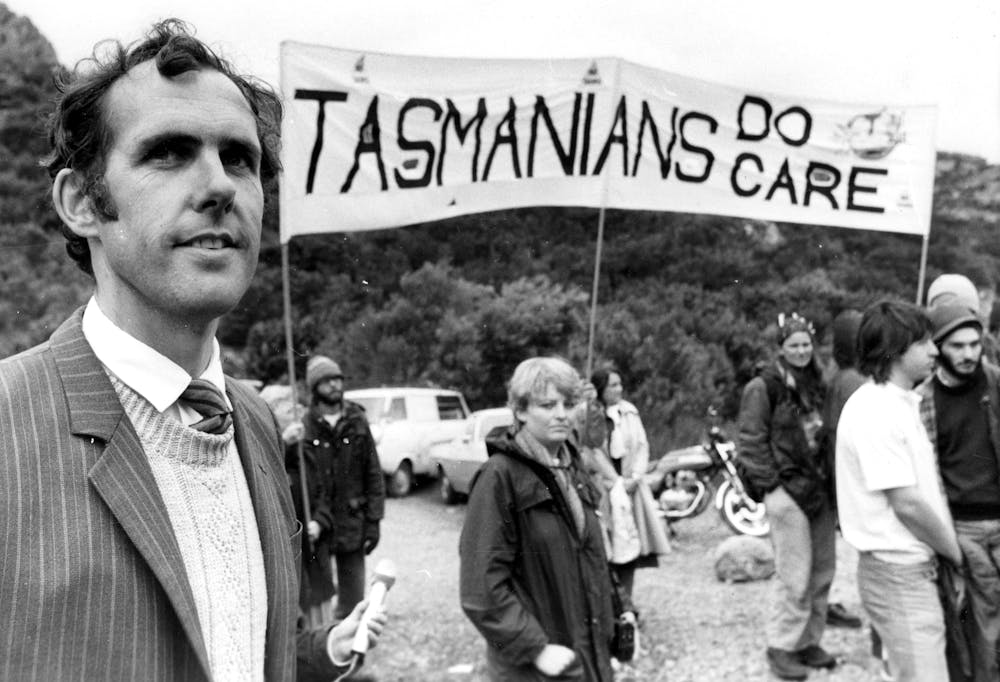
We also see the activists’ canny use of social media and new technologies to generate support. As the film points out, these are radically different times from those of the Franklin River Dam protest, when film had to be flown in and out every day.
The film includes a look at historical events, like a rally at Tasmania’s Crotty Road in 1983.Potential FIlms
Specific campaigns are put in the broader context. The film’s style — its balance between types of footage, and across geographical and temporal locations — seems to embody an ecological rationale. Every part (past or present, here or there) is connected to every other part.
This temporal cross section seems as significant as the geo-spatial one, and this appears to be a key point the film would like to make. Global warming and ecology are about time — like all death, about temporal limitation.
The continuity of these struggles past and present is of prime significance — the victories as well as the defeats.
Wild Things may have been conceptually stronger — and more critically coherent — if this point had been made in a more forceful and direct fashion.
Perhaps this is part of its vision — things aren’t neat in this space. Or maybe it’s symptomatic of a more significant criticism: the whole thing seems a little too polite.
Harriet O’Shea Carre and Milou Albrecht founded their own climate change movement in Castlemaine.Julian Meehan/Potential Films
Wild Things is a document of people struggling to save the planet — and this is as brutal and existentially charged a battle as you can get, lebensraum (the German concept of “living space” for humans) for the population of the entire globe.
Yet interviewees repeatedly emphasise they are “non-violent” as though constantly apologising, in advance, to some imagined criticism.
This disclaimer appears frequently towards the beginning of the film, as though thereby allowing it entry into polite discourse. At times the film seems similarly gentle, genteel — even middlebrow — in its approach to global warming.
It is most impressive as a piece of documentary cinema. Its production value is exceptional, and the balance, in terms of style of footage, is excellent. Fly-on-the-wall footage unfolds amid carefully placed interviews and video diaries. The 90-minutes duration passes in a flash.
The score is a little uninspired but also doesn’t distract from the content of the film. A documentary of this scale is not going to be able to afford composer John Williams — but Missy Higgins sings the closing number, The Difference.
Wild Things is definitely not a non-partisan film — but why should it be? It’s on the side of the population of the globe!
Still, a more detailed and engaged analysis of the relationship between past and present would have enriched its ultimate call to action. It is good — it’s emotionally compelling and enjoyable — but one can’t help feeling a more intellectually robust and less sentimental approach may have made it great.
The content of some films is so close to the heart that it’s difficult to critically evaluate them. If you’re an atheist, The Passion of the Christ is not for you. By the same token, if you’re a denier of anthropogenic global warming, then you’ll hate Wild Things, the latest film from Australian producer-director Sally Ingleton.
A passionate call to action against global warming, Wild Things is documentary at its slickest, even if it is oddly-named (sharing the title with the 1998 risque romp Wild Things).
It seamlessly combines archival footage, camera phone footage, stunningly panoramic aerial photography and beautiful-in-forest images with the whole thing anchored around a group of very likeable environmental activists.
To every season, turn
In keeping with the subtitle — A Year on the Frontline of Environmental Activism — Wild Things follows a group of activists (it’s not clear why they are called “wild things” or by whom) – with each section of the film following a season.
We move from the anti-Adani campaign in Central Queensland led by Andy Paine at Camp Binbee, to Lisa Searle and the campaign to save old-growth forests in Tasmania, to high school students Milou Albrecht and Harriet O’Shea Carre from Castlemaine in regional Victoria as they found their own climate change movement.
Dr Lisa Searle climbing an old growth tree she is fighting to protect.Tim Cooper/Potential Films
The groups often face serious peril — we see a semi-trailer pushing against protesters outside an Adani contractor site — yet continue their passionate fight for ecological justice.
In many respects, this is an optimistic film. We can feel the enthusiasm of Albrecht, and O’Shea Carre as their campaign spreads from 20 to thousands of students. We even travel to New York City with the latter as she watches, starstruck, as her idol Greta Thunberg addresses a rally.
In other ways, the film is deeply sad. We are forced to witness the brutal destruction of Tasmanian forests.
The old cliche of the dole-bludging treehugger is quickly dispensed with. We follow an organised group of people as they brush up against the systems that began and perpetuate anthropogenic global warming. There isn’t much of a focus on their powerful antagonists, but, one senses, they probably don’t need more opportunities in the spotlight.
We also see the activists’ canny use of social media and new technologies to generate support. As the film points out, these are radically different times from those of the Franklin River Dam protest, when film had to be flown in and out every day.
The film includes a look at historical events, like a rally at Tasmania’s Crotty Road in 1983.Potential FIlms
Specific campaigns are put in the broader context. The film’s style — its balance between types of footage, and across geographical and temporal locations — seems to embody an ecological rationale. Every part (past or present, here or there) is connected to every other part.
This temporal cross section seems as significant as the geo-spatial one, and this appears to be a key point the film would like to make. Global warming and ecology are about time — like all death, about temporal limitation.
The continuity of these struggles past and present is of prime significance — the victories as well as the defeats.
Wild Things may have been conceptually stronger — and more critically coherent — if this point had been made in a more forceful and direct fashion.
Perhaps this is part of its vision — things aren’t neat in this space. Or maybe it’s symptomatic of a more significant criticism: the whole thing seems a little too polite.
Harriet O’Shea Carre and Milou Albrecht founded their own climate change movement in Castlemaine.Julian Meehan/Potential Films
Wild Things is a document of people struggling to save the planet — and this is as brutal and existentially charged a battle as you can get, lebensraum (the German concept of “living space” for humans) for the population of the entire globe.
Yet interviewees repeatedly emphasise they are “non-violent” as though constantly apologising, in advance, to some imagined criticism.
This disclaimer appears frequently towards the beginning of the film, as though thereby allowing it entry into polite discourse. At times the film seems similarly gentle, genteel — even middlebrow — in its approach to global warming.
It is most impressive as a piece of documentary cinema. Its production value is exceptional, and the balance, in terms of style of footage, is excellent. Fly-on-the-wall footage unfolds amid carefully placed interviews and video diaries. The 90-minutes duration passes in a flash.
The score is a little uninspired but also doesn’t distract from the content of the film. A documentary of this scale is not going to be able to afford composer John Williams — but Missy Higgins sings the closing number, The Difference.
Wild Things is definitely not a non-partisan film — but why should it be? It’s on the side of the population of the globe!
Still, a more detailed and engaged analysis of the relationship between past and present would have enriched its ultimate call to action. It is good — it’s emotionally compelling and enjoyable — but one can’t help feeling a more intellectually robust and less sentimental approach may have made it great.
Jeff Bezos has announced he will stand down as chief executive of Amazon in the third quarter of 2021. The founder of the online retail behemoth will hand the reins to Andy Jassy, who currently leads Amazon’s cloud computing wing.
The announcement comes after an enormously successful 2020 for Amazon despite (or perhaps because of) the COVID-19 pandemic, with operating cashflow up 72% from the previous year to US$66.1 billion, and net sales increasing 35% to US$386.1 billion.
Amazon has its share of detractors, with critics highlighting concerns around working conditions, tax minimisation, anti-competitive practices and privacy. But its enormous size and continuing phenomenal growth make it a force to be reckoned with.
How did Amazon get to this position, and what does the future hold under new leadership?
How it all started
Almost 27 years ago, in 1994, Bezos left his job as a senior vice-president for a hedge fund and started an online bookstore in his garage. At the time, using the internet for retail was in its infancy.
Bezos decided that books were an ideal product to sell online. Originally the new business was named Cadabra, but Bezos soon changed it to Amazon and borrowed US$300,000 from his parents to get things off the ground.
Books proved popular with growing numbers of online buyers, and Bezos began to add other products and services to the Amazon inventory – most notably e-readers, tablets and other devices. Today Amazon predominantly makes its revenue through retail, web services and subscriptions.
The rise and rise of Amazon
Amazon is now one of the most valuable companies in the world, valued at more than US$1.7 trillion. That’s more than the GDP of all but 10 of the world’s countries. It’s also the largest employer among tech companies by a large margin.
The key to Amazon’s dominance has been constant expansion. After moving into e-readers and tablets, it extended more broadly into technology products and services.
The expansion has not yet stopped, and Amazon’s product lines now include media (books, DVDs, music), kitchen and dining wares, toys and games, fashion, beauty products, gourmet food and groceries, home improvement and gardening, sporting goods, medications and pharmaceuticals, financial services and more.
More recently Amazon has expanded into bricks-and-mortar, heralded by its purchase of the Whole Foods chain in 2017, the creation of its own high tech stores such as Amazon Go, and its sophisticated distribution and delivery services such as Amazon Prime.
Amazon has become increasingly vertically integrated, meaning it no longer simply sells others’ product but makes and sells its own. This gives the company a position of extreme market dominance.
Amazon has come under fire over working conditions in its warehouses and shipping centres.Doug Strickland / AP
Criticism
Amazon is hugely popular with customers, but has attracted criticism from supplier advocates, workers unions and governments.
Industrial relations matters, such as fair wages, unsafe work practices and unrealistic demands, appear the most common area of concern. A 2019 UK report found:
Amazon have no policy on living wage and make no mention of wages being enough to cover workers’ basic needs in their supplier code.
In March 2020, as COVID-19 began to take hold, workers claimed they were fired for voicing concerns about safe working conditions. Amazon vice president and veteran engineer Tim Bray resigned in solidarity and nine US senators issued an open letter to Bezos, seeking clarity around the sackings.
More general criticisms of the company culture have surfaced over the years, relating to insufficient work breaks, unrealistic demands, and annual “cullings” of the staff – referred to as “purposeful Darwinism”.
Another strand of criticism relates to Amazon’s market size and antitrust laws. Antitrust laws exist to stop big companies creating monopolies. Amazon presents a challenge, as it is a manufacturer, an online retailer, and a marketplace where other retailers can sell products to consumers.
Privacy concerns have also plagued Amazon products like Echo smart speakers, Ring home cameras, and Amazon One palm-scanning ID checkers.
The Amazon Web Services privacy policy says all the right things.
Finally, the amount of company tax Amazon pays in Australia has been brought into question. The company has used a range of tactics to legally reduce the income taxes it pays around the world.
What does the future hold for Amazon in a post-COVID world?
What will change at Amazon when Bezos steps down? We’re unlikely to see a dramatic shift in the short term. For one thing, Bezos is not departing entirely – he will stay involved as “executive chairman”. For another, his successor, Andy Jassy, has been with Amazon since 1997.
Jassy is the head of Amazon Web Services (AWS) and already one of the most important people in the tech industry. AWS has been at the forefront of simplifying computing services, driving the cloud computing revolution and influencing how organisations purchase technology.
Incoming Amazon CEO Andy Jassy currently heads up Amazon Web Services.Isaac Brekken / AP
Jassy’s long history, intimate knowledge of the organisation, and technological expertise will no doubt stand Amazon in good stead.
However, he faces a monumental undertaking. Jassy will inherit responsibility for more than a million employees, selling millions of different products and services.
The physical lockdowns and online acceleration driven by the COVID-19 pandemic provided the ideal conditions for a company that has been called “the everything store”. Supporters and critics will watch with interest to see if this is still true in a post-COVID environment.
Staff, students and alumni of the University of the South Pacific have called on the Fiji government to immediately reinstate the work permit for vice-chancellor and president Professor Pal Ahluwalia, who was deported today with his wife, Sandra Price.
The USP community also called on the government to issue a formal apology to Professor Ahluwalia for the violation of human rights.
They expressed grave concern over the actions of police and immigration officials who removed the couple from the vice-chancellor’s residence on Laucala campus late last night.
In a petition issued this afternoon, the group said they were deeply concerned at the disrepute brought to the 12-nation regional university by the actions of the Fiji government in this morning’s deportation.
USP staff associations also condemned the manner in which the couple were removed from their residence and swiftly transported to Nadi International Airport for the 10.30am flight to Brisbane, Australia.
“The manner in which the VCP and his wife were removed is a violation of human rights and due process,” read a joint statement by the USP Staff Union and the Association of USP Staff.
“Given the seriousness of the decision, we demand the Fiji government to provide the justification for this Gestapo tactic.”
Vice-chancellor deemed ‘public risk’ “According to media reports, the VCP was deemed a ‘public risk’ and we as taxpayers, voters and owners of the University demand an explanation on how Professor Pal is a ‘public risk’.
“Given the impact on the University’s reputation and staff morale, we reiterate our support for the USP Council to proceed with its scheduled meeting to fully discuss this matter and already agreed to agenda items, to arrive at regionally acceptable solutions.”
It is understood police and immigration officers were acting on directives outlined in a letter, allegedly signed by Acting Director for Immigration Amelia Komaisavai.
The document with the Fijian Immigration Department letterhead dated 3 February 2021 with attention to Professor Ahluwalia, noted that the Minister for Immigration had declared the couple prohibited immigrants under the Immigration Act 2003, Section 13 (2) (g) and ordered that they leave Fiji with immediate effect.
USP management are also calling on staff and students to remain calm throughout the situation for the safety and wellbeing of the university community.
“Until the [USP] Council at a council meeting directs otherwise, the senior management team will take on the role jointly of undertaking the vice-chancellor’s duties,” a statement from management read.
“The senior management team has notified the council leadership and are waiting for direction. The safety and wellbeing of our staff and students and the continuation of university operations remain our priority.”
Several community leaders and politicians have come out strong against the surprising tactic.
The USP Council, the university’s highest decision-making body, is expected to meet tomorrow.
Asia Pacific Report collaborates with Wansolwara, the USP journalism newspaper and website.
Imagine going through life with your arms permanently bent and locked at the elbows. Awkward, right?
Until recently we thought the mega-marsupial Palorchestes azael lived exactly like this. This rare, distant relative of the wombat became extinct (along with much of Australia’s megafauna) about 40,000 years ago.
But our research, published today in the Journal of Anatomy, shows Palorchestes could in fact move its elbows — but only a very tiny amount compared to other mammals.
Thus, we think this enigmatic creature would have had a highly unusual gait, which may provide a clue to why it went extinct.
The humble elbow has been around since the ancestors of all four-limbed animals first hauled themselves out of the water and onto land.
For most mammals, the elbow is a hinge-like joint that connects the humerus (which runs from shoulder to elbow) with the ulna and radius (which run from elbow to wrist).
The elbow allows the bending and straightening of the arm and is essential for four-legged walking. In the wild it’s also useful for tasks such as feeding, fighting, climbing and grooming.
But Palorchestes seemingly gave much of that up. Unlike other large mammals alive or extinct, it kept its arms in a perpetual “push-up” position.
So what would moving around have looked like for Palorchestes? And why might it have evolved such a narrow range of elbow motion in the first place?
Peculiar Palorchestes
Palorchestes was an unusual-looking marsupial. With a slender jaw indicating a long tongue and tiny nasal bones retracted high up in a narrow skull, some palaeontologists have suggested it had a tapir-like trunk (although others think this is unlikely).
Fossils of Palorchestes’s robust bones show evidence of heavily muscled forelimbs with huge, sharp claws suited for clinging and tearing. And we recently found it may have grown to weigh more than a tonne.
The massive claw bone of Palorchestes azael is equivalent to the bone we have in our fingertip. When Palorchestes was alive, this claw bone would have been covered by a keratin sheath that extended its length up to 50%.Hazel Richards
Still, for us the most interesting aspect of Palorchestes is its flattened elbow joint surfaces, which seem to indicate its elbows stayed bent at around a 100° angle.
We scanned the fossilised arm bones of Palorchestes and created computer simulations to model the full range of movements possible at its arm joint.
Palorchestes had drastically less elbow mobility than the living mammals we compared it to. Clockwise from the top left: pangolin, sloth bear, anteater, wombat, koala and aardvark.Wikimedia Commons
Our results indicate Palorchestes could move its elbows, but only in an off-axis motion that was tiny compared to other clawed mammals with chunky limbs such as wombats, pangolins, aardvarks and bears. Even its closest extinct megafaunal relatives had vastly more elbow function.
This suggests none of these creatures are good templates for understanding how Palorchestes moved.
By adding sliding movement as well as rotations, we used our 3D simulations to calculate the “average” motion in Palorchestes, from fully flexed to fully extended elbow poses. We found the axis of this small movement was skewed, like a “wonky” hinge.
The interactive below shows the maximum elbow motion that would have been theoretically possible for Palorchestes azael.
This skew means Palorchestes probably held its arms sprawled out from its body, allowing what little elbow mobility was possible to contribute to each stride while walking.
We modelled the whole range of motion possible at Palorchestes’s elbow to calculate its ‘average’ movement. If placed in a ‘normal’ mammal forelimb posture, Palorchestes’s hands would splay out to the sides as the elbows moved (left image). Instead, having forelimbs in a sprawled posture would have let its minute elbow movements contribute to each stride (right image)
Arms akimbo make for awkward walking
Our findings suggest Palorchestes would have trundled along on crouched forelimbs, with its elbows sprawled out to the sides — a highly inefficient gait compared with the pillar-like limbs and tucked-in elbows of its relatives and large mammals alive today.
We think this posture was a compromise which let it use its strong arms and giant claws to access food in a specialised way, which was probably unique even back then.
While exact details remain a mystery, it could be that Palorchestes clung to tree trunks and hauled itself up onto its back legs to reach higher foliage with its long tongue.
This reconstruction of Palorchestes azael is from the 1980s. Although we now know the forelimb position shown here was highly unlikely, Palorchestes may have still used its strong arms and bent elbows to haul itself up against trees like this for better access to foliage.Peter Schouten
Or it might have used its huge, bulky body to push over tree ferns to access the young nutritious fronds higher up.
Whatever it did, Palorchestes was evidently pretty successful. While its fossils are rare, they’re widely distributed right across eastern Australia.
The specialisation trap
The fossils of Palorchestes tell us it was a specialist, highly adapted to a forest landscape.
Large animals have large appetites to match, but Palorchestes’s inefficient walk probably limited its ability to roam widely in search of food.
This would be no problem in times of plenty. But when shifts in Australia’s climate caused sweeping environmental changes across the eastern half of the continent, large specialised megafauna such as Palorchestes were especially vulnerable.
Even small changes in the vegetation mix would have made it difficult to find enough food.
Palorchestes probably lived in forests such as this one in Tasmania and may have used its specialised forelimbs to tear apart ferns and logs.Wikimedia Commons
Business schools have a major role to play in what the World Economic Forum calls “The Great Reset” as the world adjusts to the COVID-19 pandemic. To contribute to their full potential, business schools must change. So too must universities and the businesses that support and engage with them.
Much of the focus on universities during the pandemic has understandably been on the crucial work of developing vaccines and medical equipment, and on fields such as epidemiology. Business schools can valuably contribute to these efforts too. For example, with their expertise in managing supply chains, operations and logistics they can advise on the massive challenge of manufacturing and distributing billions of vaccines, and scrutinising the integrity and ethics of vaccine testing and rollout.
Beyond these immediate challenges, business schools can help businesses redefine their purpose in the post-pandemic world. That starts with re-examining dated models, many of which have been driven since the 1970s by the mantra of maximising shareholder value.
Business schools possess expertise in fields as diverse as assessing and managing risk in highly uncertain circumstances, and in rebuilding trust with stakeholders that might have been adversely affected by the health crisis. Business schools can draw on their expertise in change management, organisational development, human resources and information systems to help sustain different patterns of organisation and work, including more decentralised decision-making and working from home.
Business schools must change
The mission of business schools has evolved. Today their horizons have expanded towards improving well-being in society. Their stakeholders extend beyond students and businesses to include governments and not-for-profits.
Business schools were already under pressure to respond to the pace of change in technology, competition and social expectations. COVID-19 has provided impetus to rise to the call for business to lead social change.
The World Economic Forum is calling for a new form of capitalism, one that puts people and planet first, to rebuild the world after COVID-19.
The key to meeting lofty stakeholder expectations is significant change management. Business schools need to become fully and authentically committed to resolving problems affecting not just business, but humanity as a whole. Central to their agendas should be applying all their knowledge and skills to dealing with wicked problems such as climate change, ethics and fairness, and disruption by digital technologies and artificial intelligence.
Business schools are now moving to focus on societal impact through closer research engagement with industry and society. Increasing philanthropic, government and student demand is driving this shift.
The University of Queensland Business School, for example, has established research hubs in trust, ethics and governance, and in business sustainability. Imperial College Business School has a program on the economics and finance of climate change.
Such changes are not assisted when the metrics of success in business schools continue to focus on ranking systems largely driven by graduate salaries, with a 40% weighting in the FT Global MBA rankings, for example. Corporate social responsibility and ethics have a 3% weighting.
Vitally important will be the ways business schools encourage the innovation and entrepreneurship that will create the new businesses and jobs to replace those lost during the pandemic. As well as stimulating and guiding start-ups, business schools can advise existing businesses on how to adjust to the new realities. Their expertise in governance, leadership and strategy can help businesses build the diverse capabilities they need to thrive in turbulent and ambiguous environments.
Business schools attract large numbers of students. They have continued to do so in many universities throughout the epidemic. This means they commonly account for a large share of university fee income.
For business schools to contribute to The Great Reset, they need more than juste retour, or simply getting back from university budgets the income they attract. They need full recognition and support for the role they can play in creating the new and emerging world. Universities have to move beyond seeing business schools as cash cows to being jewels in their crown.
Research funders should consider how business school perspectives add value to research projects in the sciences, social sciences and humanities. From the economics and operations of drug development and new energy sources, to business approaches to diversity and equality, to the marketing of the arts, business schools have much to offer.
COVID-19 represents a tipping point for business schools to use their expertise to reset, reinvent and relaunch their role in promoting ethical and sustainable business practices. As well as being valuable sources of short-term advice, business leaders should use their links with business schools to discuss, reflect upon and adjust their long-term vision and strategy. There is much benefit for business, for example, in learning along with business schools about how responses to the COVID-19 crisis can be applied to achieving the United Nations Sustainable Development Goals.
Business schools are testing sites for the creation of more ethical, dynamic and trustworthy leaders who in turn can influence broader societal issues.
More than 70 homes were destroyed by bushfires in Western Australia this week, leaving those affected facing enormous costs. After disasters like these, insurance is not always there as needed — or as expected.
After disaster strikes, insurance is not always there as needed — or as expected.AAP Image/James Gourley
Why are so many underinsured?
A lot of underinsurance is by accident rather than design. After being burnt out by Victoria’s Black Saturday bushfires in 2009, one of our interviewees, Bridget*, told us:
You think okay, this is what I paid for the property […] I reckon I could rebuild it for X […] I think we had about A$550,000 on the house, and the contents was maybe $120,000 […] You think sure, yeah I can rebuild my life with that much money. But nowhere near. Not even close. We wound up with a $700,000 mortgage at the end of rebuilding.
Renters are at risk of underinsurance as they tend to forego contents insurance, though the building itself will probably be insured by the landlord.
Following the Hobart floods in 2018, one of our interviewees, John, was without contents insurance when his rented home was flooded. He told us:
We were wondering about temporary accommodation, whether they would put us up until we found a new place to live […] They said that that was under contents insurance, which was our responsibility, and the house insurance just covers the house.
A lot of underinsurance is by accident rather than design.AAP Image/Darren England
The contents is insured to $20,000 … We’ve got a lot of irreplaceable stuff here … and a lot of equipment of value … the value is going to be far more than that. But I just hope that we’d have like a small kitty that would be like $20,000. I figured would be enough to replace just the essential items.
Just the way they (insurers) word things […] they’re trying to make sure they exclude certain things, and while we sort of fall within the parameters of what’s included, I have a feeling that they’ll go, ‘oh no, you’ve got a dingle on your dangle and it’s just not included’.
A lack of trust in insurers may be based on previous experience of an insurance claim not coming through as expected, or in political perspectives questioning the power of large corporations.
More insurance is not a straightforward solution
More insurance may help renters and home owners. But to decide how much more, you need access to accurate rebuild or valuation costs. Accessing, understanding and keeping up to date with complex knowledge about risk and construction is beyond the capacities of many who already live busy lives. And to make decisions about contents insurance, renters need capacity and time to understand the risks of being an underinsured renter.
Simply encouraging people to get more insurance doesn’t help people like Sandra, who are on a limited budget, nor will it address distrust of insurers.
Instead of telling people to buy more of the right type of insurance, we should be asking how insurance can work better for people.
Insurance spreads costs and risks across populations; it recognises shared interests can create shared benefits. Maintaining the public benefit of insurance includes making it more equitable through government regulation and consumer demand.
Insurance should remain about the equitable distribution of costs and risks so everyone has a safety net if disaster strikes.
We must resist the trend towards insurance products that are tailored in response to individual characteristics and risks. This individualisation favours those with higher incomes and lower levels of risk, and marginalises disadvantaged populations living with higher risk. In other words, it puts insurance out of reach for those most likely to need it.
Insurance is only one tool in disaster preparedness and recovery.AAP Image/Supplied by DFES, Evan Collis
Governments should not view insurance as the key disaster recovery tool, and must not rely on individuals to manage their own risks with insurance.
Insurance is only one tool in disaster preparedness and recovery. Others — including building code reform, effective land-use planning, and a well-funded social safety net — require strong government leadership.
In a changing climate, governments must recognise we are all in this together. Telling people “Well, you should have been insured” when there are so many reasons why someone might be underinsured is unhelpful, unfair, divisive and allows governments to shirk their responsibilities toward all citizens.
* All names have been changed to protect identities.
This story is part of a series The Conversation is running on the nexus between disaster, disadvantage and resilience. You can read the rest of the stories here.
Politicians, educators and civil society advocates around the region today condemned the “barbaric” and “shameful” detention and deportation of the regional University of the South Pacific’s vice-chancellor Professor Pal Ahluwalia and his wife.
Reformist Professor Ahluwalia, a Canadian, and his wife, Sandra, were detained by Fiji authorities at their Suva home late last night and deported on a flight to Brisbane this morning.
The USP Council is due to meet in Suva tomorrow and the chancellor, Nauru Lionel Aingimea said today a statement would be made later.
In Rarotonga, the director of USP’s Cook Islands campus, Dr Debbie Futter-Puati, said the university’s independence was under threat in Fiji.
Responding to questions from The Fiji Times, she questioned how the university’s vice chancellor’s deportation would advantage the Fijian government.
“The University is a private, independent educational facility owned by 12 member countries who must surely take exception to this action,” she said.
“I sincerely hope member countries make a strong and united stance back to Fiji government on this aggressive and inappropriate action.”
National Federation Party leader Professor Biman Prasad said at a time when Fiji should be supporting victims of cyclones Yasa and Ana, government was “instead focused [on] its own petty jealousies”.
Social Democratic Liberal Party leader Viliame Gavoka condemned the arrest and deportation of Professor Ahluwalia and his wife as “barbaric treatment”.
“We are alarmed by the way that the government of Fiji broke into the vice-chancellor’s residence in the middle of the night (03.02.21) and orchestrated the removal of VCP Pal and his wife,” the unions said.
“The manner in which the VCP and his wife were removed is a violation of human rights and due process.
“Given the seriousness of the decision, we demand the Fiji government … provide the justification for this Gestapo tactic.”
The unions said USP was a regional organisation like Pacific Islands Forum Secretariat, SPREP, FFA, SPC and demanded the same respect given to any regional organisation.
Fiji Immigration officials and police have detained and expelled the University of the South Pacific vice-chancellor, Professor Pal Ahluwalia, and his wife Sandra.
The president of the University of the South Pacific Staff Association, Elizabeth Fong, said that the USPSA had received confirmation that the pair were taken in between 11pm and midnight last night, reports Fijivillage news editor Vijay Narayan.
Photos circulated on social media today showed Professor Ahluwalia being deported on a flight to Brisbane this morning.
Fong said they had also been getting reports from late last month about Ahluwalia’s work permit to be revoked.
A USP Council meeting is scheduled for tomorrow.
Nauru President Lionel Aingimea, who is also chair of the USP Council, said he would make a statement after the council meeting.
The USP staff unions were meeting this morning.
When contacted by Fijivillage, USP said it was unable to comment at this stage.
Professor Ahluwalia, a Canadian, could not be contacted.
Fijivillage said it was also trying to contact USP pro-chancellor Winston Thompson.
The radio station said it had also asked Prime Minister Voreqe Bainimarama, Permanent Secretary for Immigration Yogesh Karan, Education Minister Rosy Akbar and the police. None had yet responded.
Canadian Professor Pal Ahluwalia … deported on a flight to Brisbane today. Image: PMW/social media
Among many messages of dismay and condemnation, Fiji Women’s Crisis Centre (FWCC) executive Shamima Ali slammed the Fiji government’s action as “not the Pacific way” and “unacceptable behaviour”.
Nauru President Lionel Aingimea, who is also chair of the USP Council, said he would make a statement after the council meeting.
Whisked away from their home RNZ Pacific reports that Professor Ahluwalia and his wife, Sandra, were awoken and whisked away from their home late last night by plain-clothed Fiji immigration officers who broke into their residence.
The vice-chancellor and his wife were transported to Nadi from where they were deported to Brisbane this morning.
The academic asked for the grounds of his deportation and was told he posed a “public risk”.
A letter signed by Fiji’s Acting Director of Immigration Amelia Komaisavai further explained that the government deemed Professor Ahluwalia to be “a person who is or has been conducting himself in a manner prejudicial to the peace, defence, public safety, public order, public morality, public health, security or good government of the Fiji Islands”.
Since taking on the job in 2019, Professor Ahluwalia had been driving efforts to clean up the governance of the Suva-based university.
However, last June the vice-chancellor was suspended by the USP’s executive committee led by Winston Thompson over alleged malpractice.
After weeks of protests by students and staff, and regional concern, Professor Ahluwalia was reinstated when the council ruled due process had not been followed in the suspension.
The council also subsequently cleared Professor Ahluwalia of all the allegations.
The Fiji government later announced it was suspending its grants of more than US$10 million to the university. The university is chiefly funded by Australia and New Zealand.
A coalition government in New Caledonia has collapsed after indigenous pro-independence politicians resigned, citing persistent economic issues and unrest over the sale of nickel assets.
The South Pacific archipelago has been gripped by riots over the sale process of Brazilian mining giant Vale’s local nickel business, with protesters saying a locally-led offer had been unfairly overlooked.
New Caledonia, with a population of about 290,000, is also grappling with the question of decolonisation.
The crisis comes as New Caledonia is facing widespread flooding and damage from Tropical Cyclone Lucas.
The island chain enjoys a large degree of autonomy but depends heavily on France for matters such as defence and education.
Referendums in 2018 and 2020 both narrowly rejected independence. A third referendum due by the end of next year should finally settle the issue, under the terms of a 1998 Noumea accord with France.
Five pro-independence politicians – three from the Union Caledonian (UC) and two from the National Union for Independence (UNI) – both members of the pro-independent Kanak and Socialist National Liberation Front (FLNKS), in the 11-member executive have resigned.
Upheaval marks end of Santa coalition The upheaval marks the end of President Thierry Santa’s multiparty government after 18 months in power. Congress must elect a new government within 15 days.
The Santa-led anti-independence coalition, L’avenir en confiance, claimed in a statement that the pro-independence legislators were causing a political crisis in the middle of a pandemic and amid economic and social tensions.
The pro-independence members’ resignation letter said a “crisis of confidence” had set in and that the government was not functioning properly at an important time when preparations were needed to be made for the next independence vote.
The letter also said the nickel asset sale favoured the interests of multinationals over locals.
New Caledonia is the world’s fourth-largest nickel producer, behind Indonesia, the Philippines and Russia.
Demand for nickel, mainly used in making stainless steel, is expected to grow rapidly as a raw material in electric vehicle batteries.
Vale wants to sell its nickel business in New Caledonia to a consortium of buyers including Swiss commodities trader Trafigura.
Indigenous Kanak leaders had supported an earlier bid designed to keep majority ownership under the control of the island territory.
This article is republished under a community partnership agreement with RNZ.
Martyn Iles is prepared to go to jail, along with (he claims) “half the Christians in Victoria”. The managing director of the Australian Christian Lobby (ACL) says in a recent YouTube video he thinks it might happen soon:
The Gospel itself, parts of it; parts of the Bible itself, and pastoral ministry, and responsible parenting, and good medical care […] are set to become potentially jailable offences.
Iles ascribes this to a bill in Victoria that would ban “conversion practices” aimed at changing or suppressing an individual’s sexual orientation or gender identity.
Having passed the Victorian Legislative Assembly, the bill is due to come before the Upper House this week. The ACL is campaigning hard, alongside other conservative Christians, to persuade the Liberals and crossbench to reject it.
Other theologians and pastors have argued the legislation would protect LGBTQ people’s religious freedom — and their lives.
Visibly emotional, Iles acknowledges that LGBTQ people suffer “a lot of mental anguish” and “suicide rates are high”. However, he is convinced,
banning conversion therapies won’t solve any of that […] Jesus will solve that.
But Iles’ YouTube videos wage a wide-ranging culture war. For instance, he has warned of a barely concealed plan by Western governments and the World Economic Forum to implement global communism, with coronavirus providing the opportunity.
One of his most-watched videos touches on the new US vice president, Kamala Harris. Iles (whose rhetorical style tends to be reiterative) described her as “very, very, very, very, very, very, very left wing. Very, very left wing. Did I say enough ‘verys’?”.
And in another video, he pushes former President Donald Trump’s unfounded claims the US election was stolen, saying of the left, “Do you really think that they wouldn’t have a little tamper with a vote? Of course they would.”
Once, journalists wanting “the Christian voice” on a topic would have sought out a bishop, denominational office or interchurch body. Today, that “voice” is likely to be provided by the American-influenced culture warriors of the ACL.
The group was founded in 1995 as the Australian Christian Coalition — modelled on the Christian Coalition of America — and changed its name to the Australian Christian Lobby in 2001. Since 2013, it has been led by Lyle Shelton, who ran unsuccessfully for the Senate as a member of the Australian Conservatives, and, most recently, by law graduate Iles.
Shelton joined Cory Bernardi’s Australian Conservatives party in 2018.Regi Vareghese/AAP
Aiming to “change the culture” and project “the Christian faith” in “the public life of the nation”, the Canberra-based organisation pours out media statements and social media posts, provides spokespeople on issues, releases pre-election voter guides and trains activists.
In the 2019 federal election, it began directly campaigning on behalf of conservative candidates in selected seats.
In 2019, it raised over A$2 million dollars in two days for Israel Folau, who was sacked by Rugby Australia for online comments suggesting gays and fornicators are destined for hell.
But, for all its high-profile lobbying, aspects of the group remain secretive.
Despite the erroneous impression it is a Christian peak body, the ACL describes itself as a grassroots organisation of “over 175,000 individuals”.
The group’s policies are decided by an anonymous board; their names have been secret since 2017 due to “a merciless campaign to silence” its views.
According to the ACL’s 2020 financial report to the Australian Charities and Not-for-profits Commission, its income for that financial year was over $5 million dollars, 91% of which came from “donations and bequests”. The next-biggest income source, at $238,000, came from “government grants”.
Donor information is also kept confidential — unless donors themselves disclose their activity.
The ACL claims to stand for “classical Christianity”. However, the organisation enthusiastically supported Folau, despite his religious views being questioned by other theologians, such as Carl Trueman, who wrote in 2019,
Folau’s religious views are really anything but Christian in the historic, dogmatic sense of the word, because he denies that most basic of Christian creedal doctrines, the Trinity.
Folau reached a settlement with Rugby Australia over his sacking in late 2019.Richard Sellers/AP
The ACL also devotes a remarkable proportion of its time and resources to anti-LGBTQ campaigns, claiming a Biblical mandate, when the Bible actually offers far more complex perspectives on gender.
Religious studies scholar Mark Jennings asked in relation to the ACL’s support for Folau:
Has the battleground over the inclusion of LGBTIQ people in Christianity really become more central to this new and strange kind of orthodoxy than the ancient — one might even call them “Classical” — doctrines of the faith?
Yet, many Christians distance themselves from the ACL’s positions. During the marriage equality debate, for instance, the ACL vigorously pursued the “no” case, despite one poll finding the majority of Christians supported “yes”.
Similarly, the ACL campaigns against access to euthanasia for the terminally ill, despite majority of Christian support.
Iles regularly ridicules concerns about climate change, calling it “cultural Marxist rubbish” and explaining that humans’ God-given responsibility is to “rule and subdue” the earth. God, in turn, will not allow climate catastrophe.
However, this view puts him at odds with the 150 Christian and other religious leaders of the Australian Religious Response to Climate Change (ARRCC) who wrote an open letter to Prime Minister Scott Morrison after the 2019 election, quoting the archbishop of Canterbury and Pope Francis about the climate emergency, and advocating blocking all new coal and gas projects.
Not just one Christian lobby
While the ACL is sometimes mistaken for a peak body of churches, Australia has long had one: the National Council of Churches in Australia, which has existed, under various names, since 1946. Its activities include advocacy for asylum seekers, Indigenous rights, climate action and an end to sexual violence.
These groups’ lower profiles no doubt reflect their smaller resources compared to the ACL. The ARRCC’s 2019 annual report, for instance, lists an annual income of just $88,325.
In the early 2000s, the ACL drew prime ministers and opposition leaders to its pre-election events. Having historically positioned itself as “rigorously non-partisan”, the ACL’s recent campaigns reflect a return to its US roots, and perhaps hopes of achieving a similar polarising cultural shift here in Australia.
Prime Minister Scott Morrison on Monday acknowledged what many Australian businesses, investors and others have long known: the global economy is transitioning to net-zero emissions, and so too must Australia.
Morrison said the nation should get to net-zero “as soon as possible”, and preferably by 2050. We welcome this move – a net-zero goal will provide clarity, lift ambition and create focus. But Morrison must back the rhetoric with investment and policy commensurate with the task.
We are researchers at ClimateWorks, an independent advisory body based at Monash University. For much of the past decade, we have investigated how Australia can reach net-zero emissions.
The transition will require targeted government spending and specific, forward-thinking policies for each sector. Without this, Australia risks missing the opportunities being seized by our international peers.
Australia is well-placed to seize the opportunities of the clean transition.Shutterstock
Australia needs a game plan
Experts say developed economies such as Australia should aim to achieve net-zero emissions by 2050 to meet their commitments under the Paris climate deal. The target must be achieved earlier if the world is to limit global warming to 1.5℃, beyond which catastrophic climate change is predicted.
Our research last year examined mature and emerging technologies, and found Australia could reach net-zero by 2035. Here, we set out a possible course.
Australia boasts world-beating wind and solar energy and plentiful mineral resources. That means we could produce green steel, aluminium and hydrogen and export it to the world.
The Morrison government has good foundations on which to continue the clean transition. For example, the Australian Renewable Energy Agency (ARENA) and Clean Energy Finance Corporation (CEFC) have proven effective vehicles for government investment. And the Emissions Reduction Fund, while far from perfect, creates a framework that could be scaled up.
The government also has state government partners and businesses willing to cooperate on climate action. And current low interest rates are good news for governments wanting to borrow to invest.
The Morrison government must now develop a more comprehensive approach to emissions reduction across all sectors of the economy. This should include:
using its purchasing power to stimulate demand for clean technologies. This might mean transitioning to all-electric government fleet cars and net-zero energy offices, and requesting net-zero options in government tenders
ensuring all federal government spending is assessed for its contribution to the net-zero transition
designing “decarbonisation roadmaps” for each sector of the economy in partnership with industry
setting higher energy efficiency standards in buildings, industry and transport.
Australia’s building sector is ripe for emissions reduction technologies.Shutterstock/SAKARET
Time to hit the accelerator
Economically feasible technologies for zero-emissions already exist across the economy. Now the task is to dramatically scale up.
In Australia’s electricity sector, renewable energy generation is being installed at record rates. Yet as Australia’s ageing coal-fired generation retires, more investment and national policy is needed to ensure reliability and a smart, flexible grid.
This includes incentives for better energy management, storage and transmission. The transition to a fully renewable electricity sector would unlock emissions reductions in other sectors that are big electricity users – especially buildings, transport and industry.
Buildings can be more energy efficient and fully electrified, producing lower energy bills and more comfort for users. Doing this in existing buildings can be complex, but state energy efficiency schemes are a start.
For transport, the solutions are well-established overseas. In Norway, for example, electric vehicles comprise 60% of new car sales.
Electric vehicles are the answer to road transport emissions.Shutterstock/mastersky
Where the challenges lie
For industry, challenges exist in transitioning from old technologies and scaling up new ones. However clean technologies are emerging and some businesses are looking to invest. For example, Andrew “Twiggy” Forrest wants his Fortescue Metals Group to pilot renewable hydrogen to produce green steel.
The federal government’s Technology Investment Roadmap and $A1.3 billion Modern Manufacturing Initiative are a useful start, but don’t go far enough. The roadmap, for example, sets “stretch goals” for low-emissions steel and aluminium, but no timeframes or comprehensive plans.
The government should implement policies tailored to each sector. It could follow the lead of the British government, which is considering a sustainable aviation fuel mandate by 2025.
In Australia, major businesses are partnering with each other and research organisations to investigate net-zero pathways for industries such as steel, aluminium and chemicals. But other national governments are investing in these measures far more heavily than Australia’s.
If Australia wants to be globally competitive, it must match the net-zero ambition and technology investment of our international peers. The United Kingdom, for example, has laid out sector strategies for a green industrial revolution. And South Korea’s Green New Deal involves a US$61.9 billion (A$81.3 billion) investment targeting the creation of 659,000 by 2025.
South Korean President Moon Jae-in, centre, has backed a huge investment in green technology.Yonhap/EPA
The art of the possible
In the post-pandemic economy, stimulus measures for zero-emissions technologies could provide a “triple dividend” – address climate change, strengthen the economy and create jobs.
In his first few weeks on the job, US President Joe Biden has shown the breadth of action possible to shift to a net-zero economy. Australia, if it dramatically scales up action, can get there too.
As Morrison said this week, the central question about achieving net-zero was “not when, it’s how”. Most parts of the economy already know how. Now it’s time to put the theory into action.
2021 is when the impacts of COVID-19 really start to take their toll on universities, as more than 140,000 international students seek to return to study in Australia. My new analysis, presented in this article, reveals that if one in five international students don’t re-enrol, the loss of revenue would plunge half of all Australian universities into financial turmoil or budget deficit. While the impacts of COVID are unprecedented, modelling universities’ financial resilience shows which institutions fare better and why.
Recent modelling by the Mitchell Institute estimated more than 300,000 fewer international students would be studying inside Australia by mid-year, if travel restrictions continued.
In total, 32% of all full-time-equivalent enrolments at Australian universities are international students. About a quarter (24%) of all university revenue comes from these students. Universities’ operating revenue fell 4.9% in 2020, with an estimated 5.5% fall to come in 2021.
International student fees are correlated with university rankings but are also a self-reinforcing cycle: more international students generate more revenue to fund more research, which in turn leads to better rankings and more demand.
International student revenue increases university resources, which enhances reputation, which in turn attracts more international students.Author provided
Another risk factor for universities is the concentration of enrolments from just a few source countries. They are also concentrated in the largest institutions. One in four international students (25%) study at one of these five universities: Monash, RMIT, Melbourne, Sydney or UNSW.
The leading source of international students in Australia is China, with 36% of these students. It’s followed by India (14%), Malaysia (7%), Singapore (5%) and Nepal (4%). Just one or two geographic markets dominate international enrolments at most universities.
International students aren’t the only risk factor
The worst-hit universities may be those with small pre-COVID operating margins and high reliance on concentrated international student revenue.
My analysis shows a 20% fall in international student fee revenues would leave 22 universities in deficit or on the brink with a net operating result (revenue minus expenses) of 1% or less.
Those with a higher reliance on international students, less diverse revenue streams or a lower return on equity fare worse in the post-COVID modelling. The chart below shows the impact on university net operating results of five scenarios involving decreases in international students by 10%, 20%, 30%, 40% and 50%.
The net result decreases more dramatically for those with both a high reliance on international students and a limited operating buffer. In other words, the risks already existed – COVID amplified them.
Universities need a buffer to absorb shocks
Many Australian universities rely heavily on revenue from international students as part of their business model and global profile. Twelve rely on international student fees for more than 30% of their total income.
While all the universities in the above table are registered not-for-profits, they need to remain financially sustainable. Any organisation involved in high-stakes global markets should have a buffer against rare and unexpected shocks such as the COVID pandemic. A requirement for financial buffers was legislated in the US following the global financial crisis but still remains a vexed issue.
The average net pre-COVID operating result for Australian universities was a healthy 5.6%. However, several started the year with a result of less than 1%. These universities included Charles Darwin (-3.1%), Notre Dame (-2.6%), New England (-1.4%), Macquarie (0.14%), Central Queensland (0.71%) and Charles Sturt (0.77%).
These results raise important questions for university boards. What is a responsible operating result considering the risks of the business and the markets in which it operates? Was “pandemic” already identified in risk registers? And what was done about it?
Significant revenue write-downs leave institutions with only a few levers to buffer the COVID shock while minimising risks to quality.
On average, the above top ten universities generate 20% of their revenue from international student fees. The sector average is 24%.
The University of Melbourne gets 31% of its revenue from international student fees. That’s higher than the average, but its very healthy pre-COVID operating result of 13.9% provides breathing space.
Newcastle, QUT, Edith Cowan and the Sunshine Coast are in the top ten universities, but under this model have a potential post-COVID result of less than the sector average of 5.6%. Their risk exposure to international student fee revenue is still average or lower.
How should universities respond?
Three main conclusions can be drawn.
First, to underpin their financial sustainability and avoid risks to quality, universities must consider not only their reliance on international student fee revenue and market concentration, but also strategies to understand and define their appetite for risk.
Second, the model for online education when travel across borders is limited could be a long-lasting effect of COVID. Long-term strategies and regulatory practices to deal with this “new normal” of global higher education will be needed, beyond temporary regulatory flexibility.
Third, disruption to higher education is here to stay. Waiting for a time when the view on the horizon is clear for all to see may be too late.
Global higher education requires a new organisational ambidexterity. That means universities must revisit core operating models, re-imagine future potential and succeed on the disruptive edge.
Note: Department of Education, Skills and Employment finance tables used for this analysis may differ from institutional reports due to various accounting methods.
Primary and secondary school teachers engage with students who are constantly on devices — consuming, sharing and jointly creating texts, photos, videos and memes.
Across social media, hate speech, conspiracy threads and health disinformation swamp evidence-based material. Fabrications and fragmentations of reality cannot be challenged in real time.
Despite this massive influence on young minds, the government intends to remove one of the few teaching opportunities that might equip students to navigate their online world.
Along with several other subjects, secondary school media studies will be dropped from the level 1 curriculum of the National Certificate of Educational Achievement (NCEA) from 2023.
This is a backward step. Making sense of today’s hyper-mediated world depends on the availability of robust media studies courses in primary and secondary schools.
Young inhabitants of this world serve only to reproduce an “attention economy” shaped by the business models of social media and mass media corporations. They need the critical skills to understand this aspect of their lives.
Furthermore, recent medical research suggests excessive smartphone and social media use among adolescents is associated with mental distress. The social implications of this are disturbing.
Chris Hipkins holds two portfolios, education and COVID response.GettyImages
Media studies may disappear
At present, level 1 media studies students learn about regulation of media content, analyse media coverage of current events, examine and compare media genres and production technology.
Over the next two years, they evaluate media texts and representations, develop a range of journalism skills across different media and explore the workings of particular media industries.
The entire three-year curriculum advances critical thinking and foundational media literacy. Students appreciate how media texts are constructed and disseminated and how different experiences and viewpoints shape the readings of such texts.
After secondary school, media studies students are equipped for tertiary-level courses in communication studies, film production, journalism, radio, visual media, art and design, general humanities and the social sciences.
Without level 1 courses, the risk is that some schools may abandon the subject altogether. Fewer media studies courses will reduce the number of qualified teachers available. Media studies pathways will, inevitably, disappear.
This bleak scenario was outlined to me by a senior media studies teacher from the National Association of Media Educators (NAME). For her, the government’s decision is short-sighted and contradictory:
I find it hard to believe that Chris Hipkins, as minister of health and COVID response minister, can warn how everyone must avoid misinformation with regard to dealing with COVID, but then as education minister agree to remove the subject that most equips students with the skills to avoid misinformation — there is such a dissonance happening here.
I would add that Prime Minister Jacinda Adern’s accurate distillations of COVID-19 science reflect her own media education — a communications degree from Waikato University. This strengthens the case for robust media studies courses at secondary level.
No political debate
The Education Ministry’s rationale is certainly hard to fathom. Its December press release was headlined: “NCEA Level 1 changes give students a broader foundation” — the implication being media studies are a narrowly defined pathway.
Such an assumption ignores the disparate origins of media studies research and the range of knowledge available to student learners.
The growing pervasiveness of mass media and digital media communication has brought together the insights of journalism, history, literary studies, political studies, economics, sociology, anthropology and psychology. These are the raw materials for secondary school and tertiary media studies programs.
Alas, media educators’ criticism of the government’s proposals has not generated party-political debate. Rather, Hipkins’ unsupportable claims are complemented by National Party leader Judith Collins’ derogatory remarks:
The problem with secondary schools now is there’s too much photography and too much media and other woke subjects.
Clearly the government and opposition are of one mind — student media literacy is not a high priority.
The Eggplant: a government-funded project to help young New Zealanders navigate the internet safely.
Losing historical memory
Meanwhile, New Zealand primary school pupils use digital technology throughout the curriculum to develop their knowledge, skills and cognitive understanding. No complaints here — immersive digital learning recognises the omnipresence of networked screens, online platforms and computational intelligence.
However, an historical appreciation of communication technologies is also required. Phonetic alphabets, manuscripts, printing presses and telegraph/telephone networks necessarily prefigure the internet and social media.
Without this background knowledge primary school pupils risk becoming ciphers of a hyper-mediated present in which transitory information and imagery annul historical memory.
Without a sense of past and present pupils will struggle to separate verifiable journalism from clickbait, infotainment and orchestrated propaganda.
Yes, there is digital education available for both parents and pupils, including internet safety programs to counteract stalkers, scanners, cyberbullies and porn merchants. While crucial, this kind of media literacy is insufficient.
The fundamental reality is that social media are not a neutral means of communication, content creation or information transfer. From late primary school, digitally aware students should be investigating the origins, motivations and tactics of disinformation networks such as QAnon and COVID or climate change denial.
Classroom activities might reveal how we spread disinformation inadvertently by sharing videos, using hashtags and adding to comment threads. As a recent Scientific Americaneditorial reflected, “Each one of us is a node on the battlefield for reality.”
Correspondingly, students might share their experiences of Google and Facebook advertising and consider why users are encouraged to spend more time on sites. Final-year secondary students will, ideally, have answers to the following questions:
why did Twitter belatedly terminate Donald Trump’s account?
how does Facebook profit from extreme violent content?
how does one obtain reliable information about the COVID-19 pandemic?
Finally, a question for the education minister and his officials on behalf of media educators everywhere: should aspiring citizens be more or less media-literate than they are now?
As Australia prepares to roll out a national vaccination program – aiming for a 95% uptake rate – big questions remain for employers and employees.
Employers have a clear incentive to want employees vaccinated, to protect clients and co-workers as well as to avoid legal liabilities of potential workplace COVID transmissions.
But can an employer insist on vaccination as a condition of employment?
That’s an ambiguous legal question, as indicated by two recent unfair dismissal cases taken to the federal Fair Work Commission. Both involve employers in 2020 making an influenza vaccination a requirement, and employees losing their jobs for refusing.
The bottom line from both cases is that an employer can make vaccination a condition of working – but with significant caveats. It depends on “balancing” the employer’s duty of care to others with the employee’s reason for refusal, and the circumstances of the work they do.
Employers have a duty of care
The first relevant case is the Fair Work Commission’s ruling in November 2020 on an unfair dismissal claim by child-care worker Nicole Arnold against Goodstart Early Learning, Australia’s largest early learning provider.
In April 2020 Goodstart made a flu vaccination a condition of employment, though allowing exceptions on medical grounds. Arnold objected. In correspondence with her employer she cited the Bible, the Nuremberg Principles and the Universal Declaration of Human Rights. But she gave no medical reasons. She was dismissed in August 2020.
A Goodstart Early Learning centre in Brisbane.Dave Hunt/AAP
The commission dismissed Arnold’s application to have her case heard on the basis Goodstart’s vaccination policy was arguably reasonable to satisfy its duty of care to children, while Arnold’s refusal was arguably unreasonable.
Commissioner Ingrid Asbury ruled:
While I do not go so far as to say that [Arnold’s] case lacks merit, it is my view that it is at least equally arguable that [Goodstart’s] policy requiring mandatory vaccination is lawful and reasonable in the context of its operations which principally involve the care of children, including children who are too young to be vaccinated or unable to be vaccinated for a valid health reason.
It was, Asbury said, a matter of balancing an employer’s duty of care with the needs of employees who may have reasonable grounds to refuse to be vaccinated. She saw no exceptional circumstances to rule Arnold was unfairly dismissed.
The second case involves an unfair dismissal claim by care assistant Maria Glover against Queensland aged and disability care provider Ozcare, for whom she had worked since 2009.
Ozcare provides free flu vaccinations to employees annually. Glover, 64, had previously declined to get the shot due to allergies and her understanding she had an adverse reaction to a flu shot as a child.
In April 2020, Ozcare introduced a policy making influenza vaccinations mandatory for all employees in its residential aged care facilities or having direct client contact in its community care services. Its reason was the risk to clients who caught the flu and then contracted COVID-19.
It required supporting evidence for a medical exemption. Glover did not do so. This resulted in Ozcare no longer rostering her for work from May. She filed her unfair dismissal claim in October.
Ozcare made influenza vaccinations for workers mandatory due to the risk for clients getting the flu and then COVID-19.Shutterstock
A final ruling by the Fair Work Commission is still pending. The case was complicated by Ozcare’s lawyers arguing Glover had not been dismissed. But a preliminary decision on January 18 – in which Commissioner Jennifer Hunt ruled Glover had been dismissed – included observations relevant to the merits of future cases involving vaccination refusals.
Hunt considered a future scenario (in November 2021) when employers of men playing Santa Claus in shopping centres may be required to have a flu vaccination “and if a vaccination for COVID-19 is available, that too”. In such a situation, where social distancing is impossible, a vaccination might become an “inherent requirement” of the job. In the court of public opinion, Hunt said, this might not be considered unreasonable. But a court or tribunal would need to consider the context.
In particular, Commissioner Hunt noted:
In my view, each circumstance of the person’s role is important to consider, and the workplace in which they work in determining whether an employer’s decision to make a vaccination an inherent requirement of the role is a lawful and reasonable direction. Refusal of such may result in termination of employment, regardless of the employee’s reason, whether medical, or based on religious grounds, or simply the person being a conscientious objector.
What this all means
What these two rulings boil down to is that an employer can make a vaccination an inherent requirement of employment, and dismiss a worker for refusing – even if they have a legitimate reason. But it depends on the role and exposure risks.
But if risks to others can be minimised through social distancing and other measures – say, for instance an employee works from home – dismissing an employee for refusing to get vaccinated could be ruled unfair. Particularly if they have a good reason – that is a medical condition, not a pseudo-legal objection. It depends on the balance of the employer’s duty of care to others against the employee’s claims.
So it’s not clear-cut. As things stands it is risky for employers to adopt a blanket policy to make COVID-19 vaccinations compulsory.
Employer groups would like a more straightforward legal landscape. As the head of the Council of Small Business Organisations Australia, Peter Strong, has noted:
There is the issue of vaccinated employees refusing to work with non-vaccinated employees. Where does the employer stand, legally and practicably, in that situation? Where does the employee stand?
In the US the Equal Employment Opportunity Commission (which enforces federal laws against workplace discrimination) has ruled employers can require all employees – with some religious or disability-related exemptions – to get vaccinated to enter a workplace.
Australia’s federal industrial relations minister Christian Porter has reportedly told employers the government will not mandate vaccines in workplaces.
That means making the legality of workplace vaccination policies more “black-and-white” will need to come from the state and territory governments, using their regulatory powers under their work health and safety acts.
New Zealand’s Waitangi Tribunal has heard the voices of Māori women have been marginalised for far too long and the impact of colonisation has caused the negation of rights over their bodies, minds, and beliefs.
The Mana Wāhine Inquiry is underway in Kerikeri – it is the first of the pre-hearings – which are exploring the tikanga of mana wāhine and the pre-colonial understanding of wāhine in te ao Māori; of which will set the context for the inquiry.
The inquiry includes a number of wāhine-related claims – but the original claim was made in 1993 by 16 leaders – Dame Areta Koopu, Dame Whina Cooper, Dame Mira Szaszy, Ripeka Evans, Dr Erihapeti Murchie, Dame Georgina Kirby, Dame June Mariu, Violet Pou, Hine Potaka, Dame Aroha Reriti-Crofts, Dr Papaarangi Reid, Donna Awatere-Huata, Lady Rose Henare, Katerina Hoterene, Te Para (Mabel) Waititi, and Kare Cooper-Tate.
Lawyer for the original claim Natalie Coates had said the wāhine had much support behind them from others at the time it was presented in person 28 years ago.
The claim was triggered by the removal of Dame Mira Szaszy from the shortlist of appointees to the Treaty of Waitangi Fisheries Commission.
The inquiry will examine the inherent mana and iho of ngā wāhine Māori; the systemic discrimination, deprivation and inequities experienced by wāhine Māori; and the extent to which the Crown’s conduct in this respect had been, and is, Treaty non-compliant.
Hineahuone was truly present at Turner centre in Kerikeri as claimants, their lawyers, and whānau packed into the room to begin the first pre-hearing of the inquiry.
First to give evidence One of the original claimants, Ripeka Evans, who also put in a claim on behalf of the hapū and iwi of Te Tai Tokerau alongside Dr Papaarangi Reid, was first to give evidence yesterday.
Fighting back tears, she urged the tribunal to complete the claim in her lifetime – something that some of the original claimants were unable to witness. She said it would be remiss of her to not acknowledge how special this moment was.
After many joined her in acknowledging the significance of the beginning of these hearings, Evans told the tribunal and a packed public gallery – it was “time for business”.
She emphasised the inherent power, authority and status of wāhine in te ao Māori and the role of her tīpuna who signed the Treaty of Waitangi, who she called the founding mothers.
The Mana Wāhine Inquiry in Kerikeri … traditional roles of men and women as essential parts of the collective whole. Image: RNZ
She described the traditional roles of men and women as essential parts of the collective whole, both forming part of the whakapapa that linked Māori to the beginning of the world and women in particular played a key role in linking the past with the present and the future.
Evans provided the historic context of the impact of colonisation.
“The colonial frame in which the colonising culture that looked to men as leaders and chiefs – this caused the negation of wāhine Māori mana motuhake and rangatiratanga over their whenua, taonga, mātauranga, hearts, bodies, minds and beliefs.”
Power, authority and status the bottom lines She hoped that the inquiry would look at the power, authority and status as the three bottom lines that claimants were there to address at these tūāpapa hearings, to not just talk about, but find solutions for the future.
When asked by the tribunal to go back to what triggered the original claim and the role of the Crown in removing Dame Mira from the shortlist, she talked to the wider context of the Crown’s role in being silence on these particular.
Evans said, although the Crown had provided funding for the inquiry, this was not enough to show they had learnt a lesson after 28 years.
“The fact that we are here today, I have to call it out, the Crown funding for this claim is for the Crown to bring it – not for me – not for the claimants to come and tell their stories.
“It beggars belief that the lesson of the last 28 years his that the Crown has not woken up yet about mana wāhine and about the opportunities that that presents for those big issues.”
“And we are still looking to the tribunal as our ray of hope – we don’t have deep pockets.”
The hearing is set down until Thursday and will hear from more original claimants and other notable wāhine Māori leaders.
This article is republished under a community partnership agreement with RNZ.
A frustrated Scott Morrison has been forced to publicly slap down Craig Kelly, after the Liberal backbencher got into a spectacular spat with Labor frontbencher Tanya Plibersek in Parliament House’s press gallery.
Wednesday morning’s corridor confrontation, in front of the cameras, and Kelly’s continued media blitz defending his advocacy of discredited or unproven alternative COVID treatments, were the last straw for Morrison, who feared Kelly’s behaviour could undermine the vital vaccine rollout due to start within weeks.
Plibersek had been attacking Kelly as a in comments to reporters, when he loomed up behind her.
In their subsequent heated exchange, she told him her mother lived in his electorate of Hughes and “and I don’t want her exposed to people who are not going to be vaccinated because of these crazy conspiracy theories that you’re spreading”.
Morrison had thought Kelly had agreed, when they spoke by phone on Tuesday, to avoid further provocative comments, which have centred in particular on his promotion of hydroxychloroquine and Ivermectin.
Kelly was immediately hauled in for what the Prime Minister’s Office described as a dressing down.
This led to his issuing a statement saying, “The Prime Minister reinforced the importance of public confidence in the government’s vaccine strategy.
“I agreed to support the government’s vaccine rollout which has been endorsed by the medical experts.
“I have always sought to support the success of our nation’s public health response during the pandemic.
“I believe the spread of misinformation can damage the success of our public health response during the pandemic.”
In Wednesday’s question time, the opposition’s attempt to pursue the Kelly issue was again frustrated by being ruled out of order.
This meant Morrison did not have a readymade opportunity to distance himself from Kelly, as he had decided he needed to do – after avoiding doing so earlier in the week.
Following question time Morrison made a statement to the House “on indulgence”, declaring he disagreed with Kelly.
“A key principle of our government’s successful response to the pandemic … has been respect for the expert advice, the expert medical advice … and the institutions, those who have the responsibility under our system for providing that advice.”
He said it was true that Kelly’s views “do not align with my views or the views of the advice that has been provided to me by the Chief Medical Officer”.
Morrison said he had made his view very clear to Kelly in their discussion.
The vaccination program was the government’s primary responsibility this year, he said.
The Therapeutic Goods Administration was the authoritative body and it was respected around the world.
“So I can say to Australians – indeed, for the same reason that I and members of this place will take our own children, our own parents, to get that all-important vaccine – that our Therapeutic Goods Administration and the medical advice that guides my government’s policy on the pandemic … is the best in the world”
Reserve Bank governor Philip Lowe’s message to the nation today through the National Press Club today is that he means it.
He isn’t intending to push up interest rates – he most probably isn’t intending to even think about pushing up interest rates – until 2024, at the earliest.
That’s a full three years from now, at a time when, maybe, inflation will be strong enough to be “sustainably within” the Reserve Bank’s target band.
That’s the new benchmark, adopted by the bank in November.
It replaced an earlier loophole-ridden benchmark of “progress towards” an inflation rate of 2% to 3%, something that could have meant almost anything.
The bank will now need to see actual, sustainable, inflation of 2% to 3%, something those of us wanting some inflation haven’t seen for almost a decade.
Ultra-low rates til unemployment hits 4.5%
After the event I asked him what sort of unemployment rate we would need to see for that to happen. Was it still the 4.5% the bank has identified in the past, or had COVID pushed it up? Might less ambitious progress on unemployment do the trick?
He told he thought not. While it is impossible to be sure, something seemed to have changed internationally over the past ten years meaning it has become much harder to create inflation than it used to be. He doubted whether an unemployment rate above 4.5% could do the trick.
Lowe told the press club that while unemployment had come down far more quickly than the bank expected when it produced its previous set of forecasts in November, its new forecasts had unemployment slipping only from 6.6% to 6% over the course of this year, and then taking another 18 months to reach 5.25%
An unemployment rate below 5% is beyond the bank’s forecasting horizon.
That’s why it has undertaken to buy as many government bonds as are needed to keep the three-year bond rate at the bank’s current cash rate target of 0.10%, to make it clear that the cash rate will “be where it is for the next three years”.
‘Creating money electronically’
And there’s another reason for buying government bonds – to restrain the Australian dollar. On Tuesday Lowe announced plans to use a separate program to buy an additional A$100 billion of bonds between April and September.
Combined, the two bond-buying programs will depress Australian long-term interest rates and make foreigners less likely to buy Australian dollars to take advantage of higher rates here than overseas.
Asked directly whether the bank was printing money in order to buy government bonds, Lowe said it was, with the caveat that the modern way of doing things means the bank “creates the money electronically”.
While Lowe accepts that the JobKeeper wage subsidy will end at the end of March (“the government made it clear this was a temporary program”) he is extremely keen for governments at all levels to keep spending on infrastructure, saying if weren’t for public projects, non-mining investment would be bad indeed.
While the economy is recovering, and the bank is forecasting slightly stronger economic growth than The Conversation forecasting panel of 3.5% this year and the next, the economy is unlikely to return to the trajectory it was on before the crisis, perhaps ever.
Reserve Bank GDP forecasts, February 2021 and February 2020
The bank is envisaging an economy being 4% smaller than it would have been. As Lowe put it: “it’s a big number, there’s a big gap there”.
The governor isn’t worried by a likely “blip” in unemployment when JobKeeper comes off in March, but he is worried about what will happen to employment beyond that. The unemployment rate is “higher today than it has been for almost two decades and many people can’t get the hours of work they want”.
Even when the unemployment rate was low (in NSW it got “as it was in 1973” before the crisis) wage growth was weak.
JobSeeker a”fairness issue”
It would help to permanently lift the rate of the JobSeeker unemployment benefit on which a million Australians rely and which is due to return to the poverty-line level of $40 per day in April, although Lowe sees that not so much as an economic question but as a “fairness issue”.
“Different people legitimately have different views on the level of support stopping – my own view is that some increase is justifiable,” he told the press.
The levers he can control, interest rates, will say low for as long as is necessary.
He isn’t “guaranteeing” to keep them low until 2024 or beyond, but he is guaranteeing to keep them low until inflation is sustainably near 3%, something he doesn’t think will happen until unemployment touches 4.5%, something he thinks is most unlikely to happen before 2024.
“I’m not pledging”, he told the national press, “but I am giving you my best guess”.
If R nought was the number on your lips last year, then the statistic du jour this year will be the daily number of vaccinations administered.
This is the key number that will determine when we can stop living under the shadow of COVID, the ongoing sporadic seeding events from hotel quarantine, and the necessary but disruptive lockdowns that inevitably follow.
The federal government’s COVID vaccine rollout is due to start in late February with a target of vaccinating all Australian adults by October. Vaccinating some 20 million adult Australians with two doses each in around eight months is an immense logistical challenge.
Based on our preliminary analysis, uploaded today as a preprint manuscript and still awaiting peer review, it will require the health system to rapidly get up to speed to deliver around 200,000 jabs a day, and to maintain this rate for several months.
200,000 vaccinations a day is a truly furious pace. It’s possible, but will require dedicated large-scale vaccination sites capable of delivering thousands of doses a week in addition to the enthusiastic participation of general practices and community pharmacies countrywide.
A slower rollout will result in a longer and larger epidemic
The opening act of the government’s rollout strategy will be to vaccinate the highest priority groups, including border workers, front line health-care staff, and aged-care staff and residents with the Pfizer/BioNTech vaccine. Because the Pfizer vaccine needs to be stored at below -70℃, this phase will be delivered through hospital hubs with the necessary ultra-cold-chain storage facilities.
Prime Minister Scott Morrison has suggested the rollout capacity will start at around 80,000 doses per week and increase from there. That’s 16,000 a day (over five-day weeks), well short of the required 200,000 a day. The planned peak capacity hasn’t been announced, but even back-of-the-beer-mat calculation would suggest a minimum of 167,000 vaccines per day to give two doses each to 20 million Australians in the eight months between March and October 2021. The longer it takes to reach such capacity, the higher that daily number will get — or we will not reach the target vaccination percentage this year.
There are huge benefits to getting the job done quickly as statistical modelling suggests even 50,000 doses a day in NSW will result in a longer and larger epidemic than 120,000 or more doses a day.
We ran a series of projections to estimate how long it would take to vaccinate the Australian population.
Our estimates used varied assumptions about the rate of vaccinations, the timing of the second dose, and the proportion of the population that would refuse to take a vaccine.
Author provided modelling/The Conversation, CC BY-ND
Our analysis finds 200,000 daily vaccinations from March would comfortably meet the October 2021 deadline. On the other hand, a rate of 80,000 per day — still seven times the PM’s starting point — would see the rollout drag on until mid-2022.
Is it feasible to administer 200,000 vaccinations a day?
As a useful point of comparison, we can look at countries where the vaccination rollout is already underway. To make it easier to compare across countries, we can standardise by population size. On this scale, our 200,000 vaccinations per day translates to around 7,700 doses per million population per day.
This rate exceeds the best efforts of the majority of countries to date, including the United Kingdom and the United States, where the rate of vaccine administration has peaked at around 5,800 and 4,000 daily doses per million population respectively.
The outlier is Israel, where between 7,000 and 20,000 vaccinations per million population have been delivered daily throughout January, and one third of its population is now vaccinated. Several factors may have contributed to this success, including a young, largely urbanised population and a strong public health infrastructure.
Returning to Australia, applications to recruit 1,000 GPs and an as-yet-unknown number of community pharmacies to join the vaccination rollout effort are currently underway.
Even if half of the 5,800 pharmacies across Australia joined with the targeted 1,000 GPs, each location would still need to administer an average of 50 doses per day, seven days a week, for about six months. Taking into account the necessary screening and record-keeping involved in addition to their usual workload, this may be quite a stretch for all but the largest practices and pharmacies.
It seems clear that to deliver at the scale needed to meet government targets won’t be possible through GPs and pharmacies alone. What’s needed are mass vaccination sites as proposed in the 2018 NSW Health Influenza Pandemic Plan. In a dedicated centre, trained nurses could vaccinate at a rate of between 80-100 people per hour. A similar approach in the UK has seen conference centres, sports stadiums, churches and mosques all co-opted as mass vaccination hubs, to great effect.
A complementary approach would be to set up drive-through vaccine clinics similar to the model of drive-through testing sites.
In the interest of openness and reproducibility, the program code base for our analysis is freely available here under an open source license.
Federal Health Minister Greg Hunt recently ruled out GP patients having to pay for bandages and dressings, despite a major Medicare review recommending it.
We won’t be putting in place extra charges for patients. I am ruling that out.
Hunt was commenting on a recommendation from the Medicare Benefits Schedule Review Taskforce to charge bulk-billed patients for bandages and dressings. The idea was to save patients some money at the pharmacy, where such products can be expensive. The recommendation also addressed some GPs’ concerns they were out of pocket by supplying these items. However, some people had called the recommendation to charge patients a “band-aid tax”.
Rather than charging patients, Hunt said he’d discuss “alternative sources of government support” for general practices and doctors to supply these items. Here are some options and what they could mean for you.
A thin end of the wedge?
Since 2015, the taskforce has been reviewing about 5,700 items on the Medicare Benefits Schedule to see which services you receive at your GP or specialist align with current evidence and practice, are safe and might benefit you.
Of its 1,400 or more recommendations, this one initially seems to be the thin end of the wedge. What would GPs charge you for next? Using equipment to take your blood pressure? The paper your bill is printed on? Luckily, separate charges for such items are illegal.
GPs can already choose to charge any amount for a consultation. And you would presume all GPs’ costs — including rent for their premises, equipment, office chairs, as well as consumables such as bandages and dressings — are considered when they decide on the level of fee to charge, or whether to bulk-bill. If the costs of supplies are increasing, then GPs can simply increase the consultation fee.
The recommendation also seemed inconsistent with the objectives of the review. This included trying to simplify the Medicare Benefits Schedule (not making it more complicated). The recommendation also seemed inconsistent with strong recommendations aimed at reducing patients’ out-of-pocket costs and making health care more affordable.
What was the taskforce thinking?
The taskforce argued people with chronic wounds, such as venous leg ulcers, often paid a lot for wound dressings they used at home.
Though GPs and practice nurses help dress wounds, patients still need to regularly manage and dress wounds themselves at home. So the taskforce was arguing these costs should be subsidised.
The recommendation to allow GPs to charge patients was where the consultation was bulk-billed. This seemed to assume this would be cheaper for patients rather than them buying their own dressings from pharmacies and supermarkets. So the intention was to reduce out-of-pocket costs overall.
However, this recommendation relies on GPs charging patients less than what pharmacies or supermarkets may charge and GPs would not try to profit from selling dressings to patients. However, the taskforce presented no evidence or data to show this would be the case, even though its recommendations are supposed to be evidence-based.
The taskforce thought patients could save money by going to their GP for their dressings rather than buying them at the pharmacy or supermarket.www.shutterstock.com
Managing wounds well has both health and economic benefits
Inadequate wound care can have debilitating effects and adversely influence people’s mobility and quality of life. Like any health-care treatment, keeping out-of-pocket costs low for patients can help improve access to health care and improve health outcomes. The issue is how to do this.
Treatment is also highly cost-effective. For instance, providing compression therapy products, such as compression bandages for leg ulcers, would cost the health system an additional A$270 million over five years. But it would save about $1.4 billion over the same period.
So it seems to make sense for new policies to try and reduce the costs GP practices and patients face for these supplies.
How do we reduce the costs?
Centralise purchasing
GP practices and pharmacies buy their supplies on the open market, and small GP practices may not be able to get good deals.
So the taskforce also recommended a Commonwealth-funded wound consumables scheme to centralise purchasing and price negotiation, as is done for medical devices and pharmaceuticals at the Commonwealth level. The idea is to keep prices low.
Offer discounts
Certain patients with chronic wounds could also be eligible for heavily discounted dressings from their pharmacy, though this may be difficult for less-mobile patients. GPs could “prescribe” which dressings are needed and for how long, and the pharmacies could “dispense” these for patients from the wound consumables scheme.
Rethink dispensing
GPs could also dispense these dressings themselves. For eligible patients who are not mobile and cannot easily visit pharmacies, GPs could provide and apply dressings for chronic wounds in the practice (or through practice nurses visiting patients at home). GPs could also provide dressings for patients to apply at home. Providing dressings at home or in the GP practice would require additional payments to general practices from Medicare.
This payment would need to provide incentives for GPs to manage the wounds more effectively and to buy high-quality, low-cost dressings, perhaps purchased via the wound consumables scheme.
What needs to happen?
For patients with chronic wounds that need long-term care (not just people wanting a band-aid), reducing the costs of bandages and dressings is likely to improve access and improve outcomes.
Examining the regulation of these markets could be a first step to ensure prices are as low as possible. This could include considering more centralised purchasing, followed by considering additional funding to subsidise these very cost-effective treatments.
Today’s provisional approval of the Pfizer/BioNTech vaccine means New Zealand could start rolling out its COVID-19 immunisation programme as early as next month.
In announcing the approval, Prime Minister Jacinda Ardern said border workers and the people they live with, cleaners and nurses working at quarantine facilities, security and airline staff and hotel workers would be among the first to get the vaccine.
I have said 2021 is the year of the vaccine. It’s a full-year programme we have only just begun. We’re not in a race to be first, but to ensure safe and timely access to vaccines for all New Zealanders.
Unlike in other countries, the approval is not an emergency authorisation. Medsafe, the regulatory body for all therapeutic products in New Zealand, does not have the ability to grant emergency use authorisation.
Since the emergence of more easily transmittable variants of the coronavirus, the government has been under pressure to bring the vaccination programme forward.
But with no uncontained community transmission, the country is in a fortunate position to be able to establish a complex national programme carefully.
New Zealand’s vaccine portfolio
The Pfizer/BioNTech vaccine is one of four COVID-19 vaccines for which New Zealand has negotiated purchase agreements. The other vaccines, from AstraZeneca, Janssen and Novavax, have yet to complete the Medsafe evaluation process.
Collectively the four vaccines provide a mix of different technologies, manufacturing locations and supply chains.
The goal of this “diverse portfolio” approach is to provide some confidence that effective vaccines will be available to deliver a national vaccination programme in New Zealand and to purchase enough doses for neighbouring Pacific countries. The latter include New Zealand realm countries, Tokelau, Niue and the Cook Islands, as well as Tonga, Samoa and Tuvalu.
Managing the portfolio will be complex. Decisions will need to be made about how to deliver multiple vaccines that become available at different stages of the programme. Each vaccine has its own characteristics, including dosing schedule, storage conditions and efficacy data from clinical trials.
Needless to say, effective communication about details of the programme to health professionals and the New Zealand public will be vital to achieve sufficiently high population coverage.
The current plan is to sequence delivery to prioritise protection for those at highest risk of acquiring COVID-19 or those at greatest risk of poor outcomes from the disease. This plan is based on three scenarios, depending on the presence or level of COVID-19 community transmission.
New Zealand’s current situation, with two active cases in the community but no further community transmission, means frontline staff would be vaccinated first. This includes people working at the border and managed isolation and quarantine facilities, health care workers at highest risk of exposure to COVID-19, and the household contacts of these workers.
The next tier would include high-risk health, public sector and emergency service workers, and then the most vulnerable groups in the community, including older people and those with underlying medical conditions.
The current expectation is to start vaccination of higher-risk groups in March, with mass public vaccination starting later in the year. The aim is to complete the programme by the end of 2021.
The approvals process
The Pfizer/BioNTech vaccine uses new mRNA technology, which hasn’t previously been used in human vaccines. Clinical trials have shown the vaccine to be safe and 95% efficacious in preventing COVID-19.
Mild and short-lived reactions, such as pain at the injection site or headaches, have occurred in less than 20% of people who have received the vaccine. Allergic reactions were rare and usually occurred in people with a past history of allergies.
Medsafe’s approval process ensures that all COVID-19 vaccines comply with both international standards and local requirements for quality, safety and efficacy, as well as being of the highest manufacturing quality.
Although Medsafe provides an independent evaluation process, it has close links with medicines regulatory bodies in other countries, such as the US Food and Drug Administration and European Medicines Agency.
New Zealand benefits from the sharing of information among regulatory authorities, and we can learn from the experiences of countries that are ahead in rolling out their vaccination programmes.
Seeing the roll out of COVID-19 vaccines in many other countries from late last year, often under emergency authorisation, has raised our expectations for New Zealand. Although there is strong motivation to start the roll out as soon as possible, we also need to have a system in place to complete the vaccination programme successfully.
The big question is when international borders may reopen. This remains difficult to predict and depends on many factors beyond the successful completion of a vaccination programme in New Zealand. Controlling COVID-19 is a global challenge, and for our borders to open we need to be sure that both New Zealanders and visitors are protected.
One of the most difficult problems in finance right now is figuring out the fundamental economic value of cryptocurrencies. And the past week has complicated this further.
For many cryptocurrency investors, the value of Bitcoin is based on the fact it is artificially scarce. A hard cap on “minting” new coins means there will only ever be 21 million Bitcoin in existence. And unlike national currencies such as the Australian dollar, the rate of release for new Bitcoin is slowing down over time.
Dogecoin, a cryptocurrency that takes its name and logo from a Shiba Inu meme that was popular several years ago, doesn’t have a cap. Launched in 2013, there are now 100 billion Dogecoin in existence, with as many as five billion new coins minted each year.
But how can a currency with a seemingly unlimited supply have any value at all? And why did Dogecoin’s price suddenly surge more than 800% in 24 hours on January 29?
At the time of publication, the “memecoin” was worth about A$5.6 billion on the stockmarket.
A long-running joke brought to life
Dogecoin is one of the original “altcoins”: cryptocurrencies released in the few years after the pseudonymous Satoshi Nakamoto first released Bitcoin into the wild.
From a technical perspective, Dogecoin isn’t very innovative. Like many early altcoins, it’s based on the original source code of Bitcoin.
Or more technically, it’s based on Litecoin, which in turn was based on Bitcoin — but with some small modifications such as faster transactions and the removal of the supply cap. But Dogecoin is much more interesting when seen through a cultural lens.
The cryptocurrency was created by software engineers Billy Markus and Jackson Palmer — although Palmer, an Australian, has since walked away from the project. They branded it with the Doge meme partly to be funny, but also to distance it from Bitcoin’s then questionable reputation as a currency for illicit transactions.
Now, Dogecoin has outlasted almost all the early derivative altcoins and has a thriving community of investors. In 2014, Dogecoin holders sponsored the Jamaican Bobsled Team. Soon after, they sponsored a NASCAR driver.
This toy matchbox car was purchased at a cryptoparty auction. It’s modelled after Dogecar ‘#98 Moonrocket’, driven in the Talladega Superspeedway NASCAR races.Ellie Rennie, Author provided
Elon Musk, the world’s richest man, is among the cryptocurrency’s high-profile advocates. In December last year, a tweet from Musk sent Dogecoin’s price soaring.
Collectivism leads to creativity
Reddit threads proclaim Dogecoin’s value as a new global currency. Musk himself shared a similar sentiment a few days ago. Speaking on the app Clubhouse, he said:
Dogecoin was made as a joke to make fun of cryptocurrencies, but fate loves irony. The most ironic outcome would be that Dogecoin becomes the currency of Earth in the future.
But Dogecoin is best thought of as a cultural product, rather than a financial asset. The reality is few cryptocurrency users hold it as a serious investment or to use in regular transactions. Instead, to own Dogecoin is to participate in a culture.
People buy it because it’s fun to have, is inherently amusing and comes with a welcoming and enjoyable community experience.
If we start thinking of the cryptocurrency as a cultural product, last week’s sudden jump in Dogecoin’s price makes sense. The boost came just after a meme-centric community managed to drive the share price of videogame retailer GameStop from US$20 to US$350 in mere days.
This swarm behaviour was unlike anything seen before — and it frightened global financial markets.
One particularly interesting aspect of the Reddit forum r/WallStreetBets — which coordinated the attack on the hedge fund that had effectively bet on GameStop’s share price falling — was how many users were having fun.
It’s no surprise activity surrounding Dogecoin has a similar vibe; it was designed to be fun right from the start.
There’s no shortage of memes and pop culture references on the r/WallStreetBets subreddit.Screenshot/Reddit
Doge: icon of the internet
Some people participate in financial markets as a form of consumption — meaning for entertainment, leisure and to experience community — just as much as they do for investment.
Cultural assets such as Dogecoin are hard to systematically value when compared to financial assets, a bit like how we don’t have a fundamental theorem for pricing art.
Almost by definition, the demand for a memecoin will fluctuate as wildly as internet culture itself does, turning cultural bubbles into financial bubbles. RMIT professor and crypto-ethnographer Ellie Rennie calls these “playful infrastructures”.
By inspecting Dogecoin closely, we can learn a lot about the interplay of technology, culture and economics.
Moreover, cryptocurrencies are extraordinarily diverse. Some are built for small payments or to be resilient holders of value. Others protect financial privacy or act as an internal token to manage smart contracts, supply chains or electricity networks.
Under the hood, Bitcoin and Dogecoin look almost exactly the same. Their code differs in only a few parameters. But their economic functions are almost entirely opposite.
Bitcoin is a kind of “digital gold” adopted as a secure hedge against political and economic uncertainty. Dogecoin, on the other hand, is a meme people add to their digital wallet because they think it’s funny.
But in an open digital economy, memes move markets.
New Zealand’s Climate Change Commission this week released its long-anticipated advice to the government on how to reshape the economy to meet the country’s domestic and international climate change obligations.
The document sets out three emissions budgets, covering 15 years to 2035 in five-yearly plans. It also provides advice on the direction policy should take to achieve the country’s 2050 net-zero goal.
As one of New Zealand’s six climate change commissioners I have been part of the process of making a clear case to government that we must take “immediate and decisive action on climate change” across all sectors.
The commission’s priorities include a rapid shift to electric transport, accelerated renewable energy generation, climate-friendly farming practices and more permanent forests, predominantly in native trees.
It also says New Zealand must raise its pledge under the Paris Agreement, known as the Nationally Determined Contribution (NDC), because its current commitment is not compatible with the goal of limiting warming to 1.5℃ above pre-industrial levels.
Ambitious but realistic carbon budgets The good news is the draft carbon budgets are achievable, with technologies that already exist.
The commission’s advice is built around 17 recommendations that cover many sectors of the economy. One of the key messages is that Aotearoa New Zealand cannot plant its way out of trouble but needs to make real cuts in emissions and eliminate the use of fossil fuels.
Most of the solutions are well known. We need to reduce emissions from transport, from energy and industry, from agriculture and from waste.
Breaking: New Zealand roadmap to net zero unveiled. Here’s what it means for you.https://t.co/5oLgapQdDC
Recommendations for the transport sector include electrification of the vehicle fleet, improved public transport networks and better integration of active transport (walking and cycling).
A rapid increase in electric cars would reduce emissions from private and commercial transport, while supporting low-carbon fuels like “green” hydrogen and biofuels would help the freight sector (including heavy trucks, shipping and aircraft).
Part of the transport story is urban planning — changing how people and goods move around. The commission recommends limiting urban sprawl, making walking and cycling safer and easier and shifting more freight from road to rail or shipping.
The commission also calls for rapid decarbonisation of electricity generation, and energy generally, to phase out the use of coal. Between now and 2035, it estimates New Zealand could cut transport emissions by 47 percent and those coming from heat and electricity generation by 45 percent.
I can’t stress this enough. We’re heading for economic change, to decarbonise the country. There’ll be winners and losers. Who they are depends on decisions by govts, informed by advice out a week from today by the Climate Change Commission. Have your say! https://t.co/pAs5PLeaKo
Emissions from agriculture Methane accounts for 43.5 percent of New Zealand’s greenhouse gas emissions, and more than 80 percent of total methane comes from cud-chewing farm animals. But the short-lived nature of methane in the atmosphere means we do not need to reduce methane emissions so fast.
The Zero Carbon Act calls for a 24-47 percent reduction in methane emissions by 2050, compared to net-zero for carbon dioxide.
Emissions from farm animals account for more than 80% of New Zealand’s methane emissions. Image: Brendon O’Hagan/Bloomberg via Getty Images
The commission’s advice is that biogenic methane emissions can be reduced by 19 percent by 2035 while further improving productivity in the sector through better feed, fewer but more productive animals and continued research into emission-reducing technologies.
The commission calls for real cuts in emissions rather than offsets through tree planting, but argues forestry should continue to play an important role in the long-term storage of carbon, for example if timber is used in buildings or furniture and to provide bioenergy.
It recommends a shift towards more permanent native forests to improve long-term carbon storage, biodiversity and soil retention.
Waste is another sector with significant potential to cut emissions. Per head of population, New Zealanders throw away roughly twice what an average OECD citizen does. The commission recommends moving towards a circular economy, where resources are valued and reused.
In terms of greenhouse gas emissions, the main issue in the waste sector is methane release from decomposing solid waste. Capturing that gas at source could reduce methane emissions by 14 percent by 2035.
Cost of a fair transition The commission’s draft budgets recommend an overall reduction in total greenhouse gas emissions of 36 percent by 2035, starting with 2 percent by 2025 and 17 percent by 2030. It estimates the cost of achieving this is less than 1 percent of projected GDP, much lower than was initially thought.
The payoffs for public health, for our environment and biodiversity make this a good investment, let alone the huge avoided costs from unchecked climate change.
The commission’s recommendations will go through a public consultation process until March 14, and the government has until the end of the year to decide which parts of the advice it takes on board.
An important aspect of the advice is inclusiveness and support for all sectors of society as we move to a low-emissions future. The commission takes a te ao Māori (Māori world view) approach, making it clear that Aotearoa must have an equitable and fair transition.
Before COVID-19 hit New Zealand’s shores last year, most people’s understanding of defending a border would have come from watching TV reality show Border Patrol.
It is easy to understand — on the maps, our country is surrounded by an ocean moat, a natural border. This makes controlling risks arriving from overseas relatively easy as there are limited points at which they can enter New Zealand.
Since February 2, 2020, when a travel ban on non-citizens who had travelled through China was introduced, borders have been very much in the news.
Most recently, Northland iwi announced Te Tai Tokerau Border Control would be introducing check points in the region in response to a community case of COVID-19.
Those actions have been controversial, with the police subsequently closing down the check points on grounds of safety, even though they supported the same checkpoints in August 2020 during the Auckland community outbreak.
Community checkpoints in Te Tai Tokerau have been shut down by police who say they risked public safety and people’s right to travel freely.
This raises the question of what sort of border is Te Tai Tokerau trying to control, and is it a border at all?
There are three important things to realise about borders — humans create them, they don’t just occur at the external edge of a state, and not all borders involve the government.
You may find the first idea challenging. We did not make up our physical geography. The ocean border is real. But humans did create the map that depicts our country.
New Zealand already has several human-defined borders such as the administrative divisions.Monika Hunackova Shutterstock
We know from our history that the state of New Zealand originated from British colonisation, that its name is now often referred to as Aotearoa New Zealand, reflecting Te Tiriti o Waitangi.
The Realm of New Zealand includes other states and dependencies — Niue, Cook Islands, Tokelau and the Ross Dependency in Antarctica.
From this, we see that even our description of New Zealand can vary, depending on where we stand. By extension, our description of New Zealand’s border will vary.
We can now start to see that borders are more than lines on the map. Borders create spaces that can be used for different purposes, such as security or safety, with associated processes.
Borders define ‘us’ and ‘them’
Borders also have many effects, one of which is on our identity. For example, gated communities are bordered spaces, fenced and patrolled business premises are bordered spaces.
If we are inside a gated community, we will identify with that community and its desire for safety and privacy. Outside the gate is everyone else and, potentially, risk and insecurity.
Gated communities also define borders between ‘us’ and ‘them’.Shutterstock/Johnny Habell
To get inside the gated community, particular processes are needed such as membership of the community through ownership of property, or access to a gate key. The means of containment, the border, creates an “us” and “them”.
When we apply this thinking to the external border, our society is bordered by the controls at gateway sea ports and airports. Before foreign visitors pass through these controls, they are “them”.
After they enter New Zealand, we might not know them, but societally they become part of “us”, albeit temporarily.
Managing the COVID-19 threat has involved creating types of borders not familiar to New Zealanders, from societal lockdowns to the creation of specifically bordered spaces — for example, the Managed Isolation and Quarantine facilities (MIQs) and the land borders during the Auckland community outbreak in August.
Most significantly for the many people prevented from travelling internationally, government policy has bordered our lives by keeping us confined to our own island nation.
All these borders have had effects on New Zealand society.
One important effect has been to change whom we identify with — whom we see as “us” and “them”.
Achieving a COVID-free New Zealand has involved creating a range of borders that differentiate, and in some cases separate, the safe “us” from the risky “them”.
Even close family members can temporarily become “them”. We see this in reports of MIQ staff being isolated by their friends, family and business contacts when they are off duty.
The iwi borders
Let us now return to those iwi borders. What are they exactly?
Their stated purpose is to protect the iwi population, many of whom are at high risk from COVID-19, as well as provide a community service by preventing the virus spreading.
The former is certainly identifying with their tribal group and the particular needs and vulnerabilities of that group, but they are also identifying with the COVID-free New Zealand — the so-called team of five million.
This type of border raises a further question about who has, or should have, control of different types of borders.
It is hard to argue against Te Tai Tokerau’s case, but in New Zealand law they have no authority to limit the free movement of people. Only agencies of state have that.
Multiple borders have always existed in Aotearoa New Zealand. We just haven’t been aware of them before.
These examples start to reveal them. For some people, these new borders are restrictions, for others they provide a certain freedom — maybe not freedom from fear but freedom to move about within different sized bubbles in relative safety.
Seeing them as a part of New Zealand’s border landscape makes evident issues such as human rights, security, legal authority and equity. A bigger discussion about New Zealand’s borders is clearly needed.
The independent review of Australia’s main environment law, released last week, provided a sobering but accurate appraisal of a dire situation.
The review was led by Professor Graeme Samuel and involved consultation with scientists, legal experts, industry and conservation organisations. Samuel’s report concluded Australia’s biodiversity is in decline and the law (the EPBC Act) “is not fit for current or future environmental challenges”.
The findings are no surprise to us. As ecologists, we’ve seen first hand how Australia’s nature laws and governance failure have permitted environmental degradation and destruction to the point that species face extinction. Even then, continued damage is routinely permitted.
And the findings aren’t news to many other Australians, who have watched wildlife and iconic places such as Kakadu and Kosciuszko national parks, and the Great Barrier Reef, decline at rates that have only accelerated since the act was introduced in 1999. Even globally recognisable wildlife, such as the platypus, now face a future that’s far from certain.
For example, the original distribution of the endangered southern black-throated finch of southern and central Queensland has shrunk to less than 10% due to land clearing and habitat degradation. Yet, further clearing was approved for coal mines, housing developments and sugar cane farms.
Biodiversity offsets, which aim to compensate for environmental damage by improving nature elsewhere, have for the most part been dreadfully ineffective. Instead they have been a tool to facilitate biodiversity loss.
Land clearing and cattle grazing are among the threats black-throated finches face.Stephanie Todd, Author provided
The centre piece of Samuel’s report are proposed new National Environmental Standards. These would provide clear grounds for drawing a line in the sand on environmental damage.
Legal, rigorous enforcement of these standards could turn around Australia’s centuries-long record of destroying its natural heritage, and curb Australia’s appalling extinction rate — while also providing clarity and certainty for business.
Vital features of the standards Samuel recommends include:
avoiding impacts on the critical habitat of threatened species
avoiding impacts that could reduce the abundance of threatened species with already small and declining populations
no net reduction in the population size of critically endangered and endangered species
cumulative impacts must be explicitly considered for threatened species and communities
offsets can only be used as a last resort, not as a routine part of business like they are at the moment.
Under the proposed National Environmental Standards, any new developments would need to be in places where environmental damage is avoided from the outset, with offsets only available if they’re ecologically feasible and effective.
2. Greater government accountability
The federal environment minister can make decisions with little requirement to publicly justify them.
In 2014, then environment minister Greg Hunt controversially approved an exemption to the EPBC Act for Western Australia’s shark cull. This was despite evidence the cull wouldn’t make people safer, would harm threatened species and would degrade marine ecosystems. Hunt could shirk the evidence, deny the impacts and make a politically expedient decision, with no mechanisms in place to call him to account.
Tiger sharks and white sharks were targeted in the WA cull.Shutterstock
Samuel’s report states the minister can make decisions that aren’t consistent with the National Environmental Standards — but only as a “rare exception”. He says these exceptions must be “demonstrably justified in the public interest”, and this justification must be published.
We think this epitomises democracy. Ministers can make decisions, but they must be open to public and robust scrutiny and explain how their decisions might affect environments and species.
Improved accountability will be one of the many benefits of Samuel’s proposed independent Environment Assurance Commissioner, which would be backed up by an Office of Compliance and Enforcement. Samuel says these must be free from political interference.
These are absolutely critical aspects of the reforms. Standards that aren’t audited or enforced are as worthless as an unfunded recovery plan.
3. Decent funding
Samuel urges improved resourcing because to date, funding to protect species and the environment has been grossly inadequate. For example, experts recently concluded up to 11 reptile species are at risk of extinction in the next 50 years in Australia, and limited funding is a key barrier to taking action.
Victoria’s grassland earless dragon (Tympanocryptis pinguicolla) is one of 11 reptile species identified as at risk of extinction.Michael Mulvaney/Wikimedia, CC BY-SA
And it has been proven time and again that lack of action due to under-resourcing leads to extinction. The recent extinction of the Christmas Island forest skink, the Christmas Island pipistrelle, and the Bramble Cay melomys were all attributable, in large part, to limited funding, both in the administration of the threatened species listing process, and in delivering urgent on-ground action.
Engaging experts is key to achieving Samuel’s long-overdue proposed reforms. He calls for the immediate creation of expert committees on sustainable development, Indigenous participation, conservation science, heritage, and water resources. This will help support the best available data collection to underpin important decisions.
Ultimately, though, much more investment in building ecological knowledge is required.
Greater gliders are an iconic Australian possum, and are undergoing significant decline.AAP Image/Supplied by Matt Wright
Australia has more than 1,900 listed threatened species and ecological communities, and most don’t even have active recovery plans. Ecologists will need to collect, analyse and interpret new, up-to-date data to make biodiversity conservation laws operational for most threatened species.
For example, while we know logging and fires threaten greater gliders, there’s still no recovery plan for this iconic forest possum. And recent research suggests there are actually three — not simply one — species of greater glider. Suspected interactions between climate change, fire and logging, and unexplained severe population declines, means significant new effort must be invested to set out a clear plan for their recovery.
Samuel recommends Regional Recovery Plans be adequately funded to help develop some knowledge. But we suggest substantial new environmental capacity is needed, including new ecological research positions, increased environmental monitoring infrastructure, and appropriate funding of recovery plans, to ensure enough knowledge supports decision making.
Cherry picking recommendations condemns our species
Sussan Ley’s response to Professor Graeme Samuel’s (on screen) review doesn’t bring confidence.AAP Image/Lukas Coch
Samuel’s report has provided a path forward that could make a substantial difference to Australia’s shocking track record of biodiversity conservation and land stewardship.
But Environment Minister Sussan Ley’s response so far suggests the Morrison government plans to cherry pick from Samuel’s recommendations, and rush through changes without appropriate safeguards.
If the changes we outlined above aren’t implemented as a package, our precious natural heritage will continue to decline.
Source: The Conversation (Au and NZ) – By Karin Hammarberg, Senior Research Fellow, Global and Women’s Health, School of Public Health & Preventive Medicine, Monash University
People who want a baby and struggle to conceive often resort to in vitro fertilisation (IVF). While IVF has helped countless people have children, it’s expensive and comes with some risks.
But research shows some people with so-called “unexplained infertility” have a 30-40% chance of conceiving without treatment if they just keep trying for a bit longer.
So, how long should you wait before starting fertility treatment? This depends on a range of factors that might increase or decrease your chance of conceiving naturally, as well as your personal preferences for seeking treatment or not.
A new online guide can estimate your chance of conceiving with and without treatment. The free tool collects information based on what we understand to be the main factors affecting a woman’s chance of falling pregnant, with a view to informing decisions around fertility treatment.
Sometimes there’s no clear explanation
It’s recommended women who have tried unsuccessfully for a baby for 12 months, or six months if they’re over 35, seek medical advice. This is so the doctor can arrange for tests to determine whether there’s a reason for infertility.
If these tests show the woman’s fallopian tubes are blocked, or that the male partner has a very low sperm count, it’s best to go straight to IVF. In most cases, that’s the only way the couple will be able to get pregnant.
If your doctor finds no obvious problem, you have what’s called “unexplained” or “idiopathic” infertility.
It’s worth seeing a doctor if you’ve tried unsuccessfully to conceive for 12 months, or six months if you’re over 35.Shutterstock
Weighing up your options
It can be very frustrating to be told there’s nothing wrong, when month after month goes by without pregnancy happening.
Although IVF might seem like the fastest option, it can be expensive, costing most people thousands of dollars. And like any medical procedure, IVF carries risks, particularly for women.
If your tests come back normal, it might be worth considering giving nature a bit more time, or trying a simpler form of infertility treatment, such as intrauterine insemination (IUI). IUI involves insertion of the male partner’s (or a donor’s) sperm into a woman’s uterus at or just before ovulation.
So which path is right for you? This is where the new online guide can help.
Research tracking thousands of people with unexplained infertility has found many go on to have healthy babies naturally, or with the help of simple fertility treatment. In one study of more than 1,200 couples with unexplained infertility, 25% conceived naturally within 12 months.
Of course, for some women conception will be more likely, and for some women it will be less likely.
Experts used the data from this research to develop the online guide. The personalised calculations are based on four factors that evidence indicates are most likely to affect the chance of pregnancy.
The most important factor that affects a woman’s chance of having a baby — naturally or with IVF — is her age. So what’s labelled unexplained infertility may in fact be age-related. While pregnancy can still happen, by age 40 a woman’s fertility is about half the level it was when she was 30.
Other factors include how long she has been trying for a baby (the likelihood of conception decreases with the duration of trying), whether she’s been pregnant before (women who have never conceived before have a lower probability of achieving a pregnancy), and what proportion of the male partner’s sperm move normally (called “progressive motility” on a semen analysis report).
The guide is designed for heterosexual couples and for women who are trying to get pregnant with a known sperm donor, where:
the woman has regular menstrual cycles
the woman has at least one open fallopian tube
the woman is 42 or younger
the man has had a sperm test.
This new online tool aims to inform your decisions around fertility treatment.Shutterstock
Four questions ask about the four factors most likely to affect a woman’s chance of conception, described above.
The responses are then fed into the algorithm, which estimates the chance of pregnancy over the next 12 months in three different scenarios:
you just keep trying
you have six cycles of IUI
you have two cycles of IVF.
This information can help people consider their options and decide about next steps.
If your estimated chance of spontaneous pregnancy in the next 12 months is 30% or more, you have a good chance of avoiding the need for expensive fertility treatments. But if you’re not pregnant after six months, the guide suggests seeking advice from a fertility specialist about the next steps.
If your estimated chance without treatment is less than 30%, it’s best to see a fertility specialist as soon as possible.
A word of caution
While the guide can help you explore your options and consider next steps, the estimates it gives are based on averages of data from large studies of people with unexplained infertility.
This means it shouldn’t replace advice from a fertility specialist, who will hopefully use the available evidence to recommend the best way forward for you, considering your personal circumstances and preferences.
Most academics regularly submit papers and compete for grants and promotions. These endeavours are necessary for their success but often end in rejection.
Responses to rejection in academia have typically been individually focused. Most discussions of the topic describe what academics themselves can do to cope with rejection.
For example, in a watershed tweet in 2017, Nick Hopwood posted a picture of his office wall papered with rejection letters. Academics were encouraged to celebrate rather than commiserate rejection, spawning the #NormaliseRejection hashtag.
But, as we explored in our recent paper, persistent rejection is problematic, and focusing on the individual academic is not the whole solution.
Just how toxic is the rejection culture?
Academics’ careers are strongly linked to their success in publishing and funding applications. Unfortunately, rejection rates are high, ranging from 50% in general journals to 92% in prestigious outlets like Nature. The Conversation, too, rejects most submissions.
Such high levels of rejection have three adverse consequences.
First, it squanders a valuable opportunity for professional learning and development. Learning sciences show clearly described success criteria and constructive, task-specific feedback promote effective learning and development. Yet these are lacking in many decisions on publication or grant submissions.
In our teaching of students, we adopt this nuanced, incremental and developmental approach because it improves learning. In contrast, academic publication or funding decisions can be binary: submissions are rejected or accepted, with little or nothing in between. What’s missed in the process is a powerful learning and developmental opportunity for the academics whose work has presumably been assessed and evaluated.
Second, it wastes an inordinate amount of academics’ time, contributing to their well-documented excessive workload. One study showed that for one round of a funding scheme in Australia researchers altogether spent more than 500 years of their time preparing proposals. Most of their proposals did not get funded.
Third, rejection culture on top of excessive workloads contributes to stress and anxiety among academics. Mental health issues have significant impacts on their work satisfaction, productivity and general well-being.
Most papers on academic rejection focus on how the individual can improve their response – the so-called “suck it up” response. We argue, in contrast, that systemic or institutional responses can reduce the toxicity of the culture. Our recommendations for change fall into three main categories.
First, make success criteria clear prior to applications and provide timely and targeted feedback afterwards. The opportunity costs of applying for grants, funding and publications – time and effort that could have been invested in something else – would then be minimised.
This approach could involve pre-submission quality assessments. This can involve communities of academics assessing the quality of manuscripts before they are submitted for publication; journal editors would then only expend resources on the ones most likely to succeed. This would ensure academics pursue only submissions that are most likely to succeed.
When funders and editors approach researchers directly and “commission” proposals, that greatly reduces the opportunity costs. The MacArthur Foundation, for example, now commonly does this.
Second, the process of publication can be improved in several ways. For a start, editors can reduce the number of submissions forwarded for peer review.
Researchers have studied the benefits of providing authors with prompt decisions and specific feedback aimed at improving chances of future publication. When the submissions review history is included too, it ensures the incremental improvements from feedback are not wasted. Future reviewers also appreciate this as it avoids the problem of different reviewers rejecting for conflicting reasons.
Third, prioritising the mental health of academics at an institutional level will lessen the impacts of the rejection culture. Institutions can and should provide awards that recognise performance in writing and research – independent of publication metrics – ideally without any time-consuming application process.
Some journals have already successfully adopted initiatives that involve the recruitment of peer mentors to journal editorial teams who, like peer reviewers, volunteer their time to work collaboratively with authors to improve their manuscripts for publication.
To maximise the benefits to society from the academy’s pursuit and dissemination of new knowledge, academics need to function at their best. The current culture of rejection doesn’t help them do this.
There is little point in relying on academics to just suck it up or celebrate their failure – institutions need to play their part. A cultural problem requires a cultural solution.
I saw that dynamic first-hand when I lived through Hurricane Katrina in New Orleans. Much of my work in its aftermath focused on finding new ways to allow the city to better absorb water, reducing flood risk and easing pressure on drainage systems.
How? By designing parks, open space and public infrastructure to hold excess water when flood strikes. That means better control of where floodwater ends up, reducing the risk to lives and property.
Hurricane Katrina left me with a very different way of looking at disasters; increasingly, I focused on where the disaster actually sits. For instance, the disaster was not Hurricane Katrina itself but the catastrophic failure of the New Orleans levee system.
When southeast Queensland and northern NSW floods, the problem isn’t just the greater frequency and intensity of storms. It’s that floodwater ends up in people’s houses and neighbourhoods because of changes we have made to drainage catchments.
So why is that happening — and what can we do to reduce it?
When a surface is hard or impermeable, water cannot be absorbed; it runs off quickly and collects in large quantities in inconvenient places.Shutterstock
Slow rain, fast rain
In an undeveloped, naturally vegetated area, rain moves slowly; canopies and the naturally porous ground surface deflect and absorb the water.
When the surface is hard or impermeable, however, water cannot be absorbed; it runs off quickly and collects in large quantities downstream. That’s how water ends up in people’s homes and streets. It’s what happens when you clear and develop river and stream catchments and cover land with buildings, footpaths and concrete.
Our traditional approach has been to collect rainwater in gutters and move it quickly and efficiently downstream. But this deprives plants, animals and soil of much-needed water that would otherwise be absorbed.
When flooding overwhelms the system, the consequences can be dangerous and costly.Shutterstock
It also raises the question: how do we dispose of large volumes of water when they collect in inconvenient places?
As these problems compound, we have to design larger and larger systems to try to dispose of the water. And when flooding overwhelms the system, the consequences can be deadly.
Traditionally, we have tried to armour rivers and waterfronts with levees, barriers and sea walls to keep all floodwaters out. Increasingly, however, planners, designers and engineers are looking to new approaches.
Instead of trying to keep all floodwaters out, we can design landscapes to accommodate the water without damaging cities or farmland.
The project (which encompasses the Rhine, the Meuse, the Waal and the IJssel) redesigns the river and floodplain by moving dikes further out and lowering floodplains and groynes. It creates “green rivers” (channels that allow floodwater to branch off from the main river) and removes obstacles from the channel so recurring floodwaters can spread out without causing damage.
A similar approach has been adopted in other places, such as the US state of Vermont.
Designing water into cities
Using a similar approach at a smaller scale, we can design cities to accommodate floods. When the Victoria Park neighbourhood in the Sydney suburb of Zetland was developed in the late 1990s, all its public spaces, streets and open space were designed with an integrated water management system in mind.
All park spaces were lowered to hold water after storms. Special vegetated channels called swales were constructed to slow down and absorb water.
Under the area’s central park (Joynton Park) is a water storage basin. Rainwater flowing into this underground basin has been filtered through the plants and soil of the swales, and is then re-used in local water features and for irrigation.
All these adjustments mean the area can flood in a way that causes minor inconvenience rather than disruption. By controlling where floodwater collects, we can reduce the damage.
There are many examples around the world of buildings and landscapes where flooding is “designed in”. Here are three examples I know well, through the involvement of my firm Spackman Mossop Michaels.
For Sydney’s Moore Park Bus Interchange, we suggested large areas of paving be designed to let water through into a massive gravel bed underneath, where rainwater is stored before percolating into the area’s groundwater. This allows floodwater to be directed into and absorbed by the earth, rather than simply rushed into stormwater systems that can overflow.
In New Orleans, where land subsidence left the city below sea level and unable to drain naturally, the Rosa Keller Library was severely flooded when levees broke after Hurricane Katrina. Its redevelopment included a rain garden of native irises to store and hold stormwater before releasing it slowly into the stormwater system.
Through clever design interventions like these, we can keep stormwater out of the drainage system for as long as possible, effectively increasing its capacity.
This story is part of a series The Conversation is running on the nexus between disaster, disadvantage and resilience. You can read the rest of the stories here.