We’ve all looked up at night and admired the brightly shining stars. Beyond making a gorgeous spectacle, measuring that light helps us learn about matter in our galaxy, the Milky Way.
When astronomers add up all the matter detectable around us (such as in galaxies, stars and planets), they find only half the amount expected to exist, based on predictions. This detectable matter is “baryonic”, which means it’s made up of baryon particles such as protons and neutrons.
But the other half of the matter in our galaxy is too dark to be detected by even the most powerful telescopes. It takes the form of cold, dark clumps of gas. In this dark gas is the Milky Way’s “missing” dark matter.
In a paper published in the Monthly Notices of the Royal Astronomical Society, we detail the discovery of five twinkling far-away galaxies that point to the presence of an unusually shaped gas cloud in the Milky Way. We think this cloud may be linked to the missing matter.
Finding what we can’t see
Stars twinkle because of turbulence in our atmosphere. When their light reaches Earth, it gets bent as it bounces through different layers of the atmosphere.
Rarely, galaxies can twinkle too, due to the turbulence of gas in the Milky Way. We see this twinkling because of the luminous cores of distant galaxies named “quasars”.
Astronomers can use quasars a bit like backlights, to reveal the presence of clumps of gas around us that would otherwise be impossible to see. The challenge, however, is that it is very rare to catch quasars twinkling.
This is where the Australian Square Kilometre Array Pathfinder (ASKAP) comes in. This highly sensitive telescope can view an area about the size of the Southern Cross and detect tens of thousands of distant galaxies, including quasars, in a single observation.
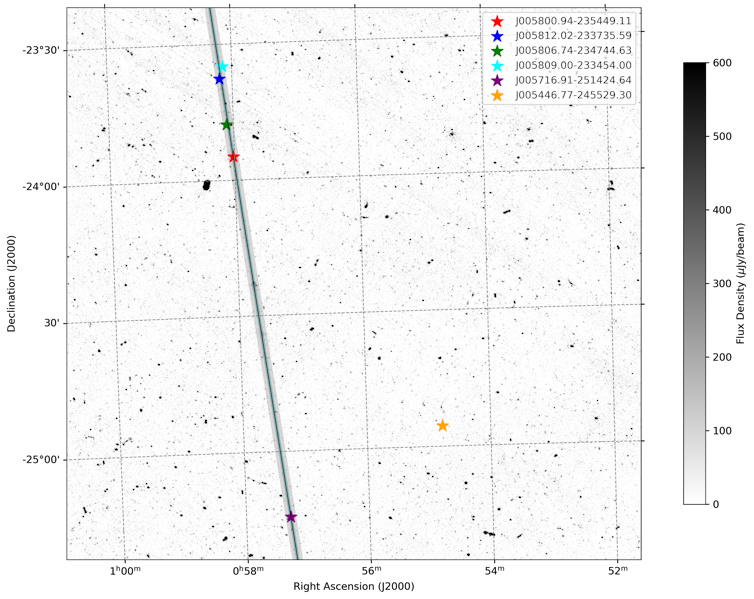
Using ASKAP, we looked at the same patch of sky seven times. Of the 30,000 galaxies we could see, six were twinkling strongly. Surprisingly, five of these were arranged in a long, thin straight line.
Analysis showed we’d captured an invisible clump of gas between us and the galaxies. As light from the galaxies passed through the gas cloud, they appeared to twinkle.
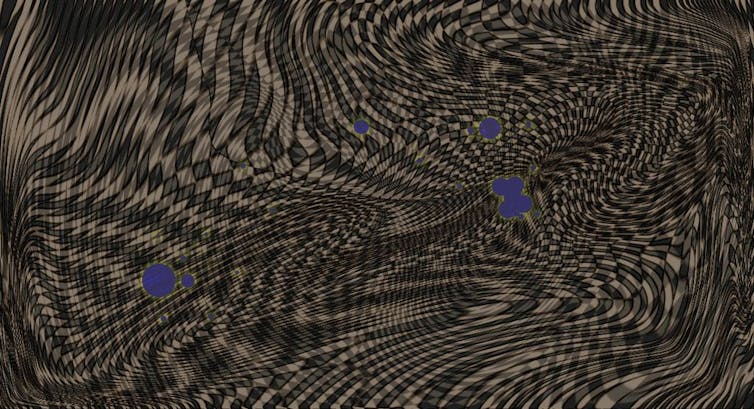
At the centre is one of the strongly twinkling galaxies. The colours represent brightness, as it fluctuates between shining brightly (red) and more faintly (blue).
A clump of gas ten light years away
The cloud of gas we detected was inside the Milky Way, about ten light years away from Earth. For reference, one light year is 9.7 trillion kilometres.
That means light from those twinkling galaxies travelled billions of light years towards Earth, only to be disrupted by the cloud during the last ten years of its journey.
By observing the sky positions of not just the five twinkling galaxies, but also tens of thousands of non-twinkling ones, we were able to draw a boundary around the gas cloud.
We were intrigued by the sky positions of the twinkling galaxies in our ASKAP observations. Each black dot above represents a brightly-shining, distant object.Yuanming Wang
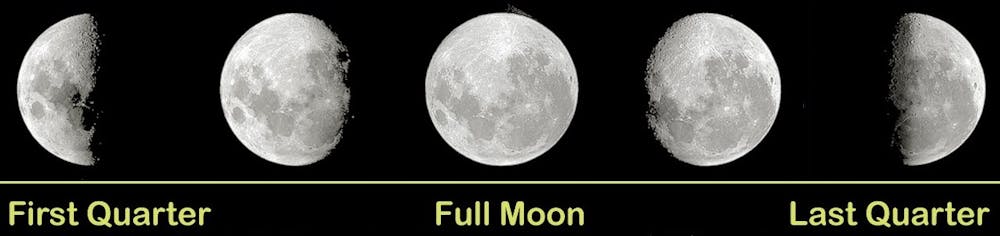
We found it was very straight, the same length as four Moons side-by-side, and only two “arcminutes” in width. This is so thin it’s the equivalent of looking at a strand of hair held at arm’s length.
This is the first time astronomers have been able to calculate the geometry and physical properties of a gas cloud in this way. But where did it come from? And what gave it such an unusual shape?
It’s freezing out there
Astronomers have predicted that when a star passes too close to a black hole, the extreme forces from the black hole will pull it apart, resulting in a long, thin gas stream.
But there are no massive black holes near that cloud of gas — the closest one we know about is more than 1,000 light years from Earth.
So we propose another theory: that a hydrogen “snow cloud” was disrupted and stretched out by gravitational forces from a nearby star, turning into a long thin gas cloud.
Snow clouds have only been studied as theoretical possibilities and are almost impossible to detect. But they would be so cold that droplets of hydrogen gas within them could freeze solid.
Some astronomers believe snow clouds make up part of the missing matter in the Milky Way.
It’s incredibly exciting for us to have measured an invisible clump of gas in such detail, using the ASKAP telescope. In the future we plan to repeat our experiment on a much larger scale and hopefully create a “cloud map” of the Milky Way.
We’ll then be able to work out how many other gas clouds are out there, how they’re distributed and what role they might have played in the evolution of the Milky Way.
Source: The Conversation (Au and NZ) – By Greg Barton, Chair in Global Islamic Politics, Alfred Deakin Institute for Citizenship and Globalisation, Deakin University
The worst ever terrorist attack by an Australian didn’t take place in Australia, but it was very much made in Australia.
The Australian man who shot dead 51 people and injured 40 in Christchurch in 2019 arrived in New Zealand two years earlier, fully radicalised and consumed with hate.
He had been expressing racist hatred from his youth, and from the age of 14 was active on extremist chat forums like the notorious 4Chan.
In his twenties he travelled extensively overseas, developing his white supremacist views. He connected with like-minded individuals, such as Austrian Identitarian leader, Martin Sellner.
And while he carried out his mass-shooting attack alone, he saw himself as a belonging to a global community of white supremacists. He was a vocal supporter of the notorious Australian extremist Blair Cottrell. He was very much a part of Australia’s far-right ecosystem of hate.
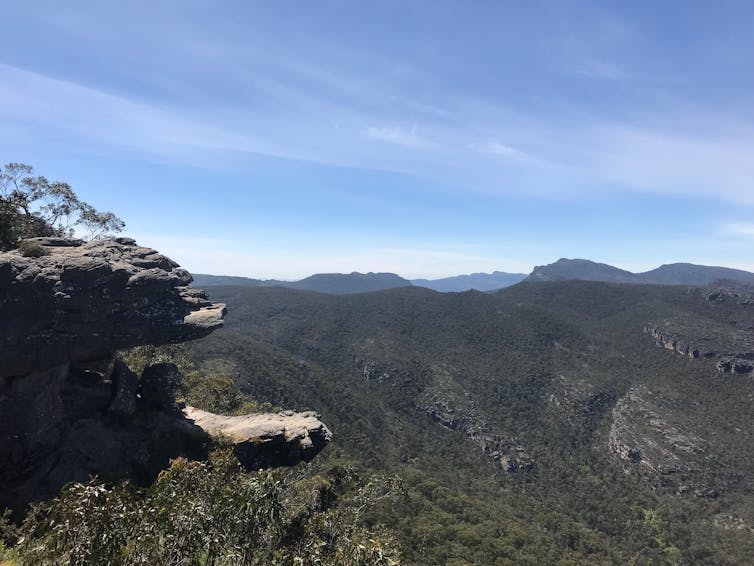
Last month, a group of far-right extremists made headlines with a public and childishly provocative camping trip to the Grampians.
It is easy to dismiss them as being a bunch of attention-seeking fantasists, but the danger is greater than it appears.
A pyramid of hate
Far-right extremism is the ugly face of a much larger system of toxic synergies. Former race discrimination commissioner and author of On Hate, Tim Soutphommasane, refers to a “pyramid of hate crime”:
The history of hate and racism tells us that any kind of violence or hatred cannot be separated from banal or low levels of prejudice and discrimination […] Hate speech leads to political violence if you allow it to escalate.
In its final report released last December, the Christchurch royal commission was critical of multiple shortcomings and failures in New Zealand, but found no evidence of an intelligence failure.
While pointing out far-right extremism in New Zealand in general should have received more attention, there were few, if any, opportunities to have spotted the Australian terrorist in advance.
There was no plausible way that he could have been detected, except by chance.
With no comparable investigation in Australia it remains unclear, even in hindsight, whether Australian authorities could have interrupted the vocal extremist before he become a mass murderer.
Far-right extremism is growing in Australia
Nevertheless, the Christchurch attack certainly focused the attention of Australian authorities.
ASIO chief Mike Burgess has warned about an increase in far-right extremism.Darren England/AAP
In February 2020, ASIO director-general Mike Burgess gave a rare briefingin which he spoke of far-right extremist groups regularly gathering in the suburbs to salute Nazi flags and promote their “hateful ideology”.
In Australia, the extreme right-wing threat is real and it is growing.
As of 2020, investigating far-right extremism now takes up 30-40% of ASIO’s counter-terrorism caseload, up from 10-15% before 2016.
Although worryingly, efforts to explicitly condemn far-right extremism in federal parliament, such as last week’s neutered Senate motion, continue to be stymied by partisan politicking.
The warning signs
The Christchurch shooter did not go from hateful extremism to violent extremism overnight — it only looks that way. He had been cold-bloodedly preparing for and planning his terrorist attack for years.
The warning signs were there in his hateful social media posts, but they were lost in a cacophony of extremist noise.
The Christchurch shooter had been expressing racist hatred since his youth.Mark Baker/AAP
It is possible that, with more attention, his deadly trajectory could have been identified and interrupted. But even if that is not specifically the case, it is clear in general that limiting space for hateful extremism reduces the likelihood of violent extremism.
In the United States, far-right extremism has accounted for the vast majority of terrorist attacks over the past decade. This points to what happens when the ecosystem of white supremacist hate is allowed to flourish unchecked.
Not as illegal as you think
In Australia, like the US, violent extremism makes enormous demands on law enforcement resources. But hateful extremism is not, for the most part, illegal. Violent extremism represents but the tip of the iceberg.
As we saw recently in Victoria, neo-Nazis are free to parade through national parks, burning crosses and yelling things like “heil Hitler” and “Ku Klux Klan” in public places, certain of securing media attention and the infamy they desperately seek.
And while fascists were prancing around the Grampians, supporters of the Proud Boys — one of the far-right militia behind the storming of the US Capitol — were marching in Melbourne.
It is true most of these neo-Nazi bullies, moving in packs and hiding behind balaclavas, will not cross the line and become violent extremists.
But the danger is they will inspire lone actors to launch violent attacks in the toxic-narcissistic hope of going from “zero to hero”, competing for attention with avidly-consumed manifestos, live-streamed bodycam footage, and a sick obsession with “body counts”.
In January, a group of white supremicists were heard chanting in the Grampians.Pablo Mena/AAP
The details of far-right extremism vary. But running through its cocktail of toxic nationalism, nativism, white supremacy, anti-Semitism, Islamophobia, anti-immigrant, misogynist propaganda and fascism is a river of hate.
Swirling around the edges of this vast ecosystem is a discourse of racism and bigotry, poisoning political rhetoric and public culture from organised sport to media comment. And, like a killer rip at the beach, powerful undercurrents of conspiracy theory movements like QAnon drag otherwise ordinary citizens at the edges into dark places with frightening force and swiftness.
For the most part, this results in more noise than fury. But both the violent storming of the US Capitol and the gunning-down of 91 worshippers in Christchurch are reminders of where this hate can lead.
A public register for hate crimes
The time has come to deal with hateful extremism before it manifests as violent extremism.
Australia needs to constrain the space available for the ecosystem of hate to poison public spaces and discourse. This requires both tighter legal constraints on hate speech and the incitement of hatred and investment in, and listening to and acknowledging, victims of hate.
The mob that strormed the US Capitol included members of far-right groups.Mihoko Owada/AP/AAP
There is also a pressing need for a properly resourced and maintained open registry of hate crimes and incidents, rather than the shambolic, haphazard, disconnected, array of incomplete collections that currently exist.
Four out of five organisations tackling hate in Australia are non-government and largely focus on raising awareness. Police forces are tasked with addressing hate crime, but they need to be empowered to do this more thoroughly, with clearer guidelines and resources.
The Christchurch royal commission points the way to what is required in Australia. This includes police revising the way they record complaints.
to capture systematically hate-motivations for offending and train frontline staff […] [to] identify potential hate crimes when they perceive that an offence is hate-motivated.
It also recommends police to better understand the perceptions of victims and witnesses and to record “hate-motivations”.
We also need to recognise the many significant incidents and groups that do not reach the threshold of criminality. There is much to be gained from carefully recording all incidents even if prosecution is unlikely (only 21 people have ever been convicted of hate crime in Australia).
At the same time, a society with less space for hateful extremism would a healthier and happier one for all, whether at the football, taking the train, using social media or picnicking in a national park.
As we prepare to roll out COVID-19 vaccines, we need to know where Australians stand. Our recent study shows that as the pandemic progresses, people we surveyed are becoming less certain about whether they’re willing to accept a vaccine.
While overall it seems most people are willing to be vaccinated, the “maybe” or “fence-sitter” group has grown.
We are particularly interested in this group. That’s because researchers know that when it comes to vaccination policy, we should focus on reaching them.
For that, we need to understand why some people are becoming less certain about their intention to vaccinate, and tailor our approach to communicating with them.
Here’s what we found
Our initial survey in May 2020 was part of a larger project aimed at gauging people’s values on a range of topics.
Back then, some 65% of about 1,300 Australians surveyed said they would accept the COVID-19 vaccine, and 27% were uncertain.
When we revisited about half our sample in November, the number of people with a firm intention to vaccinate had dropped to 56% and the number of maybes had risen to 31%.
Understanding the attributes of the maybes, and what they think, is essential if we want to address their concerns. To do this, we compared the vaccine maybes to those who would accept or refuse.
Compared with committed vaccinators, the maybes were more likely to be female, to not perceive COVID-19 as a severe infection, were less trusting of science, and were less willing to vaccinate against the flu.
Compared with committed refusers, the maybes were more likely to see the disease as severe and not a hoax, to trust in science, and to vaccinate against the flu.
So attitudes towards disease severity, science, and flu vaccination point to people’s position along a spectrum between COVID-19 vaccine acceptance and refusal.
The relationship works in the way you’d imagine: worrying about COVID-19 infection, trusting science, and accepting flu vaccines orients you to accept — or at least consider accepting — the COVID-19 vaccine.
Women were concerned
Gender is an interesting wild card from our study. A recent poll commissioned by the Commonwealth found women in their 30s are most likely to be hesitant about COVID-19 vaccine safety.
Astute commentary said women who were uncertain might be concerned about the impact of a vaccine on their fertility, or concerned that most medical products are oriented towards male bodies and conditions.
However, our sample skewed towards older Australians. So it may not just be younger women who are more uncertain.
We are not overly worried about the drop in firm support for vaccination between May and November.
Two other studies conducted shortly before and after ours (in April and June 2020) found 86% and 75% of Australians intended to accept the vaccine. So while, we report a rise in uncertainty, this is against a backdrop of high rates of vaccine acceptance overall.
The rollout of vaccine programs overseas, and Australia’s own on the brink of being launched, also appear to have also prompted generally high levels of intended acceptance in recent Australian polls. We take heart from this.
Why do different studies about intentions to vaccinate report different results? They are conducted in different population samples, ask different questions, and create different categories about people’s attitudes.
For example, another study conducted in August separated “maybes” into “high” and “low likelihood” of vaccination, finding that 36% of their sample fit into one of these categories. Other studies group the “high likelihood” people with the “yes”, showing how difficult it can be to compare. This also makes it difficult to account for changes over time.
Even though our study registered a change within the same study population, we must interpret this change cautiously.
Many things have been in a state of flux since COVID-19 began, such as our knowledge of the disease, community outbreaks, scary new strains, and state lockdown policies. So people’s attitudes to vaccination will also be informed by this ever-changing scenario. If we polled people today, we might well get different results.
How do we reach the ‘maybes’?
Our follow-up study found about half of those who no longer said “yes” were still saying “maybe” rather than a flat “no”. So reaching these folks will be important.
To do this, policy-makers need to consider the needs of women, especially those of childbearing age. This may help inform strategies to communicate with them, particularly about vaccine safety and the importance of COVID-19 vaccination.
But to truly understand how to reach those on the fence, we need to conduct in-depth interviews to unpack their beliefs and what factors might motivate them to vaccinate. Our Coronavax project is doing this in Western Australia.
In the meantime, we recommend empathetic communications with and about those who are hesitant. People who have ongoing reservations about vaccinating against COVID-19 are not “anti-vaxxers” and shouldn’t be branded as such.
It is the job of governments, technical experts, health professionals and researchers to provide COVID-19 vaccine “fence-sitters” with the confidence and motivation to vaccinate.
Source: The Conversation (Au and NZ) – By Jake Whitehead, Advance Queensland Industry Research Fellow & Tritum E-Mobility Fellow, The University of Queensland
The Morrison government on Friday released a plan to reduce carbon emissions from Australia’s road transport sector. Controversially, it ruled out consumer incentives to encourage electric vehicle uptake. The disappointing document is not the electric vehicle jump-start the country sorely needs.
In contrast, the United States has recently gone all-in on electric vehicles. Like leaders in many developed economies, President Joe Biden will offer consumer incentives to encourage uptake of the technology. The nation’s entire government vehicle fleet will also transition to electric vehicles made in the US.
Electric vehicles are crucial to delivering the substantial emissions reductions required to reach net-zero by 2050 – a goal Prime Minister Scott Morrison now says he supports.
It begs the question: when will Australian governments wake up and support the electric vehicle revolution?
A do-nothing approach
In Australia in 2020, electric vehicles comprised just 0.6% of new vehicle sales – well below the global average of 4.2%.
Overseas, electric vehicle uptake has been boosted by consumer incentives such as tax exemptions, toll road discounts, rebates on charging stations and subsidies to reduce upfront purchase costs.
And past advice to government has stated financial incentives are the best way to get more electric vehicles on the road.
But government backbenchers, including Liberal MP Craig Kelly, have previously warned against any subsidies to make electric cars cost-competitive against traditional cars.
Releasing the government’s Future Fuels Strategy discussion paper on Friday, Energy and Emissions Reduction Minister Angus Taylor said subsidies for electric vehicles did not represent good value for money.
(As argued here, the claim is flawed because it ignores the international emissions produced by imported vehicle fuel).
The Morrison government instead plans to encourage business fleets to transition to electric vehicles, saying businesses accounted for around 40% of new light vehicle sales in 2020.
The government has also failed to implement fuel efficiency standards, despite in 2015 establishing a ministerial forum to do so.
The approach contrasts starkly with that taken by the Biden administration.
Liberal MP Craig Kelly, pictured here struggling to open a bottle of water, opposes government subsidies to encourage electric vehicles.Lukas Coch/AAP
And by committing to carbon-free electricity generation by 2035, the Biden administration is also ensuring renewable energy will power this electric fleet.
This combined support for electric vehicles and renewable energy is crucial if the US is to reach net zero emissions by 2050.
US companies are getting on board to avoid missing out on the electric vehicle revolution.
The day after Biden announced his fleet transition plan, General Motors (GM) – the largest US vehicle manufacturer and a major employer – announced it would stop selling fossil fuel vehicles by 2035 and be carbon-neutral by 2040.
This aligns with plans by the US states of California and Massachusetts to ban the sale of fossil fuel vehicles by 2035.
GM is serious about the transition, committing $US27 billion and planning at least 30 new electric vehicle models by 2025. And on Friday, the Ford Motor Company said it would double its investment in vehicle electrification to $US22 billion.
A General Motors ad for its electric vehicle strategy which aired during the US Superbowl.
Opportunities and challenges abound
Using government fleets to accelerate the electric vehicle transition is smart and strategic, because it:
allows consumers to see the technology in use
creates market certainty
encourages private fleets to transition
enables the development of a future second-hand electric vehicle market, once fleet vehicles are replaced.
Biden’s fleet plan includes a clear target, ensuring it stimulates the economy and supports his broader goal to create one million new US automotive jobs. Prioritising local manufacturing of vehicles, batteries and other components is key to maximising the benefits of his electric vehicle revolution.
On face value, the Morrison government’s business fleet plan has merit. But unlike the US approach, it does not involve a clear target and funding allocated to the initiative is relatively meagre.
So it’s unlikely to make much of difference or put Australia on par with its international peers.
Australia is well placed to capitalise on demand for electric vehicle components.Shutterstock
Australian governments must wake up
Compounding the absence of consumer incentives to encourage uptake in Australia, some states are mulling taxing electric vehicles before the market has been established.
Our research shows this could not only delay electric vehicle uptake, but jeopardise Australia’s chances of reaching net-zero emissions by 2050.
Australia is already a world leader in building fast-charging hardware, and manufactures electric buses and trucks. We could also lead the global electric vehicle supply chain, due to our significant reserves of lithium, copper and nickel.
Despite these opportunities, the continuing lack of national leadership means the country is missing out on many economic benefits the electric vehicle revolution can bring.
Australia should adopt a Biden-inspired electric vehicle agenda. Without it, we will miss our climate targets, and the opportunity for thousands of new jobs.
Source: The Conversation (Au and NZ) – By Jo Caust, Associate Professor and Principal Fellow (Hon), School of Culture and Communication, University of Melbourne
In 2020, the arts sector was dramatically affected by COVID-19. In June, the government announced their $75 million Restart Investment to Sustain and Expand (RISE) scheme and in November the first successful applicants were announced.
Rather than distributing funds through existing arms-length processes at the Australia Council, public servants from within Paul Fletcher’s Communications, Urban Infrastructure, Cities and the Arts department would be making grants decisions in relation to this fund.
While they could seek advice from staff at the Australia Council or from the new Creative Economy Taskforce set up by the minister in mid-2020, they were under no obligation to do so.
Fletcher travelled around the country in November 2020 announcing some grants approved through the scheme. In late December, the office revealed the complete list of the first round of successful recipients.
For some applicants, this funding could be seen as winning the lottery. Many of these grants are much bigger than the recipients could ever hope to receive from the Australia Council or any other arts funding body — and alongside the usual major festivals and performance companies, there are also commercial entities not usually eligible for government arts grants.
Mellen Events received $481,445 for Eireborne, a rock-music Irish dancing tour. Newtheatricals were granted $1,656,346 to tour the musical Come From Away. Michael Cassel Group received $932,140 for the Sydney season of Hamilton and $971,895 to reopen Harry Potter and the Cursed Child in Melbourne.
Hamilton’s Sydney season will be supported by a RISE grant.Disney Plus
Perhaps the grant awarded to the Melbourne artist Rone is the most surprising: $1,688,652 for a “Melbourne Immersive Experience”. Individual artists rarely receive such a large amount of dedicated government funding.
The intent of these grants is to provide much needed stimulus to a sector that has been badly damaged by the events of the past year. But the size of the grants and some of the recipients beg the question: what was the due diligence undertaken?
Interfering with process
Who decides what should be supported? A challenge for the arts is everyone in the community has an opinion about what should happen, without necessarily having any knowledge about the project, the artists or even the artform.
When establishing the Australia Council as the nation’s arts funding body in the early 1970s, the federal government made it clear an “arm’s length” process should apply: the decision making should be separate from the government of the day so that political priorities did not get in the way. It also advised the use of “peers” who were knowledgeable about the field as the decision-makers.
But 50 years later, we are seeing many examples of direct and indirect political interference in the grant decision-making process for the arts.
Perhaps the most egregious example of recent years is in New South Wales, where the current Minister for the Arts, Don Harwin, has interfered on several occasions when allocating arts grants.
In 2018, Harwin admitted he re-directed funding to the Sydney Symphony Orchestra when the funding had been recommended elsewhere by his own arts advisory committee.
In 2019, Harwin allocated 13 regional arts grants deemed of “insufficient quality” by a funding committee to projects in Coalition-held seats.
In January, the Guardian reported out of a $50 million fund set up by the NSW Government in mid-2020 to support arts organisations and artists through the pandemic, only $13 million had been allocated, of which $7 million was yet to be formally accounted for.
Transparency is needed
Over the past decade, Australia’s national arts funding has shrunk while the demand has increased.
In 2016, 128 companies received four-year funding from the Australia Council. In 2020, that number was just 95, sharing $31.7 million per annum between them.
Many companies doing amazing work were among those unsuccessful in the multi-year Australia Council funding allocation, yet some of these were successful in receiving RISE funding, including $800,000 for Melbourne’s La Mama, $588,746 for Adelaide’s Slingsby, and $500,000 for Melbourne’s Somebody’s Daughter.
In 2019-20 the Australia Council distributed $187.1 million — $4.4 million less than 2014-15. Just $28.2 million of this was outside of the multi-year funding programs — down from $33.8 million five years earlier.
The government has allocated $75 million to RISE. There is no doubt the government could afford to be more generous to the arts than they have been over the past decade.
The limited funding at the Australia Council has meant that many activities and companies have had to cease. The lack of any cultural policy or plan at the federal level means there is no strategy in place for how the arts should be supported at the national level, or the appropriate processes for undertaking this spend.
It is because of this we see the respected structures of the Australia Council not utilised under the pandemic, and instead decisions coming straight from the government of the day without necessarily having any understanding of the sector.
Lack of transparency has several outcomes. Ministers get personally lobbied to influence decisions, applicants are nervous about complaining about processes or outcomes because they believe making any public statement may prevent them getting further funding, there is limited information about who gets what and why, trust in government declines, and, overall, there is a lack of respect for those given responsibility for funding the arts.
It is wonderful that many worthy projects, individuals and groups received such generous funding through RISE. But there is a concern, when the arts are in such trouble, if the money is being used in the wisest way to underpin and support the sector for the future?
The politics of divide and rule and how Indonesia’s attempt to separate indigenous Papuans is an irrational and unrealistic proposal that will damage the cultural values of kinship and togetherness as Melanesian people, writes Dr Socratez Yoman.
ANALYSIS:By Dr Socratez Yoman
The Indonesian coloniser has become an ignorant ruler with deaf ears and with evil intention in fighting for the addition of new Papuan provinces without the population numbers to justify this.
Provincial division is a serious problem because the population of Papua and West Papua does not meet the requirements to establish new provinces.
The planned provinces will cause division and destruction of the cultural values of kinship and togetherness as Melanesian people.
After Indonesia failed with a plan to move 2 million indigenous Papuans to Manado, the new strategy devised by the Jakarta authorities is to separate indigenous Papuans according to ethnic groups. This is a crime against humanity and is a gross human rights violation carried out by the state.
The author followed the presentation from the Minister of Home Affairs of the Republic of Indonesia, Tito Karnavian, to the Working Meeting of Commission I DPD RI in Jakarta on 27 January 2021 regarding the government’s version of the Provincial Expansion scenario which was not rational or realistic.
The Minister of Home Affairs is not paying attention to the standards and requirements for the development of a new administrative area, such as area size, population, human resources and financial and natural resources.
The criteria for a new government have been largely ignored, but political interests and remilitarisation have become the main mission. To be honest, the people and nation of West Papua do not need lots of division of districts and provinces.
Military purpose for new provinces These new provinces are only for political and military purposes and to move excess population from Java.
The proposal in summary
1. Papua Province (the original province) Capital: Jayapura a. Jayapura Town b. Jayapura Regency c. Keerom Regency d. Sarmi Regency e. Maberamo Raya Regency f. Waropen Regency g. Kep. Yapen Regency h. Biak Numfor Regency i. Supiori Regency
2. South Papua Province (new province) Capital: Merauke a. Merauke Regency b. Boven Digoel Regency c. Mappi Regency d. Asmat Regeny e. Peg Bintang Regency
3. Central Eastern Papua Province (new province) Capital: Wamena a. Jayawijaya Regency b. Lani Jaya Regency c. Tolikora Regency d. Nduga Regency e. Maberamo Tengah Regency f. Yalimo Regency g. Yahukimo Regency h. Puncak Jaya Regency i. Puncak Regency
4. Western Central Papua Province (still under debate) Capital: Mimika a. Mimika Regency b. Paniai Regency c. Deiyai Regency d. Dogiay Regency e. Nabire Regency f. Intan Jaya Regency
5. West Papua Daya Province (previously mostly West Papua Province) Capital: Sorong a. Town of Sorong b. Sorong Regency c. Sorong Selatan Regency d. Maybrat Regency e. Tambrauw Regency f. Raja Ampat Regency
With these additions Papua would have five provinces. The mechanism for provincial expansion is in accordance with Article 76 of the Special Autonomy Law with additional authority changes from the central government when there is a deadlock in the region.
The total population of West Papua includes two provinces respectively: Papua Province 3,322,526 people and West Papua 1,069,498 inhabitants. The total is 4,392,024 inhabitants.
Evenly dividing up population If the population is divided evenly from the total population of 4,392,024 the population for the five provinces are as follows:
1. Papua Province will be inhabited by a population of 878,404 people.
2. West Papua Province will be inhabited by a population of 878,404 people.
3. The Province of Puppet I will be inhabited by a population of 878,404 people.
4. The Province of Puppet II will be inhabited by a population of 878,404 people.
5. The Province of Puppet III will be inhabited by a population of 878,404 people.
The question is whether a province with a total population of 878,404 people is worthy and eligible to become a province?
It is very important to compare with the population of the provinces of West Java, Central Java and East Java.
1. Total population of West Java: 46,497,175 people.
2. Total population of Central Java: 35,557,248 people.
3. Total Population of East Java: 38,828,061 people.
The question is why does the government of the Republic of Indonesia not carry out splitting the provinces of West Java, Central Java and East Java, which have the largest population sizes?
‘Transfer of excess population’ As a consequence of a population shortage in this province, the Indonesian authorities will transfer the excess population of Malay Indonesians to these puppet provinces.
The creation of these five provinces also have as their main objective to build 5 military area commands, 5 police area command bases, tens of military district commands and dozens of police district headquarters and various other units. The land of Melanesia will be used as the home of the military, police and Indonesian Malay people.
The consequences will be that the indigenous Papuans from Sorong to Merauke will lose their land because the land will be robbed and looted to build office buildings, military headquarters, police headquarters, army district bases, and police district bases.
Humans will be removed, made impoverished, without land and without a future, even slaughtered and destroyed like animals in a natural or unnatural way as we have experienced and witnessed until the present.
There is evidence that a genocide process has been carried out by the modern colonial rulers of Indonesia in this era of civilisation. The crimes of the Indonesian colonial rulers continue to be exposed in public.
In 1969, when the West Papuan people were integrated into Indonesia, the indigenous population was around 809,337 people. Meanwhile, the neighbouring independent state of Papua New Guinea has around 2,783,121 people.
Since then, the indigenous population of PNG has reached 8,947,024 million, while the number of Indigenous Papuans is still only 1.8 million.
Modern colonial ruler This fact shows that the Indonesian government is a modern colonial ruler which has occupied and colonised the people and nation of West Papua.
Dr Veronika Kusumaryati, a daughter of Indonesia’s young generation in her dissertation entitled: Ethnography of the Colonial Present: History, Experience, And Political Consciousness in West Papua, revealed:
“For Papuans, current colonialism is marked by the experience and militariSation of daily life. This colonialism can also be felt through acts of violence that are disproportionately shown to Papuans, as well in the narrative of their lives.
“When Indonesia arrived, thousands of people were detained, tortured and killed. Offices were looted and houses burned. … these stories did not appear in historical books, not in Indonesia, nor in the Netherlands. This violence did not stop in the 1960s.”
The Indonesian government repeats the experience of the colonial rulers of apartheid in South Africa. In 1978, Peter W. Botha became Prime Minister and he carried out a politics of divide and conquer by dividing the unity of the people of South Africa through establishing puppet states: 1. The Transkei Puppet State. 2. The Bophutha Tswana Puppet State. 3. Venda Puppet State. 4. The Ciskei Puppet State. (Source: 16 Most Influential Heroes of Peace: Sutrisno Eddy, 2002, p. 14).
There is a serious threat and displacement of indigenous Papuans from their ancestral lands proven by the fact that in the regencies they have been robbed by the Malays and have been deprived of their basic rights for Indigenous Papuans in the political field. See the evidence and examples as follows:
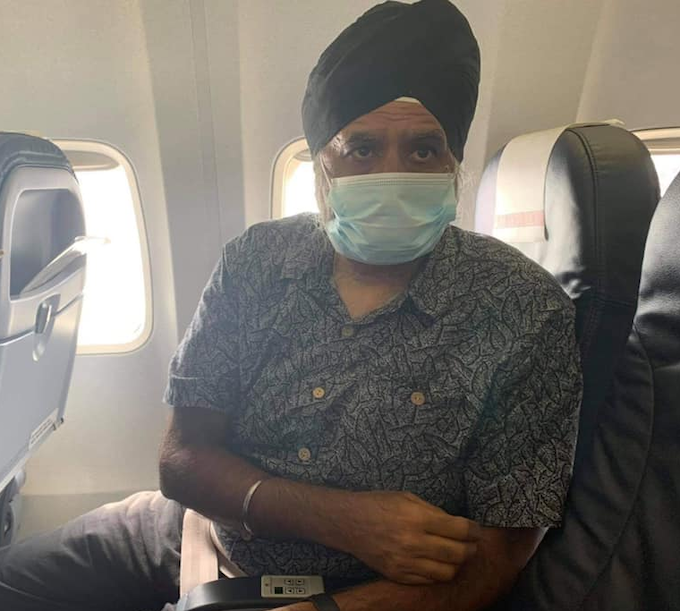
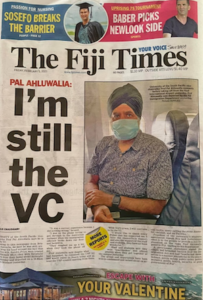
When the University of the South Pacific’s vice-chancellor, Professor Pal Ahluwalia, was hauled out of his Suva, Fiji, home this week and deported, it had nothing to do with his views on education or tertiary management.
With his wife and nursing lecturer Sandy Price they were driven across curfew-locked down Fiji to be put on a plane to Australia.
It was not an action designed to make USP a better place, or to improve life for Fiji’s young people.
It was bitterly personal.
“You have nailed it,” Professor Ahluwalia told Pacific Newsroom. “It is precisely a case of ‘let’s get rid of this man because he exposed too much corruption’.”
Professor Ahluwalia and Price were seized late last Wednesday and deported on Thursday morning to Brisbane where, due to covid-19, they are now in managed isolation until February 18.
He is adamant that he remains vice-chancellor of the 12-nation regional USP and will keep managing the university.
Money was missing Just over two years ago Professor Ahluwalia took over USP from vice-chancellor Professor Rajesh Chandra. He discovered much was wrong in the accounting department, and money was missing. A lot of money.
Professor Ahluwalia submitted a report to the USP Council and, in an abbreviated form, this led to the hiring of Auckland accountancy consultants BDO. When their damning report reached the university council, it was pretty much suppressed. Key details were kept from the public.
The BDO report was then leaked – not by Professor Ahluwalia or any USP staff – to Pacific Newsroom, prompting uproar.
As BDO linked corruption and missing millions efforts were begun to get Professor Ahluwalia fired.
BDO’s report made it clear Fiji’s pro-vice chancellor Winston Thompson was acting for FijiFirst; not USP or its students. Image: IB screenshot
These were mostly led by USP’s pro-chancellor, Winston Thompson. A Fijian, BDO’s report made it clear Thompson was acting for FijiFirst; not USP or its students.
Professor Ahluwalia said that until talking with Pacific Newsroom, he had not talked publicly about these connections. He was now because Pacific Newsroom had become a key influence in the debate in Fiji.
Getting rid of Professor Ahluwalia was part of that: “It’s as personal as that and Winston Thompson was Fiji’s ambassador to the United States, he is a diplomat and he has presided over several interesting, very interesting, downfalls of public institutions…”
‘The intimacies of politics’ Surely, it was put to Professor Ahluwalia, USP was bigger than just a couple of people. But that, he replied, was what it amounted to.
“It is really that, the intimacies of politics… the way these networks work, after all this is a very small country.”
Fiji refuses to accept BDO evidence, claiming their own Fiji Independent Commission Against Corruption (FICAC) had found no corruption.
BDO had pointed clearly to corruption and both Professor Ahluwalia and Price say they were close to getting to the bottom of the operation behind it.
“The best evidence I can provide for all of this at the moment,” Professor Ahluwalia said, “is that I am close, but don’t have evidence yet.
USP’s Australian Professor Pal Ahluwalia … deported by Fiji with no consultation with the university. Image: PMW
“What I would say as evidence is that 2019 and 2020 we had to put a number of financial restrictions in place, but the fact that I returned, in 2020, a $28.3 million surplus on a university that did not receive grants from Fiji and Australia. That tells me how much they were leaching out of the system.”
Was it a basic kind of fraud, people helping themselves to cash: “That’s what it seems to me. The bit I cannot figure out is that these accounts are audited by auditors and how were they doing it?”
People complicit at USP There were, Price suggested, a lot of people in USP that were complicit.
This week, as the Pacific Forum met in Zoom session to elect a new secretary-general, the Fiji government moved against Professor Ahluwalia and Price. He found it interesting that this was the week.
“There was a special council meeting (a Friday week ago) and at that meeting the President of Nauru (Lionel Aingimea, the current USP chancellor) raised my contract as an issue.”
He wanted it placed on the agenda because he was concerned about it. Both Thompson and the council’s Fiji representative, Mahmood Khan, expressed concern at having it on the agenda, saying there was no supporting paper to explain its presence.
They said they needed to know what the issue was.
“And Lionel gave them a hint, he said it’s about visa issues and then he said, well we will send a paper.”
It was drafted and it noted that the Fiji Sun, a pro-Bainimarama newspaper, had reported in a gossip section that someone from “a big school for big students” could be sacked.
‘Draconian barbaric act’ Professor Ahluwalia said as soon as that appeared, they knew they had to act: “On Wednesday they did this draconian barbaric act, trampling over our human rights.”
As to the Pacific Islands Forum Summit: “I wouldn’t put anything in Fiji as just a coincidence. They probably knew all the leaders were busy.
For himself, and the USP Council, Professor Ahluwalia is still the vice-chancellor. His contract remained valid and he had done nothing wrong: “I suppose it’s a wrongful dismissal which is what I am arguing… the employer still has a duty of responsibility even if the government chooses to deport you on fabricated charges.”
Given all the stresses, it would be understandable that Professor Ahluwalia and Price might want to cut their losses, but that is not so: “I was hired to lead USP and take it forward, I think it has a lot of potential, I don’t think it has to be just beholden to Fiji and one of the best things that would happen to the university is for the vice chancellor to operate from outside of Fiji and actually really lift the education of the rest of the region and give the region more attention while paying attention to Fiji as well.
“Covid has taught us that the university can be run from its other campuses. After all, the USP campuses are run from Laucala so the converse is absolutely possible,” he said.
“I have nothing against the people of Fiji and my students and staff in Fiji are the reason I have so much support so I want to make sure they are supported.”
He could live in another USP member country: Samoa is already waving the welcome mat. The university would survive.
Damage done to Fiji “I think the damage is not being done to USP, the damage is to the Fiji government because of their actions in violating our human rights.”
This kind of passionate battle augurs well for USP: “Its international reputation is enhanced, that there are people in it with ethical people trying to clean it up.”
Ethics, integrity and good governance mattered.
“My message to the students is very clear. Come to USP, a great regional institution, committed staff, we are there, it remains the premier regional institution and when this vice-chancellor is back he will continue on the march to make sure USP becomes an even better institution and be ready as a university for the next 50 years.”
Michael Field, the New Zealand author and an independent journalist, has also been deported from Fiji on several occasions under different prime ministers and remains persona non grata. This article is republished from The Pacific Newsroom with permission.
After a divisive marathon meeting into the early hours of Thursday, Pacific leaders have emerged with a new Secretary-General of the Pacific Islands Forum. Cook Islands’ former Prime Minister Henry Puna was elected 9–8, with one abstention.
A break from the consensus tradition of the Forum, the appointment leaves the region bitterly divided.
To make matters worse, the Fiji government appears to have used the distraction of the meeting to swoop in and deport University of South Pacific vice-chancellor Professor Pal Ahluwalia.
The university, seen by many as a beacon of Pacific regionalism, had been embroiled in a long and very public dispute between the new VC and the old guard backed by the Fiji government.
The move to deport the VC sends this dispute nuclear, with many of the same red-eyed leaders who just wrangled over the new secretary-general also members of the university’s governing council, and now facing the potential of an emergency special meeting to discuss this latest move.
The past 24 hours have been incredibly damaging for Pacific regionalism and unity, the repercussions of which will be felt for years to come.
The very fabric of Pacific regionalism looks to be tested unlike any time in recent history.
Where does this leave North Pacific? Some immediate questions are clear.
Where does this leave the North Pacific? Adamant that it was a Micronesian’s turn to run the Forum, five members had coalesced around former minister and current US ambassador Gerald Zackios of the Marshall Islands as their candidate. Some Micronesian leaders had threatened to leave the Forum if Zackios were not chosen, and from reports of their moods since the vote, they may look to follow through. Even if they don’t take that step, don’t expect them to be too involved in the Forum in the near future.
What happens next for the leadership struggle at the University of the South Pacific? Even if the governing council can convince the Fiji government to overturn the deportation of the VC, the damage has been done. It is highly unlikely he would return, or that any high-calibre international candidate would be interested in taking his place while the serious allegations of financial mismanagement at the university remain unresolved. The donors and Pacific nations which contribute towards financing the university may look to place the USP in some form of administration to sort it all out – likely in the face of protests from Fiji.
Where does this leave Fiji? Its government had already ruffled feathers by nominating a candidate for the secretary-general position (who did not make it to the final round of voting) so soon after fully re-engaging with the Forum. Now, by moving against USP’s vice-chancellor at the same time as Prime Minister Voreqe Bainimarama was sitting in a Leaders Meeting, aggravated bilateral tensions will linger in every corner of the Pacific.
With the covid-19 crisis and border closures forcing countries to look inwards more than ever, regionalism was already struggling, and the Forum was facing a slow-burning relevance crisis.
Fiji needs charm campaign Fiji is looking to host the 2021 Forum Leaders Meeting in August, with Bainimarama going so far as to extend an invitation to US President Joe Biden.
Fiji will have to roll out the charm campaign across the region in the next few months if they expect Pacific leaders to push for the meeting to go ahead at all.
USP’s Australian Professor Pal Ahluwalia … deported on a flight to Brisbane on Thursday. Image: PMW screenshot
Finally, where does this leave Pacific regionalism? Outsiders can be forgiven for thinking the Pacific is a unified bloc, thanks to their prominent advocacy on climate change.
The past 24 hours, however, reveal just how divided the Pacific can be. While we don’t yet know which candidates each country voted for, there is a clear rift right down the middle of the Pacific.
With the covid-19 crisis and border closures forcing countries to look inwards more than ever, regionalism was already struggling, and the Forum was facing a slow-burning relevance crisis.
How regionalism can be revitalised in an era of deep division and no physical interactions is an incredible challenge.
Freshly elected Secretary-General Puna has a massive job on his hands dealing with the fallout, to say nothing of the larger challenges the Forum was already facing.
Jonathan Pryke is director of the Lowy Institute’s Pacific Islands Programme. His research is interested in all aspects of the Pacific Islands, including economic development in the Pacific Islands region, Australia’s relationship with the Pacific, the role of aid and the private sector in Pacific Islands development and Pacific labour mobility. This article was republished from The Interpreter with permission.
Both coverage in the Asian press and statements by neighbouring Asian governments reported in the media on the grabbing of exclusive power by the military in Myanmar reflects the traditional Asian adage that democracy should go hand in hand with economic and political stability.
Thus, sanctions and external funding of protest groups (usually urban elites and the young) are discouraged.
Myanmar is a member of the Association of South East Nations (ASEAN) regional grouping, which was instrumental in guiding Myanmar to transit from military rule to civilian rule a decade ago.
The ASEAN secretariat issuing a statement through its current chair Brunei reiterated that “domestic political stability is essential to a peaceful, stable and prosperous ASEAN Community”.
Sharon Seah, coordinator at the ASEAN Studies Centre at the National University of Singapore noted that the ASEAN statement this week WAs a slight deviation from the one that ASEAN made after the 2014 coup d’etat in Thailand.
“What is new in this iteration is the fact that the grouping recognises that collective goals can be undermined by a member state’s political ructions,” she noted.
Seah, in a commentary published by Singapore’s TODAYOnline news portal, points out that the current ASEAN statement “sounds familiar except that this time, ASEAN is far further along the process of regional integration and community-building, since the ASEAN Community blueprint was launched in 2015”.
Pax Americana ‘is over’ Further, she wrote, “Pax Americana, as Southeast Asia knows it, is over and the global world order has changed irrevocably”, thus external pressure (from outside the region) is not the way to go.
Interestingly, China’s media – both Xinhua news agency and Global Times – have described the latest coup in Myanmar as a “reshuffle of Cabinet”. Their logic may have some substance.
“Myanmar military announced a major cabinet reshuffle hours after a state of emergency was declared on Monday,” February 1, reported Xinhua from Yangon.
It referred to a military statement that “new union ministers were appointed for 11 ministries, while 24 deputy ministers were removed from their posts”.
It added that Union chief justice and judges of the Supreme Court, chief justices and judges of regional or state High Courts are allowed to remain in office as well as members of the Anti-Corruption Commission, chairman, vice-chairman and members of the Myanmar National Human Rights Commission.
The military used sections of the 2008 constitution, to which Aung San Suu Kyi’s National League for Democracy (NLD) had agreed to when they took part in the 2015 elections and won on a landslide.
This constitution allows the military to take over the government in the event of an emergency that threatens Myanmar’s sovereignty leading to “disintegrating [of] the Union (or) national solidarity”.
It is debatable if such a situation exists and this could be the subject of argument in coming months.
Nine years ago Luv Puri, a member of UN Secretary-General’s good offices on Myanmar writing in Japan Times (as a private citizen) this week noted that nearly nine years ago, Aung San Suu Kyi reluctantly decided to participate in a byelection to the Parliament and after being elected she was resolute in her cautiousness as the Western leaders sought her advice on how to approach the then President Thein Sein’s government.
“She had earlier termed the whole process an instance of sham democracy,” recalls Puri, adding, “on February 1, 2021, she proved to be right as the military or Tatmadaw, as it is locally known, staged a coup in the wee hours”.
Puri noted that the military’s grouse is that at least 8.6 million irregularities were found in voter lists and the ruling NLD government and its appointed election commission failed to review the 2020 elections results, with the latter saying that there was no evidence to support the military’s claims.
The ruling NLD party won 396 out of 476 seats in the November 8 election, allowing the party to govern for another five years.
“The contesting positions are symptoms of a deeper institutional malaise.
“Constitutionally, three important ministries relating to national security, namely defence, home and border, are held by the military,” notes Puri.
“The military nominates 30 percent of the members of Parliament.
Existential battle ‘for political survival’ “In an environment in which the military is fighting an existential battle for political survival, after ruling the country directly or indirectly since the formation of the republic, a military coup was an imminent possibility.”
China and India, with Myanmar, sandwiched between them have reacted cautiously to the latest developments.
Myanmar is essential for the success of China’s BRI (Belt and Road Initiative) while for Indian Prime Minister Narendra Modi’s “Look East” project Myanmar is an important lynchpin.
India has a 1468 km border with Myanmar that runs along 3 north-east Indian states – Nagaland, Manipur and Mizoram – all of which face ethnic and religious tensions.
China has taken issue with Western media reports that it supported the military takeover in Myanmar.
Global Times reported that China’s foreign ministry spokesman Wang Wenbin has refuted such claims at a media briefing.
“Such allegations are not factual,” he said in Beijing. He has also added that China was puzzled by a leaked document from the UN Security Council that China is supposed to have vetoed.
“Any action taken by the Security Council should contribute to Myanmar’s political and social stability, help Myanmar realize peace and reconciliation, and avoid intensifying contradictions,” he told the media.
“For India, which had cultivated a careful balance, between nudging along the democratic process by supporting Ms Suu Kyi, and working with the military to ensure its strategic interests to the North East and deny China a monopoly on Myanmar’s infrastructure and resources, the developments are unwelcome,” noted India’s The Hindu in an editorial.
“The government will need to craft its response taking into consideration the new geopolitical realities of the U.S. and China as well as its own standing as a South Asian power.”
‘Share of uncertainties’ The Indian Express also expressed similar sentiments in an editorial noting that new developments “will create its share of uncertainties” for India.
“It must continue its engagement with Myanmar and leverage its influence with the Army to persuade it to step back,” added the Express.
While Myanmar’s expat populations in places like Bangkok, Tokyo and Sydney have demonstrated calling for international intervention, within Myanmar people have taken a different strategy to confront the military takeover.
Myanmar Times (MT), that is locally owned and published from Yangon, carried a number of reports on how this is shaping up. They reported about various aspects of civil disobedience campaigns initiated by trade unions, leading artists and the medical profession.
MT reported that a movement, which urged Myanmar citizens to not buy and use products affiliated with the Tatmadaw has gone viral since February 3.
The military has been linked to a large number of businesses in various sectors. They have been associated with food and beverage products, cigarettes, the entertainment industry, internet service providers, banks, financial enterprises, hospitals, oil companies, and wholesale markets and retail businesses, among others, the newspaper pointed out.
MT also reported that “Myanmar celebrities, who usually make headlines for their latest albums, haircuts and fashion choices, have used their social media profiles for an entirely different purpose this week”.
Singers change from cosmetics to disobedience Since the military seized power on February 1, “Myanmar’s singers, actors and artists changed their topic of interest from cosmetics to disobedience to the rule of the junta” noted MT.
Among the celebrities are Paing Takhon who started his modelling career in 2014 and has amassed over 1 million followers on Facebook and filmmaker Daung with 1.8 million.
Meanwhile, the Confederation of Trade Unions Myanmar (CTUM) and Myanmar Industry Craft and Service-Trade Unions Federation (MICS) announced that they had resigned and are no longer part of government, employers and workers’ groups.
The “Civil Disobedience Campaign” that was launched on February 2 is also joined by health-care workers in 40 townships, including doctors and nurses from 80 hospitals.
Meanwhile, Seah argues that this month’s events are a big setback for ASEAN community building and to help in any democratic retransformation, an ASEAN-led commission to investigate the military junta’s allegations of electoral fraud could be set up, headed by a mutually respected senior ASEAN personality trusted by all sides.
“For the commission’s findings to be accepted at the international level, support must come from ASEAN’s external stakeholders,” she argues.
“The selection of the commission members must be transparent from the get-go and may require consultations with key stakeholders both inside and outside Myanmar (while) ASEAN should secure the agreement of the military junta to dial down to a state of limited emergency, refrain from the use of force against civilians and allow the functioning of government with specified conditions between the NLD and the military”.
The Timorese Press Council today asked journalists to avoid being “messenger boys”, referring to the publication of a statement about former Timor-Leste president Xanana Gusmão’s controversial visit to a former priest accused of child abuse without identifying the source.
“Journalists are urged to reflect on their role in society and to refuse the function of mere passive message transmitters, messenger boys,” said a statement released today by the Press Council (Conselho De Impreza or CI).
The note was distributed after a press conference to analyse the Timorese media’s coverage of the visit that Gusmão made in late January to the house where former Father Richard Daschbach, accused of paedophilia and other crimes , is under house arrest.
The Press Council said that five Timorese media outlets – the public news agency Tatoli, the online newspaper Oekussi Post, the private television GMN and the newspapers Diário and Independente – covered the visit, relying exclusively “on a statement delivered by the delegation of Xanana Gusmão”.
“The journalists replicated the statement, made few or no changes to the press release, not attributing its origin, and did not go further in the coverage,” Virgílio Guterres, president of Press Council told reporters today.
The council also highlights that in three media outlets the text was signed by a journalist, “which constitutes (…) plagiarism”.
For the Press Council (CI), there was “a total dismissal of journalistic activity, not checking, not looking for the contradictory, not diversifying sources, not looking for rigour and truth”, violating the law and the journalistic code of ethics and discrediting an activity that or “vigilant of the instituted powers and of the Democratic Rule of Law”.
‘Absence of plurality’ The council questions the “absence of plurality”, when the five outlets published “equal” texts, and the fact that the texts contain “omissions that make the news biased, not effectively fulfilling its mission to inform”.
Guterres said that the statement “aimed at an objective, like any public act, in which journalists agreed to participate, choosing to defend a particular interest rather than the public interest”.
How UCA News reported the controversy and the photo of Xanana with the ex-priest Richard Daschbach. Image: APR screenshot
After the criticism that the news provoked, some newspapers chose to correct the reference to Daschbach from priest to ex-priest, “but without any explanation for this change”, deleting or altering other paragraphs.
The published texts also feature a long biography of the target, “omitting relevant information”, including the fact that he was expelled from the Vatican and was accused of the crimes of paedophilia and child pornography.
“By referring in his biography only to positive facts of his journey, the media thus contribute to convey a false image of the target, disagree with reality, in a clear whitening process”, he maintains.
In addition, the texts have references “that are clearly assumed as rhetorical resources to awaken feelings of compassion and empathy in the reader”.
Guterres considered that the coverage “failed, by not presenting relevant journalistic facts”, being “unbalanced, with the intention of changing the public opinion about the accusation against the former priest”.
Reporting facts without fear Asked by Lusa about whether the Timorese “media” were afraid to cover this case, Guterres recalled that this was the first time “that a member of the clergy is brought to justice” in Timor-Leste.
Tempo Timor … essential for making the case known. Image: APR screenshot
The important role of the Catholic Church in society, he said, had led to a less-than-expected media reaction, although some publications, such as Tempo Timor, had been essential in making the case known.
“We recognise that the fear-inhibiting effect exists. But now we need to report facts without fear,” he said.
Regarding the coverage of the case by Tatoli, the fact that it was a public news agency should demand increased responsibility, and its journalists “must have honesty and humility to recognise failures and mistakes and accept criticism,” he said.
Last week, the Timorese Episcopal Conference called on the Catholic community in Timor-Leste to respect Pope Francis’ decision to expel Daschbach from the priesthood.
In October last year, the representative of the Holy See in Dili told Lusa that the Vatican “has no doubt” that the former priest is guilty of these crimes.
Daschbach, 84, detained in 2019, is accused of abusing at least two dozen children at the orphanage where he worked, Topu Honis, located in the Oecusse enclave.
In September last year, the Attorney-General, José da Costa Ximenes, confirmed to Lusa that in addition to the crimes of child sexual abuse, the Public Prosecutor’s Office accused Daschbach of the crimes of child pornography and domestic violence.
The penal code provides for maximum sentences of 20 years in prison for sexual abuse of children under 14 years, increased by one third if the victims are under 12 years old.
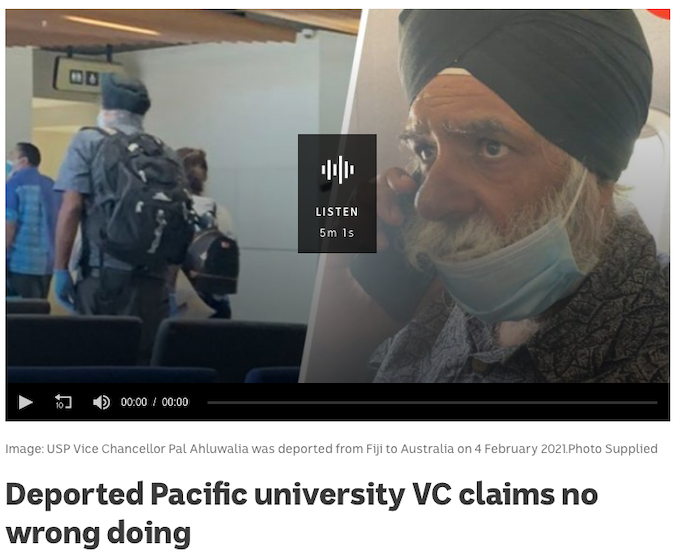
The deported head of the University of the South Pacific, Professor Pal Ahluwalia, says his expulsion from Fiji is “a classic case of beating the whistleblower up,” and he has vowed to continue in the role from Nauru.
In an interview with ABC Pacific Beat from Australia, Professor Pal Ahluwalia has detailed his sudden arrest and deportation, reports Pacnews.
He and his partner, Sandra Price, both Australian citizens, were detained in their home in the Fiji capital Suva by police and immigration officials around 11pm Wednesday night, and put on a plane bound for Brisbane yesterday morning.
“I said I need to know who you are before I open the door, and [the officer at the door] said, ‘if you don’t open this door within three seconds, and we’ll break the door down’.
“So we let him in,” he told Pacific Beat.
“I was trying to speak with the Australian High Commissioner and about four people manhandled me and grabbed my phone off me, and really sort of roughed me up.”
He said the officers later apologised.
In other developments today:
Still vice-chancellor Professor Ahluwalia said he remained the vice-chancellor of USP, and has told the ABC he plans to fly to Nauru and will continue his administration of the regional body from there.
How The Fiji Times reported the USP news today. Image: Fiji Times screenshot
In a statement, the Fiji government claimed Professor Ahluwalia and Price were ordered to leave Fiji after continuous breaches of the Immigration Act.
“No foreigner is permitted to conduct themselves in a manner prejudicial to the peace, defence, public safety, public order, public morality, public health, security or good government of Fiji,” the statement said.
No specific details of the alleged breached were provided.
Professor Ahluwalia believes he was deported because he raised concerns about widespread mismanagement at the university under his predecessor.
“I don’t believe either Sandy or I have done anything wrong”.
“This is a classic case of beating the whistleblower up,” he said.
How ABC Pacific Beat reported the story yesterday. Image: ABC screenshot
Victim of a witchhunt Professor Ahluwalia has previously claimed he was the victim of a witchhunt, after raising concerns about governance issues and financial mismanagement at the university under the previous vice-chancellor.
In a confidential report that was later leaked to the media, he alleged widespread financial irregularities under his predecessor Professor Rajesh Chandra and the current pro-chancellor Winston Thompson, including massive salary increases, misappropriation of allowances and unearned promotions.
The report prompted an investigation by USP which substantiated some of his findings and called for stronger oversight by the University Council.
Despite that USP’s executive committee suspended him last year, a move which prompted protests from students and staff, and was later overturned by the council.
As the Council meeting has begun I am not allowed to join. Please keep praying. pic.twitter.com/azJw1AAAdt
On his Twitter feed today, Professor Ahluwalia said he and his wife Sandy were “overwhelmed by the support we have received from staff, students and globally”.
“We are humbled and inspired by your prayers,” he added.
A senior academic staff member at the Auckland University of Technology wants the vice-chancellor to resign following a scathing report into bullying.
The independent review heard more than 200 complaints of bullying and found evidence of sexual harassment by eight former staff.
It said some employees had been so severely affected they had been forced to take stress or sick leave, and had cried during interviews.
The independent review, commissioned by AUT, was prepared by Kate Davenport QC.
The staff member quoted on RNZ Morning Report, who RNZ agreed not to name, said there was a culture of bullying at the university.
“When I was enquiring about the head of another school, and who that person was, and you know, just out of curiosity really, and the answer I got from one person was, ‘oh that person’s all right, she’s very easy to shout down’.
“Meaning that if you have a disagreement with that person, if you raise your voice they back off.”
Culture affected decision-making The culture had also affected wider decision-making, said the staff member, because senior leadership were used to ignoring problems.
That had become evident when the university announced it would restructure the academic year into shorter course blocks because of covid.
This was despite early warnings the changes would not work.
“You can’t do block courses when you have a whole load of people, how can I put it? A whole load of people already signed up to do a course.
“Then you’re going to change, their weekly courses to block, there will be too many timetable clashes for this to be marginally practical.”
Despite these early concerns being raised by staff, the university went ahead before backtracking amid a student outcry, said the staff member.
Bullying had been highlighted in a number of past surveys, but AUT had ignored them “so it isn’t coming out now, it’s been happening for quite a long time,” they said.
“You don’t get a working culture this impregnated with a bullying managerial style overnight. It takes a few years to develop.”
Accountability needed The staff member said the only way AUT would ever change its culture would be to ensure some level of accountability.
“And the people that are at the top, that have been ignoring this for so long probably need to be stood down or replaced…”
“I would say that includes the vice-chancellor, I would say that includes a number of people in human resources that have ignored complaints, and I would also think that many of the deans would need to be looked at.”
In a statement released with the report, AUT Vice-Chancellor Derek McCormack said he and the university’s council accepted the findings.
“In response to these findings, on behalf of the university and personally, I want to apologise to all those past and present who have been subjected to bullying or other forms of harassment,” he said.
“As a university, we should have done better and my commitment as vice-chancellor is that we will do better starting today.”
‘Systemic problem’ AUT economics professor Rhema Vaithianathan, a spokesperson for Stop Sexual Harassment on Campus (SSHOC), said the report held no-one to account.
Dr Vaithianathan said there were women at the university at the moment feeling bullied because of harassment complaints they had tried to prosecute in the past.
“So this ‘lets move on, it’s a new day, it’s a new system’ doesn’t wash when people feel like they haven’t had justice.
“People who right now, today, feel they haven’t had justice first need to have justice, and then we can move on to a more just system.”
The report said badly-performing staff were moved to other roles, promoted or “moved sideways” rather than the university tackling their problems.
“The fact that eight people have left is no comfort to us because we represent all universities in the country and we feel that the solution cannot lie in individual universities getting rid of people,” Vaithianathan said.
“I do think there is a systemic problem.”
A national independent body commissioned to hear complaints, both from university students and staff, document them and follow up on those, was sorely needed, she said.
RNZ has approached AUT for further comment.
This article is republished under a community partnership agreement with RNZ.
Australians love a fiery contest, whether on the sporting field or in the corridors of Canberra. Which is why this week’s spat between Tanya Plibersek and Craig Kelly, which played out in front of cameras still rolling from the former’s media conference, blew up into a big story about the latter.
Plibersek was busy taking Kelly to task for spreading COVID-19 misinformation, and calling on Prime Minister Scott Morrison to stop him doing it, when it became apparent Kelly was standing just metres away.
In the ensuing three minutes, the two accused each other of spreading misinformation, misrepresenting the science, and failing to protect the Australian community from the COVID pandemic.
Just for the record, Kelly is in the wrong about a lot of the science. During the pandemic he’s become a prolific Facebook spruiker of unproven coronavirus treatments such as ivermectin and hydroxychloroquine, while casting doubt on COVID vaccines.
But we’re not here to mark report cards. Instead, we want to ask: was Plibersek’s approach a sensible way to deal with misinformation?
Win-win for the combatants, but not for science
In political terms, both protagonists scored a win of sorts. Kelly, who is battling to retain his seat, got to look like a fighter who sticks up for his beliefs (which are presumably sincerely held but are way out of step with the science). Plibersek, meanwhile, landed an indirect blow on Morrison, who reacted to the scuffle by briefing the media that he had finally hauled Kelly into line.
Plibersek has no doubt seen how QAnon-inspired conspiracies have divided the US Republican Party, and presumably relishes the chance to sow similar division among the Coalition. (She also pointed out her mother lives in Kelly’s electorate, and as such would be vulnerable to the effects of misinformation on his constituents.)
But it’s hard to see how any of this really helps the wider public, who need timely and relevant information to help negotiate the pandemic.
As researchers who investigate the intersection between science, communication and politics, we know many of the scientific “debates” prosecuted by Kelly and his fellow contrarians aren’t actually aimed at getting to the truth.
Here are some pointers, informed by the evidence, on what to do next time you’re faced with a COVID contrarian on your Facebook feed, at a family barbeque, or while roaming the parliamentary press gallery (OK, the latter is probably fairly unlikely).
Falling on deaf ears? Some people just refuse to be convinced.Shutterstock
Check yourself. We all fall for misinformation sometimes. So before critiquing other people’s claims, audit what you think you know to see whether the evidence and the experts back your views. Look at the evidence like a scientist, not a barrister. Barristers are great when you need someone to back you up in court, but their approach typically involves gathering all the evidence to support a particular claim. Good scientists, in contrast, look at all the evidence first, come up with a hypothesis, then test it by looking at all the evidence against it. If this sounds like a lot to manage by yourself, you could see whether the claim has already been fact-checked by a trustworthy source, or ask whether a scientist will check it for you.
Have a specific behavioural objective and tailor your approach accordingly. Are you trying to get someone to wear a mask in crowded places? To get vaccinated? To stop posting false claims on the internet? Having a specific outcome in mind will help you focus your efforts and measure success.
Don’t play misinformation whack-a-mole. You could spend years trying to debunk the dodgy claims about COVID-19. Instead, familiarise yourself with the common themes, and learn to recognise the techniques and cognitive tricks that can make misinformation appealing to some people .
Don’t just hit them with facts. Facts, while crucial for good policy, are less persuasive than you might think, as any exasperated climate scientist will confirm. Instead, show them how much you care about the issue and focus on earning their trust, which can be far more potent than expertise at changing someone’s mind.
Admit when you don’t know something. Don’t pretend you’re an expert on every facet of the pandemic — nobody is. Instead, use one of the most powerful phrases in science: “I don’t know. Let’s find out together”.
Show you’re really listening. You might be surprised to learn that listening can make you more persuasive. Be open to finding out new things, even if all you learn is where your crazy uncle gets his wacky ideas. And ask questions — research shows even this simple act can encourage people to adopt more healthy behaviours.
Keep politics and personal insults out of it. Calling people Sheeple or Karens doesn’t win hearts or minds. Treat it as a dialogue, not a slanging match, and be aware things can rapidly become adversarial on social media (and in Canberra corridors).
Don’t be impatient. Changing people’s behaviours is hard. Otherwise the world wouldn’t be in this pickle. It might take a few attempts over the course of a few weeks, or months or years. Or, you know, you might never get there.
Finally, have a pre-prepared exit strategy. If you’ve realised you’re butting your head against a brick wall, bail out gracefully. Honestly, life’s too short.
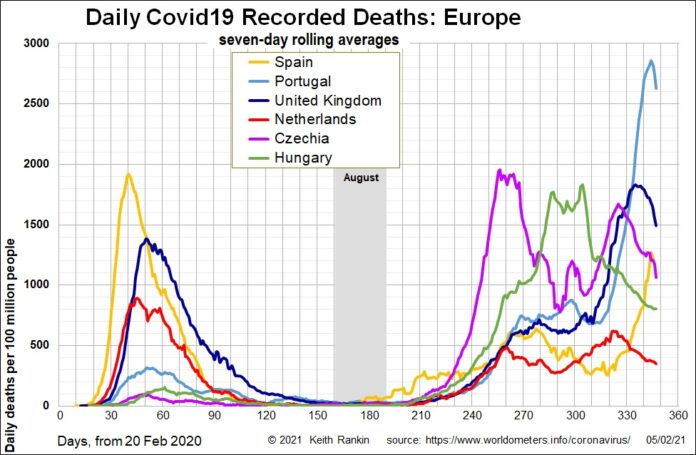
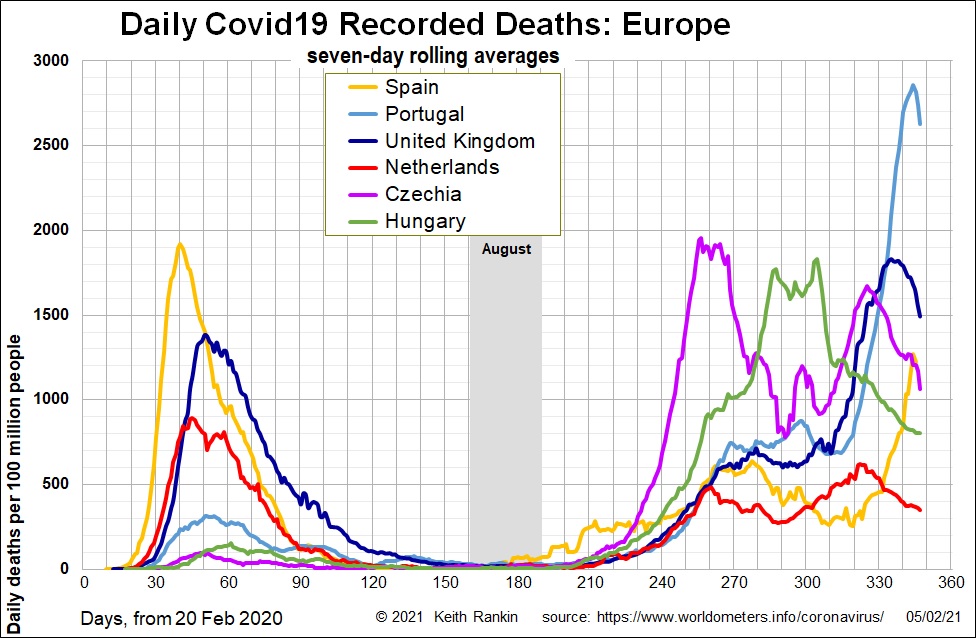
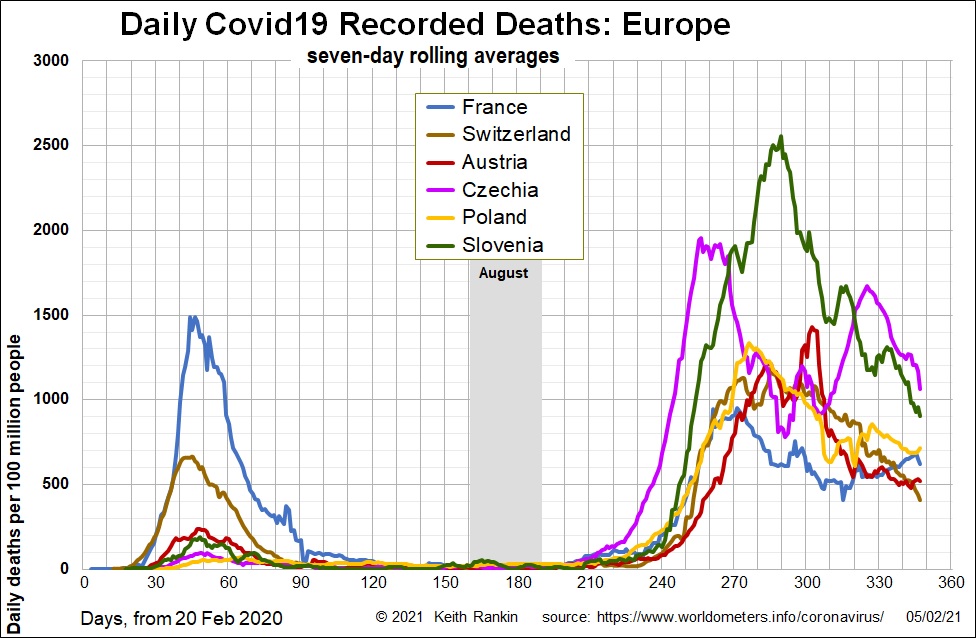
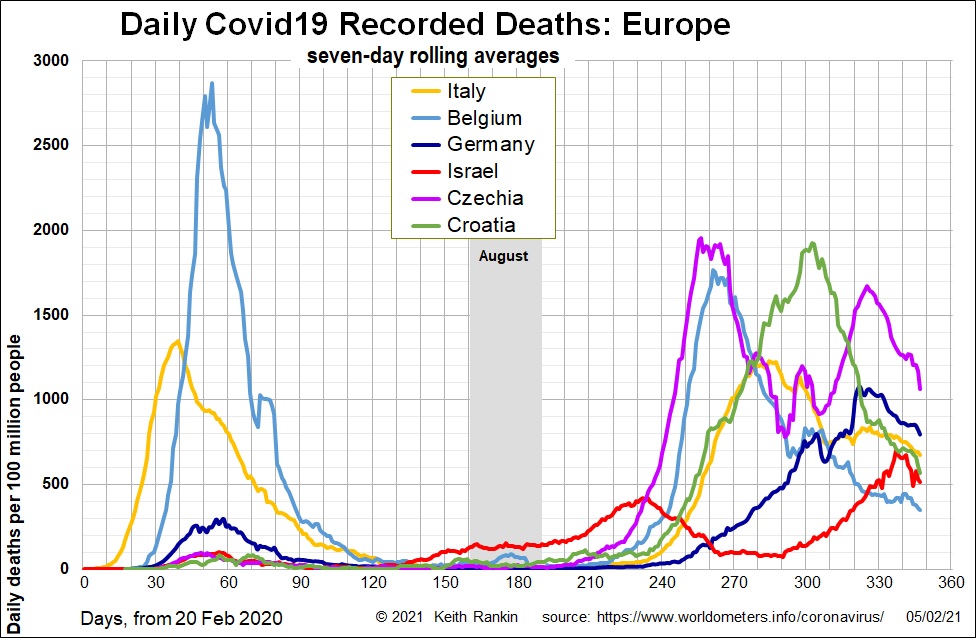
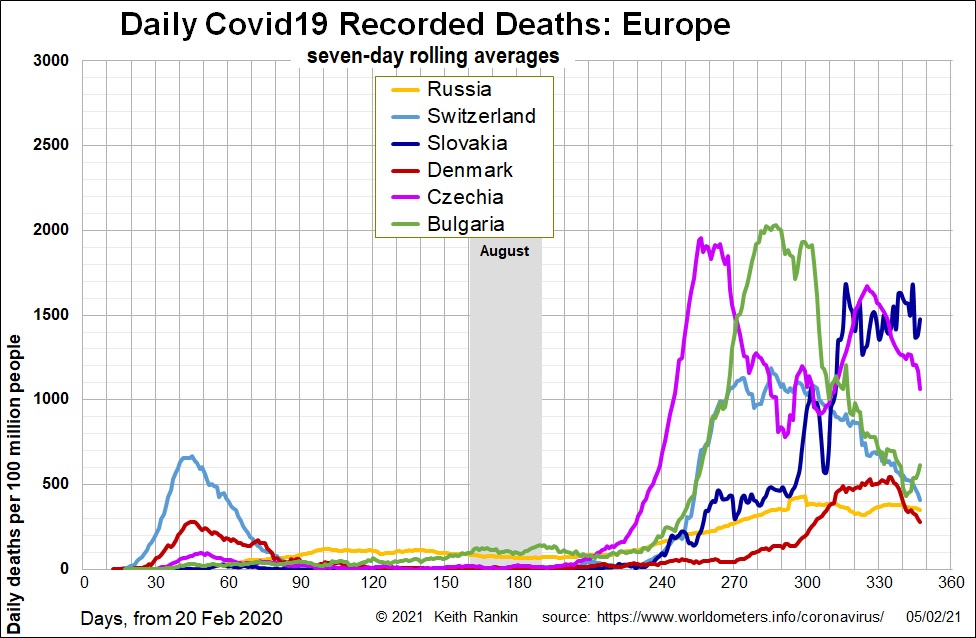
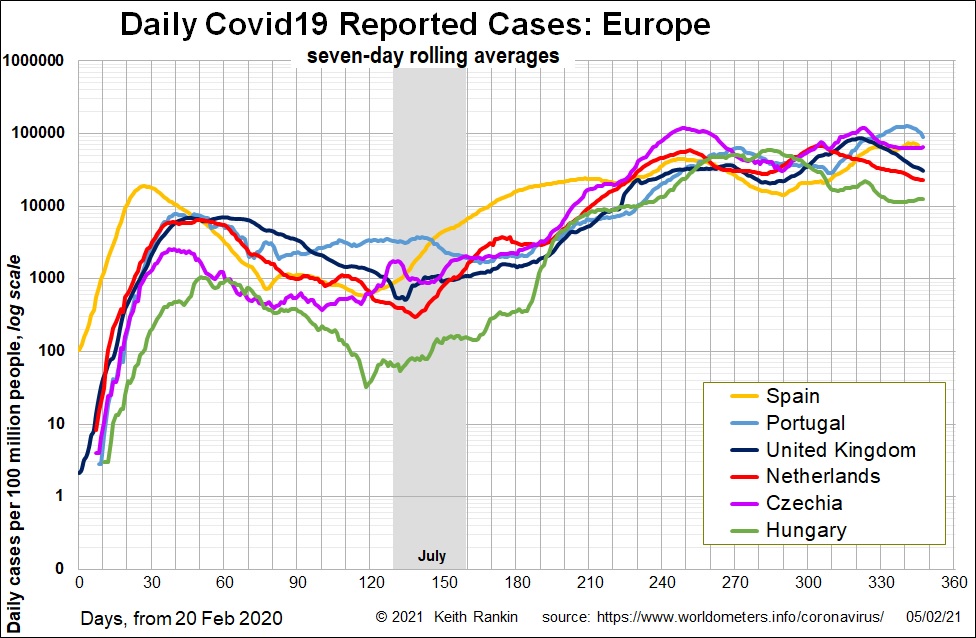
Rear-View Picture of Covid19 Deaths in Europe. Chart by Keith Rankin.
Analysis by Keith Rankin.
Rear-View Picture of Covid19 Deaths in Europe. Chart by Keith Rankin.Rear-View Picture of Covid19 Deaths in Europe. Chart by Keith Rankin.Rear-View Picture of Covid19 Deaths in Europe. Chart by Keith Rankin.Rear-View Picture of Covid19 Deaths in Europe. Chart by Keith Rankin.
Before noting the role of Czechia – the Czech Republic – in the most lethal wave of the Covid19 pandemic in Europe, we should note the tragic recent circumstance of Portugal. In the first chart above, we see that Portugal, a country that in April performed very well compared to its neighbours, should have now suffered so much. One of the problems was that Portugal was never able to throw‑off Covid19 to the extent that its neighbours did. This has the look of a country that took very strong domestic measures, but kept its international borders open – especially its air border. This is especially pertinent in light of Portugal’s relationship with Brazil.
The other part of the Portugal story is the close correlation that Portugal’s death statistics show with the United Kingdom, a country that has had long economic and tourist ties with Portugal.
I have previously attributed Spain’s early resurgence of Covid19 to its strong population links with the United Kingdom, especially in the context that both the United Kingdom and Portugal were much slower to shake‑off Covid19 in May and June than were other West European countries.
Nevertheless, the overall picture in Europe was that Covid19 was beaten, especially if looking at death statistics using charts with a simple arithmetic axis. Czechia had had a successful lockdown for about four weeks in March and April. Complacency then set in, alongside the concern in Europe about the economy and the summer tourist season. A clue may have been in this 1 July 2020 BBC story: Czechs hold ‘farewell party’ for pandemic.
Then, in the autumn, whoa!!
In these charts, clearly Czechia leads the way in the second European wave, with deaths peaking in early November. Only Belgium has a similar mortality peak in November, about a week after Czechia’s.
The Covid19 discussion in the international media – and in places such as Wikipedia – focussed on the domestic experience and emphasised the very first introductions. It seems that, while countries were taking very strong domestic measures to constrain Covid19, too many countries did too little too late on their international borders. There was too much focus on the mythical ‘R’‑number (giving the impression that every infected person was a spreader), and on ‘flattening the curve’ (ie tolerating this coronavirus much as we once tolerated measles). Authorities were trying to curb domestic cases of the virus while leaving the tap on. Indeed, in New Zealand, in the first week of the March lockdown, the edict to self-isolate was not enforced while domestic lockdown breaches were treated sombrely. Subsequent enforceable quarantine processes were introduced. Yet it took many months before these measures were managed properly. Other countries clearly did not pay due attention to the many separate introductions of Covid19 into their countries.
Previously, I have noted the huge rise in Covid19 in Caribbean holiday destination over the northern summer. Probably the main incursions here came from the United States – which had much higher levels of domestic covid in June than did European countries. But in these Caribbean countries, Americans and Europeans mingled, and Europeans brought it back.
Perhaps even more significantly, Europe is the major target tourist destinations for United States tourists. Americans have shorter holidays than Europeans, so they tend to focus the key cities in their Lonely Planet (and other) guidebooks. One of those cities in Europe is Prague, the historic capital of Czechia. Prague is particularly known – like Barcelona – as a youth ‘must visit’ destination. Many young Americans and Europeans like to visit Prague before they return home to their studies. Another part of the story is that such young Americans booked cheap airfares in advance, and were unable to get refunds. So they went ahead with their trips, sometimes with misgivings, but also with the bravado of youth.
It looks as though there were other similar trans‑Atlantic introductions of coronavirus into the other main tourist cities of Europe, especially from July to September. And European Union bureaucracy countries like Belgium have very large numbers of border entries and exits in all months, and exits and entries in the holiday months of July and August.
From Prague, there seems to have been a spread into the other more westernised Eastern European countries. Another part of the story is that Russia had quite a lot of cases over the summer, and countries along the Black Sea – including Bulgaria – may have got much of its Covid from Russia.
If I am correct, then young infected visitors to Prague (many asymptomatic) will have first infected young locals, who in turn will have infected their parents and grandparents. Hence the death peak in late October and November, two to three months after the peak tourist inflows. Czechia then suffered again, with a huge Christmas outbreak. Good King Wenceslas might have been crying in his Bohemian grave.
Czechia’s October tragedy preceded by a long incline of cases. Chart by Keith Rankin.
I have just included one chart that shows reported cases of Covid19, and is charted using the logarithmic scale to show trends in their early stages. This shows that, from low levels, cases in Czechia started rising in June. Then, from July to early January, cases in Czechia were being reported at a higher rate than in the United Kingdom. The steep rise in reported cases dates from early September, suggesting at the rise in infections happened in August, peak visitor season. United States’ students return to their studies at various dates in September.
This chart also shows how Portugal was unable to ‘shat the door’ on the covid virus in June and July. After that, Portugal followed the European norm – including a period of slow exponential growth in September and October. It’s only in January 2021 that the outbreak erupted in Portugal, making that country pretty much the worst affected in the world in January.
University of Canberra Professorial Fellow Michelle Grattan and University of Canberra Vice-Chancellor and President Professor Paddy Nixon discuss the week in politics.
This week Michelle and Paddy discuss the first parliamentary sitting week of the year, including the government’s plan to vaccinate the populace by October, the prime minister’s appearance before the press club outlining his plans for the year, and the unexpected problem backbencher Craig Kelly has created for the liberal party.
Why do we see different colours when we close our eyes? — Anais, aged 7
Hi Anais, thanks for your great question!
The first thing to say is that seeing colours when we close our eyes is totally normal. It doesn’t mean there’s a problem with your eyes (unless what you see changes drastically, but we’ll talk about that later).
There are a few different situations that can cause you to see colours with your eyes closed. The first one is if you shut your eyes in the daytime, in a bright room or outside. Some light does go through your closed eyelids. So you might see a dark reddish colour because the lids have lots of blood vessels in them and this is the light taking on the colour of the blood it passes through.
But often we see different colours and patterns when we close our eyes in the dark.
I certainly do! When I first shut my eyes in the dark, I see a pattern that’s full of dots and sparkles. Then when I’m in the dark for a longer time, I see swirls and waves of coloured dots travelling through my vision.
I know what I’m seeing is not made by something real, because it’s always changing and seems very random.
An artistic depiction of the patterns and colours we sometimes see at night.Al2/Wikimedia Commons, CC BY
You can also see these with your eyes open, particularly when you’ve been in the dark for a while, maybe when you have woken up in the middle of the night (if there isn’t too much stray light coming in from the window or elsewhere).
These perceptions are what scientists call “phosphenes” — the sensation of light that’s not actually caused by light. They can start in the eye or the brain, but the ones you are talking about are usually due to the normal functioning of the retina. The retina is the layer that lines the inside of the back of your eye that detects light.
Why does it happen?
These phosphenes are a normal part of how our eyes work. Our eyes don’t turn off in the dark, but instead they create very weak internal signals that mimic light.
These signals are constantly being made by the cells at the back of your eyes.
The swirls and waves we see are made by changes in activity from these cells. The blobs may be coloured because the cells in your eyes that detect colour also show this activity.
These signals are transmitted to the brain, and the brain interprets this random activity. Your brain doesn’t know they weren’t produced by real light, so we think we’re seeing coloured lights and patterns that are not there. It’s a kind of illusion!
And what about when you rub your eyes?
You might also see colours when you rub your eyes. This is because pushing (softly!) on your eyeballs causes physical force to be applied to the light detectors at the back of your eyes. This force can then create the phosphenes we’ve spoken about. You might see a dark circle surrounded by a ring of light where you have pushed on your eye.
Some people notice flashes of light when they move their eyes quickly, particularly if they’ve gotten up in the middle of the night in a dark room. As we get older, the clear jelly in the back section of the eye gets more watery. This fluid can move around a bit when the eye is moved quickly. It can tug on your eyes’ light detectors and causes you to see a flash of light.
You might notice different colours when you’re gently rubbing your eyes. This is caused by the extra pressure on the cells that detect light.Shutterstock
Is there something wrong with us?
Seeing colours when you close your eyes is totally normal. It’s just part of the way your eyes work. Some people notice them, and some do not.
However, much more obvious phosphenes can occur in some eye diseases.
If what you’re seeing has changed, and the patterns of light become much more noticeable or hang around for longer, it could indicate a problem.
For example, bright flashing can be caused by a detached retina, which is where your retina partially comes away from the back of your eyeball, and which needs to be treated as an emergency.
Also, some people get a “visual aura” when they have a particular kind of headache called a migraine. High pressure inside your eyeballs can also cause phosphenes.
If what you’re seeing has drastically changed, or you’re worried about what you’re seeing, it’s best to visit your eye care provider, a doctor or an optometrist.
Hello, curious kids! Do you have a question you’d like an expert to answer? Ask an adult to send your question to curiouskids@theconversation.edu.au
I awoke one morning late last year to find a bright red bauble at the foot of my bed. It wouldn’t have looked amiss adorning a Christmas tree. But it felt ready to explode. It was my big toe, and this was my first encounter with gout.
In good company
With a history spanning more than 4,500 years, gout is among our earliest recorded diseases. Hippocrates, traditionally regarded as the father of medicine, called it “the unwalkable disease”, because it was very painful for people with gout to walk.
Many famous historical figures suffered with gout, including Christopher Columbus, Henry VIII, Benjamin Franklin and Beethoven. It became known as “the disease of kings”.
This moniker also reflects the fact gout has historically been associated with indulging in rich food and excessive alcohol. Scientific evidence today suggests this may have something to do with it, though the common belief drinking port specifically causes gout is unfounded.
Today, no longer just a disease of kings, the prevalence of gout is increasing around the world. Almost one in 20 Australians have had at least one attack of gout.
And some stigma still clings to the condition. Often gout is seen as being self-inflicted, a mark of overindulgence. But living with gout has far-reaching implications, hampering a person’s ability to participate in everyday life.
Gout is the most common form of inflammatory arthritis. It’s caused by sodium urate crystals forming in the joints. While the big toe is particularly susceptible, gout can also affect the ankles, knees, elbows, wrists and fingers.
Urate, or uric acid, is an end-product of the breakdown of biochemicals called purines, which are both components of your DNA and absorbed into the body through the foods you eat. Urate levels reflect how much is made in the liver and how much is flushed out when you go to the toilet.
If your urate levels become too high, the urate turns into crystals. When urate crystals form in the fluid cushioning a joint, the body’s defence forces see them as foreign invaders. Inflammation and debilitating pain follow.
Gout can be incredibly painful.Shutterstock
What causes gout?
A high level of urate in the blood is the greatest risk factor for gout. But what causes high levels of urate? While we don’t know exactly, several factors certainly contribute.
A tangled web links urate, gout and other metabolic diseases, including type 2 diabetes and high blood pressure. Being overweight is a common factor.
Gout can run in families, with genetics playing a key role in determining urate levels. For example, genetic differences can impair urate excretion, thereby increasing blood urate levels.
Gout is also more common in males — almost 80% of people with gout are male. One reason for this is the female sex hormone oestrogen lowers urate levels, and is therefore protective against gout in pre-menopausal women.
Many people who have one gout attack will go on to have more. In one study, 70% of people who had an attack of gout went on to have another within a year.
If you suffer two or more attacks, management of chronic gout involves taking a urate-lowering therapy such as allopurinol or febuxostat.
Beer is often singled out as it’s relatively purine-rich. But it’s a good idea to cut back on all types of alcohol.Shutterstock
So rather than purely focusing on purine-rich foods, consuming less in total can better control urate levels while improving your overall health. Limiting alcohol is also a good idea.
Epilogue
With a red bauble stuck on the end of your foot, you learn to appreciate how important your big toe is for mobility.
Eventually, I managed to drop my COVID kilos, by watching portion sizes, not going back for seconds, replacing unhealthy snacks with fruit, and cutting back on alcohol.
And with that, I’m hoping my first encounter with gout might be my last. Although keeping off the kilos will require constant vigilance, the memory of that painful red bauble should be a powerful motivator.
When you ask that question, three names come to mind: Roger Federer, Rafael Nadal and Novak Djokovic.
A simple way to compare tennis players is to look at how many grand slam tournaments they have won. That includes victories at the Australian Open, the French Open, Wimbledon in the UK and the US Open.
But this doesn’t take into account how many tournaments they’ve played, which tournaments they’ve played, how far they progressed in each tournament, and who they played against.
Roger Federer, Rafael Nadal and Novak Djokovic.Kyodo via AP Images/AAP Image Kelly Barnes
Probably the best player
My method estimates the probability of a player winning a match in a grand slam tournament. The player with the highest estimated probability of winning a match is then deemed the best player.
Using probability naturally accommodates how many matches and tournaments the player has played, and acknowledges the strong performance of a player who makes a final but doesn’t win the tournament.
The method builds a statistical model to estimate winning probabilities for each player from grand slam data.
By using a technique called regression modelling, it accounts for the fact the winning probability may depend on the quality of the opposition and the grand slam played. For example, some players have preference for hard courts (used at the Australian and US Opens) over clay (used at Roland Garros, home of the French Open).
The opposition quality is inferred from their ranking, and we consider five groups: the top 10, top 20, top 50, top 100 and outside the top 100. These group choices are consistent with terminology used by commentators and pundits.
Another advantage of using a statistical model is that we can make the most of the available data, which is quite small given there are only four grand slam tournaments per year.
For example, if the data support it, the model can enforce a similar pattern of performance against the quality of opposition across tournaments. This is a form of “borrowing of strength” to increase the accuracy of probability estimates from small datasets.
Novak Djokovic of Serbia.AAP Image/Dave Hunt
Oh, the uncertainty
Using a statistical approach allows us to quantify the uncertainty in probability estimates. Here we communicate uncertainty as an interval (lower and upper limit), that contains the true winning probability with a 95% chance.
So, for example, if the estimated winning probability for a player is 0.77 with an interval of 0.63 to 0.86, it means that our best guess of the winning probability is 0.77. But there is a 95% chance the actual winning probability is between 0.63 and 0.86. This tells us how much uncertainty there is about our best guess.
The amount of uncertainty depends on the number of matches played and the winning probability. There will naturally be more uncertainty if the actual winning probability is around 0.5, that means an even chance of winning or losing.
The results are shown in the figures (below). Each square represents the best probability estimate for Federer, Nadal and Djokovic, and the vertical line represents the uncertainty interval.
For the Australian Open, there is evidence to suggest that Djokovic is the top-performing male player.
But given the overlapping uncertainty intervals in the probability estimates with the other players, it is difficult to definitively state this.
It is difficult to separate the three players at the US Open. Wimbledon appears to be the tournament that Federer shines the most relative to the other players, but again there is significant overlap in the intervals.
Roger Federer of Switzerland.Kyodo via AP Images
Although there is some evidence that Nadal is the worst-performing player at the Australian Open and at Wimbledon (which is played on grass courts), he is the undisputed champion at the French Open.
Incredibly, Nadal has an estimated probability around 0.93 to win a game against a top 10 player at this tournament. This clearly shows Nadal’s dominance on clay courts. The French Open is a relative Achilles’ heel for Federer.
The analysis reveals some other interesting results. For example, the results suggest Nadal performs similarly against top 20 and top 50 players, as does Djokovic.
But there is generally a big drop in winning probability against top 10 players.
Apart from some cases (Nadal at the French Open, Djokovic at the Australian Open and Federer at Wimbledon), the chance that one of these champion players beats a top 10 player in a grand slam isn’t much better than a coin toss.
And the best player is …
On the women’s side, it’s widely accepted that Serena Williams is the top player in the modern era, and possibly of all time. Williams has won the most grand slams of any player, male or female.
For the men it’s less so clear. So in response to the question of who is the best male tennis player of the modern era, the answer is “it depends”.
Rafael Nadal of Spain.AAP Image/Kelly Barnes
If pressed for an answer, it’s hard to go past Rafael Nadal. He has dominated a grand slam (French Open) unlike the other players, while remaining competitive in the other three slams.
A more comprehensive analysis would consider data from all tournaments, not just grand slams, and this would help to reduce uncertainty in the winning probability estimates.
It should also be noted that these are retrospective winning probability estimates, and cannot be used to predict outcomes for future tournaments. Predictive statistical models would focus on more recent tennis data.
Many of these stories are the product of investigative journalism. This is not the sort of “journalism” you see in a tabloid rag or a late-night rant on Sky News. It is the type of high-quality journalism that takes time and patience.
According to the United Nations, investigative journalism is:
the unveiling of matters that are concealed either deliberately by someone in a position of power, or accidentally, behind a chaotic mass of facts and circumstances — and the analysis and exposure of all relevant facts to the public.
Investigative journalism is not about making friends
In many cases, investigative journalism means calling out wrongdoing. Predictably, those on the receiving end of journalists’ investigations may not like it.
The Four Corners program on Chau Chak Wing aired in 2017.Dan Peled/AAP
The story was a culmination of a joint investigation by the ABC and Fairfax (now owned by Nine), and involved investigative journalist Nick McKenzie, among others.
Chau sued the ABC, Fairfax and McKenzie in defamation. Earlier this week, he had a big win, with the Federal Court awarding him $A590,000 in damages.
Justice Steven Rares decided the program conveyed the idea Chau had knowingly bribed a United Nations official, and was a member of the Chinese Communist Party, among other things. The allegations in the program were “seriously defamatory”, justifying a large damages award.
For example, after the judgment was released, Liberal MP Tim Wilson used the legal shield of parliamentary privilege to table FBI documents relating to the allegations considered in the defamation case.
These documents were not public before the case was handed down. However, in my opinion, if the documents were publicly available a few years ago, and if they were admissible in Chau’s defamation action, they may have changed some of the court’s findings on the defendants’ liability.
That is because the documents are relevant to the allegation Chau had paid money to the UN official, John Ashe.
But, as Justice Rares explained in 2018, material covered by parliamentary privilege – including documents tabled in parliament – can’t be used in this way. The Parliamentary Privileges Act provides you can’t use these sorts of documents in a court proceeding to establish the credibility of a person, like a journalist.
Chau has never been charged with any criminal offence and there is no suggestion by The Conversation or the author that he has engaged in any criminal conduct.
In the Chau case, the Federal Court decided in 2018 the media defendants couldn’t rely on justification. The defendants appealed, and lost. The reasons were technical, but to summarise: the defendants could not show they could prove the facts to justify the program.
At one stage of the proceedings, the media defendants relied on a defence called “qualified privilege”. This is like a public interest defence, which might help in cases where you report something defamatory out of some duty.
The media defendants abandoned their qualified privilege defence in 2020. The defence requires the conduct of the defendant was “reasonable in the circumstances” — they may have been worried the judge would not have thought they were reasonable.
Law reform ahead to protect public interest journalism
Chau’s case highlights the difficult situation facing Australian investigative journalists. They want to uncover dirt, but in doing so expose themselves to significant litigation risk. And if they get it wrong, that risk can come back to bite them.
Journalists need to have the facts to support not just what they say explicitly, but what their work implies. This requires a lot of work and time, and is not helped by the significant job losses in the media industry. Reporters’ time is precious. But so are reputations.
A new defence will make journalists’ lives easier. In 2020, the states and territories agreed to reform the uniform defamation laws. Although the agreed amendments are not yet in force, they should be in 2021.
The changes include a new defence of “publication of matter concerning an issue of public interest”.
This defence will allow the media to rely more heavily on editorial judgement in publishing their investigative work. The defendant will not be liable if they “reasonably believed that the publication of the matter was in the public interest”.
Would this have made a difference in the Chau case? Perhaps.
But even once this new law is in force, journalists will still need to tread carefully. As long as they are speaking truth to power, investigative journalism will remain a risky business.
An independent expert panel today rejected a proposal to expand the operations of the Dendrobium coal mine under Sydney’s drinking water catchment. This is a significant and welcome decision. However, flawed environmental laws that enabled the proposal to get so far must be overhauled.
The mine’s proponents had been seeking to extract 78 million additional tonnes of coal out to 2048. The New South Wales Department of Planning, Industry and Environment (DPIE) had recommended the mine be approved. The backing came despite grave concerns over the mine’s impact on drinking water supplies.
We are experts in environmental regulation and one of us, Pete Dupen, is a former mining manager for the state government agency WaterNSW. Our research shows the damage mining causes to Sydney’s water supplies is unsustainable, and regulation in Australia has largely failed to set firm limits on cumulative damage to the environment.
The problem is rife in both state and federal laws, and must urgently be addressed.
The mine extension was rejected due to concerns over damage to water supplies.Mark Baker/AP
‘Unacceptable’ damage
NSW’s Independent Planning Commission (IPC) was tasked with assessing the Dendrobium mine proposal due to the high number of objections received.
The multinational company that owns the mine, South32, wanted to extend underground longwall mining at the operation until 2048.
Coal from Dendrobium, located west of Wollongong, is used in steel-making in Australia and overseas. South32 argued the expansion would deliver a net economic benefit of A$2.8 billion.
The extension would have allowed 78 million tonnes of coal to be extracted from two new areas comprising 21 “long wall” panels, 18 of which would have been more than 300 metres wide.
The panels would have been dug out from beneath a so-called “Special Area” – land where, under law, stored water must be protected and ecological integrity maintained. The area covered by the proposed expansion supplies drinking water to much of Greater Sydney.
In its verdict released on Friday, the IPC said the project would cause “unacceptable” damage and should be refused.
Among the reasons for the decision were:
the risk of significant “subsidence” or sinking of the ground’s surface resulting from the longwall mine design. This would degrade 25 watercourses and swamps
potentially significant surface water losses into the groundwater system, damaging ecological processes and contribute to increased concentrations of metals in drinking water
the impact of past and existing longwall mining in the catchment, including the (as yet unquantified) loss of surface water flows from some sections of rivers and streams
uncertainty around managing mine water inflow (surface waters permanently diverted underground) after mine closure.
No line in the sand
Thankfully in this case, the IPC took into account cumulative damage to water supplies when making its decision. But as precedent shows, that consideration is not a given.
Australian laws tend to focus on the impacts of individual projects in isolation. Crucially, they fail to use clear thresholds of unacceptable cumulative environmental impact – a line in the sand, beyond which damage will not be tolerated.
The failing is reflected in the recommendation by NSW planning officials that the Dendrobium extension be approved. If cumulative damage was properly considered earlier, the proposal would have been scuppered years ago.
Climate change and drought have crippled urban water supplies in recent years. Yet underground coal mines have been allowed to eat away at Sydney’s water catchments, Pac-Man like, for decades.
Our research shows existing coal mines in the catchments of Sydney’s “Metropolitan Special Area” have, or will, divert 450 billion litres of drinking water into underground fractures. That’s almost as much water as is contained in Sydney Harbour.
A NSW government-appointed expert panel recently examined the risk mining activities posed to the water quantity in Greater Sydney’s water catchments. Among its recommendations was an interagency taskforce to determine how much water loss due to mining was acceptable.
Yet even as the IPC assessed the Dendrobium proposal, this question had not yet been answered. This is despite the NSW government in April last year accepting all 50 of the panel’s recommendations.
The cumulative damage to Sydney’s drinking water supplies is not being properly addressed.Shutterstock
The draft conditions for the expansion, set by DPIE, would not have addressed cumulative impacts before approval was granted.
Several years ago, WaterNSW developed cumulative impact criteria to be applied to mining developments before approval. But the document remains a draft and has not been published, for reasons unknown.
A national problem
The problems we raise are not isolated to NSW environment law. At a federal level, the Environment Protection and Biodiversity Conservation (EPBC) Act needs an urgent overhaul.
The Morrison government last week released an independent review of the laws by Professor Graeme Samuel. Among the report’s many scathing criticisms were that “cumulative impacts on the environment are not systematically considered”.
Samuel said Commonwealth environment authorities assess development proposals only when they meet certain criteria.
Even when the Commonwealth does scrutinise a proposal, decisions are made only on a project-by-project basis, rather than as part of an “integrated system of environmental management that ensure cumulative impacts are well managed”, Samuel said.
Weaknesses in Australian federal and state laws, and enforcement, often means cumulative effects are not considered on paper or in practice.
For example, the Victorian Auditor-General recently found measures designed to mitigate the cumulative effect of residential developments on Melbourne’s urban fringe were not being implemented.
Across Australia, the law does not require decision-makers to adequately consider cumulative effects of development.Shutterstock
Shoring up our drinking water
Few environmental problems are more pressing than permanent impacts on a major city’s water supply. But protecting water resources from cumulative harm requires the following
well-defined thresholds, set with rational justification and able to be changed as new information arises
robust measurements to assess if thresholds are being approached or exceeded
clear conditions for developers that require concrete actions if thresholds are crossed
transparency and trust in how the decisions are being made.
Clearly, the law and associated planning processes must consider the accumulating damage stressing the natural world. Otherwise, we may reach irreversible tipping points without even realising it.
An independent expert panel today rejected a proposal to expand the operations of the Dendrobium coal mine under Sydney’s drinking water catchment. This is a significant and welcome decision. However, flawed environmental laws that enabled the proposal to get so far must be overhauled.
The mine’s proponents had been seeking to extract 78 million additional tonnes of coal out to 2048. The New South Wales Department of Planning, Industry and Environment (DPIE) had recommended the mine be approved. The backing came despite grave concerns over the mine’s impact on drinking water supplies.
We are experts in environmental regulation and one of us, Pete Dupen, is a former mining manager for the state government agency WaterNSW. Our research shows the damage mining causes to Sydney’s water supplies is unsustainable, and regulation in Australia has largely failed to set firm limits on cumulative damage to the environment.
The problem is rife in both state and federal laws, and must urgently be addressed.
The mine extension was rejected due to concerns over damage to water supplies.Mark Baker/AP
‘Unacceptable’ damage
NSW’s Independent Planning Commission (IPC) was tasked with assessing the Dendrobium mine proposal due to the high number of objections received.
The multinational company that owns the mine, South32, wanted to extend underground longwall mining at the operation until 2048.
Coal from Dendrobium, located west of Wollongong, is used in steel-making in Australia and overseas. South32 argued the expansion would deliver a net economic benefit of A$2.8 billion.
The extension would have allowed 78 million tonnes of coal to be extracted from two new areas comprising 21 “long wall” panels, 18 of which would have been more than 300 metres wide.
The panels would have been dug out from beneath a so-called “Special Area” – land where, under law, stored water must be protected and ecological integrity maintained. The area covered by the proposed expansion supplies drinking water to much of Greater Sydney.
In its verdict released on Friday, the IPC said the project would cause “unacceptable” damage and should be refused.
Among the reasons for the decision were:
the risk of significant “subsidence” or sinking of the ground’s surface resulting from the longwall mine design. This would degrade 25 watercourses and swamps
potentially significant surface water losses into the groundwater system, damaging ecological processes and contribute to increased concentrations of metals in drinking water
the impact of past and existing longwall mining in the catchment, including the (as yet unquantified) loss of surface water flows from some sections of rivers and streams
uncertainty around managing mine water inflow (surface waters permanently diverted underground) after mine closure.
No line in the sand
Thankfully in this case, the IPC took into account cumulative damage to water supplies when making its decision. But as precedent shows, that consideration is not a given.
Australian laws tend to focus on the impacts of individual projects in isolation. Crucially, they fail to use clear thresholds of unacceptable cumulative environmental impact – a line in the sand, beyond which damage will not be tolerated.
The failing is reflected in the recommendation by NSW planning officials that the Dendrobium extension be approved. If cumulative damage was properly considered earlier, the proposal would have been scuppered years ago.
Climate change and drought have crippled urban water supplies in recent years. Yet underground coal mines have been allowed to eat away at Sydney’s water catchments, Pac-Man like, for decades.
Our research shows existing coal mines in the catchments of Sydney’s “Metropolitan Special Area” have, or will, divert 450 billion litres of drinking water into underground fractures. That’s almost as much water as is contained in Sydney Harbour.
A NSW government-appointed expert panel recently examined the risk mining activities posed to the water quantity in Greater Sydney’s water catchments. Among its recommendations was an interagency taskforce to determine how much water loss due to mining was acceptable.
Yet even as the IPC assessed the Dendrobium proposal, this question had not yet been answered. This is despite the NSW government in April last year accepting all 50 of the panel’s recommendations.
The cumulative damage to Sydney’s drinking water supplies is not being properly addressed.Shutterstock
The draft conditions for the expansion, set by DPIE, would not have addressed cumulative impacts before approval was granted.
Several years ago, WaterNSW developed cumulative impact criteria to be applied to mining developments before approval. But the document remains a draft and has not been published, for reasons unknown.
A national problem
The problems we raise are not isolated to NSW environment law. At a federal level, the Environment Protection and Biodiversity Conservation (EPBC) Act needs an urgent overhaul.
The Morrison government last week released an independent review of the laws by Professor Graeme Samuel. Among the report’s many scathing criticisms were that “cumulative impacts on the environment are not systematically considered”.
Samuel said Commonwealth environment authorities assess development proposals only when they meet certain criteria.
Even when the Commonwealth does scrutinise a proposal, decisions are made only on a project-by-project basis, rather than as part of an “integrated system of environmental management that ensure cumulative impacts are well managed”, Samuel said.
Weaknesses in Australian federal and state laws, and enforcement, often means cumulative effects are not considered on paper or in practice.
For example, the Victorian Auditor-General recently found measures designed to mitigate the cumulative effect of residential developments on Melbourne’s urban fringe were not being implemented.
Across Australia, the law does not require decision-makers to adequately consider cumulative effects of development.Shutterstock
Shoring up our drinking water
Few environmental problems are more pressing than permanent impacts on a major city’s water supply. But protecting water resources from cumulative harm requires the following
well-defined thresholds, set with rational justification and able to be changed as new information arises
robust measurements to assess if thresholds are being approached or exceeded
clear conditions for developers that require concrete actions if thresholds are crossed
transparency and trust in how the decisions are being made.
Clearly, the law and associated planning processes must consider the accumulating damage stressing the natural world. Otherwise, we may reach irreversible tipping points without even realising it.
Myanmar has once again returned to military rule, with a year-long state of emergency declared by the army.
When military dictators ruled Myanmar from 1962 to 2010, they were able to maintain tight control over the people through the country’s extensive intelligence apparatus and harsh tactics such as imprisonment, torture and mass killings. As a result, Myanmar’s people lived in virtual silence for decades.
After a decade-long political transition that brought Aung San Suu Kyi’s National League for Democracy (NLD) to power, Myanmar is now a changed place. What used to be a pariah state is increasingly connected to the world. Civil society has begun to be established and public awareness about freedom, democracy, human rights and development has increased drastically.
Given this, many are closely watching how people will react to the military taking back control of the country and tossing aside a government that won a massive popular mandate only a few months ago.
Already, we are seeing signs of non-violent protests and civil disobedience against the coup, particularly on social media. At least one public protest has also been reported in Myanmar’s second-biggest city. For the military, maintaining “social control” may not be as easy as it was before.
Resistance to the coup has occurred mainly online, though sporadic protests are popping up on the streets.NYEIN CHAN NAING/EPA
More internet access, but surveillance continues
The internet and social media undoubtedly shape social interactions and everyday life today in Myanmar — a massive change from even just a decade ago when SIM cards for mobile phones cost over US$1,000.
Today, around 90% of Myanmar’s 54 million people have access to a phone with internet connectivity, and according to one estimate, nearly 22 million people use Facebook as their primary source of online news and information.
However, the ubiquity of social media has not guaranteed freedom of expression. In fact, in recent years, it has gotten worse.
The dramatic increase in the use of mobile phones and the internet, for instance, allowed the authorities to use widespread digital surveillance to maintain social control. And in 2018, the president’s office formed a team of social media monitors, whose work some opponents have questioned.
The NLD also did not liberalise the media. In fact, media freedom surprisingly was not a priority for the party. Journalists have been jailed, arrested and harassed in recent years, and hundreds of news sites have been blocked, ostensibly for spreading “fake news”.
Moreover, the state maintains control over the leading broadcasters and publications and a monopoly on telecommunications.
In addition, the military already has in place numerous laws to enforce social control. For example, the controversial Telecommunications Law, passed in 2013, empowers the government to temporarily suspend and restrict telecommunication services and collect data from people.
It also makes defamation a criminal offence, which has been used numerous times in recent years for criticising or insulting the government and military. One youth activist described the chill this has caused:
It makes us censor ourselves. It creates fear in the youth community. We are still living in fear.
Those wishing to hold an assembly or protest must also adhere to the Peaceful Assembly and Peaceful Procession Law, passed in 2011. Demonstrators have been arrested for failing to comply with the law or violating the vaguely phrased limits placed on speech by the statute.
Section 505(b) of the penal code is another overly broad law that prohibits speech that may cause “fear or alarm in the public” and lead others to “upset public tranquillity”. The law has long been used to curtail speech critical of the government. Even monks holding sit-in protests have been targeted.
The most visible protests against the coup have occurred outside Myanmar, such as this one in Thailand.Sakchai Lalit/AP
Public reactions so far: symbolic and spontaneous
Despite these draconian laws and state repression, young people have embraced nonviolent movements and campaigns to challenge the military’s rule in the past.
And public defiance is already being seen following this week’s coup. For instance, people have honked car horns and banged pots and pans to “drive out” the military in the same way they scare evil spirits from their homes.
Several organisations are releasing statements on social media condemning the coup, while many NLD supporters are turning their Facebook profiles black or replacing them with a red portrait of Suu Kyi.
Civil disobedience and boycotts are also gathering steam. Health workers at 70 hospitals and medical departments boycotted work this week, while others are tweeting images of red ribbons, the campaign’s symbol of resistance.
One of the doctors participating in the nationwide strike this week.LYNN BO BO/EPA
The huge Myanmar diaspora can also become a powerful resistance group worldwide. This week, migrant workers protested against the coup in Thailand, chanting “Shame on you, dictator”“. Similar protests have taken place in Japan, Australia and Canada.
The diaspora was effective in the past in bringing visibility to the harsh rule of the dictatorship in Myanmar and helping rally global support behind Suu Kyi.
Although the military rulers violently cracked down on nonviolent protests on many occasions in the past, including the famous Saffron Revolution of 2007, they failed to crush the people’s aspirations for democracy and justice.
Led by monks, as many as 100,000 anti-government protesters marched during the Saffron Revolution. The military responded with a harsh crackdown.AP
As the public defiance this week illustrates, the people of Myanmar are refusing to be silenced again. Because their actions appear to be spontaneous, however, it remains to be seen how effective a longer-term resistance campaign will be in the face of the state’s sophisticated surveillance apparatus.
This will require organisation and leadership on the ground. And with the detention of Suu Kyi, as well as scores of other activists, lawmakers and other NLD officials, the opposition may struggle to replace the central command needed to lead protesters in this way.
The international community will also need to continue to support the pro-democracy activists and put pressure on the military leaders, particularly as the initial outrage over the coup subsides.
The public has demonstrated its resilience before. They’ll need to show bravery and determination again to make the military feel vulnerable in its claims of legitimate rule.
Relaxing border restrictions for travellers from low COVID-19 risk countries would increase the risk of community cases in New Zealand by around 25%, says an article published today in the New Zealand Medical Journal.
This might not sound like a big increase in risk, but it means breaches like the one at the Pullman Hotel in Auckland last month will occur 25% more frequently.
This increases the chance of a community outbreak and the possibility that an alert level change would be needed to contain it.
With new more transmissible variants and more COVID-19 cases worldwide than ever before, this adds up to a significant risk.
Risk from isolation facilities
The work in the article builds on a mathematical model (originally developed by our team) to estimate the chances of community cases arising from our managed isolation facilities.
There is a small risk an infected traveller might arrive in managed isolation, return two negative tests, but be released after 14 days while still infectious.
The gold-standard nasal swab PCR test is good, but it can miss cases, especially in people who are early or late in the course of their infections.
So far, we haven’t seen this happen in New Zealand’s managed isolation system even though more than 100,000 people have passed through.
Risk from new arrivals
Instead, New Zealand’s problems in managed isolation have been caused by infected arrivals who go on to infect other guests or workers in the facility. Someone who picked up an infection in the last few days of their stay would leave the facility at their most infectious.
This is what happened last week at the Pullman, where during their stay several people were infected with the B.1.351 variant first identified in South Africa. We were lucky this incident didn’t spark a community outbreak.
Right now, we believe we need to do everything we can to reduce the risk of this type of breach. Otherwise another lockdown will become an inevitability.
The authors of the study claim the recent requirement for a pre-departure test will mitigate this risk. But pre-departure tests are not perfect and many travellers have already been taking these because they were required to by their airline or the country through which they transited. This alone is not enough.
We need the vaccinations
Once vaccines start to be more widely available, cases worldwide should start to drop to levels where a risk analysis like the one laid out in this new article will become useful. This will need to be accompanied by high vaccination rates here in New Zealand so our population is protected against the virus.
But we would not recommend using this recent risk analysis because it uses COVID-19 case numbers and fatality rates to estimate how prevalent the virus is in different countries.
This is not a reliable approach because it tells us how prevalent COVID-19 was two to three weeks ago, and by taking a country-wide average it could mask major variations within a country.
If we had been using this methodology last winter, Melbourne’s outbreak in June may well have spread here by the time border restrictions were brought back.
Instead, it would be better to use other indicators that give a more up-to-date and precise picture of COVID-19 hotspots. These would need to include how reliable a country’s COVID surveillance system was.
It will also be crucial to recognise the risk of people catching COVID-19 on their journey to New Zealand.
In-flight passenger transmission
The new study uses a very low estimate of the risk of in-flight transmission, whereas we know it is possible for a significant number of passengers to get infected on a long-haul flight.
People travelling from a low-prevalence country will often be on the same plane as others from high-prevalence countries, and this means there is a significant infection risk for everyone on the flight.
Many of us with friends and family across the Tasman have been looking forward to a travel bubble with Australia. Air New Zealand — which helped fund this new study — would also like to see an increased flow of travellers.
At the moment, we could allow visitors from Australia to enter with little extra risk as there are very few cases in the community there.
But — and it’s a big but — a travel bubble with Australia would free up places in managed isolation that might be filled by travellers from higher-risk countries. This would increase the chances of a serious border breach.
Right now, a travel bubble with Australia would need to be accompanied by a reduction in managed isolation capacity to not increase the risks of a community outbreak here in New Zealand.
It makes sense to have a risk-based border system based on the current rate of COVID-19 in different countries and we will need a framework of this type to relax border restrictions once the world begins to emerge from the pandemic.
But COVID-19 is more prevalent now than at almost any point in the past. At the moment, we need to do everything we can to reduce the risk of importing COVID-19 into the community, rather than take on additional risk.
The world must decide what needs to change to prevent events like the COVID-19 pandemic happening again, according to the former New Zealand prime minister Helen Clark.
The review’s full recommendations are due in May, but she spoke about the panel’s interim report at the University of Otago Public Health Summer School on February 1. Clark painted a grim picture of the findings to date, including:
pre-existing shortcomings in pandemic preparedness
no mechanisms for co-operation or financing when a crisis hits
key metrics such as the Global Health Security Index possibly giving false reassurances due to leadership and political factors.
‘One failure leading to another’
The review committee is developing an authoritative chronology of COVID-19. It’s a timeline of virus spread, knowledge acquisition, recommendation sharing and actions taken. Clark said this “will speak for itself” about the deadly delays the world suffered.
Helen Clark.GettyImages
The big questions arising from that chronology are:
why it took a month and two meetings for the WHO’s Emergency Committee to declare a public health emergency of international concern (PHEIC) — in a densely interconnected world where hours may be the difference between catastrophic spread and containment
why travel restrictions were specifically recommended against at that time, seeming to undercut the gravity of the PHEIC declaration
why the world stood around like “stunned mullets” while disaster unfolded.
The New York Times described the review committee’s interim report as a “bleak recounting” of “one failure leading to another” and a “slow, cumbersome pandemic alert system” with “obstructive responses of national governments”.
Global preparedness vital
The substance of Clark’s Otago University address hinted that the review’s final recommendations might include the need to:
reduce global barriers to a precautionary approach
fund and power the WHO at levels matching the role the world expects of it
overcome geopolitical tensions to empower the UN Security Council to declare a pandemic threat to global security and mobilise appropriate resources
ensure a revamped pandemic alert system is fit for purpose
enhance the speed of PHEIC declarations when appropriate.
We agree strongly with this final point. We note that WeChat searches for “SARS” spiked on December 1 2019 and there was most likely a positive “SARS coronavirus” laboratory report in Wuhan on December 30 2019.
What if COVID-19 had been worse?
Given that the International Health Regulations specifically identify SARS coronaviruses as pathogens of major concern to be reported within 24 hours, a PHEIC should arguably have been declared there and then.
Wuhan is a huge city, multiple cases were apparent, and we already knew SARS can spread from person to person. Responses were simply too small and too slow.
Furthermore, initial and ongoing advice by the WHO (such as no travel restrictions), though possibly in line with evidence at the time for some countries, was completely inappropriate for others, such as small island nations.
If SARS-CoV-2 had the fatality risk of SARS-CoV-1 (around 10%) or higher, it would have turned the disaster of the COVID-19 pandemic into a catastrophic global threat. It could have completely overwhelmed human systems and killed tens or hundreds of millions of people. We simply cannot allow such a threat to ever take hold.
We argue that the most important future distinction will be between declaring a PHEIC with, or without, accompanying global catastrophic biological risk (GCBR).
Early reports put the case fatality risk of COVID-19 at several percent. This was later downgraded. But had it been that high, far more stringent measures would have been justified to contain the virus. An initial overreaction can always be swiftly downgraded as information comes to light, but the reverse is not possible.
The World Health Organisation headquarters in Geneva: too slow, too cautious.www.shutterstock.com
No one can go it alone
If initial reports indicate some future emerging highly contagious respiratory pathogen has a case fatality risk of 10, 20 or 50%, then PHEIC with GCBR potential must be declared, without any mitigating language about cautious approaches or unrestricted travel.
As Helen Clark asserted, no measures will succeed unless the world learns to co-operate on threats that affect us all. The whole point of creating global institutions such as the UN and WHO was to deal with issues that no single country can deal with themselves.
If we do not use these institutions to govern the response when something threatens “the health of everyone in the entire world”, Clark asked, then when would we ever defer to them?
Countries must stop trying to go it alone. There is a strong case for multilateralism and the world needs to remove the obstacles to a precautionary approach. It should be of major concern that future pandemics may be bigger. Our responses simply must be better and faster.
At night on any one of hundreds of coral reefs across the tropical Pacific, larval fish just below the sea surface are gambling on their chances of survival.
Our latest research shows the brightness of the Moon could play a major role in that struggle for survival by affecting the availability of prey and keeping predators away.
Understanding how that works could help in fisheries management, specifically the prediction of changes to harvested fish stocks that allow us to anticipate how many adult fish can be taken without destabilising the fishery.
Many fish populations experience boom-and-bust cycles largely because parents routinely produce millions of offspring that have very low, but fluctuating, survival rates.
The large number of larval fish that are produced means any environmental conditions — for example, increased nutrients — that improve survival odds even only marginally can lead to a big influx in the number of surviving offspring.
Adult sixbar wrasse in courtship.Author?, Author provided
When the Sun goes down
In the past we failed to take into account the influences the night may have on fish development.
In our research we found the daily growth rates of the larvae of sixbar wrasse (Thalassoma hardwicke) around the island of Mo’orea, in French Polynesia, are strongly linked to phases of the Moon.
Their growth appears to be maximised when the first half of the night is dark and the second half of the night is bright.
Cloudy nights obscure the Moon, and thus allowed us to check our models by contrasting growth on cloudy versus clear nights, which confirmed the effect of moonlight on growth of these fish.
Phases of the Moon
We found that on the best nights of the lunar month for sixbars, around the last Quarter Moon when the Moon rises around midnight, larval fish grew about 0.012mm a day more than average.
But on the worst nights, around the first Quarter Moon when the Moon is overhead at sunset and sets around midnight, they grew about 0.014mm a day less than average.
For a typical larval sixbar of 37.5 days old, that means its growth is 24% more on the best night than on the worst one. This is important, as growth is inextricably linked to survival and ultimately fisheries productivity.
We think the Moon affects larval growth in this way because of how it changes the movements of deeper-dwelling animals, those that migrate into shallow water each night to hunt for food under the cover of darkness.
Zooplankton — potential prey for larval sixbars — respond quickly to the arrival of darkness, and move into the surface water to supplement the diets of sixbars.
Micronekton, such as lanternfishes, which hunt larval fishes, may take much longer to reach surface waters and seek out their prey, due to their migration from much deeper depths.
Four graphs showing the larval fish (in yellow) and the amount of predator (red shading area) and prey (brown shading area) rising to the surface during each phase of he Moon.Proceedings of the Royal Society B, Author provided
As a consequence, prey availability for sixbars in surface waters may be hindered by early nocturnal brightness while the arrival of predators may be impeded by late nocturnal brightness.
Thus, larval fish grow best when their predators are absent but their prey are abundant — around the last Quarter Moon.
In contrast, around the first Quarter Moon, prey are suppressed but predators are not, leading to the slowest growth.
During the New Moon, when the surface waters remain dark throughout the night, influxes of both prey and predators may be high, with the latter preventing the larval fish from enjoying the increased numbers of prey.
On the other hand, during the Full Moon, when surface waters are well-lit, the movement of prey and predators may be suppressed, reducing the risk to the fish but also eliminating their food.
Impact on fishing
More research is needed to quantify these lunar effects on other marine populations. But our findings to date are good news for those working to strengthen fisheries management, given that phases of the Moon are predictable and cloud cover that can modify moonlight is being measured by satellites.
Observing the sixbar wrasse spawning.Author?, Author provided
This makes the incorporation of moonlight into existing fisheries management models relatively simple.
We think this will have implications around the world, not just in the tropics. This is because the nightly upward movements of deep-water animals is ubiquitous — it is the largest mass migration of biomass on the planet, and it happens everywhere.
The suppressive effect of moonlight on this movement of potential predators and prey is also a global phenomenon.
We evaluated effects of the Moon on growth of larval temperate fish in an earlier study and found a similar effect (moonlight enhanced growth).
The effect is stronger and more nuanced in our latest study, most likely because the waters in the tropics are comparatively clear.
Our findings also hint that other factors which affect night-time illumination of the sea may disrupt marine ecosystems. This includes the reflection of artificial lights from coastal cities, suspended sediments in the water column, and changes in cloud cover due to climate change.
In the future, we may be able to harness this extra information to help forecast fish population change to better guide the management and conservation of fisheries around the world.
Source: The Conversation (Au and NZ) – By Dominic O’Sullivan, Adjunct Professor, Faculty of Health and Environmental Sciences, Auckland University of Technology, and Associate Professor of Political Science, Charles Sturt University
The recent controversy over a decision by the Tauranga City Council to establish a Māori ward reminds us that arguments about Māori political representation are nothing new.
In this latest case, the Hobson’s Pledge lobby group helped organise a petition to overturn the council decision. It would have created an electoral district (or ward) where only those on the Māori parliamentary electoral roll could vote for the representatives.
These rules allow councils to create new wards. But when these new wards are for voters on the Māori parliamentary electoral roll, citizens can petition the council to have the decision overturned by referendum.
Council decisions can’t be overturned like this in any other circumstances. Minister of Local Government Nanaia Mahuta called it “fundamentally unfair”.
As Waitangi Day on February 6 approached, Mahuta announced proposed law changes that would remove the process for overturning such decisions and therefore make guaranteed Māori representation more likely. This would bring councils into line with central government where Māori seats in parliament have given Māori a distinctive political voice since 1867.
Room for Māori to be Māori
Hobson’s Pledge takes its name from New Zealand’s first governor, William Hobson, who signed the Treaty of Waitangi on behalf of the crown. After signing, Hobson greeted each of the chiefs with the words “he iwi tahi tatau”.
Hobson’s Pledge translates this phrase as “we are one people”, to support the argument that New Zealand should be a politically homogeneous state. It shouldn’t separate “ratepayers into ‘Maori’ and the ‘rest of us’”. Unity is the product of sameness.
However, political homegeneity inevitably also means cultural homogeneity. There would be no room for Māori to be Māori.
Hobson’s Pledge spokesperson and former MP Don Brash speaking at Waitangi in 2019.GettyImages
While the treaty doesn’t specify distinctive representation, it does help give effect to the rights and privileges of citizenship the agreement promised.
In turn, this helps Māori ensure council decisions uphold the rights of rangatiratanga — the Māori right to authority over their own affairs — that the treaty also promised.
Since 2002, 24 councils have voted to establish Māori wards but referendums have overturned many of those decisions. At the next local government elections in 2022 there will (so far) be nine councils that elect members from Māori wards.
In the absence of Māori wards, Māori citizens vote as part of the general population. But their distinctive concerns are often obscured and subsumed by those of the non-Māori majority.
The arguments for and against distinctive Māori representation are well rehearsed. On the one hand, “one person, one vote of equal value” demands that political rights be expressed in identical fashion.
Equality doesn’t allow for difference. It doesn’t matter if other voters’ racism stops Māori being elected, or if other voters just don’t share culturally framed Māori views of what councils should achieve. Democracy requires the “tyranny of the majority” to prevail.
On the other hand, democracy developed precisely because people bring different values and perspectives to public life. Culture and colonial experiences influence people’s aspirations. They influence what people expect politics to achieve.
Democracy’s potential is to mediate, not to suppress these different perspectives. All people should be able to say they have had fair opportunities to influence the society in which they live. In this sense, democracy’s potential is to assure each person a voice rather than just a vote of equal value.
Local Government Minister Nanaia Mahuta (left) with Prime Minister Jacinda Ardern in 2020.GettyImages
A worldwide movement
Self-determination is a political right that belongs to all people, not just to ethnic majorities or to the descendants of settler populations. The United Nations Declaration on the Rights of Indigenous Peoples (UNDRIP), which John Key’s government accepted as aspirationally significant, defines it like this:
Indigenous peoples have the right to maintain and strengthen their distinct political, legal, economic, social and cultural institutions, while retaining their right to participate fully, if they so choose, in the political, economic, social and cultural life of the State.
Indigenous peoples’ active participation in public life is also a matter of important public debate in Australia and Canada.
In Australia, successive public opinion polls have supported an Indigenous aspiration for a constitutionally entrenched elected body to act as a “voice to parliament”. In British Columbia, the UNDRIP is required to be implemented by law.
Each case has lessons for New Zealand, just as the New Zealand experience is informing debates overseas — especially in Victoria, Queensland and the Northern Territory where treaty negotiations are beginning.
The right to a political voice
New Zealand is not an international outlier in saying it wants to strengthen Indigenous participation in public life. However, nobody participates as an abstract being devoid of culture and uninfluenced by political experiences like colonialism.
The Treaty of Waitangi and the UNDRIP imagine non-colonial societies. That requires a substantive political voice, not through other people’s tolerance, but as a matter of right.
Democracy is strengthened if Māori candidates for public office can present themselves to Māori voters and be evaluated by Māori voters, in ways that make cultural sense and are responsive to the particular circumstances of prior occupancy, colonisation and culture.
There is still the question of whether distinctive representation should be a right of all Māori who want it, or just those who descend from the particular local government region (mana whenua). Also, should the choice to vote on the Māori parliamentary electoral roll automatically constitute a choice to vote on a Māori local government roll?
But from now on these points can be debated with the knowledge it won’t be possible for non-Māori voters to decide Māori can’t have a distinctive voice.
These vaccines deliver mRNA, coated in lipid (fat), into cells. Once inside, your body uses instructions in the mRNA to make SARS-CoV-2 spike proteins. The immune response protectsaround 95% of people vaccinated with either vaccine from developing COVID-19.
Such mRNA vaccines have many benefits. They are quick to design, so once the manufacturing platform is set up, mRNA vaccines can be designed to target different viruses, or variants, very quickly. The vaccine manufacturing is also fully synthetic, and doesn’t rely on living cells like chicken eggs, or cultured cell lines. So this technology is here to stay.
However, there are still issues we need to improve on to help make mRNA vaccines become more practical and affordable for the entire world, not just first-world countries. Here are four areas mRNA vaccine researchers are working on.
1. How to make them more stable at higher temperatures
We know mRNA and its lipid coat is relatively unstable in a fridge or at room temperature. That’s because RNA is more sensitive than DNA to enzymes in the environment that will degrade it.
To overcome this, researchers are working on testing what happens when different types of additives are included, hoping they will extend the vaccines’ shelf life. These additives have been used in vaccines before and include, for example, small amounts of common sugars.
Another approach is to freeze-dry mRNA vaccines into a powder for storage. The idea is to then add water to “reconstitute” the vaccine powder before injection. California-based company Arcturus is trialling this strategy in a phase III clinical trial in Singapore.
CureVac, which is also developing an mRNA COVID-19 vaccine, has already overcome some of these challenges. It has produced a vaccine stable for three months at fridge temperature.
2. How to reduce the amount of vaccine in each shot
The current mRNA vaccine doses range from 30 micrograms (Pfizer/BioNTech) to 100 micrograms (Moderna). In phase I clinical trials, lower doses of the Pfizer/BioNTech vaccine were also active.
Could we go lower than this? CureVac has developed a COVID-19 mRNA vaccine with a dose of 12 micrograms through a combination of innovations in mRNA sequence and lipid formulations. However, the details of this remain proprietary.
Self-amplifying mRNA is another approach to reduce vaccine doses. Self-amplifying mRNA is engineered to make more copies of itself once delivered into cells. This means only a small initial dose is needed.
Self-amplifying and standard mRNA. Theoretically, lower doses are needed with self-amplifying RNA to generate the same antigen levels (Author provided).
Current mRNA COVID-19 vaccines need “boosting”. This is where the first injection primes the immune system, then a second one, three to four weeks later, boosts the immune response.
It would be much simpler if a single shot could give the same efficacy. And if COVID-19 remains with us, in the future we will need to boost the immune response regularly, such as with yearly flu vaccines.
In this case, a once-a-year booster shot will be a single injection, rather than the current strategy.
Again, self-amplifying mRNA may be useful. Arcturus announced encouraging results from a single injection of a self-amplifying mRNA vaccine.
In research involving mice, posted online but not yet formally published in a journal, a single injection of a self-amplifying mRNA vaccine showed a robust immune response.
Another approach was developed by researchers at the Massachusetts Institute of Technology for protein vaccines. This uses micro-spheres of polymer that can release the vaccine into the body at day one and day 21. This could “boost” in a single injection. A similar micro-sphere approach could be used with mRNA vaccines.
4. How to keep ahead of viral variants and have boosters ready
We know mRNA vaccine technology is well suited to rapidly responding to emerging viral variants. That’s because the chemical and physical properties of mRNA remain the same, even with small sequence changes required to match viral mutants. This means making modified mRNA vaccines for mutants is quick and simple.
mRNA vaccines designed for different variants have similar manufacturing and packaging processes. This simplifies the response to emerging mutations, such as the UK and South African (SA) variants (Author provided).
The main hurdle for a varied sequence will be regulatory approval. However, in a recent interview, the US Food and Drug Administration suggested mRNA vaccines against mutated versions may be accepted with a small clinical trial (or no trials for future mutations). We don’t know if Australia’s Therapeutic Goods Administration will take a similar approach.
February has already been a bad month for Perth. Bushfire has destroyed 81 homes and burned more than 10,000 hectares northeast of the city. Residents in the midst of a COVID-19 lockdown were told to abandon their homes and seek shelter as the bushfire raged.
The disaster calls to mind the unprecedented Black Summer fires that devastated eastern Australia last summer. But the tragedies are very different beasts.
Obviously, the Black Summer fires were much more widespread, prolonged and lethal than what Western Australia is experiencing. The east coast fires were largely triggered by lightning, while that’s not thought to be the case in the Perth fire. Wind and temperature also played different roles in the two disasters.
So let’s examine the drivers of the Perth fire, and consider what the rest of Australia can learn as we face a future of worsening bushfires.
A drive-through coffee shop sign near the fire zone informs patrons it’s closed today to fight Perth fires.AAP Image/Richard Wainwright
Anatomy of a fire
The fire was first reported at noon on Monday near the town of Wooroloo, on Perth’s fringe. Authorities don’t yet know how it began, but say “no criminality” has been identified.
The absence of lightning at the time of ignition, and the proximity to residential areas, suggests the fire was accidentally caused by humans. The location of the fire near homes also meant it destroyed property far more quickly than if had begun in a remote area.
Fire science breaks fire behaviour into three main components: fuels, topography and weather. And of course, an ignition is needed to set it off.
The bushfire started in an area of large, privately owned blocks of land. This area mostly consists of scattered trees in grassy paddocks which, in summer, are dry and burn easily. Fences and trees then ignite and winds carry embers forward, starting spot fires.
The land area now burning is one of the most hilly parts around Perth. Fire spreads faster uphill, and the slopes redirect winds, adding more complexity to fire suppression. The topography and location of the fire on private properties also made fire-fighting access difficult.
Weather played a major role. The fire started during one of Perth’s typical summer easterly wind events, involving strong gusts, high temperatures and low relative humidity. Most bushfires that burn out of control near Perth begin during these events.
To make matters worse, a tropical low tracking down Australia’s west coast means the windy conditions are expected to last up to six days – longer than the typical two to three days. This presents a major challenge for emergency response personnel.
The areas burning today are well known for their bushfire risk. In 2009, a fire outside the town of Toodyay destroyed 38 homes under similar weather conditions.
Residents in fire-affected areas have been told to abandon lockdown and evacuate to escape the fires.AAP Image/Supplied by DFES, Evan Collis
How WA differs to the east coast
Along Australia’s east coast, the bushfire season can start as early spring and in some parts, extend into autumn. Last summer’s horrific conditions were a combination of long-term drought and an intensely hot, dry spring. In contrast, almost all bushfires in southwestern Australia have historically occurred in the dry summer period.
Western Australia has more pronounced seasonal rainfall than the eastern states. In particular, the southwest corner of Australia has a Mediterranean-like climate. Every summer is dry, increasing the bushfire risk. In contrast, eastern Australia typically has a wet, humid summer with rain spread throughout the year.
La Niña conditions have brought much rain to Australia’s east in recent months. Western Australia had some La Niña moisture in November, but winter rain was below-average and the summer has so far been dry.
And as southwestern Australia continues to warm and dry under a changing climate, the period of bushfire risk is now getting longer. That means bushfires in spring and autumn will become more common.
And the shifting climate will bring make bushfires worse both in the west and across Australia. Bushfires may escape more quickly, burn more intensely, resist control and occur over a greater part of the year. Plants will have drier foliage, further increasing bushfire intensity.
Bushfires have been burning out of control in Perth’s northeastern suburbs since Monday.AAP Image/Supplied by DFES, Evan Collis
Preparing for worse fires
Bushfire is a part of life in Australia and these tragedies will happen again. Fortunately for Perth residents, there have been no fatalities and minimal injuries so far.
But we must continue to improve land-use planning, building codes and mitigation strategies to ensure we’re prepared for worse bushfires under climate change.
Early exposure to diverse story characters, including in ethnicity, gender and ability, helps young people develop a strong sense of identity and belonging. It is also crucial in cultivating compassion towards others.
Children from minority backgrounds rarely see themselves reflected in the books they’re exposed to. Research over the past two decades shows the world presented in children’s books is overwhelmingly white, male and middle class.
A 2020 study in four Western Australian childcare centres showed only 18% of books available included non-white characters. Animal characters made up around half the books available and largely led “human” lives, adhering to the values of middle-class Caucasians.
In our recent research of award-winning and shortlisted picture books, we looked at diversity in representations of Indigenous Australians, linguistically and culturally diverse characters, characters from regional or rural Australia, gender, sex and sexually diverse characters, and characters with a disability.
From these, we have compiled a list of recommended picture books that depict each of these five aspects of diversity.
Tom Tom, by Rosemary Sullivan and Dee Huxley (2010), depicts the daily life of a young Aboriginal boy Tom (Tommy) in a fictional Aboriginal community — Lemonade Springs. The community’s landscape, in many ways, resembles the Top End of Australia.
Tom’s 22 cousins and other relatives call him Tom Tom. His day starts with a swim with cousins in the waters of Lemonade Springs, which is covered with budding and blossoming water lilies. The children swing on paperbark branches and splash into the water. Tom Tom walks to Granny Annie’s for lunch and spends the night at Granny May’s. At preschool, he enjoys painting.
Through this picture book, non-Indigenous readers will have a glimpse of the intimate relationship between people and nature and how, in Lemonade Springs, a whole village comes together to raise a child.
That’s not a daffodil! by Elizabeth Honey (2012) is a story about a young boy’s (Tom) relationship with his neighbour, Mr Yilmaz, who comes from Turkey. Together, Tom and Mr Yilmaz plant, nurture and watch a seed grow into a beautiful daffodil.
The author uses the last page of the book to explain that, in Turkish, Mr Yilmaz’s name does not have a dotted “i”, as in the English alphabet, and his name should be pronounced “Yuhlmuz”.
While non-white characters, Mr Yilmaz and his grandchildren, only play supporting roles in the story, the book nevertheless captures the reality of our everyday encounters with neighbours from diverse ethnic backgrounds.
All I Want for Christmas is Rain, by Cori Brooke and Megan Forward (2017), depicts scenery and characters from regional or rural Australia. The story centres on the little girl Jane’s experience of severe drought on the farm.
Granny Grommet and Me, by Dianne Wolfer and Karen Blair (2014), is full of beautiful illustrations of the Australian beach and surfing grannies.
Told from the first-person point of view, it documents the narrator’s experiences of going snorkelling, surfing and rockpool swimming with granny and her grommet (amateur surfer) friends.
In an age of parents’ increasing concern about gender stereotyping (blue for boy, pink for girl) of story characters in popular culture, Granny Grommet and Me’s representation of its main character “Me” is uniquely free from such bias.
The main character wears a black wetsuit and a white sunhat and is not named in the book (a potential means of assigning gender).
This gender-neutral representation of the character does not reduce the pleasure of reading this book. And it shows we can minimise attributes that symbolise stereotypes such as clothing, other accessories and naming.
Boy, by Phil Cummings and Shane Devries (2018), is a story about a boy who is Deaf.
He uses sign language to communicate but people who live in the same village rarely understand him. That is, until he steps into the middle of a war between the king and the dragon that frightens the villagers.
He resolves the conflict using his unique communication style and the villagers resolve to learn to communicate better with him by learning his language.
We are hearing an unusual amount from the Reserve Bank this week.
On Tuesday, after its first board meeting for the year, the bank outlined plans to spend another A$100 billion it didn’t have (“created money”), to buy government bonds in order to keep interest rates down – so-called quantitative easing.
On Wednesday Governor Philip Lowe said he expected to keep the closely-watched inter-bank cash rate at its present all-time low of 0.10% for at least another three years.
Lowe told the press club that while Australia had a long way to go with its recovery, its economy had bounced back earlier and stronger than he expected.
He identified two key reasons. One was Australia’s success in containing the virus.
As is increasingly clear from our experience in Australia and the experience elsewhere around the world, the health of the population and the health of the economy are linked.
The second was spending by Australian governments amounting to 15% of GDP.
It has provided a welcome boost to incomes and jobs and helped front load the recovery by creating incentives for people to bring forward spending.
But there’s no necessary reason to assume these successes will continue.
Lowe is optimistic about household spending, while acknowledging that over the next six months household income is likely to decline as JobKeeper and the JobSeeker extension unwind.
“Normally when income falls, so does consumption,” he said, before adding that “we are not in normal times”.
The extra savings over the past six months and the bigger financial buffers can support future spending – people will have more freedom to spend as restrictions are eased and be more willing to spend as uncertainty recedes.
Australian households have indeed been saving an unprecedented proportion of their income, but will they really unwind this and the process of repairing their balance sheets at a time when the global pandemic is far from over and its anyone’s guess when the next one comes.
Health risks aplenty
On the health front, there are reasons to be concerned about Australia’s vaccine rollout strategy, as Steven Hamilton and I outlined this week.
On Thursday the prime minister announced that he had secured an extra 10 million doses of the Pfizer vaccine, taking the total to 20 million, to which will be added 53.8 million doses of the Oxford University/AstraZeneca vaccine and 51 million doses of the Novavax vaccine.
But to start with the rollout will be slow – only 80,000 Pfizer doses per week.
A slow rollout means a slow recovery. The bank is forecasting an unemployment rate not much better than the one we’ve got by the end of the year.
Economic risks continue
One thing the governor clarified in his address to the press is that he is committed to the present inflation-targeting regime that aims to keep consumer price inflation between 2% and 3% on average over time.
Economists Warwick McKibbin, John Quiggin and I have argued that the bank should instead target growth in nominal gross domestic product, which is easier to identify than inflation and more directly impacts living standards.
Rosaleen Norton, or “the witch of Kings Cross,” is finally receiving the attention she deserves. Born in Dunedin in 1917, emigrating with her family to Sydney in 1925, and dying in 1979, Norton was a trailblazing woman and under-appreciated cultural touchstone of 20th century Australia.
A self proclaimed witch, Norton experienced childhood visions. From around the age of 23, she practised trance magic and, later, sex magic in various flats and squats in inner-city Sydney.
Trance magic involved Norton meditating (sometimes with the assistance of various substances, ingested and/or inhaled) and raising her consciousness. The aim was to transcend her physical body and conscious mind to experience higher forms of existence.
Sex magic was developed by the infamous occultist, Aleister Crowley around 1904, and involves a complicated series of sexual rituals designed for a variety of perceived needs (depending on the practitioner), including spiritual awakening.
FireBird by Rosaleen Norton.Black Jelly Films, courtesy Burgess Family
As an artist, Norton drew and painted her beliefs and the gods, goddesses, and spiritual beings who were central to it. She also lived free from societal expectations. Not only a witch, but openly bisexual, Norton robustly challenged a predominantly Christian Australia. But she was reviled for doing so, attacked by the media for her art, her beliefs, her lifestyle, and sometimes, her appearance. She experienced police surveillance and faced obscenity charges over her art.
Norton defied cultural norms and, though she did not identify as a feminist, was a powerfully unconventional woman. Poor but not without imaginative style, she had distinctive arched eyebrows, sometimes dressed in male attire, and was often photographed wearing all black. With a new film about her life being released next week, it is timely to look at her legacy.
Freedom and creativity
Norton’s story has fascinated me from the age of five, when I began to devour the 1970s tabloid newspapers and magazines that featured her. During those years, Norton had become something of a recluse, rarely appearing in public but graciously agreeing to be interviewed about her life. By this time, the legend of “the witch of Kings Cross” was entrenched. Norton was not averse to it, even donning a pointed hat for photos.
This passionate interest went on to inform my adult life. As a classicist, I have explored Norton’s occult belief system, which embraced the old gods. Beings such as Hecate, an ancient Greek goddess who presided over witches, Lilith, the ancient female demon originating in Mesopotamia, and the Egyptian goddess Isis, were at the heart of Norton’s magical practice.
Pan and Daphnis. Roman copy of Greek original c. 100 BC, found in Pompeii.Wikimedia Commons
But the Greek god Pan was at the centre of her pantheon. To the ancient Greeks, Pan was the god of nature, regularly associated with pastureland and its human and animal inhabitants.
Half-man, half-goat, Pan also embodied the sexual drive, the uninhibited urge to copulate. As the “High Priestess at the Altar of Pan”, Norton performed rituals both alone and with members of her inner magical circle in his honour.
In my own research, I have studied witchcraft through the ages and how, especially from Victorian times, it provided an outlet for unconventional women to leverage freedom (and sometimes power) and express their creativity. (Even as a child, I baulked at the media’s determination to cast Norton as a woman to be judged, feared or, worse still, mocked.)
As an academic, I extended my research into the worlds of Greece and Rome with a focus on sexual histories and belief systems — and explored Norton’s life through the same lens. Along the way, I acquired enough material to donate a personal archive on Norton to the library at The University of Newcastle.
Norton’s identity as a witch was formed early. As a child, she was drawn to the night, to nature, and to drawing and recording the preternatural world. In an article published in Australasian Post in January 1957, she describes visions from the age of five (a lady in a grey dress, a dragon) and trance states (which she called “Big Things and Little Things”) to capture the experience of her body growing in size as she “floated,” as if in a dream. She also records the appearance of “witch marks” on her left knee when she was seven (in the form of two small, blue dots).
Bored and frustrated by her middle-class life in Lindfield on the North Shore, Norton left home for inner-city Sydney at the age of 17 and never returned. She found employment as an artist model (including a stint modelling for Norman Lindsay), a pavement artist, and as a contributor to the avant-garde publication, Pertinent.
Eventually, she based herself in Kings Cross. There, she was free to explore and develop her beliefs and practices. In the late 1940s, it was where she met one of her companions in life and magic, the poet Gavin Greenlees (1930-1983).
Rosaleen Norton and poet Gavin Greenlees, one of her lovers, photographed on Darlinghurst Road in 1950.Sydney Morning Herald
Strands of magic
Norton and Greenlees practised several strands of magic, including trance magic, sex magic, and ceremonies combining and improvising elements from several traditions. These included Kundalini (the feminine, creative force of infinite wisdom that “lives” inside us, usually represented by a snake) and Tantra (encompassing esoteric rituals and practices from Hindu and Buddhist traditions).
Norton explained that she employed these practices to augment her unconscious, inspire and empower her art, and commune with entities on other planes.
Norton’s trance magic, in states of self-hypnosis, was a continuation of her childhood visions and visitations. In correspondence with a psychologist in 1949, she described experiencing deities and projecting her astral body to contact other practitioners in alternative spiritual spheres. The idea, she wrote, was “to induce an abnormal state of consciousness and manifest the results, if any, in drawing”.
These experiences informed and inspired her art. Norton’s paintings were produced for her own ritual spaces, as well as for exhibitions and publications. In a well-known photograph from the 1950s, Norton is shown crouching at the base of her altar to Pan, replete with a large portrait of the god.
Norton in front of her altar to the god Pan, photographed in 1950.The Sydney Morning Herald/Black Jelly Films
Pan features in many other works. As Norton said in 1957, his “pipes are a symbol of magic and mystery”, while his “horns and hooves stand for natural energies and fleet-footed freedom”.
Norton’s worship of Pan reflected her passion for animals, insects and nature in general. While she did not publicly campaign for animal rights, she was, in some respects, a forerunner of the movement. Regularly the target of outrageous media allegations, she was particularly incensed when asked whether, as a witch, she performed animal sacrifice.
In 1954, 89.4% of the Australian population identified as Christian. Unfortunately for Norton, the ancient Greek god Pan also resembles Christian representations of Satan or the Devil. Indeed with his goat legs, pointed ears, and lascivious face, Pan most likely inspired early Christian images of Satan. Norton was regularly asked whether she was a Satanist. She wasn’t. But, accusations of Satanism haunted her.
Journalists accused her of Devil worship, police occasionally placed her and Greenlees under surveillance, and her private life became fair game. By the 1950s, the tabloid press’ preferred name for Norton — “the witch of Kings Cross” — had stuck. It featured in news stories on her even after her death.
Sensationalist claims about Norton were frequently published in Sydney’s newspapers, like here in the Sunday Telegraph.The Sunday Telegraph/Black Jelly Films
Censorship and court proceedings
Norton’s run-ins with authorities are partly what make her such an important historical figure. Her early exhibitions were subject to media attention and sensationalism, censorship and court proceedings. During an exhibition of her art at Rowden-White Library, University of Melbourne, in 1949, the Vice Squad seized several works deemed to be profane. Norton appeared in court on obscenity charges — the first such case against a woman in Victoria.
While Norton was acquitted, more scandals erupted. Her collaboration with Greenlees on a book titled, The Art of Rosaleen Norton, with poems by Gavin Greenlees, published privately by Walter Glover in 1952, landed Glover and printer, Tonecraft Pty Ltd, in court on charges of producing an obscene publication.
Fohat, one of Norton’s most famous and controversial works.Black Jelly Films, courtesy Burgess Family
Glover was fined £5 and Tonecraft £1. The book was subject to a customs ban (copies sent to New York were confiscated and burnt by United States Customs) and it became a prohibited import to Australia.
Norton’s Fohat (one of the book’s notorious images) was a representation of her beliefs. The goat, she said, “is a symbol of energy and creativity: the serpent of elemental force and eternity”. As with the images of Pan (and many other artworks), the meaning behind Fohat was misconstrued, deemed obscene and Satanic.
The case of Sir Eugene Goossens
Norton’s practice of sex magic was at the centre of one sensational court case. Her private rituals concerning the practice (including, among other acts, anal and oral sex, and sado-masochism) involved a discrete group of devotees. One of them was the revered composer and conductor Sir Eugene Goossens (1893-1962).
As director of the New South Wales State Conservatorium and chief conductor of the ABC’s Sydney Symphony Orchestra, the English-born Goossens was a cultural and social giant in a still very parochial Australia. Having seen a copy of the infamous book by Norton and Greenlees, Goossens sought out the couple and soon became part of their occult practices and personal lives.
Caught up in their world, Goossens became an unsuspecting target of police surveillance. In March 1956, returning from an overseas trip, he was confronted with officers waiting to search his luggage and subsequently charged with importing prohibited items, allegedly including “indecent works and articles, namely a number of books, prints and photographs, and a quantity of film”.
Goossens was besieged day and night at his home, and newspapers screamed headlines, such as “BIG NAMES IN DEVIL RITE PROBE”.
Norton photographed with her cat in 1949.News Ltd
Goossens’ life and career were ruined. He pleaded guilty to pornography charges in absentia at a hearing in Martin Place Court of Petty Sessions, was fined £100, and returned to the United Kingdom a broken man.
While the media and some biographers of Goossens still tend to blame Norton for contaminating him by inducting him into her unholy cult of sex magic, this could not be further from the truth.
In fact, Goossens came to Australia with significant experience in occult practices, actively seeking out Norton and Greenlees. Personal correspondence from Goossens to Norton reveals his role in mentoring his new friends in more advanced magic, and hints at a network of practitioners in the UK and Europe. Three of the extant letters are signed with Goossens’ magical name, “Djinn”.
Later life
Norton retired from public view during the 1970s, living in a basement flat in Roslyn Garden, with her sister, Cecily Boothman (1905-1991), close by in the same apartment block. Frail, in poor health, but an artist and witch to the end, Norton practised her rituals, painted and communed with animals and nature.
Rosaleen Norton’s Bacchanal.Black Jelly Films, courtesy Burgess Family
She and Boothman were visited by Greenlees on his days of temporary release from the Alma Mater Nursing Home, Kensington, where he had been sectioned after a lengthy stay at Callan Park Mental Hospital at the age of 25.
At the age of 61, Norton was diagnosed with colon cancer. She died at the Sacred Heart Hospice for the Dying, in Darlinghurst, on 5 December 1979.
Norton has been the subject of biographies by Nevill Drury, a fictionalised account, Pagan, by Inez Baranay, and several plays (including a student production, on which I was dramaturg).
Rare footage also captures her at her rebellious best: ensconced in a Kings Cross cafe, talking about rejecting the ordinary life of wife and mother, the thought of which prompts her to say: “I’d go mad”.
Norton was more than a witch. When we look closer at a woman reviled by the media, we see a groundbreaking bohemian, committed to living freely and authentically, who challenged censorship.
In many ways, she helped to push Australia out of the safety of the Menzies era, into the civilising forces of the sexual revolution and the freedoms it brought.
The Witch of Kings Cross, written and directed by Sonia Bible, will be released on Amazon, iTunes, Vimeo and GooglePlay on 9th February and opens in selected cinemas from February 11.
USP’s Canadian Professor Pal Ahluwalia … deported today on a flight to Brisbane.
Image: PMW
By Pacific Media Watch
POLITICIANS, educators and civil society advocates around the region today condemned the “barbaric” and “shameful” detention and deportation of the regional University of the South Pacific’s vice-chancellor Professor Pal Ahluwalia and his wife.
Reformist Professor Ahluwalia, a Canadian, and his wife, Sandra, were detained by Fiji authorities at their Suva home late last night and deported on a flight to Brisbane this morning.
The USP Council is due to meet in Suva tomorrow and the chancellor, Nauru Lionel Aingimea said today a statement would be made later.
National Federation Party leader Professor Biman Prasad said at a time when Fiji should be supporting victims of cyclones Yasa and Ana, government was “instead focused [on] its own petty jealousies”.
Social Democratic Liberal Party leader Viliame Gavoka condemned the arrest and deportation of Professor Ahluwalia and his wife as “barbaric treatment”.
“We are alarmed by the way that the government of Fiji broke into the vice-chancellor’s residence in the middle of the night (03.02.21) and orchestrated the removal of VCP Pal and his wife,” the unions said.
“The manner in which the VCP and his wife were removed is a violation of human rights and due process.
“Given the seriousness of the decision, we demand the Fiji government … provide the justification for this Gestapo tactic.”
The unions said USP was a regional organisation like Pacific Islands Forum Secretariat, SPREP, FFA, SPC and demanded the same respect given to any regional organisation.
Managing the vaccine rollout and recalibrating the government’s climate policy are vastly different issues but both confront Scott Morrison as major challenges as he settles into the 2021 political year.
Foremost but not entirely, the rollout is about getting right a highly intricate planning and administration exercise. The health and economic consequences of serious bungles could be substantial.
In contrast, foremost but not entirely, shifting climate policy is for Morrison about managing the politics, especially within the Coalition.
Morrison will win points if the vaccine rollout is smooth – though there’d be some discount factor, with people being more likely to mark down failure than mark up success.
If he finally executes the climate policy pivot to embrace the emissions target of net zero by 2050, he will have left less room for Labor at the election – but at the cost of tensions within government ranks and a section of its base.
This week’s COVID case in a Victorian hotel quarantine worker, prompting some tightening of restrictions, and the Perth lockdown underlined how vital the vaccine rollout is.
The vaccine won’t be a total, let alone immediate, protection for the community. Its efficacy in preventing transmission, as opposed to combatting the illness, remains unclear. But it will be the big gun in the armoury against the virus.
Morrison wants no political distraction from the rollout, as his eventual shutting down of rebel backbencher Craig Kelly showed.
Unlike with some other aspects of COVID management, in particular quarantine, the federal government has taken ownership of the vaccination effort. So whatever the role of the states, political accountability will be sheeted home to Morrison.
The prime minister is always lecturing ministers and public servants about the importance of “delivery” of services and policies. In earlier days, he’d never have imagined he would face a “delivery” test of this magnitude.
To give the required two doses to everyone aged 16 and over by October, the government’s nominated deadline, will mean administering more than a million jabs a week.
The government is investing several billion dollars in an operation that will involve states and territories, hospitals, doctors, chemists, Aboriginal health services, and a “surge” workforce. Distributing the vaccine to remote areas will be logistically complex.
Despite confident statements from the government about its plan, there is still much detail to be nailed down.
Keeping account of who has received their two shots and – given the newness of the vaccines – making sure any adverse reactions are reported, will require an effective IT tracking system.
Like earlier steps in the fight against COVID, decisions have to be made with imperfect and changing information.
The government has lined up a portfolio of vaccines, with critics debating the mix. It announced on Thursday the acquisition of an extra 10 million doses of the Pfizer one, the first to be rolled out.
With the situation so desperate in many countries, availability and delivery timelines become less certain.
Morrison has put a caveat on his commitment to begin the rollout late this month, saying “the final commencement date will ultimately depend on some of these developments we’re seeing overseas”.
Early recipients will include quarantine, border, aged care and health workers, residents in aged care, older people generally, those with health issues, and Indigenous people over 55.
These cohorts should not be hard to reach. Many of the very elderly will be in facilities; others vulnerable to COVID are likely to be alert to their need for the vaccine.
Some younger people could be less accessible – not because of scepticism about the vaccine, but because they don’t feel under as much threat from COVID and might be disinclined to bother (just as some don’t get flu injections). In its promotion, the government must both reassure the doubters and motivate the laggards.
If the government is in a gallop to prepare the rollout, the PM is creeping when it comes to moving towards the 2050 target of net-zero emissions.
In his latest step this week Morrison said: “Our goal is to reach net-zero emissions as soon as possible, and preferably by 2050.” He’d added the word “preferably” to his formulation.
Climate change was canvassed when Morrison and Joe Biden spoke on Thursday, in their first conversation since the US president’s inauguration.
Biden’s April 22 leaders’ conference on climate will provide a pinch point for Australia.
Asked whether the president had invited him to the summit and, if so, whether he’d go, Morrison gave a vague answer. “There are invitations coming, and we’ll be addressing those once they’re received. We spoke positively about these initiatives and so we look forward to being able to participate.”
There’s no doubt that international pressure, notably Biden’s election, and domestic politics are pushing Morrison towards signing up to the 2050 target later this year.
But as he inches towards the target, critics within the Nationals are making it clear they’ll go all out to prevent him adopting it.
Former Nationals resources minister Matt Canavan says: “I’m dead-set opposed to any commitment to net-zero emissions – because it would wipe out massive farming opportunities and cost thousands of jobs in the mining industry.”
Persuading the Nationals to accept the target would be very difficult. Nationals leader Michael McCormack lacks the political capital to give Morrison much help. At the least, the minor party would want exemptions and trade-offs.
The difficulty with the Nationals is a main reason why it is still up in the air whether Morrison will take the final step.
As the government and opposition rejoin battle, there’s the inevitable speculation about Morrison calling the election this year. The chatter has been fuelled by questions over Anthony Albanese’s leadership, only partly quieted by this week’s Newspoll showing government and opposition 50-50 on a two-party basis.
Morrison has hosed down the early election talk, saying more than once that 2022 is poll year.
Talking up next year and then calling an election this year would be a foolish strategy, and face punishment from voters.
While things can always change, the evidence suggests Morrison means what he says, not least because, by allowing for some slippage, a 2022 poll would ensure time for the vaccine program to be fully rolled out.
Radio images of the sky have revealed hundreds of “baby” and supermassive black holes in distant galaxies, with the galaxies’ light bouncing around in unexpected ways.
Galaxies are vast cosmic bodies, tens of thousands of light years in size, made up of gas, dust, and stars (like our Sun).
Given their size, you’d expect the amount of light emitted from galaxies would change slowly and steadily, over timescales far beyond a person’s lifetime.
But our research, published in the Monthly Notices of the Royal Astronomical Society, found a surprising population of galaxies whose light changes much more quickly, in just a matter of years.
What is a radio galaxy?
Astronomers think there’s a supermassive black hole at the centre of most galaxies. Some of these are “active”, which means they emit a lot of radiation.
Their powerful gravitational fields pull in matter from their surroundings and rip it apart into an orbiting donut of hot plasma called an “accretion disk”.
This disk orbits the black hole at nearly the speed of light. Magnetic fields accelerate high-energy particles from the disk in long, thin streams or “jets” along the rotational axes of the black hole. As they get further from the black hole, these jets blossom into large mushroom-shaped clouds or “lobes”.
The radio galaxy Hercules A has an active supermassive black hole at its centre. Here it is pictured emitting high energy particles in jets expanding out into radio lobes.NASA/ESA/NRAO
This entire structure is what makes up a radio galaxy, so called because it gives off a lot of radio-frequency radiation. It can be hundreds, thousands or even millions of light years across and therefore can take aeons to show any dramatic changes.
Astronomers have long questioned why some radio galaxies host enormous lobes, while others remain small and confined. Two theories exist. One is that the jets are held back by dense material around the black hole, often referred to as frustrated lobes.
However, the details around this phenomenon remain unknown. It’s still unclear whether the lobes are only temporarily confined by a small, extremely dense surrounding environment — or if they’re slowly pushing through a larger but less dense environment.
The second theory to explain smaller lobes is the jets are young and have not yet extended to great distances.
Old ones are red, babies are blue
Both young and old radio galaxies can be identified by a clever use of modern radio astronomy: looking at their “radio colour”.
From the data, baby radio galaxies appear blue, which means they’re brighter at higher radio frequencies. Meanwhile the old and dying radio galaxies appear red and are brighter in the lower radio frequencies.
We identified 554 baby radio galaxies. When we looked at identical data taken a year later, we were surprised to see 123 of these were bouncing around in their brightness, appearing to flicker. This left us with a puzzle.
Something more than one light year in size can’t vary so much in brightness over less than one year without breaking the laws of physics. So, either our galaxies were far smaller than expected, or something else was happening.
Luckily, we had the data we needed to find out.
Past research on the variability of radio galaxies has used either a small number of galaxies, archival data collected from many different telescopes, or was conducted using only a single frequency.
For our research, we surveyed more than 21,000 galaxies over one year across multiple radio frequencies. This makes it the first “spectral variability” survey, enabling us to see how galaxies change brightness at different frequencies.
Some of our bouncing baby radio galaxies changed so much over the year we doubt they are babies at all. There’s a chance these compact radio galaxies are actually angsty teens rapidly growing into adults much faster than we expected.
While most of our variable galaxies increased or decreased in brightness by roughly the same amount across all radio colours, some didn’t. Also, 51 galaxies changed in both brightness and colour, which may be a clue as to what causes the variability.
3 possibilities for what is happening
1) Twinkling galaxies
As light from stars travels through Earth’s atmosphere, it is distorted. This creates the twinkling effect of stars we see in the night sky, called “scintillation”. The light from the radio galaxies in this survey passed through our Milky Way galaxy to reach our telescopes on Earth.
Thus, the gas and dust within our galaxy could have distorted it the same way, resulting in a twinkling effect.
2) Looking down the barrel
In our three-dimensional Universe, sometimes black holes shoot high energy particles directly towards us on Earth. These radio galaxies are called “blazars”.
Instead of seeing long thin jets and large mushroom-shaped lobes, we see blazars as a very tiny bright dot. They can show extreme variability in short timescales, since any little ejection of matter from the supermassive black hole itself is directed straight towards us.
3) Black hole burps
When the central supermassive black hole “burps” some extra particles they form a clump slowly travelling along the jets. As the clump propagates outwards, we can detect it first in the “radio blue” and then later in the “radio red”.
So we may be detecting giant black hole burps slowly travelling through space.
Where to now?
This is the first time we’ve had the technological ability to conduct a large-scale variability survey over multiple radio colours. The results suggest our understanding of the radio sky is lacking and perhaps radio galaxies are more dynamic than we expected.
An artist’s impression of the SKA telescope. On the left is SKA-Mid, fading into SKA-Low on the right.SKAO/ICRAR/SARAO
As the next generation of telescopes come online, in particular the Square Kilometre Array (SKA), astronomers will build up a dynamic picture of the sky over many years.
In the meantime, it’s worth watching these weirdly behaving radio galaxies and keeping a particularly close eye on the bouncing babies, too.
After Victoria yesterday recorded 28 days without a locally acquired case — widely regarded as indicating we’ve most likely eliminated COVID-19 — a positive case in a hotel quarantine worker has set the clock back to zero.
Some restrictions that were previously eased have been reimposed, including mandatory masks in indoor public spaces. Household gathering limits have been pulled back from 30 to 15.
Meanwhile, authorities are working to identify anyone who may have come into contact with the 26-year-old man from Noble Park who was working at the Grand Hyatt hotel.
Among them, 520 Australian Open players and support staff have been instructed to get tested and isolate. Having quarantined at the Grand Hyatt, they’re regarded as casual contacts.
The saga has again raised the divisive issue of whether Melbourne should be hosting the international tennis tournament during the pandemic.
Whatever your view, this now presents us with our first real test. But I would argue — even without going into a lockdown — that Victoria is well placed to prevent this case from becoming a large-scale outbreak.
A sense of déjà vu
We’ve now been through this scenario, in which a hotel quarantine worker has become infected with COVID-19, several times.
The seeding of Victoria’s second wave aside, before this latest case, we’ve seen similar cases in South Australia, Queensland, and most recently, Western Australia.
Notably, all three states imposed hard lockdowns at the first sign of local transmission. So why isn’t Victoria doing the same?
I believe the fact we’re not going into a full lockdown reflects the increased confidence the Victorian government has in its public health response. After the disastrous second wave, and a series of smaller, better-managed outbreaks around the country, Victoria has confidence in its ability to stay ahead of the virus by rapidly identifying and isolating contacts, and contacts of contacts.
So this sense of déjà vu, though disappointing, isn’t all bad from a public health perspective.
Daniel Andrews said ‘It wasn’t about a matter of if, it was a matter of when’ the virus would resurface in Victoria.James Ross/AAP
What happened?
In this situation, as in previous examples, it’s not clear how the quarantine worker became infected. Premier Daniel Andrews has said there was no breach of protocol, calling the quarantine worker “a model employee”.
This is another reminder — if we needed one — of how infectious the virus is. It highlights that you can never completely eliminate the risk of virus transmission in hotel quarantine; you can only reduce the risk.
The results of genomic sequencing, which we’re expecting tomorrow, will tell us more about what’s happened here. Hopefully they’ll give us a clearer idea of who this worker may have got the virus from.
It’s been reported that this man is infected with the UK variant of the virus. If this is true, while concerning — the UK variant is more infectious and poses an increased threat — it’s not a game-changer in Victoria.
Regardless of the variant of the virus we’re dealing with, the principal tools we need to control transmission remain the same: testing, tracing and isolating.
The new case has again raised the question: was it worth hosting the Australian Open?Hamish Blair/AP/AAP
What happens now?
Two of the man’s close contacts have already tested negative. That’s good news, although it doesn’t necessarily mean they won’t test positive later on.
Authorities revealed the man has a “high viral load”. The science around how viral load correlates with infectiousness isn’t definitive, but this suggests he’s been shedding a lot of the virus, and so would have been more likely to spread it to others.
The next 48 hours will be crucial, as authorities continue with tracing and we receive test results from contacts. It could be we have some more cases, although of course we’re all crossing our fingers that we don’t.
If we think back to late December and early January, Victoria’s public health system has shown it can manage a small outbreak. After the virus likely crossed the border from New South Wales, we saw a handful of cases — but this was brought under control rapidly.
As Andrews pointed out, we’re always going to have people coming into hotel quarantine — Australian Open or otherwise. It wasn’t a matter of if, but when, the virus would resurface in Victoria.
Looking at things solely through a public health lens, I would have said we shouldn’t bring people from all over the world to our almost virus-free shores. But I fully understand there are other considerations in making this decision, and that the public health experts advising the government carefully considered the risks and benefits.
Notwithstanding that we need to take this situation seriously, we need to have confidence in what we’ve learned over the past 12 months. Our experiences stand us in good stead to respond effectively and proportionately to this situation as it unfolds.
Ultimately, it comes down to the basics we know from the earliest days of the pandemic: test, trace and isolate. If we can do these things well — and Victoria has certainly improved in all areas — then we should be able to stay ahead of the virus and shut transmission down.
Source: Council on Hemispheric Affairs – Analysis-Reportage
COHA Webinar: Ecuadorian Presidential Elections and the comeback of the Citizens’ Revolution
With Ricardo Patiño, former Foreign Affairs Minister of president Rafael Correa (2010 to 2016).
Join COHA to analyze thedecisive presidential election taking place this February 7 in Ecuador.
COHA Senior Research Fellows Alina Duarte and Professor Danny Shaw will interviewRicardo Patiño about the national and regional social, economic, and political implications of the presidential election in Ecuador.
On February 7, Ecuadoreans will choose between the increasingly unpopular neoliberal path forged by President Lenin Moreno since his surprise pivot to the right in 2017, and a resumption of the Citizens’ Revolution, which had advanced social investment and economic growth under former President Rafael Correa (2007-2017). While under Moreno, Quito has withdrawn from efforts at regional integration, presidential candidateAndrésArauz (Union of Hope, UNES) has promised to restore Ecuador’s role in UNASUR, ALBA and CELAC. There is, therefore, a great deal at stake for both Ecuador and the entire region.
Join COHA to analyze thedecisive presidential election taking place this February 7 in Ecuador.
Source: Council on Hemispheric Affairs – Analysis-Reportage
By Danny Shaw From New York
On February 7, Ecuador will hold elections for President and for its legislative body, with 137 positions to be decided for the National Assembly. Though 16 presidential candidates participated in the debates, there are three major candidates. Andrés Arauz and his vice presidential candidate, Carlos Rabascall, represent La Unión por la Esperanza (The Union of Hope, UNES), what was Alianza País led by former president Rafael Correa before the party split in 2017. Guayaquil banker Guillermo Lasso and Alfredo Borrero are the candidates for the conservative alliance Creando Oportunidades (Creating Opportunities, CREO). Carlos “Yacu” Pérez is the candidate of the indigenous Pachakutik Party.
Many from the Correa camp have questioned Pérez’s genuine commitment to defend indigenous communities and remember that some factions of the Pachakutik Party have, in the past, opportunistically aligned with the right against Correísmo.[1] The election represents a showdown between ten years of the Revolución Ciudadana (Citizens’ Revolution, 2007-2017) and the past four disastrous years of unfettered neoliberalism. As of now, polls show Arauz, Correa’s candidate, is clearly in the lead, polling at 37% and Lasso at 24%.[2]
Rafael Correa’s presidential victory in 2006 was a key part of the Pink Tide and South American effort to realize Bolívar’s dream of regional economic and political integration and independence from foreign domination. As Minister of Economy and Finance in 2005, Correa distinguished himself from other politicians by calling out the pitfalls of International Monetary Fund (IMF) loans, advocating for social planning and proposing a National Assembly to tap into the power of Ecuador’s diverse working sectors.[3]
It is important to outline the progressive nature of the Correa administration. During Correa’s two terms, the 17 million people of Ecuador saw increases in the minimum wage and social security benefits, a progressive tax on the rich, and higher investments in education and social programs, all while attaining economic growth.[4] For this reason, traditional interests and their U.S. backers opposed Alianza País and sought to sew internal divisions and solidify alliances with sections of the Confederation of Indigenous Nationalities of Ecuador, CONAIE.
The leadership and rank-and-file of Alianza País understood that Lenin Moreno, who had served as Rafael Correa’s vice-president for six years, was best positioned to carry Correísmo forward. Within months of winning the presidency in 2017, however, Moreno reneged on his campaign promises. In one of the great about-faces in the history of South America, Moreno betrayed the movement and embraced a neoliberal model for Ecuador. Under Moreno, Ecuador also withdrew from theBolivarian Alliance for the Peoples of Our America (ALBA) in 2018 and pulled out of the Union of South American Nations (UNASUR) in 2019, weakening two of the most important instruments of continental unity.[6]
Throughout the ups and downs and contradictions of the entire liberatory project, the leadership of the Citizens’ Revolution has maintained a self-critical posture. After the election of Lenin Moreno, Alianza País split into pro-Moreno and pro-Correa tendencies. This speaks to the reality that some of Alianza País’ functionaries were not guided by principles but were rather attracted to power. Sections of CONAIE have sustained legitimate critiques of Correísmo, including concerns over the environmental impact of resource exploitation and infrastructure projects. These are problems the Correista leadership continues to address and it shows the importance of the ethical and political formation of a new generation of Ecuadoreans.[7]
Ricardo Patiño’s book Construir Poder Transformador.Debate Latinoamericano, lays out the pitfalls of over reliance on Correa’s charisma and indicates some of the challenges that lay ahead (Patiño is the Former Minister of Foreign Affairs under Correa’s Presidency). The grassroots leadership of UNES warns of dependence on one savior and the importance of building an entire movement that can independently defend its interests: “The fundamental problem has been an absence of a solid and profound counter-hegemonic ideology that guides the decisions, practices and relations of the popular sectors as well as political leaders.” [8]
Willthe Tide again Turn?
In an example of flipping reality on its head in 2017, the incoming Moreno government immediately accused the Citizens’ Revolution of wanton corruption. Similar to the oligarchies’ attacks demonizing the Pink Tide in Brazil, Paraguay, Venezuela, Bolivia and across the continent, this was a classic case of Lawfare.[9] The neoliberals, fearful of the enormous popularity of Correísmo, waged a war through judicial means. Jorge Glas, former vice-president under Correa, is still in jail on trumped-up charges and recently contracted the coronavirus.[10] Ricardo Patiño and the President of the National Assembly Gabriela Rivadeneira are still in exile in Mexico. Correa himself is banned from his homeland and faces years in jail on highly dubious charges of corruption.
An Arauz victory would open the country back up to those who put human life in community before private accumulation and carry forth an agenda that targets the real culprits of corruption.[11]
Again, most polls have Andrés Arauz, the UNES candidate, in the lead.[12] Alarmed at another potential loss of ground in the continental struggle for power between an independent left-wing, anti-imperialist movement, the old order beholden to U.S. interests is scrambling to prevent Arauz’s electoral victory. There is good reason to be concerned. In November 2019, the U.S.-dominated Organization of American States (OAS) backed a coup in Bolivia to prevent an electoral victory by MAS candidate and incumbent president Evo Morales, and it took a year for the popular movements to restore their democracy. Concerned about a renewed attempt to sabotage democratic institutions in Ecuador, former Ecuadorian president Rafael Correa has warned that Moreno’s meeting with OAS Secretary General Luis Almagro this week in Washington DC may be a prelude to a similar attempt at OAS subversion.[13] The corporate-dominated media has provided the disinformation for this by publishing material which constitutes scare tactics and red-baiting against Arauz, claiming that his intention is to turn Ecuador into “another Venezuela.”[14] There are allegations of vote-tampering, and UNES has warned the population to be ready for any type of chicanery.[15]
Another key issue in the election are the IMF loans that the current administration negotiated with western banks that force austerity on an already beleaguered people. IMF loans to the region and exploited countries have long been a neocolonial tactic for extracting wealth from developing countries. As the old proverb goes: “those who lend, command.” Under the guise of humanitarian help with the raging pandemic, the IMF issued loans to an all too willing Moreno administration to the tune of 6.5 billion dollars just before the close of 2020.[16] As is customary, the IMF stipulated austerity, the deregulation of the Central Bank and sale of gasoline and diesel without subsidies and at world market prices. Lasso has indicated that if elected president, he would not disavow the IMF agreement, drawing a stark contrast between himself and Arauz, who said he will renegotiate the country’s deal.[17]
One of Trump’s 11th hour actions before leaving office was to oversee a U.S. Development Corporation loan to Ecuador for 3.5 billion dollars that requires the government to privatize a major oil refinery and parts of the country’s electrical grid, and to exclude China from its telecommunications development.[18] Washington is alarmed at the growing Chinese influence across South America and the Global South and sees Ecuador as an important beachhead to prosecute this “New Cold War” through the Growth in the Americas (CRECE) program. Moreno was more than happy to be a major U.S. client in the region along with Iván Duque and Laurentino Cortizo, the presidents of Colombia and Panama respectively. Vijay Prashad evaluates how the two global powers treated Ecuador in the context of waning U.S. hegemony: “Chinese banks lent money for the construction projects. These funds came with no conditions. The U.S. government money, on the other hand, came with substantial claims on the government of Ecuador’s policy orientation.” The result is the Ecuadorian people suffer, as they now have a debt totalling $52 billion.[19]
What’s at Stake
In October 2019, a massive protest movement rocked the country. The world watched with bated breath as a grassroots movement opposed to austerity measures occupied Quito and nearly toppled the Moreno government. The government attempted to crush the protests, leaving at least ten dead, more than 1,000 people arrested and more than 1,300 injured.[20] When repression failed to quell the protests, Moreno rescinded on an International Monetary Fund-backed program, known as Decree 883, that raised fuel prices, proving again the power of a united, mobilized people.
The year 2020 ushered in a new tragedy for Ecuador. The Moreno government failed to respond adequately to the COVID-19 pandemic in any serious, unified way. Abandoned bodies lined the streets of Guayaquil last April putting on tragic display before the entire world, the misleadership of Ecuador’s largest city, long governed by neoliberal politicians.[21] These dehumanizing images encapsulated what three years of Lenin’s economic and political agenda has meant for everyday people. On January 26, 2021, Ecuador’s Parliament began the process of impeaching Health Minister Juan Zavallos for mismanaging the COVID-19 vaccination program, and a few days later Ecuador’s chief prosecutor began an investigation into Zavallos for alleged influence peddling.[22] On January 29, police in Quito shut down a clinic for giving out 70,000 fake vaccines.[23]TV presenter Efraín Ruales, who had reported on corruption in the current administration, was gunned down and murdered on January 27.[24] As of now, there are 249,779 coronavirus cases in Ecuador and 14,851 deaths.[25]
This is the backdrop for this week’s election, not just for the 17 million people of Ecuador and hundreds of thousands of others in the diaspora, but for the future of the Pink Tide in Latin America. Will Ecuador continue down the road of subordination to neoliberal imperatives of the IMF and Washington, or will it resume the Citizens’ Revolution and rejoin the movement towards regional integration and independence? This decisive election will determine Ecuador’s direction for the next four years and beyond.
Danny Shaw teaches Latin American and Caribbean Studies at John Jay College of Criminal Justice and Hostos College, and is a Senior Research fellow at COHA.
Sources
[1] “In Defense of Rafael Correa Interview with Guillaume Long”, https://www.jacobinmag.com/2015/09/ecuador-rafael-correa-alianza-pais-quito-conaie-peoples-strike-protest
[2] “Injerencia estadunidense en los comicios ecuatorianos”, https://www.jornada.com.mx/notas/2021/01/30/politica/injerencia-estadunidense-en-los-comicios-ecuatorianos/?s=09
[3] Patiño, Ricardo. Construir Poder Transformador. Debate Latinoamericano.
[4] “In Defense of Rafael Correa”, https://www.jacobinmag.com/2015/09/ecuador-rafael-correa-alianza-pais-quito-conaie-peoples-strike-protest
[6] “ALBA Boss Chastizes Ecuador For Abandoning Regional Bloc”, https://www.telesurenglish.net/news/ALBA-Boss-Chastizes-Ecuador-For-Abandoning-Regional-Bloc-20180824-0022.html, and “Ecuador pulls out of South American regional group Unasur”, https://www.upi.com/Top_News/World-News/2019/03/14/Ecuador-pulls-out-of-South-American-regional-group-Unasur/8621552588693/
[8] “The fundamental problem has been the absence of a counter hegemonic ideology, solid and deep, that guides the decisions, practices and relationships of popular sectors and also political leadership,” from Patiño, Ricardo. Construir Poder Transformador. Debate Latinoamericano.
[9] “La Guerra Judicial en Latinoamérica – Lawfare In the Backyard”, https://www.youtube.com/watch?v=Oi5fEkK77ok&t=2262s
[10] Correo del Alba, https://twitter.com/correodelalba/status/1355217023769452558?s=08
[11] “Combate a la corrupción: un reto de la perspectiva de los DDHH”, https://desalineados.com/2021/01/combate-a-la-corrupcion-un-reto-desde-la-perspectiva-de-ddhh/1018/
[12] “Encuesta local en Ecuador muestra a Andrés Arauz como favorito”, https://www.telesurtv.net/news/define-intencion-voto-casi–mitad-ecuatorianos-20210122-0014.html
[13] “Injerencia estadunidense en los comicios ecuatorianos”, https://www.jornada.com.mx/notas/2021/01/30/politica/injerencia-estadunidense-en-los-comicios-ecuatorianos/?s=09
[14] “Opinión: Ecuador y la tradición latinoamericana de votar por el mal menor”, https://www.washingtonpost.com/es/post-opinion/2021/01/18/ecuador-elecciones-2021-candidatos-miedo/
[15] Union por la Esperanza https://twitter.com/UNESECUADOR/status/1355570489373184001?s=20
[16] “IMF Executive Board Approves 27-month US$6.5 billion Extended Fund Facility for Ecuador”, https://www.imf.org/en/News/Articles/2020/10/01/pr20302-ecuador-imf-executive-board-approves-27-month-extended-fund-facility
[17] “Ecuador’s Lasso said he would not disavow IMF deal if elected”, https://www.nasdaq.com/articles/ecuadors-lasso-said-he-would-not-disavow-imf-deal-if-elected-2021-01-27 and “¿Cumplirá el acuerdo firmado con el FMI? Aquí las respuestas de los 16 candidatos a la Presidencia de Ecuador”,
[18] “Biden needs to reverse Trump’s economic policy in Ecuador”, https://thehill.com/opinion/international/535838-biden-needs-to-reverse-trumps-crony-capitalism-in-ecuador
[19] “US Rescue of Ecuador from Chinese Debt is a Trap”, https://newcoldwar.org/us-rescue-of-ecuador-from-chinese-debt-is-a-trap/
[20] “La defensoría del Pueblo de Ecuador sitúa en una decena los muertos durante las protestas”, https://www.europapress.es/internacional/noticia-defensoria-pueblo-ecuador-situa-decena-muertos-protestas-20191029020538.html
[21] “Bodies are being left in the streets in an overwhelmed Ecuadorian city”, https://www.cnn.com/2020/04/03/americas/guayaquil-ecuador-overwhelmed-coronavirus-intl/index.html
[22] “Ecuador: Lawmakers Dismiss Health Minister Zevallos”, https://www.telesurenglish.net/news/Ecuador-Lawmakers-Dismiss-Health-Minister-Zevallos—20210127-0015.html
[24] “Horrifying moment TV presenter, 36, who has previously received death threats for reporting on corruption, is assassinated during a drive-by-shooting in Ecuador”, https://www.dailymail.co.uk/news/article-9198501/TV-presenter-36-received-death-threats-reporting-corruption-assassinated-Ecuador.html
Alcohol-related blackouts aren’t good for anybody’s health, but they are particularly dangerous for young people.
Our recent research found blackouts are common once young people start drinking. At age 14, nearly one in ten adolescents who drank alcohol in the past year had a blackout.
By age 19, around 48% had experienced a blackout.
We also found around 14% of young Australians in our study had more and more alcohol-related blackouts as they aged through adolescence. Females were three times more likely to experience this increasing number of blackouts than males.
Young people who had this increasing number of blackouts were around 2.5 times more likely to develop severe alcohol problems including alcohol abuse and dependence in early adulthood.
To conduct this research, we recruited 1,821 13-year-olds from year 7 classes in New South Wales, Western Australia, and Tasmania in 2010-11. We asked them to complete surveys each year about their alcohol use.
We used eight years of data to analyse when they started drinking alcohol, if they had alcohol-related blackouts, and if they reported more severe alcohol harms, like alcohol abuse and dependence.
An alcohol-related blackout happens when someone has blood alcohol concentration of about 0.15 or higher (three times the legal driving limit). Blackouts are more likely to be triggered when someone raises their blood alcohol levels very quickly, for example by “chugging” drinks or drinking on an empty stomach.
Despite the name, someone who’s having an alcohol blackout is not unconscious (although people might become unconscious during or after a blackout). They can continue to do things such as talking and walking, but afterwards they can’t remember what they did while they were drunk. In other words, alcohol can temporarily stop your brain from forming long-term memories.
Drinking very quickly, particularly by ‘chugging’ or ‘sculling’, is more likely to trigger a memory blackout.Shutterstock
Most blackouts tend to be “spotty”, where the person might be able to remember some things that happened while drinking but not others. With more severe blackouts, they aren’t able to remember anything at all from when they started to black out, even if someone tries to remind them what happened.
Why are blackouts so dangerous?
Alcohol affects everyone differently, so the number of drinks it takes to trigger a blackout varies from person to person.
Regardless of the number of drinks consumed, when someone has a blackout, it means they’re drinking at a level that affects their memory and behaviour.
Because young peoples’ brains are still developing until they’re about 25, they’re very vulnerable to the damage alcohol causes to the brain. Drinking regularly at amounts leading to blackouts can cause permanentbrain damage.
In the short term, someone having a blackout has reached blood-alcohol levels that make them more likely to undertake risky activities such as driving, having unprotected sex, and other behaviours that can lead to injury or death.
Young people’s brains are still developing, so they’re vulnerable to brain damage from drinking too much alcohol.Shutterstock
Blackouts are also linked to having problems with work, school and social life.
In the long term, young adults who have alcohol blackouts are 1.6-2.6 times as likely to experience alcohol-related injuries two years later and around 1.5 times as likely to have symptoms of alcohol dependence five years later.
Who’s particularly at risk?
Having lower bodyweight, drinking faster, and not eating before drinking all increase the chances of having a blackout.
Females are also around 1.8 times more likely to have a blackout when drinking the same amount as males. This is because females are, on average, smaller than males and have less water in their bodies to dilute consumed alcohol, so they absorb alcohol into their blood faster than males.
How can you prevent blackouts?
If you’re going to drink alcohol, these tips can help prevent blackouts:
make sure to eat before and during a drinking session
try to sip your drink rather than taking gulps or chugging
have some water between each alcoholic drink
avoid binge drinking (having four or more drinks in two hours).
One 2018 study showed young people tend to be aware that drinking alcohol on an empty stomach leads to blackouts. But less than one in four of the participants were aware that females are at greater risk because of how their body processes alcohol.
Teachers can help by teaching young people about the factors that increase their chances of having a blackout.
Regardless of your age, it’s never too late to rethink your relationship with alcohol. If you’ve had a blackout, it’s a very good indicator you’re drinking at a concerning level, regardless of how many drinks led to the blackout.
We wish to acknowledge and thank our research participants for their longstanding contribution to the Australian Parental Supply of Alcohol Longitudinal Study.
If this article has raised issues for you, or if you’re concerned about someone you know, call the National Alcohol and Other Drug Hotline on 1800 250 015.