Social media has given us valuable access to the actions of both the military and anti-coup protesters in Myanmar, but a communication blackout may be coming.
The country’s military seized control of the government on February 1, after the National League for Democracy (NLD) won the general election in a landslide.
The opposition-backed army has since detained hundreds of NLD members, including party leader Aung San Suu Kyi.
Thousands have taken to the streets in protest, relying heavily on open communication channels to broadcast military abuses from inside and receive support from outside. And activists likely haven’t seen the last of the military’s attempts to shut these down.
Broadcasting human rights abuses
After just one month, there is an astonishing internet archive documenting both the harms done by the military since the coup, as well as countless acts of protest.
There are shocking videos of military personnel showing off their guns, drone footage of people being detained in monasteries, and snapshots into ongoing acts of violence.
At the same time, demonstrators are using social media to find creative ways to keep morale high, such as by staging candle-lit vigils.
In response to the massive civil disobedience movement, the military has partially stopped communications to the outside world. For the past 17 days, internet access in Myanmar has been blocked at night.
In doing so the army is demonstrating it can control internet access without, for now, completely cutting off Myanmar off from the rest of the world.
Parts of the country had already had internet cut off since June 2019, in what has been dubbed the “world’s longest internet shutdown” by the Human Rights Watch.
Days after the coup began, Facebook was blocked nationwide and remains blocked by most internet service providers. Adding to this, a new cybersecurity law has been drafted which would give the army sweeping powers to censor citizens online and violate their privacy.
So far these efforts have only been partially successful.
Myanmar’s internet-savvy younger generation began sharing information on how to avoid a communication blackout almost as quickly as restrictions were imposed.
When Facebook was blocked, they shifted to Twitter. They’ve been using virtual private networks (VPNs), which mask internet protocol (IP) addresses so a user’s internet activity can’t be traced.
They’ve migrated to platforms offering extra privacy through end-to-end-encryption, such as WhatsApp and Signal. To communicate protest times and locations, they’ve turned to older technologies such as landlines.
And at the same time, they’ve created local networks using newer Bluetooth messaging apps that work over short distances. With these small, decentralised clusters of communication they can avoid cell tower transmission.
But despite activits’ ingenuity, in this cat and mouse game the Myanmar military is ultimately stronger and equipped with far greater resources. As violence escalates, the military will be increasingly eager to limit the flow of information to and from the country’s citizens.
If the proposed cybersecurity bill becomes law, using VPNs will become illegal. The tweets, images and videos that have kept the outside world informed could come to an abrupt stop, or slow down significantly.
Cutting off internet access entirely in Myanmar would lead to huge economic disruption, too — even more than has already been felt. But the military may still see this as preferable to being derided across the globe, including by its own United Nations ambassador Kyaw Moe Tun.
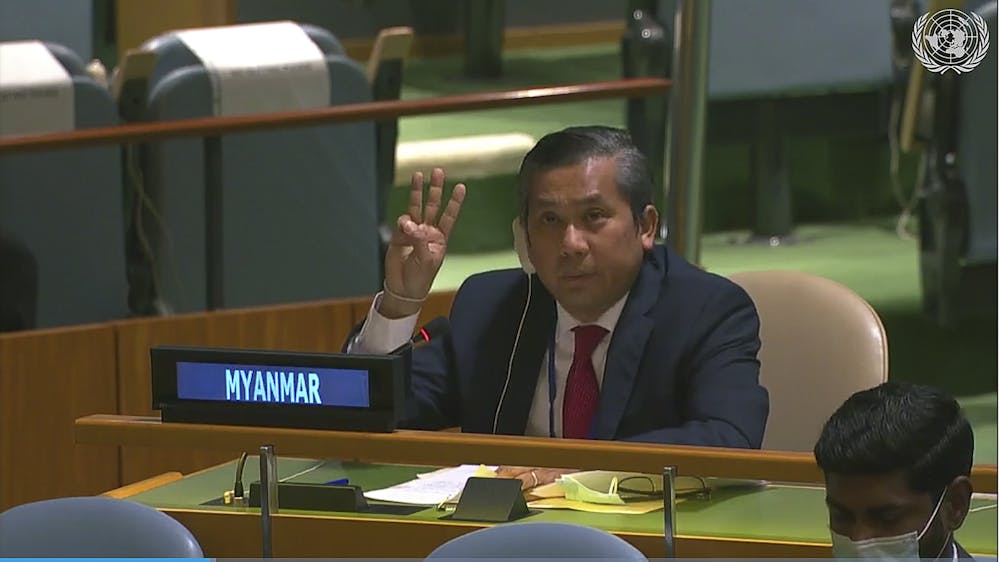
The ambassador was close to tears before the UN General Assembly as he called on the international community to help restore Myanmar’s democratically elected government.
At the end of his speech Kyaw Moe Tun held up the three-finger salute, which famously featured in the Hunger Games franchise. It has become a symbol of resistance against military forces.UNTV/AP
For the rest of us, a full blackout would mean an absence of critical information that advocates and policymakers rely on to create petitions, lobby governments and corporations, and impose sanctions. But for people inside Myanmar, it would mean much, much worse.
Putting on the pressure online
For now, online tools remain salient for those wanting to put pressure on Myanmar’s military.
One online petition (now closed) urged Telenor, a Norwegian telecommunications company working in Myanmar, to push back on the proposed cybersecurity law. And the company did.
Similarly, Facebook took down all accounts linked to Myanmar’s military, blocking their use on Facebook and Instagram and thus stemming one of the military’s primary means of communication. There is still a push to get Facebook to completely ban the military from promoting its services and products.
There are also online pages that serve as clearinghouses for those who want to offer support. The coup brought Myanmar’s economy to its knees. Activists and the wider public will quickly feel the financial loss spurred by business shutdowns, the protest movement and economic sanctions imposed by foreign states (even where these are carefully targeted).
Initiatives to support them — largely channelled through groups in the United States and Australia — are taking donations to help pay for protesters’ activities and topping up their phone credits. Some onlookers may choose to support local journalists broadcasting from inside, by subscribing to English newspapers such as The Irrawaddy and Frontier.
Finally, there are border groups that combine their online presence with on-the-ground work in ethnic minority areas. For example, the Karen ethnic minority group on the border of Thailand and Myanmar posted information about recent defections of military personnel in favour of the movement.
Even if a total blackout befalls Myanmar, activists can use porous borders to cross into nearby countries, especially Thailand and Bangladesh, where infrastructures for activism already exist.
By collecting information from inside the conflict zone, crossing borders and broadcasting it, these groups have the potential to short-circuit internet bans. And with them, online efforts can carry on.
Australian women have been most effective, politically, when they have harnessed their collective rage and turned it into action. They need to do it again now.
Like many Australians, I was delighted when activist Grace Tame was named the 2021 Australian of the Year. Tame is a powerful advocate for survivors of child sexual abuse, drawing on her own experience of being groomed and abused by a paedophile when she was just 15.
Tame’s #LetHerSpeak campaign, which she created with journalist Nina Funnell and Marque lawyers, has overhauled gag laws that silenced victims of sexual abuse. Tame turned her anger into action and made change.
Accepting her award, Tame declared she was:
using my voice, amongst a growing chorus of voices that will not be silenced. Let’s make some noise, Australia.
Tame’s bravery inspired former political staffer Brittany Higgins to make some noise of her own. The revelation of her alleged sexual assault in a ministerial office and subsequent treatment by her employers has appalled observers.
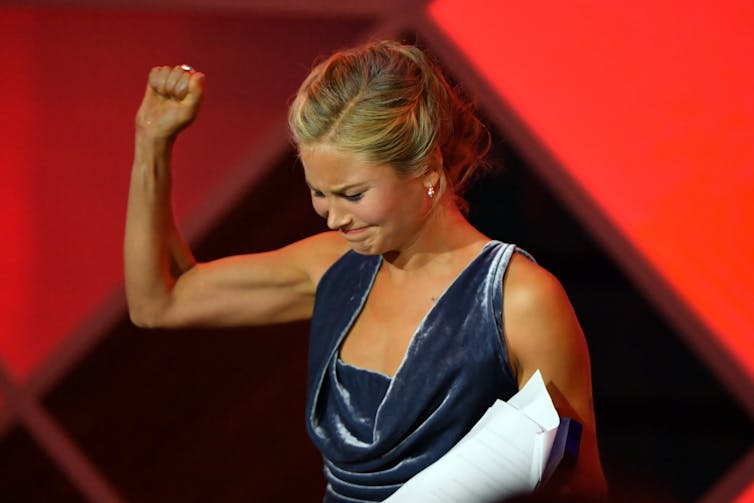
Australian of the Year Grace Tame used her rage to effect change – and inspire others to do the same.Mick Tsikas/AAP
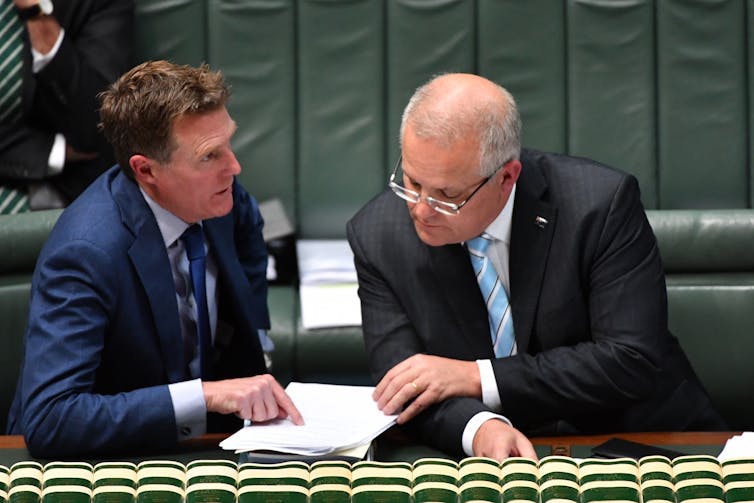
Most recently, it has been alleged a man who is now a federal cabinet minister (revealed on Wednesday to be Attorney-General Christian Porter) raped a 16-year-old girl in 1988. The response that best reveals the prevailing political culture was when Prime Minister Scott Morrison, who was sent a letter outlining the allegation, airily admitted he hadn’t read it. He added that because the minister has “vigorously denied” the allegation, there were “no matters” that required his attention.
In a defiant press conference on Wednesday, Porter denied the allegations. He refused to call for an inquiry or stand aside from his role, saying
if I stand down from my position as Attorney-General because of an allegation about something that simply did not happen, then any person in Australia can lose their career, their job, their life’s work based on nothing more than an accusation that appears in print.
To say Australian women are angry about the events of the past few weeks is an understatement. In a powerhouse address to the National Press Club on Wednesday, Tame stressed the importance of turning that rage into action:
One voice, your voice, and our collective voices can make a difference. We are on the precipice of a revolution whose call to action needs to be heard loud and clear.
Australian women’s collective rage is not without precedent.
The women’s movement of the 1970s was born, in part, out of anger. Women were angry that they couldn’t always control their fertility, or parent their own children. They were angry they were paid less than men for the same jobs. They were angry childcare was hard to access. And, frankly, they were angry at men. Activist Kate Jennings articulated this rage in a speech at an anti-war rally in 1970:
There are a lot of people who feel strongly about the Vietnam war. But how many of you, who can see so clearly the suffering and misery in Vietnam […] how many of you would get off your fat piggy asses and protest against the killing and victimisation of women in your own country.
The women’s movement drew strength from talking. Sharing their experiences in consciousness-raising groups, they realised their problems were not personal but structural, demanding structural solutions.
It didn’t take long for the movement to articulate its core demands: free abortion and childcare, equal pay, equal job opportunities, and an end to media sexism. While they did not limit themselves to activism on these issues, they focused and shaped their work.
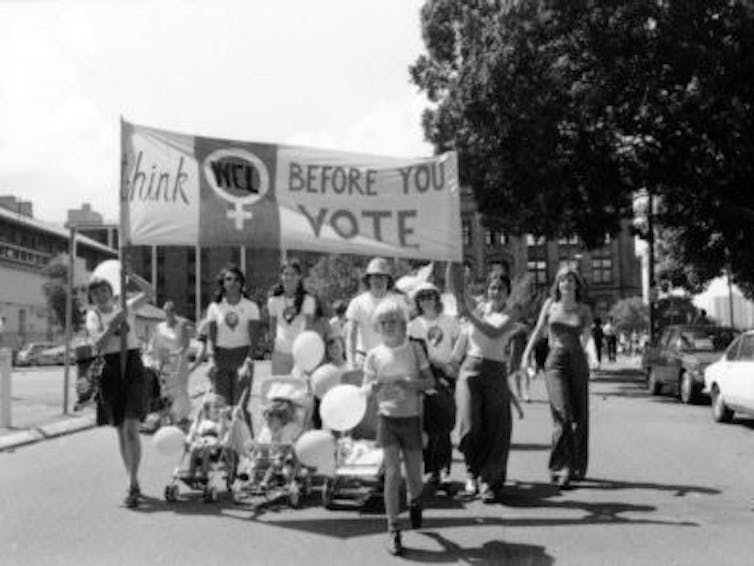
A Women’s Electoral Lobby March in 1975. The Whitlam government had been elected in part because of WEL’s advocacy.Women’s Electoral Lobby
By early 1972, the Women’s Electoral Lobby, the movement’s moderate wing, ingeniously placed women’s issues on the political agenda by inaugurating their candidate survey. WEL members in every Australian electorate interviewed all political candidates. Not only did the survey train women in political lobbying, it laid bare the views of the (mostly) male candidates on women’s issues. It also gave women a political voice.
When the Whitlam government was elected, in part because of WEL’s advocacy, the women’s movement used their new leverage to achieve reforms on equal pay and contraception, and later made important gains in childcare, the funding of women’s refuges, and family law.
Whitlam appointed to his staff a women’s affairs adviser, Elizabeth Reid, who worked to make government more responsive to women’s needs. She, and subsequent feminists working inside the state, could not have exerted the influence they did without an active women’s movement agitating for change.
Surprisingly, violence against women was not initially a primary focus of the women’s movement. It emerged through consciousness-raising and so too did feminist methods of addressing it: rape crisis centres and women’s refuges.
Activism around sexual violence moved to centre stage: women marched against male sexual violence in Reclaim the Night Marches from 1978, and in the early 1980s feminists marched on Anzac Day “in memory of all women raped in all wars”.
Today, feminists are still campaigning against male violence against women. Over the past few years, we have mourned hundreds of women who have died due to family violence. We have witnessed royal commissions into family violence and into institutional responses to child sexual abuse. We have admired the courage of survivors like Rosie Batty. We gasped as serial sexual predators were exposed under the banner of #MeToo. But too little has actually changed.
Women are angry and they are tired. Tired of mansplainers and misogynists, and those who bleat #NotAllMen instead of asking #WhySoManyMen? Tired of women who have benefited from feminism yet refuse the label of “feminist”. And tired of having to once again fight the battles that women in the 1970s and 1980s thought they had won.
Rage is politically potent, and useful. You only need to look at the ways Donald Trump fuelled his army of supporters to understand that. But if the lessons of second wave feminism are any guide, women not only need to get angry, they need to get organised.
The women’s movement was energised by its collective nature and common goals. Today’s female rage is fierce, but it is not yet harnessed to a clear agenda for action. Women need to create this agenda together, and then work out how best to achieve it.
We know so much more about women’s oppression today than women did in the 1970s, especially the ways in which different types of discrimination overlap and combine. We are perhaps more sceptical of the ability of institutions to effect change. And we are painfully aware that neo-liberalism has shrunk the state and limited the possibilities for activism.
But our scepticism, and our lack of attention, has extracted a cost. In the 1980s, government policy was routinely audited for its impact on women. But in the 1990s, feminist policy “machinery” was steadily dismantled.
Today’s Office for Women has a tiny staff and a low profile. It was not consulted on any of the major COVID-related policy shifts, like JobKeeper or changes to superannuation.
If our parliament is full of men who ignore, belittle and disrespect women, and women who enable these men, it is because we, the voters, have put them there. But we can also vote them out.
A women’s candidate survey, ready to roll out at the next federal election, is just one strategy from the women’s movement of the 1970s that might be worth reviving today. Women need to maintain their rage, but they need to turn it into political action, too.
South Australia this week became the final Australian jurisdiction to partially decriminalise abortion.
The Termination of Pregnancy Bill passed the state’s upper house on Tuesday, meaning abortion will be moved out of the criminal code and instead regulated under health law.
The South Australian Abortion Action Coalition led a campaign for SA to decriminalise abortion.
This change paves the way for improved access to abortion, especially for rural women. Abortions can now be provided beyond selected hospitals, and women no longer need to have been South Australian residents for two months or more to access an abortion.
While this is a positive step, important legal hurdles to abortion access remain in South Australia and around the country.
Gestational limits
With the exception of the Northern Territory, where abortion remains a medical practitioner’s decision regardless of the gestation, and the ACT, where no gestational limits apply, Australian jurisdictions now permit abortion on request up to varying points in a pregnancy.
The gestational limit for an “on request” abortion in South Australia is now 22 weeks and six days. Other states range from 16 to 24 weeks.
Abortions after specified gestational limits generally require two doctors to approve on psychological, physical or, in most instances, social grounds (for example, the inability to afford another child, or intimate partner violence).
But some states are more restrictive than others. In Western Australia, after 20 weeks, two doctors from a panel of six must determine the abortion is necessary because “the mother, or the unborn child, has a severe medical condition”.
In the NT, abortions after 23 weeks are prohibited, except if it’s deemed necessary to save the pregnant person’s life.
Gestational limits restrict reproductive autonomy. The Victorian Law Reform Commission has noted gestational limits mean that, in the later stages of pregnancy, abortion becomes an “exception to a woman’s general right to determine what medical procedures she will undergo and what relationships she will enter”. They force some pregnant people to “rush into a decision”, and create “more hoops for women to jump through”.
By adopting a model of law reform that regulates abortion differently after gestational limits, governments have failed to prioritise expanded abortion access. Experts in this space in Victoria have reported access to later-term abortions has worsened since abortion was decriminalised in the state in 2008.
But in WA, access to later abortions is so restrictive that one reproductive health service directs pregnant people to Victorian services.
Over-regulation
The bills to decriminalise abortion in each jurisdiction enacted criminal laws that prevent unqualified people from performing abortions, with punishment ranging from five to ten years’ imprisonment.
This represents over-regulation, where laws seek to regulate practices that no longer exist (namely “backyard abortions”). It unnecessarily singles abortion out for special regulation, preventing its full integration into health law (which already ensures only qualified people perform medical procedures).
It would be more pertinent to focus on broadening the scope of who can perform abortions in Australia.
The World Health Organization advises all properly trained health-care providers can safely provide abortion.
Abortion care provided at the primary-care level […] minimises costs while maximising the convenience and timeliness of care for the woman.
But Australian law only permits medical doctors to perform abortions, with the exception of South Australia and the NT. In those jurisdictions, trained health professionals, such as nurse practitioners and Aboriginal and Torres Strait Islander health workers, are allowed to provide medical abortions (in the NT under the direction of a doctor).
Laws surrounding abortion differ between Australian states and territories.Shutterstock
Other instances of over-regulation and abortion exceptionalism include provisions for informed consent in New South Wales and WA, which require doctors to inform patients of the benefits and possible risks of abortion.
The Australian Medical Association has called this an “unnecessary and insulting” extra hurdle, given doctors are already required to seek informed consent for medical procedures.
States and territories differ in many aspects of abortion laws
When medical practitioners refuse to refer pregnant people to termination services, most jurisdictions require them to provide the patient with information, or refer them to a health service or provider without a conscientious objection.
But in the ACT and WA, doctors aren’t required to provide this information or referral. This is an exception to their responsibilities under professional codes of conduct that prohibit doctors from allowing their “moral or religious views to deny patients access to care”.
The new laws enacted in NSW and South Australia include provisions condemning and, in SA, prohibiting “sex-selective” abortions.
But there’s no evidence sex-selective abortion is a significant issue in Australia, so this too may be over-regulation. Possible consequences here include racial profiling, whereby some doctors may question a person’s motives for seeking abortion on the basis of their background.
Meanwhile, the abortion decriminalisation laws in WA, South Australia and NSW require doctors to provide information about counselling services (in NSW, this only becomes mandatory after 22 weeks’ gestation).
The South Australian Law Reform Institute has said this measure “undermines the autonomy of women” and creates “unnecessary delays and burdens”. Provisions relating to counselling presume women are uncertain about their decision, and establish abortion as a problematic and potentially harmful choice.
Further, WA is now the only Australian jurisdiction that doesn’t have safe access zone legislation, which protects the safety, well-being, privacy and dignity of people accessing abortion services.
Abortion access across Australia is uneven, concentrated in large cities. And, with the exception of South Australia and NT where abortions are provided under the public health system — they are costly.
Important legal obstacles remain, largely due to the actions of a handful of anti-abortion politicians who are out of step with the Australian community, which is broadly supportive of a pregnant person’s choice.
Access can be broadened within the parameters of the existing legal infrastructure. The 2019 federal Labor election pledge to require public hospitals to provide abortion care is a great example of the type of leadership we need to achieve local, timely and affordable abortion care in Australia.
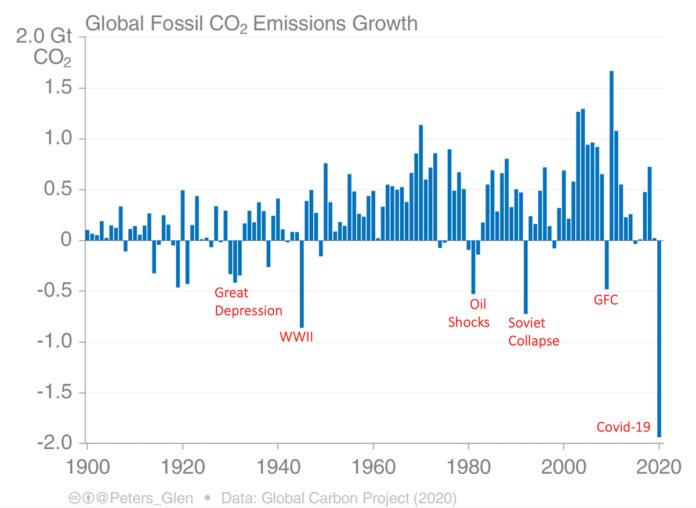
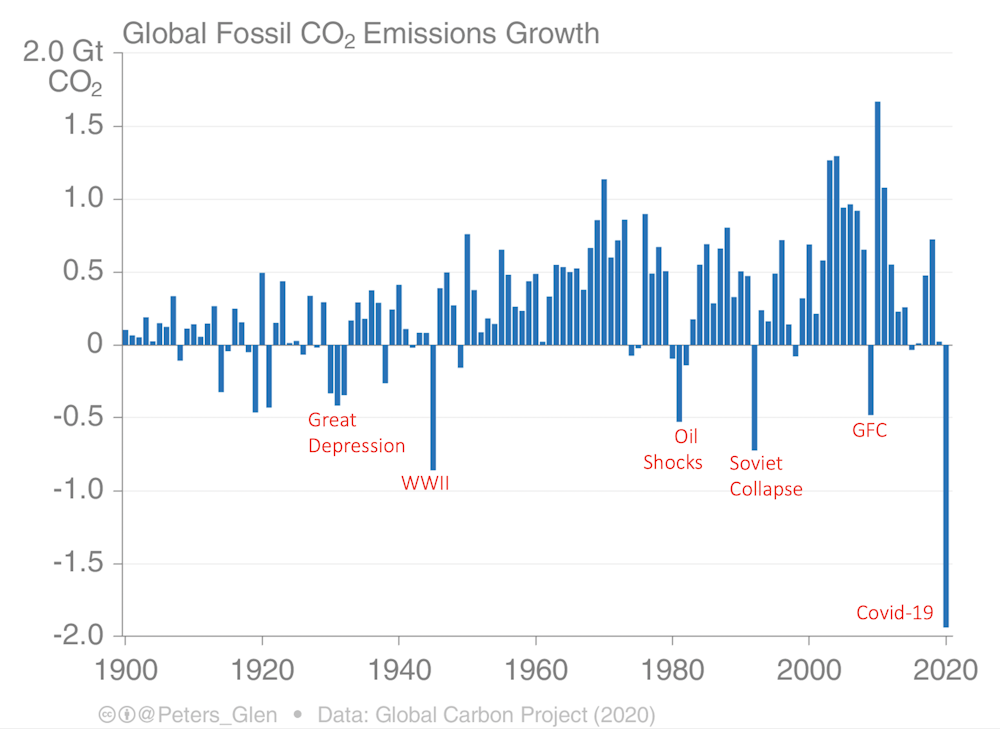
Growth rates of global fossil fuel emissions in gigatonnes (billion tonnes) of carbon dioxide.
Source: The Conversation (Au and NZ) – By Pep Canadell, Chief research scientist, Climate Science Centre, CSIRO Oceans and Atmosphere; and Executive Director, Global Carbon Project, CSIRO
The global pandemic has seen an unprecedented drop in global emissions, with carbon dioxide down about 7% (or 2.6 billion tonnes) in 2020 overall compared to 2019.
But our research, published today in Nature Climate Change, found this may soon be undone, as unchecked economic recovery would see global emissions bounce back to pre-pandemic levels.
It comes as data released this week from the International Energy Agency shows global carbon emissions in December 2020 were 2% higher than the year prior.
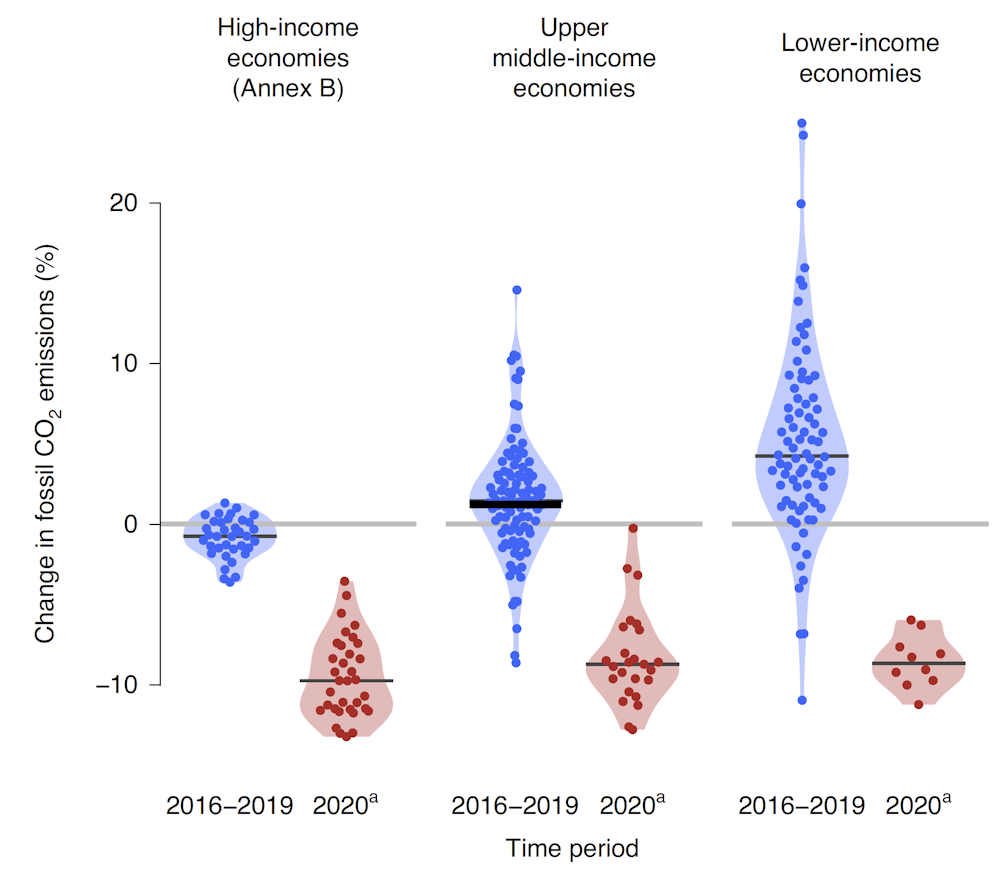
Our research found between 2016 (right after the Paris Agreement was signed) and 2019, emissions from 64 countries were declining while emissions from 150 other countries were increasing. This meant global emissions were still growing, albeit a bit slower.
In fact, these pre-pandemic emission declines were just one-tenth of what they needed to be to keep global warming well below 2℃. This is why it’s vital to ratchet up climate mitigation commitments to meet global targets and avoid further environmental damage.
Emissions from wealthy countries
Our research looked at fossil fuel-sourced carbon dioxide emissions in more than 200 countries before and during the COVID-19 pandemic, and examined what might come next.
Between 2016 and 2019, the combined emissions from 64 countries declined by 160 million tonnes of carbon dioxide, per year, compared to the period 2011-2015. For perspective, that’s roughly one-third of what Australia emits each year.
Growth rates of global fossil fuel emissions in gigatonnes (billion tonnes) of carbon dioxide.
Most reductions were due to structural changes towards a low carbon economy after Paris commitments were made, such as switching from coal power to renewable sources. Other reductions occurred for reasons beyond climate or energy policies, such as fuel price fluctuations or economic downturns.
The biggest emission declines came from high-income economies: the UK (declined by 3.6% per year compared to the previous five years), Denmark (-2.8%), Japan (-2%) and the US (-0.7%).
For these countries, emissions dropped for both territorial emissions (associated with the use of fossil fuels) and consumption-based emissions (the consumption of goods and services, such as manufacturing, imported from other countries).
But a few high-income economies increased their fossil fuel-sourced carbon dioxide emissions in the same period. This includes Australia (+1.0%), Russian Federation (+0.2%), Canada (+0.1%) and New Zealand (+0.1%). For these nations, increased emissions can largely be attributed to the continued growth in oil and natural gas use.
If spending is focused on clean energy, then economic recovery from the pandemic could boost decarbonization.AAP Image/Supplied by Granville Harbour Wind Farm
Middle and lower income countries
There are 99 countries considered upper-middle-income economies. Thirty of which also showed reductions in carbon dioxide emissions during the five-years before the pandemic, including Mexico, Singapore, Israel, Hong Kong and Montenegro. This is a good sign, as it suggests actions to reduce emissions now extend beyond the most advanced economies.
However, the remaining 69 upper-middle-income countries continued to increase their emissions. For example, emissions from Indonesia grew by 4.7%, Chile by 1.2%, and China by 0.4% each year on average. Depending on the country, the increase was due to the continuous growth in the combustion of coal, oil and natural gas.
Finally, emissions from lower-middle-income and low-income economies showed mostly strong emissions growth. However, most started from very low levels of fossil fuel use — this group of 78 countries account for only 14% of the global fossil fuel carbon dioxide emissions.
Change in fossil carbon dioxide emissions (per cent per year) in the 5 years since the Paris Climate Agreement. Changes are shown for individual countries (dots) separated in three economic groups.Le Quere et al. 2021. Nature Climate Change, Author provided
Increasing global action on climate change and the major shake up of emissions by the global pandemic has placed the world in a different place — at least for now.
Many countries have a unique opportunity for large infrastructure expenditure as part of economic recovery plans after the pandemic. If spending is focused on, for instance, clean energy, then economic recovery could accelerate the pace of decarbonisation.
And a recent UN report shows 48 countries intend to reduce emissions beyond their previous commitments. Some countries, such as China and the UK, went beyond their legal obligations and pledged to reach net zero emissions by 2050 or soon after.
These current commitments, however, do not add up to what’s required, globally.
If these new commitments are achieved, global emissions by 2030 would be 0.2% below the 2010 level according to UN numbers released last week.
However, the Intergovernmental Panel on Climate Change indicates emissions need to be reduced by 25% to 50% below 2010 levels to keep global heating between 1.5℃ and 2℃.
Current stimulus packages in place are still likely to cause emissions to rebound to pre-pandemic levels within a few years.
Indeed, the new data from the International Energy Agency suggests global emissions already started to rise again over the second half of 2020, potentially offsetting the drops during lockdowns. Although, it’s still too early to infer the size of the rebound for 2021.
Whatever strategies we put in place, one thing is for sure. Globally, we need to do a lot more: to deliver at least ten times more emissions cuts than our pre-pandemic efforts, while supporting economic recovery, human development, improved health, equity and well-being.
Source: The Conversation (Au and NZ) – By Luke Zaphir, Researcher for the University of Queensland Critical Thinking Project, The University of Queensland
The narratives that define our culture are subtle sometimes. We all like the shared belief that hard work has good outcomes. For instance, you go to school to get a job. If you work hard in your job, you’ll have a good life, live in your own house and achieve your dreams.
We teach these ideas to children in the hopes they’ll be hard working and entrepreneurial.
But there are a couple of myths underneath these values. Firstly, there’s an implication those who succeed deserve it. And this implies those who don’t have high paying jobs only have themselves to blame.
Next we have the narrative it’s good to have a job, but we should also be more ambitious and strive for something better. Again, if we don’t get it, we have ourselves to blame.
We can see these two narratives in the way some politicians talk. Remember, for instance, when in 2015, then Treasurer Joe Hockey said people looking to buy a house just had to “get a good job”.
We can use philosophical tools to see how both these narratives are myths.
Myth 1: personal success comes from effort
This myth is based in meritocracy. It’s a common feature of neoliberal discourse and in theory it’s an admirable belief, and aspirational — anyone can succeed and be their best selves. Your achievement depends on how hard you try.
But there’s a dark side to this view. When a person doesn’t succeed, we often blame the person for not working hard enough.
There is often a mistaken judgement those who do not measure up have been lazy, stupid or lacking initiative. This is known in philosophy as a modus tollens fallacy. It goes like this:
And yet, people may have lost their job, due to the pandemic, for instance. It’s demonstrably false to say to most people on JobSeeker are the lazy dole bludgers of neoliberal legend, given twice as many people received payments in 2020 than in 2019.
Or people on JobSeeker never had the opportunity to succeed in the first place due to systemic racism, gender inequality, natural disasters and poorly designed economic policies. They may be suffering mental health issues that prevent them from being their best selves.
There are many factors in play when it comes to financial success. But one of the greatest predictors is family wealth. Two children, from different families, putting in the same amount of effort may experience completely different outcomes because of the wealth of their parents.
If we’re willing to say work success can be disrupted by COVID-19, let’s just admit there might be other causes too.
Myth 2: You should feel ashamed if your job isn’t ambitious enough
It’s a common trope in political statements, and society more generally, that people need jobs. Jobs are good. And implicitly, if you have a job, it’s good enough.
But this is often not the case due to what’s known as a conformity bias.
Nurses played an essential role in the pandemic, and still we see it as a low-prestige job.Shutterstock
This is when we adopt the beliefs and behaviours of others from their social cues, rather than using our own judgement or reasoning. Humans are social creatures and we aim to fit in with one another — conformity bias is part of that.
That’s why we see certain jobs as more prestigious than others and value people’s contribution more or less as a result.
And we often value the money in a job more highly than any other quality in a job.
The flip side of this bias though, is the undervaluing of the low earners.
Nurses serve a vital role in society as members of frontline medical staff but get paid little compared to the doctors they work alongside. Teachers performed an enormous task last year, shifting huge swaths of educational content to an online format (as well as needing to cater to the emotional needs of millions of children) and their pay is similarly low.
We are biased against retail workers and cleaners due to their low wages. We could make the argument serving others makes their job seem inferior, but this doesn’t check out as pilots, doctors and lawyers serve others too.
The amount of training and investment in the career undoubtedly plays a role in the development of the bias. Artists and creatives are not highly salaried and yet still work long hours but this matters little to those who prize high earnings above all other qualities.
And yet, having a job society sees as prestigious isn’t what will make you satisfied in life.
When we talk to our children (and ourselves) about what a good job is to us, we need to talk less in terms of wages and earnings.
We need to be talking about how meaningful it is, how much autonomy we have in it, and whether it allows for a meaningful balance with the rest of our time.
Source: The Conversation (Au and NZ) – By Sonja Pedell, Associate Professor and Director, Future Self and Design Living Lab, Swinburne University of Technology
Senior citizens need help and encouragement to remain active as they age in their own communities. Given the choice, that’s what most would prefer. The smart city can provide the digital infrastructure for them to find and tailor the local neighbourhood information they need to achieve this.
Our research shows senior citizens want to pursue active ageing as a positive experience. This depends on them being able to stay healthy, participate in their community and feel secure.
Most city planning efforts to encourage active ageing are siloed and fragmented. Older people are too often shut away in retirement villages or nursing homes rather than living in the community. Current approaches are often based on traditional deficit models of focusing on older people’s declining health.
Another issue is that senior citizens are treated as receivers of solutions instead of creators. To achieve real benefits it’s essential to involve them in developing the solutions.
Working towards age-friendly cities
To counter a rise in urban ageism, the World Health Organisation (WHO) has been promoting age-friendly cities for nearly 15 years. Its age-friendly framework includes these goals:
Smart city approaches can make urban neighbourhoods more age-friendly. One way technology and better design do this is to improve access to the sort of information older Australians need – on the walkability of neighbourhoods, for example.
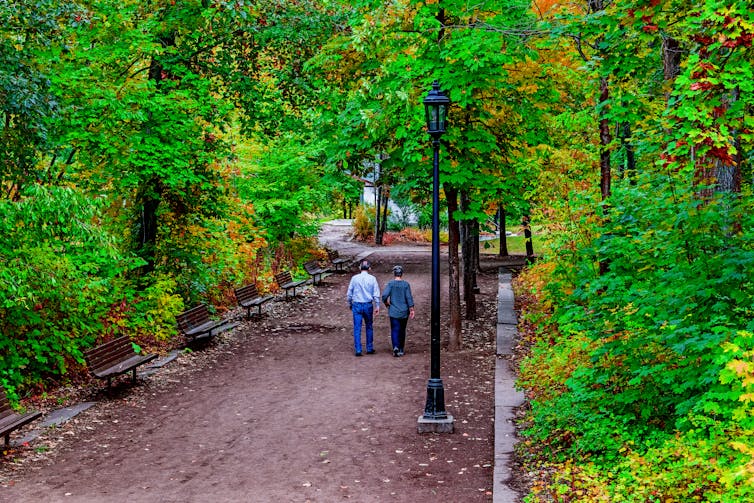
It’s useful for older people to be able to find out which walking routes have shade and places to stop and rest.Shutterstock
Our research has considered three factors in ensuring smart city solutions involve older Australians and work for them.
Replace ageism with agency
Government efforts have focused on increasing life expectancy rather than improving quality of life and independence. Ignoring quality of life leads to the perception of an ageing population as a burden to be looked after.
It would be better to bring about changes that improve older people’s health so they can participate in neighbourhood activities. Social interaction is a source of meaning and identity.
Active participation by older adults using digital devices can give them agency in their lives and reduce the risk of isolation. Bloomberg reports older adults have become empowered using technology to overcome social isolation during the COVID-19 pandemic.
Connect to smart city data
Cities are about infrastructure. Senior citizens need to have access to information about this infrastructure to be motivated to spend time in their neighbourhood and reduce their risk of isolation.
Growing numbers of active ageing seniors are “connected” every day using mobile phones to interact with smart city services. Many have wearable devices like smart watches that help monitor and manage their health and physical activity.
These personal devices can also be used to better connect older adults to public data about urban environments. For example, imagine an age-friendly smart city “layer” linked to a smart watch, to highlight facilities such as public toilets, water fountains and shaded rest stops along exercise routes.
Access Map Seattle is an example of an age-friendly, interactive, smart city map that shows the steepness of pedestrian footpaths and raised kerbs. The National Public Toilet Map, created by the Australian Department of Health and Ageing, and Barcelona’s smartappcity are among other mobile apps integrating city services and urban plans.
The rise of “urban observatories” has increased the gathering and analysing of complex city-related data. These data make it possible to build a digital city layer.
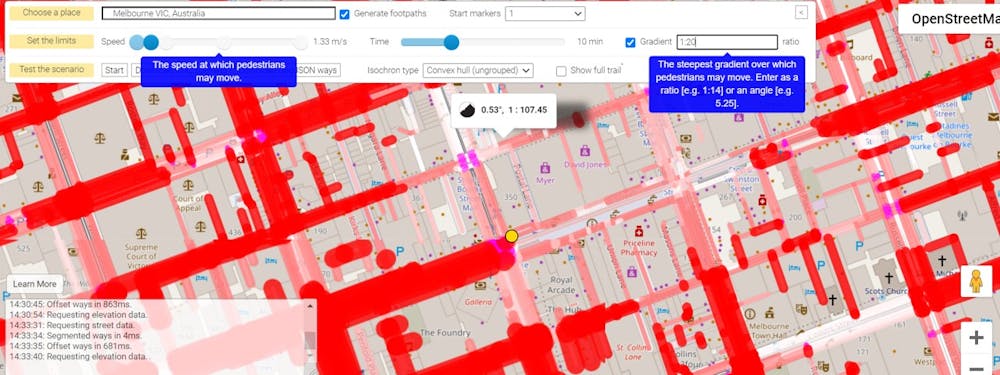
PedCatch is an app that combines animated pedestrian accessibility modelling, topographical mapping and crowd-sourced geospatial data.Marcus White, Swinburne University, Author provided
This information then helps us understand and improve the liveability of neighbourhoods for older adults. The data can be used for more proactive policy and city planning.
We need to start asking senior citizens questions like “How would you like to access this data?” and “What would you like the digital layer to tell you?” Their goals and needs must drive the information provided.
It’s not just a matter of deciding what specific data older adults want to get via their devices. They should also be able to contribute directly to the data. For example, using a mobile app they could audit their neighbourhood to identify features that help or hinder walkability.
To create truly age-friendly smart cities, it is important for older people to be co-designers of the digital layer. The co-design includes deciding both the types of data available and how the data can be usefully presented. We also need to understand what mobile apps could use the data.
If we know what information within the digital city layer motivates older adults to participate more actively in their neighbourhoods, we can plan more age-friendly cities.
Through connecting infrastructures and citizen-led approaches, we can achieve social participation and inclusion of citizens regardless of their age and recognising diversity and equity. We will create places where they feel capable and safe across a range of activities. Redesigning age-friendly and smart communities directly and collaboratively with those affected can enable them to achieve the quality of life they desire.
Source: The Conversation (Au and NZ) – By John Hawkins, Senior Lecturer, Canberra School of Politics, Economics and Society, University of Canberra
Elon Musk, the chief executive of Tesla, recently announced his company had bought US$1.5 billion (almost A$2 billion) of Bitcoin. The announcement led to a flurry of enthusiasm and a quick surge in price for the controversial cryptocurrency.
This price bump has been good news for Musk in the short term. At one point, Tesla’s Bitcoin investment had gained more than US$1 billion in value. But can the enthusiasm be sustained? I think there is a good chance that over the next year the price of Bitcoin will drop towards its fundamental value, which is nothing.
If Bitcoin were to lose half its present value — which is not unlikely, given its extremely volatile past behaviour — Tesla will lose around A$1 billion. As Elon Musk owns about a fifth of Tesla, he would then be down A$200 million. In contrast, I own no Bitcoin so I will lose nothing, which means I will have done A$200 million better than Musk.
Why Musk’s decision is a bad thing
Musk is not doing Tesla’s shareholders any favours. If they wanted to be exposed to the rise and fall of Bitcoin they could just buy some themselves. Now they have no choice; if they want to invest in Tesla electric vehicles, they are also vulnerable to the vagaries of Bitcoin.
The usual justification for making investments more diverse is that it can reduce risk. But buying the extremely volatile Bitcoin will make Tesla’s earnings even more uncertain.
Nor is Musk doing his fans any favours. As a “rock star CEO” with more than 40 million followers on Twitter, his musings are widely reported in other media.
By publicly endorsing Bitcoin, Musk may lead some of his fans to invest in this highly risky speculative asset. They may not be as well placed as a multibillionaire to absorb any losses on their investment. (To be fair, Musk has warned them not to invest their life savings.)
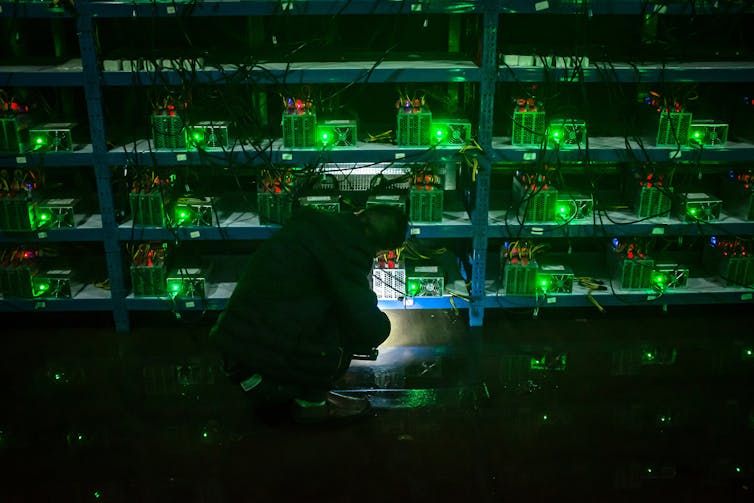
Nor is he doing the inhabitants of this planet any favours. The generation of Bitcoins (known as “mining”) uses vast amounts of energy to power specialised computers solving complex but useless mathematical problems.
Bitcoin mining uses as much electricity as a small country.EPA / Liu Xingzhe
Estimates vary as to how much energy they waste. Some studies suggest Bitcoin production uses more electricity than the whole of Argentina, Poland, Norway, or Switzerland. But even the lower estimates are that it results in more carbon emissions than Estonia. And if Bitcoin becomes more popular this will only increase.
What will the Bitcoin price do?
How likely is it that Bitcoin could lose half its value within a year? Well, it has form. After it peaked at A$24,000 in December 2017, it dropped to A$10,000 by February 2018. After recovering to A$16,000 in July 2019, it dropped to A$8,000 by March 2020.
Bitcoin may be the purest ever example of a speculative bubble. It follows in the footsteps of famous bubbles such as the South Sea bubble, the Dutch tulip mania, gold around 1980, the dotcom boom of 2000, and the US housing market before the global financial crisis of 2008.
But past bubbles have had more going for them. Houses provide shelter. Gold has industrial uses and jewellery can be made from it. The South Sea Company and millennial tech stocks at least promised streams of future dividends. Even tulips can be admired for their beauty.
Bitcoin offers no return at all unless you can resell it to a “greater fool”. It is a Seinfeld asset — a speculation based on nothing.
The limits of Bitcoin
Bitcoin’s backers often say its value stems from the fact that supply is limited. This is complicated by the fact dissident users have created “forks” in the past, leading to schismatic bitcoins such as Bitcoin Cash.
But even if we accept the limit at face value, there is no limit on the creation of other cryptocurrencies. There are literally thousands of them already, such as Litecoin, Tether and Dogecoin. In any case, just because something is in limited supply, that does not inherently make it valuable.
Another argument for Bitcoin says it could be an alternative to traditional currency for making payments. The first purchase made with Bitcoin was more than a decade ago: two pizzas, paid for with 10,000 bitcoins. (I hope the buyer enjoyed the pizzas, because the coins would now be worth US$500 million.)
Despite the hype, very few vendors accept Bitcoin and hardly anyone pays with it. A Sydney art gallery that accepts Bitcoin has never had anyone buy anything with it, while a bar that accepts it reports no customers using it for years. Even some crypto conferences refuse to accept Bitcoin. You can buy an “I accept Bitcoin” t-shirt on Amazon but you cannot pay for it using Bitcoin.
Amazon will sell you an ‘I Accept Bitcoin’ t-shirt – but you’ll have to give them some old-fashioned fiat money in return.Amazon
This is unlikely to change materially. Tesla has hinted it may accept Bitcoin in future, but so far does not.
There are inherent limits to the ability of Bitcoin to provide payment services. The Bitcoin network can only handle 10 transactions per second, compared with the 1,000 per second allowed by Australia’s Fast Settlement Service. Transactions may be stuck in a queue for hours. If any electronic currency becomes a significant payment medium, it is likely to be a central bank digital currency which would be legal tender and able to be used for very large numbers of transactions.
Musk has plans to colonise Mars, so maybe he will declare Bitcoin the legal tender there. But until then it would be better for all of us if he kept it off Tesla’s balance sheet.
Review: More Than Words: The Making of the Macquarie Dictionary by Pat Manser (Pan Macmillan)
In 1973 Pat Manser answered an advertisement in the Sydney Morning Herald seeking a research assistant to work on phonetic transcriptions for a dictionary of Australian English.
If you’re a word aficionado, you’ll love this book. I could not put it down until I had read through to the end of the final section, which contains the wonderful launch presentation speeches for all eight editions of the Macquarie Dictionary.
John Bernard, a chemist who was appointed Associate Professor in the Department of English and Linguistics at Macquarie University in 1966, had published a paper in Southerly in June 1962 about the need for a dictionary of Australian English. He argued that we need
a dictionary of our own because our idiom, usage, invention and especially pronunciation are sufficiently different from those of other Englishes.
In December 1969, Brian Clouston, who had founded Jacaranda Press in Brisbane, agreed to fund a dictionary that would be
aggressively Australian, not to be encyclopedic, not to be illustrated, to be in one volume, and to be ready in two years.
Bernard’s colleague at the university, Professor Arthur Delbridge, was appointed chair of the editorial committee to compile the book. He argued for a “people’s dictionary” that would “hold up a mirror directly to contemporary Australian speech and writing”.
The critical decision at the outset was whether to describe how people use the language or prescribe how people should use the language.
Should the new dictionary describe how language was used or prescribe its use?shutterstock
The father of English lexicography, Samuel Johnson, whose prescriptivist A Dictionary of the English Language was published in 1755, felt “the duty of the lexicographer was to correct or proscribe”. The Oxford English Dictionary, published in 1928, had also been prescriptive.
However, the Macquarie editorial committee was “adamant that its dictionary was to be descriptive”, a move now standard in English language dictionaries. The committee wanted as comprehensive a dictionary as possible, so spoken as well as written words were included.
Johnson’s dictionary took seven years to compile. The Oxford dictionary took 70 years. Rather than two, Macquarie’s dictionary took 11 years.
The Macquarie lexicographers had started work in 1970; the first edition was published in 1981. The 8th edition, published in 2020, and its thesaurus contain more than 300,000 Australian words and definitions.
It is no surprise there were controversies to contend with in the years it took to compile the first edition.
The test for inclusion of words and expressions is currency. How often do you hear people say, “I’ll see youse later”? That particular Australianism is included in the dictionary because, as an entry explains:
English you does not distinguish singular from plural. The form youse does provide a plural, contrasting with singular you, but there is strong resistance to it, in spoken as well as written language, and it remains non-standard.
Other tests include whether a word is accepted by the language community, whether it’s used extensively, or whether it’s too individual or specialised. Is it likely to stand the test of time? Is the entry well supported by citations?
Language is forever changing, so the challenge for a dictionary is its capacity to remain up to date. Manser amusingly illustrates the growing acceptance of “literally” to be understood as “figuratively” with a quote from Amanda Vanstone:
But I can assure you that we are literally bending over backwards to take into account the concerns raised by colleagues.
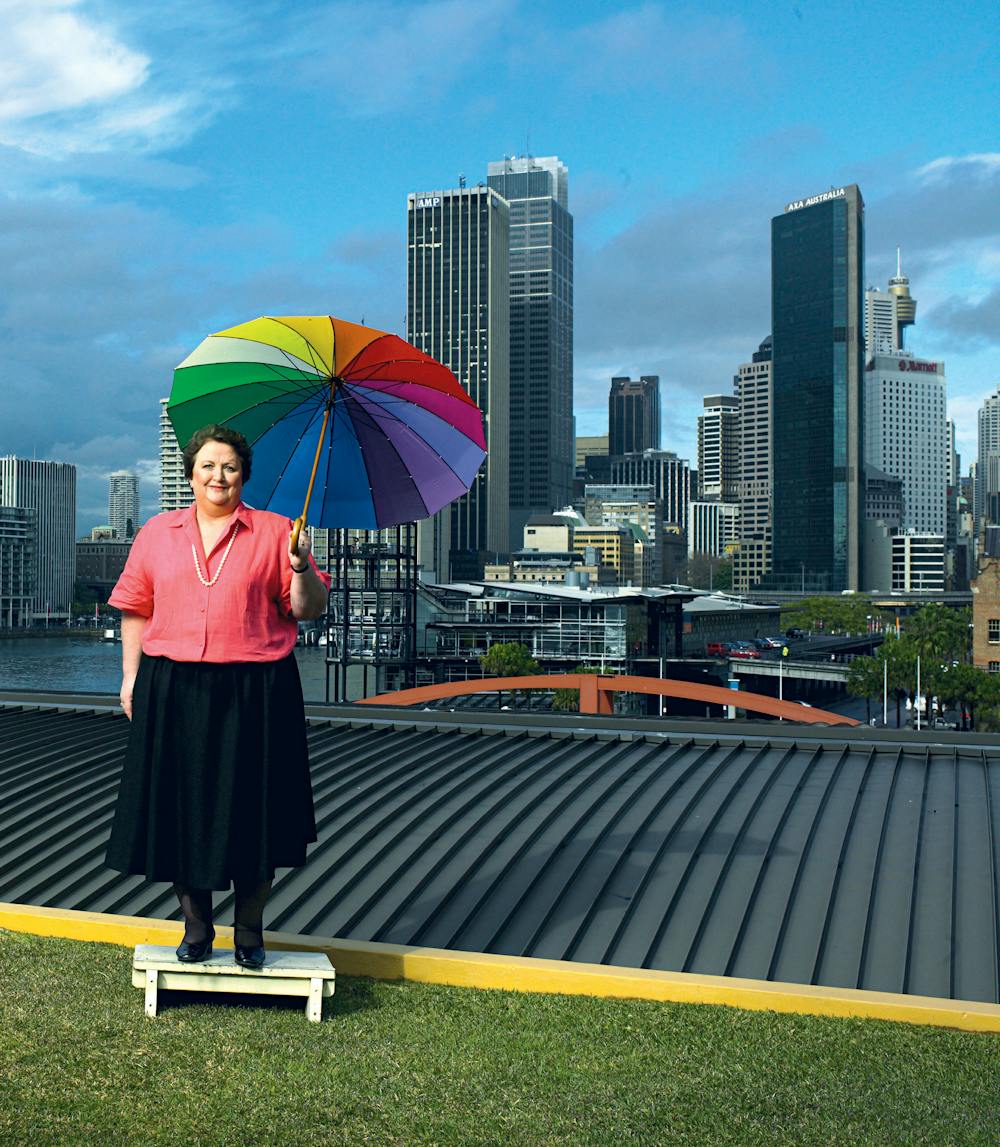
Amanda Vanstone poses (literally) for a photograph for Australian Women’s Weekly in 2006.Tim Bauer/AAP
As the recipient of elocution lessons in my early education I was fascinated to learn about the dictionary’s engagement with spoken English pronunciation. Then there is the fraught question of the description of iconic foods. Should Lamingtons be dipped only in thin chocolate icing and coconut? Not necessarily. There are pink jelly lamingtons and, more recently, Tokyo lamingtons, which have apparently landed with flavours of matcha and black sesame.
Manser’s least favourite word is mansplain, Word of the year in 2014. She hoped it would be ephemeral … but it was recently just nudged out by “fake news” for word of the decade.
The dictionary was launched on 21 September 1981 as The Macquarie Dictionary because it would “add prestige to the dictionary to be associated with a university”, as the Oxford one was.
A special cocktail, the Macquarie, was created to mark the occasion: “Champagne, mango juice, Bitters, Grand Marnier, and a whole strawberry to float on the top”.
The reviews were glowing, except for one condescending and scathing review by the editor of the second edition of the Oxford English Dictionary. Robert Burchfield, a New Zealander, accused the committee of a “charming unawareness of the standards of reputable lexicography outside Australia”.
The new dictionary sold very well: 50,000 copies in its first year and another 50,000 copies over the next 18 months. Within ten years there were 23 spin off editions.
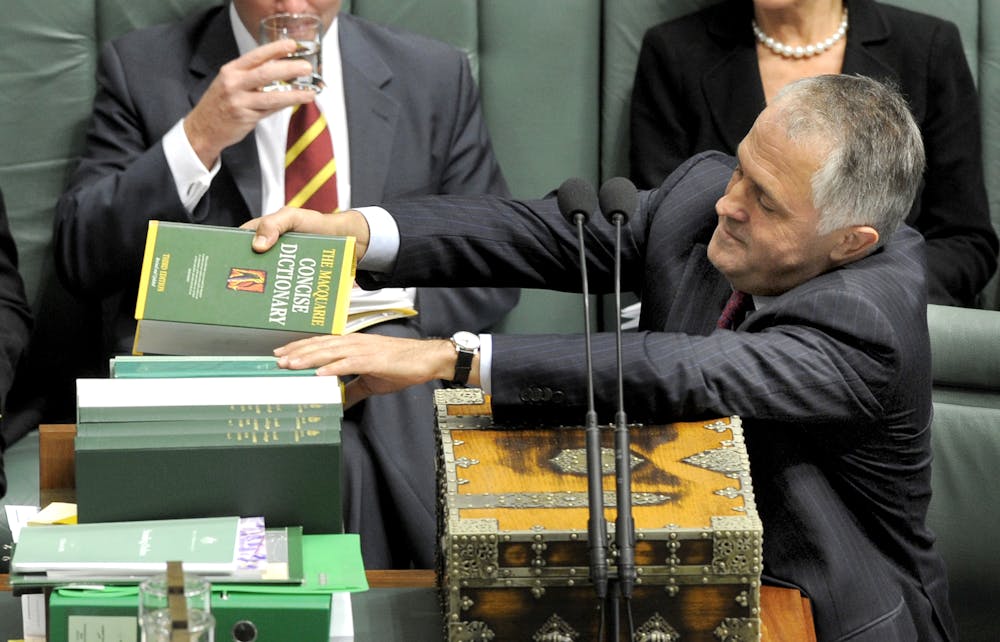
Malcolm Turnbull avails himself of a dictionary in 2008 during parliamentary question time.Alan Porritt/AAP
Currently, there are more than 150 spin offs. There was even a Macquarie Bedtime Story Book for Children. There are, of course, other dictionaries of Australian English, such as Oxford University Press’s Australian National Dictionary, a dictionary of Australianisms first published in 1988. There was also an Australian version of the Collins British English Dictionary, which the Macquarie staff regarded as essentially British.
In 1976, the Macquarie offices moved to a former market gardener’s cottage on the campus of Macquarie University. Called “the cottage”, it sounds reminiscent of James Murray’s scriptorium in Oxford, where he oversaw the creation of The Oxford English Dictionary. In 1980, Macquarie Library Pty Ltd became the publisher and has held the copyright ever since, though Macmillan bought the dictionary in 2001.
Macquarie embraced Indigenous Australian issues with Macquarie Aboriginal Words in 1994 and the Macquarie Atlas of Indigenous Australia in 2005. As Ernie Dingo put it at the time: “This book is a White step in the Black direction”.
Manser, who went on to become a high-level public servant, has done painstakingly detailed research for this book, with great support from former colleagues. It is well written in short chapters. I would have liked to see an index and a time-line, but I hesitate to quibble in the face of such a splendid historical document.
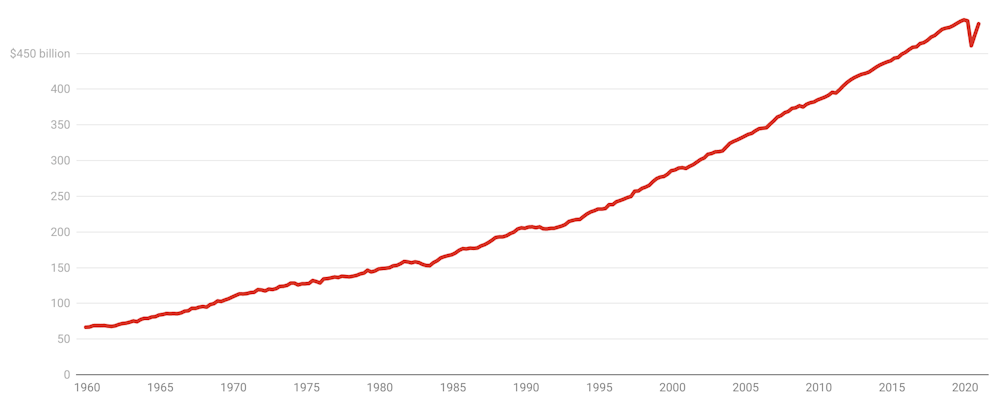
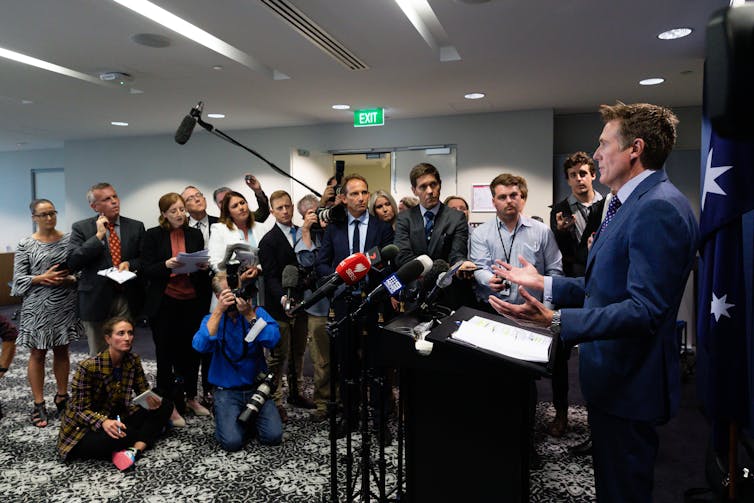
There’s one graph that sums up both the good and not-yet-as-good detailed by Treasurer Josh Frydenberg at Wednesday’s national accounts press conference.
It’s a graph of the level of Australia’s gross domestic product – how much is produced and earned each three months in Australia – adjusted for inflation.
It shows Australia’s economy getting bigger and bigger over almost all the past 80 years with only two readily-apparent slowdowns; one in the early 1980s recession, and one in the early 1990s recession.
Until COVID. Last year’s recession wasn’t a slowdown like the other two – it was a collapse, so big you could see it on any scale, even one that went back to when modern records began.
And it was V-shaped.
As soon as the economy collapsed – by 7% in the three months to June, the most since the Great Depression – it bounced back 3.4% in the three months that followed and (we now know) a further 3.1% in the three months that followed that.
It’s actually more like the beginning of a V
But, as I suggested last time (and as the graph shows) the gain of 3.1% and the gain of 3.4% don’t anything like offset the dive of 7% because a percentage increase in a small number does less than a percentage dive in a bigger number.
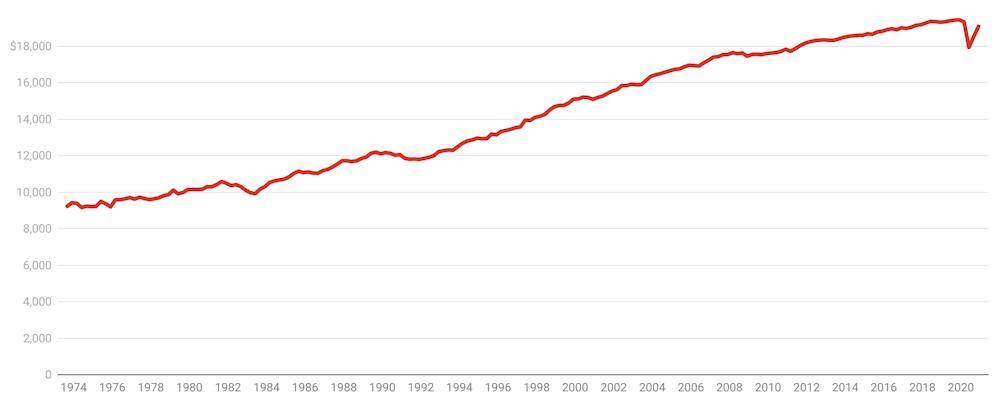
It’s reasonable to think that population-fuelled GDP is irrelevant to our lives, that what matters is GDP per head – the amount earned per person.
It shows much the same pattern: a V so clear you can see it on the widest possible scale, which is the one I have presented:
The economy is 1.1% smaller than it was at the start of last year and 3.3% smaller than it would have been had economic growth continued, an extraordinarily good outcome given what Frydenberg described as the “economic abyss” forecast just five months ago in the October 2020 budget.
Government support has turned into private spending
Driving the recovery has been a continuing rebound in consumer spending. It dived 12.3% in the June quarter, climbed 7.9% in the September quarter and in the three months to December when Victorians became freer to spend, a further 4.3%.
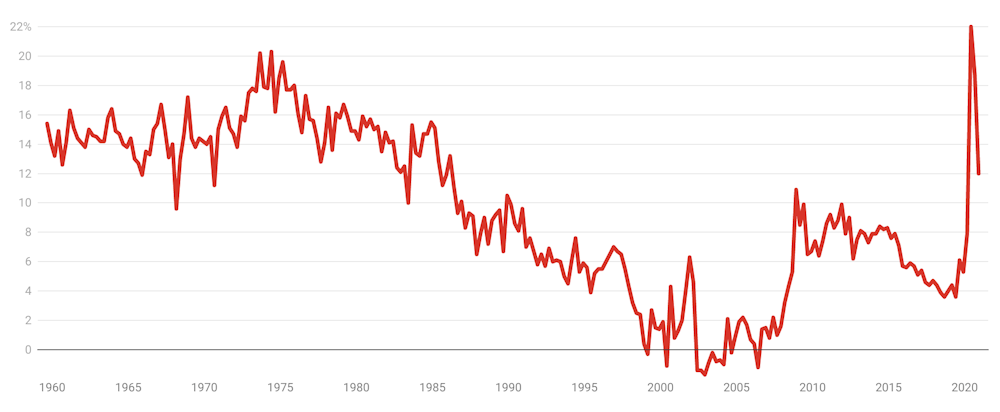
We’ve funded it in part by cutting what had been an extraordinarily high household saving ratio.
Household saving has slid from a record high 20% of net-of-tax income in the June quarter to a more welcome 12% in the December quarter.
Household saving ratio
Ratio of saving to net-of-tax income, seasonally adjusted.ABS
Unable to spend much on travel, we are spending on the things we can. In the three months to December our spending on motor vehicles jumped a dizzying 31.8%, putting it up 22.2% over the year.
Our spending in hotels, cafes and restaurants rebounded 17.5% in the months to December, although with overseas and much interstate travel restricted, it was still down 29.8% over the year.
With the help of low interest rates and incentives, housing investment climbed 4.1% in the quarter (Homebuilder) and business investment in plant and equipment climbed 8.9% (instant asset write-off).
There are no guarantees
Farm production soared an astounding 26.8% in the quarter – the biggest jump since 2008 – on the back of the second-best winter crop on record.
If the economy continues to recover at this pace and the “V” turns into an upward tick we will make big inroads into unemployment and the coronavirus recession will look like a blip, an aberration.
But there are no guarantees. The JobKeeper employment subsidy ends on March 28 and the sharp upticks in business investment and farm production are unlikely to continue.
Much will depend on the May budget, which comes out before the next update.
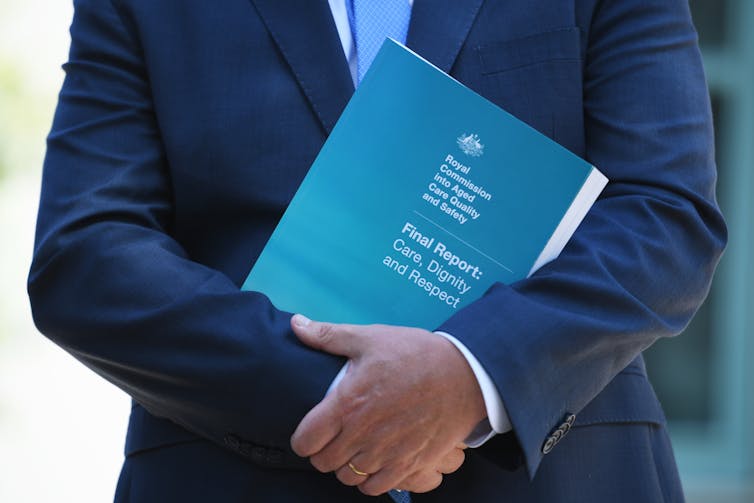
Among the budget decisions that will matter are how it will deal with the funding requirements of the aged care royal commission, whether and how it proceeds with the legislated increases in compulsory superannuation, and how quickly and to what extent it withdraws support from the economy.
There’s a case for keeping support high in order to extend the rebound in GDP and make big inroads into unemployment right up until the point we return to meaningful inflation. There’s a case for going for growth.
Christian Porter’s denial of the historical rape allegation is unequivocal, but it won’t draw a line under the issue for him or for the Morrison government.
Porter declares he’s determined to stay in his job, saying to quit would mean anyone could lose their career “based on nothing more than an accusation that appears in print”.
It’s true there is little natural justice in this situation. But in politics, there are often many competing factors.
Porter is right that it’s difficult to recall circumstances like this present crisis, with its passion and fevered coverage, and frenzied abuse via social media. And the worst of it is, there’s no way of definitively finding out what did or did not occur, and so where “justice” lies.
A woman who is now dead claimed she was raped by Porter when they were both teenagers. From what she told people and wrote, she had no doubt it happened. Porter says he has no doubt it did not happen.
The police can’t determine the truth, because the woman is deceased, and an independent inquiry wouldn’t be able to do so either.
The claim and counter claim will be fought out in the court of public opinion and it will be an ugly contest.
Porter is not just any minister: his role as attorney-general sets him apart. He is the country’s first law officer – which means he must be above any suspicion. It’s the old “Caesar’s wife” test and – properly – the bar is high.
However unfair it might be, Porter will now never be above suspicion, at least in the minds of many.
Before he was a politician, Porter was a crown prosecutor. He has been around court rooms, and so used to tense situations.
Of course his news conference was not a court room and things are different when you are defending yourself, but it was notable how rattled he was.
He wanted to avoid the details of that January 1988 time when the four teenagers were in Sydney as part of a debating team (which raises the idle question, where are the other two team members now and what do they think?). When pushed by journalists, some of his answers were fumbling.
What state he will be in after a period of leave remains to be seen, because it is likely the pressure on him will increase rather than ease.
Then there’s the question of the impact on the whole government. It is extraordinary what a toll the Brittany Higgins’ affair and the allegation against Porter are taking. It amounts to an enormous distraction for Morrison.
All this at a time when the government is struggling with the early days of the vaccine rollout.
And of course, the positive news has been put in the shade – Wednesday’s economic growth of 3.1% for the December quarter, which is a seriously good performance by any international standards.
Morrison is loyal to his ministers – or at least he understands that to put political blood in the water by cutting a minister loose is never without consequences.
When it is the attorney-general, that would be a huge step.
But asked this week whether he believed Porter’s denial, Morrison would not commit himself. “That is a matter for the police,” he said.
Significantly, Morrison didn’t send the woman’s statement to Porter after he received it in the letter from her friends on Friday. Porter said he still hasn’t seen it.
Porter’s spokesman said on Wednesday night that to have received the statement or documents when he was the subject of them, and they were matters for law enforcement agencies, would have been “inappropriate”. This seems a stretch.
Porter says he has Morrison’s support. The question is whether he will retain it in the days to come.
There is this hiatus, while Porter is on stress leave, during which Morrison can assess the situation.
He must decide whether he will remain dug in behind his embattled minister or encourage him to conclude that, despite what he said in his statement, his position is untenable.
There’s one graph that sums up both the good and not-yet-as-good detailed by Treasurer Josh Frydenberg at Wednesday’s national accounts press conference.
It’s a graph of the level of Australia’s gross domestic product – how much is produced and earned each three months in Australia – adjusted for inflation.
It shows Australia’s economy getting bigger and bigger over almost all the past 80 years with only two readily-apparent slowdowns; one in the early 1980s recession, and one in the early 1990s recession.
Until COVID. Last year’s recession wasn’t a slowdown like the other two – it was a collapse, so big you could see it on any scale, even one that went back to when modern records began.
And it was V-shaped.
As soon as the economy collapsed – by 7% in the three months to June, the most since the Great Depression – it bounced back 3.4% in the three months that followed and (we now know) a further 3.1% in the three months that followed that.
It’s actually more like the beginning of a V
But, as I suggested last time (and as the graph shows) the gain of 3.1% and the gain of 3.4% don’t anything like offset the dive of 7% because a percentage increase in a small number does less than a percentage dive in a bigger number.
It’s reasonable to think that population-fuelled GDP is irrelevant to our lives, that what matters is GDP per head – the amount earned per person.
It shows much the same pattern: a V so clear you can see it on the widest possible scale, which is the one I have presented:
The economy is 1.1% smaller than it was at the start of last year and 3.3% smaller than it would have been had economic growth continued, an extraordinarily good outcome given what Frydenberg described as the “economic abyss” forecast just five months ago in the October 2020 budget.
Government support has turned into private spending
Driving the recovery has been a continuing rebound in consumer spending. It dived 12.3% in the June quarter, climbed 7.9% in the September quarter and in the three months to December when Victorians became freer to spend, a further 4.3%.
We’ve funded it in part by cutting what had been an extraordinarily high household saving ratio.
Household saving has slid from a record high 20% of net-of-tax income in the June quarter to a more welcome 12% in the December quarter.
Household saving ratio
Ratio of saving to net-of-tax income, seasonally adjusted.ABS
Unable to spend much on travel, we are spending on the things we can. In the three months to December our spending on motor vehicles jumped a dizzying 31.8%, putting it up 22.2% over the year.
Our spending in hotels, cafes and restaurants rebounded 17.5% in the months to December, although with overseas and much interstate travel restricted, it was still down 29.8% over the year.
With the help of low interest rates and incentives, housing investment climbed 4.1% in the quarter (Homebuilder) and business investment in plant and equipment climbed 8.9% (instant asset write-off).
There are no guarantees
Farm production soared an astounding 26.8% in the quarter – the biggest jump since 2008 – on the back of the second-best winter crop on record.
If the economy continues to recover at this pace and the “V” turns into an upward tick we will make big inroads into unemployment and the coronavirus recession will look like a blip, an aberration.
But there are no guarantees. The JobKeeper employment subsidy ends on March 28 and the sharp upticks in business investment and farm production are unlikely to continue.
Much will depend on the May budget, which comes out before the next update.
Among the budget decisions that will matter are how it will deal with the funding requirements of the aged care royal commission, whether and how it proceeds with the legislated increases in compulsory superannuation, and how quickly and to what extent it withdraws support from the economy.
There’s a case for keeping support high in order to extend the rebound in GDP and make big inroads into unemployment right up until the point we return to meaningful inflation. There’s a case for going for growth.
There’s one graph that sums up both the good and not-as-good detailed by Treasurer Josh Frydenberg at Wednesday’s national accounts press conference.
It’s a graph of the level of Australia’s gross domestic product – how much is produced and earned each three months in Australia – adjusted for inflation.
It shows Australia’s economy getting bigger and bigger over almost all the past 80 years with only two readily-apparent slowdowns; one in the early 1980s recession, and one in the early 1990s recession.
Until COVID. Last year’s recession wasn’t a slowdown like the other two – it was a collapse, so big you could see it on any scale, even one that went back to when modern records began.
And it was V-shaped.
As soon as the economy collapsed – by 7% in the three months to June, the most since the Great Depression – it bounced back 3.4% in the three months that followed and (we now know) a further 3.1% in the three months that followed that.
It’s actually more like the beginning of a V
But, as I suggested last time (and as the graph shows) the gain of 3.1% and the gain of 3.4% don’t anything like offset the dive of 7% because a percentage increase in a small number does less than a percentage dive in a bigger number.
It’s reasonable to think that population-fuelled GDP is irrelevant to our lives, that what matters is GDP per head – the amount earned per person.
It shows much the same pattern: a V so clear you can see it on the widest possible scale, which is the one I have presented:
The economy is 1.1% smaller than it was at the start of last year and 3.3% smaller than it would have been had economic growth continued, an extraordinarily good outcome given what Frydenberg described as the “economic abyss” forecast just five months ago in the October 2020 budget.
Government support has turned into private spending
Driving the recovery has been a continuing rebound in consumer spending. It dived 12.3% in the June quarter, climbed 7.9% in the September quarter and in the three months to December when Victorians became freer to spend, a further 4.3%.
We’ve funded it in part by cutting what had been an extraordinarily high household saving ratio.
Household saving has slid from a record high 20% of net-of-tax income in the June quarter to a more welcome 12% in the December quarter.
Household saving ratio
Ratio of saving to net-of-tax income, seasonally adjusted.ABS
Unable to spend much on travel, we are spending on the things we can. In the three months to December our spending on motor vehicles jumped a dizzying 31.8%, putting it up 22.2% over the year.
Our spending in hotels, cafes and restaurants rebounded 17.5% in the months to December, although with overseas and much interstate travel restricted, it was still down 29.8% over the year.
With the help of low interest rates and incentives, housing investment climbed 4.1% in the quarter (Homebuilder) and business investment in plant and equipment climbed 8.9% (instant asset write-off).
There are no guarantees
Farm production soared an astounding 26.8% in the quarter – the biggest jump since 2008 – on the back of the second-best winter crop on record.
If the economy continues to recover at this pace and the “V” turns into an upward tick we will make big inroads into unemployment and the coronavirus recession will look like a blip, an aberration.
But there are no guarantees. The JobKeeper employment subsidy ends on March 28 and the sharp upticks in business investment and farm production are unlikely to continue.
Much will depend on the May budget, which comes out before the next update.
Among the budget decisions that will matter are how it will deal with the funding requirements of the aged care royal commission, whether and how it proceeds with the legislated increases in compulsory superannuation, and how quickly and to what extent it withdraws support from the economy.
There’s a case for keeping support high in order to extend the rebound in GDP and make big inroads into unemployment right up until the point we return to meaningful inflation. There’s a case for going for growth.
Aside from his strenuous denials of the rape allegation against him, the central point made by Attorney-General Christian Porter at his media conference was that he had been the victim of “trial by media”.
He warned if the media’s publication of allegations in these circumstances resulted in a public figure being forced from office, it would represent a new and unacceptable standard for public figures generally.
He also said no one in the media had confronted him with the allegation. And he said that when Prime Minister Scott Morrison discussed the matter with him last week, the document containing the allegation had already been sent to the Australian Federal Police, so he had not seen it on that occasion either.
These are important questions deserving of some scrutiny.
What constitutes a ‘trial by media’?
“Trial by media” is one of those phrases that trips off the tongue in cases where the media apply intense pressure on a person or organisation at the centre of an issue.
Trial by media occurs when either of two things happen. The first is where media coverage prejudices the outcome of legal processes, such as police investigations or trials in court. The second is when the media initiate an issue and then proceed to play prosecutor, judge and jury.
Neither applies in the Porter case.
As far as is known, there are no police investigations or legal proceedings on foot and there has been little prospect there would be, given the woman who made the allegations is now dead. The South Australian police are preparing a report for the coroner, an investigation that by definition is confined to the circumstances of the person’s death.
The New South Wales police investigation was suspended after the woman took her life in June last year, and this week, Commissioner Mick Fuller said the case was closed.
The South Australian police commissioner discussed the matter with the NSW and AFP commissioners this week, as well, but has made no comment on whether his force would pursue an investigation. The AFP has no jurisdiction.
So much for the first test of trial by media.
Porter denied the allegation in an emotional news conference.Richard Wainwright/AAP
The media also did not initiate the allegation. That was done in a 31-page letter sent anonymously to politicians on both sides of federal parliament, including Morrison and the Labor leader in the Senate, Penny Wong.
The ABC obtained a copy of this document and reported the allegation without naming Porter, saying only that it referred to a senior cabinet minister. The rest of the media then reported the story, also without naming Porter.
It would have been legally perilous and ethically unconscionable for the media to do so without putting the allegation to him.
How should the media have handled the allegation?
This raises the question: should the media have put it to Porter?
In principle, as a matter of fairness, yes. As a practical matter, however, it is a very difficult proposition.
No doubt the ABC and other media would have obtained pre-publication legal advice about this.
The first difficulty the media face in these circumstances is the accused person might not give an answer but make a threat to sue for defamation. Given the weakness of defences in defamation law in Australia, it would be a very risky business to publish in the face of such a threat.
Even publishing what is called a “denial story” is risky because of the damage to reputation inherent in the question. If the media publish a story saying Porter denied a rape allegation, this leaves open the question of whether he is to be believed.
A story based on a voluntary public statement of the kind he made this week, however, is an altogether different situation.
The second difficulty is there is always the chance the accused person will obtain an injunction restraining publication. In a case like this, there is a good chance the court would also issue a “super injunction” banning the reporting of the fact that an injunction had been granted.
This would have tied up the matter in the courts, probably for weeks.
A political matter, not one for the media
Clearly, the media decided to treat this as a political story and watch it play out in the political process.
Of course, the media are part of the political process. The part they play is that of watchdog and commentator, and in this case, virtually all of the scrutiny was on Morrison’s response.
He was already under pressure for the way he and his government handled the rape allegation made by former staffer Brittany Higgins. A new allegation against a member of his cabinet intensified that pressure enormously.
Morrison has stood by Porter amid calls for the attorney general to step down.Mick Tsikas/AAP
When did he know? What did he know? How did he know? What did he do? What does he intend to do?
These are all legitimate questions and have nothing to do with the rights and wrongs of the allegation itself. They have everything to do with how the prime minister handles another alleged incident of sexual misconduct involving someone in his government.
Porter’s outing himself took the political process a step further. As he himself said at his media conference, where it goes from here is for others to decide.
Should there be an inquiry like the one instigated by the High Court concerning the conduct of the former justice Dyson Heydon? Again, the media spotlight returns to the prime minister for answers.
Aside from his strenuous denials of the rape allegation against him, the central point made by Attorney-General Christian Porter at his media conference was that he had been the victim of “trial by media”.
He warned if the media’s publication of allegations in these circumstances resulted in a public figure being forced from office, it would represent a new and unacceptable standard for public figures generally.
He also said no one in the media had confronted him with the allegation. And he said that when Prime Minister Scott Morrison discussed the matter with him last week, the document containing the allegation had already been sent to the Australian Federal Police, so he had not seen it on that occasion either.
These are important questions deserving of some scrutiny.
What constitutes a ‘trial by media’?
“Trial by media” is one of those phrases that trips off the tongue in cases where the media apply intense pressure on a person or organisation at the centre of an issue.
Trial by media occurs when either of two things happen. The first is where media coverage prejudices the outcome of legal processes, such as police investigations or trials in court. The second is when the media initiate an issue and then proceed to play prosecutor, judge and jury.
Neither applies in the Porter case.
As far as is known, there are no police investigations or legal proceedings on foot and there has been little prospect there would be, given the woman who made the allegations is now dead. The South Australian police are preparing a report for the coroner, an investigation that by definition is confined to the circumstances of the person’s death.
The New South Wales police investigation was suspended after the woman took her life in June last year, and this week, Commissioner Mick Fuller said the case was closed.
The South Australian police commissioner discussed the matter with the NSW and AFP commissioners this week, as well, but has made no comment on whether his force would pursue an investigation. The AFP has no jurisdiction.
So much for the first test of trial by media.
Porter denied the allegation in an emotional news conference.Richard Wainwright/AAP
The media also did not initiate the allegation. That was done in a 31-page letter sent anonymously to politicians on both sides of federal parliament, including Morrison and the Labor leader in the Senate, Penny Wong.
The ABC obtained a copy of this document and reported the allegation without naming Porter, saying only that it referred to a senior cabinet minister. The rest of the media then reported the story, also without naming Porter.
It would have been legally perilous and ethically unconscionable for the media to do so without putting the allegation to him.
How should the media have handled the allegation?
This raises the question: should the media have put it to Porter?
In principle, as a matter of fairness, yes. As a practical matter, however, it is a very difficult proposition.
No doubt the ABC and other media would have obtained pre-publication legal advice about this.
The first difficulty the media face in these circumstances is the accused person might not give an answer but make a threat to sue for defamation. Given the weakness of defences in defamation law in Australia, it would be a very risky business to publish in the face of such a threat.
Even publishing what is called a “denial story” is risky because of the damage to reputation inherent in the question. If the media publish a story saying Porter denied a rape allegation, this leaves open the question of whether he is to be believed.
A story based on a voluntary public statement of the kind he made this week, however, is an altogether different situation.
The second difficulty is there is always the chance the accused person will obtain an injunction restraining publication. In a case like this, there is a good chance the court would also issue a “super injunction” banning the reporting of the fact that an injunction had been granted.
This would have tied up the matter in the courts, probably for weeks.
A political matter, not one for the media
Clearly, the media decided to treat this as a political story and watch it play out in the political process.
Of course, the media are part of the political process. The part they play is that of watchdog and commentator, and in this case, virtually all of the scrutiny was on Morrison’s response.
He was already under pressure for the way he and his government handled the rape allegation made by former staffer Brittany Higgins. A new allegation against a member of his cabinet intensified that pressure enormously.
Morrison has stood by Porter amid calls for the attorney general to step down.Mick Tsikas/AAP
When did he know? What did he know? How did he know? What did he do? What does he intend to do?
These are all legitimate questions and have nothing to do with the rights and wrongs of the allegation itself. They have everything to do with how the prime minister handles another alleged incident of sexual misconduct involving someone in his government.
Porter’s outing himself took the political process a step further. As he himself said at his media conference, where it goes from here is for others to decide.
Should there be an inquiry like the one instigated by the High Court concerning the conduct of the former justice Dyson Heydon? Again, the media spotlight returns to the prime minister for answers.
There’s one graph that sums up both the good and not-as-good detailed by Treasurer Josh Frydenberg at Wednesday’s national accounts press conference.
It’s a graph of the level of Australia’s gross domestic product – how much is produced and earned each three months in Australia – adjusted for inflation.
It shows Australia’s economy getting bigger and bigger over almost all the past 80 years with only two readily-apparent slowdowns; one in the early 1980s recession, and one in the early 1990s recession.
Until COVID. Last year’s recession wasn’t a slowdown like the other two – it was a collapse, so big you could see it on any scale, even one that went back to when modern records began.
And it was V-shaped.
As soon as the economy collapsed – by 7% in the three months to June, the most since the Great Depression – it bounced back 3.4% in the three months that followed and (we now know) a further 3.1% in the three months that followed that.
It’s actually more like the beginning of a V
But, as I suggested last time (and as the graph shows) the gain of 3.1% and the gain of 3.4% don’t anything like offset the dive of 7% because a percentage increase in a small number does less than a percentage dive in a bigger number.
It’s reasonable to think that population-fuelled GDP is irrelevant to our lives, that what matters is GDP per head – the amount earned per person.
It shows much the same pattern: a V so clear you can see it on the widest possible scale, which is the one I have presented:
The economy is 1.1% smaller than it was at the start of last year and 3.3% smaller than it would have been had economic growth continued, an extraordinarily good outcome given what Frydenberg described as the “economic abyss” forecast just five months ago in the October 2020 budget.
Government support has turned into private spending
Driving the recovery has been a continuing rebound in consumer spending. It dived 12.3% in the June quarter, climbed 7.9% in the September quarter and in the three months to December when Victorians became freer to spend, a further 4.3%.
We’ve funded it in part by cutting what had been an extraordinarily high household saving ratio.
Household saving has slid from a record high 20% of net-of-tax income in the June quarter to a more welcome 12% in the December quarter.
Household saving ratio
Ratio of saving to net-of-tax income, seasonally adjusted.ABS
Unable to spend much on travel, we are spending on the things we can. In the three months to December our spending on motor vehicles jumped a dizzying 31.8%, putting it up 22.2% over the year.
Our spending in hotels, cafes and restaurants rebounded 17.5% in the months to December, although with overseas and much interstate travel restricted, it was still down 29.8% over the year.
With the help of low interest rates and incentives, housing investment climbed 4.1% in the quarter (Homebuilder) and business investment in plant and equipment climbed 8.9% (instant asset write-off).
There are no guarantees
Farm production soared an astounding 26.8% in the quarter – the biggest jump since 2008 – on the back of the second-best winter crop on record.
If the economy continues to recover at this pace and the “V” turns into an upward tick we will make big inroads into unemployment and the coronavirus recession will look like a blip, an aberration.
But there are no guarantees. The JobKeeper employment subsidy ends on March 28 and the sharp upticks in business investment and farm production are unlikely to continue.
Much will depend on the May budget, which comes out before the next update.
Among the budget decisions that will matter are how it will deal with the funding requirements of the aged care royal commission, whether and how it proceeds with the legislated increases in compulsory superannuation, and how quickly and to what extent it withdraws support from the economy.
There’s a case for keeping support high in order to extend the rebound in GDP and make big inroads into unemployment right up until the point we return to meaningful inflation. There’s a case for going for growth.
Attorney-General Christian Porter has identified himself as the minister accused of historical rape but declared categorically that the 1988 claimed assault “simply did not happen”.
A highly emotional Porter told a Perth he had not slept with the then 16-year-old who made the allegation more than three decades later. “We didn’t have anything of that nature happen between us,” he said.
Porter declared he was not standing down from his position as first law officer.
“If I stand down from my position as Attorney-General because of an allegation about something that simply did not happen, then any person in Australia can lose their career, their job, their life’s work based on nothing more than an accusation that appears in print.
“If I were to resign and that set a new standard, there wouldn’t be much need for an attorney-general anyway because there would be no rule of law left to protect in this country.”
Porter will take two weeks leave to “assess and hopefully improve my own mental health”.
“I think I will be able to return from that and do my job.”
He said he has been asked by colleagues “Are you OK?”. His answer was “I really don’t know. I am not ashamed to say that I am going to seek some professional assessment and assistance on answering that question over the next few weeks.”
Porter said he had been subject to “the most wild, intense and unrestrained series of accusations I can remember in modern Australian politics.”
He said he had never had the allegations put to him in any substantive form. “No-one put anything in any detail to me seeking a response.” He had never seen the woman’s statement, although a statement from her was included with the letter sent to Prime Minister Scott Morrison last week. The ABC published the rape allegation late on Friday.
On the incident itself, Porter said when he was 17 and she was 16 they were both on the Australian schools debating team for a competition in Sydney. He remembered her as an “intelligent, bright, happy, person.”
He was noticeably reluctant to go into detail. Under questioning, he conceded he might have been in her room, but he didn’t think he was ever alone with her.
He recalled a memory, sparked by what he had read of the material – “I don’t think any of us had ever ironed a shirt, and I recall, she showed us how to do it, I remember that.”
It was a team of four, including three boys and “we did what normal teenagers would do”.
“I remember two evenings that week. One was a night at one of the colleges with bowls of prawns, which sticks in my mind. I do remember a formal dinner and going out dancing sounds about right.”
He said he was not in contact with the woman – who took her own life last year – in subsequent decades.
Porter began his news conference by referring to the woman’s parents, saying he hoped they would understand that in denying the allegation “I do not mean to impose anything more upon your grief”.
He rejected the volley of calls into an independent inquiry into the allegation.
“What would that inquiry ask me to do? To disapprove something that didn’t happen 33 years ago.”
“I honestly don’t know what I would say to that inquiry. Of course I can’t.”
Porter said he had spoken to Scott Morrison and had his full backing.
He said he was deeply sorry for the fallout the issue has had for his colleagues.
“My colleagues have become the target of allegation and speculation, themselves. My colleagues are my friends. And I’m deeply sorry to each of them for that.”
The issue exploded last week when friends of the woman wrote to Morrison and several other parliamentarians demanding an inquiry into her allegation. The letter included a statement the woman had made, detailing her alleged experience.
The woman went to the police a year ago but had not made a formal complaint.
The allegation has derailed the government for a week, when it was already struggling to contain the fallout from former staffer Brittany Higgins’ allegation she was raped by a colleague in the office of the then Defence Industry Minister Linda Reynolds in 2019.
On Monday, Morrison said the woman’s allegation was a matter for the police. The federal police referred it to the NSW police. The NSW police said on Tuesday that, “based on information provided to NSW Police, there is insufficient admissible evidence to proceed.
“As such, NSW Police Force has determined the matter is now closed.”
Porter denied the allegation to Morrison on Wednesday of last week.
The ABC’s Four Corners was pursuing the woman’s story last year, but in the end was not in a position to include it in its November program “Inside the Canberra Bubble”. That program reported sexist comments made by Porter as a young man.
Porter entered federal parliament in 2013 after a high profile career in Western Australian politics, where he served as attorney-general and treasurer.
Federally, he was social services minister in 2015-2017, before becoming attorney-general. After the 2019 election, industrial relations was added to his responsibilities.
Australian of the Year Grace Tame, answering questions at the National Press Club, criticised Morrison over invoking his wife Jenny’s counsel that he should think of the Higgins’ situation as a father. “It shouldn’t take having children to have a conscience,” Tame said.
Source: The Conversation (Au and NZ) – By Davina Porock, Professor of Nursing, Director of Centre for Research in Aged Care, Edith Cowan University
Death is inevitable, and in a civilised society everyone deserves a good one. It would therefore be logical to expect aged-care homes would provide superior end-of-life care. But sadly, palliative care options are often better for those living outside residential aged care than those in it.
More than a quarter of a million older Australians live in residential aged care, but few choose to be there, few consider it their “home”, and most will die there after living there for an average 2.6 years. These are vulnerable older people who have been placed in residential aged care when they can no longer be cared for at home.
The royal commission has made a forceful and sustained criticism of the quality of aged care. Its final report, released this week, and the interim report last year variously described the sector as “cruel”, “uncaring”, “harmful”, “woefully inadequate” and in need of major reform.
Quality end-of-life care, including access to specialist palliative care, is a significant part of the inadequacy highlighted by the report’s damning findings. This ranked alongside dementia, challenging behaviours and mental health as the most crucial issues facing the sector.
Longstanding problem
In truth, we have already known about the palliative care problem for years. In 2017 the Productivity Commission reported that end-of-life care in residential aged care needs to be better resourced and delivered by skilled staff, to match the quality of care available to other Australians.
This inequality and evident discrimination against aged-care residents is all the more disappointing when we consider these residents are among those Australians most likely to find themselves in need of quality end-of-life care.
The royal commission’s final report acknowledges these inadequacies and addresses them in 12 of its 148 recommendations. Among them are recommendations to:
enshrine the right of older people to access equitable palliative and end-of-life care
include palliative care as one of a range of integrated supports available to residents
introduce multidiscpliniary outreach services including palliative care from local hospitals
require specific training for all direct care staff in palliative and end-of-life care skills.
The aged care royal commission’s final report, released this week, handed down 148 recommendations. Twelve of them acknowledged longstanding problems with end-of-life care in residential aged care.Dean Lewins/AAP
What is good palliative care?
Palliative care is provided to someone with an active, progressive, advanced disease, who has little or no prospect of cure and who is expected to die. Its primary goal is to optimise the quality of life for that person and their family.
End-of-life care is provided by palliative care services in the final few weeks of life, in which a patient with a life-limiting illness is rapidly approaching death. This also extends to bereavement care for family and loved ones.
Unlike in other sectors of Australian society, where palliative care services are growing in line with overall population ageing, palliative care services in residential aged care have been declining.
Funding restrictions in Australian aged-care homes means palliative care is typically only recommended to residents during the final few weeks or even days of their life.
Some 70% of Australians say they would prefer to die at home, surrounded by loved ones, with symptoms managed and comfort the only goal. So if residential aged care is truly a resident’s home, then extensive palliative and end-of-life care should be available, and not limited just to the very end.
Fortunately, the royal commission has heard the clarion call for attention to ensuring older Australians have as good a death as possible, as shown by the fact that a full dozen of the recommendations reflect the need for quality end-of-life care.
Moreover, the very first recommendation — which calls for a new Aged Care Act — will hopefully spur the drafting of legislation that endorses high-quality palliative care rather than maintaining the taboo around explicitly mentioning death.
Around 70% of Australians would prefer to die at home in the company of loved ones.Shutterstock
Let’s talk about death
Of course, without a clear understanding of how close death is, and open conversation, planning for the final months of life cannot even begin. So providing good-quality care also means we need to get better at calculating prognosis and learn better ways to convey this information in a way that leads to being able to make a plan for comfort and support, both for the individual and their loved ones.
Advanced care planning makes a significant difference in the quality of end-of-life care by understanding and supporting individual choices through open conversation. This gives the individual the care they want, and lessens the emotional toll on family. It is simply the case that failing to plan is planning to fail.
We need to break down the discomfort around telling people they’re dying. The unpredictability of disease progression, particularly in conditions that involve frailty or dementia, makes it hard for health professionals to determine when exactly palliative care will be needed and how to talk about it with different cultural groups.
These conversations need to be held through the aged-care sector to overcome policy and regulation issues, funding shortfalls and workforce knowledge and expertise.
We need a broader vision for how we care for vulnerable Australians coming to the end of a long life. It is not just an issue for health professionals and residential care providers, but for the whole of society. Hopefully the royal commission’s recommendations will breathe life into end-of-life care into aged care in Australia.
A woman’s decision to leave a violent and abusive relationship is a complex process. She first needs to consider the risks to her and her children. Paradoxically, taking that step towards safety is also the time of greatest danger of homicide, sexual assault and increased violence.
Pets and service animals are also a part of the lives of many families. This means they are an important part of the decision-making process when women consider leaving a violent situation.
The pets may be a critical source of therapeutic support, but they may also be at risk of harm and used to exert control over people (“you leave and you won’t see those animals again”). Animals’ central role in family life means many victim-survivors of family violence are reluctant to leave because they fear their pets will be harmed.
To combat this, a family violence motion has been presented in the Victorian parliament that seeks to recognise animal abuse as a form of family violence. If all elements were adopted, it would increase the safety of women and children.
The motion advocates several policy and legislative options. These include:
financial assistance to victim-survivors of family violence, including for the care of animals
a review of the Family Violence Protection Act 2008 to recognise that companion animals are affected by family violence and require protection
companion animals are placed in the care of either the victim-survivor or other appropriate carers to protect them.
These measures would be an important step towards improving support and so the safety of victim-survivors when animals are also caught up in family violence.
If this motion is passed, Victoria will be the second state after New South Wales to acknowledge the importance of the protection of animals for women’s safety. By comparison, more than two-thirds of US states have enacted legislation that includes provisions for pets in domestic violence protection orders.
Growing research evidence points unequivocally to the link between animal abuse and family violence. It shows animal cruelty occurs more frequently where family violence is also occurring.
Some studies suggest animal abuse is an indicator of more severe family violence and domestic homicide. If the animals are not safe, then neither are the humans, and vice versa.
Recognition of the need for intervention orders to include animal protection is not the only aspect of policy in need of review. Currently, if the companion animal is registered to the violent partner as the owner, a woman can be charged with theft for taking the animal with her, even when he is threatening the animal. The provision in the motion for need and protection to override ownership is therefore important.
Other concerns arise with microchips: the owner of the animal can trace the animal and locate a woman who is in hiding if she does not put a notice on the microchip database not to disclose her address. Some organisations (including veterinary clinics) are now bringing this to the attention of women using their services.
A motion before the Victorian parliament calls for pets and companion animals to be considered victims of family violence.Shutterstock
Unsurprisingly, the need for financial support is high on the motion’s agenda. In particular, there are housing and refuge options to consider.
Currently, women leaving violent situations have few options to take their animals with them. Women with disabilities who have service or therapeutic animals are at a distinct disadvantage when trying to leave and find suitable accommodation.
Bringing an animal into a refuge or emergency accommodation can be disruptive for other residents, especially if they have a fear of animals or allergies. Keeping animals with women and children is therefore not always the best option in a crisis. Dedicated animal shelters allowing for up to two months of care need to be made available.
In some regions, there are limited networks of animal shelters and veterinarians that have developed these resources to shelter dogs and cats for short periods. Beyond household companion animals, there is also a great need for support for large animals such as horses and goats, particularly in rural communities.
The changes the motion is calling for are timely. They are not radical, but would be an important further step in the response to family violence, backed by current research.
Advances in multi-agency risk-assessment tools and innovations within the refuge and specialist family violence sector are highlighting animal abuse as an important consideration in responding to family violence.
I’m a neanderthal man You’re not a neanderthal girl Let’s make hybrid love In this neanderthal world
[with apologies to Hotlegs, 1970]
Homo Stupidus?
After my partner read Dan Salmon’s novel Neands – written during lockdown in 2020 – I decided to renew my interest in our distant ancestry, in part with a concern that homo neanderthalensis has been unable to shake off, so far, its unflattering reputation in popular culture. In the last few years it has become known that all humans alive today – with the exception of those of pure African ethnicity – have up to six percent Neanderthal DNA.
I have been reading Tim Flannery’s Europe; a Natural History (written in 2017), having read Svante Pääbo’s Neanderthal Man; In Search of Lost Genomes (2013) – by Svante Pääbo, whose team did the first genetic sequencing of Neanderthal and Denisovan DNA – and Neanderthals Rediscovered (2014, by Dimitra Papagianni and Michael Morse).
Pääbo is a specialist paleo‑geneticist; principally a dot maker, though also a capable dot‑joiner. (We think of scientific scholars as discovers of facts, aka ‘dots’; and we think of intellectuals as joiners of those dots to tell sensible stories.) Indeed Pääbo is a disciple of world renown New Zealand evolutionist, the late Allan Wilson. (The Allan Wilson Centre for Molecular Ecology and Evolution was established in Palmerston North in 2002, but sadly in 2015 became a victim of New Zealand government austerity.) Flannery – a former Australian of the Year – is a natural historian of wide scope; in abovementioned terms a dot‑joiner more than a dot‑maker, an interpreter and a gifted storyteller, a public intellectual.
Wilson was an important early proponent of the Recent African origin of modern humans hypothesis, which states that all humans alive today are descended from a population (homo sapiens) that lived in Africa and spread from Africa 70,000 to 80,000 years ago. The strong Wilsonian version of the hypothesis was that all humans today are wholly descended from that African population. Pääbo calls this population departing from Africa ‘The Replacement Crowd’.
While Pääbo explicitly accepts that the Replacement Crowd need not have evolved in Africa, he evokes Occam’s Razor (the idea that the simplest story is the most probable) to suggest that he favours the ‘homo sapiens evolved in Africa’ story. Flannery bluntly assumes that homo sapiensevolved in Africa.
(We might consider the possibility of a 22nd century global catastrophe from which the only survivors were New Zealanders; and that the subsequent population of the world originated in ‘lifeboat Aotearoa’. Scientists in the 102nd century may well have an ‘Out of Aotearoa’ hypothesis, which would be accurate; but that would hardly be proof that humans had evolved in Aotearoa.)
The main story I want to relate here, however, is Flannery’s account of the mixing of Africans and Europeans. Archetypal Europeans – homo neanderthalensis – lived in Europe (and West Asia) from 400,000 to 40,000 years ago, give or take a year or a thousand. They evolved pale skin, and were hunters well‑adapted to a planet that was for the most part much colder than it is now. The accepted story is that Neanderthals – or at least pure Neanderthals – became extinct between 40,000 and 30,000 years ago. (While the authors of Neanderthals Rediscovered reject the idea that a volcanic explosion caused this ‘extinction’ of the Neanderthals, revised dating suggests that indeed a supervolcanic event in Europe 39,000 years ago – indeed of the Vesuvius field – could have had a substantial demographic impact on the Europeans of that time.)
In the Linnaean (Latin) system of species nomenclature, the discoverer of a new species gets to name it. The first Neanderthal bones were discovered in 1856 in a cave in Germany’s Neander Valley, just before Charles Darwin published The Origin of the Species. Scientific analysis took place in the mid‑1860s. Two of the first scientists to get access to these bones – which included skulls – were William King and Ernst Haeckel. Both named this new hominid species. King chose the name – homo neanderthalensis – based on the place the bones were found; fortunately he published the name first. Haeckel – presumably seeking a match for homo sapiens (‘wise man’) – published the name homo stupidus. This was the time when one pseudoscience (phrenology) was giving way to another (eugenics). Phrenology “involves the measurement of bumps on the skull to predict mental traits”.
The Neanderthal skulls were seen as ape‑like, and hence were assumed to be the remains of an inferior hominid species. Modern humans had already (and prematurely) been dubbed ‘wise’ (sapiens). At the time scientists did not know about the African origins of ‘wise men’. The eugenicists came up with an Aryan theory of racial superiority; a theory that helped to associate in the European mind the idea of ‘white supremacy’. (The irony is, of course, that the still‑popular unscientific view of Neanderthals is in reality one of ‘white inferiority’, and the label homo sapienscould be taken to mean ‘black superiority’.)
We are increasingly coming to understand that Neanderthals and Africans were neither superior nor inferior; just a bit different.
Neanderthal Genetics
Flannery states that the Neanderthal nuclear genome is 0.3 percent different from that of modern humans. (Compare chimpanzees, at 1.2 percent different from humans.) While it is not yet clear what the different genes do, it is known that green eyes, red hair and pale skin are Neanderthal features; attributes which possessors should feel free to celebrate, in the same sense that Afro hair might be celebrated. Twenty percent of the Neanderthal genome (ie 20% of the 0.3%) is present in modern humans, though individual people today derive no more than six percent of their human genes from Neanderthals. (Indeed it is now possible for individuals to take a DNA test to estimate what percent of our human genes are of Neanderthal origin.)
Flannery mentions that none of the Neanderthal Y‑chromosome (the male chromosome) is present in modern humans. Superficially, this suggests that, when Africans and Europeans first met (most likely in the Levant), it was African (modern) men who mated with European (Neanderthal) women; meaning that the Africans were dominant (much as Europeans were dominant over Africans in eighteenth century America). Flannery infers that African invaders captured European women, maybe killing the men.
However, from reading Pääbo, the initial genetic research showed that Neanderthal mitochondrial DNA (passed through the female line) is also not present in modern humans. This would mean that the initial sexual contact must have been Neanderthal men mating with African women, and that subsequent ‘hybrid’ males were unable to reproduce (in line with ‘Haldane’s rule’).
An important developing feature of evolutionary biology is the discovery of hybrid ‘species’, with Europe providing an environment in which many wild ‘purebred’ species were able to interbreed with related sub‑species, creating what we might call ‘mongrel’ species; and that mongrel species could have – in certain environments – superior fitness attributes over the constituent species. (Flannery uses bears as an example of historical hybridisation in Europe.)
Our Neanderthal Story
So, the story that I glean is as follows. This is my interpretation.
Between 40,000 and 50,000 years ago, African refugees met up with Europeans, probably in the Levant. Further, something similar probably happened around 70,000 years ago, with Africans mixing with West Asian Neanderthals. (East Asians then were probably substantially ‘Denisovan’; Denisovans – first discovered in Siberia – and Neanderthals share common African ancestors about a million years ago; contrast the common ancestry between Neanderthals and Africans at about 500,000 years ago. Denisovan DNA is present today in native Australians and Papuans. Pääbo’s last chapters are about his team’s work on the Denisovan genome.)
Some Neanderthal men mated with African women, probably members of a refugee community, with the hybrid offspring being raised as Africans. (While neither Africans nor Europeans should be regarded as superior, refugee populations are vulnerable to their ‘hosts’.) Hybrid male offspring were unable to reproduce, at least for a few generations until a kind of ‘mestizo’ hybrid ‘race’ was established. This mixed but mainly African population – with substantial amounts of Neanderthal DNA – gained a degree of fitness that allowed them to successfully spread into southern Europe. (Northern Europe was heavily glaciated then, though not as heavily as in the peak of the Ice Ages.)
As such, the hybrid population prevailed in an evolutionary sense over the pure Neanderthal population. The hybridised African immigrants were probably less carnivorous – more omnivorous – than the Neanderthal Europeans, and (as Papagianni and Morse note) were more coastal dwellers (fisher folk) than big game hunters.
Then – 39,000 years ago – the Vesuvius supervolcano erupted, severely affecting both populations, but leaving the hybrid population best placed to recover. Subsequently, increased glaciation ensured that the human population of Europe would remain very low
From 14,000 years ago – as the most recent ice age started to ebb – Europe was then subject to immigration from Asia; this includes the arrival of the first farmers. These central and west Asian immigrants were from a longer established hybrid population; their arrivals into Europe had the effect of diluting the Neanderthal component of the European genome. These Asians had paler skin than Africans. Melanin in the skin was probably selected against, as people moved into northern Europe and northern Asia (and America) in the years of glacial contraction following the last great ice age.
Possibly the most genetically Neanderthal people in the world today are the Anglo‑Celtic natives of the British Isles, that outer archipelago of Europe where red hair remains a common population feature.
Neanderthals were probably not well adapted to Aotearoa – where ultra‑violet sunlight is at its most intense. Nevertheless, as a quirk of human fate, Aotearoa – the ‘Britain of the south’ as it was once called – has become a bastion of Neanderthal genes. Indeed, my redhead Scottish ancestors bequeathed me with freckly skin, and my partner has gorgeous green eyes.
————
Keith Rankin, trained as an economic historian, is a retired lecturer in Economics and Statistics. He lives in Auckland. Contact: keith at rankin.nz.
Former senator David Leyonhjelm today lost his appeal against a defamation ruling and must pay A$120,000 compensation to Greens senator Sarah Hanson-Young for his comments that she should “stop shagging men”.
“It is hard and difficult to do,” said Senator Hanson-Young of the proceedings. “But by supporting the women who dare to speak up, we are supporting the rights of women and girls to be respected, everywhere.”
Women have long fought to silence rumours told about them, and to exercise agency over their own narratives and experiences.
Depending on cultural and historical context, the law has worked — and continues to work — to either hinder or help this process.
The 2021 Young Australian of the Year Grace Tame, 26, who appeared before the National Press Club today, and the #LetHerSpeak campaign worked to overturn laws that prohibited the identification of sex assault victims. These changes allow survivors to speak out and reduce stigma and shame. In recent weeks there has been discussion over who has the right to tell Brittany Higgins’ story of her alleged rape.
Intricate defamation rules — varying across jurisdictions and time periods — are not simply neutral or objective legal requirements. They reflect norms of morality, politics, sexuality, and gender.
While women today are fighting to tell their own stories and men are bringing legal action to clear their names, 19th-century women in the Australian colonies and other common law countries (such as the United States, Britain and New Zealand) fought for the ability to silence slurs of sexual immorality against them. They brought cases after being insulted and labelled “whores”, “bad women”, “unchaste” or “dirty”.
In 1826, Hariett Spencer, a young governess, sued Robert Jeffrey, Captain of the ship Tower Castle, for slander. She sought 1000 pounds in damages for statements he made about her having relations with a sailor on board and acting inappropriately. The cost of such rumours was high. Spencer faced losing her employment in the fledgling colony and being tarred as a “whore”.
At first instance she won, Chief Justice Stephen declaring: “to a civilized female, in any part of the globe, a fair reputation is an inestimable possession”. However, the defendant successfully appealed on the basis that she had not proved any “special damage”.
Several early Australian cases of sexual slander were tossed out because the woman bringing the action couldn’t show financial loss.Bill Oxford/Unsplash, CC BY
This technical point of law was the focus of defamation reforms in the 1800s, culminating in nearly all common law jurisdictions passing legislation titled collectively The Slander of Women.
Under old English common law, defamation was categorised as either libel (printed material) or slander (spoken words) and these categories were treated very differently. A claim for slander could only be brought in the civil courts if it concerned imputations of serious criminality, an infectious disease, or injured the plaintiff in their trade or profession.
If it related to matters of sexual morality — such as unchastity, adultery, fornication, prostitution — a person would need to show the slander caused them economic loss, known as “special damage”.
The traditional doctrine of slander imagined a male plaintiff, who might be injured if labelled a corrupt carpenter or incompetent physician, but for whom allegations of sexual morality were trifling matters.
But it was different for women. Sexual slurs and insults could destroy their lives and livelihoods. From the 17th century onwards, women began to bring sexual slander cases in great numbers. They sought vindication of their reputations, and compensation for pain and suffering they experienced.
In 1862, young Elizabeth Bell, a housemaid at the Adelaide Hotel, brought an action for slander against the son of the hotel proprietor, Joseph Allen. Bell testified that Allen had attempted on numerous occasions to “take liberties with her”, which she resisted and as a consequence he said he would take revenge. This he did, telling Bell’s fiancé and others, “with gross and obscene words”, that Bell was “unchaste”. Bell lost her action on the basis she could not sufficiently prove “special damage”.
In 1886, in a high-profile case, Elizabeth Albrecht, a publican, sued Annie Marks Patterson in the Supreme Court of Victoria for stating she had given birth to an illegitimate child, was a “kept woman” and had an affair with the defendant’s husband George Patterson.
Albrecht testified that as a result she had lost business and been shunned by friends and acquaintances. Albrecht’s trial and appeals were plagued with the problem of proving sufficient “special damage”. When Justice Williams finally knocked down her damages, he stated:
The plaintiff [is] obliged to prove special damages, and this must be measured in pounds, shillings and pence. A man [is] not hampered by such a condition. It [is] outrageous that in our present state of civilisation such a barbarous law should exist. It was a relic of the old feudal times, when every woman on an estate was regarded by the baron as his serf, and might be used by him as he pleased, being treated as a mere chattel.
There [is] a total disregard to the rights of women, and I trust that some member of the Legislature would make it his duty to frame a law to amend such a monstrous state of things.
Due to Albrecht’s action, the Victorian Parliament, scrapping the necessity for women to prove “special damage” when bringing cases to silence insults and allegations of sexual immorality.
As a result of the actions of Bell and other women, South Australia scrapped the need to prove financial loss in 1865, Tasmania in 1895 and WA in 1900. These legislative interventions came later than the United States, which began in North Carolina in 1808, but earlier than that UK and NZ, which did not enact Slander of Women Acts until 1891 and 1898 respectively.
In 2005, with the Uniform Defamation Acts, all jurisdictions in Australia abolished the distinction between libel and slander, and therefore the issue of “special damage” fell away.
Now women are fighting again, not just to silence sexual slurs against them, but to tell their own stories of sexual misconduct and abuse without fear of being sued for defamation by their alleged abusers.
Last year, partly in response to defamation law’s chilling effect on #metoo reporting, all Australian states agreed to new defamation reforms, including a defence of “public interest”. It is likely that this defence will make it easier for media organisations to publish stories of sexual misconduct and abuse, particularly when conducted by public figures, if those organisations act “responsibly”.
At the National Press Club today, Grace Tame reaffirmed her commitment to making sure such changes protect and support women in controlling and telling their own stories, saying:
One voice, your voice, and our collective voices can make a difference. We are on the precipice of a revolution whose call to action needs to be heard loud and clear.
Review: Guttered, directed by Michelle Ryan. Restless Dance Theatre for Adelaide Festival.
We are greeted at the entrance of Kingpin Norwood. Seasoned bowlers make a beeline for shoe hire while teens flock to the clanging siren call of arcade games. The line between real and theatrical is joyfully blurred as the interactive and immersive performance of Guttered begins.
Upon entering, we are required to show our palms for inspection as a small light dances across our hands. We are assessed: “You look like you’re good at supporting people. You can be on the cheer squad.”
Picked for our respective teams, we are directed towards couches at the end of each lane or a row of chairs towards the back of the room. These opening moments conjure a sense of conversation between audience and dancers.
Questions of who we are
Brightly printed score cards invite us to rate on a scale of 1 to 10 “How often do you feel like a winner?”. These are later perused by a dancer who reviews each score, assessing with a smile and a shrug before moving on to the next.
Glowing bowling bags emit recorded stories and are danced towards the audience, who are invited to lean in and listen. Lean in to the stories of triumph at the bowling alley. Lean in to the reflections of these dancers who face assumptions and judgements about their abilities as artists. Lean in to stories rejecting the stereotype of always being happy, or always being shy. One recording boldly proclaims: “I’m not shy, I’m wild!”
Two dancers — or two bowling balls?Roy Vandervegt/Adelaide Festival
Two dancers rest their chins on a bench and their heads become bowling balls in a syncopated moment of movement. From another angle, their bodies are projected shadows on the wall and the joyful moment is re-framed as a tender tussle between bodies. This duality is the first hint of the challenge director Michelle Ryan creates for the audience, inviting us to consider the possibilities of perspective. Perhaps what we assume about an action might not be the case?
Two dancers are caressed and held. What begins as affection slowly morphs into control and possession. Hands are repeatedly drawn over faces and arms are continuously wrapped around bodies. The dancers can no longer move of their own free will.
What begins as a gentle movement can morph into something else.Shane Reid/Adelaide Festival
When is well meaning helpfulness not helpful? When it denies someone the dignity of risk and opportunities to fail.
A poignant moment begins as a ramp is placed at the top of a lane. The bowler doesn’t want the ramp. The worker insists. The bowler is emphatic, they do not want the ramp, get it out of my way. The worker insists. The ensuing repetition and tussle is squirm inducing. Can’t the worker see she doesn’t want the ramp? Can’t they see this is insulting? Can’t they see? Then the reflection hits square and centre — when have I not seen?
Ryan has created the perfect embodiment of the suffocation of “support”, subverting assumptions about helpfulness in the process.
Bowling ally as performer
It is a delight to see the architecture of the bowling alley used for performance. Sweeping sequences shared by the entire ensemble use the separated lanes to represent individuality and finding your own path, and later provide a grid like structure for unified movement.
Dancers bodies lie in the gutters, backs arch over ball chutes, shoes slide along the highly oiled wood. The familiar features of the bowling alley are transformed into theatrical co-performers.
This is no doubt a testament to the seamless design by Meg Wilson, evocative music soundscape by Jason Sweeney and nuanced lighting design by Geoff Cobham, working together to direct and guide the audiences’ eyes throughout the performance. It is hard to fight the urge to jump up and join in. Luckily, we don’t have to resist: members of the audience are periodically invited up for (COVID-safe) participation.
The ensuing cheers as balls crash into gutters and strikes are bowled create a thrilling sense of celebration.
Juxtaposing the energetic playfulness of the ensemble are a series of solos and duets. These moments punctuate the performance, offering up stories of love, self-determination and triumph.
The balls are as much a part of this dance as the performers.Roy Vandervegt/Adelaide Festival
In one such moment, a solo dancer tenderly removes a glowing bowling ball from a bag and places it on the floor. In a moment of pure delightful the ball begins to move, seemingly of its own volition. The dancer follows the path of the ball dutifully and, when it occasionally dips into the gutter, gently retrieves it, comforts it in an embrace, and returns it to the floor so it can continue its journey.
It is deceptively simple, and entirely compelling.
Source: Council on Hemispheric Affairs – Analysis-Reportage
Tamanisha J. John From Miami, Florida
Overview
Towards the latter months of 2018, “Kot Kòb Petwo Karibe a?” (“Where is the PetroCaribe money?”) became a rallying cry for Haitians demanding the resignation of President Jovenel Moïse. Haitian protestors charged Moïse with misappropriation of government funds that should have been set aside for infrastructure development within Haiti; instead it has been used to enrich himself and his allies. Further fueling the mass protests within Haiti were the rising costs of living and the decreased availability and access to public services— even as the quality of life continued to deteriorate. Moïse denied all allegations of corruption levied against him by the public, and simultaneously utilized the Haitian army he revived in 2017 to brutalize and kill Haitian protestors and demonstrators.
Three years later, Jovenel Moïse has yet to resign in spite of sustained protests by a mass movement representing all sectors of Haitian society. Instead, as he rules by decree, Moïse has preoccupied himself with changing the Haitian constitution in order to remain the President of Haiti for at least another year. Moïse has also taken to describing Haitian protestors as “terrorists” and as enemies of the state. With this labelling, Moïse has attempted to justify the state-sanctioned murders, arrests, and other types of violence against Haitian protesters. Moïse’s brazen brutalization of the people of Haiti is not without foreign support. On February 5, 2021, two days prior to the termination of Moïse’s presidential term, the Biden State Department made it clear that they supported Moïse remaining in power for another year until 2022. This prompted a stronger wave of protests in the country, with some protestors burning the U.S. flag. This rancor is motivated by a history of U.S. occupation, invasion, and meddling in Haitian politics, including the selection of unpopular Haitian presidents.
Despite the criminalization of dissent within Haiti, on February 7 mass demonstrations and protests called on Moïse to step down and leave the Presidential Palace. These protests continue at the time of this writing (March 2, 2021), demanding not only that Moïse step down, but also for an end to foreign intervention in Haiti’s politics. As was the case during the 2018 protests, the demands of Haitian demonstrators remained the same: “No more foreign military occupation, no more foreign meddling, stop supporting the Moïse regime” (Francois 2019). In spite of these clear demands by Haitians, Western states, like Canada and the U.S., along with some international organizations, like the Organization of American States (OAS) and the United Nations (UN), have chosen to ignore them. Thus, in the current protests, Moïse has arrested judges, journalists, reporters, opposition members, and working-class Haitians with impunity.
Moïse’s attempt to remain in power by decree (due to a closed parliament) and rewrite the Haitian constitution (to extend the length of his illegitimate hold on power) brings back memories of the 30-year Duvalier dictatorship. Moïse’s actions, along with the addition of a growing police, military and paramilitary infrastructure within Haiti, make these fears warranted. The plight of Haitians today is exacerbated by the reality of a global COVID-19 pandemic. And despite the low infection numbers (250 deaths so far[1]), the pandemic has been used by the US to justify deportations[2]. The anti-migrant offensive by the U.S., which now continues under Democratic President Joe Biden, has resulted in the deportation of hundreds of Haitians back into a dangerous situation in Haiti.
As was the case during the 2018 protests, the demands of Haitian demonstrators remained the same: “No more foreign military occupation, no more foreign meddling, stop supporting the Moïse regime”
A Brief Look Through History: Western Imperialism and Haitian Politics
To talk about Haiti in the present, is to talk about a history of imperialism that is embedded and entrenched in the relations between Western states, international organizations, and Haiti. Moïse’s hold on power is largely a by-product of foreign intervention and other external interests acting on Haiti’s politics. Thus, Moïse’s utilization of internal state violence to sustain profits for Western ideological and corporate interests, via the exploitation of Haitian people, is not new or unique.
In order to understand today’s protests in Haiti, one must first understand the aftermath of the Haitian Revolution, as well as Haiti’s “history of enslavement, involuntary migration and displacement; history of colonialism, foreign intervention, forced isolation, and economic exploitation” (Clitandre 2011, 146).
The Caribbean region has been a site of political resistance against colonialism for centuries. This is due to the fact that the region itself informed the global political economy via the production of sugar using enslaved labor, facilitated by the transatlantic slave trade since the sixteenth century. This is where the modern story of what we now know as Haiti begins. Haiti was the most exploited colony in the Americas. Between 1730 and 1790, Saint-Domingue (Haiti) exported 60% of the world’s sugar consumption (Desmangles 1992, 20). This exploitation had a massive human cost. The number of recorded daily deaths of enslaved Africans by this French colony would see that European empire resort to bringing in daily shipments of more slaves. By the time that the suffering of the enslaved sparked a revolution to end their collective suffering, there would be over half a million Africans in Haiti.
Unlike other states in the Caribbean region— whose independence was granted once European powers decided that to keep the colonies would be a financial burden, and thus relegated the people there as “fit” to govern, Haitians won their independence after a 13 year revolution that lasted until 1804. As one of the most profitable sugar colonies at the time, the Haitian Revolution sent shockwaves throughout the various European colonies, instilling fear in the colonizer that enslaved peoples (and others subject to European colonialism) within their overseas territories would revolt. After winning their independence through revolution, the Africans living in Haiti were presumed to be “backwards” (unable to govern themselves) by European powers, and thus still the property of France. Haitian freedom was seen as illegitimate by the Western world.
Haiti, as the first republic to guarantee freedoms to all people— and the first Black republic— in the Americas, was never safe from recolonization or occupation by white imperialisms. Racism continued to inform how Haiti was viewed and understood within the global international system, as it was left isolated— and economically vulnerable— after winning its freedom.
It is within this historical context that we have to analyze the 19-year U.S. military occupation of Haiti. While the U.S. intervened in Haiti prior to 1915, the invasion and occupation from 1915 to 1934 is noteworthy because over that length of time the U.S. directly dictated Haiti’s political and economic policy. The 19-year occupation served to ensure that U.S. interests dominated in the country over the interests of other European powers. Over the 19-year period, five different Haitian presidents “ruled” Haiti, until President Stenio Vincent (1930-1941) came to power. However, even during Vincent’s presidency U.S. influence would continue to assert itself in the Caribbean country.
Haiti, as the first republic to guarantee freedoms to all people— and the first Black republic— in the Americas, was never safe from recolonization or occupation by white imperialisms. Racism continued to inform how Haiti was viewed and understood within the global international system, as it was left isolated— and economically vulnerable— after winning its freedom.
Between 1941 and 1957, Haiti would go through ten different presidents— the majority of whom would only hold office between three months to one year — before François Duvalier’s rise to power in 1957, until 1971. Prior to Duvalier’s rise, the West preferred mulatto elites to govern Haiti. However, with the emergence of a Black elite and middle class, Western preferences soon shifted to figures who could best enact (or protect) Western interests within the state. Needless to say, the West found a friend in Duvalier who ran on a platform to raise racial consciousness in the Black republic, but instead instituted the preferred policies of Western governments and corporations. To do so, the Duvalier presidency resorted to murder, kidnapping, and the brutalization of the masses of poor Black Haitans.
Under Duvalier, it was not just Western corporate interests that were appeased, but also Western ideological interests. In 1969, Duvalier passed anti-communist laws which forbade adherence to communism and purported “the incompatibility of imported doctrines, notably Marxism-Leninism, with the social, political, and economic order of Haiti” (Trouillot & Pascal-Trouillot 1978, 445). Internal repression was deployed against Caribbean peoples seeking freedom from empire and the creation of more economically and socially just societies. Neocolonial interests vigorously assaulted Caribbean states with citizenry vocally opposed to their agenda. Imposing neo-imperial state relations was the background for all of the attempted invasions into Cuba, the invasion of Grenada (1983), the multiple coups and occupations of Haiti (1915, 1988, 1991, 2004), the occupation and coup in the Dominican Republic (1916-24, 1965), and the provision of arms to state militaries in Trinidad and Tobago (1970), Dominica (1978-9), and Antigua (1980-1) to silence Black power movements.
When François Duvalier died in 1971, his constitutional declaration, which granted him the presidency for life in Haiti, passed on to his son, Jean-Claude Duvalier (1971-1986), who assumed the powers of the Presidency and continued on with his father’s brutal legacy. Economic and social decline continued in Haiti under the collective 30-year reign of the Duvaliers, for the vast majority of Haitians. The mulatto and Black elites in the country continued to steal Haitian resources.
In 1986, Duvalier fled the country in the face of uprisings calling for the end to his rule. This partial victory of the popular forces was followed by another round of U.S. and other Western occupations. It would not be until 1991 that Haiti finally had its first democratically held elections. In 1991, Jean-Bertrand Aristide was elected by popular majority (67.5%), making him the first democratically elected president of Haiti. Aristide’s win demonstrated that Haitians wanted a more redistributive and just society— something antithetical to the interests of foreign stakeholders.
Aristide was a Catholic priest who preached the “religio-socialist principles of liberation theology… [that] forcefully and vocally advocate[d] for the masses of Haitian poor mired in deeply entrenched disenfranchisement and exploitation” (Kain 2020, 1). Aristide’s convictions were in deep opposition to “rightist and international capitalist interests,” similar to other followers of liberation theology in Latin American and the Caribbean region (Kain 2020, 3).
Aristide was labelled a “communist” and enemy of Western interests— and not even eight months into his presidency he was ousted by a CIA coup on September 29, 1991. Aristide was seen as a threat to both internal and external elite interests, in direct opposition to the authoritarian capitalist regimes usually backed by the West. Aristide was allowed by the U.S. military to resume the presidency in 1994, only after agreeing to accept the neoliberal reforms that Western interests wanted Haiti to enact. Aristide disbanded the Haitian army in 1995, which meant Washington would have to directly intervene in Haiti during new coups.
Ultimately, however, Aristide was successful in instituting neoliberal reforms in Haiti. Interestingly enough, in 2004 Haiti mounted a lawsuit against France to recuperate the $20 billion dollars it was forced to pay back to slaveholders who had lost their slaves due to the Haitian Revolution. Although it appeared Haiti had a strong case against France in 2004 to recover the funds, France belonged to the group of Western states that supported the 2004 coup d’ètat in Haiti.
In 2006, René Préval (2006-2011) announced that during his Presidency, Haiti would join the PetroCaribe program. Préval kept this promise and immediately joined the agreement after his inauguration. PetroCaribe is (or was) a regional development loan initiative started by Venezuela under Hugo Chávez, which allowed states in the region to purchase oil at cheaper prices from the South American country. The savings accrued from the purchase of Venezuelan oil was to subsequently be used for infrastructural projects in developing countries throughout the region. Under Préval, the West opposed the PetroCaribe initiative because it advanced a cooperative relationship between Haiti and Venezuela. The “threat” of PetroCaribe to Western stakeholders was that it had the ability to lend “credibility [to] 21st century socialism” (Gordon & Weber 2016, 246-7) and undermine U.S. efforts to dominate the energy market in the Caribbean. In Haiti, the need for PetroCaribe funds and earnings started to become a public topic of discussion in the aftermath of the 2010 earthquake, which further devastated the country. Another development was that after the earthquake, Michel Martelly (2011-2016) assumed the Presidency of Haiti. U.S. Secretary of State, Hilary Clinton (2009-2013), flew to the country to tell Préval that Martelly was now the President (Danticat 2015).
As newly anointed President of Haiti, per the direct wishes of U.S. stakeholders, Martelly ruled as an authoritarian while instituting neoliberal reforms. Martelly was opposed to democratic elections and used his background as a popstar to gain credibility. Under Martelly, parliamentary elections were refused, the security state was strengthened, and earthquake disaster relief was largely privatized and outsourced to foreign interests and NGOs. Unsurprisingly, the challenges of meeting post-earthquake recovery goals in Haiti were not met under Martelly— even as the proliferation of NGOs and a flood of donor money came into the country enriching the Haitian elite and disaster capitalists (Francois 2019). Martelly’s reign was marred by corruption and embezzlement, but also by mass worker strikes and protests against him, which called for his resignation. In spite of the aforementioned, Martelly’s stronghold on power was backed by the Obama administration (Padgett 2013).
Haiti: massive protests on February against President Jovenel Moïse (photo credit: Danny Shaw/COHA)
The Current Protests and Moïse— Another Illegitimate Haitian President
Michel Martelly’s hand-picked successor was Jovenel Moïse. Moïse was chosen by Martelly to continue on in his tradition— that is, to act as a stand-in for corporate imperialism and other Western interests, while enriching himself and his allies. It should be noted that Martelly’s term came to a constitutional end that he could not change, given that unlike Moïse after him, he would not have a parliamentary majority capable of extending his time in office. Prior to the 2015 elections, Martelly instituted a campaign of massive voter intimidation using his security forces and allied gangs, to ensure another victory for his party (Bald Headed Party, PHTK) and preferred candidate, Moïse. Voter intimidation was necessary, as the Aristide/Narcisse ticket had more popular enthusiasm than the lackluster and uninspiring campaign of Moïse, whom Haitians correctly identified as being another puppet in the likes of Martelly. Martelly’s usage of state sanctioned violence during the October 2015 elections continued. Meanwhile credible rumors spread about ballot stuffing and voter bribing (North 2015). The following year in 2016, the electoral council in Haiti concluded that irregularities in the November 2016 elections did not impact the results. Thus, with only 21% of Haitians participating in the 2016 elections, Moïse secured the candidacy with 55.6% of the vote.
On February 7, 2017 Moïse was sworn in as the new President of Haiti after the year-long process mired with fraud, protests, and retaliatory state violence. The beginning of Moïse’s presidency was clouded by the findings of the PetroCaribe investigation, where he was implicated in having helped the Martelly government embezzle PetroCaribe funds before assuming office (Nugent 2019). Moïse also faced money laundering accusations. However, as has become characteristic of Moïse, he has denied all allegations of corruption every year from 2017 to the present in spite of the evidence.
Currently, Moïse’s presidency is characterized by corruption and deep contempt for the Haitian people, provoking protests against him during the entirety of his presidency. Moïse has actively used state force to discourage and intimidate protestors, whilst instilling fear throughout Haiti, during his five, or as Moïse claims, four years in office. In regards only to those Haitians killed while protesting, available data indicates that state security forces under Moïse have killed over 100 people.
This is the context for the protests happening in Haiti. This year, opposition leaders within Haiti have maintained that Moïse’s constitutional term came to an end on February 7, 2021. Given the 2015/6 elections, the opposition argues that Moïse has served for five years, which is the full length of a Presidential term in Haiti.
The opposition urged Moïse to step down on February 7, 2021. However Moïse declined because he was not officially inaugurated until 2017. By Moïse’s count, his 2017 inauguration means that mathematically his mandate would not expire in 2021, but rather next year on February 7, 2022. Moïse’s claims yet again sparked protests in Haiti calling for his resignation. This time, the outcry is more acute given what is seen as the potential for a Moïse dictatorship. Fears of dictatorship are not unwarranted, because in January of 2020, Moïse raised cause for concern within Haiti, when he dissolved parliament and dismissed all of Haiti’s elected mayors (Charles 2021). This is why today, Moïse is ruling by decree.
Haitian security forces are being accused of human rights violations against peaceful protesters (photo-credit: Danny Shaw/COHA)
In the aftermath of Moïse’s dismissal of parliament and elected mayors within Haiti, Moïse also declared that new elections would not be held in Haiti without constitutional reforms. According to Moïse, under the present constitution, his powers in the presidency are weakened— which begs the question, what does Moïse want with stronger presidential powers? Moïse’s proposed changes to the constitution calls for both the Chamber of Deputies and the Senate to be replaced by a unicameral legislature— effectively granting more executive powers to the president. These are powers that, in 1987, due to citizen input through more elected officials, were included in the Haitian constitution in order to prevent a possible return of dictatorship.
Under the Trump administration, light pressure was applied to Moïse to hold elections, with the Organization of American States (OAS) saying that “legislative, local and municipal elections should be under way by January [2021]” (Charles 2020). The response by the OAS and the Trump administration was due to the anti-government protests within Haiti that witnessed a lot of violence, given “Moïse’s failures to send an electoral law to parliament” before their duties expired (Charles 2020). The Trump administration was also concerned that protests in Haiti would lead to more Haitian immigrants coming to the U.S. In any case, if there is any indication that the OAS functionally operates as an arm of U.S. foreign policy and U.S. interests in the Americas,it is the fact that under Biden, the OAS has stopped calling for new elections, and instead agrees with the U.S. that Moïse’s presidency is still in effect until 2022.
On February 7, 2021, Moïse arrested 23 people, including a supreme court judge, with unsubstantiated claims that they were plotting a coup and assassination against him. Moïse also issued a decree declaring three Haitian Supreme Court Justices retired (News Wires 2021), who allegedly agreed with the opposition that Moïse’s mandate had ended. On February 8, 2021 the Haitian army announced that it would defend Moïse in carrying out “the rule of law,” and some protestors— including reporters— were killed in the capital that same day (News Wires 2021). During the weekend of February 14, 2021 thousands of protestors were on the streets of Haiti after Moïse’s refusal to step down, protesting against Moïse’s decision to remain in power against the Haitian constitution. The protesters repudiate the legitimacy of Moïse’s continued rule and oppose the international backing of his bid to stay in power by the U.S., OAS, and the UN. Along the protestors’ route, they stopped at the offices of the OAS and the UN to show their disgust with these organizations’ insistence on backing an illegitimate and highly unpopular president (Charles 2021).
Throughout the earlier phase of Moïse’s presidency, he claimed to be against foreign intervention in Haiti, but only when it did not suit his quest for power. This is why Moïse was not persuaded to hold elections given pressure from the Trump administration and the OAS in 2020. However, today Moïse’s claim to the presidency in Haiti until 2022 is not due to the popular will of the Haitian people, but rather, foreign intervention. Moïse’s quest for power, and the continued assistance he receives from Western backers, are cause for concern.
Protestors carry signs showing strong opposition against unwelcome intervention in Haiti by the U.S., the OAS and the UN (photo-credit: Danny Shaw/COHA)
Solidarity with Haitians Fighting for Democracy
Today, Haiti is viewed by the West and other international organizations as property of and for their interests— not that of Haitians. This logic informed Haiti’s indebtedness to France in the 19th and 20th centuries, well after slavery was abolished, as well as its current subjugation to foreign stakeholders not interested in Haitian democracy or development. While romanticized in the present, given the extraordinary feat of the Haitian Revolution, the over-romanticizing of Haiti has paved the way for the recolonization of the first free state in the Americas. The suffering of Haitians rarely features in the U.S. and other Western backed media. Haiti is imagined as a place to be reconquered, by the foreign NGOs, international organizations, and Western countries which continue to negate its right to exist as a free republic.
In less than one month, the Biden administration has deported hundreds of Haitians while legitimizing the unpopular presidency of Jovenel Moïse, despite Haitian calls for his resignation. The deportations have occurred under the premise that the Moïse regime is “legitimate,” and thus there are no intractable problems in Haiti. This harkens back to U.S. policies in the 1980s that marked Haitian immigrants and asylum seekers as “economic migrants,” in order to substantiate the authenticity of the U.S.-backed Duvalier regime and justify Haitian detentions and deportations (Shull 2020, 12). There is an observable pattern of the U.S. backing repressive regimes in Haiti (and elsewhere), and then instituting anti-migrant offensives against the people fleeing those repressive governments. Given social media’s ability to draw attention to democratic movements that are vilified and/or ignored by people living in the West— even as their Western governments actively stifle democracy for those people— we can only continue to open a window onto what is happening on the ground in Haiti.
Tamanisha J. John is a doctoral candidate of International Relations at Florida International University (FIU), conducting research on Caribbean sovereignty and politics, economic imperialism, race, financial exclusion, and Canadian multinational banks in the Caribbean.
Ciccariello-Maher, George. Decolonizing Dialectics. Radical Américas. Durham & London: Duke University Press, 2017.
Clitandre, Nadège. “Haitian Exceptionalism in the Caribbean and the Projet of Rebuilding Haiti.” The Journal of Haitian Studies 17, no. 2 (2011): 146–53.
Shull, Kristina. “Reagan’s Cold War on Immigrants: Resistance and the Rise of a Detention Regime 1981-1985.” Journal of American Ethnic History 40, no. 2 (Winter 2021): 5–51.
Trouillot, Michel-Rolph. Silencing the Past: Power and the Production of History. Boston, Massachusetts: Beacon Press, 1995.
Winn, Peter. AMERICAS: The Changing Face of Latin America and the Caribbean. 3rd Edition. Berkeley, Lo Angeles & London: University of California Press, 2006.
Both decisions represent an important departure from the Trump administration, which acted recklessly in its actions toward Iran and enabled the worst impulses of Saudi Arabia’s foreign policy.
Perhaps less obvious, though, are how Biden’s actions differ from those of his former boss, Barack Obama. Biden is already adopting a bolder approach to dealing with troublesome states than Obama was ever willing to.
Biden’s decision to launch strikes against Iran-backed militias in Syria showcases what has been described by the US political scientist Joseph Nye as “smart power”. This is when hard power is employed alongside soft power in a carefully calculated way to affect a diplomatic outcome.
In this case, the US worked collaboratively with the Iraqi government and intelligence officials to develop and execute the planned strikes in Syria.
The strikes themselves, which hit militia logistical and staging targets in Syria, were designed to signal US resolve to stand up to Tehran’s provocations. At the same time, they were calibrated in a way that would de-escalate tensions, avoiding a more direct attack on Iran that could provoke its leadership further.
Within the context of the wider negotiations around Iran’s nuclear program, Biden is clearly communicating that certain behaviours will not be tolerated and Iran cannot affect the negotiations through destabilising behaviour.
Here, the US acted unilaterally and provided no forewarning to Baghdad. It also violated its ally’s sovereignty in a manner that damaged its domestic credibility and stoked Iraqi outrage.
The attack was deliberately provocative, brazenly killing an Iranian national hero in a manner that challenged the domestic legitimacy of the regime in Tehran. This forced a rapid Iranian response that could have easily spiralled out of control if not for pure luck.
Soleimani’s killing triggered massive protests in both Iran and Iraq.ABEDIN TAHERKENAREH/EPA
And coming at a time when the Trump administration was trying to push Iran back to the negotiating table over its nuclear program, the strike had little meaningful effect. It only served to undermine US credibility by showcasing Washington as a shortsighted bully.
Put simply, Biden’s recent air strike was a wrap on the knuckles, designed to urge Iran towards a more constructive path of engagement with the US.
By contrast, Trump’s action was a wild slap in the face, designed to hurt and insult, but offering little credible way forward in the US-Iran relationship.
Biden has also diverged sharply from Trump in his handling so far of Saudi Arabia.
By releasing US intelligence linking Crown Prince Mohammed bin Salman to Khashoggi’s killing, Washington made it clear that its days of running interference for Saudi Araba’s own provocative actions were drawing to a close.
Similarly, Biden has also indicated that while he remains committed to Saudi national defence, he expects the kingdom to wind down its ruinous six-year war in Yemen and embrace a more progressive position on universal human rights.
Biden’s commitment to these ideals, combined with the increasinglyanti-Saudi sentiment across the other branches of the US government, suggest the president will have an extensive array of tools to punish the Saudis for their intransigence, should it come to that.
US intelligence reportedly found that Crown Prince Mohammed bin Salman had approved Khashoggi’s murder.ANDY RAIN/POOL/EPA
Obama’s more cautious approach
Biden’s divergences with the Obama administration in its Middle East policy are more subtle, yet just as important.
Generally speaking, Biden is considered to be the spiritual successor to Obama, his former commander-in-chief. But his own style, approach and worldview differ in significant ways.
In the case of Iran, Biden has shown that unlike Obama, he is willing to use force within the wider context of multilateral negotiations, and is less dovish about the threats posed by potential Iranian reprisals.
Indeed, Obama was strongly adverse to employing a “smart power” approach when it came to Tehran, worrying that any use of force would jeopardise diplomatic wrangling around the Iran nuclear agreement.
The Obama administration put much of its attention on the Iran nuclear deal, which was agreed to in 2015.Andrew Harnik/AP
Such reticence was reflected in a number of major policy decisions by Obama in response to the norm-breaking activities of other states. This included his infamous walking back from the “red line” over Syria’s use of chemical weapons against its own people and his lack of response to Russian meddling in the 2016 US election.
This inaction generated a perception of US passivity and risk adversity that emboldened its rivals and undermined the confidence of its allies.
While Obama was willing to rhetorically protest against Saudi provocations and human rights abuses, there was little serious effort on the part of the administration to materially curtail them.
The key difference in the characters of the two presidents is boldness.
While deeply thoughtful and reflective, Obama was known at times for timidity and paralysis-by-analysis in foreign affairs. (This was in stark contrast to his decisive actions against terrorist and insurgent groups).
This left his administration with a track record of missed foreign policy opportunities, as he mulled the pros and cons.
Obama and Biden, allies with very different styles.Shawn Thew/EPA
Biden, by contrast, has a longstanding political history for calculated risk-taking. While he has not always been correct in his decisions, he is willing to back up his words with actions.
Biden fundamentally believes in the liberal international order and is willing to employ smart power to defend and reinforce it where he feels necessary. He will also not likely baulk from the hard realities and choices such an approach will inevitably bring.
This is what both the Saudis and the Iranians are now discovering.
New Zealand’s COVID-19 response might be the envy of the world, but that hasn’t stopped New Zealanders themselves getting angry about it this week.
In short, there appeared to have been breaches of isolation orders by people linked to the Papatoetoe cluster that sent Auckland into level 3 alert last weekend.
Public health and political considerations collided and 1.5 million Aucklanders were left wondering precisely what happened that caused them to be locked down again.
Clear laws, unclear communication
This latest controversy is part of a wider fraying of trust as a few push back against the rules, including an Australian woman in managed isolation refusing a COVID-19 test and ongoing problems with mask wearing and tracer app scanning.
Between May and September last year, with the COVID-19 Public Health Response Act in force, some 1,000 people were charged with breaches of the law, with 159 convictions.
Simply put, there is no shortage of law. There may, however, be a shortage of order. The government needs to accept responsibility for this, as it has made two mistakes.
Director-General of Health Ashley Bloomfield looks on while Prime Minister Jacinda Ardern announces the first of two level 3 alerts for Auckland on February 17.GettyImages
‘Calling out’ rule-breakers is not enough
Firstly, New Zealanders have been urged to call out rule-breakers without this being an explicit instruction to tell the authorities.
If there is no shared bridge of reason and respect, this kind of message from those in power can backfire. Situations involving individuals and crowds, armed with a sense of self-importance or a belief they should enforce the rules, can become dangerous.
At a time when tension is already elevated in the community, what might start with the best of intentions can end up with undesirable and disproportionate outcomes. From confrontations over mask wearing to social media pile-ons over what someone may or may not have said or done, the risks are high.
Prime Minister Jacinda Ardern has consistently emphasised the importance of kindness and would not condone anything dangerous or distasteful. But simultaneously encouraging the public to confront rule-breakers while not requiring them to involve the authorities is problematic.
To safely harness public sentiment to ensure compliance with the rules, any such messages must be tethered to encouraging people to contact the correct authorities and to work through specific channels.
This largely occurred during the main level 4 lockdown last year. A website was even set up to report price-gouging.
Increasing the awareness, utilisation and resourcing of the existing and specific COVID-19 compliance portal would go a long way in harnessing the knowledge and concerns of the public — and help unclog the 105 non-emergency line the police use.
Who makes the decision to prosecute?
The second mistake the government made lies in the notion that decisions about prosecution might rest with Director-General of Health Ashley Bloomfield.
His stated reluctance to refer self-isolation breaches to the police is a problem, even if legally correct. While his reasoning is sound — this could deter people from coming forward in the first place — the opposite could also be argued: if people think there are no consequences for wrongful behaviour, they will not behave.
The problem here is not which side of that debate is right or wrong. It is about who makes that decision. If the law has been broken, it should be the police, the judiciary and the legal system that deal with those questions.
A director-general of health should not be making decisions about law and order — any more than a police commissioner should be making decisions about vaccines.
If there is evidence that laws have been broken, especially when public health and safety are concerned, there should be no discretion over whether that information is handed to the correct authorities for them to deal with.
There are two reasons this is important. First, the mechanisms around law and order are designed to be independent from political processes. Second, they have been built over hundreds of years of legal precedent and are robust.
The police operate in accordance with strict principles that govern their mandate. Similarly, the prosecution services operate within sets of guidelines and rules, taking into account the chances of conviction and the public interest.
If necessary, in certain circumstances, even the attorney-general can step in and direct a stay of proceedings.
If and when sentencing takes place, considerations of purpose and principle must be taken into account to ensure justice is done — for both society and the person who broke the law.
We should beware of employing untethered public anger or suspicion as a compliance tool. The existing system, anchored within our free democracy, works very well. We should empower it and let the correct authorities do their jobs.
Review: The Cherry Orchard, directed by Clare Watson. Black Swan State Theatre Company for the Perth Festival.
Stories get told over and over, each version sitting atop every other in a never-ending palimpsest. Extracting and extending the metaphors of Anton Chekhov’s classic 1904 play The Cherry Orchard, this production adapted by Adriane Daff and Katherine Tonkin and directed by Clare Watson is as much about its staging at a former hospital as it is about the story and characters.
Reimagined in 1980s Western Australia, the parallels to Chekhov’s treatise on class and land work well: the mining boom, the influx of property developers, Australia (specifically WA) winning the America’s Cup, the Black Tuesday stock market crash, the gross short-sightedness of the Bicentennial celebrating only “200 years of Australian history”.
Set in Manjimup, 300 kilometres south of Perth, known for its annual cherry festival and familiar to all West Australians as the name on the cherry boxes they buy for Christmas, act one begins in the old hospital’s hall.
A mishmash of what was there and what set designer Zoë Atkinson has added, the hall represents a dilapidated home on a country estate. The act seems to be performed under the natural light gradually receding as twilight approaches.
With the audience seated around the edges, our views vary between extreme close-up or way-down-the-other-end. This shifting perspective reinforces the sense nobody in this story ever has the full picture. Wireless microphones strike a disconcerting, disembodied note.
The audience are spread around the space: sometimes you watch in close up, sometimes you are looking down the other end of the hall.Daniel J Grant/Black Swan State Theatre Company
Characters out of time
For act two, we amble down a grassy slope on the bank of the Swan River to sit on fold-up chairs or picnic blankets. The characters gather around a barbecue, wandering in and out of the scene while the sun slowly disappears.
The adaptation has to work the hardest against this site. The strong evening breeze and pace of the setting sun don’t always sync with the script.
Such disconnect, plus the inclusion of original Russian character names in an otherwise “Aussie-fied” script and the disembodied amplified voices, give the piece a televisual quality, like images from some long-forgotten Australian TV show, swarming with fuzzy memories of big hair, Laura Ashley dresses and Casio keyboards.
On the banks of Swan River, The Cherry Orchard captures 80s Australiana.Daniel J Grant/Black Swan State Theatre Company
Peppered throughout are montages of leisurely set-ups and drunken parties to a soundtrack of 80s pop classics. These montages slow the show down, but there is a payoff in this playing with time. Watching these people go about the ordinary business of their lives, it is as if we are hanging out with them.
It also echoes Chekhov’s use of time: his characters act as if they have all the time in the world, until it suddenly catches up with them.
Act three, outside against a festoon-lit verandah, brings us to the tail end of yet another party as the characters, resplendent in fancy-dress costumes, wait for news of the orchard’s sale.
The characters think they have all the time in the world — but time catches up with them.Daniel J Grant/Black Swan State Theatre Company
For Lopakhin (Ben Mortley), the “cashed-up bogan” neighbour, it is the culmination of his class-war tightrope walk. Emboldened by his purchase of the property, he cuts sick to Talking Heads’ Burning Down the House. A cross between David Byrne and a drunken used-car salesman, it is a splendidly gauche one-man celebration of his lifelong ambition for status and belonging.
Finally, we return to the hall. Sold, the house has been stripped of furniture and light, and reverberates with the sound of cherry trees being chopped down outside in the long-gone twilight.
Stories out of place
Many of the characters are disconnected from their sense of place.
The matriarch and landowner Ranyevskaya, played with a sexual weariness and fierce fragility by Hayley McElhinney, is a Marilyn-Monroe-little-girl-lost superimposed over Madonna’s Material Girl. In the action to save her home she is pulled taut between inertia and grotesque desperation.
Sam Longley’s long legs, improvisational skills and comedy chops are put to great use as Yepikhodov, the family’s accountant. From his squeaky-shoed entrance to the image of him in fancy dress as a pickle eating a pickle he is an ugly cry waiting to happen.
These dislocated characters make you think about the rite-of-passage exodus from country towns to the big smoke, or from Perth to the east coast. But the play also addresses bigger pictures of displacement: Varya, Ranyevskaya’s adopted daughter, is played by Asian-Australian actor Grace Chow, and Trofimov, the perpetual uni student is played Mark Nannup, a Yamatji Nyoongar man.
Trofimov moves between the philosophical (“Real progress is possible, but you have to give something up”) and the realistic (“Maybe you shouldn’t buy another boat”), and most directly addresses the play’s questions about land “ownership”.
Questions of ownership and place are very different in Chekhov’s Russia and today’s Australia.Daniel J Grant/Black Swan State Theatre Company
That much of the adaptation’s gravitas is put into the mouth of the only First Nations character makes absolute sense, but it sometimes seems like a burden he carries alone.
Even so, Daff and Tonkin’s adaptation brilliantly occupies the land created by Chekhov and it serves them well.
WA in the 80s is the perfect time and place to tease out the themes of Chekhov’s play. Pining for St Kilda in lieu of Moscow reeks of the requisite cultural shame.
Wrestling with our cultural inheritance should be a core part of the business of our state theatre company. In sewing together these elements of personal, regional and national identity, this production’s conversation with Chekhov’s classic has done just that.
Time is running out for the Western Australian Liberal Party. Polling points to a massive Labor landslide at the upcoming state election on March 13.
Following last month’s Newspoll, which put Labor in front by 68-32, two-party-preferred, Liberal opposition leader Zak Kirkup abandoned any public pretence he might actually win the election.
“I accept it’s not my time,” he told The West Australian newspaper last week.
Not following the election script
While not entirely unprecedented (then Labor leader Geoff Gallop said the Court government would be “returned comfortably” three days before the 1996 WA election), it is nonetheless an extraordinary admission from Kirkup. It departs from established practice where political leaders try to preserve hope amongst their faithful, even in the face of extreme adversity.
Some voters may applaud Kirkup — who only took up the Liberal leadership last November — for his honesty. This was certainly the editorial view of The West Australian. It is also a definitive way of capturing the “underdog” status going into election day and emphasising the importance of checks and balances in our political system, while highlighting the importance of the upper house race as well.
Zak Kirkup was elected WA’s Liberal leader in November 2020.Richard Wainwright/AAP
But there are significant risks to this approach. One is that voters may feel its disrespectful to the vast majority of people who are yet to vote. Another is, why would voters take any notice of Liberal party policy announcements, if they won’t be in government to deliver on any of them?
Under the circumstances, the Liberal Party could be forgiven for pitching their policy settings firmly towards their own base. Curiously, their one signature policy involves shutting WA’s coal-fired power plants by 2025, backing in renewable energy generation, and achieving net zero carbon emissions in the state electricity system by 2030.
It has certainly attracted the ire of federal colleagues, with Liberal MP Andrew Hastie describing it as a “lemon”. For their part, the McGowan government has borrowed lines from the federal Coalition’s playbook, arguing the policy would see,
many, many billions of extra debt, a huge increase in family power bills, rolling blackouts across the state and huge job losses.
More at stake than forming government
While the headline result of the election looks like a foregone conclusion, there are plenty of reasons for the Liberals to continue to fight hard for every vote.
The first is to try to stop Labor from winning control of the Legislative Council (upper house). While the Coalition almost always win control of the upper house when in government in WA, this is extremely rare for Labor.
A Labor majority (or a Labor-Greens majority) could pave the way for electoral reform to remove undemocratic malapportionment in WA. In the upper house, one regional six-member electorate has fewer than 70,000 voters, while three six-member metropolitan ones have more than 400,000 each.
However, this malapportionment is so extreme, it means even a Labor landslide doesn’t guarantee an upper house majority in its own right. The Labor party currently has just 14 seats in the 36 seat chamber, despite winning 41 of the 59 seats in the lower house in 2017.
To win 19 seats they need to pick up additional seats in five of the six upper house regions. They already hold three seats in both the east metropolitan and south metropolitan regions and the quota for four is a whopping 57.14% of the primary vote. This provides us with some sense of magnitude of the victory required to achieve a basic majority.
Being able to be an effective opposition
A second critical reason for the Liberal party to chase every vote is to avoid a wipe out that is so bad it makes them ineffective as an opposition.
The Liberal Party currently has just 13 seats in the 59 seat Legislative Assembly, which is the legacy of a very poor performance at the last election. While they look very likely to sink further, they would be desperate to avoid the most catastrophic outcome — a return of fewer seats in the lower house than the Nationals and the loss of official opposition status.
Labor Premier Mark McGowan has a a commanding lead in the polls.Richard Wainwright/AAP
There is also the possibility their numbers could be so low as to deny them the resources normally allotted to parliamentary leaders and whips as set out by the Salaries and Allowances Act.
This means they would have very few staff and minimal funds to hold the government to account. It also means their capacity to probe during question time and ask useful Questions on Notice would be limited. They would also have a very thin presence on parliamentary committees.
Thinking ahead to 2025
There is also a third, compelling reason for Kirkup and the Liberals to avoid electoral oblivion.
While the modern electorate is a volatile one, if they win just a handful of seats in 2021, the task of winning in 2025 would also become much more difficult — the Liberals may face at least three terms in opposition.
A substantial minority of Chinese-Australians have experienced a backlash from the COVID-19 pandemic and the 2020 deterioration in bilateral relations, according to a survey from the Lowy Institute.
In the poll, 37% said they had been treated differently or less favourably in the past year because of their heritage and 31% had been called offensive names.
Nearly one in five (18%) said they had been physically threatened or attacked.
When those who’d had bad experiences were asked what they thought caused or contributed to that (COVID, Australia-China relations, other factors) 66% said COVID and 52% nominated the bilateral relationship, while 13% said other factors. Of the latter, 28% said racism.
On the positive side, 40% said someone had expressed support for them because of their heritage.
The Lowy report, Being Chinese in Australia, is based on a poll of 1040 who self-identify as of Chinese heritage. Australia has more than 1.2 million people of Chinese heritage. The poll, which received funding from the federal Department of Home Affairs, was done in November, in English and Mandarin.
Lowy
It found some significant differences in attitudes and on policy issues between the Chinese-Australians and the general population.
While most Chinese-Australians feel a sense of belonging in Australia (71%), they “also feel a sense of belonging to China, and that affects how they view that country,” according to the report authored by Natasha Kassam and Jennifer Hsu.
Lowy
The poll found 68% had a sense of belonging to the Chinese people, while 65% had a sense of belonging to China. This was stronger among recent migrants (those coming between 2010 and 2019) of whom more than eight in ten had a sense of belonging to China.
“Levels of trust in China are much higher in Chinese-Australian communities than in the broader Australian population,” the poll found.
“Chinese-Australians are more likely than other Australians to see China as an economic partner rather than as a security threat to Australia.
“They are divided in their views on China’s authoritarian system of government in light of COVID-19, and only a third say democracy is preferable to any other kind of government. In comparison, 71% of the broader Australian population express a preference for democracy. But Chinese-Australians’ perspectives on systems of government do not extend to all aspects of the Chinese system: many are critical of the Chinese Communist Party (CCP).
“For example, the majority of Chinese-Australians support sanctions on Chinese officials associated with human rights abuses, and want Australia to reduce its economic dependence on China.”
Less than half (46%) of the Chinese-Australians were concerned about China’s influence in Australian politics, while in a parallel national poll, 82% of the general population expressed concern about Chinese influence in Australia’s political processes.
The vast majority (84%) have almost no contact with the Chinese embassy or consulate and 75% say they have limited or no contact with Chinese community organisations.
Lowy
Reflecting the “dual ties” Chinese-Australians feel, 74% trust Australia to act responsibly in the world – and 72% trust China to do so. In contrast, the 2020 Lowy poll found only 23% of the general population trust China to act responsibly in the world.
“The majority of Chinese-Australians see China as a benign presence in the region, on a par with Japan , India and the United States.”
The divergence in views between the Chinese-Australians and the general community is particularly notable in relation to systems of government.
“A third of Chinese-Australians (36%) say ‘democracy is preferable to any other kind of government’, a far smaller proportion than the 71% of the broader Australian population expressing that view in the parallel survey.
“Four in ten Chinese-Australians (41%) say ‘in some circumstances, a non-democratic government can be preferable’ and 22% say ‘for someone like me, it doesn’t matter what kind of government we have’.
“These findings align with academic research indicating that migrants leaving authoritarian regimes to settle in a stable democracy do not see democracy as the only game in town’.”
Kassam says that “While the Chinese communist party seeks to collapse the diversity of Chinese-Australian communities into a unified whole, these poll results show the opposite.
“Depending on waves of migration, country of origin, visa status and age, Chinese-Australian have different perspectives on issues from foreign interference to China’s human rights record.”
Source: The Conversation (Au and NZ) – By Neeraja Sanmuhanathan, Senior Sexual Assault Counsellor, Royal Prince Alfred Hospital. Lecturer in Counselling, University of Notre Dame Australia
As a senior sexual assault counsellor working with Sydney’s Royal Prince Alfred Hospital, I often sit across from people on the worst day of their life.
The trauma of being sexually assaulted is an experience filled with violence. It transforms a person’s sense of safety, their worldview and their relationships with others.
When survivors come forward to disclose a sexual assault, they are frequently met with more questions than support in our communities. As a result, silence can be a form of survival.
Victim-blaming is one reason for this. Victim-blaming is a part of rape culture which reinforces the idea a woman is solely responsible for her own safety. One in eight Australians believe if a woman is raped while she is affected by alcohol or other drugs, she is at least partly responsible.
Empathy for the perpetrator contributes to victim-blaming. Victim-blaming can also occur when we try to distance ourselves from the horrific nature of the crime. We can’t imagine this happening to us, therefore it must have happened to someone who is inherently different to us. It can be hard to accept these violations take place in our very own backyard.
Last month, former Liberal Party staffer Brittany Higgins publicly disclosed she was sexually assaulted, allegedly by a male colleague at Parliament House.
Higgins’s brave disclosure is in spite of the social factors that exist to silence survivors.
It’s impossible to be ‘the model victim’
In Australian society, we often expect sexual assault survivors to show just enough emotion for us to believe them, but not so much they seem hysterical or attention-seeking.
The timing of the disclosure should be just right or we question why they didn’t come forward soon enough. They should be “model citizens” or we question their credibility. If they were intoxicated at the time of the assault, we question their memory. And if sober, we question their choices.
The Goldilocks dilemma of being the perfect victim or survivor is extraordinarily difficult to navigate. It’s little wonder many victims wait decades to come forward, or decide not to report a sexual assault at all.
With public attention focused on recent allegations of sexual assault, it’s the right time to be asking why survivors don’t always come forward straight away.
When a disclosure is met with negative responses, it can lead to feelings of shame for survivors. Negative responses to a disclosure have been labelled as the “second rape” incident, a phenomenon known as secondary victimisation. Survivors who experience negative social reactions after coming forward are more likely to have symptoms of post-traumatic stress disorder (PTSD).
In Australia, sexual assault cases have low conviction rates and the judicial process can be lengthy. Data from criminal courts in 2017-18, published by the Australia Bureau of Statistics, found it took an average of 40 weeks to secure a conviction for a sexual assault. The low rates of conviction, combined with the prolonged and complex judicial process, result in reduced reporting.
Indigenous, culturally and linguistically diverse, and LGBTIQA+ women may face further reporting barriers. These can include greater stigma in their communities, reduced access to services, and previous negative experience with the judicial system.
We need to build a culture of acceptance
In my role as a sexual assault counsellor in community health, I practise “trauma-informed care”. This is a survivor-oriented approach and is underpinned by principles of safety, empowerment, choice, collaboration, and understanding of culture. It places the survivor as the expert on their own life.
It is important for sexual assault survivors to be heard, to be believed, and to be told what happened is not their fault.
Many women feel angry at themselves they’d frozen rather than fighting back during an assault. However, the act of freezing is the most protective response we have to avoid further injury when in danger.
During the counselling session, we talk about the option to collect evidence, disclose to the police, and how to safely tell loved ones if that’s what a survivor wants to do.
Maximising choices for survivors in every decision allows them to feel empowered and gain back control.
Statistics may shock us, but stories provide a face to suffering. Every survivor who shares a story of sexual assault indirectly speaks to another survivor and gently reminds them they are not alone.
However, every negative response also speaks to a survivor. There is no perfect victim or survivor, and no perfect trauma response. As a society, we have a collective responsibility to create safe spaces that help build a culture of acceptance rather than a culture of shame.
A survivor’s choice to disclose should be solely based on their readiness to share their story.
If this article has raised issues for you, or if you’re concerned about someone you know, please call 1800RESPECT on 1800 737 732 or Lifeline on 13 11 14.
Source: The Conversation (Au and NZ) – By Monique Retamal, Research Principal, Institute for Sustainable Futures, University of Technology Sydney
We all know it’s wrong to toss your rubbish into the ocean or another natural place. But it might surprise you to learn some plastic waste ends up in the environment, even when we thought it was being recycled.
Our study, published today, investigated how the global plastic waste trade contributes to marine pollution.
We found plastic waste most commonly leaks into the environment at the country to which it’s shipped. Plastics which are of low value to recyclers, such as lids and polystyrene foam containers, are most likely to end up polluting the environment.
The export of unsorted plastic waste from Australia is being phased out – and this will help address the problem. But there’s a long way to go before our plastic is recycled in a way that does not harm nature.
Research shows plastic meant for recycling often ends up elsewhere.Shutterstock
Know your plastics
Plastic waste collected for recycling is often sold for reprocessing in Asia. There, the plastics are sorted, washed, chopped, melted and turned into flakes or pellets. These can be sold to manufacturers to create new products.
The global recycled plastics market is dominated by two major plastic types:
polyethylene terephthalate (PET), which in 2017 comprised 55% of the recyclable plastics market. It’s used in beverage bottles and takeaway food containers and features a “1” on the packaging
high-density polyethylene (HDPE), which comprises about 33% of the recyclable plastics market. HDPE is used to create pipes and packaging such as milk and shampoo bottles, and is identified by a “2”.
The next two most commonly traded types of plastics, each with 4% of the market, are:
polypropylene or “5”, used in containers for yoghurt and spreads
low-density polyethylene known as “4”, used in clear plastic films on packaging.
The remaining plastic types comprise polyvinyl chloride (3), polystyrene (6), other mixed plastics (7), unmarked plastics and “composites”. Composite plastic packaging is made from several materials not easily separated, such as long-life milk containers with layers of foil, plastic and paper.
This final group of plastics is not generally sought after as a raw material in manufacturing, so has little value to recyclers.
Items made from PET plastic resin are marked with a ‘1’.Shutterstock
Shifting plastic tides
China banned the import of plastic waste in January 2018 to prevent the receipt of low-value plastics and to stimulate the domestic recycling industry.
Following the bans, the global plastic waste trade shifted towards Southeast Asian nations such as Vietnam, Thailand, Malaysia, and Indonesia. The largest exporters of waste plastics in 2019 were Europe, Japan and the US. Australia exported plastics primarily to Malaysia and Indonesia.
Australia’s waste export ban recently became law. From July this year, only plastics sorted into single resin types can be exported; mixed plastic bales cannot. From July next year, plastics must be sorted, cleaned and turned into flakes or pellets to be exported.
This may help address the problem of recyclables becoming marine pollution. But it will require a significant expansion of Australian plastic reprocessing capacity.
Map showing the import and export map of plastic waste globally.Authors provided
What we found
Our study was funded by the federal Department of Agriculture, Water and the Environment. It involved interviews with trade experts, consultants, academics, NGOs and recyclers (in Australia, India, Indonesia, Japan, Malaysia, Vietnam and Thailand) and an extensive review of existing research.
We found when it comes to the international plastic trade, plastics most often leak into the environment at the destination country, rather than at the country of origin or in transit. Low-value or “residual” plastics – those left over after more valuable plastic is recovered for recycling – are most likely to end up as pollution. So how does this happen?
In Southeast Asia, often only registered recyclers are allowed to import plastic waste. But due to high volumes, registered recyclers typically on-sell plastic bales to informal processors.
Interviewees said when plastic types were considered low value, informal processors frequently dumped them at uncontrolled landfills or into waterways. Sometimes the waste is burned.
Plastics stockpiled outdoors can be blown into the environment, including the ocean. Burning the plastic releases toxic smoke, causing harm to human health and the environment.
Interviewees also said when informal processing facilities wash plastics, small pieces end up in wastewater, which is discharged directly into waterways, and ultimately, the ocean.
However, interviewees from Southeast Asia said their own domestic waste management was a greater source of ocean pollution.
Plastic waste meant for recycling can end up in overseas landfill, before it blows into the ocean.Anupam Nath/AP
A market failure
The price of many recycled plastics has crashed in recent years due to oversupply, import restrictions and falling oil prices, (amplified by the COVID-19 pandemic). However clean bales of PET and HDPE are still in demand.
In Australia, material recovery facilities currently sort PET and HDPE into separate bales. But small contaminants of other materials (such as caps and plastic labels) remain, making it harder to recycle into high quality new products.
Before the price of many recycled plastics dropped, Australia baled and traded all other resin types together as “mixed plastics”. But the price for mixed plastics has fallen to zero and they’re now largely stockpiled or landfilled in Australia.
Several Australian facilities are, however, investing in technology to sort polypropylene so it can be recovered for recycling.
High-density polyethylene items such as shampoo bottles comprise a large share of the plastic waste market.Shutterstock
Doing plastics differently
Exporting countries can help reduce the flow of plastics to the ocean by better managing trade practices. This might include:
improving collection and sorting in export countries
checking destination processing and monitoring
checking plastic shipments at export and import
improving accountability for shipments.
But this won’t be enough. The complexities involved in the global recycling trade mean we must rethink packaging design. That means using fewer low-value plastic and composites, or better yet, replacing single-use plastic packaging with reusable options.
The authors would like to acknowledge research contributions from Asia Pacific Waste Consultants (APWC) – Dr Amardeep Wander, Jack Whelan and Anne Prince, as well as Phil Manners at CIE.
So declared a senior student in a furious critique of Sylvia Plath’s poetry. The classroom was entirely male, myself included. As the teacher, I mediated discussion but had come to expect opposition to conversations about gender in the all-boys’ Sydney private school.
My research into the presumptive biases of single-sex education has affirmed a culture of resistance to talking about gender in all-male schools. Comments like this one can’t be dismissed or excused as teenage bravado. They’re part of an enduring ethos that continues to protect male privilege in the private school system.
Single-sex schools across Sydney are reckoning with sexual violence disclosures in response to a heartbreaking petition from more than 3,000 women. Hundreds have shared their testimony in a document created by a former Kambala schoolgirl Chanel Contos demanding better education on sexual consent.
Contos also calls for a change to the pervasive misogyny of single-sex male schools. And here, we need to recognise the biases that infuse all aspects of school life, including classroom teaching.
My research has found the learning differences assumed by teachers and school leaders in gender-segregated schools impact both programming and practice. In an all-male context, this can marginalise women and galvanise destructive gender stereotypes.
male – rather than female – authors and creators are more equipped to write about and imagine major social, political and cultural issues.
For the English classroom, where my work is focused, the most visible indicator of this belief is the choice of texts to study. In a single-sex male context there is a tendency to favour fiction deemed appropriately masculine, and literature written by male authors. The result is that gender becomes both invisible and irrelevant to classroom criticism.
In 2015 and 2016 I surveyed more than 130 English teachers and curriculum leaders across public and independent schools. I wanted to investigate whether teaching practices beyond content selection were influenced by gender assumptions in all-male environments.
The interviews were striking in their expectations of gender and student success. There was a near unanimous assumption by teachers I spoke to across all school systems that male students should be steered away from overtly gendered literary experiences.
The teachers I spoke to believed male students were more likely to be successful in assessments if they avoided analyses of gender, including their own. While there is no quantifiable data to support this claim, it is almost impossible to measure student achievement separate from the acknowledged biases of practice.
Many teachers speculated that students in all-male schools seldom had cause to recognise or reflect on gender entitlement. As such, they were likely to be limited in their capacity for literary discussion on this aspect of identity.
Female literature and male bias
The issue might suggest a simple solution. By including more literature by female authors and about female experiences, we could seemingly break the silence of gender in male single-sex schools. Unfortunately, the problem is more profound.
The way literature is studied in co-educational classrooms is profoundly different to how it’s done in all-male schools.Shutterstock
The teachers I interviewed from all-male schools spoke about gender being sidelined, even in female-focused texts. They noted in these lessons, discussion shifted to favour other textual concerns, or to prioritise a male perspective of the central female experience.
My research has affirmed these outcomes in Australian classroom practice. As a case study, the HSC English Advanced syllabus prescribes a comparative analysis of Sylvia Plath’s Ariel and Ted Hughes’s Birthday Letters. Responses I collected from all-male schools showed they were inclined to marginalise Plath’s womanhood, and favour Hughes’s account of their violent marriage.
In contrast, responses from all-female and co-educational schools more often presented extensive discussion of Plath’s feminist identity, even when those responses were composed by male students.
More disturbingly, several female teachers I interviewed said they felt intimidated when asked to discuss constructions of gender in all-male school environments. They said a small but vocal portion of older adolescents would become aggressively oppositional, and assert such content was only included as “tokenism” towards a “feminist agenda”.
One senior English teacher based in Sydney’s east recalled a close study of Ophelia’s suicide in Hamlet. The discussion centred on the possibility Ophelia’s death was the ultimate act of passivity. As a woman, the responsibly that burdens Ophelia is too great, and suicide is her only escape. In the all-male class, a student argued he would only write about the sexual connotations of this reading if the teacher could promise his essay would be marked by a male member of staff.
It matters
These accounts are troubling. Dangerous learning assumptions indicate the need for reform across curriculum programming and teaching practice. But their innate influence also hints at a clear path for improvement.
The need for our private school system to denounce the most conspicuous elements of misogyny is urgent, but we must also contend with the quietly profound role classroom learning plays in affirming or challenging an institutional culture of oppression.
Source: The Conversation (Au and NZ) – By Jennifer Stokes, Senior Lecturer in Digital and Information Literacy (Education Futures), University of South Australia
Starting university is usually a time of hope focused on bright futures. This year feels different. As cities move in and out of lockdown, new students are starting university in the face of significant uncertainty. A number of easily applied, quick-win strategies can help students to manage stress and succeed in the fluctuating circumstances of COVID-19.
There is clear demand for guidance, and I have been investigating best-practice approaches to enable learning throughout the pandemic. It is important to be able to switch to online learning quickly and effectively, while also making the most of on-campus opportunities to set yourself up well.
Build adaptable digital technology skills
Being well prepared reduces stress. It means you will be able to move quickly to online learning if necessary. Take the following steps to prepare yourself.
First, ensure you have access to a computer off campus. Supportive family and friends might be able to help with this. Tablets and smartphones will support a range of software, but they are difficult to write an essay on.
Next, search your university website for “IT support” for students. You will find a range of relevant software, much of it free for students.
Ensure you have installed the basics. You should be set up to communicate and interact via email, Office and the omnipresent Zoom.
Revisit how to use your phone as a hotspot. Be prepared for the internet to drop out when videoconferencing. If it does, take a deep breath and tether to your phone hotspot.
Finally, organise access to online learning communities relevant to you, so you have ongoing support in place if you need it. Is there a relevant social media group at your university? Can you form a chat group with classmates? Or even connect to a global knowledge community on Discord?
Foster early connections
Make the most of any available interactions on campus and online. Learn the names of key academic and administrative staff in your area. And aim to make at least one friend in your course in the first week and have a way to reach them, whether by Instagram, text or email.
The mutual support you get from making friends with someone in your course is invaluable.Shutterstock
Listen closely to find out how your course co-ordinator or tutor prefers to be contacted. Strive to make a positive impression in the first week by being attentive in class. Set aside digital devices and interact.
You might have only limited time to lay the foundations for peer networks and to build rapport with academics. Make the most of any contact time and introductory sessions you are offered.
Work out where to go for help
Most universities offer a huge number of support services. However, each institution has its own unique structure and a number of quirky acronyms to learn. The quickest way to find things is often through a knowledgeable guide.
As you wade through the information overload of orientation and the first few weeks, pay close attention to advice on how to connect with support. Write down or screenshot contact information, including the specific names of useful departments such as the inclusion unit. Embrace peer support provided to help you navigate these structures, such as uni mentors.
This way you will have a good idea of what is available and who to contact for help before any issues arise. Once you know how to reach these services, many supports will remain available even if you have to shift online for things like draft-checking services or counsellor appointments.
Take care of yourself
Even setting aside the unusual context of a pandemic, the transition to university is a big change. An effective way to manage stress is to focus on what you can control, which includes looking after yourself.
Remember, full-time study is equivalent to full-time work. You need to allow eight to ten hours a week for a standard subject.
Juggling work, study and life is a challenge, so it is important to establish strong time management early on. Set up a calendar, whether on your phone or on the wall, and use it throughout the year to keep you on track.
Set up a calendar to help you keep track of work, study and other commitments.Shutterstock
Allocate time for sleep and exercise, as this will help you manage any other challenges that come your way during the year. Try to have fun too – it is an exciting time and all of these strategies are sound practice to set you up for success!
While we cannot know what the year ahead holds, effective preparation will make sudden changes easier to navigate. With these strategies in place you can progress toward your personal life goals, regardless of the broader context. This focus on technology, connectivity and well-being will better support you to thrive in these uncertain times and give you the best chance to flourish at university.
The Climate Change Commission’s recent draft report and recommendations has helped to kick-start an extremely important process.
But, as others have argued, there remain serious questions about its narrow view and lack of ambition in key areas.
In particular, the commission has not adequately considered the potential health benefits of climate change mitigation — that is, how reducing emissions involves changes in behaviour and environments that would significantly improve people’s general health.
The evidence for these co-benefits — dietary changes, increased physical activity and reductions in air pollution — is substantial.
Indeed, extrapolating recent international evidence to the New Zealand setting suggests these could ultimately prevent thousands of premature deaths per year. Unfortunately, despite this evidence and the likely impact of those health co-benefits, the commission makes no such estimates.
But there is still time to influence its final report. Submissions to the commission close on March 28.
In the table below we summarise our assessment of the draft report’s attention to the co-benefits in key health areas.
Major gains from a dietary shift
While the report considers some aspects of inequality, this relates mainly to income. It does not touch at all on health inequalities, despite these already being a major concern practically, ethically and from the perspective of our obligations under Te Tiriti o Waitangi (which the report mentions only twice).
The most important gap in the report is arguably the large health gains that could arise from shifts to a more plant-based diet, with reduced consumption of ruminant meat and dairy products.
The report may actually be misleading when it says: “Red meat and dairy products from Aotearoa are already some of the least emissions intensive in the world.”
As one government study last year countered, such claims don’t adequately account for “carbon losses arising from forest harvesting, deforestation and scrub clearance”.
We should also account for the carbon costs of drying milk and the biodiversity damage of importing palm kernel for stock feed.
The report also overlooks specific New Zealand research showing major scope for a shift to dietary patterns that are healthier, cheaper, lower in greenhouse emissions and which could reduce overall health-care costs.
The commission must account for the hidden climate costs of dairy farming and other forms of agriculture.www.shutterstock.com
Recommendations to the commission
It seems clear the health co-benefits of reducing emissions should be used as an explicit unifying theme in the commission’s final report. Identifying meaningful value for the public has the advantage of increasing support for meaningful action.
The idea we can reduce emissions and be happier and healthier (with immediate and local effect) is far more appealing than a technical and industry approach to reducing emissions.
The commission should include reducing health inequalities as a co-benefit. It should also do more to ensure the government’s treaty obligations are met in all significant areas.
To help with that, the commission should include both public health expertise and Māori health expertise among its commissioners.
The commission should also build on the experience of New Zealand’s successful response to the COVID-19 pandemic. This response has shown the benefits of rapid, science-informed and vigorous all-of-government action — and delivered public health and economic benefits.
The final report should explain the likely cost savings of health co-benefits. By reducing health-care costs, the economic impact of responding to climate change might be even less than the commission has estimated, already under 1% of projected GDP.
Combined with the benefits of preventing potentially catastrophic disruptions to planetary systems, the health co-benefits of combating climate change represent a bargain.
The minister accused of historical rape is set to identify himself on Wednesday, after NSW police on Tuesday declared their examination of the claim “closed”.
The push by the friends of the alleged victim – who took her own life in 2020 – for an inquiry into her allegation has rocked the government since they sent a letter to Scott Morrison and several other parliamentarians last week.
The minister has strongly rejected the allegation in his talks with Morrison, and will do so publicly when he identifies himself.
The naming will be a relief to many male cabinet colleagues, who have had a collective cloud hanging over them amid speculation about his identity.
Morrison, who has rejected the calls for him to set up an inquiry, on Monday said the matter must rest with the police. But the federal police referred it to the NSW police, to whom the woman spoke – without making a formal statement – a year ago.
Government sources on Tuesday pointed as a precedent to what then opposition leader Bill Shorten did. Shorten in 2014 went public after a police investigation into an historical rape allegation concluded without any action being taken. The Victorian police said at the time they had “sought advice from the Office of Public Prosecutions, which advised there was no reasonable prospect of conviction”.
The difference between the two situations is the Victorian police were able to investigate fully because they were dealing with a living alleged victim.
The NSW police said on Tuesday that in November 2019, a 48-year-old woman had attended an Adelaide police station “seeking advice about reporting historical sexual offences, which allegedly occurred in 1988 in Sydney.
“The matter was then referred to the NSW Police Force and an investigation by the Child Abuse and Sex Crimes Squad commenced under Strike Force Wyndarra.
“NSW Police Force has been the lead agency in respect to this investigation since February 2020.
“For various reasons, the woman did not detail her allegations in a formal statement to NSW Police. The woman passed away in June 2020.
“Following the woman’s death, NSW Police came into possession of a personal document purportedly made by the woman previously.
“NSW Police have since sought legal advice in relation to these matters. Based on information provided to NSW Police, there is insufficient admissible evidence to proceed.
“As such, NSW Police Force has determined the matter is now closed.”
The minister has hired well known defamation lawyer Peter Bartlett.
Former deputy prime minister Barnaby Joyce said Morrison should get a retired judge to examine the matter and report to the Prime Minister’s department.
The Myanmar army, police and militia’s use of violence against peaceful protestors reached another level on Sunday, February 28.
By 5pm, local media reported at least 19 confirmed killings and another 10 unconfirmed. The International Federation of Journalists (IFJ) spoke to journalists covering the nationwide protests.
Toe Zaw Latt, a video journalist and production director with Democratic Voice of Burma (DVB), is not surprised by the brutality or the extreme force used by the security forces.
“It’s their assignment,” he said. “This is what they’re trained to do. Arrest people for exercising their democratic rights. Shoot them, beat them with iron bars, use powerful slingshots to fire bolts, and metal spikes.
“Use tear gas and fire live ammunition into crowds of unarmed people. They want to silence journalists, but we need to report.”
Toe Zaw Latt was 17 in 1988 when he first faced the military’s violence. He prays the violence in 2021 does not reach the level experienced in 1988 when security forces fired live ammunition into crowds of peaceful protesters, killing thousands.
“Thousands of us had to take refuge in neighbouring countries. Protest leaders and other activists were jailed for years, tortured and denied any human rights in prison,” he said
Military blackouts DVB, an independent media company, has managed to keep broadcasting, despite the crisis and enforced country wide military blackouts.
“They pulled the plug on us, but we now rely on our satellite being outside the country,” said Toe Zaw Latt. “We’re managing to operate 24/7 and every two hours we have a 30-minute news bulletin plus our live social media platform.”
In 2021, technology is changing how journalists and protesters record abuses, he says.
“Everyone now has a smartphone and everyone can record the military’s crimes against humanity. But I fear for my staff’s security.
“We are easily identified as journalists by our equipment and PRESS signage, but we are still targeted by security forces because they don’t want their brutality and crimes recorded.”
Protesters and journalists are not the only ones using technology. Security forces are using surveillance tools to “live” track protesters’ locations, listen in on conversations and trawl through computers and phones.
Justice for Myanmar, undercover advocates who campaign for justice and accountability in the country, released a number of reports implicating Western companies in the supply of surveillance technology now used by the military to track its pro-democracy opponents.
Israeli surveillance technology The Ministry of Home Affairs budget files, obtained by Justice for Myanmar and reported in The New York Times, “indicate that dual-use surveillance technology made by Israeli, American and European companies made its way to Myanmar, despite many of their home governments banning such exports after the military’s brutal expulsion of Rohingya Muslims in 2017.”
Justice for Myanmar spokesperson Yadanar Maung said:“The military are now using those very tools to brutally crack down on peaceful protesters risking their lives to resist the military junta and restore democracy, and to move against journalists who are exercising their right to report on protests.”
Despite military surveillance, arrests and violence, Toe Zaw Latt says journalists seem determined to keep reporting.
“It’s challenging for reporters working in these conditions. They [security forces] just start walking into residential streets and start shooting, they’re like mad dogs. Our professional equipment marks us as a target, but we’ll continue to do our job.”
Aye Win, (not her real name) works for an international news agency in a major city, said it’s the unseen violence that worries her the most. “We fear most what we can’t see – snipers and the thought of what they will do to you when they take you to the barracks or jail,” she said.
Gunshots, loud can be heard in the background as Aye Win describes an army truck outside delivering more troops to the area. “It’s now 5.30pm and it’s not safe to go out. My female colleagues are scared…not of the crackdown, but of the unseen brutality. I worry about my freelancers, they have no protection, media laws are weak. Police have no respect for journalists, if you get too close they grab and steal your equipment.”
Evolving security tactics Ng Maung has been on the frontline since the coup started on February 1 and has noticed how the security forces tactics have evolved.
“They have started to remove their identification badges. Our PRESS logo is now a target. Not knowing where snipers are is a huge fear, we now need protection from bullets.
“If I can see them I’m not scared. It’s not safe to be on the streets at any time. Ten journalists have been arrested already.”
Toe Zaw Latt explained even if journalists work for international agencies or for a small local media outlet or as a freelancer there is no guarantees for their safety or protection of their right to work without interference from security forces.
“No one is safe under this military government. We’re all in immediate danger, but at the same time we have to report, we can’t stay silent.”
The Assistance Association for Political Prisoners an independent organisation founded and run by former political prisoners reported as of March 1 that 1,213 people have been arrested and 913 remain in detention.
AAP said security forces fired tear gas and rubber bullets at protestors and journalists and live ammunition was also fired at residential homes. Reports of security forces looting and robbing have been confirmed by video footage shared by credible sources on social media.
Toe Zaw Latt said people have responded by trying to secure their neighbourhoods. “Residents are blocking the roads to stop the police and army from entering, the community are protecting student protestors.
“There’s no rule of law in Myanmar, but people are helping activists and journalist with food, refuge and lifts. They treat people battling the effects of tear gas.
“They have even given us masks to stop the risk of covid spread. People say the military is a bigger risk than covid – they’re far more dangerous to the people of Myanmar.”
Phil Thornton is an adviser for IFJ in South East Asia.
At today’s meeting called by the French High Commissioner Laurent Prévost, the anti-independence Future with Confidence coalition’s Thierry Santa won four votes while the two pro-independence contenders, Louis Mapou (UNI candidate) and Samuel Hnepeune I(UC-FLNKS), secured three votes each.
The Caledonia Together minister again abstained.
Without a president, the government is not properly constituted and the previous government, which fell a month ago, will remain in a caretaker capacity.
A date for another election attempt is yet to be set.
A budget needs to be passed before the end of the month for the territory to avoid being placed under French stewardship.
This article is republished under a community partnership agreement with RNZ.
A group of Tongan missionaries of the Church of Jesus Christ of Latter-day Saints (LDS) in Papua New Guinea has gone into hiding in a church in Lae as unrest and violence erupted in the country yesterday.
The chaos came after days of mourning following the death on Friday of the nation’s longest serving Prime Minister Sir Michael Somare.
Somare, 84, known as the “father of the nation,” died after a short battle with pancreatic cancer. He was a key leader in wresting the Pacific nation’s independence from Australia.
Police faced a mob at what appears to be a road in front of the LDS church in Lae, a Facebook live video seen by Kaniva News showed.
Shootings were overheard as hundreds of people fled the scene before they stopped and attempted to reorganise themselves.
It was alleged the shootings came from police who were trying to disperse the mob.
The crowd were attempting to rob a nearby Chinese shop, it has been claimed.
Looting in Gordon The lootings and chaos in Gordon as well as in Eastern Boroko in Poprt Moresby were also caught on camera and shared on Facebook.
Tongan president ‘Isileli Fatani of the LDS Mission in Lae, the second largest city in PNG, who was in a building few metres away from the scene, said the situation “was terrifying”.
Fakalotolahi pe ki he kau faifekau Tonga ‘i Lae, PNG lolotonga hono laiki ‘e he kakai ‘o e fonua’ e ngaahi pisinisi…
Fatani said he had just arrived at their accommodation after driving down the road seeing people looting shops and businesses and fighting in other parts of the country.
He was overheard telling one of the missionaries to lock the gate.
He said they were hiding inside the church property while he was livestreaming the incidents.
He was also overheard asking one of the PNG missionaries at the property whether it was safe for them to leave the church and move to town.
Motive behind the chaos Fatani claimed the motive behind the attacks was a reaction by the locals after the death of Somare.
“He was a prime minister they loved most,” Fatani said.
His video had racked up 1300 comments and 1400 shares within 10 hours after it was published to Facebook yesterday.
In a post on Facebook by the PNG government current affairs an administrator said the operations of the Asian businesses during a public holiday set in memory of Somare disappointed the locals.
“If all the PNG citizens can [whole]heartedly respect the great loss of our Founding Father Grand Chief Sir Michael Thomas Somare and the Prime Minister of the Day through NEC Declare Public Holiday today, which government law or order will these so called Asians be following or governed by?” the post read.
“I would suggest let there be a looting. Police must not deter any looting because these Asians must respect PNG law, respect our country’s Father’s mourning.
“Permitting looting will put a complete stop for any shop to operate.
“Let’s all respect our legendary father for the last time because he will never be seen again till we meet again in paradise.”
Agence France-Press reports that PNG security services called for calm as the incidents of rioting and looting followed the death of Sir Michael Somare.
Police Minister William Onglo warned officers would “step in to fully restore order” after disturbances in Port Moresby and the second city of Lae.
Several stores were reportedly ransacked during a national day of mourning for Sir Michael.
Kaniva Tonga reports are republished by Asia Pacific Report in partnership.
In the book 25 years of Mushroom Records, published in 1998, Michael Gudinski described himself as “Chairman, Mushroom Group of Companies and music fan”.
There could be no better description of Gudinski, an icon of the Australian popular music industry, who has died at the age of 68.
An undated image of Gudinski.Frontier Touring/AAP
His name is synonymous with the biggest artists in Australia for good reason. Gudinski founded Mushroom Records in 1972. One of its first “big bangs” was a triple album, live recording of the Sunbury Festival. Next came Frontier Touring (founded in 1979) and what would eventually become the Mushroom Group.
Two of Gudinski’s biggest artists from the 1970s, Skyhooks and Split Enz, provided the definitive soundtrack to Australian life at the time.
There was no one “sound” Gudinski supported. Instead, a diversity of Australian talent came under his wing: from Archie Roach to Kylie Minogue, Jimmy Barnes to Hunters and Collectors, Deborah Conway to Yothu Yindi. Gudinski received an ARIA “Special Achievement Award” in 1992, and an Order of Australia in 2006.
After the news of his death, artists from around the world paid tribute to Gudinski, from Jimmy Barnes and the Foo Fighters, to Bruce Springsteen, Amy Shark and Marcia Hines.
Victorian Premier Daniel Andrews said Gudinski was “a wonderful Victorian, a great Australian, a very good friend of mine”. Federal Opposition Leader Anthony Albanese said he was shocked and saddened by the news.
Kylie Minogue, one of so many who got their start with him, tweeted: “My heart is broken and I can’t believe he is gone.”
A music promoter, a record label boss, a music publisher, and a screen producer, Gudinski had a particular love of music television in Australia, beginning in the 1970s with Night Moves (which aired from 1976 to 1984). Although most of the original footage of this pioneering music show is now lost, Gudinksi is noted as the show’s “creator” in Tony Harrison’s The Australian Film and TV Companion.
‘A bold and beautiful idea’
Most recently, Gudinski worked in collaboration with the ABC for its lockdown triumph The Sound, which aired between July and December 2020. The show featured performances from new artists such as Gordi and Miiesha next to established ones such as Minogue and Midnight Oil, as well as “vault” clips from the archives and new tribute collaborations.
As ABC executive producer for The Sound, Janet Gaeta told The Conversation,
It’s a measure of Michael’s love of music and musicians, that when COVID shut down the world, Michael came to the ABC with a bold and beautiful idea; to have Australian artists perform live in empty venues. What eventuated was some of the most hauntingly beautiful performances that sustained and reminded us, in those dark times, of the power and beauty of music.
Gudinski also lead industry charity initiatives such as 2009’s Sound Relief, a multi-city event to support victims of the Victorian bushfires and Queensland floods. Featuring acts such as Coldplay and Midnight Oil performing at both the SCG and MCG, it was broadcast across several networks.
Last year Gudinski developed Music From the Home Front, a COVID-era celebration that brought together artists and audiences in isolation, staged across a socially distanced ANZAC day.
Gudinski leaves behind a multi-generational local music empire (his son Matt is executive director of The Mushroom Group). This includes his most recent venture, Reclusive Records, a label supporting young Australian music talent.
Working to promote Australian music history as well as its future, Gudinski was executive producer for the award winning mini-series Molly in 2016, for which actor Samuel Johnson won a Logie. (In the show, a young Gudinski was played by Aaron Glenane). It featured music from both past and present Mushroom artists.
Samuel Johnson, with the Silver Logie for Best Actor in Channel Seven’s Molly, and Michael Gudinski at the 2017 Logie Awards.Joe Castro/AAP
In 2009, the real Meldrum and Gudinski appeared on a 1970s themed episode of the ABC’s Spicks and Specks. The pair playfully bickered throughout the episode, with host Adam Hills teasing them in a final quiz question.
“Who was the most important man in Australian music in the 1970s?” asked Hills.
In reply, Gudinski took to his feet, while Meldrum turned away in mock disgust. The audience and hosts cheered at the achievements of both men.
Although more punters may have recognised Molly’s face and his wonderful ramblings, few could deny Gudinski’s influence during that time and since.
Josh Frydenberg has the opportunity to become a transformational Australian treasurer. He has been bequeathed a set of circumstances that comes along rarely.
He has already shown himself able to shift the debate on important topics in order to achieve the previously unthinkable.
Most recently he did it with Google and Facebook, getting them to pay news providers for content using legislation that led the world in its breadth and force.
It’s actually the second time Frydenberg has taken on big tech. As assistant treasurer in 2015 he championed a “Netflix tax” on overseas-based suppliers of online services. They would be required to collect and pass on goods and services tax, just like Australian retailers.
It was a tax experts told him big tech might never pay.
Frydenberg has shown boldness before
Opportunities like the much bigger one in front of him now don’t come along often because Australia isn’t in recession often. Three decades ago in the early 1990s Australia’s then Reserve Bank governor Bernie Fraser seized its mirror side.
In the wake of an appalling recession that had destroyed both jobs and inflation, Fraser opted to finish the job and drive a stake through the heart of inflation.
A biography of then treasurer Paul Keating quotes Fraser as saying “we’ve got the inflation rate down and we are damn-well going to keep it down”.
At the first hint of a resurgence in inflation as the economy got back on its feet Fraser rammed up interest rates an extraordinary 0.75 percentage points in August 1994, then another 1.00 percentage points in October, and a further dizzying 1.00 percentage points in December.
Job finished, inflation has remained tamed ever since, never again returning to the 8% and 10% common in the 1980s.
Recessions create opportunities
Frydenberg’s opportunity is to drive a stake through the heart of unemployment.
From the end of the second world war right through to the mid 1970s Australia’s unemployment rate averaged just 2%. From then onwards until today it has averaged 6.8%, an embarrassment in a country capable of much, much better.
How much better?
The Reserve Bank’s pre-COVID estimate of Australia’s so-called non-accelerating inflation rate of unemployment (NAIRU) was 4.5%. NAIRU is the rate below which it is thought inflation and wage growth might start to climb.
If correct, the estimate means there is no danger whatsoever in pushing Australia’s unemployment rate down from its present 6.4% to 4.5%, or lower. We won’t know how much lower until we try. Pre-COVID, US unemployment got to 3.5%.
Far from danger, there would be a huge payoff in permanently lowering the rate of unemployment Australia regarded as acceptable.
At an unemployment rate of 4.5%, an extra 255,800 Australians would be in work and earning money, providing services and paying tax. The government might save $4 billion per year in JobSeeker payments.
We could go for broke
Frydenberg should actually aim for a much-lower unemployment rate than 4.5%.
And Lowe says this notwithstanding the view of the secretary to the treasury that the recession has pushed up NAIRU to around 4.75% to 5% as people who have lost their jobs have become less employable.
But here’s the thing. NAIRU is the non-accelerating inflation rate of unemployment — the rate that keeps inflation and wage growth constant.
Wage growth, at 1.4% and inflation, at 0.9% are too low. We need them to accelerate. Frydenberg and the Reserve Bank have agreed to target inflation of 2-3%. It’s a target that would normally mean wage growth of 3-4%, where wage growth hasn’t been for the best part of a decade.
Wage growth below par for years
Wage price index, total hourly rates of pay excluding bonuses, private and public, annual.ABS
To get inflation and wage growth back up to where we want them we are going to need an unemployment rate well below the oddly-named NAIRU — well below 4.5% — for quite some time.
In his new book Reset, economist Ross Garnaut says we should be aiming for an unemployment rate of 3.5%.
He says on the way down there would be time to adjust the target “up when high and accelerating inflation becomes a matter of concern, or down (further) if we approach 3.5% without inflation accelerating dangerously”.
As in the US, we don’t yet know how low we can safely push unemployment, but it might turn out to be very low indeed.
To get there Australia’s government will have to keep spending, and learn to live with big budget deficits and big debt.
Garnaut says to not do so would be a false economy, condemning us to “endless increases in our public debt-to-GDP ratio because we wouldn’t be producing the GDP we were capable of.
The government would fund the crushing of unemployment by selling bonds to the Reserve Bank directly, bypassing financial markets in order to avoid putting further upward pressure on the dollar.
Low risk, long payoff
To the extent that the continuing flood of bonds further eased mortgage interest rates (which it mightn’t much, because the bonds would be long-term) the Prudential Regulation Authority would have to crack down on investor and interest-only loans as it did successfully before the COVID crisis in order to restrain house prices.
Garnaut believes there will also be a need for less-pleasant reforms to restore the prosperity Australia is capable of, but he says they will only gain widespread acceptance if it is known that anyone who wants a job can get a job — whether that’s at an unemployment rate of 3.5%, the 2% Australia once had or the 1% New Zealand had.
The COVID recession and rapid recovery from it have handed Frydenberg an opportunity to relentlessly drive down and crush unemployment — to finish the job. If he grabs it he will be remembered as the treasurer who changed Australia, perhaps forever.
Last year, 56 women were allegedly killed by their partner or ex-partner in Australia. Domestic violence against women is a national issue, and the media plays a key role in setting the public agenda on the issue.
Our comparison of newspaper reporting in each state has revealed there are still many problems with the way domestic violence is reported, with noted differences between the states.
Most previous studies have looked at media reporting of domestic violence at an individual state level. By contrast, our study compared and contrasted how domestic violence was covered across all Australian states.
We analysed 554 newspaper articles describing cases of male-perpetrated domestic violence in one or two newspapers from each capital city and one or two newspapers from smaller cities and towns in each state from 2000–20.
With data from 23 newspapers over 20 years, we then looked at the varying ways that cases of domestic violence, their perpetrators and victims were portrayed. Although a handful of media conglomerates own most Australian newspapers, we observed clear differences in the coverage at the state level.
Problems with coverage in Australia
Since the 1990s, academics have analysed the power of framing by news media — in other words, how a particular perspective on an issue is portrayed — and how this influences the setting of the public agenda.
Australian and international research has applied this concept to the way violence against women is represented in the media. Researchers have found the failure to frame a domestic violence incident as a systemic issue may distort the seriousness of the problem and distract people from the need for solutions.
Our results indicate that media in all Australian states were more likely to frame domestic violence as an individual event rather than a systemic problem. More than three-quarters (78%) of the articles we reviewed described cases as isolated incidents within specific relationships.
This differed by state and territory. Newspapers in the Northern Territory (85.7%) and the Australian Capital Territory (82.5%), for instance, were most likely to portray domestic violence episodes as individual events, compared to just 59.6% of the articles we reviewed from South Australia.
Our research also found limitations in the types of domestic violence incidents that received media attention.
Although domestic violence encompasses a range of crimes and behaviours, 90.9% of articles focused on physical violence and homicide. While this may reflect the types of incidents that are reported to police, a lack of attention to other types of violence can obscure how far-reaching the issue is.
In addition, the way the media portrayed victimhood in these cases at times shifted attention away from the woman to the perpetrator (20.4%), a child (9.1%), bystander (1.9%) or pet (0.7%).
Notably, 28.6% of the articles we analysed from the ACT represented the man who perpetrated the violence as a victim of his circumstances, compared to just 13.5% of articles in Tasmania and 10.7% in Western Australia.
More than half (52.7%) the articles we reviewed, for example, blamed male domestic violence on relationship difficulties, “jealousy” or infidelity, mental illness, criminality or character flaws, substance abuse issues, or financial difficulties.
This also varied across states. For example, substance abuse issues were identified as a determining factor in 25% of articles from the Northern Territory and 17.5% in Victoria, but only 5.4% of articles in South Australia.
Rather than contextualising the violence as a systemic issue, these explanations often served to rationalise the man’s violence as defensible.
No media getting it exactly right
Our research found that no state or territory has gotten coverage of domestic violence issues exactly right.
South Australian and Victoria media, for instance, were found to be least likely to “explain” the violence of the perpetrator as being caused or influenced by external issues. However, newspapers in these states were also significantly more likely to report on crimes of homicide and physical violence, rather than other forms of domestic violence.
The media in the Northern Territory, meanwhile, were found to be the most likely to individualise domestic violence cases and provided the most external explanations for men’s violence (including linking it to a perpetrator’s cultural background).
However, while the domestic violence itself wasn’t treated as systemic by the media in the NT, the explanations for the violence (such as substance abuse, mental health and well-being issues) were often approached as such.
The media can play a key role in the primary prevention of men’s violence against women, but not without keen attention to the way domestic violence, perpetrators and victims are represented.
Our results highlight that all journalists and editors need to be more aware of the way these issues are portrayed — and strive to provide more context on the systemic nature of domestic violence — to improve their coverage of such an important societal issue.