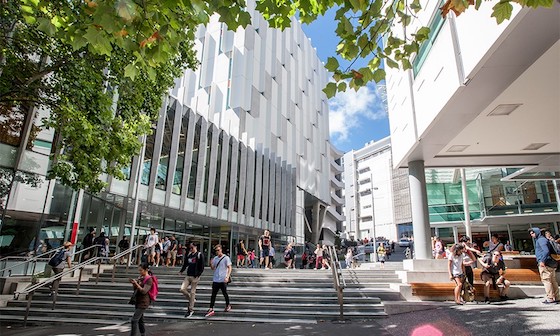
The times they are a-changin’ for higher education. Or so say a growing number of commentators. They see COVID-19 disruptions as a tipping point for universities, accelerating sweeping changes across institutions. These include not just a shift to online teaching and learning, but also a greater focus on industry links and employability skills, and accompanying campus design upgrades.
Many of these changes are arguably necessary in a world in which digital connectivity is the expected norm. It is crucial to understand what these changes involve for universities themselves, and what they mean for the next generation of students. For instance, online education, if done properly, isn’t necessarily cheaper or easier.
With many still in crisis mode, universities might not be ready for these predicted changes. Despite a touted recovery in Australia as COVID vaccines roll out across the globe, the higher education sector isn’t out of the woods. Some expect the impacts will be even greater in 2021 as job losses persist and international students stay away.
Universities suffered the double whammy of a huge decrease in international student revenue as borders closed, and a federal government that stubbornly refused to support the higher education sector and its workers. COVID restrictions have forced university teachers to make often radical shifts in their curriculum and teaching practices while implementing broader changes, all with reduced budgets. And that’s if they are lucky enough to keep their jobs.
Collaborative, evidence-based approach is vital
Proposed “Instagram-worthy” campus infrastructure projects aim to provide more flexible learning and study spaces, immersive classrooms equipped for virtual reality experiences and remote teaching, and “industry precincts” that encourage collaborations. These are worthwhile, forward-looking innovations. But these goals cannot be achieved without a deeper, evidence-based conversation about how this will be done in practice.
And this transformative work must be done in partnership with teaching academics. The very real challenges they face must be taken into account.
Some assume online learning and teaching are easier or cheaper, but that isn’t always the case. Teaching well online requires at least as much effort as face-to-face, and potentially more.
The online/digital space can adequately replicate only some face-to-face interactions. Others can be difficult to reproduce. These include activities that develop manual and psychomotor skills, such as laboratory and field work in the sciences, and kinesthetic skills in the performing arts.
Even the robustness of tutorial debates might be altered as students move from a shared physical space to one dominated by the “Zoom gaze”.
Teaching academics will likely need extra support to implement such activities online or to find creative solutions. For either approach to be successful, institutions will have to invest more in appropriate technologies.
We are seeing an increase in the use of technology in teaching and learning at Australian universities. By necessity, the pandemic rapidly accelerated this trend. But an increase in online learning does not necessarily equate to a decrease in costs, or in the need for specialist staff.
Staff and students will likely appreciate the flexible learning offered by the predicted digitised future campus. But it is important to remember the benefits of in-person and on-campus interactions.
For students, these include fostering a sense of belonging to the university, which can increase resilience and retention. And the benefits for academic teaching staff include, for example, the fruitful conversations about teaching and learning that so often take place in informal settings.
With universities welcoming staff and students back to campus as COVID restrictions ease, many are seeing the value of the on-campus experience.
Teaching and learning both benefit from the many informal interactions that come from being on campus together.Shutterstock
Transition will take a lot of time and effort
Digitisation and flexible learning models can help both students and academics collaborate with others across the sector. However, these changes won’t be instantaneous. Nor can they be driven solely by upgrades to campus infrastructure.
We also won’t see, in the near future, a complete shift in academics’ teaching and curriculum design practice. They are already stretched to their capacity in a sector under fire.
The continuing destabilisation of budget cuts, workload demands and an uncertain COVID situation mean the transformation of teaching practices may come in fits and starts. It will be an incremental process driven at first more by necessity and opportunity than by long-term strategy.
The challenge then for universities, and for their academic development and engagement units, is to define, validate and advocate for best practice in both online and face-to-face modes. Only then can they expect to meet the immediate, pressing challenges instructors face while building their future capacity to deliver collaborative, flexible and engaging online and blended learning.
The importance of a free press to a thriving democracy is well-known. But what is its importance to a thriving economy?
We have found evidence attacks on press freedom – such as jailing journalists, raiding their homes, shutting down printing presses, and using libel laws to thwart reporters – have measurable effects on economic growth.
Our research team – spanning economics, journalism and media – used rankings on press freedom from the US-based Freedom House and data on economic growth to examine 97 countries from 1972 to 2014.
We found countries that recorded a decrease in press freedom also experienced a 1%-2% drop in real gross domestic product (GDP) growth.
Economies may not bounce back
Our findings affirm other economic studies showing the institutions that uphold a “rule of law” are strongly associated with stronger economic performance. Our work took into account education, labour force and physical capital.
Perhaps our most significant – and unexpected – finding is the long-term economic impost of undermining a free press.
Freedom House’s own research suggests “press freedom can rebound from even lengthy stints of repression when given the opportunity”:
The basic desire for democratic liberties, including access to honest and fact-based journalism, can never be extinguished.
But this rebound does not translate to the economy. In nations where freedoms were removed, and then restored, economic growth did not fully recover.
In Hong Kong, new security laws threaten to snuff out independent media. In Myanmar, publications have been silenced and journalists arrested. In Malaysia, journalists have been harassed and jailed for criticising the government. In the Philippines, respected investigative journalist Maria Ressa has been detained ten times in two years and convicted of “cyberlibel” under controversial laws. In India, the world’s largest democracy, the Modi government has curbed press freedoms.
Press freedom around around the world, rated by Freedom House.Freedom House
These aren’t just issues for other countries.
Australia might look relatively free, particularly compared with near neighbours. But recent years has seen Australian Federal Police raids on journalists homes and the new restrictive national security laws. The journalists’ union, the Media Entertainment and Arts Alliance, has called the federal government’s actions a “war on journalism”.
Acknowledging limitations
We acknowledge our work is a macro-level study, examining broad statistical associations, finding many relationships that are notable at the 1% level of significance. These cannot, and should not, be a replacement for nuanced analyses of specific contexts, cultures and media models.
We also acknowledge that Freedom House is just one of a number of international bodies that keeps track of people’s access to political rights and civil liberties. The organisation uses a specific US-centred view to look at individual freedoms —including the right to vote, freedom of expression, equality before the law — that can be affected by state or nonstate actors.
But it does factor in the ability of journalists to report freely on matters of public interest, and show the connection with economic prosperity:
A free press can inform citizens of their leaders’ successes or failures, convey the people’s needs and desires to government bodies, and provide a platform for the open exchange of information and ideas. When media freedom is restricted, these vital functions break down, leading to poor decision-making and harmful outcomes for leaders and citizens alike.
There is more statistical work to be done, but our analysis shows strong evidence press freedom, along with better education, is a key to improving economic performance.
Perhaps this might be motivation enough for the government in Australia – and other countries – to reconsider their approach to press freedom, and provide more financial support for public-service journalism, such as that offered by the ABC and SBS.
With the sudden death of Carla Zampatti, Australia has lost perhaps its most successful and loved fashion designer. Zampatti was that rare beast who had inter-generational relevance. She celebrated her 55th year in business before COVID lockdown, in early 2020. She had not retired when she died at 78.
The outpourings of condolence on social media channels since her death (due to injuries sustained in a fall at the Sydney Opera) indicate the high esteem in which she was held nationally. Comments fall into two groups: a much loved designer who made clothes women wanted to wear; and a woman who supported the next generation as well as those who worked for her.
Zampatti arrived as a migrant from northern Italy in Fremantle in 1950. She was proud of her immigrant status. She often spoke of the contribution of Italians to Australian life: their food, culture, enterprise and hard work. She believed Australia had strong vestiges of Italy.
She also spoke of the opportunity that Australia presented for someone like her, interested in designing fashion clothing. Australian fashion markets and also our wider cultural outlook were being transformed in that immediate post-war period when she arrived.
Carla Zampatti migrated from Italy to Australia in 1950, founding an iconic label in her adopted homeland.AAP/Carla Zampatti P/L
Post-war Australian fashion
Vogue magazine launched its first Australian supplement in 1959. The country was becoming more outward looking, casual and fast-fashion oriented.
The household spend on clothing, footwear and drapery climbed dramatically, tripling from 1946–7 to 1959–60. Social change was afoot, too: the number of married women working rose to 38.3% by 1961. It can be assumed that fewer of them had time to make their own clothes, and this created opportunities for ready to wear lines that also could keep pace with the very rapid fashion change after the War.
By 1968, with higher participation by women in the workforce (about 39%), home sewing was in decline and local manufacturing protected by high tariffs was in full swing. Many of the post-war manufacturers were migrants, including the large European Jewish population, who accelerated the introduction of casual separates, sports clothes for men and women, finer knitted garments, and bright, synthetic materials.
All of this reduced the women’s labour needed to maintain clothes and keep them looking good. Mix and match, modularity, looser fit clothes were more amenable to product standardisation than old-fashioned tight fitted clothes such as suits. The industry favoured those with fashion and style knowledge, and skilled owner-managers who understood both craft skills and production.
Zampatti working behind the scenes at Australian Fashion Week in Sydney, 2013.AAP/Tracey Nearmy
Birth of a fashion icon
Zampatti had these skills. She benefited from and contributed to this cultural and structural change in Australian fashion – and then took it to the next level.
She opened her first wholesale business in Sydney in 1965. Her 1960s work indicates a bold, graphic touch, with a nod to bohemianism, but smarter. Zampatti began displaying her clothes in the window of her Surry Hills workshop, bypassing the division of wholesale and retail. She opened her first boutique in 1972, at a time when manufacturers were unlikely to also be retailers. Eventually, she had about 30 stores and later exclusive arrangements with the department store David Jones.
Zampatti became very successful. By 1980, she was named Business Woman of the Year , and she went beyond fashion to industrial design, designing the Ford Laser car for women in 1985.
Zampatti’s appeal and legacy
Why were her clothes such a hit?
Zampatti’s designs were known for their wearability.AAP/James Ross
Zampatti designed extremely wearable clothes for working women. In the 1980s they had metal zippers instead of fussy openings, and invisible zippers in trousers to keep a good line. She later designed practical jumpsuits that could be dressed up with a jacket. She also designed glamorous evening wear for wedding, red carpet and special occasion. She was aware of the process of maturity: “When you are young you agonise and try to please everyone. Now I don’t”.
Zampatti always stressed that fashion was first and foremost a business, not an artistic practice, although the business would not succeed if aesthetics were neglected. Local production was important to her and her lines continued to be manufactured in Australia. She was cosmopolitan, sophisticated and outward-looking. She was a woman of the world but also believed Australians had no need to be expatriates in the jet age, and had much to contribute at home.
To that end, she funded a scholarship at University of Technology Sydney. The most talented students graduating in Fashion and Textiles with a strong business sense could study a Masters degree in London, Milan or New York, with the hope they would return to Australia and impart their new horizon of experience in developing a successful line.
In an SBS interview with Janice Peterson (who often wore her clothes for TV) she remarked on the impact of Italian art and church frescoes on her as a child. Indeed, you can see the clear, strong colours of Renaissance and Mannerist art translated into crisp tones and looks for Australian women.
In Zampatti’s ethos, women wore the clothes, not the clothes them.AAP/Dan Himbrechts
Zampatti was a modernist. Tailoring for women was paramount in her daywear and women’s bodies were not obscured by elaborate patterns or trimmings. Women ranging from former Governor-General Dame Quentin Bryce, former Prime Minister Julia Gillard, current First Lady Jenny Morrison, former politicians Anna Bligh and Julie Bishop, Ita Buttrose, Susan Renouf, Princess Mary, Nigella Lawson and countless news anchors, journalists as well as stars wore her clothes.
The clothes made them look striking, but they wore the clothes, and not the clothes them.
Zampatti was a skilled businesswoman, a pioneering board member (first female chair at SBS, board member of Westfield Group; Art Gallery of New South Wales, University of Technology Sydney, amongst others) and cultural benefactor (Sydney Dance Company and other cultural and performance groups).
She was primarily a proud, feminist fashion designer, promoting economic independence and agency for women. What she had achieved from the 1960s was remarkable.
Australia is the poorer without Zampatti and her pioneering fashion ethos.
Zampatti was a feminist designer with a pioneering fashion ethos.AAP/Stefan Postles
However, recent research indicates the Egyptian spiny mouse, which menstruates like humans do, could offer an excellent model for research. Our new study, published in Scientific Reports, shows the lining of the mouse’s uterus, or endometrium, also grows in a human-like way to prepare for embryo implantation.
Why animal models are important
There are many reasons for miscarriage and other pregnancy complications, ranging from hormonal and vitamin imbalances to failure of placental development and impaired embryo implantation. To understand these conditions, researchers need to do experiments – but doing experiments on humans poses serious ethical, practical and financial challenges.
That’s why researchers try to “model” the conditions in suitable laboratory animals. Animal models (using rodents in particular) have helped explain many aspects of human reproduction, but they are limited by fundamental differences between human reproduction and that of other species.
Less than 2% of all mammal species menstruate, with most instead having an oestrus cycle (“going on heat”). Aside from humans, most menstruating species are great apes or old-world monkeys.
Non-human primates like these would be the most biologically appropriate animals for modelling human reproduction. But their large size, complex welfare requirements and high costs have prevented their adoption as laboratory animals.
So, to study and manage human pregnancy more effectively, we need a more appropriate menstruating animal model of female reproduction.
The menstruating spiny mouse
The Egyptian spiny mouse (Acomys cahirinus) was recently shown to have human-like menstruation. This had never been seen before in any rodent, and the discovery gives researchers an unprecedented non-primate model for studying menstrual and gynaecological disorders.
Researchers from Monash University have since delved deeper into the mystery of spiny mouse reproductive biology. The researchers have provided an in-depth characterisation of the menstrual cycle, identified PMS-like behaviour and, most recently, early embryo implantation and pregnancy.
Endometrial growth
In our study published in Scientific Reports, we discovered that the lining of the spiny mouse’s uterus displays similar patterns of growth and receptivity to embryo implantation as other menstruating species.
Before an embryo can implant, the uterus lining must more than double in size and begin secreting the required proteins to encourage an embryo to implant correctly. This study demonstrated simultaneous increases in thickness and receptivity of the spiny mouse endometrium before embryo implantation, closely reflecting the events in other menstruating species.
A fluorescent image of the spiny mouse uterus just before embryo implantation. The green chunk at the bottom left is the muscle of the uterus, and the thinner green structures are the uterine arteries. Blue shapes are cell nuclei, and the red dots within the arteries are blood cells, and red outside the arteries is either blood cells or protein.Jarrod McKenna, Author provided
Spiral arteries
In all menstruating species, spiral-shaped arteries grow in the uterine lining.
These spring-like arteries are vital to provide nutrients for a growing placent, and poorly functioning spiral arteries are associated with several pregnancy complications such as pre-eclampsia and intra-uterine growth restriction.
In our study, we observed the growth of spiral arteries prior to embryo implantation, but also changes to their structure and function soon after. This also occurs during early pregnancy in other menstruating species including gorillas, chimpanzees and humans.
Looking to the future
Although our knowledge of spiny mouse reproductive biology is in its infancy, what we do know is very encouraging.
This study is further proof for the unique reproduction of the spiny mouse and adds to the growing list of reproductive traits we share with this fascinating species. Not only do spiny mice have human-like menstruation, but this recent study demonstrates similarities of endometrial growth, receptivity and the critical role of spiral arteries during early pregnancy of menstrual species.
Further research into spiny mouse reproductive biology may reveal new treatment options for pregnancy complications. In turn, this could change how we treat and monitor pregnancy and lead to better outcomes.
This is the first in a series of two articles looking at antisemitism in Australia.
Antisemitism — hatred towards Jews — can be expressed in many forms. It often takes the form of a hate crime, such as violence against people (including murder or assault) and damage to property (vandalism).
It can also take the form of an incident regulated by civil law or not regulated at all. For example, antisemitism can be expressed in verbal and non-verbal displays of aggression, threatening posters, stickers, leaflets or other displays of hate.
Recently, for example, a Jewish woman in her 60s was spat at and called “Jewish scum” on the eve of Passover in a Melbourne street.
What if we could predict when antisemitic incidents are most likely to occur? Is it possible to identify patterns linking these incidents to particular dates or events — and therefore be better prepared to counter them?
Our team of researchers analysed 673 incidents of antisemitism across Australia from 2013–17 to determine if they were more likely to occur — or if they were more serious in nature — during specific events.
Among the events we looked at were:
Swastika symbols defacing a bus stop in Bondi Beach, NSW, in 2016.NSW police/PR Handout Image
Data collected by community organisations like ECAJ are usually more detailed and complete than police statistics, due to the under-reporting of antisemitic and other hate crimes to the authorities.
Our data included a wide spectrum of both criminal and non-criminal hate incidents, including physical assault, verbal abuse, graffiti and vandalism, as well as various types of communication like mail, emails, stickers, posters, leaflets and telephone calls.
We then re-coded all the incidents, placed them on a timeline and divided them into categories based on the severity of the incident.
What events were likely to trigger hate?
Our results showed that weeks with Jewish celebrations were more likely to coincide with incidents of hate speech, such as verbal abuse and offensive gestures.
This could be explained by the fact that during the holidays, Jewish people are more identifiable on the street, as many tend to wear religious garments or congregate outside synagogues.
Overseas, Jewish holidays have also been chosen for targeted attacks at synagogues, for example, the 2019 attack in Halle, Germany, on Yom Kippur. In our Australian data set, incidents during Jewish celebrations were less likely to involve physical violence, and more likely to involve hate speech.
The antisemitic incidents we tracked during the 2014 Israel–Gaza conflict, however, were significantly more likely to involve violence towards people (such as throwing objects).
And the incidents that occurred after the establishment of Antipodean Resistance were more likely to involve indirect forms of hate speech (such as the neo-Nazi stickers defacing an aged care facility in Melbourne housing Holocaust survivors), and be claimed by the hate group.
Our research builds on what previous studies have found. A study in the US last year, for instance, found that Israeli military operations, as well as the presence of hate groups in certain geographical areas, were associated with an increase in antisemitic incidents.
And a study in Belgium found similar links between waves of antisemitic attacks in that country in 2008–09 and Israel’s offensive against Hamas in Gaza.
Treasurer Josh Frydenberg warned earlier this year that antisemitism was on the rise in Australia.Mick Tsikas/AAP
A sharp increase in incidents in recent years
We believe the same patterns we identified from 2014–17 would also apply to the present day.
The ECAJ Antisemitism Report noted increases in hate incidents during Jewish religious festivals up to 2019.
In 2020, there were fewer opportunities for antisemitic abuse because of the COVID-19 pandemic and the closure of Jewish facilities and synagogues.
Nonetheless, from 2019–20, there was a marked increase in the number of serious incidents in Australia, including physical assaults and verbal abuse.
Antipodean Resistance has disbanded in recent years, but some of its members have reportedly joined a new group called the National Socialist Network.
The group gained attention for a weekend camping trip in the Grampians earlier this year, during which they burned crosses and chanted racist slogans. This incident coincided with the 76th anniversary of the liberation of the Auschwitz concentration camp.
A major report released recently also noted several neo-Nazi groups banned in Europe and the US were now operating in Australia. Since 2019, they have become more explicitly antisemitic, aggressively racist and white supremacist.
Why this data is important
Our research can be used by both policymakers and community organisations to gain a more nuanced understanding of antisemitism and what drives it.
Studying the relationships between the types of hate incidents and specific trigger events can help improve preparedness and focus critical security resources at times when the Jewish community is at greatest risk.
However, they all use different definitions and criteria, and they usually do not share data with each other. This means that each organisation has a piece of the puzzle, but no one can see the whole picture.
Our research highlights the need for a more comprehensive register of hate crimes and incidents combining data from all of these sources, as well as Facebook and Twitter.
One of the main reasons we don’t have a centralised database is Australia doesn’t have a federal hate crime law similar to the US and UK.
We need to develop a “whole of society” approach that involves civil society organisations, government agencies, law enforcement and scholars.
With this in mind, we developed (together with colleagues from Sydney University, City University of New York and Michigan State University) a website called Tackling Hate. It offers free training modules, videos and resources to help these sectors build the skills to identify and address all forms of hate.
Only then will we be able to develop more targeted, evidence-based policies and practices to better predict when antisemitic incidents are likely to occur and be prepared to counter them.
Thousands of women outlined stories of sexual harassment at private school parties in a petition launched by Chanel Contos recently. Contos is calling for better sexuality education at school, which includes more information about consent.
After the March 4 Justice rally demanding better treatment of women in workplaces, schools and society several boys from Melbourne’s private Wesley College made misogynistic comments on a bus.
Wesley’s principal Nick Evans called the behaviour unacceptable and told the ABC pornography was a source of sex education for many students and “has to be a huge part of the conversation” in tackling violence against women.
Better sexuality education which teaches respect can go some way to counter the lessons young people take from pornography.
But our study on the delivery of sexuality education found some teachers were anxious about parental fear, negative media and political hysteria. Unfortunately, the teachers we spoke to considered teaching sexuality “risky”.
Consequently, schools and teachers in our study were watering down content, excluding some material and shutting down conversations.
Pornography and sex education
One of the reasons young people use pornography is to satisfy their curiosity about sex. And much of mainstream pornography models misogynist attitudes and problematic sexual behaviour.
Feminist author Andrea Dworkin made the link between pornography and misogyny in the 1970s. Feminist research continues to demonstrate a connection.
Most recently, sexuality educator Maree Crabbe wrote that porn
communicates a whole range of deeply problematic messages – about sex … gender, power, aggression, bodies, pleasure, sexuality, consent and race.
She wrote:
Porn is an incredibly powerful communicator. It can influence what we like and want without us even realising.
School sexuality programs
Between 2016 and 2017, one of the authors conducted in-depth interviews with nine teachers across nine Victorian government schools to find out how students are taught the skills to develop positive, healthy relationships. She observed the delivery of sexuality education and spoke with five principals about it.
Teachers said sex isn’t being discussed at home with parents. Instead, students are deliberately seeking out information about sex from pornography. This corresponds with the findings of Our Watch that by the age of 13, nearly 50% of boys have viewed pornography.
Teachers expressed concern about students’ reliance on pornography. They talked about students believing what they see to be “the way you should act” or “how you do sex”. This includes questionable negotiations over consent.
One teacher said: “In pornography you’re seeing something that young people think is consensual.”
Respectful Relationships is a program that constitutes one component of sexuality education in some schools. It has the potential to combat the misogyny of mainstream pornography.
Respectful Relationships is a set of evidence-based resources promoting the development and maintenance of healthy relationships of all kinds. The resources are for use in and beyond sexuality education classes.
All Victorian government schools are mandated to deliver the Respectful Relationships curriculum as recommended by the royal commission into family violence. Although other schools in Australia may use this curriculum resource.
Specifically, there is a unit designed to “address the link between sexualisation, pornography, gender and respectful relationships”.
One teacher said about the program:
Girls can feel empowered by the program […] They may examine their relationship and see if it’s a respectful relationship.
The teachers we spoke with wanted to deliver this curriculum. They were well trained to do so. They knew their students and that the curriculum has the potential to counter what students learn outside the classroom.
The respectful relationships curriculum can empower girls.Shutterstock
While one teacher talked explicitly about the way the curriculum empowered girls, another described it as filling a gap in knowledge that prevented students from seeking bad information via alternative resources.
For this teacher, Respectful Relationships supported students to talk to her when they were considering having sex for the first time or when they experienced harmful sexual behaviour.
So, what’s the problem?
This curriculum provides tools for students navigating sex and sexuality, and for teachers to counter, even preemptively challenge, problematic ideas.
But with the public controversy over Safe Schools — a program that aims to help schools foster a safe environment supportive and inclusive of LGBTI students — at the forefront of their minds, teachers and principals detailed the many ways they sought to minimise parental fear and negative media associated with sexuality education.
One teacher said:
This is a really loaded subject […] it can really frighten people and they can think, ‘Christ, I have a little year 7 or a year 12 girl at that school’.
Teachers described censoring curriculum to avoid “riskier” content such as non-heterosexual sex and female pleasure. They also removed the words “sex” and “sexuality” from the title of programs, and limited parental knowledge about the programs they deliver.
During class observations the author witnessed teachers hesitant to engage with important but complex topics such as consent and same-sex intimacy.
The Respectful Relationships curriculum has the potential to combat the misogyny of porn. By giving teachers the confidence, support and opportunity to do the job they are employed to do, we are likely to see meaningful change.
Easter is the biggest chocolate-buying time of the year. But who’s really paying for the cost of that chocolate?
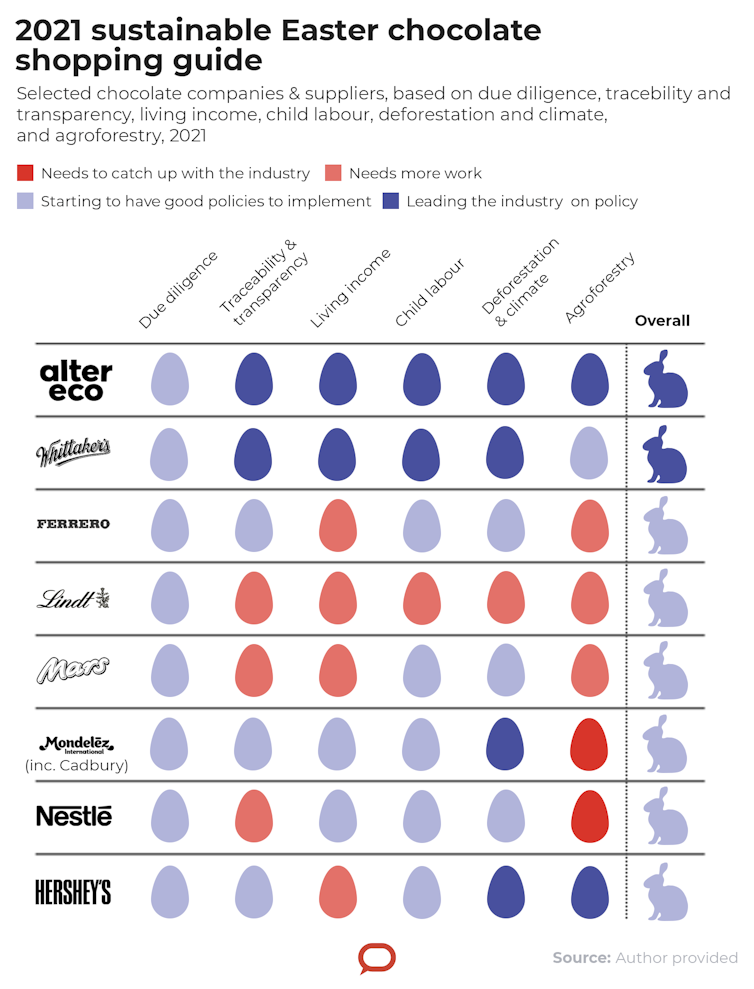
The second annual report on the social and environmental performance of the world’s major chocolate makers show human exploitation and environmental degradation continue to be key ingredients in many chocolate products.
The report sorts 31 major chocolate makers into four bands – industry leaders, those showing improvement, those needing to do more and the industry laggards – based on their written responses to questions about their polices in six key areas covering social, environmental and governance practices.
Thirteen makers ranked in the second category, includes most of the world’s ten biggest confectionary companies – Mars Wrigley (US), Ferraro Group (Luxembourg/Italy), Mondelēz International (US, owner of the Cadbury, Toblerone and Milka brands), Hershey (US), Nestlé (Switzerland) and Lindt & Sprüngli (Switzerland).
Seven companies were in the third rank. Three were in the fourth – Meiji, Itochu and Morinaga (all Japan-based).
Four companies failed to respond to the survey: Valrhona (France); Starbucks (US, a major seller of hot chocolate products); Unilever (UK); and August Storck (Germany, maker of Werther’s, Toffifay and Merci chocolate brands).
The principle ingredient for making chocolate is cocoa, the powder made from grinding the seeds of the cacao plant. About 70% of cacao is farmed in West Africa, with Côte d’Ivoire and Ghana being the big two producers.
Most cacao farmers make less than US$1 a day (and women even less), well below the global poverty line of $US1.90. An estimated 1.6 million children work in cocoa production in Côte d’Ivoire and Ghana alone.
Most cacao farmers earn less than US$1 a day.chomplearn/Shutterstock
Clearing land to farm cacao is estimated to be responsible for about one-third of of the land cleared in Côte d’Ivoire and Ghana over the past 60 years. These countries have now lost more than 80% of rainforest cover. Such deforestation contributes to climate change.
The good news is that most companies and four producer governments (Côte d’Ivoire, Ghana, Colombia and Cameroon) have committed to ending cocoa-driven deforestation through the Cocoa and Forest Initiative.
Some action is taking place through agroforestry, which involves farming a variety of crops while retaining natural vegetation. This has been shown to reduce the need for pesticides, increase carbon sequestration and improve biodiversity. It is also better for farmers’ food and income security, as they can grow diverse crops rather than relying on just one.
Supply chain transparency
Essential to addressing these social and environmental problems is achieving transparency in supply chains. If a company does not trace and track where products have come from, it cannot know if they have been produced through human exploitation or environmental destruction.
The report rates chocolate makers on two measures related to this – due diligence traceability and transparency. These are crucial as the foundation for all other reforms.
They are also key to Australia’s modern slavery act, which requires businesses with an annual turnover of A$100 million to publish a “modern slavery statement” reporting on the risks of modern slavery in their operations and supply chains, and on the actions they have taken to address these.
But such transparency alone will not be enough if consumers don’t act on that information, and put pressure on chocolate companies through their purchasing decisions.
One of the biggest trends in economics over the past 40 years has been so-called “financialisation” – whereby an increasing proportion of GDP in advanced economies comes from the financial sector.
This has involved the development of ever more sophisticated “financial instruments” such as swaps, options and other derivative securities.
The global mobility of financial capital has also given banks and hedge funds massive piles of money with which to make leveraged bets on everything from stock prices to the fourth derivative of the volatility of South American currencies — which is (I kid you not) a contract on the rate of change on the rate of change on the rate of change in currency value.
As Harvard economists Robin Greenwood and David Scharfstein have noted, in 1980 the financial sector accounted for 4.9% of US GDP. By 2007 it was 7.9%. Since 1980, they note, the financial sector’s share of GDP has increased at 13 basis points a year, compared with 7 basis points a year over the 30 years prior.
The dark side of financialisation
Financialisation’s dark side is known to anyone who has seen the movie The Big Short.
The financial sector went from being “boring” in the 1970s and early 1980s to being a playground for clever, sometimes unscrupulous traders driven by huge incentives and the prospect of paydays in the tens, or hundreds of millions.
Given some of the ugly and venal behaviours we have seen, it is hardly surprising there has been a huge backlash against big banks and hedge funds. Too often these behaviours have brought the global financial system to the brink.
As far back as 1998 a rinky-dink little hedge fund (backed by two Nobel Prize-winning economists, Myron Scholes and Robert Merton, Long-Term Capital Management, believed it had an unbeatable system to play these markets. Instead it turned US$1 billion into US$125 billion of toxic derivatives bets, almost bringing down financial markets around the world.
Then there are the collapses of Bear Stearns and Lehman Brothers due to the subprime mortgage crisis, which precipitated the global financial crisis of 2008.
But it’s not all bad news. A new paper by MIT economists Felipe Iachan and Alp Simsek with Plamen Nenov at the Norwegian Business School explores the idea that financial innovation can provide investors, small and large, with more choice, with positive results for their savings decisions and investment returns.
Before the advent of mutual funds, it was very hard (and expensive) for small investors to invest in the stock market. The advent of such funds increased stock-market participation in the US from about 10% of households in the 1950s to more than 50% by the end of the 1990s.
In Australia, effective stock-market participation is now even more pervasive due to our superannuation system, whereby almost anyone who has had a full-time job has stock investments.
What does this mean for the amount of savings, and for asset prices?
You might think that increased portfolio choice would decrease savings — and you’d be in good company.
The traditional literature in financial economics predicts just that. The logic is that people save to protect themselves against risks — such as losing their job because the industry in which they are employed is battered by international competition or technological change.
By investing in stocks, they hedge that risk by exposing themselves to other industries and firms. If the industry in which they work turns down their stock market investments might be going up.
As a result of this more efficient saving, households don’t need to do as much saving as if they were holding piles of cash or government bonds. Because those savings aren’t as diversified. So savings should go down and interest rates should go up, all else equal.
Contradicting evidence
But, as the authors of this new paper point out, the evidence is that “while there is a well-known negative trend in saving rates since the 1980s, the trend has been much weaker for participants”.
Put differently, stock-market participants have increased their saving relative to non-participants since the 1980s.
And that’s controlling for wealth, so it’s not about how much people have to invest but in what, and how much, they invest.
They go on to offer a framework in which investors who hold different beliefs about asset returns can express those beliefs more effectively when financial innovation provides them with a greater choice of investment products.
This isn’t just a matter of theory — elegant though the authors’ theory is. The empirical evidence suggests this “choice channel” explains two important facts about investment returns in recent years.
First, stock market participants save more than non-participants. Second, “similar households seem to receive more dispersed portfolio returns in recent years”.
Pros and cons
There has been plenty of justified criticism of the financial sector in recent years. Risky and unseemly things have been done, hurting regular folk a great deal.
But we shouldn’t forget new and better financial products can also help small-time investors. Perhaps the leading example is index funds that allow them to hold a diversified portfolio of the whole stock market at very low cost — a fee of, say, 0.05% a year, rather than the 1% commonly paid stock pickers for inferior performance.
This is why the option of a low-cost index fund should be at the heart of Australia’s superannuation system.
Source: The Conversation (Au and NZ) – By Philip C. Almond, Emeritus Professor in the History of Religious Thought, The University of Queensland
Easter celebrates the Christian belief that Jesus Christ rose from the dead. In so doing, he overcame sin and death on behalf of all of us. The resurrection of Jesus was a guarantee that, for those who believed in him, they too would do the same. As St. Paul put it, “He who raised Christ from the dead will give life to your mortal bodies also”.
That said, the resurrected body of Jesus was a very ambiguous one. He ate fish and bread, but he could also pass through closed doors. Similarly, there has always been an uncertainty about the nature of our resurrection bodies.
By the end of the second century, Christianity had absorbed the Greek tradition of the immortality of the soul. From that time on, it viewed the human person as consisting of an immortal soul and a mortal body.
This meant that, immediately after death, the individual soul continued its existence. It also meant at the end of history, the individual body would rise from the dead and be reunited with its soul. God would then judge it as worthy of eternal happiness in heaven or eternal punishment in hell.
Christianity shared with Judaism, Zoroastrianism, and later Islam, a belief in the final resurrection of the body.
Luca Signorelli, Resurrection of the Flesh, a fresco painted between 1499 and 1502.Wikimedia Commons
What will resurrected bodies be like? Saint Augustine in his work The City of God gave us some clues early in the fifth century. They will be physical bodies but animated by an immortal soul. They will appear to be about 30 years old, the age that Christ reached.
Men will arise in male bodies and women in female bodies. But there will be no sexual desire and hence no marriages in heaven. The “flesh” will serve the “spirit” and not the reverse as happens in the present life.
Critics then, like critics now, thought it a ridiculous idea and panned it mercilessly. Even though Augustine thought the critics were being frivolous, he attempted to give serious answers to their questions. Will aborted foetuses rise? What size will they be? What will the bodies of monstrous births, the disfigured, and the deformed be like? What will be the fate of those devoured by beasts, consumed by fire, drowned, or eaten by cannibals?
By the 13th century, these questions had become matters of serious philosophical discussion within Christianity and not merely responses to critics of it. Thomas Aquinas, the greatest philosopher of Roman Catholicism, for example, picked up where Augustine left off.
On the day of resurrection, he believed, bodies will have the same gender and the same organs as when they were alive. But they won’t have the same uses because there will be no desire to eat, drink, or have sex.
Therefore, there will be no need for food, clothing, transportation, or medicine. There will be no need for heavenly plants nor (pet or meat lovers read no further!) animals. Those in hell would have bodies suitable to their character — ugly, sluggish, black, gross, and capable of suffering.
By the 17th century, the new sciences were adding fresh answers to a key problem. How would all the dispersed bits of people get back together? For example, Robert Boyle, the father of modern chemistry, worried about bodies that were eaten by animals, fish or cannibals.
Raphael, The Resurrection of Jesus Christ (Kinnaird Resurrection), from 1499 to 1502.Wikimedia Commons
At least a tiny bit of us, Boyle suggested, will be able to be retrieved from the bodies of animals, sharks, or cannibals — enough for God to work with. Moreover, his own chemical experiments on the long-lasting texture of bones assured him they would still be around on resurrection day. In the end, however, he like many others, was forced to fall back on God’s miraculous powers to get all of our bits and pieces back into one piece.
Vast amounts of theological ink were spilt on the attempt to defend what, at the end of the day, was really rationally indefensible. It is no surprise that, as the feasibility of the miraculous disappeared in the 18th century, so rational defences of the resurrection of the physical body disappeared from intellectual history. They were buried in a forgotten and unmarked theological grave.
These days, at least to more liberal Christians, the resurrection of the body remains a matter of faith rather than reason. It is pretty much ignored. The afterlife in general tends to be thought of as the survival of a spirit immediately after death or even only as a brief period of time in the memories of those still alive.
But whatever Christians believe about our resurrection body, they still believe Jesus rose physically, or perhaps spiritually, from the dead. It is a life and a death that continues to influence 2.3 billion people throughout the world.
One afternoon in the late 1970s, my colleague and fellow student Helen Quirk handed me a brown, shrivelled fern frond. It appeared to be dead, and was so dry that when I crushed it between my fingers it disintegrated into a powder.
We placed another piece on a petrie dish and added water. Almost immediately, the piece began to unfold and, as though in time-lapse photography, it appeared to re-green. Within a few hours it looked like a normal, delicate fern.
This was my first encounter with a resurrection fern: remarkable plants that look dead and dry, but when provided with the right conditions — often just the addition of water — rapidly spring back to life.
Helen died a few short years later in 1982, but her botanical legacy of classifying and exploring the ecology of Australian resurrection ferns lives on.
The resurrection fern she showed me turned out to be a new species, and her scientific description of it hooked me immediately. I was fascinated to discover more.
The remarkable ancient history of ferns
Plant enthusiasts often think of ferns as being simple and delicate plants from an earlier evolutionary time. Ferns predate all flowering and cone-bearing plants, often by millions of years.
Cheilanthes austrotenuifolia colonies growing beneath eucalypts.Gwen & Rodger Elliot/Royal Botanic Gardens Board Victoria 2020, CC BY-NC-SA
Their long evolutionary history has meant similar ferns are found on many continents. This is because they once existed on the supercontinent Pangaea around 300 million years ago, before it broke apart into Gondwana and Laurasia and its various components began the great continental drift to their current positions.
So, while ferns are indeed ancient, they are certainly not simple or delicate.
Many people are entranced by their resilience — just watch how they spring back to full and gloriously green canopies after bushfires.
They also have intricate anatomical and morphological structures, and their evolutionary histories are often complex and poorly understood. This is perhaps, in part, because they have continued to evolve and change right up to the present era.
Time lapse of a resurrection fern growing on an oak tree, where its dried-out fronds unfurl and turn green.
The similarity of ferns in different parts of the world has provided fertile research ground for fern taxonomists trying to accurately distinguish one species from another. Sometimes they discover that ferns on different continents are a single species. On other occasions, ferns that look remarkably alike are distant relatives.
This has been the case with resurrection ferns, members of the genus Cheilanthes. At present there are about 15 known species of Cheilanthes in Australia.
Evolving to tolerate arid environments
There are many plants from unrelated families that fit the description of resurrection plants, which suggests their adaptation has evolved on several separate occasions in response to arid environments.
Some can go without water for up to seven years and return to normal from a fully desiccated state within two days.
The fact that a number of ferns and other primitive plants are resurrection plants is a reminder that the ancient earth they evolved in could be a very inhospitable place. This was long before plants helped make earth the liveable planet we know today.
The rose of Jericho, Selaginella lepidophylla, is a highly desert tolerant resurrection plant unrelated to ferns that can dry until it looks like a tumbleweed before unfurling beautifully with a little water.Shutterstock
How resurrection plants tolerate such low internal moisture levels has wider biological and medical implications, too.
We’re learning from these plants how to improve drought tolerance in crops. And understanding their tolerance of desiccation has been used to improve methods of storage and transport of vaccines and human blood products.
The notion of a resurrection plant growing under dry desert conditions was not unfamiliar to me in the 1970s.
However, the idea of ferns being a resurrection plant seemed distinctly odd, as they are usually water loving and dependent. Resurrection ferns, on the other hand, can remain in a desiccated state for months or even years before they resume growth.
Re-introducing the rock fern
The specimen of Cheilanthes I got to know came from the Grampians in Victoria. Helen and botanist Professor Carrick Chambers named it Cheilanthes austrotenuifolia, or “rock fern”.
As its common name suggests, these small, delicate-looking ferns grow in exposed rock crevices, often in inaccessible places. They only occur in the southern parts of Australia.
Rock ferns can reach about 45 centimetres high and their fronds will be 25cm or less in length. Like many ferns, such as bracken, they grow from an underground rhizome (stem).
Rock ferns often grow in exposed rock crevices in southern parts of Australia.Loraine Jansen/Royal Botanic Gardens Board Victoria 2020, CC BY-NC-SA
It can be quite disconcerting when the fronds die back and disappear completely over summer, only to reappear again when it rains in autumn.
Rock ferns are among the first plants to recover after severe drought and, while they’re really tough and hardy, they’re quite particular about where they grow.
This can be frustrating for those trying to propagate and grow one. You can grow it from pieces of rhizome and from spores, but it isn’t always easy.
This means opportunities to play with a resurrection fern don’t come along all that often. So, with Helen, a number of us disappeared into the laboratory to investigate further.
Our laboratory tests showed it was already photosynthesising. The transition from powder to getting on with living was complete.
Rock fern, Cheilanthes austrotenuifolia, growing in Black Mountain, Canberra.Tim1357/Wikimedia, CC BY
10 years and counting…
Years ago, I planted a piece of C. austrotenuifolia rhizome with a single frond in the heavy clay soil of our garden, between a couple of sizeable basalt rocks. It was never really happy and over its first summer, it disappeared.
Imagine my surprise when about five years later, a couple of ferny fronds appeared. It was back. I immediately thought of Helen.
Over the summer, the fronds died back again and it was gone, until eight years later when another couple of fronds appeared.
It is now about 10 years since we last glimpsed a frond. I am not hopeful about its survival, but you never know.
The Indonesian government appears to be at a loss about how to quell the struggle of the Free Papua Organisation (OPM) with its plan to designate Papuan independence organisations as “terrorist” groups.
Democracy Alliance for Papua (ADP) director Latifah Anum Siregar says that the Counter Terrorism Agency (BNPT) should rethink its proposal to apply the Anti-Terrorism Law before the government makes a decision which will add to tensions in Papua.
“Actually, I think, sorry yeah but perhaps the government is at a loss as to how to handle the TPN [West Papua National Liberation Army] and the OPM,” said Siregar.
“It’s not certain this will bring things under control, it’s not certain that it will make the situation better. So I think that the government has to be more careful in looking at this.
“If the government gives them this definition, it will increase tensions.”
Siregar said there were contradictions in the Anti-Terrorism Law itself.
For example, Article 5 reads, “Terrorist crimes regulated under this law must be considered not to be political crimes”. Meanwhile, what the OPM is doing is fighting for independence politically, not through terrorism.
Amnesty also opposed Speaking in a similar vein, Amnesty International Indonesia executive director Usman Hamid also opposes the discourse being promoted by BNPT chief Boy Rafli Amar.
According to Hamid, this will not stop human rights violations in Papua.
“Classifying armed groups which are affiliated with the OPM as terrorist organisations will not end the human rights violations being suffered by the Papuan people,” he said in a media release.
“Many of these [violations] are being committed by state security forces, it would be better to continue with a legal approach.”
Hamid is also concerned that giving such groups the “terrorist” label would be used as a pretext to further restrict Papuan’s freedom of expression and assembly through the Anti-Terrorism Law.
Earlier, BNPT chief Boy Rafli Amar said that they would hold discussions with ministries and other agencies on the naming of armed criminal groups (KKB) in Papua.
‘Reasonable’ category According to Amar, it was reasonable to categorise the activities of these groups as terrorist acts.
“Whether or not they can be categorised as a terrorist organisation because earlier it was conveyed that it is actually appropriate for the KKB’s crimes to be categorised as or to be on par with terrorist acts,” Amar said during a hearing with the House of Representatives (DPR) on March 22.
Amar also said that aside from ministries and other agencies, the BNPT would be holding discussions with the National Human Rights Commission (Komnas HAM) and DPR representatives.
According to Amar, the discussions would be held to reach an “objective understanding” about these groups.
COVID-19 has an evil sense of humour. Despite Australia being mostly free of community transmission, it managed to spoil Christmas for quite a few Sydneysiders and their families and now it’s struck just before the Easter holidays.
The Brisbane lockdown was lifted but many people cancelled plans, and the Byron Bay Bluesfest was called off.
The latest disruption, though limited, reinforced the importance of rolling out the vaccine as fast as possible.
If you believe Health Minister Greg Hunt, that’s going fabulously – even though we’re way behind the original targets. If you believe the NSW and Queensland governments, and many people’s lived experience, it’s another story.
NSW reacted furiously to Wednesday’s News Corps tabloid report, sheeted home to Hunt, that focused on states failing to get enough shots into arms. Queensland was riled when senior Nationals minister David Littleproud condemned the states for doing “three-fifths of bugger all”.
Federal “spin” and blame shifting were red rags to the two states; NSW health minister Brad Hazzard declared “I’m as angry as I have ever been in this 15 months of war against this virus”. The federal government was criticised for the lumpy and unpredictable distribution of vaccine supplies.
Hunt and Scott Morrison sought to soothe; things calmed somewhat.
Morrison didn’t hide his anger at Hunt and Littleproud for their provocation.
The feds like to say the rollout is “not a race,” because we don’t have a “burning platform” like many countries.
But – apart from the risk of bigger breakouts – the slower the rollout, the longer we endure spot lockdowns, a closed international border, and a brake on the economy.
In the coming weeks and months, Morrison will be grappling with two very tangible issues and another which is much more elusive and for him, especially difficult. They are the rollout, ensuring the economic settings are optimal, and the “women problem”.
The rollout is basically about administration. It should get better. The vaccine shortages will ease with the ramp up of local production. The efficiency on the ground will presumably improve but how fast and to what extent remain open questions. The job will get done, but the October deadline for jabs all round looks beyond reach.
Behind the scenes, another job is in full swing – work on next month’s budget; like the rollout it is complex, albeit in a completely different and much more familiar way.
This budget, like its October predecessor, is being crafted against a backdrop of high uncertainty.
The Australian economy is recovering remarkably well from the COVID recession, climbing back up that V shape. But with JobKeeper ended, and people on JobSeeker receiving less money than before, there are big unknowns. How many businesses will close? How many workers will lose jobs? What will be the economy-wide effect on spending?
The government gets “real time” information; even so, it is framing the budget in rapidly changing conditions. On the positive side, the latest numbers indicate a better fiscal position than at the December update, which had a deficit forecast of just under $200 billion for this financial year.
Economist Chris Richardson, from Deloitte Access Economics, says in preparing the budget the government will need to consider where more “sticky tape” is required (like that already applied to the aviation and tourism industries), and what should be done about the failed JobMaker scheme (which was designed to encourage the employment of younger people).
Richardson also argues the government needs to move towards the Reserve Bank’s position in what it says about unemployment. It has said it won’t make budget repair a priority until unemployment, presently 5.8%, is “comfortably” under 6%. But the bank wants to see unemployment down to 4.5%, which Richardson maintains is the rate the government should be embracing.
The big new spending will be on aged care, with its huge challenges. Hunt took on major responsibility for this in the December reshuffle – the rollout problem must be eating into the attention he can devote to the policy drafting.
The October budget was criticised for not containing enough for women; now Morrison has his new “lens” on them. That comes with the danger of disappointing expectations.
One of Morrison’s many problems in dealing with the women’s issue is that it extends beyond policy although good policies, such as initiatives addressing workplace sexual harassment, are vital.
Since Brittany Higgins’ allegation she was raped by a colleague in a minister’s office, the country has seen the eruption of a social movement that is about feelings, perceptions and attitudes as much as about specific policies.
It is about the behaviour of men – in parliament house, and everywhere else.
While bad behaviour exists on all sides of politics, the recent revelations have mainly been about the Coalition.
Last week saw the spotlight turned on Liberal MP Andrew Laming, accused of trolling constituents and taking an inappropriate photo of a woman. Laming says he won’t seek another term, but Morrison isn’t wanting to banish him to the crossbench, which would wipe out the government’s majority.
Although the allegations against him are far less serious, trenchant critics would say he should follow the example of NSW Nationals MP Michael Johnsen, who has resigned from state parliament after an accusation (which he vehemently denies) that he raped a sex worker.
Another bad week for Morrison could have been worse if parliament had been sitting, when Laming would have been front and centre. But this is only a temporary reprieve: if Laming is still on the government benches come budget week, he’ll be a distraction.
The national debate sparked by Higgins and escalated by the historical rape allegation against Christian Porter – strenuously denied by him – is seeing tough conversations in many Australian households.
It would be fascinating to know what impact it is having on Morrison’s own close-knit family, which is mostly female, including his wife, two young daughters and his mother. We heard early on about Jenny’s advice, but how’s the kitchen table discussion going?
Jacinda Ardern can essentially say “kia kaha” as much as she wants to those at the bottom of the housing market, but it won’t help their plight. Eventually her government is going to have to take state housing seriously as a tool for helping solve the housing crisis – especially for low-to-average income earners, who were ignored in last week’s housing package announcement.
The problem is an ideological one for Labour. Along with National, the Government continues to have faith that “the market will deliver”, albeit with some nudges from the state. They believe that private ownership and landlords will provide affordable housing, and the state need only offer social houses as a miniscule safety net for those in extreme circumstances, and even then only for a fraction of those in desperate need.
There was nothing in last week’s announcement about building more state houses. Although Labour continues to pay lip service to the need for more state housing, it plans only tiny increases in housing stock, which are nowhere near the level of supply that is needed in a crisis. In its first term Ardern’s Government built less than 5000 houses, despite knowing the market is short of about 100,000 houses.
Questions about the lack of state housing in the Government housing package
Yesterday in the Herald, Green MP Chlöe Swarbrick wrote about the limitations of the Government’s housing package, complaining that “Kāinga Ora (by far the most successful house-building arm of the Government, with thousands to its name over the past three years) hasn’t been required to build affordable homes (a term this Government has been unwilling to define), and there’s no mention of new state housing builds” – see: Hard work is no longer enough to get you a home.
Similarly, in Stuff newspapers today, conservative columnist John Bishop says: “The package doesn’t increase the number of houses the state has available for the 22,000 on the state house waiting list. Why not? Surely that is the area of greatest social need. Perhaps these people are not a political priority, although I cannot understand why this would be the case” – see: Are speculators really the problem? Isn’t it the lack of houses?.
At the time of the housing announcement, others also pointed to the lack of state housing. Newstalk ZB’s Heather du Plessis-Allan asked: “So where’s the big idea? Where’s the boldness” – see: Government’s housing announcement is no grand plan. She thought that large-scale state housing should’ve been part of the mix: “Michael Joseph Savage had a grand idea in the 30s. He pumped out 33,000 state houses for people who didn’t have homes. We’re probably due the 2021 equivalent of that.”
According to spokesperson Susan St John, “What is needed is diversion of scarce building resources from high-end housing and renovations to building more state housing.” Her group was “concerned the package includes no serious attempt to accelerate good-quality state house building and to ensure the resources and expertise are available for this.”
The Government’s package was clearly focused on the idea of improving falling rates of “home ownership”, ignoring the cost of housing for those that rent. According to documentary maker Bryan Bruce, in coming up with last week’s package, the Government was asking the wrong question (“How can people get to own a home?”) when it should be “How can we give people security of tenure in a healthy, warm, dry, affordable home?” – see: You can’t get the right answer if you keep asking the wrong question. He argues that many other solutions become apparent when the focus isn’t merely on homeowners.
Meanwhile, the housing crisis for those at the very bottom of the market continues to escalate. On Tuesday Stuff’s Henry Cooke reported on the latest state housing waiting-list figures, saying that “newly released figure of 22,803 represents a rise of over 7000 households from January 2020, and is more than four times the size of the list when Labour was elected in 2017” – see: Public housing waitlist hits new record of 22,803 as new builds slow in January.
Arguments for a mass state house building programme
It is increasingly obvious that nothing short of a mass programme of state house construction is required. I made the case for this late last year, writing for the Guardian – see: New Zealand once led the world on social housing – it should again. Looking back through the history of state provision of housing, I argue that this is the one big tool that governments have successfully used to fix shortages, and that in a historical context, the numbers of social houses being produced by the current government are rather pathetic.
Stuff’s Andrea Vance made a similar case, saying that “the private sector alone has never – and will never – build enough homes”, and we’ve got to get away from the concept of state housing being only for “the desperately in need”, necessitating the Government returning to “housebuilding on a large scale” – see: Why New Zealand needs to change how it thinks about housing.
Here’s her key point: “History shows demand is only ever satisfied with direct state intervention, when the government has built homes on a large scale. Housing is a right: we should think of it in the same way we regard universally available services, like schools, hospitals and public transport. We need a return to more public housing, to provide a safe, warm and secure home for those who do essential work and for younger generations, who have had their property-owning dreams crushed by Covid-19.”
But given the current difficult logistics of ramping up state house building, Trotter advised the Government turn to our biggest trading partner for help: “There is only one place to go looking for this sort of assistance – the Peoples Republic of China. Few nations on earth have a construction workforce large enough to take on such a massive job, but China does. The Chinese have been building infrastructure all over Africa for more than 20 years.”
Interestingly, property developer Bob Jones makes a similar argument in his ongoing support for greater numbers of state housing – see: The Housing crisis.
Prof John Tookey of AUT, who is an expert in construction management, thinks the New Zealand state does in fact have the capability for a mass state house build, and talked about this on RNZ in February – see: No ‘silver bullet’ will fix housing crisis. He argues for the state to do the building, because “sitting waiting just for industry to step up and do the right thing, it doesn’t work that way”, and that “In the end government must bankroll large scale construction”. But he cautions that the Government should avoid state housing “low-density monolithic models of the past.”
Tookey was also interviewed by Susan Edmunds for the article,Govt ‘should focus on state houses, not first-home buyers’. According to this article, the “only way to achieve the outcomes necessary was to get ahead of the market with the development of large tranches of social housing, to maximise economies of scale”.
Founder of KiwiSaver provider Simplicity, Sam Stubbs, is also in favour of a mass state build, saying the Government should look to the past when New Zealand governments had to deal with housing crises: “A rising population needed homes, and the Government stepped in to build them in volume. And they were very well-built. There is a premium paid for old state houses, for good reason. The Government has huge advantages in building to scale. It can make laws, and has the money. So it needs to get on with the job” – see: How to solve the housing crisis.
Business journalist Bernard Hickey takes a similar approach, and earlier this year argued that current rates of state house building “won’t scratch the surface of the 100,000 houses shortage” – see: Q&A: Who is to blame for the housing crisis?.
Hickey also makes this point: “The only entity with a big enough balance sheet to do that is the Government. It needs to guarantee more like 10,000 houses a year for 10 years and ensure most of those are small, medium density and affordable, either as state houses or for rent-to-buy or leasehold on Government land.”
But isn’t the Government already building more state houses?
The Labour Government likes to argue that it is already increasing the stock of state housing and tends to re-announce their building plans often in order to get this idea across. Jacinda Ardern herself often says “This is the largest public housing build programme since the 1970s”, ignoring the fact that state house building since then has been extremely low.
The best answer to all of this comes from the convenor of the State House Action Network, John Minto, who has lays out the facts in his piece, How fast are we building state houses?. He points out that “from 1938 to 1942 the government built 14,000 new state houses – 3,500 per year. The population at that time was 1.6 million… Our population now is five million – three times larger than it was in 1935. So are we building three times as many new state houses each year as we were in 1935? No! In fact each year we are now building less than half the number we built each year from 1938.”
Minto labels the current rate of building “pitiful” and suggests that “If we were to build new state houses from 2021 at the same rate we built them under the first labour government then we would be building 10,500 per year instead of the measly 1600 per year Labour is promising.”
In January, when the Government re-announced its state housing programme, Minto responded: “Yesterday’s government announcement on new state housing is a pathetic response to the biggest housing crisis in New Zealand since the 1940s. At a time when the country needs an industrial-scale state house building programme, the government building just 1,600 new state houses per year – the same number built by National in its last term” – see: Labour government: Prioritising the interests of middle-class landlords over struggling working class tenants.
In contrast, Minto says “The last time we had a housing crisis this big – in the late 1940s – a Labour government built 10,000 state houses per year.”
Similarly, Bernard Hickey says the “trouble is the new supply is actually about half the new supply added in the 1950s, 1960s and 1970s, relative to the population” – see: Will the Government actually ‘do something’ about rising house prices this time?. He says “The state house build programme would need to be closer to 60,000 to bring the stock of state housing back to its early 1970 levels”.
Where would the money come from to fund an expanded state house build?
Huge amounts of money is currently being spent on what economist Shamubeel Eaqub calls “ambulance at the bottom of the cliff stuff”. He is cited today by Brian Fallow pointing to the waste of this money: “At the moment we have something like 3500 in emergency or transitional housing. On average it costs $90,000 a year to keep a household in emergency housing… If we prevented that by spending $50,000 a year we would be better off” – see: Who’ll feel the property pinch from Govt’s tax changes? (paywalled).
This article also reports: “There is something like $70b sitting in KiwiSaver accounts. A lot of those savers would like to see some of that money put to work building things that New Zealand needs, like affordable housing and infrastructure, Eaqub said.”
Writing last week, the Herald’s Simon Wilson lamented that this housing subsidy is ill-spent: “This is a complete failure of the market and of government policies for decades. And it costs us: $3.5b a year, up from $2b just five years ago and still rising sharply. Most of that money helps with the rent. Very little of it contributes to home ownership or any other long-term social good. It doesn’t build homes or communities, it doesn’t create jobs or boost the construction sector. It’s not a strategy to fix the housing crisis. It’s simply money spent to avoid what could become catastrophic social collapse” – see: Five big ideas: How to build our way out of the housing crisis (paywalled).
Wilson believes that these billions of dollars would be better spent by the state building houses, even if those houses are for the private or not-for-profit housing sector.
Bernard Hickey wrote about this in January, suggesting that the Government could actually use this money to build up to 800,000 new homes: “Rent subsidies paid by the central government are forecast to rise from $2.6b last year to $4.2b by 2025. They have already risen from $1.9b over the last four years, Treasury figures show. Just as first home buyers use their rent to calculate how much they could afford to pay in interest, the Government could currently borrow over $400b with that $4.2b of rent subsidies. At $500,000 per dwelling, that $400b would ‘buy’ 800,000 new homes, which would be half the current housing stock of the entire country” – see: The ‘brutal’ catch-22 politics of trying to move to affordable housing.
Finally, for an amusing parody of how New Zealand’s market model of housing is currently working out, see Dave Armstrong’s clever satire,Pride and Property, an Austentatious tale.
One of AUT’s Pacific research centres has been without a director since the end of last year and a lack of clarity around its future is causing division among staff and supporters. Teuila Fuatai reports for The Spinoff.
SINCE 2007, AUT’s Pacific Media Centre has built a considerable portfolio and solid reputation for its research and reporting on issues throughout the Asia Pacific region, and as a training ground for Pasifika journalists and academics.
However, a month after veteran Pacific correspondent and researcher Professor David Robie retired as director late last year, the centre was packed up without any formal notification or explanation to the remaining AUT staff members associated with it.
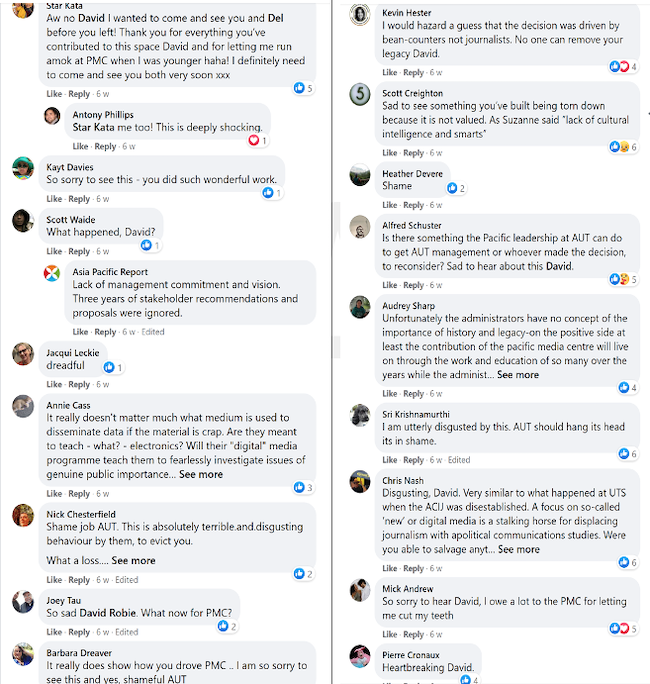
The move prompted a social media outcry among supporters and regional journalists, who raised concerns about the centre’s closure and the lack of communication from the university.
A photo of the packed up PMC sent to David Robie. Image: Café Pacific
However, in response to queries raised by The Spinoff, AUT’s head of the School of Communications Dr Rosser Johnson denied that the PMC was being closed, and reiterated that the contents of the PMC office had been packed up and relocated to a new space beside other key departments elsewhere in the AUT’s communications department.
“I made the decision that we were going to get all our staff of Pacific heritage in the same sort of place, which is on this [12th] floor,” Dr Johnson said. “We’ve got five staff of Pacific heritage – one won’t be moving because he’s in a department that’s on another floor. The rest are going to come up to here in the School of Communications.”
Dr Johnson also said the decision to relocate the PMC from the space it had always occupied was made by the school’s “senior leadership team”.
Staff connected to the PMC were only notified via email after it was done. Senior lecturer and PMC research associate Khairiah Rahman, said it “would’ve been nice” to have been notified about the shift beforehand.
An AUT staff member for 15 years, Rahman’s involvement with the PMC spans nearly a decade and she is also a member of its advisory board. She said the lack of information to staff members like herself has fuelled concerns about the school’s intentions for the PMC’s future.
She said too that the absence of a succession plan for Dr Robie’s replacement prior to his retirement had been particularly worrying.
“Ideally, [the transition] should be seamless. But Professor Robie retired at the end of last year… and we didn’t have a ready successor. I think it’s not a matter of blame but of strategic planning. Was it up to him [Dr Robie] or was it up to the university?”
Former PMC designer Del Abcede, Former PMC director David Robie
and Tagata Pasifika journalist John Pulu. Image: PMC
According to Dr Robie, he had tried several times to engage with the school regarding a transition plan in the past few years, but nothing had happened. Dr Johnson, however, attributed the delays to the impacts of covid-19.
By September last year, a decision had been made by senior leadership staff “that we weren’t going to do anything new before the end of the year,” he said. The process was delayed again by this year’s lockdowns, he added.
An internal advertisement was circulated among AUT staff over the past week seeking “expressions of interest” for the role of PMC director. Those keen to apply had until Friday March 26.
Chair of the PMC’s advisory board and an associate professor at AUT’s School of Social Sciences and Public Policy, Dr Camille Nakhid, said she was disappointed about the lack of information being offered to staff members like herself. Dr Nakhid also believes the role of PMC director should be advertised externally to attract a range of qualified candidates.
“I understand… we may move things in a different direction, but we do not know what that direction is,” Dr Nakhid said. “We [the board] do wish for a reinvigorated PMC but we are concerned that the direction in which they take it will be to the detriment of the Pacific and Pacific communities and other communities with whom the PMC works.”
Dr Robie, who is the founding editor of the research journal Pacific Journalism Review and continues to publish work through various outlets, has been critical of the treatment of the PMC since his departure from AUT. He is adamant those with long-standing links to the centre – like Dr Nakhid and Rahman – not be sidelined in planning for its future.
“On every parameter, the centre’s done incredibly well,” Robie said. “If they follow through with the team they’ve got, I see a great future.”
A multi-disciplinary research unit, the PMC focuses on media and communication narratives in the Asia Pacific region and has a special focus on communities and journalists that have been marginalised or censored by authorities and power structures.
Prior to its move, the centre also housed a range of outlets enabling students and academics to publish and promote their work, including the award winning Pacific Media Watch, which was co-edited by a journalism student every year and helped foster the careers of Pasifika journalist Alistar Kata and RNZ journalist Alex Perrottet.
Dr Robie himself brought considerable experience to the centre, having lived and worked extensively in Papua New Guinea and Fiji, and covered significant human rights and media abuses throughout the region over a 40-year career.
The PMC had been established as an outlet to continue that work and for journalism students to research and cover regional issues largely neglected by New Zealand’s mainstream media, such as West Papuan human rights abuses and electoral corruption in Fiji.
The PMC Project – a video made by Alistar Star, a former PMC student contributing editor on the Pacific Media Watch internship.
Don Mann, chief executive of the Pacific Media Network which runs 531 PI and Niu FM, said the PMC’s current transition period was an opportunity for AUT to assess other ways it could strengthen Pacific media.
“First and foremost, I think to have an organisation that stands for what PMC was originally set up for – a watchdog organisation that protects the freedom of journalism and its role in the democracy – is very worthy,” he said.
“I think the issue which AUT is possibly facing is whether that’s AUT’s role.”
Moving forward, Mann said a focus on developing Pacific people in media and journalism at AUT would be great to see. The underrepresentation of Pacific people who are experts in their communities in media spaces has been a problem for far too long, he said.
“It would be a really opportune time for AUT to look at a centre of excellence for developing Pacific people in broadcasting, new media, journalism and multimedia.
“You look at where our office, Pacific Media Network, is based in Manukau,” Donn said.
“Within walking distance, we’ve got MIT, AUT and Auckland University. The question I’d be asking if I was in AUT is: What’s our plan to engage with diverse communities? What’s our plan to engage with Pasifika communities? What’s our representation at AUT of Pasifika people? I’d be taking this opportunity to look at all those issues.”
Teuila Fuatai is a freelance journalist specialising in social and cultural issues. This article was first published by The Spinoff and is republished here with the permission of both The Spinoff editor and the author.
Since the coup in Myanmar on February 1, the international community has struggled to agree on coherent action against the military (also known as the Tatmadaw).
Outside the UN, a strong, coordinated response by Myanmar’s neighbours in the Association of Southeast Asian Nations (ASEAN) has also been lacking due to their reluctance to interfere in each other’s affairs. Thai political expert Thitinan Pongsudhirak called it an “existential crisis” for the bloc.
This reluctance, which has now cost the lives of over 500 civilians, rules out the use of military force to stop the violence, peacekeeping operations or even a humanitarian intervention.
It has left the international community with one remaining option for a coordinated response that could change the military’s behaviour: the imposition of economic sanctions. But even this action has been subject to much debate.
Follow the money
General sanctions that try to change the behaviour of authoritarian regimes by damaging their economies have proven problematic in the past. Many leaders have invariably found ways around the sanctions, meaning civilians have disproportionately borne the costs of isolation.
In contrast, targeted sanctions against the specific financial interests that sustain authoritarian regimes have been more effective. These can impose pressure on regimes without affecting the broader population.
This is where the international community has the greatest potential to punish the Tatmadaw.
Since the US and other countries pursued more general sanctions on Myanmar in the 1990s and 2000s — with mixed results — the international community has gained a greater understanding of the Tatmadaw’s transnational revenue streams.
The commander-in-chief of Myanmar’s military, Min Aung Hlaing.Lynn Bo Bo/EPA
In particular, in 2019, the UN Fact-Finding Mission (UNFFM) on Myanmar released a report detailing the diverse Tatmadaw-linked enterprises that funnel revenue from foreign business transactions to the military’s leaders and units.
Researchers have also outlined the Tatmadaw’s dealings in illegal trade in drugs, gemstones, timber, wildlife and human trafficking.
The extent of information on the Tatmadaw’s financial flows shows just how vulnerable the military’s leaders are to international pressure.
Tracking the military’s legal and illegal business dealings makes it possible to identify its business partners in other countries. Governments in those countries can then take legal action against these business partners and shut off the flow of money keeping the junta afloat.
To some degree, this is starting to happen with Myanmar. The US and UK recently decided, for instance, to freeze assets and halt corporate trading with two Tatmadaw conglomerates — Myanmar Economic Corporation and Myanma Economic Holdings Limited. Both of these oversee a range of holdings in businesses that divert revenues directly to the Tatmadaw.
Myanmar’s trading partners can do more
This is only a starting point, though. To tighten the pressure on the junta, targeted sanctions need to be imposed against the full suite of entities identified by the UNFFM. These include groups like Justice for Myanmar and journalists.
The sanctions need to be accompanied by broader investigations into the Tatmadaw’s revenues from illicit trade. To counter this, Human Rights Watch has urged governments to enforce anti-money laundering and anti-corruption measures, including the freezing of assets.
Singapore’s central bank has reportedly told financial institutions to be on the look-out for suspicious transactions or money flows between the city-state and Myanmar. Singapore is the largest foreign investor in the country.
Moreover, for maximum impact, targeted sanctions need to be imposed not just by the West, but by Myanmar’s largest trading partners in the region. This includes Singapore, along with China, India, Indonesia, Japan and Thailand.
Business leaders in these countries have historically had the closest ties with Myanmar’s military and business elites. But their participation in a multi-national targeted sanctions strategy is not out of the question. For one, this would not require direct intervention within Myanmar, something they are loath to do. Imposing targeted sanctions would merely entail enforcing their domestic laws regarding appropriate business practices.
International action is becoming more urgent. Beyond the concerns about the killings of unarmed civilians, there is a larger issue of the violence extending beyond Myanmar’s borders. There are growing fears the crisis could turn Myanmar into a failed state, driving refugee flows capable of destabilising the entire region.
In short, this is no longer an “internal” matter for Myanmar — it is becoming a transnational problem that will affect regional peace and security. The tools are there to stop the financial flows to the Tatmadaw and curtail their operations. It is critical to act before the Myanmar crisis grows into an international disaster.
Australia’s vaccine rollout has so far been overhyped and under-delivered.
The first announcement, in August last year — that Australia had negotiated vaccine deals — set the tone for the rollout of “announceables”. Within hours, this initial announcement unravelled as it became clear it wasn’t a “deal”, but in fact a letter of intent.
The federal government has made vaccine announcements thick and fast since then, with every minor milestone celebrated with media hype. It was only when vaccine announcements had to become actual vaccinations that the public became aware of the chasm between the rhetoric and the reality.
The vaccine rollout has been characterised by four key mistakes, mainly caused by our leaders giving priority to a good political story over good policy.
Bungle 1: the wrong pace
Australians started the year in the happy position of having essentially eliminated domestic transmission of coronavirus. Australia didn’t have the high daily COVID death tolls of other countries, and so didn’t have the same sense of urgency about the speed of the vaccine rollout.
But this relaxed attitude — which federal health minister Greg Hunt called “a marathon not a sprint” — has continued for too long.
The first phase of the rollout included three main groups: hotel quarantine workers, health-care workers, and people in residential aged care.
Vaccination of hotel quarantine workers is especially important because it appears the vaccine protects against both severe disease and, to some extent, transmission. In these circumstances, vaccination of all quarantine workers should have been an urgent first priority. Health-care workers, especially those treating patients with COVID, was a logical second priority.
But given there wasn’t widespread community transmission of the virus, there was probably no reason for the federal government to scramble to vaccinate people in residential aged care early, especially as the vaccine was in short supply.
States should have been allocated all the vaccines to roll out first doses as quickly as possible to workers in hotel quarantine and on the health-care frontline.
On March 22 Hunt announced the second phase, which includes more than six million people, and encouraged people to call their GP to organise a vaccination. He made this announcement knowing Australia didn’t have enough vaccines to meet demand.
GPs hadn’t been warned of the impending tsunami of calls, nor did they know how many doses they would get and when. The federal government didn’t have a robust logistics system to ensure the right doses got to the right places at the right times. GPs were, rightly, extremely angry.
The logistics nightmares continue, with the federal government persistently failing to provide clarity about dose distribution to either states or GPs.
Bungle 3: the wrong model
The federal government has seen the vaccine rollout not as a public health program but as a political issue, complete with the Liberal Party logo on a vaccine announcement. The focus has been on announcables and good news stories, with the glory to shine back on the government in the lead-up to an election.
This focus has meant the government’s initial priority was a rollout through GPs and, later, pharmacies.
Involvement of GPs was the right call — it’s good for doctors to provide a comprehensive range of services to their patients. But reliance on GPs was the mistake.
GP clinics rarely have the space for significant numbers of people waiting to be vaccinated and to be observed after being vaccinated. Mass vaccination requires large centres such as sports venues and town halls.
Delivery of vaccines from the warehouses to states or GPs has been a debacle. Neither the states nor GPs knew from one week to the next how many vaccines they were due, which made planning impossible. GPs booked patients expecting hundreds of doses but got a fraction of that, causing massive extra work to cancel appointments.
States ended up with doses on hand that they haven’t been able to distribute to hospitals, and came under political attack from some members of the federal government. The tension mounted and the behind-the-scenes political disputes came out into the public domain as some states defended their performance.
Bungle 4: the wrong messaging
The federal government’s original plan was to “underpromise and overdeliver”, according to Hunt. But the reverse is a better description of what has played out.
A more logical approach would have been to implement more phases, each with smaller numbers, and to make the phasing consistent with local production by CSL, which aims to manufacture about one million doses per week.
The biggest problem with the relentlessly optimistic political messaging is it makes it harder for the government to admit its mistakes, learn from them, and reset the rollout.
The government should engage with the states, not alienate them.
What’s more, it should set realistic targets to get vaccines into arms as quickly as possible and be prepared to admit when it falls short.
Today’s announcement that Brisbane’s three-day lockdown will be lifted early, at noon today, shows Queensland authorities are on top of their COVID-19 clusters. But we’re not out of the woods yet, with several restrictions in place for the entire state over the next 14 days.
What’s more, we still don’t know exactly how the clusters that lead to the lockdowns in the first place arose. We know the two separate health workers looking after two separate COVID cases at Brisbane’s Princess Alexandra hospital had yet to be vaccinated at the time they became infected. They went on to infect others, with cases spreading across the border into New South Wales.
But were these health workers wearing the correct PPE? Were they infected via airborne transmission? We don’t have the answers. Once we do, we’ll be in a better position to prevent health workers becoming infected and spreading the virus into the wider community in the future.
no unlinked cases of community transmission (although there was one case of community transmission linked to a known case, and who was already in quarantine).
The high rates of testing and absence of unlinked cases are encouraging. But the decision to lift lockdown early also shows how public health decisions are not made purely on the data alone. Easter played a role.
Indeed, Palaszczuk said the decision to lift restructions at noon rather than 5pm was to allow people to get on the road ahead of the Easter long weekend.
Easter church services can now go ahead, albeit with restrictions, and gatherings at home are also permitted, with limits of 30 people.
Today’s ‘pefect case’
Queensland’s single case of community transmission reported today was a nurse; the state’s Chief Health Officer Jeannette Young described her as “the perfect case”.
The nurse acquired her infection at a hen’s party in Byron Bay, NSW, and was a contact of a known case. When she returned to Queensland, Young said the nurse returned a negative test on Monday but was positive when tested again on Wednesday morning. So she was already in quarantine during her infectious period, minimising the risk to the wider community.
Across the border in NSW, there was one new case of community transmission in the 24 hours to 8pm last night, again acquired in Byron Bay.
Some restrictions remain for the whole of Queensland for the next 14 days. Apart from those already mentioned, people across the state will also have to wear masks in supermarkets and on public transport, and stay seated in restaurants and pubs.
I’d imagine people in Far North Queensland might be put out by some of these restrictions, as cases from these recent clusters had not spread there. But one can understand the adoption of the precautionary principle here, and from a practical perspective a simple, unified set of restrictions for the whole state is easier to implement and manage.
Over the next 14 days, there are also restrictions on visits to aged care (other than for end-of-life care). Young said this would be difficult for residents, and friends and family.
But she said this was necessary, as the consequence of an outbreak in such a vulnerable population would be serious. She also said residents at only 56 of the 186 aged-care facilities in the state had been vaccinated.
Young was also concerned about the amount of virus being detected in patients hospitalised with COVID-19. So the risk of transmitting the virus to others in hospital was “extraordinarily high”.
So she said it would now be compulsory for all front-line workers in contact with COVID patients to be vaccinated. Other states may follow suit. This would go some way towards preventing health workers from becoming seriously ill.
Transmission from COVID cases to health workers just shouldn’t have happened. We all understand you can’t prevent virus transmission all the time in high-risk environments. But the transmission of COVID to two health workers points to specific infection-control issues at one hospital.
I hope authorities are looking very closely at how that transmission occurred, so we can better protect health workers and the wider community in future.
As the military junta in Myanmar continues its brutal attempt to subdue nationwide protests following February’s coup, New Zealand-based Myanmar students are keeping in contact with family and colleagues back home.
It is a scary period, with internet services cut for many hours every day, and people disappearing from their homes without explanation.
In Myanmar’s major cities of Yangon and Mandalay, students have been in the front line of pitched street battles with the Tatmadaw (Burmese military) units who have been responsible for around 500 deaths since they deposed the elected government on the morning it was due to begin its second term.
The Tatmadaw have always regarded universities as hotbeds of organised resistance , and university authorities in Myanmar estimate roughly a third of those arrested over the past two months have been students, teachers, or academic staff.
Myanmar’s students have fought the army on the streets many times before, including protests against a military government in 1962, and the vicious conflict in 1988.
In the 1980s, the Tatmadaw employed the same tactics we are seeing again play out – hundreds of civilians killed, and protest leaders imprisoned.
Back then the army moved directly against the universities, stripping them of autonomy and moving campuses to the outskirts of major towns .
Higher education unavailable Many were simply closed altogether and for many years higher education was unavailable in Myanmar.
The country’s immediate future is opaque, but students in New Zealand and Myanmar are determined they will not be heading back to the dark days of the early 1990s.
Zet is a student currently in Mandalay, having completed studies at Victoria University last year, and he is terrified at the way the army is operating.
“There’s been fatalities across the city,” he says, the last few days the military have been on holiday so its been quiet, but the army is like a gang now .. it’s a real struggle between the people and the Tatmadaw.”
“Both sides are standing firm, but the Tatmadaw won’t give up, that’s their history , they don’t give up”…
“The public mood though is very strong, stronger than in the past .. and getting stronger.”
Back in Wellington, Zet’s student colleagues from the Myanmar Students Association are keen to keep up with what is happening on the streets with the protest movement.
Concerned about families But they are also extremely concerned about their families.
Jacqueline Swe says her family is away from any major protest area, but like everybody they are living with the constant fear the army can simply enter their homes and take anything they want.
“It’s a bit terrifying, and its crazy too, we now have the army attacking the people instead of protecting them.”
“We have no line of defence anymore, and we can’t depend on the police and that’s scary.”
“It’s just a big mess now.”
Wayne is from Yangon , and says he has been hearing about the dire conditions in some parts of the city.
“I’m hearing from my mother that the soldiers are chasing kids into strangers homes, they are looking at people’s cellphones on the street to see what social media accounts you control and what’s on there.
New posts deleted “So my mother, whenever she goes out she has to delete any new posts she doesn’t want the army seeing.”
Students in New Zealand are doing what they can to support those on the barricades, and while the junta continues its old-school attempts to root out protest organisers they face a uphill battle against a generation of young people who lived and breathed democracy in Myanmar between 2011 and 2020.
Digital access to a globalised world has exposed Myanmar’s students to updated forms of protest organisation and activism using social media.
While the Tatmadaw may use the 1980s playbook to shut the universities, they may find it harder to erase the foundations of democratic politics which have taken root in Myanmar.
With most major figures in the country’s NLD government now under house arrest, a new grouping, the CPRH, has emerged.
Myanmar’s parallel civilian government, the CPRH or Committee Representing Pyidaungsu Hluttawwas formed by legislators who were removed following the coup. Its spokesperson is Mahn Win Khaing Than, former speaker of the house.
In Wellington, Myanmar-born student Peter is among those suggesting the CPRH must be viewed as the country’s legitimate government.
‘Do not recgnise the junta’ “The most important thing New Zealand could do would be to recognise the CPRH as the legitimate government of Myanmar – and not the junta,” says Peter.
”I know New Zealand has said they won’t work with the junta and I know there are sanctions in place but personally I don’t believe [the sanctions] work in Myanmar.
“I think the primary focus for the [New Zealand] government should be recognising the CPRH.
“ASEAN also plays a role,” says Peter, but South East Asian nations has power in its trade with Myanmar … “those countries need to put more pressure on Myanmar through trade.”
For student Zet in Mandalay, pressure from the outside world still seems to be having a minimal impact on the generals.
“I think it’s quite obvious the Tatamadaw has been relying on China and Russia, partly India as well ..”but international pressure won’t really impact [on] the Tatmadaw I think , unless China would somehow change the game.”
“China is the key to the Tatmadaw, only China can change their behavior.”
What actual change? But what might be the actual change China could force on the junta, apart from convincing the generals to stop killing their own people? … and can Myanmar move back to some sort of democratic model after all the violence?
Peter is among those who see a future role for the NLD, even if it has been accused of not listening to its voters.
“I know the National League for Democracy can have a role in future if they are more inclusive, if they allow more ethnic groups to have a voice,” he says.
Others, like Zet, feel a change might involve a future move to a federal system, where Myanmar’s states run themselves to a large extent, watched over by a central government in Naypyidaw.
Inside Myanmar, student leaders suggest a major nationwide revolt is a possibility, led first by ethnic armies from Myanmar’s restive provinces, and joined by the protesters and other anti-military groups.
NZ-based members of the Myanmar Students Association, exhibit a quiet determination to prevent their country sliding back into a military-induced coma.
“In NZ mostly it’s the older generation that know about this,” says one. “The younger Kiwis need to know more about this.“
Graeme Acton joined the Asia Media Centre as manager in February 2020, moving from the position of foreign news editor with RNZ in Wellington. Hisexperience in media stretches back to the 1980s, and he has held a series of senior editorial positions with RNZ, as chief reporter, Morning Report deputy editor, and regional editor. The article is republished under a Creative Commons licence.
Papua New Guinea’s Prime Minister has warned citizens against relying on information on Facebook to guide their approach to vaccines.
James Marape was speaking after becoming the first person to receive the AstraZeneca covid-19 vaccine in his country.
Australia has provided an initial 8000 vaccine doses to PNG where the total number of confirmed covid-19 cases has climbed by hundreds to 5991 – a rise of 371 by midday on Tuesday.
The death toll has now reached 60.
Faced with vaccine hesitancy in PNG, Marape said citizens should be comforted by evidence in Australia and elsewhere that it is safe for populations to get vaccinated.
“Facebook is not a place where you source accurate information. Look into established literature and data available on what vaccines can do, on what is being done globally,” he said.
“For us, Papua New Guinea, we are beneficial to research already conducted elsewhere, based on best evidence available,” the prime minister explained.
Marape reassures the public After getting the jab himself, Marape sought to assure the public, especially health workers, that the AstraZeneca covid-19 vaccine was safe.
Hundreds of health workers have been infected with covid-19, and Marape said he did not want the country to lose any frontliners.
He said community transmission of the virus was increasingly hampering the health system.
While vaccination was not compulsory, Marape said PNG’s communities must take ownership of fighting the virus.
A nation-wide isolation strategy which commenced this month introduced restrictions on public movement, as well as mandatory mask use and other measures, but adherence had been slack in many areas.
The prime minister indicated that the government could impose further measures to restrict movement of people between villages, towns and provinces,
PNG keeping options open on vaccine access Marape said the government was looking at all options to ensure that covid-19 vaccines were optionally available for Papua New Guineans.
He told reporters his government was working closely with the Chinese government.
PNG’s medical authorities are considering whether to approve China’s Sinopharm vaccine for use in the country, with an announcement expected in the coming week.
Two months ago China announced a donation of 200-thousand doses of the vaccine to PNG.
Marape said PNG was also expecting another million Astra Zeneca doses from Australia, and is looking into other possibilities through the global Covax network.
The latest numbers from the Pandemic Response Controller Papua New Guinea recorded four new covid-19 deaths to Tuesday midday, taking the national toll to 60.
All four deaths were reported in the National Capital District.
Two females aged 19 and 63, with the two men aged 44 and 49.
Most of the deaths, 48, have happened in Port Moresby.
The total number of cases is up to 5,991 – a rise of 371.
Again most in the capital, but also 31 in Morobe, 36 in Western Province and 8 in Bougainville.
There are now covid cases in 20 of PNG 22 provinces.
This article is republished under a community partnership agreement with RNZ.
COMMENTARY:A postgraduate researcher view by Ena Manuireva
Year 2020 was the annus horribilis worldwide due to the deadly coronavirus pandemic. Recently the Fiji government expelled University of the South Pacific vice-chancellor Professor Pal Ahluwalia after his claims in 2020 of financial mismanagement of the university by the former administration, close to the government.
It is still beyond belief that the government should interfere in the matters of an independent academic institution owned by 12 Pacific nations – not just the host country Fiji – and take such draconian and unjustified action against the vice-chancellor.
In New Zealand, across the road at the University of Auckland the management had its fair share of criticism for the purchase of a new house for vice-chancellor Dawn Freshwater at an exorbitant amount, prompting the auditor-general to write that Auckland University broke own rule in purchase of $5 million house.
Here, at Auckland University of Technology (AUT), the investigation into allegations of bullying and sexual harassment started in July 2020 and its subsequent Davenport independent review report legitimately highlighted many shortcomings that the first university of the new millennium in 2000 has failed to address in a timely fashion.
It is clear that the main lesson to be learned was “to be kind” to others, as often heard throughout the covid-19 pandemic by “aunty” Prime Minister Jacinda Arden. The reply from AUT’s vice-chancellor Derek McCormack was even more powerful and along the lines of promising to do better.
We all hope that the issues will be dealt with as swiftly and as diplomatically as possible in order to reinstate the reputation of our youngest university in the Pacific.
Those three events are serious setbacks to the academic realm in our part of the world and whether their effects have been felt locally or globally, they have generated seriously unwanted publicity.
AUT and an on-going saga: the PMC future Following the Davenport recommendations, a seminar was organised by the Pacific Media Centre about future directions – and to say their goodbyes to Professor David Robie, director of the PMC for 13 years, who retired in December.
Students and staff at the Pacific Media Centre office – before closure – in AUT’s Sir Paul Reeves building. Image: Asia Pacific Report
A retired University of the South Pacific development studies emeritus professor, Dr Crosbie Walsh, penned a tribute to David, saying he “has lived in the Pacific, been involved in Pacific human rights and media freedom issues, or taught journalism to Pacific Islanders and others for 40 years. He will be a hard man to replace”.
But that tribute didn’t dispel apprehensions about lack of a succession plan in the School of Communication Studies and the continued questions over the future of PMC more than three months later.
A lot has been commented about the issue of the suddenly empty PMC office (Outcry over signs of upheaval at Pacific Media Centre). Comments and questions still pour in on social media from worried students, sympathisers, television presenters, and former colleagues of the PMC about the whereabouts of this vital repository of knowledge, their new “office” and the future of the PMC team.
Here are sample quotes from two former students:
John Pulu (Tagata Pasifika anchor, TV1): “I just want to say mālō ‘aupito/thank you to Professor David, Del and team for the last 13 years of service at the Pacific Media Centre, AUT University. I hope the great legacy of PMC will be continued from here to help the next lot of broadcasters, journalists and academics who will cover or have interest in the Pacific region.”
Matt Scott (a reporter at Newsroom, TV3): “David Robie and the PMC provided me some of my first opportunities to step into the role of a journalist. Without the PMC, I feel that there will be a void not just at AUT but in journalism as a whole in this part of the world. The centre provides a space and platform for journalists covering an under-reported region that is in dire need of people fighting for truth, fairness and transparency. Removing the centre is a big step backwards.”
Social media reactions from Pacific Media Centre stakeholders and colleagues to the centre’s office closure in early February. Image: FB
Is AUT as a platform for Pacific news broadcasts about to lose its audience? An in-depth article from former New Zealand Herald editor-in-chief Gavin Ellis has magnified many of the issues regarding the relationship that the PMC has with the Faculty of Design and Creative Technologies (DCT), or its School of Communication Studies (SCS).
Or maybe the future of PMC should actually be to break away to survive, as Ellis advocates.
Similarly, a newly published article from Spinoff by Teuila Fuatai recounts the genesis of the issue from March 2020 to post Professor Robie’s retirement in December, highlighting the lack of transparency in this matter and the long awaited appointment of a new director.
For my part and based on the students’ outpouring of support, the worrying issues are twofold: First, is the “partnership” issue raised in an answer by Dr Rosser Johnson, head of the SCS, who presented a 100 percent commitment and the exponential work that would now be able to be accomplished in the new era of the partnership PMC-SCS.
What is missing is the idea of continuity that is being engulfed in what Professor Robie quotes as “regime change” with a determined effort to sideline those who had contributed so much to the development of the centre over the past 13 years.
In his view, this means “no continuity, no institutional memory or history and zero opportunities for the students”.
Second, from the students’ perspective: We have witnessed across New Zealand universities carrying out cost-cutting exercises triggered by the pandemic due to the lack of revenue usually brought in by the international students. However, it is not without legitimate suspicion that PMC might be one of those targets of this financial fix.
It is also the question posed by students who are at the centre of this issue: what about developing our Pacific people in media and journalism? Under representation of Pacific people (and Māori for that matter) who are experts in their communities in media spaces is well documented.
What the PMC has created is a pool of students and contributors who have an invaluable relationship to and inside knowledge of the geopolitical issues surrounding the Pacific basin and the Asian region.
This pool of “grassroots” contributors will certainly add a plus value to the overarching entity, be it a university or an independent institution, in terms of reporting facts.
Ena Manuireva, born in Mangareva (Gambier islands) in Ma’ohi Nui (French Polynesia), is a language revitalisation researcher at Auckland University of Technology and is currently completing his doctorate on the Mangarevan language. He is also a campaigner for nuclear reparations justice from France over the 193 tests staged in Polynesia over three decades.
Students and staff at the 1 December 2020 West Papua day seminar organised by the Pacific Media Centre. Ena Manuireva is in the back row third from the right. Image: Asia Pacific Report
Source: The Conversation (Au and NZ) – By Cassandra Steer, Senior Lecturer, ANU College of Law; Mission Specialist, ANU Institute for Space, Australian National University
As the Royal Australian Air Force (RAAF) celebrated 100 years with a spectacular and well-attended flyover in Canberra yesterday, many eyes were lifted to the skies. But RAAF’s ambitions go even higher, as its motto “through adversity, to the stars” hints. The Chief of Air Force, Air Marshall Mel Hupfeld, announced the intention to create a new “space command”.
Having a dedicated space command will bring Australia into line with Canada, India, France and Japan, all of which recently created similar organisations within their armed forces. Unlike the US Space Force, which is a separate branch of the military in addition to the army, navy and air force, Australia’s space command will oversee space activities across the Australian Defence Force.
Creating a space command is a smart move — but we must be careful to ensure it doesn’t add fuel to a cycle of military escalation in space that has already begun.
We depend on satellites for communications, navigation, banking and trade, weather and climate tracking, search and rescue, bushfire tracking, and more. A conflict in space would be catastrophic for us all.
There is a risk of “space war” because these technologies are also integral to military operations, both in peacetime and during conflict. If you want to take out your enemy’s eyes and ears, you target their satellites — but not with guns, bombs or lasers.
There are many ways in which so-called “counterspace technologies” might threaten those satellites. This might include cyber attacks, dazzling a satellite with low-powered lasers so that it can’t observe Earth, or jamming a signal so a satellite can’t send data to Earth.
Operating in space
The creation of US Space Force under the Trump administration in 2019 raised many eyebrows, and even led to a parody sitcom on Netflix. But while the comedy series had soldiers waging a war with China on the Moon using wrenches, US Space Force has a serious mandate, including the work that had been done for decades by its predecessor, US Space Command.
While the TV version ended in farce in Space Force, the real thing has a serious job.Netflix
Much of that work involves tracking satellites and the estimated 128 million pieces of debris orbiting the Earth, to help avoid collisions that could be fatal to any number of services on which we rely. It also involves protecting US and allied space systems from counterspace threats.
The announcement that Australia will have its own space command is a welcome one in this sense. All three of our armed forces depend on space-based technologies, and centralised coordination is sensible.
We also intend to increase our sovereign space capabilities, as outlined in the 2020 Strategic Defence Update, with A$7 billion dedicated to new space systems, mostly communications satellites. We need to be able to defend those satellites, and Defence needs to have centralised command and control of all government space operations. Australia also needs to be able to coordinate use of, access to, and protection of space with our allies.
Avoiding escalation
We should be extremely wary of designating space a “warfighting domain”. The US is the only country to adopt this nomenclature. It sends a deliberate signal to rivals that any point of conflict can now also be taken into space, or even begin in space.
The US Department of Defense asserts it is only responding to the actions of China and Russia, which have “weaponised space and turned it into a warfighting domain”. For China and Russia, of course, this statement and the creation of US Space Force justify ramping up their own space military programs. An escalating cycle with a potential for conflict in space is underway.
If Australia were to adopt the position that space is a warfighting domain, the most important country we would be sending a signal to would be China. We are far from having sufficient space capabilities to pick or win a fight with China in space. Adopting such a position could also be seen as a breach of the 1967 Outer Space Treaty, which states that space shall be used for “exclusively peaceful purposes”.
Competition is counterproductive
Following the lead of our other allies offers a better path. The NATO countries refused to describe space as a warfighting domain when they debated it at their space summit in 2019. They opted instead to designate space an “operational domain”.
The US Space Force is underpinned by a doctrine of “space superiority”, which is not something to which Australia can — or should — aspire. In fact, a study commissioned by the US Department of Defense itself concludes dominance in space is not crucial to US or allied defence.
This aligns with the arguments made by a range of global experts in a recent publication I co-edited, War and Peace in Outer Space. Seeking to dominate space militarily will likely lead to a counterproductive escalating cycle of competition. If we want to protect our space-based assets and those of our allies, we need to reduce the risk of an arms race, rather than incite one.
Australia should focus on its ability to become an effective diplomatic space power. A new centralised space command can be at the centre of this effort.
PODCAST: Buchanan + Manning on Political Symbolism and How to Spot It
/
RSS Feed
Share
Link
Embed
A View from Afar – Selwyn Manning and Paul Buchanan debate political symbolism and discuss:
How governments use symbolism to accentuate intent and identity. Some of it is fact, and some of it is fiction, some of it is designed to divert attention and deceive.
In this episode Buchanan and Manning show you how to sift through the wheat from the chaff.
Manning says: “Once, former New Zealand prime minister, David Lange, told me… politics is all about theatre!
“Writer and former British intelligence officer, the late John le Carre, famously referred to government smoke and mirrors as… the ‘Theatre of the Real’.
“With this in mind, what can we make of the US-led coalition of countries that are highlighting human rights abuses inside the People’s Republic of China? What’s real, and what’s self-interest? Is it a mix of both?
“And, how does New Zealand Government, and others, handle symbolisms, real and illusion?”
Paul Buchanan also details some examples of political symbolism for us to consider.
We invite you to subscribe to this podcast and to add your views to this discussion:
We invite you to follow and subscribe to this podcast via the podcast platforms and you can also follow up via social media. Here are the links:
Restrictions are in place for at least four council areas around the Byron Bay region after a suite of cases were linked to a Byron hen’s night.
People in Ballina, Byron, Lismore and Tweed have been urged to stay at home, wear masks in shops and on public transport, and stick to the four square metre rule. The number of household visitors is limited to 30.
New South Wales recorded one new locally acquired case of COVID-19 in the 24 hours to 8pm last night — the case acquired in Byron Bay that was revealed yesterday morning.
Suppression at this point is very important. Several factors converge to produce a significant outbreak risk, including that:
the strain involved in this outbreak is reportedly the more infectious variant that emerged in Kent, UK — known as B.1.1.7
the region has a transient population, which complicates contact tracing
it is a holiday destination and holidaymakers tend to visit many places and venues
the region is home to many retirees who are at higher risk
a cohort of local residents follow alternative lifestyles and it’s not clear what impact that will have on testing rates.
The tentacles of this particular outbreak might be more far-reaching, so it is important we take it seriously and get testing numbers up.
We can contain the new variants of concern if we catch outbreaks early, but once the B.1.1.7 strain gets out into the community, it can take off really, really quickly.
People infected with this variant in England were found to pass the virus on to about 14-15% of their close contacts. For the older, “original” strains, it was about 11%.
That means if you had 100 cases with 10 close contacts each (so, 1,000 close contacts), it’s the difference between 110 and 150 cases in the next generation of spread. That’s significant in an outbreak once case numbers rise, and increases the contact-tracing task exponentially over subsequent generations of cases.
Containing this outbreak early will be crucial.
People in Byron Bay are often holiday makers, which presents complexities for a COVID outbreak.Joe O’Brien/AAP
Alternative lifestyles and attitudes to testing
This region is home to a cohort of people who follow alternative lifestyles. Vaccination rates are very low in some areas around Byron Bay such as Mullumbimby, which has been been described as the anti-vaccination capital of Australia.
Being anti-vaccination doesn’t mean you are unconcerned about COVID in the community. But it does signal that you might have different attitudes around testing.
NSW Health has thanked “the community – particularly those in northern NSW – for coming forward in large numbers for testing” so far. NSW usually has high testing rates where outbreak risks have been identified, but testing rates in the Byron Bay area vary, and were often below 25 per day in the lead-up to this exposure event.
It’s a different cross-section of society. It’s possible that people who follow an alternative lifestyle might be less engaged in the screening process that is so crucial in a pandemic. If that happens, we would have blind spots in the community where the virus could be circulating unseen.
If this strain gets into networks where people might be less inclined to get tested, we might not know the virus is out there until it escapes the group.
Now, hopefully, none of this will happen. In many ways, the alternative lifestyle cohort may be the least likely to cross paths with a hen’s party in Byron Bay. But it is a factor that makes this outbreak interesting and potentially challenging for health authorities.
The Byron Bay Bluesfest, which was due to take place over the Easter long weekend, has been cancelled as a result of the outbreak.Jason O’Brien/AAP
We know these groups are vulnerable and, although phase 1b of the vaccine rollout has begun, we don’t have the coverage yet to provide tangible protection.
The other factor is that retirees often have good social networks and time on their hands, encouraging cross-household mixing. If the virus gets into this community, it could spread quite quickly.
Byron Bay and the surrounding hinterland is a well-known holiday destination and transient populations can be a significant factor in an outbreak, especially with numbers building ahead of the now-postponed Blues Festival. They tend to visit restaurants, cafes or parties because they are on holiday.
Holidaymakers often go to a lot to restaurants, cafes or parties.AAP/JASON OBRIEN
Contact tracing can be complicated when people do not know venues well; they might not remember the name of the cafe they went to last week. There’s also the risk someone exposed might have gone home and be incubating the virus unknowingly in another part of the state or country.
That’s why testing is so very important.
Get tested
If you have been to Byron recently, get tested — even if you don’t have symptoms. Anyone in Australia with any symptoms should be tested because you don’t know who might have been to Byron in your area. If you were planning a Byron trip, postpone it.
It is worth watching Byron closely. We want this nuanced containment approach to be effective — but for that to work, we need good testing rates.
Postponing the Blues festival: devastating but the right thing to do
The Blues Festival has been postponed in a terrible coincidence of events — it was going to be one of the first large-scale music festivals in the post-COVID world.
It is devastating for everyone involved in the festival, but what happens in Byron in the next few days and weeks will have ramifications for the rest of the country. There was no COVID-safe way to manage the event, and no choice but to postpone.
University of Canberra Professorial Fellow Michelle Grattan and University of Canberra Vice-Chancellor and President Professor Paddy Nixon discuss the week in politics.
This week Michelle and Paddy discuss Prime Minister Scott Morrison’s cabinet reshuffle, an attempt to be seen as taking action of the problems presented by cabinet ministers Christian Porter and Linda Reynolds – despite the ongoing problem of disgraced MP Andrew Laming. The pair also discuss the ALP National Conference, some of the policy announcements, and the differences this year due to the virtual nature of the conference.
In the passionate debate over the treatment of women in workplaces, and particularly the extent of violence and harassment, the voice of Indigenous women, especially those living in isolated communities, has gone largely unheard.
Linda Burney, speaking at the ALP’s National Conference this week, strongly advocated for equality and opportunity for all in Australia. She called for a constitutionally-enshrined voice for First Nations people in parliament, commitment to realising the Uluru Statement in full, and a renewed focus on ‘truth-telling’.
As Shadow Minister for Families and Social Services, and for Indigenous Australians, Burney joins the podcast to discuss the voice of Indigenous people, especially in light of the current cultural movement.
Domestic violence against women in Indigenous communities is a serious issues – a 2018 report by the Australian Institute for Health and Welfare assessed Indigenous women as 32 times as likely to be hospitalized due to family violence as non-Indigenous women.
Burney sees the abuse partly in historical terms.
“Think about the Stolen Generation…so many women that were removed were sexually assaulted and ended up in dreadful situations. Now they became mothers, and those mothers became mothers, and that trauma is handed down.”
Burney calls for change on at a “local community level”
“The Aboriginal women that I speak to don’t necessarily want this to end up with a man with a criminal conviction and the possibility of going to jail.
“What they want to see is for the violence to stop and for men to get help. And where I’ve seen domestic violence programmes in the Aboriginal community that are really successful, is at a local community level. Because the community has to own the problem, before it’s dealt with.”
And what about the attitude of Indigenous men?
“I don’t think aboriginal men are resistant to change. We have in the Aboriginal community a very strong movement in terms of mens’ groups.
“Men realise that there is a problem. They realise that they’re part of the problem. But we have to find ways to make them part of the solution as well.”
New Zealand Parliament Buildings, Wellington, New Zealand.
Editor’s Note: Here below is a list of the main issues currently under discussion in New Zealand and links to media coverage. Click here to subscribe to Bryce Edwards’ Political Roundup and New Zealand Politics Daily.
Earth is an amazing planet. As far as we know, it’s the only planet in the universe where life exists. It’s also the only planet known to have continents: the land masses on which we live and which host the minerals needed to support our complex lives.
Experts still vigorously debate how the continents formed. We do know water was an essential ingredient for this — and many geologists have proposed this water would have come from Earth’s surface via subduction zones (as is the case now).
But our new research shows this water would have actually come from deep within the planet. This suggests Earth in its youth behaved very differently to how it does today, containing more primordial water than previously thought.
How to grow a continent
The solid Earth is comprised of a series of layers including a dense iron-rich core, thick mantle and a rocky outer layer called the lithosphere.
But it wasn’t always this way. When Earth first formed about 4.5 billion years ago, it was a ball of molten rock that was regularly pummelled by meteorites.
As it cooled over a period of a billion years or so, the first continents began to emerge, made of pale-coloured granite. Exactly how they came to be has long intrigued scientists.
Earth comprises a core, mantle and outer crust.Shutterstock
To make granitic continental crust capable of floating, dark volcanic rocks known as basalts have to be melted. Basalts, which are formed as a result of melting in the mantle, would have covered Earth when the planet was starting out.
However, to make continental crust from basalt requires another essential ingredient: water. Knowing how this water got into the rocks at enough depth is key to understanding how the first continents formed.
One mechanism of taking water to depth is through subduction. This is how most new continental crust is produced today, including the Andes mountain range in South America.
In subduction zones, rocky plates at the bottom of the ocean chill and become increasingly dense until they’re forced under the continents and back into the mantle below, taking ocean water with them.
When this water interacts with basalt in the mantle, it creates granitic crust. But Earth was much hotter billions of years ago, so many experts have argued subduction (at least in the form we currently understand) couldn’t have operated.
Long linear mountain belts such as the Andes contrast starkly with the structure of the granitic crust preserved in the Pilbara region of outback Western Australia.
This ancient crust viewed from above has a “dome-and-keel” pattern, with balloons (domes) of pale-coloured granite rising into the surrounding darker and denser basalts (the keels).
Satellite images of the Pilbara Craton, Western Australia. Pale-coloured granite domes are surrounded by dark-coloured basalts.Google EarthA very simplified cross section of a dome-and-keel structure.Wikimedia Commons, CC BY-SA
But where did the water needed to produce these domes come from?
Tiny crystals record Earth’s early history
Our research, led by scientists at the Geological Survey of Western Australia and Curtin University, addressed this question. We analysed tiny crystals trapped in the ancient magmas that cooled and solidified to form the Pilbara’s granite domes.
These crystals, made of a mineral called zircon, contain uranium which turns into lead over time. We know the rate of this change, and can measure the amounts of uranium and lead contained within. As such, we can obtain a record of their age.
Zircon crystals grown in an ancient magma.
The crystals also contain clues to their origin, which can be unravelled by measuring their oxygen isotope composition. Importantly, zircons that crystallised in molten rocks hydrated by water from Earth’s surface have different compositions to zircons that formed deep in the mantle.
Measurements show the water required for the most primitive ancient WA granites would have come from deep within Earth’s mantle and not from the surface.
Chris Kirkland (left) and Tim Johnson loading samples into a secondary-ion mass spectrometer, which shoots a beam of ions into zircon crystals to determine their age and oxygen isotope composition.
Is the present always the key to the past?
How the first continents formed is part of a broader debate regarding one of the central tenets of the physical sciences: uniformitarianism. This is the idea that the processes which operated on Earth in the distant past are the same as those observed today.
Earth today loses heat through plate tectonics, when the ridged lithospheric plates that form the planet’s solid, outer shell move around. This helps regulate its internal temperature, stabilises atmospheric composition, and probably also facilitated the development of complex life.
Subduction is one of the most important components of this process. But several lines of evidence are inconsistent with subduction and plate tectonics on an early Earth. They indicate strongly that our planet behaved very differently in the first two billion years following its formation than it does today.
So while uniformitarianism is a useful way to think about many geological processes, the present may not always be the key to the past.
There has been a lot of talk lately about the need for cultural change in Parliament House. While that is incontestably necessary, there needs to be a cultural change in the media too.
The central power of the media is the power to portray. Portrayal through the media creates the pictures in our heads about people, events, ideas and organisations beyond our personal knowledge.
In his classic book Public Opinion, published in 1922, the American journalist and political philosopher Walter Lippmann wrote eloquently about this form of media power and its effect in creating stereotypes.
Stereotypes take root as deeply in the minds of journalists as anywhere else. They come in handy for reporters and sub-editors under pressure to produce and publish under tight deadlines, and find expression through cliché, word-association and puns.
So it was that Sydney’s Daily Telegraph ran a headline on the story of Scott Morrison’s cabinet reshuffle saying:
Fair go for fairer sex as PM shuffles deck.
The portrayal of women as the “fairer sex” – embodiments of chastity and gentleness – is one of the most enduring stereotypes in Western culture. It can be traced back to the Gothic ideal of courtly love.
Today it is, at very least, condescending. It perpetuates the stereotype of women as powerless creatures needing protection or deserving reverential deference.
Given contemporary levels of violence against women and their treatment as sexual objects, it reveals a complete lack of reflective thought about the experiences of women who have been victims of violence and violation.
Words, portrayal, stereotypes: their interconnections shape culture, culture shapes attitudes and attitudes influence behaviour.
However, the media’s response to the crisis engulfing the government is not confined to thoughtless headlines and reflects far worse problems.
These were illustrated by the deliberate ravings of an Adelaide commercial radio broadcaster, Jeremy Cordeaux, sacked after referring to Brittany Higgins as “a silly little girl who got drunk”.
The fact that he was sacked is perhaps a sign that some in the media have grasped a shift in community standards concerning the portrayal of women.
When another shock jock, Sydney’s Alan Jones, proposed in 2011 that the then prime minister, Julia Gillard, be thrown out to sea in a chaff bag, he sailed through the ensuing storm undisturbed, although his show’s advertising revenue fell away.
The wave of outrage over the treatment of women in federal parliament is also putting internal strain on the media.
There has been a significant change over the past 20 years in the gender balance of the Canberra press gallery.
When the journalist and author Margaret Simons wrote a monograph, Fit to Print: Inside the Canberra Press Gallery in 1999, she referred to a class of senior journalists there as “God correspondents”. There was just one woman in this pantheon: Michelle Grattan.
Today, she might also include Laura Tingle, Katharine Murphy, Karen Middleton, Samantha Maiden from within the gallery, as well as Leigh Sales and Louise Milligan from outside who contribute influential coverage of national politics.
There are plenty of senior male correspondents too, but the shift in the gender balance at the top is there to be seen.
The headline read: “PM caught in crusade of women journos”; the sub-heading “Anger at the government over the abuse of women is being led by a powerful group of female journalists”.
Not only was this a clear focus on the gender of gallery members, but it suggested women in the gallery were using their position to promote a feminised political agenda.
However, it soon became obvious that the real target of the article was news.com.au’s Samantha Maiden. It was her run of scoops, the article said, that had left the Morrison government in disarray.
The article went on to portray Maiden as a difficult colleague, and even trespassed on the privacy of her health. It belittled her as “a woman making a professional comeback” – from what we are left to guess.
It was written by a man described in the byline as “senior correspondent”.
Whether the Canberra press gallery is fracturing along gender lines over the issue of violence against women is an interesting question, not because it is about journalists but because it would have implications for the choices made by them about what stories to prioritise and how to tell them.
That in turn would influence the words, images and stereotypes coming out of the gallery, with consequences for how the voting public might respond.
An Essential Media poll taken for The Guardian Australia and published on 30 March showed Morrison’s approval rating among women voters has fallen 16 points since the Higgins story broke in February, while his standing with male voters has remained unchanged.
Easter can be a challenging and anxious time for children with food allergies and their families.
First, there are the foods we commonly associate with Easter — chocolate and hot cross buns. Then, Easter is a time when families and friends come together. So celebrations at home, at daycare or at school can include a spread of other foods containing common allergens, including dairy, eggs, peanuts and tree nuts.
However, there are many things parents and educators can do to help make Easter safe and inclusive for children with food allergies and their families.
Food allergies and related hospital admissions among Australian children have increased significantly since the 1990s. Some 11% of one-year-olds and 4% of pre-schoolers have a diagnosed food allergy. One study in the ACT showed one in 30 children starting school had a severe nut allergy.
Nine foods cause the vast majority of allergic reactions in Australia: cow’s milk, eggs, peanuts, tree nuts (such as cashews and walnuts), soy, sesame, wheat, fish, and shellfish (such as prawns and crab).
Allergic reactions can range from mild, such as watery eyes or itchiness, to anaphylaxis, the most severe form of allergic reaction. Anaphylaxis involves breathing difficulties and can be life-threatening.
How do allergies affect families?
A food allergy doesn’t just affect the child; it can have a psychosocial effect on the whole family.
Fear of a severe allergic reaction may drive parents and caregivers to exclude children from special events and celebrations, such as school camps, excursions, or birthday parties. Some parents also stop sending their child to school.
They may be concerned life-saving medication (such as the adrenaline auto-injector EpiPen) may be delayed or not available, or worry their young child may not be able to resist temptation, particularly when their friends offer food. This might be because children with allergies are afraid of being labelled “different” or they don’t understand the risk.
In the words of one review study, for affected families, social events can “have a different meaning […] giving rise to feelings of exclusion and difference”.
Parents worry about their children sharing food or accessing life-saving medication.Shutterstock
It’s important children are included
Celebrations can help to foster friendships, family relationships, and are vital for children’s socio-emotional development and well-being. So, children should not be left out or excluded from celebrations and events because of their allergy.
Other children also benefit when children with additional needs are included. They can learn to appreciate and develop empathy and tolerance for differences — traits that need to be nurtured in children in the early years.
Take the focus off food when celebrating Easter by organising a non-food Easter egg hunt, such as for stuffed bunnies or toys, or other activities like Easter-themed arts, crafts, and dress-ups. However, craft items including eggshells, egg cartons, milk cartons, peanut butter jars and lids may still pose an allergy risk
consider non-food treats for all children, such as stickers or story books
if you’ve invited a child with allergies, ask their parents to provide alternative, allergy-safe treats for their child if food treats are to be distributed to other children. Sometimes, parents of the child with a food allergy offer to provide the same treats for everyone so their child is not getting something different (always check with other parents of children with food allergies first)
if you’re an educator, check parents are happy for you to give food treats to the child with a food allergy, after reading ingredient labels, and after following a strict process developed with the family. Look for hidden ingredients in packaged foods and understand what each label means. For example, whey is a protein in cow’s milk and a child with cow’s milk allergy needs to avoid it. Encourage all children to eat Easter loot at home so parents can check ingredients
encourage all children to wash their hands before and after eating. Peanut protein, for example, can last on hands for three hours after eating. Hand washing with soap, not just water, can help reduce the risk of cross-contamination
make sure children know they must not share food or drink bottles
if a child shows signs of an allergic reaction, parents and educators should follow instructions in the child’s individual allergy management plan. So, make sure your child has one, it is up to date, and people know what to do in an emergency.
With some planning, empathy and a management plan, Easter can be a joyful and safe celebration for children with food allergies and their families.
The resurgence in humpback whale populations over the past five decades is hailed as one of the great success stories of global conservation. And right now, the federal Department of Agriculture, Water and the Environment is considering removing the species from Australia’s threatened list.
But humpback whales face new and emerging threats, including climate change. Surveying whales is notoriously hard, and the government has not announced monitoring plans to ensure humpback populations remain strong after delisting. We need a plan to keep them safe.
Australia’s whale season is about to begin. Each year between May and November, the mammals migrate north along Australia’s coastline from their feeding grounds in Antarctica to warmer waters. There, they breed before returning south.
So now’s a good time to take a closer look at the status of this iconic, charismatic species.
The resurgence of humpback whales is one of conservation’s greatest success stories.Shutterstock
A host of threats
Humpback whales live in every ocean in the world, and have one of the longest migrations of any mammal.
Humpback whale numbers dwindled as a result of commercial whaling, which in Australia began in the late 18th Century. Whaling and the export of whale products was Australia’s first primary industry. Between 1949 and 1962 Australia’s whalers killed about 8,300 humpback whales off the east coast, until only a few hundred were left.
The International Whaling Commission banned humpback whaling in the Southern Hemisphere in 1963. By then, humpback populations had fallen to about 5% of pre-whaling numbers. In the years since, some whaling continued, but has now largely ceased.
Today humpback whales face new threats. These include:
underwater noise which interferes with whale communication
pollution
vehicle collisions
getting caught in fishing gear
over-harvesting prey such as krill
marine debris
habitat degradation
climate change.
In particular, the effects of climate change – such as warming waters, shifting currents and ocean acidification – may affect the availability of prey that humpback whales need to survive.
Combined, these worsening threats could disrupt humpback whales’ recent resurgence. Indeed, under one scenario, scientists predict the increase Australia’s humpback numbers could stall — or worse, start declining – in the next five to ten years.
A humpback whale calf caught in a fishing net.SeaPix, Author provided
The humpbacks’ plight
According to the federal government’s delisting assessment, humpback whales’ strong recovery suggests current threats are not a risk to the population. But this assessment has shortcomings.
It states humpback whales on Australia’s east and west coast have reached, or are exceeding, the original population size – increasing by 10-11% a year over the past decade or longer.
But this information is based on models using data collected prior 2010 for Australia’s west coast, and prior to 2015 for the east coast. This data isn’t readily available to the public and does not include recent population trends.
The predicted population growth from these models doesn’t account for current and future impacts from major threats, including climate change. This is despite recent research and observations suggesting changes in the humpback population.
For example, 2019 research showed potential shifts in calving locations, with newborn humpback whales now frequently spotted outside Australian tropical waters. This — along with the early arrival of migrating humpback whales in Australia in the past years — may be a first sign of changes in breeding and migration habits.
It’s also important to compare humpback whale populations in Australia with those elsewhere, such as in the North Pacific. There, calving rates are declining, and whale abundance and distribution is showing marked shifts. The risk of entanglements with fishing gear is also rising.
Whales can get caught in fishing gear.Todd Burrows, Author provided
The problem with counting whales
The pre-whaling population size of humpback whales on the east and west coast of Australia is thought to be between 40,000 and 60,000. But information is limited and the actual number may have been much higher
Today, the estimated numbers from population models are similar: roughly 28,000 on the east cost and up to 30,000 on the west coast. But counting humpback whales accurately is very difficult. For example, on the east coast of Australia humpback whales frequently move between populations and during a census may not be attributed to their original population.
What’s more, conditions prior to whaling are not comparable with today’s conditions. Krill is a major food source for whales, and widespread whaling in the Southern Hemisphere caused krill numbers to increase. Research from 2019 suggests humpback whales’ fast recovery after whaling ceased may have been due to widely available krill.
But krill numbers have declined or their availability has shortened in recent years due to threats such as climate change and industrial fishing.
Every year humpback whales migrate from Antarctica where they feed, to breed in Australia.Shutterstock
Proceed with caution
Humpback whales off Australia’s coast will continue to have some protection under the Environment Protection and Biodiversity Conservation Act, even if they’re taken off the threatened species list.
Generally, all marine mammals are protected in Australian waters. But getting delisted means fewer resources devoted to their protection.
Forecasting the complex interactions of today’s threats, in order to predict tomorrow’s humpback whale populations, is challenging. A cautionary approach should therefore be taken.
In 2016, the US delisted some humpback whale populations. But before doing so, it established a ten-year monitoring plan to track population changes, threats and species abundance.
If Australia proceeds with the delisting, it should follow the US’ lead. Humpbacks whales should remain listed for another five years so a monitoring plan can be developed. Federal and state governments must invest resources into this process, and react swiftly if changes are detected.
A number of whale researchers and organisations concerned about the humpback whale delisting, including the author, prepared a detailed response to the proposal here.
A rockshelter in South Africa’s Kalahari documents the innovative behaviours of early humans who lived there 105,000 years ago. We report the new evidence today in Nature.
The rockshelter site is at Ga-Mohana Hill — a striking feature that stands proudly above an expansive savanna landscape.
Many residents of nearby towns consider Ga-Mohana a spiritual place, linked to stories of a great water snake. Some community members use the area for prayer and ritual. The hill is associated with mystery, fear and secrecy.
Now, our findings reveal how important this place was even 105,000 years ago, documenting a long history of its spiritual significance. Our research also challenges a dominant narrative that the Kalahari region is peripheral in debates on the origins of humans.
We know our species, Homo sapiens, first emerged in Africa. Evidence for the complex behaviours that define us has mostly been found at coastal sites in South Africa, supporting the idea that our origins were linked to coastal resources.
This view now requires revision.
The Ga-Mohana Hill North Rockshelter is located near the town of Kuruman in the Northern Cape province of South Africa.Author provided
A crystal-clear finding
We found 22 white and well-formed calcite crystals brought to the site 105,000 years ago. We determined this using a method called “optically stimulated luminescence”, which dates sediments the crystals were excavated from.
Our analysis indicates the crystals were not introduced into the deposits via natural processes, but rather represent a small cache of deliberately collected objects.
Crystals found across the planet and from several time periods have previously been linked to humans’ spiritual belief and ritual. This includes in southern Africa.
People at coastal sites similarity started to collect non-food seashells around the same time (but not earlier) — perhaps for similar reasons.
One of 22 calcite crystals excavated from 105,000-year-old deposits.Author provided
Egg-citing technology
Ostrich eggshells can make excellent water storage containers and were used as such in southern Africa during the Pleistocene and Holocene. At coastal sites, the earliest evidence for this technology dates back about 105,000 years.
At Ga-Mohana Hill, we found ostrich eggshell fragments that show all the signs of being human-collected, based on their strong association with artefacts (including animal bones that are cut-marked from being butchered), and evidence of having been burned. These fragments may be the remains of early containers.
105,000-year-old ostrich eggshell fragments (left). Modern day example of ostrich eggshell canteen (right).Author provided
This suggests early humans in the Kalahari were no less innovative than those living on the coast.
A global effort
International and interdisciplinary collaboration makes for the best research and our paper’s authorship includes researchers from eight institutions across Australia, South Africa, Canada, Austria and the UK.
Local South African collaborators had an especially crucial role. For example, Robyn Pickering, Jessica von der Meden and Wendy Khumalo at the University of Cape Town provided important palaeoenvironmental context for the archaeology.
By dating tufa deposits around Ga-Mohana Hill, they showed water was more abundant 105,000 years ago when early humans were using the rockshelter.
The excavation team in Ga-Mohana Hill North Rockshelter during our 2017 excavation season.Author provided
Nnoga ya metsi
Many who visit Ga-Mohana Hill today for ritual practice see it as part of a network of places linked to the Great Water Snake (Nnoga ya metsi), a capricious and shape-shifting being. Many of these spiritual places are also associated with water.
Places such as Ga-Mohana Hill and their associated stories remain some of the most enduring intangible cultural artefacts from the past, linking modern indigenous South Africans to earlier communities.
These enduring beliefs establish an important sense of orientation in a country that has been spatially disorientated by colonial disruption.
An illustrative representation of the Great Water Snake by Sechaba Maape, Lecturer at the University of the Witwatersrand.Sechaba Maape
Respectful research benefits all
Those who visit the site today for ritual purposes rely on its association with fear to launch them into their desired ritual states. The site’s remoteness greatly contributes to this.
Recognising this significance, we’ve been adjusting our project methods to not undermine the practices held there. For example, following each excavation season, the areas we work from are completely back-filled and covered with sediment.
In this way, we can carefully recover our sections later, but leave almost no visible trace of our work. We haven’t erected any signage or structures, or otherwise left any significant permanent modifications.
Community engagement continues as we consider ways to integrate the cultural and archaeological values of Ga-Mohana Hill. We are working to further develop an approach that has a positive impact on local communities, while also reflecting on what these communities teach us — particularly regarding respect and ritual.
From an archaeological perspective, we believe this approach will help ensure Ga-Mohana Hill can continue to offer new and valuable insights into the evolution of Homo sapiens in the Kalahari.
Jayne Wilkins, ARC DECRA Research Fellow at Griffith University, summarising the significance of the finds at Ga-Mohana Hill North Rockshelter.
Scores of activists from the Papua People’s Solidarity Against Racism (SPMR) have held a free speech forum in front of the Elin traffic light intersection in Sorong city, West Papua, province.
The action was held to oppose racism against indigenous Papuans which is “flourishing and rooted” in the minds of Indonesian people, say the activists. They urged the Indonesian government to immediately investigate cases of racism against indigenous Papuans (OAP).
“The contempt towards OAP is not something that has only happened recently in Indonesia. It has been happening for a long time but the Indonesian state continues to protect the perpetrators without acting firmly against them,” said action coordinator Apey Tarami following the action on Monday.
According to Tarami, the racist attitudes shown towards Papuan soccer player Patrik Wanggai is just one more note in a long record of racism in Indonesia which has targeted the Papuan people.
“The state protects perpetrators of this flourishing racism. This is evidence of continued racism against Papuans this year. Meanwhile there are no clear legal actions taken even though it is reported to the police,” said Tarami.
Tarami noted other cases which have occurred, such as those against former Human Rights Commission member Natalis Pigai and the recent racist threats against Papuan students in Malang, East Java, by the Malang police chief (Kapolresta) as examples of how the state protects the perpetrators.
Another activist, Ando Sabarafek, said that each time there was a racist incident against Papuans it was always resolved by an apology through the mass media, but this did not heal the “spiritual injury” suffered by Papuans.
“The Malang Kapolresta must be sacked. Firm action must be taken against the perpetrators of racism against Patrik Wanggai though social media. An apology can never heal the hearts of Papuan people,” he said.
The activist from the group Kaki Abu also called on the Indonesian government to immediately give the Papuan people the right to self-determination as a democratic solution.
“The NKRI [Unitary State of the Republic of Indonesia] is a racist state. Papuan independence is the best solution so that the Papuan people will be free to determine their own future,” he said.
“As long as the Papuan people are under Indonesian [rule], racism against Papuans will continue to flourish and never disappear from the face of the earth and the character of the Indonesian people.”
The New Zealand government has appointed eight people to oversee a business case for a new public media entity to replace state-owned Television NZ and RNZ.
The Minister of Broadcasting and Media Kris Faafoi says he plans to present the business case – due to be completed by mid-year – to cabinet for approval by the end of the year.
The business case will consider what a new public media entity would cost to develop, implement and operate – and how it would “collaborate with and complement the work of private media”.
The business case for Strong Public Media is expected to be completed around the middle of the year – a tight timeframe.
The group will be chaired by former NZ First party deputy leader Tracey Martin.
Five of the Strong Public Media Business Case Governance Board members: Bailey Mackey (from left), Glen Scanlon, Sandra Kailahi, Michael Anderson, and William Earl. Image: Nate McKinnon/RNZ
Board appointees The other appointees are:
Broadcasting Standards Authority chair Glen Scanlon – a former head of news at RNZ
Former MediaWorks chief executive Michael Anderson
TV producer, former reporter and member of Prime Minister’s Business Advisory Council Bailey Mackey
Broadcasting and technology consultant William Earl
Dr Trisha Dunleavy, Victoria University of Wellington media academic
Producer Sandra Kailahi, former journalist at TVNZ’s Tagata Pasifika, Te Karere and Fair Go
John Quirk, former chair and director of state-owner transmission company Kordia.
Media Minister Faafoi said the Minister for Māori Development, Willie Jackson, was also “leading work to enhance support for the Māori media sector”.
“The Governance Group will oversee the development of a business case . . . which will look at how a potential new public media entity could meet the changing expectations of New Zealand audiences and support a strong, vibrant media sector,” Faafoi said in a statement
The minister also said the group would “lead work to gather input on a Charter for the potential new public media entity”.
The process has been heavily criticised by the National Party and its broadcasting spokesperson Melissa Lee.
She has said it has taken too long and effectively stalled progress on important projects at both broadcasters, including the review of RNZ’s Charter – which was due to begin next week – and RNZ’s plans for a new youth service, the subject of major controversy in 2020 when plans to reallocate RNZ Concert’s FM frequency and cut back the network were announced, and then scrapped.
The story so far It was back in 2019 that Minister Faafoi first raised the prospect of a new state-owned public media entity under the banner Strengthening Public Media.
Thanks to a source spilling the beans to RNZ in January 2020, it was revealed the government had settled on that option to replace state-owned RNZ and TVNZ within three years.
But back then cabinet wanted to know more about precisely how it would work and ministers demanded a business case before giving it a green light.
It was even common knowledge that PwC had been hired for the task under the guidance of the Ministry of Culture and Heritage before the minister confirmed all that the following month.
He also said it would have revenue from both “Crown and non-Crown sources” – a mix of public funding then and commercial revenue in other words.
(This was re-stated by the minister today, but he has declined to discuss the balance of public and commercial funding until after the completion of the business case).
Those who called it a “merger” were corrected by the minister and officials.
Not just mashing together They have insisted all along this was not just mashing together the public service non-commercial RNZ – whose foundation is radio – with a heavily-commercialised TVNZ founded on television broadcasting and advertising.
But how a completely new digital-age media organisation with a new charter could be created by 2023 out of the resources of two organisations with very different budgets, priorities and cultures remains an unanswered question.
When MPs asked about that in the annual reviews of TVNZ and RNZ last year, the answer was “wait for the business case”.
When covid-19 intervened in March 2020, Strengthening Public Media took a back seat to saving the media.
The business case was put on ice in April 2020.
But earlier this month, Minister Faafoi told the Parliamentary committee reviewing TVNZ and RNZ that work was back on,
TVNZ‘s chief executive Kevin Kenrick told the committee TVNZ was merely an “observer” in the process.
“This future public media entity is basically being progressed by officials at the Ministry of Culture and Heritage right now,” he said.
But RNZ chairman Jim Mather echoed the minister’s language on strengthening public media when he declared RNZ’s strong support.
“We believe, as a board and executive team, it is a once-in-a-generation opportunity to create a stronger public media system the would benefit all New Zealanders,” he told Parliament’s Social Services Committee.
This article is republished under a community partnership agreement with RNZ.
The West Sepik administration is not happy with the way illegal border crossers are being handled by the Indonesian and Papua New Guinean consular officials in Jayapura amid the worsening covid pandemic crisis.
Administrator Conrad Tilau said the provincial administration had now withdrawn its support and involvement in anything to do with border crossers due to the hike in covid-19 pandemic cases in the province.
He said the total covid-19 cases in West Sepik had increased to 336 and it was a concern for the provincial administration.
Tilau said the border crossing was one transmission pathway and the provincial administration was concerned that an isolation centre had not been established in the province.
He said the issue of border crossing was a major concern for his administration, particularly with the surge in the covid-19 cases, and illegal activities along the border.
Tilau said the border crossing into Indonesia was an illegal activity that needed Indonesian authorities to deal with them using their laws instead of sending perpetrators back to Papua New Guinea and creating more problems.
“Border crossing is still going on unnoticed and those crossers are conducting illegal activities and they should be subject to the Indonesian laws,” he said.
‘Poses more risk to PNG’ “For the PNG Consular [officials] in Jayapura to send back those illegal border crossers poses more risk to the country.
“They are illegally in Indonesia so they should be subject to Indonesian laws instead of deporting them to PNG and creating more problems like the increase in covid-19 pandemic cases.”
Tilau said the provincial administration was involved in the exercise along the border when covid-19 first entered the country in 2020 but since then it had stopped its support.
“When we tested the first case in 2021, we said no repatriation but the consular-general got approval from the Pandemic Controller [Police Commissioner David Manning] to send those people back; we do not have an isolation centre in Vanimo to deal with border crossers infected with covid-19,” he said.
‘Indonesia should help PNG’ “Indonesia should help PNG amid the surge in sovid-19 cases.
“What kind of bilateral relationship is this?
“PNG and Indonesia must cooperate to protect their borders from covid-19 and … illegal activities.
“The provincial government and provincial administration have withdrawn our involvement.”
He urged the national government, through the Pandemic Controller, to fund a covid-19 isolation centre in Vanimo given the surge in infections and movement of people along the border.
Meanwhile, the Pandemic Controller has issued a travel restriction along PNG’s international borders.
For many years I thought universities were the ideal place to establish centres of investigative journalism excellence. Now I’m not so sure.
My views have been shaken to the core by the Auckland University of Technology gutting the Pacific Media Centre. Its future in anything but name is now in doubt.
The PMC’s founder, highly regarded journalist and academic Professor David Robie, retired last December. In short order the centre’s offices were emptied and the contents, one hopes, placed in storage. The School of Communication Studies head, Dr Rosser Johnson, announced that PMC would henceforth share space in the main media studies workspace.
In an email he said “everything that the school is planning will, we believe, enhance its status and increase its visibility” and that he would be calling for expressions of interest in the leadership of the centre.
However, those previously involved in its operation speak of a communication vacuum and no resumption of centre activity. Four unmarked desks have apparently been assigned. The PMC website appears to have been frozen, apart from links to associated – but independent – operations Asia Pacific Report and the Pacific Journalism Review.
Dr Robie has made clear his views on the plight of the centre and he has been joined by a legion of concerned academics, journalists and concerned members of communities throughout the Asia Pacific region. The Australia Asia Pacific Media Initiative, in a diplomatically-worded letter to AUT warned what would be lost if PMC – “the jewel in AUT’s crown” – is closed or subsumed.
It suggested the best solution may be to reconstitute the PMC as an independent centre. The undiplomatic translation of that is “Take it away from the School of Communications Studies”.
Systemic issues at the interface I would go a step further: Take it away from AUT because there is a fundamental conflict of interest between tertiary institutions and centres of investigative journalism. There are systemic issues at the interface between academic and craft practices. The tension has been exacerbated by the fact that universities can no longer measure the success of their journalism courses by the number of graduates they place in jobs.
Many of those jobs simply no longer exist and prospective students know it. As a result, the focus has shifted to a more traditional university outlook based on theoretical teaching and research outputs.
The Pacific Media Centre is not the first to fall victim.
In Sydney, the Australian Centre for Independent Journalism, one of the county’s flagships of investigative reporting, closed in 2017 after 25 years of racking up a plethora of award-winning stories. The University of Technology Sydney unceremoniously closed the ACIJ following “periodic evaluation of performance against the strategic objectives of the faculty and the university”.
What that means in plain English is that the centre’s journalism wasn’t counting sufficiently towards the research-based metrics that determined how much funding UTS could attract from government.
AUT’s Pacific Media Centre is in exactly the same position. Its journalism may be lauded here and throughout the region (and beyond) but it does not push the required buttons by fitting neatly into conventional academic methodologies at the core of the Performance Based Research Funding (PBRF) model that determines a large part of the share of government money that each tertiary institution receives.
Professor Chris Nash, an award-winning ABC journalist who became director of the Australian Centre for Independent Journalism before moving to Monash University, told me in a telephone conversation last week that journalists were in very vulnerable positions within universities and were often pushed into internecine competition with their colleagues (let alone the broader disciplinary framework of the social sciences) over what should be their proper academic output.
Research-based imperatives He said journalism wasn’t alone in experiencing this misalignment with the research-based imperatives of academia. Nursing and architecture had been similarly afflicted, as had history which is now one of the most august disciplines in the social sciences.
Nash wrote a provocative book What is Journalism? that argues that journalism should be treated as an academic discipline on a par with history.
“Journalism is where history used to be,” he told me. “History used to manifest precisely what journalism is being accused of, which is that it is purely empirical with no analysis and no reflection.
“It’s a common political problem that disciplines have to face as they emerge in the context of a university environment. I have to say journalism has handled it fairly badly, particularly with its focus on the job market… It has seriously failed to actually develop a concept of journalism as academic research.”
That hasn’t come to pass and it’s clear from the dire situation facing the PMC that the friction between practice and research is as abrasive as ever.
Centres like the Pacific Media Centre develop an ethos that is driven by their leadership, and particularly by their founders. When it is time for the leaders to move on (and at 75 David Robie had more than earned his retirement), the issue of succession is vitally important.
After Lewis left the centre in 2004 it went through a series of directors, its fulltime staff dropped from 40 to 25 and it committed a number of embarrassing gaffs. It has since recovered its equilibrium and regained its place in the media landscape, but Lewis told me he believed insufficient attention had been paid to succession planning and to codifying values and ethos.
Dr Robie was mindful of the issue of succession and has written extensively on the values and ethos of the Pacific Media Centre but the reality is that neither he nor the staff of the centre had any control over events following his retirement. The decision-making was within the Faculty of Design and Creative Technologies and its School of Communications Studies.
Not only were there no guarantees of any continuation of the imperatives or ethos Dr Robie had built up over 13 years, but the terms of reference for a new appointee could – and likely will – pay more attention to the academic interests of the school (and its PBRF score) than to journalism.
This endgame is in stark contrast to the centre’s beginnings. It was established as one of five autonomous centres that comprised the Creative Industries Research Institute. Although the institute was within the university, it enjoyed significant independence.
The inaugural chair of the PMC advisory board, Selwyn Manning, told me that, from the onset, the centre’s purpose was clear.
The Pacific Media Centre Project – a video made by Alistar Kata for the PMC while she was contributing editor of Pacific Media Watch.
“It was established to be a place of Pacific (and Asia Pacific) identity, where undergraduates, and those from industry, could locate, research and learn. Key to the PMC’s purpose was to ensure a bridge be constructed between the university (AUT), external journalistic bodies, and industry. The work that post-graduate students produced was to have relevancy and value in both academic terms and as real examples of quality Fourth Estate reportage in the real world.
Significant support from AUT “The model attracted significant support from within AUT, from external networks, and from industry. The PMC’s governing board reflected this and under David Robie’s directorship the PMC soon became a thriving example of collaboration, where common ground was identified among its stakeholders, and the PMC’s direction and purpose was sustained.
“The support extended to the PMC from the Creative Industries Research Institute was first class. But, when some years later CIRI was disestablished, and the PMC was shifted to be within the School of Journalism, then it appeared to me support for its efforts and its autonomous-identity began to ebb. This was despite the PMC having achieved prominence among other media centres in the Asia Pacific region, and having produced a steady stream of AUT post-graduates, including many people recognised for high achievement.”
All of this points to a basic incompatibility that is not limited to AUT, its Faculty of Design and Creative Technologies, or its School of Communications Studies. They are victims of a flawed system.
The neoliberal underpinnings of tertiary funding in this country (and elsewhere) demand policies that maximise an institution’s ability to attract contestable government money. And in the neoliberal belief that everything can be measured, the whole system is skewed by decisions on what will count. In the case of New Zealand, that means academic research outputs dictated by recognised methodologies.
That system is unlikely to change in the foreseeable future so the only way in which centres such as the PMC can survive – and thrive – is for them to be separated from institutions that devalue the product of their endeavours.
Disengagement should not be total because students and faculty members benefit immeasurably from working in a rigorous journalistic environment. And, let’s face it, they represent cheap manpower while they learn and research.
The demise of the Creative Industries Research Institute suggests there is no safety in so-called independent structures within a university. The need is for structures that have their own charter, funding security, and ability to freely associate with tertiary institutions.
NZ’s Pacific aid New Zealand’s current official aid to the Pacific amounts to more than $440 million a year. A tiny fraction of that sum would finance the Pacific Media Centre, the worth of which is widely recognised in the region.
The Australia Asia Pacific Media Initiative’s letter to the AUT vice-chancellor stated that Pacific journalism is “under existential threat” and that the PMC “has a key role to play in. the survival of public interest journalism and media in the region”. That, surely, is a justification for funding.
The government already funds the Asia Media Centre (through the Asia New Zealand Foundation) and the Science Media Centre (through the Royal Society Te Apārangi). The Pacific Media Centre should be added to that list and re-established as a stand-alone trust. It should continue its original remit and maintain its associations with Asia Pacific Report and the Pacific Journalism Review.
It may be time, however, to find a new university partner. I fear AUT has damaged its associations beyond repair.
Dr Gavin Ellis holds a PhD in political studies. He is a media consultant and researcher. A former editor-in-chief of The New Zealand Herald, he has a background in journalism and communications – covering both editorial and management roles – that spans more than half a century. Dr Ellis publishes a blog called Knightly Views where this commentary was first published and it is republished by Asia Pacific Report with permission.
The Radio 531pi interview with Dr David Robie and doctoral candidate Ena Manuireva by host Ma’a Brian Sagala.
Fungi — a scientific goldmine? Well, that’s what a review published today in the journal Trends in Biotechnology indicates. You may think mushrooms are a long chalk from the caped crusaders of sustainability. But think again.
Many of us have heard of fungi’s role in creating more sustainable leather substitutes. Amadou vegan leather crafted from fungal-fruiting bodies has been around for some 5,000 years.
More recently, mycelium leather substitutes have taken the stage. These are produced from the root-like structure mycelium, which snakes through dead wood or soil beneath mushrooms.
You might even know about how fungi help us make many fermented food and drinks such as beer, wine, bread, soy sauce and tempeh. Many popular vegan protein products, including Quorn, are just flavoured masses of fungal mycelium.
But what makes fungi so versatile? And what else can they do?
Show me foamy and flexible
Fungal growth offers a cheap, simple and environmentally friendly way to bind agricultural byproducts (such as rice hulls, wheat straw, sugarcane bagasse and molasses) into biodegradable and carbon-neutral foams.
Fungal foams are becoming increasingly popular as sustainable packaging materials; IKEA is one company that has indicated a commitment to using them.
Fungal foams can also be used in the construction industry for insulation, flooring and panelling. Research has revealed them to be strong competitors against commercial materials in terms of having effective sound and heat insulation properties.
Rigid and flexible fungal foams have several construction applications including (a) particle board and insulation cores, (b) acoustic absorbers, (c) flexible foams and (d) flooring.Jones et al
Moreover, adding in industrial wastes such as glass fines (crushed glass bits) in these foams can improve their fire resistance.
And isolating only the mycelium can produce a more flexible and spongy foam suitable for products such as facial sponges, artificial skin, ink and dye carriers, shoe insoles, lightweight insulation lofts, cushioning, soft furnishings and textiles.
For other products, it’s the composition of fungi that matters. Fungal filaments contain chitin: a remarkable polymer also found in crab shells and insect exoskeletons.
Chitin has a fibrous structure, similar to cellulose in wood. This means fungal fibre can be processed into sheets the same way paper is made.
When stretched, fungal papers are stronger than many plastics and not much weaker than some steels of the same thickness. We’ve yet to test its properties when subject to different forces.
Fungal paper’s strength can be substituted for rubbery flexibility by using specific fungal species, or a different part of the mushroom. The paper’s transparency can be customised in the same way.
Paper sheets with varying transparency derived from the brown crab’s shell (C. pagurus) (column 1), fungi Daedaleopsis confragosa (column 2) and the mushroom Agaricus bisporus (column 6). Columns 3, 4 and 5 show fungal papers of varying transparencies based on mixtures of the two species.Wan Nawawi et al
Growing fungi in mineral-rich environments results in inherent fire resistance for the fungus, as it absorbs the inflammable minerals, incorporating them into its structure. Add to this that water doesn’t wet fungal surfaces, but rolls off, and you’ve got yourself some pretty useful paper.
A clear solution to dirty water
Some might ask: what’s the point of fungal paper when we already get paper from wood? That’s where the other interesting attributes of chitin come into play — or more specifically, the attributes of its derivative, chitosan.
Chitosan is chitin that has been chemically modified through exposure to an acid or alkali. This means with a few simple steps, fungal paper can adopt a whole new range of applications.
For instance, chitosan is electrically charged and can be used to attract heavy metal ions. So what happens if you couple it with a mycelium filament network that is intricate enough to prevent solids, bacteria and even viruses (which are much smaller than bacteria) from passing through?
Fungal chitin paper derived from white-button mushrooms is an eco-friendly alternative to standard filter materials.Shutterstock
The result is an environmentally friendly membrane with impressive water purification properties. In our research, my colleagues and I found this material to be stable, simple to make and useful for laboratory filtration.
While the technology hasn’t yet been commercialised, it holds particular promise for reducing the environmental impact of synthetic filtration materials, and providing safer drinking water where it’s not available.
Mushrooms in modern medicine
Perhaps even more interesting is chitosan’s considerable biomedical potential. Fungal materials have been used to create dressings with active wound healing properties.
Although not currently on the market, these have been proven to have antibacterial properties, stem bleeding and support cell proliferation and attachment.
Fungal enzymes can also be used to combat bacteria active in tooth decay, enhance bleaching and destroy compounds responsible for bad breath.
Then there’s the well-known role of fungi in antibiotics. Penicillin, made from the Penicillium fungi, was a scientific breakthrough that has saved millions of lives and become a staple of modern healthcare.
Many antibiotics are still produced from fungi or soil bacteria. And in an age of increasing antibiotic resistance, genome sequencing is finally enabling us to identify fungi’s untapped potential for manufacturing the antibiotics of the future.
Mushrooms mending the environment
Fungi could play a huge role in sustainability by remedying existing environmental damage.
For example, they can help clean up contaminated industrial sites through a popular technique known as mycoremediation, and can break down or absorb oils, pollutants, toxins, dyes and heavy metals.
They can also compost some synthetic plastics, such as polyurethane. In this process, the plastic is buried in regulated soil and its byproducts are digested by specific fungi as it degrades.
These incredible organisms can even help refine bio fuels. Whether or not we go as far as using fungal coffins to decompose our bodies into nutrients for plants — well, that’s a debate for another day.
But one thing is for sure: fungi have the undeniable potential to be used for a whole range of purposes we’re only beginning to grasp.
It could be the beer you drink, your next meal, antibiotics, a new faux leather bag or the packaging that delivered it to you — you never know what form the humble mushroom will take tomorrow.
Source: The Conversation (Au and NZ) – By Robert Breunig, Professor of Economics and Director, Tax and Transfer Policy Institute, Crawford School of Public Policy, Australian National University
Domestic violence committed on female partners in heterosexual couples occurs significantly more frequently when the woman earns more than the man — according to our findings about 35% more often.
Our research linking domestic violence to gender income balance is a world first.
We are astounded by the strength of the association.
The following graph tracks the probability of partner violence reported by women against the share of a couple’s income earned by the woman.
Probability of partner violence by % of partner income earned by the woman
It shows the likelihood of abuse increasing abruptly when a woman’s income is greater than that of her male partner.
While the probability of abuse against women seems to go back down to baseline levels once women earn 80% of income, it’s important to note that our estimates become very imprecise because of the small sample size above 75%.
Our data also sampled for incidence of emotional abuse, finding a marked 20% increase in frequency of reports from females in heterosexual couples in which female earnings were greater than male earnings.
Known but not acknowledged
Previous research has shown that other negative markers – divorce and relationship breakdown levels, unhappiness within relationships, etc – are also higher in relationships with a female earnings leader.
The data we examined, drawn from three waves of the Australian Bureau of Statistics’ Personal Safety Survey (2005, 2012 and 2016) showed the same patterns in abuse levels regardless of participants’ absolute income or education, age or countries of birth.
The frequency of reports of abuse made by males in heterosexual relationships bore no relation to relative income levels.
While our research is a world first, other research suggests our findings are understood if not widely acknowledged.
Responding to one global study, 32% of Australian women agreed with the statement: if a woman earns more than her husband, it is almost certain to cause a problem.
Globally the figure is far higher — 51% of women agreed with the statement.
The strength of the norm that the man in a couple earns more than the woman is evidenced in data tracking the share of earnings contributed by the woman.
Few women earn more than the man
This graph, created using 17 years of data from the Household, Income and Labour Dynamics in Australia survey, shows the proportion of couples in each income distribution range.
Proportion of couples with each income distribution
The significant bulge in the number of couples whose female partner earns slightly less than the male partner suggests a gender norm inhibiting women earning more than men.
Combined with the topography of domestic abuse emerging from our study it suggests that what we are seeing reflects reality and is not an artefact of female earnings leaders feeling empowered to report.
Probably not a reporting effect
Further evidence against this being a reporting effect is that the sharp spike in reports of domestic abuse about the 50% cut off occurs irrespective of income or education. It would be an odd kind of reporting issue if it wasn’t affected by income or education but solely by this cut off.
One sobering implication is that we can not assume that domestic violence will simply disappear as women’s labour market prospects improve.
Gender norms might not evolve as quickly as women’s advances in earnings and employment.
The norm that creates a bulge of working women earning less than their partners may be a consequence of society’s tacit acknowledgement of this fact.
One hope is that by recognising and highlighting this fact we are contributing one of the missing puzzle pieces in the endeavour to understand and close the gender pay gap.
A View from Afar – Join Selwyn Manning and Paul Buchanan in this LIVE recording of this podcast on Thursday, midday (NZDST), to debate political symbolism and discuss:
How governments use symbolism to accentuate intent and identity. Some of it is fact, and some of it is fiction, some of it is designed to divert attention and deceive.
In this episode Buchanan and Manning will show you how to sift through the wheat from the chaff.
Manning says: “Once, former New Zealand prime minister, David Lange, told me… politics is all about theatre!
“Writer and former British intelligence officer, the late John le Carre, famously referred to government smoke and mirrors as… the ‘Theatre of the Real’.
“With this in mind, what can we make of the US-led coalition of countries that are highlighting human rights abuses inside the People’s Republic of China? What’s real, and what’s self-interest? Is it a mix of both?
“And, how does New Zealand Government, and others, handle symbolisms, real and illusion?”
Paul Buchanan will detail some examples of political symbolism for us to consider.
JOIN BUCHANAN & MANNING LIVE AND COMMENT ON THIS DISCUSSION:
You can interact with this LIVE programme by clicking on one of these social media channels and interacting in the social media’s comment area. Here are the links:
As COVID vaccination programs roll out around the world, our new interactive tool allows you to see where each country is at with its immunisation program. Using data from Our World in Data, you can see how each country is performing when it comes to:
total COVID-19 vaccinations administered given so far
total COVID-19 vaccinations administered per 100 people.
Due to some limitations with the source data, not all countries are shown. Our World in Data explains how they collect their data, which is being used by the WHO, over here. We’ve shown data as of March 28 below because that’s the latest data set available that’s relatively complete for a good range of countries.
Australia has administered about 600,000 doses at the time of writing (although, as shown on the interactive, it was 510,000 on March 28). That is a long way short of the target set by the prime minister to administer 4 million doses by the end of March.
Data visualisation: Kaho Cheung. Data source: Our World in Data https://ourworldindata.org. Australian data via https://covidlive.com.au/.
The Conversation asked Hassan Vally, an epidemiologist and infectious diseases expert, to reflect on what the data reveal at date of this article’s publication.
Here’s what he told us:
This visualisation provides a useful and easy way to track where countries are at in their COVID vaccine rollouts.
We are in the midst of one of the largest logistical exercises in world history and it’s easy to drown in the sheer magnitude of the numbers.
The United States has done extremely well in terms of the total number of doses given. It has clearly administered the most doses so far in total.
President Joe Biden promised to deliver 100 million doses of vaccine by his 100th day in office, which was achieved by March 19, approximately six weeks ahead of schedule. Regardless of how hard a marker you are, given the obstacles in the US, this is an impressive achievement.
China comes in second, having recently passed a significant milestone of delivering more than 100 million doses of the vaccine. The numbers of people currently being vaccinated each day are extraordinary, with goals to increase delivery to more than 10 million doses per day and immunise 40% of the population by June.
India comes in next at around 61 million doses, which is impressive given the unique challenges it faces.
The United Kingdom is also doing well on total number of doses given. After these countries, you have Brazil a fair way back at about 18 million doses at the time of writing, and then a pack of countries further back.
A different picture emerges when you adjust the data for the population sizes of countries by looking at the number of doses given per 100 people.
As has been well publicised, Israel leads the pack by a fair margin.
United Arab Emirates is doing really, as is Chile, the UK, Bahrain and the US.
Interestingly, the large countries such as China, India and the US that have delivered large total amounts of vaccine fall back from the lead when you adjust for population size.
Taking into account the size of countries to better assess the progress of the vaccination programs highlights the benefit of having a smaller population size and small geographical size.
Wealthier countries are ahead
This interactive tool also highlights that wealthier countries are generally ahead of poorer countries when it comes to the vaccination rollout. Unless addressed, that’s going to be a significant problem. Until the pandemic is stamped out everywhere, huge risks remain for all countries.
Global equitable access to vaccines is the right thing to do. But it’s also in the interests of rich nations, too. As the WHO says:
With a fast-moving pandemic, no one is safe, unless everyone is safe.
It’s fantastic to see Australia playing its role as a good regional citizen by providing vaccines and assistance to PNG to help deal with their serious COVID situation. One could argue however, that we could and should be doing more.
How’s Australia doing compared with the rest of the world?
At first glance, Australia looks to be tracking poorly compared to the rest of the world.
However, context is really important. We need to remember Australia is virtually COVID-free, making it the envy of the world.
We have access to two good vaccines suitable for all age groups, and the immunisation program has begun.
Although things have started slowly and we are behind where we would like to be, our slow start will likely ramp up significantly in the coming weeks.
It is significant that we have now entered phase 1b of the rollout, which means many millions more are now eligible to get the vaccine. We have also now started onshore vaccine production, which ensures vaccine supplies into the future.
Yes, there have been frustrations. But unlike many places, Australia has the luxury of time to carefully and safely deliver the vaccines due to our excellent performance so far in containing the spread of COVID-19.
Prince Harry has copped a pasting in the British media for his new job as “chief impact officer” with Silicon Valley startup BetterUp.
His role, and the company’s business model, has been called the “latest expression of woke capitalism” in venerable conservative magazine The Spectator. Other critics have chimed in, derideing the “Prince of Woke Capital” for “surfing a wave of wokery towards an economic abyss”.
Ridiculing people and corporations for being “woke” is, of course, a relatively easy sport for pundits on the right of the political spectrum. Harry’s critics have a point that woke capitalism involves vapid political correctness, even if they are missing its more serious ramifications for social and economic inequality.
The origin of woke
First, let’s recap the meaning of “woke” and “woke capitalism”.
The use of the term “woke” by African Americans has been traced back at least to the 1920s, though Oxford English Dictionary researchers say its meaning as being alert to systemic issues of injustice and discrimination emerged from the American civil rights movement in the 1960s.
It became more widely known with the advent of the Black Lives Matter movement in 2013 (following the acquittal of Florida man George Zimmerman for shooting dead African-American teen Trayvon Martin).
A Black Lives Matter demonstration in Los Angeles in August 2014, following the killing of Mike Brown, fatally shot by police in Ferguson, Missouri.Michael Nelson/EPA
As academics Elaine Richardson and Alice Ragland explain in a 2018 article, BLM activists used the hashtag #staywoke to urge fellow African Americans “to remain aware of what is going on around you and in society, more specifically, to remain politically aware or conscious”.
It didn’t take long for “woke” to enter mainstream culture. In 2016 the American Dialect Society declared it the slang word of the year. They defined “woke” as being “conscious, aware or enlightened, especially with regards to matters of social justice and racial inequity”.
In entering the mainstream, though, the meaning of “woke” was soon distorted. Those on the right of politics co-opted it as a term of derision – akin to “social justice warrior” – for people (especially white people) who bragged about their self-righteous positions on political issues.
What started as a serious call to political consciousness was manipulated to become a way of dismissing anyone who professed vaguely progressive views.
This wasn’t limited to individuals. Corporations too could be chastised for being woke.
In 2018, New York Times columnist Ross Douthat wrote about the trend of corporations and chief executives aligning themselves to progressive social concerns, such as immigration and gay and transgender rights, while they continued to push their own economic “self-interest on tax policy and corporate stinginess in paychecks”.
The term “woke capitalism” soon came to express the approach of companies who claim a “social licence to operate” through their public advocacy on social issues, without affecting the economic status quo.
What has all of this got to do with Prince Harry and BetterUp?
Let’s clarify what BetterUp is.
Media reports have described the San Francisco-based company as a startup “that provides employee coaching and mental health assistance”.
BetterUp’s website.
The company itself describes its business as being about “changing the world by bringing the power of transformation to each and every person”. Announcing the prince’s appointment, chief executive Alexi Robichaux declared:
“Prince Harry will expand on the work he’s been doing for years, as he educates and inspires our community and champions the importance of focusing on preventative mental fitness and human potential worldwide.”
The title of chief impact officer – or “chimpo” – comes from the not-profit sector. There’s no one accepted job decription, but such roles generally involve working to ensure an organisation is actually achieving its stated vision and mission.
How does this apply to BetterUp? That’s unclear.
Remove all the marketing babble and this is a company that exists to make a profit. Its core business appears to be an app selling professional coaching services. Its promise is to make people more “positive, engaged, and connected to every part of their lives”, both personal and professional.
In reality, the chief impact the prince is likely to have is attracting publicity for the app – helping BetterUp’s bottom line, and Harry’s bank balance.
Everyone’s a winner?
The way in which BetterUp has wrapped its reality in the language of social concern and human progress bears all the worst hallmarks of “woke capitalism”.
Its business model is all about individual empowerment. This shows no apparent awareness of the need to address systemic social and economic inequities. It would also have us believe we can all “make it” in that world, if we just get the right mental attitude.
Yet the connection between entrenched economic inequalities and myriad social problems including mental illness are well-documented. As the World Health Organization concludes, mental disorders are shaped by social and economic factors, with inequality being chief among them.
The irony is that Harry epitomises this inequality, and the limitations of meritocracy. He is the very embodiment of unearned wealth and privilege. Would he have gotten this job except for the family he was born into? Unlikely. How much is he being paid to push the idea that anyone can achieve success? BetterUp isn’t saying. Nor is he.
So while it easy to agree with criticisms of Prince Harry’s new “job” as an expression of woke capitalism, this cannot simply be dismissed as misplaced political correctness.
Inequality is the problem. Woke capitalism is not the solution.