Page 862

Indonesian cave paintings show the dawn of imaginative art and human spiritual belief

Source: The Conversation (Au and NZ) – By Adam Brumm, ARC Future Fellow, Griffith University

Our team has discovered a cave painting in Indonesia that is at least 44,000 years old and which may cast new light on the beginnings of modern religious culture.

This ancient painting from the island of Sulawesi consists of a scene portraying part-human, part-animal figures hunting wild pigs and small buffalo-like animals with spears or ropes.

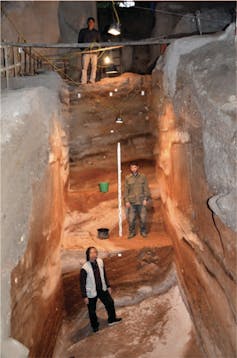
Hunting scene at Leang Bulu’ Sipong 4. The top image shows a photostitched panorama of the rock art panel (images enhanced using DStretch). The bottom image is a digital tracing of the rock art scene. Ratno Sardi (top); Adhi Agus Oktaviana (bottom).

As we report today in Nature, our dating study shows this is the world’s oldest known representational artwork (as the images depicted are figurative in nature).

The depiction of the part-human, part-animal hunters may also be the earliest evidence of our capacity to conceive of things that do not exist in the natural world. This ability is a cornerstone of religious thought and experience with origins long shrouded in mystery.

Earliest hunting scene in prehistoric art.

Sulawesi’s ice age art

The new cave art site is named Leang Bulu’ Sipong 4 and our Indonesian colleagues discovered it in December 2017. It is one of hundreds of cave art sites in the Maros-Pangkep limestone karst region of South Sulawesi.

Map of Sulawesi showing the location of the cave art site Leang Bulu’ Sipong 4. Kim Newman

In 2014, we announced that a cave (Leang Timpuseng) in Maros-Pangkep harbours one of the world’s oldest rock art motifs, a hand stencil created at least 40,000 years ago.

First discovery of 40,000-year-old cave art in Sulawesi.

We also recently reported on a figurative painting of a banteng (a species of wild cattle) dating to at least 40,000 years ago from a Kalimantan cave on the adjacent island of Borneo.

Palaeolithic cave art discovery in Kalimantan, Borneo.

Until now, this painting was the earliest known figurative motif on the planet.

A team effort to date the art

Rock art is very challenging to date.

Fortunately, we were able to collect small mineral growths that had formed over the paintings at Leang Bulu’ Sipong 4. We dated this “cave popcorn” using uranium-series analysis, which calculates ages by measuring the radioactive decay of elements.

We conducted our study in collaboration with researchers from several Indonesian institutions, including Indonesia’s National Research Centre for Archaeology (ARKENAS) and scientists from the culture heritage preservation department (BPCB) in Makassar.

The dating of four “popcorns” returned ages between 35,100 and 43,900 years.

So the art in this Indonesian cave was created at least 44,000 or so years ago!

Why is this art important?

Our results show the painting at Leang Bulu’ Sipong 4 is the oldest figurative art in the world.

Aside from the extraordinary antiquity of this painting, this is the first time a detailed visual narrative or “story” has been identified in cave art at such an early period.

The standard view in Europe is that humanity’s first rock art consisted of simple geometric symbols, which evolved into the sublime figurative paintings of animals from France and Spain from around 35,000 years ago. In this view, the first scenes and human-animal hybrids (known as therianthropes) came along much later.

But the art at Leang Bulu’ Sipong 4 suggests the major components of an advanced artistic culture were already present in Sulawesi 44,000 years ago: figurative art, scenes, and therianthropes.

It’s possible “complex” art like this was already being made somewhere in Asia (or Africa) even longer ago.

The dawn of human spirituality

The early portrayal of therianthropes at Leang Bulu’ Sipong 4 is fascinating.

Hunting scene at Leang Bulu’ Sipong 4. A group of small part-human, part-animal figures is apparently capturing an anoa (a buffalo-like creature native to Sulawesi) with what seem to be ropes or spears. Ratno Sardi

In Western culture we are most familiar with part-human, part-animal images like werewolves. But therianthropes often have great religious significance.

A therianthropic figure in the hunting scene at Leang Bulu’ Sipong 4. This motif appears to represent a human figure with bird-like head and beak. Ratno Sardi

For example, ancient Egyptians revered and feared many deities and demons whose physical forms combined animals and humans, such as the jackal-headed god of death, Anubis, and the sphinx, which had a lion’s body and a human head.

When did we first develop the capacity to dream up such extraordinary creatures?

Up until now the earliest known image of a therianthrope in world archaeology was the “Lion-man” from Germany, a figurine of a human with a feline head carved from a mammoth’s tusk. Nazi archaeologists unearthed this artefact in 1939 and it is said to be 40,000 years old.

At 44,000 years or more, the figures from Leang Bulu’ Sipong 4 predate “Lion-man”. They may represent the earliest indication of our ability to imagine the existence of non-real entities like therianthropes.

This ancient world is disappearing

This Sulawesi cave art is a gift from the dawn of human culture. But it is crumbling away before our eyes.

Our rock art surveys with our Indonesian colleagues have uncovered many new cave sites in Maros-Pangkep with spectacular figurative paintings that still await dating. We have also observed the alarming deterioration of this art at almost every location.

Monitoring by BPCB confirms the limestone cave wall surfaces on which the paintings were made are peeling off, erasing the art. This process is happening quickly: at some sites, patches of art 2–3 cm wide vanish every couple of months.

It would be a tragedy if these exceptionally old artworks should disappear in our lifetime. We need hard scientific data that can tell us why this globally significant rock art is deteriorating and what we can do about it – and we need it now.

ref. Indonesian cave paintings show the dawn of imaginative art and human spiritual belief – http://theconversation.com/indonesian-cave-paintings-show-the-dawn-of-imaginative-art-and-human-spiritual-belief-128457

Diabetes and pregnancy can be a tricky (but achievable) mix: 6 things to think about if you want a baby and 1 if you don’t

Source: The Conversation (Au and NZ) – By Freya MacMillan, Senior Lecturer in Interprofessional Health Science, Western Sydney University

The number of people with diabetes is expected to increase from 463 million in 2019 to 700 million by 2045 globally. So more women with diabetes will be having babies in the future.

If you have diabetes, here’s how to have the best chance of a safe and successful pregnancy, and to give your baby the best start in life.

Alternatively, if you have diabetes and want to avoid pregnancy, here’s what to think about when it comes to contraception.


Read more: Explainer: what is diabetes?


Why are women with diabetes and their babies at greater risk?

Women with diabetes have an increased risk of pregnancy complications, particularly if they’re among the more than 60% whose pregnancies are unplanned.

Harm can be to the mother, such as preeclampsia, where her blood pressure increases, her body swells and her liver and kidneys may be damaged. If left untreated, preeclampsia can lead to seizures and loss of mother and baby.


Read more: Explainer: what is pre-eclampsia, and how does it affect mums and babies?


Pregnancy can also affect the mother’s diabetes directly, from changes in how her body uses insulin.

Early in pregnancy, women may become more sensitive to insulin and be more likely to have extremely low blood sugar levels (become hypoglycaemic), severe enough to lose consciousness.

Later in pregnancy, hormones released from the placenta make the body more resistant to insulin, which can make controlling her blood glucose much more difficult.

Babies are at a greater risk of malformations due to sub-optimal levels of glucose they may be exposed to in the womb. from www.shutterstock.com

Babies are also at higher risk of malformations, such as congenital heart defects and central nervous system defects, because of the mother’s sub-optimal blood glucose levels.

If higher blood glucose levels continue or the mother has extreme blood glucose levels, this may lead to miscarriage, stillbirth or the baby dying shortly after birth.

So it’s no wonder the childbearing years can be daunting.

Here are some tips from the Australasian Diabetes in Pregnancy Society on contraception, pre-pregnancy care and antenatal care.

1. Think about contraception early, even if you want a baby

Are you planning to become pregnant? If “yes”, then contraception is important to make sure you’re ready for pregnancy, and when it happens, there’s the greatest chance of a healthy baby (see point 2). If “no” and you are sexually active, or soon will be, then you also need effective contraception.

So, start discussing contraception early in your childbearing years, ideally before you become sexually active. You can do this either through your diabetes team or your regular health-care provider.

Long-acting reversible contraception, like this intrauterine device, is recommended for women with diabetes. from www.shutterstock.com

Long-acting reversible contraception (for instance, intrauterine devices or implants) are strongly recommended as these have the lowest failure risk and minimal, if any, impact on your diabetes.

Some oral contraceptives are less effective than long-acting reversible contraception and can lead you to gain weight (which can impact how well your diabetes is managed). Weight gain may also increase your risk factors for heart disease, and increases the risk of pregnancy complications, such as having a large baby.


Read more: Few Australian women use long-acting contraceptives, despite their advantages


2. If you want a baby, find a pre-pregnancy diabetes management service

A pre-pregnancy diabetes management service is a one-stop-shop that looks after your pre-pregnancy care including contraception (see point 1) to make sure the time for conception is right for you.

Using one of these services has been shown to reduce the risk of your baby being malformed by 75% or dying before or at birth by 66% compared to those that do not receive such pre-pregnancy care.

So ask your health-care provider if there is a service like this in your area, and if there is, ask for a referral well before trying to conceive.


Read more: How psychological support can help people living with diabetes


At a pre-pregnancy diabetes service, you will get advice and support on all aspects of diabetes from a multidisciplinary team including: a diabetes specialist, a diabetes educator and dietitian, linked with obstetric or gynaecology services.

This includes the impact pregnancy can have on diabetes complications; the impact of diabetes on your baby and pregnancy outcomes; miscarriage and IVF; folic acid supplementation (see point 5); and medication safety (see point 6).

But these services are not available in all areas. Before our diabetes contraception and pre-pregnancy service opened in 2018, few clinics in NSW specialised in diabetes pre-pregnancy care.

3. Choose the right health-care provider for your pregnancy

Once you know you’re pregnant, ask your GP to refer you to a diabetes specialist team of health-care professionals experienced in managing diabetes in pregnancy. This team will work with an obstetric team.

Such a multi-disciplinary approach means endocrinologists, obstetricians trained in high-risk pregnancy care, dietitians and diabetes educators, among others, will be looking after you.

Early referral is essential, preferably before eight weeks gestation. This is to allow your insulin to be carefully managed to avoid uncontrolled changes in glucose that, as mentioned earlier, can affect you and your baby.

Every woman should have access to diabetes specialist services through a hospital, but in rural and remote areas this may be some distance away.

Although there may be some telehealth options, it is important that ongoing management and particularly the birth are planned with that diabetes specialist team as soon as possible. Your GP will need to refer you.

4. Keep healthy glucose levels before and during pregnancy

Whichever health professional or team of health professionals looks after you, maintaining your blood glucose levels within range as much as possible before and during pregnancy is vital.

It helps women with diabetes fall pregnant safely, reducing the chance of miscarriage. If you are using IVF, fewer miscarriages will mean fewer rounds of IVF.

Healthy glucose levels also provide a growing baby an environment where it will flourish, reducing the chances of pregnancy complications.

So, when monitoring your blood glucose aim for:

  • fasting blood glucose level, 4-5.5 mmol/L
  • one hour after eating level, less than 8.0 mmol/L, and
  • two hours after eating, less than 7 mmol/L.

Naturally, these may need to be higher if hypoglycaemia is a problem.

If you have type 1 diabetes and are planning pregnancy, are pregnant or have very recently had a baby, you now have access to a free glucose sensor, a wearable device that monitors your glucose continuously. With this device, you should aim to be within 3.5-7.8mmol/L more than 70% of the day.

At present there is not enough evidence to support using a continuous glucose monitoring during pregnancy if you have type 2 diabetes. But glucose monitoring remains very important before breakfast and after meals.


Read more: Health Check: is it safe to express milk before giving birth?


5. Take a high-dose folate supplement

Pregnant women with diabetes are recommended to take a high dose of folate (5 milligrams daily, as opposed to 0.4-0.5 milligrams in women without diabetes.

That’s because the risk of having a baby with a neural tube defect is raised in women with diabetes.

So if your health-care professional doesn’t raise this, mention it yourself and buy a folate supplement from your local pharmacy.

6. Ask about your medications

It’s important to talk to your health-care provider as soon as you know you are pregnant so they can advise whether it is safe to continue taking your existing diabetes medication.

Insulin does not cross the placenta and is the preferred medication, if required.


Read more: Weekly Dose: metformin, the diabetes drug developed from French lilac


Metformin does not cause malformations but does cross the placenta. It’s used where the benefits from improved glucose control outweigh any possible theoretical long-term risks to the baby.

Other oral medications to lower blood glucose are generally not approved for use during pregnancy.


If you have diabetes and want to know more about pregnancy or avoiding pregnancy, resources are available from the Australasian Diabetes in Pregnancy Society, Diabetes Australia and our Diabetes Contraception and Pre-pregnancy Program. Information is also available from the government’s health-care advisory service Pregnancy, Birth and Baby and National Diabetes Services Scheme.

ref. Diabetes and pregnancy can be a tricky (but achievable) mix: 6 things to think about if you want a baby and 1 if you don’t – http://theconversation.com/diabetes-and-pregnancy-can-be-a-tricky-but-achievable-mix-6-things-to-think-about-if-you-want-a-baby-and-1-if-you-dont-126687

I had an idea in the 1980s and to my surprise, it changed education around the world

Source: The Conversation (Au and NZ) – By John Sweller, Emeritus Professor, UNSW

This is the first of two essays exploring key theories – cognitive load theory and constructivism – underlying teaching methods used today.


Explicit guidance and feedback from teachers is more effective in teaching students new content and skills than letting them discover these for themselves.

This is a premise of cognitive load theory, which is based on our knowledge of evolutionary psychology and human cognition, including short- and long-term memory.

I started working on cognitive load theory in the early 1980s. Since then, “ownership” of the theory shifted to my research group at UNSW and then to a large group of international researchers.

The theory holds that most children will acquire “natural” skills – such as learning to listen to and speak a native language – without schools or instruction. We have specifically evolved to acquire such knowledge automatically. It is called “biologically primary knowledge”.

But there is another category of knowledge – “biologically secondary knowledge”, which we have not evolved to acquire. It consists of virtually every topic taught in schools from reading and writing to science and maths.

Cognitive load theory is concerned with the acquisition of secondary knowledge.

The theory now underpins the method of explicit instruction – where a teacher will explicitly provide students with information or demonstrate a way of doing things – a common means of teaching in schools. Cognitive load theory explains why this method works.


Read more: Explainer: what is explicit instruction and how does it help children learn?


How we get secondary knowledge

People can acquire secondary knowledge in two ways. The easiest and quickest is by listening to other people or reading.

But if other people aren’t available, secondary knowledge can be discovered during problem solving – such as engaging in research. Such discovery, or inquiry, works but is slow and inefficient. It should only be used when we cannot obtain needed information from others.

Whatever way it’s acquired, new secondary information must first be processed by our working (or short-term) memory. We use working memory when we are paying attention to something. But this memory resource is severely limited in capacity and duration.

When faced with new, secondary information, working memory can process no more than about two to three items of information at any given time and for only about 20 seconds.

Once the new information has been processed by working memory, it can be transferred to a long-term memory that has no known capacity or duration limits.

We can only process two or three bits of new biologically secondary information in our short-term memory at any one time. from shutterstock.com

Think of what you are doing now. You are faced with an immensely complex set of squiggles on a screen. The reason they don’t appear complex to you is because of the enormous amount of information you hold in long-term memory.

Information which has been processed in working memory and stored in long-term memory can be transferred back to working memory to generate action and thought appropriate to a given context. That is what we do when we read.

Working memory has no capacity or duration limits when dealing with familiar information from long-term memory.

Cognitive load theory uses this cognitive system to generate teaching methods.

The ‘worked example’ effect

Probably the best-known teaching method is based on the “worked example effect”. This occurs when students who are shown how to solve a particular problem or write a specific essay learn better by studying an example first, instead of generating a solution themselves.

A colleague and I showed this in 1985. One group of students were shown a series of problems and their worked example solutions. Another group wasn’t given example solutions.


Read more: Why every child needs explicit phonics instruction to learn to read


The first group performed significantly better on a subsequent test of similar problems to the example. Subsequent work demonstrated the same effect on transfer problems that differed from the example, than the group who had to come up with the the solutions themselves.

Dozens of randomised controlled studies have demonstrated this effect since.

Studying a worked example reduces the working memory load compared with generating a solution yourself. When solving a problem, you will inevitably consider a large number of possible moves, many of which do not assist in reaching the solution.

But when the solution is provided by a worked example, you are shown exactly which moves are relevant and you don’t have to consider a large number of alternative moves that lead to dead ends.

The problem solutions can be stored in long-term memory.

Once lots of problems and solutions are stored in long-term memory, we are in a better position to work out a solution to a new problem that can be related to previously learned solutions.

Basically, to think deeply, we need lots of knowledge stored in long-term memory.

Other examples

To reduce unnecessary cognitive load, teaching must be properly structured. Learning is impeded, for instance, if students need to unnecessarily split their attention between several sources of information such as a diagram and text. But learning is facilitated by physically integrating the diagram and text.

Think of a geometry diagram with statements underneath it saying things like “Angle ABC = Angle DBE (vertically opposite angles are equal)”.

Experiments have demonstrated that the very simple act of placing the statement on the diagram itself (putting “Angle ABC” next to where angle ABC actually is) reduces the cognitive load.

The Conversation, CC BY-ND

But if the text is redundant to the diagram, it should be eliminated altogether. For example, if you are teaching how the blood flows through the heart, lungs and body you might provide a diagram with arrows indicating the direction of flow.

A statement such as “blood flows from the left ventricle to the aorta” is redundant because it should be clear from the diagram. Studies have shown giving students the diagram alone reduces the cognitive load compared to students who are given a diagram with redundant text.

These effects can only be shown if the information studied is complicated. If a student is learning the symbols of the chemical periodic table (Fe stands for “iron”), it does not matter how the information is presented because the cognitive load is low.

heart.

What are the alternatives?

Alternatives to cognitive load theory, such as teaching critical thinking, often place a heavy emphasis on learning new problem solving or thinking strategies. Unfortunately, there are few randomised, controlled trials demonstrating their effectiveness.

Cognitive load theory assumes that, for example, critical thinking is biologically primary and so unteachable. We all are able to think critically if we have sufficient knowledge stored in long-term memory in the area of interest.

A car mechanic can think critically about repairing a car. I, and I dare say most of you reading cannot. Teaching us critical thinking strategies instead of car mechanics is likely to be useless.

ref. I had an idea in the 1980s and to my surprise, it changed education around the world – http://theconversation.com/i-had-an-idea-in-the-1980s-and-to-my-surprise-it-changed-education-around-the-world-126519

As simple as finding a job? Getting people out of social housing is much more complex than that

Source: The Conversation (Au and NZ) – By Chris Hartley, Research Fellow (Housing and Homelessness) at the Centre for Social Impact, UNSW

A private member’s bill, moved by Labor MP Josh Burns, recently called on the Australian government “to help build more affordable homes” in response to the growing homelessness crisis. A premise of the bill is that a lack of social housing is a major cause of homelessness and increasing the supply is a key element of solving the problem. The government’s response was that one solution is to encourage social housing tenants to find paid work, so they can move into private rental housing.

The problem with this argument is it overlooks the major barriers to entering the private rental market for low-income households. It also does not excuse the failure to invest adequately in building more social housing.


Read more: Australia’s social housing policy needs stronger leadership and an investment overhaul


There is certainly a shortage of social housing. About 140,600 applicants were on the waiting list for public housing and 8,800 households were wait-listed for state-owned-and-managed Indigenous housing as at June 30 2018. Another 38,300 applicants were waiting for mainstream community housing as at June 30 2017 (the most recent publicly available data). Together, these tenure types comprise most of Australia’s social housing.

These figures exclude people temporarily suspended from waiting lists (e.g. social housing applicants in New South Wales who take up Rent Choice private rental assistance), who need social housing but are ineligible and others not on waiting lists but still in need, such as rough sleepers and very low-income households in housing stress.

Tenure in social housing was once effectively unlimited provided tenants paid their rent and maintained their property. But waiting list pressures have led to a new approach. In his response to the private member’s bill, the assistant minister for community housing, homelessness and community services, Luke Howarth, argued:

There needs to be more responsibility […] from state governments to help people who are able to get back into the workplace to then move on from social housing so that it will provide a flow-through effect for people currently on the waiting list.


Read more: Focus on managing social housing waiting lists is failing low-income households


Market realities

Howarth’s argument is consistent with much state and territory policy. For example, the NSW Future Directions policy explicitly commits to “upskilling” tenants to enable them to live in private rental housing.

Tacitly overlooked in such “pathways” policies are the barriers to entering private rental. Across Australia less than 26% of private rental properties are affordable for households on a minimum wage. Less than 4% are affordable and appropriate for households on income support.


Read more: Growing numbers of renters are trapped for years in homes they can’t afford


Prejudice and discrimination against tenants perceived to pose a greater risk to landlords’ investments make access even more difficult.

Low-income households in the private rental market also face insecure tenure. “No-grounds terminations” are permitted in all states and territories except Tasmania and, from July 1 2020, Victoria (except at the end of the first fixed term).

Under “no grounds” termination, landlords can evict tenants for no stated reason at the end of a fixed-term lease and at any time on a periodic lease. Fear of retaliatory eviction makes it less likely tenants will assert their legal rights.


Read more: An open letter on rental housing reform


Employment as a pathway

Even if private rental access and affordability were certain, many social housing tenants are not in a position to undertake employment. In 2017–18, about 398,900 households were in social housing in Australia. Many of them relied on the disability support pension (21%) or the age pension (19%) as their main source of income.

Long-standing targeting of social housing to greatest need means tenants are disproportionately likely to have low educational qualifications and limited marketable skills. They face considerable employment challenges, not the least of which is stigmatisation.

It is also worth considering what “employment” realistically looks like for social housing tenants seeking to enter or re-enter the workforce. It’s likely to be as casualised labour in the gig economy.

As social policy researchers Greg Marston and Catherine McDonald have argued, we cannot assume exiting welfare for the labour market leads automatically to social and economic security. Precarious, intermittent, low-wage employment does not offer a sound basis for sustaining a private tenancy.
Of course, social housing tenants should be supported to find work and to move out of social housing if they want to. But the evidence would suggest tenant choice is not the motivation here. Rather than creating “pathways” as a way of managing social housing waiting lists, governments would have greater impact on the housing crisis if they invested much more in social housing.

Between 2011 and 2016, government spending on social housing decreased 7%, from A$1.42 billion to A$1.32 billion. This has contributed to a backlog of 433,000 dwellings in Australia’s social housing supply. That’s predicted to grow to a shortage of 727,000 dwellings by 2036.


Read more: Australia needs to triple its social housing by 2036. This is the best way to do it


In addition to providing more social and affordable housing, governments must act on the systemic problems in the private rental market. This includes developing nationally consistent tenancy legislation to provide more protection for tenants, including against no-grounds evictions, and providing the resources to properly enforce such laws.

ref. As simple as finding a job? Getting people out of social housing is much more complex than that – http://theconversation.com/as-simple-as-finding-a-job-getting-people-out-of-social-housing-is-much-more-complex-than-that-128006

What limits shareholder activism as a force for good: the free-rider problem

Source: The Conversation (Au and NZ) – By Salvatore Ferraro, PhD candidate, RMIT University

The board of Australia’s second-biggest bank is in for some stick at its annual general meeting today, as Westpac shareholders vent their displeasure at the scandal involving breaches of anti-money-laundering rules.

But though it will be uncomfortable, with enough shareholders likely to vote against the remuneration report to trigger a vote to spill the entire board, a full-blown revolution is not on the cards.


Read more: How Westpac is alleged to have broken anti-money laundering laws 23 million times


The Australian Shareholders’ Association, with proxies for more than 2,000 shareholders, will not support a spill. Nor will major institutional shareholders such as industry superannuation funds HostPlus and Unisuper.

With the number of shares held determining how many votes each shareholder gets, major investor support is enough to suppress most shareholder uprisings.

This, and a fundamental problem facing all collectives, currently limits the potential of shareholders to hold corporations to account, both through choosing to hold shares or not, as well as through voting power.

Ethical divestment

Decisions by shareholders to avoid profiting from business considered unethical arguably goes back centuries, with religious communities consciously avoiding investments in slavery, arms, alcohol, tobacco and gambling – so-called sin stocks.

Since the the 1980s secular funds have extended this idea to the more expansive agenda of social and environmental sustainability. One thread of this ethical investment trend has led to the divestment movement.

A notable example is the campaign targeting universities, banks and other big institutional investors to dump their stocks in fossil fuel companies.

Fossil fuel divestment advocates outside the Australian Stock Exchange on the day of Whitehaven Coal’s annual general meeting in November 2013. Greenpeace/AAP

The movement’s rationale is that divestment increases the cost of capital. It’s effectiveness, however, is a matter of debate. Bill Gates is among the critics, calling divestment “a false solution”. One argument is that it simply means companies end up being owned by shareholders only interested in profits. It has also been argued fossil fuel divestment might even cause emissions to rise.

Shareholder activism

Shareholder activism takes a different approach to divestment. It’s about immersion rather than aversion. It involves shareholders directly engaging with directors and executives of companies to effect change from within.

Unlike ethical investment, the roots of shareholder activism are not altruistic. Historically to be called an activist shareholder was no compliment. It probably meant you were a hedge fund focused solely on reaping bigger profits. This was typically done by pressuring boards and management to sell off under-performing assets and disburse the cash to shareholders.


Read more: How companies should fend off attacks from activist investors


To date, little activism has been motivated by altruistic purposes. That’s partly to do with a fundamental problem that limits the ability of activism to influence corporate behaviour for non-financial reasons.

Economists call it the free-rider problem. In essence it’s the problem of individuals having little incentive to contribute to a collective resource when they can enjoy its benefits even if they don’t.

How this applies to shareholders was first outlined by Harvard academics Adolf Berle and Gardiner Means in their seminal 1932 book The Modern Corporation and Private Property.

Ownership of public corporations is generally diffused between a significant number of shareholders. Individual shareholders have little incentive to monitor senior management, because of the cost they bear while others reap benefits.


Read more: Giving workers a voice in the boardroom is a compelling corporate governance reform


Ironically, corporate boards are meant to mitigate this free-rider problem. Their job is monitor management on behalf of shareholders. But Westpac’s anti-money-laundering scandal adds to the evidence the system might be broken. The allegations suggest a board incapable or unwilling to effectively monitor senior management in complex and sprawling conglomerates.

Shareholder engagement and activism should play an increasingly important role in shaping corporate behaviour, improving the quality of board monitoring and addressing the free-rider problem.

Big institutional shareholders in particular could be more active in ensuring boards have skilled, competent directors. They could also foster a culture of openness by supporting directors to challenge senior management without fear of putting their tenure at risk.

ref. What limits shareholder activism as a force for good: the free-rider problem – http://theconversation.com/what-limits-shareholder-activism-as-a-force-for-good-the-free-rider-problem-127232

How New Zealanders miss out on hundreds of thousands in retirement savings

Source: The Conversation (Au and NZ) – By Ayesha Scott, Senior Lecturer – Finance, Auckland University of Technology

In the 12 years since New Zealand introduced the retirement fund KiwiSaver, nearly three million New Zealanders have enrolled and 30 KiwiSaver providers are now collectively managing NZ$57 billion in investments.

But questions are being asked about whether KiwiSaver members pay too much. A recent report commissioned by the Financial Markets Authority shows that New Zealand funds charge on average 25% to 50% more than equivalent UK funds.

In the year to Sept 2019, fund providers earned NZ$479.8 million in fees, with each member charged an average of NZ$132 per year.

Our research explores the gap between initial expectations and reality, and shows that New Zealanders miss out on tens, and in some cases hundreds, of thousands in retirement savings.


Read more: We’re delaying major life events, and our retirement income system hasn’t caught up


Impact of fees on savings

The New Zealand government introduced KiwiSaver in 2007 to address a lack of retirement savings. The savings scheme takes employee and employer contributions and gives them to a private fund manager to invest. Members can either choose a fund manager or are assigned one at random. The government also makes a contribution, which we included in our calculations, but note that not everyone is receiving what they are entitled to.

Managing a fund costs money, and with nearly NZ$57 billion invested, New Zealanders have paid NZ$479.8 million in fees to fund managers. Fees are often quoted to members in a way that makes them appear deceptively small.

For instance, the average KiwiSaver growth fund will cost 1.25% per year. The equivalent UK fund would likely cost around 0.92%. To many New Zealanders, this difference may sound inconsequential, which has motivated a recent move to quote fees as dollar amounts on annual statements.

Fees are a double-edged sword. They erode retirement savings by reducing monthly contributions and the future compounding of those savings. The result is tens of thousands less in retirement.

For example, a 25-year-old member in the average growth fund with an income of NZ$50k is likely to pay NZ$50k in fees over the life of their KiwiSaver. They will retire with about NZ$255k in savings. In contrast, the cheapest growth fund would charge just under NZ$15k in fees over the same period, and would result in over NZ$300k in savings at retirement.

Economies of scale

While policymakers debate whether New Zealanders pay too much, our research looks at economies of scale. When the government established KiwiSaver, policymakers thought the high fees KiwiSaver providers were charging would reduce as more people invested.

They expected that as funds increased in size, the costs of running them would be spread over larger pools of funds and it would become cheaper to manage the investments. These cost savings would then be passed on to members.

We collected data on the total fees charged by KiwiSaver providers along with the assets under management and the number of members a fund has. Our project included 24 fund providers and over 267 individual funds (across five risk groups) between 2013 and 2018.

If there are economies of scale present, then as a fund gets larger, either by increasing the amount of money or by increasing the number of members, the fees should increase by a less than proportional amount. Put differently, a 1% increase in size should result in a less than 1% increase in fees.


Read more: There’s a yawning gap in the plan to keep older Australians working


But this is not the case. When we consider the amount of money invested, a 1% increase in the assets under management results in about a 1% increase in fees. In other words, as the total sum invested in KiwiSaver increases, we can expect total fees to increase at the same rate. This means KiwiSaver providers are either not seeing any cost savings at all as they get bigger or are refusing to pass these savings onto investors.

When we consider the number of members in a fund as the measure of size we see some evidence of economies of scale. A 1% increase in members results in a 0.93% increase in fees, a small reduction in the fees.

Unfortunately, large increases in KiwiSaver members are unlikely. KiwiSaver already has over 80% of eligible New Zealanders enrolled. In 2019, the number of members grew by 3% across all funds. Future economies of scale won’t be large.

The expected cost savings have not materialised and seem unlikely to. The total amount of KiwiSaver fees providers collect looks set to continue to increase at a steady rate. For members, the consequence will be expensive funds (compared with their peers in other countries) and far less in retirement savings come age 65.

ref. How New Zealanders miss out on hundreds of thousands in retirement savings – http://theconversation.com/how-new-zealanders-miss-out-on-hundreds-of-thousands-in-retirement-savings-127708

Marianne & Leonard: a new film tells us little about the woman fixed in the role of musician’s muse

Source: The Conversation (Au and NZ) – By Tanya Dalziell, Associate Professor, English and Literary Studies, University of Western Australia

Nick Broomfield’s latest documentary, Marianne & Leonard: Words of Love tells the story of the fabled relationship between Leonard Cohen and Marianne Ihlen, which unfolded after they met on the Greek island of Hydra in 1960.

It was there that they lived and loved for the best part of a decade, and where Cohen wrote the poetry, novels and eventually songs, that made his reputation.

Their romance was captured in the 1967 song So Long, Marianne from Cohen’s debut album, and entrenched in a 1969 record sleeve image of Ihlen wrapped in a towel while seated before Cohen’s typewriter. Here, we were presented with the Norwegian muse behind the songs.

Cohen and Ihlen were all but separated by the end of the 1960s. But as if bringing their storied romance full circle, they both passed away within three months of each other in 2016, although not before Cohen sent an urgent letter to the dying Ihlen.


Read more: Mythmaking, social media and the truth about Leonard Cohen’s last letter to Marianne Ihlen


That note — heard in the film being read to Ihlen on her death bed — provides the emotional climax to Marianne & Leonard, seeming to bridge the decades its author and recipient had been apart. It asks viewers to believe they had remained in love; anticipating their reunion in the afterlife.

Broomfield has a particular interest in the lives of music celebrities. He has previously trained his cinematic eye on Kurt Cobain and Courtney Love, Whitney Huston, and Biggie and Tupac. Yet, his interest in Cohen and Ihlen is more than professional. As he recounts in voice-over, he was briefly Ihlen’s lover when he found himself on Hydra in the late 60s, while Cohen was shuttling between the island, Montreal, New York and Nashville.

Cohen could no more contain his ambitions to Hydra than he could contain his affections to Ihlen, and he eventually left both behind. As with Cohen, Broomfield’s island romance was seemingly formative, and he kept in contact with Ihlen as she negotiated her painful break-up with the musician. Broomfield thereby became an observer of the damage done to those who find themselves caught in the slipstream of fame, a role he retains in the film.

Two incompatible genres

Marianne & Leonard is an intriguing meeting of two seemingly incompatible genres — the documentary, with its claims to reality; and the romance, which allows for the improbable.

A portrait of Marianne Ihlen. Copyright Nick Broomfield

A nod to realism early in the film, with an attribution of “the early sixties” attached to archival film footage, proves incorrect. (The age of Ihlen’s child, born in 1960, dates the footage to at least 1967). But on one level, such oversights hardly matter. The film is not so much interested in locating the specific origins of Ihlen and Cohen’s relationship, as it is in emphasising the timelessness of their romance.

Yet, Marianne & Leonard struggles to fill its 97 minutes of screen time. There is only a sparse amount of footage of either Cohen or Ihlen on Hydra, and only a fragment of them together in the same frame. Only by careful cinematic editing can Cohen and Ihlen be presented as a couple in this film.

The pair together. Copyright Aviva Layton

Broomfield then faces the narrative challenge of maintaining interest in the now-distant relationship across nearly five decades in order to reach Ihlen’s demise and the reconciling letter. The film addresses this task by detouring through Cohen’s well-documented career, supported by ex-band mates speaking to camera.

By contrast, Ihlen’s subsequent marriage and domestic life are quickly summed up and dispensed with. There is little of substance said about her other than how she occasionally positioned herself to support other creative types such as singer Julie Felix, and Broomfield himself.

So whereas Cohen is afforded limitless agency as his fame advances, Ihlen remains fixed in the role of the beautiful ingénue, the muse, the part-time lover.

A visual refrain running through the film is of the blazingly blonde Ihlen pictured in slow-motion, wistfully looking out across the Aegean from aboard a yacht.

While this time-bound imagining sets a sympathetic tone towards Ihlen, Marianne & Leonard is more admiring in its representation of Cohen as a man active in the world, singing and seducing his way across the globe while struggling with the inner demons that drive his spiritual longing and lust in equal measure.

Harder truths

Broomfield does not shy away from the hurt Ihlen and her son suffered while Cohen pursued his art and his “appetite” (a coy term the musician uses for his unappeasable sexual desire). But, neither does it confront the harder truths of the license taken by, and conceded to, creative men.

Leonard Cohen writing. Copyright Axel Jensen Jr

When applied to great artists, myth and romance are frequently more appealing than reality.

Accordingly Marianne & Leonard recounts a romantic ideal that audiences might wish for, and which its subjects themselves burnished over the years. And viewers familiar with the storyline will likely leave the cinema with their biases confirmed.

For those who think of Cohen as the finest singer-songwriter of his generation, there is plenty of material to support that claim and attest to the resulting adulation. For those who approvingly — or otherwise – regard Cohen as a “ladies’ man” (to half conjure the title of his ill-fated record with producer, Phil Spector), that judgement is also borne out.

For others who admire Cohen as a poetic searcher, his years in a Buddhist monastery are also accounted for, even if this section of the film has little to do with the love story at its heart.

And for those inclined to see Cohen and Ihlen as being blessed by eternal love, then the film will play straight to their romantic expectations.

Viewers will not, however, learn much about Ihlen herself, beyond her entrenched representation as Cohen’s Hydra lover and “muse”.

Marianne and Leonard opens in cinemas today.

ref. Marianne & Leonard: a new film tells us little about the woman fixed in the role of musician’s muse – http://theconversation.com/marianne-and-leonard-a-new-film-tells-us-little-about-the-woman-fixed-in-the-role-of-musicians-muse-128112

Australian law doesn’t go far enough to legislate affirmative consent. NSW now has a chance to get it right

Source: The Conversation (Au and NZ) – By Rachael Burgin, Research associate, Monash University

The NSW Law Reform Commission will hand down its final recommendations for a reformed definition of sexual consent in the new year, following draft proposals in October.

The commission’s inquiry is largely the result of the advocacy of Saxon Mullins, who was let down by the legal system when the man accused of raping her, Luke Lazarus, was acquitted in a judge-only trial. A jury had earlier convicted him.

The point of legal contention was whether Lazarus believed on “reasonable grounds” Mullins was consenting. The jury in the first trial ruled Lazarus had no grounds for believing Mullins consented, therefore finding him guilty.

But following an appeal, judge Robyn Tupman ruled Lazarus did reasonably believe he had consent, referring, among other details, to Mullins’ supposed failure to do anything “physical to prevent the sexual intercourse from continuing”.


Read more: Yes means yes: moving to a different model of consent for sexual interactions


Much of the debate since the beginning of the review has focused on whether the law in NSW should adopt an “affirmative” approach to sexual consent. With a legal model of affirmative consent, Mullins’ case might have had a different outcome.

Affirmative consent is broadly supported in the community, and adopting it would bring the law in NSW more in line with the current approaches in jurisdictions like Victoria and Tasmania.

But, how this works as law in a rape trial is less clear. The NSW commission should take note that the wording of Victoria’s legislation in particular offers limited protection in court.

What is affirmative consent?

The model of affirmative consent is based on the idea all people have the right to have sex or not have sex. A person who wants to have sex with another person must actively confirm, by “taking steps”, that the other person also wants to have sex.

They could ascertain this via verbal agreement or active participation, as opposed to passive submission. The question of whether an alleged perpetrator had reasonable grounds to believe the complainant was consenting could be answered more clearly if these steps were an expectation of every sexual encounter.

Affirmative consent means taking active steps to confirm the other person wants to have sex. From shutterstock.com

In conducting its review into consent law in NSW, the commission looked to the way consent law operates in other states.

It gave the highest praise to approaches in Victoria and Tasmania, despite a lack of empirical evidence to show how these laws are working in practice.

Victoria

Myself and colleagues looked at 15 rape trials from the County Court of Victoria between 2008 and 2015 to explore how affirmative consent translates into legal practice.

Our findings raise concerns about whether the law in Victoria is able to change the way “rape myths” – falsities which blame women for being raped and excuse men’s predatory behaviour – play out in trials.

Despite using language that reflects an affirmative approach to consent, the way Victoria’s law has been written fails to implement the standard in practice.

The Victorian Crimes Act defines consent as “free agreement”. A person who does not “reasonably believe” the other person consents should be found guilty of rape.

It’s not, however, until the act defines what a reasonable belief means that there is specific reference to the “steps taken” by the initiator of sex, for example, asking the other person if they want to have sex. The act says:

  1. whether or not a person reasonably believes that another person is consenting to an act depends on the circumstances
  2. without limiting subsection (1), the circumstances include any steps that the person has taken to find out whether the other person consents…

The cumulative impact of these two sections of the law is that a person seeking sex does not need to take any steps to make sure the other person actually wants to have sex.

Further, there is no test of reasonableness of the steps themselves. So, if a person took unreasonable steps – for example, claiming they thought about consent, but did not do or say anything to make sure the other person was consenting – this could constitute a “step” in the eyes of the law. This effectively renders the premise of affirmative consent redundant.

Tasmania

In Tasmania, a belief in consent is not honest nor reasonable if the accused “did not take reasonable steps in the circumstances” to ensure the other person was consenting.

This approach avoids the two biggest pitfalls of the Victorian law, because first, steps are mandatory, and second, those steps must be reasonable steps. Under Tasmanian law the “steps” need to be more proactive to be considered reasonable. In a Tasmanian court, a person will have to identify actions they took to make sure they had consent.

The Tasmanian approach embeds affirmative consent into law, a feat not achieved in Victoria. So in delivering its final recommendations, the NSW commission would be best placed to take cues from Tasmania.

Affirmative consent is a good thing. But the way the legislation is worded is important. From shutterstock.com

A promising proposal

In its draft proposals, the commission suggested these laws sit under a set of “interpretive principles” to make them easier for jurors to apply.

These principles reflect the core values of the affirmative approach to sexual consent. They state: “sexual activity should involve ongoing and mutual communication, decision-making and free and voluntary agreement between the persons participating in the sexual activity.”

The inclusion of these principles will be important in making affirmative consent law in NSW.


Read more: Making sexual consent matter: one-off courses are unlikely to help


Further, the commission has provided some clarity around the vague idea of “taking steps”, a key concern raised in earlier submissions. The draft proposals suggest defining steps as “whether the accused person said or did anything to ascertain if the other person consented”.

This language means that, unlike the ruling of the NSW Court of Appeal in Mullins’ case, a “step” will constitute more than just the accused “thinking” about consent. Instead, the commission frames a “step” as a physical act, achieved through actions and words.

Yet, the draft proposals have not responded to the ongoing concerns with Victorian law. They don’t lend support to mandating that the accused demonstrate to the court that they took steps to ensure they had consent. It’s important this be addressed in the final recommendations, or NSW will not be moving towards a model of affirmative consent.

ref. Australian law doesn’t go far enough to legislate affirmative consent. NSW now has a chance to get it right – http://theconversation.com/australian-law-doesnt-go-far-enough-to-legislate-affirmative-consent-nsw-now-has-a-chance-to-get-it-right-125719

Finke film review: riders daring to fly in a crazy desert race

Source: The Conversation (Au and NZ) – By Eric Brymer, Reader, Psychology with Outdoor and Adventure studies, Leeds Beckett University

Review: Finke: There & Back, directed by Dylan River

The Finke Desert Race takes place in the harsh desert environment near Alice Springs. Scores of motorbikes and cars are raced over two days along an off-road track that stretches approximately 229 kilometres each way.

The race was first envisioned as a motorbike race to test the skills of a small group of local enthusiasts in 1976. Cars were introduced 1988, and the race has developed into a heavily sponsored and lucrative international spectacle. Narrated by actor Eric Bana, Finke: There & Back follows the high-speed journey of those in a quest to be named King of the Desert.

As we watch the highs and lows of the competitors featured in this film – directed by 25-year-old Finke racer Dylan River – we learn about competition, risks and rewards.

Eric Bana narrates the action, which was shot by 16 cinematographers.

Thrill of the chase

For the racers and supporters, “Finke fever” – the energy that surrounds the event including all the accompanying celebrations – comes in hot every year on the Queen’s birthday long weekend, when it takes place.

Winning is determined by completion time, so speed (over 160 kilometres per hour) is the focus. Many of the race vehicles are specifically designed for the event and cost around $500,000 to produce.

The Finke race is dangerous. As such, it seems similar to extreme sports such as Proximity Flying and Big Wave surfing. But extreme sports are mostly undertaken in unconstrained environments, are non-competitive, and free from competition rules and external regulations.

Participation in extreme sports is also not determined by preset time limits. Effective participation is about surviving to participate another day.

More akin to endurance competitions, the modern Finke Desert Race is tightly planned with organisers working in crack teams to prepare and set out the track, manage risk, keep track of competitors and plan for disasters such as injury or death. In a sense, the goal of winning on competition day – rather than surviving – might make Finke more dangerous.

The desert environment adds uncertainty and excitement. Accordingly, the film’s imagery takes in the grand aerial scale reminiscent of Warren Miller’s jaw dropping snow sport and skating blockbusters, but also gets up-close and dusty as we get to know the personalities taking part. It was nominated for Best Cinematography in a Documentary in the recent AACTA film awards.

First-time director Dylan River, 25, has completed the Finke track three times. Madman Films

Need for speed

The film introduces us to a group of athletes and briefly explores their motivations and experiences.

“Once in your veins,” narrator Bana tells us, “the race is an incomprehensible addiction.”

Initially, the classic reasons for such endeavours – a “search for adrenaline” and adventure, a lifelong love of speed – are given. But we soon realise there is more to the impulses that drive these racers. One competitor calls it “escapism in its purest form”.

Isaac Elliot, now in a wheelchair having suffered a traumatic accident ten years earlier, is keen to describe the event as an “adrenaline rush”, but he has a bigger point to prove. His personal quest to finish what he started.

Isaac Elliott wants to finish what he started a decade ago. Madman Films

Not all competitors consider winning the main reason to race. Though a five-time winner, Randall Gregory calls the Finke challenge “just a race”. It affords him personal growth and opportunities to test his physical and mental capacities.

Even though the Finke race is more akin to a sporting competition, these experiences are reflected in what we know about extreme sports athletes. Participation facilitates a deeper understanding of personal limits, values and beliefs about what is possible.


Read more: Adrenaline zen: what ‘normal people’ can learn from extreme sports


Highs and tragic lows

Extreme sports participants recognise the need to assess the challenges ahead and also accept the seriousness of the activity they are about to undertake. This can lead to a decision to walk away if the assessment is unfavourable. Bound by time, the Finke race does not allow those risk assessments to take place.

The film tells us that just over 70 motorbike riders out of a field of over 500 bikes fail to finish. The impact on the riders’ body is reported by the racers themselves. “I’ve fractured six vertebrae, fractured my sternum and my collar bone,” says one, adding that with a new family he’ll “touch wood” in the hope of avoiding further injury. We also see competitors dig deep for the mental strength required to stay in the race.

In a sad post-script, rider Daymon Stokie, who is featured in the film, died in another race six months after production.

Finke competitor Daymon Stokie died after filming.

The film is an incredible insight into what it takes to prepare and compete as well as the implications of the competition for personal development and the riders’ families.

Finke: There & Back is a must-see for those interested in motorbikes and especially those interested in off-road motorbiking. Viewers who’ve never been exposed to this world will likely be struck by the intensity of the race and the interaction between the riders’ skill, daring and the harshness of the environment.

Special event screenings across Australia from December 5

ref. Finke film review: riders daring to fly in a crazy desert race – http://theconversation.com/finke-film-review-riders-daring-to-fly-in-a-crazy-desert-race-126597

Now Australian cities are choking on smoke, will we finally talk about climate change?

Source: The Conversation (Au and NZ) – By Blanche Verlie, Postdoctoral research fellow, University of Sydney

I moved to Sydney less than five weeks ago and the city has been shrouded in smoke haze on and off since then. I joke this is my “Sydney hazing” but it’s only now – having worked on climate change for over a decade – that I’m suddenly feeling burnt out. This is not in any way to compare my experience to those who have lost their homes, communities and loved ones to the bushfires.

But the smoke cuts through Australia’s clouds of climate denial that pretend we are neither vulnerable nor responsible.


Read more: Australia needs stricter rules to curb air pollution, but there’s a lot we could all do now


We often refer to the “atmosphere” and “climate” of a particular space or community. We can be “on cloud nine”, “under the weather”, or “snowed under”. We know the weather affects people’s moods. My research, and that from a range of disciplines, is increasingly finding that human emotional, social and embodied experiences are intimately related to the weather and climate.

So, might people’s climate concern be changing now Sydney and Canberra have air quality on a par with Delhi?

Beachgoers on Milk Beach as smoke haze from bushfires in New South Wales blankets the CBD in Sydney on Saturday, December 7 2019. AAP Image/Steven Saphore

Psychological smokescreens

Research is mixed on how extreme weather changes people’s perspectives on climate change. After severe storms and floods hit the UK in 2013 and 2014, scientists found those directly affected were more worried about climate change and supported climate change policies beyond direct, flood-related mitigation.

On the other hand, climate-change sceptics polled in the US in 2011 were more likely to recall the summer of 2010-11 as a normal one, despite record-breaking heatwaves across the northern hemisphere.

Some research has suggested climate change can prompt “information aversion”, where we actively or subconsciously avoid distressing facts and construct a safer, more comforting narrative.


Read more: Air pollution may be affecting how happy you are


This tendency may be what drives such bracing platitudes as: “Australia is a sunburnt country”; “We’ve always had fires”; “Us Aussies are tough!”

A few face masks aside, the majority of us in Australia’s smoky cities have appeared to continue with business as usual: people just keep going to work. But I hope that, below this surface, the lingering taste of char at the back of our throats is sparking a change in the political atmosphere.

Igniting political change

No one should tell you how to feel about climate change, but I can tell you that you have a right to feel angry and sad. It is normal to feel overwhelmed – a word that once meant being literally inundated by water – in a world with rising seas and increasing floods.

Relatedly, droughts can leave us feeling drained. Awakening and sitting with these feelings is really important, but it’s also crucial not to dwell in despair.


Read more: The rise of ‘eco-anxiety’: climate change affects our mental health, too


The social atmosphere is changing, of course: over the last year, around the world, we have seen millions of people take to the streets demanding stronger action on climate change. Our Aussie kids have been leaders in this regard.

A NASA Worldview satellite image shows smoke over New South Wales on December 6 2019. AAP Image/Supplied by NASA

Research and polling consistently find the majority of Australians are highly concerned about climate change and would back government policies to rapidly decarbonise the economy.

But research also tells us hardly anyone talks about their climate concern. For example, a recent study from Yale University found only 18% of Americans hear people they know talking about climate change once a month or more. It makes sense: climate change is scary and has become highly politicised, meaning it is hard to know where to start, what to say, or who to talk to.

While this is a coping mechanism to try to protect ourselves emotionally, these norms work to deny the significance of climate change, prevent useful personal and social introspection and stall community action.

So how do we create a change in the political climate? Those of us for whom a smoky city is our only tangible experience, so far, of climate change, need to step up and demand our government not only meet minimum international obligations, but become the renewable energy and climate policy leaders we could be. We also need to talk about climate change more: with our friends, families, peers and communities.


Read more: Expect family talks about climate change this Christmas? Take tips from Greta Thunberg


Discussing the fires last week, one colleague mentioned she was fuming. This struck me as an empathetic echo of the smouldering state of our regional communities. My favourite sign from the school strikes has been “As oceans rise, so do we”. And now, I’d like to add, “As fires rage, so do we”.

ref. Now Australian cities are choking on smoke, will we finally talk about climate change? – http://theconversation.com/now-australian-cities-are-choking-on-smoke-will-we-finally-talk-about-climate-change-128543

Happy 6ft: ancient penguins were as tall as people. We’ve discovered the species that started the downsizing trend

Source: The Conversation (Au and NZ) – By Jacob Blokland, Palaeontology PhD Candidate and Casual Academic, Flinders University

A new species of extinct penguin has been discovered. It’s helping us bridge the gap between modern penguins and their counterparts from the Paleocene epoch – the 10-million-year period following dinosaur extinction.

The world’s oldest known penguins existed only a few million years after the mass-extinction event that wiped out the dinosaurs – except for birds, the only dinosaurs that didn’t go extinct.

Some of these earliest penguins had longer legs than their living relatives. And some species, including the colossal Kumimanu biceae, would have rivalled the size of you or I.

Published in the journal Palaeontologia Electronica, our research describes a unique, archaic penguin species that lived alongside these giant early species, between 62.5 and 60 million years ago.

Unlike its huge counterparts, Kupoupou stilwelli was only about the size of a modern king penguin. It also had leg bone proportions akin to living penguins.


Read more: New Zealand discovery of fossilised ‘monster bird’ bones reveals a colossal, ancient penguin


Agile ancient divers

Penguins today are well-adapted for a largely aquatic lifestyle.

They’re specialised for flying seamlessly through water – a medium 800 times denser than air. Modern penguins have dense bones to counteract buoyancy, and flat, wide, flipper-like wings with stiffened joints which powerfully propel them underwater.

The oldest penguins we know of had already begun to fly down this watery path.

Kupoupou was no exception. Although its flattened wing bones weren’t as wide or stiff as its modern relatives, CT scans of Kupoupou bones reveal they were dense, too.

An artistic interpretation of Kupoupou stilwelli, swimming in the seas around what would one day be known as Chatham Island. Jacob Blokland / Author provided

Importantly, Kupoupou is the first non-giant penguin species discovered to have relatively short legs, similar to penguins today.

Modern penguins use their short hind limbs for waddling on land. But in water, these short legs allow a hydrodynamic shape that maximises swimming efficiency and helps the bird steer.

It could be Kupoupou used its legs in a similar way, and was likely a good swimmer.

These short legs coincide with the Kupoupou’s stout and short tarsometatarsus (a foot bone unique to birds, made out of fused elements), which is distinctly different from the longer bones found in the feet of other similar-sized Paleocene species.


Read more: When mammals took to water they needed a few tricks to eat their underwater prey


Other giant penguins alive at that time had shorter legs like Kupoupou, and their greater mass possibly allowed them to forage even deeper in the aquatic realm.

What makes Kupoupou unique is that it’s the oldest species known to resemble living penguins in both size and leg proportions.

The general evolutionary position of early penguins, including Kupoupou, compared to modern penguins and their closest living relatives, tubenosed birds (such as albatrosses and shearwaters). The right-hand images illustrate differences in wing and foot (tarsometatarsus) bone proportions between typical tubenoses, Kupoupou, and modern penguins. The bones are not to scale. Jacob Blokland / Author provided

How we made our discovery

In 2003, Monash University Associate Professor Jeffrey Stilwell discovered a variety of fossils on coastal platforms at Chatham Island, a landmass 800km east of New Zealand’s South Island.

An assortment of fossils were collected during expeditions over the next several years, ranging from isolated bones to partial skeletons encased within hard rock. Some of this material appeared to belong to long-extinct penguins.

Exposed and isolated bones could be studied directly. However, for bones of single individuals surrounded by hard rock, CT scanning was required to virtually reveal what lay inside.

CT scanning helped us virtually model bone material that lay within hard rock. Jacob Blokland / Author provided

Using these methods, we were able to identify at least two species of ancient penguin from Chatham Island.

The newly named species, Kupoupou stilwelli, was represented by multiple specimens consisting of numerous wing and leg elements. “Kupoupou” means diving bird in Te Re Moriori, while “stilwelli” honours Stilwell, who organised and led the parties involved in the fossil collections.

By today’s standards Kupoupou was large (although likely not exceeding one metre). That said, it was certainly dwarfed by many other fossil penguins from throughout the entire fossil record, with the oldest being around the same age of Kupoupou and the youngest living about 25-million-years ago.


Read more: Old bones reveal new evidence about the role of islands in penguin evolution


However, because we do not have the full skeleton for Kupoupou, and because penguin fossils are often of different proportions to the bones of living penguins, exact size estimates for these ancient birds must be taken with caution.

Other bones revealed Kupoupou lived alongside at least one other penguin on Chatham Island, which is slightly larger and more robust. However, these fossils were not named as a new species because the skeleton was too incomplete.

An artistic rendition of early Chatham Island penguins upon a coastal outcrop. Jacob Blokland / Author provided

Another piece of the penguin puzzle

The ancestors of penguins rapidly radiated into empty oceans following the mass-extinction that wiped out the dinosaurs.

These Chatham Island fossils add to the already large diversity of penguins that lived only a few million years after this event, all of which – apart from Crossvallia unienwillia – were from New Zealand.

This massive diversity in the eastern region of New Zealand’s South Island adds to the hypothesis that penguins first evolved in this region.

It also supports the idea that penguins branched from the lineage leading to their closest living relatives, such as albatrosses and petrels, before dinosaurs went extinct.

ref. Happy 6ft: ancient penguins were as tall as people. We’ve discovered the species that started the downsizing trend – http://theconversation.com/happy-6ft-ancient-penguins-were-as-tall-as-people-weve-discovered-the-species-that-started-the-downsizing-trend-128546

Op-Ed: Accelerating Sustainable Development Goals Progress in Asia – Pacific

Op-Ed by Kaveh Zahedi and Van Nguyen

Kaveh Zahedi, Deputy Executive Secretary for Sustainable Development, United Nations Economic and Social Commission for Asia and the Pacific (ESCAP).

“The 2030 Agenda is coming to life”, declared the Secretary General at the opening of the first SDG Summit, a quadrennial event for the follow up and review of the 2030 Agenda for Sustainable Development. As leaders from Asia – Pacific took the floor, they highlighted country progress of SDG implementation and reaffirmed commitment to achieve the 2030 Agenda. Statements reflected different approaches across the region. Yet all converged on one priority: accelerated actions and transformative pathways.

Because we are not on track.

Van Nguyen, Sustainable Development Officer, United Nations Economic and Social Commission for Asia and the Pacific (ESCAP).

Earlier this year, our Asia Pacific SDG Progress Report emphasized the region will not achieve any of the 17 SDGs by 2030 at the current pace of progress. While less people in Asia and the Pacific are living in extreme poverty (Goal 1), the poorest are harder to reach. They are more vulnerable to stresses and shocks as progress in reducing inequality has stagnated (Goal 10). Our region’s stubborn reliance on fossil fuels (Goal 7) continues to anchor countries to the grey economy of the past, shroud crowded cities with smog (Goal 11), and put millions of lives at risk (Goal 3). Communities living in low lying coastal areas are seeing their homes being swept away by rising sea levels (Goal 11) as climate actions have yet to take effect (Goal 13).

Business as usual is simply not an option.

Accelerating progress is essentially not about advancing on a single or a cluster of goals. Transformations are needed in the underlying systems behind the 17 Goals. Six entry points identified in the Global Sustainable Development Report 2019 offer a clear pathway to trigger change and multiply the impacts of our actions.

They resonate greatly with the development challenges of Asia – Pacific.

Investing in human well-being and capabilities such as increased public spending in Asia – Pacific to match the global average in the area of education, health and social protection, can lift over 328 million out of extreme poverty by 2030. It will also allow us to build resilience of the most vulnerable populations against external shocks, as revealed in ESCAP’s 2018 Social Outlook for Asia Pacific.

Increased investment to achieve energy decarbonization and universal access to energy would allow our region to reduce energy-related carbon dioxide emission by almost 30%; and avoid nearly 2 million premature deaths by 2030, as shown in ESCAP’s Economic and Social Survey of Asia and the Pacific 2019.

The entry point of promoting sustainable urban and peri-urban development is ever more critical as our region became majority urban for the first time in human history in 2019. The Future of Asian & Pacific cities Report 2019 shows that 1.2 billion new residents will move to Asian-Pacific cities by 2050. They will all need decent jobs, affordable housing, transportation, and clean water and sanitation.

We have the tools to support this transformation, with the four levers identified in the Global Sustainable Development Report 2019.

Governance, particularly effective, transparent, accessible and inclusive institutions, is fundamental to drive the implementation of the Goals. Countries gathering at the 6th Asia-Pacific Forum for Sustainable Development declared that the delivery of the SDGs relies on the whole-of-society approach.

Multi-stakeholder partnerships and participation are key success factors.

Sound economic policies and finance are key to fast track progress. ESCAP’s Economic and Social Survey of Asia and the Pacific 2019 estimates that the annual additional investment of 1.5 trillion to achieve the SDGs by 2030 in Asia-Pacific is affordable if countries develop sound tax policy, efficient public spending and private sector engagement.

Empowerment and inclusion, the epicenter of individual and collective action, was found to contribute to reducing inequality and accelerating the progress towards a broad array of the SDGs, according to the 2019 research Accelerating progress: An empowered, inclusive and equal Asia Pacific.

Emerging technologies and innovations have the potential to change lives on an unprecedented scale. One such example is the use of big data applications in forecasting and early warning of extreme weather events, such as during the super typhoon Mangkhut in 2018, documented in the ESCAP’s Asia-Pacific Disaster Report 2019. Such good practices need to be scaled up.

The SDG Summit concluded with a political declaration which calls for a “decade of action and delivery for sustainable development”. Since then, we have seen over twenty commitments for actions for Asia-Pacific by Governments, civil society organisations and the private sector across the 17 Goals registered on the SDG Acceleration Platform. This has given us hope as we move into the year of 2020. The region is arriving at this critical juncture in the path towards sustainable development. We know where we want to be. It is time to deliver on our pledge.

About the authors:

Kaveh Zahedi, Deputy Executive Secretary for Sustainable Development, United Nations Economic and Social Commission for Asia and the Pacific (ESCAP)

Van Nguyen, Sustainable Development Officer, United Nations Economic and Social Commission for Asia and the Pacific (ESCAP)

As heat strikes, here’s one way to help fight disease-carrying and nuisance mosquitoes

Source: The Conversation (Au and NZ) – By Cameron Webb, Clinical Lecturer and Principal Hospital Scientist, University of Sydney

Mosquito-borne disease is a concern for health authorities around Australia. Each year, thousands fall ill to Ross River virus disease caused by mosquito bites.

Tracking mosquito populations can help us respond to these threats, and new research suggests citizen scientists may be the key to doing this more effectively.

Health authorities coordinate the surveillance of mosquitoes and their pathogens. These surveillance data help improve the understanding of mosquito-borne disease outbreaks.

They also help guide public education campaigns, and assist in mosquito control efforts, often through the application of insecticides.


Read more: The worst year for mosquitoes ever? Here’s how we find out


However, there aren’t enough resources to set mosquito traps everywhere. It can also be tricky getting specimens from the field to the lab for testing. This is where citizen science is important.

This public-led movement involves volunteers gathering scientific data for programs coordinated by professional scientists, simply through taking photos or recording sounds on their smartphones.

In this way, sightings of animals and plants can be reported. Citizen scientists can even help in experimental design, data analysis and distribution of research results.

Getting bu-zzzz-y tracking mosquitoes

One program called Mozzie Monitors, launched in June last year, is shedding light on how citizen science can address critical resource shortages in mosquito surveillance efforts.

Our research published last week in Science and the Total Environment reveals how the program’s use of smartphone e-entomology (“e” stands for electronic) is enabling the low-cost upscaling of mosquito surveillance.

The program involves recruiting volunteers to set up cheap and simple mosquito traps in their backyards, and use their smartphones to send back data on the caught mosquitoes.

Mozzie Monitors volunteers used a simple BG-GAT trap to catch mosquitoes. Cameron Webb/NSW Health Pathology, Author provided

A crowd-funding campaign attracted donations from over 150 people to help launch the program, from which 126 people became actively involved in data collection.

Each participant was provided with an easy-to-use Biogents BG-GAT (Gravid Aedes Trap) and asked to email the research group with photos of collected mosquitoes. Scientists were then able to use these photos to identify and count the different species collected. This approach is called e-entomology.

Data collected by citizen scientists helps professionals paint a clearer picture of the frequency of a mosquito species in an area. x, Author provided (No reuse)

The volunteers sent more than 10,000 photos of mosquitoes to scientists. From these, 15 different species were identified, ranging from Aedes notoscriptus (the common Australian backyard mosquito) to Aedes camptorhynchus, a mosquito flying into suburbs from nearby coastal wetlands.

The number of mosquitoes changed throughout the year in response to changing temperatures. Unsurprisingly, they hit their peak during summer.


Read more: Hidden housemates: the mosquitoes that battle for our backyards


The value of citizen science data

The Mozzie Monitors program marks the first time formal mosquito trapping has been combined with citizen science.

A key research question for us was: do the data collected by citizen scientists align with data collected in formal mosquito surveillance programs?

To test this, the data collected by Mozzie Monitors volunteers were compared to data collected from a professional program monitoring mosquitoes around urban wetlands. Mosquitoes associated with these wetlands can pose pest and public health risks.

The citizen scientists contributed more than four times the amount of data than professional monitoring efforts. This included locally important species known to spread Ross River virus.

In terms of the number and diversity of mosquitoes collected, citizen science proved just as reliable as a professional program.

Other victories

There has been growing interest in the potential of citizen science to assist the surveillance of mosquitoes associated with nuisance-biting and disease risks.

In Brisbane, the Metro South Public Health Unit’s Zika Mozzie Seeker program has sought to detect the arrival of exotic mosquitoes that may increase the risk of potentially serious diseases caused by the dengue, chikungunya, or Zika viruses.


Read more: New mosquito threats shift risks from our swamps to our suburbs


In Spain last year, citizen scientists using the Mosquito Alert app for smartphones detected the arrival of an invasive mosquito, Aedes japonicus, before local authorities could.

Where to now?

The citizen science movement is growing across the world, promoting life-long learning among citizens.

It’s important communities continue to be made aware of their potential role in wildlife surveillance efforts.

By engaging the public in Mozzie Monitors, we’ve been able to integrate citizen science with a professional programs to boost mosquito surveillance.

Now, more mosquitoes can be trapped in more locations, giving health authorities a clearer picture of potential health risks. This also increases our chances of detecting invasive species that are a biosecurity threat.

Apart from monitoring mosquitoes, the Mozzie Monitors program is educating communities about mosquito diversity in their own backyards, and helping raise awareness of local disease risk.

As mosquitoes were identified during the trial, results were made available on the research group website. Citizen scientists were updated monthly on the distribution and frequency of mosquitoes in and around their suburbs. This encouraged many participants to identify mosquitoes they collected themselves.

The program’s next trial has already started in South Australia, and everyone is welcome to get involved.

ref. As heat strikes, here’s one way to help fight disease-carrying and nuisance mosquitoes – http://theconversation.com/as-heat-strikes-heres-one-way-to-help-fight-disease-carrying-and-nuisance-mosquitoes-128466

5 human rights issues that defined 2019

Source: The Conversation (Au and NZ) – By Elaine Pearson, Adjunct Lecturer in Law, UNSW

As we approach the last days of the decade, it’s important to reflect on the fight for human rights, the setbacks and successes over the past year in Australia and around the world.

Our list isn’t ranked, and far from exhaustive – we acknowledge it doesn’t include many human rights struggles worthy of greater attention. But, in flagging some of the issues needing urgent attention, we hope to gather support for the broader movement that strives to achieve justice and secure dignity for more people.

China holding one million Muslims in ‘political education camps’

China is arbitrarily detaining an estimated one million Muslims in Xinjiang, in what the authorities call “political education camps”. Millions more are subjected to intrusive mass surveillance.

Leaked internal Chinese Communist Party documents described in chilling detail just how the Chinese authorities keep the Uighurs locked up.

The size of your beard, where you travel and whether you use the back door of the house are all potentially indicators of “terrorism” that can send you to the camps with no legal process at all.

The leaked documents are consistent with previous reporting on Xinjiang, but reveal the campaign originated from President Xi Jinping himself. They dispel the Chinese government’s claims these camps are merely “vocational training centres”.


Read more: Leaked documents on Uighur detention camps in China – an expert explains the key revelations


More than two dozen countries joined two United Nations statements in Geneva and New York urging China to end this arbitrary detention of Muslims.

In response, China organised several dozen countries, including notorious rights abusers such as Russia, Egypt, and the Democratic Republic of Congo, to join statements commending China for its counter-terrorism efforts.

Faced with the growing body of evidence of large-scale human rights violations backed by China’s leadership, the question is whether the rest of the world will hold the Chinese government to account in 2020.

Some women in Saudi Arabia can travel freely

Following unprecedented global attention on Saudi Arabia’s discriminatory male guardianship system, which restricts women’s rights to travel (among other things), Saudi authorities undertook reform.

Earlier this year Saudi Arabia lifted the ban on women driving. EPA/AHMED YOSRI

At last, Saudi women over 21 years old have the right to travel abroad freely and obtain passports without permission from their male guardian. But this is a shallow victory for Saudi women, who still face myriad rights abuses at home.

Activists remain locked up for peaceful acts of free expression, some alleging they have been tortured.


Read more: Saudi women are fighting for their freedom – and their hard-won victories are growing


The Saudi government also hasn’t taken meaningful steps to provide accountability for the murder of journalist Jamal Khashoggi, or for their alleged war crimes in Yemen.

Australia’s performance on the UN Human Rights Council

After initially taking a low-key approach to its membership in the UN Human Rights Council, Australia stepped up in its second year. This was to ensure the council renewed the mandate of the special rapporteur on Eritrea, where human rights continue to deteriorate.

In September, Australia led a joint statement bringing attention to human rights violations by Saudi Arabia, and the government joined two UN statements on Xinjiang.


Read more: With a seat on the UN Human Rights Council, Australia must fix its record on Indigenous rights


In 2020, the final year of Australia’s membership term, the government should keep up the pressure on Saudi Arabia and China by pressing for independent international inquiries into longstanding abuses.

Aged care: a shocking tale of neglect

“A shocking tale of neglect” was the headline of the Royal Commission’s interim report into the Australian aged care system.

Tabled in the federal parliament in October, the report revealed more than 270,000 cases of substandard care in Australian nursing homes in the past five years. It argued for a major overhaul to transform the way Australia supports people as they grow older.


Read more: The aged care royal commission’s 3 areas of immediate action are worthy, but won’t fix a broken system


One of the issues the commission heard testimony on was the routine use of drugs to control the behaviour of older people with dementia, without a medical purpose.

This practice is known as chemical restraint, and the drugs have devastating effects. They increase the risks of falls or strokes, and can render previously energetic people lethargic and, in some cases, unable to speak.

The aged care Royal Commission revealed hundreds of thousands of substandard care in Australian nursing homes. Shutterstock

A Human Rights Watch report detailed the practice in 35 aged care facilities in Australia, and its impact on residents and their families.

It called for the government to prohibit chemical restraint and ensure adequate staffing with appropriate training to support people with dementia.

Water rights under threat in Australia

Australians saw the haunting image of dead and dying fish in Australia’s most important river system, the Murray Darling.

Scientists concluded exceptional climatic conditions influence this “serious ecological shock” in a river system that now has very little water to serve the needs of people, agriculture and a fragile environment.

The scale of dead and dying fish in the Murray Darling Basin shocked Australians. AAP Image/Dean Lewins

The right to clean drinking water, recognised under international human rights law, is already under threat for people in some rural and remote communities across New South Wales and Queensland. And it will become more relevant as droughts exacerbated by climate change continue to bite Australian cities and towns.


Read more: The water crisis has plunged the Nats into a world of pain. But they reap what they sow


In the Northern Territory community of Laramba, 250 kilometres northwest of Alice Springs, the level of uranium in the drinking water is more than double the level recommended in the Australian Drinking Water Guidelines. It prompted legal action against the territory’s government.

What’s more, for the first time since records were kept, on November 11 no rain was recorded on continental Australia.

Youth-led climate justice movements

One of this year’s most refreshing developments was the youth-led action on climate change. It brought together environment and human rights concerns, inspiring an estimated 300,000 Australians to join a global strike in September.

Greta Thunberg is leading the global climate change movement, demanding action for the sake of future generations. EPA/Rodrigo Jiménez

For some, it was a way to demonstrate outrage at the federal government’s weak position and lack of action to address climate change.

For others, the enormous fires in the precious Amazon forest, fuelled by violence and impunity, was compelling.


Read more: Cattle prods and welfare cuts: mounting threats to Extinction Rebellion show demands are being heard, but ignored


And, of course, many were moved to strike because the brave and passionate voices of Greta Thunberg and other children who are demanding action for the sake of future generations.

We hear them loud and clear – and call on Australia’s leaders to listen and act.

ref. 5 human rights issues that defined 2019 – http://theconversation.com/5-human-rights-issues-that-defined-2019-126939

Private health premium increases might be the lowest in years, but that doesn’t mean they’re justified

Source: The Conversation (Au and NZ) – By Nathan Kettlewell, Chancellor’s Postdoctoral Research Fellow, Economics Discipline Group, University of Technology Sydney

Every year private health insurers raise premiums and every year we rue the hit to our hip pocket. This cycle is heavily regulated: insurers apply to the health minister who must approve premium hikes unless deemed contrary to the public interest. Premiums then change on April 1.

This time the federal health minister, Greg Hunt, has managed to keep average premium growth to 2.92% – the lowest in 19 years. This news comes two weeks after he rejected an industry proposal to increase premiums by 3.5%.

While the government celebrates this apparently modest price rise, consumers are right to point out that premium growth continues to outstrip inflation and wage growth. How do insurers justify this?


Read more: Premiums up, rebates down, and a new tiered system – what the private health insurance changes mean


The case for higher premiums

Australians have come to expect that come April 1 each year, their private health insurance costs will go up – often by a lot.

These increases have been substantially more than wage growth or inflation. Between 2011 and 2019, the cumulative growth in nominal premiums (before rebates) was 49%. Over the same period wages grew by 21% and CPI by 16%.

Insurers have justified the growth in premiums by pointing out that benefits – the money private health insurers pay out when we go to hospital or have treatment – have also grown substantially.

Benefits grew on average 5.3% per year between 2014-2019. However, while earlier this decade benefit growth consistently outpaced premiums, this is no longer the case.

Growth in benefits is due to both higher medical costs and more claims. In fact, benefits per service have hardly changed since 2014 and have actually fallen for prostheses (such as hip and knee replacements), which highlights the importance of growth in number of claims.

Insurers are also facing growing cost pressure due to the exodus of young people from insurance and an ageing insurance pool.

Traditionally young people have cross-subsidised the higher expenses of older people, but increasingly they are deciding that private insurance is a bad deal. In the past 12 months, the number of people aged 20-34 with private hospital cover has declined by almost 50,000.


Read more: How do you stop the youth exodus from private health insurance? Cut premiums for under-55s


Are insurers’ profits too high?

Insurers can point out that their profit margins are not unusually high compared to other forms of insurance. Figures from the Australian Prudential Regulation Authority show that in 2019 after-tax profits were 9.5% of premium revenue for general insurers. Meanwhile, after-tax profits for private health insurers were 5.6% (6.4% for for-profit funds).

Insurers can also point out that their net margins and benefits-to-premiums revenue ratios have been relatively stable over the past decade. Against this, growth in premiums has mostly acted to sustain profit margins rather than extend them.

But does this really matter for assessing price hikes? While shareholders would like to maintain the margins they’re accustomed to, there’s nothing intrinsically meaningful about historical figures.

The profits in one sector also don’t entitle insurers to the same profit in a different sector.

Ultimately, it’s hard to know what the “right” level of profit is. For now, private health insurance remains a relatively profitable industry.

What will the price increase mean for you?

Forty-four percent of Australians have private hospital cover and 53% have general treatment cover for things like dental and optical. For these Australians, the health minister estimates singles will pay an average of A$35 more per year (A$0.68 per week) and families A$103 more per year (A$1.99 per week).

It’s important to recognise that the 2.92% figure is a weighted industry average. Some policies will increase by more (and less) than 2.92%. You will find out by how much your plan is increasing early next year.

Those facing large price increases might downgrade their cover and some may drop it altogether. If healthier people drop out of insurance, that will put upward pressure on premiums in the future.

Australia’s private health insurance system relies on young people who don’t use their insurance to subsidise older Australians who do. wavebreakmedia/Shutterstock

So, is the 2020 premium increase justified?

With the information at hand, 2.92% seems reasonable by historical standards. Growth in benefits has been declining since 2017 and this should flow to premiums.

Going forward, the government will need to do more than crack down on premium-setting if it wants to arrest growing costs. The biggest pressures are from rising hospital and medical fees and an ageing insurance pool.


Read more: Greedy doctors make private health insurance more painful – here’s a way to end bill shock


Recent attempts to reduce costs by negotiating a better deal with medical device manufacturers was a good move, although insurers claim it failed to meaningfully lower their costs because manufacturers increased the volume of devices sold.

Higher premium rebates for young people are more dubious since rebates are only cost-effective if they cause lots of people to take up insurance who wouldn’t otherwise.

It’s been 21 years since the last Productivity Commission inquiry into the private health insurance industry. Perhaps it’s time for another one.

ref. Private health premium increases might be the lowest in years, but that doesn’t mean they’re justified – http://theconversation.com/private-health-premium-increases-might-be-the-lowest-in-years-but-that-doesnt-mean-theyre-justified-128311

So your kid’s finished their first year of school. Here’s what they should have learnt

Source: The Conversation (Au and NZ) – By Jenny Johnston, Lecturer in Primary Education, Southern Cross University

It’s the end of the first year of school for many children and proud parents. Some children may be reading quicker than their classmates, others slower; some can add double digits, others only single. What’s normal?

Not all babies talk, walk and are toilet-trained by the same age and it’s the same thing as the progress each child makes at school. A child’s particular circumstances may affect their learning.

Children may have vision or physical constraints; big social, family, or emotional upheaval; or other issues that might impact on progress. This is why comparisons are tricky and the idea of “normal” or “typical” is subjective.

But generally speaking, if your English-speaking child is at least six years old by the end of the year, there are some standard things the Australian curriculum outlines they should know and be able to do.

1. Know letter names and sounds

Children need to know letters are the building blocks of words. They should know individual letter names and sounds (a is said as “ay” and is the short sound in cat; b is “bee” and the short sound in but). They should know the sound of a letter doesn’t change when it is capitalised.

Having familiar books is important for word recognition. Annie Spratt/Unsplash

By the end of year one, children should understand there is a predictable relationship between sounds and letters. And they should have phonemic awareness.

Phonemes are the sounds in language – like br, th, sh, ay, ee, eye, oh and you – so phonemic awareness is the awareness of sounds. It is the ability to hear and manipulate sounds in spoken language. Your kid should be able to know things like:

  • changing sh in the word shack to get track or snack

  • hearing the difference between jet and pet

  • knowing mat rhymes with cat and rat, but that dog doesn’t rhyme with cat

  • combining sounds like m + a + n to make man

  • separating sounds such as in d-i-g

  • identifying the sounds when they are written on the page.

2. Recognise ‘sight words’

Sight words are the most frequently occurring words in the English language. By the end of the first year of school, most children will be familiar with about 100 of these. They should know them without having to sound them out, and how to write them.

The easy words include: the, me, my, Mum, and, this, is, and a. Then they progress to: with, once, want, put and were.

Your six year old is expected to know how to recognise familiar words and have a range of strategies to manage unfamiliar words. These strategies start with sounding out and looking at known letters, sounds and letter combinations. They extend to using pictures for clues and a developing understanding of how sentences work to guess the word.

For instance, the child can look at the image, noticing a garage, identify that the unknown word starts with a “g”, and deduct the word is “garage” without really being sure that’s what it says. Successful guestimations build confidence.

A child’s speed of word identification, accuracy and appropriate expression in reading aloud will develop across the year. Being read to and reading for themselves – using known stories with repeating lines of text – will help.

Such stories include: Where is the Green Sheep, The Gruffalo, We’re Going on a Bear Hunt and The Very Hungry Caterpillar.

The Very Hungry Caterpillar uses many sight words. from shutterstock.com

Children’s vocabulary should improve as they engage in quality conversations and books. Regularly reading a variety of books with your children supports development. Talk about pictures, words, the story-line, the author and illustrator. Inspire your child to get involved.

Write complex sentences

By the end of year one, children should be able to write increasingly complex sentences, using their letter and sound knowledge for good approximations of unfamiliar words. They should apply known sight words to write about their experiences.

They can sequence events (“I had breakfast and then came to school”) and show cause and effect (“My dog was sick and we had to clean it up”). You might see humour appearing in written work.

Handwriting by the end of the first year should show your kid knows how to control their pencil by:

  • correctly forming letters (top to bottom, and anti-clockwise circles for letters such as c, a, d, g)

  • writing using upper and lower case letters in the appropriate places (capitals at the beginning of names)

  • printing on the lines.

Can your kid stick to the lines? from shutterstock.com

Know numerals and what they represent

By the end of year one a child should know what numbers mean (3 = three items), as well as number patterns and sequences. This includes:

  • seeing that numbers 11-19 have a one at the front and the other digit changes

  • recognising a number is consistent regardless of the item (7 dogs vs 7 lollies – it’s still seven)

  • beginning computation (understanding “my hat” and “your hat” means there are two hats)

  • and multiple addition is multiplication (2 dogs, plus 2 dogs, plus 2 dogs = 6 dogs and is the same as 3×2 dogs).

Know the basics of colours, shapes, money and time

Some other things your kids should be doing by the end of year one:

  • investigating nuances of colour (unless colour confusion is a known issue) and water

  • understanding shapes (2D = square and 3D = cube)

  • know the basics of money (a house and a car cost a lot of money; parents pay money to use electricity)

  • getting the hang of time – clock faces (analogue time) and digital clocks, and how to read and estimate time as it passes (yesterday, next week, days of the week, months of the year)

  • understand a metre is a 100 centimetres, and a kilometre is a long walk

  • have well-established social skills, including sharing, problem solving and team work.

Perhaps the skills and knowledge parents can be nurturing are problem solving, curiosity, and imagination. These are the basics which set children up for success.

ref. So your kid’s finished their first year of school. Here’s what they should have learnt – http://theconversation.com/so-your-kids-finished-their-first-year-of-school-heres-what-they-should-have-learnt-127725

Don’t blame the Murray-Darling Basin Plan. It’s climate and economic change driving farmers out

Source: The Conversation (Au and NZ) – By Sarah Ann Wheeler, Professor in Water Economics, University of Adelaide

For the thousand or so farmers in Canberra in the past week venting their anger at the federal government, it’s the Murray-Darling Basin Plan to blame for destroying their livelihoods and forcing them off the land.

We can’t comment directly on their claims about the basin plan. But our research, looking at the years 1991 to 2011, suggests little association between the amount of water extracted from the Murray-Darling river system for irrigation and total farmer numbers.

That’s not to say there aren’t fewer farms in the basin now than a decade ago – there are – but our analysis points to the more important drivers being the longer-term influences of changing climate, economics and demographics.

Indeed our study predicts another 0.5℃ increase in temperature by 2041 will halve the current number of farmers in the basin.

Hostility to water recovery

The waters of the northern basin run to the Darling River and the waters of the southern basin run to the Murray River. MDBA

Over many decades state governments in Queensland, New South Wales, Victoria and South Australia licensed to farmers more entitlements to water than the river system could sustain. The basis of the Murray-Darling Basin Plan, enacted in 2012, was to rectify this through buying back about a quarter of all water licences to ensure an environmental flow.

A water entitlement, despite its name, does not guarantee a licence holder a certain amount of water. That depends on the water available, and that is determined by the states, which make allocations to each type of licence based on its type of security and current conditions.

With drought, farmers have seen their allocations severely cut back, sometimes to nothing. And partly because they see there’s still water in the River Murray, some are very angry.


Read more: The water crisis has plunged the Nats into a world of pain. But they reap what they sow


Hostility to water recovery in fact predates the plan’s enactment, to when the federal government began buying back water entitlements in 2008. The Commonwealth now holds about 20% of water entitlements across the basin. More than two-thirds of these licences were recovered between 2008 and 2012.

Lack of correlation

Our research thus covers the period of most significant water buybacks. It also covers the period of the Millennium Drought, from 2001 to 2009, when the amount of water extracted from the river system dropped by about 70%.

Yet we see little evidence reduced water extractions led to more farmers exiting the industry.

As a very broad overview of the situation, the following graph illustrates the lack of correlation between measured water extraction in the Murray-Darling Basin and decreasing farmer numbers.


Water extractions have varied significantly between years, with a big decline over the decade of the 2000s even while farmers’ need for irrigated water increased due to lack of rain. La Niña brought record rains in 2010-11. The current drought across the basin took grip from about 2017.

Yet farmer numbers have declined at a relative steady rate. Within the basin in the time-period we modelled, they fell from about 90,000 in 1991 to 70,000 in 2011. This can be seen as part of a wider trend, with total farmer numbers in the four basin states falling from more than 230,000 in 1976 to barely 100,000 in 2016.

It might be argued that because irrigated farms make up only a quarter of all farms, the overall numbers might mask a greater correlation between water extractions and decline in irrigated farms. While the specific impacts on irrigation farming in recent years warrant further study, there’s no signal in our data pointing to extractions making a discernible contribution to farmer numbers throughout the basin.

Modelling farmer movement

Our findings are based on a specialised data set of population and agricultural census information from statistical local areas from 1991 to 2011. We used climate risk measures from 1961 onwards.

The following infographic shows the exit pattern of farmers by local area between 1991 and 2011.


Farmer exit from the Murray-Darling Basin region, 1991 to 2011. Sarah Ann Wheeler, Ying Xu and Alec Zuo, Author provided (No reuse)

We included as many climate, economic, farming, water and socio-demographic characteristics as possible to capture historical farmer movements and create a model able to predict movements based on variables such as average temperature.

Need for a multifaceted response

Overall our modelling results suggests the most significant and largest influences on farmer exit are rising temperatures and increased drought risk, followed by the economic factors that have have been reducing the proportion of the population engaged in farming for more than a century.

Declining commodity prices, higher unemployment and urbanisation are strongly associated with farmer exit. Urbanisation, for example, has made it attractive for farmers on city fringes to sell their land to property developers and exit the industry.

Research suggests irrigators in psychological distress are more likely to want the basin plan suspended. Our research suggests their distress is probably not primarily driven by the federal government buying water entitlements from licence holders who sold them willingly. Water recovery and the basin plan is simply an easier focal point of blame than the longer-term trends making the farming lifestyle less viable.


Read more: Scarcity drives water prices, not government water recovery: new research


Nothing will be gained by focusing on short-term “fixes” at the cost of longer-term environmental harm. The problems facing all farmers cannot be addressed in isolation from longer-term global climate and economic trends.

As a society we have to decide what we value: do we want to see such a mass exodus of farmers from the land in the face of a drying climate? If not, future policy for the Basin must consider the real long-term drivers of farm exit and take a multi-faceted approach to climate change, water, land, drought and rural development.

ref. Don’t blame the Murray-Darling Basin Plan. It’s climate and economic change driving farmers out – http://theconversation.com/dont-blame-the-murray-darling-basin-plan-its-climate-and-economic-change-driving-farmers-out-128048

Expect family talks about climate change this Christmas? Take tips from Greta Thunberg

Source: The Conversation (Au and NZ) – By Peter Ellerton, Lecturer in Critical Thinking; Curriculum Director, UQ Critical Thinking Project, The University of Queensland

As bushfires rage and our cities lie shrouded in smoke, climate change is shaping as a likely topic of conversation at the family dinner table this Christmas.

Such discussions can be fraught if family members hold differing views. You may not all agree on the urgency of dealing with climate change – or indeed whether it is happening at all.

When I teach the art of argumentation – a core skill of critical thinking – I tell my students about the concept of “point at issue”. This is what the argument is about and should be the focus of rational discussion.

But when debating emotive and controversial topics such as climate change, the point at issue can become lost.

So what to do? We can learn much from Swedish climate activist Greta Thunberg – a master of staying on topic.

Family discussion about politics can be fraught – especially climate politics. Flickr

A simple, unwavering message

Thunberg is in the Spanish capital Madrid this week for COP25 – a major conference of nations signed up to the Paris climate agreement.

Thunberg’s solo school strikes in Sweden last year sparked a global movement. But in typical rational style, Thunberg told supporters in Madrid the protests have “achieved nothing” because global emissions are still rising.


Read more: Earth has a couple more chances to avoid catastrophic climate change. This week is one of them


Thunberg’s public statements consistently communicate a few key points:

  • the planet is warming, we are responsible and we need to fix it
  • hope is fine, but it is pointless without action
  • economic concerns are irrelevant in the face of collapsing ecosystems
  • if we do not fix this, future generations will remember us for our failures.
A smoke haze covering the east coast is bringing climate concerns to the fore. Stephen Saphore/AAP

Each time Thunberg speaks, these issues are centre-stage. She is not distracted by rhetoric, straw-man arguments, personal abuse, or by condescension or appeals to economic theory.

For example in a TED talk in March, Thunberg responds with uncommon clarity to those who seek to put the burden of action back on her:

Some people say that I should study to become a climate scientist so that I can “solve the climate crisis.” But the climate crisis has already been solved. We already have all the facts and solutions.

Note how the burden is placed back where it belongs: on those who have the power to act now.

Thunberg also refuses to be distracted by patronising comments. When meeting with the US Senate’s climate crisis taskforce in September, she was commended for her enthusiasm and replied:

Please save your praise. We don’t want it […] Don’t invite us here to just tell us how inspiring we are without actually doing anything about it because it doesn’t lead to anything.

To claims she should be in school rather than protesting, Thunberg says:

Why should any young person be made to study for a future when no one is doing enough to save that future? What is the point of learning facts when the most important facts given by the finest scientists are ignored by our politicians?

Thunberg says she has Asperger’s syndrome, an autism spectrum disorder (ASD). She describes it as a “superpower” which has “definitely helped me keep this focus”.

Research has found that people with ASD have a heightened ability to focus on some tasks and in particular, to identify “critical” information.

Greta Thunberg has autism spectrum disorder, and describes it as her ‘superpower’ AAP

Back to the dinner table

We may not have Thunberg’s natural aptitude for staying on topic. But we can apply the lessons to our own conversations with friends and family.

Let’s say I’m having an argument with a cranky uncle about renewable electricity. I might argue that we should transition to wind and solar energy because it generates less carbon dioxide than burning fossil fuels.


Read more: Misogyny, male rage and the words men use to describe Greta Thunberg


My uncle might respond by saying I shouldn’t use any energy at all. Maybe he’ll say “then stop driving cars” or “don’t turn on your TV”.

But this response is not addressing the point at issue – that renewable energy generates less carbon than fossil fuels. It is talking about something else: that any use of power is bad. Really, it’s not so much about using power as how that power is generated.

Moving off the point at issue is a classic “strawman” attack, when the argument is misrepresented and argued from that point.

Keeping the argument on track, and keeping it both civil and productive, is a key skill in critical thinking. It is helped by:

  • making sure everyone is clear about what the point at issue actually is
  • bringing the conversation back to the point when it strays, or at least acknowledging that we are now talking about something else
  • calling out any misrepresentation of the point.

This will help keep the integrity of the argument intact and avoid it degenerating into an exchange of ideological blows.

If you need extra help, my colleagues and I have produced a paper to help analyse the rationality of climate denial claims. It also helps you find the point at issue, and stay on it.

This is a skill worth developing in discussion with friends and family. In the maelstrom of ideology surrounding climate change in this post-truth world, keeping a rational focus is critical.

ref. Expect family talks about climate change this Christmas? Take tips from Greta Thunberg – http://theconversation.com/expect-family-talks-about-climate-change-this-christmas-take-tips-from-greta-thunberg-124426

Climate explained: seven reasons to be wary of waste-to-energy proposals

Source: The Conversation (Au and NZ) – By Jeff Seadon, Senior Lecturer, Auckland University of Technology

CC BY-ND

Climate Explained is a collaboration between The Conversation, Stuff and the New Zealand Science Media Centre to answer your questions about climate change.

If you have a question you’d like an expert to answer, please send it to climate.change@stuff.co.nz

I was in Switzerland recently and discovered that they haven’t had any landfill since the early 2000s, because all of their waste is either recycled or incinerated to produce electricity. How “green” is it to incinerate waste in order to produce electricity? Is it something New Zealand should consider, so that 1) we have no more landfill, and 2) we can replace our fossil-fuel power stations with power stations that incinerate waste?

Burning rubbish to generate electricity or heat sounds great: you get rid of all your waste and also get seemingly “sustainable” energy. What could be better?

Many developed countries already have significant “waste-to-energy” incineration plants and therefore less material going to landfill (although the ash has to be landfilled). These plants often have recycling industries attached to them, so that only non-recyclables end up in the furnace. If it is this good, why the opposition?

Here are seven reasons why caution is needed when considering waste-to-energy incineration plants.


Read more: Why municipal waste-to-energy incineration is not the answer to NZ’s plastic waste crisis


Stifling innovation and waste reduction

  1. Waste-to-energy plants require a high-volume, guaranteed waste stream for about 25 years to make them economically viable. If waste-to-energy companies divert large amounts of waste away from landfills, they need to somehow get more waste to maintain their expensive plants. For example, Sweden imports its waste from the UK to feed its “beasts”.

  2. The waste materials that are easiest to source and have buyers for recycling – like paper and plastic – also produce most energy when burned.

  3. Waste-to-energy destroys innovation in the waste sector. As a result of China not accepting our mixed plastics, people are now combining plastics with asphalt to make roads last longer and are making fence posts that could be replacing treated pine posts (which emit copper, chrome and arsenic into the ground). If a convenient waste-to-energy plant had been available, none of this would have happened.

  4. Waste-to-energy reduces jobs. Every job created in the incineration industry removes six jobs in landfill, 36 jobs in recycling and 296 jobs in the reuse industry.

  5. Waste-to-energy works against a circular economy, which tries to keep goods in circulation. Instead, it perpetuates our current make-use-dispose mentality.

  6. Waste-to-energy only makes marginal sense in economies that produce coal-fired electricity – and then only as a stop-gap measure until cleaner energy is available. New Zealand has a green electricity generation system, with about 86% already coming from renewable sources and a target of 100% renewable by 2035, so waste-to-energy would make it a less renewable energy economy.

  7. Lastly, burning waste and contaminated plastics creates a greater environmental impact than burning the equivalent oil they are made from. These impacts include the release of harmful substances like dioxins and vinyl chloride as well as mixtures of many other harmful substances used in making plastics, which are not present in oil.


Read more: Circular fashion: turning old clothes into everything from new cotton to fake knees


Landfills as mines of the future

European countries were driven to waste-to-energy as a result of a 2007 directive that imposed heavy penalties for countries that did not divert waste from landfills. The easiest way for those countries to comply was to install waste-to-energy plants, which meant their landfill waste dropped dramatically.

New Zealand does not have these sorts of directives and is in a better position to work towards reducing, reusing and recycling end-of-life materials, rather than sending them to an incinerator to recover some of the energy used to make them.

Is New Zealand significantly worse than Europe in managing waste? About a decade ago, a delegation from Switzerland visited New Zealand Ministry for the Environment officials to compare progress in each of the waste streams. Both parties were surprised to learn that they had managed to divert roughly the same amount of waste from landfill through different routes.

This shows that it is important New Zealand doesn’t blindly follow the route other countries have used and hope for the same results. Such is the case for waste-to-energy.

There is also an argument to be made for current landfills. Modern, sanitary landfills seal hazardous materials and waste stored over the last 50 years presents future possibilities of landfill mining.

Many landfills have higher concentrations of precious metals, particularly gold, than mines and some are being mined for those metals. As resources become scarcer and prices increase, our landfills may become the mines of the future.

ref. Climate explained: seven reasons to be wary of waste-to-energy proposals – http://theconversation.com/climate-explained-seven-reasons-to-be-wary-of-waste-to-energy-proposals-128630

We’re still fighting city freeways after half a century

Source: The Conversation (Au and NZ) – By Andrew Butt, Associate Professor in Sustainability and Urban Planning, RMIT University

This is the third article in a series to mark the 50th anniversary of the landmark Melbourne Transportation Plan.


Like the modernist plans of its time, the 1969 Melbourne Metropolitan Transportation Plan was bold in ambition. Major motorways have been built across the city as a result of the plan. For Melbourne, the aspiration of the 1969 plan lives on in our relentless pursuit of new mega-road projects.

From the start, these projects met with community resistance. And, like the roads of the 1960s and ’70s, the roads proposed in recent times for Melbourne, Perth and Sydney can still mobilise communities. As Australian cities continue to build massive urban freeways and toll roads half a century after the heyday of modernist planning, it is time to pause and reflect.


Read more: 50 years on from the Melbourne Transportation Plan, what can we learn from its legacy?


Still building urban mega-roads

The building of freeways in the 1960s and ’70s triggered major protests by urban residents. These citizens were concerned about the loss of public land, established housing and the spatial divisions big roads create.

Today residents of our cities still have these concerns, to which we can add climate change. The transport sector is the fastest-growing source of emissions that are driving climate change.

There is now substantial international evidence building more freeways does not solve congestion, a principle evident since the 1960s. Instead, it induces more traffic, entrenching reliance on cars.

Melbourne’s 1969 plan proposed over 1,000 kilometres of freeways and arterial roads in a grid-like network covering the entire metropolitan area. Despite many parts of this network having been completed, the controversies continue. Projects such as the East West Link, the West Gate Tunnel, the North East Link and the Mordialloc Freeway have all to varying degrees shown how these projects can mobilise significant community opposition.

Author Andrew Butt discusses the 1969 Melbourne Transportation Plan and its impacts.

Read more: Sidelining citizens when deciding on transport projects is asking for trouble


In Victoria, the state government has had a resurgence of road-building frenzy. Melbourne will see the construction of the West Gate Tunnel, North East Link and Mordialloc Freeway projects, despite significant reservations expressed by transport academics.

History repeats?

In 1973, the Hamer government heard the community outcry and cancelled many of the inner-city freeways proposed for Melbourne. This was not so for the F19 extension of the Eastern Freeway. It became the site of sustained fierce protest by the community and local government representatives.

Taking heart from successful environmental protests in the late 1960s, such as saving the Little Desert, residents were not going to take the F19 freeway’s threat to their neighbourhood lying down. They went to the barricades (quite literally) to stop the bulldozers and the destruction of the Alexander Parade trees.

In 2013, Melbournians were ready again when this project controversially re-emerged (this time as the East West Link tunnel). Sustained community protest was supported by three local governments (Yarra, Moreland and latterly Moonee Valley) that funded legal challenges to stop the project.

With eventual support from the Labor Party, then vying for political office in the 2014 state election, the project was cancelled. The ALP’s support for the citizen protest movement was arguably a significant factor in winning government.


Read more: How do we restore the public’s faith in transport planning?


The subsequently cancelled East West Link project became an election issue in 2014. Julian Smith/AAP

Similarly, the proposed Perth Freight Route (Roe 8), stopped in 2017, provides an extraordinary example of what a community can achieve when united in a single purpose. Again, it took a change of government.


Read more: Three ingredients for running a successful environmental campaign


Are governments listening today?

The link between public (and increasingly private) investment in mega-road projects and growing emissions appears to have escaped the attention of the processes that oversee public project decisions – panel hearings, ministerial processes and environmental impact assessments. The costs of these transport projects, driven by past decisions and plans, as well as the costs of not pursuing the alternatives, will affect budgets and our environment over decades.

The WestConnex project is proceeding in the face of opposition from Sydney residents alarmed by its environmental costs. Jeremy Ng/AAP

Though the formal planning processes have largely avoided the connection of road projects to increased emissions, many concerned urban citizens recognise the link.

Groups and individuals are making these connections in their submissions to government planning panels, through social media and on the streets in traditional demonstrations.

We see a growing number of protest actions, including WestConnex, the West Gate Tunnel Project, Western Highway widening project, the Mordialloc Freeway project and the North East Link.


Read more: What kind of state values a freeway’s heritage above the heritage of our oldest living culture?


These citizens are alarmed by decisions being made in their name. It would appear citizen action has had success in the past. Electoral risk is a powerful motivator for governments.

Emissions demand a change of direction

Taking a leaf out of the backlash against the modernist project vision of the 1969 “free”-way plan for transport based on fossil fuel use, we need to shape a new vision of sustainable, healthy, fair forms of mobility. We can learn from the experience of the 1970s communities that exercised their rights as citizens to participate in civic discussions on a new shared future.

Unless we can stem escalating carbon emissions, catastrophic warming of the planet will be inevitable. The impacts are becoming ever clearer, with extreme weather events already apparent. We are warned.


Read more: The problem with transport models is political abuse, not their use in planning


A public event to mark the 50th anniversary of the Melbourne Transportation Plan will be held on December 12 2019, hosted by RMIT University and supported by Swinburne University, Monash University and the University of Melbourne – details here.

ref. We’re still fighting city freeways after half a century – http://theconversation.com/were-still-fighting-city-freeways-after-half-a-century-127722

In our time of climate crisis, the exhibition Water is a subtly crafted plea

Source: The Conversation (Au and NZ) – By Chari Larsson, Lecturer of art history, Griffith University

Review: Water, GOMA, Brisbane.

As I write these lines, bushfires rage through the ancient forests of New South Wales and our cities are choked with smoke. The severity of these fires is fuelled by drought.

For this reason, the new exhibition Water at Brisbane’s Gallery of Modern Art is a timely and necessary contribution to an important question in art: how to best give visual representation to climate change – something that until very recently has been an abstraction for most people?

It is impossible to separate Water from the politics of climate change. The relationship, however, between art, politics and our cultural institutions can be uneasy bedfellows. This exhibition asks important questions. What is the role of the institution? To care for our shared cultural heritage? To educate? To agitate for change?


Read more: How drought is affecting water supply in Australia’s capital cities


Water does all of these things. As debates rage as to Australia’s readiness and commitment to transition to a low carbon economy, perhaps this is where the exhibition is most prescient: it sidesteps the politics and instead presents a nuanced and gentle provocation.

Cai Guo-Qiang, China, b. 1957, Heritage (installation view) 2013 Animals: polystyrene, gauze, resin and hide. Installed with artificial watering hole: water, sand, drip mechanism. Purchased 2013 with funds from the Josephine Ulrick and Win Schubert Diversity Foundation through and with the assistance of the Queensland Art Gallery | Gallery of Modern Art Foundation / Collection: Queensland Art Gallery | Gallery of Modern Art / © The artist. Photograph: Mark Sherwood, QAGOMA.

With almost 100 works by international and Australian artists, Water spans the entire ground floor of GOMA. Organised into five themes, “A rising tide”, “Deep”, “Pulse”, “Cycles” and “Held”, the exhibition is fluid and dynamic, much like water itself.

Entering, visitors are greeted by Quandamooka artist Megan Cope’s RE FORMATION (2019), a recreation of a midden consisting of cast-concrete oyster shells and copper slag, a byproduct of the mining industry.

Before colonisation, the coastal shellfish reefs provided a major food source for local Indigenous people and performed a critical role in the health of Minjerribah or Stradbroke Island’s fragile reef ecosystem.

Megan Cope, Australia, b.1982, RE FORMATION (Noogoon/St Helena Island) 2016-2019, Cast-concrete oyster shells, copper slag / Dimensions variable Purchased 2019 with funds from the Contemporary Patrons through the Queensland Art Gallery | Gallery of Modern Art FoundationCollection: Queensland Art Gallery | Gallery of Modern ArtPhotograph: Installation view, GOMA, Brisbane, 2019. Photographer: Natasha Harth, QAGOMA. Images courtesy: The artist and THIS IS NO FANTASY, Dianne Tanzer & Nicola Stein © Megan Cope

The flexibility of GOMA’s architecture is exploited to full effect with Danish-Icelandic artist Olafur Eliasson’s Riverbed (2014). The gallery space has been radically transformed to become a monochromatic, craggy landscape that gently slopes upwards. Winding its way down through the space is a bubbling creek.

The experience is thoroughly performative as visitors are encouraged to physically negotiate the landscape, to pick a line through the scree. In this way, they are transformed from passive spectators to active walkers.

Eliasson’s intentions are firmly political. He believes that greater awareness can be achieved through participation. By creating shared spaces, new modes of knowing can be developed, a way of reframing and transforming our future.

This question of transformation recurs through the exhibition. Rather than anxiety-inducing nihilism, Water is playful, optimistic and forward-looking.

William Forsythe’s The Fact of Matter (2009) occupies GOMA’s central atrium, inviting visitors to take up the challenge of navigating through the grid-like structure. The work is a metaphor for how we are collectively capable of responding and adapting to the challenges that lie ahead.

William Forsythe, The Fact of Matter 2009, Site-specific installation comprising gym rings, fabric straps, gym mat and truss system / Dimensions variable. Pictured: Installation view, William Forsythe: The Fact of Matter, Gallery of Modern Art, Brisbane, 2019. Courtesy: The artist Photograph: Chloë Callistemon © William Forsyth.

The exhibition encourages us to think differently about water and to reconsider its strangeness.

David Medalla, Philippines / United Kingdom b.1942, Cloud Canyons No.25 1963/ 2015Plexiglass tubing, motor pumps, porous stones, wood, water, detergent / Six tubes: 300 x 20cm (diam.), 250 x 20cm (diam.), 200 x 20cm (diam.), 150 x 20cm (diam.), 100 x 20cm (diam.), 50 x 20cm (diam.); basin: 200cm (diam.) © David Medalla, Purchased 2014. Queensland Art Gallery | Gallery of Modern Art Foundation.Collection: QAGOMA

David Medalla’s Cloud Canyons No. 25 (1963/2015) reminds us how mutable water can be, as it somehow straddles the boundary between solid and liquid. This work is quietly in constant motion as it hands itself over to chance and gravity, breaking the rules as to how liquids are supposed to behave.

Water’s curator Geraldine Kirrihi Barlow cleverly draws from QAGOMA’s permanent collection to create new dialogues and conversations. Favourites such as Cai Guo-Qiang’s Heritage (2013) return.

Other works such as the video Holding On (2015) by Samoan-born Angela Tiatia have grown in urgency as the peoples of the South Pacific are already feeling the impacts of rising sea levels.

Tiatia’s performance was filmed on the main atoll of the tiny, low-lying island nation of Tuvulu. Tiatia lies motionless on a cement plinth, as the waves from the rising tide slowly and menacingly roll over her.

Angela Tiatia New Zealand, b.1973 Holding On 2015 (still) Video installation / 12 minutes Image courtesy the artist. © Angela Tiatia.

Other strategies exploit the emotive and humorous possibilities of speculative fiction. Michael Candy’s video work Little Sunfish (2019) takes its departure point from the 2011 Tohoku earthquake and the ongoing leaking of radioactive material from the Fukushima Nuclear Power Plant.

Michael Candy b.1990, Durban, South AfricaLives and works near Tallebudgera Creek, QueenslandLittle sunfish (still ) 2019. Image courtesy the artist.

A small robot was designed to investigate the damage and named “Little Sunfish”. As it becomes increasingly anthropomorphised, the robot, in Candy’s hands, is playful and quirky, albeit leaving a trail of radioactive waste in its wake.

In one extraordinary sequence, Little Sunfish befriends a curious cuttlefish and the distinctions between animal and robot begin to disintegrate.

This exhibition is a subtly crafted plea for water. Water can give and water can take. Without it, however, we are nothing.

Water is at QAGOMA until 26 April 2020.

ref. In our time of climate crisis, the exhibition Water is a subtly crafted plea – http://theconversation.com/in-our-time-of-climate-crisis-the-exhibition-water-is-a-subtly-crafted-plea-128308

Why were tourists allowed on White Island?

Source: The Conversation (Au and NZ) – By Michael Lueck, Professor of Tourism, Auckland University of Technology

The official death toll remains at five, and eight people are still missing, presumed to have died in yesterday’s volcanic eruption at Whakaari/White Island.

The people on the island were tourists and tour guides, including visitors from Australia, the UK, China and Malaysia, along with New Zealanders. Several of the tourists were passengers from the cruise ship Ovation of the Seas.

There is a 50% chance the volcano will erupt again in the next 24 hours. Michael Schade, CC BY-ND

GeoNet, which operates a geological hazard monitoring system, says there is a 50% chance of a smaller or similar eruption taking place within the next 24 hours. The volcanic alert level remains at three, one rung higher than it was when the eruption took place.

But the question being asked now is why tourists were allowed on such a dangerous island. This will probably feature prominently in investigations – both by police and WorkSafe.


Read more: Why White Island erupted and why there was no warning


Safety guidelines for volcano tours

White Island is privately owned, and only permitted operators are allowed to take tourists on guided tours. White Island Tours is one of the main operators in Whakatane, a township on the east coast of the North Island, and they had people on the island yesterday.

This operator has stringent safety checks and was even named New Zealand’s safest place to work in a workplace safety award last year.

But earlier this month, GeoNet had raised the alert level to two (out of five), due to “moderate and heightened volcanic unrest”. Should that have caused enough concern to discontinue tours to the island?

Hindsight is always 20/20, but any visit to an active volcano, or volcanic field bears a certain amount of risk, and usually it is managed by governmental bodies generally, and the tourism industry in particular.

The management, or lack thereof, varies by country and jurisdiction. Commonly, organisation such as GeoNet provide real time updates on volcanic activities and issue warnings of potential hazards. In the case of White Island, it falls ultimately to the operators to decide whether or not to send tours to the island on any given day.

Leading geo-tourism researcher Patricia Erfurt-Cooper notes there is a “distinct lack of safety guidelines for volcano tours at most sites, which is compounded by language problems”.

Management strategies include multi-lingual signage, such as in Japan, and the closure of active sites, such as in Hawaii.


Read more: Trouble in paradise: eruptions from Kīlauea volcano place the Hawaiian island on red alert


Often, volcanic geologists are able to read early signs of activity, and predict eruptions hours, if not days in advance. But this is not always the case, as we saw yesterday and in the 2007 eruption of Mount Ruapehu.

History of accidents in adventure tourism

Volcano tourism is a subset of adventure tourism, and New Zealand has had its fair share of incidents in this sector. Many will remember the collapse of a viewing platform at Cave Creek in 1995, where 14 people died. After the collapse, the Department of Conservation (DOC) inspected more than 500 structures, resulting in the closure of 65.

A commission of inquiry found a number of shortcomings in the building of the platform and DOC took responsibility for the accident. Since then, New Zealand law has changed so government departments can be held responsible and liable for negligence in offences under the Building Act.

Worldwide, there have been several deadly volcanic eruptions, including Japan’s Mount Ontake in 2014. This steam-driven eruption occurred without clear warning and killed 63 people hiking the mountain, in what became the country’s most deadly eruption in nearly 90 years.

In 2013, the eruption of Mayon volcano in the Philippines killed five climbers. Last year, one tourist died in an eruption of Italy’s Stromboli volcano, which has become a resort island.

Assessing risks

New Zealand promotes itself as the adventure capital of the world, and it is a fine balance for an operator to provide the (often advertised) excitement the thrill-seeking tourists are looking for, and the safety of everybody involved.

Research shows the majority of thrill-seekers are looking for risk, but in a controlled way. The adrenaline rush is paramount, but they don’t seriously want to be at risk of injury or loss of life.

The tragic events of White Island reiterate that we must be vigilant, and have excellent risk management strategies in place. Perhaps it is time for the tourism industry, government and volcanic experts to review current rules. We can minimise the risk, but we can never totally rule it out.

Any adventure tourist must be aware of the potential risk they are taking and should check the tour operator’s website for information about the risk they’d be undertaking, and how the tour operator plans to manage it. If the operator doesn’t have this information available – choose another one.

ref. Why were tourists allowed on White Island? – http://theconversation.com/why-were-tourists-allowed-on-white-island-128621

Curious Kids: why do we get bruises?

Source: The Conversation (Au and NZ) – By Abishek Santhakumar, Senior Lecturer in Haematology, Charles Sturt University


How and why do we get bruises? – Francesca, aged 8.


Hi Francesca, thanks for sending in this great question.

If you fall off your bike or knock yourself on the coffee table at home, you might notice a blue or blackish spot on your skin a couple of days later. This is called a bruise (a contusion is the medical word for it, if you want to impress your friends).

When you bump into something, tiny blood vessels, called capillaries, can break under the skin. This causes the blood to ooze out of the vessel, kind of like a leaking water pipe. The blood that oozes out then collects under the skin. This is what gives a bruise its colour.


Read more: Curious Kids: How do x-rays see inside you?


Bruises can have many colours

If you get a big bruise, it will go through several colour changes before it disappears – from red, to purple, to blue, and even green and yellow.

At first, when you hurt yourself, you will have a bump on the surface of your skin. It could be a bit sore, and you might notice some redness.

The bump is because of the red cells and other fluids in the blood under the skin – that’s the stuff that oozed out of the blood vessel.

There are many ways you can get a bruise. If you fall off your bike, you might find yourself with a few bruises. From shutterstock.com

After a couple of days, the bruise will start changing into a bluish or purplish colour. The changes in colour happen because the red blood cells are breaking down. The body breaks down these red blood cells because it doesn’t need them anymore.

Finally, as the body starts to clear the unwanted red cells from under the skin, the bruise will look greenish or yellowish. It will start to fade away in about two weeks.


Read more: Curious Kids: how do wounds heal?


What should you do if you have a bruise?

Immediately after you hurt yourself – that is, when you have a bump but it’s not blue or purple yet – you might like to apply a cold pack to the sore spot for at least five to ten minutes. A bag of frozen vegetables works well too.

If the bruise is on your arm or your leg, it can be a good idea to put it up – say on a chair or on the kitchen table.

You should tell your mum or dad or see a doctor if:

  • the bruise isn’t improving or the colour is not fading away after several days
  • the bruise is swollen and very painful
  • you can’t move your leg or arm where the bruise has formed
  • you’re getting bruises very often for no obvious reasons.

Read more: Curious Kids: How does pain medicine work in the body?


It’s very hard to avoid getting bruises altogether. Especially for kids who like to run around, climb trees, and play sports. And the odd bruise is nothing to worry about.

But when you’re doing something like playing sport or riding a bike, as well as wearing a helmet, it can be a good idea to put on protective gear like knee guards, so you’re less likely to get hurt.

ref. Curious Kids: why do we get bruises? – http://theconversation.com/curious-kids-why-do-we-get-bruises-127994

To save koalas from fire, we need to start putting their genetic material on ice

Source: The Conversation (Au and NZ) – By Ryan R. Witt, Conjoint Lecturer | Conservation Biology Research Group, University of Newcastle

Thousands of koalas may have died in fires burning through New South Wales but expert evidence to a state parliamentary inquiry on Monday said we are unlikely to ever know the real numbers.

Unprecedented fires have burned through millions of hectares of forest, including koala habitat and rainforests untouched by fire for thousands of years.


Read more: It’s only October, so what’s with all these bushfires? New research explains it


The devastation won’t stop once the fires are out. Koala populations that survive the fires could be cut off from each other, lowering their genetic diversity and threatening their long-term survival.

To protect Australia’s iconic koalas we need to start freezing their genetic material. With more investment in the fast-developing field of cryogenics, koala hospitals could start taking samples from their patients, creating a vital lifeline for the species as a whole.

Koala-threatening fires are getting worse

Fire seasons are starting earlier, lasting longer and becoming more intense, made worse by climate change.

This season, there is an above-average risk of serious fires across an extensive range of koala habitat on Australia’s east coast.

Left, Australian seasonal bushfire outlook for the upcoming bushfire season. Right, the comparative koala distribution from January 2017 to 2019. Bushfire and Natural Hazard CRC/Atlas of Living Australia

Experts at the NSW inquiry estimated about 2,000 koalas may have died in fires already this year, and the destruction of habitat means further population declines are inevitable. With areas not usually threatened by fires now at risk, we need new plans for future conservation.

Koalas are highly vulnerable to fire. The heat burns their paws and fur, and the superheated air can cause internal damage to their lungs. The canopy of eucalypt forests is their only refuge, but offers no protection during high-intensity bushfires.

Beyond this direct threat, when large numbers of koalas are killed or badly injured, the genetic diversity of their local populations shrinks.

Over the coming months, koalas will depend heavily on wildlife hospitals for rehabilitation and recovery after fires.

Small, fragmented groups of koalas living in habitat on the edge of urban areas, such as the coastal areas of Port Macquarie and Port Stephens, are particularly at risk.

Port Stephens experienced several fires in 2018 that burned thousands of hectares of koala habitat. This followed a similarly catastrophic fire season five years earlier.

If these events continue at the same rate – or, as predicted by climate modelling, become more intense and more frequent – we may lose sources of koala genetic diversity that cannot be replaced.


Read more: Koalas sniff out juicy leaves and break down eucalypt toxins – it’s in their genome


Sudden reductions in population size can cause genetic bottlenecks that lead to inbreeding. Eventually this reduces reproductive fitness and makes extinction more probable.

Take, for example, a koala population like that of Port Macquarie, between 1,000 and 2,000 individuals. We estimate that losing 350 koalas from this group would increase inbreeding by 20-50%. It would take five to ten years for the population to recover, assuming no further fires in that time.

While many volunteers and professionals do fantastic work to help koalas survive fire, we have no strategy for safeguarding genetic diversity and reducing the risk of inbreeding.

But we can take a lesson from botanical gardens, which routinely freeze genetic material for seed banks. Freezing koala sperm, eggs and embryos could offer a way to preserve genetic diversity ahead of further population crashes.


Read more: It’s fish on ice, as frozen zoos make a last-ditch attempt to prevent extinction


Artificial reproduction is in its infancy

Artificial reproduction for koalas – and marsupials generally – is developing quickly. Scientists have used freshly collected sperm to artificially inseminate zoo koalas, which resulted in the birth of live young.

However, the technology does not yet exist to freeze, store and then use koala sex cells. Components of this process do exist, but there is no complete system for marsupials.

If that capacity existed, koala hospitals could easily and inexpensively begin collecting genetic samples from their patients.

Although NSW has invested significantly in koala conservation in recent years, we argue that future funding should also support applied research to make this technology a reality for not only koalas but other marsupials.

Koalas and many other native species are exceptionally unprotected in this new era of record-breaking fires. We need to start planning and investing in long-term conservation solutions and new research-based technologies that provide a last line of defence against the possibility of permanent extinction.

ref. To save koalas from fire, we need to start putting their genetic material on ice – http://theconversation.com/to-save-koalas-from-fire-we-need-to-start-putting-their-genetic-material-on-ice-128049

(Almost) everyone’s a winner? Art is meant to break rules and prizes must adapt

Source: The Conversation (Au and NZ) – By Lachlan Warner, Australian Catholic University

Last week Britain’s Turner Prize for visual art was announced. For the first time, the award went to a collective instead of the usual singular winner. The four finalists – Helen Cammock, Oscar Murillo, Tai Shani and Lawrence Abu Hamden – came together “to make a statement in the name of commonality, multiplicity and solidarity – in art as in society”. The judges agreed and the single prize was shared.

There were, of course, negative responses. Tenuous links were made to joint Booker prize winners and even those who had shared the dubious bad sex writing gong.

While there has been outcry – the usual media and social hyperbole about the artists changing the rules, creating themselves as multiple winners, and making everyone a winner – art is meant to break rules. And prizes must adapt.

Walking the walk

This hasn’t happened before. But why is that a shock? We’re talk about contemporary art, after all. To recast the late Robert Hughes’ book title, the “shock of the new” continues in art, even if it’s a very, very, mild shock in this case.

The important issue in this win is the nature of the four artists’ work chosen for the final show. All four are working in and around similar themes of societal exclusion. The critical point is that their mutual decision is very much in line with their practices. It is a strengthening of their voices and truth. This can only be a good thing for their art, its reception and just as importantly, for other artists that work in similar ways.

While the joint Turner Prize was about the collective action of the finalists, the Booker judges’ decision was about not, by necessity, making the invidious call between two deserving candidates. Neither of these decisions were about an “everyone is a winner” mentality.

There are of course inherent flaws in any prize situation. Judges need to be discriminating and this can be either positive or negative, or even both.

I have been part of this process, as both a contestant and a judge. I have been on the judging panel for the Blake, Clancy and Strathfield art prizes. Both sides of a prize need to be taken with a grain of salt.

Being judged

As an artist, there is something to be said for being in most prize exhibitions and I do hope to be at least a finalist again. The prizes are in some ways a reality check about what I am making as an artist.

Artmaking for me is about constant doubt. Is this the best of what I am doing? Will anyone else get it (yet)?

Selection as a finalist is a recognition by judges that people are finding their own voice, tenacity and truth. For an artist the exhibition is a confidence builder against this necessary doubt.

As a judge, you can see that conviction in the works.

There are also the simply pragmatic questions for artists about putting a work into competitions. Who is judging? What will it cost to prepare and transport the work? Is it worth it? (On the cost issue I do have a related question about competitions charging entry fees for artists and then charging the audience.)

Judging

On the other side of the equation are the judges and what direction the judging panel may take. As the judge of art prizes, I’ve witnessed intense and focussed deliberations but also vividly recall one instance when a fellow judge got very hot-headed and upset about the course of events.

That heat seemed mostly to be about self-righteousness and less about the openness needed to take on the new and unexplored in art.

Are prizes are relevant? If you win, yes, you bet! It isn’t just about the money, but that money can be a really good leg up for many artists on low incomes. My first car came from prize money and it made moving art materials around a whole lot easier.

Prizes are about recognition that goes beyond 15 minutes of fame. Prizes also present the important question of where to go next.

Ultimately, this year’s Turner Prize helps keep contemporary art and practice in the public domain and sparks engagement. Liking or dismissing the artworks or the judging are all possible but wrestling with the work is so much better.

ref. (Almost) everyone’s a winner? Art is meant to break rules and prizes must adapt – http://theconversation.com/almost-everyones-a-winner-art-is-meant-to-break-rules-and-prizes-must-adapt-128461

Unlawful metadata access is easy when we’re flogging a dead law

Source: The Conversation (Au and NZ) – By Genna Churches, PhD Candidate, UNSW

After watching this year’s media raids and the prosecution of lawyers and whistleblowers, it’s not hard to see why Australians wonder about excessive police power and dwindling journalistic freedom.

But these problems are compounded by another, less known issue: police, and other bodies not even involved in law enforcement, have broad powers to access metadata. Each year, police alone access metadata in excess of 300,000 times.

Metadata has been described as an “activity log”: it’s the information that allows a communication to occur. Once, this would have been the address on the envelope. But modern telecommunications metadata consists of the time, date, duration, locations of a connection and more.


Read more: Infographic: Metadata and data retention explained


This year, fresh evidence revealed police accessed the metadata of journalists and 3,365 telecommunications users unlawfully.

And local governments and professional bodies – which were explicitly denied access to metadata in 2015 – have been accessing the same data under different legislation.

What’s more, Optus this year revealed it was granted an exemption from a requirement to encrypt retained metadata. This means the metadata they hold isn’t secure.

Metadata can reveal where you work, live, who you visit, who you communicate with. Glenn Carstens Peters/Unsplash

So why are so many agencies overstepping their powers? The obvious answer is, of course, because they can.

There’s little oversight and consistency in the current metadata regime. The system is spread across two separate pieces of legislation, enacted decades ago, with more than 100 amendments.

This leaves loopholes that various agencies and police exploit for accessing metadata and dodging safeguards.

Why should I care about metadata anyway?

These scandals surrounding the metadata regime have cast a shadow over the Parliamentary Joint Committee on Intelligence and Security’s current review of the outdated laws.


Read more: Think your metadata is only visible to national security agencies? Think again


Metadata can reveal where you work, live, who you visit, who you communicate with and potentially reveal your plans by exposing websites you access.

Australian law considers metadata less important than “content” (the voice in a live phone call or message in an email).

So while intercepting a phone call or email requires a warrant, metadata is accessible without a warrant by law enforcement agencies and any other bodies the legislation authorises, such as local governments.

The Abbott-era metadata scheme limits press freedom

In 2015, federal parliament, as part of efforts to target terrorism, passed the metadata retention scheme used today, requiring telcos to keep metadata for two years.


Read more: Benign and powerful: the contradictory language of metadata retention


Attempting to address privacy concerns, parliament limited the types of organisations that could access the data and the specific types of metadata that could be retained (excluding web browsing histories). It also created “journalists information warrants” to protect journalists’ sources.

Despite evidence suggesting these limitations wouldn’t work in practice, the legislation was passed.

Tony Abbott’s government brought in the ineffective metadata retention scheme that’s still used today. AAP Image/Joel Carrett

It committed Australia to a data retention scheme at a time when a similar scheme in Europe was ruled invalid for being incompatible with fundamental rights.

Confusing laws mean safeguards don’t work

Law enforcement and intelligence agencies should have access to metadata, but the current system does not strike the right balance between privacy and law enforcement.

The gaps between the two laws that regulate the scheme allow the agencies and police to exploit them for their own purposes.

The first act, originally enacted in 1979 and amended at least 105 times over the last 40 years, was originally drafted to permit telephone intercepts.

The second act, Telecommunications Act 1997 originally contained provisions permitting access to metadata. But some elements were transferred to the 1979 act, leaving a broken and contradictory system of access and loopholes spread across the legislation.


Read more: Australian metadata laws put confidential interviews at risk, with no protections for research


These “logistical” issues result in a metadata access and retention scheme with very few safeguards.

Other safeguards are flawed: access to a journalist’s metadata under a “journalist information warrant” doesn’t actually protect sources, especially since the Public Interest Advocate isn’t bound to make a submission.

And others were deemed unnecessary, like restrictions on access to a lawyer’s metadata, despite professional secrecy obligations; or a requirement beyond a “self-authorisation” to access metadata in general.

So, what should we do to fix the Australian system?

Put simply, Australian communications have changed, so our metadata access laws need to change too. We can start by recognising modern metadata retention and access has large scale privacy implications, surpassing those surrounding telephone intercepts.

We need to assess those implications based on what metadata – now collected and processed via very different technologies – can reveal.

Accessing particularly sensitive types of metadata should require a judicial warrant and an investigation of a sufficiently serious offence that leads to imprisonment.

On the other hand, access to subscriber details, such as name and address, may be available under a less rigorous system of access, but still must be more restricted than the current regime. Even name and address information can be open to abuse.


Read more: Explainer: how law enforcement decodes your photos


Past parliamentary inquiries and reviews held throughout 2000s and 2010s have recommended a complete reform of the metadata regime. But these calls have gone unanswered.

We hope the current review also recommends a complete overhaul. A new review to redesign the scheme should be commissioned as soon as possible.

Above all, the government should consider the impact of such system on human rights. Australians deserve to know that access to their metadata is limited, and that metadata access will not be used to prosecute whistle-blowers and journalists for doing their jobs.

ref. Unlawful metadata access is easy when we’re flogging a dead law – http://theconversation.com/unlawful-metadata-access-is-easy-when-were-flogging-a-dead-law-127621

Why the profit motive fails in education

Source: The Conversation (Au and NZ) – By John Quiggin, Professor, School of Economics, The University of Queensland

The Morrison government’s waiving of almost A$500 million in dodgy vocational education and training debts holds many lessons about the nature of education and public services being provided by for-profit enterprises.

The debts were collected by about 38,000 students unwittingly locked into federal VET FEE-HELP loans by dodgy for-profit education providers. Thousands more complaints seeking to have debts waived have yet to be processed.


Read more: A new national set of priorities for VET would make great social and economic sense


One of the lessons from the disastrous mix of public funding and private profits in the VET sector is that policymakers infatuated with the dogma of “reform” are incapable of learning from experience.

That’s true of both sides of politics.

Victorian reforms

A brief history of the “most disastrous education rort in Australia’s history” illustrates the point.

The story begins in about 2008.

Historically, vocational education and training was the domain of the government-run Technical and Further Education (TAFE) colleges. To create an expanded demand-driven sector, the Labor government of John Brumby in Victoria made two key “reforms”.

One was to open up the TAFE system to private-sector competition. The other was to shift costs to students, through a fee loans scheme similar to the one federal Labor introduced to fund university education expansion.

These reforms were embraced by Brumby’s Liberal successor, Ted Baillieu, who severely cut TAFE funding, and by both Liberal and Labor federal governments.

How not to reform

But what Victoria provided, in the words of education policy researcher Leesa Wheelahan, was “a great template in how not to reform vocational training”.

As Wheelahan noted in 2012, problems emerged almost immediately. For-profit providers enticed students (and therefore the money flowing from the government) with sweeteners such as “free” iPads. Diplomas requiring 600 hours of work were granted on the basis of 60 hours. And so on.


Read more: Victorian TAFE chaos: a lesson in how not to reform vocational education


In an essay published in 2013, I wrote: “Attempts by for-profit firms to enter (what they perceive as) education markets have almost invariably ended either in failure or in fraudulent exploitation of public subsidies.”

But the Victorian template was embraced federally first by the government of John Howard, which extended the Higher Education Loan Program to VET, and then those of Kevin Rudd and Julia Gillard.

It grew even more under Tony Abbott, increasing at triple-digit rates between 2012 and 2015, until evident problems forced government action. The Australian National Audit Office’s scathing assessment of the scheme in 2016 led to it being scrapped.

Examples of failure

Policymakers could have learned not only from the initial failures of VET reform but from examples of for-profit education at all levels.

Australian universities have dabbled unsuccessfully with the for-profit tertiary model exemplified by the University of Phoenix. It and other for-profit universities have been accused of rorting federal education funding provided for military veterans, by spending 15% or less of the fees received on instruction.

It’s perhaps a good thing that Australian universities rooted in the traditions of public education have routinely failed with for-profit ventures such as as Melbourne University Private. It closed in 2005 after losing an estimated A$20 million over the previous seven years.

At the level of school education, the US has plenty of failed experiments. One is Edison Schools, which at its peak in the early 2000s had hundreds of school contracts. It has since lost the great majority due to not delivering on promises.


Read more: Do we want for-profit schools in Australia?


In the realm of early child education, Australia’s for-profit child-care operators funded by government subsidies have a similarly problematic record. The similarities include using the types of lures pioneered by shonky operators in the VET sector – enticing parents (and their federal subsidies) with offers of “free” iPads and gift cards.

The limits of market liberalism

The failures of for-profit education reflect both the specific characteristics of education that make a market model inappropriate and more fundamental failings of market liberalism.

Students, by definition, don’t know enough to be informed consumers. Whether the course is good or bad, they are unlikely to be repeat customers. In these circumstances, relying on consumer choice and competition between providers is a recipe for superficial, low-quality courses and exploitation.


Read more: Jobs are changing, and fast. Here’s what the VET sector (and employers) need to do to keep up


As centuries of experience has shown, only the dedication and professional ethos of teachers can ensure high-quality education. Reliance on incentives and markets is inconsistent with that ethos.

The broader problem with the reform agenda is that for-profit businesses paid to provide public services are more tempted to make profits by exploiting loopholes in the funding system than by innovating or providing better services.

This point is apparently yet to sink in with agencies such as the Productivity Commission, which remains enthusiastic about applying “increased competition, contestability and informed user choice” to human services “to improve outcomes for users, and the community as a whole”.

ref. Why the profit motive fails in education – http://theconversation.com/why-the-profit-motive-fails-in-education-128091

The X17 factor: a particle new to physics might solve the dark matter mystery

Source: The Conversation (Au and NZ) – By Celine Boehm, Head of School for Physics, University of Sydney

A team of scientists in Hungary recently published a paper that hints at the existence of a previously unknown subatomic particle. The team first reported finding traces of the particle in 2016, and they now report more traces in a different experiment.

If the results are confirmed, the so-called X17 particle could help to explain dark matter, the mysterious substance scientists believe accounts for more than 80% of the mass in the universe. It may be the carrier of a “fifth force” beyond the four accounted for in the standard model of physics (gravity, electromagnetism, the weak nuclear force and the strong nuclear force).


Read more: Why do astronomers believe in dark matter?


Smashing atoms

Most researchers who hunt for new particles use enormous accelerators that smash subatomic particles together at high speed and look at what comes out of the explosion. The biggest of these accelerators is the Large Hadron Collider in Europe, where the Higgs boson – a particle scientists had been hunting for decades – was discovered in 2012.

Attila J. Krasznahorkay and his colleagues at ATOMKI (the Institute of Nuclear Research in Debrecen, Hungary) have taken a different approach, conducting smaller experiments that fire the subatomic particles called protons at the nuclei of different atoms.

In 2016, they looked at pairs of electrons and positrons (the antimatter version of electrons) produced when beryllium-8 nuclei went from a high energy state to a low energy state.

They found a deviation from what they expected to see when there was a large angle between the electrons and positrons. This anomaly could be best be explained if the nucleus emitted an unknown particle which later “split” into an electron and a positron.

This particle would have to be a boson, which is the kind of particle that carries force, and its mass would be around 17 million electron volts. That’s about as heavy as 34 electrons, which is fairly lightweight for a particle like this. (The Higgs boson, for example, is more than 10,000 times heavier.)

Because of its mass, Krasznahorkay and his team called the hypothetical particle X17. Now they have observed some strange behaviour in helium-4 nuclei which can also be explained by the presence of X17.

This latest anomaly is statistically significant – a seven sigma confidence level, which means there is only a very tiny possibility the result occurred by chance. This is well beyond the usual five-sigma standard for a new discovery, so the result would seem to suggest there is some new physics here.

The new research is led by Attila Krasznahorkay (right). Attila Krasznahorkay

Checking and double checking

However, the new announcement and the one in 2016 have been met with scepticism by the physics community – the kind of scepticism that did not exist when two teams simultaneously announced the discovery of the Higgs boson in 2012.

So why is it so hard for physicists to believe a new lightweight boson like this could exist?

First, experiments of this sort are difficult, and so is the analysis of the data. Signals can appear and disappear. Back in 2004, for example, the group in Debrecen found evidence they interpreted as the possible existence of an even lighter boson, but when they repeated the experiment the signal was gone.

Second, one needs to make sure the very existence of X17 is compatible with the results from other experiments. In this case, both the 2016 result with beryllium and the new result with helium can be explained by the existence of X17 but an independent check from an independent group is still necessary.

Krasznahorkay and his group first reported weak evidence (at a three-sigma level) for a new boson in 2012 at a workshop in Italy.

Since then the team has repeated the experiment using upgraded equipment and successfully reproduced the beryllium-8 results, which is reassuring, as are the new results in helium-4. These new results were presented at the HIAS 2019 symposium at the Australian National University in Canberra.


Read more: Explainer: Standard Model of Particle Physics


What does this have to do with dark matter?

Scientists believe that most of the matter in the universe is invisible to us. So-called dark matter would only interact with normal matter very weakly. We can infer that it exists from its gravitational effects on distant stars and galaxies, but it has never been detected in the lab.

So where does X17 come in?

In 2003, in one of us (Boehm) showed that a particle like X17 could exist, in work co-authored with Pierre Fayet and alone. It would carry force between dark matter particles in much the same way photons, or particles of light, do for ordinary matter.

In one of the scenarios I proposed, lightweight dark matter particles could sometimes produce pairs of electrons and positrons in a way that is similar to what Krasznahorkay’s team has seen.

This scenario has led to many searches in low-energy experiments, which have ruled out a lot of possibilities. However, X17 has not yet been ruled out – in which case the Debrecen group might have indeed discovered how dark matter particles communicate with our world.

More evidence required

While the results from Debrecen are very interesting, the physics community will not be convinced a new particle has indeed been found until there is independent confirmation.

So we can expect many experiments around the world that are looking for a new lightweight boson to start hunting for evidence of X17 and its interaction with pairs of electrons and positrons.

If confirmation arrives, the next discovery might be the dark matter particles themselves.

ref. The X17 factor: a particle new to physics might solve the dark matter mystery – http://theconversation.com/the-x17-factor-a-particle-new-to-physics-might-solve-the-dark-matter-mystery-127987

The water crisis has plunged the Nats into a world of pain. But they reap what they sow

Source: The Conversation (Au and NZ) – By Daniel Connell, Research Fellow, Crawford School of Public Policy, Australian National University

When farmers descended on Parliament House in Canberra this month to demand the Murray Darling Basin Plan be dumped, they reserved sharp words for Nationals leader Michael McCormack.

“The National Party is not going to exist after the next election unless you grow some spine,” one angry irrigator warned him.

“Get up there and say ‘this is not f—ing good enough’. Get angry!”


Read more: Fish kills and undrinkable water: here’s what to expect for the Murray Darling this summer


By the end of the week, federal Minister for Water Resources David Littleproud, a Nationals MP, had announced a review of water sharing arrangements under the basin plan, claiming it would “take the politics out” of the issue.

But that hope will be in vain. If irrigators in New South Wales get more water, that means less for the environment and other water users downstream including irrigators in South Australia.

The Nationals are wedged between NSW irrigation communities and its coalition with the Liberals. But this crisis is largely of the party’s own making, and it will not go away any time soon.

Farmers say water shortages are threatening their livelihoods and communities. AAP

A political bind

The Murray Darling Basin Plan became law in 2012. It’s meant to determine how much water can be drawn from the river system by users, mostly irrigators who use about 95% of extracted water. The plan aims to return some water to rivers, wetlands and flood plains by buying it from willing sellers on the water market, and improving infrastructure to prevent water loss.

The National Party has long blamed the basin plan for a raft of problems facing rural communities. This attitude might have served the Nationals’ short-term political interests. But it created a monster: stoking dissatisfaction from rural voters it is now unable to manage.


Read more: The Murray-Darling Basin scandal: economists have seen it coming for decades


The beneficiaries are right-wing minor parties such as One Nation, to which rural voters in NSW and southern Queensland are now turning.

The Nationals’ base might be rural, but it is in coalition with the Liberals who must appease both capital city voters concerned about the environment, and constituents in downstream South Australia where voters of all persuasions think their state does not receive a fair share of water.

The Nationals are wedged between their rural base and Liberal voters. Mick Tsikas/AAP

A history of white-anting

It is ironic farmers now accuse the Nationals of not doing enough to oppose the basin plan, given the party’s record on water policy at a state and federal level.

As far back as the 1980s, it became clear water salinity and over-extraction by irrigators was degrading river environments in the Murray Darling Basin.

Over ensuing decades the Nationals could have helped affected communities accept the need to take a basin-wide approach to water extraction. Instead they fuelled resentment by demanding more water for irrigators, implicitly dismissing the legitimate needs of the environment and downstream water users.


Read more: Paddling blind: why we urgently need a water audit


In the early 1990s, for example, when a cap on further extractions was being planned, the NSW government (whose water policy was controlled by the Nationals) insisted water licenses not yet activated should be accepted within the cap. This substantially increased the volume of water extracted.

But even after securing the the changes, the Nationals campaigned against the policy.

Later as part of the Howard government, the Nationals reluctantly helped prepare the Water Act 2007 which underpins the basin plan. When it finally went before Parliament in 2012, McCormack, then a backbencher, opposed it. Such opposition has been a hallmark of Nationals policy ever since.

Receding waters in the NSW Menindee Lakes which is under pressure from low water flows. Dean Lewins/AAP

In NSW, Nationals water ministers have undermined the plan in many ways, including by failing to ensure the timely delivery of “water resource plans”. These plans are supposed to outline how water will be shared between irrigators and the environment at a regional level, and are essential to the success of the broader basin policy.


Read more: It’s time to restore public trust in the governing of the Murray Darling Basin


Meanwhile federally, Nationals MPs have insisted water for the environment be acquired by improving water infrastructure rather than taking water from irrigators. The building of this infrastructure has led to additional costs for taxpayers for little environmental benefit.

Farmers at a rally outside Parliament House. They want the basin plan scrapped. Lukas Coch/AAP

So what next?

The basin plan now appears on the brink of collapse. The NSW government is threatening to pull out if changes are not made and Littleproud’s decision to review water-sharing arrangements is hardly a ringing endorsement of the plan.

Meanwhile the Greens and other critics say the plan was never adequate anyway, given the low volumes of water redirected to the environment and its failure to properly recognise climate change.

If irrigators succeed in having the plan scrapped, their victory is likely to be short-lived. Public anger at ongoing environmental degradation will only grow. And depending on the party in government when a new Murray Darling policy is drafted, irrigators may be treated with far less sympathy.

ref. The water crisis has plunged the Nats into a world of pain. But they reap what they sow – http://theconversation.com/the-water-crisis-has-plunged-the-nats-into-a-world-of-pain-but-they-reap-what-they-sow-128238

Work is a fundamental part of being human. Robots won’t stop us doing it

Source: The Conversation (Au and NZ) – By Jean-Philippe Deranty, Professor, Macquarie University

Hardly a week goes by without a report announcing the end of work as we know it.

In 2013, Oxford University academics Carl Frey and Michael Osborne were the first to capture this anxiety in a paper titled: “The Future of Employment: How susceptible are jobs to computerisation?”.

They concluded 47% of US jobs were threatened by automation. Since then, Frey has taken multiple opportunities to repeat his predictions of major labour market disruptions due to automation.

In the face of threats to employment, some progressive thinkers advocate jettisoning our work ethic and building a world without work.

If machines can do our work, why not reduce the working week drastically? We should be mature enough to decide what truly matters to us, without tying our identity to a job, or measuring happiness in dollars and professional status. Right?

Not quite.

The reality is that work is tied to our constitution as a species. And this fact is too often overlooked in discussions about the future of work.

Work is a feature of the human species

Recent studies have raised alarms that advances in automation and artificial intelligence (AI) will leave all sectors open to the threat of machines replacing human workers.

The power of AI will supposedly, according to these studies, even make high-skilled specialists redundant – threatening medical practitioners, bank associates, and legal professionals.


Read more: The benefits of job automation are not likely to be shared equally


Predictions about the rise of the robots either take a pessimistic stance, focusing on disruptions to economic organisations, or view “undoing work” as an opportunity to move to a fairer social model.

However, these views disregard the central role work has played in humanity’s development.

Working on environments

Philosophers including Karl Marx, Henri Bergson, and John Dewey argued that working is a defining trait of humans.

Findings over the past two decades have confirmed that features of modern Homo sapiens are directly tied to their tendency to work.

Three basic ideas of the old philosophers are reaffirmed by contemporary research in archaeology, anthropology and genetics.

First, humans haven’t evolved to fit into their environments as seamlessly as other animals. Humans have had to compensate for a lack of fit.

They did this by learning about the ecosystems around them, the plants and animals they could eat, and the natural processes they could use, or should avoid. This knowledge was applied to create instruments, tools and weapons.


Read more: Resume robot wars: how employees could match employers’ use of tech in job applications


Very early on, humans mobilised their knowledge and skills to shape their immediate surroundings and become the dominant animal.

Knowledge of nature, technical skills and intervention in the environment are all characteristics of humans’ capacity to work. These allowed us to adapt to highly diverse geographies and climates.

Working on ourselves, and with others

Each new generation has to learn the skills and knowledge that will enable it to sustain its particular mode of survival.

Australian philosopher Kim Sterelny has shown in detail how evolution selected genetic traits that sustain humans’ capacity to learn, specifically by enhancing social behaviour and tolerance towards the young.

And as humans worked on nature, they also worked in ways that influenced their minds, and their bodies.

It has been demonstrated that cooperation in humans reaches a level unknown in other species. This cooperative capacity has its roots in each individual’s dependency on the knowledge, skills and efforts of others.

No human is able to sustain themself on their own, and collaboration exceeds what each person can produce alone. Even the most brilliant astrophysicist calls the plumber to fix a broken toilet.

Humans have to work to survive, and this entails working with, and for, others.

The future of work

Acknowledging the anthropological depth of work means admitting current scenarios advocating “the end of work” are not the right answer. They take an unrealistic view of who we are.

We need to recognise work as a human need. As Marx said:

… labour has become not only a means of life, but life’s prime want.

The question should not be whether there’s room for human work in an automated future. The question should be: how will human work find its place next to machines and robots?

Even if automation becomes widespread, we’ll still apply our minds, bodies and hands to productive tasks. We’ll still experiment and learn from others.

If machines could truly do all human work, then they’d make humans redundant, as 2001: A Space Odyssey anticipated back in 1968. While this isn’t a pleasant scenario, it’s not a likely one either.

Automation might bring major social and economic disruptions in the short-term, but it won’t get rid of the need for humans to work.


Read more: Don’t be alarmed: AI won’t leave half the world unemployed


Human needs are also infinitely complex. Nobody can foretell what new activities, techniques, and consequent modes of working will fulfil future needs.

Even if we reject the modern work ethic, we’ll still find ways to learn through action and emulate experts.

Human intelligence is geared towards producing useful goods, so we’ll continue to look for purposeful activities, too. And we’ll seek collaboration with others for mutual benefit.

This is the influence of work on us. We are heir to thousands of years of evolution, and it would be pretentious to assume evolution could stop with us.

ref. Work is a fundamental part of being human. Robots won’t stop us doing it – http://theconversation.com/work-is-a-fundamental-part-of-being-human-robots-wont-stop-us-doing-it-127925

2019 was a year of global unrest, spurred by anger at rising inequality – and 2020 is likely to be worse

Source: The Conversation (Au and NZ) – By Tony Walker, Adjunct Professor, School of Communications, La Trobe University

2019 may well go down as the most disrupted year in global politics since the fall of the Berlin wall in 1989 and the subsequent implosion of the former Soviet Union.

However, the likelihood is that 2020 will be worse, and bloodier.

Conditions that spawned global unrest on every continent in 2019 are unlikely to recede. Rather, they are likely to worsen in the face of a slowing global economy and little sign of causes of disaffection being addressed.

Washington as disruptor

In a word, the world is in a mess, made more threatening by the retreat of the Trump administration from America’s traditional role as a stabilising force.

President Donald Trump has moved the US away from its traditional role of global stabilising force. AAP/EPA/Kevin Dietsch

If anything, Washington is a disruptor in its abandonment of international agreements. These include: the Paris Agreement on climate change and the Comprehensive and Progressive Agreement for Trans Pacific Partnership, previously the Trans Pacific Partnership, aimed at liberalising Asia-Pacific trade. The US has also withdrawn from the Joint Comprehensive Plan of Action (JCPOA) that froze Iran’s nuclear ambitions.


Read more: Trade war tensions sky high as Trump and Xi prepare to meet at the G20


Washington’s defenestration of the JCPOA and its reimposition of tough sanctions on Iran has further destabilised the world’s most volatile region.

All this and more, including an unresolved trade conflict between the US and China, virtually guarantees 2020 will stretch the sinews of a fragile global order.

An evolving US-China technology war and risks of a technological decoupling add to the gloom.

The world is in worse shape than during the GFC

The Global Financial Crisis of 2007-08 was a period of intense uncertainty as a global financial system buckled. But, for the most part, that distress was confined to governments, boardrooms and the offices of international lending institutions.

The GFC did not fuel widespread global unrest as a shell-shocked financial world came to terms with the reality of a regulatory framework that had failed.

In 2019, the story has shifted dramatically.

Mass protests over the skewed benefits of globalisation accompanied by faltering confidence in a democratic model are challenging the assumptions on which a Western liberal capitalist system has rested. Local grievances are fuelling protests against an established order in places as far apart as La Paz in Bolivia and Beirut in Lebanon. Endemic corruption is looming larger.

If there is a defining issue that is driving popular unrest more or less across the board, it is that people do not feel they are sharing the benefits of an extended period of global economic expansion.

In January, Oxfam reported that the world’s 26 richest individuals owned as much wealth as the poorest half of the global population.

Billionaires grew their combined fortunes by US$2.5 billion (A$3.66 billion) a day in 2018, while the relative wealth of the world’s poorest 3.8 billion people declined by US$500 million a day.

A rich-poor gap is widening across the world to the point where it is no longer possible to argue that an economic growth model that advantages the few is lifting all boats.

Inequality and anger

Something had to give.

Professor Henry Carey of Georgia State University acknowledges differences in causes of localised unrest now sweeping the world, but he also identifies shared characteristics. He writes:

Each protest in this worldwide wave has its own local dynamic and cause.

But they also share certain characteristics: fed up with rising inequality, corruption and slow economic growth, angry citizens worldwide are demanding an end to corruption and the restoration of the democratic rule of law.

Carey makes the useful point that, as the world becomes more urbanised, overcrowded cities are staging points in a global wave of unrest.

In 1950, there were only two mega-cities with populations of 10 million or more – the New York metropolitan area and Tokyo. Today, there are 25 such megacities.

Of a world population of 7.7 billion people, 4.2 billion, or 55%, live in cities and other urban settlements. Another 2.5 billion will move into cities in poor countries by 2050, according to the United Nations.


Read more: Trump decision to withdraw troops from Syria opens way for dangerous Middle East power play


In other words, poverty, gang crime, drug trafficking and all the other ills associated with an impoverished urban environment will become less manageable as overcrowding gets worse in cities, parts of which have become urban slums. Carey writes:

Ignored by the municipal government, [overcrowded urban settlements] usually lack sanitation, clean drinking water, electricity, health care facilities and schools […] The injustices of this daily life underlie the anger of many of today’s protesters. From Quito to Beirut, extreme marginalisation of so many people living in big dysfunctional and dangerous places has boiled over into deadly unrest.

In these circumstances, it is no accident that Latin America, with the world’s slowest economic growth and most glaring inequality, has exploded in the longest-lasting violent protests.

In Chile, where economic grievances boiled over into days of mass protests, an Asia-Pacific Economic Cooperation forum summit was abandoned because of security concerns.

In Bolivia, the long-serving populist president, Evo Morales, was forced out of office and the country by days of urban unrest.

In Haiti, protests over corruption, lack of employment and extreme poverty have paralysed the functioning of the state for months.

In countries such as Ecuador, Peru and Venezuela, unrest is barely contained in the face of endemic corruption and government failures to provide basic services.

In the Middle East, it is a similar story.

In Lebanon, riven by protests for months, Prime Minister Saad Hariri was forced to step down amid growing anger about rising living costs, lack of job opportunities, stagnant wages and corruption.


Read more: As Turkish troops move in to Syria, the risks are great – including for Turkey itself


In Iraq, bloody protests over government failures to address inequality led to the resignation of Prime Minister Adel Abdul Mahdi amid risks of a resumption of a civil war between the country’s Shia and Sunni populations.

In Iran, days of protests over economic austerity were put down brutally by a regime that is battling crippling sanctions.

Elsewhere in the Middle East, the Egyptian regime of Abdel Fattah al-Sisi is under immense pressure from an exploding and impoverished population. Jordan has witnessed its own protests recently over economic hardship.

Libya is riven by civil war that is both driving and facilitating an asylum-seeker exodus across the Mediterranean, principally to Italy. This is, in turn, fuelling anti-immigrant tensions in that country.

In France, mass protests over President Emmanuel Macron’s attempts to address the country’s economic malaise show little sign of easing.

Elsewhere in Europe, unrest is barely contained. In Spain, tens of thousands of Catalonian independence protesters have taken to the streets of Barcelona in a tense standoff with Madrid.

In Russia, sporadic demonstrations against official corruption have become a feature, as they have elsewhere in the former Soviet Union.

In Eastern Europe, authoritarian regimes such as those in Poland and Hungary carry with them their seeds of confrontation with a disaffected population.

In Africa, all the ills mentioned above are present in spades.

South Africa is struggling to cope with huge economic challenges posed by an influx of refugees and a vast underclass camped in townships on the fringes of its major cities.


Read more: Hong Kong in crisis over relationship with China – and there does not appear to be a good solution


In Hong Kong, a proposed extradition law that would have facilitated the removal of those accused of crimes or misdemeanours to the mainland might have prompted mass protests. But at the heart of the demonstrations are economic grievances. Hong Kong’s wealth disparities are obscene.

Climate unrest

Across the globe, unrest over climate change is a common denominator and is likely to become more – not less – challenging to governments.

In Australia, in the midst of what may well prove to be the worst bushfires since white settlement, agitation over climate is exerting enormous pressure on the government of the day.

Whether this is fair or not, the government is perceived to be indifferent to climate concerns.

In a study of protest movements, the Brookings Institution found multilateralism flourished, global GDP rose and the percentage of people living in absolute poverty declined steadily after the fall of the Berlin Wall in 1989.

Paradoxically, this was an era that also sowed the seeds of present challenges. Advances in technology and globalisation, spurred by lower trade barriers, boosted global GDP but also led to the dislocation of middle-class livelihoods in many Western societies. The study concludes:

Now, in the wake of the global financial crisis, two critical dynamics have unfolded: first, the powerful democracies of the trans-Atlantic community (the bulwark of the Western-led order) are facing political turmoil at home and setbacks in the liberal quality of their own governments.

Second, the democracies find themselves losing ground internationally to authoritarian powers bent on breaking the hold of these democracies on the character of the international order.

This is not helped by an administration in Washington that has yielded ground to authoritarian dictatorships at a time of global unrest in which stable Western leadership has hardly been more necessary.

ref. 2019 was a year of global unrest, spurred by anger at rising inequality – and 2020 is likely to be worse – http://theconversation.com/2019-was-a-year-of-global-unrest-spurred-by-anger-at-rising-inequality-and-2020-is-likely-to-be-worse-128384

Antibiotic resistance is an even greater challenge in remote Indigenous communities

Source: The Conversation (Au and NZ) – By Asha Bowen, Head, Skin Health, Telethon Kids Institute

Antibiotic-resistant infections already cause at least 700,000 deaths globally every year.

Although the phenomenon is most concerning for serious infections people are admitted to hospital with, antibiotic resistance means common bacterial infections could one day be impossible to treat.

Appropriately, the issue has received national and global attention in public health policy making.

But antibiotic resistance in remote Aboriginal and Torres Strait Islander communities has garnered minimal attention. Remote Indigenous communities are not mentioned in the current National Antimicrobial Resistance (AMR) Strategy, for example.

It’s in these parts of Australia, however, that antibiotic resistance is arguably having the most significant impact.


Read more: We can reverse antibiotic resistance in Australia. Here’s how Sweden is doing it


A key example

Antibiotics are medications used to treat bacterial infections. But when bacteria are repeatedly exposed to antibiotics, they can adapt and survive against the antibiotics previously known to kill them.

Using antibiotics unwisely, for example for a viral infection, taking a low dose when a high dose is needed, or stopping a course of antibiotics before an infection has resolved, all contribute to antibiotic resistance.

In northern Australia, the bacteria Staphylococcus aureus, (or S. aureus for short, also known as golden staph) causes skin and soft tissue infections. When S. aureus becomes resistant to the antibiotics commonly used to treat these infections, we call it methicillin resistant S. aureus, or MRSA.

The rates of MRSA in northern Australia are significantly higher than elsewhere in the country. Recent government figures show among people with S. aureus infections, the rate of MRSA in remote and very remote areas was double that of major cities (roughly 40% versus 20%).

Australia doesn’t have a national surveillance system for monitoring rates of MRSA. So the figures can vary depending on the location, time period and the population studied.

Some studies have reported MRSA rates close to 60% in parts of central and northern Australia, compared to about 13% elsewhere in Australia.


Read more: Antibiotic shortages are putting Aboriginal kids at risk


What happens when the antibiotics don’t work?

Up to three-quarters of all people in remote Indigenous communities who attend a medical clinic each year present at some stage for treatment of a skin and soft tissue infection such as skin sores, boils or cellulitis.

The prevalence of MRSA in northern Australia means these people can no longer rely on simple, first line antibiotics for treatment.

Treatment failure because of antibiotic resistance means skin and soft tissue infections take longer to get better, and are more likely to spread to other people.

In more serious cases, the infection can invade past the skin and cause a bone, blood or lung infection. If this happens, the patient will likely need to be flown to a hospital thousands of kilometres away.

This issue is compounded when certain antibiotics are unavailable due to shortages.

Skin and soft tissue infections are often caused by the bacteria golden staph, which is increasingly resistant to antibiotics. From shutterstock.com

Why is antibiotic resistance so much higher in remote Indigenous communities?

The heavy burden of infections such as skin infections (as many as one in two remote living Aboriginal children suffer from a skin infection at any one time), ear infections, pneumonia, and sexually transmitted infections, mean antibiotics need to be prescribed frequently and broadly. This allows antibiotic resistance to spread.

In addition to high levels of infection, underlying social determinants of health like household crowding and poor access to facilities such as working washing machines and showers facilitate the ongoing transmission of bacteria.


Read more: Five of the scariest antibiotic-resistant bacteria in the past five years


Antibiotic resistance and closing the gap

Health-care workers in remote clinics come from all across Australia and New Zealand, sometimes only for short stints. So it’s important they are educated about local antibiotic resistance rates and local treatment guidelines.

Similarly, doctors in remote clinics need to be able to access real-time local antibiotic resistance rates. Pleasingly, an online atlas for health practitioners of antibiotic resistance rates across northern Australia, called “HOTspots”, is currently being set up.


Read more: To close the health gap, we need programs that work. Here are three of them


Addressing antibiotic resistance in remote Indigenous communities must be part of the ongoing effort to close the gap in health outcomes between Indigenous and non-Indigenous Australians.

Inclusion of remote Indigenous populations as a priority in the National AMR Strategy is essential. These groups are not mentioned in the current strategy (2015-2019) but we are hopeful they will be included in the new strategy, to be released soon.

Implementing the the National AMR Strategy for remote living Indigenous Australians must be a high priority to ensure antibiotics are available to treat infections among this already vulnerable section of our population.

Dr Lorraine Anderson, medical director at Kimberley Aboriginal Medical Services in Broome, Western Australia, contributed to this article.

ref. Antibiotic resistance is an even greater challenge in remote Indigenous communities – http://theconversation.com/antibiotic-resistance-is-an-even-greater-challenge-in-remote-indigenous-communities-121696

Toxic sport cultures are damaging female athletes’ health, but we can do better

Source: The Conversation (Au and NZ) – By Holly Thorpe, Professor in Sociology of Sport and Physical Culture, University of Waikato

Recently, several elite sportswomen have spoken out about toxic sport culture and the damage it does to their long-term health.

Mary Cain went from being the fastest and the youngest American track and field athlete to make a world championships team to having her health completely break down. Cain revealed how coaches, sponsors and medical support staff told her to lose weight for performance, and refused to listen to her concerns about her physical and mental health.

Cain was experiencing a condition known as low energy availability. But it had become so normalised within the sporting world her pleas for help went unanswered.

This condition occurs when athletes’ food intake does not match the energy they expend during training and day-to-day functioning. For many athletes this happens because they restrict their diet in the belief weight loss will improve performance. The condition can lead to reproductive dysfunction, lower bone density and compromised immunity, as well as increased cardiovascular risk and lower performance.

Our new research shows a lack of knowledge about the condition among coaches and athletes and that hierarchical power relations and stigma are contributing to it.


Read more: Friday essay: from delicate teens to fierce women, Simone Biles’ athleticism and advocacy have changed gymnastics forever


Pressures on female athletes

Over the past three decades, opportunities for women in sport have grown exponentially. Sportswomen now perform on the world stage, gain media coverage and win corporate sponsors.

They are challenging longstanding associations between sport and masculinity. But we are still a long way from a level playing field and sportswomen are experiencing body image pressures from many sources.

Before Cain, British runners Bobby Clay, Anna Boniface and Jess Piasecki also spoke about experiencing low energy availability, but none so directly linked the problem with toxic culture in elite sports. After Cain’s story, other athletes are speaking out and challenging the culture of elite sport that has been designed by men and for men.

Sport sociologists and psychologists have identified that female athletes face challenges in navigating between social expectations of femininity, the physical requirements of training and expectations within particular sports to look a certain way. Elite sport cultures often normalise extreme diets and training practices through which athletes strive to gain a high-performing body that complies with specific aesthetics.

These pressures are particularly pronounced in aesthetic (ballet, figure-skating, gymnastics), endurance (marathon, triathlon) and weight-classed sports (light weight rowing) that celebrate a lean and toned body. But attitudes are changing towards the importance of functionality and performance. Female athletes are gaining confidence in strong and muscular bodies.


Read more: More money may be pouring into women’s sport, but there’s still a dearth of female coaches


Understanding complex health conditions

Researchers have identified the powerful relationship between (mostly male) coaches and female athletes. Studies have also highlighted the limited knowledge among coaches, trainers and medical support staff on women’s health issues, and difficulties athletes and coaches have in communicating body image and menstruation-related health concerns.

In 1992, the American College of Sports Medicine coined the term Female Athlete Triad to illustrate the three separate but interrelated risks of bone mineral loss, disordered eating and chronic loss of menstruation (amenorrhea). In 2014, the International Olympic Committee renamed this phenomenon “relative energy deficiency in sport”, or RED-S, and both groups agree low energy availability is the key contributor.

This graphic shows how the bodies of females athletes are affected by the condition known as relative energy deficiency in sport, or RED-S. Katie Schofield, CC BY-ND

The condition can be difficult to diagnose because many sportswomen have come to expect loss of menstruation as normal. Many athletes and coaches even believe it is a sign of peak performance. Unfortunately, because many sportswomen use oral contraception, the natural menstrual cycle is masked and an important symptom is often overlooked.

An important message to all sportswomen is that menstruation is a sign of good health. When training is planned around the cycle, performance can in fact be enhanced.


Read more: Women in sports: double standards a double fault


Putting athletes first

Most research into these conditions has focused on prevalence and the effects on performance and on the individual. But to aid prevention, we argue high-performance sports organisations need to prioritise and protect the long-term health of sportswomen.

Across each of the sports we studied (triathlon, rugby sevens, weightlifting), we found high levels of misunderstanding, stigma and normalisation of low energy availability. More importantly, we found sporting cultures play a key role in the prevalence of the condition, how an athlete is diagnosed and how she is supported towards recovery.

In 2017, High Performance Sport New Zealand initiated a project called Healthy Women in Sport: A Performance Advantage (WHISPA). The goal is to disseminate research specific to female athletes to improve health and the culture of high-performance sports.

Despite ongoing work in several countries, changing entrenched sporting cultures is hard to do. Some coaches are taking proactive approaches, but the majority struggle to have these difficult conversations with their female athletes. Even worse, some still reinforce unhealthy body ideals, based on assumptions leaner bodies lead to better performances.

Cain’s story is an extreme case of an elite sport culture putting performance over everything else. But the condition of low energy availability is increasingly common among women across all sports. With stigma, silencing and misunderstanding, female athlete health continues to be compromised.

To turn our attention to prevention, we need to be asking critical questions about the hierarchical power dynamics and priorities within high-performance sports. Is it possible to support our athletes towards their sporting hopes without compromising their long-term health? The answer must be yes, but we must start by addressing the toxic culture in elite sports.

ref. Toxic sport cultures are damaging female athletes’ health, but we can do better – http://theconversation.com/toxic-sport-cultures-are-damaging-female-athletes-health-but-we-can-do-better-128376

PISA doesn’t define education quality, and knee-jerk policy proposals won’t fix whatever is broken

Source: The Conversation (Au and NZ) – By Alan Reid, Professor Emeritus of Education, University of South Australia

Since the OECD’s Programme for International Student Assessment (PISA) began in 2000, published results have sent commentators and politicians in some countries into meltdown. The release of the 2018 test results last week was no exception.

Out of 79 participating countries and economies in 2018 Australia came equal 11th (with countries including NZ, UK and US) in reading (in 2015 it was 12th); equal 13th (with countries including US, UK and Germany) in science (in 2015 it was tenth); and equal 24th (same as the OECD average, and NZ and Russia) in maths (in 2015 it was 20th).


Read more: Aussie students are a year behind students 10 years ago in science, maths and reading


The Daily Telegraph claimed Australian schools “are failing”. The Australian bemoaned Australia had “plunged in global rankings”; and business leaders told Australian educators to “lift your game”.

According to education minister Dan Tehan, “alarm bells should be ringing”. Tehan claimed he would raise the issue with state and territory ministers for education at the Education Council meeting in Alice Springs this week.

In particular, Tehan said he wanted to “take a chainsaw to the curriculum” and “put literacy and numeracy back to the heart” of it.

There are two striking features of the reactions to the PISA results. First, it seems broadly accepted PISA defines educational quality when it only tests three subject areas and the methodology itself is questionable.

And second, the results inevitably produce a flurry of policy responses, none of which have been specifically tested as a means to improve our PISA scores.

There are serious problems with PISA scores

PISA has seemingly become the arbiter of education quality in Australia and around the world. When the results are released, the numbers are broadly accepted as accurate measures of the quality of the world’s education systems.

This ignores the chorus of concerns growing for years about PISA’s serious methodological problems which test a stratified sample of 15 year olds in three curriculum areas.

These same concerns were raised by 100 educational researchers around the world in a public letter to the Director of PISA at the OECD in 2014.

Some such concerns relate to the problems of making an international test neutral when it is converted to many different languages and cultures. Other concerns come from educational statisticians and researchers who argue the validity and reliability of the tests themselves are at best dubious and at worst render the league tables “useless”.


Read more: The PISA world education test results are about to drop. Is Australia getting worse?


There are also issues with the sampling process. Some participating countries only include certain parts of the country or exclude more schools and students from the tests than others. This clearly makes it more difficult to compare countries.

Mainland China is an example. For instance, when Shanghai finished top in each of the three domains in the 2012 PISA tests, Tom Loveless from the Brookings Institute in Washington argued the students tested weren’t representative of the students in the city.

He wrote Shanghai’s PISA-tested students didn’t include thousands from poor rural areas whose parents had moved to the city in search of work.

The OECD’s Education Director Andreas Schliecher, admitted to the UK’s House of Commons Education Select Committee that, in fact, only 73% of students were represented in the Shanghai province’s sample of students in the 2012 test.

Loveless’ also analysed the recent results, which were reported in the Washington Post. He noted the four Chinese provinces participating in 2018 (Beijing, Shanghai, Jiangsu and Zhejiang) did significantly better than the four (Beijing, Shanghai, Jiangsu and Guangdong) that participated in 2015.

Loveless wrote “the typical change in a nation’s scores is about ten points. The differences between the 2015 and 2018 Chinese participants are at least six times that amount…”. He hypothesised this had something to do with the change in provinces selected for testing.

These and other problems with PISA’s methodology suggest it is foolhardy to accept the test results as precise readings of educational quality in any country, or for ranking countries.

Knee-jerk policy fixes will only take us backward

The other feature of the reaction to PISA results is the litany of policy proposals to fix the problems PISA has supposedly unearthed.

Minister Tehan confined his strategies to “stripping back” the “crowded” Australian curriculum and focusing on “the basics”, as well as fast tracking professionals from other fields into teaching.

But there is no obvious link between the PISA results and the strategies proposed and certainly no analysis of what information PISA offered to support them. Even if PISA data are taken seriously, we are obliged to investigate the reasons for educational outcomes before designing policies to address the problems.

And although PISA only tests three areas of the curriculum, the strategies proposed apply to the whole curriculum and, it seems, to the whole of schooling.

Minister Tehan should explain what part of the PISA data convinced him that the Australian curriculum should be pared back to “the basics”. And if that data exists, why should it apply to every other area of the curriculum apart from the three areas tested by PISA: maths, science and reading?

Or is PISA simply being used as a convenient vehicle for introducing favoured policy positions?

I am not suggesting some of the PISA data cannot usefully contribute to the ongoing effort to enhance the quality of Australian education. There is a strong case to be made for sharing educational ideas and practices with other countries.

But superficial, knee-jerk readings of international standardised test data are more likely to impede than advance quality improvement.

The meeting of the Education Council this week could use the opportunity to do two things when they reach the agenda item on PISA.

First, it could set in train a process for achieving national agreement about an approach to educational accountability which goes beyond the simplistic reliance on standardised tests. This would start with the purposes of accountability, including supporting schools to enhance education quality, and aim to provide the community with rich information about educational progress.


Read more: Estonia didn’t deliver its PISA results on the cheap, and neither will Australia


Inevitably new approaches would mean broadening our evidence options. These should be both qualitative as well as quantitative. They should also support teachers in their work rather than impose time consuming form-filling. And they should be based on trust in the professional expertise of our teachers.

Second, the Education Council should institute a review of PISA which might consider the flaws in the testing regime, and ways to overcome these. This might help ensure policy, media commentary and research based on PISA results would acknowledge the limitations of the tests and be more tentative about using PISA as the sole arbiter of what constitutes quality in education.

These two steps would help break the destructive cycle of the release of PISA tests results every three years, followed by the barrage of criticising educators and the work of schools, as well as a flurry of political, ideologically pre-determined policy proposals.

After all, it is somewhat ironic that the policy makers who for so long have enforced a standardising educational policy regime, simply double down on it when their own standardising measures have deemed such policies to have failed.

Australia needs a new education narrative, and work on it should start this week at the Education Council.


Alan Reid is the author of “Changing Australian Education: How policy is taking us in the wrong direction and what can be done about it”, out now from Allen and Unwin.

ref. PISA doesn’t define education quality, and knee-jerk policy proposals won’t fix whatever is broken – http://theconversation.com/pisa-doesnt-define-education-quality-and-knee-jerk-policy-proposals-wont-fix-whatever-is-broken-128389

The problem with transport models is political abuse, not their use in planning

Source: The Conversation (Au and NZ) – By Eric Keys, PhD Researcher, Centre for Urban Research, RMIT University

This is the second article in a series to mark the 50th anniversary of the landmark Melbourne Transportation Plan.


Transport models are often singled out as a barrier to providing more sustainable and equitable transport services. However, abandoning transport models would most likely weaken planning, not enhance it. But getting the best out of such modelling requires transparency to overcome the increasing problem of its misuse to justify predetermined political decisions.

On the 50th anniversary of the Melbourne Transportation Plan, we review the role of transport modelling as a planning tool. What are models now telling us about the future of Australian cities?

From rational planning …

The 1969 Melbourne Transportation Plan was based on the Chicago Area Transportation Plan, an approach that other Australian cities then adopted. A feature was the extensive collection of travel data, often for the first time. Newly available computer models were then used to predict travel demand, which the plan sought to accommodate.

This is often referred to as the “rational” or “predict and provide” approach to transport planning.

By today’s standards, the goals of the ’69 plan sound like a utopian dream of free-flowing freeways and frequent, comfortable public transport services. It assumed a population living in detached housing on quarter-acre blocks.

Melbourne’s “solution”, and that of many other cities, was to build an extensive freeway network. The car took over from the rail system as the primary mode of travel.

Today’s reality shows this has been no solution to the seemingly intractable problems of congestion and overcrowding, coupled with inequitable access to services, jobs and other opportunities.

… to political mandates

In response, it seems Australian transport agencies have abandoned the preparation of comprehensive transport plans. Gone are the days of foreshadowing projects decades into the future, with land for these road and rail projects being reserved in the planning scheme.

We operate in an era where political mandates have replaced comprehensive planning. Transport models are no longer used to plan for the future. Instead, they are used to justify the most recent announcement.

The nexus between transport models and the justification of controversial projects results in much critical commentary. The models become guilty by association.

It is true model outputs are far from infallible. One problem is that models depend on key input assumptions such as future population. The ’69 plan, for example, assumed Melbourne would reach a population of 3.7 million by 1985, but this didn’t occur until 20 years later.

The early models also ignored the problem of induced demand – the tendency of new transport infrastructure itself to generate additional demand.

Aside from the inherent challenge of predicting the future, models suffer from the problem of “strategic misrepresentation” – more simply, lying. This can occur when models are called upon to justify a predetermined political decision.

The best safeguard against such behaviour is transparency. This is achieved by making the detailed modelling results available for peer review. Under these conditions, models can provide useful planning intelligence.

More of the same is a poor plan

A recent Infrastructure Australia report predicts worsening road congestion and public transport crowding over the coming decades in all Australian capitals. These predictions are the result of the lack of endorsed strategies to deal with population growth coupled with Australia’s dependence on the private motor vehicle. Indeed, the report highlights many examples where major new road projects will worsen congestion by encouraging more car use.

A lesson from the past 50 years is that Australia’s major capitals occupy large areas by world standards and are ill suited to a transport strategy based on low-occupancy vehicles. It isn’t surprising “Europeanesque” inner suburbs based around walking, cycling and public transport are increasingly valued as preferred places to live.

Can modelling be blamed for our collective failure to devise a realistic plan to accommodate our cities’ growing populations? At what point does the reality of everlasting congestion trump predictions of incremental travel time savings?

US President Dwight Eisenhower once said: “Plans are worthless, but planning is everything.” Intuitively we know the pressure of population growth and the climate emergency demand a considered response. The recent work of Infrastructure Australia provides a prediction of the scale of this challenge.

We urgently need a sensible discussion about developing a realistic plan to deal with this challenge. Doing more of the same, as we have done over the past 50 years, doesn’t sound like a solution to us.


A public event to mark the 50th anniversary of the Melbourne Transportation Plan will be held on December 12 2019, hosted by RMIT University and supported by Swinburne University, Monash University and the University of Melbourne – details here.

ref. The problem with transport models is political abuse, not their use in planning – http://theconversation.com/the-problem-with-transport-models-is-political-abuse-not-their-use-in-planning-127720

Key trade rules will become unenforceable from midnight. Australia should be worried

Source: The Conversation (Au and NZ) – By Lisa Toohey, Professor of Law, University of Newcastle

An important part of the World Trade Organization will cease to function from midnight. December 10 is when the terms of two of the remaining three members of its Appellate Body expire. It is meant to have seven.

The Appellate Body hears appeals from WTO adjudications. If it can’t function, and if there is an appeal, those adjudications have no force. Appointments to the Appellate Body can be blocked by any one of the WTO’s 164 members.

The United States has blocked every proposed appointment and reappointment since June 2017, meaning after midnight the Appellate Body will be left with just one member.

It will be unable to hear new appeals, as the minimum requirement for any decision is three.


Read more: Are Trump’s tariffs legal under the WTO? It seems not, and they are overturning 70 years of global leadership


Members of the World Trade Organization will still be able to launch complaints and receive initial rulings about trade disputes from December 11, but if any party appeals there will be no means of hearing it and the case might end up in limbo with no resolution.

Did Trump kill the WTO?

While there is much that can be said about the current US President’s attitude towards trade rules, the seeds of the problem predate Trump.

The US began blocking some appointments under the Obama Administration, although Obama was still supportive of the WTO and engaged with it about the future of its Appellate Body. Trump has not engaged with it. He has simply refused to appoint replacements for members who have retired.


Read more: America and the world still need the WTO to keep trade and the global economy humming


There are over 60 different agreements under the WTO umbrella – about 550 pages worth of rules – that operate on a daily basis to smooth worldwide trade.

It is also worth bearing in mind many disputes are headed off at the political level through discussions in WTO committees.

These will remain in place after the Appellate Body ceases to function. By and large, WTO members have adhered to rulings without appealing.

Does it matter for Australia?

Australia needs the WTO dispute settlement system to get justice when political solutions have not been successful. It’s the international equivalent of needing to take your business partner to court when you have tried everything to negotiate a solution.

The WTO dispute settlement system is vitally important for a country such as Australia, which relies heavily on exports for its economic well-being.

In the increasingly uncertain trade environment, Australia has been resorting to it more. Right now, Australia has two big disputes pending.

One is a claim against India’s sugar subsidies. Sugar accounts for the employment of 40,000 Australians. Indian production and export subsidies are driving down international prices at a time when drought and flood are placing immense stress on farmers.


Read more: Arrogance destroyed the World Trade Organisation. What replaces it will be even worse


The other dispute is against Canada, where some provinces have restrictions on alcohol sales that make it hard for smaller, foreign producers to get their wine onto shelves. Australian wine exports to Canada have fallen by almost half between 2007 and 2016.

Imagine a world without it

If the attacks on the World Trade Organization continue to the point that the entire organisation collapses, we stand to lose greatly.

Trade would risk returning to the power-based system of settling disputes that preceded the World Trade Organization.

Powerful nations could act as they please, leaving less powerful nations with only diplomatic channels to make their voice heard and little clout.

One-on-one and regional trade agreements would proliferate in the WTO’s place, but they are more complex for businesses to understand and use.


Read more: Myth busted: China’s status as a developing country gives it few benefits in the World Trade Organisation


They are also subject to power politics. This is an important consideration for a country like Australia, which relies so heavily on trade with large, powerful partners.

The World Trade Organization is in need of reform. A world without functioning global trade rules will marginalise everyone but the most powerful.

The WTO is down but far from out. It is in Australia’s interest to use what influence it has to restore it.

ref. Key trade rules will become unenforceable from midnight. Australia should be worried – http://theconversation.com/key-trade-rules-will-become-unenforceable-from-midnight-australia-should-be-worried-126768

How our screen stories of the future went from flying cars to a darker version of now

Source: The Conversation (Au and NZ) – By Aaron Burton, Lecturer in Media Arts, University of Wollongong

Fans of Ridley Scott’s 1982 masterpiece Blade Runner returned to cinemas last month for an unusual milestone: history catching up with science fiction.

Blade Runner opens in Los Angeles, in November 2019. Furnaces burst flames into the perennial night and endless rain. Flying cars zoom by. The antihero film-noir detective, Deckard (Harrison Ford) has seen too much, drinks too much, and misses his mother between “retiring replicants”.

As in “Back to the Future day”, (October 21, 2015), which marked Marty McFly’s journey into the future in the 1989 film, the Blade Runner screenings came with a flurry of discussion about what the filmmakers got right and wrong. Environmental collapse, yes. But where are our flying cars?

So: what now that the future is here?

Our current versions of near future stories – namely the television series Black Mirror (now on Netflix) and SBS’s Years and Years – explore more extreme versions of the present.

Charlie Brooker’s Black Mirror is an anthology of standalone episodes, produced between 2011 and 2019, each set in a slightly different, undated, near future.

Years and Years, written by Russell T. Davies, bravely spans 2019 to 2034 with each episode leaping forward a few years through striking montages of fictional news events: the collapse of the European Union, the US leaving the United Nations, catastrophic flooding, mass migration, widespread homelessness.

We are in a very familiar world. The “near” is depicted in a realistic way through identifiable locations, documentary-style visuals, news footage, and lifelike dialogue.

Technology: good and bad

Back in the real world, the future in the 21st century is unfolding in the palm of our hands. Elections are won and lost on social media, Sydney is covered in smoke. The rate at which technology is altering our lives is rivalled only by the rate we’re transforming our planet.

These shows explore these rates of change. In a 2016 episode of Black Mirror, “Nosedive”, every interpersonal interaction becomes a transaction: an extreme version of Uber Ratings with China’s Social Credit System.


Read more: China’s Social Credit System puts its people under pressure to be model citizens


Lacie (Bryce Dallas Howard) is an ambitious young professional excited by the opportunities higher ratings open up, such as discounts on luxury apartments, but being pleasant to her barista and workmates only gets her so far. So begins a perilous spiral of trying too hard to be liked, echoing the personality-as-product phenomenon of social media influencers around the world.

The standalone episode format of Black Mirror means it can be challenging to develop empathy for characters, consequently the interest often rests on the single concept or final twist. The episode “Striking Vipers” explores the possibility of extra-marital love between best mates in Virtual Reality; “Hang the DJ” envisions dating apps as an authoritarian apparatus.

Most episodes are neatly wrapped up for viewers to escape to for pure entertainment – but also to escape from each dystopian possibility.

In Years and Years, we follow one Mancunian family over 19 years. The series opens with Trump re-elected for a second term. In the UK, the unconventional populist Four Star Party, led by straight-speaking Vivienne Rook (Emma Thompson), rides to success on the back of social instability.

Sci-fi concepts are introduced early on so we can explore their evolution and implications. In the first episode, teenager Bethany declares herself “trans”. As progressive parents, Stephen and Celeste immediately comfort their child, who they presume is transsexual.

Bethany shrugs, “I’m not transsexual … I’m transhuman”. A concept not lost on Blade Runner fans who may be aware of transhumanist gatherings in Los Angeles in the 1980s, transhumanism is premised on the idea that humans have breached evolutionary constraints through science and technology. Biology is a restriction to the possibility of eternal life.


Read more: Super-intelligence and eternal life: transhumanism’s faithful follow it blindly into a future for the elite


Disgust and dismay ensue from parents unable to comprehend why their child wants to rid her flesh and live forever as data. Through the course of the series we see how Bethany’s transhuman ambitions influence her personal relationships, health, career trajectory, and political activism.

It even starts to feel normal.

Years and Years delicately resists portraying a dystopia, allowing room for technology to demonstrate a positive influence on society. “Señor”, the ubiquitous virtual assistant, connects the Lyons family whenever they wish. Like Alexa or Siri, Señor is always at hand to answer questions – but more importantly, facilitates an intimacy that could easily be lost to technological isolation.

In 2029, grandmother Muriel digs up the dusty digital assistant Señor because she misses its company. By now, virtual assistants are embedded into the walls and omnipresent digital cloud but the Luddite grandmother resists.

“I like having something to look at, I’m not talking to the walls like Shirley Valentine,” she says.

It’s moments like these that remind us of our agency over technology and hint at its revolutionary potential to connect us all.

Lessons for the present

While classics like Blade Runner looked to the future to ignite our technological desires, near-future fiction reveals how new technologies are injected into our lives with little choice as to whether we should adopt them and little thought to their long-term appropriateness and sustainability.

These shows ask us to be critical of what might seem like minor developments in technology and politics. In an age of rapidly changing political landscapes and the climate catastrophe, it can feel like we are approaching the final frontier. In creating stories set in the near, instead of the far, future, science fiction provides valuable lessons for the present.

In other words: the choices we fail to stand up for in the near-future may prevent us from having a distant future at all.

ref. How our screen stories of the future went from flying cars to a darker version of now – http://theconversation.com/how-our-screen-stories-of-the-future-went-from-flying-cars-to-a-darker-version-of-now-128220

- ADVERT -

MIL PODCASTS
Bookmark
| Follow | Subscribe Listen on Apple Podcasts

Foreign policy + Intel + Security

Subscribe | Follow | Bookmark
and join Buchanan & Manning LIVE Thursdays @ midday

MIL Public Webcast Service


- Advertisement -
- Advertisement -
- Advertisement -
- Advertisement -
- Advertisement -