Despite this, our research reveals substantial public support for a First Nations Voice to parliament, pressing the case for action.
A First Nations Voice to parliament has been the focus of the push for constitutional recognition of Indigenous Australians since 2015. After being endorsed by Aboriginal and Torres Strait Islander leaders in the Uluru Statement from the Heart in 2017, the proposed Voice has also become the centre of efforts to give Indigenous Australians a permanent say in decisions affecting them, and progress meaningful reconciliation.
There are two different ideas for a Voice. The first is to enshrine it in the Constitution, as outlined in the Uluru Statement; the second is simply to legislate it.
Our research shows greater support for the former, which would require a national referendum. It would also require a change in the government’s current preference for a legislated Voice.
Politically, there is a long history of resistance to First Nations people having a voice in parliament. Recently, there has also been debate over whether enough Australians would support this reform.
In 2017, Griffith University’s Australian Constitutional Values Survey showed solid public support from the start, contrary to the fears of many leaders.
Now, the 2021 Australian Constitutional Values Survey by CQUniversity and Griffith University shows over 60% of Australians remain in favour of a First Nations Voice to parliament in some form.
The nationally representative online survey of over 1,500 Australians was conducted in February. While a quarter of Australians remain undecided, most of those had not heard of the proposal. Only one in eight respondents (12%) was opposed to the idea of a First Nations Voice.
The feedback on why Australians do or don’t value the reform comes at a crucial time, as submissions are being gathered by the federal government’s co-design process on what the Voice should look like.
Asked why they were in favour, most respondents said establishing a First Nations Voice would be the “right thing to do”, including as a step towards reconciliation. Many respondents also acknowledged the Voice’s role in addressing the ongoing effects of European colonisation.
Respondents also viewed the Voice as an important way of listening to First Nations peoples, improving policies and making a practical difference. Others saw the Voice as a way to recognise the special status of First Nations peoples as the country’s traditional owners.
These objectives and principles also have an impact on the form most Australians think the Voice should take.
Preference for constitutional rather than legislated Voice
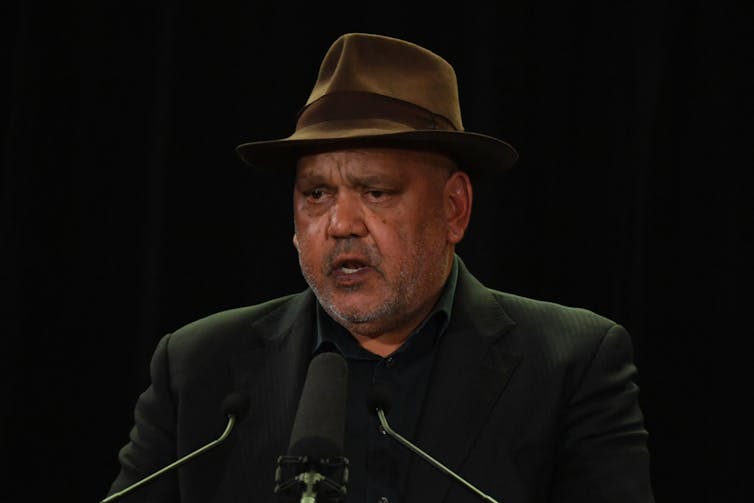
Voice proposals began as the pathway to meaningful recognition of Indigenous peoples in Australia’s Constitution, described by Indigenous leader Noel Pearson as our “longest standing and unresolved project for justice”.
Constitutional recognition would require a strong vote in a national referendum, similar to the historic result in 1967 that allowed government to make laws for Aboriginal people and include them in the census.
Indigenous leader Noel Pearson describes constitutional recognition as our ‘longest standing and unresolved project for justice’.AAP/Mick Tsikas
A predictable “fallback” is to simply legislate the Voice rather than enshrine it in the Constitution. This strategy was reinforced by Prime Minister Scott Morrison’s insistence that constitutional change is not on the agenda, claiming a lack of any
clear consensus proposal at this stage, which would suggest mainstream support in the Indigenous community or elsewhere.
But our survey indicates this fallback option would fall short of public expectations. Over half of all respondents (51.3%) said they would be in favour of enshrining the Voice via constitutional change. Only a quarter (26.3%) said they would still be in favour of the Voice as only a legislated reform, with no constitutional recognition.
Many Australians are still undecided, but the results show that if the plan is said to be supported by Indigenous Australians, this would make a difference for many of those on the fence.
The scope for a positive 1967-style result, therefore, remains substantial and real.
Compared to a legislated Voice, a constitutional Voice would benefit from greater stability because its existence would be guaranteed. A constitutional Voice would also deliver recognition called for by many Indigenous Australians.
The low public support for a legislated option also reinforces arguments that successful constitutional change would give more popular legitimacy than a legislated Voice, directly engaging the entire community and making the reform part of Australian history.
The results also indicate Australians see the practical value of making the Voice permanent by putting it in Australia’s founding document. This means it could not be simply abolished by future parliaments.
With only 21% of Australians against a constitutional Voice – as opposed to 34% against a purely legislated one – there is wide opportunity to pave the way to successful constitutional recognition once the co-design process has resolved questions of the Voice’s functions and form.
Creating a First Nations Voice to parliament is now the obvious way forward. The government is committed to establishing it, and general public support is solidifying. This is a remarkable testament to how the idea has resonated with people.
But the important lesson to consider is that the core of public support lies in establishing the Voice in the Constitution as a step on the journey towards reconciliation.
This year is shaping up as the year of the COVID-19 vaccination photo, with the pandemic providing seemingly endless photo opportunities. We’ve seen stock photos of people getting vaccinated in news reports, images of the prime minister receiving his shot and health workers posting #vaxxies on social media.
But evidence shows the wrong images can make some people reluctant to get vaccinated. So our well-meaning efforts to use images to help demystify the vaccination process or share our pride in getting a COVID-19 vaccine can backfire.
Here’s what we can all do to choose and share vaccination images responsibly.
Communicating public health strategies like vaccination can be challenging. There can be complex and unfamiliar technical terms and health concepts, and not everyone can understand them. So pictures play an essential role.
Pictures can draw attention to the message, help people relate to and remember what is being said, and may nudge people to act on a health recommendation. People also rate brochures with pictures more positively than ones with just text.
Pictures not only provide meaning, they have an emotional impact. Images we see on social media can also shape our perception of social norms (what we believe others are thinking or doing) and our behaviour.
But what happens when the picture is a giant needle, or a needle poked into someone’s arm? We have all seen these images to illustrate media articles about COVID-19 vaccination.
In addition to being a bit gruesome, stock photos commonly used in stories about vaccination are often inaccurate. The needle might be in the wrong position, the health worker may be wearing gloves when they are not needed or the liquid inside the needle seems coloured rather then clear.
Do vaccination images really matter?
Yes, vaccination images matter. A study looking at vaccine-related news coverage found nearly one in eight images contained something negative, such as the classic “crying baby”.
This may lead new parents, who have yet to really experience the vaccination process, to become anxious. And this negative photo may override any positive vaccination messages accompanying it.
This issue is especially important because when a photo is of someone’s face, it can trigger an emotional response, making it easier for someone to have a strong reaction to that communication.
We can still illustrate vaccination without using scary images like this of a crying baby and an oversized needle.from www.shutterstock.com
We know images can help people remember health messages. But if we use an inappropriate photo, such as the wrong needle size or someone looking anxious, this is the image that can stick with us, not the public health messages or statistics we intended to convey.
For some people, photos of needles are so scary this might put them off vaccination. While we don’t know precisely which types of needle imagery could stimulate such a response, we know needle phobia is a real issue. In fact, one survey found 23% of adults have avoided influenza vaccines due to fear of needles. And we don’t want to risk this happening with COVID-19 vaccines.
Whether we are choosing images for news articles or for our personal social media, it is important we consider the potential impact of the photos we use. Here are some tips for choosing the right image:
focus on positive outcomes. Consider showing a smiling person with a plaster on their arm or someone holding a vaccination card or sticker. Flickr provides free photos that reflect the reality of immunisation and are medically accurate
humanise the process. People develop, deliver and receive vaccines. Show these people where possible, instead of disembodied needles
depict diversity. Ensure images of vaccination show diversity of ethnicity, gender, age and disability
imply rather than illustrate vaccination. Why do we need the needle in the photo? We do not illustrate articles about urinary tract infections in children with photos of urine samples or invasive medical treatments. An image of a health worker speaking to someone with their sleeve rolled up is enough to evoke a mental image of the vaccination process, particularly when it accompanies a story about vaccines
highlight the vial not the needle. For stories about vaccine production or rollout with no personal or emotive element, showing the vaccine vial is a neutral option
avoid inaccurate images. The emoji of a needle full of blood? Not a great choice to tell your friends and family you have been vaccinated. The plaster emoji is a good alternative. Publications should check any vaccine images with medical professionals for accuracy.
Robots are writing more of what we read on the internet. And artificial intelligence (AI) writing tools are becoming freely available for anyone, including students, to use.
In a period of rapid change, there are enormous ethical implications for post-human authorship — in which humans and machines collaborate. The study of AI ethics needs to be central to education as we increasingly use machine-generated content to communicate with others.
Robots can write, too
AI robot writers, such as GPT-3 (Generative Pre-trained Transformer) take seconds to create text that seems like it was written by humans. In September, 2020 GPT-3 wrote an entire essay in The Guardian to convince people not to fear artificial intelligence.
AI does this through what’s called natural language processing and generation. This involves converting human language to computer commands and vice versa. To do this, machine algorithms study millions of text samples, words, sentences and paragraphs humans use to gain a general understanding of the context of human language. Then machines use that knowledge to put together text.
For example, the free Zyro content generator provides text for websites. I can select the categories “Health and Living” and “Personal Trainer” (I happen to be one, as well as an academic). In two seconds, the following text appears:
I am experienced with personal training, athletic performance, and nutrition. This includes working with children, pregnant women, older adults, people with disabilities, athletes, and anyone looking to achieve a competitive edge, improve their overall health, and overall performance. I also have an interest in alternative health, including wellness coaching and nutrition counselling. In my spare time, I enjoy spending time with my family, the outdoors, and writing.
This sums me up (despite the program knowing nothing about me) and would be fine for my website, if I had one. I have the option to generate more responses, and in two seconds, the program offers:
I am experienced in working with adults and children to improve their overall physical and emotional well-being. I have a strong desire to help you reach your goal […] I love helping others achieve their goals. I love working with others to achieve their goals. I am a mother of two healthy children and a wife to two incredible people.
While this is repetitive and Zyro does not notice the apparent error in the last sentence, these issues would be easy to correct. Text, even for niche purposes, can now be generated in a few clicks.
There are other digital tools such as paraphrasers and rewriters that can generate up to 1,000 articles from a single seed article, each of them substantially unique. Quillbot and WordAI, for instance, can rapidly rewrite text and make it difficult to detect plagiarism. WordAI boasts “unlimited human quality content at your fingertips”.
Questions for schools and universities
So what does this mean for education, writing, and society?
Of course, there’s the issue of cheating on essays and other assignments. School and university leaders need to have difficult conversations about what constitutes “authorship” and “editorship” in the post-human age. We are all (already) writing with machines, even just via spelling and grammar checkers.
Tools such as Turnitin — originally developed for detecting plagiarism — are already using more sophisticated means of determining who wrote a text by recognising a human author’s unique “fingerprint”. Part of this involves electronically checking a submitted piece of work against a student’s previous work.
Many student writers are already using AI writing tools. Perhaps, rather than banning or seeking to expose machine collaboration, it should be welcomed as “co-creativity”. Learning to write with machines is an important aspect of the workplace “writing” students will be doing in the future.
AI writers work lightning fast. They can write in multiple languages and can provide images, create metadata, headlines, landing pages, Instagram ads, content ideas, expansions of bullet points and search-engine optimised text, all in seconds. Students need to exploit these machine capabilities, as writers for digital platforms and audiences.
Perhaps assessment should focus more on students’ capacities to use these tools skilfully instead of, or at least in addition to, pursuing “pure” human writing.
But is it fair?
Yet the question of fairness remains. Students who can access better AI writers (more “natural”, with more features) will be able to produce and edit better text.
Better AI writers are more expensive and are available on monthly plans or high one-off payments wealthy families can afford. This will exacerbate inequality in schooling, unless schools themselves provide excellent AI writers to all.
We will need protocols for who gets credit for a piece of writing. We will need to know who gets cited. We need to know who is legally liable for content and potential harm it may create. We need transparent systems for identifying, verifying and quantifying human content.
And most importantly of all, we need to ask whether the use of AI writing tools is fair to all students.
For those who are new to the notion of AI writing, it is worthwhile playing and experimenting with the free tools available online, to better understand what “creation” means in our robot future.
House prices are back in the news, and out of control.
In the past three months the median house price in Sydney has risen by more than A$100,000 to A$1.12 million. Sydney’s median residential property price (including houses and apartments) is now 2.6% above its previous high-water mark, recorded in August 2017, before lending criteria were tightened (and COVID-19 struck).
Even areas far from central Sydney, such as the Central Coast, have recorded double-digit percentage increases.
What exactly is driving these sharp rises is a matter of debate. Australia’s economic recovery from COVID-19 has been stronger than many thought. The prospect of most Australians being vaccinated and international borders reopening provides further hope – even if our vaccine roll-out has been less than stellar in its planning and execution.
Of course, interest rates are at historic lows. More to the point, loans that can be fixed for three or five years have become much cheaper and more widely used as well. This has given borrowers the capacity to borrow larger sums.
The federal government has contributed, too, with a suite of measures targeted at first-home buyers. Like all such measures, these look attractive at the individual level but simply translate into higher prices. Schemes like the “first home owner grant” should really be called the “seller subsidy”.
Finally there is the elephant in the room: irrational exuberance.
Who knows how much “fear of missing out” has played into price rises. Against the backdrop of a worldwide public health and economic crisis, one might think buyers would be a little more circumspect about their future incomes.
But apparently not so much.
Our housing affordability problem
Sadly, there is little new about the fact that Australia – and the largest capital cities in particular – have a serious housing affordability problem. It has been that way for at least a decade.
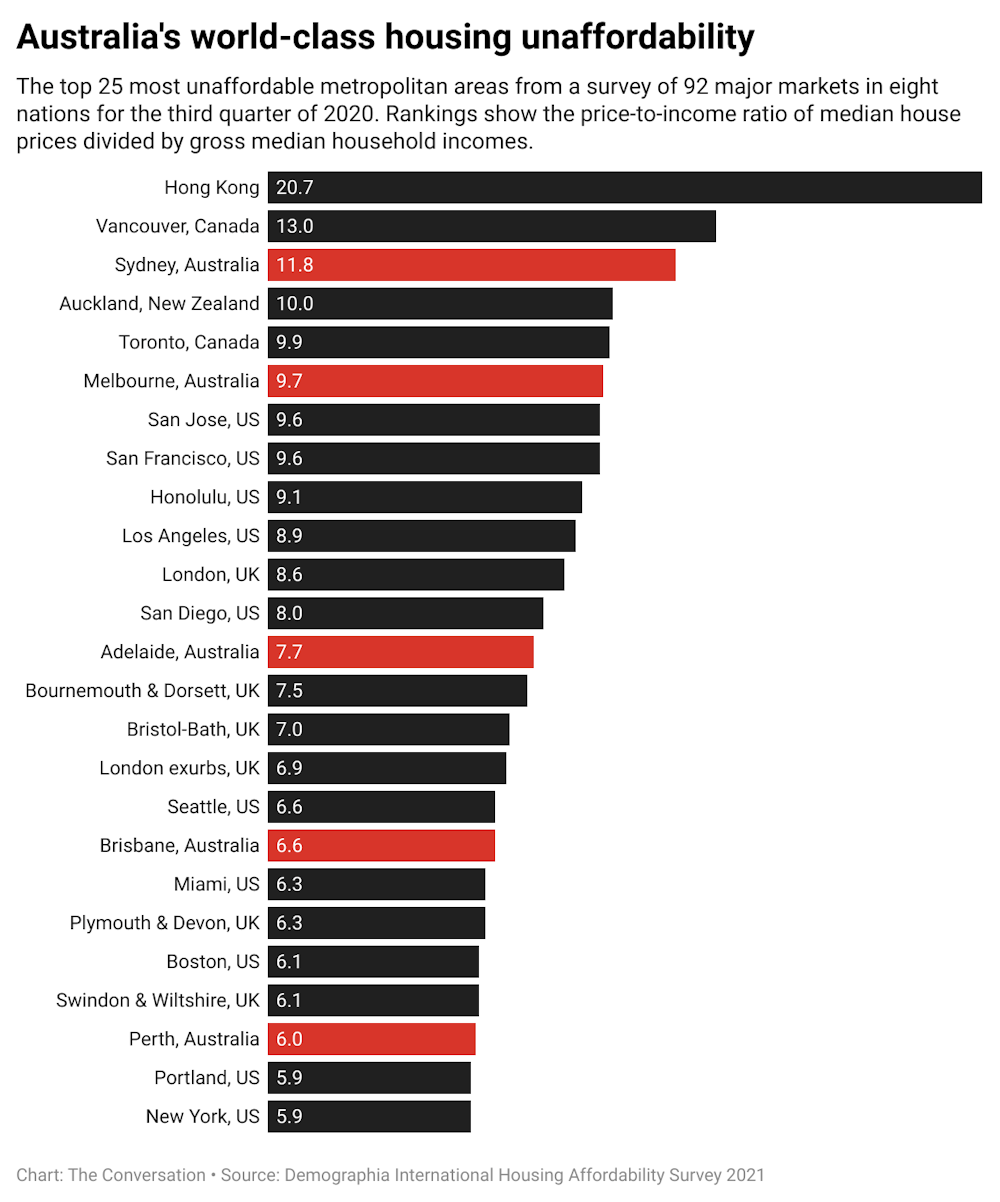
Sydney and Melbourne are routinely ranked among the top half-dozen most expensive cities in the world when comparing housing prices to average incomes earned in those cities.
Home ownership rates have fallen more or less constantly. Young people are basically excluded from home ownership unless they have very high incomes or parents with the means and inclination to provide financial help.
On top of this, household debt levels in Australia are disturbingly high – reflecting the large mortgages people who do manage to claw their way into the housing market have to take out.
Sure, that is matched against the high asset values of the property they have bought. But as any student on economic history knows, that’s little comfort when an asset price bubble bursts.
To put it another way: asset prices come and go, but debt is forever.
So here we are again. The housing market is so frothy it has seriously reduced financial mobility at the individual level, and it threatens financial stability at the macro level.
Let’s start by ruling out some of the supposed quick fixes for getting property prices under control.
Some say the Reserve Bank of Australia should hike interest rates to make it harder for borrowers to pay such high prices. But the RBA should mainly focus on its inflation target (one it has missed year after year), getting unemployment down and wages growth up. Those things all require low interest rates.
To calm the frenzy, the Australian Prudential Regulation Authority could use so-called “macroprudential tools”. These are requirements on financial institutions to limit systemic risks. In the past the financial regulator has set policies to limit credit growth and curb the proportion of “interest-only mortgages” (mortgages that don’t require principal payments). It can and should do these things, though it has a pretty spotty track record at acting in a timely and effective manner.
Perhaps most importantly, both sides of politics need to revisit Australia’s almost unique and certainly odd system of allowing interest payments on rental properties to be offset against a person’s taxable income – that is, “negative gearing”.
Such deductions are permissible for other asset classes such as stocks – and have been for 100 years or so. But no “ordinary” Australian wage earner can get big loans to bet on the stock market. Even wealthy investors cannot get anything like the leverage they can in residential property in other asset classes.
This is a peculiarity flowing from the amount of capital banks need to hold against property loans. It’s a market failure that should be addressed.
The best way to do this – as I pointed out in a report for the McKell Institute in mid-2015 – is to gradually phase out negative gearing over time, and allow it only for new dwellings in future. Expanding housing supply would also be very helpful.
Labor took a policy based on this report to two elections. It lost both – although perhaps the last loss had more to with other things, including a quite separate and less appealing franking credit policy.
The Coalition almost pre-empted Labor by reforming negative gearing in 2015/16. But then prime minister Malcolm Turnbull bowed to pressure from then treasurer and negative-gearing fan Scott Morrison.
Housing affordability remains a serious problem in Australia. We need to tackle it now, and with a multi-pronged approach. If we don’t, we risk the future of young Australians and our financial system at the same time.
Return to Uluru is the latest book from respected historian Mark McKenna. It is one of a few history books published recently that explicitly engage with the Uluru Statement from the Heart and its demand for a nationwide process of truth telling — one that some key advocates insist should be pursued locally and pluralistically. Not one truth, but many truths.
McKenna has already responded to the Uluru statement in his searching Quarterly Essay, Moment of Truth (2018). Amid that wide-ranging discussion of politics, history and Australian futures, he paused to consider a single street sign in the down-at-heel suburb of Kurnell on Botany Bay’s southern shore, where, in 1770, the Endeavour crew had spent a listless week.
Through reconstructing a history of a worn out sign announcing Kurnell as the “birthplace of modern Australia”, McKenna traced the changing significance of this site, and the strange politics of foundational myths. This revealing vignette seemed like a chapter-in-the-making, with Kurnell poised to be added to the itinerary of vantage points from which he showed his readers ways to view past, present and future differently.
But it was a tease. McKenna’s next book — this one — turns its back on the coastal fringes and faces inwards, gingerly and then confidently venturing into terrains, actual and abstract, he had not yet traversed.
Mark McKenna.goodreads
In Return to Uluru, McKenna continues his journey in search of alternative sites of national foundations — or, national sites of alternative foundations. This quest had begun with Looking for Blackfellas’ Point, subtitled An Australian History of Place, published two decades ago in 2002.
Searching for a satisfying way to intervene in the heat of the history wars, he turned his focus to what had become his own backyard: a bend in the Towamba river in southeastern NSW known in the local vernacular as Blackfellas’ Point, where he had purchased eight acres (3.2 hectares) of land. From there, McKenna’s vista spanned outwards to the far south coast region, reaching backwards to its frontier past and forwards to its racial present.
McKenna then detoured via his magisterial biography of Manning Clark, An Eye for Eternity, a suitable byway for a historian deeply interested in place and the redemptive power of narrative. By the early 2010s, he resumed his Australian journey by essaying four coastal locations. In From the Edge: Australia’s Lost Histories (2016), he explored the peripheral histories of the long stretches of beach of southeast Australia from Gippsland to Sydney; Port Essington on the Cobourg Peninsula in west Arnhem Land; Murujuga in the Pilbara in the northwest and Gangaar (Cooktown) in Far North Queensland.
These off-centre places were offered as viable and lively alternatives to the moribund, foundational myths of single moments of bloodless and benign possession. Such myths are gradually reaching their use by date, although still hanging on as last year’s commemoration of Cook and the Endeavour proved.
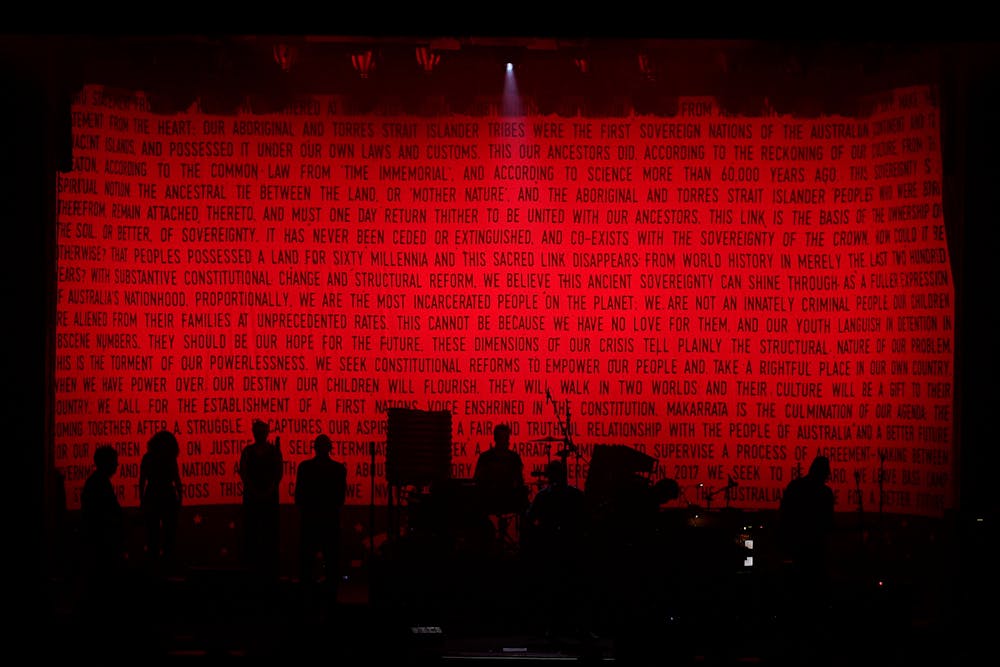
The Uluru Statement from the Heart is seen as a backdrop as Midnight Oil perform during a warm-up show ahead of their Makarrata Project tour in Sydney on February 25.Dan Himbrechts/AAP
Redemption
And so, Return to Uluru sees McKenna venture inland — for the first time. Heading inwards, he makes use of those stories of discovery and exploration, with which settler Australians (particularly those of a certain age) are familiar, to insert himself into a practised way of encountering the mythologised space of the continent’s heart. The opening section of the book has the quality of re-enactment; it is hard to know how ironic it is. This is a history approached from the outside in.
But the explorer narrative makes sense since it turns out McKenna is a rare creature — someone who had not yet made the pilgrimage to Uluru and the fabled Centre. And so, the “return” in the book’s title is initially a puzzle: Who then, if not the author, is making a return to Uluru? What is returning — or being returned?
It takes the remainder of the book — which is part travelogue, part detective story, part historical narrative and part political treatise — to appreciate in all dimensions this powerful metaphor of return.
With the Centre reached, the second section of the book, called Lawman, focuses on a policeman, Bill McKinnon, who murdered an Aboriginal man, Yokununna, in 1934. McKinnon is reasonably well-known in scholarship on the Northern Territory. His killing of Yokununna, an Anangu man arrested on suspicion of being responsible (along with others) for the death of an Aboriginal stockman, is likewise amply documented since it was the subject of a federal government inquiry. This part of the book provides a narrative retelling of episode — a seamless weaving together of the official story and its obfuscations and competing interests.
Constable Bill McKinnon with his daughter, Susan, approx. 1941.Library & Archives NT, Northern Territory Archives Service, NTRS 234, Photographic proof-sheets, 1979–1985, CP 426).
Reading this part is a reminder the audience for this book is not the critical historian who is wondering when the debates about policing in the NT or the contradictions of government policy will be canvassed. The archive holds secrets and stories, and this is an “archive story”, which requires little critical commentary.
If the four “off-the-beaten-track” coastal sites of From The Edge were chosen for the ways they lent themselves to the work of revelation — of hidden histories or discarded truths — Uluru provides McKenna scope for the work of redemption.
In this case, redemption comes through the belated admission of a sin that was denied — or covered up — for which the perpetrator avoided punishment, even as he lived out his life knowing that he had dissembled. That is the Uluru to which McKenna returns through his historical scholarship.
As with all his books, the work of historical reckoning that McKenna pursues through the poetic telling of history operates simultaneously at a series of scales: the individual, the family, the local, and the national. It is the same rhetorical move that originally allowed McKenna’s own land on the NSW south coast to become a space of imagining on a national scale. And now, Uluru speaks again to the nation’s unfinished business.
This time it is a single site (a cave near Uluru), a singular episode (a newly-minted territory policeman chasing accused Aboriginal men), and a split second (when the policeman’s bullet kills one of them) that becomes the viewfinder for seeing past, present, future anew.
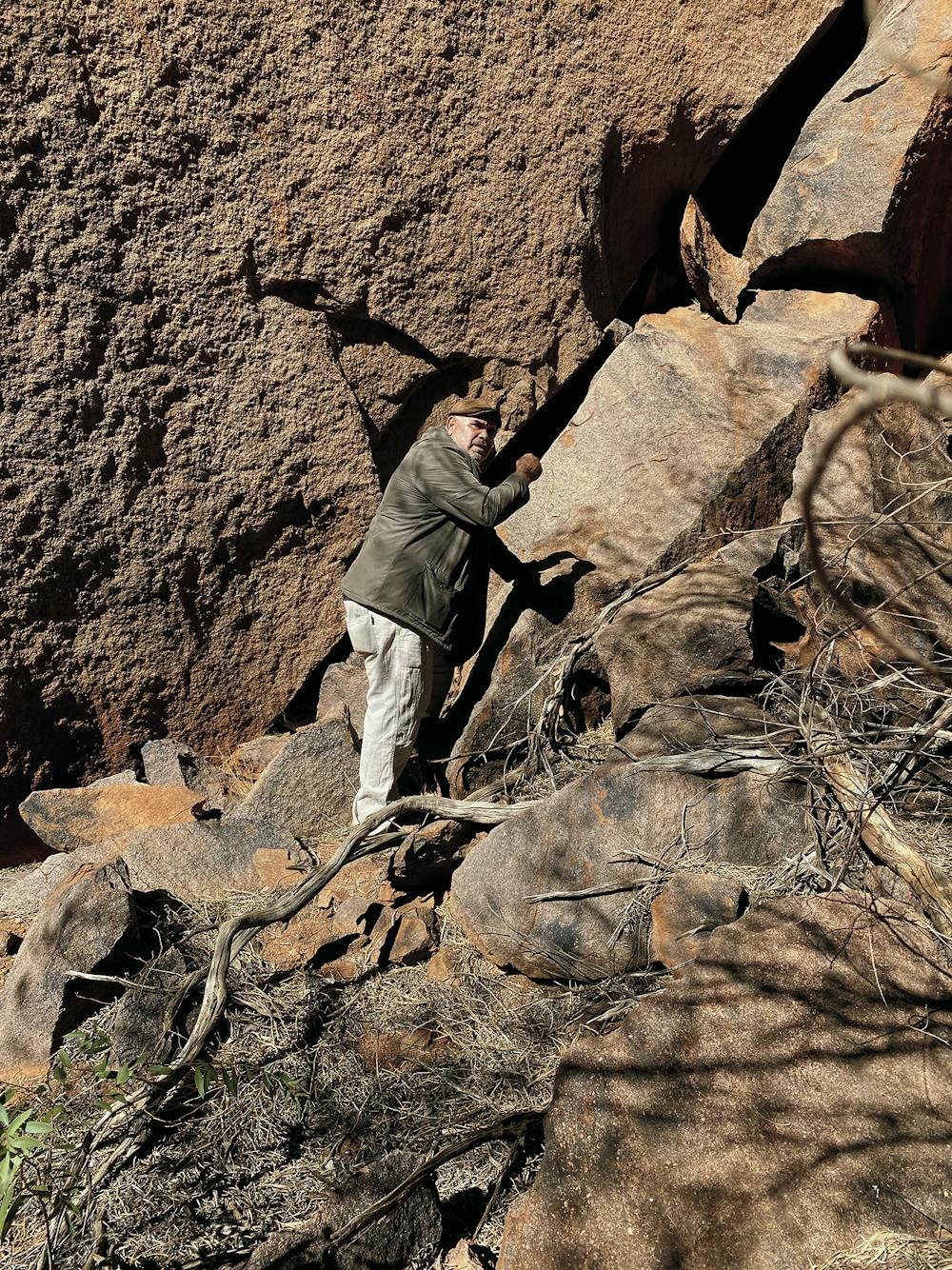
Sammy Wilson, the grandson of one of the men arrested at the same time as Yokunnuna, pointing at the spot where Yokunnuna was killed.Mark McKenna
Ethical questions
Explaining its emphasis on the “micro”, the book begins with an epigram from the Swiss artist and sculptor, Alberto Giacometti: “By doing something a half centimetre high, you are more likely to get a sense of the universe than if you try to do the whole sky”.
But we are left with the question of whether a focus on the microcosmic is a productive model for this urgent and difficult work of national truth telling? Might it be a problem that a string of episodes — but not structures — are revisited and revised?
By the book’s third section, the power of the quest begins again — and here we are not only travelling to the Centre or into the past through the surviving official record. We are also jumping on a plane to Brisbane to meet with policeman McKinnon’s family. Here, we delve into other archives — those boxes of papers and other detritus of one’s life, which in Australia are less likely to be found in attics than in garages or, in Brisbane, in that evocative space known as “under the house”.
At this juncture, as the story spins from past to present, from the official memory to family memory, from public archives to private ones, the ethical stakes seem to grow ever greater.
While McKenna is flicking nonchalantly through McKinnon’s personal papers, he finds treasure — “a copious archive of Australia’s frontier” — including the notebook in which the policeman admits he had fired to hit Yokununna. Meanwhile, a curator in a museum in South Australia is searching records and finding the remains of McKinnon’s victim.
Our archives and collections — both public and private — still contain plenty of damning evidence to hold the past to account. These secret stashes. This murky memory-work.
Archaeologist Denis Byrne has described the “ethos of return”, in which the flow of things and knowledge is reversing, coming home — perhaps to haunt, perhaps to heal. This is another kind of redemption. A powerful section of the book deals with the urgent work of taking Yokununna’s remains home — a process interrupted by COVID-19 and still playing out.
So far, the two families at the heart of this story — McKinnon’s and Yokununna’s — are travelling on parallel journeys; the reckoning will come, as it has powerfully at Myall Creek and other places, when families on opposite sides of a violent past come face to face.
Such a future meeting is not yet guaranteed, but it hangs as a possibility. The Myall Creek memorial was shepherded by local churches and communities. Here, it seems, it will be museum curators and historians who are the nursemaids for re-membering — creating communities around common but differently experienced pasts.
A bronze plaque commemorating the Myall Creek Massacre.Wikimedia Commons
What are we to do?
At the height of the history wars in the 1990s, the anthropologist Gillian Cowlishaw expressed surprise at how readily some Australians were prepared to condemn their own ancestors rather than try to understand them.
She saw this as symptomatic of the polarising tenor of the furore — a failure of collective imagination to apprehend the complexities and contradictions of frontier lives. McKenna’s book (and inquiry) seeks to avoid such simplification and easy distancing from the fraught pasts we inherit.
He nudges his readers to see McKinnon and his crime for what it was: violent, illegal, excessive, irrational, and unconscionable, even if he was exonerated. No-one was found guilty of the killing, although the inquiry’s finding was that the “shooting of Yokununna […] though legally justified, was not warranted”.
McKenna does this not by swift damnation from the comfortable distance of the present, but by paying attention to the chinks in McKinnon’s own conscience. The fact that he held onto a piece of evidence that would expose him even as he spent his long retirement contributing occasionally to myth-making about himself and other police on the NT frontier.
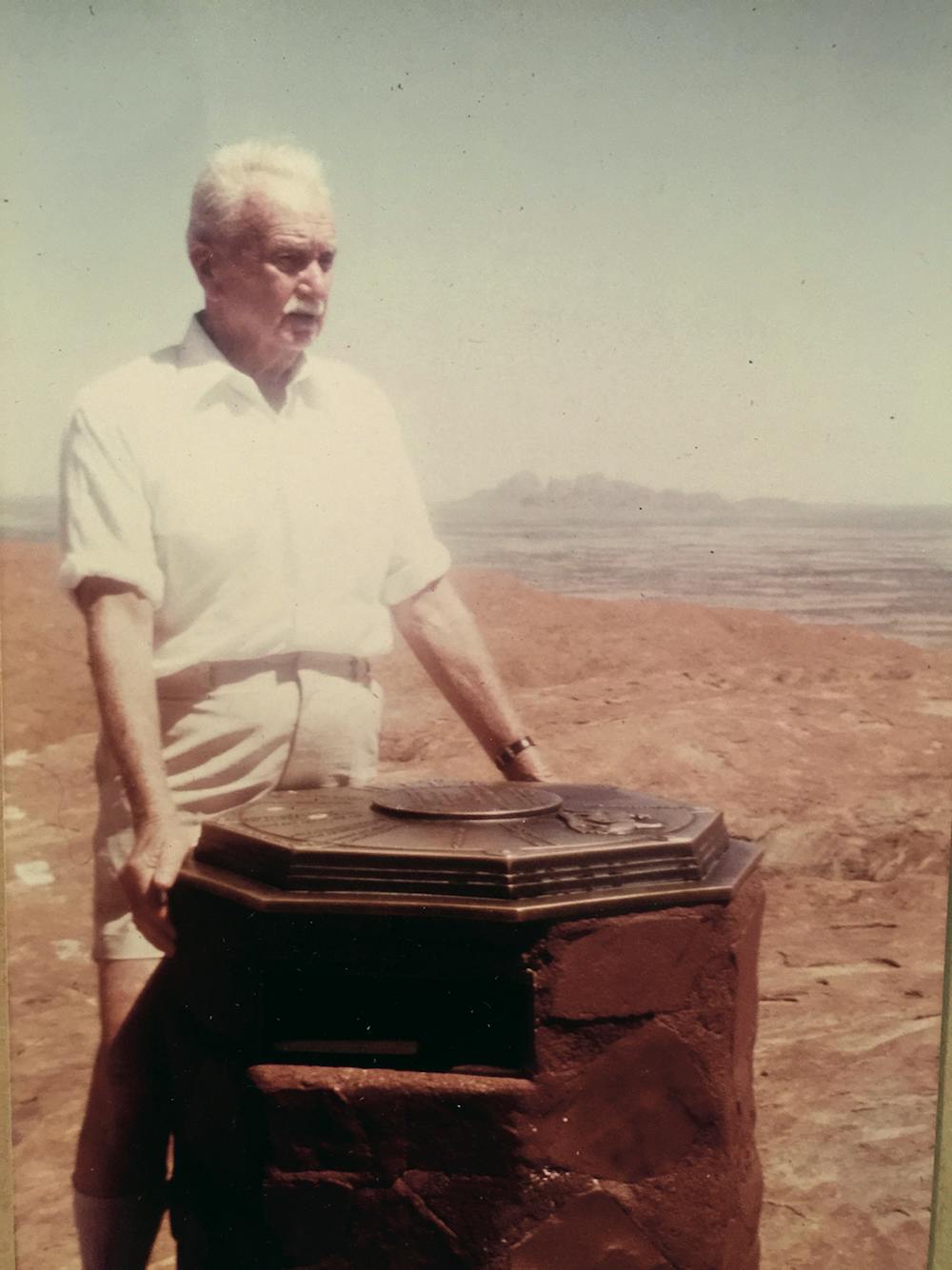
Bill McKinnon, on top of Uluru, 1984.(McKinnon collection).
But McKenna also has to deal with the implications for cherished family memories and pride when it becomes clear the generosity and hospitality extended to him by McKinnon’s doting daughter (who is slipping into dementia) is the path to the evidence that exposed her father.
And, indeed, the shadow of memory loss — the cruel play of remembering and forgetting — falls over the whole sorry episode. What happens when the distant frontier takes up residence in the family home? How will we remember our flawed ancestors then?
McKenna shares a story of a difficult meeting with McKinnon’s grandchildren, who understand the gravity of the situation, and articulate their commitment to reconciliation. They are prepared to do what needs to be done to come to terms with their unexpected inheritance; what that will be remains to be seen.
The book ends – surprisingly, jarringly, uncomfortably – with a sympathetic portrait of McKinnon, sitting atop an overturned box playing a violin. The context of the photograph is explained (McKinnon took it and annotated it). But we are left with the question: What do we do with these benign and romantic images of men who murdered and got away with it because the racial structures of Australian society ensured they would?
Is this the challenge of a much anticipated process of truth telling? Not that we will return to the big historical truths that in some ways, we all already know, but that we will have to revise our own and others’ family myths and treasured memories, finding a way to reconcile or hold in tension our love of — and our abhorrence for — the sins of the fathers?
This is the redemptive strain in McKenna’s work — that quest for grace — which perhaps has echoes of his biographical subject Manning Clark and his belief in the moral purpose of the historian’s craft.
Return to Uluru, by Mark McKenna, is published by Black Inc.
The vaccine rollout was thrown into fresh uncertainty on Thursday night after the government received medical advice against using the AstraZeneca vaccine for people under 50 because of the very small risk of blood clots.
Most immediately, this means those younger health and aged care workers who have not yet been vaccinated will be offered the Pfizer shot. This may involve delays.
These people are in the cohort currently being vaccinated, together with over 70s who are unaffected by the new advice, which went to the government on Thursday evening.
Scott Morrison said the later stages of the rollout will now urgently be re-examined and re-calibrated. He said it was “far too early” to say what impact it would have on the rollout’s timetable.
The government’s deadline for all eligible people who want a vaccine to receive at least one shot by the end of October is set to blow out.
Vaccine purchases will also be reviewed.
Morrison unveiled the advice from the Australian Technical Advisory Group on Immunisation at a hastily summoned press conference on Thursday night, also attended by Health Minister Greg Hunt, Chief Medical Officer Paul Kelly, and Health Department Secretary Brendan Murphy.
Morrison said he had received the advice “in the last 15 minutes”.
The government had urgently sought the advice following evidence overseas of a link between the AstraZeneca vaccine and blood clots, with some deaths resulting.
There has been one clot case in Australia, a man in his 40s.
Explaining that the Pfizer vaccine should be preferred over AstraZenica for those under 50s, ATAGI said, “This recommendation is based on the increasing risk of severe outcomes from COVID-19 in older adults (and hence a higher benefit from vaccination) and a potentially increased risk of thrombosis with thrombocytopenia following AstraZeneca vaccine in those under 50 years”.
But it said AstraZeneca can be used in adults under 50 “where the benefits clearly outweigh the risk for that individual and the person has made an informed decision based on an understanding of the risks and benefits.”
Under 50s who’ve already had one AstraZeneca dose without serious adverse effects can be given a second dose, the advice said.
ATAGI described the possible blood clot side effect as “rare but serious”.
Advice is being provided to GPs involved in the rollout.
This is the latest difficulty to hit the rollout. The government this week stressed the main problem was shortage of supply, with AstraZeneca doses from Europe being held back and CLS, which is manufacturing the vaccine locally, not gearing up to the one million weekly target as fast as expected.
As of Thursday, one million doses of one or other of the two vaccines had been administered in Australia. At present Australia only has the two vaccines available.
Morrison stressed that decisions were up to individuals and their doctors – this was advice only.
“There is not a prohibition on the use of the AstraZeneca vaccine for persons under 50. There is an expression of a preference.”
Kelly said a clot was very rare. “At the moment, it seems to be around 4 to 6 per million doses of vaccine. It’s only been found in the first dose of the AstraZeneca vaccine, usually within 4 to 10 days after that vaccine. But it is serious, and it can cause up to a 25% death rate when it occurs.”
In a late night statement AstraZeneca said it respected the government’s decision based on advice to recommend AstraZeneca’s vaccine be used in those over 50.
It noted that, “Overall, regulatory agencies have reaffirmed the vaccine offers a high-level of protection against all severities of COVID-19 and that these benefits continue to far outweigh the risks”.
Scott Morrison is inclined to underestimate tough women.
He’s done this in the past, to his detriment. In 2006, when he was managing director of Tourism Australia, Morrison was sacked after falling out with the board and federal Liberal tourism minister, Fran Bailey.
Years later, in 2018, the Australian Financial Review quoted Tim Fischer, who’d chaired Tourism Australia at the time, saying “a lot of us could see it coming as relations between Scott and Fran Bailey had deteriorated over a range of issues. But Scott didn’t seem to see it.”
Morrison was close to then prime minister John Howard and he thought – erroneously – Howard would step in and save him from Bailey. But Howard supported his minister.
Fast forward to 2021, and Morrison’s grappling with a broad “women’s problem”. And women playing hardball are all around the place.
Take just two current examples, Christine Holgate and Grace Tame.
In a submission to a Senate inquiry released this week Holgate, former Australia Post CEO, has launched a comprehensive counterattack to her being effectively forced out of her job last year, after a ferocious prime ministerial attack.
On a very different front Tame, the young and feisty Australian of the Year, has targeted Morrison’s choice of Amanda Stoker to become the new assistant minister for women.
Morrison in October excoriated Holgate over her rewarding four employees with Cartier watches (worth an average of $5000) for landing a lucrative deal with banks, which sustained Post’s network of franchises around the country.
Immediately after Holgate had told a Senate committee about the watches, a furious Morrison let loose in the parliament. Declaring the action disgraceful, he said: “The chief executive has been instructed to stand aside and, if she doesn’t wish to do that, she can go.”
A devastated Holgate, regarded as a high-performing CEO, soon left her position.
A later inquiry (which the government initially declined to release) found no dishonesty or intentional misuse of Post’s funds, although it did find the purchase of the watches was inconsistent with the legislative obligation imposed on Post.
The controversy has now resurfaced with a Senate inquiry, instigated by Pauline Hanson, at which Holgate will appear next week.
Holgate argues in her submission the watches’ purchase was “legal, within Australia Post’s policies, within my own signing authority limits, approved by the previous Chairman, expensed appropriately, signed off by auditors and the [chief financial officer]”.
While Holgate in her submission focuses her ire on Post’s chairman, Lucio Di Bartolomeo, rather than on Morrison, the affair goes directly to the PM’s original reaction, which blackened her reputation.
Regardless of whether Post, as a government business, should have used watches as rewards, Morrison’s outburst was extreme and ill judged.
It led to a highly competent chief of a government business being publicly trashed and unnecessarily sacrificed, over not very much.
Holgate – who attracted sympathy from many CEOs and support among Australia Post small businesses – has yet to be replaced, a long and expensive process.
Morrison obviously thought the name “Cartier” would resonate (negatively) with his “quiet Australians”. If the employees had each been given cash bonuses of $5000 would he have reacted in the same way? The answer seems clear.
A harder question is, if the CEO had been male, would the PM’s temper tantrum have been as unrestrained?
Impossible to say, of course. But many people, especially women in this current climate of heightened sensitivity, would believe he’d have been more measured.
Grace Tame – whose passionate words when awarded Australian of the Year were an influence on Brittany Higgins to go public with her rape allegation – is potentially an ongoing thorn in the side of a PM trying to assure women he “gets it”.
She’s a strong woman who finds herself, suddenly and unexpectedly, with a megaphone and she will use it all year.
In nominating Stoker, who is socially conservative and can be combative, as assistant minister for women, Morrison was inviting trouble.
Apart from dealing with the problems posed by Christian Porter and Linda Reynolds, the PM’s reshuffle was an effort to improve his and his government’s credentials on women’s issues.
It promoted female ministers and inserted references to “women” in various ministerial titles.
Yet he put Stoker into a position that would inevitably spark a adverse reaction among some women’s advocates.
Tame claimed Stoker had “supported a fake rape crisis tour aimed at falsifying all counts of sexual abuse on campuses across the nation”.
She said Stoker had also “supported” men’s rights advocate Bettina Arndt “who gave a platform [in an interview] to the pedophile who abused me”.
Stoker returned fire, defending her record promoting justice for women, and saying, “I did not attend Ms Arndt’s campus tour. I raised it in Senate estimates to highlight the universities’ inconsistent approaches to free speech and deplatforming.”
This week she dismissed Tame’s claims about falsifying accounts of abuse on campuses as “utter nonsense”.
Leaving aside the nitty gritty of their dispute, in the circumstances Morrison made a provocative choice, when he could have allocated the post to a less controversial frontbencher.
On Thursday Morrison and his new attorney-general Michaelia Cash unveiled the government’s full response to the Sex Discrimination Commissioner’s Respect@Work report.
The measures will strengthen protection for people in workplaces against sexual harrassment and remove the exemption from the sex discrimination legislation that members of parliament and judges now enjoy – although Morrison could not say how this would be applied in relation to MPs.
On Wednesday the government announced a two-day National Women’s Safety Summit to be held in late July.
The budget will have the stamp “women” on parts of it.
But the Prime Minister is not keen on the call, put forward for Friday’s national cabinet by Queensland premier Annastacia Palaszczuk, for a summit to address the “economic and social inequality facing Australian women”.
Palaszczuk, seizing the moment, wants national cabinet to host such a summit, which would have state and territory and stakeholder representatives. It would canvass issues including the pay and superannuation gender gaps and affordable child care.
“It’s the perfect time to have it,” she says. “Everyone is having conversations – in workplaces, around kitchen tables, on social media.”
A combination of such a broad agenda and so many strong women would make that a formidable political challenge for Morrison.
Source: The Conversation (Au and NZ) – By Jo Caust, Associate Professor and Principal Fellow (Hon), School of Culture and Communication, The University of Melbourne
Who gets what in the arts has long been topic of much debate. There are myriad issues round elitism, regional distribution, excellence, artforms, organisations versus individuals and so on. Some of this is generated by an unequal allocation of funding as well as the limited amount available overall. But other issues relate to historical approaches and a hierarchy of arts practice.
It is unusual, though, for an arts minister to step into the fray. In 2015, then arts minister George Brandis decided to change the funding distribution and invent his own funding scheme for excellence. This did not work out well for anyone, including the minister.
Now the current Minister for the Arts, Paul Fletcher, has decided to put his view out there. At a talk on Wednesday to the Sydney Institute, Fletcher attacked the arts sector for being a “cosy club” of elites while raising the issue of “fairness”, particularly in relation to regional and urban distribution of arts funding.
He described the audience for the arts as “an elite group of people wearing black tie going to opening nights in our big cities”. This might sound more like a Labor dig at the top end of town than a Coalition line. The minister seems to be confusing privileged audience members with hard-working arts workers, who could use support rather than insults.
Perhaps, like many, Fletcher is still feeling a bit bruised from 2020. The art sector was shutdown due to the pandemic and then was generally ignored for more than eight months by his government, despite the dramatic economic impact on the sector. The extremely slow response by the federal government was not seen by the arts sector as “sensitive” or “fair” for that matter. The federal government did end up providing a large amount of funding at the end of 2020 and into 2021, but the process for deciding “who got what” was hardly transparent.
Now it seems the minister wants to raise issues around elitism and funding share, as well as the urban/regional debate. This seems a little disingenuous given recent accusations of funding “rorts” at both federal and state levels.
Fletcher has declared he wants to see if he can shift the Labor party and Greens from their high ground positions in relation to the arts, while reminding everyone of past contributions by the Coalition to the cultural sector.
However, it is the minister’s government that disappeared the “arts” into an amorphous department of infrastructure.
It is the minster’s government that has continued to downplay the importance of Australian content by reducing “red tape” obligations to produce Australian content. It is the minister’s government that has continued to decrease the amount of arts funding available. And yes, it is the minster’s government that chose to ignore the needs of the arts sector during a time of desperate need.
Yet, in this speech this week, Fletcher claimed the “level of funding committed to the arts by the Morrison Government in 2020-21 has been unprecedented”. Belated additional funding for COVID relief may have increased the federal arts allocation dramatically for the past 12 months. But this additional funding has not been equitably allocated, and the government has continued to ignore cultural workers who were not eligible for JobKeeper or JobSeeker.
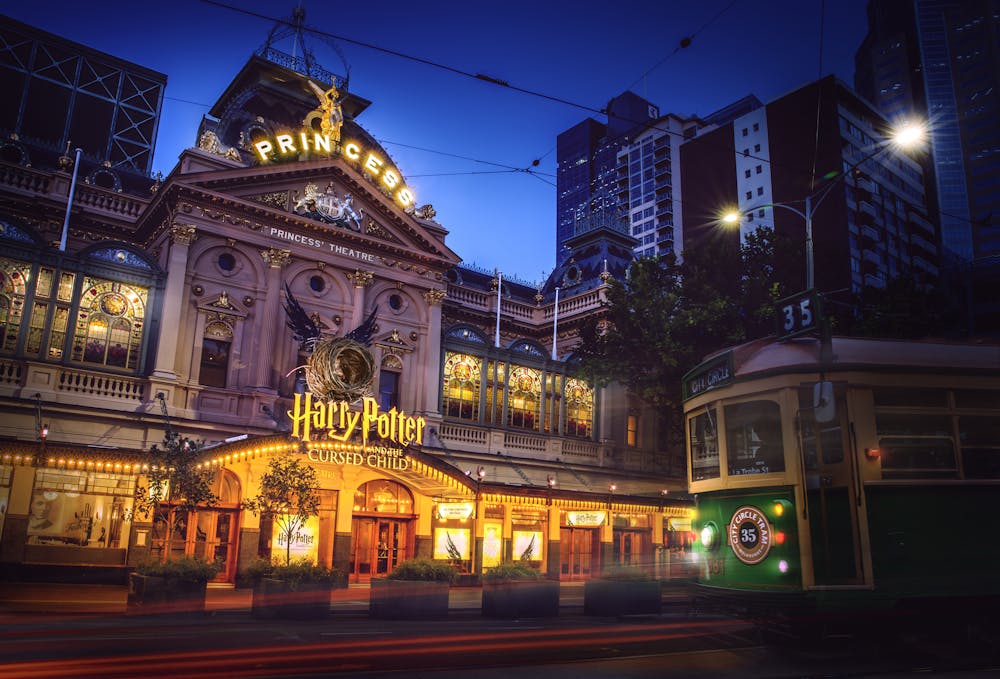
The minister said that his department advised him to give $971,895 in RISE funding to the Harry Potter the stage show in Melbourne.AAP/Haystac
Certainly, it can be agreed arts funding is skewed towards the big end of town. The opera companies, symphony orchestras and major theatre companies receive more than 60% of the funding available from the Australia Council.
Is Fletcher talking about changing this ratio or providing more money overall? Or is he using the opportunity to have a go at a vulnerable sector when he is meant to be their advocate? The minister maybe diving in at the deep end, without necessarily understanding the full complexity of the arts or arts funding.
Dancers of The Australian Ballet rehearse New York Dialects: Watermark at Sydney Opera House earlier this week.AAP Image/Bianca De Marchi
Perhaps he is playing to supporters when he argues too much funding is going to urban performing arts companies, rather than, for example, to regional activity or commercial productions that tour.
But professional arts practice is usually located in urban centres because that is where artists live and work. It is also where they can attract the biggest audiences, which is critical when arts activity depends on box office income. Of course, there are also fantastic arts groups and individuals working in the regions that also need to be recognised, celebrated and more generously funded. But in the annual Australia Council report for 2019-2020, it is noted that of “government initiatives”, only 5% of total arts funding was allocated to regional areas. If the government was serious about providing more funding to regional areas, it could certainly increase this percentage.
However, since the Coalition parties came into power in 2013, the amount of money available for arts funding has continued to decrease. This is something that could easily be changed given the small amount overall given to arts practice at the Australia Council ($187.1 million in 2019-2020). A further 95 companies have lost their funding since 2016.
Over the past eight years there has been a dramatic continual decline in arts funding relative to population growth, which has particularly affected individuals and small to medium arts organisations. Is the minister arguing that he wants to give more money to the sector or is he really concerned about electoral boundaries and getting the support of Coalition voters in the regions?
The arts sector would love to have a minister who demonstrates they care about the needs of the sector and does their best to improve the position of the arts in Australian society. Instead, it feels like Fletcher is employing and possibly enjoying a “divide and rule” approach, which helps no one in the end, least of all the arts.
Shareholder primacy is often said to be the guiding principle of corporations.
The idea is that they exist to benefit their shareholders by providing dividends and capital gains, the more the better.
Fifty years ago, Nobel Prize winning economist Milton Friedman went as far as to argue that was the only responsibility of companies — to make as much for their shareholders as the law would allow.
These days, most boards refrain from speaking about shareholder primacy and instead talk about the interests of the company, which includes things such as social license, stakeholder engagement and community expectations.
But what happens if shareholders try to tell boards and company managements how to go about their jobs?
Are the directors and chief executives required to follow their instructions?
Directors serve their companies first
From a legal perspective, company directors are required to act in the best interests of the company rather than (what might be the shorter-term) interests of shareholders.
If shareholders are not happy with the decisions of the company, they have the option of replacing the directors.
The directors, under the leadership of the board chair have the ability to remove and give instructions to the chief executive and senior managers.
Directors are accountable to shareholders indirectly, because shareholders have the ability to vote them off the board.
Shareholders lack direct power
In large public companies, this threat is often difficult to carry out because big institutional investors usually support incumbent managements and lack the resources or the will to actively monitor all of the companies in their portfolio, at least while they seem to be doing well.
Even smaller shareholders (most of them) are passive investors.
But directors don’t have carte blanche. They are legally bound to act in the best interests of their company.
There is no parallel duty for them to act in the best interest of shareholders.
Decisions about how the company’s money should be spent and what it should pay its workers are solely decisions for company management, under the supervision and ultimately authority of the board of directors.
Even government shareholders
But what if the company is a government-owned enterprise? What if it has only one shareholder (the government) who has appointed the entire board?
Legally speaking, that makes no difference. The board still has the authority to refuse to do what the shareholder wants.
From a practical perspective, serving on the board of a government-owned company is different from serving on the board of a non-government company.
Governance in the boards of government-owned companies is inherently politicised because the government can appoint and remove directors whenever it wants, for whatever reasons it wants, rational or otherwise.
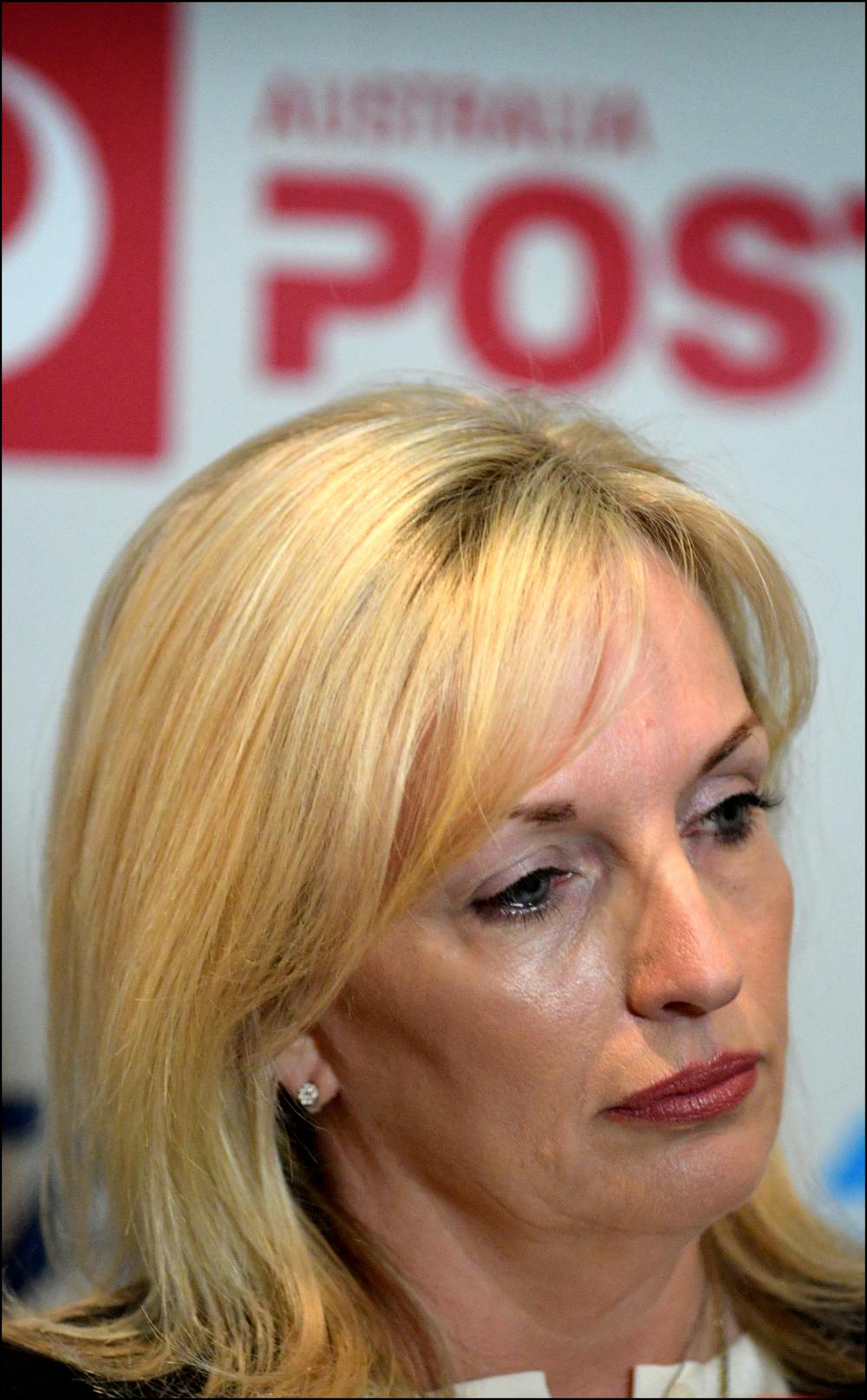
Former Australia Post chief Christine Holgate.BRENDAN ESPOSITO/AAP
A new chief executive, Christine Holgate, transformed the business, opening up new business lines, expanding offshore, producing massive increases in revenues and profits and energising the company’s network of disillusioned franchisees.
Instead of thanking her, late last year the head of the sole shareholder, Prime Minister Scott Morrison, labelled part of her conduct “disgraceful and not on”.
She had used company money to buy expensive presents (watches) for staff who secured contracts worth hundreds of millions of dollars.
“So appalled and shocked was I by that behaviour — any shareholder would in a company raise their outrage if they had seen that conduct by a chief executive”, the prime minister said, that the chief executive had been instructed to stand aside and, “if she doesn’t wish to do that, she can go”.
Australia Post lacked guidelines
In mainstream corporate Australia, the idea of bonuses of $20,000 for staff producing millions of dollars would only raise eyebrows if no bonus was paid.
Linking pay to performance is common, including in government-owned entities such as the Future Fund.
But apparently not if it is done via luxury watches during a pandemic.
Part of the problem is confused corporate governance. The board of Australia Post didn’t have a clear framework for rewarding employees with bonuses.
This left the chief executive to determine how to implement a suggestion from the then chair of the board that the employees be rewarded. Increases in salary or new company cars might not have raised eyebrows, not in the way watches did.
But handing out watches didn’t break any rules. If the board had put in place detailed-enough policies for bonus payments the chief executive would have had clear rules to follow.
Those rules could have been designed with the aim of not embarrassing the government.
Its chair sided with the prime minister
Without clear rules, the chairman and chief executive should have worked as a team, and might have. In her submission to the Senate inquiry, Christine Holgate says that when the watches were bought in 2018 the then chair took part in a discussion about whether to award the bonuses in the form of watches.
The subsequent chair paid greater attention to a complaint from the sole shareholder even though his legal duty was to the company rather than its owner.
The more-serious scandal involving Crown Casino demonstrates clearly the problems that can arise when board members appear to bend over backwards to assist the major shareholder rather than the company.
The old saying says “a person cannot serve two masters”. Directors’ duties are to their companies.
Source: The Conversation (Au and NZ) – By Nathan Bartlett, Associate Professor, School of Biomedical Sciences and Pharmacy, University of Newcastle
Authorities in the United Kingdom overnight recommended people under 30 be offered an alternative COVID vaccine to the AstraZeneca/Oxford shot.
The recommendation came after the European Medicines Agency (EMA) found a “possible link” between the vaccine and blood clots. The EMA also said blood clots should be listed as a “very rare” side effect of the vaccine.
It’s important to note there’s still no conclusive evidence the vaccine is causing the clots, as so few have been reported. However, evidence there is a link is increasing, which has prompted more focused monitoring.
The benefits of getting a COVID vaccine still far outweigh the risks. I would still be encouraging everyone to be vaccinated with the AstraZeneca vaccine.
Prime Minister Scott Morrison said this morning “there’s nothing to suggest at this stage that there would be any change” to Australia’s current rollout strategy. The Therapeutic Goods Administration and the Australian Technical Advisory Group on Immunisation are currently reviewing the data and latest advice from Europe and the UK.
What’s causing these clots?
Blood clotting events linked to vaccination are being called “vaccine-induced prothrombotic immune thrombocytopenia” (VIPIT).
It appears, in these instances, the body’s response to the vaccine is triggering an “off target” immune response that is attacking platelets. Limited data that is yet to be peer reviewed suggests antibodies targeting platelets cause them to become activated and trigger clotting. This autoimmune response also targets the platelets for destruction, reducing their level in the blood. So platelets are either tied up in clots or are eliminated. Both processes contribute to “thrombocytopenia” (low blood platelet count).
Like infections, vaccines trigger an immune response, so when receiving any shot that stimulates a robust immune response there’s a small but real risk your immune system will generate “off target” effects. In these rare instances, these effects can lead to autoimmunity, which is an immune response that attacks your own cells.
All vaccines and medications come with small risks
The numbers of clots reported after the AstraZeneca are very small, so we don’t exactly know how common they are. But they appear to occur at a rate between one in 25,000 and one in 500,000.
The UK’s vaccine advisory board said there were 79 cases of blood clotting issues among more than 20 million people given the AstraZeneca vaccine. That’s a chance of about 0.0004%, or one in 250,000.
Researchers haven’t yet identified any specific risk factors so far for the development of blood clots following COVID vaccination. We need to understand as quickly as possible what these are if indeed a causal link is established.
Some have suggested there could be a link with women taking the contraceptive pill having a higher risk of blood clots after receiving the AstraZeneca vaccine. But there’s no evidence for this at all. As far as I know, information on whether women receiving the vaccine are taking the contraceptive pill isn’t captured. Perhaps it’s something to consider going forward.
Young people don’t appear to be at particularly higher risk of blood clots linked to the vaccine. The publicised cases of blood clots have occurred in mostly women under 60 years of age.
Australia shouldn’t follow the UK’s new recommendation
One reason the UK is able to advise younger people to receive other vaccines is because it has other vaccine options, including the Pfizer and Moderna shots. Offering the under 30s an alternative vaccine isn’t really going to hinder the rollout, which is going very well in the UK.
But this isn’t the case in Australia. The AstraZeneca shot is the only one we have guaranteed supply of, given CSL is producing it in Melbourne.
It’s important to remember the AstraZeneca vaccine is a very safe and effective vaccine. It’s also easier to store and distribute than the Pfizer vaccine.
The priority is vaccinating as many people as possible and quickly
It’s important to note we’re in uncharted territory. This is the first time in modern history we’ve been in a situation where we’ve needed to roll out a vaccine to deal with a pandemic.
We’re also using new vaccine technologies that we’ve had to expedite to try and get on top of this virus as soon as possible. These new technologies, including AstraZeneca’s, have never been tested at this immense scale until now.
There are a lot of unknowns, but certainly the scale in which were doing this means we’re going to see very rare adverse events linked to these vaccines.
At this stage the priority is still to vaccinate as many people as possible, as quickly as possible.
My primary concern is ongoing high levels of transmission across the world. The more cases there are, and longer we delay vaccinating people, the higher the likelihood is of new variants of the virus emerging.
Even though we have very low COVID-19 case numbers in Australia currently, we’ve seen regular outbreaks stemming from hotel quarantine. We can’t predict what’s going to happen in the future. The longer the virus is waiting at our doorstep, the greater the risk we’ll have another outbreak and end up in lockdown and much worse — and nobody wants that.
The federal government has asked Australia’s medical and vaccine regulators to urgently consider the European Medicines Agency’s finding of a possible link between the Oxford/AstraZeneca COVID vaccine and rare blood clots.
This follows reports over recent weeks of blood clots in a small number of people around the world who had received the AstraZeneca vaccine, including one man who was hospitalised in Melbourne.
Scientists have termed the condition “vaccine induced prothrombotic immune thrombocytopenia” (VIPIT). But what does this actually mean, how significant is the risk, and what are the implications for Australia’s vaccine rollout — which is currently relying predominantly on the AstraZeneca jab?
A paucity of platelets
As indicated by its name, VIPIT is a form of something called thrombocytopenia.
Thrombocytopenia is a condition whereby the numbers of thrombocytes (very small blood particles, or platelets) are markedly reduced. Platelets form clots to stop bleeding, so when you don’t have enough platelets in your blood, your body can’t form clots. This can lead to excessive bleeding.
The symptoms of VIPIT can include severe headaches, abdominal pain, seizures and visual changes. These are similar to the symptoms of thrombocytopenia unrelated to the vaccine.
In rare cases of thrombocytopenia, clots can develop in the vessels draining blood from the brain. The European Medicines Agency said it had received reports of 169 cases of brain blood clots in people who had been vaccinated with the AstraZeneca shot.
In severe cases, thrombocytopenia can be fatal. There have been deaths from blood clots reportedly associated with the AstraZeneca vaccine, including 19 in the United Kingdom.
So how could this vaccine potentially cause thrombocytopenia? The “prothrombotic immune” part of the name denotes it’s caused by an over-activation of the immune system, which gives us a clue.
Platelets and COVID-19
The AstraZeneca vaccine prompts cells to make a specific part of SARS-CoV-2 (the virus that causes COVID-19), called the spike protein, which the virus uses to attach to cells when infecting us.
The vaccine stimulates our immune system to generate antibodies against the spike protein, which then primes the body to mount an immune response against SARS-CoV-2, if it encounters the virus in the future.
But in some people, the AstraZeneca vaccine seems to produce antibodies that react with platelets, making them stick together, leading the blood to clot. This in turn reduces circulating platelet numbers, and hence the thrombocytopenia.
These antibodies are similar to those found in some people on a blood thinning drug called heparin. The immune response to heparin generates antibodies that bind to platelets. This can lead to blood clots in some people, called heparin induced thrombocytopenia. As many as one in 20 patients receiving heparin develop thrombocytopenia.
Keeping in mind we’re yet to establish cause and effect, it’s a possibility that the biological mechanism by which we believe heparin leads to thrombocytopenia could be the same biological mechanism by which the AstraZeneca vaccine might.
The AstraZeneca vaccine is currently rolling out in Australia.James Ross/AAP
How common is it?
Naturally occurring thrombocytopenia affects about one in 30,000 adults a year in the United States.
As for the suspected vaccine-induced kind, according to data collated by the Thrombosis and Haemostasis Society of Australia and New Zealand, VIPIT is as rare as one in 500,000 people. But the society notes the data are incomplete.
Different countries have reported different rates. Norway, for example, has so far reported one in 25,000 vaccinated adults under the age of 65 have experienced low platelet counts, bleeding, and widespread thromboses (blood clots).
Of course, the possibility that some of these cases of thrombocytopenia may have occurred regardless of the vaccine makes understanding vaccine-induced cases more complicated. But taken together, thrombocytopenia appears to be more common in the general population than among those who have been vaccinated.
As we continue to vaccinate the world, it’s likely small subsets of people will continue to experience this complication. Whether we can establish a causal link between the AstraZeneca vaccine and thrombocytopenia is subject to continued investigation.
Amid this ongoing investigation, some countries, such as Norway, have paused their rollouts of the AstraZeneca vaccine. Others have restricted use of the vaccine in certain groups, like Canada, which is using it only for adults older than 55, who may have higher risks from COVID and lower risk of blood clots. Meanwhile, the UK has pledged to make other vaccine options available for younger people.
We will wait to see how the Australian experts respond. But for the general adult population, we agree with the current guidance from bodies including the European Medicines Agency and the World Health Organization that the benefits of the AstraZeneca vaccine outweigh the risks.
That said, it’s not unreasonable to be cautious. You should monitor for these symptoms up to 28 days after receiving the jab:
breathlessness
pain in the chest or stomach
swelling or coldness in the leg
severe or worsening headache
blurred vision
persistent bleeding
multiple small bruises, reddish or purplish spots, or blood blisters under the skin.
If you’re experiencing any of these symptoms and you’re concerned, seek medical advice.
Over a year ago, Kate Jenkins, the Sex Discrimination Commissioner, publicly released the Respect@Work report, a landmark national inquiry into sexual harassment in workplaces by the Australian Human Rights Commission.
Jenkins found the prevalence of sexual harassment in Australia to be “endemic”, conservatively estimating the cost to the economy at $3.5 billion dollars per year. The report also documented the long-term health and well-being implications for people (predominantly women) who experience such harassment, and made 55 recommendations to comprehensively reform how Australia responds to and prevents sexual harassment.
Fast forward a year and there has been no meaningful reform, despite a groundswell of public concern and increasing numbers of women speaking out about the sexual harassment they have experienced at their workplaces.
On March 15, as part of the March 4 Justice, a petition of more than 90,000 signatures was delivered to Canberra politicians. A key demand was that the government fully implement the 55 recommendations in the Respect@Work Report.
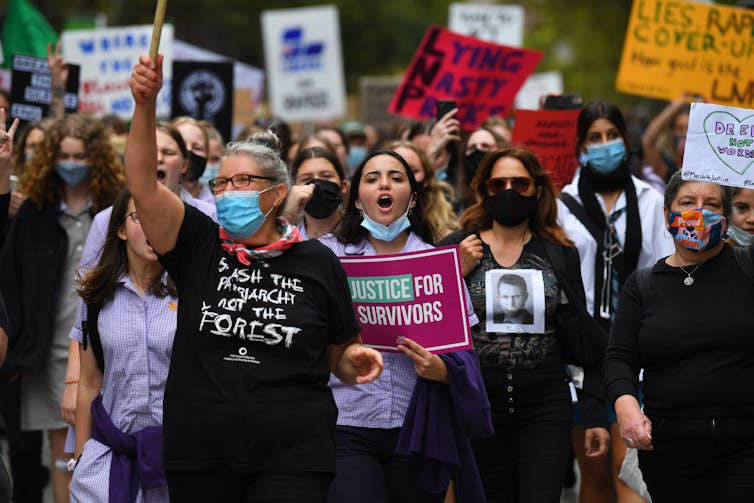
Protesters at the March 4 Justice rallies were demanding gender equality and an end to gendered violence and sexual harassment.James Ross/AAP
The roadmap recognises the importance of a preventative approach to stop sexual harassment before it occurs. It also expresses agreement (either in full, in part or in principle) or “notes” the recommendations in the Respect@Work report.
This, however, falls significantly short of a commitment to fully implement all 55 recommendations put forth by Jenkins. For the roadmap to respond effectively to her damning findings, it must deliver radical change to ensure workplace equality in reality.
That said, there is no doubt the groundswell of public condemnation of sexual harassment has meaningfully shaped the government’s response.
Positive measures announced include:
extending the time limit for making a sexual harassment complaint to the Australian Human Rights Commission from six months to 24 months
clarifying that sexual harassment is a form of serious misconduct that can warrant immediate dismissal
closing the loophole that exempts parliamentarians and judges from being held accountable for sexual harassment complaints under the Sex Discrimination Act.
All these changes are welcome and, in fact, long overdue. Other aspects of the roadmap will require scrutiny, as further details emerge.
Kate Jenkins handed her report to the Morrison government over 14 months ago.Mick Tsikas/AAP
A key hope was the government would strengthen the legal obligations on employers to prevent sexual harassment — known as “positive obligations”. However, the roadmap indicates the government believes this duty already exists in work health and safety laws.
Given Jenkins’ finding of “endemic” sexual harassment in Australian workplaces, this approach has clearly not worked. Furthermore, work health and safety laws are complex and unlikely to be an entirely appropriate approach for dealing with sexual harassment matters.
We should remain mindful of the needs of people who have experienced this type of harassment to have a voice in the process, to tell their story and to receive a just outcome. Given the size of the challenge ahead of us, we should look to strengthen the Sex Discrimination Act with a positive duty on employers to prevent this type of behaviour.
This would help create the cultural change Australia needs and bring greater scrutiny of workplaces with significant sexual harassment problems. It would also give important oversight to the AHRC as the expert body.
We also need to watch and ensure the recommendations are followed with increased budgetary support at all ends of the spectrum. This includes everything from the important preventative education work with young people that Jenkins found works, to strengthening the supports available to people who need help when they experience sexual harassment.
The AHRC should be properly empowered to take on the mammoth task of seeing this challenge through to the end.
Further work to be done
There is no doubt that without the bravery of the people who have brought complaints of sexual harassment (usually at a high personal cost), or who spoke to Jenkins or spoke out publicly in recent months, we would not have seen such a recognition by the government about the scale and size of the problem.
In order to fully transform the way in which Australia deals with sexual harassment, the government must consider greater reform in terms of the role confidentiality agreements have in legally silencing people who bring sexual harassment complaints.
People brave enough to bring formal legal complaints of harassment are most often asked to sign a confidentiality agreement in settlement of their cases. These agreements usually prevent them from speaking about what they experienced and can mean serial sexual harassment continues unabated.
They also reflect the power imbalance in sexual harassment cases, with harassers or employers almost always insisting on confidentiality. This means we don’t know which workplaces have sexual harassment problems.
Australia should consider following a growing number of US jurisdictions in introducing legislation that only permits confidentiality clauses in sexual harassment settlements when requested by the person who has experienced the harassment.
We need to use the power of the law to change this legally sanctioned silence. This is a powerful way we can work to end the culture of silence and shame around sexual harassment, so anyone who experiences it can feel supported and empowered enough to call it out, whoever the harasser is.
We need to remember Jenkins found that sexual harassment was not inevitable — and was preventable. The way we respond now will determine whether this remains a widespread experience into the future.
The tropical water at the equator is renowned for having the richest diversity of marine life on Earth, with vibrant coral reefs and large aggregations of tunas, sea turtles, manta rays and whale sharks. The number of marine species naturally tapers off as you head towards the poles.
Ecologists have assumed this global pattern has remained stable over recent centuries — until now. Our recent study found the ocean around the equator has already become too hot for many species to survive, and that global warming is responsible.
This story is part of Oceans 21 Our series on the global ocean opened with five in-depth profiles. Look out for new articles on the state of our oceans in the lead-up to the UN’s next climate conference, COP26. The series is brought to you by The Conversation’s international network.
In other words, the global pattern is rapidly changing. And as species flee to cooler water towards the poles, it’s likely to have profound implications for marine ecosystems and human livelihoods. When the same thing happened 252 million years ago, 90% of all marine species died.
The bell curve is warping dangerously
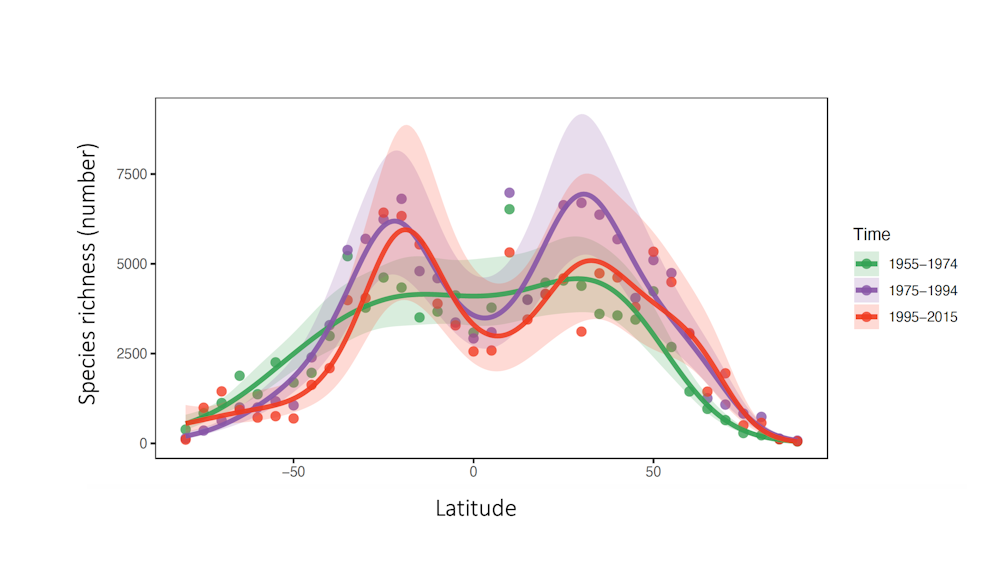
This global pattern — where the number of species starts lower at the poles and peaks at the equator — results in a bell-shaped gradient of species richness. We looked at distribution records for nearly 50,000 marine species collected since 1955 and found a growing dip over time in this bell shape.
If you look at each line in this chart, you can see a slight dip in total species richness between 1955 and 1974. This deepens substantially in the following decades.Anthony Richardson, Author provided
So, as our oceans warm, species have tracked their preferred temperatures by moving towards the poles. Although the warming at the equator of 0.6℃ over the past 50 years is relatively modest compared with warming at higher latitudes, tropical species have to move further to remain in their thermal niche compared with species elsewhere.
As ocean warming has accelerated over recent decades due to climate change, the dip around at the equator has deepened.
We predicted such a change five years ago using a modelling approach, and now we have observational evidence.
For each of the 10 major groups of species we studied (including pelagic fish, reef fish and molluscs) that live in the water or on the seafloor, their richness either plateaued or declined slightly at latitudes with mean annual sea-surface temperatures above 20℃.
Today, species richness is greatest in the northern hemisphere in latitudes around 30°N (off southern China and Mexico) and in the south around 20°S (off northern Australia and southern Brazil).
This has happened before
We shouldn’t be surprised global biodiversity has responded so rapidly to global warming. This has happened before, and with dramatic consequences.
252 million years ago…
At the end of the Permian geological period about 252 million years ago, global temperatures warmed by 10℃ over 30,000-60,000 years as a result of greenhouse gas emissions from volcano eruptions in Siberia.
A 2020 study of the fossils from that time shows the pronounced peak in biodiversity at the equator flattened and spread. During this mammoth rearranging of global biodiversity, 90% of all marine species were killed.
125,000 years ago…
A 2012 study showed that more recently, during the rapid warming around 125,000 years ago, there was a similar swift movement of reef corals away from the tropics, as documented in the fossil record. The result was a pattern similar to the one we describe, although there was no associated mass extinction.
Authors of the study suggested their results might foreshadow the effects of our current global warming, ominously warning there could be mass extinctions in the near future as species move into the subtropics, where they might struggle to compete and adapt.
Today…
During the last ice age, which ended around 15,000 years ago, the richness of forams (a type of hard-shelled, single-celled plankton) peaked at the equator and has been dropping there ever since. This is significant as plankton is a keystone species in the foodweb.
Our study shows that decline has accelerated in recent decades due to human-driven climate change.
The profound implications
Losing species in tropical ecosystems means ecological resilience to environmental changes is reduced, potentially compromising ecosystem persistence.
In subtropical ecosystems, species richness is increasing. This means there’ll be species invaders, novel predator-prey interactions, and new competitive relationships. For example, tropical fish moving into Sydney Harbour compete with temperate species for food and habitat.
This could result in ecosystem collapse — as was seen at the boundary between the Permian and Triassic periods — in which species go extinct and ecosystem services (such as food supplies) are permanently altered.
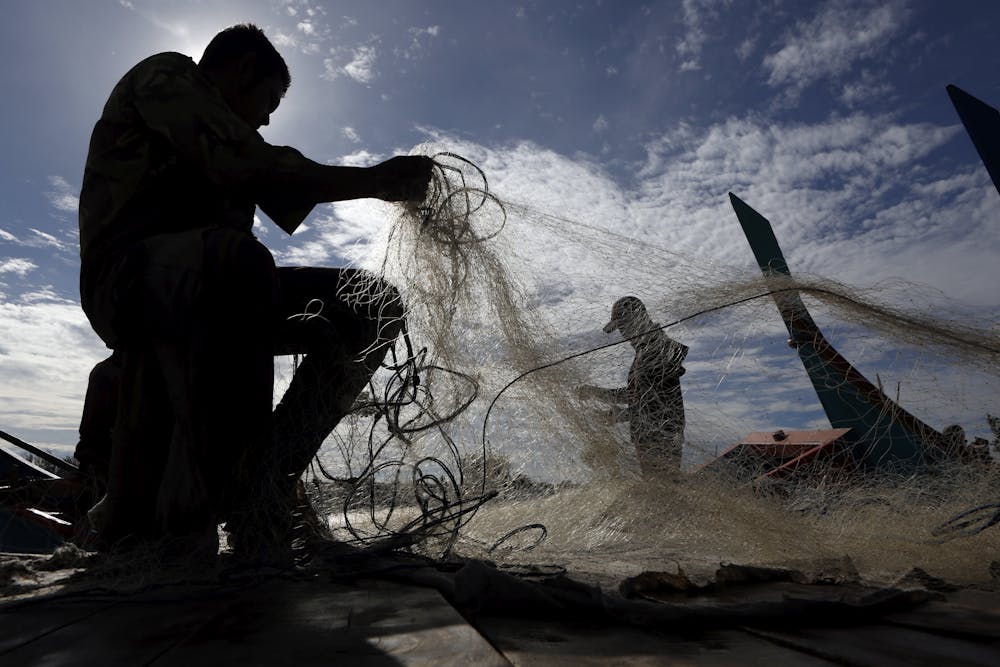
In Indonesia, the fishing industry is one of the largest contributors to the economy.EPA/HOTLI SIMANJUNTAK
The changes we describe will also have profound implications for human livelihoods. For example, many tropical island nations depend on the revenue from tuna fishing fleets through the selling of licenses in their territorial waters. Highly mobile tuna species are likely to move rapidly toward the subtropics, potentially beyond sovereign waters of island nations.
Similarly, many reef species important for artisanal fishers — and highly mobile megafauna such as whale sharks, manta rays and sea turtles that support tourism — are also likely to move toward the subtropics.
The movement of commercial and artisanal fish and marine megafauna could compromise the ability of tropical nations to meet the Sustainable Development Goals concerning zero hunger and marine life.
Is there anything we can do?
One pathway is laid out in the Paris Climate Accords and involves aggressively reducing our emissions. Other opportunities are also emerging that could help safeguard biodiversity and hopefully minimise the worst impacts of it shifting away from the equator.
Currently 2.7% of the ocean is conserved in fully or highly protected reserves. This is well short of the 10% target by 2020 under the UN Convention on Biological Diversity.
Manta rays and other marine megafauna leaving the equator will have a huge impact on tourism.Shutterstock
But a group of 41 nations is pushing to set a new target of protecting 30% of the ocean by 2030.
This “30 by 30” target could ban seafloor mining and remove fishing in reserves that can destroy habitats and release as much carbon dioxide as global aviation. These measures would remove pressures on biodiversity and promote ecological resilience.
Designing climate-smart reserves could further protect biodiversity from future changes. For example, reserves for marine life could be placed in refugia where the climate will be stable over the foreseeable future.
We now have evidence that climate change is impacting the best-known and strongest global pattern in ecology. We should not delay actions to try to mitigate this.
PODCAST - Buchanan and Manning on China + USA Construct Cold War-Styled Coalitions
/
RSS Feed
Share
Link
Embed
A View from Afar – Selwyn Manning and Paul Buchanan debate: how in the last two weeks, China and the United States have been advancing distinct and separate defence alliances – positioning that is akin to the old Cold War.
On one hand, the US has been building up a coalition of allies that is designed to contain China’s presence in the South China Sea.
On the other hand, China has been cementing its defence and trade ties with adversaries of the United States. The pacts include formal cooperative agreements with Iran, and the Russian Federation.
So what makes the last two weeks different from the last four years?
Are we witnessing an emergence of a Cold War II styled stand-off in a post-Trump world?
If so, where does that leave small powers like New Zealand, and a host of other nations that make up the economies of the Asia Pacific region?
We invite you to subscribe to this podcast and to add your views to this discussion:
We invite you to follow and subscribe to this podcast via the podcast platforms and you can also follow up via social media. Here are the links:
The most recent wave of Covid19 is, I suspect, much more significant than the headlines so far would suggest. This phase started in Europe, has been very evident in South America, and is now apparent in Asia (eg Philippines, India, and now Japan.) Further, Covid19 is starting to take hold again in the United States, especially in Michigan, and the urban northeastern cities (eg New York) most associated with the initial wave in America. And Ontario, Canada, is now moving to a new lockdown, as young people are getting seriously ill.
In South America, the countries of greatest concern are Uruguay, Chile and Argentina; Brazil’s high recent death statistics notwithstanding.
Uruguay is of particular concern, because – like New Zealand – it had very few cases in 2020. On 4 April it reported 1,100 cases per million people, equivalent to 5,500 cases in one day in New Zealand. That’s seven times the case rate (for that day) of Brazil, and three times the case rate for Chile. That’s more than one in a thousand Uruguayans reporting positive in a single day!
Two other countries had worse ‘new case’ incidences that day: Curaçao, and Bermuda. In the overall (historical statistics), in the world (as of 7 April) Uruguay is 151st in cases per capita, and 81st in deaths. Curaçao is 40th in cases per capita, and 83rd in deaths. Bermuda is 86th in cases per capita, and 101st in deaths. In all three of these countries, more than half of all reported cases have been since 1 March 2021. And all three have been countries which, in 2020, performed substantially better than their neighbours (eg Aruba for Curaçao, and Bahamas for Bermuda).
Uruguay is looking like it might be a victim of its own success. So is Chile, which is now getting more than twice as many new cases per capita than is the oft-reported Brazil. Chile is one of the most vaccinated countries in the world for Covid19; and indeed the mainly older people who have been vaccinated there are doing much better than in 2020. It’s the younger people who are now of most concern in Chile. The same pattern is clearly emerging in the urban northeast of the USA, the places which were first to emerge from the pandemic in the USA, the ‘Democratic states’ which were generally most accepting of lockdowns and mask use.
New Zealand in 2020 had significantly negative numbers of ‘excess deaths’, thanks in the main to a dramatic reduction in deaths arising from influenza. The lockdowns and physical distancing prevented the transmission of seasonal influenza. Presumably, the Covid19 restrictions also substantially reduced the incidence of winter colds.
The mandatory use of masks on public transport in New Zealand is irrelevant to Covid19, and almost certainly counterproductive overall; facemasks have only been mandated in the summer months so far. Further, over the summer, the voluntary use of facemasks in other settings has been practically nil. To the best of my knowledge only one or two cases of Covid19 in New Zealand have ever been conclusively linked to public transport; these were on one Auckland bus – the number 22 bus – on the morning prior to the August lockdown.
Other countries that performed well in 2020 also did so because of mandated emergency restrictions to substantially minimise the risk of transmission, with that risk being at its maximum in indoor settings in which physical distancing is difficult. (In some cases, like Chile and New York, lockdowns were belated but eventually effective. In other countries – such as New Zealand – restrictions came about in time, and effective track and trace capacity was possible, further helping these countries to keep on top of Covid19.) All of these successful countries will have had very low exposures to common seasonal viruses, a byproduct of restricting Covid19.
Probably too little exposure to the ‘common cold’.
Common Cold exposure may be, in effect, a partially effective Covid19 vaccine.
On 23 March, the BBC ran a story Coronavirus: How the common cold can boot out Covid. Wikipedia suggests that about 15 percent of common cold cases are due to attenuated human coronaviruses. The majority of common cold viruses are rhinoviruses. And in the entry on Coronavirus, Wikipedia says “Four human coronaviruses produce symptoms that are generally mild, even though it is contended they might have been more aggressive in the past”. Of particular note, the ‘Russian Flu’ of 1889-90 may have the more lethal form of one of the four present day ‘common cold’ coronaviruses (Human coronavirus OC43). The ‘Russian Flu’ is estimated to have killed one million people, at a time when the world population was one-sixth of what it is today. (World deaths from Covid19 are now approaching three million, and will probably end up being close to six million.)
The BBC story suggests that exposure to rhinoviruses can provide a significant degree of immunity protection from Covid19. Presumably, exposure to the human coronaviruses that cause 15 percent of colds would provide at least as much protection as rhinovirus exposure.
It seems very likely that the dangerous recent outbreaks of Covid19 in places such as Uruguay, Chile and Michigan are happening because young and middle-age people in those countries have had minimal exposure to these common and generally mild seasonal viruses. (It seems likely, to me, that the new strains of Covid19 are not necessary more lethal than earlier strains; rather, younger people are less protected from common cold exposure in 2021 than they were in 2020.) Further, these viruses are difficult to produce vaccines for, because they mutate rapidly; indeed, influenza vaccines have to be renewed every year for this reason.
Clearly, in future years, a substantial majority of the world’s adult population is going to need a coronavirus and an influenza vaccination at least once a year; a massive but necessary logistical challenge.
Extended ‘mask mandates’ are most likely aggravating the problem, by removing these ‘natural vaccines’ from circulation. Certainly, mandated mask use indoors serves as an important break on the transmission of Covid19 during a substantial outbreak of that disease; that is, an outbreak severe enough to justify what we in New Zealand would call a Level 3 or Level 4 lockdown. Beyond that, it is not desirable to interfere with the transmission of the seasonal viruses which protect us from much more serious infectious disease. Individuals of course should always be able to choose to wear facemasks, and to protect themselves through the use of, for example, Vitamin C supplements.
Viral Virginity
One of the most significant epochs in global demographic history was the European conquest of the Americas, and the subsequent collapse of the native American populations. It was pathogens, not guns, that did most of the damage. Eurasia and Africa are a single landmass that had a much greater history of acquired immunity than did the Americas. As a case of double-jeopardy, this human population die-off in the Americas helped to fuel the ‘white’ European superiority-complex. Europeans, conveniently for them, both utilised and ignored this supremacist interpretation of the American conquest, when considering the ‘black’ African population that was quite well-adapted to both European and tropical diseases.
The native American population was simply overwhelmed by novel pathogens, which they had no immunity to. Indeed, the Covid19 disproportionate tragedy in Brazil’s Amazon region is probably due in large part to people there getting less exposure to common cold viruses. Indigenous populations in Oceania suffered the same fate, by and large.
When viral disease types do not circulate widely for decades, then populations regain a degree of viral virginity. This is one of the reasons why it seems likely that the ‘Russian flu’ was, in 1889, a novel coronavirus much like the SARS-Cov2 virus that causes Covid19.
In the 25 years before 1918, humankind seems to have lost a degree of natural protection from influenza. As a result the 1918 flu pandemic was more severe than subsequent flu pandemics in 1957, 1968 and 2009.
Of further interest is the fact that the 1918 H1N1 ‘Spanish Flu’ – better known as the ‘Black Flu’ – came in three waves, with the second (November 1918) wave being the most lethal. With better understanding than we had then, it is now believed that exposure to the less lethal (but nevertheless nasty) first wave of the disease gave protection from the second wave. Whereas the pattern of mortality and morbidity in the first wave was more like the usual pattern for influenza – that is the patterns of 1957 and 1968, in which the elderly suffered most – the lethal second wave of the Black Flu most affected younger adults, and (in New Zealand) Māori communities which had largely missed out on the first wave. In the United States in 1818, and probably elsewhere, ‘sickly’ urban young men entering the army were significantly better protected from the Black Flu than were ‘vigorous’ young men from rural counties. City youth had had much more exposure to attenuated circulating viruses.
My concern is that, globally, the Covid19 is just entering the first wave of its more lethal second phase; a phase which will disproportionately kill unvaccinated younger people. And that the major single reason why this will happen is the loss of partial immunity previously conferred through common colds and the like.
New Zealand Exceptionalism
Like many countries, New Zealand has an ‘exceptionalist’ view of itself. (I contributed a New Zealand chapter to the 2016 book about Australian exceptionalism, Only in Australia.)
New Zealand’s exceptionalism is about both insecurity and superiority. We are desperate to be noticed, and to be liked – indeed loved – by the rest of the world. We once believed we supplied the best soldiers to the British Empire; not only did we have ‘better whites’ than the rest of the ‘anglosphere’, we though, but we also had ‘better blacks’.
Today we love to revel in the image that we broadcast to the world: the images of inventiveness, improvisation, incorruptibility, sporting prowess, enlightened race relations, inclusiveness, clean greenness, ideal climate for food production, landscapes, safety (despite big volcanoes, earthquake faultlines and adventure tourism), and compassionate stoicism. (We used to promote ourselves as egalitarian, and that is an image that is still widely believed overseas!) And we love our present government, because it convincingly conveys those optics to the wider world.
New Zealand thinks it’s immune from the tragedy that’s now unfolding in Uruguay, and elsewhere. It’s not.
New Zealanders are supremely proud of their record on Covid19, and just love it when overseas people – indeed overseas intellectuals – praise us for our superior management of ‘the pandemic’. If we are to continue to be able to present this image to the world, we do not want to suffer a Uruguay moment. (While Uruguay was – and still is – largely underneath the world’s covid radar, New Zealand has conspicuously displayed its covid success to the world. It was even news on Al Jazeera when a single case drove New Zealand into Covid19 lockdown in February. And last year, New Zealand’s August outbreak made world news, to the extent that Donald Trump would imply that our situation had become as bad as, if not worse than, the situation in the United States.)
Our leaders understand this; hence the need for an ultra-cautious approach about human reengagement with the rest of the world. Thus, given our diminishing natural immunity to respiratory viruses, the success of the covid vaccination program – as a program of annual repeat vaccinations – is critical to our re-entry into the world of human intercourse.
As insurance, however, while at Covid19 emergency Level 1, our leaders should now be encouraging our working-age adults to return to normal social engagement. New Zealanders need to get more common colds – not less – this autumn and winter.
————
Keith Rankin, trained as an economic historian, is a retired lecturer in Economics and Statistics. He lives in Auckland, New Zealand.
New Zealand Parliament Buildings, Wellington, New Zealand.
Editor’s Note: Here below is a list of the main issues currently under discussion in New Zealand and links to media coverage. Click here to subscribe to Bryce Edwards’ Political Roundup and New Zealand Politics Daily.
When Uncle Segar Passi watches the position of the setting Sun from his front patio, he notes its location and relates that to the time of year and changes in seasonal cycles.
What he sees translates into his artworks. They are visually stunning, a rich tapestry of colours jumping off the frame with a palate that easily rivals Vincent van Gogh. This is reflected in the many awards he has garnered over the years.
Lidlid by Segar Passi (2011)Queensland Art Gallery
His artistic talent is matched only by the depth of his wisdom and cultural knowledge, which he teaches through his practice.
An island home
Turning 79 this year, Uncle Segar is a senior Meriam elder and a Dauareb man, meaning his community is originally from Dauar, the larger of the two small islands off the coast of Mer (the other being Waier) in the eastern Torres Strait.
The volcanic trio of islands are collectively known as the Murray Island group, and sit at the very tip of the Great Barrier Reef.
The Murray Island group in the eastern Torres Strait: Mer (foreground), Dauar (upper right) and Waier (upper left).Duane Hamacher
Professor Martin Nakata, a Torres Strait Islander and Pro-Vice Chancellor at James Cook University, brought me to Mer years ago to help the community document its star knowledge for education and community programs.
We stood on the beach near Uncle Segar’s house, watching the sunset near the double-hilled island of Dauar when he told me:
That place has powerful magic. If you want to learn about traditional star knowledge, you ask those elders. They’re the big dogs.
Looking to the artworks on the wall in Uncle Segar’s workshop, I noticed a plethora of subtle characteristics encoded within each one.
I know his artistic style is unique and aesthetically gorgeous, but I also know that every colour, brushstroke, motif and design has meaning. I see a painting showing a crescent Moon with the cusps pointing up. Above it are puffy cumulus clouds and the moonlight reflected in the choppy waters.
Kerkar Meb I (Left) and II (right), 2011. These paintings by Segar Passi show the changing orientation of the crescent Moon, which informs seasonal weather patterns.Segar Passi. QAGOMA, Brisbane.
Another painting, which looks nearly identical from a distance, shows the Moon tilted at an angle. The clouds above are cirrus, and the reflection of moonlight is clear and strong on the calm, still water.
In his characteristic soft voice, Uncle Segar explained the meaning behind this pair of paintings.
Every month there is a New Moon at a different angle. Did you ever notice this?
He explained how the New Moon (kerker meb) can tell you about the changing seasons if you look at the angle of its tilt. When the cusps are pointing up (Meb metalug em), it is the dry season, the Sager.
You will see large cumulus clouds in the evening sky and the water is choppy. When the cusps point at an angle (Meb uag em), the water is calm and you see cirrus clouds. This is the wet monsoon season, the Kuki. He pointed to the painting:
If the water looks rough and the Moon is pointed up, you know the winds will die down and the next day the water will be fine.
The art of knowledge
The paintings are a medium through which complex systems of knowledge are passed down. These systems are based on generations of collective observation, deduction and interconnection – a longstanding system of science.
Uncle Segar is an expert on clouds and weather, the plants and animals, the sea, land, and the sky. His knowledge is as deep as his artworks are captivating.
The self-taught artist developed his style in the 1960s and has since won several major awards for his work, gaining an international profile through his raw talent, complex works and lovely personality. But his passion is for local community, both on Mer and across the Torres Strait.
Uncle Segar’s work has appeared in local school books and seasonal calendars about traditional knowledge. He has also worked closely with me and other academics over the years, sharing Meriam Star Knowledge and co-authoring several research papers.
Uncle Segar is currently contributing to a major book on Indigenous astronomy for a global audience and has been featured in recent Indigenous astronomy articles in Cosmos magazine. His knowledge has even been written into the Australian National Curriculum for schools across the country.
The flying spirits
This knowledge has found its way into films by some of the world’s most critically acclaimed directors. Members of the Mer community performed the Maier (Shooting Star) dance for the 2020 Werner Herzog and Clive Oppenheimer film Fireball: Visitors from Darker Worlds.
Fireball, Visitors from Darker Worlds.
Maier is a term from the Meriam Mir language referring to fireballs (exceptionally bright meteors), which are seen as a celestial personification of a recently deceased person’s spirit flying to Beig, the land of the dead.
The brightness, trajectory and sound of a Maier all have special meaning. If the Maier breaks into fragments and you see sparks fall (uir-uir), you know that person left behind a large family.
The trajectory of the Maier tells you where that person is from. And when you hear the booming sound (dum) as the fireball explodes, it tells you that person has arrived at their destination.
The Maier dance is originally from Mer but had not been performed on the island since 1969. In late 2019, the community approved Herzog and Oppenheimer to film the dance on Mer.
Led by Meriam elder Alo Tapim, four local dancers were taught the kab kar (sacred dance) and performed it on the beach at sunset just hours later, with cameras rolling. The segment you see at the end of the film is the first time the dance had been performed on Mer in 50 years.
A ‘Behind-the-Scenes’ photo of the community performing the Maier Dance on Mer at dusk for the film ‘Fireball’ in 2019.Duane Hamacher
Name in the stars
In 2020, his lifetime of work and his contributions to astronomy were recognised when the International Astronomical Union renamed the asteroid “1979 MH4” as “7733 Segarpassi”.
This is a 1.9km-wide asteroid in the main asteroid belt between Mars and Jupiter. It is 2.4 times farther from the Sun than Earth is, and takes 3.7 years to orbit the Sun.
Uncle Segar’s important contributions to culture and science are also encapsulated in the newly released commemorative coin “The Shark in the Stars”.
Released on March 4, 2021 by the Royal Australian Mint, this non-circulating coin features Uncle Segar’s artwork. It is the third and final instalment of the Star Dreaming series, and was so popular all 5,000 coins sold out within two hours.
Beizam, the Shark in the Stars. Uncirculated $1 coin released by the Royal Australian Mint.Royal Australian Mint
The celestial shark is called Beizam, a Meriam constellation formed by the bright stars of the Big Dipper (part of the Western constellation Ursa Major, the Big Bear). It traces out the head, body, fins and tail of the shark.
The changing position of the shark in the northern skies throughout the year is a seasonal marker that notes shifting seasons, when to hunt turtle, when to harvest yams, and informs the observer about the behaviour of the shark itself.
When the nose of Beizam touches the horizon at sunset, sharks are feeding on sardines that swim in tight ribbons close to the shore. This occurs during the Sager, which can be a dangerous time to go for a dip.
Later in the year, as the shark dives below the horizon at dusk, you will see the first lightning of the coming monsoon.
Meriam people teach that water rushes through Beizam’s gills as it dives into the sea on the horizon, casting water into the sky which falls as the rains of the wet season, the Kuki.
Uncle Segar Passi continues to share his knowledge with the world, benefiting his community and the next generation of Meriam scholars. And we are exceptionally lucky and honoured to continue learning from Elders like him.
Source: The Conversation (Au and NZ) – By Frank Bongiorno, Professor of History, ANU College of Arts and Social Sciences, Australian National University
Some promising polling for Labor in recent weeks has inevitably raised that perennial question for a party whose national triumphs since Federation 120 years ago have been rare: can it win the next election? And in the manner of modern elections, the question soon becomes a more personal one: can it win under its present leader, Anthony Albanese?
My punditry in such matters is likely to be no better or worse than anyone else’s. Apart from polling, the limitations of which have become all too well known, there’s little for most of us to go on.
One place we might look is the quality of an opposition leader’s performance. They really have two jobs, which is one of the reasons no one much likes being opposition leader.
First, they need to keep government accountable, scrutinising its behaviour using parliament, committees such as Senate Estimates, and the media to draw attention to government failings or worse.
Their other job is to make themselves look like an alternative government. They do so by preparing policies, crafting an attractive image, and attending to problems such as weaknesses in the party organisation.
Taking these two roles into account, how well has Labor been doing this under Albanese?
In the aftermath of the 2019 election, as is usually the case after an election defeat, it’s hard for an opposition to get a hearing. The government will usually have an agenda that it pursues aggressively in the flush of an election victory. Few wish to listen to the leader of a party only recently repudiated at the polls.
The months that followed the 2019 election had some of these features. The government pursued massive tax cuts, which Labor supported. But given Prime Minister Scott Morrison’s lack of an agenda – his policy at the 2019 election was to win the 2019 election – there was little for Albanese and Labor to get their teeth into.
That soon changed. Summer is usually a quiet time for both government and opposition. It was on this basis, that Morrison, “Jen and the girls” headed for Hawaii. But the Black Summer bushfires provided Albanese and the Labor opposition with their first chance to lay a glove on Morrison.
While Morrison’s performance was so poor that Albanese needed to do little to look good by comparison, the crisis did damage the government sufficiently to raise Labor’s hopes that the shine gained from “Morrison’s miracle” was wearing off.
Morrison’s absence for a Hawaiian holiday during the Black Summer of 2019-20 provoked community outrage, and an opportunity for Albanese.AAP/Instagram/Scott Marsh
Then came sports rorts. This scandal provided Labor with opportunities to build an argument that this was a mean and tricky government that put winning elections ahead of integrity or fairness. It claimed a ministerial scalp.
Sports rorts was soon overwhelmed by the pandemic. This was very bad news for Labor. Parliamentary sittings were reduced. Worried citizens attended to their private affairs. National cabinet provided a sense of Labor state governments being drawn into the tent with Morrison, while the federal Labor opposition was rendered irrelevant. Morrison even courted the unions with some success.
Governments almost invariably benefit from major crises because they are seen as doers. There are strong pressures to place an increasing range of issues “beyond politics”, a boon for those intent on looting the treasury and bad for public accountability.
The government’s massive spending stimulus made Labor seem particularly irrelevant. There can be no doubt that if a Labor government had tried anything similar, it would have been subjected to the mother of all campaigns by right-wing media.
So, if Albanese and much of his front bench seemed invisible during this period, this is not a matter for which they can be much criticised. And to be fair, several Labor shadow ministers used this period productively to explore what a post-pandemic order might look like.
We complain about our politicians spending too little time reading and thinking. We should notice when they do. This was Labor performing the second of those functions of opposition: crafting an alternative government.
With the pandemic largely under control, Albanese has a better chance to present himself as an alternative prime minister.AAP/Mick Tsikas
The gods have been kinder to Labor during 2021. The government has been mired in crisis, scandal and sleaze. Labor, meanwhile, has benefited from its slow and steady achievement of greater gender equity during decades in which the Coalition’s performance in this area has deteriorated.
Labor has admittedly had to do little to keep the government accountable in these matters – Morrison’s ineptness and an enterprising group of mainly female journalists have done its job for it – but the party has benefited enormously from having capable women in leadership positions. Albanese has been able to avoid looking like another well-meaning mansplainer when the issues of sexual assault and harassment are in the spotlight.
The blatant failures of the vaccination program have provided new opportunities for the Labor Party to criticise a government that likes to present itself as the saviour of the Australian people in its hour of need – as Psalm 46 would have it, “a very present help in trouble”.
Electors seem less certain. They have returned two state Labor governments in Queensland and Western Australia widely perceived to have kept their populations safe. Other state governments remain popular, even that of Daniel Andrews, despite Victoria’s ordeal of a second wave of infections.
It is not clear how much credit the Morrison government will be able to claim. Dealing competently with the Global Financial Crisis in 2008-9 appeared to win the Rudd government limited credit among voters in the medium term. It was persecuted for a few failures instead.
Albanese’s place in these considerations remains an ambiguous one. Tanya Plibersek seems to have emerged as the most likely alternative and, if Albanese were to falter at the next election, his successor.
The rules adopted by the Labor Party during the second Rudd prime ministership in 2013 make it difficult to remove a leader between elections unless he or she agrees to go. In any case, and leaving aside the party’s split under Billy Hughes in 1916 and the interim leadership of Frank Forde in 1945, Labor has still only once removed a leader without giving him the opportunity to fight an election: Simon Crean in 2003.
Tanya Plibersek is the most logical alternative Labor leader.AAP/Dean Lewins
As the son of a single mother raised in public housing, Albanese has a backstory that might be attractive to may voters, if they only knew it. He is a consummate political professional in an age of political professionals, admired for his management of parliamentary business during the challenging minority government of Julia Gillard.
Albanese would not have been among the front rank of ministers in the best Labor governments of the modern era — those of Bob Hawke in the 1980s. But that probably isn’t a large mark against him. After all, the general quality of our political leaders has deteriorated since then, too.
At the very least, the turn of the political dial seems to give Labor, and Albanese, a fighting chance.
International flights into Melbourne are set to resume today. Arrivals will be capped at 800 people in the first week, before increasing to 1,120 from April 15.
This marks the third time a hotel quarantine system has been launched in Victoria. After a series of mishaps, is this revamped version finally up to scratch?
A bumpy road
On March 28 last year, National Cabinet mandated 14 days of supervised quarantine for international arrivals across the country.
In June, a number of Melbourne hotel quarantine staff were infected, seeding a second wave of COVID-19 in Victoria. On July 1, Melbourne stopped receiving international arrivals. Flights would not recommence until December 7.
In planning the second version of hotel quarantine, the Victorian government had ample advice. The Victorian COVID-19 Hotel Quarantine Inquiry released an interim report on November 6 with 69 recommendations, 49 of which were accepted. The National Review of Hotel Quarantine also released its report in early November.
The second system incorporated a number of key changes, such as nominating a single government agency — COVID-19 Quarantine Victoria (CQV) — responsible for employing, training and supervising staff. The agency didn’t hire any private security guards, and staff were not permitted to have other jobs.
All staff were tested at the end of their shifts. Testing was later extended to leave days after one worker tested negative at the end of her shift but became positive, and infectious, during her days off.
There have been several incidents in Victoria’s hotel quarantine system over the past year.Erik Anderson/AAP
Over time, the system was tweaked. For example, meal delivery and laundry pick-up were staggered so no two doors opened onto one hallway at the same time. This followed an incident in the Park Royal Hotel when a family with multiple infected members was believed to have spread the virus across the hallway to a woman who opened her door at the same time.
In February, soon after this incident at the Park Royal, a cluster of cases linked to the Holiday Inn airport hotel led to a five-day lockdown in Melbourne and no more international flights — again.
While the second version of hotel quarantine in Victoria was much more effective than the first, it ultimately failed because it did not adequately protect against airborne transmission.
Hotel quarantine needs to be an impermeable barrier
Fast forward to April and Victoria has not had a community case of COVID-19 for 40 days.
This escalation of cases poses challenges for Australia’s health security. A growing percentage of international arrivals will be infected and many will have one of the variants of concern that can spread more rapidly and cause more severe disease than older strains.
The hotel quarantine systems in every state and territory need to be impermeable barriers between the outside world and Australian communities.
So what do we know about Victoria’s revamped system?
The key changes reflect the government’s recognition that airborne transmission — spread of the virus via tiny particles, or aerosols, that can hang around in the air — has been behind most recent breaches in the quarantine system. This came about from investigation of the cases I mentioned earlier in the Park Royal and Holiday Inn airport hotels.
Importantly, hotel ventilation systems have now been modified to ensure that when guests open their doors, the air flows from the corridor into the room, as opposed to air from the room flowing out. This followed expert room-by-room assessments by occupational hygienists and engineers.
The number of tests administered to hotel guests will double from two to four.James Ross/AAP
Personal protective equipment (PPE) requirements have been standardised across all quarantine hotels to bring them in line with Health and Complex Care hotels (those that care for people who test positive to COVID-19, or “hot hotels”). More than half of the hotel staff — those who work in areas where they may be exposed to hotel guests, such as lobbies and hallways — will be supplied with N95 respiratory masks.
These two measures should effectively prevent virus transmission from infected guests to other guests and staff.
Meanwhile, testing of hotel residents will be increased from two to four times during the two weeks, with potential follow-up tests after quarantine, based on medical advice.
While evidence for the role of airborne transmission in the spread of COVID-19 has been building since mid-2020, Australia has been slow to recognise this.
Meanwhile, the Commonwealth Department of Health website page on how coronavirus spreads (accessed on April 6, 2021) omits any mention of aerosol spread.
The restart of the Victorian system — with these new measures targeted at airborne transmission — offers a golden opportunity to inform other jurisdictions and, hopefully, to develop a national standard for hotel quarantine.
While the risk of another breach will never be zero, the revamped Victorian hotel quarantine system appears to have addressed the weaknesses of the previous system and has been informed by several rigorous reviews, including one on variants of concern.
To protect the entire country, we may need similar reforms in other jurisdictions. This should be mandated through a national hotel quarantine protocol built on consensus and sound evidence.
Source: The Conversation (Au and NZ) – By Deanna Kemp, Professor and Director, Centre for Social Responsibility in Mining, The University of Queensland
The benefits of switching to clean energy are huge. As with any industrial activity, the transition has potential environmental and social impacts.
As we head towards net-zero emissions, record quantities of copper will be required. Copper is critical for solar panels, wind turbines, electric vehicles and battery storage.
Unfortunately, we’re headed for a supply crunch. Market analysts estimate the annual copper supply shortfall could be as high as 10 million tonnes by 2030 if no new mines are built. This means prices are on the rise, giving miners an incentive to bring new copper mines to market.
The complexity of these new mines will be unprecedented. Unless mining is done differently, rushing to bring these projects into production could unleash unacceptable, catastrophic impacts onto local people and environments.
A golden age for copper
Until recently, the copper market has been flat. Prices have been low, and it has not been a good environment for producers. The market is now on the move.
As an efficient electrical conduit, copper is required for many renewable energy systems including solar and wind power.AAP Image/Supplied by Granville Harbour Wind Farm
But in the face of high global demand, it’s critical these big companies don’t gloss over copper’s sustainability challenges.
4 major sustainability challenges
There are four major challenges the mining industry faces in the impending copper boom. How well these challenges are overcome will determine who wins and loses in the energy transition.
1. Unearthed copper deposits are locked up in remote and difficult locations
Unearthed copper deposits — known as “orebodies” — are often found in places such as the high Andes, the Arctic, and the deep sea.
The social, environmental and technical challenges of projects in these locations will be greater than before. For example, BMW, Samsung and Volvo have just backed calls for a moratorium on deep sea mining.
Public opposition towards these and other large-scale copper projects means they could face difficult legal battles before these projects are permitted to go ahead.
Part of the Resolution Copper Mining land-swap project in Arizona, US, has had serious pushback from a group of Apaches, who sued the US government in January 2021.AP Photo/Ross D. Franklin, File
3. Future copper mines are projected to be lower grade and deeper
Grade is a measure of the how much valuable metal there is in the ore body (deposit). Deeper, lower grade orebodies means new copper mines are likely to generate more waste rock, more tailings, and hazardous elements such as arsenic.
Tailings are the residues from mining and minerals processing, and is made up of finely ground rock, chemicals and water. If the projected demand is met, we calculate the world will produce more than nine times the amount of copper tailings between 2000 and 2050, than in the entire century prior.
Meanwhile, the industry faces a crisis of credibility over its management of this hazardous waste.
4. New copper mines will likely be located in politically and ecologically sensitive areas
Our research from 2019 found 65% of copper ore bodies that haven’t been mined are in areas with high water risk: too little water means miners compete for it among other local water users, and too much means waste can be difficult to contain.
Almost half (47%) of these ore bodies occur on or close to Indigenous peoples’ lands, and 64% within or near areas critical to biodiversity conservation. 50% are in socially and politically fragile countries, such as the Democratic Republic of Congo.
A simple price rise won’t solve major issues
In the past, the mining industry has relied on rising prices to address supply shortfalls. Higher metal prices give companies the financial capital they need to operate in difficult locations and invest in new mining technologies.
Some of this capital will support sustainability improvements, such as recycling and reductions in water and energy use. But many of the sustainability challenges we’ve outlined above are not price sensitive.
Mining companies cannot pay their way out of biodiversity loss, extreme poverty, and corruption risk. If they don’t engage these big challenges before the copper boom gets underway these impacts will be baked in mining’s future legacy, without clarity about who takes responsibility in the long term.
This would add to the devastating impacts existing mines have already caused. One famous example is the Panguna mine in Bougainville, which led to massive environmental damage and triggered a civil war.
The Panguna copper mine in Bougainville sparked a decade-long civil war.AAP Image/Ilya Gridneff
What’s more, intensifying social and environmental impacts of copper mines could jeopardise the long-term supply of copper. If opposition grows, and supply stalls, then so too will the clean energy transition.
So what are the options?
As demand for copper moves into overdrive, we are at a crossroads.
One option is to support large-scale copper mining and the clean energy transition for the greater good of the planet. Miners would do their best to minimise impacts, but we’d accept there’ll be collateral damage for local communities. This is far from the latest commitment to “zero harm to people and the environment” that the world’s largest companies recently made to tailings management.
A second option is to insist miners exhaust all opportunities to avoid harm. This is because sacrificing the interests of local people in the interests of a greater good would not be considered responsible, as it does not align with the concepts of equity and fairness that underpin the Paris Agreement.
This second approach would require significant improvements in managing social and environmental impacts of copper mining. It may also mean reducing global demand for copper, finding substitutes, and making hard choices about not developing mines if the risks to local people and the environment are too high. Doing this would require a wholesale restructuring of the function of global commodity markets.
We may not yet have a solution, but as the world prepares for this year’s major Climate Change Conference in Glasgow, we must start to ask: what kind of justice are we seeking in the “just transition”, and for whom?
Source: The Conversation (Au and NZ) – By Joakim Goldhahn, Kimberley Foundation Ian Potter Chair in Rock Art, Centre of Rock Art Research + Management, University of Western Australia
Aboriginal and Torres Strait Islander readers are advised this article contains images and names of deceased people.
Aboriginal rock art unfolds stories about the present-past and emerging worlds, often described by an outsider as the Dreamtime. Some rock art, it is believed, was put in place by spiritual and mythological beings. Many of these Ancestral Beings travelled vast distances, and their journeys link places, clans and different rock art paintings.
Other images were created to educate children about cultural protocols, or just made to tell an amusing story. The artists who created the works are also important. Some artists were prolific and appreciated. A person who made a hand stencil could often be identified by the hand’s shape.
Our new research into a 1972 painting made by Billy Miargu in today’s Kakadu National Park shows how rock art can act as an intergenerational media — even when no longer visible to the eye.
In December 1972, Robert Edwards and George Chaloupka, two acclaimed rock art researchers, came across Miargu camping at Koongarra in the heart of Kakadu. They took a photograph of his family. In the background, there was a newly made painting of a kangaroo. The researchers did not think much about this image, describing it as a “poor naturalistic representation.”
When Paul S.C. Taçon revisited the painting only 13 years later, it was gone (probably due to exposure to wind and rain). In 2018, we used state-of-the-art digital documentation methods to try to detect remnants of the kangaroo, but all in vain. We can no longer see the white kangaroo, as shown in the photograph below.
A 2019 image of the rock canvas Miargu painted his kangaroo on back in 1972.Photograph by Iain Johnston
Revisiting Koongarra
In June 2019, we returned to Koongarra with three of Miargu’s daughters, two of his granddaughters and a great-granddaughter.
Some of Billy Miargu’s children, grand children and great-grandchildren, from left to right: Julie Blawgur, Linda Biyalwanga, Linda’s daughter Ruby Djandjomerr, Linda’s granddaughter Keena Djandjomerr (on the ledge), Julie’s daughter Syanne Naborlhborlh and Joanne Sullivan.Photograph by Joakim Goldhahn.
We learned that Miargu was born in central Arnhem Land. He moved west to Kakadu around the time of the second world war to work at cattle stations — shooting buffalo, cutting timber — and emerging tourist venues. His clan was Barrbinj and his wife, Daphnie Baljur, was Barrappa. Together, they had six children: five daughters and a son.
Miargu and his wife were camping at Koongarra in 1972 while participating in a fact-finding survey on behalf of the Commonwealth government and the Australian Mining Industry Council for a planned uranium mine. They collected mammals and reptiles for this study.
Our conversations revealed that the place where Miargu painted the kangaroo had a special meaning for him. It is situated in his mother’s clan Country, and he had a ceremonial obligation to this place.
Billy Miargu with his daughter Linda on his arm in December 1972. The newly made kangaroo figure is seen in the background.Photograph by George Chaloupka, now in Parks Australia’s Archive at Bowali.
The original kangaroo painting referenced a local ceremony. Depicting this Ancestral Being in his mother’s Country shows that Miargu had undergone this ceremony and was keen to care for this Country. Today, his son and daughters have inherited some of these obligations.
Even though Miargu’s painting of the kangaroo can no longer be detected, this place holds a special meaning to his descendants. In fact, for the family, they say “our dad’s painting is hiding, in secret place”. They address the painting as if it is still there, visible or not.
Miargu passed away in 1990. This is the only place the family knows where he created rock art. His daughter Linda Biyalwanga said, “we don’t know any other paintings. Only one painting, that’s why we bring our children to show them this painting.”
And she explained:
My daddy, story, memory, like memories, memory for us, and [he] make [the rock art] for the grandchildren, yeah. He said when I passed away, then my daughters will come around and maybe my granddaughter, and grandsons, great-great-grandchildren come and have look at […] rock art […] When they have kids, they can show them the painting.
The tangible place, the intangible rock painting, and the family’s recollection of the happy times they spent together with their parents at this special place seem to have merged into a present-past and future which embrace Western concepts of space, but defy similar notions of time.
In an inexplicable but noteworthy way, Miargu’s painting seems more present today because it is absent.
To visit Koongarra and the rock art figure he created is vital for his family. It evokes cherished memories about their parents and feelings, but also sorrow and the loss of “the Old People who finished up”.
Joanne Sullivan, another of Miargu’s daughters, expressed this when she said: “I wish my dad sit here.”
When asked if there are other places where they can connect to their parents in this way, Linda Biyalwanga answered: “It’s the only place. It’s the only place we think about, like, his spirit, mum’s spirit.”
When we left the place, Miargu’s daughters called out to their parents’ spirits and asked them to remember them and take care of them. Even though the rock painting “is hiding”, it is still crucial — it lives on even when gone…
In the front row, Billy Miargu’s daughters, collaborators and co-authors: Joanne Sullivan, Linda Biyalwanga and Julie Blawgur.Photograph by Joakim Goldhahn.
This research was undertaken in collaboration with the family members of Billy Miargu and Daphnie Baljur.
Source: The Conversation (Au and NZ) – By Mary-Louise McLaws, Professor of Epidemiology Healthcare Infection and Infectious Diseases Control, UNSW
Australia’s COVID-19 vaccine rollout has been much maligned recently, as it’s become clear we’re way behind schedule.
So far Australia’s average daily rate since the rollout began in late February is around 22,000 doses a day according to my calculations. To achieve herd immunity, I calculate we’ll need to vaccinate 85% of the population, using a combination of the Pfizer and AstraZeneca vaccines. To achieve this by the end of March 2022, I calculate we need to vaccinate at least 133,000 people a day until December 31, and then around 79,000 a day in the first three months of 2022.
One way to achieve this would be to stop relying on small GP and respiratory clinics and urgently move towards using mass vaccination hubs.
However, we don’t yet have enough of the AstraZeneca vaccine to service large vaccination hubs. This I think is one reason why Australian authorities have not yet planned to use them.
What are mass vaccination sites?
Mass vaccination means vaccination on a large scale in a short time. Locations for mass vaccination would include stadiums and sportsgrounds, schools, parks, places of worship, and shopping centres.
As Australia moves into phase 1B of the rollout and beyond, the federal government’s plan has been to rely solely on GP, respiratory clinics and eventually community pharmacies. This plan presumes we’re all middle class and have the ability to access a local GP during work hours or early evenings. But many people who are unemployed, disadvantaged, working multiple part-time jobs, disaffected or can’t get away from work might not be able or willing to visit a GP clinic in their neighbourhood.
Instead, many might be more comfortable going to a mass site. For the placement of mass vaccination facilities to improve uptake of the vaccine, authorities should consult demographers who can identify the location of vaccination hubs to be most effective in attracting the most people.
We can’t rely on small GP clinics alone
Relying on small GP and respiratory clinics means the rollout is progressing very slowly. Local clinics might vaccinate around 50 people per day, depending on the size of their clinic. They also need to ensure physical distancing that allows space for people to wait for 15 minutes after their vaccination while they are monitored for any side effects.
GPs also need to continue to see patients with various health and well-being needs they should not ignore, even in a pandemic.
Federal Deputy Chief Medical Officer Michael Kidd said mass hubs were “not off the agenda”. And today, the NSW government announced it will be setting up a mass COVID vaccination hub in Homebush, in Sydney’s inner west.
This is a good start but we need many more mass vaccination sites before we can get close to reaching the daily target.
So far there isn’t a formal plan detailing how the federal or state governments will introduce mass vaccination hubs in the COVID vaccine rollout.
Vaccine supply is the crucial issue
Vaccination is a huge logistical challenge amid a global pandemic and there’s an element of authorities learning to build the ship while it’s sailing.
Australian governments may also not yet be able to supply sufficient vaccines for mass vaccination hubs.
The federal government has repeatedly said Melbourne-based biotech company CSL will be producing one million doses of the AstraZeneca vaccine a week. It’s yet to reach that target, and it’s not yet clear exactly when it will.
But let’s look at that target and presume CSL reaches it soon. One million doses divided by seven days a week equals about 142,000 doses a day. This is only just on the cusp of being sufficient to reach our daily vaccination target. But it doesn’t take into account other delays that might occur such as problems with distribution, loss of stock, logistical hurdles, and bottlenecks at vaccination clinics.
In outbreak management you plan for the worst-case scenario. So when setting goals you should plan forward and look backwards to identify weaknesses in the plan, such as not receiving enough vaccine and logistical issues. You must also allow a buffer if things go “pear shaped”.
The fact we’re already behind the federal government’s initial target of vaccinating all Australian adults by the end of October this year suggests its plans were idealistic. It’s difficult to make further assessments without full transparency around vaccine supply and distribution.
There have been issues with Europe blocking and slowing supply. Planning appropriately for the rollout would have included considerations for delays for approval and batch testing. It begs the questions of why 2.5 million doses of the AstraZeneca vaccine are currently waiting for batch testing.
Authorities should be fully transparent about issues relating to vaccine supply, batch testing and distribution, so the public can feel fully informed and engaged in the vaccine rollout.
Great examples of transparency in vaccine rollouts can be seen in New Zealand and Canada. NZ includes weekly adverse reaction reports where people can read about vaccine side effects. Greater transparency like this can reduce anxiety, hesitancy and conspiracy theories.
Source: The Conversation (Au and NZ) – By Mary-Louise McLaws, Professor of Epidemiology Healthcare Infection and Infectious Diseases Control, UNSW
Australia’s COVID-19 vaccine rollout has been much maligned recently, as it’s become clear we’re way behind schedule.
So far Australia’s average daily rate since the rollout began in late February is around 22,000 doses a day according to my calculations. To achieve herd immunity, I calculate we’ll need to vaccinate 85% of the population, using a combination of the Pfizer and AstraZeneca vaccines. To achieve this by the end of March 2022, I calculate we need to vaccinate at least 133,000 people a day until December 31, and then around 79,000 a day in the first three months of 2022.
One way to achieve this would be to stop relying on small GP and respiratory clinics and urgently move towards using mass vaccination hubs.
However, we don’t yet have enough of the AstraZeneca vaccine to service large vaccination hubs. This I think is one reason why Australian authorities have not yet planned to use them.
What are mass vaccination sites?
Mass vaccination means vaccination on a large scale in a short time. Locations for mass vaccination would include stadiums and sportsgrounds, schools, parks, places of worship, and shopping centres.
As Australia moves into phase 1B of the rollout and beyond, the federal government’s plan has been to rely solely on GP, respiratory clinics and eventually community pharmacies. This plan presumes we’re all middle class and have the ability to access a local GP during work hours or early evenings. But many people who are unemployed, disadvantaged, working multiple part-time jobs, disaffected or can’t get away from work might not be able or willing to visit a GP clinic in their neighbourhood.
Instead, many might be more comfortable going to a mass site. For the placement of mass vaccination facilities to improve uptake of the vaccine, authorities should consult demographers who can identify the location of vaccination hubs to be most effective in attracting the most people.
We can’t rely on small GP clinics alone
Relying on small GP and respiratory clinics means the rollout is progressing very slowly. Local clinics might vaccinate around 50 people per day, depending on the size of their clinic. They also need to ensure physical distancing that allows space for people to wait for 15 minutes after their vaccination while they are monitored for any side effects.
GPs also need to continue to see patients with various health and well-being needs they should not ignore, even in a pandemic.
Federal Deputy Chief Medical Officer Michael Kidd said mass hubs were “not off the agenda”. And today, the NSW government announced it will be setting up a mass COVID vaccination hub in Homebush, in Sydney’s inner west.
This is a good start but we need many more mass vaccination sites before we can get close to reaching the daily target.
So far there isn’t a formal plan detailing how the federal or state governments will introduce mass vaccination hubs in the COVID vaccine rollout.
Vaccine supply is the crucial issue
Vaccination is a huge logistical challenge amid a global pandemic and there’s an element of authorities learning to build the ship while it’s sailing.
Australian governments may also not yet be able to supply sufficient vaccines for mass vaccination hubs.
The federal government has repeatedly said Melbourne-based biotech company CSL will be producing one million doses of the AstraZeneca vaccine a week. It’s yet to reach that target, and it’s not yet clear exactly when it will.
But let’s look at that target and presume CSL reaches it soon. One million doses divided by seven days a week equals about 142,000 doses a day. This is only just on the cusp of being sufficient to reach our daily vaccination target. But it doesn’t take into account other delays that might occur such as problems with distribution, loss of stock, logistical hurdles, and bottlenecks at vaccination clinics.
In outbreak management you plan for the worst-case scenario. So when setting goals you should plan forward and look backwards to identify weaknesses in the plan, such as not receiving enough vaccine and logistical issues. You must also allow a buffer if things go “pear shaped”.
The fact we’re already behind the federal government’s initial target of vaccinating all Australian adults by the end of October this year suggests its plans were idealistic. It’s difficult to make further assessments without full transparency around vaccine supply and distribution.
There have been issues with Europe blocking and slowing supply. Planning appropriately for the rollout would have included considerations for delays for approval and batch testing. It begs the questions of why 2.5 million doses of the AstraZeneca vaccine are currently waiting for batch testing.
Authorities should be fully transparent about issues relating to vaccine supply, batch testing and distribution, so the public can feel fully informed and engaged in the vaccine rollout.
Great examples of transparency in vaccine rollouts can be seen in New Zealand and Canada. NZ includes weekly adverse reaction reports where people can read about vaccine side effects. Greater transparency like this can reduce anxiety, hesitancy and conspiracy theories.
A View from Afar – Selwyn Manning and Paul Buchanan debate: how in the last two weeks, China and the United States have been advancing distinct and separate defence alliances – positioning that is akin to the old Cold War.
On one hand, the US has been building up a coalition of allies that is designed to contain China’s presence in the South China Sea.
On the other hand, China has been cementing its defence and trade ties with adversaries of the United States. The pacts include formal cooperative agreements with Iran, and the Russian Federation.
So what makes the last two weeks different from the last four years?
Are we witnessing an emergence of a Cold War II styled stand-off in a post-Trump world?
If so, where does that leave small powers like New Zealand, and a host of other nations that make up the economies of the Asia Pacific region?
WE INVITE YOU TO COMMENT ON THIS DISCUSSION:
You can comment on this debate by clicking on one of these social media channels and interacting in the social media’s comment area. Here are the links:
As of Tuesday, only 920,334 doses of the coronavirus vaccine have been administered – a fraction of the four million doses the Morrison government had promised by end-March.
The rollout’s complications and failures have sparked a backlash from some GPs, pharmacists, and states.
The federal government says the problems are mainly supply issues – notably, the failure of millions of doses to arrive from overseas. Also, CSL has had trouble quickly ramping up its production.
At the same time, there have been glitches in the logistics of delivery to doctors and the states.
This week Stephen Duckett joins the podcast to critique the rollout. Currently director of the health and aged care programme at the Grattan Institute, he was formerly secretary of the federal health department and so has seen the health bureaucracy from the inside.
Duckett is highly critical of how the rollout has gone, with the government over-hyping expectations.
“The government hasn’t met a single one of its targets so far. They had targets about four million people by the end of March. They had a target, about more than 500,000 residential aged care workers and residents by mid-March.
“Now, sure, it’s the biggest logistic exercise we have ever seen, but the government has had eight months or so to prepare for it.
“I think the government should have set reasonable targets. It should have said, look, we know it’s really, really important to get the vaccine rollout started, but we are reliant on overseas.”
“The prime minister said he wanted to under promise and over deliver. He did the reverse.”
One issue Duckett identifies has been the politicisation of the process.
“There’s been a huge number of vaccine announcements. Every micro-possibility has been wrung out of every announcement. We’ve got photos of vaccines coming off planes. We’ve got announcements that we’re thinking about having a contract.”
“I think[…]the commonwealth initially thought it was all going to go very smoothly and they’d coast into the election very, very comfortably on the back of a successful vaccination rollout programme.
“So I think it had a political overlay from the start.”
Source: The Conversation (Au and NZ) – By Kyle J.D. Mulrooney, Senior Lecturer in Criminology, Co-director of the Centre for Rural Criminology, University of New England
Crime on farms can have devastating effects on farmers and their families —financial, psychological and social. Crime can also have national implications, too, if it disrupts or damages farm production.
But too often, farm crime is considered “just a rural issue”, something out of sight and mind.
This is why the Centre for Rural Criminology at the University of New England launched a crime survey of farmers last year in New South Wales. We wanted to gain a better understanding of the often hidden dimensions of crime in rural areas to inform decision-making by government, police, farmers and other organisations.
High rates of farmer victimisation
In our survey, the most jarring finding was just how prevalent crimes in rural areas is. Four in five farmers (80.8%) reported having been a victim of some type of farm crime.
Repeat victimisation is high, too: three in four farmers (76.8%) reported being a victim of crime on two or more occasions, and almost a quarter (23.3%) experienced crime a staggering seven times or more.
The most common type of crime reported by our survey respondents was trespassing on their property (49.9%). Illegal shooting and hunting (40.7%), theft of livestock (39.4%), and break and enter of farm properties (32.4%) were also high on the list.
A reluctance by farmers to report crime
Despite these significant levels of victimisation, farmers are often reluctant to report farm crime to police. Only two-thirds (66.7%) of victims reported stock theft to police, for example. And trespassing and illegal shooting and hunting were reported by farmers less than half the time.
Reluctance to report crimes is linked primarily to a lack of confidence in police interest and capacity to solve them if they are reported, as well as perceptions of barriers to investigating crimes in rural areas.
Other reasons for non-reporting include a belief that a crime is not serious enough to report or concerns about revenge in a small community (nearly 40%).
This “dark figure of crime” — the term used to describe the number of committed crimes that are not reported or discovered — not only means the weight of the law won’t be applied to those who engage in criminality, but that policy-makers are unaware of the true extent of rural offending rates and patterns.
The effects of farm crime
Farm crime is costly. Let’s consider stock theft. NSW police figures indicate that between 2015 and 2020, an average of 1,800 cattle and 16,700 sheep were stolen each year across the state at a cost of nearly $4 million (annually) to farmers.
If we add the value of stud stock, loss of animal byproducts like wool or milk, and loss of future breeding potential, the annual financial impact on NSW primary producers could realistically be over $60 million. And remember, this does not consider the significant level of under-reporting crimes in rural areas.
These costs are also borne by farmers already facing serious challenges from droughts, flooding, bush fires, climate change and mental health issues.
Crime often cuts deeper than financial loss. In our survey, 70.3% of farmers classify crime in their local area as serious or very serious, and 64.3% are worried or very worried about crime in general.
This can have a significant impact on psychological well-being and undermine social trust. And this, in turn, can hamper the ability of communities to work together and with police to combat crime.
Rural policing in New South Wales
Farmers in our survey expressed a strong desire for the police to engage with them directly and to perform a crime prevention role. An overwhelming majority (90%) specifically supported a team of police officers trained to deal specifically with rural crime.
In 2017, a team of full-time, dedicated investigators was established in the state called the Rural Crime Prevention Team. It is comprised of detectives and intelligence analysts located strategically across the state who work solely on crimes affecting the pastoral, agricultural and aquacultural industries.
Two-thirds of farmers we surveyed said they were aware of this team. It has made significant inroads in rural areas through community engagment and high-visibility, proactive enforcement strategies.
Our survey also found that those who have had direct contact with the RCPT are more satisfied with the police, have higher levels of confidence in the police, and are more likely to report crimes. Given these results, it is important that resources continue to be allocated to increase the team’s visibility and capacity to address rural crime.
For example, population density and physical distances between properties often means there is less risk of offenders getting caught. And the potential reward for their crimes is higher given how many valuable assets are on farms.
Police cannot simply “go it alone” in rural areas. Crime prevention is a shared responsibility for communities, with both farmers and police alike needing to adopt preventative practices.
Among the farmers we surveyed, 80% felt personal responsibility to prevent farm crime, with many indicating they employ specific measures to do this.
Yet, farmers also pointed out the challenges to adopting more crime-prevention measures, including the financial cost, difficulty of implementation and a lack of knowledge around what works. These challenges often discourage them.
There is still much work to be done. In our survey, 41.8% of farmers were unaware they could report a crime to Crime Stoppers, while 45% did not know they could report to the Police Assistance Line.
This is why community-based crime prevention initiatives, such as the newly launched campaign in NSW, “Draw the line on regional crime”, are so important.
The launch and success of the RCPT is a strong start, as are collaborative community engagement campaigns with Crime Stoppers. If we can continue to increase farmers’ knowledge of rural crime prevention tactics like these, this can not only reduce concerns about crime, but also boost farmers’ engagement with police, their reporting of crimes and their own crime prevention efforts.
Source: The Conversation (Au and NZ) – By Kathryn Daley, Senior Lecturer & Program Manager – Youth Work and Youth Studies. School of Global, Urban and Social Studies, RMIT University, RMIT University
Of the more than 870,000 Australians who lost their jobs in the first few months of the COVID-19 crisis, 332,200 – or 38% – were young Australians aged 15-24.
By June 2020, as the overall unemployment rate hit 7.4%, the youth unemployment rate spiked to 16.4%, with a further 19.7% underemployed (working fewer hours than they wanted).
As of February the overall unemployment rate had fallen to 5.8%, compared with 5.1% in February 2020. The youth unemployment rate meanwhile was 12.9%, compared with 11.5% the year before, and a further 16% were underemployed.
Prime Minister Scott Morrison has enthused about there now being “more jobs in the Australian economy than there were before the pandemic”. But that’s true only for those 25 and older: 77,600 more are employed than before the crisis. For those aged 24 and under, 74,100 fewer have jobs.
So clearly the pandemic has hit younger workers the hardest. The reasons for disproportionate impact aren’t complicated. Young people are more likely to work in casual jobs – the first to be excised in hard economic times – and in those sectors most affected by border closures, lockdowns and other measures – retail, hospitality, tourism.
Yet the federal government’s policy responses, injecting billions of dollars into the economy to support businesses and employment, have compounded this impact through deliberate yet flawed policy design.
JobKeeper has kept proportionally fewer young people in jobs. Changes allowing withdrawal of superannuation will hurt them more in the longer term. And JobMaker, the program designed specifically to encourage employment of younger workers, has proven a monumental flop.
Shut out of JobKeeper
The centrepiece of the federal government’s support measures was the A$100 billion JobKeeper program, initially paying a subsidy of $750 a week before tapering and finally being axed at the end of March.
The Reserve Bank of Australia estimates JobKeeper payments kept at least 700,000 workers off the dole queue. But to qualify, employees had to have been working for their employer for a minimum of 12 months.
This disproportionately excluded younger workers – being more likely to be recent workforce entrants, to switch jobs more than older workers, and to be in employed in casual or other forms of insecure work.
Newly unemployed queue at the Centrelink office in Southport on the Gold Coast, Queensland, March 23 2020.Dan Peled/AAP
To illustrate, Australian Bureau of Statistics data from August 2019 shows young people comprised 17% of the workforce yet accounted for 46% of all short-term casual employees.
Of those employed casually, 26.4% of young people had been with their employer for less than 12 months, compared to 6.5% of those aged 25 and over. So one in four young people employed casually were not eligible for JobKeeper, compared with only one in 16 of their older counterparts.
JobKeeper’s design thus pushed proportionally more younger workers on to the dole queue. It also likely contributed to more of them dipping into their superannuation savings under the provisions announced by the federal government in March 2020.
Those provisions allowed Australians affected by the economic crisis to withdraw up to $20,000 from their superannuation accounts (in two rounds of $10,000 each – one last financial year, another this financial year).
The Industry Super Australia estimated about 395,000 people under 35 completely drained their super accounts.
This emptying of accounts is not surprising given the average superannuation balance by age 30 is about $28,000 for men and $23,700 for women.
But it means many will have considerably less super to retire on. The long-term cost of a 25 year-old withdrawing $20,000 is more than $100,000, compared with about $37,000 for a 50-year-old, according to estimates by financial comparison site Canstar.
There’s also evidence the design of the super-access scheme has allowed unnecessary withdrawals. While those taking out money have had to declare they need the money to pay for essential items (such as rent or bills), there has been no scrutiny of this prior to approval.
Indeed, according to credit-scoring company Illion about two-thirds of the funds withdrawn this financial year was spent on discretionary items such as clothing, furniture, restaurants and alcohol.
As former prime minister Paul Keating has put it, the government has relied on individuals “ratting their own savings” to buttress its own stimulus spending.
The one program meant to specifically address youth unemployment, the JobMaker Hiring Credit, has so far proven a failure. Its aim is to incentivise employers to hire job seekers aged 16 to35 with a weekly $200 subsidy, creating 450,000 jobs over two years. But in late March, Treasury officials revealed it had so far led to just 609 hires.
All unemployment is costly for individuals, families and the wider community. But high and long-term youth unemployment can have particularly dire consequences that reverberate for decades. It creates the risk of “scarring”, suppressing an individual’s job and income prospects over their entire life. That ultimately requires the government picking up the tab.
Youth unemployment was already a significant issue prior to the COVID crisis. Now, with younger people hit hardest by the pandemic’s economic impacts, it’s imperative to ensure an entire generation is not permanently disadvantaged.
Source: The Conversation (Au and NZ) – By Ben Egliston, Postdoctoral research fellow, Digital Media Research Centre, Queensland University of Technology
Microsoft has reportedly been awarded a ten year contract worth close to US$22 billion, to provide 120,000 military-grade augmented reality (AR) headsets to the US Army.
Popularised through mobile apps such as Pokémon Go and face filters on social media, AR technology is fundamentally about superimposing digital images over real-world environments.
The AR interface commissioned by the US military is referred to as an “Integrated Visual Augmentation System” (IVAS). It will use Microsoft’s HoloLens headset technology as its base hardware.
As the Army’s press release notes, the device will be used to coordinate soldiers and implement sensing technologies on the battlefield.
Features will supposedly include thermal sensors, machine learning (to create realistic training simulations) and a digital heads up display to enhance soldiers’ “situational awareness”.
The news follows Microsoft’s previous announcement of a US$480 million military contract to develop and supply IVAS prototypes to the army in 2018.
Between this older contract, the new one, and Microsoft’s $10b JEDI cloud computing contract for Azure, Microsoft is set to fortify its position as one of the highest value US defence contractors (alongside Amazon).
AR and warfare’s relationship isn’t new
AR interfaces first emerged in the 1960s with Ivan Sutherland’s demonstration of the Sword of Damocles tracking system. This was developed in the Massachusetts Institute of Technology’s Lincoln Laboratory, funded by the US Department of Defence.
The head-mounted display – the first of its kind – was pitched for use in simulating flight instruments and conditions.
American computer scientists Ivan Sutherland’s Sword of Damocles was the first example of a head-mounted display (HMD).
Fast forward to the mid-80s and the Lincoln Lab produced American AR manufacturer Kopin. In 1990 this commercial company received a US$50 million contract from the Department of Defence to develop micro LCDs to be used in wearable computers for the infantry.
AR continues to see uptake today, in a trend which geographer Stephen Graham refers to as the “militarisation” of everyday life. And this is especially noticeable with technologies governing urban societies.
Technology firm Vuzix is one major player in the security and enterprise sector. As its annual report states, the company develops products for “governmental entity customers that primarily provide security and defence services, including police, fire fighters, EMTs, other first responders, and homeland and border security”.
In one particularly troubling development, last year it was reported that ClearView AI’s facial recognition software was being tested to run on Vuzix hardware.
This controversial company trains its artificial intelligence software on a dataset of more than three billion images from websites including YouTube, Facebook and Instagram. Its marriage with Vuzix points to a future where law enforcement officers use wearable AR with built-in facial recognition capbilites.
The use of AR to govern everyday life has also emerged during the COVID-19 pandemic (which we’ve detailed in this report). For example, companies such as Rokid and KC Wearables have developed wearable devices that purport to track the body temperatures of people in the view of the device’s wearer.
What’s so bad about Microsoft’s AR?
We know little about the current prototyping and field testing of Microsoft’s IVAS. But the interface raises the same concerns that surround other technologies designed to preemptively target and classify potential “threats” – such as drones.
This is what the current IVAS prototype looks like.Microsoft
As the US Army’s IVAS objectives read, key outcomes are to increase mobility, situational awareness and lethality – that is, deadliness on the battlefield. The document states:
Soldier lethality will be vastly improved through cognitive training and advanced sensors, enabling squads to be the first to detect, decide and engage. Accelerated development of these capabilities is necessary to recover and maintain overmatch.
The objectives are framed around soldiers’ efficiency, coordination and safety. This is similar to the usual framing of other predictive sensing technologies, including facial recognition.
The reality, however, is there would be potentially disastrous outcomes if such a system were to misidentify a target. In a 2019 CNN interview, Microsoft CEO Satya Nadella tried to play down concerns.
“We made a principled decision that we’re not going to withhold technology from institutions that we have elected in democracies to protect the freedoms we enjoy,” he said. His statement failed to acknowledge the potential risk which may result from the military’s use of AR.
Following Microsoft’s initial IVAS contract in 2018, Microsoft employees wrote a letter to company executives opposing the use of AR for warfare.
While the letter itself was ineffectual, the recent rise of collective worker resistance in Silicon Valley shows promise. More strikes and walkouts in response to unethical developments could help push back against big tech’s self-serving visions of the future.
Similar to virtual reality, AR has so far enjoyed cover from critique by being taken as a benign gaming or entertainment technology.
The latest IVAS contract is an urgent reminder that developments in this technology should be taken seriously. And its potential for harm must not be downplayed.
In its place, the government introduced a A$4 billion JobMaker Hiring Credit. It will give employers who can demonstrate that a new employee will increase overall headcount (and payroll) $200 per week if the new hire is aged 16-29, or $100 if the new hire is aged 30-35.
Billions on offer, little takeup
Employers will get nothing for new hires aged 36 and over — no matter how disadvantaged and no matter how suitable.
The scheme hasn’t got off to a good start. It is reported to have had only 609 applications in its first seven weeks.
The October budget said it would attract 450,000 applications, creating 45,000 jobs.
The low takeup isn’t surprising.
Evidence shows when unemployment is high, the best way to target disadvantaged groups (such as young jobseekers) is not to target them, but to target high employment growth more broadly.
High employment growth disproportionately helps less-advantaged workers because they are further down the hiring queue.
The $4 billion appropriated for JobMaker is still available to be spent. If spent well, it would help consolidate what so far has been a very solid recovery.
But it needs to be simplified. JobMaker II could be set up as a tax rebate on the quarterly increase in firms’ payrolls, say 60% on any increment above 6%.
Firms that were on JobKeeper in the March quarter (its final quarter) would be allowed to deduct their JobKeeper receipts from their payroll in estimating the starting point for the calculation.
JobMaker II could save 100,000 jobs
If those firms retained their workers (and the rebate was set at 60% on any increase in payroll beyond 6%) they would receive a little over half their March quarter JobKeeper payment in the June quarter.
Most of the money would go to firms and disadvantaged workers who still need it.
The ordinary job matching process would be allowed to work, without some jobseekers being given preference over others because of factors such as their age.
And firms already thriving would have an incentive to increase their employment by even more.
But it should be announced this week
The proposal would have to be implemented quickly to maintain the momentum established by JobKeeper. With JobMaker as it is, it will slip away.
The main thing required is for the treasurer to make an announcement setting out the broad outlines.
JobMaker II could help older women.Anderson Guerra/Pexels
The week after Easter is a time when business owners will be taking stock – working out whether they can afford to continue to carry workers who until the end of Mach were supported by JobKeeper.
Our modelling suggests that refashioning JobMaker along the lines we have suggested could save and generate 100,000 to 130,000 jobs over the next six months.
It would keep employment 1% higher than it would have been, generating higher wage growth and higher tax revenue leading to a lower budget deficit.
With interest rates close to zero, the employment effect would be sustained.
The impacts would be greatest for young and for low-skilled workers, with the bulk of the benefits flowing to wages rather than profits (as regrettably happened in high profile cases as a result of JobKeeper).
And without the discrimination implicit in age targeting, other genuinely disadvantaged groups, including low-income women over 35, would be better off.
Those women would be in a better position to build their superannuation balances and be less exposed to homelessness.
Review: William Yang: Seeing and Being Seen, Queensland Art Gallery, Brisbane.
How does an image become an icon? Moreover, how does a photographer become iconic? A major survey exhibition of the work of Queensland-born, Sydney-based photographer William Yang goes a long way towards answering these questions.
Yang is a much loved photographer, performer and storyteller. This show at the Queensland Art Gallery is a celebration of Yang’s multifaceted practice that has steadily unfolded over the past five decades.
The act of seeing can be predatory and voyeuristic. In her classic 1973 book On Photography, Susan Sontag observed that the photographer’s camera “may presume, intrude, trespass, distort, exploit”. The camera, however, can also be joyful and playful. Much of Yang’s work falls into the latter category. Operating in a highly intimate register, Yang’s ability to disarm his subjects is striking.
Organised roughly chronologically, the exhibition moves through the various phases of Yang’s life. Born in North Queensland in 1943, he is a third generation Chinese-Australian. Growing up in the town of Dimbulah, the experience of being an outsider features prominently throughout his body of work.
Yang’s family disavowed their Chinese heritage, preferring their children to assimilate. In his floor talk at the media preview, Yang described the experience of having to “come out” twice: first as a gay man, and second in search of his Chinese identity in his 30s.
In one of his most iconic images, Life Lines #3 – Self-portrait #3, Yang rephotographs a vintage image of himself at age three and recounts in handwritten text the racist taunts he experienced at primary school.
William Yang. Australia, 1943, Life Lines #3 – Self portrait #2 (1947) 1947/2008 photographer: Unknown. image 100.0 x 70.0 cm. Collection of The University of Queensland, purchased 2010.Photo: Carl Warner Reproduced courtesy of the artist and Andrew Baker Art Dealer, Brisbane.
This strategy features prominently throughout the exhibition. Yang will frequently rework his photographs, handwriting text onto the images. Through the repeated use of first person, Yang creates a sense of closeness with the viewer akin to sharing a diary or confession.
In his catalogue essay accompanying the exhibition, author and broadcaster Benjamin Law observes Yang possesses a “superpower”: an ability to create a sense of ease with his sitting subjects. Like a Möbius strip, Yang has traced his observations directly onto Law’s image, tracing the contours of his body and reinforcing the connection between photographer and subject.
Yang moved to Sydney via Brisbane in 1969, and found paid work as a social photographer. Working in a photojournalist tradition, which reaches back to New York-based photographers such as Nan Goldin and Diane Arbus, there was a complex duality at play.
On the one hand there is a warm exuberance characterising much of his social photography.
On the other, there is an urgent political undercurrent. What emerges is an important photographic archive of Australia’s emerging gay and lesbian communities in the 1970s and 1980s.
Visibility as a political strategy comes to the fore in the powerful sequence “Allan” from the 1990s Sadness project. Allan’s life is memorialised as Yang traces his friend and ex-lover’s physical decline from a HIV-related illness, poignantly reminding us of the terrifying devastation wreaked by AIDS on Sydney’s gay community during this time.
The viewer is allowed into the intensely private world of death and dying as Yang chronicles the final 12 months of Allan’s life with dignity and tenderness.
Yang is at his playful best when he disrupts stereotypical ideas of nationhood. For generations, the beach and its lifesavers have occupied a symbolic position in Australian’s national consciousness.
In one of the key images of the exhibition, lifeguards from Sydney’s Tamarama beach are captured by Yang’s desirous gaze, forcing the viewer to consider the heterosexual framing of national identity.
Family history has also preoccupied Yang over the decades. The series “About my mother” is both affectionate and loving as he retrospectively documents the relationship with his mother Emma after her death.
Again, text is important as Yang records his memories and observations. Some are candid and fun; others record Emma’s unwillingness to acknowledge Yang’s sexual identity. Yang reflects:
My mother had a dignity that came, I think, from a position of humility: I never noticed this when she was alive (heavens! there was the whole relationship between me and my mother to obscure it), but eleven years after she died, as I print up these photos in the dark room, I notice it.
One of the surprising aspects of the exhibition is Yang’s landscape photography.
Frequently, Yang will insert himself into these landscapes. Working in a large-scale format, these images suggest Yang is still trying to make sense of his identity and his relationship with the physical environment of far north Queensland that shaped his childhood.
Yesterday, former Liberal prime minister Malcolm Turnbull was unceremoniously dumped as chair of the New South Wales government’s climate advisory board, just a week after being offered the role. His crime? He questioned the wisdom of building new coal mines when the existing ones are already floundering.
No-one would suggest building new hotels in Cairns to help that city’s struggling tourism industry. But among modern Liberals it’s patently heresy to ask how rushing to green light 11 proposed coal mines in the Hunter Valley helps the struggling coal industry.
The simple truth is building new coal mines will simply make matters worse, especially for workers in existing coal mines that have already been mothballed or had their output scaled back.
Turnbull has called for a moratorium on new coal mines in the Hunter Valley, such as the one pictured above.Dean Lewins/AAP
It gets worse. Once an enormous, dusty, noisy open cut coal mine is approved, the agriculture, wine, tourism and horse breeding industries – all major employers in the Hunter Valley – are reluctant to invest nearby. While building new coal mines hurts workers in existing coal mines, the mere act of approving new coal mines harms investment in job creation in the industries that offer the Hunter a smooth transition from coal.
The NSW planning department doesn’t have a plan for how many new coal mines are needed to meet world demand. Nor does it have a plan for how much expansion of rail and port infrastructure is required to meet the output of all the new mines being proposed.
That’s why my colleagues and I recently called for a moratorium on new coal mines in the Hunter until such plans were made explicit. Just as you wouldn’t approve 1,000 new homes in a town where the sewerage system was already at capacity, it makes no sense to approve 11 new coal mines in a region that couldn’t export that much coal if it tried.
But if there’s one thing that defines the debate about coal in Australia, its that it makes no sense. Just as it made no sense for then-treasurer Scott Morrison to wave a lump of coal around in parliament in 2017, it makes no sense for right-wing commentators to pretend approving new mines will help create jobs in coal mining. And it makes no sense for the National Party to ignore the pleas of farmers to protect their land from the damage coal mines do.
Scott Morrison took a lump of coal to Question Time in 2017.Lukas Coch/AAP
On the surface, Turnbull’s support for a pause on approving new mines while a plan is developed is old-fashioned centrism. It protects existing coal workers from new, highly automated mines, it protects farmers and it should make those concerned with climate change at least a bit happy. Win. Win. Win.
But there’s no room for a sensible centre in the Australian coal debate. And when someone even suggests the industry might not be set to grow, its army of loyal parliamentary and media supporters swing into action.
Labor’s Joel Fitzgibbon said Turnbull “wants to make the Upper Hunter a coal-mine-free zone”. The Nationals’ Matt Canavan suggested stopping coal exports was “an inhumane policy to keep people in poverty”. The head of the NSW Minerals Council suggested 12,000 jobs were at risk.
But of course, the opposite is true. Turnbull’s proposal to protect existing coal workers from competition from new mines would save jobs, not threaten them. He didn’t suggest coal mines be shut down tomorrow, or even early. And, given existing coal mines are running so far below capacity, his call has no potential to impact coal exports.
Opening new coal mines won’t help save the jobs of existing coal workers.Dan Himbrechts/AAP
Predictably, the Murdoch press ran a relentlessly misleading campaign in support of the coal industry and in opposition to their least favourite Liberal PM. But surprisingly, the NSW government rolled over in record time.
While the government might think appeasing the coal industry will play well among some older regional voters, they must know such kowtowing is a gift to independents such as Zali Steggall, and a fundamental threat to inner-city Liberals such as Dave Sharma, Jason Falinski and Trent Zimmerman.
The decision to dump Turnbull might have bought NSW Premier Gladys Berejiklian some respite from attacks from the Daily Telegraph. But such denial of economics and climate science will provide no respite for existing coal workers in shuttered coal mines or the agriculture and tourism industry that is looking to expand.
No doubt the National Party are pleased with their latest scalp. But it must be remembered this is the party that last year wanted to wage a war against koalas on behalf of property developers. Such political instincts might help the Nationals fend off the threat from One Nation in regional areas but it does nothing to retain votes in leafy Liberal strongholds that deliver most Liberal seats.
Source: The Conversation (Au and NZ) – By Monica Barratt, Vice Chancellor’s Senior Research Fellow, Social and Global Studies Centre and Digital Ethnography Research Centre, RMIT University
Today the Coroners Court of Victoria released its findings into a cluster of five drug-related deaths across Melbourne between July 2016 and January 2017.
The five young males, aged between 17 and 32, were all found to have consumed an unusual combination of two new psychoactive substances. Most of the deceased thought they were taking MDMA.
Coroner Paresa Spanos has recommended the Victorian government implement a drug checking service as a matter of urgency. This is a service where people could find out the content and purity of drugs alongside a meeting with a health-care worker to talk about their drug use and test results.
She also recommended Victoria implement a drug early warning network. Data from the drug checking service could be cross-checked with other information we have about what drugs are out there, triggering alerts to warn people if an unusually dangerous substance is circulating.
As an expert witness to the coronial inquest, I argued more timely communication to the public about the dangers of this drug combination may prevent tragedies like these in future.
What happened?
The drugs in this novel combination are known as “25C-NBOMe” and “4-FA”. 25C-NBOMe is highly potent — taking less than 1mg can produce strong psychedelic effects, and it can be fatal.
4-FA is an amphetamine-type stimulant which has similar effects to amphetamine and MDMA, and can cause severe harm and death.
All of the young men in this inquest snorted the crystalline powder, which dramatically increases the risk of harm.
While each substance carries substantial risks consumed on its own, the interaction between amphetamines and drugs from the NBOMe series increases the risk of heart failure and seizures.
While this combination is unusual, as recently as last year it was also detected in other parts of Australia, including the Gold Coast, Brisbane, Perth and Canberra.
How can further deaths be prevented?
In my report to the coroner, I argued if the deceased had known their drugs contained 25C-NBOMe combined with 4-FA, it’s reasonable to presume they either wouldn’t have taken them, or may have avoided snorting them in favour of a less risky route, such as swallowing.
It’s important to acknowledge that if we had a legalised and regulated supply of MDMA, we wouldn’t need to analyse samples to work out what’s in them.
While globally there has been recent work done on how best to regulate stimulants like MDMA, Australia isn’t yet considering this option.
In the current context of drug prohibition, the most promising pathway to reduce harm among people who use drugs is to help them understand the content and purity of the drugs they may consume.
We can also monitor our illegal drug market more closely so all agencies involved in responding to drug problems are armed with the most current information and can tailor their responses accordingly.
What’s Victoria already doing?
The Victorian government and its agencies already generate useful data on drug markets. For example, Victoria Police runs a forensic analysis service for all seized drug samples, which is unique in Australia for its size and coverage. While this information hasn’t historically been used to inform public health, ways of translating this data into useful clinical alerts are currently being explored.
In 2020, the Victorian health department released two public drug alerts. It has also recently piloted a new drug surveillance approach including analyses of drug residue found in discarded drug paraphernalia, wastewater, and blood samples from emergency department patients.
However, Victoria doesn’t currently have a service where members of the public can submit drugs for testing and receive tailored health advice, nor does it provide access to rapid forensic analysis outside the law enforcement context.
What’s more, Victoria doesn’t currently have a formal drug early warning network.
What’s happening elsewhere?
There are some excellent examples globally of agencies that run drug-checking services and collate, synthesise and assess new information about drug markets and issue public alerts.
The Dutch “Drugs Information and Monitoring System”, established in 1992, supports a network of walk-in offices where people can submit drugs for analysis. In the event of unexpected findings, the government can act quickly by alerting people to higher risk substances circulating in the community.
For example, in late 2014, the Dutch system detected a lethal dose of a substance known as “PMMA” in a tablet presumed to be MDMA. Combined with further intelligence about the existence of a larger batch of this tablet, the Dutch government issued a “red alert”. This involved a mass media campaign with the message “please don’t take this tablet” pushed out via television, radio, newspapers, the internet and mobile devices. No deaths were recorded in the Netherlands from this tablet. In contrast, no such alert was issued in the UK, which went on to record several deaths from these tablets.
Victoria could also learn from the system in Toronto, Canada. Similar to the Dutch service, Toronto has multiple drop-off sites where people can submit samples for testing. The service is anonymous and free. The agency publishes fortnightly online reports on the state of the local drugs market, and also issues public drug alerts where warranted.
New Zealand also has an early warning system for drugs, which launched last year.
Next steps
This isn’t the first time drug checking has been recommended in Victoria. But this time, there are reasons to be hopeful government agencies will adopt some or all of these recommendations.
Victoria Police recently released their new drug strategy, which highlights their commitment to supporting harm-reduction initiatives and working more closely with the health department and community organisations. Supporting the coroner’s recommendations would be one way to demonstrate their commitment to these aspects of the new strategy.
This government has presided over a period of increased innovation in drugs policy. This report offers a further opportunity to demonstrate their commitment to reducing drug-related deaths in Victoria.
The area of mental health has been a key strength for Jacinda Ardern and her Labour Government over the last few years. They campaigned strongly in 2017 on fixing up the dysfunctional system, and initially they made some vital strides forward in reforming the sector.
An in-depth inquiry was instigated and the Wellbeing Budget of 2019 pledged nearly $2bn. For a while, it looked like the one area in which the Government was achieving true transformation. This has all changed lately. An explosion of bad stories and complaints from the sector suggests that the Government has failed to deliver on this, and that the mental health system is now getting worse under Labour.
Over the last week, in particular, there have been a string of scathing media articles and comments, that together amount to an overwhelming vote of “no confidence” in the Labour Party, the Prime Minister, and the Minister of Health. The latest, published yesterday in the Guardian, is from journalist Oliver Lewis, who has been investigating Labour’s reforms. He argues the Government appears to be more concerned with image management on mental health than making progress to deal with the crisis – see: The gap between NZ Labour’s soaring rhetoric on mental health and the reality is galling.
On the one hand, Lewis says, “the soaring rhetoric and initial investment – which has often been slow rolling out – has failed to translate into substantive change, and people are rightfully frustrated.” But to make matters worse, and what he finds particularly galling, the government is trying to hide the crisis: “in a bid to paper over failings and push a particular narrative – crucial information seems to be being buried or obfuscated.”
Cooke’s investigation reveals the quite extraordinary story of how Ministry of Health senior officials battled for two years to remove data from this report, seemingly because it made the government look bad. What’s more, the report was released two years late, and “still showed a very distressing picture of New Zealand’s mental health system – with a spike in the use of seclusion, a practice some liken to torture.”
Cooke reports that “Shaun Robinson of the Mental Health Foundation said it was ‘gobsmacking’ and ‘not acceptable’ that so much information had been removed from the ‘scathing’ report.”
And Cooke follows this up, with further political reaction, including the National Party’s mental health spokesman Matt Doocey claiming “there appeared to be some ‘politicisation’ of the ministry”, and Health Minister Andrew Little being “totally comfortable with the process of the report’s release” – see: Judith Collins says heads should roll over ‘sanitised’ Government mental health report.
For more details of the contents of the “scathing” mental health report, it’s worth reading Tess McClure’s Guardian article:New Zealand mental health crisis has worsened under Labour, data shows. Here’s the article’s introduction: “New Zealand’s mental health system is ‘in crisis’ and in worse shape now than four years ago, practitioners say – despite much-heralded government efforts to reform it and prioritise national wellbeing.”
The fact that the Labour Government aren’t delivering, led prominent psychologist Kyle MacDonald to write a condemning opinion piece for the Herald on Sunday, in which he lays the blame at the Prime Minister’s door, recounting when a tearful Jacinda Ardern spoke to a mental health rally during the 2017 election campaign and promised to fix the problems: “Standing there that day, in the sunshine among the crowd, I believed her. I believed she was going to bring transformative change to our crippled and broken services. We all did, because we wanted to believe our work had come to something. We were wrong” – see: Jacinda Ardern has failed us on mental health – and it’s only going to get worse (paywalled).
MacDonald details how the most recent findings on mental health show Ardern’s promises to have been rather hollow, and calls for the government to stop with the endless reviews and consultations and just take action, especially when it comes to funding service delivery: “It would mean providing fully funded training for psychotherapists, psychologists, nurses, social workers, counsellors and peer support workers – and bonding them to work in the mental health system. It would also mean increasing staffing levels in all front line DHB mental health and addiction services by creating new positions and improving pay and conditions.”
A big part of the problem appears to be underfunding from the Government, and in February clinical psychologist Dr Marthinus Bekker spoke out publicly about the “chronically underfunded” public health sector, being reported as believing “Budget 2019’s headline-grabbing $1.9 billion for a Mental Health Package had in reality made no difference for those working on the front line” – see Nick Truebridge’s Ex-DHB psychologist claims chronic failings in mental health services.
According to Bekker, “Getting into public services has gotten to the point where, at times our waitlist has been in excess of four to five months.” He declares: “The situation is absolutely dire and remains in crisis.” The Minister of Health, Andrew Little, is quoted in contrast, saying: “the message I’m getting is actually things are improving”.
According to Victoria University of Wellington’s Dougal Sutherland, who trains psychologists, the Government simply hasn’t been willing to invest in training enough workforce to deal with the size of the problem, and there appear to be no plans for them to do so – see: No time to waste on mental suffering. What reforms that are taking place, he says, are simply “a reshuffling of proverbial deckchairs”.
Further evidence that the promised changes from Government aren’t actually occurring came out in February via the release of interviews that the new Mental Health Commission carried out last year – see Laura Walters’ Mental health: A top priority stalls.
This article also reports that the former Mental Health Commissioner Kevin Allan recently wrote to the Minister of Health “laying out his concerns about the pace of change, and lack of a long-term action plan for the sector’s transformation.” Furthermore, “In July last year, Allan called on former health minister Chris Hipkins to have a plan ready by the end of the year. There is still no plan.”
The Mental Health Foundation is also growing increasingly frustrated with this lack of action, and have started to speak out much more strongly. Two weeks ago, the Chief Executive of the Foundation, Shaun Robinson, asked: Has the Government lost its vision on mental health?. In this, he argues that the Government is missing out on a once in a generation chance to transform mental health.
The Foundation’s main problem is that, although the Government initiated a wide scale inquiry into mental health, it appears to have ignored the need to implement its recommendations, taking a “piecemeal” approach, and just looking for “obvious wins without making a plan”. Robinson points out that the Government’s own Mental Health Commission report on how progress is going on implementing the recommendations says that 23 of the 36 recommendations receive a 1 or 2 out of six – meaning very poor progress.
So, has Labour given up on real mental health reform? According to campaigner and advocate Dave Macpherson, it’s possible that the system has got worse under the current government – see: Is Labour on top of mental health issues?. Not only is Macpherson is disappointed in Andrew Little, but says that new Chair of the Mental Health Commission has “seemed more concerned with patch and boss protection, than in outlining how they would hold the Government to account on behalf of the community.” Overall, Macpherson believes that a lot of Labour’s problems stem from leaving all the same officials in charge of mental health.
There are other signs things are getting much worse. In the weekend, Cherie Howie wrote about how “Mental health conditions among Aotearoa youth have already doubled in the past decade, with experts sounding a call to action in September over what they call ‘a silent pandemic of psychological distress’ already escalating among young people” due to Covid – see: The parallel pandemic: Covid-19 and the mental health impacts on New Zealand young people (paywalled).
And in Christchurch, there are serious problems at the new hospital: “There are growing fears mental health patients in Christchurch are not getting adequate treatment due to an understaffed and underfunded emergency department” – see 1News’ Christchurch Hospital’s new acute unit still without key services, nurses say (https://bit.ly/3uoqsWH).
The same crisis continues at the University, where a six-month waiting list for mental health help has meant the Psychology Centre has had to close their books – see Chris Lynch’s Where has all the mental health funding gone?. And the same article reports the New Zealand Association of Counsellors asking questions about where all the government funding is actually going.
The problem of all psychological services is well surveyed in Helen Harvey’s January article,New Zealand’s psychological crisis putting lives at risk. According to this, “New Zealand is in a psychological crisis. More people than ever are seeking help but a shortage of psychologists is making it harder for them to get it. And in some cases that can be fatal. Access to mental health and addiction services has increased 73 per cent in the past decade, while funding has only gone up by 40 per cent.”
Finally, is the pressure from mental health advocates leading to a crackdown from the Minister of Health? The Mental Health Foundation claim that in February the government tried to gag them for speaking out about the failures to produce their promised reforms – see Jessica McAllen’sMinistry of Health accused of ‘gagging’ Mental Health Foundation.
New Zealand Parliament Buildings, Wellington, New Zealand.
Editor’s Note: Here below is a list of the main issues currently under discussion in New Zealand and links to media coverage. Click here to subscribe to Bryce Edwards’ Political Roundup and New Zealand Politics Daily.
New research reveals the harms of religion-based LGBTQA+ conversion practices are more severe than previously thought. People who have been harmed by attempts to change or suppress their sexuality or gender identity are often left with chronic, complex trauma and face a long journey of recovery.
This is also believed to be the first study anywhere in the world to include mental health practitioners and consider the effects of a wider range of conversion practices beyond formal “therapies”.
It’s been a long time since Australian and international health authorities regarded LGBTQA+ identities as mental illness needing a “cure”.
Yet, at least one in ten LGBTQA+ Australians is still vulnerable to religion-based pressures to attempt to change or suppress their sexuality or gender identity. Such conversion practices have been reported in communities of almost all religious and cultural backgrounds.
This is why Australian states are gradually moving towards banning the practice. In February, Victoria passed a comprehensive law that would prohibit LGBTQA+ conversion practices in both healthcare and religious settings.
Other state laws are not going far enough. Last year, Queensland passed a narrowly focused law that prohibited health service providers from performing so-called conversion therapy.
However, research has shown formal “therapies” with registered health practitioners are only a small part of the harmful conversion practices experienced by LGBTQA+ people in Australia, and elsewhere.
What conversion practices include
Such conversion practices can include formal programs or therapies in both religious and healthcare environments. However, they more often involve informal processes, including pastoral care, interactions with religious or community leaders, and spiritual or cultural rituals.
In all of these practices, LGBTQA+ people are told they are “broken”, “unacceptable” to God(s) and need to change or suppress their identities in order to be accepted.
Many LGBTQA+ people live in fear of the spiritual, emotional and social consequences of not being able to “heal” or “fix” themselves, which may include loss of faith, family and community.
Further, they are in breach of professional medical ethics.
How conversion therapies affect people
Until now, however, we have had only a limited understanding of the harms of conversion practices on LGBTQA+ people and what survivors need to recover and heal from these programs.
In research conducted in 2016 and 2020, we interviewed 35 survivors of conversion practices and 18 mental health practitioners. Our study had a significantly more diverse cohort of survivor participants than previous studies, including people from cultural and gender minority groups.
We found the harms experienced by survivors of both formal and informal conversion practices can be severe. Health practitioners described it as “chronic trauma” or a “complex trauma experience”, with survivors having “the symptoms of PTSD [post-traumatic stress disorder]”.
Many survivors described struggling with suicidal thoughts, major mental health issues, grief and loss, self-hatred and shame. As one cisgender gay man, aged 40, recalled:
I nearly had a breakdown trying to keep repressing my sexuality […] I was very, very mentally unwell for a significant time […] I had been spiritually abused.
One counsellor described the experience of conversion therapies as:
a life of being constantly bombarded with the message that you’re not right or that you’re broken or that you’re flawed. And it has all the hallmarks of someone who’s been to a war zone.
What type of support survivors need
After LGBTQA+ people undergo these types of conversion therapies, we found they have complex needs in recovery, dealing with such things as
grief, loss and religious trauma
improving self care
correcting misinformation about LGBTQA+ people and communities
repairing and rebuilding their social support and community networks
navigating their relationships with faith.
Professional mental health support is essential, participants explained. As one cisgender lesbian, age 50, told us,
if it hadn’t been for my ability to access really good quality, professional counselling, I would have killed myself several times over by now.
Why recovery must include discussions of faith
Unfortunately, the LGBTQA+ people in our study experienced numerous barriers to seeking and accessing mental health support, including:
not being able to afford it
mistrust of health professionals due to their experiences with conversion practices
reluctance to disclose their involvement in conversion practices because of shame
a lack of confidence in health practitioners’ ability to deal with trauma at the intersection of religion, culture, sexuality and/or gender identity.
Strikingly, both survivors and health practitioners reported a reluctance to raise faith and spirituality in their recovery therapy. For example, one psychologist reflected,
A lot of the time, we don’t ask about spirituality. They come in because they’ve got anxiety, depression. And we might ask […] about suicidality, we ask about substance use, but we need to take it further and ask about their spirituality
We ask about sex, which is really quite personal, and yet, a lot of time, I don’t know, we’re reluctant to ask about spirituality.
For some survivors of conversion practices, faith remains an important component of their lives.Shutterstock
Many survivors reported negative experiences in recovery of counsellors assuming that being LGBTQA+ and having religious faith were incompatible. One cisgender, 35-year-old gay man told us,
It’s like, ‘Oh, great, you’re out of that […] You don’t want any of that religious stuff. Let’s help you to be a balanced secular person’, rather than embracing the whole spectrum of faith and where you are.
And another transgender bisexual woman, aged 26, said,
My first psychiatrist […] tried to convince me that being religious was delusional. I never went back to see her.
Such comments unhelpfully reinforce the false messages that LGBTQA+ people are told in conversion practices — that being LGBTQA+ and having faith are incompatible.
All survivors needed help balancing the relationship between their LGBTQA+ identity and their faith, family and culture.
For some, healing did mean leaving faith. For others, it was finding a faith community that accepted their LGBTQA+ identity. And for others, it was about learning how to develop healthy boundaries that enabled them to navigate the different communities they belonged to.
Our study has two main implications for supporting the recovery of people who have been harmed by LGBTQA+ conversion practices.
First, because our report details the severity and complexity of the trauma experienced by survivors, this can inform the very specific type of long-term care they will need in recovery.
Second, cultural and religious awareness are vital factors in supporting survivors’ healing and recovery. Most survivors struggle to find mental health practitioners who appreciate their continuing connections to culture, faith and spirituality.
We recommend more training for health practitioners to be able to support survivors’ recovery, including the integration of their spirituality and LGBTQA+ identity.
This research was conducted in partnership with the Brave Network, the Australian GLBTIQ Multicultural Council and the Victorian government.
If this article has raised issues for you or you’re concerned about someone you know, call Lifeline on 13 11 14.
Australia has a health problem. Our health system works well for acute conditions that require short-term treatment such as fractures, pneumonia and appendicitis.
But almost 40% of us have at least one long-term (chronic) physical health condition, such as diabetes, arthritis, a respiratory condition, or kidney disease.
Chronic health conditions need to be managed over time. However, this can be difficult in a health system where payments to health professionals are built around “patient activity”, such as surgeries and consultations. There are few dollars for initiatives that keep people out of hospital or help them to manage their own care.
The result is a high cost — more than A$38 billion per year spent on care for people with chronic health conditions — and too much time spent in hospital.
Our health system can do better. A recent report from the Productivity Commission, of which I am one of the commissioners, looked at innovations in health care for chronic conditions around Australia. We found many examples of innovative programs in local communities.
17 innovations
The Productivity Commission presented case studies of 17 initiatives that have delivered, or are on track to deliver, sustainable outcomes for people living with chronic health conditions and the health system.
Some of these focused on helping people manage their own health. For example, Nellie is an automated SMS-based persona that sends patients text message reminders about medication, exercise or testing.
Others focused on innovative work practices. For example, on the Sunshine Coast, general practitioners with special interests assist specialists by dealing with less complex episodes of care at hospital outpatient clinics. This helps reduce waiting times.
In Perth, peer workers provide support for people with social needs, such as housing, who are at risk of unplanned presentations to emergency departments. For example, the peer workers might offer emotional support and help to navigate community services.
Around 40% of Australians have at least one chronic physical health condition, such as diabetes.Shutterstock
Meanwhile, certain innovations involved the use of health data. For example, Primary Sense software helps GPs on the Gold Coast better identify people who are at risk of hospitalisation from a chronic health condition in the next 12 months. This helps GPs proactively provide preventative care.
Health data can also improve system coordination and design. Lumos, in New South Wales, uses anonymised data to help GPs better understand their client population, and to identify gaps in health care.
Innovations that have been evaluated often show significant benefits. For example, Monash Watch, run by Monash Health in Melbourne, is a simple telephone-based outreach service for people likely to have three or more unplanned hospital admissions in a year.
When it started, Monash Watch aimed to reduce days spent in acute hospital care for these people by 10%. In practice, it’s reducing bed days by about 20%-25% compared to care as usual.
Benefits for everyone
The report shows our health system can deliver better care for people with chronic conditions. In many cases we need funding reform, but this doesn’t have to be large in dollar terms.
For example, HealthLinks, a program in Victoria, allows hospitals to use existing funds for chronic care innovation. An algorithm identifies people at high risk of multiple unplanned hospitalisations in one year. If the hospital chooses to, it can use the expected funds it would receive from that patient being in hospital for alternative community-based care.
Monash Watch is one of the innovations funded under HealthLinks, while other hospitals have used HealthLinks to fund alternative approaches to chronic health care. But despite underpinning a range of programs, the total funds involved in HealthLinks are small, around A$40 million in 2016-17, or roughly one-quarter of 1% of Victoria’s annual expenditure on public hospitals.
Innovations which help people manage their chronic medical conditions can free up hospital resources.Shutterstock
Improving care to help people with chronic conditions maintain their health and avoid hospitalisation benefits everyone.
It benefits the individual. I have yet to meet someone who wanted to spend more time in hospital rather than out in the community.
It benefits the community by freeing up hospital beds and shortening waiting times for care.
And it benefits taxpayers, by reducing the need for new hospitals as the population both grows and ages.
So, how can more Australians benefit from these and other health innovations? Our report highlights three key factors.
Support, evaluation and communication
First, our health system needs to better support innovation. Currently, innovations are usually led by a few inspired people. But they face barriers in terms of funding, time and information about what works. They need a “license to innovate” — to try new approaches based on the best available evidence.
If we establish this figurative “license to innovate”, then some failure is inevitable. So second, we need a health system that evaluates innovations, working out which are the best and which were simply a good idea at the time.
Finally, when successful innovations are identified, this must be communicated so they can be scaled up. Sometimes this will involve local adjustments, to allow for population or geographical differences that can affect service delivery. But the key is information — identifying success and letting people know about it.
Creating a culture of innovation and sharing best practice throughout our health system will benefit the growing number of Australians living with chronic health conditions.
Last month, Volkswagen Australia chief Michael Bartsch revealed Australia’s clean technology laws were so weak, his German head office would not supply Australians with the company’s top selling mid-range electric vehicles.
Without a clear policy to signal the market for electric vehicles would grow, Bartsch said, Volkswagen would instead supply popular models, such as the ID.3 hatchback and the ID.4 SUV, to more welcoming markets such as North America and Europe.
Undoubtedly, the Morrison government remains in the slow lane on electric vehicle policy. Its Future Fuels Strategy discussion paper rules out subsidies for electric vehicles, and the government has failed to implement fuel efficiency standards to encourage the transition away from traditional cars.
But as history shows, in the absence of federal leadership, states and territories can work together and step into a policy breach. Now’s the time for them to band together on electric vehicles. Here’s how they can do it.
The states can step into the federal policy breach to promote the uptake of electric vehicles.PLUG ME IN
A history of collaboration
Businesses largely want to act on climate change. But without strong, consistent, legally binding policy in place many businesses worry about damage to their investments, competitiveness and profits.
The situation right now is reminiscent of that in the early 2000s. Then, industry called on the Howard government to provide a clear signal on emissions reduction. The pressure culminated in 2006, when businesses – including BP, IAG and Origin Energy – declared climate change was a major business risk and “the longer we delay acting, the more expensive it becomes for business and for the wider Australian economy”.
In the years prior, Australian states and territories had already recognised the need to act. In a remarkable collaboration in 2004, they released a discussion paper on a possible National Emissions Trading Scheme (NETS). It aimed to “provide a framework for emissions reduction that gives business and the community certainty and predictability”.
This collaboration, together with industry pressure, forced the federal government to respond. In December 2006, then prime minister John Howard established a joint government-business group to advise on an emissions trading system.
As history shows, this policy didn’t eventuate. Howard lost the 2007 election and, following disappointing global climate talks in Copenhagen, the Rudd government abandoned emission trading.
But it demonstrates the opportunity for states to lead by acting collectively – and electric vehicle policy presents another such chance.
Industry concern prompted then prime minister John Howard to investigate an emissions trading scheme in 2006.Alan Porritt/AAP
Power to the states
Australian states and territories are already leading on climate policy. All have targets or aspirations to reach net-zero emissions by 2050, and somehave ambitious renewable energy targets.
Some jurisdictions are also starting to decarbonise their transport sector. For example, the ACT government offers financial incentives, stamp duty exemptions and a bold fleet purchasing commitment.
Norway provides a stunning example of policies that can support electric vehicle uptake. In under a decade, electric vehicle purchases have increased from virtually nothing to more than half of all new car sales in 2020. It has a national goal that all new cars sold by 2025 should be zero emissions.
In contrast, in Australia in 2020, electric vehicles comprised just 0.6% of new vehicle sales.
exemption on 25% consumption tax normally applied to new vehicles
road tax exemptions
lower registration fees
parking fee and tolls discounts
no import tax
permission to drive in bus lanes
reduced company car tax.
Norway’s electric vehicle policies offer a model for Australian states to follow.Shutterstock
Many of these policies are within the remit of Australia’s states. But the efforts must be coordinated, or unintended consequences may result. For example, a large rebate offered in one state might mean consumers flock to purchase their electric vehicles outside their home state. That outcome would not be fair to taxpayers in the state offering the rebate.
Coordinated fleet purchasing is another way states could encourage electric vehicle uptake in Australia. At the moment, electric vehicle prices are out of reach for many consumers. Few low-cost options exist and the range of mid-range models – those priced about A$50,000 or $60,000 – is limited.
But our analysis shows some electric vehicles are already cost-competitive for government fleets. So if states banded together to buy a large number of a particular model of electric vehicles, this could be the incentive needed for manufacturers to offer the model for general purchase in Australia. Some manufacturers may even consider local assembly or manufacture if sales volumes were high enough.
And due to the relatively high turnover in government fleet cars, the second-hand market would soon see an influx of electric vehicles. This would quicken the transition across the economy.
It should be noted, the Morrison government plans to encourage business fleets to transition to electric vehicles. It is also trialling the Tesla Model 3 and Hyundai Ioniq EVas in its Comcar fleet.
States could also use their collective clout to have more electric vehicle charging infrastructure built. If all states act together to expand the charging network, it could be done more cheaply and efficiently.
Government fleet cars offer an opportunity to increase electric vehicle uptake.Shutterstock
On the road again
Working together, the states could send the signal manufacturers require before they commit to selling a wider range of electric vehicles in Australia.
Our research has shown 50-76% of new car sales in Australia must be electric by 2030 to ensure we reach net-zero emissions by 2050.
We don’t have much time. The states can jumpstart this transition – and with any luck, the Commonwealth might get on board.
Review: She-Oak and sunlight: Australian Impressionism, NGV Australia, Federation Square, Melbourne
She-Oak and sunlight is a visually stunning exhibition that brings together some of Australia’s most famous and much-loved paintings and presents them within a radically different context.
Dr Anne Gray, the curator of this exhibition, dismisses the traditional title for these painters, “The Heidelberg School”, as a misnomer — they worked in Eaglemont, not Heidelberg, and it was never a school.
She also argues in her exhibition the idea this was a purely “blokey” orientation in art, with Tom Roberts, Arthur Streeton, Charles Conder and Frederick McCubbin as the only serious members, needs to be revised.
They shared the limelight with a number of talented women artists including Jane Sutherland, Clara Southern, Iso Rae, May Vale, Jane Price and Ina Gregory, all of whom are present in considerable numbers in this exhibition.
Ethel Carrick, Australia, 1872-1952, Flower market, 1907. Oil on wood panel.National Gallery of Victoria, Melbourne. Presented through The Art Foundation of Victoria by the late Major B. R. F. MacNay, and Mrs D. Mac`Nay, Fellow 1994
Finally, Gray contextualises the narratives presented by these painters with older co-existing narratives by contemporary Australian Indigenous artists, especially William Barak.
The title of the show, She-oak and sunlight, is derived from the title of a small painting by Tom Roberts, recently acquired by the NGV, exhibited in one of Australia’s most famous/notorious exhibitions of all time, the 9 by 5 Impression Exhibition that opened August 17, 1889 at Buxton’s Art Gallery, Swanston Street, Melbourne.
Tom Roberts, Australia 1856–1931, She-oak and sunlight, 1889. Oil on wood panel, 30.4 × 30.1 cm.National Gallery of Victoria, Melbourne. Jean Margaret Williams Bequest, K. M. Christensen and A. E. Bond Bequest, Eleanor M. Borrow Bequest, The Thomas Rubie Purcell and Olive Esma Purcell Trust and Warren Clark Bequest, 2019
Roberts’s She-oak and sunlight appeared as no. 19 in the catalogue and perfectly epitomises the mood of the exhibition. The she-oak, or Casuarina, is native to Australia. The show celebrates the “Australianness” of the vegetation and topography, and stresses the quality of the intense, bleaching light in this country.
This is the best feelgood show I have seen since COVID, glowing and basking in nationalism and optimism.
The French and the Australians
The extent to which these painters could be described as “impressionists” depends a little bit on definitions.
Like the French Impressionists, these Australian painters worked outside en plein air, they made rapid, sketchy paintings that favoured landscapes and everyday subjects, they employed compositional structures influenced by photography and they were aware — even if in some cases indirectly — of the work of the French artists.
Jane Sutherland, United States, 1853-1928, Field naturalists c.1896. Oil on canvas, 80.9 × 121.3 cm.National Gallery of Victoria, Melbourne. Gift of Mrs E. H. Shackell,1962
In the 9 by 5 catalogue (the name derived from the fact many of the paintings in the show were painted on nine by five inch cedar cigar box lids), the artists stated:
An effect is only momentary; so an impressionist tries to find his place. Two half hours are never alike […] So in these works, it has been the object of the artist to render faithfully, and thus obtain first records of effects widely differing, and often of very fleeting character.
The French Impressionists’ use of “colour theory”, with paint applied in small adjacent dabs of colour and the whole colour palette moved to the ultraviolet end of the spectrum, was in little evidence in the 1889 Melbourne exhibition. Most of the Australian paintings had colour applied traditionally in tonal gradations.
Some Australian artists who lived primarily in France, especially John Peter Russell, were much closer to the French Impressionists in mood, spirit and technique, but these were essentially expats.
Prior to this show, the benchmark exhibition of Australian impressionists was Jane Clark’s Golden Summers: Heidelberg and beyond held at the NGV in 1985 that broke all records for attendances. A less successful exhibition covering similar ground was held at the same gallery in 2007.
Gray’s exhibition, with over 250 artworks, is outstanding for its scope, scale and visual intelligence in the way it has been presented. Not only have all of the key works been assembled from around Australia, which is no mean feat — for example, to prise out of the Art Gallery of Western Australia, McCubbin’s Down on his luck, 1889, a destination painting — but new visual connections are created throughout the show.
Frederick McCubbin, Australia, 1855-1917, Down on his luck c.1889. Oil on canvas.Purchased 1896, State Art Collection, Art Gallery of Western Australia
A painting by the French Impressionist, Alfred Sisley in the collection of the NGV is juxtaposed with Russell’s painting of Madame Sisley in the collection of the Art Gallery of NSW. Gray has realised both were painted on the same spot in Moret-sur-Loing with the same white chalk cliff in the background.
Édouard Manet, Claude Monet and James Abbott McNeill Whistler all feature in this exhibition to demonstrate the international artistic milieu in which these artists operated.
The 9 by 5 exhibition has been recreated with 55 of the original works reassembled in a separate room with Handel’s music filling the chamber, as was celebrated in the original display.
A startling surprise is seeing one of Australia’s most famous paintings, Arthur Streeton’s The purple noon’s transparent might c.1896, as one has never seen it before. It has been cleaned of its dirty varnish during the COVID lockdown and now radiates with light and warmth – the glowing mystique of the Hawkesbury River near Richmond.
Arthur Streeton, Australia 1867–1943, The purple noon’s transparent might c.1896. Oil on canvas, 123.0 × 123.0 cm.National Gallery of Victoria, Melbourne. Purchased1896
Many of the icons of Australian art, including Roberts’s Shearing the rams, Streeton’s Fire’s on, Roberts’s Break away and McCubbin’s The pioneer, share the space with William Barak’s images of the Rainbow serpent and sacred ceremonies.
I suspect this will become the definitive exhibition of our evergreen favourite national artists who created quintessential images of Australia that have ever since haunted our collective imagination.
She-Oak and sunlight: Australian Impressionism, is at NGV Australia until August 22.
The government’s recently announced overhaul of major environmental legislation will result in a new law focused solely on climate change adaptation.
The 30-year-old Resource Management Act (RMA) was groundbreaking when it was passed in 1991 — the first in the world to be based on the concept of sustainable management. But it has been subject to many criticisms, and amendments, from all angles.
On one hand, it hasn’t protected the environment enough, allowing the degradation of waterways and loss of indigenous biodiversity. On the other hand, its procedures are slow and cumbersome, making development difficult. It has also been partly blamed for the current housing shortage in New Zealand.
In this documentary, directed by Magnolia Lowe, the author covers legal issues around water, from climate change to pollution.
An extensive independent review of the legislation recommended replacing the RMA with three separate pieces of new legislation, with one focused on climate adaptation.
Perhaps most significantly, the review recommended a new government fund to pay for managed retreat, to better ensure change happens fairly and consistently across the whole of Aotearoa New Zealand.
Sued if you do and sued if you don’t
Current laws in both Australia and New Zealand are hindering adaptation to the effects of climate change.
Therefore, they face a “liability dilemma” where they are sued if they take action and sued if they don’t. The fear of being sued has stopped them from taking action and, for some local councils, concern about liability has been described as the single most important issue to resolve.
Research in New Zealand has found the same thing: New Zealand’s local authorities have been sued when they take action to adapt to climate change, and sued when they haven’t acted boldly enough. Fear of liability has also prevented New Zealand’s local government from taking measures they know are necessary.
Coastal hazard adaptation guidelines issued by the Ministry for the Environment have helped but are not enough.
The devolution of climate change measures to local government has inhibited national strategic land use planning.Shutterstock/Krug
Barriers and gaps to effective adaptation
It isn’t just fear of liability, there are many legal barriers that leave local authorities unsure of what they can or cannot do. In some cases, they are legally prevented from doing what they need to do.
In 2019, an extensive New Zealand study identified numerous barriers and gaps in the law and recommended many changes to the relevant legislation, mostly the RMA.
The RMA includes several barriers to adaptation generally as well as managed retreat in particular. For example, it is not always clear who is responsible for taking particular climate adaptation measures — whether that involves building hard seawalls, imposing conditions on building permits to ensure future resilience, or simply revising where housing and other structures may be built in the face of increasing risks from sea level rise.
Even where the responsibility is clear, the extent of the powers may be unclear, or the most appropriate measure may not be defined or leave too much flexibility about what needs to be done.
There are also strong barriers to adaptation measures that involve interference with existing, permitted land uses. In some cases it does not appear possible to force landowners to move to retreat from the coast in the face of rising sea levels. If they do move, it’s unclear if they are entitled to compensation, and if so, who should pay.
Other research focused solely on managing existing uses (particularly retreat) has also found the law needs to change if we are to enable government to take the measures necessary for communities to adapt to climate change.
The law also needs to change if we are to do this fairly and with dignity, and without transferring the risks and burdens to the most vulnerable.
Law reform
The RMA is a huge statute of 836 pages. It governs most uses of land, natural resources and the coastal marine area in New Zealand. It provides for national policies and standards, as well as regional and local ones.
But the devolution to local government has inhibited national strategic planning for land uses. For example, cities have sacrificed the best food-producing land for housing on urban fringes. Importantly, the RMA has not provided for the growing risks of climate change.
The RMA reform panel made several recommendations to fix barriers to climate adaptation, including:
Mandatory national direction on climate adaptation measures
spatial plans including provision for adaptation
funding to enable managed retreat
flexible planning regimes
and the power to modify existing land uses and permits.
There is not enough detail yet to assess how this will be achieved. The Ministry for the Environment is currently figuring out precisely how these new statutes should be drafted.
But this could be another world first: laws to provide for climate adaptation, including a fund to enable communities to manage their retreat from climate risks. New Zealand is small and it often experiments with new ideas and initiatives. This may well be one Australia should be watching.
When your back’s against the wall, attack is not necessarily the best means of defence. With this in mind, the word from Scott Morrison to his ministers is, lay off the states.
The federal government’s instinct is to avoid acknowledging its failures; when things are not going as promised, the reaction of some ministers is to kick the states if they are in line of sight.
The most egregious example was last week, when a story was planted to discredit states’ performance on vaccination. Premiers immediately saw the hand of Health Minister Greg Hunt.
Nationals Minister David Littleproud took his cue from the story, and piled on.
NSW and Queensland hit back.
Peter Dutton didn’t receive the smoke signal from Morrison that he was annoyed at his ministers, and on Sunday put the boot into Queensland over its lockdown. This was followed by a whack back from Queensland deputy premier, Steven Miles. The PM had to reinforce his message.
Morrison would understand that while the rollout involves both federal and (to a considerably lesser extent) state governments, his government has – and is seen as having – the major responsibility.
Rollout failures will be sheeted home to the feds, and the public will be angrier if there’s a blame game.
With the rollout struggling on several fronts – as of Monday only 855,000 doses had been administered – and national cabinet meeting on Friday, Morrison needs a semblance of public harmony and maximum co-operation from other governments.
Each day a fresh issue arises. On Tuesday, for example, the pharmacists, declaring they were already prepared for their role, were complaining the details for their involvement were being vagued up and possibly their participation would be delayed.
The pharmacists are due to come into the program as part of phase 2a (covering 50-69 year olds, Aboriginal and Torres Strait Islander people aged 18-54, and some others).
Pharmacy Guild national president Trent Twomey says the language on the timing of their involvement had changed from “June” to “the middle of the year”. This followed a slippage from the original timing of May for the 2a phase, and the pharmacies’ participation, to start.
Twomey says that earlier, the date set for individual pharmacies to know whether they were accepted for the program was March 19. Now they were being told they would be notified between April 12 and the end of the month. “Now there is a range, not a date,” he says.
Given many pharmacies are small businesses, this complicates their planning.
“I’m getting questions [from pharmacists] as to why Joe Biden and Boris Johnson have brought forward community pharmacy [participation] but we’re being delayed,” Twomey says.
Morrison at a Tuesday news conference denied a delay – “We were always working to mid-year.”
Much – though by no means all – of the difficulty with the rollout is on the supply side.
The EU blocked (actually or effectively) more than 3 million vaccine doses coming to Australia which put a major spanner in the works. Also, many of the vaccines already produced by CSL are still in the pipelines for checks and approval.
A CSL statement said on Monday: “In the first week of the local rollout, 832,000 doses were released ahead of schedule to the Australian government.
“Further batches of finished doses are now being released on a rolling basis every week. When approved by the [Therapeutic Goods Administration] they are delivered to the national network of vaccination centres and GP clinics. CSL hopes to reach a rolling output of 1 million doses a week as soon as possible.”
Like much else in the rollout these days, “as soon as possible” is vague.
The government is noticeably unwilling to be precise about CSL weekly production figures.
Asked on Monday how many doses CSL was providing a week, Acting Chief Medical Officer Michael Kidd said, “I don’t have the figures available here right now”. On Tuesday morning he said CSL had already produced 2.5 million doses of the AstraZeneca vaccine. “As each batch has finished its checking, they’re being distributed … CSL production capacity is continuing to increase.”
Asked a similar question on Tuesday, Morrison had this unforthcoming and convoluted answer: “Well, it varies from week to week. And we are still in the early phases so it would be misleading, I think, to give you an average at this point.
“We know what we are hoping to achieve. But at this point, we are hoping to achieve the figures that have already been realised to some extent and that’s around the 800,000 mark. That is achievable and we want to be able to try and keep achieving that, and if we can do better than that, then we will.”
Health Department Secretary Brendan Murphy was blunt on Tuesday night, telling the ABC, “we’re not going to give you an absolute average yet”.
As for other numbers, Morrison will urge national cabinet to approve more timely release of vaccination data.
Anxious to stress the positives, the federal government predicts that this week the number of GP clinics in the rollout will ramp up to more than 3000.
And responding to calls for mass vaccination clinics (the states already have some hubs), the government says that is planned for phase 2a. Why not now? It declares it doesn’t want to be bussing the elderly (who are eligible for shots in the current stage) to football stadiums. One would think some of the elderly might be quite happy to go to a stadium, if it meant earlier access to the vaccine.
As winter approaches, it’s vital Friday’s national cabinet eschews squabbling and brings a united approach to doing whatever politicians and bureaucrats can to accelerate the rollout.
Which is why Morrison plans to be wearing his nice face to the meeting.