More than half of the most popular New Zealand websites may be unfairly manipulating visitors, according to our latest research into the use of “dark patterns” in sites with a “co.nz” domain name.
While legal, dark patterns have been described as a type of online design employed to manipulate users into “making decisions that, if fully informed and capable of selecting alternatives, they might not make”.
Common examples include the so-called “roach motel”, where it’s easy to get into an online situation but difficult to get out of it – such as signing up for and then trying to cancel a streaming subscription.
There are also disguised ads, which are presented as other kinds of content or navigation to encourage you to click. Some retail websites use dark patterns to nudge users to spend more.
Dark patterns have been widely criticised in the US and Europe. For instance, amendments to the California Consumer Privacy Act seek to ban “the use of dark patterns to subvert or impair the process for consumers to opt out of the sale of personal information”.
Are you sure? A typical example of the subscription cancellation – or ‘suspension’ – process. Screenshot, Author provided
However, little research has been undertaken in Aotearoa New Zealand. The Commerce Commission ruled against Jetstar’s online opt-out pricing tactics in 2016, but dark patterns don’t appear to be on the government’s legislative radar.
How do I unsubscribe?
We found dark patterns are well and truly a feature of New Zealanders’ online experiences. Our list of the top 100 local sites (based on user traffic) included media, e-commerce, government, telecommunication, property and banking websites.
We simulated everyday use of the sites: arriving on a homepage, scrolling through and engaging with media content, purchasing a product, subscribing to and cancelling a service.
A more complete picture was limited by our inability to fully access certain government or banking websites, but overall the results showed 54% of sites had one or more dark patterns. E-commerce sites were the biggest offenders, followed by media sites.
The research also reveals dark patterns tend to cluster around financial transactions, followed by homepage navigation, and when attempting to cancel a service or subscription.
Welcome to the ‘roach motel’: pushing customers to sign up to newsletters is a common tactic. Shutterstock
Shopping and media
Online shoppers are most likely to experience a dark pattern when purchasing a product or service. Examples include a countdown timer to encourage immediate purchase, or activity notifications (such as when a user is made aware other customers are browsing the same item) to invoke the fear of missing out.
Shoppers are also likely to encounter a dark pattern in the form of pop-up windows when first arriving on an e-commerce site. Many of these direct users to sign up for notifications or newsletters in exchange for a discounted price or early “VIP” notice of upcoming sales.
News consumers are especially likely to encounter dark patterns in the form of interface interference to boost engagement metrics and drive advertising revenue — for example, the auto-play function on embedded video content.
Subscribers to premium media services are most likely to encounter some form of obstruction when attempting to cancel a service, donation or subscription – the “roach motel” again.
Another common dark pattern we observed involved a form of customer surveillance – the requirement that online shoppers register their personal details to use a site, even when simply browsing items.
As well as enabling ongoing contact between the business and the potential customer, this provides the opportunity for the business to gather valuable behavioural data about consumer habits.
These types of dark patterns normalise the exchange of personal details for very little in return. Although consent may be implied when a user hands over their details, most users remain uninformed about how their data will be used.
Dark patterns also appear to be used to reduce business costs through interface design that discourages certain types of communication, such as speaking to a customer service representative, in favour of more cost-effective options like “frequently asked questions” pages, online forms or an automated web chat.
Many New Zealand websites are deliberately designed to triage customer queries and drive down business costs associated with dealing with them.
Let the chat bot help you: limiting human interaction allows businesses to reduce costs. Shutterstock
Regulation versus education
Lockdown culture is changing online spending habits. Time spent online is increasing rapidly, with New Zealanders now averaging six hours and 39 minutes on the internet daily.
Alongside these shifts in user behaviour, artificial intelligence is increasingly being used to shape user experiences based on individual data profiles and behaviour histories.
As a result, people are increasingly likely to be subjected to personalised, targeted manipulation as they conduct online activities – particularly online shopping.
Greater awareness of the dark arts of interface design may help users avoid this in their everyday online lives. But changes to relevant regulation, such as the Fair Trading Act and the Privacy Act, would also enhance New Zealanders’ consumer and privacy rights.
New Zealand Parliament Buildings, Wellington, New Zealand.
Editor’s Note: Here below is a list of the main issues currently under discussion in New Zealand and links to media coverage. You can sign up to NZ Politics Daily as well as New Zealand Political Roundup columns for free here.
You may have read recently that TikTok allegedly “serves up” sex and drug videos to minors. Media reports have described the video-sharing platform, which is designed predominantly for young people, as an “addiction machine” that promotes harmful content.
In an investigation, reporters at the Wall Street Journal created 31 bot accounts on TikTok, each programmed to interact only with particular themes of content. Many of the bots were registered as being aged 13-15, including one programmed with an interest in “drugs and drug use”, which was ultimately shown 569 videos related to drugs.
The investigation sought to better understand how the app’s algorithm selects videos for users. The workings of these kinds of algorithms are an industry secret, but much has been made of the app’s apparent ability to “know” what users want to see, and whether content creators can game the system and garner more views.
The article concluded that TikTok’s algorithm actively “serves up” drug content to minors, who “may lack the capability to stop watching and don’t have supportive adults around them” to help moderate their opinions. But is this a reasonable conclusion, and if so, should parents be concerned about drug content on TikTok?
The Wall Street Journal article doesn’t provide enough detail to allow us to evaluate the rigour of its methods and the validity of its conclusions. However, there are reasons to suspect the methodology is inherently flawed.
One problem is that a bot designed to engage only with content related to a specific set of interests is not a very realistic model of a typical social media user. Real humans do not have a set list of interests outside which they never stray – they have a diverse range of interests and curiosities.
Moral panic
Anxiety and moral panic around technologies popular with young people is nothing new. Fears about the harmful effects of social media have been around for at least a quarter of a century, since the advent of MySpace and even earlier platforms in the 1990s.
In turn, these fears about harms to children help fuel calls for greater surveillance and censorship. Several countries such as India, Pakistan and the United States have temporarily banned TikTok or considered doing so. Parents have been encouraged to stop their children using it, and the app has been urged to censor drug content entirely.
TikTok offers the perfect recipe for a technopanic. The mysterious workings of its algorithm, and the unprompted nature in which users are served videos in their “For You” feed, has driven fears about the circulation of improper content that facilitates sexual grooming or disordered eating. This is exacerbated by the fact the platform is explicitly designed to attract a young user base.
Young people, despite being “digital natives” and highly adept at using technology, are often seen as lacking impulse control and being vulnerable to dangerous influences. Yet their voices are largely left out of these conversations. Despite their expertise in navigating these platforms, young people are spoken about, rather than spoken to.
Instead of assuming young people are inherently deficient in their judgement, taking their experiences and expertise seriously could uncover new ways of looking at old problems. One of this article’s authors (Isabelle Volpe) is investigating this in her ongoing PhD research.
Drug content on social media
Another problem with the framing of these moral concerns is that not all drug-related content on TikTok necessarily condones drug use. TikTok provides a forum for all sorts of content creators, some of whom openly use drugs and some of whom talk about drug use, its potential harms and risks.
While traditional media coverage and drug education typically focuses on criminality, addiction or distress, these framings often do not resonate with young people, which can lead to intended messages not being taken seriously. In comparison, social media platforms give exposure to a wider range of perspectives on drug use.
It’s also undeniably true that some creators give accounts of the pleasures of recreational drug use. Drug use is complex, and appraising drug content on TikTok involves painting a complex picture.
While some TikTok content creators advocate drug use, others offer constructive health advice. Gras Grun/Unsplash, CC BY-SA
What should we do about drugs and TikTok?
It’s understandable parents might view TikTok as a dangerous place. But it’s important to remember any social media platform can feature drug-related content. Parents and carers can help young people navigate these spaces by having open and honest conversations about drugs, so young people feel safe and confident to raise any questions or worries about anything they see online.
TikTok also offers an opportunity to deliver evidence-based health information to people who use drugs or are considering doing so. These audiences are often considered “hard to reach”, partly because of the social stigma of seeking out information about drugs.
An algorithm that can identify people who may benefit from evidence-based information about drugs, and deliver it to them without them explicitly asking for it, could be a powerful tool for public health. Health professionals are already using TikTok as a new and engaging way to share public health messaging, and TikTok has already introduced “fact-checking” content warnings to combat COVID-related misinformation.
A similar approach could be applied to drug-related content, perhaps directing users to reliable health information. There is no quick fix for the complex problem of misinformation; we have to use a range of strategies to offer reliable information to those who need it.
Banning all drug content from TikTok might be a case of throwing the baby out with the bathwater, by also removing content focused on health information and harm reduction. If we are serious about protecting young people online, we need to be driven by evidence, not fear.
Isabelle Volpe receives funding from the National Centre for Clinical Research into Emerging Drugs. Her PhD research is funded by the Australian Government and UNSW Arts, Design & Architecture. She is affiliated with not-for-profit organisations The Loop Australia and Students for Sensible Drug Policy.
Clare Southerton does not work for, consult, own shares in or receive funding from any company or organization that would benefit from this article, and has disclosed no relevant affiliations beyond their academic appointment.
Australia’s international borders are due to reopen next month for people returning to states with 80% vaccination rates.
Australian citizens and permanent residents who are fully vaccinated with an approved vaccine will be allowed to quarantine at home. They will also be able to leave Australia without exemption from early November.
But this does not mean the plight of Australians who have been stranded overseas during the pandemic is over.
We have been tracking the experience of this group during the pandemic. Our research shows not just the inadequacy of government support to this group, but some of the immediate and potentially long-term impacts on their lives. In this piece, we also set out some of other barriers that continue to make coming home to Australia so difficult.
More people stranded than we think?
In a bid to stop the spread of COVID, in March 2020 Australia closed its borders to all non-citizens and non-residents, giving it some of the world’s strictest border rules. While Australian citizens could still officially travel to Australia, the huge reduction in available flights made it all but impossible for many to get home.
Australia’s international border has been shut for more than 18 months. Lukas Coch/AAP
According to the Department of Foreign Affairs, there are currently more than 45,000 Australians overseas registered as needing help to come home.
But advocacy group Reconnect Australia says the number could be much higher. This is based on an estimated one million Australians living abroad, 30% of Australians born overseas and two million temporary visa holders in Australia – most of whom would not be eligible for DFAT reparations or do not fit a category of travel exemption.
Survey: psychological and financial impacts
Over the past 18 months, countless distressing stories have been shared across the mainstream media and social media of stranded travellers who have had flights postponed or cancelled. This includes people missing funerals of close family members, being separated from their partners and children, or being unable to visit sick family members.
To better understand this phenomenon, we examined the psychological and financial impacts of being stranded abroad during this pandemic.
In September this year, we surveyed 1,330 stranded travellers from around the world (including Australians) and identified that 64% had moderate to extreme depression. While others reported anxiety (42%) and stress (58%) resulting from their situation.
Some of our participants also reported homelessness, significant financial distress, and little to no support being given from their national governments.
Government support for those stuck overseas
The responsibility to assist these stranded travellers generally falls on “home” governments for support.
In an upcoming study lead by Pippa McDermid, we analysed the availability of government assistance, including financial help, emergency housing and mental health support to citizens of eleven countries stranded overseas by COVID restrictions. This includes Australia, New Zealand, Canada, the United States, United Kingdom, France and Thailand.
No country provided comprehensive assistance in all areas.
Australian children under five can only come back to Australia if they travel with an adult. Dan Peled/AAP
Only Spain and France appeared to have developed a solution to emergency housing needs for citizens in need stuck abroad, with Spanish or French nationals either hosting citizens in need or requesting emergency accommodation on the respective platforms.
Australia was one of six countries to provided some form of mental health support to citizens, with detailed resources and referrals to mental health support services abroad.
It was also one of five that provided financial assistance. However, loan applications were not straightforward and funds were required to be be paid back within six months. Other countries, including France, appeared to be more flexible with the financial support provided.
In terms of the clarity of information provided on government websites, Australia’s was rated as “fairly difficult to difficult” to read, based on standard readability scores. This was worse than scores for the UK, France and Canada.
Enough flights to get everyone back?
While Australia reopening borders is good news, concerns remain about airlines’ capacity to bring stranded travellers home. For example, it took approximately ten minutes for a recently announced DFAT repatriation flight from London to sell out.
Labor senator Kristina Keneally holds up photos of Australians stranded overseas, during a Canberra press conference in 2020. Lukas Coch/AAP
Concerns have also been raised that Qantas doesn’t have enough planes to operate all the international flights it is currently selling for next year. Other international carriers are waiting for clarity from the Australian government before resuming their flights schedules
Falling through cracks
Meanwhile, some Australian citizens stranded abroad are watching their visas edge towards expiry. Through our research, we have heard stories these people cannot find flights home and so end up applying for a temporary visa, often in a third country, adding to the disruption, stress and costs imposed on them by the travel restrictions.
One traveller we spoke to during our research, based in China, simply cannot afford the costs of the flights. They also need to give their employer 30 days’ notice if they intend to leave the country. If their flights get cancelled, they risk being left without a work permit. Australian government funding does not meet the cost of flights.
Realistically, we expect that it will take a couple of months for the reopening to be sorted out in different states. As much as we would love to be home for Christmas, we think sometime in the first quarter of next year will be more likely.
Those stranded want to clarify is they have tried to get home – but the availability and predictability of flights is a huge hurdle.
What about unaccompanied kids and non-citizens?
Another issue of concern is the plight of children who remain stranded abroad without their parents.
As of July this year, there were 438 unaccompanied Australian children still stranded overseas due to COVID restrictions. Complicating this, those under four are not allowed to travel on their own, while children aged between five and 11 can only travel alone only if their flight is less than four hours.
Meanwhile, little has been said about what rights Australian-based non-citizen residents will have once travels starts again. These include people studying or working temporarily in Australia, who have not been able to return short-term to their country of origin.
If they leave Australia, there are still no guarantees they will be able to return in a timely way to complete their studies or work contracts.
What needs to change now
As we begin to emerge from restrictions, there are many things the federal government could do to improve the conditions for those stranded, and speed up their return home. These include:
provide clarity about when and how stranded passengers will be repatriated
work closely with airlines to ensure that flights and services reflect the countries where stranded travellers are located
provide easier access to financial loans
revise government information online to ensure that it is timely, relevant, and easy to access
include temporary visa holders in the group of those able to access home quarantine
develop a fair plan for those who have been unable to access vaccinations overseas or who are vaccinated with an unrecognised vaccine
ensure mental health services are available for those abroad.
While the role of border control as a highly effective strategy in the control of COVID cannot be underrated, it raises serious questions about how to protect public health without long-term disruption to and negative impact on people’s well-being.
When updating guidelines for future pandemics and other emergency events, it is critical we also change how we support citizens, residents and temporary visa holders who are stranded abroad.
The authors would like to thank Pippa McDermid and Siobhán Talty for their contributions to the article.
Holly Seale is an investigator on research studies funded by NHMRC and has previously received funding for investigator driven research from NSW Ministry of Health, as well as from Sanofi Pasteur and Seqirus. She is the Deputy Chair of the Collaboration on Social Science and Immunisation.
Meru Sheel receives funding from the Westpac Scholars Trust.
Adam Craig does not work for, consult, own shares in or receive funding from any company or organisation that would benefit from this article, and has disclosed no relevant affiliations beyond their academic appointment.
Surveillance testing has picked up cases before they knew they were contacts of another infected person. But people who are only tested after they feel unwell may have already passed the virus on to several others. Others who have COVID-19 may not display symptoms.
As a supplement to current testing, we suggest a sound, properly designed random sampling regime of certain areas or workplaces to provide a cost-effective way to determine, with known probability, if there is any COVID-19 in a specified area or group.
The critical point is that such COVID Clearance Check surveys must be random.
Continued wastewater testing, contact tracing and community testing stations remain critically important. But they don’t provide any measures of accuracy because currently they don’t incorporate formal sampling designs.
Probability theory behind random sampling
A statistically designed random sampling scheme, based on as few as 100 people or households from key sub-populations, would give a very high probability of detecting if there are any COVID-19 cases. However, to determine this probability, it is critical the sampling is random.
Geographical locations could include certain neighbourhoods and wastewater catchment areas. Workplace sampling could focus on large businesses, rest homes, hospitals and prisons.
COVID Clearance Checks based on random sampling could shorten lockdowns, lessen social impact, save money and support businesses. Once Aotearoa’s borders reopen, they would provide critical information of known accuracy about infection hotspots.
The formal sampling scheme is based on probability theory, which provides the mathematical connection between COVID prevalence (p₀), sample size (n) and the probability of detecting the virus in the subpopulation (p).
Unless a subpopulation is very small, its size has little effect on the sample size required. For a simple random sample, which selects people or households essentially independently and with equal probability, the probability of detecting COVID is:
p = 1-(1-p₀)ⁿ
For example, for a 3% prevalence of COVID and a random sample of 100, the chance of detecting the virus is over 95%. A larger sample would be required to detect COVID at lower prevalence, for clustered random sampling schemes, or for higher levels of detection probability.
Instead of simple random sampling of households, systematic sampling (which selects households at a fixed interval in a list or along a route) could be used to simplify fieldwork without loss of accuracy.
Survey design and structured fieldwork would provide the mechanism for implementing the random selection of people and safe work conditions for the sampling team. For random sampling, this is now feasible because saliva tests have recently been approved by the Ministry of Health.
Using self-administered saliva tests would reduce close contact between field staff and household members, minimising the risk of spread.
New Zealand has approved the use of rapid antigen testing as a screening tool to protect critical worksites. Phil Walter/Getty Images
How it would work
Examples where a COVID Clearance Check survey would be useful include towns or city suburbs, and households in catchment areas with positive wastewater results. Sampling areas around MIQ facilities, but not including them, would provide information on possible community transmission.
As a first step, the Ministry of Health would identify particular areas or groups of interest, and then randomly select a sample within it, using statistically sound methods, to ensure every person had a known non-zero chance of being included.
For area sampling, having pre-notified residents, field staff would drop off saliva tests at each sampled household. Household tests would then be collected, either for separate individuals or combined, using set safety protocols.
Any selected households which do not return test results would be contacted again to reduce non-response bias. Any detected cases would bring other current control mechanisms into play.
Detecting all cases in an area is different and more difficult than detecting whether there are any cases. Cases detected by COVID Clearance Check sampling provide a searchlight rather than fully illuminating the situation. Finding all cases would require much larger sample sizes, which is why such checks supplement rather than replace current surveillance methods.
Using well-designed and implemented random sampling schemes can be an effective, rapid and low-cost way of assessing whether there are any community cases, without testing thousands of people who are not necessarily those of greatest interest. When useful, such surveys can be repeated, using another sample from the same area or group.
As we are now all realising, keeping COVID-19 out of Aotearoa cannot be a long-term plan. Once vaccination rates are high and borders begin to reopen, COVID Clearance Checks using random sampling to monitor possible hotspots will become increasingly useful, even necessary, for surveillance.
Alistair Gray, at Statistics Research Associates, is also a member of the Ministry of Health COVID-19 Expert Advisory Network and has collaborated with us on this article.
Stephen John Haslett is a member of the NZ Ministry of Health Covid-19 Expert Advisory Network.
As a member of the Te Punaha Matatini research collaboration Richard Arnold receives funding from the New Zealand Government for research related to COVID19 risk. He is also a member of the NZ Ministry of Health Covid-19 Expert Advisory Network.
Source: The Conversation (Au and NZ) – By Geoff Hanmer, Honorary Professional Fellow, Faculty of Design, Architecture and Building, University of Technology Sydney
Governments are pressing ahead with home quarantine for returning travellers and people are isolating at home due to COVID-19. So now is a good time to think about what you can do to reduce your risk of infection if you live in an apartment.
Earlier in the pandemic, apartments were described as “vertical cruise ships” due to the ease of spread of the coronavirus between many people sharing confined spaces. But apartments are nothing like cruise ships because apartments do not have common ventilation supply and eating areas, among other things. The “cruise ship” description is inaccurate, if colourful.
Since then, we’ve learned more about how SARS-CoV-2, the virus that causes COVID-19, spreads via the air we breathe and the importance of good ventilation in a range of settings.
Here are nine things you can do to minimise your risk of catching the virus if you live in an apartment.
1. Avoid poorly ventilated indoor spaces
Aside from getting vaccinated, the first step to minimising your risk of catching the virus is to avoid poorly ventilated indoor spaces without using a mask (see also point 4).
This reduces the risk of sharing air with neighbours and reduces risks associated with common facilities, such as lifts, gyms and garbage areas.
But you’ll still need to do your laundry and dispose your garbage. Shared laundries, gyms and indoor garbage areas are an obvious risk, particularly if poorly ventilated.
So perhaps arrange a rota to give people access at set times and ensure at least one hour elapses between use to allow for enough air changes.
Where there is a mechanical ventilation system, ensure ducts and fans are working. Where there are windows, ensure they are open.
Consider installing a combined washer-dryer in your kitchen or bathroom.
3. Ask strata about shared basement garages
These are often mechanically ventilated by a system with fans that only operate when carbon monoxide is sensed. With modern vehicles, the ventilation may not run often, resulting in poor ventilation.
It may be possible to override the sensors; request the strata to ask people who maintain the system.
Ensure you and all members of your household put on a mask before opening the door to your apartment. Many people are used to wearing surgical or cloth masks.
However, OzSAGE, an independent group of researchers providing evidence-based advice about the pandemic, recommends an N95 mask, which provides greater protection against the Delta variant.
You should wear this mask when receiving deliveries or letting in visitors, as well as when leaving the apartment to move through shared areas.
Where there’s an outbreak, wearing a mask in shared areas can be mandatory. Even if it’s not, you can still request your strata corporation to ask residents and visitors to wear a mask, and to require this of contractors.
5. Ask about the lifts
Lifts are a particular hazard in taller buildings. So ask your strata about the following:
limiting lift capacity to one person per 2.5 square metres. If a high-efficiency particulate air (HEPA) purifier can operate continuously in the lift, the density limits may be relaxed if health orders allow
making sure lifts go to an unoccupied level with the doors open when not in use. Some lifts can be programmed to do this; the firm servicing the lift will advise.
6. If you can smell your neighbour’s cooking …
Some apartment buildings in Australia have gaps at the top of walls between adjacent apartments. This faulty “fire isolation” means fire can potentially spread between apartments. In theory, so can shared air containing contaminated aerosols.
So if you can smell your neighbour’s cooking or something worse, you are sharing their air. If you suspect an air leakage and are unable to do anything about it in the short term, using a HEPA air purifier in your apartment will reduce your risk.
If you can smell odours in the common space, you may want to seal up your apartment door with self-adhesive draft stripping from a hardware store and a door draught stopper.
If you can smell a neighbour’s cooking, consider getting an air purifier. Shutterstock
7. Open your windows
Open your windows to increase ventilation in your apartment when visitors or maintenance staff are there. Wear a mask if the visitor is not double-vaccinated or if you’re otherwise concerned.
There is relatively little evidence showing cross contamination between external windows of neighbouring apartments, which is reassuring.
Nevertheless, if you are opening a window, opening one onto your balcony poses less of a risk (as the air is better dispersed) than opening one directly above or below another apartment’s window.
8. Test your service riser
Service risers are the vertical ducts that run pipework for plumbing and ventilation through kitchens and bathrooms in apartment buildings.
Hong Kong research suggests such ducts were linked with infections between several floors of the Amoy Gardens buildings during the SARS outbreak.
In Australia, many apartment blocks have rudimentary sealing to these service risers. So check inspection panels are sealed in place and that pipes are sealed where they enter any cavity. You might need to hunt inside kitchen or bathroom cupboards to find these.
Light an incense stick (or similar) to see if the smoke wafts around to indicate air is blowing into or out of service risers. But be careful not to set off the smoke alarm while testing. If in doubt, cover up the smoke alarm on the ceiling with plastic wrap and a rubber band, but don’t forget to take it off afterwards.
If you’re handy, you can buy fire-rated expanding foam or other products from a hardware store to seal these gaps. If you’re not, contact the strata to discuss the work. And don’t let any waste traps dry out.
Light an incense stick to see where the smoke wafts. Shutterstock
9. Fix broken exhaust fans
Another potential source of leaks and cross contamination is shared bathroom and kitchen ventilation systems that operate permanently. These are more common in older buildings and you can recognise them by continuous exhaust noise from vents in the bathroom, toilet or kitchen.
Ensure fans are operating normally and if the fan stops, ensure it is repaired promptly.
More recent apartments may have self-contained exhaust fans that operate only when the light or a fan switch is operated. The risk of cross contamination with this type of installation is low.
Australia’s national museum for screen culture, ACMI, has released an online digital learning lesson bank to address these challenges. This is part of ACMI’s school program and resources database. Game Lessons offers digital games as lessons – 25 lesson plans comprising 75 digital lessons. These are created by expert teachers and include areas such as the arts, humanities, sciences, literacy and capabilities such as ethics.
The new resource is an interesting step forward that builds on the existing pedagogy of digital game-based learning. This refers to the use of games to teach content.
Digital games such as Maths Rescue and Carmen Sandiego have been used in education for as long as computers have been available in classrooms.
People may remember playing the educational computer game Where in the World is Carmen Sandiego in classrooms back in the 1980s. Mark Mathosian/Flickr, CC BY-NC-SA
The developers of globally-popular games such as Minecraft, Fortnight and Portal 2 have already capitalised on their potential in education. They’ve all developed educational versions of their games with supporting lesson plans and online communities.
students can work at their own pace, or collaborate in a team
students practise skills until they are achieved and then move to a higher level. This provides experiences of mastery, continual assessments and immediate feedback
games automatically adjust to the level of difficulty needed to encourage student persistence. Students then gain rewards for hard work including virtual lives, coins or badges
transferable skills such as communication skills, strategising and problem solving are essential for collaborative gameplay. It also fosters creativity, flexibility and resilience skills
activities become more student-centred and students can be positioned as experts co-constructing knowledge with their teacher. This is a powerful motivator.
The research into the effectiveness of game-based learning seems highly contextual. A 2017 study examined the way teachers designed 27 game-based learning courses from middle school to higher education, including the specific game elements they used and why. It found
The structure of game-based learning at different levels will vary to meet the developmental and academic needs of students, but more work is needed in determining which strategies are most effective for learning.
Another study found many teachers feel unsure about using games in specific classes.
So, what is the ACMI resource?
ACMI’s Game Lessons are connected to the Victorian Curriculum and can be searched by learning area and year level, from foundation to year 12. To support these resources, ACMI also has professional development opportunities and peer to peer interactions in a Slack community.
Teachers are encouraged to pick and choose and adapt the most useful or inspirational aspects of the plans for their classrooms. They can leave out those aspects not meeting their needs.
In the lesson plans, students are no longer positioned simply as learners but as having active roles including watchers, players, makers or explorers. In some lessons they simply watch YouTubers playing games; in others they make their own online or offline games.
In one lesson, called Gone Home the players are immersed in a story where the protagonist is a mystery but players discover more about her through narration and the exploration of objects. This is a historical video game to develop skills in evaluating evidence.
In Gone Home, players figure out the mystery of the protagonist while learning about historical concepts.
Another video game is called Contraption Maker. Here students learn physics by becoming explorers in sandbox or simulation games and invent, tinker and test their ideas. A sandbox is a style of game in which minimal character limitations are placed on the gamer, allowing them to roam and change a virtual world at will.
In Contraption Maker a physics sandbox allows players to explore energy and energy transfers/transformations.
Games such as the ones in the new ACMI resource can be seen as another tool in a teacher’s toolbox. The technology may be used as a stimulus for a main teaching activity, such as a writing task, in the same way a book, video, excursion or objects are currently used.
Maintaining momentum
The continual renewal of learning technology is relentless. It forces teachers to think twice before embracing this type of resource in case the technologies become redundant within a year or two.
For ongoing success, ACMI will need to ensure the Games Lessons library continues to meet the International Standards for Technology in Education. The library would need to meet current needs and anticipate future needs too.
Game Lessons is an ACMI education initiative funded by the Department of Education Victoria’s Strategic Partnerships Program, and supported by a committed network of teachers.
The authors do not work for, consult, own shares in or receive funding from any company or organization that would benefit from this article, and have disclosed no relevant affiliations beyond their academic appointment.
And it finds the A$89 billion program it designed and delivered held up pretty well last year at the time Australia needed it most.
As with the Labor government’s economic rescue programs during the global financial crisis, there are critics claiming it was wasteful, this time from the Labor side of politics.
But they’ve exceedingly short memories.
In the first week of March 2020, Australia had 93 COVID-19 cases and three deaths.
The prime minister said he was “going to the footy” and “looking forward to it”, at a time when medical experts were calling for people to do no such thing and a quarter of Italy was locked down.
Italian tourists were coming in freely. We were sleepwalking into a calamity.
The way we were
On March 10 last year, I wrote that we needed to close our international border totally and immediately, and spend about $100 billion to support workers and business while we shut down the economy and got health measures in place.
On March 20 the borders were closed. Treasury forecast that if we had to lock down as hard as Italy or Spain our economy (GDP) would collapse by 24%.
That wouldn’t be a mere recession or even a depression. It would be economic and financial Armageddon. The government needed to plug an unimaginable hole quickly. And it did.
JobKeeper provided six months of financial support to businesses who expected their revenues to drop. At the time, that was almost every business in the country.
It was designed to be easy to understand, and to get money onto business and household balance sheets immediately.
Most importantly, it was designed to give recipients certainty in a time of calamitous uncertainty.
These are facts. They are undisputed.
What the critics say now
From the safety of the present day, critics point out that JobKeeper excluded certain industries and workers: short-term casuals and universities among them.
And they say $19.7 billion went to businesses whose revenues increased in the three months they received the payment.
It would have been better, they say, not to spend the money on businesses that turned out to have rising revenues, and it would have been good to include short-term casuals and universities.
JobKeeper should have included a “clawback” provision, they say.
They are right. It would have been better had it been designed in that way. But they are taking insufficient account of what things were like at the time.
What things were like then
The context for the development of JobKeeper was a once-in-a-century event, with a government in power whose entire political brand had been railing against “debt and deficits”.
Economists were concerned the government might do too little, or nothing at all.
There are the things worth noting:
Treasury had to act incredibly quickly, in a matter of days. I like an academic seminar as much as the next person, but Treasury didn’t have the luxury of years of work, refinement and debate. It had to perform battlefield surgery.
A key reason so many businesses were able to increase revenues after JobKeeper began was that it was so effective. A smaller scheme, with more requirements and red tape, would have meant fewer workers and business would have got support, leaving the whole economy worse off.
The more carve-outs and exclusions from JobKeeper the less effective it was likely to be. Fine-tuning rules creates uncertainty. It provides scope for gaming (getting around the rules). If we want public programs to have force, they need to be simple.
The real choice in March 2020 was JobKeeper as it was or no JobKeeper at all.
We saved the patient
In early March 2020 the Australian economy was critically ill .
Doctors Josh Frydenberg (Treasurer) and Steven Kennedy (Treasury Secretary) saved the patient. That’s what matters.
Did they use ECG machines, blood bags, gauze and stitches? You bet.
Did it cost economic resources? Probably, although had the worst had happened even more resources might have been used.
Insurance can look wasteful after the fact, but that doesn’t make it unwise.
Source: The Conversation (Au and NZ) – By Libby (Elizabeth) Sander, Assistant Professor of Organisational Behaviour, Bond Business School, Bond University
Shutterstock
COVID-19 has fundamentally changed our relationship with the office. After the enforced experiment of lockdowns pushing about 40% of the labour force into working from home, few of us want to return to the pre-pandemic status quo.
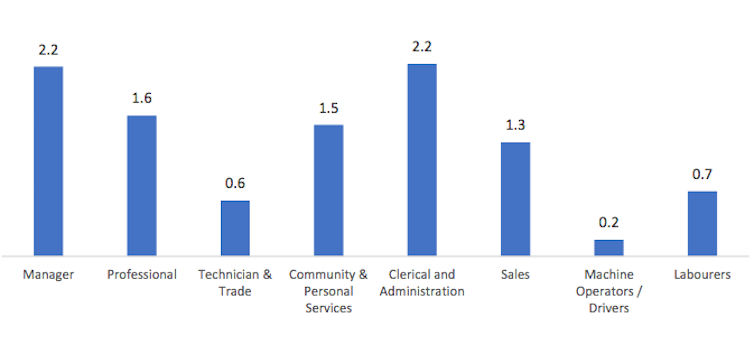
Yes, we miss the sociability of the workplace, but surveys show at least three-quarters of us want the option to spend a few days working at home and a few days in the office.
The experience of working from home has helped break down many of the prejudices that limited work flexibility prior to 2020. But there remain discernible differences in attitudes between workers and managers on this question. As Australia’s Productivity Commission notes in a September 2021 research paper:
There are actual or perceived costs to working from home, such as reduced opportunities for collaboration and networking, reduced face-to-face interaction with managers, and consequences for long-term career prospects.
That last point is of particular concern. A pre-pandemic study found fully remote workers, despite being 13% more productive, were only half as likely to be promoted as their colleagues who spent their time in the office.
The reasons for this are likely complex – a combination of explicit attitudes and subconscious biases. Their persistence spells danger for post-COVID organisations. In particular they could disadvantage those with carer responsibilities, who are more likely to want greater flexibility.
So how many days a week in the office is enough? How do we balance the desire of managers to bring people together with employee’s desire for greater flexibility?
Preferred number of days working at home, by occupation
Some organisations are adamant that going back to the office all or most of the time is essential. Take, for example, Google.
The Silicon Valley giant has won awards for its open corporate culture. Its products have facilitated as much as any company in the teleworking revolution. But in September Google said it would reduce the pay of its US employees choosing to work from home permanently.
A company spokesperson justified this on the grounds Google had always paid employees according to “the local market based on where an employee works from”. But given the company’s long antipathy to remote work it’s hard to see this as anything other than a stick to pull workers back to the office. Choosing to work from home could reportedly cost some employees up to 25% of their salary.
If this is the attitude at Google, just imagine what prevails in more conservative managerial cultures. Indeed it is largely managerial fears that have stymied the potential for greater work flexibility since technology made “teleworking” a possibility in the 1970s.
For decades concerns about innovation and productivity have been cited as reasons workers must be in the office most of the time, despite research indicating there’s no reason we need to be in the office every day to maximise the benefits of collaboration. The lived experience of the pandemic has helped mitigate these concerns, but not completely.
These attitudes are arguably associated with a “legacy” model of management – a model in which attitudes have failed to change along with the facts. Bundy clocks and other explicit forms of command and control may have been abandoned but there are still often unwritten expectations about such things as not leaving before the boss and putting in unpaid overtime being prerequisites to pay rises and promotions.
The real question
So the big question isn’t really about what’s the optimal mix of days in the office and at home. Experts agree there is no one-size-fits-all model for hybrid work. It should really depend on the context and individuals. Maybe it’s four days week in the office, maybe it’s one.
The question is why managerial attitudes are taking so long to catch up to reality.
There is now extensive research showing that employees are more effective and satisfied in their jobs when they have the flexibility to customise their work. This flexibility encompasses not just whether we work from home or the office a certain number of days, but also when we work, who we work with and what we are working on.
After a career of doing things only one way, it seems many managers simply don’t know how to manage differently.
Our organisations are not made up of one type of person and one type of job, something our management structures and organisational initiatives often ignore. Success in the post-COVID world will depend on thinking differently and creating a culture that embraces the opportunities this new model of work brings.
That’s the conversation we need to have – wherever we are.
Libby (Elizabeth) Sander has received research funding from the Australian Government.
Mary Elizabeth Shutler in Vanuatu, in the1960s. Permitted to join the first archaeological expedition to New Caledonia in 1952 as a ‘voluntary assistant’, she was the only French speaker and chief interlocuter with the Kanak people.Family archives, reproduced with the kind authorisation of John Shutler & Susan Arter.
History is the study of “present traces of the past”, as historian Judith Allen once put it. In our Pacific Matildas research project, we are recovering the hidden traces of the first female archaeologists in the Pacific.
Historians of western science have well documented the “Matilda effect”: how female scientists were written out of history, with barriers to accessing education, qualifications and professional roles.
Often, women had to practice science via alternative pathways (such as by making scientific illustrations). This rendered them invisible in the records and/or concealed by the “halo effect” – where prominent scientists (typically older, white men) were credited for the work of less recognised collaborators.
Archaeology, the discipline that uses material remains of the past to trace human history, has long been associated with the image of a solitary masculine adventurer rather than a woman with a trowel in hand. The TrowelBlazers project, for instance, seeks to remedy this by celebrating women archaeologists, palaeontologists and geologists.
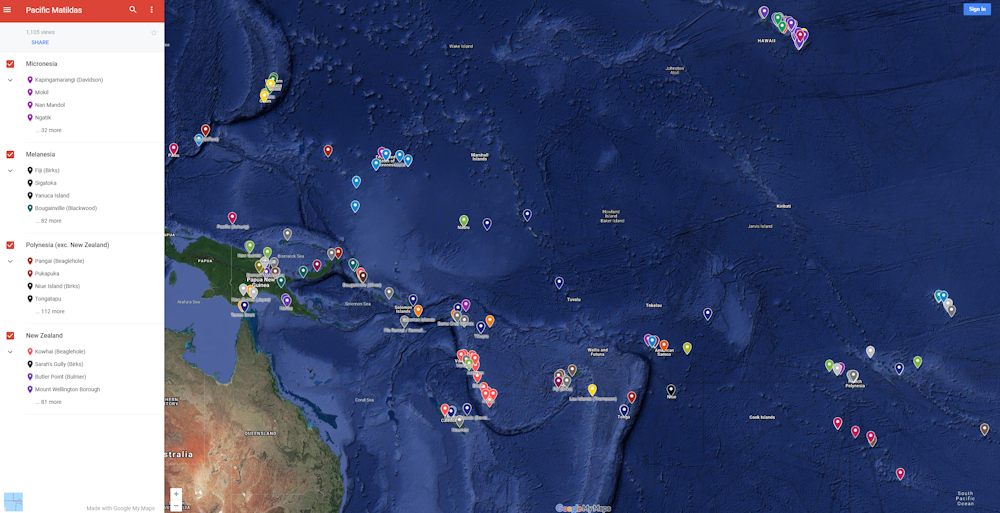
Pacific Matildas focuses on our own region, Oceania, to tell the stories of the first women in the field, to understand the barriers they faced and highlight their legacies.
The Hienghene area far to the north of Noumea. Pacific Matildas focuses on women archaeologists of Oceania. James Shrimpton/AAP
Our interactive map locates the research conducted by 50 women identified as Pacific Matildas: the first women to participate in the development of archaeology as a science.
Our timeline starts with those rare women who took part in European voyages of exploration. It ends with the exponential entry of women into professional archaeology after the 1960s.
The earliest we know of was Rose de Freycinet who accompanied her husband, Louis de Freycinet on an expedition around the world in 1817-1820.
Rose de Freycinet by Jacques Arago. Source gallica.bnf.fr / Bibliothèque nationale de France
Rose was the first woman to record her circumnavigation, writing down her observations of Indigenous groups in places such as Australia, The Mariana Islands and Hawai’i, including details on their customs and material culture. Although not directly related to archaeology (the discipline was just emerging), her writings are important as the first direct source voicing a female, western view of the Pacific.
The Pacific Matildas include lesser known researchers such as Mā’ohi expert Aurora Tetunui Natua, who collaborated with many 20th century western archaeologists in French Polynesia. They also include more recently recognised scholars, such as New Zealand’s Janet Davidson, renowned for her pioneering research across many Pacific islands and her work in NZ cultural heritage.
As well as putting the women back on the Pacific map, our bibliographic catalogue compiles some 2,000 written works produced by or through the labour of these women, so their scientific legacy can be rediscovered, analysed and referenced. Importantly, we include not just English references but some in French, German, Spanish and Tahitian.
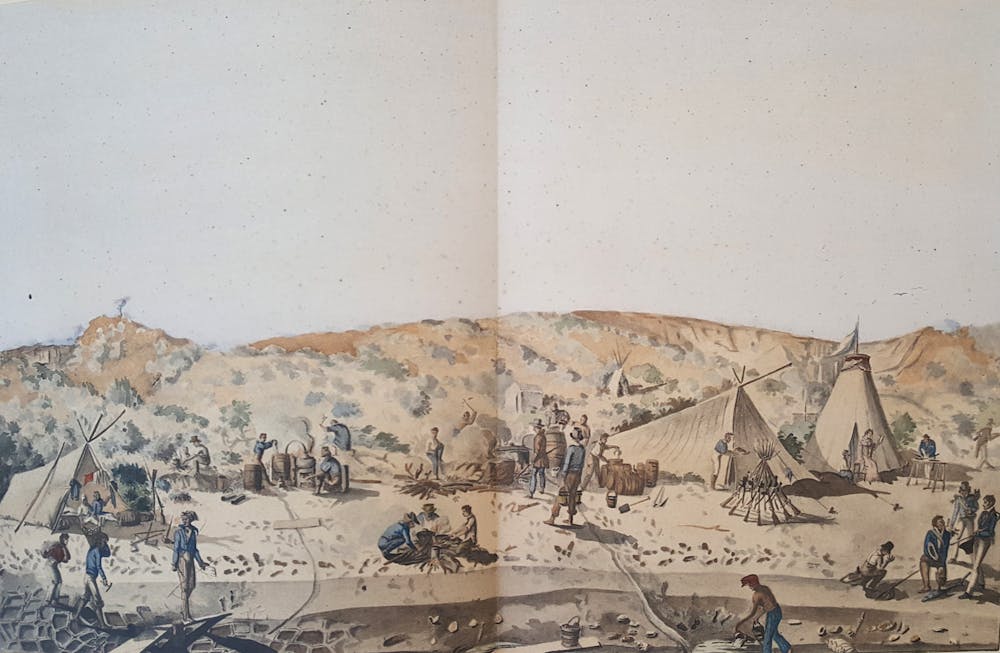
Rose de Freycinet in front of the tent to the right of the observatory, Shark Bay, Western Australia in 1819; reproductions of original watercolours painted on the Freycinet voyage by Jacques Arago and Alphonse Pellion. Wikimedia Commons
Pacific Matildas are not always listed as authors of these works. We have sometimes had to identify their contributions by reading against the grain: finding traces of their essential roles in the acknowledgements or prefaces of publications; in unpublished reports and in archival documents such as photographs, field-notes, journals and letters.
One such example is Jeanne Michel Leenhardt, an indispensable collaborator in New Caledonia to both her famous pastor-anthropologist husband Maurice Leenhardt and early archaeologist Marius Archambault.
Jeanne Michel was born in 1881 in France and well educated. Her father was an influential art historian and curator at the Louvre Museum; her mother was born and raised in Hawai’i as the daughter of the minister of foreign affairs. Jeanne Michel married Leenhardt in 1902, eager to embrace the missionary vocation.
Jeanne Michel and Maurice Leenhardt. Association des amis de Henry et Stella Corbin
During almost two decades living in New Caledonia, she took an active part in her husband’s research. She gathered ethnographical information – notably from women – discussed his ideas and edited his writings. These writings also considered the island’s prehistory in collaboration with Archambault’s work.
Back in France, she continued to work with her husband, attending scientific meetings and conferences with him. Jeanne Leenhardt is never officially mentioned as a collaborator in her husband’s writings. But historical archives, family letters and other accounts help to document her essential role.
Interestingly, women who succeeded in practicing as archaeologists or anthropologists, often did have their skills acknowledged and were well respected by their contemporary male peers. While the latter had stable professional positions, the women mostly had to navigate insecure positions, working as “assistants” or “volunteers”. Thus the legacy of their research has faded quickly compared to the men of the time.
The Pacific Matildas map is a striking reminder that all along, women were actively present in the field. But we, the younger generations of Pacific archaeologists and historians of science, have been blinded when it comes to seeing them and their contributions.
A screenshot of the Pacific Matildas map. Author provided
For instance, when studying Pacific archaeology in the 2000s (in France and Australia), we would hear about “founding fathers”. This included Edward Gifford, leader of archaeological expeditions in the 1940s and 1950s in the Pacific southwest, attached to the discovery of Lapita (first settlement) sites dating back 3,000 years; José Garanger, who started the only course in France on Pacific prehistory in the 1970s; Te Rangi Hiroa, Maori scholar of Polynesian cultural history and director of the influential Bishop Museum in Hawai’i in the 1930s, or Ralph Linton, first PhD in Pacific archaeology in 1925, at Harvard.
We learnt a lot less about the successful academic career of Mary Elizabeth Shutler, who played a critical role in the first professional archaeological expedition (led by Gifford) to New Caledonia in 1952. Born in California as Mary Elizabeth Hall, she began studying anthropology at UC Berkeley in the late 1940s. There, she met and married fellow student Richard. When he was invited to join the Gifford expedition, she was able to join as a “voluntary assistant” because she spoke French.
In fact, she was the only French-speaking team member, becoming the main interlocutor to local Kanak fieldworkers and expedition guides. She gathered oral traditions and cultural information related to archaeological sites they excavated – including, possibly, the name of the famous Lapita (Xapeta’a) site, on the west coast of New Caledonia’s Grande Terre.
Despite this, and historical sources clearly demonstrating her active role in archaeological fieldwork, the monograph for the expedition is authored by Edward Gifford and Richard Shutler.
An elaborately decorated pot found during an archaeological dig in Vanuatu, shedding light on Lapita settlement and society in the region. Colin MacGregor/AAP
Mary Elizabeth Shutler then pioneered ethno-archaeological studies of pottery in Vanuatu. She led archaeological excavations and analyses with her husband in the archipelago, while studying to obtain her PhD in 1967 and raising three children. Later, in the US, she went on to a successful academic career in a number of American universities.
Opening doors
Similarly, few would be familiar with the work of Tahiti’s Aurora Germaine Tetunui Natua, who coordinated fieldwork access for archaeological research conducted in French Polynesia between the 1950s and 1980s – including some led by “founding fathers”.
Born in Papeʻete in 1909 in a respected scholarly local family with strong links to Tahiti and Maupiti, Natua was an early local collaborator to western scientists. She spent some time in France – one of the first Pacific islanders to join the newly formed Society of Oceanists in 1945 – and became archivist-librarian then curator of the Museum of Tahiti, a position she held for more than 30 years.
Taputapuātea Marae of Raiatea, French Polynesia, a UNESCO World Heritage site. Shutterstock
Her essential collaboration in anthropological and archaeological research conducted in French Polynesia is traceable in a long trail of acknowledgements and references found in several published and unpublished works. Historical sources show she was excavating with the scientists and present in the archaeological operations from the very beginning – as negotiator, translator and supervisor of the land access.
She was there too, in the final stages of conservation and analysis of the artefacts discovered – as a recognised scholar, librarian and curator. For western researchers, she was literally a key person: opening (or closing) the doors to Polynesian archaeology.
As far as we know, the second and third PhDs ever earned in Pacific archaeology were obtained by women. One of them was Margarete Schurig. We know little about her as she tragically died soon after completing her doctoral dissertation on Pacific pottery in 1926 at the University of Leipzig.
The other was Laura Maud Thompson who completed her PhD on “Native trade in southeast New Guinea” in 1933 at UC Berkeley. Thompson was born in Hawai’i in 1905 to English and American parents. She studied anthropology on the mainland in the 1920s – among the very first women to do so.
In her memoirs, she recounted the prejudices she faced as a woman. She could not enrol in Harvard as women were not admitted. She left Radcliffe, where she was studying as a graduate, after a professor of Oceania studies requested she sit in the hall rather than the lecture room where she might “distract” the men.
The Bishop Museum, Hawai’i, where Thompson worked. Shutterstock
Despite this, she worked as assistant ethnologist at Hawaii’s Bishop Museum on archaeological collections from the Mariana Islands in the western Pacific Ocean. She undertook fieldwork in Fiji and then the Mariana, publishing her archaeological results and ethnological analyses. The rest of her long and successful career shifted towards more socio-cultural and applied anthropology, in North America and Guam, where she developed strong relationships with the CHamoru people.
Thompson’s research on Guam was based on analysis of collections and field-notes gathered by husband and wife team Hans and Gertrude Hornbostel. Born in Switzerland in 1893, Gertrude had moved with her family to Guam at the age of eleven.
Traces of ancient buildings on the island of Guam. Shutterstock
There, she learned to speak fluent CHamoru and became known as “Trudis Alemån” – a name she later published under. Gertrude met and married Hans in 1914, assisting him with his work as an anthropologist. She collected, recorded and translated CHamoru stories, songs and customs, producing illustrations of important archaeological sites and artefacts.
Many “wives” of noted archaeologists took part in archaeological excavations, data analysis, and monograph writing, sometimes only to have their contributions mentioned in the acknowledgement section.
Take the research of Douglas and Carolyn Osborne in the mid-20th century. The pair met as graduate archaeology students at the University of New Mexico, marrying in 1941. From 1954-55, they conducted some of the first systematic surveys and excavations of prehistoric sites in Palau. Carolyn is not a co-author of the seminal 1966 publication, The archaeology of the Palau Islands, an intensive survey. Instead her role and contributions are simply acknowledged by her husband. He writes:
The work of laboratory analysis and recording, including shard analysis, cataloguing, photographic developing, and negative filing was all done by my wife, Carolyn. It would not have been possible for me to do the extensive survey work that was accomplished had I not had my keen and well-trained partner with me.
What is clear is that Carolyn’s involvement was crucial to the success of the research. What is less clear is how she ended up absent as co-author of a work for which she was largely responsible.
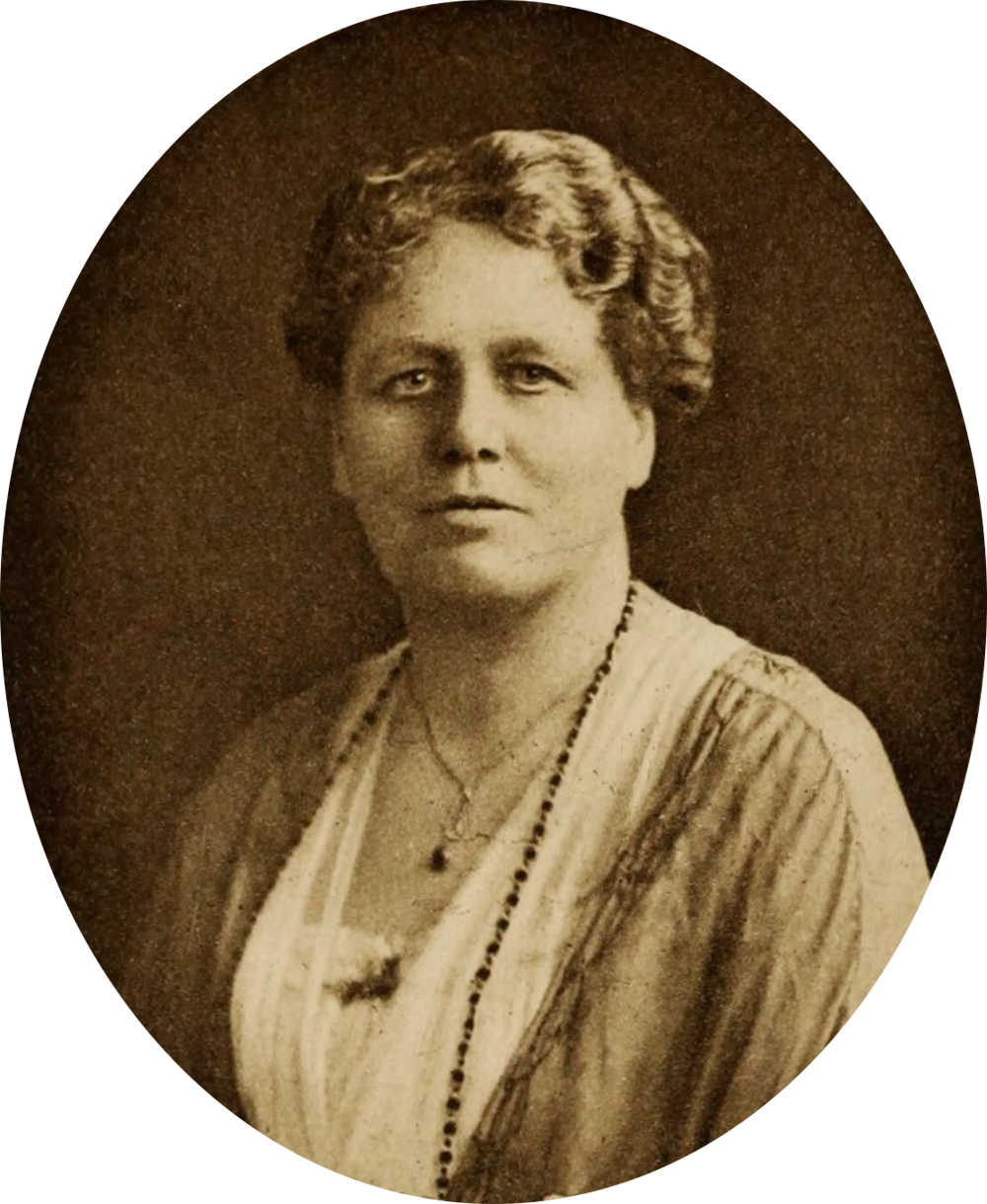
Katherine Routledge, circa 1919. Wikimedia Commons
Even the work of one of the best known, trailblazing field archaeologists, Katherine Routledge, in Rapa Nui (Easter Island) has not been properly considered in all its importance. In 1914, Routledge, a British archaeologist and anthropologist, was among the earliest to conduct planned archaeological excavations in the Pacific.
Her legacy was under-explored until archaeologist Jo Anne Van Tilburg wrote a 2003 book about her, examining her unpublished field-notes and other archives.
The intellectual context for Routledge’s expedition, the field and excavation methods applied, the complex relationships established with the Rapa Nui community and the results of her work – notably her conclusions that the large statues, mo’ai, were indeed linked to the past of the Indigenous people of the island (and not to a mysterious civilisation) – still needs to be integrated into the general narratives about the history of Pacific archaeology.
Mo’ai statues in the Rano Raraku Volcano in Easter Island, Rapa Nui National Park, Chile. Shutterstock
There are many more stories to tell about the Pacific Matildas. More often than not, these open doors to even more hidden histories – especially those of Pasifika people who played an instrumental role in the work of early archaeologists.
Historians are gathering increasing evidence that “minority” groups found ingenious alternative ways to participate in the development of science. Yet we cannot ignore the intersectionality of various factors of oppression – typically race, class, gender and complex colonial relationships – which made it harder for some people to do so.
That’s why it is important to continue fighting discrimination and supporting diversity in scientific research. One of the best tools we have is to talk loudly about the figures, such as these women, who played an instrumental role in building our scientific knowledge of the world. For too long they have remained hidden behind “founding fathers”.
The Matildas were identified as “women” mainly by their collaborators and the dominant social structures around them, which might not always correspond to their own chosen gender identity, a complex matter we acknowledge.
Emilie Dotte-Sarout receives funding from The Australian Research Council.
She is WA hub leader for the Australian-French Association for Research and Innovation (AFRAN) Incorporated Association and received a joint PhD from the Sorbonne University and the Australian National University
Dr India Ella Dilkes-Hall receives funding from the Forrest Foundation as a Prospect Fellow.
Nine months out from the 2020 election, opinion polls suggested it would be a close race between Labour and National. But that all changed with the arrival of the global pandemic.
COVID came to dominate the policy and political agenda from March 2020, ensuring Labour focused its re-election campaign firmly on its pandemic response. As Jacinda Ardern said at the campaign launch, “When people ask, is this a COVID election, my answer is yes, it is.”
The result was resounding. On October 17, Labour won an unprecedented victory, forming the first single-party majority government of the MMP era. It was the largest ever swing to an incumbent in the history of New Zealand politics.
So what does this result tell us about electoral politics in the context of a global crisis, and the role of incumbency, leadership, trust?
The voters speak
When it comes to analysing an election result, changes in party vote or seats give us an overall picture. But to understand why the electorate votes the way it does we need to consider the choices made by individuals.
The New Zealand Election Study (NZES) allows us to look at a random sample of individuals drawn from the electoral roll, and to test some of the factors we know influence voting behaviour.
The NZES has been conducted after every general election since 1990. In 2020, we surveyed 3,731 participants whose views and votes provide us with a unique insight into the complex interplay of variables that might determine an election result.
Here we highlight some of the topline numbers from our analysis of the 2020 NZES to cast light on what led to the historical election outcome 12 months ago.
COVID overshadowed all
The data reveal that 2020 was indeed a COVID election. For instance, we asked people to say what they thought was the most important issue of the election. As our word cloud below shows, COVID was clearly the most mentioned issue, and ranked above many issues traditionally seen as important during election campaigns.
No prizes for guessing which issue dominated the 2020 election, but the government cannot ignore others. NZES 2020, Author provided
Moreover, the public overwhelmingly supported the government’s response to COVID, with 84% of people approving or strongly approving, while only 6% disapproved.
Of those who approved or strongly approved of the response, 57% reported casting a vote for Labour (9% voted Green, 3% New Zealand First and 1% Māori Party), while only 19% voted for National.
The majority (50%) of people who disapproved of the government’s COVID response voted for National, and a further 19% for ACT, while only 8% voted for Labour.
Strategic anti-Green voting unlikely
National’s loss and Labour’s win sparked a number of speculative explanations. For example, Labour’s gains in provincial electorates were claimed to be a result of strategic voting by farmers anxious about Green Party policies and water reform.
Federated Farmers Mid-Canterbury president David Clark argued that “plenty of farmers have voted Labour so they can govern alone rather than having a Labour-Greens government”.
But our analysis of the NZES data reveals only a small change in the farming vote between parties. A majority (57%) of those in farming occupations voted for National and 21% voted for Labour. These numbers contrast with 2017 when National received 67% of the farming vote and Labour just 8%.
On the other hand, ACT’s share of the farming vote increased from 2% to 16%, while the NZ First vote collapsed from 13% to less than 1%.
While these observations are based on a very small sample size of farmers, and should be interpreted with caution, our findings indicate the combined National-ACT vote was relatively unchanged – making the anti-Green argument a little far-fetched.
The Ardern factor
Looking at the responses of all voters in our study, we find that of those who switched from National in 2017 to Labour in 2020, 46% placed themselves at the centre of the political spectrum, compared with 25% of voters who voted for National in both the last two elections.
This suggests these centre voters may have always been open to switching from National to Labour, casting further doubt on the strategic voting claim.
The popularity of Jacinda Ardern – and the lack of popularity of Judith Collins – is also highly likely to have contributed to Labour’s success. Of our NZES respondents, 65% said they most wanted Ardern to be prime minister on election day, compared to only 17% supporting Collins (no one else received over 2% support).
When asked to rate leaders from 0 (strongly dislike) to 10 (strongly like), 33% of people gave Ardern 10, and 69% gave her a 7 or above. In contrast, only 22% of people gave Collins a 7 or above, and 23% gave her 0.
Likability plus trust equals victory: the majority of voters approved of the Ardern government’s COVID response. AAP
Labour’s new voters
We found, unsurprisingly, that likeability and trust are highly correlated, but we also found trust in Ardern as leader was statistically significant in explaining the shift to Labour, even after controlling for how much people liked or disliked her, their prior vote, and their left-right positions.
This supports assessments from around the world that decisive and rapid responses to COVID-19, combined with clear communication, can lead to increased trust in political leaders.
We also know Labour won nearly half a million new voters compared to 2017. Where did this support come from? Around 16% of 2020 Labour voters reported voting for National in 2020, while 13% stated they did not vote in the previous election.
Of the new Labour voters, the majority (55.5%) were women and just over half (51%) were under the age of 40, with 33% Millennials and 18% Gen Z. When asked which party best represented their views, 58% chose Labour and just 11% chose National.
However, when asked if there was a party they usually felt close to, only 29% reported feeling close to Labour, while 53% did not feel close to any party.
Non-COVID concerns a warning
Our NZES data clearly show the 2020 New Zealand general election can indeed be thought of as a COVID election. Support for the government’s rapid public health and economic policy responses, and the popularity of Ardern, go a long way to explaining the outcome.
However, as the word cloud suggests, there are a number of policy issues that remain of concern to voters, including housing, health and the economy. These were issues that featured in 2017 and may continue to matter through to the 2023 election.
Our preliminary analysis, then, is a reminder that Labour cannot take its new voters for granted.
Josh Van Veen is affiliated with Progress New Zealand Incorporated, a non-partisan group established to promote democratic citizenship. He is a former member of New Zealand First and worked as a researcher for the party from 2011 to 2013.
Jack Vowles is a PI on the 2020 New Zealand Election Study which received funding from Victoria University of Wellington, the New Zealand Electoral Commission, the University of Auckland and the University of Otago.
Jennifer Curtin is a PI on the 2020 New Zealand Election Study which received funding from the New Zealand Electoral Commission, University of Otago, Victoria University of Wellington and the University of Auckland.
Lara Greaves is a PI on the 2020 New Zealand Election Study which received funding from the New Zealand Electoral Commission, Victoria University of Wellington, Otago University, and the University of Auckland.
Sam Crawley does not work for, consult, own shares in or receive funding from any company or organisation that would benefit from this article, and has disclosed no relevant affiliations beyond their academic appointment.
Anthony Albanese has diminished his own, and Labor’s, credibility on integrity issues by declining to act immediately against MP Anthony Byrne, who this week admitted to participating extensively in branch stacking.
Byrne’s evidence to Victoria’s Independent Broad-based Anti-Corruption Commission was horrifying for anyone concerned with how our democracy works. The issues raised go far beyond the particular circumstances.
The IBAC investigation into branch stacking in Victorian Labor was triggered by Nine’s 2020 revelations about the activities of Adem Somyurek, at the time a factional power broker in a subgroup of the right and a minister in the Andrews government.
The average person might ask, what is “branch stacking” anyway? Isn’t it just one of those dark arts practised in all parties? Does it amount to much to be worried about?
“Branch stacking” comes in more than one variety.
For example, a political aspirant wanting to win a preselection ballot might go on a recruiting drive to sign up friends and supporters to join his or her party.
This is reasonable enough, provided the people pay their own memberships, understand what they are joining, and party rules specify a set time before they can vote (to stop a last-minute stack).
Some fringe religious groups organise “stacks”, which are more concerning, because of the potential influence on preselections and, indirectly, policy. Parties need to watch this, with rules about mass entries, although if the new members meet the proper requirements, little more can be done about it.
The branch stacking in which Byrne engaged is the corrupt industrial-scale activity for which the Victorian ALP has been notorious over decades. It amounts to a chronic disease.
Byrne and others paid the membership fees of people (“stackees” are mostly from ethnic communities) who were just numbers for Somyurek and the faction, doing what they were told (or being chased up if they didn’t).
Byrne admitted he even agreed to employ a couple of staff who just undertook factional work, and indeed didn’t turn up in the office at all (despite being paid by the taxpayer).
There are deeply disturbing consequences of having a party “stacked” with what are, in essence, phoney members who hand over their party ballot papers to factional chiefs or blindly mark them as ordered.
It’s a means by which corrupt factional chiefs can control who gets elected to the party’s conferences and committees, and who gets preselection. The factional heavies can also potentially exercise malevolent power over MPs.
Byrne was aware of what was good, or potentially bad, for his political career. He went along with the staff arrangement because to do otherwise “would not have been healthy for my long-term future”, he said.
More broadly, the branch-stacking issue goes indirectly to how Labor chooses leaders.
The ALP rank and file have a 50% say in the election of the federal leader. But given that relatively few people (and many of them zealots) want to join political parties and the perennial difficulty of preventing branch stacking, the wisdom of according party members this degree of power – in the name of “democracy” – may be questionable.
Factions have become endemic in modern parties. Their presence is not all bad. Indeed, they can sometimes be useful for getting positive things done (as they were during the Hawke government).
But they have become too stifling, even when their wranglers are perfectly respectable. They narrow the gene pool of parliamentary candidates, leading to former political staffers and the like being over-represented in parliament, and the tight control they exercise puts off many people who’d make good MPs.
When faction chiefs are corrupt, with their power built on corrupt practices and the ability to press MPs, by implied threats, into participating in such activities as branch stacking, the parliamentary system is debased.
The position of Byrne, who has been in federal parliament since 1999, is complicated, given he’s admitted to misbehaviour but also called it out publicly.
Byrne has never been a high flyer but has won respect, including from the Liberals, for his measured role on the parliamentary committee on intelligence and security. On Thursday he resigned from that committee, of which he was deputy chair.
Within the factional play in Victorian Labor, he was hand-in-glove with Somyurek for many years – even if, as he indicated, he felt uncomfortable and somewhat compromised – until they fell out in recent times and he turned whistle blower.
Footage shot in his office led to the expose by Nine. After Byrne’s IBAC evidence this week Commissioner Robert Redlich commended him for the assistance he’d given the commission.
Byrne had, Redlich said, provided a great deal of evidence “against your interests. You have acknowledged wrongdoing, you have acknowledged breaches of a range of party rules.”
As whistle blower, it might be argued Byrne should not pay a penalty. But allowing that latitude would send the wrong message – to the Labor Party, MPs and the public. The correct message is that a member of parliament, and anyone who aspires to parliament, should stand up to corrupt pressures from the get-go.
Albanese is campaigning relentlessly against the government on a range of integrity issues. He’s attacked Liberal branch stacking. For him not to act decisively against Byrne smacks of double standards and a failure of leadership.
He has played for time in the Byrne affair, although he has shortened the time frame. Initially he said he wouldn’t pre-empt the IBAC processes. On Thursday he said “we’ll wait while the hearings are going on”.
Albanese has also pointed to what he did when the Somyurek scandal broke into public view. After the initial revelations, he (and Premier Dan Andrews) secured federal intervention in the Victorian ALP. Administrators are still in place and federal candidates – including Byrne – have been endorsed under this arrangement.
But Albanese’s arguments don’t cut it as a defence for his reluctance to act immediately on Byrne.
It’s no good his saying he has moved against corruption in Victoria if the subsequent, presumably clean, process has re-endorsed an MP with Byrne’s self-admitted record of misbehaviour.
It’s also unacceptable – and politically counterproductive – for Albanese to delay his judgment on Byrne. The MP’s confessions were cut and dried.
After this week’s evidence Albanese should have had Byrne’s endorsement for the 2022 election withdrawn. Indeed, he should have gone further and insisted he go to the crossbench.
The signals suggest Byrne will at some stage declare he won’t run for another term. He said in evidence he’d previously thought of retiring last time round but was prevailed on to stay.
If Byrne announces his retirement, or Albanese finally takes some stand, it will be too late for the Labor leader to claim moral authority. Time will have watered down the message.
Michelle Grattan does not work for, consult, own shares in or receive funding from any company or organisation that would benefit from this article, and has disclosed no relevant affiliations beyond their academic appointment.
Source: The Conversation (Au and NZ) – By Jamie Triccas, Professor of Medical Microbiology, School of Medical Sciences, Faculty of Medicine and Health, University of Sydney
Last Monday, Sydney emerged from a lockdown of more than 100 days after reaching the milestone of having 70% of the over-16 population fully vaccinated.
On September 21, peak COVID hospital occupancy for all of NSW was 1,268 patients. There are currently 711 COVID patients hospitalised in NSW, as of October 14.
We propose there are two main factors which might account for these discrepancies.
Vaccine effectiveness underestimated
Firstly, predictions of vaccine impact have typically used estimates of effectiveness against the Delta variant based on the UK Scientific Advisory Group for Emergencies (SAGE) roadmap, published in June. This suggested an effectiveness against hospitalisation of 87% for Pfizer and 86% for AstraZeneca.
However, more recent data across numerous countries has shown effectiveness against severe infection and hospitalisation is somewhat greater. A different UK study suggested 95% protection against hospitalisation for both Pfizer and AstraZeneca. And a study from the Netherlands found 96% and 94% protection against hospitalisation for Pfizer and AstraZeneca, respectively.
This difference may account for the disparity between the actual NSW hospitalisation numbers and those predicted based on the current vaccine rollout.
Real-time protection
The second reason for the current NSW situation could be a concept we’ve termed “protection in real-time”.
The rapid pace of vaccine uptake during NSW’s Delta wave ensured there was a large proportion of recent vaccines within the population.
This may offset the impact of waning vaccine immunity.
Optimal immunity after vaccination occurs at about two weeks after getting the second dose. But a partial protective effect of vaccination with Pfizer was apparent in clinical trials as early as 12 days after the first dose.
The protection in real-time concept can be used to explain the impact of vaccination in other countries, which may provide a “real world” perspective of the future of the pandemic in Australia.
Denmark reached 25% vaccination of the total population before the arrival of the Delta variant. During the Delta wave there were reduced hospitalisations and deaths compared to previous waves and a dissociation between case numbers and deaths.
You can see the black line (cases) starts to separate from the green line (hospitalisations) and the red line (deaths) as the vaccine rollout progresses. Data from ourworldindata.org/covid-vaccinations and covidlive.com.au, Author provided
NSW’s achievement of reaching the 70% threshold last week actually equates to around 56% of the total population of NSW. At the peak of its Delta wave in July, Denmark reached 50% vaccination coverage of the entire population.
The restrictions in place at this time in Denmark were requiring proof of vaccination, past infection or a recent negative COVID test to enter certain indoor settings, such as restaurants and cinemas.
With a population size similar to greater Sydney, the coming months in Denmark may serve as an important comparison as to how the pandemic may unfold in Australia.
Similarly in Singapore, vaccination rates are high, at around 80% of the total population, and the pace of the vaccine rollout is very similar to Denmark.
Singapore has seen a recent spike in cases since the relaxation of restrictions, with case numbers at their highest. However, 98% of these cases are mild or asymptomatic. This suggests vaccines are having a major impact on lessening the severity of COVID, but a less pronounced ability to completely interrupt disease transmission.
Another example of the impact of real-time protection is the situation in Israel. Israel is often used as as the benchmark of vaccine effectiveness. Its vaccine program involved a rapid rollout of mRNA vaccines, predominately Pfizer’s. Initial studies in the country found the vaccine had high effectiveness against symptomatic COVID-19 and hospitalisation.
However, the arrival of Delta in Israel resulted in a large increase in COVID-19 cases with accompanying spikes in hospitalisations and deaths.
While this may provide some insight into the impact of Delta in Australia, there are key differences.
Israel experienced a large increase in COVID cases, hospitalisations and deaths after the arrival of the Delta variant. Data from ourworldindata.org/covid-vaccinations and covidlive.com.au, Author provided
Why did hospitalisations rise in Israel? And what are the lessons for Australia?
Israel saw a large proportion of the eligible population vaccinated quickly. Around 50% of the total population was fully vaccinated by mid-March. But after this, there was a marked slow-down in uptake.
The NSW and Australian populations have been vaccinated much more recently than Israel’s. Data from ourworldindata.org/covid-vaccinations and covidlive.com.au, Author provided
Thus, a combination of waning immunity and a large unvaccinated population may have exposed Israel to Delta.
While the Pfizer vaccine demonstrates excellent effectiveness against severe COVID-19, recent evidence from Israel suggests some waning of protection against severe disease over time, which prompted the introduction of the country’s booster program in July. A third dose was initially offered to over-60s, before being extended to everyone aged 12 and over.
In Australia, the widespread rollout of booster shots in the near future would be premature. The priority now is to get everyone eligible fully vaccinated, and consider boosters for targeted groups.
Now is as good a time as any to evaluate and reflect on the public health policy choices made in the period from February to April 2020, re the Covid19 pandemic. Here I have postulated a ‘league’ of 12 economically advanced countries which have made different choices which loosely fit onto a spectrum.
The choices made reflect a full spectrum from ‘herd immunity’ to pushing for ‘elimination’. The immediate context, in making those choices in February 2020, was twofold:
memories of recent influenzas outbreaks (2009 Swine Flu, and the more recent Avian Flu outbreaks), combined with a recent centenary of the 1917-19 influenza pandemic
experience of twenty-first century coronavirus epidemics; MERS and, especially, SARS in 2003
One big surprise is that western governments were most conscious of the need to prepare for influenza, while, despite the recent and highly lethal coronavirus outbreaks, only a few Asian governments had the coronavirus scenario at the forefront of their pre-pandemic preparedness.
At the two extreme ends of the spectrum of responses were Sweden and New Zealand; and, in 2020, the world noticed. Both responses were led by public health professionals – the bureaucrats of Sweden and the technocrats of New Zealand. In both countries there were dissenting views; views which were denied media ‘oxygen’ as the each dominant response narrative emerged. Sweden made its choice in late February 2020. New Zealand, which seemed initially to be going for the middle of the spectrum, was panicked into making its extreme and opposite ‘fortress’ choice, in the third week of March 2020. For both countries, the choices were made from an abundance of ignorance; especially a somewhat wilful ignorance about coronaviruses.
The United Kingdom, dealing with Brexit, initially made the Swedish choice, but ‘switched horses’ towards the New Zealand choice. However, the Johnson-led United Kingdom government was never able to erect a fortress, and was never as ideologically inclined towards fortress solutions as was a New Zealand government that was already feeling its way into an immigration policy based on labour-market nationalism. (We may note this week’s UK commission report, which also was an implicit critique of Sweden’s choice; refer to this story on RNZ on 13 October.)
So, the United Kingdom ended up with a policy hotch-potch; as did the United States under the circumstances of jealously-held federalism, and a nationalist exceptionalism that was driving the Trump administration. Denmark held to a much more coherent position (than UK or USA) on the centre of the spectrum; so did South Korea, with its prior advantage of coronavirus awareness and its early Covid19 outbreak. Japan took a position towards the Sweden end of the covid response spectrum. Australia and Germany, both federal countries, were able to take positions closer to New Zealand’s than was the United States. Of the Scandinavian countries, Finland’s response was closest to New Zealand’s. Israel took a position similar to United Kingdom, knowing that its traditions were not conducive to people being asked to take a ‘voluntary physical distancing’ approach. (Sweden and Japan were culturally much better suited to such ‘voluntarism’.)
Ireland took a coherent position between New Zealand and United Kingdom. Ireland had to respond quickly; it caught covid very early, in February 2020, and had worrying numbers of covid deaths by the end of March 2020.
Sweden versus New Zealand: the Trade-Offs
A (human) pandemic represents a relationship between a pathogen and a human host population. In essence Sweden’s approach, in March 2020, fully emphasised host immunity (ie it emphasised people over pathogen; people living with this a new virus that would soon become like viruses already in circulation); whereas New Zealand’s approach emphasised forward defence, keeping the pathogen out.
This passage from The coronavirus is here to stay (Nature, 16 Feb 2021) summarises Sweden’s position: “Flu pandemics occur when populations are naive [my emphasis] to a virus; by the time a pandemic virus becomes seasonal, much of the population has some immunity to it. … Jesse Bloom, an evolutionary biologist at the Fred Hutchinson Cancer Research Center in Seattle, thinks the coronavirus might follow a similar path.”
So Sweden opted to take an early hit; and to try to recover, stronger for the experience. New Zealand did the opposite, to shut out the pathogen indefinitely, knowing that host weakness (‘naivety’) would result, in the hope that the pathogen would disappear – as SARS and MERS appear to have disappeared – and in the hope that host strength could be restored by a yet-to-be-developed vaccine. New Zealand’s approach was critically dependent on a quick global elimination of the pathogen, or of a comparatively quick and comprehensive vaccine solution; New Zealand’s approach was clearly a gamble, and not the ‘cautious’ approach presented by the government.
With today’s hindsight, both Sweden’s and New Zealand’s approaches have been proved valid, and in the wider context of economic cost. Sweden made some bad mistakes early on, however, in its failure to adopt a Covid19 testing programme (until far too late) and in its failure to protect its elderly population.
New Zealand’s ‘public health solution as the best economic solution’ held until mid-2021, and by then effective mass-produced vaccinations were fully available. Sweden had a bad year in 2020, and was hit again as the alpha strain of covid spread through Europe a year after the spread of the original Wuhan strain. Nevertheless, Sweden seems to have had all its bad news in its first 12 months, with considerable host immunity present as the alpha-strain swept through Europe early this year; further, excess deaths in Sweden so far in the pandemic are close to zero (New Zealand’s excess deaths at present are negative). Sweden has had its pain, and New Zealand has had its gain. The future, however, points to gain to Sweden and pain to New Zealand. (An unfinished game of two halves; Sweden played into the wind in the first half.)
Japan’s position in October 2021 now looks much like Sweden’s, with both host immunity and a degree of voluntary physical distancing playing roles. In Japan’s case, the host immunity appears to have derived from ongoing exposure to seasonal endemic viruses, and not so much to Covid19 itself. In 2020, Japan largely eschewed lockdowns and facemask mandates.
In the meantime, the mish-mash countries (especially UK and USA) had a tough time, and have no ongoing surety that their tough times are over. Of the countries in the middle of the spectrum, Denmark and Ireland are now the poster-children for success. (We don’t dare mention yet, in polite circles, the successes of Sweden or Japan.) Of the other countries mentioned here, as well as New Zealand, only Australia – and possibly Finland and Ireland – have naïve populations; Australia’s naivety is least in Sydney, and (thanks to record-long lockdowns) greatest in Melbourne. Viral naivety results from lockdowns, facemasks, and enforced distancing of young people. And induced-naivety to one covid-like or flu-like pathogen means, to a large extent, acquired naivety to all such pathogens.
Vaccination
The big questions, relating to this pandemic, for the remainder of the 2020s are whether vaccination-acquired immunity is sufficient to remove viral naivety, how frequently immunity to coronaviruses and influenzas needs to be boosted, and how effective global supply chains will be at sustaining global mass-vaccination programmes.
It is pertinent to review vaccination percentages to date, for the ‘premier league’ countries mentioned here. The numbers provided give half-weight to people with partial vaccination.
Covid19 Vaccination Rates* of Selected Countries
1-Jun-21
15-Jul-21
30-Aug-21
12-Oct-21
Denmark
30.0
55.0
73.8
76.5
Ireland
31.0
51.0
71.2
75.5
Japan
7.0
28.5
51.5
70.5
Finland
27.0
45.5
62.0
69.9
South Korea
8.4
21.5
43.5
69.5
UK
48.0
60.0
66.9
69.0
Sweden
26.5
49.0
62.0
68.2
Israel
60.8
62.0
64.8
67.9
Germany
31.5
52.0
62.4
66.6
New Zealand
7.0
14.9
35.0
61.0
Australia
8.5
18.5
37.5
60.5
USA
44.9
51.7
56.6
60.4
* Half-weighting applied to people with single dose
The current leaders are Denmark and Ireland. Japan and South Korea are among the best of the rest, having been – like New Zealand and Australia – very slow to get started. The initial vaccination leaders, Israel and United Kingdom, have stalled somewhat, as has Germany. The United States has also stalled, now overtaken by the vaccination laggards, New Zealand and Australia.
Evaluation of Strategies
The logic of Sweden’s strategy was to emphasise natural immunity, especially among the non-vulnerable population. While having a shocking year in 2020, Sweden looks very well-placed to have a very good year in 2022; I am not aware that problems relating to long-covid are worse in Sweden than elsewhere, though I stand to be corrected. Sweden has been ‘middle-of-the-league’ on vaccination, treating it as a complement to its wider immunisation strategy, rather than as the strategy’s central focus. Sweden’s headline statistics are stable at present, at 400 weekly cases per million people [and 20 deaths] (equivalent to 290 daily cases in New Zealand [and 10 weekly deaths]).
The best-performing mid-spectrum countries have been Denmark and Ireland. Denmark has taken a coherent position in the centre of the spectrum. It is now open, and has a well-immunised population, though with greater reliance than Sweden on vaccination. Denmark’s ‘delta outbreak’ has been significantly more severe than Sweden’s, and seemed to be largely over until last week. Denmark’s cases increased 36% over the last seven days, and, per capita, are nearly double Sweden’s. Finland, this month, is on a par with Denmark.
Ireland is also seeing a small resurgence at present. It’s currently five times worse than Sweden, and three times worse than Denmark.
At the New Zealand end of the covid policy spectrum, the logic was an extreme reliance on vaccinations in the likely event that global elimination did not occur. There was a process of cognitive dissonance however, in that, despite New Zealand’s obvious strategic dependence on vaccinations, New Zealand’s political leaders had thought that New Zealand could afford to be a vaccination laggard. Like Australia, New Zealand is still near the bottom of the league vaccination table; both Australasian countries have only just overtaken that other recent laggard, the United States. (While not in the ‘premier league’ that I have constructed, Canada was an early vaccination leader, and its latest statistics fall just below Ireland’s.)
An interesting ‘local derby’ match is that of Japan versus South Korea. Both countries were slow starters with vaccination. Japan is much closer to the Sweden end of the covid policy spectrum, whereas South Korea is closer to Ireland or Denmark. Currently, South Korea’s case-incidence of Covid19 is five times that of Japan.
The country, of those considered here, that is currently worst for reported cases is the United Kingdom, with USA being easily the worst for deaths. Israel falls just short of USA for cases, and just short of United Kingdom for deaths.
So far, New Zealand is still clearly winning in the headline statistics’ – still the best of these countries on reported cases, recorded deaths; and, for that matter, on excess deaths.
The Sweden versus New Zealand match
But, let’s just consider – within the ‘covid stakes’ – the match contest between New Zealand and Sweden. We may treat it as a rugby test match (excuse the switch of metaphor from football to rugby) in a Wellington southerly storm. Sweden chose to play into the wind in the first half, and dropped the ball many times; New Zealand preferred to play with the wind in the first half, and got plenty of points on the board. So, the half-time score clearly favours New Zealand. It turns out, however, that New Zealand did not bother preparing for a second-half into the southerly; rather, New Zealand simply hoped that the wind would abate before half time. And Sweden’s first-half experience made the Swedish ‘team of 10 million’ more resilient. Now, in the second-half, with the southerly even stronger than it was at kick-off time, New Zealand is going into this phase of the match substantially and wilfully underprepared. We have no idea who will be the winner at fulltime (eg mid-2022); but if the fulltime result is a draw, then Sweden will almost certainly defeat New Zealand in extra-time.
Conclusion
New Zealand is currently leading the covid league tables, in terms of ‘points on the board’. And, despite missing a number of tackles early in the second-half, its half-time lead over Sweden is holding for now. But New Zealand is vulnerable, and underprepared; the match could easily turn out like France versus New Zealand in the 1999 Rugby World Cup. Sweden, after a torrid time, may now be ‘out of the woods’ and getting points on the board.
Of the other countries in the covid premier league, only Japan looks to be ‘out of the covid woods’. If New Zealand loses to Sweden, it may not have the resilience to avoid a steady decline towards the bottom of the league table. Even if New Zealand eventually defeats Sweden on its headline covid statistics, it may prove to be a Pyrrhic victory. New Zealand will not be the covid league champion that New Zealanders thought it could be.
It is possible that Sweden will win my Covid Premier League, with Japan as runner up. That’s not how a betting person would have seen it in January this year.
Keith Rankin (keith at rankin dot nz), trained as an economic historian, is a retired lecturer in Economics and Statistics. He lives in Auckland, New Zealand.
Source: The Conversation (Au and NZ) – By Jinhyun Cho, Senior Lecturer in Translation and Interpreting at Macquarie University, Macquarie University
Netflix
There is no question that Squid Game has become a global sensation. Since its release, the nine-episode survival drama has topped Netflix’s charts in 90 countries and is poised to become the most-watched show in Netflix history.
As someone who specialises in English-Korean translation and interpreting, I believe the ongoing debates on the English subtitles of Squid Game are missing some important elements.
Not many people know the difference between translation and interpreting. To put it simply, translation refers to rendering of written texts from one language into another, whereas interpreting refers to spoken language.
Subtitling falls between translation and interpreting, because a subtitler listens to spoken language just as an interpreter does, and translates the oral language into written form for viewers.
Subtitling requires not only bilingual competence but specific skills essential to deliver messages within a limited space on screens. Think about the famous quote by the Oscar-winning director of Parasite, Bong Joon-Ho:
Once you overcome the one-inch-tall barrier of subtitles, you will be introduced to so many more amazing films.
It is a subtitler’s job to find ways to condense messages into the one-inch-tall slots, no matter how long or complicated the original dialogues are. As you can imagine, subtitling is not easy.
Subtitling becomes even more complicated when cultural factors come into play, because many culture-specific words and concepts are difficult to translate.
“The untranslatable” exists in all cultures, and in the case of the Korean language, words such as aegyo sometimes described as “performed extreme femininity”, han likened by some to “a mix of sorrow and sadness accumulated from a series of life experiences” and jeong described sometimes as “deep connection and emotional bond that builds over time”, are some of the most well-known concepts that have no direct equivalent in another language. In literature translation, there are ways to deal with the untranslatable through footnotes or annotations, for example.
These strategies, however, do not work for subtitling due to the space constraints, so managing culture-specific elements is perhaps the most challenging aspect of subtitling.
The Untranslatable in Squid Game
Comparing the Korean language with the English subtitle translation of Squid Game, occasional minor omissions and distortions are apparent — but the overall quality of the translation is, in my opinion, fine.
Most of the controversies seem to centre around the English closed captions, which are very different from the English subtitles on Netflix. The English captions which appear as “English [CC]” are for people who cannot hear audio, so they include non-verbal descriptions such as the background music and sound effects. Translations in closed captions are, therefore, more concise than subtitles and are limited in terms of meaning delivery.
Despite the good quality of the English translation, a meaning gap inevitably exists between the original Korean and the English subtitles due to the untranslatable.
Perhaps the most significant aspect of the untranslatable in Squid Game relates to “호칭” or “honorifics” which Korean people use to refer to each other in conversation.
An age-based hierarchy is a key characteristic of Korean society, and people do not call each other by name unless they are friends of the same age. One of the most common honorifics is “형 (hyung)” or “older brother”, a title a younger brother uses to talk or refer to his older brother. This expression is often also used by non-family members who are close to each other to indicate the degree of mutual friendship.
An age-based hierarchy is a key characteristic of Korean society, and people do not call each other by name unless they are friends of the same age. Netflix
If you have watched the drama, you might recall Ali, the Pakistani labourer, who came to South Korea to earn money. Ali got to know another participant, Sang Woo, a graduate of Korea’s top university, who embezzled a huge amount of money at work and was determined to win the game to get rid of the debt.
As they became close to each other, Sang Woo suggested that Ali call him hyung, instead of “사장님 (sajang-nim)” or “Mr Company President”, one of the first terms that foreign labourers in South Korea pick as a result of spending most of their time at work under often exploitative bosses.
The moment that Sang Woo became Ali’s hyung is one of the most humanistic moments in the gory drama. The poignancy of the moment, however, could not be fully delivered due to the absence of an equivalent English form. In the English subtitle, the line “Call me hyung” was translated as “Call me Sang Woo”.
When Sang Woo later betrays Ali in the game of marbles, the kinds of emotions experienced by viewers who are able to understand the degree of intimacy attached to hyung compared with those unable to do so may, therefore, be very different.
Scenes like this show, in a powerfully raw form, the cruelty and selfishness of human beings in real life, albeit in a different kind of “game”.
There are other untranslatable honorifics, such as “오빠 (oppa)”, which was translated as “baby”, and “영감님 (yeonggam-nim)”, which was translated as “sir”. Close, but not quite the same.
The deeper context of Ali’s betrayal by Sang Woo is lost in translation. Netflix
Understanding the honorifics in Squid Game is important to fully capture the bitter aspects of human relationships.
Considering the untranslatable, the recent addition of 26 Korean words to the Oxford English Dictionary is a welcome move. Interestingly, some of these newly added words include common honorifics such as noona, oppa and unni, and I hope that this paves way for the inclusion of more Korean words in the future.
While translation and interpreting serve as an important cultural and linguistic bridge, the gap left by the untranslatable can only be filled by genuine understanding of the other culture and language.
Building on Director Bong’s message, once you overcome the gap left by the untranslatable, you will be introduced to so many more amazing films.
Jinhyun Cho no recibe salario, ni ejerce labores de consultoría, ni posee acciones, ni recibe financiación de ninguna compañía u organización que pueda obtener beneficio de este artículo, y ha declarado carecer de vínculos relevantes más allá del cargo académico citado.
Does it feel lately like your parcels are taking forever to arrive? You might have seen online retailers warning customers to expect delays, thanks to COVID-related pressures on the postal system and other delivery services.
We are 18 months into the pandemic and, far from being solved, the cracks in the global logistics system are multiplying. E-commerce is booming but despite rerouting deliveries and staff working extra shifts, delays are becoming the norm.
So what’s happening, and will all your purchases make it in time for Christmas?
Manufacturing troubles
A lot of what we buy these days is made overseas. Many products get to us after a long international journey, which has been made even more complicated by COVID-19.
The first crack in the system is at the manufacturing level.
While international commerce rebounded quickly after the initial shocks caused by COVID-19, repositioning containers and ships take time. Also, there just aren’t enough of either.
Storage services have also been profoundly affected by COVID-19.
Retailers have to adapt from working with large stores in bricks-and-mortar retail stores to sending parcels to individual consumers from the online channel.
It is a new mindset. The equipment is different, the flow is affected, processes must be redesigned, and complexity increases.
If COVID-19 finds its way into a retailer’s facilities, doors must be closed for hours for deep cleaning. Sick employees and close contacts go into quarantine, removing entire shifts from the operation. Mandatory vaccination rules are updated constantly.
The last mile is suffering
Delivery services represent the crucial “last mile” to get the product to the buyer.
But since the pandemic struck, truck drivers have been scarce and must contend with new delivery protocols, COVID-19 tests every few days, movement restrictions, long hours and soaring fuel prices.
So if your package is late or you can’t find a product, don’t just blame Australia Post or your favourite retailer. The delay may be caused by problems much further up the supply chain.
Supply chains are used to find solutions to problems. What’s new is these problems are now happening everywhere, at the same time, and staying for longer than expected.
So if your package is late or you can’t find a product, don’t just blame Australia Post or your favourite retailer. Shutterstock
What does it mean for me? And for Christmas?
If you live in Australia, know that you are not a priority: international shipping to Australia was reduced in the past few months. That said, there should be no shortage of essential items. If you can’t instantly find exactly what you want, be patient or experiment with a different brand.
As for Christmas, don’t expect to buy online in early December and have your parcel delivered by the 25th. There is only so much Australia Post or any other delivery company can do.
There’s only so much Australia Post can do. Shutterstock
Don’t expect all your favourite groceries to be fully stocked on Christmas Eve. Be ready to replace your glazed Christmas ham with crayfish if you visit the supermarket too late, as abattoirs are again hit by restrictions.
Don’t expect to pay the same as last year. Higher lead times, inventory and fuel prices are driving up supply chain costs. UK supermarket prices are set to rise 5%, and Australia shouldn’t be much different.
Relief will come to global logistics after Christmas but things should go back on track only by 2024. It will take a while to get most of the world vaccinated, go around energy shortages, rebalance international routes and adapt to the explosion of e-commerce.
The new normal is on its way. Just don’t expect it for Christmas.
Flavio Macau is affiliated with the Australasian Supply Chain Institute (ASCI). Barry Standing (Norfolk Solutions) and Jonathan Almeida (Visagio) contributed to this article.
Source: The Conversation (Au and NZ) – By Wesley Morgan, Researcher, Climate Council, and Research Fellow, Griffith Asia Institute, Griffith University
Shutterstock
In just over two weeks, more than 100 world leaders will gather in the Scottish industrial city of Glasgow for United Nations climate change negotiations known as COP26. Their task, no less, is to decide the fate of our planet.
This characterisation may sound dramatic. After all, UN climate talks are held every year, and they’re usually pretty staid affairs. But next month’s COP26 summit is, without doubt, vitally important.
In the landmark 2015 Paris Agreement, each nation pledged to ramp up their emissions reduction pledges every five years. We’ve reached that deadline – in fact, a one-year delay due to the COVID pandemic means six years have passed.
This five-yearly requirement set a framework for countries to reach net-zero emissions across the global economy by mid-century. The Glasgow summit is the first real stress test of whether the world can meet that goal.
COP26 is a major test of the Paris Agreement framework. Shutterstock
Global mega-trend toward a clean economy
The Paris Agreement was the world’s first truly global treaty to cut greenhouse gas emissions. It set a shared goal for countries to limit global warming to 1.5℃ above the long-term average.
The agreement has been signed and ratified by 191 of the world’s 195 countries, giving it near-universal legitimacy.
But the actual emissions-reduction commitments countries brought to Paris, known as “Nationally Determined Contributions”, left the world heading toward 3℃ of warming this century. This outcome would be cataclysmic for ecosystems and human societies.
That’s why, every five years, countries must bring progressively stronger pledges to reduce emissions.
The years since the Paris summit have seen a dramatic shift towards climate action. Today, countries representing more than two-thirds of the global economy have set a firm date for achieving net-zero emissions.
More importantly many jurisdictions – including the United States, United Kingdom, European Union, Japan and Canada – have substantially strengthened their 2030 targets. This constitutes a powerful market signal, driving a global reallocation of private and public investment from fossil fuels toward clean energy solutions.
The US and UK are among many nations to make strong climate pledges ahead of Glasgow. AAP/Mick Tsikas
What’s at stake in Glasgow?
While the world is moving fast, there remains a crucial gap between current pledges and the goals of the Paris Agreement. Glasgow is seen as the last chance to close that gap and keep the 1.5℃ goal within reach.
Without stronger national commitments, we risk crossing irreversible “tipping points” in the Earth’s climate system, locking in uncontrollable global warming.
The Australian government has inched toward announcing net-zero emissions by 2050. But such a commitment will not be seen as particularly helpful in Glasgow.
In reality, such announcements are merely the summit’s entry ticket. Discussions have moved on, to ensuring much deeper cuts this decade.
Barring Australia, almost all advanced economies have set new 2030 targets to slash carbon pollution. By 2030 the UK, the summit’s host nation, plans to cut emissions by 68% below 1990 levels. Meanwhile, the US will cut emissions by 50-52% below 2005 levels.
The G7 countries have announced they will collectively halve emissions by 2030. There are clear expectations Australia will follow suit.
At present, Australia plans to take to Glasgow the same 2030 target it took to Paris six years ago – a 26-28% cut by 2030, from 2005 levels. Prime Minister Scott Morrison has hinted he will take an upgraded 2030 projection (rather than target), but this ruse won’t pass muster.
The Paris Agreement is about targets, and countries are required to set new targets representing “highest possible ambition”. If projections suggest we will outperform our target, a new 2030 target is clearly needed.
Global diplomatic pressure is driving a sea change in Australia’s climate politics. Just this month, the Business Council of Australia backed cuts to emissions by 46-50% by 2030. The Murdoch press has thrown its weight behind net-zero emissions. Even many conservative Nationals MPs appear to have dropped opposition to a net-zero target.
There is also dawning recognition within the Morrison government that the global energy transition is underway, and it will significantly boost Australia’s economy.
Australia has huge potential to tap into the clean energy revolution. Shutterstock
Thriving in a net-zero world
Australia’s economy is shaped by trends in the global marketplace. The international car market is switching rapidly to electric vehicles. And around the world, wind and solar energy are now cheaper than coal and gas.
Our export markets are changing too. As growing economies in Asia meet their climate targets, they will no longer want to buy coal and gas. Instead they’ll want renewable energy, delivered directly via undersea cable or stored as renewable hydrogen.
Such nations will still want Australian iron ore. But increasingly, they will want “green steel” made using hydrogen instead of coking coal.
Global demand for batteries, electric vehicles and renewable energy technologies will drive Australian exports of critical minerals – including lithium, cobalt and rare earths. Globally, these minerals will be worth A$17.6 trillion over the next two decades.
With the right policy settings, Australia could grow a clean export mix worth A$333 billion annually, almost triple the value of existing fossil fuel exports.
Getting to net-zero could also create 672,000 jobs, and generate A$2.1 trillion in economic activity by mid-century.
Commitments in Glasgow will spark a global race toward net-zero. But it is not a race we should be scared of. If we embrace the transition, Australia will prosper. It’s time to get started – we have a world to win.
The COVID-19 pandemic has changed the way we live, go to school or work, and socialise. It has also increased mental health concerns, with a rise in levels of distress, anxiety and depression.
Adolescents have been particularly affected. The shift to online learning and limitations on catching up with friends have disrupted both their educational and social routines, and many have missed important milestones.
Some young people have also changed their eating and exercise habits. This includes those with eating disorders such as anorexia nervosa, a restrictive eating disorder that affects mainly adolescent girls.
We’ve seen an increase in the number of adolescents seeking treatment for anorexia nervosa and other eating disorders, including a 63% jump at our clinic in Melbourne.
What are the complications?
Anorexia nervosa is often associated with ongoing physical and mental health problems.
Many people continue to battle with negative thoughts and feelings towards food even if they’re able to reach a healthy body weight. This can cause high levels of stress and anxiety on a daily basis.
Treatment for anorexia nervosa aims to address both the physical and mental health components of the illness.
The clinic mainly treats restrictive eating disorders, which affect the person’s ability to get enough nutrients to sustain the key functions of their body; anorexia nervosa accounts for 70-80% of patients each year. Patients range in age from nine to 18 years and more than 80% are female.
The increase in anorexia nervosa presentations in 2020 closely matched the implementation of COVID-19 restrictions. There was a rapid surge from May, which meant patients had to go on the waiting list for treatment. Numbers then started to decline from September, with the easing of restrictions.
We’re yet to analyse the numbers for 2021, but these are expected to be higher again.
The role of COVID
Restrictions play a key role in many individuals’ eating disorders.
Some 40% of anorexia nervosa patients at the Royal Children’s Hospital eating disorder service in 2020 reported COVID restrictions were the trigger for their disordered behaviours.
A further 13% of existing patients relapsed during lockdown.
Past research has shown isolation, loneliness and boredom are key triggers for disordered eating.
In our study, COVID restrictions resulted in feelings of isolation and loneliness in one-third of the 2020 patients, and one-quarter reported boredom.
People who develop eating disorders typically have strict thoughts and feelings in relation to food and/or exercise. When they encounter external stressors, they revert to these behaviours as a means of control.
One-quarter of the patients in our study recognised changes to their normal routine during COVID restrictions contributed to developing an eating disorder.
Patients and their families also commonly voiced about fearing the “expected weight gain during isolation” and being “worried about getting fat and losing fitness”.
This may have contributed to initial weight loss, which is a another trigger for developing restrictive eating disorders.
Weight loss is a trigger for eating disorders. Shutterstock
But disorders weren’t more severe
Despite an increase in anorexia nervosa presentations during the pandemic, there has been no increase in the severity of illness. Anorexia nervosa presentations throughout 2020 were actually less severe than in previous years.
There was also no change in the number of patients presenting to the eating disorder clinic experiencing depression or anxiety.
We’ve also seen similar increases in patient presentations for disordered eating and exercise behaviours in other parts of Australia during the pandemic.
What does this mean for the future?
The foundations for mental well-being are formed during adolescence, so access to timely, quality health care for emerging mental health problems is vital.
Since COVID restrictions can be a trigger, families should keep an eye on their children and adolescents to identify disordered behaviours.
Early and intense treatment is often crucial to recovery and maintaining this long-term. With restrictions on social interactions, families play a much bigger support role and should be empowered to assist the young person during this time of uncertainty.
There is also likely to be increased demand for eating disorder services moving out of lockdown, as more people who have developed disordered behaviours become ill and seek treatment.
If this article has raised issues for you or your child, you can call Lifeline on 13 11 14 or Kids Helpline on 1800 55 1800. Resources are also available at The Butterfly Foundation.
Gabriella Springall receives funding from the Australian Commonwealth Government via the Research Training Program Scholarship scheme.
In June 2020, then education minister Dan Tehan together with employment minister Michaelia Cash, announced A$4.3 million for a microcredential “marketplace”. This would, they said, provide a nationally consistent platform to compare course outcomes, duration, mode of delivery and credit value.
The announcement came when universities were losing money from COVID border closures that locked out international students. It showed the importance the federal government placed on funding microcredentials over offering other forms of financial assistance to the higher education sector, such as ensuring staff were eligible for JobSeeker.
Microcredentials address the most common barriers cited by adult workers who are not intending to undertake further formal training or study: time and cost.
More recently, Universities Australia released a new guidance document for making microcredentials portable across Australia. This was done to help “universities and other educational institutions develop short-duration qualifications that are easily recognised and built upon between institutions”.
So, what are microcredentials, and why are they seen to be so important by governments and the higher education sector?
What are microcredentials?
In Australia, the term microcredential describes different types of smaller bites of learning offered by universities, TAFEs and private education providers.
The term is often used interchangeably with “short courses” and can contribute to “microdegrees”, which are bundles of learning drawn from full degree programs.
When microcredentials contain an assessment task marked by a qualified professional, they can be “stacked” together to provide credit towards macro-qualifications (or degrees).
A student who successfully completes a microcredential usually earns a digital badge they can display on social media platforms such as LinkedIn. Badges are a digital verification of learning and contain metadata that outlines what learning the course has covered and what a badge recipient should have gained through the learning process.
Microcredentials are offered in lots of areas – from social media to sports coaching. Shutterstock
While the volume of learning varies from course to course, with a microcredential, it is usually more than one hour of study and less than the time required to complete a formal qualification.
For this reason, there isn’t one agreed definition of what a microcredential is. Earlier this month, UNESCO released a discussion paper that describes microcredentials as “a promising way of upskilling workers” and as “a force for good” that can “supplement and complement formal educations systems”.
There is a common definition from the European Union, the recently released Universities Australia guidance document, and an in-development Australian National Microcredentials Framework.
These documents move towards a shared understanding of microcredentials by establishing three requisites:
microcredentials should be assessed
they should be quality assured
they should offer a transparent, understandable unit of exchange for credit.
What are the benefits of microcredentials?
Higher education’s microcredential reform movement comes from the need for people to have high employment prospects and opportunities to learn throughout life.
The vision is students will be able to access smaller bites of learning that suit either their immediate work needs or future career pathways.
Microcredentials allow people to dip in and out of education, at an affordable cost, to meet their imminent learning and employment needs. Often, microcredentials focus on skills development and closing skills gaps.
There is also a life-wide aspect to microcredentials. It is possible to access short, lower-barrier courses to improve numeracy or literacy, better understand of health and well-being, to fulfil creative aspirations such as writing a novel or producing an album, or more effectively engage in activism and democratic processes.
Often microcredentials are available online. But they may also be offered face to face. Learning online is usually self-paced, while face-to-face learning may take place over a specified time period.
The Australian government’s forthcoming microcredentials marketplace is an online platform that will allow users to compare short courses and understand how they can be used for credit towards a qualification.
While the microcredential space is expanding, it is not without criticism. Internationally, there is a hotch-potch of credentials, providers and platforms. The type of organisation or institution producing the microcredential has a profound impact on the educational objectives and aims. Some microcredentials offer competency-based skills recognised by industry. Others may not have strong industry connection or higher education backing.
Some academics are concerned universities are offering microcredentials to increase revenue. There are also arguments such small courses don’t improve workers’ conditions and focus on “learning to earn” rather than “learning to learn”.
Other emerging concerns relate to microcredentials being gig credentials for the gig economy. This way they contribute to the privatisation of education and potentially transfer the cost of training from the employer to the employee.
There is also growing concern microcredentials will fail to revolutionise education as students already have flexible study options like studying part time, online or in intensive blocks of time – and most popular microcredentials are at the introductory level only.
A shift in education
The massive national and international investment in this mode of education signals a shift in how institutions and students perceive the future of lifelong learning.
Whether microcredentials can achieve lofty aims, like advancing education for all, remains to be seen. However, it seems clear microcredentials will be a prominent fixture of the higher education landscape in the near future.
The author does not work for, consult, own shares in or receive funding from any company or organisation that would benefit from this article, and have disclosed no relevant affiliations beyond their academic appointment.
A View from Afar - this week Paul G. Buchanan + Selwyn Manning analyse how Taiwan is caught between two clashing giants.
A View from Afar
PODCAST: Buchanan + Manning on how Taiwan is caught between two clashing giants
/
RSS Feed
Share
Link
Embed
A View from Afar – LIVE @ MIDDAY Thursday October 14: In this podcast, Paul G. Buchanan and Selwyn Manning will analyse how Taiwan is delicately navigating its way between two clashing global powers. On one side there’s China and on the other is the USA.
Taiwan has been self-governing for over 70 years. It insists it wants to remain an independently governed economy.
But recently, the People’s Republic of China’s leader Xi Jinping stated China wishes to reunify Taiwan and assert control over the South East Asia nation.
And, on the other hand, the United States of America has restated its defence commitment to Taiwan. The Pentagon this week said the US’ commitment to Taiwan is rock solid, and, in recent weeks it has been reported that US military forces have been present on Taiwanese soil.
But how committed is the US really? Will the US come to Taiwan’s defence should China invade?
And, what would China gain strategically if it did invade, and, what would China lose if a regional conflict occurred?
Taiwan’s leader said this week that it will not submit to China’s will on the issue of its independence, but rather it will use diplomacy to find a way through – that is unless China did invade.
So what is the most likely outcome of this situation? How can China back off, save face, and get back to the business of economic mutual interest?
Join Paul and Selwyn for this LIVE recording of this podcast and remember any comments you make while live can be included in this programme.
You can comment on this debate by clicking on one of these social media channels and interacting in the social media’s comment area. Here are the links:
Threat.Technology placed A View from Afar at 9th in its 20 Best Defence Security Podcasts of 2021 category. You can follow A View from Afar via our affiliate syndicators.
Source: The Conversation (Au and NZ) – By Cleve V. Arguelles, PhD Candidate, Department of Political & Social Change, Australian National University
After five years under Rodrigo Duterte’s brutal rule, Filipinos will soon go to the polls to choose a new leader – and potentially a new direction for the country.
We now have a better idea who this new leader might be following last week’s filing deadline for candidates for the May election.
And as the candidates begin to jockey for position, it’s becoming clear there is no anointed successor to Duterte who might be able to carry on the legacies of “Dutertismo” – how his brand of populist politics has become known.
Rather, the 2022 election is shaping up to be another race for a minority government. Both the ruling party coalition and the opposition coalition have failed to pick consensus candidates and assemble unified campaigns.
The winning margin is likely to be small, and voters may see the worst of the country’s electoral politics, from the traditional use of “guns, goons and gold” (violent intimidation and vote-buying) to the new means of weaponising social media.
No Dutertes running (as of now)
The list of presidential candidates contains some familiar names, such as Ferdinand “Bongbong” Marcos Jr., the son of former dictator Ferdinand Marcos, and boxing-champion-turned-senator, Manny Pacquiao.
But one name is conspicuously absent: Duterte. Rodrigo Duterte recently announced he was resigning from politics, but many Filipinos were doubtful he would actually leave. There was much speculation he might run as vice president alongside his daughter, Sara Duterte, the mayor of Davao City.
However, the much-anticipated Duterte-Duterte ticket did not materialise. After his public approval ratingsdeclined in recent months, Duterte decided not to run for the vice presidency.
This potential move would have been divisive, as he would have had to circumvent the constitutional ban on presidents running for re-election after a single term. He may have abandoned the idea because of fear of a public backlash – a June survey showed most Filipinos considered a VP run to be unconstitutional.
The president’s daughter, meanwhile, had been topping the polls of potential presidential candidates for months, but she also announced she would not run.
Sara Duterte has an ongoing rivalry with leaders of her father’s imploding party, PDP-Laban, and she has repeatedly refused to be dragged into the messy work of salvaging its future. Instead, she says she will run for reelection as mayor.
The rumour mill about a potential father-daughter campaign (or a run by either Duterte on different tickets) will likely continue until mid-November, the deadline for substitution candidates to file.
After all, Duterte has pulled this surprise before. In 2015, he used this election rules “loophole” to jump into the presidential race late – and then won. A repeat of this scenario is still the hope for many of his supporters.
So, who is running then?
With neither President Duterte nor Mayor Duterte in the race at this point, the ruling coalition is split into several camps.
Alongside Marcos Jr., Duterte’s favoured police chief, Senator Ronald “Bato” Dela Rosa, is also running. However, he is considered by many to be merely a placeholder in case Sara Duterte decides to run.
This means Marcos Jr. is the likely candidate from the ruling coalition.
Despite being extremely worried about another Marcos or Duterte presidency, the opposition has yet to bridge the divide between the various anti-Duterte groups and deliver a consensus candidate. This is crucial for the opposition parties, as their numbers have been dwindling in parliament and they’ve been shut out from power for the past five years.
Vice President Leni Robredo, however, has entered the race. But she is lagging in pre-election polls and the fragmented opposition could hurt her campaign. Some anti-Duterte labour and farmers’ groups are worried they could be sidelined.
Robredo’s talks with moderates who appeal to broader anti-Duterte constituencies, such as Pacquiao, Manila Mayor Francisco “Isko” Moreno, and Senator Panfilo “Ping” Lacson, have also broken down.
Robredo’s supporters are fired up by the prospect of running as a more ideologically cohesive group. But there are worries a small party won’t stand a chance against the ruling party coalition in the election.
Moreno, meanwhile, is pitching a third way between the Duterte and anti-Duterte camps. The Manila mayor is running on a centrist campaign that can supposedly appeal to voters disillusioned with the illiberalism and pandemic mismanagement of the Duterte administration and the elitism and unpopularity of the opposition.
With his reputation as an effective and efficient mayor, his poll numbers are competitive, at least for now. But his centrist position makes him vulnerable to attacks from the loyal bases of both camps. More importantly, any pandering to Duterte or Marcos voters may cost him his democratic credentials.
Stakes are high
In the coming months, Filipino voters will decide whether they want continuity, change, or a combination of these two things. The stakes are high, with the country still dealing with high daily COVID cases and a slow vaccination rollout, as well as a scarred economy just emerging from last year’s recession.
An opposition win in next year’s election could also mean Duterte may be tried for his violent war on drugs, both in domestic courts and potentially by the International Criminal Court, which has just launched a full investigation.
The election will clarify which direction Filipinos want to steer the country’s democracy – towards further erosion under a Marcos presidency, a return to liberal reform led by Robredo, or perhaps a more middle-of-the-road approach with Moreno. It’s a decisive election for the country at a critical time.
Cleve V. Arguelles is Head of Research and Fellow of WR Numero Research, Inc. WRN provides public opinion polling services to both public and private sector organizations including political parties.
The High Court has upheld the decision of James Cook University to terminate the employment of controversial physicist Professor Peter Ridd. The court ruled on Wednesday that a clause in the JCU enterprise agreement protecting “intellectual freedom” did not prohibit Ridd’s dismissal for breaching the university’s code of conduct. However, the judgment did give new legal weight to academic freedom.
The court found the university had breached the clause on intellectual freedom when it first censured Ridd for statements made to journalists that were highly critical of colleagues’ work on climate change and the health of the Great Barrier Reef. The court held that, as these statements were within his areas of academic expertise and were honestly held, they were protected from disciplinary action even if not respectful or courteous (as the JCU code of conduct for staff required).
The decision is based on the particular terms of the JCU enterprise agreement. However, most Australian universities have similar clauses in their enterprise agreement.
Similarly, in a judgment in August this year, the Full Court of the Federal Court of Australia found the Sydney University enterprise agreement provided enforceable protection of intellectual freedom. This matter, involving controversial political economist Tim Anderson, has been sent for a new trial.
Academics employed at Australian universities provide expert commentary on a range of complex issues. Academic freedom ensures that appropriately qualified and trained experts are able to assist the public and government in making informed decisions. As universities are places for the discovery and dissemination of knowledge, open and robust debate by academics is central to the search for truth and social progress.
In 2019, a former chief justice of the High Court, Robert French, conducted an independent review of academic freedom at Australian universities. The report highlighted that all Australian universities have policies that may inhibit academics from commenting publicly on issues within their areas of expertise.
In particular, university codes of conduct typically require staff to act “respectfully” and “courteously” towards other staff. Breaches of these codes may lead ultimately to termination – as in the cases of Ridd and Anderson. Therefore, a university’s powers as employer may conflict with the freedom of academics to speak publicly on relevant topics.
Decision hinged on response to censure
JCU took disciplinary action against Ridd, and ultimately terminated his employment, based on a range of conduct. Ridd argued that the intellectual freedom clause protected all his conduct.
The High Court agreed some of Ridd’s conduct was protected, as it was within the terms of the clause. For example, in a media interview, Ridd criticised the research of other JCU academics. This conduct was protected, as it was within his areas of expertise.
Significantly, the court said Ridd did not need to express his opinions respectfully or courteously, because intellectual freedom is subject only to constraints referred to in the clause.
However, Ridd’s conduct in publicly criticising JCU for taking disciplinary action against him was not protected. This conduct was contrary to another term of the enterprise agreement which required confidentiality regarding disciplinary matters.
The court held that JCU’s termination of Ridd’s employment was based on conduct that the intellectual freedom clause did not protect, as it was unrelated to any matter within his academic expertise.
A mixed outcome for academic freedom
Although the High Court upheld Ridd’s termination, it interpreted the intellectual freedom clause more generously than the full court of the Federal Court when it upheld an appeal by JCU against a judge’s finding that Ridd was wrongfully dismissed. The full court held that none of Ridd’s conduct was protected by the clause.
However, the High Court’s decision was not as generous as the judge in the initial trial in the Federal Court. The judge held that all of Ridd’s conduct was protected and awarded him over A$1 million in compensation.
The High Court’s decision indicates that clauses protecting intellectual freedom may override staff codes of conduct. However, this depends on the wording of the clauses and the defined scope and exceptions to intellectual freedom.
The court emphasised the importance of intellectual freedom, describing it as a “defining feature of universities”. This suggests courts will take a generous approach to interpreting such clauses in the future.
The decision also suggests that requirements to act “respectfully” and “courteously”, which are found in many university codes of conduct, will not limit the exercise of intellectual freedom.
The court referred to intellectual freedom as having a “long-standing core meaning” that is inconsistent with such limitations. The judgment quoted from John Stuart Mill’s famous defence of free speech in stating:
Whilst a prohibition upon disrespectful and discourteous conduct in intellectual expression might be a “convenient plan for having peace in the intellectual world”, the “price paid for this sort of intellectual pacification, is the sacrifice of the entire moral courage of the human mind.
Bill John Swannie is a member of the National Tertiary Education Union, and President of the Victoria University Branch of the NTEU.
The plan for New Zealanders with covid-19 to isolate at home suggests the government believes the spread is wider than had been thought, epidemiologist Professor Rod Jackson says.
Covid-19 Response Minister Chris Hipkins said home quarantine would be introduced “fairly soon” as a necessary step to prevent MIQ spaces being limited even further for people coming to New Zealand from overseas.
“Last night, there were 75 unlinked cases in Auckland. What that means is there’s a lot more cases out there.”
He said the speed of the spread of delta variant makes this outbreak worse than any previous one.
“I think the government’s clearly signalling that MIQ is going to be overwhelmed, the next thing is hospitals are going to be overwhelmed, everything’s going to be overwhelmed,” he said.
“We’ve just got to got to slow it down as much as we can.”
‘Huge risks’ with home isolation There were “huge risks” involved with home isolation, he said, “but to me, it suggests that … they believe this problem is much much wider than we thought”.
“We are in a race against time to get everyone vaccinated, we just have to use everything in our power to slow [the outbreak] down as much as possible.”
Dr Jackson said vaccination should be mandatory for more sectors.
“I think it has to be the police, it has to be supermarkets. The other thing is that businesses are crying out for the licence to introduce their own mandates.”
With more than 80 percent of eligible New Zealanders having had at least one vaccine dose he said “the tide was turning” against those who were not vaccinated.
Covid spreading among rule breakers Dr Jackson said he had supported the move to level 3 for Auckland last month, and believed returning to a period of level 4 lockdown may have little effect on the growth of cases.
“Covid is spreading among a group of people who are breaking the rules,” he said.
“You can be really hard on them, but you’re probably not going to ever stop them.”
University of Auckland public health associate professor Dr Collin Tukuitonga is sceptical level 3 had made little difference to the outbreak.
“That’s a very narrow view,” he said.
“The people who don’t obey the rules is only a subset of the total number of people who are likely to move around and spread the virus.
“Yes, these are people that are at most risk of spreading it but if you permit people to move around more than we did before you will no doubt transmit the virus around.
“I can’t see how you can say that level 3 and level 4 are the same risk.”
The drop to level 3 was premature and very risky for Māori and Pasifika where vaccination rates remain low, he said.
“I was on the record as saying tired Aucklanders and business people got the louder voice this time, and those of us in public health had a quieter voice.”
The government should be prepared to go back to level 4 if things got really tough, he said.
Home quarantine ‘not for everyone’ Dr Tukuitonga told Morning Report isolating at home would not be suitable for those living in crowded multigenerational households.
“It’s not for everyone,” he said.
“You’ve got to be quite clear about the criteria, you got to have a group of people you can trust to do the right thing, you need to make sure they have a good understanding of the risks, the facilities at home have got to be up to scratch.
“It can’t be a small state house with three bedrooms and 12 people.”
Dr Tukuitonga said anyone isolating at home must understand the risks involved, could be relied on to follow the rules, and have a suitable home.
He said some may think the move was risky, but it’s going to have to happen with cases growing.
“I know some of my public health colleagues will say ‘absolutely not, this is a highly, highly risky measure’, but as I say, you’ve got to be pragmatic,” he said.
“When we run out of facilities we’ve got to look at different options.”
This article is republished under a community partnership agreement with RNZ.
The Refugee Action Coalition has called Australia’s apparent attempt to walk away from its responsibilities for the refugees it dumped in Papua New Guinea an outrage.
Australia announced last week that by the end of this year it will end its offshore detention arrangement with PNG.
The scheme was declared illegal by the PNG courts five years ago but 124 people, most of whom have been judged to be refugees, remain there.
The coalition’s Ian Rintoul said PNG had no capacity, or desire, to look after these people, or search for third countries to take them off their hands.
“I think it is just a continuation of the Australian government trying to distance itself from the atrocities they are responsible for in Manus Island in Papua New Guinea,” he said.
“They have been trying for many years to try and distance themselves from the responsibility for people that they took there illegally, according to PNG law, but who they take no responsibility for.”
Last month Australia signed a new long term commitment with Nauru to continue to run its detention facility — the only place where Australia will send people trying to arrive on the mainland illegally by boat.
This article is republished under a community partnership agreement with RNZ.
More than 6 million vaccine doses have now been given in New Zealand, with the vast majority of those who have caught covid-19 during the current outbreak unvaccinated.
Speaking at today’s government briefing – where it was revealed there were 55 new cases today – Covid-19 Response Minister Chris Hipkins said three-quarters of the eligible population were either fully vaccinated or booked in to do so.
Hipkins said just three percent of those in the current outbreak were vaccinated.
He said the best thing people could do to protect themselves and their whanau was to get vaccinated.
The government announced that the current covid-19 alert level 3 response in parts of Waikato and Northland will remain for another five days.
Auckland continues to remain at step 1 of level 3.
Truck driver case Meanwhile, the Health Ministry said the risk from an Auckland-based truck driver who travelled to Northland on Saturday and had tested positive for covid-19 was low.
At today’s briefing, Director-General of Health Dr Ashley Bloomfield said the case was currently being assessed to identify any exposure events.
He said the case investigation was still in the early stages, initial information suggested a limited scope of exposure in Northland, given alert level 3 precautions within the delivery sector.
“The person was there from 3am to 12pm delivering to a number of places most of which were closed because of alert level 3 arrangements there.”
New Zealand covid media briefing today. Video: RNZ News
Dr Bloomfield said My Covid Record is now accessible to the public via mycovidrecord.nz.
People over 16 years will be able to view their vaccination record on this website by creating a my health account.
“From later November people will be able to access two different types of vaccination certificates: one for use in New Zealand and one for travel overseas.”
Dr Bloomfield said people can also request the Ministry of Health for their vaccination status.
The numbers
There were 55 new cases reported today
Of the new cases, 29 were epidemiologically linked, 26 were yet to be linked
Since then it has been viewed suspiciously by journalists with right-leaning tendencies and denizens of the dark who contend the government is attempting to curry favour with this bauble.
What makes it more than a shiny trinket became clear with one of the five goals of the PIJF being an ambition to “reflect the cultural diversity of New Zealand”.
Public Interest Journalism does not pander to the murky side of clickbait, advertorial, fake news, censorship, propaganda and voyeurism.
The fund ‘was a necessity’
NZonAir’s Head of Journalism Raewyn Rasch … “The impact of covid-19 … exacerbated the decline of traditional commercial media models.” Image: RR Twitter
As experienced journalist and producer Raewyn Rasch, who was appointed by New Zealand on Air (NZOA) as Head of Journalism alludes, the fund was a necessity.
“The impact of covid-19 had exacerbated the decline of traditional commercial media models,” she said.
“Prior to covid-19, rapid technological change and changing consumer behaviour was already causing financial constraints for media organisations as advertising revenues moved away from traditional media outlets towards online platforms and social media.”
It was time to sweep with a new broom as the media grappled with the changing landscape.
“As a result of covid-19, further declines in advertising revenue have resulted in significant journalist redundancies, pay cuts and disposal of infrastructure, with further cost-cutting measures expected,” explained Rasch.
That was confirmed by Crawford Media Consulting, which was engaged to interview industry players and find dominant trends prevalent in the media market.
“The decline in the provision of public interest journalism (PIJ) to New Zealand audiences is real and widespread. At the same time, PIJ output has reduced, the attractiveness of journalism as a career has collapsed.
Closure of journalism schools This collapse is seen in the closure of journalism schools and the declining applications to one high-profile journalism course,” the report said.
Rasch saw the dire need for a calculated injection of funding to secure the decline in industry numbers.
“Covid-19 has accelerated the need to confront the pre-existing and fundamental challenges facing the news media sector,” Rasch said.
“Media companies have to adapt and transition to more sustainable business models that would fit the future media outlook, and continue to provide vital public interest journalism”.
It was then easy to assume then that Māori, Pasifika and other ethnic minority media had been marginalised.
Taualeo’o Stephen Stehlin of Sunpix … “I think [PIJF] is a great start … [but] we are all tiny in the grand scheme of things.” Image: Tagata Pasifika
It came as no surprise that Taualeo’o Stephen Stehlin, managing director of Sunpix, which produces Tagata Pasifika (TP), felt aggrieved at the way the Pacific programme was sidelined by state-owned Television New Zealand.
“I think [PIJF] is a great start and we have [funding] for two roles [for its new website TP+] for two years, although it is more than TP which gets funded from year to year [by the Ministry of Heritage and Culture].
‘Lack of leadership’ “But the big media companies, which we were part of for 27 years, then turned around and dumped us for no other reason than a lack of leadership.
“Personally, it has been good for us but for the development and capacity-building for Pacific people it is appalling because then the training is left to much smaller organisations like us, Coconet and PMN (Pacific Media Network) and we are all tiny in the grand scheme of things,” Stehlin said.
Rasch, however, said the PIJF had worked hard with applications received to fund diversity.
“We are particularly conscious of the need for diversity, in Māori, Pacific, and Asian journalism,” she told BusinessDesk in June.
Multimedia’s Selwyn Manning … “a clear and considered effort to address diversity through prioritising a biculturalism-first approach.” Image: SM Twitter
Selwyn Manning, whose independent company Multimedia Investments Ltd, publisher of Evening Report, applied but was unsuccessful, said the PIJF sought to address issues of diversity.
“There is a clear and considered effort to address diversity through prioritising a biculturalism-first approach,” Manning said.
“And, it is encouraging that Māori media and Māori initiatives were highly represented among those entities that were successful in their funding applications — at least in the first round of PIJF considerations.”
Among five goals Among the five goals the PIJF applicants had to achieve were to:
Actively promote the principles of Partnership, Participation and Active Protection under Te Tiriti o Waitangi;
Acknowledge Māori as a Te Tiriti partner; and
Reflect the cultural diversity of New Zealand
That spoke volumes for the hoops applicants had to jump through, said Manning.
“What was particularly obvious was all applicants were required to address and detail their respective commitment to Te Tiriti o Waitangi and Te Reo Māori,” he said.
“This effort was clearly considered and well beyond past tokenisms that mainstream media entities were, in past years, encouraged to address.”
He paid tribute to RNZ’s Guyon Espiner and others for inculcating Te Reo gaining acceptance in the New Zealand media vernacular.
Concerted effort “Generally in 2021, we have seen a concerted effort on behalf of mainstream multimedia producers to present a bicultural face to their reporting,” said Manning.
“I believe Radio New Zealand producers and reporters first set an excellent benchmark in this regard. Guyon Espiner and others pioneered this bicultural expression, and I have full admiration for their effort.
“The Public Interest Journalism Fund certainly seized on this cultural shift as an opportunity to embed this expression of biculturalism within its funding selection processes,” Manning said.
“New Zealand on Air should be applauded for making such a clear requirement to all PIJF applicants.”
Commentator Dr Gavin Ellis … “The criteria for the PIJF are certainly wide enough to accommodate broad diversity.” Image: Knightly Views
Media consultant and former editor of The New Zealand Herald Dr Gavin Ellis, who was one of a group of independent assessors who made the initial assessments, was in agreement with that view.
“The criteria for the PIJF are certainly wide enough to accommodate broad diversity and the first two funding rounds show Māori and Pasifika media are well represented. Other ethnicities have also received funding.
“Much depends on the applicants: to receive the funding they must present as compelling a case as possible. So the ball is in their court,” Dr Ellis said.
‘No systemic problems’ “I’m satisfied the PIJF has no systemic problems relating to diversity. Indeed, I would say the opposite. Diversity is a key driver.”
Manning took this further with his assertion that diversity went beyond the realms of mainstream media.
“If Public Interest Journalism funding is accepted as necessary to maintain democratic balance, then such initiatives must go further than mere corporate welfare.”
However, diversity brings its own problems and one that the interviewees identified in the Crawford Media Consulting Report. This said:
“There was a consensus that the pipeline of talent into NZ journalism is broken.
“Newsrooms cannot find experienced journalists to fill vacancies and many in the industry believe the tertiary sector is not supplying sufficiently skilled graduates.
“For this reason, interviewees were enthusiastic about the possibility of a funded cadetship programme and other training initiatives,” the report said.
That highlights the constriction created by the dearth of good quality ethnic journalists.
‘Where are these people?’ “With 110 positions in the second round, that is great, the question is where are we going to find these people?” Stehlin asks in exasperation.
“The other problem is the whole media landscape for the last 30 years has been one of a production village where big broadcasters pick and choose so the small voices never get a look in.
“But that has changed now because the younger generation is simply not watching mainstream and they don’t care about current affairs, they would rather watch themselves doing TikTok.
“The pitch (PIJF) is admirable, it will create opportunities but it remains to be seen because there is a very small pool of Pacific journalists to begin with,” he said.
Journalist and editor Portia Mao … “It is important to help the community integrate into New Zealand society.” Image: Asia Media Centre
Where then do the likes of freelance journalists like Portia Mao, a Qantas Award winner who has written for North and South, Newsroom, Herald on Sunday, as well as worked for TVNZ Sunday, 60 minutes on TV3, go? Or are they meant to slip through the cracks?
“I have been working as a journalist in doing in-depth reports on big political and economic or cultural events that have happened in mainstream society since 2004,” Mao said.
“It is important to help the community integrate into New Zealand society by helping them to become informed citizens or residents. Apart from writing, I make video programmes.
Chinese candidate interview “The video interview with Naisi Chen, the Chinese candidate during the last election got more than 8000 hits,” she says.
“I sometimes write in English to let the mainstream know what is happening in the Chinese community and what the community is concerned about. I do think my work is very important and I get no official support at all.
“It is really hard to make a living as an independent journalist.”
Mao has had to write in collaboration with Kiwi journalists whose bylines tend to dominate articles for fear of reprisals from Chinese authorities.
Of immediate concern is rectifying the broken pipeline of Māori and Pacific journalists.
That is where a training programme called Te Rito aims to train and hire 25 journalists and cadets to inject more Māori and diverse voices into the media.
Te Rito is a collaboration between Māori Television, Newshub, NZME, and Pacific Media Network and other media organisations such as Sunpix.
The Hui’s Mihingarangi Forbes … work to diversity mainstream newsrooms “held up with covid”. Image: Radio Waatea
Funding for training As Mihingarangi Forbes, presenter of the Māori programme The Hui, said:
“Yes, have been funded to do some training with iwi radio stations, also some consultation work to diversify mainstream newsrooms and we have a podcast on RNZ with Tau [Henare] and Shane [Jones] but it has been held up with covid.”
And, as one who observes from the sidelines but provides vital content, training and equipment to the Pacific Island, Natasha Meleisea, CEO for Pasifika TV (funded by the Ministry of Foreign and Trade, MFAT) and has extensive experience in media, marketing and Aadvertising assesses.
“There is a need to build a pathway for more diverse voices in journalism,” she said.
“It is timely to start thinking about broadening or redefining the concept of mainstream [media] to be more inclusive than divisive. Journalism can play an active role in normalising diversity and promoting acceptance.
“We are beginning to see this now, however, there is always more that can be done. There is hope that the PIJF will help encourage more diverse voices on-air, onscreen and online.” Meleisea said.
With the need for diversity in the media, identified by the catalyst of the 15 March 2019 mosques massacre in Christchurch, the PIJF is a bold move into uncharted waters.
Chance for a global standard As the Crawford report concludes:
“The PIJF will invest more per year than either the UK or the Canadian PIJ schemes, in a country a fraction the size. The potential impact is big, and the scheme has an opportunity to set the global standard in terms of PIJ reinvention.
“It is not an exaggeration to say that for anyone convinced of the value of news, the initiative represents a crucial test. We hope that the information and recommendations in the full report will assist New Zealand in building a world-leading public interest journalism fund”.
New Zealand Parliament Buildings, Wellington, New Zealand.
Editor’s Note: Here below is a list of the main issues currently under discussion in New Zealand and links to media coverage. You can sign up to NZ Politics Daily as well as New Zealand Political Roundup columns for free here.
Artist’s rendition of the Jupiter-like planet and its white dwarf starW. M. Keck Observatory/Adam Makarenko
The golden age of discovery of planets around other stars (known as exoplanets) began in 1995. Since the first discoveries, more than 4,500 worlds have been found, most of them orbiting ordinary stars like our Sun.
The Sun is about 4.6 billion years old, and Earth and all the other planets formed at about the same time. But what will happen to the planets in another 5 billion years, when the Sun eventually dies?
In a new study published in Nature, we show a glimpse of the possible future of our Solar System, when the Sun burns through all its hydrogen fuel and becomes a dead star called a white dwarf.
This possible future is depicted in the form of a white dwarf thousands of light years away, which hosts a gas giant planet on a similar orbit to Jupiter, between 2.5 and 6 times as far from its star as Earth is from the Sun.
Magnifying gravity
The journey to this discovery began in 2010, when the white dwarf and its Jupiter-like companion aligned perfectly with a much more distant star in the dense star fields at the centre of the Milky Way.
The gravity of the white dwarf and its companion acted like a magnifying glass, bending the light from the distant star and making it appear brighter to observers here on Earth. This effect, known as “gravitational microlensing”, was predicted by Einstein in 1936.
While the background star was magnified, the small scale of this chance event meant we could not distinguish between the star in the foreground and the star in the background, let alone the planet.
But details in how the magnification of the background star changes over time can be used to reveal properties of the closer star and its planet. So an international team of astronomers led by those from the University of Tasmania and NASA Goddard headed to Hawai’i to use one of the largest telescopes in the world for a better look.
The twin Keck telescopes of Mauna Kea, Hawai’i. Joshua Blackman
The Keck-II telescope atop the dormant Mauna Kea volcano has a 10-metre interlocking array of hexagonal mirrors and “laser-guided adaptive optics” to filter out “twinkling” caused by changes in the atmosphere. We used it to obtain extremely high-resolution images of both the background and foreground star.
To our surprise, however, we could not see the foreground star at all. Predictions from the original magnification event in 2010 indicated that this star, weighing about half as much as the Sun, should be visible. But we could not detect it.
After a few years grappling with our data to ensure we weren’t making a mistake, we realised we could not see the star because it is a white dwarf, which in this case was too faint to detect.
Dead stars
White dwarfs are Earth-sized remnants of ordinary stars like our Sun. About 95% of the stars in the Milky Way will eventually become white dwarfs.
In about 5 billion years’ time, when the Sun burns through all its hydrogen fuel, it will balloon in size to become a red giant, likely obliterating Mercury and Venus in the process. Earth may also be destroyed, or at least severely disrupted; if by some miracle humankind still exists by then, our distant descendants will have to move off-world to survive.
In the red giant phase, the Sun can delay its inevitable collapse by burning heavier atoms such as helium. However, this reprieve will last only 100 million years or so.
When these heavier fuels run out, the Sun will collapse into its final white dwarf state. In the collapse, the Sun will blow off about half its mass as a cloud of hot gas and push the surviving planets into a wider orbit.
An artist’s rendition of the system. W. M. Keck Observatory/Adam Makarenko
For the planets, there is a fine balancing act between being swallowed up during the expansion of the red giant and possibly being ejected into deep space when the white dwarf forms. Our discovery shows what some theorists have predicted: that planets at wide enough orbits are likely to survive the death of their host star.
Because most stars end up as white dwarfs, we don’t have a very precise estimate of what this system looked like when it formed. However, the statistics favour an origin as a star not too different in mass from the Sun.
The Universe isn’t old enough for stars smaller than about 80% as big as the Sun to have evolved into white dwarfs, and stars more than about twice the size of the Sun are intrinsically rare and also more likely to experience more turbulent deaths that would destroy their planetary systems.
Using the Hubble Space Telescope or its successor, the James Webb Space Telescope (due to launch in December 2021), we hope to learn more about the system by directly measuring the incredibly faint residual light emitted by this dead sun.
It is now common to refer to the current biodiversity crisis as the sixth mass extinction. But is this true? Are we in the middle of an event on the same scale as the five ancient mass extinctions Earth has experienced?
Humans are indeed driving animals and plants to extinction. Land clearance, habitat modification and, above all, climate change are all placing biodiversity under stress.
Many species have died out since the arrival of humans and many more are threatened.
But to answer this question fully, we have to look at the rates at which species were going extinct before the appearance of humans and compare it to today’s rate.
Life on Earth has diversified from a single cell more than 3.7 billion years ago to the estimated 8.7 million species alive today.
But as I describe in my book Extinctions: living and dying in the margin of error, this journey has been a roller coaster ride. There have been times when biodiversity exploded with many new species evolving relatively quickly. Conversely, there have been extremely short intervals of time when biodiversity crashed in a mass extinction.
The scale of biodiversity loss in a mass extinction is extraordinary. In the five mass extinctions on Earth, estimates of species loss range from around 70% at the end of the Cretaceous up to 95% at the end of the Permian, the largest of the mass extinctions.
The Gubbio section, found in Italy, represents a complete record of the end-of-Cretaceous mass extinction. The exact instant when about 70% of species went extinct is marked by the cleft running diagonally across the image. Author provided
Each of these events resulted in a wave of extinctions washing across all of the planet’s ecosystems. Reefs were wiped out, dinosaurs disappeared, insect species were decimated and plants went through massive upheavals. It took up to a million years for ecosystems to recover from a mass extinction.
Estimating prehuman extinction rates from the somewhat patchy fossil record is fraught. Nevertheless, researchers have managed do it, albeit using only vertebrate fossils.
Their estimate suggests prior to the arrival of humans, vertebrate species were going extinct at the rate of about two per million species lost every year.
In 2015, another research team took this estimate and compared it with present day vertebrate extinction rates. They found vertebrates are going extinct 53 times faster today than they were before humans arrived.
If the increase in extinction rates recorded in vertebrates is on a similar scale across the planet’s entire biota, humans have triggered a significant rise in the rate of species going extinct.
But is that enough to consider our current biotic crisis a mass extinction?
Trilobites were ancient arthropods that filled the world’s oceans from the early Cambrian, some 520 million years ago, until the mass extinction at the end of the Permian, 252 million years ago. Shutterstock/Tami Freed
To answer that question, we need to consult the Red List run by the International Union for the Conservation of Nature (ICUN). This list is an attempt to assess the threat of extinction of all known species by assigning each to a category of descending threat: extinct or extinct in the wild, severe threat of extinction, threatened and so on.
Are we there yet?
A glance across the Red List confirms that, as with the ancient mass extinctions, today’s species loss affects the entire biosphere. However, the situation changes when we compare the current level of extinction with those from the big five mass extinctions.
This fossil (Arborea arborea) is part of the Ediacaran fauna from South Australia which went extinct about 550 million years ago. Author provided
As noted above, the loss of species during the ancient mass extinctions is massive. Data from the Red List suggest we haven’t come close to those. For example, the Red List assigns only 1.46% of mammal species to the extinct or extinct in the wild categories. It considers less than 1% of amphibian species are extinct or extinct in the wild. For insects, it’s 0.65%, bivalves 4% and corals 0%. This level of species loss isn’t close to the losses recorded in the fossil record.
While the rate at which species are going extinct has risen and the entire ecosystem is affected, we have, at the moment at least, only low levels of extinction.
Unfortunately, species extinction levels show only part of the problem. To see the full extent of the crisis, we need to add the species the Red List considers to be under threat of extinction to those already extinct.
When we do, the picture changes. Taken together, the percentage of mammals that are extinct or under threat of extinction rises from 1.46% to 23.48%, amphibian numbers rise to 33.56%, insects to 19.23% and corals to 26.85%. These numbers demonstrate the true scale of the threat facing the planet’s biosphere.
I don’t like referring to today’s crisis as a mass extinction because it allows us to focus entirely on extinction levels, and they are low. Others have coined a new term to reflect the fact that although many species are extinct, there are many more threatened with extinction: defaunation.
Defaunation better describes the crisis unfolding in the planet’s biosphere. To avoid a slide into a full-blown mass extinction, we must not allow defaunation to continue. We know how to do this: reduce emissions, protect vulnerable ecosystems and regenerate degraded ones.
Buying an apartment is the biggest financial commitment many of us will ever make. Unfortunately, our new research shows that defects in apartment buildings are commonplace: just over half of Sydney’s apartments had at least one type of defect, while more than one in four had at least three different defects. We also found it is virtually impossible for buyers to know whether the apartment they are buying is good quality.
This is perilous for prospective home-buyers, given the market is based on the idea of “buyer beware”, which means it is the buyer’s responsibility to make sure they are happy with the quality before they sign the contract. It also represents a clear case of market failure.
Building defects in apartments have been in the news a lot in NSW since the evacuation of the Opal Tower in late 2018. The NSW parliament is now holding its second inquiry into the issue. And this week, it was reported that an engineer’s report has found an apartment building in Sydney’s south-west to be at serious risk of collapse due to structural flaws.
But despite all the attention, it’s been very difficult to get reliable figures on just how common building defects in apartments are. We set out to tackle this question by collecting information about defects for a random sample of 635 strata schemes completed between 2008-2017 across three Sydney local government areas.
Among the strata schemes for which we found detailed information, 51% had at least one type of building defect. Even more concerningly, 28% had at least three types of defects, and 12% had more than 10 different types.
These aren’t just insignificant, cosmetic issues like broken tiles – common problems included water leaks, cracking and flaws in fire safety systems. These results align with estimates released earlier this week by the NSW Building Commissioner, based on a survey of strata managers, which found four in ten recently completed buildings have “some form of major defects”.
We also interviewed 66 industry experts, and only three said they didn’t think defects had become more common in recent decades.
While these findings are worrying, we believe our figures are actually conservative estimates of the true number of defects in strata schemes, given the difficulty we had getting detailed records. For many buildings in our sample, we couldn’t locate reliable information about whether defects existed or not, despite having a team of researchers working on the task and considerable support from our industry partners.
This experience has led us to conclude the apartment market in NSW has a serious problem with “information asymmetry”. This means sellers have far more information than buyers about the underlying quality of the apartments for sale, and there is no way for buyers to be confident about the quality of the building they are considering buying into. This puts them at real risk of buying a property with defects, which they will then be responsible for fixing.
The process of defect rectification can put significant stress on people’s health and well-being, and their finances. In the worst-case scenario, the building may pose a serious safety risk, or owners may be left with a property nobody wants to buy.
On a more positive note, much has changed in NSW since the Opal Tower evacuation. In mid-2019, the government introduced a new Office of the Building Commissioner (OBC), with responsibility for improving the quality of construction and stamping out poor building practices. The OBC has introduced new laws and provided more oversight of the construction industry, and the early evidence is that building quality is improving. This means fewer owners should have to struggle with rectifying defects in future (if you’re in this situation right now, this how-to guide may help).
It is vital to improve the quality of construction so fewer defects occur, but we will never eradicate defects completely. To protect all owners and residents, we also need to make sure that when buildings have defects, it’s easier to find out about them and understand their impact. Buyers should be able to factor this in when considering a property. And owners who have defects should get more support from government to get them fixed.
While the OBC has now made it easier for owners to take legal action against developers and builders for defective work, there is much more to be done. In particular, improving the processes for inspecting buildings and reporting defects would help, as would a longer warranty period and better insurance coverage. We also need to improve the quality and consistency of strata inspection reports, which are the main way buyers can research any issues a building might have.
To make sure all these things happen, we need the NSW government to commit to keeping the OBC in place long-term and giving it the resources it needs to keep bolstering the rights of apartment owners and buyers. It’s not fair to make apartment owners run the gauntlet of an opaque market, or bear the cost and responsibility of fixing mistakes that others have made.
With one in five NSW households living in private apartments (plus more in public housing), the safety and security of apartment living needs to be a top government priority.
Laura Crommelin receives funding from the Australian Research Council, the Australian Housing and Urban Research Institute, Strata Community Australia (NSW), Strata Community Insurance, the Australian College of Strata Lawyers, Lannock Strata Finance and Ross Taylor & Associates.
Bill Randolph currently receives funding from the Australian Research Council, Strata Communities Australia. Lannock Strata Finance, the Australian College of Community Association Lawyers, Ross Taylor and Associates, Strata Community Insurance Agencies,the Australian Research Data Commons and the National Housing Finance Investment Corporation.
Hazel Easthope receives funding from the Australian Research Council, AHURI, Australian Research Data Commons, Strata Community Association (NSW and National), Strata Community Insurance, the Australian College of Strata Lawyers, Lannock Strata Finance and Ross Taylor & Associates. She is affiliated with the Australian College of Strata Lawyers.
Martin Loosemore receives funding from Australian Research Council
A survey by the Australian Science Media Centre, published today, found around 20% of the 50 Australian scientists who responded have received threats of physical or sexual violence when speaking about COVID in the media.
Around 62% said they’d been subjected to trolling.
The Centre also worked with science journal Nature to survey scientists internationally, and found 15% said they’d received death threats, and 22% were subjected to threats of physical or sexual violence.
The Conversation spoke to five researchers in Australia who’ve lent their expertise extensively to media and public discussion around COVID.
Here’s what they said about their experiences of abuse and trolling amid the pandemic.
Raina MacIntyre, Professor of Global Biosecurity, UNSW
I’ve been subjected to abuse or threats on a regular basis after sharing my expertise on COVID in the media.
This has included threatening and abusive emails and abusive, bullying social media posts, often orchestrated by gangs of trolls who aim to silence and discredit me.
Racism and misogyny are part of it. They simultaneously spruik pseudoscience and anti-science agendas which have come to Australia from overseas.
Everything during this pandemic has been polarising. Public health measures for epidemic control are draconian in nature (such as masks and movement restrictions). Many people want to shoot the messenger and think they can magically return to 2019 if people who understand pandemics are silenced and discredited.
We really do live in a post-truth world, where pseudoscience and anti-science have become mainstream. Vaccines and masks have been polarising at different times.
I try to shut out negativity from my life – negative people and negative social media. I block trolls. It’s hard when people you know are part of a gang of bullies and trolls, because it feels impolite to block them – so I mute them instead.
It does dissuade me from sharing my expertise. I avoid media mostly and focus on my research. The pandemic will play out regardless of what media I do, so I have taken the opportunity to refer journalists to younger researchers, to give them an opportunity to do media.
Holly Seale, Associate Professor and infectious disease social scientist, UNSW
It’s been an eye-opening experience in the last 18 months. Prior to 2020, my media appearances were more sporadic than they are now. So COVID was a baptism of fire.
To date, I’ve not received any threatening remarks, nor have there been any attacks on my appearance. But I have had emails, letters and phone calls questioning my judgement and expertise. I’ve also received commentary about how I respond to questions, the language and phrasing that I use.
All the commentary I’ve received has been from men and it has included numerous phone calls where I’ve been instructed to listen to the person outline all the reasons why I’m wrong. The sense they’re entitled to refute what I’m saying comes across the strongest during these calls.
Conversations with other academics have helped! Having a network of colleagues, who are often experiencing similar issues, to debrief with has also been critical.
Training to support media engagement must also include examples about how to navigate abuse, negative feedback and threats, and how to support your mental well-being. Media appearances happen at all hours, weekends, and weekdays. Late on a Friday night, I received a suggestive email following a TV appearance. Having a contact person to flag the email and to receive guidance about next steps (if any) may also help alleviate some anxiety.
Adrian Esterman, Professor of Biostatistics and Epidemiology, University of South Australia
It hasn’t been a major issue for me. Just the odd comment about people in ivory towers shouldn’t comment about what is happening in real life, and someone objecting to my style of writing! Nothing major.
But it is always a bit of a jolt to the system when you cop some abuse.
About once a week I get someone on Twitter not being very polite, and even emails from them. Things like, “How dare you say……”, and if lots of people die from being vaccinated, it will be your fault!
I simply ignore them – my daughter has taught me never to respond to trolls.
It doesn’t dissuade me from sharing my expertise at all. I think if you’re going to be a public figure, then you have to expect to cop some abuse. There will always be a small element of people who disagree with you, and are happy to say so in a rude way.
Fiona Russell, Professor and paediatrician, epidemiologist and vaccinologist, The University of Melbourne
Surprisingly I have very few trolls and I haven’t been threatened in any way. However, I have been mansplained on the topic of COVID epidemiology in children and the public health measures to keep them safe.
I’m a paediatrician, infectious diseases epidemiologist and vaccinologist. I have training in infectious diseases modelling. I have won Australia’s leading infectious diseases research prize (along with seven other women), and won the Chancellor’s PhD Prize from the University of Melbourne for a clinical trial that helped change WHO vaccine policy. I advise DFAT and WHO on COVID vaccine use in the region, and am a member of WHO COVID in schools advisory group.
And yet, I’ve been described on Twitter as having “no special skills” when it comes to interpreting clinical and public health data pertaining to COVID in children. Thanks to others on Twitter for calling this out. I’m sure many of my female colleagues and peers can relate!
Nial Wheate, Associate Professor of the Sydney Pharmacy School, University of Sydney
I’ve been writing for The Conversation now for nearly ten years, and since the outbreak of COVID, I’ve authored ten articles on medicines thought to treat either the virus or the symptoms of its infection.
These have included established drugs like remdesivir and interferon-beta, new drugs like sotrovimab and molnupiravir, and publicly controversial drugs like ivermectin.
With my pre- and post-COVID writing I have never received what I would define as abuse or threats because of what I have written.
Often, my articles receive quite a few comments, and occasionally I receive personal emails as well. This is especially true when I write on medicines people have strong opinions about, such as cannabis or ivermectin.
Usually, these sincere but condescending comments are an attempt to tell me that what I have written is wrong, and the authors usually back up their comments with links and articles. The information the commenters base their stance on is usually obviously poor quality, at least to an expert in the area, or published by organisations with a clear agenda or conflict of interest.
Because their comments are usually aimed at “educating me” I’ve thankfully never felt that my well-being was at risk and I’ve never needed to take measures to protect myself.
The COP26 climate negotiations are just weeks away, and the tide is now turning against international finance of coal-fired power generation. The implications for Australia cannot be ignored.
China, Japan and South Korea have been three of the largest public funders of overseas coal projects, pouring billions of dollars into new coal-fired power plants across the Asia-Pacific. This has enabled a wave of coal projects in Bangladesh, India, Indonesia and Vietnam.
But in recent months, the three funding nations have each made public statements about curtailing or ending taxpayer support for new international coal power. It follows a pledge in May this year by the G7 nations, which includes Japan, to stop financing unabated overseas coal power generation by the end of 2021.
For Australia, the writing is on the wall – the world is moving away from coal power, and we must follow suit.
Big coal funders
Between 2010 and 2019, Japan channelled around US$2.98 billion in overseas development finance to coal-fired generation in the Asia-Pacific.
For example, the Japan Bank for International Cooperation supported the development of Indonesia’s PLTU Tanjung Jati B power station, along with a consortuim of private lenders.
Governments that lend to overseas coal power generation projects say it helps alleviate energy poverty, or a lack of access to energy in developing nations.
Yet reaching global emissions-reduction targets partly depends on slowing the pipeline of coal power generation, including in Southeast Asia. So while investing in coal projects in developing nations might boost access to energy in the short term, the climate consequences are much worse.
What’s more, the risk these assets will become “stranded” appears not to have been systematically incorporated into project assessments in recipient countries, or by lending countries. That means the value or profitability of these assets may well plummet, especially as recipient countries implement stronger climate policies.
A second driver of overseas coal financing is to give companies from the financing country a competitive edge internationally.
State-backed financing bodies can provide direct loans, insurance and guarantees, known as export credits to foreign buyers. This can help improve the competitiveness of infrastructure exports, such as power plant technology, from companies in the financing country.
China’s aggressive use of export credits to support its companies abroad, including in the coal industry, has been one reason why countries like Japan and South Korea continued to do the same.
But China, Japan and South Korea are now looking to move away from public support for financing new international coal projects.
China is the latest. Last month President Xi Jinping announced China would stop building coal-fired plants overseas, and will instead help developing countries to build low carbon energy projects. In part, the decision reflects growing international pressure for all nations to raise their climate ambitions.
The development also raises a tantalising possibility: countries like China, Japan, and South Korea may compete to finance large-scale renewable energy projects, such as offshore wind, in developing countries.
Such a development would be welcome, given the worrying signs that the deployment of renewable energy in developing countries is too slow to reach global climate targets. It would also help improve energy access in recipient countries.
What this means for Australia
Australia is the world’s second-largest exporter of thermal coal, and China, Japan and South Korea are its top three export markets.
These three industrial powerhouses recently announced net-zero emissions targets, and Japan and South Korea have also ratcheted up their near-term ambitions for emissions reduction. This implies their imports of coal, including from Australia, have peaked.
But the move away from overseas coal financing also sends an important signal that international support for the coal power pipeline is coming to an end. Clearly, clinging to coal is now not just bad for our climate, but bad for our economy too. As our major trading partners in the Asia-Pacific move to compete in supporting the energy transition, so should we.
Australia must seize the opportunity to become a renewable energy exporter. There will be great benefits through Australia becoming a primary exporter of clean electricity, hydrogen and critical minerals to Asia and beyond.
COP26 is a chance to show the world Australia is embracing a low-emissions future. However, this will require Australia adopting a strong emissions target for 2030 and backing it up with policies for today, not for 2050.
The longer we wait, the more we will lose as other nations gain a competitive advantage in the industries, technologies, and markets that will drive a clean energy transition.
Students are returning to their schools after months in lockdown in Victoria, New South Wales and the ACT. Many will thrive on the return to school. Others, though, may need extra practical and emotional support to adjust in a healthy way.
Parents and carers might be wondering what they can do to support their child as they return to school. Here are five tips that can help.
1. Renegotiate routines
Like adults, children and teens are likely to have established quite different routines during lockdown. They may have also become accustomed to more screen time than usual.
To ease the transition to a regular school routine, it is worth making slow adjustments like getting up and going to bed at a more consistent time. Parents can support autonomy by negotiating new routines with their child. While teens may be more resistant to parents placing restrictions on their screen time, this is less likely when parents provide explanations and acknowledge teens’ perspectives.
Returning to school may bring uncertainty, excitement, fatigue or other big emotions. Some children may seem particularly tired after their first few days, while others may be more sensitive or less tolerant than usual.
Don’t despair if your child seems to experience more big emotions at home than at school: this likely means that home is a safe place to return to! Help children to name any negative emotions that arise, such as frustration, and gently coach them to consider other ways of expressing themselves.
Be tolerant yourself, and don’t sweat the small things.
3. Acknowledge children’s worries
Children and teens may have specific worries related to COVID-19, to changing friendships, or to being back at school. Younger children may also experience separation anxiety after extended periods of having their families as their sole source of social connection.
While some children will happily wave goodbye, others may be anxious about separating from the people who have been their only company in lockdown. Shutterstock
If your child raises concerns about whether they will be safe returning to school, it is useful to provide simple and factual information about COVID-19 while providing gentle reminders that the adults around them are there to help them stay healthy. Adopt a problem-solving approach: helping children to focus on what they can control, rather than worrying about things that are outside our control.
Regardless of the source of their worries, it is important to acknowledge and validate your child’s feelings. You can point out that many children may be feeling the same way, and that their concerns are understandable. At the same time, remaining calm and focusing on the positive aspects of returning to school can help to relieve some of their concerns.
Children and teens have had different experiences during lockdown and may have different feelings about being back at school. Understanding that other children may feel differently can help your child to be a good friend.
Before returning to school, remind children that some of their friends will feel more nervous about returning than others. In primary school, some might also make different decisions about masks.
If your child has been in a “friendship bubble” with only a small number of other friends, encourage them to include those who have not. Being empathetic towards others and acknowledging how they are feeling will not only help your child socially, it is also an important socioemotional skill to master.
Parents who are optimistic can help their children develop a positive attitude to being back at school. Shutterstock
5. Be optimistic
Remember that most children adjust well when faced with new challenges. Parents can prompt children and teens to remember what they enjoy most about school to help them look forward to returning. Reminiscing about funny stories or enjoyable school events that children have experienced can help with this process.
It is important to still acknowledge your child’s feelings if they express a preference for learning from home. You may wish to share these concerns with their teacher. However, it is helpful for your own approach to reflect optimism and confidence. Avoid introducing your own worries if you can: parent anxiety can be contagious!
If you observe any concerning and sustained changes in your child’s behaviour as they navigate the return to school, their school or GP can help connect them with additional support. Other resources that can help include Kids Helpline, Beyond Blue, or Headspace.
Penny Van Bergen has previously received funding from the Australian Research Council.
Erin Mackenzie does not work for, consult, own shares in or receive funding from any company or organisation that would benefit from this article, and has disclosed no relevant affiliations beyond their academic appointment.
Moving in together is an exciting time for people in relationships. Likely the last thing on your mind is what might happen in the event of a breakup.
But it’s worth knowing that if you split, your ex could be able to file a legal claim for up to half your superannuation, under certain circumstances.
And for all states (except Western Australia), you don’t need to be married, have kids or own a house together; even people in de facto relationships may have to split their super when they break up.
For the purposes of family law, a de facto relationship is when you and your partner live together in a relationship as a couple on a genuine domestic basis but are not married.
The superannuation of both partners is included in the pool of assets divided on separation. Super is often the single biggest financial asset younger people have, so make sure you know what the law says on this question.
Here’s what you need to know.
By order of the court, or by agreement
Splitting up super could become a bigger issue in years to come, as compulsory employer contributions ratchet up. When superannuation was made compulsory almost 30 years ago, employer contributions were 3%. As of July, they’ve hit 10%. So these assets are getting bigger, faster.
According to the federal attorney-general’s website, superannuation can be split either by:
an order of the Federal Circuit and Family Court of Australia (or Family Court of Western Australia for married couples in Western Australia); or
a superannuation agreement (a financial agreement that deals with a superannuation interest).
The Family Law Act 1975 gives the Family Court the power to deal with superannuation interests of spouses (including de facto spouses).
The superannuation cannot usually be taken as a cash payment; in most cases, it is rolled over to the recipient’s own superannuation account.
If you split, your ex could be able to file a legal claim for up to half your super, under certain circumstances. Shutterstock
These laws were designed to tackle the longstanding issue where one person in a relationship – usually a woman – would have a tiny amount of super relative to her partner.
That’s because, back a generation, it was common for women in particular to give up work and spend many of their productive years as primary carers for their children. Even now, women are more likely than men to reduce their working hours to raise a family and have a fraction of the superannuation of their male partners.
The laws are meant to ensure equity in the event of the relationship foundering, and improve the life of the person with less financial power in the relationship after it ends.
But society has changed and we are more likely to separate and re-partner. That, plus the higher amounts involved, means these cases may be cropping up more often now than in the past.
How do these laws apply to me?
You don’t have to be married to potentially have to split your assets.
It applies if you have a child together or have been in a de facto relationship for at least two years. The definition of a de facto relationship under section 4AA of the the Family Law Act 1975 is based on whether you were living together in a genuine domestic relationship.
According to the Act, a person is in a de facto relationship with another person if:
(a) the persons are not legally married to each other; and
(b) the persons are not related by family
(c) having regard to all the circumstances of their relationship, they have a relationship as a couple living together on a genuine domestic basis.
The circumstances of the relationship are set out and include matters such as how you organise your financial arrangements, whether you have children, your commitment to a life together and whether other people would see you as a couple.
So consider these issues before you move in together or take steps to cement your relationship.
Remember that any split isn’t necessarily half-half. You can enter into an agreement without going to court, but if you do end up in court the judge will take into account the relevant circumstances including whether you have kids, direct and indirect financial contributions to the relationship, and the ongoing needs of each party.
And if a relationship has ended in bitterness, judges will hopefully be alert to the possibility a legal claim for an ex-partner’s super could be part of a vindictive effort to cause distress, and take that into account.
Judges will hopefully be alert to the possibility a legal claim for an ex-partner’s super could part of a vindictive effort to cause distress. Shutterstock
Go in with your eyes open
It’s not common for people in new or de facto relationships to draw up legal documents to protect themselves.
Go in with your eyes open, but you do have to have a certain amount of trust. Engaged couples do sometimes look at drawing up a financial agreement (a prenuptial agreement), which can address issues like super.
You can read more about superannuation and your rights in the event of a breakup on the federal attorney general’s website, which has also produced a “frequently asked questions” factsheet on the matter.
You can also:
search online for factsheets on the issue produced by your state government
contact a legal aid organisation in your state or contact a free legal helpline such as LawAccess NSW or its equivalent in Victoria.
Remember, a financial agreement – either before or after the relationship has broken down – is not binding if both parties have not obtained financial advice.
Couples who have already been through the difficulties of divorce, separation, or being widowed may be more likely to make legal arrangements to choose what will happen in the event of separation or death, particularly if they want to make sure children from that relationship are financially secure.
And absolutely everyone – young and old – should look seriously into where your super will go in the event that you die. It’s important to ensure your super goes where you want it to.
Helen Hodgson has received funding from the ARC, AHURI and CPA Australia. Helen is the Chair of the Social Policy Committee and a Director of the National Foundation for Australian Women (NFAW), and is on the Tax and Superannuation Advisory Panel of ACOSS. Helen was a Member of the WA Legislative Council in WA from 1997 to 2001, elected as an Australian Democrat. She is not a current member of any political party. She is a Registered Tax Agent and a member of the SMSF Association.
Issue #5 of Superman: Son of Kal-El (authored by Melbourne-based writer Tom Taylor) will be out this November, and will feature Jon sharing a kiss with friend and online journalist Jay Nakamura.
Apart from proving Superman has always had a thing for reporters, Jon expressing his sexuality is a watershed moment in the venerable franchise.
Queering the comics
Queer representation has always been read into superhero comics. This may not be surprising: they are a genre composed of essentially-nude-figures-in-action, with same-sex sidekicks and sapphic suggestiveness.
German-American psychiatrist Fredric Wertham believed comics were a corrupting influence. His book, Seduction of the Innocent, argued Batman and Robin’s relationship was inherently sexual, which therefore made comics inappropriate for children.
Comic books faced increased censorship after 1954, over concerns on what was appropriate for children. Library of Congress
His lobbying resulted in the creation of the Comics Code Authority, a censorship body that forbade any mention of homosexuality from 1954 until 1989.
This left secondary characters, like X-Men villains Mystique and Destiny, to be heavily coded as queer – even if their sexual preferences could never actually be stated.
When the code was relaxed in the 1990s, characters who came out as queer were invariably third-tier superheroes (like Alpha Flight’s Northstar, caricatures (like the insultingly effeminate Extraño) or characters in “mature-age” titles (like John Constantine or the Doom Patrol’s non-binary Rebis).
Only in recent years have “top-tier” characters like the X-Men’s Iceman, supervillain Loki, Harley Quinn and Poison Ivy, the Kate Kane Batwoman and, in August of this year, the Tim Drake Robin have also come out.
I call these characters “top-tier” because they are known to audiences not only from their comic appearances, but also film, television and cartoon adaptations.
Superman is the most high-profile and visible superhero to express their sexuality in this way.
A social justice superhero
Superman is often assumed to be an unambiguously benign character, particularly in contrast with the more psychologically complex Batman.
In his first issue, he rescues a prisoner from a lynch mob (condemning capital punishment), takes on a wife beater (condemning domestic violence) and takes down a corrupt senator (speaking out against political corruption).
Superman was conceived as a Champion of the Oppressed that millions affected by the Great Depression were crying out for.
Many Superman writers and artists over the years have tried to remain true to these social justice roots.
Look magazine commissioned his creators to produce a two page feature on “how Superman would end the war” on 22 February 1940, nearly two years before Pearl Harbor.
The frequently outlandish Superman comics of the 1950s regularly warned against unbridled scientific experimentation.
John Byrne’s 1980s reboot saw Superman tackle the corporate greed, the power of the mass media and gun violence of the Reagan era.
But in sharp distinction to these portrayals, Superman’s role as the first superhero – and therefore elder statesman of the comics world – frequently saw him presented as a tool of government, rather than a reformer.
In the 1960s’ Justice League of America, he was portrayed as a conservative voice in contrast to more liberal, socially-minded characters like Green Arrow.
In Darwyn Coke’s 1950s-set DC: The New Frontier (2004), it is Superman who acts as Senator Joseph McCarthy’s agent in the field, bringing in “rogue” superheroes who refuse to resign.
Perhaps most famously, in Batman: The Dark Knight Returns (1986), Superman appears on behalf of the totalitarian Reaganite government of this parallel 1980s to bring in Batman.
This has created an identity crisis at the heart of Superman, as great as his dual identities of Kal-El and Clark Kent. Is Superman a social justice reformer or conservative Government supporter?
Jon Kent helps to resolve these tensions. Suddenly, we have a Superman who can be truly representative of the 2021 audience, while insulating the elder Superman as a more conservative and paternal figure.
Times of transition
Son of Kal El Cover by Travis Moore and Tamra Bonvillain. DC Comics
With Superman’s coming out, queer representation has moved from the periphery to become just another component of a superhero’s identity.
Of course, for every reader that celebrates now being able to see themselves in Superman in a way they haven’t before, there will be another bemoaning “bisexual Superman”.
Perhaps it’s worth remembering comic book superheroes were born and enjoy their greatest popularity during times of transition and uncertainty: economic crisis, armed conflict or political precarity. There’s no reason why expressing one’s sexual identity cannot similarly be understood as one of these moments of transition and uncertainty.
In this way, Jon Kent expressing his bisexuality is just as true to the legacy of Superman as Clark Kent’s social justice crusade 82 years ago.
Jason Bainbridge does not work for, consult, own shares in or receive funding from any company or organisation that would benefit from this article, and has disclosed no relevant affiliations beyond their academic appointment.
The High Court has unanimously rejected claims by mining magnate Clive Palmer and his company Mineralogy that legislation passed by the Western Australian parliament intended to prevent him from claiming billions in damages was unconstitutional.
The High Court’s decisions are a resounding victory for the Western Australian government. In the short term, the state has been spared a damages claim that may have amounted to nearly $30 billion – almost equivalent to its annual budget.
WA Premier Mark McGowan called the judgment a “monumental victory” for West Australians, saying it confirmed the parliament did “the right thing” by standing up to Palmer.
So, what did the court find and what will it mean for the state moving forward?
What the dispute is about
The dispute between Palmer and the WA government began in 2012 over an iron ore project in the Pilbara. Palmer argued his development proposals for the Balmoral South iron ore project were unlawfully refused by the previous state government.
These claims were pursued through arbitration – a dispute resolution process that happens outside the courts.
In an extraordinary step last year, the WA parliament passed the so-called Mineralogy Act, which sought to protect the state from having to pay any damages to Palmer.
Palmer challenged the Mineralogy Act on a host of grounds, all of which were rejected by the High Court.
The state can amend agreements with mining companies
As is common in the mining industry, Mineralogy holds its mining project rights under a “state agreement” with WA. This is an agreement that sets out a framework for mining approvals and payments and is incorporated in an act of parliament.
Palmer claimed the WA parliament did not follow the proper amendment process outlined in the state agreement when it unilaterally passed the Mineralogy Act.
However, the High Court said the process in the agreement did not apply to parliament. As such, parliament could unilaterally amend the state agreement.
This could have implications for other state agreements with mining companies, as the state could likely change the terms whenever it wants to.
Denying arbitration awards not unconstitutional
Palmer and Mineralogy were granted two favourable arbitration decisions that were key to their damages claims. He had registered the two awards in the Queensland Supreme Court.
However, the Mineralogy Act deems these arbitration awards to be of no effect.
Palmer argued this meant the Mineralogy Act breached section 118 of the Australian Constitution, which requires full recognition of the laws of other states (in this case, Queensland).
The High Court rejected this argument because all states’ commercial arbitration laws permit a court to refuse to recognise an award if it is invalid in the state where it was made, in this case Western Australia.
Not a breach separation of powers
The separation of powers is a key constitutional principle that says powers should be separated between the three branches of government – the legislature, executive and the judiciary.
Palmer argued the Mineralogy Act interfered with the integrity of the state courts and was an exercise of judicial power by the Western Australian parliament.
The High Court found the effect of the Mineralogy Act might be to change existing legal rights, but this did not amount to a breach of the separation of powers.
The law may have been extreme, but the court ruled it did not interfere with the integrity of the courts, nor was it an exercise of judicial power by the parliament.
Palmer also argued the Mineralogy Act breached the rule of law by preventing him and his company from pursuing their damages claim.
Although the Australian Constitution does not expressly mention the rule of law, the High Court has said on more than one occasion that it is an “assumption” of the Constitution.
However, the High Court has also said the courts should be wary of giving content to the rule of law that cannot be found in the Constitution itself. In other words, Palmer needed to point to specific provisions of the Constitution that supported his claim the rule of law had been breached. This he was unable to do.
The Mineralogy Act may have changed legal rights, but the court said it did not amount to a breach of the rule of law under the Constitution.
What are the potential implications of the ruling?
Mineralogy and Palmer have a number of other related court cases on foot, including a consumer law claim against Western Australia.
While the High Court did not consider the validity of provisions under the new law directly related to these claims, its ruling may still have an impact. By finding in favour of the state for some of the Mineralogy Act provisions, it may undermine the basis for Palmer’s other claims.
From a political standpoint, the outcome is also likely to bolster the popularity of the McGowan government.
Palmer has also claimed the Mineralogy Act would deter companies from investing in WA, but whether the new law – or the High Court judgement – undermines investor confidence in the state remains to be seen.
Murray Wesson has previously received funding from the International Mining for Development Centre (IM4DC).
Ian Murray has previously received funding from Rio Tinto, BHP Billiton and the Minerals Council of Australia for research relating to Indigenous benefits management structures.
A View from Afar - this week Paul G. Buchanan + Selwyn Manning analyse how Taiwan is caught between two clashing giants.
A View from Afar – In this podcast, Paul G. Buchanan and Selwyn Manning will analyse how Taiwan is delicately navigating its way between two clashing global powers. On one side there’s China and on the other is the USA.
Taiwan has been self-governing for over 70 years. It insists it wants to remain an independently governed economy.
But recently, the People’s Republic of China’s leader Xi Jinping stated China wishes to reunify Taiwan and assert control over the South East Asia nation.
And, on the other hand, the United States of America has restated its defence commitment to Taiwan. The Pentagon this week said the US’ commitment to Taiwan is rock solid, and, in recent weeks it has been reported that US military forces have been present on Taiwanese soil.
But how committed is the US really? Will the US come to Taiwan’s defence should China invade?
And, what would China gain strategically if it did invade, and, what would China lose if a regional conflict occurred?
Taiwan’s leader said this week that it will not submit to China’s will on the issue of its independence, but rather it will use diplomacy to find a way through – that is unless China did invade.
So what is the most likely outcome of this situation? How can China back off, save face, and get back to the business of economic mutual interest?
Join Paul and Selwyn for this LIVE recording of this podcast and remember any comments you make while live can be included in this programme.
You can comment on this debate by clicking on one of these social media channels and interacting in the social media’s comment area. Here are the links:
Threat.Technology placed A View from Afar at 9th in its 20 Best Defence Security Podcasts of 2021 category. You can follow A View from Afar via our affiliate syndicators.
Lego announced this week it would work to remove gender stereotypes from its brand, including no longer marketing toys distinctly to boys or girls and ensuring products are gender-neutral.
The survey of nearly 7,000 parents and children across seven countries found strong endorsement of traditional gender roles among both boys and girls, with 78% of boys and 73% of girls agreeing “it’s okay to teach boys to be boys and girls to be girls”.
71% of boys were worried about being judged or made fun of for playing with toys gendered for girls and 54% of parents worry their sons will be made fun of if they play with toys associated with girls, compared to only 26% of parents worrying about the reverse.
Overall, the results suggest boys feel more pressure to conform to gender roles and norms for creative activities than girls. But the perceptions and beliefs of others may also be holding girls back. When toys are gendered, all children pay the price.
Awareness of gender as a social category develops early in life, and insight into some gender stereotypes begins early. For example, preschool aged children can hold beliefs such as only boys can be policemen and only girls can be teachers or nurses.
Gender and racial stereotyping and prejudice can be observed in children as young as three to four years of age, as children take on cues from around them to decode and understand the world.
Teaching children construction toys ‘aren’t for girls’ can discourage girls going into STEM fields. Shutterstock
Shopping and ‘fixing things’
When children observe different toys and tasks for different groups, they can learn stereotypes and prejudices, such as viewing shopping as an activity for girls and “fixing things” and using tools as activities for boys. This can reinforce rigid binary views of gender.
Such stereotypes and prejudices can be carried throughout life, making early childhood critical for setting the foundations for lifelong attitudes.
The Lego research found parents were more likely to encourage their daughters to engage in activities that are more cognitive, artistic and performative (dressing up, dancing, colouring, singing and arts and crafts), and more likely to encourage their sons to engage more in digital activities, science and building.
Beliefs and expectations about what types of toys and play are appropriate for girls and boys can compound over time.
Some studies show that play with some stereotypical girls’ toys, such as princess toys, is associated with more female gender-stereotypical behaviour among children.
Not engaging in play with construction toys may mean girls miss opportunities to develop spatial skills and mechanical reasoning skills necessary for careers in science, technology, engineering and mathematics: fields in which women continue to be under-represented.
Rigid gender lines
Toys are only one way in which children learn gender roles and stereotypes: they also learn from who they see around them in their daily lives, from the books they read and the TV shows they watch.
Lego’s advertising, like this one from 1981, shows the company used to be a lot less rigid around gender. Lego
Parents and caregivers have a key role in encouraging children of all genders to engage with a wide range of activities and toys.
But since the 1970s, toys have become increasingly and rigidly demarcated along binary gender lines.
The prevention of potentially harmful gender attitudes and stereotypes in childhood – before they become entrenched – is a key element in moves to achieve gender equity and to support health and wellbeing throughout life.
Efforts to reduce the gendered nature of toys and their marketing is one step we can take to give all children more equitable options for how they see themselves, the world, and their future.
The Morrison Government is in the painful throes of a climate policy shift to embrace a target of net zero by 2050, ahead of next month’s Glasgow conference. This requires a deal with the divided, noisy, fractious Nationals.
We’re joined in this podcast by Tony Wood, Director of the Energy Program at the Grattan Institute, to talk about Glasgow, Australia’s policy and the fallout from the necessary transition to lower emissions.
“[The government] will talk about […] how technology will be fundamentally important to meeting a net zero target. And that’s absolutely true,” Wood says.
[But] policy will be important as well.
“The government job, then, is to address the barriers and issues that arise.
“In some cases, it will mean losses of jobs in some sectors, but it also means growth of jobs in other sectors. And that’s where the big opportunities lie.
“Sectors actually are not really looking to be protected from the consequences of reducing emissions. In fact, they want to be part of the process of driving these changes, so they can actually have some control over their destiny,” Wood says.
“So the farming community wants to be part of the solution. They’ve already committed themselves to net zero by dates which are much earlier than 2050. And now the Business Council, which represents some of those big mining companies for example, they’ve also committed to net zero by 2050.
“As you think about winners and losers […] we do know that one thing is for certain – that losers shout about their losses much more than the winners boast about their gains.
“So what the government puts in place to try and bring those areas of the economy along with them, where the concerns will arise, will be fundamentally important. They will obviously have had to provide some sort of concessions in the announcements around how they’re going to ensure that rural and regional and mining communities are being considered in this process.”
Michelle Grattan does not work for, consult, own shares in or receive funding from any company or organisation that would benefit from this article, and has disclosed no relevant affiliations beyond their academic appointment.
Source: The Conversation (Au and NZ) – By Courtney Melton, PhD Candidate in the School of Earth and Environmental Sciences, and Centre for Biodiversity and Conservation Science, The University of Queensland
Paul McDonald, Author provided
Noisy miners are familiar to many of us on Australia’s east coast as plucky grey birds relentlessly harassing other birds, dive-bombing dogs and people – even expertly opening sugar packets at your local café.
Noisy miners are native to Australia. Since colonisation their populations have boomed, and they’re now so abundant they pose a threat to other native birds in our cities, farmland and bush, such as robins, thornbills and other honeyeaters.
Culling noisy miners is often touted as a way to deal with the problem, but given the birds are native, it’s a controversial proposition. And so far, attempts to remove noisy miners have had mixed success.
To help land managers assess whether culls are likely to be effective and justified, our new research sought to understand how, and in what situations, culling helps small birds, such as the iconic superb fairy-wren, return to a site.
But what we found was unexpected, and counter-intuitive. Our results showed small birds do usually benefit from removing miners, even though neighbouring miners usually recolonise the area.
The noisy miner problem
Human activity has caused many Australian species to decline dramatically, and 100 species have been listed as extinct since European colonisation. But for a very small number of species, these changes to the landscape have been beneficial. The noisy miner is one of them.
The superb fairy-wren recently won The Guardian’s bird of the year survey. Paul McDonald, Author provided
These native honeyeaters are common in dry woodland and forests, and adapt to the gardens in the cities and suburbs of eastern Australia extremely well. They thrive in habitats that are open with limited understorey, and along the edges of bigger woodland or forest patches.
As humans have altered the landscape – clearing treed landscapes, dividing it up, changing fire patterns, and grazing livestock — we have unintentionally created more and more of the noisy miners’ favourite type of habitat.
Noisy miners live in colonies as large as several hundred birds, and ferociously defend their territories, chasing and attacking intruders, no matter the species.
Have you been swooped by a noisy miner?
This aggression is so extreme, they’re one of the main contributors to the decline of dozens of native bird species of eastern Australia’s woodlands, such as regent honeyeaters, varied sittellas and diamond firetails. They’re recognised as a key threatening process under national and state environmental law.
This has had severe consequences for other Australian birds attempting to persist in such a human-altered landscape, especially birds smaller than the noisy miner. This includes a wealth of endangered birds such as brown treecreepers, speckled warblers, hooded robins and jacky winters.
The varied sittella is a small, short-tailed bird that’s often chased out of its habitat by aggressive noisy miners. Paul McDonald, Author provided
What can we do to manage this threat?
The threat noisy miners pose to other Australian bird life is one of our own making. It will require a commitment to multiple strategies to address it.
Planting shrubs and trees in the degraded areas that noisy miners favour is important, but it can take a long time to work, and it can be very costly.
Relocating noisy miners has also been tried, but researchers have found this is ineffective. The birds either return, are aggressively harassed by other miners in their new location, or both.
So, lethal control has been trialled as a potential alternative. Over the past three decades, scientists and land managers have removed noisy miners under permit in woodland areas, often to protect critically endangered species such as the regent honeyeater.
Regent honeyeaters are critically endangered songbirds, and a big focus of conservation. Paul McDonald, Author provided
But results have been mixed
We looked at 45 instances of lethal control of noisy miners. In some cases, culling caused substantial reductions in the number of miners in an area, and the number of small birds increased. In others, neighbouring noisy miners rapidly recolonised the area.
For example, a 2018 study culled more than 3,000 noisy miners. And yet, researchers found the culls led to no significant reduction in the number of miners at the site, as neighbouring miners rapidly recolonised the site.
Another series of noisy miner culls were conducted specifically to relieve pressure to critically endangered regent honeyeaters during their breeding season. These culls were reported as successful, and saw the broader community of songbirds increase.
To confuse things further still, even when removals were reported as “unsuccessful” in their attempts to reduce noisy miner numbers at a site, our researched revealed that the number of small birds almost always increased substantially.
This might be because the removal disrupts the social structure of the colony, causing the miners to focus on reasserting social roles rather than chasing other species. We’re not yet sure how long this relatively peaceful period lasts.
Noisy miners thrive in open areas under eucalyptus trees — a very common type of habitat across eastern Australia. Shutterstock
So what’s behind these counter-intuitive results? Frustratingly, there were no definitive environmental factors or methods that were more likely to result in
significantly reduced noisy miner numbers, or significantly increased numbers of small birds across all the studies we looked at.
To work out what gives a removal the best chance of success, we need to collect more data and ensure all future attempts are monitored over time so we can see how long the benefits last.
Until we know more about why and when removals work, we’re limited in knowing when they should be recommended.
Eastern yellow robins are smaller than noisy miners, making them easier targets. Paul McDonald, Author provided
What if you have noisy miners on your property?
We know noisy miners like open, grassy areas beneath eucalypts — think golf courses. So planting more shrubs and bushes to increase the complexity and diversity of native plants in your yard may help deter them, while providing new habitat for smaller birds to hide in.
Noisy miners are attracted to a variety of nectar sources too, so limit nectar-heavy species such as eucalypts and grevilleas — beautiful as they are.
Culling native species for conservation needs to be well justified – and legal. Leave lethal control to trained experts with permits; do not attempt such direct control yourself no matter how big of a nuisance they might be.
Courtney Melton receives funding from Australian Government Postgraduate Award. This research was supported by the New South Wales Government’s Saving our Species Program and the Australian Government’s National Environmental Science Program.
Courtney Melton is currently on the board of directors for the Society for Conservation Biology Oceania Section, and the Society for Conservation Biology Brisbane Chapter President.
April Reside is the co-chair of the Black-throated Finch Recovery Team and is on Birdlife Australia’s Research and Conservation Committee. April has received funding from the NESP Threatened Species Recovery Hub, and is a member of the Ecological Society of Australia.
Jeremy Simmonds receives funding from the National Environmental Science Program’s Threatened Species Recovery Hub and The Nature Conservancy. He is a member of BirdLife Australia and the Ecological Society of Australia.
Martine Maron receives funding from the Australian Research Council, the Queensland Department of Environment and Science, and the National Environmental Science Program’s Threatened Species Recovery Hub. She is a member of the Wentworth Group of Concerned Scientists, President of BirdLife Australia, and a Governor of WWF-Australia.
Michael Clarke receives funding from the Australian Research Council, the Natural Hazards Research Australia. He is a member of the Board of Directors of Parks Victoria.
Paul McDonald receives funding from the NSW Government’s Saving our Species Program and the Environmental Trust, as well as the Northern Tablelands Local Land Services and the Australian Government’s National Landcare Program. He is a member of Birdlife Australia and the Australasian Society for the Study of Animal Behaviour.