Source: The Conversation (Au and NZ) – By Stuart James, Lecturer and Research Scholar in Composition and Music Technology, Edith Cowan University
Shutterstock
On October 23, 2001, Apple released the iPod — a portable media player that promised to overshadow the clunky design and low storage capacity of MP3 players introduced in the mid-1990s.
The iPod boasted the ability to “hold 1,000 songs in your pocket”. Its personalised listening format revolutionised the way we consume music. And with more than 400 million units sold since its release, there’s no doubt it was a success.
Yet, two decades later, the digital music landscape continues to rapidly evolve.
Steve Jobs, then-chief executive of Apple, introducing the iPod in 2001.
A market success
The iPod expanded listening beyond the constraints of the home stereo system, allowing the user to plug into not only their headphones, but also their car radio, their computer at work, or their hi-fi system at home. It made it easier to entwine these disparate spaces into a single personalised soundtrack throughout the day.
There were several preconditions that led to the iPod’s success. For one, it contributed to the end of an era in which people listened to relatively fixed music collections, such as mixtapes, or albums in their running order. The iPod (and MP3 players more generally) normalised having random collections of individual tracks.
It might seem clunky now, but the original iPod was much sleeker than older portable cassette devices such as the Sony Walkman. Shutterstock
Then during the 1990s, an MP3 encoding algorithm developed at the Fraunhofer Institute in Germany allowed unprecedented audio data compression ratios. In simple terms, this made music files much smaller than before, hugely increasing the quantity of music that could be stored on a device.
Then came peer-to-peer file-sharing services such as Napster, Limewire and BitTorrent, released in 1999, 2000 and 2001, respectively. These furthered the democratisation of the internet for the end user (with Napster garnering 80 million users in three years). The result was a fast-changing digital landscape where music piracy ran rife.
The accessibility of music significantly changed the relationship between listener and musician. In 2003, Apple responded to the music piracy crisis by launching its iTunes store, creating an attractive model for copyright-protected content.
Meanwhile, the iPod continued to sell, year after year. It was designed to do one thing, and did it well. But this would change around 2007 with the release of the touchscreen iPhone and Android smartphones.
The rise of touchscreen smartphones ultimately led to the iPod’s downfall. Interestingly, the music app on the original iPhone was called “iPod”.
The iPod’s functions were essentially reappropriated and absorbed into the iPhone. The iPhone was a flexible and multifunctional device: an iPod, a phone and an internet communicator all in one — a computer in your pocket.
And by making the development tools for their products freely available, Apple and Google allowed third-party developers to create apps for their new platforms in the thousands.
It was a game-changer for the mobile industry. And the future line of tablets, such as Apple’s iPad released in 2010, continued this trend. In 2011, iPhone sales overtook the iPod, and in 2014 the iPod Classic was discontinued.
Unlike the Apple Watch, which serves as a companion to smartphones, single-purpose devices such as the iPod Classic are now seen as antiquated and obsolete.
Music streaming and the role of the web
As of this year, mobile devices are responsible for 54.8% of web traffic worldwide. And while music piracy still exists, its influence has been significantly reduced by the arrival of streaming services such as Spotify and YouTube.
These platforms have had a profound effect on how we engage with music as active and passive listeners. Spotify supports an online community-based approach to music sharing, with curated playlists.
Based on our listening habits, it uses our activity data and a range of machine-learning techniques to generate automatic recommendations for us. Both Spotify and YouTube have also embraced sponsored content, which boosts the visibility of certain labels and artists.
And while we may want to bypass popular music recommendations — especially to support new generations of musicians who lack visibility — the reality is we’re faced with a quantity of music we can’t possibly contend with. As of February this year, more than 60,000 tracks were being uploaded to Spotify each day.
According to Statista, Spotify had 165 million premium subscribers worldwide as of the second quarter of 2021. Shutterstock
What’s next?
The experience of listening to music will become increasingly immersive with time, and we’ll only find more ways to seamlessly integrate it into our lives. Some signs of this include:
Gen Z’s growing obsession with platforms such as TikTok, which is a huge promotional tool for artists lucky enough to have their track attached to a viral trend
the use of wearables, such as Bose’s audio sunglasses and bone-conduction headphones, which allow you to listen to music while interacting with the world rather than being closed off, and
the surge in virtual music performances during the COVID pandemic, which suggests virtual reality, augmented reality and mixed reality will become increasingly accepted as spaces for experiencing music performances.
The industry is also increasingly adopting immersive audio. Apple has incorporated Dolby Atmos 3D spatial audio into both its Logic Pro music production software and music on the iTunes store. With spatial audio capabilities, the listener can experience surround sound with the convenience of portable headphones.
As for algorithms, we can assume more sophisticated machine learning will emerge. In the future, it may recommend music based on our feelings. For example, MoodPlay is a music recommendation system that lets users explore music through mood-based filtering.
Some advanced listening devices even adapt to our physiology. The Australian-designed Nura headphones can pick up information about how a specific listener’s ears respond to different sound frequencies. They purport to automatically adjust the sound to perfectly suit that listener.
Such technologies are taking “personalised listening” to a whole new level, and advances in this space are set to continue. If the digital music landscape has changed so rapidly within the past 20 years, we can only assume it will continue to change over the next two decades, too.
Cardinal Soane Patita Mafi has a message for the politicians who will soon gather for next month’s COP 26 conference, regarded by many as the last chance to avoid the worst that climate change has to offer.
The Tongan-based prelate’s message is simple: Listen.
“We want those big nations to really see and to really hear,” he said in an interview with the British Catholic magazine, The Tablet.
COP26 GLASGOW 2021
“Not to pretend. Not to turn away. We want them not to be deafened to the cry of reality by other agendas. Can they turn an ear of love, not of political expediency? Are they prepared to hear the voice of the voiceless?”
For the senior Catholic church leader in the Pacific, it is important that peoples of the Pacific are not overlooked in Glasgow.
The islands are among the most vulnerable in the world and Cardinal Mafi has emerged as one of their most eloquent advocates
Mafi told The Tablet that when young Tongans question their role in the church and ask “Who are we?” their question is bound up with questions about the fragility of the environment.
Rebirth of spirituality Cardinal Mafi was consecrated just three months before the publication of Pope Francis’ widely influential encyclical, Laudato Si, which calls for a widespread rebirth of spirituality and social and environmental awareness to combat climate change and redress the horrendous imbalance of power and wealth in society.
The cardinal is a member of the executive of Caritas Internationalis and, since March 2021, the president of Caritas Oceania, which has seven member organisations: Australia, Fiji, New Zealand, Papua New Guinea, Samoa, Solomon Islands and Tonga.
Across the Pacific he sees climate change-induced problems in many Island states, including deforestation in Solomon Islands, people in Kiribati losing their homes, villages in Fiji forced to relocate owing to rising sea waters, vanishing foreshores and erosion.
He is worried about the effects of climate change, which have brought severe cyclones more often. His own house floods on a regular basis.
However, he believes it is important that the huge challenges facing the Pacific do not reduce people to fear and passivity.
He told The Tablet that he visited people after storms and was always lifted by their resolve to help each other.
“They are always smiling. But when you visit them privately in their homes, they will share their real emotions. There is a lot of pain and many tears,” he said.
He fears that the loss of a traditional communal lifestyle would deprive people of the one resource they had to cope and prosper.
“This is worth more than so-called economic development and foreign-owned infrastructure.”
This is an abridged and edited version of an article by Michael Girr, which appeared in The Tablet on October 21, 2021. Republished with permission in partnership with Kaniva Tonga.
Papua New Guinea’s biggest referral hospital has reached a crisis point as the covid-19 pandemic positivity rate surged drastically to 85 percent yesterday.
Port Moresby General Hospital chief executive officer Dr Paki Molumi in the National Capital District (NCD) has revealed that three children with covid-19 had died three days ago.
He also said yesterday that the hospital had recorded the highest deaths on arrival — 50 on Monday, 40 on Tuesday and 30 on Wednesday.
This was a sign that the hospital was reaching a crisis point with services teetering on collapse unless they are immediately given more support.
“PMGH now we have reached a crisis point. The first surge we were able to manage, the second surge we were able to manage but this third surge which is the delta variant is very aggressive, and we are reaching a very critical term,” he said.
“Aggressive means in the first surge we saw a lot of older people getting infected, and so with the second surge.
“This one, we are getting very young people — we lost three kids three days ago. This surge is not discriminating with anyone, its affecting everybody.”
Another dilemma The hospital is also faced with another dilemma — this time over dead bodies that urgently require money and paper work to be completed to pave the way for their burial.
The deceased include a staggering 300-plus dead bodies with many of them covid-19 related cases and the hospital does not know where it will put the new bodies that are coming out from its covid-19 wards.
Dr Molumi also said 94 of their medical staff were infected with the virus, 52 medical and 42 nursing staff of the hospital had been infected by the virus. They must be given days off for home isolation, further reducing manpower.
“We are faced with a crisis where cobvid patients are presenting in large numbers with shortness of breath requiring manpower to assist,” he said.
“The few staff left are overworked and fatigued and we need to recruit more staff urgently.
“Our staff are facing unprecedented mental health challenges, as we witness death tolls never seen in the history of our hospital.”
“Our AusMat triage tent in front of the PMGH is full, emergency department is full, the isolation ward is full, the covid ward is full and all other beds in different sections, including the maternity wing allocated to covid are also full with covid-19 patients.
‘Dying before reaching hospital’ “People are dying without reaching the hospital. Our mortuary recorded 50 deaths on admission on Monday, 40 deaths on admission on Tuesday and 30 deaths on admission today, with more expected tonight.
“We have never recorded such a high number of deaths on admission.
“The morgue is filled, with bodies packed on top of one another. Right now, 300 plus bodies are at the morgue.
“Three more refrigerated containers have been installed to store dead bodies, but this is not enough. Some bodies were left outside for days because we just don’t have space in the morgue.
“A mass burial of 200 bodies is being planned this week to create more space. The bodies are both covid positive and unclaimed non-covid,” he said.
“So we as the city’s hospital serving over a million population in the national capital district, Central Province as well as parts of Gulf — we are reaching a crisis point.
Matt Cannon, chief executive of St John Ambulance, also said the service was in crisis.
“I think it’s fair to say that the ambulance service at this stage is in a crisis level,” he said.
“Challenges they need to cater for increasing number of patients… our ambulance service is also seeing a stretch!”
Gorethy Kennethis a senior PNG Post-Courier journalist.
Nine of today’s new cases are in Waikato, with the rest in Auckland.
Auckland remains at step 1 of alert level 3, and this will be reviewed on November 1, while parts of Waikato are also at alert level 3, to be reviewed on October 27.
“The delta variant has made it very hard for New Zealand to maintain its elimination strategy — and now we need people to be vaccinated to save lives,” reports the Ministry of Pacific Peoples.
“If you’re still weighing up whether to get vaccinated, check out our Let’s Talanoa video series.”
Open conversations Aimed at Pacific people under 30, this video series promotes having open conversations about the covid-19 vaccine and why it is safe and important to get vaccinated.
The series is hosted by Dr Lesina Nakhid-Schuster and Rocky Lavea.
This week’s episode is “Know your Vax”, which you can view on our digital channels Facebook, Instagram and YouTube.
Visit here for a list of walk-in and drive-through vaccination locations.
Based on the advice of Professor David Skegg and the Public Health Advisory group, New Zealand’s goal is to minimise and protect.
Like the current alert level system, there will be three settings — green, orange and red — and it is designed to manage outbreaks and cases.
The New Zealand government has announced details of its Covid-19 Protection Framework, involving the roll-out of a “traffic-light” system once all district health boards hit 90 percent full vaccination rates.
A vaccine certificate will be central to the new framework.
The system will involve three settings – green, orange and red.
“If you want to be guaranteed that no matter the setting that we are in, that you can go to bars, restaurants and close-proximity businesses like a hairdresser, then you will need to be vaccinated,” Prime Minister Jacinda Ardern told media today.
She was accompanied by Deputy Prime Minister Grant Robertson, Covid-19 Response Minister Chris Hipkins and Associate Health Minister Peeni Henare as the government also announced enhanced:
Ardern said the vaccination certificates would allow businesses to be able to open and operate at any level.
Targeted local lockdowns If cases start to climb in areas with lower vaccination rates in lower-income communities, much more highly targeted and localised lockdowns could be used if needed, she said.
The red setting would allow hospitality to open with vaccine certificates, but gathering limits and physical distancing, masks and other public health measures would be used.
“This will still feel like a huge amount of freedom relative to what Auckland has now,” Ardern said.
Auckland will move into red as soon as the Auckland district health boards (DHBs) hit the 90 percent vaccination target, rather than wait for the rest of the country.
The rest of the country will move all at the same time to “orange” when all DHBs around the country reach the 90 percent target.
At orange, gathering limits can lift. Places that choose not to use vaccination certificates will either be closed or have public health measures in place.
Green is when there are some covid-19 cases in the community but at low levels. Fully vaccinated people can enjoy all events and hospitality and gatherings by showing a vaccine certificate.
Premises choosing not to use certificates will face restrictions similar to the current alert level framework.
New tools system Ardern said the reason for changing from the current alert level system was because the country needed a system that made use of the new tool of vaccines and vaccine certificates.
“On 29 November, Cabinet will review the progress that Auckland has made and the rest of the country to see if anything needs to change. We are open to moving the South Island before the rest of the country if all DHBs in the south hit their targets before others,” she said.
Ardern emphasised covid-19 cases in the community would rise.
“But because we won’t take this step until we are at 90 percent vaccination, we will also have higher levels of protection that limit covid’s impact,” she added.
The PM said that if any member of the public was not vaccinated, there would be things they would miss out on and people who wanted to get out and enjoy summer should do so.
Detail would be progressively added to the system as time went on. The country would move all at the same time to “orange” when all DHBs around the country reached the 90 percent target.
Ardern said the focus on elimination had kept New Zealand free from covid-19 for much of the past 18 months when the population was vulnerable.
World-leading response “We can rightfully be proud of what our world-leading response has achieved, but two things have changed since then,” she said.
“The first is that delta has made it very hard to maintain our elimination strategy … but as our long-standing strategy was challenged we also had a new tool.
“That tool is the vaccine. The vaccine we are using in New Zealand is safe and effective … it also helps protect everyone. The more people who are vaccinated, the harder it is for covid to spread through communities quickly.
“Protection means that we won’t just treat covid like a seasonal illness, we will protect people from it with vaccination, management, and a response that focuses on minimising the health impacts.”
Financial support An enhanced business support package was also unveiled. It included a significantly boosted Covid-19 Resurgence Support Payment.
It will rise from $1500 per eligible business and $400 for each full-time employee (50FTEs maximum), to $3000 per eligible business and $800 per FTE. This will apply from 12 November.
The enhanced support will be paid fortnightly until Auckland has been able to move into the new protection framework.
The wage subsidy will continue to be available on the current criteria while areas of the country are still in alert level 3.
A $60 million fund for business advice and mental health support in Auckland was also announced. Businesses will be able to apply for up to $3000 for advice and planning support, and up to $4000 to implement that advice.
There will also be support for low-income households.
From 1 November income limits for assistance will rise to 40 hours at the minimum wage, or $800 per week and $1600 per week for a couple with or without children.
Finance Minister Grant Robertson told media the approach New Zealand had taken had, along with sustaining one of the lowest mortality rates in the world, also led to strong economic growth, low unemployment and one of the lowest levels of government debt in the world.
But said he was acutely aware of the impact of restrictions on businesses.
“To date we have paid out about $4.8 billion in support … that exceeds the new operating spending we would have for the whole year for the whole country in most Budgets.”
This article is republished under a community partnership agreement with RNZ.
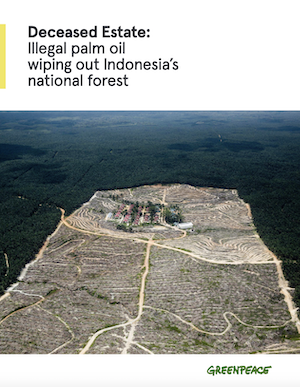
Illegal palm oil plantations are destroying protected Indonesian rainforests and other habitats — and New Zealand’s industrial dairy sector is a major beneficiary, says a new environmental report.
Palm oil expansion is the largest single cause of destruction of critical Indonesian rainforests over the past two decades.
The Deceased Estate report on rainforest destruction in Indonesia and West Papua. Image: Greenpeace Indonesia
The Deceased Estate has report found that there are four palm oil producers with at least 50,000ha of oil palm plantations illegally established inside the protected forest estate.
These producers include Wilmar International which imports palm kernel expeller (PKE) to New Zealand.
PKE is a product of the palm oil industry used as supplementary feed in New Zealand’s industrial dairying.
‘Illegal deforestation’ “Sadly we’re now seeing evidence of New Zealand agriculture benefiting from illegal deforestation for palm oil and PKE.”
New Zealand is the world’s largest importer of PKE, importing an estimated two million tonnes a year which is used to feed the dairy herd because there are too many cows for grass growth alone to sustain.
“New Zealand’s industrial dairying is cashing in on the destruction of endangered species, critical rainforest habitat and indigenous livelihoods in Indonesia,” said Rose.
“New Zealand’s intensive dairying benefits from ecological destruction in Indonesia while polluting rivers, the climate and drinking water at home.
“The New Zealand dairy sector’s use of PKE to support herd intensification and expansion, effectively outsources environmental costs onto some of the most diverse remaining forests and species in the world, and it has to stop.
“It’s unconscionable that New Zealand is complicit in the illegal expansion of palm oil plantations that undermine indigenous community land use and destroy the habitat of rare and endangered species such as Sumatran orangutans, tigers and elephants.”
‘Highly polluting’ Greenpeace Aotearoa is calling for an end to the importation of supplementary feed like PKE, “because it drives highly polluting dairy intensification in Aotearoa, contributes to rainforest destruction and increases climate emissions both here and in Indonesia.”
Clearance of Indonesian rainforest for palm oil released an estimated 104 Tg (million metric tons) of primary forest carbon from Indonesia’s forest estate between 2001-2019. This is equal to 60 percent of the annual emissions of international aviation.
Greenhouse gas emissions from NZ’s intensive dairy sector, supported by this illegal PKE, are 48 percent of this country’s total.
“With industrial agriculture being New Zealand’s biggest climate polluter, we need an urgent shift away from this high-input, industrial agribusiness model towards regenerative organic farming that works within the limits of nature,” said Rose.
Bridget McKenzie is a cabinet minister and Nationals leader in the Senate. But her seniority hasn’t inhibited her being one of her party’s most outspoken advocates demanding protections for the regions before it signs up to the target of net zero emissions by 2050.
In this podcast, recorded two days before the Nationals’ meeting to consider the results of Barnaby Joyce’s negotiations with Scott Morrison for a deal, McKenzie makes clear her view the Nationals must have a loud and distinct voice for the people they represent, not just on this issue but generally.
“When we run our own race, that’s what people like about the National party,” she says.
She’s blunt about the distinctions between the Nationals and the rural Liberals, which she says go to philosophy and ethos. Like the rural Liberals, the Nationals believe in free trade and markets “but we also don’t think that the market will be simultaneously a determinant of a fair and just society.”
“I think the Libs, you know, they maybe subscribe to Adam Smith’s Wealth of Nations as the only tome he ever wrote. Whereas I think we would say the reason you have Wealth of Nations from Adam Smith is because of his [The Theory Of Moral Sentiments] – that the purpose of the market is actually to drive a fair and just society”.
Speculation over the years has suggested McKenzie hoped to move to the lower house but she insists “I have never had a desire to be in the House of Representatives. I adore the Senate.”
Reflecting on the sports rorts affair, which saw her forced to the backbench, she says “I learnt a lot.
“I learnt how brutal and ruthless politics can be. I learnt that truth and fact can be incredibly distorted. I learnt […] how important ministerial discretion actually is in a democracy.
“I learnt in a very real way the cowardice and cruelty of
keyboard warriors through social media. And I also […] was reminded how much of a difference you actually can make from the backbench.”
Michelle Grattan does not work for, consult, own shares in or receive funding from any company or organisation that would benefit from this article, and has disclosed no relevant affiliations beyond their academic appointment.
In a tragic accident, Alec Bladwin has fatally fired a prop gun on a film set in America.Evan Agostini/Invision/AP
In a horrendous accident, a cinematographer has died and a director has been injured after Alec Baldwin fired a prop gun while filming in New Mexico.
When shooting a film with guns, there are many choices to make: each prop needs to be appropriate for the character, and appropriate for the scene. There is also the choice of whether you will use replica weapons, real weapons, or a mix.
But most importantly, everyone on set needs to know how to work alongside guns.
A gun with no ammunition – that is, a gun with neither a bullet nor blanks – is not dangerous. But even so, on set there is always an armourer, a safety officer, and a stunt coordinator: at least three people who always have an eye on the guns on set.
We recently finished shooting Darklands, a psychological thriller staring Nadine Garner about a policewoman who fails to stop a shooting and is then pursued by a journalist determined to use the policewoman’s story to resurrect her own flagging writing career.
We used real weapons, but we only used blanks in one scene. The night we fired the blanks was a very controlled situation, working with a very experienced crew. The safety of our cast and crew was of utmost importance to us. Here are some of the things we kept in mind.
Shooting with blanks
When the worst thing happens and someone dies on set, the impact resonates profoundly throughout the industry and the lives of those affected. Two big stories in the 1980s, in particular, changed how occupational health and safety is approached on sets.
In 1982, three actors – two of them children – were killed on the set of Twilight Zone, when special effects explosions caused a helicopter to crash. Their deaths will echo through film sets forever.
In 1984, the actor Jon-Erik Hexums put a gun filled with blanks to his head, and, joking about delays to filming, he pulled the trigger. The force of the wadding was enough to fatally injure him.
Instead of using a bullet, blanks use wads of paper, plastic, felt or cotton – this wadding ensures you get a certain level of flame out of the gun.
But this wadding is the thing which can cause a lot of injury: just because a gun is using blanks, that doesn’t mean it isn’t dangerous.
For all elements of shooting a film, you have to sit and worry about all possible scenarios and have a plan for any risks, and the safety officer will work elbow to elbow with the director and first assistant director to ensure the safety of the set.
While scouting for locations, the safety officer will consider elements such as trip hazards, road safety, how the set will be lit at night and the supply of electricity.
When you are filming on public land, such as parks, the council will ask for a risk assessment: this can detail where people will park, where bathroom facilities will be located, where equipment will be, as well as considering potential problems like what would happen if a limb was to fall from a tree.
Even an actor carrying a cup of hot coffee on screen will be considered for safety.
Filming this year, we also added an on-set nurse/COVID officer to consider the health of everyone on set.
When a scene is set, the safety officer will check everything, down to the safety mats on the ground to the gel padding hidden by costumes.
On film sets, guns are supplied by an armourer. They will have access to both real and replica weapons, with real weapons costing more to hire than replicas.
Any moment you are using weapons on set, you must treat them with the utmost respect. Safety has to be paramount. In Australia, guns are so rarely handled we found they are highly respected: people are very conscious of the weapon.
All of the protocols surrounding gun use are well established. Everything on set around a gun must be treated with an abundance of caution. The weapon with the blank was never fired at anyone, all cast and crew are briefed multiple times about safety. The police are always notified, as are any neighbours adjacent to the filming location.
A tragedy
We chose to shoot with real weapons, but we only used blanks in one scene. In every other scene, visual effects (VFX) will be used.
The blanks were chosen because of the importance of the weapon to the storytelling in that scene. We needed the reflections on the actor’s face to be real, her physical response to be real. Like when Alan Rickman was dropped while shooting Die Hard: sometimes the moment just calls for that palpable truth.
But many gun effects can be done well through VFX, and companies even sell VFX gunfire packages. Adding these effects is a very specialised field: they can add different muzzle flares, different smoke patterns, and you can even make a gun recoil in someone’s hand.
Our sympathies go out to the families of those affected by this incident. We can only imagine what Alec Baldwin would be feeling right now. It is a horrendous situation for everyone involved.
This is an issue of workplace safety. When things go fatally wrong in any workplace, it is a tragedy.
In Australia, we have always found film to be a really well regulated environment. On our set, we all understand making a movie is not worth putting someone’s life or health at risk.
We can only imagine most filmmakers feel the same.
The authors do not work for, consult, own shares in or receive funding from any company or organisation that would benefit from this article, and have disclosed no relevant affiliations beyond their academic appointment.
University of Canberra Professional Fellow Michelle Grattan and University of Canberra Associate Professor Caroline Fisher discuss the week in politics.
They canvass the Nationals playing hardball in their efforts to land a deal over the 2050 net zero target Scott Morrison intends to take to the Glasgow climate conference.
They also discuss the decision by the government to shut down a potential inquiry into whether Christian Porter breached parliamentary privilege by refusing to reveal the sources of donations towards his defamation case against the ABC.
Meanwhile on Labor’s side, Anthony Albanese awaits the outcome of a Finance department investigation of MP Anthony Byrne’s employment of “ghost” staffers.
Michelle Grattan ne travaille pas, ne conseille pas, ne possède pas de parts, ne reçoit pas de fonds d’une organisation qui pourrait tirer profit de cet article, et n’a déclaré aucune autre affiliation que son organisme de recherche.
A newly published study in the journal PLoS ONE suggests spending time on screens is unlikely to be directly harmful to young children. The US study attracted global attention, as screen time has been commonly blamed for disrupting the healthy habits of our youth.
However, we still need to be wary of health consequences, despite the absence of strong links between screen time and children’s health. The researchers suggested screen time was not a direct cause of depression or anxiety and was linked to improved peer relations, but their findings came with caveats. The study involved almost 12,000 nine-to-ten-year-olds from 24 diverse sites across the United States.
Young people are using screens more than ever. The average number of screen-based digital devices reported to be owned and used by children in Australia has reached 3.3 devices per child.
Surveys have found almost all high school students and two-thirds of primary school students own a screen-based device. Children are spending at least a third of their day staring at screens.
In Australia, teachers and parents have expressed concerns that the fast uptake of digital devices (including social media use) is having negative impacts on children’s physical activity and their ability to be empathetic and focus on learning tasks.
Most concerns relate to screen time being associated with depression, anxiety, self-esteem, social interactions and sleep quality.
With children using screens so much at an early age, establishing a causal link between screen time and health outcomes has become more important than ever. Increased screen use as a result of the pandemic has added urgency to this research.
What did this latest study investigate?
The US study investigated the relationship between screen time and children’s academic performance, sleep habits, peer relationships and mental health.
Parents completed a screen time questionnaire, a child behaviour checklist and anxiety statement scales (including sections on children internalising or externalising problems and attention). They reported on their child’s grades at school, their sleep quantity and quality, family income and race.
The children independently completed a 14-item screen time questionnaire about the different types of recreational media use on screens. They were also asked how many close friends they have.
The researchers did find small significant associations between children’s screen time and decreases in quality of sleep, attention, mental health and academic performance. These effects were not confirmed as directly caused by screen time.
Possible explanations for the weak links between screen time and negative health impacts include:
relying on parent reporting
the design of the screen time survey
social quality measurement.
Parent reporting has limitations
Most of the assessment relied on parents being able to report accurately on their children’s health behaviours. Surveys and questionnaires are often more reliably completed by the target participants, unless they are unable to do so (for example, due to illness).
It can be difficult for adults to properly identify children’s behaviours, and parents reporting on a child can lead to many inaccuracies or less sensitive data associations. For instance, it would be very difficult to report on a child’s sleep disruptions without using a digital measuring device.
Parents are also relying on how much they see their child, the depth and openness of their conversations, various family structures, shared interests and conversations with teachers.
Survey design matters too
It’s important that surveys are easily understood and suitable for the participants. At the ages of nine and ten, kids could still be grappling with the meaning of the different screen time aspects of the survey. They also might not yet fully understand their own behaviours or habits.
In the screen-time questionnaire, the maximum time category was four hours a day and above. This will not identify excessive use. An international study of almost 600,000 children found beyond four hours (for boys) and two hours (for girls) was harmful.
Other major considerations include the different ways children engage with devices. For example, screen time can involve interactional, recreational or passive entertainment. Different devices also require different levels of screen intensity.
The different screen time intensities have varying levels of influence on children’s mental health, life satisfaction and interactions. Researchers strongly emphasise measuring the quality of screen time, rather than the quantity.
Screen use during the pandemic highlights the importance of quality over quantity.
The social survey focused on how many close friends a child has. This will not always mean social quality. A child may think of all contacts on social media as close friends and may simply be interacting with more people when using their devices.
Because the study relied on a quantity criterion with the wording “close friends”, we can’t be sure screen time actually strengthened peer relations.
In addition, it is an early age to be measuring screen use as research shows non-sedentary behaviours (that is, physical activity) peak later in primary school. This is when children are most active, engage in less screen time and most enjoy outdoor play compared to later years of schooling.
Where to from here?
The study has laid a foundation to add further comparisons and evidence as the participants approach adulthood in the next decade. It reinforced the influence of socio-economic status (SES) on children’s health and identified key trends, with boys reporting more total screen time during weekdays and weekends than girls.
Parents and teachers still need to show caution with children’s screen time, as the study did find associations between screen time and a variety of negative impacts on kids’ health.
Even if the negative outcomes were not identified as major and screen time wasn’t established as the direct cause, a review of research suggests we are unable to rule out these associations.
Brendon Hyndman does not work for, consult, own shares in or receive funding from any company or organization that would benefit from this article, and has disclosed no relevant affiliations beyond their academic appointment.
The smiling, pigtailed toddler in the gold heart top. A picture of innocence, and sadly the image many people will now recognise – Cleo Smith, the latest Australian child to vanish without a trace.
Police believe she was most likely abducted. Yesterday, the WA government announced a reward of up to A$1 million for information about her disappearance.
Cleo is the latest missing child to grip the nation. And our fascination with every twist and turn of such cases can both help and be a curse.
Huge interest in the case
Cleo’s case has drawn a high level of media and public scrutiny. Google is returning over 56 million hits on the child’s name; multiple news stories appear daily from all main media outlets.
Largely, the public has been concerned for the child, hoping for a safe return.
However, social media has also gone wild with speculation, with the mother and stepfather being openly attacked.
Comparisons are also being drawn to other missing child cases – notably Azaria Chamberlain, who vanished from a campsite at Uluru in 1980. Later the coroner ruled Azaria had been snatched and killed by a dingo.
Then there was William Tyrrell, the little boy in the Spiderman suit, who disappeared without a trace from his grandmother’s house in Kendall, New South Wales in 2014. Sadly, what happened to William remains a mystery.
More recently, three-year-old Anthony “AJ” Elfalak, a non-verbal boy with autism, went missing from a rural property in NSW in September 2021. Fortunately, he was found safe and well after three days.
Clearly, everyone is hoping the same will be true of Cleo.
Why do lost children evoke such a response?
The public is so interested in missing children cases for a number of reasons, beyond concern for their obvious vulnerability.
Children represent our future. We are heavily invested in kids from both an evolutionary perspective, as well as psychologically.
When a child goes missing, the event represents a threat to our sense of predictability, order and security in the world. Consciously or not, we have a desire to fix this, which can only occur if an abducted child is returned.
Without the child being returned, the need for certainty in our own life is difficult to restore. Children, after all, continue our gene pool and blood line. Arguably, without them, we are only one generation away from extinction as a species.
News of the abduction of children also occurs in real time. And the internet is both helpful and a curse.
Bad news spreads fast. This can be of great assistance in raising public awareness and engaging members of the public to do some basic detective work.
News spread online can also jog the memories of potential witnesses. The information collected this way can significantly help police.
However, the minute-by-minute analysis of child abduction cases can have a major impact on our collective psyche.
Such non-stop coverage often occurs with prurient, distressing detail, tearful press conferences and what seems to be an interminably long waiting game, with generally no news or tragic outcomes to report.
In real time, we are taken into the very private lives of the child’s family, their homes, their toys, their back yards and their activities.
This invasion of personal space further reinforces the public’s strong sense of identification with the family. We relate to their grief, their anger and their anxiety. It could, after all, be our child who has been taken.
There is an emotional connection and generally speaking, enormous empathy for these families. In a sliding door moment of time, these families are plucked from obscurity, to find themselves front page news, spreading like wildfire through social media.
Keyboard warriors vent their anxiety and, at times, anger, online. Wild stories with sinister undertones circulate and propagate, laying blame at family members, associates or the police investigation.
For some, this provides a sense of identity and security. By expressing opinions online, the keyboard warrior feels a greater sense of connectivity with the victim, even if they live on the other side of the country, or on another continent.
By reaching out in this way, albeit at times in an offensive and cruel manner, they feel a sense of empowerment and control.
However, these conspiracy theories can have a devastating psychological impact on those involved. And the lack of awareness of this impact on individuals and families truly beggar’s belief.
These conspiracy theories can also impede the investigation as they’re a major distraction.
There’s collective grief
When the investigation ends with a tragic outcome, or for some, arguably worse, no outcome, the collective grief in our community can be immense.
This is linked with the strong sense of identification and fear we experience when a child is taken from a family.
It is the premature and unexpected loss of a child, even anonymous, through evil processes beyond our control that can trigger these strong reactions.
Fortunately, a child disappearing without trace is rare in Australia, and the entire country is now holding its collective breadth, hoping Cleo is found soon.
Having worked with many crime victims, including families who have lost loved ones and whose cases remain unsolved, until this mystery is solved, we know the pain will be enduring for those closest to this little girl.
So we would ask for kindness and consideration in how the community discusses this case – including on social media. Words have power, so please choose yours carefully.
Tim Watson-Munro, a criminal psychologist, co-authored this article.
Xanthe Mallett does not work for, consult, own shares in or receive funding from any company or organization that would benefit from this article, and has disclosed no relevant affiliations beyond their academic appointment.
Wong Kar-Wai’s In The Mood for Love (2000)Mercury Cinema
The influence of Hong Kong director Wong Kar Wai on global cinema is difficult to overstate.
Wong emerged from the creative ferment of the Hong Kong film industry of the 1980s which, at its peak, was producing over 200 films a year. He never went to film school but began his career as a scriptwriter, primarily for the action films which would bring Hong Kong cinema to international attention following the release of John Woo’s A Better Tomorrow in 1986.
Today, Wong is primarily renowned as an art film auteur, yet his films traverse genres from melodrama to martial arts. In particular you can see the traces of his past in the Hong Kong film industry with early films As Tears Go By (1988) and Days of Being Wild (1990), riffing on the tropes of gangster cinema.
His fluid approach to genre is also the result of childhood moviegoing. Wong has described spending time in cinemas with his mother, not differentiating between art films and commercial films. “We just liked to watch the cinema”, he said.
An intertitle in In the Mood for Love (2000) contains the following plaintive reflection:
He remembers those years as though looking through a dusty window pane. The past is something he could see, but not touch. And everything he sees is blurred and indistinct.
This sentiment crystallises the concerns of Wong’s films: a preoccupation with intimacy, memory and the indelible passage of time as registered in the everyday lives of his unforgettable protagonists.
Guerrilla filmmaking
Wong’s fourth film, Chunking Express (1994) brought him to the attention of Western audiences.
Set in the infamous Chunking Mansions, a crowded 17-floor residential and shopping complex in Kowloon, the film introduced cinephiles to Wong’s universe of love-lorn romantics obsessing over the possibilities of what might have been.
A voiceover by one of the characters observes, “Every day we brush past so many people. People we may never meet or people who may become close friends.”
This dance of chance and fate in a global metropolis underpins the film’s frenetic style.
Shot without a script in an improvisational guerrilla method, the film exemplifies the dazzling camerawork of Wong’s long-term collaborative partner, Australian cinematographer Christopher Doyle. This relationship, along with production designer and editor William Chang, has given Wong’s films an unmistakable visual style with slow motion, coloured lens filters and extreme wide angles giving an irrepressible vitality to his melancholic works.
Collaboration is a key feature of Wong’s work. He uses a recurring cast of actors such as Tony Leung, who has appeared in seven of Wong’s films, and other luminaries of Chinese cinema such as Maggie Cheung and Leslie Cheung. They have all delivered career defining performances under Wong’s careful direction.
What has given Wong such a devotional following across the globe is the way he inexorably returns to the poetry of everyday life and the theme of heartbreak.
Whether this is the tortured romance between two men stranded in Buenos Aires in Happy Together (1997) or the unconsummated love affair of In The Mood For Love and its sequel, 2046 (2004), Wong’s filmography is an extended meditation on the ordeals of the heart.
His films emphasise character, mood and detail over plot. As he describes it:
Cinema can be the citric scent of a peeled orange, the touch of warm skin through a silk stocking; or simply a darkened space bathed in anticipation.
Wong’s films illustrate the way everyday objects and places are imbued with extraordinary meaning through the power of longing.
This concern with intimate details – the light from an ostensibly kitsch waterfall lamp, the expiry date on a can of tinned pineapples, the way smoke curls upward from a cigarette – give his films their incomparable lyricism and singular capacity to reflect on time’s merciless flow.
History and intimacy
By capturing the fleeting and the ephemeral, Wong’s films act as a powerful form of cultural memory.
This is most obvious in the nostalgic ambience of In the Mood For Love, set in the 1960s, where he had the entire crew eating Shanghainese food popular in 1960s Hong Kong and oversaw the meticulous design of the iconic cheongsam dresses worn by Maggie Cheung.
History is just as present in the films shot in Hong Kong in the 1990s: a place changing so rapidly, many locations had already disappeared by the time shooting had finished.
For Wong, cinema is a way of reflecting on history through the most intimate details. An object may appear minor or inconsequential, but in his films is liable to release a flood of desire.
It is a rare pleasure to see his intoxicating films on the big screen once again for the OzAsia Festival. Returning to his characters is like greeting old friends.
“All my works are really like different episodes of one movie,” the director has revealed. It feels particularly appropriate for his works to be screened together allowing the resonance between the films, with their repeated motifs of clocks, chance encounters and doomed love affairs, to materialise before the viewer.
Wong Kar Wai recently oversaw the restoration of his filmography and seven of these prints are screening at the Mercury Cinema as part of the retrospective Love and Neon during Adelaide’s OzAsia Festival.
Thomas Moran does not work for, consult, own shares in or receive funding from any company or organisation that would benefit from this article, and has disclosed no relevant affiliations beyond their academic appointment.
The New Zealand government has bet heavily on vaccination targets and certificates to move the country into the re-opening phase of its COVID-19 response.
As part of today’s major announcement, Prime Minister Jacinda Ardern said 90% of the eligible population must be fully vaccinated in each of the country’s regional district health boards (DHBs) for the new protection framework to come into effect.
That framework involves a “traffic light” system of red, orange and green levels based on case numbers, health system and testing, contact tracing and case management capacities. Targeted local lockdowns would still be an option at the red level.
Vaccine certificates will be essential for access to most environments involving close physical proximity. Even at the green level, businesses – including retail and hospitality, but not essential services – that choose not to use vaccination certificates will be subject to greater restrictions than others.
The message from Ardern was clear: “If you want summer […] get vaccinated.” If you don’t, “there will be everyday things you will miss out on”. This is justified – if unvaccinated people visit busy locations, they are putting other people’s health at risk.
Auckland could soon reach target
Reaching the 90% target would make New Zealand one of the most highly vaccinated countries in the world, putting it in a strong position to manage the effects of COVID-19 in the community. With 86% already single-dosed nationally, this target is achievable and could be reached in Auckland within four to five weeks.
But some DHBs are lagging and will take longer. Requiring every DHB to reach the 90% target is important – if some regions are under-vaccinated, COVID-19 will find them, with potentially devastating consequences.
Today’s announcement sends a clear message to all regions – get to 90% or face the possibility of a lockdown when COVID-19 arrives.
The government is also committing NZ$120 million to fast-tracking Māori vaccination, half of that going to iwi-led initiatives.
This is long overdue. Māori vaccination rates are currently too low, with 67% having had a first dose but only 46% fully vaccinated. There is much more work to be done to lift Māori rates and we should be aiming to get at least 90% of Māori fully vaccinated as well.
Protecting children
Children under 12 years old – about 16% of our population – are currently not eligible to be vaccinated. So even once 90% of the eligible population is fully vaccinated, that will still leave almost one in four New Zealanders unprotected.
Special consideration will need to be given to the under 12s and primary schools in particular. Improving ventilation in our classrooms needs to be an urgent priority to get kids back into school safely.
There should also be a focus on better testing around school communities including, for example, regular saliva testing or rapid antigen tests for students and teachers.
Overall, having 90% fully vaccinated won’t mean we can forget about COVID-19 altogether. Public health measures like masks, testing, contact tracing and support for people to self-isolate will still be needed to limit the spread of the virus.
The new framework rightly keeps lockdowns in the toolkit – these may be necessary, for example, if a large outbreak in an at-risk population threatened to overwhelm hospitals.
However, high vaccination rates give us the best chance of keeping pressure off our hospitals and minimising deaths without needing to resort to lockdowns.
Ardern was right to acknowledge there will be more COVID cases than New Zealand has been used to. But, as she also emphasised, this country is one of very few to have the luxury of being able to vaccinate most of its population “before COVID was in every corner of their communities”.
Once we reach the 90% target we won’t be able rest on our laurels, however, and should double down on our efforts to vaccinate the remaining 10%. The more people are vaccinated, the healthier we will be collectively and the more freedom we will enjoy. It’s that simple.
Michael Plank is affiliated with the University of Canterbury and receives funding from the New Zealand Ministry of Business, Innovation and Employment (MBIE) and Te Pūnaha Matatini, New Zealand’s Centre of Research Excellence in complex systems.
Shaun Hendy is affiliated with the University of Auckland and has received funding from the Ministry of Business, Innovation and Employment (MBIE) and Te Pūnaha Matatini, New Zealand’s Centre of Research Excellence in complex systems.
Why do we see the sky during the day, but the galaxy at night? — Gary, age 9, Auckland
Hi Gary! Thank you for this great question.
To put it simply, the reason the sky looks different to us between daytime and nighttime is mostly because of our atmosphere.
The atmosphere surrounds Earth, and extends from the ground to outer space. It’s made of different gases including oxygen (which keeps us alive as we breathe it in), carbon dioxide (which we breathe out), methane (which is also in our farts), nitrogen and argon.
All these gases, as well as all solids and liquids, are made of molecules. Molecules are collections of atoms which are much too small for us to see, but are the basic building blocks of everything that exists. Importantly, different molecules have different combinations of atoms and come in different sizes.
A molecule’s size plays a role in how the molecule interacts with light. Light from the Sun isn’t one colour — it’s made up of all the colours of the rainbow (which is why we see a rainbow when light behaves in a certain way).
Some of the molecules in Earth’s atmosphere are just the right size that the blue part of the light from the Sun bounces off them, scattering in different directions.
So when we look towards the Sun during the day (remembering that you should never look directly at the Sun), we see rays of light that have come from the Sun straight down to us.
But when we look away from the Sun we see the blue light rays scattering from the part of the atmosphere we are looking at. That’s why the sky is so bright — and blue — during the day.
The galaxy at night
At night we see stars in a dark sky, and these stars make up our galaxy, the Milky Way. The Milky Way is made of a huge number of stars, including the Sun.
The Milky Way contains all the stars in our galaxy, and each of these stars might have orbiting planets, just like the Earth orbits the Sun. Shutterstock
Compared with other stars, the Sun actually isn’t that bright, but it looks very bright to us because it’s much closer to Earth than other stars are.
At night, when your side of Earth is facing away from the Sun, the only light that reaches you is from other stars. This starlight also scatters off molecules in the atmosphere, but as there’s less of it, not much scattering goes on.
This is why, at night when we’re facing away from the Sun, we don’t see the same thing as when we are facing the Sun during the day. Instead, we can look through the atmosphere and beyond at the big, dark expanse of space around us and the many, many faraway stars in our galaxy.
Other planets in our Solar System have different molecules in their atmosphere compared with Earth, which means their skies look different during the day and night.
The atmosphere on Venus, for example, is so thick you would never see the Sun — not even during the day when you were facing towards it. The stars are not visible at night, either.
Astronauts who are above our atmosphere, such as on the International Space Station or on the Moon, don’t see the bright blue sky we see on Earth. Instead, they see the Sun as a large nearby star against a black sky.
And they can see the galaxy all the time.
Astronauts onboard the International Space Station can get a great view of the Sun in ‘starburst’ mode over Earth. NASA
The authors do not work for, consult, own shares in or receive funding from any company or organisation that would benefit from this article, and have disclosed no relevant affiliations beyond their academic appointment.
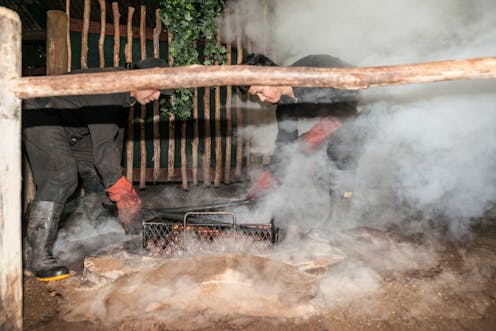
Smoke and dust as food is prepared for a traditional Māori feast or Hangi, Rotorua New Zealand.Shutterstock
Indigenous people are some of the most food insecure people in Australia and Aotearoa (New Zealand). The COVID-19 pandemic and lockdowns have made food security an even greater problem in both countries, though it has generally gone unnoticed.
The pandemic has worsened some Indigenous people’s food security by limiting their ability to partake in cultural food harvesting.
The diets of Indigenous people before colonisation were rich, varied, and seasonal. Indigenous people in both Australia and Aotearoa would eat a variety of plants, water and land fowl, seafood, and protein from animals, insects and reptiles.
In Australia, Aboriginal people had approximately 150 different plants and animals as a food source.
However since colonisation, Indigenous people’s diets have dramatically changed. This change has contributed to food insecurity, in part due to the reliance on westerncultural methods for food sourcing and the displacement of Indigenous people from their land.
Some Indigenous people rely on agricultural traditions and cultural practices to not only be food secure, but as a way of maintaining cultural identity and connections to Country.
In Aotearoa, mahika kai (food knowledge and practices for Māori) is linked to wealth and hospitality. It connects families through kinship and whakapapa (genealogy) to whenua (the land) and te taiao (natural resources).
Mahika kai is also fundamentally linked to Māori people’s underlying principles of manaakitaka (care and hospitality) and to the protection and stewardship of the land (totems, kaitiakitaka).
Food traditions also honour cultural lore and laws regarding access to seasonal foods and sites. These have protective factors for social and emotional wellbeing, providing a connection to culture and community.
Although governments and volunteer programs have been providing food and medical supplies to areas affected by COVID lockdowns, the loss of cultural practices can cause significant disconnect for Indigenous communities.
Cultural practices stifled in Australia
Western New South Wales has been significantly affected by rising COVID-19 cases in Aboriginal communities. People have also become increasingly food insecure. Some have limited financial resources to purchase food, which in rural and remote areas, is comparatively overpriced.
People are also having to rely on food donations. This has worsened the longer lockdowns have continued and may have lasting effects once they are over.
Earlier in the pandemic, Aboriginal people in Wilcannia had maintained their cultural practice of hunting kangaroo and distributing the butchered meat to families within the township.
According to NITV News, however, health authorities discouraged residents from hunting and distributing roo meat in August.
Said one resident,
I got a cousin telling me that him and his family went out and got kangaroo and they delivered it into Wilcannia, but health officials were saying that they can’t hand out wild meat to Aboriginal families because it’s not fit for consumption.
The NSW government has long made engaging in cultural food practices difficult, with game meat regulations, and culling and licensing legislation.
The Native Title (New South Wales) Act 1994 acknowledges the land has social, cultural, economic and spiritual importance to Aboriginal people, but it does not define these as legal rights or say how they can be asserted to support cultural food practice, including resource sharing.
Authorities eventually permitted roo meat from Broken Hill to be delivered. Since late August, Malyangapa Barkindji Wiimpatja man Leroy Johnson has reportedly been delivering kangaroo meat to affected communities in Wilcannia, with the support of local police.
Protection of Māori food practices
In Aotearoa, mahika kai is an enduring and intergenerational food practice for Māori protected by law. In March 2020, when Aotearoa first went into lockdown, all New Zealanders were required to remain at home. This prohibited activities such as hunting, seaside fishing, and food gathering.
Concerns were raised by kaumātua (Elders) acknowledging these restrictions were affecting whānau (families) who regularly relied on hunting for food security and staples within the home.
In the current lockdown, Prime Minister Jacinda Ardern’s government adjusted the lockdown rules to allow Māori to hunt and fish within a culturally acceptableframework.
This resulted in a resurgence in food gardens (maara kai) and traditional hospitality and service exchanges (kai hau kai) to support kaumātua and whānau. Other mahika kai activities, such as preserving and utilising local waterways, have also returned.
This demonstrates that lockdown rules can be tailored to allow cultural food sourcing, while still reducing the spread of the virus.
However, Māori rights are protected through both treaty and legislation, whereas Indigenous people in Australia still have no treaty. This means the protection of cultural activities are not prioritised within the public health orders in NSW. This contributes to growing food insecurity in affected communities.
Although the Commonwealth Native Title Act 1993 provides limited protections, Aboriginal and Torres Strait Islander cultural rights still have no equivalent national protection.
Both Australia and Aotearoa have signed the UN’s Declaration on the Rights of Indigenous Peoples, however. This declaration could provide some protections to cultural hunting rights.
Without social distancing measures taking these rights into account, food insecurity will continue to occur. This could lead to poorer ill-health in communities beyond the pandemic.
Restoring cultural practices should be considered in federal and state governments’ exiting plans once crisis-level case numbers are down.
Australia’s governments must follow Aotearoa’s lead and find a way for public health orders and cultural food practices to work together.
Dione Payne receives funding from Ministry of Business, Innovation and Employment for indigenous research.
Amanda Wingett and Stewart Sutherland do not work for, consult, own shares in or receive funding from any company or organisation that would benefit from this article, and have disclosed no relevant affiliations beyond their academic appointment.
If you didn’t know Tokelau Language Week begins this weekend, you can probably be forgiven. Spoken by fewer than 5,000 people worldwide, Tokelauan has been designated “severely endangered” by UNESCO, its second-most at-risk category. You simply don’t hear it spoken much – or spoken about.
The statistics tell us why. Since the mid-1960s, migration from Tokelau has meant more 3,000 Tokelauan speakers now live in New Zealand, with just 1,500 still in their homeland. With transmission between generations declining, Tokelauan really is in danger.
Compared to the estimated 1.8 billion English speakers in the world, Tokelauan is literally and figuratively a speck in the ocean, with native speakers now spread around the Pacific in Samoa, Hawaii, Australia and New Zealand.
But while many Tokelauans may not have been born in Tokelau, their culture and language continue to play an important part in their lives. Keeping the language in the public consciousness is crucial to it thriving.
The flag of Tokelau. Shutterstock
Survival strategies
Tokelau itself is comprised of three tiny atolls – Atafu, Nukunonu and Fakaofo – with a combined land area of just 12 square kilometres, a day’s boat ride north-west from Samoa.
To give a sense of scale, the habitable space on Fakaofo is roughly the size of Auckland’s Eden Park. Being so small and near sea level means not only the language is at risk – climate change is a grave threat, too.
A strong communal culture exists, although many younger people emigrate for education or employment. Fishing the surrounding ocean is vital to people’s livelihoods, as most other supplies have to be shipped in from Samoa.
Now part of the “Realm of New Zealand”, the atolls were first populated over 500 years ago by people originally from Samoa, as evidenced by the similarities between the two languages.
Tokelauan falls under the Samoic-outlier branch of the Polynesian languages, along with Samoan (which it borrows words from) and Tuvaluan. Other related languages include Pukapuka from the Northern Cook Islands, and East Uvea from Wallis Island.
GettyImages
A unique language
On the Tokelauan atolls, the language is used in everyday life, church and politics. For children growing up, it’s the main language they hear all the time, which means inter-generational transfer is normal.
By contrast, only 0.06% of the New Zealand population speaks Tokelauan, almost exclusively within the New Zealand Tokelauan community. In a culture dominated primarily by English, then, how does the language stay healthy and survive?
The answer seems obvious – you speak it. But who, and where? And how do people learn it, if not at home?
One way is through the immersive Tokelauan-speaking preschools in Wellington and Auckland, where most Tokelauans live. Catching children at that critical early age when a language is most easily acquired means they usually gain a full understanding by the age of four or five.
For adults coming fresh to the language, however, it might not be so effortless. Like all languages, Tokelauan has a multitude of unique features. As a linguist, my research is focused on the grammar of Tokelauan and how it differs from other languages.
Do you Tokelauan-speak?
Native speakers have these rules hard-wired naturally in their brains. But for learners, there are various unusual elements of Tokelauan to navigate.
A good example is something linguists call “noun incorporation”, where the noun becomes attached to a verb. In English, there are only a few cases of this: “I went planting trees” can become “I went tree-planting”.
The verb “plant” is connected to the noun “tree” to create the odd compound of “tree-planting”. But this is hardly a regular feature of the language. It would sound weird to say “I car-drove” or “she rugby-played”.
But in Tokelauan, these compounds are completely possible. The sentence “Na tunu e Susie nā ika” (meaning “Susie cooked fish”) becomes “Na tunu ika ia Susie” – “Susie fish-cooked”.
Another interesting linguistic feature is the distribution of “the” and “this”. In English these two words precede a noun – in “the boat” or “this boat”. They can’t appear together, meaning we wouldn’t say “the this boat”.
In linguistics, this is referred to as a “slot” in the grammar that takes either “the” or “this”. But in Tokelauan this one-slot theory doesn’t work; we can have both “te” (the) and “tēnei” (this) together, making “te vaka tēnei” (the this boat). In other words, Tokelauan has two slots – one before the noun and one after it.
These grammatical styles, so different from English and with so many possible patterns, make it a fascinating language to study. Sadly, I don’t Tokelauan-speak. But I’m keen to learn, ideally by visiting those beautiful specks in the ocean while I still can.
In the meantime, Tokelau Language Week is a chance for everyone to appreciate a little of this remarkable and unique tongue that still enriches our shared culture.
John Middleton receives funding from New Zealand Royal Society Te Apārangi and The Polynesian Society.
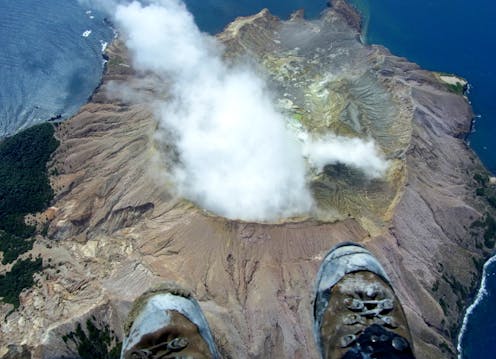
This week, a case review hearing sought to set a trial date – now likely in 2023 – for 13 organisations and individuals facing charges in the wake of the Whakaari White Island eruption of December 9 2019.
The volcano erupted while 47 people were on the island, leaving 22 dead and survivors with severe or critical injuries.
Among the parties facing criminal charges is a research organisation that monitors volcanic activity on the island. For me, as a volcanologist, this highlights the perils of assessing hazards and communicating the risk of natural hazards.
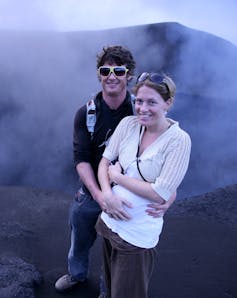
A few years ago my wife and I visited an active and dangerous volcano. She was pregnant with our first child, and we were on a romantic holiday heading through the jungle of Tanna Island, Vanuatu, to watch the spectacular eruptions of Mt Yasur.
Seeking reassurance, she asked if it was safe. I hesitated and said yes, and added something about it being safer than riding a bike in the city.
The author and his wife at Mt Yasur on Tanna Island, Vanuatu. Author provided
I am volcanologist and had done my research and decided for both of us that the risk was acceptable. I knew of two fatalities, but also that between ten and 100 people visited the volcano every day and these tours had been going on for about 30 years. My back-of-envelope calculation meant a 1 in about 100,000 chance that we might die, and I was ok with these odds.
We had an exciting experience, and it was only on the way back that I confessed two people had died on the volcano. My wife smiled and said she might not have agreed if she had known, but was glad we had done the trip.
I have since been back to Mt Yasur for research with colleagues to calculate more accurately the hazard to tourists, and where on the volcano the hazard from eruptions is the highest.
As always in science, the results are complicated, but have been communicated to those responsible for managing the hazard. We need to do more work to translate our hazard numbers into risk numbers for tourist operators or regulating bodies to inform their decisions.
The shock of the tragedy
The tragic eruption of Whakaari White island hit me hard. I was in London at the time, and at first I was ok, being driven all over the city for media interviews. My phone was going all night.
But then I found out Hayden Marshall-Inman hadn’t made it back. I knew him as a laid back, smiling volcano guide and skipper who had taken me out to the island many times. Suddenly I felt different and stopped all media interviews. I felt a deep sense of guilt.
I’d spent the last 12 years studying why Whakaari erupts and why it sometime does so without much warning. I always requested to go with Hayden to the island. He knew the volcano like the back of his hand and sometimes spent the whole day with us, exchanging knowledge about the volcano.
The victims and friends and whānau of those affected by Whakaari will always be in my thoughts and drive me to improve our systems and science.
I have collaborated with scientists from all over the world on Whakaari and always worked closely with GNS Science. Our focus was to understand the volcano, how and why pressure builds up and rocks explode, rather than on making risk management decisions. The focus of GNS Science teams was to work out how to better monitor the volcano, especially when pressure was building or magma was rising.
I have asked several of my friends at GNS Science why they do their job and their response is “to save lives”. They use the most up-to-date science to monitor New Zealand’s volcanoes, and I use their publicly available reports to inform my decisions when visiting volcanoes with colleagues or students.
Studying an erupting volcano
I have made more than ten trips and knew we were increasing our risk of getting caught in an eruption. Each visit was another role of the dice, although we never entered the crater if there was a “heightened volcanic unrest” alert.
The volcano erupted several times during the time I was studying it. I consider myself lucky that I was never on the island when it erupted. During 2012 and 2013, we decided the volcano’s elevated activity meant the hazard was too high to risk a visit.
Whakaari is like a very old kettle that has been left on. Steam and boiling water leak out through cracks and holes, but some are occasionally blocked by gunk. Monitoring an old kettle in a constant state of boiling is tricky. Even the best science could never be clear which day or exactly how an old kettle might crack.
As scientists, we try to understand and value the old volcano better. We analyse the patterns of earthquakes by filtering out the constant bubbling. We collected rock samples to measure the chemistry of the minerals to work out blockage conditions.
The need to reflect on what happened
Whakaari is a beautiful and sacred volcano, considered an ancestor by local iwi. Over the years, after each eruption, more data showed more clues to how it works. Some of the boiling signals sometimes showed patterns before eruption. The temperatures and pressures of when minerals caused blockages could be calculated.
We could map where the hot gas, ash and flying rocks would go during eruptions. But every eruption was a bit different. Sometimes steam and tiny bits of magma would come flying out, sometimes only steam and broken rocks.
These subtle differences made it very hard to come up with a model that could forecast eruptions. In an always active system, small changes are hard to detect, and even harder to use to predict the next eruption.
I do get choked up looking back at my photos of Hayden grinning proudly and pointing out different volcanic features of Whakaari. But I know that our research does contribute to better interpretation of volcanic monitoring and to the global research databases that help emergency managers make decisions that save lives every year.
One day, eruption forecasts will be more useful thanks to this research, but it will never be 100% safe to visit an active volcano. As a volcanologist, I don’t know how society should handle risky activities.
I know there will be times in the future where I would consider the risk acceptable for me to return to Whakaari. I also know my wife will never want to get close to an active volcano again after what happened at Whakaari.
Ben Kennedy receives funding from MBIE and other New Zealand government grants and the Royal Society to do volcano research including subcontracts and collaborations with GNS Science. He is affiliated with the University of Canterbury.
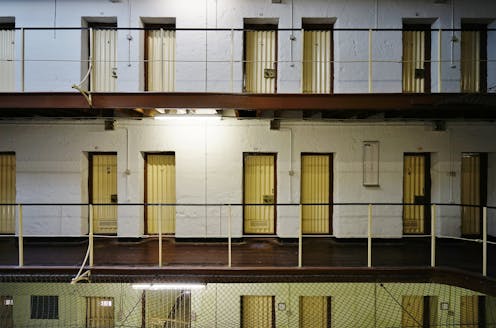
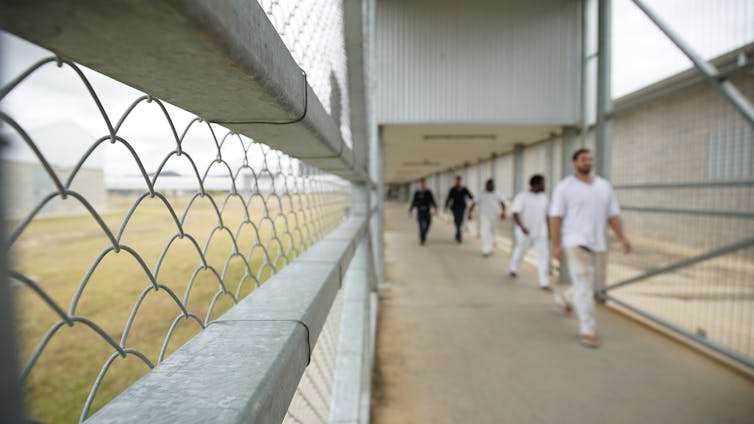
Imprisonment rates in Australia are currently the highest they have been in a century, despite a significant fall in crime, and the Productivity Commission is stepping in to determine why.
The commission is due to release research around imprisonment rates in coming weeks, suggesting this key component of the criminal justice system is not providing value for money.
It also recognises the efficiency of our prisons is important. Apart from the expense involved, they are supposed to provide justice and keep our community safe. And yet for a substantial part of the prison population, there is a “prison-crime-prison” revolving door.
Let’s look at the figures.
It’s not a crime wave
The rate of offending in Australia fell by 18% in the decade to 2020. Over the same period, the imprisonment rate rose by 25%. There are now more than 40,000 Australians in prison. Put simply, crime is down, but more and more people are being incarcerated.
As commissioner Stephen King explains, the rise in incarceration rates over the past 20 years had come principally as a result of “tough on crime” government policies. This has cost taxpayers about $13.5 billion more than if the imprisonment rate had remained steady.
He notes Australia is “out of line” with other developed countries in this respect.
[United Nations] data shows the growth in our imprisonment rates since 2003 was third highest in the OECD, exceeded only by Turkey and Colombia […] These numbers wrongly suggest some sort of Australian ‘crime wave’.
So why is crime falling?
One could be forgiven for assuming crime is falling now precisely because more people are being incarcerated. Is there perhaps a causal link?
There are two clear reasons why this is not the case:
There are many other reasons why crime rates can fall. Those studying the long-term drop in crime in western democracies since the mid-1990s say these include, economic prosperity, good policing strategies, demographics (in 1995, the last of the baby boomers turned 35, the age at which criminality drops away significantly), welfare support, and cheaper, better security devices.
There is no consistent relationship between crime rates and imprisonment rates. Indeed, there have been crime drops in jurisdictions where the rate of imprisonment has remained the same or declined.
Let’s look more closely at this.
The Queensland example
Queensland provides a good case study. From 2003 to 2012, the state’s imprisonment rate fell at the same time as violent and property crime rates were in decline.
Queensland shows crime and jail rates can drop at the same time. Human Rights Watch/AAP
Conversely, until the mid-1990s, the United States had a very high crime rate and continues to have a very high imprisonment rate. But when New York, New Jersey and California reduced their prison populations by some 25% in recent years, their crime rates generally declined at a faster pace than the national average.
True, longer sentences may reduce the rates of some crimes simply by shutting perpetrators out of the crime market for a while. But this can be subject to diminishing returns. That is, money spent on extra prison beds will eventually exceed any savings that may have been made by having less crime.
Jail is not the only option
The Productivity Commission says the question facing policymakers now is whether our “current prison policy is providing the best value outcomes for Australia”. If it is not, what are the alternatives?
The commission notes there are several other options for low-risk offenders, such as home detention, especially if they are linked to mental health and drug and alcohol services.
There is also the argument put forward by theorists such as criminologist Elliott Currie that a secure community is built on equality of opportunity and the development of strong social capital, which simply means creating more resilient and more vibrant communities that leave no-one behind. This would include building and embedding culturally-safe programs that are led by First Nations communities.
Just imagine what could have been achieved if $13.5 billion had been spent on these initiatives thereby limiting the chances that people will turn to crime, or continue to offend, rather than on custodial services.
Spending justice dollars differently
In summary, prison sentences, necessary as some may be, are a blunt (and largely counter-productive) instrument in the fight against crime.
It would be far better if we applied our minds to finding more efficient ways to spend our criminal justice dollars. As criminal justice scholar Bronwyn Naylor has written, imprisonment is a political choice. It’s worth repeating her call to invest “much more in schools, families and communities, and much less in prisons”.
Wise words indeed.
Rick Sarre is President of the SA Council for Civil Liberties and a South Australian patron of the Justice Reform Initiative
Source: The Conversation (Au and NZ) – By Shelley Marshall, Associate Professor and Director of the RMIT Business and Human Rights Centre, RMIT University
For over six weeks, Wangan and Jagalingou Traditional Owners have been performing continuous cultural ceremony at the edge of Adani’s Carmichael mine in central Queensland.
Leah Light Photography
In a shift from their usual conduct, Queensland police have recognised the cultural rights of Wangan and Jagalingou cultural custodians to conduct ceremony under provisions of the 2019 Queensland Human Rights Act.
Because of this act, the police were able to refuse to action a complaint from Adani to remove Wangan and Jagalingou cultural custodians camping on their ancestral lands adjacent to the Adani coal pit.
The police also issued a “statement of regret” for removing the group several months earlier.
In August 2019, Adani was granted freehold title over critical infrastructure areas of the Carmichael mine site by the Queensland government, without first notifying the Wangan and Jagalingou peoples.
This extinguished their native title over the site, affecting a number of peoples including the Juru, Jaang and Birrah, as well as the Wangan and Jagalingou.
Police officers told the group of Wangan and Jagalingou Traditional Owners they recognise their cultural rights to conduct ceremony under provisions of the 2019 Queensland Human Rights Act. Leah Light Photography
Why was practising cultural ceremony so controversial?
Over the past six weeks, Jagalingou cultural custodians have been conducting the Waddananggu ceremony, translated to English as “The Talking”. Describing the ceremony, Cultural Custodian Coedie McAvoy has said
We have set up a stone Bora ring and ceremonial ground opposite Adani’s mine and are asserting our human rights as Wangan and Jagalingou people to practice culture.
Since the leases were granted to Adani, police have repeatedly removed the Wangan and Jagalingou people from their traditional lands when conducting ceremonies. They have also been accused by journalists of acting as a “shield” to Adani’s corporate interests.
If built, it will be Australia’s largest and the world’s second largest coal mine. The project includes the construction of a 189-kilometre rail connection between the proposed mine and the Adani-operated Abbot Point Terminal adjacent to the Great Barrier Reef.
The proposed mining and railway developments encompass much of the Wangan and Jagalingou ancestral lands.
Cultural Leader Adrian Burragubba brought a complaint to the Queensland Human Rights Commission after police broke up a Wangan and Jagalingou ceremonial campsite in August 2020. The complaint resulted in mediation between the police and Burragubba on behalf of his family and community over March to July of this year.
One outcome of the mediation was the Queensland police’s “statement of regret”, in which Assistant Commissioner Kev Guteridge said police recognise that Burragubba represents a group of traditional owners “aggrieved by Adani’s occupation of the land”, adding:
We acknowledge that the incident on 28 August, 2020, was traumatic for Mr Burragubba and his extended family, and caused embarrassment, hurt and humiliation.
According to The Guardian, Burragubba is thought to be the first Indigenous person to extract a public apology from a state agency since the enactment of the Queensland Human Rights Act.
Section 28 of the Act recognises Aboriginal and Torres Strait Islander peoples hold distinct cultural rights as Australia’s First Peoples:
They must not be denied the right, with other members of their community, to live life as an Aboriginal or Torres Strait Islander person who is free to practice their culture.
The inclusion of this section is highly significant given Australia only endorsed the United Nations Declaration on the Rights of Indigenous Peoples in 2019. Australia is yet to implement the declaration into law, policy or practice at a federal level.
The Greens senator Lidia Thorpe said the inquiry’s recommendation of “free, prior and informed consent” did not go far enough to protect traditional owners.
Burragubba’s complaint under the Queensland Act was likely strengthened by the Wangan and Jagalingou peoples’ ongoing legal assertion of native title. 44b of the Native Title Act confers rights of access for traditional activities to a native title claim group.
This legal principle of “right of access” was bolstered by the findings in the case of Western Australia v Brown, 2014, which confirmed title was not wholly extinguished by the lease of land as long as native title is “not inconsistent with the lease”.
The significance of this police action could be far reaching
The new respect shown by Queensland police for the cultural rights of the Wangan and Jagalingou will not reinstate Wangan and Jagalingou native title. Nor will it stop the Adani mine.
But it means the Wangan and Jagalingou can continue to practice culture on Country, as they have for thousands of years, instead of being treated “like trespassers on their own land”. Their living connection to Country is not broken by the lease of land to Adani.
For Adani, it means the Wangan and Jagalingou people are an ongoing presence: a public reminder of cultural claim over the land where the mine is situated.
For the police, the significance goes beyond the struggle over the Adani mine. This change in police conduct could mark the end of police complicity in removing First Nations people from their ancestral land in the state of Queensland. Other state agencies will now also be forced to take the cultural rights of First Nations custodians seriously.
It is an important step on a national journey towards recognition of First Nations’ cultural rights. Like the Queensland Human Rights Act, Victoria and the ACT also enshrine human rights in state law, providing legal avenues validating cultural practice on Country against public authorities. If the federal government adopts the findings of the parliamentary inquiry into the destruction of the Juukan Gorge rock shelters, handed down earlier this week, First Nations’ cultural rights will be further protected.
The Inquiry committee recommended new Commonwealth legislation for stricter protection of sacred sites, and improvements to the Native Title Act. The committee has said new legislation should be underpinned by the United Nations Declaration on the Rights of Indigenous Peoples.
The practice of Waddananggu is significant for the whole country. It is an opportunity for all of us to respectfully witness, talk and learn towards meaningful reconciliation.
McAvoy issued a broad invitation to the Waddananggu:
Stand with us to protect our human rights to practice ceremony and culture, and protect our homelands. ngali yinda banna, yumbaba-gi. We need you, to be heard.
Shelley Marshall owns shares in mining and resources through her superannuation.
Suzi Hutchings has met Adrian Burragubba at an RMIT conference on Activism at which he gave a keynote presentation. Suzi owns shares in mining and resources through her superannuation.
Carla Chan Unger does not work for, consult, own shares in or receive funding from any company or organisation that would benefit from this article, and has disclosed no relevant affiliations beyond their academic appointment.
Pacific leaders say offering “visas for vaccinations’ would be the ultimate incentive for New Zealand overstayers to get the covid-19 jab, as Auckland struggles to stop delta variant infections spreading through the community.
It comes as epidemiologists say the government needs to pull out all the stops to get people vaccinated amid rising case numbers.
The Ministry of Health reported a record 102 community cases today, the first time the number of new cases has reached triple figures.
Director-General of Health Dr Ashley Bloomfield said on the current trajectory there could be up to 180 cases a day within two to three weeks. The number of these cases that ended up in hospital would depend on how many had been vaccinated, he said.
The latest modelling showed there was not a large amount of undetected cases, and the numbers being found were what would be expected, he said.
Plea for an overstayer amnesty The Pacific Leadership Forum is calling for an overstayer amnesty through a parliamentary petition, which won support from the Employers and Manufacturers Association.
The forum’s Pacific Response Coordination Team chair Pakilau Manase Lua said that adding in an immigration incentive to that amnesty would be very effective.
“I would guarantee that probably 99.9 per cent of overstayers would come out of the woodwork and get vaccinated if that was their pathway to residency or amnesty to get their papers to be legal here,” Lua said.
“They’re desperate. It was hard enough before covid arrived for these people to survive – they have to work, they have to find a way to make ends meet.
“Moving from house to house and at the whim of the family and friends who are sheltering them. And that’s a risk to themselves and to others if they’re not vaccinated”
Among an estimated 14,000 overstayers, the highest numbers without valid visas are from Tonga and Samoa.
A fifth of the current active covid-19 cases are among Pacific people, and their fully vaccinated rates are lower (at 59 percent) than the national average (67 percent).
‘They fear authority’ If the government was concerned an amnesty would be unpopular, it needed to make sure politics did not trump public health, said Lua.
“The optics don’t matter, it’s life or death – in a pandemic, what are optics compared to human lives? We’ve got a virus raging in South Auckland among our communities where most overstayers are living.
“And despite all the reassurances to go out and test and to get vaccinated, we know that many have yet to be vaccinated – some have gone in, but the majority have not.
“Rightfully, they fear authority – these are people who are hiding from authority because they’ve got deportation orders or other things that are hanging over them.”
Tongan Manase Lua, an overstayer as a child during the Dawn Raids era before an amnesty gave his family a permanent future, said launching a similar reprieve now would also recognise the reality that no-one could be deported back to the Pacific Islands while there was a risk of them spreading covid-19 there.
It was mind-boggling that the government was disregarding the risk, as well the contribution overstayers make, he said.
“They’re resourceful, they work hard, they often do the work that nobody else wants to do on the front lines — while we’re working from home and in the safety and security of home, they’re out on the front lines picking fruit, cleaning the floors, mopping the hospital floors and all the hard work that we take for granted.
“So they would love this opportunity to be a person, be a human being in the country that says it’s kind.”
This article is republished under a community partnership agreement with RNZ.
A Pacific public health expert says a premature transition of covid-19 restrictions in New Zealand could be lethal for Māori and Pasifika communities.
The government is under increasing pressure to ease restrictions in Auckland with National saying it would set a six-week deadline for ending lockdowns and that a target of 85-90 percent vaccination rates were “do-able” within that timeframe.
Prime Minister Jacinda Ardern on Monday revealed the city would remain in alert level 3, step 1, and signalled the government would reveal a covid-19 protection plan on Friday.
But Auckland University public health associate professor Collin Tukuitonga said easing restrictions before vaccination rates among the most at risk communities of Māori and Pasifika were high could be a death sentence.
“It is abundantly clear that Māori and Pasifika people will have more infections, more of them will go to hospital and more of them will die,” he said.
“Fortunately we haven’t had the deaths here that has been apparent in other countries. But clearly if we move prematurely the people at risk will pay the price.”
Hospitals ‘not ready for covid-19 tsunami’ Meanwhile, an Auckland emergency nurse and nursing union delegate told RNZ Morning Report today that overworked nurses feared hospitals were not ready for the “covid-19 tsunami” – and often thought about quitting.
Hospital admissions have climbed to 43, and Middlemore Hospital expects to see 20 cases a day through its emergency department next month.
The nurse, who works in one of Auckland’s emergency departments (ED), said many of her colleagues finish shifts wondering if they would come back for the next one.
“The nurses are really, really feeling it – feeling really anxious. They feel like there’s a tsumani coming. They can see it coming … and what do they do? Do they run towards it or do they back off?”
Her own ED was often short by three or four nurses, or a couple of health care assistants, a shift, she said.
“On a daily basis we are getting texts to say, ‘can you pick up this shift?’. It is becoming a dire situation right now,” she said.
It was made worse because staff regularly needed to isolate because they were case contacts, she said.
The nurse, a delegate for the Nurses’ Organisation, said that if they could not staff the shifts, it made for a high pressure day for those left behind, she said.
This article is republished under a community partnership agreement with RNZ.
New Zealand Parliament Buildings, Wellington, New Zealand.
Editor’s Note: Here below is a list of the main issues currently under discussion in New Zealand and links to media coverage. You can sign up to NZ Politics Daily as well as New Zealand Political Roundup columns for free here.
Source: The Conversation (Au and NZ) – By Steven W. Salisbury, PhD; Senior Lecturer, School of Biological Sciences, The University of Queensland
Anthony Romilio, Author provided
Ipswich, about 40 kilometres west of Brisbane, seems an unlikely place to find dinosaur fossils. Yet the area has produced the oldest evidence of dinosaurs in Australia.
A fresh look at these fossils now reveals they aren’t what they first seemed, and it’s prompting us to reconsider how the story of Australia’s dinosaurs began.
In research published today in Historical Biology, we reanalyse a sequence of 220-million-year-old tracks from the Ipswich Coal Measures, thought to have belonged to a carnivorous dinosaur.
We show they actually belonged to an early sauropodomorph — a distant relative of the plant-eating sauropods that roamed the planet much later, during the Jurassic and Cretaceous periods. This the first time fossil evidence of early sauropodomorphs has been found in Australia.
Subterranean dinosaur tracks
The Ipswich area was once the principal source of coal for Queensland. Its suburbs including Ebbw Vale, New Chum and Swanbank were dotted with underground mines during the late 1800s and the first half of the twentieth century.
These mining operations involved the creation of deep shafts and tunnels, from which miners could access deposits of coal sandwiched between other layers of rock. Some tunnels would descend hundreds of metres below the surface.
The coal would be removed from the seam by hand, and pillars were left in its place to support the ceiling of the resulting underground “room”. It was difficult and dangerous work.
In 1964, miners working at the Rhondda colliery in New Chum made a startling discovery. As they removed the coal from a seam they were following 213 metres below the surface, a series of giant, three-toed tracks became exposed in the ceiling of the mine shaft. For the miners, it was as if a dinosaur had just walked over their heads.
Fossilised plant remains found in association with the tracks provide a fascinating window into the world of Australia’s first dinosaurs. The highly diverse flora comprised a dense groundcover of ferns, cycad-like plants and horsetails that grew under a canopy of gingko, voltzialean confiners and seed-ferns (corystosperms), like this Dicroidium dubium. Steven Salisbury, Author provided
These tracks remain the oldest-known dinosaur fossils in the entire continent. They’d been made by a dinosaur walking across a layer of swampy vegetation, which would be extracted as coal 220 million years later. Buried under fine silt and mud, they’d been preserved as natural casts.
It had been assumed some type of predatory dinosaur made the tracks. The only problem was the footprints were reportedly about 40–46 centimetres long. This would suggest the track-maker was just under 2m high at the hips.
This isn’t necessarily large for a theropod such as Allosaurus fragillis, which was about this size. Tyrannosaurus rex was even bigger, with a hip height of about 3.2m.
But the tracks found in Ipswich were created during the Late Triassic about 220 million years ago — 65 million years before Allosaurus and 150 million years before T. rex. And fossil evidence from around the world indicates theropods of a larger size didn’t appear until the start of the Early Jurrasic Period, 200 million years ago.
Was something unusual afoot in Australia during the Late Triassic?
As part of a broader review of Australian dinosaur tracks, we decided to take a closer look at the Rhondda colliery tracks. The mine has long been closed, so the original tracks are no longer accessible, but archival photographs and a plaster cast are held at the Queensland Museum.
Using the photos and cast, we created a 3D digital model of the track to allow a more detailed comparison with other dinosaur tracks from around the world.
Our study revealed two important things. First, the footprints were not as big as initially reported. Excluding drag marks and other unrelated surface features, they are close to 32–34cm long (not 40–46cm as previously documented).
Second, the shape of the footprints and the sequence in which they were made is more consistent with early sauropodomorphs. Sauropodomorphs were the distant relatives of the lumbering sauropods of the Late Jurassic and subsequent Cretaceous Period.
The towering Triassic terror of the Ipswich Coal Measures was no more. In its place was a peaceful plant-eater.
Hypothetical reconstruction of the Ipswich sauropodomorph dinosaur, alongside an 3D orthographic image of one of the fossilised tracks form the Rhondda colliery, with a 1.8m person for scale. Anthony Romilio
The remains of early sauropodomorph dinosaurs have been found in Upper Triassic rocks, aged between 220 million and 200 million years, in continental Europe, Argentina, Brazil and South Africa.
And by the start of the Jurassic, 200 million years ago, they had achieved a near global distribution, with fossils in North America, China and Antarctica. This isn’t surprising, given the continents at the time were still connected in a single landmass called Pangaea.
Our new interpretation of the Rhondda colliery tracks shows early sauropodomorphs lived in Australia, too, and that Australia’s first dinosaurs were friendlier than we thought.
Mateship is an intrinsic part of Australian society, routinely discussed as an important national value. In 1999, Prime Minister John Howard even attempted to include mateship in the constitutional preamble.
But despite its ubiquity in Australian culture, what does mateship mean to people and how do they really feel about the term? Our new Australian Mateship Survey attempted to find out.
In a survey of over 500 respondents, we found that while support for the concept of mateship is high among Australians, many find it problematic.
And surprisingly, women supported the idea of mateship being a key feature of Australian national values more strongly than men (70% and 60%, respectively). This finding stands out since mateship has historic masculine connotations – a perception that was supported by many of our respondents.
Short history of mateship in Australia
Mateship is a common word in many countries, but it has come to have a special meaning in Australian English. The Australian National Dictionary defines it as “the bond between equal partners or close friends; comradeship; comradeship as an ideal”.
While that definition is gender-neutral, mateship has historically been seen as a male domain. One of our respondents succinctly described it as “friendship, but bloke-ier”.
There is a long mythology of mateship in Australia. Canonical bush writers such as Henry Lawson drew on the concept of mateship, enshrining it as part of the Australian bush tradition of the late 19th century.
In the first half of the 20th century, mateship came to be closely associated with the ANZAC legend – and this remains the case today.
In the 1970s, historian Miriam Dixon, among others, challenged the cultural dominance of mateship and argued it was an exclusionary concept. For Dixon, mateship was “deeply antipathetic to women”.
By the 1990s, Howard claimed the term had outgrown its masculine origins and could be regarded as an inclusive national ideal. Nevertheless, his plan to include the term in the constitutional preamble was roundly criticised and ultimately abandoned.
The purpose of our research was to test attitudes towards mateship two decades after this public debate to see how people view it today.
Positive feelings on mateship – except when used by politicians
Our survey posed a series of questions that sought to determine if and how respondents used the term “mate”, whether they believed mateship was important in Australia, and how people defined it.
A strong majority of respondents (82%) said they use the word “mate” in conversation and nearly 65% responded yes when asked, “Is mateship a key feature of Australian national identity?”. Many respondents also had positive things to say about mateship in their comments.
Our survey also showed women overall had a slightly more positive view of mateship compared to men and non-binary or gender-fluid respondents, despite the fact many women found the term to be too “blokey”.
While mateship is seen as a positive Australian value by most, we found there is suspicion when politicians try to gain political mileage from it.
When asked if politicians should invoke mateship in national rituals such as speeches on Australia Day and ANZAC Day, only 45% of our respondents said yes.
While most of our respondents (60%) said they believed mateship includes “all Australians”, a sizeable minority said the term is exclusive on gender and racial lines.
Many of the comments associated mateship not only with men, but specifically with white men. One respondent described it as “a dog whistle for white nationalism and misogyny”. Others suggested mateship was “too white male-centric” and “mateship feels like a boy’s club, specifically for white men”.
This perhaps reflects a sense of distrust people feel when mateship is used in political discourse. Australia’s political leaders are predominantly white and male, and regularly use the language of mateship to speak of solidarity and political community.
Like Howard, recent leaders have attempted to harness its cultural power. In fact, then-Treasurer Scott Morrison said in parliament in late 2015 that “mateship is the Australian word for love”.
Our survey shows there are many Australians concerned with attempts to force mateship as a civic ideal, as political rhetoric often does.
The future of mateship
Although mateship is largely seen as a positive feature of Australian life, defining it is difficult and attempts to politicise it are generally frowned upon.
Our survey also found that, for a significant minority, the exclusionary connotations of mateship are too strong for it to be a unifying civic ideal. For many of our respondents – as with critics of Howard’s constitutional preamble – the term has not outgrown its sexist and exclusionary baggage.
In his history of mateship, Nick Dyrenfurth notes it has always been contested. The diverse range of responses to our survey support this.
As a result, we believe that political attempts to take ownership of mateship and enshrine a particular definition as a civic ideal are more likely to divide than unite.
The authors do not work for, consult, own shares in or receive funding from any company or organisation that would benefit from this article, and have disclosed no relevant affiliations beyond their academic appointment.
Today’s relaxations reflect the fact that Victoria has reached its milestone of 70% of eligible adults fully vaccinated against COVID earlier than expected.
So what can Melburnians do from today, how did this happen earlier than expected, and will hospitals cope?
What will change today?
People are no longer confined to five reasons to leave home. Ten people are able to visit households and the nightly curfew will end. There will be no distance limit for travel within metropolitan Melbourne.
Hospitality venues can open to 20 fully vaccinated people indoors and 50 outdoors. Most outdoor settings – cafes, cinemas, and physical recreation facilities including pools – will open with up to 50 fully vaccinated people per venue. At last, fully vaccinated Melburnians can get a haircut and have their dogs groomed.
To the relief of many parents exhausted by home learning, the start of the staggered school return of Grade 3 to Year 11 in metro Melbourne commences today.
Has the roadmap changed?
Yes, the previously announced roadmap has been modified and some restrictions have been eased ahead of time, such as the ceiling on household gatherings and travel limits.
The school opening schedule has also been brought forward.
The reasons given by Premier Daniel Andrews for these changes have been the accelerated pace of COVID vaccinations, facilitated in part by increasing vaccine supply, and the shortening of intervals between first and second doses.
Modelling by the Burnet Institute conducted in mid-October provided more optimistic and reassuring estimates of the impact of reopening on health services than earlier modelling.
In addition to the faster than anticipated uptake of vaccines, this is in part because assumptions made in the revised model are based on real world Victorian data, rather than projections based on international evidence. The anticipated length of hospital stay has been on average much shorter than previously anticipated. The chances of overwhelming the hospital system after reopening have dropped from 63% to just 23%.
As of yesterday, 3.4% of active cases in Victoria were hospitalised and 0.6% were in ICU. These are much lower rates than those experienced in NSW at the peak of its outbreak.
What can we expect next?
Modelling by a number of institutes, including Doherty and Burnet, predicts an increase in cases after lockdowns end. Victoria will be able to observe the outcomes of easing restrictions in NSW.
However, there are important differences between the two states. Cases began to steadily decline in NSW once 50% of eligible adults were fully vaccinated, and average daily case numbers were down to 530 on the day the lockdown ended. On the other hand, Victoria’s seven-day average of new daily cases is almost 2,000.
Meanwhile, we can learn from the experiences of other countries that eased restrictions at comparable levels of vaccination. A lot has been said about Denmark’s relative success at controlling COVID after lifting restrictions.
When Denmark began to ease restrictions, it was reporting around 500 cases a day (similar to NSW) and the number continued to decline to around 300 ten days later. Since then, the number of cases has steadily increased to a current average of 700 per day. However, the health system is coping with around 126 people hospitalised and 11 in ICU.
Portugal currently has the highest vaccination rate in the world – 85% of the entire population is fully vaccinated. The COVID infection rate and hospital admissions have dropped to their lowest levels in nearly 18 months.
However, it was cautious about easing restrictions and only allowed bars and nightclubs to reopen last month when the entire population vaccination coverage was greater than 80%. Even now, customers at entertainment venues have to show a digital vaccination certificate or a negative COVID test and masks are still compulsory in specific settings.
The safe road ahead
Today should not be seen as “freedom day”. But it is the first step towards a time when the pandemic won’t dominate our daily lives.
Victorians have made significant sacrifices over 2020 and 2021, and will now be able to enjoy a wide range of social choices as our vaccine coverage increases.
But it’s important the community understands the breadth and sustainability of these freedoms will depend on remaining vigilant around a few key prevention behaviours, especially recognising COVID symptoms, testing, and short periods of isolation for people who contract COVID.
Modelling has shown better outcomes when vaccinated people continue to test when they have symptoms. We need to continue to get vaccinated and aim to reach and perhaps exceed global leaders in vaccination levels, as we prepare for booster shots later this year.
Experience overseas indicates the Delta wave is also disproportionately affecting the young, including school children. Safe schools are an absolute necessity – improved ventilation, vaccinated teachers and children 12 and above, and indoor masks can mitigate the risk of infection.
Navigating the next few months will require a whole-of-community effort. Victorians have done it before and can do it again.
We acknowledge the valuable assistance by Burnet Institute researcher Scott Umali.
Michael Toole receives funding from the National Health and Medical Research Council funded by the Commonwealth government.
Mark Stoové is a recipient of a National Health and Medical Research Council (NHMRC) Senior Research Fellowship and has received investigator initiated research funding from Gilead Sciences and AbbVie, and consultant fees from Gilead Sciences, for activities unrelated to this work. He has also received funding to support research and program activities from the Commonwealth and Australian jurisdictional governments. He is Head of Public Health at the Burnet Institute which has conducted modelling for the Victorian Government to inform the Melbourne COVID-19 roadmap.
Cancelled dance parties, festivals and other events have shaped how Australians use alcohol and other drugs during the pandemic.
Now restrictions are easing, some people who have not used alcohol or other drugs recently may start to use them again, and need to be aware of their reduced tolerance.
Here’s what survey data released today by the National Drug and Alcohol Research Centre, tell us about drug use and drug markets during the pandemic.
And here’s what to think about if your drug use during the pandemic has changed, and you’re about to head off to a party.
Cocaine up, ecstasy down, alcohol stable
Of the two yearly surveys released today, one relates to people who inject drugs such as heroin. The other relates to people who use ecstasy and other party drugs, who typically use drugs occasionally.
The group using ecstasy and other party drugs showed significant changes in drug use between 2020 and 2021. This variability is probably because this group tends to use in specific contexts and is more strongly influenced by access and opportunity.
More people used cocaine in 2021 than in 2020, continuing the upward trend in recent years. We don’t know why cocaine use has been increasing. But the frequency of cocaine use was very low at just a few days in the past six months.
Cocaine purity in Australia tends to be fairly low and has been decreasing. So, although other data also show that cocaine has increased in popularity in the past few years, we haven’t seen a big increase in harms.
Fewer people used ecstasy in 2021; the frequency of use also decreased (from 12 days in the past six months in 2020 to seven days in 2021).
But this was not just because of closed venues or cancelled events. People surveyed said it was also harder to get. The closed international border has restricted importation of ecstasy and the chemicals used to make it. In the past year, ecstasy purity has reportedly decreased and the price increased.
More people said they used “magic mushrooms”, ketamine, and non-prescribed pharmaceutical stimulants such as dexamphetamine and methylphenidate. The frequency of use of these drugs was very low at just a few days in the past six months.
The rate of alcohol use was stable. This is in line with other data showing that, although alcohol use may have increased slightly in the early months of the pandemic, it stabilised after that. Spending on takeaway alcohol at bottle shops increased, but the opportunities to drink at pubs, bars and restaurants decreased.
The surveys are not intended to represent all people who use drugs, so should be interpreted alongside other sources.
What might happen as restrictions ease?
As festivals and dance parties start up again, some people may start to use these drugs again.
When you use a drug, including alcohol, regularly, your body gets used to having it in your system and you need to use more to get the same effect. This is known as “tolerance”.
If you haven’t used a drug for a while, your tolerance may have decreased. You’ll need less to get the same effect. So if you start using the same amount as before you might unintentionally use too much and experience unwanted side effects, including overdose.
Taking a drug at home can be very different to taking it while dancing all night at a club. Shutterstock
If you have increased use during the pandemic, your tolerance may have increased, so the effects at your usual dose may be reduced. This can also lead to unintentional overdose because, although you don’t feel the effects, the drug may still be toxic at high enough doses.
The setting you use a drug in also changes the effects you might feel. So if you have been using ecstasy quietly at home during the pandemic you’ll have different effects to using it while dancing all night.
With changes in the market, the strength and purity of illicit drugs you used before the pandemic might also be different to those you have access to now.
If you can have your drugs checked to see what’s in them you can decide whether to still take them or not. The ACT government has announced funding for a trial of a drug checking service. New Zealand passed interim legislation to make drug checking legal last year. It’s due to finalise the full legislation at the end of this year to make it permanent.
If you don’t have access to a drug checking service, you should be extra cautious the first few times you use a drug again after a break:
“crush/dab/wait”: take a quarter of a pill or a dab of powder at first then wait an hour or two to see the effects. You can always take more if wanted, but you can’t get it out of your system if you take too much
avoid mixing drugs: the more drugs you take at the same time the more likely you are to have problems, like overdose. Some drugs reduce your ability to feel the effects of other drugs. For example stimulants can mask the effects of alcohol, then you can drink too much
check what’s circulating: the New South Wales and Victorian governments regularly release alerts to the public about contaminants found in seized drugs. Other states also sometimes release alerts.
Tolerance also applies to legal drugs like alcohol. If you’ve been drinking more during lockdown, your tolerance might have increased and you might drink more than you intended. You might not feel drunk, but your brain function may still be affected and you can still be over the legal limit for driving.
If you’ve been drinking more in lockdown, you might feel OK but be impaired and still be over the limit. Shutterstock
If you have been drinking less, your tolerance may have decreased so a smaller amount of alcohol will affect you more than normal. So, if you drink the same amount as you did before the pandemic you might get drunk more quickly.
Start slowly, monitor the number of drinks you have and pay attention to how drunk you are feeling.
If you’re worried about your own or someone else’s use of alcohol or other drugs call the National Alcohol and other Drug Hotline on 1800 250 015, free from anywhere in Australia.
If you want support to manage your drinking, Hello Sunday Morning offers a free online support community where you can connect and chat with others who are actively changing their alcohol use.
Nicole Lee works as a consultant in the alcohol and other drug sector and a psychologist in private practice. She has previously been awarded funding by Australian and state governments, NHMRC and other bodies for evaluation and research into drug prevention and treatment. She is a member of the Australian National Advisory Council on Alcohol and other Drugs and the board of directors of Hello Sunday Morning and The Loop Australia.
Source: The Conversation (Au and NZ) – By Wesley Morgan, Researcher, Climate Council, and Research Fellow, Griffith Asia Institute, Griffith University
The Pacific Islands are at the frontline of climate change. But as rising seas threaten their very existence, these tiny nation states will not be submerged without a fight.
For decades this group has been the world’s moral conscience on climate change. Pacific leaders are not afraid to call out the climate policy failures of far bigger nations, including regional neighbour Australia. And they have a strong history of punching above their weight at United Nations climate talks – including at Paris, where they were credited with helping secure the first truly global climate agreement.
The momentum is with Pacific island countries at next month’s summit in Glasgow, and they have powerful friends. The United Kingdom, European Union and United States all want to see warming limited to 1.5℃.
This powerful alliance will turn the screws on countries dragging down the global effort to avert catastrophic climate change. And if history is a guide, the Pacific won’t let the actions of laggard nations go unnoticed.
A long fight for survival
Pacific leaders’ agitation for climate action dates back to the late 1980s, when scientific consensus on the problem emerged. The leaders quickly realised the serious implications global warming and sea-level rise posed for island countries.
Some Pacific nations – such as Kiribati, Marshall Islands and Tuvalu – are predominantly low-lying atolls, rising just metres above the waves. In 1991, Pacific leaders declared “the cultural, economic and physical survival of Pacific nations is at great risk”.
Successive scientific assessments clarified the devastating threat climate change posed for Pacific nations: more intense cyclones, changing rainfall patterns, coral bleaching, ocean acidification, coastal inundation and sea-level rise.
Pacific states developed collective strategies to press the international community to take action. At past UN climate talks, they formed a diplomatic alliance with island nations in the Caribbean and the Indian Ocean, which swelled to more than 40 countries.
The first draft of the 1997 Kyoto Protocol – which required wealthy nations to reduce greenhouse gas emissions – was put forward by Nauru on behalf of this Alliance of Small Island States (AOSIS).
Climate change is a threat to the survival of Pacific Islanders. Mick Tsikas/AAP
Securing a global agreement in Paris
Pacific states were also crucial in negotiating a successor to the Kyoto Protocol in Paris in 2015.
By this time, UN climate talks were stalled by arguments between wealthy nations and developing countries about who was responsible for addressing climate change, and how much support should be provided to help poorer nations to deal with its impacts.
In the months before the Paris climate summit, then-Marshall Islands Foreign Minister, the late Tony De Brum, quietly coordinated a coalition of countries from across traditional negotiating divides at the UN.
This was genius strategy. During talks in Paris, membership of this “High Ambition Coalition” swelled to more than 100 countries, including the European Union and the United States, which proved vital for securing the first truly global climate agreement.
When then-US President Barack Obama met with island leaders in 2016, he noted “we could not have gotten a Paris Agreement without the incredible efforts and hard work of island nations”.
The High Ambition Coalition secured a shared temperature goal in the Paris Agreement, for countries to limit global warming to 1.5℃ above the long-term average. This was no arbitrary figure.
Scientific assessments have clarified 1.5℃ warming is a key threshold for the survival of vulnerable Pacific Island states and the ecosystems they depend on, such as coral reefs.
Warming above 1.5℃ threatens Pacific Island states and their coral reefs. Shutterstock
De Brum took a powerful slogan to Paris: “1.5 to stay alive”.
The Glasgow summit is the last chance to keep 1.5℃ of warming within reach. But Australia – almost alone among advanced economies – is taking to Glasgow the same 2030 target it took to Paris six years ago. This is despite the Paris Agreement requirement that nations ratchet up their emissions-reduction ambition every five years.
Australia is the largest member of the Pacific Islands Forum (an intergovernmental group that aims to promote the interests of countries and territories in the Pacific). But it’s also a major fossil fuel producer, putting it at odds with other Pacific countries on climate.
When Australia announced its 2030 target, De Brum said if the rest of the world followed suit:
the Great Barrier Reef would disappear […] so would the Marshall Islands and other vulnerable nations.
Influence at Glasgow
So what can we expect from Pacific leaders at the Glasgow summit? The signs so far suggest they will demand COP26 deliver an outcome to once and for all limit global warming to 1.5℃.
At pre-COP discussions in Milan earlier this month, vulnerable nations proposed countries be required to set new 2030 targets each year until 2025 – a move intended to bring global ambition into alignment with a 1.5℃ pathway.
COP26 president Alok Sharma says he wants the decision text from the summit to include a new agreement to keep 1.5℃ within reach.
This sets the stage for a showdown. Major powers like the US and the EU are set to work with large negotiating blocs, like the High Ambition Coalition, to heap pressure on major emitters that have yet to commit to serious 2030 ambition – including China, India, Saudi Arabia, Mexico and Australia.
The chair of the Pacific Islands Forum, Fiji’s Prime Minister Frank Bainimarama, has warned Pacific island countries “refuse to be the canary in the world’s coal mine.”
by the time leaders come to Glasgow, it has to be with immediate and transformative action […] come with commitments for serious cuts in emissions by 2030 – 50% or more. Come with commitments to become net-zero before 2050. Do not come with excuses. That time is past.
Wesley Morgan is a researcher with the Climate Council
Generations of students sitting exams would know what Australian poet Joanne Burns means when she writes of the fear of failure when expressing ideas.
they don’t come out of your mouth in smooth formation very often […]
you become intimidated far too easily by the prospect of that great black trapdoor under your words, that might open and tumble you down to the cavern of indefinite shame if you start to make the slightest mistake […]
In 2021, English students are not only striving to overcome the “trapdoor” under their words, they are doing so in a year that has challenged them to see their world very differently.
COVID-19 has shaped a year of uncertainty. For secondary students eyeing the finish line of their school days, the disruptions to life, and disappointments from cancelled rites of passage, have been a crash course in the vicissitudes of human experiences.
There is no denying the serious challenges faced by so many. But senior students writing English exams can also use their experiences from this period of turbulence as a source of inspiration.
Write what you know, but stand outside your experience
Classroom-based research has long supported the importance of “harnessing students’ own knowledge, experience, imagination and memories” in writing. Helping students to tell their own stories is a powerful way to value their experiences and support their identity.
Authors often use their everyday perceptions of the world as a source of inspiration. Novelist P.D. James famously observed:
You absolutely should write about what you know… [but] You have to learn to stand outside of yourself. All experience, whether it is painful or whether it is happy, is somehow stored up and sooner or later it’s used.
Drawing on lived experience doesn’t have to be explicit. Standing outside of yourself means not literally recounting a life story in boring detail. It means being original and doing what good writers do by asking questions to re-imagine personal experiences.
Questions you could ask yourself include:
what if the personal experience was told from a different perspective?
how could a character trait or emotion be exaggerated for comic or tragic effect?
how could the setting be changed to become more dramatic, unfamiliar, surreal, or perhaps possible in the future?
what if you use a flashback or flashforward to delay the action and build suspense?
could the dominant mood be altered to take the narrative in a different direction?
Could you use personal experience and change it to make it surreal? Shutterstock
Using these techniques you could write about Zoom gatherings and viral TikTok dances in a satirical way.
Or consider using the enduring tensions around individual choice and collective responsibility as an example or metaphor in a writing task or persuasive text (writing an argument).
Use the writing prompt, but be interesting
Writing tasks in English exams include prompts. These vary widely but commonly focus on human experience and are broad enough to open a wide range of possibilities you could use in your writing.
In a past senior English Queensland exam, students were asked to use a set of images and develop a narrative using the theme of “a fork in the road”.
In one of the images a man wearing a backpack is standing in a forest.
For this task, you could use the image and “fork in the road” theme to explore potential decisions that could come about from having experienced social isolation during COVID. For instance, after the pandemic is over, do you want to return to your old social life or continue spending more time by yourself?
You could explore the idea of social isolation. Shutterstock
English exams often contain excerpts from texts as a writing stimulus, like this one from the short story Underdog, by Tobias Madden, which appeared in a NSW exam.
This is my world now, and it can be yours too, if you like. A place can soak through your skin like sweat, and ooze into your heart and soul. Breathe it in, and let me tell you a story.
With a prompt like this, you could use personal experiences such as:
a familiar location such as a disused warehouse in a local street, or the carefully styled loft apartment from an influencer’s social media post
comparisons between two worlds – your known world (a bustling commercial landscape) and another world (a desolate, urban landscape waiting for people to re-inhabit it)
a memoir-style description of a grandparents’ house, as told to a younger family member with use of dialogue in English and the student’s first language to construct authenticity.
It is always important for students to closely follow the task instructions because the marking criteria will assess the extent to which students are able to reflect the task parameters in their response.
Rote-learned, off-task pieces of writing will not be graded highly by markers.
English offers a unique space for students to write about their world. If students write what they know but make it interesting, their experiences during their turbulent senior year can be reshaped into meaningful and creative exam writing tasks.
Janet was Chief Examiner, English (Advanced & Standard), NSW HSC (2012-2016).
China’s economic momentum is slowing. Official figures published this week show GDP growth in the last quarter came in at annual rate of “just” 4.9%. This compares with 7.9% annualised GDP growth for the previous quarter.
I say “just” because the last time the Australian economy grew this fast was — checks notes – 80 or so years ago. So China’s economic growth may have slowed, but it’s not slow.
A number of supply disruptions have caused the drop. Industrial production such as steel making has been hit by power outages. Other parts of Chinese industry such as the automotive sector have been hit by the global shortage of silicon chips. And there’s the debacle of Evergrande, China’s second-largest property developer, which may collapse without a government bailout and has damaged the entire construction sector. It has been an almost biblical confluence.
But even without such factors, economics says China’s growth rate must inevitably slow.
Conditional convergence
In the past 30 years China’s annual GDP has grown from US$361 billion to US$14,720 billion. That’s a nearly 41-fold increase, or a rate of 13.2% a year. Over the same period the US economy grew from US$5.96 trillion to $20.94 trillion, a growth rate of 4.3%.
Though the US can still claim to be the world’s biggest economy on these figures, a more nuanced measure such as “purchasing power parity” – which considers what each currency can buy rather than official exchange rates – shows China has already overtaken the US due to these different rates of growth.
The difference reflects one of the most important facts in the theory of economic growth – known as “conditional convergence”.
Up until a few decades ago most economists expected the per capita wealth of nations to eventually converge, as the poorer countries caught up to the richer ones. As Harvard economics professor Robert Barro wrote in an influential 1991 study:
In neoclassical growth models […] a country’s per capita growth rate tends to be inversely related to its starting level of income per person. In particular, if countries are similar with respect to structural parameters for preferences and technology, then poor countries tend to grow faster than rich countries. Thus, there is a force that promotes convergence in levels of per capita income across countries.
In other words, the theory was that nations’ per capita GDP should converge because in poorer nations the “marginal product” of capital – the return from adding an extra dollar of capital – is very high, leading to high growth. As they become wealthier, the marginal return from capital declines, meaning the growth rate slows.
China’s automotive industry has been hit by the global shortage of computer chips. Chinatopix/AP
It’s a good theory with one problem: real-world data says something different.
When Barro (and others) examined the empirical evidence – analysing the GDP rates of 98 countries from 1960 to 1985 – they found there was convergence, but it was “conditional”.
From a given “starting” level of GDP per capita, countries with more education, greater life expectancy, lower fertility, lower government consumption, better rule of law and lower inflation tended to grow faster than those with less of these attributes. From a given starting level of structural characteristics such as these, countries with lower GDP per capita tended to grow faster than wealthier ones.
But countries with different GDP levels and different structural characteristics did not necessarily converge.
Education and rule of law
This provides a useful lens for thinking about the future of the Chinese economy.
Aside from the symbolic question of when the Chinese economy will, by any measure, be the world’s largest, the substantive question is how much faster China’s per capita GDP will continue to grow.
This is relevant for countries such as Australia that benefit from Chinese demand for goods and services. The more China’s per capita GDP grows, the greater its demand not just for iron ore and coal but also wine, lobsters, beef, education and overseas holidays.
The lessons of economic growth tell us that for China to continue to grow rapidly it will need to invest further in its human capital, and ensure there is a stable and predictable legal regime.
These look like challenges. China’s education system is not nearly as sophisticated as the best in the world (like the US or France). Which is why so many parents send their children to universities abroad.
Can it develop a truly world-class university sector? Great academic institutions require empowering great minds to engage in free inquiry. Will the Chinese Communist Party ever be down with free speech? Right now, under Xi Jinping it is going in the other direction.
Then there’s the lack of a rule of law. A predictable legal regime means serious corruption cannot be tolerated, and foreign capital must trust that it won’t be expropriated. How China navigates the Evergrande crisis will be informative on both counts.
Every challenge is an opportunity, as the saying goes. But the fear is these issues – education and rule of law – may be, in the words of Sir Humphrey Appleby, “insoluble opportunities”.
Richard Holden is President-elect of the Academy of the Social Sciences in Australia.
John Skinner Prout’s 1849 painting of the Cascades Female Factory in Hobart, Van Dieman’s Land, where Alexandrina bore an illegitimate child.Wikimedia Commons
In this series, we look at under-acknowledged women through the ages.
“A LADY SWINDLER”, gasped the Illustrated Australian News in November 1867.
It appears that for a length of time the lady has been in the habit of visiting lodging houses and inquiring for apartments […] Having agreed to take the lodgings she proceeds to pay a deposit, when, lo! on feeling in her pocket, she cries, ‘I’ve lost my purse; they have stolen my purse,’ and forthwith commences to lament and bemoan her loss, exclaiming, ‘What shall I do; what will my husband say’.
The lady is always accompanied by a little boy, dressed in Highland costume, whose tears mingled with sobs of his mother, are the secret of the facility with which she accomplishes her schemes.
The lady swindler was Mrs Alexandrina Askew. She didn’t ask for money, loans were offered in her time of crisis. As she collected more funds, her clothes became more ladylike.
Outside Melbourne she would suddenly appear from the bush and de-materialise back into it afterwards. Throughout all her forays, she insisted her husband was a wealthy squatter near Piggoreet with 30,000 sheep and 900 head of cattle.
One conquest in the Melbourne suburb of Richmond involved the family of a coach-maker, one of whose buggies she fancied buying. They invited her to take sherry and conversation flowed: about the squatter husband, the home property.
Author provided
Mrs Askew took particular interest in the daughter of the family, who was feeling poorly and in need of country air, prompting her to invite the daughter to travel with her to Piggoreet and stay awhile to recover her health. Such a pity it was that the new friends should miss each other the next day at Spencer Street Station.
Alexandrina, or Jemima or Alice, as she became in later life, arrived as Alexandrina Grant on the convict ship Tory in Hobart in 1845, along with 30 other Scottish women among a shipload of 170, otherwise from England.
She was 18, allegedly born in Inverness, and had been transported for “falsehoods, fraud and wilful imposition” in obtaining clothes.
Like all convicts transported by the Scottish courts, she had form. She had been convicted in Aberdeen at the age of 17 and had already served 60 days for theft, she reported also that she had done six months for “leaving my place” (that is, leaving her position as a servant while under contract).
When she alighted in Hobart, she recited an imaginary family to the convict clerk: her father John and her brothers William, James, Dennis, Alexander, John and Donald, plus her sister Elizabeth, all in Scotland.
Alexandrina’s convict record. Author provided
But there is no sign of them in the census: there is no record of a Dennis Grant anywhere in Scotland before 1901. She was, in fact, a bastard child born in gaol to convict parents.
On the voyage out, the perceptive ship’s surgeon described Alexandrina as “orderly but precious”. Under her seven-year sentence she was frequently absent without leave, meeting men at night, and consequently bore an illegitimate child in Hobart’s Cascades Female Factory in 1849.
She found no-one presumably good enough to marry her, and domestic service was not to her liking (she was twice dismissed from her places of assigned service), so she spent most of her sentence in the female factories where women were punished and put to work doing tasks such as laundry “at the tubs”.
Social dysphoria
Alexandrina’s story illustrates in extreme personal form the pain of perceived inferiority and stigma felt by those transported to Van Diemen’s Land: the daily humiliations of being a nobody, without a family let alone a lineage. If her secrets and lies were spectacular, they were nonetheless reflective of the desperation of the socially thwarted and ignored.
She felt she deserved to be a somebody, a woman of refinement, respected and deferred to – not an old lag, a former homeless woman of the town. She suffered a form of social dysphoria, born into the wrong social body. Alexandrina knew how to speak and deport herself like a lady, except her secret was that she wasn’t.
The Female Factory in Hobart. Tasmanian Archives and Heritage Office
The terrible daily burden of the convict stain – of spoiled identity – meant people had to lie and withhold secrets, even from their own partners and children.
There were significant passages of their lives that could not be spoken of, stories that could not be recounted, memories that could not be shared. Always they had to calculate how best to obscure the missing seven or ten years of their servitude in their personal narrative.
Many changed their name and then had to guard against dropping the wrong name, or place of birth, or work history, let alone criminal history. Many, it seems, succeeded admirably in concealing their convict past from their families, only to be found out later by assiduous genealogists.
Vandemonians were expected to re-enter society at the bottom of the human ladder and remain there. Over time they might be tolerated as amusing eccentrics, or shunned as people of untrustworthy character, but either way they could not rise and blend in with those who had been received. They had crossed over to “the other side”, and there they were doomed to remain.
But among the convicts of Van Diemen’s Land was a clutch of women whose crimes were yearnings for things above their station: for positions, husbands, lodgings, or finery or jewellery they could not pay for. They had the good fortune to be born good-looking and intelligent and so they could be plausible and ladylike. Alexandrina was tall and attractive and spoke well.
They were also especially vulnerable to seduction and abandonment, and the trigger for crime was often a betrayal or desertion by a lover.
A success story
Why is this story worth telling beyond its poignancy? It matters because Alexandrina Grant was a success among Scottish convict women transported to Van Diemen’s Land.
She lived into her ninth decade; was not a conspicuous drunkard; and married a free man, William Askew, who stayed with her. They went to the gold mines at Bulldog (now Bullarook) near Piggoreet. Her swindling career forced them to relocate to Ballarat, then Echuca and finally, Sydney.
She bore ten children, six of whom lived into middle life; and successfully delivered and reared the illegitimate child of her second daughter under the common fiction that the child was her own.
Moreover, two of her daughters, including the one who had a baby out of wedlock at 16, married good providers, even if one was an eccentric Swiss-Italian, self-styled professor who dealt over the years variously in mesmerism, phrenology, homeopathy and marriage guidance.
Alexandrina, who died in 1913, was apparently loved. The final chapter of her life took place in Sydney, where she ran boarding houses at dubious addresses in Redfern, twice going bankrupt. Few of the 1636 Scottish women transported to Van Diemen’s Land achieved anything like this ordinary triumph over poverty, stigma and marginalisation.
Janet McCalman’s book Vandemonians is out now (MUP).
Janet McCalman AC receives funding from the Australian Research Council
Barnaby Joyce will probably never again have so much power as he does at this moment, in his trading with Scott Morrison over support for the net zero by 2050 target.
Yet it’s a negotiation forced on him, for an objective he doesn’t believe in and which he fears could cost him and his party at the election.
Joyce never accepted relinquishing the Nationals leadership, never stopped his quest to seize the job back. He and his supporters undermined Michael McCormack, in effect dubbing him Morrison’s doormat and insisting that on climate policy the prime minister would walk all over him.
Now Joyce has found himself needing to deliver to Morrison for Glasgow, albeit not as much as the PM wanted – the Nationals would not contemplate a bigger 2030 target – but enough to put the party into an awkward position in some of its seats.
For all his rambunctious style, Joyce doesn’t want the Nationals to blow up Morrison or the government. But nor does he want to self-destruct by losing seats.
He used opposition to net zero as weaponry in overthrowing McCormack. Not long ago Joyce was as strongly against it as his close mate Senator Matt Canavan, who will never sign up to it, whatever deal the Nationals get from Morrison. Canavan says: “In the past decade, opposing radical climate action has won us the support of blue-collar workers and saved the Nationals from the ashes.”
In the jam in which he finds himself, Joyce has decided to lead by following. He declared from the start the Nationals’ position would be decided by the party room, not by him or even the leadership team. One National describes him as “facilitator-in-chief”.
Morrison is holding himself in but must be privately apoplectic. The PM’s preferred style, when it comes to governing, might be characterised as “we are me”. He’s all about control, discipline, paying lip service to his troops, but denying them any real clout.
Now here is Joyce not just giving his party a voice, but with frontbenchers running free and wild.
Which brings us to the Nationals’ Senate leader, Bridget McKenzie, the woman Morrison forced to fall on her sword when the sports rorts affair became dangerously hot.
In the Senate McKenzie was asked, did she agree with Canavan that if Morrison adopted net zero without Nationals’ support it would be “ugly”, and did Joyce agree?
“I think that it will be ugly. I agree with Senator Canavan,” McKenzie said. “You’ll have to check with Barnaby about whether he doesn’t.”
This followed multiple interviews when McKenzie said the Nationals had been dudded in the delivery of promises in the past and it shouldn’t happen again.
The Nationals have been anarchic over the past few years but, in another irony in this imbroglio, they have shown organisation and, despite their internal differences, a degree of solidity in dealing with Morrison.
Of course if Joyce wasn’t the leader, he’d be destabilising. Indeed, McCormack pointedly urged the party room this week to show integrity and not to leak like it did when he was leader.
A committee drew together the Nationals’ demands to be put to Morrison; it included McKenzie, deputy leader David Littleproud, resources minister Keith Pitt and Kevin Hogan, assistant minister to Joyce. It’s now being left to Joyce to clinch the deal with Morrison, before it comes back to the party room on Sunday.
The party sees itself in a pivotal moment in which it must extract guarantees. Nationals have said their focus is on support and security for regional industries and jobs rather than a string of specific projects financed by a big buckets of money (“this is not about 30 pieces of silver”, says McKenzie), though it would be surprising if a good amount of funding isn’t involved.
Money is one thing, and not that painful to provide now the government doesn’t talk “debt and deficit”. Demands, for example for changes to environmental legislation, can be harder because they can set off fresh arguments for the government.
The trade-offs are important in the selling challenge ahead, but they’re not a magic carpet. Morrison might have a host of lobby groups and a News Corp tabloid campaign on side, but there is plenty of angst in the Nationals’ Queensland base and among some high-profile conservative commentators (such as Sky’s Peta Credlin) who appeal to that base.
In electoral terms, the Nationals’ fears are focused on central Queensland, where they hold three seats: Flynn, Capricornia and Dawson. The first two are mining seats; Dawson is economically and in other ways also tied into mining.
According to Nationals sources, polling in central Queensland shows strong opposition to net zero among their hard-core supporters.
All three of these seats have seemingly very safe margins. But that can be deceptive.
Flynn is on 8.7% now, but went into the 2019 election on 1%. Capricornia sits on 12.4%; before the last election it was on 0.6%. Dawson has a 14.6% buffer, compared to 3.4% in 2019. Queensland is a state of big swings.
In Flynn and Dawson the members, Ken O’Dowd and George Christensen respectively, are retiring.
Of the three seats Flynn is the most vulnerable, with Labor running a strong candidate, Gladstone mayor Matt Burnett.
The Nationals are worried about votes being eroded on the right in Queensland. One Nation will be active and Clive Palmer will be throwing around a large amount of money in advertising.
Joyce has always sold himself as an effective retail politician. But he’s politically stronger when he’s on the attack than defending a policy – let alone one he doesn’t actually believe in.
There’s a lot of the contrarian in Joyce. The government will invoke modelling to reassure doubters that net zero won’t harm jobs, indeed that it will help create them. But this week in parliament, Joyce was casting aspersions on modelling in general. “Modelling is not a letter from God. It is no more than the opinion of people.”
After Morrison flies off next week with net zero in his bag for the Glasgow climate conference, Joyce will be acting prime minister, fronting cameras and microphones, promoting what the Nationals have received in the deal and making the best he can of the 2050 target.
Both he and his prime minister will be nervous about how he’ll go in those early days when he’s in the spotlight.
Michelle Grattan does not work for, consult, own shares in or receive funding from any company or organisation that would benefit from this article, and has disclosed no relevant affiliations beyond their academic appointment.
A commentary from Melbourne – Megan Gold, Melbourne embraced zero-Covid, now isolated as world bounces back, NZ Herald 16 Oct, originally published in the UK Daily Telegraph – notes that “even high vaccine uptake may not protect the most vulnerable from Covid; let alone the other illnesses that could ravage Australia due to the ‘immunity debt’ caused by much lower exposure to other viruses”.
‘Immunity debt‘ is a prescient conceptualisation of the cost-concept that I also have been writing about. I have written about ‘viral virginity’, ‘community respiratory virus immunity’, and being ‘naïve’ to viruses.
Before discussing debt in this context, it is useful to take stock of what debt means, both in its essential financial context, and in broader contexts.
In its simplest form, debt is a contract (or promise or obligation) between a debtor party and a creditor party. The debtor owes a debt, and the creditor owns the debt (as an asset). The parties may be individuals, collectives, or sectors of ‘the economy’. The debtor promises to ‘service’ the creditor, typically over a period of time.
The simplest financial debt is simply for a debtor to borrow something from a creditor at the beginning of a contractual period, and to repay the same (or some other specified thing) in the future in accordance with an agreed terms of contract. Sometimes such terms might be ‘implicit’. In Māori, the settlement of a debt is called ‘utu’; and the creditor may extract utu if the explicit or implicit terms of the contract are not met by the debtor. In literature, one of the most famous examples of utu is the ‘pound of flesh’ provision in Shakespeare’s Merchant of Venice.
Five Memes for Financial Debt (excuse the masculine pronouns):
Meme One. The simple example that forms the basic assumptions of the finance industry works like this. Two villagers – A and B – have different consumption inclinations. While both favour present consumption over future consumption, A favours present consumption more than B. So B makes available (‘lends’) some of his present entitlement to A; as a result A is contractually in debt to B. A will service his debt to B, on terms agreed to.
It is clearly understood by the financially literate among us that B will require compensation for his sacrifice of present consumption; compensation over and above repayment. That contractual compensation is called interest.
The innate preference for certain present enjoyment over uncertain future enjoyment means that both villagers ‘discount’ the future. In the very simplest case, A and B have close to the same discount rate (ie close to the same preference for the present over the future), and the interest rate for the loan will equal that discount rate. As a result of the loan, A gets more enjoyment than B in the present. B gets more enjoyment than A in the future. In total, B gets more enjoyment than A. A pays for his extra present consumption by giving up some future consumption; B pays by waiting.
A common way for A to service his debt to B would be through regular small future payments to B; those payments compensate B for the one big present payment B made to A. In essence, A and B do a trade; an ‘inter-temporal trade’ because A trades a present benefit for a future cost, and B trades a future benefit for a present cost.
This example has no ‘power play’, or ‘asymmetry’ as financial academics call it. B does not enter the contract in a privileged position.
In a debt-market with many village ‘players’, the different villagers’ discount rates will average out, creating a ‘market’ with a market rate of interest that averages out the different personal discount rates of the villagers. Those villagers with lower (below average) personal discount rates will tend to be lenders (like B), and those with higher discount rates will be borrowers (like A). As with all free and symmetric markets, the outcome is ‘win-win’, meaning that everybody gets a good deal. Nobody is a victim.
In this view, the differences in persons’ discount rates is due to their different temperaments; some people are believed to be more able (or willing) than others to forgo present pleasure in favour of future pleasure. Indeed, western communities – as cultural collectives – generally applaud creditors more than debtors. Of course, however, neither creditors nor debtors can exist without the other. B depends on A, as much as A depends on B.
We also should note that there is always a possibility of a contractual default. The simplest rule for a default would be that the contract terminates in the event of the death of A or B. In some periods in the past, other instances of default have been ‘managed’ through the use of debtor prisons.
The financial industry, which emphasises the understanding of debt contracts as inter-temporal exchanges, is principally in the business of providing services to creditors; to owners rather than owers of debt. ‘Thrifty and virtuous’ creditors are portrayed – through Meme One – as akin to squirrels accumulating interest-bearing magic-nuts. The abstemious puritan burgher is a role-model for ‘passive thrift’; a meme which in reality fosters a sense of ‘financial entitlement’, that good things necessarily come to those who wait. (Any reading of the history of capitalism in the century 1840 to 1940 would soon uncover the French-originating English word ‘rentier’, which serves as a contrast for that other French-English word ‘entrepreneur’. Today we use the word ‘investor’, as an incorrect substitute for rentier. [One apocryphal story is that Ronald Reagan lambasted the French for not having a word for ‘entrepreneur’.])
Meme Two. One very important sociological view of debt is that of an asymmetric contract, whereby A is in some respect ‘desperate’ for present consumption (eg, is starving), and B thereby has the power to control the terms of the contract to his advantage. This is a case of exploitation.
The most obvious reasons for asymmetry are differences in personal incomes (given that persons’ incomes represents their present consumption entitlements). Generally, it is easier for a person with a high present entitlement (ie high income) to forego some of his current pleasure allocation than it is for a person with a low present entitlement; so a high-income person typically has a lower discount rate than a low-income person.
One important feature of financial-asymmetry, then, is if a prospective debtor A has a very high personal discount rate (eg, his very survival depends on increased present consumption), and creditor B has a very low (probably negative) discount rate (eg he is very rich, would struggle to spend all his income in the present, and thereby favours future consumption over present consumption).
A person with a power-advantage – in this case creditor B – would be able to skew the contract in his favour. The interest rate may be set high; that is, at A’s high discount rate. Further the contract may include ‘flexibility’ terms which, for example, give B the right to adjust the interest rates. And B may be better able to set a default protocol, such as transferring the debt to a relative of A, or being able to take possession of items of A’s property.
The result may be a win-draw contract; B wins, while A is only marginally better off. Or, given the very high rates for which these kinds of debtor discount the future in favour of the present, these flexible (open-ended) debt contracts are best described as exploitative win-lose deals, with the debtor – facing additional unanticipated costs – becoming the inevitable loser.
(Sometimes these contracts can even be best described as lose-lose deals, because creditors are not necessarily winners. While the debt-contract in The Merchant of Venice falls into the Meme Four category – below – it can be understood as a case which had a lose-lose outcome. [A lose-lose deal – distinct from a lose-lose outcome – exists when unaccounted-for costs fall on both parties, and that such costs were always more likely than unaccounted-for benefits.] While no party to a deal ever intends to lose, loses may come to either party – or both – if pertinent information is ignored.) Also, unexpected inflation may turn the tables on creditors; unexpected deflation may aggravate the pain of debtors.
The important point here is that debt is popularly understood as an earthly purgatory suffered as a consequence of an initial gratification; and that the purgatorial nature of debt is understood to be so without any necessary reference to whoever might own that debt. (We may note that, in criminal courts, a guilty prisoner is in debt to a victim; but the victim tends to be sidelined, with the state taking over as the legal creditor. The procedural emphasis is on the debt of the criminal, and the subsequent purgatory that a convicted criminal must face; compensation for the victim creditor is not the focus of the process.)
Credit card debts largely takes this form. Although the high interest rates recompense the creditors for the possibility of uncompensated default through bankruptcy, these are cases of open-ended debt-contracts whereby the creditor party has some flexibility to adjust the contract to forestall bankruptcy.
The term ‘usury’ is particularly applicable to asymmetric debt contracts, where the charging of interest may represent extortion under the guise of risk management.
Memes three and four are a reflection of debt from an economist’s point of view.
Meme Three. One well-known example of this meme is hire-purchase, which continues to be a main method through which a consumer finances the purchase of a car. The best-known example of this meme, however, is a ‘home-loan’ or ‘mortgage’. (The ‘home-loan’ example has been complicated by economists, through the fact that the ‘national accounts’ formally treat home loans as business loans. This interpretation is not really tenable, however, for an owner-occupied apartment; the financing of such an apartment is really quite comparable to the financing of a car.) Home purchases with mortgages are, essentially, secured consumer debt.
In this case, the creditor (‘mortgagee’) trades a present cost for a future benefit; a benefit which we may call ‘profit’. The debtor (‘mortgagor’), on the other hand, incurs a future benefit coincident with a lesser future cost. In the case of home loans in New Zealand, the future cost is variable, alterable at the behest of the creditor. (Further, the possibility of unexpected inflation or deflation – inflation or deflation rates different from those built into the mortgage contract – may amend the creditor’s benefit or the debtor’s cost.) In the case of loans contracted through professional intermediaries – such as banks – the creditors are their depositors or any other party appearing on the liability side of their balance sheets.
Where a debtor’s benefit is in the future rather than in the present, the contract becomes an economic investment. An investment, by definition, represents an expected win-win outcome; the creditor gets to share in the gains that formally accrue to the debtor.
Under this meme, while debt cannot be regarded in any sense as a ‘problem’, we understand that the future by definition is not able to be fully predicted, so a creditor or a debtor (or both) might not achieve their anticipated gains. Or one or both may achieve gains that exceed expectations.
Meme Four. This category of debt is that of a classic business investment. It is largely unsecured debt (servicing depends on future revenue), and is the essence of the way economists understand debt, and is intrinsically linked to the concepts of economic investment and economic growth. Unlike the previous category, these debt contracts are highly sensitive to interest rates. (This is why, when interest rates increase, bank lending tends to switch from the Meme Four type – this type – towards the Meme Three type.)
In this case, the debtors, by expanding their businesses, expect a net profit gain. The debt funds new machinery, premises, and labour upskilling. The resulting income stream – to the businesses’ shareholders – is expected (by debtors and creditor alike) to exceed the debt-service cost.
Again, as in Meme Three, such debt contracts are the antithesis of a problem; they represent the essence of a thriving economy. Nevertheless, any particular contract can go ‘pear-shaped’, as in the example of The Merchant of Venice. This is because the two things that most characterise these contracts are risk and uncertainty. The difference is that risk is calculable by actuaries (known unknowns), whereas the probability of uncertain outcomes is not calculable (being either ‘unknown unknowns’ or ‘black swan’ events). Banks and other lenders manage actuarial risk through calculation and through pooling (spreading risk). While uncertainty – unlike risk – is problematic to the finance sector, uncertainty is actually an essential component of dynamic economic change; an important lesson from history is the importance of serendipity frequently prevailing over catastrophe.
As we will see, ‘immunity debt’ is a black swan consequence to which most societies apply ‘wilful ignorance’. Any other way of approaching this issue of wilful unknown unknowns is bureaucratically ‘too hard’, and would require a person or an authority to acknowledge a possible truth from which they would rather hide. Black Swans, while ‘unknown unknowns’ to the ‘need-to-knows’, represent ‘known unknowns’ to the Cassandras (such as the abovementioned Megan Gold) among us.
Entrepreneurial debts fall into this Meme Four debt category; indeed, in The Merchant of Venice, the protagonist debtor (Antonio) was a venturer entrepreneur who lost a fleet of ships in a storm, and was thereby unable to fulfill his contract with Shylock. (There is a reason why the words ‘venture’ and ‘adventure’ are so similar; and they connect to the Latin verb ‘to sell’.)
Meme Five. Government debt represents a particularly problematic source of societal hand-wringing. In particular, government debt is an issue which splits the economics profession. Many economists are employed by financial institutions. Further, one large branch of the economics profession – the ‘neoclassical school’ – tends to take a ‘neoliberal’ normative view of capitalism; a view that sees governments and certain other collectives as impediments to (rather than agents of) societal economic success.
As such, these economists, while ‘pro-debt’ (as all economists are, as per Meme Four) are ‘anti-government’, or at least they favour ‘small government’. The result is that government debts – regardless of who the creditors might be – are painted in accordance with the Meme Two view; that is, debt being a kind of purgatory. (We might note that one particular dictator in the 1970s and 1980s obsessed about ending his country’s public debt; indeed he, like no other, succeeded in repaying his country’s government debt. See this 17 Oct NZ Herald story – Smoking plane and the ‘spy’ who followed the All Blacks through Romania – about life in Nicolae Ceaușescu’s Romania in 1981, a country in the 1980s about as close to ‘hell on earth’ as any country ever could be.)
The neoliberal viewpoint is predicated on the view that governments are at best inefficient, and at worst highly corrupt, and that ‘bad debt’ incurred by governments ‘crowds out’ what would be otherwise good debt contracted by productive businesses.
Some governments – and New Zealand’s government seems to be one of these – are so committed to ‘financial probity’ (the avoidance of public debt purgatory) that they will refuse to facilitate many of the investments that non-neoliberal economists understand as being essential to the economic well-being of a society.
The tendency when discussing government debt, and regardless of the interest rates applying to that debt, is to ignore the creditor party. While ignoring the creditor is a complete nonsense when discussing financial debt (consider Meme One and Meme Two), the tendency to do so, nevertheless, leads to a concept of community debt purgatory for which there is no explicit creditor.
Community Debt
With essentially financial debts in mind, we can transfer the predominant ‘purgatory’ meme (Meme Two) to a social context. Thus, any societal – ie political – choice made that is seen to exchange a present gain for a purgatorial future creates a community debt. In this situation, the essentially financial role of the creditor is lost from the discussion. Community debt can be understood as the ongoing costs incurred from a community decision – advertent or inadvertent – that prioritised the present over the future. Community – or societal – debt thus arises, not so much from the presence of investment (Meme Four debt) but from the absence of investment; that is, community debt arises from the absence of Meme Five public debt.
Abstention from incurring government financial debt can also be understood as an avoidance of collective investment, and thereby the creation (rather than the eschewal) of community debts. It is these community debts – too much saving and too little investment – that young people end up having to pay for.
An interesting example in the literature of the merchant capitalist era is the Dr Faustus story, a story of an alchemist popularised as a sixteenth century drama by Christopher Marlowe, and (as ‘Faust’) both a play and an opera inspired by the early nineteenth century Industrial Revolution.
The ‘diabolical’ Faustian bargain is represented as a fork in the road of history; a road between two future social choices, both of which can be represented as either beneficial or as detrimental. In particular, the industrial future (from the standpoint of 1850) is painted as a kind of indefinite purgatory; a purgatory with consumerist pleasures that eventually (and episodically) give way to unsustainable crises of pollution and pestilence.
The community debt discourse that has dominated the twentyfirst century is that of climate change. Added to that, we now have the pestilence of Covid19, which comes with the ‘black swan’ of immunity debt.
Immunity Debt
Immunity debt can be understood as a future health cost; or, if you prefer, a loss of future benefits. The context is the Covid19 pandemic. The debtor is a community; each community affected. In the article by Megan Gold, the debtor party is a collective; the ‘people of Melbourne, Australia’. To place this in context, we could consider an alternative contract, where the debtor party is the ‘people of Stockholm, Sweden’. In my context here, the debtor party is the people of Aotearoa New Zealand (AoNZ).
Who/what is/are the creditors? Let’s start by considering the creditor as the Covid19 virus. This is a simple but ‘clever’ living species which ‘wants’ to ‘survive and prosper’. And it does so by ‘borrowing’ and enjoying human lungs. We extract payment by refusing it access to our lungs; by making it work hard, by denying the virus future enjoyment. So, in this relationship, we may be creditors, with the virus is the debtor. Remember, a debtor enjoys substantial immediate benefits in exchange for a loss of future benefits.
More pertinently, and because we do not consider the welfare of a virus, we think of Covid19 as a trickster; not unlike Loki, the Norse God. (And not unlike the proposer of the Faustian bargain.) So, we come to see ourselves as being in debt to – or beholden to – the Covid19 virus. Much as we might consider ourselves beholden to a con-artist.
In another view, the creditor in this case may be regarded as the alternative ‘us’. Just as with internal government debt, we ‘the people’ are both creditor and debtor. The credit is the immediate benefit of the policy pursued. The debt is the future cost of that policy. (If in fact we wished to emphasise the immediate cost of the policy, and its future benefits, we would regard the policy choice made as an investment rather than as a debt.)
While there are a variety of alternative policy responses that could have been pursued, the appropriate counterfactual is the one of a minimalist government response, such as that of Sweden. Which policy choice incurred the bigger community debt? Which choice delivered a higher rate of return? (New Zealand policy announcements today accentuate New Zealand’s position of having made a diametrically opposite choice from that made in Sweden.)
Seen from a debtor point of view (and with 2020 being considered ‘the present’), the contract is present gain in return for future pain (with ‘future’ potentially beginning in 2021). The higher the discount rate, the higher the future pain. Did the New Zealand government intentionally trade 2020 gain for post-2021 pain? That’s a rhetorical question.
The 2020 gain in AoNZ was considerable. In the 12 months beginning March 2020, New Zealanders clearly gained substantially, relative to, say, the Sweden counterfactual. (There are exceptions: while some New Zealanders would have been worse of in that 12-month period than their Swedish counterparts, most were clearly better off.)
The future pain (from mid-2021) clearly puts New Zealand worse off than Sweden. So far in the 2021 period, excess deaths in New Zealand and Sweden have been similarly negative. Though, in other measures, those Swedes who survived 2020 have lived reasonably normally, while New Zealanders have not. So far, the ‘purgatory’ in New Zealand has largely taken the form of restrictions and vaccinations that show no sign of coming to an end. Sweden may have come out of its purgatory, though I expect it will pursue a revaccination strategy.
At the time that the key covid policy choices were made, the discount rate associated with New Zealand’s policy choice seemed quite low. (Indeed, at the time some thought the policy discount rate was negative; negative interest rate contracts see debtors gaining both present and future benefits [not incurring costs at all], with creditors making smaller present and future losses than they would otherwise expect to make. We might note that, with hindsight, people in New Zealand who bought houses in the 1960s, late 1970s enjoyed negative discount rates; ie, negative real interest rates.)
From August 2021, however, we see that resident New Zealanders have started to service the community debt associated with the policy choice made. The problem is that nobody has any idea at what date the debt contract matures (ie when purgatory ends), and community debtors find themselves subject to floating interest/discount rates. The ‘goal-posts’ keep shifting.
One of the biggest problems – one that New Zealanders are only just starting to see – is that the ‘immunity debt’ may be more than a vulnerability to Covid19. This is like a floating debt that policymakers took no account of in March 2020, and which still, by and large, they have not taken account of (it was a possibility in the small print; the print that nobody read). We do not know the size of this extra debt, or how long (if ever) it will take for us to settle this debt. But it could be very large, meaning that the true discount rate for the New Zealand policy is starting to look very high. [On RNZ’s Nine-to-Noon today, Business, health and Covid modelling analysis of new Covid traffic-light system, Professor Michael Baker said that he is expecting influenza to be problematic in the winter of 2022.]
The immunity debt incurred in 2020 comes in three parts. And, with hindsight, New Zealand seems to be facing a significantly higher immunity debt than does Sweden.
The first part is lost immunity specific to Covid19. We try to service this debt through mass vaccination, understanding that New Zealanders need to be more vaccinated that they would have had they chosen the Swedish counterfactual. We also understand that this most likely includes the cost of regular revaccinations – refer Dr Ashley Bloomfield: Nationwide Super Saturday Vaxathon kicks off (RNZ, 16 Oct); so far this has been poorly communicated in most countries, and some strategic workers in New Zealand are now approaching six months from their most recent vaccination shots, and with little guidance so far about how revaccination would be prioritised within the new ‘traffic-light’ policy.
The second part of the immunity debt is the loss of population immunity to other viruses. My sense is that this policy choice has opened the door to an influenza pandemic within 20 years. We already know that unusually large numbers of New Zealand infants and children were hospitalised in 2021 due to respiratory infections that they used to be much more immune towards. Then there are the past childhood illnesses that we had thought we had vaccinated away; refer Revealed – health authorities’ warnings that falling vaccine rates are putting Māori and Pacific children at risk, NZ Herald, 21 Oct. What we do know, informally, is that regular day-to-day immunity to ‘common cold’ type viruses is maintained by repeated exposure to those viruses; and that we have no idea how serious these viruses can become because of that exposure being impeded, and what impact this will have on population life expectancy.
The third part comes in essentially economic costs: food inflation, disrupted livelihoods, thwarted aspirations, and reduced access to the other fundamentals of life (including timely treatment for non-covid health conditions). While the size of this ongoing debt-service cannot be known, it will most likely contribute further to reduced life expectancy. Indeed, we may expect immunity debt to be paid in reduced average life expectancy.
With open-ended debt contracts – floating-rate rather than fixed-rate contracts – the final effective rate of interest can only be calculated when the debt is settled. In the case of immunity debt arising from lost protection from otherwise endemic diseases, the debt is settled when a new normal prevails. My sense is that the extent to which life-expectancy decreases as a result of a net loss of immunity to disease would be measure of the debt-service price for the immunity community debt that our choices have unintentionally contracted. That, of course, would have to be contrasted with any ‘new normal’ loss of life expectancy that would have occurred as a result of a different policy choice. A degree of immunity debt might yet be a price worth paying.
Of course, immunity debt can be mitigated to some extent, if acknowledged. I would like to see, for the foreseeable future, both Covid19 and influenza vaccination becoming mandatory. An influenza pandemic could hit at any time; a society with immunity debt will be woefully unprepared for it.
Debt Peonage to Covid19?
Finally, there is the price we pay to protect ourselves from severe Covid19 ilness, regardless of the immunity debt and other prices we pay for the disruptive lockdowns and associated paraphernalia.
“For the [fully-vaccinated] rest of us, we are all going to get Covid; now this is something that people don’t realise, but it will be a mild disease because we’ve been vaccinated, so covid will be like a booster to our vaccination. … In Singapore they are trying to manage the spread of covid through the vaccinated population.”
I don’t think that the New Zealand public has been told that, in the view of some epidemiologists, the game plan is [or some think it should be] to give ‘everyone’ two vaccinations plus at least one dose of Covid19. Dr Jackson clearly believes that even people multiply-vaccinated against Covid19 will still get the disease, albeit as an uncommon cold.
By contrast, if we believe one group of experts, including the same Rod Jackson, the Covid19 virus – SARS-Cov2 – will, if not eliminated globally, become one of the worst circulating viruses that we will have to contend with. (Refer: Why we must not allow virus to become endemic in New Zealand, Asia-Pacific Report, 13 Oct; also NZ Herald, 11 Oct, originally from The Conversation.) Uncommon cold, indeed.
Keith Rankin (keith at rankin dot nz), trained as an economic historian, is a retired lecturer in Economics and Statistics. He lives in Auckland, New Zealand.
A council in Southern England recently sent an email to parents urging them to “be vigilant” after receiving reports “young people are copying games and violence” from the show. In Australia, similar warnings have been issued by educators in Sydney and Western Australia.
In Squid Game, characters compete for a cash prize by participating in challenges that augment classic Korean children’s games, with the “losers” being killed at the end of each round. Further emphasising the show’s twisted take on child’s play, these games are staged in highly stylised arenas, such as an adult scale children’s playground. After each challenge, these traditional children’s play spaces tend to be left soaked in blood and littered with piles of corpses.
While the recent warnings urge parents not to let their children watch Squid Game, young children’s awareness of the violent show more likely relates to its pervasive presence on social media, which has extended to viral content on TikTok and YouTube, popular with teenagers and children. The show is certainly a craze within children’s digital cultures.
A number of successful channels on YouTube Kids (designed for viewers under 12) have capitalised on the Squid Game trend. This YouTube content includes “How to Draw Squid Game” character videos, and Squid Game themed gameplay videos from online videogame Roblox.
This videogame, which is popular with kids, enables users to program games and share them with other users.
On both the kids’ and main version of YouTube, videos aimed at children feature people (often children) playing these Squid Game inspired games in Roblox, with the “Red Light, Green Light” challenge emerging as a particularly popular trend. This challenge is also a trend on TikTok, with people emulating the game in a vast variety of real life settings and in videogames Roblox and Minecraft.
The “Red Light, Green Light” scene has become one of Squid Game’s most widely shared moments: the giant animatronic doll that acts as a deadly motion sensor in this game has been heavily meme-ified. This doll often features in video thumbnails for Squid Game-related children’s YouTube content.
Most of these kids’ YouTube videos are quite innocuous by themselves. However, they show how Squid Game has crept into digital content explicitly targeting young children.
Murky boundaries
Given Squid Game’s bright, childish aesthetics and focus on playground games, it is perhaps not surprising that viral online content about the show appeals to children. But the boundaries between adult and child-oriented content online have always been murky.
After a historic fine of US$170 million (A$227 million) was imposed on YouTube by the US Federal Trade Commission in 2019, sweeping changes were introduced to make the distinction between adult and children’s content clearer on the platform. For instance, creators must now inform YouTube if their content is for children and machine-learning is used to identify videos that clearly target young audiences.
Despite these changes, YouTube remains a very different beast to broadcast television, and content popular with children on both the main and children’s version of the platform often differs markedly from kids’ TV.
Squid Game appropriates playgrounds and other child-like iconography for their hyper-violent games. Noh Juhan | Netflix
Like Squid Game content, “mash-up” videos harness trending themes, search terms, and characters – often featuring popular characters in thumbnail imagery and video titles.
Adult anxieties about Squid Game’s malign influence on children build on earlier concerns about this “mash-up” content, but also about children’s interaction with the web more generally.
Squid Game’s sadistic interpretation of playing marbles. Noh Juhan | Netflix
The rising global panic about children’s participation in Squid Game challenges echoes the “Momo” phenomenon of 2018 and 2019. In this case, a photo of a sinister figure that became associated with the moniker “Momo” went viral online (the photo was actually of a Japanese sculpture).
An international news cycle emerged about “Momo”, claiming the creature was appearing in children’s content on YouTube and encouraging kids to participate in deadly games and challenges.
As is now occurring in relation to Squid Game, in Australia and beyond official warnings were issued to parents about the “Momo Challenge”, advising them to be vigilant. It soon became clear the “Momo Challenge” was most likely a viral hoax.
Momo embodied parents’ worst fears about the dangers of children’s internet use. Concerns about Squid Game’s influence on children have a similar tenor: these fears may not be a response to actual dangers, but a manifestation of our discomfort with how easily adult-oriented media can seep into online content aimed at young children.
The unruly tentacles of Squid Game’s inter-generational appeal show how streaming media challenges existing conceptions of “child-appropriate” content.
Jessica Balanzategui receives funding from the Australian Children’s Television Foundation.
COVID-19 has meant international students have been unable to arrive in Australia to commence their studies, devastating one of our most profitable sectors.
We’re joined in this podcast by Phil Honeywood, CEO of the International Education Association of Australia to talk about the impact of the pandemic on universities, students, and the economy – and the way forward.
Honeywood says the data shows many international students have voted with their feet and given up their Australian courses to study elsewhere – Britain, Canada, and now even United States under Joe Biden’s more open door policy.
“For example, UK university international student enrolments are up over 30% year on year. […] They’re recruiting full fee, paying international students at Australia’s expense, and we lose enormous market share to those countries because they’ve kept the doors open largely throughout the pandemic.”
“And as we know, that has also reverberated across our agriculture, horticultural and hospitality sectors in our economy who’ve relied very heavily on international students to fill the low skilled jobs.”
One problem in restarting the industry is what Honeywood calls a “pass the parcel syndrome”.
“On the one hand, the federal government say, yes state government can be masters of their own destiny and put up a student return plan which the federal government endorsed. On the other hand, when it looked as though we’re going to have large numbers of international students coming back in one state, the federal government remind everybody that no, actually they control Border Force. They control visa entry into the country and they will choose to tell the state to get back to its box.”
Honeywood criticises the Home Affairs Department for being unwilling to endorse student visas for Africans. These students go to the Uk in “the tens of thousands” but “our Home Affairs Department who issue student visas […] seem to prefer to just say no to African students”.
Honeywood also says “it’s really important to understand the motivation of young people who want to study in another country. For many of them, it’s a chance to obviously explore their own personality, to prove their resilience.”
A report released this week by the International Education Association of Australia titled ‘Student Voices’ found that “the appetite for face-to-face study in Australia is a primary driver”.
Michelle Grattan does not work for, consult, own shares in or receive funding from any company or organisation that would benefit from this article, and has disclosed no relevant affiliations beyond their academic appointment.
Source: The Conversation (Au and NZ) – By Deanna Kemp, Professor and Director, Centre for Social Responsibility in Mining, The University of Queensland
On May 24 last year, mining giant Rio Tinto legally destroyed ancient and sacred Aboriginal rock shelters at Juukan Gorge in Western Australia to expand an iron ore mine.
Public backlash prompted a parliamentary inquiry. After almost 18 months of submissions and hearings, the joint standing committee released its final report titled A Way Forward this week.
Rio Tinto’s actions form part of a broader discriminatory pattern of development in Australia. Traditional owners are denied the right to object and as a result, Aboriginal heritage is routinely destroyed.
The committee’s final report grapples with the complex issues of cultural heritage protection in Australia. It recommends major legislative reforms, including:
a new national Aboriginal cultural heritage act co-designed with Indigenous peoples
a new national council on heritage protection
a review of the Native Title Act 1993 to address power imbalances in negotiations on the basis of free prior and informed consent.
The report is strong on the need for change, although achieving this will be far from straightforward.
Hard-to-resolve issues
The committee’s interim report, was released in December last year. From it, we learned how Rio Tinto silenced traditional owners and prevented their cultural heritage specialists from raising concerns. Rio Tinto prioritised production over heritage protection.
A Way Forward places the tragedy of Juukan Gorge in a broader context. It shines a light on how the regulatory system empowered Rio Tinto to destroy the caves and prevented the Puutu Kunti Kurrama and Pinikura peoples from doing anything about it.
It also demonstrates how the system has run roughshod over Indigenous interests for decades. Governments have been able to make determinations about cultural heritage without proper consultation and consent.
The report focuses on getting the regulatory framework right. It succeeds in bringing a wide and complex set of controversial issues together in the one place. But many of these issues are highly contested, which has hindered previous attempts to solve them.
Already, two committee members, Senator Dean Smith and MP George Christensen, disagree with the rest of the committee on the need for the Commonwealth to set standards for states’ cultural heritage protection laws. They say this would constrain the mining industry and give anti-mining activists too much power.
In contrast, Greens Senator and Gunnai Gunditjmara and Djab Wurrung woman Lidia Thorpe supports traditional owners having a “right to veto” the destruction of their cultural heritage.
Western Australian Premier Mark McGowan and some industry organisations have dismissed the inquiry’s calls for a stronger federal government role in protecting cultural heritage across Australia. Western Australia is yet to pass its draft heritage law, which the premier says will address the issues raised in the final report.
Aboriginal groups disagree that ultimate control over the destruction of cultural heritage should rest with the minister. These groups have tabled their issues at the United Nations.
One of the most contentious matters addressed in the final report is the need to obtain free prior and informed consent of traditional owners under Australia’s federal and state laws, affording them the right to manage their own heritage sites.
Change is needed despite Australia’s economic recovery pressures
It is not an ideal time to be driving this type of major change. Australia is heading towards a federal election. The federal government is focused on COVID-19 vaccinations, opening borders and the nation’s economic recovery from the pandemic.
The mining sector sits at the centre of Australia’s economic recovery, with climate change driving demand for energy transition minerals. Australian states and territories are focused on mining these minerals for green and renewable technologies.
Green technologies will require more extraction of copper, nickel, lithium, cobalt, and other critical minerals, often located on Indigenous peoples’ lands and territories. This will put added pressure on the consent processes that A Way Forward recommends so strongly.
So far, none of the big mining companies have come out in support of the committee’s recommendations for regulatory reform. But there are some positive prospects for change.
An Aboriginal flag flown in protest against mining at the Adani Bravus Carmichael mine site in the Galilee Basin, Central Queensland. Shutterstock
The inquiry has helped generate public awareness and a greater appreciation of Australia’s Indigenous heritage and the need to protect it. Australia’s commitments to the United Nations Declaration on the Rights of Indigenous Peoples have come under national and international scrutiny. This has added weight to the inquiry’s recommendations to elevate the importance of free prior and informed consent.
In the absence of regulatory reform to address systemic issues, Indigenous groups such as the National Native Title Councilcontinue working with investor groups and peak industry bodies for change through developing voluntary guidelines and other formal commitments.
Returning responsibility for cultural heritage to the Indigenous affairs minister’s portfolio, as recommended in the final report, could be a positive step.
Nothing short of the recommended reforms in the report will address the lessons learned from Juukan Gorge. The public must be vigilant in holding business, investors, and politicians to account by insisting on meaningful change.
Deanna is chief investigator of an ARC Linkage grant on public-private inquiries in mining; member of the International Council of Mining and Metals independent expert review panel; and trustee and member of the international advisory council for the Institute for Human Rights and Business. She is Director of the Centre for Social Responsibility in Mining (CSRM) at UQ. CSRM conducts applied research with communities, governments, and major mining companies.
I was previously the BMA Chair in Indigenous Engagement at the CQUniversity, Australia (2013-2018).
Kado Muir is the chairperson of the National Native Title Council, which operates with funding from the federal government.
Rodger is a Research Manager at the Centre for Social Responsibility in Mining (CSRM) at UQ, which conducts applied research with communities, governments, and mining companies, including Rio Tinto.
In this podcast, Paul G. Buchanan and Selwyn Manning will analyse how supply-chain bottlenecks, a global economic reset, and post-pandemic security are about to trigger a new era in geo-economics.
A View from Afar – In this podcast, Paul G. Buchanan and Selwyn Manning analyse how supply-chain bottlenecks, a global economic reset, and post-pandemic security are about to trigger a new era in geo-economics.
Wherever you are around the world, if you haven’t yet experienced the impact of supply-chain pressures, then you soon will.
As 2021 edges toward a conclusion, everyone and everything is impacted by supply-chain pressures. This problem laps at your front door with you waiting for your online-ordered-product to be delivered. And, it scales up to monumental proportions as global super economies wait for the latest shipment of iron ore or semi-conductors to dock in port.
At this stage along the global-pandemic timeline, supply-chain bottlenecks are a huge problem that impacts on every sector of our lives from the petrol our vehicles consume to the rice we have with our meals.
And this problem is going to get more challenging as countries move to seek a best-case-economic-advantage as the world slowly emerges out from the shadow of Covid-19.
We have all heard a lot about a new world emerging in the post-pandemic period.
But what will this look like?
What impact will global change have on domestic, regional, and global economies?
And, how will global powers react to a redefined world economic order?
If change is coming, and it is, then how can the world re-emerge from this pandemic-period, and ensure progress and security are in sync?
Progress and security, that will be the next challenge of our times.
Remember to join Paul and Selwyn for future LIVE recordings of of this podcast. And remember any comments you make while live can be included in this programme.
You can comment on this debate by clicking on one of these social media channels and interacting in the social media’s comment area. Here are the links:
Threat.Technology placed A View from Afar at 9th in its 20 Best Defence Security Podcasts of 2021 category. You can follow A View from Afar via our affiliate syndicators.
Throughout the pandemic, Australians with a sniffle or other cold and flu symptoms have been encouraged to get a PCR test – a swab of their throat and the back of their nose, taken by a nurse or doctor. This is then sent to a pathology laboratory for analysis.
So far, a total of 41.5 million COVID PCR tests have been performed in Australia. Private companies that process the tests are paid a Medicare rebate of A$85 per test, up from A$28.65 at the start of the pandemic in March 2020.
Although pathology companies undoubtedly have high overhead costs, the sector has recorded massive profits as a consequence of COVID.
But with rapid antigen tests, which can be performed in the home without needing to be sent to a lab, pathology companies could see a drop-off in revenue.
Who are the big players and how much profit did they make?
Clinics and practitioners are generally aligned with a particular service provider: consumers don’t get to choose the particular provider.
The pathology sector involves a handful of very large commercial groups operating nationally and often using multiple brand names as a result of takeovers.
The sector also includes much smaller commercial competitors and public sector operations within hospitals.
The large commercial groups typically require significant investment in infrastructure and specialist staff, alongside networks for collecting specimens for testing and communicating results to whoever ordered the test.
COVID testing requires substantial infrastructure and logistics. Shutterstock
There are potential efficiencies in scale: large groups might have more expertise, more capacity and better logistics. The profits are also likely to be higher.
In the 2020-21 financial year, one of the pathology giants, Sonic Healthcare, reported a net profit growth of 149%, to A$1.3 billion, with a significant proportion of that from COVID testing.
The other market leader, Healius, today reported a 44% growth in revenue in the September quarter, compared to 2020, driven by COVID testing and stronger than expected routine testing.
How rapid testing could shake up the system
The pathology industry’s dominance is likely to be eroded in coming decades by the emergence of rapid-testing “diagnostics on a stick” for a range of different illnesses.
These highly specialised low-cost and often disposable (use once and throw away) tools can be used in the home, GP clinic, or even venues such as pubs, clubs, restaurants and universities.
Rapid tests are similar to roadside alcohol testing or off-the-shelf pregnancy tests.
For COVID, rapid antigen tests take around 15 minutes and cost about A$8.50 to A$15, but they don’t currently attract a Medicare rebate.
Rapid tests aren’t as accurate as PCR tests, which use high-end equipment and expertise in pathology labs, and are likely to miss some COVID cases. So rapid tests won’t replace PCR tests altogether but are likely to have an important role in testing people without symptoms.
The Therapeutic Goods Administration (TGA) regulates medical devices, ranging from plastic gloves through to pacemakers, and is responsible for authorising new test equipment.
The TGA has been slow to authorise rapid testing tools for COVID. TGA head John Skerritt told News.com the regulator had been waiting for a signal from government about when it was an appropriate time to add rapid antigen tests into the mix.
That signal came in September, with federal health minister Greg Hunt saying he wanted rapid tests to be made available as soon as the regulator had given them the all-clear.
The TGA is now assessing applications from manufacturers for rapid tests that can be used in the home, with the minister expecting these to become available from November.
Slowness is, however, likely to please the big pathology groups, with their eyes on the bottom line and a sense that their world is going to change with advances in technology.
It has cautioned about undue reliance on rapid tests. It has noted potential issues about accuracy, the handling of devices, and the need to capture data as the basis for effective public health responses when infection spreads across locations.
The government has said rapid antigen tests will play a role in Australia’s COVID response going forward, but we’re yet to see exactly how this will work, who will have access, and at what cost.
But it’s clear we need more transparency about how these decisions are made.
Bruce Baer Arnold is affiliated with Friends of Science in Medicine.
In inland Australia, rabbits have taken a severe toll on native wildlife since they were introduced in 1859. They may be small, but today rabbits are a key threat to 322 species of Australia’s at-risk plants and animals — more than twice the number of species threatened by cats or foxes.
Our latest research looked at the conservation benefits following the introduction of three separate biocontrols used to manage rabbits in Australia over the 20th Century — all three were stunningly successful and resulted in enormous benefits to conservation.
But today, rabbits are commonly ignored or underestimated, and aren’t given appropriate attention in conservation compared to introduced predators like cats and foxes. This needs to change.
Why rabbits are such a serious problem
Simply put, rabbits are a major problem for Australian ecosystems because they destroy huge numbers of critical regenerating seedlings over more than half the continent.
Rabbits can prevent the long-term regeneration of trees and shrubs by continually eating young seedlings. This keeps ecosystems from ever reaching their natural, pre-rabbit forms. This has immense flow-on effects for the availability of food for plant-eating animals, for insect abundance, shelter and predation.
Grazing competition from rabbits has been attributed to the decline of southern hairy-nosed wombats. David Taggart, Author provided
In some ecosystems, rabbits have prevented the regeneration of plant communities for 130 years, resulting in shrub populations of only old, scattered individuals. These prolonged impacts may undermine the long-term success of conservation programs to reintroduce mammals to the wild.
Things are particularly dire in arid Australia where, in drought years, rabbits can eat a high proportion of the vegetation that grows, leaving little food for native animals. Arid vegetation is slow growing and doesn’t regenerate often as rainfall is infrequent. This means rabbits can have a severe toll on wildlife by swiftly eating young trees and shrubs soon after they emerge from the ground.
Rabbits eat a high proportion of regenerating vegetation even when their population is at nearly undetectable levels. For example, it took the complete eradication of rabbits from the semi-arid TGB Osborn reserve in South Australia, before most tree and shrub species could regenerate.
Rabbits spread weeds and eat seedlings. Shutterstock
If you control prey, you control predators
When restoring ecosystems, particularly in arid Australia, it’s common for land managers to heavily focus on managing predators such as cats and foxes, while ignoring rabbits. While predator management is important, neglecting rabbit control may mean Australia’s unique fauna is still destined to decline.
Cats and foxes eat a lot of rabbits in arid Australia and can limit their populations when rabbit numbers are low. A common argument against rabbit control is that cats and foxes will turn to eating native species in the absence of rabbits. But this argument is unfounded.
Cats and foxes may turn from rabbits to native species in the immediate short-term. But, research has also shown fewer rabbits ultimately lead to declines in catandfox numbers, as the cats and foxes are starved of their major food source.
Culling rabbits starves feral predators of their major food source. Shutterstock
Regrowth could be seen from space
An effective way to deal with rabbits is to release biocontrol agents – natural enemies of rabbits, such as viruses or parasites. Our research reviewed the effects of rolling out three different biocontrols last century:
myxomatosis (an infectious rabbit disease), released in 1950
European rabbit fleas (as a vector of myxomatosis), released in 1968
rabbit haemorrhagic disease, released in 1995.
Each lead to unprecedented reductions in the number of rabbits across Australia.
Rabbits eventually built up a tolerance to biocontrols. Shutterstock
Following the introduction of the European rabbit flea, native grasses became prolific along the Mount Lofty Ranges, South Australia. Similarly, southern hairy-nosed wombats and swamp wallabies expanded their ranges.
By the time rabbit haemorrhagic disease was introduced in 1995, interest in conservation and the environment had grown and conservation benefits were better recorded.
Native vegetationregenerated over enormous spans of land, including native pine, needle bush, umbrella wattle, witchetty bush and twin-leaved emu bush. This regeneration was so significant across large parts of the Simpson and Strzelecki Deserts, it could be seen from space.
When rabbits were controlled, the number of red kangaroos doubled. Shutterstock
But each time, after 10 to 20 years, the biocontrols stop working so well, as rabbits eventually built up a tolerance to the diseases.
So what should we do today?
Today, there are an estimated 150-200 million rabbits in Australia, we need to be on the front foot to manage this crisis. This means researchers should continually develop new biocontrols — which are clearly astonishingly successful.
But this isn’t the only solution. The use of biocontrols must be integrated with conventional rabbit management techniques, including destroying warrens (burrow networks) and harbours (above-ground rabbit shelters), baiting, fumigation, shooting or trapping.
Land managers have a major part to play in restoring Australia’s arid ecosystems, too. Land managers are required by law to control invasive pests such as rabbits, and this must occur humanely using approved and recognised methods.
They, and researchers, must take rabbit management seriously and give it equal, if not more, attention than feral cats and foxes. It all starts with a greater awareness of the problem, so we stop underestimating these small, but powerful, pests.
The authors would like to acknowledge the significant contribution of Dr Graeme Finlayson from Bush Heritage Australia, who is the lead author of the published study.
Pat Taggart works for the Department of Primary Industries NSW. He receives funding from the Federal Department of Agriculture, Water and Environment, and the Centre for Invasive Species Solutions.
Brian Cooke is an adjunct Associate Professor at the University of Canberra. He previously worked for the South Australian Government and CSIRO on biological control of rabbits. He is affiliated with Rabbit Free Australia.
It’s looking much more likely that international students will be able to return for the first semester next year, with international travel for Australians opening up from November 1.
From that date, there will be no cap on the number of fully vaccinated citizens and permanent residents able to fly into New South Wales. In response to NSW Premier Dominic Perrottet’s announcement last Friday, Prime Minister Scott Morrison also confirmed fully vaccinated travellers won’t have to go into quarantine in NSW.
This is an important moment in the transition to COVID-normal. One by one other states will follow NSW’s lead. Victoria is likely to be the next cab off the rank.
NSW is keen for inbound travel to resume also for international students and tourists. However, the Commonwealth has adopted a staged approach. As Morrison explained on Friday:
“In the first instance, it will be for Australians, Australian residents and their families. We’ll see how that goes and then we’ll move to the other priorities, which I’ve already set out as being skilled migration, as well as students to Australia.”
To date, only small numbers of students have been able to apply for a travel exemption to enter the country. They include research students with Australian government funding and medical, dental, nursing or allied health students who will undertake work placements, and secondary school students in years 11 and 12.
Some other students may soon be able to enter under plans for international student arrivals agreed to by the Commonwealth and the relevant state or territory. Numerous pilot plans have been announced and later abandoned over the past year.
Only one plan is currently in place, and it is yet to begin. This plan will allow up to 250 international students studying with NSW education providers to return each fortnight from early December 2021.
Victoria’s recent proposal will at first allow 120 currently enrolled students nominated by universities to enter the state each week. Numbers are to be expanded to more students and other providers over time.
These proposal require students to quarantine for two weeks, with universities to cover the bulk of the A$5,000 price tag per student. If implemented, these plans would allow for only about 1,500 additional students to arrive in NSW and about 2,100 in Victoria before first semester. But these small-scale plans are likely to be short-lived, and will soon give way to less complicated and costly arrangements for incoming students.
Requiring fully vaccinated international students to quarantine for two weeks makes little sense once fully vaccinated Australians entering from the same countries no longer need to quarantine. International students pose no more risk than returning Australians.
The scale of international student arrivals will grow steadily once borders begin to open. When states and territories reach the 80% double vaccination rate they will open to returning Australians as the priority. It’s likely be expressed as “getting Aussies home for Christmas”.
The next step will be to open up to migrants and international students. With campuses closed over the summer, most international students would be happy to wait to travel in January and February as long as there is certainty that borders will be open and flights will be available.
How many returning students can we expect?
The shift away from hotel quarantine removes the major constraint of hotel capacity. The limiting factor on the number of returning students will be the availability of international flights in early 2022.
Currently, over 45,000 Australians overseas have registered with the Department of Foreign Affairs and Trade for assistance to return to Australia. About 146,000 international students, across all levels of study, have visas to enter Australia but haven’t been able to enter the country. (Nearly 264,000 international students are still in Australia – less than half as many as two years ago.)
The majority of the students stuck offshore are in China, for two reasons. Flights from China were stopped early in 2020 before other countries were affected, and Chinese students have been more willing than others to begin their studies online.
We can expect to see a flurry of new students applying as soon as it is clear the border is open to them. And many Australians will be taking advantage of their newfound travel freedom over the summer and will also be wanting return flights.
So can we manage that many arrivals?
The big question now is will there be enough inbound flights for all these returning Australians and international students over the summer? In pre-COVID times, this would have been a walk in the park. There were 21.3 million international arrivals in Australia in 2019, or around 1.8 million inbound passengers per month.
It will take a long time to reach those numbers again, but the key point is that airlines have ample capacity to allow Australians to travel over the summer and students to arrive on campus in 2022.
Airlines are keen to resume flying, students are keen to get onto campus next semester and our cities are keen to get international students back. International education will play a big part in our recovery in 2022. We are just waiting on governments to commit to a timeline for reopening so we can all start making plans.
Christopher Ziguras is past President of the International Education Association of Australia and has had a role as the Association’s Research Director.
Despite lengthy lockdowns, new data show that 1,142 Australians, including 66 children, died on Australian roads in the past year.
Road traffic deaths remain the number one killer of children in Australia.
Despite fewer cars on the road, we have seen a 25% increase in deaths of children this year, compared to the average from 2017-2020. Although minor fluctuations are typical, this year’s rise represents an additional 13 children dying on our roads.
Deaths on our roads are not inevitable: they are not “accidents”, they are preventable. There are more than 150 cities across the world where no kids or adults have died on their roads for five or more years since 2009.
So far this year, in Sydney, Newcastle and Melbourne, 52, 6 and 69 lives have been lost, respectively. Across New South Wales as a whole, 203 people, including 14 children, have died so far this year.
We can learn from cities such as Oslo and Helsinki, where pedestrian and cyclist deaths were cut to zero in 2019. We can also learn from Belfast and Edinburgh, where they have managed to reduce speed, crashes and road traffic deaths.
So how do we get to zero traffic deaths in Australia? And what other benefits could better safety measures bring?
5 actions to get to zero deaths
We have to start by acknowledging that “humans are human, and we make mistakes”. Therefore, training and education are not enough. We also need to invest in safely designed streets that attract people to walk and cycle, and mitigate the risk of human error.
This is the basis of an approach that has enabled hundreds of cities globally to continually achieve Vision Zero – zero deaths from road crashes.
The World Health Organization outlines five combined actions to make streets safer and more liveable:
implementing traffic-calming strategies – such as those that limit vehicle speeds and reduce congestion by making walking and cycling the default mode for short journeys (for example, road diets that reallocate street space, speed bumps, continuous crossings)
setting lower speed limits for particular roads – such as 30km/h on streets where people live, play and shop
embracing in-vehicle technologies as they emerge, such as intelligent speed assist to support drivers to avoid speeding, and autonomous emergency braking to avoid crashes
We know what works to create safer and more liveable streets. Matthew Mclaughlin
Speeding is the most common factor in road traffic deaths: more than drink-driving and fatigue. Two-thirds of Australians admit to speeding, and a third of these drivers now admit to speeding weekly. The problem is getting worse, with 17% more drivers admitting to speeding since the COVID lockdowns.
Campaigns and programs that focus on children may be particularly helpful, but not sufficient on their own. For example, a new grassroots campaign called Safe Streets to School calls on councils to either build crossings and footpaths, or request 30km/h speed limits within 2km of schools.
5 co-benefits of safer roads
Beyond the strikingly obvious benefit of reducing the numbers of children and adults dying and being seriously injured on Australia’s roads, what other benefits would safer streets bring?
Local businesses benefit – designing enticing shopping streets that feel safe leads to more spending in local shops. Big shopping centres have recognised this and have designed people-friendly shopping arcades that are safely separated from cars. Councils should adopt some of these design principles for local shopping streets.
Less congestion, more walking and cycling – more than one-third of city car journeys in Australia are so short they could be cycled in 12 minutes or less, or even walked. More people walking and cycling for short journeys means less congestion. Walking and cycling are also fun, safe, inexpensive and good for our physical, mental and social health.
Improved air and noise pollution – we can save fuel and reduce air and noise pollution by driving at lower speeds, particularly on streets with many intersections and junctions. We can save even more fuel when we feel safe and enticed to walk and cycle short journeys instead.
Social connection and neighbourliness – 7 in 10 Australians value traffic-calming measures and a sense of community. Walkable and appealing streets encourage healthy social connections.
Protecting our community – children, people on lower incomes, the elderly and people living with mobility impairments equitably benefit from streets that are safer and more appealing to walk and cycle.
Don’t fall for the ‘nanny state’ rhetoric: it can save lives
The key is acknowledging that humans make mistakes and designing road networks with this in mind. Safer and more liveable streets are a win-win public health policy.
The authors would like to thank Professor Jasper Schipperijn for his expert input and feedback.
Matthew ‘Tepi’ Mclaughlin is affiliated with the International Society for Physical Activity and Health and The Australasian Society for Physical Activity.
Hayley Christian receives funding from the National Health and Medical Research Council, Australian Research Council and Health Promotion Foundation of Western Australia (Healthway). Hayley Christian is supported by an Australian National Heart Foundation Future Leader Fellowship (102549).
Karen Milton received funding from the National Institute for Health Research (NIHR) in the UK for her role in the evaluation of 20mph speed limits in Edinburgh and Belfast. She has also received funding for related work from the Wellcome Trust. She is President-elect of the International Society for Physical Activity and Health (ISPAH) and Co-Director of a charity (Pragmatic Evaluation in Physical Activity and Health – PEPAH), which focuses on building capacity in physical activity research and evaluation globally.