For a brief moment in 2020, it appeared the COVID pandemic might be the catalyst for a new era in Australian federal relations.
The national cabinet, comprising the prime minister and state and territory leaders, was established in March 2020 in response to the pandemic. Following the first meeting, Prime Minister Scott Morrison praised the forum’s “very strong spirit of unity and co-operation”.
Soon after, in May 2020, the Council of Australian Governments (COAG) was abolished. The national cabinet took its place as the nation’s peak intergovernmental forum.
The national cabinet did not just represent a new, more direct line of communication between political leaders. It promised reform of a federal system that is widely agreed to be inefficient and inadequate.
According to the prime minister, the defining mission of the new intergovernmental infrastructure was “to create jobs”. This would be achieved through “a congestion-busting process” of centralising decision-making in the national cabinet and Council of Federal Financial Relations (a forum of treasurers).
While the national cabinet enjoyed early achievements such as the JobKeeper scheme of wage subsidies and increased hospital funding, optimism about a new era of co-operative federalism has waned.
Cracks that appeared last year over hotel quarantine arrangements and border closures have widened in 2021. The Commonwealth has been accused of favouring New South Wales in the provision of financial assistance and vaccines.
The status and power of state and territory leaders have continued to rise through the pandemic, and there has been condemnation of the Commonwealth’s attempt to subject the national cabinet to the same secrecy provisions that apply to the federal cabinet.
When Queensland’s Annastacia Palaszczuk and Western Australia’s Mark McGowan indicated they would set their own targets for reopening in defiance of the national plan, Deputy Prime Minister Barnaby Joyce quipped Australia had gone
from a federation […] back to little colonies again […] I was waiting for Queensland to get their own air force and Western Australia to get their own navy.
Joyce’s derision of the popular support for state premiers’ action was likely an attempt to deflect attention from adverse polling on Commonwealth leadership during the pandemic. Evidently, many regard a weakening of federal government power over their state as no bad thing.
One might think that emboldened states threaten national cabinet. On the other hand, a national co-ordinating body in which there is (relatively) more parity between participants, inducing measured negotiation that leads to consensual decisions, might provide the circuit breaker to end the bitter partisan deadlocks that have plagued major policy decisions for decades.
As Australia re-opens, can national cabinet serve such purposes and fulfil its early promise as a vehicle for much-needed reform?
The answer to the first question is manifest: though the Australian Constitution is silent on the issue, the nature of our federal system of government, with overlapping jurisdictional responsibilities and complex funding arrangements, means some form of intergovernmental forum is vital.
For the first 91 years after Federation on January 1 1901, this forum was known as the Premiers’ Conference. The first meeting between the prime minister and premiers was held in November 1901.
In the following decades, premiers’ conferences were sometimes held once, twice, even three times a year. Occasionally, two or three years passed with no conferences. By the early 1960s, under the Menzies government, premiers’ conferences had settled into a mostly regular schedule of twice-yearly meetings.
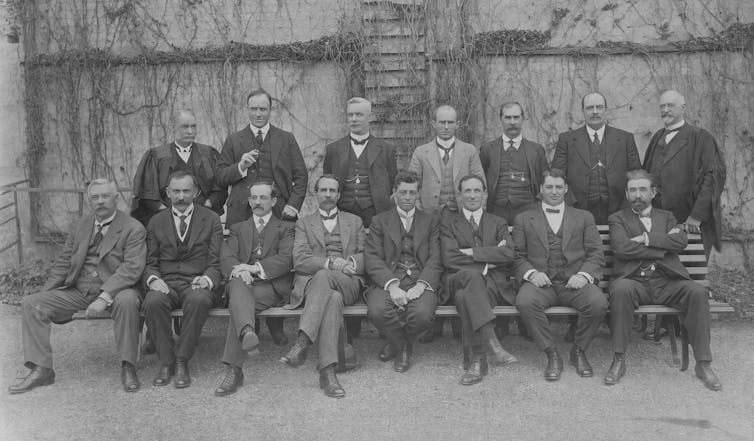
The meeting of the first premiers’ conference in 1916. State Library of Victoria
In 1992 the Council of Australian Governments (COAG) superseded the Premiers’ Conference. The recently commissioned Conran Review claimed COAG “was a slow, bottom-up framework for intergovernmental cooperation that too often resulted in lowest common denominator outcomes”. But this seems an overly crude characterisation.
As constituted by Paul Keating, COAG enjoyed the administrative support of the prime minister’s department and the credibility that came with the leader’s imprimatur. COAG met with early success in dealing with pressing national issues of native title and competition policy.
Morrison’s criticisms of COAG’s overly bureaucratic nature ignore the fact that it was John Howard’s Coalition government that decentralised COAG’s health expenditure negotiations to ministerial councils.
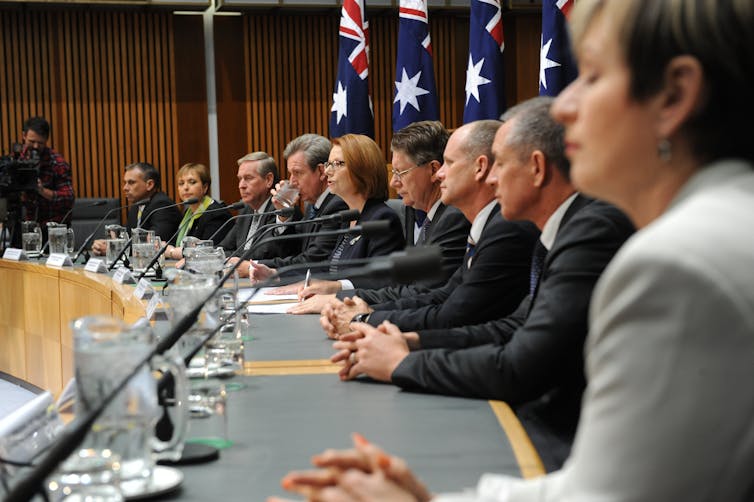
A 2013 COAG meeting during the Gillard government. The nature of our Commonwealth is such that a regular meeting between federal and state leaders is essential. Alan Porritt/AAP
The proliferation of ministerial councils, with secretariats, was one of the factors that led Conran and others rightly to conclude that COAG had become unwieldy and inefficient.
But little attention was paid to the COAG Reform Council, established in 2010. Initially, under the Rudd and Gillard Labor governments, the council looked set to address such problems and continue promoting expert input into the policy deliberation.
Thereafter, Coalition impatience with “bureaucratic” process diminished that momentum.
National cabinet, initially attentive to health experts and epidemiologists, enjoyed success at the onset of the COVID crisis. It effectively addressed a pressing national issue about which it was able to achieve bipartisan consensus, in much the same way as COAG achieved with native title and competition policy. Since then, national cabinet has looked less exceptional and more like its now-maligned predecessor.
The issue, then, is not whether the national cabinet will survive when Australia re-opens. Rather, the issue is how well it will work.
The “job-making agenda” that Morrison assigns to national cabinet seems a thin foundation on which to build an intergovernmental forum. It smacks of sloganeering and politicking. Jobs are vital, but so are other complex issues of economic, energy, climate and social policy.
The efficacy of premiers’ conferences, COAG and national cabinet is not determined by nomenclature or tweaks in process. It lies ultimately in the willingness and capacity of the prime minister to provide dynamic and sensitive leadership, prioritise policy reform over political spin and negotiate outcomes with all levels of government.
The premiers’ moment in the political sun may seem temporary. But when the national government fails to lead on portentous issues, as it continues to do in regard to climate policy, state premiers have shown themselves ready to act.
Australia needs a prime minister who is willing to deal with the range of pressing challenges we face as a nation, and is capable of orchestrating all parties necessary to their solution.
If Scott Morrison proves unwilling or incapable of providing the strong leadership and consensus-building that an effective intergovernmental forum requires, his failure may well see national cabinet fatally diminished. But successors will surely then create another such forum. Will they learn from what has gone before?
Carolyn Holbrook receives funding from the Australian Research Council.
James Walter does not work for, consult, own shares in or receive funding from any company or organization that would benefit from this article, and has disclosed no relevant affiliations beyond their academic appointment.
The term “toxic positivity” has received a good deal of attention lately. Coming off the back of the “positivity movement” we are beginning to recognise while feeling happy is a good thing, overemphasising the importance of a positive attitude can backfire, ironically leading to more unhappiness.
Yes, research shows happier people tend to live longer, be healthier and enjoy more successful lives. And “very happy people” have more of these benefits relative to only averagely happy people. But pursued in certain ways, happiness or positivity can become toxic.
Our research, published in The Journal of Positive Psychology and involving almost 500 people, was inspired by these apparently inconsistent findings – pursuing happiness may be both good and bad for our well-being. We aimed to uncover a key ingredient that turns positivity toxic.
Some studies have shown that when people place a high value on their own happiness it can lead to less happiness, especially in contexts where they most expect to feel happy.
This tendency to expect happiness and then to feel disappointed or to blame oneself for not feeling happy enough, has been linked to greater depressive symptoms and deficits in well-being.
As the line to a cartoon by Randy Glasbergen depicting a patient confessing to his psychologist puts it:
I am very, very happy. But I want to be very, very, very happy, and that is why I’m miserable.
However, researchers have also observed when people prioritise behaviours that maximise the likelihood of their future happiness – rather than attempting to directly increase their levels of happiness “in the moment” – they are more likely to experience improvements (rather than deficits) in their levels of well-being.
This may mean engaging in activities that provide a sense of achievement or purpose, such as volunteering time or completing difficult tasks, or constructing daily routines that support well-being.
This work suggests pursuing happiness indirectly, rather than making it the main focus, could turn our search for positivity from toxic to tonic.
We wanted to find out what it was about making happiness a focal goal that backfires.
To gain a better understanding, we measured these two approaches to finding happiness: valuing happiness versus prioritising positivity.
People who valued happiness agreed with statements such as “I am concerned about my happiness even when I feel happy” or “If I don’t feel happy, maybe there is something wrong with me”.
People who prioritised positivity agreed with statements such as “I structure my day to maximise my happiness” or “I look for and nurture my positive emotions”.
We also included a measure of the extent to which people feel uncomfortable with their negative emotional experiences. To do this, we asked for responses to statements like: “I see myself as failing in life when feeling depressed or anxious” or “I like myself less when I feel depressed or anxious”.
People who expected to feel happy (scoring high on valuing happiness), also tended to see their negative emotional states as a sign of failure in life and lacked acceptance of these emotional experiences. This discomfort with negative emotions partly explained why they had lower levels of well-being.
On the other hand, people who pursued happiness indirectly (scoring high on prioritising positivity), did not see their negative emotional states this way. They were more accepting of low feelings and did not see them as a sign they were failing in life.
What this shows is when people believe they need to maintain high levels of positivity or happiness all the time to make their lives worthwhile, or to be valued by others, they react poorly to their negative emotions. They struggle with these feelings or try to avoid them, rather than accept them as a normal part of life.
Pursuing happiness indirectly does not lead to this same reaction. Feeling down or stressed is not inconsistent with finding happiness.
So, it appears the key ingredient in toxic positivity is not positivity itself, after all. Rather, it is how a person’s attitude to happiness leads them to respond to negative experiences in life.
The prospect of experiencing pain, failure, loss, or disappointment in life is unavoidable. There are times we are going to feel depressed, anxious, fearful, or lonely. This is a fact. What matters is how we respond to these experiences. Do we lean into them and accept them for what they are, or do we try to avoid and escape from them?
If we are aiming to be happy all the time then we might feel tough times are interrupting our goal. But if we simply put a priority on positivity, we are less concerned by these feelings – we see them as an ingredient in the good life and part of the overall journey.
Rather than always trying to “turn a frown upside down”, we are more willing to sit with our low or uncomfortable emotions and understand that doing so will, in the long run, make us happy.
Learning to respond rather than react to these emotions is a key enabler of our happiness.
Our reaction to discomfort is often to get away and to reduce the pain. This might mean we employ ineffective emotion regulation strategies such as avoiding or suppressing unpleasant feelings.
If we do, we fail to engage with the insights an unpleasant experiences bring. Responding well to these experiences means getting “discomfortable” – being comfortable with our discomfort. Then we can be willing to feel what we feel and get curious about why those feeling are there. Taking this response allows us to increase our understanding, see our choices, and make better decisions.
As the saying goes: “Pain is inevitable. Suffering is optional”.
Brock Bastian works for the University of Melbourne and consults to organisations on issues of culture, ethics, and wellbeing for Psychological Safety Australia. He receives funding from the Australian Research Council.
Ashley Humphrey does not work for, consult, own shares in or receive funding from any company or organization that would benefit from this article, and has disclosed no relevant affiliations beyond their academic appointment.
Source: The Conversation (Au and NZ) – By Frank Jotzo, Professor, Crawford School of Public Policy and Head of Energy, Institute for Climate Energy and Disaster Solutions, Australian National University
Prime Minister Scott Morrison arrives at today’s opening of the United Nations climate summit with a 2050 net-zero emissions target born from a painful political process.
Friendly nations will breathe a sigh of relief, freed from the awkward task of calling out Australia on that basic climate pledge. But the target won’t afford Australia much cover in Glasgow.
This nation still doesn’t have a 2030 emissions-reduction target that passes international muster. Nor does it have policies to achieve greater near-term emissions cuts, or a strategy for the economic and social transition.
The paucity of process around Australia’s climate policy must end. We need a proper long-term emissions strategy – one that’s transparent, inclusive and informed by the best available knowledge.
Australia still does not have a 2030 target that passes international muster. EPA
Does the net-zero target matter?
Net-zero targets or pledges have now been proclaimed by almost all developed countries and many industrialising countries – including China, Russia and Saudia Arabia, which all came in before Australia.
Targets for the middle of the century can be cynically regarded as an attempt to kick the can down the road. But they’re important signposts – an affirmation of commitment to the long-term goals of the Paris Agreement.
And importantly, a long-term commitment implies the need for action in the meantime.
Net-zero targets are likely to be increasingly influential in future policy-making. And they matter for investment decisions.
In Australia, the net-zero target could serve yet another function. The fact it was adopted by a conservative government previously opposed to substantial climate action could help end the political “climate wars” which have raged in Australia since 2009.
Net-zero will likely be a durable bipartisan cornerstone – giving the political contest a chance to move beyond whether to do it, to how to do it.
Net-zero emissions targets signal a commitment to the Paris Agreement. Shutterstock
What about the 2030 target?
That said, mid-century net-zero targets will be mostly taken for granted at Glasgow. High-level political talks will be focused on stronger emissions targets for 2030 – and almost all developed countries have 2030 targets far more ambitious than Australia’s.
Australia will aim for a 26-28% emissions reduction by 2030, based on 2005 levels. The key point of comparison is the United States, which has committed to a 50-52% reduction in the same time period.
Other important reference points include the United Kingdom and European Union, which respectively aim for emissions reductions of 68% and 55% on 1990 levels. Japan has pledged to cut emissions by 46% based on 2013 levels.
Australia’s 2030 ambition, put forward at the Paris climate talks in 2015, was relatively weak even back then. Six years on, it’s not even in the ballpark of what’s acceptable internationally. And Australia will be just about alone among developed countries in not having updated its target since Paris.
The majority of the 26% target has already been fulfilled, through reductions in emissions from land-use change and forestry, which occurred mostly during 2005 to 2012. In fact, the latest official figures project Australia’s emissions will decline by 30-38% by 2030, without new policy efforts beyond technology support.
The government’s tactic is to argue that Australia over-achieves on its targets. But the purpose of setting targets is to define an ambition, and let that ambition drive policy action.
Other nations will rightly argue the projections show Australia should take on a target far more ambitious than 38%, let alone the current 26-28%.
The existing target is also inadequate to guide the transition to a low carbon economy. The Business Council of Australia is now calling for a 46-50% emissions reduction by 2030.
We need a national plan
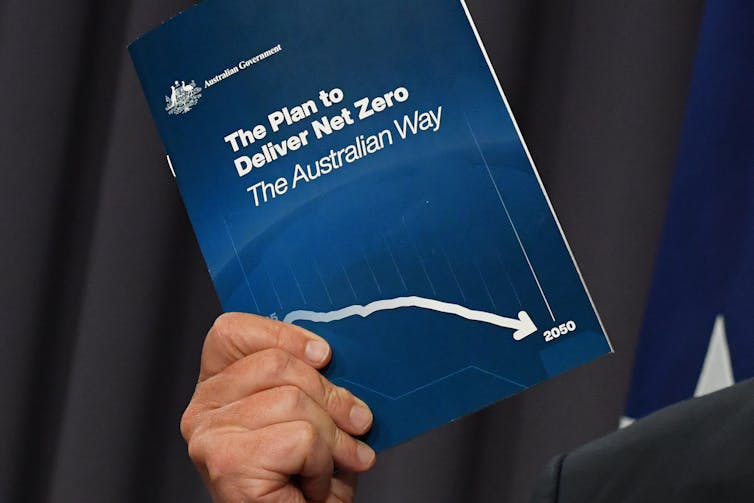
The document accompanying the federal government’s net-zero announcement last week was heavy on politics and light on analysis. The government called it a “plan”, but in reality it was little more than a statement of aspiration.
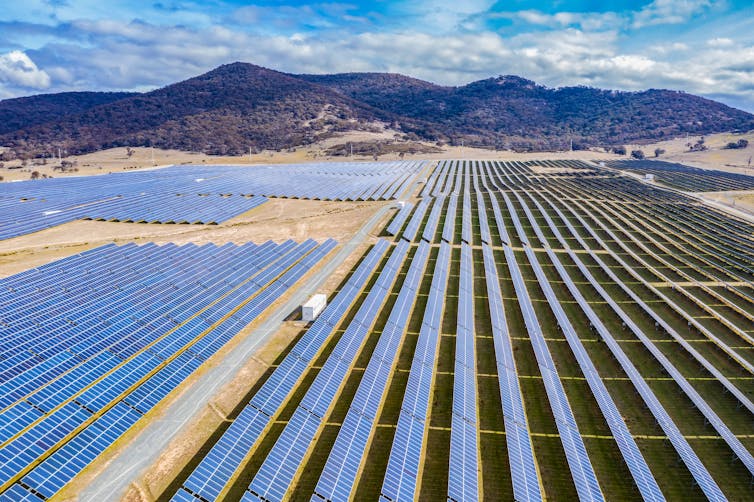
First, it assumes technological innovation will take Australia most of the way to net-zero. But much of the technology we need already exists. This includes but is not limited to sectors such as:
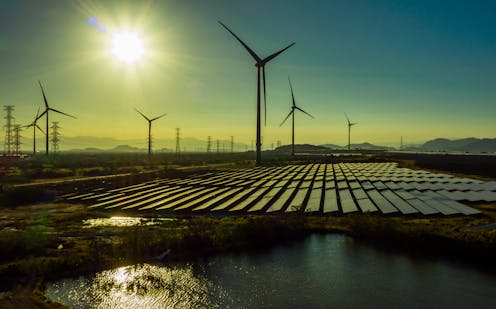
electricity (renewable energy, energy storage and decentralised power supply)
transport (electric vehicles, clean hydrogen in heavy transport)
industry (electricity for heat and processes, hydrogen for specific uses)
agriculture (lower-carbon practices and products).
Policies can be tailored to specific applications, including market and regulatory reform, R&D support, and broad-based and specific incentives and regulations. They can also help with the economic transition in particular regions and industries.
A carbon price is a key part of a sensible policy mix. Carbon pricing is the most cost-effective mechanism to shift to low-emissions production. Australia’s political class must overcome its hang-ups about carbon pricing. Over 20% of global emissions are now subject to emissions trading or a carbon tax, and for good reason.
Much of the technology Australia needs for it’s low-carbon transition already exists. Shutterstock
Where are the costs?
But there’s no escaping the fact Australia’s fossil fuel industries will bear most of the economic cost of a global shift to net-zero, as demand for fossil fuels declines and eventually dries up. This is out of the government’s hands.
Governments can help, though – not by propping up old industries, but by investing in infrastructure and economic diversification, worker retraining and social programs.
And there’s a huge upside to the transition. Australia’s comparative advantage in renewable energy means such industries could become very large, if we’re smart about it.
A proper national conversation
Quite inexplicably, the modelling underpinning the government’s net-zero plan has not been released. It’s but one small illustration of the paucity of process around climate policy in Australia.
Governments dropping glossy brochures brimming with political messaging, produced behind closed doors, is not the way to deal with a complex long term national issue.
Brochures brimming with political messaging are not a way to to address a national problem. AAP
Australia needs a proper long-term emissions strategy that fully maps out how to position the nation for success in a low-carbon world. It should be developed openly, draw from the best available knowledge and bring major stakeholders to the table.
Out of that, a shared understanding can be forged between industry, federal and state governments, the unions, civil society and communities. Universities can bring research and analysis to the table.
Many other countries have prepared long-term emissions strategies of this kind, often led by independent statutory agencies like Australia’s Climate Change Authority.
Perhaps our prime minister will return from Glasgow with a few good ideas for how to start a real conversation.
The make-or-break United Nations climate talks in Glasgow have begun. Much attention so far has rightly focused on the emissions reduction ambition each nation is taking to the negotiations. But another key goal of the talks is to dramatically scale up so-called “climate finance” for developing nations.
Climate finance is money paid by wealthy countries (which are responsible for most of the historic emissions) to developing countries to help them pay for emissions reduction measures and adaptation. Climate finance should be in addition to standard development aid.
At the 2009 Copenhagen climate talks, wealthy nations promised US$100 billion a year in climate finance to developing nations by 2020. But that goal has not been met.
A new climate finance plan, developed by Germany and Canada, has been proposed. Reports suggest it will propose meeting the US$100 billion annual target by taking an average of the finance provided from 2020 to 2025, instead of in single years.
The renewed focus on the plan is welcome. But it must be robust enough to tackle the mammoth task ahead, not just an exercise in shuffling figures. Time is running out – if developing nations can’t afford to reduce emissions, we won’t hit global climate goals and everyone will suffer.
The cost for inaction on climate change is high and livelihoods are at stake. Shutterstock
Failing to commit enough climate finance puts us all at risk
At COP26, intense pressure will be applied to developed countries to provide adequate climate finance.
The promised US$100 billion a year is not nearly enough. The IPCC estimates US$2.4 trillion is needed annually for the energy sector alone until 2035 to limit global warming below 1.5℃ to prevent catastrophic consequences.
The cost for inaction is high and livelihoods are at stake. Crop failures, water shortages, and poor health outcomes due to pollution in major cities are all on the cards.
Wealthy nations such as Australia are also affected by such issues – but they often have a far greater capacity to prepare and respond than developing nations.
Australia’s pledges lag behind others
Australia’s current pledge for climate finance under the Paris agreement is A$300 million a year by 2025. So far, there are no signs this will change.
Compared to many countries, Australia is lagging. Even New Zealand, with its much smaller economy, has increased its pledge to NZ$1.3 billion over four years 2025.
The European Union is pledging an additional €4.7 billion until 2027 and the US is doubling its commitment to over US$11 billion annually by 2024.
The EU remains a world leader in climate action and pledges commitments fully in line with the goals of the Paris Agreement. Its impressive set of actions includes:
COP26 will also likely see “Article 6” of the Paris Agreement come into effect, and produce more detail on how this would work in practice.
This article establishes a market mechanism which would encourage emission reductions by means of carbon trading. It could mean companies have to buy allowances to continue emitting CO₂.
This carbon trading will provide a funding stream for climate finance. In an ideal world, it generates climate cash that poor countries can use to reduce emissions and adapt.
Another topic expected to be fiercely negotiated at COP26 is the so-called “third pillar” of climate change action: loss and damage caused by human-induced climate change.
Loss and damage can be, for example, slow onset events such as sea level rise or prolonged droughts. It could be extreme weather events such as floods and cyclones.
Other impacts include economic damage to livelihoods and personal “non-economic losses” such as cultural heritage or loss of loved ones. Loss and damage goes beyond what we consider “normal weather”.
Increased human migration and displacement also fall under “loss and damage” if caused by climate change impacts. Between 2008 and 2014 and average of 22.5 million people were displaced because of extreme weather and climate-related disasters. This figure does not include migration due to sea level rise, desertification or environmental degradation.
Loss and damage has been a highly sensitive topic in international negotiations. Wealthy countries fear being made liable and opening themselves up to compensation claims from poorer countries due to climate inaction, human rights violations because of forced migration or other issues related to climate injustices.
After several previous attempts to include loss and damage in convention text, it was finally recognised under Article 8 in the Paris Agreement in 2015.
However, the document’s fine print ensured Article 8 does not provide any basis for liability or compensation. Finance to address loss and damage was also not identified.
The Alliance of Small Island Developing States, the Least Developed Countries and the Africa Group make up over half the world’s nations and currently take the brunt of climate damage. These groups have banded together and are expected to negotiate hard on loss and damage at COP26.
Failing on climate finance means failing the planet
The risk of legal consequences from climate inaction is increasing. Court cases against fossil fuel companies are on the rise.
Governments are no longer immune either. In 2015, an environmental group called the Urgenda Foundation joined with 900 citizens to sue the Dutch government for not doing enough to prevent climate change.
The law suit was successful. The court found the Dutch government’s commitment to reduce greenhhouse gas emissions was insufficient.
In the US, 21 young Americans recently sued the government for violating their constitutional rights by exacerbating climate change. While unsuccessful, the Biden administration agreed to symbolic settlement talks.
And only last month, Vanuatu asked the International Court of Justice to weigh in on what rights current and future generations may have to be protected from climate change.
If developing countries do not receive financial assistance to reduce emissions, it is unlikely we will meet the commitment of the Paris Agreement to limit global warming to 1.5℃.
Clearly, helping developing nations pay for the expensive work of emissions reduction and adaptation benefits everyone on the planet.
Melanie Pill does not work for, consult, own shares in or receive funding from any company or organization that would benefit from this article, and has disclosed no relevant affiliations beyond their academic appointment.
The federal government has finally committed to achieving net-zero emissions by 2050 – a target Prime Minister Scott Morrison will take to this week’s crucial United Nations climate summit in Glasgow.
Though unlegislated, the target represents a rare moment of bipartisanship in Australia’s climate wars, and brings the federal government into line with the states’ and territories’ own net-zero targets.
Yet the target is much closer to a ceasefire than a peace treaty. Without changes to how climate policy gets done in Australia, there will be many more skirmishes about how we should get to net zero, and how much carbon we emit along the way.
Australia can’t afford further delay: governments need to act now to avoiding locking in emissions, or there will be little chance of reaching net zero by 2050.
Australian governments typically have a single minister for climate change or emissions reduction, who often has responsibility for the energy or environment portfolios too. But to reach net zero will take policies that span energy, industry, transport, agriculture, land use, even trade. Climate change is a whole-of-government issue. It’s every minister’s problem.
Now all governments are committed to net zero by 2050 or earlier, they need to ensure their policies are consistent with this target. Every government decision on planning, infrastructure, resource extraction, forests, national parks, and land management potentially locks in future emissions.
At a minimum, governments should stop subsidising further expansion of fossil fuel production – taxpayers should not be on the hook for industry handouts such as the A$217 million in federal funding for gas industry road upgrades in the Northern Territory or the Queensland government’s royalty holiday for the proposed Carmichael coal mine.
And governments should not weaken existing land-clearing laws, given the contribution avoided land-clearing is expected to make to future emissions reductions.
Climate policy should also be harmonised across tiers of government. Currently, there is a mess of divergent, sometimes contradictory policies. In the electricity sector, for example, the federal and state governments have repeatedly failed to implement any national emissions policy.
Federal and state energy ministers used to meet and discuss reforms through the COAG Energy Council. But during the COVID-19 pandemic, the council was replaced by the clumsily-titled Energy National Cabinet Reform Committee.
State and federal governments should re-establish the co-operative co-ordination structures formerly dealt with through the energy council, and create similar structures for climate policy and programs.
Climate change and the global transition to net zero will batter government revenues and create greater calls for government spending. All governments need to start planning how to replace the revenue they current derive from fossil fuels.
Up to this point, Australia has asked itself: what progress are we making in decarbonising the economy? What emissions target should we therefore set? And what is the emissions budget to meet this target?
Our near-term target should be set with respect to staying within this budget. And then policies should be set to achieve this target, and adjusted if they are failing.
To reach net zero will take policies that span energy, industry, transport, agriculture, land use, even trade. Shutterstock
Setting a carbon budget also allows businesses to reach their own conclusions about how fast they might be required to reduce or offset emissions in the future. Once we have a carbon budget, the annual emissions projections become critical information about the future direction of the economy. They need to be developed, released, and treated with the same seriousness and commitment to rigour and independence as other economic data.
An emissions budget will determine the direction of economic policy for decades, so it requires bipartisan support. Evaluating policy effectiveness can be subject to politicisation, because there is always an incentive for governments to find fault with their predecessor’s policies, and seek praise for their own.
Luckily, as we note in our latest Grattan Institute report, Australia already has an institution tailor-made to provide independent, rigorous advice on issues like carbon budgets, emissions projections, and policy reviews. The Climate Change Authority, reinvigorated, could do all this, and could also advise governments on interim targets to keep Australia on the pathway to net zero.
Adopting the target is only the first step
Investing in new technology is one part of the puzzle, but these technologies won’t deliver emissions reductions until the 2030s or 2040s – and many of them may turn out to be dead-ends or failures.
There’s plenty governments could do now, through market-based policy approaches and technologies that already exist, to push emissions down.
Grattan Institute began with contributions to its endowment of $15 million from each of the Federal and Victorian Governments, $4 million from BHP Billiton, and $1 million from NAB. In order to safeguard its independence, Grattan Institute’s board controls this endowment. The funds are invested and contribute to funding Grattan Institute’s activities. Grattan Institute also receives funding from corporates, foundations, and individuals to support its general activities as disclosed on its website.
Alison Reeve was previously general manager of project delivery at the Australian Renewable Energy Agency. She led development of Australia’s National Hydrogen Strategy in 2019, as well as Commonwealth policy for offshore wind, energy innovation, energy efficiency, and structural adjustment.
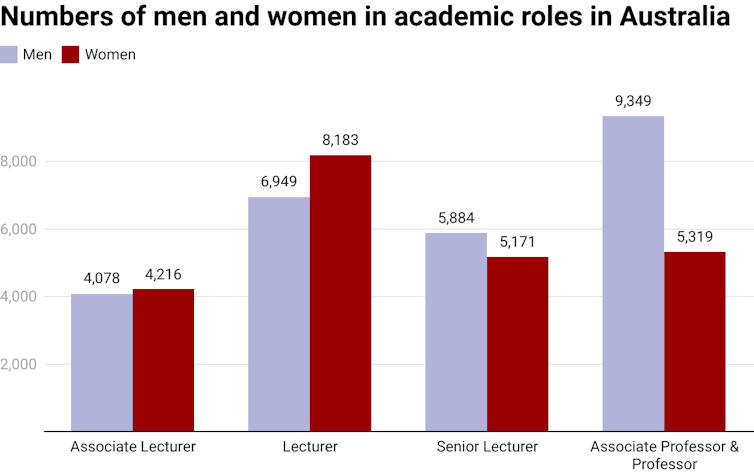
Female academics continue to be underrepresented in senior academic positions in Australia and internationally. Most research has focused on the low number of women professors at universities. But the largest drop-off in the number of female academics is between two mid-level positions: lecturer and senior lecturer.
We set out to find why this occurs, using a new method to explore the career journeys of male and female academics. We found they continue to experience different careers: men commonly described a clear run at their career goals, while many women found themselves in a holding pattern as a result of having to juggle other responsibilities.
Most female lecturers in our study were ambitious, but unable to fully commit to their careers. The main reasons for this included their avoidance of work-life conflict, undertaking service activities and a lack of support from colleagues.
Our research shows gender equity efforts need to target this holding pattern for women to make career progress.
To explore the careers of female academics we created a new method called Draw, Write, Reflect (DWR). We asked 18 male and 29 female academics at one university to draw or write their career journeys, since not all knowledge can be expressed in words. Our participants confirmed drawing made it easier to express their experiences and relay emotions.
Next, we asked respondents to reflect on their drawing. We also interviewed nine senior stakeholders including executive leaders, HR managers and gender equity committee members.
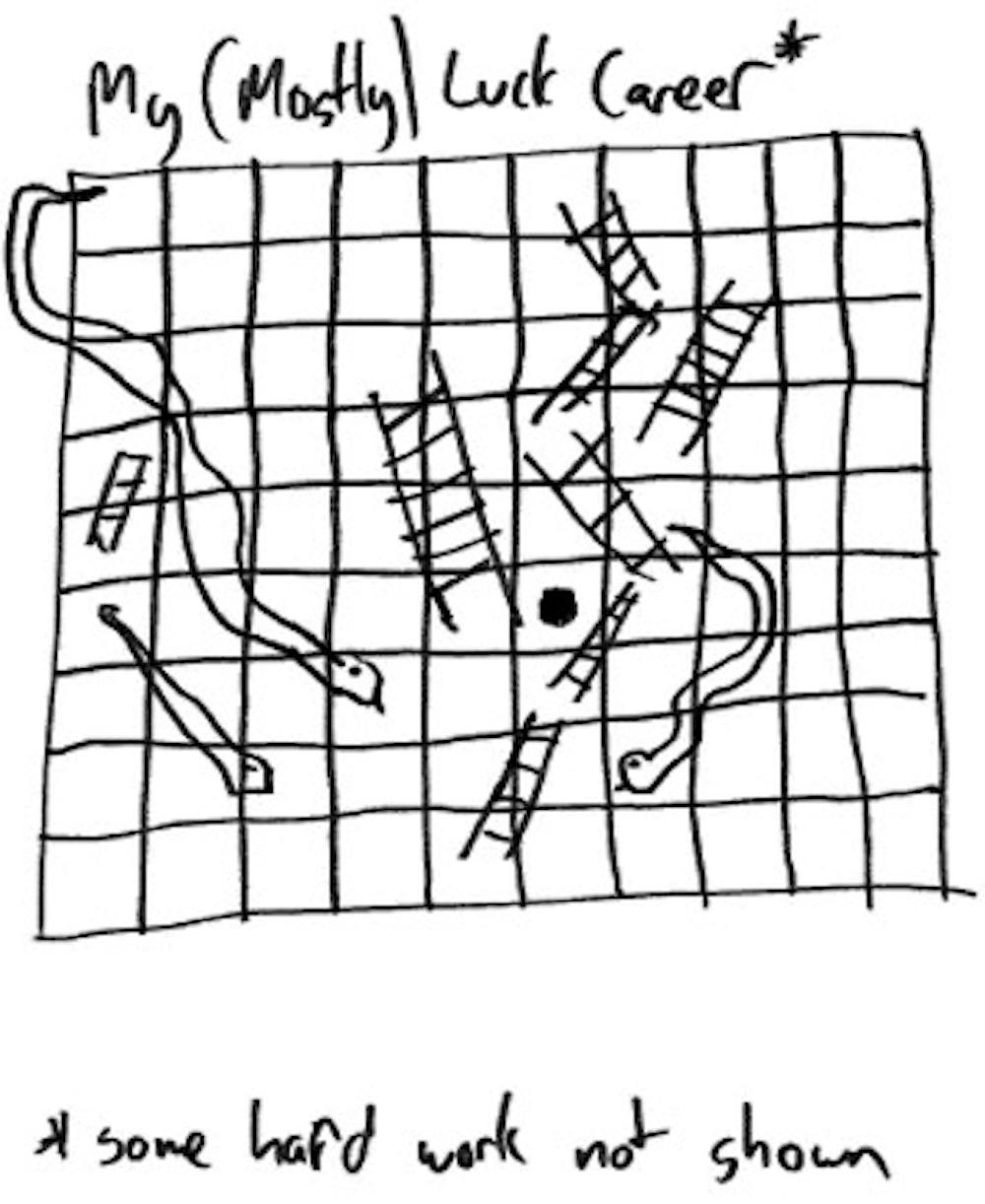
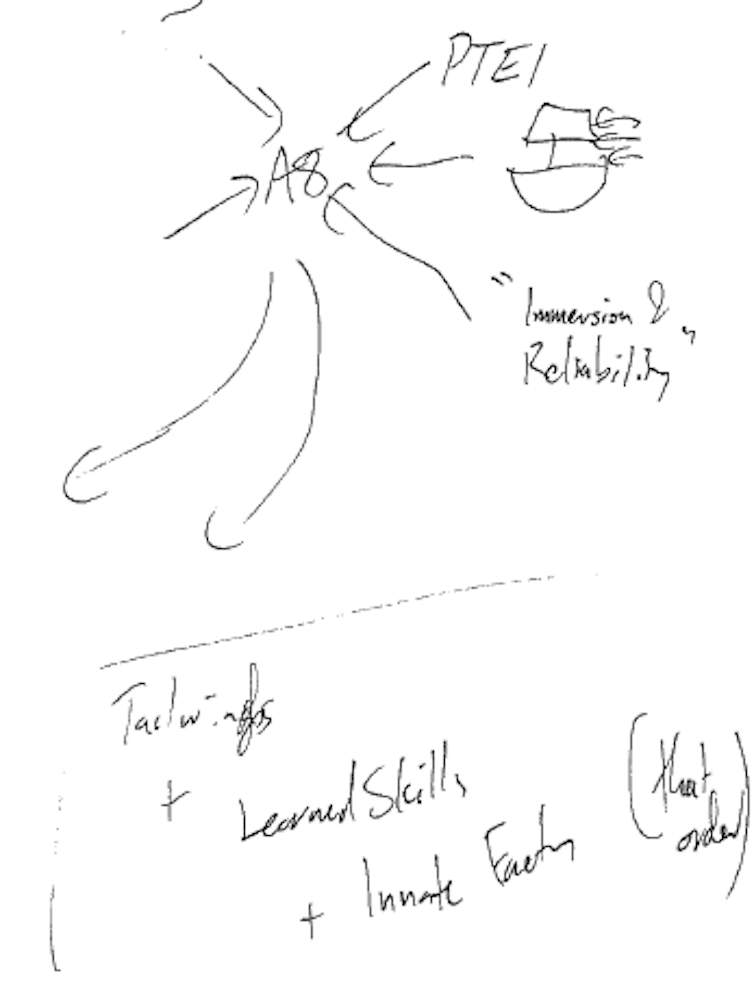
Male academics had a clear career focus and many described their career journeys as “lucky” or “privileged” and with “tailwinds”.
One example of a drawing by a male academic is shown below. He drew a snakes and ladders game to represent his “lucky” career, with ladders well outnumbering snakes on his game board.
Tye DWR: ‘Snakes and Ladders’. Author provided
Another male academic wrote “tailwinds” on his drawing as shown below.
Xavier DWR: ‘Tailwinds’.
Juggling competing responsibilities
Female academics were much more likely to include their families in their career drawings, highlighting the interrelatedness of work and family. Those with children were all primary carers. Their academic work had one set of requirements, their family another and both required their attention, often at the same time.
This situation resulted in a constant struggle and negotiation, as the drawing below shows.
Danielle DWR: Up the Hill. Author provided
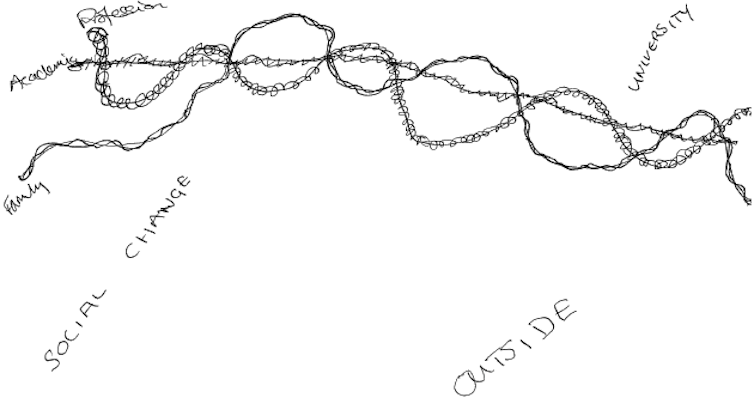
Connectedness was also clear in the drawing below created by another female academic.
Ruth DWR: Interrelatedness.
To maintain a level of balance – “to keep my head above water” as one put it – most female academics chose not to progress their careers. They could not see themselves successfully managing their domestic tasks in a senior lecturer role. One female lecturer said:
“Half the time I feel like I am sinking, so for now I am happy just to keep doing the best I can in my job and then retire at the age of 65.”
Seven of the eight female lecturers reported putting their career aspirations on hold.
Another reason for the holding pattern was female academics undertaking more service activities. Coined “academic housework”, these activities are associated with caring and include assisting students, administration of teaching, or organising professional academic activities. Generally, these activities are not considered for career progression.
This situation was confirmed by a member of the executive leadership team who said some women:
[…] have literally taken on a lot of things that you can tell no one else wants to do – academic housework.
Similarly, a female academic reported male colleagues are:
[…] focusing on the things that matter for promotion, not on the things that matter for the team.
Lacking support from colleagues
Some junior female academics did not support ambitious senior female colleagues. They referred to them as “alpha women”, “men dressed in women’s clothing” or “women acting like men”. This situation was confirmed by senior female academics who reported backlash from other women for being ambitious. One said:
“I am ambitious and if this was a man sitting here there would be a different connotation of ‘Wow, you’ve done well!’, but for a woman it is like, ‘Well, how are your children? And your family and everything else?’ So, there is an issue.”
Another female academic reported “thinking like a man” had helped her have a very successful career. She reported that this requires not thinking about family, putting yourself first and “being selfish”.
Fear of backlash may stop some women, however, from pursuing career progression.
Despite their career aspirations, organisational and personal reasons resulted in women not pursuing promotion to senior lecturer and beyond. Our study identified a clear holding pattern among female lecturers that inhibited their progression to the next level.
While male academics reported focused career trajectories, women reported difficulty managing many work and life responsibilities in pursuing their careers.
Universities can help female lecturers break the holding pattern cycle and assist their career progression. They can start by developing guidance in better negotiating academic housework and service tasks and by changing the narrative and culture around career ambition for women at universities. This will be a win-win for female academics and universities.
Kerry Brown receives funding from the Australian government through several Cooperative Research Centres.
u.jogulu@ecu.edu.au receives funding from Australian Research Council, AMA (WA), DWER.
Fleur Sharafizad and Maryam Omari do not work for, consult, own shares in or receive funding from any company or organization that would benefit from this article, and have disclosed no relevant affiliations beyond their academic appointment.
Source: The Conversation (Au and NZ) – By Joanna Mendelssohn, Principal Fellow (Hon), Victorian College of the Arts, University of Melbourne. Editor in Chief, Design and Art of Australia Online, The University of Melbourne
Sculptor Margel Hinder with the model for Interlock in 1973. Photograph: Richard Beck. Heide
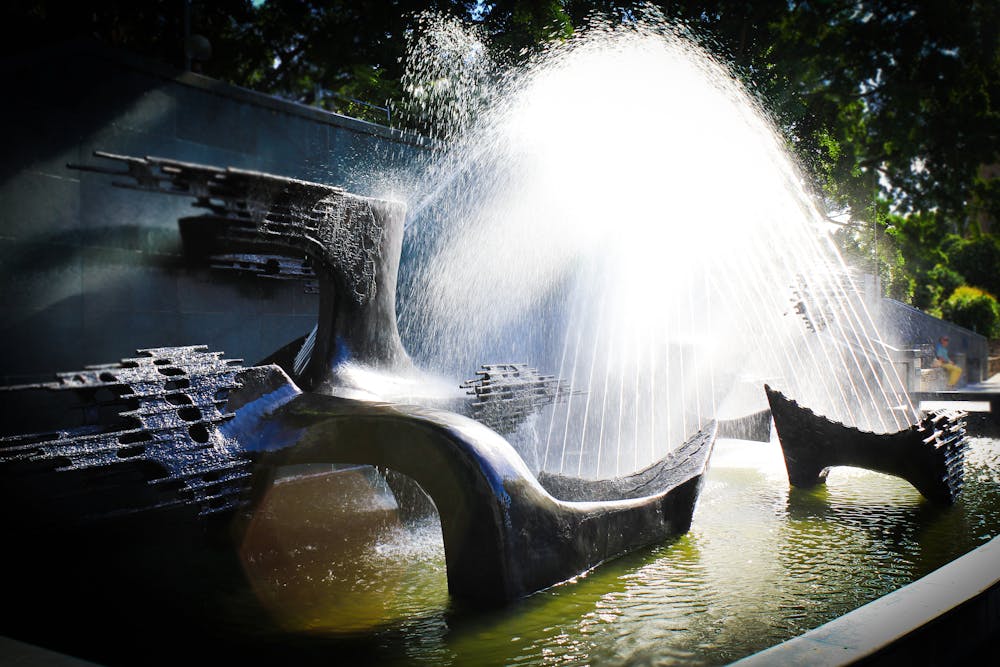
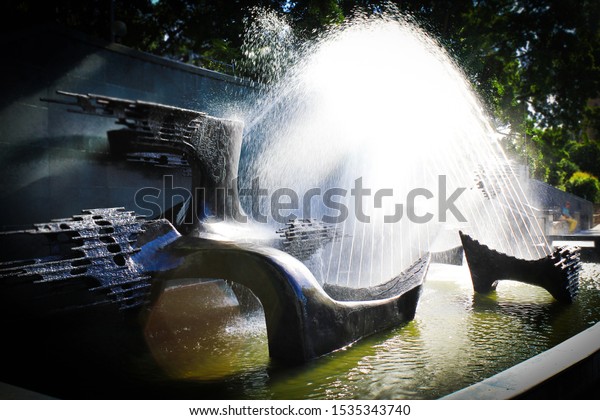
Many years ago my daily pleasure was to walk past a Margel Hinder masterpiece, the Civic Park Fountain in Newcastle. With water spraying in rhythmic patterns, it would bring a smile to my face for its beauty, the way the streams caught the light.
Fountains can’t be moved for an exhibition, of course, but Hinder’s Civic Park Fountain and her sadly decommissioned Northpoint Fountain of 1975 have been digitally simulated by Andrew Yip for Margel Hinder: Modern in Motion, a joint project of Heide Museum of Modern Art and the Art Gallery of New South Wales.
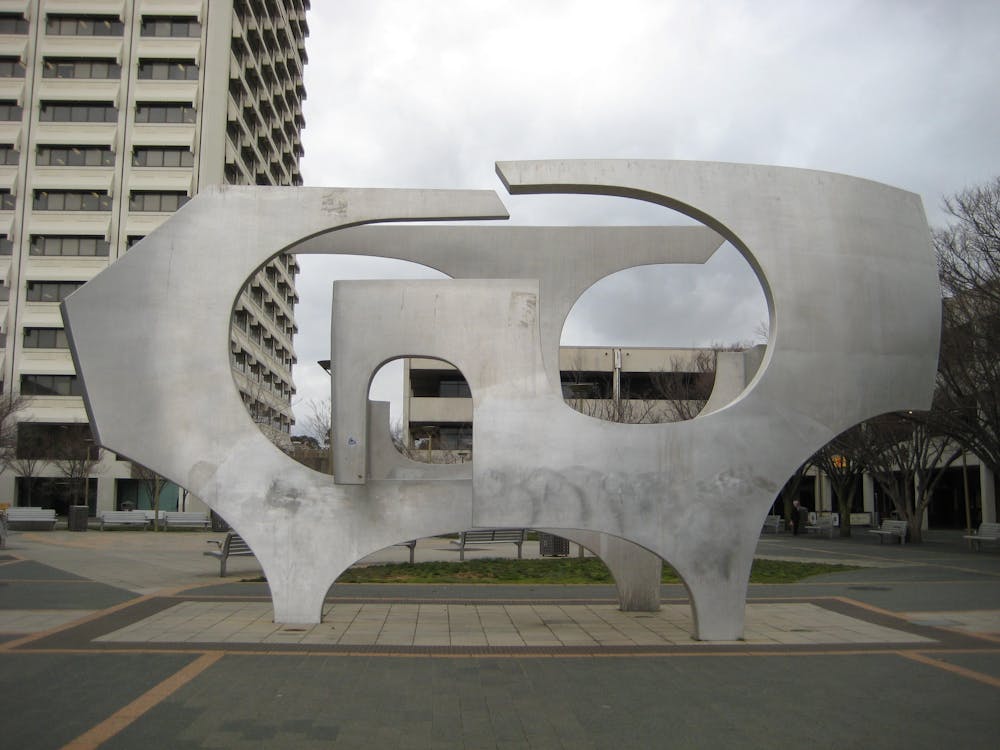
Throughout the 1960s and 70s Hinder was commissioned to create sculptures for Australia’s public places, including the Reserve Bank in Sydney, Woden Town Square in Canberra and the Telecommunications Building in Adelaide. So her work has hardly been hidden from the public gaze.
But for many years the dominant book on Australian art was Bernard Smith’s Australian Painting. As a result, artists in other media are less well known than they deserve to be.
The Art Gallery of New South Wales began collecting her work in 1949. Nevertheless the range of the sculptures in the current exhibition is still a surprise. With mostly small works, this is sculpture at its most intimate – welcoming the viewer into a world where asymmetrical form rules.
Sunlight plays with the water in Margel Hinder’s Civic Park fountain in Newcastle. Shutterstock
American by birth
Margel Ina Harris was born in New York, brought up in Buffalo, and lived in Boston with a family that encouraged creativity.
In 1929, at the age of 23, she went to a summer school in upstate New York to work with the modernist artist Emil Bisttram. There she met young Australian artist and designer Frank Hinder. They married in 1930 and daughter Enid was born the following year.
In 1933, at the depths of the Great Depression, the Hinders travelled to New Mexico, again to work with Bisstram. Margel took nourishment from the dry sculptural Mesa landscapes of Taos – and observed the rhythms and of the Pueblo women as they went about their daily business. Her approach to form began to change from modelling to carving.
Margel Hinder working on Mother and Child, circa 1939. Heide/AGNSW
On the family’s subsequent slow sea voyage from the US to Sydney, she carved her first wooden relief sculpture, Taos Women. After arriving in Sydney she carved Pueblo Indian, a simplified solid form emerging from the wood.
Sydney’s art establishment was decidedly conservative. Nevertheless the Hinders soon befriended a small group of modernist painters and thinkers including Grace Crowley, Ralph Balson, Eleonore Lange and Rah Fizelle.
In Gerald Lewers, Margel found a fellow sculptor who understood her exploration of wood as form. She later wrote that Gerald Lewers “was the most developed of any sculptors here in Sydney”.
In 1939 she made Mother and Child, a work less about the subject and more about honouring the material from which it is made.
Light enters
Her methods changed again during and after the second world war. The Hinders moved to Canberra where Frank worked on camouflage projects for the Department of Home Security and Margel made small wooden models.
After the war they returned to Gordon in Sydney and a house that backed onto the bush. There birds would come to feed in the elaborate sculpture Frank made for them. Margel worked in her studio, surrounded by the light and sounds of the bush.
Her work became more constructive. And a new element entered — light. She sometimes used hand-coloured Perspex to get particular effects.
Wire and Perspex Abstract, c.1955, Newcastle Art Gallery, New South Wales. Heide/AGNSW
She shaped and soldered wire to cast shadows. Revolving Random Dots (1953) spins using a swivel mechanism, while movement in other constructions is aided by a carefully placed fan.
Many of her small sculptures were first exhibited at the NSW Contemporary Art Society, the only ready exhibition venue for modernist art.
At the same time, Hinder was entering public sculpture competitions. Most of these were local events, associated with the post-war building boom. But in 1953 she was awarded third prize out of 3502 entries in an international competition for a memorial to the Unknown Political Prisoner. Her entry shows an abstract embrace of an ethereal shape. Along with work by the other finalists, her maquette was exhibited at the Tate in London.
Construction, c.1954, also known as Revolving Ball. AGNSW
Hinder’s growing reputation led to her first public commission for a large sculpture in Sydney’s newly built Western Assurance Company Building.
The sculptures made for public spaces are bolder, more assertive than her smaller private sculptures. This is art made to withstand the elements but also bold statements disrupting the straight lines of corporate architecture.
The fate of the Western Assurance work is a reminder that sculptors face an extra peril in preserving their art. In the 1980s the building and the sculpture were demolished. Fortunately a passer-by alerted the Hinders who were able to salvage the pieces. The work was eventually reassembled at the University of Technology where it remains on permanent view.
Hinder was determined never to be defined by her gender or as a wife and mother. This was not only evident in her own single-minded pursuit of art, but in her frequent advice to young women that they must persist in their careers and not abandon art after having children. Talent, she believed, should not be wasted.
In the 1950s and 60s there was considerable cultural pressure on Australian women to limit themselves to domesticity. Hinder’s remarkable career was supported at every step by Frank, who sometimes did the heavy lifting (literally) in the creation of her larger works.
Their closeness might be one reason why previous survey exhibitions at Newcastle, Bathurst and the Art Gallery of NSW presented their work together. Now it is time for her art to stand alone.
In the time of the COVID-19 pandemic, when so many lives have been lost to the virus, celebrating a “day of the dead” might seem strange, even tactless. But despite the morbid associations of its name, the Day of the Dead is actually a time to be reminded of the beauty of life, rather than just the inevitability of death.
Part of an important season for most Christians that begins at the end of October, the day sits within the celebration of Allhallowtide. This three-day period comprises All Hallows’ Eve on October 31, All Saints’ Day on November 1, and All Souls’ Day on November 2.
The last one is particularly important for Catholics and is an official holiday in their ecclesiastic calendar. Also known as the Commemoration of the Dearly Departed and the Day of the Dead, All Souls’ Day is generally a day of remembrance, when prayers are said for the souls of those who have passed on.
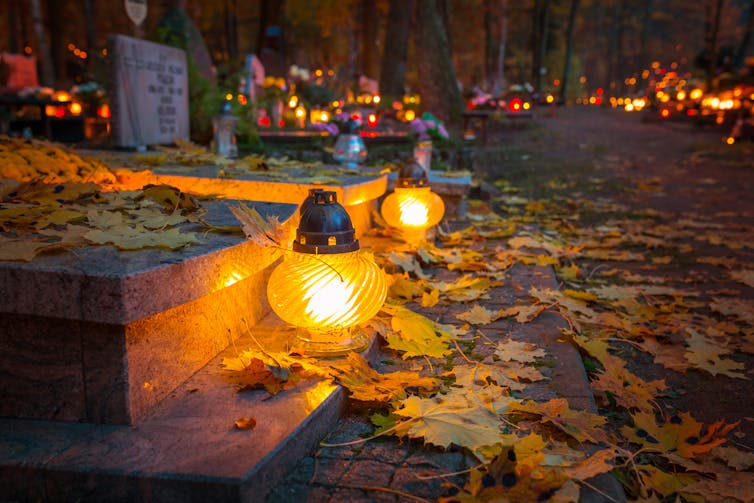
Around the world, All Souls often involves visiting cemeteries where loved ones are buried, and tending to their graves. Attending a mass or church service, praying and eating particular foods are all part of these observations.
In Italy, for instance, one can eat the pan dei morti – literally, bread of the dead – a kind of chocolate biscuit filled with nuts. The biscuit represents the soil, and the nuts represent the bones of the departed. In a number of cultures, food is left out as an offering for the dead as a way of commemorating their lives.
The duality of life and death: a parade through Mexico City on Día de Muertos. Shutterstock
Día de Muertos
While it is first and foremost a religious holiday, All Souls’ Day/The Day of the Dead has, as often happens, been incorporated into secular popular culture.
Most obviously, we see Day of the Dead motifs borrowed for secular Halloween celebrations – even if the two days within Allhallowtide have very different origins, iconographies and principles at their core.
Increasingly, though, it is the Mexican incarnation of the Day of the Dead that has taken hold of the popular imagination. Día de Muertos takes on special tones in Mexico and elsewhere in Latin America, as well as within Latino communities around the world.
Observed over the first two days of November, Día de Muertos is a time of both remembrance and celebration. But where All Souls can be a sombre occasion in other places, in Mexico it is a bright and colourful holiday, focused on celebrating the lives of those who have come before.
While Día de Muertos is certainly situated within Christian belief, it also mingles culturally and conceptually with Indigenous beliefs dating back before the Spanish invasion, where the celebration of “death as part of life” was central to religious systems.
Ceramic flower skull souvenirs on sale in Mexico. Shutterstock
The flower skull
An important part of Día de Muertos – which it shares with celebrations in other countries – is the belief that the dearly departed can return and visit the living during this time. Big family feasts and musical performances are held to welcome the spirits.
Altars known as ofrendas are set up for the dead, where their pictures are commonly displayed. You sometimes see the practice represented in popular culture, most recently in the 2017 animated film Coco.
The iconic “flower skull” is perhaps the most recognisable motif of Día de Muertos. You will find it printed on postcards, banners and clothing. It’s also common to see people dressed as “flower skeletons”, and to consume “sugar skull” confectionery.
The flower skull has been widely appropriated by popular culture around the world, even in countries geographically and culturally distant from Mexico. This undoubtedly owes a lot to the enduring popularity of Mexican artist Frida Kahlo (1907-1954), who regularly incorporated the flower skull in her paintings exploring the duality of life and death.
Visiting the graves of loved ones is an important element of the Christian All Souls’ Day. Shutterstock
We’ll meet again
While it may seem at odds with the grim reality of the pandemic, the deeper meaning of the Day of the Dead is felt in many communities across many countries. For those who believe and celebrate All Souls in a religious way, the holiday can be a balm, as families pray and remember their dead.
In its more celebratory manifestations, the Day of the Dead rests on the belief that our loved ones who have gone are still always with us – and that we will see them once again when the time comes.
While it can’t erase the grief and pain of losing loved ones, a recurring commemoration such as the Day of the Dead also emphasises the importance of celebrating life. This can certainly be a comfort for those who believe, and should be respected as something spiritually important in their lives.
And in its most colourful incarnation as the Mexican-inspired Día de Muertos, the day celebrates the profound idea that love, memory and family connections live on, even in the face of death.
Lorna Piatti-Farnell does not work for, consult, own shares in or receive funding from any company or organization that would benefit from this article, and has disclosed no relevant affiliations beyond their academic appointment.
The Pacific Islands are in grave danger and at the frontline of global climate change and the United Nations Conference on Climate Change, known as COP26, in Glasgow this week is vitally important for islanders, says Reverend James Bhagwan.
The general secretary of the Suva-based regional Pacific Conference of Churches visited Geneva last week on his way to COP26 in Scotland’s largest city taking place from today until November 12.
“COP26 is important because if this doesn’t work, then we’re in serious danger. It’s already obvious that many of the targets set during the Paris Agreement in 2015 have not been met,” says Reverend Bhagwan with passion and sadness tinging his voice.
“We’re in danger of going well beyond the 1.5C limit of carbon emissions that we need to maintain where we’re at.”
The Pacific Conference has a membership of 33 churches and 10 national councils of churches spread across 19 Pacific Island countries and territories, effectively covering one-third of the world’s surface.
Some progress on countering the effects of climate change have been made in global awareness, says Reverend Bhagwan, a Methodist minister.
The return of the United States to the treaty around it helps.
“And even though there is significant commitment to reduce carbon emissions by countries to as much as 26 percent of those countries that have committed, globally we’re going to see an increase of carbon emissions by 19 plus percent by 2030, which isn’t far away—that’s nine years away,” rues Reverend Bhagwan.
Greenhouse gases warning On October 25, the World Meteorological Organisation secretary-general Dr Petteri Taalas, releasing a report on greenhouse gases, confirmed Reverend Bhagwan’s worries in a warning:
“We are way off track. At the current rate of increase in greenhouse gas concentrations, we will see a temperature increase by the end of this century far in excess of the Paris Agreement targets of 1.5 to 2 degrees Celsius above pre-industrial levels.”
Reverend Bhagwan said his churches’ group covers from the Marshall Islands in the northern Pacific across to Ma’ohi Nui (French Polynesia) in the eastern Pacific, down to Aotearoa New Zealand in the southern Pacific.
The conference also has member churches in West Papua and Australia, and it serves a population of some 15 million people.
For the members of the Pacific region churches, climate change is not an abstract issue.
‘Frontline’ of climate change “We are on the frontline of climate change; we have rising seas we have ocean acidification which affects our fish and the life of the ocean,” says Reverend Bhagwan.
“We have extreme weather events now regularly, and the category five cyclones which, in the past, would be the exception to the rule for us, now are the baseline for our extreme weather events. During the cyclone season, at least one cyclone will be category five.
“And so, you just pray that either it goes past, or it drops enough when it reaches us, and usually these systems do not affect just one country.”
Reverend Bhagwan notes that the churches in the Pacific region play a much more integral role in society than they do in some of the secular nations.
Because of the covid-19 pandemic, “we’re not getting as many Pacific Islanders attending COP26 as we would like, both in governments and in civil society.
“And so, it’s important that those who can come do so. We, the church, play a very significant role in the Pacific. The Pacific is approximately 90 percent Christian, particularly within the island communities.
“And so, we have significant influence within the region, working with governments. But we also recognise ourselves as part of the civil society space,” said Reverend Bhagwan.
“And so, we have that ability in the Pacific to walk in these spaces, because leaders, government leaders, ministers, workers, civil servants — they’re members of our churches.
“So, we are providing pastoral care and engagement with those in leadership and government leadership, but also that prophetic voice.”
In just a few weeks the situation in Afghanistan has deteriorated sharply as millions cope without desperately needed international aid, New Zealand journalist Charlotte Bellis says.
Bellis is Al Jazeera’s senior producer in Afghanistan and reported on the turmoil in August as the Taliban took over the government and thousands of people tried to flee.
She has dealt with Taliban leaders for a long time, and has sensed a change in their attitudes since they first ruled the country before being toppled 20 years ago.
She had to leave the country in mid-September because the network feared for her safety and Bellis noted on Twitter that the Taliban were detaining and beating journalists trying to cover protests.
Now she has returned and told RNZ Sunday Morning that she was not worried about her safety.
“The situation here is pretty dire and there are a lot of stories still to be told and I feel invested in what’s happening here and I also just love the country. It’s a beautiful place to be with amazing people and I genuinely like being here.”
However, the country is facing an uncertain future with its population suffering more than ever now that international aid has been cut off.
UN warns of humanitarian crisis This week the United Nations warned that Afghanistan is becoming the world’s largest humanitarian crisis and Bellis agrees.
“The Taliban took over about two months ago and I just can’t believe how quickly everything has deteriorated.
“People cannot find food, there’s no money, they can’t pay for things, employers can’t pay their workers because there’s no cash, they can’t get money out even from the ATMs.”
Millions of jobs have disappeared, half of the population does not know where their next meal is coming from and already children are dying from malnutrition, Bellis said.
All the aid agencies are appealing to the world to listen.
23 million need urgent help She is about to go out with the UN Refugee Agency whose teams are organising some aid distribution as the temperatures drop to 2 degC overnight as winter approaches. They are handing out blankets, food and some cash to thousands of the needy in camps in Kabul.
“But it’s such a Band-Aid. There is no way they can reach the number of people they need to reach — it’s like 23 million people who need that kind of assistance,” she said.
Neighbouring countries such as Pakistan and Iran were very concerned, in part because they fear a huge influx of refugees. They have closed the borders to try and keep them away.
The process of getting money and food into people’s hands had broken down, she said, with a lot of it due to United States sanctions.
Three quarters of the country ran on foreign donations before the Taliban took over and that has dried up because no countries are recognising the Taliban’s legitimacy to govern.
Bellis has spoken to one senior Taliban official who said that at recent meetings between the Taliban and the US in Doha the Americans would not tell the Taliban what policies they needed to enact to unfreeze billions of dollars in funding.
“They [the Americans] are playing with millions of people’s lives.”
School problem for girls She believes some Taliban leaders are pragmatic and would be willing to agree to high school girls being educated but are worried they will alienate their conservative base.
In the main, primary school age girls are able to attend their lessons but the problem is at secondary school level.
“If you’re a high school girl in Kabul it’s awful – sitting around thinking how did this happen. It’s really frustrating and really frustrating for everyone to watch and say this doesn’t make sense.”
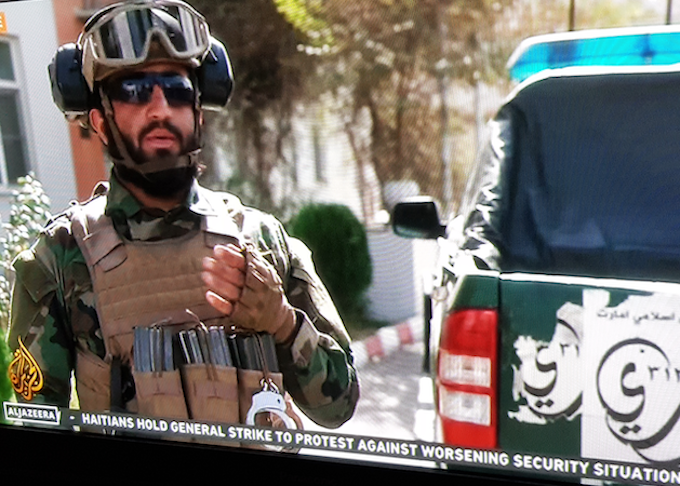
An elite Taliban Badri 313 fighter guarding Kabul airport … facing threats from ISIS-K. Image: Al Jazeera screenshot APR
Bellis said while she feels safe at the moment, the main problem is the terrorist group, ISIS-K, who have made threats against the hotel where she is staying.
The Taliban have said they will protect guests and have placed dozens of extra guards outside.
ISIS-K is believed to only number between 1200 and 1500 yet they are a potent force with their random attacks, such as beheading members of the Taliban, whom they hate.
She believes the Taliban’s biggest worry is that ISIS will appeal to its most fundamentalist members.
ISIS attracting recruits ISIS is also believed to be trying to attract recruits who would be trained as fighters and be paid $400 a month which is a substantial amount of money in Afghanistan.
Bellis said she feels guilty staying at a hotel with the scale of poverty and deprivation she is witnessing.
“Right outside the door people are desperate,” she said.
She visited a major maternity hospital in Kabul yesterday and the only medication available for women giving birth was paracetamol.
“Imagine going into labour and thinking, OK if anything goes wrong I’ve got paracetamol. It’s just life and death on so many levels.”
This article is republished under a community partnership agreement with RNZ.
For those of you wondering what you can do to help Afghans.. this @WFP project is the gold standard. You donate meals direct to Afghans – choosing a set number of meals or month at a time. ???? https://t.co/qgmuaTdpfo
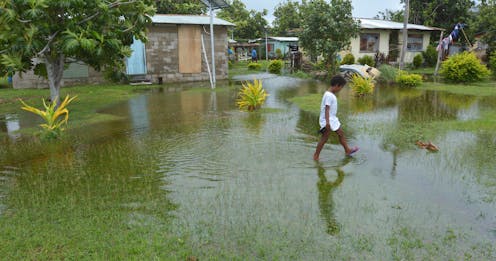
A new study shows rising sea levels in the Marshall Islands will endanger 40 percent of buildings in the capital Majuro, with 96 percent of the city likely to flood frequently.
As COP26 begins in Glasgow, the new visualisations demonstrate the existential threat the Marshall Islands faces.
If existing sea level rise trends continue, the country will confront a series of increasingly costly adaptation choices to protect essential infrastructure.
World Bank senior municipal engineer and the leader of the study, Artessa Saldivar-Sali, said these visual models give insights that have not been available before.
She said these will be critical for decision-makers to understand the potential benefits of adaptation options, such as sea walls, nature-based solutions and land raising.
Saldivar-Sali said the modelling paints a clear picture of the need for significant investment in adaptation for, and by, atoll nations like Marshall Islands.
This article is republished under a community partnership agreement with RNZ.
New Zealand has reported 143 new community covid-19 cases today – 135 in Auckland, six in Waikato and two in Northland.
There were no community cases in Christchurch today. One previously reported case in the city has been reclassified as a historical case, so the total Christchurch tally is now four.
There was no media conference today. In a statement, the Ministry of Health said that because of the recently reported cases in Canterbury, it was important that anyone with any symptoms — no matter how mild — got tested.
The ministry said 73 cases were still to be linked.
There are 384 unlinked cases from the past 14 days.
The ministry said the reported number of cases in Auckland “is not unexpected and is line with modelling to date”.
Fifty-six people are in hospital, up from 47 yesterday. Two are in intensive care.
There were no cases detected at the border today.
There have now been 3348 cases in the current community outbreak, and a total of 6068 cases since the pandemic began.
There were 42,617 vaccines given yesterday, including 10,703 first doses and 31,914 second doses.
More locations of interest in Northland The two Northland cases reported today were announced yesterday and have been formally added to the official tally today.
There have now been 12 confirmed covid-19 community cases in Northland in the current outbreak. All of the cases are isolating at home.
Tonga traveller contacts The ministry said the four household contacts of the person who reportedly tested positive for covid-19 in Tonga yesterday have been traced, are in isolation and have returned an initial negative result.
Two close contacts are in isolation at home in Christchurch and two in Porirua.
“Anyone with symptoms is asked to please get tested and reminded to get vaccinated today if they have not already. Testing locations in the Wellington region can be found at Capital and Coast DHB and Hutt Valley DHB.”
A man infected with covid-19 was yesterday reported to have broken out of an Ellerslie MIQ hotel in Auckland, but was caught by police less than half and hour later and has been arrested.
An icon of Australian broadcasting, he is remembered as a master performer and comedian, with successful roles on radio, television and the theatre. He is survived by his wife Patti, children Matthew and Lauren, and grandchildren.
Bert Newton’s achievements, particularly relating to Australian television, are remarkable. As an Order of Australia and Member of the British Empire holder for his services, he is also a Logie Hall of Fame inductee, a four-time Gold Logie winner and 20-time host of the ceremony. It has often been said the Logies should be renamed the “Berts” in his honour.
Born July 23 1938, the Melbourne boy started his broadcast career as part of a children’s program, Peter’s Pals, on radio station 3XY while still in his early teens. As leading Australian media historian Bridget Griffen-Foley explained in her book Changing Stations, “Newton read newspapers aloud in his bedroom to overcome a childish lisp, and took his scripts to school”.
Soon, he would become a master radio, then television broadcaster. Relationships formed with Sir Frank Packer and Graham Kennedy during the 1950s set him up for renown in the best possible way.
Depending on your age and media preference, Newton was either your late night or early morning companion. First, late-night viewers knew him as Graham Kennedy’s partner on In Melbourne Tonight (1957-1970) – apparently the “straight man” to Kennedy’s bluster, but with comedic skills just as sharp.
Later, early morning viewers knew him as the host of Good Morning Australia (1992- 2005) – an otherwise “graveyard” broadcasting shift between breakfast and lunch into which Newton somehow managed to inject remarkable life. There were the standard interviews and infomercials, but those paying closer attention were rewarded with nuance and incredible cheeky comedy.
Later in life, Bert appeared on stage in musicals, from Beauty and the Beast to The Wizard of Oz, and notably as the infamous Narrator in The Rocky Horror Picture Show in 2015.
A perfect place for the host who has it “all together”, it was a role that also let him play, too. Although in his late 70s at the time, he told the Sydney Morning Herald he saw the Narrator as a “the calming influence” amid some otherwise “wild scenes”.
A product of his times, some of his comedy has not aged well, either. Some sketches relating to race and gender are particularly problematic for contemporary viewers who now, rightly, expect more.
But as Denise Scott tweeted this morning, Bert’s devotion to comedy and the comedy community knew no bounds or personal ego, recalling how when her friend and colleague, iconic comedian Lynda Gibson was dying of cancer, Bert attended and “paid homage by removing his ‘rumoured’ toupee & revealing his total baldness.”
This is a sentiment also shared by Dan Illic, saying Newton’s “immense talents were only amplified by his generosity of spirit and kindness to even the smallest names in showbiz.”
A good ending
I’ve been asked three times over the past few years to draft obituaries for Bert Newton, “just in case”. Each time, I’ve said “no” – the reason has always been timing. While I know lots of media outlets have a bank of obits ready to go (famously, The Queen’s “Operation London Bridge” strategy has been updated periodically for decades and a variety of new media forms), I believe you should always let a comedian choose their own timing.
In his 1977 autobiography, Bert!, Newton wrote about his own struggle with finding a satisfying conclusion:
The hope of every good producer is to come up not only with a good show or a good movie but also to have a good ending.
Only a few days ago, his beloved wife, Patti Newton, posted a picture of him in a hospital bed but beaming, surrounded by his family, with the caption “This is what happiness is”. A good ending, indeed.
Liz Giuffre does not work for, consult, own shares in or receive funding from any company or organisation that would benefit from this article, and has disclosed no relevant affiliations beyond their academic appointment.
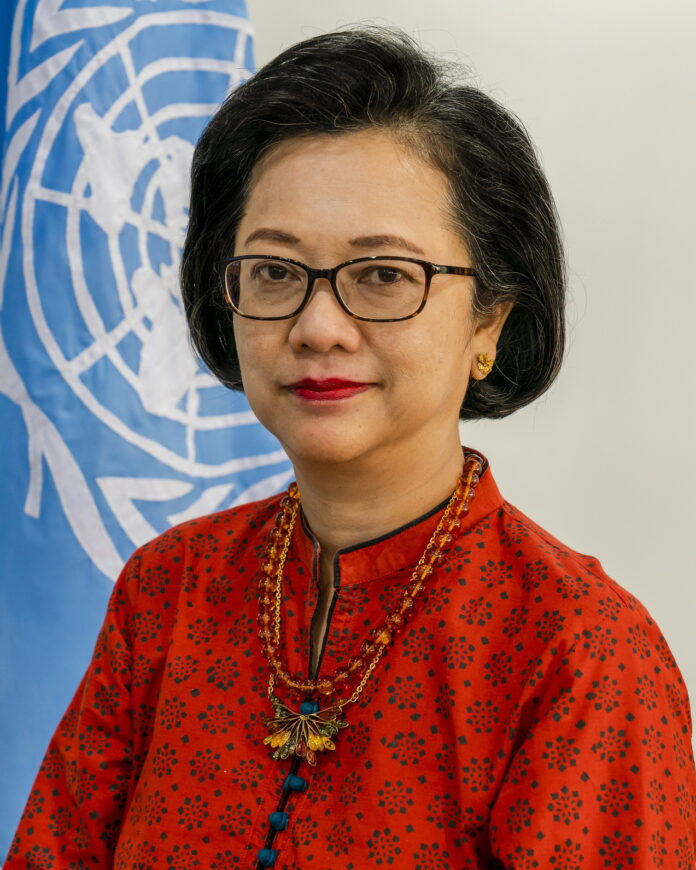
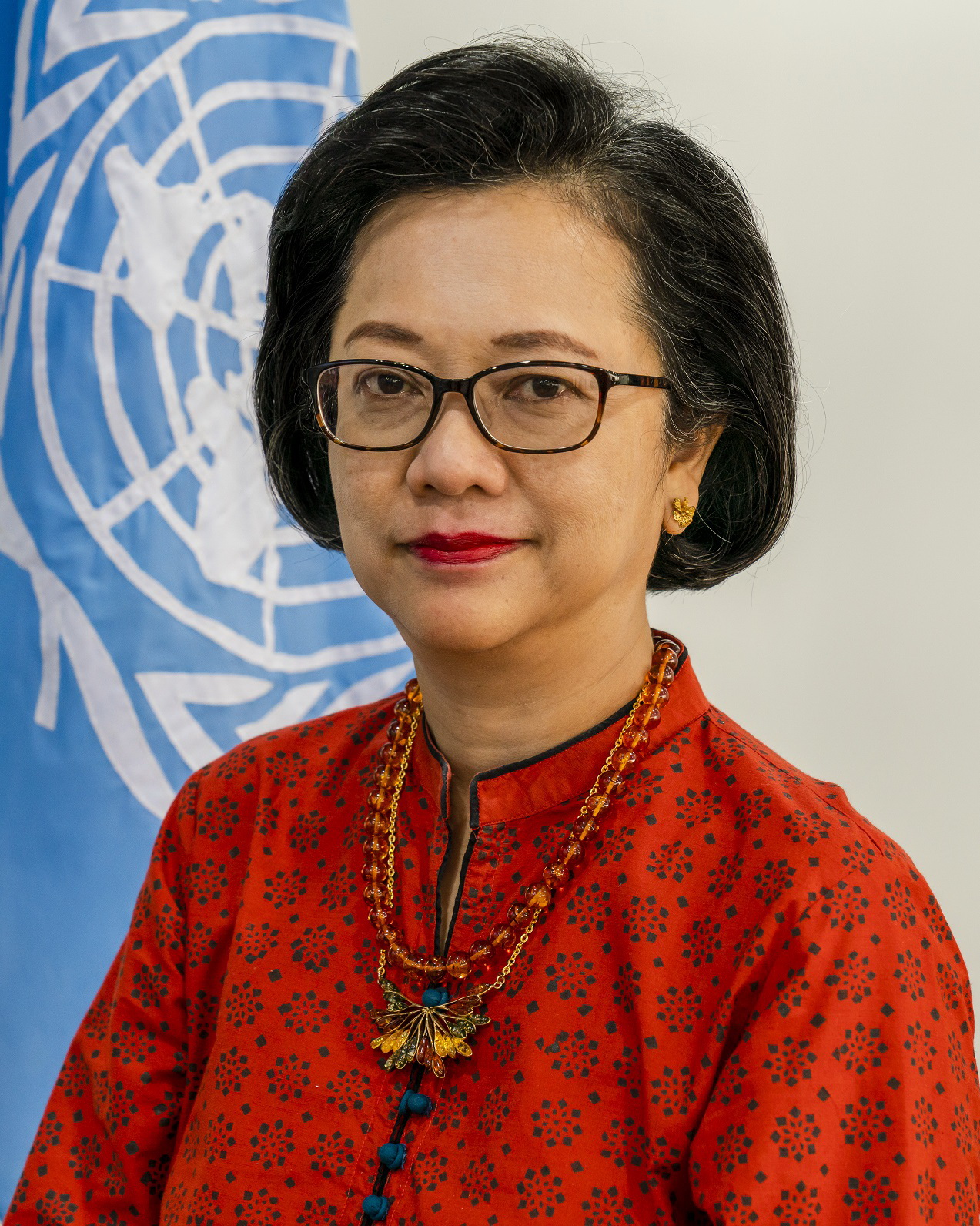
Armida Salsiah Alisjahbana is the United Nations Under-Secretary-General and Executive Secretary of the Economic and Social Commission for Asia and the Pacific (ESCAP).
Op-Ed by Armida Salsiah Alisjahbana
Armida Salsiah Alisjahbana is the United Nations Under-Secretary-General and Executive Secretary of the Economic and Social Commission for Asia and the Pacific (ESCAP).
As the leaders of Asia and the Pacific prepare to head to Glasgow for the 26th United Nations Climate Change Conference of the Parties (COP26), they can be sure that our region will be in the spotlight: many of the most vulnerable countries to the impacts of climate change are located here; the seven G20 members from this region are responsible for over half of global GHG emissions; and five of the 10 top countries with the greatest historic responsibility for emissions since the beginning of the twentieth century are from Asia.
There is an urgent need to raise ambitions
The starting point is not encouraging, however. A joint study by ESCAP, UNEP and UN Women shows that the Asia-Pacific region is falling even further behind in its efforts: greenhouse gas emissions are projected to increase by 34 per cent by 2030 compared to 2010 levels. Getting the 30 Asian and Pacific countries that have so far updated their NDCs to drastically raise ambitions and securing adequate NDCs from the other 19 who have yet to submit will determine if the region — indeed the world — can maintain any hope of keeping the temperature increase well below two degrees.
The ESCAP Sustainable Business Network is crafting an Asia-Pacific Green Business Deal in pursuit of a “green” competitive advantage, while companies are responding to greater shareholder and consumer pressure for science-based targets that align businesses with climate aspirations. Entrepreneurs, SMEs and large industries in the region could adopt this new paradigm, which would also enable countries to meet their commitments for sustainable development.
People-centred action, focusing on groups in vulnerable situations
It is clear from the science and the frequency of disasters in the region that time is not on our side. The combination of disasters, pandemic and climate change is expanding the number of people in vulnerable situations and raising the “riskscape”. Countries are ill-prepared for complex overlapping crises; the intersection of COVID-19 with natural hazards and climate change remains poorly understood and gives rise to hotspots of emerging and intensifying risks. Building resilience must combine climate mitigation efforts and investments in nature-based climate solutions. Moreover, it also requires increasing investments in universal social protection systems that provide adequate benefits over the lifecycle to people and households. The active engagement of women and girls is critical to ensuring inclusive climate action and sustainable outcomes.
The Way Forward
Without concerted action, carbon neutrality is not within the reach of the Asia-Pacific region by 2050. All stakeholders need to collaborate and build a strong case for decisive climate action. Our leaders simply cannot afford to go to Glasgow with insufficient ambition and return empty handed. Since it was founded nearly 75 years ago, ESCAP has supported the formation of strategic alliances that have lifted millions out of poverty and guided the region to enabling a better standard of life. The time is right for such an alliance of governments, the private sector and financial institutions to help turn the full power of the region’s ingenuity and dynamism into the net zero development pathway that our future depends on.
Armida Salsiah Alisjahbana is the United Nations Under-Secretary-General and Executive Secretary of the Economic and Social Commission for Asia and the Pacific (ESCAP)
New Zealand has reported eight new covid-19 cases, including seven residents, at an Auckland rest home, adding to one announced yesterday.
This was part of a jump to a record total of 160 new community cases reported today — 151 in Auckland, seven in Waikato and one each in Northland and Canterbury.
Following further testing at Edmonton Meadows rest home in Henderson, the seven residents and one staff member have been confirmed as having the virus, bringing the total number of cases at the home to nine, the Ministry of Health said in a statement.
The ministry said it was important to point out the home had high levels of vaccination among residents, and all staff are fully vaccinated.
All staff and residents have now been tested and will also receive day five and day 12 testing.
Auckland Regional Public Health staff are supporting the residents and staff at the privately owned facility.
At this stage, only one positive staff member has been required to stand down.
Investigation seeking source An investigation has begun to try and find out the source of the infection.
The retirement village has been operating under alert level 3 guidelines for visitors, meaning people have only been able to visit the village on compassionate grounds.
Meanwhile, the focus today in Auckland remains on testing in areas identified as having higher positivity rates, where the risk of unidentified cases is higher.
Public health staff are asking people in the suburbs of Redvale, Rosedale, New Lynn, Wiri, Drury, Henderson and Manurewa with symptoms to get tested — no matter how mild their symptoms may be.
The advice is the same even if people are vaccinated.
There are 16 community testing centres available for testing across Auckland today. Up-to-date information on testing locations in Auckland, visit here.
There was no media briefing today. In a statement, the ministry said 95 of today’s cases were still to be linked and there had been 358 unlinked cases in the past 14 days.
There are 47 people in hospital, up from 37 yesterday. Two are in intensive care.
Tonga’s Prime Minister is urging people on the main island of Tongatapu to use the weekend to prepare for a potential lockdown next week after the kingdom’s first covid-19 case was confirmed.
The positive case was a passenger on a repatriation flight from Christchurch with 215 other people on Wednesday.
The passengers from the Christchurch flight are quarantined in the Tanoa Hotel, Nuku’alofa.
Dr Pohiva Tu’i’onetoa said the reason the lockdown would not happen this weekend was because he had been advised that the virus would take more than three days to develop in someone who caught it before they became contagious
Tongan PM Dr Pohiva Tu’i’onetoa … no lockdown over the weekend. Image: RNZ Pacific/Tongan govt
Matangi Tonga Online reports the prime minister announced at a press conference that Tongans should use this time to get ready in case more people were confirmed they had the virus.
The Ministry of Health’s CEO Dr Siale ‘Akau’ola explained that if the covid-19 virus entered a person, that person could not spread it right at that time, the virus needed time to grow and that person would become infectious three to five days after contracting it.
“Frontliners should be safe because even if say the [quarantine bus] driver returned home that night, and whether he wore PPE or not, if he contracted the virus then there is that incubation period where it grows, becoming infectious three or more days after. That is why I think they are alright,” Dr ‘Akau’ola said.
Chief executive of Tonga’s Ministry of Health Dr Siale Akauola … “I think they [frontliners] are alright.” Image: RNZ Pacific/Christine Rovoi
He said that when they got the news just before midnight of two positive community cases in Christchurch, they had informed the frontliners involved and they self-isolated at home.
Then after the covid-19 positive test was confirmed yesterday in Tonga, the frontliners were also taken into quarantine.
“So, we have acted swiftly in just a day,” he said. “Our frontliners are trained and have been fully vaccinated.”
Health officials say the passenger who tested positive to covid-19 was inoculated with the first dose of the Pfizer BioNTech vaccine in the last week of September, and had received a second dose in mid-October.
“So the person is fully vaccinated and their protection level will be up two weeks after this second shot,” Dr ‘Akau’ola said.
“We are satisfied despite this person being positive, we believe the person would not get seriously ill and reach a dangerous level.”
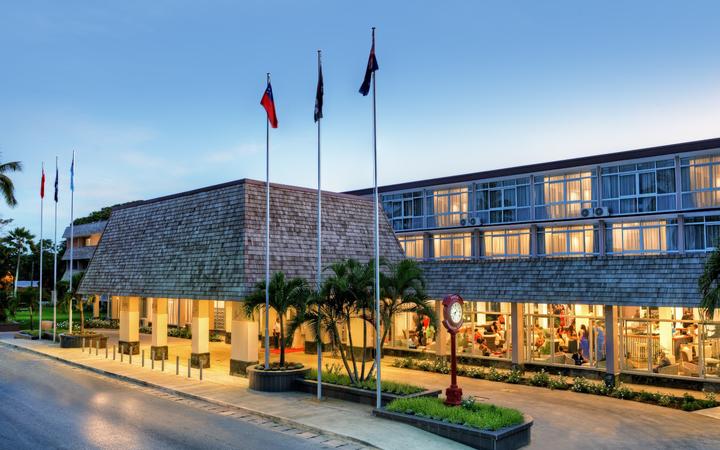
Tanoa Hotel in Nuku’alofa … the quarantine venue. Image: RNZ Pacific/Tanoa Hotel
Meanwhile, it has not been confirmed if the covid-19 virus is the delta variant, which spreads easily.
“When there is a covid-19 positive case we can assume it’s delta, then confirm later,” he said.
People can still get their covid-19 vaccinations over the weekend including on Sunday.
Dr ‘Akau’ola confirmed Health would still be providing vaccinations even if there was a lockdown.
Fully vaccinated Meanwhile, New Zealand’s Ministry of Health confirmed that the case had returned a negative pre-departure test before leaving New Zealand and was fully vaccinated and had their second dose on October 15.
Passengers on the flight, including members of Tonga’s Olympic team who had been stranded in Christchurch, were required to provide a negative covid test result at least 72 hours before boarding.
They also had to show vaccination cards prior to the flight, with dates for first and second doses.
The Olympic team were double vaccinated before they departed Tonga for the Olympic Games in Japan.
This article is republished under a community partnership agreement with RNZ.
The Papua New Guinea government’s financial hub was hit by computer hackers last week, holding state officials at ransom, reports have revealed.
The ransomware attack on the Department of Finance’s Integrated Financial Management System (IFMS) happened last Thursday, locking out government workers who use the system to run the country’s entire financial system.
The Acting Treasurer, Finance Minister Sir John Pundari, confirmed the hacking but told the PNG Post-Courier that the system had been restored and no ransom was paid.
Sir John said workers were using a temporary accounting system after the IFMS was hit last week but did not reveal the real extent of the damage, saying only that the hackers did not steal anything.
However, they had damaged a system that now puts PNG’s national security at risk.
This is the first time the country’s central financial hub has been hit to such an extent.
Ransomware is a collection of malicious software variants, including viruses, designed by hackers to cause extensive damage or gain unauthorised access to computer networks.
‘Cyber-attack on core server’ “The Government Financial System suffered a cyber-attack in the form of ransomware infiltrating our core server at 1am on Friday, 22 of October 2021,” Sir John said.
“As a result of the ransomware infiltration, the Department of Finance’s IT network was compromised. The department immediately took precautionary steps by closing down the network systems.
“The department has now managed to fully restore the system, however, because of the risk we are playing it safe by not allowing full usage of the affected network.
“While we progress cleaning up the server environment, we have put in temporary measures.
“These include all government departments and agencies having access to commit and process cheques using a controlled environment in Vulupindi Haus.
“All provinces and districts will also have access to commit funds, through a controlled temporary arrangement.
‘Full restored’ “The department is conscious of the security and integrity of its data, thus, restoration of services to all government agencies, including at the sub-national level will be done gradually, bearing in mind the security of individual networks, so as not to compromise or allow any further spread of this malware or other viruses.
“At this stage I wish to state clearly that the government financial system has been fully restored.
“Department of Finance did not pay any ransom to the hacker or any of its third party agents. We have managed to restore normalcy.
“The government and the people of Papua New Guinea can be assured that the government’s financial services will continue as usual.”
Gorethy Kenneth is a senior PNG Post-Courier journalist. Republished with permission.
The first chart shows excess deaths in Germany for every year from 2015. (The chart is essentially the one that can be found here, on the Our World in Data website, though it uses three-period moving averages to smooth out some of the ‘random noise’ that inevitably accompanies such time-series data.
The first thing our eyes are drawn to in this chart is not the covid bulge; rather it’s the 2018 bulge. (Yes, the chart is in a sense biased against December-January bulges, and there could be an argument that the use of narrower dashed lines for the covid years is also a bias. Nevertheless, all charts seek to emphasise something, and the use of a January to December scale is default for any calendar-based analysis.)
Before looking at that 2018 bulge, the important thing to note is that from May to November the years 2015 to 2019 are broadly similar to each other; there is no obvious indication that death numbers are climbing because of increasing population size. Indeed Germany is a country with a stable population size, though not a stable age distribution. It is a country with an aging indigenous ‘Germanic’ population that is being offset by substantial immigration of younger people.
The main reason for differences year-to-year in the 2015-19 period is seasonal endemic disease, which has a disproportionate impact on the older ‘more-likely-to-die’ population. There are two mortality seasons: late winter, and summer. The lesser summer peaks, which are visible in other countries too, are most likely due to the heightened mobility of people – especially young people – given that mobility is the key vector of infectious diseases. This international mobility of young people was almost certainly the vector of Europe’s second Covid19 wave of 2020, as suggested by the August 2020 bulge in the chart.
For the late-winter mortality peak, we see that every year except 2016 and 2020 has a large number (of mainly older people) dying from influenzas and the like (and their complications such as pneumonia). 2018 was the worst such year, and it may indeed follow from a bad influenza strain in 2017 in the southern hemisphere. (See New Zealand chart, and story.)
For Germany, 2020 started out looking like a year comparatively free from the influenza reaper; then, anti-Covid19 public health restrictions reduced overall mortality, making the seasonal reaper – in this case, Covid19 – appear to be somewhat less malign than those of 2015, 2017, and 2018. Indeed, it is most likely that most of the covid deaths in Germany in April and May 2020 were the same older people who would have died at that time from respiratory infections had 2020 been a year like, say, 2015.
Germany’s big mortality wave from Covid19 clearly was in the winter of 2020/21, and it came much earlier than in previous winters.
What is significant in the above chart, but not prominent, is the consistently higher number of deaths since April 2021. This is indicative of Germany’s ongoing toll from Covid19.
Chart by Keith Rankin.
The second chart shows Germany in context with other northwest European countries, plus United Kingdom, United States, and New Zealand. And it shows ‘excess deaths’ for people born in the late 1940s and early 1950s; people still young in many respects (ie the young ‘elderly’!).
(A technical note; this data is quarterly, meaning that the German peak which looks like the end of January 2021 is really mid-December 2020. And the last German mortality peak shown is not due to ‘Delta’ Covid; it’s associated with ‘Alpha’ Covid.)
We clearly see that Germany’s public health policies performed an excellent job in fending-off Covid19 in the early months of the pandemic. (Sweden, and interesting case not shown, has, until early 2021, a profile similar to that of Netherlands.)
What is of concern for Germany is what looks like a rising mortality trend for this age group, which contrasts with France’s more stable trend. We know that mobile French people are substantial vectors of Covid19, simply by observing the tragic events in France’s many overseas territories. The look of the chart is that French people have a higher resistance to Covid19 than do German people (and a much higher resistance than service workers in the French Caribbean or the French Pacific).
In these last weeks of October, Germany is just starting its Delta outbreak, as winter comes and as vaccination potency wanes. As is Netherlands and Belgium. France is getting more cases too, though it is looking significantly better than these other three. I fear for Germany’s post-war baby-boom generation. And not only Germany’s. (For example, Austria, not shown, is looking ever worse than Germany.)
Keith Rankin (keith at rankin dot nz), trained as an economic historian, is a retired lecturer in Economics and Statistics. He lives in Auckland, New Zealand.
The dilemma facing whistleblowers, journalists and publishers who risk it all to help the world’s people to become more informed. WikiLeaks founder Julian Assange finds himself crushed between these two counterbalances — the asserted right of powerful nations to operate in secret, and the right of the press to reveal what goes on in the public’s name.
This week, on October 27-28, Julian Assange appeared before a United Kingdom court defending himself against an appeal that, if successful, would see him extradited to the United States to face a raft of indictments that ultimately could see him spend the rest of his life in prison.
The US lawyers argued largely that human rights reasons that caused the UK courts to reject extradition to the US could be mitigated. That Julian Assange’s case could be heard in Australia and if found guilty serve out jail time in his home country rather than the US.
Assange’s defence lawyer Edward Fitzgerald QC argued: “In short there is a large and cogent body of extraordinary and unprecedented evidence… that the CIA has declared Mr Assange as a ‘hostile’ ‘enemy’ of the USA, one which poses ‘very real threats to our country’, and seeks to ‘revenge’ him with significant harm.” The lawyers said the United States assurances were “meaningless”.
UK courts in London. Image: Selwyn Manning/ER
“It is perfectly reasonable to find it oppressive to extradite a mentally disordered person because his extradition is likely to result in his death.” Fitzgerald QC added that a court must have the power to “protect people from extradition to a foreign state where we have no control over what will be done to them”.
Lord Chief Justice Lord Burnett, sitting with Lord Justice Holroyde, said: “You’ve given us much to think about and we will take our time to make our decision.”
The judges then reserved their decision. It is expected Assange’s fate will be revealed within weeks.
In this Special Report, we examine why the US wants this man. And we detail the space between whistleblowers, journalists and publishers who risk it all to help the world’s people to become more informed. Julian Assange finds himself crushed between these two counterbalances: the asserted right of powerful nations to operate in secret, and the right of the press to reveal what goes on in the public’s name.
Should Julian Assange be extradited from the UK to face indictments in the United States? Or should he be set free and offered a safe haven in a country such as Russia or even New Zealand?
It was always going to come down to this: Is Julian Assange captured by the assumptions people have of him, or a blurred line between a public’s right and a state’s wrong.
‘Manhunt Timeline’ The United States effort to capture or kill Assange goes back to 2010. But his inclusion in what’s called the “Manhunt Timeline” soon lost its sting when, under US President Barack Obama, it was believed if charges against Assange were brought before the US courts for his publishing activity, then he would be found not guilty due to the US First Amendment “freedom of the press” constitutional protections.
But everything changed with a new president, and a massive leak to Wikileaks of CIA secret information on 7 March 2017.
That leak of what was called Vault 7 information “detailed hacking tools the US government employs to break into users’ computers, mobile phones and even smart TVs.”
CBS News reported at the time: “The documents describe clandestine methods for bypassing or defeating encryption, antivirus tools and other protective security features intended to keep the private information of citizens and corporations safe from prying eyes.” (CBS News)
The Vault 7 leak (and earlier leaks going back to 2010) also revealed information that the US security apparatus argued compromised the safety of its personnel around the world. This aspect is vital to the US Justice Department’s case against Julian Assange.
Among a complex web of indictments and superseding indictments, the US alleges Wikileaks and Assange conspired with whistleblowers (significant among them Chelsea Manning) in what it argues was a conspiracy against the US interest. It also argues that Wikileaks and Julian Assange failed to satisfactorily redact leaked documents before dissemination or publication of the same — including details that put US personnel and agents at risk.
Prominent New Zealand investigative journalist Nicky Hager had knowledge of Wikileaks’ processes, and, going back to 2010, spent time working with Wikileaks on redacting documents.
Hager testified at The Old Bailey in London in September 2020 before a hearing of the Assange case and, according to The Australian, said: “My main memory was people working hour after hour in total silence, very concentrated on their work and I was very impressed with efforts that they were taking (to redact names).” Hager added that he himself had redacted “a few hundred” Australian and New Zealand names.
On cross examination, The Australian reported: “Hager referred in his testimony to the global impact of the publication of the collateral murder video, which shows civilians being gunned down in Iraq from an Apache helicopter, which led to changes in US military policies. He claimed it had a ‘similar galvanising impact as the video of the death of George Floyd’.” (The Australian)
But it was the Vault 7 leak that triggered the then Central Intelligence Agency (CIA) director Mike Pompeo to act. After that leak, Pompeo set out to destroy Wikileaks and its publisher Julian Assange.
Pompeo vs Assange
Former CIA director and US Secretary of State Mike Pompeo. Image: ER
Mike Pompeo was appointed as CIA director in January 2017. The Vault 7 leak occurred on his watch. It was personal, and in April 2017 he defined Wikileaks as a “non-state hostile intelligence service”.
That definition triggered a shift of approach. The US intelligence apparatus and its Justice Department counterpart then re-asserted that Wikileaks and its publisher and editor-in-chief Julian Assange were enemies of the United States.
Pompeo’s definition paved the way for a more targeted operation against Assange. But, for the time being, the US public modus operandi was to ensure extradition proceedings, through numerous hearings and appeals, were dragged out while stacking an increasing number of complex indictments on the charge-sheet.
The definitions ensured the UK’s corrections system regarded Assange as a high risk and dangerous prisoner hostile to the UK’s special-relationship partner, the USA.
The tactic is well used by governments and states around the world. But in this case it appears beyond cold and calculated. As the US applied a figurative legal-ligature around the neck of Julian Assange it knew his circumstances — that he was imprisoned, isolated, in solitary confinement, on a suicide watch, handled by prison guards under a repetitive high security risk protocol. It knew the psychological impact was compounding, causing legal observers, his lawyers, his supporters — even the judge overseeing the extradition proceedings — to fear that the wall before Assange of ongoing litigation, compounded with the potential for extradition and possible life imprisonment, would overwhelm him.
Let’s detail reality here. In real terms, being on suicide-watch as a high security risk prisoner, meant every time Assange left his cell for any reason (including when meeting his lawyers), on return he would be stripped, cavity searched (which includes being forced to squat while his rectum is digitally searched, and a mouth and throat search).
This was a similar security search protocol that was used against Ahmed Zaoui while he was held at New Zealand’s Paremoremo maximum security prison. At that time Zaoui was regarded as a security risk to New Zealand. He was of course later found to be a man of peace and given his liberty. Sometimes things are not what they initially seem.
In the UK, for Assange the monotonous grind of total solitude and indignity ticked on. In the US in March 2018, Mike Pompeo was set to be promoted. He received the then US President Donald Trump’s nomination to replace Rex Tillerson as US Secretary of State. The US Senate confirmed Pompeo’s nomination and he was sworn in on 26 April 2018.
Pompeo quickly became one of Trump’s most trusted and powerful White House insiders. As Secretary of State, Pompeo toured the globe’s foreign affairs circuit asserting the Trump Administration’s position on governments throughout the world. As such, Pompeo was regarded as one of the world’s most powerful men.
Looking back, Pompeo wasn’t the first high ranking US official to regard Assange as an enemy of the state. The Edward Snowden leaks of 2014 revealed that the US government had in 2010 added Assange to its “Manhunting Timeline” — which is an annual list of individuals with a “capture or kill” designation.
This designation came during the early stages of the Obama Administration years. However, US investigations into Wikileaks then suggested Assange had not acted in a way that excluded him from being defined as a journalist and therefore it was likely Assange, if tried under US law, would be provided protections under the First Amendment constitutional clauses.
But when Pompeo advanced toward prominence, Obama was gone. And under Donald Trump, the US appeared to ignore such constitutional rocks in the road. Trump had his own beef with the US Fourth Estate, and the conditions for respecting First Amendment privilege had deteriorated.
Did Trump stop the CIA kidnap or kill plan?
Former US President Donald Trump speaking to NZ Prime Minister Jacinda Ardern. Image: ER
Perhaps we understand the Trump Administration’s mindset more now in the wake of the 6 January 2021 insurrection where supporters of Trump stormed the US House of Representatives seeking to overturn the election result and reinstate Trump as President. Throughout much of that destructive day, Trump reportedly remained at the White House while the mob erected a gallows and sought out Vice-President Mike Pence. The mob’s reason? Because Pence had begun the process of certifying electoral college writs, an essential step toward swearing in as President the newly elected Joe Biden.
It may reasonably be argued that Trump and some members of his Administration displayed a disregard for elements of the US Constitution. But, it must also be said, that Trump had at times displayed an empathy for Julian Assange’s situation.
This week The Hill reported on Trump’s view of Assange through an interview with the former president’s national security advisor, Keith Kellogg (who is also a retired US Army Lieutenant General.
Kellogg told The Hill: “He (Trump) looked at him (Assange) as someone who had been treated unfairly. And he kind of related him to himself … He said there’s an unfairness there and I want to address that.”
Kellogg added that Trump saw similarities between Assange and himself in that Trump would not back down in the face of media attacks: “I think he kind of saw that with Julian in the same way, like ‘ok, this guy’s not backing down’.” (The Hill)
Kellogg’s account seems incongruous to what we now know. On 26 September 2021, a Yahoo News media investigation delivered a bombshell. It revealed how the CIA had planned to kidnap or kill Assange.
But more on the detail of that below. First, let’s look at a confusing picture of how former President Trump’s words do not meet his Administration’s actions.
We know that “someone” in the Trump Administration put a halt to the CIA’s kill or capture plan. We just do not know whether Trump commanded its cessation, or whether Pompeo or Trump’s attorney-general/s operated outside the former president’s orbit. But we do know the US Justice Department pursued Assange through an intensifying relentless application of indictments of increasing severity and complexity. If it is an MO, then it is reasonable to suggest the legal wall of indictments and the CIA’s plan to kill or capture were potentially one of the same.
Which segues back to the details of the US case against Assange.
The US Justice Department vs Assange In March 2019, The Washington Post reported that US Whistleblower Chelsea Manning had been subpoenaed to testify before a grand jury in the investigation of Julian Assange. The Post correctly suggested that the US Justice Department appeared interested in pursuing Wikileaks before a statute of limitations ran out.
Washington Post reported: “Steve Vladeck, a professor at the University of Texas at Austin School of Law, said the Justice Department likely indicted Assange last year to stay within the 10-year statute of limitations on unlawful possession or publication of national defense information, and is now working to add charges.” (Washington Post)
Then, On April 11 2019, after high-level bilateral meetings between the US and Ecuador, the Ecuadorian Government revoked Assange’s asylum. The UK’s Metropolitan Police were invited into Ecuador’s London embassy and Assange was arrested.
Once Assange was in custody (pending the outcome of a court ruling of what eventually became a 50 week sentence for breaching bail) the United States made its move. On 11 April 2019 (the same day Ecuador evicted him) US prosecutors unsealed an indictment against Assange referring back to information that Wikileaks had released in stages from 18 February 2010 onwards. (US Justice Department)
Collateral Murder, the video that Wikileaks published that turned public opinion against the US-led occupation of Iraq.
This video, known as the collateral murder video, was among the Wikileaks release. The video is of US military personnel killing what they initially thought were Iraqi insurgents. It also displays an apparent indifference by US personnel when, shortly after, it was revealed by ground troops that there were civilians killed, including women and children (and also what were later found to be journalists). The leaked video exposed the United States to potential allegations of war crimes.
The video, and the accompanying dossier of US classified documents, shocked the world and revealed what had been covered up by US secrecy. The information that was leaked by then US Military intelligence analyst Chelsea Manning, and published by Wikileaks and provided to a select group of the world’s most prominent media, was arguably a tipping point for public sentiment regarding the US invasion and occupation of Iraq. It was, in the <2010 decade, on a par with revelations of abuses of detainees by US personnel at Abu Ghraib prison.
In a release to the US press, the Justice Department’s office of international affairs stated: “According to court documents unsealed today, the charge relates to Assange’s alleged role in one of the largest compromises of classified information in the history of the United States.”
It connected to how Wikileaks had acquired documents from US whistleblower Chelsea Manning. The leak contained 750,000 documents defined as “classified, or unclassified but sensitive” military and diplomatic documents. The documents included video. The sum of the leaks detailed what were regarded generally as atrocities committed by American armed forces in Iraq and Afghanistan.
The leaked material was also published by The New York Times, Der Spiegel and The Guardian. In May 2010, Manning was identified then charged with espionage and sentenced to 35 years in a US military prison. Later, in January 2017, just three days before leaving office, US President Barack Obama commuted Manning’s sentence.
On 23 May 2019, the US Justice Department issued a statement confirming Assange had been further charged in an 18-count superseding indictment that alleged violation of the Espionage Act 1917. It specifically alleged (among other charges) that Assange conspired with Chelsea Manning in late 2009 and that: “… Assange and WikiLeaks actively solicited United States classified information, including by publishing a list of ‘Most Wanted Leaks’ that sought, among other things, classified documents. Manning responded to Assange’s solicitations by using access granted to her as an intelligence analyst to search for United States classified documents, and provided to Assange and WikiLeaks databases containing approximately 90,000 Afghanistan war-related significant activity reports, 400,000 Iraq war-related significant activities reports, 800 Guantanamo Bay detainee assessment briefs, and 250,000 US Department of State cables.” (US Justice Department)
The superseding indictment added: “Many of these documents were classified at the Secret level.”
It’s also important to note, a superseding indictment, in this context carries heavy weight. It isn’t merely a charge lodged by an investigative wing of government, but issued by a US grand jury.
The Washington Post, The New York Times, and media freedom organisations criticised the US government’s decision to charge Assange under the Espionage Act. Image: ER screenshot
The May 2019 superseding indictments ignited a stern rebuttal from powerful media institutions.
The Washington Postand The New York Times, as well as press freedom organisations, criticised the government’s decision to charge Assange under the Espionage Act, characterising it as an attack on the First Amendment to the United States Constitution, which guarantees freedom of the press. On 4 January 2021, District Judge Vanessa Baraitser ruled against the US request to extradite him and stated that doing so would be “oppressive” given his mental health. On 6 January 2021, Assange was denied bail, pending an appeal by the United States. (Wikipedia.org)
In normal times an assault on the US First Amendment through a clever legal move would destroy a presidency. But these were not normal times.
Ultimately, the powerful US Fourth Estate fraternity failed to ward off the Trump Administration’s men. Trump himself was by this time already hurling attacks on the credibility and purpose of the United States media. And, he tapped in to a constituency that distrusted what it heard from journalists.
Then on 24 June 2020, the US Justice Department delivered more charges against Assange, this time with an additional superseding indictment that included allegations he conspired with “Anonymous” affiliated hackers: “In 2010, Assange gained unauthorised access to a government computer system of a NATO country. In 2012, Assange communicated directly with a leader of the hacking group LulzSec (who by then was cooperating with the FBI), and provided a list of targets for LulzSec to hack.” (US Justice Department)
As the Trump presidency ran out of steam, and arguably created its own attacks on the US national interest, Democratic Party candidate Joe Biden won the election and became the 46th President of the United States.
Why Assange was imprisoned in the UK
Julian Assange on the first day of extradition proceedings in 2020. Image: Indymedia Ireland.
Julian Assange was tried before the UK courts and convicted for breaching the Bail Act. He was sentenced to 50 weeks in prison. He was expected to have been released after five to six months, but due to the US extradition proceedings and appeal he was held indefinitely.
The initial bail conditions (of which Assange was found to have breached) were set resulting from an alleged sexual violence allegation made in Sweden in 2010. Assange had denied the allegations, and feared the case was designed to relocate him to Sweden and then onto the US via a legal extradition manoeuvre — hence this is why he sought asylum at the Ecuadorian Embassy. Assange was never actually charged by Swedish authorities nor their UK counterparts, but rather the initial bail breach related to a move to extradite him to Sweden.
Also, as a side-note: in November 2019, Swedish prosecutors dropped their investigation into allegations of sexual violence crime. The BBC reported that Swedish authorities dropped the case as it had: “Weakened considerably due to the long period of time that has elapsed since the events in question.”
Meanwhile, Assange was imprisoned at London’s Belmarsh maximum-security prison where he was incarcerated indefinitely pending the outcome of US extradition proceedings.
There is an irony that in January 2021, the week Assange was denied bail pending the outcome of the US-lodged appeal, back in the US a mob loyal to Trump attempted a coup d’etat against the US constitution.
Out with Trump, in with Biden On 20 January 2021, Joe Biden was sworn in as US President. Around the world a palpable mood of change was anticipated. It’s fair to say those involved or observing the Assange case were hopeful the United States under Joe Biden’s presidency would withdraw the initial charges and superseding indictments.
But, that was not to be.
Then on 26 September 2021, a Yahoo News media investigation delivered a bombshell. It revealed how the CIA had planned to kidnap or kill Assange.
The investigation’s timeline revealed a plan was developed in 2017 during Pompeo’s tenure at the CIA and considered numerous scenarios where Assange could be liquidated while he resided at the Ecuadorian Embassy. The investigation was backed by “more than 30 US official sources”. (Yahoo News)
The media investigation stated: “… the CIA was enraged by WikiLeaks’ publication in 2017 of thousands of documents detailing the agency’s hacking and covert surveillance techniques, known as the Vault 7 leak.”
It added that Pompeo: “was determined to take revenge on Assange after the (Vault 7) leak.”
Apparently, the CIA believed Russian agents were planning to remove Assange from the Ecuadorian Embassy and “smuggle” him to Russia: “Among the possible scenarios to prevent a getaway were engaging in a gun battle with Russian agents on the streets of London and ramming the car that Assange would be smuggled in.”
It appears a wise-head in the Trump Administration ordered a halt to the CIA plan due to legal concerns. Officials cited in the investigation suggested there were: “Concerns that a kidnapping would derail US attempts to prosecute Assange.”
It would also be reasonable to suggest that a prosecution would be difficult should Assange be dead.
As the US extradition appeal loomed, Julian Assange’s US-based lawyer Barry Pollack reportedly said: “My hope and expectation is that the UK courts will consider this information (the CIA plot) and it will further bolster its decision not to extradite to the US.”
Assange’s partner Stella Morris, on the eve of the US extradition appeal proceedings also said reports of the CIA’s plan “was a game-changer” in his fight against extradition from Britain to the United States. (Reuters)
Greg Barnes, special council and Australian human rights lawyer and advocate spoke this week to a New Zealand panel (A4A via the internet): “Now we know that the CIA intended effectively to murder Assange. For an Australian citizen to be put in that position by Australia’s number one ally is intolerable. And I think in the minds of most Australians the view is that the Australian Government ought to intervene in this particular case and ensure the safety of one of its citizens.”
Barnes added that the Assange case is now a human rights case: “I can tell you that the rigours of the Anglo-American prison complex which we have here in Australia and in which Julian is facing at Belmarsh (prison in London) are such that very few people survive that system without having severe mental and physical pain and suffering for the rest of their lives.
“This should not be happening to an Australian citizen, whose only crime, and I put quotes around the word crime, has been to reveal the war crimes of the United States and its allies.” (A4A YouTube)
The respected journalist advocacy organisation Reporters Without Borders (Reporters Sans Frontières, or RSF), this week called for the US case against Assange to be closed and for Assange to be “immediately released”. (Reporters Without Borders)
RSF added: “During the two-day hearing, the US government will argue against the 4 January decision issued by District Judge Vanessa Baraitser, ruling against Assange’s extradition to the US on mental health grounds. The US will be permitted to argue on five specific grounds, following the High Court’s decision to widen the scope of the appeal during the 11 August preliminary hearing. An immediate decision is not expected at the conclusion of the 27-28 October hearing, but will likely follow in writing several weeks later.”
RSF concluded: “If Assange is extradited to the US, he could face up to 175 years in prison on the 18 counts outlined in the superseding indictment… (If convicted) Assange would be the first publisher pursued under the US Espionage Act, which lacks a public interest defence.”
RSF recently joined a coalition of 25 press freedom, civil liberties and international human rights organisations in calling again on the US Department of Justice to drop the charges against Assange.
Beyond Belmarsh Prison – human rights and asylum options
Pentagon Papers whistleblower Daniel Ellsberg speaking to an online panel organised by New Zealand’s A4A group. Image: ER
There remains a logical and considered question as to what will become of Julian Assange should his legal team successfully defend moves of extradition to the United States.
Whistleblower Edward Snowden has found relative safety living inside the Russian Federation. But beyond Russia there are few safe-haven options available to Julian Assange.
This week a group called A4A (Aotearoa for Assange) coordinated an online panel of human rights advocates and whistleblowers to consider whether New Zealand should become involved.
It was a serious move. The panel included the United States’ highly respected Pentagon Papers whistleblower Daniel Ellsberg. (Pentagon Papers,Wikipedia)
Daniel Ellsberg told the panel: “A trial under (the Espionage Act) cannot be a fair trial as there is ‘no appeal to motives, impact or purposes’.”
“A trial under the Espionage Act could not permit that person to tell the jury why they did what they did,” Daniel Ellsberg said. “It is shameful that President Biden has gone in the footsteps of President Trump. It is shameful for President Biden to have continued that appeal.
“To allow this to go ahead is to put a target on the back of every journalist in the world who might consider doing real investigative journalism of what we call the National Defence or National Security…”
It’s a valid point for those that work within the sphere of Fourth Estate public interest journalism. While in New Zealand, there are rudimentary whistleblower protections, they fail to protect or ensure anonymity. For journalists, if a judge orders a journalist to reveal her or his source(s), then the journalist must consider breaching the code of ethics required from the profession, or acting in contempt of court.
In the latter case, a judge can, in New Zealand, order the journalist to be held in custody for contempt, and it should be pointed out there is no time limit of incarceration. Defamation law is equally as draconian. In New Zealand (unlike the United States) a journalist accused of defamation shoulders the burden of proof — to prove a defamation was not committed.
The chill factor (a reference to pressures that cause journalists to abandon deep and meaningful reportage) is real.
Daniel Ellsberg knows what this means. And he fears, that if the US wins its appeal against Assange, it will erode the Fourth Estate from reporting on what goes on behind the scenes with governments: “… there will be more Vietnams, more Iraqs, more acts of aggression… A great deal rides (on this case) on the possibility of freedom.”
Former NZ Prime Minister and Administrator of the United Nations Development Programme Helen Clark. Image: ER
His comments connect remarkably with those of former New Zealand prime minister, and former administrator of the United Nations Development Programme (UNDP), Helen Clark.
In a previous online discussion, Clark was asked what she thought of Julian Assange’s case. In a considered reply she said: “You do wonder when the hatchet can be buried with Assange, and not buried in his head by the way.
“I do think that information that’s been disclosed by whistleblowers down the ages has been very important in broader publics getting to know what is really going on behind the scenes.
“And, should people pay this kind of price for that? I don’t think so. I felt that Chelsea Manning for example was really unduly repressed.
“The real issue is: the activities they were exposing and not the actions of their exposure,” Helen Clark said.
The US appeals case this week is not litigating the merits of its indictments. But rather it has attempted to mitigate the reasons Judge Vanessa Baraitser denied extradition in January 2021. The US legal team has suggested to the UK court that Assange’s human rights issues could be minimised should he face trial in his native Australia, that if found guilty that he could serve out his sentence there. It gave, however, no assurances that this would occur.
On the eve of the appeal, and appearing before the A4A online panel was Dr Deepa Govindarajan Driver.
Dr Driver is an academic with the University of Reading (UK) and a legal observer very familiar with the Assange case. The degree of human rights abuses against Assange disturb her.
Dr Driver detailed what she had observed: “Julian Assange was served the second superseding indictment on the first day of trial. When he took his papers with him, back to the prison, his privileged papers were taken from him. He was handcuffed, cavity searched, stripped naked on a daily basis. [This is] a highly intelligent human being who we already know is on the Autism Spectrum. To be put through the indignities and arbitrariness of the process which is consistently working in a way that doesn’t stand with normal process…
“For somebody who has gone through all of this for a number of years, it has its psychological impact. But it is not just psychological, the physical effects of torture are pretty severe including the internal damage that he has.”
She added: “We expect the high court will recognise the kind of serious gross breaches of Julian’s basic rights and the inability for him to have a fair trial in the UK or in the US and that this case will be dismissed immediately.”
On the merits of whistleblowers, Dr Driver said: “You can see through the Vault 7 leaks how much the state knows about what is going on in your daily lives… As an observer in court I see how he (Julian Assange) is being tortured on a day to day basis. His privileged conversations with his lawyers were spied on.”
Dr Driver said the Swedish allegations were never backed up with charges. In fact the allegations were dropped due to time and insufficient evidence.
The UN Special Rapporteur on Torture, Nils Melzer, concluded after his investigation of the Swedish allegations that Assange was never given the opportunity to put his side of the case.
Dr Driver said: “In any situation where there is violence against women, and I say this as a survivor myself, people are meant to be presumed innocent until proven guilty. And, this new trend which is accusation-equal-to-guilt is a bad trend because it undermines the cause of women, and it prevents women from getting justice — just as it happened in Sweden because indeed nobody will ever know what happened between Julian and those women other than the two parties there.”
A crime left undefended or a case of weaponising violence against women? Dr Deepa Driver said: “If cases like this are not brought to court, then neither the women nor those accused like Julian get justice. And it is Lisa Longstaff at Women Against Rape who has said time and again, ‘this is the state weaponising women in order to achieve its own ends and hide its own war crimes’. And this is what Britain and America have done in weaponising the case in Sweden, because Sweden was always about extraditing Julian (Assange) to America.”
She suggested Assange’s situation was a human rights case where he was the victim. The view has validity.
United Nations Special Rapporteur Nils Melzer. Image: ER
The United Nations’ special rapporteur Nils Melzer issued a statement on 5 January 2021 welcoming the UK judge’s ruling that blocked his extradition to the United States (a ruling that this week was under appeal).
Melzer went on: “This ruling confirms my own assessment that, in the United States, Mr. Assange would be exposed to conditions of detention, which are widely recognised to amount to torture or other cruel, inhuman or degrading treatment or punishment.”
Melzer said the judgement set an “alarming precedent effectively denying investigative journalists the protection of press freedom and paving the way for their prosecution under charges of espionage”.
“I am gravely concerned that the judgement confirms the entire, very dangerous rationale underlying the US indictment, which effectively amounts to criminalizing national security journalism,” Melzer said.
In summary Melzer said: “The judgement fails to recognise that Mr Assange’s deplorable state of health is the direct consequence of a decade of deliberate and systematic violation of his most fundamental human rights by the governments of the United States, the United Kingdom, Sweden and Ecuador.”
He added: “The failure of the judgment to denounce and redress the persecution and torture of Mr Assange, leaves fully intact the intended intimidating effect on journalists and whistleblowers worldwide who may be tempted to publish secret evidence for war crimes, corruption and other government misconduct”. (UNCHR)
A call for New Zealand to provide asylum This week, US whistleblower Daniel Ellsberg applauded New Zealand’s independent global identity. And, he called for New Zealand’s Prime Minister Jacinda Ardern to provide an asylum solution should Julian Assange be released.
Dr Ellsberg’s call was supported by Matt Robson, a former cabinet minister in Helen Clark’s Labour-Alliance government and whom currently practices immigration law in Auckland.
Matt Robson said: “We can support this brave publisher and journalist who has committed the same crime, in inverted commas, as Daniel Ellsberg — to tell the truth as a good honest journalist should do. Our letter to our (New Zealand) government is a plea to do the right thing. To say directly on the line that is available, to (US) President Biden, to free Julian Assange.”
Australian-based lawyer Greg Barnes said: “New Zealand plays a prominent and important role in the Asia-Pacific region and it is not beyond the realms of possibility that the New Zealand government could offer Julian Assange what Australia appears incapable of doing, and that is safety for himself and his family.”
So why New Zealand?
Daniel Ellsberg said: “There are many countries that would have been supportive of Assange, none of whom wanted to get into trouble with the United States of America. Of all the countries in the world I think you can pick out New Zealand that has dared to do that in the past. I remember the issue over whether they would allow American warships into New Zealand harbours.
“Julian Assange should not be on trial,” Daniel Ellsberg said. “And given he is indicted, he should not be extradited. It is extremely important, especially to journalists.
“To allow this to go ahead is to put a target, a bull’s eye, on the back of every journalist in the world who might consider doing real investigative journalism of what we call national security. It’s to assure every journalist that he or she as well as your sources can be put in prison, kidnapped if necessary to the US.
“That is going to chill (journalists) to a degree that there will be more Vietnams, more Iraqs, more acts of aggression such as we have just seen. The world cannot afford that. A great deal rides on the policy matters on the possibility of freedom,” so said Daniel Ellsberg — the US whistleblower who blew the lid off atrocities that were committed in Vietnam.
Conclusion Of course there are always complications, such as executive government leaders involving themselves in judicial matters. But sometimes a leader does the right thing, simply because it is the right thing to do — as Helen Clark did early on in her prime ministership when she extended an olive branch to people fleeing tyranny onboard a ship called the Tampa, which was under-threat of sinking off the coast of Australia. Helen Clark brought the Tampa refugees home to a new place called Aotearoa New Zealand, and we have been better off as a nation because of it.
Former Timor-Leste President Xanana Gusmão today lamented the death of journalist and filmmaker Max Stahl, recalling that his work had “changed the fate of the nation”.
In a letter sent to his widow Dr Ingrid Brucens, Gusmão, chief negotiator over East Timor’s maritime borders, said Stahl’s footage of the 1991 Santa Cruz massacre “exposed the repression and brutality of the Indonesian occupation” for 24 years.
His work was an archival history the country — a legacy for the Timorese nation.
“Few people have managed to make such a significant contribution to the nation,” Gusmão said.
He said Stahl was “loved by the Timorese” and that the country was “in mourning”.
Max Stahl died in Brisbane hospital early yesterday after a long illness.
The journalist was decorated by the state with the Order of Timor-Leste and the National Parliament awarded him Timorese nationality in 2019.
Born Christopher Wenner, but better known as Max Stahl, he began his commitment to East Timor on 30 August 1991 when he entered the country disguised as a tourist to film a documentary for ITV in Britain, In Cold Blood: The Massacre of East Timor.
He interviewed several resistance leaders and left because of his visa. However, he returned and secretly filmed the Santa Cruz graveyard massacre on November 12 that year.
The Portuguese government also highlighted Stahl’s “key role” in the “East Timor fight for self-determination”.
“Max Stahl played a key role in East Timor’s struggle for self-determination. Our condolences to the family, friends, and also to the Timorese people, who today lose a person who made an invaluable contribution to their history,” said the Foreign Affairs Ministry.
In a statement, the ministry said the two Christchurch cases were expected and linked community cases, both from a single household linked to the cases identified earlier this week.
The ministry said 13 close contacts of the four Canterbury cases were isolating and will undergo further testing.
There was also one new case in Northland and four in Waikato, with the remaining 118 in Auckland.
Three of the Waikato cases are still to be linked, but the Northland case was not unexpected, as they were a household member of a case and were already isolating.
Fifty-one of the new cases are still to be linked. There have been 289 unlinked cases in the past 14 days.
Three new border cases There were also three new cases and one historical case identified at the border.
There are 39 people in hospital with the coronavirus, including four in intensive care.
The ministry said the rise in case numbers was a reminder of the infectiousness of covid-19.
“With over 30,000 tests processed nationwide yesterday, these results aren’t unexpected,” it said.
There were 44,779 doses of the covid-19 vaccine given yesterday, including 12,780 first doses and 31,999 second doses.
One of the four new cases reported in the Waikato today has been linked to existing cases. Three of the new cases were in the Te Awamutu/Kihikihi area and one in Ōtorohanga.
The number of community cases linked to the current outbreak has risen to more than 3000, with 3046 cases in this outbreak — more than half of the 5764 in total since the pandemic began.
This article is republished under a community partnership agreement with RNZ.
As the UN climate summit in Glasgow kicks off on Sunday, it marks the deadline for countries to make more ambitious pledges to reduce greenhouse gas emissions.
The meeting is the 26th Conference of the Parties (COP26) to the UN Framework Convention on Climate Change and is being heralded as the last best chance to avoid devastating temperature rise that would endanger billions of people and disrupt the planet’s life-support systems.
New Zealand will be represented by the climate minister and Green Party co-leader, James Shaw, along with a slimmed-down team of diplomats. Shaw, who described climate change as the “most significant threat that we face for decades to come”, will take part in negotiations aimed at achieving global net zero, protecting communities and natural habitats and mobilising finance to adequately respond to the climate crisis.
This is the time for New Zealand to commit to delivering on its fair share of what is necessary to avoid runaway global warming.
To understand why COP26 is so important we need to look back to a previous summit, COP21 in 2015, which resulted in the Paris Agreement. Countries agreed to work together to keep global warming well below 2℃ and to aim for no more than 1.5℃.
They also agreed to publish plans to show how much they would reduce emissions and to update these pledges every five years — which is what should be happening at the Glasgow summit. Collectively, current climate pledges (known as Nationally Determined Contributions or NDCs) continue to fall a long way short of limiting global warming to 1.5℃.
Many countries have failed to keep pace with what their climate pledges promised. The window to limit temperature rise to 1.5℃ is closing fast.
On our current trajectory, global temperature is likely to increase well above the 2℃ upper limit of the Paris Agreement.
New Zealand has agreed to take ambitious action to meet the 1.5℃ target. But its current pledge (to bring emissions to 30% below 2005 levels by 2030) will not achieve this.
If all countries followed New Zealand’s present commitments, global warming would reach up to 3℃. The government has committed to increase New Zealand’s NDC — after receiving advice from the Climate Change Commission that its current pledge is not consistent with the 1.5℃ goal — but has not yet outlined a figure.
The effects of the growing climate crisis are already present in our corner of the world. Aotearoa is becoming more familiar with weather extremes, flooding and prolonged drought.
Many of our low-lying Pacific island neighbours are particularly vulnerable to climate change. Some are already looking to New Zealand to take stronger regional leadership on climate change. A perception of New Zealand as a potential safe haven and “Pacific lifeboat” reminds us of the coming challenge of climate refugees, should global warming exceed a safe upper limit.
New Zealand’s emissions have continued to rise since the Paris summit but our record on climate action has some positives. The Climate Change Response (Zero Carbon) Amendment Act, enacted in 2019, requires greenhouse gas emissions (other than biogenic methane) to reach net zero by 2050. Only a handful of other countries have enshrined such a goal in law.
The act also established the Climate Change Commission, which has already provided independent advice to the government on emissions budgets and an emissions reduction plan for 2022-2025. But much more needs to be done, and quickly, if we are to meet our international commitments and fulfil our domestic targets.
Climate Change Commission recommendations around the rapid adoption of electric vehicles, reduction in animal stocking rates and changing land use towards forestry and horticulture provide some key places to focus on.
As COP26 begins, New Zealand should announce a more ambitious climate pledge, one stringent enough to meet the 1.5℃ target. Announcing a sufficiently bold NDC at COP26 will provide much-needed leadership and encouragement for other countries to follow suit.
It will also act as a clear signpost for what our domestic emissions policies are aiming for, by when and why. But, no matter what New Zealand’s revised NDC says, much work will remain to ensure we make good on our commitments and give the climate crisis the attention it demands.
Nathan Cooper does not work for, consult, own shares in or receive funding from any company or organisation that would benefit from this article, and has disclosed no relevant affiliations beyond their academic appointment.
After two weeks of sensational Independent Commission Against Corruption (ICAC) hearings into the conduct of Gladys Berejiklian, we have finally heard from the former NSW premier herself. This saw Berejiklian continue to maintain she has done nothing wrong.
She has argued her undisclosed relationship with disgraced former Liberal MP Daryl Maguire was not of “sufficient standard or sufficient signifiance” to be publicly declared. Berejiklian also told the ICAC there was no conflict of interest in the actions she took to facilitate projects Maguire had an interest in as she had not made a personal profit.
Asked why she had described him in an intercepted message as “family”, Berejiklian said he was family “in terms of my feelings but definitely not in any legal sense”. Counsel assisting, Scott Robertson ominously replied: “We’ll let the lawyers argue about the law”.
ICAC’s forensic approach
From the beginning, the tone of the hearing has been more like a prosecution than an investigation. Robertson has been logical, forensic, and relentless in his questioning.
Barrister Scott Robertson is the ICAC assisting counsel. Bianca De Marchi/AAP
Almost all described Berejiklian as competent and conscientious. They also universally said that being in a secret relationship with Maguire and being involved in government decisions that would benefit him was an obvious conflict of interest that should have been declared.
Not intimate?
ICAC’s Operation Keppel investigation was always going to be dangerous for Berejiklian.
A crucial matter arising from hearings in October 2020 was whether Berejiklian should have publicly disclosed her relationship with the former MP. Under the Ministerial Code of Conduct, Berejiklian had an obligation to do so if the relationship was “intimate” and if she was involved in deciding any matter that could reasonably be expected to confer a private benefit on him.
The form of words she used during her last ICAC appearance in October last year was that they were “close” not “intimate”, so it was not not serious enough to warrant disclosure. However, in an interview shortly after with The Sunday Telegaph she spoke of how she once had hopes to marry Maguire.
This week, via Maguire, we have also heard the couple talked about having a child. He also had a key and ongoing access to her home.
For her part, on Friday, Berejiklian said Maguire was part of her “love circle […] of people that I strongly cared for” but things were not serious enough to introduce him to her parents and sisters.
On this alone, she runs the risk of being accused of having misled ICAC.
Hospital upgrade, secret calls
The evidence of the last two weeks has also shown how Berekilian was involved in decision-making processes concerning substantial funds flowing to Maguire’s electorate of Wagga Wagga.
Daryl Maguire quit state parliament in 2018 when he was drawn into an ICAC investigation. Independent Commission Against Corruption/AAP
In a recording of a conversation between Maguire and Berejiklian in 2018, Maguire complained about a lack of funding for projects in his electorate. “I’ll deal with it, I’ll fix it,” Berejiklian replied. Two hours later, in another phone call, Berejiklian told Maguire she had spoken to Dom Perrottet (then treasurer) and it was in the budget.
During her appearance on Friday, Berejiklian repeatedly denied there had been a conflict of interest. “I always put the public interest first,” she said.
What happens now?
On the evidence we have seen so far, the future looks bleak for Berejiklian. Her life and career may be on hold for some time. If ICAC makes a finding of corrupt conduct against her, she can be referred to the Director of Public Prosecutions (DPP).
Berejiklian is due to appear at ICAC again next week. Dean Lewins/AAP
The DPP process could then take some time. For example, ICAC’s Operation Credo found in August 2017 that former NSW Labor ministers Eddie Obeid and Joe Tripodi and others had acted corruptly by faking a cabinet minute and referred them to the DPP. The DPP is still deciding whether criminal charges will be laid. Obeid’s recent sentencing over a mine license conspiracy follows another ICAC inquiry that started almost ten years ago.
Why someone as renowned for competence, honesty and political astuteness as Berejiklian should make such an obvious blunder as failing to declare her relationship with Maguire is inexplicable (although on Friday, she said she would not change her decision if she had her time again). She has paid – and will continue to pay – a very heavy price for neglecting to make an admission that would not have had many, if any, deleterious consequences.
It is clear Berejiklian realised what was coming would be very damaging and decided to preempt a messy end by resigning at the start of October. It is also clear much of the criticism of ICAC for “establishing a parallel system of rough justice, in which the presumption of innocence and equality before the law count for nothing” was ill-informed.
So far, Berejiklian has garnered a significant amount of public sympathy, as a successful woman, who lost her high-profile job over a personal misjudgement. It will be interesting to see if that sympathy holds.
The former premier is due to back at ICAC on Monday morning.
David Clune does not work for, consult, own shares in or receive funding from any company or organisation that would benefit from this article, and has disclosed no relevant affiliations beyond their academic appointment.
The CSIRO’s 64-metre Parkes Radio Telescope was commissioned on October 31 1961. At the time it was the most advanced radio telescope in the world, incorporating many innovative features that have since become standard in all large-dish antennas.
Through its early discoveries it quickly became the leading instrument of its kind. Today, 60 years later, it is still arguably the finest single-dish radio telescope in the world. It is still performing world-class science and making discoveries that shape our understanding of the Universe.
The telescope’s origins date back to wartime radar research by the Radiophysics Laboratory, part of the Council for Scientific and Industrial Research (CSIR), the forerunner of the CSIRO. On the Sydney clifftops at Dover Heights, the laboratory developed radar for use in the Pacific theatre. When the second world war ended, the technology was redirected into peaceful applications, including studying radio waves from the Sun and beyond.
Early antennas were much simpler, not to mention smaller. CSIRO, Author provided
In 1946, British physicist Edward “Taffy” Bowen was appointed chief of the Radiophysics Laboratory. He had been one of the brilliant engineers, dubbed “boffins”, who developed radar as part of Britain’s secret prewar military research. The Radiophysics Laboratory had a dedicated radio astronomy group, led by the brilliant Joseph (Joe) Pawsey. Many of the group’s members went on to become leaders in the nascent field of radio astronomy, including Bernie Mills, Chris Christiansen, Paul Wild, Ruby Payne-Scott (the first female radio astronomer), and John Bolton.
While the group’s initial research focused on radio waves from the Sun, Bolton’s attention soon shifted to identifying other sources from farther afield. By the early 1950s, the Dover Heights radar dishes had discovered more than 100 sources of radio emissions from the Milky Way and beyond, including the signals from supernova explosions. These observations established the Radiophysics Laboratory as a world-leading centre of radio astronomy.
By 1954, the technology at Dover Heights was outdated and obsolete, prompting Bowen to initiate the next step for Australian radio astronomy: a state-of-the-art new radio telescope.
He decided the most versatile option was to build a large, fully steerable dish antenna. The eventual price tag was A$1.4 million (A$25.6 million in today’s terms) – far beyond CSIRO’s budget at the time.
The Menzies government agreed to fund the project, provided at least 50% of the money came from the private sector. Using his wartime contacts, Bowen secured A$250,000 each from the Carnegie Corporation and Rockefeller Foundation, plus a range of private Australian donations.
British firm Freeman Fox and Partners produced the detailed design, incorporating suggestions from legendary engineer Barnes Wallis, of “dambusters” fame. Based on the available budget and desired functionality, a diameter of 64 metres was agreed for the dish.
1955 design notes by Barnes Wallis. CSIRO, Author provided
The chosen site was near the town of Parkes, about 350km west of Sydney. This location had favourable weather conditions and was free of local radio interference. The local council also enthusiastically offered to cover the cost of some of the earthworks.
The telescope’s construction began in September 1959 and was completed just two years later. On October 31 1961, the Governor-General William Sidney, Viscount De l’Isle, officially opened the telescope in a ceremony attended by 500 guests.
The Governor-General (centre) greets guests at the telescope’s 1961 opening ceremony. CSIRO, Author provided
Decades of discovery
John Bolton was appointed the founding director of the telescope. Under his dynamic, decade-long tenure, astronomers made a string of significant discoveries that established the dish as the premier scientific instrument in Australia.
Astronomers revealed the immense magnetic field of our Milky Way galaxy. A few months later, the telescope detected quasars, the most distant known objects in the Universe – a discovery that increased the size of the known Universe tenfold. To cap off a memorable first year, Parkes tracked the very first interplanetary space mission, Mariner 2, when it flew past Venus in December 1962.
In the 1970s, researchers discovered and mapped the immense molecular clouds interspersed through our galaxy. The study of pulsars – rotating stars that emit beams of radio waves, rather like a lighthouse – became a major field of research. Parkes has discovered more pulsars than all other radio observatories combined, including the only known double pulsar system, spotted in 2003.
In the 1990s, the distribution of galaxies was mapped to a distance of 300 million light years, revealing the complex structure of the Universe. More recently, Parkes discovered the first Fast Radio Burst – a short, intense blast of radio waves created by an as-yet unknown process. The telescope has also been involved in the Search for Extra-Terrestrial Intelligence (SETI), including the ten-year Breakthrough Listen project, which began in 2016.
To the public, the telescope is perhaps best known for its space tracking, especially its role in the Apollo lunar missions. But it has also supported other significant missions such as NASA’s Voyager 2, which flew past Uranus and Neptune in the 1980s and crossed into interstellar space in 2018. In 1986, Parkes was the prime tracking station for the European Giotto mission to Halley’s Comet. And next year, Parkes will track some of the first commercial lunar landers.
Parkes tracking the Apollo Moon mission in 1969. CSIRO, Author provided
Originally intended to operate for 20 years, the telscope’s longevity is a result of constant upgrades. Recent improvements include a new ultra-wideband receiver that can scan a huge range of radio frequencies, and CSIRO-developed “phased array feeds” (PAFs) that allow the telescope to observe up to 36 points in the sky at once. Work is now under way on a cryogenically cooled PAF that, when installed in 2022, will double this number. With these upgrades in place, a single receiver can be used to deliver more than 90% of current Parkes operations.
Construction took just two years. CSIRO, Author provided
It’s hard to say how long the Parkes dish will continue to work. It depends on future upgrades and whether the telescope’s structure remains in good working order. But astronomers will always have a need for a large single-dish antenna.
Parkes has maintained its world-leading position in radio astronomy by constantly adapting to meet new requirements. Today it stands as an icon of Australian science and achievement. Sixty years after it first trained its eye on the sky, the future still looks bright at Parkes.
John Sarkissian does not work for, consult, own shares in or receive funding from any company or organisation that would benefit from this article, and has disclosed no relevant affiliations beyond their academic appointment.
Halloween movies often feature kids sitting around a campfire sharing gory, spooky stories, trying to get someone to scream in fear.
This weekend you might be doing the same – sharing a horror story with friends. You may find one friend doesn’t get scared, no matter how frightening a scene you try to paint in their mind.
So why are some people more easily spooked by stories than others? We ran an experiment to find out.
One reason some people are more easily spooked could relate to how well they can visualise the scary scene in their mind.
When some people listen to a story they automatically conjure up the scene in their mind’s eye, while others have to focus really hard to create any sort of mental image.
A small proportion cannot visualise images at all. No matter how hard they try, they do not see anything in their mind. This inability to visualise is known as aphantasia.
Although we have known people vary in their ability to visualise for many years, the term aphantasia was not coined until 2015.
We don’t yet know exactly how many people have aphantasia. But estimates vary at 1–4% of the population.
Do you have aphantasia?
How scared are you?
If the ability to visualise images and scenes in the mind plays a role in how we react to spooky stories, what does that mean for people with aphantasia? How do they react when reading scary stories?
We ran a study to find out. We had people sit in the dark and read a number of short stories – not ghost stories, but ones with frightening, hypothetical scenarios.
One example involved someone being chased by a shark, another being covered in spiders.
As people read these stories, we recorded their fear levels by measuring how much the stories made them sweat.
We placed small electrodes on their fingers and ran a tiny electric current from one electrode to the other.
When you sweat this allows the electric current to flow from one electrode to the other easier, due to less resistance, and this results in increased skin conductance.
This measure can pick up even very small increases in sweat you wouldn’t otherwise notice.
Imagine being chased by sharks. Some people can’t conjure up the image in their mind. Shutterstock
For most people who could conjure up images in their mind, their skin conductance increased when they read these stories. But people with aphantasia didn’t show a significant increase in their skin conductance levels when reading the same scenarios.
There was no difference between the two groups when viewing scary pictures. This suggests aphantasic people’s lack of a reaction to these stories wasn’t due to a general dampening of emotional responses.
Instead, we concluded the lack of a change in skin conductance in these people with aphantasia is specific to being unable to visualise these fear-inducing stories.
Very little work has been done to measure neural activity in people with aphantasia to give us a firm idea of why they cannot visualise images.
One study shows both the frontal and visual regions of the brain are linked to visualising images. And in people with aphantasia, the connection between these two areas is weaker.
Another study found the pattern of activity in visual regions of the brain is correlated with the vividness of the mental images.
So any reduction in connectivity between the frontal and visual regions may result in less control over the visual regions. This might lead to the inability to visualise.
If you have aphantasia, it might just mean reading a Stephen King novel is unlikely to ruffle your feathers.
Theoretically, remembering fearful experiences might also be less scary. We did not test personal memories in our study, but we hope to look at these in the future.
People with aphantasia may also be less likely to develop disorders associated with fear memories, such as post-traumatic stress disorder (PTSD).
Another possibility is they still may develop PTSD but it presents in a different way to people with visual imagery – without flashbacks. But more research is needed.
Rebecca Keogh does not work for, consult, own shares in or receive funding from any company or organization that would benefit from this article, and has disclosed no relevant affiliations beyond their academic appointment.
The military coup in Sudan follows a longstanding pattern in which a short period of democracy in the country is brought to an abrupt, and often sticky, authoritarian end.
This time, however, the stakes are higher than ever. Not only is Sudan’s peace and security at risk, but so is the security of the wider region and beyond, as dangerous and incompatible interests are unleashed that threaten to pull the country in multiple directions.
The fall of Omar al-Bashir’s National Congress Party government in 2019 brought 30 years of authoritarian rule to an end. But it also meant the dynamics from this period needed to be carefully managed. At stake was not just peace and justice, but the very identity of the country.
Sudan had fractured into hard-line Islamist elements, informal and formal armed forces, political parties and a plethora of groups and armed militias. All of them claimed to represent the interests of the Sudanese people.
The fledgling transitional government that emerged was tasked with not only managing a country on the edge of a financial abyss, but doing so with an improbable power-sharing arrangement. The military would rule for a period of 21 months followed by the civilian group for the remaining 18 months until elections were held in 2023.
The dissolution of this arrangement will now unleash a frightening array of competing groups and entities, all of which have interests to protect. These interests reach well beyond the borders of Sudan and connect with other major conflicts worldwide.
Sudan’s Islamist sympathisers include former members of the National Congress Party (NCP) of Omar al-Bashir, as well as the Popular Congress Party (PCP) of the late Hassan al-Turabi – ideologue and architect of Islamic extremism in the country. Turabi’s interests have threaded through Sudan since 1983. They have supported Osama bin Laden as he was building al-Qaeda in the country from 1991-1996, while also engaging Egyptian Islamic Jihad, responsible for the 1998 embassy bombings, Hezbollah, the PLO and many more.
Hassan al-Turabi, left, at his home in Khartoum in 2009. Nasser Nasser/AP/AAP
Sudan’s Islamists have been supported by the Qatar-Turkey alliance, an on-off relationship with Iran and members of Gulf states such as Saudi Arabia and the UAE (at least until the revolution).
Many of the Islamists were jailed or went into hiding after the revolution. They now find themselves outmanoeuvred by the Sovereignty Council’s military faction that launched this week’s coup. Two major figures anchor this faction: General Abdel Fattah al-Burhan of the Sudan Armed Forces (SAF) and the Rapid Support Forces (RSF) led by Mohamed Hamdan “Hemedti” Dagolo.
This faction is politically pragmatic, equally dangerous and beset by internal divisions over their ambitions to control Sudan. Al-Burhan has been described as the military “architect” responsible for the genocide in Darfur. Hemedti was front and centre of the scorched earth campaign in that region, Khartoum’s June 3 2019 massacre, as well as illegal gold-mining operations in Jebel Amer, Darfur.
General Abdel-Fattah Burhan is one of the leaders of this week’s coup in Sudan. Marwan Ali/AP/AAP
In recent years, this group received support from Egypt, Saudi Arabia and the UAE, not least because Hemedti has also supplied his RSF militias to fight the Houthis in Yemen on behalf of Saudi Arabia.
The military faction has numerous holding companies such as the Military Industrial Corporation and al-Junaid, which provide illicit income streams, gained through unregulated gold mining, construction, oil, aviation, arms dealing and overseas mercenary revenue.
Much of the revenue bypasses government coffers and goes into their private accounts abroad. This revenue makes the military side of the government financially unassailable. It also allows them to undermine the civilian government at every turn, including the creation of “rent-a-crowd” demonstrations in Khartoum to support their interests.
Given this situation, the beleaguered civilian side of the government has faced an impossible task. They could not financially outmanoeuvre the military faction or their foreign supporters. As a heavily indebted country, they have been in a parlous financial state driven by low tax receipts, military revenue streams that they can’t access and, until recently, little debt relief.
Sudan’s civilians are putting up a brave campaign of civil resistance against the military junta. It is possible they could push back the gains of the military. But to do so, significant diplomatic pressure needs to be brought to bear on countries supporting al-Burhan and Hemedti. On top of this, urgent attention needs to paid to forensic investigation of illegal revenue streams that bypass the government and undermine democratic change.
As with all transitions, there is a time when action is needed before it is too late. While the army are not natural bedfellows with the Islamists, they have been happy to look the other way for years while extremists operated from the country. With their powerful sponsors in the Gulf and beyond, the possibility of a dangerous power struggle inches ever closer.
This will not only affect Sudan’s civilians, but also refugees fleeing Tigray’s conflict and communities in the Sahel and on Europe’s borders, as the exodus of people from the country escalates.
If we have learnt anything from recent crises, it is that nation-building is hard, but the alternative is even worse. For Sudan, that nightmare is fast approaching. The question is whether the international community can act now to stop it, before it is too late.
Anne Bartlett is the President of the African Studies Association of Australasia and the Pacific (AFSAAP) non-profit.
Filmmaker and journalist Max Stahl, 66, has died after almost 30 years capturing images of the Indonesian massacre at Santa Cruz cemetery in the Timor-Leste capital Dili, which helped accelerate the country’s struggle for independence.
By coincidence, he died on the same day in 1991 as Sebastião Gomes, the young man who was buried in Santa Cruz and whose death led to the protest that ended in the Santa Cruz Massacre.
More than 2000 people went to Santa Cruz to pay tribute to Gomes, who was killed by Indonesian-backed militia in the Motael neighborhood.
Filmmaker Max Stahl speaking to the 20th anniversary of Pacific Journalism Review in Auckland in 2014. Image: Del Abcede/APR
The atrocity by the Indonesian military was secretly filmed by Max Stahl and footage smuggled out of the country. International attention on East Timor dramatically changed as a result.
At the graveyard, the Indonesian military opened fire on the crowd, killing 74 people at the scene. Over the next few days, more than 120 young people died in hospital from their wounds or as a result of the crackdown by occupying forces.
Most bodies were never recovered.
Born on 6 December 1954 in the United Kingdom, journalist and documentary maker Christopher Wenner, better known as Max Stahl, began his ties to the country in 1991 when he managed to enter East Timor for the first time.
He became a Timorese citizen in 2019.
Hiding among the graves On November 12, hiding among the graves of Santa Cruz cemetery, he filmed the massacre — one of many during the Indonesian occupation of the country. Images were circulated around the world’s media and this changed history.
Filmmaker and digital historian Max Stahl at CAMSTL with an image from his 1991 Santa Cruz massacre footage in Timor-Leste. Image: David Robie/APR
Decorated with the Order of Timor-Leste, the highest award given to foreign citizens in the country, the Rory Peck Prize for filmmakers, and several other rewards, Max Stahl leaves as a legacy the main archives of images from the last years of the Indonesian occupation of the country.
The archive was adopted by UNESCO for the World Memory Register and has been used for teaching and research on Timor’s history under the framework of cooperation between the University of Coimbra, the National University of East Timor and CAMSTL.
The original 1991 Dili massacre footage by Max Stahl. Video: Journeyman Pictures
Stahl studied literature at the University of Oxford and he was a fluent speaker of several languages, including the two official languages of East Timor — Portuguese and Tetum.
He began his career writing for theatre and children’s television shows. However, he found his calling as a war correspondent when he lived with his family. At the time his father was ambassador to El Salvador where Stahl reported on the civil war between 1979 and 1992.
Stahl covered other conflicts such as those of Georgia, former Yugoslavia and East Timor (from 30 August 1991), where he arrived as a “tourist” at the invitation of resistance groups.
“The king is dead. With great sadness, I write to inform you that Max passed away this morning.”
— Max Stahl’s wife Dr Ingrid Brucens
Historic resistance leaders Throughout his long ties to East Timor, where he lived until he had to travel recently to Australia for medical treatment, he interviewed historic resistance leaders such as Nino Konis Santa, David Alex and others.
Santa Cruz and the 12 November 1991 massacre made the name Max Stahl known internationally with his images exposing the barbarism of the Indonesian occupation.
In Portugal, the images made a special impact — both through the brutality of the violence portrayed and because the survivors gathered in the small chapel of Santa Cruz, praying in Portuguese while listening to the bullets being fired by the Indonesian military and police.
The 1999 referendum prompted Max Stahl to return to East Timor when he covered the violence before the referendum and after the announcement of independence victory. He also accompanied families on the flight to the mountains.
News of Max Stahl’s death on Wednesday at a Brisbane hospital quickly became the most commented subject on social media in East Timor, prompting condolences from several personalities during the struggle for independence.
In statements to Lusa news agency, former President José Ramos-Horta described Max Stahl’s death as a “great loss” to Timor-Leste and the world. He said it would cause “deep consternation and pain” to the Timorese people.
“Someone like Max, with a big heart, with a great dedication and love for East Timor … [has been] taken to another world,” he told Lusa.
Dr Ingrid Brucens, Max Stahl’s wife, and who was with him and the children in Brisbane, announced his death to friends.
“The king is dead. With great sadness, I write to inform you that Max passed away this morning,” she wrote in messages to friends.
Antonio Sampaio is the Lusa correspondent in Dili.
Photos of Max Stahl … top left he is wearing the Order of Timor-Leste, the highest honour for foreigners. Images: CAMSTL
CAMSTL video tribute This video below is the CAMSTL team’s tribute to the memory of Stahl, who had dedicated 30 years of his life to the people of Timor-Leste. CAMSTL colleagues said on their Facebook page:
“The images and testimonies recorded by the journalist in the 1990s alerted the world to the serious human rights violations taking place in Timorese territory.
“From then on, the country’s independence restoration process gained momentum.
“Today, the journalist’s heroic trajectory ends on the earthly plane, but his legacy will continue to live on in the large archive created and directed by him, the Centro Audiovisual Max Stahl Timor-Leste.
“Dear Max. We will always be together with you in preserving the memory of the resistance struggle and the construction of the Timorese nation.
“We would like to thank Max’s friend José Ramos-Horta — Nobel Peace Prize and Former President of the Republic– for participating in this video.”
Facebook chief executive Mark Zuckerberg has announced the company will change its name to Meta, saying the move reflects the fact the company is now much broader than just the social media platform (which will still be called Facebook).
The rebrand follows several months of intensifying discourse by Zuckerberg and the company more broadly on the metaverse – the idea of integrating real and digital worlds ever more seamlessly, using technologies such as virtual reality (VR) and augmented reality (AR).
Zuckerberg said he hoped the metaverse will be a new ecosystem that will create millions of jobs for content creators.
But is this just a shallow PR exercise, with Zuckerberg trying to reset the Facebook brand after several scandal-ridden years, or is it a genuine bid to set the company on course for what he sees as the future of computing?
Facebook’s journey into the metaverse
What’s not in contention is that this is the culmination of seven years of corporate acquisitions, investments and research that kicked off with Facebook’s acquisition of VR headset company Oculus for US$2 billion in 2014.
Oculus had risen to prominence with a lucrative Kickstarter campaign, and many of its backers were angry that their support for the “future of gaming” had been co-opted by Silicon Valley.
While gamers fretted that Facebook would give them VR versions of Farmville rather than the hardcore content they envisioned, cynics viewed the purchase as part of a spending spree after Facebook’s US$16 billion stock market launch, or simply Zuckerberg indulging a personal interest in gaming.
Under Facebook, Oculus has gone on to dominate the VR market with over 60% market share. That’s thanks to heavy cross-subsidisation from Facebook’s advertising business and a console-like approach with the mobile “Quest” VR headset.
Delegates at a 2018 Facebook developer conference get to grips with the Oculus Go headset. Marcio Jose Sanchez/AP
Beyond Oculus, Facebook has invested heavily in VR and AR. Organised under the umbrella of Facebook Reality Labs, there are nearly 10,000 people working on these technologies – almost 20% of Facebook’s workforce. Last week, Facebook announced plans to hire another 10,000 developers in the European Union to work on its metaverse computing platform.
While much of its work remains behind closed doors, Facebook Reality Labs’ publicised projects include Project Aria, which seeks to create live 3D maps of public spaces, and the recently released Ray-Ban Stories – Facebook-integrated sunglasses with 5-megapixel cameras and voice control.
All these investments and projects are steps towards the infrastructure for Zuckerbeg’s vision of the metaverse. As he said earlier in the year:
I think it really makes sense for us to invest deeply to help shape what I think is going to be the next major computing platform.
Why does Facebook want to rule the metaverse?
The metaverse may eventually come to define how we work, learn and socialise. This means VR and AR would move beyond their current niche uses, and become everyday technologies on which we will all depend.
We can guess at Facebook’s vision for the metaverse by looking to its existing approach to social media. It has moulded our online lives into a gigantic revenue stream based on power, control and surveillance, fuelled by our data.
What makes this particularly concerning is that the way you move your body is so unique that VR data can be used to identify you, rather like a fingerprint. That means everything you do in VR could potentially be traced back to your individual identity. For Facebook – a digital advertising empire built on tracking our data – it’s a tantalising prospect.
Facebook is aiming to shape the metaverse in much the same way it gained a stranglehold on the social media economy. Tony Avelar/AP
But, as Catherine D’Ignazio and Lauren Klein note in their book Data Feminism, responsible innovation is often focused on individualised concepts of harm, rather than addressing the structural power imbalances baked into technologies such as social media.
In our studies of Facebook’s Oculus Imaginary (Facebook’s vision for how it will use Oculus technology) and its changes over time to Oculus’ privacy and data policies, we suggest Facebook publicly frames privacy in VR as a question of individual privacy (over which users can have control) versus surveillance and data harvesting (over which we don’t).
Critics have derided Facebook’s announcements as “privacy theatre” and corporate spin. Digital rights advocacy group Access Now, which participated in a Facebook AR privacy “design jam” in 2020 and urged Facebook to prioritise alerting bystanders they were being recorded by Ray-Ban Stories, says its recommendation was ignored.
Is the internet a blueprint for an open metaverse?
Appropriately enough, the metaverse under Facebook is likely to resemble the term’s literary origins, coined in Neal Stephenson’s 1992 novel Snow Crash to describe an exploitative, corporatised, hierarchical virtual space.
But it doesn’t have to be this way. Tony Parisi, one of the early pioneers of VR, argues we already have a blueprint for a non-dystopian metaverse. He says we should look back to the original, pre-corporatised vision of the internet, which embodied “an open, collaborative and consensus-driven way to develop technologies and tools”.
Facebook’s rebrand, its dominance in the VR market, its seeming desire to hire every VR and AR developer in Europe, and its dozens of corporate acquisitions – all this sounds less like true collaboration and consensus, and more like an attempt to control the next frontier of computing.
We let Facebook rule the world of social media. We shouldn’t let it rule the metaverse.
Marcus Carter has received funding from Snapchat, Inc.
Ben Egliston does not work for, consult, own shares in or receive funding from any company or organisation that would benefit from this article, and has disclosed no relevant affiliations beyond their academic appointment.
Julian Assange, from Wikileaks, at the SKUP conference for investigative journalism, Norway, March 2010. Image; Wikimedia.org.
SPECIAL REPORT by Selwyn Manning.
This week, on October 27 to 28 Julian Assange appeared before a United Kingdom court defending himself against an appeal that, if successful, would see him extradited to the United States of America to face a raft of indictments that ultimately could see him spend the rest of his life in prison.
The United States lawyers argued largely that human rights reasons that caused the United Kingdom courts to reject extradition to the US could be mitigated. That Julian Assange’s case could be heard in Australia and if found guilty serve out jail time in his home country rather than the United States.
UK courts in London. Image by Selwyn Manning.
Assange’s defence lawyer Edward Fitzgerald QC argued: “In short there is a large and cogent body of extraordinary and unprecedented evidence… that the CIA has declared Mr Assange as a ‘hostile’ ‘enemy’ of the USA, one which poses ‘very real threats to our country’, and seeks to ‘revenge’ him with significant harm.” The lawyers said the United States assurances were “meaningless”.
“It is perfectly reasonable to find it oppressive to extradite a mentally disordered person because his extradition is likely to result in his death.” Fitzgerald QC added that a court must have the power to “protect people from extradition to a foreign state where we have no control over what will be done to them”.
Lord Chief Justice Lord Burnett, sitting with Lord Justice Holroyde, said: “You’ve given us much to think about and we will take our time to make our decision.”
The judges then reserved their decision. It is expected Assange’s fate will be revealed within weeks.
In this SPECIAL REPORT, we examine why the United States wants this man. And we detail the space between whistleblowers, journalists and publishers who risk it all to help the world’s people to become more informed. Julian Assange finds himself crushed between these two counterbalances: the asserted right of powerful nations to operate in secret, and the right of the press to reveal what goes on in the public’s name.
Should Julian Assange be extradited from the UK to face indictments in the United States? Or should he be set free and offered a safe haven in a country such as Russia or even New Zealand?
It was always going to come down to this: Is Julian Assange captured by the assumptions people have of him, or a blurred line between a public’s right and a state’s wrong.
***
The United States effort to capture or kill Assange goes back to 2010. But his inclusion in what’s called the “Manhunt Timeline” soon lost its sting when, under United States of America’s President Barack Obama, it was believed if charges against Assange were brought before the US courts for his publishing activity, then he would be found not guilty due to the US’s First Amendment ‘freedom of the press’ constitutional protections.
But everything changed with a new president, and a massive leak to Wikileaks of CIA secret information on March 7 2017.
That leak of what was called Vault 7 information “detailed hacking tools the US government employs to break into users’ computers, mobile phones and even smart TVs.”
CBS News reported at the time: “The documents describe clandestine methods for bypassing or defeating encryption, antivirus tools and other protective security features intended to keep the private information of citizens and corporations safe from prying eyes.” (Ref. CBS News)
The Vault 7 leak (and earlier leaks going back to 2010) also revealed information that the US security apparatus argued compromised the safety of its personnel around the world. This aspect is vital to the United States Justice Department’s case against Julian Assange.
Among a complex web of indictments and superseding indictments the US alleges Wikileaks and Assange conspired with whistleblowers (significant among them Chelsea Manning) in what it argues was a conspiracy against the United States’ interest. It also argues that Wikileaks and Julian Assange failed to satisfactorily redact leaked documents before dissemination or publication of the same – including details that put US personnel and agents at risk.
Prominent investigative journalist Nicky Hager had knowledge of Wikileaks’ processes, and, going back to 2010, spent time working with Wikileaks on redacting documents.
Hager testified at The Old Bailey in London in September 2020 before a hearing of the Assange case and according to The Australian said: “My main memory was people working hour after hour in total silence, very concentrated on their work and I was very impressed with efforts that they were taking (to redact names).” Hager added that he himself had redacted “a few hundred” Australian and New Zealand names.
On cross examination, The Australian reported: ‘Hager referred in his testimony to the global impact of the publication of the collateral murder video, which shows civilians being gunned down in Iraq from an Apache helicopter, which led to changes in US military policies. He claimed it had a “similar galvanising impact as the video of the death of George Floyd”.’ (Ref. The Australian)
But it was the Vault 7 leak that triggered the then Central Intelligence Agency (CIA) director Mike Pompeo to act. After that leak, Pompeo set out to destroy Wikileaks and its publisher Julian Assange.
POMPEO V ASSANGE
Former CIA director and US Secretary of State, Mike Pompeo.
Mike Pompeo was appointed as CIA director in January 2017. The Vault 7 leak occurred on his watch. It was personal, and in April 2017 he defined Wikileaks as a ’non-state hostile intelligence service’.
That definition triggered a shift of approach. The United States’ intelligence apparatus and its Justice Department counterpart then re-asserted that Wikileaks and its publisher and editor in chief Julian Assange, were enemies of the United States.
Pompeo’s definition paved the way for a more targeted operation against Assange. But, for the time being, the United States’ public modus operandi was to ensure extradition proceedings, through numerous hearings and appeals, were dragged out while stacking an increasing number of complex indictments on the charge-sheet.
The definitions ensured the United Kingdom’s corrections system regarded Assange as a high risk and dangerous prisoner hostile to the UK’s special-relationship partner, the USA.
The tactic is well used by governments and states around the world. But in this case it appears beyond cold and calculated. As the United States applied a figurative legal-ligature around the neck of Julian Assange it knew his circumstances; that he was imprisoned, isolated, in solitary confinement, on a suicide watch, handled by prison guards under a repetitive high security risk protocol. It knew the psychological impact was compounding, causing legal observers, his lawyers, his supporters – even the judge overseeing the extradition proceedings – to fear that the wall before Assange of ongoing litigation, compounded with the potential for extradition and possible life imprisonment, would overwhelm him.
Let’s detail reality here. In real terms, being on suicide-watch as a high security risk prisoner, meant every time Assange left his cell for any reason (including when meeting his lawyers), on return he would be stripped, cavity searched (which includes being forced to squat while his rectum is digitally searched, and a mouth and throat search). This was a similar security search protocol that was used against Ahmed Zaoui while he was held at New Zealand’s Paremoremo maximum security prison. At that time Zaoui was regarded as a security risk to New Zealand. He was of course later found to be a man of peace and given his liberty. Sometimes things are not what they initially seem.
In the UK, for Assange the monotonous grind of total solitude and indignity ticked on. In the USA in March 2018, Mike Pompeo was set to be promoted. He received the then US President Donald Trump’s nomination to replace Rex Tillerson as US Secretary of State. The US Senate confirmed Pompeo’s nomination and he was sworn in on April 26, 2018.
Pompeo quickly became one of Trump’s most trusted and powerful Whitehouse insiders. As Secretary of State, Pompeo toured the globe’s foreign affairs circuit asserting the Trump Administration’s position on governments throughout the world. As such, Pompeo was regarded as one of the world’s most powerful men.
Looking back, Pompeo wasn’t the first high ranking US official to regard Assange as an enemy of the state. The Edward Snowden leaks of 2014 revealed that the US Government had in 2010 added Assange to its “Manhunting Timeline” – which is an annual list of individuals with a “capture or kill” designation.
This designation came during the early stages of the Obama Administration years. However, US investigations into Wikileaks then suggested Assange had not acted in a way that excluded him from being defined as a journalist and therefore it was likely Assange, if tried under United States law, would be provided protections under the US First Amendment (freedom of the press) constitutional clauses.
But when Pompeo advanced toward prominence, Obama was gone. And under Donald Trump, the United States appeared to ignore such constitutional rocks in the road. Trump had his own beef with the US’ fourth estate, and the conditions for respecting First Amendment privilege had deteriorated.
DID TRUMP STOP THE CIA KIDNAP OR KILL PLAN?
Former US President Donald Trump speaking to New Zealand Prime Minister Jacinda Ardern.
Perhaps we understand the Trump Administration’s mindset more now in the wake of the January 6, 2021 insurrection where supporters of Trump stormed the US House of Representatives seeking to overturn the election result and reinstate Trump as the president. Throughout much of that destructive day, Trump reportedly remained at the Whitehouse while the mob erected a gallows and sought out Vice President Mike Pence. The mob’s reason? Because Pence had begun the process of certifying electoral college writs, an essential step toward swearing in as President the newly elected Joe Biden.
It may reasonably be argued that Trump and some members of his Administration displayed a disregard for elements of the US Constitution. But, it must also be said, that Trump had at times displayed an empathy for Julian Assange’s situation.
This week The Hill reported on Trump’s view of Assange through an interview with the former president’s national security advisor, Keith Kellogg (who is also a retired US Army Lieutenant General.
Kellogg told The Hill: “He (Trump) looked at him (Assange) as someone who had been treated unfairly. And he kind of related him to himself… He said there’s an unfairness there and I want to address that.”
Kellogg added that Trump saw similarities between Assange and himself in that Trump would not back down in the face of media attacks: “I think he kind of saw that with Julian in the same way, like ‘ok, this guy’s not backing down’.” (Ref. The Hill.)
Kellogg’s account seems incongruous to what we now know. On September 26 2021, a Yahoo News media investigation delivered a bombshell. It revealed how the CIA had planned to kidnap or kill Assange.
But more on the detail of that below. First, let’s look at a confusing picture of how former President Trump’s words do not meet his Administration’s actions.
We know that ‘someone’ in the Trump Administration put a halt to the CIA’s kill or capture plan. We just do not know whether Trump commanded its cessation, or whether Pompeo or Trump’s attorney general/s operated outside the former president’s orbit. But we do know the US Justice Department pursued Assange through an intensifying relentless application of indictments of increasing severity and complexity. If it is an M.O. then its reasonable to suggest the legal wall of indictments and the CIA’s plan to kill or capture were potentially one of the same.
Which segues back to the details of the US case against Assange.
THE US JUSTICE DEPT V ASSANGE
In March 2019, the Washington Post reported that US Whistleblower Chelsea Manning had been subpoenaed to testify before a grand jury in the investigation of Julian Assange. The Post correctly suggested that the US Justice Department appeared interested in pursuing Wikileaks before a statute of limitations ran out.
Washington Post reported: “Steve Vladeck, a professor at the University of Texas at Austin School of Law, said the Justice Department likely indicted Assange last year to stay within the 10-year statute of limitations on unlawful possession or publication of national defense information, and is now working to add charges.” (Ref. Washington Post)
Then, On April 11 2019, after high-level bilateral meetings between the US and Ecuador, the Ecuadorian Government revoked Assange’s asylum. The UK’s Metropolitan Police were invited into Ecuador’s London embassy and Assange was arrested.
Once Assange was in custody (pending the outcome of a court ruling of what eventually became a 50 week sentence for breaching bail) the United States made its move. On April 11, 2019 (the same day Ecuador evicted him) United States prosecutors unsealed an indictment against Assange referring back to information that Wikileaks had released in stages from February 18, 2010 onwards. (Ref. US Justice Department)
Collateral Murder, the video that Wikileaks published that turned public opinion against US-led occupation of Iraq.
This video, known as the collateral murder video, was among the Wikileaks release. The video is of US military personnel killing what they initially thought were Iraqi insurgents. It also displays an apparent indifference by US personnel when, shortly after, it was revealed by ground troops that there were civilians killed including women and children (and also what were later found to be journalists). The leaked video exposed the United States to potential allegations of war crimes. The video, and the accompanying dossier of US classified documents, shocked the world and revealed what had been covered up by US secrecy. The information that was leaked by then US Military intelligence analyst Chelsea Manning, and published by Wikileaks and provided to a select group of the world’s most prominent media, was arguably a tipping point for public sentiment regarding the US invasion and occupation of Iraq. It was, in the <2010 decade, on par with revelations of abuses of detainees by US personnel at Abu Ghraib prison.
In a release to United States press, the Justice Department’s office of international affairs stated: “According to court documents unsealed today, the charge relates to Assange’s alleged role in one of the largest compromises of classified information in the history of the United States.”
It connected to how Wikileaks had acquired documents from US whistleblower Chelsea Manning. The leak contained 750,000 documents defined as ‘classified, or unclassified but sensitive’ military and diplomatic documents. The documents included video. The sum of the leaks detailed what were regarded generally as atrocities committed by American armed forces in Iraq and Afghanistan. The leaked material was also published by The New York Times, Der Spiegel and The Guardian. In May 2010, Manning was identified then charged with espionage and sentenced to 35 years in a US military prison. Later, in January 2017, just three days before leaving office, US President Barack Obama commuted Manning’s sentence.
On May 23, 2019, the US Justice Department issued a statement confirming Assange had been further charged in an 18-count superseding indictment that alleged violation of the Espionage Act of 1917. It specifically alleged (among other charges) that Assange conspired with Chelsea Manning in late 2009 and that: “… Assange and WikiLeaks actively solicited United States classified information, including by publishing a list of “Most Wanted Leaks” that sought, among other things, classified documents. Manning responded to Assange’s solicitations by using access granted to her as an intelligence analyst to search for United States classified documents, and provided to Assange and WikiLeaks databases containing approximately 90,000 Afghanistan war-related significant activity reports, 400,000 Iraq war-related significant activities reports, 800 Guantanamo Bay detainee assessment briefs, and 250,000 U.S. Department of State cables.” (ref. US Justice Department)
The superseding indictment added: “Many of these documents were classified at the Secret level.”
It’s also important to note, a superseding indictment, in this context carries heavy weight. It isn’t merely a charge lodged by an investigative wing of government, but issued by a US grand jury.
The May 2019 superseding indictments ignited a stern rebuttal from powerful media institutions.
The Washington Post and The New York Times, as well as press freedom organisations, criticised the government’s decision to charge Assange under the Espionage Act, characterising it as an attack on the First Amendment to the United States Constitution, which guarantees freedom of the press. On 4 January 2021, District Judge Vanessa Baraitser ruled against the United States’ request to extradite him and stated that doing so would be “oppressive” given his mental health. On 6 January 2021, Assange was denied bail, pending an appeal by the United States. (Ref. Wikipedia.org)
In normal times an assault on the US First Amendment through a clever legal move would destroy a presidency. But these were not normal times.
Ultimately, the powerful US fourth estate fraternity failed to ward off the Trump Administration’s men. Trump himself was by this time already hurling attacks on the credibility and purpose of United States media. And, he tapped in to a constituency that distrusted what it heard from journalists.
Then on June 24, 2020, the US Justice Department delivered more charges against Assange, this time with an additional superseding indictment that included allegations he conspired with “Anonymous” affiliated hackers: “In 2010, Assange gained unauthorized access to a government computer system of a NATO country. In 2012, Assange communicated directly with a leader of the hacking group LulzSec (who by then was cooperating with the FBI), and provided a list of targets for LulzSec to hack.” (Ref. US Justice Department)
As the Trump presidency ran out of steam, and arguably created its own attacks on the United States national interest, Democratic Party candidate Joe Biden won the election and became the 46th President of the United States.
WHY ASSANGE WAS IMPRISONED IN THE UK
Julian Assange on the first day of Extradition proceedings in 2020. Image courtesy of Indymedia Ireland.
Julian Assange was tried before the United Kingdom courts and convicted for breaching the Bail Act. He was sentenced to 50 weeks in prison. He was expected to have been released after five to six months, but due to the United States extradition proceedings and appeal he was held indefinitely.
The initial bail conditions (of which Assange was found to have breached) were set resulting from an alleged sexual violence allegation made in Sweden in 2010. Assange had denied the allegations, and feared the case was designed to relocate him to Sweden and then onto the US via a legal extradition manoeuvre – hence why he sought asylum at the Ecuadorian embassy. Assange was never actually charged by Swedish authorities nor their UK counterparts, but rather the initial bail breach related to a move to extradite him to Sweden.
Also, as a side-note; in November 2019 Swedish prosecutors dropped their investigation into allegations of sexual violence crime. The BBC reported that Swedish authorities dropped the case as it had: “weakened considerably due to the long period of time that has elapsed since the events in question.” (Ref. BBC)
Meanwhile, Assange was imprisoned at London’s Belmarsh maximum-security prison where he was incarcerated indefinitely pending the outcome of US extradition proceedings.
There’s an irony that in January 2021, the week Assange was denied bail pending the outcome of the US-lodged appeal, back in the USA a mob loyal to Trump attempted a coup d’etat against the US constitution.
OUT WITH TRUMP IN WITH BIDEN + REVELATIONS OF THE CIA KILL OR CAPTURE PLAN
On January 20, 2021 Joe Biden was sworn in as president. Around the world a palpable mood of change was anticipated. It’s fair to say those involved or observing the Assange case were hopeful the United States under Joe Biden’s presidency would withdraw the initial charges and superseding indictments.
But, that was not to be.
Then on September 26 2021, a Yahoo News media investigation delivered a bombshell. It revealed how the CIA had planned to kidnap or kill Assange.
The investigation’s timeline revealed a plan was developed in 2017 during Pompeo’s tenure at the CIA and considered numerous scenarios where Assange could be liquidated while he resided at the Ecuadorian embassy. The investigation was backed by ‘more than 30 US official sources’. (Ref. Yahoo News)
The media investigation stated: “… the CIA was enraged by WikiLeaks’ publication in 2017 of thousands of documents detailing the agency’s hacking and covert surveillance techniques, known as the Vault 7 leak.”
It added that Pompeo: “was determined to take revenge on Assange after the (Vault 7) leak.”
Apparently, the CIA believed Russian agents were planning to remove Assange from the Ecuadorian embassy and “smuggle” him to Russia: “Among the possible scenarios to prevent a getaway were engaging in a gun battle with Russian agents on the streets of London and ramming the car that Assange would be smuggled in.”
It appears a wise-head in the Trump Administration ordered a halt to the CIA plan due to legal concerns. Officials cited in the investigation suggested there were: “concerns that a kidnapping would derail US attempts to prosecute Assange.”
It would also be reasonable to suggest that a prosecution would be difficult should Assange be dead.
As the US extradition appeal loomed, Julian Assange’s US-based lawyer Barry Pollack reportedly said: “My hope and expectation is that the U.K. courts will consider this information (the CIA plot) and it will further bolster its decision not to extradite to the U.S..”
Assange’s partner Stella Morris, on the eve of the US’ extradition appeal proceedings also said reports of the CIA’s plan “was a game-changer” in his fight against extradition from Britain to the United States. (Ref. Reuters)
Greg Barnes, special council and Australian human rights lawyer and advocate spoke this week to a New Zealand panel (A4A via the internet): “Now we know that the CIA intended effectively to murder Assange. For an Australian citizen to be put in that position by Australia’s number one ally is intolerable. And I think in the minds of most Australians the view is that the Australian Government ought to intervene in this particular case and ensure the safety of one of its citizens.”
Barnes added that the Assange case is now a human rights case: “I can tell you that the rigours of the Anglo-American prison complex which we have here in Australia and in which Julian is facing at Belmarsh (prison in London) are such that very few people survive that system without having severe mental and physical pain and suffering for the rest of their lives.
“This should not be happening to an Australian citizen, whose only crime, and I put quotes around the word crime, has been to reveal the war crimes of the United States and its allies.” (Ref. A4A Youtube)
The respected journalist advocacy organisation, Reporters Without Borders (Reporters Sans Frontières or RSF), this week called for the US case against Assange to be closed and for Assange to be “immediately released”. (Ref. Reporters Without Borders)
RSF added: “During the two-day hearing, the US government will argue against the 4 January decision issued by District Judge Vanessa Baraitser, ruling against Assange’s extradition to the US on mental health grounds. The US will be permitted to argue on five specific grounds, following the High Court’s decision to widen the scope of the appeal during the 11 August preliminary hearing. An immediate decision is not expected at the conclusion of the 27-28 October hearing, but will likely follow in writing several weeks later.”
RSF concluded: “If Assange is extradited to the US, he could face up to 175 years in prison on the 18 counts outlined in the superseding indictment… (If convicted) Assange would be the first publisher pursued under the US Espionage Act, which lacks a public interest defence.”
RSF recently joined a coalition of 25 press freedom, civil liberties and international human rights organisations in calling again on the US Department of Justice to drop the charges against Assange.
BEYOND BELMARSH PRISON – HUMAN RIGHTS AND ASYLUM OPTIONS
Pentagon Papers whistleblower Daniel Ellsberg speaking to an online panel organised by New Zealand’s A4A group.
There remains a logical and considered question as to what will become of Julian Assange should his legal team successfully defend moves of extradition to the United States.
Whistleblower Edward Snowden has found relative safety living inside the Russian Federation. But beyond Russia there are few safe-haven options available to Julian Assange.
This week a group called A4A (Aotearoa for Assange) coordinated an online panel of human rights advocates and whistleblowers to consider whether New Zealand should become involved.
It was a serious move. The panel included the United States’ highly respected Pentagon Papers whistleblower Daniel Ellsberg. (Ref. Pentagon Papers, Wikipedia)
Daniel Ellsberg told the panel: A trial under (the Espionage Act) cannot be a fair trial as there is “no appeal to motives, impact or purposes”.
“A trial under the Espionage Act could not permit that person to tell the jury why they did what they did,” Daniel Ellsberg said. “It is shameful that President Biden has gone in the footsteps of President Trump. It is shameful for President Biden to have continued that appeal.
“To allow this to go ahead is to put a target on the back of every journalist in the world who might consider doing real investigative journalism of what we call the National Defence or National Security…”
It’s a valid point for those that work within the sphere of fourth estate public interest journalism. While in New Zealand, there are rudimentary whistleblower protections, they fail to protect or ensure anonymity. For journalists, if a judge orders a journalist to reveal her or his source/s, then the journalist must consider breaching the code of ethics required from the profession, or acting in contempt of court. In the latter case, a judge can, in New Zealand, order the journalist be held in custody for contempt, and it should be pointed out there is no time limit of incarceration. Defamation law is equally as draconian. In New Zealand (unlike the United States) a journalist accused of defamation shoulders the burden of proof – to prove a defamation was not committed.
The chill factor (a reference to pressures that cause journalists to abandon deep and meaningful reportage) is real.
Daniel Ellsberg knows what this means. And he fears, that if the US wins its appeal against Assange, it will erode the fourth estate from reporting on what goes on behind the scenes with governments: “… there will be more Vietnams, more Iraqs, more acts of aggression… A great deal rides (on this case) on the possibility of freedom.”
Former New Zealand prime minister and administrator of the United Nations Development Program, Helen Clark.
His comments connect remarkably with those of former New Zealand prime minister, and former administrator of the United Nations Development Program, Helen Clark.
In a previous online discussion, Helen Clark was asked what she thought of Julian Assange’s case. In a considered reply she said: “You do wonder when the hatchet can be buried with Assange, and not buried in his head by the way.
“I do think that information that’s been disclosed by whistleblowers down the ages has been very important in broader publics getting to know what is really going on behind the scenes.
“And, should people pay this kind of price for that? I don’t think so. I felt that Chelsea Manning for example was really unduly repressed.
“The real issue is; the activities they were exposing and not the actions of their exposure,” Helen Clark said.
The US appeals case this week is not litigating the merits of its indictments. But rather it has attempted to mitigate the reasons Judge Vanessa Baraitser denied extradition in January 2021. The US legal team has suggested to the UK court that Assange’s human rights issues could be minimised should he face trial in his native Australia, that if found guilty that he could serve out his sentence there. It gave however no assurances that this would occur.
On the eve of the appeal, and appearing before the A4A online panel was Dr Deepa Govindarajan Driver.
Dr Driver is an academic with the University of Reading (UK) and a legal observer very familiar with the Assange case. The degree of human rights abuses against Assange disturb her.
Dr Driver detailed what she had observed: “Julian Assange was served the second superseding indictment on the first day of trial. When he took his papers with him, back to the prison, his privileged papers were taken from him. He was handcuffed, cavity searched, stripped naked on a daily basis. (This is) a highly intelligent human being who we already know is on the Autism Spectrum. To be put through the indignities and arbitrariness of the process which is consistently working in a way that doesn’t stand with normal process… For somebody who has gone through all of this for a number of years, it has its psychological impact. But it is not just psychological, the physical effects of torture are pretty severe including the internal damage that he has.”
She added: “We expect the high court will recognise the kind of serious gross breaches of Julian’s basic rights and the inability for him to have a fair trial in the UK or in the US and that this case will be dismissed immediately.”
On the merits of whistleblowers, Dr Driver said: “You can see through the Vault 7 leaks how much the State knows about what is going on in your daily lives… As an observer in court I see how he (Julian Assange) is being tortured on a day to day basis. His privileged conversations with his lawyers were spied on.”
Dr Driver said the Swedish allegations were never backed up with charges. In fact the allegations were dropped due to time and insufficient evidence.
The UN special rapporteur on torture, Nils Melzer, concluded after his investigation of the Swedish allegations that Assange was never given the opportunity to put his side of the case.
Dr Driver said: “In any situation where there is violence against women, and I say this as a survivor myself, people are meant to be presumed innocent until proven guilty. And, this new trend which is accusation-equal-to-guilt is a bad trend because it undermines the cause of women, and it prevents women from getting justice – just as it happened in Sweden because indeed nobody will ever know what happened between Julian and those women other than the two parties there.”
A CRIME LEFT UNDEFENDED OR A CASE OF WEAPONISING VIOLENCE AGAINST WOMEN?
Dr Deepa Driver said: “If cases like this are not brought to court, then neither the women nor those accused like Julian get justice. And it is Lisa Longstaff at Women Against Rape who has said time and again; ‘this is the state weaponising women in order to achieve its own ends and hide its own warcrimes’. And this is what Britain and America have done in weaponising the case in Sweden, because Sweden was always about extraditing Julian (Assange) to America.”
She suggested Assange’s situation is a human rights case where he is the victim. The view has validity.
United Nations Special Rapporteur, Nils Melzer.
The United Nations’ special rapporteur Nils Melzer issued a statement on January 5 2021 welcoming the UK judge’s ruling that blocked his extradition to the United States (a ruling that this week was under appeal).
Melzer went on: “This ruling confirms my own assessment that, in the United States, Mr. Assange would be exposed to conditions of detention, which are widely recognized to amount to torture or other cruel, inhuman or degrading treatment or punishment.”
Melzer said the judgement set an “alarming precedent effectively denying investigative journalists the protection of press freedom and paving the way for their prosecution under charges of espionage”.
“I am gravely concerned that the judgement confirms the entire, very dangerous rationale underlying the US indictment, which effectively amounts to criminalizing national security journalism,” Melzer said.
In summary Melzer said: “The judgement fails to recognize that Mr. Assange’s deplorable state of health is the direct consequence of a decade of deliberate and systematic violation of his most fundamental human rights by the Governments of the United States, the United Kingdom, Sweden and Ecuador.”
He added: “The failure of the judgment to denounce and redress the persecution and torture of Mr. Assange, leaves fully intact the intended intimidating effect on journalists and whistleblowers worldwide who may be tempted to publish secret evidence for war crimes, corruption and other government misconduct”. (Ref. UNCHR)
A CALL FOR NEW ZEALAND TO PROVIDE ASYLUM
This week, US whistleblower Daniel Ellsberg applauded New Zealand’s independent global identity. And, he called for New Zealand’s Prime Minister Jacinda Ardern to provide an asylum solution should Julian Assange be released.
Dr Ellsberg’s call was supported by Matt Robson, a former cabinet minister in Helen Clark’s Labour-Alliance Government and whom currently practices immigration law in Auckland.
Matt Robson said: “We can support this brave publisher and journalist who has committed the same crime, in inverted commas, as Daniel Ellsberg – to tell the truth as a good honest journalist should do. Our letter to our (New Zealand) Government is a plea to do the right thing. To say directly on the line that is available, to (US) President Biden, to free Julian Assange.”
Australian-based lawyer Greg Barnes said: “New Zealand plays a prominent and important role in the Asia-Pacific region and it is not beyond the realms of possibility that the New Zealand Government could offer Julian Assange what Australia appears incapable of doing, and that is safety for himself and his family.”
So why New Zealand?
Daniel Ellsberg said: “There are many countries that would have been supportive of Assange, none of whom wanted to get into trouble with the United States of America. Of all the countries in the world I think you can pick out New Zealand that has dared to do that in the past. I remember the issue over whether they would allow American warships into New Zealand harbours.
“Julian Assange should not be on trial,” Daniel Ellsberg said. “And given he is indicted, he should not be extradited. It is extremely important, especially to journalists.
“To allow this to go ahead is to put a target, a bull’s eye, on the back of every journalist in the world who might consider doing real investigative journalism of what we call national security. It’s to assure every journalist that he or she as well as your sources can be put in prison, kidnapped if necessary to the US. That is going to chill (journalists) to a degree that there will be more Vietnams, more Iraqs, more acts of aggression such as we have just seen. The world cannot afford that. A great deal rides on the policy matters on the possibility of freedom,” so said Daniel Ellsberg – the US whistleblower who blew the lid off atrocities that were committed in Vietnam.
CONCLUSION:
Of course there are always complications, such as executive government leaders involving themselves in judicial matters. But sometimes a leader does the right thing, simply because it is the right thing to do – as Helen Clark did early on in her prime ministership when she extended an olive branch to people fleeing tyranny onboard a ship called the Tampa, which was under-threat of sinking off the coast of Australia. Helen Clark brought the Tampa refugees home to a new place called Aotearoa New Zealand, and we have been better off as a nation because of it.
António Guterres, United Nations secretary general.
Op-Ed by António Guterres, UN Secretary-General.
António Guterres, United Nations secretary general.
The climate crisis is a code red for humanity.World leaders will soon be put to the test at the UN Climate Conference — known as COP26 — in Glasgow. Their actions — or inactions — will show their seriousness about addressing this planetary emergency.
The warning signs are hard to miss: temperatures everywhere are reaching new highs; biodiversity is reaching new lows; oceans are warming, acidifying and choking with plastic waste. Increasing temperatures will make vast stretches of our planet dead zones for humanity by century’s end.
And the respected medical journal The Lancet just described climate change as the “defining narrative of human health” in the years to come — a crisis defined by widespread hunger, respiratory illness, deadly disasters and infectious disease outbreaks that could be even worse than COVID-19.
Despite these alarm bells ringing at fever pitch, we see new evidence in the latest UN reports that governments’ actions so far simply do not add up to what is so desperately needed.
Recent new announcements for climate action are welcome and critical — but even so, our world is on track for calamitous global temperature rises well above 2 degrees Celsius.
This is a far cry from the 1.5 degree Celsius target to which the world agreed under the Paris Agreement – a target that science tells us is the only sustainable pathway for our world.
This target is entirely achievable.
If we can reduce global emissions by 45 per cent compared to 2010 levels this decade.
If we can achieve global net-zero by 2050.
And if world leaders arrive in Glasgow with bold, ambitious and verifiable 2030 targets, and new, concrete policies to reverse this disaster.
G20 leaders — in particular — need to deliver.
The time has passed for diplomatic niceties.
If governments — especially G20 governments — do not stand up and lead this effort, we are headed for terrible human suffering.
But all countries need to realize that the old, carbon-burning model of development is a death sentence for their economies and our planet.
We need decarbonization now, across every sector in every country. We need to shift subsidies from fossil fuels to renewable energy, and tax pollution, not people.We need to put a price on carbon, and channel that back towards resilient infrastructures and jobs.
And we need to phase-out coal — by 2030 in OECD countries and 2040 in all others. Increasing numbers of governments have pledged to stop financing coal — and private finance needs to do the same, urgently.
People rightly expect their governments to lead. But we all have a responsibility to safeguard our collective future.
Businesses need to reduce their climate impact, and fully and crediblyalign their operations and financial flows to a net-zero future. No more excuses; no more greenwashing.
Investors — public and private alike — must do the same. They should join front runners like the net-zero asset owners alliance, and the UN’s own pension fund, which met its 2021 carbon reduction investment objectives ahead of time and above its target, with a 32 per cent reduction this year.
Individuals in every society need to make better, more responsible choices in what they eat, how they travel, and what they buy.
And young people — and climate activists — need to keep doing what they’re doing: demanding action from their leaders and keeping them accountable.
Throughout, we need global solidarity to help all countries make this shift.Developing countries are grappling with debt and liquidity crises. They need support.
Public and multilateral development banks must significantly increase their climate portfolios and intensify their efforts to help countries transition to net-zero, resilient economies. The developed world must urgently meet its commitment of at least $100 billion in annual climate finance for developing countries.
Donors and multilateral development banks to allocate at least half their climate finance towards adaptation and resilience.
The United Nations was founded 76 years ago to build consensus for action against the greatest threats facing humanity.But rarely have we faced a crisis like this one – a truly existential crisis that — if not addressed — threatens not only us, but future generations.
There is one path forward.A 1.5 degree future is the only viable future for humanity.
Leaders must get on with the job in Glasgow, before it’s too late.
António Guterres is Secretary-General of the United Nations
Despite the overwhelming evidence, it’s still common to see politicians, media commentators or social media users cast doubt on the role of humans in driving climate change.
But this denialism is now almost nonexistent among climate scientists, as a study released this month confirms. US researchers examined the peer-reviewed literature and found more than 99% of climate scientists now endorse the evidence for human-induced climate change.
That’s even higher than the 97% reported by an influential 2013 study, which has become a widely cited statistic by both climate change deniers and those who accept the evidence.
Why has the needle evidently shifted even more firmly in favour of the evidence-based consensus? Or, to put it another way, what happened to the 3% of researchers who rejected the consensus of human caused climate change? Is this change purely because of the growing weight of evidence published over the past few years?
Unpicking the polls
We must first ask whether the two studies are directly comparable. The answer is yes. The latest study has reexamined the literature published since 2012, and is based on the same methods as the 2013 study, albeit with some important refinements.
Both studies searched the Web of Science database – an independent worldwide repository of scientific paper citations – using the keywords “global climate change” and “global warming”. However, the recent study added “climate change” to the other two keyword searches, because the authors found that most climate-contrarian papers would not have been returned with only the two original terms.
The 2013 study examined 11,944 climate research papers and found almost one-third of them expressed a position on the cause of global warming. Of these 4,014 papers, 97% endorsed the consensus position that humans are the cause, 1% were uncertain, and 2% explicitly rejected it.
A 2015 review examined 38 climate-contrarian papers published over the preceding decade, and identified a range of methodological flaws and sources of bias.
One of the reviewers commented that “every single one of those analyses had an error – in their assumptions, methodology, or analysis – that, when corrected, brought their results into line with the scientific consensus”.
For example, many of the contrarian papers had “cherrypicked” results that supported their conclusion, while ignoring important context and other data sources that contradicted it. Some of them simply ignored fundamental physics.
The 2015 reviewers also made the important point that “science is never settled and that both mainstream and contrarian papers must be subjected to sustained scrutiny”. This is the cornerstone of the scientific method, and few if any climate scientists would disagree with this statement.
Separating the human influence from the natural
The recently published Intergovernmental Panel for Climate Change (IPCC) Synthesis Report, says “it is unequivocal that human influence has warmed the atmosphere, ocean and land”, and warns that the Paris Agreement goals of 1.5℃ and 2℃ above pre-industrial levels will be exceeded during this century without dramatic emissions reductions.
In reaching this conclusion, it is important to distinguish between changes caused by human activities altering the atmosphere’s chemistry, and climate variability caused by natural factors.
These natural variations include small changes in the Sun’s energy output due to sunspots and solar flares, infrequent volcanic eruptions, and the effects of El Niño weather patterns in the Pacific Ocean.
History of global temperature change and causes of recent warming. IPCC
Excluding these natural variations, Earth’s surface temperature was generally stable from about 2,000 to 1,000 years ago. After that, the planet cooled by about 0.3℃ over several centuries, before the advent of fossil fuel-based industrialisation in the 1800s.
One study identified 12 major volcanic eruptions from 100 to 1200 CE, compared with 17 eruptions from 1200 to 1900 CE. Hence, heightened volcanic activity over roughly the past 800 years was associated with a general global cooling before the industrial revolution.
Current rates of global warming are unprecedented in more than 2,000 years and temperatures now exceed the warmest (multi-century) period in more than 100,000 years. Global average surface temperature for the decade from 2011-20 was about 1.1℃ higher than in 1850-1900. Each of the past four decades has been warmer than any preceding decade since 1850, when reliable weather observations began.
Researchers can separate human and natural factors in the modern global temperature record. This involves a process called hindcasting, in which a climate model is run backwards in time to simulate human and natural factors, and then compared with the observed data to see which combination of factors most accurately recreates the real world.
If human factors are removed from the data set and only volcanic and solar factors are included, then global average surface temperatures since 1950 should have remained similar to those over the preceding 100 years. But of course they haven’t.
The evidence, and the scientific consensus on it, are both clearer than ever.
Steve Turton has previously received funding from the Australian Government. Steve is the independent chair of the Wet Tropics Healthy Waterways Partnership, an initiative of the Reef 2050 Long Term Sustainability Plan.
This week’s excruciating case of a prime minister being beholden to a rogue section of his own Cabinet over climate policy has again drawn attention to the arcane nature of Coalition arrangements.
While the numbers eventually fell his way, a policy U-turn that Scott Morrison regarded as politically existential was for a time hostage to a famously mercurial party room of which he was not a member, and over which he could exercise net-zero influence.
In the end, both won. Morrison got his 2050 target but without any promise to cut methane output as sought by the US and Europe. There was also no interim (2030) pledge.
These exclusions make Morrison’s announcement essentially gestural rather than a substantive policy shift.
The government has since made a virtue of this fact, arguing its 2050 target will be achieved within existing policy settings and without the need for legislation.
Such inter-party dependencies make obvious numerical sense in a system of compulsory two-party-preferred voting. In the case of the Coalition, it has enabled it to deny Labor a parliamentary majority in all but one federal election since 1993.
Scott Morrison appeared without the junior Coalition partner to announce the government’s climate policy. Lukas Coch/AAP
However, this success has come at the cost of ceding disproportionate power to a bit player that commands only a sliver of the nation-wide vote and promotes policies widely divergent from majority public sentiment.
According to the latest survey by Nine’s Resolve Political Monitor released on Wednesday, Labor’s primary vote sits at 34% and the Liberal Party (absent the Nats) is just a shade higher at 35%.
Interestingly, with the Nationals added on, the Coalition vote is a mere 2% higher, at 37%.
At the last election, Labor secured a primary vote of 33.34% nation-wide.
The Liberal Party (in its own name) came in at less than 30% in 2019, although this total excludes the Queensland tally where the two conservative parties form a single entity, the Liberal-National Party (LNP).
The total Coalition share of primary votes for Liberals and Nationals in 2019 was 41.44%, whereas the respective Labor and Greens first-preference tallies of 33.34% and 10.40% amounted to 43.74%.
On the face of it, this suggests Labor could do as well out of the Greens as the Liberals do out of the Nationals.
But the key difference is that while the Nationals provide brand difference from the Liberals in the regions where they operate exclusively, the city-centric Greens largely cannibalise Labor’s urban-progressive vote.
The Liberal-Nationals carve-up of the electoral map is more analogous to the Qantas-Jetstar arrangement, where the full-service carrier established a cheaper no-frills service under different branding.
Both are airlines, but different branding freed up the Qantas subsidiary to go after an economy market segment against Virgin and other lower-cost operators without confusing the presentation and pricing structure of its major brand.
Another difference is the existence of a formalised Coalition, the precise terms of which are set out in a secret power-sharing agreement that confers a sizeable proportion of the jewels of office on the junior partner.
This includes the deputy prime ministership and additional cabinet posts (currently there are four) plus other outer-ministry portfolios, and undisclosed undertakings on policy.
So codified are these arrangements that the Liberal prime minister of the day does not have a say over who represents the Nationals is in his (or her) own cabinet.
Barnaby Joyce’s return to the Nationals leadership in June 2021 is a case in point. His move on the hapless but co-operative former deputy PM Michael McCormack came as a shock to Morrison, who was out of the country at the time.
Despite being deputy prime minister in the Coalition government, Michael McCormack’s removal at the hands of Barnaby Joyce in June 2020 came as a shock to Scott Morrison. Lukas Coch/AAP
Joyce had left the ministry in February 2018 in disrepute, well before Morrison’s ascension to the prime ministership.
The two have not appeared together in a press conference since Joyce’s return.
In the aftermath of the Turnbull government’s razor-thin 2016 election win, Joyce, in his first stint as Nationals leader, was quizzed as to what the Coalition Agreement would cover. In a triumph of hubris over accountability, he boasted:
The first aspiration is that the agreement remains confidential. That’s aspiration one, two, three, four, five and six.
The deployment of tailored messaging between city and bush is central to the Nationals’ success, and therefore to Coalition success.
It is a capacity Labor, as a single, largely metropolitan party, lacks.
Indeed, then leader Bill Shorten was criticised in the 2019 election campaign for inconsistent messaging or so-called audience shopping, for stressing green credentials in Melbourne and a more pro-coalmining stance in Queensland.
While it is too early to tell, in the few days since grudging Nationals support for the net-zero by 2050 target was secured, several conflicting messages have emerged on the conservative side.
Key Nationals, such as Matt Canavan, have openly declared their intention to campaign against net-zero.
Almost immediately it became known that Joyce himself was personally against Morrison’s 2050 carbon neutrality pledge, but had lost the debate in the party room.
Presumably this is bad for Joyce and the Nationals. But perhaps not. On the one hand, it makes him look lame and ineffective as a leader, incapable of carrying his small 21-strong party room.
On the other, Joyce’s reputed antipathy to climate virtue-signalling (as the conservative right characterises it) allows the Nationals as a party to continue casting doubt on the primacy of emissions reduction among government priorities when communicating with its electoral base.
Tellingly, the only concrete thing to come so far from the net-zero retreat was the immediate promotion of the trenchant fossil-fuel booster, Resources and Energy Minister Keith Pitt. He moved from the outer ministry into the Cabinet.
Mark Kenny does not work for, consult, own shares in or receive funding from any company or organisation that would benefit from this article, and has disclosed no relevant affiliations beyond their academic appointment.
Popular culture has plenty of examples of people sabotaging their romantic relationships.
In the movie 10 Things I Hate About You, Kat says she has no interest in romantic engagements. Then Patrick asks about her dating style:
You disappoint them from the start and then you’re covered, right?
But as the plot develops, we learn this is Kat’s way of protecting herself, to cope with the trauma of a previous relationship.
Other people move through relationships searching for “the one”, making quick assessments of their romantic partners.
In the TV series The Mindy Project, Mindy is a successful obstetrician and gynaecologist with poor relationship skills. She has a trail of relationship failures, and partners who did not measure up. She is looking for the “perfect” love story with unrealistic expectations.
Jacob moves through sexual partners night after night to avoid a serious commitment, in the movie Crazy, Stupid, Love.
Another example is Jacob in the movie Crazy, Stupid, Love. He quickly moves through sexual partners night after night to avoid a serious commitment.
In the same movie, we meet Cal and Emily, who stayed in a marriage long term but had become complacent. This caused them to split, but once they started to work on themselves, they found a way to reconnect.
My team and I define relationship sabotage as self-defeating attitudes and behaviours in (and out of) relationships. These stop relationships succeeding, or lead people to give up on them, justifying why these relationships fail.
Most importantly, relationship sabotage is a self-protection strategy for a win-win outcome.
For example, you might feel you win if the relationship survives despite your defensive strategies. Alternatively, if the relationship fails, your beliefs and choice to protect yourself are validated.
Why do we do this?
Why do we sabotage love?
We found people sabotage their relationships mainly because of fear. This is despite wanting an intimate relationship.
However, fear responses are not always visible or easy to identify. This is because our emotions are layered to protect us. Fear is a vulnerable (and core) emotion, which is commonly hidden beneath surface (or secondary) emotions, such as defensiveness.
Recognise any of these patterns?
Relationship sabotage is not a “one off” moment in a relationship. It happens when fear triggers patterns of responses from one relationship to the next.
My research highlights three main patterns of attitudes and behaviours to look out for.
Defensiveness
Defensiveness, such as being angry or aggressive, is a counter-attack to a perceived threat. People who are defensive are motivated by wanting to validate themselves; they are looking to prove themselves right and protect their self-esteem.
Threats that trigger defensiveness are a previous relationship trauma, difficulty with self-esteem, loss of hope, the possibility of getting hurt again, and fear of failure, rejection, abandonment and commitment. However, defensiveness is an instinctive response that sometimes makes sense.
People can believe relationships often end up in “heart break”. One research participant was tired of being criticised and having their feelings misunderstood:
I protect myself from getting hurt in a romantic relationship by putting up all of my walls and not letting go of my guard.
Trust difficulty
Having difficulty trusting others involves struggling to believe romantic partners and perhaps feeling jealous of their attention to others. People who feel this way might not feel safe and avoid feeling vulnerable in relationships.
This is often a result of past experiences of having trust betrayed, or expecting to be betrayed. Betrayals could be as a result of small deceptions (a white lie) or bigger deceptions (infidelity).
People explained choosing not to trust, or being unable to trust, was a way of avoiding being hurt again. One research participant said:
I no longer trust my romantic partners 100%. I will always be thinking about what I would do if they left or cheated, so I never get fully invested.
Lack of relationship skills
This is when someone has limited insight or awareness into destructive tendencies in relationships. This may be a result of poor relationship
role models, or negative interactions and outcomes from previous relationships.
What used to hold me back was lack of experience, poor relationship examples (from my parents), and my own immaturity.
But relationship skills can be learned. Healthy relationships can help foster relationship skills and in turn lessen the effects of defensiveness and trust difficulty.
The cost of relationship sabotage
Relationship sabotage does not necessarily end relationships. This depends on whether these patterns are long term.
For singles, relationship sabotage might prevent you from starting a relationship in the first place. For people in relationships, a long-term effect of repeatedly using self-defensive strategies might be to see your fears turn into reality, like a self-fulfilling prophecy.
Difficulties in intimate relationships are among the top main reasons for seeking counselling. Such difficulties are also significant contributors to anxiety, depression and suicidal thoughts.
insight: we need to know who we are first, and the “baggage” we bring to relationships. Be honest with yourself and your partner about your fears and what you might be struggling with
expectations: we need to manage our expectations of romantic engagements. Understand what you can realistically expect of yourself and your partners
collaboration: you need to collaborate with your partner to implement strategies to maintain a healthy relationship. This means learning how to communicate better (across all topics, while being honest) and showing flexibility and understanding, especially when dealing with conflict.
Above all, believe you can have healthy relationships and deserve to be loved.
If this article has raised issues for you, or if you’re concerned about someone you know, call Lifeline on 13 11 14.
Raquel Peel does not work for, consult, own shares in or receive funding from any company or organisation that would benefit from this article, and has disclosed no relevant affiliations beyond their academic appointment.
This week, the Morrison government finally released its plan to get Australia to net-zero emissions by 2050.
Labor leader Anthony Albanese was quick to dismiss the Coalition policy, describing it as a mere “vibe” with “nothing new” in it. His climate spokesperson Chris Bowen added
I’ve seen more detail in a fortune cookie.
These are fair comments. But Labor’s climate policy is also light on detail and the party won’t announce its full climate plan until after international climate talks in Glasgow, which finish on November 12.
What do we know about Labor’s policy so far? Will it be environmentally effective and fair?
No 2030 target
Global warming cannot exceed 1.5℃ this century if we hope to avoid catastrophic climate change. The Intergovernmental Panel on Climate Change (the United Nations body for assessing the science related to climate change) predicts global warming is on track for 2.7℃. We really do need to act fast.
Labor is not due to announce its full climate plan until Glasgow is over. Lukas Coch/AAP
Yet the ALP has no current plans to increase Australia’s 2030 emission reduction target. The party took a target of 45% below 2005 levels to the 2019 election. But this was short of what scientists have been calling for.
The Climate Council’s estimate for an appropriate climate target for Australia at the time was a 65% reduction. Today, they argue we can, and should, reach for a 75% reduction by 2030.
Australia’s 2030 target is important because “net-zero” is vague in the abstract – it basically means a managed balance between sources and sinks of carbon. We need to know what parts of the carbon cycle, and which industries, technologies, and groups of people are involved, and how.
Towards a green industrial strategy
The ALP has been signalling it wants to focus on labour issues at the heart of decarbonisation. As Bowen frequently observes, “good energy policy is good employment policy”.
After the tortuous carbon price debate of the Rudd-Gillard years and Labor’s shock defeat at the 2019 election, Albanese has announced a renewed focus on policies to promote a green “industrial revolution”. More recently, he has joined labour economists in arguing the pandemic exposes the Australian economy to fragile global supply chains.
Labor has proposed a A$15 billion national reconstruction fund for economic diversification and advanced manufacturing, including renewables.
Energy transition involves job losses in fossil-fuel based electricity generation and related mines and transport. There are significant opportunities for new employment in new green tech industries, but they don’t magically appear in the places jobs are being lost.
So any shift to a green industry policy should be meticulously planned and targeted to specific locations.
Supporting transitions in electricity and transport
Thanks to the renewable energy boom, electricity market decarbonisation is underway. Labor says it’s committed to underwriting the transition.
The ALP’s “rewiring the nation” policy commits A$20 billion to rebuild and modernise the grid, in line with a plan by the Australian Energy Market Operator. Labor is also proposing a public institution called Rewiring the Nation Corporation that may reintroduce some public ownership in the sector. For households and distributed energy off the grid, it promises more support for community batteries.
Labor has pledged $200 million over three years to make electric cars more affordable. Mick Tsikas/AAP
The ALP has also committed to more vocational training and a scheme for apprentice electricians to gain renewable energy skills. But we need more detail on how they propose to govern transition in the most affected regions.
It’s unclear if Labor still intends to create the Just Transition Authority announced under Bill Shorten’s leadership. These kinds of independent authorities are important for negotiating redundancy and retraining programmes and economic diversity initiatives in hard hit regions.
Transport systems are on the verge of a major transition too. The ALP has a tariff removal policy to make electric vehicles more affordable. It proposes to work with the unions and the sector to develop manufacturing capacity. But it could be doing more, for instance, through pollution standards or mandating large manufacturers meet targets for electric vehicle sales.
What about food and fuel?
All of this makes sense. But if net-zero is to become more than just a slogan, emissions reduction is urgently needed in other sectors such as agriculture and mining.
Decarbonising these sectors will be challenging in an economic, practical and political sense.
Agriculture contributed about 15% to Australia’s greenhouse gas emissions in 2019. Trevor Collens/AAP
Labor’s policies to reduce emissions in the agriculture sector have focused on land carbon offsetting. Under this approach, farmers are encouraged to maintain vegetation and adopt farming practices that lead to more carbon being stored in soil and plants. This activity could be rewarded in the form of “credits” sold to polluting firms looking to compensate for (or “offset”) their ongoing emissions.
The Gillard government established the Carbon Farming Initiative as a voluntary land offset scheme linked to the short-lived compliance emissions trading scheme. This continued under the Coalition’s Direct Action Plan as a combined competitive grant programme and way to offset emissions under the Safeguard Mechanism which which sets a (loose) limit on the most polluting firms in Australia.
Both Labor and Coalition’s approaches to land carbon are a light touch. Offsets should not be heavily relied on to reach net-zero.
Meanwhile, Labor has never properly addressed the future of our export mineral and energy industries. Australia’s coal and gas exports will be exposed as trading partners such as South Korea, Japan and China pursue net-zero emissions targets.
And Labor will be under ongoing pressure from environmentalists and Indigenous groups who have long been calling for major reforms to both cultural heritage and environmental protection laws.
Capping pollution
Labor has said it will not seek an economy-wide carbon price instrument, like it had during the Gillard government. This means it will need other ways to legislate and regulate for emissions reductions. One possibility is to strengthen the existing “safeguard mechanism” without building a carbon market. In its current form, the mechanism has allowed big polluters to increase their emissions, but that could be changed.
If Labor went down that route, it would also need a separate policy to deal with emissions from agriculture. Effective climate policy doesn’t have to be top-down economy-wide carbon price. Sector-by-sector industrial policy and regulation could be a more realistic way to create incentives for innovation.
Looming election
The federal election due early next year is shaping up as another “climate election”.
We urgently need a government with vision for what jobs and livelihoods will look like in a decade of green industrial transformations. Labor is offering some new industrial details, but the emissions target and plans for mining and regional communities are vague.
We need the details in Albanese’s climate policy fortune cookie soon.
Rebecca Pearse receives funding from the Australian Research Council.
In mid October, the New South Wales government’s top beaureacrats urged new Premier Dominic Perrottet to push for “an aggressive resumption of immigration levels” to spur post-pandemic economic recovery.
Industry seized on this as the answer to skills shortages that have resulted from Australia’s border closures. The Australian Chamber of Commerce and Industry called for a near doubling of the skilled migration program, to around 200,000 annually over the next five years.
In the same week, the National Centre for Vocational Education Research (NCVER) released a report that showed a 35% increase in the number of Australians enrolled in courses linked to apprenticeships and traineeships, compared to the start of the pandemic. But the news seemed to fly under the radar.
This significant rise in training may not satisfy those who want a quick solution to the skills shortages. But growth in Australia’s vocational education and training sector is a more sustainable way of filling the gaps.
Where are the skills shortages?
Earlier this year, a NSW and federal government report suggested increased skilled migration would be a big part of Australia’s future success after a pandemic-induced fall in migration and population growth.
More recently, Infrastructure Australia anticipated skilled job shortages could rise to around 100,000 by 2023. It argued Australians needed an urgent skilled migration program but that some skills shortages were likely to persist in the significant post-COVID infrastructure boost.
A June 2021 ABS survey showed more than a quarter (27%) of Australian businesses were having difficulty finding qualified staff. Among the skilled trades, these were mainly in hospitality, sales, transportation, construction and mining.
But there are many issues with relying on migration to fix these, beyond a decrease in international travel due to COVID.
Migration not the magic bullet
Demographer Liz Allen has argued the migration effort may be problematic due to more aggressive international competition to attract needed workers, such as in health care, and Australia’s reduced attractiveness as a destination.
Also, the upcoming longer waiting periods for new Australian migrants to access welfare payments can make similar destinations like Canada and New Zealand more attractive.
Meanwhile, an aggressive migration strategy may not be politically palatable. Research shows only 19% of voters agreed with the government’s long-term migration target. The rest supported lower levels, including 28% who wanted nil net migration.
Another argument made by the likes of Reserve Bank governor Philip Lowe is that a lower population leads to tightening of labour markets, fewer unemployed and employers improving wages and conditions causing employment participation rates to rise.
So, what’s a better way to fill the skills gap?
Apprenticeships and traineeships on the rise
Apprenticeships and traineeships enable individuals to work and learn on the job while they complete a nationally recognised qualification.
The NCVER report (quarterly, to March 2021) shows 329,585 apprentices and trainees were in training, an annual growth rate of 20.7%.
Commencements in traineeships and apprenticeships increased by 28.5% to 186,745. Of significance are increases such as 45.1% in the 25-44 years group and 58.2% in the over 45 years group. This raises the possibility they are re-training or upskilling, perhaps precipitated by the pandemic.
The growth rate in commencements was approximately the same in trades and non-trades. In trades, technical staff in IT, engineering and science recorded the greatest growth rate. In non-trades, this was for managerial/professional and administrative roles. These are some of the roles identified as being in current shortage or expected to be in strong future demand.
More Australians training up since pandemic
One reason for this increase is that during the pandemic, federal and state governments increased spending in re-skilling initiatives. Government programs included the Boosting Apprenticeships Commencements program (and its expansion) and JobTrainer, which gave 17-24 years looking for work a way to study a course in high-demand sectors for free or by paying a low fee.
Another reason may be that a record number of people meeting the shock of the pandemic have either quit their job or are thinking about doing so in developed economies. More than 19 million US workers have quit their jobs since April 2021.
Recent ABS unemployment data shows fewer Australians are applying for jobs or participating in the workforce. In September 2021, the participation rate fell by 333,000 people and hit a 15-month low, with just 64.5% of people aged 15 and over currently working or actively looking for work.
These data suggest some Australians, whether voluntarily or not, are enrolling in VET courses to retrain themselves for new jobs.
Can domestic training solve the skills shortage?
There is growing evidence the increase in apprentices and trainees will help alleviate skills shortages in sectors of the economy flexible enough to take them on — and patient enough to see them trained through the system. Traditionally, these are sectors which have been more exposed to market volatility such as mining and construction.
A recent Grattan Institute report suggests most skills shortages in a market economy are likely to be temporary. It argues our flexible labour market and relatively demand-driven higher education and VET sectors should lead to increased supply of most in-demand skills over time.
A federal report estimates that to make up for skills shortages caused by an ageing population, there needs to be an annual migrant inflow of as much as 400,000. This is much higher than what employers are calling for. This means even with migration intakes, there is still a key role for domestic training to make up the projected skills gaps.
But for this to happen, the momentum in skills system innovation recommended in the Joyce Review — to ensure the VET sector can keep up with rapidly changing industry needs — should be accelerated.
The federal government will need to continue working with states and territories, the training sector and industry on VET reform to ensure it is ready for the technological and demographic changes to work. For example, the fourth industrial revolution is disrupting traditional Australian jobs and workers are growing increasingly worried they will be displaced by technology.
It is unlikely earlier efforts to meet the requirements of these skills (such as by sending employees overseas to train at Industry 4.0 centres of excellence) will be as easy as before. Our research has shown that besides human capital (knowledge that exists in individuals), innovation in Australia is also driven by social capital (knowledge that exists in groups and networks), which is harder to import.
Hence the need for Australia to develop adequate self-reliance in skills that cannot be easily imported.
If the trend of apprenticeship and traineeship commencements continues to rise to where they were about a decade ago, this may help address the skills shortages. This will still be in the medium to long term as it takes time for people to be trained and qualified.
The authors do not work for, consult, own shares in or receive funding from any company or organisation that would benefit from this article, and have disclosed no relevant affiliations beyond their academic appointment.
Across Australia, the rate of imprisonment has climbed by about 25% in the past decade, over a time in which the rate of offending has dived 18%.
How can it be that we have less crime but more people in prison?
It’s the conundrum at the heart of a Productivity Commission research paper released this morning entitled Australia’s Prison Dilemma.
This graph presented in the report uses homicides as an indicator of trends in the incidence of violent crime because almost all homicides are reported to police.
Homicides and imprisonment per 100,000 Australians
Number of prisoners per 100 000 population aged 18 years and over, number of homicides per 100 000 persons. Productivity Commission
The apparent fall in imprisonment during the pandemic may not last. It appears to be due to COVID-related decisions to release more unsentenced prisoners on bail, and slowdowns in court processing during lockdowns.
Competing explanations
One obvious – but incorrect – explanation for rising imprisonment at a time of falling crime might be that rising prison numbers are deterring crime. But the best evidence from Australia and overseas shows little if any such connection.
Another might be that “tough on bail” laws are leading to more people being held in prison awaiting trial. Even if some are later found not guilty or are not sentenced to prison, such a change could push up prison numbers while total crime is falling.
Or it might be that “tough on crime” policies are making us send people to prison for crimes that previously would have led to a fine or suspended sentence.
Or we might have increased sentences – imposing more time for the same crime.
Our research finds the correct answer is “all of the above”, with the key driver across Australia being changes that are “tough on crime”.
The biggest drivers of increased prisoner numbers across Australia are the chance that a person who is found guilty is imprisoned and the length of the term.
Both have been increased by new policies that mandate prison sentences for certain crimes, eliminate suspended sentences, and make it harder to get parole.
Toughness is understandable
The changes might be appropriate. Perpetrators of violent crime can destroy lives, and they make up almost 60% of the prison population.
However, a lot of prisoners have committed more minor offences with little risk of harm to others. Over one third of prisoners have sentences of less than six months and 60 per cent have been in prison before.
Many of the repeat prisoners are stuck on a treadmill of prison, minor crime, prison with untreated drug or alcohol problems, untreated mental illness, and few if any employment prospects.
Locking up low level offenders just to have them churn through prison again and again is costly.
Toughness is expensive
On average, we find imprisonment costs taxpayers about A$120,000 per prisoner per year – about $5.2 billion in total.
We find that if Australia’s imprisonment rate had remained steady, rather than climbing for twenty years, the saving in prison costs would approach $13.5 billion.
And we find that if we could focus on alternatives for just the 1% of prisoners who create the least risk to society we would save about $45 million per year.
Australia already uses alternatives such as home detention with electronic monitoring, and diversion programs where offenders receive community-based treatment for their addiction or illness.
The alternatives are cheap
These alternatives save money. Community corrections programs cost one-tenth of prison terms.
They can also lead to better outcomes, for both the offender and for society, by getting prisoners off the prison-crime-prison treadmill.
They do heighten some risks, but a careful choice of the offenders offered the alternatives along with strong supervision using modern technology, and the knowledge that prison awaits those for whom the alternatives don’t work means the risks can be kept small.
Adopting these alternatives requires evidence about what works and buy-in.
The existing evidence base is poor. Our report highlights a range of evidence-based alternatives from here and overseas, but many are never evaluated.
The alternatives need to be fair and just – not only to the offenders but also to the victims. But for low-level offenders caught on a prison-crime-prison treadmill, “tough on crime” means “tough on the taxpayer”. We ought to be able to do better.
Stephen King is a Commissioner with the Australian Productivity Commission.
Fireworks at the Sydney Opera House in 2001: the two symbols on the bridge are the Rainbow Serpent and the Star of Federation.Russell McPhedran/AAP
Prior to colonisation there were approximately 250 different Aboriginal languages spoken by some 500 clans throughout Australia. Each clan possessed numerous Dreaming stories, depicting how the land was traversed and marked by the Ancestral Beings, who created land-forms, people, animals, plants and celestial stars.
Their experiences, and often the consequences of their actions, formed the basis for Aboriginal kinship systems, laws, ways of caring for Country and connecting to land.
These ancestors are not relegated to the past, for their presence is still felt at sacred sites, and they are still responsible for providing the resources that sustain the clan. Some Aboriginal people maintain their connection to these powerful beings by continuing to perform the songs and dances they gave them, and marking their bodies and objects with their sacred designs.
Thus Aboriginal cultures are necessarily rich with symbolism. Towards the end of the 20th century, Aboriginal culture was increasingly being called upon to provide a symbol of nation – representing Australia as a whole – by groups of non-Indigenous Australians who believed it offered a depth and richness of symbolic meaning that more conventional symbols had lost (or perhaps had never had).
The most widely known Ancestral Being is the Rainbow Serpent, or Rainbow Snake, the English names for the figure that appears in the Dreamings of many different Aboriginal language groups across the continent.
A mural of the Rainbow Serpent in the NSW town of Bourke, pictured in 2015. Mick Tsikas/AAP
It features as an important creator figure, guardian of sacred places, bringer of monsoonal rains and storms, bestower of powers upon healers and rainmakers, or a dangerous creature that punishes people who violate laws, or dwells in waterholes threatening to swallow unwary passers-by, to name just a few incarnations.
It is also strongly connected with fertility, both human and ecological. In all
of its guises and geographies the Rainbow Serpent is associated with
water, an essential resource, and the rainbow, whose shimmering light
and curved form reflects the scales and body of the snake. The rainbow
is also an important bridge between the water and the sky, the sky yet
another resting place for the Rainbow Serpent.
The Rainbow Serpent is associated with water and the rainbow. shutterstock
Just one of the many Rainbow Serpents who travelled the land
is Yingarna, whose story is told by Kunwinjku-speaking people from
western Arnhem Land. In one of many stories she was said to be the first Rainbow Serpent, and all of creation burst from her body. The Kunwinjku also possess Dreaming stories about Yingarna’s child, Ngalyod, who is associated with the “potentially destructive power of the storms and the plenty of the wet seasons”.
The immense power that Yingarna and Ngalyod have is both creative and destructive: these Rainbow Serpents are not simply benevolent symbols of unity, but can also be threatening, so their resting places should be avoided. This menacing aspect has been symbolised in Dick Nguleingulei Murrumurru’s painting from the National Museum of Australia’s collection, which depicts Yingarna with
terrible crocodile’s teeth and tail, and a round, emu-like body capable of holding all she has swallowed.
The idea of the Rainbow Serpent as a composite of many other animals and even plants appeared elsewhere; western Arnhem Land rock paintings portray Rainbow Serpents with the head of a kangaroo, body of a snake, tail of a barramundi, and yam-shaped protrusions from the body. The oldest of these rock paintings have been dated to 6000 years, supporting the argument that Rainbow Serpent stories are among the world’s oldest continuous religious traditions.
This makes it especially useful as a national symbol, claiming
for modern Australia both universality and longevity.
For Aboriginal people the Rainbow Serpent is not relegated to the past and time of creation, but remains an awesome source of power that shapes the contemporary world. When Cyclone Tracy devastated the city of Darwin in 1974, local Aboriginal people interpreted it as a “warning to stop neglecting their traditional law and associated rituals”, and succumbing to the temptations of “lawless” city
life.
Attaching meaning
Non-Indigenous Australians have known stories about other Rainbow
Serpents since colonial times. Francis Armstrong, the first government
interpreter of the Swan River Colony (now Perth), recorded an account
of the Waugal (also spelled Wagyl), a Noongar Rainbow Serpent, in 1836,
seven years after the establishment of the settlement. He observed that
there were
certain large round stones, in different parts of the Colony,
which they [Noongar people] believe to be the eggs laid by the waugal … On passing such stones, they are in the habit of making a bed for it, of
the rushes of the blackboy [balga, grass tree or Xanthorrhoea preissii].
This was because, according to Noongar elder Clarrie Isaacs, the Waugal
had created the Swan River and all its associated waterholes, and “has the
power of life and death over Aborigines and demands the respect due to
it”.
However, despite noticing the reverence that the Noongar paid these
stones, the settlers still removed them from their place, indicating that
they accorded them no significance.
This instance suggests the difficulty
of translating the symbolic significance of an object and story across
cultures, especially when there is such disparity in power relations. But
in addition it reveals the way the very land contained symbolic meaning
for Indigenous people, whereas for the increasingly utilitarian colonisers
the land was reduced to little more than an economic resource.
The Rainbow Serpent, then, means different things for Indigenous
and non-Indigenous Australians. Armstrong’s example demonstrates
that in the early period it was considered a mere curiosity and
disregarded, for the colonists were busy transforming and re-purposing
the land.
Conflicting attitudes about the Waugal arose again in the 1980s when the state government wanted to redevelop the site of the Old Swan Brewery, also known as Goonininup, a resting place of the Rainbow Serpent.
Perth’s Old Swan Brewery is a resting place of the Rainbow Serpent. Harry and Rowena Kennedy/flickr, CC BY-NC
Again, a century and a half later, few non-Indigenous Western Australians sympathised with Noongar protests, and received the idea of the Waugal with great scepticism. Isaacs attempted to find equivalences in European systems of belief:
They say because when they drive past the site that because they
cannot see some sort of ridiculous fire breathing dragon-like creature
poking its Loch Ness Monster-like head from the waters that it does
not exist. It is as ridiculous as myself making an assertion that God
is actually a large white man sitting on a throne atop some puffy
clouds.
But the developers ignored inconvenient arguments about religious
symbolism, preferring a more self-interestedly rational interpretation
which, according to cultural studies scholar John Fielder, demonstrates the imperial nature
of Western rationality, where our logic renders all other logics as
essentially illogical, irrational – not to be thought of as logic at all.
The Noongar saw the Waugal as a “spiritual being”, while their opponents
saw the Waugal as “some wildly primitive superstition” and the Noongar
themselves as troublemakers.
‘Domesticated’
However, non-Indigenous Australians have attached a range of
other meanings to the Rainbow Serpent, for the most part far from
hostile. This is partly due to the influence of anthropologists who, in the
early 20th century, became interested in what they called “myth”.
Anthropologist AR Radcliffe-Brown compiled a survey of stories from different Aboriginal language groups across Australia, and concluded
that the Rainbow Serpent occupied “the position of a deity”. Despite
noticing many differences in these stories, Radcliffe-Brown assumed that there was just a single Rainbow Serpent, and that it was akin to a god, “the most important nature-deity”. It was a view that greatly influenced non-Indigenous Australian understandings.
Taken out of the particular contexts of each language group’s
Dreamings, the Rainbow Serpent has been stripped of its numerous
ambivalent symbolisms and iconographic forms, and frequently
reduced to a singular entity – a benevolent mother/creator-figure in
the form of a brightly coloured snake.
Perhaps this is in part due to the snake’s particular morphology; it is easy to imagine its enormous sinuous body carving out the rivers and creeks in the ancient “Dreamtime” (as it used to be described), whereas the meaning of the multiple symbolisms and composite form of Yingarna, Ngalyod and other Rainbow Serpents discussed by Aboriginal clans eludes outsiders.
It could be argued that this new rendering as a benevolent snake is a process of intellectual colonisation, for the settlers have domesticated the Rainbow Serpent, making it comprehensible and palatable to Western ideas. It was a case of non-Indigenous Australia connecting to Aboriginality only on a disembodied and superficial aesthetic level rather than at a level of deep understanding.
In the 1970s, celebrated Australian artist Sidney Nolan painted two large
murals depicting Rainbow Serpents. Snake, a 45-metre long mosaic was said to be Nolan’s “homage to Australia’s Aborigines”.
Snake by Australian artist Sidney Nolan, at the Museum of Old and New Art, in Hobart, Tasmania. Wikimedia Commons
The second work, Little Snake was inspired by the sight of the Central Australian desert blooming after years of drought. Nolan used the Rainbow Serpent to represent “the magical power of water that brings
life from a state of stasis”.
It is this “domesticated” image of the giant brightly coloured snake with which Australians are probably most familiar, and which would prove most suitable for representing the Australian nation as a whole.
A commonplace symbol
Since then, images of Rainbow Serpents have slithered across school walls and community murals in suburbs and towns throughout the nation, at least those with large Indigenous or left-leaning populations.
The education system has taken the Rainbow Serpent to its widest audience. For many young Australians the Rainbow Serpent has been packaged as an Indigenous fairytale. From the 1970s, Australian children have read illustrated books depicting the life and adventures of the Rainbow Serpent.
The Rainbow Serpent features in many children’s books. goodreads
By the 1990s, children could paint their own Rainbow Serpent designs during NAIDOC Week, Harmony Day, or other events celebrating Australia’s multiculturalism. For adult Australians, the Rainbow Serpent has a number of other connotations. Tourists have been able to buy prints, T-shirts, books and jewellery or even underpants decorated with the great snake’s sinuous form, as an exotic souvenir of Australia.
Walkers and leisure-seekers can photograph, sit on or picnic by large public sculptures of the snake in public spaces, where it was intended to acknowledge and commemorate Aboriginal people. And since 1997 New Agers, ravers and ecotourists can come from “across the globe to dance a common dream” at the annual Rainbow Serpent Festival in Lexton, central Victoria, to camp and dance, but also learn from local Dja Dja Wurrung and Wadawurrung peoples and other Indigenous people from the Pacific and north America.
The New Age market has been one of the most avid consumers of the Rainbow
Serpent symbol, reading in it positive messages about the earth and
people’s spiritual relationship with it. Anthropologist Sallie Anderson has noticed that:
The authors of many New Age books on Aboriginal culture and spirituality pick and choose characteristics from ethnographic descriptions of various rainbow serpent myths that seemingly support their comparisons with the Kundalini, electromagnetism, Vishnu, fertility and death, vibration and energy sources and various other themes.
The Rainbow Serpent Festival, 2019. Raimbow Tomcat, Wikimedia Commons
The Rainbow Serpent’s winding form and brilliant colours have become a commonplace symbol within Australian pedagogical, cultural, economic and built environments.
This widespread familiarity with the image, and the apparent tangibility of the concept in its domesticated and aestheticised form, has led to it being understood as a preeminent symbol of Aboriginal identity, especially apparent in public
events celebrating the centenary of Federation.
The turn of the century saw a groundswell of interest in Aboriginal
people and their place in Australia. The first year of the new millennium
was supposed to mark the end of the ten-year journey towards
reconciliation between Indigenous and non-Indigenous Australia.
In June 2000, hundreds of thousands had participated in the Walk for Reconciliation
and in September Australians cheered for Indigenous athlete Cathy
Freeman at the Sydney Olympics. These milestones meant that a feelgood emblem of the newly reconciled nation was needed for 2001, when Australia’s national identity was celebrated in the centenary of Federation. The Rainbow Serpent was called into service.
On 1 January 2001 the Journey of a Nation – Centenary of Federation parade through the streets of Sydney included a float shaped like a huge coiled snake, with dancers wearing costumes decorated with Rainbow Serpents designed by Bundjalung artist Bronwyn Bancroft.
Rainbow Serpent mural created by teacher Jenny Noble and the children of Rosebank School, New South Wales, 2000. Rosebank Public School
Then, at Canberra’s 2001 Floriade festival, the Rainbow Serpent again
appeared, this time in the “Century in bloom” display. On this
“floral walk through the decades”, viewers passed through plantings of
humble vegetables representing the hardships of the Depression and
beds of flowers planted in the shapes of the German Iron Cross and
the Japanese Rising Sun, indicating World War II.
The 1970s were represented by a display of tulips and native flora planted in the design of the Rainbow Serpent, ostensibly symbolising “Australia’s Aboriginal
heritage”. These examples suggest that the Rainbow Serpent was used
by the event organisers as a metonym for Aboriginality, so audiences
could embrace Aboriginal peoples’ place within Australia’s national
identity.
However, the Rainbow Serpent was also used to symbolise Australia as a whole, and not just its Indigenous peoples. In Sydney’s annual New Year’s Eve fireworks display, the grand finale is always the lighting of the mystery symbol that adorns the eastern side of the city’s beloved Harbour Bridge. In 2001 that symbol was the Rainbow Serpent, depicted alongside the Federation Star. The maxim of that
year’s show was “100 years as a nation, thousands of years as a land”.
Thus the Rainbow Serpent was used to give modern Australia an
ancient past, and, in conjunction with the star, was appropriated to
represent Australia.
The use of the Rainbow Serpent was no doubt well intentioned, but this plainly benevolent and amorphous meaning was far removed from that connoted by the original, highly ambivalent Rainbow Serpents of the Dreaming.
A Rainbow Serpent mural in Sydney. Newtown graffiti/Flickr, CC BY-SA
Aboriginal people have also adopted new symbolic meanings for the Rainbow Serpents. Due to the history of colonisation and the emergence of Indigenous political organisations and media, Aboriginal societies have become more mixed and cosmopolitan, and a pan-Aboriginal identity has emerged.
Instead of identifying solely with one’s clan or language group, Aboriginal people have formed a community that encompasses the entire continent. As such, they have needed to develop their own symbols to represent this new pan-identity, and the ubiquity of the Rainbow Serpent in both Indigenous and non-Indigenous societies makes it well placed to act as “a symbol of unity … amongst urban Aborigines”.
The image of the Rainbow Serpent has been used in a number of ways. The Rainbow Serpent has provided a logo for Aboriginal corporations such as the Northern Land Council. Victoria’s Rumbalara Oral Health Centre depicted the Rainbow Serpent as dental floss, “twisting through
an orange tangled web, which represents plaque on teeth”.
For the Aboriginal community of Moree, it was a symbol of unity when they constructed a 17-metre long Rainbow Serpent for the Black + White + Pink Reconciliation Float, entered in the 1999 Mardi Gras parade.
Chinese Vice President Xi Jinping (left) is presented with a bark painting of the Rainbow Serpent by Gagadju Aboriginal elder Alfred Nayinggul (centre) and Michael Bangalang (2nd right) during a visit to Kakadu National Park in 2010. David Hancock/AAP
Inscribing new meaning
The Rainbow Serpent has been an important symbol in Aboriginal societies for thousands of years, and by the start of the 21st century it was also a recognised symbol for the wider Australian society. In making that transition it lost its particular “traditional” meanings of creation, water and fertility, and its ambiguous combination of creative and destructive forces.
Although it has not featured much on the national stage as a symbol since the Federation centenary in 2001, it remains a potent symbol of local Aboriginal community spirit and reconciliation. For example, Bundjalung artist John Robinson’s
Rainbow Serpent artwork was installed at a shopping centre in East Maitland, New South Wales to celebrate 2018’s Reconciliation Week.
In 2019 a Rainbow Serpent water feature designed by a collective of Kamilaroi women artists was commissioned for the Gunnedah Civic Centre, and the Perth Royal Show showcased a public performance by Noongar elder Walter McGuire, featuring a “35m long Wagyl inflatable creation … illuminated by the colours of the rainbow”.
It is evident then, that the supple skin of the Rainbow Serpent continues to provide an ideal canvas for inscribing new meanings and symbolisms for both
Indigenous and non-Indigenous Australians.
This is an edited extract from Symbols of Australia: Imagining a Nation, edited by Melissa Harper and Richard White, published by NewSouth Books. Footnotes for this article can be found in the book.
Shino Konishi receives funding from the Australian Research Council.
In the press gallery at Parliament House, there’s a bell that years ago was rung regularly to alert journalists to press conferences and statements. Email has made it an anachronism.
But shortly before 8am on Thursday Deputy Prime Minister Barnaby Joyce appeared in the gallery, looking rather agitated, and personally rang the bell.
Joyce was there to lay an ownership claim to the exclusion of a methane reduction pledge from the 2050 net-zero climate plan Scott Morrison announced on Tuesday. “One of the key reasons that the Nationals went in to bat has become so clearly evident today,” Joyce declared.
This followed a report in The Australian, briefed by the office of Emissions Reduction Minister Angus Taylor, rejecting the United States push for a 30% reduction by 2030 of methane emissions (produced by cows burping, gas extraction, and the like).
Taylor apparently had been onto the methane exclusion issue for some time. Later on Thursday Morrison said the government never had any intention of agreeing to the reduction. He also rejected Joyce’s confusing claim there was an agriculture carve out from the climate plan.
Who gets political “branding rights” on the treatment of methane was just the latest pinch point in the fallout from Tuesday’s announcement.
Much doubt has been created by the government’s failure to release the plan’s modelling, which Morrison says will be out in a few weeks – that is, after COP26 is well and truly behind him.
An industry department official told a Senate estimates committee the material was being put into digestible shape.
“As the plan was only finalised on Tuesday, we need to make sure we have written that technical work up. The actual modelling, of course, had been finalised at that point.
“But the write-up of that – we just need to take a little bit of extra time to make sure that it’s written clearly and able to be presented well to the Australian public,” Jo Evans, a deputy secretary in the department, said.
Meanwhile most of the trade-offs the Nationals have received for their reluctant support continue to remain a mystery.
Joyce, who became acting prime minister after Morrison departed on Thursday night for the G20 in Rome followed by COP26 in Glasgow, is likely to announce certain measures while he’s in the spotlight.
But others are to be in the budget update at the end of the year, presented as election commitments, or in next year’s budget if that occurs before the election.
Some of these unknown measures still have to be brought forward as cabinet submissions and go through the formal bureaucratic hoops, including being costed.
That shows how unsatisfactory the process has been – the government had months to deal with net-zero, settling things with the minor Coalition partner and finalising the trade-offs.
More importantly from the Nationals’ standpoint, they’re left exposed as they return to their electorates now parliament has risen for a three-week break. When they meet their constituents, they are not able to produce the suite of benefits they obtained in return for their policy sign-up.
For Morrison the 2050 policy is an attempted barnacle-removing process, for both the Glasgow conference and the election. The Nationals, in contrast, see it adding to their barnacles.
The rejection of the requested methane cuts is another indication of the general weakness of the Australian plan. For all the struggle to land it, the plan is a bare minimum and will be seen as such in Glasgow.
Domestically, given the flaws and inadequacies, the plan is not likely to win votes for the government; rather, it is designed to stem the loss of them to Labor and independents in the “leafy” southern seats.
We’ve yet to see Labor’s alternative but one would think independent candidates will still have plenty of scope to stake out ground on the climate issue.
Earlier this week Morrison made some comments that set off speculation he planned a May poll, as opposed to a March-April one.
A May election would give the time for another budget, with the opportunities that brought.
Whether the election is in May or March, Morrison is already in campaign mode.
In this week’s Newspoll, the government is on the back foot, trailing 46-54% on the two-party vote. Regardless, both sides regard the battle as open.
Despite the election being so near, Labor hasn’t broken out of a trot. Albanese’s strategy is to leave the attention on the government and, more generally, to keep Labor a small target in policy terms. On the logic of its wider approach Labor could be expected to be cautious in the policy it issues on climate change, although it is still debating its position, expected to be released before Christmas.
Albanese has been heavily influenced, negatively, by his predecessor Bill Shorten’s approach before the 2019 election, when Labor put forward an extensive and radical bag of policies.
The big target approach was seen to have scared off voters. Whether the small target will encourage people to vote Labor is hard to judge. The danger for the opposition is that, in the absence of a leader who is a drawcard, many people might be inclined to stick with the status quo.
Without the prospect of much substantive and highly differentiated policy being contested, the seat-by-seat campaigning will be especially significant at this election. Voters think local to a greater extent than they used to.
On Thursday the government introduced controversial legislation to require voters to produce ID at the polling booth. Labor and some in the welfare sector warn this will discourage the disadvantaged, including Indigenous people, from voting. The government says there would be plenty of protections – a range of identification could be used, including a Medicare card, and a person without identification would be allowed to cast a vote, with his or her identity checked later.
Given the widespread demand for identification for all sorts of things in our community, the requirement for ID when voting is not unreasonable. But it seems a solution in search of a problem, because voter fraud hasn’t been a feature of federal elections.
And it reflects distorted priorities that this legislation has been introduced before we see the bill for the long-awaited national integrity commission.
Michelle Grattan does not work for, consult, own shares in or receive funding from any company or organisation that would benefit from this article, and has disclosed no relevant affiliations beyond their academic appointment.
In a few days world leaders will descend on Glasgow for the United Nations climate change talks. Much depends on it. We know climate change is already happening, and nowhere is the damage more stark than in Australia’s southwest.
The southwest of Western Australia has been identified as a global drying hotspot. Since 1970, winter rainfall has declined up to 20%, river flows have plummeted and heatwaves spanning water and land have intensified.
The Intergovernmental Panel on Climate Change warns this will continue as emissions rise and the climate warms.
Discussion of Australian ecosystems vulnerable to climate change often focuses on the Great Barrier Reef, as well as our rainforests and alpine regions. But for southwest Western Australia, climate change is also an existential threat.
The region’s wildlife and plants are so distinctive and important, it was listed as Australia’s first global biodiversity hotspot. Species include thousands of endemic plant species and animals such as the quokka, numbat and honey possum. Most freshwater species and around 80% of marine species, including 24 shark species, live nowhere else on Earth.
They evolved in isolation over millions of years, walled off from the rest of Australia by desert. But climate heating means this remarkable biological richness is now imperilled – a threat that will only increase unless the world takes action.
Hooker’s Banksia is an iconic West Australian species. Dr Joe Fontaine, Author provided
Hotter and drier
Southwest WA runs roughly from Kalbarri to Esperance, and is known for its Mediterranean climate with very hot and dry summers and most rainfall in winter.
But every decade since the 1970s, the region’s summertime maximum temperatures have risen 0.1-0.3℃, and winter rainfall has fallen 10-20 millimetres.
Decadal trends in winter precipitation. Australian Bureau of Meteorology.
And remarkably, a 1℃ increase in the average global temperature over the last century has already more than doubled the days over 40℃ in Perth.
Annual number of days over 40° at Perth Airport during historic times (1910-1939) and current times (1989-2018). Author provided
This trend is set to continue. Almost all climate models project a further drop in winter rainfall of up to 30% across most of the southwest by 2100, under a high emissions scenario.
The southwest already has very hot days in summer, thanks to heat brought from the desert’s easterly winds. As climate change worsens, these winds are projected to get more intense, bringing still more heat.
Drying threatens wildlife, wine and wheat
Annual rainfall in the southwest has fallen by a fifth since 1970. That might not sound dangerous, but the drop means river flows have already fallen by an alarming 70%.
It means many rivers and lakes now dry out through summer and autumn, causing major problems for freshwater biodiversity. For example, the number of invertebrate species in 17 lakes in WA’s wheatbelt fell from over 300 to just over 100 between 1998 and 2011.
The loss of water has even killed off common river invertebrates, such as the endemic Western Darner dragonfly, with most now found only in the last few streams that flow year round. The drying also makes it very hard for animals and birds to find water.
Most native freshwater fish in the southwest are now officially considered “threatened”. As river flow falls to a trickle, fish can no longer migrate to spawn, and it’s only a short march from there to extinction. To protect remaining freshwater species we must develop perennial water refuges in places such as farm dams.
Smooth Marron moving as a group in a reservoir. Dr Stephen Beatty, Author provided
The story on land is also alarming, with intensifying heatwaves and chronic drought. This was particularly dire in 2010/2011, when all ecosystems in the southwest suffered from a deadly drought and heatwave combination.
What does that look like on the ground? Think beetle swarms taking advantage of forest dieback, a sudden die off of endangered Carnaby’s Black Cockatoos, and the deaths of one in five shrubs and trees. Long term, the flowering rates of banksias have declined by 50%, which threatens their survival as well as the honey industry.
For agriculture, the picture is mixed. Aided by innovation and better varieties, wheat yields in the southwest have actually increased since the 1970s, despite the drop in rainfall.
But how long can farmers stay ahead of the drying? If global emissions aren’t drastically reduced, droughts in the region will keep getting worse.
Increased heating and drying will also likely threaten Margaret River’s famed wine region, although the state’s northern wine regions will be the first at risk.
Hotter seas, destructive marine heatwaves
The seas around the southwest are another climate change hotspot, warming faster than 90% of the global ocean since the middle of last century. Ocean temperatures off Perth have risen by an average of 0.1-0.3℃ per decade, and are now almost 1℃ warmer than 40 years ago.
The waters off the southwest are part of the Great Southern Reef, a temperate marine biodiversity hotspot. Many species of seaweeds, seagrasses, invertebrates, reef fish, seabirds and mammals live nowhere else on the planet.
As the waters warm, species move south. Warm-water species move in and cool-water species flee to escape the heat. Once cool-water species reach the southern coast, there’s nowhere colder to go. They can’t survive in the deep sea, and are at risk of going extinct.
Temperature anomalies over land and ocean in March 2011. Scientific Reports, Author provided
Marine heatwaves are now striking alongside this long-term warming trend. In 2011, a combination of weak winds, water absorbing the local heat from the air, and an unusually strong flow of the warm Leeuwin Current led to the infamous marine heatwave known as Ningaloo Nino.
Over eight weeks, ocean temperatures soared by more than 5℃ above the long-term maximum. Coral bleached in the state’s north, fish died en masse, 34% of seagrass died in Shark Bay, and kelp forests along 100km of WA’s coast were wiped out.
Following the heatwave came sudden distribution changes for species like sharks, turtles and many reef fish. Little penguins starved to death because their usual food sources were no longer there.
Recreational and commercial fisheries were forced to close to protect ailing stocks. Some of these fisheries have not recovered 10 years later, while others are only now reopening.
This is just the start. Projections suggest the southwest could be in a permanent state of marine heatwave within 20-40 years, compared to the second half of the 20th century.
Reef in Kalbarri before (left) and after (right) the 2011 Ningaloo Nino. Dense kelp covered reefs before the heatwave. Afterwards, kelp died and the reefs were covered by sediment and turf algae. Professor Thomas Wernberg, Author provided
Nature in the southwest cannot adapt to these rapid changes. The only way to stem the damage to nature and humans is to stop greenhouse gas emissions.
Australia must take responsibility for its emissions and show ambition beyond the weak promise of net-zero by 2050, and commit to real 2030 targets consistent with the Paris climate treaty.
Otherwise, we will witness the collapse of one of Australia’s biological treasures in real time.
Jatin Kala receives funding from the Australian Research Council and the the Department of Planning, Industry and Environment New South Wales
Belinda Robson receives funding from the Australian Research Council and Lotterywest.
Joe Fontaine receives funding from the Australian Research Council.
Stephen Beatty receives funding from a broad range of government and non-government agencies for research to better understand the threats to freshwater biodiversity. He is also affiliated with the Australian Society for Fish Biology.
Thomas Wernberg receives funding from The Australian Research Council, The Schmidt Marine Technology Partners and the Institute of Marine Research.
Corporate Australia has of late become a strong voice for more action on climate change. Earlier this month the Business Council of Australia, which represents the nation’s 100 biggest companies, declared its support for the federal government committing to halving its greenhouse gas emissions by 2030, and net zero emissions by 2050.
“Business is leading,” says the report arguing this case. “Domestic and international companies are rapidly adopting net zero and ambitious internal decarbonisation targets.”
That report goes on to say that among the top 200 companies listed on the Australian Stock Exchange – the ASX 200 – net-zero commitments in the past year have “more than tripled” to about 50 companies and that this represents about half the ASX200’s total market capitalisation.
Our research on Autralia’s 150 biggest public companies supports the Business Council’s claim that commitments are growing. But there’s still a long way to go in showing evidence of tangible progress.
Based on disclosures made in companies’ 2020 annual reports, our research shows 17 reported having achieved carbon neutrality while 46 have either declared commitment or an intention to achieve net zero emissions.
Of those 46 companies aiming for net zero, 38 declared commitment to achieving net zero by 2050 and 15 of them disclosed their intention to become carbon neutral by 2030. Another eight companies did not set a time frame (which arguably makes the commitment meaningless).
That means just 55 have committed to zero emissions by 2050.
These findings on corporate climate action are part of a broader research project by RMIT University and CPA Australia into action by Australian companies on the Sustainable Development Goals (SDGs).
This framework of 17 goals was adopted by the United Nations in 2015 to provide a uniform approach to defining and measuring progress on things such as eliminating poverty and discrimination, improving health and well-being, and achieving economic progress without harming the environment.
Each of the goals has a set of targets to measure achievement by 2030 (there are a total of 196 targets). On the goal of climate action (SDG13), one of the five targets is to integrate climate change measures into policies, strategies and planning.
The SDGs were originally intended for governments. But business committing and acting on them is fundamental for the transformational investments and new markets needed to promote more sustainable practices.
We have been monitoring the extent of corporate Australia’s commitment to the SDGs since 2018, based on disclosures in their annual reports. In particular we have been interested in evidence these commitments are meaningful, through companies having mechanisms to measure and report on what they have achieved.
Commitments growing, but KPIs lacking
The good news is that recognition and disclosure is growing. In 2018 just 56 of the ASX 150 (37%) mentioned the Sustainable Development Goals in their annual reports. In 2019 it was 72 (48%). In 2020 it was 94 (62%).
Statements on commitments, however, are not meaningful unless supported by evidence of actual progress. This requires having a plan to turn a commitment into an achievement, setting key performance indicators (KPIs), measuring success (or failure) and reporting on results.
On these things far less progress has been made. The number of companies aligning their KPIs with SDG targets has increased from two (1.3%) in 2018, to five (3.3%) in 2019, and 14 (9.3%) in 2020.
Including colourful SDG graphics in annual reports and having senior executives making public commitments is one thing. But without reporting on the actual measures to turn a commitment into actual progress, companies can easily be accused of lack of transparency or even green washing.
For corporate Australia to really claim the mantle of leading on climate action, our major companies must also lead in setting clear goals and timelines, defining measurements by which they will rate their success, and being fully transparent in reporting their progress.
Renzo Mori Junior has previously received funding for research projects from governments, foundations, non-for-profit organisations and companies.
Hui Situ works for both RMIT University and Cardiff University during the time of conducting this project – SDG disclosure in Australia.
Nava Subramaniam has previously received funding for research projects from governments, foundations, non-for-profit organisations and companies.”
Sophia Ji has previously received funding for research projects from governments, foundations, non-for-profit organisations and companies.
Suraiyah Akbar does not work for, consult, own shares in or receive funding from any company or organisation that would benefit from this article, and has disclosed no relevant affiliations beyond their academic appointment.