Having endured a shocking shellacking over the last few days, Scott Morrison declared at a news conference en route for home that “it’s important now that we all just move on”.
Easier said than done, when the French have just delivered another blast at your integrity, via their ambassador’s uncompromising speech at the National Press Club, Malcolm Turnbull has branded you a well-known liar, and your week away has been a clear net negative.
But one thing we can bank on. Morrison will jut out his jaw and plough ahead. This prime minister has the thickest of political skins, and he is facing the fight of his life in a few months.
He showed again in his Wednesday remarks to the travelling media that he will admit no mistakes or miscalculations in his dealings with the French, even in relation to the leaking of a text Emmanuel Macron sent him just prior to the cancellation of the French submarine contract.
In the message, two days before the announcement, Macros asked: “Should I expect good or bad news for our joint submarines ambitions?” The text was put out to reinforce Morrison’s argument that the French knew the contract was on life support. (The French suggest it showed the opposite.)
Disclosure of another leader’s private communication is hardly the done thing diplomatically. But Morrison isn’t fussed by such niceties and was unrepentant when pressed about it.
“Claims had been made and those claims were refuted, ” he said bluntly.
“What is needed now is for us to all just get on with it. I mean, that’s what is most important to the Australian people. That the United States, the United Kingdom and Australia get on with the historic agreement that we came to, to deliver an incredibly important capability for Australia, to keep Australians safe and to defend and protect Australia.”
Asked what he was going to do to try to repair the rift with France Morrison said “I’m going to move on and get the job done”.
In his Wednesday speech, ambassador Jean-Pierre Thébault emphasised the depth of the partnership between the two countries that had been represented by the now aborted submarine deal, arguing it went well beyond a commercial contract, including the provision of highly sensitive technology.
He repeated the earlier French line that the Australian action had been “a stab in the back” to France, and pointed to recent evidence by Australian departmental and military figures to Senate estimates that rejected widespread media reports the project had run off the rails with big cost overruns.
Thébault suggested, indeed, that dark arts had been at work.
“We had questioned the Australian government several times over the years about the false or misleading allegations which were regularly made, with scarce official reaction. We were told that such things ‘do occur in Australia’, are ‘normal’, ‘do go away’ and ‘have to be managed solely by Defence’.
“But in light of the subsequent events, the question now arises legitimately: why was it impossible earlier to state the naked truth, as was done just some days ago, on record, during Senate estimates? This would have set the record straight and stopped the smear campaign,” Thébault said.
“In retrospect, knowing what we know for sure today, about the relentless conduct in parallel of an alternative plan, some had a direct interest to sabotage the public support and understanding for the Attack class program,” he said.
“The Attack class program, despite the allegations made in this intensive smearing campaign, was in fact not at all a ‘troubled’ program.
“The Attack class program has been intentionally vilified to become an easy scapegoat, to justify a change of footing that was long time in the making,” the ambassador claimed.
How much more damage the French can do Australia remains to be seen, especially as France takes over the presidency of the Council of the EU in January. The French say it is up to the Australian government to come up with “substantial proposals” to repair the relationship but it is hard to see it mending for a long time, and probably never with Morrison.
It would be interesting to see if tensions would ease at all if there were a change of government, given that Labor, while strongly criticising Morrison’s handling of the French, has supported the AUKUS agreement and said Australia was within its rights to cancel the contract.
Morrison would reckon that in terms of domestic politics, the rapidly moving news cycle will relatively quickly overtake the publicity around the French onslaught.
As for Turnbull’s attack, he will hope the public put that into the context of the former PM having become one of his harshest and most constant critics.
When he’s back on Australian soil, Morrison can be expected to deploy two tactics.
Insisting he’s now fully explained what happened with the French, he is likely to try to shut down further questioning on the matter as much as he can.
And he will play up his portrayal of himself as doing whatever is necessary as the custodian of the security of Australians.
That’s the essence of the “moving on” strategy.
Michelle Grattan does not work for, consult, own shares in or receive funding from any company or organisation that would benefit from this article, and has disclosed no relevant affiliations beyond their academic appointment.
As well as Michelle Grattan’s usual interviews with experts and politicians about the news of the day, Politics with Michelle Grattan now includes “Word from The Hill”, where all things political will be discussed with members of The Conversation’s politics team.
Scott Morrison’s trip to the G20 summit in Rome and COP26 in Glasgow, from which he returns early Thursday, was overshadowed by the drama of French President Emmanuel Macron declaring the PM a liar, arising from the circumstances surrounding the cancellation of the French submarine contract.
After Macron’s extraordinary attack, made on the sidelines of the G20, the Australian government retaliated by leaking a private text from Macron to Morrison, which further infuriated the French.
In Glasgow, Morrison delivered the 2050 net zero commitment that caused the Nationals such angst, and gave Prince Charles a rapid-fire briefing on Australia’s climate policy, just in case the royal had missed it.
Michelle Grattan does not work for, consult, own shares in or receive funding from any company or organization that would benefit from this article, and has disclosed no relevant affiliations beyond their academic appointment.
Prime Minister Jacinda Ardern did not turn up to a planned New Zealand media event at a vaccination clinic in Whanganui today where a group of anti-vaccination protesters gathered.
Ardern was visiting a vaccination bus in the city and changed the time of the stand-up to just after 1.20pm at a new venue.
Around 200 anti-vaccination protesters made their presence felt at the mobile clinic on Victoria Avenue.
But this did not put off a few people from getting their shots or turning up hoping to catch a glimpse of Ardern.
The government has purchased another 4.7 million doses of the Pfizer/BioNTech vaccine for use in New Zealand over the next year, Covid-19 Response Minister Chris Hipkins revealed while giving the latest details on the pandemic with Director-General of Health Dr Ashley Bloomfield.
Second day in row This was the second day in a row that an Ardern covid media briefing had been disrupted by protest over covid vaccination. Yesterday, heckling in Northland by an American pharmacist claiming to be a journalist forced the prime minister to change venues in the middle of the press conference.
“We are at a stage in the vaccine roll-out where we are trying to reach into communities that may hold firm views,” Ardern said today.
“But we need to have those conversations and, just talking to some of our health practitioners, their goal is to talk to everyone wherever they can to have those conversations about why it’s so important that people are vaccinated.”
On teachers who may be about to lose their jobs due to the government vaccination mandate, Ardern said: “We have not taken lightly the decision for some areas to require vaccination. It’s taken a lot of discussion and careful thought and we have focused in on those groups that we consider high risk.”
On whether mandates have destroyed social cohesion and forced some into corners, Ardern said although it may have had that effect with some, for others it had forced a conversation and made people ask questions.
“We had the experience of having already rolled this out for our border workers and what we noticed was by putting a date it did cause those who had questions to go and seek advice, talk to trusted health professionals and then make a decision.”
On her statement at the beginning of the pandemic that vaccinations would never be forced on anyone, yet mandates seemed to contradict that, Ardern said it was always her view that the government would not force all New Zealanders to be vaccinated and that view had not changed. They would not.
‘Duty of care to the vulnerable’ “This is about certain workforces and work places, where we’ve applied assessment on whether or not we have a duty of care to look after those most vulnerable.”
“We’ve guarded against requiring vaccines where we need to ensure that people are always, no matter what, they are able to access health services, food, government support.
“We have been very clear, we will not require nor will we ever require vaccine certificates to access food, government benefits, access services that people need to live.”
Vaccination efforts across the country are in fully swing as district health boards work towards 90 percent full vaccination rates.
Only five district health boards have hit the milestone for first jabs: Capital and Coast, Auckland, Waitematā, Canterbury, and, just yesterday, Southern DHB.
Counties Manukau District Health Board is on the home stretch to meeting the 90 percent first dose milestone, only 3951 injections away.
This article is republished under a community partnership agreement with RNZ.
Fiji has done its part in the fight against climate change by pushing for the first international accord to include the 1.5-degree threshold in the Suva Declaration in 2015 and committing to net-zero carbon emissions by 2050, says Prime Minister Voreqe Bainimarama.
“At COP21, in a fury of forceful negotiations in Paris, France, the 1.5-degree guardrail was written into the Paris Agreement on climate change,” he said.
“Fiji has since done our part — legally empowering ourselves to achieve net-zero carbon emissions by 2050 through our recently passed Climate Change Act,” he said at a COP26 briefing in Glasgow, Scotland this week.
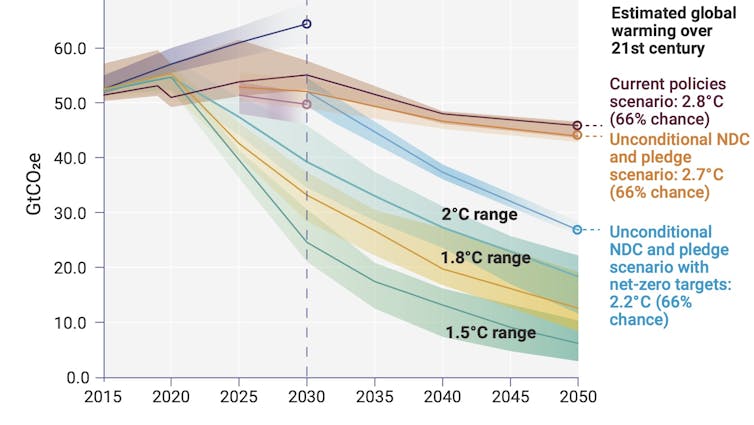
“Six years post-Paris, we are on track for 2.7 degrees of warming — a hellish future that will spare no nation,” he said.
“To demand the action we need, the world’s climate champions are marching to Glasgow to the mantra of ‘keep 1.5 alive’ — a battle cry first uttered here in the Pacific.”
PM condemns selfish ‘carbon addicts’ Timoci Vula reports that in his speech at COP26 yesterday, Bainimarama said the world could not let “a coalition of carbon addicts” write out the urgency of accelerating climate action for the survival of low-lying island nations and communities.
Bainimarama said the “1.5” (global warming limit target) was a compromise that Fiji had struck alongside all of the world’s most climate vulnerable nations.
He said they knew then all the human tragedy that level of warming would mean, but it would also ensure that, at the very least, low-lying island nations and communities would survive.
“Six years on, where has that goodwill gotten us? The world’s collective climate commitments will see us fly past 1.5 by the end of the decade.
“We are losing the race to net-zero to a coalition of carbon addicts who would rather fight for coal than for a future of good jobs and innovative industries created by climate ambition,” Bainimarama said.
“These leaders make pledges but won’t show us plans. They even seek to spin the science. But we cannot let them write out the urgency of accelerating action.
“Clean coal, responsible natural gas, and ethical oil are all figments of the selfish mind.
“No matter what they call them, carbon emissions are wrecking the climate. There’s nothing clean, natural or ethical about it.”
Bainimarama claimed other leaders pursued a “policy of appeasement”.
“They sit idly by as their high-emitting counterparts destroy our children’s futures.”
Talebula Kateand Timoci Vula are Fiji Times reporters. Republished with permission.
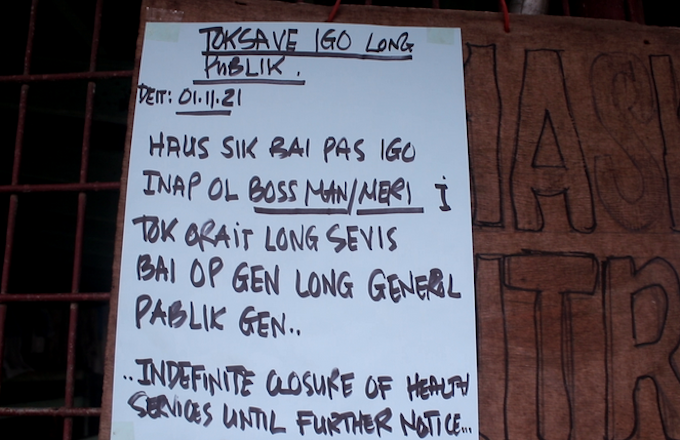
Urban clinics in Papua New Guinea’s second city Lae have closed for an indefinite period following attacks on health workers.
Anti-vaxxers have been verbally or physically attacking health workers over false claims of state mandatory vaccinations against the covid-19 pandemic.
Health workers and support staff manning facilities around the city have reported incidents of stone throwing, swearing and threats to their personal safety, with some people viewing them as “agents of a forced covid-19 vaccine”.
The National reported at the weekend on an attack on a three-member ambulance crew by people last Thursday wrongly believing St John Ambulance staff were administering vaccines.
A surge in covid misinformation and disinformation on social media is hampering health authorities in their work.
While the Morobe Provincial Health Authority is yet to advise residents about the crisis, health workers say nobody is manning the clinics as they have all been asked to stay at home until further notice.
A visit to the Malahang and Butibam clinics revealed that similar notices were posted saying: “Haus sik bai pas inap ol bosman/bosmeri i tok orait lo open gen”. (Hospital will close until approval is received from bosses.)
The next option for residents is to go to the overcrowded ANGAU Memorial Provincial Hospital or visit private clinics and pharmacies.
Barely 1 percent vaccinated Asia Pacific Report reports only 1.2 percent of the nine million Papua New Guineans are vaccinated against covid-19.
According to the John Hopkins University covid dashboard, 29,715 cases of covid and 370 deaths have been reported on Papua New Guinea but health officials fear the real toll is far higher because of limited testing and records.
Source: The Conversation (Au and NZ) – By Mark Howden, Director, ANU Institute for Climate, Energy and Disaster Solutions, Australian National University
Shutterstock
Overnight at the United Nations climate summit in Glasgow, more than 90 nations signed a global pledge led by the United States and United Kingdom to cut methane emissions. However, Australia was not among them.
China, Russia, India and Iran also declined to sign the pledge, which aims to slash methane emissions by 30% before 2030.
Methane is emitted in coal and gas production, from livestock and other agricultural activity, and when organic waste breaks down in landfill.
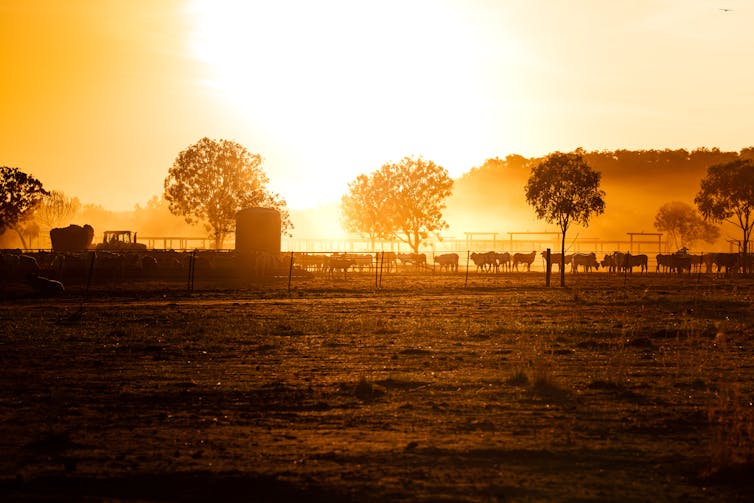
Almost half of Australia’s annual methane emissions come from the agriculture sector. Defending the federal government’s decision, Energy and Emissions Reduction Minister Angus Taylor said Australia had pledged net-zero greenhouse gas emissions by 2050 and would not set specific targets for each sector.
Days out from COP26, National Party leader Barnaby Joyce had claimed signing the pledge would be a disaster for coal mining and agriculture, saying “the only way you can get your 30% by 2030 reduction in methane on 2020 levels would be to grab a rifle and go out and start shooting your cattle”.
Australia’s position on the pledge is inconsistent with methane reductions the Intergovernmental Panel on Climate Change (IPCC) says are required to keep Earth below 1.5℃ warming this century.
The debate also highlights how the shorthand phrase “net-zero emissions” conceals and distorts the real challenges in avoiding dangerous climate change.
It focuses attention on the wrong time frame for action – the next decade is far more important for climate action than 2050. It also addresses the means of action – emissions reduction – rather than the desired goal, which is to avoid dangerous climate change.
And importantly, simply through delaying action, the world could feasibly reduce emissions to net-zero by 2050, but still fail to meet the goals of the Paris Agreement – keeping average global temperature rise below either 1.5℃ or 2℃ this century.
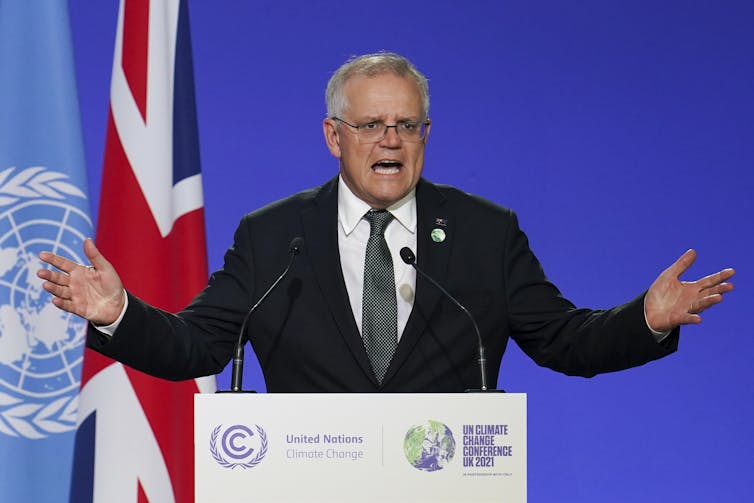
The Morrison government has refused to sign a global methane pledge. Ian Forsyth/AP
Net-zero is both too much, and not enough
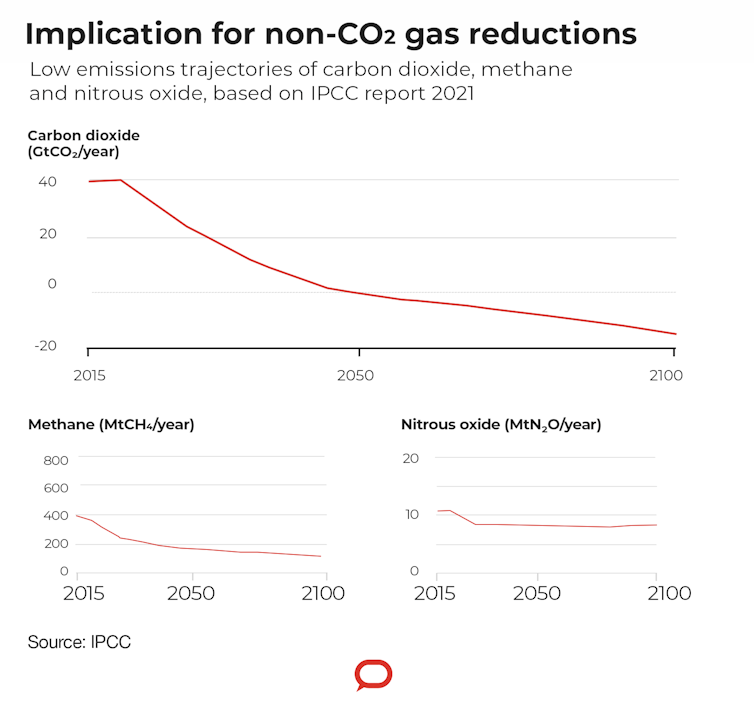
The IPCC report released in August painted a clear picture of how different trajectories for various greenhouse gases translate to global temperature increases.
Carbon dioxide (CO₂) emissions last a very long time in the atmosphere so they accumulate. Consequently, net CO₂ emissions need to decline sharply as soon as possible if we’re to limit temperatures to 1.5℃ or 2℃ above pre-industrial levels.
However, CO₂ emissions not only need to reach net-zero – the IPCC says CO₂ emissions need to go “net-negative”. This will require a massive scaling up of methods and technologies to remove existing CO₂ in the atmosphere.
In other words, when it comes to CO₂, net-zero is not enough. It is a way point, not the end point.
So how do we remove CO₂ from the atmosphere? Some methods, such as mass tree planting, are already widely implemented. Some are difficult to implement at scale, such as substantial increases in soil carbon.
Each option has advantages, disadvantages and limits. The “net-zero by 2050” terminology obscures this complexity. It also conceals the need for crucial discussions about feasibility, governance and support for research and development that’s needed now.
Meanwhile, the situation is quite different for shorter-lived gases such as methane and nitrous oxide. In those cases, going all the way to net-zero is not needed to meet the Paris goals.
According to the IPCC report, an illustrative scenario consistent with 1.5℃ warming would involve methane emission reductions of about 30% by 2030, 50% by 2050 and just over 60% by 2100.
This is consistent with the global methane pledge signed at COP26 overnight. For nitrous oxide, the illustrative reductions would be about 30% by 2050.
So, for methane and nitrous oxide, net-zero is too much.
It should be noted, to keep temperatures to 1.5℃, there are many possible combinations of emission-reduction trajectories for various greenhouse gases. The extent to which CO₂, methane or nitrous oxide is reduced is interchangeable and the final mix will be a function of political decisions.
A clear and integrated assessment of the economic, environmental and social consequences of different emission-reduction pathways is needed to inform those decisions. Without that, inefficient and inequitable economic responses may result.
For example, methane (from livestock) and nitrous oxide (from fertiliser use) make up a high proportion of agriculture emissions. But options for completely stopping these emissions are limited.
Farmers could offset their emissions by planting trees or rehabilitating vegetation on their properties to increase carbon stores. But this would prevent them from selling those emissions reductions on carbon markets, thus removing a potential source of farm income.
So an economy-wide target of net-zero for all key greenhouse gases might mean agriculture must make far more effort in emissions reduction, at much greater cost, than other sectors which largely emit CO₂ and where decarbonisation options are more readily available.
Methane represents a large part of agriculture emissions. Shutterstock
New Zealand has recognised this, and treats agricultural emissions separately.
Carving agriculture out of national emissions-reduction goals would place a greater requirement to act onto other sectors. For example, emission reductions in the transport sector may have to be greater than otherwise, to compensate for the lack of progress in agriculture.
But is isolating agriculture from emission reductions necessary? A recent study assessed new emission reduction options for livestock, including several approaches that together may reduce emissions at the rate required by the methane pledge. They involve more efficient production, technological advances, changes in demand for livestock-related products and land-based carbon storage.
Targets for methane and nitrous oxide reductions should be set using the IPCC science – and don’t have to be set at net-zero. That would leave sectors emitting these gases with a feasible (but still challenging) pathway to reducing emissions in line with the Paris goals.
And where appropriate, we should start describing effective climate action as being “Paris-aligned”. Clearly, over-use of the term “net-zero emissions” misdirects attention from where it’s needed.
Mark Howden is affiliated with CO2 Value Australia, a not-for-profit corporation with a mission to promote the development and deployment of sustainable industrial solutions which transform captured CO2 into useful products.
A sculpture of chimpanzee David Greybeard unveiled in Melbourne last year, the result of a collaboration between artist Lisa Roet and the Jane Goodall Institute Global.James Ross/AAP
Fourteen months after it was announced, the House of Representatives Standing Committee on Communications and the Arts has handed down its report, “Sculpting A National Cultural Plan”, on Australia’s cultural and creative industries and institutions.
Labor finished six years in government in 2013 with the launch of Creative Australia, our last national cultural policy. The Coalition finishes an eight year stretch with a call to think about developing one. Still, a plan for a plan is better than no plan at all.
The 205-page document is broken into six sections. They cover the composition of the cultural sector, approaches to evaluating it, the impact of COVID-19 on artists and organisations (spoiler alert, it isn’t good), and the problem of arts education in schools (and, glancingly, at a tertiary level).
As befits an investigative inquiry, the report devotes considerable space to describing what the sector does and communicating the views of those who work in it. There is frequent quotation from 352 submissions, and responses to a related survey.
A useful tip: read “Appendix F. Labor Members – Additional Comments” first. It raises the issues the rest of the report avoids, particularly around two institutions crucial to any cultural plan of national scope, the Australia Council for the Arts and the ABC.
Managing director of the ABC David Anderson speaks via video to a Senate Estimates Committee. Where is the ABC in this report? Lukas Coch/AAP
Light on calls for action
There are five terms of reference, and some are addressed in more detail than others. The first two are the most crucial: culture’s “direct and indirect economic benefits and employment opportunities”, and its “non-economic benefits [that] enhance community, social well-being and … Australia’s national identity”.
The terms were provided by the Minister for Communications, and it is not the job of the committee to contest them.
Even so, both their order and wording is restrictive. Slicing culture into economic and non-economic benefits is a binary with limited policy application. Making the former the primary lens has a reductive effect on all discussion thereafter.
In respect of Australian cultural policy’s three favoured key terms – they seem on perpetual rotation – there is a return to the limelight for “access” (74 mentions), while “innovation”, a preoccupation of the Turnbull government slips to a supporting role (46 mentions), and “excellence”, dominant in the years when George Brandis ran the portfolio, becomes a spear-carrier (4 mentions).
Bangarra Dance Theatre performers at the reopening ceremony for the Australian Museum last year. Slicing culture into economic and non-economic benefits is a binary with limited policy application. Lisa Maree Williams, Getty/AAP
Submissions show a diverse mix of people, organisations and art forms. A New Approach (ANA) is the think tank most frequently cited though (50+ mentions), and its comments often have headline status.
The report’s 22 recommendations can be divided into three categories: restorations, bespoke suggestions, and calls for further action.
The first are welcome, though in rejoicing at the return of the word “arts” to the Department of Infrastructure, Transport, Regional Development and Communications, or the resumption of ABS cultural and creative satellite accounts (dedicated statistics on the sector’s activities) we should remember who removed them.
The bespoke suggestions are interesting, even when their impact is not immediately apparent (an app for information on arts events) or their implementation likely to be contested (20% of local revenue for streaming services to be spent on local content).
The calls for action are light-on, even by the standards of a broad-ranging report. Discussion of the national identity aspects of Australian culture is thin, for example. This leaves the report at a disadvantage when considering the non-economic benefits of the arts – the ones most people regard as synonymous with them.
Apart from the awkwardness of talking about culture in this displaced way (do we refer to the “non-economic benefits of the health system”?), it leaves the report looking truncated and partisan.
This report looks truncated and partisan. Joel Carrett/AAP
Apolitical
There is discussion of culture’s contribution to our mental health, but not our political health; to social cohesion but not social change. The arts come across as soft-edged, catering to emotional needs like “confidence” and “hope” rather than intellectual ones, like insight and truth.
On the economic side, there are lots of figures, but it is hard to know how to parse them. They are sourced in different ways by different agencies, and append different production contexts (literary publishing vs. performing arts vs. digital games). The report swings between terms: “culture”, “creative industries”, “cultural and creative industries” – all “otherwise known as the arts”.
The aggregate figure of $111.7 billion of culture’s annual economic contribution is repeated, though according to the ABS, 50% of this is “non-cultural”, involving computing, industrial design, fashion and retail. The “arts industry”, including broadcast and electronic media, is far smaller, just $14 billion.
Such definitional slippages suggest these metrics are more ritual offerings to the ideological gods than a serious guide to policy-making.
Here, ANA should be careful how it manages relations with the government. Uncritically adopting an econometric mind-set is unwise, as is insistent reference to a “middle Australia” that has little sociological substance to it. To the extent ANA mirrors the report’s “market first” assumptions, it aligns with the Coalition’s view of the cultural sector.
Business-speak, with one exception
The exception – and it stands out markedly – is the report’s discussion of, and proposals for, Indigenous arts and culture.
There is not the same division of the economic and non-economic, and respect is afforded culture’s intrinsic worth. (“Country, culture and community are, for many Aboriginal and Torres Strait Islander people, intrinsically linked and the well-being and success of one depends on the health of the other”.)
Artist Vincent Namatjira pictured in 2020 with his Archibald Prize winning portrait of Australian Rules footballer and community leader Adam Goodes. Iwantja Arts/AGNSW
The closest the report comes to adopting this holistic tone elsewhere is in reference to heritage institutions and their “important preservation and curation service”. Though even here, there is a rapid shift to focusing on spill-overs (“enhancing well-being, fostering shared values [and] supporting social cohesion”).
The 10-person committee has two Coalition chairs and a Coalition majority of six to four. This is reflected in the report’s language of business-speak, used not only to describe what the sector does but to validate it. Thus the report is firmly “inside the box” of 40 years of neoliberal prescriptions on small government, culture-as-enterprise and value-as-money.
That said, the committee has a number of members on it with diverse backgrounds and interesting pre-Parliamentary experience. It is not a collection of the usual suspects.
This raises the question of whether the report’s “market first” perspective comes from the committee or from the sector itself, which, after 40 years of being told its value is to be measured in dollars now believes it.
The report cites some challenges to this viewpoint, but they feel muted. The suspicion is that what was once a rhetoric of convenience is now a self-view. It is, for example, a very bad idea to call in the Productivity Commission to consider “arrangements which govern funding of artistic programs” (one report recommendation) given its traditional hostility to all forms of producer subsidy and its perennial muddling of equity and efficiency issues.
Likewise omitting the Australia Council and the ABC from detailed discussion should flash a warning light. Much government policy-making now involves vested interest lobbying and ministerial fiat, as the Grattan Institute’s ex-chief executive, John Daley (who has worked with ANA) noted in a recent report on removing barriers to policy reform.
“It’s goodbye Whitlam, hello pork-barrel” a colleague said to us recently. How then should we greet a report that says nothing about the public sector or intermediary cultural agencies established precisely to avoid such political control of arts and culture?
Julian Meyrick made a written submission and supplementary submission to the inquiry, and also gave oral evidence to it.
Justin O’Connor receives funding from The Australian Research Council.
Source: The Conversation (Au and NZ) – By Prue Clarke, Research Fellow at the Centre for Media Transition and head of New Narratives, a US-based not-for-profit newsroom and media development organisation working in low income countries., University of Technology Sydney
Shutterstock
When ABC chair Ita Buttrose told a National Press Club lunch earlier this year that the January 6 insurrection at the US Capitol could be blamed on the lack of a “well-funded public broadcaster”, she echoed a dangerous misunderstanding about the American media landscape.
In fact, America’s public broadcasters are better funded than Australia’s, and the rise of Trumpism led to a golden age of journalism in the United States.
The January 6 insurrection happened in spite of excellent journalism. Australian policymakers and media leaders need a more sophisticated understanding of America’s information ecosystem if they’re to counter the same forces here.
Buttrose said in May that countries without a well-funded public broadcaster often have examples of right-wing extremism, as was evident in the Jan. 6 Capitol insurrection. Jose Luis Magana/AP
A different definition of ‘public funding’
The US has two public broadcast systems. The biggest of them – National Public Radio – attracts an audience of 57 million each week. One in five US adults gets their political news from NPR. That is the seventh-largest audience of any news organisation in any medium in the US.
If you’ve ever listened to This American Life, Serial or Radio Lab – among the most downloaded podcasts ever – you’re part of the American public radio audience.
Annual revenue for public TV in the US is smaller at $US690 million (A$927 million). Still, 16% of all US adults get their political news from the Public Broadcasting Service (PBS), comparable to the BBC audience in the US.
The depth of NPR funding shows in deeply reported programs such as Morning Edition and The New Yorker Radio Hour, which feature experienced journalists (some of whom have been on the same beat for decades). Solid resources underpin shows that are dense with field recordings and interviews with real people across America and from 17 international bureaus.
NPR has also funded a spring of innovative, popular podcasts such as Invisibilia and In the Dark, which are finding large global audiences.
A different definition of ‘public broadcaster’
Buttrose’s narrow definition of “public broadcaster” is based on how much money comes directly from government.
NPR’s coalition of 1,000+ content makers and stations receives only 12% of its funding directly from the government. But the bulk of funding still comes from taxpayers. Public radio stations are structured as not-for-profits and all contributions are tax deductible. Nearly 40% of their funding comes directly from audience members, while another 10% comes from foundations.
In 2019, individual donations to the top 123 public radio stations totalled $US430 million (A$593 million) from 2.35 million listeners. The average listener contribution was $US183 (A$250).
Those are still taxpayer dollars – money diverted from government coffers where it might have been used on education, health care or infrastructure. But by making news media donations tax deductible, the US government allows audiences to decide which public interest journalism they want to support with their tax money, if any at all.
That, in turn, gives news media that qualify for tax-deductible status a strong incentive to reach as big an audience as possible with content that is so trusted, valuable and engaging, people want to pay to help keep it alive.
It’s the same case Guardian Australia has made to persuade 170,000 readers to voluntarily contribute to keep its content free for all.
This is not necessarily an argument to change the ABC funding model in Australia. (The ABC only accepts money from government – and none from donors – in the belief this protects it from influence.) Australia also has a more dispersed population and smaller news media market, which is highly vulnerable to foreign competition.
It is an argument for a more sophisticated understanding of the options available to all public interest media as they battle for financial survival.
Like NPR, Australian not-for-profit media should have access to tax-deductible status. Among content makers, only The Conversation, Australian Associated Press and the Judith Neilson Institute have made their way through the opaque and subjective government approval process.
The ACCC and a coalition of media and politicians have advocated for this change, but it has yet to gain parliamentary support.
A pioneer in reader-revenue business models
This audience revenue-driven business model made NPR a pioneer in the world of media “community building”, which has gone mainstream as advertising revenue has shrunk. Successful media businesses are now working hard to replicate NPR’s success in persuading audiences to pay.
Jad Abumrad, creator of the groundbreaking public radio program Radio Lab, explained the concept to my class at the Newmark Graduate School of Journalism at the City University of New York in 2015.
Build audience trust and engagement with authenticity, he said. Tell stories that are driven by real people, with language that is accessible to all. Reporter diversity is key to ensuring stories engage with a broad audience. Be transparent about the reporting process and funding (financial statements including staff salaries are published online).
Like all American public radio journalists I’ve met, he had no envy of the government-funded model for public broadcasters. Audience funding makes journalists answerable and responsive to their audiences, he said, and he liked it that way. It has also protected NPR from government pressure.
A golden age of journalism is not enough to stop extremism
In truth, the rise of Trumpism has been a gift to American journalism in important ways. President Donald Trump’s attacks on the press and democracy itself unleashed a flood of funding from audiences and philanthropists, who saw quality journalism as their best defence against authoritarianism.
The rise of Trumpism was rooted in America’s decades-long lack of investment in education, healthcare and a social safety net. The resulting inequality was fanned by right-wing media and voices on social media.
Those same forces have driven a big rise in far-right politics in Europe and the UK, in spite of government-funded broadcasters and strong social welfare nets. And, as the pandemic has made clear, social-media-driven, right-wing extremism and growing inequality are alive in Australia, too.
Australia will need strong media to combat this rise. A more nuanced understanding of what’s happening in the US media ecosystem is a critical place to start.
Prue Clarke heads a not-for-profit media development organisation that receives funding from foundations and governments not mentioned in this article including the Wellspring Philanthropic Fund, German Development Cooperation, Australian Aid, American Jewish World Service. She is a contributor to National Public Radio.
Don’t want to take a COVID test, wear a mask or get vaccinated? It’s pretty easy to find advice telling you you’re legally entitled to say no. Unfortunately, this advice is very bad.
The COVID-conspiracy ginger group Reignite Democracy Australia, for example, claims to have “been working with lawyers” to provide template letters “you can use in situations where your personal rights are being encroached on”.
These letters state it is illegal for an employer or business to ask you to get tested, wear a mask or show proof of vaccination under the Australian Constitution and the Commonwealth Biosecurity Act 2015.
They suggest you cite Section 60, Subsection (2) of the Act and demand your employer provide a “human biosecurity control order”. They even suggest threatening legal action using the following words:
If you take any action to terminate or otherwise restrict my employment, you will be in breach of my employment contract and I reserve my rights to take legal action against you for your unlawful termination.
Similar advice is being spread on Facebook, Telegram and other social media channels. Other grounds cited for an employee or customer refusing to comply with COVID-related rules include the Federal Privacy Act 1988, human rights charters, anti-discrimination acts, the Nuremberg Code, statements by Australia’s Fair Work Ombudsman, and even “common law”.
All these arguments are flawed. They are what is known as “pseudolaw” – a mixture of real and fantasy legal ideas. Relying on them is most likely to make a situation worse. They might be enough to overwhelm or confuse a shop assistant, but they won’t stand up in court.
The consequences may include losing your job, putting yourself in a position where you may be arrested, spending money on fruitless legal cases, and incurring thousands of dollars in fines.
Mixing fact and fantasy
The term pseudolaw describes any statement that claims to represent a valid law but is actually false or “pretend”. This often involves squishing together real bits of law with false claims.
The Privacy Act 1988 (Cth), for example, is a real law that imposes rules on federal government agencies when it comes to handling personal information. But there’s nothing in the act that makes it unlawful to ask a customer to use a contact-tracing form when entering a shop.
The Australian Constitution does preclude “civil conscription” in Section 51(xxiiiA).
But this is about the federal government having the power to legislate on the provision of medical and dental services (as well as other forms of welfare) but not being able to force doctors and others to provide such services. It doesn’t stop federal or state governments proclaiming mask or vaccine mandates.
The Commonwealth Biosecurity Act does state that a biosecurity control order from an authorised biosecurity officer is needed to compel an individual to do something, such as undertake vaccination. But this does not not override or contradict state or territory health directions that mandate vaccinations in specific workplaces or other settings. Those directions are authorised by emergency management laws or public health acts, which coexist with federal biosecurity legislation.
Australia’s Disability Discrimination Act 1992 makes it unlawful to disadvantage another person or treat them differently because of a physical disability or even a disease. But it doesn’t mean a business can’t deny you entry if you refuse to show proof of vaccination. Businesses are generally entitled to set whatever conditions of entry they want, provided those conditions are reasonable, don’t discriminate on grounds such as sex or ethnicity, and are imposed to comply with other laws.
A lot like pseudoscience
While pseudolaw has probably been around as long as law, one of its most common expressions in recent decades has been the “sovereign citizen” movement, which essentially argues that individuals do not have to comply with laws they disagree with.
One Nation senator Malcolm Roberts used sovereign citizen arguments in a 2011 affidavit he sent to Prime Minister Julia Gillard, arguing he was exempt from the carbon tax and claiming compensation of A$280,000. Former One Nation senator Rod Culleton has also used sovereign citizen arguments, such as in his petition to Queen Elizabeth about the Australian government being illegitimate since 1973.
The attraction of these “personal sovereignty” arguments among those who fear COVID tests, masks and vaccines should hardly be surprising. Indeed, pseudolaw shares much ground with pseudoscience. As US lawyer Colin McRoberts has put it:
They both appeal to people’s natural fondness for self-reliance and secret knowledge. The path from curiosity toward self-destruction probably starts for many with curiosity about strange but compelling ideas – what if some of it were really true, and what’s the harm in believing it when you aren’t sick or in legal trouble? When the cost of error is low, the fact that snake oil doesn’t work is not particularly relevant. But once the believer starts to rely on it in the real world, the spiral has begun.
Pseudolaw also uses similar methods to pseudoscience. McRoberts credits believers with being “typically intelligent and motivated, and capable of constructing complex edifices that sound superficially credible”. But this artifice and the ability to overwhelm those without legal training can easily mislead people into believing the actual arguments have legal merit.
Relying on pseudolaw can give rise to serious legal consequences. Using them in a letter or document can cause harm and distress not only to the recipient but to your own case. If they lead to a genuine legal response or to court proceedings, they could potentially results in fines or penalties for falsifying documents.
Which is presumably why Reignite Democracy Australia includes the following disclaimers with its pseudolegal letters:
Keep in mind that some employees might not take this well and could actually fire you if you choose not to wear a mask/get a test. You would then need to decide how to move forward from there. Please take this into consideration.
In other words, before doing something that could result in you losing your job or incurring a large fine, you should get real legal advice. Consult your union, or a citizens’ legal advisory agency, or a lawyer you can trust.
Sarah Moulds receives occasional research funding from the Law Foundation of South Australia. She is the Director of the volunteer-run Rights Resource Network SA and a member of the Law Society of South Australia.
Source: The Conversation (Au and NZ) – By Hannah Blumhardt, Senior Associate at the Institute of Governance and Policy Studies, Te Herenga Waka — Victoria University of Wellington
Shutterstock/Brian Scantlebury
The New Zealand government is currently developing plans to address two crises — climate change and waste — and to embrace a circular economy. But it has no clear path for how to do this. The resulting muddle is watering down the potential of a circular economy to bring lasting change.
Public consultation is underway to develop an emissions reduction plan, following the Climate Change Commission’s advice on carbon budgets towards New Zealand’s 2050 net-zero target.
Both documents intend to move Aotearoa towards a circular economy — one that limits waste and pollution, keeps products in use, and regenerates natural systems to protect, not pillage, natural resources.
But the government’s plans for circularity are fragmented, contradictory and uncoordinated. They fail to confront the business-as-usual drivers of the linear economy or to enhance collaboration.
New Zealand needs a dedicated Crown agency to champion a low-waste, low-emissions circular economy.
New Zealand is one of the most wasteful countries in the OECD. Waste is not only a pollutant but the dead end of a linear supply chain that emits greenhouse gases at every step along the way.
Roughly half of global emissions come from producing and consuming stuff. Every bit of waste represents embodied emissions lost to the economy.
Circular practices preserve this embodied energy by keeping products and materials in use. This slows down global extraction of natural resources, from mining to tree-felling. The less is extracted, the more waste and emissions are reduced.
About half of global emissions come from things we consume. Peter Dazeley/Getty Images, CC BY-SA
Currently, just 8.6% of the global economy is circular. This figure must double by 2032 to keep us on track to limit global warming to 1.5℃.
Doubling the circularity of New Zealand’s economy would mean transforming production and consumption systems. Today, much of what we make and buy is inherently linear.
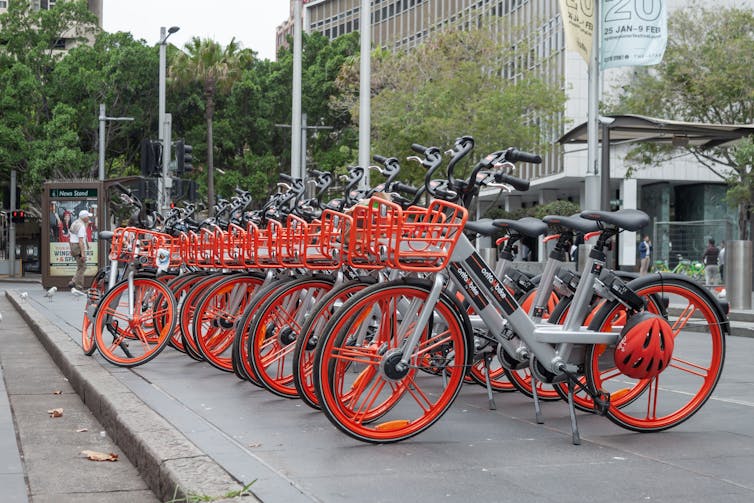
In a circular economy, products are built to last and designed for repair. Organics are composted to replenish soils. Business models favour sharing over individual ownership, and reuse over single use.
In a circular economy, sharing is better than ownership. Shutterstock/Amelia Tomkins
This seismic shift in economic direction demands coordination across sectors, strong leadership and a shared understanding of the circular model. The government must collaborate with those already practising circularity and reconfigure the rules to wind down linear practices.
Lack of a whole-of-system approach
The consultation documents do not tell a shared circular economy story. The waste strategy focuses on end-of-product-life processes such as waste management, litter and recycling; the proposed emissions reduction plan discusses business models and innovation.
The waste proposal suggests the Ministry for Business Innovation and Employment (MBIE) will eventually bind everything together in a “separate and broader circular economy strategy”, but this risks creating a bigger tangle.
The confusion is not surprising. The government’s work on circularity has been splintered between the Ministry for the Environment and MBIE. The agencies’ organisational cultures and priorities differ and they have not connected their thinking for a whole-of-system approach.
Critical elements of the circular economy are falling through the cracks in the silos, particularly the part about economic transformation. Increasing corporate responsibility for waste is the hottest potato no one wants to touch.
The consultation documents propose few upstream policy interventions to trigger product redesign or new business models that reduce waste and emissions. Instead, they focus on using or disposing of waste after it’s been produced, which presumes, rather than challenges, linear inefficiencies.
All the wrong circles
Despite responsibility being the central theme of the waste proposal, it makes nobody responsible for waste creation because it never analyses where waste comes from. Instead, it emphasises improved waste management and anti-littering laws. This lumps responsibility at the end of the pipe, on individuals and councils who cannot influence waste baked into the system further upstream.
Furthermore, product stewardship is ring-fenced to ‘end-of-life’ activity, neutralising its potential to redistribute responsibility further up product supply chains.
The emissions reduction plan does not fill this gap, apart from some promising initiatives for the construction sector. The connection it draws between circularity and climate abatement mostly relates to organic waste rather than overall production and consumption. Despite considering the potential for new business models to address climate change, product stewardship is barely mentioned.
Instead, it views circular innovation through the lens of the “bioeconomy”, where waste-derived biomass is converted into bioenergy and new products. But a bioeconomy depends on continued waste generation, which is arguably non-circular. It also contradicts the waste proposal’s suggestion to discourage waste-to-energy “downcycling” through levies.
The government cannot achieve circularity alone, but has no cogent plan for collaboration.
Supporting community groups and local enterprises does not appear a government priority. Both documents describe circularity and innovation as future states, yet many organisations already implement circular and zero-waste practices and are potential partners.
A Te Tiriti-based partnership is fundamental for economic transformation. The Climate Change Commission described the circular economy as aligned with a Māori worldview. Organisations like Para Kore show Māori leadership in advancing zero waste and circularity.
While the emissions reduction plan promises meaningful partnership with Māori, the waste proposal does not. This is a missed opportunity. New waste legislation could protect Māori decision-making rights and rangatiratanga over natural resources.
Rather than charting a clear path to a circular economy, the government is proliferating documents that perpetuate a business-as-usual approach where communities, councils and government run around in the wrong kinds of circles, cleaning up after industry.
The problem isn’t a lack of good ideas. But these ideas aren’t properly filtered or organised, important elements and key partners are missing and nobody’s in the driver’s seat.
Moving Aotearoa away from silos and towards a circular economy requires a dedicated Crown agency with a Te Tiriti-compliant governing structure. This agency could champion circularity, resource efficiency and conservation across the system, from resource extraction to product disposal.
Hannah Blumhardt is a researcher for Āmiomio Aotearoa – a trans-disciplinary, multi-partner research project into the circular economy funded by the Ministry for Business, Innovation and Employment (MBIE) and hosted by the University of Waikato. She is also a contractor for the Zero Waste Network. She founded and runs The Rubbish Trip and Takeaway Throwaways. She is affiliated with the New Zealand Product Stewardship Council, Aotearoa Plastic Pollution Alliance and WasteMINZ. She was a member of the advisory group to the Ministry for the Environment for the proposed waste strategy.
At the Glasgow COP26 climate talks overnight, Australia and 123 other countries signed an agreement promising to end deforestation by 2030.
The declaration’s signatories, which include global deforestation hotspots such as Brazil, Indonesia and the Democratic Republic of the Congo, have committed to:
working collectively to halt and reverse forest loss and land degradation by 2030 while delivering sustainable development and promoting an inclusive rural transformation.
This declaration should be welcomed for recognising how crucial forest loss and land degradation are to addressing climate change, biodiversity decline and sustainable development.
But there have been many such declarations before, and it’s hard to feel excited about yet another one.
What really matters is changing policy domestically; if countries don’t change what they are doing at home to bring emissions from fossil fuels to zero and restore degraded lands, declarations like this are meaningless.
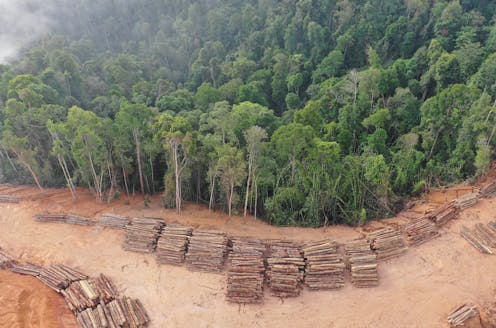
The drivers of deforestation are international agricultural commodities such as palm oil. Shutterstock
The good parts
The declaration does a good job of joining up interrelated issues that for too long have been treated as separate problems.
Signatories say they will:
emphasise the critical and interdependent roles of forests of all types, biodiversity and sustainable land use in enabling the world to meet its sustainable development goals; to help achieve a balance between anthropogenic greenhouse gas emissions and removal by sinks; to adapt to climate change; and to maintain other ecosystem services.
Biodiversity is key to forest conservation and sustainable land use.
From there, the signatories promise to:
reaffirm our respective commitments, collective and individual, to the UN Framework Convention on Climate Change and the Paris Agreement, the Convention on Biological Diversity, the UN Convention to Combat Desertification, the Sustainable Development Goals; and other relevant initiatives.
To see commitments under several UN declarations recognised in one place is somewhat of a breakthrough; forests, biodiversity and land-use are often siloed despite the critical links in dealing with these issues.
It is also promising to see recognition that conserving existing forests and other terrestrial ecosystems is the priority, and signatories committing to accelerate their restoration (as opposed to just planting new trees).
A vast body of research shows planting new trees as a climate action pales in comparison to protecting existing forests. As I have written before,
restoring degraded forests and expanding them by 350 million hectares will store a comparable amount of carbon as 900 million hectares of new trees […] Forest ecosystems (including the soil) store more carbon than the atmosphere. Their loss would trigger emissions that would exceed the remaining carbon budget for limiting global warming to less than the 2℃ above pre-industrial levels, let alone 1.5℃, threshold.
Once intact forests are gone, we can’t regain the carbon lost. It is known as “irrecoverable carbon”. So protecting existing forests is the top priority, especially given the critical time frame we are in now to keep climate change under the 1.5℃ or even 2℃ thresholds.
The declaration also mentions trade, promising to:
facilitate trade and development policies, internationally and domestically, that promote sustainable development, and sustainable commodity production and consumption, that work to countries’ mutual benefit, and that do not drive deforestation and land degradation
Here, we are starting to get to the real drivers of deforestation. For a long time, there has been too much focus on local drivers of deforestation including local communities. But research shows the leading drivers of deforestation are internationally traded agricultural commodities such as beef, soy, palm oil and timber.
The overall rate of commodity-driven deforestation has not declined since 2001. We can’t tackle forest loss without tackling the trade drivers behind it.
The main deficiency in the text is that not enough attention is paid to the rights of Indigenous peoples and local communities.
It is mentioned the countries will “recognise” and “support” the rights of Indigenous peoples but many of these signatories do not have adequate – or, in some cases, any – legislation that actually recognises those rights.
Subjugation of these rights to national law has been a problem in previous international agreements.
The challenge in many countries is regulatory reform to bring national recognition of land, tenure and other collective rights into line with the internationally recognised rights of Indigenous Peoples.
The track records of some of these signatories bring into question what policy change they will be making back home to ensure this declaration isn’t just for show.
As a global land clearing hotspot, Australia will need to enact rapid policy change to bring its current practices in line with what it has signed on to. Australia remains the only developed nation on the list of global deforestation fronts. This is due to weakening land clearing legislation in New South Wales and Queensland, mostly for expansion of grazing lands.
As a signatory to this new declaration, Australia must strengthen land clearing laws, end native forest logging, and restore degraded ecosystems – just planting new trees will not get us there. Australia has the potential to restore large areas of degraded land. Experts have proposed how this could be done for relatively little investment.
The European Union has signed on too; it has been a global leader on developing trade policies designed to end illegal logging and reduce deforestation. But it recently backpedalled on its commitment to a program of forest governance and law enforcement in timber-producing countries that allow access to the EU timber market.
If they are serious about this declaration, the EU must reaffirm its commitment to partner countries to address illegal logging in traded timber.
In Brazil, the Bolsonaro government has been winding back previous legislation to recognise Indigenous peoples’ land rights. Deforestation rates have soared in the past few years. Perhaps the first action Brazil could take as a signatory to this declaration is to prioritise the landmark case (currently on hold) before Brazil’s Supreme Court to protect Indigenous land rights.
Brazil, home to the critically important Amazon rainforest, has signed on to the declaration. Shutterstock
Ending deforestation and restoring forests is not enough
This is the latest in a series of similar declarations. A pledge made at COP24 in Katowice, the New York Declaration on Forests, and Sustainable Development Goal 15 (Life on Land) all include similar commitments to end deforestation by 2030 or earlier.
This week’s COP26 declaration ends with the importance of
pursuing efforts to limit it to 1.5℃, noting that the science shows further acceleration of efforts is needed if we are to collectively keep 1.5℃ within reach.
The fact is, we won’t achieve this through ending deforestation and restoring forests. These efforts are critically needed to address biodiversity loss and rural sustainability, but for limiting warming to 1.5℃, fossil fuel emissions need to come down to zero – now.
Kate Dooley has received funding from One Earth philanthropy.
Daily updates of COVID case numbers have been part of our pandemic lives. These numbers are reported, analysed and widely shared. They’re conversation starters, and with good reason.
Until recently, daily numbers had direct consequences. Officials used them to make decisions that significantly impacted our lives. No wonder many of us were glued to the daily media conferences or kept an eye on our social media accounts announcing the numbers.
But as Australia opens up, we’ve been warned to expect higher case numbers. And with so many of us vaccinated, we’ve been told to not follow the case numbers so closely. Instead, we should be focusing on the rates of people hospitalised with COVID.
Why is it so hard to disengage from daily case numbers? What should you do if, like a car crash, you can’t look away?
Why are some people fixated?
Rising case numbers can provoke anxiety, whether it’s because of increased restrictions or concerns about you or a loved one being infected.
However, some people, especially those vulnerable to anxiety or who have already been diagnosed with it, may continue to fixate on daily case numbers, despite advice not to. This fixation is likely to increase their anxiety, particularly as case numbers rise.
Some people seek out and pay greater attention to information around them they perceive to be a threat. This tendency, known as attentional bias, is thought to have an evolutionary basis. To survive, paying greater attention to risky things around you may help keep you safe and increase your control over the situation.
What is attentional bias?
Looking out for information that might affect your safety – such as COVID case numbers – is normal and can lead to helpful behaviours, such as following social distancing rules.
But too much attentional bias is linked to anxiety. So, fixation on daily case numbers, particularly when it does not serve a specific purpose or impacts day-to-day functioning, is unlikely to be beneficial.
Understanding COVID trends is important as it can lead to helpful behaviours, such as getting vaccinated. However, exposure to COVID information can be a problem if it results in catastrophising to the point where it’s having a significant detrimental effect on our psychological well-being.
With increasing rates of vaccination, daily case numbers are less accurate indicators of threat to our well-being than earlier in the pandemic when vaccination levels were low.
So case numbers no longer signify the implementation of the types of public health measures we’ve been used to (such as state-wide lockdowns), or the likelihood of becoming unwell due to COVID.
What if you can’t look away?
If you are fixated on the numbers and it’s doing more harm than good, you may need to make some changes.
But you do not need to avoid the numbers, even if they are causing some distress. Staying well informed from reliable news sources is an important way to maintain well-being during the pandemic. Totally avoiding the case numbers is unlikely to improve anxiety in the longer term. That’s because avoidance does not address the source of your anxiety.
reduce consumption of COVID-related news: constantly searching news websites and social media for information on COVID-19 is likely causing more distress than reassurance. Avoid doomscrolling and surfing. One daily update from a reliable source should be enough
manage your thoughts: what catastrophic beliefs are triggered by viewing the daily case numbers? Are you fearful you or someone close to you will catch COVID? Are you worried about what will happen when you enter the world post-lockdown? Create a rational, balanced thought by using facts from reliable sources and try to maintain a realistic perspective
try mindfulness mediation: rather than dwelling on events that may never occur, switch your attention to the present moment by practising mindfulness. You can try some mindfulness exercises, for free, with the Smiling Mind app
plan other activities: counter urges to repeatedly check daily numbers by scheduling other activities at these times. Activities do not to be difficult or time-consuming but should require you to focus your attention.
If you need any extra support
If you’re struggling to disengage from the case numbers or other COVID-related information – and this is causing significant distress or having a negative impact on your life – you may need extra support.
Speak to your GP, who can provide a referral to a mental health professional.
A View from Afar – In this podcast, political scientist Paul Buchanan and Selwyn Manning will discuss two issues: the evolution of new generation attack drones; and the COP26 meeting in Glasgow this week. Specifically, Buchanan and Manning will unpack:
Whether Geopolitics has railroaded a broad-based consensus of climate interventionism
Why Russia and China abandoned the Cop26 multilateral forum?
How mostly developed nations state the take away agreements help address climate change, and how Greenpeace and many other environment groups say fundamental problems remain with how developed nations address the climate change challenge.
ALSO: We discuss the latest in the evolution of high-tech militarised attack drones. What can we now expect to see? And, how will countries defend themselves against AI driven attacks?
Join Paul and Selwyn for this LIVE recording of this podcast while they consider these big issues, and remember any comments you make while live can be included in this programme.
You can comment on this debate by clicking on one of these social media channels and interacting in the social media’s comment area. Here are the links:
Threat.Technology placed A View from Afar at 9th in its 20 Best Defence Security Podcasts of 2021 category. You can follow A View from Afar via our affiliate syndicators.
The genome of the spiny-tailed monitor is divided up into 8 big macochromosomes and 10 tiny microchromosomes huddled in the middle.Jason Dobry, Author provided
If you look at cells from a human or other mammal under a microscope, you’ll see big fat molecular complexes called chromosomes that contain our DNA. If the cells are from a bird or reptile, you’ll see a few of these chunky chromosomes but also a flotilla of tiny specks that look like broken-down pieces of chromosomes or even specks of dust.
Those specks turned out to be tiny chromosomes, but their significance has been a mystery for decades. I assembled a talented team of young genome scientists to show that these “microchromosomes” are almost identical, and they represent the ancient chromosomes of a spineless animal ancestor that lived 684 million years ago.
The human genome and human chromosomes
The human genome comprises about 3 billion base pairs of DNA, each one like a rung on a long, twisted ladder. If you stretched the whole genome out, it would be about 1 metre long. It contains about 20,000 genes and a lots of repetitive sequences of DNA with few known functions.
Our genome is broken up into 23 bits. We can see these bits when a cell divides into two, because during this process the DNA condenses with proteins into chromosomes (literally “staining bodies”) which we can see under the microscope. We have two copies of the genome in each of our cells (one from our mum and one from our dad), so we see 46 chromosomes in each cell.
Other mammals have pretty much the same set of genes on a similar length of DNA, but it is broken up differently. Some animals have lots of small chromosomes (there is a South American rat with 51) and others have a few big ones (the swamp wallaby has only 5).
Surprisingly, other higher vertebrates (birds and reptiles), though they have somewhat smaller genomes (1 or 2 billion base pairs) have pretty much the same sets of genes – as do frogs and even fish. The genomes of all vertebrates are amazingly similar.
The story of microchromosomes
When we look at the chromosomes of birds, turtles and squamates (snakes and lizards), however, we see big differences from those of mammals. They have between six and nine normal-looking chromosome pairs, but also lots of tiny elements that at first were thought to be degraded bits of chromosome or even dust on the microscope slide.
However, it proved that these elements were present in a constant – and even – number. Most birds have 62, representing 31 pairs of tiny “microchromosomes”.
Although microchromosomes are tiny, they have the same ends (telomeres) and attachment points (centromeres) as larger chromosomes. Curiously, they seem to hang out together in the centre of the cell.
The real surprise came when it became possible to sequence bits of chicken microchromosome DNA and check out the genes they contained. It turned out that chick microchromosomes carry a big share of the genes and contain far fewer repetitive sequences than the large “macrochromosomes”. In fact, about half the chicken genes lie on microchromosomes. This implied that microchromosomes are important parts of the bird genome.
But the mystery remained. Why are there two such distinct size classes of chromosomes in birds and other reptiles? And why do you always see microchromosomes huddled together in the centre of the cell?
Microchromosomes are highly conserved across birds and reptiles
Thanks to huge improvements in DNA sequencing technology, there are now well-assembled end-to-end or “telomere-to-telomere” sequences of many birds and reptiles.
In our new work, we have lined up DNA sequences of macro- and microchromosomes between several birds, turtles and squamates. We see startling similarities in the sequences.
Emus and pigeons are only distantly related to chickens, as birds go, but they have virtually the same chromosomes. Turtles and squamates have fewer microchromosomes than birds, but the ones they do have are very similar within each group.
When we compared sequences between emus, turtles and squamates, we saw a high degree of homology in microchromosome DNA sequences stretching over the nearly 300 million years since these species last shared a common ancestor. Turtles and squamates each carry different subsets of emu microchromosomes. We could see the lost microchromosomes; they had fused with each other or with macrochromosomes.
This suggested that 31 bird microchromosomes was present in the genome of a common ancestor of birds and reptiles about 300 million years ago, and turtles and squamates independently lost different subsets of these.
We used new techniques to reveal which bits of DNA are physically closest to which in the DNA tangle of a non-dividing cell. This showed that microchromosomes play tag with each other, and not with macrochromosomes.
This gives molecular reality to the old observations that microchromosomes lie close together in bird and reptile cells. It looks like microchromosomes form a compartment in the cell that might help the genes work together.
The tiny chromosomes of the amphioxus or lancelet are the building blocks of the genomes of modern vertebrates. Hans Hillewaert, CC BY
Microchromosomes are ancient genetic elements
As it turns out, microchromosomes go back far, far further than the ancestral reptile: all the way to the tiny chromosomes of a very distantly related animal called the amphioxus or lancelet. Lancelets are small fish-like invertebrates that last shared a common ancestor with vertebrates 684 million years ago, long before the spine evolved.
Lancelets have a very small genome (520 million base pairs) cut up into 19 tiny, gene-dense chromosomes. This genome was duplicated twice during the evolution of the fish that gave rise to animals with four limbs (tetrapods).
We found that most emu microchromosomes aligned with a single lancelet chromosome, or sometimes with two. So the tiny lancelet chromosomes have survived almost unchanged as bird and reptile microchromosomes. The rest of the vertebrate genome is made up of copies of these chromosomes, diluted with enormous amounts of repetitive DNA.
This means that the tiny lancelet chromosomes, represented today by bird and reptile microchromosomes, were the original building blocks of vertebrate genomes.
Mammal genomes have gone mad
Some reptile and bird groups seem to have lost all or most of their microchromosomes. We show that, in these exceptional genomes, microchromosomes fused with each other (as in crocodiles) or with macrochromosomes (as in eagles and their relatives).
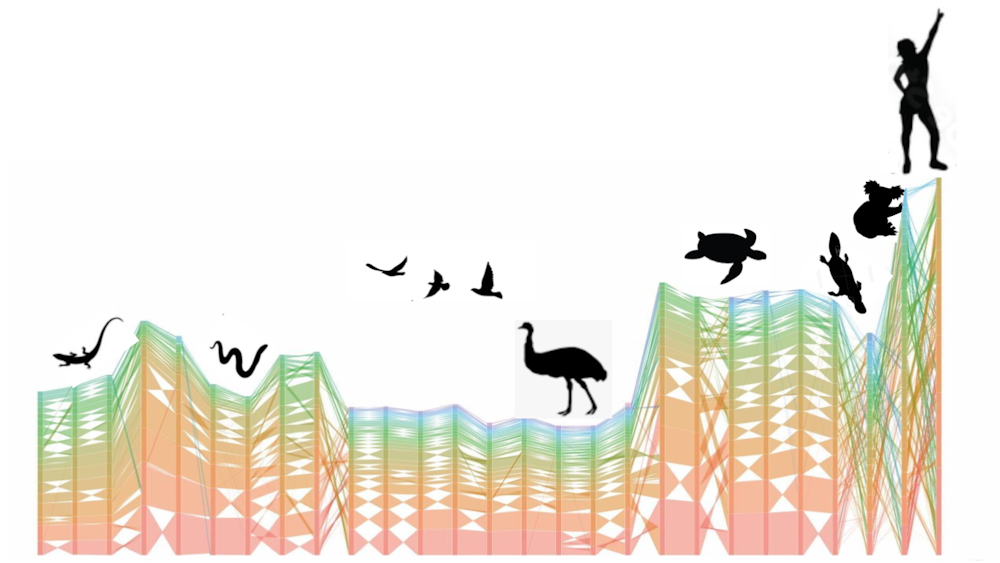
But mammals are the real exceptions. They have no microchromosomes. When we lined up emu sequence against the human and koala genomes (representing the marsupial and placental branches of the mammal family tree), we could find only small patches of homology with microchromosomes, scattered all over the genome.
However, in monotremes (egg-laying mammals that represent a third, and the oldest, branch of mammals), we saw that four platypus chromosomes are composed entirely of fused microchromosomes.
Genomes of lizards and snakes, birds, turtles and mammals (vertical lines show genome size) with DNA sequences lined up between chromosomes (coloured by size, microchromosomes in blue/green). Chromosomes have stayed the same in birds and reptiles but gone mad in mammals. Genome array by Hardip Patel, Paul Waters, Nick Lister. Author provided
This implies that microchromosomes fused together into large blocks in a reptile-like mammal ancestor more than 200 million years ago. The chromosomes stayed that way in monotremes. But in our own lineage (therian mammals that diverged into marsupials and placental mammals), blocks of micro- and macrochromosomes were rearranged, obliterating their origins.
After this rearrangement, marsupial chromosomes stayed quite conserved, 19 large blocks of genes being shifted around in simple ways. However, the chromosomes of placental mammals have gone quite mad, rearranging multiple times in many lineages. Such dizzying chromosome variation is unusual in vertebrates.
So the tiny microchromosomes of birds and reptiles are really the “normal” chromosomes rather than our big, fat mammal chromosomes that are scrambled and inflated by repetitive DNA sequences.
Jenny Graves receives funding from the Australian Research Council.
New Zealand Parliament Buildings, Wellington, New Zealand.
Editor’s Note: Here below is a list of the main issues currently under discussion in New Zealand and links to media coverage. You can sign up to NZ Politics Daily as well as New Zealand Political Roundup columns for free here.
As border restrictions lift, family reunions are being planned around Australia. This is an exciting but also uncertain time, particularly for grandparents who have been separated from grandchildren.
Over the past months (and in some cases, years), grandchildren will have grown and changed. They may have new interests, routines and skills. You may even have the transformative experience of meeting a new grandchild for the very first time.
With older grandchildren, digital technologies may have kept you in contact and up-to-date. But with younger grandchildren, this is harder, and it may be time to rekindle relationships.
We are researchers investigating the roles grandparents play and the influence this has on families and communities. So, how can grandparents make the most of this time?
The special role of grandparents
Due to increased lifespans, grandparents have more time and ability to invest in their grandchildren than ever before in human history.
The grandparent-grandchild relationship can be a very special one. A grandparent’s involvement in a child’s life, whether through shared actives or a listening ear, is linked to the child’s well-being.
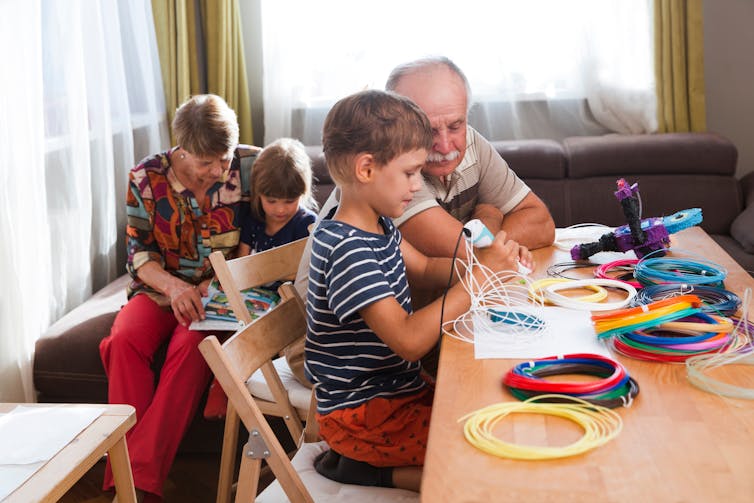
Researchers are finding increasing evidence of the importance of grandparent-grandchild relationships. www.shutterstock.com
The benefits depend on your family situation, but can include improved psychological adjustment for grandchildren, increased workforce participation for mothers, and a longer and happier life for grandparents.
The importance of asking questions
When preparing to see your grandchildren again, our first suggestion is to ask your grandchild’s parents what they think is a good idea for your first catch-up. What does your grandchild enjoy doing at the moment? What is their daily routine? Is there anything to avoid?
If you are meeting a grandchild for the very first time, bear in mind the parents have gone through huge changes since you last met. As with older children, ask the parents what will suit them in terms of visit type and time.
Be open and honest about what support you think you can provide, and be aware the parents needs may change (they may want more or less help than they anticipated).
When it comes to discussing the changes a new baby has brought, grandparents are trying to juggle in their mind the thrill of participating in their grandchild’s life, without disrupting or overstepping parents’ boundaries. From our yet to be published research, we understand this is not a simple matter for many families, but starting the conversation is important in maintaining these valuable relationships.
Persistent, not pushy
Your grandchildren may be feeling shy when you first meet. So even though this may have been a longed-for reunion, you may need to tread carefully.
This is perfectly normal and can be overwhelming for everyone. Just take your time, and let them get to know you again. Your first instinct will be to catch up on the thousands of lost hugs, but it may work better stay close by and let them come to you.
With young children, you don’t have to plan something fancy for your first catch-up. www.shutterstock.com
The good news for grandparents is that several research projects have shown what grandchildren really want is simply for grandparents to be “there when needed”.
So just “being there” – interested and available – for your first visit is perfectly fine. This helps reduce expectations of what you feel you need to do.
Gifts
Your first inclination may be to bring something exciting to play with together. But on top of seeing each other again, rushing in with a new treat might be too much. You will need to read the room.
Consider taking something small, or maybe you can keep something in the car and bring it out once everyone has warmed up.
Parallel play
Play is obviously central to children’s learning and experience. Early in life, however, this may mean playing alone, which may be confusing for some of us.
A good way to work with this while rekindling your relationship is parallel play, particularly if a child is aged between two and five. Parallel play involves playing next to your grandchild and letting them come to you when they are ready.
This is one way you might need to put the patience and persistence we discussed earlier into practice.
Let grandchildren lead (within reason)
In the same vein, don’t feel as though you need to take the lead when working out what to do with your grandchild, either. Or that your idea for reading a certain book or doing a particular puzzle is the one your grandchild will go with.
Seeing your grandchild again could be as simple as a walk to the park. www.shutterstock.com
Often, seemingly simple activities like a walk to a park are the most rewarding. Here your grandchild has the opportunity to show you about their world and what they like to do on their terms. It is also a good way to see how your grandchild has grown and developed.
We want to show our unconditional affection and love for our grandchildren, this feels natural, and we know it can be so valuable.
But in the the early stages of getting to know each other again, don’t put pressure on you or them. Being available, interested, curious and patient is enough.
Rebecca Bullingham, a masters student in medical and health science at Edith Cowan University, contributed to this article.
David Coall receives funding from Lotterywest and is an active researcher working with grandparents contributing to some of this research.
Shantha Karthigesu does not work for, consult, own shares in or receive funding from any company or organisation that would benefit from this article, and has disclosed no relevant affiliations beyond their academic appointment.
Doctors are under increased pressure today – with hospitals and health settings under strain, extra COVID safety protocols in place, and patients fraught with worry.
Many doctors will be working long hours under stressful conditions, after years of gruelling training and groundwork. Some will suffer from extreme exhaustion and, at worst, burn out and leave the profession.
We studied 751 Obstetrics and Gynaecology doctors working in Australia and New Zealand and used an established test of “grit”.
We found those who had it were less likely to suffer burnout. Our findings might help other doctors or those outside the medical field altogether.
For our survey we recruited members of the Royal Australian and New Zealand College of Obstetricians and Gynaecologists (RANZCOG). We divided them into three groups: core trainees (in the early years of their training placements), advanced trainees (in their penultimate years of training) and fellows (fully qualified specialists).
Grit is defined as passion and sustained persistence for long-term achievement. It combines resilience, ambition and self-control.
We measured grit using the Short Grit Scale, and burnout using the Oldenburg Burnout Inventory – two of the most recognised and widely validated tools in this field of psychological assessment.
The Grit Scale was developed by Angela Duckworth, a professor of psychology at the University of Pennsylvania. Duckworth’s GRIT score consists of ten self-assessment questionnaires with multiple-choice answers ranging from “very much like me” through to “not like me at all”. Prompt statements include: “My interests change from year to year”, and “Setbacks don’t discourage me. I don’t give up easily”.
We used the Oldenburg Burnout Inventory to assess burnout in terms of disengagement and exhaustion. Like the Grit Scale, the Oldenberg Inventory asks respondents to rate themselves on a scale from “Strongly disagree” to “Strongly agree”. Statements include: “I always find new and interesting aspects in my work”, and “During my work, I often feel emotionally drained.”
In 2017, American College of Obstetricians and Gynaecologists reported up to 75% of Obstetrics and Gynaecology doctors experience some form of professional burnout during their career.
Grit has been studied in other contexts including children’s learning and sporting achievement. Shutterstock
In our study, the level of seniority and grit were the only two factors that significantly predicted the level of burnout among obstetricians and gynaecologists.
Specialists scored higher on the grit scale and experience less burnout than the training doctors. This isn’t surprising, given they’ve already shown they can power their way through the tough training years to achieve the senior rank of specialist.
But doctors across the spectrum with higher grit scores are also less likely to report burnout. This is consistent across age, gender, location of practice and seniority level. It shows the amount of grit a doctor has, can protect their well-being and predict success.
The grit concept has been studied outside the medical field too, in military academies for training, among teachers for academic engagement and learning outcomes for students and within sporting teams.
Duckworth suggests grit is a useful concept for reflection and research, but cautions against using it as a decision-making tool for “selecting employees, admitting students to college, gauging the performance of teachers, or comparing schools or countries to each other”. She adds researchers have yet to find significant grit score differences between the sexes.
There have been critics of the Grit Scale, who say it measures two constructs – perseverance plus consistency of interests – as one.
Researcher Angela Duckworth explains it isn’t good looks or IQ that determines success – it’s grit.
Can we foster grit for doctors and others?
There is understandable interest in fostering grit among doctors. However, little is known about how to foster the development of these traits within individuals.
Grit is likely to develop over time and be learnt through challenges, rather than being taught.
A “growth mindset” – a belief capability can be developed with effort over time – rather than a fixed mind-set has been associated with the presence of grit in individuals. This might prove a useful approach.
Our surveys show grit has a protective role in combating burnout among doctors. Assessing doctors’ grit could become a standard test to minimise the likelihood of burnout or be useful for them – indeed anyone – to reflect on their goals and monitor risks to their well-being. Incorporating the concept of grit may have the potential to identify doctors intrinsically more susceptible to workplace stress and burnout and its consequences.
Australia’s vital kelp forests are disappearing in many areas as our waters warm and our climate changes.
While we wait for rapid action to slash carbon emissions – including the United Nations climate talks now underway in Glasgow – we urgently need to buy time for these vital ecosystems.
How? By ‘future-proofing’ our kelp forests to be more resilient and adaptable to changing ocean conditions. Our recent trials have shown selectively bred kelp with higher heat tolerance can be successfully replanted and used in restoration.
This matters because these large seaweed species are the foundation of Australia’s Great Southern Reef, a vast but little-known temperate reef system and a global hotspot of biodiversity.
The reef’s kelp forests run along 8000 km of Australia’s southern coastline, from Geraldton in Western Australia to the Queensland border with New South Wales. These underwater forests support coastal food-webs and fisheries. Think of the famous mass-spawning of Australian Giant Cuttlefish off Whyalla, the rock lobster and abalone fisheries, or our iconic weedy and leafy seadragons.
These increasing temperatures and other climate change impacts are devastating our kelp, including shrinking forests and permanent losses of golden kelp (Ecklonia radiata) on the east and west coasts, and staggering declines of the now-endangered giant kelp (Macrocystis pyrifera) forests in Tasmania.
Golden kelp forests support a wealth of life. Andrew Green, Author provided
We need novel measures to buy time for climate action
Australian researchers are leading the way to try to find ways of future-proofing our critical ocean ecosystems, such as kelp forests and coral reefs. In part, that’s because climate change is hitting our ecosystems early and hard.
Climate change is moving much faster than kelp species can adapt. In turn, that threatens all the species that rely on these forests, including us.
If climate change wasn’t happening, we could try to halt or reverse the losses of kelp forests by using traditional restoration methods.
But in a world getting hotter and hotter, that is futile in many cases. Even if we slash carbon emissions soon, decades more warming are already locked in.
If we want to keep these forests of the sea alive, we must now consider cutting-edge methods to help kelp survive current and future ocean conditions while governments pursue the urgent goal of reducing emissions.
How to future proof an underwater forest
Together and separately, we’ve been exploring techniques to speed up the natural rate of evolution to boost kelp resilience. Along with other researchers, we’ve put several techniques to the test in the real world, with promising results. Others remain hypothetical.
At present, there are several broad approaches to future-proofing restoration work. These include:
Genetic rescue focuses on enhancing the genetic diversity of genetically compromised populations to boost their potential to adapt to future conditions. This involves planting and restoring a mix of kelp from disconnected populations of the same species. Improved genetic diversity can boost the ability of these forests to respond to change. We expect this approach to be especially useful in areas where climate change poses a limited threat at present.
Assisted gene flow strategies introduce naturally adapted or tolerant kelp individuals into threatened populations to increase their ability to survive specific threats, like hotter seas. This could help kelp forests in areas affected by climate change now or in the near future. In these situations, the genetic rescue technique could be counterproductive if the new genetic diversity introduced isn’t able to cope with the heat.
Selective breeding is a well-known agricultural technique, and can be used to identify the best kelp to use in these cases. In short, we try to identify kelp with naturally higher tolerance, and then use these as the basis for restoration efforts. These can be transplanted into ailing kelp forests. Trials are presently underway in Tasmania using giant kelp. Early results are exciting, with the largest ‘super kelp’ growing over 12 metres high a year after being planted.
In the future, we may have to explore more cutting-edge strategies to deal with the changing conditions. These include:
Genetic manipulation. This technique extends what is possible with selective breeding by directly manipulating genes to enhance the traits or characteristics that might further boost kelp’s ability to thrive in hotter waters.
Assisted expansion is when species with little chance of survival are relocated to better but novel locations, assuming these exist. This technique could also see new species of kelp being planted to replace existing species, guided by the need to protect the forest ecosystem as a whole, rather than save specific species.
Co-author Adjunct Professor Melinda Coleman working on kelp genomics as part of her selective breeding research. Photo by Alejandro Tagliafico, Author provided
Are these approaches ethical?
Each of these techniques – tested or untested – pose challenging ethical questions. That’s because we are not undertaking traditional conservation, where we work to restore a historic kelp ecosystem. Instead, we are modifying these ecosystems in the hope they can better cope with conditions at the extremes of their current survival limits.
That means we must move carefully, weighing potential downsides like genetic pollution and maladaptation (accidental poor adaptation to other stressors) against the probability of further kelp forest destruction from doing nothing.
Such future-proofing interventions could be well suited to areas already hit hard by severe kelp forest losses, those that will be threatened in the near future, or where kelp losses would be particularly damaging environmentally, socially, or economically.
What is certain is that communities that live and rely on our southern coasts must now talk about what they value from kelp forests, and how they want them to look and function into the future.
Our view is that traditional approaches focused on recreating previous ecosystems are likely to be increasingly challenging, given the rate and scale of ongoing disruption in our oceans.
It is crucial that we do not restore nostalgically for ocean conditions which are quickly changing, but instead, work to ensure the long-term survival of these spectacular underwater forests while we wait for rapid action to reduce carbon emissions.
Cayne Layton receives funding from the University of Tasmania, The Nature Conservancy, and the Australian Government’s National Environmental Science Program.
Melinda Coleman receives funding from The Australian Research Council.
Source: The Conversation (Au and NZ) – By Dawn LaValle Norman, Research Fellow and ARC DECRA Fellow, Institute for Religion and Critical Inquiry, Australian Catholic University
Attributed to Onesimos (Greek (Attic), active 500 – 480 B.C.) Attic Red-Figure Kylix, about 490 B.C.The J. Paul Getty Museum, Villa Collection, Malibu, California
As the philosopher and historian Xenophon tells the story, Socrates and his friends gathered around a classy sex worker, watching her as if she were a tableau, using her beautiful body to talk about other things that they care more about: desire, love, philosophy.
Then suddenly, the woman they are analysing joins the conversation. Theodote, a rich and beautiful courtesan, asks Socrates a question. Socrates gamely engages her in a witty conversation about the best way to increase desire. Socrates claims he wants to learn the skills of a courtesan in order to attract young men to join his life of philosophy.
While exchanging sexy philosophical chat with Theodote, Socrates had at least one wife of his own at home (possibly two at once). But his biographers never show him engaging his wives Xanthippe or Myrto in conversation. Instead, we see Xanthippe encumbered by a baby boy on her knee, sent away from Socrates’ deathbed in order for the philosophising to begin in earnest among the men.
Socrates can talk philosophically to Theodote and not to Xanthippe because the two women filled very different cultural roles in ancient Greece. Xanthippe’s respectable marriage – even to the controversial vagabond Socrates – placed her in a web of social obligations that prioritised her public silence and her physical obligations of caring for the family’s children and material wealth.
Theodote, on the other hand, made a living by being seductive, through her persuasive rhetoric and her adroitness at caring for her clients.
Her life, and those of women like her, depended on persuasion.
Participants in the world of thought
Sex workers in Ancient Greece divided into two somewhat overlapping types. The most common were those who lived in brothels, often enslaved sex workers providing a sanctioned service to the men of the ancient Greek city. The word for this role was porne, from where we get the English word pornography.
Not only did these women lack freedom, but their profession could also be dangerous. Women consigned to this life had no leisure and no expectation of education.
But there was another kind of sex worker who gripped the imagination of writers in the ancient world. These women did not live in brothels, but in their own homes. They granted favours, rather than being bought for a fee, and participated in the language of aristocratic exchange of goods.
They were called “friends”, hetairai in Greek, or, as they came to be known in English, courtesans.
These women were seen as having captivating minds, not just captivating bodies. They could be conversation partners and were allowed unprecedented freedom in the ancient world.
Theodote was one of these women. When Socrates sees her, she is sitting next to her “mother”: it was common for courtesans to form female social clusters using the language of family even when the relationship was not biological.
These women were seen as having captivating minds, not just captivating bodies, as in this painting of a gathering of Agathon’s friends. The Symposium (Second Version) by Anselm Feuerbach. Wikimedia Commons
Their public status made many of these women notorious. We know a disproportionate amount about women like Neaera, one of several young girls raised to be sex workers by a madam named Nicarete, who called them all her “daughters”; Aspasia, the most famous and controversial courtesan of Classical Greece, whom Aristophanes claims ran a brothel; and the plethora of named (albeit fictional) courtesans in Lucian’s Dialogues of the Prostitutes, including the widow Crobyle who persuades her young daughter Corinna to begin a life of high-class sex work in order to support the family.
Stories about philosophical courtesans formed part of elite male fantasy. Athenaeus of Naucratis, in the thirteenth book of his Deipnosophistae, preserves a long speech in praise of such high-class sex workers, put in the mouth of the character Myrtilus.
Myrtilus is in turn relying on an ancient book of witticisms, the Chreiae of Machon written around 250 BCE, which gathered together the clever sayings of many different courtesans. Educated men thought it worthwhile to record and recollect the witty sayings of such women, who (unlike their wives) led a very public life, often as companions of politicians and philosophers.
Of course, in the ancient world, those who preserved and consumed such tales of witty courtesans were men. Women were excluded from the production of their own portrayal.
The connection between sex work and philosophy had a long life in the western tradition. In the 16th century, Tullia d’Aragona featured as a character in Sperone Speroni’s On Love, is given the role of mouthpiece for the carnal, physical side of love. Like Theodote, the male author of the dialogue used the voice of a female sex worker as an expert on the body and its desire.
However, for the first time in the history of the genre of the philosophical dialogue, the woman who was written into a dialogue replied with her own literary work. Tullia soon wrote her own dialogue, On the Infinity of Love, in which she critiques Speroni’s stereotypical portrayal of her.
Renaissance women had means of responding to their portrayal in literature in a way unimaginable to their ancient Grecian sisters.
Ancient male writers fantasised alternatives to their wives: sexy philosophers with sharp tongues. But in the ancient world, such women were just as restricted by their stereotypes as the wives with whom they were contrasted.
As the Glasgow climate summits gets underway, New Zealand’s government has announced a revised pledge, with a headline figure of a 50 percent reduction on gross 2005 emissions by the end of this decade.
This looks good on the surface, but the substance of this new commitment, known as a Nationally Determined Contribution (NDC), is best assessed in emissions across decades.
New Zealand’s actual emissions in the 2010s were 701 million tonnes (Mt) of carbon dioxide equivalent. The carbon budget for the 2020s is 675Mt. The old pledge for the 2020s was 623Mt.
The Climate Change Commission’s advice was for “much less than” 593Mt, and the new NDC is 571Mt. So yes, the new pledge meets the commission’s advice and is a step up on the old, but it does not meet our fairshare under the Paris Agreement.
It is also a stretch to call the new NDC consistent with the goal of keeping global temperature rise under 1.5℃.
True 1.5℃ compliance would require halving fossil fuel burning over the next decade, while the current plan is for cuts of a quarter.
The dark dashed line shows New Zealand’s domestic climate goal – its carbon budget. The blue area shows a possible pathway under the old climate pledge, and the red area represents the newly announced pledge. Graph: Office of the Minister of Climate Change, CC BY-ND
Emissions need to halve this decade Countries’ climate pledges are at the heart of the Paris Agreement. The initial round of pledges in 2016 added up to global warming of 3.5℃, but it was always intended they would be ratcheted up over time.
In the run-up to COP26, a flurry of new announcements brought that figure down to 2.7℃ — better, but still a significant miss on 1.5℃.
As this graph from the UN’s Emissions Gap Report 2021 shows, the world will need to halve emissions this decade to keep on track for 1.5℃.
This graph shows that new and existing pledges under the Paris Agreement leave the world on track for 2.7ºC of warming. If recent net-zero pledges are realised, they will take us to 2.2ºC. Graph: UNEP, CC BY-ND
New Zealand’s first NDC, for net 2030 emissions to be 30 percent below gross 2005 emissions, was widely seen as inadequate. An update, reflecting the ambition of the 2019 Zero Carbon Act to keep warming below 1.5℃, has been awaited eagerly.
But several factors have combined to make a truly ambitious NDC particularly difficult.
First, New Zealand’s old climate strategy was based on tree planting and the purchase of offshore carbon credits. The tree planting came to and end in the early 2010s and is only now resuming, while the Emissions Trading Scheme was closed to international markets in 2015. The Paris Agreement was intended to allow a restart of international carbon trading, but this has not yet been possible.
Second, New Zealand has a terrible record in cutting emissions so far. Burning of fossil fuels actually increased by 9 percent from 2016 to 2019. It’s a challenge to turn around our high-emissions economy.
Third, our new climate strategy, involving carbon budgets and pathways under advice from the Climate Change Commission, is only just kicking in. The government has made an in-principle agreement on carbon budgets out to 2030, and has begun consultation on how to meet them. The full emissions-reduction plan will not be ready until May 2022.
Regarding a revised NDC, the government passed the buck and asked the commission for advice. The commission declined to give specific recommendations, but advised:
We recommend that to make the NDC more likely to be compatible with contributing to global efforts under the Paris Agreement to limit warming to 1.5℃ above pre-industrial levels, the contribution Aotearoa makes over the NDC period should reflect a reduction to net emissions of much more than 36 percent below 2005 gross levels by 2030, with the likelihood of compatibility increasing as the NDC is strengthened further.
The government then received advice on what would be a fair target for New Zealand. However, any consideration of historic or economic responsibility points to vastly increased cuts, essentially leading to net-zero emissions by 2030.
Announcing the new NDC, Climate Change Minister James Shaw admitted it wasn’t enough, saying:
I think we should be doing a whole lot more. But, the alternative is committing to something that we can’t deliver on.
What proper climate action could look like Only about a third of New Zealand’s pledged emissions cuts will come from within the country. The rest will have to be purchased as carbon credits from offshore mitigation.
That’s the same amount (100Mt) that Japan, with an economy 25 times larger than New Zealand’s, is planning to include in its NDC. There is no system for doing this yet, or for ensuring these cuts are genuine. And there’s a price tag, possibly running into many billions of dollars.
New Zealand has an impressive climate framework in place. Unfortunately, just as its institutions are beginning to bite, they are starting to falter against the scale of the challenge.
The commission’s advice to the minister was disappointing. It’s being challenged in court by Lawyers For Climate Action New Zealand, whose judicial review in relation to both the NDC and the domestic emissions budgets will be heard in February 2022.
With only two months to go until 2022 and the official start of the carbon budgets, there is no plan how to meet them. The suggestions in the consultation document add up to only half the cuts needed for the first budget period.
Thinking in the transport area is the furthest advanced, with a solid approach to fuel efficiency already approved, and an acknowledgement total driving must decrease, active and public transport must increase, and new roads may not be compatible with climate targets.
But industry needs to step up massively. The proposed 2037 end date for coal burning is far too late, while the milk cooperative Fonterra — poised to announce a record payout to farmers — intends to begin phasing out natural gas for milk drying only after that date.
The potentially most far-reaching suggestion is to set a renewable energy target. A clear path to 100 percent renewable energy would provide a significant counterweight to the endless debates about trees and agricultural emissions, but it is still barely on the radar.
Perhaps one outcome of the new NDC will be that, faced with the prospect of a NZ$5 billion bill for offshore mitigation, we might decide to spend the money on emissions cuts in Aotearoa instead.
Prime Minister Jacinda Ardern says the New Zealand government wants to lift vaccination rates and wants to remove anything that is a barrier to getting as many people vaccinated as quickly as possible.
Ardern and Māori-Crown Relations Minister Kelvin Davis, who is also the MP for Te Tai Tokerau, are in Northland viewing the rollout of vaccinations.
Ardern spoke to media this afternoon until she was continuously interrupted by a conspiracy theorist in the crowd. She then decided to shut down and move the conference.
In other developments today:
Low vax rates not government’s fault In today’s media conference, Ardern said the low vaccination rates in Northland were not a failure of the government.
She said the government wanted to lift vaccination rates, and wanted to remove anything that was a barrier to getting as many people vaccinated as quickly as possible.
“I asked one provider, what are you hearing when you’re out vaccinating … they described it as covid not necessarily feeling close enough to the community yet, that even when there have been cases in Northland it might be seen as a valley over, not at the front door,” she said.
“We will do everything we can to keep it isolated, but we need everyone to be vaccinated.”
She said decisions were made based on public health advice.
Watch the media conference:
Prime Minister Jacinda Ardern and Māori-Crown Relations Minister Kelvin Davis speak about vaccination in Northland. Video: RNZ News
In the conference, Ardern said the low vaccination rates in Northland are not a failure of the government.
She said the government wants to lift vaccination rates, and wants to remove anything that is a barrier to getting as many people vaccinated as quickly as possible.
“I asked one provider, what are you hearing when you’re out vaccinating … they described it as Covid not necessarily feeling close enough to the community yet, that even when there have been cases in Northland it might be seen as a valley over, not at the front door.”
“We will do everything we can to keep it isolated, but we need everyone to be vaccinated.”
She said decisions were made based on public health advice.
She would rather people were getting vaccinated regardless of alert level, because it was the right thing to do, she said.
Asked about the ruling ordering the ministry of health to reconsider its stance of withholding Māori vaccination data on the basis of privacy, Ardern said it was an issue about what data had been available or able to be shared, and she would allow the health team to work through that.
Raise concerns with professionals She said people should be able to raise concerns about the vaccine, and if they had questions or concerns they should be able to come forward to talk to health professionals, or someone they trusted, to make the right decision.
She said the number of people who “would be described as … anti-vaccination” was relatively small in New Zealand. She said she absolutely believed the 90 percent double vaccinated rate the government was aiming for could be achieved.
She said young people in particular could be exposed to misinformation online, so there was more work ahead.
Ardern said despite best efforts, cases had come out of Auckland “and so we do need people to be vaccinated”.
Minister Davis said Te Tai Tokerau had not been forgotten.
“I have weekly meetings with all iwi leaders, so there’s a lot of work going into protecting our people, and as we’ve said there’s extra $4m going into the north today. We’re doing everything we can to make sure that our people are protected and people get vaccinated.”
Ardern said the approach from the government had been to ask Māori providers to focus on older kaumātua and kuia, and to take a whānau-based approach.
‘They think they’re smarter than the virus’ Davis was asked about protesters.
“That’s the first protest I’ve seen, there were two people. Obviously, they think they’re smarter than the virus… I don’t think it helps what we’re trying to do here, to protect whānau, to protect whakapapa.
“And to have people think that what’s going on is not reality? I think that they’re just living in a strange world.
“Our focus is on making sure that as many people as possible get vaccinated to protect their whānau, to protect their whakapapa, and that sort of stuff just doesn’t help at all.”
Ardern said misinformation existed everywhere but it was a minority voice.
It is also the region that needs the largest number of first doses to reach 90 percent of the eligible population, with more than 17,000 doses required to reach that milestone.
The government’s proposed traffic light system would see restrictions across New Zealand reduced, and lockdowns ended, once every DHB in the country reaches 90 percent double dosed.
Northland also has a high percentage Māori population. Māori have accounted for about 40 to 50 percent of cases in the delta outbreak in recent weeks, and have lower vaccination rates than the rest of the population.
A New Zealand Pasifika climate activist has told the UN climate meeting that young Pacific people are not victims of climate change but beacons of hope.
The first day of the Leaders Summit is wrapping up at COP26 in Glasgow.
Environmental advocate for Samoa Brianna Fruean said Pacific people were not just victims of the climate crisis, but were beacons of hope.
If the world leaders at COP failed, the people will step up, she said.
“I believe that COP is like a compass, that we are all in collective canoe and if we’re able to get COP right we can be pointed in the right direction.
“But at the end of the day, my ancestors travelled the oceans without compasses. So if COP doesn’t work, the people will.
Demonstrators gathered in Port Moresby yesterday for a march to Parliament in protest over the covid-19 vaccines, which they claimed wrongly to be mandatory, a day after Papua New Guinean police warned such gatherings were illegal.
The protest was a result of a post circulating on social media about a “peaceful protest march” planned for the day against mandatory vaccination.
Despite assurances from Controller of the Pandemic Response and Police Commissioner David Manning that the notice circulated was false and misleading because vaccination was not mandatory and still remained a personal choice, the protesters gathered for the rally.
The anti-vaccine crowd disobeyed advice from the police to disperse. Instead, they took to the Gordon bus stop, gained momentum from others who joined them and attempted to march through a residential street towards the Wardstrip Primary School and on to Parliament.
However, police thwarted their their attempts by blocked the route and spoke to the crowd who disregarded social distancing and masks.
The NCD/Central Assistant Commissioner of Police (ACP), Anthony Wagambie Jnr, addressed the crowd. He said their concerns had already been heard.
It was not clear who the organisers of the march were.
Endangering public safety ACP Wagambie explained that the march had to be stopped by police to prevent disorder stemmed that would endanger the safety of others in Port Moresby.
The anti-vaxxers carried a banner with messages condemning “666” and “artificial intelligence”.
Misinformation about the covid-19 vaccines is currently swamping genuine information available to Papua New Guineans and is allowing fear and confusion to gain momentum.
Asia Pacific Report reports only 1.2 percent of the nine million Papua New Guineans are vaccinated against covid-19.
According to the John Hopkins University covid dashboard, 29,715 cases of covid and 370 deaths have been reported on Papua New Guinea but health officials fear the real toll is far higher because of limited testing and records.
The Philippine Court of Appeals (CA) has finally granted overseas travel to Rappler CEO and Nobel Laureate Maria Ressa, who will be in the United States for the entire month of November to deliver a series of lectures at the Harvard Kennedy School in Boston.
Ressa filed the request on October 5, three days before the Nobel announcement was made.
The CA promulgated its decision in favour of Ressa on October 18, 10 days after the journalist was named one of the two joint winners of the 2021 Nobel Peace Prize.
Unlike past travel requests, the CA Eighth Division said the Harvard lectures were proven to be urgent and necessary.
In August 2020, the CA denied Ressa’s travel request saying that to accept the 2020 International Press Freedom Award from the National Press Club was not necessary and urgent.
In December 2020, the CA also denied a travel request from Ressa to visit her 76-year-old mother in Florida who had just been diagnosed with breast cancer two months prior to the request. The CA said then that it was also not considered a necessary and urgent travel.
For this request, the CA said Harvard’s “invitation letter shows that Ressa’s participation in the programme requires her physical presence” and that “in fact, the Harvard Kennedy School explained that the programme involves an in-person 30-day residency.”
Wish to visit her parents Ressa also indicated in her request her wish to visit her parents in Florida within November which will coincide with the American Thanksgiving holiday, saying she had not seen them in two years.
The CA said “humanitarian reasons support Ressa’s intended travel,” adding that “certainly, one’s legitimate intention to be reunited with her/his parents cannot be doubted”.
Generally, a person under trial for bailable offences in the Philippines are easily granted their travel requests. The other courts handling Ressa’s tax and securities charges have granted her requests.
It’s the CA, which is handling her appeal for her cyber libel conviction, that’s the hardest to hurdle as conviction further restricts one’s right to travel.
“While Ressa’s conviction changes her situation and warrants the exercise of greater caution in allowing her to leave the Philippines, her undisputed compliance with the conditions imposed by the court a quo on her previous travels shows that she is not a flight risk,” said the CA, the decision penned by Associate Justice Geraldine Fiel-Macaraig, with concurrences from Associate Justices Elihu Ybañez and Angelene Mary Quimpo-Sale.
Ressa is scheduled to fly home to the Philippines in early December. To attend the Nobel awarding in Oslo on December 10, she would have to file another batch of travel requests before all the courts handling the seven cases.
The Office of the Solicitor General (OSG) tried to contest this travel grant, citing among others Ressa’s alleged flight risk, but the CA did not agree.
“We cannot sustain the OSG’s opposition grounded on Ressa’s dual citizenship and alleged lack of respect for the Philippine judicial system because the same is speculative as of now,” the CA said in its October 29 denial of OSG’s motion for reconsideration.
Ressa has strong economic ties in the Philippines as she is the CEO of Rappler, an online media platform based in the country.”
Lian Buan covers justice and corruption for Rappler. This article is republished with permission.
The Reserve Bank of Australia had a Cup Day surprise in store for the country, announcing it was abandoning its policy of “yield curve control”, meaning it was no longer going to defend any particular interest rate for borrowing over any particular duration.
Until today it had a formal target for the three-year bond yield of 0.10%, enabling banks to provide three-year fixed mortgages very cheaply, and indicating the cash rate wouldn’t climb above 0.10% until the most recent three-year bond expires in April 2024.
But it has now abandoned the target, a full two years early.
Why control the yield curve in the first place?
When COVID hit last year, the bank announced it would buy enough government bonds to keep the yield on the three-year bond at 0.25%, as good as guaranteeing money would be cheap for years to come.
Later, it cut the target for three-year bond yields (and the target for its cash rate) to a near-zero 0.10%, further lowering the cost of borrowing.
Responding to an improving economy, the bank decided at its July 2021 meeting not to extend the program bond target beyond April 2024.
The decision created a reasonable expectation the cash rate would remain close to zero until 2024.
What did yield curve control achieve?
Yield curve control achieved a lot. It took the bank just 11 days and A$27 billion dollars of bond purchases to achieve its first target, establishing ultra-low interest rates for years into the future.
After that, it didn’t need to spend much. The new three-year rate became the new norm. Markets believed it would do whatever was needed to defend it.
Over the next 18 months it intervened in the market only occasionally, and only in small amounts. That all changed last week.
On October 15, the three-year bond rate started to climb above the bank’s target of 0.10%. It initially bought enough bonds to defend the rate and then, without warning, capitulated last Thursday, as good as withdrawing from the market and allowing the rate to climb to a high of 0.70%.
By Monday the rate had climbed to more than 1.00%, more than ten times the Reserve Bank’s target.
Today’s announcement merely made formal what was apparent on Thursday: the bank is no longer going to spend public funds defending a line that might eventually be crossed.
Bond traders thought the improving economic outlook meant the bank would have to lift its record low cash rate sooner that it had said it would. It lost the will to disagree.
In a 4pm press conference Governor Philip Lowe said that to maintain the target would have been untenable. Eventually the bank would have owned all the three-year bonds on offer.
What will this do to the housing market?
Today’s decision is a sure sign interest rates are going to start to rise. Not today, or even for the rest of this year, but sooner was previously expected.
For what it is worth, Lowe said the latest data and forecasts did “not warrant an increase in interest rates in 2022”.
For now, sub-2% fixed-rate mortgages are a thing of the past. The last were withdrawn this week.
Reserve Bank Governor Philip Lowe press conference, Tuesday November 2.
The decision means the booming housing market will start to crest. Low interest rates sparked the boom as renters flocked to become first-homebuyers and investors jumped in to catch rising prices.
The prospect of higher mortgage payments is going to dent this enthusiasm, perhaps quickly.
Home prices are set to stabilise, before potentially edging, or sliding down .
We don’t yet know how quickly variable interest rates will start to rise, but given the Reserve Bank has walked away from a battle to defend yield curve control, we do know it’ll be a long time before it even considers doing it again.
Isaac Gross does not work for, consult, own shares in or receive funding from any company or organisation that would benefit from this article, and has disclosed no relevant affiliations beyond their academic appointment.
But the real issue is not whether they eat too many expensive cafe breakfasts. Young Australians today face an uncertain job market, rising university fees and astronomical house prices. Unfortunately, debt is also an inevitable part of their lives.
This comes amid a huge rise in the number of “buy now, pay later” apps, such as AfterPay, and payday loan apps, such as Nimble. It is possible to make purchases online with the the tap of a button, even if you don’t have the money in your account or on your credit card. It is also possible the able to borrow money within minutes.
To better understand how young people negotiate debt, we interviewed 31 people aged between 18 and 29 in the Newcastle and Hunter Valley area in 2020 and 2021. We asked them how they access credit and their views on different kinds of debt.
Our study
Our participants saw debt as a necessity if they are going to have an acceptable life in the present and plan for the future. As Steph, a 22-year-old university student, said:
Large debts like the mortgage, the HECS debt […] things like that I suppose in a sense it’s useful debt. It makes sense and it gets you further by doing it because there’s still an equity in what you’re doing … It follows you not nearly as badly as some other debts.
Young people also made distinctions about the way debt feels and how approachable it is. They acknowledged short-term consumer debts may not be “good”, but felt they were also part of being able to buy the things and have the experiences associated with being young.
Those we interviewed talked about AfterPay (where you pay off the debt in four installments) as an everyday part of life. As Alexa, a 23-year-old university student, told us:
AfterPay is for just those little wants that I don’t want to pay for up front.
They also described it as a low-risk and almost friendly way to buy things. This was particularly when compared to a bank. Alice, a 21-year-old sales assistant, put it this way:
AfterPay is like, ‘Oh, just pay this off in four quick things and you can have your item. We’ll send it out.’ But then banks are like, ‘If you don’t pay this back, you’re going to get so much interest and it’s going to suck, and you’ll have the sheriffs roll up at your house and you’re going to be sad.’
Like ordering a pizza
Interviewees attributed some of this friendliness to the process of accessing the money or goods. Mia, a 21-year-old paralegal, described applying for a small loan on the Nimble app:
When you apply for the money […] you can track at any point on it. The Nimble app is so similar to ordering a Domino’s pizza […] Whereas a credit card through a banking app, it’s nothing like that […] They send me letters and even opening the mail terrifies me, nothing good comes via snail mail ever.
The online, easy nature of these loan services closely relates to how young people engage with information more generally in their lives. In this sense, there is a familiarity and comfort to the way they work.
As Mia continues:
[It’s] positive, it’s not daunting, it’s informative, it’s instantaneous. The second the money comes out, I get a thank you email and a notification on the app. It’s like, ‘you have this many payments left, this is how much you’ve paid, this is how much you have left to pay, you will still be paid in full by this date’. I don’t have any of that with my credit card.
Familiar tactics
Inteviewees also spoke of how services like AfterPay and short-term loan apps used similar tactics to social media platforms to encourage increased engagement and make the experience feel informal and even social.
Applying for a loan via an app does not involve ‘scary’ paperwork, according to interviewees. www.shutterstock.com
These include “on this day” reminders (such as, “this time last year, you bought this pair of shoes”) and waiting time indicators. There are also game elements, including “rewards” for early repayments.
Interviewees were aware this was manipulative. Lilian (26) works at a chain clothing store and was “rewarded ” for paying off a purchase early.
I got this thing the other day saying that my first payment [on a new purchase] is actually going to come out [later] now. Of course, I’ve been rewarded for paying everything off early [before] […] Yeah it’s like it’s delaying it, it’s not an issue now, but it’s going to be an issue in two weeks’ time.
What next?
Our interviewees may see debt as a necessity, but they are also aware they have (some) choices within this. So they prefer to go with providers or platforms that feel less threatening, especially as using “buy now, pay later” services sometimes does not feel like being in debt.
Young people see debt as an inevitable part of life, according to new research. www.shutterstock.com
There is a need for greater regulation of the ways these products are promoted. It should always be made clear that this is a form of debt, not just a way to pay.
Beyond, this, instead of “blaming” young people for their spending habits, we need a better understanding of the economy and society they are living and working in. And how debt it is all but inevitable for people on low wages, with poor job security and insecure housing.
Steven Threadgold also talks about how buy now, pay later apps influence young people’s spending on the Seriously Social podcast by the Academy of the Social Sciences in Australia.
The research in this article was funded by the University of Newcastle, Faculty of Education and Arts, Research Program Pilot Scheme, 2020-21.
The research in this article was funded by the University of Newcastle, Faculty of Education and Arts, Research Program Pilot Scheme, 2020-21.
Kate Senior receives funding from The Australian Research Council
David Farrugia, Julia Cook, and Kate Davies do not work for, consult, own shares in or receive funding from any company or organisation that would benefit from this article, and have disclosed no relevant affiliations beyond their academic appointment.
Ten years ago, in the lead-up to Australia’s short-lived carbon price or “carbon tax” (either description is valid), the deepest fear on the part of businesses was that they would lose out to untaxed firms overseas.
Instead of buying Australian carbon-taxed products, Australian and export customers would buy untaxed (possibly dirtier) products from somewhere else.
It would give late-movers (countries that hadn’t yet adopted a carbon tax) a “free kick” in industries from coal and steel to aluminium to liquefied natural gas to cement, to wine, to meat and dairy products, even to copy paper.
It’s why the Gillard government handed out free permits to so-called trade-exposed industries, so they wouldn’t face unfair competition.
As a band-aid, it sort of worked. The firms with the most to lose were bought off.
But it was hardly a solution. What if every country had done it? Then, wherever there was a carbon tax (and wherever there wasn’t), trade-exposed industries would be exempt. The tax wouldn’t do enough to bring down emissions.
We are about to face carbon tariffs
The European Union has cottoned on to the imperfect workarounds introduced by countries such as Australia, and is about to tackle things from the other direction.
Instead of treating foreign and local producers the same by letting them both off the hook, it’s going to place both on the hook.
It’s about to make sure producers in higher-emitting countries such as China (and Australia) can’t undercut producers who pay carbon prices.
Unless foreign producers pay a carbon price like the one in Europe, the EU will impose a carbon price on their goods as they come in — a so-called Carbon Border Adjustment Mechanism, or “carbon tariff”.
Australia’s Energy Minister Angus Taylor says he is “dead against” carbon tariffs, a stance that isn’t likely to carry much weight in France or any of the other 26 EU nations.
Australia is familiar with the arguments for them
From 2026, Europe will apply the tariff to direct emissions from imported iron, steel, cement, fertiliser, aluminium and electricity, with other products (and possibly indirect emissions) to be added later.
That is, unless they come from a country with a carbon price.
Their arguments line up with those heard in Australia in the lead-up to our carbon price: that unless there’s some sort of adjustment, a local carbon tax will push local employers towards “pollution havens” where emissions are untaxed.
In practice, there’s little Australia can do to stop Europe and others imposing carbon tariffs.
As Australia discovered when China blocked its exports of wine and barley, there’s little a free trade agreement, or even the World Trade Organisation, can do. The WTO was neutered when former US President Donald Trump blocked every appointment to its appellate body, leaving it unstaffed, a stance Biden hasn’t reversed.
Even so, the EU believes such action would be allowed under trade rules, pointing to a precedent established by Australia, among other countries.
Legality isn’t the point
When Australia introduced the Goods and Services Tax in 2000, it passed laws allowing it to tax imports in the same way as locally produced products, a move it has recently extended to small parcels and services purchased online.
Trade expert and Nobel Prizewinning economist Paul Krugman says he is prepared to argue the toss with politicians such as Australia’s trade minister about what’s legal and whether carbon tariffs would be “protectionist”.
But he says that’s beside the point:
Yes, protectionism has costs, but these costs are often exaggerated, and they’re trivial compared with the risks of runaway climate change. I mean, the Pacific Northwest — the Pacific Northwest! — has been baking under triple-digit temperatures, and we’re going to worry about the interpretation of Article III of the General Agreement on Tariffs and Trade?
And some form of international sanctions against countries that don’t take steps to limit emissions is essential if we’re going to do anything about an existential environmental threat.
Victoria University calculations suggest Europe’s carbon tariffs will push up the price of imported Australian iron, steel and grains by about 9%, and drive up the price of every other Australian import by less, apart from coal whose imported price would soar by 53%.
The tariffs would be collected by Europe rather than Australia. They could be escaped if Australian makers of iron, steel and other products can find ways to cut emissions.
Increase in price of exports to EU under carbon border adjustment mechanism
Assumes an EU carbon price of 60 euro per tonne, which is roughly today’s price; assumes the CBAM covers CO2 emissions including fugitive emissions involved in production other than direct combustion emissions that are priced already by the EU Emissions Trading Scheme.
The tariffs could also be avoided if Australia were to introduce a carbon price or something similar, and collected the money itself.
This makes a compelling case for another look at an Australian carbon price. If Australian emissions are on the way down anyway, as Prime Minister Scott Morrison contends, it needn’t be set particularly high. If he is wrong, it would need to be set higher.
One thing the sad story of Australia’s on-again, off-again, now on-again (through carbon tariffs) history of carbon pricing has shown is that politicians aren’t the best people to set the rates.
In 2011, Prime Minister Julia Gillard set up an independent, Reserve Bank-like Climate Change Authority to advise on the carbon price and emissions targets, initially chaired by a former governor of the Reserve Bank.
Astoundingly, despite attempts to abolish it, it still exists. It might yet have work to do.
Peter Martin does not work for, consult, own shares in or receive funding from any company or organisation that would benefit from this article, and has disclosed no relevant affiliations beyond their academic appointment.
One of the four main goals of the COP26 climate talks in Glasgow is how the world adapts to protect communities and habitats. And in Prime Minister Scott Morrison’s policy hand luggage is a new adaptation plan for Australia.
Adaptation is about how we prepare for the impacts of climate change. It can range from building flood defences to setting up early warning systems for cyclones and switching to drought-resistant crops.
Resilience refers to our ability to contend with and emerge stronger from climate-related effects such as natural disasters. It is less tangible than adaptation and tends to refer to investment in strengthening communities or systems like the health system or ecosystems.
Australia’s first National Climate Resilience and Adaptation Strategy, released in 2015, was nice sentiment which largely gathered dust as the world roared on.
The new version promises more concrete gains – in particular, through national leadership and regular check-ins on how we’re progressing. But there is much detail still to be ironed out and it is unclear if there will be funding for real-world action.
I was among many researchers and stakeholders consulted in developing the strategy. While some will feel it doesn’t go far enough, I believe it’s a good start.
The new strategy lists three objectives. Each speak to the role the federal government sees itself playing:
1. Drive investment and action through collaboration
In the past decade, Australia’s states and territories have produced many of their own adaptation policies, plans and legislation. But many observers felt national leadership was missing.
This time, there’s a concrete proposal to deliver national leadership and collaboration via a newly established National Adaptation Policy Office. The office will coordinate work on climate resilience and adaptation across all governments and provide a central point of contact for businesses and communities.
It will also oversee the strategy’s implementation and report on Australia’s adaptation progress.
How would it work in practice? There is not much detail to go on, yet, but hopefully, this new office would:
drive well-funded actions and investment
broker relationships between research and action
provide a well-tuned ear to local governments, land managers and businesses contending with the real world impacts of climate change.
The less generous prospect is it could be yet more bureaucracy. It’s too soon to say.
The clear lesson from the 2019-20 bushfires – invest before risks unfold – has hit home. Shutterstock
The funding listed in this objective leans heavily toward climate science. But more funding is also needed for research related to other aspects of climate change adaptation.
This includes which plant and animal species to invest more in conserving, how to protect coastlines and how to make difficult decisions on what to save as the climate changes – and what to let go.
3. Assess progress and improve over time
The strategy’s third objective brings, in my view, the real substance. Under this objective, the federal government promises to conduct five-yearly assessments of national climate impacts and adaptation progress.
This assessment will be co-designed and delivered in consultation with governments, business, professional groups and researchers.
It would bring Australia closer to the approach commonly adopted in other jurisdictions, where regular cycles of risk assessment, action and monitoring take place.
Australian states and territories already have either state-wide or regional risk assessments, offering a foundation on which the Australian government can build.
It needn’t be a lengthy process. New Zealand took nine months to complete their risk assessment. We can afford that time to get all of Australia on the same page.
Measuring progress highlights where risk persists so we can effectively direct investment.
Simple progress indicators might include things such as:
measuring areas of green space that cool urban areas
evaluating how many houses in flood risk areas have been retrofitted with flood protection measures
monitoring changes in demand for irrigation.
What’s missing from the strategy?
So far so good, but there are a couple of notable omissions. The first is enshrining the strategy in legislation.
The United Kingdom has a legislative obligation to undertake assessment and monitoring of adaptation. Other jurisdictions also have legislation ensuring risk assessments and action plans.
Australia’s adaptation strategy can still succeed without legislative muscle. But any policy not enshrined in law can easily be overturned if there is a change of government.
The second notable absence is a sufficiently detailed commitment to an action plan. This is a much greater concern. The policy is a high-level document. The desire to see commitment to concrete action was clear in the consultation sessions leading to the plan. There will be a keen interest to see what details come from the National Adaptation Policy Office as it starts up.
So far, federal adaptation funding is allocated to providing research and information, but nothing else. But national action and investment is crucial. The challenge of sea level rise, for example, is bigger than what individual councils or communities can handle on their own.
Also, the strategy is not clear on the role of Indigenous people in building and monitoring adaptation and resilience. Australia’s First Nations people should be meaningfully engaged in framing how a well-adapted Australia could look.
This was central to the New Zealand approach and could be an early priority for the new adaptation agency.
Adaptation is crucial
A clear lesson from the devastating 2019-20 bushfires was to invest in reducing and avoiding risks before disaster unfolds.
It makes good social and fiscal sense to avoid leaving the fate of people and lives to chance, and facing expensive recovery operations, when climate-related disasters occur.
Adaptation is as important as reducing emissions. The new strategy outlines part of the plan needed to get us there – but some opportunities have been missed.
If research, policy and practice continue to work together, I believe we can build an Australia that can survive climate change.
Sarah Boulter receives funding from the Australian Government under the National Environmental Science Program. Sarah was one of a number of researchers consulted in the development of the National Climate Resilience and Adaptation Strategy.
Source: The Conversation (Au and NZ) – By Patrick O’Leary, Professor, Co-Lead of the Disrupting Violence Beacon and Director of Violence Research and Prevention Program, Griffith Criminology Institute and School of Health Sciences and Social Work, Griffith University
Felipe Dana/AP
Months after the Taliban’s return in Afghanistan, there are grave concerns about the state of the country, and in particular, the lives of children.
With western media attention on the country waning, we are urging the international community not to forget the plight of Afghanistan’s children, especially in the precarious months ahead.
Afghan children play at a camp for internally displaced people this month. Felipe Dana/AP
While girls have been targeted in relation to accessing education, boys have been
recruited to armed groups, such as the Taliban, in high numbers. Recent pictures of children with weapons in a demonstration against the Taliban shows just how perilous their safety is at the moment.
Many children also lost their parents to violence during the long years of conflict. In response, orphanages play an important role in Afghanistan. However, the care these institutions provide is now compromised due to a lack of external and domestic funding. Some orphanages are even reducing the amount of food they can give children.
The last two decades of western military intervention have delivered mixed results for young people in Afghanistan. Children witnessed horrific scenes of violence, causing fear, anxiety, trauma and other mental health issues.
At the same time, the UN and other international humanitarian agencies were able to access vast stretches of the country and expose violations of children’s rights. Importantly, they were able to work to promote the rights of girls.
Despite the enormity of the task of improving children’s safety, the last few years have brought glimmers of hope that change is possible. For example, programs promoting peace and challenging community norms led to reductions in corporal punishment in schools and the home in the years preceding the Taliban’s return.
Afghan children who were displaced from other parts of the country live in temporary shelters at a camp in Kabul. Stringer/EPA
According to recent research, Afghan parents readily reported using physical violence against their children at home, but many considered some non-violent and positive forms of discipline to be more effective. At a personal level, some parents had discomfort with their use of violence because of their own experiences of trauma as children.
But support for societal change can be challenging. For example, research has found some religious and community leaders recognised their key roles in preventing family violence, yet were reluctant to speak out. This highlights the need for a whole-of-community response where parents feel supported to change the way they care for children.
From 2018-19, we evaluated the “Tsapar Project”, operated by the Swiss-based INGO Terre des Hommes group, which supports child rights and well-being. The program involved providing social work services and vocational training to children and women who were in conflict with the law as a way of re-integrating them back into society. These children and women were often from very poor families and had experienced violence.
The children who took part in the programs reported lower levels of abuse and neglect afterwards. Parent-child relationships were also improved. And vocational training resulted in a higher level of self-efficacy and improved mental health.
Overall, the children left the programs with a good sense of hope. For the women, however, the lack of formal employment often limited their options after they left and forced them to the margins of society.
The return of the Taliban will likely continue this trend, with further restrictions on women’s liberties and freedoms to pursue education and employment.
With the Taliban back in power now and many international humanitarian agencies no longer operating in the country, how can these small gains be preserved? How can parents, teachers, community and religious leaders, and the new government authorities act in the best interests of children?
First, all stakeholders (including the Taliban) need to respect the history, culture, and diversity of Muslim communities in Afghanistan. The Taliban, in particular, needs to be aware of universal children’s rights and have a baseline respect for children’s rights to life, food security, and safety.
The Afghan people have shown an incredible capacity for resilience in the face of seemingly insurmountable odds. This means there is still hope under Taliban rule, but it will require the international community to find the right balance of working with the new rulers and applying the right amount of pressure.
Patrick O’Leary received funding from Terre des hommes Foundation Lausanne.
Jianqiang Liang no recibe salario, ni ejerce labores de consultoría, ni posee acciones, ni recibe financiación de ninguna compañía u organización que pueda obtener beneficio de este artículo, y ha declarado carecer de vínculos relevantes más allá del cargo académico citado.
Influenza et.al.; charting normal to see Covid19 in context
Analysis by Keith Rankin.
So much of our analysis of the public health impact of Covid19 has been taken out of context. The officially reported case data are incomplete, and take little account of how these health impacts deviate from normal, or even what ‘normal’ is. Re deaths, many people who deaths were attributed to Covid19 in fact died from a mix of causes of which covid was but one. (A prominent recent example was the former United States Secretary of State, Colin Powell, who died recently as a result of a mix of cancer, covid, and what might previously have been called ‘old age’.) We all die sometime, and most of us die when we are old. (Because age at death is negatively skewed, well over half of us die at above the mean age of death.)
The charts below attempt to reveal, for six more countries, mortality ‘normal’, with the usual messy-ness that applies to human lives. In addition, I have already posted seasonal mortality charts for New Zealand and for Germany; and charts with essentially the same data can be found on Our World in Data.
Sweden
Chart by Keith Rankin.
Sweden provides us with a statistical baseline, for an economically developed high latitude northern hemisphere country with a rule-abiding and trusting population. Sweden differs from most other such countries, because it introduced no public health mandates, and its covid vaccination rates are about average for such countries. Sweden is also a useful benchmark, in that it’s population is growing slowly, and that, as a neutral country, World War 2 had a relatively small impact on the age structure of its people.
To find normal, we look at the coloured plots on the chart.
We see that from December to March, there was much variety in Sweden’s experience of mortality. Also, July. The reason for this variation is quite straightforward; December to March are the main months when people die of ‘old age’, and ‘old age’ remains the most significant predictor of mortality. (This is true, whether we think of ‘old age’ as being in one’s nineties, as in Sweden; or one’s seventies, as in, say, Russia.)
The main determinant of when – ie which month – older people die is seasonal respiratory viruses, the most potent of which is influenza. Each year’s ‘influenza season’ is different, making it hard to establish a ‘normal level of mortality’ during the influenza season (December to March in Sweden). Difficultly is establishing normal makes it difficult to determine what constitutes ‘excess’, ie what constitutes ‘above normal’.
Nevertheless, charting the five years – 2015, 2016, 2017, 2018, 2019 – separately gives a vivid picture of approximate seasonal norms. Every year more people die in the winter ‘flu season’.
It is tempting to call 2019 a ‘good year’ in Sweden, but it should really be called a ‘low flu’ year. It means that many Swedes who might normally have died that year, did not (meaning that therefore they would die in another year). A similar low flu year was 2016, although Sweden clearly had a ‘normal’ bout of flu (or something similar) in January 2016, and clearly had a more substantial outbreak at the end of that year.
The most prominent flu bulges are in February (2015, 2017, 2018). 2020 started out like 2019, as another low flu year. For the second February in a row, there were no outbreak flu deaths in Sweden. Thus, there was an unusually large number of older people alive in Sweden in early March 2020; people who in many other years would have already died from influenza complications.
When Covid19 hit Sweden, in late February 2020, it killed many people aged over 85; many of these people were only alive as a result of two low flu winters. Thus, Sweden’s high covid mortality in the spring of 2020 can be substantially attributed to those two low flu winters. We saw something very similar in Germany; the main difference is that Germany responded much more aggressively towards defending itself from the Covid19 outbreak in Italy and The Alps. So, Germany’s mortality that spring was much less than Sweden’s. (This will not only be due to Germany’s restrictions; it’s also because Germany, unlike Sweden, had a normal year in 2019.)
Germany has mortality blips in its summers, that look like infectious disease because the timing is different each summer. And Germany also has a covid blip in its first covid summer. The reason for the summer blips would appear to be the high level of human mobility in summer. Germany’s August 2020 covid-blip most likely reflects a more vulnerable population; vulnerable as a result of its spring’s covid-restrictions, with some older people in Germany dying who would otherwise have died earlier that year.
Sweden’s second wave in the winter of 2020/21 almost exactly parallels that in Germany. So, if we look back from March 2021, Germany’s public health policy looks to have been preferrable to Sweden’s. While both countries shared the winter mortality wave, Sweden’s overall toll looks greater. Germany was seen to have provided best practice in Europe, while Sweden was condemned for worst practice.
After March 2021 is a different story. Arguably the most important bit of the Sweden chart is the 2021 line after March. Sweden’s mortality experience has reverted to ‘absolutely normal’, though with a small Delta hiccough in September 2021. Germany is quite different, with 2021 mortality consistently above normal since March 2021.
What we see is a classic debt profile, with Sweden (as ‘lender’) taking an initial hit in 2020, and with Germany (as ‘borrower’) avoiding the 2020 hit, but, from March 2021, servicing its ‘immunity debt’. (Covid-Delta in Germany appears to have a higher ‘R-value’ [reproductive value] than it does in Sweden.) This is despite higher vaccination rates in Germany; on 1 June Germany had a vaccination rate of 31.5% [half-weight for ‘one dose only’], and Sweden was 26%. We also note that Sweden started vaccinating before Germany, so, when Delta hit Europe in June 2021, Germany’s rate of recently vaccinated people was significantly higher than Sweden’s. (Also, we should note that AstraZeneca is an Anglo-Swedish company; hence Sweden’s relatively early vaccine rollout.) Vaccinations can be understood as reducing the interest rate on a country’s immunity debt.
My sense is that, while Sweden may have an immunity credit with respect to Covid19, and probably coronaviruses in general, it may be becoming quite vulnerable to influenza, having had minimal influenza since 2018.
To better establish the context within which Covid19 pandemic mortality should be understood, the following charts are provided:
Denmark
Chart by Keith Rankin.
Denmark’s experience is much closer to that of Germany than Sweden. Denmark had a substantial flu season early in 2019, and, therefore had a less vulnerable population than Sweden (ie fewer people whose deaths had been deferred on account of ‘low flu’ seasons) in March 2020. As in Sweden and Germany, there was minimal flu around in early 2020. The result was, and largely as a result of public health measures, that Denmark’s late winter mortality peak (covid in 2020, flu in other years) was lower in 2020 than in any of the previous five years.
Denmark clearly shows the same ‘immunity debt’ profile after March 2021 that Germany shows, but that Sweden does not show. Denmark is also interesting in that, even the huge 2020/21 covid mortality peak is less than the 2018 influenza peak.
Greece
Chart by Keith Rankin.
Greece is interesting in that it was barely mentioned in 2020 in relation to Covid19.
Greece clearly has had its flu seasons, but the years differ from those of the northern countries show. Also, it has bigger summer viral outbreaks, reflecting the role of tourism in Greece.
Of particular note is that Greece had substantial flu death episodes in January 2019 and January 2020. The result is that nothing out of the ordinary shows up in Greece until July 2020. Winter ‘flu’ seems to have trumped spring covid. (See my 8 April Covid-19 and the Common Cold, and the BBC story How the common cold can boot out Covid referred to.)
Greece’s July 2020 experience reflects much of Europe, and seems in particular to be related to Americans bring Covid19 back to Europe, with tourist hotspots disproportionately affected. Greece then follows Europe’s general ‘second [autumn] wave’ for which mortality peaked in November and December. Then, throughout 2021 so far, Greece appears to have suffered substantially from an immunity debt. (Greece, at 27.5%, was slightly more vaccinated than Sweden on 1 June, and ‘delta’ arrived later, in July 2021 rather than June. Currently Greece is vaccinated at 62%, compared to 67% in Germany, 70% in Sweden, 71% in New Zealand, and 76% in Denmark.) Greece’s peak mortality, for any outbreak of covid, has yet to reach its flu peak of January 2017.
Italy
Chart by Keith Rankin.
Italy had ‘normal’ flu winters in 2018 and 2019, but, as with all others mentioned except Greece, a very light flu winter in 2020. Thus it was largely unprepared for a late-winter novel respiratory viral outbreak, and its March and April 2020 mortality experience shows. Further, Italy – along with Spain – were Europe’s introductory cases; Italy had least time to decide on policy responses and least ‘runway’ to consider proactive rather than reactive policy.
Italy then got the Europe-wide second wave, and – like Greece – the ‘alpha-variant’ third wave in March 2021. After that, Italy looks normal; ie with no sign of an immunity debt. But it’s too early to say; Italy’s 2021 mortality data is slow to be published. Of note for future reference are the big flu winter outbreaks in 2016/17 and 2017/18, and the summer outbreak of 2017. (It turns out that these outbreaks were parts of a global influenza epidemic, that was a pandemic in all but name; noting that most pandemics in history were never declared ‘pandemics’ by a global bureaucracy.)
Australia
Chart by Keith Rankin.
Australia, with a faster growing population than Europe, has higher death numbers in more recent years as well as a clear seasonal mortality pattern. And, like Italy, Australia is slow to release its mortality data. 2019 was by no means a low flu mortality year, in contrast to Sweden. Winter 2017 was clearly a particularly high mortality flu season. It looks as though the highly virulent 2017 flu strain came into Australia via Greece. (And, while New Zealand got it from Australia, and it was nasty in New Zealand, it didn’t last for nearly as long in New Zealand as Australia.)
Unlike Europe, Australia did not cop Covid19 at the end of the winter flu season. So there is no ‘flu context’ ahead of Australia’s March 2020 covid mortality peak. Since then, in 2020, and with comparatively few public health restrictions, except a closed international border that almost certainly kept influenza out, Australia had a low mortality winter.
The summer though, of 2020/21, and the subsequent autumn, were months of relatively high mortality, though. There are definite signs of immunity debt-servicing in Australia in early 2021. And we know that the spring of 2021 will be ugly, by Australian norms.
United States of America
Chart by Keith Rankin.
It’s only in the United States that Covid19 is persistently prominent, relative to 2015-19 norms. The norms in USA clearly show the pattern of a country with a rising population, unlike Europe.
We also note that, in USA, both early 2019 and early 2020 represented ‘low flu’ seasons. So the United States was clearly epidemiologically vulnerable in the spring of 2020.
We also note that the 2017 influenza ‘pandemic’ hit USA late, in 2017/18; indeed that wave of influenza – in taking more Americans than usual – paved the way for a light mortality season in 2019.
While early covid mortality in the United States is comparable to that of Sweden, the United States – mainly through its states – took many reactive public health measures that Sweden did not take (especially facemask-mandating, which in many states was more mandatory in USA than in Europe, and became more politicised). These measures could be called ‘ad hoc’, unlike those in another federal country, Germany.
The result was that, despite these measures, Covid19 stayed around in USA at much higher levels in June 2020 than in Europe. And summer mobility in the United States created both a new covid wave there, and transmitted Covid19 to Europe, creating Europe’s devastating second wave. Then, in the winter of 2020/21, a combination of political activity and early winter festivities that are central to the American psyche created a huge wave of Covid19 that paralleled the European wave.
From March 2021, we can see that the United States is servicing a particularly large immunity debt. The immunity debt service rate – analogous to the interest rate for a financial debt – is clearly higher in the United States than in western Europe, presumably due to lower vaccination rates in America.
Conclusion
The developed western world is now servicing its immunity debt incurred in 2020. The debt-servicing ‘interest rates’ markedly differ between countries, with Sweden and Italy coming out best (so far) since March 2021.
The Covid19 outcomes in the developed world are interconnected with the outbreaks of seasonal influenza. The global influenza epidemic of 2017 – an undeclared pandemic – clearly needs more analytical attention. Coming soon.
Keith Rankin (keith at rankin dot nz), trained as an economic historian, is a retired lecturer in Economics and Statistics. He lives in Auckland, New Zealand.
New Zealand Parliament Buildings, Wellington, New Zealand.
Editor’s Note: Here below is a list of the main issues currently under discussion in New Zealand and links to media coverage. You can sign up to NZ Politics Daily as well as New Zealand Political Roundup columns for free here.
The Melbourne Cup is supposed to be the “race that stops a nation”.
But among increasing community concern about gambling and animal welfare, does it stop us for the right reasons? As Cup Day dawns at Flemington, how is our relationship to the Cup changing?
Gambling in Australia
Gambling is a significant part of Australian culture. Helped by the fact we have pokies in clubs and pubs, we lose more money on gambling than any other nation. Per capita, our gambling losses are more than double those in the United States.
Australians spent more than A$220 million on the Melbourne Cup in 2020. Dan Himbrechts/AAP
But research shows gambling participation is dropping. A recently released study, led by Nerilee Hing at CQUniversity, and funded by Gambling Research Australia, was the first national gambling prevalence study since 2010-11. It included a telephone survey of 15,000 Australian adults in 2019, giving an insight into the nature and extent of gambling in Australia.
According to this report, 56.9% of those surveyed had gambled in the previous 12 months, compared with 64.3% the decade before. Participation on every gambling form has declined, apart from forms that were not available ten years ago, such as betting on e-sports and gambling within video games. Race betting has dropped from 22.4% to 16.8%.
What do people think of gambling?
Despite this decline, total race betting turnover continues to climb, up by about A$4 billion in today’s dollars from A$22.9 billion in 2010-11 to A$26.9 billion in 2018-19.
This may be in part due to the rise in online gambling, which has doubled over the past decade. Race betting is certainly more accessible than ever, with a lot of promotions ready to entice you to place a bet, or bet more than you intended.
Survey research shows the number of Australian adults who gamble is dropping. Dan Himbrechts/AAP
For many, however, a bet on the Melbourne Cup will be the only race bet they place each year. The decline in race betting prevalence, despite an increase in turnover, suggests it is these less-engaged punters who are not betting anymore.
There certainly appears to be a growing concern about gambling in the community. A 2019 state government gambling survey of more than 10,000 adults in New South Wales included a question about whether gambling has done more harm than good for the community. Of those surveyed, 46% strongly agreed gambling has done more harm than good, and a further 32% agreed. Only 8% disagreed or strongly disagreed.
Animal welfare
In 2020, the horse Anthony Van Dyck became the sixth horse to die in the Melbourne Cup, and the seventh to die in a race on Cup day, since 2013.
These deaths have been met with mounting concern about the racing industry. A 2019 report examining stewards’ documents from August 2018 to July 2019 found 122 horses died on race tracks in Australia. In 2019, the ABC’s 7.30 program aired an expose on cruelty, with former racehorses being sent to slaughterhouses, despite animal welfare guarantees.
Earlier this year, Racing Victoria announced it was implementing new measures to reduce risk to horses. Many of these appear to revolve around the Melbourne Cup in particular, especially international horses, given deaths in recent years have all been foreign runners. But for horses in the thousands of other races across Australia, the risks remain as real as ever.
Changing attitudes
The increasing visibility of the impact on animals has soured the Cup. A 2019 analysis of Melbourne Cup tweets found that #nuptothecup was the third most popular hashtag associated with #melbournecup. The hashtags #horseracingkills and #animalcruelty also appeared in the top ten.
The hashtag #youbettheydie was also associated with #nuptothecup. These findings suggest the animal welfare issue is a strong driver of anti-Cup sentiment.
Increasing public awareness of how the Cup (like other major sporting events) is accompanied by a spike in domestic violence has also tarnished the “feelgood” atmosphere.
Beyond the Cup, public opinion around horse racing is not reliably supportive. In 2018, the barrier draw for another prestige race, The Everest, was projected onto the Opera House sails. This was met with significant public outcry, despite the sails previously being used for projections about sport, including the Wallabies and the Ashes, and even for Samsung mobile phones. Protesters cited concerns about animal welfare and gambling.
What next?
This is not to suggest the race is going anywhere.
For many, the Melbourne Cup isn’t really about gambling, or even horses. It’s a reason to dress up and have a few (or more) drinks with friends. Or enjoy a sweep and some nibbles in the office. It’s also a welcome public holiday for Victorians.
But there is also a growing realisation this party day has real costs to others.
In the last 5 years, Alex Russell has received funding from Victorian Responsible Gambling Foundation; New South Wales Office of Responsible Gambling; South Australian Government; Gambling Research Australia; New Zealand Ministry of Health; Australian Communications and Media Authority and the Alberta Gambling Research Institute. Travel expenses have been paid by the Victorian Responsible Gambling Foundation, PsychMed and the Hawthorn Hawks Football Club Players Association, for research presentations. He has received an honorarium from Movember for assessing applications for funding. He is a member of the International Gambling Think Tank.
Unvaccinated Victorians have a grace period of about three weeks to go on a shopping spree before they’re no longer permitted to enter non-essential retail from November 24, according to the state’s roadmap out of restrictions.
The roadmap says all retail is now open to everyone after Victoria hit the 80% double-dose milestone last week. However, when it hits the 90% milestone, those who aren’t yet vaccinated won’t be allowed into non-essential retail, and stores will be responsible for policing this.
Premier Daniel Andrews warned unvaccinated Victorians could continue to be locked out “for the entirety of 2022”. By contrast, New South Wales is set to allow non-essential retail for unvaccinated people from December 1.
Ethically, the situation in Victoria is a problem, especially when the state’s vaccination rates are so high.
Vaccination clearly the right thing to do
There’s little doubt vaccination against COVID is a proportionate and morally good thing to do. The most important reason for this is the vaccines have proven effective in reducing severe illness and death.
This has two consequences. First, if you’re vaccinated, even if you do contract the virus, you’re at much lower risk of severe disease and hospitalisation.
Second, if you only have a mild infection, you don’t end up needing costly, intensive and potentially long-term treatment. This alleviates the burden on the health system, making more resources available for people with other serious conditions.
Despite the clear reasons for why one ought to get vaccinated, it’s conceivable a person has other objections to vaccination (apart from medical reasons that would make vaccination a bad idea for them).
So, the question arises about what kinds of force, especially by states, are morally acceptable. When do the limitations on a person’s freedom of movement or association go too far, morally speaking?
The answer can be a movable feast because it depends on what we know about the virus and vaccines as much as on ethical reasoning.
In the current circumstances, however, it would seem excluding unvaccinated people from non-essential retail is not morally justifiable.
First, there’s the obvious contradiction in allowing unvaccinated people to access retail at 80% vaccination rate and not at 90%. Then one needs to consider the actual risk to vaccinated people and to the health system that allowing unvaccinated people access to non-essential retail would entail.
While vaccines reduce the risk of infection and more importantly the risk of severe illness, Delta transmission can still occur even among a vaccinated population.
A recent Dutch pre-print, which is yet to be independently verified, found 12-13% of household members of a fully vaccinated person, who tested positive for COVID during a time of Delta dominance, also tested positive for the virus regardless of whether the contacts were vaccinated or not. This is about half of what the UK study reported, which is a discrepancy that arises from differing methodologies.
The point, however, is clear. In a shop where everyone is vaccinated, if one of those vaccinated people has the virus, these two studies suggest they’re just as likely to infect vaccinated people as they are to infect unvaccinated people.
The Dutch study also showed only 11% of vaccinated household contacts were infected from an unvaccinated index case. This means vaccinated people in a retail space don’t seem to be more at risk of contracting the virus from unvaccinated customers if they themselves are fully vaccinated.
It’s worth noting, though, these studies measured spread of the virus within households, and it’s not entirely clear how this would play out in retail spaces. One would expect, however, that because households tend to include longer and closer exposure, the rates of transmission would be lower still in retail spaces.
Nevertheless, these studies suggest that the risk of contracting the virus is primarily borne by the unvaccinated person. According to the Dutch study, the unvaccinated person is twice as likely as a vaccinated person to contract the disease from another unvaccinated person, than from a vaccinated person. And, as has been well-established, unvaccinated people are at higher risk of severe disease or death.
In other words, vaccinated people in a restaurant or shop don’t seem to have anything more to fear from an unvaccinated person than a vaccinated person.
The unvaccinated person, by contrast, should be wary of contact with anyone.
It’s unvaccinated people who carry the risk
What becomes relevant from an ethical point of view in the situation Victoria finds itself in is an estimate of what the likely burden will be on the health-care system of very sick, unvaccinated people.
It would be interesting if someone were able to conduct a prospective study to see whether there’s a significant increase in severe disease amongst unvaccinated people in the next three weeks since the 80% target was hit and retail is open to all.
With high vaccination rates the emphasis should still be on communicating the benefits of vaccination, both for the individual and for others. This continues to appropriately respect individual autonomy. It’s morally acceptable to require vaccination in high-risk settings, such as for health and aged-care workers.
However, blocking access to retail or restaurants for unvaccinated people goes too far given the risk primarily carried in the current situation seems to be their own. If vaccination rates were very low, or the disease more deadly, such measures could be necessary. But this seems unnecessary at a rate of 90% vaccination expected soon in Victoria.
That said, those who choose not to get vaccinated still have a moral obligation to take other precautions against contracting or transmitting the virus, such as wearing masks, social distancing, checking in, staying home if they’re unwell, and getting tested.
To not do so would be to act in a morally irresponsible way.
The Queensland Bioethics Centre receives funding from the Roman Catholic Archdiocese of Brisbane, the Roman Catholic Bishops of Queensland, and several Catholic health and aged care agencies. The views in this article are the author’s own and do not reflect the views of any of these agencies.
Released last week, the plan promises to deliver deep cuts to Australia’s greenhouse-gas emissions by relying on new technology, while eschewing taxes and mandates. As the Grattan Institute warned this week, this will fail unless the government rolls out other market-based policies too, including better plans to use already existing low-emissions technology for vehicles and energy.
The priority technologies identified in the plan include clean hydrogen, ultra low-cost solar, energy storage, low-emissions steel and aluminium, and carbon capture and storage.
But the plan is scant on detail and long-term thinking. It provides support for technology only in the early stages of research and development, not sustained support throughout the commercialisation process.
Many of these technologies are heavily tied to progress on renewable electricity generation, with the plan relying on 91-97% emissions reduction occurring in the electricity grid by 2050.
Australia needs to massively scale up renewable electricity generation to reach net zero, but the renewables sector is handicapped by competing in a system originally designed for fossil fuels.
In 2020, only 24% of Australia’s electricity came from renewable sources, despite Australia’s massive potential as a global leader in the sector thanks to our abundance of sunshine, wind and space.
Here are four ways the current electricity system favours existing, higher-emitting technologies. These must be overcome to rapidly cut Australia’s emissions and help the world avert catastrophic impacts of climate change.
1. Framing renewables as a ‘problem’
Fossil-fuel energy is entrenched in Australia, and resists efforts to shift. Meanwhile, renewables are often framed as a problem that needs controlling, with the Australian Energy Market Operator identifying renewable generation and rooftop solar as challenges to the stability of the electricity grid.
Even the government’s net-zero plan emphasises the need for coal and gas for grid stability, despite including goals to boost emissions-free storage technologies, such as batteries and pumped hydro, that could likewise support this stability.
This is an example of the entrenched system at work – a transition to renewable energy will require the grid to be reimagined. This is technologically feasible, and should be viewed as an opportunity rather than a problem.
Indeed, the existing electricity grid is rife with problems that aren’t fully acknowledged in the strategy. For example, coal and gas can pollute for free, with consequences falling on society at large rather than on those paid for coal-fired electricity.
A transition to renewable energy will require the grid to be reimagined. Shutterstock
2. Securing long-term investors
Renewable generation is expensive to install upfront, but has no fuel costs and so is extremely cheap to run, once built. For investors in renewable generation, being able to plan for long-range sales over the course of the generating plant’s life is crucial.
In a 2020 study, a researcher from Switzerland interviewed 40 renewable energy investors in the UK, Germany, and Spain. They indicated investment was riskier when they relied on variable spot market prices rather than on fixed prices agreed on at the time of construction.
In Australia, spot market energy prices are extremely volatile and change every 30 minutes. Prices can go as high as A$14,500 per megawatt hour and, when there’s an oversupply of electricity, can go as low as A$1,000 below zero per megawatt hour.
But the net-zero plan includes no mechanisms for providing stability to renewables investors regarding return on investment. However, there are many examples of this type of mechanism worldwide, even locally in Australia.
The Australian Capital Territory, for instance, has a “reverse-auction renewable feed-in tariff”. This promises a fixed price per unit of electricity for 20 years, produced by contracted renewable energy investors (around A$80 per megawatt hour for recent wind investments).
Spot market energy prices are extremely volatile in Australia. Shutterstock
3. No real plan for energy storage
Solar and wind are “non-dispatchable” technologies, meaning they can’t be turned on when needed. This is an issue because the electricity grid relies on a real-time balance of electricity supply and demand, and has very little storage capacity.
Without sufficient storage in the grid, renewable generation may need to be curtailed at times when there’s too much supply, adding to the financial risk for renewable energy investors and introducing financing challenges.
More storage is key to fixing this issue, and the plan rightly names storage as a priority technology to develop. However the plan’s focus on early-stage development can only be the first step. Australia also needs a plan to commercialise and deploy storage technology, but the plan is light on details.
The two key examples it gives for this are co-investment in the Neoen Hornsdale Power Reserve battery storage program in South Australia, and the Victorian Big Battery.
Neither project represents any new action or commitment. The Neoen project was completed in September 2020, and the Big Battery was committed to in February this year – both well before the plan was released.
4. Little imperative without legislation
The plan states “Australia will not legislate its net-zero by 2050 target”. Without legislation behind the target, there will be less imperative to dig deep to mobilise sufficient resources (funding, time, effort) to meet it.
The plan flags five-yearly reviews of progress towards emissions targets. The low level of detail in the plan means doing these reviews well, and acting on their findings, will be crucial to achieving actual progress on emissions reduction.
However, the plan doesn’t specify what these reviews will look like, or what will happen if reviews show progress is falling short. Without legislating its target, the Australian government has promised no consequences for failing to meet the net-zero plan.
Lee White receives funding from the Zero-Carbon Energy for the Asia-Pacific Grand Challenge, funded by the ANU. She has also received grants to support research on energy transition, including a grant from Energy Consumers Australia (for the project “How can we involve renters in the renewable energy transition in Australia?”), and a grant from the Icon Water and ActewAGL Endowment Fund (for the project “Maximising consumer ability to manage electricity demand”).
As the Glasgow climate summits gets underway, New Zealand’s government has announced a revised pledge, with a headline figure of a 50% reduction on gross 2005 emissions by the end of this decade.
This looks good on the surface, but the substance of this new commitment, known as a Nationally Determined Contribution (NDC), is best assessed in emissions across decades.
New Zealand’s actual emissions in the 2010s were 701 million tonnes (Mt) of carbon dioxide equivalent. The carbon budget for the 2020s is 675Mt. The old pledge for the 2020s was 623Mt.
The Climate Change Commission’s advice was for “much less than” 593Mt, and the new NDC is 571Mt. So yes, the new pledge meets the commission’s advice and is a step up on the old, but it does not meet our fairshare under the Paris Agreement.
The dark dashed line shows New Zealand’s domestic climate goal – its carbon budget. The blue area shows a possible pathway under the old climate pledge, and the red area represents the newly announced pledge. Office of the Minister of Climate Change, CC BY-ND
It is also a stretch to call the new NDC consistent with the goal of keeping global temperature rise under 1.5℃.
True 1.5℃ compliance would require halving fossil fuel burning over the next decade, while the current plan is for cuts of a quarter.
Emissions need to half this decade
Countries’ climate pledges are at the heart of the Paris Agreement. The initial round of pledges in 2016 added up to global warming of 3.5℃, but it was always intended they would be ratcheted up over time. In the run-up to COP26, a flurry of new announcements brought that figure down to 2.7℃ — better, but still a significant miss on 1.5℃.
As this graph from the UN’s Emissions Gap Report 2021 shows, the world will need to halve emissions this decade to keep on track for 1.5℃.
This graph shows that new and existing pledges under the Paris Agreement leave the world on track for 2.7ºC of warming. If recent net-zero pledges are realised, they will take us to 2.2ºC. UNEP, CC BY-ND
New Zealand’s first NDC, for net 2030 emissions to be 30% below gross 2005 emissions, was widely seen as inadequate. An update, reflecting the ambition of the 2019 Zero Carbon Act to keep warming below 1.5℃, has been awaited eagerly.
But several factors have combined to make a truly ambitious NDC particularly difficult.
First, New Zealand’s old climate strategy was based on tree planting and the purchase of offshore carbon credits. The tree planting came to and end in the early 2010s and is only now resuming, while the Emissions Trading Scheme was closed to international markets in 2015. The Paris Agreement was intended to allow a restart of international carbon trading, but this has not yet been possible.
Second, New Zealand has a terrible record in cutting emissions so far. Burning of fossil fuels actually increased by 9% from 2016 to 2019. It’s a challenge to turn around our high-emissions economy.
Third, our new climate strategy, involving carbon budgets and pathways under advice from the Climate Change Commission, is only just kicking in. The government has made an in-principle agreement on carbon budgets out to 2030, and has begun consultation on how to meet them. The full emissions-reduction plan will not be ready until May 2022.
Regarding a revised NDC, the government passed the buck and asked the commission for advice. The commission declined to give specific recommendations, but advised:
We recommend that to make the NDC more likely to be compatible with contributing to global efforts under the Paris Agreement to limit warming to 1.5℃ above pre-industrial levels, the contribution Aotearoa makes over the NDC period should reflect a reduction to net emissions of much more than 36% below 2005 gross levels by 2030, with the likelihood of compatibility increasing as the NDC is strengthened further.
The government then received advice on what would be a fair target for New Zealand. However, any consideration of historic or economic responsibility points to vastly increased cuts, essentially leading to net-zero emissions by 2030.
Announcing the new NDC, Climate Change Minister James Shaw admitted it wasn’t enough, saying:
I think we should be doing a whole lot more. But, the alternative is committing to something that we can’t deliver on.
What proper climate action could look like
Only about a third of New Zealand’s pledged emissions cuts will come from within the country. The rest will have to be purchased as carbon credits from offshore mitigation.
That’s the same amount (100Mt) that Japan, with an economy 25 times larger than New Zealand’s, is planning to include in its NDC. There is no system for doing this yet, or for ensuring these cuts are genuine. And there’s a price tag, possibly running into many billions of dollars.
New Zealand has an impressive climate framework in place. Unfortunately, just as its institutions are beginning to bite, they are starting to falter against the scale of the challenge.
The commission’s advice to the minister was disappointing. It’s being challenged in court by Lawyers For Climate Action New Zealand, whose judicial review in relation to both the NDC and the domestic emissions budgets will be heard in February 2022.
With only two months to go until 2022 and the official start of the carbon budgets, there is no plan how to meet them. The suggestions in the consultation document add up to only half the cuts needed for the first budget period.
Thinking in the transport area is the furthest advanced, with a solid approach to fuel efficiency already approved, and an acknowledgement total driving must decrease, active and public transport must increase, and new roads may not be compatible with climate targets.
But industry needs to step up massively. The proposed 2037 end date for coal burning is far too late, while the milk cooperative Fonterra — poised to announce a record payout to farmers — intends to begin phasing out natural gas for milk drying only after that date.
The potentially most far-reaching suggestion is to set a renewable energy target. A clear path to 100% renewable energy would provide a significant counterweight to the endless debates about trees and agricultural emissions, but it is still barely on the radar.
Perhaps one outcome of the new NDC will be that, faced with the prospect of a NZ$5 billion bill for offshore mitigation, we might decide to spend the money on emissions cuts in Aotearoa instead.
Robert McLachlan does not work for, consult, own shares in or receive funding from any company or organisation that would benefit from this article, and has disclosed no relevant affiliations beyond their academic appointment.
In the wake of a jump in the proportion of workers quitting jobs in the United States – dubbed the “Great Resignation” – Australia’s media has been warning of a surge in resignations here.
Over much of 2021, Klotz’s predictions appear to be borne out in the US, with the monthly quit rate climbing from about 2.4% in 2019 to 2.9% in August – the highest rate ever recorded.
And there’s little to suggest the trend will come to a stop there any time soon.
Writing in the New York Times, Nobel Prizewinning economist Paul Krugman suggests America is witnessing a new form of worker revolt in the wake of years of substandard conditions. Workers are using growing job openings to look for better or less demanding jobs, or are simply retiring early.
In Australia, resignation rates are falling
Data collected each year by the Australian Bureau of Statistics suggests that in the 12 months to February 2021 almost 1.1 million Australians left their jobs.
That’s not unusual. In most years more than a million Australians leave their jobs.
Leaving and changing jobs is a sign of a healthy, well-functioning labour market.
If Australia has had a problem, it is with fewer and fewer quitting, something Treasury officials have identified as a contributor to low growth in both wages and productivity.
In the year to February 2021 the proportion of Australian workers switching jobs fell to an all-time low: 7.6% of employed Australians changed jobs that year, down from a peak of 19.5% in 1988-89.
Of course, it is possible Australia’s labour market will change direction and ape the US labour market. But a few caveats are worth noting.
First, although quit rates in the US have increased significantly over the past decade, the increase was largely about playing catchup after the recession that accompanied the global financial crisis of 2008-09. Monthly US quit rates in 2019 were little different to rates 20 years earlier.
Second, the increase in US quit rates has been uneven across sectors. There has been no increase in the finance, information and government services sectors. But in leisure and hospitality, monthly quit rates have jumped from 4.4% to 6.4%.
Even in the US, only some resignation rates are climbing
Our assessment is that the trends in the US result from two forces.
One is the usual pattern associated with economic cycles – when jobs become more plentiful, quit rates rise.
The other is that in jobs exposed to the public an ongoing fear of COVID-19 and increased requirements imposed by employers, including vaccination mandates, has made employment less attractive.
What does this all mean for Australia? The first thing to say is that a rise in quit rates would be far from undesirable.
Australia should welcome more resignations
Also, if job opportunities improve as the economy opens and competition for workers increases, quit rates should increase as more workers seek to move to jobs providing better wages and opportunities. But we repeat: there would be nothing unusual or undesirable about this.
More job switching would be no bad thing. Mark Deibert Productions
Third, as in the US, COVID-19 will likely continue to weigh on decisions. Fear might lead some workers to exit the workforce, especially older workers close to retirement age and those with underlying health conditions.
Nevertheless, with vaccination rates rising rapidly and predicted to exceed 90% very soon, we do not expect this to play a big role in Australia.
Possibly more important will be how employers manage workers who became accustomed to working from home during the pandemic.
As in the US many of them might be reluctant to return to the office.
As other researchers have shown, there are good reasons to expect working from home to stick and for workers to have a stronger preference for mixed arrangements than many managers might like.
The issue here is not so much a Great Resignation, but how to deal with a Great Resistance to the idea of returning to the office, and the daily commute.
Mark Wooden has received funding from the Australian Research Council and is currently receiving from the US National Institutes of Health.
Peter Gahan has previously received funding from the Australian Research Council and the Commonwealth Government.
Arika Waulu (Koolyn, Gunnai, Djap Wurrung, Peek Wurrung, Dhauwurd Wurrung), Yuccan Noolert (Mother Possum) 2021. Wood, red ochre, yellow ochre, charcoal, acrylic, ink, melaleuca bark, crushed granite, koolor (lava stone). Dimensions variable. Installation view, WILAM BIIK, TarraWarra Museum of Art, 2021Courtesy of the artist. Photo: Andrew Curtis
Review: Wilam Biik (Home Country), TarraWarra Museum of Art
Wilam Biik (Home Country) is a multi-layered conversation between Country, people and ancestors that surges with the power of Aboriginal connectivity.
The first major exhibition curated by Wurundjeri and Dja Dja Wurrung woman Stacie Piper in her role as Tarawarra’s 2019 Yalingwa Curator, it is a generous offer to see Wurundjeri biik (Country) the way Wurundjeri see it — not as a “natural resource” to be exploited, but a life-sustaining force interconnected with all things.
It is an important call to those who live on Wurundjeri biik to uphold Wurundjeri people’s principles of relationality: to live in reciprocity with all life, including land, animals, water, sky and people.
The exhibition embodies the Wurundjeri concept of layers of biik: country extends from below the ground to above in the sky, all interconnected through water country.
Piper gathered artists by following the “waterlines” and “bushlines” which connect Wurundjeri to the 38 Aboriginal groups throughout south east Australia.
These artists offer a different way to look at Country. Not by the roads we travel, but by the relationships embedded in it.
Care for Country
Piper developed her curatorial practice at Bunjilaka Aboriginal Cultural Centre after working for many years with her Elders at Wurundjeri Woi Wurrung Cultural Heritage Aboriginal Corporation.
Kim Wandin (Wurundjeri/Woi-wurrung). Jemima Burns Wandin Dunolly, Robert Wandoon, Annie Borate, William Barak, Wrapped in Country 2021. Digitally reproduced historic photographs, rescued Victorian Mountain Ash wood frame, woven natural fibres 56 x 45.5 cm each. Installation view, WILAM BIIK, TarraWarra Museum of Art, 2021. Courtesy of the artist, Aunty Joy Murphy Wandin and the State Library of Victoria Collection Photo: Andrew Curtis
The vision for Wilam Biik came from Piper’s sovereign responsibility to care for Country, and her despair at the unsustainable logging of old growth forest in the Warburton ranges not far from Tarrawarra on Wurundjeri biik.
Climate trauma and relationship to country was the starting point for Stacie’s curatorial vision. Wilam biik embodies the rich knowledge of Country that holds the answers to recovering from this trauma.
The exhibition is grounded in land and ancestors. Audiences are welcomed by a wall-sized historical photograph of Wurundjeri biik and baluk (people) at Corranderrk.
“Ancestor tools”, such as Barak’s carved parrying shield, a boomerang and basket – on loan from Melbourne Museum – are displayed in the way they would be held: close to the people.
Djirri Djirri Wurundjeri Women’s Dance Group (Dancers include Wurundjeri, Dja Dja wurrung, Ngurai illum-wurrung) Wominjeka 2018–20. Video projection on phototex wallpaper duration 00:02:26. Filmed by Ryan Tews. Installation view, WILAM BIIK, TarraWarra Museum of Art, 2021. Courtesy of the artists Photo: Andrew Curtis
Eel trap by Wurundjeri Elder Kim Wandin underlines the continuing connection between generations.
In conversation with the sepia image of their ancestors, their living descendants — the Djirri Djirri dancers — are projected dancing on Wurundjeri country in the upper reaches of the Birrarung.
Ceremony (c1895) by Wurundjeri painter Ngurungaeta Wiliam Barak has been brought to wilam biik by Wurundjeri people for the first time since they were made. The painting details ceremonial adornment, as referenced by the Djirri Djirris today.
William Barak (Wurundjeri Ngurungaeta, Head Man), Ceremony c. 1895. Ochre, watercolour and pencil on paper 56.3 x 78.7 cm (irregular). Art Gallery of Ballarat Collection Gift of Mrs Anne Fraser Bon, 1934
Following the water sources that start in Country shared with Gunnai and Taungurung Peoples, Gunnai and Gunditjmara artist Arika Waulu’s matriarchal Digging Sticks are carved wood adorned in gold, set against a wallpaper showing layers of country and the cycle of plant life. In this, Waulu speaks of women’s interconnectivity with Country.
Of the Earth, an installation by Taungurung artist Steven Rhall, places a photograph of a boulder on a sound platform, animating the image in a contemplation of the deep time written into Taungurung Country, or in what Alexis Wright has called the ancient library.
Steven Rhall (Taungurung) Of the Earth 202. Inkjet print, steel, audio, amplifier, subwoofer, granite, table, light, architectural intervention, framed and wrapped inkjet prints. Dimensions variable. Installation view, WILAM BIIK, TarraWarra Museum of Art, 2021. Courtesy of the artist. Photo: Andrew Curtis
The water connection flows through Dhunghula (Murray River) to Yorta Yorta, Waddi Waddi, Wemba Wemba, and all the way to Ngarrindjeri Country as well as into Kolety (Edwards River) and the Baaka (Darling River).
In Drag Net, a woven net incorporating river mussel shell, Waddi Waddi, Yorta Yorta and Ngarrindjeri artist Glenda Nicholls evokes this connection to the river and “water country”.
Glenda Nicholls (Waddi Waddi, Ngarrindjeri and Yorta Yorta) Drag Net 2021 (detail). Jute, wood, river clay, native river mussel shell. 200 x 100 cm. Installation view, WILAM BIIK, TarraWarra Museum of Art, 2021. Courtesy of the artist Photo: Andrew Curtis
In Wemba Wemba and Gunditjmara artist Paola Balla’s intergenerational work, Murrup Weaving in Rosie Kuka Lar with Rosie Tang, Balla builds a camp house made from cloth imbued with bush dyes in the landscape of her grandmother’s painting of country. Through these bush dyes, Balla brings the smell of “on ground country” directly into the gallery.
Paola Balla (Wemba Wemba, Gunditjmara), Murrup (Ghost) Weaving in Rosie Kuka Lar (Grandmother’s Camp), 2021, with Rosie Tang, Untitled Wallpaper, image c. 1978, reproduced 2021. Installation view, WILAM BIIK, TarraWarra Museum of Art, 2021. Courtesy of Paola Balla. Photo: Andrew Curt
Barkindji artist Kent Morris’ Barkindji Blue Sky – Ancestral Connections is a stunning photographic series, embodying water connections to the Baaka as well as “sky country”.
Many varied relationships
Waterlines like the Birrarung and the Werribee River, marking connections and boundaries with the Boonwurrrung, Wathaurong and Tyereelore, are mapped with kelp baskets by Nannette Shaw and paintings by Deanne Gilson.
These artists reference the transition from freshwater to saltwater and the relationships that exist amongst the Kulin, across to Tasmania and all life forms within Country.
Deanne Gilson (Wadawurrung) As I Walk on Country, Passing the Manna Gum and the Banksia Tree, I Remember the Past and Work Towards a Brighter Future 2021. White ceremonial ochre, wattle tree sap, red ochre, pink ochre, acrylic on canvas. Diptych: 90 x 110 cm each. Courtesy of the artist Photo: Andrew Curtis
Wilam Biik speaks of the powerful connections between artists, Peoples and Country. It is also a testament to the power of Aboriginal knowledge in Aboriginal hands, and the centring of south east artists and curators as the experts of their knowledges, practices and Country.
Importantly, it is also a call to learn how to live in good relationship with Wurundjeri biik and baluk.
Wilam Biik (Home Country) is at TarraWarra Museum until 21 November.
Kim Kruger is a member of Creative Victoria’s First Peoples’ Directions Circle.
Māori climate activist India Logan-Riley speaking on the indigenous challenge to the “colonial project” at the COP26 opening … “In the US and Canada alone, indigenous resistance has stopped or delayed greenhouse gas pollution equivalent to at least one quarter of annual emissions. What we do works.” Image: COP26 screenshot APR (at 1:00.26)
A young Māori activist has told delegates at a massive UN summit in Scotland the world’s climate crisis has its roots in colonialism and that the solution lies in abandoning modern-day forms of it.
India Logan-Riley was asked at the last minute to speak at today’s opening session of the COP26 summit in Glasgow.
They said indigenous resistance to resource exploitation, corporate greed and the promotion of justice had led the way in offering real solutions to climate chaos.
Addressing delegates today, the young activist fearlessly linked imperialism’s lust for resources and its destruction of indigenous cultures centuries ago, to modern-day enablement by governments of corporate giants seeking profit from fossil fuels at any cost.
Logan-Riley said the roots of the climate crisis began with imperialist expansion by Western nations and reminded Britain’s leader Boris Johnson of the colonial crimes committed against subject peoples, including those in Aotearoa.
Māori and other indigenous people had been forced off the land so resources could be extracted, Logan-Riley said.
“Two-hundred-fifty-two years ago invading forces sent by the ancestors of this presidency arrived at my ancestors’ territories, heralding an age of violence, murder and destruction enabled by documents, like the Document of Discovery, formulated in Europe.
Land ‘stolen by British Crown’ “Land in my region was stolen by the British Crown in order to extract oil and suck the land of all its nutrients while seeking to displace people.”
Logan-Riley said the same historic forces continued to be at play in Aotearoa, citing the example of the government’s “theft of the foreshore and seabed” and subsequent corporate drive to extract fossil fuels.
They expressed frustration that after being lauded at the Paris talks five years ago for relaying climate warnings of wildfires, biodiversity loss and sea-level rises, nothing since had changed.
“The global north colonial governments and corporations fudge with the future,” they added.
India Logan-Riley … world leaders need to listen to indigenous people. Image: COP26 screenshot APR
Logan-Riley said world leaders needed to listen to indigenous people as they had many of the answers to the climate crisis. Their acts of resistance had already played a part in keeping emissions down, they added.
“We’re keeping fossil fuels in the ground and stopping fossil fuel expansion. We’re halting infrastructure that would increase emissions and saying no to false solutions,” they said.
“In the US and Canada alone indigenous resistance has stopped or delayed greenhouse gas pollution equivalent to at least one quarter of annual emissions. What we do works.”
‘Complicit’ in death and destruction Failure to support such indigenous challenges to the “colonial project” and acceptance instead of mediocre leaders means you too are complicit in death and destruction across the globe, Logan-Riley warned.
The comments come as other climate activists have criticised the G20 summit on climate action ahead of the COP26 meeting.
Italian Prime Minister Mario Draghi, who chaired the G20 gathering in Rome, today hailed the final accord, saying that for the first time all G20 states had agreed on the importance of capping global warming at the 1.5C level that scientists say is vital to avoid disaster.
As it stands, the world is heading towards 2.7C.
G20 pledged to stop financing coal power overseas, they set no timetable for phasing it out at home, and watered down the wording on a promise to reduce emissions of methane — another potent greenhouse gas.
The final G20 statement includes a pledge to halt financing of overseas coal-fired power generation by the end of this year, but set no date for phasing out coal power, promising only to do so “as soon as possible”.
This replaced a goal set in a previous draft of the final statement to achieve this by the end of the 2030s, showing the strong resistance from some coal-dependent countries.
G20 set no ‘phasing out’ date The G20 also set no date for phasing out fossil fuel subsidies, saying they will aim to do so “over the medium term”.
On methane, which has a more potent but less lasting impact than carbon dioxide on global warming, leaders diluted their wording from a previous draft that pledged to “strive to reduce our collective methane emissions significantly”.
The final statement just recognises that reducing methane emissions is “one of the quickest, most feasible and most cost-effective ways to limit climate change”.
“I just wanted to really convey that the negotiations are the same age as me and admissions are still going up and that needs to stop right now,” they said.
Logan-Riley had opened their address in te reo Māori before telling delegates they resided on Aotearoa’s east coast, where the sun had turned red in February last year because of smoke from wildfires in eastern Australia.
The activist relayed a story about supporting their brother in hospital being told by the doctor there staff were seeing higher numbers of people presenting with breathing problems because of the smoke.
“In that moment our health was bound to the struggle of the land and people in another country. In the effects of climate change are fates intertwined, as our the historic forces that have brought us here today,” they said.
This article is republished under a community partnership agreement with RNZ.
New Zealand’s cabinet has decided to ease restrictions for some, Prime Minister Jacinda Ardern says cases may peak this month at 200 a day, and Tonga will enter a snap lockdown at midnight.
Restrictions are set to ease slightly in both Waikato and Tāmaki Makaurau, albeit at different times.
Prime Minister Ardern announced at today’s post-cabinet briefing that Waikato would move down to alert level 3 step 2 from midnight Tuesday.
In Auckland, fewer than 5000 first doses remain before reaching 90 percent single-dose vaccination, and for Auckland as a whole 80 percent has had two doses.
“And that’s incredible,” said Ardern, praising Aucklanders for their progress.
“Case numbers, while growing, remain within some of our expectations as modelled and the public health assessment of the impact of changes like opening up retail include that this activity is generally not responsible for marked increases of new cases.”
Meanwhile, cabinet has decided in principle to move Tāmaki Makaurau to alert level 3 step 2 next Tuesday at 11.59pm.
Covid-19 Response Minister Chris Hipkins said potentially slightly easing restrictions in Auckland was a pragmatic move.
Hipkins told RNZ Checkpoint tonight the in-principle decision was based on public health advice.
Covid-19 modeller Professor Michael Plank earlier warned that relaxing restrictions in Auckland and parts of Waikato would accelerate case numbers.
The lockdown will stay in place until next Sunday.
The positive case arrived in Nuku’alofa on a repatriation flight from Christchurch and while he is asymptomatic, he is being cared for alone in a special quarantine facility in Mu’a.
Tonga’s Ministry of Health Chief Executive Dr Siale Akau’ola said the remaining 214 passengers were in MIQ at the Tanoa Hotel while about 80 frontline workers who met the flight are also in MIQ at the Kupesi Hotel.
“In terms of gatherings this is the most significant part of the lockdown. No schools, all schools are closed, no church gathering, no kava club, no entertainment or any kind of gathering,” RNZ Pacific’s correspondent in Tonga, Kalafi Moala, said.
Safety fears as supplement sales soar Sales of natural health supplements have risen since covid-19 arrived in New Zealand, but some products can have adverse effects such as anaphylaxis or death.
Supplements, however, are largely unregulated in New Zealand, with the Ministry of Health saying the pandemic has delayed new legislation.
Ten years of Medsafe data shows two people died from complementary and alternative medicine, or CAM, and that 30 percent of suspected reactions are life-threatening or cause disability.
About eighty percent of New Zealanders have taken natural health supplements, and Nielsen data shows sales in supermarkets alone rose by nearly 14 percent in the past two years, reflecting worldwide trends.
Progress in New Zealand vaccination levels of eligible population. 01112021. Source: Ministry of Health
Police said one of the people has been found and returned to MIQ. He was found during a vehicle stop in west Auckland.
The whereabouts of a woman who also skipped MIQ on Saturday is known to police but public health officials said she did not need to return.
Police said a decision around any charges would be made soon.
Meanwhile, police said a 36-year-old man had been arrested and charged with Failing to Comply with Order (Covid-19) in relation to attending a gathering at the Auckland Domain and subsequent march through Newmarket on Saturday.
Ronapreve covid-19 treatment A covid-19 treatment the government is purchasing can help reduce the number of people dying from the virus, says an expert from the University of Otago.
Pharmac revealed yesterday it is set to subsidise Ronapreve, also known as Regeneron or REGEN-COV, which is used for people in danger of becoming severely unwell.
Australia’s union for journalists says Australian journalism is in crisis after years of disruption, undermining and neglect, and swift action is needed to halt the decline.
A new study pointing to the crisis in public interest journalism demands urgent government action to safeguard democracy.
The Media, Entertainment and Arts Alliance (MEAA) commissioned the Centre for Future Work at The Australia Institute to prepare the report, The Future of Work in Journalism, to examine the state of Australian journalism and to develop recommendations that could be used to address the serious decline in public interest journalism that has taken place over the past decade.
The report says journalism is a “public good” that can only be sustained by a dramatic renovation of government supports, including:
• a new $250 million fund to sustain journalism; • expanded funding for public media organisations; • rebates (refundable tax credits) for the employment of journalists; • tax concessions for consumers of news media; and • a stronger Mandatory News Bargaining Code with dedicated funding for small and new media.
MEAA media federal president Marcus Strom said: “It’s abundantly clear that the slow erosion of Australia’s media industry over many years has taken its toll on public interest journalism.
“As this study shows, failure to take dramatic steps now places our democracy at risk.”
Disappearance of dozens of outlets He said the crisis was most stark in the disappearance of dozens of outlets and hundreds of jobs from regional, rural and community media in the past few years.
The Australia Institute’s study reveals that the number of journalists has fallen dramatically over the past decade; that decline will continue without effective policy and regulatory changes.
Efforts to support journalism have, to date, been inadequate and poorly targeted.
Media workers have delivered massive productivity gains in an environment of ongoing cost-cutting, but have been “rewarded” by stagnant wages, and ongoing restructuring and shifts into freelance and casual work, which now make up about one-third of the media workforce.
A significant and unacceptable gender pay gap persists above the national industry average.
The report highlights the upheaval caused to the Australian media ecosystem by the arrival and rise of digital platforms.
The government’s response, the News Media and Digital Platforms Bargaining Code, has not achieved the rebalance needed to promote public interest journalism.
Call to disclose Bargaining Code ‘deals’ The report recommends that the deals struck under the code be disclosed and that dedicated funding be provided to the small-to-medium media sector, which has been “treated with contempt” by the major digital players.
Among the other remedies recommended in the report, MEAA supports calls for certainty around and restoration of the funding of public media including the national broadcasters ABC and SBS; and expansion of the government’s existing Public Interest News Gathering programme to include all classes of journalism, including freelancers, and media content production.
The amount of support needed has been estimated at $250 million a year.
“This storm has been coming for many years,” Strom said.
“The media industry has been savaged. Thousands of journalism jobs have been lost. Print and broadcast media have all been hurt: mastheads have closed, networks have been cut back.
“Local community and regional reporting has, in many places, disappeared altogether. The number of media players have been reduced to a handful of very powerful players, and that power concentrated in the hands of a few reduces the variety of voices and choices for Australians.
‘Cynically avoided regulation’ “The News Media Bargaining Code offers a partial remedy to the revenue losses by Australian media, but the big digital platforms have cynically avoided regulation under the code by promising to do ‘just enough’.
“Outside the code they are showing their ‘just enough’ is wholly inadequate with not only small publishers missing out, but SBS and The Conversation being excluded.
“Public interest journalism is a public good. It informs and entertains Australians, ensures the public’s right to know and holds the powerful to account.
“If we want that to continue, then there is no time to waste to address the many challenges facing those working in journalism and the entire media industry.”
In other media developments today, the videoYour ABC vs Their IPA, funded by ABC Alumni and the ABC Friends, was released on YouTube in response to an attack by the rightwing Institute of Public Affairs (IPI) on the ABC. The ABC itself is not involved in any way, but the presenter is former ABC Media Watch presenter Jonathan Holmes who says that “the mainstream thinks that the ABC is the most trustworthy source of news in Australia”.