Armida Salsiah Alisjahbana is the United Nations Under-Secretary-General and Executive Secretary of the Economic and Social Commission for Asia and the Pacific (ESCAP).
OP-ED by Armida Salsiah Alisjahbana, Under-Secretary-General of the United Nations and Executive Secretary of ESCAP.
Armida Salsiah Alisjahbana is the United Nations Under-Secretary-General and Executive Secretary of the Economic and Social Commission for Asia and the Pacific (ESCAP).
As the world observes the International Day of Persons with Disabilities today, we honour the leadership of persons with disabilities and their tireless efforts to build a more inclusive, accessible and sustainable world. At the same time, we resolve to work harder to ensure a society that is open and accommodating of all.
An estimated 690 million persons with disabilities, around 15 per cent of the total population, live in the Asia-Pacific region. Many of them continue to be excluded from socio-economic and political participation. Available data suggests that persons with disabilities are almost half as likely to be employed as persons without disabilities. They are also half as likely to have voted in an election and are underrepresented in government decision-making bodies.Just about 0.5 per cent of parliamentarians in the region are persons with disabilities. Women with disabilities are even less likely to be employed and hold only 0.1 per cent of national parliament positions.
One of the main reasons behind these exclusions is a lack of accessibility. Public transportation and the built environment in general — including public offices, polling stations, workplaces, markets and other essential structures — lack ramps, walkways and basic accessibility features. Accessibility, however, goes beyond the commonly thought of physical structures. Barriers to access to services and information and communication technology must also be removed, to allow for the participation of persons with diverse types of disabilities, including persons with intellectual disabilities and hearing and vision impairments.
The COVID-19 pandemic and related lockdowns has exacerbated existing inequalities. Many persons with disabilities face increased health concerns due to comorbidities and were left without access to their personal assistants and essential goods and services. As much of society moved online during lockdowns, inaccessible digital infrastructure meant persons with disabilities could not access public health information or online employment opportunities.
Despite these challenges, persons with disabilities and their organizations were among the first to respond to the immediate needs of their communities for food and supplies during lockdowns in addition to continuing their long-term work to support vulnerable groups.
ESCAP partnered with several of these organizations to support their work during the pandemic. Samarthyam, a civil society organization in India led by a woman with disabilities, has trained many men and women with disabilities to conduct accessibility audits in their home districts. With these skills, they are becoming leaders and advocates in their communities, working towards improving the accessibility of essential buildings everywhere.
Another ESCAP partner, the National Council for the Blind of Malaysia (NCBM), is working to improve digital accessibility by training a group with diverse disabilities in web access auditing, accessible e-publishing and strategic advocacy. NCBM hopes to support participants in forming a social enterprise for web auditing and accessible publishing, creating employment opportunities and enabling persons with disabilities to lead efforts to improve online accessibility.
Women and men with disabilities have been leaders and champions to break barriers to make a difference in Asia and the Pacific. Today, ESCAP launches the report “Disability at a Glance 2021: The Shaping of Disability-inclusive Employment in Asia and the Pacific.” The report highlights some innovative approaches to making employment more inclusive, as well as recommendations on how to further reduce employment gaps.
Adjusting to a post-COVID-19 world presents an opportunity for governments to reassess and implement policies to increase the inclusion of persons with disabilities in employment, decision making bodies and all aspects of society. Accessibility issues impact not only persons with disabilities but also other people in need of assistance, including older persons, pregnant women or those with injuries. Implementing policies with universal design, which creates environments and services that are useable by all people, benefits the whole of society. Governments should mainstream universal design principles into national development plans, not only in disability-specific laws and policies.
As a global leader in disability-inclusive development for over 30 years, the Asia-Pacific region has set an example by adopting the world’s first set of disability-specific development goals in the Incheon Strategy to “Make the Right Real.” Meeting the Incheon Strategy goals will require governments to intensify their efforts to reduce barriers to education, employment and political participation.
At ESCAP, we know that achieving an inclusive and sustainable post-COVID-19 world will only be possible with increased leadership and participation of persons with disabilities. To build back better — and fairer — we will continue to strengthen partnerships with all stakeholders so together we can “Make the Right Real” for all persons with disabilities.
——-
Armida Salsiah Alisjahbana is Under-Secretary-General of the United Nations and Executive Secretary of ESCAP.
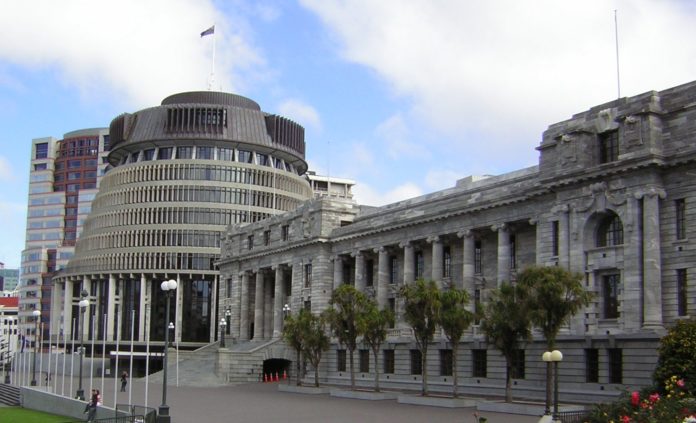
New Zealand Parliament Buildings, Wellington, New Zealand.
Editor’s Note: Here below is a list of the main issues currently under discussion in New Zealand and links to media coverage. You can sign up to NZ Politics Daily as well as New Zealand Political Roundup columns for free here.
In September, Boeing announced it would design and build a new military aircraft in Queensland, a first in Australia for over 50 years.
The “Loyal Wingman” is an uncrewed craft that flies in teams with other crewed and uncrewed aircraft to provide surveillance and reconnaissance support to a mission. But it could also be fitted with weapons. It completed its first test flight in March and plans are to have the production facility up and running in just a few years.
Although a lot of defence forces have used uncrewed aircraft (including drones) for a long time, they have primarily been remotely piloted from the ground. The test of the Loyal Wingman involved pre-programmed flying with human oversight.
This raises questions of whether our laws are adequate to protect us from a host of concerns involving health, safety and data collection when autonomous aircraft systems are in the skies.
What are the advantages of autonomous aircraft?
Defence forces around the world are investing heavily in these types of artificial intelligence technologies.
Unlike remotely piloted systems that require sizeable teams on the ground, these craft can be deployed in large numbers by small teams. This could exponentially increase the size of a country’s air force – an invaluable thing.
Further, these uncrewed aircraft are a fraction of the cost of one flown by a human crew. So, while they are not designed to be disposable (they still cost a few million dollars each), they are ultimately expendable in return for the right military advantage.
Although current spending on autonomous projects in Australia is small in relation to the overall defence budget, it is increasing.
Defence leaders are increasingly becoming aware of both the opportunities these systems present to the Australian Defence Force (ADF), as well as the challenges posed by other militaries exploiting them.
Legal questions about autonomous craft
The Loyal Wingman test flight took place at the remote South Australian Woomera Range Complex. The new drone test facility at Cloncurry, Queensland, will also likely host test flights in the future. That facility is specifically designed to support the testing of new autonomous military technologies.
But what happens when the crafts need to move beyond these specially equipped facilities in remote areas? What does this mean for everyday Australians?
Occasionally, we see tanks and other military vehicles on our roads. We see warships in our ports and hear fighter jets in our skies. We know that while these military vehicles have a war-fighting role, they also need to exist safely in our communities. This allows the ADF to train with them or move them between military bases, as well as to training or conflict zones.
There are a number of legal considerations for the design and deployment of any uncrewed autonomous military aircraft in our skies. These include privacy, noise, occupational health and safety, the environment and public liability.
Although amending the regulations is a relatively simple process – they are updated every six months – such a significant policy shift cannot be undertaken lightly or without consideration of the wider implications of allowing autonomous devices in our skies.
Then there’s the personal data these craft could inadvertently collect through their surveillance and reconnaissance sensors while in the sky.
The Australian privacy principles outlined in the Privacy Act 1988 cover incidentally collected information such as this. Although this is also an issue for crewed aircraft, the sheer volume of data that could potentially be collected from a large number of uncrewed, autonomous aircraft rings alarms bells.
This could require the ADF to report data breaches to those whose information is collected, and even pay compensation.
There are also environmental concerns, such as the possibility of an uncrewed autonomous aircraft unintentionally starting a bushfire on the ground.
In Germany, strict aviation rules contributed to the abandonment of one very expensive, autonomous, military drone project because the craft could not obtain clearance to fly in civil aviation airspace due to safety concerns.
Australia is only starting to consider these issues. For example, a current project is working on new standards for designing, testing and operating autonomous aircraft safely in the skies. This is primarily focused on commercial drones, but could set best practices for all autonomous craft.
The ADF and the law
The military is not always covered by the same rules as the rest of us. There are lots of exclusions for ADF members from the general application of Australian laws.
This means military vehicles and technologies can be excluded from certain government inquiries. For example, the recent federal government review into aircraft noise did not cover military drones.
New civilian technologies in Australian skies have already faced a host of questions. For example, the Google Wing delivery drone designers have had to take measures to deal with noise concerns (and swooping ravens)) in the Brisbane and Canberra suburbs where they are currently operating. Safety concerns have also had to be carefully considered.
The law is constantly being updated to keep pace with technology. For instance, a court recently set an important precedent by ruling that artificial intelligence systems can be legally recognised as an inventor in patent applications.
It’s not unreasonable to imagine circumstances could require a change to some defence safety aviation rules to allow for greater use of artificial intelligence in our skies.
Over the coming years, much thought will need to go into ensuring the ADF can safely and effectively get their autonomous craft to the starting line in a way that is workable under the Australian legal system and for the Australian public.
The Law and the Future of War research group at the University of Queensland receives funding from the Australian Government through the Defence Cooperative Research Centre for Trusted Autonomous Systems. The views and opinions expressed in here are those of the author, and do not necessarily reflect the views of the Australian Government or any other institution.
Internationally, and especially within the US, there has been a lot of talk about the so-called “great resignation” – the trend seeing large numbers of workers leaving their jobs during the COVID-19 pandemic, having reevaluated their priorities or simply because there are more opportunities than ever before.
While there isn’t enough firm data to confirm this is happening in New Zealand yet, there is little doubt a chronic skills shortage has given workers more bargaining power. Perhaps not surprisingly, research shows more and more workers are at least thinking about either changing or quitting their jobs since last year.
But this phenomenon – defined as “turnover intentions” – could also fuel what we’re calling the “great recruitment”. After all, as physics teaches us, for every action there is a reaction.
Calling it the great recruitment is obviously related to the sheer volume of recruitment activity that logically follows a great resignation. But it is also a reference to the related importance of a positive – great – recruitment experience for potential employees.
Shutterstock
Not a negative trend
Classic supply and demand principles tell us that if more workers are seeking greener employment pastures, there will be more ready-to-hire talent in the marketplace. For that reason alone, we urge organisations not to consider the great resignation a negative trend in the job market.
Of course, to be successful the great recruitment must be supported by businesses that prioritise the recruitment process, from candidate care to the vetting and hiring team, to the use of technology and protecting the organisation’s reputation and brand.
However, there are many practices that not only undermine but entirely defeat the positive potential of a great recruitment, including:
“ghosting”, where candidates apply for a role but get no response or experience a sudden silence part way through the process
posting vague or corny job descriptions – “customer services expert” anyone? – that do nothing to excite or provide context for potential applicants
relying too heavily on quasi-scientific personality profile tests and asking questions that are at best tokenistic, at worst discriminatory.
Making recruitment great
We also see recruitment processes stumble at the last hurdle by engaging in Game of Thrones-style salary negotiations, where candidates feel like they’re challenging a noble family. This is particularly disadvantages women and ethnic minorities.
How then to ensure your organisation is capturing the talent potential released by the great resignation and maximising the employment potential of the great recruitment? Here are our top 10 tips:
Choose your words carefully: write inspiring, authentic job advertisements. If your recruitment team can’t do it, get someone who can.
Be realistic: create reasonable candidate specifications – wanting extreme levels of skill, attitude and experience is likely put off good candidates.
Canvas others: when designing employee value propositions, get input from recruiters and current employees.
Remember glass houses: recognise there is no such thing as perfect behaviour when using behavioural-based interview questions, especially given the organisation itself may be questionable in some of its conduct.
Consider the context: give due consideration to reference check results – if a candidate’s last boss says he or she was disconnected in the end, perhaps it’s because they were already in a high state of turnover intention.
Go back to the future: be open to hiring past employees. Initiatives such as alumni programmes can be used to connect with and recruit former employees.
Know your team: be open to conversations about the attributes and attitudes of the person a successful candidate will be reporting to, and the team they will be working with.
Be technology wise: use automated recruitment technology (such as SnapHire, JobAdder or QJumpers) to enhance – not replace – an integrated people-oriented recruitment experience.
Provide clear pay ranges: if an applicant knows what the pay is from the outset, it saves everyone valuable time and energy.
Be gracious: formally thank all candidates for applying – this can help ensure you retain them as future applicants and/or customers.
With more talent in the market, those in recruitment will need to sharpen their games. Given much recruitment activity is outsourced and many recruiters will be booming in the current climate, organisational clients should have great expectations of recruitment professionals, too.
Employees face enough challenges in their working lives without having to endure a recruitment experience that is anything less than great.
Finally, the great recruitment must also account for future talent. Before we know it, the Roblox generation will be hitting the workforce, already adept at digital creation and collaboration, and expecting similar things from recruiters.
If we get it right, the great recruitment is a chance for employers to recast the great resignation as an opportunity for everyone to do better – now and into the future.
The authors do not work for, consult, own shares in or receive funding from any company or organisation that would benefit from this article, and have disclosed no relevant affiliations beyond their academic appointment.
Recent high-profile criminal cases, such as the suspected death of William Tyrrell and the abduction of Chloe Smith, have captured the attention of the media and the public.
As a former detective inspector, I investigated and managed more than 25 homicide investigations and many other major crimes during 28 years with the Queensland Police Service.
So what happens behind the scenes in a major crime investigation. And how does the investigation of major crime differ from volume crime?
The difference between major crime and volume crime
Homicides are the most obvious type of major crime, but it can also include robbery, rape and other serious offences such as organised crime.
The Queensland Crime and Corruption Commission’s list of major crime offences includes drug trafficking, fraud, money laundering, criminal paedophilia and homicide.
The Australian Institute of Criminology defines volume crime as offences that account for the largest proportion of crime recorded by the police. These include unlawful entry, assaults, motor vehicle theft and theft.
There is a difference between the way major crime and volume crime are investigated. Major crime investigations can take years for some cases, such as the murder of 13-year-old Daniel Morcombe, which took 11 years to reach a conviction.
In major crime, there is a clear division of labour rather then just one officer doing everything, as is usually the case in volume crime investigations. Assigned roles include the investigation manager, the arrest team, other investigators, an intelligence cell and specialist support staff.
Major crimes such as homicides involve dedicated taskforces or operations containing large teams of detectives, conducting parallel lines of inquiry.
This ability to put greater investigative effort and specialist support into major crime investigations contributes to much higher “clear-up rates” – when a suspect is identified and proceedings are begun – for these types of offences.
A New South Wales study showed that, from 2007 to 2016, 65% of murders were cleared by police within 90 days. The same study noted clear-up rates for property offences were much lower than for violent offences, including murder. In Queensland, 96% of murders reported in 2019–20 were cleared.
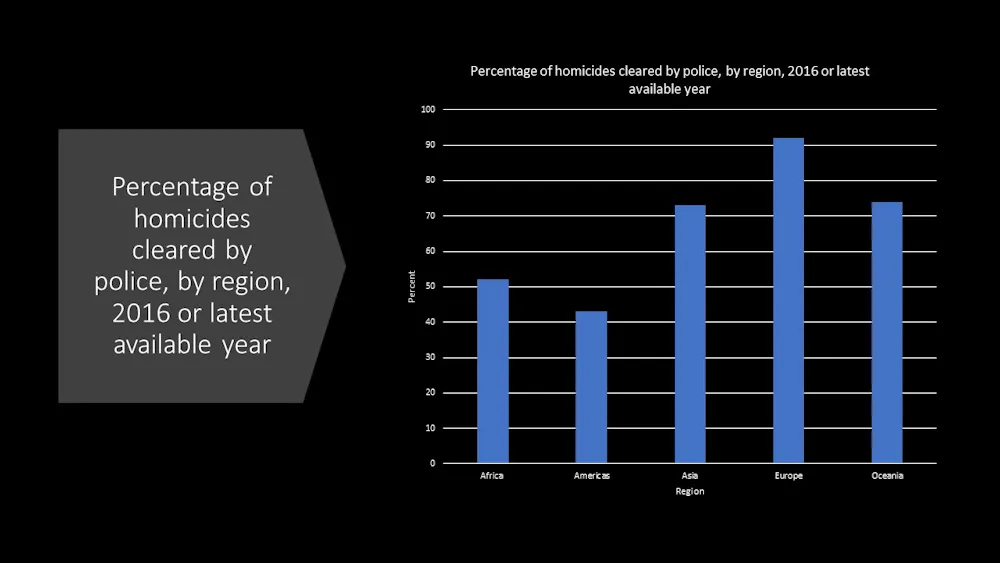
Percentage of homicides cleared by police, by region, 2016 or latest available year. United Nations Office of Drugs and Crime
Australia’s clearance rates for homicide compare well to the rest of the world. The United Nations Global study on homicide indicates clearance rates range between 50% and 90%.
The hunt for information
Most major investigations are a process of moving from having little information about the crime to having a lot. It is essentially an exercise in information management. Investigators need to acquire information to build a plausible account of what has happened.
Investigators do this by identifying, interpreting and assembling information into a form that shows whether a crime has been committed, and who is responsible for that crime. Sources of information can include crime scene material, intelligence databases, witnesses, victims and the media.
An investigative model
There is no standardised investigative process or model. The United Nations Office of Drugs and Crime provides some guidance on how to progress through a generic reactive investigation in its crime investigation toolkit.
In the United Kingdom, the College of Policing provides guidance on the investigative process. However, it notes that every investigation is different, and so may require a different path to solving the case.
In 2001, as part of a research project in conjunction with the Queensland Police Service, I developed an investigative model. It outlined several stages:
crime scene
initial assessment
investigation
target
arrest.
In the course of an investigation, police can return to any stage and begin a new line of inquiry. We have seen this occur with the disappearance of William Tyrrell, with police returning to the original crime scene some seven years later after receiving new information.
No matter what model is used, there are decisions that the management team of the investigation will need to make as it moves through the stages:
knowledge decisions are concerned with how particular information should be interpreted and treated by the investigative team
tactical decisions relate to what should be done, when and by whom
logistical decisions concern the operational supports and resources to be dedicated to an investigation
legal decisions need to be made to ensure any actions taken by the investigative team are legal and admissible in a court case.
The role of media and technology
The media are a great investigative tool and can be used to apply tactical pressure to suspects and drive the search for information from the public. The extensive coverage of high-profile cases, such as that of William Tyrrell, is an example of this. The use of the media can also coincide with covert policing strategies, such as listening devices, designed to target potential suspects.
Technology is now also playing a much larger role in major investigations. We all leave digital footprints, be they passive (your mobile phone searching for a signal from a cell tower) or active (using your phone to pay for fuel at a geographic location).
In one triple-murder investigation that I managed, the offenders were tracked up and down the eastern seaboard of Australia, and to the murder scenes, using their mobile phone data.
One thing that hasn’t changed over time is the importance of the investigative effort in the early stages of any major crime, but particularly murders. I have seen first-hand how putting the effort in early in terms of long hours and adequate resources can result in solving major crime.
Terry Goldsworthy does not work for, consult, own shares in or receive funding from any company or organisation that would benefit from this article, and has disclosed no relevant affiliations beyond their academic appointment.
Source: The Conversation (Au and NZ) – By Tanya Hill, Honorary Fellow of the University of Melbourne and Senior Curator (Astronomy), Museums Victoria
Natacha Pisarenko/AAP Image
The Sun hasn’t set in Antarctica since October. Earth’s southernmost continent is currently experiencing a long summer’s day, one that stretches from mid-October until early April.
But on Saturday December 4, darkness will sweep across the ice of West Antarctica. The Moon will pass directly in front of the Sun, blocking its light and producing a total solar eclipse.
The path of totality crosses the Argentine, British and Chilean Antarctic Territories (which consist of overlapping regions), as well as the unclaimed territory known as Marie Byrd Land. Areas along the path will experience almost 2 minutes of darkness in the otherwise months-long stretch of daylight.
Meanwhile, the southern tips of South America, Africa, Australia and New Zealand will see a fairly minor partial eclipse. For South America and Africa, the eclipse will be in the early morning; for Australia and New Zealand it will happen as the Sun is setting.
The Moon’s goodnight kiss
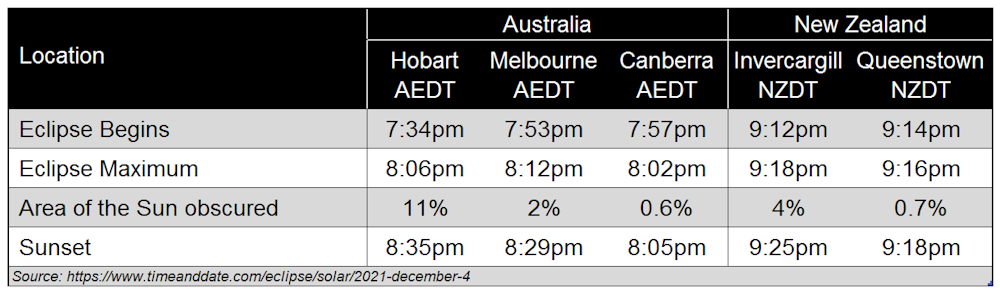
As the Sun sinks towards the horizon the Moon will appear to kiss the top-left of the Sun. Of all Australia’s capital cities, Hobart will see the largest eclipse, but even so only 11% of the Sun’s area will be covered. For Melbourne, this drops to just 2%, while in Canberra it’s hardly visible – the Sun is crossing the horizon as a tiny eclipse occurs.
It’s a similar situation in New Zealand. Invercargill will see 4% of the Sun obscured by the Moon, with the Moon passing by the Sun’s left side. But move further north to Queenstown and the eclipse is barely visible for the setting Sun.
In fact, if you weren’t aware of it, you wouldn’t even know the eclipse was happening. It’s not until about 80% or more of the Sun is obscured before we notice any change in daylight.
Star light, star bright
Solar eclipses are one astronomical event that require special care to observe. Most importantly, never look at the Sun directly – even when it’s low on the horizon.
Be sure to protect your eyes by using specially designed eclipse glasses. These glasses also allow you to see any sunspots that might be active. The Sun is currently moving from a quiet phase to an active one, as part of a cycle that repeats every 11 years. You can check websites such as Spaceweather to see what’s happening on the Sun’s surface right now.
Normally, the projection method is a great way to observe solar eclipses. This involves making a small hole in the bottom of a plastic cup or piece of cardboard. Then, with your back to the Sun, hold the cup so the sunlight passes through the hole onto a flat surface such as a piece of paper or a wall, projecting an image of the Sun on the surface.
But because this is such a minor eclipse and it will happen at sunset in eastern Australia, it may be hard to focus the Sun’s image in this way.
A great way to safely share a view of a solar eclipse. Sid/flickr
The rarity of totality
Solar eclipses are relatively rare experiences, because the Moon’s orbit is tilted by 5 degrees relative to Earth’s orbit around the Sun, so they don’t quite move in the same plane. However, roughly every six months the orbits align to produce a pair of eclipses – a lunar eclipse at Full Moon, followed by a solar eclipse at New Moon (as we are experiencing now), or vice versa.
Lunar eclipses are seen by more people because everyone on the night side of the Earth during a lunar eclipse will see the event. Solar eclipses happen just as often, but they are seen by far fewer people because the shadow created by the Moon passing in front of the Sun covers a much smaller fraction of the Earth.
Furthermore, partial solar eclipses are difficult to observe and they pale in comparison to the experience of a total solar eclipse. While total solar eclipses happen roughly every 18 months being able to see totality is rarer still.
The Moon’s shadow as it crosses the Earth is only 100-260km wide, and you have to be located within that narrow path to see the totally eclipsed Sun. This is why eclipse-chasers travel the world to be in the right place at the right time. But when totality occurs in a remote location like Antarctica it’ll be mainly the penguins who get to see it.
The next total solar eclipse visible from Australia will happen in April 2023. The band of totality will just clip Australia near Exmouth at the tip of the North West Cape in Western Australia.
But many more Aussies and New Zealanders will get to see a total solar eclipse on July 22 2028. Totality will stretch across Australia, from the top of WA down through New South Wales, passing directly over Sydney. It will also cross the South Island of New Zealand, passing through Queenstown and Dunedin.
Tanya Hill does not work for, consult, own shares in or receive funding from any company or organisation that would benefit from this article, and has disclosed no relevant affiliations beyond their academic appointment.
Source: The Conversation (Au and NZ) – By Bill Hare, Director, Climate Analytics, Adjunct Professor, Murdoch University (Perth), Visiting scientist, Potsdam Institute for Climate Impact Research
Shutterstock
The controversial Scarborough gas project off Western Australia will cause a substantial rise in greenhouse gas emissions at a time when the world must rapidly decarbonise, new analysis released today shows.
The A$16 billion plan by Woodside Petroleum has been described as Australia’s biggest new fossil fuel investment in nearly a decade. The report, produced by Climate Analytics, a research organisation I help lead, is the first to examine the full climate impact of the entire expansion project.
The Morrison government has put the gas industry at the heart of its economic recovery from the COVID-19 pandemic. But as the Scarborough example shows, such projects makes it less likely the world will meet the goals of the Paris Agreement.
The sheer scale of emissions from the expansion, and projects linked to it, will make achieving 2030 emissions targets much harder for Western Australia and, by extension, Australia and the world.
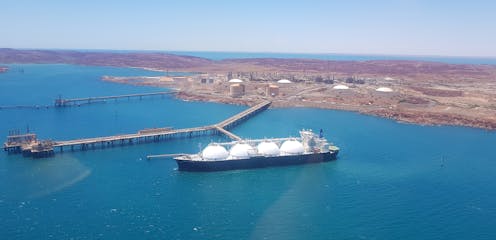
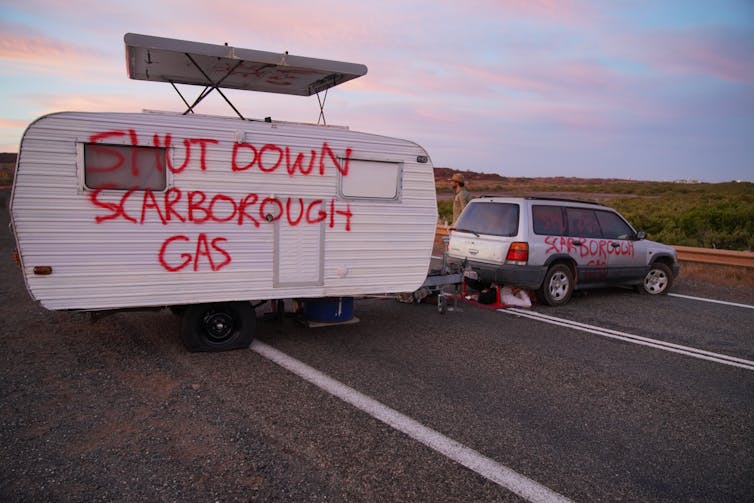
The controversial Scarborough gas project has been described as the nation’s biggest fossil fuel investment in a decade. Scarborough Gas Action Alliance
Emissions worse than we thought
Woodside’s expansion proposal involves developing the Scarborough offshore gas field 375 kilometres off Australia’s northwest coast. It also includes a new pipeline to the company’s onshore Pluto processing facility on the Pilbara coast, and expansion of that facility.
Woodside last week announced it had approved the final investment decision on the developments. Chief executive Meg O’Neill said the project “supports the decarbonisation goals of our customers in Asia”.
Our study examines the full emissions implications of the expansion and associated projects, including domestic gas supply and a proposed project converting gas to hydrogen.
Estimates of the entire projects’ greenhouse gas implications are spread across several reports and documents. This report assembles these for the first time. The research was commissioned by the Conservation Council of Western Australia.
We examined the emissions from the gas facilities themselves, and emissions that will, or are likely to, occur as a result of the project. This second group of emissions includes locked-in domestic demand for natural gas and overseas export markets burning its product for energy.
We estimate that by 2055, the expansion and associated projects will emit 1.37 billion tonnes of greenhouse gases. Almost 20% is projected to be emitted in Western Australia and the rest would be emitted overseas where the exported gas will be burnt.
The total emissions we calculate is far more than the 878 million tonnes Woodside says the project will emit.
In a statement to The Conversation, a Woodside spokeswoman said its emissions figure was “correct and has been accepted by the federal regulator NOPSEMA”.
However the NOPSEMA report covers only the emissions that come from gas derived from the Scarborough gas field and not the emissions from the entire Pluto expansion. In contrast, Woodside’s greenhouse gas action plan is based on the entire Pluto expansion, including all aspects of the project we included in our calculations.
Woodside said Scarborough gas, used to generate electricity, could power ten cities the size of Perth for 30 years and the emissions would be around half those for the same electricity generated from coal.
However, we found that introducing Scarborough-Pluto gas into electricity grids of countries decarbonising in line with the Paris Agreement would raise greenhouse gas emissions by several hundred million tonnes between 2026 and 2040.
Woodside says the project could power ten cities the size of Perth for 30 years. David Goldman/AP
Questionable emissions reduction plan
Woodside says its “greenhouse gas abatement program” shows how the company will offset a substantial amount of emissions. We believe that plan, approved by the WA government, is questionable on several counts.
For example, a Woodside project approved in 2006 at 12 million tonnes of LNG per year was later scaled down. However, Woodside’s plan for emissions reduction plan comes off the earlier high-emissions baseline.
Woodside proposes to reduce emissions reductions using carbon offsets (removing CO₂ from the atmosphere in one place to compensate for emissions made elsewhere). But there appears to be no guarantee these offsets would not have occurred as part of Woodside’s usual business operations.
Woodside says it plans to abate all emissions from the project by 2050. But most of this emissions reduction will not occur until after 2040, and depends on factors such as the availability of technology, government policy and the availability of carbon offsets for purchase.
Woodside has also not accounted for expected global increases in the price of carbon offsets. We calculate that by 2050, the cost of offsets could comprise between 21% and 71% of Woodside’s export revenue for liquified natural gas.
Carbon offsets compensate for emissions in one place by reducing them elsewhere. Shutterstock
Bad news for net-zero
In May this year, the International Energy Agency said no new oil and gas fields can be developed if the world is to meet the goal of net-zero emissions by 2050 and avert catastrophic global warming.
This, in our view, includes the Scarborough-Pluto expansion. Introducing gas from the project into electricity grids of importing nations would slow global decarbonisation efforts.
Big buyers of Australian gas, such as South Korea and Japan, are moving away from fossil fuels and towards green hydrogen and renewable energy. This suggests a softening, or even collapse, in demand for LNG this decade – a trend consistent with assessments by the International Energy Agency and Australia’s Reserve Bank.
For Woodside, the Scarborough-Pluto expansion is increasingly looking like a stranded asset. And the WA government’s support for the project, and the broader gas industry, means it’s missing out on massive, and growing, opportunities in renewable energy and green hydrogen exports.
Bill Hare receives funding from the European Climate Foundation, Bloomberg philanthropy and the Climate Works Foundation. The research upon which this article is based was funded by the Conservation Council of Western Australia
The COP26 meeting has sharpened the world’s focus on climate change. To adapt and thrive in a world of reduced emissions, Australian businesses and communities need access to the technologies and innovation made possible by the nation’s researchers. But most Australian research is locked behind publisher paywalls.
Open access to research has become an important strategy to speed innovation. Making COVID-19-related research and data publicly accessible to fast-track the development of vaccines, treatments and policies is one example.
Given the gravity of the global climate emergency, it seems reasonable also to use open access to help speed green innovation.
But, as Prime Minister Scott Morrison recently noted, research systems driven by a “publish or perish mindset” do little to spur innovation. Scholarly communication models that lock research behind paywalls slow the flow of new knowledge from researchers into real-world innovation.
Australian universities pay hundreds of millions of dollars in subscription fees each year for access to publications by Australian researchers. Businesses, policy advisers, think-tanks and private individuals who don’t have access to a university library must either pay separately for access or miss out.
This is despite the fact Australia invests an estimated A$12 billion of taxpayer money each year in research and innovation, according to Chief Scientist Cathy Foley. Action is needed to ensure this publicly funded research can be translated into innovation for the wider economy.
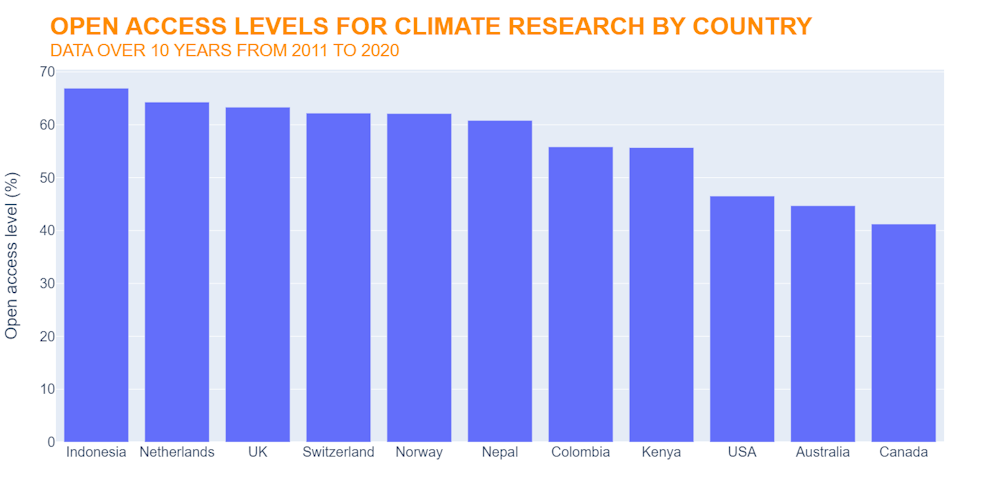
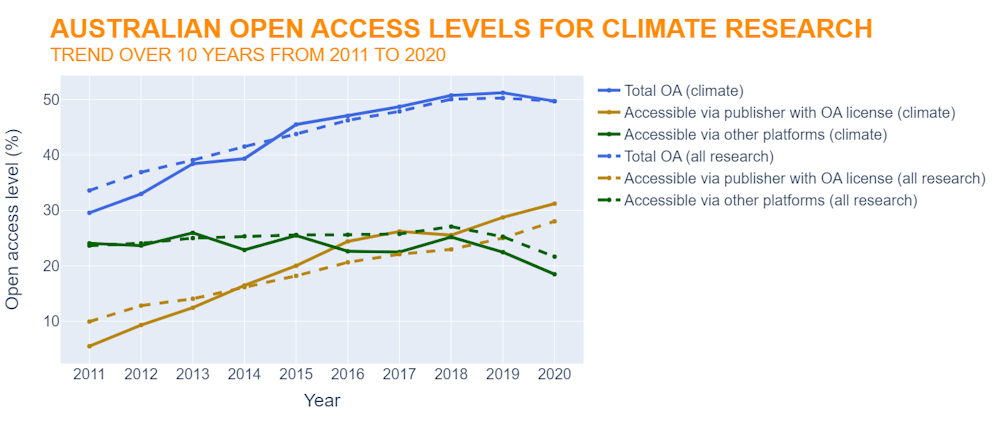
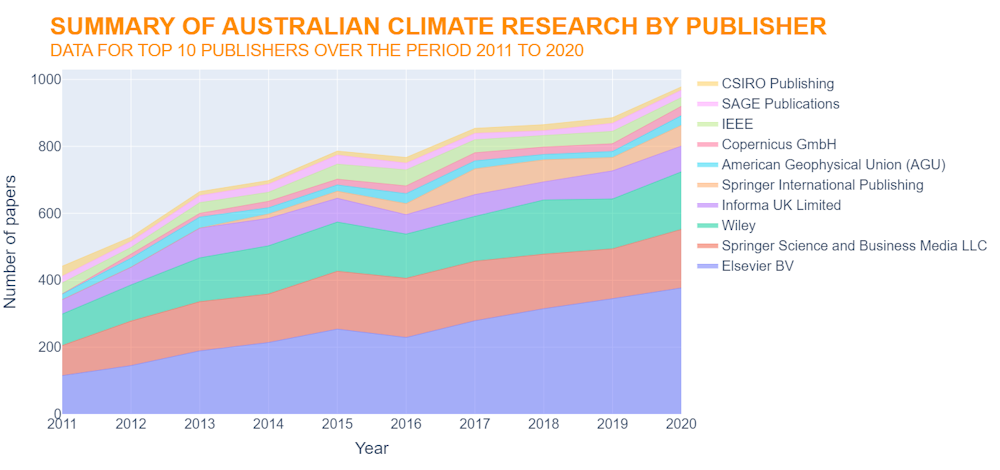
International research communities are already using open-access strategies to maximise the impacts of climate-related research. Our analysis of publication data* shows between 2011 and 2020 the proportion of research on climate change that is open access rose from 30% to 50%. This is consistent with an accelerating international shift towards “public access to publicly funded research”.
More than half of the Australian research on climate change published in the past decade is behind a paywall. This puts Australia on par with the US and Canada – but well behind our nearest neighbour Indonesia, as well as most of Europe.
Australia’s low rates of open access have implications for communities in need of information about how to adapt to a warming world.
The Council of Australian University Libraries (CAUL) is leading the push for open access to Australian research. So-called “transformative agreements” are one aspect of its strategy. These are deals with publishers that cover both subscription access to articles that are still behind paywalls and open-access publishing rights for articles by Australian researchers.
In 2021 the CAUL signed transformative agreements with five major publishers.
Foley argues that a “gold” route to open access (paying publishers not to lock articles behind paywalls) is likely to cost less than Australian universities already pay for subscription access: between A$460 million and A$1 billion.
Foley wants a sector-wide approach that would result in all Australian research being published in open access, and all Australians able to access the journals that universities subscribe to.
So will the latest transformative agreements make it easier to access research needed to tackle climate change?
The short answer is “yes, but we need to do more”.
A few big commercial publishers dominate scholarly publishing.
So far CAUL has signed deals with only two of the largest publishers of climate-related research: Wiley and Springer Nature. The Springer Nature deal excludes many of its most prestigious titles, including the journal Nature.
If the deals with Springer Nature and Wiley had applied to all 2020 publications, our analysis suggests they would have made up to 200 more articles immediately accessible on publication.
Author provided
Deals with the Big Five publishers will create a step change in the amount of Australian climate change research that is freely accessible. But there is a danger they will further lock in the monopolies of a few players.
Australian researchers could make a bigger difference to open access by making their work available through other online sharing platforms. Discipline platforms like arXiv, Pubmed Central or university systems like QUT’s ePrints are examples.
Our analysis found less than 40% of Australia’s 2019 research output is accessible through these platforms. Australian researchers could make 1,400 articles on climate change more accessible by depositing them in a free open access repository today.
Tackling climate change and improving access to research are both complex and controversial issues. In each case, thinking through the implications in the short, medium and long term will be key to helping Australia achieve its goals.
* Data statement: data were obtained from Crossref metadata, Unpaywall, Microsoft Academic and the Global Research Identifier Database, via the data infrastructure developed by the Curtin Open Knowledge Initiative, Curtin University. “Climate change” is a topic category available from Microsoft Academic and this was supplemented by a search for terms associated with UN Sustainable Development Goal 7, “clean energy” and “net zero”.
Lucy Montgomery has received funding from Springer Nature for research relating to Open Access. She is also affiliated with a number or organisations involved in Open Access scholarly communication, including as a recipient of funding from the Andrew W. Mellon Foundation; and as a member of the Scientific Committees for the Directory of Open Access Books (DOAB) and the OAPEN Open Access Books Toolkit. Montgomery is non-executive director of the not-for-profit consultancy Collaborative Open Access Research and Development (COARD).
Cameron Neylon has received funding from Andrew W. Mellon Foundation, Springer Nature, the Arcadia Fund, Arnold Foundation, Open Society Foundations, Canadian Social Sciences and Humanities Research Council and other organisations for research relating to Open Access. He is also affiliated or has an advisory role with a number or organisations involved in Open Access scholarly communication, including as part of the Initiatives for Open Citations and for Open Abstracts, an Advisory Board Member of Open Book Publishers, and others. Neylon is a non-executive director of the not-for-profit consultancy Collaborative Open Access Research and Development (COARD).
Karl Huang does not work for, consult, own shares in or receive funding from any company or organisation that would benefit from this article, and has disclosed no relevant affiliations beyond their academic appointment.
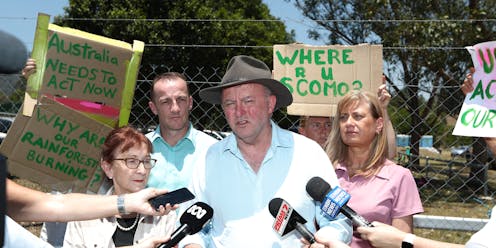
Anthony Albanese in Nimbin, NSW, on November 12 2019 amid a season of a catastrophic bushfires. Jason O’Brien/AAP
The Australian Labor Party is set to announce its target for cutting greenhouse gas emissions today.
At the 2016 and 2019 elections, Labor promised net zero emissions by 2050 and a cut of 45% on 2005 levels by 2030. Among the promises it adopted to get it there in 2019 was a target of 50% renewable energy by 2030.
But it lost those elections. So up to now Labor has refused to say what policies it will take to the 2022 election. We should know by the end of the day.
The Coalition’s position is clear – sort of.
Formally the government is sticking with its long-settled position of delivering a cut of 26-28% on 2005 levels by 2030 (as well as net zero by 2050).
But Prime Minister Scott Morrison is having a bet each way, by also saying the government will do better. As he said on November 15:
We are going to achieve a 35% reduction in emissions by 2030. That is what we’re going to achieve. That is what actually matters. What matters is what you actually achieve. We are well above our target.
This leaves Labor, which has consistently taken a stronger stance than the Coalition, with three broad options.
Targets, predictions, safeguards
Option 1 is to match the 35% reduction but make it a formal target, not a prediction.
Option 2 is to go a little higher with a prediction – say 40% – and claim this is achievable given announced Labor policies such as electric vehicles and upgrading the electricity grid (“rewiring the nation”).
Option 3 is set a more ambitious target – perhaps 45%, as Labor did at the last election, along with a change to the so-called “safeguard mechanism” introduced by the Coalition in 2016 as part of its alternative to a price on carbon.
The safeguard mechanism requires Australia’s largest greenhouse gas emitters to keep their net emissions below a certain cap.
At the 2019 election Labor proposed to cut the eligibility threshold for the cap from 100,000 to 25,000 tonnes of carbon dioxide a year, and extend it to more emitters.
The difference between now and 2019 is that this time the business community is behind the approach.
In fact, the Business Council of Australia’s climate plan, published in October 2021, is to do exactly this.
Each one of these options have pitfalls. Option 1 looks weak, and gives the government a free pass on climate. It’s hard for Labor politicians to campaign on the government not doing enough if they aren’t willing to do more themselves.
Option 2 (perhaps the most likely) is a hedge: Labor will do more because it cares about the planet, but not too much more because, you know, politics.
Option 3 is the bravest of the likely targets. It’s a bigger number that would make for more meaningful change. It also now has air cover from the Business Council of Australia.
But it’s also the option taken to the last election, which Labor lost. Maybe that was due to other reasons, such as the retiree tax, but it still seems politically risky.
No talk about a carbon price
One option you can bet Labor will not adopt is a price on carbon.
That’s the best way to balance what’s good about emissions (economic growth and development) with what’s bad about emissions (climate change).
This has been off the table with Labor since it lost government in 2013 – in no small part due to Tony Abbott exploiting the issue with his “great big tax” campaigning.
But a funny thing has happened on the way to the 2022 election. A few months ago the Coalition inserted a price on carbon into its own plan.
As The Conversation’s Peter Martin put it, the plan assumed emissions reductions “the same as what would be expected if Australians faced a carbon price (or tax) that climbed to A$24 per tonne of carbon dioxide equivalent by 2050”.
If Energy Minister Angus Taylor is trying to hide this, he is not being particularly stealthy about it.
Page 6 of the government document outlining the modelling and analysis behind the plan acknowledges it models voluntary emissions reductions “as an abatement incentive which is taken up across the economy and rises to $24/t CO2-e in 2050”.
It says behaving “as if” there was a carbon price of A$24 per tonne in place would get emissions down by 85%.
To get them down further to net zero would require an even higher carbon price: about A$80 per tonne on the model’s logic.
Labor could take its cue from the Coalition
So why doesn’t Labor do what it knows to be right – announce a price on carbon? It could say it will start at the government’s own figure of $24/tonne, and take any needed subsequent increases to future elections.
That won’t happen on Friday. Or any time soon. We should reflect on why.
Richard Holden is President of the Academy of the Social Sciences in Australia.
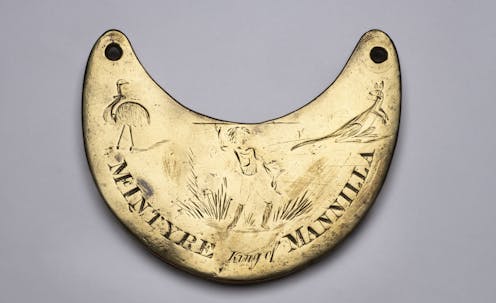
Breastplate, of metal, engraved ‘McIntyre King of Mannilla’, c.1860–1874. ‘King’ McIntyre (c.1814–74) . Donated by A.W. Wilkins to Birmingham Museum & Art Gallery, 1930.Birmingham Museum & Art Gallery
Readers are advised this article contains content relating to violent colonial practices and deceased Aboriginal and Torres Strait Islander people, which some may find distressing.
Ancestors of Indigenous Australians are represented in Britain not only by the objects they made. The Ancestral Remains of Aboriginal people still lie in museums or in graves, marked and unmarked.
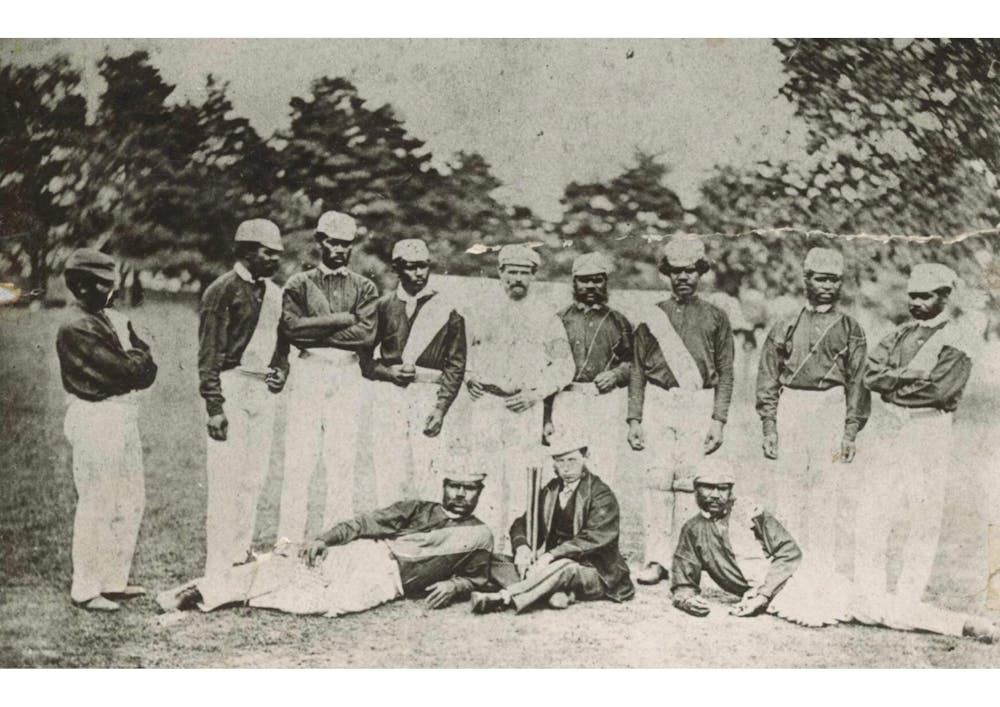
A number of Aboriginal people who travelled to Britain in the late 18th and 19th century died there. These include Yemmerrawanne, who visited with Bennelong in 1793; William Wimmera, whose mother was killed by colonists in northwest Victoria and who was subsequently brought by the Reverend Septimus Lloyd Chase to Reading, where the lad died in 1852; and Bripumyarrimin, “King Cole”, a member of the 1868 Aboriginal cricket team who died in London in the same year.
The 1868 Aboriginal cricket team in England. Wikimedia Commons
Indirect evidence of Aboriginal visitors to Britain and their agency in collecting specimens is also evident in some museum collections. The Natural History Museum, for instance, has plant specimens collected by botanist George Caley in New South Wales. His field collecting was greatly assisted by “Dan”, referring to Daniel Moowattin, an Aboriginal man from the Parramatta region, who came to London with Caley in 1810–11 to work on naturalist Joseph Banks’s collection.
The collecting of Ancestral Remains was a practice that began in the earliest days of the colony in Sydney and continued well into the 20th century. A number of the remains collected were of well-known individuals killed in frontier violence, whose heads became trophies. Throughout most of the 19th century, there was a particular interest in obtaining Tasmanian Aboriginal remains as the people were then believed to be becoming “extinct”.
Both their bones and hair were keenly sought after. While there are large numbers of unidentified Ancestral Remains in British collections, traces of named individuals can be found.
Collectively, they illustrate the violence of the colonial frontier and the wide-ranging medical and other networks of 19th-century collectors reaching from Britain to Australia.
Heads lost and found
Joseph Banks, who visited Australia once as part of Cook’s first voyage, used his extensive contacts in Sydney to seek out both Aboriginal artefacts and Aboriginal human remains. In the early 1790s, Governor Arthur Phillip sent Banks two Aboriginal skulls from “New Holland”, that were destined for Johann Friedrich Blumenbach at the University of Göttingen, Germany.
In ensuing frontier violence, the resistance of Pemulwuy, from the Botany Bay region, resulted in Governor Philip Gidley King issuing an order for his capture in November 1801, and in June 1802 Pemulwuy and another man were shot dead. Pemulwuy’s head was preserved in spirits and was among the “desiderata” sent back by King to Banks in the ship Speedy.
In 1802, the Museum of the Royal College of Surgeons in London noted a gift of “two heads” at that time, although erroneously labelled as coming from Tahiti. Banks’s acquaintance with surgeon John Hunter (whose collections were the foundation of the museum) was likely why the heads arrived at the Royal College of Surgeons.
In August 1818, British artist James Ward, a prolific painter of people and animals, was granted permission by the College of Surgeons to “make Drawings from the two heads in the Museum of Natives of New South Wales”. His journal (October 24 1818) notes: “Begin a study at the College of Surgeons from 2 heads of Botany Bay men”.
Ward’s sketches were exhibited at his house in Newman Street, London, in 1822, and described as:
No. 8. A Native of New South Wales. This order of men is considered as the lowest of human species. The head from which this specimen is taken is preserved in spirits in Surgeon’s College. He was a distinguished chief of a tribe of troublesome marauding predators, a kind of Three-fingered Jack of Botany Bay, which rendered it necessary to put a price upon his head. No. 32 is another view of the same head, with another of the same tribe.
Portrait of James Ward, circa 1835. Wikimedia Commons
In 1829, these works appear to be listed for sale again in an auction catalogue from Christie’s. In recent decades, numerous attempts have been made to find Pemulwuy’s remains but without success.
The Royal College of Surgeons was bombed in World War II and the head, which had been preserved in spirit and so perhaps kept only as a skull, may have been destroyed then.
Heads of recently and naturally deceased Aboriginal people were also obtained through institutions’ and surgeons’ interests. John Shinall (c.1809–39) lived much of his life with a white family near Hobart in Tasmania and worked as a farm labourer. After his death his body was mutilated and his severed head preserved in alcohol.
Dr John Frederick Clarke, Inspector General of Hospitals in Hobart, presented it to the Museum of the Royal College of Surgeons in Dublin about 1845–6. It was later photographed and published in 1899 in Henry Ling Roth’s The Aborigines of Tasmania. After tracking it down and seeing it displayed in Dublin in 1985, the Tasmanian Aboriginal Centre negotiated to have Shinall’s head returned and he arrived home in 1990.
Yagan was a Nyungar man from the Swan River (Perth) region of Western Australia who, like Pemulwuy on the other side of the continent, had resisted the settlers. He was once captured but escaped from custody. In 1833, a price was offered for his head after two settlers were killed following the shooting of a group of his own Nyungar people.
Yagan was subsequently killed and his head was taken to England in the luggage of Lieutenant Robert Dale, who tried to sell it. It was displayed for 12 months by Thomas Pettigrew, a surgeon and antiquarian interested in phrenology. Dale later gave it to the Liverpool Royal Institution, in the town where he lived.
In 1964 it was disposed of, among other remains, as it was badly deteriorated. Following decades of searching by Nyungar people, in 1993 it was identified in an unmarked grave in Liverpool and eventually returned by Aboriginal Elders to WA in 1997.
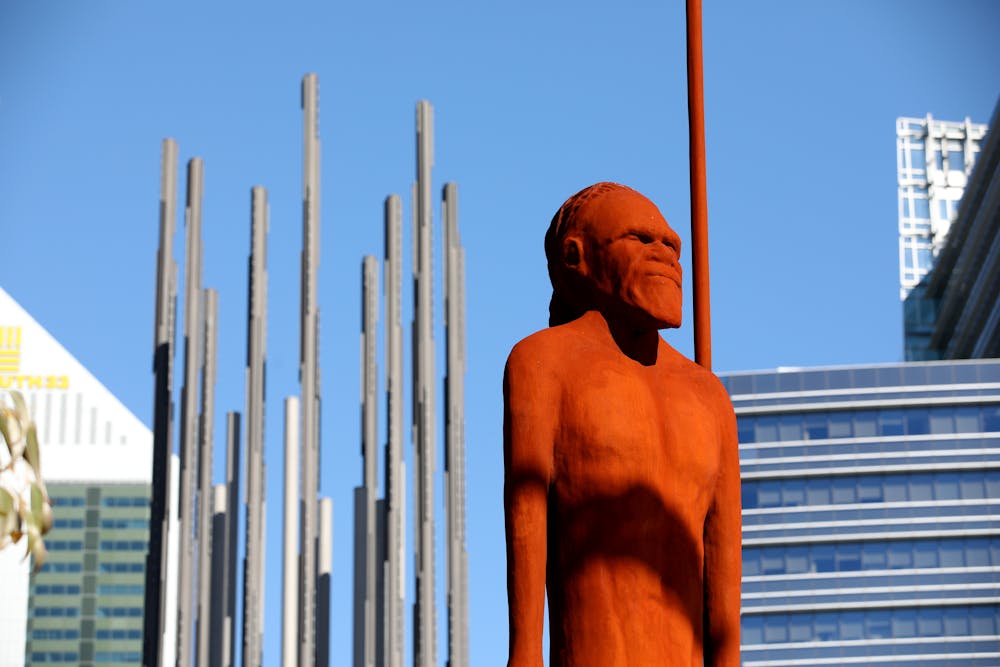
Yagan Square in Perth, WA. Richard Wainwright/AAP
A ‘trophy’
The Bunuba people of the Wunaamin Milliwundi Ranges (previously named the King Leopold Ranges) region of northwestern WA are still looking for Jandamarra. In the 1890s, he worked for some time as a tracker for the police but later led a rebellion against European colonists. He was eventually tracked down and killed with help from another Aboriginal man in 1897.
As Bunuba woman June Oscar stated in 2015, the carnage of Aboriginal people at that time devastated Bunuba society. After his death, Jandamarra’s head was taken to England, and was last seen in the 1960s, displayed as a trophy in Greener’s gun factory in Birmingham, which had a museum housing birds, animals and objects relating to shooting.
The factory subsequently relocated and the whereabouts of Jandamarra’s skull today remains unknown.
An anonymous cranium, likely that of a prisoner from the East Kimberley region of WA, was among the collection of 38 Aboriginal objects obtained by Dr James Albert Wetherell of Stokesley and donated to the Dorman Museum in Middlesbrough in 1904. The skull has a handwritten label attached stating
Skull of West Australian aboriginal Native. Observe contracted low, retreating forehead denoting diminished intellectual faculties.
Born in Middlesbrough in 1862, Wetherell trained in medicine at Edinburgh, graduating in 1886. He arrived in WA in 1892 and registered as a doctor, working at Bridgetown and Bunbury before being appointed in June 1892 as a justice of the peace and resident magistrate of the East Kimberley. As Chris Owen has discussed in his book Every Mother’s Son is Guilty, this was an era when police could be disciplined for not shooting Aborigines.
In early 1893, in his capacity as resident magistrate, Wetherell sent out an expedition to punish “savage outlaws” after the attempted spearing of a policeman. He resigned in late 1894 and eventually returned to live in Hull. Newspapers reported that he failed to take care of prisoners in the gaol with many dying, the food he provided being unfit for consumption.
Those released from prison were forced to walk over 200 kilometres home to their country without provisions, some dying on the road. Newspaper accounts relate that Wetherell performed autopsies just outside the gaol in view of the prisoners and kept portions of bodies as curios.
As the other objects in his collection came from the Kimberley region, the cranium likely originated in the Wyndham police district and possibly from an autopsy he carried out. In 2019, the Dorman Museum took steps to initiate its return to the Kimberley.
Fanny Smith’s hair
In mid-to late 19th-century Britain, issues of racial origins and human evolution were hotly debated. In this context, not only human remains but also hair samples of different peoples were valued specimens for study and exchange.
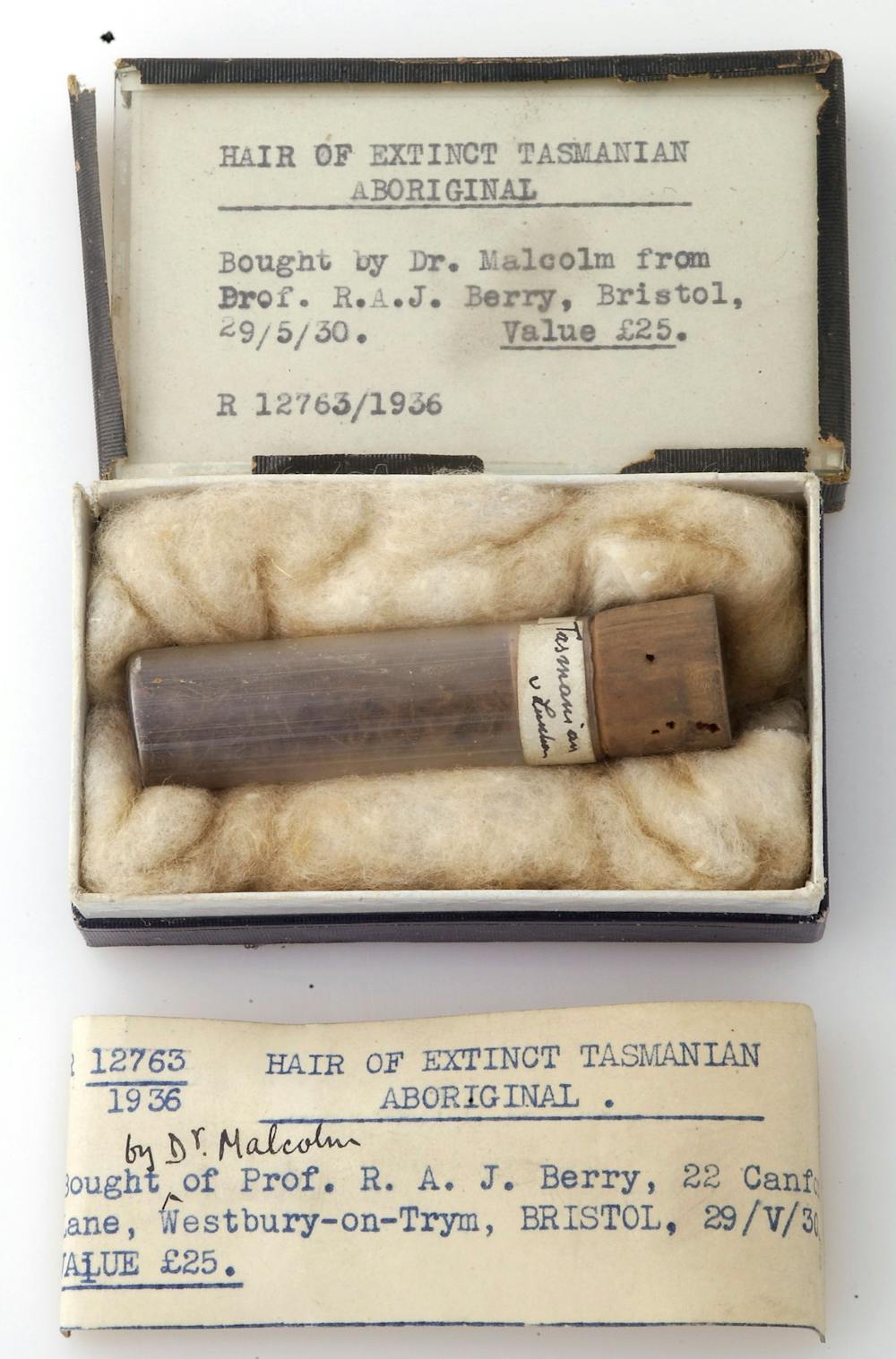
Samples from Tasmania were highly sought after, particularly after the death of Trukanini (or “Truganini”) in 1876, who was then often erroneously referred to as “the last Tasmanian”. A hair sample from an unknown Tasmanian was bought by Dr Malcolm of the Wellcome Historical Medical Museum in London from Dr Richard Berry in Bristol for £25 in 1930.
Container for a sample of Tasmanian Aboriginal hair. Bought by Dr. Malcolm from Prof. R.A..J. Berry, Bristol, in 1936. Wellcome Collection
Written in ink on the label of the container is “V Luschan”, indicating an association with Vienna-based doctor and ethnographer Felix von Luschan, who amassed a large collection of human remains.
Trained in Edinburgh, Berry also had a huge collection of Aboriginal Ancestral Remains and while at the University of Melbourne had studied crania robbed from graves in Tasmania, before moving to work in Bristol in 1930.
There he was associated with the eugenics movement, proposing a lethal chamber for “low grade defectives”. The hair sample he sold to the Wellcome Museum has since been returned to Tasmania, as part of a long campaign by the Tasmanian Aboriginal Centre for the return of Ancestral Remains.
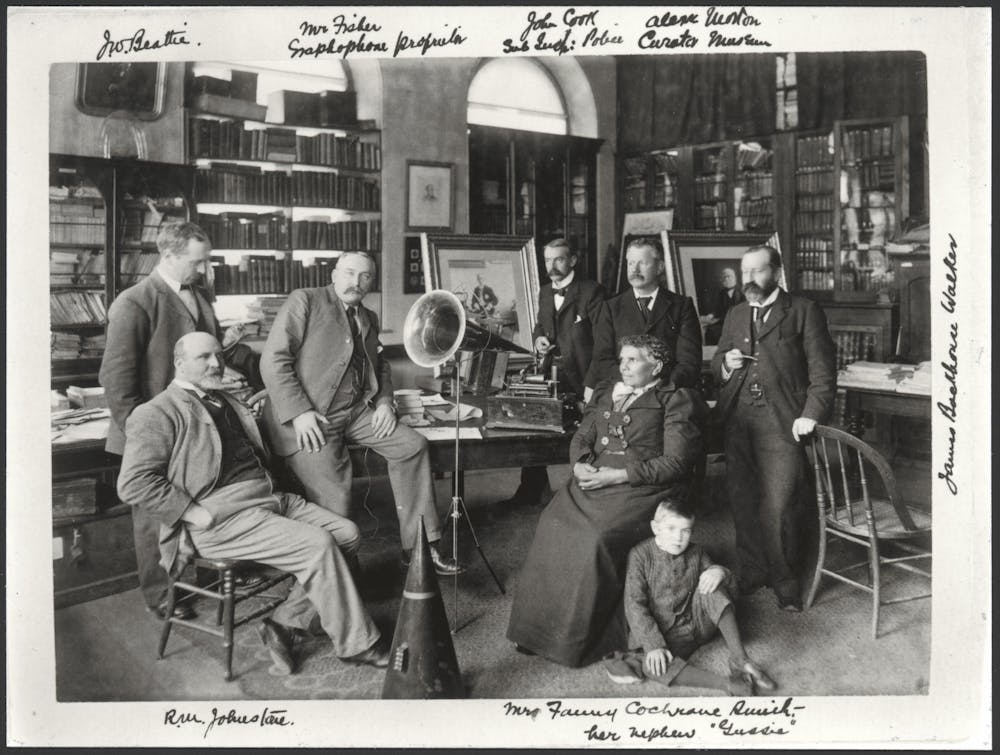
The skeleton and hair of my grandmother’s grandmother, Fanny Smith, were objects of desire for anthropologist and collector Henry Ling Roth of Halifax while she was still alive. In the 1880s and 1890s, it was debated whether Fanny was in fact the “last” Tasmanian Aborigine, and she was particularly noted for her recording of Aboriginal songs on wax cylinders.
Fanny Smith depicted here surrounded by photographer J.W. Beattie, graphophone proprietor Mr Fisher, SubInspector of Police John Cook, museum curator Alex Morton, solicitor and historian James Backhouse Walker, her grandson Gus (erroneously noted as her nephew) and Tasmanian government statistician R.M. Johnstone. Photo: National Library of Australia.
Ling Roth sought help in Tasmania from Quaker James Backhouse Walker and Edinburgh-born photographer and antiquarian James Watt Beattie of Hobart to obtain a photograph of Fanny and a lock of her hair.
Backhouse Walker wrote to Ling Roth on December 20 1891 indicating he “believes Fanny Cochrane Smith is a ‘half-caste’” and advising he might be able to get photographs of her and would ask for a sample of hair, but added, that he “doubts her husband would allow her dissection in the event of her death”.
Fanny lived at a distance from Hobart and there was ongoing difficulty in obtaining the photograph and hair, which was not given up by Fanny until 1894. It was then dispatched by Beattie to Ling Roth.
In 1908, at the request of anatomist Sir William Turner of the University of Edinburgh, Ling Roth sent this sample to him where its physical appearance was discussed along with hair samples from Trukanini and others in a paper concerning “the classification of races based on the colour and characteristics of the hair”.
In the 1990s, following much correspondence between the Tasmanian Aboriginal Centre and the Anatomical Museum at the University of Edinburgh, which had told the centre to “desist from further correspondence”, the hair sample was eventually located and returned.
Traces of Australian ‘kings’: ‘King’ McIntyre and ‘King’ Tiger
As Aboriginal societies had important leaders but no “kings” or singular “chiefs”, European settlers and officials sometimes gave breastplates or “king” plates to chosen individuals in their district, as a means of enlisting their help in dealing with other Aboriginal people.
The earliest example noted was given to Bungaree in Sydney in 1815, and by the 1820s they were in common use. Due to the history of collaboration with settlers, such “king” or “queen” plates elicit mixed feelings among Aboriginal people today.
Perhaps surprisingly, few such plates are in British collections. National Museums Scotland in Edinburgh has one given to “Sandy, King of Coringori Australia” and another in Birmingham Museum and Art Gallery belonged to “King” McIntyre, a senior man of the Manilla region in northern NSW.
A newspaper account in 1874 suggests the reason McIntyre was given the plate was due to his twice saving the life of Mr Thomas Hoskisson of Bareeba Station. He and his family were consequently “made life pensioners, to the extent of a full ration daily”.
“Tiger, King of Mines Lawn Hills” was a senior man living at or near Lawn Hills Station, a place of copper mining inland from Burketown in northwest Queensland in the early 1900s.
One report suggests he died circa 1930 when he was about 60 to 70 years old by drinking water from a can once containing poison. Subsequently his grave was desecrated and breast plate removed by the station owner of Gregory Downs.
His skull and his king plate were sent to the Wellcome Historical Medical Museum in 1935 by Agnes Dorothy Kerr, matron of the Burketown Hospital. Born in England, Kerr had trained as a nurse and worked in New Zealand before serving in the first world war in Egypt and Serbia.
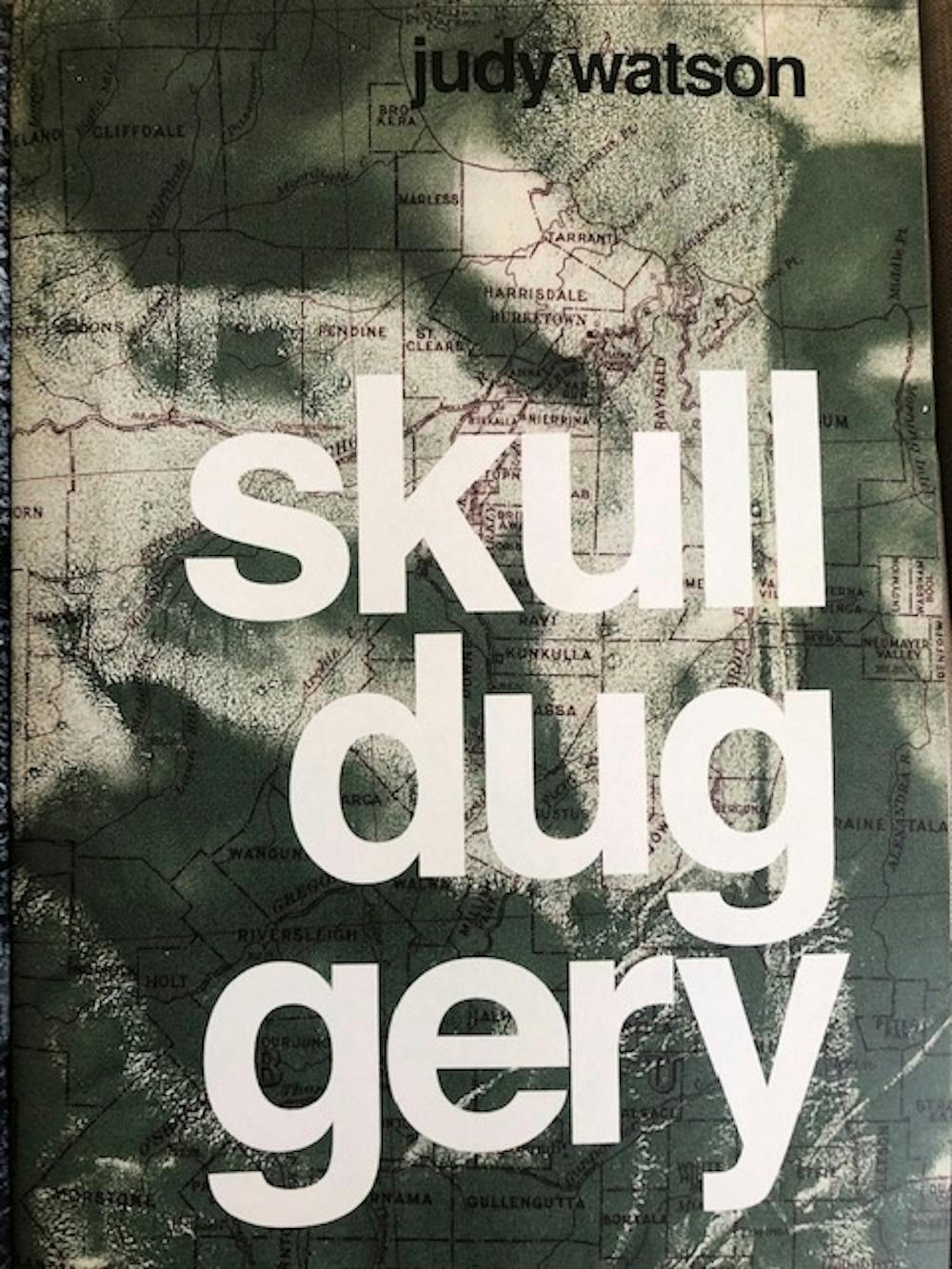
Judy Watson, page 17 from artist’s book skullduggery (2021). Courtesy Judy Watson, digital image Michael Phillips.
Interested in anatomy from her nursing training she sent a number of human remains from northwest Queensland to Sir Henry Wellcome for his collection in London. In 1936, she received a letter indicating Sir Henry would be very glad to have this plate, making a valuable addition to his collections.
The theft of Tiger’s cranium and breastplate and associated correspondence with Kerr was the inspiration for an artwork and publication titled “skullduggery” by Waanyi artist Judy Watson in 2021, bringing attention to the Ancestral Remains and artefacts still abroad.
Judy Watson, title page from artist’s book skullduggery (2021). Courtesy Judy Watson, digital image Michael Phillips.
The return to Country of Ancestral Remains is a continuing aspiration for Aboriginal people and Torres Strait Islanders across Australia. Some museums in Britain still retain Aboriginal human remains but work to return them is ongoing.
Two cremation ash bundles from Tasmania were returned by the British Museum in 2006; it still retains two modified crania requested by Torres Strait Islanders but refused for return by the museum trustees in 2012.
This work is emotionally difficult for those Aboriginal people and Torres Strait Islanders involved, but programs of repatriation continue, albeit sometimes slowly.
Gaye Sculthorpe receives research funding from the Australian Research Council through an agreement with the Australian National University and the British Museum. The British Museum is the publisher of the book in which the full version of this article appears.
In a sensational end to a grotty final 2021 sitting week, former Liberal staffer Rachelle Miller’s claim a minister had acted violently towards her was carefully timed to underline Kate Jenkins’ scathing indictment of the parliamentary workplace.
Education Minister Alan Tudge was forced to stand aside after Miller – who returned to Parliament House to make her statement – accused him of kicking her out of bed when her phone rang at 4am.
She said it happened during a 2017 work trip, when she and Tudge were in a hotel in Kalgoorlie, where then-PM Malcolm Turnbull was also staying.
Miller was Tudge’s media adviser. The two had what Miller has described as a consensual affair, but now says was more complicated. “It was [an] emotionally and on one occasion, physically abusive relationship.”
It’s notable how different Scott Morrison’s reaction has been to this Miller allegation, compared with her earlier complaints about Tudge, made last year on the ABC’s Four Corners.
Morrison pushed those aside, dismissing them as history that had been dealt with. In this instance, he immediately referred the matter to an investigation, to be conducted by Vivienne Thom, former inspector-general of intelligence and security.
Admittedly Miller has now gone a step further in accusing Tudge – who flatly denies the claim – of violence.
But the political difference is the timing. Miller’s allegation follows all that has come out this year about bad behaviour in Parliament House, triggered by Brittany Higgins’ allegation she was raped in 2019, and now documented in the 452-page Jenkins report.
On issues relating to women, Morrison walks among landmines. Thursday’s Miller claim showed how dangerously and unexpectedly one can detonate.
It’s hard to know the extent to which Morrison’s so-called “women’s problem” will cost him votes at the election. But one seat where woman power might be significant is the Sydney marginal electorate of Wentworth, where independent candidate Allegra Spender (the late Carla Zampatti’s daughter) is being backed by female corporate high-flyers including Christine Holgate, the former Australia Post boss.
Holgate accused Morrison of bullying with his extraordinary parliamentary attack on her over rewarding employees with Cartier watches. What goes around comes around.
The Sex Discrimination Commissioner’s description of a noxious political workplace was on show at every turn this week.
Immediately after Tuesday’s release of her report, opposition and government indulged in mutual sledging in question time.
In the Senate, Victorian Liberal David Van was accused of making dog noises when independent Jacqui Lambie was speaking. He apologised for interjecting but denied he’d made any animal sound.
On Wednesday Greens senator Lidia Thorpe made a particularly offensive remark to NSW Liberal Hollie Hughes, saying during an altercation, “at least I keep my legs shut”.
Hughes on Thursday said she took from this “that had I kept my legs shut, I wouldn’t have a child with autism”. Thorpe, who’d apologised, denied the suggestion she was referring to Hughes’ family.
Hughes told Sky: “Everyone – MPs, senators, staffers, everybody – needs to hold themselves to account. We’re adults. This is a professional working environment and people should behave that way.”
To which one might say, “If only.” And, more to the point, one might ask: “Well, why don’t they?”
The Jenkins report has multiple recommendations, based on a forensic review of the culture of the parliamentary workplace.
Both government and opposition loudly lamented the situation she documented, but neither has committed to full implementation of what she has proposed.
Jenkins digs down to the many drivers and risk factors contributing to bullying and sexual harassment, which she identifies as including power imbalances, gender inequality, lack of accountability, bad leadership, confusion about standards, long hours, stress, alcohol, travel and a work-hard-play-hard mentality.
Miller’s account of the Kalgoorlie night appears to have involved a number of these.
But explanations are not excuses, and it’s hard to go beyond a very basic point.
While many parliamentarians – who are at the centre of the Parliament House “ecosystem” – behave well, too many simply don’t believe they need to follow the standards the community has the right to expect of them.
If they conducted themselves properly as well as setting high standards for their staff, Parliament House would be on its way to becoming a half-decent workplace.
One point that’s been made is that politicians, in taking on staff and running their offices, are their own small businesses, but they don’t have the skill set to run these businesses.
That task might be unfamiliar for them, but surely not that hard to get on top of. At least that might be the view of many small-business people around the country, who have to confront their own (albeit different and often more difficult) challenges.
And as for the bad conduct in the chambers, there is just no excuse. It shows massive disrespect to those who pay the parliamentarians’ salaries.
For Scott Morrison the past fortnight has been deeply frustrating, as well as politically risky.
Coalition rebels helped stymie the government’s legislate program, such as it was.
A House of Representatives vote on the Religious Discrimination Bill had to be put off to prevent a revolt by moderate Liberals. This bill will now face two inquiries over the summer.
The government’s promise to introduce legislation for an integrity commission has been turned into a farce by the PM. On the back of the ICAC investigation of former NSW premier Gladys Berijiklian, Morrison has dug in behind the unrevised model, indicating he won’t bring in the legislation because Labor won’t agree to that model, which is widely criticised as flawed.
After everything that has happened this week, and what hasn’t been able to happen, you’d wonder why the government would want parliament to sit again before the election.
Sittings never work politically for this government, and unless it could get its two rebel senators and the two Hanson senators to lift their boycotts on government legislation – they are protesting against the refusal to override state vaccine mandates – and calm other rebels, legislation that was contested wouldn’t get through.
Queenslander Liberal Gerard Rennick, asked on Thursday whether he would continue his boycott into next year, said it would depend on what the federal government did on the mandates between now and then. Hanson’s spokesman had a similar message.
The draft sitting calendar for 2022, issued this week, has parliament returning in February, and a March 29 budget. Morrison can always tear this up in favour of a March election but he’d obviously prefer a budget to set him up for a May poll.
But Health Minister Greg Hunt and former minister Christian Porter were taking no chances, this week both announcing they are not running again.
It might have been a momentous week – in a bad way – but the conversation will abruptly change on Friday, when Labor finally releases its much-awaited climate policy.
It’s stating the obvious to say this is a big day for the opposition, which has had an internal debate over whether to make the policy small target (only a little different from the government’s) or go for something bolder, to amp up the differentiation on the climate issue.
On Sunday Anthony Albanese will hold a rally, with a likely further policy announcement.
“We will make sure we are kicking with the wind in the fourth quarter,” Albanese likes to say. Between now and mid-December, when he is intending to go on holidays, the crowd will be watching how well the opposition leader connects boot and ball.
Michelle Grattan does not work for, consult, own shares in or receive funding from any company or organisation that would benefit from this article, and has disclosed no relevant affiliations beyond their academic appointment.
Charities were relieved to see this, as many faced the prospect of having to pull back on certain advocacy activities.
But this week brought the bad news, with changes to electoral laws passed by parliament that will impose more regulation on charities and other organisations that engage in the electoral process.
Despite intense lobbying by a coalition of charities, a last-minute deal between the Morrison government and the opposition led to the bill’s passage, albeit with some amendments that slightly lessen its negative impact.
What the new law does
One of the main changes in the new law is the introduction of a lower threshold for organisations having to register as a so-called “political campaigner”.
Previously, an organisation had to register as a political campaigner if it exceeded $500,000 in electoral expenditure (money spent on campaigns, advertising and any other advocacy work seeking to influence voters in an election) in any of the past three years. The bill sought to lower this threshold considerably to $100,000.
As part of the deal between the government and opposition, this threshold was changed to $250,000 in the final version of the bill that was passed. This is an improvement on the original proposal of $100,000, but it still means many charities will be captured by the change.
More charities will now be required to register as political campaigners and be subject to the additional reporting obligations this entails, including identifying their larger donors.
Opponents of the bill fear it will act like a spending cap, with charities stepping back from campaigning to not trigger the additional requirements that come with being a political campaigner.
In addition to lowering the threshold, the bill also broadens the type of expenditure that is relevant for determining if an organisation is subject to any reporting and other obligations.
Now, any expenditure related to “preparing for, or participating in, an election” must be counted, but there is no guidance as to what this actually means. This is a significant source of uncertainty for charities, and again may lead many to be more cautious when engaging in the democratic process.
Another problematic element of the bill is the fact it will apply retrospectively to money already spent by an organisation. Charities will have to look back at their spending and see if it constitutes an “electoral expenditure” using the more vague definition now in place, and determine whether this places them in the category of a political campaigner.
Pages and pages of legal advice will be needed, but lawyers won’t have much to go on given the scant detail provided in the bill.
One positive outcome, however, is that “political campaigners” will actually no longer be referred to by this name – the term will change to “significant third parties”.
This is a welcome change, given the term “political campaigner” could lead to people conflating charities and other organisations with political parties – despite the fact they are not seeking elected office and focus on issues-based campaigning.
Advocacy by charities is important and already regulated
Ultimately, the bill is a problem because it will hinder the advocacy activities of charities. And advocacy is one of the key ways that charities can address the root causes of the social and environmental challenges they seek to ameliorate. This often requires changing government policy.
Charities can lobby and campaign to do this – provided they stop short of endorsing and supporting particular parties or candidates.
Advocacy activities can still take place in the context of an election, though. For example, charities can take out advertisements outlining or critiquing the positions of different political parties on issues as diverse as climate change or the amount of JobSeeker payments.
Charities are already regulated when they incur “electoral expenditures”, with the Commonwealth Electoral Act 1918 imposing various obligations on them (and any other organisations similarly involved in the electoral process).
A certain level of such regulation is necessary, in the interests of promoting transparency and integrity in elections. The problem with the bill is that it takes things too far.
A poor process leads to a poor outcome
Otto Von Bismarck is believed to have once said, “Laws are like sausages. Better not to see them being made.”
The statement rings true given the developments this week. The changes to electoral laws were rushed through parliament, without even being referred to a committee inquiry to examine the details of the bill and its implications.
A last-minute deal saw some of the problematic elements of the bill wound back, but what was passed remains deeply flawed.
More charities will now be subject to additional reporting and other obligations under the electoral laws, and there is now more uncertainty about what spending counts as “electoral expenditure”.
This may mean charities will be more reluctant to engage in advocacy, especially where any link can be made between their work and an election. This would lead to less debate about the various social and environmental challenges we confront as a nation.
We need more engagement in our democratic process in Australia, not less, and this bill represents a setback in that regard.
Krystian Seibert was an adviser to a former Australian Assistant Treasurer between 2012 and 2013, where he oversaw the establishment of the Australian Charities and Not-for-profits Commission and its regulatory framework, including the Charities Act 2013. He has provided advice and support to Hands Off Our Charities, an alliance of charities that opposed the bill.
Education minister Alan Tudge has stood aside from his portfolio while a claim by his former staffer Rachelle Miller that he abused her in their relationship, including kicking her out of bed, is investigated.
Miller, who revealed her consensual affair with Tudge on the ABC Four Corners last year, returned to parliament house on Thursday – the final day of the parliamentary year – to make a fresh sensational allegation.
She told of an incident when she and Tudge were in Kalgoorlie in 2017 with then Prime Minister Malcolm Turnbull to announce the cashless welfare card. After a long day Miller, who was media adviser, and Tudge “drank a lot until very late”. About 4am “my mobile phone started ringing. I woke up in the pitch black dark and reached for my phone” to take a call from a media producer about a story that had been lined up for that day.
The producer was seeking an interview with Tudge and “I started to talk to her to arrange a time but I was still half asleep. Then I felt someone kicking me on the side of my hip and leg as I tried to sit up in bed.
“It was the minister – he was furious, telling me to get the fuck out of his bed.”
Miller said she told the producer she’d call back. “Then I realised I was completely naked. He continued to kick me until I fell off the side of the bed and ended up on the floor. I searched around in the dark for my clothes. He was yelling at me that my phone had woken him up. He needed to get some more sleep.
“He told me to get the fuck out of his room and make sure that no one saw me.”
Miller said she had no idea where her room key was, and had to ask reception to cut her a new key.
“I asked him to remind me where my room was,” she said.
When she got to her room, “I sat at my desk in yesterday’s clothes and started answering and making phone calls and emails to arrange the media for the minister that day.
“We had to meet the PM’s team in the foyer in an hour or so. The PM was in the hotel that night.
“I could not remember a single thing from the night before. I don’t remember how we ended up in his room. I don’t remember leaving the bar. I don’t remember if we had sex. I don’t remember if we used protection. I still don’t and I was too afraid to ask if he remembered.”
The next day, after she and Tudge arrived in Melbourne late at night, Tudge did not wait for her or offer her a lift in his car to her hotel. “No thanks. No goodbye,” she said, adding that she had been “completely shattered” by what had happened. She said her allegation was “not about revenge. it has never ever been about that. I still sometimes feel sorry for him. It’s about ensuring that no one else goes through this in this workplace ever again,” Miller said.
“This relationship was defined by significant power imbalance. It was emotionally and on one occasion, physically abusive relationship.”
She looked forward to the people in his seat of Aston “holding minister Tudge to account at the election. Or perhaps the prime minister might show some leadership before that, for it’s his job to hold his ministers to account for their unacceptable behaviour.”
Tudge immediately rejected the allegation. “I completely and utterly reject Ms Miller’s version of events. Ms Miller and I had a consensual affair in 2017 as both of us have publicly acknowledged. This is something I deeply regret,” he said.
In parliament before question time Morrison said that Tudge would stand aside while there was an inquiry.
Morrison said the issues raised were “deeply concerning,” and distressing for Miller, Tudge, and the families affected.
He had discussed Miller’s statement with Tudge who “refuted the allegations”.
Morrison said given the seriousness of the claims, it was “important these matters be resolved fairly and expeditiously”. The issues would be looked at by the prime ministers department through an independent process, using Vivienne Thom, former Inspector-General of Intelligence and Security
The Prime Minister said the inquiry would enable the department to advise him “regarding any implications for the ministerial standards”. Stuart Robert will be acting education minister.
In a subsequent statement Tudge said, “I have accepted responsibility for a consensual affair that should not have happened many years ago. But Ms Miller’s allegations are wrong, did not happen and are contradicted by her own written words to me.
“I regret having to say these things. I do not wish Ms Miller ill but I have to defend myself in light of these allegations, which I reject.
“The contradictory written evidence will be referred to a full, independent review. I welcome such a process and will make available both myself and all materials, and co-operate in every way.
“I would note that a previous set of claims were also considered and rejected through an independent investigation.”
Last year Miller made a formal complaint about Tudge’s behaviour, alleging he acted in ways that made her feel humiliated and belittled. The finance department investigation, with which she did not participate on legal advice – found insufficient to substantiate claims of inappropriate behaviours.
Michelle Grattan does not work for, consult, own shares in or receive funding from any company or organization that would benefit from this article, and has disclosed no relevant affiliations beyond their academic appointment.
Source: The Conversation (Au and NZ) – By Adam Taylor, Early Career Research Leader, Emerging Viruses, Inflammation and Therapeutics Group, Menzies Health Institute Queensland, Griffith University
Researchers around the world are trying to work out whether existing COVID vaccines protect us from the latest variant, Omicron.
The worst-case scenario is the virus has mutated so much in the crucial parts of its genome that it can escape COVID vaccines designed to protect us from earlier versions of the virus – with devastating consequences globally.
But it’s too soon to panic. And vaccines may end up protecting us against Omicron after all, as they have done with earlier variants.
The World Health Organization (WHO) says it will take us another two to four weeks to figure out what’s going on. Here’s what scientists around the world are racing to find out.
The reason Omicron has caused global alarm is due to the number of new mutations throughout the genome of SARS-CoV-2, the virus that causes COVID.
This data, coupled with real world data on the rapid rise in Omicron cases in South Africa, prompted the WHO to designate Omicron a “variant of concern” on November 26.
We’ve already seen some Omicron mutations in other variants.
Individually, some of these mutations have been associated with resistance to neutralising antibodies. In other words, these mutations help the virus evade recognition by an immune system primed with a COVID-19 vaccine.
Some of these individual mutations have also been linked with increased transmissibility of the virus from one person to another.
However, Omicron has many unique mutations. For instance, on the spike protein, the protein used in many current vaccines, Omicron has about 30 mutations compared with the virus that came out of Wuhan. Delta has only ten mutations in its spike protein. So you get an idea of the scale of change.
Investigating the way these multiple mutations interact with one another, rather than individually, will be key to understanding how Omicron behaves compared with other variants.
Looking at these interactions will tell us more about Omicron’s ability to infect cells, cause disease and escape vaccines. And experiments are under way to investigate these mutations and their impacts.
While we wait for the results, we heard this week from some of the vaccine manufacturers. Moderna said its vaccine would be less effective against Omicron than against Delta. Meanwhile, Pfizer/BioNTech said its vaccine would still protect against severe disease. Both companies said they could produce tweaked booster vaccines, if needed.
Why will it take weeks to get answers?
Here’s what researchers around the world are working on and why we won’t have answers for a few weeks.
Growing the virus
Researchers are taking samples of Omicron from infected people and growing the virus in laboratories. This gives them working stocks of the virus to conduct experiments. This can take time as you’re often starting with tiny amounts of virus from a swab.
This process also relies on access to the right types of cells to grow the virus in.
Finally, this needs to be done in laboratories that offer a high level of biosafety, to contain the virus. Not all researchers have access to these facilities.
Make your own ‘virus’
Researchers can also use genetic tools to produce the virus in the laboratory, requiring only the genome sequence of SARS-CoV-2 to begin production. This removes the reliance on patient samples.
They can also produce genetically engineered viruses, called pseudotyped viruses, in the laboratory. These carry only the spike protein of SARS-CoV-2.
Researchers can also express small portions of the spike protein on the surface of other organisms, such as yeast.
All of these options take time to set up, optimise and be used in the types of studies outlined below.
Both methods are useful
Initial studies will look at how Omicron’s mutations impact the fitness of the variant – its transmissibility and ability to evade vaccine-induced immunity.
For instance, initial experiments will look at Omicron’s ability to infect cells. These studies will tell us how well Omicron’s spike protein interacts with the ACE2 receptor, the gateway to infecting our cells. Further studies will investigate how well Omicron can replicate in cells after gaining entry.
Neutralisation studies will investigate how well antibodies – induced by current SARS-CoV-2 vaccines – can neutralise Omicron, or prevent it from infecting cells. Such studies rely on access to serum from vaccinated people and are likely to compare the neutralising capacity of Omicron against other SARS-CoV-2 variants.
Studies are also likely to investigate the effect of vaccine booster regimes and earlier SARS-CoV-2 infection on how well antibodies neutralise Omicron.
So what can we expect? Until we get the results of these experiments, it’s difficult to say for certain.
Studies of how effective COVID-19 vaccines are against other variants show they are generally less able to induce the type of antibody response we’d like to see (neutralising antibodies). However, when previous variants have emerged, vaccines have continued to protect against severe disease.
Vaccine protection is not all or nothing. We are unlikely to get a perfect neutralising antibody response against Omicron, or no response, rather something in between.
Currently fewer than 200 genetic sequences of Omicron have been compiled compared with more than 2.8 million Delta sequences. Delta remains the most dominant variant. So we should continue to use vaccines and therapies we know work against Delta.
It’s also essential we continue with public health measures, such as wearing masks and social distancing, alongside continued vaccination, to combat the spread of SARS-CoV-2 and the emergence of further variants.
“Tik-a-Tok-a-Who?”, was Adele’s response to her management’s suggestion to promote her music to younger audiences on Tiktok, the video-sharing platform owned by Chinese company ByteDance.
“If everyone’s making music for the TikTok, who’s making music for my generation?”, she asked.
Adele might resist, but the platform has nonetheless been popularising and promoting her song Easy on me, with creators using it in almost one million videos in the first month after its release, making it viral on the app alone.
That’s because creator culture on TikTok is changing the way hits are made, how music is promoted, and how the world discovers music, even for those artists who choose not to engage with it.
Living at his sister’s house and feeling bit lonely, in December 2018 he had bought a simple beat for US $30, recorded a song, half country and half rap, and posted it on Soundcloud and social media. The artist made news because Billboard magazine had removed the song from its country charts, after it took off in popularity, entering both the country and general Hot 100 charts.
The artist’s name was Lil Nas X and the song Old Town Road, which has since become the most successful song of all time, the first ever song to reach 15 times platinum. Much of this success can be credited to the song becoming an early TikTok “meme”, picked up by millions of users.
Old Town Road has become the origin story for a remarkable series of viral musical successes on TikTok. In each case artists have shot to popularity, because their songs were used by millions of TikTok users in their videos.
Virality on TikTok is powerful yet unpredictable. Some of 2021’s biggest global hits gained little traction when they were initially released to small audiences. Africa’s most successful pop song ever, CKay’s Love, Nwantiti, was released in 2019, but shot to fame only in 2021 and has now been used in more than 7 million TikTok videos.
Similarly, Australia’s Masked Wolf found himself in the spotlight in 2021, making Barrack Obama’s summer playlist and having been nominated for five ARIA awards. While his song Astronaut in the Ocean became a global hit more than a year into the COVID-19 pandemic, it was released two years prior by a small Australian label. It has since been used in more than 18 million TikTok videos.
And while many artists, like Lil Nas X, create for virality on TikTok, others go viral even when unaware of the platform. We spoke to Masked Wolf who admitted:
I never made Astro to be on TikTok. I didn’t even know what TikTok was when I released Astronaut.
But it is not just new songs. Old songs are making remarkable comebacks with entirely new audiences. When a man named Nathan Apodaca went viral after he posted a video of himself gliding down a highway on his long board, casually drinking cranberry juice from a bottle, he was lip-syncing to Dreams, the 1977 Fleetwood Mac hit. Dreams was subsequently used by millions of TikTok creators and re-entered the Billboard Hot 100 more than 40 years after its original release.
How it works
Videos created on the TikTok app are short. Most videos are less than 15 seconds long (though videos of up to 60 seconds are possible). Music plays a big part in these videos, many show dance moves or lip syncing, though there are others where users talk, even giving financial advice. When users create their videos, they will usually choose a song and select a short clip, often the catchiest bits of a song, like the chorus or beat drop.
Users can upload their own sound clips, but the app will detect copyrighted material that its owners do not allow on the platform and mute the sound. Instead, the app has in recent years put together an extensive catalogue of music authorised by big music labels, who have come on board due to TikTok’s role in producing global hits.
Behind this virality are so-called challenges, in which often millions of users create their own versions of a visual story or dance move set to the same music clip, and promoted by the platform using hashtags. For example, in the #yeehaw challenge that brought Old Town Road to fame, people dressed in normal clothes and danced until the beat changed in the clip, when they would instantly transform into cowgirls or cowboys.
But videos on TikTok do not directly contribute to chart success. However, there is a direct correlation between a song going viral on TikTok and it gaining in popularity on music streaming platforms such as Spotify, Apple Music or YouTube, all of which in turn contribute to the Billboard charts.
What it means for artists, listeners and the music industry
In our research, we spoke to Ole Obermann, Global Head of Music for TikTok and ByteDance, about the impact for artists, the music industry and music lovers. Ole points to the diversity of music on TikTok and new opportunities for finding music far beyond one’s usual taste.
He also stresses TikTok’s role in discovering artists from all corners of the globe: “I do see a pretty profound impact on the global nature of music as a result of TikTok but also music streaming overall. It’s so much more possible for a song that comes out of Australia or India or Korea or Japan or Saudi Arabia. To end up becoming a global hit and to be listened to by audiences all over the world.”
The recent successes of Love Nwantiti and Astronaut in the Ocean are just two examples to make this point.
TikTok is an excellent platform for listeners to gain exposure to new and different music. TikTok’s self-learning algorithm serves up new videos as a seemingly endless stream, allowing users to be exposed to a large amount of new music quickly, given videos are very short. When a user likes a particular song, with a simple tap they can instantly watch more videos set to the same clip.
The music industry is also coming on board, convinced by the viral success the platform produces. Ole Obermann again:
I think the acceptance has come now because that’s what the fans want. And it’s a way to create more engagement with the music, but there was a lot of resistance for many years, because it was just not the way that the music industry has traditionally worked.
The initial resistance is not surprising, given TikTok presents a significant shift from the industry’s understanding of recorded music as something to be listened to, to be passively consumed. Engagement with music on TikTok is very different, because music becomes a material for creation, for creative expression.
Importantly, what we see today is likely only the beginning, both in terms of new forms of creative expression, and promoting and marketing music in new ways.
But success also attracts investment, and creating on TikTok will likely become more commercialised over time. So far much of the virality has happened organically. But music labels increasingly hire professional influencers to use their music, or work with consultants to make songs more “TikTokkable”, in an attempt to engineer the next viral trend.
It remains to be seen if this will crowd out organic creativity, or if artists will feel pressure to create for TikTok virality, as foreshadowed by Adele.
The authors do not work for, consult, own shares in or receive funding from any company or organisation that would benefit from this article, and have disclosed no relevant affiliations beyond their academic appointment.
Source: The Conversation (Au and NZ) – By Erin Smith, Associate Professor in Disaster and Emergency Response, School of Medical and Health Sciences, Edith Cowan University
As Australia braces for another bushfire season, new research from Edith Cowan University has revealed how our volunteer firefighters are still reeling from the effects of the catastrophic 2019/20 bushfires.
Of the nearly 65,000 responders who helped during the Black Summer bushfires in NSW, 78% were volunteers. In our study, 58 of the responding volunteer firefighters shared how the experience had impacted their mental health.
Nearly half reported living with post-traumatic stress symptoms such as flashbacks, nightmares, and anxiety. Some 11% had been diagnosed with post-traumatic stress disorder (PTSD). And 5.5% revealed they had made suicide plans. One described a suicide attempt.
Our findings support other Australian research that found 4.6% of volunteers who responded to the Black Summer bushfires had seriously considered ending their life in the year following the fires.
Yet many don’t seek help. As one volunteer firefighter said:
If the organisation don’t care enough to ask, why am I going to tell them?
Volunteer firefighters felt pressure to seem immune to trauma. Jacob Carracher, Author provided
A cumulative mental toll
Volunteer firefighters described the cumulative impact of repeated exposure to bushfire.
It was a prolonged period of nothing but fire activity, nothing but focusing on that next deployment, that next fire, with very little time to rest and recover. And with each new fire, I noticed that my mental state was taking a bigger hit.
The Australian Institute of Health and Welfare recently reported that in the aftermath of the 2019–20 bushfires, more than half of Australian adults felt anxious or worried about the bushfires and there was a 10–15% increase in calls to the Lifeline crisis support hotline.
But despite the clear impact on well-being among the volunteer firefighters we spoke to, less than half had sought mental health support in the year following the fires. This reveals a lack of progress in supporting the mental health and well-being of emergency responders. One firefighter expressed a feeling of hopelessness:
I haven’t thought about suicide. But I also don’t really care if I live.
Volunteer firefighters felt more supported when they could speak to someone who ‘got it’. Shutterstock
Employee assistance isn’t enough
Experience from the 2009 “Black Saturday” bushfires in Victoria showed the mental health impact on those who respond to major bushfire events is often complex and protracted.
Firefighters and other support personnel were at increased risk of developing PTSD, depression, anxiety and complicated grief compared to the general public and when these issues were inadequately treated, they carried an increased risk of suicide.
Yet some ten years later, firefighter volunteers are still dealing with the same problems.
We saw it with Black Saturday. We saw it again with Black Summer. How many more times do we need to see it? How many more of us need to be injured? How many more of us need to lose our jobs? Our families? Our lives? What will it take for our them [the organisations] to actually value us?
The majority of volunteer firefighters we spoke to felt their organisation hadn’t provided enough of the “right type” of support, with many simply providing a link to an Employee Assistance Program.
While such programs have a role to play, they risk being seen as tokenistic; especially when they are outsourced away from responders who share similar experiences. The duration of access was also a problem; many volunteers reported they could only access three free counselling sessions before having to seek alternative support.
A toxic masculine culture is also associated with many emergency service organisations. Seeking help for mental health is still seen as weak, career-limiting, or even career-ending.
The one time I did actually admit I was struggling, I was told by someone in a leadership position that if I couldn’t hack it, I should hand in my uniform.
There is a perceived need for firefighters to be impervious to the impact of trauma exposure. Only 15% of the volunteers we spoke to who sought help did so via their organisations.
When we asked what would be most helpful for supporting well-being, the message was clear: volunteer firefighters wanted to talk about what they had gone through with someone who “got it”.
The sharing of lived experience offers a different kind of support for many responders who had not benefited from more traditional counselling programs.
The idea of peer support is to harness people’s own lived experience to support others. Peer support has long been provided informally by friends and family and through community support groups and grassroots organisations.
But in recent years, we’ve seen lived experience shared through more formal methods such as clinical settings and community suicide prevention. Research has shown patients supported through the sharing of lived experience are less likely to be readmitted to hospital following acute mental health issues.
A key lesson from the Black Summer bushfires is the need to empower local communities and volunteer organisations to safely and effectively provide peer support.
Leaders need help too, so they can confidently build mental health understanding and foster a psychologically safe culture in their workplace or organisation.
Part of building a psychologically safe environment is reflected in how people show up for one another. For volunteer organisations to be healthy and equitable places where everyone can thrive and feel valued, leaders must focus on creating an environment that reflects these values.
Bushfires will continue to have a devastating impact on our natural environment in the summers to come. We must work to ensure those responding to them don’t suffer the same fate.
The authors do not work for, consult, own shares in or receive funding from any company or organisation that would benefit from this article, and have disclosed no relevant affiliations beyond their academic appointment.
About 650 metres beneath the Latrobe Valley, the heart of Victoria’s coal country, lies a little-known, naturally hot 65℃ pool of water in an enormous aquifer.
This aquifer is a source of geothermal energy – a renewable source of heat or electricity that is, so far, being used to heat an aquatic centre in the town of Traralgon. They chose it – over natural gas, coal-fired power or even emissions-free solar and wind – because geothermal energy is now the cheapest option for heating.
The hot aquifer was first reported as long ago as 1962, when government geologist J.J. Jenkin noted many “occurrences of high temperature waters in East Gippsland”. We now know the hot water underlies about 6,000 square kilometres of Gippsland, from Morwell in the west to Lakes Entrance in the east, and holds the equivalent of A$30 billion of heat at today’s natural gas price.
But with natural gas flowing from Bass Strait, and vast reserves of brown coal in the Latrobe Valley, there has been little incentive to develop alternative energy sources. With the coal era now drawing to a close, it’s time we made better use of this vast, clean source of energy to help cut national emissions and ease the energy transition.
Geothermal energy around the world
The core of the Earth is about the same temperature as the surface of the sun. That vast internal heat is like a hotplate warming natural groundwater from below. Beneath the Latrobe Valley, thick coal layers act like a blanket, which makes the underlying aquifers hotter than aquifers in other locations.
The result is unusually hot natural water without needing to burn any fossil fuels – emissions free. At deeper depths we can capture natural steam, and use it to turn turbines for a generator.
In many parts of the world, natural hot water already provides sustainable, low emissions heat to a wide range of residential and industrial consumers.
In carrying out a recent global scan of energy production from hot aquifers, I learned large parts of suburban Paris are heated by geothermal energy from a hot (56–85℃) aquifer between 1,600 and 1,800m beneath the city.
In the Netherlands, industrial scale greenhouses are replacing their natural gas heating systems with geothermal heat from aquifers, 1,800-2,200m below the surface.
Beijing is one of the world’s leading urban centres using geothermal energy. Wells as deep as 2,600m produce up to 70℃ water for many industrial purposes, from winter heating for hotels and factories, to greenhouse cultivation, to public geothermal bathing pools visited by as many as 50,000 people per day.
On a smaller scale, a town in Hungary circulates natural hot water (64–72℃ from 1,450–1,700m depth) through a network of distribution pipes. And Perth, Western Australia, uses natural hot water (40–52℃ from 750–1,150m) to heat at least 14 leisure and aquatic centres.
Importantly, in almost every case, the water itself is returned to the aquifer after delivering its heat. In other words, water is not consumed in the production of geothermal energy, making it renewable and sustainable.
When compared to geothermal systems around the world, it’s obvious natural hot water beneath the Latrobe Valley, at only 650m depth, is a truly world class geothermal energy resource that has, until now, been largely overlooked.
Beijing is a world leader in geothermal energy use. Shutterstock
A cheaper alternative to gas
It’s a lot cheaper to drill a 650m bore than a 1,500m or deeper bore. This means it’s cheaper to produce geothermal energy in the Latrobe Valley than many places where geothermal energy already provides economic advantage.
In fact, geothermal heat is very likely a much cheaper alternative to natural gas. Since Australia began exporting liquified natural gas out of Queensland in 2015, the wholesale price of natural gas in eastern Australia has roughly tripled and is projected to rise further and remain high.
The higher price of natural gas affects the economy across the whole of Australia. The federal government estimates 40% of energy Australian households use is for heating and cooling, and a further 23% is for water heating. A 2019 report commissioned by the Australian Renewable Energy Agency found 52% of energy used by the nation’s industrial sector is consumed as heat.
But there are other long-term benefits the geothermal energy resource could deliver to the Latrobe Valley.
Victoria’s heavy reliance on natural gas for heat also presents a huge challenge for the state to meet its legislated greenhouse gas emission reduction targets of net zero by 2050.
Under this plan, the remaining coal-fired power plants in the Latrobe Valley are all scheduled to close in the coming years and decades, requiring support for workers to be reskilled.
Producing geothermal energy from hot aquifers can help on both fronts: by avoiding greenhouse-gas emissions and by reemploying skilled workers into new industries.
I’m working closely with a number of stakeholders – including the Latrobe City Council, the Latrobe Valley Authority, the Geological Survey of Victoria, local businesses and community groups – to help realise the potential of this massive, undervalued source of clean energy.
The untapped potential for geothermal energy in the Latrobe Valley.
We seek to better understand and sustainably develop this resource to help Australia meet it’s emissions reduction targets, and to bring the price of energy down.
This includes projects such as mapping, investigating the potential for power generation from deeper hotter rocks, and identifying and clearing policy and regulatory barriers.
The lessons we learn in the Latrobe Valley will carry across to other parts of Victoria and Australia – such as the Mornington Peninsula, Otway coast, and the Great Artesian Basin spanning NSW, Queensland and South Australia – where hot water is known to lie deeper, but still very accessible.
Graeme Beardsmore is a Director of the Australian Geothermal Association and Secretary of the Asia Western Pacific Regional Branch of the International Geothermal Association. He has previously received funding from Regional Development Victoria and the Latrobe Valley Authority to research the geothermal energy potential of the Latrobe Valley.
A View from Afar with Paul G. Buchanan and Selwyn Manning - December 2, 2021.
A View from Afar
PODCAST: Buchanan and Manning Consider the Global Issues that Define 2021
/
RSS Feed
Share
Link
Embed
A View from Afar – In this podcast, political scientist Paul Buchanan and Selwyn Manning consider and analyse the most significant global issues that define 2021. The topics include:
– Leadership: Trump, Putin, Xi, Biden,
– Pandemic: Impact of Covid-19 & variants on global security
You can comment on this debate by clicking on one of these social media channels and interacting in the social media’s comment area. Here are the links:
Threat.Technology placed A View from Afar at 9th in its 20 Best Defence Security Podcasts of 2021 category. You can follow A View from Afar via our affiliate syndicators.
The final days of parliament for 2021 have been marked by a spate of floor crossings.
This includes Tasmanian Liberal Bridget Archer who backed Independent Helen Haines’ integrity commission bill and conservative Coalition MPs voting in favour of a One Nation bill against vaccine mandates. Meanwhile, a group of moderate Liberals spoke out against the the religious discrimination bill, to support LGBTIQA+ rights.
The media have seized on these incidents as a sign of worrying political instability, or rather “a state of chaos”, in a “rudderless” nation.
But this wasn’t always the case. Elected officials crossing the floor on matters of principle used to be seen as a reassuring sign of the health of Australian democracy. What happened?
Missen in action
As part of research I am doing on children rights, I came across former Liberal Alan Missen, who sat in the Senate from 1974 to 1986.
Missen crossed the floor on no less than 41 occasions, mostly in support of civil liberties and human rights, during his parliamentary career.
A group of Coalition senators including Concetta Fierravanti-Wells voted against the government, to support a One Nation bill last week. Mick Tsikas/AAP
This was reported matter-of-factly, with headlines reading “6 cross floor” or “3 cross floor”. Floor crossing in 1977 over “immoral and illogical” policy on East Timor was also soberly reported.
In media accounts of these debates, floor crossing was not equated with instability – as “shambolic”, as one journalist wrote last week. The media assumed elected officials only crossed the floor on questions of principle.
Or as Archer put it, “I don’t take this decision lightly at all. I take this decision very seriously”.
Floor crossing has declined
According to a 2020 study by the Parliamentary Library, there has been a recent decline in floor crossing. In the last 15 years, crossing the floor has not changed the outcome of a single bill or resolution.
Between 1950 and 2019, approximately 23% of MPs and senators crossed the floor at some point in their parliamentary careers, including 295 individual floor crossers. This includes 185 individual Liberals, and 80 Nationals. Only 29 Labor politicians crossed the floor in the period covered by the study, which is perhaps unsurprising, given Labor actively discourages the practice.
The last Labor MP to cross the floor was Harry Quick, who (although a division had not been called), asked that his name be recorded in Hansard as dissenting to draconian anti-terrorism laws in 2004. In the Hawke years, two Labor MPs crossed the floor. Both were promptly suspended from the party.
Harold Holt saw the greatest number of floor crossings compared to any recent Australian prime minister – with 11% of all divisions featuring single or multiple crossings of the floor. Holt is followed by prime ministers John Gorton (7% of divisions) and Robert Menzies (5% of divisions).
In a candid interview in 2005, Fraser told the ABC that even when the Liberals had the numbers in the Senate, they couldn’t be counted on as an “automatic majority”.
What happened?
Floor crossing fell into political disrepute in tandem with John Howard’s rise to power. Though Howard pictured himself as an heir to Menzies, this picture did not include Menzies tolerance for dissent in the ranks of his own party.
Under Howard, MPs crossed the floor in only nine divisions, or 0.3%. In comparison, 0.6% crossed the floor under Tony Abbott, and 3% under Malcolm Turnbull.
This shift was largely a product of the infamous “kneecapping” pre-selections of the late 1980s and 90s, with the right pushing out the so called “wets” or moderates.
Perhaps the most famous of these revolts were those led by Ian Macphee – who crossed the floor in support of the Hawke government’s non-discriminatory immigration policy in 1988. As Macphee later recounted: “most of us [who crossed the floor] lost our party preselection the following year”.
From then on, floor crossing was largely confined to maverick right-wingers and Nationals, such as Barnaby Joyce and Bob Katter.
Perhaps this is how media perceptions of dissent changed. Floor crossing appeared to be a madcap stunt, rather than an ethical stance.
Until principled MPs such as Archer decided they would cross the floor on questions of integrity.
Camilla Nelson receives funding as EG Whitlam Research Fellow at the Whitlam Institute.
Opposition leader Matthew Wale has rejected the prime minister’s claim that he and other opposition members were behind last week’s rioting in the Solomon Islands capital of Honiara.
Wale claimed that the false statements were aimed towards diverting the public’s attention from Prime Minister Manasseh Sogavare’s “own failures” in dealing with the crisis.
Wale said Sogavare “must recognise his role in this tragedy”.
“These recent events are the culmination of the prime minister’s leadership style which stretch back throughout his tenure,” the opposition leader said.
Wale said he had repeatedly made calls for the prime minister to initiate dialogue with the restless province Malaita.
“I have stated on several occasions the need for the prime minister to have constructive dialogue with Malaita,” he said.
“In light of the deteriorating relationship between the province and national government, I specifically urged the prime minister last year to lead a delegation to Malaita to deal with their issues’.
Sogavare had failed to do this.
‘Negative attitude’ “His negative attitude to deal with these issues is also reflected in the recent events when he ran away and refused to engage in dialogue with the people who marched to Parliament.”
Reflecting on the damage from the rioting, Wale said that what had happened in the last few days was truly a tragedy.
“As a leader, I lament with the people who have suffered losses and condemn what has happened.
“Because of the large damage that has occurred these past days, the public’s impulse to blame someone is understandable.”
The Central Bank of Solomon Islands (CBSI) estimated the loss to the local economy at $US28 million. Three people died in the Chinatown fires.
The prime minister must not take advantage of this and divert the public’s attention from his actions and omissions which had directly contributed to the problem, Wale said.
The opposition leader called on the prime minister to “stop blaming others” for his own failures and “take responsibility as a true leader”.
NZ peacekeepers RNZ Pacific reports that the New Zealand government is deploying dozens of Defence Force and police personnel to Honiara in the coming days “to help restore peace and stability”
Since rioting and looting started in the Solomon Islands last week, Australia, Fiji and Papua New Guinea have sent about 200 troops and police to help keep the peace there.
From Auckland Tāmaki Makaurau in Aotearoa New Zealand to Paris, France, and from Wellington Te Whanganui-a-Tara to Jayapura and far beyond, thousands of people across the world today raised the Morning Star flag — banned by Indonesian authorities — in simple acts of defiance and solidarity with West Papuans.
They honoured the raising of the flag for the first time 60 years ago on 1 December 1961 as a powerful symbol of the long West Papua struggle for independence.
One of the first flag-raising events today was in Wellington where Peace Movement Aotearoa and Youngsolwara Pōneke launched a virtual ceremony online with most participants displaying the banned flag.
Green MP Teanau Tuiono … indigenous solidarity for West Papuans. Image: APR screenshot
Hosted by Victoria University Pacific studies lecturer Dr Emalani Case, a Hawai’an, many young Pacific Islanders spoke of the indigenous struggle in West Papua and their hopes for eventual independence.
“Here in Aotearoa, we have the opportunity and the privilege of being able to raise the flag without being punished for it,” Dr Case said.
Two Green MPs — Teanau Tuiono and Eugenie Sage — were also among the “flag-raisers”, declaring their solidarity with the Papuan self-determination struggle.
Asia Pacific Report editor Dr David Robie and Del Abcede were among those who spoke.
In six decades of brutal civil conflict, hundreds of thousands of lives have been lost through combat and deprivation, and Indonesia has been criticised internationally for human rights abuses, reports Stefan Armbruster of SBS News.
In Australia, the Morning Star flew in activist Ronny Kareni’s adopted hometown of Canberra.
Asia Pacific Report’s Dr David Robie and Del Abcede … messages of West Papuan support. Image: APR screenshot
“It brings tears of joy to me because many Papuan lives, those who have gone before me, have shed blood or spent time in prison, or died just because of raising the Morning Star flag,” Kareni, the Australian representative of the United Liberation Movement of West Papua (ULMWP), told SBS.
“Commemorating the 60th anniversary for me demonstrates hope and also the continued spirit in fighting for our right to self-determination and West Papua to be free from Indonesia’s brutal occupation.”
West Papua’s Ronny Kareni … “Commemorating the 60th anniversary for me demonstrates hope and also the continued spirit in fighting for our right to self-determination.” Image: SBS
Indonesia’s diplomats regularly issue statements criticising the flag protests, including two years ago when the flag was raised at Sydney’s Leichhardt Town Hall, as “a symbol of separatism” that could be “misinterpreted to represent support from the Australian government”.
No response to questions about the flag’s 60th anniversary had been received by SBS News from the Indonesian embassy this year and community members and groups declined to comment.
“It’s a symbol of an aspiring independent state which would secede from the unitary Indonesian republic, so the flag itself isn’t particularly welcome within official Indonesian political discourse,” said Vedi Hadiz, an Indonesian citizen and director of the Asia Institute at the University of Melbourne.
“The raising of the flag is an expression of the grievances they hold against Indonesia for the way that economic and political governance and development has taken place over the last 60 years.
“But it’s really part of the job of Indonesian officials to make a counterpoint that West Papua is a legitimate part of the unitary republic.”
The history of the Morning Star After World War II, a wave of decolonisation swept the globe.
The Netherlands reluctantly relinquished the Dutch East Indies in 1949, which became Indonesia, but held onto Dutch New Guinea, much to the chagrin of President Sukarno, who led the independence struggle.
In 1957 Sukarno began seizing the remaining Dutch assets and expelled 40,000 Dutch citizens, many of whom were evacuated to Australia, in large part over The Netherlands’ reluctance to hand over Dutch New Guinea.
The Dutch created the New Guinea Council of predominantly elected Papuan representatives in 1961 and it declared a 10-year roadmap to independence, adopted the Morning Star flag, the national anthem — “Hai Tanahku Papua” or “Oh My Land Papua” — and a coat-of-arms for a future state to be known as “West Papua”.
The Dutch and West Papuan flags fly side-by-side in 1961. Image: SBS
The West Papua flag was inspired by the red, white and blue of the Dutch but the design can hold different meanings for the traditional landowners.
“The five-pointed star has the cultural connection to the creation story, the seven blue lines represent the seven customary land groupings,” Kareni told SBS.
The red is now often cited as a tribute to the blood spilt fighting for independence.
Attending the 1961 inauguration were Britain, France, New Zealand and Australia — represented by the president of the Senate Sir Alister McMullin in full ceremonial attire — but the United States, after initially accepting an invitation, withdrew.
Morning Star raised for first time The Morning Star flag was raised for the first time alongside the Dutch one at a military parade in the capital Hollandia, now called Jayapura, on December 1.
On December 19, President Sukarno began ordering military incursions into what he called “West Irian”, which saw thousands of soldiers parachute or land by sea ahead of battles they overwhelmingly lost.
With long supply lines on the other side of the world and waning international support, the Dutch sensed their time was up and signed the territory over to UN control in October 1962 under the “New York Agreement”, which abolished the symbols of a future West Papuan state, including the flag.
The Morning Star flag in Paris, France. Image: AWPA
The UN handed control to Indonesia in May 1963 on condition it prepared the territory for a referendum on self-determination.
The so-called Act Of Free Choice referendum in 1969 saw the Indonesian military round up 1025 Papuan leaders who then voted unanimously to become part of Indonesia.
The outcome was accepted by the UN General Assembly, which failed to declare if the referendum complied with the “self-determination” requirements of the New York Agreement, and Dutch New Guinea was incorporated into Indonesia.
In 1971, the Free Papua Movement (OPM) declared the “republic of West Papua” with the Morning Star as its flag, which has gone on to become a potent binding symbol for the movement.
“It’s a milestone, 60 years, and we’re still waiting to freely sing the national anthem and freely fly the Morning Star flag so it’s very significant for us, ” Kareni said.
“We still continue to fight, to claim our rights and sovereignty of the land and people.”
Morning Star flag-raising at a public lecture by Professor David Robie at Griffith University’s Brisbane campus before the in October 2019 before the Melanesian Media Freedom Forum (MMFF) conference. Image: Griffith University
Incoming new vice-chancellor for Te Wānanga Aronui o Tāmaki Makaurau Auckland University of Technology (AUT) Toelesulusulu Dr Damon Ieremia Salesa is keenly aware that he has broken through another glass ceiling.
The son of a factory worker made New Zealand history last week, as the first Pacific person to be appointed to the eminent leadership position in academia at a New Zealand university.
“I’m really excited to be the AUT vice-chancellor and with that excitement comes a sense of its significance with the sector which I work in and have given much of my life to, actually looking like the people it serves. So I’m really excited to be part of that story,” Toelesulusulu told Asia-Pacific Report.
“AUT is a place where talent can find opportunity and I would hope that lots of other people would want to express that excitement by wanting to come to AUT,” he says.
“What matters more is the work of the whole institution, that the university itself embraces its many different communities, its Māori students, its Pacific students and already AUT is a little bit known for that and what we can do is to build even more deeply on that.”
Professor Steven Ratuva, director of the Macmillan Brown Centre for Pacific Studies at the University of Canterbury, says Dr Salesa’s appointment is a significant milestone for the Pacific.
“It is something he richly deserves, and he has been working hard for and it is a good career choice, it is good for the Pacific academic community, and I congratulate him for his contribution to Pacific education.”
South Auckland priority Currently pro-vice-chancellor Pacific at the University of Auckland (UOA), Dr Salesa takes up his new role as vice-chancellor at AUT in March.
From just up the hill at UOA, he has observed AUT, and likes what he saw.
“I’ve really admired the way AUT prioritised and served its students, particularly the students of South Auckland and mature students, and that is one of reasons I was really interested in the job,” he says.
“Just because those communities of learners for whom education really matters, AUT has really embraced them and that is part of what is exciting about AUT — that is why I wanted to come across and join AUT.
“There is no question that the campus down south and campus on the shore bring universities into the communities that they serve and as well as being global institutions they are local institutions.
“If you have heart to service and you keep the students at the very centre of the decisions you make, you get great results like you see AUT deliver in South Auckland and the North Shore,” he says.
Strengthening Māori and Pacific research Pacific and Māori research is one area he wants to strengthen as well as build relationships with other institutions in the Pacific.
“Certainly, one of the things I have as a priority is to make sure that AUT is in all of the partnerships that it needs to be in, that we are serving our communities and our partners as well in a reciprocal relationship from which everyone grows.
“That will mean we have to be a little bit selective, but it will also mean that Pacific partnerships and other partnerships are critical to the very centre of the university, and they are not seen as being marginal because we’re a university in the middle of the South Pacific.
“We need to honour that and be connected to our whanau around the Pacific.
Toeolesulusulu Dr Damon Salesa … ““We need to honour … and be connected to our whanau around the Pacific.” Image: RNZ
“It is absolutely important that we are having those conversations, we need to understand how we can support the University of the South Pacific (USP) and their work, how we can find benefit and value for New Zealand and AUT students and staff from those relationships, so certainly we will be taking that seriously.
“But certainly, USP is a special institution in our region, so we need to be strategic in how we support and partner with them.”
Associate Professor Shailendra Singh, head of journalism at USP, says “as many have pointed out, the appointment is well deserved. He was not given any preference as a Pacific Islander. He was picked on merit.
A Pacific ‘trailblazer’ “As a trailblazer, he will inspire many Pacific Islanders and Pacific people beyond New Zealand as the vice-chancellor of one of the finest universities in our region.
“Through my association with the Pacific Media Centre (PMC), I have participated in AUT journalism-related workshops, seminars, and conferences.
“I have a high regard for the AUT and the PMC, long a flagship of the university for its cutting-edge research and publications in Pacific journalism.
“I hope the PMC is revived as journalism in the region has been struggling due to economic and political factors. Pacific journalism needs support and leadership and AUT can become the beacon it was,” Associate Professor Singh says.
Dr Salesa was in the dark about the PMC which has now been in hiatus for almost a year for unknown reasons.
“I’d have to learn more about that, I don’t know the ins and outs of that situation, but these are things that have to be collaborative, they have to be built with the kind of collective will and expertise of the university especially.
“There is no question that AUT will be prioritising Māori research and Pacific research among its other amazing specialisations,” Dr Salesa says.
AUT ‘anchored in Pacific’ “AUT will always be anchored in the Pacific region and obviously has a long history of educating people from the Pacific region and we hope to continue and deepen that.
“Those partnerships will speak directly to AUT’s future, and this is a period in time where everyone is just hoping for the best possible outcome for USP, and we will be looking to support in ways that make sense for them and AUT.”
Dr Salesa is testament to the fact that people of a Pacific background or ethnicity can succeed and excel — not just in sport, but in every facet of society.
“I think we’ve always known, as the saying goes, talent is everywhere, but opportunity isn’t — and what AUT is the story of, is making opportunity available to diverse groups of talented people.
“We know if you make opportunities available to those who have been denied them, they will flourish if they are supported in the right way.
“I have no doubt what people will see in my own story is that the kinds of diverse talent we have in New Zealand that too often we haven’t made the most of, can come to AUT and thrive.
“I hope that people see in that all kinds of stories because I am also the son of a factory worker, and I am also a first-generation university attendee people can understand that when talent gets opportunity and support it drives them and that’s what I am hoping you’ll see and that is what success at AUT is all about and its story,” the Auckland suburb of Glen Innes-raised Dr Salesa says.
Education pathway A strong advocate for education, he wanted young Māori and Pasifika people to pursue that pathway rather than young school leavers joining the workforce.
“We know that education is one of the proven pathways to wellbeing and prosperity for families, and that at the same time we know that many families need their young people to go out and work.
“So, it is absolutely critical that we find ways to get talented young Pacific, Māori and other students into high value employment and education is one of the ways of doing that.
“What we need is for them to be ambitious, to have high expectations of themselves and their families and it is for AUT and other universities to deliver that transformational learning which is the secret to those strong and prosperous futures,” Dr Salesa says.
Transformative learning allowed people to change and have more than one career.
“We know all of us are living in the most uncertain and highly changeable times. In the old days everyone imagined they would have just one career and many people now are realising they might not only change jobs but change careers and they have also come to realise that in many, many of our jobs technology sits at the centre of opportunity and the ability to be effective.
“AUT is the kind of institution that is built for these times, it offers all sorts of flexible learning offerings and a truly diverse student body and it is New Zealand’s tech university.
Transformative learning “So transformative learning is the kind of learning that actually transforms individual students lives where you can see outcomes writ large and that’s what I’m hoping to support further development at AUT so that people understand AUT is a great place to go, to study and get a great job but also prepare themselves for a great future,” Dr Salesa says.
Then there was the inevitable vexed question, whether it was time for another university, namely AUT, to start a new medical school? To which he played with a straight bat.
“At the moment AUT is one of the great providers of the health workforce in New Zealand and certainly for the short term we will be focusing on doing an even better job of doing that.
“Delivering a health workforce and the health researchers that New Zealand needs. That is obviously a critical contribution in the age of the pandemic, but again that will be built collaboratively with my colleagues at AUT.
“I think it is a very challenging time for universities across the board and particularly where next year is going to be where students have had two years of lockdown learning in Auckland so we have to make sure that the university can support them in their ambitions to be successful at AUT.
“That is going to be one of the great challenges, not just facing AUT, but all the tertiary providers that have suffered lockdowns in Auckland.”
The New Zealand government is deploying dozens of Defence Force and police personnel to Honiara in the coming days “to help restore peace and stability”.
Since rioting and looting started in the Solomon Islands last week, Australia, Fiji and Papua New Guinea have sent troops to help keep the peace there.
An initial NZDF team of 15 will join them tomorrow, followed by a larger group of 50 at the weekend.
New Zealand Prime Minister Jacinda Ardern said the response was short-term and to help restore peace and stability.
“New Zealand is committed to its responsibilities and playing its part in upholding regional security.
“We are deeply concerned by the recent civil unrest and rioting in Honiara, and following yesterday’s request of the Solomon Islands government, we have moved quickly to provide urgent assistance.
Samoan police are also on standby to send personnel to assist peacekeeping forces.
Unrest stemmed from protest The unrest stemmed from a protest calling for the removal of Prime Minister Manasseh Sogavare that spilled over into rioting and left major destruction in the capital.
A government statement said the destruction of local businesses was done by “heartless people with selfish agendas”.
It warned that instigators were planning a next phase of unrest, including the declaration of Malaita province as an independent state.
Malaita’s provincial Premier Daniel Suidani, whose administration has fallen out with the national government, denies claims that he instigated the unrest.
Malaitans played a central role in last week’s protest before opportunists and looters co-opted the mobilisation into major unrest.
Premier Daniel Suidani of Malaita province … denies claims that he instigated the unrest. Image: Daniel Suidani/Provincial Facebook/RNZ
Ringleader statements on Facebook The government statement said it was aware of reports that ringleaders behind the unrest were openly stating on Facebook that “in order to build a new house, the old house must be first destroyed”.
“Such statements are not helping the volatile situation we are currently experiencing in Honiara,” the statement said.
“To the peace loving and right minded Malaitans, we should ask ourselves whether we are comfortable with the violent advocators to lead our people to an independent state.”
However, the national government said it was encouraged by “the wisdom of the majority of our citizens not to employ violence, looting or threatening tactics to impose one’s evil plan of decimating Honiara city, the capital of Solomon Islands”.
This article is republished under a community partnership agreement with RNZ.
Fiji is the latest regional country to announce it is sending security forces to Solomon Islands where major unrest rocked the capital.
Days of rioting in Honiara by mobs who torched buildings and looted shops prompted the government to call for outside help.
In what’s shaping up as a Pacific regional response, Fiji yesterday deployed 50 soldiers to help keep the peace in Honiara, with 120 more troops on standby.
They follow last week’s deployment of more than 100 Australian defence force and police personnel, as well as 37 Papua New Guinea police and correctional service forces.
Canberra has been playing a co-ordinating role with the other Pacific nations. New Zealand is also part of the conversation, although its role appears minimal at this stage.
Signs from both Australia and PNG indicate that, provisionally, their forces are expected to be in Solomon Islands no longer than a month.
The Fiji military unit is deploying as part of a reinforcement platoon embedded with the Australian contingent in Honiara.
120 troops on standby According to the Fiji government, another 120 Fijian troops are on standby if required.
Over three days last week, many buildings were torched in Honiara’s east, particularly its Chinatown area — leaving at least three people dead.
The unrest had spiralled from a protest against Prime Minister Manasseh Sogavare last Wednesday.
By the weekend, law and order was largely restored in Honiara due to the reinforcement of local police capabilities due to the peacekeepers from Australia and Papua New Guinea.
On Monday, the Solomons Parliament met briefly — amid tight security — to pass two motions. One was for the routine extension of the State of Public Emergency in place since the start of the covid-19 pandemic.
The other was to authorise expenditure for the massive loss and damage caused by the riots — estimated at US$28 million.
Despite the resignation of four government MPs last week, and calls for him to stand down to restore control in the country, Prime Minister Manasseh Sogavare still commands a clear majority in the House.
Solomon Islands Parliament … still a clear majority for Prime Minister Manasseh Sogavare. Image: Koroi Hawkins/RNZ
‘Melting pot of the country’ The MP for Central Guadalcanal, Peter Shanel Agovaka, who is also Communications and Aviation Minister, said each time a group of people from outer provinces who were unhappy with the government, they tended to come to Honiara and destroy local business houses.
“I think people from other provinces should respect that as hosts of this capital we allow people of all provinces, and all denominations and all races, to come here.
“This is the melting pot of the country, and to see it in ruins like this is really very sad.”
According to Shanel, a lot of households had been affected.
“Eighty to 90 percent of Chinatown is burnt down. This is really sad, because these are innocent people,” he said.
“The way to remove a prime minister is through the parliamentary process. It’s not through the burning of businesses or private properties and looting them.”
Capital’s schools close All schools in the Solomon Islands capital have been ordered to close early as a result of the widespread destruction caused by last week’s unrest in Honiara.
Education Secretary Dr Franco Rodie said the decision was reached after consultation with the heads of various schools and taking into consideration parents concerns for the safety of their children.
Dr Rodie said thankfully most major exit examinations had already been conducted and in class assessments will have to be taken into consideration for everyone else.
State of emergency Forty-one out of 49 members of Parliament on Monday yesterday voted in favour of the four-month-extension, as proclaimed by the Governer-General, Sir David Vunagi.
Opposition leader Matthew Wale asked for clarification on the covid status of emergency personnel from Australia and Papua New Guinea brought in because of last week’s riots.
Health Minister Culwick Togamana said all foreign security personnel were double vaxxed and tested negative for covid-19 upon departure and again on arrival in the country.
Togamana also expressed disappointment in the poor uptake of vaccines with less than 20 percent of the population fully vaccinated.
Clean-up time after the riots in Honiara. Image: Fijian community, Honiara/RNZ
Clean-up underway The clean-up in Honiara is underway and church and community groups are turning up to clear the wreckage from last week’s rioting.
However, the riots have created a shortage of food and RNZ Pacific correspondent Elisabeth Osifelo said there had been long queues for the shops that were open, as well as for petrol and at ATMs while banks remain closed.
“The prices have sllightly gone up with rice and so it just depends on where the shop is,” she explained.
“I found out towards the eastern parts of Honiara because I think the shops are very limited that the prices have gone up and varying on different items as well.”
Solomon Islands police have confirmed the identity of the three bodies recovered from a building burnt in Chinatown during the violence — an adult and two children.
This article is republished under a community partnership agreement with RNZ.
When New Zealand switches to the COVID-19 Protection Framework tomorrow, people will have to present vaccine passes to access many public spaces and venues.
At this point, more than 2.4 million people have downloaded their official vaccine passes, which represents almost 70% of the 3.6 million people who are fully vaccinated.
The transition will likely exacerbate inequities that have already emerged during the vaccine rollout itself, and discriminate against vaccinated but “digitally excluded” people who have limited access to email or phone apps to carry a vaccine pass. People can now get their passes in person at some pharmacies, which helps but does not fully solve the problem.
Another major concern is the integrity of how we use and verify vaccine passes. Businesses and venues have different choices in how strongly they verify the legitimacy of the pass itself and whether or not they request an ID to verify the identity of the vaccine pass holder. This can make all the difference in how effective the system will be in reducing the spread of the virus.
Verifying vaccine passes
Last week, the government passed legislation under urgency to enact a “traffic light” system, which places regions under certain settings. Under red and orange settings, many venues will only be open to fully vaccinated people who can present proof of vaccination.
The vaccine pass includes a QR code which can be presented on paper or on a smartphone. So far, the government has said the minimum requirement is only to visually check the pass. The next level of verification would be for staff to use the official NZ Pass Verifier app to scan the QR code to ensure the pass is legitimate, and that the details printed on the pass match the details encoded in the QR code.
But the highest level of verification is to ask for a photo ID to make sure the person carrying the pass is the person named on it. Taking all three steps provides the highest confidence the person is vaccinated.
Almost 70% of fully vaccinated New Zealanders have downloaded their vaccine passes. Phil Walter/Getty Images
Understandably, some venues will consider this too much hassle or impractical. Requiring a photo ID will also discriminate against people who are fully vaccinated but may not have an ID (such as under-18s or people who have no need for one) or those who may not have a photo ID in their preferred name.
In my opinion, venues that are required to check for vaccine passes need to scan the QR code to lift confidence that the pass is legitimate. Otherwise, it is simply too easy to fake a vaccine pass.
Another challenge is that individuals also need to continue scanning in with their contact-tracing app (preferably NZ COVID Tracer). These apps are generally designed as anonymous systems and all of the data stays on the user’s device.
The vaccine pass verifier app inherently needs to know the identity of the person, and it operates on the venue’s device, which doesn’t store any of the data and works offline. This is why the two apps and functionalities cannot be combined into one.
Inevitably, people will have to provide a vaccine pass and possibly a photo ID to confirm they are allowed to enter. Then the visitor will also have to scan in to keep their own record for contact tracing. It might be annoying, but that’s what we have to do to keep ourselves safe.
The official pass verifier app does not store any data, but there might be some exceptions in which certain businesses create their own apps.
Examples include ticketing, where a person’s vaccination status may have to be verified at the time of purchase rather than entry to the venue. Businesses with repeat customers, such as gyms, may also want to keep a record of their customers’ vaccination status to avoid having to check their pass each time they enter.
The COVID-19 protection framework legislation includes privacy protection that ensures information about people’s vaccination status can only be collected, used or disclosed for the purposes of managing COVID-19, with heavy penalties for breaches.
Are vaccine passes effective?
One major question is whether the passes actually mitigate the risk to public health.
Evidence from other jurisdictions suggests vaccinated people transmit COVID-19 less than unvaccinated people, hence the effort to prevent unvaccinated people from entering venues to avoid the spread of the virus. But in a New Zealand context, it remains to be seen whether or not the vaccine passes are effective at suppressing the reproduction rate.
The government has been using vaccine passes as an incentive for people to get vaccinated by preventing unvaccinated people from accessing venues they might otherwise want to enter. But this motivation expires when we reach a sufficient percentage of people who are vaccinated – and simply aiming for a vaccination percentage raises ethical issues.
We should keep coming back to the public health reasons for why we need people to be vaccinated and why we separate vaccinated and unvaccinated individuals. And to uphold that, we have to make sure vaccine passes are used effectively.
This means, at the very least, scanning the QR code to check the passes are legitimate. And we have to reduce the barriers for people to get their vaccine pass so they aren’t excluded for the wrong reasons.
Vaccine passes come at a cost. It’s a cost financially to the government and taxpayers in developing the system. But there’s also a cost socially in terms of exacerbating inequities, and a cost ethically in terms of privacy and restrictions on people’s freedom of movement.
If we were to weaken the system to the extent that people can easily fake a vaccine pass, then we aren’t separating vaccinated and unvaccinated individuals effectively and make no progress towards mitigating public health risk. That would mean the existence of vaccine passes is not justified.
Andrew has provided independent advice to the Ministry of Health and the Department of Prime Minister and Cabinet as an academic but is not paid by them.
Source: The Conversation (Au and NZ) – By Michael Westaway, Australian Research Council Future Fellow, Archaeology, School of Social Science, The University of Queensland
Around the time the recommendations were made, Queensland’s Aboriginal Cultural Heritage Act faced an important test when a pastoralist who cleared 500 hectares of bushland at Kingvale Station in Cape York was charged with failing to protect Aboriginal cultural heritage.
The charges were eventually dismissed but the prosecution, the first of its kind in Queensland, highlights weaknesses in the law.
Like related legislation in other Australian states and territories, Queensland’s law requires landholders to conserve Aboriginal heritage sites or risk prosecution.
But the law has been criticised by many Aboriginal people and heritage specialists for allowing destructive development by removing any ability for government to independently assess how proposed clearing would affect Aboriginal heritage.
Under the “duty of care” provisions in the Act, Aboriginal heritage must be protected even if it is not known to landholders. However, as the Kingvale clearing case heard, if Aboriginal heritage is not known, how can it be shown to have been lost?
In 2013, the former Newman government in Queensland removed protection for the environment by introducing the Vegetation Management Act which enabled clearing of what they deemed as “high value agricultural projects” in Cape York.
The World Wildlife Foundation argued this would see large areas of forest and bushland destroyed. Advocates for the new Act argued primary producers are “acutely aware of their responsibility to care for the environment”.
In opening up new areas of Cape York to clearing, this legislation posed new threats to heritage sites. In this context the landholder of Kingvale decided he did not need to assess cultural heritage when clearing 500 hectares.
At the conclusion of the hearing into this case, Judge Julie Dick of the Cairns District Court instructed the jury to return a not-guilty verdict, exonerating the landholder, as the offence could not be proved beyond reasonable doubt.
The landholder’s legal team noted in the media if their defendant had been found guilty, every landholder (including freeholders) who had cleared land, built a fence or firebreak, ploughed a paddock, or built a road or airstrip since 2003 would potentially be guilty of a criminal offence.
The defendant argued the ramifications of the legal case were significant
for the rest of Queensland […] anyone who mowed a lawn or cut down a tree since 2003 would be automatically liable.
In our view, this is hyperbole. Section 21 of the Act makes explicit a person’s right to enjoy the normal and allowed use of their land to the extent they don’t harm Aboriginal heritage.
Further, a person doesn’t commit an offence if they take into account the nature of the activity and the likelihood of it causing harm. Mowing the lawn is quite different to clearing 500 hectares of native vegetation.
The setting of this activity is also important. Kingvale Station is located 100 kilometres west of the national heritage listed Quinkan Country. Heritage studies in similar landscapes across Cape York have identified scarred trees, artefact scatters, stone arrangements and cultural burial places.
Based on our heritage experience across Queensland, it would be surprising not to find Aboriginal heritage sites at Kingvale.
To reduce heritage risks, we assess the potential impacts of an activity, and talk with relevant Aboriginal groups about their sites and heritage values. Archaeologists and anthropologists also develop models to predict where unknown sites are likely to be found.
Recorded archaeological sites across Cape York. The distribution pattern reflects several key heritage surveys. It is expected that cultural sites would be found across the cape, including within the 500 hectares cleared at Kingvale. Image by Kelsey M. Lowe.
Can farming and the conservation of Aboriginal heritage co-exist?
The best way to conserve heritage is for Aboriginal and non-Aboriginal Australians to work together to identify, document, and protect places. An important example is the discovery of human remains from a mortuary tree west of St George, southern Queensland.
The site was discovered during fence clearing by the landholder, who contacted the police. We worked with the landholder who has supported the Kooma nations people to conserve the mortuary tree and enable it to remain on country.
Courtesy of Tony Miscamble, NGH Consulting.
A further example from Mithaka Country saw a spectacular stone arrangement discovered by a pastoral station manager, who notified the native title holders.
Dozens of other examples around the state illustrate collaborative approaches to heritage conservation. But more effective legislation is urgently needed in response to Kingvale’s failed prosecution.
A spectacular stone arrangement from Mithaka country. Image courtesy of Lyndon Mechielsen
How can we improve cultural heritage protection?
The Juukan Gorge case highlighted how Australia has a problem protecting its Aboriginal cultural heritage. The final report of the parliamentary inquiry into the disaster made several recommendations that could help pave a way forward.
Instances like Kingvale emphasise more work needs to be done. The Queensland government needs to act now to address the glaring problem with its heritage legislation.
Heritage management investment will also help. Victoria provides an example of how to improve Aboriginal heritage management. A standout action is the roll-out of a Certificate IV in Aboriginal cultural heritage management, with over 500 Aboriginal graduates to date.
This program is decentralising heritage management and empowering Aboriginal people across Victoria, building a level of professionalism rarely seen in other states.
Establishing treaties and agreements similar to those in Canada and New Zealand could go a long way to enable First Nations people in Australia to authoritatively protect their respective cultural heritage sites.
Heritage conservation will remain challenging, particularly in resource-rich states like Queensland. But we can do better.
Judge Dick’s ruling, while frustrating for the effort to conserve heritage, is crucial as it highlights weaknesses in the law.
This trial, along with the Juukan Gorge incident, may represent a critical tipping point in the struggle to protect Aboriginal cultural heritage in Queensland and across Australia.
Michael Westaway receives funding from the Australian Research Council.
Joshua Gorringe is Mithaka Traditional owner and General Manager of Mithaka Aboriginal Corporation RNTBC. Mithaka has received funding from NIAA and QLD Caring for Country Grants. He is affiliated with Mithaka Aboriginal Corporation RNTBC.
Kelsey M. Lowe receives funding from University of Queensland Strategic Research Investment.
Richard Martin receives funding from the Australian Research Council. Richard also receives funding from a range of Aboriginal groups across Queensland relating to native title claims and cultural heritage protection.
Ross Mitchell Kooma Chairperson currently receives funding from NIAA for IPA Ranger Program Murra Murra and Bendee Downs Station owned by Kooma Traditional Owner association Inc
New Zealand Parliament Buildings, Wellington, New Zealand.
Editor’s Note: Here below is a list of the main issues currently under discussion in New Zealand and links to media coverage. You can sign up to NZ Politics Daily as well as New Zealand Political Roundup columns for free here.
Research in mathematics is a deeply imaginative and intuitive process. This might come as a surprise for those who are still recovering from high-school algebra.
What does the world look like at the quantum scale? What shape would our universe take if we were as large as a galaxy? What would it be like to live in six or even 60 dimensions? These are the problems that mathematicians and physicists are grappling with every day.
To find the answers, mathematicians like me try to find patterns that relate complicated mathematical objects by making conjectures (ideas about how those patterns might work), which are promoted to theorems if we can prove they are true. This process relies on our intuition as much as our knowledge.
Over the past few years I’ve been working with experts at artificial intelligence (AI) company DeepMind to find out whether their programs can help with the creative or intuitive aspects of mathematical research. In a new paper published in Nature, we show they can: recent techniques in AI have been essential to the discovery of a new conjecture and a new theorem in two fields called “knot theory” and “representation theory”.
Machine intuition
Where does the intuition of a mathematician come from? One can ask the same question in any field of human endeavour. How does a chess grandmaster know their opponent is in trouble? How does a surfer know where to wait for a wave?
The short answer is we don’t know. Something miraculous seems to happen in the human brain. Moreover, this “miraculous something” takes thousands of hours to develop and is not easily taught.
The past decade has seen computers display the first hints of something like human intuition. The most striking example of this occurred in 2016, in a Go match between DeepMind’s AlphaGo program and Lee Sedol, one of the world’s best players.
AlphaGo won 4–1, and experts observed that some of AlphaGo’s moves displayed human-level intuition. One particular move (“move 37”) is now famous as a new discovery in the game.
Behind these breakthroughs lies a technique called deep learning. On a computer one builds a neural network – essentially a crude mathematical model of a brain, with many interconnected neurons.
At first, the network’s output is useless. But over time (from hours to even weeks or months), the network is trained, essentially by adjusting the firing rates of the neurons.
Such ideas were tried in the 1970s with unconvincing results. Around 2010, however, a revolution occurred when researchers drastically increased the number of neurons in the model (from hundreds in the 1970s to billions today).
One of the first neural networks, the Mark I Perceptron, was built in the 1950s. The goal was to classify digital images, but results were disappointing. Cornell University
Traditional computer programs struggle with many tasks humans find easy, such as natural language processing (reading and interpreting text), and speech and image recognition.
With the deep learning revolution of the 2010s, computers began performing well on these tasks. AI has essentially brought vision and speech to machines.
Training neural nets requires huge amounts of data. What’s more, trained deep learning models often function as “black boxes”. We know they often give the right answer, but we usually don’t know (and can’t ascertain) why.
Deep learning systems often function as ‘black boxes’: data goes in and data comes out, but we have difficulty making sense of what happens in between. Shutterstock
A lucky encounter
My involvement with AI began in 2018, when I was elected a Fellow of the Royal Society. At the induction ceremony in London I met Demis Hassabis, chief executive of DeepMind.
Over a coffee break we discussed deep learning, and possible applications in mathematics. Could machine learning lead to discoveries in mathematics, like it had in Go?
This fortuitous conversation led to my collaboration with the team at DeepMind.
Mathematicians like myself often use computers to check or perform long computations. However, computers usually cannot help me develop intuition or suggest a possible line of attack. So we asked ourselves: can deep learning help mathematicians build intuition?
With the team from DeepMind, we trained models to predict certain quantities called Kazhdan-Lusztig polynomials, which I have spent most of my mathematical life studying.
In my field we study representations, which you can think of as being like molecules in chemistry. In much the same way that molecules are made of atoms, the make up of representations is governed by Kazhdan-Lusztig polynomials.
Amazingly, the computer was able to predict these Kazhdan-Lusztig polynomials with incredible accuracy. The model seemed to be onto something, but we couldn’t tell what.
However, by “peeking under the hood” of the model, we were able to find a clue which led us to a new conjecture: that Kazhdan-Lusztig polynomials can be distilled from a much simpler object (a mathematical graph).
This conjecture suggests a way forward on a problem that has stumped mathematicians for more than 40 years. Remarkably, for me, the model was providing intuition!
In parallel work with DeepMind, mathematicians Andras Juhasz and Marc Lackenby at the University of Oxford used similar techniques to discover a new theorem in the mathematical field of knot theory. The theorem gives a relation between traits (or “invariants”) of knots that arise from different areas of the mathematical universe.
Our paper reminds us that intelligence is not a single variable, like the result of an IQ test. Intelligence is best thought of as having many dimensions.
My hope is that AI can provide another dimension, deepening our understanding of the mathematical world, as well as the world in which we live.
Geordie Williamson is a Professor at the University of Sydney, and a consultant in Pure Mathematics for DeepMind, a subsidiary of Alphabet.
Source: The Conversation (Au and NZ) – By Maria O’Sullivan, Associate Professor, Faculty of Law, and Deputy Director, Castan Centre for Human Rights Law, Monash University
Shutterstock
One major problem uncovered in “Set the Standard”, the landmark report on sexual harassment and bullying in the parliament workplace is that secrecy and silence conceal toxic workplace culture.
The report conducted by Sex Discrimination Commissioner Kate Jenkins shows that serious harms, particularly gender-based harassment and bullying, have been normalised within the our own national parliament – and the victims have been unable to speak out until now.
Central to this practice of concealment is the increased use of non-disclosure agreements, or NDAs, in Australia.
These agreements have become a focus of public debate since the #MeToo movement began in the US. Their harmful effects were demonstrated after it was revealed Harvey Weinstein systematically used NDAs to prevent his victims from talking about his conduct.
But the silencing effect of these agreements has not yet received the same attention in Australia.
That has now changed with the release of Jenkins’ Respect@Work Report last year and the new Set the Standard report released this week.
Both have recommend changes to the use of NDAs in relation to sexual harassment and bullying cases. The time has come for a serious re-evaluation of these agreements.
What is an NDA?
NDAs are restrictive confidentiality arrangements. They can have a legitimate role in, for instance, protecting company secrets, such as patents or intellectual property. Such agreements are designed to ensure a person or organisation who gets access to sensitive and often valuable information does not disclose it to a third party.
However, these agreements have been exploited and their use extended far beyond their original limited function.
NDAs are now increasingly used against employees who make complaints about discrimination and harassment. Organisations often settle these matters by compensating and then terminating the employment of the person who made the complaint, but on the condition that person signs an NDA forbidding them from disclosing the bullying or harassment.
Indeed, lawyers say NDAs have become standard practice for employers dealing with sexual harassment complaints in Australia.
The widespread use of NDAs is also reflected in a statement made by the union representing public sector employees to the Jenkins’ inquiry. It said it is common
[…]once a complaint has begun to be aired for the process to become about getting the worker a payout or moving them on in a way that limits damage to their employer. In some cases, employees will be required to sign nondisclosure agreements on termination of their employment.
The problem with this practice is the offending conduct is never formally “known about” by senior leaders in the organisation – or the public.
Oftentimes, the perpetrator stays at the organisation and is promoted. Or they move on to another organisation where the offending conduct continues. Meanwhile, senior managers and human resources simply deny knowledge of the problem.
In contrast, the victim-survivor is stigmatised and condemned to silence in perpetuity, unable to defend themselves or even to talk about what happened.
What did the Jenkins’ report say about NDAs?
In the report, the Human Rights Commission has reiterated its serious concerns with the use of NDAs in Australia.
It says these agreements “should not be made a condition of settlement of complaints” because
NDAs been criticised as ‘covering up’ or ‘shutting down’ issues while protecting respondents.
Instead, the report says, NDAs should be optional for the complainant as a way of protecting their privacy, rather than a “blanket condition of settlement”.
More recently, the state has built on this by passing the “Silenced No More Act” in October this year. This legislation will protect workers who want to speak out about harassment and discrimination, even if they have signed a non-disclosure agreement. It also extends to workplace harassment or discrimination on any basis, not just sex.
In supporting the legislation, California Senator Connie Leyva said,
It is unconscionable that an employer would ever want or seek to silence the voices of survivors that have been subjected to racist, sexist, homophobic or other attacks at work.
How can the law be reformed in Australia?
It is clear NDAs have a chilling effect on people’s willingness to speak out against harassment and bullying. Significantly, these agreements not only silence those coerced into signing them, but also discourage openness and suppress transparency and accountability in workplaces.
They also have a detrimental, systemic effect by signalling to other employees they must self-censor if they experience similar workplace harms, rendering them fearful of speaking out.
The Set the Standard report – and the broader #MeToo movement – send a clear message: every workplace and organisation in Australia can, and must, do better to prevent an epidemic of bad behaviour.
It is, therefore, time for Australia to ban the use of NDAs in situations involving harassment or bullying.
We note others in Australia have also made such a recommendation. The Australian Law Alliance, for instance, has called for banning the use of NDAs in all harassment and discrimination cases, except when requested by survivors.
Now that Jenkins has released not one, but two significant reports on workplace protections – both of which show the true extent of workplace harassment and silencing – we must take a step toward protecting victims by introducing laws to reform the use of NDAs in Australia.
Maria O’Sullivan previously received funding from the Commonwealth Attorney-General’s Department and currently serves as a legal adviser on the Human Rights Panel with Queensland Parliamentary Services.
Judith Bessant does not work for, consult, own shares in or receive funding from any company or organization that would benefit from this article, and has disclosed no relevant affiliations beyond their academic appointment.
Vaccines markedly reduce severe disease and death. Our health-care systems are more able to cope because fewer new cases are requiring admission to hospital and ICU.
But, children under 12 years of age aren’t yet eligible for vaccination and some people are asking whether children are going to become a reservoir of infection.
Are children now a major risk for COVID transmission? Should we worry about exposure to COVID in places that kids and their families frequent, such as schools, pools, cinemas, and sporting and recreational facilities?
The short answer to those questions is – no. Evidence suggests kids aren’t major drivers of COVID spread, so it’s only fair to let kids get back to their normal activities.
But overall, infection numbers in kids haven’t increased. In fact, the number of infections in children in NSW remained roughly the same after lockdown ended as it was in the weeks before.
This confirms what was known from evidence overseas – young children are not major drivers of COVID, especially with the mitigation measures currently in place in schools.
Reassuringly, despite the reopening of schools and the restarting of childhood activities, hospitalisation and ICU admission rates have gone down in NSW.
This indicates vaccines are successfully preventing moderate and severe COVID in adults.
This data is with the Delta variant, and we don’t yet know whether the new Omicron variant will be any different.
Children’s immune responses differ to those in adults. It takes time to ensure the right dose and timing between vaccinations has been considered carefully in kids.
School closures and lockdowns have affected their education and social interaction with friends. Community sport and other activities that give children a strong sense of belonging and enhance self-esteem have been cancelled.
Vaccines work and measures such as COVID-safe guidelines, QR-code check-ins, physical distancing and masks are still in place in many settings. Enhanced hygiene is still encouraged.
Vaccinated adults should feel comfortable to move about and socialise.
Children have sacrificed their personal well-being largely to protect adults from COVID. We now have high levels of adult vaccination and stable or reducing community transmission.
Children need to be given the opportunity to return to public spaces, play sport, and engage in other recreational and social activities.
It’s time children and families are given the opportunity to resume normal activities to ensure their health and well-being.
Philip Britton receives funding from the National Health and Medical Research Council and from the Commonwealth department and NSW Ministry of Health.
Phoebe Williams receives funding from the National Health and Medical Research Council.
Archana Koirala does not work for, consult, own shares in or receive funding from any company or organisation that would benefit from this article, and has disclosed no relevant affiliations beyond their academic appointment.
After years of punishing drought in some areas, many farmers in Australia’s east were hoping the newly declared La Niña event would bring them good rains.
Many are now rejoicing, with the wettest November experienced in Australia for more than two decades. But for some farmers, heavy and prolonged rain is causing a new set of problems.
Last year’s La Niña delivered good rainfall in some areas – while leaving others drier than they would have been under an El Niño, with many areas in southern Queensland missing out. In La Niña years, the cattle farming town of Roma receives an average of 247mm from November to the end of January. Last year they only got half that.
This year’s La Niña has already delivered rain to many areas left dry last year. Roma, for example, has received more than 200mm in November 2021 alone. These large rainfall events and seasons are required after ongoing drought to recharge the moisture in the soil.
But continued rain will be less welcome in newly waterlogged areas along the Queensland and NSW border and the Northern Rivers region, given it may lead to further flooding.
Seasonal forecasts give a greater than 60% chance of rainfall above the median for much of eastern Australia from now to the end of March.
If this summer of rain eventuates, it will be welcome news for many farmers in eastern Australia who have had below-median rainfall for three or more years.
Farmers usually welcome La Niña with open arms, given plentiful rainfall can boost production and profits.
Still, a boon for one industry can be a burden for another, with heavy or prolonged rainfall able to damage fruit and delicate crops as well as delaying harvests or making them more challenging. Flooding can wash away entire fields and damage roads and other infrastructure.
For the sugar industry, increased rainfall associated with La Niña can mean sugarcane has to be harvested at lower sugar content levels, or be delayed in harvesting. The cane can be knocked over by heavy rain, which makes harvesting difficult and reduces yield, all of which reduce profitability.
For the grains industry, the bumper grain crop predicted for 2021 has already been downgraded in areas like New South Wales due to flooding, with losses expected to be in the billions.
By contrast, the beef industry in Queensland relies on grass, so a La Niña summer with above average rain can increase pasture growth and regeneration as well as cattle weight gain and market prices.
This double-edged sword – too much rain or not enough – is nothing new to Australian farmers.
Understanding how La Niña and other ENSO (El Niño-Southern Oscillation) events impact different regions and industries is critical to take advantage of good years, minimise losses in poor years, and make sound decisions based on the best possible information.
What does that look like? In La Niña years, cattle farmers may decide to move their cattle out of flood prone regions or rest a paddock to allow it to regenerate with the extra rain, which will provide more grass in the following season.
For grain farmers, La Niña means keeping a close eye on both three-month seasonal climate forecasts and the daily weather forecasts to decide if it’s worth the risk to plant a big crop and if they are likely to be able to harvest it before any big rainfall events occur.
La Niña’s rain can mean promise or threat to farmers. Shutterstock
Can we predict La Niña rainfall?
La Niña events usually bring average to above average rain to much of Australia’s east. Unfortunately, no two La Niñas occur in the same way.
Because of this variability, it is important for farmers to understand how La Niña events impact their area so that they can plan for likely conditions.
Australia’s east coast climate is heavily influenced by the El Niño-Southern Oscillation (ENSO), a naturally occurring phenomenon centred in the tropical Pacific that consists of three separate phases: La Niña, El Niño, and a neutral or inactive phase.
La Niña years occur around 25% of the time, with El Niño years also at 25%, and neutral years making up 50%. ENSO is not fully predictable, and moves irregularly between these phases. While it is unusual to have back-to-back La Niñas it is not unprecedented.
During these La Niña events, surface water in the central and eastern equatorial Pacific cools and the ocean to the north of Australia tends to warm.
Changes in the ocean drive changes in the atmosphere over the Pacific. Like a rock thrown in a pond, however, this Pacific phenomenon ripples outwards, causing atmospheric changes in places like Australia and Chile.
In Australia, La Niña tends to bring more rain and lower temperatures across much of the country, while we see increases in heavy rain, flooding, and severe tropical cyclones making landfall.
What does the future hold? While most La Niña events are projected to produce less rainfall in many regions, projections suggest the wettest La Niña years will tend to be just as wet or wetter that they were in the past.
Australia’s farmers will continue to face the challenges of floods and droughts brought by La Niña and El Niño, but as farmers learn more about these events and how they impact their area and industry, they can become more resilient.
Chelsea Jarvis receives funding from the Northern Australia Climate Program, which is funded by Meat & Livestock Australia, the Queensland Government, and the University of Southern Queensland. She is affiliated with (a member of) the Australian Meteorological and Oceanographic Society (AMOS).
Professor Scott B. Power, Dip. Ed. does not work for, consult, own shares in or receive funding from any company or organisation that would benefit from this article, and has disclosed no relevant affiliations beyond their academic appointment.
Source: The Conversation (Au and NZ) – By Ruth Boyask, Lead Researcher, Children’s Reading for Pleasure Study, Auckland University of Technology
Shutterstock
Summer’s here and the school holidays are coming. For many parents, of course, it’s all a bit academic – pandemic lockdowns and other disruptions have blurred the line between home and school, with no guarantee things will return to normal in 2022.
The good news for parents and whānau is that relief can be as simple as turning a page. Encouraging children to read for pleasure – which is different from it being a school task – has all kinds of benefits, as highlighted in the first comprehensive review of reading for pleasure in Aotearoa New Zealand.
The review is one of three reports commissioned from AUT by the National Library as part of its Pūtoi Rito Communities of Readers initiative. The researchers looked at international and national research on reading for pleasure, finding very little on the topic in New Zealand. What research there has been has had little influence on policy.
The review’s main conclusion is that reading for pleasure is a beneficial social activity where everyone has a role to play in distributing those benefits.
Parents should feel reassured, however, that this doesn’t mean they need to be “teachers”. Simply supporting their children’s enjoyment of reading is relatively easy to do and has been shown to be very good for children’s overall development and health.
But reading for pleasure is also good for communities because readers tend to be good at making decisions, have more empathy and are likely to value other people and the environment more.
Reading for pleasure is associated with wider health and well-being benefits. Shutterstock
Gaps in the research
We should be making more of these benefits. Because while most younger children enjoy reading in their early years at school, their level of enjoyment seems to drop off as they move into adolescence.
Time spent reading also declines as children get older. In New Zealand a lot of attention is focused in research and policy on developing children’s reading literacy at school, but there is little focus on supporting their enjoyment of reading – especially outside school hours.
There has been some attention to the importance of reading picture books and telling stories to very young children at home or in libraries. But older children and young people tend to value reading more as a functional skill that will help them with future education or employment.
There are very few well-researched studies of the reading habits and reading enjoyment experienced by children and young people beyond the school gates. Nor has there been enough research into how best to encourage them to read for pleasure.
From our review of international literature we conclude that creating a culture of enjoyable reading needs to be approached from various angles.
One of the most important motivations for children learning to enjoy reading for pleasure comes from the people around them. When other readers share their enthusiasm for reading with children it rubs off.
Obviously this begins at home, but it can also occur in youth or religious groups, on marae, with peer groups or even online. In a major UNESCO report on “fostering a culture of reading and writing”, it’s even suggested doctors can prescribe reading together for younger parents of small children.
But while there are many good examples of people and organisations working in partnership to achieve these aims, often the focus is on improving school literacy rather than simply increasing children’s enjoyment of reading. Libraries taking a lead could change this.
Public libraries have a role to play in increasing children’s enjoyment of reading. Shutterstock
Building a culture of reading
At its best, reading for pleasure is about engaging with other people in enjoyable ways – not as a solitary activity, as it is often portrayed. Practical steps anyone can take include:
• finding reading material that connects to children’s wider interests
• choosing books that more than one person enjoys to encourage discussion and sharing of ideas
• asking librarians, perhaps from the school library, or other readers for recommendations to help find the right books
• using public libraries, including their e-book catalogues, which can be downloaded to mobile devices
• trying audio books as a way to encourage and engage readers with different reading levels or busy schedules
Creating a reading culture based on individual and shared enjoyment is everyone’s responsibility, not just the domain of teachers and schools. Nor does sharing the benefits of reading for pleasure mean acting like a teacher.
But it will pay dividends in improved school performance, thinking ability, well-being and sense of belonging – all especially important during these uncertain and disrupted times.
The AUT School of Education research team received funding for the research reported here from Te Puna Mātauranga o Aotearoa National Library of New Zealand.
The AUT School of Education research team received funding for the research reported here from Te Puna Mātauranga o Aotearoa National Library of New Zealand.
Lorna Prendergast was 90 years old when she graduated with a master’s degree from the University of Melbourne in 2019. She said her message to others was, “You’re never too old to dream.”
Nor, obviously, too old to learn.
In the same year 94-year-old David Bottomley became the oldest person in Australia to graduate with a PhD from Curtin University. The great-grandfather said he wasn’t yet finished. “I have a great deal yet to work out,” he said, perhaps making him the ultimate lifelong learner.
Prendergast’s and Bottomley’s achievements are examples of the levels of learning some older adults are capable of. In 2019-20, around 73,000 Australian adults aged 60 or more were enrolled in vocational training, community education and university courses. That’s enough to populate a mid-size Australian city.
But the term “lifelong learning” has increasingly tended to focus on the period of compulsory education and training across working lives – that is, before retirement.
Professor of adult education, Stephen Billett, argues the concept of lifelong learning has come to be associated with lifelong education, which is more about the institutional provision of learning experiences.
Instead, he says, it should go back to its roots. Lifelong learning is a personal process based on the sets of experiences people have had throughout their lives.
Learning after retirement
According to David Istance, the nonresident senior fellow at the OECD’s Center for Universal Education, a result of this foreshortened view of lifelong learning is to downplay the considerable amount of formal learning taking place after retirement. This means learning like that done by Prendergast and Bottomley. Although much learning also happens in non-institutional settings.
For example, a Scottish study tracked the learning activities of almost 400 Glaswegians aged 60 or over. Using a broad definition of “learning”, researchers discovered an “active ageing” subset in the sample.
This active ageing group was:
socially and technologically engaged … “learner-citizens”, participating in educational, physical, cultural, civic and online activities.
Such findings are particularly significant for a country like Australia where the population is ageing, due to sustained low fertility and increasing life expectancy. The result is proportionally fewer children and a larger proportion of people aged 65 and over.
Over the past two decades, the population aged 85 and over has also increased, by 110% (more than doubled) compared with total population growth of 35%. In mid-2020 there were more than half a million of these “older olds” in Australia.
Learning doesn’t have to be in an institutionalised setting. Shutterstock
Brain researcher Perminder Sachdev says surviving into older age relies partly on “a lifetime of good effort”. Some of that effort is a solid education in our formative years and then ongoing purposeful learning.
Sachdev believes this builds better cognitive reserves and sets us up for a lifetime of more complex cognitive activity.
But what is “purposeful learning”? A Swedish review found older adults do formal learning to maintain or increase quality of life, including through learning new things and sharing knowledge, and to connect through social networks. They also see classes and courses as a means of developing coping skills that enhance individual autonomy, and as a way of stimulating their cognitive abilities to help stave off mental decline.
But numerous studies in recent decades have shown formal education is just the tip of the adult learning iceberg.
As the Glasgow study reveals, many older adults are continuing their learning in guises other than through formal courses. Communal examples include sewing groups, men’s sheds, bird-watching clubs, travel groups, and musical jam sessions.
Few of the participants are likely to perceive their activities in explicit learning terms, yet all four reasons for learning the Swedish study identified can be discerned within such groups.
Sewing groups, bird watching clubs and musical jam sessions are ways seniors can continue their learning. Shutterstock
As in the Glasgow research, the proportion of older people engaged in purposeful learning is likely to be a subset of the larger population. Nevertheless there needs to be official and community acknowledgement that a segment of older people has both the motivation and capacity to continue to learn, including into their 90s. These people are “active agers”.
According to Sachdev, the key to maximising healthy ageing is improving the quality of initial and ongoing education because this impacts positively on our brains.
This is not to say older adults should feel obliged to engage in “purposeful learning”. After all, they’re not a homogeneous group, and some may decide it’s not something they want to do.
David Istance intimates some may also subscribe to the outmoded mindset that “you can’t teach an old dog new tricks”.
For older people who do want to continue to engage with the wider world and have the capacity to do so, however, we need to ensure “active ageing” is part of any “lifelong learning” agenda.
Let’s continue to promote older learning champions like Prendergast and Bottomley, not as outliers but as shining lights in a broader expanse of long-twinkling stars.
Darryl Dymock does not work for, consult, own shares in or receive funding from any company or organisation that would benefit from this article, and has disclosed no relevant affiliations beyond their academic appointment.
The Morrison government has shelved its plan to make Australians produce identification before casting their vote. Yesterday it withdrew the Electoral Legislation Amendment (Voter Integrity) Bill 2021 it had hoped to pass in time for the 2022 election.
The reason is political. The announcement came hours after Tasmanian independent senator Jacqui Lambie said she would vote against the bill.
With rebel Coalition backbenchers in both the House of Representatives and Senate vowing to vote against all legislation in a bid to force the Morrison government’s hand on vaccine mandates, it reportedly did a deal with the Opposition to drop the bill in return for Labor supporting another bill, to oblige charities to reveal donors.
But it should have dropped the bill as a matter of good policy.
There are various ways in which such proposals might be analysed, but an economic framework of cost-benefit analysis would be a useful starting point. As the name implies, the aim is to weigh up the potential benefits of a policy to determine if they outweigh the costs.
The Australian government says it is “committed to the use of cost–benefit analysis to assess regulatory proposals in order to encourage better decision making”. Had it done a cost-benefit analysis of the bill, it’s hard to see how it could have introduced it in the first place.
Benefits of identification
Let’s start with the benefits.
The strongest argument for voter ID is to prevent impersonation – one person voting in the name of another. In Australia, however, voting is compulsory, which makes impersonation hard to accomplish.
About 95% of registered voters normally vote in elections.
To effectively impersonate another voter without producing an apparent double vote, a fraudster would have know who the non-voters were. There is some anecdotal evidence that people do sometimes vote on behalf of a friend. But while this is illegal, such proxy votes are unlikely to change the result.
Because of votes are checked against the electoral roll, we have good evidence on the extent of multiple voting in Australia.
After the 2016 election, the Australian Electoral Commission identified 18,343 instances where a name had been crossed off twice – about 0.12% of the 14.89 million votes cast.
Investigating a sample of these, the AEC found nearly 80% were most likely errors by it own staff, such as crossing off the name above or below the correct one on the electoral roll.
Another 10% were mistakes by voters, who might have been mentally ill, confused because of language issues, or who simply forgot they had already voted.
That left about 1,800 votes (0.012% of votes cast) where there was no obvious explanation. But also no compelling evidence of deliberate multiple voting.
The strongest evidence came from 59 cases where three votes were cast under the same name, including one person who apparently voted 16 times.
A requirement to show ID would not prevent someone from voting multiple times if they chose to do so. But it might facilitate prosecution by making it impossible for a multiple voter to claim that someone else voted in their name.
However, the AEC’s data suggest the total number of excess votes here amounts to two or three per electorate. With about 100,000 voters per electorate, this is nowhere near enough to make any real difference.
Voter ID would prevent someone from voting on behalf of another with their consent. There is anecdotal evidence that this happens, but not on a large scale, and we would expect the real voter would choose someone who they trust to lodge a vote according to their wishes.
Now let’s look at the costs.
Administrative costs
A voter ID proposal has two kinds of costs.
First, there are the costs of ID checking: administrative costs for the electoral commission and the compliance cost for voters who have to ensure they have ID.
Australia’s only previous experience with voter ID laws is in Queensland. The Liberal National Party government led by Campbell Newman introduced an ID requirement in 2014. This was in force for the 2015 state election, in which the LNP was narrowly defeated. The incoming Labor government repealed it.
In that election, the Electoral Commission of Queensland mailed every voter a card they could use to vote. This was the predominant method used, and made compliance easier. But presumably it cost hundreds of thousand of dollars in postage and administration.
Moreover, since the cards had no photo they didn’t provide any security against consensual vote impersonation. There was nothing to stop someone who didn’t feel like voting giving their card to a friend.
The big cost, though, lies in the possibility that some people would be discouraged from voting or would be refused a vote because of inadequate ID. Even if the Queensland card scheme is emulated, there’s a chance of voters failing to receive their card or misplacing it.
Turnout fell at the Queensland 2015 election, but we can’t necessarily draw any sharp conclusions about the role ID laws may have played because there was a further decline in 2017. The likelihood of these laws disenfranchising the poor, homeless and vulnerable, however, does appear quite high.
Beyond these direct costs and benefits, it is important to consider the effects of ID laws on our political culture as a whole.
Some proponents of ID laws have argued they will increase public confidence in the electoral system.
That might be the case if there were widespread concern about closely contested elections. A 2017 study by University of Sydney and Harvard researchers found about one in four Australian believe fraud occurs “usually” or “always” in elections. But there’s no real evidence to suggest voter ID laws would ease these doubts.
Confidence in the AEC’s ability to conduct an election
Under current circumstances, voter ID laws are more likely to undermine public confidence than to enhance it.
The push for voter ID laws in Australia are modelled on similar efforts by the US Republican Party, which are widely seen as an attempt to suppress voting, particularly by poor and minority voters more likely to vote for the Democratic Party.
Moreover, many of the staunchest advocates of voter ID, such as Fox News host Tucker Carlson, have supported the false claims that the 2020 election was stolen – a direct assault on confidence in the system.
An attempt to impose new requirements for voting, introduced at the last minute by a government trailing in the polls, looked more like political desperation than a considered attempt to improve the working of the electoral system.
It was always best to proceed only with broad multi-party support. Which there isn’t.
John Quiggin does not work for, consult, own shares in or receive funding from any company or organization that would benefit from this article, and has disclosed no relevant affiliations beyond their academic appointment.
Shield, collected by Admiral John Elphinstone Erskine, c.1851. National Museums Scotland. Photo: National Museums Scotland, Edinburgh.
Campaigns for the repatriation of certain objects in prominent museums dominate media reporting on the fraught legacies of historical collections. The Parthenon (Elgin) Marbles, Benin Bronzes, and the “Gweagal” shield are among the most conspicuous examples.
Regularly discussed in books, featured on podcasts like Stuff the British Stole, and cited by journalists and commentators, these high-profile, highly charged objects encapsulate many of the issues at stake in how museums should go about redressing the violent colonial histories that contributed to the creation of their collections and ongoing injustices.
The program was funded initially as part of its commemoration of the 250th anniversary of the Endeavour voyage led by Lieutenant James Cook – an expedition that marks the beginning of a long history of Aboriginal and Torres Strait Islander material culture being taken from Country to Britain and Europe where it entered public and private institutions.
During the same period this program was identifying collections for repatriation, we were researching Aboriginal and Torres Strait Islander material culture in UK and Irish museums. For three years, we carried out a survey, led by Gaye Sculthorpe, Curator and Section Head, Oceania at The British Museum, and assisted by Indigenous research fellows Dr Jilda Andrews and Michael Aird to answer the question: “What Indigenous Australian material culture actually exists in museums in the UK and Ireland now?”
Much of the discussion about the future of collections proceeds without a clear sense of what has survived – and misunderstandings about what does. Between 2016 and 2019, Sculthorpe visited over 45 museums in the UK to look at their collections. Indigenous Australian objects identified number about 38,400 in institutions across the UK and about 600 in Ireland. The total number includes around 16,000 stone tools from Tasmania.
The material includes bags and baskets, wooden artefacts like clubs, boomerangs and shields, shell items such as fishing hooks and decorative shellwork, as well as contemporary art.
Map showing British and Irish museums which hold collections of Aboriginal and Torres Strait Islander objects. Reproduced in Sculthorpe et al, Ancestors, artefacts, empire: Indigenous Australia in British and Irish museums, British Museum Press, 2021. C. The British Museum
There is a mammoth task to rebuild knowledge about these objects and collections widely distributed in the UK and Ireland. Over time, knowledge has dissipated, and documentation and information lost. In many cases historical and contextual details for objects are scant, unreliable, illegible, or replete with misnomers, if not missing altogether.
Deserving serious attention
Today’s bland and stubborn characterisations of museums as nothing other than engines of colonial theft, trickery and violence, as well as irredeemable essences of empire, are often easily unsettled and complicated by close and critical examinations of the objects they hold.
Contemporary critiques tend to focus on 19th-century attitudes, shaped at a time when museums imagined they were collecting from cultures and peoples facing extinction. Even then, however, interactions between cultures were transforming objects, object-making and other art practices.
Some Indigenous people collaborated with anthropologists in gift exchanges and in making collections of material culture, both to provide a resource for future generations to access and as an assertion of the value of their ways of life.
Three boomerangs in Paisley Museum, near Glasgow in Scotland, were made by Kirwallie Sandy, one of the best known Aboriginal men in the Moreton Bay region. He sold them for a shilling each on 15 December 1875 at Sandgate near Brisbane to traveller and naturalist James W. Craig.
Craig documented these details in his journal, although this information was not included in the museum records or exhibition labels. Michael Aird, with his deep knowledge of Brisbane’s Aboriginal people and history, has reconstructed the boomerangs’ story with Kirwallie Sandy at the centre.
Trade, purchase, exchange, gifting, commissions and agency – as well as theft, exploitation, violence and trauma – were all in evidence for the objects we researched, and sometimes in respect to the same one.
Partnerships
Working in partnership with Indigenous people and organisations to better understand the multiple meanings of surviving material culture is the foundation on which the future development and building of collections is taking place.
Some of the least documented objects are potentially of the most interest to contemporary people. For instance, a single, shell-worked bootie of the kind long made in Aboriginal settlements on the New South Wales south coast and at La Perouse in Sydney was identified by Sculthorpe in a box of undocumented, unidentified objects handed to her by a curator at Warrington Museum & Art Gallery near Liverpool in England.
This baby shoe was one of the first pieces of shell work identified in collections outside Australia. It was likely bought at auction after being exhibited – perhaps in a missionary exhibition or a display of women’s work.
Shellwork baby shoe, c,1920, likely from La Perouse, Sydney. Warrington Museum & Art Gallery. Photo: The Trustees of the British Museum & Culture Warrington.
A shield at National Museums Scotland in Edinburgh was labelled only as “Australia”, but its form and the travels of its collector, Admiral John Elphinstone Erksine, in the mid-1800s suggest a NSW, possibly greater Sydney, origin.
The shield, remarkable for its intricate designs, has not (yet) garnered the attention it warrants.
If scholarship on Britain’s colonisation of Australia from the late 18th century onwards has produced anything it is an insistence on the plurality of encounters, experiences, and legacies.
This is due not only to the diversity of imperial travellers and colonial immigrants. There is growing recognition that Indigenous groups were diverse and distinct, sometimes as different from each other as they were to outsiders. The surviving material record is a testament to this; and its significance for expanding understanding and challenging conventional thought cannot be overestimated.
What emerged as we shared information about objects and collections with – and learnt from Indigenous people and “communities” in turn – was that repatriation was only one of several options they were interested in pursuing.
And this is only when there is certainty about details regarding where objects came from, the conditions under which they had been acquired, the pathways by which they travelled, and the conditions under which and into which they would return.
Recent experience of the repercussions of misinformation, leading to senior people being excluded from discussions, as Noeleen Timbery from the La Perouse Local Aboriginal Land Council in Sydney has explained, makes some groups cautious about how to proceed.
The La Perouse Aboriginal Land Council and other local groups are interested in working with overseas museums to ensure access to collections for educational and other purposes.
A new collaborative Australian Research Council-funded project with the Australian National University, the Museum of Archaeology and Anthropology, Cambridge, and The British Museum is working with them towards this aim.
It is vital to get things right. And getting things right takes time and resources. A concern for care, diligence, caution and time to work through the emotions that collections provoke – as well as to take charge of the decision-making about what should happen – are at the forefront of people’s minds when they learn of the objects in international museums their ancestors made.
Maria Nugent receives funding from the Australian Research Council through a Linkage Grant involving the Australian National University and The British Museum, which published the book ‘Ancestors, artefacts, empire: Indigenous Australia in British and Irish Museums’ from which this article derives.
Gaye Sculthorpe receives funding from the Australian Research Council through a Linkage Grant involving the Australian National University and The British Museum, which published the book ‘Ancestors, artefacts, empire: Indigenous Australia in British and Irish Museums’ from which this article derives.
Howard Morphy received funding from the Australian Research Council through a Linkage Grant involving the Australian National University, the National Museum of Australia, the Museum of the Riverina and The British Museum. The British Museum are the publishers of the book ‘Ancestors, artefacts, empire: Indigenous Australia in British and Irish Museums’ from which this article derives.
One will depart from parliament a deeply disappointed man, dragged down by scandal, with hopes for a brilliant career dashed by an allegation surfacing from his youth.
The other will leave with a solid record of performance, despite some criticism and ambition for higher things unfulfilled.
Christian Porter, 51, on Wednesday announced he will not run again for his Western Australian seat of Pearce. It was a surprise to no one.
Health Minister Greg Hunt, 56, is also set to quit at next year’s poll, with his announcement due on Thursday.
Both had previously said they were recontesting their seats.
Porter – subject of a historical rape allegation (that he strongly denies) – had little practical alternative but to quit.
His political career was effectively over. His guilt or innocence could never be proven, because the woman is dead.
His statement on Wednesday contained a note of bitterness. “There are few, if any, constants left in modern politics.” he said. “Perhaps the only certainty now is that there appears no limit to what some will say or allege or do to gain an advantage over a perceived enemy.”
After a high-flying career in state politics, Porter entered federal parliament at the 2013 election, rising to the pinnacle of attorney-general, before the rape allegation began a fall that happened in slow motion.
First he was moved to another portfolio, while remaining in cabinet. Later he was forced to go to the backbench after refusing to disclose secret donors to his legal costs in his defamation action against the ABC.
In terms of his political fortunes, his decision to launch the defamation case was a massive misjudgement, all the stranger given his legal expertise. If he hadn’t done so, he’d likely still be in cabinet, because he would not have needed the money from the secret donors.
Porter was a competent attorney-general, much more qualified than his successor Michaelia Cash. He saw himself as a future prime minister, and many observers and colleagues regarded him as potentially competitive for the leadership.
One wonders, if Porter had remained attorney-general, whether the government would have progressed further on an integrity commission. He prepared the original model, from which the prime minister now won’t budge. If Porter had still been in the job, he might have had the authority to persuade Morrison to accept some necessary changes.
Politically, Porter seemed to have it all, until he had nothing at all, and Liberal tacticians were weighing up whether he would be a liability in his electorate, which is on a 5.2% margin. The seat is a worry for the government but sources believe it will be easier with a fresh candidate.
In contrast Hunt, who lacks the lofty intellect of Porter, will have the legacy of his part (shared with others, including the states) in Australia’s strong health record in managing COVID, despite some negatives on the ledger.
Hunt has been indefatigable in a difficult, uncertain and rapidly changing pandemic world, where advice is necessarily always changing and the outlook often uncertain.
One of his tools of trade, in his public presentations, has been a command of numbers, which gush out in his press conferences and interviews. He’s the positive spinner. Mistakes are not admitted.
On the downside, however, were the missteps in vaccine ordering and the slow rollout that had the government on the back foot for months. Hunt’s health department came under increasing criticism and a military man was appointed roll-out surpremo.
Earlier, the nation had been shocked by the 2020 wave of deaths among aged care residents. Although multiple factors were involved, aged care is a federal responsibility, coming under the health department, and what happened showed the vulnerabilities and lack of preparedness in the sector.
The pandemic catapulted Hunt into the centre of federal government decision-making over the past two years. His prospects had looked very different when, in the leadership turmoil of 2018, he was trounced for the deputy Liberal leadership by his good friend Josh Frydenberg.
That vote demonstrated he would rise no further in the Liberal hierarchy, and if it hadn’t been for COVID he’d have been in the ministerial background.
His decision to leave parliament has been rumoured for some time. His Victorian seat of Flinders is on 5.6% and the Liberals are not particularly worried about it.
Hunt came from a political family – his late father Alan was a Victorian government minister. Elected in 2001, Hunt became a parliamentary secretary in the Howard government.
In opposition, he was spokesman on climate change and environment, which involved some slick footwork when Malcolm Turnbull was replaced by Tony Abbott, given the two leaders’ totally different views on climate policy.
In government, as environment minister Hunt put into place the Coalition’s minimalist climate policy. After a brief time in the industry portfolio he was shifted to health in early 2017.
He’s been very attuned to the retail politics of the portfolio, often announcing drugs added to the pharmaceutical benefits list with a news conference, sometimes accompanied by a beneficiary.
In personal terms, Hunt is a volatile character, liable to blow up at people. His then departmental head, Martin Bowles, formally complained about him after one incident a few years ago. Bowles wasn’t the only senior bureaucrat to find him difficult to deal with.
Hunt, who in his youth had a plan for his life, will move on easily and seamlessly to the next stage, whatever it is. For Porter, who will return to the law, rebuilding will be a hard slog, and the thought of what might have been will never leave him.
Michelle Grattan does not work for, consult, own shares in or receive funding from any company or organization that would benefit from this article, and has disclosed no relevant affiliations beyond their academic appointment.
Mining magnate Clive Palmer created controversy last week when he claimed on ABC Radio that 500,000 people had attended the COVID “freedom” protest in Melbourne on Saturday November 20. Maverick MP Craig Kelly opted for the marginally more modest “tens of thousands of people as far as the eye could see”. The official police estimate was 20,000.
Crowd sizes have often been bones of contention. Donald Trump’s US presidency was bookended by competing claims over the size of his inauguration crowd in January 2017, and the number of rioters who stormed Capitol Hill after his electoral defeat four years later.
But why are crowd sizes so apparently open to interpretation? And what’s the most accurate way to estimate them?
Modern crowd-size estimation techniques are typically based on the Jacobs Method, invented by Herbert Jacobs in the 1960s. Jacobs, who was a journalism professor at the University of California, Berkeley, was watching Vietnam War protesters outside his office window, and noticed they were standing on a paved pattern of repeating squares. He counted the students in a few squares, and calculated the average number of students per square, or crowd density. Then he simply multiplied the number of squares by the density to estimate the size of the crowd.
From his observations, he found that in a light crowd each person takes up about 10 square feet (0.93 square metres), whereas in a denser crowd each person occupies less than half this space. In the most densely packed crowds, each person occupies just 2.5 square feet (0.23 square metres) – referred to by researchers as “mosh-pit density”.
This is considered an upper limit to crowd density, because it is not physically possible for a person to occupy less space. Hence, any crowd estimate that assumes a density higher than that of a mosh pit can be safely discarded.
Simulation of a crowd density of two people per square metre.
This basic principle is used by some online tools to estimate and factcheck the number of people standing in a given area. Instead of counting squares, the total area is multiplied by the density to calculate the crowd size estimate. For example, the crowd size in the highlighted section of the Melbourne map below is estimated to be 26,050, based on a density of two people per square metre (we’ll come to how to estimate crowd density in a moment).
Map showing the approximate area covered by the route from Victoria’s Parliament House to the junction of Bourke St and Swanston St in Melbourne.
Although these tools give a decent rough estimate of the total crowd size, they assume a uniform distribution of a crowd across an area, which is not realistic. This method also fails to take into account the space taken up by street furniture, cars, trees, or other spaces not occupied by people.
People can bunch together or spread out for different reasons, including seeking shade on hot days or avoiding windy areas in colder months. This can be dealt with by assigning various probable densities to different sections on a map with the help of aerial photos. Some consulting firms claim this method allows them to estimate crowds numbering in the tens of thousands to within 10%.
Estimating crowd density
Estimating crowd density is crucial to producing a good overall estimate, but this technique is naturally prone to human error. In urban areas, CCTV footage can be used, or digital counting systems such as thermal cameras, although these are expensive if covering a large area. Crowd size can also be indirectly inferred from public transport usage, phone location data, mobile data networks, and social media activity, although this may depend on being able to access companies’ proprietary data.
Aerial photography is perhaps the best way to estimate crowd density and size. While ground-based images provide limited views, aerial images offer a literal overview. Images can be collected via satellites, helicopters, balloons or drones (although drones can only be operated by authorised entities in such public spaces). A military satellite image was used to estimate that 800,000 people were present at Barack Obama’s presidential inauguration in 2009.
Having collected aerial images or video stills, there are various ways to estimate how many people are within the frame, depending on the image quality and resolution.
AI algorithms can count people by recognising and counting the distinctive shape of humans, or even just their heads in denser crowds. Statistical methods can also be used to detect the independent motion of the people in the crowd. Or, if the crowd is too packed to count individuals, groups of people can be tracked.
Marchers on the move
It’s harder to estimate the size of a mobile crowd than a static one. The crowd density of a political march can vary significantly as people join and leave at various points along the route, and banners or placards can make people effectively invisible to crowd-detection algorithms.
Some researchers suggest using on-ground inspection points where people are counted. The best estimates are likely to involve multiple complementary methods, such as direct counting, aerial and map-based imagery, and public transport data.
Of course, knowing the size of a crowd is about more than just earning bragging rights for politicians. It is a crucial part of crowd management and safety monitoring at large events such as sports fixtures and music concerts.
Aerial monitoring can also spot dangerous crowd congestion or unexpected behaviour, and first responders can be provided with an estimate of the number of people who may need help or treatment in the case of an emergency.
The authors do not work for, consult, own shares in or receive funding from any company or organisation that would benefit from this article, and have disclosed no relevant affiliations beyond their academic appointment.
The most revealing graph presented in Wednesday’s September quarter national accounts is one showing what has happened just beyond the end of the September quarter, in the one we are in now.
Melbourne’s lockdown ended on October 27.
The graph uses anonymised bank account data to show what happened to spending in Victoria as soon as the lockdown was lifted.
Selected Victorian spending data
Aggregated bank data. Index for May 2020 = 100. ABS
Spending on clothing, furnishings, recreation, transport and restaurants and hotels surged.
As happened after last year’s lockdowns, Victorians returned to spending pretty much what they had before.
The September quarter national accounts released on Wednesday are a statement of their time – they show what things were like when NSW, Victoria and the ACT were locked down.
Australia’s gross domestic product shrank 1.9% in the three months to September, after climbing for four consecutive quarters following the record hit of 6.8% from the first wave of COVID and last year’s lockdowns.
Whereas spending in hotels, cafes and restaurants collapsed 33% (or more) in each of the states that were locked down, in the states that weren’t, it barely suffered.
Aggregate spending shrank 6.5% in NSW, 1.4% in Victoria and 1.6% in the ACT, while climbing strongly in the states that weren’t locked down, surging an impressive 4% in the Northern Territory and 4.2% Tasmania.
Nationally, personal saving soared, with the jump centred in the lockdown states as those households whose income hadn’t taken a hit saved more because of concern about the future and fewer opportunities to spend.
The national household saving rate bounded back up to an extraordinary 19.8% of household income from the 11.8% it fell to in March, after hitting an all-time high of 23.3% in the first wave of lockdowns.
Household saving ratio
Ratio of saving to net-of-tax income, seasonally adjusted. ABS
The bank-sourced data on post-lockdown spending in the lockdown states suggests household saving is already on the way down.
At his parliament house press conference, Treasurer Josh Frydenberg spoke of the unusually high saving rate as a source of future spending.
“Not all of it is going to be spent,” he said. “But it’s a lot of damn money that’s been accumulated”.
If household spending had been the only thing driving changes in gross domestic product, it would have been down 2.5%. Working in the other direction this quarter was a jump in net exports and a jump in government spending. Neither business investment nor housing construction changed much.
How much economic activity does rebound will be revealed in the December quarter figures to be released on Wednesday March 2, a month ahead of a pre-election budget set down for Tuesday March 29.
Peter Martin does not work for, consult, own shares in or receive funding from any company or organization that would benefit from this article, and has disclosed no relevant affiliations beyond their academic appointment.
Naming Grace Tame the 2021 Australian of the Year was a belated but important acknowledgement of the extraordinary courage of many sexual assault and child sexual abuse survivors in adjusting to life and processing trauma following sexual assault.
On ABC’s Australian Story last week, Tame highlighted the importance of accessing emotional support after trauma and said she had been diagnosed with complex post-traumatic stress disorder (CPTSD).
Tame’s advocacy has also prompted others to seek help for CPTSD, a variant of post-traumatic stress disorder (PTSD).
So what is CPTSD?
First, let’s look at PTSD
Post-traumatic stress disorder (PTSD) can arise after exposure to a traumatic event, with symptoms falling into four clusters:
upsetting and intrusive re-experiencing of the trauma (memories and nightmares)
avoiding reminders of a trauma
profound changes to mood and beliefs following the traumatic experience
heightened reactivity to and vigilance for danger.
However, there are a multitude of ways PTSD symptoms can manifest. For some, the highly distressing re-experiencing of trauma memories is most prominent, whereas for others, a persistent hypervigilance for danger and threat may be the most difficult aspect.
PTSD was first codified as a diagnosis in 1980. By the 1990s, there was an increasing push to acknowledge trauma survivors sometimes experienced difficulties across a much broader range of domains than the initial criteria suggested.
Previous efforts to describe a more complex version of PTSD focused on the nature of the traumatic event(s), for instance, that people with CPTSD may have experienced their trauma in childhood. This may lead to a more pervasive set of difficulties in adulthood.
Others arguedrepeated or prolonged exposure to trauma throughout one’s life was the key feature.
People with CPTSD might have experienced repeated and prolonged trauma. Unsplash/Devon MacKay
Yet others suggested particular types of trauma experience, such as torture, were the most reliable way of distinguishing CPTSD.
Another line of research has focused on the consequences of trauma exposure. In this respect, prominent feelings of detachment and “dissociation” (loss of orientation to time and place) were proposed to be reliable features of a more “complex” clinical presentation.
Now there is a consensus of sorts about CPTSD, which acknowledges the wide range of psychological consequences that can follow from the above types of trauma. This is recognised by the inclusion of CPTSD in the International Classification of Diseases 11th Revision (ICD-11), which is based on a series of studies that identified a broader set of difficulties than those typically seen in PTSD alone.
So what are the broader difficulties?
A person with CPTSD is considered to have all the signs of standard PTSD, but also:
difficulties regulating emotions, for instance, feelings of anger may seem overwhelming and difficult for the person to manage
a negative sense of self, with feelings of guilt and worthlessness
interpersonal difficulties. The person may describe feeling disconnected from others, and struggle to feel close to others in their relationships.
It makes sense childhood trauma might put a person at risk of CPTSD. Childhood traumas are often experienced before the person has had the opportunity to develop a secure sense of self, or to learn skills to regulate emotions and maintain meaningful relationships.
However, other types of trauma which fundamentally undermine a person’s sense of safety in the world or trust in others may also precipitate CPTSD. This includes sexual trauma and traumas involving betrayal by a parent, family member or trusted authority.
How common is CPTSD?
Community surveys conducted in the United States and Germany suggest between 0.5% and 3.8% of the population experience CPTSD at any given time.
Some 7.3% of people are estimated to develop CPTSD during their lifetime.
How is PTSD treated?
There are well established treatments for PTSD, such as trauma-focused therapies. These approaches involve a systematic recall of the trauma memory in a safe and controlled way.
However, trauma-focused therapy can be stressful. Not everyone gets better. It also remains unclear whether trauma-focused therapies are as beneficial for CPTSD as PTSD.
For this reason, psychological therapies for CPTSD often include additional modules to support the person in achieving stability in their emotions and their relationships before focusing on the traumatic experiences themselves.
Therapy for CPTSD supports the person in achieving stability in their emotions. Shutterstock
Discussions about diagnoses can seem far removed from the lived experience of people who have experienced trauma. Diagnostic systems are based on research, but they are products of committees of stakeholders with a wide range of viewpoints.
Nonetheless, despite all the limitations of diagnostic labels, with CPTSD there is an important validation of the profound challenges trauma exposure can bring.
What should I do if I think I have CPTSD?
If you think you might have CPTSD, a GP or other health professional should be able to provide a referral to a clinical psychologist.
There are also online referral resources that can assist in finding someone with experience and expertise in treating CPTSD. The BlueKnot Foundation also provides resources and referral information.
If this article has raised issues for you, or if you’re concerned about someone you know, call Lifeline on 13 11 14.
David Berle has previously received funding from the National Health and Medical Research Council (NHMRC), Australian Research Council, Defence Health Foundation and Fortem Australia.
How much cash would you need to be paid to agree to live without a smartphone for a year?
If you are like the typical American, the answer is US$10,000 – which is far, far more than what we are actually charged for having and using smartphones.
How much would you need to be paid to live without a computer?
According to the same research, just published by Stanford University’s Hoover Institution, a typical American would want US$25,000 to live computer-free for a year.
For the GPS system that lets us map where we are on all our devices, the answer is US$3,000; for streaming services such as Netflix the answer is another US$3,000.
For refrigeration the answer is US$10,000; for air conditioning, another US$10,000; and for running water US$50,000.
The point of this study, by economist Tim Kane, is that if we add up the worth to us of everything the economy produces each year, we get much, much more than the gross domestic product – even though GDP is meant to be a summation of the prices paid each year.
Not a day goes by when we don’t get astounding value for money: on Kane’s estimate, about 20 times what we pay.
GDP monitors changes, not our lives
It’s a useful perspective to bear in mind ahead of the latest Australian gross domestic product figures, being released on Wednesday.
Those figures will show Australia spent less, earned less and produced less in the lockdown-affected September quarter months of July, August and September than in the three months before – about 3% less on private estimates.
It won’t be a “recession” because in Australia that’s generally taken to mean two consecutive quarters of those things going backwards. And we already know spending, earning and production all started climbing as soon as the lockdowns ended at the beginning of the quarter we are in now.
The GDP has the same relationship to life as a heart rate monitor has to health.
There’s more to GDP than you might think
Behind the headline figure you hear about are actually three different measures.
GDP(P) is a measure of everything that’s produced in the quarter. The Bureau of Statistics has the unenviable job of adding up most things that are produced at market prices (and having a stab at trying to infer market prices where they are not apparent) in industries as diverse as mining, financial services and education.
It tries to count each thing only once, which is difficult because some things are used as inputs to others. Its work is made harder by relying partly on surveys and partly on complete sets of data from organisations such as the Tax Office.
Ask whether it uses guess work, you will be told it uses “informed judgement”.
GDP(E) is a totalling of government and household expenditure to buy those products. After adjusting for imports and exports it ought to equal GDP(P), but imperfections in measurement mean it usually doesn’t.
Then there’s GDP(I), which is a measure of the income households and businesses get from working and selling those products. Again, it ought to equal the other two, but it usually doesn’t.
After trying to get the three measures nearer each other (perhaps there was something somebody missed) the technicians in the bureau simply average the three, producing GDP(A). That’s what goes up on the ABS website at 11:30am AEDT Wednesday, followed by a Treasurer’s press conference and loads of analysis.
It needn’t indicate an underlying condition
Just as a heart rate monitor needn’t tell us much about health, because even in healthy people hearts beat slower while sleeping and faster while awake, GDP needn’t tell us that much about the condition of our lives.
A lot of the economy went to sleep during this year’s and last year’s lockdowns and is now waking up. The GDP will show that, but at least on Wednesday it won’t tell us more than that.
As it happens, economic growth has been weakening over time. Annual GDP growth is no longer the 3-4% it typically was between the early 1990s recession and the 2008 financial crisis. In the decade leading up to COVID it has been much lower, rarely touching 3%.
Annual financial year GDP growth
Financial year on financial year growth, 2002-03 to 2018-19. ABS
Put starkly, for little-understood reasons unrelated to quarterly fluctuations or COVID, we are getting better off more slowly than we were.
There are always people who say this doesn’t matter, we should be happy with what we had (and as I noted, much of what we’ve had isn’t counted in the GDP).
There is an underlying condition nonetheless
But it matters a good deal, because ever since economic growth took off in the 1870s we’ve grown used to things continually getting better, and have come to expect it.
US economic historian Brad Delong uses an 1880s science fiction book to illustrate how much we’ve come to regard improving living standards as a birthright.
In Looking Backward, Edward Bellamy purports to look back from the year 2000.
At one point a hostess asks if he would like to hear some music. Instead of playing the piano, she merely touched one or two screws and “immediately the room was filled with the music of a grand organ”, one of four she could dial up by landline.
It appeared to him that
if we could have devised an arrangement for providing everybody with music in their homes, perfect in quality, unlimited in quantity, suited to every mood, and beginning and ceasing at will, we should have considered the limit of human felicity already attained, and ceased to strive for further improvements.
He got it wrong.
Peter Martin does not work for, consult, own shares in or receive funding from any company or organisation that would benefit from this article, and has disclosed no relevant affiliations beyond their academic appointment.