Wimbledon, the most iconic tennis grand slam, is considering its position on the participation of Russian nationals.
The British sports minister, Nigel Huddleston, recently suggested that for any Russian to play at Wimbledon, “assurances” might be needed about their position on Russia’s invasion of Ukraine:
Absolutely nobody flying the flag for Russia should be allowed or enabled. We need some potential assurance that they are not supporters of Putin and we are considering what requirements we may need to try and get some assurances along those lines.
The All England Lawn and Tennis Club is in discussions with the sports minister about the nature of any assurances and whether they would be applied at Wimbledon.
Umpire’s call
It now seems likely that Russian players, including the second-ranked male player, Daniil Medvedev and top women like Anastasia Pavlyuchenkova, will be expected to divest themselves of symbols and language linking them with the Russian state, and commit to taking part at Wimbledon as “neutrals”.
Medvedev has taken a step in this direction already, removing the Russian flag from his social media profiles. He also stated a wish for world peace.
However, the generic statement of hoping for peace isn’t the same as taking a position on a war in which one’s country is the antagonist. Medvedev is himself taking a neutral position on a war the British government opposes.
Make no mistake: the Wimbledon tournament – hosted by a NATO country – is more than an exhibition of tennis. It’s also a demonstration of what Britain regards as appropriate, which is unlikely to be diplomacy and accommodation.
Huddleston seems only comfortable with Russian athletes who either oppose the war or do not support it, and thus are prepared to distance themselves from Russian President Vladimir Putin.
In or out?
The global angst against Putin has been so profound that sport itself has been compelled to come out behind its customary veil of “neutrality” in political matters. As such, sports organisations around the world have taken positions on the participation of both Russian and Belarusian teams and athletes.
One response has been exclusion, with an expectation that isolating Russian teams from world sport is a necessary affront to the largest military invasion in Europe since the second world war. That’s the position taken by swimming, athletics and soccer.
However, some sports bodies, such as tennis and biathlon, are allowing Russian and Belarusian individuals to compete under the proviso they do as “neutrals”. Tennis bodies have, however, suspended both Russian and Belarusian players from team-based competitions.
Moreover, at the recent Beijing Paralympics, several countries refused to participate against Russian teams, with the result that organisers were pressured into excluding Russian athletes.
Spin or substance?
The All England Lawn and Tennis Club has the capacity to decide entry rules for Wimbledon. It may diplomatically align with the ATP and WTA (the organising bodies of the men’s and women’s tours), or it could ban Russians outright.
All of this is controversial. Some critics have suggested that the human rights of Russian athletes are being denied, as they aren’t responsible for the military activities in Ukraine.
However, some Russian sports stars – whether voluntarily or otherwise – have made their position known. Several have made public appearances sporting the letter Z, which has become a symbol of support for Russia’s attack on Ukraine.
Perhaps the most emphatic pro-Putin advocate is Russian chess champion Sergey Karjakin, who took to Twitter to praise his country’s “special military operation”.
By contrast, some Russian sports stars have voiced their disapproval of the war, a perilous stance given this type of dissent is now deemed a crime – with some 15,000 Russian people already arrested.
Strings attached
Countries opposed to Russia’s ongoing demolition of Ukraine have at this point relied on economic sanctions as a principal deterrent. Unfortunately, these measures hurt and harm ordinary Russians.
Some critics argue that the West’s sanctions are hypocritical considering American and allied military interventions in places like Iraq, or Israel’s occupation of Palestinian territories.
From that perspective, global sanctions ought to have been implemented against the United States or Israel, with flow-on implications for sport. Discussions about Ukraine have, therefore, not only focused squarely on Russian imperialism and Putin’s fascism, but also the turpitude of the Washington-led “rules-based order”.
Whether the All England Club bans Russian players or accepts them as neutrals, it will have arrived at a decision in concert with the UK’s sports minister, at a time when Britain is supplying arms to Ukraine.
None of this is edifying.
Russian tennis players, if allowed to play, will be under enormous scrutiny both on and off the court. Would a win for Medvedev be a victory for Putin? Would the absence of Medvedev contribute to the anti-war effort?
In the middle of all this are athletes who, like ordinary Russians, may become – perhaps unfairly – the target of sanctions.
But war is the epitome of unfair.
Daryl Adair does not work for, consult, own shares in or receive funding from any company or organisation that would benefit from this article, and has disclosed no relevant affiliations beyond their academic appointment.
The NSW parliament is now considering a bill, sponsored by Greens MP David Shoebridge, proposing crucial child protection reforms. The legislative assembly passed the bill in late February. Whether it passes the lower house in the coming weeks will be a test of the parliament’s commitment to reducing the number of Aboriginal and Torres Strait Islander children in out-of-home care.
The bill’s passage (or otherwise) will also lay bare the extent of the government’s resolve to address ongoing harms caused by generations of forced, systematic removals of Aboriginal children.
Inquiries such as Family is Culture have repeatedly identified three crucial policy changes needed to address the over-representation of Aboriginal and Torres Strait Islander children and families in child protection systems across Australia:
services must become transparent and accountable to Aboriginal and Torres Strait Islander families and communities
self-determination in service design and delivery is crucial to ensure culturally safe and trusted services that properly address the needs of families
proper funding and resourcing of services is needed to address the legacies of racist laws and policies, which have resulted in intergenerational trauma and poverty.
The NSW bill takes meaningful steps towards addressing recommendations for reform from the Family is Culture review. It does this through its acknowledgement of historical harms and the importance of Aboriginal family and cultural connections. The bill also aims to improve the child protection system’s accountability towards Aboriginal and Torres Strait Islander children, families and communities.
The bill increases legal protections for Aboriginal and Torres Strait Islander children and families at the different stages of their involvement with the child protection system.
Importantly, the bill clarifies the functions of the Aboriginal and Torres Strait Islander Child and Young Person Placement Principles. The purpose of these principles is to prioritise children’s placement within their own extended family, community and culture.
Yet, there are ongoing, serious problems with compliance with the principles. For instance, just under 50% of Aboriginal and Torres Strait Islander children in care in NSW are placed with non-Aboriginal carers.
The bill incorporates the five key elements of the principles, which provide clearer provisions for:
prevention of children’s separation from families, by providing supports that address underlying causes of child protection concerns
partnership with communities, through the involvement of community representatives in the design and delivery of services and in care decision-making
ensuring children and families participate in decisions about children’s placement
participation of children and young persons and their parents in all key decision-making concerning children’s care and protection
maintaining children’s connections with family, community, culture and country, when children are placed in out-of-home care.
The bill also includes important provisions regarding accountability. It requires the NSW Department of Communities and Justice make “active efforts” to support families to access culturally appropriate services, designed and delivered where possible by Aboriginal and Torres Strait Islander organisations.
Families can apply for a declaration from the Children’s Court of New South Wales that the department has failed to make active efforts. The minister must report such declarations to parliament, and also report on measures taken by the department to prevent children’s separation from their families.
Significantly, the bill responds to longstanding concerns about legislative amendments made in 2018, which set a maximum of 24 months for parents to address protective issues, or face permanent removal of their children.
The current bill increases these time frames, allowing parents up to 48 months to address broader protective issues, such as finding safe housing, escaping family violence or accessing services to support mental health and other concerns.
Maintaining children’s connections with family, community, culture and country should be a high priority. shutterstock
The bill also provides that the Children’s Court must give a representative of the relevant Aboriginal or Torres Strait Islander community the opportunity to be heard in individual care matters. Importantly, it introduces a rebuttable presumption that removing an Aboriginal or Torres Strait Islander child from their family causes harm. This means that there is a presumption that removal will cause harm unless evidence is presented to the contrary.
The Children’s Court must explain how it has considered this presumption when making care orders, and how it has considered other legal principles concerning Aboriginal and Torres Strait Islander children, including those regarding family and community organisations’ participation and the placement principles.
The bill is not perfect. There remains a worrying lack of oversight for children who are permanently placed under the independent care of a guardian. The legislative assembly did not pass recommendations in Shoebridge’s original bill protecting Aboriginal children from being adopted. The assembly also did not pass Shoebridge’s recommendation prohibiting the accreditation of for-profit out-of-home care agencies and agencies that do not meet minimum standards.
However the bill provides a crucial opportunity. It represents an improved pathway to safety and stability for Aboriginal and Torres Strait Islander children who have been failed across decades of reforms.
Moreover, the bill provides measures with respect to accountability and supports for some of the most vulnerable children, which can and should be extended nationally.
Terri Libesman has nothing to disclose.
Eloise Chandler and Wendy Hermeston do not work for, consult, own shares in or receive funding from any company or organisation that would benefit from this article, and have disclosed no relevant affiliations beyond their academic appointment.
Readers are advised that the following article contains the names and images of deceased Aboriginal and Torres Strait Islander persons. This article also contains mention of past deaths of Aboriginal and Torres Strait Islander peoples. There is also mention of sexual assault.
In November 2019, Police Constable Zachary Rolfe was charged with murder after fatally shooting Warlpiri teenager Kumanjayi Walker in the Northern Territory. It was described as the first time a police officer has faced a murder trial in a death in custody case since the Royal Commission into Aboriginal Deaths in Custody in 1991.
But Rolfe, whose trial ended with his acquittal this month, is [not the first policeman] to be charged with murder but not be convicted. In fact, to many people, the case carries echoes of previous instances in which a very similar cycle has played out.
The cycle of police violence, murder charge and acquittal reminds us of the last time in Australian history when seven men were executed for the massacre of Aboriginal people in northwestern New South Wales in 1838. They were white settlers, not police, but their execution was described as an act of “judicial murder”. After this, settlers maintained that no white man should in the future be prosecuted for the killing of a black person.
Members of Walker’s Warlpiri community in Yuendumu, 300km north of Alice Springs, saw historic links between his death and the Coniston massacre in 1928 on a cattle station not far from Yuendumu.
The Warlpiri were among a large group of Indigenous peoples killed by a party of mounted troopers on a punitive expedition led by army veteran Constable George Murray.
The massacre was in retaliation for the murder of a white dingo shooter, Frederick Brookes. An internal police inquiry into the mass shootings of Warlpiri people denied legal aid to the Indigenous communities involved. No inquests were held to ascertain numbers killed and Murray intimated that the killing of Warlpiri was an act of self-defence.
The inquiry concluded there was no provocation for the local Aboriginal people’s hostility to white men, despite it being widely understood that Brookes’ murder was possibly retaliation for the alleged abuse of an Indigenous woman in the community.
Two Warlpiri men, Arkikra and Padygar were charged with Brookes’ murder and were eventually found to be not guilty. The police involved in the massacre were exonerated and reinstated.
A long history of police violence
In a similar episode in the Kimberley two years earlier, a white pastoralist, Frederick Hay, was murdered by Lumbia, an Oombulgarri man, in retaliation for Hay raping Anguloo, Lumbia’s wife.
In response to Hay’s death, two police officers led an expedition that resulted in the deaths of 15 Aboriginal men, women and children. Their bodies were incinerated.
The police officers involved in this attack were charged with murder, but a trial never went ahead. They were instead reinstated. Lumbia, however, was convicted of murder and imprisoned for life.
And in 1934, a white police constable fatally shot Pitjantjatjara man Yokununna at Uluru following his escape from police custody. An inquiry found that, although unwarranted, the shooting was legally justified as an act of self-defence.
Police Constable Bill McKinnon continued with his duties and was eventually promoted to senior inspector.
These cases of police violence in the interwar years led to widespread discontent with policing and the justice system. Reforms were demanded, including the abolition of all-white juries, implementing native courts and the separation of the powers of police and protector, as most protectors of Aboriginal people were police officers.
In 1934, such protests resulted in the aborting of yet another police-led punitive expedition into east Arnhem Land and the High Court overturning a murder conviction for Dhakiyarr Wirrpanda following the death of a white police officer. He later disappeared.
In the midst of these protests, however, A.P. Elkin, the chair of anthropology at Sydney University, described police as “agents armed with the power of life and death”. As recorded on pages 3 -4 of an historical policy document authored by Elkin he noted that those who knew the history of relations between black and white understood that “teaching the natives (sic) a lesson” meant the use of guns and the death of many.
He went on to say,
“If giving the natives (sic) a lesson by sheer force of arms is the only way in which we can establish harmonious relations …, it is time that we realised our own incompetence, let alone our lack of imagination and of a sense of justice.
These words resonate in the Rolfe case, where Walpiri are demanding that guns be removed from police in their dealings with them and in their communities.
No more guns in the NT
The fatal shooting of Walker was justified by Rolfe as an act of self-defence against a violent man allegedly threatening the lives of him and his partner.
For the Warlpiri, it was a continuation of police violence against their communities and the memory of police retribution and its cost. With this context in mind, it might be possible to consider that Walker’s violent response was an act of self-defence, too.
For Walker’s community, the most important lesson was something that their historical experience made all too clear. In the words of elder Ned Jampinjimpa Hargraves:
We don’t want no guns. Enough is enough.
Alison Holland does not work for, consult, own shares in or receive funding from any company or organisation that would benefit from this article, and has disclosed no relevant affiliations beyond their academic appointment.
University of Canberra Professorial Fellow Michelle Grattan and University of Canberra Vice-Chancellor Professor Paddy Nixon talk about this week in politics.
They discuss the imminent election-oriented budget, the government’s about-face to finally accept the New Zealand offer to resettle up to 450 people who arrived in Australia by boat, Labor’s win at the South Australian election, and University of Canberra research in the marginal Sydney seat of Wentworth, where a high-profile “teal” candidate is challenging the Liberals.
Michelle Grattan does not work for, consult, own shares in or receive funding from any company or organisation that would benefit from this article, and has disclosed no relevant affiliations beyond their academic appointment.
The draft security agreement between China and Solomon Islands circulating on social media raises important questions about how the Australian government and national security community understand power dynamics in the Pacific Islands.
In Australian debates, the term “influence” is oftenused to characterise the assumed consequences of China’s increasingly visible presence in the Pacific.
There’s an assumption China generates influence primarily from its economic statecraft. This includes its concessional loans, aid and investment by state-owned enterprises (which partly manifests in Beijing’s involvement of Pacific Islands in its Belt and Road Initiative).
On its face, the leaked draft seemingly proves Chinese spending “bought” enough influence to get the Solomon Islands government to consider this agreement. But such an interpretation misses two key issues.
The role of domestic politics
First, the draft agreement is primarily about Solomon Islands domestic politics – not just geopolitics.
As explained by Dr Tarcisius Kabutaulaka after the November 2021 riots in Honiara, geopolitical considerations intersect with, and can be used to, advance longstanding domestic issues.
These include uneven and unequal development, frustrated decentralisation, and unresolved grievances arising from prior conflicts.
Power in the Pacific is complex. It is not just politicians in the national government who matter in domestic and foreign policy-making.
Take, for example, the activism of Malaita provincial governor Derek Suidani, who pursued relations with Taiwan after Solomon Islands switched diplomatic recognition to China in 2019. This highlights the important role sub-national actors can play in the both domestic and foreign policy arenas.
Neither Solomon Islanders (nor other Pacific peoples) are “passive dupes” to Chinese influence or unaware of geopolitical challenges – and opportunities. Some do, however, face resource and constitutional constraints when resisting influence attempts.
Australia’s current policy settings are not working
The second key issue is that Australia’s current policy settings are not working – if their success is measured by advancing Australia’s strategic interests.
Australia is by far the Pacific’s largest aid donor and has been on a spending spree under its “Pacific Step-up” initiative.
Australia spent billions leading the Regional Assistance Mission to Solomon Islands (RAMSI), as well as significant bilateral programs to the country. Yet Australia has not been able to head off Honiara considering the security agreement with China.
Perhaps Canberra has not sought to influence Solomon Islands on this matter. But given Australia’s longstanding anxieties about potentially hostile powers establishing a presence in the region, this is unlikely.
Home Affairs Minister Karen Andrews has already commented in response to the leaked draft that:
This is our neighbourhood and we are very concerned of any activity that is taking place in the Pacific Islands.
The rumours (subsequently denied) that China was in talks to establish a military base in Vanuatu, and China’s attempt to lease Tulagi Island in Solomon Islands had already intensified Australia’s anxieties. Such concerns partly motivated the government’s investment in the Pacific Step-up.
Article 1 provides that Solomon Islands may request China to “send police, police, military personnel and other law enforcement and armed forces to Solomon Islands” in circumstances ranging from maintaining social order to unspecified “other tasks agreed upon by the Parties”.
Even more concerningly for Solomon Islands’ sovereignty, Article 1 also provides that
relevant forces of China can be used to protect the safety of Chinese personnel and major projects in Solomon Islands.
It remains unclear what authority the Solomon Islands government would maintain once it consents to Beijing’s deployment of “relevant forces” to protect Chinese nationals.
Article 4 is equally vague. It states specific details regarding Chinese missions, including “jurisdiction, privilege and immunity […] shall be negotiated separately”.
The agreement also raises questions about the transparency of agreements Beijing makes and their consequences for democracy in its partner states.
According to Article 5,
without the written consent of the other party, neither party shall disclose the cooperation information to a third party.
This implies the Solomon Islands government is legally bound not to inform its own people and their democratically elected representatives about activities under the agreement without the Chinese approval.
The version circulating on social media may prove to be an early draft. Its leak is likely a bargaining tactic aimed at pursuing multiple agendas with multiple actors – including Australia.
Australian High Commissioner Lachlan Strahan met yesterday with Solomon Islands Prime Minister Manasseh Sogavare and announced Australia will extend its assistance force until December 2023. It will build a national radio network, construct a second patrol boat outpost, and provide SI$130 million (A$21.5 million) in budget support.
That China has been able to persuade Solomon Islands to consider an intrusive security agreement raises questions about our understanding of how power and influence are exercised in the Pacific.
If influence is taken to result in concrete behavioural changes (such as entering into a bilateral security agreement), and if Australia is going to “compete” with China on spending, you’d need to ask, for example: how much “influence” does an infrastructure project buy?
This understanding of power, however, is insufficient. Instead, a more nuanced approach is required.
Influence is exercised not only by national governments, but also by a variety of non-state actors, including sub-national and community groups.
And targets of influence-seekers can exercise their agency. See, for example, how various actors in Solomon Islands are leveraging Australia, China and Taiwan’s overtures to the country.
We must also consider how power affects the political norms and values guiding governing elites and non-state actors, potentially reshaping their identities and interests.
The draft security agreement may come to nothing – but it should provide a wake-up call to Australia and its partners.
Old assumptions about how power and influence are exercised in the Pacific need urgent re-examination – as does our assumption that explicitly “competing” with China advances either our interests or those of the Pacific.
Joanne Wallis receives funding from the Australian Research Council and the Australian Department of Defence.
Czeslaw Tubilewicz does not work for, consult, own shares in or receive funding from any company or organisation that would benefit from this article, and has disclosed no relevant affiliations beyond their academic appointment.
As the devastating war in Ukraine continues, Michelle Grattan speaks with ABC journalist Sarah Ferguson about her experiences in reporting her Four Corners episode Despair and Defiance – how she was able to capture this story – and her views on where the conflict is likely to go from now.
Sarah and her team presented a raw portrayal of the conflict and its human toll in Kyiv and elsewhere.
“[In reporting] so much of these things comes down to simple practicalities. Can you get food? Can you get a driver? Can you get out? And once we’d got all of those things in place, we were good to go.”
Ukranian officialdom knows how vital it is to get its story to the world. Ukranian president Volodymyr Zelenskyy “has understood the importance of telling people the story of what’s happening.”
“The Russians actually shelled people during the evacuations and fired on people. […] The Russians aren’t observing the sort of conventions of war where civilians are able to be evacuated. So getting them out and witnessing that was unquestionably dangerous. It was a dangerous place to be.”
Caught in this horrific situation, ordinary Ukrainians can do little but just think “from day to day” rather than contemplate the future. “‘If I can get through today, what is my plan for tomorrow?’ […] The fear of what lies ahead is so grim that the human can’t – you can’t live with that amount of fear. So in order to function, you keep your horizon nearer.”
Michelle Grattan does not work for, consult, own shares in or receive funding from any company or organisation that would benefit from this article, and has disclosed no relevant affiliations beyond their academic appointment.
From rainforests to savannas, ecosystems on land absorb almost 30% of the carbon dioxide human activities release into the atmosphere. These ecosystems are critical to stop the planet warming beyond 1.5℃ this century – but climate change may be weakening their capacity to offset global emissions.
This is a key issue that OzFlux, a research network from Australia and Aotearoa New Zealand, has been investigating for the past 20 years. Over this time, we’ve identified which ecosystems absorb the most carbon, and have been learning how they respond to extreme weather and climate events such as drought, floods and bushfires.
The biggest absorbers of atmospheric carbon dioxide in Australia are savannas and temperate forests. But as the effects of climate change intensify, ecosystems such as these are at risk of reaching tipping points of collapse.
In our latest research paper, we look back at the two decades of OzFlux’s findings. So far, the ecosystems we studied are showing resilience by rapidly pivoting back to being carbon sinks after a disturbance. This can be seen, for example, in leaves growing back on trees soon after bushfire.
But how long will this resilience remain? As climate change pressures intensify, evidence suggests carbon sinks may lose their ability to bounce back from climate-related disasters. This reveals vital gaps in our knowledge.
Australian ecosystems absorb 150 million tonnes of carbon each year
Between 2011 and 2020, land-based ecosystems sequestered 11.2 billion tonnes (29%) of global CO₂ emissions. To put this into perspective, that’s roughly similar to the amount China emitted in 2021.
OzFlux has enabled the first comprehensive assessment of Australia’s carbon budget from 1990 to 2011. This found Australia’s land-based ecosystems accumulate some 150 million tonnes of CO₂ each year on average – helping to offset national fossil fuel emissions by around one third.
For example, every hectare of Australia’s temperate forests absorbs 3.9 tonnes of carbon in a year, according to OzFlux data. Likewise, every hectare of Australia’s savanna absorbs 3.4 tonnes of carbon. This is about 100 times larger than a hectare of Mediterranean woodland or shrubland.
But it’s important to note that the amount of carbon Australian ecosystems can sequester fluctuates widely from one year to the next. This is due to, for instance, the natural climate variability (such as in La Niña or El Niño years), and disturbances (such as fire and land use changes).
In any case, it’s clear these ecosystems will play an important role in Australia reaching its target of net-zero emissions by 2050. But how effective will they continue to be as the climate changes?
How climate change weakens these carbon sinks
Extreme climate variability – flooding rains, droughts and heatwaves – along with bushfires and land clearing, can weaken these carbon sinks.
While many Australian ecosystems show resilience to these stresses, we found their recovery time may be shortening due to more frequent and extreme events, potentially compromising their long-term contribution towards offsetting emissions.
Take bushfire as an example. When it burns a forest, the carbon stored in the plants is released back into the atmosphere as smoke – so the ecosystem becomes a carbon source. Likewise, under drought or heatwave conditions, water available to the roots becomes depleted and limits photosynthesis, which can tip a forest’s carbon budget from being a sink to a carbon source.
If that drought or heatwave endures for a long time, or a bushfire returns before the forest has recovered, its ability to regain its carbon sink status is at risk.
Regrowth after bushfires return forests from carbon source to carbon sink. Shutterstock
Learning how carbon sinks may shift in Australia and New Zealand can have a global impact. Both countries are home to a broad range of climates – from the wet tropics, to the Mediterranean climate of southwest Australia, to the temperate climate in the southeast.
Our unique ecosystems have evolved to suit these diverse climates, which are underrepresented in the global network.
This means long-term ecosystem observatories – OzFlux, along with the Terrestrial Ecosystem Research Network – provide a vital natural laboratory for understanding ecosystems in this era of accelerating climate change.
Over its 20 years, OzFlux has made crucial contributions to the international understanding of climate change. A few of its major findings include:
the 2011 La Niña event led to a greening of interior Australia, with ecosystems flourishing from increased water availability
heatwaves can negate the carbon sink strength of our ecosystems, and even lead to carbon emissions from plants
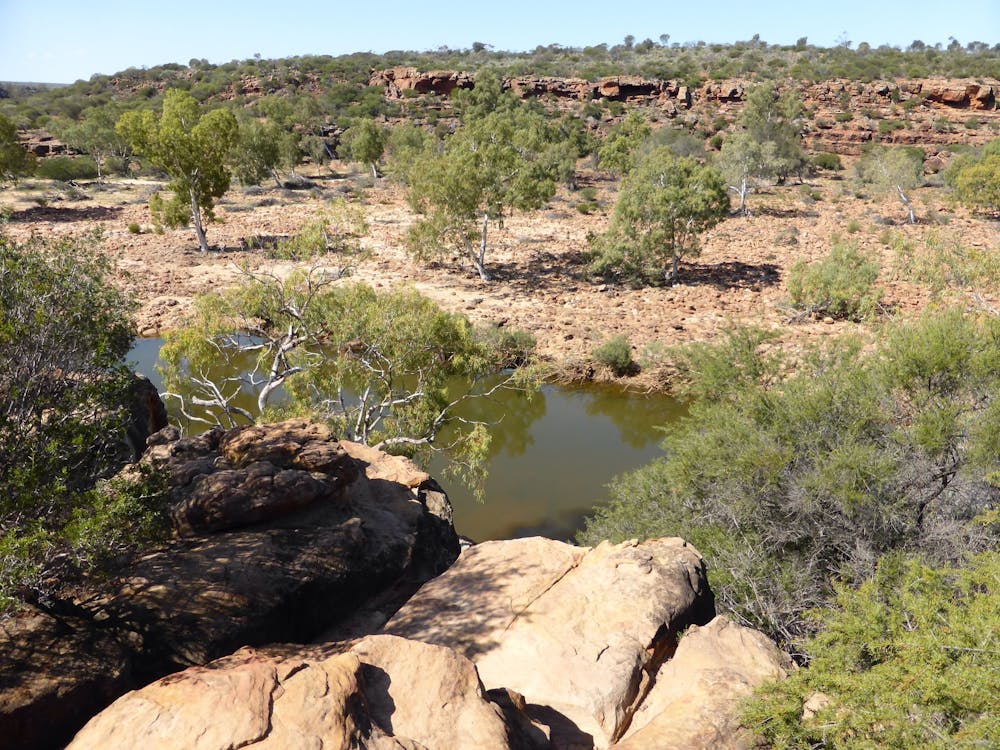
Each hectare of Australia’s savanna’s sequesters, on average, 3.4 tonnes of carbon every year. Bryn Pinzgauer/Wikimedia, CC BY-SA
Critical questions remain
Plans in Australia and New Zealand to reach net zero emissions by 2050 strongly depend on the ongoing ability for ecosystems to sequester emissions from industry, agriculture, transport and the electricity sectors.
While some management and technological innovations are underway to address this, such as in the agricultural sector, we need long-term measurements of carbon cycling to truly understand the limits of ecosystems and their risk of collapse.
Indeed, we’re already in uncharted territory under climate change. Weather extremes from heatwaves to heavy rainfall are becoming more frequent and intense. And CO₂ levels are more than 50% higher than they were 200 years ago.
So while our ecosystems have remained a net sink over the last 20 years, it’s worth asking:
will they continue to do the heavy-lifting required to keep both countries on track to meet their climate targets?
how do we protect, restore and sustain the most vital, yet vulnerable, ecosystems, such as “coastal blue carbon” (including seagrasses and mangroves)? These are critical to nature-based solutions to climate change
how do we monitor and verify national carbon accounting schemes, such as Australia’s Emissions Reduction Fund?
Critical questions remain about how well Australia’s and New Zealand’s ecosystems can continue storing CO₂.
Caitlin Moore is affiliated with the Terrestrial Ecosystem Research Network (TERN)
David Campbell receives funding from the NZ Ministry for Primary Industries and the Agricultural GHG Research Centre.
Before her retirement as an employee of CSIRO, Helen Cleugh received funding from CSIRO and the Australian government through many programs including the National Environmental Science Programme and TERN.
Jamie Cleverly receives funding from the Terrestrial Ecosystem Research Network and the Queensland Government, and is currently the director of OzFlux.
Jason Beringer receives funding from the Australian Research Council and NCRIS TERN.
Lindsay Hutley receives funding from the Australian Research Council and the Terrestrial Ecosystems Research Network
Mark Grant works for the Terrestrial Ecosystem Research Network (TERN).
On Wednesday, a United Nations committee became the first international law body to recognise that criminalising female same-sex sexual activity is a fundamental breach of human rights.
The landmark decision means all countries that criminalise women having sex with other women should immediately repeal these laws.
Many people assume these laws only apply to men having sex with men, but that’s not the case. Sexual conduct between women is prohibited in the criminal codes of 34 of these 71 countries.
Countries with sharia law such as Afghanistan, Nigeria and Saudi Arabia also essentially criminalise lesbian sex. So there are 43 countries where it’s a crime for women to engage in same-sex sexual activity – almost a quarter of all countries in the world.
The majority of the countries that criminalise same-sex sexual activity are members of the Commonwealth, whose anti-homosexuality laws were introduced by the British Empire.
However, Britain only ever criminalised male homosexual activity, and the expansion of these laws to explicitly include female sexual activity is a relatively recent phenomenon. Countries that have done so include: Trinidad and Tobago (1986), Solomon Islands (1990), Sri Lanka (1995), Malaysia (1998) and Nigeria (2014).
In the past 35 years, ten jurisdictions that previously only criminalised same-sex male sexual intimacy changed their laws to include, for the first time, new criminal sanctions of lesbians and bisexual women.
The laws criminalising same-sex activity between women aren’t just arcane laws that are never enforced. In Malaysia just over three years ago, two women were caned six times for attempting to have sex.
And late last year, a lesbian activist in Iran was arrested while trying to flee to Turkey to seek asylum. Before this, she was detained for 21 days by the Iraqi Kurdistan police following an interview she did with BBC Persian about the situation of the LGBTQ+ community in Iraqi Kurdistan.
The case
The case of Flamer-Caldera v Sri Lanka was brought by a lesbian activist to the UN Committee on the Elimination of Discrimination Against Women (CEDAW).
She argued that Sri Lanka’s criminal laws violated her right to live her life free from discrimination based on her sexual orientation.
The CEDAW committee agreed.
It found the effect of Sri Lanka’s criminal code was that lesbian and bisexual women lived with the constant risk of arrest and detention. And the laws facilitate a culture where discrimination, harassment and violence against lesbians and bisexual women can flourish.
Law is a tool that governments use to communicate to society what is acceptable and unacceptable behaviour. When the Sri Lankan government declared any sexual intimacy between consenting women is a crime, it signalled to Sri Lankans that vilification, targeting and harassment of lesbians and bisexual women is acceptable, because they are criminals.
The laws not only criminalise same-sex sexual conduct. They also perpetuate homophobia, stigmatise the LGBTQ+ community and sanction gender-based violence against lesbians and bisexual women.
This decision sends a clear message to all governments who think it’s OK to persecute, harass and discriminate against lesbians and bisexual women – you are wrong.
Sri Lanka now has six months to provide a written response to the CEDAW Committee setting out the action it has taken, or will take, to give effect to the committee’s decision.
Repealing the specific provision in the criminal law will not be enough. A much more holistic and nuanced response is required. In particular, the government will need to:
develop campaigns to counter prejudice and stereotypes directed at the LGBTQ+ community
enact anti-discrimination laws prohibiting discrimination on the basis of sexual orientation, gender identity and intersex status
embed human rights education in schools, promoting equality and respect for all regardless of their sexual orientation or gender identity
provide training for police, judges and other law enforcement officials to increase their understanding of, and respect for, the human rights of LGBTQ+ people. This will also enable women to report homophobic crimes to the police without fear of retribution and with the knowledge the perpetrators will be prosecuted
ensure there are adequate civil and criminal remedies for members of the LGBTQ+ community who are subjected to discrimination and gender-based violence.
The decision in Flamer-Caldera v Sri Lanka represents a watershed moment in international human rights law and will reverberate around the world.
It’s now beyond dispute that criminalising consensual adult same-sex sexual conduct violates a woman’s right to privacy, dignity and non-discrimination.
All governments have a duty to protect all women, including lesbians and bisexual women, from discrimination, gender-based violence and other harm.
Any country that criminalises the sexual conduct of lesbians and bisexual women, regardless of whether they enforce the laws, is guilty of violating international law.
Paula Gerber is a director of Kaleidoscope Human Rights Foundation, a not-for-profit organisation advocating for the rights of LGBTIQ people in the Asia-Pacific region.
Meet Eli. He entered the second year of his life with gusto and now, aged 18 months, he is discovering new things every day including ideas he wants to try out immediately. Like, right now. Waiting is not an option.
Combined with his passion for life he often becomes emotionally overwhelmed and erupts into frequent meltdowns. Words and phrases like “no”, “do it myself” and “mine” are used often.
Sometimes the smallest thing ends with Eli kicking, biting and crying. Although he’s still developing a command of words, he shouts “I don’t love you, Dad!” with devastating accuracy. These outbursts happen at home and out in public.
Research shows tantrums occur in 87% of 18 to 24-month-olds, 91% of 30 to 36-month-olds, and 59% of 42 to 48-month-olds – often on a daily basis.
The “terrible twos” might sound accurate, but branding toddlerhood (18 months to 36 months) this way is an injustice to this group. The generic label fails to grasp the huge developmental growth happening at this age. It also fails to celebrate the developing emotional life of a toddler, at once complex, multifaceted and exhilarating.
Eli is at a “developmental touchpoint”, where a unique surge in capacities is coupled with behaviour falling apart. At this age, children begin to establish independence while simultaneously needing to learn ways of coping with intense feelings such as fear, anger, frustration and sadness. Researchers are still discovering what a normal trajectory for emotional regulation development looks like, and what might help or hinder it.
Intense, uncontrolled feelings and defiance are normal at this age. But it can be challenging for parents to support their toddlers through this stage.
Focusing solely on a toddler’s behaviour fails to capture the significant role sensitive care-giving plays in social and emotional development in the early years.
A core component of sensitive and responsive parenting is a parent’s capacity to put themselves into the mind of their very young child and understand the child’s behaviour has meaning and is driven by internal experiences such as feelings, thoughts, desires and intentions.
Being able to understand the world from the child’s perspective helps a parent to anticipate, interpret and respond to the child’s behaviour in ways that build a child’s capacity to regulate their emotions.
Eli’s dad didn’t experience tantrums with his first child, who had a calmer disposition, so he finds Eli’s emotional outbursts hard to tolerate. He becomes angry when Eli refuses to do what he is told and yells at him to “stop it!”. This frightens Eli, who sometimes retreats and sometimes escalates in his distress.
Eli’s dad is unaware of his toddler’s internal experiences and is confused by his own “out-of-control” feelings when parenting him. Frequent emotional outbursts coupled with an authoritative parenting style places children at risk of developing more serious emotional and behavioural problems.
Eli’s dad needs to understand that his primary role at this stage is to put his child’s experiences at the centre of his mind. This requires him to try to make sense of what Eli is communicating about himself through his behaviour and to respond in a sensitive way. This can help a child like Eli not be overwhelmed by intense feelings.
It’s important to figure out the big feeling behind the tantrum. Shutterstock
3 guidelines for parents:
1. Be aware of your own responses
Tantrums can be emotionally activating for parents. Being aware and making sense of your own feelings will help you to respond sensitively to your child’s distress. When Eli’s dad makes sense of his struggles with managing anger, he is calmer, enabling him to focus on Eli’s emotional experiences.
2. Identify and validate your child’s difficult feelings
Young children need help from their parents to recognise that the feelings they are expressing through their behaviours are just that: feelings that will pass in time. They need help to name them, work out what is causing them and figure out what might help.
3. Search for underlying meaning
Remember not to take emotional outbursts personally. Viewing a tantrum as a means of communication helps parents consider the likely causes of a child’s distress and to think through possible solutions.
Maurice Sendak’s Where the Wild Things Are is a tribute to tantrums.
With new insights, parents like Eli’s dad can can help their child put themselves back together again after emotional outbursts, which may be less frequent. With consistent support, toddlers can learn to tolerate frustration, gain a sense of control of strong feelings and find words to express what is happening inside them.
Parenting a toddler is no easy task. Today’s parents have the advantages of remarkable leaps in neuroscientific and developmental knowledge. However, these can be difficult to access and even more difficult to put into practice. Unwittingly we can fall back into the familiar ways we were parented, or we might attempt try to do the opposite of how we were parented only to find we have lost direction.
Investment in early intervention programs for everyone or at a targeted level where the parent-child relationship is in trouble, could provide the building blocks for lifelong emotional well-being for families and for society.
The authors do not work for, consult, own shares in or receive funding from any company or organisation that would benefit from this article, and have disclosed no relevant affiliations beyond their academic appointment.
A draft security cooperation agreement between China and Solomon Islands has been leaked on social media.
The unverified document includes seven articles, which discuss the scope of cooperation between both nations.
Massey University’s Centre for Defence and Security senior lecturer Dr Anna Powles has seen the agreement on social media.
She told RNZ Pacific that the document is presented as a draft: “It doesn’t have any dates, nor is it signed.
“There are still questions around its authenticity but if it is authentic, it raises some serious questions and if it’s not authentic then it also provides some interesting insights into the way in which the geopolitical dynamic is playing out domestically in the Solomon Islands,” she said.
Dr Powles said that the draft document includes a request between the Solomon Islands government and China to send armed police personnel and other law enforcement and armed forces to the Solomon Islands.
“Now that raises a lot of questions obviously, what is the distinction between police and armed police, and who are the other law enforcement and armed forces that are referred to in the agreement.
‘Maintaining social order’ “It also talks about what kind of tasks that a Chinese contingent would be involved in such as maintaining social order, it’s not clear what that means, it also talks about providing assistance on other tasks and it’s also unclear what those other tasks would be.”
Massey University’s Dr Anna Powles … “There are still questions around [the draft agreement] authenticity but if it is authentic, it raises some serious questions.” Image: RNZ
Dr Powles points out that the agreement refers to protecting lives and property, humanitarian assistance and disaster response.
In February, a team of Chinese police officers began working in Solomon Islands. This was two months after the Solomons government accepted Beijing’s offer to help restore law and order following anti-government riots in November 2021.
Dr Powles believes that if the draft agreement is authentic, then the deployment was a natural extension of the document.
The document also contains some concerning provisions which allow China to send ships to the Solomon’s “according to its needs”.
“The agreement states that China may, according to its own needs and with the consent of the Solomon Islands government make ship visits to the Solomons and carry out logistical replenishment and stopover and transition in the Solomons.”
She said that such provisions would need to be clarified as it was unclear what “China’s own needs” refer to.
Concerns over ‘strategic interests’ Are those strategic interests for instance? If so, that would raise a number of concerns. Particularly as to what would happen if China’s interests cut across the interests of the Solomon Islands or of its key regional partners such as Australia or Papua New Guinea.
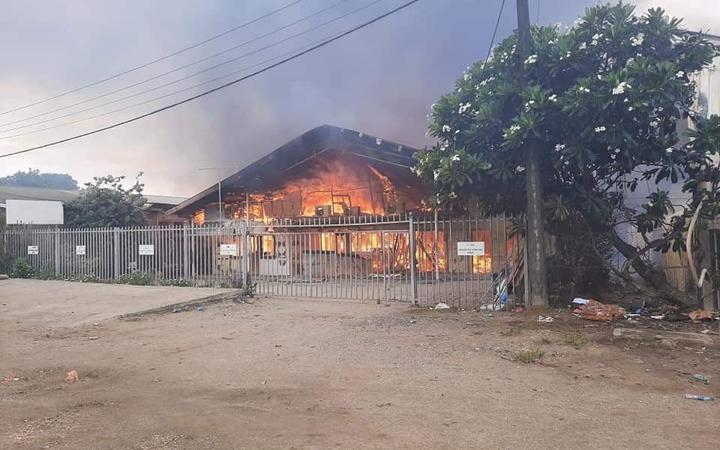
The Adkonect printing complex in Ranadi was among dozens of businesses destroyed in the riots last November. Image: Namoi Kaluae/RNZ
“And it also suggests that logistical support would be provided for ship visits in the Solomon Islands and suggests that perhaps China could seek to establish a logistical supply base in Solomon Islands to support those ship visits.
The document does not specify what types of ships, but Dr Powles said “we could safely assume that they are referring to the People’s Liberation Army Naval (PLAN) ships.”
“In the Pacific, we have seen PLAN ship visits to the region. China has a strong interest in maritime issues and in the Pacific maritime domain. And so that probably is not surprising and there have been long-standing concerns and very public long-standing concerns about the potential for increased ship visits for China increasing its engagement in the Pacific maritime domain and potential implications that may have for a potential base to support those ship visits.”
Dr Powles also drew attention to one particular provision of the agreement, which raised alarm bells with respect to the control of information around security cooperation.
That provision stated that information between the Solomon Islands and China could only be released on mutual agreement by both parties.
“And that suggests that there would be the intent to control public information, to control media briefings, to control what access media has to information about security arrangements between the two countries.
“We can be legitimately concerned about lack of transparency about a degree around this agreement,” she said.
A Whanganui iwi leader says the Aotearoa New Zealand government’s decision to ease covid-19 measures at this time is a disgrace and shocking.
He is warning Māori to stay vigilant against omicron and prepare for more to come.
Tūpoho chair Ken Mair says Māori must continue to be extremely careful and take precautions against covid-19, despite the government’s new strategy to begin living with the virus.
Yesterday, Prime Minister Jacinda Ardern said gathering limits would ease before the weekend, with no limit for outside venues and gatherings of up to 200 allowed inside.
Vaccine passes and scanning would no longer be needed from April 4, and mandates would be scrapped for all except those in the health and aged care sectors, Corrections and at the border.
But Mair said the country was far from out of the woods, as shown by the number of daily covid-19 cases being reported — with 11 new deaths and 18,423 infections.
“It just seems crazy that the government are putting in place this strategy right now, at the worst time in regard to the high numbers of omicron within our community. It’s extremely dangerous,” Mair said.
‘Where’s the Māori lens?’ “Where’s the Māori lens over this? Certainly, within our community there are hundreds [of cases] and there are a number in hospital.
“I just can’t understand a strategy where there hasn’t been any real analysis with substance in regard to the impact upon iwi, hapū and Māori, noting that we’re an extremely vulnerable community in the context of respiratory and asthma ailments.”
Mair said he understood some Māori leaders had been in discussion with the government and had made recommendations for the new strategy, but it appeared they had been ignored.
“I’ve been deeply concerned over the last couple of months where there doesn’t appear to be a strong Māori voice coming through or anything that might indicate that the government have a clear understanding of the ramifications of their decision around the covid strategy.
“This is a classic example — decisions being made right in the midst of cases going up, new variants around the corner, without understanding the impact and implications for Māori. I just think that’s a disgrace and shocking.”
Mair said he thought the strategy had been politicised, with Labour’s polling and political pressure the key factors.
“What motivates you to put in place an extremely dangerous strategy? You can only assume the motivation’s around political expediency and the impact upon economic wellbeing, without having the health lens driving your decision making.
Risk for vulnerable ignored “The decisions by the prime minister and the government clearly have not taken into account the real vulnerability of Māori, and I think Māori, iwi and hapū have to be extremely careful in this precarious time.”
Yesterday, the prime minister said restrictions were being eased because it was safe to do so. Mair said this ignored the risk that remained for the vulnerable and sent the wrong message.
“I think because of the government’s strategy, people are saying things like: well, we’re going to get it anyway, it doesn’t matter, let’s get on with it and get back to normality as quickly as possible.
“The problem with those comments, of course, is the vulnerability of our Māori community, hapū and iwi is extremely high.
“I think our community in general is beginning to take a kind of defeatist approach and we should be, I think, extremely careful and vigilant in regard to dealing with this omicron.
“I have no doubt in my mind there’ll be more variants around the corner and we should always be prepared.”
Local Democracy Reporting is Public Interest Journalism funded through NZ On Air. Asia Pacific Report is a community partner.
Carving up the Papuan provincial cake. Graphic: Image: Lugas/tirto.id
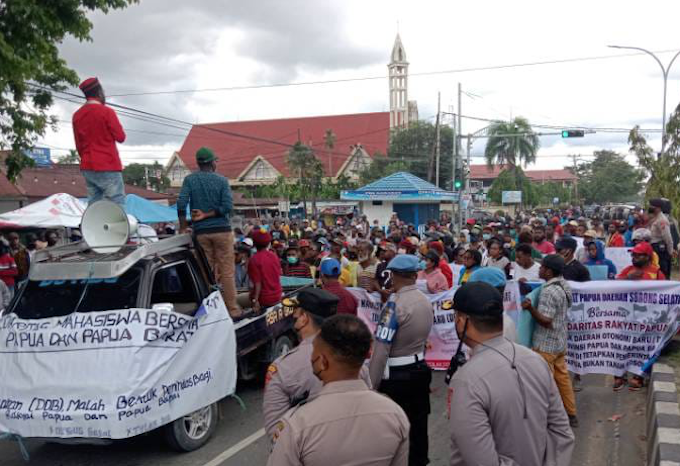
On Thursday, 10 March 2022, thousands of Papuan people in the Lapago Wamena Cultural Area took to the streets to paralyse Wamena city. They occupied Wamena City. They rejected the Indonesian colonial plan to expand Papua province.
Remember: The voice of the people is the voice of God. The Papuan people, people and leaders of Indonesia, Melanesia, Pacific, Africa, European Union. USA, Australia, listen to the voices of the two million Melanesian people in West Papua who are currently on their way to being annihilated due to Indonesia’s systemic racist politics.
The expansion of Papua provinces, Special Autonomy Volume 2 and military operations in six regencies in Papua is not a solution for West Papua. Only one order — give us the right of self-determination for the political rights of the Papuan nation in West Papua. Our greetings and prayers from Wamena, the heart of Papua.
Waaa … waaa … waaa.
SPECIAL REPORT:By Yamin Kogoya
The above text was written by Markus Haluk, director of the United Liberation Movement for West Papua (ULMWP) on Thursday, March 10. The text encapsulates the sentiments of Papuans protesting across West Papua and Indonesia, calling for Jakarta to stop the creation of new provinces.
Haluk’s words were written amid escalating protests in various parts of West Papua’s customary lands and across Indonesia over Jakarta’s plans to create six new provinces under the unilaterally renewed — and unpopular — Special Autonomy Law 21/2001.
15/3/22 Yahukimo, West Papua
Indonesian forces shot dead Yakub Meklok (39) and Herson Wisapla (21) during forced dispersal of thousands of people protesting against Jakarta’s plan to create new provinces.
Jayapura – Mamta customary land Tuesday, March 8: Hundreds of students and communities clashed with Indonesian security forces at university campuses in Waena and Abepura cities, protesting against the expansion. The protest coordinator, Alfa Hisage, stated that this demonstration was to reject the creation of a new province altogether.
Wamena – La Pago customary land Thursday, March 10: Doni Tabuni, the coordinator of the demonstration in the highlands of Wamena (the location that Markus Haluk refers to in his text) warned on March 10 that the expansion would wipe out Papuans. Protesters declared: “We will stop all government office activities in the Lapago region if the central government does not stop the expansion,” reported CNN Indonesia (10 March 2022).
“The expansion will not bring prosperity to Papuans; it will only serve to benefit the elites, bring more migrants, and create more opportunities for military and human rights violations,” said Doni Tabuni.
14/3/22 Paniai, West Papua
Hundreds of West Papuans protested against Jakarta’s plan to create new provinces – which will lead to further dispossession and militarisation.
Paniai – Meepago customary land Monday, March 14: thousands of residents of Paniai took to the streets to demonstrate against the expansion of the “New Autonomous Region”, also known as “Daerah Otonomy Baru” (DOB). The demonstrators repeatedly shouted against the new proposal and do not want to join the province of Central Papua, which would become a new autonomous region.
Petrus Yeimo, a member of the Paniai Regency Legislative Council (DPRD), said that communities are not involved in the formation of this new region.
“That’s why we Paniai people firmly reject the expansion,” said Petrus, when he was met by the mass in front of the DPRD office (innews.id).
West Papuan women against the creation of new provinces by Jakarta that will cause further dispossession and militarisation.
Manokwari – Domberai customary land Tuesday, March 8: The same message also echoed in Manokwari city — a coastal town popularly known as a “city of the gospel” for its historical significance of the landing of the first two German missionaries (C.W. Ottow and J.G. Geissler) for the “Christianisation” project in the mid-1800s.
17/3/22 Sorong, West Papua
Another big protest against Jakarta’s plan to create new provinces.
Sorong – Domberai customary land Monday, March 21: A series of protests has also taken place in Sorong city, at the Western tip of West Papua, involving sections of Papuan society, including students and communities.
Protesters in Sorong carry a banner saying, “The expansion of the new autonomous region is oppression against the Papuan people.” Image: APR
“The expansion of new autonomous region depletes our forests, depriving us of our land rights. The goal of our meeting is to convince the mayor, who is also the head of the creation of the new Southwest Papua province that we Papuans all over Sorong Raya oppose the expansion,” said action coordinator Sepnat Yewen on Monday. But they were disappointed that they were unable to see the mayor twice (Compass.com, 21 March 2022).
11/3/22 Jakarta
102 West Papuan students were forcibly dispersed and arrested during a protest. They reject Jakarta’s plan to create new provinces in West Papua that would lead to further dispossession.
Jakarta – the heartland of the colonial powerhouse Tuesday, March 11: Papuan students held protests in central Jakarta, calling on Jakarta to stop the colonial expansion of their homeland, during which one police officer, Ferikson Tampubolon, was injured on the head (Detiknews, 12 March 2022).
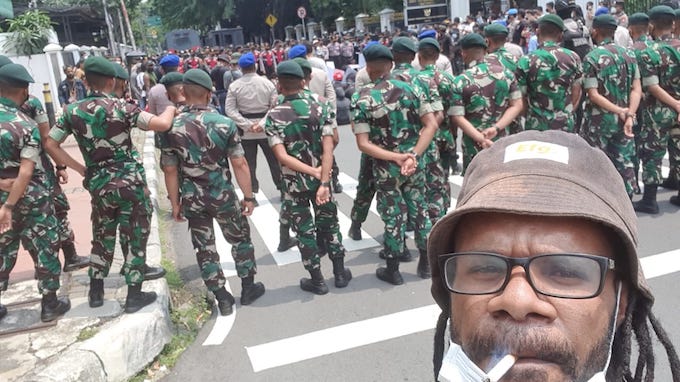
Indonesian security forces line up against Papuan protesters in Jakarta. Image: APR
South Sulawesi – an Indonesian island In Kendari city of South Sulawesi, the Papuan Student Association declared that the newly created provinces would not benefit Papuans. Kiminma Gwijangge, the group coordinator, said that this was a game of the political elites and rulers who control the public service in Papua and ignoring the rights and wishes of Papuans. These Papuan students demanded that the Papuan elites, who eat money and expand on behalf of Papua, be stopped immediately.
15/3/22 Yahukimo, West Papua
Earlier today, speaker: “people reject expansion, people want independence”.
Yahukimo – La Pago customary land Tuesday, March 15: Tragically, a peaceful demonstration for the same cause in the Yahukimo region did not go well. Two young men, Yakop Deal, 30, and Erson Weipsa, 22, have been martyred for this cause by the Indonesian police — the cause for which Papuan men and women courageously risked their lives to fight against fully armed, western-backed, modern security forces with advanced mechanical weapons.
Two young Papuans gunned down and a dozen wounded Witness accounts of the Yahukimo tragedy stated that the protest initially went ahead safely and peacefully. However, provocation by police intelligence officers posing as journalists in the midst of the protest led to the shooting.
It is alleged that an unidentified Indonesian person flew a drone camera during the demonstration. Seeing that action, protesters warned the Indonesian man not to use drones to record the protest, creating fear.
The protestors also asked for his identity and whether or not he was a journalist, but he failed to respond. The crowd protested against his action. He then ran for cover towards hidden police officers who had been on standby with weapons. Immediately, members of the police fired tear gas at the crowd without asking for the person responsible for the peaceful demonstration. Soon after, police opened fire on the crowd.
Papuan Police public relations chief Kombes Pol Ahmad Musthofa Kamal confirmed that two protesters had died, and others suffered gunshot wounds (Suara.com).
Gathering evidence of the Yahukimu atrocity – alleged shootings by the Indonesian military. This Papuan man was shot in the back. Image: APR
OPM and civil society groups The Free Papua Movement, also known as Organisasi Papua Merdeka (OPM), and their military wing, The West Papua National Liberation Army, which was launched in the 1960s to protest against the Indonesian invasion, are opposed to the new expansion of provinces. Sebby Sambon, the group spokesperson released a statement that threatened to shoot Papuan elites who imposed Jakarta’s agenda onto Papuans (tribunnews.com, 12 February 2022)
More than 700,000 people have also signed the Papuan People’s Petition which represents 111 organisations opposing Special Autonomy.
These protests are not the first and they will not be the last. Papuans will continue to resist any policy introduced by Jakarta that threatens their lives, cultural identities, and lands.
This is an existential war, not a political one — it is a war of survival and resisting extinction.
The genesis of these recent protests Those protests are not simply a reaction against the new expansion, but a part of a movement against the Indonesian invasion that began when Papuans’ independent state was seized by the Western governments and given to Indonesia by the United Nations in 1963.
This is a conflict between two states — the state of Papua and the state of Indonesia. Having the big picture is vital to prevent misrepresentation of these protesters as just another angry mob on the street demanding equal pay in Indonesia.
However, the protests that cost those two men their lives in Yahukimo had a specific genesis. It began in 1999 when 100 Papuan delegates went to then-President Habibie and demanded independence after the collapse of Suharto’s 31-year New Order regime.
Habibie and his cabinet were shocked by this demand, as people whom they thought were members of his family suddenly told him they no longer wanted to be part of the great Indonesian family.
Having been shocked by this unexpected news, Habibie and his cabinet told the Papuan delegation to go home and think it over in case it had been a mistake. But this was not a mistake. It was the deepest desire of Papuans being communicated directly in a dignified manner to the country’s highest presidential palace.
This occurred during a time of great turmoil in Indonesia’s history. Strongman national father figure Suharto, once considered immortal, no longer was. His empire had crumbled.
Suddenly, across the archipelago, a cacophony of demonstrators unleashed more than 30 years of dormant human desires for freedom, frustrations, and fear, combined with the ravages of the Asian economic collapse.
If there was a time when the Papuans could escape the tormented house, this was it. One hundred Papuan delegates marching to Habibie indeed made their mark in that respect.
At this momentous time, the man who understood this deepest desire and would help Papuans escape was President Abdurrahman Wahid, better known as Gus Dur. He lives on in the memories of Papuans because of his valiant acts.
President Gus Dur – a political messianic figure On 30 December 1999, or exactly two months and 10 days after being inaugurated as the 4th President, Gus Dur visited Irian Jaya (as it was known back then) with two purposes — to listen to Papuan people during the congress, which he funded, and to see the first millennium sunrise on January 1, 2000. On this day, a significant moment in human history, he chose to stand with Papuans and for Papuans.
During his stay, he changed the region’s name from Irian Jaya to Papua and allowed the banned Papuan Morning Star flag to be flown alongside Indonesia’s red and white flag.
Changing the name was significant for Papuans because these changes marked a significant shift in how the region would be governed. The former name symbolised Indonesia’s victory and the latter symbolized Papuan victory.
Prior to these historical occurrences, the region was known as Netherlands New Guinea during Dutch rule, then as West Papua during a short-lived, Dutch-supported Papuan rule in 1961, then from Irian Barat to Irian Jaya when Indonesia annexed it in May 1963.
Just as their island has been dissected and tortured by European and Asian colonial powers, so too have Papuans, being tortured with all manner of racism and violence in the name of the civilisation project.
The messianic Gus Dur’s spark of hope instilled in the hearts of Papuans was short-lived. In July 2001, he was forced out of office after being accused of encouraging Indonesia’s disintegration. Gus Dur’s window of opportunity for Papuans to escape the tortured house was closed. The new chapter that Gus Dur wrote in Indonesia-Papua’s tale of horror was ripped out of his hands during the most pivotal year of human history — the new millennium 2000.
The demand for independence conveyed to President Habibie a year earlier by one hundred Papuan delegates was discarded. Instead, Jakarta offered a special gift for Papuans — gift the Special Autonomy Law 21/2001.
There was a belief among foreign observers, and Papua and Jakarta elites that this would lead to something special. It reflects Jakarta’s ability in terms of its semantic structure and highly curated selection used in law.
Rod McGibbon, an analyst and writer on Southeast Asian politics in Jakarta, noted in a Wall Street Journal article on 14 August 2001 that despite the challenges Jakarta faces in its dealings with Irian Jaya (Papua), the Special Autonomy approach represents the best opportunity for Jakarta to begin meaningful dialogue with provincial leaders. He also predicted that if Jakarta fails special autonomy, the province will suffer further ethnic and regional conflicts in the future.
He was right, 20 years later Special Autonomy turned out to be a big mess.
The law consisted of 79 articles, most of which were designed to give Papuans greater control over their fate — to safeguard their land and culture.
Furthermore, under this law, one important institution, the Papuan People’s Assembly (Majelis Rakyat Papua-MRP), together with provincial governments and the Papuan People’s Representative Council (Dewan Perwakilan Rakyat Papua-DPRP), was given the authority to deal with matters that are most important to them, such as land, population control, cultural identity, and symbols.
Section B in the introduction part of the Special Autonomy law reads as follows: “That the Papua community as God’s creation and is a part of a civilised people, who hold high human rights, religious values, democracy, law and cultural values in the adat (customary) law community and who have the right to fairly enjoy the results of development”
Assassination of prominent Papuan leader and Papuan chief Three weeks after the law was passed, popular independence leader Theys H. Eluay was killed by Indonesian special forces (Kopassus). Ryamizard Ryacudu, then-army chief of staff, who in 2014 became Jokowi’s first Defence Minister, later called the killers “heroes” (Tempo.co, August 19, 2003).
In 2003, the Megawati Soekarnoputri government divided the province into two. She was violating a provision of the Special Autonomy Law, which was based on the idea that Papua remains a single territory. As prescribed by law, any division would need to be approved by the Papuan provincial legislature and MRP.
Governor Lukas Enembe – Melanesian chief On August 22, 2019, Narasi (central Jakarta’s TV programme) invited Papua provincial Governor Lukas Enembe and others (both Papuans and Indonesians) to discuss mass demonstrations that erupted across West Papua and Indonesia after Papuan students were racially attacked in Surabaya.
The programme host, Najwa Shihab, was shocked to hear the governor’s response. When asked about his opinion about the situation, the governor said that Papuans already had their own concept to address problems in West Papua, but they needed an agreement/treaty under international auspices — or something of the sort — because no Jakarta-made law would work in Papua.
The host then asked, “you are a governor, but why don’t you believe the authority of Special Autonomy Law?” Governor Enembe replied, “The Special Autonomy Law 21/2001 has not worked until now.”
The governor stressed that Papuans do not have political power or free will to make any meaningful decision.
“We are supposed to make our own law under this Special Autonomy, but Jakarta refuses to allow it. Jakarta only gives money under this law, that’s all.”
The statements come from Papua’s number one man and not from someone on the street. The ruling elites in Jakarta are not fazed about breaking their own laws, showing their disrespect of the Papuan people and their integrity as a nation.
The governor is not the only official in the country’s highest office who lacks faith in the central government. Otopianus Tebai, a young Papuan senator who represents Papua in the central government said in a response to this new expansion plan that most Papuans reject the divisions (Suara.com, March 18, 2022). Divisions of which Papuans are being coerced into by the old special autonomy law renewal, which Governor Enembe declared as a total failure.
The MRP, Papua’s highest institution established under the special autonomy law to safeguard cultural identities, no longer has the power to act as intended. This institution has been stripped of its power, as well as other things, as a result of the 2021 amendment to the law which was passed two decades ago.
Timotius Murib, the chairman of this institution, said that the plan to create an autonomous region did not reflect the wishes of the people of Papua and would probably create more problems if Papuans were divided over it.
The chairman emphasised the law was designed for Papuans to have specific authority to implement local laws pertaining to our affairs, but the central government removed that authority by destroying any legal or government mechanism that materialised this authority.
Adding to these statements from the highest offices, more than 700,000 people have signed the Papuan People’s Petition, which represents 111 organisations opposing Special Autonomy.
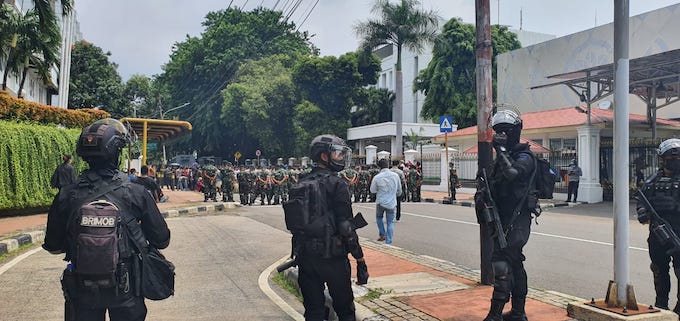
Indonesian Brimob forces ready to move against Papuan protesters in Jakarta. Image: APR
Deep psychological war against Papuans – ‘divide and rule’ tactic Despite overwhelming opposition from many segments of Papuan society, the Indonesian government persists in imposing its will upon Papuans. It is precisely this action that is causing protests and havoc in recent weeks.
But not all Papuans are against it. Several regents (mostly Papuans) are supporting this expansion with their cronies and supporters, in conjunction with the Indonesian government, a few Papuan elites in Jakarta, and other misfits and opportunists.
The issue has caused division among indigenous Papuans. Among the Papuans, it plays directly into identity politics, as many tribes speak different languages, live in different ancestral and customary lands, and even practise different religions.
A protracted horizontal conflict between these languages, cultural, and geographical lines was already being created by the creation of more regencies and districts in the past. Adding three new provinces would lead to more regencies, which means more districts, which means more security forces and settlers and more problems.
In the midst of this drama, Jakarta is setting traps for Papuans by forcing them to face each other and preventing them from collectively confronting the system that is tearing them apart. The creation of more provinces and regions is leading to such traps since this will divide the people — which is clearly Indonesia’s ultimate goal.
If Papuans are too busy fighting one another, then the atrocities of the elites will fly under the radar, unopposed. What West Papua needs is unity, which has been demonstrated in recent protests. Together, Papuans will always be stronger than apart in their cause, and Jakarta will stop it with all its tricks.
If you are an imperial strategist or scammer in an empirical office somewhere in London, Canberra, Washington DC, or Jakarta, you might think that this is the best way to control and destroy a nation.
But history shows that, all dead ancient empires and the current dying Anglo-American led Western empires use this little magical trick “divide and rule” over others until it collapses from its wicked pathological and hypocritical weights from within.
Imperial planners in Jakarta should be focusing on overcoming their own internal weaknesses that would eventually bring them down rather than chasing after the monster they created out of West Papua.
In this frame of mind, any vestige of hope for Papua’s restoration and unity, whether contained within or outside the law, is a threat that will be undermined at any cost. The term autonomy is also defined differently in Papua’s affairs because Jakarta does not intend to empower Papuans to stand on their own two feet.
There is no real intention for Jakarta to give Papuans a chance to have some level of self-rule, which is exactly what being autonomous means in essence.
Papua’s autonomous status seems to be all part of the settler-colonial regime: occupation, expansion, and extermination. Papuans have been told that West Papua is special, but Jakarta is undermining and paralysing any mechanism it agrees upon to convince them that that is truly not the case.
In other words, Jakarta introduces a law, but it is Jakarta that violates it. The situation is analogous to students having a teacher who is not just negligent but hypocritical; everything the teacher believes in, they teach, not taking time to critically analyse their actions and how it all contradicts itself.
Under the whole scheme, Indonesia is presented as a self-appointed head of the class that they are holding hostage. They believe they are the only ones capable of teaching the stupid Papuans, of civilising the naked cave men, of saving the wild beasts, and developing the underdeveloped people.
But under the guise of the pathological civilisational myths, Jakarta poisons and destroy Papuans with food, alcohol, drugs, pornography, gambling, diseases and the ammunition which is used against them.
Rulers in Jakarta act as narcissistic sociopaths — they promise development, happiness, or even heaven while committing genocidal and homicidal acts against Papuans. They portray themselves as the “civilised” and the Papuans as the “uncivilised” – a psychological manipulation that allows them to avoid accountability for their crimes. Jakarta makes Papuans sick, then prescribes medication to cure the very same illness it caused.
A deep psychological game is being played to convince themselves (colonisers), and the Papuans (colonised) that Indonesia exists so that West Papua can be saved, improved, and developed. This pathological game is then embedded into the psyche of Papuans through all the colonial development products Jakarta sells to Papuans through education and indoctrination.
This programming is evident in the way that a few Papuans (with Jakarta acting as the puppeteer) fool their own people by telling them that Indonesian rule will bring salvation and prosperity.
Even the mental work of most Indonesians is being reprogrammed to view West Papua with that lens – they believe that Indonesia is saving and improving West Papua. Unbeknownst to them, this entity called “Indonesia” annihilates Papuans.
Local Papuan elites legitimize their power by saying that their own people also have serious problems (backwardness, stupidity, poverty) and that they have solutions to solve these problems. However, the solution is Jakarta-made, not Papuan-made, and that is the problem.
When governor Enembe said we need an international solution rather than a national one, he was conscious of these games being played against his people in his homeland. The Indonesian government exterminates Papuans by controlling both poison and antidote, but there is no antidote to begin with. It is all poison; the only difference is the label.
Markus Haluk’s words Markus Haluk’s words make a desperate plea for help as they face what he terms “annihilation” due to Indonesia’s racism, responding to mass demonstration in his own homeland.
His words highlight that the only viable solution is to grant the people the right to self-determination to establish their nation-state and declare that the people’s voice is the voice of God.
As tragic and ironic as it is, it is highly unlikely that Haluk’s words “the voice of the people is the voice of God” will mean anything to the ruling class in Jakarta since in the past 20 years all the attacks, betrayals, torture, racism, and killings have been committed after these words were written on the Special Autonomy Law No 21/2001.
Section B in the Introduction part of the law reads: “That the Papua community as God’s creation and is part of a civilized people, who hold high Human Rights, religious values, democracy, law and cultural values in the adat (customary) law community and who have the right to fairly enjoy the results of development.”
It seems that these words are merely part of the theatrics — the drama of cruelty, torture and death.
Settler-colony – the logic of ‘destroy to replace’ Indonesia’s occupation in West Papua is not temporary — they are not simply taking resources and going home. The Indonesians want to make West Papua their permanent home.
This is a permanent population resettlement colonial project based on the logic of destroy to replace. Papuans are being destroyed — and even worse, they are being replaced by Indonesian settlers. They are powerless to stop the annihilation and perversion of their ancestral homelands.
To occupy and own the land is the ultimate goal of settlers. Settler states aim to eradicate Indigenous societies through what an Australian historian and scholar, Patrick Wolfe, refers to as a the “logic of elimination” in his paper, Settler colonialism and the elimination of the native (2006).
Colonialism through population resettlement is the most destructive form of colonial project underpinned by self-righteous, pathological rationality which exterminates the original inhabitants as a moral requirement to justify the process of replacing itself.
In this pathological project, genocide is not considered evil but a necessity to achieve its exterminating objective. That is why the assassination of Theys H. Eluay just three weeks after the passing of the Special Autonomy Law was perhaps seen as a necessary evil to satisfy this colonial project.
West Papua: not just another one of Indonesia’s provinces Over the past 60 years, virtually all literature ever produced on West Papua failed to refer to it as a settler colony. The region is still treated as if it were just another province of Indonesia, and Jakarta insist on creating more provinces as if they have legal and moral rights. This is misleading and illegal considering Indonesia’s genocidal actions and the circumstances in which the region was incorporated into Indonesia in the 1960s.
Indonesia did not merely incorporate West Papua; it invaded an independent state by military force supported by Western governments by manipulating the UN’s system. Our continued use of West Papua as a part of Indonesia has distorted our understanding of the nature of the Indonesianisation programme being carried out there.
We need to scrutinise Jakarta’s activities on West Papua’s soil with a settler-colonial lens. This will help us frame our questions and structure our languages differently regarding Indonesian activities in West Papua.
It will also help us to see how West Papua is being destroyed under settler colony, similar to how European colonisation destroyed Indigenous people in Australia, New Zealand, the United States, and Canada.
We need to frame any administration centres of any type, whether religious, political, cultural, educational, legal, social or security forces established on West Papuan soil with a settler-colonial lens.
This will allow us to see how Jakarta created these parasitic colonial spaces camouflaged as province and regency to occupy, expand, and eventually exterminate its original inhabitants.
The settler-colonial system is a structure that facilitates this whole extermination project. Replacing one landscape for another, one people for another, one language for another, one system for another.
In light of this, it would appear that any law, policy, decree, regulation, or project enacted and enforced by Jakarta serves the purpose of eradicating the Papuan population from the land and replacing them with Indonesian settlers.
This has been done in Australia, America, Canada, and New Zealand, and now these Western powers are aiding Indonesia to do the same in West Papua.
Physically and psychologically, these new provinces (whether materialised or not) have become new battlefields in the war on Papuans. Indeed, Papuans are being forced onto these battle grounds, as in Rome’s Colosseums, to fight for their lives.
The most tragic outcome for Papuans is going to be Jakarta pitting brother against brother and sister against sister in Indonesian’s controlled colosseum of vile games. The blood of these young Papuans that was shed in Yahukimo during the recent demonstration, shows how Papuans are paying the ultimate price in this theatre of killing.
A way forward Let the same mechanism of the UN that was used to betray West Papua 60 years ago be used to deliver overdue justice for the Papuan people.
United States of America, the Netherlands, Indonesia and their allies of all kinds — thieves, criminals, thugs, militias and multinational bandits who betrayed the Papuan people and continue to drain them of their natural resources must take responsibility for their crimes against Papuans.
Countless of Resolutions on West Papuan human rights issues that have been written on paper in the offices of the Melanesian Spearhead Group (MSG), Pacific Islands Forum (PIF), African, Caribbean, and Pacific States (ACP), UN Human Rights Council (UNHC), and European Union (EU) must be materialised to end this tragic and unjust war Papuans are forced to face on their own.
These institutions need to unite and put their words into actions if they place any value on human life.
If no action is taken in these resolutions, their words only serve the imperial purposes, such as these meaningless words used in the Law 21/2001 on Special Autonomy, providing false hope to deceive people whose lives and lands are already at stake.
Remember what Markus Haluk wrote on March 10 — reproduced in the introduction to this article — calling on the world’s humanity to listen to the voices of two million Papuans and to intervene.
Yamin Kogoya is a West Papuan academic who has a Master of Applied Anthropology and Participatory Development from the Australian National University and who contributes to Asia Pacific Report. From the Lani tribe in the Papuan Highlands, he is currently living in Brisbane, Queensland, Australia.
A report commissioned by Universities Australia released on Wednesday found one in 20 (4.5%) students had been sexually assaulted since starting at university.
The National Student Safety Survey report also found one in two students (48%) had experienced sexual harassment at least once in their lifetime. One in six (16%) had been sexually harassed since starting their studies, and one in 12 (81%) in the preceding 12 months.
Chair of Universities Australia, Professor John Dewar described the findings as “distressing, disappointing and confronting” and said the situation was “unacceptable”.
Wednesday’s report was the second national survey to explore rates of sexual assault and harassment among university students, following the Australian Human Rights Commission’s landmark Change the Course report in 2017.
The Change the Course survey found 1.6% of students reported having been sexually assaulted on at least one occasion in 2015 and/or 2016 in a university setting. One in five students (21%) reported having been sexually harassed in a university setting in 2015 and/or 2016.
Changes in methodology and the impact of COVID make it difficult to compare Wednesday’s report with findings in 2017. But it still shows the prevalence of sexual assault and harassment experienced by Australian university students has not markedly shifted.
Universities are this week reiterating many of the same catchphrases as after the 2017 report. They’re taking student feedback “very seriously” and adopting a “zero tolerance” approach to sexual violence. They’re also echoing many of the same commitments they made in 2017. This lack of substantive progress reflects the absence of robust enforcement mechanisms in regulatory oversight.
Students lack confidence in their institutions
The latest report found just 5.6% of students who had experienced sexual assault, and 3% who had experienced sexual harassment had made a formal report or complaint to their university. This is a deterioration from 2016 when the comparable reporting rates were still a troubling 13% and 6% respectively.
Of those who reported sexual assault in 2021, only 29.7% were satisfied with the university’s process. For those reporting sexual harassment, this went up to 41.3%. These figures indicate thousands of students are not seeking out or receiving the support they need following distressing incidents.
More than half of students participating in the survey knew “very little or nothing” about their university’s sexual assault and harassment policies and almost as many knew “nothing or very little” about where they could seek support or assistance within the university.
Submissions to the survey highlighted students’ lack of confidence in university responses and called for greater transparency around reporting avenues and disciplinary action.
What have universities done?
Australian universities are autonomous and self-regulating institutions. While they vary in size, resources and appetite to take on this difficult work, they all engage with students experiencing sexual assault and harassment.
[…] universities had instigated 800-plus actions and initiatives targeting sexual violence.
Universities’ commitments have included: independent reviews of university policies, new sexual assault and harassment policies, online reporting tools and confidential data collection, increased respectful relationship and consent education, first responder and bystander training programs, enhanced access to counselling services and increased visibility of support and reporting pathways.
Some universities have been proactive in reporting on their institutions’ efforts in recent years. For instance UNSW’s Annual Report on Sexual Misconduct includes information on key institutional actions as well as data recording the status and outcome of each investigation.
But not all universities have been as transparent, and assessing whether universities have actually delivered on their commitments can be incredibly difficult.
Given universities’ independent status, Universities Australia has no authority to enforce good practice with their members and has not monitored or evaluated the implementation of their sector-wide guidance or resources.
What about the university regulator?
The national higher education regulator, the Tertiary Education Quality Standards Agency (TEQSA) – usually tasked with registering providers and accrediting courses – says it has
moved to ensure that all higher education providers are fostering safe environments and supporting students in need.
However my PhD research indicates little support in the sector or among key stakeholders for TEQSA to lead this work. Research participants have suggested the regulator’s efforts have been impeded by resource constraints, insufficient expertise and an apparent reluctance to employ the regulatory tools at its disposal.
TEQSA used a complaints mechanism to investigate scenarios where students believed their university’s policies or procedures had failed them and breached legislated standards around well-being and safety.
Senate Estimates information that I’ve collated in my research indicates that this avenue has proven futile for complainants. The regulator investigated 21 such complaints between 2017–2020, mostly relating to universities. But in none did TEQSA find any reason to use its formal powers, such as placing conditions on a university’s registration. The strongest sanction applied by TEQSA has been “monitoring and annual reporting” of several universities.
While the average processing time for these complaints was almost six months, one case lodged by End Rape on Campus Australia in October 2019 was not finalised until June 2021. The organisation subsequently stopped recommending students use TEQSA’s complaints pathway.
In 2019 TEQSA endorsed university efforts to address sexual assault and harassment in a report to the education minister, after universities had self-reported their progress to the regulator. But later, in response to Senate Estimates questions on notice, TEQSA acknowledged it was aware of “discrepancies between the self-reported actions and the findings of the independent experts”.
Following this week’s report, TEQSA issued a statement saying it was “concerned” about the findings. That it has been monitoring university responses and is encouraging
[…] all registered providers to review their policies and procedures and ensure that information on sexual assault or sexual harassment prevention and response, including how students can access support services or institutional complaints frameworks, are shared with all their students.
Like university responses this week, this encouragement simply appears to be more of the same.
We need effective external oversight
After the Change the Course report, advocates proposed the establishment of an independent expert-led taskforce. This would have overseen university (and residential college) efforts to better manage and prevent sexual assault and harassment and enhance institutional accountability.
Sex Discrimination Commissioner Kate Jenkins, who led the 2016 survey, has made clear in her response to this week’s report that monitoring and accountability will be critical to achieving change. Such monitoring and accountability is not being delivered within the sector, nor by the national regulator.
It’s now time to revisit the taskforce proposal or consider a similar external oversight mechanism.
Allison Henry was the Campaign Director for The Hunting Ground Australia Project 2015-2018 and in this capacity worked closely with advocate groups and was involved in the development of the Taskforce proposal referred to in this article. She is an Associate of the Australian Human Rights Institute at UNSW.
This month, the SpaceX Crew Dragon spacecraft will make the first fully-private, crewed flight to the International Space Station. The going price for a seat is US$55 million. The ticket comes with an eight-day stay on the space station, including room and board – and unrivalled views.
Virgin Galactic and Blue Origin offer cheaper alternatives, which will fly you to the edge of space for a mere US$250,000-500,000. But the flights only last between ten and 15 minutes, barely enough time to enjoy an in-flight snack.
But if you’re happy to keep your feet on the ground, things start to look more affordable. Over the past 20 years, advances in tiny satellite technology have brought Earth orbit within reach for small countries, private companies, university researchers, and even do-it-yourself hobbyists.
Science in space
We are scientists who study our planet and the universe beyond. Our research stretches to space in search of answers to fundamental questions about how our ocean is changing in a warming world, or to study the supermassive black holes beating in the hearts of distant galaxies.
The cost of all that research can be, well, astronomical. The James Webb Space Telescope, which launched in December 2021 and will search for the earliest stars and galaxies in the universe, had a final price tag of US$10 billion after many delays and cost overruns.
The price tag for the International Space Station, which has hosted almost 3,000 scientific experiments over 20 years, ran to US$150 billion, with another US$4 billion each year to keep the lights on.
Even weather satellites, which form the backbone of our space-based observing infrastructure and provide essential measurements for weather forecasting and natural disaster monitoring, cost up to US$400 million each to build and launch.
Budgets like these are only available to governments and national space agencies – or a very select club of space-loving billionaires.
Space for everyone
More affordable options are now democratising access to space. So-called nanosatellites, with a payload of less than 10kg including fuel, can be launched individually or in “swarms”.
Since 1998, more than 3,400 nanosatellite missions have been launched and are beaming back data used for disaster response, maritime traffic, crop monitoring, educational applications and more.
A key innovation in the small satellite revolution is the standardisation of their shape and size, so they can be launched in large numbers on a single rocket.
CubeSats are a widely used format, 10cm along each side, which can be built with commercial off-the-shelf electronic components. They were developed in 1999 by two professors in California, Jordi Puig-Suari and Bob Twiggs, who wanted graduate students to get experience designing, building and operating their own spacecraft.
Twiggs says the shape and size were inspired by Beanie Babies, a kind of collectable stuffed toy that came in a 10cm cubic display case.
Commercial launch providers like SpaceX in California and Rocket Lab in New Zealand offer “rideshare” missions to split the cost of launch across dozens of small satellites. You can now build, test, launch and receive data from your own CubeSat for less than US$200,000.
The universe in the palm of your hand
Small satellites have opened exciting new ways to explore our planet and beyond.
One project we are involved in uses CubeSats and machine learning techniques to monitor Antarctic sea ice from space. Sea ice is a crucial component of the climate system and improved measurements will help us better understand the impact of climate change in Antarctica.
Spire Global operates a fleet of more than 110 nanosatellites. Spire Global
Sponsored by the UK-Australia Space Bridge program, the project is a collaboration between universities and Antarctic research institutes in both countries and a UK-based satellite company called Spire Global. Naturally, we called the project IceCube.
Small satellites are starting to explore beyond our planet, too. In 2018, two nanosatellites accompanied the NASA Insight mission to Mars to provide real-time communication with the lander during its decent. In May 2022, Rocket Lab will launch the first CubeSat to the Moon as a precursor to NASA’s Artemis program, which aims to land the first woman and first person of colour on the Moon by 2024.
Tiny spacecraft have even been proposed for a voyage to another star. The Breakthough Starshot project wants to launch a fleet of 1,000 spacecraft each centimetres in size to the Alpha Centauri star system, 4.37 light-years away. Propelled by ground-based lasers, the spacecraft would “sail” across interstellar space for 20 or 30 years and beam back images of the Earth-like exoplanet Proxima Centauri b.
Small but mighty
With advances in miniaturisation, satellites are getting ever smaller.
For a few hundred dollars you can build and launch a tiny working satellite. Ambasat
“Picosatellites”, the size of a can of soft drink, and “femtosatellites”, no bigger than a computer chip, are putting space within reach of keen amateurs. Some can be assembled and launched for as little as a few hundred dollars.
A Finnish company is experimenting with a more sustainably built CubeSat made of wood. And new, smart satellites, carrying computer chips capable of artificial intelligence, can decide what information to beam back to Earth instead of sending everything, which dramatically reduces the cost of phoning home.
Getting to space doesn’t have to cost the Earth after all.
Shane Keating and Clare Kenyon will be discussing CubeSats and the Space Bridge program at Design beyond Earth: The future of Earth observation, an in-person and online event at Scienceworks in Melbourne on Sunday March 27, 12pm-1pm.
Dr Shane Keating and the IceCube project are funded by the UK-Australian Space Bridge program, which is managed and led by SmartSatCRC in collaboration with the other funding partners and supported by Austrade, the Australian Space Agency, the UK Government and UK Space Agency. The IceCube project has also received in-kind support from Spire Global (UK).
Clare Kenyon does not work for, consult, own shares in or receive funding from any company or organisation that would benefit from this article, and has disclosed no relevant affiliations beyond their academic appointment.
Several months ago, Australia’s Murdoch media news outlets launched a new climate change campaign advocating a path toward net-zero emissions by 2050. The launch included a 16-page wraparound supplement in all of its tabloids supporting the need for climate action.
We do not usually expect news media to campaign for political and social causes. Yet, here was one of the most powerful media organisations in the country not only implying it has held an editorial stance against climate action in the past, but also declaring a plan to reverse this position.
In announcing the launch, News Corp said a major reason climate action has stalled in Australia is “the debate has fallen victim to a culture of constant complaint”.
[…] so here you will see only positive stories: real, practical and pragmatic solutions that will help the planet and also help Australia’s interests as well.
Can a leopard change its spots? My analysis of the Murdoch outlets’ recent flood coverage suggests not.
Climate change is reported in a range of ways in news media to help audiences understand its causes and consequences, as well as the policy responses.
Extreme weather events such as bushfires and floods allow journalists to show how climate change is contributing to the severity of natural disasters in an urgent and visual way.
However, my analysis of recent flood coverage in the Murdoch news outlets shows that although the terms “climate change” and “floods” were placed together in a range of articles, these outlets are still well behind others when it comes to emphasising the connection between extreme weather events and our warming planet.
I looked at 171 articles (both news and opinion) in major Australian print and online news media from March 1–13 that mentioned climate change and floods together – and those that downplayed the link between the two.
Climate Floods Graph.
There was some standout coverage making the link in at least one Murdoch outlet, news.com.au. This included a report about the Climate Council’s warnings of the impact of climate change on flooding, and another about the impact of climate change on food prices.
Yet the total number of articles linking climate change to floods in the Murdoch outlets (which also include The Australian, Herald Sun, Daily Telegraph and Courier Mail) lagged behind ABC News, the Nine newspapers, The Guardian and The Conversation.
The analysis also shows the Murdoch outlets were the only news organisations where voices argued the floods were not exacerbated by climate change.
As reported by Crikey, The Guardian and ABC’s Media Watch, conservative commentators such as Andrew Bolt and Chris Kenny continue to muddy the water when it comes to the impact of climate on extreme weather.
The pretence that climate policies can relieve us of these natural traumas is a ridiculously emotive and deceptive ploy.
The Australian’s Chris Mitchell even complained that other media outlets such as the ABC put too much emphasis on the link between climate change and flooding.
How the media advocate on issues
This analysis suggests the Murdoch outlets are not overtly advocating for climate action, nor linking catastrophic flooding with the need for political action aimed at achieving net zero by 2050.
Indeed, editorial hostility toward climate change is alive and well among the most powerful voices at the Murdoch outlets, with coverage that is seemingly more interested in advocating against climate action than for it.
This provides insight into different styles of news coverage and their influence on democratic debate.
Although Australian audiences expect media outlets to produce news that is objective, ideologically neutral and independent of politics, journalists and commentators sometimes play the role of “advocates” for particular issues and causes.
This style of journalism is not widely understood because it clashes with the idealised expectation that journalists shrug off their own perspectives to report without fear or favour.
In a recent study I conducted, I propose there are three styles of advocacy journalism – radical, collaborator and conservative. And each one either enhances or degrades democratic debate.
What I call “radical advocacy” is when journalists deliberately campaign to increase the diversity of voices in news media, particularly when those voices are marginalised from mainstream debate.
An example is The Guardian’s “Keep it in the ground” campaign, which is transparently aimed at improving the public’s understanding of climate change. This style of journalism – although subjective and biased – arguably has a positive influence on democracy since its mission is to increase understanding of a crucial global issue and rally the public to join the cause.
“Collaborator advocacy” journalism is when media organisations cooperate with government, such as when they broadcast flood warnings, advise the public what to do in an emergency or agree not to publish the locations of troops at war.
This style of advocacy can be good for democracy when it is deemed in the public interest. It can, however, be detrimental if the government controls media coverage to the point at which opposition voices are deliberately excluded.
The third style of advocacy – “conservative advocacy” – is one I’ve coined to describe journalism and commentary that promotes the agenda of powerful players in a political or social debate.
An obvious example is the Murdoch media traditionally siding with big fossil fuel and oil interests through their longstanding editorial hostility to policies designed to address climate change.
Conservative advocacy degrades democracy by locking less powerful voices out of the debate, spreading what some would deem misinformation and deliberately downplaying or countering scientific research and evidence-based policy.
If the Murdoch media follow through with their promise to advocate for net zero by 2050, their campaign would fit within the radical definition. But since these outlets are historically entrenched in a conservative tradition, this shift to a more radical position on climate might prove difficult to achieve.
Source: The Conversation (Au and NZ) – By Alex Polyakov, Clinical Associate Professor, Faculty of Medicine, Dentistry & Health Sciences., The University of Melbourne
Shutterstock
In response to Russia’s invasion of Ukraine and overwhelming destruction of property and loss of innocent lives, a number of western companies – from McDonalds to Apple – stopped or severely limited their activities in the Russian Federation.
One glaring exception appears to be the majority of western pharmaceutical companies that continue to supply medicines and equipment.
There is growing political and consumer pressure on these companies to take steps to join the concerted efforts designed to pressure the
Russian government to stop the war in Ukraine.
The counterargument advanced by the companies continuing business in Russia revolves around the fact medicines are exempt from sanctions on humanitarian grounds.
However there is a way pharmaceutical companies could signal their disapproval to Russia, without risking the lives of ordinary Russian citizens.
Western countries that imposed crippling sanctions on the Russian economy are not technically at war with Russia. Therefore, unless directed by their governments as part of the sanctions regime, these companies have no legal barriers to continuing to supply medicines to Russia.
It is also true that any interruption in the supply of medicines will disproportionately affect the most disadvantaged members of the Russian society, while having minimal impact on the country’s elite and decision-makers.
Furthermore, one could legitimately argue the majority of the Russian people are not responsible for the decisions made at the top and should not suffer unjustly. It is also likely the current government of Russia may not be swayed by the suffering of its people and therefore any interruption of supply of medicines may create human misery without any appreciable gain.
Still, there is little doubt widespread abandonment of Russia by western companies will have a substantial impact on the Russian government, economy and population. Therefore, it is morally essential for western drug companies to take some concrete steps to participate in the effort to influence the Russian government as well as its people.
A list of companies that either withdrew, scaled back or continue to operate in Russia demonstrates the majority of pharmaceutical companies have either scaled back their involvement in the Russian economy or continue to operate at pre-war levels.
Those that scaled back have done so to a variable extent, in some instances only reducing their activity by a tokenistic amount, such as suspending advertising in Russia, delaying new investments or pausing clinical trial enrolments.
These minimalistic measures are unlikely to have a meaningful impact and are likewise unlikely to be acceptable by the general public in the west or by activist shareholders. Some companies appear to have taken no steps to reduce their activities in Russia and appear at the very bottom of the list.
Western pharmaceutical companies must balance two conflicting considerations: they must provide life-saving medicines to avoid humanitarian disaster in Russia, and at the same time they must not appear to support in any way the humanitarian catastrophe currently taking place in Ukraine.
It is a difficult line to tread, however there is a pragmatic compromise. Essential medicines, as defined by the World Health Organisation’s Expert Committee on Selection and Use of Essential Medicines, could continue to be supplied, with all other business ceasing.
Medicines on this essential list are defined as:
those that satisfy the priority health care needs of the population. They are intended to be available within the context of function health systems at all times, in adequate amounts, in the appropriate dosage forms, of assured quality and at prices that individuals and the community can afford.
This would include medicines for serious chronic illness, life-saving cancer drugs, antibiotics, antivirals, poison antidotes, and pain relief and anaesthetics.
Western pharmaceutical companies should only supply medicines in this list to Russia and suspend all other commercial activities including local manufacturing of medicines, advertising, clinical trials, scientific collaborations and infrastructure investments. Medicines not included on the essentials list should be withheld, which include drugs for non-life threatening complaints such as acne, erectile dysfunction, cosmetic medications and fertility drugs.
This action would be consistent with both their humanitarian obligations towards Russian patients and their obligations as global citizens.
Any profits derived from business activities in Russia could be considered tainted by the actions of the Russian government. Pharmaceutical companies that continue to supply essential medicines to the Russian market should consider donating profits generated by such transactions to established charities closely involved in managing the devastating humanitarian effects of Russia’s invasion of Ukraine, such as the UNICEF Ukraine Emergency Appeal.
Alex Polyakov was born in Kyiv, Ukraine but left the country in 1989, before the fall of the Soviet Union. He has no other ongoing affiliations or relationships with any entities in either Ukraine or the Russian Federation.
Julian Savulescu consults to Bayer Pharmaceutical and Avon cosmetics. He is Partner Investigator on a grant co-funded by Illumina, but neither he nor his institution receive those funds. He received a fee for speaking as a panellist podcast sponsored by MyProtein in August 2020.
Satellite image/Maxar Technologies – via Getty Images
At least seven forest fires continue to burn around the Russian-held Chernobyl nuclear site in Ukraine, raising fears radionuclides could spread from the defunct facility.
Earlier this week, the Ukrainian parliament issued a statement blaming the fires on shelling or arson by Russian forces that captured the site in February.
According to the statement, the fires now cover an area ten times larger than the emergency criteria for the site’s exclusion zone, but the ongoing war prevents firefighters from putting them out.
Nuclear disasters are caused by a mix of technical, environmental, social and political conditions. And these contingencies don’t always match with the branding of nuclear energy as peaceful, safe and sustainable. This contrast is at its starkest in war zones, but also in the growing advocacy for nuclear energy as a low-carbon solution to climate change.
Are nuclear disasters really beyond expectation?
Consider how Tokyo Electric Power Company knew in 2008 that a tsunami of more than 15.7m could hit Fukushima Daiichi, but did nothing to prepare.
As was the case in 2020, fires in the exclusion zone could again result in uranium-derived radionuclides being transported to neighbouring countries.
The remnants of an abandoned building in the Chernobyl exclusion zone. Plants in the area remain contaminated from the 1986 nuclear disaster. Chris McGrath/Getty Images
Expecting the possible onset of a war-induced nuclear disaster, people and schools in Scandinavia and across Europe have begun purchasing iodine tablets. These pills are used to saturate people’s thyroid glands to prevent the absorption of radioactive iodine-131, which could be released if one of Ukraine’s nuclear reactors or nuclear waste storage facilities were to be damaged in the war.
However, as the case of Fukushima Daiichi highlights, even when there were documented warnings of potential environmental disturbances to the plant’s operations, Japanese officials continued to describe the disaster as “sōteigai” (beyond expectation).
As wind and rain carried uranium-derived radionuclides throughout Japan and around the world, these materials were continually described as “safe” to live alongside, drink and eat. As their measurable levels increased, so did the expectation that people simply needed to accept the new risks to their health.
Getting people to accept new threats to their health often involves the exertion of social power. In post-2011 Japan, those who questioned the safety of eating or feeding their children uranium-derived radionuclides were quickly characterised as “fuan” (anxious) or accused of spreading “fūhyōhigai” (harmful rumours).
We can see how the dominant story of nuclear safety needed to be maintained for nuclear energy to uphold its branding as peaceful and safe, even as materials from nuclear reactors spilled into people’s everyday lives.
The “sustainable” part of nuclear energy’s branding depends on abstract calculations which often only consider carbon emissions produced during a nuclear reactor’s operation. But nuclear power plants do not exist out of relationship with land and water. They require the mining, transport and enrichment of uranium, as well as the development of nuclear waste storage facilities which must last thousands of years.
It is impossible to label the technology as green or sustainable without taking into account the entire life cycle of a nuclear reactor and its infrastructures.
The United Nations recognises the importance of both social and environmental aspects of sustainability. This raises the question of whether nuclear energy’s carbon footprint is a reliable sustainability metric. Particularly because there are various other forms of pollution and harm that arise from nuclear technologies.
For example, a disproportionate amount of nuclear activity takes place on the lands of Indigenous people and in ways that perpetuate nuclear colonialism.
Uranium mining and nuclear waste disposal are essential aspects of both nuclear energy and nuclear weapons. The symbolic split between “peaceful” nuclear energy and “murderous” nuclear weapons is only possible if we ignore the material aspects of nuclear technologies (uranium mining, waste storage) and the experiences of Indigenous and other marginalised communities.
In the case of nuclear weapons, Indigenous lands (in the US, Australia and the Pacific, the Arctic and elsewhere) were the direct or indirect targets of most nuclear weapons testing. And uranium mining for both nuclear weapons and nuclear energy continues to harm Indigenous communities in Canada, Australia, the US, India and beyond.
Nuclear energy’s need for stability
In early March, the International Atomic Energy Agency (IAEA) director general Rafael Mariano Grossi told reporters that Russia’s takeover of Ukraine’s Chernobyl and Zaporizhzhia nuclear power complexes had left the IAEA “in completely uncharted waters”. His comment resembles Japanese officials’ portrayal of the Fukushima Daiichi nuclear disaster almost 11 years earlier.
Grossi outlined seven indispensable pillars necessary to ensure nuclear reactors, nuclear fuel storage pools and nuclear waste storage facilities remain safe and secure:
the physical integrity of the facilities must be maintained
all safety and security systems and equipment must be fully functional at all times
operating staff must be able to fulfil their safety and security duties and have the capacity to make decisions free of undue pressure
there must be secure off-site power supply from the grid for all nuclear sites
there must be uninterrupted logistical supply chains and transportation to and from the sites
there must be effective on-site and off-site radiation monitoring systems, emergency preparedness and response measures
there must be reliable communications with the regulator and others.
Grossi also said everyone (including Russia) had agreed to uphold these pillars. However, the IAEA later reported the Russian military breached pillars three and seven at the Zaporizhzhia nuclear power complex. And pillars four and six were breached when the Chernobyl nuclear power complex lost off-site power and when its radiation monitoring systems stopped functioning.
As I witness the horrors of the war in Ukraine, I hope the IAEA will hold the Russian government to their word and use associated memorandums to prevent the release of more uranium-derived radionuclides into the environment.
I also hope we will use this opportunity to take a critical look at nuclear energy’s branding. Particularly how upholding the “peaceful, safe and sustainable” brand can require overlooking the material consequences of nuclear technologies, as well as the material contingencies nuclear reactors, nuclear waste storage facilities, uranium mines and other nuclear infrastructures face in an increasingly unstable world.
Karly Burch does not work for, consult, own shares in or receive funding from any company or organisation that would benefit from this article, and has disclosed no relevant affiliations beyond their academic appointment.
The summer of 2021-22 will be remembered for the extraordinarily destructive flooding across eastern Australia. At the same time, however, western Tasmania was experiencing extreme drought, with some areas receiving their lowest rainfall on record.
This drought fits an observed drying trend across the state, which will worsen due to climate change. This is very bad news for the ancient wilderness in the state’s World Heritage Area, where the lineage of some tree species stretch back 150 million years to the supercontinent Gondwana.
The drying trend has seen a steady increase in bushfires ignited by lightning, imperilling the survival of Tasmania’s Gondwanan legacy, and raising profound fire management challenges. Indeed, climate change means we’re on a learning curve, and the usual practices of managing fire are no longer necessarily fit for purpose.
There is increasing scientific recognition of the risk of the Gondanwan ecosystem collapsing from climate change driven fires. A new draft fire management plan outlines key steps to ensure these iconic forests survive for decades to come – and it must receive dedicated funding.
Tasmania’s drought
Western Tasmania is one of Australia’s wettest regions, where average annual rainfall can exceed 3 metres. Cool temperatures, year-round rainfall, and complex topography have created fire refugia – landscapes naturally protected from fire. This is why western Tasmania is home to a suite of so-called “living fossils”, such as Huon pines and pencil pines.
Pencil pine is one of Tasmania’s tree species with Gondwanan lineage. Shutterstock
The survival of these relic species hangs in a delicate balance. They occur in small patches surrounded by large areas of highly flammable Australian vegetation, such as eucalypts, tea-tree and, within in the World Heritage site, the ubiquitous buttongrass moorland.
The cool moist climate, combined with the skilful, intentional application of fire by Aboriginal people, have conserved ancient, unique trees for millennia. However, the changes in fire patterns following colonialism have caused some Gondwanan refugia to collapse.
Western Tasmania’s current drought is its worst in 40 years, despite the presence of La Niña – a natural climate phenomenon that brings cool, wet weather to parts of Australia. It has also been one Tasmania’s hottest summers on record.
Fortunately, the past summer has seen only a few bushfires ignited by lightning. Nonetheless, one of these fires was near the last remaining stand of unlogged Huon pine forest.
To understand the level of risk to Tasmania’s World Heritage Area, we can look to bushfires in 2016 and 2019 when massive dry lightning storms ignited fires in remote wilderness areas, threatening ecologically irreplaceable areas such as the Walls of Jerusalem and Mt Anne.
The Walls of Jerusalem is an alpine park in northwest Tasmania. Shutterstock
And let’s not forget, the largest fire in the 2019-20 bushfire crisis, which threatened many Blue Mountains towns, was ignited by a lightning strike in a remote and rugged area.
Likewise, the devastating 2003 Canberra bushfires was caused by lightning strikes in Kosciuszko and Namadgi National Parks.
There can be no doubt effective management of Tasmania’s wilderness will provide protection for nearby towns.
So what does sustainable fire management look like?
It’s widely accepted among Australian fire management agencies and conservation groups that aerial firefighting is key to controlling remote bushfires. But there are significant downsides to this approach.
The two most important are the very high costs of using aircraft, and the environmental impacts of firefighting chemicals. Some firefighting chemicals can, for instance, change soil chemistry so it favours weed invasion.
Tasmania’s Wilderness World Heritage Area needs a sustainable fire management approach which, crucially, employs and involves Aboriginal people. This would not only benefit the environment, but also enable Aboriginal people in Tasmania to reconnect with important cultural sites.
A sustainable approach is one that reduces the number of large bushfires while also intentionally applies fire to ecosystems and threatened species that require regular burning. For example, the critically endangered orange bellied parrot needs regularly burned buttongrass moorland as part of its habitat.
For this to work, we need to create carefully designed fuel breaks across the landscape – strips of land with less vegetation available to burn, which slows bushfires.
There are downsides to aerial firefighting, such as releasing toxic chemicals into the environment. Shutterstock
Naturally, such planned burning must consider biodiversity, ensuring fire sensitive plants that can’t bounce back – such as pencil pines and alpine vegetation – are protected. At the same time, we must continue to burn native plants that depend on fire to regenerate.
Protecting biodiversity can be achieved through carefully implementing a practice called “mosaic” burning. This is where small areas are regularly burnt to create a patchwork of habitats so wildlife has a diversity of resources and places to shelter in.
Ultimately, well-designed landscape management will give managers confidence to let some fires run free, rather than attempting costly aerial firefighting campaigns.
By contrast, areas with internationally important natural and cultural values should be the focus of fire protection efforts when bushfires do occur, such as the innovative use of sprinklers to protect the shores of Lake Rhona.
More fire in our future
The above fire management approaches are outlined in the current draft fire management plan for the World Heritage Area. Realising its objectives will require dedicated, recurrent funding, without which the plan’s goals will remain aspirational.
What’s more, any fire management evaluation going forward must be publicly transparent to see continual improvement. It will also ensure there’s a broader community understanding of the need to make difficult decisions to adapt to climate change-driven bushfires.
The 2019-20 bushfire crisis that shocked the world has been overwritten by many other subsequent crises, such as the pandemic, flooding, and geopolitical turmoil.
Indeed, the soggy summer in eastern Australia has no doubt engendered a widespread belief bushfires have gone away. They haven’t. The luxuriate growth from the La Niña is priming landscapes across eastern Australia to burn again.
We must keep focus on adapting to bushfires that are being turbo charged by climate change. With serious investment to protect Tasmania’s precious environment, the rest of Australia – and indeed other flammable wildernesses elsewhere in the world – can too learn how to sustainably manage increasingly devastating bushfires.
David Bowman receives funding from The Australian Research Council, the Tasmanian Government Department Department of Primary Industries, Parks, Water and Environment, the NSW Office of Heritage and Environment, Australia’s Nuclear Science and Technology Organisation, and the Natural Disaster Risk Reduction Grants Program.
Jenny Styger was the fire management officer for the Tasmanian Wilderness World Heritage Area, and wrote the Tasmanian Wilderness World Heritage Area Draft Fire Management Plan.
You’re driving slowly along a street, looking for a place to park. You come across a long stretch of parallel parking. But to your frustration, the spaces left by other people’s parking efforts are not quite long enough for you to fit. The search continues.
Drawn from our own frustrating experiences with parking, we decided to answer the question once and for all – what’s the best way to parallel park your car? Our research has found a simple answer.
You should always park at one end of a parking space, leaving as big a space as possible at the other end. It doesn’t matter which end – just remember to leave yourself room to get out. While this might sound obvious, a quick look at the street outside your home will show many drivers think parking in the middle of the space is best – or just don’t give it much thought at all.
Optimising how we park our cars in cities matters, because free parking spaces are, by their nature, a limited resource. We’ve taken to our cars with a vengeance as the world slowly reemerges from lockdowns. Mobility data shows our cities are coming back to life, with our travel behaviours changing in turn.
Even though many of us are still working from home, those of us commuting are reluctant to return to public transport. You’ll have already noticed the result based on traffic. The number of cars on the roads of Australian cities has already met or gone past pre-COVID numbers, and so too the parking demand.
Apple Mobility data shows activity has resumed in Sydney, with driving recovering more strongly than public transit or walking. covid19.apple.com/mobility
How can we all park better?
Everyone is familiar with marked spaces, where painted lines show you where to park. These help manage our frustrations with unreliable parking, but they are bad for density because every space needs to be able to accommodate a large car.
In our research, we focused on unmarked parallel parking, such as that found on most residential streets. That’s because here we can control exactly where we position our cars.
We tested four strategies drivers can follow in these types of parks:
always park as far back as possible
park at either end of the space
park in the middle of the space
randomly park anywhere in the available space.
We simulated what would happen in the common situation where demand exceeds supply, in which there is always a car waiting to park, with a driver who is prepared to wait until someone else leaves.
Hunting for a car park can be a frustrating experience. Shutterstock
The worst strategy for maximising car parks? Parking in the middle of the space. You might find this useful if, say, you wanted to discourage people from parking directly outside your house. Parking in the middle of the available space makes it harder to cram more cars in.
We found parking randomly in a space can produce slightly better outcomes. Many drivers use this strategy subconsciously.
But overall, the best strategy for fitting as many cars into scarce street parking is to park at either end of the space. It doesn’t matter which end you park at, and it doesn’t even matter if you choose the same end as your neighbours. Under this scenario, we could fit the most cars onto any street.
The four parking strategies we tested. Time progresses from bottom to top, with cars leaving and being replaced. Cars are represented by coloured rectangles, with the width of the rectangle the length of the car, and the height of the rectangle how long it was parked for. White represents a gap along the kerb. Author provided
We also analysed what happens when there’s only a small distance between driveways or intersections. If you live in a street with shorter kerbs, parking at either end of the spot becomes even more beneficial.
How significant is this technique? In many residential areas, you can almost double the number of cars able to fit on the road by parking at the front or back of the available spaces.
Issues with parking
Parking is a scarce resource that we need to manage carefully to encourage other modes of transport, such as public and active transport. Storing cars on valuable land is also a poor use of real estate. If autonomous cars arrive, we might see a future in which cars drive themselves off to remote car parks and free up all of the highly accessible land currently used for street parking.
If we wanted to reduce the demand for parking, we would have to encourage more people to return to public transport through measures such as lowering fares, or increasing the cost of parking or fuel. We could also build extra car parks next to train stations or bus bays.
But given these measures are unlikely to happen in the near future, we need to make the most of the parking we have.
Until then, the management of on-street parking will remain a vexed issue, particularly in our most congested cities. In Sydney, for instance, local residents and commuters vie with visitors for the right to park in a given street.
As the amount of on-street parking is more or less fixed, we should make the most of the space we’ve got. Next time you come across an unmarked parallel park, try parking at the front or back of the space.
The authors do not work for, consult, own shares in or receive funding from any company or organisation that would benefit from this article, and have disclosed no relevant affiliations beyond their academic appointment.
There were some extraordinary films released in 2021: Ninja Thyberg’s Pleasure, an electric neon romp through the porn world, Ildikó Enyedi’s period epic, The Story of My Wife, Paul Verhoeven’s nun-film, Benedetta.
It should come as no surprise that this is not reflected in the Oscar nominees for Best Picture.
Dune: Best Picture?
A pulpy science-fiction narrative, not that far removed from an L. Ron Hubbard work, it seems strange to suggest that Dune is 2021’s “Best Picture”. It isn’t – but it is my choice for the Oscar, out of a ho-hum bunch of nominees.
Denis Villeneuve’s latest film is certainly the most cinematic of the selection, and it works exceptionally well at a formal level. It’s a striking, hypnotic work – and totally coherent (unlike the previous Lynch/Smithee version!) – a realisation of Herbert’s world both surreal and appropriately full of dread.
The whole thing is anchored by the excellent production design of Patrice Vermette: desert planet Arakis seems ominously sparse, its weathered concrete monoliths straight from a deranged modernist’s dream. The sound design is also first rate (as is Hans Zimmer’s score, perfect as usual), and the combination of the surreal images and intense sounds creates a wholly immersive cinematic experience.
Timothée Chalamet in Dune (2021), a striking, hypnotic and cinematic choice – the top pick among the nominated films. IMDB
Villeneuve effectively converts Herbert’s convoluted narrative of the power machinations of the Atreides, Harkonnen, etc. into a staggeringly clear – and relatively short, these days, for this kind of thing – genre film.
Angsty heartthrob Timothée Chalamet, as main character Paul Atreides, has neither the presence or chops to carry an epic fantasy film like this, and, thankfully, he doesn’t have to – Josh Brolin and Jason Mamoa are suitably brutal, Oscar Isaac brings an air of stately gravity to the role of Duke Leto Atreides, father of Paul (though they look pretty close in age!), and Rebecca Ferguson, as Lady Jessica Atreides, does the mother-witch thing with a humane and slightly off-kilter bent, reminding one of a more benevolent Lady Macbeth.
Villeneuve is a powerhouse director, one of the more interesting working in mainstream film today, and Dune plays well as a trashy fantasy film. That being said, it is only Part I of two, so we’ll see how the second part holds up now most of the compelling characters have been killed.
The Power of the Dog: Worst Picture?
At the opposite end of the list is another genre film, Jane Campion’s The Power of the Dog. Made for Netflix, Campion’s Western has received wide acclaim and has been film of the year on multiple lists. It’s hard to see why.
Campion has made some good films in the past – The Piano is a deliciously silly bodice ripper in the clothing of a serious film, and deserved its accolades (naked Harvey Keitel alone would warrant the acclaim!). The Power of the Dog, in contrast, is strained and tiresome, a long epic without an interesting story, meaningful panoramic cinematography (though I watched it on a TV screen, maybe it would have appeared spectacular in the cinema) or anything significant and original to say about its topic of interest: the American West and the Western genre.
Benedict Cumberbatch in The Power of the Dog (2021). IMDB
Its one point – revealing the homoerotic impulses often underpinning the masculine bravado of Western cowboy narratives – has been made numerous times before, with Westerns, American and otherwise, frequently making a similar statement since at least the 1940s, in films that are more dynamic, look better, and don’t suffer from the air of self-importance surrounding this one.
Jesse Plemons is a good actor, but he’s wasted in a fairly thankless part; Kirsten Dunst seems lost, struggling to convince us as a hapless alcoholic woman trapped in a thankless man’s world; and Benedict Cumberbatch, in the lead part, gives a typically commanding but unnuanced performance, playing Phil Burbank with stagy gusto.
While Australian Kody Smit-McPhee is fine as Peter Gordon, the point is that all of the characters are caricatures – unoriginal inversions of genre archetypes – and, in a serious film in which not much happens – that is, in a film that is supposed to be buoyed by emotional authenticity and emotional realism – this is fatal.
That being said, it will not surprise me if this wins the Oscar for Best Picture.
And… the rest
Campion’s film is the weakest of the nominees; there are some others that are quite good.
Paul Thomas Anderson’s Licorice Pizza is a madcap LA teen romp, a 1970’s picaresque nostalgia film featuring stellar newcomers Alana Haim and Cooper Hoffman in the lead roles.
It’s long and unwieldy, and would not be to everyone’s taste, but has the advantage of actually capturing an original, albeit fractured and fractious, vision of the world. Unlike some of P.T. Anderson’s other recent films, it is surprisingly good-natured.
Alana Haim in Licorice Pizza (2021). IMDB
Nightmare Alley, directed by Guillermo del Toro, also offers solid genre fare. It’s a remake of Edmund Goulding’s (considerably better) film-noir of the same name from 1947, and follows the rise and fall of Stanton Carlisle, a mentalist who begins his trade in the circus before becoming a popular nightclub act. Like most of del Toro’s films, it is dripping in period and genre nostalgia, but this adds to, rather than detracts from, the colour, here.
Don’t Look Up is the global warming equivalent of Barry Levinson’s 1990s satire, Wag the Dog, and, like Wag the Dog, it is, at times, a little too clever for its own good.
It comes across as irritatingly pontificating in places, with Jonah Hill’s characterisation as a Presidential son (a la Trump’s family) heavy-handedly hammering home its point. But – like all of Adam Mackay’s films – it’s well made and funny, a media-literate romp satirising (or maybe just demonstrating) life in the social media age.
The rest of the nominees are watchable if unspectacular films, including the Irish nostalgia film Belfast, the coming of age drama CODA, King Richard a biopic about the struggle of the Williams family to make it in the tennis world, Drive My Car a beautifully shot version of the eponymous Murakami story, and Spielberg’s latest, an un-engaging remake of West Side Story.
Which movie will win? Dune? The Power of the Dog? King Richard? In any case, I can guarantee it won’t be the best picture of 2021.
Ari Mattes does not work for, consult, own shares in or receive funding from any company or organisation that would benefit from this article, and has disclosed no relevant affiliations beyond their academic appointment.
Political observers hang out for when the prime minister will announce the election date, marking the start of the “campaign”.
This year, it hardly seems to matter, and not just because we know the election now must be on one of three dates – May 7, 14, or 21. It’s as much because the “campaign” is already with us – indeed, it has been for months.
Day in, day out, Scott Morrison and Anthony Albanese are tramping around the country, making announcements of promises, big or small. Morrison has tossed out multi billions in recent weeks for defence, a dam, vaccine production and a good deal else.
It’s become a blur whether the commitments are fresh or re-burnished, the money new or from some existing pot. Long-term timetables further muddy things.
Promises for specific seats may be in a special category, but you have to wonder how much of this continuous campaigning voters are taking in.
They may be left with general impressions, but many people’s attention would be minimal, or delayed until closer to when they have to mark their ballots. Or at least until next week’s budget, when they will look for some cost of living relief.
Anyway, just for today let’s leave this cacophony of rhetoric from the leaders in their hi-vis uniforms, and jump ahead to what the political landscape might be like after May.
First, let’s assume a Labor win, with the new government having a majority.
Shadow Treasurer Jim Chalmers said this week Labor would bring down a fresh budget before year’s end. From what we know of the economic and fiscal outlook to be outlined in Tuesday’s budget, the newly-minted treasurer would be working in a favourable setting.
How much of Josh Frydenberg’s budget an Albanese government might unpick will become clearer before the election, but there would also be surprises in the Chalmers one. Labor has said it would look at where there’s presently waste, allowing for funds to be reallocated, which would inevitably mean some losers.
Before that budget, PM Albanese would convene a jobs summit, including business, unions, all levels of government, and community representatives.
This would be broadly modelled on Bob Hawke’s economic summit of 1983; it is part of Albanese’s mantra that he would govern in the Hawke “consensus” style. The summit would be as important for its symbolism as its outcomes.
Summits need to be carefully handled. Hawke’s 1985 tax summit, promised before the 1984 election, ended in an imbroglio. Kevin Rudd’s 2008 “Australia 2020” summit over-promised and under-delivered.
Albanese has also flagged he wants to tackle reforming the federation, saying “we need a clearer delineation of who is responsible for what”. If he is really serious about such a “clearer delineation” – and he’s not provided details – achieving it would be a big task that has eluded governments before.
After Labor’s South Australian win, Albanese would have the advantage of Labor being in power in four of the five mainland states (with the possibility of its winning in NSW next year). Not that having federal and state governments of the same hue automatically guarantees smooth relations.
On the legislative front, the new Labor government would be putting into law its 2050 net zero target – as well as preparing for Australia to take a higher profile at the next UN climate change conference, in Egypt in November.
It would also be working on its model for a national integrity commission, to which it has firmly committed.
On the other side, the Liberals and Nationals would be shattered but not surprised by their loss, and mired in the usual recriminations that follow defeat. How quickly the new opposition was able to regroup could depend on the size of the Labor win (and hence the chance of making it a one term government).
The battle for Liberal leader would likely be a face off between Frydenberg and Peter Dutton, who are both showing their paces for the future as key frontline players in the struggle to keep the Morrison government in office.
The centrist Frydenberg would be favoured by the moderates in the Liberal party and (from this distance out) the frontrunner. Dutton would be the conservatives’ candidate.
As opposition leader, Frydenberg’s treasury background would give him an advantage in taking the economic debate up to Labor. Dutton would probably follow the Tony Abbott model, using bare knuckle tactics to try to tear down the Albanese government.
Flip the coin and assume the Coalition winning with a majority: the Morrison agenda is sketchy, a version of more of the same. Morrison would be unlikely to transform into the ambitious reformer, regardless of the wishes of some in the business community and in the Liberals’ base.
His approach would likely continue to be a managerial one. As one Liberal man says, “He’s not a policy guy. He’s not a conviction politician. His objective is remaining in power.”
Also, Morrison would have the constraints of his majority almost certainly being extremely narrow.
Not in the short term, but after a year or so, speculation would turn to the leadership. There would be pressure for a transition, a realisation the government could not go around again with Morrison.
After another election defeat, following (once again) high expectations of victory, Labor morale would be rock bottom. The new leader would face a massive job in rebuilding.
Those potentially with an eye to opposition leadership would include Jim Chalmers, Tanya Plibersek, Richard Marles, Chris Bowen, and Tony Burke. Possibly Bill Shorten.
Of this list, only Plibersek is from the left. The field would quickly whittle itself down, probably leaving only two – perhaps Chalmers versus Plibersek. Assuming a contest, the leader would be chosen by a combination of caucus and rank and file ballots on a 50-50 basis.
The third potential election outcome is a hung parliament. And that takes us into the realm of maximum uncertainty.
The present crossbenchers are coy about how they’d play the situation. There is general wariness on the crossbench about the sort of formal agreements we saw in the Gillard days.
Regardless of whether Morrison or Albanese ended up PM in the hung parliament, the crossbenchers – with most of the existing ones being likely returned and possibly at least one new face in their ranks – would be extracting action on issues they cared about.
A hung parliament can bring out the best or the worst features of the parliamentary system, or a combination of both.
Michelle Grattan does not work for, consult, own shares in or receive funding from any company or organisation that would benefit from this article, and has disclosed no relevant affiliations beyond their academic appointment.
These charts each compare, for the second year of the covid pandemic, a country with comparatively low mortality with another country with higher pandemic-related mortality. Each chart is to the same scale. And for each country, I will note its mask-mandate levels through the pandemic.
USA and France
Chart by Keith Rankin.
France has performed surprisingly well, with delta-covid affecting deaths in August and December 2021; compared to higher delta-related deaths in USA around August and January.
France has a close relationship between excess deaths and covid-recorded deaths. The USA on the other hand shows that two significant covid-related death waves began before the recorded death waves. For both countries it is still too soon to evaluate the omicron-covid wave, although USA shows signs of a mortality upturn this month.
Ourworldindata publishes face covering policies. (The country with the least mandated use of facemasks is in fact Japan – not shown in today’s charts – which also is among the very best performers on Covid19 mortality.) These mask-stringency numbers are like the former Aotearoa lockdown-levels, with scores from 0 (no policy) to 4 (masks required in all public spaces). Level 1 means facemasks are “recommended”, but not mandatory even on public transport.
For the USA, the average ‘mask-mandate-scores’ were: 2.68 for the first six months of the pandemic (from March 2020), 3.95 for the next six months, then 3.41, and 2.89. The current score is 3.
For France, the scores were: 2.11, 4.00, 3.41, and 2.43. The current level is 2. So, while both countries have been mask-stringent, France has been less so. All strains of Covid19 spread widely through both countries, despite their mask policies. We know that French people were highly-infected, because they took covid with them, tragically, to all their holiday colonies; including New Caledonia and French Polynesia. So the reason for France’s relatively low mortality is its high mix of natural and vaccination immunity.
Germany and Denmark
Chart by Keith Rankin.
In both countries, in the second half of 2021, actual pandemic mortality was substantially higher than recorded covid deaths. It is most likely that these extra deaths are mostly due to covid, during the delta wave. The omicron-covid wave shows up here, in 2022, with significant recorded deaths, and much lower excess deaths. Germany’s current lower level of excess deaths will be due to higher current anti-covid restrictions; thus Germany is likely to have postponed deaths in the coming summer months.
Re mask levels, Germany’s scores are: 1.71, 2.00, 2.00, 2.00. The current level is 2. Denmark’s scores are: 0.42, 2.00, 2.21, 1.70. The current level is 0.
Overall, in 2021/22, both countries’ mortality ‘performances’ are comparable. We may note that Denmark did better than Germany in 2020. Denmark has been more flexible than Germany in its masking policies. Its excess deaths are no longer being cushioned by policy restrictions.
Austria and Sweden
Chart by Keith Rankin.
Sweden has clearly performed much better than Austria in 2021/22. Sweden has performed better than Denmark during this period; and better than France, too. While both countries show evidence of undiagnosed Covid19, for Sweden this was only for a short period around December. For Austria, underdiagnosis has been more pervasive. And Austria’s low excess deaths in January 2022 are almost certainly due to its much stricter rules than Sweden’s.
Re mask levels, Austria’s scores are: 1.71, 2.96, 2.51, 2.00. The current level is 2. Sweden’s scores are: 0.00, 0.44, 1.15, 0.21. The current level is 0. Further, if comparing Sweden with Japan, Swedes were less likely to be wearing masks than Japanese, during their ‘recommend only’ mask levels.
Sweden, with its non-authoritarian style of social neoliberalism, became well known as the country most reliant on individual responsibility vis-à-vis government compulsion. Its performance in 2021/22 bears out the success of its approach; although early mistakes meant that, in 2020, too many older people died with Covid19.
Netherlands and Finland
Chart by Keith Rankin.
Both of these countries had substantial numbers of unrecorded covid-related mortality. This was true in 2020 as well, though with Netherlands having significantly more deaths from Covid19 than Finland. While Finland is showing more evidence than Netherlands of the omicron-covid wave in its recorded data, its most recent excess death data is looking as good as Netherlands, despite fewer restriction in January.
Re mask levels, Netherland’s scores are: 1.07, 2.00, 2.00, 2.53. The current level is 2. Finland’s scores are: 0.14, 1.00, 1.77, 1.00. Finland has resorted much less to facemasks than has Netherlands. Of the countries shown here, the only one which performed better in the 2021/22 mortality stakes was Sweden. And Sweden is the only one of these countries with lower facemasking requirements.
The country with the most severe facemasking requirement has been United States. And it’s the worst performed.
Conclusion
Wearing facemasks has not saved lives. Rather, most likely facemasks have contributed to a severely compromised level of personal immunity to a range of potentially fatal conditions. While, Aotearoa New Zealand seems to have bucked the trend so far, my best guess is that AoNZ will have higher excess death levels in 2022 than any of these charted countries. Not all of these deaths will be clinically due to Covid19; many will be due to compromised general levels of immunity. Wearing facemasks may have contributed to loss of life in Europe and elsewhere.
Keith Rankin (keith at rankin dot nz), trained as an economic historian, is a retired lecturer in Economics and Statistics. He lives in Auckland, New Zealand.
The Conversation’s pre-budget survey of a panel of 46 leading economists selected by the Economic Society of Australia finds almost half want a budget deficit smaller than the A$99.2 billion expected for 2021-22 and the $98.9 billion forecast for 2022-23 in the December budget update.
Higher commodity prices and lower than expected unemployment – which is lifting tax revenue while also cutting spending on benefits – is set to produce a deficit tens of billions of dollars lower, perhaps as low as $65 billion, absent new spending.
But a substantial chunk of those surveyed (41%) want an unchanged or bigger deficit to boost spending in other areas, including an accelerated transition to net-zero carbon emissions and Australia’s defence.
The Conversation/Economic Society of Australia, CC BY-ND
Arguing for a deficit about as big as last year’s, former OECD official Adrian Blundell-Wignall said while spending on defence was important, so too was spending on supply lines to make Australia less dependent on other countries. Events in the Ukraine showed supply chains were as important as weapons.
Curtin University’s Margaret Nowak said the huge reconstruction needs following the floods in NSW and Queensland suggested there was no potential to reduce the deficit and good reasons why it might climb.
Arguing with the majority in favour of a lower deficit, independent economist Nicki Hutley said the government should bank rather than spend any improved psoition to reduce debt ahead of higher interest rates. It would need “reserves at the ready” to deal with economic and geopolitical uncertainty.
James Morley of the University of Sydney said with the economy on the road to recovery, more government handouts would be likely to be inflationary, making it harder for the Reserve Bank to keep inflation within its target band.
Asked to pick up to two spending or tax bonus measures from a list of twelve that would most deserve a place in the budget, more than 60% of those surveyed nominated spending on the transition to net zero carbon emissions.
University of Adelaide economist Sue Richardson said if she had the option, she would have picked “remove all subsidies to fossil fuels”. More than 90% of Australia’s energy now comes from fossil fuels. Reducing that – as the government has said it expects to do to get to net zero emissions by 2050 – will require a massive effort, “made much harder by starting so late”.
More than 32% of those surveyed backed increases subsidies for childcare, in part because it would allow more parents to do more paid work. More than 26% supported a temporary boost to JobSeeker and other payments; 13% supported increased defence spending; and 10.9% supported infrastructure spending and investment in domestic manufacturing.
Asked which of the measures should not be adopted, almost half (45%) picked a reduction in beer tax, and almost 35% nominated a reduction in fuel excise.
Saul Eslake said “gimmicks” such as cuts in beer or petrol excise failed to address the reality that Russia’s invasion of Ukraine had serious economic consequences for Australia, including reducing national income. Governments can’t “pretend this hasn’t happened”.
Instead, what governments could do was ensure Australia’s lowest earners don’t bear the brunt of that economic pain.
The best ways to do this were temporary increases in social security payments, or a one-off special payment, and tax rebates for genuine low earners.
Eslake would fund them from the extra tax that will flow from the companies and shareholders who will benefit from the higher commodity prices following Russia’s invasion.
UNSW Sydney’s Nigel Stapledon was sceptical about higher social security payments. Given Australia’s experiencing a near five-decade low in unemployment, and unprecedentedly high number of job vacancies, he said it was hard to justify a higher rate of JobSeeker.
Also high on the list of measures panellists felt should not be adopted were further company tax cuts (21.7%) and bringing forward the Stage 3 tax cuts income tax cuts directed at high earners and due to start in July 2024 (21.9%).
Peter Martin does not work for, consult, own shares in or receive funding from any company or organisation that would benefit from this article, and has disclosed no relevant affiliations beyond their academic appointment.
Yoorrook is a royal commission to establish an official public record of the systemic injustices of colonisation based on the experiences of the First Peoples of Victoria. This is reflected in its name: “Yoorrook” is a word in the Wemba Wemba/Wamba Wamba language for “truth”.
It is the first such body in Australia to have this function and the first in the world to be Indigenous-led. Four of Yoorrook’s five commissioners are Indigenous, three of them Victorian Traditional Owners.
The scope of this Indigenous-led pursuit of truth-telling reflects the role of the First Peoples Assembly of Victoria in calling for the establishment of Yoorrook in 2020. In addition, Yoorrook is independently connected with the Victorian treaty-making process.
Enforcing human rights law in Victoria
Under international human rights law, establishing the truth about gross or systematic human rights violations is a fundamental legal right to which the International Day draws attention. It forms part of a broader right to reparations and making sure such violations never happen again.
States are obliged to give effect to human rights law in their systems of justice, including through official fact-finding mechanisms like royal commissions and institutional reforms.
The Yoorrook Justice Commission was established within this justice framework. The Commission’s founding Letters Patent list the key international human rights instruments that support Indigenous peoples’ right to truth.
Among these documents are a set of principles agreed by the United Nations to protect human rights. These state that all peoples have the right to “know the truth” about past events involving heinous crimes and human rights violations.
Acknowledging human rights violations and the right to truth
Human rights violations can occur in different settings. One example is a conflict situation during a political transition from dictatorship to democracy, during which violations such as torture and disappearances have sadly been common tactics.
Another example is settler colonialism, as happened in Victoria. Violations such as massacres of Indigenous peoples and dispossession of their territories can occur, which Yoorrook will examine and place on the public record.
In all such settings, the impacts of violations are commonly hidden by the perpetrators, which governments must actively prevent. If they fail to fulfil their obligation to investigate and bring perpetrators to justice, this can give rise to a harmful culture of impunity, both in the institutions of governnment and in broader society.
For the public not to know or deny the truth magnifies the suffering of victims, and their family and broader community. It creates circumstances in which trauma can be experienced individually and collectively, generation after generation, as many First Peoples in Victoria experience.
Examples of truth commissions abroad
There have been more than 40 truth commissions throughout the world since the second world war. Their main focus has been on conflict and like situations. Perhaps the Truth and Reconciliation Commission of South Africa is best known. But it was not tasked with examining and reporting on the colonial underpinnings of apartheid. It could only tell a partial truth.
More recent commissions have examined particular injustices caused by colonisation. For example, the Truth and Reconciliation Commission of Canada examined First Nations residential schools, a mechanism for forced assimilation of Indigenous children. Some 150,000 children were removed and separated from their families and communities to attend these schools.
On the Commission’s recommendation, a compensation scheme (among many other things) was established. According to the report of the oversight committee, this amounted to more than C$3.2 billion in reparations in 2021. This commission told a fuller truth about a systemic injustice of colonisation and cultural genocide.
Truth and justice commissions in developed countries having colonial origins (like Australia) now commonly apply these concepts and methods. This is termed a “transitional justice” approach because it enables states to transition out of situations invovling human rights violations and systemic abuses with justice for victims. In a recent UN report, Yoorrook is discussed as a prime example of this approach.
The Uluru Statement from the Heart calls for Voice, Treaty and Truth. Substantive recognition of Indigenous people in Australia requires institutional reform across multiple inter-connected domains.
Yoorrook fits into this pattern. It is a truth and justice commission with a strong mandate to recommend institutional reform addressing systemic injustice. It is also connected with other processes that are underway. One is treaty-making in a way that supports self-determination for First Peoples. Another is recognising and compensating the Victorian Stolen Generations.
The Stolen Generations Reparations Steering Committee was also the product of Indigenous leadership. On its recommendation, the Victorian government has established a reparations scheme for individuals and families affected. Under the scheme, $155 million will be made available so that about 1,200 survivors can can access payments of $100,000.
As the International Day recognises, the right to the truth is a human right of great importance that forms part of a broader justice framework. Truth and justice commissions may apply this framework when examining historic and ongoing systemic injustices caused by colonisation in settler states like Australia. Yoorrook is doing so in the Victorian context. It will be delivering an interim report this June and its final report in July 2023.
Maggie Walter receives funding from the Australian Research Council and NHMRC
Senior Researcher and Claimant in the Yorta Yorta Struggle for land justice that culminated in the Yorta Yorta Native Title Case 1994-2002. President of the Koori Heritage Working Group that achieved major reforms of the Cultural Heritage Legislation in Victoria in the mid-1980s. Key advocate for the United Nations Decleration of Self Determination for First Nations Peoples.
Eleanor Bourke, Kevin Bell, and Sue-Anne Hunter do not work for, consult, own shares in or receive funding from any company or organisation that would benefit from this article, and have disclosed no relevant affiliations beyond their academic appointment.
Yoorrook is a royal commission to establish an official public record of the systemic injustices of colonisation based on the experiences of the First Peoples of Victoria. This is reflected in its name: “Yoorrook” is a word in the Wemba Wemba/Wamba Wamba language for “truth”.
It is the first such body in Australia to have this function and the first in the world to be Indigenous-led. Four of Yoorrook’s five commissioners are Indigenous, three of them Victorian Traditional Owners.
The scope of this Indigenous-led pursuit of truth-telling reflects the role of the First Peoples Assembly of Victoria in calling for the establishment of Yoorrook in 2020. In addition, Yoorrook is independently connected with the Victorian treaty-making process.
Enforcing human rights law in Victoria
Under international human rights law, establishing the truth about gross or systematic human rights violations is a fundamental legal right to which the International Day draws attention. It forms part of a broader right to reparations and making sure such violations never happen again.
States are obliged to give effect to human rights law in their systems of justice, including through official fact-finding mechanisms like royal commissions and institutional reforms.
The Yoorrook Justice Commission was established within this justice framework. The Commission’s founding Letters Patent list the key international human rights instruments that support Indigenous peoples’ right to truth.
Among these documents are a set of principles agreed by the United Nations to protect human rights. These state that all peoples have the right to “know the truth” about past events involving heinous crimes and human rights violations.
Acknowledging human rights violations and the right to truth
Human rights violations can occur in different settings. One example is a conflict situation during a political transition from dictatorship to democracy, during which violations such as torture and disappearances have sadly been common tactics.
Another example is settler colonialism, as happened in Victoria. Violations such as massacres of Indigenous peoples and dispossession of their territories can occur, which Yoorrook will examine and place on the public record.
In all such settings, the impacts of violations are commonly hidden by the perpetrators, which governments must actively prevent. If they fail to fulfil their obligation to investigate and bring perpetrators to justice, this can give rise to a harmful culture of impunity, both in the institutions of governnment and in broader society.
For the public not to know or deny the truth magnifies the suffering of victims, and their family and broader community. It creates circumstances in which trauma can be experienced individually and collectively, generation after generation, as many First Peoples in Victoria experience.
Examples of truth commissions abroad
There have been more than 40 truth commissions throughout the world since the second world war. Their main focus has been on conflict and like situations. Perhaps the Truth and Reconciliation Commission of South Africa is best known. But it was not tasked with examining and reporting on the colonial underpinnings of apartheid. It could only tell a partial truth.
More recent commissions have examined particular injustices caused by colonisation. For example, the Truth and Reconciliation Commission of Canada examined First Nations residential schools, a mechanism for forced assimilation of Indigenous children. Some 150,000 children were removed and separated from their families and communities to attend these schools.
On the Commission’s recommendation, a compensation scheme (among many other things) was established. According to the report of the oversight committee, this amounted to more than C$3.2 billion in reparations in 2021. This commission told a fuller truth about a systemic injustice of colonisation and cultural genocide.
Truth and justice commissions in developed countries having colonial origins (like Australia) now commonly apply these concepts and methods. This is termed a “transitional justice” approach because it enables states to transition out of situations invovling human rights violations and systemic abuses with justice for victims. In a recent UN report, Yoorrook is discussed as a prime example of this approach.
The Uluru Statement from the Heart calls for Voice, Treaty and Truth. Substantive recognition of Indigenous people in Australia requires institutional reform across multiple inter-connected domains.
Yoorrook fits into this pattern. It is a truth and justice commission with a strong mandate to recommend institutional reform addressing systemic injustice. It is also connected with other processes that are underway. One is treaty-making in a way that supports self-determination for First Peoples. Another is recognising and compensating the Victorian Stolen Generations.
The Stolen Generations Reparations Steering Committee was also the product of Indigenous leadership. On its recommendation, the Victorian government has established a reparations scheme for individuals and families affected. Under the scheme, $155 million will be made available so that about 1,200 survivors can can access payments of $100,000.
As the International Day recognises, the right to the truth is a human right of great importance that forms part of a broader justice framework. Truth and justice commissions may apply this framework when examining historic and ongoing systemic injustices caused by colonisation in settler states like Australia. Yoorrook is doing so in the Victorian context. It will be delivering an interim report this June and its final report in July 2023.
Maggie Walter receives funding from the Australian Research Council and NHMRC
Senior Researcher and Claimant in the Yorta Yorta Struggle for land justice that culminated in the Yorta Yorta Native Title Case 1994-2002. President of the Koori Heritage Working Group that achieved major reforms of the Cultural Heritage Legislation in Victoria in the mid-1980s. Key advocate for the United Nations Decleration of Self Determination for First Nations Peoples.
Eleanor Bourke, Kevin Bell, and Sue-Anne Hunter do not work for, consult, own shares in or receive funding from any company or organisation that would benefit from this article, and have disclosed no relevant affiliations beyond their academic appointment.
You might be hearing more about kava over coming months, the psychoactive drink better known in the Pacific, but becoming more widely available in Australia.
How it’s imported and regulated has changed. So you might be able to buy it in the supermarket, health-food shop or go to a kava bar to drink it with your friends.
You might be curious to try it and not sure it’s safe. Here’s what you need to know about kava in Australia.
What is kava?
Kava is made from the root of the kava plant (Piper methysticum). This economically significant crop has been grown and consumed for more than 3,000 years across the Pacific.
Traditionally, the root is ground, then soaked in water to make a drink. It is mainly used by men in countries including Fiji, Tonga, Samoa and Vanuatu for ceremonial, recreational and medicinal purposes.
Traditional drinking practices, which usually involve drinking kava with others, moderate kava consumption. Although heavier recreational drinking occurs and can cause harm.
Kava is not commonly used in Australia. However, it is used by some Pacific communities, for instance, by some Fijian, Tongan and Samoan Australians.
Kava is also used in a small number of Aboriginal communities in Arnhem Land, in the Northern Territory. Kava was introduced to these communities as an alternative to alcohol in the 1980s. Its use peaked in the 1990s and early 2000s.
In Australia, kava is usually available as a powder, which is then made into a drink.
What does it do? Is it safe?
Drinking kava can lead to effects including feeling sociable and at peace. People also report having reduced anxiety and an overall positive mood, while remaining clear-headed.
Increasing levels of intoxication can lead to feelings such as numbness, sedation, a sense of muscle weakness and fatigue.
The World Health Organization considers the risk of kava toxicity “very low”. However, kava use is not harmless.
High levels of kava use causes a scaly skin rash, weightloss, changes in liver enzymes and overall feelings of ill-health.
Traditionally, the root of the kava plant is ground and made into a drink, then shared. Shutterstock
Heavy kava use is also associated with a number of social harms. These harms are not specific to kava, but the harmful use of any drug.
This includes the impact of time spent accessing, using and recovering from kava use. This impacts someone’s capacity to fulfil family, cultural and workplace roles. There are also financial impacts from missed work, and buying kava.
When people in Arnhem Land used kava heavily, this led to significant community-wideharms. These included a decline in community and cultural activities, and less participation in employment.
What’s changed?
Kava has a complicated regulatory history in Australia, with many changes in recent years, including:
from December 2019 the federal government launched a two-stage “kava pilot”, aiming to boost trade with Pacific nations and making it easier for Pacific Australians to access kava for cultural reasons. Incoming passengers were allowed to bring in 4 kilograms per person 18 years or older (up from 2 kilograms per person).
from December 2021 the second stage of the pilot allowed kava to be commercially imported as a food product, with an import permit. Products need to carry labels saying “Use in moderation” and “May cause drowsiness”; these warnings must also be displayed where kava is sold. These changes bring Australia more in line with other nations with significant Pacific communities (such as the United States and New Zealand).
Despite these changes at the federal level, it remains illegal to bring kava food products into the Northern Territory.
The therapeutic use of kava extract – for anxiety, insomnia, and a range of other conditions – is not covered by the recent legislative changes.
What will these changes mean?
Under the latest changes, kava will be more widely available in Australia, from places including health-food shops, supermarkets, pharmacies, as well as online.
We don’t know if kava will have a broader appeal outside Pacific communities in Australia, and what the positive and negative implications of greater availability may be.
Not everyone’s happy
Previous regulatory changes related to kava did not involve consultation with affected communities, including Pacific communities in Australia, or adequate consultation with Aboriginal businesses, health organisations and communities.
For instance, the initial banning of kava imports to the Northern Territory did nothing to address the social determinants of health and underlying factors related to heavy kava use in some Arnhem Land communities.
Similarly, regulatory changes from 2019 did not occur with adequate Aboriginal community consultation. Community leaders have raised concerns of an increase in kava-related harms, including increased black-market activity in the Northern Territory.
What needs to happen next?
The federal government says the latest changes for Australia will be monitored and evaluated by the National Drug and Alcohol Research Centre working with the Indigenous owned organisation Ninti One.
This will look at the health, social, cultural and economic effects of increased kava availability. The final report is due in mid-2023 and we don’t know if the results will be publicly reported.
For the evaluation to be of value to all communities impacted by kava, we need genuine collaboration with these communities. This needs to consider the diversity of opinion in both Pacific communities in Australia and Aboriginal communities using kava.
Further research on the benefits and harms associated with kava, including identifying safe levels of consumption, is also needed.
Finally, we need surveillance of known risks. This includes driving under the influence of kava, and black-market activity related to kava entering the Northern Territory.
Julia Butt, at the National Drug Research Institute, has previously received funding from the Department of Health, Federal Government and Healthway.
Annalee Stearne receives funding from the NHMRC via the Centre for Research Excellence: Indigenous Health and Alcohol. Annalee is also a board member of Children’s Ground (https://childrensground.org.au/) and the National Centre for Clinical Research into Emerging Drugs (https://nccred.org.au/).
For weeks, Russia’s military assault on Ukraine has been complemented by full-fledged information warfare. The Kremlin has propagandised Russian state media, and is trying to control the narrative online too.
We’ve seen a bombardment of “imposter content” circulating – including fake news reports and deepfake videos – while Ukranians and the rest of the world have scrambled to find ways to tell the real story of the invasion.
The instant messaging app Telegram has surfaced as one of the most important channels through which to do so. But what is it about Telegram that has millions flocking to it amid the chaos?
Telegram is one of the most popular social apps in Ukraine and Russia, and has been since before the invasion began. It’s a free cloud-based app that allows users to send and receive messages, calls, photos, videos, audio and other files.
The platform was first created in 2013 by Russian-born tech entrepreneur Pavel Durov – a figure who has butted heads with the increasingly authoritarian Russian state on numerous occasions.
Now Telegram is providing some clarity in a foggy environment of (mostly Russian) disinformation. It has even been a go-to point of contact for Ukrainian President Volodymyr Zelenskyy.
How does it work?
Telegram has several key features that make it an appealing option for communications relating to the war.
It facilitates public and private groups of up to 200,000 users (where individuals can send messages and interact), and channels (which allow one-way broadcasting to channel subscribers).
Through these groups and channels, organisations can reach hundreds of thousands of people with messages and audio/video live streaming – all of which is encrypted and stored on the Telegram “cloud”.
However, while both public and private communications on Telegram are encrypted, the default encryption setting is not end-to-end encryption, and instead happens on a client/server basis.
The data is stored (albeit in an encrypted form) on the cloud, and distributed across multiple data centres throughout the world. These centres are controlled by legal entities in various jurisdictions, and subject to the laws of those jurisdictions. This data could be decrypted, although doing so would be difficult.
But Telegram does offer another layer of security through its “secret chat” feature. When this is enabled, the communication between two users becomes end-to-end encrypted.
This data isn’t stored anywhere apart from the sender’s and receiver’s device. Not even Telegram can access it. Users can also set a “self-destruct” timer on secret chats. Once the timer ends, the communication disappears forever.
Telegram claims to be even more secure than similar apps such as WhatsApp and Line.
One feature that differentiates it from WhatsApp is anonymous forwarding. When this is enabled, any message forwarded by a user is no longer traceable back to them. The message includes their display name in plain, unlinked text, but this display name can easily be changed or deleted.
Also, while users do need a phone number to create a Telegram account, the number doesn’t have to remain linked to the account (whereas a phone number will always remains linked to a WhatsApp account).
Telegram meets politics (once again)
Telegram has a history of being leveraged as a protest tool in times of conflict and oppression.
In 2020, people in Belarus opposing the Russian-supported authoritarian leader Alexander Lukashenko used the platform to organise a mass protest of around 100,000 people.
It’s likely similar actions have taken place in the context of the war on Ukraine. President Zelenskyy has openly used Telegram to urge men to take up arms and resist the invasion.
Many Russians have also turned to the app for independent information, following the Kremlin’s clamp down on free media. Russian journalist Ilya Varlamov used Telegram to live stream the invasion, and has acquired 1.3 million subscribers since the war began.
According to Time, there has been a 48% increase in the number of Russian subscribers on Telegram since February 24 when Russia’s invasion began. Presumably the bulk of these people are looking for independent news. Western outlets including The Guardian, The Wall Street Journal and The Washington Post have also joined.
Telegram is also valuable for Ukraine’s military, as it can help circumvent Russian surveillance and conduct intelligence operations. Russia’s penetration of Ukraine’s telecommunication networks has been pervasive during the invasion.
The double-edged sword
As is the case with any powerful technology, the privacy afforded by Telegram is also a problem in the wrong hands.
The Russian government is running Telegram channels for state-affiliated media, including Sputnik and RT news, and has encouraged users to turn to the app for pro-Kremlin content.
Meanwhile, Russian bot accounts are spreading disinformation, often by posing as fake “war correspondents” supporting the Kremlin’s narrative.
Historically, Telegram has been profiled for all the wrong reasons. End-to-end encryption has enabled illegal activity on the app (including by extremist groups such as the Islamic State).
One study found the number of Telegram groups or channels shared in darkweb cybercrime and hacking forums increased from 172,035 in 2020, to more than one million in 2021.
Telegram provides criminals and hackers the same opportunities as the Darknet, VPNs and proxy servers: all of these tools make it difficult to trace the location of a cybercriminal, and therefore hinder efforts to gather intelligence.
For example, the private Telegram channel “combolist” – on which hackers sold and circulated large amounts of stolen data – had more than 47,000 users before it was taken down.
And last year, a US non-profit group sued Apple and demanded it remove Telegram from its app store (just as it removed Parler) for failing to prevent violent content spreading after the January 6 2021 Capitol attack. Telegram remains available on both the Apple and Google app stores.
Pressure is mounting
Telegram has a record of refusing calls to moderate content (perhaps due to Durov’s libertarian view of how such technologies should be governed).
Moreover, the way the platform is built means there is a limit to how much it can be moderated. In many cases, Telegram won’t be aware of illegal activity until it is notified.
And with end-to-end encryption, it’s difficult to know just how much harmful content is making the rounds. Telegram can only intervene in a limited number of cases, and with narrow capacity.
Still, it seems mounting threats and legal concerns have started to chip away at Durov’s resolve.
A ban on Telegram was enacted by Brazil’s Supreme Court on Friday, in a bid to stop fake news spreading ahead of Brazil’s October elections.
The ban was lifted two days later, after Durov took actions to comply with the court’s requirements. He deleted posts by Brazilian President Jair Bolsonaro, removed one supporter account and promised the monitoring of others.
Similarly, Germany threatened to shut down Telegram in February to prevent “hate and incitement” from far-right groups and COVID conspiracists. It’s reported more than 60 channels were removed in response.
It seems Telegram finds itself between a rock and a hard place. It’s limited, by design, in how much it can filter content. Yet despite the social and enforcement challenges, it continues to be a lifeline for those resisting the Russian invasion.
The authors do not work for, consult, own shares in or receive funding from any company or organisation that would benefit from this article, and have disclosed no relevant affiliations beyond their academic appointment.
In a major turnaround, the Morrison government has accepted New Zealand’s long-standing offer to resettle annually 150 refugees who came by boat.
The Coalition government previously refused to take up the offer, which goes back to 2013, on the ground that it could provide an incentive for people to get on boats to try to come to Australia. The government said sending refugees to New Zealand would provide a “pull factor”.
The agreement appears part of removing political “barnacles” before the May election. Shadow minister for home affairs, Kristina Keneally, said it “is just another pre-election promise to protect inner-city Liberal seats”.
The decision was announced in a joint statement by the federal Home Affairs Minister Karen Andrews and New Zealand’s Immigration Minister Kris Faafoi.
Under the agreement, up to 150 refugees will be settled annually for each of three years. They will be from Australia’s regional processing cohort.
The ministers said resettlement will initially be considered for refugees who
are on Nauru or temporarily in Australia under the regional processing arrangements
meet New Zealand’s program’s requirements
are referred by the United Nations High Commissioner for Refugees
are not engaged in other third country resettlement pathways (such as the resettlement program Australia has with the United States).
Andrews was anxious to stress the government’s tough border policy had not changed. No one who came illegally by boat would ever be allowed to settle here, she said.
“This arrangement does not apply to anyone who attempts an illegal maritime journey to Australia in the future,” she said.
“Anyone who attempts to breach our borders will be turned back or sent to Nauru.”
The government previously gave as a reason for not accepting New Zealand’s offer that the refugees once in New Zealand would be able to enter Australia by the back door.
Asked about this, sources said on Thursday that while the refugees, when they became New Zealand citizens, would be able to visit Australia, they would never be allowed to settle here.
Keneally said: “This is a humiliating backflip for Scott Morrison who claimed as recently as 2018 that New Zealand’s generous offer to resettle refugees would see people smugglers restart their evil trade”. She said the Liberals might never actually implement the deal.
The Refugee Council of Australia welcomed the agreement, saying “New Zealand’s generosity […] will make a life-changing difference to 450 of the refugees who have so far endured nine excruciating years suffering in Australia’s offshore arrangements, much of that time in locked detention”.
But several hundred people would still be left with nowhere to go, the council said.
Michelle Grattan does not work for, consult, own shares in or receive funding from any company or organisation that would benefit from this article, and has disclosed no relevant affiliations beyond their academic appointment.
Orthopaedic surgery (surgery for problems related to bones, joints, tendons and ligaments) is the third most common reason Australians go under the knife.
Last year, more than 100,000 orthopaedic surgeries were performed in Australian public hospitals. As most orthopaedic surgeries are performed in private hospitals, the real number is much higher (and unfortunately unknown).
But what most people don’t know is that many common orthopaedic surgeries are not better for reducing pain than non-surgical alternatives that are both cheaper and safer, such as exercise programs. Some surgeries provide the same result as a placebo surgery, where the surgeon only conducts a joint examination, rather than performing the real surgery.
And contrary to popular opinions, placebos are not actually very powerful, so real surgery that isn’t better than a placebo should not be recommended.
In this article we discuss the evidence behind three commonly performed orthopaedic surgeries for back, knee and shoulder pain that might be doing patients (and their pockets) more harm than good.
Spinal fusion is the riskiest type of surgery for back pain and the most expensive orthopaedic procedure performed in Australia. Depending on your health insurance arrangements, the total cost of the surgery can be around A$58,000 and out-of-pocket costs might be close to A$10,000.
It involves permanently fusing two or more vertebrae together to stop them moving on each other, typically using metal implants and bone from other areas of the body.
It was originally conceived to treat broken spinal bones and some spine deformities, such as severe scoliosis (abnormal curvature of the spine). Surgeons’ justification for using this surgery has expanded over time and it is now the most common surgery to treat everyday back pain that isn’t caused by a serious issue like a fracture or infection.
This is despite evidence that spinal fusion is not more effective than non-surgical treatments (such as an exercise program) and often results in complications. About one in six patients experience a serious complication, such as an infection, blood clot, nerve injury, or heart failure. In New South Wales, only one in five workers who have spinal fusion return to work after two years and one in five have another spine surgery within two years.
Spinal fusion is not more effective than non-surgical treatments like exercise programs, and often results in complications. Shutterstock
Arthroscopy is a type of keyhole surgery commonly used to treat knee osteoarthritis and shoulder pain. The surgery is used to remove or repair damaged pieces of bone or cartilage that are thought to cause pain.
Thousands of knee arthroscopies are performed every year. In 2013, more than 33,000 knee arthroscopies were performed in Australian hospitals. Since then, this number has reduced by around 40%.
Australian data shows the number of shoulder arthroscopies increased nearly 50% from 2000 to 2009. Since then, numbers have remained stable, at about 6,500 surgeries per year from 2009 until 2021.
The cost of these surgeries is substantial. Typical out-of-pocket costs for patients with private health insurance is A$400 and A$500 for knee and shoulder arthroscopy, respectively. Sometimes, out-of-pocket costs can be as high as A$1,900 to A$2,400, respectively.
Even though these surgeries are minimally invasive, they still result in substantial inconveniences. For example, it may take up to six weeks after shoulder arthroscopy for patients to perform simple daily activities like reaching above the head or driving, and up to three months to return to heavy work or sport.
Knee and shoulder arthroscopies for common complaints have been found to be no more effective than placebo – which is to say – not very effective. Shutterstock
Knowing what treatment options are available to you, and their benefits, harms, and costs is important to ensure you make the best choice for yourself. Luckily, there are tools available to help you. We’ve developed decision aids to help people with shoulder pain decide whether to have surgery or not (the tool is available here).
Our research has shown that people with back pain who seek a second opinion can avoid unnecessary spine surgery, including spinal fusion.
And avoid Dr Google. Information on the internet usually oversells the benefits and downplays the harms of common surgeries such as spinal fusion, shoulder arthroscopy, and surgery for a torn ACL (ligament in the knee). You will find misleading information even on websites from trustworthy sources such as government and university websites.
Before making a decision, make sure you ask your doctor the following questions:
am I more likely to get better with surgery than without it?
what happens if I choose not to have surgery?
what are the risks of having this surgery? Both during surgery (for example, anaesthesia) and after surgery (for example, complications)
have I received enough information about the benefits and harms of having surgery compared to other treatments (including doing nothing)?
Sometimes surgery is recommended because non-surgical treatment has not worked. Unfortunately, the failure of non-surgical treatment does not make the ineffective surgery any more effective. It still doesn’t work any more than not operating.
The available evidence tells us that the risks and inconveniences of the three surgeries discussed here do not outweigh the potential benefits.
Giovanni Ferreira receives funding from a National Health and Medical Research Council (NHMRC) Emerging Leadership Level 1 Investigator Grant.
Joshua Zadro receives funding from a National Health and Medical Research Council (NHMRC) Emerging Leadership Level 1 Investigator Grant.
Mary O’Keeffe receives funding from a National Health and Medical Research Council (NHMRC) Centre for Research Excellence (CRE) Grant.
Mary O’Keeffe has previously received funding from a European Commission Marie Sklodowska Curie Grant.
Ian Harris does not work for, consult, own shares in or receive funding from any company or organisation that would benefit from this article, and has disclosed no relevant affiliations beyond their academic appointment.
As global petrol prices skyrocket and governments step in to reduce the cost, is there a point when car owners will say enough is enough and opt for a different kind of transport? If history is anything to go by, probably not.
Over the past few weeks, New Zealand drivers received a nasty shock as the price of fuel rose to over NZ$3 a litre, before dropping back to around $2.60 after the government temporarily cut fuel taxes by 25 cents a litre and the market eased. In Australia, the government has promised to implement some form of cost cutting measures in the upcoming budget.
Despite these temporary actions, greater price volatility has been predicted. And there is no doubt fuel prices are on the community’s radar. But will rising fuel prices change behaviour? Unfortunately, the available data doesn’t tell us much.
Pain at the pump doesn’t change behaviour
Fuel prices change on a weekly or daily basis and are reported over the same time frame, while robust fuel consumption statistics are only publicly available for longer time periods.
This makes consumer reaction to sudden price hikes hard to study, unless the price hike is a long-term trend rather than a short-term spike. It’s not yet clear which of these two scenarios is confronting motorists today.
Therefore, in order to study consumer reaction to a long-term rise in fuel prices, one has to go back to the oil crisis of 1973 when oil prices abruptly quadrupled and stayed that way for more than a year.
So, what do motorists do when they are confronted with a massive and sustained increase in petrol prices? As seen during the 1973 crisis and beyond, the consistent answer to this question is “not much”.
In the decades after the oil crisis, the number of cars in New Zealand continued to rise and the country is now ranked fourth in the OECD for car ownership.
While some reduction occurs over the longer term, petrol consumption appears to be “inelastic” to price changes. In economic parlance, an inelastic good is one where price does not significantly affect demand because there are either few good alternatives, as with petrol and tobacco, or the product is necessary, such as medicines.
The decision to use public transport in New Zealand is influenced by multiple factors, including convenience and speed. Lynn Grieveson/Getty Images
A complex market driven by petrol
That said, the general trends in fuel consumption disguise numerous complexities within the market.
Petrol consumers range from millionaire Porsche drivers getting away to their holiday home, to contract cleaners proceeding to their next gig in a rusty Nissan Micra on its last legs.
A US study in 2019 divided this range of households into two groups to study their behaviour separately: “hand to mouth” and “non-hand to mouth” consumers.
Hand-to-mouth households do not reduce fuel consumption because they are simply not able to do so. Their petrol consumption is already reduced to non-discretionary use only, which is usually related to work, and this expenditure cannot be reduced without also reducing income.
Often the “gig” work that such households rely on is inflexible and not public transport friendly. Buying an electric vehicle (EV) in such circumstances is a fiscal impossibility.
Non-hand-to-mouth households do not reduce their expenditure on fuel because it supports activities and benefits that are usually of far higher value than the additional cost imposed by a rise in fuel prices.
Cheap public transport is not a perfect solution
For example, I commute 15km to work each day. This might use about three litres of fuel (I’m not really sure, which is a comment in itself). A rise from $2 to $3 increases my fuel cost from $6 to $9 a day. The cost of public transport for this return trip has gone down from $6 to $3.
I could therefore use public transport, which will save me $6 a day. However, a round trip in a car takes 40 minutes, while a public transport round trip takes over three hours. How much does one value two hours and twenty minutes a day?
Even at the minimum wage, it’s worth around $50 to me, which means fuel might well have to rise to more than $15 a litre to get me out of the car.
This analysis and logic can be applied in varying forms to almost any non-hand-to-mouth household. A 2007 government-funded study found public transport usage in New Zealand was influenced less by price than other factors.
Given this, it’s a fairly safe bet that increasing fuel costs will not significantly reduce consumption and oil companies are unlikely to face significant consumer backlash.
Instead, household resources will be redirected away from elastic costs, such as food, to pay for the increased cost of fuel. Upmarket cafes that serve the non-hand-to-mouth households may feel a slight chill as a red line is reluctantly drawn through the daily afternoon latte.
However, the food banks that already support hand-to-mouth households are likely to see a far more drastic effect as they are called on to bridge the increasingly unbridgeable gap between non-discretionary expenditure and minimum income within these stressed communities.
It’s a crisis, whatever the prime minister might say.
Robert Hamlin does not work for, consult, own shares in or receive funding from any company or organization that would benefit from this article, and has disclosed no relevant affiliations beyond their academic appointment.
Vladimir Putin’s invasion of Ukraine has upended all kinds of certainties, created new possibilities and closed off old ones. This is certainly true for the world’s use of nuclear power.
Late last month, Russia seized the defunct Chernobyl nuclear plant in northern Ukraine. The move rekindled fears about nuclear safety, decades after the plant’s catastrophic meltdown in in 1986.
And the war has prompted a scramble for new energy supplies in Europe – including potentially extending the life of existing nuclear plants.
All this points to the folly of nations exiting nuclear power while continuing to use coal, gas and oil – fuels that are more polluting, more expensive and often sourced from brutal dictatorships.
Danger at Chernobyl
The Chernobyl nuclear plant no longer produces nuclear power. But Russian-Ukraine combat damaged a high-voltage power line to the plant, temporarily cutting off electricity needed to cool spent nuclear fuel and run other safety systems.
Radiation around the plant spiked after the occupation – probably due to dust disturbed by Russian tanks.
This week, radiation monitoring systems in the Chernobyl exclusion zone were not working and yesterday, forest fires broke out around the plant.
And Chernobyl staff were reportedly close to collapse recently after working for weeks at Russian gunpoint.
Elsewhere, Russian forces this month seized Ukraine’s large Zaporizhzhia nuclear plant, in an attack which started a dangerous fire near one of its reactors. This underscores the risk to Ukraine’s four operating nuclear power plants and their 15 reactors.
These events will raise concerns about nuclear plants operating anywhere in potential conflict zones. They are also likely to trigger more stringent safety requirements at plants, further increasing the cost of nuclear power.
What’s more, Russia – and its state-owned company Rosatom – will no longer be a welcome partner anywhere in the democratic world.
Within weeks of Russia’s invasion, the Finnish government announced it would not grant a permit to a long-planned power station in that country. The project included a Russian owner and Russian nuclear reactor, and Rosatom’s design.
The break with Russia is also likely to make governments even more skittish about dealing with unpredictable regimes.
As tensions worsen between the West and both China and Russia, nations will want to avoid risky deals which may see them lose control of crucial infrastructure.
For example, the UK government is reportedly seeking to remove China’s state-owned nuclear energy company from all future power projects in that country.
But it’s struggling to attract other private investors.
With China and Russia out of the picture, the design options for new nuclear plants will shrink drastically.
Contenders from the West have run into financialproblems in recent years, and a Korean design has had no international orders for over a decade.
The great remaining hope for new construction of nuclear plant design rests on “small modular reactors”. The most advanced proposal, put forward by United States-based company Nuscale, involves modules produced in factories then shipped to sites to be installed as needed.
This technology has been hyped for many years, but has not progressed past the prototype stage. Its arrival is likely still years away, if it ever happens.
So-called ‘small nuclear reactors’ appear far from commercial viability. NuScale
Postponing nuclear retirement
By contrast, there is good news for the world’s existing nuclear reactors.
The European Union relies heavily on Russian fossil fuels, but the threat posed by Moscow means it must wean itself off this source.
Every other energy source must be considered. It’s too late to start building new nuclear plants, but the life of existing plants could be extended.
Belgium has already deferred its planned closure of a nuclear plant, possibly until 2035.
Germany shut down half its nuclear plants in January, as part of a plan to phase out atomic power. This misguided decision was taken even as Putin’s armies were massing on the Ukrainian border, and before Germany had eliminated its reliance on gas and coal.
Germany’s remaining nuclear plants are due to close at the end of the year. The country is now under pressure to revisit this plan – but that will not be easy.
Germany has long been working towards the nuclear exit, including ending orders for new fuel. Reversing the process now would require special legislation and urgent intervention to secure new fuel supplies.
For the moment, the German government rejects both an extension of nuclear power and an embargo on Russian gas. But the second position may prove untenable.
The US has banned imports of Russian coal and gas, and Europe will come under growing international pressure to follow. Alternatively, Russia could make good on its threat to cut off gas supplies to Europe.
In that case, Germany is likely to find ways to overcome the legal and technical obstacles to extending nuclear power.
Looking ahead
Russia’s war on Ukraine won’t produce the resurgence in new nuclear plants predicted 20 years ago.
But it accentuates the urgent need for nations to free themselves from dependence on coal, oil and gas. Until then, our best option is to keep nuclear plants running as long as possible.
John Quiggin is a former Member of the Climate Change Authority
PODCAST: Buchanan + Manning: What can bring the Russian war against Ukraine to a close?
/
RSS Feed
Share
Link
Embed
A View from Afar – In this podcast, political scientist Paul Buchanan and Selwyn Manning raise the question:If escalation of the Russian war against Ukraine will occur should NATO or European Union nations intervene to protect Ukraine, who or what can assist in bringing this war to a close?
For many of us around the world, Russia’s war against Ukraine raises a philosophical dilemma. Is defence of the vulnerable the correct pathway toward reestablishing peace?
And specifically, Defence… what should it look like?
Do we, as members of an international community, stand by and allow innocent people to be murdered in the name of a geopolitical doctrine or ambition? Or, do we truly have a responsibility to protect the vulnerable?
In last week’s episode we explored how Russia had advanced ahead of NATO and Europe in matters of deterrence. We also canvassed the Responsibility to Protect principles.
Today, we deep dive into how concerned nations may be able to come to Ukraine’s aid, and under what circumstances could this be possible, and how will such resolutions be defined.
You can comment on this debate by clicking on one of these social media channels and interacting in the social media’s comment area. Here are the links:
Threat.Technology placed A View from Afar at 9th in its 20 Best Defence Security Podcasts of 2021 category. You can follow A View from Afar via our affiliate syndicators.
In just three weeks, the war in Ukraine has seen what could be the largest refugee movement since the second world war.
There are currently more than 3 million Ukrainian refugees, with a further 6.5 million people displaced inside Ukraine. Meanwhile, Russian attacks on Ukrainian cities and civilians continue.
Various organisations including the Law Council of Australia have called for Australia to “open its doors” to Ukrainian refugees, and Ukrainian community organisation in Australia are also working to assist refugees to resettle here.
But Ukrainian organisations have also pointed out that refugees are only part of the issue. Ukrainian national sovereignty is also key. As a historian of post-second world war displaced persons, it is important to understand how this history informs the current moment.
Ukraine between the wars
Between the two world wars, what we now know as “Ukraine” was split. It became the Soviet Ukraine in the east, with the west ruled by Poland.
Soviet Ukraine endured a bloody civil war, forced collectivisation and the Holodomor (literally “hunger-extermination”) – the Soviet-made famine in 1932-33.
Members of the Ukrainian community sing the national anthem at the National Press Club in Canberra. Mick Tsikas/AAP
After the Soviet Union invaded Poland in 1939, it deported 315,000 people, including Ukrainians, into gulags.
During the war, the Ukrainian radical-right in Poland collaborated with the subsequent German occupiers against Poles, Jews and the Red Army. The Organization of Ukrainian Nationalists (OUN) was highly nationalist and then declared an independent Ukrainian state, with its leaders imprisoned in the Sachsenhausen concentration camp in Germany.
Ukraine after 1945
By 1945, Stalin had taken control of most of eastern Europe, including all of Ukraine. But the OUN was extraordinarily successful in advocating for an independent Ukrainian state in the post-war displaced persons camps in Europe.
“Ukrainian” was not originally a nationality categorisation used by the United Nations Relief and Rehabilitation Administration. Ethnic Ukrainians were technically either from the Soviet Union or Poland. It was only after Ukrainians protested it was agreed to create a separate category: “Ukrainian”, and separate camps.
Displaced persons camps also became training grounds for the Ukrainian-dominated Anti-Bolshevik Bloc of Nations, which claimed to represent 32 nationalities “imprisoned” by the Soviet Union. These included the Balts (Estonia, Latvia, Lithuania), Hungarians, Bulgarians, Czechs, Slovaks, Croats, Serbs, Belorussians and Cossacks.
The bloc argued for a separatist “new order” based on independent and ethnically homogeneous states. Their slogan was “Freedom for nations! Freedom for individuals!” In the Cold War, such initiatives received support from the west, particularly the United States.
Ukrainians in Australia
In Australia, Ukrainian community organisations were founded by the 14,000 Ukrainians who arrived in the country between 1947 and 1952. They included former forced labourers under Nazi occupation and former prisoners-of-war who found themselves in Germany and Austria in May 1945.
Ukrainian supporters have been gathering all around the world, including in Sydney. Bianca De Marchi/AAP
All were anti-Soviet and refused to return to lands under the control of the Soviet Union. Many were anti-Communist but, above all, they were nationalists and against what they saw as Russian imperialism.
So, while Ukrainian displaced persons who resettled in Australia became “new Australians”, many also saw themselves as Cold War warriors, advocating for Ukrainian nationalism. They felt vindicated decades later when the Soviet Union fell.
Ukrainian nationalism
For more than a century, Ukrainian nationalism has proved that it has not – and will not – disappear.
This means that as well as refugee support the Australian Federation of Ukrainian Organisations is also calling for concrete political assistance from Australia. This includes support for Ukrainian membership in the European Union, a #NoFlyZone over Ukraine and for business leaders to divest from Russia.
At the end of the day, who is going to help Ukraine defend its territory?
War is complex and traumatic. Our first response is naturally to think of people who are injured and displaced. But we should not forget, Ukrainians want their country as well as temporary relief.
Dr Jayne Persian receives funding from the Australian Research Council.
Source: The Conversation (Au and NZ) – By Adrian Beaumont, Honorary Associate, School of Mathematics and Statistics, The University of Melbourne
AAP/Mick Tsikas
Telereach conducted nine polls in federal seats from March 17-19 for the News Ltd tabloids. All seats had a sample of about 800 according to Kos Samaras. The seats polled were Coalition-held Bass (Tas), Boothby (SA), Chisholm (Vic), Flynn (Qld), Reid (NSW), Swan (WA) and Longman (Qld), and Labor-held Dunkley (Vic) and Gilmore (NSW).
Only primary votes are displayed on the poll graphic. In the discussion below, I am using my judgment as to which parties would win seats based on the primary votes; the verdicts in the graphic have too many “too close to call” seats.
In Bass, the Liberals held a 45-33 lead over Labor with 7% for the Greens and 10% One Nation, and would easily retain. In Boothby, the Liberals led by 38-36 with 12% for the Greens and 4% UAP; Labor would gain from Greens preferences.
In Chisholm, the Liberals led Labor by 45-33 with 7% Greens, 5% One Nation and 4% UAP, and would easily retain. In Dunkley, Labor led by 47-29 with 9% One Nation and 7% Greens, and would easily retain. In Flynn, the LNP led by 42-27 with 10% One Nation and 8% UAP, and would easily retain.
In Gilmore, Labor led by 38-36 with 10% Greens, 8% One Nation and 4% UAP, and would retain. In Reid, Labor led by 39-33 with 13% One Nation, 10% Greens and 4% UAP, and would gain. In Swan, Labor led by 37-31 with 12% Greens, 11% One Nation and 8% UAP, and would gain. In Longman, the LNP led by 37-29 with 13% One Nation, 9% UAP and 6% Greens, and would retain.
The poll graphics also show satisfaction ratings in each seat for Scott Morrison and Anthony Albanese, preferred PM and good/poor ratings for government performance over the last three years.
These polls were conducted by robopolling, and the high votes for One Nation and UAP in some seats may be inflated by this method. Australia’s current national regular polls are all conducted using online methods, not robopolling.
At the 2021 Canadian election, the right-wing populist People’s Party (PPC) won 4.9% of the national vote, compared with 7.0% in the CBC Poll Tracker. Robopolls (IVR in the linked poll table) were most prone to overstate the PPC – the three final robopolls gave the PPC one estimate of 9% and two of 10%.
If these polls are correct, Labor would gain three of the seven Coalition seats polled and hold its own two seats. The disappointing results for Labor in Bass and the two Queensland seats may be due to the education divide that I covered last May.
The most surprising result was the strong Liberal vote in the inner Melbourne seat of Chisholm. In past elections, seat polls have been unreliable.
National Morgan poll: 58-42 to Labor
A Morgan poll, conducted March 14-20 from a sample of 1,419, gave Labor a 58-42 lead, a two-point gain for Labor since the March 3-13 poll. Primary votes were 37.5% Labor (up 0.5), 31% Coalition (down 2.5), 12% Greens (up 0.5), 3% One Nation (steady), 1% UAP (steady), 10.5% independents (steady) and 5% others (up 1.5).
Essential “2PP+”: Labor holds 48-44 lead
An Essential poll, conducted March 16-20 from a sample of 1,091, gave Labor a 48-44 lead on Essential’s “2PP+” measure that includes undecided (49-44 last fortnight). Primary votes were 37% Coalition (up one), 37% Labor (up two), 9% Greens (down one), 3% One Nation (steady), 2% UAP (down one), 4% all Others (steady) and 7% undecided (steady).
Essential has been far better for the Coalition than either Newspoll or Morgan. They are also far lower on the all Others vote than other regular polls, who are at 15.5% in Morgan and 10% in last week’s Newspoll.
48% disapproved of Morrison’s performance (down one since February), and 45% approved (up one), for a net approval of -3. Albanese’s net approval improved four points to +7. Morrison led Albanese as better PM by 39-36 (40-35 in February).
51% thought the federal government’s response to the recent Queensland and NSW floods was poor while 26% thought it good.
Unemployment rate fell to 4.0% in February
The ABS reported on March 17 that Australia’s February unemployment rate dropped 0.2% from January to 4.0%. The underemployment rate was also down 0.1% to 6.6%. The employment population ratio – the percentage of eligible Australians employed – increased 0.3% to 63.8%, and is at its peak for at least the last ten years.
The ABC said the last time the unemployment rate was this low was in August 2008, shortly before the global financial crisis began. It has not been lower since 1978.
While the jobs situation is good for the federal government heading into an election, other economic indicators like inflation are poor. I previously reported that inflation-adjusted wages fell 1.2% in the full year 2021.
SA late counting: Labor likely to win fifth upper house seat
With 64% of the upper house vote counted for last Saturday’s South Australian election, Labor has 4.52 quotas (up from 4.45 after election night). The Liberals have 4.11, the Greens 1.11, One Nation 0.48, the Liberal Democrats 0.39, Family First 0.37, Legalise Cannabis 0.24 and Animal Justice 0.17.
The concern for Labor after election night was that their vote could fall in late counting, and they would have to rely on preferences from other left-wing parties to pass the Lib Dems or Family First. But Labor is now likely to win five of the 11 seats up at this election, with four Liberals, one Green and one One Nation.
Labor (nine) and the Greens (two) are thus likely to hold a combined 11 of the 22 total upper house seats, with eight Liberals, two SA-Best and one One Nation.
In the lower house, the ABC has called 26 of the 47 seats for Labor, 13 Liberals and four independents with four seats in doubt. Of the doubtful seats, Labor is likely to win Waite and the Liberals Dunstan and Morialto. Finniss could be won by an independent, but the independent must pass Labor first to overtake the Liberals.
Adrian Beaumont does not work for, consult, own shares in or receive funding from any company or organisation that would benefit from this article, and has disclosed no relevant affiliations beyond their academic appointment.
A View from Afar – In this podcast, political scientist Paul Buchanan and Selwyn Manning raise the question:
If escalation of the Russian war against Ukraine will occur should NATO or European Union nations intervene to protect Ukraine, who or what can assist in bringing this war to a close?
For many of us around the world, Russia’s war against Ukraine raises a philosophical dilemma. Is defence of the vulnerable the correct pathway toward reestablishing peace?
And specifically, Defence… what should it look like?
Do we, as members of an international community, stand by and allow innocent people to be murdered in the name of a geopolitical doctrine or ambition? Or, do we truly have a responsibility to protect the vulnerable?
In last week’s episode we explored how Russia had advanced ahead of NATO and Europe in matters of deterrence.
We also canvassed the Responsibility to Protect principles.
Today, we deep dive into how concerned nations may be able to come to Ukraine’s aid, and under what circumstances could this be possible, and how will such resolutions be defined.
Join Paul and Selwyn for this LIVE recording of this podcast while they consider these big issues, and remember any comments you make while live can be included in this programme.
You can comment on this debate by clicking on one of these social media channels and interacting in the social media’s comment area. Here are the links:
Threat.Technology placed A View from Afar at 9th in its 20 Best Defence Security Podcasts of 2021 category. You can follow A View from Afar via our affiliate syndicators.
Petrol prices are hitting eye-watering highs. As global affairs put pressure on the availability of commodities, we’re likely to continue seeing volatile petrol prices in the future.
So there’s never been a better time to embrace alternative modes of transport such as e-bikes and e-scooters (also called “micromobility” devices).
In Australia’s major cities, the average car trip is around 10km (a distance many people would consider to be within cycling range).
As both researchers and users of micromobility vehicles, we’re here to help answer some common questions that arise when people consider becoming an e-bike or e-scooter rider.
1. What are the benefits of e-scooters and e-bikes?
E-bikes have been around for some time. Most are “pedal-assisted”, which means the electric motor kicks in when the rider starts pedalling. They’re a good option for longer trips (5-15km), covering hilly terrain, or riding in warm weather.
They can also carry loads on attached baskets or pannier bags. Some cargo e-bikes can be used for shopping runs, or even for operating small mobile businesses.
More recently, e-scooters have grown in popularity. They’re usually ridden standing (although seats can be added as an accessory).
E-scooters are easier to park and take up less space. They can also replace those short car trips that are just too far to walk. As of recently, passengers have been allowed to take e-scooters and bikes on South East Queensland trains, allowing for first- and last-mile connections.
If you’re unsure whether either vehicle is right for you, most major cities offer hire schemes (such as Beam, Lime or Neuron) that let you try before you buy.
These are generally dockless sharing schemes that allow users to park anywhere near their destination, as long as they park responsibly on a footpath and avoid cluttering.
Our past research has shown students are receptive to having shared e-bikes offered at university campuses, and that tourists find shared e-scooters handy when visiting new places.
In Australia, e-bikes that comply to certain European standards (regarding what actually constitutes an electric bike) are allowed on public roads and governed in a similar way to bicycles.
However, the legality of riding e-scooters (or similar devices) in public differs by state and territory.
Australian e-scooter laws, restrictions, and shared services available by State/Territories, as of March 2022. Compiled from various State and Territory transport agencies by the authors
Victoria, South Australia and the Northern Territory only allow shared e-scooters at selected trial sites, but in general don’t allow privately owned e-scooters to be ridden in public.
Public areas in New South Wales remain a no-go for e-scooters (although trials have been announced to start this year).
Users should check their own state or territory’s road rules and regulations before using or purchasing an e-bike or e-scooter.
3. How much fuel and money can I save?
The cost of buying a micromobility vehicle will vary greatly depending on the vehicle type, battery and add-ons (such as a rack, lights or remote tracking).
We recently surveyed privately owned e-scooter users in South East Queensland, and found most popular models are priced between A$500 and A$1,500. Higher-end models can cost more than A$2,000 (which is still much less than a car, and especially an electric car).
E-bikes are slightly pricier, with most models costing between A$1,000 and A$3,000, and only a few options under A$800.
The operating costs for micromobility vehicles are mostly for electricity and maintenance. The good news is these costs are also low, as the vehicles are much lighter than cars and use efficient electric motors. It’s estimated that with one kilowatt hour of energy an e-scooter can travel 100 times the distance a petrol car can, and 17 times the distance of an electric car.
In Australia, the average passenger vehicle travels 11,100km per year and requires 1,232 litres of fuel. At current prices, this equates to more than A$2,700 spent on just fuel, let alone other costs such as lease or loan payments, insurance, registration and repairs.
And if the upfront costs of purchasing an e-bike or e-scooter seem too high, some companies are starting to offer these vehicles for rent by means of a monthly subscription fee.
4. Is it safe?
Safety is a key concern for all road users. As micromobility remains a novelty, the safety record for these vehicles is just being established. That said, a 2020 International Transport Forum report suggests the risk of e-scooters is comparable to cycling.
The available figures for shared e-scooter risk range between 78 and 100 fatalities per billion trips, whereas cycling risk across cities ranges between 21 and 257 fatalities per billion trips. In comparison, motorcycles or mopeds have a risk range between 132 and 1,164 fatalities per billion trips.
While there’s little data on e-scooter safety, cycling statistics suggest there is a “safety in numbers” effect. This means there are less fatalities in countries where cycling is more common.
Current e-bike standards are more mature compared to e-scooters. E-scooters available on the private market are not as well regulated, and may exceed local speed or power restrictions (which are usually 25km/h).
Pedestrian and disability interest groups have expressed concerns dockless shared e-devices can create trip hazards or block footpaths. Such concerns are valid, and addressing them will require careful management by scheme operators and local authorities.
We believe there is too much attention placed on creating incentives for the electrification of full-sized electric vehicles. For instance, the Queensland government’s recently announced
electric vehicle subsidy doesn’t include e-bikes or e-scooters.
Research shows three in four people are interested in cycling, yet the lack of safe routes raises concern for bicycle, e-bike and e-scooter users. Appropriate cycling infrastructure, including protected bike lanes and off-road paths, are essential to encourage the uptake of both cycling and personal mobility devices.
Advances in micromobility vehicle design and technology may also help improve users’ safety and experience. Built-in sensors could help detect hazards and alert users and pedestrians, as well as enable effective parking management.
It’s likely such advanced micromobility vehicles will first appear in shared schemes, but government-issued mandates may eventually require all micromobility vehicles to have these features.
This article was coauthored by Timo Eccarius, Assistant Professor of Sustainability Science and Engineering at Tunghai University, Taiwan.
Abraham Leung’s research at Griffith Cities Research Institute is funded by the Transport Academic Partnership (Queensland Department of Transport and Main Roads (TMR), The Motor Accident and Insurance Commission) and Transport Innovation and Research Hub (Brisbane City Council, BCC). His forthcoming Advance Queensland Industry Research Fellowship is funded and/or partnered with TMR, BCC, Townsville City Council, and micromobility operators (Neuron and Beam).
Madison Bland is affiliated with the Griffith Cities Research Institute where he is completing his PhD research in partnership with the City of Gold Coast. He is also an active member of PIA and PedBikeTrans industry groups.
Australia established a Defence Space Command in January this year, “to achieve our strategic space ambitions and lead the effort to assure Australia’s access to space”. The government also plans to spend around A$7 billion on space defence over the next decade.
Many areas within defence are already engaged in space activities, but Defence Space Command will bring them together. It will aim to build space capability not only in defence but also the rest of government, industry, and the research and education sectors.
I’m director of UNSW Canberra Space – the space mission, research and education program at the Australian Defence Force Academy, which develops and flies satellite missions for Defence Space Command. I have seen first-hand how defence, universities and industry can work together to develop Australian space technology and skills.
Preparing for (and preventing) conflict
Why do we need to put so much effort into space and space defence? One reason is Australia (like the rest of the world) depends on space-based technologies to provide communications, navigation and timing, and Earth-observing services.
However, space is increasingly “congested, contested and competitive”, according to the United Nations committee responsible for disarmament and international security in space.
The risk of collisions is increasing, as is the potential for conflict. Many nations now regard space as a “warfighting domain”, and the challenges are not just technological but political and ethical.
Defence Space Command will prepare for such space conflict, and deter it as much as possible.
Another reason for Australia to step more boldly into space is increasing commercialisation. Space is no longer solely the domain of government space agencies. A rapidly growing array of private companies are now leading the way.
The Australian Space Agency, established in 2018, is tasked with growing the country’s space industry to take a share of the global space economy. Along the way, this industry will support Defence Space Command and defence more broadly.
Australian players are new to the game, and the history of competitive markets shows disruptive innovation – the kind that creates new markets or sources of value – is the only way new entrants can compete and win against incumbents. Australia must be prepared to take risks in space, flying often, learning from failure, and commercialising innovative technologies from research-driven space missions.
Australia (defence included) must embrace disruptive innovation in the space domain, or we will become technically capable but not necessarily commercially or militarily competitive.
Skills for space
To rise to these challenges, Defence Space Command will need a highly skilled space workforce.
There are currently few personnel in defence who understand the complexities and harsh realities of operating in space through hands-on experience. Knowing which missions to do and how to do them right can’t be learnt from textbooks.
Analysis from various quarters also emphasises the workforce of the future will have a growing need for technological skills, particularly in the areas of automation and artificial intelligence; social and emotional skills, for leadership and teamwork in complex situations; and higher cognitive skills, including critical thinking and complex information processing.
All these are crucial for defence. The complexities of the space domain, the cross-disciplinary skills required, and the relevance of space to all aspects of society, mean training a future space workforce can inspire and educate, not just technologists and war fighters, but the critical thinkers and leaders of the future.
How universities fit in
This is where universities come in. Many of Australia’s universities are rapidly building space expertise, including Curtin University and the University of Melbourne. Take, for example, our work.
We help meet three critical needs: attracting and training a highly skilled workforce; pursuing and commercialising disruptive innovation; and performing early analysis and feasibility studies of potential space missions.
Defence and UNSW Canberra have jointly invested more than A$30 million since 2015 in this program. In that time, we have has developed four missions with five satellites. We have also performed extensive research and development for artificial intelligence-enabled space systems. We have also tracked and predicted the behaviour of satellites and their interactions with the space environment (known as “space domain awareness”).
Our most recent mission, M2, was launched in March 2021. It consists of two advanced satellites demonstrating technologies for Earth observation, satellite monitoring, communications and in-orbit artificial intelligence.
The M2 mission demonstrated cutting-edge technologies. UNSW Canberra, Author provided
Our missions have grown defence’s capacity and capability for developing and operating space technologies to meet national needs. The technical and operational lessons we learn feed directly into our space education program and also our plans for the future.
Just as importantly, the team has spawned three Canberra-based spin-off companies (Skykraft, Infinity Avionics and Nominal Systems) and established a domestic supply chain of approximately 30 organisations to support the missions. We have also contributed more than 20 highly skilled space professionals to other parts of the Australian space sector.
UNSW Canberra Space, along with our colleagues across the university sector, agencies such as Defence Science and Technology Group, the Australian Space Agency, CSIRO and Geoscience Australia, and in industry, has ambitious plans for new Australian space missions in the coming years.
The innovations that flow will be many, and the growth in skills across the country will be extensive. With coordination, these outcomes will make an important and enduring contribution to the success of Defence Space Command.
This might be a familiar scene. You pop into your local pharmacy to fill a script and you’re told your regular medicine is out of stock. When will it be in? Sorry, we don’t have a date. But I’ll ring up your GP to see if she can authorise an alternative.
This is a common conversation more than two years into the pandemic. So why, when our borders are open and planes are arriving from overseas with medicines on board, do we still have medicine shortages?
This may be surprising, but medicine shortages have been an ongoing issue in Australia. The pandemic only made it more visible.
For my PhD research, I looked at Australia’s pharmaceutical supply chain – the process of how medicines get from manufacturers to wholesalers and then to pharmacies.
I interviewed 20 supply-chain experts from 15 Australian and multinational companies. Here’s what I found, and what we could be doing better.
The Therapeutic Goods Administration database lists shortages of 263 medicines, with a critical shortage of 27 of them. Shortages of 65 more medicines are expected. The list is updated daily.
However, the pandemic is not the root cause of medicine shortages. So
border openings will not solve the problem.
Even before the pandemic, we were regularly seeing medicine shortages at similar levels.
The pharmaceutical industry is fundamentally different from other industries. Developing medicines is an extremely lengthy process, with no guarantee of success. Some 90% of candidate drugs don’t complete clinical trials. Of those that do, not all make it to market.
Some drugs are also “personalised” so they are better targeted to an individual patient’s needs. This means small quantities of tailored drugs may be needed.
So organisations, such as drug manufacturers, wholesalers and hospitals, mainly rely on historical data to plan the production and distribution of medicines.
Until now, it’s been hard to predict which medicines need to be made and distributed to meet demand. Shutterstock
However, Australia’s pharmaceutical supply chain is highly fragmented. There’s little coordination or data sharing among manufacturers, wholesalers and pharmacies. This leads to poor communication and incomplete or inaccurate information.
For instance, manufacturers may have little or no access to pharmacy data and stock levels. So, they cannot adequately plan for medicine production, which can take from several months to a year.
Australia also accounts for only 2% of the world’s drug market, a small one for
multinational pharmaceutical manufacturers. So their domestic suppliers generally keep a low stock due to short expiry dates and profit margins.
The slightest disruption, such as disease outbreaks or natural disasters, can easily spike demands and cause a shortage. Pandemic-related supply chain disruptions only make the existing challenges worse.
If a medicine is in short supply, there may be an alternative option a doctor can prescribe. But substituting medicines can lead to side effects, longer recovery times, longer stays in hospitals, and increased health-care costs.
Some pharmacies and wholesalers overstock their warehouses if they anticipate a shortage. But that is costly and medicines might expire before they are used. These are only short-term solutions.
So we need a system-wide and nationally coordinated approach among supply chain partners and the government to reduce the risk of medicine shortages.
Looking at vast amounts of data, from many sources, in real time is the key. Shutterstock
We could do this using artificial intelligence technologies such as “big data analytics” and sharing data across the pharmaceutical supply chain.
Big data analytics can store and analyse a large array of data in different formats, from different sources, in real time. This would create an integrated database for all pharmaceutical supply-chain partners to have access to. This would allow all partners to monitor and predict demand in real time.
For example, a pharmacist would be able to access a centralised database on their computer and check the current stock level and availability of a medicine in other pharmacies, or even manufacturers and distributors. This could even help predict medicine shortages way before they occur.
For this to work, Australian pharmaceutical organisations need both robust IT and a skilled workforce that knows how to analyse and use the data. While this might be practical and affordable for pharmaceutical companies, this might not be the case for hospital or community pharmacies.
So governments would need to support pharmacies and other smaller players – technically, financially, and with appropriate policies and regulations – to make sure they could access and use the data.
We need to plan for the next crisis
The current pandemic may be adding additional stresses to an already stretched supply chain. But future pandemics and natural disasters, such as floods and bushfires, will also worsen medicine shortages.
So we need to start planning now to create a resilient pharmaceutical supply chain that predicts medicine shortages and responds quickly.
Maryam Ziaee does not work for, consult, own shares in or receive funding from any company or organization that would benefit from this article, and has disclosed no relevant affiliations beyond their academic appointment.
Warning: this article contains graphic descriptions of human disfigurement.
In 1878, the body of Sergeant Michael Kennedy lay in the bush in Victoria’s Wombat Ranges. He’d been shot by the notorious Ned Kelly gang – but the bush would add its own gruesome ending.
According to the man who later stumbled across his body, “one ear was gone. I imagined it had been gnawed away by native cats (quolls). The body was very much decomposed”.
This report is not isolated. My recent research has found 111 accounts between 1831 and 1916 where the scavenging of a corpse was attributed partly or entirely to quolls.
These grisly reports reveal a fascinating picture – not just of quolls, but of life in Australia in the 1800s.
Two men stand near the body of Michael Kennedy, after it was purportedly disfigured by quolls. Victoria Police Museum
A captivating carnivore
Quolls, historically known as native cats, are carnivorous marsupials. Four species are native to Australia: the spotted-tailed quoll, and the western, eastern and northern quoll.
Quoll populations in Australia have been declining for more than a century. Tasmania’s remaining eastern quoll population, for example, fell more than half in the decade to 2009 and numbers have not recovered since.
Quolls are known to scavenge. But I wanted to know more about their scavenging of human corpses. I hoped this would yield further insights into the animal’s diet and feeding behaviour.
The research sought to learn more about quoll diets. UTS
Delving into a gruesome history
Of the 111 historical accounts I found of quolls scavenging on a human corpse, six involved definitive evidence – either eyewitness accounts of the behaviour, or tracks and scats at the scene.
In 1862, a police officer saw seven quolls scavenging a corpse near Sale in Victoria. Upon being disturbed they ran into a dead tree. The policeman “burnt them and the tree to the ground” – revealing the widespread antipathy towards quolls at the time.
Tragically, in two cases quolls were seen feeding on infant corpses: at Araluen in New South Wales in 1895, and Sydney’s Middle Harbour in 1897.
And a sorry account tells of a man lost in the forest at Winchelsea in Victoria. Found near death, he said quolls and other animals “had eaten his fingers and his toes. They had bitten his face and torn his nose away”. He died soon after.
In 105 accounts I identified, quolls were not caught in the act of disfigurement, but were assumed to be the culprits.
In 1831, for example, Captain Bartholomew Thomas died in the Tasmanian bush after an Aboriginal spear attack during the Black War. When his body was found it was missing half the throat. A member of the search party speculated it had been eaten by crows or “native cats”.
The author found 111 historical accounts of quolls eating human bodies. Sutterstock
In a modern context, it may seem a huge leap to attribute so many corpse disfigurements to quolls. And of course, correlation does not equal causation.
But during the period, quolls were a major problem. They were recorded invading homes and other buildings, and in one account from South Australia, someone’s bed.
In 1856 at Glencoe in South Australia, 550 quolls were killed in one day after the animals reportedly gnawed on boots and stock whips.
And quolls were, and remain, abundant in a few parts of Tasmania, threatening rabbits, chickens, poultry and captive birds.
So in this context, assuming a quoll was responsible for scavenging a human corpse was only natural.
What we can learn
In the 1800s and early 1900s, quolls were found across Australia. But the accounts I uncovered were limited to Tasmania, and a wide coastal-inland band from the Queensland/NSW border to just east of the South Australia/Victoria border.
Those areas had significant human populations – and newspapers to report their observations – which may explain the pattern. But at the time, the eastern quoll reportedly reached plague proportions in some places, and may have been desperate for food.
Shutterstock
The victims spanned all reaches of society: a former convict, swagmen, farm workers and labourers, Chinese settlers and Aboriginal people. They died from a range of causes including murder, suicide, old age and misadventure.
Some 85% of the reported human victims of quoll scavenging were male. This is consistent with social attitudes during the 19th and early 20th centuries, when the outdoors was an overwhelmingly male domain.
Quolls are most abundant in late spring and summer. However, 41% of human scavenging accounts were reported in winter, and only 16% in both spring and summer.
This likely demonstrates quolls are hungriest in winter, as you might expect. But it also reflects the challenge of human survival at the time. There were minimal social supports, and human frailty or misadventure could easily lead to death from exposure.
Most accounts reported facial damage – to the eyes, ears, nose or tongue. Fingers and toes were reported in just three accounts.
Clothing worn by the person at their death, such as gloves, may help explain this. It may also reflect a bias on examining the face when identifying a corpse.
But it could also suggest quolls preferred some human body parts over others. In Tasmania, for example, quolls typically start on soft animal parts where they are able to tear open the skin.
Bringing back the quolls
I uncovered few corpse disfigurement accounts after 1900. This is consistent with a massive decline in quoll numbers by this time, reportedly after constant persecution by humans, and disease.
Australia’s four quoll species are now struggling to survive. They’re variously listed as endangered or vulnerable, due to perils such as habitat loss, introduced cats and foxes, poisonous cane toads, climate change and car strikes.
Australia’s four quoll species are now struggling to survive. shutterstock
Quolls are beautiful and special animals. I want to spread their story far and wide in the hope efforts to protect them will be expanded.
In some cases, fox and cat control has allowed quolls to return to places they’ve been absent from for many years. But more conservation measures are needed.
Let’s hope quolls never again chew on a human corpse. But, restored to healthy numbers, perhaps they can resume their role in the bush as tough and wily predators.
David Eric Peacock does not work for, consult, own shares in or receive funding from any company or organization that would benefit from this article, and has disclosed no relevant affiliations beyond their academic appointment.
With yet another coral bleaching event underway on the Great Barrier Reef, we’re reminded of the tragic consequences of climate change.
Even if we manage to stop the planet warming beyond 1.5℃ this century, scientists predict up to 90% of tropical coral reefs will be severely damaged.
But we believe there’s a chance the Great Barrier Reef can still survive. What’s needed is ongoing, active management through scientific interventions, alongside rapid, enormous cuts to global greenhouse gas emissions.
In 2020, the federal government announced the Reef Restoration and Adaptation Program, which aims to help coral reefs adapt to the effects of warming oceans. It included research and development funding into 35 cutting-edge technologies that could be deployed at large scale, from cloud brightening to seeding reefs with heat-tolerant corals.
Now, two years into the effort, we’re seeing a number of breakthroughs that bring us renewed hope for the reef’s future.
Coral aquaculture research at the National Sea Simulator. Roslyn Budd/Budd Photography, Author provided
Bleaching on the reef
Aerial surveys of the entire reef are currently underway to determine the extent and severity of current bleaching. These should be complete before the end of March.
Meanwhile, United Nations’ reef monitoring delegates are visiting the Great Barrier Reef this week to determine whether its World Heritage status should be downgraded.
Early indications suggest bleaching is most severe in areas of greatest accumulated heat stress, particularly in the area around Townsville. In some places, water temperatures have reached 3℃ higher than normal.
It seems bleaching is most severe in the area around Townsville. AIMS, Author provided This is the fourth bleaching event in the reef since 2016. LTMP, Author provided
Researchers involved in the Reef Restoration and Adaptation Program are examining a wide range of interventions to repair coral reefs. Unlike current reef restoration efforts, which are done by hand on a few square metres of reef, these interventions are designed to be applied at tremendous scales – across thousands of square kilometres.
Major scientific, technological, process, communication and management breakthroughs are required to see this become successful. We’re pleased to report that we’re already seeing the first successes, with others becoming more likely as research and development continues.
Early success stories
One key family of possible interventions involves culturing and deploying millions of heat-tolerant corals onto selected reefs.
Over the last two years, the research team has accelerated the natural adaptation of several coral species to warmer temperatures, allowing them to survive up to an additional four weeks of 1℃ excess heat stress. We believe a total of eight weeks of 1℃ excess heat stress can be achieved.
This level of additional heat tolerance can make a real difference for reef survival if we can limit greenhouse gas emissions driving climate change.
Reef interventions are designed to be applied across thousands of square kilometres. Marie Roman, Author provided
We’ve also developed novel seeding devices, which allow mass delivery of juvenile corals to reefs in a way that enhances their survival, paving the way for larger field trials.
Seeding heat-tolerant corals onto the reef will require significant improvements in coral aquaculture – the process of raising healthy coral in an aquarium before transporting them to the Great Barrier Reef. While current methods are limited to producing and deploying a few thousand corals per year, new advanced methods are designed to produce tens of millions per year – faster and cheaper than ever before.
Advances in reef interventions must be paired with cuts to emissions. Roslyn Budd/Budd Photography, Author provided
Another breakthrough relates to the ongoing development of new models and the data to calibrate them.
These are set to vastly improve our ability to predict where interventions are best deployed, and how well they’ll function. Early modelling results suggest even at a modest scale, well-targeted interventions could be enough to shift the state of individual reefs from terminal decline to survival over several decades.
4 conditions for lasting benefit
For these early breakthroughs to bring lasting benefit at such tremendous scales, four key conditions must be met:
interventions will have to be readily scalable and affordable. That means methods and technologies now being trialled in labs and on small patches of reef will have to be automated, mass-produced, up-sized and delivered in ways not previously considered feasible. All of this will take significant investment
interventions must be safe and acceptable to regulators and the public
a range of people, especially Traditional Owners of reef sea-country, must be involved in the effort. This includes through consultation, in decision-making and design
most importantly, global emissions must be brought rapidly under control, ideally to keep warming to under 1.5℃ this century.
Much of the Great Barrier Reef was in the early stages of recovery following prior bleaching events. LTMP, Author provided A healthy Great Barrier Reef is home to at least 1,625 species of fish. LTMP, Author provided
Over the coming months, the program will be conducting more trials on the reef. Alongside recent advances by other programs, such as approaches to control coral-eating crown of thorns starfish, there’s now real promise that a combined intervention at scale can be successful.
Saving the reef
Imagine a world where coral reefs have largely disappeared from the world. The few remaining reefs are a shadow of what they once were: grey, broken, covered in weeds and devoid of colourful fish.
Millions of people who’ve depended on reefs must turn to other livelihoods, which may contribute to climate-related migration. Imagine, too, how we’d feel knowing it could have been prevented.
The program will be conducting more on-reef trials in coming months. Marie Roman, Author provided
We are hopeful for an alternative vision for the future of the world’s reefs. It’s one in which the amazing beauty and diversity, and the huge global economic benefits, are intact and thriving well into the next century.
The difference between these two possible futures depends on choices we make right now. To save our reefs, we must simultaneously mitigate global warming and adapt to impacts already locked in. Neither alone will be enough.