Jarrad Kowlessar/courtesy of Gumurr Marthakal Indigenous Rangers
Climate change is rapidly intensifying. Amid the chaos and damage it wreaks, many precious Indigenous heritage sites in Australia and around the world are being destroyed at an alarming rate.
Sea-level rise, flooding, worsening bushfires and other human-caused climate events put many archaeological and heritage sites at risk. Already, culturally significant Indigenous sites have been lost or are gravely threatened.
For example, in Northern Australia, rock art tens of thousands of years old has been destroyed by cyclones, bushfires and other extreme weather events.
And as we outline below, ancestral remains in the Torres Strait were last year almost washed away by king tides and storm surge.
These examples of loss are just the beginning, unless we act. By combining Indigenous Traditional Knowledge with Western scientific approaches, communities can prioritise what heritage to save.
Australia’s ancient landscapes are a treasure trove of Indigenous heritage. Pictured: Mithaka Country in remote Queensland. Shawnee Gorringe/courtesy of Mithaka Aboriginal Corporation
Indigenous heritage on the brink
Indigenous Australians are one of the longest living cultures on Earth. They have maintained their cultural and sacred sites for millennia.
In July, Traditional Owners from across Australia attended a workshop on disaster risk management at Flinders University. The participants, who work on Country as cultural heritage managers and rangers, hailed from as far afield as the Torres Strait Islands and Tasmania.
Here, three of these Traditional Owners describe cultural heritage losses they’ve witnessed, or fear will occur in the near future.
– Enid Tom, Kaurareg Elder and a director of Kaurareg Native Title Aboriginal Corporation:
Coastal erosion and seawater inundation have long threatened the Torres Strait. But now efforts to deal with the problem have taken on new urgency.
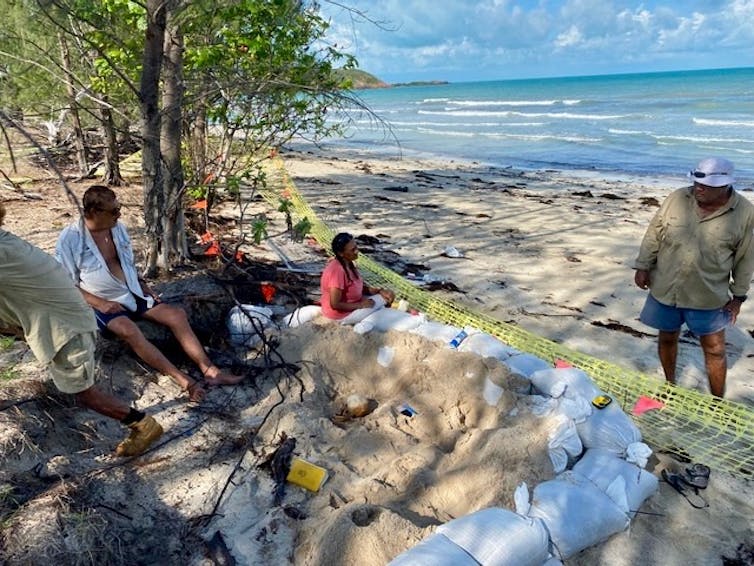
In February last year, king tides and a storm surge eroded parts of a beach on Muralug (or Prince of Wales) Island. Aboriginal custodians and archaeologists rushed to one site where a female ancestor was buried. They excavated the skeletal remains and reburied them at a safe location.
It was the first time such a site had been excavated at the island. Kaurareg Elders now worry coastal erosion will uncover and potentially destroy more burial sites.
Excavations of an ancestral burial eroded by king tides in the Torres Strait. Michael Westaway, UQ/ courtesy of Kaurareg Native Title Aboriginal Corporation
– Marcus Lacey, Senior Gumurr Marthakal Indigenous Ranger:
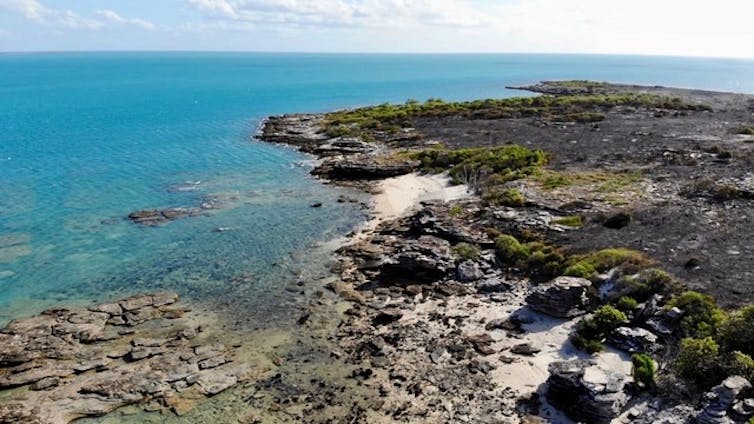
The Marthakal Indigenous Protected Area covers remote islands and coastal mainland areas in the Northern Territory’s North Eastern Arnhem Land. It has an average elevation of just one metre above sea level, and is highly vulnerable to climate change-related hazards such as severe tropical cyclones and sea level rise.
The area is the last remnant of the ancient land bridge joining Australia with Southeast Asia. As such, it can provide valuable information about the first colonisation of Australia by First Nations people.
It is also an important place for understanding contact history between Aboriginal Australians and the Indonesian Maccassans, dating back some 400 years.
What’s more, the area provides insights into Australia’s colonial history, such as Indigenous rock art depicting the ships of British navigator Matthew Flinders. Sea level rise and king tides mean this valuable piece of Australia’s history is now being eroded.
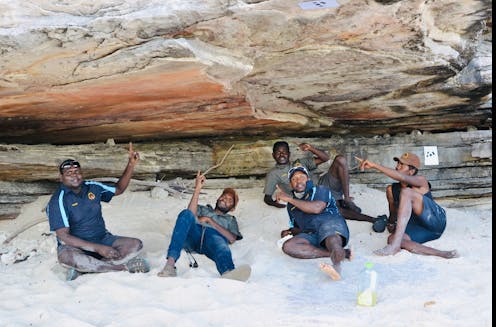
The coastal area has an average elevation of just one metre above sea level. Jarrad Kowlessar, Flinders University/courtesy of Gumurr Marthakal Indigenous Rangers Slabs of rock containing ancient Indigenous art have fallen into the sand. Jarrad Kowlessar, Flinders University/courtesy of Gumurr Marthakal Indigenous Rangers
– Shawnee Gorringe, operations administrator at Mithaka Aboriginal Corporation:
Remains of a traditional Indigenous fireplace currently at risk of destruction. Shawnee Gorringe/courtesy of Mithaka Aboriginal Corporation
On Mithaka land, in remote Queensland, lie important Indigenous heritage sites such as stone circles, fireplaces and examples of traditional First Nations water management infrastructure.
But repeated drought risks destroying these sites – a threat compounded by erosion from over-grazing.
To help solve these issues, we desperately need Indigenous leadership and participation in decision-making at local, state and federal levels. This is the only way to achieve a sustainable future for environmental and heritage protection.
Mithaka Aboriginal Corporation general manager Joshua Gorringe has been invited to the United Nations’ COP27 climate conference in Egypt in November. This is a step in the right direction.
So what now?
The loss of Indigenous heritage to climate change requires immediate action. This should involve rigorous assessment of threatened sites, prioritising those most at risk, and taking steps to mitigate damage.
This work should be undertaken not only by scientists, engineers and heritage workers, but first and foremost by the Indigenous communities themselves, using Traditional Knowledge.
Last year’s COP26 global climate conference included a climate heritage agenda. This allowed global Indigenous voices to be heard. But unfortunately, Indigenous heritage is often excluded from discussions about climate change.
Addressing this requires doing away with the usual “top down” Western, neo-colonial approach which many Indigenous communities see as exclusive and ineffective. Instead, a “bottom up” approach should be adopted through inclusive and long-term initiatives such as Caring for Country.
This approach should draw on Indigenous knowledge – often passed down orally – of how to manage risk. This should be combined with Western climate science, as well as the expertise of governments and other organisations.
Incorporating Indigenous knowledge into cultural heritage policies and procedures will not just improve heritage protection. It would empower Indigenous communities in the face of the growing climate emergency.
Anna M. Kotarba-Morley receives funding from the Australian Research Council (ARC) and National Centre of Science (NCN) in Poland.
Enid Tom does not have any thing to disclose.
Shawnee Gorringe has received funding from the Australian Research Council.
Marcus Lacey does not work for, consult, own shares in or receive funding from any company or organisation that would benefit from this article, and has disclosed no relevant affiliations beyond their academic appointment.
UK supermarkets have removed “best before” dates on thousands of fresh food products in an effort to reduce food waste.
One of the major supermarket chains, Sainsbury’s, is replacing these labels with product messaging that says “no date helps reduce waste”.
Apples, bananas, potatoes, cucumbers and broccoli are among the most wasted foods. Removing “best before” labels from these foods alone will reduce waste by an estimated 50,000 tonnes a year.
Some might worry about food safety. But two types of date labels – “best before” and “use by” – are used in Australia. “Use by” labels would still alert us to when food can no longer be regarded as safe to eat.
And consumers will still be able to assess the state of fresh produce for themselves.
This waste occurs right across the supply chain, including primary production, manufacturing, distribution, retail and hospitality. However, households produce more than half of the waste, at an average cost per household of A$2,000 to $2,500 a year.
Our labelling system is fairly straightforward, but many consumers don’t understand the difference between “best before” and “use by”. This confusion leads them to throw away tonnes of food that’s still suitable for eating.
In Australia, the regulatory authority Food Standards provides guidance for manufacturers, retailers and consumers on using dates on product labels. These dates indicate how long food products can be sold, and kept, before they deteriorate or become unsafe to eat.
Food with a “best before” date can be legally sold and consumed after that date. These products should be safe, but may have lost some of their quality.
Products past their “use by date” are considered not safe.
The food supplier is responsible for placing date labels on the product.
Differences in packaging and date labelling can be subtle. For example, lettuce sold loose or in an open plastic sleeve does not have a “best before” date. The same lettuce packaged in a sealed bag does.
‘Best before’ assessments can be highly subjective. Shutterstock
Bread is the only fresh food that uses a different system with “baked on” or “baked for” date labels.
Some foods, such as canned goods and food with a shelf life of two years or more, don’t have to be labelled with “best before” dates because they usually retain their quality for many years. They are typically eaten well before they deteriorate.
Food producers and retailers are keen to keep the labelling status quo, because it makes it easier to manage stock and encourages turnover.
The case for packaging
Some packaging is used to separate branded products such as fruit varieties protected by plant breeders’ rights, organic products and imperfect vegetable ranges. Once packaged, these products require a “best before” date.
Plastic packaging can greatly increase the shelf life of some vegetables. In these cases, it effectively reduces food waste. A striking example is cucumbers. Plastic wrap can extend their shelf life from a few days to two weeks.
Vegetables such as broccoli and cauliflower contain beneficial anti-cancer compounds called glucosinolates. Plastic packaging that seals in specialty gas preserves these longer. However, overcooking quickly erases this packaging benefit.
Plastic wrap greatly increases the shelf life of cucumbers. Shutterstock
The chemistry of a fruit or vegetable starts changing the moment it is picked. Some types of produce, such as bananas and pears, are picked early so they ripen in the shop and at home. Other produce, such as sweet corn and peas, rapidly decline in the quality and quantity of flavours and nutrients once they’re picked. Snap freezing is an excellent way to preserve this produce.
Fresh fruits and vegetables are still alive. Their cells remain full of chemical reactions and enzymatic activity.
This is why a cut apple turns brown. It’s also why ethylene gas released from bananas and other fruits can shorten the life of their neighbours in the fruit bowl.
Potatoes, one of the most wasted products, are sold with “best before” dates when packaged in plastic bags. But if stored correctly in low light and in a “breathable” bag (paper or hessian), potatoes stay “alive” and edible for months. Just make sure you cut away any green parts, which contain toxic solanine.
As well as fresh produce’s own cellular activity, there is microbial activity in the form of bacteria and fungi.
Fortunately, we come equipped with a number of evolved chemical sensors. We can feel, see, sniff and taste the state of fruits, vegetables and other products. Trust (and train) your instincts.
In the short term, consumer awareness and buying power are the best drivers of change. Ask yourself questions like:
Do I need a packaged product?
Does the packaging enhance shelf life?
Would I buy less if it wasn’t packaged?
Thinking about these questions will help us reduce the impacts of food waste.
The authors do not work for, consult, own shares in or receive funding from any company or organisation that would benefit from this article, and have disclosed no relevant affiliations beyond their academic appointment.
Source: The Conversation (Au and NZ) – By John Fischetti, Professor, Pro Vice-Chancellor of the College of Human and Social Futures, University of Newcastle
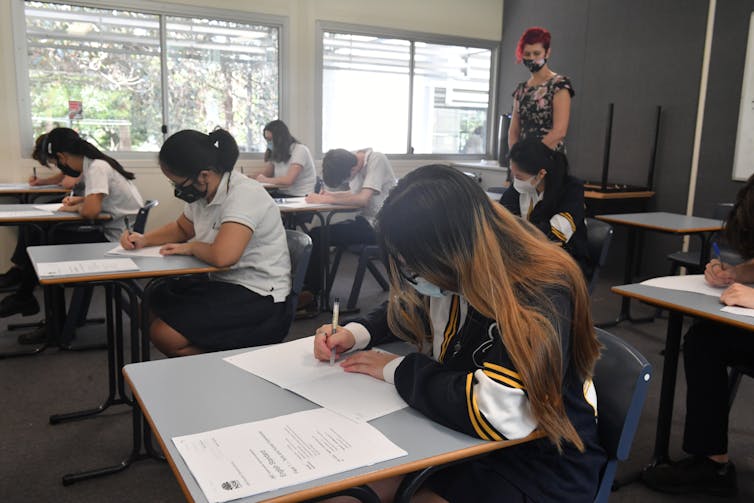
Year 12 students around Australia are preparing to sit their final exams.
For many young people this is one of the most stressful parts of school, with their future supposedly coming down to one number.
This is an outdated way of finishing school and working out what students do in the next phase of their lives.
Universities and TAFEs are increasingly using other methods – such as interviews or portfolios – to offer places to school leavers. In 2021, more than 25,000 NSW students applied for an early offer through the “schools recommendation scheme”, to lock in a university place before they sit their exams. This is up from 5,447 in 2014, suggesting year 12 exams may not be as necessary as we once thought.
Our research shows you can reliably predict a student’s year 12 results by year 11. This also suggests we don’t need a battery of stressful exams to work out if a student is suited for tertiary education.
This gives us the opportunity to radically rethink how the final years of school are structured.
Our research
Two years ago, we studied more than 10,000 students in the Catholic Education Diocese of Paramatta, NSW. We have repeated the study and our work now includes 20,000 students across 21 exam areas.
Students sitting their year 12 English exams in NSW in 2021. Mick Tsikas/AAP
We used predictive analytics which links multiple pieces of information about student progression through school.
We used 17 variables including year 9 NAPLAN scores, Higher School Certificate subject choices and year 11 attendance. We also use demographic information, such as how long a student has lived in Australia and a school’s socioeconomic rating.
Across both our studies, we found we could predict year 12 results in year 11, with a 93% accuracy rate.
Our purpose here is not to label students, but to change the focus of school and the efforts of students and teachers.
What can we do differently in schools?
We are already seeing the beginnings of new ways of “doing school” in Australia. Some schools are changing their focus from year 12 exams to students doing internships, creating portfolios of work, doing TAFE or university certificates, or doing an overseas exchange.
In British Columbia, Canada, final school assessments include a project that connects “real-world” applications of the curriculum for each student.
In Estonia, now among the world leaders in education, traditional “knowledge and understanding” approaches have been replaced with a strong emphasis on critical thinking, problem-solving, entrepreneurship, digital skills and citizenship. These are all qualities that fit with both employers’ needs and measures of success in the adult world.
Students undertake a cross-disciplinary creative project to graduate from the equivalent of year 10 – an example might be studying the impact of music on managing the onset of dementia in older people. They then do a research project before finishing high school.
Year 12 exams are outdated
High school as we’ve known it has been dominated by high stakes, high-pressure exams that have outlived their usefulness. If we can reliably predict the results, we don’t need the tests.
We know young people’s mental health is already poor, and has suffered further during COVID.
We should be looking for ways to improve, rather than exacerbate this. We also know universities are increasingly open to other ways of admitting students.
There is an enormous opportunity here to reallocate resources and create a modern, meaningful school experience that excites young people. It can encourage them to seek career-building activities, study overseas, learn languages or follow passion projects – not just study for stressful exams that tell us what we already know.
The research for this piece is a continuation of the work initiated by Dr Raju Veranasi for his 2021 Phd at the University of Newcastle.
John Fischetti is an unpaid, volunteer member of the Board of Directors of Big Picture Australia.
One of the key measures announced to “get wages moving” in the wake of the federal government’s jobs summit was greater access to multi-employer agreements.
At the moment, most workers get their wages adjusted by bargaining with individual employers, so-called “enterprise bargaining”.
Multi-employer agreements would allow workers in particular occupations to bargain with their employers as a group, rather than employer by employer.
If multi-employer agreements were clearly a good way to get real wages moving, we would expect to see real wages growing more strongly in countries that allow multi-employer bargaining than in those that don’t.
What system lifts wages more?
To find out, I examined the measure of average annual wages per full-time and full-year-equivalent employee assembled by the Organisation for Economic Co-operation and Development, available at OECD.stat.
The OECD measure is derived from national accounts data, making it different to the wage price index commonly quoted in Australia, which comes from a survey of employers and at the moment shows real wage growth negative.
The measure I used has the advantage of including the effect of wage increases from promotions, annual increments and job changes, making it a better guide to the experience of workers than the wage price index, which merely records the rate at which the wages attached to particular positions grows.
17 countries compared
Less helpfully, because the OECD data is an average of all wages paid it can be affected by changes in the composition of the workforce. As an example, a rapid growth in employment concentrated in low-income jobs can make it look as if wage growth is slowing when it isn’t.
The OECD assigns countries to one of two groups:
those in which bargaining occurs mainly at the company level
those in which collective bargaining takes place with multiple employers, most often from the same industry, but sometimes from firms in the same region.
Not all countries fit neatly into these categories. Australia is one such exception, relying on centrally-set awards and a minimum wages in addition to employer by employer (and sometimes occupation by occupation) negotiations.
After omitting countries without comparable wages data, I found 14 countries where multi-employer bargaining dominates, and 12 where company-level bargaining dominates.
Examining the period 2011-21, I found that across the multi-employer bargaining countries, real wages growth averaged only 0.6% per year.
In contrast, among those in the company bargaining group, average real wage growth was about four times a high, at 2.3% per annum.
But the company-bargaining group included many Eastern European countries which have greater room for productivity growth and thus wage increases.
Excluding these from both groups, I found that in the countries where multi-employer bargaining dominated, real wage growth averaged 0.7% per year.
Where company bargaining dominated, real wage growth averaged 1.1%.
Australia, which, along with Luxembourg, fits into neither category, had real wage growth of 0.4%.
These calculations are not consistent with the claim that multi-employer bargaining boosts real wages growth. If anything, they suggests the reverse.
We will need to try other things
But this isn’t to say Australia’s system of enterprise bargaining can’t be improved. The post-summit bipartisan commitment to reform the Better Off Overall Test that is applied to enterprise agreements holds potential.
Researchers at the E61 Institute have identified another problem ripe for attention: an apparent decoupling of wages from firm performance.
Multi-employer bargaining is unlikely to be able to address this; indeed it could make it worse.
We also need to recognise that in an economy increasingly dominated by services, getting real wage gains from productivity gains becomes difficult.
Nowhere is this clearer than in the public sector, where teachers and nurses face wages set by government employers and in sectors such as aged care and childcare where governments help pay and effectively set wages.
The main obstacle to higher wage growth in these sectors is not enterprise bargaining, but simply an unwillingness on the part of governments (on behalf of taxpayers) to stump up the cash.
Mark Wooden is also a part-time member of the Fair Work Commission’s Expert Panel responsible for the Annual Wage Review. This piece, however, is written in his capacity as a professor of the University of Melbourne. None of the views expressed here should be attributed to either the Fair Work Commission or the University of Melbourne.
Source: The Conversation (Au and NZ) – By Cherine Fahd, Associate Professor of Visual Communication in the School of Design, University of Technology Sydney
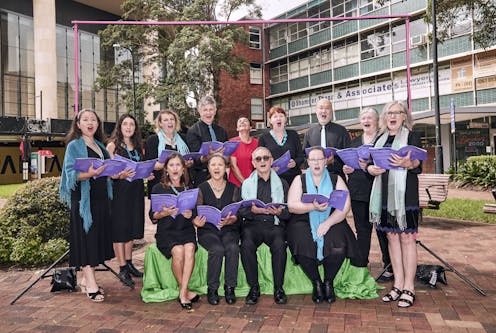
Members of the River City Voices choir perform for a group portrait.Cherine Fahd, Being Together: Parramatta Yearbook (2021-2022)
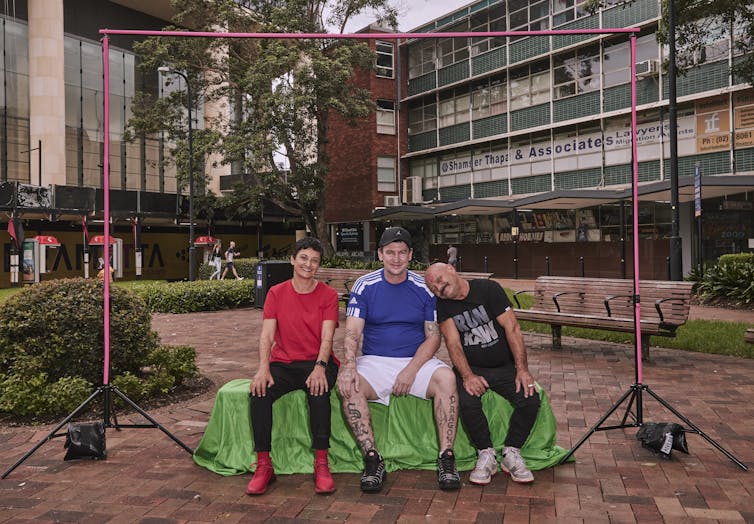
For the past ten months, I have photographed hundreds of people in the Western Sydney suburb of Parramatta for a portrait project called Being Together: Parramatta Yearbook.
The portraits in the yearbook show the people who live, work and play in Parramatta against the backdrop of an ever-changing city.
The way a photographer and subject come together to make a portrait is usually invisible in a portrait.
Here, instead of trying to reveal the elusive individuality of a person, I have been focusing on the social dynamics of portraiture – what happens behind the scenes between me and the people I’m photographing.
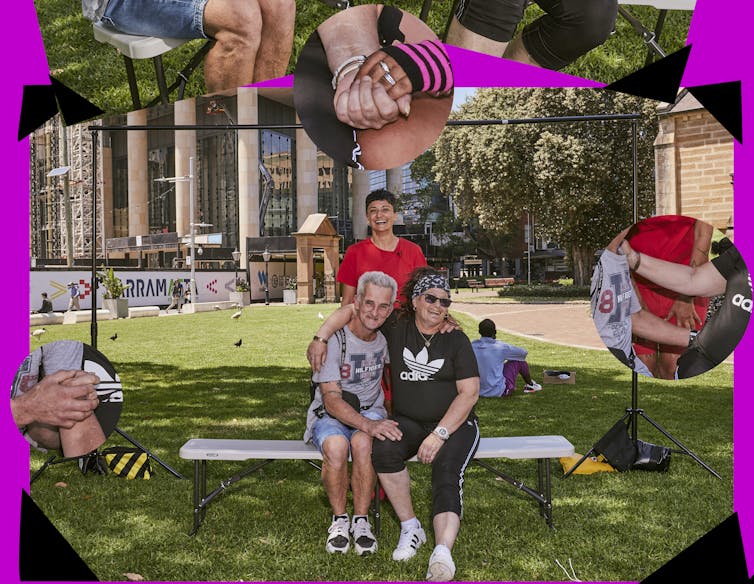
Collages from the yearbook portray being together in Parramatta. Cherine Fahd, Being Together: Parramatta Yearbook (2021-2022)
As Daniel Palmer notes in his book Photography and Collaboration, portraiture is by definition relational and collaborative. That is, the process of photographic portraiture inherently brings the photographer and subjects together to arrive at an image.
In the context of this project, coming together for a portrait creates playful opportunities for social interactions among strangers.
I hold my camera phone as a mirror to help a participant apply her lipstick while the audio producer for The Conversation Podcast captures our verbal interaction. Cherine Fahd, Being Together: Parramatta Yearbook (2021-2022)
It is amazing what strangers will share with me in the space of five minutes.
Two men reveal they are brothers and haven’t seen each other for ten years.
One woman tells me she thinks she’s ugly and asks me to make her look beautiful.
Another keenly describes the floral wonders she is holding from her community garden.
One man whispers that he can’t speak English.
Another tells me he’s in a hurry to go to lunch.
Two brothers on the day they are reunited. Cherine Fahd, Being Together: Parramatta Yearbook (2021–2022)
We chat about the everyday things, the weather, COVID, shopping and Rugby League.
There are stories of time spent in jail, and lives being turned around.
New arrivals to Australia speak of their family in lands faraway and citizens who have lived all their lives in Parramatta share insights on the city.
These are the stories photography can’t capture in the silent stillness of the image, but that’s no reason not to continue.
Setting up a studio in the street and inviting people to pose together in front of the camera is a thing to see. We always had audiences of passersby watching and it wasn’t long before they were also in front of the camera.
If you look closely at the portraits there are talkative details and warm gestures: micro-movements of the body where people touch each other or hold hands; the spaces between our bodies; instances when we are caught by the camera laughing, chatting and applying lipstick.
Warm gestures can be seen in the detail of the yearbook’s collages. Cherine Fahd, Being Together: Parramatta Yearbook (2021–2022)
I also see myself in action. I am both photographer and subject, a stranger dressed in red, wanting desperately to be with people, to steer them through a photographic moment, to pose and be uncomfortable together.
When people have their portraits made I want to know whether they enjoyed it or found it excruciating and awkward. After the photo is taken, we walk up to the laptop tethered to the camera and look at the photographs. They indicate which portraits they like and hate. I listen and take notes.
Involving people in the selection process creates instant trust.
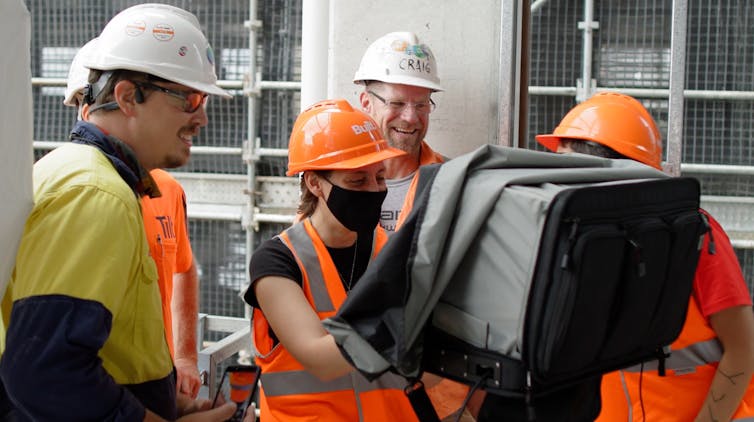
A video trailer captures the construction workers reviewing their portraits with Pam, the project’s photo assistant. Courtesy of the Museum of Contemporary Art.
In bringing people together before a camera, I became acutely aware of photography’s potential to foster social inclusion, social participation, visibility and a sense of belonging and connection to one’s place and people.
Photography is something we all do. It is familiar and familial. Group portraits activate a social encounter and conversation, listening and storytelling.
The social experience of photography is also extended through time. After the photographs have been taken and printed, they are displayed as a collage on a large scale photo wall in the heart of Parramatta in Centenary Square. I love watching people looking for themselves or pointing to familiar faces.
Looking for familiar faces on the photo wall. Photo by Garry Trinh
As one passerby declared on seeing the photo wall:
Thanks for treating everyone the same, like we belong and are as deserving of recognition and dignity as others, instead of excluding us from being visible.
This feedback goes to the heart of the project that welcomed people from all walks of life to offer a view of Western Sydney that is far from the media stereotypes.
Fundamentally, the Parramatta Yearbook acts as a model for how cultural institutions and government can work together with artists to record and reflect community, create a sense of belonging and produce narratives about a place in transition that foregrounds the creativity of its citizens ahead of urban development.
The Parramatta Yearbook portraits are on public display in Parramatta’s Centenary Square until October 3, as well as in a 88-page downloadable yearbook from the Museum of Contemporary Art.
Being Together: Parramatta Yearbook is produced and presented by C3West on behalf of the Museum of Contemporary Art Australia in partnership with Parramatta Artists’ Studios, an initiative of the City of Parramatta.
Seven weeks ago the Philippines truth-telling martial law film Katips was basking in the limelight in the country’s national FAMAS academy movie awards, winning best picture and a total of six other awards.
Last week it began a four month “world tour” of 10 countries starting in the Middle East followed by Aotearoa New Zealand today – hosted simultaneously at AUT South campus and in Wellington and Christchurch.
The screening of Vincent Tañada’s harrowing – especially the graphic torture scenes – yet also joyful and poignant musical drama touched a raw nerve among many in the audience who shared tears and their experiences of living in fear, or in hiding, during the hate-filled Marcos dictatorship.
The martial law denunciations, arbitrary arrests, desaparecidos (“disappeared”), brutal tortures and murders by state assassins in the 1970s made the McCarthy era red-baiting witchhunts in the US seem like Sunday School picnics.
Tañada has brushed off claims that the film has a political objective in an attempt to sabotage the leadership of the dictator’s son, Ferdinand Bongbong Marcos Jr, who won the presidency in a landslide victory in the May elections to return the Marcos family to the Malacañang.
He has insisted in many interviews — and he repeated this in a live exchange with the audiences in Auckland, Wellington and Christchurch — that the film is educational and his intention is to counter disinformation and to ensure history is remembered.
Telling youth about atrocities Tañada, from one of the Philippines’ great political and legal families and grandson of former Senator Lorenzo Tañada, a celebrated human rights lawyer, says he wanted to tell the youth about the atrocities that happened during the imposition of martial law under Marcos.
He wanted to tell history to those who had forgotten and those who aren’t yet aware.
The Katips movie trailer.
“You know, as an artist it is also our objective not just to entertain people but more important than that, we are here to educate,” he says.
“We also want to educate the young people about the atrocities – the reality of martial law.
“History is slowly being forgotten. We have forgotten it during the last elections and I guess we also have the responsibility to educate and let the youth know what happened during those times.”
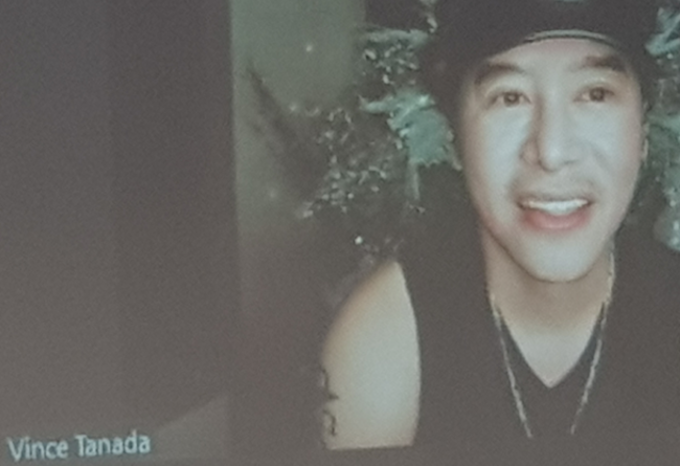
Katips film director and writer Vince Tañada talking by video to New Zealand audiences in Auckland, Wellington and Christchurch today. Image: David Robie/APR
It is rare that such brutal torture scenes are seen on the big screen, and before the main screening at AUT the organisers — Banyuhay Aotearoa, Migrante Aotearoa and Auckland Philippine Solidarity — showed two shorts made by the University of the Philippines and Santo Tomas University of Manila featuring martial law survivors describing their horrifying treatment during the Marcos years to contemporary students.
Some of the students broke down in tears while others, surprisingly, remained impassive, sometimes with an air of disbelief.
The film evolved from the 2016 stage musical Katips: Mga Bagong Katipunero – Katips: The New Freedom Fighters, which won Aliw Awards for best musical performance that year.
Freedom fighter love story In a nutshell, Katips tells the love story of Greg, a medical student and leader of the National Unions of Students in the Philippines (NUSP), who with other freedom fighting protesters stage a demonstration against martial law on a mountainside called Mendiola.
His professor is abducted by the state Metropol police, murdered and his body dumped in a remote location.
The protesters begin a vigil and the police brutally suppress the protest and arrest and kidnap other freedom fighters. They are subjected to atrocious torture and their bodies dumped.
A safehouse branded “Katips House” takes in Lara, a New York actress and the daughter of the murdered professor who is visiting Manila but doesn’t yet know about the fate of her father. Lara and Greg form an unlikely relationship and their lives are thrown into upheaval when the safehouse “mother” Alet is abducted and tortured to death.
Greg and another protester, Ka Panyong, a writer for the underground newspaper Ang Bayan, are forced to flee into the jungle for the safety and become rebels. Both get shot while on the run, but manage to survive.
When Greg returns to Lara at the “Katips House” during the Edsa Revolution in 1986, he finds he has a son.
The film has a stirring end featuring the Bantayog ng mga Bayani, a memorial wall to the fallen heroes struggling against martial law– a fitting antidote to the Marcoses and their crass attempts to rewrite Philippine history.
Ironically, the same month that Katips was released in public cinemas, another film, the self-serving Maid of Malaçanang, was launched in a bid to perpetuate the Marcos myths.
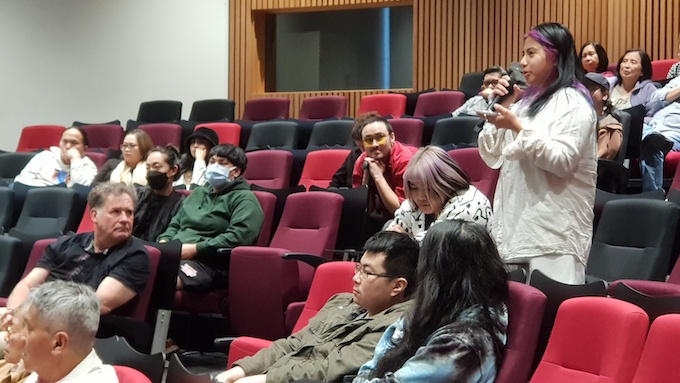
A member of the audience poses a question to Katips film director Vince Tañada on AUT South campus today. Image: David Robie/APR
Governor Lukas Enembe of Indonesia’s Melanesian province of Papua has been banned from travelling abroad by the state Directorate General of Immigration, Ministry of Law and Human Rights, preventing him undergoing vital medical treatment in the Philippines.
Governor Enembe, 55, was due to go to Manila this month. However, his hope of getting treatment there has been dashed by the ban from the Directorate General of Immigration.
The order preventing any overseas trip to Governor Lukas Enembe is in force until 7 March 2023.
It was issued in response to a Corruption Eradication Commission (KPK) request to ban the governor from any overseas trip.
“Directorate of Immigration Supervision and Enforcement of the Directorate General of Immigration accepts the submission for prevention to subject an. Lukas Enembe from the Corruption Eradication Commission on Wednesday, September 7, 2022. Prevention is valid for six months,” said the Director of Immigration Supervision and Enforcement, I Nyoman Gede Surya Mataram in Jakarta.
Tabloid Jubi reports that during spontaneous demonstrations in protest by Enembe’s supporters in Jayapura last Monday over the steps taken by the KPK, Enembe’s lawyer, Stevanus Roy Rening, said governor was due to leave for his medical treatment that day.
“Last night, the Governor [explained] that it was actually Monday that he is supposed to leave [for treatment]. I repeat again, let the people know.
‘Roy, I’m sick’ “Governor said, ‘Roy, I’m sick. I have got permission from the Minister of Home Affairs. I said, ‘Sir, not yet, please delay! There is a letter from the KPK for you to attend on Monday’,” Rening.
Rening was worried that if Enembe left for treatment abroad on Monday, public opinion would form that Lukas Enembe had run away. However, Governor Enembe said he had never stolen the public’s money, so he would never be afraid.
“[I said], ‘later when you left, it will be said that Lukas Enembe is afraid, running away’. [He replied], ‘Roy, I am the leader of the Papuans. I’ve never been afraid, I’ve never corrupted’,” Rening said, reiterating Enembe’s explanation.
Governor Enembe’s personal medical physician, Dr Antonius Mote, said Governor Lukas Enembe was still ill.
The heavy pressure had caused health reactions such as swollen feet that make it difficult Governor Enembe.
According to Dr Mote as the Pacific Pos reports, in the last 6 months the governor began to experience several illnesses such as stroke, diabetes, heart disease, hypertension and kidney complications.
He has routinely undergone check-ups in hospitals in Singapore and Manila, Philippines.
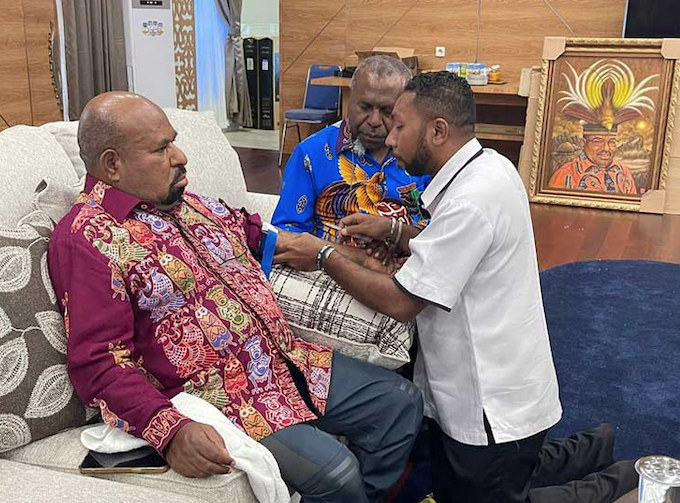
Papuan Governor Lukas Enembe undergoing medical treatment … believed to be the target of an Indonesian power struggle over Indigenous administrations in the Melanesian region. Image: Pacific Pos
Return needed for medical Dr Mote said that the governor should have returned to the doctor in Singapore for a medical appointment but this was cancelled because of a summons for an interview by the KPK.
“We really ask for his right to get medical treatment, in this case, he can go to a hospital abroad. Because he was very worried, the pressure he experienced could worsen his health condition,” said Dr Mote.
In response to the request from the Governor Enembe’s lawyer Rening over the treatment overseas, the Deputy Chair of the KPK, Alexander Marwata, said this would be facilitated — with certain conditions, reports Tempo.
Marwata gave the Governor an option to seek treatment at the Army Central Hospital or Cipto Mangunkusumo Hospital in Jakarta.
“If the disease can be treated in Indonesia, why do you have to go abroad?,” said Marwata.
Marwata said a doctor would decide whether Enembe could be treated in Indonesia or must go abroad for treatment.
If doctors in Indonesia “raised their hands”, he said, the KPK would grant Enembe permission to go abroad for treatment.
Chasing alleged ‘corruption’ Lawyer Rening said the Corruption Eradication Commission (KPK) seemed to be trying to find a case of alleged corruption involving Governor Enembe.
“It [has been] proven [by Luke Enembe]. During his [leadership] period, all audit results of [Regional Revenue and Expenditure Budget by] have been vetted by the Supreme Audit Agency [gained opinion]. There was no element of corruption found,” said Rening.
The Papuan Governor’s spokesperson, Rifai Darus, said the Governor’s home was still being closely guarded by thousands of people and close relatives of Enembe.
“He [Governor Enembe] asked not to have too many people there and asked them to return to their homes. These people came alone, without being asked, after seeing the information circulating on social media regarding the ‘criminalisation’ of the Governor,” said Darus.
He added that the Governor had also said the ongoing legal process was a “political struggle” and asked not to “politicise the situation”.
“He knows very well that the current situation is a process of ‘criminalising’ him by making the KPK the ‘front’ to deal with this case. The Governor has the right as stated in the 1945 Constitution Article 48a that everyone has the right to live and defend his life,” said Darus.
The president of the Communion of Baptist Churches in West Papua, Dr Socratez Yoman, has revealed to news media that the KPK had three times tried to criminalise Governor Enembe.
‘Purely political goal’ “The effort to ‘criminalise’ Papuan Governor Lukas Enembe is purely a political goal or agenda for [the elections in] 2024, not a legal issue,” he said.
Reverend Yoman believes that other political parties in Indonesia felt “uncomfortable and insecure” about entering the political process in 2024 in Papua Province.
“So far, there have been people who have seen, observed and felt that the presence of Governor Enembe is a threat and obstacle for other political parties to become ‘number one’ in Papua province.
Reverend Yoman said there was no other way to “destroy the strong fortress” of the Governor Enembe, who is chair of the Democratic DPD of Papua province. So the KPK was being used by certain political parties to ‘criminalise’ Enembe.
“On Wednesday, September 14, 2022, I met Governor Enembe at his residence in Koya Timur and he told me, Mr Yoman, the problem is now clear. It’s not a legal issue, it’s a political issue.
“Pak Budi Gunawan, the head of BIN (State Intelligence Agency) and PDIP (Indonesian Democratic Party of Struggle) used the KPK to criminalise me. Mr Yoman, you should write an article so that everyone would know about this crime.
“How come state institutions can become tools for certain political parties,” Reverend Yoman quoted Governor Enembe as saying.
Money left for medical expenses On that occasion, the Governor of Papua also conveyed about Rp 1 billion [NZ$112,000] to Socratez Yoman, where in March 2019, the Governor left for Jakarta at night because his health was getting worse.
This was during the covid-19 lockdown.
“When Enembe left, he kept Rp. 1 billion in the room. After three months in Jakarta, in May 2019, the Governor called Tono, who used to look after and organise Enembe’s house and yard.
“I asked Tono to go to my room and take the money in the room with a value of 1 billion. I asked Tono to send it through a BCA account. That’s my money, not money from corruption. This KPK is just claiming anything,” said Reverend Yoman quoting Governor Enembe.
Reverend Yoman appealed for support and prayers for Governor Enembe and his family.
Laurens Ikinia is a Papuan Masters in Communication Studies student at Auckland University of Technology who has been studying journalism. He contributes to Asia Pacific Report.
During the present period of mourning for Queen Elizabeth II, public sensitivities in the United Kingdom and Australia are high. There is strong sentiment in both countries in favour of showing respect for the Queen’s death.
Some people may wish to do this privately. Others will want to demonstrate their respect publicly by attending commemorations and processions.
There are also cohorts within both countries that may wish to express discontent and disagreement with the monarchy at this time.
This has caused tension across the globe. For instance, a professor from the United States who tweeted a critical comment of the Queen has been subject to significant public backlash.
Also, an Aboriginal rugby league player is facing a ban and a fine by the NRL for similar negative comments she posted online following the Queen’s death.
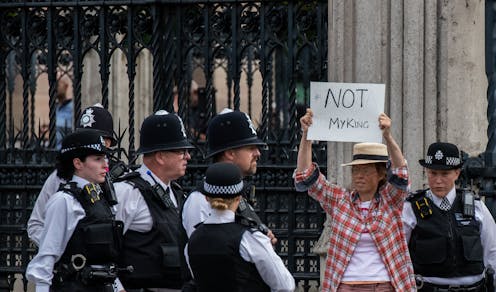
This tension has been particularly so in the UK, where police have questioned protestors expressing anti-monarchy sentiments, and in some cases, arrested them.
Police arrest anti-monarchy protesters at royal events in England, Scotland https://t.co/GJSzOa1SKU
But should such concerns about the actions of the Queen and monarchy be silenced or limited because a public declaration of mourning has been made by the government?
This raises some difficult questions as to how the freedom of speech of both those who wish to grieve publicly and those who wish to protest should be balanced.
What laws in the UK are being used to do this? There are various laws that regulate protest in the UK. At a basic level, police can arrest a person for a “breach of the peace”.
Also, two statutes provide specific offences that allow police to arrest protesters.
Section 5 of the Public Order Act 1986 UK provides that a person is guilty of a public order offence if:
they use threatening or abusive words or behaviour or disorderly behaviour
or display any writing, sign or other visible representation which is threatening or abusive.
The offence provision then provides this must be “within the hearing or sight of a person likely to be caused harassment, alarm or distress” by those acts.
There is some protection for speech in the legislation because people arrested under this provision can argue a defence of “reasonable excuse”. However, there’s still a great deal of discretion placed in the hands of the police.
Seriously worrying that holding a sign saying #notmyking can get you removed by police. What ever your views on the monarchy, this should concern you. https://t.co/uj1TGkdL5t
In the context of the period of mourning for Queen Elizabeth II, the wide terms used in this legislation (such as “nuisance” and “distress”) gives a lot of discretion to police to arrest protesters who they perceive to be upsetting others.
For instance, a protester who holds a placard saying “Not my king, abolish the monarchy” may be seen as likely to cause distress to others given the high sensitivities in the community during the period of mourning.
Is there a right to protest under UK and Australian law? Protest rights are recognised in both the UK and in Australia, but in different ways.
In the UK, the right to freedom of expression is recognised in Article 10 of the Human Rights Act.
In Australia, there’s no equivalent of the right to freedom of expression at the federal level as Australia doesn’t have a national human rights charter. Rather, there’s a constitutional principle called the “implied freedom of political communication”.
This isn’t a “right” as such but does provide some acknowledgement of the importance of protest.
Also, freedom of expression is recognised in the three jurisdictions in Australia that have human rights instruments (Victoria, Queensland and the ACT).
Can the right to protest be limited in a period of mourning? In this period of public mourning, people wishing to assemble in a public place to pay respect to the queen are exercising two primary human rights: the right to assembly and the right to freedom of expression.
But these are not absolute rights. They cannot override the rights of others to also express their own views.
Further, there is no recognised right to assemble without annoyance or disturbance from others. That is, others in the community are also permitted to gather in a public place during the period of mourning and voice their views (which may be critical of the queen or monarchy).
It is important to also note that neither the UK nor Australia protects the monarchy against criticism. This is significant because in some countries (such as Thailand), it is a criminal offence to insult the monarch. These are called “lèse-majesté” laws — a French term meaning “to do wrong to majesty”.
The police in the UK and Australia cannot therefore use public order offences (such breach of the peace) to unlawfully limit public criticism of the monarchy.
It may be uncomfortable or even distressing for those wishing to publicly grieve the Queen’s passing to see anti-monarchy placards displayed. But that doesn’t make it a criminal offence that allows protesters to be arrested.
The ability to voice dissent is vital for a functioning democracy. It is therefore arguable that people should be able to voice their concerns with the monarchy even in this period of heightened sensitivity. The only way in which anti-monarchy sentiment can lawfully be suppressed is in a state of emergency.
A public period of mourning does not meet that standard.
The son of Fijian Prime Minister Voreqe Bainimarama is facing criminal charges in Australia over domestic violence-related allegations.
Meli Bainimarama, 36, was charged in the Windsor Court in Sydney with 17 offences related to domestic violence, including five charges of assault resulting in bodily harm, stalking, common assault, and destroying or damaging property.
The offences alleged happened between February and May of 2022 in Sydney.
Meli Bainimarama was arrested in Queensland last week and extradited to New South Wales the next day.
He was granted bail.
An interim suppression order, granted last Saturday, was lifted today.
Meli Bainimarama did not appear in person and his lawyer appeared via audio link.
This article is republished under a community partnership agreement with RNZ.
Papuan protesters from seven customary regions this week stormed the Mako Brimob police headquarters in Kota Raja, Jayapura, accusing the KPK and police of “criminalising” local Governor Lukas Enembe.
The protest on Monday was organised in response to the Komisi Pemberantasan Korupsi (KPK) Corruption Eradication Commission’s attempt to investigate corruption allegations against Governor Lukas Enembe.
This time, Enembe is suspected of receiving gratification of Rp 1 miliar (NZ$112,000).
These accusations are not the first time that the KPK has attempted to criminalise Lukas Enembe, the Governor of Papua. The KPK has tried this before.
KPK had attempted to implicate the governor in their corruption scam in February 2017, but the attempt failed.
On 2 February 2018, KPK attempted another attack against Governor Enembe at the Borobudur Hotel, Jakarta, but [this] failed miserably. Instead, two KPK members were arrested by the Metro Jaya Regional Police. The KPK announced a suspect without checking with the governor first.
The representative of the Papuan people at the rally stated that KPK failed to follow the correct legal procedures in executing this investigation.
KPK should avoid inflaming the Papuan conflict, as the Papuan people have so far followed Jakarta’s controversial decisions — decisions that are contrary to the wishes of the Papuan people, a representative stated at the rally.
For instance, Jakarta’s insistence on the creation of new provinces from the existing two (Papua and West Papua) has been strongly rejected by most Papuans.
Remained silent The spokespeople for the protesters warned KPK that they had remained silent because Governor Enembe was able to maintain a calm among the community. However, if the governor continues to be criminalised, Papuans from all seven customary regions will revolt.
Papuan protesters hold “save him” banners in support of accused Governor Lukas Enembe. Image: APR
The KPK has named Governor Enembe as a suspect in the corruption of his personal funds.
“This is ‘funny’,” protesters said. “One billion rupiahs [NZ$112,000] of his own money used for medical treatment were alleged to be corrupt. This is strange. We will raise that amount, from the streets and give it to KPK.
“Remember that,” speakers said.
Stefanus Roy Renning, the coordinator of Governor Enembe’s Legal Council Team, said the case the governor was accused of (1 billion Rupiah) is actually, the governor’s personal funds sent to his account for medical treatment in May 2020.
Governor Lukas Enembe … seen as a threat and an obstacle for other political parties seeking the position of number one in Papua. Image: West Papua Today
Therefore, if you refer to this [KPK’s behaviour] as criminalisation, then yes, it is criminalisation.
This is due to the fact that the suspect’s status was premature and not in line with the criminal code, and that the governor himself has not been questioned as a witness in the alleged case.
Questioned as witness Renning said that for a suspect to be determined, there must be two pieces of evidence and he or she must be questioned as a witness.
Benyamin Gurik, chair of the Indonesian Youth National Committee (KNPI), expressed apprehension about the allegations, saying it amounted to the criminalisation of Papuan public figures, which may contribute to conflict and division in the region.
“Jakarta should reward him for all of the good things he’s done for the province and country, not criminalise him,” said Gurik.
Supporters of Governor Lukas Enembe guard his home. Image: APN
Otniel Deda, chair of the Tabi Indigenous group, urged the KPK to act more professionally.
He suspects that the KPK’s actions were sponsored by “certain parties” intent on shattering the reputation of the Papuan leader.
The governor himself has his own suspicions as to who is behind the corruption accusations against him.
He suspects KPK and the police force are among the highest institutions in the country being used to serve political games that are being played behind his back.
Purely a political move According to Dr Sofyan Yoman, president of the Fellowship of West Papuan Baptist Churches (PGBWP), the attempted criminalisation of Governor Enembe is a purely political move geared toward dictating the 2024 election outcome, not a matter of law.
An angry group of Governor Lukas Enembe supporters performing a war dance armed with traditional bows and arrows outside his home in an effort to thwart police plans. Image: APR
Dr Yoman explained that other parties in Indonesia are uncomfortable and lack confidence in entering the Papua provincial political process in 2024.
There have been those who have seen, observed, and felt that the existence of Lukas Enembe is a threat and an obstacle for other political parties seeking the position of number one in Papua.
To break the stronghold of Governor Enembe, who is also the chair of the Democratic Party of the Papuan province, there is no other way than to use KPK to criminalise him.
In a statement to Dr Yoman on Wednesday, Governor Enembe said:
Mr Yoman, the matter is now clear. This is not a legal issue, but a political one. The Indonesian State Intelligence, known as Badan Intelligence Negara (BIN), and the Indonesian Democratic Party of Struggle, known as Partai Demokrasi Indonesia Perjuangan (PDIP), used KPK to criminalise me.
Mr Yoman, you must write an article about the crime so that everyone is aware of it. State institutions are being used by political parties to promote their agenda.
Account blocked Dr Yoman met the governor and his wife at Governor Enembe’s Koya residence, where he was informed of the following by Yulce W. Enembe:
In the last three months, our account has been blocked without any notification to us as the account owner. We have no idea why it was blocked. We could not move. We can’t do anything about it. Our family has been criminalised without showing any evidence of what we did wrong. Now we’re just living this way because our credit numbers are blocked.
The governor himself gave an account of how he used the Rp 1 billion:
As my health was getting worse, we left for Jakarta at night in March 2019. We were in lockdown due to COVID-19 at the time. When I left, I saved 1 billion in my room. In May 2019, I called Tono (the governor’s housekeeper). I asked Tono to go to my room and take the money in the room worth 1 billion. I asked Tono to transfer it to my BCA account. That’s my money, not corruption money.
“The KPK is just anybody,” the governor stated. “The KPK’s actions were purely political, not legal. KPK has become a medium for PDIP political parties. Considering that the Head of BIN, the Minister of Home Affairs, and the KPK descend from one institution — the police — these kinds of actions are not surprising to me.
“I am being politically criminalised”, said the governor. “Part of a pattern of psychological and physical threats and intimidation I have faced for some time”
“I am not a criminal or a thief,” the governor said.
Singapore health travel The governor’s overseas travels for medical treatment in Singapore have been halted [barred] by the Directorate General of Immigration based on a prevention request from the KPK.
This appears to be a punitive measure taken by the country’s highest office to further punish the governor, preventing him from receiving regular medical care in Singapore.
Media outlets in Indonesia and Papua have been dominated by stories about the governor’s name linked to the word “corruption”, creating a space for hidden forces to assert their narratives to determine the fate of not only the governor, but West Papua, and Indonesia.
West Papua is a region in which whoever controls the information distributed to the rest of the world, controls the narrative. It is a region where the Indonesian government and the Papuan people have fought for years over the flawed manner in which West Papua was incorporated into Indonesia in the 1960s.
When news of a criminalised Papuan public figure such as Governor Enembe comes to the surface, it is often conveniently used as a means of demoralising popular Papuan leaders who are trusted and loved by their people.
It has been proven again and again over the past decade that Jakarta would have to deal with the revolt of hundreds of thousands of Papuans if they sought to disturb or displace Governor Enembe.
Ultimately, these kinds of nuanced incidents are often created and used to distract Papuans from focusing on the real issue. The issue of Papuan sovereignty is what matters most — the state of Papua, as Jakarta is forcing Papuans to surrender to Indonesian powers that seek to transform Papua and West Papua into Indonesia’s dream.
Papuan dream turned nightmare Tragically, the Indonesian dream for West Papua have turned into nightmares for the people of Papua, recently claiming the lives of four Indigenous Papuans from the Mimika region, whose bodies were mutilated by Indonesian soldiers.
In recent weeks, this tragic story has been featured in international headlines, something that Jakarta wishes to keep out of the global spotlight.
The UN acting High Commissioner for Human Rights Nada Al-Nashif raised West Papua in her statement during the 51st session of the Human Rights Council on Monday — the day that Governor Enembe was summoned to police in Kota Raja.
Despite Jakarta’s attempts to spin news about West Papua as domestic Indonesian sovereignty issues, the West Papua story will persist as an unresolved international issue.
Governor Enembe (known as Chief Nataka) his family, and many Papuan figures like them have fallen victim to this protracted war between two sovereign states — Papua and Indonesia.
Some of the prominent figures in the past were not only caught in Jakarta’s traps but lost their lives too. In the period between 2020 and 2021, 16 Papuan leaders who served the Indonesian government are estimated to have died, ranging in their 40s through to their 60s.
Papuans have lost the following leaders in 2021 alone:
Klemen Tinal, Vice-Governor of Papua province under Governor Enembe, who died on May 21.
Pieter Kalakmabin, Vice-Regent of the Star Mountain regency, died on October 28.
Abock Busup, Regent of Yahukimo regency (age 44), was found dead in his hotel room in Jakarta on October 3.
Demianus Ijie, a member of Indonesia’s House of Representatives, died on July 23.
Alex Hesegem, who served as Vice-Governor of Papua from 2006-2011, died on June 20.
Demas P. Mandacan, a 45-year-old Regent from the Manokwari regency, died on April 20.
The Timika regency (home of the famous Freeport mine) lost a member of local Parliament Robby Omaleng, on April 22.
In 2020, Papuans lost the following prominent figures: Herman Hasaribab; Letnan Jendral, a high-ranking Indigenous Papuan serving in the Indonesian Armed Forces, who died on December 14; Arkelaus Asso, a member of Parliament from Papua, died on October 15; another young Regent from Boven Digoel regency, Benediktus Tambonop (age 44), died on January 13; Habel Melkias Suwae, who served twice as Regent of Jayapura, the capital of Papua, died on September 3; Paskalis Kocu, Regent of Maybrat, died on August 25; on February 10, Sendius Wonda, the head of the Biro of the secretary of the Papua provincial government, died; on September 9, Demas Tokoro, a member of the Papuan People’s Assembly for the protection of Papuan customary rights, died; and on November 15, Yairus Gwijangge, the brave and courageous Regent of the Nduga regency (the area where most locals were displaced by the ongoing war between the West National Liberation Army and Indonesian security forces), died in Jakarta.
These Indigenous Papuan leaders’ deaths cannot be determined, due to the fact that the institutions responsible for investigating these tragic deaths, such as the legal and justice systems and the police forces, are either perpetrators or accomplices in these tragedies themselves.
Dwindling survival for Papuans This does not mean Jakarta is to blame for every single death, but its rule provides an overarching framework where the chances of Papuans surviving are dwindling.
This is a modern-day settler colonial project being undertaken under the watchful eye of international community and institutions like the UN. This type of colonisation is considered the worst of all types by scholars.
It is only their grieving families and the unknown forces behind their deaths that know what really happened to them.
The region for the past 60 years has been a crime scene, yet hardly any of these crimes have been investigated and/or prosecuted.
Given the threats, intimidation, and illness Governor Enembe has endured, it is indeed a miracle he has survived.
A big part of that miracle can be attributed to his people, the Papuans who put their lives on the line to protect him whenever Jakarta has tried to harass him.
This week, KPK tried to criminalise the governor and Papuans warned Jakarta – “don’t you try it”.
Yamin Kogoya is a West Papuan academic who has a Master of Applied Anthropology and Participatory Development from the Australian National University and who contributes to Asia Pacific Report. From the Lani tribe in the Papuan Highlands, he is currently living in Brisbane, Queensland, Australia.
Source: The Conversation (Au and NZ) – By David Rowe, Emeritus Professor of Cultural Research, Institute for Culture and Society, Western Sydney University
This is a time of endings. In the midst of the all-consuming media spectacle surrounding the death of Queen Elizabeth II, “tennis royalty” in the form of Roger Federer will retire in the same week and in the same city that she is laid to rest.
When the career of a sporting celebrity concludes, it is widely represented as if they have died, in what journalists call “sports obituaries”.
The person in question is usually still alive and will probably go on to be successful in the business, media and/or charity sectors. But the experience of watching them perform live at the stadium or on screen immediately mutates into nostalgic reflection.
So, what can be said about the sporting life of “Roger”, one the few people often known solely by their given name?
When the institution of sport emerged during the late industrial revolution in the 19th century, it changed, as Allen Guttmann famously put it, “from ritual to record”. It became all about the numbers and the score.
By this measure, Federer’s sporting record is formidable – world men’s number one for the best part of six years, 20 Grand Slam singles titles (including six Australian Opens), the only player to win at least ten titles on clay, grass and hard court surfaces, and sundry other tennis achievements.
Of course, it has not all gone smoothly. The body that was his finely tuned instrument on the tennis court increasingly failed him, although the steely determination of the champion never wavered.
Until, facing one last hurrah but probably playing on one leg, he chose to lower the curtain at the event that he co-created.
Named after his tennis hero, the Laver Cup is a testament to Federer’s unusually intense immersion in tennis history and, ultimately, his own place within it. Federer, who arrived as a teenage firebrand, admires not just the impressive tennis record but also the demeanour of Rod Laver.
An elegant and courteous stylist who was instrumental in the professionalisation of tennis in the 1960s, he has been a significant role model for Federer.
Laver is not just acknowledged as a superlative tennis player, but widely respected and admired. In emulating him, Federer generally behaved well on and off court, although unlike Laver, he sometimes wept with frustration or joy.
In the pure aesthetics of tennis, Federer arguably eclipsed the master. No cold-eyed counting of tournament wins can capture the beauty of his backhand, the flourish of his forehand.
King Roger and the big three
In the early days of his career, the Swiss-South African Federer could have gone the way of Australian Nick Kyrgios, who is more than a decade younger. Both supremely talented and combustible, Federer and Kyrgios went in different directions.
Federer became “King Roger”, as he was anointed by the august Times of London in 2018 – a player who trained hard, curbed his temper, and won Wimbledon at the age of 21.
Kyrgios, by contrast, emerged as “Nasty Nick”, attracting media and spectator interest as much for his confrontational on-court antics as his sometimes sublime tennis.
Even if Kyrgios begins to win Grand Slams while continuing to fascinate younger tennis fans, it is unimaginable he will come close to Federer’s elevated place in the pantheon.
Federer’s place in tennis history has been enhanced in part by his membership of the “Big Three” alongside Rafael Nadal and Novak Djokovic – or the “Big Four” if Andy Murray is included.
With more than 60 Grand Slams between them, the three rivals dominated men’s tennis, supplying the kind of “golden age” narrative so beloved of terminally sentimental sport fans.
Now, with Nadal also prone to injury and Djokovic sacrificing tournaments by refusing to be vaccinated against COVID, Federer’s retirement signals the end of this era.
The departure of “Queen Serena Williams” from the women’s game and the youth of the singles winners in the 2022 US Open is further evidence that the wheel has, perhaps mercifully, turned in favour of renewal.
But longevity is a major aspect of Federer’s status. He has been at or near the top of tennis for most of the 21st century.
Just as most people have only known one Queen of England, young and middle-aged tennis fans have had the comforting certainty of King Roger plying his trade on the world tennis circuit.
Unlike constitutional monarchies, though, those of the sporting world are produced by performance, not heredity. The new tennis regime is yet to take shape.
It was two decades ago in London’s shiny NikeTown, and young Roger – an up-and-coming professional contracted to Nike – was playing an exhibition game with oversized tennis balls and undersized racquets. My initial cynicism was overwhelmed by the astonishing athleticism on display.
I thought he’d do well then, but had no idea I was witnessing the rise of the House of Roger.
Federer, we are told, may return to such spaces to play post-retirement exhibition games. The Roger Federation Foundation, dedicated to alleviating child poverty through education, could use the money.
But before the next phase of King Roger’s life there must be the ceremonial media moment of his appearance in the O2 arena in London, this week’s global capital of farewell ceremonies.
David Rowe does not work for, consult, own shares in or receive funding from any company or organization that would benefit from this article, and has disclosed no relevant affiliations beyond their academic appointment.
Australia’s love for fuel-hungry and fuel-inefficient SUVs is hampering our ability to bring transport emissions down. SUVs make up half of all new car sales last year, a National Transport Commission report revealed this week – up from a quarter of all sales a decade ago.
As a result, the carbon emitted by all new cars sold in Australia dropped only 2% in 2021, the report found. Sales of battery electric vehicles tripled last year, but still make up just 0.23% of all cars and light commercial vehicles on our roads.
In internationally peer-reviewed research earlier this year, we measured the emissions of five SUVs driving around Sydney, and our findings suggest the situation may actually be worse than the new report finds.
The National Transport Commission’s numbers are based on the “New European Drive Cycle” (NEDC) emissions test. Our research found the real-world emissions of SUVs are, on average, about 30% higher than the NEDC values. This means we are not reducing fleet average emissions by a few percent per year, but actually probably increasing them by a few percent every year.
What the report found
The transport sector is responsible for almost 20% of Australia’s emissions, ranking third behind the electricity and agriculture sector. The first year of the COVID pandemic only reduced transport carbon dioxide emissions by about 7%, compared to 2019 emission levels.
Overall, Australia’s pride in carbon-belching transport is evident by the fact transport CO₂ emissions have risen 14% between 2005 and 2020.
SUVs are generally larger and heavier than other passenger cars, which means they need quite a bit more energy and fuel per kilometre of driving when compared with smaller, lighter cars.
Although SUV sales are rising globally, the Australian fleet is unique due to its large portion of SUVs in the on-road fleet, often with four-wheel-drive capability.
According to the National Transport Commission report, sales of four-wheel-drives and utes surged by more than 43,000 in 2021, while large SUV sales rose by around 25,000.
Rapidly shifting to electric cars is an important way to bring emissions down. But the report found in 2021, just 2.8% of Australia’s car sales were electric. Compare this to 17% in Europe, 16% in China and 5% in the United States.
In Australia, there is still no option to buy an electric ute, and electric vehicles remain prohibitively expensive.
Measuring SUV emissions in Sydney
There are a range of methods scientists use to measure vehicle emissions.
One popular method worldwide uses so-called “on-board portable emission monitoring systems”. These systems are effective because they enable second-by-second emissions testing under a variety of real-world driving conditions on the road.
On the other hand, the New European Drive Cycle (NEDC) emissions test is conducted in the laboratory. It was also developed in the early 1970s and reflects unrealistic driving behaviour, because test facilities at the time could not deal with significant changes in speed.
We fitted five SUVs with a portable emission monitoring system and drove them a little over 100 kilometres around Sydney in various situations, such as in the city and on the freeway.
Testing on-board emissions from SUVs in Sydney. Robin Smit
We then compared our measurements with the Green Vehicle Guide – the national guide to vehicle fuel consumption and environmental performance, which is also based on the NEDC test.
Our measurements of fuel consumption and CO₂ emissions were consistently higher. This varied from 16% to 65% higher than NEDC values, depending on the actual car and driving conditions.
On average, real-world fuel consumption and CO₂ emissions were both 27% higher than NEDC values. Importantly, this gap has increased substantially from about 10% in 2008.
Indeed, previous research from 2019 found fleet average greenhouse gas emissions for new Australian cars and SUVs has probably been increasing by 2-3% percent per year since 2015, rather than the reported annual reduction by, for instance, the National Transport Commission.
This detailed analysis showed a sustained increase in vehicle weight and a shift to the sale of more four-wheel-drive cars (in other words, SUVs) are probably the main factors contributing to this change.
More bad news for SUVs
We also recently summarised the results of various emission measurement campaigns conducted in Australia and compared them with international studies. These include results from a study of vehicle emissions in a tunnel, and a study of vehicle emissions measured on the road with remote sensing.
Measuring vehicle emissions with remote sensing in Brisbane. Robin Smit
We found modern diesel SUVs and cars or diesel light commercial vehicles (such as utes) in Australia and New Zealand have relatively high emissions of nitrogen oxides and soot – both important air pollutants.
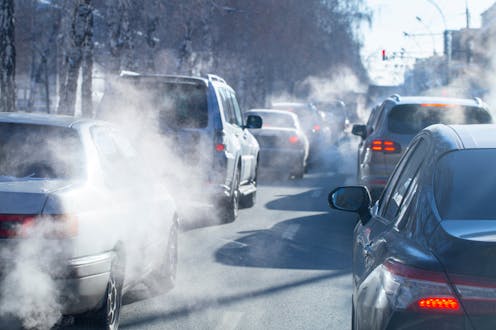
Around 2,600 deaths are attributed to fine-particle air pollution in Australia each year. Transport and industrial activities (such as mining) are the main sources of this.
And in 2015, an estimated 1,715 deaths were attributed to vehicle exhaust emissions – 42% more than the road toll that year.
The remote sensing emissions data suggest 1% of one to two-year-old diesel SUVs and 2% of one-to-two year old diesel light commercial vehicles have issues with their particulate filters, leading to high soot emissions.
These percentages are high when compared with a similar study conducted in the United Kingdom, which could not find any clear evidence of filters issues.
Three ways to move forward
Ever increasing SUVs sales are a drag on successfully reducing Australia’s total greenhouse gas emissions. So what should we do?
Of course there are several things to consider, but in terms of fuel efficiency and greenhouse gas emissions, we believe there are three main points.
First, we need to make sure we have realistic fuel use and emissions data. This means the National Transport Commission and Green Vehicle Guide should stop using the NEDC values and shift to more realistic emissions data. We acknowledge this is not a simple matter and it requires a lot more testing.
Second, we need to electrify transport as fast as we can, wherever we can. This is crucial, but not the whole solution.
To ensure Australia meets its net-zero emissions target, we also need to seriously consider energy and fuel efficiency in transport. This could be by promoting the sales of smaller and lightweight vehicles, thereby optimising transport for energy efficiency.
In all of this, it will be essential for car manufacturers to take responsibility for their increasing contributions to climate change. From this perspective, they should move away from marketing profitable fossil-fueled SUVs that clog up our roads, and instead offer and promote lighter, smaller and electric vehicles.
Robin Smit is the founder and director at Transport Energy/Emission Research Pty Ltd (TER) and an Adjunct Associate Professor at University of Technology Sydney.
Nic Surawski has worked on projects funded by city councils, alternative engine design companies, the Australian Coal Association Research Program, the federal Department of Environment and the Department of Climate Change and Energy Efficiency. Nic is a member of the Clean Air Society of Australia and New Zealand.
Having lived in Tāmaki Makaurau Auckland for 33 years has given her a perspective on social justice and diversity for Auckland.
Much of that comes from time spent at the Whānau Community Hub in the Auckland suburb of Mt Roskill where her and her team do a sterling job in running different programmes for the good folk of Roskill.
For instance, every first Wednesday of the month they host a free seniors lunch, and it not just for Rotumans but for the diverse group of seniors who reside in Mt Roskill and who yearn for company and a “good old talanoa”.
Quite apart from that, Mario and her team would be out delivering groceries to the needy, or holding health and well-being, financial literacy and language classes for children.
Community doubles That the community doubles as the Rotuman-Fijian Centre is a testament to her 30+ plus years of marriage to Auckland Fiji human rights advocate Nik Naidu and former journalist, who she met in Fiji when he was a budding radio personality at FM96 in Suva.
When you first meet Rachael Mario she greets you with big smile and utters charming Noa’ia (the Rotuman language greeting) and then she inquires about you with an inquisitive mind just to see how things are going for you.
As Mario explains, the Hub isn’t just for Rotumans but is used by a plethora of other groups, including the Moana-Pasifika Seniors. It is also home to the recently formed Asia-Pacific Media Network (APMN), which publishes the Pacific Journalism Review at the behest of founder Professor David Robie.
With such a diverse bunch using the Whānau Community Hub it is small wonder that Mario would branch out and try to incorporate more diversity in her already busy lifestyle.
But that has not been without social injustice challenges that her community has faced for many years.
Lack of language funding Included in those is the housing crisis in Auckland but much closer to her heart was the lack of funding provided to Rotuman language programmes which was given a cold shoulder by local boards.
“The biggest challenge, which isn’t fair, is the discrimination against the Rotuman Community. The Ministry of Pacific Peoples choose to run a different language week against our community-led Rotuman language week programme,” she says.
Other issues she lists are climate change and the environment which she says are huge for Auckland and wider New Zealand.
Vincent Naidu … candidate for the Waitakere Licensing Trust – Ward 4 (Henderson). Image: APR
What also occupies her mind is the city centre, economic and cultural development, better outcomes for Māori, wastewater and storm water, transport and parks and communities.
In a nutshell, Rachael Mario is all things to all communities.
Voting ends on October 8.
Three fellow candidates from the Fiji Collective contesting the local body elections are: Anne DEGIA-PALA (C&R – Communities and Residents) – Whau Local Board candidate
A new Asia Pacific nonprofit group has taken up the role of publishing the independent Pacific Journalism Review and other research and publication ventures.
The launch of the Asia Pacific Media Network | Te Koakoa Inc. (APMN) has ensured the viability of the New Zealand-based 28-year-old journal that was founded at the University of Papua New Guinea in 1994.
Chair Dr Heather Devere says the members of the network — mostly in Australia, Fiji and New Zealand — aim to “show support and work for the benefit of First Nations and other communities in Aotearoa and the Asia-Pacific region”.
But, adds Dr Devere, an author and retired director of research practice at the National Centre for Peace and Conflict Studies (NCPACS): “The first and most urgent aim is to enable the continued publication of the non-profit media research journal Pacific Journalism Review”.
Pacific Journalism Review … the latest edition cover. Image: PJR
The journal has already produced two double editions since becoming independent of its last host, Auckland University of Technology, which had followed the University of the South Pacific as publisher.
Professor David Robie, founding editor of the journal and who retired as AUT’s Pacific Media Centre (PMC) director in 2020, says he is “delighted” with this development and thanked colleagues for their support for the vision.
After organising the establishment of the APMN, he is now deputy chair and is looking for new projects. Dr Robie is also country representative of the Manila-based Asian Media Information and Communication Centre (AMIC) and looks to strengthen the Asian aspects of APMN’s research.
Dr Philip Cass, who succeeded Dr Robie as PJR editor, says APMN is intended to provide a focal point for academics and practitioners with a strong interest in the region and “a desire to use their expertise to contribute to the Pacific media through publications and hands-on projects”.
PJR is the only journal covering media, communication and journalism issues in the Pacific, he adds.
“It draws on the experiences and knowledge of educators, journalists, film-makers and photographers from across the region to provide a unique insight and analysis into a range of issues.”
A short video marking PJR’s 20 years of publication in 2014. Video: PMC
Need for network ‘urgent’ Dr Devere says it was urgent to establish such a network “to continue the work on Aotearoa New Zealand’s role in the Asia Pacific region following the demise of the Pacific Media Centre at AUT”.
There was no longer a space for those working on the PJR, a journal that has been publishing research related to important and on-going issues in New Zealand’s immediate region.
Dr Devere said no New Zealand university is doing the work being done by APMN.
“While there is a current focus on Pacific issues, there is no stable space for those working on media issues in the Asia Pacific region,” she says.
“There is also a conflict of interest between universities that are now functioning as commercial institutions, and investigative journalism that is engaged in providing accurate and reliable information for citizens.”
A woman has been arrested for the alleged murder of two young children whose remains were discovered in suitcases in Manurewa, South Auckland, last month.
New Zealand police can now confirm that a 42-year-old woman has been arrested in South Korea.
Counties Manukau CIB detective inspector Tofilau Fa’ amanuia Vaaelua said South Korean authorities arrested the woman today on a Korean arrest warrant on two charges of murder relating to the two young victims.
The arrest warrant was issued by the Korean courts as a result of a request by NZ police for an arrest warrant under the extradition treaty between New Zealand and the Republic of Korea.
He said NZ police had applied to have her extradited back to New Zealand to face the charges and had requested she remain in custody while awaiting the completion of the extradition process.
“To have someone in custody overseas within such a short period of time has all been down to the assistance of the Korean authorities and the coordination by our NZ Police Interpol staff,” he said.
There were a number of enquiries to be completed both in New Zealand and overseas, he added.
Police said the children, believed to be aged between five and 10 years old, may have been hidden in the suitcases in an Auckland storage yard for several years.
The bodies were discovered on 11 August 2022 after a Clendon Park family won an auction for abandoned goods in a storage unit, without realising what was inside.
This article is republished under a community partnership agreement with RNZ.
It has been a day of celebration and reflection for those who delivered the Māori Language petition exactly 50 years ago.
The day kicked off with a dawn ceremony at the National Library where mana whenua blessed an exhibition created in its honour.
The exhibition, named Tōku Reo, Tōku Ohooho – My Language Is My Awakening, included the petition itself, photos and videos.
Te Reo Māori Society member Dr Rob Pouwhare felt a mixture of emotions at the exhibition, including joy at how far the language had come.
“Things have advanced so quickly, so much is happening and I’m so thrilled that our kids are connecting with the language. Not just our kids, I see many New Zealand kids, Pākehā kids also connecting with the language,” Pouwhare said.
Māori Language Festival director Mere Boynton said it had been an emotional process.
“It is such a significant time for us and the petition is really the kaupapa, it’s essential, it’s the ngako of this hui ahurei and that’s the reason why mana whenua asked for a hui ahurei so that there was taonga that people could see,” Boynton said.
Flags fly as crowds march towards Parliament to mark 50 years the presentation of the Māori Language petition. Image: Angus Dreaver/RNZ
Contrasting scenes Come midday there were contrasting scenes to what unfolded on the steps of Parliament in 1972, when the group including Ngā Tamatoa, Te Reo Māori society and Te Huinga Rangatahi, led by kaumātua Rev Hemi Potatau and Te Ouenuku Rene, delivered the 33,000-strong signed petition to MPs.
They were the champions from across the motu calling for the revitalisation of te reo Māori — and it was key moment in the reclamation.
But today — 50 years on — tino rangatiratanga flags flew on the forecourt, te reo Māori was heard throughout the crowd as thousands came together to reflect and remember the battle fought for the language.
Many in the crowd included kōhanga reo and kura kaupapa students — and other students and members of the public from near and far, young and old.
Those gathered on the stage and just in front included members of that ope that arrived there half a century with a goal — a goal to keep te reo Māori alive.
There were others of course who were not there — like the late like Hana Te Hemara who spearheaded the petition and its message — and those rangatira who led them but they were top of mind for all attending.
When RNZ asked Te Kura Kaupapa Māori o Te Raki Paewhenua year 11 students Marara and Kahurangi what they would think now, their response was, “I think they would be proud”.
‘Long way to go’ “But we still have a long way to go,”
That was a key sentiment of the day — reflecting on how far Aotearoa has come in 50 years but how far there still is to go in the revitalisation and now increase of the use of te reo Māori.
Moana Maniapoto speaks to the crowd outside Parliament. Image: Angus Dreaver/RNZ
Rawiri Paratene, who stood with his daughter and Greens co-Leader Marama Davidson, was touched by the event.
“I’m proud to be part of it and great to see heaps of my mates and see them on the stage and they’re all fluent,” Paratene said.
Davidson said: “We’re all proud of my pāpā, my nana who was the generation who were traumatised to lose our reo and her love for her tamariki lives in us still.
“I’m proud that my dad was part of an amazing group of rangatahi. I can’t believe they were 18-17”.
Hana-Rawhiti Maipi-Clarke — a descendent of Hana Te Hemara, who handed over the petition — also spoke at the event.
Half a century later she had picked up the rakau and spoke of the wins Māori have had since then.
Hana Te Hemara, who handed over the te reo petition … her descendant Rawhiti Maipi-Clarke also spoke at the anniversary event: “We’re even decolonising our blankets and chocolate.” Image: Twitter
“Māori Health Authority, Māori wards, Matariki, kura kaupapa, kōhanga reo, Te Matatini. We’re even decolonising our blankets and chocolate,” Maipi-Clarke said.
‘Are you ready’ plea She ended by asking the audience if they were ready.
“I’ll leave the decision with you whether you want to jump on our waka or not, because with or without you we will sail in both worlds.
“We’ve come so far but we’ve got so long to go. Let’s see what we can do in the next 50 years.”
Māori Language Commissioner Rawinia Higgins said it was up to the next generation to carry on strengthening the language.
“As much as we take for granted today the language and all the initiatives that have come out of the language, I think there’s so much more to do and it’s the young people,” Higgins said.
“So the young people brought this petition to parliament, it’s the young people who are here today celebrating that and hopefully find inspiration from all those unsung heroes.”
Supporters of te reo had come so far in that time — and those signatures had not gone to waste, she said.
She was encouraging rangatahi to speak with their grandparents about their fight to keep the language going with hopes it would be even stronger in another 50 years.
This article is republished under a community partnership agreement with RNZ.
France’s new Minister for Overseas Territories Jean-François Carenco was told to “find a solution” to the political impasse in New Caledonia.
Carenco started his visit at the Assembly of the Loyalty island region, to the west of the mainland.
He was greeted in local Kanak customary way, after which the party made its way to the site of the Easo Cliffs, a favoured tourist destination.
Congress member Wali Wahetra said the minister’s speech mentioned a right to sovereignty as it is written in the French Constitution.
“It was pretty positive, but that is the goal of the meeting. He talked about the right to self-determination which I greatly appreciated.
“He also said that it’s a right that is inscribed in the constitution, that stays — that will continue to stay and will come.
“Mr Carenco said in his speech that President Macron told him to ‘find the solution’.
‘We need a dialogue’ Wali Wahetra also said Carenco discussed that New Caledonia had signs of identity and signs of sovereignty but also the right of a referendum.
She said that the pro-independence parties were not planning another referendum
“We needed a dialogue, because the anti-independence parties are still holding onto the referendum date of July which has been proposed by Mr Lecornu.
“However, we are not on this calendar at all and we absolutely don’t want another referendum as part of France.”
Carenco has deferred the referendum date from July 2023. He said a vote would happen once everybody was ready, noting there had been no dialogue for two years to advance the issue.
The minister was due to meet the New Caledonian territorial government President Louis Mapou’s party, National Union of Independence, and the Kanak and Socialist National Liberation Front (FLNKS).
‘Not an option’ He has been touring all three provinces of New Caledonia to meet each pro-independence camp.
They have written to Carenco to remind him that French President Emmanuel Macron has validated a new statute and that New Caledonians have a clear constitutional path.
The head of the anti-independence party Popular Movement Caledonia, Gil Brial, told La Premiere television that Carenco’s response did not match France’s obligation to commit to the July 2023 date.
This article is republished under a community partnership agreement with RNZ.
Political Roundup: Labour’s fraught battle to retain the Māori vote
Political scientist, Dr Bryce Edwards.
Labour’s poll results are trending down. Yesterday’s Curia poll put the party down two points to just 33 per cent, while National is up three points to 37 per cent. When it comes to next year’s election, a key constituency for Labour will be Māori voters, especially in the Māori seats which are facing a strong challenge from Te Pati Māori.
Yet Labour’s support amongst Māori also seems to be plummeting. A poll earlier in the year by Horizon Research for The Hui, showed Labour’s support had dropped from 54 per cent in 2020, to just 37 per cent this year. The seventeen-point drop was a sign, according to Te Pati Māori’s co-leader Debbie Ngarewa-Packer, that in Māoridom, “The red wave is well and truly over”. National’s Shane Reti also pronounced “the Māori love affair with Labour is well and truly over.”
Has Labour let down Māori?
When Labour won 50 per cent of the vote in 2020, with a historic majority in Parliament, there was a belief amongst commentators that Labour would now be able to deliver for their Māori constituency. There was a belief that this triumphant result, and winning back all the Māori electorates in 2017, was in part due to Māori voters trusting Labour to deliver on their promises of better housing, healthcare, and reduced economic inequality. Such a focus on lifting living standards was especially appealing to working class Māori.
Unfortunately, those results haven’t been delivered. Under Labour there continues to be a growing disparity between rich and poor, and poverty and inequality have been exacerbated. For example, the housing crisis Labour inherited from National, has now morphed into a “housing catastrophe”, and Labour seem largely uninterested in doing anything about this. On top of this, we now have a cost of living crisis, and wages are not keeping up with rising prices.
The powerful role of the Labour Māori caucus in government
One of the reasons that Māori might have believed Ardern’s Government would deliver in the areas that poor and working class Māori care about, is that the Māori caucus in Labour is the biggest ever. Commentators said that the fifteen Māori MPs in Government would have strong leverage over Ardern and her fellow ministers. What’s more, six out of the 20 Cabinet ministers are Māori – which is proportionally much greater than wider society.
Have the Māori MPs and ministers delivered? There is no doubt they have been highly influential. As leftwing commentator Martyn Bradbury says, “The Maori Caucus inside Labour are now the largest and most powerful faction” in the party. The Prime Minister and her colleagues have therefore not been able to ignore the demands and priorities of Labour’s Māori caucus.
In fact, some commentators paint a picture of Ardern as being held hostage to the agendas of the senior Maori leaders such as Nanaia Mahuta and Willie Jackson. Journalist Graham Adams, for example, has written about how Ardern doesn’t show any great enthusiasm for, or belief in, her Government’s controversial Three Waters reform programme, and as a very cautious and poll-driven leader, “would normally back away from any policy as widely disliked as Three Waters soon after the poll results arrived on her desk”.
Adams argues that the Māori caucus has pursued many of the most important and controversial reform agendas of the current Government – this “includes setting up a separate Māori Health Authority, easing the path to Māori wards, handing more power to iwi in the conservation estate, in local government, and the Resource Management Act”.
Have Labour’s Māori MPs focused on the right issues?
Generally, the Māori caucus in Labour has been focused on constitutional and cultural reforms. But are these the right ones? Unfortunately for Labour, the main concerns of Māori voters – especially those who are struggling – are more materialist, such as housing and employment.
Much of what the Labour Government has been delivering for Māori often looks more like symbolism and bureaucracy. And in many cases, it’s been about assisting more middle class Māori supporters, especially those in business. Hence last year Willie Jackson convinced his government to make 5 per cent of their $42 billion procurement budget available to Māori businesses.
This all raises the question of whether Labour’s Māori MPs have focused on the right issues. Or, perhaps the question is whether Labour has become too focused on more elite or middle class Māori concerns.
In a sense, the caucus is having to respond to the more radical Te Pati Māori, which is increasingly Tiriti-focused and wanting constitutional change, rather than concerned with traditional Labour issues. Labour MPs therefore have to follow that agenda too. They need to convince Māori constituencies that they’ve won some big concessions off the Prime Minister and Cabinet.
If not, then what have the Labour Māori MPs got to show to their voters when it comes to the next election? If they can’t show progress on housing, standards of living, improved healthcare etc, the hope surely is that they can at least point to advances in te reo, the school curriculum, more visible Māori in leadership and business, and so forth.
Will these be enough? Leftwing commentator Chris Trotter suggests not: “Creating Māori wards is not the same as creating jobs. Building support for profound constitutional change in Aotearoa-New Zealand is not the same as building houses.”
The changing power of Labour Māori caucus
This week the Herald’s Audrey Young has written an evaluation of the Māori Cabinet ministers, some of which is quite critical. For instance, she labels Kevin Davis “Pedestrian”, pointing out that he got “the new portfolio of Māori-Crown relations in the first term but has been almost invisible in promoting the Government’s overall strategy to the public.” Young also labels Peeni Henare as “Sheltered” in the Cabinet, saying he “has not been tested politically and shows no signs of boldness.”
Probably the most critical is her evaluation of Nanaia Mahuta, who Young labels “Distracted”. Young says Mahuta is “distracted by Three Waters reforms and a series of stories about public sector contracts awarded to her consultant husband. They have reached such a pitch that she herself should refer the matter to the Public Service Commission or Auditor-General to get an independent opinion and draw a line under it.”
Willie Jackson and Kiri Allan receive more positive evaluations – the latter is said to be a “potential deputy Labour leader” and a “firm favourite of Jacinda Ardern.”
But it’s Jackson that is acknowledged as the real leader of the Māori caucus in Labour – Young reports that: “Insiders confirm appearances – that the most active and influential member of the caucus is Cabinet minister Willie Jackson.” She adds that he’s “the only one actively promoting and defending co-governance.” And elsewhere, Young has explained that Jackson is “still the go-to guy for hands-on co-ordination within the Māori caucus and within Māoridom peak groups and iwi leaders.”
The Māori Labour MPs need to keep their government delivering
With Labour’s post-Covid popularity steadily on the decline, there are many on the left who want Labour to revert to more traditional and popular leftwing policies, and jettison the strong pursuit of cultural and constitutional change.
For example, the Three Waters reform programme has become an albatross around the Government’s neck, which few are willing to defend. It will continue to cost Labour popular support. But should Labour pull back on the more controversial parts of the programme, such as giving half of the control over water assets to iwi?
The problem is that to do so would be to give Te Pati Māori a huge stick to beat Labour with. It could seriously jeopardise Labour’s hold on their Māori seats next year. Likewise, pulling back on the Government’s co-governance agenda would create havoc for the Māori caucus. A Māori caucus rebellion in Labour would be guaranteed.
Therefore, Ardern is in something of a bind. She will have to continue juggling the demands of the powerful Māori caucus while also being aware that some of that agenda might be making her government unpopular.
But Ardern would be wise to realise that when it comes down to it, most Māori voters are quite similar to non-Māori voters in caring more about the delivery of the basics – especially an improved standard of living. In this regard, Ardern should take note that the Horizon poll of Māori voters earlier this year pointed to why Māori voters were leaving Labour: “As inflation begins to bite, 72 percent say the cost of living is the main issue they will vote on, followed by housing and health.”
New Zealand’s decision to end most COVID health measures is welcome, as it removes controls that are in most cases no longer essential. But the new COVID management phase looks like a short-term reaction to declining case numbers rather than a longer-term strategy.
We argue now is the time to build on that success with a strong, science-informed strategy to get us through the next pandemic stages and lift our resilience against future emerging infectious disease threats.
Such a strategy would need to provide a robust plan for managing the two most likely pandemic scenarios – new variants and endemic disease.
The most probable scenario is that SARS-CoV-2, the virus that causes COVID-19, will continue to evolve new variants that evade immunity from prior infection or vaccination, triggering new waves. Any new variant could be more or less severe than Omicron.
The government has previously identified the need for a strategy to manage this scenario, which would require rapid risk assessment of new threats and increased controls if needed.
COVID is also likely to eventually become a more stable and predictable endemic disease, perhaps somewhat like seasonal influenza but with more severe consequences that are still emerging.
Endemic does not necessarily mean mild. The world’s biggest infectious disease killers, including tuberculosis, HIV/AIDS and malaria, are all endemic. A long-term strategy should aim to minimise health burdens (serious illness, death and long-term disability) and health inequities.
Unfortunately, New Zealand’s new approach does not provide a robust response to either of these scenarios.
Defences against likely pandemic threats
New Zealand already has well-established tools for assessing and communicating the risk associated with many other hazards such as fires and storms. Why not do the same for COVID and potentially other serious respiratory infections?
Why not treat pandemic risk like we do fire danger updates? Getty Images
We propose five changes to fill gaps in the new COVID management approach while at the same time minimising disruptions.
1. Develop an updated alert level system for COVID variants
The government could use this relatively low point in the number of COVID cases to develop a robust framework to provide a simple way for describing the level of risk and a proportionate response at each level.
Before COVID, New Zealand’s pandemic plan was based on mitigation. This meant accepting pandemics would wash over the country and the best we could do was to minimise healthcare system overload. Now we know we can potentially stop any respiratory disease pandemic.
New Zealand has scrapped vaccination requirements and mandated testing for international arrivals. Getty Images
2. Reinforce the critical importance of borders for biosecurity
We need an evidence-informed strategy for our borders to manage potentially more dangerous variants and other future pandemics.
The government has now removed vaccination requirements and mandated testing for visitors. As case numbers fall, arriving travellers will likely become an increasingly important source of new infections.
The end of routine testing on arrival limits our ability to collect viral samples for whole genome sequencing and leaves a gap in our surveillance system. Long-term benefits of improved border control would include a reduced risk of importing other outbreak-prone diseases such as measles or more serious, bioengineered pandemics.
3. Reinforce self-isolation as a key infection control tool
Fortunately, the government has retained mandatory isolation for people who test positive for COVID. It is fundamental to disease control that sick people stay home. Keeping isolation to a minimum of seven days is also wise, as even then about a quarter of people are still infectious.
Nevertheless, adding a test-to-release requirement would improve the effectiveness of this strategy and reduce the isolation period to five days for some.
Making these measures work well requires a great deal more public education and support, particularly around health, social and work support. This could be a major legacy benefit of this pandemic, particularly if it also helps to reduce the spread of other respiratory diseases such as influenza.
4. Establish requirements for masks and ventilation
Masks still have to be worn in healthcare and aged-care settings. Masks work best in such high-risk environments when everyone is using them. But we need systematic criteria to identify other confined, crowded and close-contact environments with a high risk of infection.
On that basis, public transport would be an important environment for universal mask use and ventilation improvements, particularly during winter. An evidence-based mask and ventilation policy would be another major legacy benefit of the current pandemic.
Ongoing mask use and better ventilation should be considered for public transport. Getty Images
5. Establish vaccination as the norm for healthcare and essential services
The government has now removed all vaccine mandates. However, there are several reasons why healthcare and other essential workers should be vaccinated against COVID and other serious infectious diseases. It should be a basic occupational health and safety necessity, just like some groups are required to wear protective clothing.
One legacy benefit of the pandemic should be a wider discussion about how to appropriately establish vaccination as a requirement for key occupational groups.
The inconvenient truth is that the pandemic has not gone away and future pandemics remain a risk. Even if COVID becomes a more predictable endemic disease, we still need to minimise serious illness, particularly for the most vulnerable.
Michael Baker receives funding from the Health Research Council for research on Covid-19.
Nick Wilson does not work for, consult, own shares in or receive funding from any company or organisation that would benefit from this article, and has disclosed no relevant affiliations beyond their academic appointment.
Source: The Conversation (Au and NZ) – By Christopher Latella, Lecturer, Master of Exercise Science (Strength and Conditioning), Edith Cowan University
As humans, it is in our nature to want to do better, find that edge and succeed. This couldn’t be truer than in sport, where winning and losing are often separated by tenths of a second, a successful score attempt in the dying stages of a game, or a split-second decision.
So, there is always a need for effective and legal strategies to boost performance. “Priming” is a tool attracting more and more interest from athletes, coaches and scientists.
The good news is it is not just for elite athletes.
Not just a warm-up
Priming, also called “morning exercise”, “pre-activation” or “pre-competition training”, has attracted renewed interest among scientists in recent years. Many sporting teams are already on the ball, with more than half of coaches using priming to help their athletes gain a performance advantage.
Typically, a relatively brief and non-tiring bout of exercise is performed the day before or on the morning of a competition – somewhere between one and 48 hours beforehand. This stimulus to the muscles results in “delayed potentiation”. That is, the muscles can perform better after several hours of rest than they would have without the priming exercise.
In contrast, a warm-up takes place much closer to competition. What’s interesting is the benefits of priming are much longer-lasting than those typical of warm-up activation strategies. This is perplexing because we know that increases in muscle temperature, metabolism and the nervous system potentiation with warm-ups return to baseline levels within minutes.
Warm-ups remain important but priming sessions could provide an additional edge. Sports scientists have reported improvements in running, jumping, throwing and weightlifting ability by as much as 4%. This might not seem like a lot, but it’s crucial when the difference between winning and losing can be measured in fractions of a percentage point. The physiological mechanisms that cause the priming effect are not yet well understood, but neuromuscular and hormonal changes have been suggested.
And it may not be only muscles that benefit. Researchers have long known priming exercise can improve weightlifting performance in anxious athletes. More recent research reinforces the idea priming activities can help athletes’ psychological state and stress levels.
Very few of us are elite, full-time athletes. Finding time to train and compete, even at a community or sub-elite level, is hard – let alone making extra time for additional priming sessions. But priming exercises can be done with minimal equipment in minimal time.
Basic exercises such as squats and bench presses with relatively heavy weights (around 85% of your maximum capacity) for just a few repetitions are enough to boost performance later that day.
Don’t have a rack of weights lying around? That’s OK. Explosive body-weight activities such as a few short sprints or jumping still have the potential to boost athletic performance. Stronger people seem to respond better to priming, likely because they recover more quickly from exercise.
Ideally, pick an activity that uses the same muscle groups you will use during your sport, and do the priming exercise six to 33 hours before your event, as this seems to offer the most benefit and practicality. And remember, more is not better. You may be able to incorporate your priming session into your existing training regime.
A priming workout doesn’t have to be as strenuous as normal training. Pexels/Ivan Samkov, CC BY
I don’t play sport – what’s in it for me?
Priming doesn’t just apply to sport; it may help in the gym and with learning new skills.
A 2014 study showed bench-press and squat performance was greater in the afternoon if they were used as priming exercises that same morning.
And ten to 30 minutes of aerobic exercise may improve reaction time, memory and attention. Moderately intense cycling has been shown to help musicians learn the piano. However, these changes appear more immediate and short-lived than those that relate to athletic performance, taking effect and lasting minutes rather than hours.
There are still questions to be addressed when it comes to priming.
Could priming be useful in sports like rugby, football and basketball? These sports require multiple high-intensity efforts, coupled with dynamic decision-making to score and beat an opponent.
More research is also needed to work out what’s happening in the body and what exercises should be done when for the most effective priming. As researchers, we’re exploring the effect of different priming routines on muscular strength and power, as well as repeat sprint performance and reaction time in strength athletes and football players.
In particular, weightlifting protocols that provide strong stimulation, but minimise fatigue, seem promising. We expect the findings will be useful for coaches and athletes who want to improve athletic performance.
Christopher Latella receives funding from the National Strength and Conditioning Foundation
Krissy Kendall receives funding from National Strength and Conditioning Foundation
COVID-19 has had a significant impact on all facets of our lives, including the ways we work and our work-life priorities.
Globally, workplaces are navigating trends such as the “great resignation”, “quiet quitting” and the “great recruitment”. But in New Zealand, the “great return” to work is still being negotiated, providing employees and employers an opportunity to redesign the workplace in ways that benefit both.
One common theme in the employment trends to emerge during COVID-19 is a shift in the value people place on their work and their lives outside of work. But has this gone too far? Are workers being selfish – or “self-first”, as in putting their non-work preferences ahead of workplace productivity?
Or are they prioritising personal wellbeing in order to be better employees? And are these global employment trends meaningful in the New Zealand context, where small and medium-sized companies (SMEs) dominate the business landscape?
Our ongoing survey of more than 600 SME employees found workplace practices and future working preferences have changed since 2020. Workers are looking for jobs that better fit their lives. The results suggest now is the time for employers to work with employees, rather than against them, for mutual benefit and increased productivity.
Global trends: big players and trendsetters
More than two years after the first COVID-19 lockdowns, employers are calling their employees back to the office – but also having to respond to employee push-back. Employees are expecting and asking for more flexibility in where and when they work – they aren’t just quietly accepting the “old ways” of working.
Workers have had a taste of work-life flexibility and are demanding this more frequently and with more confidence. Meanwhile, some employers are focused on “traditional” 40-hour weeks in the office, while others are offering flexibility in hours worked, work style and location.
Tesla recently told workers to return to the office for 40 hours a week, or work elsewhere permanently. Apple’s mandate for employees to return to the office was met with a petition for a work-from-home policy, as implemented at Facebook and Twitter. The company eventually settled for a hybrid “two days at home, three days in the office” model.
In the UK, a four-day work week pilot involving 70 companies is underway, while in Canada some workplaces are navigating the broad pushback from employees who have seen they can work in different places and during different hours and who now want a say in how, when, and where they do their job.
Some businesses are mandating a return to the office while other Canadian businesses have embraced a four-day work week with no change in daily hours for employees.
Employees’ expectations around work have changed and now is the time for employers to negotiate with their staff over what work looks like. Getty Images
NZ workplaces in a state of flux
While similar trials are under way in New Zealand, the big questions are whether employers need to worry about the actions of large, multinational companies (given SMEs make up approximately 97% of local businesses), and whether employees have the same desired future work-life preferences as workers overseas.
A quick search of vacancies on the job website Seek.com showed more than 700 jobs mentioned “working from home”, 5,000 mentioned “flexibility”, and 38,000 mentioned “work-life” in the job descriptions. Businesses clearly have the sense that staff preferences are changing.
Our research provides insight on what employees want and why. We asked questions about when, where and how many hours they work, as well as the levels of autonomy they have in setting their own work patterns. We also asked what changes they had seen in their organisations since 2020.
While more than half of the respondents (52%) said they had more flexibility in terms of their work arrangements compared to before COVID, and 62% agreed they were able to manage their work-life demands, two-thirds (67%) indicated they now wanted more work-life flexibility.
Nearly half of the respondents (48%) reported that their organisation had already made formal policy changes to enable more work-life flexibility (not including temporary changes during the pandemic). Some 41% said they knew of employees who had left organisations because the employer did not provide enough flexibility to match their needs.
Flexibility in this context meant control over their working patterns. Employees wanted to decide how, where and when they carried out their work. This does not necessarily mean only working from home, but start and end times, number of daily hours worked, and preferred locations such as the homes of friends and family, cafes, libraries and shared open spaces.
The dominant reason for people seeking greater flexibility was personal wellbeing (60%) – above family care, lifestyle, community involvement, fewer interruptions and increased productivity.
We also found 77% of respondents wanted to feel a strong sense of belonging to their organisation. Despite wanting more control of their working patterns, including not necessarily being in the same building as their colleagues, respondents still wanted to be part of an organisation – just in a different way.
Finding common ground
This survey results offer local employers an opportunity to work with employees, rather than face the backlash that has been seen overseas.
With record low unemployment, employees are seeking organisations that are responding to the shift in employee values. Employers need to look past what might appear, on the surface, to be employee selfishness and accommodate the new “self-first” preferences in the post-COVID environment.
By embracing the preferences of their workers, employers can show they value employees and employee wellbeing, which might help navigate the best options for employees – including helping set the new “rules” of working and where compromises might take place.
Remember, employees want a sense of belonging to something bigger. But they also understand the importance of taking care of themselves first. It is time for employees and employers to work together to carve out the mutual benefits of finding new ways of working.
The authors do not work for, consult, own shares in or receive funding from any company or organisation that would benefit from this article, and have disclosed no relevant affiliations beyond their academic appointment.
In the limestone ranges of Western Australia’s Kimberley region, near the town of Fitzroy Crossing, you’ll find one of the world’s best-preserved ancient reef complexes.
Here lie the remnants of myriad prehistoric marine animals, including placoderms, a prehistoric class of fish that represents some of our earliest jawed ancestors.
Placoderms were the rulers of the ancient seas, rivers and lakes. They were the most abundant and diverse fishes of the Devonian Period (419–359 million years ago) – but died out at the end in a mass extinction event.
Studying placoderms is important as they provide insight into the origins of the jawed vertebrate body plan (vertebrates are animals with backbones). For instance, placoderms have revealed when the first jaws, teeth, paired skull bones and paired limbs evolved. They’ve also taught us about the origins of internal fertilisation and live birth in vertebrate evolution.
Now, in a paper published in Science, we detail our findings of the oldest three-dimensionally preserved heart from a vertebrate – in this case a jawed vertebrate. This placoderm heart is about 380 million years old, and 250 million years older than the previous oldest vertebrate heart.
The 3D preserved heart of a placoderm fish from Gogo. The rock entombs the bone shown in grey, shown by neutron beam imaging, and heart in red. Kate Trinajstic
How did we do it?
Fish fossils from near Fitzroy Crossing were first reported from Gogo Station in the 1940s. But it wasn’t until the 1960s that beautiful 3D preservations were revealed, using a technique that removes rock from bones with weak acetic acid.
However, this technique proved to be a double-edged sword. While the fine details of the bony skeleton were uncovered, soft tissues in the fossils dissolved away. It wasn’t until 2000 that the first pieces of fossilised muscle were identified in placoderms.
The Gogo fish fossils used in this study were discovered within rocks found in the Kimberley. Curtin Univeristy
With the advent of an X-ray method called “synchrotron microtomography” – first used on the Gogo fossils in 2010 – more muscles were revealed from the Gogo placoderms, including neck and abdominal muscles.
Our work used this same technology to show, for the first time, the presence of a liver, stomach and intestines in a Devonian fish. Some of the specimens even showed remnants of their last meal: a crustacean.
We found the soft organs fossilised in an order of placoderms called arthrodires. These were the most common and diverse of all known placoderms, characterised by a unique joint between their head and trunk armour.
The heart of the placoderm
The most exciting find for us was the heart. We found our first placoderm heart using synchrotron imagining.
Then while experimenting with a technology called neutron imaging, we discovered a second heart within a different specimen.
Life must have been nerve-racking in the Devonian seas, because placoderms literally had their hearts in their mouths!
Our new research has revealed the soft organ anatomy of a Devonian arthrodire fish. Brian Choo, Kate Trinajstic
At this point in vertebrate evolution, the neck was so short that the heart was located at the back of the throat and under the gills.
Fishes that are even more primitive than arthrodires, such as the jawless lamprey, have their heart close to their liver. And the chambers of the heart (called the atrium and ventricle) sit side by side.
On the other hand, arthrodire placoderms had the heart in a more forward (anterior) position, at the back of the throat. And the atrium sat on top of the ventricle – similar to sharks and bony fishes today.
Today, 99% of all living vertebrates have jaws. Arthrodires provide the first anatomical evidence to support the hypothesis that, in jawed vertebrates, the repositioning of the heart to a more forward position was linked to the evolution of jaws and a neck.
But that’s not all. This movement of the heart would also have made room for lungs to develop.
So did placoderms have lungs?
One of the most challenging evolutionary questions today is whether lungs were present in the earliest jawed vertebrates. Although fish have gills, the presence of lungs in some fish can help with buoyancy, which is needed to sink and rise in the water.
Today, lungs are only present in primitive bony fishes such as lungfish and African reedfishes.
More advanced bony fish (such as the teleosts) stay afloat using a swim bladder, whereas sharks have neither lungs nor a swim bladder, and instead use a large fatty liver to help with buoyancy.
But what about ancient placoderms? Previous studies (which were somewhat controversial) suggested lungs were present in a primitive placoderm called Bothriolepis.
A model of Bothriolepis, which was once thought to have possessed paired lungs. John Long, Author provided
Our analysis of the arthrodires from Gogo reveals the structures thought to be lungs in Bothriolepis are in fact a liver with two lobes, so lungs are now thought to have been missing from placoderms.
Our discovery therefore shows a single origin for lungs in bony fishes (osteichthyans). The movement of the heart to a forward position from jawless fishes (Cyclostomata) would have allowed room for lungs to develop in later lineages.
The absence of lungs in placoderms suggests these fish relied on their liver for buoyancy, like modern sharks do.
Our new findings on ancient placoderms show the movement of the heart forwards from jawless fishes. Kate Trinajstic, Brian Choo, John Long
A crucial site
The preservation of organs is a race against time. In some cases, an animal’s decomposition will aid soft tissue preservation, but too much decomposition and the soft tissues decay away. For excellent preservation the balance needs to be just right.
In the fossilised heart we found the atrium and ventricles are shown clearly, while the conus arteriosus – a section of the heart that directs blood from the ventricle to the arteries – is not as well preserved.
Being able to make these discoveries before they’re lost forever is crucial if we are to fully understand the early evolution of vertebrates, including the origins of the human body plan.
So beyond our immediate findings, our work has reinforced the significance of the Gogo site in the Kimberley as one of the world’s most important sites for carrying out this work.
Say you are looking for a new job. You head to LinkedIn to spruce up your profile and look around your social network.
But who should you reach out to for an introduction to a potential new employer? A new study of more than 20 million people, published in Science, shows that your close friends (on LinkedIn) are not your best bet: instead you should look to acquaintances you don’t know well enough to share a personal connection with.
The strength of weak ties
In 1973, the American sociologist Mark Granovetter coined the phrase “the strength of weak ties” in the context of social networks. He argued that the stronger the ties between two individuals, the more their friendship networks will overlap.
Simply put, you are most likely to know all the friends of a close friend, but few of the friends of an acquaintance.
So if you are searching for a job, you probably already know everything your immediate neighbourhood has to offer. Intuitively, it is the weak ties – your acquaintances – that offer the most opportunities for new discoveries.
Weak ties and jobs
Granovetter’s theory feels right, but is it? A team of researchers from LinkedIn, Harvard Business School, Stanford and MIT set out to gather some empirical evidence on how weak ties affect job mobility.
Their research piggy-backed on the efforts of engineers at LinkedIn to test and improve the platform’s “People You May Know” recommendation algorithm. LinkedIn regularly updates this algorithm, which recommends new people to add to your network.
One of these updates tested the effects of encouraging the formation of strong ties (recommending adding your close friends) versus weak ties (recommending acquaintances and friends of friends). The researchers then followed the users that participated in this “A/B testing” to see if the difference impacted their employment outcomes.
More than 20 million LinkedIn users worldwide were randomly assigned to well-defined treatment groups. Users in each group were shown slightly different new contact recommendations, which led users in some groups to form more strong ties and users in other groups to form more weak ties.
Next, the team measured how many jobs users in each group applied for, and how many “job transmissions” occurred. Job transmissions are of particular interest, as they are defined as getting a job in the same company as the new contact. A job transmission suggests the new contact helped land the job.
Moderately weak ties are best
The study uses causal analysis to go beyond simple correlations and connect link formation with employment. There are three important findings.
First, the recommender engine significantly shapes link formation. Users who were recommended more weak links formed significantly more weak links, and users who were recommended more strong links formed more strong links.
Second, the experiment provides causal evidence that moderately weak ties are more than twice as effective as strong ties in helping a job-seeker join a new employer. What’s a “moderately” weak tie? The study found job transmission is most likely from acquaintances with whom you share about 10 mutual friends and rarely interact.
Third, the strength of weak ties varied by industry. Whereas weak ties increased job mobility in more digital industries, strong ties increased job mobility in less digital industries.
Better recommendations
This LinkedIn study is first to causally prove Granovetter’s theory in the employment market. The causal analysis is key here, as large-scale studies of correlations between strength of ties and job transmission have shown strong ties are more beneficial, in what was considered until now a paradox.
This study resolves the paradox and again proves the limitations of correlation studies, which do a poor job at disentangling confounding factors and sometimes lead to the wrong conclusions.
From a practical point of view, the study outlines the best parameters for suggesting new links. It revealed that the connections most helpful in landing a job are your acquaintances, people you meet in professional settings, or friends of friends, rather than your closest friends – people with whom you share about 10 mutual contacts and with whom one is less likely to interact regularly.
These can be translated into algorithmic recommendations, which can make the recommendation engines of professional networks such as LinkedIn even more proficient at helping job-seekers land jobs.
So, could LinkedIn’s experiment have harmed its users? In theory, the users in the “strong link” treatment group might have missed the weak links that could have brought their next job.
However, all groups had some degree of job mobility – some just a bit more than others. Moreover, since the researchers were observing an engineering experiment, the study itself seems to raise few ethical concerns.
Nonetheless, it is a reminder to ask how much our most intimate professional decisions – such as selecting a new career or workplace – are determined by black-box artificial intelligence algorithms whose workings we cannot see.
Marian-Andrei Rizoiu receives funding from the Department of Home Affairs, the Commonwealth of Australia represented by the Defence Science and Technology Group, Facebook and the Australian Research Council.
Source: The Conversation (Au and NZ) – By Mianna Lotz, Associate Professor in Philosophy & Chair of Faculty of Arts Human Research Ethics Committee, Macquarie University
The opportunity to conceive, carry and give birth to a biologically related child is a deep desire for many women and their partners. Since the introduction of IVF in 1978, many people in countries such as Australia have accessed support and resources to help realise their reproductive goals.
For some women, the lack a functioning uterus has kept that opportunity out of reach. This includes those with a congenital condition such as Mayer-Rokitansky-Küster-Hauser syndrome, and those who had a hysterectomy for medical reasons.
For these women, the only options for parenthood have been surrogacy or adoption. Access to both is often difficult.
Uterus transplants are changing that. From next year, uterus transplants are being trialled in Australia. However, there are risks involved and ethical concerns which must addressed before it can become mainstream clinical treatment.
How does the process work?
Uterus transplantation is a set of medical procedures in which a donated uterus is surgically removed from a suitable donor and transplanted into an eligible recipient.
Hormones are used to stimulate menstruation in the recipient, and once the uterus is functioning normally, an IVF-created embryo is transferred into the woman’s uterus.
Following successful implantation and healthy development, the baby is delivered via caesarean section. This is because a uterus transplant pregnancy is regarded as high risk, and the woman may not be able to feel contractions. Women with the congenital absence of a uterus will not be able to deliver vaginally.
As with all transplants, the uterus recipient is prescribed immunosuppression medication to prevent rejection of the donor organ. These drugs are administered at levels deemed safe for the developing foetus. Close monitoring continues throughout the pregnancy to ensure the safety of both woman and foetus.
Immunosuppression continues until the delivery of up to two healthy babies or five years after the transplant, whichever is first.
Donor recipients take immunosuppressing medication at levels deemed safe during pregnancy. Omurden Cengiz/Unsplash
The uterus is then surgically removed via hysterectomy, enabling immunosuppression – which carries risks and side-effects – to be ceased. Risks from immunosuppression include infection, reduced blood cell count, heart disease and suppression of bone marrow growth. And these risks increase with time.
Uterus transplantation is an “ephemeral” transplant: a non-life-saving temporary transplant, aimed solely at enabling reproduction. These features make it medically and ethically distinct from other transplants.
When did uterus transplants start?
Scientists started developing uterus transplantation in animals in the 1970s. The first attempts in humans occurred in 2000 (Saudi Arabia) and 2011 (Turkey), both of which failed.
After 14 years of research, Professor Mats Brannstrom and his team at Sweden’s Sahlgrenska University Hospital started the world’s first human trials in 2013. In 2014, the first healthy baby was born.
With more than 25 countries now performing or planning uterus transplants, it is estimated that at least 80 procedures have been performed, resulting in more than 40 healthy live births. While not all transplants are successful, the live birth rate from a uterus that is functioning successfully after transplantation is estimated at over 80%.
In Australia, two trials have been approved and plan to start within the next 12-18 months.
Who donates?
Most uterus transplants so far have used altruistic living donors, typically a mother donating to her daughter or an aunt to her niece.
Uteruses from deceased donors are mostly provided through standard family consent methods for medical research. But in future they could be provided through organ donor registration processes modified to include the uterus.
Currently, only pre-menopausal women can be uterus donors, and living donors need to have had a successful pregnancy to be eligible to donate. But this may not need to be a requirement for deceased donors, potentially enabling younger donors and increasing the availability of uteruses for transplantation.
Of the two approved Australian trials, only one (led by Royal Hospital for Women, for which I provide independent ethical advice) will conduct both living and deceased donor uterus transplantation. The other (through Royal Prince Alfred hospital) will trial only living donor transplantation.
Participation in these uterus transplant trials will remain limited while uterus transplantation is still in the research phase, and will depend on the availability of funding.
What are the risks of living donation?
For recipients, the main surgical risks are organ rejection, infection, and blood clots or thrombosis, as well as risks arising from the surgery duration (average 5 hours) such as blood clots (including in the lung) and from immunosuppression.
While challenging, these risks have been minimised through close monitoring and early intervention using blood thinners and encouraging recipients to move around soon after surgery.
For living donors, physical risks arise from surgery duration (6-11 hours) and operative and postoperative complications, the most common being urinary tract injury and infection.
There are also ethical and psychological risks. These include the possibility of a potential donor feeling pressured to donate to a family member, and experiencing guilt and failure if the transplant is not successful or results in adverse outcomes.
These risks may be reduced with appropriate counselling and support. But as with all altruistic organ donation, they cannot be entirely eliminated.
What about deceased donation?
Deceased donor transplantation also carries risks but involves less surgical time than living donor transplantation (typically 1-2 hours) and therefore less demand on medical resources and personnel.
Deceased donor transplantation may be less ethically fraught. There is no prospect of pressure, guilt or surgical risk to the deceased donor, who must have been declared brain dead and be suitable for multi-organ donation. Their organs may only be procured with proper consent, following the usual protocols and procedures.
In Australia, as elsewhere, organ donors are in short supply. But deceased donors might be found via existing donation registries and consent processes, such as those managed by DonateLife and NSW Organ and Tissue Donation Services.
Why investigate both types of donation?
It’s important to be able to compare the outcomes of living and deceased donation in similar recipients and contexts. This will inform future guidelines and policies around uterus donation, and determine whether it can become mainstream clinical practice.
Emerging evidence suggests deceased donation may yield better results for recipients. Using deceased donor organs allows longer veins and arteries to be retrieved, enabling better blood flow for the uterus and potentially greater success in transplants and pregnancies.
So although there are currently fewer cases of deceased donors, there are sound medical and ethical reasons for Australian uterus transplant research with both deceased and living donors.
Mianna Lotz provides independent ethical advice to the uterus transplant trial at Royal Hospital for Women.
Amazon, Borneo, Congo, Daintree. We know the names of many of the world’s largest or most famous rainforests. And many of us know about the world’s largest span of forests, the boreal forests stretching from Russia to Canada.
But how many of us could name an underwater forest? Hidden underwater are huge kelp and seaweed forests, stretching much further than we previously realised. Few are even named. But their lush canopies are home to huge numbers of marine species.
Off the coastline of southern Africa lies the Great African Seaforest, while Australia boasts the Great Southern Reef around its southern reaches. There are many more vast but unnamed underwater forests all over the world.
Our new research has discovered just how extensive and productive they are. The world’s ocean forests, we found, cover an area twice the size of India.
Underwater forests are formed by seaweeds, which are types of algae. Like other plants, seaweeds grow by capturing the Sun’s energy and carbon dioxide through photosynthesis. The largest species grow tens of metres high, forming forest canopies that sway in a never-ending dance as swells move through. To swim through one is to see dappled light and shadow and a sense of constant movement.
Just like trees on land, these seaweeds offer habitat, food and shelter to a wide variety of marine organisms. Large species such as sea-bamboo and giant kelp have gas-filled structures that work like little balloons and help them create vast floating canopies. Other species relies on strong stems to stay upright and support their photosynthetic blades. Others again, like golden kelp on Australia’s Great Southern Reef, drape over seafloor.
Only a few of the world’s most productive forests, such as the Great African Seaforest (GASF) and the Great Southern Reef (GSR), have been recognised and named.
How extensive are these forests and how fast do they grow?
Seaweeds have long been known to be among the fastest growing plants on the planet. But to date, it’s been very challenging to estimate how large an area their forests cover.
On land, you can now easily measure forests by satellite. Underwater, it’s much more complicated. Most satellites cannot take measurements at the depths where underwater forests are found.
To overcome this challenge, we relied on millions of underwater records from scientific literature, online repositories, local herbaria and citizen science initiatives.
Ocean forests support biodiversity worldwide. Richard Shucksmith., Author provided
With this information, we modelled the global distribution of ocean forests, finding they cover between 6 million and 7.2 million square kilometres. That’s larger than the Amazon.
Next, we assessed how productive these ocean forests are – that is, how much they grow. Once again, there were no unified global records. We had to go through hundreds of individual experimental studies from across the globe where seaweed growth rates had been measured by scuba divers.
We found ocean forests are even more productive than many intensely farmed crops such as wheat, rice and corn. Productivity was highest in temperate regions, which are usually bathed in cool, nutrient-rich water. Every year, on average, ocean forests in these regions produce 2 to 11 times more biomass per area than these crops.
Biomass production of different crops and ocean forests (in grams of carbon per metre squared per year). Data derived from Pessarrodona et al. 2022 and the Food and Agriculture Organization.
What do our findings mean for the challenges we face?
These findings are encouraging. We could harness this immense productivity to help meet the world’s future food security. Seaweed farms can supplement food production on land and boost sustainable development.
These fast growth rates also mean seaweeds are hungry for carbon dioxide. As they grow, they pull large quantities of carbon from seawater and the atmosphere. Globally, ocean forests may take up as much carbon as the Amazon.
This suggests they could play a role in mitigating climate change. However, not all that carbon may end up sequestered, as this requires seaweed carbon to be locked away from the atmosphere for relatively long periods of time. First estimates suggest that a sizeable proportion of seaweed could be sequestered in sediments or the deep sea. But exactly how much seaweed carbon ends up sequestered naturally is an area of intense research.
Ocean forests take up vast quantities of carbon dioxide, and some of it may be sequestred for long periods of time. Helen Walne.
Hard times for ocean forests
Almost all of the extra heat trapped by the 2,400 gigatonnes of greenhouse gases we have emitted so far has gone into our oceans.
This means ocean forests are facing very difficult conditions. Large expanses of ocean forests have recently disappeared off Western Australia, eastern Canada and California, resulting in the loss of habitat and carbon sequestration potential.
Conversely, as sea ice melts and water temperatures warm, some Arctic regions are expected to see expansion of their ocean forests.
These overlooked forests play an crucial, largely unseen role off our coasts. The majority of the world’s underwater forests are unrecognised, unexplored and uncharted.
Without substantial efforts to improve our knowledge, it will not be possible to ensure their protection and conservation – let alone harness the full potential of the many opportunities they provide.
Albert Pessarrodona Silvestre receives funding from the Australian Government Research Training Program, the Holsworth Wildlife Research Endowment. He is also affiliated with Conservation International.
Karen Filbee-Dexter receives funding from the Australian Research Council, ArcticNet, the Norwegian Research Council, Schmidt Marine Technology Partners and Canopy Blue. Karen is affiliated with the Institute of Marine Research Norway and Laval University.
Thomas Wernberg receives funding from The Australian Research Council, The Norwegian Research Council, The Schmidt Marine Technology Partners and Canopy Blue. Thomas is also affiliated with the Institute of Marine Research, Norway and Rosklid University, Denmark.
Australia’s historic climate law passed the Senate last week and enshrined an economy-wide target to reduce emissions. But an important measure to reduce Australia’s industrial emissions is still up for debate: the “safeguard mechanism”.
Introduced by the Abbott government in 2014, the safeguard mechanism is supposed to stop Australia’s largest greenhouse gas polluters from emitting over a certain threshold. But the policy has been frequently criticised for lacking teeth. The Labor government has promised to strengthen the mechanism, and is currently reviewing it.
Industry has raised concerns over any toughening of the policy. Meanwhile, the Greens will push Labor to strengthen it further.
The safeguard mechanism covers the grid-connected power stations with a sectoral target. It also applies to 215 of Australia’s largest industrial emitters. Together, these 215 facilities produce almost 30% of Australia’s total annual emissions. So a stringent policy to curb this pollution is crucial to climate action.
Wait, what’s the safeguard mechanism?
The safeguard mechanism works by setting a limit on the emissions individual enterprises can produce in a year. This limit is put into place with “baselines” that get set in a number of different ways, depending on the type of company involved. Such companies might include a mining company, aluminium smelter, steelworks or airline.
If the company emits beyond their limit, they can buy carbon credits to compensate for, or “offset”, the excess emissions.
The mechanism covers hard-to-abate industries which are regulated on an individual basis, such as new coal, oil and gas projects, steel, aluminium, manufacturing and transport. These include Woodside’s Northwest Shelf gas project, Qantas, Chevron’s Gorgon gas project, Port Kembla steelworks, and AngloAmerican coal mines in central Queensland.
Coal fired power remains our biggest industrial source of emissions, but is regulated separately. A “sectoral baseline” has been set for all electricity generators connected to the national grid at 198 million tonnes of CO₂ equivalent each year.
Rubbery baseline emissions
Historically, the safeguard mechanism hasn’t put strong obligations on industrial emitters to reduce their emissions. Indeed, industrial emissions have increased since the mechanism began in 2016.
Imposing a genuine carbon limit on high-emitting companies requires a clear definition and enforcement of the baselines. But the safeguard mechanism provides enormous scope for expanded production and, therefore, expanded emissions.
The government’s review paper identifies a major problem with how baselines have been set in the past. Namely, many facilities have been allowed to set their baseline emissions well above their actual emissions.
Baselines for each facilities’ emissions are currently measured according to “production-adjusted” emissions intensity. So, for example, a coal mine’s baseline is measured per tonne of coal commodity produced. This means over time, baselines rise or fall in proportion to a company’s expected production.
The government’s consultation paper reports that in the 2020-21 financial year the combined baseline emissions recorded for non-electricity grid emissions under the safeguard mechanism was estimated at 180 million tonnes of CO₂ equivalent.
But actual emissions in the same period were 137 million tonnes of CO₂ equivalent.
It should also be noted that research suggests up to one in five fossil fuel projects are underestimating their actual emissions. But regardless, the high baselines mean there’s no regulatory pressure for companies to reduce their emissions.
The current review paper seeks feedback on these issues. Removing the head room for facilities with baselines well above their actual emissions is on the cards.
Carbon credit questions
The government is poised to propose significantly expanding carbon credit trading under the safeguard mechanism.
Carbon credits are granted to projects that reduce, store or avoid greenhouse gas emissions. These credits can be sold to the federal government or to private companies to offset a project’s own emissions.
Under the current safeguard mechanism, if a company exceeds its baseline emissions, then it can purchase Australian carbon credits to offset this.
These carbon offsets, however, are plagued with credibility problems. In fact, another federal government review is underway to examine the issues.
There are calls to strongly limit or remove questionable offsets linked to the safeguard mechanism.
For instance, climate science professor Mark Howden argued recently that offsets should not be used to give big emitters a “free ride” to continue polluting if they invest in carbon sequestration projects, at this stage.
Instead, the immediate priorities should be limiting fossil fuel combustion burning, and making concrete plans for other industries to transition.
Despite this, the federal government is considering expanding trade in these and potentially other types of carbon credits.
The government is proposing a new type of carbon credit for companies emitting below their baseline. For instance, if an aluminium smelter reduced its emissions over 2024 and 2025, it could be granted credits to sell to others in the carbon market.
The government is also considering allowing companies to trade carbon credits on an international level, pending reforms to address integrity issues in safeguard mechanism like the baseline headroom problem.
The international trade in carbon credits has been plagued with problems for 20 years. A 2021 literature review found little evidence demonstrating causal effect of carbon trading markets on emissions reduction.
It puts a strong case forward against linking carbon markets internationally, after Europe, Quebec and California case studies show linking carbon markets has led to price crashes and volatility – not stability.
The risk of a weak carbon trading market
We can expect industry to continue to lobby for a weak safeguard mechanism and carbon credit rules. But if the Labor government is genuine about wanting to reduce Australia’s emissions, our biggest polluters cannot be allowed to carry on emitting as usual.
And there is no role for a carbon trading policy that excuses big emitters from making clean energy transition plans.
Labor may need the numerous pro-climate independent senators or the Greens to make changes signalled in the safeguard consultation paper. They are unlikely to be satisfied with a weak carbon trading scheme.
Any proposed changes that undermine Australia’s emissions reduction goals will not easily be passed.
Rebecca Pearse receives funding from the Australian Research Council and the National Recovery and Resilience Agency.
Source: The Conversation (Au and NZ) – By Paul Callister, Senior Associate Institute of Governance and Policy Studies, Te Herenga Waka — Victoria University of Wellington
Hannah Peters/Getty Images
Biofuels – and a broader bioeconomy – are key parts of New Zealand’s recently released first emissions reduction plan, particularly for transport, forestry and a transition to a more circular use of resources.
Work is moving fast, with a biofuel mandate for land transport to be introduced from April 2023 and a plan to transform the forestry industry currently under consultation.
A bioeconomy is heralded as an opportunity to replace imported fossil fuels with carbon-neutral domestic biofuels and to create higher-value products from plantation forestry (much of which is currently exported as unprocessed logs) while supporting carbon sequestration at the same time.
New Zealand is not the only country thinking along these lines. Biofuels are part of a widespread strategy to address emissions from existing fossil-fueled vehicles, tens of millions of which are still being produced annually. They are also promoted for planes, ships and heavy trucks, often with few alternatives.
Both the Inflation Reduction Act, a landmark US law which aims to curb inflation by investing in domestic clean energy production, and the EU’s Fit for 55 package, expand support for biofuels through a combination of subsidies and mandates. In the International Energy Agency (IEA)’s Net Zero scenario, global biofuel production quadruples by 2050, to supply 14% of transport energy.
Unfortunately, a string of governmentreports, combined with experience of the real-world impacts of biofuels thus far, point to several downsides and challenges, both economic and environmental.
The risks of first-generation biofuels, made from crops grown on arable land, are well known. They are not due to the fuels themselves or their production, but their indirect effects of how the land would have been used otherwise.
Already, 10% of the world’s grain is used for biofuels. This is at the heart of the “food-to-fuel” issue. This approach has been challenged because it could increase grain prices or, at the worst, lead to starvation. It has also led to agricultural expansion, often into ecologically sensitive areas.
Debated for years, it is now back in the spotlight as the effects of droughts in China, the US and Europe, combined with the war in Ukraine, push food prices up 50% on 2019-2020 levels.
Palm oil has borne the brunt of criticism about landuse change, as vast areas of rainforest in Indonesia and Malaysia have been cleared for its production. The impact of such “induced landuse change” (ILUC) gives palm oil biofuel nearly three times the emissions of fossil fuel.
But palm oil is a substitute for many other vegetable oils. Therefore, biofuel production from other oils like rapeseed (canola) is also implicated in ILUC, as diverting rapeseed to fuel leads to more palm oil entering the food chain.
Sustainability and credibility of feedstocks
The EU has undergone a lengthy process of strengthening the standards of its biofuel mandate. In the end, palm oil was the only feedstock listed as “high ILUC”, but was given a reprieve until 2030.
The cheapest biofuels with the biggest emissions savings are made from used cooking oil and beef tallow. But these feedstocks are in limited supply and open to fraud. They also already have other uses, which again raises the issue of substitution.
Z Energy’s NZ$50m tallow biodiesel plant, opened in 2018, has been mothballed due to the rising cost of tallow. The company has stopped work on plans for a much larger plant.
Since New Zealand’s biofuel mandate will initially be met solely by imports, questions of sustainability and certifiability of feedstocks will be crucial. It is concerning that landuse change will not be considered when calculating emissions reductions.
The fuels will count as zero-emission in New Zealand, while the actual emissions from growing, fertilising, processing and transporting will take place overseas, likely in countries with weaker climate targets. Unless accounted for, this is carbon leakage by design.
Second-generation biofuels from inedible plant material
For all these reasons, proponents are keen to talk up the prospect of second-generation biofuels, made from non-food crops. In New Zealand’s case, the main crop is pine trees.
Although there is some forestry waste available, much of it is currently left on site and would be expensive to collect and transport. The Wood Fibre Futures report, commissioned by the government, focuses on logs-to-fuel, specifically “drop-in” fuels that can substitute directly for petrol, diesel or jet fuel.
However, there are no such plants in commercial operation anywhere. The report calls the risks of such an unproved technology extreme, with little prospect for mitigation.
The economics are also challenging, in part because log prices are high due to the efficiency of the log export market. A plant capable of producing 150 million litres of drop-in fuels a year – just 1.5% of New Zealand’s liquid fuel demand – would cost $1.2 billion and have a negative rate of return.
To obtain an acceptable return, the government would need to pay for half the cost of the plant and the logs, and also subsidise (or enforce) a 50% higher sale price of the fuel. The report envisages such a plant being completed by 2028 in New Zealand.
A fundamental obstacle is that any such use has to compete with other uses – including sawn timber, wood chips and wood pellets – which are far simpler, more profitable and come with greater carbon benefits.
Stop the mandate, strengthen alternatives
For all these reasons, we have formed the interest group Don’t Burn Our Future, which aims to stop New Zealand’s biofuel mandate.
As advocates of strong climate action, these are painful conclusions to reach. But we argue that for transport, the answer lies in the avoid/shift/improve framework, which encourages people to drive less, shift necessary trips to other modes and make them less polluting.
Biofuels only enter in the third and least important step (improve) and even there, they are the worst option.
The transport transformations envisaged in the new climate plans for Wellington and Auckland are heavily focused on avoidance and shifts to other modes. These options should be the priority.
Paul Callister is affiliated with Don’t burn our future: Stop the NZ biofuels obligation
Robert McLachlan is affiliated with Don’t burn our future: Stop the NZ biofuels obligation.
Australia’s class of 2022 is on the home stretch. Almost two million year 12 students will be sitting their final exams next month. In amongst this, they are making big decisions about their lives beyond school.
But research shows they are not getting the support they need as they finish school and move into the work or study that is right for them. Girls, in particular, are not getting the support they need.
This suggests careers support in high school is not working.
Careers advice at school
Careers education is not compulsory in Australian schools. There are guidelines such as the blueprint for career development. And the national curriculum up to year 10 calls on schools to “develop school-based approaches to career education […] to suit the needs of their students and the community”.
States and territories offer their own frameworks for years 11 and 12, such as Victoria’s careers curriculum framework.
These can be interpreted in a wide variety of ways. In reality, some schools may have dedicated careers teachers. Students sometimes seek private careers counselling. Others may have nothing.
Our Monash University study published last month surveyed more than 1,300 female school students in years 10 to 12. We wanted to know about how they were choosing their careers.
While we found more than 83% wanted to go to university, there was a significant degree of uncertainty about what next:
one third did not know what career best suited them
nearly 40% were concerned they were never have a “real” career
about one third felt “unemployable”
34% said they were doing subjects or activities with no sense of purpose
26% said they often felt down or worried about selecting a career
The also continued to nominate careers within narrow fields. Half of young women’s chosen careers were concentrated in areas such as medicine (16.7%), law and paralegal studies (12.1%), nursing (11.5%), the creative arts (9.9%) and teaching (8.2%).
These ambitions are not bad, of course. But it means these young people might be overlooking new and growing careers around digital technology or fulfilling and potentially lucrative vocational options, such as trades.
Smith Family study
Another 2022 study released this week by The Smith Family surveyed over 1,500 young people and interviewed 38 students aged 17–19 experiencing disadvantage.
While most young people surveyed (86%) recalled receiving careers support while at school, only just over half found this support helpful. One in ten said it was not useful at all.
In some cases, there was no career advice. As interviewee Rabia said:
Because our school never really provided career counselling, right now a lot of my friends from school, they’re currently dropping out of their degree […] a lot of them are just not happy with what they chose.
Interviewee Mercedes said students needed advice that was individual and supportive:
More discussions around what’s on offer and job pathways would be a great thing […] instead of teachers saying ‘you know you probably can’t do that’ [they should say] ‘let’s think of some steps in order for you to get there’.
When choosing careers, interviewees said they valued hands-on work exposure, vocational study and being able to try different career options while at school. As Sahil said:
That work experience really opened my eyes to how IT would be in actual work settings. That shaped up my thinking of doing software engineering.
Careers advice needs to change
Careers advice needs to do much more than tell young people about what subjects to do in year 12 to qualify for certain degrees, or hand out pamphlets at university open days.
Apart from understanding the modern job market and current range of opportunities, careers advice needs to support young people as they move to the next stage of life.
Careers support is, of course, closely related to mental health and wellbeing. More than a third of those in The Smith Family Study had a health or mental health condition which was sometimes a barrier to employment, as Tarni said:
Honestly, thinking about my future is really scary. I never really did it ‘cos when you’re really mentally ill at a really young age, you don’t really make plans for it.
Young people need to know they are valued and have potential. An average of 110,000 fewer year 12s completed high school in the wake of COVID disruptions last year.
We need to find ways to keep them in school and provide them with better career support for their own and Australia’s future prosperity.
Lucas Walsh currently receives funding from The Paul Ramsay Foundation. He has worked with The Smith Family and sits on a voluntary advisory board unrelated to this study.
This article is part of The Conversation’s Breaking the Cycle series, which is supported by a philanthropic grant from the Paul Ramsay Foundation.
Source: The Conversation (Au and NZ) – By Ben Phillips, Associate Professor, Centre for Social Research and Methods, Director, Centre for Economic Policy Research (CEPR), Australian National University
Shutterstock
What if we could save A$243 billion by abolishing the Stage 3 tax cuts?
But the money probably wouldn’t be there – not most of it.
The Parliamentary Budget Office came up with the figure of $243 billion in response to a request from Greens Leader Adam Bandt to total the revenue the cuts would cost in their first nine years, which begin in July 2024.
The PBO used a standard, and, on face of it, an unexceptional assumption – that the cost would be the revenue that was lost in each year compared to what would have been raised if tax scales hadn’t been adjusted – for the entire decade.
Cost, but compared to what?
To recap, Stage 3 cuts the rate that applies to incomes over $45,000 from 32.5 cents in the dollar to 30 cents then extends that 30 cent rate all the way up to $200,000, abolishing an entire rung of the tax ladder.
The problem with the PBO’s assumption is that the alternative is unlikely to be borne out in reality.
Whenever incomes climb (The PBO assumes around 45 per cent growth in incomes over the next 10 years) the tax scales are typically adjusted to stop more income going into higher tax brackets – so-called bracket creep.
The graph below shows what would happen to the average tax rate in the absence of an adjustment over the next decade.
It would climb from 17.9% to 20.1% of household income.
With the Stage 3 cuts, average rates would at first fall to 17%, and then increase, climbing beyond current rates in 2028 as bracket creep reasserted itself.
This suggests the “cuts” aren’t much of cuts at all, certainly not long-lasting ones.
It is difficult to both claim that the cuts will cost the budget A$243 billion by 2032 and that they will allow the average tax take to climb.
It means axing the cuts would produce less of a honeypot than might be thought.
While the PBO prepared its costing in accordance with standard practice, a more realistic costing of the Stage 3 cuts would have compared them to the sort of tax adjustments we could have expected without them.
Winners and losers
The Stage 3 tax cuts will be regressive, meaning they will cut the rates faced by high earners more than the rates faced by low earners.
My calculations suggest that in the first year they will cut the tax paid by the highest-earning fifth of households by 2.1 percentage points, leaving the tax paid by other households little changed.
And they will certainly will cost the budget money – leaving less money for services of the kind that mostly benefit lower income households – although nowhere near as much as the $243 billion quoted.
But the cost will be temporary. The effects on inequality will be longer-lasting.
Ben Phillips does not work for, consult, own shares in or receive funding from any company or organisation that would benefit from this article, and has disclosed no relevant affiliations beyond their academic appointment.
MASH, stylised as M*A*S*H, is the story of a rag-tag bunch of medical misfits of the 4077th Mobile Army Surgical Hospital thrown together against the horrors of the Korean war in the 1950s. The series endured for 11 seasons, from September 1972 to the final episode in 1983.
Originally it was centred on two army surgeons, the wisecracking but empathetic Benjamin “Hawkeye” Pierce, played by Alan Alda, and the deadpan “Trapper” John McIntyre, played by Wayne Rogers.
The show had an ensemble cast and different episodes would often focus on one of the featured characters.
There was the meek Corporal “Radar” O’Reilly, cross-dressing Corporal Klinger, the easy-going Lieutenant Colonel Henry Blake and pious Father Mulcahy. The antagonists, conniving Major Frank Burns and Major Margaret “Hot Lips” Houlihan, were foils for Hawkeye and Trapper but occasionally were central characters in some episodes too.
Based on the 1970 movie, itself based on a novel, MASH was designed as a “black comedy” set during the Korean War.
It was really a thinly veiled critique of the war in Vietnam raging at the time.
The creators of the show knew they wouldn’t get away with making a Vietnam war comedy. Uncensored news broadcasts showing the viciousness of Vietnam were transmitted straight to the American public who were, by now, growing jaded of the increasingly brutal war.
Setting the series 20 years earlier allowed the creators to mask their criticisms behind a historical perspective – but most viewers realised the true context.
What started as a criticism of the Vietnam war soon evolved into one for all wars.
In many episodes, audiences would be reminded of the horrors of lives lost in the fighting on the line, and the angst and trauma faced by those behind the line.
It didn’t matter which war this was, MASH was saying all wars are the same, full of shattered lives.
Cloaking this message in comedy was the way the creators were able to make it palatable to a wide audience.
The early seasons have a distinctive sitcom feel to them, mostly as a result of the series co-creators, Larry Gelbart and Gene Reynolds, who were from a comedy background.
When both creatives left by the end of season five the show took a more dramatic turn.
In particular, Alda became more involved in the writing and took it into a more dramatic direction, toning down the comedic elements. This was also reflected in the change of many of the secondary characters.
The philandering, practical joker Trapper was replaced by the moral and professional BJ Hunnicutt, the snivelling Frank Burns by the pretentious Charles Winchester, the laconic Henry Blake with the officious Sherman Potter, and the complete absence of Radar after season eight. The voice of the series took on a noticeably Hawkeye focus.
As the Vietnam war ended in 1975, the tone of the show also changed. It became less political and focused more on the dilemmas of the individual characters. The laugh track was toned down. But this did not make the show any less popular.
Audiences responded strongly to the anarchic anti-authoritarianism of Hawkeye and Trapper/BJ.
Almost all the characters are anti-war, reflecting the growing antagonism the American public was feeling towards the Vietnam war and war fatigue in general, post-Vietnam.
Even Frank and Hot Lips, the most patriotic characters, sometimes questioned if the war was worth all the suffering and death. And the series reminded people the humour used was not meant to disrespect those fighting but as a coping mechanism of the trauma by those involved.
That’s not to say there aren’t issues with the show when looked at with modern sensibilities.
Contemporary audiences would find problems with some of the representations of characters and issues addressed in the series. Corporal Klinger would today be seen as contentious. His penchant for dressing in women’s clothes was not because he was trans or interested in drag, but because he was trying to get a “Section 8”, or mental health, discharge.
Many of the female characters were also relegated to little more than two-dimensional romantic interests or background characters.
The only woman who starred with a significant recurring role was “Hot Lips” Houlihan but, as the nickname implies, she was often the butt of sexualised humour.
This has not stopped the show maintaining its popularity in the continual re-runs it gets on cable and streaming services.
MASH was a product of its time, yet its themes on the absurdity of war are universal. It became more than a TV show: a shared cathartic experience for war-weary audiences.
At its heart is the eclectic mix of dysfunctional characters who use humour to laugh in the face of adversity. This is what makes MASH a timeless classic.
Daryl Sparkes does not work for, consult, own shares in or receive funding from any company or organisation that would benefit from this article, and has disclosed no relevant affiliations beyond their academic appointment.
New Zealand Parliament Buildings, Wellington, New Zealand.
Analysis by Dr Bryce Edwards.
Political Roundup: Fighting for cleaner and fairer elections
From this week the public can provide input into the Government’s review of electoral laws – a process which is supposed to make elections cleaner and fairer. Hopefully, public submissions and pressure applied to both the electoral review experts and the Government will force the consideration and implementation of progressive reforms.
The Independent Electoral Review now has a website, a consultation paper, and a way to provide feedback on what needs to change. To have your say, go to: https://electoralreview.govt.nz
Pressure for reforms vs complacency
The independent review is part of a wider agenda by the Labour Government to reform electoral rules. Labour is under great pressure to clean up elections and make them fairer. This is particularly the case with regard to political finance – the ways in which politicians and parties raise money and spend it on campaigning.
We’ve had many years of financial scandals involving all the parties in Parliament, and many outside as well. The major parties are the most vulnerable to allegations of corruption and a lack of integrity in how they fundraise.
Representatives of Labour and National have been in the dock for the last few months at Auckland’s High Court, having to defend how parties and individuals fundraise from the wealthy. Many of the key individuals still have name suppression, but there’s been a lot of detail to show that massive change is needed to clean up our electoral process.
This also comes after the recent NZ First Foundation High Court trial, which the Serious Fraud Office failed to get a conviction on but is now appealing. That court case showed the extent to which the current system has serious loopholes that prevent adequate regulation of political donations. It also illustrated the danger of just assuming our current system works when, in fact, large amounts of money seem to shift between wealthy individuals and parties without detection.
In this country we have a serious problem with complacency in politics – resting on our supposed laurels of being the least corrupt country on earth, and pretending the wealthy don’t have an undue influence on decision-making.
A “scattergun” approach to reform
The label of “tinkering” has been applied by critics to the Government’s political donations reform processes, due to Labour’s apparent lack of appetite for thorough reform.
It’s also a major problem that the reform process designed by Labour has been rather messy, opaque and not well-thought-out. Much of the design was down to the former Minister of Justice Kris Faafoi, who clearly didn’t have much enthusiasm for his portfolio and the necessary reforms.
The jury is still out on whether his replacement, Kiritapu Allan, might be more enthusiastic, transparent and competent. So far not much has changed, and Labour is still refusing to release its own submission to the Ministry of Justice about how it wants electoral laws changed.
The latest phase of Labour’s electoral reform is particularly scattergun. The Government announced an “Independent Review Panel” in May, and gave it some almost-random areas of electoral law to consider. It also directed the panel not to look at various parts of the electoral process. This scattergun approach, in which it looks at some parts of elections and democracy and not others, has made the process rather constrained.
The main issues the panel are looking at, and now consulting on, are: whether to lower the voting age, if a four-year Parliamentary term should be introduced, if the 5% MMP threshold should be lowered, and whether party donation regulations should be reformed. Other aspects of electoral law are also being considered, but much of this will remain either uncontentious or obscure.
The hope is that the review panel will take a keen interest in political finance, and come up with stronger rules than we currently have, to make the system of elections fairer and the democratic process safer from the undue influence of vested interests.
But this will depend on public pressure. Looking at the consultation document, and the questions that the panel want the public to focus on, many of the most important political finance issues have been sidelined.
For example, “cash for access” fundraising isn’t being examined. This has been one of the biggest areas of concern for the public in recent years. Under Prime Minister John Key, the last National Government ran “Cabinet clubs” in which wealthy businesspeople could pay large sums of money to attend networking meetings with ministers.
This has continued under Labour, with Prime Minister Jacinda Ardern and her ministers charging for access to meetings where they brief businesspeople on their reform programme and get to hear the concerns and priorities of wealthy individuals. Despite pressure for the electoral review panel to investigate this, it appears to be off the table so far, as is scrutiny of other political finance issues that might be unwelcome to the parties in Parliament. Note, for example, that the use of Labour’s fundraising art auctions – at the centre of the recent High Court trial – has also been left off the table by the independent panel.
Will the politicians accept the independent review’s recommendations?
The last time a similar review of elections was held – by the Electoral Commission in 2012 – the then National Government threw the recommendations in the bin. Labour accused National as acting out of self-interest. The boot is now on the other foot, and Labour is emulating National in not committing itself to implementing the recommendations of the review.
This is always the danger of this type of exercise. When the panel provides its reform proposals – just after next year’s election – the Government is likely to pick and choose what it wants to implement. Self-interest will likely be the leading criteria for whatever parties are in power.
As the NBR’s political editor Brent Edwards writes today, “the political parties, as always, will have an influential role in implementing – or not – the recommendations which emerge from the review.” He asks: “once the review reports back will the politicians listen? Or will they, as National did in 2012, quietly shelve the report?”
A Royal Commission would be better
The current reviews and reform agenda are too ill-thought-through, scattergun, and compromised. The danger, however, is that the politicians will be able to pretend that the current review is sufficient, therefore fending off public demands for something more thorough and transformational.
There are so many different areas of our democracy that need more than the “once over lightly” approach we are currently seeing. In the end, we need to raise our ambitions for democratic reform, and to fight for a Royal Commission of inquiry into how to make our democracy cleaner and fairer.
Eventually, a more serious reform effort will surely be demanded by the public. Democracy deserves it.
Demographic information is starting to filter through again, after a slowdown in the Northern Hemisphere. And New Zealand now has reliable mortality data up to the end of July 2022. Australia continues to lag.
In the last week of July, New Zealand reached a record number of deaths in a single week; at least a record for the years since World War One. Those 957 deaths represent a 50% excess above the January to March low-mortality baseline. This puts our peak deaths in New Zealand’s ‘year of covid’ at above the huge influenza peak of 2017; and this peak follows a disastrous autumn.
Comparisons
The four charts below all follow the same scale, allowing for excess seasonal and epidemic deaths to range from -10% to +60% of ‘baseline’ deaths. We note that, in most countries, the (unseen) baseline moves due to both general increases in the population and due to aging populations. The chart above includes the projection for 2022, based on pre-pandemic data. It shows a summer baseline for 2022, of about 630 weekly deaths.
We also note that, in additional to seasonal and epidemic mortality, any chronic increases in mortality from 2020 – ie non-seasonal nor epidemic deaths – will also show up, given that baseline estimates are drawn from 2015 to 2019 data. A slight flaw in the analysis – ie something not corrected for – is diminishing population growth from 2020 resulting from reduced immigration, reduced birth rates, and from the covid toll. Indeed, in some countries Covid19 may be reversing pre-covid aging trends (especially in Eastern Europe and Latin America where many older people have died, and from where youth emigration has decreased).
Chart by Keith Rankin.Chart by Keith Rankin.Chart by Keith Rankin.Chart by Keith Rankin.
In Australia, the 2017 influenza peak lasted longer, though was less ‘peaky’. This is typical of a larger country, where different regions naturally peak at different times. Australia is likely to sea a 2022 peak of excess deaths between 30% and 40%.
Finland is a good country to compare with New Zealand, because it has the same size population, and because its government tried very hard to keep Covid19 out for as long as possible. Finland has two influenza peaks, comparable with New Zealand and Australia in 2017. And Finland’s covid peak of 35% is likely to be the same height as Australia’s. Of particular significance is its long mortality tail in the spring of 2022; and also the significant and sustained excess covid mortality in the autumn of 2021. My expectation is that Finland, as a good lead indicator so far for New Zealand and Australia, will continue to be a good predictor for us ‘down-under’.
Germany is also interesting, with none of its covid epidemic outbreaks as ‘high’ as its influenza peak; though its covid peaks have been wider than its influenza peaks, as well as being earlier in the season (ie late autumn rather than winter). (The winter downturns will have ben due to public health mandates.) Germany, however, has a history of summer mortality outbreaks. This year, summer excess mortality is starting to look more chronic. One way or another, baseline mortality in Germany is itself rising in the wake of the pandemic.
Chart by Keith Rankin.Chart by Keith Rankin.
I finish with United Kingdom and United States, which require a different scale mainly due to the United Kingdom’s initial covid outbreak in early 2020.
In the United Kingdom we see particularly high influenza peaks in the Januarys of 2015, 2017 and 2018. The winter covid peak of 2021 had that same timing, and reached 95% of excess deaths (ie excess compared to summer). From March 2021, however, we see nothing in excess of 40%. Though we do sense an emergent pattern of chronic autumn mortality, comparable with Germany.
The United States has updated its recent mortality statistics, now showing a summer excess of around 6%. This may prove to continue into the autumn, in line with what appears to be happening in Germany and United Kingdom. The peaks in the United States are not nearly as high as those of the United Kingdom, reflecting its larger size and more dispersed population. Instead of being high, the American peaks of seasonal and epidemic mortality are wide, resulting in more overall excess mortality there than in the United Kingdom.
2020 does appear to represent a demographic turning point in these countries, and probably in the world as a whole. New Zealand should not be too self-congratulatory; the mortality patterns we are now seeing are not exceptional, only delayed by two years. (Even 2021 in New Zealand is concerning; normal seasonal mortality took place despite some particularly strong public health restrictions. 2021 was a year with few covid or influenza deaths. So what were people dying of?)
*******
Keith Rankin (keith at rankin dot nz), trained as an economic historian, is a retired lecturer in Economics and Statistics. He lives in Auckland, New Zealand.
Joseph Ibrahim, Professor and Head, Health Law and Ageing Research Unit, Monash University, specialises in aged care issues. He has been a long-term advocate for improving the quality of life for those in residential care and for reform of the sector.
In this podcast, Ibrahim says currently COVID in aged care facilities is going largely unnoticed in the media. “If you have a look into the media coverage it would seem that it’s not a problem at all. [But] COVID deaths are far greater than at any time in the last two to three years”. While the vaccines have helped get things under control, the absence of restrictions is seeing infection rates at an all-time high. Ibrahim believes there should be a more tailored approach to outbreaks at facilities, depending on the circumstances.
A key election promise from Anthony Albanese was for a nurse on-site 24/7 in aged care facilities. Ibrahim is sceptical about how this will be achieved, given how many would be needed to meet the objective. “We would need 15,000 new nurses just to have one nurse in every facility, 24/7.”
More generally, in relation to the desperate staff shortages in the sector, Ibrahim says there is a “lack of respect” for aged care workers, citing low pay, the treatment they are given compared to healthcare professionals in hospitals, and the lesser opportunities for a career path.
Home care packages are key to the ability of many older people to stay at home. “I don’t think we’re keeping people at home for as long as we could […] Both governments have addressed and increased the amount of support packages available. The issue with that is, the package may be available, but the staff aren’t there to deliver on what’s within that package”. In some cases “I think people want to stay at home because they’re fearful of going into residential care, and so residential care isn’t seen as an option, it’s seen as a last resort”.
More radically, Ibrahim would like to see the end of nursing homes altogether. “We shouldn’t be having nursing homes at all […] do we believe that orphanages are a good way to look after children who have fractured family or who don’t have parents?”
One alternative to nursing homes would be “you might have small communal housing that might have five to ten people in them”.
“Or there are design changes around what you do when you get to 60, 70 or 80 in terms of downsizing and moving into a home that is more likely to meet your needs […] There’s also shared communal housing with people of different ages and different needs.
“I think we’ve been very lazy in just relying on aged care homes as a solution. So we’ve picked a lazy solution and we’re doing it badly.”
Michelle Grattan does not work for, consult, own shares in or receive funding from any company or organisation that would benefit from this article, and has disclosed no relevant affiliations beyond their academic appointment.
Source: The Conversation (Au and NZ) – By Maria O’Sullivan, Associate Professor, Faculty of Law, and Deputy Director, Castan Centre for Human Rights Law, Monash University
An anti-monarchy protestor being led away from the Palace of Westminster by British police.Chris J Ratcliffe/Getty Images
During the present period of mourning for Queen Elizabeth II, public sensitivities in the United Kingdom and Australia are high. There’s strong sentiment in both countries in favour of showing respect for the queen’s death. Some people may wish to do this privately. Others will want to demonstrate their respect publicly by attending commemorations and processions.
There are also cohorts within both countries that may wish to express discontent and disagreement with the monarchy at this time. For instance, groups such as Indigenous peoples and others who were subject to dispossession and oppression by the British monarchy may wish to express important political views about these significant and continuing injustices.
This has caused tension across the globe. For instance, a professor from the United States who tweeted a critical comment of the queen has been subject to significant public backlash. Also, an Aboriginal rugby league player is facing a ban and a fine by the NRL for similar negative comments she posted online following the queen’s death.
This tension has been particularly so in the UK, where police have questioned protestors expressing anti-monarchy sentiments, and in some cases, arrested them.
But should such concerns about the actions of the queen and monarchy be silenced or limited because a public declaration of mourning has been made by the government?
This raises some difficult questions as to how the freedom of speech of both those who wish to grieve publicly and those who wish to protest should be balanced.
What laws in the UK are being used to do this?
There are various laws that regulate protest in the UK. At a basic level, police can arrest a person for a “breach of the peace”.
Also, two statutes provide specific offences that allow police to arrest protestors.
Section 5 of the Public Order Act 1986 UK provides that a person is guilty of a public order offence if:
they use threatening or abusive words or behaviour or disorderly behaviour
or display any writing, sign or other visible representation which is threatening or abusive.
The offence provision then provides this must be “within the hearing or sight of a person likely to be caused harassment, alarm or distress” by those acts.
There’s some protection for speech in the legislation because people arrested under this provision can argue a defence of “reasonable excuse”. However, there’s still a great deal of discretion placed in the hands of the police.
In the context of the period of mourning for Queen Elizabeth II, the wide terms used in this legislation (such as “nuisance” and “distress”) gives a lot of discretion to police to arrest protestors who they perceive to be upsetting others. For instance, a protestor who holds a placard saying “Not my king, abolish the monarchy” may be seen as likely to cause distress to others given the high sensitivities in the community during the period of mourning.
Is there a right to protest under UK and Australian law?
Protest rights are recognised in both the UK and in Australia, but in different ways.
In the UK, the right to freedom of expression is recognised in Article 10 of the Human Rights Act.
In Australia, there’s no equivalent of the right to freedom of expression at the federal level as Australia doesn’t have a national human rights charter. Rather, there’s a constitutional principle called the “implied freedom of political communication”. This isn’t a “right” as such but does provide some acknowledgement of the importance of protest.
Also, freedom of expression is recognised in the three jurisdictions in Australia that have human rights instruments (Victoria, Queensland and the ACT).
Can the right to protest be limited in a period of mourning?
In this period of public mourning, people wishing to assemble in a public place to pay respect to the queen are exercising two primary human rights: the right to assembly and the right to freedom of expression. But these aren’t absolute rights. They cannot override the rights of others to also express their own views.
Further, there’s no recognised right to assemble without annoyance or disturbance from others. That is, others in the community are also permitted to gather in a public place during the period of mourning and voice their views (which may be critical of the queen or monarchy).
It’s important to also note that neither the UK nor Australia protects the monarchy against criticism. This is significant because in some countries (such as Thailand), it’s a criminal offence to insult the monarch. These are called “lèse-majesté” laws – a French term meaning “to do wrong to majesty”.
The police in the UK and Australia cannot therefore use public order offences (such breach of the peace) to unlawfully limit public criticism of the monarchy.
It may be uncomfortable or even distressing for those wishing to publicly grieve the queen’s passing to see anti-monarchy placards displayed. But that doesn’t make it a criminal offence that allows protestors to be arrested.
The ability to voice dissent is vital for a functioning democracy. It’s therefore arguable that people should be able to voice their concerns with the monarchy even in this period of heightened sensitivity. The only way in which anti-monarchy sentiment can lawfully be suppressed is in a state of emergency. A public period of mourning does not meet that standard.
Maria O’Sullivan received funding from the federal Attorney-General’s Department to write a research report on automated decision-making and serves as a legal advisor (part-time) on the Human Rights Advisory Panel for Queensland Parliament.
With Fiji “open for happiness” and a COVID test no longer required on arrival, the temptation to take that long awaited tropical holiday may be stronger than ever.
Fiji is clearly very keen to see tourists, and their money, return, having previously boasted that it provided the world’s friendliest COVID test. COVID restrictions are now minimal.
Despite the optimism, COVID continues to circulate in Fiji, and some requirements remain. Holidaymakers are required to have insurance that covers the costs of testing, treatment, isolation and transport home. Those unlucky enough to get COVID must isolate for five days.
But the current approach by the Fijian government towards COVID-19 highlights the gap between the tourist experience and the lives of ordinary Fijians. Many locals struggle to find and pay for those COVID tests, which cost NZ$8–$20 per kit and are only available from approved pharmacies.
Between ongoing issues in the health sector and the effects of the global cost of living crisis, the reality behind Fiji’s marketing images remains challenging for many.
COVID horror still lingers
Over the past year, 68,000 Fijians contracted COVID-19 and 878 died. Hospitals have been stretched to breaking point amid shortages of equipment, medicine and space.
Heath workers burned out and many left their jobs. Amnesty International has attributed the COVID deaths to an inadequately resourced healthcare system, noting thousands of patients were turned away from hospitals due to bed shortages.
To be fair, the Fijian health sector was struggling well before the pandemic. The country already faced a worsening noncommunicable disease (NCD) crisis as well as high rates of infectious disease, both of which exacerbated the impacts of COVID.
Combined with ageing infrastructure and an exhausted workforce, the situation reflects long-term neglect and under-resourcing of Fijian health services. As a consequence, the country has seen an unprecedented exodus of nurses and other health professionals and the closure of operating theatres.
Fiji is welcoming tourists, an important revenue stream for the country, but visitors should be careful about adding extra strain to the struggling healthcare system. Getty Images
Privatisation of health
The government’s response to these multiple crises has been twofold. Firstly, Fiji’s government promised increased support for health through the budget and a pivot to focus on NCDs.
At least 70% of the Fijian population who had COVID when they died were also suffering from a chronic disease. In response, health authorities are now focusing on wellness and promoting healthier behaviours to build people’s resilience to the virus.
This shift in strategy also means the government has committed to keeping better track of patients with NCDs and to keep the rest of the population healthy.
But the second response, one that began before the crisis and has expanded over the past three years, is a creeping privatisation of the health system. This has included the introduction of public-private partnerships (PPPs) (criticised for lack of adequate consultation), the rise in private laboratory, pharmaceutical and mortuary services and the expansion of a private GP scheme.
The potential impact of this is concerning in a country where the minimum wage is below US$2 a day. Without careful regulation and a well-functioning public health system, privatisation could put Fiji’s commitment to universal health care at risk. It might also lead to rising costs and a reduced focus on public health and health promotion.
Tourism in Fiji relies on people but the local community is struggling with rising cost of living and a strained health system. Getty Images
Be a good tourist
The rising cost of health care is already a reality for ordinary Fijians. Between 40–50% of the population is estimated to live in poverty; putting food on the table is an everyday struggle.
With a national election anticipated soon, how Fiji responds to these challenges and the global cost of living crisis is very much in the spotlight.
For tourists, these structural issues may not be obvious. But by taking precautions that reduce the strain on Fiji’s health services, tourists can show respect and care for the Fijians providing the human and cultural element of their holiday experience.
Behind the famous “bula smile” they or members of their families may be struggling with returning to work in the resorts, or to access the health care and wellbeing support they need.
They may still offer the world’s friendliest COVID protocols, but it comes at a cost that cannot always be measured by money.
Apisalome Movono receives funding from the Royal Society Te Aparangi
Sharon McLennan does not work for, consult, own shares in or receive funding from any company or organisation that would benefit from this article, and has disclosed no relevant affiliations beyond their academic appointment.
Last week, the US government released six principles for reforming Big Tech. It’s the latest example of growing efforts to regulate the handful of companies with enormous influence over the internet. But while there’s a growing appetite for a new, better kind of internet, it’s hard to imagine what that might look like.
We’ve just published research that looks at one alternative – a social network called Scuttlebutt, which provides an example of a platform that puts people before profit.
The internet wasn’t supposed to be like this
In the 1990s, many thought the internet would make the world a better place. By letting ordinary people connect across vast distances, it would help us become more empathetic and egalitarian. Today, that vision seems naive. The internet is fraught with serious issues regulators are struggling to tackle.
One factor underpinning many of these problems is the huge influence that a handful of companies, such as Meta and Google, have over the internet. By putting corporate interests ahead of user wellbeing and society at large, they are key contributors to misinformation, privacyviolations, and online harassment and abuse.
There’s increasing interest in regulating these companies and the markets in which they operate, including from the Australian government. However, it’s hard to imagine alternatives to an internet dominated by private companies – they are such a ubiquitous and powerful part of our online lives.
Scuttlebutt is an example of alternative social media platforms, which try to keep the best bits of popular places like Facebook and Twitter while improving on their downsides.
On the surface, Scuttlebutt looks quite similar to Facebook. Users create a profile, post content, and like and comment on others’ posts. There are lots of people chatting about politics, current events, and obscure shared interests.
But compared with regular platforms, Scuttlebutt has some radically different qualities. Crucially, it isn’t run by a company. Started by software engineer Dominic Tarr while living on a sailboat in New Zealand, Scuttlebutt is now being developed by an international community of people who run the platform collectively, using grant funding, donations and volunteer labour.
Because it’s not a company, Scuttlebutt doesn’t need to make a profit. There is no persuasive design trying to keep you hooked, no advertising, and it doesn’t collect, process or sell users’ personal data. Instead, data are stored and controlled on users’ own devices. (This process uses the novel secure “gossip” protocol for which the platform is named.) As it is open source, anyone can see, interact with, and reuse the code it’s built on.
While it’s impossible to know how many people are using this decentralised platform, Scuttlebutt has attracted substantial grant funding, along with the attention of tech luminaries and cultural critics.
Lessons for a better internet
We spent several years studying Scuttlebutt to understand the community building it, and the new models of online participation they’re trying to create.
We found that participation on Scuttlebutt is much deeper and more varied than mainstream platforms allow. Not only can users participate on the platform by posting, liking and sharing, they can also participate in the platform by helping shape how it is designed and run. Anyone interested is encouraged to contribute in whatever ways they can.
Compared with Facebook users, who resort to protests and petitions to try and improve its practices, Scuttlebutt users are empowered to collaborate in the creation of the online spaces they use.
Unlike mainstream social media, Scuttlebutt doesn’t ask you to give up your personal data as payment. So even forms of participation that look the same as on Facebook, such as creating a post, take place under more equitable conditions.
Scuttlebutt’s principles also reflect a view that developing fair and inclusive participation is as much a matter of culture as of technology design.
In contrast to Big Tech’s common focus on technology-first solutions, most Scuttlebutt contributors are as invested in improving the platform’s culture and governance as they are in building better technology. For example, when electing a council to distribute one of Scuttlebutt’s grants, priority was given to people with historically marginalised experiences in open-source communities.
These social elements may not scale to a platform the size of Facebook, but this isn’t a problem for Scuttlebutt, which doesn’t maximise user participation for profit. This means users can concentrate on encouraging a positive culture rather than trying to make as many people participate as much as possible.
In fact, we found that much of the Scuttlebutt community believes people need more choices in social media platforms, not a single Facebook replacement.
The future is already here
Scuttlebutt isn’t going to solve all the internet’s problems and, as we discuss in our research, it has its own issues – including the messiness of decentralised governance and ensuring accessibility for people from diverse backgrounds. But it does provide a way of exploring what the future of internet could look like.
These explorations highlight the importance of an internet where no single platform dominates and users have more control over shaping the spaces in which they gather.
The authors do not work for, consult, own shares in or receive funding from any company or organisation that would benefit from this article, and have disclosed no relevant affiliations beyond their academic appointment.
Hospitality staff are no longer required to wear masks. Fiona Goodall/Getty Images
New Zealand’s decision this week to end most mandatory public health measures aimed at preventing COVID transmission received a mixed response. Our modelling suggests it was time to wind back restrictions, but some measures were perhaps scrapped prematurely.
The only requirements still in place are for people who test positive to isolate for seven days and for masks to be worn when visiting healthcare facilities and aged-care homes. Household contacts should test daily and mask up, but are not required to isolate unless they test positive.
We used our recent model to look at the effect of a 10-20% increase in transmission that could plausibly result from reduced mask wearing and less cautious behaviour. We found this could potentially bump up case numbers in the short term, though much less than the recent BA.5 wave.
The modelling shows that after a few months new infections settle at a level only 2-4% higher than without the changes. In other words, the 10-20% increase in transmission led to a much smaller increase in new infections because it ultimately also raised levels of immunity in the population.
This is not a good thing though: infections are always best avoided and immunity should not be a goal in itself.
It is, however, an important effect to take into account and international observations bear this out. Many countries have removed mask mandates this year and there are no obvious signs this has caused a significant rise in illness or deaths.
Balancing collective and individual action
A group of experts recently argued the aim of our COVID response should shift from limiting infection to preventing severe disease. Arguably this shift has already been happening over the past 12 months, but this week’s announcement marks another step on that journey.
To a large extent, this move is forced on us. As highlighted by our modelling above, a sustained reduction in the number of infections is difficult to achieve using the tools we currently have available.
Masks are now off in most places except healthcare and aged-care facilities as part of a shift away from collective measures to limit the spread of COVID. Fiona Goodall/Getty Images
Until March 2022, the epidemic was either growing exponentially or had the potential to do so if left uncontrolled. This meant collective action to reduce transmission was incredibly powerful.
The benefit of the vaccine in reducing severe disease was excellent. But it paled in comparison to the power of preventing an outbreak altogether or suppressing it through collective actions to stop spread.
Now, with widespread vaccination and 60% or more of the population likely having been infected, the relative importance of these effects has reversed. The benefit of actions to stop spread is likely to be relatively small. On the other hand, measures like boosters and antivirals continue to provide a large benefit to individuals and the broader community.
None of this is to argue that we shouldn’t try to reduce transmission. Preventing or delaying infections wherever possible is always beneficial as it reduces the amount of severe disease, long COVID and lost productivity.
The two protective measures still in place are important interventions. Although mass masking is likely to have only a marginal effect, targeted mask use remains an effective way to protect vulnerable people in healthcare and residential aged care.
Non-intrusive public health measures like improved ventilation and better sick pay entitlements deserve more attention as these would deliver health benefits more broadly than just for COVID.
And should case numbers increase again rapidly, a return to widespread masking may be justified to reduce risk for the vulnerable, ensure business continuity and take the pressure off the healthcare system.
Preparing for future waves
Since the pandemic began, a series of variants (Alpha, Delta, and the Omicron group of BA.1, BA.2 and BA.5) have caused worldwide waves. Another new variant is likely not far off. So while we enjoy the current lull in cases, we should prepare for the next wave.
Most of this preparation can only happen at the scale government or large institutions and businesses are capable of.
The government decision to remove the requirement for testing international arrivals using rapid antigen tests seems shortsighted. All outbreaks in Aotearoa New Zealand have been caused by new variants coming across the border. The requirement placed a low burden on arrivals and provided excellent information about what was arriving here before it gained traction in the community.
Lower public awareness and normalisation of COVID may lead to reduced reporting of test results and daily case numbers will be an increasingly unreliable measure. The obvious answer to this is to run a regular random survey to accurately determine the true prevalence.
In July, the Ministry of Health announced such a survey would start in the “coming weeks” but it hasn’t materialised yet.
While there is much discussion about hybrid immunity, it is far more desirable to build immunity through vaccination rather than infection. Other countries have wider availability of vaccines than New Zealand, with fourth doses available to more age groups, bivalent vaccines that target Omicron variants, and vaccines available for children as young as two.
Health authorities should focus on ensuring we have widespread, timely and equitable access to the best vaccines and treatments. The community as a whole needs an ongoing focus on ensuring all eligible groups are up to date with vaccination.
The virus will continue to evolve. In this unpredictable situation, promises of certainty need to be taken with a pinch of salt. Taking the steps outlined above would ensure we are as prepared as possible for whatever COVID still has to throw at us.
Michael Plank works for the University of Canterbury and receives funding from the New Zealand Department of Prime Minister and Cabinet and the Ministry of Health for mathematical modelling of Covid-19.
David Welch has received funding from HRC, MBIE, and ESR for Covid-19 modeling and genomic analysis.
There have been national, state and local campaigns to “Close the Gap” in Australia. Despite this, considerable health gaps still exist between Indigenous and non-Indigenous people.
Musculoskeletal conditions are an area of health where there is a significant difference between Indigenous and non-Indigenous people. Although Indigenous people experience musculoskeletal conditions more, their access to high-quality and culturally informed support remains low.
Musculoskeletal conditions can have a considerable effect on people’s lives. Such conditions can affect a person’s ability to walk, complete simple tasks at home without help, and participate in sports or work.
Government health organisations need to provide better support for Indigenous people suffering from these conditions by encouraging culturally safe community-based care.
Musculoskeletal conditions include disorders that affect the bones, muscles and joints such as back pain and osteoarthritis. They affect approximately one in three Australians.
Internationally, low back pain is the leading cause of disability, and osteoarthritis is the leading cause of physical activity limitation. Both of these ailments are more common in Indigenous people, who are 20-50% more likely to have osteoarthritis and 10% more likely to report current back pain than the non-Indigenous population in Australia.
Musculoskeletal conditions have also been shown to contribute to the development of chronic diseases such as diabetes and cardiovascular disease. With 46% of Australia’s Indigenous population having at least one chronic condition, this may lead to even higher rates of chronic diseases.
Many Indigenous people resign themselves to being in pain and living with their condition. The social impact of living with these conditions is important to consider. For some First Nations people, it has the potential to restrict participation in activities of cultural significance and minimising connection with family and Country.
For example, the ability to care for and connect with extended family, attend community and family gatherings and enjoy activities on Country. These limitations often have considerable emotional effects on individuals, leading to feelings of anger, depression and fear.
Indigenous people’s access to health-care services to manage pain is half the expected rate compared to non-Indigenous people. Part of the reason for lower health care access is due to negative experiences with health-care services due to discriminatory attitudes toward pain from health-care providers. Unfortunately this is a common occurrence for Indigenous people. More than half (53%) of all Indigenous people have experienced racism when when seeking health care.
Ways to increase Indigenous peoples’ access to health services is for them to have better support with self-managing their condition. In addition, community-based approaches to health care would provide a safer space for these patients. The Indigenous Australians’ Health Programme and other funding bodies must work with communities, clinicians, and researchers to deliver programs addressing musculoskeletal conditions and chronic diseases. These programs need to ensure local communities are at their centre and cultural safety for participants is a priority. Such programs could be led by community-based allied health clinicians, but should include a range of health professionals to ensure optimal care is provided that addresses all factors related to musculoskeletal conditions.
A whole of system approach is required to improve access to health care for Indigenous people in Australia. National, state, and local services must work together to ensure culturally safe care is provided, placing Indigenous clients and local communities at its core. This shift will likely require changes in how clinicians deliver care, how the services organise care, and how the health-care system supports this care.
Ineffective communication is often sighted as a barrier to care for Indigenous people. This is why clinicians building connections and rapport with the Indigenous community they are treating is important. Undertaking training in cultural safety and effective communication strategies is essential to assist clinicians in providing optimal care.
To improve health services, programs providing care for musculoskeletal conditions should aim to partner with Aboriginal Community Controlled Health Organisations and ensure Indigenous people are trained and employed as part of the team. The health system should also ensure policies prioritise these employment opportunities as well as the importance of providing culturally safe care and working with local Indigenous communities.
A person’s musculoskeletal pain and the presence of chronic diseases are often intertwined. We must develop community-based models of care to address these conditions in Indigenous people, and ensure culturally safe care is being provided.
These changes will require ongoing training for health-care staff.
The fundamental shift is the inclusion of local Indigenous communities in all health care initiatives. These improvements will help ensure Indigenous people have the opportunity to self-manage their musculoskeletal pain, general health and well being.
Christopher Williams receives funding from National Health and Medical Research Council of Australia.
Jane Linton and Simon Davidson do not work for, consult, own shares in or receive funding from any company or organisation that would benefit from this article, and have disclosed no relevant affiliations beyond their academic appointment.
Our newly published research evaluated the costs and benefits of a rapid transition. In one scenario, Australia matches the pace of transition of world leaders such as Norway. Our modelling estimates this would save around 24,000 lives by 2042. The resulting greenhouse emission reductions over this time would almost equal Australia’s current total annual emissions from all sources.
We also calculated the total costs and benefits through to 2042. Australia would be about A$148 billion better off overall with a rapid transition.
Every year, around 2,600 deaths in Australia are attributed to fine-particle air pollution. The main sources of this pollution are transport and industrial activities such as mining and energy generation.
An estimated 1,715 deaths were attributed to vehicle exhaust emissions in 2015. This was 42% more than the road toll that year.
A 2019 study by the Electric Vehicle Council and Asthma Australia found vehicle emissions had 21,000 serious health impacts each year in New South Wales alone.
A Grattan Institute study last month showed exhaust-pipe pollutants from trucks kill more than 400 Australians every year.
Cities around the world have imposed bans on polluting trucks to reduce the harm to public health. Shutterstock
Our new Swinburne University of Technology research evaluated the benefits of a transition to electric vehicles by considering public health, household and emissions reductions savings. We compared the benefits with costs, including charging infrastructure outlay, higher purchase prices for electric vehicles and green energy package costs – for household solar panels, battery storage and charging points.
Each electric vehicle was considered to have been bought along with a green energy package. The package minimises emissions and demands on electricity grid capacity, while increasing the benefits for households.
The study explored three scenarios:
slow scenario – business-as-usual, with electric vehicle sales increasing slowly from the current rate (a 5% increase in the first year, followed by a 10% yearly increase)
accelerated market-based scenario – aligns with the highest rates of adoption around the world like those in Norway (where 64% of new vehicles sold in 2021 were battery-powered), increasing by 5% every year
aggressive regulatory scenario – assumes all new vehicle sales would be electric in the base year as a result of government regulation.
The main differences between the scenarios are the rate of electric vehicle uptake (once consumers decide to retire their current vehicles) and the degree of government intervention.
The research found the business-as-usual scenario undermines national efforts to reduce the loss of life and cut emissions. It also found the aggressive strategy would have to overcome massive barriers given Australia trails many other countries in adopting electric vehicles.
The accelerated adoption strategy, however, is well aligned with uptake in other nations. Their example shows it can be achieved using progressive policies and incentives.
If implemented, the accelerated scenario could reduce the loss of life by around 24,000 by 2042. The reduction in emissions over this time would be 444 million tonnes of carbon dioxide equivalent, or 91% of Australia’s emissions from all sources in 2021. The cost would be around $118 billion, less than half of the total benefits of $266 billion.
The new Climate Change Act mandates targets of a 43% cut in emissions by 2030 and net-zero emissions by 2050. Our research shows effective electric vehicle policies can help achieve these targets.
Such policies can be adopted from nations that have made rapid progress on electrifying their transport sectors. These policies include strict and mandatory fuel efficiency standards, investment in electric vehicle charging stations and standardisation of charging infrastructure. They also include financial incentives to buy and run electric vehicles, and cheap loans to help households and freight operators with purchase costs.
Importantly, these nations recognise that electric vehicles are not a remedy for all transport challenges. They should be complemented by strategies to manage travel demand, reduce the numbers of cars and journeys by car, and improve access to public transport.
Without a rapid shift to electric vehicles, Australia risks losing at least 1,200 lives a year – deaths that we could avoid – over the next 20 years.
The loss of life would be equivalent to six planes, each carrying 200 passengers, falling out of the sky every year and killing everyone on board. We don’t accept this in air travel, and we should not accept the loss of life to preventable air pollution.
Australia has a feasible rapid pathway to decarbonise its transport sector. Our findings show the benefits to society and the planet are hard to dismiss.
Hussein Dia receives funding from the Australian Research Council, the iMOVE Cooperative Research Centre, Level Crossing Removal Authority, Transport for New South Wales, Department of Infrastructure, Transport, Regional Development, Communications and the Arts, and Beam Mobility Holdings.
Christian A. Nygaard receives funding from the Australian Housing and Urban Research Institute, Community Housing Industry Association, iMove Cooperative Research Centre and Sustainability Victoria.
Krzysztof Dembek received funding from Austrade, BLab Australia and New Zealand, Deutsche Gesellschaft für Internationale Zussammenarbeit (GIZ), Forest and Wood Products Australia Limited, Rio Tinto, Siemens Australia, School of Government University of Melbourne. He is affiliated with WSB University, Poland, and Values20.
Magnus Moglia received funding from Sustainability Victoria, Sydney Water, iMove Cooperative Research Centre, Low Carbon Living Cooperative Research Centre, Department of Foreign Affairs and Trade, AusAID, Smart Water Fund, Queensland Government Department of Environment and Science, Transport for New South Wales, Office of Environment and Heritage NSW, Australian Centre for International Agricultural Research. He is affiliated with Regen Melbourne, and Victorian Circular Activator.
Source: The Conversation (Au and NZ) – By John Thwaites, Chair, Monash Sustainable Development Institute & ClimateWorks Australia, Monash University
A global report released today highlights massive global failures in the response to COVID-19.
The report, which was convened by The Lancet journal and to which we contributed, highlights widespread global failures of prevention and basic public health.
This resulted in an estimated 17.7 million excess deaths due to COVID-19 (including those not reported) to September 15.
The report also highlights that the pandemic has reversed progress made towards the United Nations Sustainable Development Goals in many countries further impacting on health and wellbeing.
The report, from The Lancet COVID-19 Commission, found most governments were ill-prepared, too slow to act, paid too little attention to the most vulnerable in their societies, and were hampered by low public trust and an epidemic of misinformation.
However, countries of the Western Pacific – including East Asia, Australia and New Zealand – adopted more successful control strategies than most.
This had resulted in an estimated 300 deaths per million in the region
(around 558 per million in Australia and 382 per million in New Zealand to September 12). This is compared with more than 3,000 per million in the United States and the United Kingdom.
The report also sets out 11 key recommendations for ending the pandemic and preparing for the next one.
The report is the result of two years’ work from global experts in public policy, health, economics, social sciences and finance. We contributed to the public health component.
One of the report’s major criticisms is the failure of global cooperation for the financing and distribution of vaccines, medicines and personal protective equipment for low-income countries.
The report highlighted the critical role of strong and equitable public health systems. These need to have: strong relationships with local communities; investment in behavioural and social science research to develop more effective interventions and health communication strategies; and continuously updated evidence.
11 recommendations
The report made 11 recommendations to end the pandemic and prepare for future ones.
1. Vaccines plus other measures – establishing global and national “vaccination plus” strategies. This would combine mass immunisation in all countries, ensure availability of testing and treatment for new infections and long COVID, coupled with public health measures such as face masks, promotion of safe workplaces, and social and financial support for self-isolation.
2. Viral origins – an unbiased, independent and rigorous investigation is needed to investigate the origins of SARS-CoV-2, the virus that causes COVID-19, including from a natural spillover from animals or a possible laboratory-related spillover. This is needed to prevent future pandemics and strengthen public trust in science and public authorities.
3. Bolster the World Health Organization and maintain it as the lead organisation for responding to emerging infectious diseases. Give WHO new regulatory authority, more backing by national political leaders, more contact with the global scientific community and a larger core budget.
4. Establish a global pandemic agreement and strengthen international health regulations. New pandemic arrangements should include bolstering WHO’s authority, creating a global surveillance and monitoring system for infectious disease outbreaks. It would also include regulations for processing international travellers and freight under global pandemic conditions, and the publication of an annual WHO report on global pandemic preparedness and response.
5. Create a new WHO Global Health Board to support WHO decision-making especially on controversial matters. This would be composed of heads of government representing each of the six WHO regions and elected by the member states of those regions.
6. New regulations to prevent pandemics from natural spillovers and research-related activities and for investigating their origins. Prevention of natural spillovers would require better regulation of domestic and wild-animal trade and enhancement of surveillance systems for pathogens (disease-causing micro-organisms) in domestic animals and humans. The World Health Assembly should also adopt new global regulations on biosafety to regulate international research programs dealing with dangerous pathogens.
7. A ten-year global strategy by G20 (Group of Twenty) nations, with accompanying finance, to ensure all WHO regions, including the world’s poorer regions, can produce, distribute, research and develop vaccines, treatments and other critical pandemic control tools.
8. Strengthen national health systems based on the foundations of public health and universal health coverage and grounded in human rights and gender equality.
9. Adopt national pandemic preparedness plans, which include scaling up community-based public health systems, investment in a skilled workforce, investment in public health and scientific literacy to “immunise” the public against dis-information, investment in behavioural and social sciences research to develop more effective interventions, protection of vulnerable groups, establishment of safe schools and workplaces, and actions to improve coordinated surveillance and monitoring for new variants.
10. Establishment of a new Global Health Fund where – with the support of WHO – there is increased and effective investment for both pandemic preparedness and health systems in developing countries, with a focus on primary care.
11. Sustainable development and green recovery plans. The pandemic has been a setback for sustainable development so bolstering funding to meet sustainability goals is needed.
Unlock a new approach
To improve the world’s ability to respond to pandemics we need to unlock a new approach. The key component to any meaningful transformation is to collaborate and work towards a new era of multilateral cooperation.
Governments in Australia, Aotearoa New Zealand and elsewhere have talked about “building back better”. We need to take the lessons learnt from the failures of the past few years and build a stronger framework. This will not only help reduce the dangers of COVID-19 but also forestall the next pandemic and any future global crisis.
By reassessing and strengthening global institutions and co-operation, we can build and define a more resilient future.
Chris Bullen, Professor of Public Health, University of Auckland, co-authored this article and The Lancet COVID-19 Commission report on which it was based.
John Thwaites is Chair of Monash Sustainable Development Institute and ClimateWorks Australia which receive funding for research, education and action projects from the Australian and state governments as well as from philanthropy and industry. He is former Deputy Premier of Victoria and a member of the Australian Labor Party.
Liam Smith receives funding from a number of government schemes, government bodies and private sector funders.
Margaret Hellard receives funding from a number of government funding schemes and government bodies and philanthropic organisations for work on COVID-19.
Margaret Hellard also receives funding from Gilead Sciences and Abbvie for research unrelated to COVID-19.