Page 660

Wenda condemns Indonesia’s UN genocide vote for Papua ‘hypocrisy’

Asia Pacific Report newsdesk

An exiled West Papuan leader has condemned Indonesian for “hypocrisy” in speaking out about Myanmar and Palestine while voting to ignore genocide and ethnic cleansing at the United Nations.

The leading English-language daily newspaper, The Jakarta Post, has also criticised Jakarta’s UN vote.

“We are thankful that Indonesian leaders show solidarity with the suffering of the Palestinians and Myanmarese, but Indonesia is desperately trying to cover up its own crimes against humanity in West Papua,” said interim president Benny Wenda of the United Liberation Movement of West Papua (ULMWP).

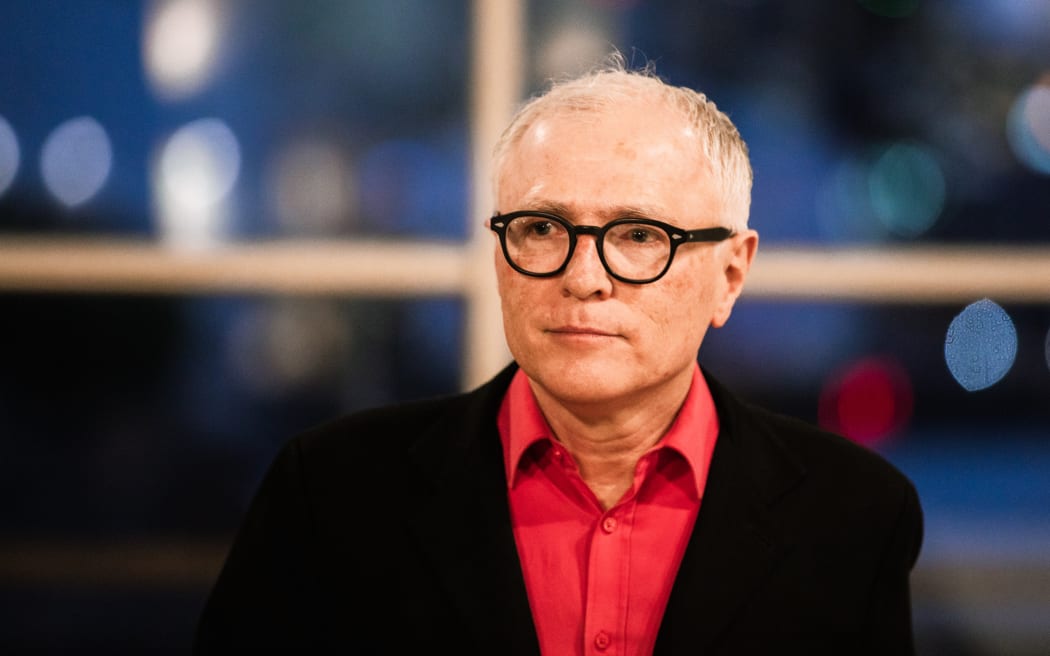
Benny Wenda
West Papuan leader Benny Wenda … Indonesia claims to “fight for humanity”, but the truth is the opposite. Image: Del Abcede/APR

At the UN General Assembly last week, Indonesia defied the overwhelming majority of the international community and joined North Korea, Russia and China in rejecting a resolution on “the prevention of genocide, war crimes, ethnic cleansing and crimes against humanity”.

Voting in favour of the RP2 resolution were 115 states while 28 abstained and 15 voted against.

The Jakarta Post said in an editorial that to find Indonesia on the “no” list was “perplexing”.

“The country that had at one time championed for the inclusion of human rights and democratic principles in the ASEAN Charter is now seen as voting against attempts to uphold those very principles internationally,” the newspaper said.

“Recent events in Myanmar and in the occupied Palestinian territory raise questions about the failure of the international community to intervene and stop bloodshed in these two countries.”

‘Real reason’ for vote
The Jakarta Post
said there was speculation about the “real reason” behind the no vote.

“One is the spectre of R2P being invoked against Indonesia over the Papuan question. In spite of the recent escalation of violence in Papua, the situation on the ground is still too far to merit international intervention,” the newspaper claimed.

However, while the Indonesian Foreign Minister claimed to “fight for humanity”, the truth was the opposite, said Wenda in a statement.

“They are committing crimes against humanity in West Papua and trying to ensure their perpetual impunity at the UN,” he said.

Indonesian leaders often talked about the right to self-determination and human rights, and the Indonesian constitution’s preamble called for “any form of alien occupation” to be “erased from the earth”, noted Wenda.

“But in West Papua, the Indonesian government is carrying out the very abuses it claims to oppose. Their refusal to accept the UN resolution is clearly the consequence of ‘the Papuan question’,” he said.

“The evidence is now overwhelming that Indonesia has committed crimes against humanity, colonialism, ethnic cleansing and genocide in West Papua.

Women, children killed
“The same week as the UN vote, the Indonesian military – including ‘Satan’s troops’ implicated in genocide in East Timor – were attacking Papuan villages, killing unarmed women and children and adding to the over 50,000 people displaced since December 2018.

“The stated aim of the operations is to ‘wipe out’ all resistance to Indonesian colonialism,” Wenda said.

“When you displace villagers, they lose their hunting ground, their home, their entire way of life.

“This is systematic ethnic cleansing, part of a long-running strategy of Jakarta’s occupation to take over our lands and populate it with Indonesian settlers and multi-national corporations. This is the intent, and we need action before it is too late.”

Wenda said that after Papuans declaring resistance to the illegal occupation “terrorism”, Indonesia had launched a massive crack down.

“Victor Yeimo, one of our most popular peaceful resistance leaders, has already been arrested. Frans Wasini, a member of the ULMWP’s Department of Political Affairs, was also arrested,” he said.

“In the city [Jayapura], students at the University of Cenderawasih are being dragged out of their dorms by the police and military and made homeless. Anyone who speaks out about West Papua, human rights abuses and genocide, is now at risk of being arrested, tortured or killed.

Arrested ‘must be released’
“Victor Yeimo, Frans Wasini, and all those arrested by the Indonesian colonial regime must be released immediately.”

Wenda described the deployment of more than  21,000 troops, killing religious leaders, occupying schools, shooting children dead as “state terrorism, crimes against the people of West Papua”.

Such developments had shown more clearly than ever the need for Indonesia to stop blocking the visit by the UN High Commissioner for Human Rights. Eight-four countries have already called for the visit.

“There can be no more delays. The troops must be withdrawn, and the UN allowed in before more catastrophe strikes.”

Print Friendly, PDF & Email

Article by AsiaPacificReport.nz

Marilyn Garson: Ceasefire, but we cannot let this go the same way

COMMENT: By Marilyn Garson in Wellington

I lived in Gaza from 2011, through the attack of 2014, and for one year after. I am not Palestinian, but some of the things I remember will be relevant in the coming months.

The bombardment was shattering. There followed a winter of soul-destroying neglect by donor states. Tens of thousands of Gazans remained in UNRWA shelter-schools. Many more families shivered in remnant housing, on tilting slabs of concrete, in rooms with three walls and a blanket hung in lieu of a fourth, persistently cold and wet.

Recovery? America sold Israel $1.9 billion in replacement arms. The World Bank assessed Israel’s bomb damage to Gaza at $4.4 billion. Of the $5.4 billion that donors pledged to reconstruct Gaza, in that critical first year the International Crisis Group calculated that the donor states actually came up with a paltry $340 million.

Aid is an insufficient place-holding response, but it is needed now. This time, it cannot happen the same way.

Having bombed, Israel is allowed to carry on the assault by slow strangulation.

In the workaday business of delivering the material needed to rebuild, the blockade allows Israel to choose the chokepoints of reconstruction. Having bombed, Israel is allowed to carry on the assault by slow strangulation.

In 2014 they were allowed to impose a farcical compliance regime for the cement that was needed to rebuild the 18,000 homes they had damaged or destroyed. UNRWA engineers were required to waste their days sitting next to concrete mixers.

International staff spent hours of each day driving between them to count — unbelievably — sacks of cement. 100,000 people were homeless and cement was permitted to reach them like grains of sand through an eye-dropper. Not a single home was built through the remainder of 2014.

Choking off the supplies
Perhaps this time Israel will choke off the supplies needed to re-pave the tens of thousands of square meters of road they have blown up; it will be something. We have watched an attack on the veins and arteries of modern civilian infrastructure.

If the crossings regime is allowed to remain in place, we will be leaving the Israeli government to decide unilaterally whether Gazans will be permitted to live in the modern world.

This time, it simply cannot go the same way.

I was as frightened by the way the bombs changed us. 1200 hours of incessant terror and violence had re-wired our brains. The lassitude, the thousand-yard-stares, the woman from Rafah who clutched her midsection as if she could hold her twelve lost relatives in place. I and my team of Gazan over-achievers struggled to finish any task on time.

Eight months later I found research on the anterior midcingulate cortex to help us understand how bombardment can alter the finishing brain. Every step seemed to be so steeply uphill.

Even more un-Gazan, we often struggled alone. The very essence of Gaza is its density. In its urban streets you know the passersby with smalltown frequency. Gaza coheres with the intentional social glue of resistance.

After the bombardment, people seemed to float alone with their memories. The human heart returns to the scene of unresolved trauma, and our hearts were stuck in many different rooms.

Good people suffering
The good people who listened and cared as professionals or as neighbours, were themselves suffering. Parents compared notes through those months: how many of their children still slept beneath their beds in case the planes came back?

Over everyone’s heads hung the knowledge that there had been no substantial agreement beyond a cessation of firing.

I felt I was watching people reach for each other, and for meaning. Young Gazan men stood for hours, waving Palestinian flags over the rubble of Shuja’iyya while residents crawled over the rubble landscape in search of something familiar. Bright pennants sprouted across the bombed-out windows of apartments.

Not everyone found meaning. Suicide and predatory behaviour also rose. Hamas cracked down on dissent violently, while more-radical groups made inroads among young people who may have felt they had no other agency.

The aftermath was all these things at once. When I left Gaza in late 2015, it felt poised between resuming and despairing. Since then, it has gone on for another six years. This bombardment picked up where the last one left off: in 2014 the destruction of apartment blocks was Israel’s final act and this time, it was their opening salvo.

This time, we cannot let it go the same way.

I had to learn to harness my sadness and outrage. If we are to make it different this time, we need to do that.

Reclaimed rubble sea wall, Gaza - Marilyn Garson
Reclaimed rubble sea wall, Gaza City … “this isn’t over [yet for Palestine and Gaza] and we will not let it go the same way.” Image: Marilyn Garson

Raging at the blockade
In the first weeks after the 2014 bombing, I could only rage at the blockade wall but the wall stood, undented. I didn’t know how to look further, and as a Jew I was afraid to look further. I began to read books on military accountability. Those principles helped to focus my gaze beyond the wall.

Now as then, we have witnessed a barbaric action, comprised of choices. Individuals are accountable for each of those choices. It is neither partisan nor, must I say it, antisemitic to call them to account ceaselessly.

Accountability takes the side of civilian protection. If one belligerent causes the overwhelming share of the wrongful death and damage, then that party has duly earned the overwhelming share of our attention. Call them out.

Loathe the wall but rage wisely at its structural supports: expedient politics, the arms trade that profits by field-testing its weapons on Gazan Palestinians, any denial of the simple equality of our lives, the hand-wringing or indifference of the bystander. Those hold the wall up.

Prior to this violence, Donald Trump had been busily normalising Israel’s diplomatic relations – good-bye to all that. Normalise BDS, not the occupation of Palestine. Apply sustained, peaceful, external pressure as you would to any other wound.

BDS firmly rejects an apartheid arrangement of power, until all people enjoy equality and self-determination.

Palestinians as a single nation
“See and reject the single system that classifies life ethnically between the river and the sea. When you recognise a single systemic wrong, you have recognised Palestinians as a single nation.

A statement by scholars of genocide, mass violence and human rights last week described the danger: “[T]he violence now has intensified systemic racism and exclusionary and violent nationalism in Israel—a well-known pattern in many cases of state violence—posing a serious risk for continued persecution and violence against Palestinians, exacerbated by the political instability in Israel in the last few months.”

In other words, this isn’t over and we will not let it go the same way.

The risk to Gaza now is the risk of our disengagement before we have brought down the walls. That is the task; nothing less. This time, Gaza must go free.

Marilyn Garson writes about Palestinian and Jewish dissent. This article was first published by Sh’ma Koleinu – Alternative Jewish Voices and is republished with permission. The original article can be read here.


Print Friendly, PDF & Email

Article by AsiaPacificReport.nz

Samoa’s caretaker leader rejects swearing in of first woman PM as ‘treason’

RNZ Pacific

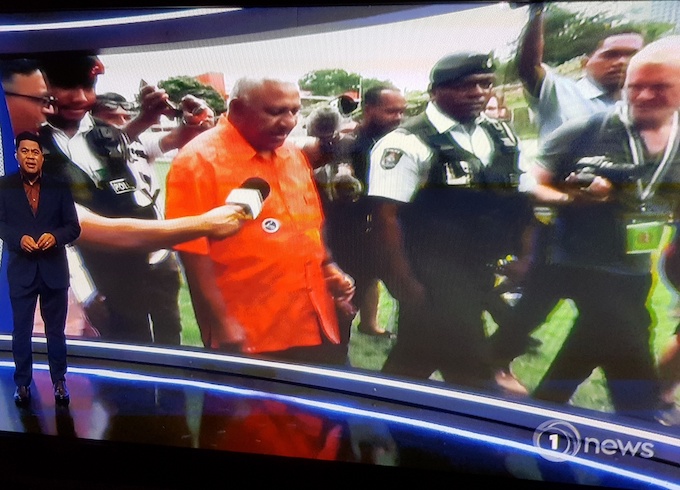
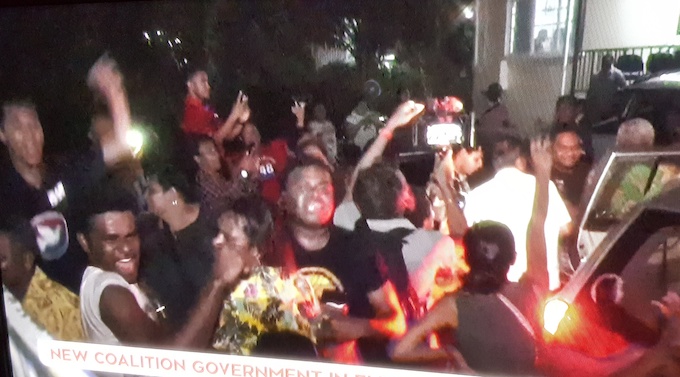
Samoa’s election-winning FAST party leader Fiame Naomi Mata’afa has been named the country’s first woman Prime Minister, in a swearing-in ceremony her rival called “treason”.

She named her cabinet this afternoon in the ceremony in a large marque tent erected on the Fale Fono (Parliament) grounds.

Whether this ad-hoc ceremony will be recognised as legal and official remains to be seen.

The rival Human Rights Protection Party (HRPP) was not there, nor was there any sign of the judiciary, the speaker, or the head of state. The appointed clerk of parliament acted as FAST’s main legal counsel.

FAST had this morning been barred from entering the Parliament building after Tuila’epa Sa’ilele Malielegaoi, who has been Prime Minister for 23 years and leader of HRPP, directed the Speaker to lock the doors.

Under the constitution, Parliament must sit within 45 days of an election and today was the last day for this to be possible.

FAST said the caretaker government’s actions were “tantamount to a coup”.

‘Bloodless … but a coup’
“I think a coup would be accurate,” spokesman for FAST Lance Apulu said when asked to describe the events of this morning. “Bloodless, but they are actually coups.

“The FAST party are abiding by the rule of law. Yesterday the latest declaration was given by the Supreme Court … they are pushing for the government to abide by the rule of law.”

The Samoan ad-hoc swearing-in ceremony
The Samoan ad-hoc swearing-in ceremony today with a former Head of State among those present. Image: Ame Tanielu/RNZ

A Supreme Court decision on May 17 broke a post-election deadlock by confirming the new FAST party had a 26-25 seat majority over the HRPP.

Then, a decision by the Supreme Court on Sunday overruled an edict late on Saturday by the Head of State withdrawing a directive for Parliament to open today.

HRPP, which has ruled Samoa for nearly 40 years, has been refusing to hand over power. Following the swearing in, Tuila’epa called the FAST Party MPs treasonous and promised legal action.

His words have been translated.

“This is treason,” he said. “This is law-breaking in its highest degree.”

Country’s chiefs disrespected
He said FAST had disrespected the country’s chiefs and leaders and were mentally unfit.

“I have a piece of encouragement for my government officials/public servants today: do not be worried, this party is doing what they can… all there is to do for now is to continue our hard work,” he said.

“I’m just wondering if ‘those guys’ are all there mentally… this isn’t and will not be a government of fools.”

Tuilaepa Sailele Malielegaoi
Caretaker leader Tuila’epa Sa’ilele Malielegaoi speaking after the ceremony … “this isn’t and will not be a government of fools.” Image: RNZ screengrab

He said only the Head of State could call Parliamentary meetings and swear people in.

“None of what they did is legitimate. The Devil has won and taken over them.”

When asked about the fact that it is Day 45 since the general election, and Samoa had not had a Parliament sitting, Tuila’epa said: “I’m going to answer that question at another, more appropriate time.”

It is probably fortunate Samoa has no armed forces, but there is now immense pressure on the public service and Police Commissioner Fuiavailili Egon Keil.

Enforcing the law
This morning, the commissioner said his role was to enforce the law and he was doing that today by escorting Chief Justice Satiu Simativa Perese to and from Parliament in an attempt to uphold the Supreme Court order to convene parliament.

The judiciary – already under immense pressure, which it has so far held up to – is likely to be put to the test again.

Crises like these are where the head of state is meant to step in, but Tuimaleali’ifano Va’aleto’a Sualauvi has shown that he has been politically swayed, acting on the advice of Tuila’epa and the HRPP Attorney-General, and lacking his own independent advisers.

Even so, he is not in Apia and there has been no word from him today.

Tuila’epa said he wondered how the ad-hoc ceremony made Samoa look to other countries.

“They used to look at us with respect, now we are seen as fools … they have disrespected the dignities of the chiefs and leaders of their districts with their actions today.

“That was a joke, a joke. Oh my, where have we ever seen a Speaker sworn in, in a tent? Shameful.”

“I say that is enough foolishness, enough disrespect. But I am thankful to the Chief Justice for not being present at this tomfoolery.”

FSM recognises Fiame as PM
In New Zealand, Prime Minister Jacinda Ardern said at her post-cabinet briefing this afternoon, that the country would encourage “all parties and political leaders” to uphold the election outcome and the decisions of institutions including the judiciary, and the rule of law.

Ardern said New Zealand was not in a position to be playing “any interventionist role”.

She said despite the fact there was a “changeable” political situation, reports were that things were calm, in line with calls from political and faith community leaders.

The Federated States of Micronesia tonight said it “recognised the legitimacy of Prime Minister Fiame Naomi Mata’afa”.

This article is republished under a community partnership agreement with RNZ.

Timeline of events leading to Samoa’s political crisis

  • Friday, April 9 – Election: HRPP and newcomer FAST 25 seats each, with one to an independent.

  • Tuesday, April 20 – Extra woman’s seat appointed, giving HRPP 26 seats to FAST’s 25.
  • Wednesday, April 21 – Independent Tuala Tevaga Ponifasio commits to FAST giving them 26 seats continuing the electoral impasse.
  • Thursday, April 22 – FAST challenges the extra women’s seat saying the Constitution specifies a minimum five women’s seats with the lawsuit to be heard in Supreme Court on Wednesday, May 5.
  • Friday, April 30 – Electoral petitions due.
  • Tuesday, May 4 – Electoral petitions given until the following Tuesday to sort out arguments.
  • Tuesday evening, May 4 – HoS – O Le Ao O Le Malo – Tuimaleali’ifano Va’aleto’a Sualauvi II – makes surprise proclamation that a new election is being called for May 21 to break deadlock.
  • Wednesday, May 5 – Attorney General calls for the Supreme Court case challenging the extra women’s seat be thrown out due to new elections. *Will reconvene on Friday and have tomorrow to sort arguments.
  • Thursday, May 6 – HoS under advice from government proclaims no new candidates can run in by-election.
  • Friday, May 7 – Supreme Court agrees to hear a challenge to the constitutional legality of snap-elections and the extra, unelected sixth women’s seat.
  • Friday, May 8 – Tuila’epa tells local media he was appointed by God after protests against him outside the Supreme Court.
  • Thursday, May 13 – Supreme Court rejects attempt by Attorney-General to delay a challenge to the snap-elections which was to be heard on Friday, May 14.
  • Friday, May 14 – Supreme Court hears challenge against the constitutionality of the Head of State voiding the April 9 election and calling a new one on May 21.
  • Monday, May 17 – Supreme Court hears challenge against extra women’s seat, voiding it and giving FAST 26-25 majority. Finds in favour of FAST’s challenge on grounds extra seat was declared after the election results had already been confirmed.
  • Monday, May 17 – Supreme Court finds Head of State acted beyond his constitutional powers in calling a snap election and voids the ballot, clearing the way for FAST to declare a majority and government.
  • Tuesday, May 18 – FAST asks Head of State to convene Parliament.
  • Wednesday, May 19 – HRPP to challenge Supreme Court judgments, advises HoS not to call Parliament. Matai and supporters of HoS arrive in Apia by busload following threats to His Highness on social media.
  • Wednesday, May 19 – HoS agrees to call Parliament. FAST asks for Friday but HoS prefers Monday, the last possible day to do so.
  • Friday, May 21 – Court of Appeal rejects a stay on the ruling voiding the 6th women’s seat. FAST majority stands.
  • Friday, May 21 – HoS calls for Parliament to convene on Monday, May 24.
  • 7pm Saturday, May 22 – HoS proclaims that Parliament will be suspended until further notice.
  • Early Sunday, May 23 – FAST files urgent call for Supreme Court to hear challenge to HoS’s new edict. Case heard in-chambers and proclamation ruled unlawful.
  • Monday, May 24 – FAST party arrives at Parliament to find the doors locked. Tuila’epa says only the Head of State has the power to convene Parliament and his HRPP party remains the government.
Print Friendly, PDF & Email

Article by AsiaPacificReport.nz

Australian embassy in Afghanistan to close its doors as security situation worsens

Source: The Conversation (Au and NZ) – By Michelle Grattan, Professorial Fellow, University of Canberra

Australia will shut its residential embassy in Afghanistan before its troops leave the country, amid concerns of an expected worsening security situation.

Prime Minister Scott Morrison and Foreign Minister Marise Payne said in a Tuesday statement the embassy building in the capital Kabul will be closed on Friday.

Diplomats will visit Afghanistan “regularly from a residential post elsewhere in the region.” The new arrangement “does not alter our commitment to Afghanistan or its people,” they said.

Morrison and Payne said it was “Australia’s expectation that this measure will be temporary and that we will resume a permanent presence in Kabul once circumstances permit”.

But it appears unlikely a Kabul embassy will resume.

No firm commitment has been given, nor any indication of a timetable for returning to an on-the-ground diplomatic presence in the country. There is also no expectation of the security situation in Afghanistan improving.

The government statement said,

The departure of the international forces and hence Australian forces from Afghanistan over the next few months brings with it an increasingly uncertain security environment where the government has been advised that security arrangements could not be provided to support our ongoing diplomatic presence.

The visiting diplomatic model was used between the opening of Australia’s relations with Afghanistan in 1969 until 2006 when Brett Hackett was named ambassador.

The statement said: “We will continue our 52-year bilateral diplomatic relationship with Afghanistan, building on our close friendship with the Afghan people which stretches back to the historic arrival of Afghans in South Australia in the 1830s.”

Payne visited Afghanistan earlier this month and had talks with President Ashraf Ghani. She said publicly at the time that “with the departure of the Australian Defence Force, the Australia-Afghanistan relationship is beginning a new chapter of our diplomatic relationship”.

But she made no mention in her statement at that time of closing the embassy.

The appointment of Paul Wojciechowski, Australia’s current ambassador to Afghanistan, was only announced in March.

The Australian troops will leave by September. The decision to pull the remaining 80 troops followed the US announcement that it was withdrawing its forces.

ref. Australian embassy in Afghanistan to close its doors as security situation worsens – https://theconversation.com/australian-embassy-in-afghanistan-to-close-its-doors-as-security-situation-worsens-161499

Samoan democracy hangs in the balance as a constitutional arm wrestle plays out — with the world watching

Source: The Conversation (Au and NZ) – By Patricia A. O’Brien, Visiting Fellow, School of History, Australian National University, and Adjunct Professor, Asian Studies Program, Georgetown University

New battlelines in Samoa’s ongoing political crisis were drawn this week. After an evening swearing-in ceremony on the lawn of parliament house, Samoa now has two governments claiming a mandate to rule.

What comes next will have vast ramifications for the Pacific nation, its region and for democracy globally.

On Monday May 24, Fa’atuatua I Le Atua Samoa Ua Tasi (FAST) Party members, led by Fiame Naomi Mata’afa, arrived at parliament house to be sworn into office following their one-seat election win on April 9.

They found the doors locked by order of Tuilaepa Sa’ilele Malielegaoi, who has been prime minister for the last 23 years. By late afternoon, with the building still locked, the marquee swearing-in ceremony took place outside.

This was the 45th day since the election, the last date on which the newly elected parliament could sit according to Samoa’s constitution.

Fiame Naomi Mata’afa takes her oath at an unofficial ceremony outside parliament house in the capital, Apia. AAP

A constitutional arm wrestle

The unprecedented delay was due to a series of extraordinary maneuvers aimed at keeping Tuilaepa’s Human Rights Protection Party (HRPP) in power after losing its first election in 40 years.

By forcing the clock run to out on the 45-day limit for a new parliament to convene, the HRPP would propel Samoa into uncharted constitutional waters, providing justification for another election.

The head of state, Tuimaleali’ifano Va’aleto’a Sualauvi, had declared the April 9 election results void and that a second election be held May 21. On May 17, the Supreme Court deemed that declaration illegal, upholding FAST as the victors of the vote and ordering parliament to convene on May 24.


Read more: Despite a veneer of democracy, Samoa is sliding into autocracy


Then, on May 22, the head of state abruptly announced parliament was suspended until further notice. Fiame described this latest development as a “coup”.

In response, the Supreme Court held an urgent hearing on May 23. It again overruled the head of state and ordered parliament to sit on May 24.

Refusing to step down: Tuilaepa Sailele Malielegaoi at the UN General Assembly while still prime minister. AAP

Court and church lend legitimacy

The makeshift swearing-in ceremony gave Fiame’s government legitimacy. The presence of the revered former head of state, Tui Atua Tupua Tamasese Ta’isi Efi, aided the optics. The current head of state, who has shocked many with his actions, was said to have left the capital, Apia, for a distant village.

Also legitimising the Fiame government’s swearing-in was the chairman of the Congregational Christian Church, Reverend Elder Iosefa Atapana Uilelea, who led the opening prayers. Until that point, the immense moral force of church leadership had not been activated to support either side.

Tuilaepa’s response at Monday night’s press conference was in character: FAST had been overtaken by “the devil”, had “mental issues needing professional help” and were akin to “the Mafia”.

More ominous was his accusing FAST of “stealing” his authority and “treason”.


Read more: Samoa’s stunning election result: on the verge of a new ruling party for the first time in 40 years


Tuilaepa’s strategy to retain power has relied on an interpretation of powers of the head of state that have no basis in law or precedent. When these moves have been blocked by the Supreme Court, he has denounced it as illegitimate and ignored its decisions.

By contrast, Fiame (who was Tuilaepa’s deputy until late 2020) and her FAST members have exhibited professionalism, restraint, and faith in Samoa’s constitution, courts and the people who put them in power.

Now, new battlelines will be drawn over which government is the legitimate one and who adjudicates that critical point. This will entail more direct confrontation between the head of state and Supreme Court, which will extend the deadlock.

How will the crisis be resolved?

Without a military, Samoa cannot resolve its crisis like neighbouring Fiji, where the army has staged multiple coups since 1987. In Samoa, the police occupy a pivotal role, but to date have acted peacefully and in accordance with the courts.

But since May 17, another factor has come into play. Samoa has attracted regional and world attention because Fiame is the first female leader of the country, and one of few in the region.

Since May 22, the world has watched Tuilaepa’s attempts to deny her power with great interest.

Samoa is a microcosm of US President Joe Biden’s recent description of the struggles between democracy and the autocratic political regimes favoured by Chinese President Xi Jinping. Samoa moved closer to China under Tuilaepa but that may now be reversed under Fiame.

So far, New Zealand’s prime minister, Jacinda Ardern, and Australia’s foreign minister, Marise Payne, have made cautious statements about their faith in Samoa’s democratic institutions.

In the coming days, New Zealand and Australia, the US, Japan, Britain, the European Union and the main regional body, the Pacific Islands Forum, must actively support Samoa’s democratically elected government in any way requested by Fiame.

Supportive words may soon be inadequate as Tuilaepa makes his next moves in what looks now like a naked power grab.

ref. Samoan democracy hangs in the balance as a constitutional arm wrestle plays out — with the world watching – https://theconversation.com/samoan-democracy-hangs-in-the-balance-as-a-constitutional-arm-wrestle-plays-out-with-the-world-watching-161490

We could be a superpower: 3 ways Australia can take advantage of the changing geopolitics of energy

Source: The Conversation (Au and NZ) – By Christian Downie, Associate professor, Australian National University

The International Energy Agency confirmed last week what many already knew: the world is undergoing a huge transformation in global energy markets. Fossil fuels are dying and renewables are on the rise.

Much of the focus has been on what this means for Australia, given the IEA declared there can be no new fossil fuel projects if global temperature rise is to be kept below 2℃.

But what the discussion has missed is how the shift to renewable energy is also set to transform Australia’s geopolitical environment. For a country that likes to think of itself as an energy superpower, it’s time we started paying attention.

Australia should embrace the opportunity to become a renewable energy power. If we don’t act now, with the global energy transition gathering pace, Australia could be exposed to a hostile international energy environment with profound economic, security and diplomatic consequences.

The new geopolitics of energy

The IEA’s declaration that new fossil fuel projects have to end now sits at odds with the federal government’s plans for a gas-led economic recovery, and its recent announcement of A$600 million to fund a major new gas-fired power plant.

But the IEA isn’t the only authoritative body making this claim. Most global energy transition scenarios project a peak in fossil fuel demand this decade and exponential growth in renewables, before a long decline in fossil fuel demand in the decades thereafter.

Scott Morrison holds a lump of coal next to Barnaby Joyce
On the same night the IEA released its report warning against new fossil fuel projects, the Morrison government announced $600 million for a major new gas-fired power plant. AAP Image/Mick Tsikas

Recent commitments by Australia’s major trading partners to net-zero emissions, including China, Japan and South Korea, will only accelerate this process.

The IEA set out a roadmap to bring the planet to net-zero emissions by 2050. Indeed, under this net-zero scenario, oil demand peaked in 2019 and will fall by almost 75% between now and 2050. Demand for coal has peaked, too, and will fall even faster by 90%. The prospects for gas are only slightly better, with a decline of 55% out to 2050.

It’s no wonder Australian financial regulators keep warning about stranded assets.


Read more: International Energy Agency warns against new fossil fuel projects. Guess what Australia did next?


The geopolitical consequences of this transition will be profound. To varying degrees, the changes taking place in energy markets will reorder patterns of cooperation and conflict between states.

At one end of the spectrum, some states will emerge as renewable powers — think Chile with its large solar resources in the Atacama Desert, or China with its superiority in renewable technologies.

Aerial view of solar panels in the desert
A solar energy power plant in the Atacama desert, Chile. Shutterstock

At the other end of the spectrum, some states will experience political instability from the decline of fossil fuel revenues — think countries such as Saudi Arabia and Kuwait, where oil and gas revenues comprise more than 40% of their GDP.

Transitioning to clean energy will have huge upsides for Australia. But let’s start with the downsides, because the IEA has just put them up in lights.

Our international leverage will soon disappear

Successive federal governments have declared Australia to be an energy superpower.

One reason is our exports of coal and gas. Take LNG (liquefied gas) for example. In 2019 Australia overtook Qatar to become the largest exporter of LNG in the world, with total exports valued at A$48 billion, representing a 22% share of global exports.

The IEA says this must end if the world is to have any hope of avoiding the worst effects of climate change. If the gas industry hasn’t got the message yet, the IEA had some chilling news.

As the graph below shows, Australia’s gas exports will have to peak by 2025 and then fall off a cliff in the decades after, under a net-zero-by-2050 emissions scenario. The picture for coal is even worse.

The economic repercussions are obvious. As a political leader might say, it’s “jobs and growth” that’ll be hit hardest.

But this also has geopolitical implications. Australia has long relied on the economic strength we derive from being a dominant exporter of coal and gas to shape our bilateral relationships with countries, such as Japan and South Korea.

This leverage will soon disappear and it will force Australia to rethink how it engages with many nations and international organisations.

For example, potential disruptions to oil shipping lanes will likely become less of a concern. Nations may also compete to control the supply of rare minerals that are vital for a range of technologies needed for a clean energy transition, such as batteries and wind turbines.

What should Australia do?

First, Australia should harness its renewable resources. Australia’s solar radiation per year is around 10,000 times larger than our total energy consumption. If these resources are exploited, Australia can become energy self-sufficient and, at the same time, reduce its vulnerability to energy supply disruptions, such as from international conflicts.

School Strike 4 the Climate
The federal government touts a gas-fired economic recovery, despite public opposition. AAP Image/James Ross

Second, Australia should pursue export dominance. The rise of renewables will open up significant opportunities for Australia to become one of the primary exporters of clean electricity, hydrogen and critical minerals.

For example, growing demand for electricity in Asia combined with improvements in high-voltage direct current cables could see Australia export electricity to countries in our region, such as Indonesia and Singapore.


Read more: South Korea’s Green New Deal shows the world what a smart economic recovery looks like


Third, Australia should leverage its energy advantage. States with significant renewable resources that become energy self-sufficient and attain export dominance are likely to be “geopolitical winners”.

In other words, the economic power derived from Australia’s renewable energy advantage will open up opportunities to influence other countries and shape intergovernmental arrangements, such as those governing the future of international trade in hydrogen.

Being energy self-sufficient will also insulate Australia from the risk that other countries will seek to coerce it by disrupting energy supplies.

This opportunity won’t last forever. Countries that move first will gain an advantage in new industries, technologies and export markets. Those that wait may never catch up.


Read more: It might sound ‘batshit insane’ but Australia could soon export sunshine to Asia via a 3,800km cable


ref. We could be a superpower: 3 ways Australia can take advantage of the changing geopolitics of energy – https://theconversation.com/we-could-be-a-superpower-3-ways-australia-can-take-advantage-of-the-changing-geopolitics-of-energy-161343

Stellar secrets of a distant galaxy suggest our Milky Way isn’t so special after all

Source: The Conversation (Au and NZ) – By Nicholas Scott, Postdoctoral Research Fellow in Astronomy, University of Sydney

It’s no surprise the Milky Way is the most-studied galaxy in the universe, given it’s where we live.

But studying just one galaxy can only tell us so much about the complex processes by which galaxies form and evolve.

One crucial question that can’t be solved without looking farther afield is whether the Milky Way is a run-of-the-mill galaxy, or whether it’s unusual or even unique.

Our research, published today in Astrophysical Journal Letters, suggests the former is true. Key details of our galaxy’s structure are shared by other nearby galaxies, suggesting our home isn’t all that special.

An all-sky map of the Milky Way from ESA’s Gaia satellite.

At first glance, there’s no reason to suspect our galaxy is remarkable anyway. Among the billions of galaxies in the observable universe, ours is not the largest, oldest or most massive. It looks pretty much like all other spiral galaxies, which is the most common type of galaxy.

But when we look in detail at the Milky Way’s structure and chemistry, it starts to stand out.

From side-on (where it’s impossible to make out the spiral arms), it looks like a pancake with a peach in the middle. Astronomers have known that for at least a century.

However, that simple picture changed in 1983, when researchers using Australian telescopes discovered an ancient “thick disk” component in the Milky Way. This faint structure is invisible to the naked eye, unlike the dominant thin disk (the pancake-shaped part), which is plainly visible on a clear night as a streak of stars across the sky.

The thin disk, where our Sun resides, is about 1,000 light-years thick and about 100,000 light-years in diameter, and runs through the middle of the thick disk, in the same plane. The thick disk, aptly enough, is much thicker, being a few thousand light-years thick, but is much less densely populated with stars.


Read more: Under the Milky Way: what a new map reveals about our galaxy


One interesting recent discovery is that the thick and thin disks contain very different kinds of stars. Stars in the thin disk tend to have a high proportion of heavy elements such as iron (“metals”, in astronomy parlance) and relatively small amounts of the “alpha elements” (carbon, oxygen, magnesium, silicon and a few others). Thick disk stars, meanwhile, have about 100 times less metals, but significantly more of the alpha elements.

Artist’s impression of the Milky Way.

This double-disk structure, with its very distinct populations of stars, is very tricky to replicate in computer simulations. For a long time, computer models with the same structure could only be created in a specific scenario involving a medium-sized galaxy colliding with our own, roughly nine billion years ago. Simulations suggested this process was incredibly rare: only one in 20 galaxies superficially similar to the Milky Way experienced a collision that resulted in distinct thick and thin disks.

If this scenario were correct, galaxies like the Milky Way should be as rare as hen’s teeth.

An example of spectral imaging with the MUSE instrument.

Our research set out to test this clear prediction. We studied a handful of galaxies broadly similar to the Milky Way, using the Multi Unit Spectroscopic Explorer (MUSE) on the Very Large Telescope at the European Southern Observatory in Chile.

Spectroscopy – splitting the light from a galaxy into many different colours – lets us determine the chemical composition of its stars. What makes MUSE an extremely powerful instrument is that we get 90,000 spectra in a single observation, transforming each location of the galaxy into a spectrum.

One particular galaxy — UGC10738, which is roughly 320 million light-years away – stood out because of its side-on orientation, which allowed us to separate out the thin and thick disk stars and then compare them.

We found that the chemical compositions of stars in UGC 10738 are extremely similar to those in the Milky Way. We found metal-rich, magnesium-poor stars concentrated in a thin disk along the galaxy’s centre, with a distinct group of metal-poor, magnesium-rich stars above and below this, in the thick disk region.

That distant galaxy is remarkably similar to our own. Which in turn means there’s probably nothing that remarkable about the Milky Way after all.

The Milky Way over the Very Large Telescope at ESO’s Paranal Observatory. A. Russell/ESO

Our discovery has several implications. First, it suggests the disk features in the Milky Way might be the result of a standard formation path that all galaxies follow. This is backed up by the identification of similar structures in non-Milky-Way-like galaxies.

Second, the fact that our galaxy is relatively normal is extremely exciting. It implies the Milky Way can act as a blueprint or template for galaxy formation.

This means our home galaxy (which is obviously the easiest for us to study) could hold the key to unlocking the cosmic history of the entire universe.

Finally, and being a little speculative here, the Milky Way is the only galaxy that we know contains life. New research has suggested galactic-scale events may have played a crucial role in the formation of our Solar system. The recent explosion of exoplanet discoveries has shown that systems like it are common throughout the galaxy, suggesting life could find many possible homes within it.


Read more: From pancakes to soccer balls, new study shows how galaxies change shape as they age


Now we know the Milky Way’s history was likely similar to many billions of other galaxies, it seems increasingly likely they too might make good homes for life.

Ultimately, whatever future research teaches us, the Milky Way will remain our home. And that makes it special – even though our research suggests that in another sense, it’s not special at all.

ref. Stellar secrets of a distant galaxy suggest our Milky Way isn’t so special after all – https://theconversation.com/stellar-secrets-of-a-distant-galaxy-suggest-our-milky-way-isnt-so-special-after-all-161419

Social media platforms are complicit in censoring Palestinian voices

Source: The Conversation (Au and NZ) – By Kelly Lewis, Research Associate at the Digital Media Research Centre, Queensland University of Technology

As the Israel-Palestine ceasefire agreement holds, social media platforms, including Facebook and Instagram (which is owned by Facebook), continue to come under fire over the censorship of pro-Palestinian content.

In times of conflict, any kind of censorship by major platforms can erase evidence of state-sanctioned violence, human rights abuses and potential war crimes against innocent civilians.

The Institute for Middle East Understanding (IMEU) highlights a post by @A7madAbuznaid on the extent of Instagram’s censorship. @theimeu/Instagram/Screenshot

This is particularly concerning as evidence of brutality and violence on social media can often be the only form of testimony that holds false narratives and mass denial of human rights abuses to account.

Holding platforms to account

According to Al Jazeera, the Palestinian death toll in the recent conflict with Israel stands at 248, including 66 children. At least 12 people have died in Israel, including two children.

On social media, Palestinians and supporters have documented violence through images and videos, with hashtags in both English and Arabic. But activists, digital rights defenders and users have called out the platforms over mounting evidence of the unjustified removal of pro-Palestinian content.

Political cartoonist Khalid Albaih highlights Instagram’s censoring of critical creative voices. @khalidalbaih/Instagram

Facebook last week acknowledged it had inaccurately labelled certain words commonly used by Palestinians online (including “martyr” and “resistance”) as incitement to violence.

Senior Facebook executives apologised to Palestinian Prime Minister Mohammad Shtayyeh in a virtual meeting on May 20, after which a Facebook spokesperson told TIME Facebook was “actively working to respond to concerns about our content enforcement.”

Earlier this month, Instagram and Facebook labelled Jerusalem’s Al-Aqsa Mosque as being associated with “violence or a terrorist organisation”, according to a BuzzFeed report. This resulted in Instagram removing and blocking posts tagged with #AlAqsa or its Arabic counterparts #الاقصى or #الأقصى. A Facebook spokesperson claimed the posts “were restricted in error”.

In a letter to the Palestinian Mission to the United Kingdom, Facebook said it would work to resolve content moderation issues and investigate alleged campaigns on the platform to incite violence against Palestinians in Israel.


Read more: When it comes to media reporting on Israel-Palestine, there is nowhere to hide


Meanwhile, The Intercept, a US news outlet, claimed on May 15 it had obtained internal Facebook policies which showed the company’s moderating of the term “zionist” enabled it to suppress criticism against the Israeli state on both Facebook and Instagram.

Executive director of @theslowfactory Céline Semaan reports on Instagram’s restrictions to her account. @celinecelines/Instagram

Incomplete records

Due to a lack of transparency surrounding content moderation practices, it’s not clear how much platform censorship has occurred in the current conflict. What little independent insight we have mostly comes from a handful of digital rights organisations.

The global digital rights organisation Access Now has reported receiving hundreds of accounts of platforms suppressing pro-Palestinian content across Facebook, Twitter, TikTok and Instagram.

And the Palestinian digital rights group Sada Social recorded more than 200 violations of Palestinian social media content related to the Sheikh Jarrah demonstrations in occupied East Jerusalem. It described “violations” as:

[…] arbitrary measures against Palestinian content, especially with the tendency to stigmatise criticism of Zionism with anti-Semitism.

Similarly, the Palestinian and Arab digital rights organisation, 7amleh — The Arab Center for the Development of Social Media, documented some 500 cases of Palestinian digital rights violations between May 6-19, along with platforms’ responses. The violations came from Instagram (50%), Facebook (35%), Twitter (11%) and TikTok (1%).

7amleh alleged that in most cases, users were not given an explanation for content deletion or account suspension.

Meetings with Facebook executives

Sada Social released a statement last week accusing Israel of trying to “impose its hegemony on social media platforms”.

The statement came in response to a meeting between Israeli Defence Minister Benny Gantz and executives from Facebook and TikTok. In it, Gantz requested the corporations remove Palestinian content Israel believed would incite violence or spread misinformation.

Soon after, former Facebook executive Ashraf Zeitoon spoke to Al Jazeera Plus about historic and ongoing pressure by the Israeli government to censor Palestinian content. He said Facebook consistently complied with pro-Israeli allegations by systematically silencing Palestinian voices.

A Facebook spokesperson told Al Jazeera Plus:

This person hasn’t worked at Facebook in more than four years and has no direct knowledge of our decision-making processes during these horrible global events nor the authority to speak about our policies or how we enforce them.

Due to a lack of transparency surrounding content moderation, we don’t know the extent to which platform censorship is done in direct response to user complaints, requests from foreign governments or as a result of algorithmic decisions.

Muslim.co reports on users’ experiences of censorship on Instagram regarding Palestine. @muslim/Instagram

Political pressure

In response to growing criticism, Facebook last week established a “special operations centre” staffed by experts including native Arabic and Hebrew speakers.

The company, which has offices in Israel, has faced growing criticism by digital rights defenders and activists over its business interests, platform policies and content moderation process.

Facebook has a public policy director for Israel and the Jewish diaspora, Jordana Cutler, a former adviser to Israeli Prime Minister Benjamin Netanyahu.

It does not have a dedicated public policy director for Palestinians. Palestinian matters fall under the remit of its Middle East and North Africa policy chief.

Last year, Facebook established an independent oversight board to address growing criticisms about its role in suppressing online speech. But the legitimacy of the board was questioned after the controversial appointment of Emi Palmor, a former general director of the Israeli Ministry of Justice’s Cyber Unit.

The enactment of social and political power

Social media platforms can effectively dictate what is permitted in online discourse, using moderation processes that are opaque and fraught with inconsistencies.

In the context of the Israel-Palestine conflict, the removal of content deemed “offensive”, “graphic” or “inciteful” by private corporations and oppressive political actors essentially controls how we understand it.

This, in turn, can influence the protection of rights and potential to prosecute human rights abuses. This is a form of oppression I refer to as “platform necropolitics”.

It provides a prism through which to understand how corporate and political actors are increasingly working together to control which voices and what content are (or aren’t) given space online.

ref. Social media platforms are complicit in censoring Palestinian voices – https://theconversation.com/social-media-platforms-are-complicit-in-censoring-palestinian-voices-161094

Upper Hunter byelection reveals the dangers that lurk for Albanese and federal Labor

Source: The Conversation (Au and NZ) – By Mark Kenny, Professor, Australian Studies Institute, Australian National University

History shows that Labor took too much heart when Labor leader Kim Beazley unexpectedly pushed John Howard to the edge of extinction in 1998.

Howard, a first-term prime minister, suffered a 4.6% swing, surrendering the popular vote but somehow retaining a parliamentary majority.

Labor strategists figured the next election would be that much easier for having come so close.

This was wrong.

Consistently underestimated as a reader of the middle-Australian voter, Howard served four terms leaving Beazley with the cold comfort of being regularly tagged as “the best prime minister Australia never had”.

Could this be Anthony Albanese’s trajectory also?

The Upper Hunter case study

Behind Labor’s initial grief of its federal election loss, there were hopes within the ALP that next time might be different, given Prime Minister Scott Morrison only scraped through with the barest of parliamentary majorities in 2019.

But if the pandemic incumbency factor had not since dented federal Labor’s confidence, the weekend’s state byelection in the seat of Upper Hunter must surely have done so.

Labor’s primary vote tanked.

As well as showing that blue-collar regional voters are happy with their state Coalition government — despite its sordid scandals — the result apparently vindicated the outspoken anti-green pro-coal stance taken by Labor’s federal MP Joel Fitzgibbon.


Read more: Albanese throws a bone to Labor’s Right, but Joel Fitzgibbon remains off the leash


The Upper Hunter result also buoyed Morrison’s hopes of a strong Coalition victory at the next federal election, built on converting blue-collar Labor voters into hi-viz Coalition backers.

The Fitzgibbon factor

Fitzgibbon famously quit the Labor frontbench last November, while insisting the party’s climate spokesperson, the Left’s Mark Butler, be replaced for being too committed to his task.

Under Butler’s guidance, Labor had taken a target of a 45% cut to emissions by 2030 to the last election — a policy that has since come to look mild in the global context.

Labor MP Joel Fitzgibbon in the press gallery.
Rebel Labor MP Joel Fitzgibbon fronted cameras on Monday, to criticise his party’s approach to climate and coal. Mick Tsikas/AAP

But Fitzgibbon and others in the Right blamed the pledge for Labor’s poor performance in regional Australia.

By January, Fitzgibbon had his wish with the NSW Right’s Chris Bowen installed in the climate portfolio in Butler’s place.

Now, in the wake of the politically disastrous result for Labor in the Upper Hunter, an emboldened Fitzgibbon has again hit the airwaves calling for federal Labor to heed the message from its heartland. He is urging Albanese to stop pandering to inner-city progressives on climate and get back to protecting regional jobs. Coal jobs.

It is a message that carries big risks for Labor, which holds more urban seats than regional ones and which is challenged by the Greens on its left flank.

Albanese’s three problems

For Albanese, there are no easy answers.

Some within Labor fear Fitzgibbon could yet run as an independent, although he scotched this idea in interviews on Monday. He has however hinted that he might not run at all, unless he sees a material change in Labor’s emphasis.

Labor leader Anthony Albanese
Albanese must deal with opponents both within and beyond the Labor Party. Lukas Coch/AAP

Either way, it seems Fitzgibbon and Morrison are on a unity ticket over coal jobs and regional sensibilities generally, and that is very bad news for Albanese.

In an interview with The Australian conducted before the by-election result but published on Monday, Morrison criticised Labor for treating workers as “victims” and for suggesting the answer to their woes must always be government assistance.

He said workers no longer thought like that.

So much of what we are doing in our economic plan comes together in regions like the Hunter.

This was a reference presumably to his government’s commitment to build a gas-fired generator in the Hunter. The $600 million announcement had angered progressives, and mystified energy economists, but seems to have been viewed by Upper Hunter constituents as a vote of confidence in their future.

Albanese now finds himself battling against three countervailing forces: Morrison, Fitzgibbon, and pandemic incumbency.

Like Berejiklian, Morrison’s government has delivered its share of scandals. But in both cases, voters appear largely unfazed.

Instead, they seem inclined to credit their governments with addressing more material concerns such as keeping the pandemic at bay, and protecting their livelihoods.

The 2001 case study

In mid-2001, Howard was again trailing in the lead-up to a general election and faced a crucial byelection in the federal Victorian seat of Aston.

Governments tend to do badly in byelections and the electoral test loomed as the harbinger of a wider defeat.

Instead, it marked the government’s revival, with a triumphant Howard telling the first ever ABC Insiders program that his government was “well and truly back in the game”.

If there were an unstoppable momentum for Labor to win the federal election, they’d have rolled us over in Aston.

Just months later in the general election of November 2001 — the Tampa/ September 11 election — a sense of external threat merely reinforced voters’ tendencies to hold to the status quo.

Two decades on, the danger for Labor is people’s insecurity over health and wealth will again see voters preference the safety of a known quantity.

Meanwhile, Albanese has some way to go to emulate Beazley, let alone win the election. Before that he also has to get past Simon Crean’s unhappy distinction of being Labor’s only federal leader never to face an election.

ref. Upper Hunter byelection reveals the dangers that lurk for Albanese and federal Labor – https://theconversation.com/upper-hunter-byelection-reveals-the-dangers-that-lurk-for-albanese-and-federal-labor-161424

3 practical ways New Zealand could help with the Israel-Palestine conflict from afar

Source: The Conversation (Au and NZ) – By Alexander Gillespie, Professor of Law, University of Waikato

Last week’s ceasefire in Gaza is holding, but if history is any guide this will not be the last time the Israel-Palestine conflict flares up. In the past 12 years, Israel and Hamas have clashed seriously four times.

May’s 11 days of violence took the lives of at least 243 people in Gaza, including more than 100 women and children, and 12 in Israel, including two children. Both sides have claimed victory, and both accuse the other of crimes and intolerable actions.

Witnessed from afar, this seemingly endless cycle of violence can seem hopeless. Nonetheless, we need to ask how New Zealand can best respond.

So far, the foreign minister has made the right calls, denouncing the violence and its underlying causes, namely the evictions in East Jerusalem. The prime minister added her voice to calls for a ceasefire, at the same time recognising the disproportionate nature of the conflict.

The problem is, none of these words will make any difference. Neither of the main belligerents listen to us. So, if New Zealand genuinely wants to contribute, there are three practical steps it should take.

Crowds celebrating in Gaza
Celebration in Gaza following a ceasefire brokered by Egypt between Israel and Hamas on May 21, 2021. www.shutterstock.com

Call for a proper inquiry

At the global level, New Zealand should call for an independent inquiry, in accordance with existing obligations under international law, to set the record straight on exactly what happened during the most recent violence and whether any rules were broken.

This is not a new idea. Following the violent outbreaks in 2009 and 2014 there were thorough investigations of war crimes or crimes against humanity.


Read more: Israel-Palestine conflict: why Gulf leaders are staying quiet – for now


One possible advance, however, would be to push for such an inquiry under the auspices of the International Criminal Court (ICC) to ensure an impartial and independent examination of what has just occurred.

Given Israel has vowed not to cooperate with a proposed ICC investigation, this won’t be easy. But it would still be positive for New Zealand to publicly advocate for a multilateral, rules-based response.

Be consistent on human rights

New Zealand also needs to treat assertions of serious human rights violations consistently.

This means parliament should debate alleged behaviour by Israel and the Palestinian authorities in Gaza and the West Bank in the same way it debated and passed a resolution about China’s treatment of its Uyghur population.

On the one hand, parliament needs to consider the widest and most serious allegation that Israel is practicing a form of apartheid in the territories it controls. It must also address long-standing concerns about the continued illegal annexation of territory in the West Bank, as well as the blockade of Gaza by Israel and Egypt and its extreme economic and humanitarian costs.


Read more: Israeli politics and the Palestine question: everything you need to know


On the other hand, parliament also has to examine the record of the Palestinian authorities in the West Bank and Hamas in Gaza.

Allegations include the stifling of freedom of expression and assembly, attacking journalists and detaining opponents, unnecessary or excessive force, detention without charge, torture and ill-treatment of detainees, and discrimination and violence against women.

Be clear about a Palestinian state

Finally, New Zealand should clarify its position regarding the recognition of Palestine. With 139 countries currently maintaining diplomatic relations with the State of Palestine, New Zealand is in a global minority that doesn’t officially recognise Palestine’s statehood (in company with the US, Australia and others).

This is despite its original 1947 commitment at the United Nations, when New Zealand, agreed that “independent Arab and Jewish states” be created from the partition of Palestine (with Jerusalem to be given a special international status).

This should have been the foundation of a two-state system. Although this is not how history worked out, many countries, including New Zealand, remain committed to the ideal.


Read more: Israel-Palestine conflict: the role of Hamas and Fatah rivalry in latest violence


After wars in 1948-49, 1967 and 1973 tore the region apart, the Oslo Accords in the 1990s created a Palestinian Authority with limited self-governance in parts of the West Bank and the Gaza Strip.

This pathway for peace foundered when Yasser Arafat died in 2004. Palestinian leadership broke into two, with Hamas in Gaza and Fatah in the West Bank having very different agendas, despite various reconciliation attempts.

Seek a pathway to peace

A major sticking point remains that Hamas (or its military wing) is commonly recognised as a terrorist organisation by many western countries, including New Zealand. Although its 2017 covenant modified the 1988 version (which called for the “obliteration” of Israel), Hamas’s designation remains, and the 2017 covenant still considers Israel to be ‘entirely illegal’.

Clearly, New Zealand can’t agree to statehood for any proposed country, or part of one, that is closely associated with terrorism.

Accordingly, the government should assess whether that designation is still appropriate. It then needs to explain whether an overall peace settlement is the prerequisite for accepting Palestinian statehood.

Conversely, if parliament decides a comprehensive peace settlement is unlikely in the foreseeable future, it must outline what conditions must be satisfied before New Zealand is willing to accept a fundamental premise: that, in as much as Israel has a right to exist, so too does Palestine.

ref. 3 practical ways New Zealand could help with the Israel-Palestine conflict from afar – https://theconversation.com/3-practical-ways-new-zealand-could-help-with-the-israel-palestine-conflict-from-afar-161408

Best evidence suggests antidepressants aren’t very effective in kids and teens. What can be done instead?

Source: The Conversation (Au and NZ) – By Sarah Hetrick, Associate Professor of Youth Mental Health, University of Auckland

Even before COVID-19 lockdowns, school closures and strict social distancing, depression was on the rise in children and teenagers around the globe.

By the age of 19, around 25% of adolescents are estimated to have experienced a depressive episode. By the age of 30, this figure grows to 53%.

A number of studies point to an increasing use of antidepressants in young people.

So, what do we now know about how well antidepressants work in children and young people?

Our new Cochrane review, published today, found that on average, antidepressants led to only small improvements in depression symptoms compared with placebo in children and adolescents (ranging in age from six to 18 years old).

Antidepressants shouldn’t be the first port of call

Our findings highlight antidepressants are no panacea for depression in young people. The small improvements might be so small as to not be very noticeable to the individual person. What’s more, we can’t say to any one young person whether antidepressants will definitely improve their symptoms.

But it’s critical to note there are multiple and complex pathways that lead to the distress and demoralisation that are key in depression.


Read more: What causes depression? What we know, don’t know and suspect


Different people’s responses to antidepressants are therefore quite specific, and young people may experience anything from marked improvement to deterioration.

Another important finding is that antidepressants are associated with an increased risk of suicidal thinking and self-harm.

These are not necessarily new findings, but they represent the best evidence we have so far. They remain a key consideration for GPs and other health professionals who are considering medications for children and young people.

Boxes of fluoxetine, an antidepressant medication
Our new Cochrane review found, on average, antidepressants lead to only small improvements in depression symptoms compared with placebo in kids and teens. Shutterstock

What is new is our findings on how different antidepressants compare with each other. Many current guidelines recommend fluoxetine as the only first-line medication that should be tried. This is commonly sold under the brand name Prozac.

Fluoxetine is what’s called a “selective serotonin reuptake inhibitor” (SSRI). Serotonin is a neurotransmitter in the brain linked to positive emotions. After it’s used by nerve cells, serotonin is reabsorbed, which is known as “reuptake”. These types of antidepressants work by blocking the reuptake of serotonin, therefore increasing its availability to pass messages between nerve cells.

Our review shows three other antidepressants, including sertraline, escitalopram, and duloxetine, had similar effects to fluoxetine. Though, there’s the caveat that all of these led to only small reductions in depression on average.

However, this finding may extend treatment options for young people with depression. For example, one of these antidepressants may suit one person better than another in terms of side-effects experienced, and the time it takes to work or to wash out of the system.

What other options are there?

Against a backdrop of a global pandemic, there’s a risk we may start to consider depression as the “norm”, passing it over as a given or as insignificant.

But as those with depression, and their parents, families and friends know, depression is anything but. It impacts every facet of life and is often accompanied by a fear it may never improve.


Read more: Youth anxiety and depression are at record levels. Mental health hubs could be the answer


Depression varies substantially between people with multiple factors at play, so it’s important a range of support and treatments are available for people.

Antidepressants have been, and will remain, only one of many options for young people with depression. Guidelines continue to highlight that antidepressants should not be the first port of call.

When used, they should be used in combination with evidence-based talking therapy, the most common being cognitive behavioural therapy (CBT), and there must be a commitment to ensure close monitoring of their impact.

Kids exercising
Antidepressants should only be considered alongside talk therapy, as well as increased exercise, adequate sleep and good nutrition. Shutterstock

There’s a range of ways in which young people can and need to be supported. There’s good evidence for regular physical activity, good nutrition, and adequate sleep. Support from family, schools and the broader community is also important.

A decision to use antidepressants should be on the basis of shared decision-making. This refers to conversations where the risks and benefits of all treatment options are described to the young person, and their family, who are then meaningfully involved in making the decision.

If the decision is made to use an antidepressant, it’s critical to ensure health professionals conduct regular (weekly at first) checks on depression symptoms and adverse effects. This is particularly important in terms of monitoring the emergence of suicidal thinking and self-harm.

Treatment with an antidepressant should be in the context of talking therapy, and a holistic approach to well-being.

Ensuring access to support and treatment and conveying a sense of hope is crucial.


If this article has raised issues for you, or if you’re concerned about someone you know, call Lifeline on 13 11 14.

ref. Best evidence suggests antidepressants aren’t very effective in kids and teens. What can be done instead? – https://theconversation.com/best-evidence-suggests-antidepressants-arent-very-effective-in-kids-and-teens-what-can-be-done-instead-160758

Fly infertility shows we’re underestimating how badly climate change harms animals

Source: The Conversation (Au and NZ) – By Belinda van Heerwaarden, Future Fellow, The University of Melbourne

Evidence of declining fertility in humans and wildlife is growing. While chemicals in our environment have been identified as a major cause, our new research shows there’s another looming threat to animal fertility: climate change.

We know animals can die when temperatures rise to extremes they cannot endure. However, our research suggests males of some species can become infertile even at less extreme temperatures.

This means the distribution of species may be limited by the temperatures at which they can reproduce, rather than the temperatures at which they can survive.

These findings are important, because they mean we may be underestimating the impacts of climate change on animals – and failing to identify the species most likely to become extinct.

two flies mating on a leaf
The distribution of some species may be limited by the temperatures at which they can reproduce. Shutterstock

Feeling the heat

Researchers have known for some time that animal fertility is sensitive to heat stress.

For example, research shows a 2℃ temperature rise dramatically reduces the production of sperm bundles and egg size in corals. And in many beetle and bee species, fertilisation success drops sharply at high temperatures.

High temperatures have also been shown to affect fertilisation or sperm count in cows, pigs, fish and birds.

However, temperatures that cause infertility have not been incorporated into predictions about how climate change will affect biodiversity. Our research aims to address this.


Read more: Male fertility: how everyday chemicals are destroying sperm counts in humans and animals


eggs on straw
High temperatures can affect bird reproduction. Shutterstock

A focus on flies

The paper published today involved researchers from the United Kingdom, Sweden and Australia, including one author of this article. The study examined 43 species of fly to test whether male fertility temperatures were a better predictor of global fly distributions than the temperatures at which the adult fly dies – also known as their “survival limit”.

The researchers exposed flies to four hours of heat stress at temperatures ranging from benign to lethal. From this data they estimated both the temperature that is lethal to 80% of individuals and the temperature at which 80% of surviving males become infertile.

They found 11 of 43 species experienced an 80% loss in fertility at cooler-than-lethal temperatures immediately following heat stress. Rather than fertility recovering over time, the impact of high temperatures was more pronounced seven days after exposure to heat stress. Using this delayed measure, 44% of species (19 out of 43) showed fertility loss at cooler-than-lethal temperatures.


Read more: The 50 beautiful Australian plants at greatest risk of extinction — and how to save them


The researchers then matched these findings to real-world data on the flies’ distribution, and estimated the average maximum air temperatures the species are likely to encounter in the wild. They found the distribution of fly species is linked more closely to the effects of high temperature on male fertility than on temperatures that kill flies.

These fertility responses are crucial to species survival. A separate study led by one author of this article, using simulated climate change in the laboratory, showed experimental populations of the same flies become extinct not because they can’t survive the heat, but because the males become infertile. Species from tropical rainforests were the first to succumb to extinction.

The prediction that tropical and sub-tropical species may be more vulnerable to climate change is not new. But the fertility findings suggest the negative impact of climate change may be even worse than anticipated.

Flies on a stick
The research found fly fertility is affected at lower-than-lethal temperatures. Shutterstock

What does all this mean?

Some animals have adapted to minimise the effect of high temperature on fertility. For instance, it’s thought testes in male primates and humans are externally located to protect the developing sperm from excessive heat.

As the planet warms, animals may further evolve to withstand the effects of heat on fertility. But the speed at which a species can adapt may be too slow to ensure their survival. Our research has shown both tropical and widespread species of flies could not increase their fertility when exposed to simulated global warming, even after 25 generations.

A study involving beetles also indicates fertility damage from successive heatwaves can accumulate over time. And more work is needed to determine how other stressors such as salinity, chemicals and poor nutrition may compound the fertility-temperature problem.

Whether our findings extrapolate to other species, including mammals such as humans, is not yet clear. It’s certainly possible, given evidence across the animal kingdom that fertility is sensitive to heat stress.

Either way, unless global warming is radically curbed, animal fertility will likely decline. This means Earth may be heading for far more species extinctions than previously anticipated.


Read more: The 1.5℃ global warming limit is not impossible – but without political action it soon will be


ref. Fly infertility shows we’re underestimating how badly climate change harms animals – https://theconversation.com/fly-infertility-shows-were-underestimating-how-badly-climate-change-harms-animals-161410

1 in 4 Australian year 8s have teachers unqualified in maths — this hits disadvantaged schools even harder

Source: The Conversation (Au and NZ) – By Sue Thomson, Deputy CEO (Research), Australian Council for Educational Research

Almost one in four (23%) Australian year 8 students were being taught maths in 2018 by teachers whose major qualification was in a field other than maths, new analysis reveals.

Internationally, on average, just one in ten year 8 equivalent students are taught maths by such teachers.

The analysis of Australia’s participation in the 2019 Trends in International Mathematics and Science Study (TIMSS) — an international assessment — was released today by the Australian Council for Educational Research (ACER).

The above figures have remained much the same since the 2015 TIMSS data collection.

When qualified teachers are assigned to teach subjects and year levels they have not studied at a tertiary level, this is known as out-of-field teaching. TIMSS also shows a large achievement difference between students taught by expert teachers and students taught by out-of-field teachers.

However, socioeconomic status has a large impact on student achievement, and TIMSS also shows more disadvantaged students are being taught by non-expert teachers.So, there may be a cumulative effect — with both teacher expertise and disadvantage playing a role in results.

Students with expert maths teachers score higher

TIMSS summarises achievement on the test on a scale with a mean of 500 and standard deviation of 100. In TIMSS 2019, Australian students achieved an overall average of 516 points in maths.


Read more: Australia lifts to be among top ten countries in maths and science


Students with expert teachers in maths, with specialist teacher training, scored significantly higher in maths in the TIMSS test than any other group.

Those taught by teachers with strong subject matter knowledge and pedagogical training in subjects other than maths scored next highest.

They all performed at a higher level than students taught by teachers with neither the subject-matter knowledge nor the pedagogical knowledge in maths.


Chart showing percentages of students and their average maths score corresponding to type of major of their teacher
Percentages of Australian students (Year 8) by the type of major of mathematics teachers and corresponding average mathematics scores. Data: ACER, CC BY

It’s important to note, however, the scores of students in this point-of-time assessment are not the simple result of the one teacher surveyed for TIMSS. They are a cumulative result of eight years of schooling.

One of the largest effects on student achievement is socioeconomic advantage and disadvantage.

Disadvantaged students bearing the brunt

Overall, 46% of year 8 students were taught maths by teachers with a major in both maths and maths education, while 23% were taught by out-of-field teachers.

However, while there is a general shortage of qualified maths teachers, it affects some students more than others.

Principals of the schools selected for TIMSS also reported on the socioeconomic composition of their schools. They were asked to indicate the percentages of students who came from economically affluent homes and from economically disadvantaged homes.

These responses were used to create three categories of school socioeconomic composition: more affluent, more disadvantaged and neither.

The TIMSS data show disadvantaged students are bearing the brunt of maths teacher shortages.

In more affluent schools, out-of-field teachers taught just 16% of students. More qualified maths teachers taught 54% of these students.

In contrast, in more disadvantaged schools, out-of-field teachers taught 28% of students. More qualified maths teachers taught just 31% of students.


Chart showing percentages of maths teachers by type of major in affluent and disadvantaged schools
Data: ACER, CC BY

The average maths score for more affluent schools was 558 points, compared to 474 points for more disadvantaged schools.

A proportion of the achievement gap between students taught by out-of-field teachers and those taught by more qualified maths teachers must therefore be related to disadvantage.


Read more: Australian schools are becoming more segregated. This threatens student outcomes


Many students in the disadvantaged secondary schools also would have attended disadvantaged primary schools, so may have had many years of more poorly resourced teaching.

Out-of-field teachers in Australia

According to the National School Improvement Tool (among many other documents on effective teachers and schools), highly effective schools have “teachers … [who] are experts in the fields in which they teach, [and] have high levels of confidence in teaching in those fields”.

Yet analysis from the Australian Mathematical Sciences Institute (AMSI) has warned that 76% of students will be taught by an out-of-field maths teacher at least once, and 35% of students twice, in the first four years of high school. Worryingly, 8% will be taught by out-of-field teachers for all four years.

Many out-of-field teachers have been teaching in that subject area for several years. Analysis of the 2013 Staff in Australia’s Schools survey showed out-of-field maths teachers had been teaching the subject to years 7-10 for an average total of 7.4 years.

While TIMSS data on years of teaching were not specific to maths teaching, it did show out-of-field teachers tended to have fewer years of teaching overall under their belt. Out-of-field teachers had 10.9 years on average compared to 16.3 years for the most qualified maths teachers.

How can we support out-of-field teachers?

The AMSI analysis suggests Australia will not be able to train enough new maths teachers in the short to medium term. So we need other alternatives.

One of these is to support out-of-field teachers by providing targeted forms of professional development. To do this requires an understanding of where weaknesses lie.

Some teachers might have the maths skills required but not enough understanding of maths teaching methods and practices. Other teachers might have the pedagogical background but weaker maths skills. Each group requires different professional development opportunities.


Read more: Fixing the shortage of specialist science and maths teachers will be hard, not impossible


The TIMSS data show three-quarters of Australia’s out-of-field teachers reported needing professional development in maths content, compared to around half of the more qualified teachers.

And around 70% of all teachers said they need professional development in maths pedagogy and instruction, as well as assessment.

Initiatives like the federal government’s $9.5 million investment in high-quality mathematics and numeracy professional learning and resources is an important step in supporting out-of-field and in-field maths teachers alike to improve mathematics education, but it must be targeted.

ref. 1 in 4 Australian year 8s have teachers unqualified in maths — this hits disadvantaged schools even harder – https://theconversation.com/1-in-4-australian-year-8s-have-teachers-unqualified-in-maths-this-hits-disadvantaged-schools-even-harder-161100

From body snatchers to dodgy marketers: the dirty history of funeral schemes

Source: The Conversation (Au and NZ) – By Lee Moerman, Professor, University of Wollongong

Funeral schemes come in various forms but work on the same basic idea. They promise a guaranteed payout upon death to cover funeral expenses.

The idea of a scheme to provide for a funeral is not new. In 18th century Britain a thriving system of “burial clubs” emerged to assist the poor and working classes to save for a funeral. These clubs were spurred by fears of a “pauper’s funeral” and one’s body being stolen and sold for medical experimentation. But with such schemes came financial fraud — and in some cases far worse crimes.

Fears of body snatchers may be a thing of the past, but concerns of “funeral poverty” remain. So does the potential for fraud and exploitation in such schemes.

A notable case study in Australia is Youpla, previously known as the Aboriginal Community Benefit Fund, which the Australian Financial Complaints Authority found to have engaged in false and misleading conduct by marketing itself as an Indigenous self-help fund to vulnerable consumers.

Even when schemes don’t stoop so low, consumer advocacy group Choice has warned the cost of these schemes can often outstrip the benefits.

Rise of the body snatchers

In the 18th century and before, those whose family or friends could not afford to pay for a funeral or burial plot faced the posthumous indignity of a “pauper’s burial”, a low-cost disposal in a shallow, unmarked, mass grave.

Robert Louis Stevenson's short story 'The Body Snatcher', published in 1884, featured characters were based on real-life criminals.
Robert Louis Stevenson’s short story ‘The Body Snatcher’, published in 1884, featured characters were based on real-life criminals. www.bonhams.com, CC BY-NC-ND

The social imperative to avoid such a shameful burial was amplified by developments in medical science and pressure to relax centuries-old prohibitions against dissecting human subjects.

In 1752 the British parliament passed the Murder Act, allowing anatomists to dissect the bodies of criminals convicted of murder. But demand for bodies far exceeded supply, leading to a thriving black market for dead bodies. Shallow and unguarded pauper graves were obvious targets for “body snatchers”.

This fear of being dug and up and sold for anatomical dissection spurred the creation of clubs to fund a decent burial.

Forming burial clubs

Burial clubs worked on the principle of contributing a small regular sum each week or month, guaranteeing members (or their families) a certain payout upon death.

By the beginning of the 19th century there were about 7,200 registered burial clubs in Britain. They had about 650,000 members, out of a population of about 10.5 million. This suggests about a quarter of all families were covered.

An iron cage known as a ‘mortsafe’ covering a grave in Edinburgh’s Greyfriars Kirkyard. Mortsafes were used in the 19th century to prevent body snatchers from stealing corpses. chrisdorney/Shutterstock

But whenever money is involved, the prospect of financial mismanagement and fraud arises. In 1817, for example, the House of Commons heard evidence about burial clubs meeting in the local public houses and entrusting their subscription money to the publican, who then misspent it.

More alarming were reports of cases where parents registered their infant children in a club — or multiple clubs — then killed them to claim money. In 1848 weekly magazine The Spectator reported that “burial clubs act as a popular incentive to infanticide” and it had become “a more profitable trade to breed sucking children than pigs or poultry”.

As the 19th century progressed, more formal governance regimes were imposed on burial clubs, including a ban against insuring children under six. In addition, the responsibility for caring for the deceased shifted from the family at home to paying an undertaker, and later funeral director.


Read more: What ancient cultures teach us about grief, mourning and continuity of life


Modern funeral insurance schemes

With the changes associated with a paid professional intermediary handling most of the activities related to a funeral, funeral insurance schemes have endured.

Modern schemes appeal to those at risk of “funeral poverty”. They work on the same principle of paying a set premium in instalments for a guaranteed payout on death to fund a funeral.

The Australian Securities and Investments Commission reported in 2015 on data it obtained from nine of the 12 providers of direct funeral insurance in Australia at the time. Those nine insurers had 437,274 funeral insurance policies covering 743,421 lives. The previous financial year they had taken close to $315 million in premiums, and paid out $103 million.

The report highlighted problems with cost, design, marketing and sales of funeral insurance. In particular, it noted the high rate of policy cancellations; about 35% of those cancellations were initiated by insurers for non-payment of premiums. A higher proportion of Indigenous consumers had policies cancelled, “losing the value of premiums already paid”.


Read more: Do we really need funeral insurance?


Preying on Indigenous customers

The case of Youpla, previously marketed as the Aboriginal Community Benefit Fund (ACBF), is a particularly egregious example of a funeral scheme preying on vulnerable Indigenous customers.

In 2018 the royal commission into the banking and financial services industry looked at ACBF as a case study of wider issues relating to the marketing of funeral insurance schemes to vulnerable consumers.

Commissioner Kenneth Hayne said in his final report:

Aboriginal and Torres Strait Islander people, especially those living regionally or remotely, may have been particularly likely to be sold funeral insurance policies in circumstances where those policies held little value for them.

ACBF chief executive Bryn Jones in Darwin in July 2018, where he gave evidence to the Royal Commission into Misconduct in the Banking, Superannuation and Financial Services Industry about his company’s marketing to Aboriginal and Torres Strait Islander people. Glenn Campbell/AAP

In the past nine months the Australian Financial Complaints Authority has ruled in eight cases that ACBF/Youpla engaged in misleading and deceptive conduct, directing the company to refund complainants’ contributions.

In one of those cases, an Indigenous woman signed up to the company believing it was a not-for-profit community organisation offering a form of savings plan for her funeral and those of her four children. She paid the company $7,117 over 11 years, which she lost when ACBF cancelled her policy for non-payment of premiums.

In another, a woman ended up paying $11,595 for a promised $10,000 payout.

Exploiting funeral poverty

In 1852 Charles Dickens wrote that burial clubs had “cheated and wronged the poor, most cruelly”.


Read more: Charles Dickens: newly discovered documents reveal truth about his death and burial


That’s still a risk today, with modern funeral schemes almost exclusively offered by for-profit entities looking to make money. They are not “savings products”. They may not stoop so low as Youpla in their shady marketing tactics but they may still exploit fear of the poor and vulnerable of not being able provide a decent funeral.

ref. From body snatchers to dodgy marketers: the dirty history of funeral schemes – https://theconversation.com/from-body-snatchers-to-dodgy-marketers-the-dirty-history-of-funeral-schemes-160699

Medieval Christians saw the lunar eclipse as a sign from God — but they also understood the science

Source: The Conversation (Au and NZ) – By Beth Spacey, Postdoctoral Research Fellow in Medieval History, The University of Queensland

A total eclipse of a super blood moon will be visible in Australia for around 15 minutes tomorrow evening, and it promises to be spectacular.

During a lunar eclipse, the Earth passes directly in between the Sun and the Moon and the Moon appears to glow red, reflecting only the light that travels through the Earth’s atmosphere.

Humans have known the scientific cause of this phenomenon for millennia. As early as 3,000 years ago, the Babylonians were keeping records of the movements of the celestial bodies on clay tablets, calculating the date and time of future eclipses.


Read more: How to watch Wednesday’s total lunar eclipse from Australia


While it is often assumed that the Middle Ages was a time of ignorance and superstition, the truth of medieval Christian understandings of lunar eclipses is much more complex.

From ancient Greece to medieval Europe

There are numerous surviving scientific discussions of eclipses written by Christians from across the medieval period.

In the 7th century, St Isidore of Seville explained in his encyclopedic Etymologies a lunar eclipse occurs when the Moon, not having its own light, moves into the shadow of the Earth. He also knew lunar eclipses could only occur on the 15th lunar day as they happen only when the moon is full.

Isidore drew on classical sources that translated the theories of ancient Greek astronomers into Latin, the language of the medieval Church in western Europe.

A medieval diagram showing lunar eclipses.
14th-century diagram of lunar eclipses. British Library, Arundel 347, f. 34. The British Library Catalogue of Illuminated Manuscripts

The monk Richard of Devizes, considering a solar eclipse seen in England on June 23, 1191, recorded that witnesses who didn’t understand the science of such things wondered what it might portend, while those who studied the world and its workings knew perfectly well that such lunar and solar phenomena are not omens.

In the 12th century, the translation of more Greek, Arabic and Hebrew scientific works into Latin introduced a new wave of natural philosophical material to European Christians.

Messages from God

Even when there was a scientific understanding of the eclipse, however, it was believed to have been caused by God.

As was written in the Bible:

There will be signs in the sun, moon and stars. (Luke 21:25)

Eclipses — being caused by natural processes set in motion by God at the Creation — could be understood to signify future or otherwise distant events.

A manuscript illumination showing God creating the Moon and Sun.
God creates the Moon and Sun in Guyart des Moulins’s Bible historiale (c.1420). British Library, Additional 18856, f. 5v. British Library Catalogue of Illuminated Manuscripts

The Latin Christian sources for the crusades are especially rich in the discussion of celestial phenomena. Western Christians believed the crusaders were fulfilling God’s will, or even contributing to the advent of the apocalypse, and celestial events were seen as a form of communication from God.

In his account of the First Crusade (1096–1101), Albert of Aachen describes how the crusaders witnessed a blood red moon as they drew closer to the city of Jerusalem. Those who had knowledge about the eclipse as a signal of God’s will, Albert tells us, comforted the fearful.

A red moon over an ancient mosque.
A lunar eclipse above the Dome of the Rock Mosque in Jerusalem’s Old City photographed in 2008. An eclipse of this type was visible during the First Crusade. AP Photo/Kevin Frayer

To Albert, a lunar eclipse signalled the destruction of the crusaders’ enemies. Solar eclipses, however, signalled disaster for the crusaders.

According to the Annals of Magdeburg, when an eclipse transformed the sun into the shape of a sickle in October 1147 and cast a terrible darkness across the land, witnesses saw it as a sign that a time of bloodshed was upon them.

The 12th century polymath John of Salisbury issued a warning against the practice of astrology and horoscopy, which he lumped together with fortune telling, soothsaying, and other “unsavoury” practices.

John knew lunar eclipses were caused by the Earth obscuring the Moon. He accepted there was merit in the study of astronomy when it was understood these phenomena could be signs from God, but believed people crossed the line when they thought the celestial bodies had their own power to influence the world.

By granting the celestial bodies their own power, John said, people were detracting from the power of God.

Not an age of ignorance

While scientific explanations were increasingly available to educated, literate ecclesiastes and some (probably aristocratic) laypeople, it is not clear how far these ideas circulated among the broader population.

In an early 11th-century chronicle, Bishop Thietmar of Merseburg advised all Christians that eclipses were not caused by evil incantations or the celestial bodies being eaten, and they were powerless to bring an eclipse to an end by their actions.


Read more: Blood moon: lunar eclipse myths from around the world


This has been cited as evidence that some people believed that lunar eclipses were caused by magicians or moon-hungry monsters.

However, it is important to remember this comes from a source written by an educated churchman who may have exaggerated evidence of superstitious beliefs in order to then condemn them.

Yet even if we allow for these beliefs, the range of ideas surrounding lunar eclipses in medieval Europe reveal it was not the dark age of superstition and ignorance it is often assumed to have been.

ref. Medieval Christians saw the lunar eclipse as a sign from God — but they also understood the science – https://theconversation.com/medieval-christians-saw-the-lunar-eclipse-as-a-sign-from-god-but-they-also-understood-the-science-160759

Keith Rankin – Covid19 is far from gone, though probably not as bad in India as many believe

Keith Rankin.

Sitting Ducks – Analysis by Keith Rankin.

Keith Rankin.

Covid19 is far from finished in the world’s more economically developed countries. And we – who live in these countries – continue to display a restrained racism towards large culturally different nations such as India and China.

For example, we kept assuming that the main Covid19 risk country was China, long after the main risks had become Italy and Spain and then the rest of the northern hemisphere west.

And we keep assuming that India’s recordkeeping on Covid19 is vastly inferior to that of ‘the west’. Evidence for a substantially larger undercount of covid cases and deaths in India is in short supply. What if the undercount is comparable to undercounts elsewhere, including the west? Is it really as bad in Uttar Pradesh – India’s biggest state – as too many of us assume? If Uttar Pradesh was a country, it would be the world’s seventh largest, and comparable in population size to Pakistan (a little larger than Uttar Pradesh) and Bangladesh (a little smaller than Uttar Pradesh). (Uttar Pradesh has 1.7 million notified cases, and 19,000 deaths, for its population of 200 million; most of these cases/deaths are recent. In total, the United States – with just 65% more people – has recorded 604,000 Covid19 deaths.)

Uttar Pradesh is famous for the River Ganges. It also borders New Delhi, it has the longest border with Nepal, and includes the city of Agra which has the Taj Mahal. In India, the places worst affected by Covid19 are Delhi, other richer cities such as Bangalore (and, earlier, Mumbai), the places most renown as tourist destinations, and the cooler Himalaya states. This suggests that, within Uttar Pradesh, there will be larger concentrations of covid close to Delhi (as in the other close state, Haryana), in Agra, and along the Nepalese border (given that Nepal is now suffering worse than India). This means that the areas along the Ganges are most likely below average for Uttar Pradesh, let alone for India. And Uttar Pradesh this last week has recorded incidence of Covid19 at 30% of India’s now-waning average, and deaths per capita at half of India’s average.

The media fed us all these images of festivals on the banks of the Ganges, with lots of crowds and bathing, and little distancing and masking. “Tut-tut”, we thought, these people are sitting ducks for Covid19. In fact, according to the statistical record which we should not dismiss, these people have been surprisingly resilient. Perhaps not really ‘surprisingly’, given that the villagers of Uttar Pradesh have led crowded lives which will have exposed them to many viruses, and they do not live so much in the covid-lethal indoor environments that characterise Europe and the Americas. India’s richer classes, however, do live, work and socialise in these covid-lethal indoor places.

Of course, the statistics in Uttar Pradesh are an understatement of the true extent of contact with the covid virus. But that is true of all polities; European countries had huge undercounts of deaths and cases in 2020, and for most of this year most European countries had covid-test positivity rates higher than India has had in the last month. We should not, by assumption, be more dismissive of Indian statistics than we are of European statistics.

For the record, on reported cases per capita (out of 210 countries):

  • India was ranked 78th on 9-15 April and 28th on 16-22 May, peaking at 19th on 7-13 May.
  • Bangladesh (with living conditions much like Uttar Pradesh) was ranked 110th on 9-15 April and 144th on 16-22 May.
  • Pakistan was ranked 121st on 9-15 April and 127th on 16-22 May.
  • Nepal was ranked 134th on 9-15 April and 17th on 16-22 May, peaking at 15th on 9-15 May.
  • Malaysia was ranked 106th on 9-15 April and 33rd on 16-22 May.
  • United Kingdom was ranked 107th on 9-15 April and 102nd on 16-22 May, troughing at 118th in late April (so it’s getting relatively worse in May)
  • United States was ranked 56th on 9-15 April and 72nd on 16-22 May.
  • Chile was ranked 24th on 9-15 April and 12th on 16-22 May (so it’s worse in May).
  • Hungary was ranked 8th on 9-15 April and 79th on 16-22 May.

On recorded deaths per capita:

  • India was ranked 85th on 9-15 April and 35th on 16-22 May.
  • Bangladesh was ranked 98th on 9-15 April and 113rd on 16-22 May.
  • Pakistan was also ranked 98th on 9-15 April and 96th on 16-22 May.
  • Nepal was ranked 129th on 9-15 April and 12th on 16-22 May.
  • Malaysia was ranked 123rd on 9-15 April and 61st on 16-22 May.
  • United Kingdom was ranked 98th on 9-15 April and 126th on 16-22 May.
  • United States was ranked 55th on 9-15 April and 54th on 16-22 May.
  • Chile was ranked 25th on 9-15 April and 21st on 16-22 May.
  • Hungary was ranked 1st on 9-15 April and 16th on 16-22 May

In the last week, the eight top-ranking countries for deaths were all in South America or the Caribbean.

India’s undercount on deaths is greater than its undercount on cases, unlike South America and East Europe which have almost certainly had comparable case undercounts to India (given their test positivity ratios). While India’s death undercount so far will have been somewhat larger than in South America, its actual death rates per capita will still have been much lower than these countries during their prolonged covid peaks.

Malaysia, a country from which New Zealand receives two flights in some days, is currently experiencing an outbreak that could soon be as bad as that in India. Latest case percentages are similar for both countries.

Of considerable concern are the still very high death rates in the United States. The results of the vaccine roll-outs in the United States, and in Chile, are disappointing. Deaths in these two countries, while no longer subject to undercounts, tell us that the Covid problem is far from coming to an end with vaccinations. And, indications in the United Kingdom are now that the lockdown there this year has been more important than the vaccination programme in getting death rates down.

While the March-April wave of Covid19 is waning, for the world as a whole, there are already signs of another wave: already being dubbed the wave of “the India Variant”. While the United Kingdom’s deaths are still coming down, its cases are increasing. Yesterday, Scotland, with a population the same as New Zealand, reported 340 new cases. That, in New Zealand, would I expect send us into an immediate level 4 lockdown. Meanwhile, the situations in Argentina, Uruguay, Paraguay, Colombia, Brazil and Chile remain critical.

Currently New Zealanders are sitting ducks, and will remain so until fully vaccinated (eg 80% of adults) and we have a programme in place to deliver annual booster vaccines in the autumn of each year. With fewer common colds to give us background immunity, and with vaccination immunity waning, the winter of 2022 could see us getting Covid19 at levels comparable to East Europe in its last winter. Other countries which did very well in one year (2020) had substantial outbreaks in the following year.

————-

Keith Rankin, trained as an economic historian, is a retired lecturer in Economics and Statistics. He lives in Auckland, New Zealand.

contact: keith at rankin.nz

Samoan judiciary sends powerful rule of law message over ‘coup bid’

Asia Pacific Report newsdesk

Samoa’s judiciary sent a powerful message today to the other two branches of the country’s democracy amid a political crisis branded by critics as an attempted coup by the outgoing government that has held power for four decades.

Chief Justice Satiu Simativa Perese along with all members of the Samoan judiciary walked up to the doors of the Fale Fono (Parliament House) expecting the 17th Parliament to convene this morning, as ruled by the Supreme Court yesterday afternoon, reports Samoa Global News.

Just minutes before 9.30am the Samoan judiciary, escorted by Police Commissioner Su’a Fuiavailiili Egon Keil, walked in solidarity from the courthouse at Mulinu’u towards Parliament House.

A large crowd seated inside tents gave a loud cheer as the judiciary walked past them towards the front doors of the assembly.

The Chief Justice reached out his hands to open the doors. Finding them locked, he turned, paused for a second, and then made his way back through the crowd towards the courthouse.

Every member of Samoa’s judiciary walked in solidarity behind Chief Justice Satiu as the people of Samoa looked on.

“The symbolic stance to follow the rule of law taken by the judiciary sent a strong message to the other two pillars of Samoa’s democratic government — that they stand by the rule of law, enacted by Parliament, set down by the courts, and implemented by the executive,” reported Sina Retzlaff for the Samoa Global News.

FAST members and hundreds of invited guests arrived well before 9am at Mulinu’u and sat under a tent in front of Parliament House, awaiting the Clerk of the Legislative Assembly.

The Supreme Court had ruled that a proclamation to suspend the opening of Parliament was unlawful.

The court had also ruled that a previous proclamation by the Head of State directing Parliament to convene as required by Samoa’s Constitution within 45 days of an election — today Monday, May 24 – was still legal.

The Supreme Court had also directed that copies of the judgment be immediately delivered to the Clerk of the Legislative Assembly, together with the Attorney-General and the Head of State.

The majority FAST party — with 26 seats to the 25 of the incumbent Human Rights Protection Party (HRPP) — described the caretaker government’s actions this morning in locking it out of Parliament as “tantamount to a coup,” reports RNZ Pacific.

However, a swearing in ceremony was held later today in the tent outside Parliament, with Li’o Papalii Masipau being sworn in as the new Speaker. He delivering a general speech about what it meant to be a member of Parliament.

Fiame ‘sworn in’ as PM
Prime Minister-elect Fiame Naomi Mata’afa was sworn in at the ad hoc convening of Parliament to become Samoa’s first woman prime minister.

“This would have been a beautiful moment, had it not been for the legal issues at play,” tweeted journalist Lagipoiva Cherelle Jackson.

Another prominent journalist, Michael Field of The Pacific Newsroom, commented “calling yourself prime minister is one matter. But will the Pacific Forum neighbours recognise her as prime minister (see Biketawa Protocol) and will Australia and NZ?

“Or will everyone leave it for Samoa to sort out?”

Journalist Michael Field on the swearing-in confusion
Journalist Michael Field on the Samoan swearing-in confusion. Image: APR screenshot TPN

Caretaker Prime Minister Tuilaepa Sa’ilele Malielegaoi condemned the swearing in, claiming it was a “coup” and he threatened legal action, reports RNZ Pacific.

“How does this make us look in front of other Pacific countries?” he asked.

“How does this make us look in front of our people in American Samoa? They used to look at us with respect, now we are seen as fools.

“They have disrespected the dignities of the chiefs and leaders of their districts, with their actions today.

“That was a joke, a joke. Oh my, where have we ever seen a Speaker sworn in – in a tent? shameful.”

Print Friendly, PDF & Email

Article by AsiaPacificReport.nz

Four cases in Melbourne’s north as vaccine push rolls on but what if I’ve already been recently exposed?

Source: The Conversation (Au and NZ) – By C Raina MacIntyre, Professor of Global Biosecurity, NHMRC Principal Research Fellow, Head, Biosecurity Program, Kirby Institute, UNSW

News of four new positive cases of COVID-19 in Melbourne’s northern suburbs has prompted renewed discussion about the vaccine rollout.

The Victorian department of health is urging people to get tested if they have any symptoms at all, check in at venues and wear a mask on public transport. In a statement it said it is “regularly exploring options for new vaccination centre locations and has previously said that further locations will open.”

But if a person has been infected with coronavirus and is in an early stage of incubating the virus – would a vaccine confer any protection to that person?

The short answer is we don’t know yet for sure. But many vaccines do work in that way and when vaccine supplies are limited, targeting contacts for vaccination could be worth trying. This approach is sometimes called post-exposure prophylaxis, or PEP.

As I argued in The Lancet Infectious Diseases in March this year,

many vaccines are effective as post-exposure prophylaxis (PEP), including those for measles, hepatitis A, and smallpox, and the long incubation period of SARS-CoV-2 means vaccines might work as PEP, and that we should be doing studies to test the effectiveness.

When vaccine supplies are limited, contact tracing and prophylactic use may be the most efficient use of limited doses.

Many vaccines work to reduce infection and transmission in cases where people are vaccinated after they have been exposed to a virus. AAP Image/LUIS ASCUI

Read more: COVID is surging in the world’s most vaccinated country. Why?


This approach has helped with other viruses

Many vaccines work to reduce infection and transmission in cases where people are vaccinated after they have been exposed to a virus (or become a contact).

However, the vaccine is sometimes less effective in this scenario than it would be if given to a person who has not been infected (also known as primary prevention).

In the case of smallpox, the vaccine was 95% effective for preventing primary infections but about half as effective in reducing disease among those who had already been exposed to the virus (and possibly in the early stages of infection).

In other words, the smallpox vaccine can be given to contacts of infected people and it will be half as effective as it would be if it was given to non-exposed people – but that is still effective enough.

In fact, contact tracing and vaccination of contacts became the mainstay of smallpox eradication in India, the last stronghold of smallpox.

With measles, vaccinating the contacts of positive cases is also highly effective in preventing further transmission.

This approach is more likely to work with diseases that have a longer incubation period — and SARS-CoV-2 (the virus that causes COVID-19) is one that does.

Australia is in a good position to study this, as we are not dealing with a large burden of COVID-19 on our health system. Outbreaks prior to vaccine availability could be compared to outbreaks where contacts are vaccinated.

This can even inform an approach whereby we vaccinate returning Australians before they board a plane to come home.

News of four new positive cases of COVID-19 in Melbourne’s northern suburbs has prompted renewed discussion about the vaccine rollout. AAP Image/LUIS ASCUI

Mass vaccination – and getting the space between doses right

In the end, the best protection is mass vaccination and ensuring as many people as possible are fully vaccinated as quickly as possible. For speed, the spacing between doses matters because the longer it takes to be fully vaccinated, the more vulnerable we are during outbreaks.

The United Kingdom is seeing a surge of cases linked to the B16172 variant. One recent study found being partially vaccinated was only 33% protective against symptomatic disease with B16172 three weeks after the first dose. The protection went up to over 60% for AstraZeneca and 80% for Pfizer after two doses.

Unlike the US, where people got doses of a mRNA vaccine within three weeks or the one-dose Janssen vaccine, the UK chose to space vaccine doses (for both Pfizer and AstraZeneca) by three months. That is a long time during a pandemic.

Despite both countries making a flying start with a high proportion of people who received one dose, the proportion of fully vaccinated people is much lower in the UK than the US.

In Australia, the Pfizer vaccine is given with a three week gap between doses but there is a 12 week gap between doses for the AstraZeneca vaccine to ensure best protection. Like the UK, Australia could also look for ways to reduce the time between doses for the AstraZeneca vaccine, but there would be a trade off with reduced efficacy.

A 12 week gap between doses of AstraZeneca is for best individual protection, which is fine while we do not have sustained community transmission. But this leaves us vulnerable if an outbreak takes off (especially if caused by a variant of concern). In the UK, they are moving to offer the second dose of the AstraZeneca vaccine at eight weeks to reduce the time between doses and speed up full vaccination.

Australia would be best protected with a higher proportion of the population fully vaccinated as soon as possible.


Read more: I’m over 50 and hesitant about the AstraZeneca COVID vaccine. Should I wait for Pfizer?


ref. Four cases in Melbourne’s north as vaccine push rolls on but what if I’ve already been recently exposed? – https://theconversation.com/four-cases-in-melbournes-north-as-vaccine-push-rolls-on-but-what-if-ive-already-been-recently-exposed-161417

The Tokyo Olympics are going ahead, but they will be a much compromised and watered-down event

Source: The Conversation (Au and NZ) – By Richard Baka, Adjunct Fellow, Olympic Scholar and Co-Director of the Olympic Research Network, Institute for Health and Sport, Victoria University

With just 60 days to go until the start of the Tokyo Olympics, there are more questions than answers about how such a massive event will take place as the COVID-19 pandemic continues to rage in many parts of the world.

Japan itself is struggling to contain a fourth wave, with a seven-day average of new cases briefly topping 6,000 earlier this month. Hospitals are overrun in the city of Osaka and a state of emergency has been extended in Tokyo and other areas.

The vaccine rollout, meanwhile, continues to lag behind most other major economies, with just 4% of the population having received one or two doses.

With the Olympics approaching, Japan is trying to speed up its vaccination rollout. Kyodo News/AP

The key Olympic stakeholders are all sporting a brave face, insisting they are receiving the best possible advice from Japanese health authorities and the World Health Organisation and putting in place the proper protective measures.

The games will likely go ahead, but they will be more watered down compared to the spectacles of years past. This is what a very compromised Olympics could look like.

No sightseeing or sex (though condoms are on offer)

The second version of the Tokyo 2020 Playbook was recently released, with a third draft expected by June. This spells out clearly and in great detail what is expected in terms of COVID testing and restrictions.

For example, although a vaccination will not be compulsory, everyone will be tested extensively both before and during the games. Attendees will only be permitted to eat in designated settings and allowed limited movement and social interaction in Tokyo. Sightseeing and using public transportation is strictly forbidden.

The torch relay is continuing across Japan, albeit in front of sparse crowds — and in some places, no crowds at all. KYDPL KYODO/AP

Significantly, each delegation will also have a “COVID liaison officer” to ensure all the rules are being followed, which includes keeping tabs on athletes seemingly at all times.

Within the Olympic Village, interactions between athletes will also be greatly restricted. The rules say no hugging, high-fives or sex, though confusingly, the organisers still plan to distribute 150,000 condoms. (This is at least far less than the Rio Games, when a record number of 450,000 condoms were on offer!)


Read more: Olympic athletes speak up: current COVID plans aren’t enough to keep them safe


Ensuring compliance of the rules will be a herculean task. The organisers warn that athletes who violate the rules will not be allowed to compete, will have their accreditation cancelled and must depart the Olympic Village. Yet, it’s likely some athletes will try to beat the system, particularly once their event is over.

Another concern is the 78,000 volunteers, the majority of whom will not be vaccinated and will have limited protections in the way of basic cloth masks, hand sanitiser and guidelines on how to socially distance.

It seems a strange oversight there is not a specific “playbook” for volunteers, just a brief pamphlet on prevention measures.

A sterile atmosphere — and a financial hit for Japan

International spectators will not be permitted. And there is no certainty Japanese fans will be allowed to attend, either. A final decision is expected in June.

So, what will the atmosphere be like without large flag-waving crowds? And if those able to attend are prohibited from cheering, singing or whistling? (Clapping is acceptable.)

The opening and closing ceremonies will no doubt be more subdued affairs, with perhaps no spectators, reduced team sizes and even the possibility of only a flag bearer for each nation marching in the stadium. A decision is expected in June.


Read more: Should Japan cancel the Tokyo Olympics? It may not be able to


During a normal Olympics, the host city is always abuzz with many non-sporting attractions, as well, such as the popular Olympic hospitality or partner venues set up by various nations and specialised groups.

In 2016, there were 52 of these in Rio, with 24 open to the public. The other 28 were restricted venues for national Olympic committees and their athletes, officials and sponsors, but they were nevertheless an important sideshow.

Most of these have been cancelled in Tokyo, leaving one less avenue for the Japanese public and athletes to interact during the Olympics.

One of the most popular of these venues is Heineken House (affiliated with the Dutch Olympic Committee and its beer sponsor), but this iconic “party house” will not be found in Tokyo. It hosted 4,000 visitors a day in Rio.

Traditionally, major sponsors and other companies also offer extensive corporate hospitality programs for visitors. Coca-Cola, for instance, brings in thousands of guests – many from overseas – who receive complimentary event tickets, flights, accommodation, and food and beverages.

The absence of all of these crowds and amenities will certainly diminish the Olympic spirit in Tokyo. It will be a money-loser for the hosts, too.

One study estimated staging the Olympics without spectators will result in a US$23.1 billion loss for Japan — both in terms of direct spending linked to the games, and indirect economic effects from household consumption and tourism.

Has drug testing been compromised?

Another concern is the absence of drug testing in the lead-up to the games, due to the pandemic. Mack Horton, an Australian swimming gold medallist, said he wasn’t drug tested for nine months during the worst of the pandemic last year, though out-of-competition has reportedly picked up again at the start of 2021.

Drug testing has been, at best, inconsistent during the pandemic. Well-resourced countries with strong national anti-doping agencies have kept up their rigorous testing procedures, while other countries reliant on regional agencies have not.

However, the International Testing Agency, an independent body that will handle the anti-doping program at an Olympics for the first time, has pledged a robust approach in the weeks leading up to the games.

It has already performed a risk assessment of athletes likely to take part in the games and issued 26,000 testing recommendations to anti-doping organisations around the world. This is 17 times the pre-games testing recommendations issued before the Rio Games.

The World Anti-Doping Agency has also said it will trial a new form of drug-testing at the games themselves using a small amount of blood from a pricked finger.

Can the Olympic movement survive the setback of the pandemic and the prospect of a diplomatic boycott of the Beijing 2022 Winter Games due to rising concerns about human rights in China? The games are indeed at a crossroads. What happens with the Tokyo Games may well set the direction for the future of this elite competition.

ref. The Tokyo Olympics are going ahead, but they will be a much compromised and watered-down event – https://theconversation.com/the-tokyo-olympics-are-going-ahead-but-they-will-be-a-much-compromised-and-watered-down-event-160104

Coalition has large lead in NSW as Nats easily hold Upper Hunter at byelection

Source: The Conversation (Au and NZ) – By Adrian Beaumont, Honorary Associate, School of Mathematics and Statistics, The University of Melbourne

A recent Resolve poll of New South Wales voters for The Sydney Morning Herald has given the Coalition 44% of the primary vote, Labor 28%, the Greens 12% and the Shooters Fishers and Farmers 4%. This is the first nonpartisan poll of NSW state voting intentions since the last election.

At the March 2019 election, primary votes were Coalition 41.6%, Labor 33.3%, Greens 9.6% and Shooters 3.5%.

No two-party estimate was provided by Resolve, but analyst Kevin Bonham estimates this means 56-44 to the Coalition, compared with 52-48 at the election. The poll was conducted with two federal Resolve polls in mid-April and mid-May from a sample of 1,228.

Premier Gladys Berejiklian led Labor leader Jodi McKay as preferred premier by a massive 57-17 margin. Half of those polled thought Berejiklian likeable, while 17% were negative. Meanwhile, 13% thought McKay likeable, while 21% were negative (this includes don’t know and neutral responses).

Nationals easily win Upper Hunter byelection

There was a byelection in the state seat of Upper Hunter on Saturday. With 84% of enrolled voters counted, the Nationals defeated Labor by a 55.7-44.3 margin, a 3.1% swing to the Nationals from the 2019 election. Primary votes were 31.2% to the Nationals (down 2.8%), 21.3% to Labor (down 7.3%), 12.3% to One Nation, 12.0% to the Shooters (down 10.1%) and 12.9% for two independents combined.

The total vote for the major parties fell 10.1% to 52.5%, but with a large field of candidates, the National and Labor candidates were certain to finish in the top two after preferences, especially given NSW’s optional preferential voting system.

The Shooters won three seats at the last state election, but will need to come to an agreement with One Nation not to contest the other party’s target seats at the next election.


Read more: Little change in post-budget Newspoll; Liberals win Tasmanian majority


This is the lowest primary vote for the Nationals in what was a safe Nationals seat before the rise of the Shooters and One Nation. For Labor, it is their second lowest primary vote, beating only the 17.9% at the 2011 Labor annihilation.

Overall preference flows from all third party candidates were 20.5% to Labor, 16.3% to the Nationals and 63.2% exhausted. Including exhausted ballots, two party vote shares were 39.0% Nationals (down 0.9% since 2019), 31.0% Labor (down 5.0%) and 30.0% exhausted (up 5.8%). That’s the lowest Nationals share by this measure.

The byelection was caused when former member Michael Johnsen was accused of sexually assaulting a sex worker — he denies any wrongdoing. Other factors that would normally be expected to drag the Nationals vote down are the loss of Johnsen’s personal vote, having a federal government of the same party, and the ten-year age of the current NSW Coalition government.


Read more: Has a backlash against political correctness made sexual misbehaviour more acceptable?


The byelection result and the Coalition’s big lead in the state NSW poll are both dire for NSW Labor. And it’s another example of sex scandals not impacting actual votes.

At the last election, the Coalition won 48 of the 93 lower house seats, one more than the 47 needed for a majority. They have lost two members to the crossbench, so winning this byelection still puts them in minority government with 46 seats. The Coalition is in no danger of losing a confidence vote.

Federal Resolve poll

In the federal Resolve poll for the Nine newspapers, conducted April 12-16 from an online sample of 1,622, primary votes were 39% to the Coalition (up one since April), 35% for Labor (up two), 12% to the Greens (steady) and 2% to One Nation (down four). From these primary vote figures, Bonham estimates Labor is in front, 51-49, a one-point gain for Labor since April.

It is likely One Nation’s large drop reflects Resolve adopting Newspoll’s methods on the One Nation vote, and they are now only asking for One Nation in seats they contested at the 2019 election.


Read more: Great approach, weak execution. Economists decline to give budget top marks


More than half (53%) gave Prime Minister Scott Morrison a good rating for his performance in recent weeks, and 38% a poor rating; his net +15 rating is up three from April. Labor leader Anthony Albanese was at 32% good, 45% poor, for a net of -13, down seven points. Morrison led Albanese by 48-25 (compared to 47-25 in April).

On economic management, the Coalition and Morrison led Labor and Albanese by 46-20 (43-21 in April). On handling COVID, the Coalition led by 46-20 (42-20 in April).

Resolve had far stronger approval for the budget than Newspoll. More than half (56%) rated it good for the country and just 10% poor (for a net +46). Meanwhile 35% rated it good for their personal finances and 17% poor (net +18). Treasurer Josh Frydenberg had a +31 net rating, while Shadow Treasurer Jim Chalmers was at -3.

Newspoll and the budget

In additional Newspoll questions, released last Tuesday, more voters trusted a Coalition government led by Morrison over a Labor government led by Albanese to guide Australia’s COVID recovery (52-33 voters, compared to 54-32 last October).

Of those surveyed, 60% of voters thought the government was right to stimulate the economy despite increased debt, while 30% said it should do more to rein in spending. During Labor’s last period in government, the Coalition ranted about debt and deficit, but now 71% of Coalition voters support increased debt.

The Newspoll also found many voters thought Labor would not have delivered a better budget (46-33). Bonham says the 13-point margin is typical by recent standards after the 49-33 result following the 2020 budget.

ref. Coalition has large lead in NSW as Nats easily hold Upper Hunter at byelection – https://theconversation.com/coalition-has-large-lead-in-nsw-as-nats-easily-hold-upper-hunter-at-byelection-161273

How to watch Wednesday’s total lunar eclipse from Australia

Source: The Conversation (Au and NZ) – By Tanya Hill, Honorary Fellow of the University of Melbourne and Senior Curator (Astronomy), Museums Victoria

On Wednesday evening, May 26, the Moon will slip into Earth’s shadow, creating a total lunar eclipse. No matter where you are across Australia, you’ll be well placed to see it.

Lunar eclipses are one of the most marvellous and also one of the easiest astronomical events to see. There hasn’t been a lunar eclipse visible from Australia since 2018.


Read more: Explainer: what is a lunar eclipse?


As we watch the bright full Moon slowly disappear, it’s a majestic reminder that we live on a planet moving through space and that our planet can affect another object in the sky: our Moon.

The eclipse occurs early in the evening so it’s a great opportunity to see it play out. No special equipment is needed, either — just a good view of the Moon, plus optional extras such as a comfortable chair, perhaps a warm blanket, a cup of hot chocolate, and good company to share it with.

What will we see?

It takes more than an hour for the Moon to gradually sink into darkness as Earth’s shadow appears to creep across it at a leisurely pace.

Once the entire Moon is encased in shadow, an amazing thing happens: the Moon turns a deep red. Many cultures, including some Indigenous Australian communities, saw this as a bad omen and associated it with death or blood.


Read more: Fire in the sky: The southern lights in Indigenous oral traditions


This period, known as totality, will last 15 minutes before the Moon re-emerges with vivid brightness.

The marvellous changing Moon during a total lunar eclipse. Phil Hart

Where to look?

During a lunar eclipse, the entire night side of Earth can see the eclipse at the same time. However, local timings vary across Australia due to the different time zones.

The eclipse begins with the Moon in the east and climbing higher as the event progresses.

For Western Australia, the eclipse will start just after moonrise, so the Moon will be low in the sky and you’ll need a clear view of the eastern horizon. But by the time of totality, the Moon will be higher and easier to see.

If the weather doesn’t cooperate in your local area, you can also follow the eclipse via live streaming by Slooh, the Virtual Telescope, or timeanddate.com.

simulation of the night sky and location of the Moon
On the night of the eclipse, the full Moon will be found in Scorpius, near the red supergiant star Antares. Museums Victoria/Stellarium

Western Australians will notice the Moon rising in the east just after the Sun has set in the west. Or, in other words, the Moon and Sun are in opposite parts of the sky.

This only happens during a full Moon and it explains why a lunar eclipse can only happen during a full Moon, too.

With the Sun and Moon on opposites sides of Earth, it becomes possible for Earth to cast a shadow on the Moon.

The reason we don’t see an eclipse every full Moon is that the Moon’s orbit is tilted by 5 degrees relative to Earth’s orbit around the Sun.

So most of the time, the full Moon passes above or below Earth’s shadow, but about every six months the Moon’s orbit takes it through the shadow and a lunar eclipse occurs.

Using the Moon to see the Earth

As the Moon enters (and exits) Earth’s shadow, you can see the shadow cast on the Moon is curved, as if a bite is being taken out of the Moon.

Every lunar eclipse always produces a curved shadow. The Greek philosopher Aristotle noted more than 2,000 years ago that this can only happen if the shadow is cast by a sphere.

So by watching the lunar eclipse, you can see for yourself that Earth is round.

Blood Moon rising

Once the Moon slips into totality, instead of disappearing into a dark, black shadow, the Moon turns red. This is because sunlight still manages to reach the Moon by first travelling through Earth’s atmosphere.

The atmosphere both reddens the light (by scattering away the shorter wavelengths or blue light) and also bends the path of the light, directing it towards the Moon.

A total lunar eclipse over Perth, 2018. Trevor Dobson/flickr

If the atmosphere is clear, the Moon will turn a bright orange-red. If there’s a lot of dust or particles in the atmosphere – such as generated by dust storms, volcanic eruptions or bush fires – the Moon can turn a deep, dark red.

What we see will depend on Earth’s atmosphere at the time.

Catch it while you can

During this eclipse, the period of totality is relatively short. It lasts only 15 minutes. Back in 2015, there was a lunar eclipse with just five minutes of totality, but usually totality continues for about an hour.

The grey circles represent the path of the Moon as it passes through Earth’s shadow. The large red circle represents Earth’s umbra (or full shadow) which creates the eclipse. The outer ring is the penumbra (or outer shadow) which causes a slight dimming of the Moon. The image is oriented for the Southern Hemisphere. Museums Victoria/Wikipedia

If we map the Moon’s path through Earth’s shadow, it becomes clear this eclipse is relatively “shallow” – the Moon only just makes it into full shadow.

Whenever the Moon’s path is more central, passing right through the middle of Earth’s shadow, it creates a deeper eclipse and totality lasts longer.

Furthermore, there’s a lot of buzz about this eclipse happening during a “supermoon”, when the Moon is slightly closer to Earth than on average. Since the Moon follows an elliptical orbit, it’s distance from Earth can vary by about 10%.

But when we see the Moon in the sky it is really hard to distinguish any difference in size between a supermoon and a normal full moon.

It’s also possible that being a supermoon has its disadvantages too.

A supermoon occurs when the Moon is at “perigee”, its closest approach to Earth. However, objects that move on elliptical orbits, travel faster when they are at perigee due to conservation of angular momentum (or Kepler’s Second Law).

This means the Moon will spend about a minute less in shadow compared to an eclipse that occurs during “apogee”, when the Moon is at its most distant from Earth and therefore travelling a little slower.

In truth, both supermoon effects (slightly larger and slightly faster) aren’t particularly rare or impressive. On the other hand, a total lunar eclipse is an amazing sight regardless. So don’t miss the opportunity to experience this marvellous event.

ref. How to watch Wednesday’s total lunar eclipse from Australia – https://theconversation.com/how-to-watch-wednesdays-total-lunar-eclipse-from-australia-160262

5-metre pedestals, an Anna Wintour puppet… COVID-19 changed fashion shows but the runway will survive

Source: The Conversation (Au and NZ) – By Tiziana Ferrero-Regis, Senior Lecturer, Study Area Coordinator, Fashion, Queensland University of Technology

Australian Fashion Week, which starts next Monday, is touting itself as one of the first live fashion shows since the COVID-19 pandemic began. Runway shows will feature labels Romance Was Born and Zimmermann as well as younger designers.

For decades, journalists, editors, buyers, celebrities and taste-makers would descend twice a year on Paris, New York, London and Milan to attend the famous fashion weeks, where global and emerging designers present new collections in runway shows. Tokyo, Shanghai, Seoul and Moscow have joined these four global fashion centres, along with Australian cities.

Fashion shows began in the early 1900s. Their primary purpose has always been about promoting and selling new product. (The fundamental rule of fashion is endless change and newness.) The pandemic has changed things, forcing them online. But the world of high fashion had already been experimenting with technology on the catwalk — from launching handbags and frocks attached to drones to presenting a digital show beamed to viewers with 3D glasses.


Read more: Friday essay: how New York Fashion Week came to be


In the early 2000s, runway shows were grand spectacles. In 2005, Chanel began using Paris’s Grand Palais as a set on which Karl Lagerfeld envisaged grandiose installations recreating microcosms of everyday life. They included a supermarket; an airline desk; a beach, complete with sand and water; and a library.

In 2008-2009, at the height of the financial global crisis, one runway became a giant merry-go-round, carrying oversized pendants, bags and pearl bracelets.

Other luxury brands such as Dior and Dolce & Gabbana organised shows in exotic locations, such as Marrakesh, Mexico City, Capri and Hong Kong, flying visitors in at great expense.

Digital collections and social distancing

Then came COVID-19. It has had a huge economic impact, highlighting fashion’s environmental and ethically unsustainable practices. Brands that have survived moved to digital presentations of their collections with the pandemic forcing designers to think in fresh ways.

Valentino’s Pier Paolo Piccioli, for instance, dealt with rules of social distancing by setting 15 models on pedestals up to 5 metres high and creating elongated silhouettes of white couture dresses. Textile patterns and colours were then projected on these silhouettes.

In September 2020 in Milan, Jeremy Scott, Moschino’s designer, created a COVID-safe fashion show that eliminated both models and audience. Forty miniature marionettes, 76 centimetres tall, walked the runway between two rows of puppets replacing the audience.

In the first row, a puppet version of Vogue editor-in-chief and fashion power broker Anna Wintour stood out.

In October, Chanel returned to a live show with an audience to present the ready-to-wear Spring/Summer 2021, but a new COVID lockdown in Paris prevented any further live shows in 2020. Its 2020/21 Haute Couture collection was a digital show streamed from a chateau in the Loire region.

Drones and 3D

Still, some major global brands had already been presenting digital alongside physical shows, or toying with technology.


Read more: Why STEM subjects and fashion design go hand in hand


In February 2010, Burberry experimented with live streaming its womenswear collection digitally in 3D in five locations. Journalists and celebrities were invited to private screening spaces in Paris, New York, Dubai, Tokyo and Los Angeles where they watched the show with 3D glasses. The show took inspiration from the popularity of James Cameron’s film Avatar (2009).

In 2014, Fendi sent three drones down the runway to film a show. The move created excitement, but also raised concerns related to hyper-surveillance.

In February 2018, meanwhile, Dolce & Gabbana showed their new bag collection attached to drones. Small drones glided down the runway and over the heads of the audience before vacating the stage for models.

Given models are often also celebrities, embodying the designer’s concept for the collection, or even brand, this was a startling move. Will real models be dispensed of in a near future? Will they be replaced by drones, robots or holograms?

In the same year, in Jeddah, Saudi Arabia, fluttering clothes were sent on the runway attached to drones, producing a ghost-like effect. The show prompted outrage on social media. Organisers explained it was about adding novelty. However, it was the first time a fashion show had been opened to an audience of both men and women, instead of just women. This change may have prompted the use of drones.

Fashion is a major industry commanding 2% of the world’s Gross Domestic Product annually. Runway shows are marketing devices and here to stay.

In-person audiences will be allowed during Paris Fashion Week in July, and in June in Milan, for the menswear collections. The British Fashion Council is also preparing to hold COVID-safe, smaller, in-person events. Still, brands will continue to experiment with technologies in the name of novelty.

ref. 5-metre pedestals, an Anna Wintour puppet… COVID-19 changed fashion shows but the runway will survive – https://theconversation.com/5-metre-pedestals-an-anna-wintour-puppet-covid-19-changed-fashion-shows-but-the-runway-will-survive-161001

FAST party locked out of Samoa’s Fale Fono as election turmoil continues

By Jamie Tahana, RNZ Pacific journalist

Samoa’s constitutional crisis deepened today with the party that commands the majority of seats locked out of Parliament, but still insisting it can form a government today.

The FAST party, its leader Fiame Naomi Mata’afa and a large number of supporters gathered in a tent on the lawn in front of the Fale Fono (parliament house) in Apia, where there was a heavy police presence.

The officers were unarmed and wearing green shirts, RNZ Pacific’s correspondent said.

But the doors to the building were locked, with the Clerk of the House and caretaker Speaker of Parliament insisting there is no sitting today – a decision that directly contravenes a Supreme Court order.

It is the latest twist in a weekend of shock developments that have spiralled into the biggest political turmoil seen in Samoa in decades.

Parliament was due to sit today for the swearing in of MPs after the April 9 election. The sitting was ordered by the Supreme Court last week, after it overruled the Head of State’s decision to call a second election, in order to break a deadlock that resulted from the election.

A later Supreme Court decision handed the FAST party a 26-25 seat majority, opening the way for Fiame Naomi Mata’afa to become Samoa’s first woman prime minister.

Parliamentary sitting ‘cancelled’
Just before midnight on Saturday, local time, the Head of State, Tuimaleali’ifano Va’aleto’a Sualauvi II, cancelled today’s sitting of Parliament without explanation. He is understood to now be in his home village of Matautu-Falelatai, while a constitutional and political crisis has come to a head in Apia.

In an extraordinary hearing on Sunday the Supreme Court again overruled the head of state’s decision, calling for Parliament to sit today. Under the constitution, Parliament must sit within 45 days of an election. Today is the last day for this to be possible.

On Sunday night, the Speaker of the Legislative Assembly, Leaupepe Taimaaiono Toleafoa Faafisi, a member of the caretaker Human Rights Protection Party, said he would abide by the Head of State’s call, not the Supreme Court ruling.

Speaker Leaupepe Taimaaiono Toleafoa Faafisi
The caretaker Speaker, Leaupepe Toleafoa Fa’afisi … abide by the Head of State’s call, not the Supreme Court ruling. Image: Daniela Maoate-Cox/VNP

Today, Fiame and FAST party supporters went to Parliament anyway, saying the HRPP was ignoring the rule of law. There was a heavy police presence, and supporters were singing hymns from the country’s struggle for independence more than 50 years ago.

FAST party leader Fiame Naomi Mata'afa
FAST party leader Fiame Naomi Mata’afa … “What we have just seen is the judiciary witnessing their ruling has not been upheld.” Image: RNZ/AFP

Escorted by the police commissioner, Fuiavali’i Egon Keil, the Chief Justice and other judges walked to Parliament to inspect proceedings, tried to open the locked door, and returned down the road to the courthouse.

“What we have just seen is the judiciary witnessing their ruling has not been upheld,” said Fiame in an address to the crowd. “The numbers have been met. We can continue with the process by legal means. We can convene Parliament with 26 members of parliament.”

Soon after, the clerk of the house, Tiatia Lima Graeme Tualaulelei, arrived for a tense discussion with the FAST party, where he explained he was merely following instructions from the Speaker of parliament and the caretaker Minister of Parliament.

The caretaker Minister of Parliament is the HRPP leader and caretaker Prime Minister, Tuilaepa Sa’ilele Malielegaoi.

With neither side currently budging, the standoff looks set to continue well into the rest of the day, with little certainty over how it will be resolved.

This article is republished under a community partnership agreement with RNZ.

Print Friendly, PDF & Email

Article by AsiaPacificReport.nz

NZ’s Ardern appeals to Samoans to uphold democracy as crisis deepens

By Michael Field of The Pacific Newsroom

New Zealand Prime Minister Jacinda Ardern has appealed for people in Samoa to uphold its democracy and institutions.

Speaking on RNZ’s Morning Report today, she said New Zealand was closely watching events.

“We have faith in Samoa’s democracy and institutions,” she said.


The scene outside the Fale Fono in Mulinu’ū, Apia, today. Video: Samoa Global News

Ardern hailed the independence of the judiciary.

“We call on others to uphold those institutions and democracy.”

Former Human Rights Protection Party (HRPP) Speaker LeaupepeToleafoa Faafisi has seized the keys to the Fale Fono (Legislative Assembly) and locked all the doors.

The FAST party members and supporters, wearing red, were gathered in a tent outside.

Hung Parliament
This follows elections which produced a hung Parliament which, in the days since, has seen FAST, led by Fiame Naomi Mata’afa, take a one seat lead.

HRPP’s leader and Prime Minister Tuilaepa Sailele tried various manoeuvres to overturn that lead, but found himself blocked by the Supreme Court – and the Constitution.

O le Ao o le Mālō (or Head of State) Tuimalelifano – who won his appointment via a HRPP government – tried to overrule the Supreme Court, producing a weekend battle which he appears to have lost.

He has fled the capital for the perceived safety of his village Falelatai, 30 km away. It is not known if he will attend the Fale Fono session today which should see the swearing in of MPs by the Chief Justice Satiu Simativa Perese.

Also expected to boycott the session is the sole member of the Council of Deputies, Le Mamea Ropati.

HRPP have not said what they will do, but a boycott of the assembly by Tuilaepa and HRPP politicians is likely.

Expected to attend will be Tupua Tamasese Efi. He cannot take any role. As Prime Minister Tupuola Efi, he was ejected from office by the HRPP.

He later became Head of State.

Print Friendly, PDF & Email

Article by AsiaPacificReport.nz

Māori in the gallery: Coping with daily racism in the Beehive as a Māori journalist

COMMENT: By Rukuwai Tīpene-Allan

“Welfare dependent”, “inferior”, “savages”, “natives”…

Walking through Parliament, I head to my office in the press gallery, passing gilded portraits of reporters who came before, and I recall that the people who adorn these walls were the same people who published some of the most racist rhetoric that has ever been printed, rhetoric that has shaped our society and the way the public perceives my people.

That’s how I feel every day walking into my office and, while there are days I feel numb to it, there definitely are days when it shakes me and makes me feel alone — because not only does the space not look like me or represent me, it also celebrates those who oppressed the very thought that someone like me could exist.

A good friend of mine often reminds me that “growth and comfort cannot coexist,” and, ultimately, that’s why I continue to put myself in this uncomfortable environment because I know my people deserve to have their perspectives represented.

I know growth exists here because, for me, comfort sure as hell doesn’t.

However, the discomfort level has felt even more oppressive than usual over the past couple of weeks as Māori have been the centre of attention in parliamentary debates, with Māori-focused health initiatives being called separatist.

Attempts by Māori to claim tino rangatiratanga, the right of self-determination as promised in te Tiriti o Waitangi, are scoffed at.

High-level political banter follows that basically amounts to: “Shut up, Māori. You’re not special. You’re lucky to have us managing you so just try to conform. Try to be a Pākehā like us and your life will be much better.”

It’s about me and my whānau
While some New Zealanders probably see this debate as robust and necessary, I don’t believe they understand the overwhelming effect it has on Māori personally.

This is because while non-Māori may hear phrases like, “Māori are more likely to be diagnosed with type-2 diabetes than non-Māori counterparts,” what I hear is that I am more likely to be diagnosed with type-2 diabetes.

When you hear that Māori are twice as likely to die from cancer as the average New Zealander due to inequities in the health system, what I hear is that my siblings are more likely to die of cancer.

When you hear that Māori will probably die seven years younger than other nationalities, what I hear is that my parents will probably die seven years younger than my friends’ parents.

To non-Māori, these are just statistics. But for Māori, it is literally a case of life and death.

So why wouldn’t Māori want to see more money and energy put into Māori health? Why wouldn’t Māori want a health system created and managed by Māori?

The very existence of disparities is racist. It makes sense that we would want to pull away from a system where it seems that just being Māori is a deficit.

Stop the rhetoric
This is the reality we know and understand too well. This is also why hearing non-Māori debate what is good for Māori and whether it’s a viable option for New Zealand is sickening. It’s painful and once again it’s uncomfortable.

While my years in journalism have taught me to avoid making assumptions, I often think that parliamentarians must know how their words influence and affect the country, resulting in discomfort at best and outright racial discrimination at worst.

Hearing the echo of their own words in hate speech on the streets must be enough for them to take care with how they speak about Māori.

If people dying directly from the outcomes of racial discrimination is not enough to stop the rhetoric, what will?

These thoughts are my reality, the reason I make that lonely walk through the press gallery every day.

Because the fact of the matter is that while the majority of our national leaders talk about how Māori can be better, I have to live it and be one of the bridges between the political world and the public and ensure that te iwi Māori is informed on the issues that affect us all.

I don’t get to hang my Māori hat up at the end of the day. Walking away would be the easy option.

But when that thought rears its head, and when unseen voices whisper at me that it’d be easier to just give up and try to fit in with the Pākehā instead, I remember the wise words of another Māori who challenged the rhetoric of what a Māori should be, and I get on with the job:

“It is preposterous that any Māori should aspire to become a poor Pākehā, when their true destiny, prescribed by the creator, is to become a great Māori.” – Tā James Himi Hēnare

Rukuwai Tīpene-Allan is a journalist for Te Ao Māori News. She has also worked on Te Kaea, Kawekōrero and Rereātea. This article first appeared on Māori Television’s website and has been republished on Asia Pacific Report with permission.

Print Friendly, PDF & Email

Article by AsiaPacificReport.nz

Vaping and e-cigarettes are glamourised on social media, putting young people in harm’s way

Source: The Conversation (Au and NZ) – By Jonine Jancey, Academic and Director Collaboration for Evidence, Research and Impact in Public Health, Curtin University

Despite their widespread reputation as a “safer” alternative to cigarettes, e-cigarettes (also known as electronic cigarettes or vapes) are far from harmless, particularly for adolescents, whose developing brains may suffer lifelong adverse effects from nicotine-containing products.

Yet vaping and e-cigarettes are widely promoted on social media by the industry and influencers, using advertising tactics that were outlawed for tobacco in Australia in the 1980s for traditional media. This blatant promotion is not tolerated offline, so why is it happening on social media?

Twitter image.

On Twitter, YouTube and Instagram, e-cigarettes are frequently depicted as a safe and healthy alternative to cigarettes. This is at odds with the opinion of health authorities such as the Office of the Surgeon General, the Federal Health Department and the World Health Organization (WHO). There is substantial evidence e-cigarettes have adverse health effects but because they are relatively new (they were first introduced to the US market in 2007) their long-term effects are less clear.

Yet e-cigarettes are touted online as a harmless recreational activity. Vape juice (which may or may not contain nicotine) is available in flavours such as gummy bear, chocolate treat and cherry crush, while social media influencers demonstrate fun vaping tricks or ways to customise e-cigarette devices. There are even online vaping communities offering social support and connectedness.

There is no Australian federal legislation that directly applies to e-cigarettes. Instead, several laws relating to poisons, therapeutic goods and tobacco apply. Across Australian states and territories, it is illegal to sell nicotine-containing e-cigarettes but users can legally import them through a “personal importation scheme” if they have a doctor’s prescription.

Those that do not contain nicotine can be sold in some parts of Australia, provided there are no therapeutic claims. Our research found that despite Australia’s restrictions, the internet is facilitating peoples’ access to nicotine and vaping products. An estimated three-quarters of e-cigarette purchases are done online.

Where on the web is vaping promoted?

To find this content, all you need is a smart phone and a few relevant hashtags such as product names, or related terms such as: #vape, #vapelife, #vapesale and #ejuice.

Images from Instagram, Twitter and TikTok display a mixture of modern advertising techniques and advertising tropes used for decades by the tobacco industry. There are images of scantily dressed women with e-cigarettes, details of tempting vape juice flavours, and discount offers. The scope of this content is alarming.

Old-school advertising tactics on Twitter.

This promotion, coupled with the product diversity and allure, ease of online purchase and lack of appropriate age verification, supports the growth of e-cigarettes, particularly among young people. Young people are the biggest users of social media, and they are being directly targeted.

E-cigarette use has been described as an “epidemic among youth”. In Australia, since 2013, the lifetime use of e-cigarettes has significantly increased — doubling in 14-17 year olds (4.3% to 9.6%) and almost tripling in those aged 18-24 (7.9% to 26.1%), while rates of cigarette smoking have declined.

This increased e-cigarette uptake by young Australians is particularly worrying. While promotion and advertising of this product are tightly regulated offline, with age restrictions that are relatively easy to enforce, posing as an adult online is often simply a matter of ticking a box.

Despite the dangers of e-cigarettes, many adolescents have positive opinions about them. Surveys have revealed young people consider e-cigarettes to be a healthier and less addictive alternative to cigarettes, with fewer harmful chemicals and fewer health risks from second-hand vapour.

Tobacco companies have a tradition of infiltrating youth-friendly media. Almost all Australians aged between 18 and 29 use social media, for more than 100 minutes a day on average. The high visibility of e-cigarettes available on social media can foster awareness, encourage experimentation and uptake, and change social norms around vaping.

Social media platforms do have their own policies on tobacco advertising. Facebook and its subsidiary Instagram stipulate:

Advertisements must not promote electronic cigarettes, vaporizers, or any other products that simulate smoking.

This policy has now been extended to all private sales, trades, transfers or gifting of tobacco products. Any brand that posts content related to the sale or transfer of these products must restrict it to adults 18 years or older. Whether this is even possible on social media is still open to question.

Twitter image promotion.

Twitter’s policy on paid advertising “prohibits the promotion of tobacco products, accessories and brands globally”. But this does not extend to the content of individual accounts.

TikTok’s advertising policy states:

Ad creatives and landing page must not display or promote tobacco, tobacco-related products such as cigars, tobacco pipes, rolling papers, or e-cigarettes.

Vape juice advertising on TikTok.

But on social media, where “influencer” content is king, the boundaries between truly organic content and paid product placements is blurred.

In 2012, Australia tried to counter this emerging online situation by introducing legislation making it an offence to advertise or promote tobacco products on the internet, unless compliant with existing advertising laws. But that legislation doesn’t ban online sales of tobacco products, including vaping products, and can do very little about advertisements from overseas websites.

It is unclear whether health authorities and regulators are aware of the scale and explicitness of e-cigarette content on social media. It seems clear that more should be done to counter it.

Australia, along with close to 170 other countries, is a signatory to the WHO’s Framework Convention on Tobacco Control , which calls on nations to outlaw all advertising for tobacco products, including e-cigarettes.

Action is required. Australia, and other nations from which this content originates, need to prioritise public health. There needs to be improved surveillance, monitoring and the curtailing of content that glamourises e-cigarettes, as well as improved age verification practices.

ref. Vaping and e-cigarettes are glamourised on social media, putting young people in harm’s way – https://theconversation.com/vaping-and-e-cigarettes-are-glamourised-on-social-media-putting-young-people-in-harms-way-159436

COVID is surging in unvaccinated Taiwan. Australia should take heed

Source: The Conversation (Au and NZ) – By Maximilian de Courten, Professor in Global Public Health and Director of the Mitchell Institute, Victoria University

Alarm bells rang internationally last week when Taiwan announced it was moving to its second highest COVID alert level after a recent surge of cases.

The country last year recorded zero cases of community transmission for eight straight months.

The recent increase in cases has led many people to wonder: what happened to Taiwan’s COVID success story?

One part of the answer is a very slow vaccine rollout. Australia should take heed.

How serious is Taiwan’s current outbreak?

On May 9, Taiwan recorded zero new community cases of COVID-19 (there was one imported case in quarantine). But only five days later, new local cases had risen exponentially to 29, and then to a peak of 333 on May 17. And on Saturday, the country’s health department retrospectively added an extra 400 cases to the previous week which were not included in earlier reports.

Although these numbers are still very low in comparison to many other countries, the fact that these new cases were spread across many cities and counties alarmed health officials. Previously, when Taiwan had its first peak — in March 2020 with 27 new cases — almost all cases were from overseas and were successfully isolated. Now the opposite is happening, with almost all new cases spreading in the community.


Read more: How Taiwan beat COVID-19 – new study reveals clues to its success


The current alert level three mandates wearing masks outside the home and limits people gatherings to five indoors and ten outdoors. This falls short of establishing a lockdown.

Taiwan is also temporarily barring any non-residents and transit travellers from entering the country. And there are restrictions on attending public venues, as well as sporting, entertainment and recreational events.

Level four, the highest level of the country’s restrictions would include the country’s first mass lockdown. This would only be triggered after 14 consecutive days of more than 100 cases, with 50% or more being of unknown origin.

Taiwan’s recent COVID surge

Data up to May 21, 2021. Our World in Data, CC BY

What went wrong?

Until now, Taiwan was able to prevent the virus from spreading in the community, and contain it to a few imported cases, by its extensive public health infrastructure. This includes quarantine in a government facility or at home for incoming travellers, and quarantine of close contacts of positive cases. This infrastructure was established before COVID and enabled the country to respond quickly and in a coordinated manner to it.

Taiwan’s effective methods for isolation and quarantine were aided by using digital technologies for identifying potential cases, and widespread use of face masks.

This previous COVID success might have led to the government to focus on other priorities rather than investing in resources for mass COVID testing. Indeed, in Taiwan it hasn’t been seen as cost-effective to roll out mass testing without many (or any) cases.

Now, Taiwan has ramped up its testing capacity over the past week as much as possible, but still falls short in comparison to Australia, which conducts far more tests per 1,000 population.

Taiwan’s success also may have led to its people having less of an urgency to get vaccinated.

Where does Taiwan stand on COVID vaccinations?

Only about 1% of the population was vaccinated against COVID when this outbreak started.

Taiwan’s government invested early in developing a local vaccine, which has yet to come to market. This could be one explanation for why Taiwan came late to ordering vaccines from international suppliers, and is still awaiting further shipments from overseas.

Only last week did a second shipment of the AstraZeneca vaccine arrive in Taiwan through the global COVAX facility. However, this contained only 410,400 vaccine doses. Taiwan’s population is 23 million.

This is a warning sign for Australia

Whatever the reasons for the slow rollout of vaccines so far, for the time being and months to come, neither Taiwan nor Australia are even close to herd immunity against COVID.

Testing, tracing and isolation are still going to be important long into the future for both countries.

In saying that, even countries with the highest per capita vaccine rollout can suffer a new wave of the virus, for example Seychelles.


Read more: COVID is surging in the world’s most vaccinated country. Why?


There may be outbreaks in places where not enough people have been vaccinated to achieve herd immunity, or where variants of the coronavirus are resulting in less protection in those vaccinated against the original strain.

Nevertheless, short of attempting to eliminate the virus by strict isolation (not only of cases but of the whole population from abroad) and severe quarantine or lockdown measures, getting everyone vaccinated as soon as possible is the best approach to a lasting COVID-free world.

Taiwan’s COVID surge demonstrates this virus has the capacity to break through isolation and quarantine barriers at any time, in any country. Many countries need to be better prepared.

The current situation in Taiwan should be a warning to other countries that you can’t let your guard down anywhere yet.

ref. COVID is surging in unvaccinated Taiwan. Australia should take heed – https://theconversation.com/covid-is-surging-in-unvaccinated-taiwan-australia-should-take-heed-161341

Stop removing your solar panels early, please. It’s creating a huge waste problem for Australia

Source: The Conversation (Au and NZ) – By Deepika Mathur, Research Fellow, Northern Institute, Charles Darwin University

Installing solar panels is an easy way to lower your carbon footprint and cut electricity bills. But our recent research found there are many incentives to remove them prematurely, adding to Australia’s massive waste problem.

Researchers predict Australia will accumulate 1 million tonnes of solar panel waste by 2047 — the same weight as 19 Sydney Harbour Bridges.

But this number is likely to be higher, as we found people often choose to remove panels after just 10 to 12 years of use. This is much earlier than their estimated end-of-life age of 30 years (and potentially older).

Unfortunately, recycling is just a small part of the solution. So why is this happening, and what can we do about it?

Australia’s shocking ‘material footprint’

Australians have heeded the call to increase renewable energy. The installed capacity of panels across Australia has increased dramatically from 25.3 megawatts in 2007 to 77,078 megawatts in 2017. Likewise, the rooftop solar market capacity has almost doubled between 2014 and 2018.

Australia has committed to the UN Sustainable Development Goal of using fewer resources. And this requires us to use products (like solar panels) efficiently, with less waste. But Australia’s 2020 progress update shows our per capita material footprint is increasing. In fact, it’s one of the highest in the world, at 70% above the OECD average.


Read more: There’s a looming waste crisis from Australia’s solar energy boom


To help lower our growing material footprint and keep e-waste out of landfills, we need to ensure solar panels are sustainable in life, as in death.

It is assumed the primary reason why people remove solar panels is due to technical failures, such as when they’ve reached their expiry after 30 years, or breaking due to extreme weather or during transport. But failing to generate electricity doesn’t explain why many are thrown away prematurely.

Person installing solar panel
People often choose to remove panels after just 10 to 12 years of use. AP Photo/Ben Margot

So, we interviewed solar panel installers, recycling organisations, advocacy groups and local government waste managers across the Northern Territory. And our resulting qualitative research found social and economic incentives for removing solar panels.

Out with the new, in with the newer

We found a whole system of panels gets removed when only a few panels are damaged, as the new panels must have similar electrical properties to the old.

If the panels are still under warranty, the manufacturer often pays to replace the whole set, even when only a few are faulty. This means working panels are removed alongside the faulty panels, prematurely turning into waste.

Solar panels have also become a commodity item. Many of us dump old phones and cars when newer technology becomes available, and solar panels get the same treatment. After recovering the investment in solar panels through reduced electricity bills, some people are keen to get newer, more efficient models with a new warranty.


Read more: Indonesia can earn US$14 billion from old mobile phones and other e-waste in 2040


Our research also suggests government incentives aimed at rolling out more solar panels have caused consumers to replace their entire solar array. This is because previous rebates didn’t cover the replacement of only one or a few panels.

Finally, the life of solar inverters is usually 10-12 years, much shorter than the 30-year life span of the panels themselves. Some people use this as an opportunity to install a new set of solar panels when they change their inverters.

So why can’t we just recycle them?

There’s currently little research on what we can do with panels when they’re removed for reasons other than technical failure.

Researchers often put forward recycling as the preferred option for removed panels. But sending the growing number of working panels to recycling facilities is a tremendous waste of resources, and increases the burden for panel recycling, which is still in its nascent stages.


Read more: A type of ‘biodegradable’ plastic will soon be phased out in Australia. That’s a big win for the environment


Managing waste is the responsibility of states and territories, and they align their waste strategies with the federal government’s National Waste Policy.

But there’s no directive yet at the national level on solar panel disposal, specifically. This means there’s a patchwork of policies across the states and territories for managing this waste.

Solar panel farm in a field
With many solar farms proposed, we need to find creative solutions to manage the panel waste problem. AAP Image/Mick Tsikas

Victoria, for example, has identified solar panels as the fastest growing waste stream in the state’s overall e-waste flow, and the state government has banned them from landfills.

But such measures wouldn’t work for the Northern Territory, given its lack of processing facilities and the distance to the recycling centres in southern Australia, which are at least 1,500 kilometres away. With ample open land, they’re more likely to end up dumped illegally.

What do we do?

Australia needs clear guidelines at a national level on collecting, transporting, stockpiling and disposing solar panels. A lack of clear policy hampers state, territory and local governments from managing this waste effectively.

By proposing recycling as preferred option to manage this waste, we risk excluding other important options in the waste management hierarchy, such as reducing waste in the first place by making solar panels that last, extending their life.

The federal government has also touted “product stewardship” as a potential solution. This is where those involved in producing, selling, using and disposing products share the responsibility to reduce their environmental impact.

But this model wouldn’t effectively service regional and remote areas, as collecting and transporting goods from remote locations comes at a very high financial and environmental cost.

It’s worth noting some panels do undergo a kind of “second life”. There’s a unique demand for secondhand panels from people who can’t afford new systems, those looking to live off-grid, small organisations keen to reduce energy bills, and mobile home and caravan owners.

But with a number of massive solar farms proposed across northern Australia, it’s more important than ever to explore new strategies to manage removed solar panels, with clear policies and creative solutions.


The authors gratefully acknowledge the contributions of Robin Gregory from Regional Development Australia, Northern Territory to this article.

ref. Stop removing your solar panels early, please. It’s creating a huge waste problem for Australia – https://theconversation.com/stop-removing-your-solar-panels-early-please-its-creating-a-huge-waste-problem-for-australia-160546

Why mentoring for women risks propping up patriarchal structures instead of changing them

Source: The Conversation (Au and NZ) – By Simone Dennis, Professor of Anthropology and Head of School of Archaeology and Anthropology, Australian National University

It won’t come as a surprise to anyone that women are underrepresented in leadership roles in many industries. This has led to a proliferation of women-only mentoring programs designed to challenge industry standards for female participation. The idea is to normalise women’s participation at all employment levels, especially senior ones.

However, our year-long prize-winning international study focused on university mentoring programs has discovered women-only mentoring programs are not all they seem. Surprisingly, they can perpetuate the gendered hierarchies they attempt to remove. Through mentoring, women who have succeeded on male terms set other women on the same path.


Read more: No change at the top for university leaders as men outnumber women 3 to 1


This might not be so surprising if you think about Homer’s Odyssey – the original story of mentoring. In this myth, the figure of Mentor cares for the young boy Telemachus while his father, Odysseus, is away at war. But the guidance that Mentor provides to Telemachus is designed to keep things just as they were in Odysseus’s absence, ensuring the system of power is maintained.

We found a similar thing happens in the modern university. Our study found that, without meaning to, female mentors and mentees participated in the conditions of their own domination, thus keeping male bias and advantage firmly in place.

Our study collected detailed data from mentors and mentees from a range of academic disciplines in universities across the Western world, including several in Australia. These programs typically work by matching the specific career goals of junior women with senior women who have already achieved them. In doing so, women who have risen to the top of the university, despite its gender bias, give structural support to junior women so they can make it to the top, too.

Having made it into the senior roles of professor or associate professor, dean or pro vice chancellor, these exceptional women advise their juniors on how to replicate their actions. The junior women can then follow a tried and tested pathway to success. Senior men often lend their support to these programs, too, making sure women are afforded equal opportunities.

However, by replicating the actions of the mentors, junior women are merely trained how to navigate a system that favours men. For instance, women can calculate the time and effort they could not put into research while pregnant or caring for their children. This is taken into account when their applications for research funding are considered.


Read more: The fatherhood penalty: how parental leave policies perpetuate the gender gap (even in our ‘progressive’ universities)


Mother on the phone holds baby on her lap as she works in her home office
Women who explain the impacts of having children on their research output can be accused of ‘playing the baby card’. Shutterstock

That sounds like it ensures equity, but it reveals women have to explain the reasons for not producing as much as the standard male figure would. Instead of asking why women were compared against a male standard, mentors often gave advice about how to navigate the system.

For instance, male colleagues accused some woman in our study of “playing the baby card” to excuse research outputs lower than their own. Mentees were often advised about how best to play the baby card to make them look like they were outperforming men, rather than excusing themselves from doing research. Whether a woman is made to look worse or better than her male colleagues, she is still judged against a male standard that our research participants rarely questioned.


Read more: Forget the ideal worker myth. Unis need to become more inclusive for all women (men will benefit too)


Playing by the existing rules

Because women in our study genuinely wanted to help junior women to make it, they did not see these kinds of problems. In fact, their very generosity contributes significantly to perpetuating the patriarchal system. When senior women generously give their knowledge, junior women become indebted to them. One mentee said:

“I always feel a combination of being thrilled and feeling guilty when I have an appointment with [my mentor] because I know there’s a zillion things she could be doing instead […] I know how much I owe her […] I pay her back by being successful.”

When they pay their mentors back, they do so in the same gender-biased terms in which they were mentored; and so it continues for generations of women. Meanwhile, the female participation rate in the top positions in universities remains low.

Our research showed mentoring practices can conceal power relations and their effects. That’s because they teach women how to work within, rather than change, a system biased against them.


Read more: How COVID is widening the academic gender divide


So does this mean we should abandon mentoring programs? Not at all. But to really achieve gender equity, programs must stop helping women to succeed on existing male standards. Standards are hardly fair if they’re biased to begin with.

Institutions can do this if they stop making junior staff into replicas of successful senior members.

It is difficult to abandon current programs because we’ve so thoroughly accepted what success is supposed to look like. And it’s hard to level criticisms at well-intentioned programs established especially for women. But it’s necessary so we can make sure they actually are good at eliminating gender bias, especially in light of growing awareness of how women have been treated more broadly, including in our own parliamentary system.

Approaches to mentoring need to change so they can really change things for women in universities and beyond. If they don’t, the impact women can make on what we know about the world might never be realised – and it if isn’t, we can expect gender bias will continue.


Read more: My partner or my degree: a choice that exposes how students battle gender inequity


ref. Why mentoring for women risks propping up patriarchal structures instead of changing them – https://theconversation.com/why-mentoring-for-women-risks-propping-up-patriarchal-structures-instead-of-changing-them-157965

The lesson for Australia out of Victoria’s property tax hikes: two out of three ain’t bad

Source: The Conversation (Au and NZ) – By Brendan Coates, Program Director, Household Finances, Grattan Institute

Victorian treasurer Tim Pallas’s three-pronged strategy to raise an extra A$2.7 billion in property taxes over the next four years is a case of two out of three ain’t bad.

Land tax ✅

First, Pallas will raise $1.5 billion over four years by lifting land taxes on landholdings worth between $1.8 and $3 million by 0.25%, and by 0.3 percentage points on landholdings worth more than $3 million.

This is a good move. Taxes levied on the value of landholdings are among the most efficient states can impose. And land taxes offer a more sustainable and less-volatile tax base than stamp duties on property transactions.

Windfall gains levy ✅

Second, developers and landowners who reap windfall gains when their property is rezoned will be hit with a 50% levy if the gain is $500,000 or more, with the tax phasing in from windfalls above $100,000. The new levy will not apply to growth-zone land where developers already pay the Growth Areas Infrastructure Contribution charge.

Again, this is a good move. It should reduce incentives for corruption when planning applications are decided.

As a tax, collecting unearned windfall gains is extraordinarily efficient, so efficient it shouldn’t even be called a tax but a charge for a change in allowable land use, which is what it is.

The new re-zoning charge won’t raise much in the short term: just $124 million over four years.


Read more: Our states are crying poor. They wouldn’t if they charged for rezoning


But the next time there is a major rezoning — think of the bonanzas that have flowed to land holders from previous rezonings in Melbourne’s Fisherman’s Bend and the Docklands — it will deliver taxpayers hundreds of millions if not billions.

The property lobby has been quick to claim that charging for rezoning windfalls will deter higher-density development in Melbourne, or increase prices. Both claims should be ignored.

Capturing a share of rezoning windfalls won’t deter developers. Instead it could make it easier to solve Melbourne’s housing crisis while reducing incentives for corruption in planning decisions.

Tim Pallas, making Victorian developers pay for some of their rezoning windfalls. JAMES ROSS/AAP

Planning rules make it hard to build more housing in inner suburbs. Zoning for higher density is necessary, but unpopular. Local residents partly object because they think developers are getting a free kick.

The Victorian treasurer’s decision to make the winners pay for some of their winnings will make the process fairer and less divisive.

It’s a myth that charges for changes in land use raise home prices. Australian evidence suggests those lucky enough to own land before it is rezoned pay the charges rather than pass them on to eventual homebuyers, which might be why they object.

And future developers will pay less for their land, because the expectation of windfall gains won’t be built into the price.

The ACT Government has charged 75% for land value uplift for three decades without scaring away developers.

But the third prong of the Pallas plan — lifting stamp duty from 5.5% to 6.5% on properties that sell for more than $2 million — is a step in the wrong direction.

More stamp duty ❌

Stamp duties are among the most inefficient and inequitable taxes Australia has.

They discourage people from moving to housing and cities that better suit their needs, and they are inequitable discourage people from moving to better jobs.

And the revenue they provide is volatile: any slowdown in property sales — as happened during COVID took hold – punches a big hole in state budgets.

Few Victorians will be affected by this tax hike: less than 5% of all Melbourne homes (and just 0.5% of regional Victorian homes) went for $2 million or more last year, according to Corelogic.


Read more: Abolish stamp duty. The ACT shows the rest of us how to tax property


Someone buying a $2.5 million home will pay just an extra $5,000 in stamp duty.

But Pallas should be looking to replace stamp duty with broad-based land taxes, as NSW is planning to do.

Tax hikes are rarely popular. But they will become increasingly necessary as states try to repair their budgets after the COVID crisis.

In the quest for a better tax system, Pallas has just taken two steps forward, and one step back.


Read more: Like a high-wire act, Victoria’s budget is a mix of hard work, luck and optical illusion


ref. The lesson for Australia out of Victoria’s property tax hikes: two out of three ain’t bad – https://theconversation.com/the-lesson-for-australia-out-of-victorias-property-tax-hikes-two-out-of-three-aint-bad-161353

If I could go anywhere: Marie Antoinette’s private boudoir and mechanical mirror room at Versailles

Source: The Conversation (Au and NZ) – By Peter McNeil, Distinguished Professor of Design History, UTS, University of Technology Sydney

In this series we pay tribute to the art we wish could visit — and hope to see once travel restrictions are lifted.

Along a dusty path on the outskirts of the Château de Versailles lies my favourite destination: Queen Marie-Antoinette’s private bedroom and boudoir in the Petit Trianon (small trianon). Built for King Louis XV and his mistress Madame de Pompadour in 1768, it was gifted to the new queen of France by Lous XVI and refurbished after 1774.

It was already an extremely beautiful cuboid design by Ange-Jacques Gabriel, the height of neo-classical French taste. Its reconfiguration and that of the surrounding grounds by the queen saw it embody a raft of new ideas concerning everything from the education of children to what women should wear.

The bedroom and boudoir were rooms in which the queen retreated from the formality and etiquette of the main palace of Versailles to spend time with women friends. She assembled aristocrats such as the Princesse de Lamballe as well as famed portrait painter Elisabeth Vigée-Lebrun.

Painting of French queen
Marie-Antoinette, by Elisabeth-Louise Vigee Le Brun, 1783, French painting, oil on canvas. Shutterstock/Everett Collection

Here the group wore a wardrobe not possible at formal assemblies: loose, tubular muslin dresses secured with a high sash, similar to juvenile girls’ clothes worn in England and the practical Creole summer dress they knew of from the French colony Louisiana.

The clothes were considered so scandalous that Vigée-Lebrun’s painting of the queen in such attire had to be taken down at the public Salon exhibition. The queen looked like she was in her underwear, the pose was too informal and the superfine muslin was likely imported from India. It was replaced by another portrait by Vigée-Lebrun of the queen in French silk, one of the many luxury trades that bolstered the French economy.


Read more: Friday essay: what is it about Versailles?


Boudoir to jardin

Leaving the formal apartment the ceilings suddenly lower. Framed by two large corner picture windows are views from the boudoir of the garden outside. But this is no ordinary garden.

French formal architecture had been characterised by geometrical designs in which trees and other plantings were clipped into axial vistas, often leading to sculptures or fountains indicating the status of the king, aristocrat or grandee who commissioned the work. The garden at Versailles was an abstraction in which viewing positions and plantings were subject to order, the ultimate act of control. Enormous canals mirrored the sky, unifying heaven and earth under the spell of their creator, Louis XIV.

From Marie-Antoinette’s window we see a simple landscape in which a large tree on the side anchors the “composition”. This was the new jardin anglais (English garden), claimed to embody ideas of liberty and freedom rather than French absolutism. Such gardens were anchored by asymmetrical lakes, elegant, classical pavilions as well as “ruins” (faked old structures, in which hermits sometimes resided) evoking melancholy and Romanticism.

Marie Antoinette’s private view looks rather like the wings of a theatre. Rather than a painting, we look out at nature, reframed by a set designer and man-made for wandering and thoughtful contemplation.

The 19-year-old queen was given exclusive use of Le Petit Trianon and made it her own.

Read more: The great movie scenes: Sofia Coppola’s Marie Antoinette


Magic mirrors

Light pours into the boudoir from several directions. It falls onto delicate wall panelling and a beautiful set of calcified, white gessoed furniture in the most advanced taste by Georges Jacob. The perfectly cubic space is small, accommodating only about four people comfortably, a contrast to court levées or assemblies for hundreds.

As evening comes, a miracle happens. From the basement kitchen-floor below, as directed by the queen, come two large glaces volantes (flying Venetian mirrors) to fill the window panes, raised by a series of weights and pulleys. The engineer Mercklein received 12,500 livres tournois (later francs) for this innovation (overall per capita income was about 250 per year); his system is now electrified.

ornate french boudoir
Mechanical mirrors emerge from the basement level to cover the windows. Author, Author provided

The room goes from day to night. Views of a garden, perhaps on a gloomy day in autumn, are replaced by the sparkling reflections of mirror. Large expanses of mirror glass could only be made in Venice until industrial espionage brought the technology to France. Mirrors perform important cultural work as they can infer vanity, falsehood or indeed show the truth. Animated guests were doubled and conversed like shadowy ghosts.

The queen and her circle could not be observed. Privacy, a new social conception that comes to govern middle-class life in the 19th century, now reigns. What a contrast to the Hall of Mirrors at the palace, where a sense of infinite repetition was created in a 73-metre-long gallery with 17 enormous windows and where hundreds of people thronged.

A reputation for scandal

Marie-Antoinette’s domain at Versailles was dominated by her frustration with a rigid court and her desire to embrace contemporary ideas. In her adjacent farmlet (the hameau), farm buildings were built to look shabby. Simulated wooden buckets of the finest porcelain by Sèvres lined the farmhouse stairs.

Following the educational ideas of Jean-Jacques Rousseau, Marie-Antoinette encouraged her children to plant seeds and dig the earth. She did not, as many believe, play at being a shepherdess or farmer. The woman who was erroneously claimed to have said of the hungry peasantry “let them eat cake” (this translates as brioche or sweet bread and was likely uttered by someone else), was simply trying to be a good mother as advocated by contemporary thinkers.

And what of the female friends? The queen was accused of running a tribadic or lesbian household. These scurrilous claims were designed to discredit her circle. Similarly, the bedroom shows no evidence to back the claim in an 18th-century English travel guide that Marie-Antoinette slept in a suspended bed-basket of roses.

antique bedroom
A bed fit for a queen, but no bed of roses to be seen. Shutterstock

Read more: If I could go anywhere: Boughton House, ‘the English Versailles’ and its shimmering treasures


Later generations were not much interested in the queen’s motivations. She became an index of the profligate spending and obscene luxury of the old regime. She and her husband, as well as the Princess de Lamballe, were executed by the guillotine or in massacres between 1792 and 1793.

The mirrors were lowered, the furniture auctioned and the domain went to sleep until Empress Eugénie turned it into a museum honouring the queen.

A Swiss luxury brand has recently restored the rooms. They allow us to imagine a spirited woman married off from Austria aged 14, stripped of her foreign clothes at the French border, who became a lover of the latest French design and manufactures — rather than the debauched queen image we have inherited from the post-revolutionary period.

Wandering through the spaces I didn’t see ghosts. I did see the queen’s modern dress echoed in the brilliant white wall panels. She wandered a little in the distance towards the “temple of love” in her up-to-date garden. Her cracked mirrors are now nicely restored for the tourists.

gold mirror and candles
Simple, perfect luxury. Inside Marie Antoinette’s rooms at Petit Trianon. Shutterstock

ref. If I could go anywhere: Marie Antoinette’s private boudoir and mechanical mirror room at Versailles – https://theconversation.com/if-i-could-go-anywhere-marie-antoinettes-private-boudoir-and-mechanical-mirror-room-at-versailles-160599

Supreme Court upholds original proclamation in Samoan crisis

By Sina Retzlaff in Apia

Samoa’s Parliament will convene tomorrow as originally planned

The Supreme Court has issued orders to uphold the original proclamation, dated 20 May 2021, by the Head of State of Samoa to convene the country’s 17th Parliament following the April 9 general election.

The orders of the court were signed and issued today in an unprecedented urgent Sunday sitting by Chief Justice Satiu Simativa Perese with Justice Tafaoimalo Tologata Leilani Tuala-Warren and Justice Vui Clarence Nelson.

The court orders declare the original Proclamation of the Head of State as lawful while stating that any subsequent or conflicting declarations were not aligned with the Constitution, and also went against recent judgments of the court.

Speaking to the media outside court, former Attorney-General Taulapapa Brenda Heather-Latu confirmed the court orders had addressed a challenge filed by Latu Lawyers on behalf FAST party, challenging the late night proclamation by the Head of State to suspend the opening of Parliament.

“Those were basically the two orders.”

Asked if the nation could expect another move to “sabotage” Parliament convening in the next 12 hours, Taulapapa said her clients, the FAST party, stood prepared for anything further developments.

FAST party ‘prepared’
“Our clients are prepared to address anything else that might come up, and continue to rely on God’s grace.”

Samoan justices
Samoa’s Chief Justice Satiu Simativa Perese, Justice Tafaoimalo Leilani Tuala-Warren and Justice Vui Clarence Nelson. Image: SGN

A special sitting of the Supreme Court was held 11am today following an application by FAST lawyers led by former Heather-Latu challenging a late night proclamation by the Head of State issued by email from the Government Press Secretariat at 9.09pm last night.

The second proclamation issued within 48 hours by Samoa’s Head of State HH Tuimalealiifano Va’aletoa Sualauvi II sent a wave of shock through the nation, as it proclaimed a suspension on his original writ, and postponed Parliament from convening tomorrow morning.

The court also directed that a copy of the orders be given immediately to the Clerk of the Legislative Assembly.

Meanwhile, in another twist to yesterday’s proclamation, RNZ Pacific reports that the Head of State has departed his official residence in Apia’s Vailele and returned to his village of Matautu-Falelatai on Upolu’s south-west coast.

The move has included a police guard, reportedly for his safety.

Last week, a bus load of matai from the village arrived at his residence in the capital to offer their support after some threats had been made against him on social media.

RNZ Pacific correspondent in Apia, Autagavaia Tipi Autagavaia, said the Tuimaleali’ifano left Vailele yesterday after making the latest proclamation.

“And moved to his village. He’s now there and operating from his village of Matautu-Falelatai. And now you see police officers are there protecting him.”

The Head of State’s village is nearly two hours from the capital, Apia.

Sina Retzlaff is a Samoa Global News website journalist.

Print Friendly, PDF & Email

Article by AsiaPacificReport.nz

Samoa Supreme Court hears FAST party challenge over shock edict

RNZ Pacific

An urgent legal challenge against a shock proclamation by the Samoan head of state is being heard in the Supreme Court Chambers in Apia.

Without explanation, the Head of State Tuimalealiifano Va’aletoa Sualauvi announced he was suspending tomorrow’s sitting of Parliament.

The opposition FAST party had been expected to secure a majority of seats when the assembly sat.

Samoan Head of State's proclamation 22 May 2021
The Samoan Head of State’s proclamation on 22 May 2021 suspending the opening of Parliament tomorrow. Image: APR screenshot

The FAST’s lawyer, Taulapapa Brenda Heather-Latu, told the Samoa Observer the suspension was unlawful and the party was seeking court orders to allow Parliament to re-convene tomorrow.

RNZ Pacific’s correspondent, Autagavaia Tipi Autagavaia is at the Supreme Court and said police were covering all the entry points.

He said police had told him and other media that they could not enter the Supreme Court compound.

He said eventually a court official explained to the officers that the media could come onto the compound and wait in the car park.

Autagavaia said this was the first time in his many years of reporting that the Supreme Court had sat on a Sunday.

There were also reports that Court of Appeal judges were on standby, awaiting the outcome of today’s challenge.

This article is republished under a community partnership agreement with RNZ.

Print Friendly, PDF & Email

Article by AsiaPacificReport.nz

Protest in Bandung rejects Papuan Otsus, militarism, war on Palestine

Asia Pacific Report newsdesk

Activists from the Papua People’s Solidarity (Sorak) have protested against Indonesia’s policies in the Papuan region, militarism and Israel’s war on Palestine, likening it to the West Papuan struggle against colonialism.

The protest against Special Autonomy (Otsus) was held in front of the Merdeka building in the West Java provincial capital of Bandung on Friday, reports CNN Indonesia.

The action by Papuan activists was staged to respond to the crisis in Indonesia’s eastern-most provinces Papua and West Papua which has become tense over a military crackdown.

Based on CNN Indonesia’s observations at the rally, scores of people brought banners and gave speeches in front of the Merdeka building.

In addition to this, there were several banners with messages such as “We reject Special Autonomy Chapter II, the creation of new autonomous regions and the terrorist label”, “Immediately release all Papuan political prisoners” and “Withdraw all organic and non-organic troops from West Papua”.

Throughout the action, the demonstrators wore masks and maintained social distancing.

Action coordinator Pilamo said there were a number of demands being articulated during the action. First, rejecting the planned extension of Special Autonomy status in Papua, and then rejecting militarism and the deployment of troops which would further harm the Papuan people.

‘Forced on’ Papuan people
According to Pilamo, the Special Autonomy given to Papua by the government was just a policy which had been forced on the Papuan people by the central government.

Yet, he said, since July 2020 the Papua People’s Petition (PRP) had declared opposition to continuation of Special Autonomy and it has offered as a solution for the Papuan people the right to self-determination.

He claimed that as of May 2021 as many as 110 Papuan people’s organisations had joined the PRP and that some 714,066 people had declared their opposition to and the continuation of the Special Autonomy political package in Papua.

“Because of this, we, representing the Papua people, are conveying this aspiration to Indonesia and the state that today in Papua things are not okay,” Pilamo told journalists.

According to Pilamo, almost all components and layers of society had said that Special Autonomy had failed to side with, empower or protect the land and people of Papua.

In addition to this, over the 20 years of implementing Special Autonomy it had impacted badly on the Papuan people, including causing environmental damage, Pilamo said.

The education and healthcare system had worsened and the construction of roads were not in the interest of the people, but rather, in the interests of investors.

Pacific Islanders for Palestine and West Papua
Pacific Islanders for Palestine and West Papua at a rally in Auckland, New Zealand, yesterday. Growing numbers of Pacific islanders are linking up the West Papuan and Palestinians struggles as a common one – against colonialism. Image: David Robie /APR

Palestine issue raised
Aside from highlighting issues in Papua, the demonstrators also took up the issue of Palestine. In a written call to action, it demanded an end to the war in Palestine – a ceasefire was declared by Israel and Hamas the same day.

They also highlighted a number of recent cases including the government’s branding of the Free Papua Organisation (OPM) as terrorists, a label which they reject.

Pilamo believes that the label will only give authority to security forces to commit violence, including against civilians. He claimed that civilians often fall victim as a consequence of violence committed by the TNI (Indonesian military) and Polri (Indonesian police).

“We call on the state and Pak Jokowi [Joko Widodo] as the president, we demand an immediate end to military operations and to stop [using] the terrorist label against the West Papua National Liberation Army (TPNPB). The TPNPB are not terrorists, they are part of the movement fighting for Papua national liberation,” said Pilamo.

Similar protests were also held on Friday in Jakarta and the Central Java city of Yogyakarta.

Translated by James Balowski for IndoLeft News. The original title of the article was “Warga Papua Demo Tolak Otsus dan Militerisme di Bandung”.

Print Friendly, PDF & Email

Article by AsiaPacificReport.nz

Gallery: Free Palestine rally in Auckland rejects Israeli ‘genocide’ and ‘ethnic cleansing’

Asia Pacific Report newsdesk

More than 2000 people took part in Auckland today in a demonstration for justice for Palestine and against “genocide” and “ethnic cleansing”.

While speakers welcomed the ceasefire on Thursday night in the Israeli attack on Gaza after 11 days of bombardment, they lamented the lack of progress in addressing the “root causes” of the conflict.

The protesters marched to the US consulate in Auckland and condemned uncritical US policy in support of Israel.

This is the second weekend in a row when protests in support of Palestinian statehood and self-determination have been held across Aotearoa New Zealand.

Palestinian community organisers set-up a pavement vigil for the 70 Palestinian children killed in the continuous barrage of Israeli jets and missiles.

At least 243 Palestinians were killed by the Israeli bombardment, including more than 100 women and children. The Gaza Health Ministry also said more than 1800 Palestinians had been wounded.

Twelve Israelis, including two children, were killed by Palestinian rockets, the country’s medical service said.

The United Nations estimated that at least 94 buildings in Gaza had been destroyed by the Israeli military, comprising 461 housing and commercial units.

Photographs/video: David Robie/Asia Pacific Report

Print Friendly, PDF & Email

Article by AsiaPacificReport.nz

Pacific churches condemn ‘silencing’ of Papuan voices and media blackout

Asia Pacific Report newsdesk

Pacific churches have condemned the media blackout in West Papua, military crackdown in parts of the territory and the silencing of dissenting voices.

They have also criticised the Melanesian Spearhead Group (MSG) for “allowing Indonesia into their fold”.

In a statement, the Suva-based Pacific Conference of Churches (PCC) said it had noted with deepening concern the humanitarian conflict in West Papua and the continued abuse of human rights perpetrated by the Indonesian security forces.

“This situation has been worsened in particular by the silencing of dissenting voices through increased military presence and suspension of electronic communication,” it said.

“Since 2018 with helicopter gunship attacks on the people of Nduga and followed by human rights abuse of Papuans in Intan Jaya Regency in 2019 and Tembagapura in 2020, Indonesia has increased its persecution of the indigenous people.”

Most recently, security forces had burned homes in Puncak, “forcing an exodus of people under the guise of fighting against terrorism”.

The council’s statement said that “terrorism” was “likely an excuse” to clear land for the “economic gain of the Indonesian elite in Jakarta and Jayapura” in the continued “cultural genocide” through displacement of Papuans.

Indonesia ‘should be ashamed’
“As a member of the United Nations Security Council, Indonesia should be ashamed of its actions and held to account,” said the churches.

“Equally culpable in these events of genocide and human rights abuse are the members of the Melanesian Spearhead Group who have allowed Indonesia into their fold.”

The PCC stood with the West Papua Council of Churches to again to call upon President Joko Widodo to order an end to human rights abuse an enter into dialogue with representatives of the Papuan people.

“We call on the MSG to accept the nomination of the United Liberation Movement for West Papua and use its offices to begin a process of dialogue and reconciliation,” said the statement.

“The churches do not condone the killing of Indonesian security forces or Papuans.

“We recognise that without free and open discussions, this conflict of more than 60 years will not end.

“Today [May 20] as we mark the 19th anniversary of East Timor’s acceptance into the United Nations family, we appeal to the United Nations to treat the matter of West Papua with extreme urgency.”

Print Friendly, PDF & Email

Article by AsiaPacificReport.nz

Great approach, weak execution. Economists decline to give budget top marks

Source: The Conversation (Au and NZ) – By Peter Martin, Visiting Fellow, Crawford School of Public Policy, Australian National University

Despite overwhelmingly endorsing the general stance of the 2021 budget, only a few of the 56 leading economists surveyed by the Economic Society of Australia and The Conversation are prepared to give it top marks.

Asked to grade the budget on a scale of A to F given Treasurer Josh Frydenberg’s objective of securing Australia’s economic recovery and building for the future, only three of the 56 economists surveyed gave it an ‘A’.

But a very large 41% awarded it either an A or a B, up from 37% in last year’s October COVID budget.

The economists chosen to take part in the Economic Society of Australia survey have been recognised by their peers as Australia’s leaders in fields including macroeconomics, economic modelling, housing and budget policy.

Among them are a former head of Australia’s prime minister’s department, a former member of the Reserve Bank board, a former OECD director and two former frontbenchers, one from Labor and one from the Coalition.

Of the panel members who commented on the historic stance of the budget — expanding the size of the deficit beyond what it would have been in order to drive down unemployment — all but three offered enthusiastic endorsement.

Emeritus Professor Sue Richardson of the University of Adelaide commended the government for at last turning its back on a “debt and deficit” mantra, that was “never justified”.


Read more: Exclusive. Top economists back budget push for an unemployment rate beginning with ‘4’


Professor Richard Holden praised the “watershed”. In due course there should be increased attention paid to the structure and quality of spending, but for now we should applaud the “Frydenberg Pivot”.

Saul Eslake said the strategy of providing further stimulus to push unemployment down to levels not seen consistently since the first half of the 1970s was the right one. It meant the Reserve Bank and the treasury would no longer be working at “cross purposes” as they had been for most of the past two decades.


The Conversation, CC BY-ND

But Eslake said the budget fell short in the A$20 billion it devoted to tax concessions for small business in the mistaken and unfounded belief it is “the engine room of the economy” and in housing measures that failed to heed warnings from history about the risks of ultra-high loan-to-valuation ratios.

Rebecca Cassells of the Bankwest Curtin Economics Centre said the claim that 60,000 jobs would flow from extending the temporary loss carry back and full expensing tax concessions was “a stretch,” with the connection quite tenuous.

Bucks, but not the biggest bang

Consultant Nicki Hutley said a bigger boost to the JobSeeker unemployment payment would have achieved much more than the $7.8 billion one-year extension of the “lamington” low and middle income tax offset.

Economic modeller Janine Dixon said while spending more to get more people into work was the “right setting for the times,” Australia had to ensure its workforce was ready to supply the extra aged care and child care and disability services it had funded by delivering the right training, especially in the absence of migration, which has traditionally been used to address workforce shortages.

Labour market specialist Elisabetta Magnani said measures to boost wages in the caring occupations could have achieved the double bonus of drawing more workers into those occupations and shrinking the gender pay gap, given that more than 80% of the workers in residential aged care are female.

Little for net-zero

Michael Keating, a former head of the prime minister’s department, said restoring high wage growth would require big investments in education and training, which sits oddly with the cuts in funding for universities. The extra funding for apprentices and trainees only makes up for past cuts.

Professor Gigi Foster said the $1.7 billion spent on childcare subsidies was only “surface-level fiddling with the sticker price”.

“Where is the supply-side intervention required to make childcare services sustainably accessible and of high quality?” she asked. “Childcare should be viewed as social infrastructure. Instead, when we heard infrastructure, it was mainly code for transportation.”


Read more: Fewer hard hats, more soft hearts: budget pivots to women and care


Margaret Nowak of Curtin University said a budget that really “built for the future” would not have focused on the “infrastructure of the past”. Professor Richardson lamented that most of the infrastructure spending was on traditional “roads and ports” when the future was net-zero emissions.

“There is little in the budget that supports this transformation,” she said. “It is an extraordinary lost opportunity.

Nicki Hutley said retooling the economy for zero emissions would have brought forth “more jobs, higher wages, more growth and private sector co-investment”.

Some concern about debt

Former OECD director Adrian Blundell-Wignall said a much-greater investment in vaccinations would have helped “get the economy back to work and the borders opened sooner which, in turn, would have saved unemployment benefits, tourism, aviation support and the need for the extension of temporary measures”.

And he was concerned that a jump in US inflation might cause international interest rates to rise faster than expected, forcing Australia to cut its projected budget deficits in order to stabilise net debt.


Read more: Frydenberg spends the bounty to drive unemployment to new lows


Former International Monetary Fund economist Tony Makin, a critic of government spending during the global financial crisis, described the budget spending as a “knee-jerk primitive Keynesian reaction” to the COVID recession.

Unease about going into debt to keep and create jobs aside (and very few of the economists surveyed shared Makin’s unease) the criticisms of the economists surveyed relate to execution and details. If Frydenberg had been judged on his approach, most would have given him an A.


ref. Great approach, weak execution. Economists decline to give budget top marks – https://theconversation.com/great-approach-weak-execution-economists-decline-to-give-budget-top-marks-161347

Samoa’s Fale Fono convenes Monday as court rules against HRPP appeal

By Lagi Keresoma in Apia

Samoa’s Court of Appeal has dismissed the appeal by the Human Rights Protection Party (HRPP) against the Supreme Court’s ruling that overturned the appointment of a sixth woman Member of Parliament, Ali’imalemanu Alofa Tu’u’au.

This paves the way for the sitting of Parliament (Fale Fono) on Monday as proclaimed by the Head of State.

The decision by the panel of three judges – Justice Tafaoimalo Leilani Tula Warren and Justice Fepulea’i Ameperosa Roma – was delivered by the Chief Justice, Satiu Simativa Perese.

The decision

  • The applications by the first and second appellants for a stay of execution of the judgment of the Supreme Court dated 17 May 2021 are dismissed;
  • Costs are awarded in the amount of $5000 against the first and second appellants in favour of the respondents, to be paid within 30 days of the date of judgment.

The appellants were Ali’imalemanu Alofa Tu’u’au and the Office of the Electoral Commissioner.

The respondents were the Faatuatua I le Atua Samoa ua Tasi (FAST Party) and Alataua West MP Seu’ula Ioane, who defeated Alimalemanu in the April 9 election.

After the decision was delivered, FAST deputy leader La’aulialemalietoa Leuatea Polataivao paid tribute to FAST’s legal team and upport from across the country.

He also acknowledged HRPP and caretaker Prime Minister, Tuilaepa Sa’ilele Malielegaoi.

‘We’re after all one family’
“Despite the differences in our beliefs and difficulties we faced as we went through these challenges, we after all are one family,” said La’auli.

He also acknowledged the Head of State for convening Parliament (Fale Fono) on Monday.

As seen in the court house since last Monday, after every FAST victory in court, the supporters burst out in song, hymns and prayers of thanksgiving outside court.

The victory now confirms the FAST party’s majority in Parliament and launches major evelopments in Samoa’s modern political history:

  • Samoa will now have its first female Prime Minister in Fiame Naomi Mataafa as the FAST Party leader; and
  • The FAST victory unseats one of the longest serving Prime Ministers, Tuilaepa Sailele Malielegaoi who held the office for 22 years in his Human Rights Protection Party’s (HRPP) 40-year rule.

Lagi Keresoma is a Talamua Online journalist.

Print Friendly, PDF & Email

Article by AsiaPacificReport.nz

We sliced open radioactive particles from soil in South Australia and found they may be leaking plutonium

Source: The Conversation (Au and NZ) – By Barbara Etschmann, Research officer, Monash University

Almost 60 years after British nuclear tests ended, radioactive particles containing plutonium and uranium still contaminate the landscape around Maralinga in outback South Australia.

These “hot particles” are not as stable as we once assumed. Our research shows they are likely releasing tiny chunks of plutonium and uranium which can be easily transported in dust and water, inhaled by humans and wildlife and taken up by plants.

A British nuclear playground

After the US atomic bombings of Hiroshima and Nagasaki in 1945, other nations raced to build their own nuclear weapons. Britain was looking for locations to conduct its tests. When it approached the Australian government in the early 1950s, Australia was only too eager to agree.

Between 1952 and 1963, Britain detonated 12 nuclear bombs in Australia. There were three in the Montebello Islands off Western Australia, but most were in outback South Australia: two at Emu Field and seven at Maralinga.

British nuclear tests left behind a radioactive legacy. National Archives of Australia

Besides the full-scale nuclear detonations, there were hundreds of “subcritical” trials designed to test the performance and safety of nuclear weapons and their components. These trials usually involved blowing up nuclear devices with conventional explosives, or setting them on fire.

The subcritical tests released radioactive materials. The Vixen B trials alone (at the Taranaki test site at Maralinga) spread 22.2 kilograms of plutonium and more than 40 kilograms of uranium across the arid landscape. For comparison, the nuclear bomb dropped on Nagasaki contained 6.4 kilograms of plutonium, while the one dropped on Hiroshima held 64 kilograms of uranium.

These tests resulted in long-lasting radioactive contamination of the environment. The full extent of the contamination was only realised in 1984, before the land was returned to its traditional owners, the Maralinga Tjarutja people.

Hot potatoes

Despite numerous cleanup efforts, residual plutonium and uranium remains at Maralinga. Most is present in the form of “hot particles”. These are tiny radioactive grains (much smaller than a millimetre) dispersed in the soil.

Plutonium is a radioactive element mostly made by humans, and the weapons-grade plutonium used in the British nuclear tests has a half life of 24,100 years. This means even 24,100 years after the Vixen B trials that ended in 1963, there will still be almost two Nagasaki bombs worth of plutonium spread around the Taranaki test site.

Plutonium emits alpha radiation that can damage DNA if it enters a body through eating, drinking or breathing.


Read more: Dig for secrets: the lesson of Maralinga’s Vixen B


In their original state, the plutonium and uranium particles are rather inactive. However, over time, when exposed to atmosphere, water, or microbes, they may weather and release plutonium and uranium in dust or rainstorms.

Until recently, we knew little about the internal makeup of these hot particles. This makes it very hard to accurately assess the environmental and health risks they pose.

Monash PhD student Megan Cook (the lead author on our new paper) took on this challenge. Her research aimed to identify how plutonium was deposited as it was carried by atmospheric currents following the nuclear tests (some of it travelled as far as Queensland!), the characteristics of the plutonium hot particles when they landed, and potential movement within the soil.

Nanotechnology to the rescue

Previous studies used the super intense X-rays generated by synchrotron light sources to map the distribution and oxidation state of plutonium inside the hot particles at the micrometre scale.

To get more detail, we used X-rays from the Diamond synchrotron near Oxford in the UK, a huge machine more than half a kilometre in circumference that produces light ten billion times brighter than the Sun in a particle accelerator.

Studying how the particles absorbed X-rays revealed they contained plutonium and uranium in several different states of oxidation – which affects how reactive and toxic they are. However, when we looked at the shadows the particles cast in X-ray light (or “X-ray diffraction”), we couldn’t interpret the results without knowing more about the different chemicals inside the particles.

To find out more, we used a machine at Monash University that can slice open tiny samples with a nanometre-wide beam of high-energy ions, then analyse the elements inside and make images of the interior. This is a bit like using a lightsaber to cut a rock, only at the tiniest of scales. This revealed in exquisite detail the complex array of materials and textures inside the particles.

Plutonium and uranium show up as bright lumps embedded in darker iron-aluminium alloy in this electron microscope image. Cook et al (2021), Scientific Reports, Author provided

Much of the plutonium and uranium is distributed in tiny particles sized between a few micrometres and a few nanometres, or dissolved in iron-aluminium alloys. We also discovered a plutonium-uranium-carbon compound that would be destroyed quickly in the presence of air, but which was held stable by the metallic alloy.

This complex physical and chemical structure of the particles suggests the particles formed by the cooling of droplets of molten metal from the explosion cloud.

In the end, it took a multidisciplinary team across three continents — including soil scientists, mineralogists, physicists, mineral engineers, synchrotron scientists, microscopists, and radiochemists — to reveal the nature of the Maralinga hot particles.

From fire to dust

Our results suggest natural chemical and physical processes in the outback environment may cause the slow release of plutonium from the hot particles over the long term. This release of plutonium is likely to be contributing to ongoing uptake of plutonium by wildlife at Maralinga.

Even under the semi-arid conditions of Maralinga, the hot particles slowly break down, liberating their deadly cargo. The lessons from the Maralinga particles are not limited to outback Australia. They are also useful in understanding particles generated from dirty bombs or released during subcritical nuclear incidents.


Read more: Friday essay: the silence of Ediacara, the shadow of uranium


There have been a few documented instances of such incidents. These include the B-52 accidents that resulted in the conventional detonation of thermonuclear weapons near Palomares in Spain in 1966, and Thule in Greenland in 1968, and the explosion of an armed nuclear missile and subsequent fire at the McGuire Air Force Base in the USA in 1960.

Thousands of active nuclear weapons are still held by nations around the world today. The Maralinga legacy shows the world can ill afford incidents involving nuclear particles.

ref. We sliced open radioactive particles from soil in South Australia and found they may be leaking plutonium – https://theconversation.com/we-sliced-open-radioactive-particles-from-soil-in-south-australia-and-found-they-may-be-leaking-plutonium-161277

- ADVERT -

MIL PODCASTS
Bookmark
| Follow | Subscribe Listen on Apple Podcasts

Foreign policy + Intel + Security

Subscribe | Follow | Bookmark
and join Buchanan & Manning LIVE Thursdays @ midday

MIL Public Webcast Service


- Advertisement -
- Advertisement -
- Advertisement -
- Advertisement -
- Advertisement -