Page 632

Fijian clinical team puts together response plan for covid-hit Kadavu

By Timoci Vula in Suva

Fiji’s Ministry of Health’s clinical scoping team on the remote southern island of Kadavu has begun to put together a response plan to help escalate its response to an expected wave of severe covid-19 infections and deaths.

On Friday, a total of 47 cases were recorded outside the main island of Viti Levu — 46 on Kadavu, and one at Nabouwalu, Bua, on the second largest island Vanua Levu.

More villagers on Kadavu have tested positive and were among 303 new cases in Fiji reported for the 24 hours to 8am yesterday.

The government also confirmed five people had died, bringing the death toll to 438 – 436 of them from the outbreak that began in April this year.

A key part of the Kadavu response plan is to identify people vulnerable to severe covid and to “pre-emptively engage them in a care plan that allows early identification of danger symptoms and signs and access to clinical care in a timely manner”.

Health Secretary Dr James Fong said the situation in Kadavu remained a major concern and they anticipated their plan would be a challenging exercise.

“Another important part of the response to mitigate severe disease will be community-wide engagement to establish specific plans that help maintain oversight over vulnerable persons, and facilitate their timely transfer to a health care facility when required,” Dr Fong said last night.

Screening continues
He said the public health team was also continuing with screening and isolation protocols.

Dr Fong has also reiterated calls for maritime islanders to refrain from engaging in any unauthorised travel to and from Viti Levu.

All the current protocols to regulate domestic movements must be adhered to in order to prevent spread of the virus beyond Viti Levu, he said.

“We repeat our call to all village leaders and elders to support our current efforts to protect our maritime islands and to immediately report any suspicious movements into your community.”

Timoci Vula is a reporter with The Fiji Times. Republished with permission.

Print Friendly, PDF & Email

Article by AsiaPacificReport.nz

Pacific churchgoers urged to isolate as cluster cases identified in Wellington

RNZ Pacific

New Zealand health officials are concerned about a cluster of covid-19 cases linked to a Pacific church in Auckland’s Māngere suburb.

The Ministry of Health is urging members of a Samoan church to isolate and get tested after multiple covid-19 cases have now been identified as having attended last Sunday a week ago.

Director-General of Health Dr Ashley Bloomfield has highlighted this as a location of particular importance to the outbreak.

“Several of the new cases announced to date are linked to a church service at the Samoan Assembly of God Church in Māngere last Sunday, August 15,” Dr Bloomfield said at a media conference yesterday.

The cluster has spread to Wellington, too.

“There is a number of cases now around that event, including three of our cases down here in Wellington who had been at that event in Auckland.”

The attendees at the church that day (33 Andrew Baxter Drive, Māngere, between 9am and 3pm) are being asked to isolate for 14 days from the exposure date.

Another busy day
That means they have to stay apart from other members of their household, as well as get tested, which they have been heeding.

“Another busy day – 1023 swabs all up. We’ve had a lot of the Pacific community come through,” said Michelle Tukia, lead nurse at South Seas Healthcare which runs the Ōtara testing centre.

In addition to those swabs, a special pop-up centre set up at a nearby Samoan Assembly of God church took 500 swabs yesterday.

Auckland councillor for the Māngere ward Alf Filipaina is urging people to comply for the sake of their family.

“Because you don’t want to get them infected. This is even more important to do because of the variant. Protect your family by protecting yourself,” Filipaina said.

“Look it’s hard – with the extending aiga whanau I’ve got, and many other Pacific and Māori [do] – you just have to be very careful.”

While it is only one of a number of large events, it is a top focus for the Ministry of Health.

Contact tracing priority
“This is a priority for our contact tracing efforts. What we have seen in the past of course is that Pacific community leaders are very good at mobilising the community to get tested.

“This is coming through in our testing results – by far the highest rate of testing is among our Pacific community, and we want to encourage that.”

Filipaina said the community has squashed covid-19 before, and it can do it again.

“When it happened at Mt Roskill, and hit South Auckland, Papatoetoe High School, we ended up getting through that … if we just follow the same [procedure].”

Testing centres are open again today.

Lockdown plus decision today
Meanwhile, RNZ reports that New Zealand will find out today if the covid-19 lockdown is going to be extended.

The government will announce any lockdown changes at 4pm but it has already signalled Auckland is likely to remain in lockdown a while longer.

The number of community cases of covid-19 grew by 21 yesterday, 20 in Auckland and one in Wellington, taking the total number in the current outbreak to 72.

The country’s contact tracing system has hit capacity and and more contact tracers, especially Pacific, are being urgently recruited for Auckland.

This article is republished under a community partnership agreement with RNZ.

Print Friendly, PDF & Email

Article by AsiaPacificReport.nz

Pacific health provider fears for covid-forced lockdown hardships

By Sarah Robson, RNZ News social issues reporter

A Pacific health and social service provider in Auckland fears the city’s fifth lockdown will push families back into hardship.

Fono chief executive Tevita Funaki said that before the latest covid-19 outbreak, many whanau had been getting back on their feet economically.

But the prospect of a prolonged period at alert level 4 would be a real setback for them, he said.

“We are very concerned around the level of hardship of families, I think families were starting to get back into normality.”

The lockdown would be a tipping point for many and Funaki said many people would be feeling stressed and anxious.

In previous lockdowns, they had also seen an increase in family violence.

The Fono is gearing up to provide more food, financial, welfare and mental health support in the coming weeks.

Funaki said Pacific agencies across Auckland would be working with community leaders to ensure families have access to what they need.

Families with children would be experiencing added pressure, with schools reverting to online learning.

Funaki said many households were overcrowded and still did not have access to devices or internet connections.

This article is republished under a community partnership agreement with RNZ.

Print Friendly, PDF & Email

Article by AsiaPacificReport.nz

NZ reports 21 new covid community cases – outbreak total now 72

RNZ News

New Zealand has reported 21 new community cases of covid-19 today – 20 in Auckland and one in Wellington.

Director-General of Health Dr Ashley Bloomfield and Covid-19 Response Minister Chris Hipkins gave the latest covid-19 update.

Dr Bloomfield said there were now a total of 72 cases associated with the Auckland outbreak.

The Wellington case was first reported yesterday but is included in the national tally today. There are now six confirmed cases in Wellington

Dr Bloomfield said there were 8677 contacts that had been formally identified and virtually all of those were considered “close contacts”.

“The number of contacts has increased significantly, something we had expected as we identify more cases and locations of interest. As of 9am this morning, 8667 individual contacts had been formally identified and we expect that will continue to increase through the day as further records are fully processed,” he said.

“From today, contacts who are self-isolating can choose to send their daily health and wellbeing information via an electronic survey, that is email, rather than phone call daily. These people are all initially contacted by phone and if they opt to go for email welfare checks they can do so, which helps free up capacity in our contact tracing teams and further speed up the process.”

Samoan church linked cases
Dr Bloomfield said several new cases were linked to a service at the Samoan Assembly of God church last Sunday. Those who attended and who had not yet been tested were being asked to.

From today new locations of interest will be published on the Ministry of Health website every two hours. Significant or urgent locations will be published immediately.

New Zealand’s Crown Research Institute ESR is now testing wastewater from 14 sites.

There have been positive results in Auckland and Wellington. The positive result in Wellington was from Moa Point and other Wellington locations were negative.

Hipkins said yesterday was a record day for weekend vaccinations with more than 50,000 doses administered.

Hipkins said more than a million New Zealanders were now vaccinated and 73 percent of New Zealanders over the age of 40 were either vaccinated or booked in to get the jab.

Another 382,500 doses of the Pfizer vaccine will arrive in New Zealand tomorrow, Hipkins said.

‘Excellent’ PPE stocks
Dr Bloomfield said the health system had “excellent” PPE stocks to deal with this outbreak, with national PPE supply chain holding 18 million n95 masks, 285 million medical masks, 18 million isolation gowns, 1.6 million face shields and 280 million nitrile gloves.

Earlier today, Dr Bloomfield got the first dose of the Pfizer vaccine at the Pipitea Marae vaccination centre in Wellington which had just been stood up because it allowed for greater capacity and social distancing.

Dr Bloomfield was just one of the more than 500 doses they were giving out today at that centre alone.

He said he barely felt it.

“Feeling great actually. It’s really nice to have got to this point,” he said.

“I’ve been talking about the vaccine for months. My age group came online just a couple of weeks ago, so I used ‘Book My Vaccine’ last Sunday and was able to get a slot today.”

Yesterday, 21 new community cases of covid-19 were announced.

Pukekohe High School staff link
Meanwhile, a staff member at Pukekohe High School has tested positive for covid-19, meaning seven Auckland schools now have confirmed cases linked to them.

The other six schools are: Western Springs College, Avondale College, Northcote College, Lynfield College, McAuley High School and De La Salle College.

After being halted at the start of lockdown, the vaccine rollout is moving up a gear with 56,843 vaccines administered yesterday – the most in a single day.

Prime Minister Jacinda Ardern said 72 percent of New Zealanders aged 40+ were either booked or have been vaccinated with at least one dose.

A drive through mass-vaccination centre is open today in Auckland to make up for appointments pushed out due to the alert level 4 lockdown. The centre, set up at the park and ride site at Auckland Airport, will be open for a week and is expected to immunise 2000 people a day.

This article is republished under a community partnership agreement with RNZ.

Print Friendly, PDF & Email

Article by AsiaPacificReport.nz

Davey Edward, Rainbow Warrior campaigner in Rongelap, dies at 68

Asia Pacific Report newsdesk

A former Rainbow Warrior campaigner and Greenpeace International technical manager, Davey Edward, has died in Perth, Australia. He was 68.

Edward had a long history with Greenpeace. He started sailing with the global environmental movement in 1983 and was chief engineer on board the first Rainbow Warrior when it was bombed by French secret agents in Auckland in 1985.

Earlier that year, he had been part of the Rainbow Warrior mission to relocate the Rongelap Atoll community in the Marshall islands who had suffered from US nuclear tests.

After that UK-born Edward sailed as chief engineer on several expeditions, including the Antarctic.

Since his sailing career, Edward returned several times to Greenpeace, and left Greenpeace in the early 1990s.

Since 2007, Davey Edward had filled the position of technical manager. Several times he left for other opportunities, although his passion for Greenpeace brought him back every time.

Edward always got back to his passion to fight for the environment, and always wanted to be on side to ensure that the ships would be ready for their next mission.

He also played a big role in the building of the new Rainbow Warrior and was at the construction in 2010.

About 5 years ago Edward was diagnosed with cancer – and the prognosis was very bad. The doctors told him he probably only had several months left, and he battled the cancer with the same determination and spirit that he had for his environmental battles.

He continued to work and support Greenpeace in the background after he left for Australia/ New Zealand for treatment in 2016, and surprised the doctors with his determination, strength and optimism during this fight.

Meanwhile, he continued to enjoy life, refurbishing a house in New Zealand and enjoyed good Belgian and other craft beers.

Davey Edward tribute photos
Davey Edward also played a big role in the building of the new Rainbow Warrior and was at the construction in 2010. Images via Justin Veenstra/Greenpeace

Crew planner Justin Veenstra at Greenpeace International recalls:

“When I talked to Davey last month, it was the first time in many years I heard serious doubts in his voice. He wanted to remain strong and positive, but got out after a hospital admission and it seemed that the doctor’s message that he had to start ‘making arrangements’ was a message he had to consider seriously.

“He mentioned he still hoped to go to his lovely wooden house in The Netherlands and catch up for a beer and discussion about the world and GP, but unfortunately he never made it.

“Last night, I got the message from his wife Patti that Davey had passed away at 0500 [Friday] morning. Things went down very quickly in the last few days and weeks …”

Waiheke Island environmental campaigner and author Margaret Mills, who was relief cook on the Rainbow Warrior in 1985 at the time of the bombing and Edward’s best friend over many years, recalls:

“When we last met on Waiheke, no matter what we talked about we always found something to laugh about. We both agreed that we loathed the expression ‘passed away’  because, as Davey said succinctly, ‘We aren’t going anywhere, we just die.’ He talked almost non-stop about all sorts of things — Taumarunui and how much he loved the place.

Davey Edward with fish
Davey Edward with a fish he caught off the side of the Rainbow Warrior in May 1985. Image: David Robie/APR

“We had been down to stay with him when he had nearly finished his massive restoration job. As with everything he did, he gave it everything he had and had done a magnificent job. At that time he was fighting cancer.

“His car, a Triumph, was to be sold because it is now worth a considerable sum. He had taken it to Timaru where there was an old mechanic who could get parts in the UK, but the car has now been inherited by John.

“I knew Davey and his family on a more personal level than anyone else. I babysat John, I found them a place to rent on Waiheke. John thinks of me as his grandmother.

“They were happy days on board the Rainbow Warrior.”

Eyes of Fire author David Robie remembers Davey Edward as a determined, courageous and principled campaigner, “always dedicated to improving Greenpeace’s marine protest and ship strategies no matter what”.

“One of the old school campaigners, he will be sorely missed by his colleagues and friends.”

Edward is survived by his wife, Patti, his son John, and his two granddaughters.

Davey Edward (right) witjh Henk Haazen and David Robie 1986
Davey Edward (right) with Rainbow Warrior crewmate Henk Haazen and Eyes of Fire author David Robie on board the Rainbow Warrior before the final sinking as a dive site off Matauri Bay in 1987. Image: © John Miller
Print Friendly, PDF & Email

Article by AsiaPacificReport.nz

21 new community covid cases in New Zealand – total now 51

RNZ News

New Zealand has reported 21 new covid-19 community cases in the country today.

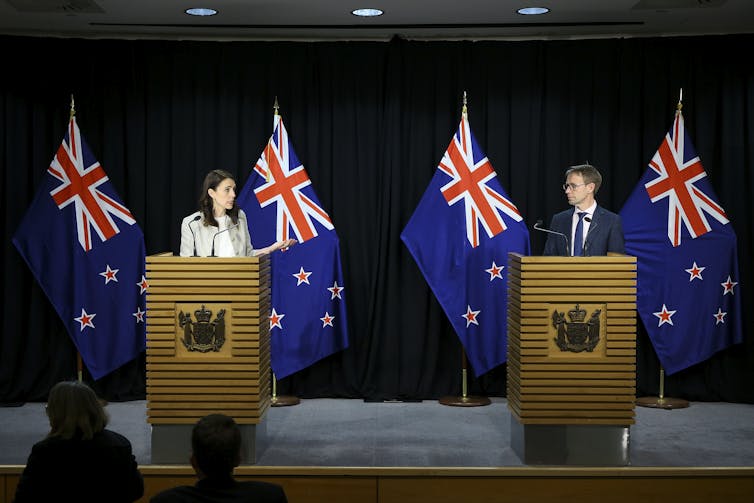
Prime Minister Jacinda Ardern and Director of Public Health Dr Caroline McElnay gave an update on the covid-19 situation this afternoon

Three of the new cases are in the capital Wellington, while the rest are in Auckland.

Dr McElnay said the total number of community cases linked to the current Auckland outbreak was now 51.

All cases have been or are being transferred to managed isolation facilities using strict infection prevention and control procedures, Dr McElnay said.

More than 5000 individual contacts have been identified and the Health Ministry expects that would grow and increase by another 5000 by the end of today.

Dr McElnay said covid-19 had been found in waste water testing in Warkworth, north of Auckland.

Hit two records
Ardern said New Zealand had hit two records yesterday, with the most number of vaccines and tests carried out.

There were 56,843 vaccines administered yesterday — the most in a single day. Ardern said 72 percent of NZers aged 40+ were either booked or have been vaccinated with at least one dose.

“This is great progress,” Ardern said.

More than 150,000 vaccination bookings were made yesterday.

Yesterday was also the day the most covid-19 tests were processed in a single day, with 41,464 tests completed.

“The fact we have achieved both these results on the same day is extraordinary and is exactly what we need to do to get on top of the outbreak and for the future,” she said.

There are 14 community testing stations open across Auckland today, Ardern said.

Lockdown to continue
The Prime Minister yesterday announced the alert level 4 lockdown would continue until at least midnight Tuesday.

Since then, new cases of the novel coronavirus have been confirmed at the University of Auckland, a second student at the neighbouring Auckland University of Technology and two more Auckland schools.

In addition, the list of locations of interest has been growing.

This article is republished under a community partnership agreement with RNZ.

NZ Director of Public Health Dr Caroline McElnay
NZ Director of Public Health Dr Caroline McElnay gave a covid-19 update with Prime Minister Jacinda Ardern today. Image: Samuel Rillstone/RNZ
Print Friendly, PDF & Email

Article by AsiaPacificReport.nz

The official figures say wages aren’t growing — here’s why they’re wrong

Source: The Conversation (Au and NZ) – By Peter Martin, Visiting Fellow, Crawford School of Public Policy, Australian National University

Peterfz30/Shutterstock

Have you heard about the latest wage figures? I hope not. They’re meaningless.

What the widely quoted measure of average weekly earnings purports to show is that wages grew a mere 0.1% over the year to May. It’s not true. It’s not what happened. For most of us, wages grew by much more.

That’s not to say wage growth has been high — the best estimate is that private sector wages have climbed 1.9% over the past year and public sector wages a record low 1.3% — but both are still well above nothing, and generally well above our near-record low rates of consumer price inflation.

A check-in with reality would tell you that mid last year the Fair Work Commission lifted award wages 1.75%. Mid this year it lifted them 2.5%.

So how could it be that the official figures, published by a trusted organisation, the Australian Bureau of Statistics, show average earnings static, climbing just 0.1%?

The first thing to say is that the bureau is probably embarrassed by the figures.

They are “not designed to produce movement in earnings data” it says on its website, before acknowledging that’s exactly what they are used for.

‘Not designed’ to measure wage growth

Australia’s pensions are adjusted twice a year in accordance with a formula that includes average weekly earnings.

The figure is built into private contracts and contracts for student loans and child support. If it wasn’t published, a lot of contracts wouldn’t work.

To create it, the bureau surveys about 5,130 employers every six months, asks what they are paying their workers, and uses the answers to calculate an average female wage, an average male wage, an average part-time wage, an average full-time wage, and a lot of other averages besides.

The ‘average wage’ isn’t typical

One problem is that averages are not representative. The survey suggests the average full-time wage is A$90,330, whereas in reality six in ten earn less.

The mid-way (median) full-time worker earns $10,000 less. The average is boosted by a few enormously high earners and can’t be taken seriously.

An entirely separate problem arises when you try to use averages to calculate growth. The average is only an average of what’s averaged, and that can change.

When low-wage workers lose jobs…

Here’s an example. What would happen if a recession caused everyone working only four hours per week to lose two hours? It would push their earnings down and push down average weekly earnings, which would be about right.

But what if each of those people lost a further two hours, taking their hours down to zero. Their low hours would no longer be included in the total to be averaged, and (without them in it) average earnings would climb.

…the average wage goes up

That’s what happened a bit over a year ago. The bureau says COVID restrictions “led to a large decrease in the number of jobs, people employed and hours worked, with lower-paid jobs and industries particularly impacted, including jobs in accommodation and food services, arts and recreation services”.

Unemployed catering workers pushed the average wage up.
PK Studio/Shutterstock

The loss of those lower-paid and low hours jobs in catering, the arts and other industries “had the effect of increasing the value of average weekly earnings”.

Layoffs pushed the average wage up.

Fortunately, the bureau says by November many of the low-wage workers laid off got some hours back, depressing growth in the average wage (but not growth in any actual wages) resulting in recorded growth of just 0.1% in the year to May.

Many have probably since lost hours with this year’s renewed lockdowns, pushing average wages (but not actual wages) higher again.

It’s enough to make you think the legislation and contracts should switch from a measure that’s close to worthless to one that actually measures wage growth.

The bureau offers such a measure. It’s called the wage price index, and the bureau has been trying to encourage people to switch to it since 1998.


À lire aussi :
Other Australians don’t earn what you think. $59,538, is typical


It is also built around a survey of employers, but rather than asking how much they pay each worker, it asks how much they pay for each job title and classification. The bureau calculates growth by comparing like with like, regardless of how many people were employed in each classification at the time.


Wage Price Index

Annual growth in total hourly rates of pay excluding bonuses.
ABS

The results are believable: private sector like-for-like wages climbed 1.9% over the past year, and public sector wages 1.3%.

But even they are not right when it comes to the wage growth of individuals.

Individuals get promoted, and (much less often) demoted. They change jobs, usually for better ones.

People aren’t positions

So if you were trying to use the recent like-for-like wage growth of around 2% per year as a guide to what will happen to your own wage (in order, for instance, to work out whether you could afford a mortgage) you would probably guess too low.

It’s why many Australians — those who’ve got not only regular pay rises but also promotions — wonder what the fuss about low wage growth is about.


À lire aussi :
Top economists say cutting immigration is no way to boost wages


A good measure of the actual wage growth of Australians doesn’t yet exist, although it might soon. The bureau is working on tracking individuals through the use of payroll data reported to the tax office.

In the meantime the (HILDA) Household, Income and Labour Dynamics in Australia survey that tracks 17,000 Australians over time finds that the actual wage growth of full-time workers is indeed higher than the like-for-like figure suggests (which might help explain soaring home prices) although it too is weakening.

Part time workers don’t seem to get the same benefit.

As Mark Wooden, director of the HILDA survey puts it, “Australians in full-time work are doing pretty well – provided they remain in employment”.

The Conversation

Peter Martin ne travaille pas, ne conseille pas, ne possède pas de parts, ne reçoit pas de fonds d’une organisation qui pourrait tirer profit de cet article, et n’a déclaré aucune autre affiliation que son organisme de recherche.

ref. The official figures say wages aren’t growing —
here’s why they’re wrong – https://theconversation.com/the-official-figures-say-wages-arent-growing-heres-why-theyre-wrong-166566

Why has same-sex sexual behaviour persisted during evolution?

Source: The Conversation (Au and NZ) – By Brendan Zietsch, Associate Professor, The University of Queensland

Same-sex sexual behaviour may seem to present a Darwinian paradox. It provides no obvious reproductive or survival benefit, and yet same-sex sexual behaviour is fairly common — around 2-10% of individuals in diverse human societies — and is clearly influenced by genes.

These observations raise the question: why have genes associated with same-sex sexual behaviour been maintained over evolutionary time? Given that evolution depends on genes being passed down through the generations via reproduction, how and why were these genes passed down too?

In a new paper published in Nature Human Behaviour, my colleagues and I tested one possible explanation: that the genes associated with same-sex sexual behaviour have evolutionarily advantageous effects in people who don’t engage in same-sex sexual behaviour.

Specifically, we tested whether those genes are also associated with having more opposite-sex partners, which might therefore confer an evolutionary advantage.

To investigate this, we used genetic data from more than 350,000 people who had participated in the UK Biobank, a huge database of genetic and health information.

These participants reported whether they had ever had a same-sex partner, and also how many opposite-sex partners they had had in their lifetime.

We analysed the association of millions of individual genetic variants with each of these self-reported variables. For both variables, there were not only one or a few associated genetic variants, but very many, spread throughout the genome. Each had only a tiny effect, but in aggregate, their effects were substantial.

We then showed that the aggregate genetic effects associated with ever having had a same sex partner were also associated — among people who had never had a same-sex partner — with having had more opposite-sex partners.

This result supported our main hypothesis.

Further exploration

We then tried replicating and extending our findings.

First, we successfully replicated the main finding in an independent sample.

Second, we tested whether our results still held true if we used different definitions of same-sex sexual behaviour.

For example, did it still hold true if we tightened the definition of same-sex sexual behaviour to cover only those individuals with predominantly or exclusively same-sex partners (rather than including anyone who has ever had one)?

Our results remained largely consistent, although statistical confidence was lower due to the smaller sub-samples used.


Read more:
‘Gay gene’ search reveals not one but many – and no way to predict sexuality


Third, we tested whether physical attractiveness, risk-taking propensity, and openness to experience might help to account for the main result.

In other words, could genes associated with these variables be associated with both same-sex sexual behaviour and with opposite-sex partners in heterosexuals?

In each case, we found evidence supporting a significant role for these variables, but most of the main result remained unexplained.

So we still don’t have a solid theory on exactly how these genes confer an evolutionary advantage. But it might be a complex mix of factors that generally make someone “more attractive” in broad terms.

Simulating evolution

To investigate how the hypothesised evolutionary process might unfold, we also constructed a digital simulation of a population of reproducing individuals over many generations. These simulated individuals had small “genomes” that affected their predispositions for having same-sex partners and opposite-sex reproductive partners.

These simulations showed that, in principle, the kind of effect suggested by our main result can indeed maintain same-sex sexual behaviour in the population, even when the trait itself is evolutionarily disadvantageous.

Two men hold hands while walking on grass
The study involved Western participants – so the next step will be to look at other populations.
Stanley Dai/Unsplash, CC BY

Crucially, our simulations also showed that if there were no countervailing benefit to genes associated with same-sex sexual behaviour, the behaviour would likely disappear from the population.

These findings give us intriguing clues about the evolutionary maintenance of same-sex sexual behaviour, but there are important caveats too.

An important limitation is that our results are based on modern, Western samples of white participants – we cannot know to what extent our findings apply to other ethnicities or cultures in different places and times. Future studies using more diverse samples may help clarify this.


Read more:
African scientists recognise that diverse sexuality is the norm


On a final note, I am aware some people believe it is inappropriate to study sensitive topics such as the genetics and evolution of same-sex sexual behaviour. My perspective is that the science of human behaviour aims to shine a light on the mysteries of human nature and that this involves understanding the factors that shape our commonalities and our differences.

Were we to avoid studying sexual preference or other such topics due to political sensitivities, we would be leaving these important aspects of normal human diversity in the dark.

The Conversation

Brendan Zietsch received funding from the Australian Research Council.

ref. Why has same-sex sexual behaviour persisted during evolution? – https://theconversation.com/why-has-same-sex-sexual-behaviour-persisted-during-evolution-166571

We’re seeing more COVID patients in ICU as case numbers rise. That affects the whole hospital

Source: The Conversation (Au and NZ) – By Deb Massey, Associate Professor, Chair of Nursing, Faculty of Health, Southern Cross University

Rising COVID cases in several Australian states means demand for intensive care unit (ICU) beds and specialist critical nurses will rise.

This increase in demand is on top of the typical workload ICUs might see.

And because of the nature of COVID itself and other factors, this puts pressure on the entire hospital system.


Read more:
How are the most serious COVID-19 cases treated, and does the coronavirus cause lasting damage?


What happens in ICU?

The ICU is where we care for the most critically unwell patients, where treatments are designed to support breathing and circulatory problems affecting the heart, blood, or blood vessels.

The most unstable and sickest ICU patients require airway support in the form ventilation to help them breathe. They also need circulatory support in the form of drugs to improve blood pressure and heart function.

Patients come to ICU as a planned admission (for example, after a complex operation), or as an emergency admission (for example, after a serious car accident).


Read more:
ICU ventilators: what they are, how they work and why it’s hard to make more


Patients stay for, on average, three days in ICU before recovering enough to be moved to a ward, or sadly, dying.

Because patients in ICU are unstable and critically unwell, there is usually one nurse to care for each patient. This is a highly skilled job. Most ICU nurses have extra postgraduate qualifications.

COVID changed the type of patients we see

Patients who are critically ill with COVID are often sicker than other ICU patients and may require more support for their breathing and circulation. Often, they need to stay in ICU longer than other patients.

This creates challenges for hospital systems, because beds in ICU become blocked, and planned operations may be cancelled because of the lack of ICU beds.

Once patients with COVID no longer need ventilation or circulatory support, they are transferred to the ward for additional care. They may have experienced painful procedures and have a degree of physical impairment.

They may also have witnessed a number of stressful events in the ICU, such as emergency resuscitation procedures and deaths, which may increase the risk of post-traumatic stress disorder, anxiety, and depression.

Although we don’t have definitive long-term data, patients who have been critically ill from COVID often have a long and difficult journey of recovery and will likely remain dependant on health care services for some time.


Read more:
Younger adults can get very sick and die from COVID too. Here’s what the data tell us


COVID changed how we nurse

ICU staff looking after COVID patients have the additional demands of working in full personal protection equipment (PPE), which can be hot and uncomfortable and very challenging to work in.

The need to use PPE correctly, and the constant concern about becoming infected or dying if there’s an infection breach, adds to nurses ongoing stress.

The International Council of Nurses’ latest analysis shows the number of nurses who have died after contracting COVID-19 globally is greater than 2,200 – more than any other health-care worker. This data are from earlier this year, so we expect those figures to have risen since then.


Read more:
Here’s the proof we need. Many more health workers than we ever thought are catching COVID-19 on the job


COVID challenges Australia

In Australia, there has been more time to respond to the challenges of COVID. In many states, the numbers of ventilators increased, models of care were developed for COVID-positive patients, and snap lockdowns ensured scarce ICU resources were not overwhelmed.

However, the increasing number of positive cases in New South Wales in particular, coupled with the highly infectious Delta variant, means ICUs risk reaching capacity.

At the time of writing, 109 patients were in Australian ICUs and 37 of these patients required ventilation.

Australia has 191 ICUs with 2,378 beds and the capacity to increase this by by up to 4,258 beds.
But there may not be enough specialised nurses or equipment match this bed increase.

Surge capacity also varies between ICU categories and jurisdictions, with tertiary hospitals reporting more capacity. So deteriorating patients may need to be air-lifted to major metropolitan or regional centres.


Read more:
Does anyone know what your wishes are if you’re sick and dying from coronavirus?


What can happen in the future?

Fortunately, public health measures have meant Australia has been spared the horrors of countries that were unable to successfully increase their ICU resources to meet demands, for example, Spain, Italy and the United Kingdom.

Yet, hospitals are still feeling the impact of a rise in critically unwell COVID patients in many ways, and will do so in the future.

Undergraduate student nursing placements, for example, have been delayed and many universities have moved their education online. So student nurses may struggle to achieve the clinical hours required to graduate. This may mean a shortfall of clinically competent and educated ICU nurses in the future.

The best we can do

So the next time you hear the latest number of COVID patients in ICU, think of what’s behind those numbers and what this means for the whole hospital system and its staff.

Protect them, yourself and others by sticking to the public health advice, including getting tested with the mildest of symptoms. Most importantly, get vaccinated. People fully vaccinated against COVID rarely end up in ICU.

The Conversation

Deb Massey does not work for, consult, own shares in or receive funding from any company or organisation that would benefit from this article, and has disclosed no relevant affiliations beyond their academic appointment.

ref. We’re seeing more COVID patients in ICU as case numbers rise. That affects the whole hospital – https://theconversation.com/were-seeing-more-covid-patients-in-icu-as-case-numbers-rise-that-affects-the-whole-hospital-165966

New study revealing stark gender inequality at UK’s The Royal Opera has lessons for the industry worldwide

Source: The Conversation (Au and NZ) – By Caitlin Vincent, Lecturer in Creative Industries, The University of Melbourne

EPA/Lukas Schulze

Many of the world’s most popular operas are rife with misogyny and gendered violence — and things aren’t much better for women behind the scenes.

Opera production has long been dominated by male directors and designers, with the role of costume designer one of few exceptions.

Yet there has been little empirical data that tracks the precise degree to which women are under-represented in opera. Most data is either anecdotal or, more often, compiled by arts journalists in response to male-heavy season announcements.

In our new study, we addressed this knowledge gap by investigating women’s representation at one of the world’s leading opera companies.

The Royal Opera in Covent Garden is the largest and best funded opera company in the UK and a recognised leader in the international field.

The company has also publicly committed to addressing gender inequality.

In 2019, The Royal Opera joined the Keychange 50/50 initiative, pledging that women would make up 50% of all creatives on new opera productions by 2022.

In order to assess the status of women working at the company — and the likely impact of this pledge — we turned to historical production data. We analysed the production credits of 325 operas staged between 2005/06 and 2019/20. Drawing on the self-identified pronouns used in professional biographies, we then mapped the gender profile of 1,342 credited directors and designers.

The man at the top

The role of stage director was critical to our study because directors assume a leadership position over the artistic vision of a staged work. They are also responsible for selecting the other members of the creative team.

Over the 15 seasons included in our study, 90% of all opera productions at The Royal Opera credited a male director.

Men were significantly more likely to be credited on more than one production, while women were more likely to be “one-offs”. 44% of men directed at least two different operas, compared to 14% of women directors.

Because the majority of women directors only had one opportunity to direct at the company, we also considered the repertoire — or the specific opera — they were chosen to direct.

Repertoire matters

Opera companies tend to stage a combination of works, including canonical operas, less common or non-canonical works, and modern operas written in the 20th and 21st centuries, including world premieres.

Canonical operas are essentially the “greatest hits” of the operatic stage, written by the likes of Mozart and Puccini. They are reliably popular at the box office and frequently revived later.

Modern operas, in contrast, are high risk in terms of audience appeal and are rarely revived in later seasons.

Non-canonical operas sit somewhere in between: not as well-known as the greatest hits, but still far less risky than modern operas from an organisational perspective.

Women directors were more likely to be credited on modern operas than men. Almost half of the operas directed by women fell into this category. Meanwhile, 92% of the canonical operas staged over the 15 seasons were directed by men.

As a consequence, 92% of all revival productions presented by the company were also directed by men. 61% of men directors saw one or more of their original productions revived in a later season, compared to 27% of women directors.

Building a creative team

We also analysed the relationship between the gender profile of the director and that of the other key creatives.

Under the artistic leadership of the stage director, the set designer, lighting designer, costume designer, and projection/video designer play critical roles in creating the world of an opera on stage.

Our analysis showed that male directors were significantly more likely to work with other men in these important creative roles. 36% percent of operas directed by men did not credit a single woman designer. 38% credited only one woman in any designer role. More than half the time, this role was costume designer.

In other words: out of all the operas directed by men at The Royal Opera, nearly 75% had low rates of representation for women on creative teams.

In comparison, 81% of female-led productions credited women in two or more key creative roles.

Change must start with the director’s chair

Women’s low rates of representation at the company has significant consequences for their prestige and visibility.

Because men worked more frequently and were more likely to direct high-profile operas, in turn, more likely to be revived, they could accrue professional capital at a much higher rate than their female peers.

Men’s over-representation in the role of stage director — combined with their tendency to work primarily with other men — had a further negative effect on women’s representation on creative teams.


Read more:
Opera is stuck in a racist, sexist past, while many in the audience have moved on


These findings have clear implications for efforts to address gender inequality in opera, and highlight where The Royal Opera’s 50/50 pledge falls short.

Opera companies must place the role of stage director at the centre of any gender-equity initiatives.

Any approach must also consider the compounding effects of repertoire and production type. Women directors must be actively prioritised for popular canonical operas, which are most likely to be revived and incorporated into long-term artistic programming plans.

Above all, in a sector that benefits heavily from public funding, opera companies must be held accountable for the ways in which they perpetuate gender discrimination and disadvantage through their institutional choices.

The Conversation

Caitlin Vincent is a member of OPERA America’s Women’s Opera Network and Victorian Opera’s Peer Review Panel.

Amanda Coles and Jordan Beth Vincent do not work for, consult, own shares in or receive funding from any company or organization that would benefit from this article, and have disclosed no relevant affiliations beyond their academic appointment.

ref. New study revealing stark gender inequality at UK’s The Royal Opera has lessons for the industry worldwide – https://theconversation.com/new-study-revealing-stark-gender-inequality-at-uks-the-royal-opera-has-lessons-for-the-industry-worldwide-166491

Money is frequently offered to redress wrongs — what does it achieve for victims and justice?

Source: The Conversation (Au and NZ) – By Kathleen Daly, Professor of Criminology and Criminal Justice, Griffith University

Joel Carrett/AAP

The federal government has just launched a A$378 million scheme for Stolen Generations survivors in the Australian Capital Territory, Northern Territory and Jervis Bay. At the same time, the Czech Republic has passed legislation offering payments to women, mostly from the Roma community, who were sterilised without their consent.

Last month, the Boy Scouts of America reached a US$850 million agreement with thousands of child sex abuse survivors.

These are recent examples of what we term “money justice”. This is how organisations and nations seek to redress wrongs by offering money to victims.

But if, as victims say, money cannot recompense a wrong, why is money sought by victims and offered as justice? More generally, what does money achieve (or not achieve) as justice and for victims?

What is money justice?

Money justice — sometimes referred to as compensation, redress, reparations — permeates our everyday life. We hear daily about victims and their family members seeking or receiving payments to remedy wrongs.

The major mechanisms of money justice are civil justice awards or out-of-court settlements for personal or cultural harms, and redress programs or payment schemes.

Money is paid to victims of terrorism and violent common crime, those victimised by civil conflict and political repression, or for historical injustice and institutional abuse. Consider the payments to Australian victims and families of the Bali bombings or London terror attacks, German payments to Holocaust survivors, and state schemes for violent crime such as sexual assault and robbery.

How much can victims receive?

One aim of money justice research is to map and compare payments to victims of diverse wrongs, and identify inequalities in payments. But when it comes to civil justice, the research task is nearly impossible because average payments are secret.

We may see a headline about the total amount decided in an out-of-court settlement — for example, the A$35 million to young people in Northern Territory detention facilities. But we will never know what, on average, individuals received, nor how much was deducted from the $35 million for legal fees and costs. The cost, meanwhile, is borne by taxpayers.

St Patrick's Cathedral in Melbourne.
The Catholic Church in Australia has made thousands of payments to child abuse victims.
James Ross/AAP

Except for court-determined awards, which are a tiny share of civil justice outcomes, little is known about average payments and their range. This year, we published an article on what Australian Catholic Church bodies (archdioceses, dioceses and institutes) paid for claims of child sexual abuse. We found a huge range in the civil litigation cases (from A$11,000 to A$1.5 million) and the Towards Healing redress scheme (from about A$4,200 to A$184,000).

We were only able to compute and publish these figures because the child abuse royal commission had used its powers to seek data from the various authorities.

The money justice paradox

Despite the many forms it takes — and the many victims who seek it — money payments may not be interpreted as “justice” when received by victims.

We call this the money justice paradox. How can a sum of money, however large, compensate for a loss of life or health? Victims also ask why their loss was “worth” less than that of others, when comparing payments. For these reasons, money may fail as justice to victims.

Turia Pitt spoke to the Seriously Social podcast about her experience of seeking money justice. In 2011, Pitt was caught in a grassfire during an ultra-marathon. She suffered horrific burns to 65% of her body, leading to more than 200 medical procedures. As she explains:

At the end of the day, we settled out of court. I wasn’t happy with the money, but then no amount of money would ever be able to compensate me for what I’d been through.

Legal history and ‘balancing’ a wrong

We hypothesise one reason money may fail as justice is that it no longer contains the sense of “balancing” the wrong, as it did thousands of years ago, when the relationship between retribution and recompense was closely tied.

Then, the pain suffered by a victim was met with an equivalent, painful loss to an offender. Many will be familiar with the concept of “an eye for an eye”. At the time, a complementary concept of the “value of an eye for an eye” co-existed. Depending on the crime, a victim could demand payment in valued goods or money instead.

As legal systems evolved, this close connection became separated with dual systems of civil and criminal justice. Today, civil justice (“money damages” in lieu of punishment) is no longer associated with an equivalent painful loss for a wrongdoer, and it cannot achieve the “balance” or true recompense it once did.


Read more:
Morrison government sets up redress scheme for survivors of Stolen Generation in territories


So, why does society persist with justice through money?

Money as the only option

The wheel of money justice is set in motion by civil justice, law firms, organisational defendants, and insurance companies. Money is all that is on offer.

For civil justice, law firms are motivated to focus on money because it supports their practice. Administrative schemes, such as those for victims of violent crime or institutional abuse, are a lower-cost version of civil justice. Here too, money is the principal element, although schemes may also offer support for medical and counselling costs.

Stolen Generations protesters gather in Sydney.
Stolen Generations survivors in the ACT, NT and Jervis Bay are now eligible to receive money under a new scheme.
Bianca De Marchi/ AAP

Victims may seek and accept money for wrongs because that is what’s offered. We would not say money is the most important element for justice from victims’ perspectives. They may have other objectives, such as wrongdoers accepting responsibility and organisational change, but these are rarely realised. In time, and understood symbolically, money may offer survivors validation and vindication.

Money also has practical benefits. It can relieve financial stress, improve daily life, pay for medical and dental care, and enable visits to family and friends.

A complex experience

Victims’ experiences of money justice highlight its complexity. For example, Pitt found going to court to be difficult and confronting. But she also described her settlement as a punctuation point in her recovery process:

For me it was freeing because once we reached a settlement we could look towards the future and not be stuck in our past anymore. So even though [the court process] was taxing, exhausting, all of those things … I think it helped us on our journey.

This same complexity was revealed in a 2018 study on sexual assault victims who applied to Queensland’s payment scheme for victims of violent crime. Almost all gave financial reasons for applying — such as the need to relocate or medical and counselling costs. They felt uncomfortable doing so because they did not want to appear to be chasing money.

But after they received the payment, half said the money was public acknowledgement that what had happened to them was wrong. So, after receiving the money, it was a symbolic form of justice, although this was not the reason they applied.

Beyond the headlines

As money justice continues to permeate society, we need to understand it better. This involves going behind the splashy headlines to find out what victims will, on average, receive in their bank accounts.

It also means using clear language. Terms such as “compensation” and “reparations” typically refer to money, so let’s skip the niceties and call them a money payment.

The wheel of money justice is greased by insurance premiums and tax revenues, which ordinary citizens pay for. So, we all have a vested interest in understanding payment amounts and inequalities, and we should be asking who gets what, and why.

As we continue to research the complexities of money justice, it is important to emphasise that money is not the only way to acknowledge victims. Truth commissions, memorialisation, the return of property, and apologies can all can have great significance.

Kathleen Daly also talks about money justice on the Seriously Social podcast by the Academy of the Social Sciences in Australia.

The Conversation

Kathleen Daly receives funding from the Australian Research Council.

Juliet Davis receives funding from the Australian Research Council.

ref. Money is frequently offered to redress wrongs — what does it achieve for victims and justice? – https://theconversation.com/money-is-frequently-offered-to-redress-wrongs-what-does-it-achieve-for-victims-and-justice-166415

The government has again rescued the childcare sector from collapse. But short-term fixes still leave it at risk

Source: The Conversation (Au and NZ) – By Peter Hurley, Policy Fellow, Mitchell Institute, Victoria University

Shutterstock

The federal government yesterday announced a relief package for childcare providers affected by extended lockdowns.

Childcare services in Commonwealth-declared hotspots will be eligible for payments of 25% of their pre-lockdown revenue. Outside-school-hours-care services will be eligible for payments of 40%.

Childcare centres must be experiencing a 50% drop in attendance, and agree to a fee freeze for the duration of support.

About 60% of childcare centres in Sydney reportedly had less than half their usual number of children. In Melbourne, the reported expectation is attendance would settle at about 40-50%.

Prime Minister Scott Morrison said the payments would immediately help around 3,600 childcare services in Greater Sydney. In Greater Melbourne, the package will assist about 2,300 services and nearly 300 in the ACT.

This is the second time in two years the pandemic has brought parts of Australia’s childcare system to the verge of collapse. Last year, the government put in place several rescue packages for childcare and out-of-school-hours-care services.


Read more:
Not much relief for parents, but new childcare measures will rescue providers (again)


But unlike in 2020, the recently announced package falls short of meeting the full costs of closure.

The most recent announcement means the federal government will meet most, but not all, the fee revenue childcare services collect. Parents whose children are still attending childcare may be asked to pay gap fees.

What does this package mean for providers?

Around 160 childcare centres have reportedly closed nationally due to the immediate risk of COVID transmission.

In Victoria, childcare and preschools are open to children who have at least one parent or guardian with a valid authorised worker permit, working either at home or on site, and who can’t make alternative supervision arrangements.

In NSW, parents and families are strongly encouraged to keep their children at home.

Childcare isn’t open to all parents who need it.
Shutterstock

Australia’s childcare is provided by a mixture of for-profit and not-for-profit services who usually charge on a per hour or daily basis.

The federal government provides a subsidy, paid directly to early childhood services, who then pass it on to families as a fee reduction.

The amount of the subsidy, and the amount parents pay out-of-pocket, depends on family income and the fee childcare providers charge.

Normally, childcare providers must charge a gap fee to receive the federal government subsidy.

In 2020, during the first wave of the pandemic, the federal government implemented a “free childcare” package.

Effectively, this meant the federal government continued to pay childcare providers the subsidies they normally received, as well as cover parents’ out-of-pocket costs.

Before the announcement yesterday, the federal government had already agreed to waive gap fees for services in certain coronavirus “hot-spots”. Childcare providers can still receive the federal childcare subsidy, regardless of whether the child attends the service or whether they charge a gap fee to the child’s family.


Read more:
It takes a village: why sending your kid to childcare isn’t ‘outsourcing parenting’


However, the federal government was not covering the out-of-pocket costs of parents. Without fees collected from families, childcare providers were suffering.

The table below shows government subsidies account for about 62% of all income received by childcare providers. Out-of-pocket expenses are estimated to be on average about 38% of total revenue for early childhood service providers.

Without the fees collected from families, it was difficult for providers to pay and retain their staff during the crisis. There were other difficult choices, too.

Childcare providers needed to make the decision whether to continue charging out-of-pocket expenses or waive the gap fee. While some providers may be eligible for state based support, many do not meet eligibility requirements.

For parents and carers, whether they were required to pay out-of-pocket costs depends on the childcare provider. Many were faced with the tough decision of whether to pay for a service they are not using to keep their child enrolled.

The current announcement has helped ease these issues, but the sector remains vulnerable, especially when the rescue measures end.

Let’s fix the funding model

In the short term, advocates in the sector are also calling for two further measures. The first is clarification about which children are able to access childcare, particularly in NSW. This is so childcare providers and parents can more clearly understand their obligations.

The second is a vaccination program that enables childcare workers to access vaccines as essential workers.

In the long term, Australia may need to review how it approaches childcare to ensure a more resilient system less susceptible to external shocks.

Australia’s childcare system is a market-based subsidy model. This is different from other education or health services, which are often directly run or funded by governments.

Mostly non-government providers operate in the sector. Providers choose where to operate and set their own fees.

Australia applies similar types of economic principles to childcare that it does industries such as aviation. Like an airline seat, payment is based entirely on use. Competition between providers on services and fees is encouraged.

Like the airline industry, the system is also prone to periodic collapse. In 2008, Australia’s largest provider of childcare services, ABC Learning, folded leaving the childcare arrangements for more than 110,000 children in the balance.


Read more:
Quality childcare has become a necessity for Australian families, and for society. It’s time the government paid up


There is a huge amount of research showing the benefits of high quality early childhood education and care.

According to the OECD:

The evidence suggests that direct public funding of services brings more effective governmental steering of early childhood services, advantages of scale, better national quality, more effective training for educators and a higher degree of equity in access compared with parent subsidy models.

The experience of the pandemic shows a fundamentally different approach might be needed for Australia to take full advantage of the benefits childcare can offer.

The Conversation

Peter Hurley works for the Mitchell Institute who receive funding from Minderoo and the Thrive by Five campaign to undertake research on Australia’s early childhood, education and care (ECEC) sector.

Hannah Matthews works for the Mitchell Institute who receive funding from Minderoo and the Thrive by Five campaign to undertake research on Australia’s early childhood, education and care (ECEC) sector.

ref. The government has again rescued the childcare sector from collapse. But short-term fixes still leave it at risk – https://theconversation.com/the-government-has-again-rescued-the-childcare-sector-from-collapse-but-short-term-fixes-still-leave-it-at-risk-166568

Children need playgrounds now, more than ever. We can reduce COVID risk and keep them open

Source: The Conversation (Au and NZ) – By Sharon Goldfeld, Director, Center for Community Child Health Royal Children’s Hospital; Professor, Department of Paediatrics, University of Melbourne; Theme Director Population Health, Murdoch Children’s Research Institute

Shutterstock

It’s been a tough 18 months for Australian families and their children. We can’t underestimate the cumulative impact of parent and carer job losses, mental strain, working from home and remote learning. As developmental paediatricians we are increasingly concerned about how these have affected children’s development.

As a result of pandemic restrictions, children all over the world are doing significantly less physical activity, and spending more time sitting. This is one reason playgrounds are so important for children right now.

Play is vital for children. It improves their learning, as well as social and physical development. Play also encourages development of coping skills, which are critical in times of crisis.

Little girl climbing playground wall with mask on.
In these uncertain times, play can give kids a sense of normalcy.
Shutterstock

In these uncertain and restrictive times, playing outdoors also gives kids some sense of normalcy.

Victoria closed outdoor playgrounds last week due to concerns about potential transmission. Closing playgrounds particularly impacts children living in medium- and high-density housing, with limited access to outdoor play spaces. These children tend to fall into lower-income brackets and are already more vulnerable to the effects of social isolation.

While there may be some risks to keeping playgrounds open, these must be appropriately balanced with the overwhelming benefits playgrounds have for children’s development. There are certain precautions we can take to reduce the risk of COVID-19 transmission in playgrounds.

What’s the research on playgrounds and transmission?

To date, few studies have looked at the specific role of playgrounds in the transmission of SARS-CoV-2, the virus that causes COVID-19. We found none that have been conducted with the Delta (B.1.617.2) variant.

Three studies focused on surface contamination — in Israel, Brazil and Indonesia. Some samples of playground surfaces (two out of 25 in the Israeli study) tested positive. The Brazil study (which collected samples in February 2021) identified toilets, ATMs, handrails, playground, and outdoor gym equipment as having the highest rates of viral contamination of all surfaces studied.


Read more:
High priority: why we must vaccinate children aged 12 and over now


But while the virus has been found on the surfaces, there was no clear evidence of whether this has led to transmission in playgrounds. The Indonesian study suggested transmission may be more likely if children share food or drinks. However, that study only looked at journals published in 2019 and 2020, so that doesn’t account for Delta.

Kids walking on tyres in playground.
There is evidence for surface contamination in playgrounds, but not transmission.
Shutterstock

Two studies examined transmission in parks. In the United Kingdom (with data collected June to November 2020) with two main findings. Less movement of people was associated with decreased transmission. This supported lockdowns. But the study also noted outdoor park use was associated with decreased case rates, especially in urban areas with low green space availability (including areas of higher density living). This is because parks offer an alternative to indoor spaces where transmission is higher. If parks close, then people congregate more indoors.

In the United States (with data collected March to May 2020), park use increased with school closures. Interestingly, this was not associated with growth of COVID-19 levels, either at the time or in the following weeks.

So, there is surface contamination, but no published evidence of transmission. And outdoor use of parks is not necessarily associated with more cases. And in high density areas parks are an important space.

With the right strategies, we can minimise the risks in playgrounds while ensuring children don’t miss out on the vital need for play in a time of heightened stress and uncertainty.

We can keep playgrounds safe

Access to outdoor play is essential for healthy child development. Indoor play does not appear to equate with outdoor play in terms of benefits.


Read more:
Are the kids alright? Social isolation can take a toll, but play can help


To keep playgrounds safe for children, we must ensure children are central to our thinking. Both the United Kingdom and the US offer guidelines for COVID-safe playgrounds. These include play equipment being cleaned regularly, and children maintaining a distance of six feet (around 2 metres) from each other (clearly where possible).

Similar recommendations have been proposed in Australia:

  • check current restrictions

  • stay home if unwell

  • socially distance

  • use disinfectant wipes on equipment

  • sanitise hands

  • avoid using shared taps or water fountains

  • remind children to avoid touching their faces

  • try to prevent physical contact between children as much as possible

  • avoid sharing toys

  • use the playground outside peak-use periods


Read more:
Heading back to the playground? 10 tips to keep your family and others COVID-safe


Some of these are more implementable than others but point to the need for thinking through what we could in playgrounds to keep them safe and open.

Anecdotally, early childhood and school teachers, particularly in low income areas, are seeing children with less social, coping and physical skills after 18 months of recurrent lockdowns — a significant proportion of preschool children’s whole lives.

Paediatricians are seeing families where the parents are confused and frightened to take their children to playgrounds, even when lockdown closures end. Recurrent playground closures add to these fears.

Finally we need adults to help. They must also follow the restrictions in their state or territory. These include adhering to gathering limits, wearing face masks and socially distancing. In the COVID-19 world we will need to safeguard our children’s health and their development.

The Conversation

Sharon Goldfeld receives funding from NHMRC, ARC and state and federal government for research.

Jill Sewell does not work for, consult, own shares in or receive funding from any company or organisation that would benefit from this article, and has disclosed no relevant affiliations beyond their academic appointment.

ref. Children need playgrounds now, more than ever. We can reduce COVID risk and keep them open – https://theconversation.com/children-need-playgrounds-now-more-than-ever-we-can-reduce-covid-risk-and-keep-them-open-166562

The Paralympics strive for inclusion. But some rules unfairly exclude athletes with severe disabilities

Source: The Conversation (Au and NZ) – By Iain Dutia, Postdoctoral research fellow, The University of Queensland

Simon Bruty/AP

The Tokyo Paralympic Games, which start today, will feature around 4,400 para athletes competing in 539 medal events across 22 sports.
Among the world’s disability sports organisations, the Paralympic movement has a unique competition framework which permits the pursuit of excellence by athletes who are affected by a wide range of impairments, from relatively mild to severe.

The games are organised and delivered by the International Paralympic Committee (IPC). Its vision is to “make for an inclusive world through sport”, and several recent initiatives demonstrate its global leadership in this area.

Shining examples of this are the IPC’s recent agreement with the World Health Organization promoting diversity and equity in sport and its role in WeThe15, a movement devoted to ending discrimination against people with disabilities.


Read more:
A brief history of the Paralympic Games: from post-WWII rehabilitation to mega sport event


Equity can be hard to achieve, even for the IPC

However, the work required for governments and sports organisations to make their policies and procedures more inclusive can be complex, exacting and difficult to achieve.

The IPC itself — and the rule used to determine the viability of events on the Paralympic program — are a case in point.

This event viability rule requires that, among other things, individual medal event at the Paralympics must include at least 10 athletes from at least four countries on the world ranking list.

The rule is needed because the number of events on the program can vary from one games to the next. If the number of events needs to be reduced, the rule provides a clear, transparent criterion for determining which ones should be excluded.


Read more:
Paralympics haven’t decreased barriers to physical activity for most people with disabilities


For example, the IPC recently informed national Paralympic committees there would be fewer swimming events at the Paris 2024 Games than in Tokyo. All the individual events that were removed were for swimmers with the most severe impairments — those in classes S1 and S2 who are affected by conditions such as complete quadriplegia or severe cerebral palsy.

Conversely, no individual medal events were removed for athletes with the least severe disabilities – those in classes S9 and S10 who may, for instance, be missing part of (or an entire) hand.

How the event viability rule is inequitable

The event viability rule exemplifies the difference between equality and equity. The rule applies equally to all para athletes, but it is not equitable for three main reasons.

First, athletes with more severe impairments face greater barriers to participation in sports than athletes with less severe impairments.

In swimming, for example, an S9/S10 athlete can train with a squad comprising people without disabilities and a coach who requires little specialist disability knowledge. These athletes also do not require facilities with disability access.

Most S1/S2 athletes, however, need individualised sessions with a coach who has considerable specialist disability knowledge and who works in facilities with accessible parking, change rooms and pool entry.

S1/S2 athletes also have complex disabilities and require multidisciplinary medical care in order to participate safely and effectively.

Australian wheelchair racer Fabian Blattman during the 800m T-51 final event at the 2000 Sydney Paralympics.
Wikimedia Commons

Second, athletes with severe impairments are not guaranteed the protections afforded by the UN Convention on the Rights of Persons with Disabilities in the same way that athletes with less severe impairments are. This is because Article 30.5 only protects participation in sport by people with disabilities if the required accommodations are deemed to be reasonable.

Unfortunately, many athletes with severe impairments require accommodations — building adjustments and medical expertise — that cannot be reasonably expected of many community sports organisations. Therefore, community organisations can — and do — exclude people with severe impairments, but still meet the requirements of the convention.

Third, compared with athletes with less severe impairments, there are disincentives associated with selecting athletes with severe impairments on national teams.

For example, athletes with severe impairments often require their own personal support staff, accessible accommodation and training facilities, and individualised training and travel arrangements, which makes local and international travel more difficult and expensive.


Read more:
Why the 2000 Sydney Paralympics were such a success — and forever changed the games


Fewer events for those with severe impairments

It stands to reason that greater barriers to participation for these athletes reduces the likelihood they will meet the event viability criteria. This is having a significant deleterious effect on their participation in the movement’s flagship event – the Paralympic Games.

As the chart below illustrates, the number of swimming events for S1/S2 athletes has been consistently low for the last 20 years — and it is getting lower.


Author provided, Author provided

There will be no S1 female swimmers at this year’s Tokyo Games. And the Paris 2024 swimming program will have no S1 events at all for the first time since the current classification system was introduced in 1992.

In addition, fewer than 5% of the individual medal events in Paris will be for S2 athletes — all male.

This means a swimmer like Singapore’s Yip Pin Xiu could miss out. Xiu won two golds in S2 swimming events at the 2016 Rio Games and a gold and silver at the 2008 Beijing Games, and is also competing in Tokyo. However, if there are no S2 women’s events in Paris, she might not be able to participate.

By contrast, athletes in the S9/S10 classes will have six times as many events as S1/S2 athletes.

The IPC recognises the unique barriers faced by people with severe impairments who wish to participate in sport. One of its strategic priorities is to increase their participation in para sports across the spectrum. In this respect, the removal of events for these athletes from the Paralympic program is counterproductive.

The legitimacy of the Paralympics depends on inclusion

The IPC’s pursuit of a more inclusive world through sport is an honourable and laudable one. However, in order to be effective, it must start with a rigorous review of its own policies and procedures to make sure that, as an organisation, it is leading by example.

This means reviewing the event viability rule to make it more equitable and reinstating events for athletes with high support needs that were removed from the Paris program.

The IPC should also re-establish the Committee for Athletes with High Support Needs, which is charged with ensuring all sports rules and policies of the IPC are equitable and and inclusive.

This is crucial because, in the long run, the legitimacy of the Paralympic movement depends on not only retaining, but increasing the presence of athletes with severe impairments at the Games.

The Conversation

Iain Dutia is an investigator on the ParaSTART program, a multi-arm program of longitudinal studies investigating physical and psychosocial responses of people with high support needs to performance-focused sports training. One of the sports is swimming and one swimmer – Female, class S2 – recently swam an Australian national record in 50m backstroke. That event has been removed from the Paris 2024 Paralympic Games based on the IPC’s Event Viability Rule” (4.15(b) Ch3, Section 1, IPC Handbook). Funding for ParaSTART has been received from Queensland Academy of Sport, Paralympics Australia and Swimming Australia. Iain is also a member of the World Para Swimming High Support Needs Working Group.

Sean Tweedy is lead investigator on the ParaSTART program, a multi-arm program of longitudinal studies investigating physical and psychosocial responses of people with high support needs to performance-focused sports training. One of the sports is swimming and one swimmer – Female, class S2 – recently swam an Australian national record in 50m backstroke. That event has been removed from the Paris 2024 Paralympic Games based on the IPC’s Event Viability Rule” (4.15(b) Ch3, Section 1, IPC Handbook). Funding for ParaSTART has been received from Queensland Academy of Sport, Paralympics Australia and Swimming Australia. Sean is also on the IPC Classification Committee and the World Para Athletics Classification Advisory Group.

ref. The Paralympics strive for inclusion. But some rules unfairly exclude athletes with severe disabilities – https://theconversation.com/the-paralympics-strive-for-inclusion-but-some-rules-unfairly-exclude-athletes-with-severe-disabilities-166347

COVID cases are rising in highly vaccinated Israel. But it doesn’t mean Australia should give up and ‘live with’ the virus

Source: The Conversation (Au and NZ) – By C Raina MacIntyre, Professor of Global Biosecurity, NHMRC Principal Research Fellow, Head, Biosecurity Program, Kirby Institute, UNSW

Maya Alleruzzo/AP/AAP

Israel has one of the highest COVID vaccination rates in the world, having fully vaccinated 78% of people 12 years and over.

Many people are surprised at the country’s resurgence of COVID cases since restrictions were lifted in June.

Israel’s vaccination rate is similar to Australia’s plan to start relaxing restrictions when 70% of over-16s are fully vaccinated.

So, why are cases surging in Israel? And what can Australia learn from it, particularly as Sydney charts its path out of the pandemic?

Let’s break it down.

Herd immunity is much harder with Delta

Around 25% of Israel’s population is younger than 12, so the whole population vaccination rate is only about 60% (including a small proportion of children under 12 with high-risk medical conditions who’ve also been vaccinated).

Even with last year’s virus and the use of the Pfizer vaccine, that wouldn’t be enough for herd immunity.


Read more:
COVID is surging in the world’s most vaccinated country. Why?


The Delta variant, which has swept the world since April, is much more contagious. It has an R0 of 6.4, which means one infected person on average infects more than six others in the absence of restrictions and vaccinations. This is compared to the strain circulating in 2020, responsible for Melbourne’s second wave, which had an R0 of 2.5.

In Israel, 60% of hospitalised cases are vaccinated. This is something called the “paradox of vaccination” — in highly vaccinated populations, most cases will be in the vaccinated because no vaccine is 100% protective.

However, the rate of serious cases in Israel is double for unvaccinated under-60s and nine times higher for unvaccinated over-60s, so vaccines remain highly protective against severe outcomes.

Lifting restrictions too quickly

What’s clear in Israel (and the United Kingdom and United States) is lifting all movement restrictions and mask mandates after Delta arrived resulted in surging cases. Current vaccines at about 60% uptake weren’t enough.

In the US, Southern states with lower vaccination rates are seeing the worst surges, with the majority hospitalised being unvaccinated. Alabama, with 36% fully vaccinated (higher than Australia) is overwhelmed. Hospitals and ICUs are full and the health workforce is in crisis due to infected and quarantined health workers.

It provides a glimpse of what Sydney faces if we lift restrictions without the population being adequately vaccinated.

And that includes children. In Texas, paediatric ICUs are full and children cannot get beds. This is another warning that we must urgently vaccinate children, at least those 12 years and over, before lifting restrictions.

In Australia, the 70% vaccination rate at which the federal government proposes to begin easing restrictions corresponds to about 56% of the total population vaccinated.

It was modelled on 30 cases at the start of a new outbreak. With Sydney likely facing daily new cases in the 1000s (with no change in strategy), the outcomes could be much worse than anticipated.


Read more:
Vaccination rate needs to hit 70% to trigger easing of restrictions


Let’s recap

So, the situation in Israel is caused by several factors:

  • the Delta variant has some ability to escape the protection offered by vaccines, and the protection seems to wane a bit over time after two doses

  • premature lifting of restrictions

  • the herd immunity threshold required for Delta is higher, likely over 80% of the whole population, not the 60% achieved in Israel

  • over 70% of infections with Delta arise from asymptomatic transmission, which makes it harder to control

  • cases of Delta breakthrough infection in vaccinated people can be as infectious as in unvaccinated people (though viral load declines faster in vaccinated people).

Reasons for optimism

There’s a good news story in one of the most highly vaccinated cities in the US, San Francisco, where over 70% of the whole population has been vaccinated and cases are starting to decline.

This is also likely due to the reintroduction of layered social measures such as mask mandates.

Israel has reintroduced a green-pass system of proof of vaccination or a negative test for anyone three years or over accessing public indoor spaces. It has also started vaccinating over-50s with a third dose booster.

It seems a third dose dramatically boosts immunity, even in people with weakened immune systems. The US will soon start offering a third dose for everyone.

Many vaccines require three doses for full protection, and it’s too early to know what the final primary immunisation schedule will be. We may end up needing three doses plus regular boosters, or more effective spacing of two doses.

There’s reason to be optimistic because the vaccine pipeline isn’t static. We’ll have vaccines updated to tackle Delta and other variants in time, which will raise their efficacy and lower the herd immunity threshold.

What about children?

In addition to crippling outbreaks of Delta in schools, new data shows kids 0-3 years old transmit to adults more than older children.

Ultimately, vaccination of children will be required to fully control SARS-CoV-2, or it will become a pandemic of the young, with unknown long-term, generational health effects for our children.

COVID has mutated to become more contagious, more vaccine resistant and more deadly. As a result, there’s no safe “living with COVID” until at least 80% of the whole population is vaccinated, including boosters or vaccines updated to tackle the Delta variant.

We can live with COVID as we do with measles – occasional travel-imported outbreaks that never become sustained — with an ambitious vaccination strategy.


Read more:
Should we give up on COVID-zero? Until most of us are vaccinated, we can’t live with the virus


Lifting restrictions with only 60% of the population vaccinated in Australia will result in a resurgence of COVID like Israel, the UK or the US. The health system will be endangered and its workforce will be stricken.

To lift restrictions safely, we should also continue some social interventions such as wearing masks, vaccinating children, ventilating public venues including classrooms, and prioritising front-line health workers for a third dose booster to protect them and the health system.

There’s light at the end of the tunnel. But we need to keep using masks and other restrictions for now, learn from Israel and other countries, protect health workers and hospitals, vaccinate kids, use boosters, await vaccines updated for variants, implement smarter dosing schedules and aim for the most optimal vaccination strategy with equitable vaccine access, everywhere.

The Conversation

C Raina MacIntyre currently receives funding from NHMRC and MRFF. In the past 5 years she has received grants for investigator-led research from Sanofi and Seqirus. She has been on advisory boards or consulted for Janssen, Astrazeneca, Sanofi and Seqirus.

ref. COVID cases are rising in highly vaccinated Israel. But it doesn’t mean Australia should give up and ‘live with’ the virus – https://theconversation.com/covid-cases-are-rising-in-highly-vaccinated-israel-but-it-doesnt-mean-australia-should-give-up-and-live-with-the-virus-166404

Cockatoos and rainbow lorikeets battle for nest space as the best old trees disappear

Source: The Conversation (Au and NZ) – By Gregory Moore, Doctor of Botany, The University of Melbourne

Shutterstock

The housing market in most parts of Australia is notoriously competitive. You might be surprised to learn we humans are not the only ones facing such difficulties.

With spring rapidly approaching, and perhaps a little earlier due to climate change, many birds are currently on the hunt for the best nesting sites.

This can be hard enough for birds that construct nests from leaves and twigs in the canopies of shrubs and trees, but imagine how hard it must be for species that nest in tree hollows.

They are looking for hollows of just the right size, in just the right place. Competition for these prime locations is cut-throat.

Sulphur-crested cockatoos battling for spots

Sulphur-crested cockatoos, Cacatua galerita, are relatively large birds, so naturally the hollows they nest in need to be quite large.

Unfortunately, large hollows are only found in old trees.

It can take 150 years or more before the hollows in the eucalypts that many native parrot species nest in are large enough to accommodate nesting sulphur-crested cockatoos. Such old trees are becoming rarer as old trees on farms die and old trees in cities are cleared for urban growth.

In late winter, early spring you quite often find sulphur crested-cockatoos squabbling among themselves over hollows in trees.

A cockatoo sits in a hollow.
It can take 150 years or more before the hollows in the eucalypts that many native parrot species nest in are large enough to accommodate nesting sulphur-crested cockatoos.
Shutterstock

These squabbles can be very loud and raucous. They can last from a few minutes to over an hour, if the site is good one. Once a pair of birds takes possession and begins nesting, they defend their spot and things tend to quieten down.

The stakes are high, because sulphur-crested cockatoos cannot breed if they don’t have a nesting hollow.


Read more:
Don’t disturb the cockatoos on your lawn, they’re probably doing all your weeding for free


Enter the rainbow lorikeets

In parts of southeastern Australia, rainbow lorikeets, Trichoglossus moluccanus (and/or Trichoglossus haematodus), have expanded their range over the past couple of decades. It is not uncommon to see sulphur-crested cockatoos in dispute with them over a hollow.

The din can be deafening and if you watch you will see both comedy and drama unfold. The sulphur-crested cockatoos usually win and drive the lorikeets away, but all is not lost for the lorikeets.

Sometimes the hollows prove unsuitable — usually if they are too small for the cockatoos — and a few days later the lorikeets have taken up residence. Larger hollows are rarer and so more highly prized.

A rainbow lorikeet shelters in the hollow of a tree.
It is not uncommon to see sulphur-crested cockatoos in dispute with rainbow lorikeets over a hollow.
Shutterstock

How hollows form

Many hollows begin at the stubs of branches that have been shed either as part of the tree’s growth cycle or after storm damage. The wood at the centre of the branch often lacks protective defences and so begins to decay while the healthy tree continues to grow over and around the hollow.

Other hollows develop after damage to the trunk or on a large branch, following lightning damage or insect attack. Parrots will often peck at the hollow to expand it or stop it growing over completely. Just a bit of regular home maintenance.

Sulphur-crested cockatoos can often be seen pecking at the top of large branches on old trees, where the branch meets the trunk. They can do considerable damage. When this area begins to decay, it can provide an ideal hollow for future nesting.

Sadly, for the cockatoo, it may take another century or so and the tree might shed the limb in the interim. Cockatoos apparently play a long game and take a very long term perspective on future nesting sites.

A cockatoo sits in a hollow.
Every effort must be made to ensure old, hollowing-forming trees are preserved.
Shutterstock

Which trees are best for hollows?

In watching the local battles for parrot nesting sites, some tree species are the scenes of many a conflict.

Sugar gums, Eucalyptus cladocalyx, were widely planted as wind breaks in southern Australia and they were often lopped to encourage a bushier habit that provided greater shade.

Poor pruning often leads to hollows and cavities, which are now proving ideal for nesting — but it also resulted in poor tree structure. Sugar gums are being removed and nesting sites lost in many country towns and peri-urban areas (usually the areas around the edges of suburbs with some remaining natural vegetation, or the areas around waterways).

A rainbow lorikeet hides in a hollow.
Many species need hollows for nests.
Shutterstock

Old river red gums, (Eucalyptus camaldulensis) growing along our creeks and rivers are also great nesting sites. They are so big they provide ideal sites for even the largest of birds.

These, too, are ageing and in many places are declining as riverine ecosystems suffer in general. Even the old elms, Ulmus, and London plane trees, Platanus x acerifolia — which were once lopped back to major branch stubs each year, leading to hollow developmenttthew eee dnB
st eisk—sh

reGeMgoreo w are disappearing as they age and old blocks are cleared for townhouses.


Read more:
The river red gum is an icon of the driest continent


Protecting tree hollows

Cavities in trees are not that common. Large cavities are especially valuable assets. They are essential to maintaining biodiversity because it is not just birds, but mammals, reptiles, insects and arachnids that rely on them for nesting and refuge.

If you have a tree with a hollow, look after it. And while some trees with hollows might be hazardous, most are not. Every effort must be made to ensure old, hollowing-forming trees are preserved. Just as importantly, we must allow hollow-forming trees to persist for long enough to from hollows.

We consider our homes to be our castles. Other species value their homes just as highly, so let’s make sure there are plenty of tree hollows in future.

The Conversation

Gregory Moore does not work for, consult, own shares in or receive funding from any company or organisation that would benefit from this article, and has disclosed no relevant affiliations beyond their academic appointment.

ref. Cockatoos and rainbow lorikeets battle for nest space as the best old trees disappear – https://theconversation.com/cockatoos-and-rainbow-lorikeets-battle-for-nest-space-as-the-best-old-trees-disappear-165973

Up to 80% of uni students don’t read their assigned readings. Here are 6 helpful tips for teachers

Source: The Conversation (Au and NZ) – By Sandris Zeivots, Lecturer in Educational Development, University of Sydney

Shutterstock

University course readings are pivotal to advance student knowledge and prepare them for class discussions. Despite this, only 20-30% of students read the assigned materials. Drawing on research findings that help explain this alarmingly low rate, this article offers some strategies to help students engage with their required readings.

Over the past two decades educators have raised concerns about changing patterns of student motivation, engagement and comprehension of academic reading. The power of technology, media and apps have affected student reading patterns.


Read more:
If you can read this headline, you can read a novel. Here’s how to ignore your phone and just do it


Studies indicate that students are reading more slowly and comprehending less. They often struggle to read anything beyond an excerpt.

The challenging statistics on reading show a steep decline in student reading compliance. These trends are emerging not just at primary and secondary education level, but increasingly at a university level.

Students often underestimate the centrality of course readings. They rarely regard textbooks and academic papers as their primary source of information.

This often results in a lack of class participation, rich conversations and, at times, assessment quality.

In our increasingly technological world, new online and application solutions have assisted students with motivation and supported their learning preferences. Digital technology has made access to academic texts more flexible. However, some researchers argue screen-based reading may compromise the quality of the readers’ engagement.

Why are readings so often left unread?

A comprehensive study identifies four main reasons university students don’t engage with course readings:

  1. unpreparedness due to language deficits
  2. time constraints
  3. lack of motivation
  4. underestimating the importance of the readings.

“Unpreparedness” is an alarming finding, as it highlights deficits in language understanding and use. Some students have limited knowledge of technical terms used in courses, which explains why they struggle to understand assigned course literature.

Social and cultural dimensions also influence student engagement (or disengagement) with readings. For example, students’ previous experiences, year in university, and native versus non-native (English) speakers can all play an important role in their perception of, and attitudes to, readings.

Students naturally approach the assigned content with their own unique expectations and strategies. Some may review the reading, take notes and google summaries, while others may translate each unknown word or difficult concept.

Female student sitting at table with laptop takes notes as she reads in a library.
Students vary greatly in how they manage assigned reading material.
Shutterstock


Read more:
What my students taught me about reading: old books hold new insights for the digital generation


Don’t just blame the problem on students

The engagement with readings is often seen as an exclusively student-centred problem. I urge a move away from this view. Instead, I invite educators, learning designers and educational developers to reconsider the methods we use to integrate assigned academic literature in the course design.

Research indicates that educators struggle to clearly communicate the rationale for why students need to read and how these texts contribute to their learning. We need to recognise different student personalities and anxieties, and to develop flexible ways for students to interact with academic literature.

But don’t students know that reading matters? Isn’t that what being at uni is about? Maybe, but here’s the problem.

Teachers regularly engage with complex papers, books and reports. Over the years they develop effective approaches to tackling the academic content.

Most students, on the other hand, have limited, if any, exposure to such texts. Many have low reading confidence. This results in situations where students face a black box (of readings) and are simply expected to know what to do with it, how to do it and, importantly, why. First-year and international students are particularly familiar with this scenario.

Male student reads a book with a pile of other books next to hhim
Getting through all their required reading can be hard work for students.
Shutterstock

How can educators improve engagement with readings?

Educators often use questions and reflections to determine whether students have learned or missed anything in the readings. While it is a good starting point, quite often these sessions are done to test students rather than foster their learning. So, what else can we do?

With the development of blended (in person and online) and technology-rich learning environments, educators can use mixed approaches to engage students with assigned readings. We can divide these into pre-class and in-class strategies.


Read more:
Digital learning is real-world learning. That’s why blended on-campus and online study is best


Ideas for pre-class strategies:

  • Students participate in pre-class activities online. Learning management systems and collaborative tools – such as quizzes, polls and collaborative apps – offer multiple interactive options. Invite students to practise different approaches, including unfamiliar reading strategies.

  • Offer clear expectations and strategies on what, how and why to read. For example, should I skim, review the text or look for best practice? Sometimes a discussion early on is enough.

  • Gradually introduce technical terms and cognitive load. Don’t assume students know all specific terms from the start.

Ideas for in-class strategies:

Various techniques are effective in different contexts. What strategies have you found to meaningfully engage students with readings?

The Conversation

Sandris Zeivots does not work for, consult, own shares in or receive funding from any company or organisation that would benefit from this article, and has disclosed no relevant affiliations beyond their academic appointment.

ref. Up to 80% of uni students don’t read their assigned readings. Here are 6 helpful tips for teachers – https://theconversation.com/up-to-80-of-uni-students-dont-read-their-assigned-readings-here-are-6-helpful-tips-for-teachers-165952

Fewer episodes, more foreign owners: the incredible shrinking of Australian TV drama

Source: The Conversation (Au and NZ) – By Anna Potter, Associate Professor, University of the Sunshine Coast

The Family Law: made by a foreign-owned production company. Matchbox Pictures/SBS

Long running Australian television dramas like Packed to the Rafters, All Saints, McLeod’s Daughters and Blue Heelers are no longer being made. Blue Heelers racked up 510 episodes and 25 Logies during its 12 year run; 122 episodes of Packed to the Rafters aired between 2008 and 2013.

These shows provided an ongoing slice of Australian life to viewers here and overseas. But a lot has changed. From 1999 to 2019, the total hours of adult TV drama produced by all TV services (including the commercial broadcasters, ABC and SBS, Foxtel and the streamers) dropped by 20%.

And since 2015, Australian adult TV dramas have averaged just seven episodes a year. This represents a stunning fall in production levels from the early 2000s, when series of more than 20 episodes were common.

The shrinking length of the average Australian TV drama reflects other substantial changes in production over the last two decades. Our research explores how new technologies enabling multichannels and streaming services, combined with changes in the global TV business, have impacted homegrown drama.

As a first step, we assembled a database of all the Australian TV drama series produced since 1999. Our analysis of that data, published in the Australian Drama Index, found hours of adult, prime-time drama produced by commercial broadcasters Seven, Nine, and Ten fell by 68% between 1999 and 2019.

We excluded long-running soap operas such as Neighbours or Home and Away from this count because soaps account for so many hours of Australian drama they obscure the changes elsewhere. Still, even with the inclusion of soap operas, hours of adult drama on commercial channels fell by 45% over this time.

In contrast, national broadcasters, mostly the ABC, increased their drama hours. From 44 hours in 1999, the ABC’s annual local drama output had fallen to just five hours in 2006. But by 2019, it had reached 72 hours. This trend was especially pronounced after 2009 when the ABC received significant extra funding for drama and children’s programs for three years.

The introduction of streaming services in 2015 provided minimal additional Australian drama hours, with 22 hours commissioned by all providers in 2019. Still, these hours of Australian-made drama matched Foxtel’s that year.


Author provided, Author provided


Read more:
Crunching the numbers on streaming services’ local content: static growth, but more original productions


Who produces?

Our study shows twice as many production companies made Australian drama in 2019 than in 1999. So more companies made fewer hours of drama — more of them foreign owned.

Several formerly Australian production companies such as Matchbox Pictures, Southern Star, and Screentime are now owned by foreign media conglomerates. In the first decade of our study, foreign-owned companies accounted for only 12% of Australian adult drama hours produced.

This figure grew to 38% of hours in the decade since 2009, with such companies making series including The Family Law, Offspring and Love Child.

Our concern here regarding foreign ownership isn’t one of foreign influence (as might be the case when considering news). Rather, there are implications for Australian-owned companies that might lack the resources (money to develop new ideas, international sales networks) to go head to head with foreign-owned firms.

And with 38% of Australian drama now made by foreign-owned companies, this means taxpayer supports, such as the proposed 30% tax rebate for producers of Australian films and TV shows, are going to overseas firms.

What is commissioned?

Interestingly, the number of titles produced yearly has not changed much. Rather, the number of episodes for each title has dropped significantly across all commissioners — commercial broadcasters, national broadcasters, Foxtel and the streamers.

Another trend is the shift in children’s drama production from live-action drama to animation. This has largely been caused by Seven, Nine and Ten increasingly using animation to fill their children’s drama quotas from the mid-2000s. These quotas were removed entirely in 2021, with big implications for animation producers.


Read more:
The slow death of Australian children’s TV drama


An uncertain future

Although many might assume the challenges facing Australian TV drama are a result of the 2015 arrival of streaming services, our data illustrates the disruption began much earlier. The introduction of multi-channels from 2009, like 7mate, 9Life and Eleven, challenged the business of commercial broadcasters, incurring new costs but with no increase in television advertising spending.

Since then, search engines (Google, Amazon) and social media have drawn advertising dollars away from television, resulting in less funds going towards the making of Australian drama.

Australia is not unusual in this regard. The fall in advertising has hurt commercial broadcasters all over the world, making it harder for them to fund drama production. The rise of transnational streaming services such as Netflix, Disney+, and Paramount+ is also challenging the development of stories about Australian life.

Even when these services produce shows in Australia, they are designed to be watched by subscribers around the globe.

Well-crafted policy in the 1970s and 80s supported Australian television when foreign-produced dramas dominated our TV screens. Given commercial broadcasters’ withdrawal from drama commissioning, we need 21st century policies that will support Australian drama, particularly children’s.

Increasing financial support for the national broadcaster is an efficient and effective way to safeguard supplies of drama made first and foremost for Australian audiences. Our new drama index confirms the urgent need for such policy solutions.

The Conversation

Anna Potter receives funding from the Australian Research Council Discovery Programme (DP210100849)

Amanda Lotz receives funding from the Australian Research Council Discovery Programme (DP190100978 and DP210100849)

ref. Fewer episodes, more foreign owners: the incredible shrinking of Australian TV drama – https://theconversation.com/fewer-episodes-more-foreign-owners-the-incredible-shrinking-of-australian-tv-drama-166274

Morrison battles to get hardline premiers to accept the inevitable spread of COVID

Source: The Conversation (Au and NZ) – By Michelle Grattan, Professorial Fellow, University of Canberra

Australia’s road out of the pandemic has descended into political acrimony and confusion, as Scott Morrison pushes back against the reluctance of some states to accept they will have to live with COVID in their populations.

Morrison on Monday again insisted the nation must open – start “coming out of the cave” – once vaccination levels reached 70% and 80% of the eligible population.

This would mean accepting a large number of COVID cases in the community but minimising hospitalisations and deaths.

“If not at 70% and 80%, then when?” Morrison said. “We must make that move and … we must prepare the country to make that move. The lockdowns now being endured are taking an extremely heavy toll.”

“We must adjust our mindset. Cases will not be the issue once we get above 70%. Dealing with serious illness, hospitalisation, ICU capabilities, our ability to respond in those circumstances, that will be our goal. And we will live with this virus as we live with other infectious diseases. That’s what the national plan is all about.”

NSW Premier Gladys Berejiklian, whose state has new cases running at more than 800 a day, said it was “completely unrealistic” to believe zero COVID could be sustained with the Delta variant.

But Western Australia’s Mark McGowan said: “Queensland has no cases. Northern Territory has no cases. Western Australia has no case. South Australia and Tasmania have no cases. That’s 40% of the national population. And we’re actually quite happy with that.

“So I think there’s a lot of self-serving justification going on by the New South Wales government because of their performance.”

Morrison is trying to hold states to national cabinet’s plan, agreed by all governments, which provides that when vaccination reached 80% (nationally and in the state or territory) lockdowns would be extremely rare and specific.

But WA and Queensland have made it clear they will make their own decisions about opening to other parts of the country even when high vaccination levels are reached.

The Prime Minister told parliament the Doherty Institute had confirmed over the weekend that its modelling on the vaccination levels held regardless of the case numbers in the community at the start.

The Doherty modelling assumed a very few COVID numbers as its starting point.

The institute’s director, Sharon Lewin, on Monday said opening up with more than the small number of cases didn’t change the trajectory of the modelling, although it would affect the timing.

“The most important message from the modelling, is that once we move to Phase B, when we have 70% vaccination and then to Phase C with 80% vaccination, we no longer have zero COVID as a goal,” she said.

“If you open up with more cases, you reach that peak [of cases] quicker and you have a greater load on your public health system. …The outcome is the same. The load on the public health system is higher when you open up with hundreds of cases.”

In a Monday night statement the institute said: “Once we reach 70% vaccine coverage, opening up at tens or hundreds of cases nationally per day is possible, however, we will need vigilant public health interventions with higher case loads”.

It said that while it might seem the “test, trace, isolate and quarantine” measures were not currently working in NSW or Victoria, in fact they were. “They are stopping transmissions and reducing the effective reproduction rate.

“These measures will become more effective with more people vaccinated as vaccines also contribute to stopping transmission.

“We need to keep suppressing COVID-19 through public health measures while we work towards 70%-80% vaccination across the country. This will ensure we continue to keep the level of hospitalisations and deaths as low as possible to protect the community and prevent our healthcare system from becoming overrun.”

The institute said the team of modellers from across Australia which it was leading was “now working through the implementation issues specific to the states and territories, specific populations and high risk settings”.

Drawing on its modelling the institute said: “In an average year of influenza, we would roughly have 600 deaths and 200,000 cases in Australia.

“In the COVID-19 modelling, opening up at 70% vaccine coverage of the adult population with partial public health measures, we predict 385,983 symptomatic cases and 1,457 deaths over six months. With optimal public health measures (and no lockdowns), this can be significantly reduced to 2,737 infections and 13 deaths.”

McGowan said the national cabinet plan allowed for lockdowns at 70% and 80% two-dose vaccination levels. “It’s in black and white. People should read the plan.”

“My view is we should do everything we can to stay in the state we are currently in, and at the same time vaccinate like hell.

“I think that’s the majority view here and in the states without Covid cases. And in Victoria and the ACT, which are trying to eliminate it as we speak,” McGowan said.

National cabinet on Friday is due to consider the health advice on vaccinating young people 12-15, with the federal government’s aiming for that to be done this year.

The Conversation

Michelle Grattan does not work for, consult, own shares in or receive funding from any company or organisation that would benefit from this article, and has disclosed no relevant affiliations beyond their academic appointment.

ref. Morrison battles to get hardline premiers to accept the inevitable spread of COVID – https://theconversation.com/morrison-battles-to-get-hardline-premiers-to-accept-the-inevitable-spread-of-covid-166603

When Greenland was green: rapid global warming 55 million years ago shows us what the future may hold

Source: The Conversation (Au and NZ) – By Milo Barham, Senior Lecturer, Curtin University

Milo Barham, Author provided

Frozen northeast Greenland seems an unlikely place to gain insight into our ever-warming world. Between 50 million and 60 million years ago, however, the region was a different place.

Back then Greenland had a subtropical climate befitting of its name. It was host to volcanic activity that restructured the land and ocean connections and drove rapid warming.

The abrupt global warming event 56 million years ago, known as the Paleocene-Eocene Thermal Maximum (PETM), is often used as a worrying analogue for our current climate crisis.

Our research, published today in Communications Earth and Environment, provides crucial details about the event — with a focus on Greenland’s role in it.


Read more:
Volcanic emissions caused the warmest period in past 56m years – new study


Lessons from Earth’s past

About 56 million years ago, increased volcanic activity resulted in the eruption of huge volumes of molten rock, in a vast area surrounding what would eventually become Iceland. Underground, the magma essentially “cooked” sediments rich in organic material, converting the stored carbon into gas.

This led to trillions of tonnes of greenhouse gases being released into the atmosphere. It drove an increase in ocean acidity and a rise in global temperatures to the tune of 5-8℃.

The environmental and ecological consequences were immense. Mass extinctions and animal migrations took place over just a few thousand years. Fast-forward to the release of the latest Intergovernmental Panel on Climate Change report, and there has never been a greater need to understand Earth’s climate systems.

The geological record provides an opportunity to learn from past climate events that occurred on a timescale far longer than human lifespans or any written history.

Most importantly, it could forewarn us of the outcomes of Earth’s current climate upheaval which is unfolding much more rapidly.

Greenland’s exotic land

Northeast Greenland is the world’s largest national park, and one of the most remote and unexplored areas on the planet.

For our study, we set out to map the environmental evolution and geographic response to volcanic activity throughout the PETM event in northeast Greenland. Volcanic activity has been identified as the “smoking gun” for what drove the PETM warming.

Greenland also acted as a gatekeeper for the once-narrow seaway that connected the Arctic and Atlantic oceans (before movement of the tectonic plates opened the Atlantic more fully).

Greenland therefore played a significant role in regulating climate-critical ocean connections. These channels control the distribution of heat, dissolved gasses such as oxygen and carbon dioxide, nutrients and moisture in the atmosphere.

Outlook across empty snowy mountains and valleys at sunset
Midnight sunset in the pristine northeast Greenland wilderness.
Milo Barham

Our international team of geologists carefully mapped sediments and lava flows onshore in northeast Greenland, and in rock cores extracted from the nearby sea bed.

We identified and dated various microscopic plant and plankton fossils, which provided detailed information about the environment they would have lived in. This was combined with findings gleaned from tracing the echoes of sound waves under the seabed.

By measuring how sound waves are reflected by buried sediment, we mapped the thickness and development of the geological layers. This revealed how the landscape, now partly covered by ocean, evolved over time.

With this, we carefully resurrected an image of northeast Greenland as it was between 47 and 63 million years ago.

A hotter, wetter planet

We discovered that around the time of the PETM, volcanic uplift turned deeper marine environments around northeast Greenland into shallow estuaries, rivers and vegetated swampy floodplains.

Layers of fossil leaves
Some carbonised fossil leaf impressions in finely laminated sediment, retrieved from the Wollaston Forland peninsula in northeast Greenland.
Jussi Hovikoski

Around 56 million years ago lava began erupting across the region, building volcanic rock piles hundreds of metres high. As successive lava flows emerged, the hot, wet climate of the time eventually caused the surface to break down into a red soil called laterite.

Geologist inspecting a cliff section exposing a volcanic sequence with evidence for subaerial eruptions in a tropical climate.
Dr Steven Andrews inspecting the boundary between successive lava flows in Wollaston Forland in northeast Greenland. The faint red band directly above the geologists head represents the eruption surface of a lava flow that was broken down into laterite by the hot wet climate.
Milo Barham

Our data from northeast Greenland are consistent with broader Arctic greenhouse reconstructions of the time. Both paint a picture of lush, swampy woodlands inhabited by cold-blooded reptiles, primates and hippo-like beasts unlike anything you’d see in today’s cooler world.

Ocean gateways and land bridges

Our work also reconstructs seabed uplift, and the emergence of large areas of land from the ocean. This is important as it would have caused a severe obstruction of the seaway that separated Greenland and Norway.

Such blockages are bad news. We know from the geological record that if critical ocean circulation stops, it can lead to dangerously acidic and oxygen-starved oceans, as well as enhanced climate disturbance.

That said, when the flow of water between the Atlantic and Arctic was constricted because of emerging land during the PETM, there was more opportunity for plants and animals to move around. The continental connection allowed species to migrate into cooler climates and escape the effects of the warming.

schematic reconstruction of arctic paleogeography showing faunal migration, volcanic regions and impeded ocean circulation
This schematic diagram of the Arctic 50 to 60 million years ago shows how volcanic uplift would have narrowed the seaway between Greenland and Norway, restricting ocean exchange and consequently boosting flora and fauna migration.
modified from Ron Blakey (2021) – https://doi.org/10.4138/atlgeol.2021.002 and Jussi Hovikoski et al. (2021) – https://doi.org/10.1038/s43247-021-00249-w

Back to the future

Today’s environments have been largely broken up by human activity through agriculture and urbanisation, which gives species under environmental stress less opportunity to move elsewhere to survive any change.

And although we’re still some way from matching the overall volume of greenhouse gas emissions released during the PETM, today’s emission rates are rising almost ten times faster. Our ecosystems are already displaying signs of destabilisation.

Recent studies have warned of weakening ocean circulation, which may lead to climatic tipping points. Without urgent intervention, the unfolding climate and ecological crisis could prove to be a far greater burden than the world can bear.


Read more:
Satellites reveal ocean currents are getting stronger, with potentially significant implications for climate change


The Conversation

Milo Barham works is a Senior Lecturer at Curtin University. He has received funding from industry partners and state geoscience bodies. He is affiliated with the Timescales of Mineral Systems Group and The Institute of Geoscience Research at Curtin University.

Jussi Hovikoski works as a Senior Scientist at the Geological Survey of Denmark and Greenland. He has received funding from GEUS, Greenland authorities and industry.

Michael B.W. Fyhn works as Senior Scientist for the Geological Survey of Denmark and Greenland (GEUS). He receives funding from GEUS, Greenlandic Authorities and industry.

ref. When Greenland was green: rapid global warming 55 million years ago shows us what the future may hold – https://theconversation.com/when-greenland-was-green-rapid-global-warming-55-million-years-ago-shows-us-what-the-future-may-hold-166342

High priority: why we must vaccinate children aged 12 and over now

Source: The Conversation (Au and NZ) – By Emma McBryde, Professor of Infectious Disease and Epidemiology, James Cook University

Shutterstock

People aged 16 and above will soon be able to get a COVID vaccine in Australia, but this begs the question: what about children in younger age groups?

Currently, only 12-15 year olds with underlying medical conditions, Aboriginal and Torres Strait Islander children, and those living in remote communities are eligible.

Modelling by the Doherty Institute has suggested vaccinating 12-15 year olds would not make a material difference to the COVID epidemic.

However, as a researcher with expertise on modelling infectious diseases, it’s my view children aged 12 and over must be vaccinated with high priority.


Read more:
We may need to vaccinate children as young as 5 to reach herd immunity with Delta, our modelling shows


Children and transmission

A key concept you might have heard about is the reproduction number — the number of new cases per infectious case. For the Delta strain, this number could be as high as nine. In other words, if there were no lockdowns or other controls in place, each Delta infection could theoretically lead to as many as nine new infections.

The “effective reproduction number” is how many new cases you get per infectious case after public health measures such as lockdowns have been applied.

The Doherty modelling used a baseline effective reproduction number of 3.6 but acknowledges the effective reproduction number will be different from state to state. It can also change over time.

The effective reproduction numbers in NSW and Victoria are currently under two — but this figure could rise when lockdowns lift.

Modelling by colleagues and I shows that once the value of the effective reproduction number creeps up above four, all else being equal, children including those younger than 16 start to feature highly in transmission.

In other words, we need to vaccinate children aged 12 and above now, in preparation for a scenario when the effective reproduction number is much higher than it has been under lockdowns.

A reality check

In a scenario where children aged 12 and above are returning to school and moving around the community unvaccinated, could masks and social distancing be enough?

Well, perhaps in an ideal world. But many simply assume children will be able to socially distance and wear masks just like adults do. Parents may wish to reflect on that.

We also need to compare old assumptions about COVID and children with what we are now seeing in reality.

The original strain of COVID-19 appeared to spare children; they were less likely than older people to be infected in the first place. The Delta strain seems to have changed all that.

According to NSW Health’s factsheet on coronavirus disease in NSW, only one person under 20 has died due to COVID. However, people in this age group are showing up significantly in overall case numbers.

Since NSW began its current lockdown, about one third of new COVID cases in NSW (around 3,000) have been in under 20 year olds.

According to NSW Health, only one person under 20 has died due to COVID but people in this age group are showing up significantly in overall case numbers.
NSW Health

Victoria’s chief health officer has also noted childcare centres and schools feature heavily among the hotspots in that state.

If Delta does end up infecting children more than the original strain did, children may become the super-spreaders of the Delta variant — just as they are key transmitters of influenza, pertussis, measles, chicken pox and just about every respiratory virus.

Now, some expert groups — including modellers — are starting to call for younger children to be vaccinated with high priority.


Read more:
Should we vaccinate children against COVID-19? We asked 5 experts


Which vaccine? While Pfizer is scarce, we should direct it to younger people

While Pfizer is scarce, we should be providing Pfizer to the younger population (who are more likely to transmit COVID-19), while giving AstraZeneca to older people.

While both vaccines are over 90% effective at reducing death and severe outcomes from COVID (including Delta), Pfizer is better than AstraZeneca at reducing transmission of the virus.

In Australia, children 12-17 are approved to receive Pfizer but not AstraZeneca.

What are the consequences of not vaccinating younger children?

The risk of not vaccinating children in the 12+ age group include:

  • more children becoming sick with COVID

  • denying children potential freedoms that may come with vaccination, such as returning to school, travel or avoiding strict lockdowns

  • not vaccinating children means living with the knowledge we haven’t done everything possible to ensure they don’t transmit COVID to more vulnerable people.

It’s unlikely Australia will achieve herd immunity to COVID this year.

But even without herd immunity, every little bit helps — and the growing number of cases in younger children suggests we need to vaccinate this group sooner, rather than later.

The Conversation

Emma McBryde receives funding from the NHMRC and the MRFF. She previously worked for the Doherty Institute.

ref. High priority: why we must vaccinate children aged 12 and over now – https://theconversation.com/high-priority-why-we-must-vaccinate-children-aged-12-and-over-now-166425

School students who had COVID-19 report stigma and bullying. How can we stop it?

Source: The Conversation (Au and NZ) – By Brian Moore, Lecturer, School of Education, Charles Sturt University

Queensland school students have reportedly been bullied after being diagnosed with COVID-19 and have struggled to return to school as a result. The Queensland Department of Education stated it hasn’t heard of any bullying related to the COVID-19 outbreak. Given the nature of bullying, this isn’t necessarily surprising.

Stigma related to being diagnosed with COVID-19 has the potential for school students to be devalued, rejected and excluded. This is synonymous with bullying and may reflect students looking for someone to blame for the impacts of COVID-19 on their lives.

Bullying is often misunderstood. It’s a specific type of aggression that occurs repeatedly, is harmful and involves an imbalance of power. This behaviour could include verbal, physical and indirect or social bullying (which arguably includes cyber-bullying). It’s often unclear who should take on the responsibility of acting on bullying.


Read more:
Coronavirus fears can trigger anti-Chinese prejudice. Here’s how schools can help


All types of bullying, especially indirect and social bullying, are often hidden. As a result, bullying can be very difficult to identify and address – even more so in the case of online behaviour and cyber-bullying. This lack of visibility probably explains why the Queensland Department of Education hasn’t heard reports of bullying.

How is the pandemic a factor?

Being empowered is not something we generally think about with school students. Youth are typically at the whims of other people’s power. The ongoing uncertainty, restrictions and lockdowns due to COVID-19 seem likely to reinforce this lack of power and control.

Coping with stress and school or study-related problems were already the most common concerns reported by Australian adolescents. During the COVID-19 pandemic, young people have experienced increased stress. They may be especially vulnerable to mental health issues such as anxiety and depression during lockdowns.

These impacts might lead to some students seeking to exert power and control by bullying other students in relation to being diagnosed with COVID-19. This could be one problematic way students attempt to cope with their situation.


Read more:
If you want to cut bullying in schools, look at the ‘invisible violence’ in our society


However, this may or may not be the case. Bullying is a complex behaviour. We simply don’t know enough about the COVID-positive students being bullied and there may be a broader context to these reports.

For example, there may be a history of bullying that parents, teachers and schools are unaware of. This is especially the case with indirect, social and cyber-bullying.

Bullying can cause lasting harm

The impacts of bullying are relatively clear. Bullying and emotional abuse are a significant concern for young people. It’s a common experience, which can have long-term negative impacts on mental health and overall wellbeing.

Bullying can result in feelings of rejection, exclusion, isolation and low self-esteem. Bullying appears to be linked to serious mental health issues like depression.

However, it’s less clear how to intervene successfully when bullying occurs.


Read more:
‘Got no friends? Sit on the buddy bench.’ Untested anti-bullying programs may be missing the mark


Why is it so hard to overcome?

Anti-bullying approaches are the main way schools deal with bullying. While these approaches claim strong support, the actual evidence for them varies considerably.

Some anti-bullying interventions which focus on universal, whole-school approaches reduce bullying. However, other approaches often achieve no reduction. Even more concerning, some result in increases in bullying.

Bullying behaviour is often presented as a simplistic relationship between “victim” and “bully”. This is problematic, as bullying is a complex cyclical relationship.


Read more:
Teenagers who are both bully and victim are more likely to have suicidal thoughts


Behaviours exist when they’re useful. Given that bullying occurs across human cultures, it’s interesting to consider whether and how bullying benefits some people. If it does, simply saying we don’t accept bullying may not be an effective solution.

Another way of thinking about bullying is that it’s a way of describing power imbalances in relationships. Providing school students, parents and teachers with an understanding of this might be a valuable way forward.

So, what should schools and parents do?

This is a difficult question to answer. It often falls to teachers and schools to act on bullying that occurs both within and outside school.

Schools are certainly part of the solution, as they’re an important part of all students’ social world. But it should be emphasised that schools are only a part of the solution to bullying.


Read more:
Not every school’s anti-bullying program works – some may actually make bullying worse


Schools can contribute to breaking down COVID-related stigma, but we need to be conscious that schools and teachers are not medical professionals and that the stigma reflects broader community concerns. A systemic approach involving schools, medical professionals and students’ families is more likely to have a positive effect.

Schools use a range of strategies to support students being bullied. These include:

  • using a consistent whole-of-school approach
  • providing education about bullying
  • focusing on prosocial behaviour such as co-operating with others to achieve common goals
  • providing access to mental health support where appropriate.

Where students have experienced bullying after contracting COVID-19, schools might supplement these approaches by reinforcing health advice that medical professionals have provided. This is a teachable moment, but teachers aren’t health experts, and medical professionals aren’t education experts. Reinforcing official health advice will have more face value and be more difficult to dismiss.

Parents and caregivers should talk with their children about bullying and normalise their feelings and concerns about COVID-19. As with schools, there is a need to reinforce the health advice from medical professionals. Look after your child’s basic mental health – like sleep, diet and physical activity – and seek help if you need to.


If this article has raised issues for you, or if you’re concerned about someone you know, call Lifeline on 13 11 14 or Beyond Blue on 1300 224 636.

The Conversation

The authors do not work for, consult, own shares in or receive funding from any company or organisation that would benefit from this article, and have disclosed no relevant affiliations beyond their academic appointment.

ref. School students who had COVID-19 report stigma and bullying. How can we stop it? – https://theconversation.com/school-students-who-had-covid-19-report-stigma-and-bullying-how-can-we-stop-it-166507

‘Art is our voice’: why the government needs to support Indigenous arts, not just sport, in the pandemic

Source: The Conversation (Au and NZ) – By Angelina Hurley, PhD candidate, Griffith University

This article contains mentions of the Stolen Generations.

The golden rule when organising an arts event with Aboriginal and Torres Strait Islander communities is to never hold it at the same time as a sports event. If there is a choice between attending one or the other, chances are our mob are going to that footy game.

Maintaining support for the arts is hard and the COVID pandemic has made it even more difficult. There have been many discussions about the preferential treatment given to sports during the pandemic, while heavy restrictions are applied to arts and cultural events.

While NAIDOC week celebrations were cancelled, the football is still operating. There is annoyance at the complaining commentary about the inconveniences football codes have suffered, not to mention the anger towards the players who don’t follow restrictions.

In the wake of every lockdown, my emails and social media feeds have been flooded with cancellations and closures from local to state theatres, festivals, museums, galleries, residencies, conferences, and workshops. Most temporarily, but some permanent.


Read more:
Aboriginal art on a car? How an Indigenous artist and an adventurer met in the 1930 wet season in Kakadu


Art as voice

Aboriginal art is the first art of this nation, an ancient visual gift of culture and learning. It communicates history, story, and language.

Recently, rock art in the Drysdale River National Park in the Kimberley, the land of the Balanggarra people, has been recognised as “Australia’s oldest-known rock paintings.”

The 17,300-year-old painting of a kangaroo and the 12,000-year-old Gwion figures are breathtaking. They vary in artistic style, identify different social groups, and record ceremony. Rock art is more than just pictorial records, they are historical monuments of Aboriginal culture.

Through our art, the cultural connections of songlines and dreamings continue. Deep principles and concepts are taught through art to tell us the right way to relate to and live with each other. Knowledge is maintained and instructed through art.

Aboriginal and Torres Strait Islander people share histories that are too often ignored. Our art creates spaces for us to remember, mourn, and educate as well as opportunity for social change.

Community Development Worker, Grant Paulson, a Birrah and Bunjalung man, says:

It is important to me to point to something that is a direct reference to me and my culture. It’s nice to see something that is representative of you and your own mob in a world that ignores you most of the time.

Art is our voice. There was none louder in 1996 than the Ngurrara people, who embedded their voice in the creation of an 80 square metre canvas. The beautiful and complex Ngurrara paintings I and II are a depiction of the Walmajarri and Wangkajunga people’s country, the Great Sandy Desert. They are a communal statement of sovereignty.

Created by 19 traditional owners, the paintings are evidence of the Ngurrara people’s connection to country and were submitted as part of their 1996 native title claim. They expressed their rightful claim to land through art.

It was affirming to see as a final declaration each artist stand on the area of the painting they created and speak about the connection they had to country. After ten years, their native title was officially recognised.

Another example of how the selfless nature of Aboriginal people displays itself is through art, and the work of renowned Yankunytjatjara, Pitjantjatjara artist and Ngangkari (traditional doctor) Betty Muffler, which graced the cover of Vogue in September last year for NAIDOC week.

Betty transfers from her hands to the canvas touch, motion, energy, and vibration into her work. For years, this senior cultural woman has walked across country providing healing to areas in need.

A history of silencing Aboriginal art

Aboriginal and Torres Strait Islander people have endured ongoing discrimination due to colonisation and settler laws.

Under the guise of stopping the illegal drug trade, the 1897 Protection and Restriction of the Sale of Opium Act increased police freedoms. These freedoms included permitting the removal of Aboriginal people from one reserve to another and the removal of Aboriginal children, as well as deciding who these children were to be placed with.

Cultural practices were also banned under the Act, which included no speaking language, no dance, no ceremonies, and no teaching it to their children.

These laws were enforced up to the mid-1970s. It was an attack on our being, our identity and existence. As a result, intergenerational traumas developed. Removing the practice of art and culture significantly affected the lives of Aboriginal people. The physical and spiritual disconnection from art was detrimental.

Musician Toni Janke, a Wuthathi and Meriam woman, says:

It is about education, responsibility and sharing through communal identity and belonging. It is about passing on our gifts and leaving a legacy for others at a point in time. I believe we are all artists in our own right by virtue of our rich cultural ancestry.

In its modern form, Aboriginal art has allowed for a shared expression of our culture and become world-renowned. Aboriginal culture can be revived through the power of art. As a result of commercialisation, it has become more popular, developing economic sustainability that has enabled some Indigenous people to remain living on Country.


Read more:
Fix housing and you’ll reduce risks of coronavirus and other disease in remote Indigenous communities


The field of art therapy widely acknowledges and documents the connection between creativity and healing. A creative framework for decolonisation, making art can help combat ailments, reinvigorate and aid emotional well-being. Assertions and expressions of culture reinstate power.

Through visual media, performance, music and the written word, art conveys a story, an experience, a perspective, and an attitude. Sport has even gained from artistic inclusion by putting the designs of First Nations artists on jerseys and merchandise, and through performances at the being of games.

An obvious way to address health and other societal inequalities affecting Aboriginal people is to support their long-standing connection to art and culture.

The government and society as a whole need to prioritise support for the arts during these times — as much as they do for sports.

The Conversation

Angelina Hurley does not work for, consult, own shares in or receive funding from any company or organisation that would benefit from this article, and has disclosed no relevant affiliations beyond their academic appointment.

ref. ‘Art is our voice’: why the government needs to support Indigenous arts, not just sport, in the pandemic – https://theconversation.com/art-is-our-voice-why-the-government-needs-to-support-indigenous-arts-not-just-sport-in-the-pandemic-163810

Aboriginal art on a car? How an Indigenous artist and an adventurer met in the 1930 wet season in Kakadu

Source: The Conversation (Au and NZ) – By Joakim Goldhahn, Rock Art Australia Ian Potter Kimberley Chair, The University of Western Australia

Adventurer Francis Birtles in his car with a man identified as Indigenous artist Nayombolmi. National Library of Australia

Aboriginal and Torres Strait Islander readers are advised this article contains images and names of deceased people.


Histories of Indigenous Australia are filled with stories of cross-cultural encounters. Many of these were harsh and brutal, leaving inter-generational wounds that are still healing. Other encounters can be framed around mutual curiosity.

Our recent research just published in History Australia has illuminated one such story, a fascinating encounter between two Australian icons: adventurer Francis Birtles and prolific Aboriginal artist Nayombolmi.

Francis Birtles in Arnhem Land, late 1920s.
Photographer unknown. Courtesy of the National Library of Australia

An early celebrity

Born in 1881, Birtles has been described as one of Australia’s first homegrown superstars.

In the early 1900s, he crossed the continent, first on bicycle and later by car. He presented his adventures in books featuring his own photographs and made movies, which were screened in major Australian towns.

A rugged explorer, he presented white Australians with a new understanding of the outback. Biographer Warren Brown writes: “This young, fit, bronzed adventurer seemed to embody the excitement and optimism of a new country flourishing in a new century.”

Birtles’ books and movies include many stories about encounters with Indigenous Australians. In the beginning he made use of a colonial trope that pictured them as “primitive savages”. Some of his works gave audiences the impression Birtles was escaping danger. Our new research presents another picture.

Nayombolmi in 1966.
Photograph by Lance Bennett. Copyright: Estate of Lance Bennett, courtesy of Barbara Spencer., Author provided

A skilled artist

While Birtles is well known, few people know about Nayombolmi. In fact, the identification of him as the Aboriginal person posing on Birtles’ car in the discussed photography, has never been formally acknowledged until now.

Nayombolmi was born in today’s Kakadu National Park. He had a traditional upbringing and is remembered as a fully initiated man of “High Degree”. First and foremost though, Nayombolmi is known as a skilled artist.

One of his bark paintings was included in the National Museum of Australia’s Old Masters exhibition in 2013.

He also created some of Australia’s most famous rock art, such as the Anbangbang shelter in the Burrungkuy (Nourlangie) area in Kakadu.

rock art
The Angbangbang shelter with some of Nayombolmi’s many artworks.
Andrea Jalandoni, Author provided


Read more:
‘Our dad’s painting is hiding, in secret place’: how Aboriginal rock art can live on even when gone


A very long drive

The two men met during the wet season of 1929–1930 in today’s Kakadu.

Birtles had just returned from an adventure that made him the first person to drive a car from London to Melbourne — his famous “Sundowner” Bean Car, now on display at the National Museum of Australia in Canberra.

After a well-earned rest, he took off for Arnhem Land together with his dog Yowie in a brand new Bean car. Having lost his savings in the 1929 Wall Street stock market crash, he went bush to try to find gold. As explained in his 1935 memoirs:

One day in an undulating ridge I found that which I had spent months seeking — gold. […] I worked there during the whole of the wet season, from October to April. From a party of blacks, travelling through that part of the country, I obtained some tea, [giving] them some tobacco in exchange. It was a lonely camp. […] The little tribe, passing through on a pilgrimage from one hunting-ground to another, were the only human beings I saw during the months I was there.

Our new research about known rock art artists in Kakadu has shown that the “pilgrims” included Nayombolmi and his closest kin. From Birtles’ photographs the encounter appears to have been a relaxed one.

One photograph shows Birtles having tea with Yowie. Aboriginal spears are placed on the side of Birtles’ car and a dead wallaby on its bonnet. On the rear of the car are unmistakable Aboriginal paintings that seem to have been there for some time.

black and white photo of outback camp
Birtles has tea with his dog Yowie. Traditional Aboriginal spears hang on his car and a dead wallaby is draped over the bonnet.
National Library Australia

Another photograph shows the owner of the spears. An Aboriginal man with scarification across his chest holding a recent kill — a bush turkey. He has a pipe in his mouth.

In the background, another Aboriginal man we believe to be Nayombolmi sits on the rear of the car. The photographs seem to confirm Birtles’ account of the exchange of tea and tobacco.

black and white photo of figures in outback
Birtles’ car with the spears, Yowie and two of the ‘pilgrims;’ the one to the right we believe is Nayombolmi.
Francis Birtles/National Library Australia, Author provided

Car as canvas

The most fascinating photograph (the lead image above) shows Birtles’ car decorated with 19 traditional Aboriginal rock art images depicting an emu, a fresh water crocodile, two long-necked turtles, a saratoga (fish), a hand-and-arm stencil and 14 dancing and crawling human-like figures.

On the rear end of the car, Nayombolmi sits on a dead kangaroo holding a dog in his lap. Birtles sits in the driver’s seat holding a live magpie goose.

The identification of Nayombolmi — sometimes described as the most prolific known rock art artist in the world — was recorded by Dan Gillespie in the early 1980s during oral history with Nayombolmi’s kin brother, George Namingum.

Shown the photograph of the painted car, Namingum identified Nayombolmi as the artist. He declared: “Oh yeah. That’s my brother” and added that Nayombolmi “used to painting everything”.

The identification has since been confirmed by Nayombolmi’s closest kin, who knew him when they were young.

After the unexpected encounters between Nayombolmi and Birtles, a gold mine known as Arnhem Land Gold Development Company – No Liability was established through Birtles’ agency. Nayombolmi, his family and other local Aboriginal people worked at the mine — though were paid with food, tobacco and alcohol rather than cash.


Read more:
Introducing the Maliwawa Figures: a previously undescribed rock art style found in Western Arnhem Land


Birtles quickly sold his mine shares and became rich, allowing him to possess things he “always wanted”; as he wrote later: “The sort of things a man of my tastes dreams of owning when he hasn’t a cracker”.

Nayombolmi and his kin — despite the friendly encounter captured on film, decorating Birtle’s car, and the fact they were instrumental to the mining operations — were left with nothing.

We do not know what happened to the car that Nayombolmi painted. The photographs are all that remain.

Our research has been undertaken in close collaboration with Djok Senior Traditional Owner Jeffrey Lee and Parks Australia (Kakadu).

The Conversation

Joakim Goldhahn received founding from the Australian Research Council and Rock Art Australia.

Paul S.C.Taçon receives funding from the Australian Research Council.

Sally K. May receives funding from the Australian Research Council.

ref. Aboriginal art on a car? How an Indigenous artist and an adventurer met in the 1930 wet season in Kakadu – https://theconversation.com/aboriginal-art-on-a-car-how-an-indigenous-artist-and-an-adventurer-met-in-the-1930-wet-season-in-kakadu-164552

Top economists in no rush to offer cash incentives for vaccination

Source: The Conversation (Au and NZ) – By Peter Martin, Visiting Fellow, Crawford School of Public Policy, Australian National University

Australia’s top economists are reluctant to endorse the use of either cash incentives or lotteries to boost vaccination rates.

A survey of 60 leading Australian economists selected by the Economic Society has instead overwhelmingly endorsed a national advertising campaign (90%), vaccine passports for entry to high-risk settings such as flights, restaurants and major events (85%) and mandatory vaccination for high-risk occupations (81.7%).

Offered six options for boosting uptake once supply was in place and asked to pick as many as they liked, only 35% picked cash incentives and only 31.6% lotteries.

Many said advertising and vaccine passports should work on their own.

Others, such as Uwe Dulleck from the Queensland University of Technology, suggested that while cash and lotteries might also work, “maybe a little bit”, they were ethically no better than coercion.

The panel selected by the Economic Society includes leading experts in the fields of behavioural economics, welfare economics and economic modelling. Among them are a former and current member of the Reserve Bank board.


Read more:
Paying Australians $300 to get vaccinated would be value for money


Michael Knox of Morgans Financial said the most important thing for getting Australians vaccinated was “trust”.

Trust could be built through a national advertising campaign delivered via doctors and chemists as well as the media.


Made with Flourish

Others supported advertising in principle, but doubted the government’s ability to do it well.

The Australian government’s A$3.8 million “tacos and milkshake” campaign about sexual consent did not inspire confidence, said RMIT’s Leonora Risse.

The University of Sydney’s Stefanie Schurer said an easy and effective measure would be to simply reduce “transaction costs”. Many vaccinations don’t take place simply because they are difficult to arrange.

‘What’s in it for me?’

Former OECD director Adrian Blundell-Wignall said as a child in the 1950s, if you turned up on the day the polio or smallpox caravan was at school, you were either lined up and injected with a vaccine, or else given a lump of sugar with vaccine on it to swallow. “There was no debate, thank heaven.”

Underlying the reticence of two-thirds of those surveyed to endorse vaccine payments — along the lines of the $300 suggested by Labor or “VaxLotto” suggested by the Grattan Institute — was a concern that it would change the debate to “what’s in it for me?”.

Reserve Bank board member Ian Harper said “what’s in it for the rest of us” was at least as important.


Read more:
Why lotteries, doughnuts and beer aren’t the right vaccination ‘nudges’


Macquarie University’s Elisabetta Magnani said cash incentives could “validate mistrust”. The University of Sydney’s Susan Thorp was concerned they might set a precedent.

“Would people expect another cash incentive in future for COVID vaccination boosters or for flu shots or childhood diseases?” she asked.

‘My body, my choice’

Two of the 60 economists surveyed backed “no additional measures”. UNSW Sydney economist Gigi Foster said the choice should be an individual’s, made without social shaming, goading, moralising or outright coercion.

But others strongly disagreed with the prospect of no additional measures. The University of Melbourne’s Leslie Martin said while personal choice mattered, it “should not come at a cost to others”. And Stefanie Schurer said in a world where individual freedoms were already wildly curbed, vaccination mandates and passports did not seem off the charts:

A requirement for children to meet immunisation schedules has been attached to childcare payments since 1998 and for the Family Tax Benefit A supplement from 2012. Families can access their family-related Centrelink payments only if their child’s vaccination schedule is up-to-date. In 2015 exemption rules were tightened to make it harder for so-called conscientious objectors. States such as NSW have also introduced vaccination mandates for children to access childcare centres.

Several of the economists who supported cash payments and lotteries said they should be held in reserve and used only as a “last resort”.

The Grattan Institute’s Danielle Wood said even if they only shifted the dial a few percentage points, there was a big difference between getting 75% of people vaccinated and 80%.

Eighty per cent might be enough to get a re-opening of the economy to “stick” without the need for further lockdowns.


Detailed responses:

The Conversation

Peter Martin does not work for, consult, own shares in or receive funding from any company or organisation that would benefit from this article, and has disclosed no relevant affiliations beyond their academic appointment.

ref. Top economists in no rush to offer cash incentives for vaccination – https://theconversation.com/top-economists-in-no-rush-to-offer-cash-incentives-for-vaccination-166560

3 ways ‘algorithmic management’ makes work more stressful and less satisfying

Source: The Conversation (Au and NZ) – By Sharon Kaye Parker, Australian Research Council Laureate Fellow, Curtin University

Shutterstock

If you think your manager treats you unfairly, the thought might have crossed your mind that replacing said boss with an unbiased machine that rewards performance based on objective data is a path to workplace happiness.

But as appealing as that may sound, you’d be wrong. Our review of 45 studies on machines as managers shows we hate being slaves to algorithms (perhaps even more than we hate being slaves to annoying people).

Algorithmic management — in which decisions about assigning tasks to workers are automated — is most often associated with the gig economy.

Platforms such as Uber were built on technology that used real-time data collection and surveillance, ratings systems and “nudges” to manage workers. Amazon has been another enthusiastic adopter, using software and surveillance to direct human workers in its massive warehouses.

As algorithms become ever more sophisticated, we’re seeing them in more workplaces, taking over tasks once the province of human bosses.


Read more:
Algorithms workers can’t see are increasingly pulling the management strings


To get a better sense of what this will mean for the quality of people’s work and well-being, we analysed published research studies from across the world that have investigated the impact of algorithmic management on work.

We identified six management functions that algorithms are currently able to perform: monitoring, goal setting, performance management, scheduling, compensation, and job termination. We then looked at how these affected workers, drawing on decades of psychological research showing what aspects of work are important to people.

Just four of the 45 studies showed mixed effects on work (some positive and some negative). The rest highlighted consistently negative effects on workers. In this article we’re going to look at three main impacts:

  • Less task variety and skill use
  • Reduced job autonomy
  • Greater uncertainty and insecurity

1. Reduced task variety and skill use

A great example of the way algorithmic management can reduce task variety and skill use is demonstrated by a 2017 study on the use of electronic monitoring to pay British nurses providing home care to elderly and disabled people.

The system under which the nurses worked was meant to improve their efficiency. They had to use an app to “tag” their care activities. They were paid only for the tasks that could be tagged. Nothing else was recognised. The result was they focused on the urgent and technical care tasks — such as changing bandages or giving medication — and gave up spending time talking to their patients. This reduced both the quality of care as well as the nurses’ sense of doing significant and worthwhile work.

Research suggests increasing use of algorithms to monitor and manage workers will reduce task variety and skill us. Call centres, for example, already use technology to assess a customers’ mood and instruct the call centre worker on exactly how to respond, from what emotions they should deeply to how fast they should speak.

2. Reduced job autonomy

Gig workers refer to as the “fallacy of autonomy” that arises from the apparent ability to choose when and how long they work, when the reality is that platform algorithms use things like acceptance rates to calculate performance scores and to determine future assignments.

This loss of general autonomy is underlined by a 2019 study that interviewed 30 gig workers using the “piecework” platforms Amazon Mechanical Turk, MobileWorks and CloudFactory. In theory workers could choose how long they worked. In practice they felt they needed to constantly be on call to secure the best paying tasks.

This isn’t just the experience of gig workers. A detailed 2013 study of the US truck driving industry showed the downside of algorithms dictating what routes drivers should take, and when they should stop, based on weather and traffic conditions. As one driver in the study put it: “A computer does not know when we are tired, fatigued, or anything else […] I am also a professional and I do not need a [computer] telling me when to stop driving.”

3. Increased intensity and insecurity

Algorithmic management can heighten work intensity in a number of ways. It can dictate the pace directly, as with Amazon’s use of timers for “pickers” in its fulfilment centres.

But perhaps more pernicious is its ability to ramp up the work pressure indirectly. Workers who don’t really understand how an algorithm makes its decisions feel more uncertain and insecure about their performance. They worry about every aspect of affecting how the machine rates and ranks them.

For example, in a 2020 study of the experience of 25 food couriers in Edinburgh, the riders spoke about feeling anxious and being “on edge” to accept and complete jobs lest their performance statistics be affected. This led them to take risks such as riding through red lights or through busy traffic in heavy rain. They felt pressure to take all assignments and complete them as quickly as possible so as to be assigned more jobs.

Avoiding a tsunami of unhealthy work

The overwhelming extent to which studies show negative psychological outcomes from algorithmic management suggests we face a tsunami of unhealthy work as the use of such technology accelerates.


Read more:
Worker-protection laws aren’t ready for an automated future


Currently the design and use of algorithmic management systems is driven by “efficiency” for the employer. A more considered approach is needed to ensure these systems can coexist with dignified, meaningful work.

Transparency and accountability is key to ensuring workers (and their representatives) understand what is being monitored, and why, and that they can appeal those decisions to a higher, human, power.

The Conversation

Sharon Kaye Parker receives funding from Australian Research Council.

xavier.parent-rocheleau@hec.ca receives funding from Social Sciences and Humanities Research Council of Canada.

ref. 3 ways ‘algorithmic management’ makes work more stressful and less satisfying – https://theconversation.com/3-ways-algorithmic-management-makes-work-more-stressful-and-less-satisfying-166030

How many people in immigration detention have been vaccinated? Home Affairs won’t tell us

Source: The Conversation (Au and NZ) – By Anthea Vogl, Senior lecturer, University of Technology Sydney

When the federal government first announced Australia’s COVID vaccination program in January, the eligibility criteria indicated refugees and asylum seekers, as well as certain other non-citizens, would not be able to access free vaccines.

Days later, Health Minister Greg Hunt clarified all visa holders, including refugees and asylums seekers, would be eligible. The initial announcement, however, was revealing.

Although refugees and asylum seekers are, in fact, eligible to be vaccinated for COVID, the government has not ensured or prioritised vaccination for those held in crowded detention centres.

A coalition of refugee law and advocacy organisations asserted earlier this month the government had yet to even make vaccines available to detainees. They added:

This has created an incomprehensible situation where people who would be vaccinated if they were released into the community, are instead trapped in a high-risk environment unable to access a potentially life-saving vaccine.

When asked by The Conversation last week how many people in detention had received vaccinations, the Department of Home Affairs declined to release any data. Instead, a departmental spokesperson said Home Affairs:

continues to liaise with the Department of Health on the rollout of vaccinations for detainees.

It also said the rollout timeline “will depend on supply of the vaccine”, consistent with the Department of Health’s strategy nationally.


Read more:
For refugees in Australia, life during COVID lockdowns recalls the trauma of war and persecution


Villawood Detention Centre at particular risk

The government’s apparent failure to include immigration detainees in the first phases of the vaccine rollout demonstrates, once again, how it is prioritising border policies over public health and safety.

As the Delta outbreak in NSW worsens, this is particularly dangerous for those being held in Villawood Detention Centre. The facility is located in Canterbury-Bankstown, which is a “local government area of concern” and currently has one of the highest rates of confirmed COVID cases of any LGA in the state.

Approximately 500 people are currently detained in Villawood Detention Centre — the largest, in terms of population, in the country. Across Australia, around 1,486 people in total are being held in immigration detention, including “alternative places of detention”, such as hotels.

Last week, nearly two dozen detainees at Villawood were reportedly awakened in the middle of the night and put on a plane bound for a detention centre in Western Australia. The reason for the detainee transfer is not clear; Australian Border Force would not comment on the operation.

In September 2020, Home Affairs itself said 247 people in closed immigration detention were assessed as particularly vulnerable to COVID.

Home Affairs said in its statement to The Conversation that no detainee has so far contracted COVID in the immigration detention network.


Read more:
‘People are crying and begging’: the human cost of forced relocations in immigration detention


Immigration detention centres are porous places

COVID thrives in confined spaces, which makes people incarcerated in prisons and immigration detention among the most at-risk populations in terms of infection.

Like prisons, immigration detention centres are also porous places. Guards and other workers constantly move in and out of these facilities and into the community. This creates a risk of infection for people in detention, the staff and for the broader community.

Guards and other detention workers are also often casually employed. This means they do not have sick leave and other entitlements to facilitate full compliance with testing and isolation measures. Instead, those in NSW must rely on the goverment’s emergency payments if they need a COVID test or to self-isolate.

Home Affairs and ABF have also not released details of vaccination levels among detention centre staff nationwide.

Following COVID outbreaks in Silverwater and Bathurst jails this month, advocates and experts have renewed calls to immediately release prisoners before the situation becomes catastrophic.

Similar calls were made in relation to immigration detention as soon as the virus broke out over 18 months ago.

What the government should be doing

Under international law, nations have an obligation to ensure the right of access to “health facilities, goods and services” on a non-discriminatory basis. This includes access to vaccinations.

In March, international and regional human rights groups urged governments to guarantee all migrants access to COVID vaccines on an equal basis with their citizens and regardless of nationality or migration status.

There is genuine concern, however that refugees in Australia will fall through the cracks.


Read more:
With billions more allocated to immigration detention, it’s another bleak year for refugees


Public health campaigns have not specifically targeted or engaged with those in immigration detention as part of the limited $1.3 million in federal government funding specifically earmarked for messaging to so-called “diverse” communities.

Earlier this month, an ABC report revealed the government’s own translated vaccination information was almost eight weeks out of date.

The government should immediately respond to the danger of COVID infection in all sites of incarceration, including immigration detention.

This would involve the urgent release of refugees, asylum seekers and other non-citizens from detention as numerous other countries have done in response to the pandemic. At a bare minimum, the government should make vaccines available.

The Conversation

Anthea Vogl does not work for, consult, own shares in or receive funding from any company or organisation that would benefit from this article, and has disclosed no relevant affiliations beyond their academic appointment.

ref. How many people in immigration detention have been vaccinated? Home Affairs won’t tell us – https://theconversation.com/how-many-people-in-immigration-detention-have-been-vaccinated-home-affairs-wont-tell-us-166101

How many refugees in immigration detention have been vaccinated? Home Affairs won’t tell us

Source: The Conversation (Au and NZ) – By Anthea Vogl, Senior lecturer, University of Technology Sydney

When the federal government first announced Australia’s COVID vaccination program in January, the eligibility criteria indicated refugees and asylum seekers, as well as certain other non-citizens, would not be able to access free vaccines.

Days later, Health Minister Greg Hunt clarified all visa holders, including refugees and asylums seekers, would be eligible. The initial announcement, however, was revealing.

Although refugees and asylum seekers are, in fact, eligible to be vaccinated for COVID, the government has not ensured or prioritised vaccination for those held in crowded detention centres.

A coalition of refugee law and advocacy organisations asserted earlier this month the government had yet to even make vaccines available to detainees. They added:

This has created an incomprehensible situation where people who would be vaccinated if they were released into the community, are instead trapped in a high-risk environment unable to access a potentially life-saving vaccine.

When asked by The Conversation last week how many people in detention had received vaccinations, the Department of Home Affairs declined to release any data. Instead, a departmental spokesperson said Home Affairs:

continues to liaise with the Department of Health on the rollout of vaccinations for detainees.

It also said the rollout timeline “will depend on supply of the vaccine”, consistent with the Department of Health’s strategy nationally.


Read more:
For refugees in Australia, life during COVID lockdowns recalls the trauma of war and persecution


Villawood Detention Centre at particular risk

The government’s apparent failure to include immigration detainees in the first phases of the vaccine rollout demonstrates, once again, how it is prioritising border policies over public health and safety.

As the Delta outbreak in NSW worsens, this is particularly dangerous for those being held in Villawood Detention Centre. The facility is located in Canterbury-Bankstown, which is a “local government area of concern” and currently has one of the highest rates of confirmed COVID cases of any LGA in the state.

Approximately 500 people are currently detained in Villawood Detention Centre — the largest, in terms of population, in the country. Across Australia, around 1,486 people in total are being held in immigration detention, including “alternative places of detention”, such as hotels.

Last week, nearly two dozen detainees at Villawood were reportedly awakened in the middle of the night and put on a plane bound for a detention centre in Western Australia. The reason for the detainee transfer is not clear; Australian Border Force would not comment on the operation.

In September 2020, Home Affairs itself said 247 people in closed immigration detention were assessed as particularly vulnerable to COVID.

Home Affairs said in its statement to The Conversation that no detainee has so far contracted COVID in the immigration detention network.


Read more:
‘People are crying and begging’: the human cost of forced relocations in immigration detention


Immigration detention centres are porous places

COVID thrives in confined spaces, which makes people incarcerated in prisons and immigration detention among the most at-risk populations in terms of infection.

Like prisons, immigration detention centres are also porous places. Guards and other workers constantly move in and out of these facilities and into the community. This creates a risk of infection for people in detention, the staff and for the broader community.

Guards and other detention workers are also often casually employed. This means they do not have sick leave and other entitlements to facilitate full compliance with testing and isolation measures. Instead, those in NSW must rely on the goverment’s emergency payments if they need a COVID test or to self-isolate.

Home Affairs and ABF have also not released details of vaccination levels among detention centre staff nationwide.

Following COVID outbreaks in Silverwater and Bathurst jails this month, advocates and experts have renewed calls to immediately release prisoners before the situation becomes catastrophic.

Similar calls were made in relation to immigration detention as soon as the virus broke out over 18 months ago.

What the government should be doing

Under international law, nations have an obligation to ensure the right of access to “health facilities, goods and services” on a non-discriminatory basis. This includes access to vaccinations.

In March, international and regional human rights groups urged governments to guarantee all migrants access to COVID vaccines on an equal basis with their citizens and regardless of nationality or migration status.

There is genuine concern, however that refugees in Australia will fall through the cracks.


Read more:
With billions more allocated to immigration detention, it’s another bleak year for refugees


Public health campaigns have not specifically targeted or engaged with those in immigration detention as part of the limited $1.3 million in federal government funding specifically earmarked for messaging to so-called “diverse” communities.

Earlier this month, an ABC report revealed the government’s own translated vaccination information was almost eight weeks out of date.

The government should immediately respond to the danger of COVID infection in all sites of incarceration, including immigration detention.

This would involve the urgent release of refugees, asylum seekers and other non-citizens from detention as numerous other countries have done in response to the pandemic. At a bare minimum, the government should make vaccines available.

The Conversation

Anthea Vogl does not work for, consult, own shares in or receive funding from any company or organisation that would benefit from this article, and has disclosed no relevant affiliations beyond their academic appointment.

ref. How many refugees in immigration detention have been vaccinated? Home Affairs won’t tell us – https://theconversation.com/how-many-refugees-in-immigration-detention-have-been-vaccinated-home-affairs-wont-tell-us-166101

We’re launching Australia’s first scratch-built satellite, and it’s a giant leap towards the Moon

Source: The Conversation (Au and NZ) – By Ben Hartig, PhD Candidate, School of Earth and Planetary Sciences, Curtin University

Curtin University, Author provided

On August 28, a SpaceX rocket will blast off from Cape Canaveral in Florida, carrying supplies bound for the International Space Station. But also on board will be a small satellite that represents a giant leap into space for our research program here in Western Australia.

Our satellite, called Binar-1 after the Nyungar word for “fireball”, was designed and built from scratch by our team at Curtin University’s Space Science and Technology Centre.

We chose this name for two reasons: to acknowledge the Wadjuk people of the Noongar Nation, and to recognise the relationship between our satellite program and Curtin’s Desert Fireball Network, which has successfully searched for meteorites in the Australian desert.

Binar-1 is a CubeSat — a type of small satellite made from 10-centimetre cube-shaped modules. Binar-1 consists of just one such module, meaning it’s technically a 1U CubeSat.

Binar-1 CubeSat
The Binar-1 satellite is a 10cm cube.
Curtin University, Author provided


Read more:
Where do meteorites come from? We tracked hundreds of fireballs streaking through the sky to find out


Its main objective is to prove the technology works in space, thereby taking a first step towards future missions in which we hope ultimately to send CubeSats to the Moon.

Binar-1 is equipped with two cameras, with two objectives: first, to photograph Western Australia from space, thus testing the performance of our instruments and hopefully also capturing the imagination of young WA students; and second, to image stars. The star camera will precisely determine which way the satellite is facing — a crucial capability for any future Moon mission.

Bespoke build

Our centre is the largest planetary research group in the southern hemisphere, and we participate in space missions with agencies like NASA and the European and Japanese space agencies. To understand the various planets and other bodies in the Solar System, we need to build spacecraft to visit them. But for most of the space age, the costs of building and launching this technology have been a major barrier to participation for most nations.

In the meantime, the rise of consumer electronics has produced smart phones that are significantly more capable than Apollo-era computers. Combined with new launch options, the cost of launching a small satellite is now within reach of research groups and start-ups. As a result, the market for “COTS” (consumer off-the-shelf) satellite components has boomed over the past decade.

Like other Australian research groups, we began our journey into space with a specific mission in mind: to build instruments that can observe flaming meteors from orbit. But we quickly found the cost of buying the satellite hardware repeatedly for multiple missions would be huge.

But then we realised our research group had an advantage: we already had prior experience building space observatories for the remote outback, such as the Desert Fireball Network. This expertise gave us a head start in developing our own satellites from scratch.

Binar-1 researchers and equipment
The Binar-1 team testing their satellite in a vacuum chamber.
Curtin University, Author provided

Outback observatories and orbital satellites have a surprising amount in common. Both need to monitor the skies, and operate in harsh conditions. Both depend on solar power and have to function autonomously — in space, just like in the desert, nobody is out there to fix things on the fly. They both also experience intense vibration while travelling to their destination. It is up for debate whether rocket launches or corrugated outback roads make for a bumpier ride.

So in 2018, we set to work building a bespoke satellite. For the first two and half years, we made prototype circuit boards and tested them to their limits, refining our design with each version. The testing took place in our space environment lab where we have vacuum chambers, liquid nitrogen and shaker tables, to simulate the different space environments the satellite will experience.

Onboard the International Space Station astronauts will unload Binar-1 and deploy it from an airlock in the Japanese Kibo module. To begin with the satellite will maintain a similar orbit to the station, about 400 kilometres above Earth. At that altitude there is enough atmosphere to cause a tiny amount of drag that will eventually cause the satellite to fall into the thicker part of the atmosphere.

In the end it will become a fireball, like its namesake, and if we are extremely lucky we will catch images of it on one of our ground-based observatories. We expect this to happen after about 18 months, but this time frame can vary because of many factors, such as solar weather. For as long as we can, we will gather data to help refine future missions, and we have already begun to look at ways to collect data as the next satellites crash into the atmosphere.

Jam-packed with cubesats

Launching on the same rocket with Binar-1 will be CUAVA-1, the first satellite built by the Australian Research Council’s CubeSat development program. But although the two satellites will share the same ride to space, their development paths have been completely different.

As was our original plan, the CUAVA team has focused on the development of instrument payloads, while buying navigation systems and other components from Dutch and Danish suppliers.

Our satellite was designed and built completely in-house, which means we can drive down costs by making multiple versions, while constantly testing and refining our hardware for future missions.

There are already six more 1U satellites scheduled in the Binar program, each representing a step towards our ultimate goal of a lunar mission.

Satellite testing equipment
Binar undergoing testing at the National Space Test Facility.
Curtin University, Author provided

Shooting for the Moon

As part of the Australian government’s Moon to Mars initiative, we are carrying out a feasibility study for our Binar Prospector mission, which we hope will involve two six-unit CubeSats making close-up observations of the Moon while in low-altitude lunar orbit.

The earliest we expect this mission to launch is 2025, when NASA begins its commercial lunar payload service. There are multiple opportunities to launch CubeSats to the Moon by the end of this decade, so there will be plenty of options. Most of these questions are the subject of the feasibility study and are confidential at the moment.

Shooting for the Moon isn’t just scientifically fascinating — it will benefit Australia too. By developing completely home-grown technology, we can avoid relying on expensive imported components, meaning the Australian space industry can stand on its own two feet while reaching for the heavens.

The Conversation

Ben Hartig works for Curtin University as a researcher in the Space Science and Technology Centre.

ref. We’re launching Australia’s first scratch-built satellite, and it’s a giant leap towards the Moon – https://theconversation.com/were-launching-australias-first-scratch-built-satellite-and-its-a-giant-leap-towards-the-moon-166409

We can’t compare Australia’s intake of Afghan refugees with the post-Vietnam War era. Here’s why

Source: The Conversation (Au and NZ) – By Rachel Stevens, Research fellow, Australian Catholic University

AMES Australia/Wikimedia Commons

With the fall of Kabul this week, many commentators have noted the parallels with the fall of Saigon 46 years ago.

The rapid advance of the Taliban insurgents and seizing of the capital left the US humiliated once again. Dramatic images of frantic evacuations by helicopters from the US embassy triggered memories of similar scenes in Saigon in April 1975.

Like then, civilians fearing enemy retribution were desperate to escape, risking – and in some cases losing – their lives in the process.

Historical analogies help us make sense of a rapidly changing world. In connecting a current crisis with one past, they offer comfort in the implicit promise that we have been through this before. Despite these psychic benefits, historical analogies are more often than not inaccurate and simplistic.

I have written elsewhere that the Fraser government was no golden era for refugees. Far from welcoming Vietnamese refugees with open arms, the Whitlam and Fraser governments were ambivalent about these new arrivals.

Despite this indifference, Australian politicians in the 1970s were open to policy reform and, as good global citizens, were committed to international cooperation to address mass displacement. Between 1975 and 1991, Australia resettled over 130,000 Indochinese refugees.

We should not expect the Australian government to accept a similar number of Afghan refugees. Since the 1970s, the Australian policy landscape has changed irrevocably, meaning Kabul can never be “another Saigon” from a refugee standpoint.

There are four main differences between then and now that help explain this.

1. Australia had no refugee policy

First, when Saigon fell to the communists in 1975, the Australian government had no formal refugee policy. Australian immigration officials benefited from a blank slate. They were able to craft a refugee policy that responded directly to the Vietnamese refugee crisis.

Today, both major political parties have invested political capital in refusing to resettle asylum seekers who arrive by boat. Our politicians have been cornered into finding a solution for the emerging Afghan crisis within a preexisting, politically motivated refugee policy.

For instance, last week immigration minister Alex Hawke reasserted

while the Australian government operates a generous humanitarian program, our approach to combating people smuggling remains unchanged.

2. Politics were fundamentally different

In April 1975, the Whitlam Labor government was in its last seven months of power. Initially, Prime Minister Gough Whitlam was reluctant to admit anticommunist Vietnamese refugees, fearing that once they naturalised, they would vote for conservatives.

After the Whitlam dismissal in November 1975, the incoming Fraser government was dominated by the “wet”, small “l” liberals who were socially progressive and reform-minded.

Back then, immigration ministers Michael MacKellar (1975-9) and Ian MacPhee (1979-82) were attuned to conversations about migrant rights and emerging multiculturalism. They adopted recommendations from the 1978 Galbally Report, which called for expanding services to help newly arrived refugees settle in Australia.

Although polls in the late 1970s showed two-thirds of respondents opposed the resettlement of Vietnamese asylum seekers, what mattered was politicians did not succumb to public anxieties. The government implemented policies — such as the telephone interpreter service and SBS television — that made resettlement in a foreign land a little easier than before.

The “dry” revolution of the Liberal Party in the 1980s and ‘90s resulted in a focus on the economic utility of migrants at the expense of humanitarian considerations.

Of course, a humanitarian stream still exists in our immigration program. But, as a proportion of the population, the numbers of refugee admissions have fallen.

For the most part, refugee admissions have remained around 13,000 visas per year since 1979. This is despite the Australian population increasing by 11 million people during that time.


Read more:
Afghan refugees can no longer wait — Australia must offer permanent protection now


3. Family visas were much more common

Not only have politics changed since the 1970s, the composition of the migration intake bares little similarity to today. It’s important to note that when Vietnamese refugees sought Australian visas, they had two viable channels: the humanitarian visa and family reunification visa.

These family visas became particularly important in the late 1980s and early ’90s when refugee camps in Southeast Asia and Hong Kong were cleared and unsuccessful refugee applicants faced repatriation to Vietnam.

The importance of the family reunification channel cannot be overstated, as it gave Vietnamese refugees a second chance at resettlement in Australia.

Vietnamese refugees on an Air Force helicopter
Vietnamese refugees on an Air Force helicopter to safety near Saigon in 1966.
Wikimedia Commons

In 1985-6, 65% of Vietnamese arrivals came on refugee visas, while just 35% came under the family migration program. By 1991-2, more than 80% of Vietnamese migrants came on family reunification visas, while just one in seven received refugee visas.

These historical data tell us two things. First, they show how refugee movements evolve over years, if not decades, after the dust of the revolution settles.

The current proposal announced by immigration minister Alex Hawke to evacuate 3,000 Afghans is shortsighted and will unlikely satisfy refugee demand for resettlement in the years ahead.


Read more:
Grattan on Friday: The compassion quotient in Morrison’s Afghan response needs a boost


And second, since the Howard government, successive governments have reduced the size of the family migration program relative to the skilled migration program.

At its peak in 1984-5, 81% of visas were allocated to family migration, 18% to skilled migration. In 2019-20, the figures were 31% family migration and 68% skilled migration.

The government’s definition of a family member has also narrowed over the past 40 years. An expansive definition that once included adult siblings and elderly parents has made way for one restricted to a western-centric nuclear family.

Without a sizeable family migration program, one wonders what will happen to Afghan asylum seekers who don’t meet the strict eligibility for refugee status.

4. Third countries allowed for a more orderly departure

In the 1970s and ’80s, many countries united to share the responsibility of resettling refugees from Vietnam, Cambodia and Laos. This included the countries where they were coming from, as well as the countries they transited through and their final destinations.

Most notably, the “orderly departure program” signed by the UN High Commissioner for Refugees and Vietnam in 1979 provided a comprehensive response to the mass displacement of people.


Read more:
The photographer’s war: Vietnam through a lens


This included “in-country processing” of their applications for resettlement overseas. Though thousands still took to boats over the years, this “orderly departure program” saved many others from making the risky and clandestine journeys. In Australia’s case, no asylum seekers arrived by boat from 1981–89.

But this program required cooperation and goodwill between nations, particularly among neighbouring countries in southeast Asia that agreed to keep their borders open to asylum seekers, and for resettlement nations to accept large numbers of refugees.

Vietnamese refugees en route to Israel
Vietnamese family en route from the Philippines for resettlement in Israel in 1979.
Wikimedia Commons

The Taliban takeover in Afghanistan, by contrast, may divide the international community. The Taliban has steadfast support from Pakistan and Iran; it is also likely to be recognised by Russia and China. Meanwhile, western states have recoiled at the Taliban’s human rights record and religious extremism.

When Afghan refugees cross into neighbouring Pakistan, Iran and other central Asian countries, it remains unclear what support they will receive or whether the UNHCR or another third party would be welcome to set up “in-country” processing for resettlement elsewhere.

The fall of Kabul is a seismic event that cannot be reduced to an ill-considered historical analogy. When it comes to the emerging refugee crisis, we should see this event in its full complexity. Only then can we hope to rise to the policy challenges ahead.

The Conversation

Rachel Stevens does not work for, consult, own shares in or receive funding from any company or organization that would benefit from this article, and has disclosed no relevant affiliations beyond their academic appointment.

ref. We can’t compare Australia’s intake of Afghan refugees with the post-Vietnam War era. Here’s why – https://theconversation.com/we-cant-compare-australias-intake-of-afghan-refugees-with-the-post-vietnam-war-era-heres-why-166408

How will Delta evolve? Here’s what the theory tells us

Source: The Conversation (Au and NZ) – By Hamish McCallum, Director, Centre for Planetary Health and Food Security, Griffith University, Griffith University

Shutterstock

The COVID-19 pandemic is a dramatic demonstration of evolution in action. Evolutionary theory explains much of what has already happened, predicts what will happen in the future and suggests which management strategies are likely to be the most effective.

For instance, evolution explains why the Delta variant spreads faster than the original Wuhan strain. It explains what we might see with future variants. And it suggests how we might step up public health measures to respond.

But Delta is not the end of the story for SARS-CoV-2, the virus that causes COVID-19. Here’s what evolutionary theory tells us happens next.


Read more:
What’s the difference between mutations, variants and strains? A guide to COVID terminology


Remind me again, how do viruses evolve?

Evolution is a result of random mutations (or errors) in the viral genome when it replicates. A few of these random mutations will be good for the virus, conferring some advantage. Copies of these advantageous genes are more likely to survive into the next generation, via the process of natural selection.

New viral strains can also develop via recombination, when viruses acquire genes from other viruses or even from their hosts.


Read more:
Explainer: Theory of evolution


Generally speaking, we can expect evolution to favour virus strains that result in a steeper epidemic curve, producing more cases more quickly, leading to two predictions.

First, the virus should become more transmissible. One infected person will be likely to infect more people; future versions of the virus will have a higher reproductive or R number.

Second, we can also expect evolution will shorten the time it takes between someone becoming infected and infecting others (a shorter “serial interval”).

Both these predicted changes are clearly good news for the virus, but not for its host.

Aha, so that explains Delta

This theory explains why Delta is now sweeping the world and replacing the original Wuhan strain.

The original Wuhan strain had an R value of 2-3 but Delta’s R value is about 5-6 (some researchers say this figure is even higher). So someone infected with Delta is likely to infect at least twice as many people as the original Wuhan strain.

Delta variant coronavirus
The Delta variant is an example of how quickly the virus can evolve.
Shutterstock

There’s also evidence Delta has a much shorter serial interval compared with the original Wuhan strain.

This may be related to a higher viral load (more copies of the virus) in someone infected with Delta compared with earlier strains. This may allow Delta to transmit sooner after infection.

A higher viral load may also make Delta transmit more easily in the open air and after “fleeting contact”.


Read more:
Why is Delta such a worry? It’s more infectious, probably causes more severe disease, and challenges our vaccines


Do vaccines affect how the virus evolves?

We know COVID-19 vaccines designed to protect against the original Wuhan strain work against Delta but are less effective. Evolutionary theory predicts this; viral variants that can evade vaccines have an evolutionary advantage.

So we can expect an arms race between vaccine developers and the virus, with vaccines trying to play catch up with viral evolution. This is why we’re likely to see us having regular booster shots, designed to overcome these new variants, just like we see with flu booster shots.

COVID-19 vaccines reduce your chance of transmitting the virus to others, but they don’t totally block transmission. And evolutionary theory gives us a cautionary tale.

There’s a trade-off between transmissibility and how sick a person gets (virulence) with most disease-causing microorganisms. This is because you need a certain viral load to be able to transmit.

If vaccines are not 100% effective in blocking transmission, we can expect a shift in the trade-off towards higher virulence. In other words, a side-effect of the virus being able to transmit from vaccinated people is, over time, the theory predicts it will become more harmful to unvaccinated people.

How about future variants?

In the short term, it’s highly likely evolution will continue to “fine tune” the virus:

  • its R value will continue to increase (more people will be infected in one generation)

  • the serial interval will decrease (people will become infectious sooner)

  • variants will make vaccines less effective (vaccine evasion).

But we don’t know how far these changes might go and how fast this might happen.

Some scientists think the virus may already be approaching “peak fitness”. Nevertheless, it may still have some tricks up its sleeve.


Read more:
SARS-CoV-2 mutations: why the virus might still have some tricks to pull


The UK government’s Scientific Advisory Group for Emergencies (SAGE) has recently explored scenarios for long-term evolution of the virus.

It says it is almost certain there will be “antigenic drift”, accumulation of small mutations leading to the current vaccines becoming less effective, so boosters with modified vaccines will be essential.

It then says more dramatic changes in the virus (“antigenic shift”), which might occur through recombination with other human coronaviruses, is a “realistic possibility”. This would require more substantial re-engineering of the vaccines.

SAGE also thinks there is a realistic possibility of a “reverse zoonosis”, leading to a virus that may be more pathogenic (harmful) to humans or able to evade existing vaccines. This would be a scenario where SARS-CoV-2 infects animals, before crossing back into humans. We’ve already seen SARS-CoV-2 infect mink, felines and rodents.

Will the virus become more deadly?

Versions of the virus that make their host very sick (are highly virulent) are generally selected against. This is because people would be more likely to die or be isolated, lowering the chance of the virus transmitting to others.

SAGE thinks this process is unlikely to cause the virus to become less virulent in the short term, but this is a realistic possibility in the long-term. Yet SAGE says there is a realistic possibility more virulent strains might develop via recombination (which other coronaviruses are known to do).

So the answer to this critical question is we really don’t know if the virus will become more deadly over time. But we can’t expect the virus to magically become harmless.

Will humans evolve to catch up?

Sadly, the answer is “no”. Humans do not reproduce fast enough, and accumulate enough favourable mutations quickly enough, for us to stay ahead of the virus.

The virus also does not kill most people it infects. And in countries with well-resourced health-care systems, it doesn’t kill many people of reproductive age. So there’s no “selection pressure” for humans to mutate favourably to stay ahead of the virus.


Read more:
We found traces of humanity’s age-old arms race with coronaviruses written in our DNA


What about future pandemics?

Finally, evolutionary theory has a warning about future pandemics.

A gene mutation that allows a virus in an obscure and relatively rare species (such as a bat) to gain access to the most common and widely distributed species of large animal on the planet — humans — will be strongly selected for.

So we can expect future pandemics when animal viruses spill over into humans, just as they have done in the past.


Read more:
How do viruses mutate and jump species? And why are ‘spillovers’ becoming more common?


The Conversation

Hamish McCallum receives funding from the Australian Research Council and the US funding agencies NSF, NIH and DARPA

ref. How will Delta evolve? Here’s what the theory tells us – https://theconversation.com/how-will-delta-evolve-heres-what-the-theory-tells-us-165243

Land of opportunity: more sustainable Australian farming would protect our lucrative exports (and the planet)

Source: The Conversation (Au and NZ) – By Frank Jotzo, Professor, Crawford School of Public Policy and Head of Energy, Institute for Climate Energy and Disaster Solutions, Australian National University

The European Union is pressing ahead with carbon border levies – charges on carbon-intensive goods from countries such as Australia that haven’t taken strong action to reduce emissions. The EU will impose such measures on a range of imported industrial materials including aluminium, steel and cement.

But what if these tariffs are one day applied to another key Australian export industry: agriculture? As National Farmers’ Federation chief executive Tony Mahar said last month:

Business and governments across the world are embedding carbon abatement considerations into their trade negotiations and relationships. As an industry dependent on exporting, Australian agriculture must be ready to adjust to a more carbon-conscious trading future.

In addition to a substantial greenhouse gas footprint from agriculture, Australia also has a truly terrible record on biodiversity loss. The argument for farmers to adopt more sustainable practices – and for governments to help the shift – is growing ever more compelling. Not only would it safeguard our exports, it would cut emissions and help protect nature.

aerial view of cows and ute
Australian farming must prepare for a more carbon-conscious future.
Dean Lewins/AAP

Looming carbon tariffs

The EU policy, known formally as the Carbon Border Adjustment Measure, aims to shield local industries operating under the EU’s emissions trading scheme and other similar policies.

From 2026, EU importers of some commodities must buy carbon certificates equivalent to the cost that would have been incurred had the goods been produced under the EU’s emissions trading scheme.

The measure is meant to level the playing field – protecting EU companies from competition by producers in countries that don’t have carbon price regimes. The policy also pressures exporting countries to implement their own effective emissions policies.


Read more:
No point complaining about it, Australia will face carbon levies unless it changes course


Australia does not export large volumes of industrial commodities to Europe, so the immediate effect of the carbon tariff will be small. However, in 2026 the EU will consider extending the measure’s scope to other products.

Carbon tariffs could also be imposed by other countries Australia exports to, as they increasingly demand cleaner production of goods, and as the principle of free trade seemingly diminishes in importance. These tariffs could also apply to goods subject to regulation, in addition to emissions trading schemes.

There is no immediate prospect of a carbon tariff on agriculture. But as many countries toughen their emissions targets to 2030 and adopt or strengthen net-zero targets, agriculture could become part of the mix.

Eu flags with building in background
The EU carbon border tariff aims to protect European producers operating under a carbon price.
OLIVIER HOSLET/EPA

Carbon levies on agriculture?

Agriculture accounts for about 13% of Australia’s total greenhouse gas emissions. The main source of emissions is methane from cattle and sheep. Others include rice fields, fertiliser use, agricultural waste and fuel use.

The industry is clearly sensitive to the problem. The National Farmers’ Federation has endorsed an economy-wide net-zero “aspiration”. It’s also calling for investments in carbon-neutral agricultural technologies to, among other goals, develop new export markets. Meat and Livestock Australia has set a 2030 carbon-neutral goal for the red meat industry.

If Australia’s major trading partners apply carbon tariffs to agricultural products in future, Australian farmers will have a big incentive to make production less emissions-intensive. Potential ways to achieve this include:

  • better soil and native vegetation cover management
  • less fertiliser use
  • switching to lower-emitting sheep and cattle breeds
  • feed additives which make livestock emit less methane
  • moving from ruminant livestock to other sources of meat, such as kangaroo.

Such measures can result in increased agricultural productivity.

There are two ways Australia can avoid a carbon tariff on agriculture exports. First, agriculture can adopt cleaner production methods and have its goods certified as produced with low emissions. Second, the federal government can implement a comprehensive emissions-reduction policy, which in agriculture might mean minimum production standards to avoid high emissions practices or a carbon price where practicable.

The existing Emissions Reductions Fund would not help avoid carbon tariffs. This is because it applies only to businesses that opt in, and it subsidises emission-reduction projects rather that placing obligations on those who generate emissions.


Read more:
Carbon pricing works: the largest-ever study puts it beyond doubt


farmer feeds cattle
Additives to stock feed can lead to fewer methane emissions.
AAP

Tariffs on biodiversity loss?

In future, environmental border tariffs could well extend to a broader set of environmental harms, such as biodiversity loss.

Australia’s record on species loss is truly appalling – including in agricultural landscapes which have been heavily modified.

Some countries are already using financial incentives to reduce damage to nature. For example, plans by the UK government would require farmers to demonstrate environmental improvements to receive farming subsidies.

A key challenge for the agriculture sector is to simultaneously reduce greenhouse gas emissions and improve biodiversity outcomes. There are proven, science-based ways to do this, such as:

  • protecting patches of remnant native vegetation which provides habitat for animals and helps draw down and store carbon from the atmosphere
  • creating healthy farm dams which can provide higher-quality drinking water for livestock, improve farm productivity and create wildlife habitat
  • planting “shelterbelts” – strips of woody vegetation that shelter livestock from wind and sun, provide wildlife habitat (when well designed and managed), and prevent moisture loss from soil.

This integrated approach to agricultural production, climate change mitigation and biodiversity conservation is being researched and championed by the Australian National University’s Sustainable Farms project.

girl runs past dam
Changes the management of dams of farms can improve biodiversity and farm production.
Peter Lorimer/AAP

Future-proofing Australian farming

The Australian government has recognised the need for farming solutions to both climate change and biodiversity loss. For example, it’s currently developing a stewardship program to encourage farmers to improve environmental conditions on their land.

A crucial part of this and similar schemes will be establishing reliable systems for estimating and certifying farm emissions and biodiversity outcomes. Indeed, robust long-term monitoring is vital for such schemes to be seen as credible, nationally and internationally.

The opportunities are ripe for Australian farmers to adopt far more environmentally sustainable land management practices, and in the process, safeguard or even expand Australian agricultural exports.


Read more:
Australia’s farmers want more climate action – and they’re starting in their own (huge) backyards


The Conversation

Frank Jotzo leads and has led research projects funded by a variety of funders. He is the economics director at the Sustainable Farms project at The Australian National University.

David Lindenmayer receives funding from the Australian Government, the Ian Potter Foundation, the William Buckland Foundation, the Australian Research Council, the Riverina Local land Services and Murray Local Land Services.

David Lindenmayer is a Research Director in the Sustainable Farms project at The Australian National University.

ref. Land of opportunity: more sustainable Australian farming would protect our lucrative exports (and the planet) – https://theconversation.com/land-of-opportunity-more-sustainable-australian-farming-would-protect-our-lucrative-exports-and-the-planet-166177

Uni students have had to be vaccinated against other diseases — COVID-19 is no different

Source: The Conversation (Au and NZ) – By Paul Harpur, Associate Professor, TC Beirne School of Law, the University of Queensland; International Distinguished Fellow, the Burton Blatt Institute, Syracuse University., The University of Queensland

Shutterstock

Should universities require students to be fully vaccinated against COVID-19 before attending campus once vaccines are readily available in Australia?

Professor Iain Martin, vice-chancellor of Deakin University and former dean of the Faculty of Medical and Health Sciences at the University of Auckland, says yes.

Campus life is filled with potential super-spreader events. Students attend lectures, seminars, social events and industry functions.


Read more:
‘Campus covid’ was as inevitable as freshers’ flu – here’s how universities can look after their students


Student immunisation and screening requirements existed for certain courses before the pandemic. COVID-19 vaccinations are now required for students in certain circumstances. They include those who enter premises that have government-driven mandatory vaccination requirements, such as restricted vulnerable facilities. Examples include hospitals, residential aged care, disability accommodation services and correctional centres.

medical students observe surgery in a hospital
Vaccinations are already mandatory for students in certain settings.
Monash University/Flickr, CC BY-NC

Until now, Australian universities have not sought to mandate COVID-19 vaccinations for all students. However, Martin says:

“I am unequivocally of the view that we have a duty to be vaccinated unless there is an overwhelming health reason why an individual cannot take any of the available vaccines.”

In response, National Union of Students president Zoe Ranganathan accepted the importance of vaccinations, but called for a less “punitive” approach.

In Canada, some have suggested mandatory vaccinations should apply only to students on campus. Those who refuse to get vaccinated “should be offered online alternatives”.


Read more:
Mandatory COVID-19 vaccines on university campuses: An obvious solution or a problem?


Universities have a duty of care

Universities also need to consider their duty to staff. There are work health and safety implications of permitting unvaccinated students to potentially bring COVID-19 to campus.

Vaccination “significantly reduces the risk of getting COVID-19 from all known variants”. Thus, it will reduce the risk of COVID-19 spreading on campus.

Because of their age, most university students have been less vulnerable to COVID-19. However, new variants of the virus are increasing the risk to people of all ages.

And not every university student has robust health. Staff and students can have disabilities or medical conditions that make them unable to be vaccinated or especially vulnerable if they catch the virus.

Universities should take steps to ensure vulnerable members of their community are not exposed to COVID-19 on campus. Mandatory vaccination is one way to ensure this.


Read more:
No big packed lectures allowed if we’re to safely bring uni students back to campus


Students on campus
Student life on campus is full of potential super-spreader events.
Shutterstock

University leadership must balance public health and opinion, along with the risk of permitting potentially unsafe students onto campus. It appears an overwhelming number of Australians support mandatory vaccines. Researchers at the universities of Sydney and Western Australia found three-quarters of Australians would support a mandatory COVID-19 vaccination policy for travel, study and work.

Another consideration for universities is international students, whose fees subsidise affordable public education and research and innovation. Prior to COVID-19, 32% of university students in Australia were full-fee-paying international students. International students also bring in billions to the Australian economy.


Read more:
As hopes of international students’ return fade, closed borders could cost $20bn a year in 2022 – half the sector’s value


Whereas Australia has until now been largely free from COVID-19, many countries across Asia, Europe, Latin America and North America have been hit hard by the pandemic. If Australia is to open up to students from these countries, mandatory vaccinations will make Australia a safer destination and more attractive for a customer base who have lived through a nightmare.

A recent IDP Connect survey found an overwhelming majority of international students were already vaccinated or willing to be vaccinated to return to campuses.

Thus, both the economic and public health grounds for mandatory vaccination of students on campus are compelling.


Read more:
Australia’s international education market share is shrinking fast. Recovery depends on unis offering students a better deal


Campuses overseas are making it mandatory

While the mandatory vaccination debate is new in Australian universities, it has attracted more attention overseas.

In Canada some universities, including Ottawa and Toronto, are mandating vaccinations. Others, such as the University of Calgary, are being criticised for not mandating vaccinations for students before they attend class.

Over 730 colleges in the United States have made vaccination mandatory. These universities include Columbia, Harvard, Princeton, Stanford, UCLA, and Yale.


Read more:
Campus outbreaks of COVID-19 were almost guaranteed


students at the entrance to Indiana University Bloomington campus
The US Supreme Court has upheld Indiana University’s mandatory vaccination policy.
Shutterstock

The US mandates have led to unsuccessful legal challenges. Students challenged Indiana University’s mandatory vaccination policy, claiming it interfered with their due process rights to bodily integrity. In August 2021, US Supreme Court Justice Amy Coney Barrett rejected the students’ request for emergency relief.

The US Court of Appeals for the Seventh Circuit had unanimously declined to issue an injunction while the students’ appeal moved forward to the Supreme Court. The appeals court noted:

“Each university may decide what is necessary to keep other students safe in a congregate setting […] Health exams and vaccinations against other diseases (measles, mumps, rubella, diphtheria, tetanus, pertussis, varicella, meningitis, influenza and more) are common requirements of higher education. Vaccination protects not only the vaccinated persons but also those who come in contact with them, and at a university close contact is inevitable.”


The authors would like to recognise the support of Georgia Atcheson.

The Conversation

Paul Harpur receive funding from the Social Science Research Council’s Just Tech Covid-19 Rapid Response Grants, with funds provided by the Ford Foundation and the MacArthur Foundation, and from the Australian Research Council, grant number FT210100335.

Peter Blanck receive funding from the Social Science Research Council’s Just Tech Covid-19 Rapid Response Grants, with funds provided by the Ford Foundation and the MacArthur Foundation, and from the National Institute on Disability, Independent Living, and Rehabilitation Research (NIDILRR) for the Rehabilitation Research & Training on Employment Policy Center for Disability-Inclusive Employment Policy Research, grant #90RTEM0006-01-00.

ref. Uni students have had to be vaccinated against other diseases — COVID-19 is no different – https://theconversation.com/uni-students-have-had-to-be-vaccinated-against-other-diseases-covid-19-is-no-different-166103

When life gives you lemons … 4 Stoic tips for getting through lockdown from Epictetus

Source: The Conversation (Au and NZ) – By Matthew Sharpe, Associate Professor in Philosophy, Deakin University

Unsplash/Cristina Anne Costello, CC BY

Born into slavery, then crippled by his master and exiled by the Emperor Domitian, Epictetus (c.60-135 CE) has become arguably the central figure in today’s global revival of Stoicism.

A straight-talking advocate of the idea philosophy should help people flourish even in hard times, Epictetus has much to offer as we wrestle with pandemic lockdowns and uncertainty. Here are four tips from perhaps the most stoic of the Stoics:

1. Don’t worry about things we can’t control

The start of Epictetus’ Enchiridion handbook lays out his famous “dichotomy of control”:

Of things some are depend upon us, and others do not. In our power are opinion, impulse, desire, aversion. Not in our power are the body, property, reputation, offices, and in a word, whatever are not our own acts.

It’s an idea that echoes today in the Serenity Prayer of 12-step recovery programs.

If we worry about things we can’t change, Epictetus continues, we are wasting our energies. If we imagine that we can control the past or future — or even pandemics — we are setting ourselves up for disappointment.

But we can think and act, and do our best to respond to situations with courage, justice, and moderation.

Today’s citizens in lockdown can’t control whether (or when) restrictions are lifted. We can all however wear masks, social distance, get vaccinated as soon as possible, and continue working, exercising and educating our kids as best we can.

2. Prepare for the worst, hope for the best

Like other Stoics, Epictetus observes people are most prone to being disturbed by events which take them by surprise. By premeditating the worst case scenario, and imaginatively working through how we could respond in advance, we can lessen our vulnerability.

If this “premeditation of evils” sounds too frightening, “begin from little things”, Epictetus advises:

Is the oil spilled? Is a little wine stolen? Say on the occasion, at such price is sold freedom from being upset; at such price is sold tranquillity, but nothing is got for nothing.

While the preparation can be confronting, Epictetus suggests that being grieved or angered by things we have no say over, like a sudden lockdown extension, is far worse. “Premeditated is prepared”, he tells us. If things go better than we prepare for, all the better.

sketch of man at desk
Detail from an engraving for Edward Ivie’s Latin translation of Epictetus’ Enchiridon, printed in Oxford in 1715.
Wikimedia Commons

3. Contextualise and ‘other-ise’

When we’re under duress, Epictetus observes, we often feel as if what we are experiencing is unprecedented. No one else can understand. But it helps to remember that few experiences, even during a pandemic, are unprecedented.

We are in the second year of COVID. But the world wars lasted four and six years. This is a pandemic, yet other generations have experienced plagues (or the Spanish flu) in which grievous losses were also sustained. Those who survived were able to rebuild. So will we.

It can also help, Epictetus suggests, to “step back” and assess our experience as if it was happening to somebody else:

For example, when a friend’s child breaks a cup it is easy for us to say, ‘That is in the nature of cups and of children.’ [But] when you realise that situation is true of you, it is easy for you to say that same thing to yourself when a child breaks your cup …

So, when we are inclined to despair in difficulties “we ought to remember how we feel when we hear of the same misfortune befalling others”. By looking at ourselves as if we were an other, we can apply the same support and encouragement to ourselves.


Read more:
Why philosophers say solitude can be helpful (even if you didn’t choose it)


4. Slow down, make sure

Epictetus, echoing Socrates, says that any unexamined idea is not worth having. In life, we can easily leap between ideas in ways which lead us to false beliefs. Epictetus writes:

These reasons do not cohere: I am richer than you, therefore I am better than you; I am more eloquent than you, therefore I am better than you. On the contrary these reasons cohere: I am richer than you, therefore my possessions are greater than yours: I am more eloquent than you, therefore my speech is superior to yours.


Read more:
Guide to the Classics: how Marcus Aurelius’ Meditations can help us in a time of pandemic


It’s easy to add a lot of avoidable, habitual, evaluative judgements to what we know and experience. Often, these add-ons introduce assumptions which aren’t based on adequate information. These lead us to react excessively or poorly.

Epictetus recommends we slow our roll and our “judginess” down, especially when it comes to condemning others:

Somebody is hasty about bathing; don’t say that he bathes badly, but that he is hasty about bathing. […] For until you have decided what judgement prompts him, how do you know that what he is doing is bad?

In the age of swarming internet conspiracies on social media, this fourth piece of old Epictetan advice is new again.

When presented with allegations of nefarious or appalling conduct by fellow citizens, Epictetus recommends we ask: do I know that that is true? Do I have enough information to be sure?

Such self-examination stops us from becoming enraged on the basis of fictions — let alone spreading misinformation which provokes or enrages others. If enough people do that, we could collectively avoid many future difficulties.

The Conversation

Matthew Sharpe has received ARC funding to research philosophy as a way of life, and teaches at Deakin University. He is also teaching courses on practical Stoicism in the second half of 2021 with Think Inc.

ref. When life gives you lemons … 4 Stoic tips for getting through lockdown from Epictetus – https://theconversation.com/when-life-gives-you-lemons-4-stoic-tips-for-getting-through-lockdown-from-epictetus-166487

Today’s decisions lock in industry emissions for decades — here’s how to get them right

Source: The Conversation (Au and NZ) – By Alison Reeve, Deputy Program Director, Energy and Climate Change, Grattan Institute

Thyssenkrupp

The Intergovernmental Panel on Climate Change has made clear there’s little time left to reach net zero emissions and hold the global temperature rise to 1.5C.

If Australia is to do its bit, emissions need to fall across the economy.

The states and territories all have net-zero targets for 2050, and the prime minister says the national target is also net zero emissions, preferably by 2050.

2050 feels a long way off. It’s ten election cycles for prime ministers, seven for state premiers. Does that mean there’s plenty of time to come up with mechanisms to get us there?

Unfortunately, no. Here’s why.

For net zero, 2050 is sooner than you think

Around 30% of Australia’s emissions come from the industrial sector — from facilities such as coal mines, liquefied natural gas platforms, steel smelters, and zinc processing plants.

These facilities have long operating lives — up to 30 to 40 years, sometimes more.

This means facilities that start up tomorrow will probably still be operating in 2050. Older facilities have only one replacement cycle between now and 2050.

Companies don’t have ten chances to get on the pathway right. They have one.


Read more:
IPCC says Earth will reach temperature rise of about 1.5℃ in around a decade. But limiting any global warming is what matters most


Planning to replace an ageing asset starts well before it is due to end its life, and companies can only consider realistic options.

They can’t assess costs and risks on technologies that are still in the lab.

If low-emissions technologies aren’t available or commercially feasible when decisions are made, what firms do install will lock in decades of future emissions.

Decisions made today will extend beyond 2050

Consider a coal-powered cement plant that will reach the end of its design life in 2030. The owner is considering three options

  • like-for-like replacement that still uses coal but is slightly more efficient, with costs and risks well understood

  • a new plant that uses gas as well as coal, whose costs and risks can be forecast with some certainty

  • an experimental ultra-low-emissions technology, expected to be commercially ready in 2040, with hard to quantify costs and risks, and bigger upfront cost

Taking the third option (waiting) might mean squeezing another 10 years out of an ageing plant, with a risk it might not make the distance.

This chart shows emissions between now and the end of the new plant’s life for each option.


Towards Net Zero: practical policies for the industrial sector
Grattan analysis of public data for various Australian cement facilities.
Towards Net Zero: practical policies for the industrial sector

Like-for-like replacement locks in considerable emissions between 2030 and 2050, and the risk of having to buy carbon offsets between 2050 (when Australia moves to next zero) and the end of the plant’s life in 2070.

A changed fuel mix reduces the lock-in and the likely burden of offsets, but they are still material.

Waiting until 2040 (and running the risk that the old plant might not have an extra 10 years life in it) will mean less emissions after 2040 and less liability for carbon offsets, but much more emissions before then.


Read more:
Top economists call for measures to speed the switch to electric cars


From an emissions perspective, the best decision may be a halfway house — running the old plant for an extra five years, and installing the new technology before it is fully commercial, if someone else is willing to share the risk.

Without a signal from either a state or federal government the cement plant owner is likely to go with option one or two.

Government can help

Our report, Towards Net Zero: practical policies for the industrial sector, outlines three things the federal government can do now to tilt companies’ decisions in favour of something like option three.

First, it can signal that it expects all new facilities to avoid locking in long tails of emissions.

The best way to do this would be to fulfil its 2015 commitment to set best-practice benchmarks for new facilities. They were meant to be in place by 2020.

Second, it should set up an Industrial Transformation Future Fund in order to share the risk of new technologies with industry.


Read more:
Australia’s economy can withstand the proposed EU carbon tariff


Third, it should adjust its safeguard mechanism under which big emitters have report and adhere to emissions intensity standards to require them to start cutting emissions immediately.

This would level the field between new and old facilities. It would mean some older facilities closed earlier than planned, but it would mean they would be replaced by cleaner facilities.

It is important these policies start now. Every decision we make from now on will affect our chance of reaching net zero and escaping catastrophic climate change.

The Conversation

Alison Reeve was previously general manager of project delivery at the Australian Renewable Energy Agency. She led development of Australia’s National Hydrogen Strategy in 2019, as well as Commonwealth policy for offshore wind, energy innovation, energy efficiency, and structural adjustment

ref. Today’s decisions lock in industry emissions for decades — here’s how to get them right – https://theconversation.com/todays-decisions-lock-in-industry-emissions-for-decades-heres-how-to-get-them-right-166183

Anger and misinformation about covid-19 in NZ a dangerous tumour

FIRST PERSON: By Ben Strang, RNZ News reporter

RNZ reporter Ben Strang was on the streets before the latest lockdown when he was attacked, and writes that it feels like there is more animosity towards the government and media this time around.


Despite living largely free of restrictions in New Zealand compared to almost every other nation for the best part of this covid pandemic, it is apparent that some people have no intention of living under level four restrictions.

Hours into the first day of lockdown, Billy Te Kahika, Vinny Eastwood, and their loyal legion of conspiracy theorists launched a number of protests against the measures set out by the government.

Te Kahika and Eastwood pitched up with about 80 others outside Television New Zealand’s headquarters in Auckland.

Some of their views may seem idiotic, but neither of them is an idiot.

The decision to protest outside TVNZ served many purposes: It’s a central Auckland location; it was guaranteed to get them a level of media attention; and they could try to make a point to the media who, apparently, ignore their salient points about the truth of covid-19, vaccines, Bill Gates, the moon landings, and whatever else.

Te Kahika and Eastwood were arrested and are now going through the court process.

It feels like part of a rising level of resentment over government action on combating the pandemic. Patience can wear thin, it might be hard to see an end point and we are left wondering when we will return to “normal”.

Trusty black face mask
“On Tuesday night, five hours before the restrictions were about to snap into place, I was tasked with talking to people on the streets of Wellington about the impending lockdown.

Wearing an RNZ jacket and my trusty black face mask – and armed with an RNZ flagged microphone – I greeted people as I always do, by telling them I was an RNZ reporter.

That’s when I was attacked.

A tall blonde man tried to rip my face mask off, grabbed my ear and around my head.

He yelled that covid-19 was a myth, aggressively asked why I needed the mask, and said none of the pandemic was real.

Fortunately, I know how to handle myself and got out of the situation quick smart, but these situations are not isolated.

Other reporters have talked about overly aggressive anti-lockdown, covid-19 conspiracy theorists confronting them while they’ve been working.

Usually, we only see it online through social media, or in our email inbox from the brave few using creative pseudonyms.

Tide is changing
But if Tuesday night is any indication, the tide is changing. And it is not just the media who are noticing the swell of covid-19 discontent or disbelief.

Police arrested three people involved in an anti-lockdown protest in Christchurch on Thursday, after a group of 10 people gathered on the Bridge of Remembrance on Cashel Street.

Last time out, the police took an “educational approach”, telling people to pull their heads in and head home.

This time, they are acting far quicker in locking them up.

That is because they see the rise in this behaviour too, want to send a clear message to those who believe in “alternative facts”, and want to knock it on the head.

It has also been noticed by supermarket workers, bus drivers, airline staff, and any number of frontline workers across the country.

There are reports of people being kept off flights because they refuse to wear a mask.

Arrested in Northland
Police arrested two people in Northland on Wednesday for that very offence, and because they acted in a threatening manner towards supermarket staff at a Pak N Save.

The protests, the arrests, the number of people requiring “education” from the police are small compared to the vast numbers who are complying with restrictions.

But they are the tip of a digital iceberg, with a large online community which is consistently growing, feeding on the idea that covid-19 is either a hoax or perhaps a plandemic.

We all have an uncle, or a sister-in-law, or a neighbour, who tries to tell us the truth as they see it.

But how many people do they convince? How many people are now second guessing getting a vaccine because of misleading scientific “evidence” one of these people has been talking about?

It’s a dangerous situation we find ourselves in.

With anger and misinformation swelling like a tumour, there is added pressure on the government in these coming days and weeks to make the right decisions in steering the country through this current outbreak.

This article is republished under a community partnership agreement with RNZ.

Print Friendly, PDF & Email

Article by AsiaPacificReport.nz

- ADVERT -

MIL PODCASTS
Bookmark
| Follow | Subscribe Listen on Apple Podcasts

Foreign policy + Intel + Security

Subscribe | Follow | Bookmark
and join Buchanan & Manning LIVE Thursdays @ midday

MIL Public Webcast Service


- Advertisement -
- Advertisement -
- Advertisement -
- Advertisement -
- Advertisement -