Source: The Conversation (Au and NZ) – By Awais Piracha, Associate Professor of Urban Planning, Director Academic Programs, Geography Tourism and Urban Planning, Western Sydney University
Inner Sydney has near-zero population growth.Shutterstock
Residents of the affluent east and north of Greater Sydney have strongly resisted housing development in their suburbs. This NIMBY (Not In My Back Yard) resistance has led to urban sprawl in areas of Western Sydney with a well-documented lack of services, infrastructure and jobs.
Recent research showed affluent Sydney communities closer to the city centre are highly influential and organised in resisting development in their neighbourhoods. The result has been a socioeconomically divided city.
Ethnic segregation is a less-talked-about aspect of this divide. Most population growth in Sydney is from non-white new migrants. Dumping them all in the city’s west, when many are suited for and employed in professional jobs, is not only economically unproductive, it also leads to an ethnically segregated city.
A recent NSW Productivity Commission report shows less than 20% of new dwellings were built within 10 kilometres of the CBD between 2016 and 2021. Unmet demand is greatest in the inner city. As the chart below shows, most residential development has been in the outer suburbs, 30-40km from the city centre.
NSW Department of Planning and Environment population projections for 2021-2041 suggest the vast majority of population growth is going to be in these outer areas. The projections are based on analysis of historical trends, announced policies and local intelligence.
The map below shows inner local council areas will grow much more slowly than the outer ones. These outer areas also have much higher base populations, so their additional people and residential development are going to be large in absolute numbers.
Population growth forecasts for local government areas across Greater Sydney. Map created by authors using NSW Department of Planning population projection (2021-41), Author provided
Inner-city councils areas, such as Mosman (0.06%), Inner West (0.3%), Woollahra (0.24%) and Waverly (0.17%), are forecast to grow by much less than 1% a year. Most outer council areas are forecast to grow by at least 1-2%.
Inner-city areas also have a much higher percentage of white residents. The map below, constructed using 2021 census data for place of birth, shows this disparity.
Percentages of non-white population by local government area across Greater Sydney. Map created by authors using ABS 2021 Census data, Author provided
While place of birth is not a perfect indicator of ethnicity, it is commonly used for and serves the purposes of this sort of analysis. The map clearly shows the outer areas of Sydney have a higher proportion of non-white residents. The wealthier inner areas have a much higher concentration of white residents.
These inner areas also tend to have a higher level of NIMBYism and lower population growth projections.
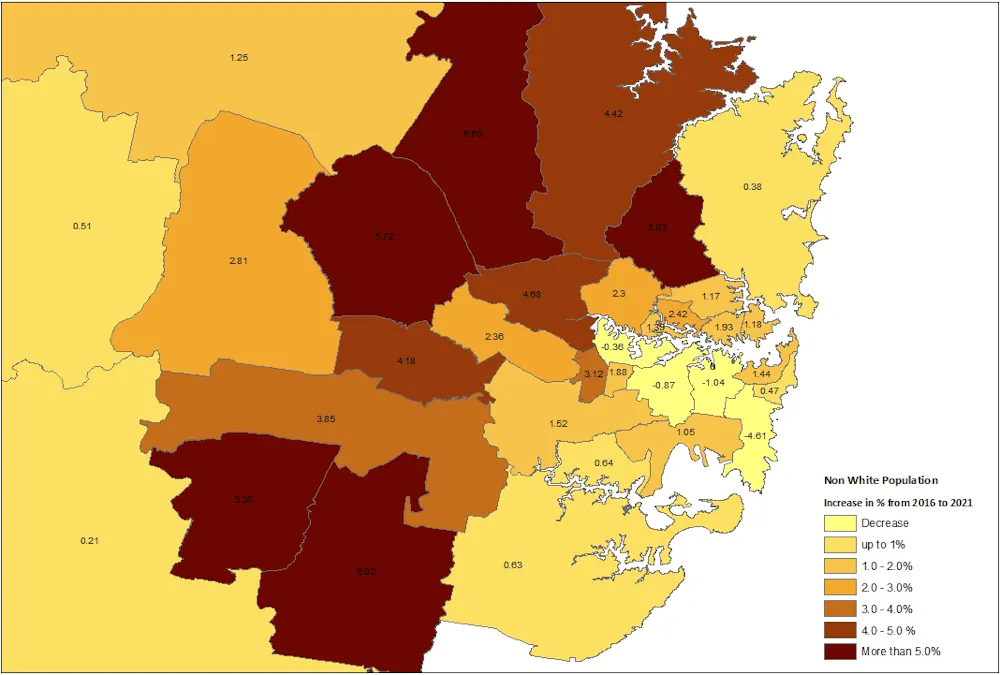
As the map below shows, the concentration of the non-white population in outer areas is also increasing at a much faster rate.
Increase in percentage of non-white resident population from 2016 to 2021 for local government areas across Sydney. Map created by authors using 2016 and 2021 census data, Author provided
The national 2022 Population Statement shows Australia’s net overseas migration is estimated to be 235,000 per year until 2032-33. That’s about two-thirds of the nation’s total population growth. The report forecasts about 27% (64,000 a year) of the international migrants will settle in Greater Sydney.
Natural population increase (births minus deaths) for Greater Sydney is estimated to be around 36,000 a year. The net effect of internal migration adds up to around 33,000 people leaving Sydney. So most of the city’s population growth is going to be from international migration.
The Commonwealth’s 2021-22 Migration Program Report shows more than 80% of international migration is from non-white countries (when we consider the top ten countries of origin). Migration data from recent years also indicate this trend is likely to continue or even grow.
Based on the housing growth and immigration projections, we can conclude population growth will continue to be concentrated in outer Western Sydney, and non-white international migrants will account for most of this growth. This will intensify the concentration of the non-white population in these areas, increasing the ethnic divide between the city’s east and west.
It can be argued, then, that limiting housing options for new immigrants to the outer areas of Sydney could be considered systemic racism. System racism occurs “when racially unequal opportunities and outcomes are inbuilt or intrinsic to the operation of a society’s structures”, as one study explained. And it “can emerge with or without intention to harm and with or without awareness of its existence”.
By reducing the ethnic divide, Sydney will be better off
The NSW Productivity Commission’s recent report, “Building more homes where people want to live”, argues that the focus on growth areas in Western Sydney is coming at a high cost to both social wellbeing and government budgets. He recommends the government shift its focus to higher-density housing in the CBD and inner suburbs.
Soon after NSW elected a new Labor government in March, Premier Chris Minns stressed the need to counter NIMBYism and build such housing closer to amenities and jobs.
Areas closer to the city centre are where people most want to live. Developing more housing in these areas will make housing there more affordable. It will also reduce the environmental impacts of urban growth.
At the same time, the population in many affluent areas of Sydney has been decreasing and these areas are reported to have lost vitality. They also lack housing for their essential workers.
There is a need for further research on the relationship between ethnic segregation and our decisions on what to build and where. We need to better understand NIMBYs’ motivations for opposing all development in their areas and the systemic racism resulting from this resistance.
George Greiss is Mayor of Campbelltown City Council, Chairperson of The Parks Mayoral Forum, a non-executive director of Local Government NSW and a member of the Liberal Party.
Awais Piracha does not work for, consult, own shares in or receive funding from any company or organization that would benefit from this article, and has disclosed no relevant affiliations beyond their academic appointment.
Less than three months out from New Zealand’s 2023 election, large political donations have been making headlines. Donations to both the ACT Party and the National Party have significantly outpaced large-scale contributions to other political groups.
Should this be a cause for concern? Studies from overseas indicate those who raise the most money tend to win. And, based on our recent “Doughnation” research, donors know that too. Wealthy New Zealanders admitted to gaining access to the levers of power through political donations.
So do our current campaign finance rules do enough to protect a basic principle of democracy – that we should all be equal in the ballot box?
Its final report will be delivered to the government in November – too late to have an impact on the 2023 election.
But if we want future elections to be fairer, here’s what the report found needs to change.
How can we make future elections fairer?
The Independent Electoral Review’s interim recommendations include
replacing the current broadcasting allocation with a “fairer and more effective form of state funding” for registered parties
per-vote and base funding for registered political parties
tax credits for donations up to NZ$1,000
introducing an expanded Election Access Fund and a new fund to facilitate engagement with Māori communities.
Those changes are additional to several changes to political party finance implemented at the beginning of 2023, ahead of this year’s election.
What changed ahead of this election?
Changes included lowering the reporting threshold for large donations from $30,000 to $20,000 and new requirements around reporting donations above $1,500.
In the first six months of 2023, the main political parties have already received more than $4 million in donations over $20,000.
The National Party benefited the most from political donations, receiving $1,255,587 in large political donations, closely followed by ACT, which received $1,255,000. New Zealand First received $567,304, the Green Party received $496,260 and the Labour Party received $428,844.
These figures reflect the large donations that have to be disclosed within 10 days of receipt. We won’t know the sum total of small donations until well after the election.
How much do large donations sway elections?
Research suggests donations can help political parties win more votes, but that typically this only applies to the more established parties. And, while money matters in New Zealand, it’s not necessarily a straightforward relationship.
Recent data from the United States showed better-than-average fundraising is a strong predictor of better-than-average electoral success, concluding that “money still matters”.
Australia’s Grattan Institute found that over the past five federal elections there, the party with the biggest war chest tended to form government. And an analysis of general elections in France and the United Kingdom between 1993 and 2017 showed increased spending per voter improved candidates’ share of votes.
New Zealand’s 2017 election also illustrated a strong relationship between money and votes. National received 44.45% of the votes after a $4,579,086 fundraising haul. Labour received 36.9% of the votes and received $1,611,073 in political donations.
But the 2020 election result suggests there are limitations to the relationship between funding and votes, particularly for the two main parties. In 2020, other factors clearly contributed to the electoral outcome. For example, Labour’s handling of the COVID-19 pandemic appears to have outweighed National’s fundraising advantage.
Some voters’ voices are louder than others
Even if political donations don’t always decide elections, it is fairly well established that money buys access. Work from the Grattan Institute shows that highly regulated industries – such as mining, transport, energy and property construction – provided the highest level of donations to Australian political parties, made the greatest number of commercial lobbying contacts, and had the most meetings with senior ministers.
Access is not the same as influence, of course. It is typically difficult to make a causal connection between donations and influence, except when political scandals occur.
However, research out of the US by Martin Gilens showed that politicians’ decisions do not represent the preferences of poorer or middle-class citizens. Rather, these decisions fall in line with the interests of the wealthiest – a situation that Gilens attributed at least in part to the influence of wealthy donors.
In New Zealand, the Independent Electoral Review’s interim report acknowledged the
risks to public confidence in the electoral system if some people have more access to, or can unduly influence, parties and candidates through political financing.
In a recent opinion piece, former ACT board member Robin Grieve defended political donors as not always being motivated by self-interest, giving an example of a donor wanting to help children in the care of Oranga Tamariki.
While there may have been altruistic intent, the issue is still that the donation was made by a wealthy person to a political party with the stated objective of influencing legislation.
Is that fair? In our research exploring the motivations of wealthy donors, some agreed that it was unfair that they could donate while others could not, with one noting a
real problem with people who accumulate a lot of money supporting the systems that have allowed them to accumulate a lot of money.
Another commented that they did not think
that it is right that rich people can distort democracy.
Not everyone was concerned about this situation, with one donor telling us
the fact that some can promote their position more than others doesn’t worry me.
If acted on, the Independent Electoral Review’s recommendations for tighter donations controls and fairer funding for registered parties would help create significantly more transparency in New Zealand’s political donations system.
We believe a move away from a reliance on large individual donors would help increase public trust in the way political parties are funded. It also is likely to help level the playing field of access and potential influence in New Zealand politics.
Lisa Marriott receives funding from the Gama Foundation.
Max Rashbrooke has received funding from the Gama Foundation.
The Australian Electoral Commission has just published the “yes” and “no” pamphlets for the Indigenous Voice to Parliament referendum.
So who is the target audience for each case, what are their key messages, and how effective will they be?
I research how people and organisations use communication to effect change via, for example, entertainment or political advertising. When I look at the “yes” and “no” case pamphlets, there are aspects of each that stand out.
Battle of the pamphlets
The “yes” pamphlet leans on the value of expertise to help voters decide. We hear from a senator and elder, a school principal, a filmmaker, the co-chair of the Uluru Dialogues, a former High Court Chief Justice, a professor, three former sports professionals, and numerous members of the Order of Australia. Moreover, many are recognisable names, such as Rachel Perkins, Patrick Dodson, and Eddie Betts.
The members of parliament who wrote the “yes” case consider these experts to have more experience with Indigenous affairs than most voters, and are better informed about it. Their likeability and familiarity also helps put the point across to readers in a more compelling way.
The key strategy of the “no” pamphlet, on the other hand, is “more is better”. It outlines 10 reasons to vote “no”. This is a powerful approach because the subject lends itself to it – that is, the referendum is one a reasonable number of voters really want to think about, and many have concerns about.
In general, persuasive power increases when more reasons are provided. It seems that, according to the MPs who wrote the “no” case: “the more facts you tell, the more you sell”.
Like the “yes” case, the “no” case substitutes the real question voters are being posed with another, more straightforward one. So, voters will ask themselves if the experts possess the expertise needed to provide the advice to vote “yes”. And on the other hand, voters will ask themselves if the number of reasons provided to vote “yes” is high enough and compelling enough.
Whichever has the most rational and emotional pull for each reader will win their vote.
According to classic research, expertise is the principal attribute of credibility. Understanding a subject and knowing what you are doing – that is, competence – enhances your credibility.
This means that if voters have the feeling a person possesses information and experience that they lack, then that expert’s viewpoint can be highly persuasive. In other words, expertise can feel like authority. This is especially so when information is hard to understand.
One study illustrates this nicely. Participants were asked to give their verdict in a mock trial. The case concerned a company suspected of having exposed its workforce to carcinogenic chemicals.
One of the witnesses was an expert, Professor Thomas Fallon. In one version of the trial, he explained in clear language that the chemicals concerned did indeed cause cancer. In another, he used incomprehensible jargon to say the same thing.
In this case, where the arguments put forward were difficult to understand, it was his expertise as a professor that proved decisive. The “jurors” understood little of the actual evidence, but felt that if a professor said it was true, then it must be true.
It is hardly surprising, then, that experts are used in the “yes” case.
The case for ‘no’
Research has shown that the “more-is-better” approach to an argument is primarily useful when the quality of a choice is difficult to ascertain by other means and there is little alternative information. In other words, the authors of the “no” case assume voters do not know how to judge whether the Voice will be a good or a bad thing, and may not consider much other information than this particular pamphlet.
It will come as no surprise to learn that people are more easily persuaded that a standpoint like “the Voice will be bad” is correct if campaigners provide strong arguments for this. You can test this yourself at work by making a simple request to people queuing to use a photocopier:
Excuse me, I have five pages – may I use the photocopier?
Generally about two out of three people asked will allow you to use the copier before them. Now make the same request, but with a reason:
Excuse me, I have five pages – may I use the photocopier because I’m in a hurry?
In that case, almost everybody accedes.
At first sight, this hardly seems astounding: people are more likely to comply with a request if they have a good reason. However, the more-is-better approach is not so much about the substance of an argument as the mere fact that one or more are given. So, for example, when you ask,
Excuse me, I have five pages – may I use the photocopier because I have to make copies?
again, almost everybody complies. That is even though they have not actually received any new information; it just feels like they have.
Other research shows people are also less persuaded by a standpoint backed with three strong arguments than by one with three strong and three weak arguments to support it.
Tom van Laer does not work for, consult, own shares in or receive funding from any company or organization that would benefit from this article, and has disclosed no relevant affiliations beyond their academic appointment.
England women’s soccer captain Leah Williamson and Dutch striker Vivianne Miedema will miss the 2023 FIFA Women’s World Cup, which starts this week, due to ACL injuries.
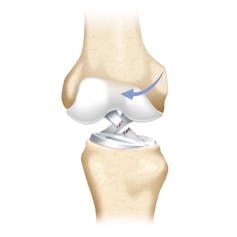
The anterior cruciate ligament, or ACL, is a piece of tissue like a rope connecting your shin bone to your thigh bone. It’s only 3cm long and 1cm wide but is the most important stabiliser of the knee, alongside your muscles.
An ACL tear can be a complete or partial. In women’s soccer, they commonly happen during defensive pressing or tackling, or regaining balance on one leg. But more than 80% involve no contact, or indirect contact such as a bump to the shoulder.
Women are more likely to tear their ACL than men playing the same sports, with women soccer players twice as likely to tear their ACL as men.
So how can we reduce the risk of these injuries? And what happens if you injure your ACL?
In the past, factors related to women’s bodies were reported as the main reasons for the higher risk: their anatomy (wider pelvis, slope of the knee bones) or female sex hormones (oestrogen may increase the laxity or looseness of ligaments).
However research has not been able to confirm these factors. We now know the reasons for disparity are complex and multifaceted: women and girls may not develop the same movement skills and muscle function as boys and men in their younger years and across their life.
Other contributing factors include women and girls having fewer opportunities, confidence or support to participate in sports such as football, or activities such as gym training.
Surgical repair involves taking a small graft from your hamstring, quadriceps, or patellar tendon to replace your ACL.
But if you choose not to have surgery, you can live and be active without an ACL. Research has found non-elite athletes who don’t have surgery can return to the same level of sport and physical function as those who have surgery. (However, this has not been tested yet in elite athletes.)
Athletes also need to be psychologically ready to return to sport. Fears of re-injury, lack of confidence and social pressures to return are common, and may negatively affect sport performance and enjoyment.
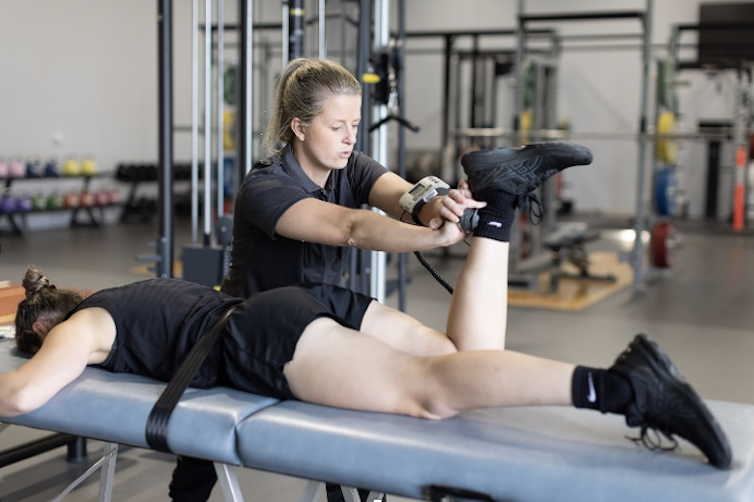
Rehabilitation after an ACL injury will help address pain, swelling and movement restriction. Author provided
What can be done about the high rates of ACL injuries in women?
Given the high cost of ACL injuries to women athletes, the best thing we can do is to prevent them.
Injury-prevention programs that address movement patterns and muscle function through training and coaching can reduce the risk of non-contact ACL injuries in women by 67%.
Among women’s soccer players, programs with specific warm-up activities (jumping, landing, change of direction, balance) and muscle strengthening (for hip, core and leg) can reduce ACL injuries by 45%.
Players, parents, coaches, schools, and sporting organisations can freely access injury-prevention programs created for soccer (Perform Plus, FIFA11+), Australian football (Prep-to-Play), rugby (Activate), netball (Netball KNEE) and handball (Knäkontroll). The Get Set app is also great for learning about common injuries and injury-prevention exercise for 55 different Olympic sports.
ACL surgeries have increased by 43% in Australia between 2000 and 2015. In Australia, women’s knee injuries have grown by 3% (compared to 1.3% for men), with the highest growth among girls aged 5–14 years (around 10% a year).
While injury-prevention programs are effective when tested in clinical trials, their use by sporting clubs outside of research projects can be as low as 10–20%.
Sporting organisations should make their members aware of the freely available resources, and support and incentivise coaches to use them at least twice per week for 10–15 minutes, as part of team training.
Providing girls and women with equal opportunities and resources will allow them to develop physical and sport-specific skills in their younger years and throughout their life.
The authors do not work for, consult, own shares in or receive funding from any company or organisation that would benefit from this article, and have disclosed no relevant affiliations beyond their academic appointment.
In the last 15 days of the month of July, 15 murders have occurred in the northern Papua New Guinean town of Madang — once described as “beautiful” — and the community now faces a law and order crisis.
Madang Mayor Peter Masia said the Madang district authority could not do much in assisting police to actively carry out law and order action because public funds were still on hold after sitting MP Bryan Kramer had been dismissed as Madang MP.
Calling Madang the “murder capital of PNG”, Masia said there had been an increase in killings with the latest killing occurring yesterday afternoon.
Compared to the National Capital District (NCD) — Port Moresby — where killings happen every 2 to 3 days, Madang has seen killings every day for the last 15 days.
An NCD police officer confirmed that every 2 to 3 days they were responding to a report of a killing in Port Moresby.
“Yesterday a young man in his mid 20s from Angoram in East Sepik was stabbed in the chest by a street seller in broad daylight in the heart of [Madang] killing him instantly,” he said.
Madang police desperately need resources to help them tackle Law and Order challenges in the province everyday.
Police need housing, vehicles A senior policeman who wished not to be named said Madang police needed housing, vehicles and things like office stationery and manpower to boost police work in the province.
There are two police stations in Madang — one is the Jomba police station and the other is the town police station.
The officer said the estimated population ratio for one policeman to the Madang population was 1:1500 to 2000.
He said they needed more police manpower to tackle the law and order problems, especially the killings that were happening every day.
Transgogol people are now calling on the government to establish a police mobile squad base in the area to prevent more brutal murders in their area.
Transgogol community leader and spokesman Morris Bann said there was state-owned land available.
He said the type of killings in the area warranted the government to take serious steps in addressing law and order.
Call for police mobile squad “We want a police mobile squad base built . . . so that law and order is monitored closely to instill the trust and security the people require from its government,” said Bann.
Madang town resident Breed Kanjikali said the number of deaths required all Madang MPs to step in and address issues affecting the province and map out how they would assist police in combating crimes in the province.
Bundi leader Alois Pandambai said the murder toll in the province was very significant and it portrayed an image where there was dysfunction in the political leadership of the province.
He said Madang province did not seem to be functioning normally in the last seven months because of a political hussle and tussle over the position of the Provincial Administrator Frank Lau.
“While our leaders are fighting over an appointment made by the NEC [National Executive Council], we are not giving 100 percent support to police work and our own people are being killed everyday,” he said.
The 10 Nissan Patrol vehicles bought two years ago to support police work were now experiencing mechanical faults and had been grounded.
Dorothy Mark is a PNG Post-Courier reporter. Republished with permission.
Source: The Conversation (Au and NZ) – By Raquel Peel, Adjunct Senior Lecturer, University of Southern Queensland and Senior Lecturer, RMIT University
Text messages showing actor Jonah Hill asking his ex-girlfriend Sarah Brady to consider a dot point list of relationship “boundaries” have sparked an important conversation.
Two different interpretations of these texts are dominating the discussion.
Some have understood Hill’s dot points as a reasonable set of relationship expectations or “preferences” for a partner. Others see Hill’s list of relationship deal-breakers as a controlling behaviour.
So what is a relationship “boundary” and how do you have this conversation with your partner?
Boundaries are personal and influenced by one’s values. They can be emotional, physical, sexual, spiritual and cultural.
The purpose of creating, understanding and respecting boundaries is to ensure one’s mental health and well-being are protected. Used well, they can keep relationships healthy and safe.
Setting boundaries can also reinforce values and priorities important to you.
Relationship boundaries are a life skill that needs constant learning, practice and improvement. Shutterstock
Some ‘boundaries’ are controlling and go too far
That said, relationship boundaries can become unsafe for the people involved. Some cross the line into coercive control.
For instance, one might be able to justify to themselves they need to know where their partner is at all times, monitor their communications and keep tabs on their partner’s friendships because they just want to keep their partner safe.
But these are not boundaries; this is coercive control.
If your partner is describing these as their relationship boundaries, you should feel comfortable to say you are not OK with it. You should also feel comfortable explaining what boundaries you need to set for yourself and your relationship to feel safe.
In fact, research has found that even cyberstalking offenders might struggle to acknowledge how their behaviour can be perceived as intrusive by their partner. They may also have trouble understanding how it contributed to their break-up.
My research on how people can sabotage their own relationships revealed a lack of relationship skills is often a key factor in relationship issues.
The same research highlighted how people who fear their relationship is at risk can end up indulging in controlling behaviours such as partner monitoring, tracking how a partner spends their money and emotional manipulation.
In other words, people can sometimes employ unhealthy behaviours with the intention of keeping their partner but end up pushing them away.
Understanding partner and relationship expectations
We might have a vision in mind of an “ideal partner”. But it’s highly improbable one person can ever meet such high standards.
Rigid partner and relationship standards, just like unreasonable boundaries, can cause distress, hopelessness and resentment.
So healthy romantic relationships need clear communication and negotiation. Sometimes, that involves being flexible and open to hearing what the other person has to say about your proposed boundaries.
Relationship boundaries are a life skill that needs constant learning, practice and improvement.
Communicating expectations can also help people deal with common relationship fears. Shutterstock
Having a conversation about healthy relationship boundaries
Some mistakenly believe having any relationship boundaries at all is unreasonable or a form of abuse. That’s not the case.
In my research on relationship sabotage, many people spoke about how being able to clearly communicate and set relationship expectations has helped them maintain their relationships over the long term and dispel unrealistic standards.
Communicating expectations can also help people deal with common relationship fears, such as getting hurt, being rejected and feeling disrespected.
But for an important conversation about boundaries to take place, you first need the environment for an open, honest and trusting discussion.
Partners should feel they can talk freely and without fear about what they are comfortable with in a relationship. And, be able to discuss how they feel about a boundary their partner has proposed.
Clarify and discuss
If you’re having the boundary conversation with your partner, clarify what you mean by your boundary request and how it might work in practice. Examples can help. Understanding the nuances can help your partner decide if your boundary request is reasonable or unreasonable for them.
Second, negotiate which boundaries are hard and which are soft. This will involve flexibility and care, so you’re not undermining your or your partner’s, freedom, mental health and wellbeing. A hard boundary is non-negotiable and can determine the fate of the relationship. A soft boundary can be modified, as long as all parties agree.
What constitutes a healthy boundary is different for each individual and each relationship.
Regardless, it is a conversation best had in person, not by text message (which can easily be taken out of context and misunderstood). If you really must have the discussion over text, be specific and clarify.
Before setting boundaries, seek insight into what you want for yourself and your relationship and communicate with your partner openly and honestly. If you’re fearful about how they’ll react to the discussion, that’s an issue.
An open and honest approach can foster a productive collaboration that can strengthen relationship commitment.
Raquel Peel does not work for, consult, own shares in or receive funding from any company or organization that would benefit from this article, and has disclosed no relevant affiliations beyond their academic appointment.
New Zealand Parliament Buildings, Wellington, New Zealand.
New Zealand Politics Daily is a collation of the most prominent issues being discussed in New Zealand. It is edited by Dr Bryce Edwards of The Democracy Project.
French President Emmanuel Macron will make a first official visit to Papua New Guinea next Friday as part of a short Pacific trip.
AFP news agency reports that Macron’s trip will start in New Caledonia before he travels to Vanuatu and Port Moresby.
A French official told the news agency the trip was “historic” because no French president had ever visited non-French islands in the region.
President Emmanuel Macron in Noumea on an earlier visit to New Caledonia … “recommitting” France to the Pacific region. Image: Crikey
Macron will use those two stops to outline his Indo-Pacific strategy, aimed at “recommitting” France to the region, the official said.
PNG Prime Minister James Marape said he would meet one-on-one with Macron, and the itinerary for the visit also included a courtesy call on Governor-General Sir Bob Dadae and the signing of various agreements.
Marape emphasised the significance of Macron’s visit in strengthening bilateral relations between France and Papua New Guinea.
“Under my leadership, France and PNG have been actively enhancing our bilateral relationship, along with other nations,” he said on his website.
“I appreciate President Macron’s commitment, as demonstrated by his decision to visit PNG and engage in discussions on matters of mutual interest between our countries.”
Final LNG decision Macron’s visit comes on the eve of the final investment decision (FID) by French super-major TotalEnergies on the Papua LNG Project.
TotalEnergies is also involved in downstream processing of natural resources such as forests.
“In the midst of the evolving geopolitical landscape in the region, Papua New Guinea serves as ‘neutral ground,’ and I will urge France to consider PNG’s strategic position amid the changing regional dynamics,” Marape added.
“The visit of President Macron to PNG will further solidify the growing cooperation and shared goals between our two nations, particularly in the areas of forest conservation, French investments in PNG such as TotalEnergies, mobilising resources to support small Pacific Island countries and communities, and other relevant matters.”
Macron last year relaunched France’s Indo-Pacific approach in the aftermath of a bitter row over a cancelled submarine contract with Australia, casting France as a balancing power in a region dominated by the tussle between China and the United States.
This article is republished under a community partnership agreement with RNZ.
The Murray Darling Basin Plan is an historic deal between state and federal governments to save Australia’s most important river system. The A$13 billion plan, inked over a decade ago, was supposed to rein in the water extracted by farmers and communities, and make sure the environment got the water it needed.
But now, less than a year out from the plan’s deadline, it’s in a dreadful mess. Projects have not been delivered. Governments cannot agree on who gets the water, or how. All the while, water in the Murray-Darling Basin will become scarcer as climate change worsens.
The Albanese government was elected on a promise to uphold the Murray-Darling Basin Plan.
But earlier this month, Environment and Water Minister Tanya Plibersek conceded the plan is “too far behind” and needs a “course correction”.
I have studied and promoted sustainability measures in the Murray-Darling Basin for 35 years. Here, I outline the five steps needed now to ensure the health of the river system and the people who depend on it.
Water in the Murray Darling Basin will become scarcer as climate change worsens. Shutterstock
A refresher: what is the Murray-Darling Basin Plan?
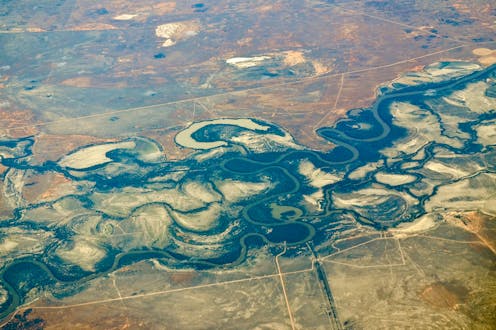
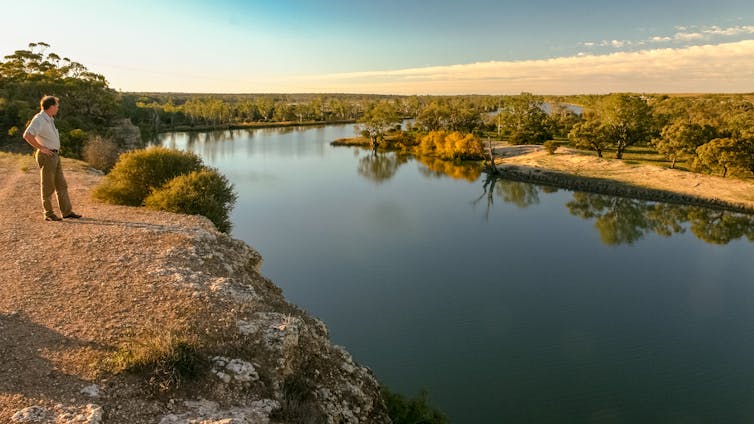
The Murray-Darling Basin covers about a seventh of the Australian land mass: most of New South Wales, parts of Queensland, South Australia and Victoria, and all of the Australian Capital Territory. It includes the Murray River and Darling River/Baarka and their tributaries.
These lands and waters are the traditional lands of more than 40 Indigenous nations. Around 5% of the basin consists of floodplain forests, lakes, rivers and other wetland habitats. Vast amounts of water are extracted from the rivers to supply around three million Australians, including irrigating farms.
The Murray-Darling Basin Plan became law in 2012, under the Labor government. It is due to be fully implemented and audited by the end of June 2024.
The plan limits the amount of water extracted from the basin. It aims to both improve the condition of freshwater ecosystems and maintain the social and economic benefits of irrigated agriculture.
The water was largely to be recovered by buying back water entitlements from farmers. Some 450 billion litres would be retrieved through water efficiency projects.
The plan has twice been amended to reduce the amount of water taken from farmers. The first change, made on questionable grounds, reduced the water recovery target by 70 billion litres a year. The second reduced it by 605 billion litres, with the water to instead be recovered through 36 water-saving offset projects.
Further, the Victorian and NSW governments committed to reaching agreements with farmers to enable water for the environment to safely spill out of river channels and across privately owned floodplains, to replenish more wetlands.
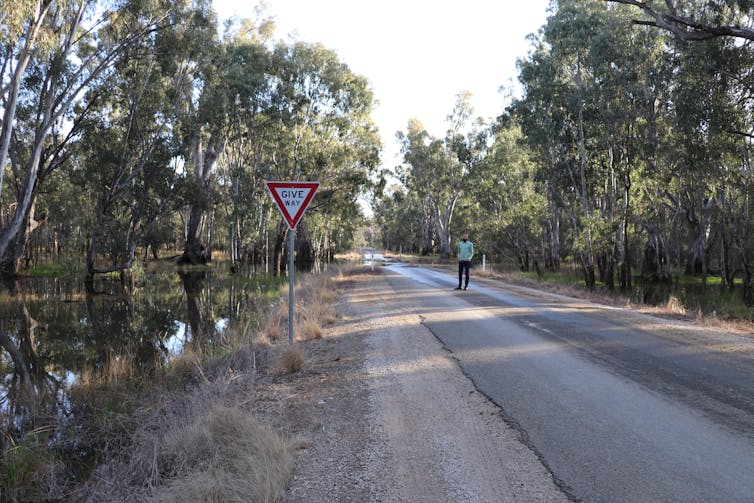
Getting water into floodplain wetlands is crucial for flora and fauna. Pictured: a colleague of the author stands on a road at Tocumwal, NSW, as water inundates the River Murray floodplain. Jamie Pittock, Author provided
So how’s the plan going?
Things are not going well. As of November last year, the offset projects were likely to deliver between 290 and 415 billion litres of the 605 billion litres required. And very little water is getting to floodplains.
And of the 450 billion litres to be retrieved through water-efficiency projects, only 26 billion litres has been recovered.
It means of the 3,200 billion litres of water a year to be returned to the environment, only 2,100 billion litres was being achieved as of March this year – plus the small amount of projected water from offset projects, if it’s delivered.
At a meeting in February this year, the nation’s water ministers failed to agree on how to meet the plan’s deadline.
As governments quibble, the rivers and floodplains of the Murray-Darling suffer. In the past decade, millions of fish have perished in mass die-offs. Toxic algae has bloomed, wildife and waterbirds have declined in numbers and wetlands have dried up. These are all signs that too much water is still being taken from the system.
So how do we get the basin plan back on track? Below, I identify the top five priorities.
1. NSW must get its act together on water plans
Integral to implementing the broader basin plan are 33 “water resource plans” devised by the states. These plans bring the basin plan into legal force and detail how much water can be taken from the system and how it is divided between users such as farmers, communities and the environment.
NSW must produce 20 plans. To date, just five are in place. At least seven plans by NSW were recently withdrawn to be re-drafted.
Until they’re finalised, key measures of the basin plan cannot be implemented. The new NSW Minns government must prioritise the remaining water resource plans and have them accredited by the Commonwealth government.
2. Federal water buybacks must ramp up
The Albanese government is taking steps to improve water recovery under the plan, such as consulting stakeholders and restarting water buybacks. But it must do more.
Both NSW and Victoria will almost certainly miss the 2024 deadline for delivering all infrastructure projects they promised to offset 605 billion litres of water.
The federal government is legally obliged to – and should – purchase additional water from farmers to cover any gap. It must also acquire more than 400 billion litres of water to make up for the shortfall in water efficiency projects.
For this to occur, a Coalition-era cap must be lifted from 1,500 billion litres to enable more federal government water purchases from farmers.
The federal government must buy more water entitlements from farmers. Shutterstock
3. Abandon questionable water-saving projects
At least six water-saving projects look unlikely to meet the deadline.
They include a large project proposed by the former NSW government to reduce evaporation at Menindee Lakes, which appears doomed.
Another project at Yanco Creek in NSW has also fallen behind, and four of the nine Victorian projects have been paused.
What’s more, the ecological merit of these projects are contested – as is the scientific rigour of the proposed auditing method. These projects should be abandoned in favour of reconnecting rivers to their floodplain.
4. Reconnect rivers and floodplains
For floodplain wetlands to function, they must be regularly inundated with water. To date, just 2% of these parts of the basin are inundated each year by managed flows (or in other words, intentional water releases by authorities).
The federal government holds water for this purpose. Delivering the water requires compensation for the owners of inundated properties, as well as upgraded roads, bridges and levee banks. Managed inundation can benefit landholders, such as by reducing the impacts of natural floods. But governments must do a better job of communicating these benefits to win support.
The federal government needs NSW and Victoria to help implement their agreement for watering floodplains, but this cooperation has been extremely slow.
Rivers must be connected to floodplains. Shutterstock
5. Make information transparent
The data and modelling used to manage water in the basin is complex and is often not publicly available.
In its final report in 2019, a South Australian royal commission into the Murray-Darling Basin was highly critical of the Murray-Darling Basin Authority. The report found the authority failed to act on “the best available science” when determining how much water could be returned to the environment, and withheld modelling and other information that should have been made public.
Making such information freely available is crucial for accountability and to build public trust.
Time for tough decisions
Each key element of the basin plan has encountered trouble at the implementation stage. The five steps I’ve outlined are essential to rectifying this.
Attention must now also turn to a review of the Murray-Darling Basin Plan, which is legally required in 2026. As well as addressing the problems detailed above, it must address two big issues essentially ignored in the plan to date: the lack of Indigenous rights over water, and water losses due to global warming and other environmental change.
If the Albanese government is to uphold its election promise to deliver the plan, hard decisions – and trade-offs – will be required.
Jamie Pittock is a member of the Wentworth Group of Concerned Scientists and holds other voluntary roles with non-government environmental and natural resource management organisations. He is Chair of the ACT Natural Resource Management Advisory Committee.
At a time when governments are timid, keener to announce reviews than decisions, it’s refreshing to remember what happened 50 years ago today – on July 18 1973.
Inflation had surged to 14%. Australia’s biggest customer, the United Kingdom, had joined the European Economic Community, agreeing to buy products from it rather than Australia. And the newly formed Organisation of Arab Petroleum Exporting Countries had doubled the price of oil.
The tariffs imposed on imported goods to protect Australian manufacturers from competition were extraordinarily high. For clothing, they reached 55%; for motor vehicles, 45%.
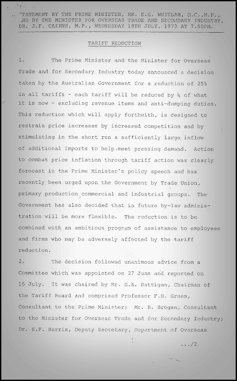
Then, with absolutely no public indication he had been considering anything as drastic, at 7pm on Wednesday July 18, the recently elected prime minister Gough Whitlam made an announcement.
Every tariff cut by one quarter overnight
From midnight, all tariffs would be cut by 25%. As Whitlam put it: “each tariff will be reduced by one quarter of what it is now”.
If Australian businesses (and the Australian public) were caught by surprise, it was because Whitlam had planned the whole thing in secret.
He had given a six-person committee just three weeks to work out the details.
Although the committee was chaired by the head of the Tariff Board, Alf Rattigan, and included an official from Whitlam’s own department, the department of industry and the department of trade, it met in an obscure location in Canberra’s civic centre rather than in public service offices, where the project might be discovered.
Not included in the committee was a representative of the treasury, which its then deputy head John Stone said “knew nothing” about what was unfolding.
But driving the work of the committee were two academic outsiders – Fred Gruen, an economics professor at the Australian National University and adviser to Whitlam, and Brian Brogan, an economics lecturer at Monash University who was advising the trade minister, Jim Cairns.
Outsiders, not treasury insiders
As economists rather than bureaucrats, Gruen and Brogan were able to see benefits where others saw entrenched interests. Going to the tariff board and asking for extra tariffs, whenever it looked as if your prices might be undercut by imports, had become a reflex action for Australian businesses.
In the words of Gary Banks – later to become head of the successor to the tariff board, the Productivity Commission – “it was not a shameful thing for a conga line of industrialists to be seen wending its way to Canberra”.
Tariffs were good for business owners (though bad for their customers, who had to pay much higher prices and often got worse goods). Ttey were also good for government – bringing in tax revenue.
Whitlam was more interested in bringing down inflation. His announcement said increased competition would
have a salutary effect upon those who have taken advantage of shortages by unjustified price increases which have exploited the public.
Any firm seriously hurt by the extra imports could apply to a newly established tribunal for assistance, but the tribunal
should not provide relief as a matter of course – that is, simply because the question of relief had been referred to it.
So Whitlam offered “rationalisation assistance” to encourage firms to refocus their operations, and “compensation for closure” where that couldn’t be done and production had to cease.
For displaced workers, the 7pm announcement offered anyone who lost their job retraining, as well as
a weekly amount equal to his [sic] average wage in the previous six months until he obtains or is found suitable alternative employment.
Over the next seven years, manufacturing employment fell by 80,000, but few of those job losses were immediate. Fifteen months after the 25% tariff cut, fewer than 6,000 people had claimed the wage replacement offered on the night of the announcement.
When Whitlam went to the polls a year after the cut in the double dissolution election of May 1974, 122 university economists signed an open letter of support.
It said the general thrust of the government’s policy responses had been in the best interests of the nation as a whole, and added
more importantly, we seriously doubt that the previous government would have had the wisdom or the courage to undertake it. It had certainly given no indication of moving in that direction while it was in power, even though the need for such policies had become obvious.
In its later days in office, the Whitlam government was roundly criticised for its irresponsible public spending. Ironically, in its approach to tariffs in the 1970s, it had taken the first steps in a neoliberal direction that characterised western governments of the 1980s.
By acting boldly after decades of inaction, Whitlam showed what a government could do. It was a lesson his Labor successor Bob Hawke took to heart a decade later, when he floated the dollar, revamped Australia’s tax system and put in place a series of further cuts that reduced tariffs to near zero.
It’s something we see less of today.
Alex Millmow does not work for, consult, own shares in or receive funding from any company or organisation that would benefit from this article, and has disclosed no relevant affiliations beyond their academic appointment.
Lizzo has arrived in Australia for the world tour of her latest album, Special.
If you don’t know Lizzo yet, she shot to fame in 2019 with the release of her third studio album Cuz I Love You. The re-release of sleeper hit Truth Hurts launched Lizzo to number one on the charts and made her a household name. The catchy lyrics still have people around the world singing, “I just took a DNA test, turns out I’m 100% that bitch”.
About Damn Time ultimately topped the charts globally and won Lizzo the Grammy for Record of the Year.
The message of her music and the image she projects through social media promote self-love and self-empowerment, while explicitly celebrating her size.
Since her rise to stardom, Lizzo has faced constant negative criticism for representing her body in such a way. She has responded by saying, “I’m a body icon, and I’m embracing that more and more every day”.
In examining Lizzo’s career, we can identify a crucial recognfiguration of a “funny, fat friend” trope to the embodiment of a Black, fat superstar.
Thick and juicy
Those familiar with Lizzo may have heard her using the term “fat” to describe her body. She also uses descriptors such as big, thick and juicy. The word fat stands out among these descriptors since we typically employ it as a pejorative, a term intended to bring shame to the person on the other end of it.
So, why the term fat? And should you now be using it to describe bigger bodies like Lizzo’s?
Lizzo’s reclamation of the word is rooted in a queer-feminist led and disability-related activist movement: fat activism.
The fat activist movement emerged in the United States in the 1970s, and includes early figures such as Judy Freespirit and Aldebaran. It exposed the oppressive structures contributing to the marginalisation and stigmatisation of fat people. Fat studies has since emerged as an interdisciplinary field that documents and theorises the work of fat activists.
Fat activists seek to destabilise harmful assumptions of morality and willpower (or a lack thereof), as well as the punitive, shame-based “health” messages that exist around bigger bodies. They do so to push the conversation in new directions and to break down long-existing negative frameworks that inform our understanding of, and feelings towards, fatness.
The (re)positioning of the BMI scale as an antiquated and fraught system to determine “obesity” is one example. The rise of the Health at Every Size movement is another.
In adopting fat as a lead subject descriptor and as a term to self-identify, activists and scholars have argued it is a biological term and thus neutral – it’s stating a fact.
It should not, however, suggest all larger-sized people now prefer to be described as fat. There are many people who avoid the term given it’s continuing use in shaming others, including themselves.
We have the added complication that fatness, in many ways, is in the eye of the beholder: conceptions of fatness tend to be individually, socially and culturally shaped. It’s a sliding scale made even more complex by factors such as gender.
When discussing Lizzo, it is vital we acknowledge her identity as a Black, fat woman.
Sabrina Strings in her book Fearing the Black Body traces the racist legacies of fat-phobia and its emergence with the rise of global slave trades during the Enlightenment Era. Academics have also worked to situate Lizzo’s message of self-love and the consistent sexualising of her own body against a history in Western (white) society of treating Black, fat bodies as spectacle: paraded, made abject and shamed.
Lizzo’s embodiment as a self-loving and self-empowered Black, fat woman offers a radical response to such histories.
I am a Black woman, I am making music from my Black experience, for me to heal myself.
So should we say ‘fat’?
If an individual like Lizzo self-identifies as fat, an invitation emerges for us to also pick up and use the term to describe her body.
Doing so, it feels like we, too, might participate in a process of fat liberation and size acceptance. But in celebrating Lizzo’s fatness, we must not ignore the racist systems that continue to shape our beliefs on fatness, determining what is and what is not an acceptable body size and shape.
The presence of Lizzo in our lives serves to remind us that while we grapple with politics of fatness – who is fat and who we can describe as fat – we cannot remove racism and anti-Blackness from the conversation.
Jonathan (Jonno) Graffam is a dramaturg and director in the area of fat and queer performance. Recent credits include Full Cream (2023) and Cake Daddy (2018/19). He is completing a PhD in Theatre at Monash University with a project titled “Fat Dramaturgies: Queer strategies and methodologies in staging fat performance”, where he looks at examples of radical body size politics (embodied fatness) onstage. He specialises in the field of contemporary dramaturgy and popular performance. Jonno is a Tutor in Theatre at the Victorian College of the Arts, Faculty of Fine Arts and Music, The University of Melbourne.
The recent investigations into alleged war crimes committed by Australian and UK special forces in Afghanistan have raised urgent questions about the conduct of people serving in the military.
As militaries rethink their structures and the complex role they play in society, they also need to examime what types of people they should be recruiting. Who are the modern soldiers, and why do they choose to serve?
Some of these answers can be found in existing research that defence forces have conducted over the last half century. With the end of conscription in many Western nations, volunteer militaries began to commission studies looking at why people enlist. The findings were meant to make recruitment campaigns more effective.
We recently conducted a research project funded by the Australian Defence Force that examined these studies through a new lens of behavioural science.
The aim of this study went beyond just increasing recruitment numbers, though. Understanding people’s motivations for enlisting can also reveal a lot about the suitability of recruits for the military, given the new demands they face in these roles.
We found that in contrast to the usual portrayal of military recruits as Hollywood- inspired, hyper-masculine mercenary types, many people enlist because of the duty of care for others and the value they place in military service.
The role of militaries has changed in recent years. Today’s threats are frequently not active conflicts between nations, but rather ethnic strife within nations, terrorism and cyber warfare. Peacekeeping and humanitarian missions have also become more common than conventional warfare, with military forces frequently involved in disaster relief and recovery efforts.
The lines around the purpose of a military are now increasingly blurred. As a result, public sentiment and the battle for hearts and minds has become even more important, especially as technology and social media allow domestic audiences to be better informed about what happens in the field.
New model armies need new model recruits. So, what drives a person to want to voluntarily enlist?
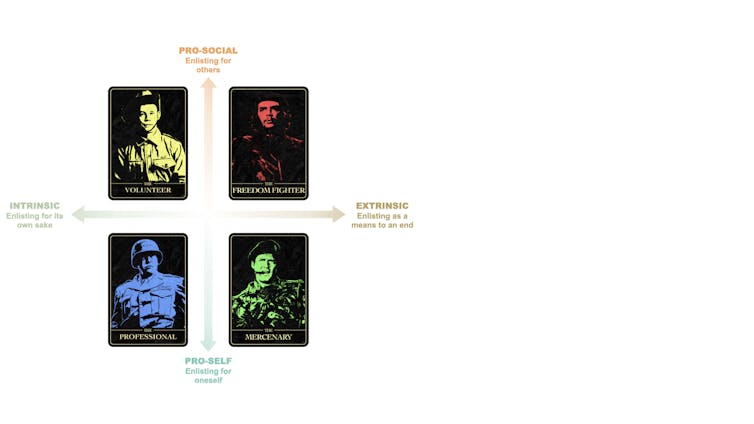
We found the voluminous evidence can be neatly captured by two separate dimensions:
intrinsic versus extrinsic motivations
and pro-social versus self-serving motivations.
Serving for thrills and adventure
Intrinsically motivated people do things for their own sake. For example, they might like travelling for the journey itself, rather than to reach a destination.
Independent of outcomes, some recruits are motivated to serve in the military by the idea of service itself. This could include having an inherent interest in the military, learning how to use high-tech machinery and a sense of adventure.
Some people also sign up for the military out of a personal psychological need for stimulation. One military study shows volunteer soldiers have a greater tolerance for risk-taking than non-volunteers.
On the other end of this spectrum are those who are driven purely by extrinsic motives. This means doing something in the pursuit of a separate goal, such as financial compensation, or recognition earned through medals.
In Meger’s interviews with foreign fighters on both sides of the Ukraine conflict, she found they were often extrinsically driven by ideology. Serving was a way to support a desired political outcome, such as Ukraine’s self-determination.
Other British and American fighters were driven by the goal of protecting Ukraine – and the Western world generally – from what they saw as Russian President Vladimir Putin’s threat to freedom.
These people consider themselves freedom fighters, like Che Guevara, and will accept extraordinary risks and hardship. They often have military backgrounds, too.
Serving for others vs for oneself
Some soldiers are driven for a pro-social reason, as in they are serving for others. These people can be motivated by altruistic reasons, such as defending one’s country and loved ones at great risk and cost to themselves. Some serve as a way to provide better support to their families.
On the other end of the scale are those with self-interested motivations to serve. These can include personal advancement, income, training and career opportunities. Escapism is another common motive found – many serve to cope with relationship breakdown or financial or family stress.
Extrinsic motivation and self-interest are not the same. Freedom fighters, for example, fight for an extrinsic outcome (winning a war), but might do so out of consideration for others (those who win their freedom).
And intrinsic motivations are not always pro-social. Adventure seekers care about fighting rather than winning, for purely selfish reasons.
Put together, these motivations reveal four service archetypes: the volunteer, the freedom fighter, the professional and the mercenary. But the research suggests most people will have a variety of motivations and lie somewhere between the extremes.
The four archetypes of soldiers, clockwise from top right: Che Guevara, Roger Moore as Lieutenant Shawn Fynn in Wild Geese, General George S. Patton, Chinese-Australian soldier Billy Sing. Author provided
So, who is the ideal soldier?
How do these insights help the military? Defence forces have much to gain from recruiting volunteers with the right mix of intrinsic and pro-social motivations.
The psychological evidence suggests that people with intrinsic motivations lead to a better quality of service. They are motivated by discipline, technical proficiency and professionalism, meaning they are more likely to perform in line with what society expects of them.
But the evidence also suggests these motivations can be “crowded out” when excessive rewards are offered. This means providing an extrinsic incentive for something reduces the intrinsic motivation for it.
On the other spectrum, pro-socially oriented people are well-suited for humanitarian missions or in interactions with civilians caught up in conflict.
Multinational companies and organisations are already using this type of behavioural scientific research to find the best candidates for their workforce. As militaries rethink their purpose to keep up with the times, they can learn much from mulitnationals on this front.
In the postmodern military, recruiting isn’t just about filling the ranks anymore, it’s about finding the right fit for an increasingly challenging profession.
Robert Hoffmann receives funding from the Australian Defence Force.
Lena Wang receives funding from the Australian Defence Force.
Maria Beamond receives funding from the Australian Department of Defence.
MyMedicare is a new voluntary scheme that allows patients to register with their usual GP, in an attempt to improve continuity of care and health outcomes.
From October 1, the scheme will give registered patients access to longer telehealth consultations. Then, from next year, GP clinics with patients who are frequently admitted to hospital or are aged care residents will be able to access additional “blended” funding, which sits outside Medicare’s usual fee-for-service.
MyMedicare was announced in the May budget, with A$19.7 million of funding over four years, alongside a range of other health reforms, including funding for practice nurses to improve team-based care, as well as new incentives to increase bulk billing rates.
We’re still waiting on a lot of detail about how the scheme will function. But here’s what we know so far – and what it might mean for patients and GPs.
What do we know about MyMedicare?
The scheme is voluntary for GPs and patients. In addition to patients opting in, GPs will also need to sign up, and have been able to do so since the start of July. There will be a gradual roll out and it will take three years to cover all of Australia.
Though details are yet to be confirmed, from mid-2024 individual GPs will receive “capitation” payments for patients who have more than ten hospital admissions per year. These patients are likely to have complex needs and multiple conditions and, for various reasons, may not be able to access a GP as much as they should.
Though not yet confirmed, GPs are likely to receive $2,000 per patient per year, plus a $500 bonus for keeping patients out of hospital. The funding provides incentives for the GP to coordinate their care and provide the patient with access to nursing and allied health if required. It’s hoped this will stop patients going to hospital as often.
There will also be similar payments for providing regular visits to patients in residential aged care facilities.
Will MyMedicare make a difference to patients?
Let’s consider four key areas patients are concerned about:
1) Continuity of care
Research shows greater continuity of care – developing a relationship with and seeing the same provider or team for your care – improves patient outcomes and reduces costs to the health system. People who use MyMedicare to get a regular GP may see some of these benefits.
But many patients already see the same GP or visit the same practice, especially those with chronic conditions. So registration with a practice may not make much difference for this group of patients. What are the other benefits of registration?
2) Reducing hospital admissions
Avoiding hospitals can be beneficial – in hospitals, there are no home comforts, they are inconvenient for you and relatives, there is little privacy, and they can be costly. Patients with ten or more hospital admissions in a year have been targeted as they have more complex chronic conditions and may be from vulnerable populations.
Better access to a GP could prevent patients visiting the emergency department or prevent overnight hospital admissions. Research shows financial incentives for GPs to better manage chronic disease can reduce hospital admissions.
MyMedicare does not directly address many of the barriers to accessing GP services. If GPs are getting paid more and still getting fee for service payments, will MyMedicare patients be guaranteed to be bulk billed? This has not yet been mentioned, but could be an important part of the scheme to attract patients.
People with chronic disease have two to three times higher out-of-pocket costs than those who do not, and 30% of patients with chronic disease would find it difficult to pay for care if they became seriously ill.
Unfortunately MyMedicare will not directly reduce out-of-pocket costs, which may be the real reason why people use “free” emergency department care.
4) Making it clear and easy to sign up
It is also unclear how the process of registration will work for patients. Will patients be offered a choice of alternative GPs? If chosen, will GPs be obliged to take them?
At the moment, there are no public data about out-of-pocket costs and quality of care provided by different GPs, and so it will be impossible for patients to make an informed choice. Information to inform choice on a website would be useful, as is the case for specialists.
It’s also unclear if patients who chose to register will find it harder to move GPs or continue to see other GPs if they wish to. The advantages to patients of MyMedicare need to be made clear to encourage them to register and be supported to exercise informed choice if they wish.
Patient registration can mean a more secure and predictable stream of future income for some patients and also less competition (in terms of “losing” patients to other GPs) and more continuity of care.
Moving away from fee for service towards a blended payment model is widely recognised to support higher value health care.
Yet GPs are wary of moving from fee for service to capitation payment. Capitation payments are fixed, so GPs take on more financial risk if they have more complex patients who are more costly to treat and manage in terms of time and effort. Whether the $2,000, plus $500 bonus, plus normal fee for service payments are sufficient to cover the costs of treating very complex patients is unclear.
Overall, GPs will get more money, and along with the other announcements in the budget, will receive a significant investment of resources invested in primary care.
Our previous research has shown a 5% increase in earnings for GPs is predicted to reduce the total number of GPs by up to 1% (equivalent to around 310 GPs in 2021) at a time of significant GP shortages. If they get paid more, they would prefer to work less.
But this could also be offset because the increase in funding will hopefully make general practice more attractive as a career and so there will be more postgraduate doctors choosing to be a GP.
Voluntary patient registration under MyMedicare has potential to strengthen the relationship between patients and their GP, and focuses on keeping patients out of hospital and properly cared for in residential aged care. But the devil is in the detail and we will need a proper evaluation to determine the impacts on health outcomes, costs and access to health care.
Anthony Scott receives funding from the Australian Research Council, Medibank Better Health Foundation, and the Independent Hospital and Aged Care Pricing Authority.
Anthony Albanese says the Voice referendum campaign will be relatively short and has declared the yes advocates need to be stronger in putting the argument for the change.
The Prime Minister’s latest intervention comes as the yes and no cases for the pamphlet that will go to voters will be released by the Australian Electoral Commission on Tuesday, and the latest Newspoll showed support for the Voice continuing to erode.
The yes and no cases have been prepared by advocates on each side.
The formal yes case paints the Voice as an opportunity to improve the conditions of Indigenous people, while the no case puts strong emphasis on risks.
The yes case declares the proposed change to the constitution is about recognition, listening and results. “Vote Yes for unity, hope and to make a positive difference”, it says.
The no case declares the change legally risky, with unknown consequences, and divisive. “If you don’t know, vote no.”
Albanese indicated a campaign of five to six weeks would be appropriate. “You might have a bit longer than the usual [required] 33 days”, he told Sky. “I don’t think that Australians appreciate very long campaigns”. So he will not announce the referendum date at the Garma festival early next month, and on Monday stuck to his standard line that the vote will be in the final quarter of the year. The speculation has been the referendum is likely to be mid-October.
The pamphlet’s yes case says listening to Indigenous Australians “will mean better results – and better value for money”.
“No-one thinks the Voice will instantly solve everything – but we will finally have the right approach in place,” it says.
“Voting no means nothing will change. It means accepting we can’t do better,” it says. Voters should not risk “more of the same” – worse life expectancy, and worse results in education, employment and health.
“Vote yes to help close the gap.”
Voting yes means “becoming reconciled with our past and moving to a better future”. “Other countries with similar histories, like Canada and New Zealand, formally recognised their own First Peoples decades ago.”
While the yes case showcased the unifying opportunity the change presented, the no case highlighted the potential for division.
“Enshrining a Voice in the Constitution for only one group of Australians means permanently dividing our country,” the no case says.
“It creates different classes of citizenship through an unknown body that has the full force of the Constitution behind it. Many Indigenous Australians do not support this.”
The Voice opens the way for legal appeals and delays, presenting “a risk of dysfunctional government”, and “it opens the door for activists”, the no case says. “Some Voice supporters are upfront in saying this Voice will be a first step to reparations and compensation and other radical changes.”
The no case says recognition of Indigenous Australians “can be achieved without tying it to a risky, unknown and permanent Voice”.
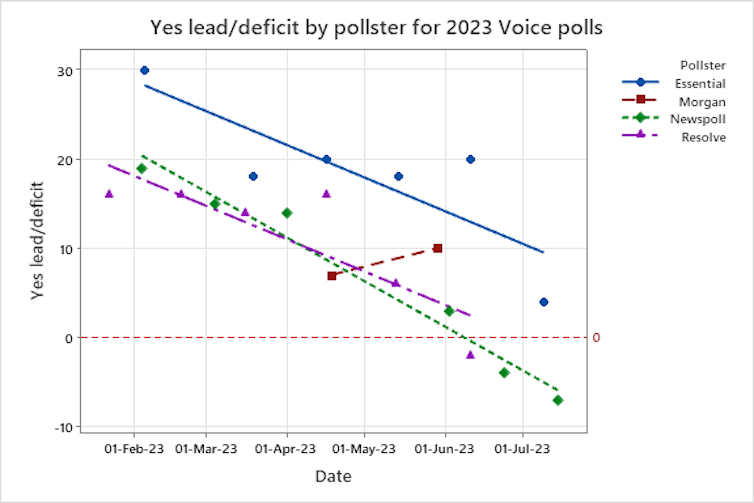
This week’s Newspoll contained further bad news for the government. It had the no vote on 48%, compared to 41% for yes, with 11% “don’t knows”. Last month a Newspoll had support for the no side on 47%, yes on 43%, and 10% in the “don’t know” category.
The latest poll found the yes case doing particularly badly among women (38%) and those in the regions (31%).
Albanese is putting his faith in people becoming more inclined to vote yes when they focus once the campaigning intensifies.
“Most Australians, of course, will focus when the referendum is actually being held. It’s a while to go yet. What we know is that there’s been a considerable no campaign already that is out there just trying to sow doubt,” he said.
“The yes campaign needs to be stronger in putting the case, because we know that referendums in Australia have been difficult to pass – only eight out of 48. But this is a clear and simple proposition for recognition and then listening in order to achieve better outcomes for Indigenous Australians.”
Liberal MP Julian Leeser, who quit the opposition frontbench to campaign for the yes case, on Monday defended leading yes figures from attacks from no campaigners.
He said Thomas Mayo was “being made a trope for the ‘angry Aboriginal man’ who wants to tear down the country.
“The spliced videos of the no case using Thomas Mayo’s words are meant to get you angry, and get you voting against a person, even though this person is not on the ballot paper,” Leeser said.
No campaign strategists have used footage of Mayo previously threatening that politicians would be punished if they ignored an Indigenous advisory body.
Leeser defended Minister for Indigenous Australia Linda Burney from those attacking her as “privileged”.
“We are seeing deeply personal characterisations made about her that would not be made about federal ministers such as Jason Clare, Chris Bowen, or Richard Marles.
“I can’t remember the last time they were called privileged and challenged for somehow rising above their station in life.
“The reality is that Linda has not had a privileged life,” Leeser said, speaking in Wagga Wagga.
On the contrary Burney, born to a single mother and raised by an aunty and uncle in country NSW, “is a reminder of the challenges and difficulties many Indigenous Australians have to overcome every day. And she is a reminder of what can be achieved too,” he said.
Michelle Grattan does not work for, consult, own shares in or receive funding from any company or organisation that would benefit from this article, and has disclosed no relevant affiliations beyond their academic appointment.
The Brown Girl Woke initiative hopes to continue empowering Samoan youth in fighting against the culture of silence over violence.
Founder Maluseu Doris Tulifau says it is essential to support young people in finding their voice and speaking out on these issues.
Tulifau, 29, launched the non-profit feminist organisation in the US in 2014, and used the platform to share her own experience as a survivor of violence. She worked in community development and human rights in California before moving to Samoa.
“I’m a survivor of sexual abuse and when I started to tell my story in America, I was already an activist promoting Pacific Islanders in higher education,” Tulifau said.
Brown Girl Woke founder Maluseu Tulifau (left) delivers supplies to families in Samoa. Image: Wansolwara
In 2018, she began the second chapter of Brown Girl Woke initiative in Samoa where she uncovered the culture of silence and factors that fueled this.
“There are many reasons a lot of us don’t reach that pedigree because of social issues, economic background and our environment around taboo issues and not speaking out.
“I wanted to empower young women and men on these taboo issues in the community, especially on domestic violence and sexual abuse,” Tulifau said.
Suffering in silence The organisation’s humble beginnings motivated her to create an environment of refuge for girls who were suffering in silence.
“I started Brown Girl Woke as a club university for girls to be a part of a support group, with the understanding that they would find solutions, understand patriarchy and why women don’t speak up,” she explained.
Today, Brown Girl Woke is working with primary and secondary schools to educate and create awareness on a range of social issue.
“We now run after school programmes that teach literary, safety kids, climate change, stem and more. We teach about human rights and as a feminist organisation, we also teach about systems that protect gender inequality,” said Tulifau.
“We now have two Brown Girl Woke clubs — at the National University of Samoa and The University of the South Pacific.”
The performing arts has also become a safe space for Brown Girl Woke to raise awareness and provide a voice for young people.
‘Shame or blame’ “We would conduct workshops using songs, dance, spoken word poetry and skits. This is the way to tell their story and feel safe and supported, and unmasking themselves without feeling shame or blame,” she said.
Aside from supporting those affected by violence, Tulifau and her group of activists at BGW have also been helping with a range of issues such as sexual health, youth development, mental health, as well as awareness on the representation of women in Parliament.
The teams have also helped children in intensive care, funding scholarships for undergraduate students and providing monthly groceries for families in need in the country.
Tulifau acknowledged the many donations and contributions to their cause over the years.
Leitu Fereti of Samoa is a final-year journalism student at USP’s Laucala campus. She is also a reporter for Wansolwara, USP Journalism’s flagship student journalist training newspaper and online publication. Asia Pacific Report and Wansolwara collaborate.
Such a pre-commitment system will require pokie users to register for an account linked to a gaming card which will record a limit of how much they are prepared to lose daily, weekly and monthly.
Once that limit has been reached, the system will not allow further gambling.
Because all pokies in the state are linked, this limit will apply across machines and across venues.
Other proposed reforms include:
• slowing down the spin rate of new machines to a minimum of three seconds (currently 2.14 seconds)
• requiring all venues close between 4am and 10am
• reducing the “load up limit” (the amount that can be credited on a poker machine at any one time) to $100, down from the current $1,000
• the transfer of significant education, research funding, and counselling services away from the Victorian Responsible Gambling Foundation.
The government says it wants to undertake “thorough consultation with industry through an implementation working group” before the pre-commitment and reduced load up limits are introduced. This will be a red flag for many public health researchers and practitioners working in gambling harm prevention.
The power of vested interest groups
Harmful commodity industries – tobacco, alcohol, highly processed foods, and gambling – are well resourced. They have a long history of thwarting or watering down important reforms.
The gaming lobby, like the tobacco and alcohol lobbies, are well resourced to campaign against regulation. Shutterstock
For this reason, the World Health Organization urges its members to protect people from the commercial interests of tobacco. This includes rejecting partnerships with industry.
The more time they have, the more likely the gambling industry is to campaign with their considerable strength against these reforms. This worked with great effect in 2010-11 against the then Gillard government’s proposals for a similar harm prevention system.
Misinformation, disinformation and endlessly disputing the scientific evidence are all tobacco industry tactics. They delayed reform for many years.
Consulting with a harmful commodity industry on the design of a new system is like consulting with the fox over the design of the new hen house. It’s not going to produce a solution.
It is also puzzling that the government needs to consult on how to introduce precommitment. A voluntary system called YourPlay has been in place for some years, and provides all necessary functions. However, because it’s voluntary, it has very low uptake, and is potentially stigmatising.
Doing so would provide pokie users with a set of tools to manage their gambling. This will be particularly useful for those concerned about descending into the spiral of harmful gambling. It is a definite preventive intervention.
Measures being introduced locally and overseas
In Tasmania, the Liberal government surprised all by announcing last year that a pokies pre-commitment system would be introduced by 2024.
The system would apply on all machines in the state from December 2024. It would impose maximum limits of $100 per day, $500 per month and $5,000 per year. Notably, the announcement surprised the gambling industry, which had campaigned fiercely for the Liberal Party in the 2018 Tasmanian election. The system will be provided on a fee-for-service model to venue operators.
In NSW, the former Dominic Perrottet coalition went to the 2022 poll with a detailed proposal to introduce a cashless precommitment system for the state’s pokie venues. This was opposed by the gambling industry – notably the [Australian Hotels Association, and the peak body for clubs, ClubsNSW.
Former premier Dominic Perrottet went to the NSW election proposing significant gambling reforms. Shutterstock
The then ALP opposition backed the industry position, promising a trial of cashless pre-commitment, along with some minor reforms. These ban signage for VIP lounges (code for pokie rooms) and reduce the load-up limit on new machines to $500.
Closer to home, the report of the House of Representatives committee inquiring into online gambling in Australia was published recently. It urged the Australian government, among its 31 recommendations, to explore mandatory pre-commitment for online gambling. It also proposed a National Regulator to provide uniform national regulatory standards for gambling.
There’s no doubt momentum for significant reform of gambling is building in Australia. The drivers for this are to be found in the increasing awareness of the nature and extent of gambling harm. This includes the costs of money laundering and associated criminal activity which imposes great harm on the community.
In NSW, the 2022 Crime Commission report into money laundering in pokies clubs and pubs sounded a major alarm. But, more generally, a new focus on using a public health lens to view gambling harm is a major development. The industry’s favoured approach, “responsible gambling”, blames vulnerable individuals for the problem.
A public health view means the focus is on harmful products, and the way they are marketed, made accessible, and cause harm.
Getting the reforms through
If these reforms are implemented in full, they will dramatically reduce harm. What worries the gambling industry is that it will also reduce their profits, probably quite significantly. This is because their best customers are people experiencing significant harm from the use of their products.
For this reason, tackling pokie harm is an obvious step. Unfortunately, the gambling industry will not accept these changes quietly. Past experience suggests a concerted effort from industry to derail the reforms though procrastination and delay.
The Andrews government already has the wherewithal to implement these reforms quickly. If it’s genuinely committed to reducing harm, it should do so, without further delay.
the Victorian Responsible Gambling Foundation, the (former) Victorian Gambling Research Panel, and the South Australian Independent Gambling Authority (the funds for which were derived from hypothecation of gambling tax revenue to research purposes), from the Australian and New Zealand School of Government and the Foundation for Alcohol Research and Education, and from non-government organisations for research into multiple aspects of poker machine gambling, including regulatory reform, existing harm minimisation practices, and technical characteristics of gambling forms. He has received travel and co-operation grants from the Alberta Problem Gambling Research Institute, the Finnish Institute for Public Health, the Finnish Alcohol Research Foundation, the Ontario Problem Gambling Research Committee, the Turkish Red Crescent Society, and the Problem Gambling Foundation of New Zealand. He was a Chief Investigator on an Australian Research Council funded project researching mechanisms of influence on government by the tobacco, alcohol and gambling industries. He has undertaken consultancy research for local governments and non-government organisations in Australia and the UK seeking to restrict or reduce the concentration of poker machines and gambling impacts, and was a member of the Australian government’s Ministerial Expert Advisory Group on Gambling in 2010-11. He is a member of the Lancet Public Health Commission into gambling, and of the World Health Organisation expert group on gambling and gambling harm. He made a submission to and appeared before the HoR Standing Committee on Social Policy and Legal Affairs inquiry into online gambling and its impacts on those experiencing gambling harm.
Keith Rankin, trained as an economic historian, is a retired lecturer in Economics and Statistics. He lives in Auckland, New Zealand.
Analysis by Keith Rankin.
Keith Rankin, trained as an economic historian, is a retired lecturer in Economics and Statistics. He lives in Auckland, New Zealand.
Last week we heard the Labour Party leader, Prime Minister Chris Hipkins, practically rule out changes to the marginal income tax rates or the associated income thresholds. In particular, he indicated that a Hipkins-led government would not proceed with proposals to introduce a tax-free income bracket. And he ruled out new taxes on capital gains or wealth. (Refer Hipkins rules out capital gains tax, wealth tax if Labour re-electedRNZ 12 July 2023.)
Subsequently there was much criticism from the political left, who want ‘redistribution’. The redistributive proposal that was being investigated by Treasury included a new tax-band of zero percent on the first $10,000 of a person’s gross annual earnings. Such a tax cut would benefit all earners – including millionaires – so there would have needed to be a new wealth tax to provide the ‘redistributive’ and ‘affordable’ elements. (Treasury, apparently, did not consider a compensatory change to at least one of the higher tax rates to offset the new bottom rate.)
Important (though unstated) context behind the prime minister’s call is that the concept of ‘redistribution’ is anathema to the majority of politically active Aotearoans, and creates bigger income traps for those who would be touted as the main beneficiaries of redistribution.
Table 1 below summarises the present simple income tax scale, for various amounts of annual gross earnings. Table 2 adds a $10,000 tax-free income zone. (Note that ‘tax on last dollar’ is also known as the marginal tax rate. For example, each dollar earned above $48,000 and below $70,000 is taxed at 30% which may also be called ’30 cents in the dollar’.)
Table 1: New Zealand Income Tax 2023
earnings
tax on last dollar
tax due
tax
$ gross
%
$
%
1,000
10.5
105
10.5
10,000
10.5
1,050
10.5
14,000*
10.5
1,470
10.5
48,000*
17.5
7,420
15.5
70,000*
30.0
14,020
20.0
100,000
33.0
23,920
23.9
180,000*
33.0
50,320
28.0
1,000,000
39.0
370,120
37.0
* ‘threshold’ income
Table 2: Incorporating suggested zero bottom rate
earnings
tax on last dollar
tax due
tax
tax cut
$ gross
%
$
%
$
1,000
0.0
0
0.0
105
10,000*
0.0
0
0.0
1,050
14,000*
10.5
420
3.0
1,050
48,000*
17.5
6,370
13.3
1,050
70,000*
30.0
12,970
18.5
1,050
100,000
33.0
22,870
22.9
1,050
180,000*
33.0
49,270
27.4
1,050
1,000,000
39.0
369,070
36.9
1,050
* ‘threshold’ income
Tables 3 and 4 includes the zero percent bottom rate for the first $10,000 of annual gross income (as in Table 2), but with compensatory increases in income taxes on higher incomes. They show ‘tax cuts’ as change in ‘tax due’ compared to the 2023 amounts shown in Table 1.
Table 3 removes the 30% marginal tax rate, and raises the 33% rate to 33.5%. We see that, in this case, people grossing over $126,000 per year would pay slightly more tax than in 2023. The maximum tax cut – $1,050, which is just over $20 per week – occurs at annual incomes between $10,000 and $48,000; essentially for parttime and fulltime minimum wage workers.
Table 3: Adding middle-rate compensation
earnings
tax on last dollar
tax due
tax
tax cut
$ gross
%
$
%
$
1,000
0.0
0
0.0
105
10,000*
0.0
0
0.0
1,050
14,000*
10.5
420
3.0
1,050
48,000*
17.5
6,370
13.3
1,050
70,000
33.5
13,740
19.6
280
100,000
33.5
23,790
23.8
130
126,000
33.5
32,500
25.8
0
180,000*
33.5
50,590
28.1
-270
1,000,000
39.0
370,390
37.0
-270
* ‘threshold’ income
Table 4 retains the 30% and 33% marginal tax rates, but lowers the threshold for the 39% rate from $180,000 to $100,000. In this case, people grossing over $117,500 per year would pay more tax than in 2023. The maximum tax cut occurs at annual incomes between $10,000 and $100,000.
Table 4: Adding top-rate compensation
earnings
tax on last dollar
tax due
tax
tax cut
$ gross
%
$
%
$
1,000
0.0
0
0.0
105
10,000*
0.0
0
0.0
1,050
14,000*
10.5
420
3.0
1,050
48,000*
17.5
6,370
13.3
1,050
70,000*
30.0
12,970
18.5
1,050
100,000*
33.0
22,870
22.9
1,050
117,500
39.0
29,695
25.3
0
180,000
39.0
54,070
30.0
-3,750
1,000,000
39.0
373,870
37.4
-3,750
* ‘threshold’ income
Table 3 and Table 4 show affordable options which could be introduced without either introducing a wealth tax or raising the top tax rate.
Unconditional Tax Credit (UTC) options
There is another simple common-sense way of addressing the need to ease the burden only on lower income recipients, by creating an annual unconditional tax credit (UTC). This is how it works.
I present three simple versions (Tables 5 to 7), which blend with the present (Table 1) income tax scale, followed (Table 8) by a fourth version which is a universal basic income (UBI).
In these options, nobody is worse-off in terms of income tax, with the ‘tax cuts’ only falling on lower income earners and disproportionately on the lowest income earners. Note, with these tables, that a negative tax amount is fiscally equivalent to an unconditional benefit. (Here, I put ‘tax due’ and ‘tax cuts’ in quotes in the table, because if we regard the UTC as a ‘benefit’, then this becomes a combination of a new benefit outweighing a small increase in income tax. Alternatively, the UTC can be simply categorised as a negative tax.)
Note that where persons are receiving a mainline benefit – job-seeker, assisted-living, superannuation, student allowance – the UTC should be regarded as the first part of that benefit. This means that ‘beneficiaries’ keep the UTC component of their benefits when they come off those benefits. At present, in 2023, all beneficiaries may gain some wages from parttime employment without losing any of their mainline benefit. (This is true to a much greater extent for those whose mainline benefit is ‘superannuation’, which is not clawed back when private earnings are too high. For those with mainline benefits, their parttime wages are presently taxed at 17.5%.)
We should also note that the UTC should be understood as an adult benefit. (I favour defining ‘adult’ for tax purposes as being the same age as the definition used for electoral purposes. Family Tax Credits – aka ‘Working for Families’ – would be payable to parents on behalf of people classed as ‘minors’ for electoral purposes.) A person qualified to receive the UTC may be called an ‘economic citizen’.
Table 5: with annual Unconditional $980 Credit
earnings
tax on last dollar
‘tax due’
tax
‘tax cut’
$ gross
%
$
%
$
1,000
17.5
-805
910
10,000
17.5
770
7.7
280
14,000
17.5
1,470
10.5
0
48,000*
17.5
7,420
15.5
0
70,000*
30.0
14,020
20.0
0
100,000
33.0
23,920
23.9
0
180,000*
33.0
50,320
28.0
0
1,000,000
39.0
370,120
37.0
0
* ‘threshold income’
Table 6: with annual Unconditional $6,980 Credit
earnings
tax on last dollar
‘tax due’
tax
‘tax cut’
$ gross
%
$
%
$
1,000
30.0
-6,680
6,785
10,000
30.0
-3,980
-39.8
5,030
14,000
30.0
-2,780
-19.9
4,250
48,000
30.0
7,420
15.5
0
70,000*
30.0
14,020
20.0
0
100,000
33.0
23,920
23.9
0
180,000*
33.0
50,320
28.0
0
1,000,000
39.0
370,120
37.0
0
* ‘threshold’ income
Table 7: with annual Unconditional $9,080 Credit
earnings
tax on last dollar
‘tax due’
tax
‘tax cut’
$ gross
%
$
%
$
1,000
33.0
-8,750
8,855
10,000
33.0
-5,780
-57.8
6,830
14,000
33.0
-4,460
-31.9
5,930
48,000
33.0
6,760
14.1
660
70,000
33.0
14,020
20.0
0
100,000
33.0
23,920
23.9
0
180,000*
33.0
50,320
28.0
0
1,000,000
39.0
370,120
37.0
0
* ‘threshold’ income
The ‘minimal UTC’ option in Table 5 means that an adult with zero income does not pay net income tax until their income reaches $5,600. The unconditional tax credit is ‘clawed back’ when the ‘tax on last dollar’ increases, that is for incomes over $48,000. The UTC is fully clawed back at an annual income of $55,840. For incomes between $5,600 and $55,840, the UTC exactly offsets higher taxes. After the clawback, the ‘tax due’ in the table is calculated in the same way as in Tables 1 to 4. Compared to 2023, people earning less than $14,000 per year are (slightly) better off and people earning $14,000 or more are as well-off (or as poorly-off as in 2023, for ‘glass-half-empty people!).
The maximum UTC benefit would be just under $20 per week, and would raise the incomes of non-earners in non-beneficiary households. While the UTC benefit amount in the Table 5 case is trivial, nevertheless this is better than the 2023 status quo in that it provides a small new benefit to a few otherwise unrecognised people; and it is unquestionably affordable. Most importantly, any level of UTC establishes a principle; that every economic citizen of a society has a right to some form of citizen’s benefit.
The Table 6 option means that a person does not pay net income tax until their income reaches $23,267. This is close to 20 hours employment per week at the 2023 New Zealand minimum wage. Incomes would be the same as in 2023 for people earning over $48,000. (The unconditional tax credit is fully clawed back at an annual income of $220,889.)
The Table 7 option means that a person does not pay net income tax until their income reaches $27,515. This is close to 23.3 hours employment per week at the 2023 New Zealand minimum wage. Incomes would be the same as in 2023 for people earning over $70,000. (Note that $70,000 is close to the average fulltime wage or salary in Aotearoa New Zealand in 2023. The UTC is fully clawed back at an annual income of $331,333.)
The principal beneficiaries of the UTC are people in some kind of employment – or whose households depend on income from employment (including self-employment) –who earn too much to qualify for an unabated mainline benefit. (We should note, however, that the Table 6 and Table 7 options would slightly increase taxes on most people who are receiving wages and unabated mainline benefits. In the event that Table 6 or Table 7 were implemented in 2024, this problem could be ameliorated by adopting the Table 5 rates as a special option for working beneficiaries.)
If we take the dynamic benefits – increased opportunities and incentives for beneficiaries to undertake substantial parttime employment, plus decreased administration arising from fewer people seeking mainline benefits – then Table 7 becomes an affordable option; an option which facilitates a flexible work environment and facilitates contract self-employment (as in the creative sector). This UTC option removes the existing dangerous chasm between underclass beneficiaries (who find themselves trapped close to the poverty-line) and the unionised labour force.
Table 7 gives little extra to persons currently earning over $48,000 – the minimum wage for a 40-hour-a-week worker; or the living wage for a 35-hour-a-week worker. But it cushions them substantially if circumstances – including a recession – reduce their hours per week of paid work. A UTC of $9,080 protects them from the chasm of poverty and homelessness that beckons if or when the present “technical” recession begins to bite.
Universal Basic Income option
If we extend the unconditional tax credit by taxing all income at 39%, then Table 8 applies.
Table 8: with $19,880 Universal Basic Income (UBI)
earnings
tax on last dollar
‘tax due’
tax
‘tax cut’
$ gross
%
$
%
$
1,000
39.0
-19,490
19,595
10,000
39.0
-15,980
-159.8
17,030
14,000
39.0
-14,420
-103.0
15,890
48,000
39.0
-1,160
-2.4
8,580
70,000
39.0
7,420
10.6
6,600
100,000
39.0
19,120
19.1
4,800
180,000
39.0
50,320
28.0
0
1,000,000
39.0
370,120
37.0
0
$19,880 represents a generous UBI, equivalent to $382.31 weekly. We note that people already earning $180,000 or more would have no change to their after-tax incomes; the person on $180,000 would pay income tax (net of their UBI) at 28% of their gross earnings, same as under the 2023 tax scale in Table 1. Nobody is worse off. With its associated ‘flat-rate’ income tax, the UBI is not subject to any clawback; there are no tax-threshold incomes.
The UBI would almost replace all mainline benefits; for example, all mainline benefits which amount to less than $382.31 per week. The first $19,880 of all mainline benefits would now become unconditional publicly-sourced income, with only grants over and above this being regarded as income transfers. (These higher grants would apply to single superannuitants, some single-parent households – depending on the dynamics of Child Support payments from absent parents, and the contributions of step-parents – and some persons with disabilities.)
In addition, and again on grounds of affordability, Working for Families tax credits could be discontinued. The central principle here would be, like the oxygen masks on airplanes, that children would be helped through the unconditional support of their parents.
There would be substantial reductions in administrative costs with respect to the micro-management (and policy management) of beneficiaries, tertiary students, and working families. Government departments such as MSD and IRD could substantially reduce their payrolls. Many people directly or indirectly employed by the government, some presently on generous salaries, could pivot to productive self-employment, in many cases using their savings as capital.
In addition to bureaucratic savings, there would be less private-sector work to do in the areas of tax avoidance, investment planning, and corporate law. The re-incentivisation created by the removal of tax brackets would enable some in the highly-paid workforce to redeploy their undoubted talents into activities which create more societal added-value. As David Graeber (author of Bullshit Jobs) might have said, ‘more productivity, less bullshit’.
As mooted Universal Basic Incomes go, the one shown in Table 8 is on the generous side. But it meshes neatly with New Zealand’s existing taxation infrastructure. It enables a substantial reduction in the size and scope of government in New Zealand. And it progresses democracy. A fullscale democracy must confer on all its taxpayer citizens a return on the public equity which has arisen as a result of past economic growth.
Conclusion
A universal basic income as in Table 8 will be a step too far for Aotearoa New Zealand in 2024 or 2025. But a unconditional tax credit as in Table 7 also meshes neatly with New Zealand’s existing taxation infrastructure, and is not a step too far. For most of New Zealand’s labour force and all of New Zealand’s elites, Table 7 would mean no change, ‘business as usual’. Rather, it attends to the underclass rumblings below.
The agitation for a comprehensive wealth tax will not go away. Those who stand to be affected by a wealth tax or a capital gains tax should be eager to embrace Table 7 as a pre-emptive alternative means to address poverty and income traps.
If the UTC option is seen – by progressives and others – as a progressive step too far, there are always Tables 3 and 4 to consider. Table 3 in particular is clearly better than the 2023 status quo. And is unquestionably affordable.
*******
Keith Rankin (keith at rankin dot nz), trained as an economic historian, is a retired lecturer in Economics and Statistics. He lives in Auckland, New Zealand.
Review: Jailbaby, directed by Andrea James, Griffin Theatre Company
Jailbaby – a new play by Suzie Miller – takes a steely look at what happens to an 18-year-old when his life collides with a criminal justice system that is bad and getting worse.
Jailbaby follows the phenomenal success of Prima Facie, which scrutinised the law’s failure to protect female victims of sexual assault. Following its premiere at Sydney’s Griffin Theatre Company in 2019, Prima Facie had seasons in London and New York, winning best new play at the United Kingdom’s Olivier Awards.
A one-time lawyer with the Aboriginal Legal Service and Shopfront Youth Legal Centre, Miller’s plays venture into dark places few want to confront.
This new play focuses on jail rape, a crime that is understudied, under scrutinised and underreported. It takes place in an environment where seeking help or speaking up has the opposite of the intended effect.
AJ is a wide-eyed teenager (compellingly played by Anthony Yangoyan). His mother (Lucia Mastrantone) is a recovering drug addict. His violent father disappeared long ago. They live in social housing. They struggle.
AJ has a long record of troubled behaviour, mostly property crimes, which has seen him spend time in juvenile detention. At 18, AJ is highly impressionable – even gullible – and under the thumb of some older, nastier criminals.
When he needs $500 to go on a soccer trip he thinks will transform his life, he chooses the wrong way to get it.
He imagines the “massive smart TV, MacBooks, iPad” he will stuff into a blue IKEA bag “like a Christmas stocking.”
“Ka-ching!” he thinks.
Of course, it doesn’t turn out like that.
AJ is compellingly played by Anthony Yangoyan. Clare Hawley/Griffin Theatre Company
Imagined sacred space
The courtroom of the public imagination is like the last sacred space in a secular society.
It is presided over by judges beyond the reach of criticism. People readily imagine a defendant’s case will be carefully considered; that everybody has a lawyer in a sharp suit who will make eloquent pleas and ask searching questions.
In reality, the lower courts are crowded and chaotic. A duty solicitor quoted in recent research paper likened the civil courts to a “zoo”. The criminal courts are worse.
Miller’s play rips right through this veil of illusion.
Despite his age, AJ fails to get bail. He is tried remotely via prison video link. The court appears as a tiny square on a computer screen.
People readily imagine a defendant’s case will be carefully considered. In reality, the lower courts are crowded and chaotic. Clare Hawley/Griffin Theatre Company
AJ’s lawyer (Mastrantone) tries. But she is already disassociating herself from what she knows will happen. Perhaps this is just the way that lawyers cope.
AJ still thinks, by some miracle, he’ll get off with a warning. His mind is on his upcoming football training session. He doesn’t think the court will take away his big chance to change his life. But, of course, they do.
And in jail, AJ loses everything.
Incarceration in Australia
The back cover of the published script says the play pinpoints “the exact moment when it all goes so, so wrong” for AJ.
But that moment happened long before he took the jersey or the iPhone. It happened long before AJ was born, when politicians decided locking up more – and younger – people made them popular.
Australia incarcerates a greater percentage of its population than China, Guatemala or the United Kingdom. The United States leads the world in per capita incarceration, but Australia has more people incarcerated who have not been tried or sentenced.
Australian jails are brutalising. They ought to be a measure of last resort. But young people can be sent to jail simply because there are few diversionary programs in regional, remote or rural areas, or because rehabilitation programs may be full.
Lower court judgements are rarely published. On busy days, if you blink, you will miss it.
Some lawyers argue this protects the “privacy” of the accused. But when an 18-year-old like AJ is sent to adult jail, that kid has a lot more than “privacy” to worry about.
Jailbaby is a high impact theatrical work. It contains graphic descriptions of sexual assault by straight men against younger male prisoners. The level of detail written into these descriptions is risky, but this raw brutality is the play’s strength.
Like a lawyer explaining legal proceedings to a client in the courtroom, Miller tells the audience what is likely to happen to AJ at every stage. This foreknowledge is horrifying, because it makes the audience complicit in the action as it unfolds.
Three actors share 14 roles. Clare Hawley/Griffin Theatre Company
Yet, ultimately it doesn’t quite come together. One of the story strands is underdeveloped, and the middle-class characters (whose home AJ burgles) often feel like uncomfortable caricatures.
There are 14 roles shared between three actors, and perhaps this requires a level of dexterity that contributes to uneven performances.
An ominous inevitability ties the best parts of the play together. We are left with a gut-wrenching sense that, for kids like AJ, the justice system has nothing to do with justice.
Jailbaby is at Griffin Theatre Company, Sydney, until August 19.
The National Sexual Assault, Family and Domestic Violence Counselling Line – 1800 RESPECT (1800 737 732) – is available 24 hours a day, seven days a week for any Australian who has experienced, or is at risk of, family and domestic violence and/or sexual assault.
Camilla Nelson does not work for, consult, own shares in or receive funding from any company or organisation that would benefit from this article, and has disclosed no relevant affiliations beyond their academic appointment.
It made headlines around the world when the much-hyped Barbie movie contributed to a world shortage of fluorescent pink paint.
But that’s just the tip of the iceberg. When movies or TV shows become cultural phenomena, toymakers jump on board. And that comes with a surprisingly large amount of plastic waste. Think of the fad for Baby Yoda dolls after the first season of The Mandalorian in 2020. When the Barbie movie comes out this week, it’s bound to trigger a wave of doll purchases over and above the 60 million Barbies already sold annually.
Toys are the most plastic-intensive consumer goods in the world, according to a 2014 United Nations Environment Program report.
Worse, very few toys are recycled. That’s often because they can’t be – they’re made of a complex mixture of plastics, metals and electronics. When children get bored, these toys often end up in landfill.
Plastic fantastic: Barbie dolls for sale at an open air market in Thailand. Panya Anakotmankong/Shutterstock
The toll of the dolls
Consider a single Barbie doll. What did it cost to create?
Before the US-China trade war, half the world’s toys were manufactured in Dongguan, a city in China. That included one in three Barbie dolls.
American researchers last year quantified what each doll costs the climate. Every 182 gram doll caused about 660 grams of carbon emissions, including plastic production, manufacture and transport.
The researchers analysed seven other types of toys, including Lego sets and Jenga. By my calculations, emissions on average across all these types of toys are about 4.5 kilograms per kilogram of toys.
Scaled up, this is considerable. In the US, it’s estimated emissions from the plastics industry will overtake those from coal within seven years.
So the question is, how can we cut our emissions to zero as fast as possible to ensure we and our children have a liveable climate – without putting a blanket ban on plastic toys? After all, toys and entertainment add happiness to our lives.
To date, there has been little focus on making the toy industry more sustainable. But it shouldn’t escape our notice.
Toy manufacturers can – and should – use low carbon materials and supply chains, and focus on making toys easily dissembled. Toys should be as light as possible, to minimise transport emissions. And battery-powered toys should be avoided wherever possible, as they can double a toy’s climate impact and turn a plastic waste problem into an electronic waste problem. To their credit, some toymakers have cut back on plastic in their packaging, given packaging immediately becomes waste.
In a welcome move, the maker of Barbie, Mattel, launched their own recycling scheme in 2021, allowing buyers to send back old toys to be turned into new ones. This scheme isn’t available in Australia, however.
Toymakers can help at the design stage by choosing the materials they use carefully. Governments can encourage this by penalising cheap, high-environmental-impact plastics. We can look to the European and American bans on BPA-containing plastics in infant milk bottles as an example of what’s possible. Governments can set up effective recovery and recycling systems able to handle toys.
Toys can easily become waste. Shutterstock
Some plastic-dependent brands such as Lego are unilaterally moving away from petrochemical-based plastic in favour of sugarcane-based plastic. But it’s not a short-term project.
While Barbie dolls had an uptick in popularity during the pandemic years – and will no doubt have another surge alongside the movie – longer-term trends are dampening plastic toy impact. While movies in the 1980s were often “toyetic” – conceived with an eye to toy sales – the trend is on the wane.
Gaming, for instance, has moved to centre stage for many older children. While gaming produces e-waste streams, it is also a likely cause of the longer-term fall in popularity of plastic toys.
What should we do?
If you’re a parent or an indulgent grandparent, it’s hard to avoid buying toys entirely – especially if your child gets obsessed with Barbie dolls after seeing the movie. So what should you do?
For starters, we can avoid cheap and nasty toys which are likely to break very quickly. Instead, look for toys which will last – and which will lend themselves to longer-term creative play. Think of the enduring popularity of brick-based toys or magnetic tiles. Look for secondhand toys. And look for toys made of simpler materials able to be recycled at the end of their lives – or even for the Barbie dolls made out of ocean plastics.
Alan Pears does not work for, consult, own shares in or receive funding from any company or organisation that would benefit from this article, and has disclosed no relevant affiliations beyond their academic appointment.
Source: The Conversation (Au and NZ) – By Deirdre McGhee, Researcher and Senior Lecturer, University of Wollongong, APA Sports Physiotherapist, University of Wollongong
In the to and fro of daily life, an accidental knock to the breast can hurt for a moment. But in the push and shove on the sporting field – such as the upcoming 2023 FIFA Women’s World Cup – a blow to the breast can cause breast pain, swelling and bruising.
Coaches, health clinicians and sporting organisations don’t know enough about this silent, female-specific injury. And female athletes involved in sports like soccer or football need to be aware of the potential dangers. Our recent review paper outlines how risks vary as breasts change in structure and function over a lifetime – through puberty, pregnancy, lactation, menopause and following surgery.
Proper management of breast injury involves taking care of breast tissue during recovery and empowering athletes to make informed decisions about their participation in sports, work and leisure activities. First, we need to get a better sense of why and how often such injuries happen.
As a result, most injuries are not assessed or treated even though they cause symptoms that can last for weeks, negatively affect athletic and work performance and have long-term consequences, including:
breast fat necrosis (or tissue death), that can result in fibrous lumps within the breast
breast deformities and asymmetries from either the halting of breast development during puberty or the bursting of breast implants, with both requiring surgery if correction is sought
damage to the milk ducts of lactating breasts that can affect breastfeeding.
Female athletes also suffer from frictional skin injuries from bras, and from breast pain associated with hormonal changes or excessive breast movement.
But injury does not cause breast cancer
One of the myths about breast injuries is an assumed link with breast cancer. Though an injury may draw attention to previously formed breast lumps or cause a new one, female athletes can be assured there is no evidence breast injuries cause breast cancer.
However, one of the long-term consequences of breast injuries, breast fat necrosis, can be challenging for doctors to distinguish from breast cancer. Female athletes must understand the importance of reporting breast injuries so they can be treated appropriately to minimise the risk of long-term effects.
To effectively monitor breast tissue recovery after a breast injury, female athletes also need to be familiar with the “normal” look and feel of their breasts because women’s breasts are not all the same. This practice of breast self- examination will also assist with the early detection and treatment of breast cancer, which affects one in eight women.
As women’s participation in sports that have been traditionally dominated by men increases, greater awareness about breast injuries is needed. Sporting organisations like FIFA have a duty of care to educate their female players, coaches and medical staff about breast injuries and improve their management and prevention.
Although female-specific, breast-protective garments are commercially available, there is currently no published evidence that they can decrease impact on the breast. Many female athletes and workers wear breast-protective equipment and body armour designed for the male torso. These may not fit women properly. Further research is required to investigate how effective body armour and breast-protective equipment is and to improve their design and fit for the wide range of female breast and torso shapes.
For women’s football and other sports, there needs to be better injury surveillance and records. Doctors, physiotherapists and sports trainers associated with female football teams need to trained to assess and treat breast injuries.
Sporting organisations like FIFA have made progress in supporting and promoting women to return to sports post-pregnancy and breastfeeding. But it is equally essential women are aware of the risks of damaging the delicate and enlarged glandular tissue within their breasts and their breastfeeding capability.
What’s next?
More research is needed to know how frequently breast injuries occur in sports like football, how severe they are or how frequently long-term changes occur. Because the cause and type of injury will be specific to the sport played, injury surveillance in each sport is needed.
But greater awareness and education about breast injuries should not deter women from participating in sport because they can be treated. Female players have worked hard and long to have the opportunity and skills to be involved in football at the World Cup level.
We hope our review and future research can act as a catalyst for sporting organisations like FIFA to raise awareness, educate and investigate breast injuries in women’s football so they can develop evidence-based guidelines, management and prevention strategies. The goal of these should be to maximise long-term breast health, athletic performance and women’s participation at all levels of sporting competition.
Deirdre McGhee no recibe salario, ni ejerce labores de consultoría, ni posee acciones, ni recibe financiación de ninguna compañía u organización que pueda obtener beneficio de este artículo, y ha declarado carecer de vínculos relevantes más allá del cargo académico citado.
Most of us go online multiple times a day. About half of 18–29 year olds surveyed in a 2021 Pew Research Study said they are “almost constantly” connected.
How are we to make sense of this significant digital dimension of modern life?
Many questions have rightly been asked about its broader consequences for society and the economy. But there remains a simpler question about what motivates people across a range of ages, occupations and cultures to be so absorbed in digital connection.
And we can turn this question on ourselves: why am I online?
What are we doing when we go online?
As the American sociologist Erving Goffman pointed out, asking “What is it that’s going on here?” about human behaviour can yield answers framed at different levels. These range from our superficial motives to a deeper understanding of what we are “really” doing.
Sometimes we might be content to explain our online behaviour in purely practical terms, like checking traffic routes or paying a bill. Other times we might struggle to articulate our reasons for going or remaining online.
Why are we continually looking at our phones or computers, when we could be getting on with physical tasks, or exercising, or meditating, or engaging more fully with the people who are physically around us?
The ever-present need to manage our emotions
As researchers of human-computer interaction, we are exploring answers in terms of the ever-present need to manage our emotions. Psychologists refer to this activity as emotion regulation.
Theories of the nature and function of emotions are complex and contested. However, it is safe to say they are expressions of felt needs and motivations that arise in us through some fusion of physiology and culture.
During a typical day, we often feel a need to alter our emotional state. We may wish to feel more serious about a competitive task or more sad at a funeral. Perhaps we would like to be less sad about events of the past, less angry when meeting an errant family member, or more angry about something we know in our heart is wrong.
Digital emotion regulation is becoming increasingly common in our everyday lives.
One way to understand our frequent immersions into online experience is to see them as acts within a broader scheme of managing such daily emotional demands. Indeed, in earlier research we found up to half of all smartphone use may be for the purpose of emotional regulation.
Digital technologies are becoming key tools of emotion regulation
Over the pandemic lockdowns of 2020–21 in Melbourne, Australia, we investigated how digital technologies are becoming key tools of emotion regulation. We were surprised to find that people readily talked of their technology use in these emotion-managing terms.
Occasionally, this involved specially designed apps, for mindfulness and so on. But more often people relied on mundane tools, such as using social media alongside Zoom to combat feelings of boredom or isolation, browsing for “retail therapy”, playing phone games to de-stress, and searching online to alleviate anxiety about world events.
Playing games to unwind after work is one of many ways people use digital technology for emotion regulation. Shutterstock
To some extent, these uses of digital technology can be seen as re-packaging traditional methods of emotion management, such as listening to music, strengthening social connections, or enjoying the company of adorable animals. Indeed, people in our study used digital technologies to enact familiar strategies, such as immersion in selected situations, seeking distractions, and reappraising what a situation means.
However, we also found indications that digital tools are changing the intensity and nature of how we regulate emotions. They provide emotional resources that are nearly always available, and virtual situations can be accessed, juxtaposed and navigated more deftly than their physical counterparts.
Some participants in our study described how they built what we called “emotional toolkits”. These are collections of digital resources ready to be deployed when needed, each for a particular emotional effect.
A new kind of digital emotional intelligence
None of this is to say emotion regulation is automatically and always a good thing. It can be a means of avoiding important and meaningful endeavours and it can itself become dysfunctional.
In our study of a small sample of Melburnians, we found that although digital applications appeared to be generally effective in this role, they are volatile and can lead to unpredictable emotional outcomes. A search for energising music or reassuring social contact, for example, can produce random or unwanted results.
Most of us go online multiple times a day. About half of 18–29 year olds surveyed in a 2021 Pew Research Study said they are “almost constantly” connected.
How are we to make sense of this significant digital dimension of modern life?
Many questions have rightly been asked about its broader consequences for society and the economy. But there remains a simpler question about what motivates people across a range of ages, occupations and cultures to be so absorbed in digital connection.
And we can turn this question on ourselves: why am I online?
What are we doing when we go online?
As the American sociologist Erving Goffman pointed out, asking “What is it that’s going on here?” about human behaviour can yield answers framed at different levels. These range from our superficial motives to a deeper understanding of what we are “really” doing.
Sometimes we might be content to explain our online behaviour in purely practical terms, like checking traffic routes or paying a bill. Other times we might struggle to articulate our reasons for going or remaining online.
Why are we continually looking at our phones or computers, when we could be getting on with physical tasks, or exercising, or meditating, or engaging more fully with the people who are physically around us?
The ever-present need to manage our emotions
As researchers of human-computer interaction, we are exploring answers in terms of the ever-present need to manage our emotions. Psychologists refer to this activity as emotion regulation.
Theories of the nature and function of emotions are complex and contested. However, it is safe to say they are expressions of felt needs and motivations that arise in us through some fusion of physiology and culture.
During a typical day, we often feel a need to alter our emotional state. We may wish to feel more serious about a competitive task or more sad at a funeral. Perhaps we would like to be less sad about events of the past, less angry when meeting an errant family member, or more angry about something we know in our heart is wrong.
Digital emotion regulation is becoming increasingly common in our everyday lives.
One way to understand our frequent immersions into online experience is to see them as acts within a broader scheme of managing such daily emotional demands. Indeed, in earlier research we found up to half of all smartphone use may be for the purpose of emotional regulation.
Digital technologies are becoming key tools of emotion regulation
Over the pandemic lockdowns of 2020–21 in Melbourne, Australia, we investigated how digital technologies are becoming key tools of emotion regulation. We were surprised to find that people readily talked of their technology use in these emotion-managing terms.
Occasionally, this involved specially designed apps, for mindfulness and so on. But more often people relied on mundane tools, such as using social media alongside Zoom to combat feelings of boredom or isolation, browsing for “retail therapy”, playing phone games to de-stress, and searching online to alleviate anxiety about world events.
Playing games to unwind after work is one of many ways people use digital technology for emotion regulation. Shutterstock
To some extent, these uses of digital technology can be seen as re-packaging traditional methods of emotion management, such as listening to music, strengthening social connections, or enjoying the company of adorable animals. Indeed, people in our study used digital technologies to enact familiar strategies, such as immersion in selected situations, seeking distractions, and reappraising what a situation means.
However, we also found indications that digital tools are changing the intensity and nature of how we regulate emotions. They provide emotional resources that are nearly always available, and virtual situations can be accessed, juxtaposed and navigated more deftly than their physical counterparts.
Some participants in our study described how they built what we called “emotional toolkits”. These are collections of digital resources ready to be deployed when needed, each for a particular emotional effect.
A new kind of digital emotional intelligence
None of this is to say emotion regulation is automatically and always a good thing. It can be a means of avoiding important and meaningful endeavours and it can itself become dysfunctional.
In our study of a small sample of Melburnians, we found that although digital applications appeared to be generally effective in this role, they are volatile and can lead to unpredictable emotional outcomes. A search for energising music or reassuring social contact, for example, can produce random or unwanted results.
New Zealand Parliament Buildings, Wellington, New Zealand.
New Zealand Politics Daily is a collation of the most prominent issues being discussed in New Zealand. It is edited by Dr Bryce Edwards of The Democracy Project.
Source: The Conversation (Au and NZ) – By Adrian Beaumont, Election Analyst (Psephologist) at The Conversation; and Honorary Associate, School of Mathematics and Statistics, The University of Melbourne
Dan Himbrechts/AAP
A federal Newspoll, conducted July 12–15 from a sample of 1,570, gave Labor a 55–45 lead after preferences, a one-point gain for Labor since the previous Newspoll, three weeks ago. Newspoll figures are from The Poll Bludger.
Labor’s gain came despite a two-point fall in their primary vote to 36%, with the Coalition also down one to 34%. The Greens and One Nation benefitted, with both up a point, to 12% and 7% respectively, and all Others were also up one to 11%.
In the last two Newspolls, Labor may have been unlucky in the two party rounding given the primary votes. This time Labor was probably lucky to get their 55–45 lead from the primary votes.
Prime Minister Anthony Albanese’s ratings were nearly unchanged, with 52% satisfied (steady) and 41% dissatisfied (down one), for a net approval of +11. Opposition Leader Peter Dutton’s net approval was down two points to -13. Albanese led Dutton as better PM by 54–29, up from 52–32 previously.
The graph below shows Albanese’s net approval in Newspoll since the first Newspoll of this term in July 2022. Newspoll data is from The Poll Bludger’s BludgerTrack. Points on the graph are individual poll results, with a trend line fitted using the statistical software Minitab.
Albanese net approval in Newspoll.
Albanese’s net approval is well down from the over +30 he had in late 2022. It’s likely concerns about high inflation and interest rates have contributed to Albanese’s slide.
While Labor’s lead in Newspoll increased, it dropped in last week’s Essential and Morgan polls. Overall Labor continues to hold a commanding poll lead.
Support for the Indigenous Voice to parliament dropped again in Newspoll, with “no” to the Voice now ahead by 48–41, from a 47–43 “no” lead three weeks ago. Here is an updated version of the 2023 Voice polls by pollster graph that I first published last week.
Voice polls.
Morgan poll: 54.5–45.5 to Labor
In last week’s Morgan federal poll, conducted July 3–9 from a sample of 1,410, Labor led by 54.5–45.5, a 1.5-point gain for the Coalition since the previous week. Primary votes were 35% Coalition, 34.5% Labor, 12.5% Greens and 18% for all Others.
LNP holds Fadden at byelection with small swing to LNP
At Saturday’s federal byelection for the Queensland seat of Fadden, the Liberal National Party defeated Labor by 63.2–36.8, a 2.5% swing to the LNP since the 2022 federal election.
Primary votes were 48.9% LNP (up 4.3%), 22.1% Labor (down 0.3%), 8.9% One Nation (up 0.3%), 7.4% Legalise Cannabis (new) and 6.2% Greens (down 4.5%). None of the remaining eight candidates won more than 1%. This was a dismal result for the Greens, while One Nation failed to benefit from the absence of the UAP (6.6% in 2022).
Analyst Kevin Bonham said the average swing at an opposition-held seat at a byelection that is contested by both major parties is about 1% to the opposition. The average swings in government-held seats are higher owing to the loss of the sitting MP’s personal vote. So the LNP outperformed the average.
In April, Labor’s gain of Aston at a federal byelection was only the second time a federal government had gained a seat from the opposition at a byelection. The two party swing to Labor at Aston of 6.4% contrasts with the small swing to the LNP in Fadden.
Aston is located in metropolitan Melbourne, and Labor’s upset win was a continuation of a trend against the Liberals in Australia’s big cities. The Liberals lost four Melbourne seats at the 2022 election, two to Labor and two to teal independents.
Fadden is based on the Gold Coast and is not part of Brisbane. While Australia’s big cities are trending to the left, the rest of Australia is not. Overall, the left trend in our big cities is favourable to Labor, owing to the high percentage of Australia’s population that lives there.
Turnout at the Aston byelection was 85.6%, while in Fadden turnout is currently 67.5% and is likely to only make the low 70s.
UK byelections and Spanish election upcoming in next week
I wrote for The Poll Bludger last Wednesday that there will be three United Kingdom byelections in Conservative-held seats this Thursday. While the Conservatives won all three seats by large margins at the 2019 election, there has been a massive national swing to Labour since.
The Spanish election is next Sunday, and the right-wing parties (People’s and Vox) are expected to defeat the governing left-wing parties (Socialists and Sumar). The right is also ahead in New Zealand, where an election is due in October. The June Greek election was a disaster for the left.
Adrian Beaumont does not work for, consult, own shares in or receive funding from any company or organization that would benefit from this article, and has disclosed no relevant affiliations beyond their academic appointment.
Anyone who has travelled by air in the past ten years will know how stressful airports can be.
You didn’t leave home as early as you should have. In the mad rush to get to your gate, the security screening seems to slow everything down. And to add insult to injury, you’re met with the finicky request: “laptops out of bags, please”.
But what does your laptop have to do with security?
The day that changed air travel forever
Airport security changed dramatically after the terrorist attacks in the US on September 11 2001. Before 9/11, you could pass through security with a carry-on bag full of everything you might need for your holiday, including a knife with a four-inch blade. Indeed, that’s how the 9/11 attackers brought their weapons on board.
After 9/11, screening processes around the world changed overnight. In the US, private security contractors being paid a minimum wage were swapped out for a federalised program with highly trained security personnel. Anything that could be considered a weapon was confiscated.
Around the world, travellers were suddenly required to remove their shoes, belts and outerwear, and take out their phones, laptops, liquids and anything else that could be used as part of an improvised explosive device.
This lasted for several years. Eventually, more advanced screening methods were developed to effectively identify certain threats. Today, some countries don’t require you to remove your shoes when passing through security.
So why must you still take your laptop out?
Airport scanners have come a long way
The machine your bags and devices pass through is an X-ray machine.
The main reason you have to remove your laptop from your bag is because its battery and other mechanical components are too dense for X-rays to penetrate effectively – especially if the scanning system is old. The same goes for power cords and other devices such as tablets and cameras.
Due to the size and construction of components in your laptop, X-rays can’t penetrate them as well as other materials. Shutterstock
With these items in your bag, security officials can’t use the screened image to determine whether a risk is present. They’ll have to flag the bag for a physical search, which slows everything down. It’s easier if all devices are removed in the first place.
A laptop inside a bag can also shield other items from view that may be dangerous. Scanning it separately reveals its internal components on the screen. In some cases you might be asked to turn it on to prove it’s an actual working computer.
With newer multi-view scanning technology, security officials can view the bag from multiple angles to discern whether something is being covered up, or made to look like something else. For instance, people have tried to mix gun parts with other components in an effort to pass checked baggage screening.
Some airports have upgraded 3D scanning that allows travellers to pass their bags through security without having to remove their laptops. If you’re not asked to take out your laptop, it’s probably because one of these more expensive systems is being used.
Nonetheless, amping up the technology won’t remove the lag caused by airport screenings. Ultimately, the reason these are a major choke point is because of the speed at which staff scan the imagery (which dictates the speed of the conveyor belt).
Unless we find a way to automate the entire process and run it with minimal human supervision, you can expect delays.
What about body scanners?
But your bags aren’t the only thing getting scanned at airport security. You are too!
The tall frame you walk through is a metal detector. Its purpose is to uncover any weapons or other illegal objects that may be concealed under your clothes. Airport metal detectors use non-ionising radiation, which means they don’t emit X-rays.
The larger body scanners, on the other hand, are a type of X-ray machine. These can be active or passive, or a combination of both.
Passive scanners simply detect the natural radiation emitted by your body and any objects that might be concealed. Active scanners emit low-energy radiation to create a scan of your body, which can then be analysed.
The kind of machine you walk through will depend on where in the world you are. For instance, one type of active body scanner that emits X-rays in what’s called “backscatter technology” is used widely in the US, but is banned in Australia and the European Union, where only non-ionising technology can be used.
Another type of scanner emits lower-energy millimetre waves, instead of X-rays, to image the passenger. Millimetre wave frequencies are considered to be non-ionising radiation.
Millimetre wave scanners usually produce a 3D scan of a person. Wikimedia
AI seems to be all around us lately, and our airports are no exception. Advancements in AI systems stand to transform the future of airport security.
For now, human reviewers are required to identify potential threats in scanned images. However, what if an advanced AI was trained to do this using a database of images? It would do so in a fraction of the time.
Some airports are already using advanced computed tomography (CT) scanners to produce high-definition 3D imagery. In the future, this technology could be further enhanced by AI to detect threats at a much faster rate.
Hypothetically, CT scans could also be used for both humans and their baggage. Could this allow travellers to walk through a body scanner while carrying their bags? Possibly.
Until then, you should probably try your best to leave the house on time.
Doug Drury does not work for, consult, own shares in or receive funding from any company or organisation that would benefit from this article, and has disclosed no relevant affiliations beyond their academic appointment.
Source: The Conversation (Au and NZ) – By David Rowe, Emeritus Professor of Cultural Research, Institute for Culture and Society, Western Sydney University
The 2023 FIFA Women’s World Cup kicks off this Thursday night, the first football world cup hosted by Australia and Aotearoa New Zealand.
New Zealand opens the tournament by taking on Norway in Auckland, while Australia’s Matildas will play Ireland in front of an anticipated 80,000 fans at a sold out Stadium Australia in Sydney.
Despite the persistent delusion of some that politics should be kept out of sport, it has always been suffused with political calculations and meanings. The major question is not whether but what kinds of politics will be played and by whom.
In the lead up to this tournament, world football’s governing body FIFA announced a suite of eight armbands that could be chosen under its Football Unites the World program. Permitted selections, in partnership with various United Nations agencies, include “Unite for Indigenous Peoples” and “Unite for Gender Equality”.
But notably, the OneLove armband associated with LGBTIQA+ rights isn’t among them. That was banned at last year’s Men’s World Cup in Qatar, with captains including England’s Harry Kane threatened with a yellow card if they wore it as planned.
Unlike in Qatar, homosexuality is not illegal in these host countries, but FIFA’s “extensive consultation with stakeholders including players and the 32 participating member associations” produced the same outcome.
Among the latter are three African countries (Morocco, Nigeria and Zambia) where homosexuality is criminalised, as it is in stakeholders including Middle Eastern nations such as Saudi Arabia that are increasingly influential in football and other world sports.
Australia’s captain Sam Kerr has been deprived, to her regret, of the opportunity to make a statement with a rainbow-coloured armband.
But 44 players have taken the chance to cooperate with climate advocacy groups Common Goal and Football For Future to help compensate for the environmental impact of their world cup related flights.
Already it’s clear that politics will vie with passes and penalties as major talking points at the biggest sport event in the region since the 2000 Sydney Olympics.
Indeed, when the esteemed Brazilian team flew into Brisbane two weeks before the first ball would be kicked, their plane’s tail bore pictures of Iranian human rights activists Mahsa Amini and Amir Nasr Azadani. The plane’s body also declared, “No woman should be forced to cover her head” and “no man should be hanged for saying this”.
The BBC podcast Powerplay: The House of Sepp Blatter excruciatingly details the disgrace of the former FIFA President. Just before Blatter was re-elected in Zurich in 2015, the world’s media were treated to the spectacle of FIFA executives being arrested and taken from their hotel under large bedsheets (Blatter then resigned just days after being re-elected).
His successor Gianni Infantino, the object of much mockery after a pre-Qatar World Cup speech identifying with the oppressed, promised to clean up FIFA’s act and reinvent itself as a force for global good. Promoting gender equality in and through football is one such aim. This world cup, both the first hosted by two confederations (Asia and Oceania) and the first in the southern hemisphere for women, seems perfectly to fit that bill.
It undoubtedly has significant geopolitical implications. With the Pacific region the focus of a contest for influence between the US and its allies and China, sport has emerged as a key bargaining chip. Money for sport aid, development and infrastructure has been flowing into the Pacific islands from all directions.
Australia’s Sports Diplomacy 2030 initiative has been especially keen on Pacific partnerships, not least in football as part of its “Global Strategy with a Pacific Focus”. The Oceania Football Confederation’s and Football Australia’s Legacy Plans frequently invoke the rhetoric of the Pacific family. At the world cup, women will be unusually prominent in the sphere of sports diplomacy.
Political games
The concept of sportswashing entered the popular lexicon quite recently to describe the use of sport, especially by illiberal states including China and Russia, to disguise their abuses of human rights and ingratiate themselves with sports fans around the world.
While this is unquestionably the case, sport’s emotional power is harnessed by all countries, liberal democratic and otherwise, to project a more positive image than is generally warranted. This “feel good” global publicity, though, brings intense scrutiny far beyond the football field.
The two settler colonial countries hosting the 2023 Women’s World Cup still have much to redress regarding their First Nations peoples, who have called FIFA and their respective associations and confederations to account. The event’s “bespoke” Sustainability Strategy and its “key social, economic, human rights and environmental priorities for the current time and geographical context” will be thoroughly examined.
This world cup is a landmark event that will bring pleasure to many people. An important moment in the recognition and development of women’s football, Infantino has positioned it as a staging post on the path towards gender pay parity by 2027. In this respect, the amount commanded in crucial media (especially broadcast) rights has been less than encouraging.
But one thing is certain – this will not be a politics-free festival of football.
David Rowe does not work for, consult, own shares in or receive funding from any company or organisation that would benefit from this article, and has disclosed no relevant affiliations beyond their academic appointment.
Emotions can run high when the topic of how much red and processed meat to eat is raised. For many of us, eating these foods is culturally important – often tied to specific dishes and traditions.
That’s why this week’s landmark new report from the World Health Organization (WHO) is welcome. The report focuses explicitly on what the science says about how red and processed meat affects our health – and the health of the ecosystems on which we depend.
What does it say? Moderation is important. In high-income countries, we tend to eat too much red meat, which boosts the risk of some cancers and heart disease. We should treat processed meat, such as salami, with even greater caution, as the link to cancer risk is even clearer.
If you want a quick take-home, it’s this: eat less red meat, avoid processed meat and choose meat farmed under better conditions. But this is not always easy or affordable for everyone. So most importantly, we need changes to the policies that affect how our food systems operate so that our well-being and the health of the planet are prioritised.
What does the evidence say about red meat and our health?
Red meat is a rich source of many important nutrients, including iron, B-vitamins and all essential amino acids. These are compounds essential for human growth, development and good health.
Importantly, these nutrients are not exclusively found in red meat. Beans and legumes are also high in iron and B-vitamins, though in less easily absorbed form. Many cultures have developed healthy diets without an over-reliance on red meat by including beans and legumes.
In populations that experience food insecurity, red meat can be an important source of nutrition. In these contexts, it doesn’t make sense to advise people to avoid red meat.
But in other parts of the world, red meat intake is too high. Australians are some of the world’s biggest red meat eaters, which puts us at higher risk of chronic diseases such as bowel cancer and cardiovascular disease. Both of these are amongst Australia’s top killers.
Processed and ultra-processed meats such as ham and chicken nuggets come with even greater health risks, especially when consumed in excess. The WHO considers processed meat a Group 1 carcinogen. That means there’s strong evidence linking consumption to cancer risk.
The way we produce red and processed meat comes with a host of other health issues, such as antimicrobial resistance due to overuse of antibiotics, as well as the risk of new zoonotic animal-to-human diseases. Intensive farming done on industrial scales poses particular risks.
Processed meat consumption has a clear link to cancer. Shutterstock
What does the evidence tell us about red meat and the environment?
Ruminant livestock need grass, which often means farmers chop down the trees or shrubs previously there, making pasture inhospitable for native species. In feedlots, these animals are often fed on grains or soy. Producing the volumes needed – of both animal feed and livestock – means felling more forests. That’s why we can clearly link increased livestock farming to damaged biodiversity.
There are issues on the climate front, too. Livestock production accounts for up to 78% of all greenhouse gas emissions from agriculture. Of this, cattle farming contributes 80%.
In Australia, livestock farming is generally less intensive compared to the United States. Even so, deforestation to make room for cattle is still a major issue in Australia. In the last five years, 13,500 hectares have been cleared for beef cattle operations in Queensland alone.
It doesn’t have to be so destructive. Mixed farming systems, where cattle graze on land covered by trees and native grasses, is less destructive.
As global heating escalates, it will pose increasing challenges for livestock farmers (and livestock animals). Increases in extreme weather have major implications for animal welfare, farmer livelihoods and food security.
Grassy eucalypt woodlands used for cattle farming in subtropical Queensland. Tara Martin, CC BY
What does the evidence say about industrial farming?
Many farmers care greatly about the welfare of their animals and the environment.
But meat production in many parts of the world is now dominated by large corporations. To maximise production, these companies rely on intensive farming techniques such as feedlots and extensive use of antibiotics. These techniques are spreading as low- and middle-income countries such as China and Brazil gain more appetite for meat.
Industrial scale farming comes with real costs. If we can make meat production better, we will lower the risk of antimicrobial resistance and zoonotic diseases, reduce greenhouse gas emissions and biodiversity loss, and improve the lives of workers and the animals themselves.
If we leave the situation as it is, intensive farming and red and processed meat consumption will continue to increase.
But this is not sustainable. To improve the health of people and the planet we need to change how we produce meat. And we need to consume more diverse diets. These changes have to be sensitive to the local context.
Changing what we eat must involve governments. Just as governments have a role in encouraging food manufacturers to avoid carcinogens or dangerous chemical additives, they have a role in promoting healthy diets from food systems that are sustainable over the long term.
What does that look like? It could be investing in agro-ecological farming practices, tackling corporate concentration of meat production, penalising antibiotic overuse and subsidising healthy options like beans and legumes. Taxing the riskiest meat-based foods, such as heavily processed meat, is another option.
Sensible policy-making may also help shift cultural norms in which meat is so highly valued.
Could we just swap red meat for different meat? It’s not that simple. The majority of chickens are intensively farmed, too, meaning antibiotic resistance remains a risk. Ultra-processed plant-based meats may also pose problems for human health.
A better option is to focus on minimally-processed whole foods (think brown rice, nuts and pulses) and sustainably-produced foods from animals. But we need action from the government to make these options affordable and convenient.
Importantly, the WHO report does not say stop eating red meat – it simply lays out the evidence about what it does to your health. It also points to ways of farming livestock that are less destructive and outlines ways to reduce our habitual consumption.
Wholefoods, fresh fruit and vegetables and moderate quantities of sustainably produced meat offer a better path for us and for the environment. Shutterstock
The Daily Telegraph, September 4 1975. Author provided
In the lead-in to the 2023 FIFA Women’s World Cup, it is revealing to look back on the media coverage of women’s international soccer to measure how far attitudes have shifted for today’s Matildas.
Media coverage is important. It builds personalities, creates public knowledge, sustains interest, draws crowds, attracts sponsors and generates participation.
Since the 1930s, sports journalists have written articles about sportswomen for major newspapers. These articles record years of player dedication and hard work.
But not all media coverage has treated sportswomen with respect.
The first Australia/New Zealand match
Women’s international soccer surged in the mid-to-late 1970s. The first recognised international soccer game between Australian and New Zealand women was played in October 1979 on a Saturday afternoon in southern Sydney.
The day before the match, a small advertisement appeared on page 68 in the Sydney Sun. Accompanying it, the newspaper profiled only the male referee.
The crowd that attended the match numbered about 200. There were no sponsor banners, corporate boxes or grandstands. There was little media. No dignitaries addressed the crowd. No one remembers if national anthems were played.
The Australian Women’s National Football Team in 1980. Football Australia
The women filed out of the change room in ill-fitting, borrowed men’s uniforms. There was no official team photo. The controlling body, the Australian Women’s Soccer Association, sold a small program for 20c.
When football stalwart Heather Reid and I interviewed many of the players from that game 40 years later, their memories were hazy and uncertain. Even Heather, who had driven from Canberra to watch the match, could not recall specific details.
To fill the gaps of memory we sought out players’ scrapbooks – but we were uncertain what we would find.
The leading men’s soccer player and Australian captain in the 1970s, Johnny Warren, amassed numerous scrapbooks filled with clippings, photographs, programs and fan letters.
Warren’s scrapbooks weigh more than 150 kilograms – more than twice his playing body weight.
We believed there had been little press coverage of women playing soccer in this era, and thought: how could women fill even one scrapbook?
What we found surprised us. It was rare for women not to have kept a scrapbook. Australian soccer captain Julie Dolan had a folder of cuttings related to her career, as did many of the Australian and New Zealand team members from 1979.
Yearly scrap books kept by New Zealand soccer player Wendy Sharpe. Author provided
Here was not a dearth but a wealth of newspaper coverage.
But there was a sting in the tail. While the quantity existed, as I looked closely I found it confronting and unsettling. These scrapbooks contained newspaper clippings that belittled, trivialised and sexualised these women and the sport they played.
The players were described as ‘gorgeous’. Author provided
The press coverage had recurring themes around appearance, fashion, body parts (especially eyes, legs and hair), sexual attractiveness, implied sexuality and general unwelcome sleaze.
Even a neutral match report would attract a sub-editor’s headline such as “Gorgeous goal getters” or “Fashion on parade at Australian titles”.
Captions to newspaper photos suggested their skills were more about dance than soccer. Press photographs were selected to reinforce this view: “Booted ballet”; “Shall we dance – cha, cha, cha”; “Remove the boots and these ladies could be doing the hustle, the bump or any of the other dance crazes sweeping the nation”.
Male journalists reported the women, although skilled, were “easier on the eye” than their male counterparts.
Players were asked to apply make-up after training for photographers. Femininity was emphasised.
Players such as Shona Bass were instructed to put on lipstick for news photographs. Author provided
In one article, New Zealand coach Dave Boardman rejected the label his charges were “butch types”.
“They are delightful young ladies,” he said.
The men involved in soccer played by women – the coaches and the referees – were portrayed in news articles as active and in charge. Their opinions mattered most to the press.
Player Pat O’Connor was one of the driving forces behind the growth of soccer in New South Wales, alongside her husband and coach Joe O’Connor. In one article about Pat, the journalist wrote: “Striker Pat has to obey her husband!”
When 24-year-old Bonnie Rae qualified as a referee, the headline read: “Bonnie gets all the whistles”.
One newspaper reported ‘Bonnie gets all the whistles’. Author provided
AFL legend Lou Richards, commenting on the Victorian team, wrote he wanted “to have a cuddle with those pretty little soccerettes after every score […] I’d be quite willing to act as official trainer and masseur”.
The schoolgirls in the national teams were not spared. Jamie Rosman, just 15 when she was playing for Australia, was described as “attractive”, “leggy” and “dark-eyed”, “a gazelle” and “a model”.
Jamie Rosman was the youngest on the team – but that did not spare her from sexist media attention. Author provided
Being in the zone
The articles in these scrapbooks are a toxic time capsule of sexism, misogyny and veiled homophobia. They remind us just how difficult it was for women and girls to navigate a safe space for themselves in soccer in the eyes of the public.
Good football players say they block out noise and play in a bubble – the “zone”. Is this the way the women also coped with the toxic media coverage of their soccer? Does this partly explain hazy memories of the first series in 1979?
When we spoke to the players about their scrapbooks, they recalled often feeling uncomfortable in their interactions with the press. Shona Bass said “I walked away with this unease about the way they had portrayed us […] it was almost patronising, almost scoffing”.
As the Matildas and the New Zealand Ferns move into hosting a historic home world cup, we can look forward to today’s media demonstrating a far greater maturity and higher level of respect.
Professor Ratuva, director of Canterbury University’s Centre for Pacific Studies in New Zealand, said coups had no place in modern politics and Fiji was no exception.
“It corrupts and destroys the very principles on which constitutional democracy is built, it is destructive to the economy, disrupts social relationships and wellbeing and creates a cycle of instability in the long run,” he said.
“A coup is like the covid epidemic with a long tail and unfortunately, we are still in the shadows of the long tails of the previous coups because the impacts are still with us, even as years pass.
“Up to a point, people will reach the coup-fatigue threshold and Fiji would have reached it long ago, as people are just fed up [with] coups and simply hearing rumours associated with coups, it is psychologically traumatising to say the least.”
Professor Ratuva said the whole nation had collectively been traumatised by the series of coups in the past since 1987 and it was time to “put a stop to this scourge”.
He added that the military, as a professional security institution, was often subjected to external political interests and pressures to serve narrow political and personal ends.
Military for ‘nation-building’ He also commended the Republic of Fiji Military Forces (RFMF) Commander Ro Jone Kalouniwai for his conduct during this time.
“The military must be an independent institution for national security and nation-building, not a tool for illegal state capture by some,” Professor Ratuva said.
“Fiji’s military commander is a highly educated officer with an internationally reputable status and his calm and intelligent response to destabilising rumours, gives the nation a sense of assurance and comfort.
“He and the military will need support by all political parties and citizens generally to maintain stability in these challenging times.”
Shayal Deviis a Fiji Times reporter. Republished with permission.
The Liberals have retained the Gold Coast seat of Fadden, with a small swing towards them, in a result that will be a relief to Opposition leader Peter Dutton.
The outcome indicates that cost of living issues outweighed the negatives around former member Stuart Robert, which Labor hilighted in its campaign.
The result will be some concern to Queensland state Labor because the Liberals made crime an issue in their campaign and also featured Premier Annastacia Palaszczuk. The state government faces an election next year.
But the federal government immediately emphasised the swing to the Liberals was modest, playing down the result in a seat that was never expected by either side to change hands.
As of 9pm, the primary vote swing to the Liberals was about 4.6%, with a two-party swing of just over 2%. The average byelection swing against governments where the major parties contest is around 3.6%.
The Liberals went into the byelection with Fadden on a margin of 10.6%.
Before the result, Labor sought to set up a hurdle for the Liberals, saying they would need to get a swing of more than 4, to avoid embarressment.
The new member for Fadden is Cameron Caldwell, a prominent and long-serving local councillor. Dutton hailed the outcome as a “resounding result”, putting it down to cost of living and saying Australians were hurting.
“Labor’s economic experiment is failing Australians. Labor’s energy experiment is failing Australians”, Dutton told Liberal supporters.
Agriculture Minister Murray Watt, a Queenslander , said it looked like people in Fadden had largely voted as they had in the past.
But he said Labor was “conscious cost of living issues […] haven’t gone away”.
The Fadden win follows Dutton’s debacle in the Aston byelection.
Michelle Grattan ne travaille pas, ne conseille pas, ne possède pas de parts, ne reçoit pas de fonds d’une organisation qui pourrait tirer profit de cet article, et n’a déclaré aucune autre affiliation que son organisme de recherche.
The Liberals have retained the Gold Coast seat of Fadden, with a small swing towards them, in a result that will be a relief to Opposition leader Peter Dutton.
The outcome indicates that cost of living issues outweighed the negatives around former member Stuart Robert, which Labor emphasiswed in its campaign.
The result will be some concern to Queensland state Labor because the Liberals made crime an issue in their campaign and also featured Premier Annastacia Palascszuk.
But the federal government immediately emphasised the swing to the Liberals was modest, playing down the result in a seat that was never expected by either side to change hands.
As of 9pm, the primary vote swing to the Liberals was about 4.6%, with a two-party swing of just over 2%. The average byelection swing against governments where the major parties contest is around 3.6%.
Before the result, Labor sought to set up a hurdle for the Liberals, saying they would need to get a swing of more than 4%.
The new member for Fadden is Cameron Caldwell, a prominent and long-serving local councillor. Dutton hailed the outcome as a “resounding result”, putting it down to cost of living and saying Australians were hurting.
“Labor’s economic experiment is failing Australians. Labor’s energy experiment is failing Australians”, Dutton told Liberal supporters.
The Agriculture minister, Murray Watt, a Queenslander , said it looked like people in Fadden had largely voted as they had in the past.
But he said Labor was “conscious cost of living issues […] haven’t gone away”.
The Fadden win follows Dutton’s debacle in the Aston byelection.
Michelle Grattan does not work for, consult, own shares in or receive funding from any company or organisation that would benefit from this article, and has disclosed no relevant affiliations beyond their academic appointment.
Papua New Guinea’s sidelined Secretary for Justice Dr Eric Kwa has been acquitted by the committal court on allegations of dangerous driving causing death.
He was discharged on Thursday because there was insufficient evidence to support the charge.
Police had alleged that he had driven dangerously causing an accident that led to the death of Lucy Shirong.
Presiding Magistrate Hilda Aipi upheld Dr Kwa’s submission that police failed to establish and provide sufficient evidence to have him tried before the National Court. She struck it out for lack of evidence.
In his submissions, Dr Kwa had disputed the allegations of dangerous driving causing death.
He had taken issues with police witness statements and evidence on grounds that the eye witness was the one who was involved in the accident on October 17, 2022, that allegedly took the life of late Lucy Shirong.
Police key witness Maiyawa Abel and his accomplice Yugu Kandea were the ones present during the time of the accident.
Vehicle overturned Abel told the police that he was driving a Ford Ranger and stopped at the left side of the road to take a break when a white Ford passed by. The white Ford was driven at high speed and veered to the right and then to the left again, which caused the vehicle to overturn several times.
Kwa questioned the statement, saying it was not true in its entirety and argued that he had no reason to veer right because the road in question runs straight for about 3km. The conduct of the arresting officer was imprudent in ignoring Dr Kwa’s evidence that was tiven police.
He further raised issues over the autopsy report provided by Dr Seth Fose with its findings that the cause of death was acute subarachnoid hemorrhage due to blunt force trauma to the head because of the motor vehicle incident.
The autopsy report by Dr Fose is devoid of any consultation with the attending physician, and the treatment that Shirong received while she was admitted to hospital was not considered.
The medical report from the attending physician stated that the deceased was diagnosed with diabetes following her admission and the cause of death was due to complications associated with diabetes and not from any injuries, stated Kwa.
Magistrate Hilda Aipi in her determination upheld the submission by Dr Kwa and struck out the allegation for lack of police evidence.
Police prosecutor Sergeant Malot Asi hinted that the case would be handed to the public prosecutor to see if the accused had a case to answer and make a decision on whether to file for an ex-officio indictment.
Prudence Auvita Ipape is a Post-Courier reporter. Republished with permission.
A West Papua pro-independence leader says Indonesia is ramping up its repression of peaceful activists while people mobilise in favour of the province gaining full membership of the Melanesian Spearhead Group (MSG).
Benny Wenda said 10 activists were arrested earlier this week while handing out leaflets advertising a peaceful rally to support his United Liberation Movement for West Papua (ULMWP) gaining full membership of the sub-regional group.
Wenda added that the next day rallies in Jayapura and Sentani were forcefully disbanded and 21 people arrested.
He said at the rallies activists were demanding that their birthright as a Melanesian nation be fulfilled.
Wenda said West Papua was entitled to full membership of the MSG by “our ethnic, cultural, and linguistic ties to the rest of Melanesia”.
“If Melanesian leaders needed further proof of the necessity of ULMWP full membership, then Indonesia has provided it,” he said.
“Only as full members will we be able to expose grave abuses such as these arrests on the international stage, and to defend our identity as a Melanesian people.
‘Why the quietness?’ “Indonesia claims that they are entitled to membership of the MSG because they represent other Melanesian populations. If that is the case, then why are these populations staying quiet?
“Indonesia cannot claim to represent West Papuans in the MSG, because we already have representation through the ULMWP.”
Wenda is demanding on behalf of the ULMWP and the West Papuan people “that no further arrests are made of Papuans rallying peacefully for full membership”.
He said Indonesia had nothing to fear from West Papuans returning to “our Melanesian family”.
“At the same time, they must understand that West Papuans are speaking with one voice in demanding full membership. All groups, ages, genders and tribes are totally united and focused on achieving our mission. We will not be deterred.”
The MSG is due to meet in Port Vila, Vanuatu, this month, although the dates have not yet been announced.
Last week, the Indonesian President Joko Widodo visited Papua New Guinea (PNG) with trade, border arrangements and education foremost on the agenda.
However, as reported by RNZ Pacific, one topic that was not discussed was West Papua despite the countries sharing a 760km border.
An estimated 10,000 West Papuan refugees live in PNG, escaping a bloody conflict between armed separatists and the Indonesian army.
This article is republished under a community partnership agreement with RNZ.
Source: The Conversation (Au and NZ) – By Andrea Carson, Professor of Political Communication, Department of Politics, Media and Philosophy, La Trobe University
Shutterstock
An urgent problem for governments around the world in the digital age is how to tackle the harms caused by mis- and disinformation, and Australia is no exception.
Together, mis- and disinformation fall under the umbrella term of “fake news”. While this phenomenon isn’t new, the internet makes its rapid, vast spread unprecedented.
It’s a tricky problem and hard to police because of the sheer amount of misinformation online. But, left unchecked, public health and safety, electoral integrity, social cohesion and ultimately democracy are at risk. The COVID-19 pandemic taught us not to be complacent, as fake news about COVID treatments led to deadly consequences.
But what’s the best way to manage fake news spread? How can it be done without government overreach, which risks the freedom and diversity of expression necessary for deliberation in healthy democracies?
Last month, Minister for Communications Michelle Rowland released a draft exposure bill to step up Australia’s fight against harmful online mis- and disinformation.
It offers more stick (hefty penalties) and less carrot (voluntary participation) than the current approach to managing online content.
If passed, the bill will see Australia shift from a voluntary to a mandatory co-regulatory model.
Following an EU model
According to the draft, disinformation is spread intentionally, while misinformation is not.
But both can cause serious harms including hate speech, financial harm and disruption of public order, according to the Australian Communications and Media Authority (ACMA).
To date, research shows countries tend to approach this problem in three distinct ways:
non-regulatory “supporting activities” such as digital literacy campaigns and fact-checking units to debunk falsehoods
voluntary or mandatory co-regulatory measures involving digital platforms and existing media authorities
anti-fake news laws.
The Albanese government’s draft bill will bring us closer to the European Union-style model of mandatory co-regulation.
Platforms remain responsible, not government
Initial opinions about the bill are divided. Some commentators have called the proposed changes “censorship”, arguing it will have a chilling effect on free speech.
These comments are often unhelpful because they conflate co-regulation with more draconian measures such anti-fake news laws adopted in illiberal states like Russia, whereby governments arbitrarily rule what information is “fake”.
For example, Russia amended its Criminal Code in 2022 to make the spread of “fake” information an offence punishable with jail terms of up to 15 years, to suppress the media and political dissent about its war in Ukraine.
To be clear, under the proposed Australian bill, platforms continue to be responsible for the content on their services – not governments.
The new powers allow ACMA to look under the platform’s hood to see how they deal with online mis- and disinformation that can cause serious harm, and to request changes to processes (not content). ACMA can set industry standards as a last resort.
The proposed changes don’t give ACMA arbitrary powers to determine what content is true or false, nor can it direct specific posts to be removed. Content of private messages, authorised electoral communications, parody and satire, and news media all remain outside the scope of the proposed changes.
This followed government recommendations arising out of a lengthy Australian Competition and Consumer Commission (ACCC) inquiry into digital platforms. This first effort at online regulation was a good start to stem harmful content using an opt-in model.
But voluntary codes have shortfalls. The obvious being that not all platforms decide to participate, and some cherry-pick the areas of the code they will respond to.
The proposed changes
The Australian government is now seeking to deliver on a bipartisan promise to strengthen the regulators’ powers to tackle online mis- and disinformation by shifting to a mandatory co-regulatory model.
Under the proposed changes, ACMA will be given new information gathering powers and capacity to formally request an industry association (such as DIGI) vary or replace codes that aren’t up to scratch.
Platform participation with registered codes will be compulsory and attract warnings, fines and, if unresolved, hefty court-approved penalties for noncompliance.
These penalties are steep – as much as 5% of a platform’s annual global turnover if repeatedly in breach of industry standards.
The move from voluntary to mandatory regulation in Australia is logical given the EU has set the foundation for other countries to hold digital technology companies responsible for curbing mis- and disinformation on their platforms.
Questions remain
But the draft bill raises important questions to address before it’s legislated as planned for later this year. Among them are:
how to best define mis- and disinformation? (at present the definitions are different to DIGI’s)
how to deal with the interrelationship between mis- and disinformation, especially regarding election content? There’s a potential issue because research shows the same content labelled “disinformation” can also be labelled “misinformation” depending on the online user’s motive, which can be hard to divine
and why exclude online news media content? Research has shown news media can also be a source of harmful misinformation (such as 2019 election stories about the “Death Tax”).
While aiming to mitigate harmful mis- and disinformation is noble, how it will work in practice remains to be seen.
An important guard against unintended consequences is to ensure ACMA’s powers are carefully defined along with terms and likely circumstances requiring action, with mechanisms for appeal.
Andrea Carson receives funding from the Australian Research Council. She has also received research funding from Meta Inc. Professor Carson is a member of Facebook’s global Misinformation Interventions Working Group.
For months, speculation has swirled about the appointment of a new governor of the Reserve Bank, a key position in the management of the Australian economy.
The present governor, Philip Lowe, has faced sharp criticism, especially over his prediction interest rates would be held steady until 2024, which proved wrong. It always seemed unlikely he would get another term.
Now the government has named his successor – the present deputy governor Michele Bullock. She will be the first woman to hold the position.
From the government’s point of view, it is a cautious appointment, signalling both continuity and change. Bullock is of the bank, but she will oversee the reforms that have come out of the review of its operations.
Treasurer Jim Chalmers joins the podcast to talk about the new governor.
Michelle Grattan does not work for, consult, own shares in or receive funding from any company or organisation that would benefit from this article, and has disclosed no relevant affiliations beyond their academic appointment.
Australia’s next Reserve Bank governor, Michelle Bullock – the first woman in the job – will take office in September at a time when much of the bank’s work in fighting inflation will be done and its focus will be on changing the way it operates.
She is already the deputy governor, having been appointed to that post by the previous treasurer Josh Frydneberg in April last year.
Both Treasurer Jim Chalmers and Prime Minister Anthony Albanese say she is the right person to implement recommendations of the independent review of the bank intended to make it less insular and more open to outside perspectives.
Yet, as a 38-year veteran of the bank, having joined in 1985, she could be seen as perhaps another insider.
But in another way she is an outsider, having been in positions outside of the core economic policy group since 1998 and only being on the RBA’s Board for the past year.
In those 25 years, Bullock has worked as either assistant governor or head of the parts of the bank that deal with the payments system, the financial system, business services, and the issuing of currency.
Not being part of the group that helped make the interest rate decisions for which the bank has come under makes her well placed to do things differently.
Michele Bullock was raised in regional New South Wales and studied economics at high school and the University of New England, graduating with honours.
She inherits an organisation criticised in this year’s independent review for being “insular” and vulnerable to “group think” and for encouraging mortgage holders to believe it would not be increasing rates shortly before it began a series of 12 near-consecutive rate increases in May 2022.
Why was Phil Lowe passed over?
Chalmers was keen to point out that the decision not to reappoint Governor Philip Lowe at the end of his seven-year term was in no day a personal reflection of Lowe’s work, thanking him
for more than four decades of dedication and commitment and service, not just to the Reserve Bank and not just to the economy, but to our country as well; Phil Lowe goes with our respect, he goes with our gratitude, and he goes with dignity.
Lowe’s work during the early years of the COVID crisis was indeed top-notch. He worked around the clock to keep the economy afloat during a myriad of lockdowns and shortages.
However the government clearly thought he was not the best person to lead the bank from here on, even though he had said he was prepared to serve. Why not?
Here are three reasons:
One is the mistake he made as governor trying to keep the unemployment rate high to reign in home prices prior to the pandemic.
Under Lowe, the bank adopted a deliberate policy of keeping interest rates higher than were needed to restrain inflation, leading to higher-than-needed unemployment.
An estimate by myself and Andrew Leigh, calculated using the Reserve Bank’s own economic model published in the Economic Record, finds this cost the economy more than 270,000 jobs.
Another reason to deny Lowe a second term is the bank’s mistaken approach to forward guidance, which effectively promised Australian households that interest rates would stay near zero until 2024. This turned out not to happen, hurt many home buyers and damaged the bank’s credibility.
And yet another reason is that the review of the bank found a hierarchical work environment in which decisions were not questioned, staff were not listened to and agreement with those at the top was encouraged.
Lowe rejected several of these findings, which is why changing the culture at the top of the bank would have been difficult had he remained.
What’s next?
The big question facing the bank at the moment is how high to lift interest rates to reign in inflation and bring it back towards the RBA’s 2–3% target band.
Bullock and her replacement as deputy (to be announced by Chalmers shortly) take office in September.
By then it is unlikely there will be much to do differently. Inflation is on the way down throughout the world. This week US inflation fell to just below 3%, the least since March 2022. Australia gets its next quarterly update this month.
On Friday the ANZ bank changed its view of the future course of interest rates, saying it expected no further hikes from here on.
It stressed this change of view was unrelated to the change of governor.
In its view, consumer spending was deteriorating, and much of the damage from the 12 interest rate rises to date was yet to be felt.
Whether or not Bullock faces fewer challenges than Lowe did, she is well placed to lead one of Australia’s most important institutions into the 21st century.
Isaac Gross does not work for, consult, own shares in or receive funding from any company or organisation that would benefit from this article, and has disclosed no relevant affiliations beyond their academic appointment.
With strict animal ethics approval, we flew drones towards flocks of birds in Queensland’s Moreton Bay. We found many species were not disturbed, provided the drone was small and flew above 60m.
The exception was the critically endangered eastern curlew, which became alarmed and flew away – even when a tiny drone approached at the maximum legal altitude of 120m. But when the eastern curlew took flight, other nearby species were often startled, creating a domino effect that eventually caused the whole flock to take flight.
Drone disturbance can interrupt birds as they rest or feed. It can even cause them to avoid some locations altogether. If birds are consistently interrupted or scared away from their preferred habitats, they may find it difficult to eat and rest enough to survive and reproduce. This is particularly concerning for species such as the eastern curlew, which migrate thousands of kilometres to breed.
A drone’s view of a flock of royal spoonbill. Drone disturbance may contribute to population declines. Joshua Wilson.
The last few decades have been bleak for the eastern curlew, which is the world’s largest migratory shorebird. Research in 2011 indicated a population decline of 80% over three generations.
The eastern curlew is a critically endangered shorebird that is highly sensitive to drone-induced disturbance. JJ Harrison, Author provided
While drones are unlikely to have played a major role in shorebird decline so far, our results, combined with the increasing presence of drones along our coastline, indicate they could become yet another source of disturbance for these birds, many of which are already endangered.
Use with care
At the same time, drones have proven to be a valuable tool. They’ve been used to plant trees, deliver healthcare in developing countries, and have even proven useful for bird conservation.
Shorebirds spread out across vast mudflats to feed, making it very difficult to survey them on foot and identify critical foraging habitats. Our research has shown that, for certain species, drones may overcome this barrier, providing information that may be pivotal in arresting shorebird population declines.
Drones may be a valuable tool for surveying shorebirds as they spread out across vast mudflats to feed. Joshua Wilson.
Drones can be beneficial in many ways, but we must identify when and how drones can be used to minimise potential harm. In some locations, such as some Australian national parks, drone use is already prohibited or restricted. But managers need to understand how drones affect wildlife to inform these regulations.
Our findings provide clear-cut parameters around how much space to give birds to keep drone disturbance to a minimum. In most cases this is about 60m, but it can vary significantly between species. For the eastern curlew, we don’t recommend approaches within 250m, even with small drones.
The Moreton Bay Marine Park, where this research was undertaken, is the single most important site in Australia for the eastern curlew. Disturbing shorebirds within the marine park is an offence that can result in fines. The Queensland Parks and Wildlife Service has already used our findings to place conditions on research projects and media activities involving drones.
Within Queensland’s Moreton Bay Marine Park, it is an offence to disturb shorebirds. Des Thureson
Sharing the skies
We recommend organisations with influence on this issue, such as the Civil Aviation Safety Authority and national parks authorities, regulate drone use near bird flocks – especially those containing at-risk and highly sensitive species.
We also encourage those researchers considering adding drones to their conservation toolkit to carefully evaluate the risk of disturbance before using them to conduct wildlife surveys.
By understanding how shorebirds react to drones, we can inform effective and efficient management actions. Regulating drone use near critical shorebird habitats will help us to avoid exacerbating population declines, while still allowing the use of a valuable tool, where appropriate.
Hopefully, through small steps like this we can arrest the decline of shorebird populations, ensuring we can continue to share our shorelines with these beautiful birds for generations to come.
Source: The Conversation (Au and NZ) – By Michael Musker, Enterprise Fellow (Senior Research Fellow/Senior Lecturer), University of South Australia
Psychedelics like ketamine affect chemical messengers in the brain.Shutterstock
Ketamine might be better known as a recreational drug or anaesthetic. But there’s growing evidence for its use for people with hard-to-treat depression.
An Australasian study out today showed some positive results for people with treatment-resistant depression when they had ketamine injections.
But we don’t know if these effects are sustained in the long term, and there are other ways of delivering ketamine. There are also other treatment options for this type of depression.
Ketamine has been used as a powerful general anaesthetic for more than 50 years.
It’s also an illicit drug of abuse and is considered a psychedelic. Psychedelics dramatically alter some neurotransmitters (chemical messengers) in the brain to create a profound change in perception, mood and anxiety.
In early animal studies, ketamine led to increase in levels of certain brain chemicals, such as dopamine, by up to 400%. This led researchers to trial ketamine in humans to see what would happen in our brains.
Now, doses of ketamine (at those lower than used as an anaesthetic) are being used to help treatment-resistant depression. That’s when someone has tried at least two antidepressants and shows no improvement.
It is usually prescribed under strict conditions and observation that mitigate some serious risks, such as increased feelings about suicide in some people. So people need to be assessed and monitored not only during treatment, but afterwards.
But some clinicians have resisted using ketamine due to its potential to become a drug of abuse.
Ketamine is also used to treat other mental health disorders such as PTSD (post-traumatic stress disorder).
The research involved multiple centres across Australia and New Zealand and compared how well ketamine injected under the skin compared with taking another drug in treating people with treatment-resistant depression.
The trial randomised the 184 study participants into different groups – some receiving ketamine, the rest the drug midazolam, twice a week over four weeks. Neither the study participants nor those assessing the results knew who had ketamine and who didn’t.
At the start of the study, all participants had a clinical depression score of at least 20 (moderate depression) using a particular scale known as the Montgomery-Asberg Depression Rating Scale.
The study participants had moderate depression. Shutterstock
The researchers then looked for a score of less than 11, indicating a shift from a depression to remission.
After four weeks, there was a big difference between people treated with ketamine (19.6% in remission) compared with midazolam (2%). Another, less-strict way of measuring outcomes is to look for a halving of the depression score. This had an even bigger difference (29% compared with 4%).
However, four weeks after the treatment had ended, there was only limited sustained improvement in symptoms in the ketamine group. This suggests treatment may be needed over a longer period.
In the trial, ketamine was given via an injection under the skin, which is a low-cost and efficient option. But ketamine can also be delivered directly into the bloodstream via an intravenous drip. Neither of these two options are routinely available in Australia and New Zealand outside clinical trials.
psilocybin, another psychedelic drug that has just been given the go-ahead for use in Australia under strict conditions as part of psychedelic-assisted therapy
Serious consequences of depression include suicide or a lifetime of anguish. This latest research shows promising outcomes for people whose symptoms are harder to treat. But this option is not yet widely available outside a clinical trial. Only the ketamine nasal spray has been approved for use in Australia and New Zealand.
There are also other treatments. So if your existing treatment is not working for you, discuss this with your doctor who will explain what else is available.
If this article has raised issues for you, or if you’re concerned about someone you know, call Lifeline on 13 11 14. Beyond Blue provides the free resource A guide to what works for depression.
Michael Musker does not work for, consult, own shares in or receive funding from any company or organisation that would benefit from this article, and has disclosed no relevant affiliations beyond their academic appointment.
Source: The Conversation (Au and NZ) – By Evangeline Mantzioris, Program Director of Nutrition and Food Sciences, Accredited Practising Dietitian, University of South Australia
Shutterstock
The International Agency for Research on Cancer (IARC), which is the specialised cancer agency of the World Health Organization, has today declared aspartame may be a possible carcinogenic hazard to humans.
Another branch of the WHO, the Joint WHO and Food and Agriculture Organization’s Expert Committee on Food Additives has assessed the risk and developed recommendations on how much aspartame is safe to consume. They have recommended the acceptable daily intake be 0 to 40mg per kilo of body weight, as we currently have in Australia.
A hazard is different to a risk. The hazard rating means it’s an agent that is capable of causing cancer; a risk measures the likelihood it could cause cancer.
It’s used in a variety of products including carbonated drinks such as Coke Zero, Diet Coke, Pepsi Max and some home brand offerings. You can identify aspartame in drinks and foods by looking for additive number 951.
Food products such as yogurt and confectionery may also contain aspartame, but it’s not stable at warm temperatures and thus not used in baked goods.
Commercial names of aspartame include Equal, Nutrasweet, Canderel and Sugar Twin. In Australia the acceptable daily intake is 40mg per kilo of body weight per day, which is about 60 sachets.
In America the acceptable daily intake has been set at 75 sachets.
What evidence have they used to come to this conclusion?
IARC looked closely at the evidence base from around the world – using data from observational studies, experimental studies and animal studies.
They found there was some limited evidence in human studies linking aspartame and cancer (specifically liver cancer) and limited evidence from animal studies as well.
They also considered the biological mechanism studies which showed how cancer may develop from the consumption of aspartame. Usually these are lab-based studies which show exactly how exposure to the agent may lead to a cancer. In this case they found there was limited evidence for how aspartame might cause cancer.
There were only three human studies that looked at cancer and aspartame intake. These large observational studies used the intake of soft drinks as an indicator of aspartame intake.
All three found a positive association between artificially sweetened beverages and liver cancer in either all of the population they were studying or sub-groups within them. But these studies could not rule out other factors that may have been responsible for the findings.
A study conducted in Europe followed 475,000 people for 11 years and found that each can of diet soft drink consumed was linked to a 6% increased risk of liver cancer. However the scientists did conclude that due to the rarity of liver cancer they still had small numbers of people in the study.
In a study from the US, increased risk of liver cancer was seen in people with diabetes who drank more than two or more cans of a diet soda a week.
The third study, also from the US, found an increase in liver cancer risk in men who never smoked and drank two or more artificially sweetened drinks a day.
From this they have decided to declare aspartame as a Group 2b “possible carcinogen”. But they have also said more and better research is needed to further understand the relationship between aspartame and cancer.
IARC has four categories (groupings) available for potential substances (or as they are referred to by IARC, “agents”) that may cause cancer.
An Australian would have to consume unrealistic amounts of aspartame to reach the daily limit. Shutterstock
What does each grouping mean?
Group 1 Carcinogenic to humans: an agent in this group is carcinogenic, which means there is convincing evidence from human studies and we know precisely how it causes cancer. There are 126 agents in this group, including tobacco smoking, alcohol, processed meat, radiation and ionising radiation.
Group 2a Probably carcinogenic to humans: there are positive associations between the agent and cancer in humans, but there may still be other explanations for the association which were not fully examined in the studies. There are 95 agents in this group, including red meat, DDT insecticide and night shift work.
Group 2b Possibly carcinogenic in humans: this means limited evidence of causing cancer in humans, but sufficient evidence from animal studies, or the mechanism of how the agent may be carcinogenic is well understood. This basically means the current evidence indicates an agent may possibly be carcinogenic, but more scientific evidence from better conducted studies is needed. There are now 323 agents in this group, including aloe vera (whole leaf extract), ginkgo biloba and lead.
Group 3 Not classifiable as a carcinogen: there’s not enough evidence from humans or animals, and there is limited mechanistic evidence of how it may be a carcinogen. There are 500 agents in this group.
So do I have to give up my diet soft drink habit?
For a 70kg person you would need to consume about 14 cans (over 5 litres) of soft drink sweetened with aspartame a day to reach the acceptable daily intake.
But we need to remember there may also be aspartame added in other foods consumed. So this is an unrealistic amount to consume, but not impossible.
We also need to consider all the evidence on aspartame together. The foods we typically see aspartame in are processed or ultra-processed, which have recently also been shown to be detrimental to health.
And artificial sweeteners (including aspartame) can make people crave more sugar, making them want to eat more food, potentially causing them to gain more weight.
All together, this indicates we should be more careful about the amount of artificial sweeteners we consume, since they do not provide any health benefits, and have possible adverse effects.
But overall, from this evidence, drinking the occasional or even daily can of a diet drink is safe and probably not a cancer risk.
Evangeline Mantzioris is affiliated with Alliance for Research in Nutrition, Exercise and Activity (ARENA) at the University of South Australia. Evangeline Mantzioris has received funding from the National Health and Medical Research Council, and has been appointed to the National Health and Medical Research Council Dietary Guideline Expert Committee.
It also includes an information exchange agreement related to a number of new advanced technologies. These include cyber capabilities, electronic warfare, quantum technology, hypersonics, artificial intelligence and autonomous military capabilities.
Although the partners committed to sharing these technologies and information, there’s a problem. The US has strict trade control restrictions that impede certain technologies from being easily exported to Australia, or sold elsewhere by Australian companies after being incorporated into other items.
The restrictions on military items that would fall under the AUKUS agreement are spelled out in the United States’s International Traffic of Arms Regulations (ITAR).
The controls apply to military and dual-use technologies, as well as the information and skills needed to build them – and they are important. The US has international obligations to prevent the proliferation of weapons and military technology globally. It also has domestic concerns about which countries can access US military technology and information.
Australian companies wanting to import US technologies on the International Traffic of Arms Regulations list need to meet certain conditions to obtain a license. This can include vetting their staff, limiting access to the information or technology, and agreeing to onerous monitoring and reporting requirements.
They could be exposed to US criminal laws if they fail to meet these obligations after being granted a licence.
They have expressed a need to make US and Australian defence trade easier so the AUKUS deal can work as intended.
In late May, US President Joe Biden responded to these calls. In a joint statement with Prime Minister Anthony Albanese, he announced the US will take steps to amend its laws to streamline the sharing of technologies with Australia.
This change would deem Australia a “domestic source” in the Defence Production Act of 1950, alongside the US and Canada.
There is a separate proposal before Congress to give effect to this change. Named the TORPEDO Act, it would not only designate Australia a “domestic source”, but also ease restrictions for technology-sharing with Australia and the UK.
In addition, it would create a general license for the export, re-export or transfer of certain defence articles to Australia and the UK under the International Traffic of Arms Regulations.
Meanwhile, another bill, the AUKUS Undersea Defence Act, was introduced in June to facilitate the transfer of nuclear submarines from the US to Australia and the training of Australian personnel on the vessels, as well as proposing other exemptions.
The proposed change announced by Biden mirrors the exemption Canada currently enjoys with the US government. Canadian arms manufacturers and researchers can now access US technologies and information without going through the onerous licensing requirements under the International Traffic of Arms Regulations.
This would be a boon for the Australian defence industry, boosting our competitiveness in the global market. Trade to the US and Canada would be also be simplified, with much greater opportunity to export goods back to the those countries.
If passed, however, this change would not amount to an arms trade free-for-all.
US trade controls would still apply to any technologies not included in a pre-approved list, as well as to the trade of equipment or technologies beyond the AUKUS partners.
Other requirements, like security vetting and data protection requirements, would also still apply. Australia’s own export laws will also still be in effect.
British Prime Minister Rishi Sunak, right, meets with US President Joe Biden and Prime Minister of Australia Anthony Albanese in San Diego. Leon Neal/Getty Pool/AP
Does Australia need to change its own laws?
Although Australia has not exactly followed the American model of defence export controls, our system is quite similar. Australia currently requires licences to allow items or information on the Defence and Strategic Goods List to be supplied, published or brokered for sale to another country.
However, Australia doesn’t have the same ongoing monitoring obligations the US has. The US system requires that any sales to third countries of equipment containing US controlled technology are still subject to the stringent International Traffic of Arms Regulations.
This is meant to prevent a country from buying military equipment from the US and then reselling it to a third country, like Russia. Russia has been circumventing international sanctions by buying military equipment like this from third-party states.
Australia’s end-use monitoring is much more limited than this often-criticised feature of the US controls.
Australia also doesn’t have country-specific bans for the trade of defence items. Rather, each export application is dealt with on a case-by-case basis. Australia, for instance, has not replicated the US ban on selling semiconductors to China. This reflects Australia’s different trade policies and relationship with China, compared to the US relationship with China.
Because Australia has less stringent rules (in some respects), the US may expect Canberra to strengthen its regulations when it comes to trading technologies or sharing information.
The AUKUS Undersea Defence Act before Congress, for instance, proposes Australia would first need to be assessed as having a “comparable” export control system to the US in order to qualify for the proposed exemptions. What that means, however, is not clearly defined.
Australia is still drafting updates to its Defence Trade Controls Act to address a host of deficiencies with its export control system, including how to accommodate new technologies like artificial intelligence.
While the US expectations for parity in defence control systems are important, they must be balanced carefully with our independence to manage our own trade partnerships and build a sovereign defence industry.
One can surmise the impending updates to the Australian Defence Trade Controls Act will reveal exactly how this balance will be established.
In addition to her role as a Senior Research Fellow at the University of Queensland, Lauren Sanders works as a legal consultant with a law firm, advising Defence industry on international humanitarian law and weapons law issues. Any comments made here are in her personal capacity and do not represent the views of the Australian government or the Australian Defence Force.