Page 579

Urban sprawl is ‘not a dirty word’? If the priority is to meet all kids’ needs, it should be

Source: The Conversation (Au and NZ) – By Hulya Gilbert, Lecturer in Planning and Human Geography, La Trobe University
Shutterstock

Amid Australia’s housing crisis, land-supply slogans are once again dominating discussions about the solutions. Governments and private developers often blame housing crises on lack of land for new housing. Their solution? Rezone farmland for housing on the suburban fringe.

Earlier this year, the South Australian government announced the state’s largest ever release of land for housing. Some 23,700 houses are to be built on the fringe of Adelaide. SA Premier Peter Malinauskas has even said urban sprawl “is not a dirty word”.

Support for the creation of fringe suburbs, while still business as usual in Australia, reflects outdated views. [Evidence] of the need to halt urban sprawl is now overwhelming. The spruiking of these greenfield developments as affordable and good for young families with children is at odds with their experiences of these developments.


Read more:
National’s housing u-turn promotes urban sprawl – cities and ratepayers will pick up the bill


What life is actually like on the suburban fringe

Greenfield developments are often attractive to young families due to the perception of affordable housing and promises of local schools, childcare, shops and public transport. However, these neighbourhoods rarely live up to such expectations. Instead, they often entrench disadvantage due to the neglect of transport costs when assessing how affordable suburban housing is.


Read more:
Outer suburbs’ housing cost advantage vanishes when you add in transport – it needs to be part of the affordability debate


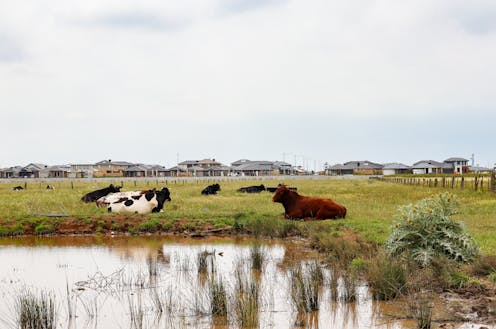
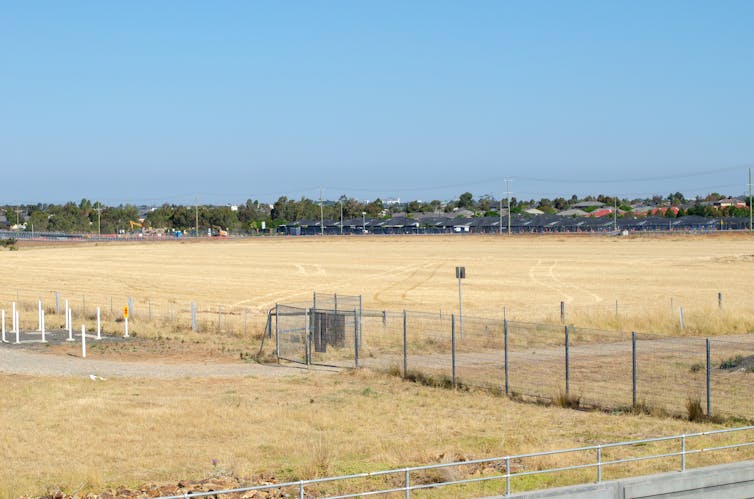
Families in Truganina and Tarneit in Melbourne’s west exemplify the daily struggles of outer suburban life. Nearly a decade after moving in, the promises of local schools and public transport had failed to materialise.

Likewise, in the outer suburbs of Western Sydney, Brisbane and Adelaide, families with children struggle to get to the services they need without a car. In South Australia, the Thrive by Five alliance cites transport as the second-biggest barrier (after attendance costs) to early learning.

These suburbs all provide stark reminders to governments of the problems associated with the suburban sprawl they have encouraged.
fenced grassland in front of a new housing development
Long after moving into their new houses, Tarneit residents are paying the price for the lack of promised services.
Shutterstock

Suburban sprawl and car dependence go hand in hand

The defining feature of suburban sprawl is car dependence. It’s linked with most of the social and economic downsides of sprawl. Continuing with such developments signals an acceptance of car dependence and the growing social and economic burdens it imposes on future generations.

Life on the fringe without a private car is particularly difficult for families with children due to their complex travel patterns. For example, trip chaining between children’s schools, extra-curricular activities and parents’ workplaces is common.

The harmful impacts of these car-centric suburbs disproportionally affect children.


Read more:
Children in the car era: bad for them and the planet


To start with, road deaths are the leading cause of death for children and young adults globally. It’s easily one of the most underestimated issues in our world.

Concerns for children’s safety in car-dominated neighbourhoods and other accessibility issues make the private car “a must use tool” in outer suburbs. We know the rest: the vicious cycle of car dependence and more and more driving.

So suburban sprawl leads to more high-speed roads, longer distances between centres of daily activity and more time in cars. All these factors increase the risk of road deaths and injuries.

Car-dependent neighbourhoods deprive children of opportunities essential for their health and wellbeing. They miss out on physical activity, unstructured play, social interaction and developing social networks. In addition, traffic noise and air pollution expose them to a wide range of environmental and health problems.


Read more:
We’re still fighting city freeways after half a century


Having a backyard doesn’t meet all children’s needs

What does a truly child-friendly neighbourhood look like? It allows for safe and convenient active travel – walking, cycling and “wheeling” (using mobility devices) – as well as public transport, to conduct daily activities. Child-friendliness is embedded in the everyday places, in streets, parks, square and public transport.

But all too often children’s play opportunities are reduced to the tiny backyards that are now common in fringe suburbs. These suburban restrictions are at odds with globally recognised principles of child-friendliness. Backyards alone cannot make up for the lack of access to child care, schools, shops, recreation and health services.

How can we develop better planning policies to create neighbourhoods that properly meet families’ needs? Some policies already exist, such as 15-minute or 20-minute neighbourhoods, to reduce private car use for daily activities. But these policies get sidelined when governments promote suburban sprawl and build more freeways.

These governments should not dismiss the suitability of higher-density living in well-serviced neighbourhoods for families with children. Yes, some densification policies have been blind to the needs of children and their families. However, when done well, high-density settings can be wonderful communities for such families.

With careful planning, many more families could be housed in established areas without having to significantly increase building heights.


Read more:
People love the idea of 20-minute neighbourhoods. So why isn’t it top of the agenda?


Car-centric planning has failed families

Car-centric planning dates back to the 1950s. Since then, Australian suburban fringe development has largely failed to create child-friendly neighbourhoods. Given the pro-sprawl political advocacy, the prospects of Adelaide’s largest ever greenfield development being good for children are rather poor, despite some encouraging steps by the government to ensure the new suburbs get adequate infrastructure.

Using aspirations of families with children to justify suburban sprawl is exploitative and misleading. It’s an approach that ignores the real-life challenges residents experience and distracts from government’s responsibility for proper planning.

If governments are serious about the needs of families with children, they could start by acknowledging children’s needs and rights to be able to get to their daily destinations without a car. To deliver neighbourhoods that make this possible, governments need to be bold and decisive in their planning.

Suburban sprawl and car dependence go hand in hand. Our politicians must commit to urban planning where cars are no longer privileged. Otherwise we deny our children basic rights to learn, play and socialise safely in their own neighbourhoods.


Read more:
No need to give up on crowded cities – we can make density so much better


The Conversation

The authors do not work for, consult, own shares in or receive funding from any company or organisation that would benefit from this article, and have disclosed no relevant affiliations beyond their academic appointment.

ref. Urban sprawl is ‘not a dirty word’? If the priority is to meet all kids’ needs, it should be – https://theconversation.com/urban-sprawl-is-not-a-dirty-word-if-the-priority-is-to-meet-all-kids-needs-it-should-be-208670
Creating ‘sponge cities’ to cope with more rainfall needn’t cost billions – but NZ has to start now

Source: The Conversation (Au and NZ) – By Timothy Welch, Senior Lecturer in Urban Planning, University of Auckland

Tune into news from about any part of the planet, and there will likely be a headline about extreme weather. While these stories will be specific to the location, they all tend to include the amplifying effects of climate change.

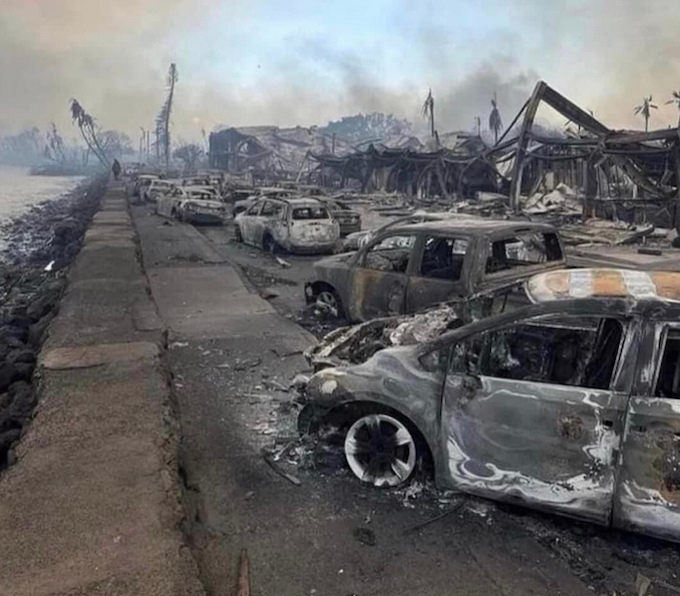
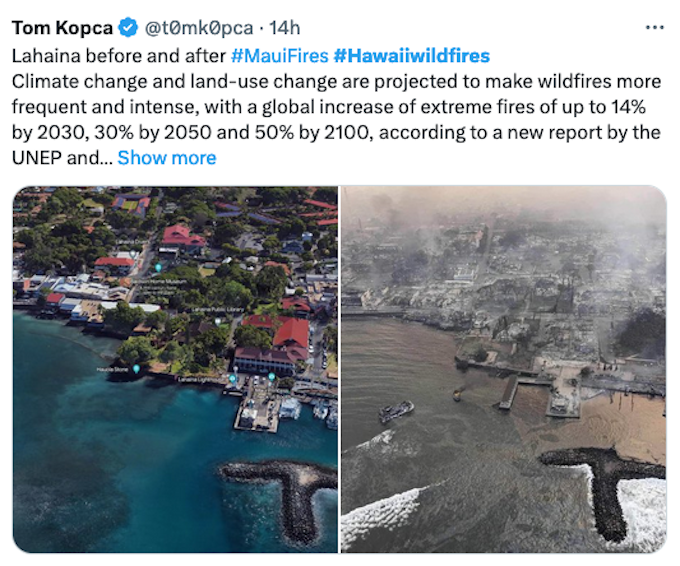
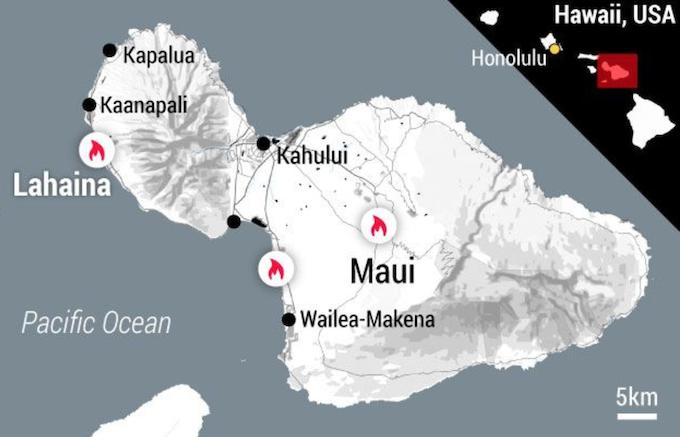
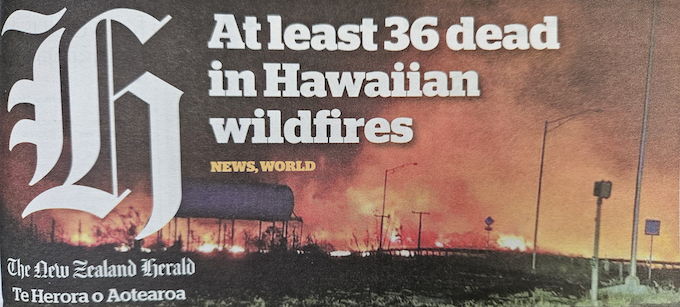
This includes the wildfire devastation on the island of Maui in Hawaii, where rising temperatures have dried vegetation and made the risk that much greater. In Italy, summer temperatures hit an all-time high one week, followed by massive hail storms and flooding the next.

Flooding in Slovenia recently left three people dead and caused an estimated €500 million in damage. At the same time, rainfall in Beijing has exceeded a 140-year record, causing wide-scale flooding and leaving 21 dead.

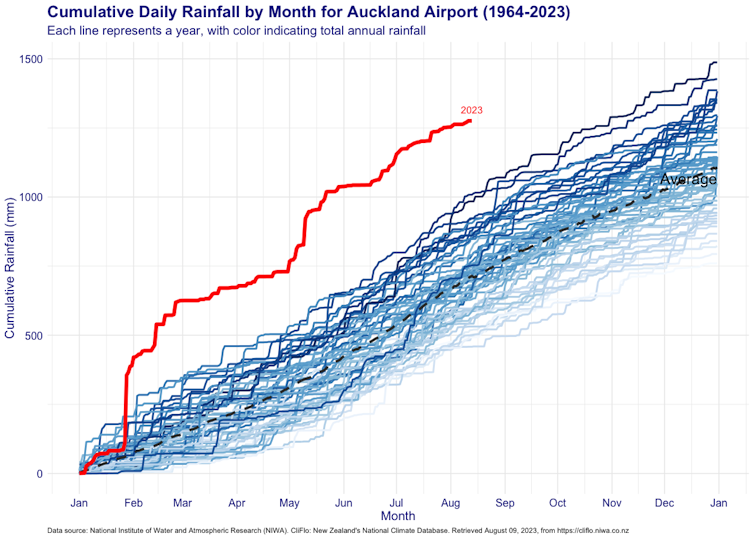
These northern hemisphere summer events mirror what happened last summer in Auckland, classified as a one-in-200-year event, and elsewhere in the North Island. So far this year, rainfall at Auckland Airport has surpassed all records dating back to 1964.

Given more rainfall is one of the likeliest symptoms of a changing climate, the new report from the Helen Clark Foundation – Sponge Cities: Can they help us survive more intense rainfall? – is a timely (and sobering) reminder of the urgency of the challenge.


NIWA, CC BY-NC-ND

Pipe dreams

The “sponge city” concept is gaining traction as a way to mitigate extreme weather, save lives and even make cities more pleasant places to live.

This is particularly important when existing urban stormwater infrastructure is often already ageing and inadequate. Auckland has even been cutting spending on critical stormwater repairs for at least the past two years.


Read more:
Auckland floods: even stormwater reform won’t be enough – we need a ‘sponge city’ to avoid future disasters


Politically at least, this isn’t surprising. Stormwater infrastructure, as it is currently built and planned, is costly to develop and maintain. As the Clark Foundation report makes clear, New Zealand’s pipes simply “were not designed for the huge volumes they will have to manage with rising seas and increasing extreme rainfall events”.

The country’s current combined stormwater infrastructure involves a 17,000 kilometre pipe network – enough to span the length of the country ten times. The cost of upgrading the entire water system, which encompasses stormwater, could reach NZ$180 billion.

This contrasts starkly with the $1.5 billion councils now spend annually on water pipes. The report makes clear that implementing sponge city principles won’t wholly solve flooding, but it can significantly reduce flood risks.

Trees and green spaces

The real bonus, though, lies in the potential for sponge city design to reduce dependence on expensive and high-maintenance infrastructure.

There are already examples in Auckland’s Hobsonville Point and Northcote. Both communities have incorporated green infrastructure, such as floodable parks and planted wetlands, which kept nearby homes from flooding.

But the report’s recommendations are at odds with some of the current political rhetoric around land use policy – in particular “greenfields” development that encourages urban sprawl.


Read more:
National’s housing u-turn promotes urban sprawl – cities and ratepayers will pick up the bill


The report urges that cities be built upwards rather than outwards, and pushes back on residential infill development encouraged by the Medium Density Residential Standards.

Citing a recent report on green space from the Parliamentary Commissioner for the Environment, the Clark Foundation report argues for the preservation of urban green spaces – like backyards – as part of the flood mitigation approach.

Preserving tree cover is another urgent priority. Trees help absorb rainfall, reduce erosion and provide essential shade and cooling in urban areas – counteracting the dangerous urban “heat island” effect. Citing data from Global Forest Watch, the report states:

Auckland has lost as much as 19% of its tree cover in the past 20 years, Dunedin a staggering 24%, Greater Wellington around 11% and Christchurch 13%.


Read more:
Planting more trees could reduce premature heat-related deaths in European cities by a third – new research


Incentives for homeowners

Making Aotearoa New Zealand more resilient to extreme weather, the report says, need not break the bank.

It recommends raising the national minimum standards governing the percentage of the total area of new developments that must be left unsealed. This would ensure the implementation of sponge city concepts, and see buildings clustered to maximise preserved green space.

The government should also require local councils to plan for and provide public green spaces, and to develop long-term sponge city plans – just as they do for other types of critical infrastructure.


Read more:
We’re building harder, hotter cities: it’s vital we protect and grow urban green spaces – new report


Neighbourhoods could be retrofitted to include green roofs, permeable pavements and unsealed car parks. Land use and zoning could also encourage more vertical development, rather than sprawl or infill housing.

The government could also provide incentives and education for homeowners to encourage minimising sealed surfaces, unblocking stormwater flow paths, and replacing lawns with native plants and rain gardens.

More extreme weather and intense rainfall is a matter of when, not if. As the Clark Foundation report makes clear, spending future billions is less of a priority than acting urgently now.

The Conversation

Timothy Welch does not work for, consult, own shares in or receive funding from any company or organisation that would benefit from this article, and has disclosed no relevant affiliations beyond their academic appointment.

ref. Creating ‘sponge cities’ to cope with more rainfall needn’t cost billions – but NZ has to start now – https://theconversation.com/creating-sponge-cities-to-cope-with-more-rainfall-neednt-cost-billions-but-nz-has-to-start-now-211181

Trapped: Australia’s extraordinary alpine insects are being marooned on mountaintops as the world warms

Source: The Conversation (Au and NZ) – By Kate Umbers, Senior Lecturer in Zoology, Western Sydney University

We may not pay invertebrates much thought, but they’re the workhorses of all ecosystems. Insects and other invertebrates do essential jobs such as pollinating plants, improving soils and controlling pests. They’re also food for many larger animals, which moves nutrients up the food chain.

Invertebrates are vulnerable to rising global temperatures. In response to climate change, many are moving to cooler areas, be that across land towards the poles, or upward in elevation.

But not all invertebrates have that option. In Australia, invertebrates already living at the highest possible elevation – on mountain summits – have nowhere higher to go. So how will they cope? And how can we help them?

Answering these questions is important. Invertebrates underpin Earth’s ecosystems – so if their numbers decline, the ecological damage will be felt far and wide.

A life at the top

The invertebrates of the Australian Alps are beautiful and diverse. As in all ecosystems, they make up the largest proportion of our alpine animal species.

Most of our alpine invertebrates are found nowhere else If we don’t look after them they’re gone forever. And each species extinction is like losing a rivet in an aeroplane wing; eventually whole ecosystems will crash.

Warmer temperatures can affect invertebrates in many ways. For example, pollinating insects that collect nectar may hatch before plants flower – creating issues for both the insects and the plants. Species that rely on wet or damp conditions may find their habitat dried out. Less harsh, cold conditions may also bring new predators and competitors into their habitats.

Overseas, where mountain ranges are typically much higher, animals have been moving up in elevation to survive. But Australia’s mountains are small – less than half the height of many key mountain ranges overseas. This leaves little room to move higher.

Alpine invertebrates tend to live in small, isolated populations on mountain tops. This limits their genetic diversity and therefore the potential that offspring can survive and adapt to changing conditions.

What’s more, many invertebrates don’t have wings, so can’t fly away to a more hospitable place. And being trapped on mountain tops also makes them vulnerable to devastating local threats such as unusually severe or extensive bushfires.


Read more:
They might not have a spine, but invertebrates are the backbone of our ecosystems. Let’s help them out


Extraordinary bogong moths

Some species might seem to be moving higher up the Australian Alps. For example, it seems bogong moths inhabit low elevation caves less frequently than they once did. But this probably just shows the species’ habitat is shrinking upward.

Each year, bogong moths undertake an extraordinary nocturnal migration. From their starting point many hundreds of kilometres away, they use the stars and Earth’s magnetic field to navigate to the Australian Alps in search of cool caves and rock crevices. There, they rest and take refuge from the summer heat, before returning to their winter pastures.

In 2021, bogong moths were listed as endangered because the availability of their summer habitat is declining.

Bogong moths bring an incredibly important influx of nutrients to the alps. They provide food for many animals, including the adorable, critically endangered mountain pygmy possum, as well as many types of birds.

The Taungurung people refer to the bogong moth as “Deberra”. The annual concentration of Deberra in the alps is culturally significant to the Taungurung and other traditional custodians.

Deberra have a high fat content and were harvested by Taungurung and other groups for eating. During the harvest, large gatherings of many Aboriginal nations were held and cultural business was conducted.

So Deberra offers not only a rich source of food, but also connection with deeply significant cultural landscapes. They are an important element in the cyclical movement of people and exchange of knowledge within and between Indigenous nations.

For Traditional Owners, Deberra is, like all things, part of the interrelated web of Country. When Deberra travels, human and non-human entities follow. It supports energy flows of many kinds.

The decline of Deberra is a sign that Country is sick. Sick Country tells us the land is not being managed well.


Read more:
Next time you see a butterfly, treasure the memory: scientists raise alarm on these 26 species


Colour-changing skyhoppers

The adults of many alpine invertebrate species live for just a single summer, lay their eggs, then die. They include skyhoppers, a group of alpine grasshoppers unique to Australia, many species of which are threatened.

Skyhoppers rely on a thick snow layer to protect their eggs in winter. But Australia’s snow cover is becoming increasingly unreliable as the planet warms.

Thermocolour skyhoppers, listed as endangered, are unique among grasshoppers in that they change colour from black to turquoise when their body temperature exceeds 25℃.

Until recently, five skyhopper species were known to science. But when researchers walked the entire 655-kilometre Australian Alps walking track, they discovered 15 species of skyhopper exist – each separated by the rugged mountain landscape.

The true biodiversity of the alps is unknown. What we do know is that it is heavily fragmented. What may look like one species across the alps is likely to be many species each occupying small areas. This means they’re even more vulnerable than currently recognised.


Read more:
More than 60 billion leaf litter invertebrates died in the Black Summer fires. Here’s what that did to ecosystems


Helping them hang on

Much of the Australian Alps region is contained in national parks, but this alone is not adequate protection for our alpine biodiversity.

Greenhouse gas emissions to date have put our alpine biodiversity on a knife’s edge. Australian and international governments must swiftly undertake far more ambitious climate action to cool the alps.

And more effort is needed to give our alpine ecosystems the best chance of coping with climate change. This includes allowing Traditional Owners to connect to and manage Country and removing threats such as feral species, disease and habitat destruction.

The Conversation

Kate Umbers is based at the School of Science at Western Sydney University and receives funding from the Australian Research Council, NSW Government, Hermon Slade Foundation. She works for Invertebrates Australia, a not-for-profit environmental conservation charity. She is affiliated with the IUCN and the Biodiversity Council.

Jaana Dielenberg is based at The University of Melbourne and works for the Biodiversity Council. She is a member of Invertebrates Australia and the Ecological Society of Australia. She previously worked for the now ended Threatened Species Recovery Hub of the Australian Government’s National Environmental Science Program.

Matthew Shanks works for Taungurung Land and Waters Council and receives funding from the Department of Energy, Environment and Climate Action. He is affiliated with the Biodiversity Council and Back to Country.

ref. Trapped: Australia’s extraordinary alpine insects are being marooned on mountaintops as the world warms – https://theconversation.com/trapped-australias-extraordinary-alpine-insects-are-being-marooned-on-mountaintops-as-the-world-warms-211104

Do we need a new law for AI? Sure – but first we could try enforcing the laws we already have

Source: The Conversation (Au and NZ) – By Edward Santow, Professor & Co-Director, Human Technology Institute, University of Technology Sydney

Shutterstock

Regulation was once a dirty word in tech companies around the world. They argued that if people wanted better smartphones and flying cars, we had to look past dusty old laws dreamed up in the pre-internet era.

But something profound is afoot. First a whisper, and now a roar: the law is back.

Ed Husic, Australia’s federal minister responsible for tech policy, is leading a once-in-a-generation review of Australian law, asking Australians how our law should change for the AI era. He recently told the ABC, “I think the era of self-regulation is over.”

Sure, there were caveats. Husic made clear that regulation for AI should focus on “high-risk elements” and “getting the balance right”. But the rhetorical shift was unmistakable: if we had allowed the creation of some kind of digital wild west, it must end.

Tech companies demand regulation – but why?

One moment might sum up the dawn of this new era. On May 16, Sam Altman – chief executive of OpenAI, the company responsible for ChatGPT – declared in the US Congress, “regulation of AI is essential”.

On its face, this seems like a stunning transformation. Less than a decade ago, Facebook’s motto was “move fast and break things”. When its founder, Mark Zuckerberg, uttered those words he spoke for a generation of Silicon Valley tech bros who saw the law as a handbrake on innovation.

Reform is urgent, and so we need to seize this moment. But first we should ask why the tech world has suddenly become enamoured with regulation.

One explanation is tech leaders can see that, without more effective regulation, the threats associated with AI could overshadow its positive potential.

We have recently had tragic reminders of the value of regulation. Think of OceanGate, the company behind the Titanic-seeking submersible that disintegrated earlier this year, killing everyone on board. OceanGate avoided safety certification because “bringing an outside entity up to speed on every innovation before it is put into real-world testing is anathema to rapid innovation”.

Maybe there has been a genuine change of heart: tech companies certainly know their products can harm as well as help. But something else is also at play. When tech companies call for governments to make laws for AI, there is an unstated premise: currently, there are no laws that apply to AI.

But this is plain wrong.

Existing laws already apply to AI

Our current laws make clear that no matter what form of technology is used, you cannot engage in deceptive or negligent behaviour.

Say you advise people on choosing the best health insurance policy, for example. It doesn’t matter whether you base your advice on an abacus or the most sophisticated form of AI, it’s equally unlawful to take secret commissions or provide negligent advice.


Read more:
Calls to regulate AI are growing louder. But how exactly do you regulate a technology like this?


A significant part of the problem in the AI era is not the content of our law, but the fact it is not consistently enforced when it comes to the development and use of AI. This means regulators, courts, lawyers and the community sector need to up their game to ensure human rights and consumer protections are being enforced effectively for AI.

This will be a big job. In our submission to the government’s AI review, we at the University of Technology Sydney Human Technology Institute call for the creation of an AI Commissioner – an independent expert advisor to government and the private sector. This body would cut through the hype and white noise, and give clear advice to regulators and to businesses on how to use AI within the letter and spirit of the law.

Australia needs to catch up with the world

Australia has experienced a period of extreme policy lethargy on the AI front. While the European Union, North America and several countries in Asia (including China) have been creating legal guardrails, Australia has been slow to act.

In this context, the review of regulation for AI is crucial. We shouldn’t mindlessly copy other jurisdictions, but our law should ensure parity of protection for Australians.

This means the Australian parliament should adopt a legal framework that is suitable for our political and legal system. If this means departing from the EU draft AI Act, all well and good, but our law must protect Australians from the risks of AI at least as effectively as people are protected in Europe.


Read more:
EU approves draft law to regulate AI – here’s how it will work


Personal information is the fuel for AI, so the starting point should be to update our privacy law. The Attorney-General’s Department has published a review that would modernise our privacy law, but we are yet to see any commitment for change.

Reform is particularly urgent for high-risk uses of AI, such as facial recognition technology. A series of investigations by CHOICE has shown companies are increasingly using this tech in shopping centres, sports stadiums and in the workplace – without proper protection against unfairness or mass surveillance.

There are clear reform solutions that enable safe use of facial recognition, but we need political leadership.

Government needs to get AI right

Government must also set a good example. The Robodebt Royal Commission showed in harrowing detail how the federal government’s automated system of recovering debts in the welfare system went horribly wrong, with enormous and widespread harm to the community.

The lesson from this experience isn’t that we should throw out all the computers. But it does show we need clear, strong guardrails that ensure government leads the way in using AI safely and responsibly.

The Conversation

The authors do not work for, consult, own shares in or receive funding from any company or organisation that would benefit from this article, and have disclosed no relevant affiliations beyond their academic appointment.

ref. Do we need a new law for AI? Sure – but first we could try enforcing the laws we already have – https://theconversation.com/do-we-need-a-new-law-for-ai-sure-but-first-we-could-try-enforcing-the-laws-we-already-have-211369

Rising seas and a great southern star: Aboriginal oral traditions stretch back more than 12,000 years

Source: The Conversation (Au and NZ) – By Duane Hamacher, Associate Professor, The University of Melbourne

Shutterstock

Content note: this article mentions genocide and acts of colonial violence against Aboriginal people.


How long do you think stories can be passed down, generation to generation?

Hundreds of years? Thousands?

Today, we publish new research in the Journal of Archaeological Science demonstrating that traditional stories from Tasmania have been passed down for more than 12,000 years. And we use multiple lines of evidence to show it.


Read more:
The Memory Code: how oral cultures memorise so much information


Tasmania’s violent colonial history

Within months of establishing a colonial outpost on the island in 1803, British officials had committed several acts of genocide against Aboriginal Tasmanian (Palawa) people. By the mid-1820s, soldiers, convicts, and free settlers had taken up arms to fight what became known as the “Black War”, aimed at capturing or killing Palawa and dispossessing them of their Country.

Tasmania’s colonial government appointed George Augustus Robinson to “conciliate” with the Palawa. From 1829 to 1835, Robinson travelled with a small group of Palawa, including Trukanini and her husband, Wurati. By 1832, Robinson’s “friendly mission” had turned to forced removals.

An illustrated postcard showing the (so-called) 'Friendly Mission', led by George Augustus Robinson (1941)
A postcard showing the (so-called) ‘Friendly Mission’, led by George Augustus Robinson (1941), colourised version.
State Library of Victoria


Read more:
Coming to terms with Tasmania’s forgotten war


Robinson kept a daily journal, which included records of Palawa languages and traditions. Over time, Palawa men and women slowly began to share some of their knowledge, explaining how their ancestors came to Tasmania (Lutruwita) by land from the far north, before the sea formed and turned their home into an island. They also spoke about the Sun-man, the Moon-woman, and a bright southern star.

These stories are of immense importance to today’s Palawa families who survived the devastating impact of colonisation, and who continue to share these unique creation stories. Through careful investigation of colonial records, and collaborating with Palawa knowledge-holders, we found something remarkable.

Rising seas and the formation of Lutruwita

Over the past 65,000 years, Australia’s First Peoples witnessed natural disasters and significant changes to the land, sea and sky. Volcanoes spewed fire, earthquakes shook the land, tsunamis inundated the coastlines, droughts plagued the continent, meteorites fell to the earth, and the stars shifted in the night sky.

Some 20,000 years ago, the world was in the grip of an ice age. Australia was conspicuously drier than it is today, and the ocean was significantly lower. All of that sea water was bound up in glaciers that swathed vast tracts of land, particularly across the Northern Hemisphere, and polar ice caps much larger than ours today.

As time passed, temperatures gradually rose and the ice began to melt. After 10,000 years, the sea level had risen 125 metres; a process that dramatically transformed coastlines and submerged landscapes that had been ancestral Country for thousands of generations. This forced humans to change where and how they lived.


Read more:
Ancient Aboriginal stories preserve history of a rise in sea level


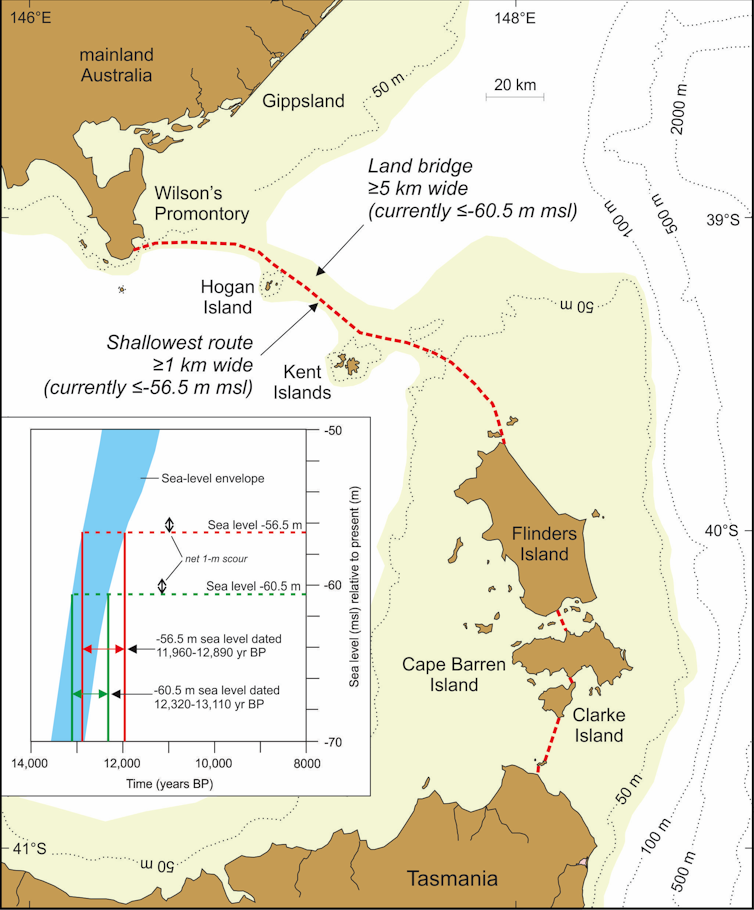
During the ice age, both Lutruwita and Papua New Guinea were connected to mainland Australia by dry land, forming a landmass called Sahul. As the seas rose, Tasmania’s connection gradually narrowed to form what geologists call the Bassian Land Bridge.

Topographic map of the Bass Strait
A topographic map of the Bass Strait, showing the conditions before the Bassian Land Bridge was submerged. The yellow shaded area represents geography of the land bridge, while the broken red line indicated the last vestige of a continuous Bassian Land Bridge between Tasmania and the mainland.
Patrick Nunn, Author provided

People continued to live on this “land bridge”, but by 12,700 years ago it had narrowed to just 5 kilometres wide (lime-green shading on the map above). Habitable land was gradually reduced as the sea closed in. Less than 300 years later, the “land bridge” was gone and Lutruwita was completely surrounded by water.

Palawa traditions from that time survived hundreds of generations of retelling, forming part of a larger canon of Aboriginal and Torres Strait Islander stories around Australia. They described rising seas and submerging coastlines as the ice sheets melted before levelling off around 7,000 years ago. Stories of similar antiquity are known from other parts of the world.


Read more:
Ancient Aboriginal stories preserve history of a rise in sea level


A great south star

Aboriginal and Torres Strait Islander cultures developed rich and complex knowledge systems about the stars, which are still used today. They describe the movements of the Sun, Moon, and stars, as well as rare cosmic events, such as eclipses, supernovae, and meteorite impacts.

In the 1830s, a Palawa Elder spoke about a time when the star Moinee was near the south celestial pole. He laid down a pair of spears in the sand and drew a few reference stars to triangulate its position.


Read more:
Stories from the sky: astronomy in Indigenous knowledge


Colonists seemed perplexed about the presence of an antipodean counterpart to Polaris, as no southern pole star exists today. Some tried to identify the stars on the star map, but seemed confused and labelled them incorrectly, as they were unaware of an important astronomical process called axial precession.

As the Earth rotates, it wobbles on its axis like a spinning top. This shifts the location of the celestial poles, tracing out a large circle every 26,000 years. As thousands of years pass by, the positions of the stars in the sky slowly change.


Read more:
Stars that vary in brightness shine in the oral traditions of Aboriginal Australians


Long ago, Canopus was at its southernmost point in the sky. Lying just over 10 degrees from the south celestial pole, it appeared to always hover in the southern skies each night. That last occurred 14,000 years ago, before rising seas turned Lutruwita into an island.

A star map showing the location of Canopus 14,000 years ago.
Stars in the southern sky as they would have appeared 14,000 years ago, accounting for precession, nutation, and proper motion. Canopus is very close to the south celestial pole (SCP).
Stellarium, CC BY

Exciting collaborative futures

We can see through independent lines of evidence that Palawa stories have been passed down for more than twelve millennia. We also find here the only example in the world of an oral tradition describing a star’s position as it would have appeared in the sky over 10,000 years ago.

Our investigation of colonial records that record traditional systems of knowledge has demonstrated a powerful cross-cultural way of better understanding deep human history. This also recognises the immense value of Aboriginal and Torres Strait Islander traditions today.


This research was co-authored by graduate Michelle Gantevoort from RMIT University, and student researchers Ka Hei Andrew Law from the University of Melbourne and Mel Miles from Swinburne University of Technology.

The Conversation

Duane W. Hamacher receives funding from the Australian Research Council and the Lady Foundation.

Greg Lehman receives funding from the Australian Research Council.

Patrick D. Nunn receives funding from the Australian Research Council, the Asia-Pacific Network, and the British Academy

Rebe Taylor receives funding from Australian Research Council.

ref. Rising seas and a great southern star: Aboriginal oral traditions stretch back more than 12,000 years – https://theconversation.com/rising-seas-and-a-great-southern-star-aboriginal-oral-traditions-stretch-back-more-than-12-000-years-211114

Accentuate the negative: why the Liberal Party’s fondness for ‘no’ might ultimately backfire

Source: The Conversation (Au and NZ) – By Marija Taflaga, Lecturer, School of Political Science and International Relations, Australian National University

The Coalition is attempting to claim it supports a legislated Voice to Parliament because it “is important in the way it may close the gap and the way it may improve the lives of indigenous people”, but that a Voice protected by the Constitution – on which Australians will vote in a referendum later this year – is dangerous and will wreak chaos.

The opposition has struggled to articulate what precisely it thinks the risks are, and recent off-the-record backgrounding indicates the aim appears to be to damage Prime Minister Anthony Albanese’s standing, in the hope this will extend to voters’ general faith in the government.

Perhaps the party leadership feels this is the only viable strategy given their political position, but it comes with risks.

This logic rests on several assumptions:

  • that the prime minister, and not the opposition, would be blamed for the yes campaign’s failure
  • that Labor will oblige the opposition by tearing itself apart
  • that politics is zero-sum and every vote lost from Labor is one for the Coalition.

The first two factors are unknowable. But it is worth noting that Albanese’s biggest downside risk is in being seen to have shied away from his heartfelt commitment. That is because it goes to his authenticity and trustworthiness. Losing after standing up for a point of principle is a different calculus. It is also an empirical fact that more prime ministers have lost referendums than won them.

It is possible Labor will turn on itself in the wake of a referendum defeat and a looming economic crisis. Both the ill-discipline and lack of nerve of the Whitlam and Rudd-Gillard governments made it possible for the extreme negative politics of the Snedden-Fraser and Abbott oppositions to succeed.

However, the government has so far shown itself to be composed largely of tough-minded pragmatists in economically ill-favoured times.

The idea that Australian electoral seats end up with either Labor or Coalition was an article of faith in Australian politics. It was underwritten by very high levels of party loyalty and our compulsory, preferential voting system.


Read more:
What now for the Liberal Party? A radical shift and a lot of soul-searching


But the conditions that buttressed this orthodoxy have been in decline for decades, and have been shaping election outcomes for some time. There are now multiple viable political alternatives, and while it is not possible to predict whether voters will continue to abandon the major parties, offering voters more of what they just rejected is unlikely to be a winning strategy.

The strategy could backfire and the Coalition may reinforce a perception that its approach to politics remains cynical and tactical, rather than focused on finding solutions to longstanding problems and building a better future.

The electoral rout in 2022 was the Liberal party’s worst ever. While some of that is attributable to the unpopularity of former prime minister Scott Morrison, much of it was also the result of long-term trends, including voter dealignment and a growing generational gap in ideological outlook.

Why have voters abandoned the major parties, and young people and women in particular turned their backs on the Coalition? The reasons are complex, but can be summarised as a growing sense that politicians don’t listen, don’t act in the national interest, and pursue partisan aims over the wider public good. The result is that governments appear unwilling to solve a growing number of pressing problems – and voters have rationally sought alternatives.

Virtually every royal commission we’ve had has come about because governments failed (often wilfully) to listen to those affected or those in a position to give good advice.

The Liberals’ approach to the Voice is illustrative of the party’s ongoing commitment to negative campaigning with a minimal positive agenda.

In the wake of the election, the party said it heard what women had to say. Others argued the party needed to do more for young people, particularly in relation to housing and global heating.

But the response so far has been largely backward-looking – reheating old policies, invoking old platitudes and, in the case of the Voice, reviving arguments and language from the 1990s.

First-term oppositions typically aren’t imaginative, but they are usually reflective on some level. After all, they have just lost an election.

The Liberals have made much of their claims to being a “broad church”. In reality, this refrain has been a useful tool to quickly end discussions about how much internal debate the party should allow. The party has always consisted of two irreconcilable political traditions – after all, Liberals and Conservatives were the government and opposition of the 19th century.

The Liberal party, like other hybrid Conservative-Liberal parties, has managed this dilemma by having one faction dominate the other. What was different in the past was the degree to which the party was prepared to tolerate differences of opinion in open forums.

Debate within the Liberal Party has been in decline for decades. Genuine debate has been eroded by message discipline and the centralisation of power with party leaders.

These are worldwide trends facing all parties. But the Liberal Party now also faces the dilemma of having lost a significant number of its moderate flank.

There are simply far fewer countervailing voices in today’s Liberal party room.

The 2022 election saw many of the party’s most able political leaders, capable of articulating a centre-right vision of the good life in the 21st century, exit parliament. Many of the remaining moderates are in the shadow cabinet, where discipline means they cannot publicly articulate the range of views that would truly denote the “broad church” that has historically so successfully appealed to Australian voters.


Read more:
View from The Hill: Without those ‘lefties’ the Liberals can’t regain government


The Liberal Party is not going anywhere. It draws on considerable institutional buffers, including public funding and electoral and administrative laws that protect established parties from some competition. Significantly, it retains the support of more than one-third of the electorate.

But with public movement away from both major parties now an established trend, and the party’s seemingly entrenched backward-looking focus, it remains an open question as to how long will remain in the wilderness – and whether it will choose to remain, permanently, a smaller and narrower party.

The Conversation

Marija Taflaga receives funding from the Australian Research Council.

ref. Accentuate the negative: why the Liberal Party’s fondness for ‘no’ might ultimately backfire – https://theconversation.com/accentuate-the-negative-why-the-liberal-partys-fondness-for-no-might-ultimately-backfire-211106

Private health insurance is set for a shake-up. But asking people to pay more for policies they don’t want isn’t the answer

Source: The Conversation (Au and NZ) – By Yuting Zhang, Professor of Health Economics, The University of Melbourne

Shutterstock

Private health insurance is under review, with proposals to overhaul everything from rebates to tax penalty rules.

One proposal is for higher-income earners who don’t have private health insurance to pay a larger Medicare Levy Surcharge – an increase from 1.25% or 1.5%, to 2%. And if they want to avoid that surcharge, they’d need to take out higher-level hospital cover than currently required.

Encouraging more people to take up private health insurance like this might seem a good way to take pressure off the public hospital system.

But our research shows these proposals may not achieve this. These may also be especially punitive for people with little to gain from buying private health insurance, such as younger people and those living in regional areas who do not have access to private hospitals.


Read more:
Do you really need private health insurance? Here’s what you need to know before deciding


What is the Medicare Levy Surcharge?

The Medicare Levy Surcharge was introduced in 1997 to encourage high-income earners to buy health insurance. People earning above the relevant thresholds need to buy “complying” health insurance, or pay the levy.

This surcharge is in addition to the Medicare levy, which applies to most taxpayers.

The surcharge varies depending on your income bracket, and the rate is different for families.

For instance, to avoid paying the surcharge currently, a single person living in Victoria earning A$108,001 can buy basic hospital cover. The lowest annual premium for someone under 65 is about $1,100, after rebates. That varies slightly between states and territories.

Not buying private health insurance and paying the Medicare Levy Surcharge instead would cost even more, at $1,350 (1.25% of $108,001).


Read more:
If you’ve got private health insurance, the choice to use it in a public hospital is your own


What is being proposed?

The report, by Finity Consulting and commissioned by the federal health department, reviews a range of health insurance incentives.

It recommends increasing the Medicare Levy Surcharge to 2% for those with an income above $108,001 for singles, and $216,001 for families.

Tax forms from Australian Taxation Office
People on higher incomes without private health insurance need to pay the Medicare Levy Surcharge via the taxation system.
Shutterstock

The definition of a “complying” private health insurance policy would also change.

Rather than having basic hospital cover as is required now, someone would need to buy silver or gold cover to avoid the surcharge.

Under the proposed changes, people who pay the 2% surcharge would also no longer receive any rebate, which currently reduces premiums by about 8% for people earning $108,001-$144,000.

So, for a single person under 65, earning $108,001 and living in Victoria, the annual cost of buying complying hospital cover would be at least $1,904 (without the rebate). Again, that varies slightly between states and territories.

But the cost of not insuring and paying the Medicare Levy Surcharge instead would go up to $2,160 (2% of $108,001).


Read more:
How to switch health insurers if you’re worried about cybersecurity, costs or claims


Is this a good idea?

However, our research, out earlier this year, suggests increasing the Medicare Levy Surcharge will not meaningfully increase take-up of private health insurance. We’ve shown that people do not respond as strongly to the surcharge as theory would predict.

For example, when the surcharge kicks in, we found the probability of insuring only increases modestly from about 70% to 73% for singles, and about 90% to 91% for families.

It is generally cheaper to buy private health insurance than to pay the surcharge. However, we found about 15% of single people with an income of $108,001 or above don’t insure despite it being cheaper than paying the Medicare Levy Surcharge.

We don’t know precisely why. Maybe people are not sure of the financial benefit due to changes in their income, or if they are, cannot be bothered, or do not have time, to explore their options.

Medicare card
Some people may choose to pay more tax for public services including Medicare.
Shutterstock

Maybe, as anecdotal reports suggest, rather than buying private health insurance, some people would rather support the public system by paying the Medicare Levy Surcharge.

The point is, people who are not buying private health insurance appear to be highly resistant to financial incentives. So stronger penalties might have little effect.

Instead, we propose the Medicare Levy Surcharge be better targeted to true high-income earners. We can do that by increasing income thresholds for the surcharge to kick in, which are then indexed annually to reflect changes in earnings.

How about needing more expensive cover?

Requiring people to choose silver level cover or above would address criticisms about people buying “junk” private health insurance they never intend to use.

However, people may be buying this type of product because private health insurance has little value to them. Requiring them to spend even more on a product they don’t want is a roundabout way of taking pressure off the public system.

So we propose keeping the current level of hospital cover required to avoid the surcharge, rather than increasing it.

Who loses?

Taken together, the cost of these proposed changes would disproportionately fall on people with little to gain from private health insurance. These include younger people, those living in regional areas who do not have access to private hospitals, or those who prefer to support the public system directly.

These groups are the least likely to use private insurance so have the least to gain from upgrading their cover.


Read more:
Getting rid of junk health insurance policies is just tinkering at the margins of a much bigger issue


Where to next?

The report also recommends keeping health insurance rebates (a government contribution to your premiums), the Lifetime Health Cover loading (to encourage people to take out hospital cover while younger), as well as the Medicare Levy Surcharge.

We also support keeping these three in the short to medium term.

But we recommend gradually reducing public support for private health insurance.

We believe the ultimate goal of reforming private health insurance is to optimise the overall efficiency of the health-care system (both public and private systems) and improve population health while saving taxpayers’ money.

The goal should not be merely increasing the take-up of private health insurance, which is the focus of the current report.

So, as well as our recommendation to better target the Medicare Levy Surcharge, we need to:

  • lower income thresholds for insurance rebates, especially targeting those on genuinely low incomes. This means lower premiums only for the people who can least afford private health care

  • remove rebates based on age as higher rebates for older people do not encourage more to insure. Rebates should be tied to just income, which is a better indicator of financial means.


Read more:
Private health insurance premiums should be based on age and health status


The Conversation

Yuting Zhang receives funding from the Australian Research Council, Department of Veterans’ Affairs, the Victorian Department of Health, and National Health and Medical Research Council. In the past, Professor Zhang has received funding from several US institutes including the US National Institutes of Health, Commonwealth fund, Agency for Healthcare Research and Quality, and Robert Wood Johnson Foundation. She has not received funding from for-profit industry including the private health insurance industry.

Nathan Kettlewell does not work for, consult, own shares in or receive funding from any company or organization that would benefit from this article, and has disclosed no relevant affiliations beyond their academic appointment.

ref. Private health insurance is set for a shake-up. But asking people to pay more for policies they don’t want isn’t the answer – https://theconversation.com/private-health-insurance-is-set-for-a-shake-up-but-asking-people-to-pay-more-for-policies-they-dont-want-isnt-the-answer-210981

West Papuan solidarity group condemns arrest of 21 activists protesting 1962 ‘tragedy’

Asia Pacific Report

An Australian West Papuan solidarity group has condemned the reported arrest of 21 activists protesting in Jayapura over a “tragic day in history” and called on Canberra to urge Jakarta to restrain its security forces.

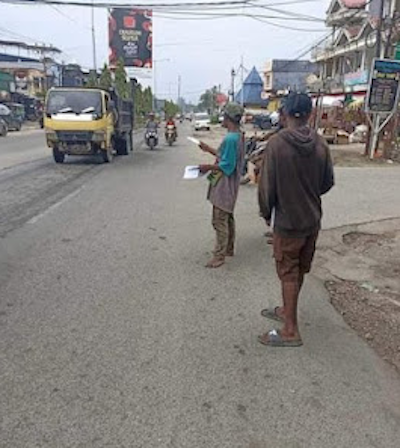
The West Papuan National Committee (KNPB) activists were arrested at the weekend because they were handing out flyers calling on West Papuans to mark the date on Tuesday — 15 August 1962 —  when the Papuan people were “betrayed by the international community”, reports Jubi News.

That was the date of the New York Agreement, brokered by the US, which called for the transfer of the Dutch colony of Netherlands New Guinea to Indonesia after a short period of UN administration.

No West Papuans were involved in this agreement.

“Hopefully this year the Indonesian security forces will allow the West Papuan people to hold their peaceful rallies without interference,” said Joe Collins, spokesperson for the Australia West Papua Association (AWPA) in a statement.

“Canberra should be urging Jakarta to control its security forces in West Papua, otherwise we will see more arrests and more human rights abuses.

“We should not forget,  Australia was involved and still involved”.

The New York Agreement included a guarantee that the Papuan people would be allowed an “Act of Free Choice” to determine their political status.

Peaceful demonstration
The so-called “Act of Free Choice” in 1969 has been branded as a sham by activists and international critics.

Sixty one years after that contested agreement, West Papuans are still calling for a real referendum.

West Papuan activists handing out New York Agreement protest flyers in Jayapura
West Papuan activists handing out New York Agreement protest flyers in Jayapura. Image: Jubi News

The Central KNPB spokesperson, Ones Suhuniap, said that 21 KNPB Sentani Region activists were arrested on Saturday when activists distributed leaflets calling for a peaceful demonstration to mark the New York Agreement and also the racism troubles that Papuan students suffered in Surabaya, Central Java, in August 2019.

Although some of the activists had been released, these arrests were intended to intimidate civil society groups into not taking part in the planned rallies, said the spokesperson.

Collins said: “West Papuan civil society groups regularly hold events and rallies on days of significance in their history, to try and bring attention to the world of the injustices they suffer under Indonesian rule.

“And this is what Jakarta fears most — international scrutiny on the ongoing human rights abuses in the territory”.

A West Papua news report of the activist arrests
A West Papua news report of the activist arrests. Image: Jubi News/APR screenshot

Collins said it was of “great concern” that Indonesian security forces could again stage a crackdown in “their usual heavy-handed approach to any peaceful rallies held by West Papuans” during this coming week.

In the past, West Papuans had not only been being arrested for peaceful action but had also been beaten, tortured – and some people had faced charges of treason.

Three students jailed for ‘treason’
On Tuesday, three students were found guilty of treason and given a 10-month prison term by a panel of judges at the Jayapura District Court for alleged treason by being involved in a “free speech” event last year, reports Jubi News.

Yoseph Ernesto Matuan, Devio Tekege, and Ambrosius Fransiskus Elopere took part in the event held at Jayapura University of Science and Technology (USTJ) on November 10, 2022, when they waved Morning Star flags of independence.

The event aimed to reject a Papua peace dialogue plan introduced by the National Commission on Human Rights (Komnas HAM).

Print Friendly, PDF & Email

Article by AsiaPacificReport.nz

Greenpeace backs Greens’ ‘solar homes’ policy, but warns over NZ post-election talks

Asia Pacific Report

Greenpeace has welcomed the Greens for being the first party to announce a household solar policy for Aotearoa New Zealand’s election in October, but says the party’s stance in post-election negotiations will make all the difference to addressing the climate crisis.

The Green Party announced its Clean Energy Payment policy today which would see homeowners receive up to $6000 in grants and up to $30,000 in zero interest loans to help install insulation, heat pumps and household solar.

The Greens have also pledged to make low-carbon upgrades tax deductible for landlords so that renters can benefit.

The Greens’ Zero Carbon Homes upgrade is planned to:

  • scale up solar on Kainga Ora homes to 30,000 more households in the next three years,
  • expand Warmer Kiwi Homes to cover more zero carbon upgrades such as replacing gas heaters, and
  • fund Community Energy providers and by Māori, for Māori approaches.

Grants could be used to cover 25 percent of the cost of things like better insulation; replacing fossil-fuel appliances, like gas heaters, with clean alternatives, like heat pumps; and to purchase rooftop solar power, reports NZ News.

The funding would come from revenue from the Emissions Trading Scheme, through the Climate Emergency Response Fund.

Green Party co-leaders Marama Davidson and James Shaw
Green Party co-leaders Marama Davidson and James Shaw . . . while people struggle with energy challenges, the planet is heating “at frightening speed”. Image: Niva Chittock/RNZ News

Green Party co-leader James Shaw said while people struggled with energy challenges, the planet was heating “at frightening speed”.

A ‘clear answer’
“There is a clear answer staring us in the face: warm homes powered by clean, cheap, low-carbon energy, supplied straight from our roofs,” Shaw said.

“The Clean Power Payment is as close to a perfect investment as you can get: slashing soaring bills for families, slashing emissions, and creating thousands of good jobs,” he said.

“Most people want action on the climate crisis and action on the cost of living.”

Greenpeace Aotearoa spokesperson Amanda Larsson said: “Greenpeace has for years been calling on political leaders to commit to solarising New Zealand as a way to replace climate-polluting fossil fuels and give regular people more control over their energy.”

More than 30,000 people have signed a Greenpeace petition calling for government investment in household solar.

“We are pleased to see the Greens take up the gauntlet with this policy announcement. It’s common sense and something that many New Zealanders say they want.

“But, to date, New Zealand has really lagged behind our peers when it comes to helping households make their own clean power from the sun.”

Parties ‘need to be ready’
Larsson said the climate crisis was here, and that political parties should be ready for this year’s election to be a climate election as New Zealanders demanded political climate leadership.

“People across Aotearoa have borne the brunt of the climate crisis this year, from Cyclone Gabrielle in the north, to severe drought in the south.

“We are all watching in real time as climate disasters unfold around the world, whether it’s extreme heat and severe floods to the horrendous fires currently happening in Hawai’i.”

Larsson also says that, when it comes to climate change, it’s important to remember that it’s not all about renewables.

“Here in New Zealand, we have too many cars and too many cows. Intensive dairy is New Zealand’s most polluting sector, closely followed by road transport.

“Any political party that is serious about climate change also needs to come to the table with ambitious policies to regulate big dairy and divert road spending towards more rail, public transport, walking and cycling.”

Larsson added that the Green Party’s’ ability to address climate pollution if in government would ultimately come down to what they choose to prioritise in any post-election negotiations.

Print Friendly, PDF & Email

Article by AsiaPacificReport.nz

We can and should keep unemployment below 4%, says our survey of top economists

Source: The Conversation (Au and NZ) – By Peter Martin, Visiting Fellow, Crawford School of Public Policy, Australian National University

Shutterstock

Australia’s leading economists believe Australia can sustain an unemployment rate as low as 3.75% – much lower than the latest Reserve Bank estimate of 4.25% and the Treasury’s latest estimate of 4.5%.

This finding, in an Economic Society of Australia poll of 51 leading economists selected by their peers, comes ahead of next month’s release of a government employment white paper, and an expected direction from Treasurer Jim Chalmers that the Reserve Bank quantify its official employment target.

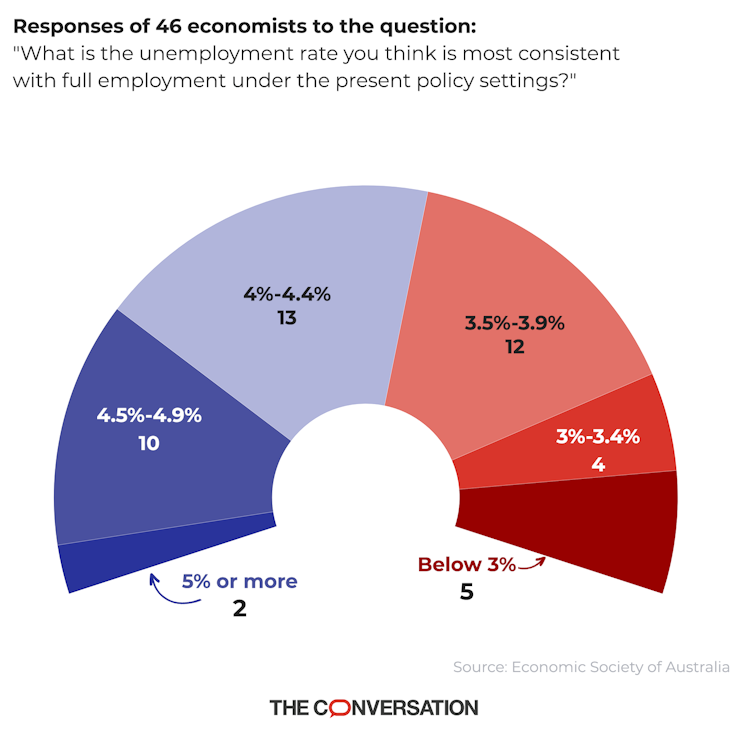
Asked what unemployment rate was most consistent with “full employment” under present policy settings, the 46 respondents who were prepared to pick a number or range picked an average rate of 3.75%.

The median (middle) response was higher, but still below official estimates – an unemployment rate of 4%.


Significantly, only two of the economists surveyed picked an unemployment rate of 5% or higher, which is where Australia’s unemployment rate has been for most of the past five decades.

The 3.75% average implies either that the Reserve Bank and government have lacked ambition on employment for much of the past half-century, or that the sustainable unemployment rate has fallen.

Australia’s unemployment rate dived to 3.5% in mid-2022 and has remained close to that long-term low since.

The survey result suggests the government can lock in the present historic low and need not – and should not – allow unemployment to climb too far from its present rate.


Many of the experts surveyed questioned the idea of a “magic number” or non-accelerating inflation rate of unemployment (NAIRU) used by the Treasury and the Reserve Bank as a guide to how low unemployment can go without feeding inflation.

Former OECD official Adrian Blundell-Wignall said the concept was not helpful “even in the short run, and certainly not the long run” because NAIRU kept changing depending on what else was going on in the domestic and global economy.

Any rate of unemployment would have a different implication for inflation depending on what the government was doing with tax and spending policy.

Geopolitical events and climate change have probably pushed up the rate of inflation to be expected from any given domestic unemployment rate.

3.5% unemployment, yet falling inflation

Craig Emerson, a former minister in the Rudd and Gillard governments, said NAIRU was best described as the lowest unemployment rate consistent with inflation not taking off. Given Australia’s inflation rate is now coming down, NAIRU is clearly below the present unemployment rate of 3.5%, he argued.

The University of Queensland’s John Quiggin said Australia can be considered to have full employment when the number of job vacancies matches the number of unemployed people. This is the case at present, suggesting “full employment” means an unemployment rate of 3.5%.


Alison Preston from the University of Western Australia said industrial relations changes have given workers much less power to obtain higher wages than before, suggesting the “non-inflation accelerating rate of unemployment” was either lower than before or an irrelevant concept.

Curtin University’s Harry Bloch says there will always be a mismatch between the jobs on offer and the skills available – an academic can’t do the work of a plumber, or vice versa, for instance. But even so, he says it ought to be possible to get unemployment down to the 2% achieved repeatedly during the 1950s and 1960s.

Consulting economist Rana Roy says in normal times “full employment” probably meant an unemployment rate near 1%, but the business cycle meant there would always be brief – “and I stress brief” – periods when governments might have to accept an unemployment rate of nearer 2%.

Fix education, job-matching and childcare

Asked to select the three measures from a list of 11 that would do the most to bring down the sustainable rate of unemployment, the 51 experts overwhelmingly backed improving the quality of school education (55%), followed by improving employment services (39%) and cutting out-of-pocket childcare costs (39%).

There was also strong support for relaxing industrial relations to give employers greater flexibility (33%) and winding back taxes and regulations facing businesses (24%) as well as boosting enrolments in tertiary education (27%).

There was very little support for cutting immigration or the JobSeeker payment.


Labour market specialist Sue Richardson said a high-quality job-matching service would both reduce unemployment and boost productivity because Australians would be matched to jobs for which they were best suited.

The unemployed who would benefit the most would be those further down the queue who were the least successful in finding jobs.

Industry economist Julie Toth said digital technologies and working from home were already making it easier to match Australians with jobs across a range of industries, and it was important to preserve these recent gains.


Read more:
Australia is about to set its first full employment target – and it will define people’s lives for decades


One of the panellists, Peter Tulip from the Centre for Independent Studies, rejected all the options offered for lowering the achievable unemployment rate, and said the only one that might have some effect was restraint when increasing minimum wages.

Another, Brian Dollery from the University of New England, said much of Australia’s unemployment had been generated by unemployment benefits that were too high.

Together, the results of the survey call for the government and the Reserve Bank to be ambitious about unemployment, and not to accept a rate above 4%.

The government’s employment white paper is due by the end of September.


Individual responses. Click to open:

The Conversation

Peter Martin does not work for, consult, own shares in or receive funding from any company or organisation that would benefit from this article, and has disclosed no relevant affiliations beyond their academic appointment.

ref. We can and should keep unemployment below 4%, says our survey of top economists – https://theconversation.com/we-can-and-should-keep-unemployment-below-4-says-our-survey-of-top-economists-211277

Macron warns of ‘new colonialism’ in Pacific, but clings to French ‘colonies’

ANALYSIS: By Ravindra Singh Prasad

In a historic first visit to an independent Pacific state by a sitting French president, President Emmanuel Macron has denounced a “new imperialism” in the region during a stop in Vanuatu, warning of a threat to the sovereignty of smaller states.

But, earlier, during a two-day stop in France’s colonial outpost, Kanaky New Caledonia, he refused to entertain demands by indigenous Kanak leaders to hold a new referendum on independence.

“There is in the Indo-Pacific and particularly in Oceania a new imperialism appearing, and a power logic that is threatening the sovereignty of several states — the smallest, often the most fragile,” he said in a speech in the Vanuatu capital Port Vila on July 27.

“Our Indo-Pacific strategy is above all to defend through partnerships the independence and sovereignty of all states in the region that are ready to work with us,” he added, conveniently ignoring the fact that France still has “colonies” in the Pacific (Oceania) that they refuse to let go.

Some 1.6 million French citizens live across seven overseas territories (colonies), including New Caledonia, French Polynesia (Tahiti), and the smaller Pacific atolls of Wallis and Futuna.

This gives them an exclusive economic zone spanning nine million sq km.

Macron uses this fact to claim that France is part of the region even though his country is more than 16,000 km from New Caledonia and Tahiti.

An ‘alternative’ offer
As the US and its allies seek to counter China’s growing influence in the region, France offered an “alternative”, claiming they have plans for expanded aid and development to confront natural catastrophes.

The French annexed New Caledonia in 1853, reserving the territory initially as a penal colony.

Indigenous Kanaks have lived in the islands for more than 3000 years, and the French uprooted them from the land and used them as forced labour in new French plantations and construction sites.

Tahiti’s islands were occupied by migrating Polynesians around 500 BC, and in 1832 the French took over the islands. In 1946 it became an overseas territory of the French Republic.

China is gaining influence in the region with its development aid packages designed to address climate change, empowerment of grassroots communities, and promotion of trade, especially in the fisheries sector, under Chinese President Xi Jinping’s new Global Development Initiative.

After neglecting the region for decades, the West has begun to woo the Pacific countries lately, especially after they were alarmed by a defence cooperation deal signed between China and Solomon Islands in April 2022, which the West suspect is a first step towards Beijing establishing a naval base in the Pacific.

In December 2020, there was a similar alarm, especially in Australia, when China offered a $200 million deal to Papua New Guinea to establish a fisheries harbour and a processing factory to supply fisheries products to China’s seafood market, which is the world’s largest.

Hysterical reactions in Australia
It created hysterical reactions in the Australian media and political circles in Canberra, claiming China was planning to build a naval base 200 km from Australia’s shores.

A stream of Western leaders has visited the region since then while publicly claiming to help the small island nations in their development needs, but at the same time, arm-twisting local leaders to sign defence deals for their navies, in particular to gain access to Pacific harbours and military facilities.

While President Macron was on a five-day visit to New Caledonia, Vanuatu and PNG, US Secretary of State Anthony Blinken and Defence Secretary Lloyd Austin were in Tonga and PNG, respectively, negotiating secret military deals.

At the same time, Macron made the comments of a new imperialism in the Pacific.

Defence Secretary Austin was at pains to explain to sceptical journalists in PNG that the US was not seeking a permanent base in the Pacific Islands nation. It has been reported in the PNG media that the US was seeking access to PNG military bases under the pretext of training PNG forces for humanitarian operations in the Pacific.

Papua New Guinea and the US signed a defence cooperation agreement in May that sets a framework for the US to refurbish PNG ports and airports for military and civilian use. The text of the agreement shows that it allows the staging of US forces and equipment in PNG and covers the Lombrum Naval Base, which Australia and US are developing.

There have been protests over this deal in PNG, and the opposition has threatened to challenge some provisions of it legally.

China’s ‘problematic behavior’
Blinken, who was making the first visit to Tonga by a US Secretary of State, was there to open a new US embassy in the capital Nuku’alofa on July 26. At the event, he spoke about China’s “problematic behavior” in the Pacific and warned about “predatory economic activities and also investments” from China, which he claimed was undermining “good governance and promote corruption”.

Tonga is believed to be heavily indebted to China, but Tongan Prime Minister Siaosi Sovaleni later said at a press conference that Tonga had started to pay down its debt this year and had no concerns about its relationship with China.

Pacific leaders have repeatedly emphasised that they would welcome assistance from richer countries to confront the impact of climatic change in the region, but they do not want the region to be militarised and get embroiled in a geopolitical battle between the US and China.

This was stated bluntly by Fiji’s Defence Minister at the Shangri-La Dialogue in Singapore last year. Other Pacific leaders have repeated this at various forums since then.

Though the Western media reports about these visits to the Pacific by Western leaders as attempts to protect a “rules-based order” in the region, many in the Pacific media are sceptical about this argument.

Fiji-based Island Business news magazine, in a report from the New Caledonian capital Noumea, pointed out how Macron ignored Kanaks’ demands for independence instead of promoting a new deal.

President Macron has said in Noumea that “New Caledonia is French because it has chosen to remain French” after three referendums on self-determination there. In a lengthy speech, he has spoken of building a new political status in New Caledonia through a “path of apology and a path of the future”.

Macron’s pledges ring hollow
As IB reported, Macron’s pledges of repentance and partnership rang hollow for many indigenous Kanak and other independence supporters.

In central Noumea, trade unionists and independence supporters rallied, flying the flag of Kanaky and displaying banners criticising the president’s visit, and as IB noted, the speech was “a clear determination to push through reforms that will advantage France’s colonial power in the Pacific”.

Predominantly French, conservative New Caledonian citizens have called for the electoral register to be opened to some 40,000 French citizens who are resident there, and Macron has promised to consider that at a meeting of stakeholders in Paris in September.

Kanaky leaders fiercely oppose it, and they boycotted the third referendum on independence in December 2022, where the “No” vote won on a “landslide” which Macron claims is a verdict in favour of French rule there.

Kanaks boycotted the referendum (which they were favoured to win) because the French government refused to accept a one-year mourning period for covid-19 deaths among the Kanaks.

Kanaky independence movement workers’ union USTKE’s president Andre Forest told IB: “The electorate must remain as is because it affects citizens of this country. It’s this very notion of citizenship that we want to retain.”

Independence activists and negotiator Victor Tutugoro said: “I’m one of many people who were chased from our home. The collective memory of this loss continues to affect how people react, and this profoundly underlies their rejection of changes to the electorate.”

‘Prickly contentious issues’
In an editorial on the eve of Macron’s visit to Papua New Guinea, the PNG Post-Courier newspaper sarcastically asked why “the serene beauty of our part of the globe is coming under intense scrutiny, and everyone wants a piece of Pasifica in their GPS system?”

“Macron is not coming to sip French wine on a deserted island in the middle of the Pacific,” noted the Post-Courier. “France still has colonies in the Pacific which have been prickly contentious issues at the UN, especially on decolonisation of Tahiti and New Caledonia.

“France also used the Pacific for its nuclear testing until the 90s, most prominently at Moruroa, which had angered many Pacific Island nations.”

Noting that the Chinese are subtle and making the Western allies have itchy feet, the Post-Courier argued that these visits were taking the geopolitics of the Pacific to the next level.

“Sooner or later, PNG can expect Air Force One to be hovering around PNG skies,” it said.

China’s Global Times, referring to President Macron’s “new colonialism” comments, said it was “improper and ridiculous” to put China in the same seat as the “hegemonic US”.

“Macron wants to convince regional countries that France is not an outsider but part of the region, as France has overseas territories there,” Cui Hongjian, director of the Department of European Studies at the China Institute of International Studies told Global Times.

“But the validity of France’s status in the region is, in fact, thin, as its territories there were obtained through colonialism, which is difficult for Macron to rationalise.”

“This is why he avoids talking about it further and turns to another method of attacking other countries to help France build a positive image in the region.”

Meanwhile, during his visit to the 7th Melanesia Arts and Cultural Festival in Port Vila, four chiefs from the disputed islands of Matthew and Hunter, about 190 km from New Caledonia, handed over to the French President what they called a “peaceful demand” for independence. IDN-InDepthNews

Ravindra Singh Prasad is a correspondent of InDepth News (IDN), the flagship agency of the International Press Syndicate. This article is republished with permission.

Print Friendly, PDF & Email

Article by AsiaPacificReport.nz

Out of the shadows: why making NZ’s security threat assessment public is timely

ANALYSIS: By Alexander Gillespie, University of Waikato

The release of the threat assessment by the New Zealand Security Intelligence Service (SIS) this week is the final piece in a defence and security puzzle that marks a genuine shift towards more open and public discussion of these crucial policy areas.

Together with July’s strategic foreign policy assessment from the Ministry of Foreign Affairs, and the national security strategy released last week, it rounds out the picture of New Zealand’s place in a fast-evolving geopolitical landscape.

From increased strategic competition between countries, to declining social trust within them, as well as rapid technological change, the overall message is clear: business as usual is no longer an option.

By releasing the strategy documents in this way, the government and its various agencies clearly hope to win public consent and support — ultimately, the greatest asset any country possesses to defend itself.

Low threat of violent extremism
If there is good news in the SIS assessment, it is that the threat of violent extremism is still considered “low”. That means no change since the threat level was reassessed last year, with a terror attack considered “possible” rather than “probable”.

It is a welcome development since the threat level was lifted to “high” in the
immediate aftermath of the Christchurch terror attack in 2019.

This was lowered to “medium” about a month later — where it sat in September 2021, when another extremist attacked people with a knife in an Auckland mall, seriously
wounding five.

The threat level stayed there during the escalating social tension resulting from the government’s covid response. This saw New Zealand’s first conviction for sabotage and increasing threats to politicians, with the SIS and police intervening in at least one case to mitigate the risk.

After protesters were cleared from the grounds of Parliament in early 2022, it was
still feared an act of extremism by a small minority was likely.

These risks now seem to be receding. And while the threat assessment notes that the online world can provide havens for extremism, the vast majority of those expressing vitriolic rhetoric are deemed unlikely to carry through with violence in the real world.

Changing patterns of extremism
Assessments like this are not a crystal ball; threats can emerge quickly and be near-invisible before they do. But right now, at least publicly, the SIS is not aware of any specific or credible attack planning.

New Zealand's Security Threat Environment 2023 report
New Zealand’s Security Threat Environment 2023 report. Image: APR screenshot

Many extremists still fit well-defined categories. There are the politically motivated, potentially violent, anti-authority conspiracy theorists, of which there is a “small number”.

And there are those motivated by identity (with white supremacist extremism the dominant strand) or faith (such as support for Islamic State, a decreasing and “very small number”).

However, the SIS describes a noticeable increase in individuals who don’t fit within those traditional boundaries, but who hold mixed, unstable or unclear ideologies they may tailor to fit some other violent or extremist impulse.

Espionage and cyber-security risks

There also seems to be a revival of the espionage and spying cultures last seen during the Cold War. There is already the first military case of espionage before the courts, and the SIS is aware of individuals on the margins of government being cultivated and offered financial and other incentives to provide sensitive information.

The SIS says espionage operations by foreign intelligence agencies against New Zealand, both at home and abroad, are persistent, opportunistic and increasingly wide ranging.

While the government remains the main target, corporations, research institutions and state contractors are now all potential sources of sensitive information. Because non-governmental agencies are often not prepared for such threats, they pose a significant security risk.

Cybersecurity remains a particular concern, although the Government Communications Security Bureau (GCSB) recorded 350 incidents in 2021-22, which was a decline from 404 incidents recorded in the previous 12-month period.

On the other hand, a growing proportion of cyber incidents affecting major New Zealand institutions can be linked to state-sponsored actors. Of the 350 reported major incidents, 118 were connected to foreign states (34 percent of the total, up from 28 percent the previous year).

Russia, Iran and China
Although the SIS recorded that only a “small number” of foreign states engaged in deceptive, corruptive or coercive attempts to exert political or social influence, the potential for harm is “significant”.

Some of the most insidious examples concern harassment of ethnic communities within New Zealand who speak out against the actions of a foreign government.

The SIS identifies Russia, Iran and China as the three offenders. Iran was recorded as reporting on Iranian communities and dissident groups in New Zealand. In addition, the assessment says:

Most notable is the continued targeting of New Zealand’s diverse ethnic Chinese communities. We see these activities carried out by groups and individuals linked to the intelligence arm of the People’s Republic of China.

Overall, the threat assessment makes for welcome – if at times unsettling – reading. Having such conversations in the open, rather than in whispers behind closed doors, demystifies aspects of national security.

Most importantly, it gives greater credibility to those state agencies that must increase their transparency in order to build public trust and support for their unique roles within a working democracy.The Conversation

Dr Alexander Gillespie, Professor of Law, University of Waikato. This article is republished from The Conversation under a Creative Commons license. Read the original article.

Print Friendly, PDF & Email

Article by AsiaPacificReport.nz

‘Everyone was in panic mode’: Lāhainā resident tells of wildfire escape

By Finau Fonua, RNZ Pacific journalist

The death toll from the devastating wildfire that engulfed the historic beachside town of Lāhainā on the island of Maui in Hawai’i, continues to rise, with 55 reported dead so far.

Images of Lāhainā show a town obliterated by wildfires with homes and cars in ashes.

Thousands have lost everything and have evacuated to emergency centres.

The firestorm hit Lāhainā like a blowtorch, with wildfires from vegetation fanned by sustained 100km/h winds generated from a hurricane located south of Hawai’i.

“The fire started on the top of the mountain within about a five-mile radius from us,” Leimoana Fa’alogo, a 28-year-old resident of Lāhainā who witnessed the disaster, said.

“The fire was moving down the hill superfast and I would say that within 10 minutes it reached the town and within another 10 minutes moved from one neighbourhood to the next,” Fa’alogo said.

“Because of the high winds from Hurricane Dora, the fire was moving fast and soon people were trying to evacuate.”

‘It was moving too fast’
Fa’alogo told RNZ Pacific ceaseless winds intensified the firewall, which quickly reached the town. It moved so fast, firefighters were unable to keep up.

“They were responding but because of the high winds, it was moving too fast for them,” Fa’alogo said.

“They just weren’t able to respond quickly enough and didn’t have the manpower to continue.”

Leimoana Fa'alogo
Witness Leimoana Fa’alogo . . . “The fire was moving fast and soon people were trying to evacuate.” Image: Leimoana Fa’alogo/RNZ Pacific

Realising the fires could not be stopped, Lāhainā residents abandoned their homes and evacuated. Some residents jumped into the ocean as their escape routes became cutoff by fires.

“We were in the home with my husband and when I looked outside there was smoke everywhere,” Lāhainā resident Alejandra Bautista said.

“It was scary, we just grabbed some things and left. I’ve lost my house.”

Burnt-out shells of cars on the waterfront in the historic Hawai'i town of Lahaina
Burnt-out cars on the waterfront in the historic Hawai’i town of Lāhainā . . . at least 56 people have lost their lives and 11,000 have been evacuated. Image: @mhdksafa

Realising the fires could not be stopped, Lāhainā residents abandoned their homes and evacuated. Some residents jumped into the ocean as their escape routes became cutoff by fires.

“We were in the home with my husband and when I looked outside there was smoke everywhere,” Lāhainā resident Alejandra Bautista said.

‘Scary – I’ve lost my house’
“It was scary, we just grabbed some things and left. I’ve lost my house.”

Many residents left Lāhainā as the town burned around them. Social media videos by drivers showed apocalyptic scenes with houses burning on both sides of the road, as they navigated around debris on the road.

“It was just hectic, and because there were so many electrical poles that fell and roads were blocked, but everyone was in panic mode and just trying to get out,” Fa’alogo said.

“My whole neighbourhood is gone, it’s just all gone, homes damaged, bodies on the street, cars abandoned — caught on fire, people jumping into the water.

“It’s like a movie, these are things you see in a movie, that’s exactly what it looks like. Our town just looks like The Walking Dead.”

Historic Lāhainā, capital of the former kingdom of Hawai'i, before and after the wildfires struck
Historic Lāhainā, capital of the former kingdom of Hawai’i, before and after the wildfires struck. Image: @t0mk0pca

Aid package
As the town continued to burn, US President Joe Biden agreed to an aid package submitted by Hawai’i’s Governor Josh Green. No specific figure was given, but the package will cover damages of residents and businesses affected.

“What we saw is likely the largest disaster in Hawai’i state history,” Green said.

“We are going to need to house thousands of people. It’s our intent to initially seek 2000 rooms so we can get housing for people. That means reaching out to hotels and those in the community.”

Hawaii Governor Josh Green, visits the ruins of Lahaina following it's destruction.
Hawai’i Governor Josh Green . . . “What we saw is likely the largest disaster in Hawai’i state history.” Image: Office of Hawai’i Governor

Fa’alogo was among those thousands — who were staying in churches, schools and community centres across Maui.

“Right now, we have been evacuated and we are currently at the Latter Day Saints Church. We’re getting a lot of help with toiletries, clothes and a lot of food . . . were getting more food than in our own home.

“We have organisations like the Tongan ward of the LDS Church and the Relief Society, they cooked for us last night and we’re up until 2am because people were still arriving looking for shelter.”

Most Maui homes safe
While Lāhainā and at least two other smaller settlements were torched by wildfires, the majority of homes on Maui were safe.

Sandy Kapukala, who lived in the town of Kihei, told RNZ Pacific the western part of the island where Lāhainā is located had been badly hit, while other areas such as the capital Kahului were unaffected.

“There’s still no power, we don’t, we haven’t heard from a lot of people. The roads are blocked, people can’t get into that part of the island but the part of the island where I am . . .  it’s a sunny beautiful day and people are on vacation, so it’s one extreme to the other.”

Fa’alogo said the main concern of the Lāhainā community was contacting family and friends separated during the disaster.

Many residents were still being evacuated from the Lāhainā area and surrounding communities where roads have been blocked, she said.

“The whole town is sad and a lot of people are trying to locate their families because they were separated.

“Currently, the side of the island where Lāhainā is located, is running out of water and food, and there’s still people who need to be evacuated to Kahului [capital of Maui].”

This article is republished under a community partnership agreement with RNZ.

Print Friendly, PDF & Email

Article by AsiaPacificReport.nz

From handing out their own flyers, to sell-out games: how the Matildas won over a nation

Source: The Conversation (Au and NZ) – By Fiona Crawford, Adjunct Lecturer at the Centre for Justice, Queensland University of Technology

As the Matildas prepare for their 2023 FIFA Women’s World Cup sudden-death quarter final against France, they have become the hottest sporting property in the country. For example, formerly uninterested major media just days ago hired a helicopter to spy on one of the team’s training sessions.

The expensive, paparazzi-style move was designed to gather exclusive footage of the team, particularly of injured Matildas captain Sam Kerr.

That conservative media was going to such lengths to gain footage of the team speaks volumes of the starkly different landscape the current Matildas are operating in, and the evolution of a team that’s gone from few resources and relatively anonymity to equal pay and national treasure status.

No longer an afterthought

More people watched the Matildas’ Round of 16 match against Denmark on Channel Seven, the highest rating show of the year to date, than watched the men’s NRL and AFL grand finals last year.

Channel Seven is also delaying Saturday’s news bulletin to broadcast the Matildas’ quarter final, while the AFL will be broadcasting the match in the stadium before the men’s West Coast Eagles versus Fremantle derby.

This is all particularly interesting given FIFA had to castigate broadcasters for undervaluing the broadcast rights in the tournament lead-up.

What’s more, Matildas jerseys are outselling the Socceroos’ jerseys by two to one. It’s worth remembering they were unavailable to buy until recent years because manufacturers didn’t deem there to be a market for them.


Read more:
Fans are finding out just how disappointing merchandise for women’s football is


More than 1.7 million tickets have been sold, exceeding FIFA’s stretch target of 1.5 million. And the total crowd figure record of 1,353,506 set in 2015 had been surpassed with 12 games to spare.

That’s a far cry from the Matildas’ early years, when players had to produce and hand out flyers to try to attract people to watch their games, or phone television stations and beg them to broadcast matches. When the team travelled to the 2003 world cup, not a single journalist turned up to the airport press conference.

It’s also quite the contrast from the traditional media coverage approach that relegates women’s sport to an afterthought. A 30-year study of women’s sports coverage, published in 2021, determined major media generally adopt a “one and done” approach: a box-ticking exercise, providing a token women’s sports story before a succession of in-depth men’s sports stories.

So, how did we get here?

It was 1988 when the intrepid Matildas ventured out to their inaugural “world cup” – a pilot tournament FIFA only staged after concerted pressure from other organising bodies and women footballers themselves.

There were some significant changes considered or implemented – ones that would not have been tabled for the men’s game. Matches were truncated from 90 to 80 minutes; there was some patronising discussion of whether women would play with a smaller ball; and with the tournament absent any true FIFA badging, the players had to pay $850 each for the privilege of participating. They pulled that fee together by fundraising through lamington drives, car washes, and casino nights.

Still, the Australian team quickly made history by defeating Brazil in an upset victory in the tournament’s first match, setting the tone for an upwards trajectory.

However, the 1995, 1999, and 2003 tournaments were not, by the Matildas’ own standards, considered breakout successes. A harsh red card for Sonia Gegenhuber in the team’s first group-stage match against Denmark in 1995 cruelled the team’s chances from the outset. And 1999 saw Alicia Ferguson awarded the fastest red card in history for an ill-timed tackle two minutes into the game against China.

The Matildas’ sustained upward course arguably began in 2007. The World Cup that year was the first womens’ tournament for which SBS broadcast all the games. It also became the first time the Matildas progressed to the knockout rounds.

Although laundry and internet costs weren’t yet covered, that era also marked the beginning of the players receiving (albeit nominal) daily allowances and playing contracts of up to approximately A$10,000. Administrators were able to leverage that 2007 success into the establishment of the W-League (now renamed the A-League Women’s), the domestic semi-professional football league that helped the Matildas become the first Australian team (women’s or men’s) to win the Asian Cup. It’s also a development pathway for the current Matildas.

2011 marked the emergence of the Matildas’ “golden generation”, with then-youthful players Caitlin Foord and Sam Kerr attending their first Women’s World Cup.

All the focus has been on Kerr in recent years, but at the time, Foord was tipped to be the player to watch, and was named the tournament’s best young player.


Read more:
FIFA Women’s World Cup: Professional women athletes are still fighting for equitable sponsorship


Striking for pay parity

To understand the groundbreaking success the Matildas are now experiencing, we must look at the lonely stand they took across the road from governing body Football Federation Australia’s office in 2015.

They were off contract, unpaid, and without medical insurance. Now lapsed, they had been on contracts of around A$22,000 a year: in the ballpark of Australia’s poverty line.

So the Matildas went on strike for two months to draw attention to the imperiled nature of their footballing careers, which demanded full-time, elite-athlete commitment and results, but with part-time, amateur pay.

The headlines that followed encapsulated the exasperation many felt (and still feel) at the inequity women athletes experience. This included the Junkee headline

The Matildas Have Gone on Strike Because, Oh My God Can We Just Pay Them Properly?

The Matildas achieved pay parity with the Socceroos in 2019, but the groundwork for that achievement was laid with that 2015 strike.

The year 2017 also marked an important moment in the team’s evolution. It was when the team sold out Penrith Stadium with a then-record crowd of about 17,000.

The crowd figure signalled there was an engaged audience and market there – it had just been under-catered for.


Read more:
FIFA Women’s World Cup: Gender equity in sports remains an issue despite the major strides being made


Fast forward to 2019. Off-pitch distractions imperilled the Matildas’ group-stage world cup results. The team was steered through the tournament by temporarily installed coach Ante Milicic, after incumbent coach Alen Stajcic had been sacked for reasons still not entirely clear.

With the rise of European nations that had invested heavily in women’s football, Australian football had stood still. The Matildas’ opening loss against debutantes Italy put the team under pressure. However, the players then produced the “Miracle of Montpellier”, winning 3-2 against superstars Brazil to salvage their tournament – before being bundled out by Norway on penalties in the round of 16.

This year, the media’s initial focus was on Kerr’s troublesome calf and then late substitution decisions by coach Tony Gustavsson. Under pressure following a shock loss to minnows Nigeria, the Matildas recorded a resounding 4–0 victory over reigning Olympic champions Canada.

Now, in a few pressure-filled hours, Australia’s most successful football team have the potential to make history: to progress to the semi finals for the first time ever.

A win would see Matildas’ media coverage and fandom enter uncharted, euphoric territory. But with record crowds, viewership, and merchandise sales, and with several of their players now household names, in many ways the Matildas will already have won before they even set foot on the pitch.

The Conversation

Fiona Crawford has worked in and around football for more than a decade, including having previously worked for Football Federation Australia/Football Australia.

ref. From handing out their own flyers, to sell-out games: how the Matildas won over a nation – https://theconversation.com/from-handing-out-their-own-flyers-to-sell-out-games-how-the-matildas-won-over-a-nation-211338

Ailing suspended Papuan governor Enembe now in detention cell after army hospital

SPECIAL REPORT: By Yamin Kogoya

An Indonesian court has held a hearing to consider whether the ailing suspended Papua Governor, Lukas Enembe, is well enough to go on trial for the allegations of bribery and gratification that he is facing.

The hearing was held in the Central Jakarta District Court yesterday to consider a second medical opinion provided by the Indonesian Medical Association (IDI).

Corruption Eradication Commission (KPK) public prosecutors read out the IDI medical report, which stated that the defendant Enembe was fit to face trial.

Former Governor Enembe was not present at the hearing and his lawyers and family protested against the second opinion of IDI’s decision, arguing that the judgment was not based on a proper medical report but rather a view formed and collected by KPK’s doctors through interviews.

The family refused to accept this result because they believe it did not accurately represent the medical issues facing the governor.

The governor’s lawyers contend that their client is seriously ill, and they have now received an accurate medical report from the army hospital’s specialist, who has been treating  Enembe for the past two weeks, since he was moved from KPK’s detention cell to Gatot Soebroto Army Central Hospital (RSPAD) in Jakarta on July 16 due to serious health concerns.

“As a result of the explanation given by the RSPAD doctor’s team who visited Mr Enembe’s in-patient room on Monday (24/7), it was determined that Mr Enembe’s kidney function had decreased dramatically. According to Bala Pattyona, Mr Enembe’s chronic kidney has deterorated rapidly,” reports ODIYAIWUU.com.

From army hospital to cell — emotional for family
Despite serious health concerns, on July 31 the KPK came to the Army hospital and picked up Enembe, taking him to KPK’s detention cell.

Enembe’s lawyer, Petrus Bala Pattyona, revealed an emotional atmosphere when Enembe was removed from the hospital.

His wife, siblings and other relatives who were at the RSPAD were reportedly crying.

“The governor was taken by wheelchair from his room to the ambulance,” Petrus told Kompas.com on Monday night.

Petrus said that before being picked up by the KPK prosecutors, the family had refused to sign administrative documents for Enembe’s departure from RSPAD.

“Because the person who brought Mr Enembe to the hospital was a KPK prosecutor, then they are the ones who are responsible for Mr Enembe’s discharge from the hospital,” said Pattyona.

The KPK officials signed the hospital discharge papers.

Health priority request
The governor’s lawyers asked for the unwell governor to remain in the city to prioritise his medical treatment.

In response to his deteriorating health, the governor’s legal advisory team sent a letter on Thursday, July 20, to the Jakarta District Court judges.

They requested that Lukas Enembe be granted city arrest status because of his serious life-threatening illness.

The letter was signed by the governor’s legal team, including Professor Dr OC Kaligis, Petrus Bala Pattyona, Cyprus A Tatali, Dr Purwaning M Yanuar, Cosmas E Refra, Antonius Eko Nugroho, Anny Andriani and Fernandes Ratu.

According to the governor’s senior lawyer, Professor Kaligis, the application was submitted on the grounds that Enembe’s health had not improved since he had been detained in KPK’s detention cell.

Professor Kaligis said: “Our client is suffering from many complicated, serious illnesses. His kidney disease has reached stage five, he has diabetes, and he has suffered from four strokes. He is suffering from low oxygen saturation, swelling in his legs, and other internal diseases.”

In a written statement, Kaligis said Enembe’s legal counsel requested the judges to consider bail for the governor. He pleaded with the legal authorities to empathise with Enembe’s suffering.

Suharto’s case a valuable lesson
Kaligis said that while defending the late Indonesian President Suharto, his party went to Geneva on 13 June 2000 and met with the Centre for Human Rights and specifically the Human Rights Officer, Mrs Eleanor Solo.

“During that time, I was accompanied by Dr Indriyanto Seno Adji and two members of the TVRI crew because a seriously ill individual would not be suitable to [be examined] at the trial. Regardless of accusations a person might be facing, no one should be subjected to inhumane or degrading conduct,” Kaligis said.

During Kaligis’s visit to Geneva, a human rights delegation visited the residence of Suharto, ensuring that the judge who tried Suharto, the late Chief Justice of South Jakarta State, Judge Lalu Mariun, stopped the examination after receiving a fatwa from the Supreme Court.

Because Lukas Enembe is incarcerated under the authority of a panel of judges — not the KPK — Profewsaor Kaligis said they were hopeful that the request would be granted.

According to Elius Enembe, the governor’s brother and spokesman for the governor’s family, the governor was in a critical condition.

Nothing good will come from returning him to KPK’s prison cells. This is bad news for us and given the governor requires full support in terms of care needs, KPK should be held responsible should something grave occur while under their council. The Papuan people and the world are watching. There is nothing more torturous than this.

On Wednesday, 26 July 2023, the governor had his birthday, turning 56.

What should have been a happy celebration with family and the people of his homeland was abandoned for a hospital bed.

The trial is due to resume next week.

Yamin Kogoya is a West Papuan academic who has a Master of Applied Anthropology and Participatory Development from the Australian National University and who contributes to Asia Pacific Report. From the Lani tribe in the Papuan Highlands, he is currently living in Brisbane, Queensland, Australia.

Print Friendly, PDF & Email

Article by AsiaPacificReport.nz

Lāhainā ‘completely wiped out’ – US declares Maui wildfires disaster as toll tops 53

By Felix Walton, RNZ News reporter

A New Zealander on holiday in Maui says the wildfires devastating the Hawai’ian island are unlike anything he has seen before.

Deadly wildfires on Maui prompted a county-wide state of emergency, and several brush fires have also caused evacuations on Hawai’i Island.

Officials say at least 53 people have died and more than 270 buildings have been damaged or destroyed, the BBC reported.

US President Joe Biden declared a major disaster in the state of Hawai’i, meaning the federal government will provide funding to assist state and local recovery efforts.

Canada-based New Zealander Tim Hoy, who was on holiday in Maui, said powerful winds fuelled the fires as they spread.

“We’re located in between two fires right now, and the wind forces have been nothing like I’ve witnessed before,” he said.

“I’ve spent a lot of years in Wellington, it’s stronger than what you’d see on the strongest day in Wellington.”

Hundreds of NZers in Hawai’i
House of Travel chief operating officer Brent Thomas said hundreds of New Zealanders were on Hawai’i when the fires started.

“It’s a very popular destination, particularly given it’s winter in New Zealand,” he said.

“We’ve got hundreds of people up there at the moment, but obviously not all of them are impacted.”

Hoy said one of the fires was under control, but the other was still raging.

“They’ve done a great job of controlling one of the fires,” he said.

“The other one, it’s completely wiped out a township and it’s unable to be contained.”

Maui County estimated more than 270 buildings had been damaged in the fires.

Historic Lāhainā . . . "burnt to the ground"
Historic Lāhainā . . . “for all intents and purposes burnt to the ground . . . Little is left there other than ash and rubble.” Image: @ForsigeNews
Maui Island in the state of Hawai'i map
Maui Island in the state of Hawai’i . . . devastating wildfires. Image: @Agent131711

“My daughter’s friend, her family’s house was burned down,” Hoy said. “They’re currently a few miles down the coast staying at accommodation there.”

Lāhainā devastated
The fire on the island’s west coast tore through the town of Lāhainā. Hoy said everyone there was told to evacuate.

“The area that got wiped out was a major tourist destination, and everyone’s been asked to leave Maui if they can,” he said. “So they’ve headed to the airport, and there’s people in shelters.”


Hawai’i Tourism Authority public affairs officer Illihia Gionson said Lāhainā, which was once the capital of the Kingdom of Hawai’i, had historic and cultural importance.

“One of the most historic towns on Maui, Lāhainā, is for all intents and purposes burnt to the ground,” he said.

“Little left there other than ash and rubble, lots of older buildings [made of] wood. So it appears a lot of those landmarks are gone.”

Gionson said the safety of tourists was vital, but local residents needed the most support.

“We think about the importance of assisting visitors in getting out, to free up those resources and attention for the thousands of residents whose homes were affected, whose businesses were affected, whose livelihoods were affected,” he said.

“We’re keeping them front and centre in our thoughts and prayers.”

Historic Lāhainā, capital of the former kingdom of Hawai'i, before and after the wildfires struck
Historic Lāhainā, capital of the former kingdom of Hawai’i, before and after the wildfires struck. Image: @t0mk0pca

Victoria University Pacific Studies lecturer Dr Emalani Case, who was born in Hawai’i, said residents of Maui should come first.

She urged would-be tourists to stay away while the island recovered.

“A really important message to come out of what’s unfolding right now is: don’t go to Maui,” she said.

“If you’re planning a trip, don’t go there. The resources and the energies and the money on that island right now really needs to go to the people who are living there and who are going to have to struggle for a while.”

Dr Case said it was an emotional time for all Hawai’ians.

“It’s so hard to be so far away,” she said. “I don’t even think we know the scale of it all yet, but just watching it online has been heartbreaking.”

New Zealand’s Fire and Emergency said it was prepared to send firefighters to Hawai’i if the US government asked for help.

“We keep in frequent touch with our counterparts in Canada and the US during the northern hemisphere fire season,” a spokesperson said.

“So far we have not received a formal request for assistance from the USA.”

Service delivery wildfire manager Tim Mitchell said fires like those on Maui were extremely destructive.

“They get very hot, we’re talking hundreds or even thousands of degrees,” he said. “Under those conditions they’re just not survivable, and they absolutely consume everything in their path.”

He said it was vital for people to be aware of wildfire risks.

“They will spread faster than what you can outrun,” he said.

New Zealand will enter its own wildfire season within the next couple of months.

Mitchell said a fire could start anywhere and at any time.

“Historically, we wouldn’t have necessarily thought of Hawai’i as a high wildfire risk place, there’s places in New Zealand that we wouldn’t consider high risk,” he said.

“It just goes to show that, if you’ve got the dry vegetation and you get a spark or an ignition, that wildfires can occur everywhere.”

This article is republished under a community partnership agreement with RNZ. Additional reporting by the BBC.

How the New Zealand Herald headlined the Hawai’i fires report today
How the New Zealand Herald headlined the Hawai’i fires report today. Image: APR screenshot
Print Friendly, PDF & Email

Article by AsiaPacificReport.nz

Australia just won the netball world cup. Why isn’t there room for multiple women’s world cups in our sports media?

Source: The Conversation (Au and NZ) – By Kasey Symons, Postdoctoral research fellow, Swinburne University of Technology

With the Matlidas progressing to the quarter finals of the 2023 FIFA Women’s World Cup, Australia’s sports media is focussed on this global mega event and the potential it has to change the women’s game.

Broadcast numbers are setting records, stadiums are packed, Matildas jerseys are flying off the shelves and the media is paying attention.

But why aren’t Australia’s netballers afforded the same media focus? On August 6, the Australian Diamonds won the Netball World Cup for the 12th time with a 61–45 victory over England in Cape Town.

While some Australians celebrated this moment in the early hours of Monday morning, many sports fans would have been unaware the final was even happening among the level of coverage the football is currently receiving.

One contributing factor was time zones. The recent netball world cup was held in South Africa, and Australian audiences suffered from an unpalatable time difference.

However the specific challenges traditional women’s sports encounter within the greater complexities of the women’s sports world cannot be ignored.

Barriers for traditional women’s sports

Australian netball has seen recent growth in broadcast and ticket sales. The 2023 final of Australia’s professional netball league was the most watched Super Netball match ever on Foxtel. And yet the media attention afforded to netball pales in comparison to women’s sporting codes aligned with traditional men’s sports.

At the FIFA world cup, the sports media is showcasing the thriving and inclusive fan culture, the history of women’s football and stories from grassroots and community football.

These stories offer a point of difference to men’s football and highlight obstacles overcome compared to the men’s code.

The narratives of progress for women’s football demonstrate a “dream finally being realised” and a bridging of historical gaps.

For netball, there are no comparative narratives to tell. While there is men’s netball and a national men’s netball team in Australia, the history of netball as a sport designed for women provides a perception it does not experience the same challenges as other women’s sports playing “catch up”.

Netball is taken for granted and is largely out of mind for sports media.


Read more:
‘Gorgeous goal getters’: 1970s media coverage of ‘soccerettes’ was filled with patronising sleaze


Netball and Australian sport culture

Netball was historically designed for women and girls based on the original rules of basketball adapted to suit the “ideal qualities” placed on women in the late 19th century.

The sport removed dribbling to limit physical exertion and maintain appropriate dress standards, ensured no contact, restricted movement on the court and, at certain periods, enforced silence on participants.

Schoolgirls playing netball in 1923.
State Library South Australia

Unlike the global game of football, netball remains popular only in a handful of Commonwealth countries.

Netball has the highest participation rate of any team sport for women and girls in is Australia. Most Australian women are directed to and encouraged to play netball at some point in their lives.

Despite this prevalence, there has been little research on netball, the game’s origins and cultural significance in Australian sporting culture.


Read more:
From ‘good temper and pluck’ to fierce international rivalry: the story of netball


Women’s sports media coverage

Coverage for women in sport consistently makes up less than 10% of the overall sports media coverage in Australia.

Even with no live sport during the height of the COVID pandemic, men’s sport stories still dominated.

Despite netball’s popularity and high participation rates, a study of nine Australian newspapers’ coverage of the 2017 Super Netball season revealed only 4.58% of total sports media coverage was dedicated to the sport.

The most coverage the game generates is when it is in crisis: the 2020 controversy surrounding the competition’s only Indigenous player at the time, Jemma Mi Mi, not given court time in the league’s Indigenous round, despite featuring in the marketing; Netball Australia’s financial position and subsequent proposed sponsorship with Hancock Prospecting; and the folding of the Collingwood Super Netball Team.

The Australian domestic netball competition is arguably the best in the world and attracts the world’s best netballers. But if not for independent women’s sport and dedicated netball media platforms, passionate freelancers and champions driving netball coverage at their mainstream media mastheads, it’s sobering to think where that 4.6% of coverage would sit.

While more Matildas become household names, few could name the Diamonds co-captains, Steph Wood and Liz Watson, and know Wood has just retired from international competition .

Few are discussing the fact World Netball does not offer prize money, and what the current uncertainty of the Commonwealth Games means for athletes who do not have their sport included in the Olympics.

As we reflect on the exciting gains this global mega event can offer women’s football, and the stories which are being told about the barriers these players have faced in a traditionally male sport, we must also reflect on what barriers exist in other women’s sports.

Netball plays an incredibly powerful role in connecting many women to sport in Australia. Media coverage is important to continue to celebrate the athletes at both a grassroots and a professional level. But it also has an important role to play in calling attention to the challenges and change netball needs to continue to drive the code forward alongside other developing professional women’s sports.


Read more:
Women’s World Cup: five issues holding back the female game


The Conversation

Kasey Symons consults to and conducts research for a number of organisations across Australia. Her research has received funding from organisations including the Victorian Government, and national and state sport governing bodies including the Australian Football League and its clubs and the National Rugby League. Dr Symons is also one of the co-founders of Siren: A Women in Sport Collective.

Bess Schnioffsky does not work for, consult, own shares in or receive funding from any company or organization that would benefit from this article, and has disclosed no relevant affiliations beyond their academic appointment.

ref. Australia just won the netball world cup. Why isn’t there room for multiple women’s world cups in our sports media? – https://theconversation.com/australia-just-won-the-netball-world-cup-why-isnt-there-room-for-multiple-womens-world-cups-in-our-sports-media-211413

Out of the shadows: why making NZ’s security threat assessment public for the first time is the right move

Source: The Conversation (Au and NZ) – By Alexander Gillespie, Professor of Law, University of Waikato

Today’s release of the threat assessment by the New Zealand Security Intelligence Service (SIS) is the final piece in a defence and security puzzle that marks a genuine shift towards more open and public discussion of these crucial policy areas.

Together with July’s strategic foreign policy assessment from the Ministry of Foreign Affairs, and the national security strategy released last week, it rounds out the picture of New Zealand’s place in a fast-evolving geopolitical landscape.

From increased strategic competition between countries, to declining social trust within them, as well as rapid technological change, the overall message is clear: business as usual is no longer an option.

By releasing the strategy documents in this way, the government and its various agencies clearly hope to win public consent and support – ultimately, the greatest asset any country possesses to defend itself.

Low threat of violent extremism

If there is good news in the SIS assessment, it is that the threat of violent extremism is still considered “low”. That means no change since the threat level was reassessed last year, with a terror attack considered “possible” rather than “probable”.

It’s a welcome development since the threat level was lifted to “high” in the
immediate aftermath of the Christchurch terror attack in 2019. This was lowered
to “medium” about a month later – where it sat in September 2021, when another extremist attacked people with a knife in an Auckland mall, seriously
injuring five.


Read more:
NZ’s first national security strategy signals a ‘turning point’ and the end of old certainties


The threat level stayed there during the escalating social tension resulting from the government’s COVID response. This saw New Zealand’s first conviction for sabotage and increasing threats to politicians, with the SIS and police intervening in at least one case to mitigate the risk.

After protesters were cleared from the grounds of parliament in early 2022, it was
still feared an act of extremism by a small minority was likely.

These risks now seem to be receding. And while the threat assessment notes that the online world can provide havens for extremism, the vast majority of those expressing vitriolic rhetoric are deemed unlikely to carry through with violence in the real world.


Read more:
The ‘number 8 wire’ days for NZ’s defence force are over – new priorities will demand bigger budgets


Changing patterns of extremism

Assessments like this are not a crystal ball; threats can emerge quickly and be near-invisible before they do. But right now, at least publicly, the SIS is not aware of any specific or credible attack planning.

Many extremists still fit well-defined categories. There are the politically motivated, potentially violent, anti-authority conspiracy theorists, of which there is a “small number”.

And there are those motivated by identity (with white supremacist extremism the dominant strand) or faith (such as support for Islamic State, a decreasing and “very small number”).

However, the SIS describes a noticeable increase in individuals who don’t fit within those traditional boundaries, but who hold mixed, unstable or unclear ideologies they may tailor to fit some other violent or extremist impulse.

Espionage and cyber-security risks

There also seems to be a revival of the espionage and spying cultures last seen during the Cold War. There is already the first military case of espionage before the courts, and the SIS is aware of individuals on the margins of government being cultivated and offered financial and other incentives to provide sensitive information.

The SIS says espionage operations by foreign intelligence agencies against New Zealand, both at home and abroad, are persistent, opportunistic and increasingly wide ranging.


Read more:
Cutting-edge new aircraft have increased NZ’s surveillance capacity – but are they enough in a changing world?


While the government remains the main target, corporations, research institutions and state contractors are now all potential sources of sensitive information. Because non-governmental agencies are often not prepared for such threats, they pose a significant security risk.

Cybersecurity remains a particular concern, although the Government Communications Security Bureau (GCSB) recorded 350 incidents in 2021-22, which was a decline from 404 incidents recorded in the previous 12-month period.

On the other hand, a growing proportion of cyber incidents affecting major New Zealand institutions can be linked to state-sponsored actors. Of the 350 reported major incidents, 118 were connected to foreign states (34% of the total, up from 28% the previous year).

Russia, Iran and China

Although the SIS recorded that only a “small number” of foreign states engaged in deceptive, corruptive or coercive attempts to exert political or social influence, the potential for harm is “significant”.

Some of the most insidious examples concern harassment of ethnic communities within New Zealand who speak out against the actions of a foreign government.

The SIS identifies Russia, Iran and China as the three offenders. Iran was recorded as reporting on Iranian communities and dissident groups in New Zealand. In addition, the assessment says:

Most notable is the continued targeting of New Zealand’s diverse ethnic Chinese communities. We see these activities carried out by groups and individuals linked to the intelligence arm of the People’s Republic of China.

Overall, the threat assessment makes for welcome – if at times unsettling – reading. Having such conversations in the open, rather than in whispers behind closed doors, demystifies aspects of national security.

Most importantly, it gives greater credibility to those state agencies that must increase their transparency in order to build public trust and support for their unique roles within a working democracy.

The Conversation

Alexander Gillespie does not work for, consult, own shares in or receive funding from any company or organisation that would benefit from this article, and has disclosed no relevant affiliations beyond their academic appointment.

ref. Out of the shadows: why making NZ’s security threat assessment public for the first time is the right move – https://theconversation.com/out-of-the-shadows-why-making-nzs-security-threat-assessment-public-for-the-first-time-is-the-right-move-211183

Why do I fall asleep on the sofa but am wide awake when I get to bed?

Source: The Conversation (Au and NZ) – By Madeline Sprajcer, Lecturer in Psychology, CQUniversity Australia

Shutterstock

After a long day, you flop onto the sofa and find yourself dozing off while watching TV. The room is nice and warm, the sofa is comfortable, and the background noise of the TV lulls you to sleep.

Then a loved one nudges you awake and reminds you to go sleep – in bed. But when you get there, you find to your frustration that you’re wide awake.

Why does sleep come so easily on the sofa but not always in bed?


Read more:
How do I stop my mind racing and get some sleep?


Why is it so easy to fall asleep on the sofa?

Sleep pressure is one reason why you fall asleep on the sofa. This refers to the strength of the biological drive for sleep. The longer you’ve been awake, the greater the sleep pressure.

Your body clock or circadian rhythm is another factor. This tells you to be awake during the day and to sleep at night.

Your environment will also impact how likely it is you fall asleep. You might have just eaten a meal, your very comfortable sofa is in a warm room, with dim lighting and maybe a TV program in the background. For many people, this environment is perfect for falling asleep.

So by the end of the day, sleep pressure is strong, your circadian rhythm is telling you it’s time for sleep and your environment is cosy and comfortable.


Read more:
Health Check: ‘food comas’, or why eating sometimes makes you sleepy


What happens after a nap on the sofa?

If you’ve had a nap on the sofa before heading to bed, your sleep pressure is likely much lower than it was before your nap. Instead of having more than 16 hours of wakefulness behind you, you’ve just woken up and therefore have less sleep pressure. This can make it much harder to fall asleep in bed.

If you just fell asleep on the sofa for five minutes, you might not have too much trouble getting to sleep in bed. This is because a nap that short is unlikely to reduce your sleep pressure very much. But if you were asleep for an hour, it might be a different story.

Your sleep cycles might also be working against you. Most sleep cycles are about 90 minutes long. They start with light sleep, progress to deep sleep, and then end with light sleep again. If you wake up during deep sleep, you’re probably going to feel groggy – and it might be easy to get back to sleep when you go to bed. But if you wake up during light sleep it could be harder to fall asleep again in bed.

The activities you might do when you get up from the sofa – like turning on bright lights or brushing your teeth – can also make you feel more alert and make it harder to sleep when you get to bed.

Young woman brushing teeth in bathroom mirror, holding glass of water
Brushing your teeth in a brightly lit bathroom? That may not help.
Shutterstock


Read more:
Health Check: are naps good for us?


Why can’t I fall asleep in my own bed?

There are other reasons why falling also in your bed could be challenging. Many people experience anxiety about falling asleep. They worry about getting enough sleep or falling asleep fast enough.

In such cases, getting into bed can be associated with feelings of stress and apprehension, which make it even harder to sleep. It might be easier to fall asleep on the couch, where there is less stress involved.

It might also be harder to fall asleep in bed because of poor sleep hygiene. This refers to your pre-sleep behaviours and sleep environment.

Good sleep hygiene, or healthy sleep habits, includes having a regular routine before bed, a dark, quiet room to sleep in, and not using your mobile phone in bed. For many people who don’t have good sleep hygiene, their behaviours before bed and their bedroom environment might not be conducive to sleep.


Read more:
‘Phubbing’: snubbing your loved ones for your phone can do more damage than you realise


How can I make it easier to fall asleep in bed?

First, make sure your room is dark, quiet and comfortable. In winter this might mean putting a heater on 20 minutes before you go to bed or taking a heat pack to bed with you. In summer, you might consider air conditioning or a fan to make your bedroom comfortable for sleeping.

If you find it easy to fall asleep with the TV on, you might like to play “white noise” in your bedroom as you fall asleep. Some evidence suggests this may make it easier to fall asleep by masking other disruptive noises.

Your behaviour before bed also impacts how easy it is to fall asleep. Making sure you follow the same bedtime routine every night (including going to bed at the same time) can help.

Also, even though it’s hard, try not to look at your phone while you’re in bed. Scrolling on your phone before bed can make it harder to sleep due to both exposure to blue light and the potentially stressful or alerting effect of the content you interact with.


Read more:
What is brown noise? Can this latest TikTok trend really help you sleep?


In a nutshell

The best way to make it’s easier to fall asleep in your bed is to avoid falling asleep on the sofa in the first place.

This will ensure all the sleep pressure you build up during the day will be directed towards a deep sleep in your bed.


Read more:
Why do we wake around 3am and dwell on our fears and shortcomings?


The Conversation

The authors do not work for, consult, own shares in or receive funding from any company or organization that would benefit from this article, and have disclosed no relevant affiliations beyond their academic appointment.

ref. Why do I fall asleep on the sofa but am wide awake when I get to bed? – https://theconversation.com/why-do-i-fall-asleep-on-the-sofa-but-am-wide-awake-when-i-get-to-bed-208371

The Kimba nuclear waste plan bites the dust. Here’s what went wrong and how to do better next time

Source: The Conversation (Au and NZ) – By Ian Lowe, Emeritus Professor, School of Environment and Science, Griffith University

The federal government has scrapped plans to build the nation’s first radioactive waste storage facility on farmland near Kimba in South Australia. Frankly, it was never going to work. The plan was doomed from the start.

That’s because the “decide and defend” model, where a government decides to put radioactive waste somewhere and then attempts to defend it against the community, hasn’t worked anywhere. It hasn’t worked in the United Kingdom. It hasn’t worked in the United States. Those countries still don’t have any process for long-term management of radioactive waste.

The only country to successfully manage the process is Finland, where the community was engaged. Over a period of several years, the government worked with its people to find a place where the community as a whole was happy to have the radioactive waste, in return for compensation. They’re now building a deep underground repository for permanently storing their radioactive waste.

But Australia’s national government has made the same mistake three times now: a proposal in the Woomera area 20 years ago, Muckaty station in the Northern Territory ten years ago and now Napandee near Kimba. Deciding on a site and then trying to defend it against the community doesn’t work. The government really needs to understand this. The only way to manage our radioactive waste is to engage the community from the start. That means the whole community, including the land’s traditional owners.

No nuclear waste dump for Kimba, South Australia as the federal government formally abandons the plan (ABC News, August 10, 2023)

Stacking the deck

The Federal Court last month ruled against plans by the former Coalition government to build the Kimba facility, after a court challenge by the traditional owners, the Barngarla people.

The traditional owners had not been consulted – in fact they were specifically excluded from the consultation process. And that’s why the Federal Court overturned the decision.

On Thursday morning, Federal Resources Minister Madeleine King told the House of Representatives she would not challenge the Federal Court decision.

She described Kimba as “a town divided” and emphasised broad community support would have included “the whole community, including the traditional owners of the land”.

But she also drew attention to flaws in the plan, saying:

The previous Government sought to temporarily store intermediate level radioactive waste on agricultural land and contemplated the double handling of the transport of this waste; first from Lucas Heights in NSW, to temporary storage in SA, then on to an undetermined permanent disposal site.

This approach has raised concerns regarding international best practice and safety standards.

King noted the amount of radioactive waste will keep growing, and said her department has begun work on alternative proposals.

Consulting traditional owners is crucial

The Barngarla people understandably objected to nuclear waste being imposed on their land without their prior informed consent.

It might have been possible for the federal government to persuade them to accept low-level waste, which is given that classification because it has relatively low levels of radiation. If buried under a few metres of earth, the radiation reaching the surface is not much above normal background levels.

But the decision to use the site for temporary storage of the intermediate level waste from the Lucas Heights reactor in New South Wales was unlikely to get their approval.

And that raises a quite fundamental issue. Anywhere we want to store radioactive waste in Australia is the traditional land of a group of Indigenous people. Given the history of the Menzies government allowing nuclear weapons to be tested here and the impacts that had on Indigenous people, it’s going to be very difficult to persuade Indigenous people to allow the permanent storage of radioactive waste on their land.

If it’s going to happen, it will require a long process of engagement and communication with Indigenous people to find a group somewhere that’s happy to manage the radioactive waste the community is producing.


Read more:
There’s a long and devastating history behind the proposal for a nuclear waste dump in South Australia


What should happen next?

The vast majority (97%) of the existing nuclear waste produced in this country comes from Australia’s Nuclear Science and Technology Organisation (ANSTO), the research reactor at Lucas Heights in Sydney.

The idea of shifting intermediate-level waste from Lucas Heights to another temporary store 1,700km away is particularly silly. The waste is quite nasty stuff that requires serious management. There’s no obvious reason it would have been better in a temporary store at Kimba than in the current temporary store of Lucas Heights.

People have accepted it at Lucas Heights. The sensible approach would be to leave it there until we find somewhere people are happy to have it permanently.

In the fine print of the AUKUS agreement, the Australian government has agreed to manage the radioactive waste from nuclear submarines sourced from the UK and the US. That raises a much more difficult issue.

The Virginia class submarines use highly enriched uranium, which is weapons-grade material. It produces a more complex and intractable set of waste products than what’s produced at Lucas Heights. I’m not sure how many people understand Australia has taken that task on.


Read more:
Australia hasn’t figured out low-level nuclear waste storage yet – let alone high-level waste from submarines


Looking ahead

Naturally, anti-nuclear campaigners welcomed this week’s announcement. But they also held out an olive branch to the federal government, recognising the waste problem hasn’t gone away.

The Australian Conservation Foundation campaigner Dave Sweeney said:

ACF looks forward to constructive dialogue with the Albanese government to help develop a new and responsible approach to radioactive waste management in Australia.

Similarly, Conservation SA chief executive Craig Wilkins said:

Now that the Kimba plan is officially dumped, the real work can finally begin to find a more credible and respectful approach to identifying a long-term storage and disposal site for Australia’s nuclear waste that is consistent with international best practice.

How Finland plans to store uranium waste for 100,000 years (Science Magazine, 2022)

The Conversation

Ian Lowe was for twelve years a member of the Radiation Health and Safety Advisory Council, which advises the regulator of nuclear issues. He was also a member of the Expert Advisory Committee for the South Australia Nuclear Royal Commission.

ref. The Kimba nuclear waste plan bites the dust. Here’s what went wrong and how to do better next time – https://theconversation.com/the-kimba-nuclear-waste-plan-bites-the-dust-heres-what-went-wrong-and-how-to-do-better-next-time-211344

Genetically engineered bacteria can detect cancer cells in a world-first experiment

Source: The Conversation (Au and NZ) – By Dan Worthley, Gastroenterologist and cancer scientist, South Australian Health & Medical Research Institute

Shutterstock

As medical technology advances, many diseases could be detected, prevented and cured with cells, rather than pills.

This branch of medicine is called cellular or cell therapy. It’s already used in clinical practice in some situations, such as patients receiving faecal microbial transplants (“poo transplants”) when they have a severe gastrointestinal infection, or a bone marrow transplant for treating blood cancer.

Using synthetic biology, we can also engineer new and improved cells that could help us manage various diseases. In a new study published today in Science, my colleagues and I describe how we engineered bacteria to successfully detect cancer cells.

Leveraging competent bacteria

Our project started with a presentation by synthetic biologist Rob Cooper during our colleague Jeff Hasty’s weekly lab meeting at the University of California San Diego. Rob was studying genes and gene transfer in bacteria.

Genes are the fundamental unit of genetic inheritance. It’s the stuff that gives you your mother’s smile or your father’s eye colour.

Gene transfer (or inheritance) is the process by which genes are passed from one cell to another. They may be inherited vertically – when one cell replicates its DNA and divides into two separate cells. This is what happens in reproduction, and how children inherit DNA from their parents.

Genes may also, however, be inherited horizontally – when DNA is passed between unrelated cells, outside of parent-to-offspring inheritance.

Horizontal gene transfer is quite common in the microbial world. Certain bacteria can salvage genes from cell-free DNA found in their immediate environment. This free-floating DNA is released when cells die. When bacteria hoover up cell-free DNA into their cells, it’s called natural competence.

So, competent bacteria can sample their nearby environment and, in doing so, acquire genes that may provide them with an advantage.

After Rob’s talk, we engaged in some frenzied speculation. If bacteria can take up DNA, and cancer is defined genetically by a change in its DNA, then, theoretically, bacteria could be engineered to detect cancer.

Colorectal cancer seemed a logical proof of concept as the bowel is not just full of microbes, but is also full of tumour DNA when it’s struck by cancer.


Read more:
One test to diagnose them all: researchers exploit cancers’ unique DNA signature


We put the bacterium through its paces

Acinetobacter baylyi, a naturally competent bacterium, was chosen to be the experimental biosensor – a disease-detecting cell.

Our team modified the A. baylyi genome to contain long sequences of DNA to mirror the DNA found in a human cancer gene we were interested in capturing. These “complementary” DNA sequences functioned as sticky landing pads – when specific tumour DNA was taken up by the bacteria, it was more likely to integrate into the bacterial genome.

It was important to integrate – hold in place – the tumour DNA. In doing so, we could activate other integrated genes, in this case an antibiotic resistance gene, as a signal for the cancer being detected.

The signal would work as follows: if bacteria could be grown on antibiotic-laden culture plates, their antibiotic resistance gene was active. Therefore they had detected the cancer.

We conducted a series of experiments in which our new bacterial biosensors and tumour cells were brought together in increasingly complex systems.

Initially, we simply marinated the biosensor with purified tumour DNA. That is, we presented our biosensor with the exact DNA it was built to detect – and it worked. Next, we grew the biosensor alongside living tumour cells. Again, it detected the tumour DNA.

Ultimately, we delivered the biosensor into live mice that either did or did not have tumours. In a mouse model of colorectal cancer, we inject mouse colorectal cancer cells into the colon, using mouse colonoscopy.

Over several weeks, the mice that were injected with cancer cells develop tumours, while the mice that were not injected serve as the healthy comparison group. Our biosensor perfectly discriminated between mice with and without colorectal cancer.

CATCH’s promising start – but more testing is needed

After these encouraging results, we engineered the bacteria even further. The biosensor can now tell apart single base pair changes within the tumour DNA, allowing for finely tuned precision in how it detects and targets the genes. We have named this technology CATCH: cellular assay for targeted, CRISPR-discriminated horizontal gene transfer.


Read more:
What is CRISPR, the gene editing technology that won the Chemistry Nobel prize?


CATCH holds great promise. This technology uses cell-free DNA as a new input for synthetic biological circuits, and thus for the detection of a range of different diseases, particularly infections and cancers.

However, it is not yet ready to be used in the clinic. We’re actively working on the next steps – to increase the efficiency of DNA detection, to more critically evaluate the performance of this biosensor compared to other diagnostic tests, and, of course, to ensure patient and environmental safety.

The most exciting aspect of cellular healthcare, however, is not in the mere detection of disease. A laboratory can do that.

But what a laboratory cannot do is pair the detection of disease (a diagnosis) with the cells actually responding to the disease with an appropriate treatment.

This means biosensors can be programmed so that a disease signal – in this case, a specific sequence of cell-free DNA – could trigger a specific biological therapy, directly at the spot where the disease is detected in real time.


Acknowledgements: I am grateful to be part of this incredible team including Professor Jeff Hasty, Dr Rob Cooper, Associate Professor Susan Woods and Dr Josephine Wright.

The Conversation

Dan Worthley owns shares in GenCirq, a synthetic biology company focussed on cancer therapeutics.
This work was supported by an NHMRC ideas grant (2020555) awarded to Dan Worthley.
Dan Worthley is listed as an inventor on a provisional patent application, “Detection of Cancer Mutations”, filed by the University
of California San Diego with the US Patent and Trademark Office (Application No. 63/239,100).

ref. Genetically engineered bacteria can detect cancer cells in a world-first experiment – https://theconversation.com/genetically-engineered-bacteria-can-detect-cancer-cells-in-a-world-first-experiment-211201

How ‘witch-hunts’ and ‘Stockholm syndrome’ became part of political language (and what it has to do with wrestling)

Source: The Conversation (Au and NZ) – By Howard Manns, Senior Lecturer in Linguistics, Monash University

It’s hard to sympathise with powerful people hounding out innocents — which is why the Coalition wanted us to know the Robodebt Royal Commission was a political witch-hunt. Poor Donald Trump wants us to know he’s the victim of a witch-hunt, too.

To be fair, maybe the Coalition and Trump are trading on the good reputation of witches. After all, a 2013 poll found most Americans preferred witches (also cockroaches and haemorrhoids) to politicians.

But much like polls, political terms tell us something about society and language. Words like “witch-hunt” take us on an illustrative – and sometimes illusory — journey through metaphor, semantics and the politics of, believe it or not, professional wrestling.


Read more:
Brekkies, barbies, mozzies: why do Aussies shorten so many words?


The cynical political power of metaphor

Pollies and pundits love metaphors. In fact, we all do. They are the containers you put ideas in before you hand them over to the world. And they can be shiny linguistic confetti for the brain.

Going back as far as Aristotle, scholars have emphasised the ability of metaphors to bring to mind new aspects of the world and new ways of understanding reality. They have been shown to be effective pedagogical tools, and their therapeutic value is well established.

Metaphors can be helpful — but they can also be harmful.

Good political metaphors can move a nation. Post-war Australian Prime Minister Ben Chiefly’s “light on the hill” had good pedigree (the Sermon on the Mount) and a positive message (“betterment of mankind” in Australia and beyond).

But the pedigree and message of political metaphors can get dark, very fast. When Premier Dan Andrews was up in the polls, some political pundits accused Victorians of suffering from “Stockholm syndrome” — a traumatic bonding as might happen between captives and their abusers. Metaphorical uses of this controversial condition, and the domains it’s been applied to, have grown exponentially since the 1970s.

Metaphors are effective spin doctors when it comes creating political realities and influencing public perceptions, all the more so in the current climate of general scepticism towards experts. “Knowing stuff isn’t enough”, as one article put it. Two epoch-making events, Brexit and Trump, were bankrolled by persuasive metaphors.

Cappuccinos and witch-hunts

It’s not hard to find bizarre examples of powerful people moulding language and others accepting it. At a café in tech company WeWork’s headquarters, the “cappuccinos” were called “lattes” because CEO Adam Neumann insisted they were.

“Witch-hunt” is a particularly egregious use of metaphor. When the term first appeared (originally as witch-hunter) in the 1600s, literal witch-hunts empowered some people at the expense of others to cope with the unknown – failed crops and things that went bump in the night.

But at a deeper level, witch-hunts often served to settle personal grudges and punish (largely) women who didn’t conform to a community’s expectations. Most importantly, witch-hunts were at the discretion of the powerful and at the expense of the less powerful.

“Witch-hunt” has had metaphorical and political currency for more than a hundred years. It’s been drawn into many 20th century debates, including racial politics in Canadian elections (1900) and, perhaps most famously, US Senator Joseph McCarthy’s (1940s-1950s) campaign against communism. Links between McCarthyism and witch-hunts strengthened with Arthur Miller’s 1953 play about the Salem Witch Trials, The Crucible – which was an allegory of McCarthyism.

In the 21st century, “witch-hunt” has become the go-to metaphor for powerful people, especially men, evading scrutiny. The persecution of Harvey Weinstein led some, like Woody Allen, to claim a witch-hunt of Hollywood men was afoot.

And, perhaps most famously, Donald Trump – by his own account – is a prolific victim of witch-hunts – whether through investigations of his business practices, his nominees to government positions or his practices as president.

In short, there’s a bit of blatant, moral inversion at work here. Witch-hunts left many thousands of victims in their wake – usually the less powerful at the hands of the powerful. Now, the powerful are invoking “witch-hunt” as a metaphorical and moral shield, and to claim victimhood.


Read more:
From ‘technicolour yawn’ to ‘draining the dragon’: how Barry Humphries breathed new life into Australian slang


Language, kayfabe and keeping the bastards honest

Frank Luntz – the Republican Party pollster who helped shift the debate from “global warming” to “climate change” – has aptly pointed out, “it’s not what you say, it’s what people hear”.

Increasingly, we don’t hear the same things.

Studies of Trump’s speeches suggest he speaks at a 4th-6th grade level. Some have celebrated supposed empirical proof that Trump is a dummy. Others point out this makes him more accessible. Trump’s fan-base loves that he speaks to them in their language – and it’s a robust finding in linguistics that this is exactly what he should do.

But witchcraft and similar metaphors point to a more sinister strategy. When it comes to language, some of us want a fact-based debate, whereas others want a pro-wrestling spectacle. More than a few scholars and journalists have drawn parallels between something called “kayfabe” and contemporary politics – especially right-wing politics.

Kayfabe is a pro-wrestling term referring to “the performance of staged and ‘faked’ events as actual and spontaneous”. In other words, we know wrestling is scripted and the wrestlers know we know it’s scripted, but we all maintain the pretence of believing it isn’t. The same can be true for political language.

An even more understated part of kayfabe are the “marks” — they are the ones who don’t know it’s all scripted.

So, we’re faced with witch-hunts, lynchings and Stockholm syndrome. People don’t hear the same thing, and even if they do, it may or may not be real. Language as a social contract has more loopholes than footholds.

Journalist and essayist Abraham Josephine Riesman, lamenting the impact of kayfabe on US politics, might be observing language when she writes:

perhaps the only antidote […]is radical honesty. It’s less fun, but it tends to do less material harm, in the long term.

We love metaphors, but accountability and honest debate disappear in a mist of kayfabe when powerful people use them. But metaphorical meaning requires collaboration – sometimes we just have to say, no, actually, that’s a cappuccino.

The Conversation

The authors do not work for, consult, own shares in or receive funding from any company or organisation that would benefit from this article, and have disclosed no relevant affiliations beyond their academic appointment.

ref. How ‘witch-hunts’ and ‘Stockholm syndrome’ became part of political language (and what it has to do with wrestling) – https://theconversation.com/how-witch-hunts-and-stockholm-syndrome-became-part-of-political-language-and-what-it-has-to-do-with-wrestling-209375

The ‘number 8 wire’ days for NZ’s defence force are over – new priorities will demand bigger budgets

Source: The Conversation (Au and NZ) – By John Moremon, Senior Lecturer in Defence Studies, Massey University

New Zealanders have been put on notice that defence and security are among the bigger challenges the country faces this century.

The assessment earlier this year by the Ministry of Foreign Affairs, Navigating a Shifting World-Te whakatere i tētahi ao hurihuri, warned “the future looks grim” geopolitically. The release last week of a new national security strategy and defence policy strategy statement underscored the urgency of the required response.

Announcing the strategies, Minister of Defence Andrew Little said New Zealand is “facing more geostrategic challenges than we have in decades”, with geographic remoteness no longer affording protection. Possibly the last time this hit home was in 1942 when Japanese forces advanced in the Pacific.

The news is not all bad, however. The defence policy strategy statement emphasises New Zealand can identify and respond to threats by understanding the strategic and operating environments, partnering with other nations for collective security, and acting with “a credible, combat-capable, deployable force”.

Creating and maintaining such a force is central to New Zealand being perceived by its allies as a credible partner. But this will require financial and social investment in the New Zealand Defence Force (NZDF) at a scale not seen for decades.

Underfunding and apathy

Successive governments have underfunded defence. At the end of the Cold War in 1991, defence expenditure was 2.26% of GDP. Many countries imposed a “peace dividend”, reducing defence expenditure. But New Zealand cut more than most, more than half in real terms.

The low point was 2015 when defence spending fell to 0.99% of GDP. It has since climbed to around 1.4%, but the NZDF now needs to recover from those historically low budgets. Such GDP ratios will not be enough to match the rhetoric around the new defence and security strategies.


Read more:
NZ’s first national security strategy signals a ‘turning point’ and the end of old certainties


But Aotearoa New Zealand is a small country with funding challenges in many areas, including housing, health, education, security, conservation and infrastructure. Furthermore, New Zealanders have tended to endorse lower defence spending.

Analysts have previously pointed to a degree of public apathy and negative perception of the NZDF. A poll in 2007 showed a majority of New Zealanders were unwilling to see taxes increase to pay for defence.

The defence policy strategy statement and accompanying future force design principles do not indicate the likely implementation costs. But they do acknowledge it will require “balancing the required resourcing with associated trade-offs on policy outcomes”.

The documents identify several challenges that logic dictates will require increased funding and better public support for defence.

A light armoured vehicle assists with post-cyclone recovery in Wairoa, early 2023.
NZDF

The technology deficit

The strategy statement notes that military technology is “evolving at an exponential rate”. This includes artificial intelligence, robotics, weapons, communications, and warship and aircraft design. The NZDF “needs to be more agile in adopting new technologies, including those that will help protect New Zealand and those that can project force”.

This is emphasised by the cover image of a Boeing P-8A, New Zealand’s newest military aircraft. By contrast, the cover of the design principles document offers a clue to the challenge by featuring a 1980s-designed ANZAC frigate warship.


Read more:
Cutting-edge new aircraft have increased NZ’s surveillance capacity – but are they enough in a changing world?


The Australian navy begins retiring its similarly aged frigates next year, but New Zealand’s will be updated and in service for another decade. This risks the ships passing the point where they can meaningfully contribute to military operations.

Replacement Australian-built frigates cost on average around $5 billion each. New Zealand will likely procure less expensive, off-the-shelf models. But these will need to be equipped for maritime and island operations, as well as war fighting. The NZDF will need new amphibious craft and strategic and tactical drones for sea, air and land.

The next government may well need to revisit past decisions driven by the low priority placed on defence. As one critical assessment in 2020 argued, “The decision to scrap air combat [fighter jet] capability in 2001 appears particularly reckless.”

Skills, people and pay

Another major challenge concerns personnel and skills. The NZDF needs to “adapt to a changing labour force to attract appropriate personnel”. It must compete for science, technology, engineering and mathematics (STEM) graduates.

The NZDF also needs non-STEM recruits for intellectual balance. To sustain capability, it must attract physically fit and educated young people who can understand and utilise modern technologies, and who possess analytical, interpersonal and communication skills. It must then train them for complex, high-risk operations.

The 2022 NZDF annual report noted how the challenges in recruiting and retaining personnel affect operational readiness and resilience. Given the employment market offers “remuneration rates greater than the NZDF currently provides”, a new pay model is needed.


Read more:
AUKUS is already trialling autonomous weapons systems – where is NZ’s policy on next-generation warfare?


Finally, the NZDF “will be called upon more often” for contingencies that include armed conflict, humanitarian assistance and disaster relief. High-tempo operations and multiple deployments strain personnel and families. To ensure personnel retention, conditions of service and support of families need improving.

The old “number 8 wire” resort to Kiwi ingenuity, imposed on the NZDF by decades of meagre defence budgets, will no longer wash. Identifying and responding to threats in the new geostrategic environment will depend on improved political, financial and societal support for the NZDF.

Of course there will be compromises. New Zealand cannot afford everything the NZDF might desire. In return for what is provided, however, governments and the NZDF itself must better explain to the public how the force contributes to national and collective security.

For New Zealanders to accept a beefed-up, more deployable and more expensive defence force, they will need to understand the threats and be assured the investment is warranted and the money spent wisely.

The Conversation

John Moremon does not work for, consult, own shares in or receive funding from any company or organisation that would benefit from this article, and has disclosed no relevant affiliations beyond their academic appointment.

ref. The ‘number 8 wire’ days for NZ’s defence force are over – new priorities will demand bigger budgets – https://theconversation.com/the-number-8-wire-days-for-nzs-defence-force-are-over-new-priorities-will-demand-bigger-budgets-211182

What’s in vapes? Toxins, heavy metals, maybe radioactive polonium

Source: The Conversation (Au and NZ) – By Alexander Larcombe, Associate Professor and Head of Respiratory Environmental Health, Telethon Kids Institute

Shutterstock

If you asked me what’s in e-cigarettes, disposable vapes or e-liquids, my short answer would be “we don’t fully know”.

The huge and increasing range of products and flavours on the market, changes to ingredients when they are heated or interact with each other, and inadequate labelling make this a complicated question to answer.

Analytical chemistry, including my own team’s research, gives some answers. But understanding the health impacts adds another level of complexity. E-cigarettes’ risk to health varies depending on many factors including which device or flavours are used, and how people use them.

So vapers just don’t know what they’re inhaling and cannot be certain of the health impacts.


Read more:
No, vapes aren’t 95% less harmful than cigarettes. Here’s how this decade-old myth took off


What do we know?

Despite these complexities, there are some consistencies between what different laboratories find.

Ingredients include nicotine, flavouring chemicals, and the liquids that carry them – primarily propylene glycol and glycerine.

Concerningly, we also find volatile organic compounds, particulate matter and carcinogens (agents that can cause cancer), many of which we know are harmful.

Our previous research also found 2-chlorophenol in about half of e-liquids users buy to top-up re-fillable e-cigarettes. This is one example of a chemical with no valid reason to be there. Globally, it’s classified as “harmful if inhaled”. Its presence is likely due to contamination during manufacturing.


Read more:
Many e-cigarette vaping liquids contain toxic chemicals: new Australian research


How about polonium?

One potential ingredient that has been in the news in recent weeks is radioactive polonium-210, the same substance used to assassinate former Russian spy Alexander Litvinenko in 2006. The Queensland government is now testing vapes for it.

Polonium-210 can be found in traditional cigarettes and other tobacco products. That’s because tobacco plants absorb it and other radioactive materials from the soil, air and high-phosphate fertiliser.

Whether polonium-210 is found in aerosols produced by e-cigarettes remains to be seen. Although it is feasible if the glycerine in e-liquids comes from plants and similar fertilisers are used to grow them.


Read more:
Litvinenko poisoning: polonium explained


It’s not just the ingredients

Aside from their ingredients, the materials e-cigarette devices are made from can end up in our bodies.

Toxic metals and related substances such as arsenic, lead, chromium and nickel can be detected in both e-liquids and vapers’ urine, saliva and blood.

These substances can pose serious health risks (such as being carcinogenic). They can leach from several parts of an e-cigarette, including the heating coil, wires and soldered joints.

Colourful, disposable vapes on a blue background
Chemicals from the device itself can end up in our blood, urine and saliva.
Shutterstock


Read more:
We asked over 700 teens where they bought their vapes. Here’s what they said


That’s not all

The process of heating e-liquids to create an inhalable aerosol also changes their chemical make-up to produce degradation products.

These include:

  • formaldehyde (a substance used to embalm dead bodies)

  • acetaldehyde (a key substance that contributes to a hangover after drinking alcohol)

  • acrolein (used as a chemical weapon in the first world war and now used as a herbicide).

These chemicals are often detected in e-cigarette samples. However due to different devices and how the samples are collected, the levels measured vary widely between studies.

Often, the levels are very low, leading to proponents of vaping arguing e-cigarettes are far safer than tobacco smoking.

But this argument does not acknowledge that many e-cigarette users (particularly adolescents) were or are not cigarette smokers, meaning a better comparison is between e-cigarette use and breathing “fresh” air.

An e-cigarette user is undoubtedly exposed to more toxins and harmful substances than a non-smoker. People who buy tobacco cigarettes are also confronted with a plethora of warnings about the hazards of smoking, while vapers generally are not.


Read more:
Sex and lies are used to sell vapes online. Even we were surprised at the marketing tactics we found


How about labelling?

This leads to another reason why it’s impossible to tell what is in vapes – the lack of information, including warnings, on the label.

Even if labels are present, they don’t always reflect what’s in the product. Nicotine concentration of e-liquids is often quite different to what is on the label, and “nicotine-free” e-liquids often contain nicotine.

Products are also labelled with generic flavour names such as “berry” or “tobacco”. But there is no way for a user to know what chemicals have been added to make those “berry” or “tobacco” flavours or the changes in these chemicals that may occur with heating and/or interacting with other ingredients and the device components. “Berry” flavour alone could be made from more than 35 different chemicals.

Flavouring chemicals may be “food grade” or classified as safe-to-eat. However mixing them into e-liquids, heating and inhaling them is a very different type of exposure, compared to eating them.

One example is benzaldehyde (an almond flavouring). When this is inhaled, it impairs the immune function of lung cells. This could potentially reduce a vaper’s ability to deal with other inhaled toxins, or respiratory infections.

Benzaldehyde is one of only eight banned e-liquid ingredients in Australia. The list is so short because we don’t have enough information on the health effects if inhaled of other flavouring chemicals, and their interactions with other e-liquid ingredients.

Where to next?

For us to better assess the health risks of vapes, we need to learn more about:

  • what happens when flavour chemicals are heated and inhaled

  • the interactions between different e-liquid ingredients

  • what other contaminants may be present in e-liquids

  • new, potentially harmful, substances in e-cigarettes.

Finally, we need to know more about how people use e-cigarettes so we can better understand and quantify the health risks in the real world.

The Conversation

Alexander Larcombe has previously received funding for e-cigarette research from the National Health and Medical Research Council, Lung Foundation Australia, Minderoo Foundation, Health Department of Western Australia and Asthma Foundation of Western Australia. The funders played no role in the conduct of the research. He is also a member of the Australian Council on Smoking and Health (ACOSH).

ref. What’s in vapes? Toxins, heavy metals, maybe radioactive polonium – https://theconversation.com/whats-in-vapes-toxins-heavy-metals-maybe-radioactive-polonium-210462

Accelerated evolution and automated aquaculture could help coral weather the heat

Source: The Conversation (Au and NZ) – By Paul Hardisty, CEO, Australian Institute of Marine Science

Coral on the Great Barrier Reef has regrown strongly after the big losses of 2016 and 2017, when water temperatures were significantly above the long-term average. While this is good news, it’s largely luck. The reef experienced mass bleaching in 2020 and 2022, but temperatures cooled just in time to prevent extensive coral deaths.

But the reef’s luck may be about to run out. Hotter El Niño conditions are returning to the Pacific, driving warmer ocean temperatures. The past few months have seen global temperature records smashed. Already, reefs in Florida, the Caribbean and parts of the Pacific are bleaching. The looming southern summer is a significant concern.

Can anything be done? Keeping emissions under control is obviously vital. But we can also support the Great Barrier Reef’s resilience by speeding up natural adaptation processes.

In our paper published today in Science, we describe methods of accelerating the natural evolution of heat-tolerant corals, next-generation aquaculture to rear large numbers of baby corals, and collaborative decision-making with First Nations groups to place these corals onto the Great Barrier Reef at meaningful scale.

national sea simulator corals
A scientist examines baby coral at our National Sea Simulator, where we research heat tolerant corals and large scale coral aquaculture.
AIMS, CC BY-ND

How to breed heat-tolerant coral

Corals are very different in how they tolerate heat. Some can put up with hot water for longer, whereas others bleach at lower temperatures.

Globally, bleaching thresholds have increased by 0.5℃ in a decade. That is, reefs are actually becoming more tolerant of heat. This is likely because more sensitive species and colonies have died off or become less abundant.

Within species, we know individual corals in warmer waters are typically more tolerant than those in cooler waters.

Understanding why some corals have better heat tolerance, and how these attributes can be passed on, means we can figure out which corals are best placed to adapt. Then we can start selectively breeding them.

Coral reefs support a huge diversity of lifeforms, from fish to shrimp to rays and sharks. But on a tiny scale, coral polyps have their own microbial ecosystems, ranging from symbiotic algae which give coral its colour – and much of its food, from photosynthesis – through to the rest of the coral microbiome.

To breed coral better able to adapt to the heat, we have to understand how their microbiome works. One group of symbiotic algae (Durusdinium) living inside coral can actually give their host the gift of increased heat tolerance, though often at the cost of reduced growth.

But if we assisting the evolution of other coral-associated algae (Cladocopium), we find heat tolerance of both coral and algae improves, usually without compromising other survival traits.

coral scientist
An AIMS coral scientist examining young coral on a seeding device.
T.Whitman/AIMS, CC BY-ND

This means we can inoculate the offspring of selectively bred corals with these algae to achieve greater heat tolerance. These methods have now been tested in the laboratory and should scale for mass production.

By interbreeding wild colonies of the same species of coral, we’ve found heat tolerance can be passed to the next generation.

Our researchers are developing tools to pick out these naturally more resilient individuals, during bleaching events or with rapid heat stress experiments. We are also analysing corals’ DNA to identify genetic markers.

Then we measure how heat tolerance and genetic diversity is maintained in the aquaculture facility and back in field conditions.

So while assisted evolution is still very new, our results are encouraging. There is real potential to increase coral heat tolerance to improve survival in hotter seas.

coral spawning
Coral spawning is an event on the reef. Can selective breeding of coral keep them healthy?
Shutterstock

Accelerate aquaculture to achieve scale

This year’s marine heatwaves are breaking records. To boost our chances of preserving the Great Barrier Reef, we’ll need to be able to scale up these techniques.

To date, coral restoration and adaptation has been done at relatively small scale and high cost. Coral breeding has largely been done by hand, in small laboratory aquarium facilities, which is slow and expensive.

But this is changing. At our site in Townsville, we’ve made advances in coral aquaculture with the potential to significantly boost production rates while cutting costs.

How do you produce heat-tolerant corals at scale? Settle selected baby corals on small tabs in modular sheets. Separate the individual tabs, each now home to a thriving baby coral, and attach them to special fist-sized structures designed to protect the babies in the ocean. This greatly increases their survival rate once on the reef.

We’re trialling these technologies by depositing these structures in carefully chosen places along the reef where they can grow and, eventually, reproduce. As we scale up production, we will be able to deliver large numbers of structures without requiring divers, by using boats or robots.

These technologies mean we can increasingly automate coral rearing. At present, these techniques are available for around 50 coral species on the Great Barrier Reef.

Making sure human systems work well is also vital. To ensure heat-resistant baby coral thrive, we have to have good ecological models and decision-making processes which take economic, social, and environmental factors into account.

Woppaburra Traditional Custodians
Science and traditional knowledge can complement each other.
AIMS, CC BY-ND

Success will also depend on meaningful partnerships with Traditional Owners. Combining conventional science and traditional knowledge can bring fresh insights. Marine management of Groote Eylandt in Australia’s north now uses maps produced by scientists working with Anindilyakwa people to combine local knowledge, in-water surveys and satellite data.

As we move towards large-scale restoration and adaptation, Australia’s First Nations rangers could provide a vital community-based workforce to deliver a new suite of management and conservation activities, especially in remote regions. Traditional Owners could also play important roles in monitoring progress.

Until recently, conservation efforts were aimed at protecting ecosystems from damage and limiting access, allowing natural systems to bounce back. But in the era of global heating, this is no longer enough. Disruptions are coming faster, challenging nature’s resilience.

We have to help. Time is short and there is much to do.


Read more:
Is the Great Barrier Reef reviving – or dying? Here’s what’s happening beyond the headlines


The Conversation

Line K Bay receives research funding from the Reef Restoration and Adaptation Program, the Paul G Allen Family Foundation, BHP and Revive & Restore

Paul Hardisty does not work for, consult, own shares in or receive funding from any company or organisation that would benefit from this article, and has disclosed no relevant affiliations beyond their academic appointment.

ref. Accelerated evolution and automated aquaculture could help coral weather the heat – https://theconversation.com/accelerated-evolution-and-automated-aquaculture-could-help-coral-weather-the-heat-209388

We need more than police checks: how parents and educators can keep childcare services safe from abuse

Source: The Conversation (Au and NZ) – By David Bartlett, Industry Fellow, Griffith University

Shutterstock

Last week, a former childcare centre worker was charged with more than 1,600 child abuse offences, sending shivers through the Australian community. There are about 1.4 million children using a childcare service (including centre-based care, family daycare and outside school hours care) around the country.

In response to a confidential briefing about the case last year, Education Minister Jason Clare set up a review into safety practices in the childcare sector.

This will see the Australian Children’s Education and Care Quality Authority work with the Australian Federal Police. They will provide an interim report in October and a final report in December.

Recent Australian research indicates children are most likely to be sexually abused by an adolescent they know (such as a sibling or peer at school) or an adult caregiver in the home.

Nonetheless, the first question parents have understandably asked in the wake of this devastating news is “how could this happen?”. Followed very closely by “is my child safe?”.

We can reduce the likelihood of abuse occurring in childcare centres. This will need governments, childcare services, educators and parents to work together.

Police checks are just the start

Each state and territory requires people who work with children to have a working with children clearance.

There are differences between state and territory jurisdictions but applicants are required to prove their identity and provide prior aliases.

At the centre of the process is a police criminal history check. Certain records, including charges or convictions for child sexual offences or other violent offences would see an application denied.

This is a start. But it does not mean all employees with a clearance are trustworthy. Unfortunately, many offenders remain undetected, let alone prosecuted. And working with children may give employees the opportunity to offend for the first time, or trigger previously unrealised motivations to offend.

The man charged with 1,623 child abuse offences in multiple jurisdictions, including Queensland, had passed the state’s “blue card” check, clearing him to work with children.

Children play with play-dough and coloured rocks.
All childcare workers need to pass a working with children check.
Shutterstock

Safer recruitment processes

With the current shortage of childcare workers, employers may be tempted to expedite the employment of new staff. But rigorous recruitment practices are vital.

A history of frequent job changes and working at multiple sites and organisations – particularly when accompanied by residential relocations – suggests someone might be trying to evade detection.

Verbal reference checks are more effective than written forms or reports. This includes talking directly to past managers and supervisors, including those in other jurisdictions. Questions should include, were there any concerns about their interactions with children? Were they reported? Would the employer hire them again? If not, why not?

The importance of open plan centres

Even if someone motivated to abuse children gets a job, it is still possible to prevent abuse occurring.

The physical environment of a childcare centre and how it is managed can significantly reduce the opportunity for abuse to occur. Open plan centres allow for natural surveillance and reduce the likelihood of offending.

Where possible, it is also important to prevent blind spots (created by moving furniture, covering windows or building cubbies) that obstruct the natural line of sight. If there are blind spots like windowless offices or storerooms, open door policies or CCTV can be used.

On top of all this, centres can require staff to always be in line of sight of another staff member.

Centres should also ban staff from carrying personal mobile phones during work hours and stipulate where they should be stored. If staff need to take photos of children for documentation or parent reports, this can be done on a centre device that is managed and overseen by multiple staff.

An open plan childcare classroom with desks, shelves and shelves.
Open plan centres can help keep children safe.
Shutterstock


Read more:
Real dirt, no fake grass and low traffic – what to look for when choosing a childcare centre


Beware of cognitive biases

Research on child sexual abuse is full of accounts of disbelief a person could engage in that behaviour.

Both parents and centre workers are susceptible to cognitive biases, that can lead them to discount the likelihood a person could abuse children. In the childcare context two factors can increase these biases.

Knowing a person has a working with children check tends to reinforce the view they are a “good person” who would not harm a child.

Child sex abusers also engage in a range of grooming techniques. While community awareness of child grooming techniques is increasing, there is less awareness that offenders often groom parents and colleagues. They do this by ingratiating themselves through acts of kindness and friendship.

These behaviours serve to reinforce they are “good people” and facilitate continued access to children. Overly familiar and personal conduct is another red flag in child-related employment contexts.


Read more:
Use proper names for body parts, don’t force hugs: how to protect your kids from in-person sexual abuse


Share information

Information sharing is a key part of reducing risk. Centres should have clear processes for staff and parents to safely raise concerns and have them investigated quickly.

Importantly, we must also equip children with the skills to communicate concerns if they arise. This includes teaching them appropriate terminology for body parts and basic rules about safe and unsafe behaviours. This can empower even very young children to disclose abuse.

The vast majority of childcare workers are good people. And if there is clear leadership and governance for childcare centres and good parental awareness, we can improve children’s safety. But we need to remain vigilant.


For support and advice regarding child sexual abuse, you can call Bravehearts on 1800 272 831.

If you are a child, teenager or young adult who needs help and support, you can call Kids Helpline on 1800 55 1800.

If you are an adult who experienced abuse as a child, call the Blue Knot Helpline on 1300 657 380.

You can also call 1800RESPECT on 1800 737 732 to access support for domestic, family and sexual violence.

The Conversation

The authors do not work for, consult, own shares in or receive funding from any company or organisation that would benefit from this article, and have disclosed no relevant affiliations beyond their academic appointment.

ref. We need more than police checks: how parents and educators can keep childcare services safe from abuse – https://theconversation.com/we-need-more-than-police-checks-how-parents-and-educators-can-keep-childcare-services-safe-from-abuse-211197

Can Australian employers stop you working from home? Here’s what the law says

Source: The Conversation (Au and NZ) – By Giuseppe Carabetta, Associate Professor, University of Technology Sydney

Shutterstock

Zoom, the videoconferencing company whose fortunes soared with the pandemic-driven shift to working from home, has reportedly told its staff to get back to the office – for at least two days a week, if the commute is no more than 80 kilometres.

It’s part of a trend of employers winding back the work-from-home flexibility that enabled most to keep operating through the pandemic in 2020 and 2021.

In Australia, close to 90% of employers have implemented mandatory in-office days, according to a survey of 300 hiring managers commissioned by recruitment agency Robert Half. The survey shows 19% insisting on five days a week, 28% on four days, and 26% on three days. Almost a third of respondents reported at least one employee quitting in response.

Particularly for parents and younger workers, working from home is not something they will readily give up.

Which raises the question: can an employer, having first directed you to work from home, now turn around and mandate you don’t?

In many cases, the short answer is yes – though some people have a stronger case to argue for flexible work – and correct procedures must be followed.

Is it a ‘lawful and reasonable’ direction?

Whether you are employed permanently, as a casual or on a short-term contract, you are required to follow “lawful and reasonable” directions from your employer. Even if this isn’t stated specifically anywhere, Australian courts have ruled this requirement is “implied” in every employment contract.

A direction to return to the workplace will be lawful and reasonable except in extreme cases – for example, where it is contrary to a government directive or another law.

If you can perform your role at home and have a legitimate reason to do so – such as an underlying health issue – you may have grounds to argue a directive to return to the office is not reasonable.

But a detailed and considered plan requiring employees to return to the workplace safely will be lawful and reasonable. Failing to comply with this direction may be a valid reason for disciplinary action, including dismissal.

Is consultation required?

If your work is covered by an award or enterprise agreement, you can collectively assert your right to be consulted, on the basis that a return-to-work order constitutes a “major workplace change”.

The Fair Work Ombudsman says consultation requires giving notice, discussing the proposed changes, providing written information and giving “prompt consideration” to any matters raised by employees and their representatives.

Even though the employer ultimately doesn’t need consent, the consultation still needs to be genuine and properly consider employees’ views, following the processes set down in the applicable award or agreement.

This is the issue in the dispute over the Commonwealth Bank of Australia directing employees to be in the office 50% of the time. The Finance Sector Union is challenging this in the Fair Work Commission, arguing the bank breached its obligation to consult. So even if the commission agrees, the policy won’t necessarily change.

What about flexible work arrangements?

If your award, enterprise agreement or employment contract contains “workplace flexibility” provisions, you may have rights to work from home or to make a request.

In addition, the national employment standards under the Fair Work Act give employees the right to request “flexible work arrangements” if they’ve been with the employer for at least 12 months, and:

  • are a parent or carer of a child of school age or younger
  • a carer
  • have a disability
  • are at least 55 years of age
  • are pregnant
  • are experiencing family or domestic violence, or caring or supporting an immediate family or household member experiencing family or domestic violence.

Casual employees have similar rights if they have been working regularly and systematically for at least 12 months and have a reasonable expectation of continued work on the same basis.

Employers who get a request for flexible working arrangements need to respond in writing within 21 days.

An employer can only refuse a request on “reasonable business grounds”, and where they have genuinely tried to agree to alternative arrangements to accommodate the employee’s circumstances, and have considered the consequences for any refusal.

Reasonable business grounds include such factors as the size and nature of the business. These include the request being too costly and having a significant adverse effect on efficiency, productivity or customer service.

As of June 6 2023, employees have had a right of appeal to the Fair Work Commission, which has new, more expansive powers to resolve such disputes by mediation or conciliation, or by making a recommendation, and, if required, by arbitration.

Reasonable adjustments for employees

The right of review for flexible work arrangement requests, though limited to certain employee categories, could well become a hotly contested area.

If an organisation mandates their workers return to the workplace – whether exclusively or in part – the employer needs to provide clear guidelines. The “humane way” to introduce such a policy (regardless of any legal requirement) is to consult with employees over the change.

If an employee seeks a flexible work arrangement, the employer needs to actively engage with them and give them opportunities to provide supporting evidence regarding any special circumstances. That way, they can accommodate employees – so far as is practicable – and if required, make reasonable adjustments.

In sectors with persistent labour shortages, employees will have more leverage to have their views heard and negotiate and, in some cases, even request a review.

* If you’re an employee wanting to request flexible working arrangements, such as working from home, or an employer wondering how to handle such requests, you can read more at the Fair Work Commission.

The Conversation

Giuseppe Carabetta does not work for, consult, own shares in or receive funding from any company or organisation that would benefit from this article, and has disclosed no relevant affiliations beyond their academic appointment.

ref. Can Australian employers stop you working from home? Here’s what the law says – https://theconversation.com/can-australian-employers-stop-you-working-from-home-heres-what-the-law-says-211339

Throwing things on stage is bad concert etiquette – but it’s also not a new trend

Source: The Conversation (Au and NZ) – By Timothy McKenry, Professor of Music, Australian Catholic University

The recent spate of incidents where objects have been thrown at musicians by people who paid to see them perform has generated comment, consternation and condemnation on media both mainstream and social.

One recent case involved liquid being thrown on stage during a performance by American rapper Cardi B. The singer retaliated by throwing her microphone into the crowd. Media accounts suggest the incident has resulted in a police complaint filed by someone in the audience.

With mobile phones, soft toys, flower arrangements and even cremains raining down on the world’s most famous musicians, commentators and celebrities alike predict injury and interruption are inevitable.

Why has concert etiquette been forgotten?

“Have you noticed how people are, like, forgetting fucking show etiquette at the moment?” pointed out singer Adele recently.

Some scholars see this trend as a consequence of the suspension of live performances during COVID-19. The idea being that audiences – particularly those made up of large crowds – are out of practice when it comes to concert etiquette.

Others suggest the behaviour represents an attempt by fans to interact with the performers they love and achieve status within fan communities through viral social media content.

It’s also possible we’ve overstated this phenomenon and that ravenous media, hungry for stories and scandal, are interpreting unrelated events as a trend. Motivation, for example, differs markedly.

The devoted fan who threw a rose at Harry Styles is clearly not in the same category as the man who hit Bebe Rehxa in the face with his mobile phone “because it would be funny”.

Throwing things historically

Additionally, none of these incidents are without historical precedent.

Whether a bouquet of flowers tossed to an opera singer to communicate delight at their performance or a story of rotten fruit hurled at performers to convey disdain at a disastrous opening night, history shows throwing things at live performances is nothing new.

Just as the social status of musicians has changed over time (in the late 18th century top-rank musicians gradually transitioned from servants to celebrities), so too has concert etiquette. Concert etiquette is a manifestation of the social contracts that exist between musicians and their audiences. These are in a constant state of flux and differ wildly over time, place, style and genre.

For example, were I to attend the opera this weekend and spend the evening chatting to those around me, tapping my feet and shouting across the auditorium and at the performers, I’d be committing a major breach of etiquette. Indeed, I would quickly be escorted out. Were I to display these same behaviours in a mid-18th-century Parisian opera house, I would fit right in.


Read more:
I’m going to a classical music concert for the first time. What should I know?


Flowers and souvenirs and mania

In the same way, throwing items like flowers, love notes and handkerchiefs at musicians, in some settings at least, has transitioned from aberrant to ordinary.

Some 180 years before fans were casting flowers at Harry Styles, the composer and pianist Franz Liszt was the object of fanatical adoration. His 1841-42 tour of Germany saw crowds of mostly women shower him with flowers and other tokens, scramble for souvenirs, and throw themselves at his feet.

Soon dubbed “Lisztomania”, this collective reaction to a musician by an audience was a relatively new phenomenon and one that was pathologised and criticised. In the words of the contemporary writer Heinrich Heine, Lisztomania was part of the “spiritual sickness of our time”.

Composer and pianist Franz Liszt (1858) by Franz Hanfstaengl.
Wikipedia

Over time, these “manic” audience behaviours are, at least in some contexts, normalised and even celebrated. Beatlemania, for example, is generally understood as a watershed moment of cultural exuberance.

Changing concert etiquette

Musicians can be agents of change in relation to concert etiquette. Tom Jones, speaking in 2003, recalls the first time a fan threw underwear at him. While performing and perspiring at the Copacabana in New York, audience members handed him napkins. One woman threw underwear. Jones explains that a newspaper report, combined with his “leaning in” to the audience behaviour, created a phenomenon.

I would pick them up and play around with them, you know, because you learn that whatever happens on stage, you try to turn it to your advantage and not get thrown by it.

Jones’ engagement with this new mode of behaviour generated such a degree of positive reinforcement that it has become a clichéd fan behaviour employed in relation to numerous musicians. Jones came to view underwear throwing with a degree of ambivalence. He soon refrained from leaning in in the hope of moderating an act that became a parody of itself.

Throwing things at concerts goes both ways. Consider Adele firing a T-shirt gun into the crowd or Charlie Watts throwing his drumsticks to the audience after a performance. These acts are part of the performance and universally viewed as non-controversial.

Somewhat more controversial are mosh pits where performers sometimes even throw themselves into the audience. Recent research reveals a strict etiquette tied to this practice, founded on community and safety.

Finally, no concert etiquette ever permits throwing something hazardous or throwing something with the intent to harm. If these incidents do trend towards violence in service of notoriety on social media, live music will suffer.

Measures such as added security, physical barriers, airport style screening and even audience vetting will quickly become commonplace. Remember, celebrities like Liszt and Tom Jones aren’t the only agents of change. We can be too.

The Conversation

Timothy McKenry does not work for, consult, own shares in or receive funding from any company or organisation that would benefit from this article, and has disclosed no relevant affiliations beyond their academic appointment.

ref. Throwing things on stage is bad concert etiquette – but it’s also not a new trend – https://theconversation.com/throwing-things-on-stage-is-bad-concert-etiquette-but-its-also-not-a-new-trend-210717

‘Australia is sleepwalking’: a bushfire scientist explains what the Hawaii tragedy means for our flammable continent

Source: The Conversation (Au and NZ) – By David Bowman, Professor of Pyrogeography and Fire Science, University of Tasmania

As I hear reports of the fire tearing through the Hawaiian island of Maui, I feel utterly depressed. As a fire scientist, I know the unfolding horror – which has killed 36 people so far – is just the beginning. It’s a portent of what Australia and other countries will experience in a warmer world.

For Australians, the reports inevitably bring back memories of our awful Black Summer in 2019-20. Like the Maui tragedy, those huge, uncontrollable bushfires were a terrifying glimpse of the intense fires we can expect as climate change worsens.

Global warming – the result of fossil fuel burning – means bushfires will become more frequent and severe. Of course, we must reduce greenhouse gas emissions. That is blindingly obvious.

But we must do more than that. Australians must urgently adapt to our fiery future.

A firefighter runs through a burning forest
Bushfires will become more frequent and intense under a changing climate.
AAP Image/Dean Lewins

Record-breaking heat and fires

The Maui fires have been fuelled by strong winds, dry vegetation and low humidity. People were forced to run into the ocean for safety. Hundreds of structures have been damaged or ruined and many people are injured.

Hawaii is not the only part of the northern hemisphere being ravaged by fire.

In recent weeks, wildfires have ripped through through Canada, Greece, Spain, Portugal and elsewhere. At one point, 1,000 fires were burning in Canada alone.

The fires have in part been fuelled by record-high temperatures. In July, temperatures reached 53.3℃ at California’s Death Valley. In fact, July was Earth’s hottest month on record.

The southern hemisphere is also experiencing highly unusual conditions. Antarctica is struggling to freeze over; it’s reportedly missing a chunk of ice bigger than Greenland.

Australia is experiencing an unseasonably warm winter. The country looks set for a hot, dry, El Nino-fuelled summer, putting fire crews on high alert.


Read more:
Maui’s deadly wildfires burn through Lahaina – it’s a reminder of the growing risk to communities that once seemed safe


Australians must heed the warnings

Australia, too, is fast becoming a continent of more uncontrolled fire.

Let’s compare the two decades to 2001, compared to the two decades afterwards. In Australian forests, the average annual burned area in that period increased by 350%. If we include 2019 – the year the Black Summer fires began – the increase in burned area rises to 800%.

The Black Summer fires were started by lightning and human activity. They were fuelled by extreme heat, record low rainfall and widespread dieback of vegetation. It meant the fires burned at unprecendented intensity.

The Black Summer fires burned more than 24 million hectares nationally. Some 33 people were killed by the fires, more than 429 died from smoke-related effects, and more than 3,000 homes were destroyed.

The drying and warming that drove the Black Summer fires are linked to human-caused climate change. These changes are resulting in longer fire seasons and extended periods of drought.

As I watch the fires blazing in Hawaii, I’m constantly asking myself: when will Australians – who live on one of the most fire-prone continents on Earth – get a grip on this escalating global problem? How many more warning signs do we need?


Read more:
Australia’s Black Summer of fire was not normal – and we can prove it


What must be done

When the bushfire royal commission handed down its report in October 2020, I described it as a “clarion call for change”. Finally, Australia had a map for its journey toward adapting to fires and other natural disasters.

The scope of the commission’s recommendations was vast. For governments alone, it called for changes across land-use planning, infrastructure, emergency management, social policy, agriculture, education, physical and mental health, community development, energy and the environment.

The commission also called for an acknowledgement of the role of Indigenous fire managers in mitigating bushfire risks.

Almost three years on, we haven’t seen the changes needed. We’re behaving as if we’ve got an endless amount of time. Australia is sleepwalking into our fiery future.

The pandemic shows humans are amazingly adaptable. We used an integrated approach to mitigate and adapt to that threat. We need an equivalent response to adapt to fire and climate change – but it’s just not happening.

There is much Australia can do to adapt to fire. We can improve our urban planning regimes and building standards. We can better manage fuel loads in our forests. We can increase our firefighting capacity and get much better at bushfire preparation and early warning systems.

And importantly, we should draw on Indigenous knowledge and the expertise of Aboriginal communities. These approaches could prove vital not only managing extreme fires in Australia, but elsewhere in the world.

Looking ahead

One thing Australians can all agree on is that we don’t want catastrophically uncontrolled fires.

As our Black Summer showed, these fires now only destroy lives, homes and biodiversity. They actually threaten the Earth’s systems. Black Summer pumped huge amounts of carbon into the atmosphere. It depleted the ozone layer. It created an algal bloom in the Southern Ocean bigger than the Australian continent.

It’s vital that we slash greenhouse gas emissions as quickly as possible, to stabilise Earth’s climate. But that’s not sufficient. Australians have to adapt to fire, too.

The fires in Hawaii remind Australians that our summer is just around the corner. We don’t have much time.


Read more:
Canada wildfires: an area larger than the Netherlands has been burned so far this year — here’s what is causing them


The Conversation

David Bowman has received funding to study fire ecology and management from the Australian Research Council (ARC), the NSW Bushfire Risk Management Research Hub, Bushfire and Natural Hazard CRC, Australian Nuclear Science and Technology Organisation (ANSTO) and Natural Resources and Environment Tasmania.

ref. ‘Australia is sleepwalking’: a bushfire scientist explains what the Hawaii tragedy means for our flammable continent – https://theconversation.com/australia-is-sleepwalking-a-bushfire-scientist-explains-what-the-hawaii-tragedy-means-for-our-flammable-continent-211364

Melodownz, Sam V, Olivia Foa’i among big winners at Pacific Music Awards

It was an evening of celebration in Manukau, the heart of South Auckland, as Pasifika musicians from around New Zealand were recognised at the 2023 Pacific Music Awards last night.

The awards have been held annually since 2005 highlighting the “essential role Pacific music plays in defining culture and identity”.

This year’s big winners included rapper Melodownz, R’n’B crooner Sam V and Tokelauan singer Olivia Foa’i.

Pacific radio station 531pi were specially acknowledged for 30 years of broadcasting.

The station exclusively plays Pacific music and airs language programmes that cater to first- and second-generation Pacific migrants.

Pacific Music Awards
The 2023 Pacific Music Awards . . . a night of celebration. Image: Quin Tauetau/RNZ Pacific

Pacific Media Network board chair Saimoni Lealea said 531pi had come a long way.

“This was a key service in the 1980s and 1990s,” he said.

‘Culture and tradition’
“It wasn’t just an opportunity to air our music, it was also about communicating with our community and communicating with the government.

“Communities in the Pacific don’t do things to be recognised or to be awarded because much of the things that they do are part of everyday life. 531pi is a medium through which the culture and tradition is transmitted, relived, strengthened and enhanced.”

Taking out the Best Pacific Female Artist and Best Pacific Language award, Olivia Foa’i said continuing the legacy of previous winners in the language category was ‘nerve-wracking’.

“You want to get it right,” she said.

“Sometimes as an artist you feel like the weight is on your shoulders and you put out a song and maybe you’re not representing well enough, and people hear it and you’re like, ‘oh what have I done?’.

“I think for me, I always feel that I’m repping the ones who maybe struggle a little to claim their language or who were brought up far from their communities. But it’s a really beautiful thing, there’s so much depth in connecting to the words or the vocabulary of your ancestors.”

‘Love Again’
R’n’B artist Sam V — real name Sam Verlinden — won Best Pacific Soul and RnB Award for his songs “Come Through” and “Love Again”.

Sam V said the Pacific Music Awards promoted Pasifika artists and brought exposure to their music.

He criticised Auckland Mayor Wayne Brown for proposing budget cuts to social, arts and cultural services — a move which prompted an outcry among many artists in South Auckland.

“Why is he trying to cut the funding everywhere?” Verlinden questioned.

“Bro’ should focus less on his tennis and more on looking after the young ones.”

Pacific Music Awards
R’n’B artist Sam V . . . Mayor Brown “should focus less on his tennis and more on looking after the young ones.” Image: Quin Tauetau/RNZ Pacific

Samoan/Maori rapper Melodownz took out three awards for Best Male Artist, Best Music Video, and Music Album.

Upon receiving the award, Melodownz told the audience that it was a duty for Pasifika artists to give back to their communities.

‘Huge for Hawai’i’
Overseas artists were also acknowledged and this year, Hawai’i’s Josh Tatofi was named as the winner of the Best International Pacific artist award.

Receiving the award on behalf of Tatofi was his manager Tana Tupai, who said that Tatofi was among a bevy of musicians from Hawai’i such as Iam Tongi and George Veikoso aka “Fiji” who have gained fans all over world.

“It’s huge for Hawai’i who have this massive wave of artists being acknowledged at such a global stage and Josh is happy to play his part, inspiring and connecting music from Hawai’i and the Pacific Islands across the globe.”

Lou'ana and band post-performance photo
Celebrating the awards. Image: Quin Tauetau/RNZ Pacific

2023 Pacific Music Awards winners

Auckland Council Best Pacific Female Artist: Olivia Foa’i – Sunlight

NZ Music Commission Best Pacific Male Artist: Melodownz – Lone Wolf

Flava Best Pacific Group: Deceptikonz – In Perpetuity

531pi Best Pacific Gospel Artist: Punialava’a – Tagi Le Atunu’u Pele

Matai Watches Best Pacific Hip Hop Artist: Poetik – Hamofied Tre

Best Pacific Soul/RnB Artist: Sam V – The one, the lonely EP, Come Through, Love Again

Best Pacific Roots/Reggae Artist: Three Houses Down – The Dream, She Loves Me

Niu FM Best International Pacific Artist: Josh Tatofi – Prisoner of Love, Sweet Loven, Landslide, Still the One, Pua Ahih’I, Good Morning Beautiful, Tomorrow

MPG/SAE Best Producer: Mareko x Ricky Paul – Untitled: ACT 1 (Producer: Ricky Paul Musik)

NZ On Air Best Pacific Music Video: Melodownz – Pray For More ft Lisi, Mikey Dam (directed by Connor Pritchard)

APRA Best Pacific Song: Victor J Sefo – 685 (Written by Victor J Sefo, Ventry Parker, Elijah Tovio)

SunPix Best Pacific Language: Olivia Foa’i- Sunlight

Recorded Music NZ Te Pukaemi Toa O Te Moana Nui A Kiwa | Best Pacific Music Album Award: Melodownz – Lone Wolf

NZ On Air Radio Airplay Award: SWIDT ft Lomez Brown – Kelz Garage

NZ On Air Streaming Award: Savage ft Aaradhna – They Don’t Know

SunPix People’s Choice Award – Best Pacific Artist: Wayno

Phillip Fuemana Award – Most Promising Pacific Artist: Teo Glacier

Creative New Zealand Award: Lady Shaka

Ministry for Pacific Peoples Special Recognition Award: 531pi

Ministry for Pacific Peoples Special Recognition Award: Mark Vanilau

Arch Angel Independent Music Award: Victor J Sefo

Manukau Institute of Technology Lifetime Te Pukenga Achievement Award: Toni Williams

Article by AsiaPacificReport.nz

Grattan on Friday: The Coalition’s likely embrace of nuclear energy is high-risk politics

Source: The Conversation (Au and NZ) – By Michelle Grattan, Professorial Fellow, University of Canberra

Crazy brave, or just crazy? If, as seems likely, the opposition embraces nuclear power in its 2025 election policy, it will be taking a huge political gamble.

The Coalition might argue this would be the best (or only) way to ensure we achieve net zero by 2050. But “nuclear” is a trigger word in the political debate, and the reactions it triggers are mostly negative.

Opposition Leader Peter Dutton has been open since the election about nuclear energy being on the Coalition’s agenda. It’s a “no surprises” tactic – but one that has allowed the government, especially Climate Change Minister Chris Bowen, to regularly attack and ridicule the idea.

This week opposition climate change and energy spokesman Ted O’Brien was spruiking nuclear power, writing in The Australian about the US state of Wyoming’s plans for a coal-to-nuclear transition.

O’Brien visited some months ago. “What struck me was the extent to which residents were embracing their nuclear future,” he wrote. “Four coal communities had gone head-to-head in a competitive bid to host the state’s first nuclear plant.”

O’Brien, a Queensland Liberal, has been a vociferous nuclear advocate; he chaired a parliamentary inquiry under the former government that recommended work to deepen understanding of nuclear technology and a partial lifting of the present moratorium, dating from 1998, on nuclear energy.

Nationals leader David Littleproud has also been central to the push for the Coalition to back nuclear energy.

The Nationals, by their climate scepticism and their deep attachment to coal, held back the Coalition on climate policy for more than a decade. Ahead of the 2022 election they were dragged by Scott Morrison to agree to the 2050 target with a massive financial bribe (some of which they didn’t receive because of the change of government).

Now, in opposition, some of the Nationals’ rump would like the party to ditch the 2050 commitment. The nuclear option would be one means of keeping them in the tent.

The “nuclear” the Coalition is talking about doesn’t involve old-style plants, but “new and emerging technologies” including small modular reactors.

That’s one of the problems for the policy – this is an emerging technology, not a quick fix to Australia’s challenges in transiting from fossil fuels.

That is, however, nothing compared with the challenge of public opinion. Notably, the 2019 parliamentary report was titled Nuclear Energy – Not without your approval.

A 2022 Lowy poll found Australians divided on the issue of nuclear power, although opinion appeared to be softening. Some 52% supported removing the ban, which was a five-point rise from 2021; 45% opposed this – six points down on the year before.

The government would have a ready-made “not in my backyard” campaign to launch against the Coalition’s policy. Whether the Wyoming experience suggests feeling could be different in coal communities – which might see future jobs on offer – is, however, an interesting question.

Another extremely hard issue is that of waste. We only have to think of the massive difficulty in finding a disposal site for the waste from the Lucas Heights facility, which is from nuclear medicine.

The point was highlighted on Thursday when the Albanese government abandoned its plan for a waste dump near Kimba in South Australia. This followed an adverse federal court judgement, which upheld a challenge by local Indigenous people.

The government has decided not to appeal, presumably influenced by the delicate stage of the Voice referendum.

Resources Minister Madeleine King said: “The judgement was clear, and the government is listening”. She had visited Kimba in January and saw “a town divided” on the issue. The search will continue for another site.

The opposition called the failure to appeal “gutless”. Shadow foreign minister Simon Birmingham said a “strong majority” of the Kimba community had expressed a willingness to host the dump.

The failure to deliver this site creates huge uncertainties for nuclear medicines, leaves waste at temporary city sites all over Australia and undermines confidence that Labor is capable of the difficult decisions required to deliver nuclear powered submarines under AUKUS.

The opposition argues the planned nuclear submarine program provides a foot in the door to advance its case for nuclear energy. It will require limited onshore nuclear capability, and eventually Australia will have to deal with the waste from its boats.

But more persuasive, one would think – if people can be persuaded – would be high power prices and the difficulties of the energy transition, which we are already seeing as baseload power goes out of the system.

For that argument to work, however, the economics of nuclear power would have to stack up, and at present they don’t (although O’Brien disputes that).

Tony Wood, Director of the Energy Program at the Grattan Institute, lists some of the arguments against nuclear that the Coalition will have to deal with.

“There are doubts whether a small modular reactor could provide dispatchable power similar to a gas peaking plant,” Wood says.

There is also little real-world evidence these reactors would deliver cheaper prices, he says. “The SMRs are still in the early stages of development and already costing more than the proponents had expected.”

Nuclear in Australia is many years away, given the status of the technology and the fact we would have to train an entirely new workforce from scratch.

Lift the ban by all means. Nothing would change today. But the evidence that a social licence could be gained is minimal.

The Coalition might believe it is ahead of the curve on the potential for small nuclear reactors for Australia. Whether or not that’s so, only technology and history will tell.

But even if it is right, sometimes you can be too far ahead of the political curve. Bill Shorten’s climate policy in 2019 was only a very little ahead, but it turned into one of the obstacles for his campaign when he couldn’t convincingly answer all the questions about it.

The Conversation

Michelle Grattan does not work for, consult, own shares in or receive funding from any company or organisation that would benefit from this article, and has disclosed no relevant affiliations beyond their academic appointment.

ref. Grattan on Friday: The Coalition’s likely embrace of nuclear energy is high-risk politics – https://theconversation.com/grattan-on-friday-the-coalitions-likely-embrace-of-nuclear-energy-is-high-risk-politics-211346

Allegations over cult leader feature in new Muslim Media Watch outlet

Pacific Media Watch

A new media monitoring watchdog, Muslim Media Watch, published its first edition today featuring a cover story alleging that a Malaysian cult leader who was reportedly now in New Zealand could “create social unrest”.

Named as Suhaini bin Mohammad, he was allegedly posing as a Muslim religious leader and was said to be wanted by the authorities in Malaysia for “false teachings” that contradict Islam.

His cult ideology was identified by MMW as SiHulk, which was banned by the Johor State Religious Department (JAINJ) in 2021.

The front page of the inaugural August edition of Muslim Media Watch
The front page of the inaugural August edition of Muslim Media Watch. Image: Screenshot

In an editorial, the 16-page publlcation said a need for “such a news outlet” as MMW had been shown after the mass shootings at two Christchurch mosques on 15 March 2019 and the Royal Commission inquiry that followed.

Fifty one people killed in the twin attacks were all Muslims attending the Islamic Friday prayer — “they were targeted solely because they were Muslims”.

The editorial noted “the shooter was motivated largely by online material. His last words before carrying out the shootings were: ‘Remember lads, subscribe to PewDiePie.’”

“It is therefore disappointing that, while acknowledging the role of the media in the shootings, none of the 44 recommendations in the government’s response to the [Royal Commission] relate to holding media to account for irresponsible reporting, or even mention media; the word does not appear in any recommendation,” writes editor Adam Brown.

Often not neutral
“Indeed, the word Muslim appears only once, in ‘Muslim Community Reference Group’.
It has long been acknowledged that media reporting of Muslims and Islam is often not neutral.”

The editorial cited an Australian example, a survey by OnePath Network Australia which tallied the number, percentage and tone of articles about Islam in Australian media in 2017, in particular newspapers owned by Rupert Murdoch’s News Corp: The Daily Telegraph, The Australian, The Herald Sun, The Courier Mail and The Advertiser.

“Over the year, the report found that 2891 negative articles ran in those five newspapers, where Islam and Muslims were mentioned alongside words like violence, extremism, terrorism and radical. This equates to over eight articles per day for the whole year; 152 of those articles ran on the front page,” said the MMW editorial.

“The percentage of their opinion pieces that were Islamophobic ranged from 19 percent
to 64 percent.

“The average was 31 percent, nearly a third, with one writer reaching almost two thirds. Also, as OnePath comment, ‘Even though they are stated to be “opinion” pieces, they are often written as fact.’”

Editor Brown said the situation in New Zealand had not improved since the shootings.

“Biased and unfair reporting on Muslim matters continues, and retractions are not always forthcoming,” he wrote.

Examples highlighted
The editorial said that the purpose of MMW was to highlight examples of media reporting — in New Zealand and overseas — that contained information about Islam that was not
accurate, or that was not neutrally reported.

It would also model ethical journalism and responsible reporting following Islamic practices and tradition.

MMW offered to conduct training sessions and to act as a resource for other media outlets.

On other pages, MMW reported about misrepresentation of Islam “being nothing new”, a challenge over a Listener article misrepresentation about girls’ education in Afghanistan, an emerging global culture of mass Iftar events, an offensive reference in a Ministry of Education textbook, and the ministry “acknowledges bias in teacher recruiting”, an article headlined “when are religious extremists not religious extremists”, and other issues.

Print Friendly, PDF & Email

Article by AsiaPacificReport.nz

The WHO has declared Eris a ‘variant of interest’. How is it different from other Omicron variants?

Source: The Conversation (Au and NZ) – By Catherine Bennett, Chair in Epidemiology, Deakin University

The Greek goddess Eris gave its name to the latest Omicron variant. Shutterstock

EG.5 is a family of Omicron variants (descended from XBB.1.9.2) that first appeared back in February 2023.

The World Health Organization (WHO) classified it as a “variant under monitoring” on July 19 after a surge in COVID infections from early July. It has been increasingly reported across the globe, particularly in Asia.

On August 9 2023, it was upgraded to a “variant of interest”. This follows the rise of a particular variant, EG.5.1, known as Eris. But it has not been classified a “variant of concern”.

Eris has seen EG.5 jump from 7.6% of all SARS-CoV-2 genetically sequenced globally in late June, to 17.4% in the week of July 17-23.

Eris has edged out other Omicron variants circulating in the United States, and now makes up the largest proportion of COVID cases there.

But while it has been in Australia since April, cases have remained sporadic.


Read more:
The ‘Kraken’ subvariant XBB.1.5 sounds scary. But behind the headlines are clues to where COVID’s heading


Is Eris different to other variants?

At this stage, there is no evidence EG.5.1 causes more severe disease than other Omicron variants, and it seems to cause similar symptoms.

How this virus enters cells and tissues in our body is also similar to XBB.1.5 (sometimes referred to as Kraken) and other Omicron variants.

While the severity of the illness it causes will need to be documented carefully, there are no indications it’s different from XBB.1.5.

The virus has changed, incrementally, making EG.5.1 more transmissible. While this enables it to compete with other circulating variants, it’s unclear if or when Eris will out-compete other variants in Australia.

What variants is the WHO watching?

The WHO defines a variant of interest as one that has genetic changes that could increase its transmissibility, virulence, its ability to evade vaccines, be treated with drugs or detected via current testing methods – as well as already demonstrating a “growth advantage” over other circulating variants.

The current variant of interest list also includes two other Omicron cousins – XBB 1.5 and XBB 1.16 (the latter sometimes referred to as Arcturus). Both have been circulating in Australia since the start of the year.


Read more:
When is a COVID mutation a new variant, and when is it a subvariant? And what’s a recombinant?


Yet, another XBB variant that has been around since February and dominated over our autumn-winter peak in Australia, XBB 1.9, has remained on the WHO’s lesser “variants under monitoring” list.

This shows a variant’s transmission advantage in a particular region depends on a range of factors, including waning immunity given the time lag since the last wave, vaccine booster timing, and coming into cooler weather.

How closely related the new variant is to the variants already circulating in the population is another key factor. The more different it is, the less likely it is our immune system to will recognise it quickly and be able to fight off infection.

Will vaccines protect against it?

Vaccination
Current vaccines still offer protection.
Unsplash/CDC

EG.5.1 has two important additional mutations that XBB.1.9.2 does not have: F456L and Q52H, whereas EG.5 only has F456L. The extra small change in EG.5.1, the Q52H mutation in the spike protein, is enough to give EG.5.1 an edge over EG.5 in transmissibility.

The good news is the bivalent vaccine antibody responses to EG.5.1 are similar to those for variants that dominated earlier in the year in Australia.

In research yet to be published (and peer reviewed) from my team at the Kirby Institute, we isolated and characterised EG.5.1 and compared it with other circulating variants in Australia. We found that while the antibody response wanes the longer it has been since the last vaccine dose or infection, this is not at levels significantly different to XBB.1.5.

Importantly, bivalent vaccine doses, such as Moderna’s BA.1 bivalent booster, generate a five-fold increase in antibodies that protect against variants in circulation, including EG.5.1.

Will Eris prompt a rise in COVID cases?

EG.5.1 has been in Australia since April and it’s still only appearing sporadically. By August 7 2023, there had been 158 known cases reported via whole genome sequencing across Australia, representing 2.1% of reported variants.

Encouragingly, Australia’s overall infection rates continue to decline, as do hospitalisations and COVID-related deaths, antiviral scripts, and reports of cases in aged care.


Read more:
Do I need a booster vaccine if I recently had COVID? What if I’m not sure what I had?


While Australia may simply be lagging behind the US, we may see a different pattern entirely.

India first saw this variant back in May, but it has also seen only sporadic cases, and no major rise in overall infections. Like Australia, it is the XBB family of Omicron variant that continue to dominate in India, accounting for 90-92% of infections.

Given the ancestral variant for EG.5.1 is XBB 1.9, which was our dominant variant over winter, it’s also possible we might have better population level immunity than countries like the US. As we start to emerge from our winter, with boosted natural immunity and booster vaccination, we may be less likely to see this EG.5.1 muscle out other variants.

However, as our immunity wanes, with greater distance since our last wave, we will inevitably see infection rates start to push up again – potentially in late spring. EG.5.1 might drive this, or it could be another variant currently circulating.

COVID is becoming less of a threat but still needs watching

It’s reassuring that the intervals between COVID waves in Australia are increasing and the heights of the peaks are diminishing with each successive wave since Omicron arrived.

The number of Australian COVID-positive patients admitted to ICU over the Omicron waves.
Our World In Data, CC BY

It’s also heartening that emerging variants aren’t genetically that different, so our immunity, vaccines, testing and treatment are still effective in protecting us from serious illness.

Time is our ally. The more time our immune systems have to mature, the more they can respond to a range variants far better than before. Our antibodies may wane over time, but the pool that are left represent quality rather than quantity in their ability to target many variants.

The virus is changing, with Omicron variants gradually taking over from others. But we need to remain vigilant and keep minimising infection risk where we can, and monitoring the genomic data so we’re alert to any seismic shifts and take note if a variant is classified as a variant of concern.


Read more:
Is my RAT actually working? How to tell if your COVID test can detect Omicron


The Conversation

Catherine Bennett research receives funding from NHMRC, MRFF, DFAT and VicHealth and has received honoraria for contributions to advisory groups and conference presentations (ResApp, AstraZeneca, Moderna, Novavax, Impact Biotech Health, OutbreakSafe).

Stuart Turville receives funding from MRFF.

ref. The WHO has declared Eris a ‘variant of interest’. How is it different from other Omicron variants? – https://theconversation.com/the-who-has-declared-eris-a-variant-of-interest-how-is-it-different-from-other-omicron-variants-211276

Politics with Michelle Grattan: Labor president Wayne Swan on the party’s coming national conference

Source: The Conversation (Au and NZ) – By Michelle Grattan, Professorial Fellow, University of Canberra

Next week the Labor Party will hold its national conference in Brisbane. It’s the first face-to-face conference in five years. These conferences don’t have anything like the bite they once did, but there’s still a chance for the party’s rank and file to have a shout about issues. More than 400 delegates will be there. Most of the delegates are aligned to a faction, and for the first time in decades the left will have the largest slice of the numbers.

AUKUS and the Stage 3 tax cuts are expected to be among the hot topics, but the conference will be carefully managed – there will be no defeats for Prime Minister Anthony Albanese. Ahead of the conference, we have already seen the government change its stance on Palestine, a sensitive subject among the left and right factions of the party.

In this podcast we talk with Wayne Swan, the Labor Party National President. Swan was treasurer and deputy prime minister in the Rudd and Gillard governments.

National conferences have “enormous power” Swan claims, denying they have lost clout, and casting the conference as more of a “partnership” between the party and the parliamentary caucus:

Of course the parliamentary caucus does operate within the confines of the platform. And on one or two occasions in history there have been fundamental conflicts between the two. But for most of our history, Labor parliamentary caucuses, Labor prime ministers, Labor leaders of the opposition have worked within the confines of the platform and that’s where we are today.

Recently, Labor assistant minister Andrew Leigh strongly criticised the stranglehold the factions have on the party. Swan is in complete disagreement with Leigh:

It’s true to say that people mix and vote differently on different issues from different backgrounds at different times, which doesn’t always coincide with the story that Andrew tells in his recent essay. The factions are nowhere near as monolithic as Andrew presents them, and many more people get involved in the party who don’t come from the sort of backgrounds that you would imagine if it was just two big monolithic groupings. Our party is very much representative of the general community.

Yes, factions are organising groupings in the party, but they are much more diverse and free flowing then the presentations Andrew [presented] to people.

On the conference issues, Swan says:

I certainly think there’ll be a debate over AUKUS and I hope there is. As we’ve been through the history of this party – it’s 132 years [old] – national defence has always loomed large in our party conferences. Indeed the party split during the First World War over these sorts of issues.

People are passionate about the very big issues. That’s why the Labor Party has been around so long and why it’s the oldest social democratic labour party in the world.

Swan as treasurer went through the global financial crisis, when Australia managed to avoid a recession. Swan’s former chief of staff, Jim Chalmers, is now in the economic hot seat. Swan believes Australians now are much more accepting of government intervention, using COVID as an example:

One of the great differences between my period and Jim’s period is that the inadequacies of trickle down economics and the use of fiscal policy not only to promote growth but to promote equity is now much more strongly supported in our community than it was when I was last treasurer, simply because it was demonstrated through COVID in particular.

The intervention by government to massively support the economy and to produce social and to, if you like, produce desired social and economic outcomes was entirely legitimate.

One of the reasons the Liberal Party is floundering so much is that it’s in denial about this one important fact about our nation, that government must always intervene to protect people, to protect their jobs, and to distribute income throughout an economy, particularly when an economy is under threat from something like COVID or an international recession. During the GFC, we did precisely that. We were opposed all the way by the conservatives, they were forced to take similar steps during COVID, and now it is much more established that government has a fundamental role in intervening in the economy to protect people, to deal with insecurity and inequality.

The Conversation

Michelle Grattan ne travaille pas, ne conseille pas, ne possède pas de parts, ne reçoit pas de fonds d’une organisation qui pourrait tirer profit de cet article, et n’a déclaré aucune autre affiliation que son organisme de recherche.

ref. Politics with Michelle Grattan: Labor president Wayne Swan on the party’s coming national conference – https://theconversation.com/politics-with-michelle-grattan-labor-president-wayne-swan-on-the-partys-coming-national-conference-211342

Why a Queensland court overturned a ban on religious knives in schools

Source: The Conversation (Au and NZ) – By Renae Barker, Senior Lecturer, The University of Western Australia

A Sikh man wearing a small ‘kirpan’ blade, one of the five articles of faith Sikhs must carry. Shutterstock

The Supreme Court of Queensland last week overturned a law banning children from bringing “knives” to school for religious reasons. This will allow Sikh students, parents, and teachers to carry a ceremonial dagger known as a “kirpan” at schools in Queensland.

Initiated Sikhs must carry a kirpan as one of five articles of faith. Those preparing for initiation, including school aged children, may also carry the five markers of faith. Many kirpans are blunt and worn stitched inside a sheath under a person’s cloths.

This isn’t the first time the issue of kirpans in schools has been raised. In 2021 the New South Wales government temporarily banned students from wearing kirpans at school following an incident where a 14-year-old boy used one to stab another student. The ban was eventually lifted after consultation with the Sikh community, leading to new guidelines.

In 2006 the Canadian Supreme Court found a ban on wearing kirpans in school was a breach of freedom of religion under the Canadian Charter of Rights.

What made the Queensland law particularly egregious is that not only did it prohibit the freedom of religion of a small and vulnerable minority, it did so deliberately. The only religious or ethnic group in Australia that habitually wears a religious or cultural symbol that resembles a knife are Sikhs. The law was therefore directly targeted at Sikhs.

The Queensland case highlights the needs for Australia’s secular legal system to recognise the adverse impact of law on religious and cultural minorities.

What did the court say?

All states and territories have laws prohibiting people from carrying and using knives in public places and schools. However, knives can be used for a range of legitimate activities such as cutting food or whittling wood. Children can carry knives as part of a scout’s uniform, for example. As a result, all states and territories have exemptions that allow people, including children, to carry and use knives where it’s “reasonably necessary”.

In New South Wales, Victoria, South Australia, Tasmania, and the Australian Capital Territory there are also specific exemptions that allow Sikhs to wear a kirpan for religious purposes. In Western Australia and the Northern Territory, Sikhs rely on the general exemption when wearing a kirpan in public places or at schools.


Read more:
‘No religion’ is Australia’s second-largest religious group – and it’s having a profound effect on our laws


But Queensland’s laws are a little different. Section 51(1) of Queensland’s Weapons Act 1990 prohibited carrying knives in a public place or school without a reasonable excuse. As in other states and territories, the act also provides a range of reasons, including religion, for carrying a knife in a public place.

However, section 51(5) specifically states that religion is not a reasonable excuse for carrying a knife at a school.

To be clear, children could still bring a knife to school in Queensland for a range of other reasons, such as to cut up food or as part of their studies. However, Sikh children were specifically banned from carrying a knife for religious reasons.

The Supreme Court found the ban on bringing a knife to school specifically for religious reasons was inconsistent with the Racial Discrimination Act.

As per Australia’s constitution, state laws that are inconsistent with Commonwealth laws are void to the extent of the inconsistency. So, the court found that section 51(5) of the Queensland’s Weapons Act 1990 was void.

A religion or ethnicity?

Sikhism originated in the Punjab region in South Asia in the 15th Century. There are around 25-30 million Sikhs worldwide, with about five million living outside the Punjab region.

At the 2021 census there were 210,400 Sikhs in Australia, roughly 0.8% of the population.

While Sikhism is commonly thought of as a religion, the courts have recognised Sikhs have a common ethnic origin. As one of the judges explained in the case:

Nearly all Sikhs originate from the Punjab region. Nearly all Sikhs continue to have a link with family in Punjab, practice elements of Punjabi culture and speak the Punjabi language.

As a result, Sikhs are considered to be an ethno-religious group for the purposes of the Commonwealth Racial Discrimination Act.

A knife or a religious symbol?

The kirpan is one of the five articles of faith worn by initiated Sikhs and those preparing for initiation. The other four are: a kachera (a special undergarment), kanga (a wooden comb), kara (an iron band) and keshas (unshorn hair). If one of the five items is removed, they’re required to undergo a lengthy absolution (or forgiveness) process.

The Queensland Supreme Court found the kirpan was a knife for the purposes of the Weapons Act 1990. It found that a knife remains a knife no matter how blunt or sharp it is, how it’s worn or how easy it is to access.

To Sikhs, a kirpan is fundamentally a religious symbol. It’s a symbol of dignity and of their obligation to stand up for others. Referring to the kirpan as a knife downplays its important religious significance. But in a secular legal system, defining it in any other way would be unworkable.

What happens now?

The Queensland education department is carefully considering the Supreme Court’s decision.

The court did leave the door open for a complete ban on knives in schools, although this would impact other legitimate uses of knives such as preparing food.

Kirpans are currently worn in schools by students, parents and teachers in other states of Australia, often with strict guidelines. The Queensland education system will likely need to develop similar guidelines.

The Conversation

Renae Barker is provides advise to the Anglican Diocese of Bunbury and Anglican Diocese of Perth

ref. Why a Queensland court overturned a ban on religious knives in schools – https://theconversation.com/why-a-queensland-court-overturned-a-ban-on-religious-knives-in-schools-211042

New evidence suggests the world’s largest known asteroid impact structure is buried deep in southeast Australia

Source: The Conversation (Au and NZ) – By Andrew Glikson, Visiting Fellow in Earth and Paleo-climate Science, Australian National University

Google Maps

Acknowledgment: I’d like to thank my colleague Tony Yeates, who originated the view of the Deniliquin multi-ring structure as an impact structure – and who was instrumental to this work.

In recent research published by myself and my colleague Tony Yeates in the journal Tectonophysics, we investigate what we believe – based on many years of experience in asteroid impact research – is the world’s largest known impact structure, buried deep in the earth in southern New South Wales.

The Deniliquin structure, yet to be further tested by drilling, spans up to 520 kilometres in diameter. This exceeds the size of the near-300km-wide Vredefort impact structure in South Africa, which to date has been considered the world’s largest.

Hidden traces of Earth’s early history

The history of Earth’s bombardment by asteroids is largely concealed. There are a few reasons for this. The first is erosion: the process by which gravity, wind and water slowly wear away land materials through time.

When an asteroid strikes, it creates a crater with an uplifted core. This is similar to how a drop of water splashes upward from a transient crater when you drop a pebble in a pool.

This central uplifted dome is a key characteristic of large impact structures. However, it can erode over thousands to millions of years, making the structure difficult to identify.

Structures can also be buried by sediment through time. Or they might disappear as a result of subduction, wherein tectonic plates can collide and slide below one another into Earth’s mantle layer.

Nonetheless, new geophysical discoveries are unearthing signatures of impact structures formed by asteroids that may have reached tens of kilometres across – heralding a paradigm shift in our understanding of how Earth evolved over eons. These include pioneering discoveries of impact “ejecta”, which are the materials thrown out of a crater during an impact.

Researchers think the oldest layers of these ejecta, found in sediments in early terrains around the world, might signify the tail end of the Late Heavy Bombardment of Earth. The latest evidence suggests Earth and the other planets in the Solar System were subject to intense asteroid bombardments until about 3.2 billion years ago, and sporadically since.

Some large impacts are correlated with mass extinction events. For example, the Alvarez hypothesis, named after father and son scientists Luis and Walter Alvarez, explains how non-avian dinosaurs were wiped out as a result of a large asteroid strike some 66 million years ago.


Read more:
We found the world’s oldest asteroid strike in Western Australia. It might have triggered a global thaw


Uncovering the Deniliquin structure

The Australian continent and its predecessor continent, Gondwana, have been the target of numerous asteroid impacts. These have resulted in at least 38 confirmed and 43 potential impact structures, ranging from relatively small craters to large and completely buried structures.

This map shows the distribution of circular structures of uncertain, possible or probable impact origin on the Australian continent and offshore. Green dots represent confirmed impact craters. Red dots represent confirmed impact structures that are more than 100km wide, whereas red dots inside white circles are more than 50km wide. Yellow dots represent likely impact structures.
Andrew Glikson and Franco Pirajno

As you’ll recall with the pool and pebble analogy, when a large asteroid hits Earth, the underlying crust responds with a transient elastic rebound that produces a central dome.

Such domes, which can slowly erode and/or become buried through time, may be all that’s preserved from the original impact structure. They represent the deep-seated “root zone” of an impact. Famous examples are found in the Vredefort impact structure and the 170km-wide Chicxulub crater in Mexico. The latter represents the impact that caused the extinction of the dinosaurs.

Between 1995 and 2000, Tony Yeates suggested magnetic patterns beneath the Murray Basin in New South Wales likely represented a massive, buried impact structure. An analysis of the region’s updated geophysical data between 2015 and 2020 confirmed the existence of a 520km diameter structure with a seismically defined dome at its centre.

The Deniliquin structure has all the features that would be expected from a large-scale impact structure. For instance, magnetic readings of the area reveal a symmetrical rippling pattern in the crust around the structure’s core. This was likely produced during the impact as extremely high temperatures created intense magnetic forces.

A central low magnetic zone corresponds to 30km-deep deformation above a seismically defined mantle dome. The top of this dome is about 10km shallower than the top of the regional mantle.

Magnetic measurements also show evidence of “radial faults”: fractures that radiate from the centre of a large impact structure. This is further accompanied by small magnetic anomalies which may represent igneous “dikes”, which are sheets of magma injected into fractures in a pre-existing body of rock.

This ‘total magnetic intensity’ image of the Deniliquin impact structure portrays its 520km-diameter multi-ring pattern, the central core, radial faults and the location of shallow drill holes.
Data from Geoscience Australia, published in Glikson and Yeates, 2022

Radial faults, and igneous sheets of rocks that form within them, are typical of large impact structures and can be found in the Vredefort structure and the Sudbury impact structure in Canada.

Currently, the bulk of the evidence for the Deniliquin impact is based on geophysical data obtained from the surface. For proof of impact, we’ll need to collect physical evidence of shock, which can only come from drilling deep into the structure.


Read more:
These 5 spectacular impact craters on Earth highlight our planet’s wild history


When did the Deniliquin impact happen?

The Deniliquin structure was likely located on the eastern part of the Gondwana continent, prior to it splitting off into several continents (including the Australian continent) much later.

The Deniliquin structure was likely created in eastern Gondwana during the Late Ordovician.
Zhen Qiu et al, 2022, CC BY

The impact that caused it may have occurred during what’s known as the Late Ordovician mass extinction event. Specifically, I think it may have triggered what’s called the Hirnantian glaciation stage, which lasted between 445.2 and 443.8 million years ago, and is also defined as the Ordovician-Silurian extinction event.

This huge glaciation and mass extinction event eliminated about 85% of the planet’s species. It was more than double the scale of the Chicxulub impact that killed off the dinosaurs.

It is also possible the Deniliquin structure is older than the Hirnantian event, and may be of an early Cambrian origin (about 514 million years ago). The next step will be to gather samples to determine the structure’s exact age. This will require drilling a deep hole into its magnetic centre and dating the extracted material.

It’s hoped further studies of the Deniliquin impact structure will shed new light on the nature of early Paleozoic Earth.

The Conversation

Andrew Glikson does not work for, consult, own shares in or receive funding from any company or organisation that would benefit from this article, and has disclosed no relevant affiliations beyond their academic appointment.

ref. New evidence suggests the world’s largest known asteroid impact structure is buried deep in southeast Australia – https://theconversation.com/new-evidence-suggests-the-worlds-largest-known-asteroid-impact-structure-is-buried-deep-in-southeast-australia-209593

Growing controversy over ‘blocked’ PNG next-of-kin pension pay outs

By Dale Luma and Pearson Kolo in Port Moresby

Sixty-year-old Funki Uin continues his struggle in vain in Papua New Guinea as he tries to follow up over his late brother, Jhuke Uin’s, savings parked in a major national retirement fund since he died in 2019.

He has been repeatedly visiting the branch of Nambawan Super Limited (NSL) and the Public Curator’s office for the last two years since brother did not name any next of kin to inherit his life savings when he died.

The worrying fact in this story is that Funki’s plight could be experienced by the families of more than 161,500 other members who do not have a single listed beneficiary for their superannuation savings at both major funds of Nambawan Super (65,000 members) and Nasfund (96,532).

The PNG Post-Courier followed up with the Mt Hagen Public Curators office which responded stating that the superfunds must make the process easy for relatives of their members to have access to their savings.

This is not easy due to the current legal regime governing both the funds and the release of such unclaimed money in the country.

Continuous attempts to get comments from the Public Curator in Port Moresby were unsuccessful.

Uin claims he has followed proper procedures to apply for he funds of his late brother, who was a career public servant with the Southern Highlands provincial government, with no favourable response.

Governed by law
Both Nasfund and NSL stated in their responses to the Post-Courier that they were governed under the Superannuation Act 2022.

Nasfund chief executive officer Rajeev Sharma said: “Our policies and procedures are derived from the Superannuation Act which governs all superfunds (trustees), fund administrators, investment managers and stakeholders.

“As a trustee, our requirements and processes are aligned to both the Superannuation Act and the Prudential Standards to safeguard the entitlements of all members and their beneficiaries.

“As standard procedure, registered beneficiary(s) of the deceased member whose information were provided by the member whilst being an active contributor will have access to information and service.

“A beneficiary of a deceased member must ensure to provide key requirements such as the Medical Certificate of Death, Warrant to Bury, and a confirmation of employment from the most recent employer of the deceased member as verification.

“Beneficiaries are also required to provide identification (ie. valid ID or verification documents) to prove their validity.”

NSL chief executive officer Paul Sayer said: “One of the major challenges we face is that many of our members have not provided a list of their nominated beneficiaries.

Outdated information
“Or if they have, it is outdated, incomplete or has family members left out which often leads to a longer withdrawal process for beneficiaries.

“When a member without any listed beneficiaries passes away, the fund is tasked with identifying the correct people to whom the late member’s entitlements should go.

“The withdrawal process in these instances is extended to include additional verification requirements for each individual that presents themselves.

“They must provide proof of identification and proof of relation to the late member.

“The unlisted beneficiaries are also required to provide additional documents for this verification process which are then reviewed and processed by NSL before releasing the entitlements.”

Both Nasfund and NSL have encouraged their members to update their details with their respective funds.

Dale Luma and Pearson Kolo are PNG Post-Courier journalists. Republished with permission.

Print Friendly, PDF & Email

Article by AsiaPacificReport.nz

Incremental environmental change can be as hazardous as a sudden shock – managing these ‘slow-burning’ risks is vital

Source: The Conversation (Au and NZ) – By Dr Wendy Liu, Postdoctoral Research Fellow, School of Environment and Koi Tū: The Centre for Informed Futures, University of Auckland

New Zealanders are exposed to hazards from many sources – human-made and natural – in food, water, soil and air.

Although risk assessment and management procedures try to account for hazards in a systematic way, they often overlook risks arising from incremental and seemingly insignificant environmental changes. But over time, or when aggregated, incremental changes can lead to significant impacts on human health and wellbeing.

Incremental changes in our environments can evade regulation if their effects are slow-burning, uncertain, or there is a time lag between cause and effect.

The proposed replacement of the Resource Management Act 1991 improves on past practice by enabling councils to take an adaptive approach for situations where there is likely to be a “significant change” in the environment.

However, given the requirement for significant change, it is hard to see how these provisions could be used proactively to manage incremental changes.

In risk assessment practice, it is typically assumed that risk is static, inputs are constant and the conditions remain the same during the period for which predictions are made. Climate change projections, for example, are rarely included in the risk assessment of current climate-related hazards. But by now we all know that future climates will not reflect current conditions.


Read more:
With seas rising and storms surging, who will pay for New Zealand’s most vulnerable coastal properties?


When the consequences of incremental changes could be severe, we cannot afford to ignore them, even if we are uncertain of their impact. We urgently need a new paradigm for anticipatory, agile and adaptive risk management to include cumulative effects from incremental changes and multiple activities.

Two examples illustrate our point.

Respirable mineral dust

If disturbed by human activity, some rock minerals such as erionite, asbestos and silica become airborne. They can gradually accumulate in the lungs, causing diseases such as pleural changes, silicosis and asbestosis, even cancer.

Hands of a pavement construction worker using an angle grinder for cutting the tiles.
Dust from silica and other minerals can cause lung diseases in the long term.
Shutterstock/Cagkan Sayin

However, the causes of frequent but low-level exposures to mineral dust have often escaped regulation. The development of occupational exposure limits has been slow for these examples, despite the continual emergence of evidence supporting the need for change.

This ultimately leaves the public, and the most vulnerable (highly exposed) people in particular, at risk of adverse health effects.


Read more:
NZ workers have unacceptably high exposures to carcinogens – they need better protection and long-term health monitoring


Cumulative effects of incremental loss of green space

Loss of permeable green spaces on private residential land is another example of how small changes to the environment can lead to serious adverse aggregate impacts.

Our built environment of impermeable surfaces is slowly encroaching on urban green spaces and gardens. Such land-use changes affect flood risk and land stability in the local area and have knock-on impacts for areas downstream.

An aerial view of homes in Mount Eden Village, New Zealand
Impermeable surfaces are slowly encroaching on urban green spaces and gardens.
Shutterstock/chris melville

Auckland lost about 20% of private green spaces as a proportion of the city’s urban area between 1980 and 2016, most of which was driven by changes on residential land.

Yet, there are currently insufficient requirements for land-use planning to consider how individual activities contribute to cumulative effects that could increase the risk of negative outcomes during extreme whether events.

Instead, consent applications are assessed on their individual impacts and there are few mechanisms to sufficiently assess and manage aggregate and cumulative effects.


Read more:
We’re building harder, hotter cities: it’s vital we protect and grow urban green spaces – new report


What needs to happen

Cumulative changes from anthropogenic activities can layer on top of other changes to increase vulnerability of ecosystems and people to existing hazards. As Cyclone Gabrielle has shown, apparently benign incremental land-use changes can slowly alter our risk profile.

If we continue to only consider the immediate and local effects from individual actions, we are not able to protect people from future cumulative consequences. We therefore need to embed new principles of proactive and adaptive management into our legislation and planning to deal with the complexities of incremental, cumulative and hazard-increasing changes.


Read more:
Landslides and law: Cyclone Gabrielle raises serious questions about where we’ve been allowed to build


We need to redefine risk such that incrementally human-induced or exacerbated hazards with long-term cumulative effects can be incorporated into risk calculations, mapping and management. A regulatory framework grounded in this redefinition would enable preemptive action for hazards, even in situations where evidence is only emerging.

As we proceed into an uncertain and rapidly changing future, we urgently need a new paradigm for risk management. When the consequences are plausibly severe, we cannot afford to ignore the ways in which we as a society continue to put ourselves in harm’s way with an institutionalised focus on individual cases and an outdated calculus of probabilities.

The Conversation

Dr Wendy Liu receives funding from Ministry of Business, Innovation, and Employment Endeavour Fund.

Jennifer Salmond receives funding from the Ministry of Business, Innovation and Employment.

Kristiann Allen receives funding from the Ministry of Business, Innovation and Employment.

Marc Tadaki receives funding from Te Apārangi Royal Society of New Zealand and the Ministry of Business, Innovation and Employment.

Martin Brook receives funding from Royal Society Te Apārangi, Toka Tū Ake EQC, and Ministry of Business, Innovation and Employment. He is a chartered geologist (CGeol) with the Geological Society of London, and a member of Engineering New Zealand (MEngNZ).

Anne Bardsley does not work for, consult, own shares in or receive funding from any company or organisation that would benefit from this article, and has disclosed no relevant affiliations beyond their academic appointment.

ref. Incremental environmental change can be as hazardous as a sudden shock – managing these ‘slow-burning’ risks is vital – https://theconversation.com/incremental-environmental-change-can-be-as-hazardous-as-a-sudden-shock-managing-these-slow-burning-risks-is-vital-207805