Page 496

The climate crisis is real – but overusing terms like ‘crisis’ and ’emergency’ comes with risk

Source: The Conversation (Au and NZ) – By Noel Castree, Professor of Society & Environment, University of Technology Sydney

“Crisis” is an incredibly potent word, so it’s interesting to witness the way the phrase “climate crisis” has become part of the lingua franca.

Once associated only with a few “outspoken” scientists and activists, the phrase has now gone mainstream.

But what do people understand by the term “climate crisis”? And why does it matter?

The mainstreaming of crisis-talk

It’s not only activists or scientists sounding the alarm.

UN Secretary General Antonio Guterres now routinely employs dramatic phrases like “digging our own graves” when discussing climate. Bill Gates advises us to avoid “climate disaster”.

This linguistic mainstreaming marks redrawn battle lines in the “climate wars”.

Denialism is in retreat. The climate change debate now is about what is to be done and by whom?

Scientists, using the full authority of their profession, have been key to changing the discourse. The lead authors of Intergovernmental Panel on Climate Change (IPCC) reports now pull no punches, talking openly about mass starvation, extinctions and disasters.


Read more:
An official welcome to the Anthropocene epoch – but who gets to decide it’s here?


These public figures clearly hope to jolt citizens, businesses and governments into radical climate action.

But for many ordinary folks, climate change can seem remote from everyday life. It’s not a “crisis” in the immediate way the pandemic has been.

Of course, many believe climate experts have understated the problem for too long.

And yet the new ubiquity of siren terms like climate “crisis”, “emergency”, “disaster”, “breakdown” and “calamity” does not guarantee any shared, let alone credible, understanding of their possible meaning.

This matters because such terms tend to polarise.

Few now doubt the reality of climate change. But how we describe its implications can easily repeat earlier stand-offs between “believers” and “sceptics”; “realists’ and “scare-mongerers”. The result is yet more political inertia and gridlock.

We will need to do better.

Four ideas for a new way forward

Terms like “climate crisis” are here to stay. But scientists, teachers and politicians need to be savvy. A keen awareness of what other people may think when they hear us shout “crisis!” can lead to better communication.

Here are four ideas to keep in mind.

1. We must challenge dystopian and salvation narratives

A crisis is when things fall apart. We see news reports of crises daily – floods in Pakistan, economic collapse in Sri Lanka, famine in parts of Africa.

But “climate crisis” signifies something that feels beyond the range of ordinary experience, especially to the wealthy. People quickly reach for culturally available ideas to fill the vacuum.

One is the notion of an all-encompassing societal break down, where only a few survive. Cormac McCarthy’s bleak book The Road is one example.

Central to many apocalyptic narratives is the idea technology and a few brave people (usually men) can save the day in the nick of time, as in films like Interstellar.

The problem, of course, is these (often fanciful) depictions aren’t suitable ways to interpret what climate scientists have been warning people about. The world is far more complicated.

2. We must bring the climate crisis home and make it present now

Even if they’re willing to acknowledge it as a looming crisis, many think climate change impacts will be predominantly felt elsewhere or in the distant future.

The disappearance of Tuvalu as sea levels rise is an existential crisis for its citizens but may seem a remote, albeit tragic, problem to people in Chicago, Oslo or Cape Town.

But the recent floods in eastern Australia and the heatwave in Europe allow a powerful point to be made: no place is immune from extreme weather as the planet heats up.

There won’t be a one-size-fits-all global climate crisis as per many Hollywood movies. Instead, people must understand global warming will trigger myriad local-to-regional scale crises.

Many will be on the doorstep, many will last for years or decades. Most will be made worse if we don’t act now. Getting people to understand this is crucial.

3. We must explain: a crisis in relation to what?

The climate wars showed us value disputes get transposed into arguments about scientific evidence and its interpretation.

A crisis occurs when events are judged in light of certain values, such as people’s right to adequate food, healthcare and shelter.

Pronouncements of crisis need to explain the values that underpin judgements about unacceptable risk, harm and loss.

Historians, philosophers, legal scholars and others help us to think clearly about our values and what exactly we mean when we say “crisis”.

4. We must appreciate other crises and challenges matter more to many people

Some are tempted to occupy the moral high ground and imply the climate crisis is so grand as to eclipse all others. This is understandable but imprudent.

It’s important to respect other perspectives and negotiate a way forward. Consider, for example, the way author Bjørn Lomborg has questioned the climate emergency by arguing it’s not the main threat.

Lomborg was widely pilloried. But his arguments resonated with many. We may disagree with him, but his views are not irrational.

We must seek to understand how and why this kind of argument makes sense to so many people.

Words matter. It’s vital terms like “crisis” and “calamity” don’t become rhetorical devices devoid of real content as we argue about what climate action to take.


Read more:
Mass starvation, extinctions, disasters: the new IPCC report’s grim predictions, and why adaptation efforts are falling behind


The Conversation

Noel Castree does not work for, consult, own shares in or receive funding from any company or organisation that would benefit from this article, and has disclosed no relevant affiliations beyond their academic appointment.

ref. The climate crisis is real – but overusing terms like ‘crisis’ and ’emergency’ comes with risk – https://theconversation.com/the-climate-crisis-is-real-but-overusing-terms-like-crisis-and-emergency-comes-with-risk-188750

One year on, El Salvador’s Bitcoin experiment has proven a spectacular failure

Source: The Conversation (Au and NZ) – By John Hawkins, Senior Lecturer, Canberra School of Politics, Economics and Society, University of Canberra

A year ago, El Salvador became the first country to make Bitcoin legal tender – alongside the US dollar, which the Central American country adopted in 2001 to replace its own currency, the colón.

President Nayib Bukele, a cryptocurrency enthusiast, promoted the initiative as one that would deliver multiple economic benefits.

Making Bitcoin legal tender, he said, would attract foreign investment, generate jobs and help “push humanity at least a tiny bit into the right direction”.

His ambitions extended to building an entire “Bitcoin city” – a tax-free haven funded by issuing US$1 billion in government bonds. The plan was to spend half the bond revenue on the city, and the other half on buying Bitcoin, with assumed profits then being used to repay the bondholders.

El Salvador's President Nayib Bukele announced his plan for 'Bitcoin City' at a conference for cryptocurrency speculators in November 2021.
El Salvador’s President Nayib Bukele announced his plan for ‘Bitcoin City’ at a conference for cryptocurrency speculators in November 2021.
Salvador Melendez/AP

Now, a year on, there’s more than enough evidence to conclude Bukele – who has also called himself “the world’s coolest dictator” in response to criticisms of his creeping authoritarianism – had no idea what he was doing.

This bold financial experiment has proven to be an almost complete failure.

Making Bitcoin legal tender

Making Bitcoin legal tender meant much more than allowing Bitcoin to be used for transactions. That was already possible, as it is in most (but far from all) countries.

If a Salvadoran wanted to pay for something in bitcoins, and the recipient was willing to accept them, they could.

But Bukele wanted more. Making bitcoins legal tender meant a payee had to accept them. As the 2021 legislation stated, “every economic agent must accept Bitcoin as payment when offered to him by whoever acquires a good or service”.


Read more:
Can Bitcoin be a real currency? What’s wrong with El Salvador’s plan


To encourage Bitcoin uptake, the government created an app called “Chivo Wallet” (“chivo” is slang for “cool”) to trade bitcoins for dollars without transaction fees. It also came preloaded with US$30 as a bonus (the median weekly income is about US$360).

Yet despite the law and these incentives, Bitcoin has not been embraced.

Greeted with little enthusiasm

A nationally representative survey of 1,800 Salvadoran households in February indicated just 20% of the population was using Chivo Wallet for Bitcoin transactions. More than double that number downloaded the app, but only to claim the US$30.

Among respondents who identified as business owners, just 20% said they were accepting bitcoins as payment. These were typically large companies (among the top 10% of companies by size).


Business acceptance of Bitcoin in El Salvador


NBER Working Paper 29968, CC BY

A survey for the El Salvador Chamber of Commerce in March found only 14% of businesses were transacting using Bitcoin.

Making huge losses

Fortunately for Salvadorans, nothing has come of the US$1 billion Bitcoin bonds scheme. But the Bukele government has still spent more than US$100 million buying bitcoins – which are now worth less than US$50 million.

When Bukele announced his plans in July 2021, Bitcoin’s value was about US$35,000. By the time the legislation came into effect, on September 7 2021, it was about US$45,000. Two months later, it peaked at US$64,400.

Now it is trading at around US$20,000.

Bukele has made self-congratulatory tweets about “buying the dip” but almost all the bitcoins bought by the government have been for more than US$30,000, at an average price of more than US$40,000.

A year ago, Bukele was urging his citizens to hold their money in bitcoins. For anyone who did, the losses would be devastating.

Flawed analyses

Bukele’s misunderstanding of Bitcoin – and economics more generally – has been demonstrated repeatedly.

In June 2021 he tweeted: “Bitcoin has a market cap of US$680 billion. If 1% of it is invested in El Salvador, that would increase our GDP by 25%.”

This suggests he seemed to think Bitcoin was some sort of investment fund. It also showed he did not understand GDP. Foreign investment is not a component of GDP. There has been no surge in foreign investment nor GDP.

In a January 2022 tweet he argued a “gigantic price increase is just a matter of time” because there will only ever be 21 million bitcoins while there are 50 million millionaires in the world. “Imagine when each one of them decides they should own at least ONE #Bitcoin,” he proclaimed. Bitcoin’s value has since halved.

The rest of the world is not impressed

The Bitcoin plan has adversely affected El Salvador’s credit rating and relations with the International Monetary Fund. With investors more wary of lending to the country, local borrowers have had to offer higher interest rates.

In January the IMF urged El Salvador to reverse Bitcoin’s legal lender status because of the “large risks for financial and market integrity, financial stability and consumer protection”. Bitcoin is notorious for its use in scams and other illegal activities, as well as its volatility.

Bukele tweeted a dismissive response involving a Simpsons-themed meme.


El Salvador’s President Nayib Bukele’s response to the IMF’s warnings about the risk of making Bitcoin legal tender.
Twitter, CC BY

This seems particularly rash, given El Salvador has been seeking a loan of more than $1 billion from the IMF.

International credit rating agencies Fitch has downgraded El Salvador’s credit rating this year, citing concerns about its Bitcoin policies.


Read more:
Cryptocurrencies are great for gambling – but lousy at liberating our money from big central banks


No other country with its own currency, not even ones such as Zimbabwe and Venezuela with discredited currencies, has followed suit and made Bitcoin legal tender.

Given El Salvador’s record, it is is unikely any ever will.

The Conversation

John Hawkins was formerly a senior economist with the Bank for International Settlements.

ref. One year on, El Salvador’s Bitcoin experiment has proven a spectacular failure – https://theconversation.com/one-year-on-el-salvadors-bitcoin-experiment-has-proven-a-spectacular-failure-190229

Charles has been proclaimed king. But who is Charles the man?

Source: The Conversation (Au and NZ) – By Giselle Bastin, Associate Professor of English, Flinders University

Charles Philip Arthur George, Queen Elizabeth II’s eldest son, has finally ascended the throne as King Charles III.

As Prince of Wales, Charles has been there for as long as many of us can remember; every major moment in his life, from his birth through to his marriages and parenting of two sons, his public declarations about architecture, environmental sustainability and so on have been paraded before us in a regular drip feed of media
coverage.

And yet, many Australians feel as if they know little about Charles the man.


Read more:
Australia has a new head of state: what will Charles be like as king?


A sensitive, solemn boy

Born in 1948 to the then Duke and Duchess of Edinburgh, Charles soon emerged as a solemn, sensitive young boy; he was loved but bullied by his father and loved but kept at arm’s length by an emotionally distant mother whose first duty in life was to the Crown.

The scene of his parents’ return from a 36-day royal tour of Canada in 1951 offers a poignant snapshot of Charles’s early life as a royal prince.

Prince Philip decided Charles would benefit from going to the same schools he had himself attended, and Charles was despatched to the prep school Cheam in Hampshire, and later to Gordonstoun in Scotland. Charles hated both of them.

After graduating with a 2:2 (lower second class honours) from Cambridge (the first British royal ever to earn a university
degree) and time spent in the Royal Air Force and Royal Navy between 1971 and 1976, Charles transitioned to civilian life and began to develop interests in the causes that would prove his enduring passion for the rest of his adult life: environmental sustainability, urban and rural conservation, architecture, spirituality, social reform and gardening.

He launched The Prince’s Trust and the Business in the Community (BITC) scheme and oversaw the management of the Duchy of Cornwall.

The search for an heir

Throughout the 1970s the pressure grew for Charles to find a wife and cement the line of succession. His bachelor days whizzed by with a series of relationships with beautiful women (who were almost always blondes) who each seemed to be treated to endless afternoons gazing on admiringly while Charles played polo.

But there was a problem: in 1970 Charles had already met the love of his life, Camilla Shand, who would go on to marry military veteran Andrew Parker-Bowles in 1973. The woman Charles most wanted to marry was not in the running.

An heir, however, was required, and subsequently in 1981 Charles married the young Lady Diana Spencer in one of the most famous weddings of the 20th century.

For 15 years the world looked on with fascination as the marriage produced two sons, William and Harry, before eventually ending in divorce in 1996.

One story that serves to sum up the Waleses’ marriage concerns the interior decoration of Charles and Diana’s apartments in Kensington Palace and country estate, Highgrove.

Before his wedding, Charles lived in an apartment in Buckingham Palace described by royal biographer Sally Bedell-Smith as possessing a “strong masculine flavour”. With Charles and Diana’s subsequent move to Kensington Palace:

came Diana’s pastels and chintzes to brighten the rooms made gloomy by limited sunlight […] Diana and Charles’s divergent personalities defined their respective offices. Hers, the one room where sunlight flooded through tall windows, had two pink sofas and was brimming with embroidered pillows, porcelain figures, enamel boxes, and her childhood collection of stuffed animals. Charles’s study was his man cave: small and dark, with stacks of books and papers, watercolour box, and sketch pads. From a portrait behind his desk, his mother gazed in silent judgment

Upon his separation from Diana, Charles moved his own interior designer, Robert Kime, into Highgrove and charged him with the task of expunging “all traces of Diana”.

The years after Diana’s death saw a recalibration of Charles’s public image. After a life spent in the shadows of the arc lamp of Diana’s fame and popularity, Charles brought in a public relations team to re-shape his reputation and to pave the way for Camilla’s gradual acceptance as his future Queen Consort.


Read more:
16 visits over 57 years: reflecting on Queen Elizabeth II’s long relationship with Australia


A man of contradictions

The Charles who is keen to stress that he is “just an ordinary person in an extraordinary position” and someone to be “treated like any other” person, is one whose identity is nonetheless anchored in his royal heritage.

This is the schism that besets his life.

For example, it has been reported he is someone who each day has a simple light breakfast such as a boiled egg, yet given his royal status, the egg must be cooked to perfection (four minutes exactly) and his cook boils several eggs in the event the one Charles is served does not meet his standards.

He has worn the same grey double-breasted suit for years as proof of his environmental credentials, yet he’s a person for whom his clothes are laid out each morning, his toothpaste (it has been noted, perhaps erroneously) is squeezed on to his toothbrush for him. A valet carries a special cushion Charles needs to have placed on nearly every chair he sits on.

His “Farmer George” image (inherited from his ancestor George III who earned the nickname because of his love for agriculture) rests alongside the reality that the gardens he tends belong to stately homes and palaces owned or managed by his own family.

As Bedell-Smith notes, Charles’s:

cunning in extracting money from eager benefactors was perilously entwined with a weakness for the company and perks of the superrich […] he took full advantage of free yachts, flights on private jets, and estates for private vacations. From time to time his patrons turned out to be shifty, and Charles would find himself tarred by the tabloids

Charles’s many internal contradictions reflect both aspects of his character but have also been shaped by the royal system into which he has been born.

With the death of his mother, Charles is confronted with perhaps the most searing contradiction of his life: the moment he became king was one that he has waited for — often impatiently — for decades, and yet it was also the “the moment he has most been dreading” for as long as he can remember.


Read more:
What are the legal and constitutional consequences for Australia of Queen Elizabeth II’s death?


The Conversation

Giselle Bastin does not work for, consult, own shares in or receive funding from any company or organisation that would benefit from this article, and has disclosed no relevant affiliations beyond their academic appointment.

ref. Charles has been proclaimed king. But who is Charles the man? – https://theconversation.com/charles-has-been-proclaimed-king-but-who-is-charles-the-man-190342

It would be appropriate for King Charles to remain strong on climate: Albanese

Source: The Conversation (Au and NZ) – By Michelle Grattan, Professorial Fellow, University of Canberra

Anthony Albanese has said it would be appropriate for King Charles to continue his advocacy on the challenge of climate change.

“That’s a matter for him, of course,” Albanese said on Sunday. But “in my view that would be appropriate”.

“I think dealing with the challenge of climate change shouldn’t be seen as a political issue – it should be seen as an issue that is about humanity and about our very quality of life and survival as a world,” he told the ABC.

“This is a big threat and King Charles has identified that for a long period of time. I think engagement in issues is very different from engagement in party political matters.”

Albanese’s comment came as he declared a public holiday in Australia on Thursday September 22, which will be a “national day of mourning” and the day a national memorial service will be held for the late Queen.

Opposition leader Peter Dutton, quizzed on whether King Charles should drop his public advocacy on issues such as climate change, expected him to become less outspoken. “As King, he is there now as an impartial person.”

“He will have very strong views on this issue and many others, I’m sure, but I think the point he made in his speech yesterday was that he now doesn’t express those views on a day-to-day basis,” Dutton said on the ABC.


Read more:
What are the legal and constitutional consequences for Australia of Queen Elizabeth II’s death?


He said Prince William, now Prince of Wales, was “very strong in relation to this issue and many others. He’s a patron of many organisations as well, and as the Prince of Wales he will have a greater ability to speak out on, and to support causes that are important to him.”

In his Friday (Saturday morning AEST) address to Britain and the Commonwealth King Charles said: “It will no longer be possible for me to give so much of my time and energies to the charities and issues for which I care so deeply. But I know this important work will go on in the trusted hands of others.”

The King flagged he expected William to fill a similar role to the one he had filled. “With Catherine beside him, our new Prince and Princess of Wales will, I know, continue to inspire and lead our national conversations, helping to bring the marginal to the centre ground where vital help can be given.”

On Sunday Governor-General David Hurley, in a ceremony at parliament house, formally proclaimed King Charles king of Australia.

This week’s sitting of federal parliament has been cancelled, and politics essentially put on hold. But Albanese indicated the days missed would be made up later. Maintaining the cancellation was appropriate, he said: “It would be difficult to envisage parliament sitting and going through the sort of adversarial activity that occurs in our parliament, under our Westminster system”.


Read more:
Albanese to attend Queen’s funeral and meet King Charles, parliament cancelled


Albanese and Hurley leave on Thursday to attend the Queen’s funeral on Monday September 19.

Australian Medical Association president Steve Robson was critical of the Albanese announcement of a public holiday, tweeting it would mean cancellation of operations and lots of patient consultations “at a time when access is difficult”.

The Conversation

Michelle Grattan does not work for, consult, own shares in or receive funding from any company or organisation that would benefit from this article, and has disclosed no relevant affiliations beyond their academic appointment.

ref. It would be appropriate for King Charles to remain strong on climate: Albanese – https://theconversation.com/it-would-be-appropriate-for-king-charles-to-remain-strong-on-climate-albanese-190416

It would be appropriate for King Charles to remain strong voice on climate change: Albanese

Source: The Conversation (Au and NZ) – By Michelle Grattan, Professorial Fellow, University of Canberra

Anthony Albanese has said it would be appropriate for King Charles to continue his advocacy on the challenge of climate change.

“That’s a matter for him, of course,” Albanese said on Sunday. But “in my view that would be appropriate”.

“I think dealing with the challenge of climate change shouldn’t be seen as a political issue – it should be seen as an issue that is about humanity and about our very quality of life and survival as a world,” he told the ABC.

“This is a big threat and King Charles has identified that for a long period of time. I think engagement in issues is very different from engagement in party political matters.”

Albanese’s comment came as he declared a public holiday in Australia on Thursday September 22, which will be a “national day of mourning” and the day a national memorial service will be held for the late Queen.

Opposition leader Peter Dutton, quizzed on whether King Charles should drop his public advocacy on issues such as climate change, expected him to become less outspoken. “As King, he is there now as an impartial person.”

“He will have very strong views on this issue and many others, I’m sure, but I think the point he made in his speech yesterday was that he now doesn’t express those views on a day-to-day basis,” Dutton said on the ABC.


Read more:
What are the legal and constitutional consequences for Australia of Queen Elizabeth II’s death?


He said Prince William, now Prince of Wales, was “very strong in relation to this issue and many others. He’s a patron of many organisations as well, and as the Prince of Wales he will have a greater ability to speak out on, and to support causes that are important to him.”

In his Friday (Saturday morning AEST) address to Britain and the Commonwealth King Charles said: “It will no longer be possible for me to give so much of my time and energies to the charities and issues for which I care so deeply. But I know this important work will go on in the trusted hands of others.”

The King flagged he expected William to fill a similar role to the one he had filled. “With Catherine beside him, our new Prince and Princess of Wales will, I know, continue to inspire and lead our national conversations, helping to bring the marginal to the centre ground where vital help can be given.”

On Sunday Governor-General David Hurley, in a ceremony at parliament house, formally proclaimed King Charles king of Australia.

This week’s sitting of federal parliament has been cancelled, and politics essentially put on hold. But Albanese indicated the days missed would be made up later. Maintaining the cancellation was appropriate, he said: “It would be difficult to envisage parliament sitting and going through the sort of adversarial activity that occurs in our parliament, under our Westminster system”.


Read more:
Albanese to attend Queen’s funeral and meet King Charles, parliament cancelled


Albanese and Hurley leave on Thursday to attend the Queen’s funeral on Monday September 19.

Australian Medical Association president Steve Robson was critical of the Albanese announcement of a public holiday, tweeting it would mean cancellation of operations and lots of patient consultations “at a time when access is difficult”.

The Conversation

Michelle Grattan does not work for, consult, own shares in or receive funding from any company or organisation that would benefit from this article, and has disclosed no relevant affiliations beyond their academic appointment.

ref. It would be appropriate for King Charles to remain strong voice on climate change: Albanese – https://theconversation.com/it-would-be-appropriate-for-king-charles-to-remain-strong-voice-on-climate-change-albanese-190416

Appropriate for King Charles to remain strong voice on climate change: Albanese

Source: The Conversation (Au and NZ) – By Michelle Grattan, Professorial Fellow, University of Canberra

Anthony Albanese has said it would be appropriate for King Charles to continue his advocacy on the challenge of climate change.

“That’s a matter for him, of course,” Albanese said on Sunday. But “in my view that would be appropriate”.

“I think dealing with the challenge of climate change shouldn’t be seen as a political issue – it should be seen as an issue that is about humanity and about our very quality of life and survival as a world,” he told the ABC.

“This is a big threat and King Charles has identified that for a long period of time. I think engagement in issues is very different from engagement in party political matters.”

Albanese’s comment came as he declared a public holiday in Australia on Thursday September 22, which will be a “national day of mourning” and the day a national memorial service will be held for the late Queen.

Opposition leader Peter Dutton, quizzed on whether King Charles should drop his public advocacy on issues such as climate change, expected him to become less outspoken. “As King, he is there now as an impartial person.”

“He will have very strong views on this issue and many others, I’m sure, but I think the point he made in his speech yesterday was that he now doesn’t express those views on a day-to-day basis,” Dutton said on the ABC.


Read more:
What are the legal and constitutional consequences for Australia of Queen Elizabeth II’s death?


He said Prince William, now Prince of Wales, was “very strong in relation to this issue and many others. He’s a patron of many organisations as well, and as the Prince of Wales he will have a greater ability to speak out on, and to support causes that are important to him.”

In his Friday (Saturday morning AEST) address to Britain and the Commonwealth King Charles said: “It will no longer be possible for me to give so much of my time and energies to the charities and issues for which I care so deeply. But I know this important work will go on in the trusted hands of others.”

The King flagged he expected William to fill a similar role to the one he had filled. “With Catherine beside him, our new Prince and Princess of Wales will, I know, continue to inspire and lead our national conversations, helping to bring the marginal to the centre ground where vital help can be given.”

On Sunday Governor-General David Hurley, in a ceremony at parliament house, formally proclaimed King Charles king of Australia.

This week’s sitting of federal parliament has been cancelled, and politics essentially put on hold. But Albanese indicated the days missed would be made up later. Maintaining the cancellation was appropriate, he said: “It would be difficult to envisage parliament sitting and going through the sort of adversarial activity that occurs in our parliament, under our Westminster system”.


Read more:
Albanese to attend Queen’s funeral and meet King Charles, parliament cancelled


Albanese and Hurley leave on Thursday to attend the Queen’s funeral on Monday September 19.

Australian Medical Association president Steve Robson was critical of the Albanese announcement of a public holiday, tweeting it would mean cancellation of operations and lots of patient consultations “at a time when access is difficult”.

The Conversation

Michelle Grattan does not work for, consult, own shares in or receive funding from any company or organisation that would benefit from this article, and has disclosed no relevant affiliations beyond their academic appointment.

ref. Appropriate for King Charles to remain strong voice on climate change: Albanese – https://theconversation.com/appropriate-for-king-charles-to-remain-strong-voice-on-climate-change-albanese-190416

The Queen has left her mark around the world. But not all see it as something to be celebrated

Source: The Conversation (Au and NZ) – By Matt Fitzpatrick, Professor in International History, Flinders University

From the very beginning, Queen Elizabeth II’s reign was deeply connected to Britain’s global empire and the long and bloody processes of decolonisation.

Indeed, she became Queen while on a royal visit to Kenya in 1952. After she left, the colony descended into one of the worst conflicts of the British colonial period. Declaring a state of emergency in October 1952, the British would go on to kill tens of thousands of Kenyans before it was over.

Is it possible to disentangle the personal attributes of a gentle and kindly woman from her role as the crowned head of a declining global empire that waged numerous wars and resisted those demanding independence across the globe?

Even though she was a constitutional monarch who generally followed the lead of her parliament, many of Britain’s ex-subjects don’t think so, and some historians agree, with one commenting that “Elizabeth II helped obscure a bloody history of decolonisation whose legacies have yet to be adequately acknowledged”.

Here in Australia, too, while some Australians remember with nostalgia the time they waved small flags along the route of royal tours as children, one Indigenous scholar has pointed out that the queen “wasn’t a bystander to the effects of colonisation and colonialism”.


À lire aussi :
The royal family can’t keep ignoring its colonialist past and racist present


It depends who’s remembering

How the queen and her reign is being remembered depends on where the remembering is taking place and by whom.

This isn’t a new phenomenon. Unforgettable is the royal tour of the Caribbean in March 2022, when the Duke and Duchess of Cambridge were bluntly told by the prime minister of Jamaica the region was “moving on” from the British monarchy.

Others, too, noted the British monarchy was a constant reminder of the period of slavery, with a government committee in the Bahamas urging them to offer “a full and formal apology for their crimes against humanity”.

This ongoing process of national distancing from a British royal past is continuing today, even in the week of the queen’s death.

In India, for example, only days ago the once grand boulevard of empire, Rajpath (and before that Kingsway in honour of the British Emperor of India, George V) has been renamed Kartavya Path and headed with a giant statue of Subhas Chandra Bose, one of India’s most strident (and controversial) anti-British nationalists.

At the unveiling of this statue, India’s nationalist Prime Minister Narendra Modi declared that “another symbol of slavery has been removed today” and urged all Indians to visit the site.

Complicated histories

The theme of a “complicated historical relationship” with the monarchy is also prominent in South Africa, with one African news site declaring that “South Africa’s relationship with the British monarchy is as complicated as it gets”.

It was in South Africa that Elizabeth declared her intention to devote herself to Britain’s “imperial family” of colonies on her 21st birthday. But it was also on the question of South Africa’s apartheid regime that the queen showed a rare moment of dissent with one of her prime ministers, refusing to accept quietly Margaret Thatcher’s decision not to join other countries in placing economic sanctions on the regime.

Elsewhere, Iraq’s complicated history with the United Kingdom, which stretches back to the 1920s, has also been noted in local reports. More recently, hundreds of thousands of Iraqis were killed during the war that Britain began alongside the United States, Australia and other nations in 2003.

In Malaysia, the role of the British in massacres and mass resettlement programs during the bloody Malayan Emergency (1948-60) and the period of decolonisation is also still clearly remembered. Not only did this conflict rumble on during the early years of Queen Elizabeth II’s reign, all attempts at an inquiry into events in Malaya have been stymied by British governments.

Even in neighbouring Ireland, which has sought to smooth relations with its nearest neighbour, President Michael D Higgins has spoken euphemistically of Queen Elizabeth’s relationship with “those with whom her country has experienced a complex, and often difficult, history”.

Newspapers there also ponder what her death might mean for Northern Ireland, the site of the Anglo-Irish conflict euphemistically known as the “Troubles” as well as recent strained relations.

The queen may have “charmed” some in Ireland with her commemoration of those who fought the British there. But few will have forgotten the role of the British army in Northern Ireland, including the now infamous “Bloody Sunday” Massacre of 1972, nor the queen’s statement on behalf of Boris Johnson’s government rejecting its victims’ demands for justice.


À lire aussi :
Five ways the monarchy has benefited from colonialism and slavery


Some might suggest the tortured history of the declining British Empire should be seen as separate from the reign and person of Elizabeth II. Certainly nothing suggests the queen was particularly bellicose in her demeanour.

But as Thomas Paine once remarked, while a monarch might personally be kind and generous, they remain the monarch, the head of the state which fights its wars and (on occasion) commits its crimes – all in the name of the Crown.

The role of Queen Elizabeth II in the history of British colonialism will continue to be debated well after her death.

The Conversation

Matt Fitzpatrick receives funding from the Australian Research Council.

ref. The Queen has left her mark around the world. But not all see it as something to be celebrated – https://theconversation.com/the-queen-has-left-her-mark-around-the-world-but-not-all-see-it-as-something-to-be-celebrated-190343
What happens to Australia’s money now the Queen has died? And why are leaders’ faces on coins anyway?

Source: The Conversation (Au and NZ) – By Michael P. Theophilos, Associate Professor, Australian Catholic University

Shutterstock

Since the introduction of decimal coinage in 1966, about 15 billion Australian coins have been minted with an image of Queen Elizabeth II.

Many of us fondly associate her image with Australian coins, and for most of us it’s all we have ever known (on one side of our money, at least).

Of all the changes that lie ahead now the queen has died, one of the most conspicuous, and to some the most jarring, will be that our new coins will soon be adorned with a portrait of King Charles III.

What happens now?

Tradition holds that each British monarch’s portrait on coins should face in the opposite direction to their predecessor. George IV faced left, Elizabeth II faced right, and thus we expect Charles III will face left.

The design of Charles’ portrait (or “effigy”) is yet to be determined, but it will be supplied by the United Kingdom’s Royal Mint, and Australia’s new coins will be in circulation from 2023.

Traditionally, the reigning monarch is also portrayed on the smallest denomination banknote, but the Reserve Bank of Australia has indicated it will be some time before we see King Charles III on our $5 note. Until then, don’t worry, it will be business as usual. All Australian money bearing a portrait of Queen Elizabeth II remains legal tender, and is likely to circulate for many years to come.


Read more:
16 visits over 57 years: reflecting on Queen Elizabeth II’s long relationship with Australia


Ideologically speaking, the next chapter in Australian coinage is open. What message will the portrait and imagery of Charles III communicate? Will it be one of unity, diversity, leadership, strength, openness, or something else? How will the message be communicated?

Hopefully, we can anticipate a meaningful portrait of King Charles III circulating on our coinage, which captures something of our collective past traditions and future aspirations.

Six progressively ageing portraits

In total we have seen six progressively ageing portraits of Queen Elizabeth II on Australian coins.

The first portrait of Queen Elizabeth II on Australian coinage, featured on a 1953 Australian penny.

Wikimedia Commons
The sixth, and last, portrait of Queen Elizabeth II on Australian coinage.
Royal Australian Mint

Australians first saw Elizabeth on their coins in pre-decimal times: 1953, to be exact, the year of her coronation. At that time, our money was based on British pounds, shillings and pence.

Thirteen years later, on February 14 1966, Australians awoke to a new currency, the Australian dollar, featuring a decimal system.

Cue the collective sigh of relief and joyful cheers of primary school students who no longer had to suffer the complex mathematical calculations of 12 pence to the shilling, and 20 shillings to the pound.

The visual element that was unchanged in the transition from Australian pounds to Australia dollars in 1966 was the portrait of Queen Elizabeth II, which continued to adorn the “heads” side of the coin.

In preparation for the 1966 currency change, media outlets of the day broadcast this educational ditty, set to the tune of “Click go the Shears”:

In come the dollars and in come the cents

To replace the pounds and the shillings and the pence

Be prepared, folks, when the coins begin to mix

On the fourteenth of February, Nineteen Sixty-Six.

Dollar Bill – The Decimal Currency Jingle.

Why do we have leaders’ faces on our coins anyway?

The invention of coinage stretches back over 2,500 years. During the seventh and sixth centuries BCE, city states in Asia Minor (modern-day Turkey) began minting coins from gold and silver and using them as a means of economic exchange.

But coins were not only important as units of currency. They had (and have) the capacity to communicate ideas and stories graphically.

Initially, the design of coinage used symbols and depictions of gods and goddesses. It was only two centuries later, around 445-395 BCE, that a human face (Tissaphernes, a Persian soldier and statesman) first appeared on a coin, and even then it was a humanised deity.

In the ensuing centuries, rulers have celebrated and reinforced their rule through honorific portraiture on coinage. As one scholar has noted, “coins and statues allowed for the diffusion of the likeness of the ruler in the realm, rendering him omnipresent and his face familiar to his subjects”.

Coins featuring a portrait of Julius Caesar, approximately 44BC.
Wikimedia Commons

Julius Caesar was the first living Roman to depict a portrait of himself on a coin. Accompanied by the inscription “CAESAR DICT PERPETVO” (Caesar, dictator for life), the coin made a bold statement about the apparent length of his rule. Ironically, however, this coin was one of the catalysts for cutting short his life through assassination.

The Roman people had officially overthrown the monarchy of its founders in 509 BCE, but occasionally flirted with centralised power. Caesar’s kingly act of putting his portrait on coinage, along with other ways he concentrated his power, was deemed more than mere flirtation. It was seen as a direct threat to 500 years of Roman tradition.

As we consider the implications of Queen Elizabeth II’s passing for our own country, its governance and symbols that represent it, we should not neglect the significance of the symbols that define our culture. Or, at the very least the images that accompany us in our daily routines, even the apparently mundane.

The Conversation

Michael P. Theophilos does not work for, consult, own shares in or receive funding from any company or organisation that would benefit from this article, and has disclosed no relevant affiliations beyond their academic appointment.

ref. What happens to Australia’s money now the Queen has died? And why are leaders’ faces on coins anyway? – https://theconversation.com/what-happens-to-australias-money-now-the-queen-has-died-and-why-are-leaders-faces-on-coins-anyway-190333

John Minto: Where are the journalists to tackle NZ’s prime ministerial spin on state housing?

COMMENT: By John Minto

Deception and political spin crossed new boundaries this week with Prime Minister Jacinda Ardern, under pressure to explain the housing catastrophe in Rotorua, making the absurd statement:

“Our long-term plan is to get them into sustainable, long-term safe housing. It’s why for instance we’ve worked so hard to now have built 10 percent of all the state houses in New Zealand.”

Meaningless, ludicrous and irrelevant.

Why was she not challenged by journalists on this preposterous statement?

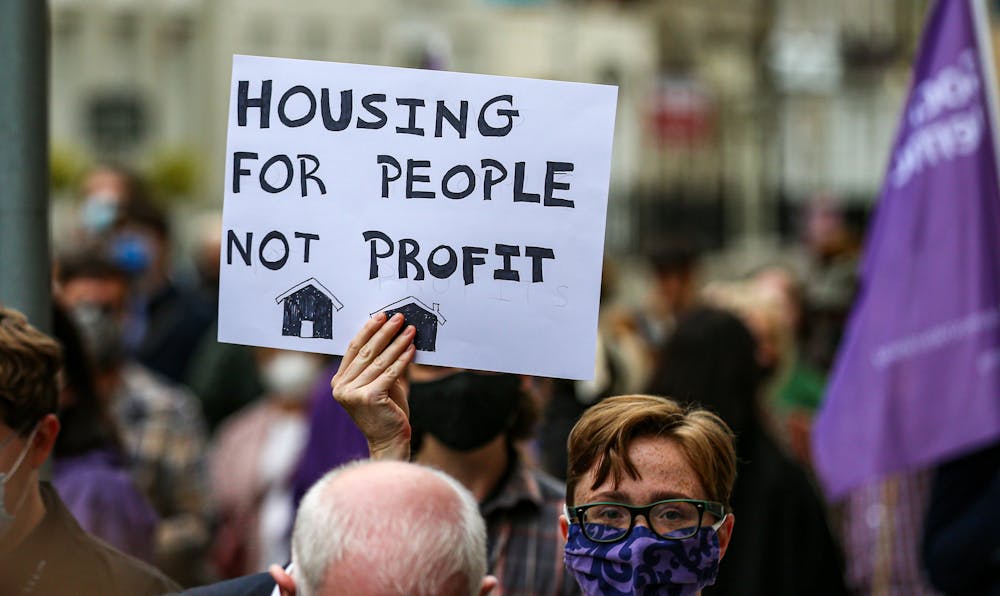
The government has been demolishing state houses almost as fast as it builds them so that the net increase in state houses over the last five years stands at a piddling 1100 per year for a waiting list of 26,664. The waiting list has increased five-fold since Labour came to power in 2017.

Labour is taking us backwards on state housing at a spectacular rate.

And neither is it the fault of the previous National government. Labour has kept the policy settings for state house building the same as applied under National — right down to maintaining the same tough criteria to enable a low-income tenant or family to get on the waiting list.

Largest Labour privatisation since 1980s
The awful reason Labour is demolishing state houses and selling the land is to provide funding for Kainga Ora. The government doesn’t want to borrow to build, which any sensible government would, so it is forcing Kainga Ora to sell land and properties to do this.

It’s the largest privatisation of state assets by Labour since the 1980s.

Where are the journalists to put some simple questions to the Prime Minister?

  • Why has Labour allowed the state house waiting list to INCREASE FIVE FOLD (from 5,000 in late 2017 to over 26,000 in 2022) with no effective policy response?
  • Why does Labour still think it’s OK to produce just 1,100 net new state houses per year for a state house waiting list of over 26,000? (When Labour came to power there were 63,209 state houses which has increased to just 68,765 by June this year).
  • Why are the number of children living in grotty motels STILL INCREASING?
  • Why is the number of children living in cars STILL INCREASING?
  • Why are the number of children in tents STILL INCREASING?
  • Why is Labour still ONLY FUNDING 1600 new IRRS places (for state house and social housing providers combined) each year for the more than 26,000 families on the state house waiting list?
  • Why does Labour still think it’s OK to keep the proportion of state house at just 3.6% of total housing stock when it was 5.4 percent in 1990?
  • Why has Labour not instigated an industrial-scale state house building programme such as the first Labour government did in the 1930s? (Labour then built 3500 state houses each year – equivalent to 10,000 today on a population basis).
  • Why is the government planning to sell 55 to 60 percent of crown land in Auckland to private property developers when we have a housing catastrophe for low-income New Zealanders?

Where are the journalists to expose this prime ministerial spin?

Republished from The Daily Blog with permission.

Print Friendly, PDF & Email

Article by AsiaPacificReport.nz

‘Fijian hearts are heavy’ says PM as Pacific mourns Queen Elizabeth II

RNZ Pacific

Queen Elizabeth II — 1926-2022

Fiji Prime Minister Voreqe Bainimarama tweeted today “Fijian hearts are heavy this morning as we bid farewell” as global messages of condolences flooded in with the news that Queen Elizabeth, the UK’s longest-serving monarch, has died at Balmoral aged 96.

She reigned for 70 years.

“Fijian hearts are heavy this morning as we bid farewell to Her Majesty Queen Elizabeth II,” tweeted Bainimarama.

“We will always treasure the joy of her visits to Fiji along with every moment that her grace, courage, and wisdom were a comfort and inspiration to our people, even a world away.”

The Queen visited the Pacific multiple times during her reign, with a visit a few months after her coronation to Fiji and Tonga, in December 1953.

The Queen’s family gathered at her Scottish estate after concerns grew about her health earlier on Thursday.

The Queen came to the throne in 1952 and witnessed enormous social change.


UK’s Queen Elizabeth II dies at 96 | Al Jazeera Newsfeed

King Charles leads mourning
With her death, her eldest son Charles, the former Prince of Wales, will lead the country in mourning as the new King and head of state for 14 Commonwealth realms.

In a statement, King Charles III said: “The death of my beloved mother Her Majesty The Queen, is a moment of the greatest sadness for me and all members of my family.

“We mourn profoundly the passing of a cherished Sovereign and a much-loved Mother. I know her loss will be deeply felt throughout the country, the Realms and the Commonwealth, and by countless people around the world.”

All the Queen’s children travelled to Balmoral, near Aberdeen, after doctors placed the Queen under medical supervision.

Queen Elizabeth’s tenure as head of state spanned post-war austerity, the transition from empire to Commonwealth, the end of the Cold War and the UK’s entry into – and withdrawal from — the European Union.

Her reign spanned 15 prime ministers starting with Winston Churchill, born in 1874, and including Liz Truss, born 101 years later in 1975, and appointed by the Queen earlier this week.

Queen’s many visits to the Pacific
Among the Queen’s multiple visits to the Pacific, she attended the opening of the Rarotonga International Airport in 1974.

In October 1982, her tour included Papua New Guinea, Solomon Islands, Nauru, Kiribati, Tuvalu and Fiji.

Together with her husband, Prince Philip, the Queen visited Fiji on February 16-17, 1977, as part of the Silver Jubilee Celebrations of her accession to the British throne.

Fiji media had reported that during a banquet dinner held in her honour in Suva, the Queen told the 300 guests present Fiji was the first Pacific country she had seen in 1953.

The Queen visited Fiji six times during her reign.

Matangi Tonga reported Queen Elizabeth had a special relationship with Tonga and Tonga’s Royal Family after Queen Sālote Tupou III attended her coronation in London.

In 1953 Queen Elizabeth made a special visit to Tonga. She laid a wreath at the cenotaph in Pangai Si’i, a small park that Queen Sālote had developed (now the site of the St George Government Building) and attended a feast at the Royal Palace in Nuku’alofa.

At the time of the Queen’s 70th jubilee, British High Commissioner to the Kingdom of Tonga, Lucy Joyce, wrote that Queen Elizabeth’s links to Tonga went back to her coronation.

She visited the Kingdom three times: in December 1953, in March 1970 when the couple were accompanied by Princess Anne; and during the Silver Jubilee year of 1977.

The UK was also on hand to provide assistance after the volcano and tsunami in February.

Joyce wrote it was a clear recent example of the solidarity between Commonwealth nations.

In Wellngton, RNZ reports New Zealand Prime Minister Jacinda Ardern Ardern said the Queen’s commitment to her role and to “all of us has been without question and unwavering”.

“The last days of the Queen’s life captures who she was in so many ways, working to the very end on behalf of the people she loved.

“This is a time of deep sadness. Young or old, there is no doubt that a chapter is closing today, and with that we share our thanks for an incredible woman who we were lucky enough to call our Queen,” Ardern said.

“She was extraordinary.”

This article is republished under a community partnership agreement with RNZ.

Queen Elizabeth II ... multiple visits to the Pacific
Queen Elizabeth II … multiple visits to the Pacific. Image: RNZ/Getty ImagesBettmann
Print Friendly, PDF & Email

Article by AsiaPacificReport.nz

Late Queen Elizabeth’s 1953 Pacific royal tour teaches us much about how we saw the world

REVIEW: By Philip Cass, editor of Pacific Journalism Review

One of the joys of travelling the world and collecting books is the historical oddities that turn up in the most unexpected places.

I have a splendid copy of the complete works of Shakespeare dating to the Second World War, completely re-set, so the frontispiece notes, due to the original plates having been “destroyed by enemy action”. One wonders at the perfidy of the Luftwaffe in trying to blow up the Bard.

I have a copy of Grove’s encyclopaedia of music from the 1930s which notes with disdain that attempts to make jazz respectable by using an orchestra have failed—and this written several years after Gershwin’s Rhapsody in Blue. The same volume also contains a section on the influence of Jews in classical music, noting such important ‘Hebrew’ composers as Mahler.

Both these volumes came from a secondhand bookseller near the bus station in Suva: relics, I suppose, of a long departed British colonial administrator.

Each of these volumes is a window into the past and into attitudes and ideas that have long vanished.

In the year of the Platinum Jubilee of the late Queen Elizabeth II—who died yesterday aged 96 after a 70-year reign—it was therefore timely to find a copy of the Royal Tour Picture Album, a lavishly illustrated record of her 1953 tour of the Commonwealth in my local Salvation Army shop.

The 1953 tour seems to have been a strange affair, a tour of places rarely visited by royalty alongside some more important but equally far-flung outposts of the Commonwealth. It was rather like Iron Maiden playing in Christchurch or Caracas.

Pacific and other places
The Queen and Prince Philip visited Bermuda, Jamaica, Panama, Fiji, Tonga, New Zealand, Australia, what was then Ceylon, Aden, Uganda, Tobruk (Libya), Malta and Gibraltar.

The African segment seems to have been beset by security issues and Britain would eventually be expelled from Aden and Libya, where the Queen paid tribute to the defence of Tobruk during the Second World War.

The Sunday Graphic's 1953 Royal Tour Picture Album cover
The Sunday Graphic’s 1953 Royal Tour Picture Album … the cover. Image: PJR

What is intriguing is the concentration on the small island states in the Caribbean and the Pacific, places which did not, at the time, seem to have afforded much material benefit to the UK (although the Fijian soldiers who served in the British army and the Windrush migrants might argue otherwise), but which could be relied upon to provide a loyal, colourful and exotic welcome.

It is the Pacific that takes up most of the pages here. There are some splendid colour plates (one suspects some of them are actually hand tinted) showing, among other things, Her Majesty and the Secretary for Fijian Affairs, Ratu Lala Sukuna, in Albert Park in Suva, surrounded by Fijians with their gifts for the visitors—50 newly killed pigs, 50 cooked pigs, 10 tons of bananas and 50 metres of tapa cloth.

It is the depictions of the local people that intrigue after so many decades. Some of the Indigenous peoples, like the Tongans, are well defined (at least in the somewhat patronising terms of the day), others are projected as members of a happy, multi-racial Commonwealth (the various inhabitants of Fiji) and others, like the First Nations peoples of Australia are very awkwardly presented, with little or no information or explanation about who they are or why they are there. Given the things we know now, some of the images raise disturbing questions to which we may never know the answers.

share a banquet with their Tongan hosts in 1953
The late Queen Elizabeth and the Duke of Edinburgh share a banquet with their Tongan hosts. The visitors were waited on by members of the Tongan nobility. Image: PJR

It is unclear whether the author, Elizabeth Morton, accompanied the tour or simply worked from a pile of press releases and newspaper clippings. The book was co-produced with the Sunday Graphic, which closed in 1960, so she may have worked for that masthead.

Whatever the case, she was clearly eager to present Fiji as a multi-racial success story. While we are told that the royal vessel, the SS Gothic, was greeted by canoes manned by ‘fuzzy haired warriors’ we are also told that ‘Fijians, Indians, Chinese and Europeans’ all cheered the Queen.

Lautoka’s ‘tremendous welcome’
Later they visited Lautoka where they received ‘a tremendous welcome from the Indian sugar-cane workers’. Alas, it would only take a few more decades for that multicultural vision to be shattered by the first of the coups that have bedevilled Fiji

From Fiji, Queen Elizabeth and the Duke of Edinburgh flew to Nuku’alofa in a TEAL Solent Mk IV flying boat, the Aranui, which is now in the MOTAT aviation collection in Auckland.
Despite only visiting for two days, the royal visitors were given a hearty welcome.

She and the Duke were greeted by Queen Salote, who had entranced the British when she visited London for Queen Elizabeth’s coronation. When the Tongan monarch rode in an open carriage oblivious of the rain, her fortitude drew the admiration of the crowd and prompted both Noel Coward and Flanders and Swan to make jokes that are probably unrepeatable today.

Despite preserving its independence, Tonga had strong ties with the United Kingdom. During the Second World War, when the then Princess Elizabeth was driving an ambulance, Queen Salote raised enough money to buy three Spitfires for the RAF.

After being greeted at the wharf by Queen Salote, the Queen and the Duke drove through the rain into the capital where people from all over the kingdom, including its remotest islands, gathered to greet her.

Ex-servicemen marched through the streets and at the mala’e the British visitors were waited on by members of the Nobility as they and 2000 guests tucked into a banquet of pork, chicken crayfish, lobsters, yams and pineapples.

A sipi tau (the Tongan equivalent of the haka) was given in honour of the visitors.
That night they slept at the royal palace and were wakened in the morning by a serenade of nose flutes.

Overflowing church
After breakfast they attended service in the Wesleyan church that was full to overflowing.

In her speech, Queen Elizabeth said: ‘Never was a more appropriate name bestowed on any lands than that which Captain Cook gave to these beautiful islands when he called them The Friendly Islands.’

The photographs accompanying the report are of the kind we have become used to: The Queen and her party enjoying local hospitality, receiving gifts and inspecting local curiosities, including Tui Malila, the tortoise said to have been presented by Captain Cook in 1777. The tortoise died in 1966.

And how were the Tongans presented? It is worth reading, 70 years later, Morton’s description:

The Tongans are a simple, happy, devout people. They share their fervent loyalty between their own Queen and the Sovereign Head of the Empire and Commonwealth which since 1900 has protected their 1000 year old independence. Their land is rich and fertile, their seas teem with fish; for longer than they can remember there has never been poverty or unemployment in their paradise. Queen Elizabeth II came to them as their friend from afar whose navies guard their shores and whose peoples buy all the bananas, copra and coconuts they produce.

They welcomed the Queen and her husband with sincere and abandoned joy and gave them a feast that was fabulous in its lavishness. But before this began there was a simple little ceremony on the quay at Nuku’alofa shortly after the Queen and the Duke of Edinburgh landed. Five-year-old Mele Siuilikutape, granddaughter of Queen Salote, came shyly forward and, with all the dignity and grace of her ancient race, presented the friend of Tonga with a basket of wild flowers.

This passage lays out a vision that was very familiar, an Island paradise presided over by a wise local ruler loyal to Britain and a people forever grateful for the protection of the Royal Navy. Was it only slightly more than 50 years since Kipling had prophesied: ‘Far-called, our navies melt away?’ In another 30 years Britain would barely be able to scrape together enough ships to rescue the Falklands from the Argentine invaders.

Her Majesty Queen Salote welcomes the late Queen Elizabeth II to the Kingdom of Tonga at the start of the British monarch's 1953-54 visit
Her Majesty Queen Salote welcomes the late Queen Elizabeth II to the Kingdom of Tonga at the start of the British monarch’s 1953-54 visit. Image: PJR

Queen Elizabeth visited Tonga again in 1970 and 1977.

‘Cherished memories’
When Prince Harry visited Tonga in 2018 he read a message from his grandmother: ‘To this day I remember with fondness Queen Salote’s attendance at my own Coronation, while Prince Philip and I have cherished memories from our three wonderful visits to your country.’

From Tonga, the Queen travelled on to New Zealand, where, according to Morton, ‘the Maoris, once the most warlike and adventurous of the Polynesian races, now live in peace and understanding with the people of British stock’.

Later, she writes: ‘The Maoris gave their first vociferous welcome at Waitangi, an historic spot on the placid waters of the Bay of Islands. Here in 1840 the Maori chiefs met Captain William Hobson—who became the first Governor of New Zealand-and signed a treaty acknowledging Queen Victoria as their sovereign.’ It is possibly not too much to suggest that some modern readers might bridle at this interpretation of the Treaty of Waitangi.

From New Zealand, the Queen travelled on to Australia. Here too we have a picture of a predominantly white nation, but unlike New Zealand the Indigenous people remain in the background; if not unacknowledged then certainly unexplained. Clumsy as the writing about Māori might seem to us today, it is a reflection of the Pākehā view of the day and Māori representatives are present and clearly indicated in several photographs.

In Australia, the identified Indigenous face practically disappears. Here is a colour photograph of ‘fearsome looking Torres Straits Islanders armed with bows and arrows and wearing elaborate feather head dresses’ providing a guard of honour in Cairns.

Here is a group of Aborigines from the Northern Territory who had been shipped to Toowoomba in Queensland where they ‘performed native dances’. Here are two Aboriginal girls in ‘immaculate white dresses’ curtseying to the Queen, but they have their backs to the camera. They have no identity. In the background an Aboriginal dancer looks on.
Here, though, is six-year-old Beverley Joy Noble, from the Kurrawong Native Mission in Kalgoorlie, Western Australia, presenting a bouquet. One wonders whether she was one of the Stolen Generation.

There are other, unexplained photographs. There is a picture of the royal party in Busselton in Western Australia where they were greeted by a Boy Scout troop—most of whom seem to be Indigenous Peoples, but nothing is said about who they are or how a multi-racial troop evolved.

Unexplained picture
And last but not least, there is an entirely unexplained picture of the late Queen reviewing ‘soldiers and sailors from Australia’s Island Territories’. These vaguely determined people are clearly members of the Pacific Islands Regiment (the PIR) from what was then the Territory of Papua and New Guinea.

The Royal Tour Picture Album is a glimpse into a world that simply never existed for much of today’s population. However, this does not make the book simply a curiosity. Indeed, for the curious, the book is a joy because of what it contains. It preserves images and ideas and views that need to examined, not just for their historical value, or as a mark of how far attitudes have changed, but as a warning that in 70 years our descendants will look upon our own world—and us—and wonder with equal puzzlement at why or how we behaved and thought as we do.

Dr Philip Cass is editor of Pacific Journalism Review. This review is republished from PJR in a partnership and was written and published before the death of Queen Elizabeth II on 8 September 2022 aged 96 after a remarkable reign of 70 years.

Print Friendly, PDF & Email

Article by AsiaPacificReport.nz

Curious Kids: did humans hunt and eat woolly mammoths or dinosaurs?

Source: The Conversation (Au and NZ) – By Kira Westaway, Associate Professor, School of Natural Sciences, Macquarie University

Blue Sky Studios/AP

Did humans hunt and eat woolly mammoths or dinosaurs? – Jasmine, age 10, Central Coast NSW

Hi Jasmine,

Thanks for this great question!

Humans can be blamed for a lot of things: chopping down rainforests, worsening climate change, and driving precious species like the Tasmanian Tiger to extinction. But can we add hunting and eating woolly mammoths and dinosaurs to the list?

Well, we can safely assume dinosaurs never fell prey to humans – mainly because the two never even met (despite what the Jurassic Park films suggest). Dinosaurs had already been extinct for about 62 million years by the time modern humans started roaming the planet!

But what about woolly mammoths? In this case, the movie Ice Age was actually correct. Humans and woolly mammoths lived side by side for at least 15,000 years.

Mammoth findings in the fossil record

So did humans hunt woolly mammoths to extinction? To answer this question we must look at clues in the fossil record, which is made up of the preserved remains of ancient life.

In the case of the dodo, a large flightless bird that went extinct, documents from 1690 make it clear that over-hunting by humans was the cause.

A model of a dodo stand atop a museum display.
The dodo was first discovered on the island of Mauritius in the late 1500s.
Wiki Commons, CC BY-SA

But woolly mammoths were around long before we had paper to write on. They existed from about 300,000 years ago – a time when ice covered the northern parts of the world.

As for when they went extinct, a small number of dwarf mammmoths survived on a little isolated island in the Arctic until about 4,000 years ago. But the full-sized species disappeared from an area called Beringia (located between Siberia and Alaska) some 12,000 years ago – after living alongside humans for at least 15,000 years.

Did humans kill them off?

The 2002 film Ice Age showed a face-off between Manny the woolly mammoth and a human.
Twentieth Century Fox/IMDB

Hunting for clues

When early humans hunted, they tended to kill many animals at the same time. This created “kill sites”, which are literally huge piles of animal bones. And when they pulled the meat off the bones to eat, they used stone tools that created cut marks or small notches in the bones.

These marks now provide vital clues. In Beringia, there is fossil evidence for mammoth kill sites, and cut marks on mammoth bones – so all the clues point to humans having hunted woolly mammoths.

But the strongest evidence was found in southern Poland in 2019. A small part of a stone tool, made into a spear blade by a human, was found in the rib bone of a woolly mammoth. If this was evidence presented in a murder trial, that human would be locked up straight away!

Even so, does that mean humans alone were responsible for wiping out all the full-sized woolly mammoths?

Some scientists suggest the climate also played a role.

It could be that climate conditions at the time shifted away from what woolly mammoths preferred and caused a large drop in their numbers.
This may have made the remaining mammoths more vulnerable to increasing hunting as the human population grew.

Australia’s own ‘mammoths’

Australia didn’t have woolly mammoths. They would have gotten very hot in those thick coats! But we did have giant animals known as megafauna, which went extinct between 5,000 and 17,000 years (depending on the species) after the First Peoples arrived.

Interestingly, we don’t find any reliable fossil evidence of these people hunting Australia’s ancient megafauna. There are no known kill sites, no cut marks on the animal bones, and no evidence of spear blades being lodged in ribs.

Was the megafauna’s disappearance related to human activity? Or did climate change play a part here as well?

The jury is still out on this one! But the more fossils we find, and the better we get at studying them, the closer we’ll come to understanding what happened all those years ago.


Read more:
Curious Kids: could dinosaurs evolve back into existence?


The Conversation

Kira Westaway receives funding from the Australian Research Council

ref. Curious Kids: did humans hunt and eat woolly mammoths or dinosaurs? – https://theconversation.com/curious-kids-did-humans-hunt-and-eat-woolly-mammoths-or-dinosaurs-190146

‘Untenable’: even companies profiting from Australia’s carbon market say the system must change

Source: The Conversation (Au and NZ) – By Andrew Macintosh, Professor and Director of Research, ANU Law School, Australian National University

Nicolás Boullosa/Flickr

This week, several of the largest companies that profit from Australia’s carbon market called for changes to the system. They said the rules that govern the issuing of carbon credits to some projects were too lax and the market’s integrity should be improved.

The companies operate projects under what are known as “landfill gas methods”. Using these methods, landfill gas companies capture and burn methane generated by decomposing rubbish, turning it into carbon dioxide – a less potent greenhouse gas. In return, they receive carbon credits.

The industry’s decision to speak out is an important development. It shows a significant proportion of the carbon market is willing to work constructively to improve the system.

Australia’s carbon credit system is now being reviewed. The federal government must seize this opportunity to ensure the system performs well for taxpayers and the environment.

two men seated in masks watch other man speak in parliament
Climate Change and Energy Minister Chris Bowen has ordered a review of the carbon credit system.
Lukas Coch/AAP

What’s this all about?

Under the Emissions Reduction Fund, projects that reduce greenhouse gas emissions are granted carbon credits. These credits can be sold to the federal government or to private entities that are required, or voluntarily choose, to offset their emissions.

The fund, which began operating in 2014, was the centrepiece of the Coalition government’s climate policy and will continue under Labor.

I’m a former chair of the Emissions Reduction Assurance Committee, the government-appointed body that oversees the fund’s methods. Earlier this year, my colleagues and I went public with details of serious integrity issues with the scheme, including landfill gas projects.

More than 100 landfill projects currently claim carbon credits for destroying landfill gas. They account for almost 30% of carbon credits issued under the fund.

These projects are registered under four separate methods, including one established late last year for projects that use methane to generate electricity. The concerns about landfill projects centre on this method.


Read more:
We blew the whistle on Australia’s central climate policy. Here’s what a new federal government probe must fix


pipes collecting methane from site
Methane can be collected from landfill sites, such as this example in the United States.
Shutterstock

What’s wrong with the new method?

A key principle that underpins the integrity of carbon offset markets around the world is the concept of “additionality”. It means that the carbon abatement for which companies receive credits must be additional to what would have happened otherwise, without the incentive provided by the scheme.

In the case of landfill gas projects, additionality problems arise because most landfills would destroy methane even without the incentive provided by carbon credits. That’s because they’re required to do this under state laws governing air pollution and safety. These legal requirements mean not all carbon abatement at landfills is additional to what would have occurred anyway.

The landfill methods seek to address this issue using something known as a “baseline”, which is a prescribed proportion of the methane combusted at landfill sites. This baseline is deducted when calculating carbon credits. So for example, if a project has a 30% baseline and destroys 100 tonnes of greenhouse gases, it will be credited only for 70 tonnes.

To be conservative, the baseline proportion should at least represent what operators are legally required to destroy. This is made challenging by the fact that the state regulatory conditions are often drafted in imprecise terms. This makes it hard to set baselines that accurately reflect the regulatory requirements.

In 2011-12, when the original landfill gas methods were being devised, the government and industry agreed on a default minimum baseline of 30%. But most of the biggest landfill gas projects were allowed to use baselines below 30%, and roughly ten projects were given 0% baselines.

This was a product of a deal that allowed operators to use baselines that applied under older offset schemes.

These concessions were meant to expire around now. But the new landfill gas method extended the concessional arrangements, allowing the larger landfill projects to keep using their low baselines for another five years.

And there’s another problem.

Carbon credits are not the only means through which large landfill sites can profit from destroying methane. Using generators, they can harness the heat from burning methane to produce electricity. They can then sell this electricity, as well as earn and sell renewable energy certificates. So even if they don’t receive carbon credits, the sites with generators will often destroy more methane than they are legally required to.

The baselines should account for this fact, but they don’t. They assume that, in the absence of carbon credits, landfills would only ever destroy what they are required to by law. This assumption is not true, particularly at larger landfills.


Read more:
Australia’s central climate policy pays people to grow trees that already existed. Taxpayers – and the environment – deserve better


gas flares from pipe
Burning methane converts it into carbon dioxide, a less potent greenhouse gas.
Shutterstock

Way forward

The Clean Energy Regulator and the Emissions Reduction Assurance Committee deny any problems with the new landfill gas method. But the industry’s statements this week have made their position untenable.

John Falzon, chair of LMS Energy, is among those calling for a change to the way credits are calculated. He told the ABC:

If the market doesn’t have integrity it’ll crash, so the business itself will collapse with that […] We would forgo some short-term revenue for the opportunity to participate in a market that is more robust and has more credibility and that provides a future.

The actions taken by the industry have created a unique opportunity to fix the landfill gas method and, in the process, showcase how to put Australia’s carbon credit system back on the rails.


The Clean Energy Regulator, which oversees Australia’s carbon credit system, provided the following response:

As has always been our practice, the Clean Energy Regulator welcomes genuine feedback and scrutiny. The independent Review of Australian Carbon Credit Units (ACCUs), led by Professor Ian Chubb, is underway. The landfill gas method is within their terms of reference. The Clean Energy Regulator is actively assisting this review and is currently considering the new information on the method that has been reported in the last few days.


Read more:
Methane in the atmosphere is at an all-time high – here’s what it means for climate change


The Conversation

Andrew Macintosh is a Director of Paraway Pastoral Co. Ltd, a pastoral company that undertakes projects under the Emissions Reduction Fund. He is also the former chair of the Emissions Reduction Assurance Committee.

ref. ‘Untenable’: even companies profiting from Australia’s carbon market say the system must change – https://theconversation.com/untenable-even-companies-profiting-from-australias-carbon-market-say-the-system-must-change-190232

The price of PBS medicines is coming down. But are we helping the right people?

Source: The Conversation (Au and NZ) – By Yuting Zhang, Professor of Health Economics, The University of Melbourne

Polina Tankilevitch/Pexels, CC BY-SA

Some Australians will be paying less for prescription medicines from January, in a move announced this week and designed to ease cost-of-living pressures.

Prime Minister Anthony Albanese said the maximum price of Pharmaceutical Benefits Scheme (PBS) medicines would drop from A$42.50 to $30, at a cost to taxpayers of $765.3 million.

There is no reduction for concession-card holders, who will continue to pay up to $6.80.

Cutting the cost of medicines this way is a welcome move. But the government has missed a chance to better target cost cuts to certain patient groups, for specific medical conditions and for generic drugs.

Australians are going without medicines

Australians are currently paying more for their prescription medicines than some similar countries, including the United Kingdom, Germany, the Netherlands and New Zealand.

And we know many Australians can’t afford to fill their scripts.

Just under 7% of older Australians said they didn’t buy their prescribed medications because they were too expensive, a higher proportion than other similar countries. For the UK, this figure was about 3%, in New Zealand it was just under 5%.

This is a problem because people who cannot afford to buy essential medicines have worse health and higher mortality. Forgoing medicines may also lead to more health costs in the future, as conditions go untreated and complications arise, leading to emergency care and hospital visits.

So reducing the price of prescription medicines, as announced this week, will mean more people will be able to afford them, with the health and other benefits this brings.


Read more:
Last year, half a million Australians couldn’t afford to fill a script. Here’s how to rein in rising health costs


Can we better target the price cuts?

People who cannot afford to fill their scripts are more likely to have a below-average income, be Indigenous, be adults under 65, and have little input in decisions about their medical treatment. A high price for medicine at the pharmacy (known as a co-payment) is another big factor.

So other countries use a variety of strategies to make it easier for people to afford to fill their scripts. These include:

  • reducing the price of medicines (reducing the co-payment)

  • varying the co-payment by patient characteristic (for instance, income, age and health needs)

  • promoting the discussion of medicines and their costs between providers (such as doctors, pharmacists) and patients.

Australia already has different co-payments – one for general patients and a much lower one for concession-card holders.

There is no firm evidence concession-card holders are forgoing medicines at a different rate to the general population because of costs. So, it makes sense to target any price cuts to the general population, with its higher co-payment.

Emergency department sign with arrow
We could make certain drugs cheaper to encourage people to use them, preventing a trip to hospital.
Shutterstock

But there are ways of lowering the co-payment for certain medicines, in particular those that control life-threatening conditions and prevent hospitalisation.

These medicines include those used to treat asthma, severe mental disorders (such as severe depression, schizophrenia, bipolar disorder), heart diseases and diabetes.

The government could consider lowering the co-payment for these medicines, especially for people with multiple chronic conditions and on lower incomes.


Read more:
What is the PBS safety net and is it really the best way to cut the cost of medicines?


What else could we do?

This latest announcement only affects medicines costing more than $42.50. The patient pays this co-payment and the government covers the rest. But these accounted for only 70% of PBS drugs dispensed in 2020–21.

A total of 30% of PBS subsidised medicines are cheaper than the co-payment, so the patient pays the full cost.

Most of these cheaper drugs are generic drugs – ones no longer under patent protection. So lowering the co-payment will unlikely affect the cost of these.

If we were hoping to cut the cost of medicines even further, we need to target these generic drugs, which Australians generally pay more for than people in countries including Canada, New Zealand, Japan and many member states of the European Union.

One reason is these countries set a price for each generic drug by using the best price obtained by other comparable countries. If Australia adopted this international benchmarking pricing, we could be saving even more at the pharmacy.


Read more:
Explainer: what is Medicare and how does it work?


The Conversation

Yuting Zhang receives funding from Australian Research Council, Department of Veterans’ Affairs, the Victorian Department of Health, and National Health and Medical Research Council. In the past, Professor Zhang has received funding from several US institutes including the US National Institutes of Health, Commonwealth fund, Agency for Healthcare Research and Quality, and Robert Wood Johnson Foundation.

ref. The price of PBS medicines is coming down. But are we helping the right people? – https://theconversation.com/the-price-of-pbs-medicines-is-coming-down-but-are-we-helping-the-right-people-190137

Albanese to attend Queen’s funeral and meet King Charles, parliament cancelled

Source: The Conversation (Au and NZ) – By Michelle Grattan, Professorial Fellow, University of Canberra

Mick Tsikas/AAP

Prime Minister Anthony Albanese and Governor-General David Hurley will fly to London for events marking the passing of Queen Elizabeth, culminating in her funeral at Westminster Abbey.

Next week’s sitting of federal parliament has been cancelled, with no word yet on whether it will be rescheduled ahead of the budget session that begins in late October.

On Friday Albanese signed a condolence book at parliament house.

Ministers and assistant ministers have been invited to a meeting of the executive council at government house on Sunday.

There the prime minister recommends to the governor-general that he issues the proclamation relating to the accession of King Charles. Hurley will then read the proclamation at parliament house.

In London Albanese will attend the Lying in State at Westminster Hall, and will have a brief audience with King Charles.

After his return to Australia there will be a national memorial service.

The governor-general officially informed the prime minister of the Queen’s death in the early hours of Friday morning, and issued a short public announcement.

Albanese said that over her seven-decade reign, the Queen was “a rare and reassuring constant amidst rapid change.

“Through the noise and turbulence of the years, she embodied and exhibited a timeless decency and an enduring calm,” he said.

“Her life of faithful service will be remembered for centuries to come.

“In particular, we recall the sympathy and personal kindness she extended to Australians afflicted by tragedy and disaster — from floods and bushfires to wars and a pandemic.

“Her words and presence were a source of comfort, hope and solace for millions of Australians.

“Today marks the end of an era, the close of the second Elizabethan age.”

In radio interviews Albanese deflected questioning on whether the Queen’s death brought Australia closer to a republic. “Today’s not a day to talk about that.”

Labor has said the republic issue is one for a second term.

But Greens leader Adam Bandt posted on Twitter that Australia must move forward. “We need Treaty with First Nations people, and we need to become a Republic.”

Opposition leader Peter Dutton said: “A comforting warmth has left the world. One of humanity’s brightest lights has gone out. May our memories of our dear Queen inspire the very best in us, just as she drew inspiration from her subjects.”

Former prime minister Malcolm Turnbull said the Queen was a very contemporary monarch. He recalled when he had talks with her in 2017 she was “full of curiosity” and “on top of things”. King Charles was “a really good man”, who wanted to do good things, Turnbull said.

Former prime minister Scott Morrison said the Queen had a “regal humility”. He said she had a particular empathy with people in rural and regional Australia. “In our last discussion we talked about the mice plague in NSW.”

Another former PM, Kevin Rudd, recounted how he had told the Queen his mother had thought her the “bees knees”,

“And the Queen said, why was that? And I said, because my mum always said, you made a damn fine mechanic during the war. And secondly, you and your sister stuck it out in Buckingham Palace when the place was being bombed.” The Queen had enjoyed the story, Rudd said.

Officials said King Charles will appear on Australian coinage next year. It is not yet known when the $5 note, that features the Queen, will change.

In Australia, as in the United Kingdom, there has long been a very detailed timetable of arrangements to follow the Queen’s death.

The Conversation

Michelle Grattan does not work for, consult, own shares in or receive funding from any company or organization that would benefit from this article, and has disclosed no relevant affiliations beyond their academic appointment.

ref. Albanese to attend Queen’s funeral and meet King Charles, parliament cancelled – https://theconversation.com/albanese-to-attend-queens-funeral-and-meet-king-charles-parliament-cancelled-190337

Why do we mourn people we don’t know?

Source: The Conversation (Au and NZ) – By Sarah Wayland, Senior Lecturer Social Work, University of New England

The death of Queen Elizabeth II has prompted public displays of grief around the world – from public gatherings at Buckingham Palace in London, and condolences from world leaders, to individuals reflecting on social media about what she meant to them.

Of course, the vast majority of people grieving or acknowledging the queen’s passing will have never met her in person.

So is this outpouring of grief of someone we don’t know any different to mourning someone we were close to?

There are some similarities and some stark differences. There’s also a tussle emerging over how the queen is remembered, which can potentially complicate the grieving process.


Read more:
Queen Elizabeth II: the end of the ‘new Elizabethan age’


How is this grief similar?

Grieving someone is about reflecting on our lifetime connection and the attachment we had with them that no longer physically exists.

Even though the queen may not have been part of our immediate family, many of us have “grown up” with her.

During her 70-year reign, she’s been part of our lives – part of our grandparents’ lives, our parents’ lives and now ours. Think of these as cross-generational connections. We, collectively and across the generations, feel as if we “know” her.

Globally, we’ve also been preparing for her loss. Her advanced aged, health issues, and plans for what happens after her death have been the subjects of much media coverage.

So this “familiarity” means the type of grief we are seeing now can feel very similar to having someone in our own lives, then losing them.


Read more:
Operation London Bridge: why Britain is obsessed with the days that will follow The Queen’s death


How is this grief different?

But grief for a public figure we don’t know, such as the queen, can be quite different.

We’re missing the close connection with that individual. Many do not have personal anecdotes, or one-on-one shared experiences. We don’t have those intertwined memories to reflect on. As that person is out of reach, it’s difficult to create an image of who that person really was and what they mean to us.

Rather than reflecting on an individual relationship with a loved one, after the death of a public figure, we rely on community experiences for a type of collective grief that shapes how we share our grief online.


Read more:
COVID deaths are now barely mentioned in the media. That changes the very nature of grief


A contested grief

Because most of us didn’t know the queen personally, our perception of her – her attributes, her personality – is not grounded in facts.

For instance, how an individual might remember her may be coloured by their age, their political views, or whether their lives have been shaped by colonialism.

So a tussle for how she is remembered – in the United Kingdom, in the Commonwealth and more broadly – is being played out on social media. That tussle can also complicate grief when people share differing reactions to her death.

It raises questions of whether we’re allowed to grieve, or who can voice their grief, or even if we disagree whether grieving is appropriate.

We need to make space for all these different reactions to her loss.


Read more:
Queen Elizabeth’s Platinum Jubilee comes amid her declining health, royal backlash and a colonial reckoning


What role does the media play?

The media plays an integral role in how we grieve.

Real-time updates and constant coverage, as we’ve seen around the queen’s death, means we’ve been bracing for the news of her passing. Then the news came.

But this front-row seat to unfolding events and the outpouring of public grief that followed can be triggering for some.

For people who have lost a loved one – recently or even years ago – this rolling media coverage may trigger memories of what happened when their family member or friend died.

COVID restrictions may have robbed them of their chance to deliver end-of-life care or attend a funeral in-person.

So this 24-hour news cycle, and being updated on every single step of the queen’s illness and now death, can trigger our own lived experiences of loss. We need to be gentle with those varied reactions.


If this article has raised issues for you, or if you’re concerned about someone you know, call Lifeline on 13 11 14.

The Conversation

Sarah Wayland does not work for, consult, own shares in or receive funding from any company or organisation that would benefit from this article, and has disclosed no relevant affiliations beyond their academic appointment.

ref. Why do we mourn people we don’t know? – https://theconversation.com/why-do-we-mourn-people-we-dont-know-190331

What are the legal and constitutional consequences for Australia of Queen Elizabeth II’s death?

Source: The Conversation (Au and NZ) – By Anne Twomey, Professor of Constitutional Law, University of Sydney

The death of Queen Elizabeth II has prompted many people, perhaps for the first time, to wonder: what happens now, legally?

In fact, there are clear rules around succession and how it plays out in Australia. Because Queen Elizabeth has lived a long time, there has been a lot of planning for the transition to the new king.

Death of the Queen – the legal and constitutional consequences for Australia. By Anne Twomey.

The change is automatic

Legally, there does not need to be anything done in Australia to result in the change from queen to king. That happens automatically as soon as a monarch dies. When Queen Elizabeth II died, Charles immediately became king of Australia.

This is because the rules of succession in relation to the crown of Australia, while controlled by Australia and part of Australian law, are kept consistent with the British rules.

Most activity will be ceremonial and symbolic

There will be proclamations made in both the United Kingdom and Australia. The governor-general will read a proclamation at parliament house in Canberra. But that’s a ceremonial matter. It does not have any legal effect in changing the monarch.

There will be a national memorial service for the queen, flags will fly at half-mast, there will be gun salutes and other public ceremonies to mark this momentous change. Churches will hold ceremonies and the public will be invited to sign books of condolence. There is a whole history of tradition around royal mourning.

But because we haven’t had a change of monarch for so long, the traditions from the past will probably look different to those we use today. In the past, people might have worn black, donned black armbands, or put up portraits of the queen draped in black and purple crepe.

It is more likely today we would see people laying flowers and signing remembrance books. The laying of flowers, however, is not a particularly environmentally sound practice. It just leaves a pile of soggy, rotting foliage. A better way of remembering Queen Elizabeth would be to plant a tree. The queen planted many trees in ceremonies during visits to all her realms, including Australia. The new king, we know, is a keen environmentalist and a tree-lover. So planting a tree, #royaltree, would be a more appropriate sign of remembrance and respect.

What about the Australian parliament?

Australia’s parliament, which was due to sit next week, will instead break for 15 days.

This is not a legal requirement; it is a matter of choice and a sign of respect. The prime minister will be heading to the UK for the queen’s funeral, so it is also a matter of practicality as he will be out of the country.

There is no legal requirement for federal members of parliament to re-swear their oaths. They have already sworn an oath to Queen Elizabeth II and “her heirs and successors according to law”, so that will continue to apply to the queen’s heir and successor, King Charles. But the Houses could choose to have their members take new oaths, as a matter of symbolism.


Read more:
16 visits over 57 years: reflecting on Queen Elizabeth II’s long relationship with Australia


Continuity is key

Some people may try to use the queen’s death to argue that there are legal consequences to the change which affect legal proceedings, the validity of laws or the powers of office holders. They relish arguing about seals and oaths in an attempt to use these technicalities to escape from the application of the law or avoid having to pay tax.

However, there are numerous laws that make it very clear that the death of the monarch (which in legal terms is known as the “demise of the crown”) does not disrupt legal proceedings, invalidate laws or require officials to re-take an oath in order to exercise legal powers.

For example, in NSW section 12(4B) of the Constitution Act says that members of parliament do not have to re-swear their oath. Section 49A says that the holding of any office under the Crown is not affected by the death of the monarch and it is not necessary for the office holder to take a new oath. Section 8 of the Crown Proceedings Act 1988 of NSW says that legal proceedings are not affected by the demise of the Crown.

Passports, official seals and currency which mention the queen will all remain valid. The system of change from one monarch to the next is legally seamless, leaving it a matter for the people how they decide to mark the change in a ceremonial and symbolic manner.

The Conversation

Anne Twomey has received funding from the Australian Research Council and occasionally does consultancy work for governments and inter-governmental bodies. She has written books on the reserve powers and the role of vice-regal officers in Australia.

ref. What are the legal and constitutional consequences for Australia of Queen Elizabeth II’s death? – https://theconversation.com/what-are-the-legal-and-constitutional-consequences-for-australia-of-queen-elizabeth-iis-death-190335

What are the legal and constitutional consequences for Australia of the Queen’s death?

Source: The Conversation (Au and NZ) – By Anne Twomey, Professor of Constitutional Law, University of Sydney

The death of Queen Elizabeth II has prompted many people, perhaps for the first time, to wonder: what happens now, legally?

In fact, there are clear rules around succession and how it plays out in Australia. Because Queen Elizabeth has lived a long time, there has been a lot of planning for the transition to the new King.

Death of the Queen – the legal and constitutional consequences for Australia. By Anne Twomey.

The change is automatic

Legally, there does not need to be anything done in Australia to result in the change from queen to king. That happens automatically as soon as a monarch dies. When Queen Elizabeth II died, Charles immediately became King of Australia.

This is because the rules of succession in relation to the crown of Australia, while controlled by Australia and part of Australian law, are kept consistent with the British rules.

Most activity will be ceremonial and symbolic

There will be proclamations made in both the United Kingdom and Australia. The governor-general will read a proclamation at Parliament House in Canberra. But that’s a ceremonial matter. It does not have any legal effect in changing the monarch.

There will be a national memorial service for the Queen, flags will fly at half-mast, there will be gun salutes and other public ceremonies to mark this momentous change. Churches will hold ceremonies and the public will be invited to sign books of condolence. There is a whole history of tradition around royal mourning.

But because we haven’t had a change of monarch for so long, the traditions from the past will probably look different to those we use today. In the past, people might have worn black, donned black armbands, or put up portraits of the Queen draped in black and purple crepe.

It is more likely today we would see people laying flowers and signing remembrance books. The laying of flowers, however, is not a particularly environmentally sound practice. It just leaves a pile of soggy, rotting foliage. A better way of remembering Queen Elizabeth would be to plant a tree. The Queen planted many trees in ceremonies during visits to all her realms, including Australia. The new King, we know, is a keen environmentalist and a tree-lover. So planting a tree, #royaltree, would be a more appropriate sign of remembrance and respect.

What about the Australian parliament?

Australia’s parliament, which was due to sit next week, will instead break for 15 days.

This is not a legal requirement; it is a matter of choice and a sign of respect. The prime minister will be heading to the UK for the Queen’s funeral, so it is also a matter of practicality as he will be out of the country.

There is no legal requirement for federal Members of Parliament to re-swear their oaths. They have already sworn an oath to Queen Elizabeth II and ‘her heirs and successors according to law’, so that will continue to apply to the Queen’s heir and successor, King Charles. But the Houses could choose to have their Members take new oaths, as a matter of symbolism.


Leer más:
16 visits over 57 years: reflecting on Queen Elizabeth II’s long relationship with Australia


Continuity is key

Some people may try to use the Queen’s death to argue that there are legal consequences to the change which affect legal proceedings, the validity of laws or the powers of office holders. They relish arguing about seals and oaths in an attempt to use these technicalities to escape from the application of the law or avoid having to pay tax.

However, there are numerous laws that make it very clear that the death of the monarch (which in legal terms is known as the “demise of the crown”) does not disrupt legal proceedings, invalidate laws or require officials to re-take an oath in order to exercise legal powers.

For example, in NSW section 12(4B) of the Constitution Act says that Members of Parliament do not have to re-swear their oath. Section 49A says that the holding of any office under the Crown is not affected by the death of the monarch and it is not necessary for the office holder to take a new oath. Section 8 of the Crown Proceedings Act 1988 of NSW says that legal proceedings are not affected by the demise of the Crown.

Passports, official seals and currency which mention the Queen will all remain valid. The system of change from one monarch to the next is legally seamless, leaving it a matter for the people how they decide to mark the change in a ceremonial and symbolic manner.

The Conversation

Anne Twomey has received funding from the Australian Research Council and occasionally does consultancy work for governments and inter-governmental bodies. She has written books on the reserve powers and the role of vice-regal officers in Australia.

ref. What are the legal and constitutional consequences for Australia of the Queen’s death? – https://theconversation.com/what-are-the-legal-and-constitutional-consequences-for-australia-of-the-queens-death-190335

From evolving colony to bicultural nation, Queen Elizabeth II walked a long road with Aotearoa New Zealand

Source: The Conversation (Au and NZ) – By Katie Pickles, Professor of History, University of Canterbury

Getty Images

The death of Queen Elizabeth II brings to an end a long, complex and remarkable chapter in the history of Aotearoa New Zealand’s evolution from colony to independent, bicultural and multicultural nation.

Throughout that period, however, New Zealanders have generally admired and even loved the monarch herself, even if the institution she represented lay at the centre of a vexed, often traumatic, reckoning with the colonial past.

If there was a highpoint in New Zealand royalism, it was witnessed during the first visit by the young Queen and Duke of Edinburgh between December 23 1953 and January 30 1954. An estimated three in every four people turned out to see the royal couple in what historian Jock Phillips has called “the most elaborate and most whole-hearted public occasion in New Zealand history”.

After decades of economic depression and war, Elizabeth’s June 1953 coronation heralded an optimistic postwar atmosphere. Following the conquest of Mount Everest by Edmund Hillary and Tenzing Norgay – claimed as a jewel in the new Queen’s crown – the royal tour was the perfect moment for New Zealand to celebrate.

The Queen’s presence also fulfilled the long anticipated wish that a reigning British monarch would visit. War, then bad health, had previously dashed hopes for a tour by George VI.

Elizabeth II made a huge impression. She appeared as a youthful, radiant, even magical queen, one dedicated to serving her people. She charmed an older generation and embedded herself in the memories of the children who lined up to see her. They would all grow up to be, one way or another, “royal watchers”, aware of her reign and its milestones, keeping up with the lives of her children, their spouses and her grandchildren.

And then, less than 40 hours after her arrival, the young Queen’s leadership was put to the test when 151 people died in the Tangiwai rail disaster on Christmas Eve. She visited survivors and included words of comfort in her speeches, cementing her connection to the grieving, and to the country.

The Duke of Edinburgh places a wreath at the mass funeral in Wellington for victims of the Christmas Eve rail disaster at Tangiwai.
Getty Images

The female crown

Remarkably, it was not until 2011 that females became equal to males in the rules of British royal succession. Queens only came to power in the absence of a male heir. And yet, this historical sexism also endowed queens with an exceptional quality – strong mother figures presiding over their subjects.

Indeed, in the past two centuries of the British monarchy, it is Queen Victoria (who reigned for almost 64 years) and Queen Elizabeth II (reigning for 70 years) who stand out as not just the longest-serving, but also most significant monarchs. Both played a crucial part in New Zealand’s history.


Read more:
Queen Elizabeth II: the end of the ‘new Elizabethan age’


In my work as a historian I have argued that the politically conservative “female imperialism”, emblemised in the reigns of Victoria and Elizabeth, encouraged women to support the British Empire and Commonwealth. In turn, it helped raise women’s status in society.

For example, both queens inspired women to “take up their mantle” and work for empire and nation: often in maternal roles with children as teachers and nurses. The female crown encouraged citizenship based on British values, offering school prizes and support for migrants.

The young Elizabeth’s volunteer work during the second world war set an example for youth, as did her longtime role as patron of the Girl Guides. The gender-power of the Queen was already on display during the 1952-53 tour when she visited servicewomen, nurses and mothers with new babies, and was given presents for her own children.

The Queen talks with Māori guide Rangi during the visit to the village of Whakarewarewa.
Getty Images

Celebrity status

Over the past 70 years, the Queen also became something of a modern celebrity, a fixture in women’s magazines, on radio, television and now social media. As well as turning out to see her in person during her ten visits, New Zealanders “took her into their homes” with press clippings, souvenir pictures and keepsakes.

During that first tour, the New Zealand Woman’s Weekly pronounced upon the Queen’s role in the enduring relationship with Britain:

An even stronger link will be consolidated and spiritual stimulus given to life by the influence of one who is an inspiration to all.

She was described as “enchanting”, with her “exquisite complexion, her eyes like sapphires […] and her beautiful mobile mouth as she talked and smiled”. In 1963 she was “lovely” with “the breathtaking brilliance of [her] peacock silk outfit against the broad canvas of sea and sky”.

In 1970 she was “a fairytale Queen – a glittering image such as children visualise when they think of the word Queen”. In 1977, “The Queen is perfection”. On a 1986 visit she was reportedly closer and more familiar than ever, but at nearly 60 her “movements are inclined to be slower, her smile reflects more understanding than youthful sparkle […] and there were times when she looked as if she would rather kick off her shoes and have a cup of tea”.

By the 1980s, the glamour baton had passed to the next generation, notably the hugely popular Diana, Princess of Wales. Proving that royalty was not immune from modern life, three of the Queen’s four children divorced, most publicly and scandalously. Ironically (perhaps absurdly), there were accusations the Queen was out of touch with the times.

Queen Elizabeth and Christchurch mayor Hamish Hay during her 1977 visit.
Getty Images

Relationship with a colony

As power devolved around the Commonwealth during the Queen’s reign, the relationship with New Zealand inevitably changed too. Notions of a settler colony of Anglo-Celtic descendants emulating a “superior” British imperial economy, politics and culture – with a distant monarch as head of state – became outmoded.

Most importantly, the colonisation and assimilation of Indigenous peoples were challenged.

As historian Michael Dawson has shown, Māori involvement was minimal at the 1950 Commonwealth Games in Auckland. There was no Māori welcome or presence in the opening or closing ceremonies, with only a musical performance as athletes and officials arrived in the country.

It was left to King Korokī and Te Puea Herangi to hold their own welcome for athletes at Ngāruawāhia. The prime minister of the day, Sidney Holland, attended and considered the event an excellent example of good race relations. But rather than Māori being partners in the planning of the first royal tour, they were largely expected to fit in, mostly providing entertainment.

In the original tour plans, Arawa were expected to represent all Māori during a lunch stop. Only when they asked for more time were plans changed. Meanwhile, the Kīngitanga had to lobby hard for the Queen to visit Ngāruawāhia. This eventually happened, with the Queen and Duke spontaneously deciding to spend more time there than had been allocated.

Importantly, through the Queen’s reign, the Crown’s role in redressing the past became an essential part of New Zealand’s post-colonial development. After much agitation, the Waitangi Tribunal was set up in 1975 to investigate Crown breaches of the Treaty of Waitangi.

In 1987, Māori became an official language. Rather than assimilating into a devolved settler state, decolonisation came to mean mana motuhake for Māori.

By the 1974 Commonwealth Games – the “friendly games” – in Christchurch, Māori “were centrally incorporated” into the festivities, including a leading role in the opening ceremony. By the 1990 games in Auckland, also the 150th anniversary of signing of the Treaty, emerging biculturalism was evident in the medals incorporating Māori design.

Abandoning Britain?

In late 20th century New Zealand there were simmering republican sentiments. At the same time, because of the regenerating Iwi-Crown relationship under the Treaty, there was a reluctance to move away from Britain constitutionally.

Ironically, it was Britain going its own way – most notably by joining the EEC in 1973 – that moved the issue along. Symbolically, the number and length of temporary working visas for New Zealanders were cut back, despite an “OE” in the “mother country” being still viewed as a rite of passage.

There were other reasons republicanism was not a priority for the state. The shift towards a laissez-faire, free-market economic ideology shifted the ground; the move to a new electoral system in the 1990s underscored New Zealand’s growing independence.


Read more:
What would King Charles mean for the monarchy, Australia and the republican movement?


But through those decades of change, the popularity of the Queen provided a constant. If there was a moment when the republican break might have happened, it was missed. New Zealand has been more reticent than Australia, where a referendum on becoming a republic was only narrowly defeated in 1999.

New Zealand has also retired and then later reinstated the royal honours system. Attempts to change the flag and remove the Union Jack from its corner came to nothing in a 2016 referendum.

And New Zealand still doesn’t have its own constitution outlining its fundamental laws of government. Rather, we rely on a conglomerate constitution, messily located in 45 acts of parliament. And of course, the head of state remains a hereditary monarch who lives half a world away.

The Queen during a walkabout at the America’s Cup Village in Auckland, part of her Jubilee tour in 2003.
Getty Images

Aotearoa after Elizabeth

The Queen’s death presents another opportunity for New Zealand to reassess its nationhood – and perhaps be creative.

King Charles and the Queen Consort Camilla simply don’t have the appeal of Elizabeth II. But postcolonial Britain and the modern, diverse Commonwealth still have much to offer an increasingly multicultural New Zealand.


Read more:
Prince Charles: the conventions that will stop him from meddling as King


Most importantly, it is time for a broad conversation about how the various dymamics of contemporary Aotearoa New Zealand – liberal and egalitarian traditions, Pākeha settler notions of governance, Te Ao Māori, and the special Iwi-Crown connection – might work together in the future.

After all, Māori signed the Treaty with Queen Victoria at least in part as protection from the behaviour of unruly settlers. Does 21st-century New Zealand still need a monarch to protect against settler colonialism?

Whatever the answer, any move away from the Crown needs to honour the history of which Elizabeth II has been such a significant part.

The Conversation

Katie Pickles does not work for, consult, own shares in or receive funding from any company or organization that would benefit from this article, and has disclosed no relevant affiliations beyond their academic appointment.

ref. From evolving colony to bicultural nation, Queen Elizabeth II walked a long road with Aotearoa New Zealand – https://theconversation.com/from-evolving-colony-to-bicultural-nation-queen-elizabeth-ii-walked-a-long-road-with-aotearoa-new-zealand-179933

3 ways the fossil fuel industry failed women (and how clean energy can learn from its mistakes)

Source: The Conversation (Au and NZ) – By Emily Finch, Research Affiliate, Monash University

Papa Aliou Sylla/IWiM, CC BY-NC-ND

A crucial outcome of Australia’s jobs summit last week was the commitment to review programs aimed at boosting the number of women in science, technology, engineering and mathematics (STEM) careers.

Energy is a particularly male-dominated STEM industry, with clean energy on the brink of massive expansion. However, to ensure the clean energy industry is truly sustainable, it must learn from the mistakes of the mining and fossil fuel industry.

If mining workplaces are anything to go by, the clean energy sector will have their work cut out for them to retain women in the workforce.

It’s easy to understand why women are leaving careers in the fossil fuel sector. For example, a Western Australian parliamentary inquiry earlier this year revealed appalling reports of widespread sexual harassment and assault in the state’s fly-in-fly-out mining industry.

As a woman who used to work in and with the mining sector, these findings were no surprise to me. Only by creating workplaces that are inclusive of women and other underrepresented groups will the clean energy sector unlock the economic and innovation benefits of a diverse workforce.

By the numbers

At a glance, it seems Australia’s clean energy industry is making great progress.

A 2021 Clean Energy Council survey found 39% of Australia’s clean energy workforce identify as women. Compare this to 32% of the global renewables sector, 25.9% in Australia’s oil and gas sector, and 17.5% in coal mining.

However, the Australian result was based on a voluntary survey of the renewables sector, which people who feel marginalised by their diversity are more likely to opt into. This means the percentage of women in the sector actually may be lower.

The male-dominated renewables construction sector also had low representation in survey responses, further skewing results.


Read more:
Trailblazing women who broke into engineering in the 1970s reflect on what’s changed – and what hasn’t


If we look at the mining sector overall, census data reveals that at junior levels there is a relatively even gender split, with women comprising roughly 40% of 20-27 year olds in the industry.

But this gender split doesn’t persist for long. The proportion of women in mining begins to decrease from age 28, so that in the 56-59 age bracket, women comprise less than 15% of the workforce. The census data also reveal there has been little improvement in these numbers in the last 15 years.


Made with Flourish

So why are women leaving the mining industry? There are three main reasons.

1. Sexual assault and harassment

The mining industry, including the fossil fuel industry, can be a dangerous place for women.

In early 2022, an external review of Rio Tinto’s workplace culture found bullying, sexism and racism are systemic across the company.

In the last five years, 28% of women had experienced sexual harassment at Rio Tinto worksites, and 21 women were victims of actual or attempted rape or sexual assault.

This finding is consistent with the WA parliamentary inquiry, which found sexual harassment is, and has long been, prevalent across the industry. It is fostered by gender inequality, power imbalances and exacerbated by high alcohol consumption.


Read more:
Antarctic stations are plagued by sexual harassment – it’s time for things to change


The inquiry’s report highlighted that when women tried to report harassment and assault they were bullied, threatened or lost their jobs.

The parliamentary inquiry made a number of recommendations to improve the safety of women in the FIFO mining industry, such as an overhaul of reporting structures within companies.

So far Rio Tinto is the only major mining company that has announced their plan to overhaul their systems to protect women. There has been no word from governments outside of WA on any action in the face of this damning parliamentary inquiry.

2. Biases against women

Women tend to face more obstacles to progression and job satisfaction than men do, because there are systematic biases against them. While a minority belief persists that biases against women simply do not exist, we have known of bias in science for a long time.

In Australia, as in many nations, women do more household and caring work, and STEM fields are generally male dominated. Our expectations of the roles of each gender are influenced accordingly, creating implicit bias against women in science.


Read more:
It’s not lack of confidence that’s holding back women in STEM


Research shows these biases negatively affect all decisions made about women in a professional context, including hiring, promotion, awards, the value of their work, and other professional opportunities.

This means once women are in STEM careers, especially in male-dominated industries such as the mining industry, they encounter more barriers to success than their male colleagues.

3. Parental leave

It’s clear having children isn’t the sole cause of women leaving STEM careers, otherwise we’d see a flood of childfree women in leadership positions throughout the STEM sector, and this is certainly not the case.

However, in Australian heterosexual couples, women generally shoulder the bulk of childcare. This is perhaps in part because men are not ordinarily given equal access to parental leave and flexible working arrangements.


Read more:
The fatherhood penalty: how parental leave policies perpetuate the gender gap (even in our ‘progressive’ universities)


When both parents have equal access to parental leave, families can structure home and outside work equitably. On the other hand, providing birth mums vastly more leave can incentivise inequality, since families may be better off financially or otherwise by not using childcare.

Some mining companies recognise that flexible working conditions could increase retention, and have policies allowing any employee to work flexibly. Others have “family friendly” FIFO rosters, which tends to involve prescription of the roster they believe to be family friendly.

Woman standing in front of mining machinery
39% of Australia’s clean energy workforce identify as women.
Marta del Pozo/IWiM, CC BY-NC-ND

We need systemic change

Like the fossil fuel industry, women in renewables face barriers to retention and promotion.

Representation of university-qualified women decreases in leadership roles and above age 40. Women in the renewables sector make up just 32% of senior leadership or executive roles, 19% of board positions, and 62% of administrative roles.

In Australia’s mining and energy sector, some people are pushing for change and equity, but the problems are widespread and can be difficult to detect.

We need sector-wide, systemic change. This must be brought about by thoughtful and insightful leadership at our most senior levels, guiding new policies and procedures to make workplaces more inclusive of women.


Read more:
Getting more men into nursing means a rethink of gender roles, pay and recognition. But we need them urgently


Research shows achieving greater gender balance leads to better economic performance and outcomes, and more innovation. In many STEM industries, we have a strong pipeline of women university graduates being lost to other sectors in their early to mid-careers.

In fact, shifting only 1% of Australia’s workforce into STEM jobs would add $57.4 billion to the nation’s gross domestic product over 20 years.

The clean energy sector has an opportunity to learn from the mistakes of the mining and fossil fuel sector and harness the untapped potential of women in Australia’s STEM-trained workforce. Doing so will deliver even greater economic and environmental benefits.

The Conversation

Emily Finch has previously received funding from an Australian Postgraduate Award and a Society of Economic Geologists Graduate Student Fellowship.

Melanie Finch receives funding from the Australian Research Council and is the President of Women in Earth and Environmental Sciences Australasia (WOMEESA).

ref. 3 ways the fossil fuel industry failed women (and how clean energy can learn from its mistakes) – https://theconversation.com/3-ways-the-fossil-fuel-industry-failed-women-and-how-clean-energy-can-learn-from-its-mistakes-189965

Australia has a new head of state: what will Charles be like as king?

Source: The Conversation (Au and NZ) – By Jess Carniel, Senior Lecturer in Humanities, University of Southern Queensland

With the passing of Queen Elizabeth II, Australia has a new king. The BBC has confirmed Charles will take on the regnal name of “King Charles III”.

Charles was made the Prince of Wales at age nine in 1958 – with his investiture held a decade later – making him the longest serving royal heir in the longest reign of a British monarch.

We are familiar with him as a senior royal, but what will it be like now he is king?


Read more:
16 visits over 57 years: reflecting on Queen Elizabeth II’s long relationship with Australia


Who is Charles?

With the popularity of Netflix drama The Crown and Pablo Larrain’s Spencer, starring Kristen Stewart, we are currently awash with fictional (re)imaginings of Charles.

Of particular interest, however, is his marriage to Princess Diana. Despite now being married to Camilla, the Duchess of Cornwall, for almost 16 years, the pageantry of his wedding to Diana and the subsequent divorce still loom large in the public imagination.

Prince Charles and Princess Diana standing in front of Lodge Canberra, Australia.
Public perceptions of Prince Charles have been significantly shaped by his tumultuous, and ultimately tragic, marriage to Diana.
AP/AAP

Romantic entanglements aside, Charles’s career as a senior royal has been plagued by scandals.

Two salient examples include his association with Jimmy Saville and, more recently, cash-for-honours allegations against his foundation.

He has also had a tumultuous relationship with the press, filing a successful court case against the Mail on Sunday in 2006 for publishing excerpts from his private journals. Charles was also one of several royals targeted by the News of the World phone hacking affair.

Like other senior royals, Charles is patron of numerous charities.

However, the issue apparently most dear to his heart is the environment. He has long advocated for environmental sustainability and even has his own organic brand and sustainably-built urban village.

The British monarch is intended to be a non-partisan, impartial head of state. As heir, however, Charles has been prolific in letters lobbying various government ministers. This makes Charles much more interventionist than his predecessors.

Will Charles make a ‘good king’?

Since 2019, British market research firm YouGov have maintained a poll tracker asking this very question.

The results paint the very picture of ambivalence, with 34% of respondents endorsing King Charles and 33% opposing such an outcome. The final 33% were unsure.

Importantly, despite being the second most popular royal, Prince William is not necessarily viewed as “king material”. In fact, only 37% of Brits expressed a preference for Prince William to lead the monarchy over Charles.

A similar poll taken while the queen was alive asking whether she was doing a good job found 59% believe she did, while only 4% believe she did not.

But what do we mean by a “good king” or “good queen” in a constitutional monarchy where political power rests largely with the parliament?

We shouldn’t simply dismiss the political power of the monarch entirely – after all, they can still sack the government.

However, the idea of a good king or queen today is more linked to their symbolic power. They derive this symbolic power not only from their ceremonial roles, but from what they mean to the ordinary Commonwealth citizen.

The long reign of Queen Elizabeth II has made her an icon of familiarity and constancy, particularly amid a tumultuous 20th and 21st centuries.

As her long-serving heir, Charles has also come to represent stability, but has generally failed to capture public sentiment.

So even if Charles succeeds in meeting some objective criteria to become a “good king”, he may not assume this role with the same public favour as his mother.

What will this mean for Australia and the Commonwealth?

Australia arguably has sentimental meaning for Charles. He spent a semester of his schooling at Geelong Grammar’s Timbertop campus, and at one point was even keen to become its governor-general.

However, this idea proved to be unpopular with both Australians and the Queen, albeit for different reasons.

Today, modern attitudes to the monarchy and the question of an Australian republic remain ambivalent.

A 2021 Ipsos online poll found that republican attitudes in Australia had subsided since their peak in 1999 – the year of the failed republic referendum.

Only 34% agreed that Australia should become a republic, while 40% were against the proposal. The other 26% were unsure. This uncertainty was highest among respondents aged between 18 and 24.

The future of the monarchy is an issue entwined with the historical and contemporary legacies of colonialism. Combined with the personal ambivalence some may feel towards Charles, his succession may reignite republican debates.


Read more:
Long live King Charles? An Australian republic is in Turnbull’s hands for now


The Conversation

Jess Carniel does not work for, consult, own shares in or receive funding from any company or organisation that would benefit from this article, and has disclosed no relevant affiliations beyond their academic appointment.

ref. Australia has a new head of state: what will Charles be like as king? – https://theconversation.com/australia-has-a-new-head-of-state-what-will-charles-be-like-as-king-176878

Doomscrolling is literally bad for your health. Here are 4 tips to help you stop

Source: The Conversation (Au and NZ) – By Kate Mannell, Research Fellow in Digital Childhoods , Deakin University

Becca Tapert/Unsplash

Doomscrolling can be a normal reaction to living through uncertain times. It’s natural to want to understand dramatic events unfolding around you and to seek out information when you’re afraid. But becoming absorbed in bad news for too long can be detrimental.

A newly published study has found that people with high levels of problematic news consumption are also more likely to have worse mental and physical health. So what can you do about it?

We spoke to Australians in the state of Victoria about their lengthy lockdown experiences and found how they managed to stop doomscrolling. Here are some tips to help you do the same.

Doomscrolling – unhelpful and harmful

“Doomscrolling” describes what happens when someone continues to consume negative news and information online, including on social media. There is increasing evidence that this kind of overconsumption of bad news may have negative impacts.

Research suggests doomscrolling during crises is unhelpful and even harmful. During the early COVID-19 pandemic, consuming a lot of news made people feel overwhelmed. One study found people who consumed more news about the pandemic were also more anxious about it.

Research into earlier crises, like 9/11 and the Boston Marathon bombings, also found that sustained exposure to news about catastrophes is linked to negative mental health outcomes.


Read more:
Doomscrolling COVID news takes an emotional toll – here’s how to make your social media a happier place


Choosing to take control

During the peak of COVID-19 spread, many found themselves doomscrolling. There was lots of bad news and, for many people, lots more spare time. Several studies, including our own, have found that limiting news exposure helped people to cope.

Melbourne, the state capital of Victoria, experienced some of the longest-running lockdowns in the world. Wanting to know how Victorians were managing their news consumption during this time, we launched a survey and held interviews with people who limited news consumption for their own wellbeing.


Read more:
When too much news is bad news: is the way we consume news detrimental to our health?


We found that many people increased their news consumption when the lockdowns began. However, most of our participants gradually introduced strategies to curb their doomscrolling because they realised it was making them feel anxious or angry, and distracted from daily tasks.

Our research found these news-reduction strategies were highly beneficial. People reported feeling less stressed and found it easier to connect with others. Here are some of their strategies, which you might want to try.

1. Make a set time to check news

Rather than checking news periodically across the day, set aside a specific time and consider what time of day is going to have the most positive impacts for you.

One participant would check the news while waiting for her morning cup of tea to brew, as this set a time limit on her scrolling. Other participants preferred saving their news engagement for later in the day so that they could start their morning being settled and focused.

2. Avoid having news ‘pushed’ to you

Coming across news unexpectedly can lure you into a doomscrolling spiral. Several participants managed this by avoiding having news “pushed” to them, allowing them to engage on their own terms instead. Examples included unfollowing news-related accounts on social media or turning off push notifications for news and social media apps.

3. Add ‘friction’ to break the habit

If you find yourself consuming news in a mindless or habitual way, making it slightly harder to access news can give you an opportunity to pause and think.

One participant moved all her social media and news apps into a folder which she hid on the last page of her smartphone home screen. She told us this strategy helped her significantly reduce doomscrolling. Other participants deleted browser bookmarks that provided shortcuts to news sites, deleted news and social media apps from their phones, and stopped taking their phone into their bedroom at night.

4. Talk with others in your household

If you’re trying to manage your news consumption better, tell other people in your household so they can support you. Many of our participants found it hard to limit their consumption when other household members watched, listened to, or talked about a lot of news.

In the best cases, having a discussion helped people come to common agreements, even when one person found the news comforting and another found it upsetting. One couple in our study agreed that one of them would watch the midday news while the other went for a walk, but they’d watch the evening news together.

Staying informed is still important

Crucially, none of these practices involve avoiding news entirely. Staying informed is important, especially in crisis situations where you need to know how to keep safe. Our research shows there are ways of balancing the need to stay informed with the need to protect your wellbeing.

So if your news consumption has become problematic, or you’re in a crisis situation where negative news can become overwhelming, these strategies can help you strike that balance. This is going to remain an important challenge as we continue to navigate an unstable world.


Read more:
When tragedy becomes banal: Why news consumers experience crisis fatigue


The Conversation

James Meese currently receives funding from the Australian Research Council and Meta. He is also a member of the Australian Communications Consumer Action Network.

Kate Mannell does not work for, consult, own shares in or receive funding from any company or organisation that would benefit from this article, and has disclosed no relevant affiliations beyond their academic appointment.

ref. Doomscrolling is literally bad for your health. Here are 4 tips to help you stop – https://theconversation.com/doomscrolling-is-literally-bad-for-your-health-here-are-4-tips-to-help-you-stop-190059

When does COVID become long COVID? And what’s happening in the body when symptoms persist? Here’s what we’ve learnt so far

Source: The Conversation (Au and NZ) – By Sarah Hellewell, Research Fellow, Faculty of Health Sciences, Curtin University, and The Perron Institute for Neurological and Translational Science, Curtin University

Christopher Lemercier/Unsplash

As the COVID pandemic nears 1,000 days in Australia, we’re well-versed in recognising the cough, fever and fatigue that characterise the infection.

Almost 50% of Australians have now had COVID. Most of us will recover well, but some will experience lingering or new symptoms for extended periods.

As we ride out COVID’s peaks and troughs, a new wave of long COVID is emerging. But there’s still a lot we don’t know about it.

When does COVID become long COVID?

As a new illness, there is no one definition of when COVID ends and long COVID starts.

The Australian Department of Health defines long COVID as symptoms persisting or emerging at least four weeks after initial infection.

In contrast, the Word Health Organization’s guidelines say long COVID starts three months after infection.

These wide-ranging timeframes have led to estimates that between 5 and 50% of people with COVID infections will develop long COVID.


Read more:
Long COVID: why it’s so hard to tell how many people get it


What are the symptoms?

Definitions of long COVID are further complicated by a list of more than 200 symptoms across ten parts of the body.

The most common and longest-lasting symptoms include brain fog and impaired memory and concentration, fatigue, headaches, tinnitus (ringing in ears), breathing difficulties, and loss of taste and smell.

For many people, these symptoms flare up after physical or mental exertion.

Older woman sits on a park bench, her head in her hand, resting
Symtoms can flare up after physical exertion.
Unsplash/Matias N Reyes

Rarer symptoms include chest pain and heart palpitations, visual impairment and diarrhoea.

People suffering long COVID have also reported dental problems, with teeth becoming loose and crumbling, and gums bleeding.

What causes long COVID?

We know very little about how long COVID affects the body, and why some people develop ongoing symptoms and others don’t.

A recent study found COVID causes increases in chemical messengers that signal inflammation. Over time, this damages the insulating myelin layer of nerve cells that are essential for nerves to carry and co-ordinate messages around the body and brain.

The immune system may also be acting in more obscure ways. Antibodies produced against the SARS-CoV-2 virus may be targeting specialised cells in the walls of blood vessels in the brain, allowing inflammatory cells to enter brain tissue more easily.

Although preliminary, these studies could hint at the underlying mechanisms of brain fog and problems with memory and concentration.


Read more:
Long COVID: How researchers are zeroing in on the self-targeted immune attacks that may lurk behind it


Other studies are so fresh from the research lab they are yet to be peer-reviewed (so should be interpreted more cautiously).

One such new study showed people with long COVID have higher numbers of immune cells circulating in the body, and abnormally low levels of the stress hormone cortisol.

Aside from stress, cortisol is also important for regulating inflammation, so low cortisol levels may be one way the immune system becomes over-active. However, these results are far from clear.

Another new study comparing people who recovered to those who developed long COVID found no significant changes in immune signalling chemicals in the blood, no differences in memory and thinking tests, and no differences between groups in lung or heart function.

Together, these research studies suggest that persistent activity of the immune system might contribute to long COVID in multiple and overlapping ways in the brain and other organs.

Person looks at their phone while laying in bed, by a window
There’s still a lot to learn about long COVID.
Shane/Unsplash

The causes and consequences of long COVID are a key focus of research worldwide, and are yet to be clearly defined. This is an important line of research because identifying what’s happening in the body will also help us identify targets to treat long COVID.

Long COVID can have far-reaching impacts

We also need to understand how long COVID affects sufferers in more definable ways, such as their ability to work or study, and their quality of life.

The federal government recently announced a parliamentary inquiry into long COVID, which will seek to answer these questions.

Although long COVID sufferers are in the minority, the lowest estimate of a 5% rate of long COVID equates to an estimated 500,000 Australians who currently have, or will soon develop, long COVID.

If you’re one of them, your GP should be your first port of call for assessment and ongoing management.

If needed, your GP can refer you to one of the specialised long COVID clinics opening across Australia. These clinics aim to treat the symptoms of long COVID using multidisciplinary approaches, and act as a central hub for patients to access evidence-based medical care to combat long COVID.


Read more:
Long COVID should make us rethink disability – and the way we offer support to those with ‘invisible conditions’


The Conversation

Sarah Hellewell does not work for, consult, own shares in or receive funding from any company or organisation that would benefit from this article, and has disclosed no relevant affiliations beyond their academic appointment.

ref. When does COVID become long COVID? And what’s happening in the body when symptoms persist? Here’s what we’ve learnt so far – https://theconversation.com/when-does-covid-become-long-covid-and-whats-happening-in-the-body-when-symptoms-persist-heres-what-weve-learnt-so-far-188976

3 ways the fossil fuel industry has failed women – clean energy must learn from its mistakes

Source: The Conversation (Au and NZ) – By Emily Finch, Beamline Scientist at ANSTO, and Research Affiliate, Monash University

Papa Aliou Sylla/IWiM, CC BY-NC-ND

A crucial outcome of Australia’s jobs summit last week was the commitment to review programs aimed at boosting the number of women in science, technology, engineering and mathematics (STEM) careers.

Energy is a particularly male-dominated STEM industry, with clean energy on the brink of massive expansion. However, to ensure the clean energy industry is truly sustainable, it must learn from the mistakes of the mining and fossil fuel industry.

If mining workplaces are anything to go by, the clean energy sector will have their work cut out for them to retain women in the workforce.

It’s easy to understand why women are leaving careers in the fossil fuel sector. For example, a Western Australian parliamentary inquiry earlier this year revealed appalling reports of widespread sexual harassment and assault in the state’s fly-in-fly-out mining industry.

As a woman who used to work in and with the mining sector, these findings were no surprise to me. Only by creating workplaces that are inclusive of women and other underrepresented groups will the clean energy sector unlock the economic and innovation benefits of a diverse workforce.

By the numbers

At a glance, it seems Australia’s clean energy industry is making great progress.

A 2021 Clean Energy Council survey found 39% of Australia’s clean energy workforce identify as women. Compare this to 32% of the global renewables sector, 25.9% in Australia’s oil and gas sector, and 17.5% in coal mining.

However, the Australian result was based on a voluntary survey of the renewables sector, which people who feel marginalised by their diversity are more likely to opt into. This means the percentage of women in the sector actually may be lower.

The male-dominated renewables construction sector also had low representation in survey responses, further skewing results.


Read more:
Trailblazing women who broke into engineering in the 1970s reflect on what’s changed – and what hasn’t


If we look at the mining sector overall, census data reveals that at junior levels there is a relatively even gender split, with women comprising roughly 40% of 20-27 year olds in the industry.

But this gender split doesn’t persist for long. The proportion of women in mining begins to decrease from age 28, so that in the 56-59 age bracket, women comprise less than 15% of the workforce. The census data also reveal there has been little improvement in these numbers in the last 15 years.


Made with Flourish

So why are women leaving the mining industry? There are three main reasons.

1. Sexual assault and harassment

The mining industry, including the fossil fuel industry, can be a dangerous place for women.

In early 2022, an external review of Rio Tinto’s workplace culture found bullying, sexism and racism are systemic across the company.

In the last five years, 28% of women had experienced sexual harassment at Rio Tinto worksites, and 21 women were victims of actual or attempted rape or sexual assault.

This finding is consistent with the WA parliamentary inquiry, which found sexual harassment is, and has long been, prevalent across the industry. It is fostered by gender inequality, power imbalances and exacerbated by high alcohol consumption.


Read more:
Antarctic stations are plagued by sexual harassment – it’s time for things to change


The inquiry’s report highlighted that when women tried to report harassment and assault they were bullied, threatened or lost their jobs.

The parliamentary inquiry made a number of recommendations to improve the safety of women in the FIFO mining industry, such as an overhaul of reporting structures within companies.

So far Rio Tinto is the only major mining company that has announced their plan to overhaul their systems to protect women. There has been no word from governments outside of WA on any action in the face of this damning parliamentary inquiry.

2. Biases against women

Women tend to face more obstacles to progression and job satisfaction than men do, because there are systematic biases against them. While a minority belief persists that biases against women simply do not exist, we have known of bias in science for a long time.

In Australia, as in many nations, women do more household and caring work, and STEM fields are generally male dominated. Our expectations of the roles of each gender are influenced accordingly, creating implicit bias against women in science.


Read more:
It’s not lack of confidence that’s holding back women in STEM


Research shows these biases negatively affect all decisions made about women in a professional context, including hiring, promotion, awards, the value of their work, and other professional opportunities.

This means once women are in STEM careers, especially in male-dominated industries such as the mining industry, they encounter more barriers to success than their male colleagues.

3. Parental leave

It’s clear having children isn’t the sole cause of women leaving STEM careers, otherwise we’d see a flood of childfree women in leadership positions throughout the STEM sector, and this is certainly not the case.

However, in Australian heterosexual couples, women generally shoulder the bulk of childcare. This is perhaps in part because men are not ordinarily given equal access to parental leave and flexible working arrangements.


Read more:
The fatherhood penalty: how parental leave policies perpetuate the gender gap (even in our ‘progressive’ universities)


When both parents have equal access to parental leave, families can structure home and outside work equitably. On the other hand, providing birth mums vastly more leave can incentivise inequality, since families may be better off financially or otherwise by not using childcare.

Some mining companies recognise that flexible working conditions could increase retention, and have policies allowing any employee to work flexibly. Others have “family friendly” FIFO rosters, which tends to involve prescription of the roster they believe to be family friendly.

Woman standing in front of mining machinery
39% of Australia’s clean energy workforce identify as women.
Marta del Pozo/IWiM, CC BY-NC-ND

We need systemic change

Like the fossil fuel industry, women in renewables face barriers to retention and promotion.

Representation of university-qualified women decreases in leadership roles and above age 40. Women in the renewables sector make up just 32% of senior leadership or executive roles, 19% of board positions, and 62% of administrative roles.

In Australia’s mining and energy sector, some people are pushing for change and equity, but the problems are widespread and can be difficult to detect.

We need sector-wide, systemic change. This must be brought about by thoughtful and insightful leadership at our most senior levels, guiding new policies and procedures to make workplaces more inclusive of women.


Read more:
Getting more men into nursing means a rethink of gender roles, pay and recognition. But we need them urgently


Research shows achieving greater gender balance leads to better economic performance and outcomes, and more innovation. In many STEM industries, we have a strong pipeline of women university graduates being lost to other sectors in their early to mid-careers.

In fact, shifting only 1% of Australia’s workforce into STEM jobs would add $57.4 billion to the nation’s gross domestic product over 20 years.

The clean energy sector has an opportunity to learn from the mistakes of the mining and fossil fuel sector and harness the untapped potential of women in Australia’s STEM-trained workforce. Doing so will deliver even greater economic and environmental benefits.

The Conversation

Emily Finch has previously received funding from an Australian Postgraduate Award and a Society of Economic Geologists Graduate Student Fellowship.

Melanie Finch receives funding from the Australian Research Council and is the President of Women in Earth and Environmental Sciences Australasia (WOMEESA).

ref. 3 ways the fossil fuel industry has failed women – clean energy must learn from its mistakes – https://theconversation.com/3-ways-the-fossil-fuel-industry-has-failed-women-clean-energy-must-learn-from-its-mistakes-189965

Will 7-star housing really cost more? It depends, but you can keep costs down in a few simple ways

Source: The Conversation (Au and NZ) – By Trivess Moore, Senior Lecturer, School of Property, Construction and Project Management, RMIT University

Shutterstock

The required energy-efficiency rating of new housing in Australia will increase from 6 to 7 stars from October next year. Some claim this will greatly increase housing costs. But is this true?

Costs for new home owners are the sum of three things:

  • capital costs to build the home

  • costs to heat, cool and live in the home

  • mortgage costs.

The focus has been on the upfront capital costs of new homes – over a million are expected to be built over the next three years. The costs of living in the home and impacts on mortgage payments are neglected. Given the move to 7 stars will cut energy use for heating and cooling by about 24%, the cost savings will outweigh any increase in mortgage repayments in many circumstances.

And there are simple ways to achieve a 7-star rating on a budget, as we’ll explain.

How will the new standards be applied?

The recently announced improvements to Australian housing performance standards were the most significant in a decade. As well as the 7-star standard – on a scale from 0 (worst) to 10 (best) – a whole-of-home energy budget will be introduced. It’s based on the performance of a “benchmark home”, including the building shell, heating and cooling equipment, water heating and lighting.

A dwelling will be compliant if it has the same societal cost of operating as the benchmark home. Societal costs here relate to the wider financial costs of infrastructure (e.g. energy networks) and the environment (e.g. carbon emissions).

If one element performs worse than the benchmark, it will need to be offset by outperforming the benchmark in other areas, or by installing on-site renewable energy sources such as solar panels.

These changes are an important first step towards more sustainable housing. Future changes in 2025 and 2028 will likely improve performance to near-zero emissions.


Read more:
7-star housing is a step towards zero carbon – but there’s much more to do, starting with existing homes


What does the evidence say about costs?

The regulatory impact statement provided for the ministers modelled the changes. For detached housing and townhouses it estimated an average capital cost increase of A$1,704 to achieve the higher standard. The figure varied from $545 in Queensland to $3,275 in the Northern Territory.

For apartments, the average increase is $2,051. Queensland was again lowest at $464, with Western Australia the highest at $2,975.

These increases amounted to 0.1-0.8% of total capital costs. Energy bill savings generally outweighed any increase in mortgage repayments. However, the analysis does find in some locations, such as Brisbane and Sydney, the move to 7 stars may not be cost-effective based upon the conservative assumptions it applied.

These costings are broadly in line with research findings over the past decade. Our 2012 research estimated the cost of moving from a 6 to 7-star detached dwelling in Victoria at $3,012, but as low as $400 in some cases. A 2015 analysis estimated achieving 7.5-star performance in South Australia would cost $3,500. And 2018 Climateworks Centre research put the cost of moving to 7 stars at between $650 and $3,000.

In some cases, this could be done for almost no extra cost. In a 2012 analysis of 20 dwellings across eight climate locations in Australia, Sustainability House found the average cost could be as low as $37!

Did costs rise with previous code changes?

In the past, improving energy efficiency added little to new home costs. Reserve Bank analysis shows the construction cost inflation rate barely changed when 5-star (2006) and 6-star (2011) standards came in.

In fact, CSIRO research found prices dropped in 2006. New houses built to a 5-star standard or above were cheaper on average than lower-rated houses by about $5,000 in Melbourne and Adelaide and $7,000 in Brisbane. Other reviews found the move to 6 stars cost less than predicted.

Government assumptions tend to be conservative. They often overlook the capacity of designers, builders, manufacturers and consumers to find cost efficiencies. International evidence shows costs for higher performance have been over-estimated and fall more quickly than policymakers and industry predict.

How to achieve 7 stars on a budget

One reason costs have been less than expected is because construction prices depend on design. When the 5-star standard came in, houses became more compact. External walls and windows (which cost more per square metre than walls) were reduced.

Orientation makes a big difference too. Research has found a difference in performance of 1-2 stars between best and worst orientation. Simply ensuring your dwelling faces the right way (north) can greatly improve performance, or cut the costs of achieving compliance.


Read more:
People are shivering in cold and mouldy homes in a country that pioneered housing comfort research – how did that happen?


House size also affects construction and running costs. Star ratings express the energy demand per square metre, so a big 7-star home will cost more to heat and cool than a smaller 7-star home.

Australian homes are among the largest in the world. New home buyers should think about the number and size of their rooms and corridors if they wish to keep costs low.

Other basic and low-cost things you can do include adding more insulation (ceiling, floors, walls) and external shading. Windows are also important and the cost of high-performing double-glazed windows will fall as they become the norm.

We don’t have to reinvent the wheel to get to 7-star homes. Online resources such as Your Home already have freely available 7-star house plans.

And we can easily exceed 7 stars. Real-world examples include Lochiel Park, Cape Paterson ecovillage and Nightingale Housing.


Read more:
Low-energy homes don’t just save money, they improve lives


More than capital costs

Capital costs are just one element of the whole-of-life cost. Running costs depend on:

  • thermal performance of the building envelope – walls, windows, doors, roof, air-leakage gaps

  • efficiency of heating and cooling appliances

  • daily electricity and gas tariffs.

Higher-performing dwellings and all-electric homes with heat pumps will save money and be more resilient in a changing climate. Increasing research shows their financial, social and environmental benefits.


Read more:
Heat pumps can cut your energy costs by up to 90%. It’s not magic, just a smart use of the laws of physics


We need to move beyond the narrow focus on capital costs, which are often overstated. We should think about how higher standards improve our quality of life and liveability.

For example, a growing body of research suggests improved energy efficiency can produce more comfortable temperatures and reduce mould, improving respiratory health. And, if that doesn’t convince you, improving a home’s sustainability greatly increases resale value, outweighing any extra capital costs!

The Conversation

Trivess Moore has received funding from various organisations including the Australian Research Council, Australian Housing and Urban Research Institute, Victorian Government and various industry partners. He is a trustee of the Fuel Poverty Research Network.

Nicola Willand receives or has received funding for research from various organisations, including the Australian Research Council, the Victorian State Government, the Lord Mayor’s Charitable Foundation, the Australian Housing and Urban Research Institute, the Future Fuels Collaborative Research Centre and the Australian National Health and Medical Research Centre.

ref. Will 7-star housing really cost more? It depends, but you can keep costs down in a few simple ways – https://theconversation.com/will-7-star-housing-really-cost-more-it-depends-but-you-can-keep-costs-down-in-a-few-simple-ways-189627

If your landlord wants to increase your rent, here are your rights

Source: The Conversation (Au and NZ) – By Brendan Grigg, Senior Lecturer in Law, Flinders University

Shutterstock

Inflation is pushing up interest rates. Interest rates are pushing up mortgage costs. There’s talk of a rental supply crisis. This means there’s a good chance your landlord wants to increase your rent.

So what are your rights as a renter? That depends on where you live, because residential tenancy laws are determined by state and territory governments. There are, however, many commonalities. Here’s a rundown.

When can your landlord raise the rent?

In every state and territory there are limits on when and how often your landlord can raise the rent.

If you are on a fixed-term lease your rent cannot be increased during the lease period, unless the lease itself specifically provides for such an increase. This makes it worthwhile to negotiate a longer fixed-term lease if you can.

If you are on a periodic (month-to-month) lease, state and territory laws set limits on the frequency with which the rent can be increased. For the Northern Territory, Queensland and Western Australia, rent can be raised every six months. Elsewhere, it is every 12 months.


What must the landlord inform me of?

Landlords do not need to provide a reason for increasing the rent.

They are, however, required to strictly follow notification procedures – informing you in writing, using forms that are specified in relevant regulations, and giving you advance notice of the increase.

Minimum notice periods for increasing rent differ, from 30 days in the Northern Territory to 90 days in New South Wales. For the other state and territories it is about 60 days (see the table above).

If your landlord does not comply with these requirements, you are not obliged to pay the higher rent.

Is there any limit on how much my rent can increase?

The Australian Capital Territory is the only jurisdiction that puts a cap on rent increases. They are limited to no more than 10% above the Consumer Price Index for Canberra. Any larger increase must be approved by the ACT Civil and Administrative Tribunal.

In all jurisdictions, however, you can appeal to the tribunal or court that oversees residential tenancy laws if you believe a rent increase is excessive.

These bodies have the power to reduce or refuse the increase. They can also order landlords to reduce the rent in some circumstances (such as if disrepair or damage makes the property less fit for living).


Read more:
How 5 key tenancy reforms are affecting renters and landlords around Australia


No state and territory residential tenancy legislation defines what makes rent “excessive”. But they do include similar lists of things a tribunal or court may consider to determine whether rent is excessive.

These include the rent of comparable premises, and the property’s value and condition. You will need to provide this evidence, because the burden of proving your rent is excessive is on you.

Can I be evicted so the landlord can charge more rent?

A landlord can terminate a fixed-term lease at its expiry for any reason (as long as they follow the notice provisions).

They cannot terminate a fixed-term lease earlier than its expiry just so they can raise the rent for new tenants. They must have a legitimate reason, for instance if you are continually breaching the terms of the lease, or making the property uninhabitable. They must provide the reason in writing.

With the exception of Victoria, a landlord can terminate a periodic lease for any reason. The only requirement is a minimum notice period. In Victoria, your landlord must give and substantiate a valid reason. Wanting to lease out the property at a higher rent is not a valid reason.

In short, what to check?

1) Check your lease. If it’s a fixed-term lease, look to see if the terms allow for a rent increase.

2) Check your landlord has used the correct form for the notice and given you at least the minimum notice period.

3) Seek advice from your local tenants’ advisory service or relevant government tribunal or agency if you are in doubt. The organisations in the following table are a good place to start.


The Conversation

The authors do not work for, consult, own shares in or receive funding from any company or organisation that would benefit from this article, and have disclosed no relevant affiliations beyond their academic appointment.

ref. If your landlord wants to increase your rent, here are your rights – https://theconversation.com/if-your-landlord-wants-to-increase-your-rent-here-are-your-rights-190126

Canterbury ratepayers risk paying the price twice if Tarras airport takes off

Source: The Conversation (Au and NZ) – By Ilan Noy, Chair in the Economics of Disasters and Climate Change, Te Herenga Waka — Victoria University of Wellington

Getty Images

This week saw the 12th anniversary of the first major Canterbury earthquake on September 4 2010. Since that event and the catastrophic aftershock of February 22 2011, the Canterbury economy has proved quite resilient. So it’s a good time to ask where the region as a whole is heading.

This is especially important in light of plans by Christchurch Airport to build a new airport at Tarras in Central Otago.

This ambitious project has the potential to reshape Christchurch’s role in the economy of the South Island. And yet it remains unclear how much the Otago airport plans take the recovery of Christchurch into consideration.

Behind this lies the larger question of what happens to the Christchurch and Canterbury economies, now that almost all insurance claims have finally been resolved, houses have been rebuilt, and many (though not all) of the larger public infrastructure projects have been completed.

Helped by public funding worth many billions, the Canterbury economy grew rapidly in the years following the quakes. This isn’t unusual, as the flow of funds from insurance and government typically turbocharges the reconstruction. But this construction-based growth is not sustainable, and the real test is what happens next.

Made with Flourish

Will Christchurch emerge with an economy that was “built back better” to serve its residents, the South Island and Aotearoa New Zealand in general? Or will it slowly lose its economic vitality, now the large inflow of investment funding in reconstruction is petering out?

Crucially, where does the proposed new airport at Tarras sit within this broader perspective?

Why a new airport?

Christchurch International Airport Ltd (CIAL) is set up as a commercial enterprise, with 75% ownership by Christchurch City Holdings Ltd, the asset management arm of Christchurch City Council. The other 25% is owned by the Crown.

So it’s ultimately the ratepayers of Christchurch who must decide, through their elected representatives, whether it’s in their best interests to develop a new airport in Central Otago.


Read more:
Shortages, price increases, delays and company collapses: why NZ needs a more resilient construction industry


Does a Tarras airport make sense from a commercial, profit-seeking perspective? More importantly, will the airport development benefit the ratepayers of Christchurch, who ultimately own CIAL? To answer these questions, we first need to ask how the recovery from the Canterbury earthquake sequence is fairing in 2022.

One sector has dominated Christchurch’s economy since 2011 – construction. Not surprisingly, it doubled in size between 2011 and 2015 when reconstruction activity peaked.

Since then, however, it has been slowly declining (though it’s still about 20% larger than it was the year before the earthquakes). Now that a lot of the infrastructure in Christchurch is new, the city will need even less investment in construction than it did before the earthquakes.

Made with Flourish

What replaces construction?

The worry – one that has plagued many other urban recovery projects after large earthquakes – is that no other economic sector is taking construction’s place as the major source of employment and growth in the city.

The knowledge sectors (information technology, education, professional and scientific industries) have all seen a relative decline or have been stagnant in the past few years.

Tourism, accommodation and hospitality declined a lot after the earthquakes, and haven’t fully recovered. But they can be part of the solution to filling the emerging gap as construction activity unwinds.


Read more:
One disaster after another: why we must act on the reasons some communities are facing higher risks


It’s therefore important to understand how the plans at Tarras relate to these long-term challenges for the city. Will a new airport help fill that gap? Maybe, though the case has yet to be made convincingly.

One chief concern is that the other three airports in or near Central Otago (Queenstown, Dunedin and Invercargill) are not far away, are all centred around larger population centres and therefore cheaper to run, and are operating below capacity.

Tarras in Central Otago: from rural township to international hub?
Shutterstock

Other costs to consider

The future profits from a new airport, should they materialise, also need to be weighed against other costs – some of them borne much sooner. Climate change, in particular, is leading to a dramatic rethink of many lifestyle habits. And all the indications are that one of the first sectors this will test is long-distance tourism.

Barring a significant (and unlikely) increase in the number of long-distance tourists (coming maybe from the mega-cities of Asia), the project will only be profitable if it manages to divert traffic from the other airports in the South Island, and especially from Christchurch International Airport.

Christchurch Airport is the one airport in the South Island that already lets wide-body planes land, so it should be the one most concerned about competition from a Tarras airport with a similarly wide runway. Would CIAL be shooting itself in the foot by developing this new airport? If so, it would be the ratepayers of Christchurch who would be left standing unsteadily.


Read more:
The sun is setting on unsustainable long-haul, short-stay tourism — regional travel bubbles are the future


The most likely scenario is that a Tarras airport will not be a profitable asset for many years, due to the high cost of development and operation. It would also divert domestic and international tourists, and lucrative freight, away from Christchurch, thus hitting the city’s ratepayers twice (losing money as the owners of Tarras, and losing business as the owners of Christchurch Airport).

The airport is far from a certainty. As CIAL Project Director Michael Singleton said recently: “If the economic case doesn’t stack up, the airport won’t be built. On that basis, those who’re saying it’s nonsensical should be quite relaxed about our exploring it.”

But CIAL has already spent $45 million directly to buy the Tarras land, and more on other related expenses. Given the double jeopardy the project entails for Christhchurch’s ratepayers, it’s an open question as to how relaxed they will remain, especially given the upcoming local elections.

The Conversation

Ilan Noy does not work for, consult, own shares in or receive funding from any company or organisation that would benefit from this article, and has disclosed no relevant affiliations beyond their academic appointment.

ref. Canterbury ratepayers risk paying the price twice if Tarras airport takes off – https://theconversation.com/canterbury-ratepayers-risk-paying-the-price-twice-if-tarras-airport-takes-off-189369

16 visits over 57 years: reflecting on Queen Elizabeth II’s long relationship with Australia

Source: The Conversation (Au and NZ) – By Giselle Bastin, Associate Professor of English, Flinders University

Queen Elizabeth II and Prince Philip drive down Victoria Park racecourse, in Adelaide, 1963. AP Photo

“Elizabeth the Second, by the Grace of God Queen of Australia and Her other Realms and Territories, Head of the Commonwealth” has died. Given her advanced years, this has long been expected, yet it still seems incredible this woman who has been Australia’s queen for the duration of most Australians’ lives is no longer with us.

While the focus of the formalities and ceremony of the passing of Queen Elizabeth II will centre on London and the UK, there is no doubt it will be keenly observed by many Australians.

The queen liked Australia and Australians. She came here 16 times throughout her reign and was, famously, on her way to our shores in 1953 when she learned her father had passed on and she was now queen.

Her visits to Australia – from her first in 1954 through to her last in 2011 – offer a snapshot of the changing relationship Australians have had with their sovereign and with the monarchy.

An enthusiastic nation

The queen’s 1954 tour took place during a time described by historian Ben Pimlott as the age of “British Shintoism”. Deference to the Crown was paramount in Britain and the Commonwealth, and many Australians were madly enthusiastic about their queen.

After her arrival at Farm Cove in Sydney on February 3 1954, Elizabeth II became the first British monarch to set foot on Australian soil. The royal tour lasted nearly two months and consisted of a gruelling schedule taking in visits to every state and territory apart from the Northern Territory.

During the tour, the queen greeted over 70,000 ex-service men and women; drove in cavalcades that took in massive crowds; attended numerous civic receptions; and opened the Australian Parliament in Canberra. The tour saw Elizabeth travel 10,000 miles by air and 2,000 miles by road – including 207 trips by car and by appointed royal trains.

It is estimated as much as 75% of the population saw the queen and Prince Philip during this tour.

No Australian prime minister has ever had a reception on this scale or exposure to so many of the country’s citizens.

A “new” and prosperous country

During her first two tours in 1954 and 1963, the Australia laid-out for display for the queen was depicted as having gone from being a small colonial settlement to a thriving economy that had ridden to prosperity “on the sheep’s back”.

The queen was treated to endless displays of sheep shearing, surf carnivals, wood chopping, whip cracking, and mass displays of dancing and singing by school children. Federal and state dignitaries, mayors and civic leaders from across the political divide jostled to meet and be seen with her; the country’s florists were emptied of flowers for the hundreds of bouquets presented to her by dozens of shy, nervous school children nudged gently forward by awe-struck parents.

During the early tours, Aboriginal Australians were kept at a discreet distance. Apart from a demonstration of boomerang and spear throwing, the closest the queen came to experiencing anything of Indigenous Australian culture was a ballet performed by the Arts Council Ballet titled Corroboree, with no Aboriginal dancers but dancers with blackened faces.

During the 1970 visit, the queen witnessed the re-enactment of Captain James Cook’s arrival at Botany Bay, with Cook and his crew meeting “the resistance of the Aborigines with a volley of musket fire”.

By 1973, Indigenous Australians were given a more significant role in the royal tours. Aboriginal actor Ben Blakeney, one of Bennelong’s descendants, gave the official welcome during the opening of the Sydney Opera House, and the then unknown actor David Gulpilil was among those performing a ceremonial dance.

Queen Elizabeth II declares open the Sydney Opera House complex, 1973.
AP Photo

Invited guest, not ruler of the land

As early as the 1963 tour, the nation-wide royal fervour had dimmed a little. The 1963 visit witnessed smaller crowds and fewer mass public events. When Prime Minister Robert Menzies courted the queen with the now-famous line, “I did but see her passing by, and yet I love her till I die”, the ensuing blushes – including the queen’s own – reflected many Australians’ growing sense of embarrassment at public displays and unquestioning expressions of deference.

Despite this, Menzies’ displays of public ardour saw him being granted The Order of the Thistle shortly after, a bestowal which must surely remain the envy of some subsequent prime ministers.

The 1977 Silver Jubilee and 1988 Australian bicentenary visits perhaps marked the end of a period of royal tours as overt celebrations of Australia’s ties to Britain. This new flavour of tours positioned the sovereign as an invited guest to an independent, modern and multi-cultural nation.

On her 10th tour in 1986, the queen returned to sign the Australia Act, which brought to an end the ability of the UK to create laws for Australia.

Her role as our sovereign subtly transformed from cutting ribbons and opening Parliament to signing the documents that slowly, by degrees, contributed to the cutting of Australia’s ties to the UK and the Crown.

A question of the republic

By the 12th tour in 1992, the cost of the queen’s visits to Australia were increasingly scrutinised by a public feeling largely indifferent about the royal family. The prime minister of the day, Paul Keating, was seen not so much as an entranced liege lord revelling in the opportunity to see his sovereign “passing by” as one who instead – unthinkingly – committed an act of lèse majesté by placing his bare hand on the royal back and waist as he guided her through the crowd.

The gloves, it seemed, were coming off.

The queen made it clear in her last visits to our shores that whether or not Australia should become a republic was a decision for its own citizens to make. Her official announcement after she learned of the result of the 1999 Republic Referendum confirmed this:

I have always made it clear that the future of the Monarchy in Australia is an issue for the Australian people and them alone to decide, by democratic and constitutional means. … My family and I would, of course, have retained our deep affection for Australia and Australians everywhere, whatever the outcome.

In the last decades of her life, the queen retained the affection of many. Her popularity seemed to grow in line with Australians’ increased disenchantment with their home-grown political leaders: the former prime ministers Malcolm Turnbull and Julia Gillard are right to have sensed that any discussion about an Australian republic would have to wait until after Elizabeth II’s death.

Queen Elizabeth II reigned across seven decades and her tours to Australia served as a marker of Australia’s changing relationship with the Crown as well as with its own colonial past and national identity.

Almost certainly, Elizabeth II’s reign as the stalwart, loyal, dutiful, and most cherished and admired of “Glorianas” is one we are unlikely ever to see again.

The Conversation

Giselle Bastin does not work for, consult, own shares in or receive funding from any company or organisation that would benefit from this article, and has disclosed no relevant affiliations beyond their academic appointment.

ref. 16 visits over 57 years: reflecting on Queen Elizabeth II’s long relationship with Australia – https://theconversation.com/16-visits-over-57-years-reflecting-on-queen-elizabeth-iis-long-relationship-with-australia-170945

Grattan on Friday: Albanese’s commitment to transparency should apply to national cabinet

Source: The Conversation (Au and NZ) – By Michelle Grattan, Professorial Fellow, University of Canberra

The change of government has transformed many things but, unfortunately, not the secrecy surrounding national cabinet.

Anthony Albanese beats his drum about transparency but he has rejected calls for more light to be shed on the meetings he has with his state and territory counterparts.
Last week’s national cabinet decision that cut the COVID quarantine time from seven to five days highlights the case for the public to be better informed, especially when controversial matters are being decided.

That decision saw health and economic considerations collide. Health experts point out people can be still infectious after five days and so, some maintain, a cautious approach should be retained. But many businesses, and individuals, say we are now “living with COVID” and economic and social considerations should be put first.

Neither stand is objectively “correct” – it’s how you balance risks and priorities. The point is, the community should be given the information that played into the course the national cabinet chose.

When Albanese was asked early last week (ahead of the isolation decision) about his keeping national cabinet papers secret, his response was dismissive.


Read more:
Politics with Michelle Grattan: Simon Holmes à Court on ‘community independents’ and two state elections


He lauded the fact that after these meetings he spoke for all the leaders, in contrast to the Morrison days, when the PM’s news conference would be followed (or even preceded) by premiers putting out their own takes. He also suggested there weren’t papers for meetings these days.

There are spurious arguments. Unanimity might be desirable, but if there are differences and they are aired, at least the public have an idea of what’s going on. And there are always minutes.

The Morrison government lost a legal challenge brought by then-crossbench senator Rex Patrick to prise open national cabinet, making it subject to freedom-of-information applications. In that case, the government argued national cabinet was a committee of federal cabinet, which was obviously absurd.

Although Patrick won, the Prime Minister’s Department frustrated later attempts to get information. Little has changed with the new administration.

Patrick was defeated at the election but is still on the national cabinet issue. He applied for the minutes of the new government’s first meeting on June 17. His application was rejected by the decision-maker, an assistant secretary in the PM’s Department.


Read more:
Word from The Hill: More mortgage pain, Labor’s climate legislation nearly done, and Scott Morrison staying put


Patrick was told disclosure of the document would or could “cause damage to Commonwealth-State relations” by adversely affecting the trust and co-operation that underpins the national cabinet, and in particular the ability to freely raise and discuss agenda items.

“Disclosing the requested document would inhibit the ability of First Ministers to conduct robust deliberations and make decisions on critical intergovernmental policy issues […]

“This would undermine the trust between the Commonwealth and the States and Territories and would prevent full and frank discussions that achieve the best outcomes for the Australian public […]

“In turn this would lead to poorer outcomes and adversely affect all governments’ abilities to consider and respond urgently to issues of national interest, and would undermine the key decisions needed to deliver outcomes in the public interest.”

But material genuinely demanding confidentiality obviously could be redacted, rather than refusing to release anything.


Read more:
View from The Hill: Summit triggers immediate action and elevates gender equality


Patrick has now applied for any advice the Australian Health Protection Principal Committee (AHPPC) – which comprises state and territory health officers and advises national cabinet – distributed to national cabinet for the August 31 meeting that decided to reduce the isolation period.

NSW Premier Dominic Perrottet led the charge for last week’s decision. Albanese earlier had resisted a change to the isolation period, but was now ready to move.

Ahead of the meeting, Commonwealth Chief Medical Officer Paul Kelly put a recommendation to the AHPPC to shift to five days.

But the AHPPC is supposed to operate by “consensus” and Kelly could not get general acceptance for the recommendation.

Western Australia, South Australia and Victoria favoured staying with seven days. Other states either supported change or were willing to go along with it.

Some AHPPC participants were discontented at being presented with what they saw as a done deal by the Commonwealth. When this was raised, Kelly strongly rejected any suggestion he was acting politically.


Read more:
Penny Wong’s diplomacy efforts in the Pacific begin to bear fruit with PNG security pact


Michael Kidd (acting chief medical officer on the day) presented the epidemiology and the outcome of the AHPPC meeting to national cabinet. Kidd gave a verbal briefing on the different views. As there was not an AHPPC consensus, there wasn’t a paper from that body, but presumably what was non-advice would be reflected in the minutes.

The Australian Medical Association immediately called for the government to make public the advice.

AMA President Steve Robson, pointing out that up to three in ten people were likely to be still infectious after five days, said: “Throughout this pandemic the AMA has continuously said governments must base their decision-making on the health and medical advice and we need to see that advice and whether it supports today’s decision.”

The AMA received short shrift from the PM. “The chief health officers in every state are responsible for their respective advices, so that’s a matter for the
state governments as to whether that happens or not,” he said.

Medicos in the Labor caucus weren’t consulted before the decision. One of them, Mike Freelander, who’s chairing a House of Representative inquiry into long COVID, admitted to the ABC national cabinet had made a “political” decision, adding “we have got to live with it”.


Read more:
Labor extends big lead in Newspoll, but Morgan is much better for Coalition


Another doctor, Labor’s new member for Higgins, Michelle Ananda-Rajah, had already tweeted “5 days is not enough”.

The way the decision on the isolation period played out can be seen as bringing full circle the story of experts in this pandemic.

At the start, panicked politicians, with little clue what they were dealing with, leaned heavily on the health experts. “We follow the health advice,” became the mantra, justifying what was done.

Leaders used the health experts as crutches, and as political shields (even though with Morrison there was always a tug of war between health and economic considerations – he elevated economics wherever possible).

These days, the politicians – on both sides – have grabbed back their agency. Political leaders know the community – or a majority of it – has moved on, despite the tens of COVID deaths daily. COVID case numbers, hospitalisations and deaths are now to be reported on a weekly, rather than daily, basis. The escalating cost of living has well and truly taken over from COVID as the hottest issue in the public mind.

Be that as it may, the public still deserve to know about the health advice on COVID issues. More generally, Albanese needs to live up to his professed views on transparency. As things stand, Patrick is right when he says that Albanese “has taken the blue secrecy blanket off national cabinet and replaced it with a red secrecy blanket”.

The Conversation

Michelle Grattan does not work for, consult, own shares in or receive funding from any company or organisation that would benefit from this article, and has disclosed no relevant affiliations beyond their academic appointment.

ref. Grattan on Friday: Albanese’s commitment to transparency should apply to national cabinet – https://theconversation.com/grattan-on-friday-albaneses-commitment-to-transparency-should-apply-to-national-cabinet-190242

Politics with Michelle Grattan: Simon Holmes à Court on ‘community independents’ and two state elections

Source: The Conversation (Au and NZ) – By Michelle Grattan, Professorial Fellow, University of Canberra

Simon Holmes à Court and his Climate 200, the body that provided funding for “teal” and some other independent candidates who promoted action on climate change, integrity and women’s issues, had great success at the federal election. But will community candidates become a big force in November’s Victorian poll and the March NSW election?

In this podcast, Holmes à Court talks about the “enthusiasm” from the community independents movement about the desertion by voters of the major parties, and the mobilisation already under way in various areas to get behind candidates. But he stresses there will be new challenges to face in the two state campaigns. A major one is the more restrictive arrangements around funding, compared with the federal election.

Community independents in the state elections will target frustrations in their local areas, but climate change and integrity will be strong themes of their campaigns. “In Victoria, our polling shows that climate is very high [in voters’ minds] and people are frustrated with the pace of change in some of the Andrews government’s actions there – we have the dirtiest grid in the country and a less certain plan for phasing out coal than New South Wales, for example”.

Federally, teal candidates ran in Liberal seats. In Victoria, where there is a long-time Labor government, can we expect to see strong community independents also in Labor seats?

“There is talk in Victoria that there might be some independents or minor parties challenging more in the outer suburbs and putting a lot of heat on the Andrews government, responding to the frustrations in those communities.”

The Conversation

Michelle Grattan does not work for, consult, own shares in or receive funding from any company or organisation that would benefit from this article, and has disclosed no relevant affiliations beyond their academic appointment.

ref. Politics with Michelle Grattan: Simon Holmes à Court on ‘community independents’ and two state elections – https://theconversation.com/politics-with-michelle-grattan-simon-holmes-a-court-on-community-independents-and-two-state-elections-190248

Politics with Michelle Grattan: Simon Holmes à Court on ‘community candidates’ and two state elections

Source: The Conversation (Au and NZ) – By Michelle Grattan, Professorial Fellow, University of Canberra

Simon Holmes à Court and his Climate 200, the body that provided funding for “teal” and some other independent candidates who promoted action on climate change, integrity and women’s issues, had great success at the federal election. But will community candidates become a big force in November’s Victorian poll and the March NSW election?

In this podcast, Holmes à Court talks about the “enthusiasm” from the community independents movement about the desertion by voters of the major parties, and the mobilisation already under way in various areas to get behind candidates. But he stresses there will be new challenges to face in the two state campaigns. A major one is the more restrictive arrangements around funding, compared with the federal election.

Community candidates in the state elections will target frustrations in their local areas, but climate change and integrity will be strong themes of their campaigns. “In Victoria, our polling shows that climate is very high [in voters’ minds] and people are frustrated with the pace of change in some of the Andrews government’s actions there – we have the dirtiest grid in the country and a less certain plan for phasing out coal than New South Wales, for example”.

Federally, teal candidates ran in Liberal seats. In Victoria, where there is a long-time Labor government, can we expect to see strong community candidates also in Labor seats?

“There is talk in Victoria that there might be some independents or minor parties challenging more in the outer suburbs and putting a lot of heat on the Andrews government, responding to the frustrations in those communities.”

The Conversation

Michelle Grattan ne travaille pas, ne conseille pas, ne possède pas de parts, ne reçoit pas de fonds d’une organisation qui pourrait tirer profit de cet article, et n’a déclaré aucune autre affiliation que son organisme de recherche.

ref. Politics with Michelle Grattan: Simon Holmes à Court on ‘community candidates’ and two state elections – https://theconversation.com/politics-with-michelle-grattan-simon-holmes-a-court-on-community-candidates-and-two-state-elections-190248

Keith Rankin Chart Analysis – The Signature of a Disease that scared the world: Cholera

Chart by Keith Rankin.

Analysis by Keith Rankin.

EDITOR’S NOTE: Please refer to an updated version of this article by clicking here.

I have been investigating the epidemiology of the disease that arguably created the science of epidemiology; a blend of statistics, medical science, and demography.

The cholera outbreak in London in 1854 is particularly well-known, because of the reverence now given to the statistical analysis (by Dr John Snow) of the episode in London’s Soho which he demonstrated was centred around a drinking water pump in Broad Street (now Broadwick St.).

Recently I read the 2006 book by Steven Johnson – The Ghost Map – which gives a discussion of multiple themes: the spread of disease, the shortcomings of scientists, the huge potential of maps as a means of communication, and the sustainability benefits of uber-urban living.

I have also had the benefit of reading Frank Snowden’s 2019 book Epidemics and Society: From the Black Death to the Present, which has helped me on one particular point that Johnson’s account missed.

Here I will just look at the key facts of cholera in England from 1840 to 1867, with my sole data-source being ‘registered deaths’ per quarter, by district. England commenced birth, death, and marriage registration in 1837, so I am unable to show the first English outbreak in 1831.

Cholera, by the way, is a disease the lower digestive tract caused by the presence of the bacterium vibrio cholerae. It is characterised by extreme diarrhoea, with death coming – as it often but by no means always did – through extreme dehydration. It is transmitted via the oral-faecal route. It is not, as was widely believed throughout the nineteenth century, an airborne condition. Outbreaks occurred in the late summer.

Chart by Keith Rankin.

The first chart acknowledges that Liverpool, not London, was England’s ‘cholera central’. Liverpool was England’s most important seaport in those ‘Victorian’ times. I contrast it with Preston, an industrial revolution cotton-milling city (and minor port) 40 kilometres northeast of Liverpool. The railway arrived in Preston as soon as 1838.

Rather than showing a strong correlation, Liverpool shows clearly all four major cholera outbreaks in England in those decades (1847, 1849, 1854, 1866) whereas Preston shows none. While Preston probably had more air-pollution than Liverpool, it was Liverpool which was much characterised by water-pollution. (Nonetheless, my great-great-great grandfather-in-law, and his wife, died of cholera in September 1849, despite living in Clitheroe, upstream from Preston. He was a bookkeeper-manager of a small and successful factory, so he may have been in Liverpool just prior to his death, or Manchester which correlates with Liverpool while having significantly less cholera overall.)

Chart by Keith Rankin.

The second chart shows Liverpool and London together. While London shows minimal cholera in 1847, it shows that the other outbreaks were perfectly synchronised with Liverpool. Already it is clear that cholera was most likely an imported – and reimported – disease. It substantially affected England’s points of entry the most. (As of course, Covid19, which was synchronised in many countries through their airports.)

In the Liverpool/London chart, I attempt a ‘counterfactual analysis’. This is made simpler by the fact that cholera is clearly a seasonal disease, at least in places with highly seasonal climates. The dashed lines represent the likely numbers of deaths if cholera had not been present.

Much of the writing about cholera in Europe has little to say about this important seasonal feature of the disease. Outbreaks occurred in late summer (a little earlier in Liverpool in 1847), tending to peak (in the northern hemisphere) in early September. There are two reasons for cholera’s seasonality. Firstly, the bacterium (originally from Bengal, India) cannot easily survive in cold water. Second, and it’s only from Frank Snowden that I understood this, vibrio cholerae evades the defences of person’s stomach if they have eaten overripe fruit. Thus, the increased urban consumption of fruit made possible by the early railways almost certainly contributed to cholera epidemics. And poorer people living in places with contaminated water supplies were more likely to acquire their fruit in the market at lower prices, when it was past its best.

Chart by Keith Rankin.

The third chart compares the Strand district of London, which includes Soho, with the rest of London. It shows clearly that the Soho outbreak was comparatively small. I estimate that 50,000 people died of cholera in London during the period, with 12,000 deaths in the 1854 event. Of those 12,000, I calculate 125 deaths in the Strand District, with perhaps 100 of them being due to the contamination of the water in the famous Broad Street pump. A significant local outbreak, but a small part of London’s total experience.

Chart by Keith Rankin.

The final two charts refer back to Liverpool. They compare Liverpool with two of London’s major port districts: Stepney and Bermondsey. Stepney District is north of the Thames, downstream from the Tower Bridge. (The Tower Bridge did not exist at the time, however.) Bermondsey is on the south bank of the Thames, again downstream of the Tower Bridge.

Stepney shows three of the four late-summer cholera ‘spikes’: 1849, 1854, and 1866. Indeed the 1866 outbreak was largely confined to Stepney.  (Johnson explains why.)Bermondsey, which missed the 1866 outbreak, was more dramatically affected in 1849 and 1854 than most of the rest of London. In 1849 its deaths trebled in the third quarter of 1849, just as Liverpool’s deaths had.

Other major ports of international trade – Hull, Sunderland, Newcastle, Aberdeen, Bristol – also synchronise to one or more of the Liverpool cholera outbreaks. Hull, renown as part of the migrant route from the Baltic to New York had a particularly severe outbreak in 1849. Grimsby, a prosperous fishing port on the other side of the Humber estuary from Hull, had almost none of that, but (unlike Hull) did get a share of London’s 1854 outbreak.

Note on John Snow, and on the multiple arrivals of cholera in Britain

John Snow, by the way, made a very significant professional contribution to medical science for his development of techniques in obstetric anaesthesia. He even attended at least one of Queen Victoria’s births. But he was an ‘establishment outsider’. As an epidemiologist, he was an amateur, as many pioneers were; epidemiology was his ‘hobby’. Nevertheless, in 1849 he effectively proved and published his theory about cholera as being waterborne rather than airborne after fieldwork he did in Bermondsey. However, despite Snow’s conclusive efforts in 1849 and 1854, in Europe as late as the 1890s an ‘expert narrative’ continued to maintain that cholera was an airborne disease. Much of Naples was rebuilt in the 1890s on this basis, though that intervention did not stop cholera returning.

It also turns out that hamburgers were not Britain’s only legacy from Hamburg. All of Britain’s cholera outbreaks appear to have originated in the free port of Hamburg, perhaps Europe’s busiest port city then, and still one of the biggest today. I am waiting to receive the book Death in Hamburg by Richard Evans, from Book Depository.

This is the blurb about that book on Penguin’s website:

‘Why were nearly 10,000 people killed in six weeks in Hamburg [in 1892], while most of Europe was left almost unscathed? As Richard J. Evans explains, it was largely because the town was a “free city” within Germany that was governed by the “English” ideals of laissez-faire. The absence of an effective public-health policy combined with ill-founded medical theories and the miserable living conditions of the poor to create a scene ripe for tragedy. The story of the “cholera years” is, in Richard Evans’s hands, tragically revealing of the age’s social inequalities and governmental pitilessness and incompetence; it also offers disquieting parallels with the world’s public-health landscape today.’

Steven Johnson notes that Hamburg repeatedly launched cholera epidemics upon the world. At the same time as Hamburg’s later episodes, Berlin was the world’s leading centre for research into epidemic diseases, and Germany was a sophisticated society with a rapidly centralising state. Nevertheless, science in its heyday – pure and applied science – failed Hamburg and the world with which it traded.

*******

Keith Rankin (keith at rankin dot nz), trained as an economic historian, is a retired lecturer in Economics and Statistics. He lives in Auckland, New Zealand.

Australia finally has new climate laws. Now, let’s properly consider the astounding social cost of carbon

Source: The Conversation (Au and NZ) – By Thomas Longden, Fellow, Crawford School of Public Policy, Australian National University

The federal government’s climate change bill passed the Senate on Thursday. Among the mandates in the new Climate Change Act are assessments of the social, employment and economic benefits of climate change policies.

These assessments will be included in annual statements, prepared by the government with input from the Climate Change Authority.

A letter we published today in The Lancet Planetary Health outlines the importance of measuring the effects of climate change on human health when assessing the social cost of carbon.

Reducing greenhouse gas emissions will improve the health of Australians, especially by reducing air pollution from electricity generation and road transport. Every year, around 2,600 (2% of) Australian deaths are attributed to air pollution from human activities such as transport, mining, and power generation using fossil fuels.

And as the planet continues to warm, heatwaves, bushfires and floods will bring a heavier social impact. For example, natural hazards are responsible for an estimated 30% of total insurance costs today. Australian home insurance premiums would increase by as much as 15% (A$782 million) by 2050 if global emissions continue unabated.

So let’s explore what the social cost of carbon entails, and why it should inform policymaking in Australia in areas such as fossil fuel extraction, infrastructure projects and emissions reduction.


Read more:
What is the ‘social cost of carbon’? 2 energy experts explain


What is the social cost of carbon?

The social cost of carbon is a monetary value of the harms of climate change associated with emitting an additional tonne of carbon dioxide.

Estimating this cost should capture harms to human health, decreased agricultural productivity, damages from natural disasters and other effects on the economy.

A study this month in Nature put the global social cost of carbon at A$275 per tonne of CO₂ released. Impacts on health (49%) and agriculture (45%) accounted for most of this.

The estimate should cover harms from natural disasters.
Shutterstock

Climate change poses grave risks to many Australian homes, lives and livelihoods through, for example, worsening floods, heatwaves and bushfires.

Australia’s new climate change law legislates emissions reduction of 43% below 2005 levels by 2030, and reaching net-zero by 2050. It also requires climate policy benefits to be assessed each year.

But we don’t know exactly how the assessments will be conducted, and the law does not explicitly mention measuring the social cost of carbon.

Weighing up the social cost of projects

Accounting for the social cost of carbon would lead to investment and policy decisions that support emissions reduction. It would also deter support for projects that increase emissions, such as new coal mines.

Decision-makers often use a cost-benefit analysis to assess and compare projects. If a project increases emissions, the social cost of carbon multiplied by the expected emissions should be added to the overall costs of the project.

Projects that decrease emissions, such as a new offshore wind farm, should have these benefits included in the assessment, bringing the overall net cost of the project down. Infrastructure Australia’s guide to economic appraisal mentions such an approach.

How to apply the SCC in decisions related to emissions.
RFF

The United States and Canada already include the social cost of carbon in assessments of federal regulatory proposals and investments. 14 US states, including California and New York, also use the measure.

Last year, the Biden administration announced it would increase the social cost of carbon to A$76 per tonne of CO₂, which is much higher than the A$10 per tonne of CO₂ used by the Trump administration.

Also in 2021, the Australian Capital Territory became the first and only Australian jurisdiction to adopt the social cost of carbon. It was set at an interim A$20 per tonne of CO₂ and will be reviewed in future.

What we’re calling for

A key component of calculating the social cost of carbon is a damage function that typically uses a single equation to estimate a global GDP loss.

However, as we argue in our letter, regional and sub-national damage functions would better capture the diverse range of climate change impacts, especially for human health and agriculture.

For example, losses in agricultural and labour productivity from heat stress differ by country. Economic losses range from less than 2% per year to over 28% per year in 2100, depending on the country and emissions scenario used.

Also, climate zones are a key determinate of the number of deaths associated with extremely hot and cold temperatures.


Read more:
Heat kills. We need consistency in the way we measure these deaths


Our arguments are echoed by a US Interagency Working Group on the social cost of carbon. In 2017, it recommended separating market and non-market climate damages by region and sector.

Australia’s new annual climate change statement should also explicitly examine the health benefits of climate policies. These are likely to include fewer respiratory illnesses as a result of cleaner air, and increases in exercise associated with active travel options such as walking and cycling.

Understanding these health benefits will also improve decision-making and could change our approach to dealing with climate change.

How climate zones differ across Australia.
Longden (2019)

Better climate decision-making

Climate change and related extreme events are already being felt in Australia. Back-to-back floods this year and the devastating Black Summer bushfires are just a few examples of our vulnerability to extreme weather events.

Governments must account for the impacts of these events when making decisions. Annual assessments of climate change policies are a decent start. Establishing a robust method to explicitly measure the social cost of carbon would go one better.


Read more:
222 scientists say cascading crises are the biggest threat to the well-being of future generations


The Conversation

Thomas Longden receives funding from the Healthy Environments And Lives (HEAL) National Research Network as part of the National Health and Medical Research Council special initiative in Human Health and Environmental Change (grant number 2008937).

He also receives funding from the Australian Government Department of Defence.

He is a member of the ACT Climate Change Council, which provides advice to the Minister for Water, Energy and Emissions Reduction on reducing greenhouse gas emissions and adapting to climate change.

Richard Norman receives funding from the NHMRC through the HEAL Network

Sotiris Vardoulakis is the Director of the Healthy Environments And Lives (HEAL) Network, which receives funding from the NHMRC Special Initiative in Human Health and Environmental Change. He also receives funding from the Australian Research Council, the Department of Foreign Affairs and Trade, the NSW Government, CSIRO, Asthma Australia, and Dyson. He is a member of the Public Health Association of Australia and of the Climate and Health Alliance.

Tom Kompas receives funding from the Department of Agriculture, Fisheries and Forestry and the Victorian Department of Environment, Land, Water and Planing.

ref. Australia finally has new climate laws. Now, let’s properly consider the astounding social cost of carbon – https://theconversation.com/australia-finally-has-new-climate-laws-now-lets-properly-consider-the-astounding-social-cost-of-carbon-190050

The best films at this year’s Melbourne International Film Festival

Source: The Conversation (Au and NZ) – By Adrian Danks, Associate professor in Cinema and Media Studies, RMIT University

MIFF

After two years online, the Melbourne International Film Festival (MIFF) returned to its regular, outsized form spread across a range of inner-city, suburban and regional Victorian locations.

It’s been many years since the experience of the same festival has been something to share with fellow moviegoers. These days, everyone traces their own path through the myriad of bad, good and excellent films and related experiences on offer.

If anything, this has been accentuated post-lockdown, now it is also possible to watch some films online and stick to particular geographic locations. This certainly has had an impact on the festival, fragmenting any real sense of a coherent and truly shared experience. This is not really a criticism – as there are many advantages to being able to cherry-pick and fully curate your own festival – but a reality that reflects the smorgasbord of what is on offer.

This is also reflected in the attendances at the festival. These varied massively between the small number of blockbuster films on offer (things like Park Chan-wook’s atmospheric but insubstantial Decision to Leave) and the many sparsely populated screenings that characterised the two-and-a-half weeks back in the cinema.

The festival is a unique and essential event, but it has been as affected by the challenges of clawing back an audience. In this regard, it was fascinating to see one of the festival’s highlights, Gus Berger’s The Lost City of Melbourne. This conventional archival documentary with talking heads spoke with some urgency about the legacy and impermanence of Melbourne’s built environment with a particular focus on its many lost and few surviving picture palaces.

Of the 25 or so films I watched – life didn’t stop to allow me to fully feast at the table – here are five that have stayed with me.

Man on Earth

Over the past 20 years, Amiel Courtin-Wilson has emerged as one of Australia’s most perceptive, challenging, honest and adventurous filmmakers. His latest film, Man on Earth, is an unflinching, unguarded and deeply affecting experiential portrait of the last seven days in the life of Bob Rosenzweig.

Living in Washington and suffering from Parkinson’s, Bob has chosen to die with dignity. Courtin-Wilson’s intimate and deeply respectful documentary provides a touching portrait of a man making peace with those around him, including the filmmaking team. Man on Earth emerged from another project that used thermal imagery to record the final moments of human life and its afterglow. It is a true collaboration between the filmmakers and Bob, who asked them to document his last days.


Melbourne International Film Festival

This provides a wonderful sense of encounter and discovery as the filmmakers (who remain careful observers and not the object of the film) get to know their subject in the hyper-aware, emotionally charged and privileged moments that mark the end of his life. Although the film remains focused on Bob and his encounters with friends and family – his last call to one of his sons on the day of his death is heart-wrenching – it also highlights the passage of time, the changes in weather and the arcs of light that sculpt his final days.

Man on Earth is a beautiful, pensive, deeply engaged companion piece to an extraordinary group of intimate portraits (of Jack Charles, Cecil Taylor, Robina Courtin and Ben Lee) that have provided the spine of Courtin-Wilson’s filmmaking career.

Senses of Cinema

This edition of the MIFF provided a rich slate of what might be called contemporary independent Australian films. A wonderful counterweight to this was John Hughes and Tom Zubrycki’s long-in-gestation Senses of Cinema, a deeply archival portrait and argument for the ongoing legacy of the film cooperative movement in Sydney and Melbourne in the late 1960s, ‘70s and early ’80s.

Senses of Cinema draws on archival material, especially recorded interviews with key players such as Albie Thoms, Margot Nash and Phillip Noyce, as well as footage from an astute collection of the widely varied but often activist films shown and distributed by the co-ops. It provides a convincing argument for the essential contribution of these collaborative and politically charged organisations to Australian cinema.

A co-op meeting as documented in Senses of Cinema.

The co-ops didn’t fund or make films, but provided an essential space for local and international work to be shown and debated. Hughes and Zubrycki’s documentary borrows its name from the more recent and groundbreaking online film journal, Senses of Cinema. In so doing, it recognises a shared connection between the various facets of non-mainstream, activist, grassroots and experimental screen culture in Australia. It sits alongside the extraordinary group of documentaries devoted to leftist film history Hughes has completed over the past 40 years, as well as the more observational and deeply committed works Zubrycki has created over the same period.

Made by two of Australia’s most important and, at times, maverick documentarians in the twilight of their careers, Senses of Cinema speaks, in every way, to the importance of collaboration and the necessary recognition and resurrection of often-forgotten parts of our film history and culture.

The Afterlight

Both Man on Earth and Senses of Cinema document lives, events and organisations as they pass into memory. Charlie Shackleton’s archival documentary, The Afterlight, memorialises those who live within an “afterlife” stored on celluloid.

The Afterlight is part of a broader movement in contemporary cinema and gallery art that highlights the decay and impermanence of the moving image, particularly in its material form prior to the digital turn. Taking its place alongside the work of filmmakers and video artists such as Bill Morrison and Christian Marclay, it collages together images from hundreds of films – all in black and white – that feature actors who are no longer alive. In some respects, the implications of Shackleton’s film are banal – who hasn’t registered that the images you might be watching are of people who are no longer alive? But his work is given force by both the way the images are organised and the conceptual conceit that surrounds the film’s distribution and exhibition.

Afterlight was completed on celluloid and only exists in a single 35mm print that will tour the world and eventually weather and disintegrate. The varying quality of the footage it includes also speaks to the unequal fate of marginalised films alongside those that have been carefully guarded and monetised by the archive. In its global circulation it will also melancholically map the dwindling capacities of the world’s cinema to show archival films in their original state.

R.M.N.

Since his Cannes Palme d’Or-winning film 4 Months, 3 Weeks and 2 Days, Cristian Mungiu has been carefully building a rich filmography exploring the legacies of communism and the Ceausescu regime. His work also focuses on the deep-seated traditions and faith of Christianity, the impact of multiculturalism and multi-ethnicity on more traditional, often insular communities, and the opening up of contemporary Romania to the rest of Europe.

Set during the holiday period in the early days of winter, R.M.N. provides a subtle yet ultimately devastating portrait of a community gradually undone by the arrival of overseas workers, and the tide of xenophobia that crests in their wake. Centring on a local resident returning from his employment in Germany, Mungiu provides an unsettling vision of contemporary Transylvania. It shows a community embracing the modern world while also returning to the ancient prejudices and behaviours that lie just beneath the surface.


Melbourne International Film Festival

Taking its name from the Romanian acronym for a MRI, R.M.N. is an outstanding portrait of a physical, experiential and psychological environment. It’s a film that seems usefully unresolved, providing a heat map of the urges, prejudices and troubling histories that sit just below its often-beautiful, wintry surface.

Corsage

Along with R.M.N., Marie Kreutzer’s Corsage screened at this year’s Cannes Film Festival and will undoubtedly move on to a relatively wide release in the world’s arthouses.

On one level, it follows the conventions of what we might expect of a late 19th-century period piece. But it combines this with a revisionist account of the life of Empress Elizabeth of Austria (popularly know as Sissi) as she turns 40 and starts to question the restrictive public role she has been corseted into.


Melbourne International Film Festival

The cinematic representation and legacy of the figure of Sissi is indelibly marked by the trilogy of films made in the 1950s featuring the breathtakingly young and beautiful Romy Schneider in the title role. Kreutzer provides a different perspective on Sissi’s life, experience and appearance, drawing an extraordinary performance out of Vicky Krieps (Phantom Thread) in the central role.

Corsage wades into very crowded waters alongside other 21st-century feminist takes on historical figures like Marie Antoinette and Princess Diana – and the use of modern pop songs on the soundtrack certainly brings to mind Sofia Coppola’s opus. Nevertheless, it provides a singular account of famous and admired woman trying to break free from the shackles of both societal expectation and history.

The Conversation

I do know several of the filmmakers mentioned in this article – Ameiel Courtin-Wilson, John Hughes & Tom Zubrycki (this is not surprising within Australian screen culture & considering my role as a curator). I have curated programs of their works perviously for the Melbourne Cinematheque. Other than co-programming screenings devoted to the Co-ops, I have had no direct involvement with any of these films.

ref. The best films at this year’s Melbourne International Film Festival – https://theconversation.com/the-best-films-at-this-years-melbourne-international-film-festival-189530

Penny Wong’s diplomacy efforts in the Pacific begin to bear fruit with PNG security pact

Source: The Conversation (Au and NZ) – By Michael O’Keefe, Director, Master of International Relations, Department of Politics, Media and Philosophy, La Trobe University

Australian Foreign Minister Penny Wong, right, poses for a photo with Samoa’s Prime Minister Fiame Naomi Mata’afa AP

Papua New Guinea (PNG) has announced it wants to establish a security agreement with Australia, welcome news for analysts wary of rising Chinese influence.

This decision reflects well on Foreign Minister Penny Wong’s tireless diplomacy with Pacific Island capitals. Since becoming Foreign Minister a little over three months ago, Wong has made four separate trips to the Pacific; to Fiji, Samoa, Tonga, New Zealand and Solomon Islands, as well as engaging with Pacific leaders during July’s Pacific Islands Forum Summit.


Read more:
Foreign policy and the Albanese government’s first 100 days


And these efforts appear to be paying off. Not only has PNG expressed an interest in a security pact with Australia, but Timor-Leste has also just signed a defence cooperation agreement.

However, there is both much more and much less to the PNG security announcement than meets the eye.

The announcement by Justin Tkatchenko, PNG’s new foreign minister, was light on detail. Tkatchenko said the security treaty with Australia has been in the works since 2019 but has been spurred by the recent security agreement between Solomon Islands and China.


Read more:
How should the next Australian government handle the Pacific?


Filling current security “loopholes”

In 2019, Australia and Papua New Guinea signed up to a Comprehensive Strategic and Economic Partnership, which included a commitment to “develop a bilateral security treaty to further promote our shared security interests”. Progress then stalled.

Tkatchenko noted the proposed new agreement will “fill in the loopholes” caused by the current security situation in the region and complement the regional security agreement the two countries already have in place. He mentioned that discussions were at early stages and could be expanded to include New Zealand and the US, due to the importance of regional security.

Tkatchenko also expressed hopes an agreement could be reached by the end of the year, but didn’t provide much context of how the new agreement would complement other regional security agreements.

Not surprisingly, Wong and Defence Minister Richard Marles were cautious in response. Wong confirmed talks were at a “very early stage”, while Marles went to great lengths to note the initiative originated in Port Moresby rather than Canberra.

Why now?

The announcement was a signal of PNG’s strategic intent and its concern over the security arrangement signed by Solomon Islands and China in April.

Solomon Islands Prime Minister Manasseh Sogavare, right, locks arms with visiting Chinese Foreign Minister Wang Yi in Honiara, Solomon Islands. The PNG/Australia security pact was spurred by the security agreement between the Solomon Islands and China in April.
AP

PNG is now declaring its security interests are aligned with the US and Australia, a move sure to please Canberra. But this announcement places PNG is a peculiar position.

Like Australia, China is PNG’s number one trading partner, but Port Moresby has declared its hand by siding with Australia.

Australia has been punished with hefty trade sanctions by Beijing for “accusing and smearing China” in the past. However, knowledge of these actions have not (yet) dissuaded PNG’s leaders from siding against China.

History of cooperation

There is a sound basis for a security agreement between Australia and PNG. The Australian Defence Force has been the PNG military’s primary partner since PNG established independence in 1975. Through a Status of Forces agreement developed at the time, the two nations have effectively conducted numerous cooperative defence activities.


Read more:
If Papua New Guinea really is part of Australia’s ‘family’, we’d do well to remember our shared history


Security cooperation between the two countries was established through Australia’s Defence Cooperation Program. In fact, the structure and doctrine of PNG’s military was strongly influenced by Australia’s military, and commanders of the PNG military have been trained in Australian defence colleges.

In contrast, practical defence cooperation has been longstanding and significant. Practical defence cooperation involves training at all levels in PNG and in Australia. Forces from both nations have operated together in peacekeeping operations in Bougainville and Solomon Islands.

Australian Major General Scott Winter inspects Papua New Guinea Defence Force troops during a welcome parade. The structure of PNG’s military has been strongly influenced by Australia’s.
Department of Defence

Australia also regularly provides humanitarian assistance after natural disasters in PNG. In June, Australian forces and aircraft were also deployed to provide security and assist during PNG’s election.


Read more:
PNG elections show there is still a long way to go to stamp out violence and ensure proper representation


The most significant activity at the moment is the $170 million redevelopment of the Lombrum naval base on Manus Island (in cooperation with the US). Facilities are being upgraded to house patrol boats donated by Australia, but it’s important to note that Canberra’s offer only came after a Chinese attempt to rebuild Lombrum in 2018, pointing again to the importance of geopolitical considerations.


Read more:
Morrison’s Vanuatu trip shows the government’s continued focus on militarising the Pacific


A strong signal from Pacific nations

High-level support in Port Moresby and Canberra is essential to the success of this new security agreement. Pressure on Port Moresby is likely to be intense, as will inducements to change direction.

The announcement of the security pact sends a strong signal that Pacific states are making choices about where they stand in the geo-political contest between the US and China. The Solomon Islands security treaty with China showed that the contest has well and truly arrived in Australia’s backyard.

The Albanese government promised to listen to Pacific interests, and under Wong’s leadership, the Department of Foreign Affairs and Trade has responded effectively with compromises on climate change and providing additional development assistance.

And in a refreshing shift in policy, Canberra has not rushed to frame any agreement between itself and a Pacific nation as part of a geo-strategic competition. Now PNG has spoken and no doubt more Pacific Island nations will follow suit.

The Conversation

Michael O’Keefe has received funding from the Australian Army Research Centre.

ref. Penny Wong’s diplomacy efforts in the Pacific begin to bear fruit with PNG security pact – https://theconversation.com/penny-wongs-diplomacy-efforts-in-the-pacific-begin-to-bear-fruit-with-png-security-pact-189710

Pakistan floods: will rich nations ever pay for climate loss and damage?

Source: The Conversation (Au and NZ) – By Melanie Pill, Research fellow, Australian National University

A third of the country underwater. Crops washed away. Some 33 million people homeless. Billions of dollars of damage. A looming food crisis. And still the unprecedented rains come. Pakistan’s mega-monsoon dumped up to 700% of the usual August rainfall on parts of the country, with floodwaters boosted by glacial melting from the enormous heatwave that hit the country in March. Climate experts say climate change amplified the event, at the very least.

It’s small wonder Pakistan’s climate minister, Sherry Rehman, is calling not only for immediate aid, but for compensation by rich industrialised countries for the damage caused by their greenhouse gas emissions.

As she told The Guardian, Pakistan has emitted less than 1% of the world’s greenhouse gases – but is already amongst the hardest-hit nations. “The bargain made between the global north and global south is not working … climate change is accelerating much faster than predicted.”

Rich countries, however, show very little enthusiasm for paying for loss and damage caused in part by their emissions. But as climate impacts worsen, can this last?

Rich countries don’t want to talk about compensation – and you can see why

One thing is not subject to debate: loss and damage from climate change is happening. “Loss and damage” is the phrase used by climate negotiators at the annual United Nations climate summits to refer to impacts caused by climate change.

But while all 165 nations party to the UN’s Framework Convention on Climate Change agree it is happening, there is no agreement on who should pay for it.

The recent G20 talks in Bali failed, in part over this exact issue. The question of who pays caused major debate between industrialised and developing nations, which also disagreed over how strongly to criticise the failure by rich countries to deliver a promised A$145 billion annually in climate finance by 2020.


Read more:
Pakistan floods: what role did climate change play?


But this is changing. Increasingly, action and funding for loss and damage is being seen a necessity – even by developed countries. Even so, compensation for historical emissions is still off the table.

In part, this is fair enough. While we know early industrialising countries like the United States have emitted disproportionate volumes of greenhouse gases, it’s much harder to pin down how much climate change has contributed to specific events.

In Pakistan, for instance, the monsoon season has always been part of the region’s weather patterns. It would be challenging to fairly allocate compensation if you don’t know the amount a high-emitting nation contributed to the disaster.

Having said that, given the key role fossil fuel companies have played in causing climate change – and in lobbying to prevent climate action – it will likely be easier to determine liability for private companies rather than whole nations.

That’s not the only problem. Where would compensation go? Would it flow to the most-affected communities, or would much of it be absorbed by central bureaucracies? And what about emerging high polluters such as China, which is still considered a developing country but emits about a third of global greenhouse gas emissions – more than double the annual emissions of the US? Which courts would decide on the compensatory amount, given there are no “climate courts” equipped to deal with these questions?

Perhaps most important is the legal precedent set if rich nations explicitly compensated developing nations for losses due to climate change. Legally, compensation is paid by a person, organisation or country to a victim. So if rich countries begin to pay compensation, it could become a bottomless pit.

This is why the topic of compensation is fraught and contentious. Despite its popularity with some leaders of developing nations and climate justice advocates, the legal complexities and potentially enormous sums involved mean it’s never likely to get traction.

What we’re more likely to see is increased funding and ambition for climate adaptation and disaster response – climate finance, as it’s known. The difference here is the funding is being given willingly. But at present, climate finance is not flowing at anywhere near the levels needed.

Will the issue of compensation stall climate progress?

Despite the improbability, some developing countries are strongly focused on compensation. That’s understandable, given their relatively minuscule emissions and the disproportionate damage being done. But it remains a dealbreaker for rich countries.

The problem is, the issue risks overshadowing crucial climate negotiations. As the question of compensation is politicised, it stalls other areas of climate change action where we urgently need progress, such as securing more immediate funding for people affected by climate-fuelled natural disasters.

Pakistan will head the bloc of developing countries in negotiations at the November COP27 climate change conference in Egypt. Expect to see fierce negotiations and strong opinions on compensation payments and finance for loss and damage.

This year’s conference was already expected to be tense, given the background of the energy crisis gripping Europe and the scramble for more fossil fuels to shore up supply gaps, as well as multiplying climate disasters. We can expect to see fierce negotiations and strong opinions on compensation payments and finance for loss and damage.

As the unprecedented European and American droughts show us, rich countries are hardly immune to climate impacts. They do, however, have a greater ability to cope and bounce back.

Research has shown communities and global policymakers are not convinced compensation is a solution.

What is clear is that climate finance needs to ramp up and be spent effectively. It must be pragmatic and practical, moving away from politicised debate over loss and damage and compensation in favour of making sure people on the ground – such as the millions left without homes in Pakistan – can access help.


Read more:
Climate change is white colonisation of the atmosphere. It’s time to tackle this entrenched racism


The Conversation

As research fellow at the Institute for Climate, Energy and Disaster Solutions, Dr Melanie Pill receives funding from the Australian Government for research on climate change adaptation.

ref. Pakistan floods: will rich nations ever pay for climate loss and damage? – https://theconversation.com/pakistan-floods-will-rich-nations-ever-pay-for-climate-loss-and-damage-190127

A giant ‘bullseye’ on the Nullarbor Plain was created by ancient sea life

Source: The Conversation (Au and NZ) – By Milo Barham, Senior Lecturer, Earth and Planetary Sciences, Curtin University

Lipar et al., Author provided

Environments across the planet are changing dramatically in response to human population growth and climate change. Some scientists even say human activity has pushed Earth into a new geological epoch: the Anthropocene.

Amid this rapid transformation some special places, protected by fortuitous geography and geology, change so slowly they preserve evidence of Earth’s past over unfathomable timescales.

One such place is the flat, dry expanse of the Nullarbor Plain in southern Australia, where traces still remain of events millions of years in the past. Using high-resolution satellite imaging we have begun to map out some of these traces.

In new research published today in Earth Surface Processes and Landforms, we report the discovery of an enigmatic “bullseye” structure more than a kilometre across. We believe it is the remains of an ancient reef, created by microbes some 14 million years ago when the Nullarbor was at the bottom of the ocean.

No trees, no water, but not boring

Named the Nullarbor Plain (meaning “treeless”) during colonisation, and Oondiri (meaning “waterless”) by some of the First Nations people of the area, the region is notoriously dry, flat and barren. The exceptional overall flatness of the plain (the average slope is much, much less than 1°) is one of the first indicators of the region’s stability.

The rocks beneath the Nullarbor Plain are made of limestone that originally formed in shallow marine seagrass meadows. Such rocks can dissolve in weakly acidic rain and groundwater.

Man abseils into a cave opening in a flat plain
Abseiling into Murra-El-Elevyn cave, Nullarbor Plain, Western Australia. Photo courtesy of Mateja Ferk.

Due in part to its dryness, the region has not been intensively dissolved, or eroded by rivers or glaciers in the millions of years since it emerged from the ocean. This is in stark contrast to the classic ruggedness of much younger tropical landscapes (such as the volcanic Hawaiian islands), which are far wetter and more geologically active.

The plain covers some 200,000 km² and, like the curvature of the Earth, landscape features on the Nullarbor Plain are almost imperceptible to the human eye. Despite this subtlety, the area is not as featureless as you might think.

Careful scientific study and high-resolution satellite data are increasingly revealing the secrets of the Nullarbor Plain’s past.

Mummified marsupials and ancient dunes

Isolated caves do punctuate the Nullarbor Plain. Within their dry chambers, remarkably preserved fossils yield glimpses of Australia’s extinct animals that would rival the most wondrous zoo menagerie.

A photo showing a mummified Tasmanian tiger lying in sediment.
A mummified thylacine (Tasmanian tiger) preserved in Thylacine Hole cave on the Nullarbor Plain, Western Australia.
David C Lowry via Spelio / Flickr, CC BY-SA

Mummified thylacine (Tasmanian tiger) remains and complete thylacoleo (marsupial lion) skeletons from thousands of years ago capture striking snapshots of changing ecosystems.

Older still are gentle linear ridges that cross the Nullarbor Plain. Recently, we showed these ridges are relics of a long-vanished landscape. Ancient sand dunes controlled the gentle dissolution of the underlying limestone to leave a subtle imprint of windblown patterns from millions of years ago.

Coloured map showing a digital model of the landscape preserving linear dune features.
A digital model of the landscape showing the imprinted relic of ancient, vanished dunes on the Nullarbor Plain.
Burnett et al., Author provided

The bullseye

For our most recent work, we used landscape data from the TanDEM-X Digital Elevation Model produced by the German Aerospace Centre, which has a resolution of around 12 metres.

Studying these images of the Nullarbor revealed a previously unnoticed “bullseye” feature: a ring-shaped hill with a central dome, just over a kilometre wide and only a few metres high.

Coloured map showing bullseye structure.
Digital elevation model of the newly discovered bullseye remnant structure.
Lipar et al., Author provided

Initially, we thought we had found the first meteorite impact crater to be discovered on the Nullarbor Plain. The area is famous for meteorites that can help us understand the history of our solar system, but to date no definitive craters caused by meteorites have been found.

However, when we took a closer look at the bullseye we saw none of the chemical or high-pressure indicators of an impact.

We uncovered the real explanation for the bullseye after cutting and polishing samples of rock thin enough to let light shine through, and inspecting them under a microscope. Unlike the limestone seen at hundreds of other sites across the plain, here we saw evidence for tiny microbial organisms holding the sediment together.

Supported by similar “doughnut” structures formed by algae on the Great Barrier Reef, we interpreted the bullseye as an ancient isolated “reef”. This biogenic mound formed on the seabed long ago but degraded so slowly after the land was lifted above the waves that it is still recognisable roughly 14 million years later.

How understanding the past can help the future

Our findings add to increasing recognition of the region as an exceptional archive of environmental change that we must better understand and protect.

The emergence of the Nullarbor Plain has been an important driver of the evolution of plants and animals. Ancient fossils and even DNA preserved due to the stable conditions will help us more accurately reconstruct its vanished ecosystems.

More complete understanding of how landscapes and ecosystems were transformed in the past will in turn help us conserve the animals, plants and environments we have today, and minimise the negative impacts of future anthropogenic climatic change.

The Conversation

Milo Barham receives funding from the Minerals Research Institute of Western Australia, as well as Iluka Resources Ltd. for investigating mineral sands, including on the margins of the Nullarbor Plain.

Dr. Matej Lipar receives funding from Slovenian Research Agency, Australian Speleological Federation Karst Conservation Fund, and German Aerospace Centre TandemX.

ref. A giant ‘bullseye’ on the Nullarbor Plain was created by ancient sea life – https://theconversation.com/a-giant-bullseye-on-the-nullarbor-plain-was-created-by-ancient-sea-life-189125

The Rings of Power is suffering a racist backlash for casting actors of colour – but Tolkien’s work has always attracted white supremacists

Source: The Conversation (Au and NZ) – By Helen Young, Lecturer, Deakin University

Ben Rothstein/ Prime Video

Since Amazon announced actors of colour among the cast of its new series The Rings of Power in February this year, criticisms of their inclusion have gained media attention.

The coverage typically positions criticisms of The Rings of Power as “backlash” from true, “diehard” fans resisting so-called “wokeness”.

This misrepresents the situation. There are also fans who welcome the increased diversity over what is seen in Tolkien’s novels and previous adaptations.
Racist abuse of actors of colour and a “review bombing” campaign against The Rings of Power suggest that there is more going on than just fan disagreement about Tolkien’s world.

As Tolkien researcher Craig Franson explains, far-right political actors are whipping up the controversy, weaponising it to help get fascist talking points into the mainstream. Franson shows that the right-wing “outrage machine” stirred up “a massive hate mob” through mainstream right-wing press.

Fans who feel they are defending Tolkien’s legacy are being used as pawns to serve dangerous anti-democratic and anti-egalitarian agenda and siding, whether they mean to or not, with racist extremists.

Fascist appropriation of Tolkien’s work may seem surprising given his anti-Nazi statements, which include calling Hitler a “ruddy little ignoramus.” It is not new, however. In the 1970s, the books became a favourite of Italian fascists who even held a Camp Hobbit festival to promote their politics.

In the early 2000s, the now former extremist Derek Black Jr started a chat forum dedicated to the Lord of the Rings on a major white supremacist website when Peter Jackson’s films came out. He told The New York Times:

I figured you could get people who liked with such a white mythos, a few turned on by white nationalism.

Not all racism is fascist (a specific political ideology), but the far-right always has racist elements in its ideologies.

Ismael Cruz Córdova, who plays Arondir, a Silvan Elf in The Rings of Power.
Matt Grace/ Prime Video

Why do racists like Tolkien and Middle-Earth?

Tolkien made statements against Nazis and also apartheid, but this is not the same as being anti-racist or pro-equality. His condemnation of Hitler, he wrote in the same letter, was for

ruining, perverting, misapplying, and making forever accursed, that noble northern spirit, a supreme contribution to Europe, which I have ever loved, and tried to preserve in its true light.

The comment shows that he believed that some people were essentially different to and better than others. This notion is foundational to racism.

Tolkien’s belief in racial difference translated to Middle-earth. Within the imaginary species (elves and humans in particular) there are hierarchies. Some humans are inherently better than others; we see this when Faramir talks about “High, Men of the West… the Middle Peoples, Men of the Twilight… the Wild, the Men of Darkness” in The Two Towers.

Individuals from “High” races may have moral failings and become evil, but collectively they do not serve it. Physical characteristics (like hair and skin colour) are linked to non-physical traits in ways that reflect the logics of real-world racism.

There are traces of evidence that Tolkien did not imagine “good” peoples as exclusively white. The ways these are expressed still sometimes reinforce racial hierarchies. In The Return of the King, some people who fight against Sauron are counted as

men of Gondor, yet their blood was mingled, and there were short and swarthy folk among them” because some of their ancestors are not “High, Men of the West.

“Good” species and races in Middle-Earth are constructed through references to European cultures (especially northwestern Europe), and the “bad” races are constructed through orientalist stereotypes. Tolkien’s letters show the ways that real-world ideas about race influenced Middle-Earth. He wrote “I do think of the ‘Dwarves’ like Jews: at once native and alien in their habitations.”

In a 1958 letter about a film treatment of The Lord of the Rings he wrote:

Orcs are … squat, broad, flat-nosed, sallow-skinned, with wide mouths and slant eyes; in fact degraded and repulsive versions of the (to Europeans) least lovely Mongol types.

There is evidence that he revised his representation of Dwarves between The Hobbit and The Lord of the Rings to try move away from anti-Semitic stereotypes. There is no such evidence for Orcs even though he wrestled with the moral problem of a purely “evil” species of beings.


Read more:
The new Lord of the Rings prequel, The Rings of Power, is set in the Second Age of Middle-Earth – here’s what that means


The combination of racial stereotypes and hierarchies built into Middle-Earth make Tolkien’s work appealing to racists and a useful political tool for the far-right. There is, however, more to the world and stories he created.

Being troubled by racism is also not just a new “woke” reading of Tolkien’s writing. C.S. Lewis wrote a review in 1955 of Lord of the Rings that reported some readers “imagine they have seen a rigid demarcation between black and white people” draw along clear moral lines.

Given Lewis was Tolkien’s friend, it’s not surprising that he defended the books. A letter in the fanzine Xero from 1963 expressed concern about “subtle racism,” hierarchies within humanity, and “monochromatic” representation of elves and orcs in Middle-Earth.

The contradiction in Tolkien’s world

The need to overcome differences to form alliances and make the world better is a central theme in Tolkien’s writing. Evil is defeated only when different peoples of Middle-Earth, such as Elves, Dwarves and Humans, fight against it together.

The prosocial values of cooperation and acting for the good of others are embedded in Tolkien’s stories of Middle-earth. They are also at odds with racism and fascism which see “others” as not only different but inferior, dangerous, not to be trusted, that is, as enemies.

Scholar and fan Dimitra Fimi has written:

Tolkien’s racial prejudices are implicit in Middle-Earth, but his values – friendship, fellowship, altruism, courage, among many others – are explicit, which makes for a complex, more interesting world.

Protecting Tolkien’s legacy

Casting actors of colour to play Elves, Dwarves and Harfoots in The Rings of Power does not insert beings who are not white into the imaginary world of Middle-Earth. They were already there, constructed through out-dated (even for Tolkien’s time) concepts of racial difference among humans and false stereotypes about real peoples.

Tolkien’s imagination was vast and varied, but it was not without limits. The world he created reflected some of the worst aspects of reality with its racist stereotypes and hierarchies.

All adaptations, including of Tolkien’s writings, change their source material in ways that reflect the time and place in which they are made.

With The Rings of Power, Amazon, the Tolkien Estate (headed by his grandson Simon) and their partners have decided to protect the positive, humane aspects of Tolkien’s legacy which represented the best, rather than the limits, of his imagination.

The Conversation

Helen Young does not work for, consult, own shares in or receive funding from any company or organisation that would benefit from this article, and has disclosed no relevant affiliations beyond their academic appointment.

ref. The Rings of Power is suffering a racist backlash for casting actors of colour – but Tolkien’s work has always attracted white supremacists – https://theconversation.com/the-rings-of-power-is-suffering-a-racist-backlash-for-casting-actors-of-colour-but-tolkiens-work-has-always-attracted-white-supremacists-189963

Curious Kids: why do seashells sound like the ocean when you put them to your ear?

Source: The Conversation (Au and NZ) – By Chris Brennan-Jones, Head of Ear Health, Telethon Kids Institute, Curtin University

pixmike/Unsplash, CC BY-SA

Why do seashells make a sound like the ocean when you put them to your ear? – Remy, age 9, Wangaratta, Victoria

Thanks for the great question Remy!

My kids and I have collected a lot of seashells and we love listening to them to remind us of the sea.

But the seashells are not actually making any sounds themselves. So what’s going on?

Seashells ‘catch’ sounds

Each seashell is a unique shape. Hollow and curved ones can “catch” some of the sounds around you. That’s when sound enters the opening of the shell.

Once in the shell, these sounds bounce around. This makes the sounds get slightly louder (or amplified) before they leave the shell.

The sounds seashells “catch” tend to be what scientists call lower-frequency sounds. Think of these as deeper, or more rumbling sounds.

The sound of the ocean is also a low-frequency sound. That’s why it sounds similar to the sounds caught in a shell.


Read more:
Curious Kids: how do shells get made?


But why can I hear it?

The sound you hear when you put a shell against your ear is actually parts of the background noise around you, just turned up a little by the shell.

So if you’re next to the ocean, the shell picks up the sounds of the ocean. If you’re nowhere near the ocean, the shell picks up other deep and rumbling sounds, such as the wind or the fridge.

There is nearly always some kind of background noise around us the shell can pick up, even when it is very quiet.

As the shell turns up the sound, this means you can hear it over the other background noise around you.

Here’s why you can hear the sound of the ocean.

It’s not just seashells

Sounds are turned up all the time in nature. It’s not just with seashells.

In fact, our own ears are shaped to make important sounds around louder for us.

If you hold an empty cup to your ear, you might also hear a sound like the sea. But there is something special about holding a seashell in your hand, knowing it is from the beach. Sometimes the shell even smells like the beach.

Even though it is not actually the sound of the sea you are hearing, if you close your eyes and listen closely it can almost feel like you are back sitting by the water.


Read more:
Curious Kids: why are there waves?


The Conversation

Chris Brennan-Jones receives funding for research from the NHMRC and the Western Australian Department of Health.

ref. Curious Kids: why do seashells sound like the ocean when you put them to your ear? – https://theconversation.com/curious-kids-why-do-seashells-sound-like-the-ocean-when-you-put-them-to-your-ear-188650

- ADVERT -

MIL PODCASTS
Bookmark
| Follow | Subscribe Listen on Apple Podcasts

Foreign policy + Intel + Security

Subscribe | Follow | Bookmark
and join Buchanan & Manning LIVE Thursdays @ midday

MIL Public Webcast Service


- Advertisement -
- Advertisement -
- Advertisement -
- Advertisement -
- Advertisement -