Page 459

All Eyes on Rafah: sharing images of war comes with a moral responsibility. What can we make of this AI-generated anomaly?

Source: The Conversation (Au and NZ) – By Sara Oscar, Senior Lecturer, Visual Communication, School of Design, University of Technology Sydney
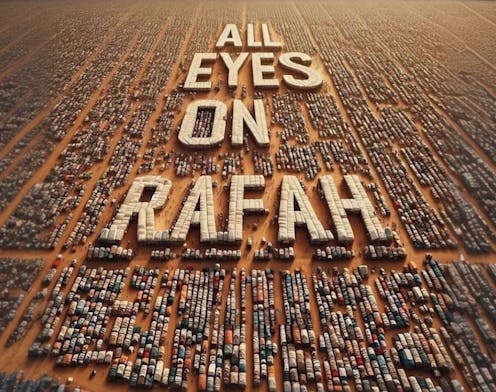
Over the past few days, one image has been shared at least 45 million times on Instagram. It shows an aerial landscape with hundreds of thousands of tents, pitched in rows, on red earth. In the centre, the tents align to form the slogan “All Eyes on Rafah”.
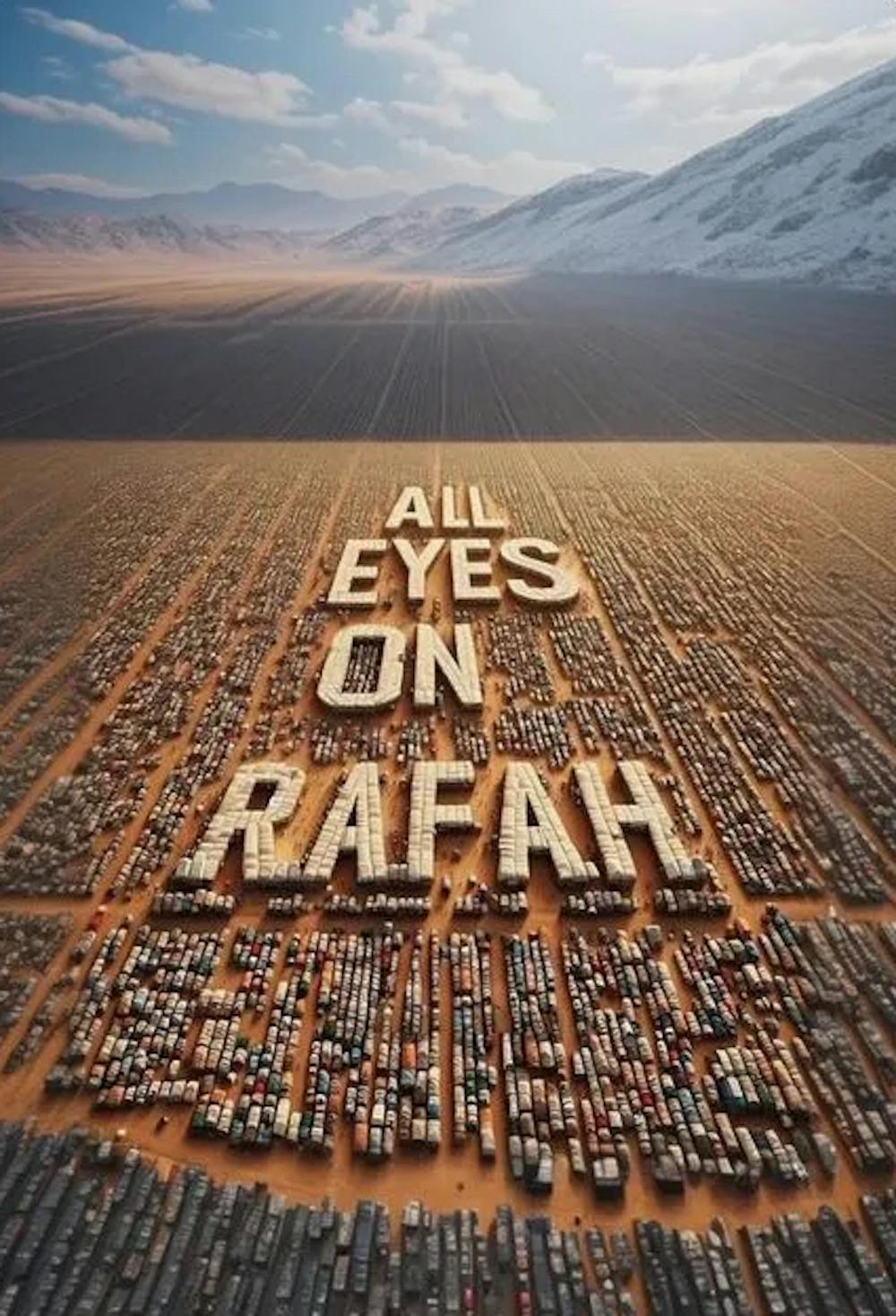
The image reads ‘All Eyes On Rafah’ in large block letters.

The immense popularity of this image provokes questions about the ethics of how we portray atrocity. Do we, as distributors of the image, have a certain moral responsibility? And why has an AI-generated image ultimately captured the world’s attention over the thousands coming directly out of Gaza?

Image origins and going viral

The image appears to have been made as a shareable sticker by Instagram user @shahv4012 in the days following an air strike by Israel that killed around 45 people in Rafah, including many women and children. Its relatively non-confronting nature means it has bypassed social media censorship (which might help explain its popularity).

Numerous media articles suggest the image is AI-generated based on certain irregularities. For instance, it is slightly blurred around the margins, the tents are uniformly distributed, and there is some inconsistency between the different areas of light and shadow.

The image borrows the tropes of aerial/drone photography, offering a totalising view of the earth from above, devoid of people. With its golden light and bucolic snow-capped mountains, it could have been plucked from a fictional world. Unlike the horrifying photos coming out of Gaza, there is no suffering to be witnessed.

Criticisms and moral responsibility

Criticisms have surfaced over why people are more comfortable sharing this AI-generated image over the countless photographs of Palestinian casualties taken by photojournalists and citizens who are risking their lives to document the conflict.

At the crux of this criticism is the demand that the images we share should authentically communicate the truth of the war. Critics contend the AI image sanitises the horrors, and call into question the virtue of people who would share this image, but not others.

In a post-truth era, the weaponising of images to deliberately spread misinformation has made AI images particularly contentious. At a time where there is concern over finding “the truth”, it becomes a moral question as to whether it is useful, or even appropriate, to represent war with an AI image.

In approaching this question, it helps to look at the history of picturing atrocity – and how the All Eyes on Rafah image circumvents the paralysing burden of real war photography.

War images are (very) confronting

We’ve seen images of warfare in films, video games and on the news: think of the hunt scenes from the raid on Osama Bin Laden, the so-called images of “weapons of mass destruction” in the Iraq War, or the 2015 photograph by Turkish journalist Nilüfer Demir of drowned Syrian toddler, Alan Kurdi.

Or consider some of the most explicit representations of atrocity popularised by the media, such as Nick Ut’s iconic 1972 photograph, Napalm Girl – often referred to as the image that changed the Vietnam War – or Malcolm Browne’s photograph of the self-immolation of monk Thich Quang Duc.

Such examples reveal the power of images to capture tragedy. But they also provoke questions around voyeurism and the ethics of witnessing suffering. For instance, for people in the West, such images may normalise the depiction of those in the Middle East and Global South as always being subjected to war and atrocity.

The earliest discussions on the ethics of viewing and sharing images of atrocity came in the late 1960s, during the Vietnam War, from American writer Susan Sontag. Sontag initially said photographic representations of war “anaesthetised” people to the reality of suffering. She wrote:

To suffer is one thing; another thing is living with the photographed images of suffering, which does not necessarily strengthen conscience and the ability to be compassionate […] after repeated exposure to images it also becomes less real.

However, she later revised this position following a first-hand experience of the 1993 siege of Sarajevo.

What is war imagery for?

The All Eyes on Rafah image enables social media users to share their solidarity in a politically “safe” and non-contentious way. The image’s somewhat diluted nature has no doubt contributed to its rapid spread.

In assessing it as a war image, we must ask the question: what is an image of conflict supposed to do, and does it do this?

We might hope such an image would stop the war altogether, but this is probably unrealistic. Perhaps, then, the sharing of the image to raise awareness and express solidarity is the most we can hope for – even though, as Sontag said, such images are ultimately destined to fade from view.

Or, it might be more productive to instead think of this AI image as a symbol, or a new form of graphic storytelling. Similar powerful symbols in the past have been granted meaning through a collective investment in them, such as the black square of the Black Lives Matter movement, the raised fist symbol of the anti-Apartheid movement, or the appropriation of the pink triangle to represent the AIDS movement.

Maybe this is a better way to approach AI images in the context of war, by untethering them from photography’s connection to “the real” spectacle of war. As long as the real images are also shared and centred, there is no harm in using a symbol to signal solidarity.

The Conversation

The authors do not work for, consult, own shares in or receive funding from any company or organisation that would benefit from this article, and have disclosed no relevant affiliations beyond their academic appointment.

ref. All Eyes on Rafah: sharing images of war comes with a moral responsibility. What can we make of this AI-generated anomaly? – https://theconversation.com/all-eyes-on-rafah-sharing-images-of-war-comes-with-a-moral-responsibility-what-can-we-make-of-this-ai-generated-anomaly-231271


Rugby union cops another body blow as the Melbourne Rebels are axed. How can the sport bounce back?

Source: The Conversation (Au and NZ) – By Tim Harcourt, Industry Professor and Chief Economist, University of Technology Sydney

The axing of the Melbourne Rebels from the Super Rugby competition, though not unexpected, is another blow to rugby union in Australia.

The Rebels were axed because they were in serious debt to the tune of A$23 million (including $11.5 million owed to the tax office) and in administration since January.

Rugby Australia rejected a rescue package from a consortium led by former Qantas and Rio Tinto supremo Leigh Clifford, ultimately taking the view there wasn’t enough rugby talent to spread across five teams in Australia.

The fact the Perth-based side Western Force was also axed in 2017 and then resurrected adds to the uncertainty surrounding the sport in Australia.

Rugby Australia chief executive Phil Waugh and chairman Daniel Herbert speak after the axing of the Rebels.

Rugby union’s glory days are long gone

It wasn’t always this way – Australian rugby was once rich in talent and finances.

Two decades ago, the Wallabies were riding high under captain John Eales, with two World Cups and a trophy cabinet full of silverware. The sport was well run and about to host the 2003 Rugby World Cup in Australia.

Rugby union was also considered to be strong financially, too. I knew this as chief economist at Austrade when we set up Rugby Business Club Australia to encourage trade and investments deals for business people coming to the World Cup.

The model was based on the Business Club Australia, which we hosted very successfully at the Sydney Olympics in 2000. We chose rugby union as the first sport after the Olympics as it was considered well-heeled and would allow the nation to benefit from the “power of schmooze”.

Yes, rugby union in those days was rich, having just turned professional, while the Wallabies were winning and the code was very popular with the general sporting public.

But things are very different now.

Australian rugby’s money issues

Financially, rugby is now far from rich. According to its 2023 annual report, Rugby Australia posted a $9 million loss, revealing an equity of negative $13 million.

By contrast, when we ran the Rugby Business Club Australia in 2003, Rugby Australia had $35 million in positive equity. That’s a $48m loss at a time when rival football codes like AFL and NRL have boomed.

So where did the money go?

Like all sports, Rugby Australia revenues did grow, from $58 million in 2001 to $124 million in 2023. It gained a $50 million injection from the highly successful British and Irish Lions tour in 2013 but also copped a $45 million loss thanks to the COVID-19 pandemic.

But expenses grew too – astronomically. Rugby Australia expenses grew from $51 million in 2001 to $130 million in 2023, shrinking the $35 million World Cup windfall (made from hosting the tournament) over time.

The money was spent on expansion of Super Rugby teams, grants to state unions, a write-off for the (now defunct) Australian Rugby Championship and even a multi-million payout to high-profile player Israel Folau, who was sacked before suing Rugby Australia for religious discrimination and then receiving a financial settlement.

Rugby Australia’s broadcast deal has been a big Achilles heel. Deakin University’s Hunter Fujak has estimated rugby’s revenues are 14% of the AFL’s, with Rugby Australia’s $30 million annual broadcast deal with Nine/Stan tiny compared to the AFL’s $650 million rights deal for 2025.

The Super Rugby expansion doesn’t appear to have been supported by the public, with crowds and viewers declining.

Rugby union, like soccer, desperately needs a new broadcast deal to generate fan interest in the game for those at home and in the stands.

What about things on the pitch?

Things are not much better on the field either.

The Wallabies are a shadow of their former selves, being bundled out at the last World Cup in the pool matches in the shadow of the Eddie Jones-Japan coaching saga – when he quit his post less than 10 months into a five-year deal before signing to coach Japan – and they are now rarely competitive in the Bledisloe Cup against the All Blacks.

There’s also confusion about how to best structure a national provincial club competition to develop pathways at different tiers of the sport.

And then there’s participation levels.

On an international basis, Australian rugby is growing compared to rugby elsewhere, but not in comparison to rival codes in sports-mad Australia.

In 2023, the Australian Sports Commission reported there were 145,000 adults and 95,000 kids playing rugby. But Australian rules football had four times that many, while 500% more kids played basketball.

Rugby union was Australia’s ninth most popular participation sport, behind even badminton and rock climbing.

So, what can be done?

Critics believe rugby union has a governance issue, and some have suggested radical change is needed.

The sport is also governed very differently and makes it difficult for Rugby Australia to have the leadership authority of the NRL and AFL. In NRL and AFL, there is a governing commission that makes decisions but in rugby union, state unions have voting rights which means Rugby Australia can only act with the blessing of the states.

Rugby Australia also has a problem those rival codes don’t have: the global nature of the sport. The northern hemisphere controls the rules but the southern hemisphere has more of the talent, making reform difficult.

For a start, rugby needs leadership that can deliver a better broadcast deal, so it’s not a case of out of sight, out of mind as it has been for a long time now.

Are there reasons to be cheerful?

There are some bright spots.

Like with soccer, people still love the World Cup, and with men’s and women’s World Cups both coming up in Australia in 2027 and 2029 respectively, that will provide a windfall to Rugby Australia, along with the very popular British and Irish Lions tour in 2025.

International tournaments are still popular in the Rugby 7s, including at the Olympics where the Australian women’s team in particular has captured the imagination of the Australian public.

Finally, in the tense geo-politics of the Pacific, having two Pacific teams, Moana Pasifika and Fijian Drua, in Super Rugby can potentially assist Australian foreign policy objectives in the same way that the Papua New Guinea team in rugby league may help in terms of soft diplomacy.

The Pacific teams also provide professional sports labour market opportunities for Pacific players at home as well as in Australia and New Zealand.

The bottom line is, rugby union in Australia needs change in terms of “the three Rs” – rules, revenue (especially broadcasting deals) and reform in governance and structure to get it back to a financial place where people can again enjoy “the game they play in heaven”.

The Conversation

Tim Harcourt does not work for, consult, own shares in or receive funding from any company or organisation that would benefit from this article, and has disclosed no relevant affiliations beyond their academic appointment.

ref. Rugby union cops another body blow as the Melbourne Rebels are axed. How can the sport bounce back? – https://theconversation.com/rugby-union-cops-another-body-blow-as-the-melbourne-rebels-are-axed-how-can-the-sport-bounce-back-230959

Business basics: what is comparative advantage?

Source: The Conversation (Au and NZ) – By Martin Richardson, Professor, Australian National University

Paul Teysen/Unsplash

For the best part of two centuries, the principle of “comparative advantage” has been a foundation stone of economists’ understanding of international trade, both of why it occurs in the first place and how it can be mutually beneficial to participants.

Man wearing a plastic mask cuts material with an angle grinder, sparks fly
Different countries specialise in the production of different goods and services.
Spencer Davis/Unsplash

The principle largely aims to explain which countries produce and trade what, and why.

And yet, even 207 years on from political economist David Ricardo’s first exposition of the idea, it is still frequently misunderstood and mischaracterised.

One common oversimplification is that comparative advantage is just about countries making what they’re best at.

This is a bit like saying Macbeth is a play about murder – yes, but there’s quite a bit more to it.

Costs represent missed opportunities

Comparative advantage does suggest that a country should produce and export the goods it can produce at a lower cost than its trading partners can.

But the most important detail of the principle is that cost is not measured simply in terms of resources used. Rather, it is in terms of other goods and services given up: the opportunity cost of production.

An asset like land used for agriculture has an enormous range of other potential productive purposes – such as growing timber, housing or recreation. A production decision’s opportunity cost is the value forgone by not choosing the next best option.

aerial photograph showing land used for both housing and agriculture
Decisions about how to use productive assets like land lead to opportunity costs.
Adie_Pulung/Shutterstock

Ricardo’s deep insight was to see that focusing on relative costs explains why all countries can gain from comparative advantage based trade, even a hypothetical country that might be more efficient, in resource-use terms, in the production of everything.

Imagine a country rich in capital and advanced technology that can produce anything using very few resources. It has an absolute advantage in all goods. How can it possibly gain from trading with some far less efficient country?

The answer is that it can still specialise in those goods at which it is “most best” at producing. That’s where its advantage relative to other countries is greatest.

Who’s best at producing wheat?

Here’s an example. In 2023, Canada’s wheat industry produced about three tonnes of wheat per hectare. But across the Atlantic, the United Kingdom yielded much more per hectare – 8.1 tonnes. So which country has a comparative advantage in wheat production?

The answer is actually that we can’t say, because these numbers are about absolute efficiency in terms of land used. They tell us nothing about what has been given up to use that land for wheat production.

Combine harvester in a wheat field during harvest in Saskatchewan, Canada
Canada and the UK both produce wheat, but who has a relative advantage?
Nancy Anderson/Shutterstock

The plains of Saskatchewan, Alberta and Manitoba are great for growing wheat but have few other uses, so the opportunity cost of producing wheat there is likely to be pretty low, compared with scarce land in crowded Britain.

It’s therefore very likely that Canada has the comparative advantage in wheat production, which is indeed borne out by its export data.

Why does it matter?

We have recently seen a lot in the news about industrial policy: governments actively intervening in markets to direct what is produced and traded. Current examples include the Future Made in Australia proposals and the US Inflation Reduction Act. Why is comparative advantage relevant to these discussions?

Well, to the extent that a policy moves a country away from the pattern of production and trade governed by its existing comparative advantage, it will involve efficiency losses – at least in the short term.

Resources are allocated away from the goods the country produces “best” (in the terms discussed above), and towards less efficient industries.

Solar panels on assembly line in factory
Both the Australian and US governments have recently introduced policies to boost their own ‘green manufacturing’ industries.
IM Imagery/Shutterstock

It’s important to note, however, that comparative advantage is not some god-given, immutable state of affairs.

Certainly, some sources of it – such as having a lot of natural gas or mineral ore – are given. But innovation and technical advances can affect costs. A country’s comparative advantage can therefore change or be created over time – either through “natural” changes or through policy actions.

The big hard-to-answer question concerns how good governments are at doing that: will claimed future gains be big enough to offset the losses?

Does everybody gain from international trade?

Supporters of free trade are often accused of arguing that everybody gains from trade. This was true in Ricardo’s early model, but pretty much only there. It has been understood for centuries that within a country there will typically be gainers and losers from international trade.

When economists talk of the mutual gains from comparative-advantage-based trade, they’re referring to aggregate gains – a country’s gainers gain more than its losers lose.

In principle, the winners could compensate the losers, leaving everybody better off. But this compensation can be politically difficult and seldom occurs.

But the concept can’t explain everything

The theory of comparative advantage is a powerful tool for economic analysis. It can easily be extended to comparisons of many goods in many countries, and it helps explain why there can be more than one country that specialises in the same good.

But it isn’t economists’ only basis for understanding international trade. A great deal of international trade in recent decades, particularly among developed nations, has been “intra-industry” trade.

For example, Germany and France both import cars from and export cars to each other, which cannot be explained by comparative advantage.

Economists have developed many other models to understand this phenomenon, and comparative-advantage-based trade is now only one of a suite of tools we use to explain and understand why trade happens the way it does.


Read more:
Australia is playing catch-up with the Future Made in Australia Act. Will it be enough?


The Conversation

Martin Richardson does not work for, consult, own shares in or receive funding from any company or organisation that would benefit from this article, and has disclosed no relevant affiliations beyond their academic appointment.

ref. Business basics: what is comparative advantage? – https://theconversation.com/business-basics-what-is-comparative-advantage-230869

Archibald Prize 2024: this year’s finalists range from downright fun to politically ferocious

Source: The Conversation (Au and NZ) – By Joanna Mendelssohn, Honorary (Senior Fellow) School of Culture and Communication University of Melbourne. Editor in Chief, Design and Art of Australia Online, The University of Melbourne

Archibald Prize 2024 finalist, Shaun Gladwell ‘A spangled symbolist portrait of Julian Assange floating in reflection’, oil and aluminium flakes on canvas, 151.5 x 112 cm © the artist, image © Art Gallery of New South Wales, Jenni Carter

Wayne Tunnicliffe, head of Australian art at the Art Gallery of NSW, has a sense of humour. The main entrance to this year’s Archibald, Wynne and Sulman Prize exhibition features a giant black and white photograph of a student demonstration from 1953. At the time the gallery trustees, who are named in Archibald’s will as the judges of the prize, were actively hostile to any idea of modern art. Their taste was so predicable that the gallery’s director, Hal Missingham, would write the telegram congratulating the winner before the voting.

By the 1970s, when I was working at the gallery, trustees were less likely to vote for their mates. But there was a deep cultural disconnect between the aesthetic taste of the gallery’s professional curators, the arts community and the media, who lived in hope of a controversy such as the 1944 William Dobell court case.

The task of turning the trustees’ choice into an interesting exhibition was best described as “a challenge”.

Archibald Prize 2024 finalist, Thom Roberts ‘Big Bamm-Bamm’, synthetic polymer paint on canvas, 152.5 x 102.5 cm © the artist, image © Art Gallery of New South Wales, Jenni Carter.

In recent years, the gallery’s board has learned to have more faith in the two artist trustees, and winners have tended to reflect their interests. It is therefore appropriate to thank both Tony Albert and Caroline Rothwell, who also judged last year’s prize, for this year’s very lively exhibition. The awarding of the prize to Julia Gutman’s embroidered and painted collage last year appears to have unleashed an especially lively range of entries this year.

In addition, the Packing Room prize is now judged by a trio of the gallery’s expert installation crew, all of whom know more about art than just what they like. This year’s prize winner, Matt Adnate, began as a street artist spraying graffiti. He is now better known for his murals, including some of the popular Yolngu rapper Baker Boy – the subject of his winning painting.

Winner Packing Room Prize 2024, Matt Adnate ‘Rhythms of heritage’, spray paint and synthetic polymer paint on linen, 220 x 188.5 cm © the artist, image © Art Gallery of New South Wales, Jenni Carter.

The biggest change is that the exhibition has been hung by the Head of Australian Art, an indication the gallery now takes the Archibald very seriously indeed. Only a very brave person would predict this year’s winner of the Archibald Prize.

Whether or not they are likely to win, there are quite a few works that deserve a closer look. Some because they are wittily original, others because of the political message they carry, or because their subject is especially newsworthy. Then there are paintings that simply bring joy.

There is a special pleasure in looking at Emily Crockford’s Singing with my selfie at the top of the world with my imagination, remembering her previous exhibits and seeing how her art has developed. That is also true of Digby Webster, another returned exhibitor who has painted his filmmaker, Trevor. Meagan Pelham, who like Crockford works through Studio A, has called her portrait of the National Portrait Gallery’s curator, Isobel Parker Philip, Highlight in the moonlight.

Archibald Prize 2024 finalist, Emily Crockford ‘Singing with my selfie at the top of the world with my imagination’, synthetic polymer paint on canvas, 150 x 120 cm © the artist, image © Art Gallery of New South Wales, Jenni Carter.

Drew Bickford’s gloriously lurid Direct-to-Video portrait of filmmaking duo Soda Jerk is at first a puzzle as the two sisters have been melded into one, but he has captured both their ambiguity and their glorious sense of anarchy as they happily make “directors’ cuts” of iconic cinema.

Archibald Prize 2024 finalist, Drew Bickford ‘Direct-to-video’, oil on canvas, 152 x 101.7 cm © the artist, image © Art Gallery of New South Wales, Jenni Carter.

Camellia Morris’s Wild Wild Wiggle is just fun, while Thom Roberts’ Big Bamm-Bamm is a reminder of a time when anything relating to Ken Done (the sitter) would automatically be rejected.

Archibald Prize 2024 finalist, Camellia Morris ‘Wild Wild Wiggle’, synthetic polymer paint on canvas, 183 x 91.5 cm © the artist, image © Art Gallery of New South Wales, Jenni Carter.

Several entries in this year’s prize, while not being of politicians, can be described as political, as their subjects are the change-makers who prick our conscience. Chief among these is Shaun Gladwell’s A spangled symbolist portrait of Julian Assange floating in reflection (pictured at the top of this article). Assange’s eyes look out from a balloon of his head, gagged by a US flag. An image of the Queen is stamped on one cheek, based on the banknote Gladwell used to sketch Assange during his time in Belmarsh Prison, while below his head is suspended in profile.

It hangs next to Anna Mould’s Complicit, ostensibly a portrait of Joan Ross, but as with Ross’s own work, this is a critique of colonisation. More conventional portraits of newsmakers include Sam Leach’s sensitive portrait of Louise Milligan and Kirsty Nielson’s angst-ridden portrait of Cheng Lei.

Julia Gutman did not exhibit in this year’s Archibald. Instead she has entered the Wynne with Olive, a suspended sculpture of textiles and wire, showing Olive the dog comforting a grieving friend.

Wynne Prize 2024 finalist, Julia Gutman ‘Olive’, found textiles and wire, 151 x 101 x 1.5 cm © the artist, image © Art Gallery of New South Wales, Jenni Carter.

Also in the Wynne Prize, the creative duo of Clair Healy and Sean Cordero use flashing lights on their Grey Nomadic Visions. The traditional divisions between different forms of media continue to be dissolved, with Billy Bain’s The fighters incorporating a flag, sewn by his mother.

Juanita McLauchlan’s mudhay burrugarrbuu- bula / Possum Magpie also dissolves the barriers between printing, embroidery and collage to evoke a sense of place. More conventionally, Jenna Mayilema Lee has woven a xanthorrhoea in Grass tree (at rest). But the weaving includes pages from an old dictionary of Aboriginal words.

Wynne Prize 2024 finalist, Jenna Mayilema Lee ‘Grass tree (at rest)’, pages from ‘Aboriginal words and place names’ by AJ Reed (1977), organic cotton thread, bamboo, rice starch glue, book cover board, acacia stool, 185 x 38 x 38 cm (variable) © the artist, image © Art Gallery of New South Wales, Jenni Carter.

The dominance of Indigenous artists in this year’s Wynne Prize is a reminder of how John Olsen, who as an art student vocally objected to the trustees’ conservatism, later became a trustee. In his extreme old age he complained to various news media outlets that Aboriginal artists were not painting landscapes. He was, of course, wrong.

The Conversation

Joanna Mendelssohn has in the past received funding from the Australian Research Council

ref. Archibald Prize 2024: this year’s finalists range from downright fun to politically ferocious – https://theconversation.com/archibald-prize-2024-this-years-finalists-range-from-downright-fun-to-politically-ferocious-228492

New Caledonians are looking to Australia as a safe haven. But for most, migration remains out of reach

Source: The Conversation (Au and NZ) – By Florence Monique Boulard, Senior Lecturer in Humanities and Education, James Cook University

In recent weeks, New Caledonia has been wracked by the worst unrest on the island in 40 years, making headlines around the world. Hundreds of Australians were trapped in the French territory, unable to return home until French troops restored order.

However, despite its geographical proximity to Australia, New Caledonia (also known as Kanaky to the Indigenous Kanak population) rarely enters into the imagination of everyday Australians.

One of us, (Florence), emigrated from New Caledonia to Australia 20 years ago. I’m often struck by how confused some Australians seem when I tell them there is a French-speaking island less than a two-hour flight from Brisbane.

This is not surprising, given that in Australian schools, the Pacific Islands remain a topic studied only at the discretion of educators. Given the ever-increasing presence of Pacific Islanders in Australian culture, sport and society, this lack of awareness about our neighbours needs to be rectified.

What our research found

Kanak people have a long history in Australia due to the infamous practice of blackbirding, also known as the Pacific labour trade. Thousands of Kanak people were among those shipped from across the Pacific to work in the sugarcane plantations in Queensland from the 1860s onwards.

Research on contemporary Pacific mobility tends to focus on just a few countries, particularly New Zealand, Vanuatu, Tonga and Samoa. As a result, we know little about the cultural diversity of other Pacific migrant communities in Australia, including those from Kanaky-New Caledonia.

As scholars researching Kanaky-New Caledonian migration patterns, we have seen a significant interest in Australia as a destination in recent years.

According to the 2021 census data, there were 1,378 people living in Australia that year who were born in Kanaky-New Caledonia.

Visitor numbers are much bigger. Data from the Institute of Statistics and Economic Studies New Caledonia showed that in 2023 more than 40,000 New Caledonians had visited Australia. That compares with around 32,000 who went to France and 12,000 who travelled to New Zealand.

Our research shows that for some residents, these trips to Australia are more than a holiday – they prompt many to imagine a life in this country. For example, one participant in our study explained:

We were hearing a lot about Australia. We came with some mates. We had a great time. […] Then I came back and when I told my wife about the experience, she said that she wanted to go with her girlfriends. She went. She came back and she said it is so great there, let’s go back.

It took this family ten years, but they achieved their dream of moving permanently to Australia.

In addition, a Facebook group called “Calédoniens en Australie”, created during the height of the COVID pandemic, also highlights this increasing desire to come to Australia. Many of the 13,600 members are regularly seeking advice on how to migrate.

However, interviews we conducted in 2023 revealed a number of challenges for these prospective migrants:

  • having French qualifications recognised by Australian employers
  • demonstrating advanced English language skills for the visa
  • the need for a skilled immigration agent.

That same research participant from above explained:

It cost us so much. We put all our savings into this. We had to do so many tests. Language tests. Medical tests. […] We began talking about this in 2003, started the paperwork in 2004 and we got granted Australian citizenship in 2013.

Many potential migrants are driven by the prospect of better economic or educational opportunities in Australia. With the political instability in the territory in recent years, Australia is perceived as a safe option, too.

As another participant in our study suggested:

I’m still scared for [my dad] sometimes because you don’t know what’s gonna happen in ten years or 15 […] I feel like it would be so much easier if there was at least the structure [to migrate] in case something is happening. For example, if my dad had to be kicked out of the country, who knows? I want to be able to get him into Australia but it’s not possible […].

Limited pathways

Despite Australia’s deepening security and defence links with Kanaky-New Caledonia, emigration remains an unreachable dream for most residents of the island.

Kanaky-New Caledonia was reinstated to the Australia Awards scholarship program in February 2023 after a ten-year absence, but this is currently limited to just five students per year. And the list of countries eligible for the new Pacific Engagement Visa does not include Kanaky-New Caledonia.


Read more:
Is it time for Australia to reassess its position on France’s role in New Caledonia?


One can only hope the Australia-France roadmap agreement, launched in December 2023 to deepen cooperation between Australia and France on defence, security and critical minerals, will also provide easier migration pathways between Kanaky-New Caledonia and Australia.

Even in the worst news stories, there is always a ray of hope. While the world has been looking at Kanaky-New Caledonia for all the wrong reasons, the recent unrest at least provides an opportunity to shift Australia’s attention to its neighbours in the Pacific region.

The Conversation

The authors do not work for, consult, own shares in or receive funding from any company or organisation that would benefit from this article, and have disclosed no relevant affiliations beyond their academic appointment.

ref. New Caledonians are looking to Australia as a safe haven. But for most, migration remains out of reach – https://theconversation.com/new-caledonians-are-looking-to-australia-as-a-safe-haven-but-for-most-migration-remains-out-of-reach-230669

What’s that in my nest? How the evolutionary arms race between cuckoos and hosts creates new species

Source: The Conversation (Au and NZ) – By Naomi Langmore, Professor, Australian National University

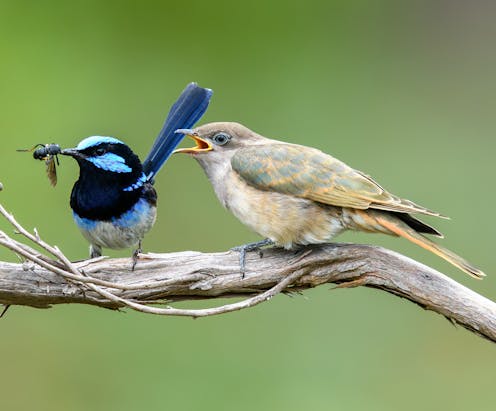
A superb fairy wren foster parent about to feed a Horsfield’s bronze cuckoo chick. Mark Lethlean

How do new species arise? And why are there so many of them? One possible reason is the arms race between animals such as predators and parasites, and the victims they exploit.

Many predators and parasites have evolved specialised strategies to avoid detection, such as mimicking their prey or host. In these cases, when the exploiter adopts a new victim, it needs to mimic the new victim to succeed.

As a result, the exploiter can diverge from its original population and ultimately become a new species. Charles Darwin proposed this process more than 160 years ago, but it has been difficult to observe in practice.

In new research published in Science, we show how this process drives the creation of new species of cuckoos. These birds lay their eggs in the nests of other species, and their chicks mimic the appearance of their host’s chicks to avoid detection.

An escalating arms race

The deceptive behaviour of bronze-cuckoos imposes heavy costs on their hosts. They lay their eggs in the nests of small songbirds, such as fairy wrens and gerygones, and abandon their young to the care of the host.

Soon after hatching, the cuckoo evicts the host eggs or chicks from the nest to become the sole occupant. The host parents not only lose all their own offspring, but also invest several weeks rearing the cuckoo, which eventually grows to around twice the size of its foster parents.

Short video loop of an adult bird grabbing a chick from a nest
A large-billed gerygone evicting a cuckoo chick from its nest.
Hee-Jin Noh

Not surprisingly, given these high costs, hosts have evolved the ability to recognise and reject odd-looking chicks from their nests.

Only the cuckoo chicks that most closely resemble the host’s chicks will evade detection, and so with each generation, the cuckoo chicks become a closer and closer match to the host chicks. This is why the chicks of each species of bronze-cuckoo look almost identical to their hosts’ chicks.

Photos of four pairs of chicks, each similar in appearance.
Each bronze-cuckoo species mimics the appearance of its host’s chicks.
Naomi Langmore

Divergence between populations that exploit different hosts

This exquisite mimicry has evolved to an even more fine-tuned level. Within a single species of bronze-cuckoo that exploits several different hosts, the appearance of the chicks tracks that of their hosts.

In response to chick rejection by hosts, both the little bronze-cuckoo and the shining bronze-cuckoo have diverged into several separate subspecies. Each subspecies exploits a different host and produces a chick that matches that of the host.

Photos of different appearances of different cuckoo subspecies.
Subspecies of the little bronze-cuckoo and the shining bronze-cuckoo track the appearance of their host’s chicks across their geographic range. A. Little bronze-cuckoo and mangrove gerygone host. B. Little bronze-cuckoo and large-billed gerygone host. C. Little bronze-cuckoo and fairy gerygone host. D. Shining bronze-cuckoo and yellow-rumped thornbill host. E. Shining bronze-cuckoo and fan-tailed gerygone host. F. Shining bronze-cuckoo and grey warbler host.
Naomi Langmore, Hee-Jin Noh, Rose Thorogood, Alfredo Attisano

This divergence can happen even when two hosts live in the same geographic area. In northern Queensland, the little bronze-cuckoo exploits both the large-billed gerygone and the fairy gerygone. The cuckoos have undergone selection to match the chicks of their respective hosts, leading to genetic divergence into two separate subspecies.

This shows the split into subspecies cannot be explained by geographic separation.

A higher cost for hosts leads to more new species

It was difficult to find out exactly what was happening with these birds, because we couldn’t easily find cuckoo chicks in host nests in the wild. So we developed a non-destructive method for extracting DNA from the shells of tiny cuckoo eggs (2.5cm long), which allowed us to sample museum egg specimens that have been collected over many decades.

Photo of a tiny egg with an even tinier hole drilled in it.
A museum cuckoo eggshell specimen, showing the original blowhole in the specimen and the tiny expansion of the blowhole to extract DNA.
Naomi Langmore

Our results also suggest that the evolution of cuckoos and their hosts is most likely to drive the creation of new species when the cuckoos impose a high cost on their hosts – such as by killing off all the host’s own offspring. This leads to an “evolutionary arms race” between the host’s defences and the cuckoo’s counter-adaptations.

This finding was supported by our broad analysis using evolutionary modelling across all cuckoo species. We found lineages that are most costly to their hosts split into new species more often than less costly cuckoo species (those that live alongside their host’s chicks) and their non-parasitic relatives.

Interactions between exploiters and their victims may be one of the main drivers of biodiversity. The process of speciation we described, in which the exploiter shows very specialised adaptations to their victim, may occur in other parasites and hosts, and in predators and prey. These tightly coupled interactions might even explain why there are millions, rather than thousands, of uniquely specialised species across the globe.

The Conversation

Naomi Langmore receives funding from the Australian National University and the Australian Research Council.

Alicia Grealy received funding from the Centre for Biodiversity Analysis (CBA).

Clare Holleley receives funding from the Australian Research Council and CSIRO, Australia’s National Science Agency.

Iliana Medina receives funding from The University of Melbourne and the Australian Research Council.

ref. What’s that in my nest? How the evolutionary arms race between cuckoos and hosts creates new species – https://theconversation.com/whats-that-in-my-nest-how-the-evolutionary-arms-race-between-cuckoos-and-hosts-creates-new-species-230986

We’re the ‘allergy capital of the world’. But we don’t know why food allergies are so common in Australian children

Source: The Conversation (Au and NZ) – By Jennifer Koplin, Group Leader, Childhood Allergy & Epidemiology, The University of Queensland

Miljan Zivkovic/Shutterstock

Australia has often been called the “allergy capital of the world”.

An estimated one in ten Australian children develop a food allergy in their first 12 months of life. Research has previously suggested food allergies are more common in infants in Australia than infants living in Europe, the United States or Asia.

So why are food allergies so common in Australia? We don’t know exactly – but local researchers are making progress in understanding childhood allergies all the time.

What causes food allergies?

There are many different types of reactions to foods. When we refer to food allergies in this article, we’re talking about something called IgE-mediated food allergy. This type of allergy is caused by an immune response to a particular food.

Reactions can occur within minutes of eating the food and may include swelling of the face, lips or eyes, “hives” or welts on the skin, and vomiting. Signs of a severe allergic reaction (anaphylaxis) include difficulty breathing, swelling of the tongue, swelling in the throat, wheeze or persistent cough, difficulty talking or a hoarse voice, and persistent dizziness or collapse.

Recent results from Australia’s large, long-running food allergy study, HealthNuts, show one in ten one-year-olds have a food allergy, while around six in 100 children have a food allergy at age ten.

https://www.shutterstock.com/image-photo/skin-rashes-babies-concept-1228925236
A food allergy can present with skin reactions.
comzeal images/Shutterstock

In Australia, the most common allergy-causing foods include eggs, peanuts, cow’s milk, shellfish (for example, prawn and lobster), fish, tree nuts (for example, walnuts and cashews), soybeans and wheat.

Allergies to foods like eggs, peanuts and cow’s milk often present for the first time in infancy, while allergies to fish and shellfish may be more common later in life. While most children will outgrow their allergies to eggs and milk, allergy to peanuts is more likely to be lifelong.

Findings from HealthNuts showed around three in ten children grew out of their peanut allergy by age six, compared to nine in ten children with an allergy to egg.

Are food allergies becoming more common?

Food allergies seem to have become more common in many countries around the world over recent decades. The exact timing of this increase is not clear, because in most countries food allergies were not well measured 40 or 50 years ago.

We don’t know exactly why food allergies are so common in Australia, or why we’re seeing a rise around the world, despite extensive research.

But possible reasons for rising allergies around the world include changes in the diets of mothers and infants and increasing sanitisation, leading to fewer infections as well as less exposure to “good” bacteria. In Australia, factors such as increasing vitamin D deficiency among infants and high levels of migration to the country could play a role.

In several Australian studies, children born in Australia to parents who were born in Asia have higher rates of food allergies compared to non-Asian children. On the other hand, children who were born in Asia and later migrated to Australia appear to have a lower risk of nut allergies.

Meanwhile, studies have shown that having pet dogs and siblings as a young child may reduce the risk of food allergies. This might be because having pet dogs and siblings increases contact with a range of bacteria and other organisms.

This evidence suggests that both genetics and environment play a role in the development of food allergies.

We also know that infants with eczema are more likely to develop a food allergy, and trials are underway to see whether this link can be broken.

Can I do anything to prevent food allergies in my kids?

One of the questions we are asked most often by parents is “can we do anything to prevent food allergies?”.

We now know introducing peanuts and eggs from around six months of age makes it less likely that an infant will develop an allergy to these foods. The Australasian Society of Clinical Immunology and Allergy introduced guidelines recommending giving common allergy-causing foods including peanut and egg in the first year of life in 2016.

Our research has shown this advice had excellent uptake and may have slowed the rise in food allergies in Australia. There was no increase in peanut allergies between 2007–11 to 2018–19.

Introducing other common allergy-causing foods in the first year of life may also be helpful, although the evidence for this is not as strong compared with peanuts and eggs.

A boy's hand holding some peanuts.
Giving kids peanuts early can reduce the risk of a peanut allergy.
Madame-Moustache/Shutterstock

What next?

Unfortunately, some infants will develop food allergies even when the relevant foods are introduced in the first year of life. Managing food allergies can be a significant burden for children and families.

Several Australian trials are currently underway testing new strategies to prevent food allergies. A large trial, soon to be completed, is testing whether vitamin D supplements in infants reduce the risk of food allergies.

Another trial is testing whether the amount of eggs and peanuts a mother eats during pregnancy and breastfeeding has an influence on whether or not her baby will develop food allergies.

For most people with food allergies, avoidance of their known allergens remains the standard of care. Oral immunotherapy, which involves gradually increasing amounts of food allergen given under medical supervision, is beginning to be offered in some facilities around Australia. However, current oral immunotherapy methods have potential side effects (including allergic reactions), can involve high time commitment and cost, and don’t cure food allergies.

There is hope on the horizon for new food allergy treatments. Multiple clinical trials are underway around Australia aiming to develop safer and more effective treatments for people with food allergies.

The Conversation

Jennifer Koplin receives funding from the National Health and Medical Research Council of Australia. She is a member of the Executive Committee for the National Allergy Centre of Excellence (NACE), which is supported by funding from the Australian government.

Desalegn Markos Shifti is supported by the National Health and Medical Research Council (NHMRC)-funded Centre for Food and Allergy Research (CFAR) Postdoctoral Funding.

ref. We’re the ‘allergy capital of the world’. But we don’t know why food allergies are so common in Australian children – https://theconversation.com/were-the-allergy-capital-of-the-world-but-we-dont-know-why-food-allergies-are-so-common-in-australian-children-228786

Jane Goodall inspires generations of conservationists – we need her education program in schools

Source: The Conversation (Au and NZ) – By Mahima Kalla, Digital Health Transformation Research Fellow, The University of Melbourne

Renowned scientist and conservationist Jane Goodall is touring Australia and New Zealand this week and next.

The 90-year-old “woman who redefined man” is best known for her discovery of tool-making in chimpanzees, our closest living relatives.

But I believe her impact on young people all over the world is even more profound.

For more than three decades, “Dr Jane” has inspired generations of conservationists through her youth-led action program Roots & Shoots. This successful self-directed project-based learning approach must be integrated into the school curriculum to support progress towards the United Nations’ Sustainable Development Goals.

Jane Goodall Reasons for Hope Trailer.

The rise of ‘Roots & Shoots’

A global environmental education movement was born in 1991, when a group of 12 distressed teenagers gathered on Goodall’s front porch in Tanzania. The teens shared their concerns for the planet and explained they felt powerless to do anything about it.

Goodall listened. Together, they exchanged stories and ideas about potential solutions. The group left with a plan of action and “reasons for hope”.

More than 30 years later, Roots & Shoots is active in more than 60 countries.

Through Roots & Shoots, members select a cause they feel strongly about. Then they receive the tools, resources and support they need to develop and carry out their plan of action.

In this way, children as young as five can make a difference. Projects range from helping bring back local bird and bee populations, to reforesting derelict plots of urban land, or raising awareness of environmental issues through podcasts and videos.

Dear World – sharing success stories

Our new book, Dear World, is a collection of letters from environmental and social justice activists of all ages.

Both renowned and unsung activists share their personal stories and offer advice to others who want to create positive change.

For example, 13-year-old Spencer Hitchen of Noosa in Queensland was worried about the “Wallum ecosystem” of shrubs and grasslands in his “backyard” at Sunshine Beach.

He received a A$250 mini grant from Roots & Shoots Australia to help create a calendar featuring his photography, to raise awareness.

A quote from 13-year old Spencer Hitchen on using his photography skills to protect nature
13-year old Spencer Hitchen writes about using his photography skills to protect nature in the new book ‘Dear World’

Other Roots & Shoots members are helping bring back local bee populations, raising awareness of “amazing animals” through educational videos, and offering earth-friendly lifestyle tips online.

It is the unstructured, informal nature of Roots & Shoots activities that make them so successful.

But there’s no reason why this model couldn’t work in the classroom. Students could be given the opportunity to conceptualise and implement their own environmental and social justice projects, applying their natural talents and interests to a cause of their choosing.

Check out the eastern water skink (Zavier’s Amazing Animals)

Expanding the Roots & Shoots model into formal education

As our research shows, there’s a strong evidence base for this. The free-choice project-based learning approach can be integrated into the curriculum on sustainable development. This would enable students to solve real-world environmental and social challenges.

The students could take part in a project for a single school term or a whole year, in the following way:

1) select a Sustainable Development Goal and topic of inquiry (such as a specific local environmental or social justice issue) of their choice, based on personal interest and curiosity

2) conduct self-directed research into potential solutions

3) tap into the expertise of local community leaders, Indigenous elders, older students, teachers and peers

4) implement the project and report back to the class about their impact

5) celebrate their success and learn from each other at a suitable forum, such as an open day or community exhibit.

Technology such as multimedia resources, online discussion forums and virtual field trips can also support the curriculum.

Step-by-step approach to implementing the Roots & Shoots program in the classroom

A lasting legacy

Young people will inherit the Earth. Their education must include developing skills to tackle the challenges they will surely face. This goes beyond learning about abstract concepts such as deforestation in the Amazon and climate change in Antarctica.

Nothing beats first-hand experience of developing and implementing practical solutions. Imagine the benefits of restoring a local ecosystem to witness the return of birdlife during the course of their schooling? Or making recycled toys for refuge dogs.

Last month we celebrated Goodall’s 90th birthday. I can’t think of a better way to honour her evolving legacy than to embed her Roots & Shoots model in our classrooms. It can be so much more than a nice-to-have extracurricular activity, enjoyed by a select few.

The author would like to acknowledge fellow Dear World co-editors, Nila Taylor and Benjamin Howes, and the 18 contributors who shared their stories for the book. Thanks also to Sakshi Srivastava for her comments on the draft of this article.

The Conversation

I have volunteered for the Jane Goodall Institute for more than 10 years. I have never received any financial compensation from the organisation or its youth-led education program Roots & Shoots.
I am the co-editor of the new book, Dear World, which is a partnership between the Jane Goodall Institute Australia and education social enterprise, Upschool. However, I will not receive financial compensation from sales of this edition. All of the profits will be directed to charity.

ref. Jane Goodall inspires generations of conservationists – we need her education program in schools – https://theconversation.com/jane-goodall-inspires-generations-of-conservationists-we-need-her-education-program-in-schools-228365

Mattel’s new athlete Barbies might seem like a win for feminists and young girls – but they’re not

Source: The Conversation (Au and NZ) – By Lauren Gurrieri, Associate Professor in Marketing, RMIT University

Mattel released a new range of Barbie dolls this week honouring nine trailblazing women in sport. The recognised athletes include Matildas soccer star Mary Fowler, tennis champion Venus Williams and seven other record-breaking and world champion sports stars from across the globe.

Mattel’s Krista Berger said the brand wishes to acknowledge “the impact of sports in fostering self-confidence, ambition and empowerment among the next generation”.

But is this a genuine effort by a corporation to be gender progressive, or is it a marketing ploy that co-opts feminism in the pursuit of profit?

Dolls and ‘learning’ gender

Discussions about Mattel’s revamping of its Barbie range matter, as research has long recognised that “play” is foundational to children’s development.

Dolls matter in all kinds of ways: they connect us to our younger selves and are transitional objects that provide us with an early sense of comfort and security.

However, doll play has historically been marketed as “for girls”, while promoting gendered norms of domesticity and ideals of physical attractiveness.

Feminists have long raised concerns about the impacts of such stereotypical portrayals – and especially their potential to socialise children in ways that both highlight and exaggerate gender differences.

Barbie in particular has often been accused of spreading narrow ideals of femininity, girlhood and womanhood into the lives of young girls.

Does this latest range promise something different? Part of answering this question requires us to trace Barbie’s origins.

A chequered history

Barbie was originally a West German doll named Bild Lilli, which was crafted for an adult consumer. Ruth Handler’s discovery of this German figurine led to her adaptation for an American marketplace, which included a name change and wardrobe update.

Significantly, Barbie was first marketed as a “teenage fashion model” whose anatomically impossible curves and dimensions proved to be a marketing triumph. Ever since, Barbie’s unrealistic body has generated body image and appearance-focused anxieties. The long-term cultural repercussions still resonate today.

The doll also communicates a narrow set of beauty ideals that conflate blondness and whiteness with physical attractiveness. In response to growing backlash, Mattel has introduced more “diverse Barbies” in recent times.

Mattel’s Barbie sales shot up after the global success of the 2023 film. It also received a share of ticket sales and revenue.
IMDB

The founder of psychoanalysis, Sigmund Freud, said there is something uncanny about dolls, in that they mediate between reality and fantasy — a tension sustained by a fear and wish they could somehow come alive.

The question is, does this new range of Barbies modelled on real pioneering athletes fall within the realm of reality or fantasy? Is it a genuine attempt to make Barbie more relatable?

Broadening and narrowing representation

On face value, Mattel’s recent efforts to diversify its range of Barbies through embracing and promoting women’s sporting is positive. After all, women’s visibility in sport is a longstanding problem, plagued by issues of unequal pay, representation and participation. And you can’t be what you can’t see.

But what exactly are we seeing in the new Barbies? While the range promotes diversity in terms of skin colour and abilities, we’re once again confronted with a sameness of bodies. Each of the Barbies conforms to a prescriptive thin ideal and doesn’t convey the athleticism of their likeness.

For instance, Venus Williams’s muscularity – a feature that makes her a powerful tennis player – is missing in her replica.

A corporate hijacking of feminism

By portraying Barbie viz a viz these pioneering women athletes as strong, capable and accomplished, the doll appears to challenge gender stereotypes.

Yet, in popular culture, the contemporary woman is increasingly being represented by notions of autonomy, agency and choice. This sensibility, that women can “have it all” (known as post-feminism) positions women as individually responsible for their own wellbeing, care and liberation.

When taken up by brands that promote this kind of “girl power”, a new type of corporate feminism is created. The result is a watering down of feminism. Women’s empowerment is reduced to a marketable commodity rather than a genuine engagement with feminist politics.

The dolls in Barbie’s new range embody a combination of physical perfection and sporting prowess. As such, they communicate new levels of expectation and standards for young girls to “aspire” to.

Realistic Barbie?

Mattel’s new range suggests the company is willing to go only so far in its efforts to be “inclusive” – unable to break away from the rigid plastic mould of Barbie’s unrealistic contours.

Evidence shows that girls who play with a doll with a more realistic body exhibit less body dissatisfaction than those who play with Barbie. Could Barbie be realistic? Could she ever represent the countless women in the world who might be “ordinary”, unremarkable and even flawed?

If Mattel really wants to join the inclusive revolution, it ought to rethink the rigid ideals that Barbie continues to promote.

The Conversation

The authors do not work for, consult, own shares in or receive funding from any company or organisation that would benefit from this article, and have disclosed no relevant affiliations beyond their academic appointment.

ref. Mattel’s new athlete Barbies might seem like a win for feminists and young girls – but they’re not – https://theconversation.com/mattels-new-athlete-barbies-might-seem-like-a-win-for-feminists-and-young-girls-but-theyre-not-231064

Grattan on Friday: Government’s pursuit of a hate speech law could take it down another cul-de-sac

Source: The Conversation (Au and NZ) – By Michelle Grattan, Professorial Fellow, University of Canberra

Attorney-General Mark Dreyfus and his “shadow”, Michaelia Cash, are both volatile characters. When they met this week to discuss the government’s draft religious discrimination bill, an incendiary issue in the best of circumstances, sparks flew.

After a few minutes, Cash stormed out. The version from her side is that Dreyfus told her to “take a breath”, leaned across the desk and raised his voice. The Dreyfus side says she was the aggressive one doing the shouting.

Whatever the truth of this unedifying “she said, he said” dispute, the more important point is that the religious discrimination legislation looks near-dead, albeit not yet cremated.

Anthony Albanese promised it at the election, for political purposes, but has since said the government will not proceed without Coalition support.

The Coalition hasn’t given a definite yes or no, but is stringing out the issue for its own advantage. If Albanese wants to try a salvage operation, he’ll need to undertake it himself, directly with Opposition Leader Peter Dutton. (The Greens have offered to deal themselves into the play, but that could be an even more difficult route for the government. Their support seldom comes cheap.)

From the government’s point of view, there’s little to be gained by attempting to breathe fresh life into this legislation. At next year’s election, the PM can tell the faith communities “well, I tried, but the Coalition wouldn’t agree”.

Meanwhile, the government is embarking on another, equally fraught, legislative journey – trying to turn the PM’s promise of action against “hate speech” into law.

Albanese said in February he’d asked Dreyfus “to develop proposals to strengthen laws against hate speech, which we will be doing”.

The proposed law would cover speech that incites hatred in relation to sex, sexuality, gender, race, and religion. The government claims it would strengthen existing Commonwealth laws. We already have provisions that prohibit urging violence against groups and members of groups – in section 80.2A and 80.2B of the Criminal Code. New offences would be created.

The government expects its legislation to be ready for introducing in August.

The opposition says it will wait for the details before it declares its position. However, Dutton – who a few months ago said the government should investigate whether stronger laws were needed – was cautious about the issue at this week’s Coalition parties meeting. There would be resistance to the move within the opposition.

There are several threshold questions about the pursuit of federal hate speech legislation. Is it necessary? Is it desirable? How practical is it? Is it worth the potentially divisive debate it will bring?

A driver behind the legislation is the desire to send signals (of both support and warning) in the present fractured domestic climate, after the Israel-Hamas war has fuelled antisemitism (which was already rising in Australia before the conflict) and Islamophobia.

Although there have been calls for new anti-hate speech legislation from Jewish and Muslim communities for several years, the widening of social divisions in the wake of this war has given impetus to these calls.

On the other hand, there is not a legal vacuum – there are existing state criminal laws that could be used against, for example, hate preaching, although they haven’t been invoked. The NSW Law Reform Commission, under former NSW Chief Justice Tom Bathurst, is currently inquiring into Section 93Z of the NSW Crimes Act to assess its efficacy. That section proscribes threatening or inciting violence on the basis of race or other attributes.

When we consider the desirability of federal hate speech legislation, we quickly run into the freedom-of-speech conundrum.

Reasonable people agree the right to freedom of speech is not absolute. Where it intersects with incitement to violence, a clear line has been crossed.

But the issues become murky when we examine, for example, the chants “from the river to the sea” and “intifada”. What is actually being said when they are chanted?

Education Minister Jason Clare said recently: “I’ve seen people say that those words mean the annihilation of Israel. I’ve seen people say that it means the opposite. I’ve seen people say that they’re slogans that Israeli political parties have used too.”

He got a mild put-down from his prime minister, who sees “from the river to the sea” as denying a two-state solution. But Clare is right; the words have different meanings to different people. Also, and importantly, it’s a matter of context. It’s one thing if the words are used to stir up a potentially violent crowd (incitement); it’s another when they’re used by protesters at a peaceful demonstration (free speech).

Earlier this month, the Group of Eight Universities asked Dreyfus for advice, in relation to federal law, on intifada and “from the river to the sea”.

Dreyfus replied he did not provide legal advice. He then referred them to Section 18C of the Racial Discrimination Act, that provides a civil remedy for a public act found likely to offend, insult, humiliate or intimidate on the ground of race.

The Executive Council of Australian Jewry has lodged two complaints, under 18C, with the Australian Human Rights Commission over inflammatory speeches by two Sydney preachers.

The Senate this month passed a motion with bipartisan support that declared “the slogan ‘from the river to the sea, Palestine will be free’ opposes Israel’s right to exist and is frequently used by those who seek to intimidate Jewish Australians via acts of antisemitism”. The Australian Muslim Advocacy Network immediately claimed, in an open letter to senators, the motion “infringes on the right to freedom of expression by Palestinian Australians and their allies in criticising Israel”.

Katharine Gelber, professor of politics and public policy at the University of Queensland, has written extensively on hate speech.

She says the existing federal criminal code sections were originally introduced as counter-terrorism measures. “If what the government means to do is remove those provisions and instead have a criminal hate speech law, that might be helpful. Otherwise they might be introducing more confusion,” she says.

Gelber is not convinced the phrase “from the river to the sea” would automatically be caught by 18C, let alone by a new criminal provision. “It would be very hard to define a criminal law to include that”.

She does believe, however, that a vilification law would be useful in an educative sense – a “line in the sand as much as for prosecution – important even if there was no enforcement”. She says that, in principle, anti-vilification laws in both civil and criminal form have an appropriate role to play in drawing those lines in democratic debate, to ensure people engaged in free speech exercise it in ways that don’t harm others.

“One could expect that the prime minister wants to make a symbolic gesture,” she says.

In political terms, however, the attempted gesture could bog down in arguments on multiple fronts that pleased none of the major stakeholders in the debate and left the rest of the public thinking the government had, once again, got itself into a cul-de-sac.

The Conversation

Michelle Grattan does not work for, consult, own shares in or receive funding from any company or organisation that would benefit from this article, and has disclosed no relevant affiliations beyond their academic appointment.

ref. Grattan on Friday: Government’s pursuit of a hate speech law could take it down another cul-de-sac – https://theconversation.com/grattan-on-friday-governments-pursuit-of-a-hate-speech-law-could-take-it-down-another-cul-de-sac-231275

Back to Back’s Multiple Bad Things takes a sophisticated look at the moral ambiguities of today’s ‘culture wars’

Source: The Conversation (Au and NZ) – By Sarah Austin, Lecturer in Theatre, The University of Melbourne

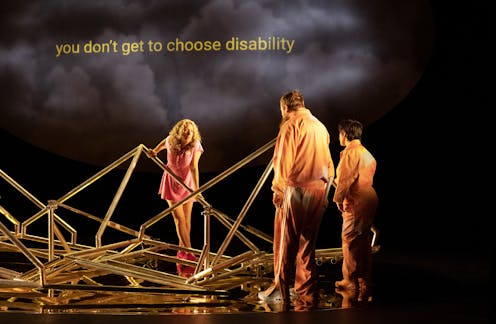
Bron Batten, Scott Price and Sarah Mainwaring perform on stage in Multiple Bad Things. Ferne Millen

Back to Back Theatre is an internationally lauded ensemble of collaborators based in Geelong. With some members identifying as intellectually disabled and/or neurodiverse, the company has spent more than two decades producing performance works that address the politics of visibility and power.

The company has been described as having an “astonishing ability to dissect the unspoken imaginings of society”. And its latest show, Multiple Bad Things, directed by Tamara Searle and Ingrid Voorendt, showcases this capacity.

With great sophistication and certainty, the performance takes the dynamics of a workplace and reflects it to the audience to reveal the complex power dynamics, inequitable structures and political tensions that underpin and uphold the damaging status quo.

The workplace as a site of tensions

Taking place in a context that seems part-factory and part-construction site, four workers appear. One (Simon Laherty) directly addresses the audience as a narrator, blithely providing trigger warnings for the work they are about to see, and takes a seat at a desk as if he is a supervisor in his site office.

His computer screen is visible to the audience. He begins playing a game of solitaire, but eventually we watch as he doomscrolls through video clips of highly muscled men working out, fast cars, guns, porn and nature documentaries. Laherty’s character implicates the audience in this world, positioning them as present but silent voyeurs.

A second worker (Scott Price) arrives and promptly parks himself on a giant inflatable pool floatie shaped like a flamingo. They are then joined by the other two (Bron Batten and Sarah Mainwaring). Batten is the only non-disabled person on stage, while Mainwaring is physically and intellectually disabled.

Batten and Mainwaring appear to have the most work ethic. They begin piecing together the structure that dominates the centre of designer Anna Cordingley’s compelling set. It resembles a kind of post-apocalyptic Ikea nightmare: an enormous spiky tangle of poles or pipes that must somehow fit together.

Actors Simon Laherty, Bron Batten, Sarah Mainwaring and Scott Price play company employees.
Ferne Millen

In what appears to be a demonstration of human futility, the workers begin listing “bad things” while assembling the structure. As they work, apparently banal conversations take place.

At one point, they discuss the “international” aisle at the supermarket. As Price interjects with the kind of cuisines that can be found in this aisle (Mexican! Dutch! Japanese!), Mainwaring points out British food is now also located in the international aisle. Batten remarks that this seems pointless, given British food also occupies the rest of the supermarket.

These seemingly innocuous exchanges of dialogue underscore a central thread in the work, as the performers begin to wrestle with notions of difference and diversity, and the question of who gets to take up space. As the exchanges take place, we start to see a painfully obvious embodied representation of inequity among the workers, as Mainwaring physically struggles with the task at hand and requests help.

Mainwaring (back) and Price at work.
Ferne Millen

The harms of moral righteousness

As the show progresses, Batten reacts to Price’s perceived laziness by removing the air from the inflatable, triggering a great argument between them. Price claims he has been violently targeted because of his autism. Batten counteracts this by adopting the language of the oppressed to assert her own diversity and need for support.

In doing so, she maintains the system of power that clearly has her at the top of the pecking order as the only non-disabled person of the four.

Mainwaring watches on, at times saying she doesn’t understand what’s happening between them. Price seems to lose the argument, carrying the deflated flamingo and lying on the floor, proclaimed “dead” by Batten, who poses hero-like around the structure, celebrating her victory.

This moment reveals the disquieting outcome of Batten’s self-victimisation. It also speaks to the harm that can be caused by those who come from a place of moral righteousness and certitude.

The structures seemingly set up to support inclusion are revealed as redundant tools through a sly referencing of the workplace’s Diversity and Inclusion Committee, and a hopelessly frustrating and hilarious phone call Mainwaring makes to a support helpline. The audience is shown how these tools maintain control and drown out the voices of the most disenfranchised, leaving the workers to manage their own issues without support.

Negotiating power onstage

Multiple Bad Things demonstrates Back to Back Theatre’s leading approach to a growing area of interest in disability arts practice: the aesthetics of access. This is where we see sophisticated ways of incorporating access, for both audience and performers, into the framework and design of the performance.

One example was the use of the oval screen at the rear of the stage used to display subtitles. This text was, thanks to the audio-visual design by Rhian Hinckley, seamlessly integrated into the design of the broader work – and at times strategically used to disrupt or underscore the action on stage.

The use of the oval screen fits cleverly into the broader work.
Ferne Millen

Directors Searle and Voorendt have crafted a proficient, seamless, complex and sophisticated hour-long work. They bring the unique performances and identities of the ensemble, along with an evocative score by Zoë Barrie and assured lighting design by Richard Vabre, into symbolic interplay. As these elements weave together, the performance oscillates between playful and poignant, flippant and horrific.

The final moments of the show see Mainwaring alone on stage, completing the assembly herself and it then initiating the final transformation of the spiky poles in a powerful theatrical moment.

Laherty leaves his office post for the third time in the performance and delivers a monologue about computer solitaire. “Sometimes you win and sometimes you lose,” he says. “You have to be prepared to lose a few games before you win.”

Mainwaring and Laherty embrace. In stark juxtaposition to the conflict and suffering we have just witnessed, we see a moment of care between the performers. While much is left unresolved regarding the central question of difference, diversity and who is entitled to take up space, Laherty’s reflections on solitaire resonate with this image.

Multiple Bad Things highlights there may be no singular perspective on what is right and wrong. Perhaps, as we collectively negotiate the building of more equitable structures, success relies on what it is we’re prepared to lose in order to win.

The Conversation

I have worked with Richard Vabre and Zoe Barrie on previous projects and Anna Cordingley is an employee at my institution.

ref. Back to Back’s Multiple Bad Things takes a sophisticated look at the moral ambiguities of today’s ‘culture wars’ – https://theconversation.com/back-to-backs-multiple-bad-things-takes-a-sophisticated-look-at-the-moral-ambiguities-of-todays-culture-wars-227567

NZ Budget 2024: ‘tax relief’ for the ‘squeezed middle’ – but who’s paying? 7 experts follow the money

Source: The Conversation (Au and NZ) – By Timothy Welch, Senior Lecturer in Urban Planning, University of Auckland, Waipapa Taumata Rau

Getty Images

Craig Elliffe: Small cuts, big consequences

Honestly, who would want to be Nicola Willis at this point?

The effect of $14.7 billion of tax cuts is going to mean a dramatic rethink on expenditure in New Zealand in the long term, and about what sort of public services we expect as a country. The government’s cut-it-back strategy appears focused on the next four years, not a longer horizon.

From a broader economic perspective, the hope is the cuts will provide help for households. But that is not great relief if interest rates do not come down. So, the story for 2024 will be increasing job losses and a gloomier economy.

The tax cuts spread a little over a lot of people. And you have to ask, will $50 or $100 a fortnight really make a difference if interest rates stay high and the ability of the government to pay for core services reduces?

If the government keeps tightening the belt to pay for what are, in reality, small tax cuts, we’re going to end up with poor infrastructure, low wages and a struggling economy.

One positive thing about the tax policy, however, is that the government is facing up to the fiscal drag question. More than 14 years of inflation have moved people into new tax thresholds, eating away at the benefits of salary increases.

Taking a longer-term view, organisations such as the International Monetary Fund and OECD would have preferred the government to focus on paying down debt to get New Zealand to a surplus faster. To do that, those organisations suggest New Zealand introduce a tax on capital – but this budget avoids such big questions.

Dennis Wesselbaum: Prudent fiscal management

Fiscal budgets involve the crucial task of strategically allocating resources across various vital sectors, such as health, education and infrastructure.

The big-ticket items in this year’s budget are the tax relief – adjusting tax thresholds and the FamilyBoost childcare payment – and spending increases in health, schools and policing.

Tax relief is achieved by adjusting tax brackets for those on low and middle incomes. This should have a positive effect on the economy without creating inflation.

Spending is financed by redistributions, cuts in other areas, and by shrinking the public sector (by about 4,000 jobs), with fiscal surpluses predicted to return by 2027-2028. The underlying economic outlook from the Treasury looks reasonable, and we should see interest rate cuts by early to mid 2025.

Overall, this budget is a welcome return to focusing on outcomes and prudent fiscal management. Delivering a budget that simultaneously addresses many structural problems during a recession is always a difficult task, but this is a step in the right direction.


Timothy Welch: Infrastructure funding falls further behind

The 2023 budget was all about rebuilding and resilience: the extension of free public transport for children under 13 and half-price fares for under-25s; millions for rail and road restoration and resiliency; funding for more public housing and a clear emphasis on protecting the country from natural disasters and climate change.

All of that is gone now. While not exactly an austerity budget, it significantly cuts public spending, aside from on roads, as New Zealand falls further behind on funding critical infrastructure.

The budget does allocate some funding to important transport initiatives, such as Auckland’s Rail Network Rebuild Programme ($159.2 million). But this comes at the expense of Auckland Light Rail, the Clean Vehicle Discount, Clean Vehicle Standard Administration – and, surprisingly, from cuts to the Community Connect public transport affordability programme.

Much of the transport budget ($1.955 billion) goes to implementing the Draft Government Policy Statement on Land Transport, primarily dedicated to delivering the Roads of National Significance program, with another $1 billion being held in contingency.

The budget does not mention the cycling, walking or important green infrastructure investments that would help deliver decarbonisation. It is also silent on needed investments in storm water management and flood control, while taking “savings” from the repealed Three Waters program.

There is a bright spot for infrastructure, however, with the creation of the National Infrastructure Agency – though operational details are not yet available.

While the cost of living looms large for many, tax cuts in place of essential infrastructure upgrades and investments look short-sighted in the face of increasing traffic congestion, more extreme weather and flooding, and the threat climate change poses to all infrastructure.

Mark Barrow: Education funding favours the private sector

Generally, the government has (so far) kicked the tertiary sector can down the road. The university system review and winding down of Te Pūkenga (the merged polytech system) has left the focus mainly on schools, schooling and teachers.

As such, the education policy settings supported by the budget resurrect old conflicts around theory versus practice, whole language learning versus structured literacy, and university teacher training versus school-based apprenticeship models.

Ahead of the budget, both Education Minister Eric Stanford and Associate Minister David Seymour painted a grim (frequently inaccurate) picture about the state of New Zealand’s education system and the people who work in it.

Their answer has been to use the budget to direct public money to the private sector. This includes funding for new charter schools (where school owners will not face the restrictions being imposed on state schools), and increased support for the private early childhood education sector and private teacher training establishments.

While schools will welcome the relatively small increases in operational and property funding, this budget is moving more money into the hands of the private sector.

Anna Matheson: Health holds steady

With $8.2 billion in new spending over four years, it is good to see health being prioritised, although most will cover existing cost pressures. The current fragmented state of the health system cannot be blamed on this government, but those in power now have a choice: bow to expediency and continue with superficial or isolated attempts to fix things, or learn from the past and deliver an improved system.

But opting for tax cuts instead of signalling effective and sustainable approaches to the country’s complex health, social and environmental challenges seems shortsighted.

Yes, an additional $20 a fortnight from tax cuts may be the difference between seeing a GP or not. But the removal of free prescriptions for most people could also mean the difference between having access to medicines or not.

A better investment would be to make access to primary care easier and more affordable. And we know primary care, alongside healthier local environments, can keep people out of our expensive hospital system.

So, the focus on the health workforce is essential and overdue. But part of keeping people out of hospital is what happens within other sectors, not just health. Depending on how it is implemented, the new Social Investment Fund could help here, but we need more detail to know.

Hiran Thabrew: Not enough for mental health

Despite the National Party’s pre-election promises to improve mental health and the government’s introduction of a minister for mental health, it is disappointing to see the limited amount of funding overall: private provider Gumboot Friday ($24 million over four years) and a Mental Health Innovation Fund ($9.7 million over four years).

Tax cuts and the relatively small amounts they will put into the pockets of the “squeezed middle” may alleviate some stress-related mental health issues. But one in five New Zealanders experiences mental distress and illness. This costs $12 billion (5% of the GDP) each year.

The previous Labour government invested $1.9 million in primary and community-based services for those with mild to moderate mental health issues. Meanwhile, demand for specialist mental health services grew by 75% over the past decade, without a corresponding increase in resourcing.

It is a shame the needs of those with moderate to severe mental illness remain ignored. This is the group with the greatest need of support, and many New Zealanders and their whānau could be among them at some point in their lives.

In 2022, specialist mental health services saw a 12% staff departure rate, versus a 9% recruitment rate. Some 20% of psychiatry positions are currently vacant, and crisis-driven acute care is becoming the norm.

If the government doesn’t urgently address workforce shortages, ring-fence mental health funding, and update a 20-year-old mental health survey on which current funding is based, it won’t have the Labour Party to blame by the next election.

Julia Talbot-Jones: Silent on the environment

Leading up to its first budget, the coalition government has dismantled environmental protections and introduced new legislation to support economic growth.

Environmental advocates have called it “a war on nature” and some have compared the pace and magnitude of reform underway to the “Think Big” mistakes of the 1975-1984 National government.

The controversial Fast-Track Approvals Bill has received much attention and is now going through a submissions process. But the government is also replacing freshwater and biodiversity legislation, and it has relaxed marine protections and cancelled a swathe of climate policies.

The budget does nothing to allay public concern about the repercussions of these policy decisions. Instead, it underlines the government’s support for development. It delivers nothing new for the environment, climate or conservation.

Willis was notably silent about the environment in her budget speech, only mentioning a continued $2.6 billion investment in existing climate initiatives, and the growing importance of the Emissions Trading Scheme. A preliminary assessment of Treasury documents shows a reduction in overall funding across most environmental protection domains over the next five years.

Climate and environment are not solely “environmental” issues, they are economic matters: both of New Zealand’s largest export earners (agriculture and tourism) depend on New Zealand upholding its international image as a healthy environment.

This cannot be maintained without continued government involvement and investment through strong environmental policy and financial commitments. To do otherwise is to jeopardise New Zealand’s long-term economic future.

The Conversation

Hiran Thabrew receives funding from the Health Research Council. He is Chair of the Tu Te Akaaka Roa, the NZ Office of the Royal Australian and New Zealand College of Psychiatrists.

Julia Talbot-Jones receives funding from the Royal Sociey Te Apārangi. She is an Affiliate at Motu Economic and Public Policy Research where she leads the freshwater programme.

Anna Matheson, Craig Elliffe, Dennis Wesselbaum, Mark Barrow, and Timothy Welch do not work for, consult, own shares in or receive funding from any company or organisation that would benefit from this article, and have disclosed no relevant affiliations beyond their academic appointment.

ref. NZ Budget 2024: ‘tax relief’ for the ‘squeezed middle’ – but who’s paying? 7 experts follow the money – https://theconversation.com/nz-budget-2024-tax-relief-for-the-squeezed-middle-but-whos-paying-7-experts-follow-the-money-230102

As Israel pushes into Rafah, it exposes an uncomfortable truth: no court alone can protect civilians in war

Source: The Conversation (Au and NZ) – By Paul Taucher, Lecturer in History, Murdoch University

The world has reacted with anger this week after an Israeli air strike on a safe zone for displaced civilians in southern Gaza reportedly resulted in the deaths of at least 45 people, including women and children.

This latest action in the Israel’s war in Gaza has come despite the International Court of Justice (ICJ) delivering an order last Friday that it must immediately halt its military campaign in Rafah due to the risk to civilians.

It appears Israel is determined to defy the ICJ’s order. Israeli tanks moved into the heart of Rafah earlier this week.

If it continues its assault on Rafah, it would present the ICJ (the UN’s top court) with perhaps the greatest challenge to its legitimacy since it was established following the second world war.

The ICJ view of the conflict

The court became directly involved in the conflict in December when South Africa lodged a case against Israel, arguing its offensive had amounted to or created the conditions for a genocide of the Palestinian people.

In late January, the ICJ issued a range of orders, including that Israel must take immediate steps to prevent acts of genocide against the Palestinian people and ensure humanitarian aid gets into Gaza.

Last week, the ICJ reiterated its concern over aid, and more critically, ordered Israel to:

Immediately halt its military offensive, and any other action in the Rafah governorate, which may inflict on the Palestinian group in Gaza conditions of life that could bring about its physical destruction in whole or in part.

There is a large amount of legal ambiguity in the wording of this order.

In one interpretation – favoured by the Israeli government – military and other actions in Rafah can continue, provided these actions are not genocidal.

In another interpretation, the order prohibits Israel from carrying out any further military or other actions in Rafah full-stop.

There’s also a question over how to interpret the word may. That is, at what point can it be said that Israel’s actions may lead to physical destruction?

While the order is ambiguous from a legal standpoint, arguably it is not to many observers: the court wants Israel to stop what it is doing.

The lack of enforcement

It is likely no accident the panel of judges provided such ambiguous orders.

The ICJ is an independent court, but it operates in a difficult political and diplomatic environment. Critically, it also has no independent ability to enforce its orders – there is no world police the ICJ can rely on to ensure its orders are carried out.

Instead, the court relies on the support of powerful countries that are willing to enforce its decisions through diplomatic measures, including sanctions.

Officially, the UN Security Council – as the global body responsible for peace and security – enforces ICJ decisions. However, in practical terms, the veto power of the five permanent members of the Security Council extends to the ICJ.

As such, the United States would likely veto any Security Council resolution to restrict Israeli actions in any substantive way.

While the US has warned Israel not to launch a major offensive in Rafah, a senior administration official has reportedly said this week’s air strike did not cross a “red line”.

This kind of roadblock to the enforcement of the ICJ’s orders threatens the legitimacy and credibility of the court. To exist as a trusted adjudicator in international law, it has to be seen to be applying that law impartially and fairly. And its rulings cannot be ignored.

The court alone can’t stop the fighting

In the past, the effective pursuit of states and individuals for breaches of international humanitarian law has required overwhelming political will, usually in the wake of the complete military defeat of a country at war.

This was the case with the Nuremberg and Tokyo war crimes trials following the second world war, and in other international trials since then. In these past cases, the nations and leaders in question were powerless to resist the overwhelming pressure of the international community.


Read more:
There has been much talk of war crimes in the Israel-Gaza conflict. But will anyone actually be prosecuted?


When it comes to allegations of genocide and other breaches of international law, it is also much easier for judges on international courts and tribunals to make decisions after the events have occurred, rather than while they are still continuing, as in the Gaza war.

A government that legitimately holds power is likely to regard the orders of an international body as an encroachment on its sovereignty, as Israel does with the current orders of the ICJ and International Criminal Court.

Ultimately, what the conflict in Gaza and the various legal and political responses have shown is that no court in the world – nor any international law – alone has the capacity to effectively protect civilians during times of war.

Legal thinkers can debate the wording of the ICJ’s latest order, and political leaders can debate the power of the court, but the only thing that can end the war is widespread international pressure for both sides to agree to a ceasefire. This includes from powerful nations such as the US.

Thus, it is not the legitimacy of the ICJ that is most urgently in question at the moment, but rather how deeply the world’s most influential powers believe in the role of international institutions to maintain peace and security.

The Conversation

Dean Aszkielowicz has previously received funding from the Australian Army Research Scheme.

Paul Taucher does not work for, consult, own shares in or receive funding from any company or organisation that would benefit from this article, and has disclosed no relevant affiliations beyond their academic appointment.

ref. As Israel pushes into Rafah, it exposes an uncomfortable truth: no court alone can protect civilians in war – https://theconversation.com/as-israel-pushes-into-rafah-it-exposes-an-uncomfortable-truth-no-court-alone-can-protect-civilians-in-war-231052

What are nootropics and do they really boost your brain?

Source: The Conversation (Au and NZ) – By Nenad Naumovski, Professor in Food Science and Human Nutrition, University of Canberra

LuckyStep/Shutterstock

Humans have long been searching for a “magic elixir” to make us smarter, and improve our focus and memory. This includes traditional Chinese medicine used thousands of years ago to improve cognitive function.

Now we have nootropics, also known as smart drugs, brain boosters or cognitive enhancers.

You can buy these gummies, chewing gums, pills and skin patches online, or from supermarkets, pharmacies or petrol stations. You don’t need a prescription or to consult a health professional.

But do nootropics actually boost your brain? Here’s what the science says.

What are nootropics and how do they work?

Romanian psychologist and chemist Cornelius E. Giurgea coined the term nootropics in the early 1970s to describe compounds that may boost memory and learning. The term comes from the Greek words nӧos (thinking) and tropein (guide).

Nootropics may work in the brain by improving transmission of signals between nerve cells, maintaining the health of nerve cells, and helping in energy production. Some nootropics have antioxidant properties and may reduce damage to nerve cells in the brain caused by the accumulation of free radicals.

But how safe and effective are they? Let’s look at four of the most widely used nootropics.

1. Caffeine

You might be surprised to know caffeine is a nootropic. No wonder so many of us start our day with a coffee. It stimulates our nervous system.

Caffeine is rapidly absorbed into the blood and distributed in nearly all human tissues. This includes the brain where it increases our alertness, reaction time and mood, and we feel as if we have more energy.

For caffeine to have these effects, you need to consume 32-300 milligrams in a single dose. That’s equivalent to around two espressos (for the 300mg dose). So, why the wide range? Genetic variations in a particular gene (the CYP1A2 gene) can affect how fast you metabolise caffeine. So this can explain why some people need more caffeine than others to recognise any neurostimulant effect.

Unfortunately too much caffeine can lead to anxiety-like symptoms and panic attacks, sleep disturbances, hallucinations, gut disturbances and heart problems.

So it’s recommended adults drink no more than 400mg caffeine a day, the equivalent of up to three espressos.

Two blue coffee cups on wooden table, one with coffee art, the other empty
Caffeine can make you feel alert and can boost your mood. That makes it a nootropic.
LHshooter/Shutterstock

2. L-theanine

L-theanine comes as a supplement, chewing gum or in a beverage. It’s also the most common amino acid in green tea.

Consuming L-theanine as a supplement may increase production of alpha waves in the brain. These are associated with increased alertness and perception of calmness.

However, it’s effect on cognitive functioning is still unclear. Various studies including those comparing a single dose with a daily dose for several weeks, and in different populations, show different outcomes.

But taking L-theanine with caffeine as a supplement improved cognitive performance and alertness in one study. Young adults who consumed L-theanine (97mg) plus caffeine (40mg) could more accurately switch between tasks after a single dose, and said they were more alert.

Another study of people who took L-theanine with caffeine at similar doses to the study above found improvements in several cognitive outcomes, including being less susceptible to distraction.

Although pure L-theanine is well tolerated, there are still relatively few human trials to show it works or is safe over a prolonged period of time. Larger and longer studies examining the optimal dose are also needed.

Two clear mugs of green tea, with leaves on wooden table
The amino acid L-theanine is also in green tea.
grafvision/Shutterstock

3. Ashwaghanda

Ashwaghanda is a plant extract commonly used in Indian Ayurvedic medicine for improving memory and cognitive function.

In one study, 225-400mg daily for 30 days improved cognitive performance in healthy males. There were significant improvements in cognitive flexibility (the ability to switch tasks), visual memory (recalling an image), reaction time (response to a stimulus) and executive functioning (recognising rules and categories, and managing rapid decision making).

There are similar effects in older adults with mild cognitive impairment.

But we should be cautious about results from studies using Ashwaghanda supplements; the studies are relatively small and only treated participants for a short time.

Ashwagandha is a plant extract
Ashwaghanda is a plant extract commonly used in Ayurvedic medicine.
Agnieszka Kwiecień, Nova/Wikimedia, CC BY-SA

4. Creatine

Creatine is an organic compound involved in how the body generates energy and is used as a sports supplement. But it also has cognitive effects.

In a review of available evidence, healthy adults aged 66-76 who took creatine supplements had improved short-term memory.

Long-term supplementation may also have benefits. In another study, people with fatigue after COVID took 4g a day of creatine for six months and reported they were better able to concentrate, and were less fatigued. Creatine may reduce brain inflammation and oxidative stress, to improve cognitive performance and reduce fatigue.

Side effects of creatine supplements in studies are rarely reported. But they include weight gain, gastrointestinal upset and changes in the liver and kidneys.

Where to now?

There is good evidence for brain boosting effects of caffeine and creatine. But the jury is still out on the efficacy, optimal dose and safety of most other nootropics.

So until we have more evidence, consult your health professional before taking a nootropic.

But drinking your daily coffee isn’t likely to do much harm. Thank goodness, because for some of us, it is a magic elixir.

The Conversation

Dr Nenad Naumovski has previously received funding from the National Health and Medical Research Council, Malaysian Health and Research Council, ACT government, Dementia Research Foundation, Arthritis ACT, Australian Association of Gerontology, Hospital Foundation and the ACT Board of Secondary Studies. He has had university funding from the University of Newcastle (Australia), Australian National University, University of Canberra, Monash University, Beijing University of Chinese Medicine and Health Polytechnic Ministry of Health Jakarta. He has had industry funding from Assistive Technology Australia, Chiron Health Products, Capitol Chilled Foods Australia, Archer Daniels Midland and Australian Beverage Council. He has received travel funding from the Nutrition Society of Australia, Australian Institute of Food Science and Technology, and Australian Atherosclerosis Society. He is a member of Nutrition Society Australia, the Australian Atherosclerosis Society, Australian Institute of Food Science and Technology, Asian-Pacific Society of Atherosclerosis and Vascular Disease, International Society for Nutritional Psychiatry, Early Intervention in Mental Health, Nutrition Society of United Kingdom and American Society for Nutrition. To the best of my knowledge, I am not aware that any of the companies in this disclosure are involved in the research or marketing of nootropics mentioned in this article.

Amanda Bulman receives funding from the University of Canberra. She is a member of the Australian Institute of Food Science and Technology.

Dr Andrew McKune has previously received funding from the ACT Health Research and Innovation Fund, Australian Institute of Sport, Dementia Research Foundation, Arthritis ACT, Australian Association of Gerontology, Hospital Foundation, University of Canberra, Chiron Health Products and Archer Daniels Midland. He is a member of the International Society for Nutritional Psychiatry, and International Early Intervention and Prevention in Mental Health Association. To the best of my knowledge, I am not aware that any of the companies in this disclosure are involved in the research or marketing of nootropics mentioned in this article.

ref. What are nootropics and do they really boost your brain? – https://theconversation.com/what-are-nootropics-and-do-they-really-boost-your-brain-224628

Parents are increasingly saying their child is ‘dysregulated’. What does that actually mean?

Source: The Conversation (Au and NZ) – By Cher McGillivray, Assistant Professor Psychology Department, Bond University

ShUStudio/Shutterstock

Welcome aboard the roller coaster of parenthood, where emotions run wild, tantrums reign supreme and love flows deep.

As children reach toddlerhood and beyond, parents adapt to manage their child’s big emotions and meltdowns. Parenting terminology has adapted too, with more parents describing their child as “dysregulated”.

But what does this actually mean?

More than an emotion

Emotional dysregulation refers to challenges a child faces in recognising and expressing emotions, and managing emotional reactions in social settings.

This may involve either suppressing emotions or displaying exaggerated and intense emotional responses that get in the way of the child doing what they want or need to do.

Dysregulation” is more than just feeling an emotion. An emotion is a signal, or cue, that can give us important insights to ourselves and our preferences, desires and goals.

An emotionally dysregulated brain is overwhelmed and overloaded (often, with distressing emotions like frustration, disappointment and fear) and is ready to fight, flight or freeze.

Developing emotional regulation

Emotion regulation is a skill that develops across childhood and is influenced by factors such as the child’s temperament and the emotional environment in which they are raised.

In the stage of emotional development where emotion regulation is a primary goal (around 3–5 years old), children begin exploring their surroundings and asserting their desires more actively.

Child sits next to her parent's bed
A child’s temperament and upbringing affect how they regulate emotions.
bluedog studio/Shutterstock

It’s typical for them to experience emotional dysregulation when their initiatives are thwarted or criticised, leading to occasional tantrums or outbursts.

A typically developing child will see these types of outbursts reduce as their cognitive abilities become more sophisticated, usually around the age they start school.

Express, don’t suppress

Expressing emotions in childhood is crucial for social and emotional development. It involves the ability to convey feelings verbally and through facial expressions and body language.

When children struggle with emotional expression, it can manifest in various ways, such as difficulty in being understood, flat facial expressions even in emotionally charged situations, challenges in forming close relationships, and indecisiveness.

Several factors, including anxiety, attention-deficit hyperactivity disorder (ADHD), autism, giftedness, rigidity and both mild and significant trauma experiences, can contribute to these issues.

Common mistakes parents can make is dismissing emotions, or distracting children away from how they feel.

These strategies don’t work and increase feelings of overwhelm. In the long term, they fail to equip children with the skills to identify, express and communicate their emotions, making them vulnerable to future emotional difficulties.

We need to help children move compassionately towards their difficulties, rather than away from them. Parents need to do this for themselves too.

Caregiving and skill modelling

Parents are responsible for creating an emotional climate that facilitates the development of emotion regulation skills.

Parents’ own modelling of emotion regulation when they feel distressed. The way they respond to the expression of emotions in their children, contributes to how children understand and regulate their own emotions.

Children are hardwired to be attuned to their caregivers’ emotions, moods, and coping as this is integral to their survival. In fact, their biggest threat to a child is their caregiver not being OK.

Unsafe, unpredictable, or chaotic home environments rarely give children exposure to healthy emotion expression and regulation. Children who go through maltreatment have a harder time controlling their emotions, needing more brainpower for tasks that involve managing feelings. This struggle could lead to more problems with emotions later on, like feeling anxious and hypervigilant to potential threats.

Recognising and addressing these challenges early on is essential for supporting children’s emotional wellbeing and development.

A dysregulated brain and body

When kids enter “fight or flight” mode, they often struggle to cope or listen to reason. When children experience acute stress, they may respond instinctively without pausing to consider strategies or logic.

If your child is in fight mode, you might observe behaviours such as crying , clenching fists or jaw, kicking, punching, biting, swearing, spitting or screaming.

In flight mode, they may appear restless, have darting eyes, exhibit excessive fidgeting, breathe rapidly, or try to run away.

A shut-down response may look like fainting or a panic attack.

When a child feels threatened, their brain’s frontal lobe, responsible for rational thinking and problem-solving, essentially goes offline.

The amygdala, shown here in red, triggers survival mode.
pikovit/Shutterstock

This happens when the amygdala, the brain’s alarm system, sends out a false alarm, triggering the survival instinct.

In this state, a child may not be able to access higher functions like reasoning or decision-making.

While our instinct might be to immediately fix the problem, staying present with our child during these moments is more effective. It’s about providing support and understanding until they feel safe enough to engage their higher brain functions again.

Reframe your thinking so you see your child as having a problem – not being the problem.

Tips for parents

Take turns discussing the highs and lows of the day at meal times. This is a chance for you to be curious, acknowledge and label feelings, and model that you, too, experience a range of emotions that require you to put into practice skills to cope and has shown evidence in numerous physical, social-emotional, academic and behavioural benefits.

Family dinner
Talk about your day over dinner.
Monkey Business Images/Shutterstock

Spending even small amounts (five minutes a day!) of quality one-on-one time with your child is an investment in your child’s emotional wellbeing. Let them pick the activity, do your best to follow their lead, and try to notice and comment on the things they do well, like creative ideas, persevering when things are difficult, and being gentle or kind.

Take a tip from parents of children with neurodiversity: learn about your unique child. Approaching your child’s emotions, temperament, and behaviours with curiosity can help you to help them develop emotion regulation skills.

When to get help

If emotion dysregulation is a persistent issue that is getting in the way of your child feeling happy, calm, or confident – or interfering with learning or important relationships with family members or peers – talk to their GP about engaging with a mental health professional.

Many families have found parenting programs helpful in creating a climate where emotions can be safely expressed and shared.

Remember, you can’t pour from an empty cup. Parenting requires you to be your best self and tend to your needs first to see your child flourish.

The Conversation

The authors do not work for, consult, own shares in or receive funding from any company or organisation that would benefit from this article, and have disclosed no relevant affiliations beyond their academic appointment.

ref. Parents are increasingly saying their child is ‘dysregulated’. What does that actually mean? – https://theconversation.com/parents-are-increasingly-saying-their-child-is-dysregulated-what-does-that-actually-mean-221989

Labor’s new National Urban Policy is welcome. But will it be transformative?

Source: The Conversation (Au and NZ) – By Robert Freestone, Professor of Planning, School of Built Environment, UNSW Sydney

In March 2021, then-Opposition Leader Anthony Albanese declared “cities policy has been one of the abiding passions of my time in public life”. He promised a new national urban policy framework if Labor was elected.

That moment has (almost) arrived with the release of a draft National Urban Policy.

The policy aims to inject an “urban lens across policymaking” in support of the United Nations Sustainable Development Goals.

The policy revolves around five main goals: liveability, equity, productivity, sustainability and resilience. Six key objectives expand on these goals by also stressing belongingness, safety, health and wellbeing. Six principles “to guide decision-making” complement the goals and objectives.

The government is seeking public feedback on the policy before July 4. Two recent and substantive research documents may help in thinking about that feedback. They consider complementary aspects of what issues need to be addressed and policies explored in a national urban policy.

The draft policy’s goals and objectives largely align with those of the two documents. However, some areas of concern are surprisingly omitted. The most troubling gap relates to specifics on how the desired urban transformation will be achieved in practice.

How does the research relate to the policy?

The first research document is an edited collection, Australian Urban Policy. This new book emerged from a 2021 workshop enabled by the Academy of the Social Sciences in Australia. It offers a compendium of policy analyses, reviews and prescriptions.

Cover of the report Sustainable Cities and Regions
Sustainable Cities and Regions outlines a ten-year strategy to transform urban systems.
Future Earth Australia

Second, Future Earth Australia (hosted at the Australian Academy of Sciences) published the strategy Sustainable Cities and Regions. This is an update to its 2019 strategy to transform urban systems. It’s based on broad consultation with urban stakeholders and communities around Australia.

The strategy focuses on what is needed to transform a range of critical national to local urban capabilities. Among these are cohesive leadership and governance, inclusive engagement, urban systems understanding, knowledge sharing, and innovation and learning.

Then, on May 23, Infrastructure, Transport, Regional Development and Local Government Minister Catherine King released the National Urban Policy at the Planning Institute of Australia’s annual congress.

So how does the policy stack up?

The draft policy’s five goals align identically with the five urban outcomes of the Sustainable Cities and Regions strategy. Most of the challenges identified in the strategy also resonate through the policy’s six objectives.

However, the policy lacks a strong focus on building capabilities as an essential component. It makes some supportive statements on coordinated governance, stakeholder and community engagement, and evidence-based decisions. But there are no specifics in the national objectives, challenges and possible responses on these and related areas.

Shared policy-level commitment to enhancing transformative capabilities is essential.

The National Urban Policy tackles the wide-ranging interdependent issues (aka “interconnected challenges”) canvassed in the book Australian Urban Policy. It even goes further into arts and culture, tourism, freight transport and, disarmingly, very specific targets like koala crossings and cool paints.

But the draft reads as an extensive if not repetitive statement of aspirations. For the most part, these are hard to disagree with.

The policy’s decision-making “principles” add some groundedness, but the conceptual matrix needed to summarily tie all of these together with the goals and objectives is missing.

The draft injects a powerful and overdue First Nations theme. But there are some surprise omissions:

  • “smart cities” are not mentioned at all
  • towns are squeezed out by cities and suburbs
  • knowledge industries seem forgotten
  • high-speed rail doesn’t feature

And despite a concern with “urban development patterns”, this is mainly sprawl. A national plan of settlement recommended by a 2018 parliamentary inquiry is not resurrected.

How to go beyond ‘business as usual’

A categorisation of an array of current federal programs, schemes and agreements reassures that the NUP is already “under way”. But business-as-usual won’t achieve truly transformative change. Both research-based documents stress the need for detailed mapping of how specific policy transitions will be achieved.

Most importantly, the governance to make the National Urban Policy happen – including a hopeful suggestion of “cross-portfolio engagement” – is still undeveloped beyond current ministerial and cross-jurisdictional forums, meetings and working groups. The all-important shared vision and partnerships with the states and territories remain a “placeholder” in the draft policy as negotiations continue.

The two research-based initiatives are complementary. One was based on broad consultation focused on developing the urban capabilities needed across policy areas and spatial scales. The other assembled the insights of leading researchers on more specific policy topics. Together they identify new ideas that need to be debated in formulating the National Urban Policy.

This is a critical moment in the decade to deliver on a coherent vision for Australia’s cities and regions. The government is to be commended for initiating a process to identify policy improvements. Whatever your views, we encourage all to share their feedback before the policy is finalised.

The Conversation

Robert Freestone receives funding from the Australian Research Council. The workshop and publication of ‘Australian Urban Policy’ (co-edited with Bill Randolph and Wendy Steele) was supported by the Academy of the Social Sciences in Australia, and the School of Built Environment and City Futures Research Centre at the University of New South Wales.

Bob Webb has received funding in the past from the CSIRO, Commonwealth Department of the Environment and ACT government for research on climate change. He is affiliated with the Australian National University, following employment with the Commonwealth government and in the private sector. The consultations for and publication of the Sustainable Cities and Regions Strategy (which he co-authored with Jago Dodson, Wendy Steele, Mark Stafford Smith, Anna Pradhan and Kate Nairn) were supported by Future Earth Australia and the Australian Academy of Science.

ref. Labor’s new National Urban Policy is welcome. But will it be transformative? – https://theconversation.com/labors-new-national-urban-policy-is-welcome-but-will-it-be-transformative-231158

Tonga’s volcanic eruption could cause unusual weather for the rest of the decade, new study shows

Source: The Conversation (Au and NZ) – By Martin Jucker, Lecturer in Atmospheric Dynamics, UNSW Sydney

NASA Worldview

Hunga Tonga-Hunga Ha’apai (Hunga Tonga for short) erupted on January 15 2022 in the Pacific Kingdom of Tonga. It created a tsunami which triggered warnings across the entire Pacific basin, and sent sound waves around the globe multiple times.

A new study published in the Journal of Climate explores the climate impacts of this eruption.

Our findings show the volcano can explain last year’s extraordinarily large ozone hole, as well as the much wetter than expected summer of 2024.

The eruption could have lingering effects on our winter weather for years to come.

A cooling smoke cloud

Usually, the smoke of a volcano – and in particular the sulphur dioxide contained inside the smoke cloud – ultimately leads to a cooling of Earth’s surface for a short period.

This is because the sulphur dioxide transforms into sulphate aerosols, which send sunlight back into space before it reaches the surface. This shading effect means the surface cools down for a while, until the sulphate falls back down to the surface or gets rained out.

This is not what happened for Hunga Tonga.

Because it was an underwater volcano, Hunga Tonga produced little smoke, but a lot of water vapour: 100–150 million tonnes, or the equivalent of 60,000 Olympic swimming pools. The enormous heat of the eruption transformed huge amounts of sea water into steam, which then shot high into the atmosphere with the force of the eruption.

A greyscale moving image of an ocean surface with a huge plume of ripples emerging from it.
Animation of the Hunga Tonga eruption recorded on January 15 2022 by Japan’s Himawari-8 weather satellite. The plume is just under 500km across.
Japan Meteorological Agency, CC BY

All that water ended up in the stratosphere: a layer of the atmosphere between about 15 and 40 kilometres above the surface, which produces neither clouds nor rain because it is too dry.

Water vapour in the stratosphere has two main effects. One, it helps in the chemical reactions which destroy the ozone layer, and two, it is a very potent greenhouse gas.

There is no precedent in our observations of volcanic eruptions to know what all that water would do to our climate, and for how long. This is because the only way to measure water vapour in the entire stratosphere is via satellites. These only exist since 1979, and there hasn’t been an eruption similar to Hunga Tonga in that time.

Follow the vapour

Experts in stratospheric science around the world started examining satellite observations from the first day of the eruption. Some studies focused on the more traditional effects of volcanic eruptions, such as the amount of sulphate aerosols and their evolution after the eruption, some concentrated on the possible effects of the water vapour, and some included both.

But nobody really knew how the water vapour in the stratosphere would behave. How long will it remain in the stratosphere? Where will it go? And, most importantly, what does this mean for the climate while the water vapour is still there?

Those were exactly the questions we set off to answer.

We wanted to find out about the future, and unfortunately it is impossible to measure that. This is why we turned to climate models, which are specifically made to look into the future.

We did two simulations with the same climate model. In one, we assumed no volcano erupted, while in the other one we manually added the 60,000 Olympic swimming pools worth of water vapour to the stratosphere. Then, we compared the two simulations, knowing that any differences must be due to the added water vapour.

A high altitude view of Earth with its curve clearly visible and a brown grey plume covering most of the visible surface.
The ash plume from the Hunga Tonga eruption in an image taken by an astronaut on January 16 2022 from the International Space Station.
NASA

What did we find out?

The large ozone hole from August to December 2023 was at least in part due to Hunga Tonga. Our simulations predicted that ozone hole almost two years in advance.

Notably, this was the only year we would expect any influence of the volcanic eruption on the ozone hole. By then, the water vapour had just enough time to reach the polar stratosphere over Antarctica, and during any later years there will not be enough water vapour left to enlarge the ozone hole.

As the ozone hole lasted until late December, with it came a positive phase of the Southern Annular Mode during the summer of 2024. For Australia this meant a higher chance of a wet summer, which was exactly opposite what most people expected with the declared El Niño. Again, our model predicted this two years ahead.

In terms of global mean temperatures, which are a measure of how much climate change we are experiencing, the impact of Hunga Tonga is very small, only about 0.015 degrees Celsius. (This was independently confirmed by another study.) This means that the incredibly high temperatures we have measured for about a year now cannot be attributed to the Hunga Tonga eruption.

Disruption for the rest of the decade

But there are some surprising, lasting impacts in some regions of the planet.

For the northern half of Australia, our model predicts colder and wetter than usual winters up to about 2029. For North America, it predicts warmer than usual winters, while for Scandinavia, it again predicts colder than usual winters.

The volcano seems to change the way some waves travel through the atmosphere. And atmospheric waves are responsible for highs and lows, which directly influence our weather.

It is important here to clarify that this is only one study, and one particular way of investigating what impact the Hunga Tonga eruption might have on our weather and climate. Like any other climate model, ours is not perfect.

We also didn’t include any other effects, such as the El Niño–La Niña cycle. But we hope that our study will stir scientific interest to try and understand what such a large amount of water vapour in the stratosphere might mean for our climate.

Whether it is to confirm or contradict our findings, that remains to be seen – we welcome either outcome.

The Conversation

Martin Jucker receives funding from the Australian Research Council.

ref. Tonga’s volcanic eruption could cause unusual weather for the rest of the decade, new study shows – https://theconversation.com/tongas-volcanic-eruption-could-cause-unusual-weather-for-the-rest-of-the-decade-new-study-shows-231074

Women are 14 times more likely to die in a climate disaster than men. It’s just one way climate change is gendered

Source: The Conversation (Au and NZ) – By Carla Pascoe Leahy, Adjunct Researcher, University of Tasmania

When we think of climate and environmental issues such as climate-linked disasters or biodiversity loss, we don’t tend to think about gender. At first glance, it may seem irrelevant.

But a growing body of evidence demonstrates women and gender-diverse people are disproportionately vulnerable to the changing climate and the consequences it brings.

Women are 14 times more likely to die in a climate change-related disaster than men. Women represent 80% of people displaced by extreme weather.

Although extreme weather events such as fires and floods might appear to affect everyone equally, the evidence shows crises exploit existing social faultlines. This means people who are already socially marginalised suffer exacerbated impacts.

What does this look like?

Women are acutely impacted by environmental crises because they experience pre-existing social and economic disadvantage. Another reason is they tend to take responsibility for caring for other vulnerable groups, such as children or older people.

In a meta-analysis of 130 studies, 68% found women were more impacted by climate-linked health issues than men. Maternal and perinatal health is particularly effected by climate change hazards such as extreme heat. So too is the health of older women.

Most disturbingly, studies across Australia and around the world have revealed gender-based violence consistently increases during and after disasters. Both the most recent National Plan to End Violence against Women and Children and the associated Aboriginal and Torres Strait Islander Action Plan briefly recognise this. Even still, policymakers and service providers are yet to comprehensively grapple with what this means for women in an era of multiple and compounding disasters.

The impact of climate change on housing and living is also experienced in gendered ways. The Climate Council estimates that by 2030, 520,940 Australian properties, or one in every 25, will be “high-risk” and uninsurable. Rising costs of living, homelessness and under-insured housing are all affecting Australian women, who are particularly vulnerable to losing food security and shelter.

Over 2016–21, men’s homelessness increased by 1.6% while women’s increased by just over 10%. The Australian housing crisis is being exacerbated by the climate crisis, and these impacts are distinctly gendered.

Leadership drives results

Research demonstrates women and gender-diverse people bring crucial perspectives and leadership to tackling these problems. They’re not just helpless victims.

Evidence from across a range of sectors demonstrates gender-diverse leadership results in more effective and equitable approaches. Larger numbers of women in politics and policy-making results in stronger climate action policies, more ambitious climate targets and more pro-environmental legislation. Despite this, at the COP28 climate talks in 2023, only 15 out of 140 speakers were women. Only 38% of party delegation members were women.

Gender diversity in industry leadership also yields environmental benefits. Research by the World Economic Forum shows that a 1% increase in women managers in a company results in a 0.5% decrease in carbon emissions. Boards with higher gender diversity receive higher scores on Environmental, Social and Governance (ESG) performance measures and have fewer environmental lawsuits.

Companies with more than 30% women on their boards display better climate governance, climate innovation and sustainability performance. Yet, as of 2022, women hold just one in four executive leadership positions in ASX300 companies. At the current rate of progress, it will take a century for women to constitute 40% of chief executives among ASX200 companies.

Women and gender-diverse people are also in the minority in renewable energy industries. Only around 35% of the clean energy workforce is female. These women are predominantly in jobs such as office administration, accounting and cleaning, rather than trade-qualified or engineering roles.

In the recent federal budget, the government announced $55.6 million for a Building Women’s Careers Program. It also pledged $38.2 million to increase diversity in Science, Technology, Engineering and Mathematics (STEM) education and industries. These are welcome developments.

But gender inclusion and equity need to be centred in major initiates like the Future Made in Australia Plan and the Net Zero Plan. This would help achieve urgent climate change mitigation targets and to ensure the associated economic benefits are genuinely inclusive.

Deep social change will be required to adequately address these issues. This is not just a matter of making space for more women to take up leadership positions, but requires grappling with the fact gendered social and economic inequality is caused by discriminatory gender attitudes, leaving women and gender-diverse people vulnerable to environmental impacts. Moreover, the kind of unpaid care work so often performed by women has been systematically undervalued, but is foundational to our economy, society and environment.

Fuelling disaster recovery

Women also have a key role to play in preparing for and recovering from climate-fuelled disasters.

Research shows women tend to take on emotional and relational roles within communities, sustaining networks of care at the local level. Community-level care is crucial to helping local communities stay strong in the face of increasing disasters, the impacts of which often exceed the capacity of emergency responders. Our disaster response policies and agencies need to recognise the often gendered nature of community resilience work and deliberately support this kind of “soft infrastructure”.

Climate and environmental issues do not affect us all equally. Women and gender-diverse people are acutely affected. We need targeted policy responses that recognise this vulnerability. In addition, women and gender-diverse people offer distinctive and much-needed leadership styles. These approaches are urgently required if we are to rapidly transition to a renewable economy.

The gendered impact of climate change is well-recognised at the international level, including by the United Nations. Australia has ambitions to host the COP31 global climate change conference with our Pacific neighbours in 2026. To be in the running, Australia needs to demonstrate it recognises and takes seriously the gendered nature of climate and environmental issues.

The Conversation

Dr Carla Pascoe Leahy works for Women’s Environmental Leadership Australia (WELA). WELA has just released a new report on Gender, Climate and Environmental Justice in Australia, funded by Lord Mayor’s Charitable Foundation and Equity Trustees.

ref. Women are 14 times more likely to die in a climate disaster than men. It’s just one way climate change is gendered – https://theconversation.com/women-are-14-times-more-likely-to-die-in-a-climate-disaster-than-men-its-just-one-way-climate-change-is-gendered-230295

How to cut stray cat numbers in a way that works better for everyone

Source: The Conversation (Au and NZ) – By Jacquie Rand, Emeritus Professor of Companion Animal Health, The University of Queensland

ozanuysal/Shutterstock

Stray cats are a big problem across most Australian cities and towns. They cause many complaints related to nuisance behaviours and concerns about urban wildlife, as well as straining government resources. Ratepayers ultimately pay for the substantial costs created by roaming cats.

Mandatory registration, desexing, microchipping and containment of cats on owners’ properties have had limited effect. We see owned cats and strays roaming across most urban areas. Most strays are in disadvantaged suburbs, where compassionate residents (considered semi-owners) feed and care for them.

Discussions about cat overpopulation tend to focus on the cats themselves and the challenges they bring. The limitations of current management strategies to control cat numbers, such as local government trapping programs, are neglected.

Councils keep covering the costs of cat management without asking “why are current practices not working?” or “are we in line with our social licence to operate?” In other words, is there broad support for euthanising huge numbers of cats?

An estimated 50,000 are killed each year. This has devastating effects on the mental health of many animal management staff.

It’s imperative to shift the focus to adopting more effective management methods. The solution is a no-barrier, community cat desexing program. This also requires a shift in mindset so animal management officers give priority to community assistance over enforcement.

Our new research reveals the remarkable results of one such program, entirely funded by one local council. Over eight years, cat intakes fell to a third of what they were and euthanasia to less than a fifth. Cat-related complaints fell too. These outcomes saved the council nearly half-a-million dollars over the eight years.

Tackling a complex problem

Cat overpopulation is a complex issue with far-reaching social implications.

Council practices can create extra problems, particularly for communities where residents struggle to comply with curfews, can’t afford to pay for desexing, or lack transport to get to the vet. Individuals are left feeling overwhelmed and unable to care adequately for their pets.

Council officers spend a lot of time dealing with the repercussions. This work includes trapping and impounding cats. Knowing the likely outcome will be euthanasia harms their mental health.

So, not only is there a lack of support for cat owners and semi-owners, but the mental wellbeing of people in animal care roles is neglected. They include animal management officers, shelter workers, rescue groups and veterinarians who must euthanise healthy animals.

The stark reality is owners reclaim only about 7% of cats taken to pounds and shelters in Australia. That leaves the challenging options of adoption or euthanasia for most of the cats.

Across Australia, one-third of cats and kittens entering shelters and pounds are killed. Most of them are young and healthy.

How one council found a better way

Banyule City Council in Victoria ran a council-funded, no-barriers and targeted community cat desexing program from 2013. Our study reports on the results after eight years.

Cat desexing, microchipping and registration were free in the first year. There were no limits on the number of cats from each household. Free desexing is still offered.

To ensure everyone had access, the program provided free transport to these services. It encouraged semi-owners, who regularly fed stray cats, to take part and make the transition to official cat ownership.

The program also targeted disadvantaged suburbs. These areas were identified as hotspots for cat-related complaints and impoundments.

Two Banyule animal management officers implemented this program. They believed there was a better way to manage cats in their community – and they were right.

Over the eight years, large falls in impoundments (66%), euthanasia (82%) and cat-related calls (36%) were recorded across Banyule. In the three target suburbs, an average 4.1 cats a year per 1,000 residents were desexed.

Desexing costs totalled A$77,490. The council saved an estimated $440,660. This was largely due to reduced charges by Banyule’s contracted service for accepting cats, and savings for officers’ time because of fewer complaints.

A vet operates on a pet cat
Supporting residents to make it as easy as possible to get their cats sterilised has paid off for Banyule, in Victoria.
Shutterstock

A program built on earning public trust

Winning the trust of cat owners and carers is imperative. At first, people were hesitant and suspicious of Banyule’s animal management officers. This was mainly due to their perceived role of enforcement, such as issuing fines, rather than helping the community.

For the first year, many people worried about potential repercussions for owning or feeding more than the legally permitted two cats per property. Residents were reluctant to disclose the actual number of cats they owned or cared for. Some households harboured four or five cats, sometimes more, but concealed their presence at first.

Controlling cat numbers becomes a daunting task when the true extent of the problem remains uncertain. Without desexing all cats on a property, the program’s success will be limited.

The study findings highlight the importance of local councils and communities working together to manage urban cat populations. It’s equally important to minimise barriers to sterilisation and microchipping, and to target areas with the highest rates of cat-related issues and cats impounded.

Cat management is a community problem. It can only be solved by involving everyone who’s affected. Leveraging community centres, local social workers and support services, and other relevant agencies for referrals to the council is imperative.

Understanding each community and its unique needs depends on actively engaging with residents. This means walking the streets and talking with residents in a relatable manner, not as an authority figure. It’s essential to provide assistance, guidance and educational resources to support this approach.

This supportive approach is aligned with the One Welfare philosophy based on evidence that the wellbeing of animals, people and their environments are connected. The targeted free desexing program achieved better outcomes for people, animals, the council and the environment than a traditional compliance-based approach.

The Conversation

Jennifer Cotterell, Policy Officer with the Australian Pet Welfare Foundation, is lead author on the research paper discussed in this article and contributed to the article. Jacquie Rand is a registered specialist veterinarian in small animal internal medicine. She is also the Executive Director and Chief Scientist of the Australian Pet Welfare Foundation, which provides a consultancy service on urban cat management to local governments. APWF receives funding from the Queensland government’s Gambling Community Benefit Fund and from many state, national and international granting bodies, not-for-profits and donors. She is affiliated with the Australian Veterinary Association, Australian and New Zealand College of Veterinary Scientists, American College of Veterinary Internal Medicine and the Society of Comparative Endocrinology.

Dr Rebekah Scotney is affiliated with the Veterinary Nurses Council of Australia, the Australian and New Zealand Laboratory Animal Association and the Australian Psychological Society.

Dr Tamsin Barnes is affiliated with the Australian and New Zealand College of Veterinary Scientists and is the Director of Epivet Pty Ltd.

ref. How to cut stray cat numbers in a way that works better for everyone – https://theconversation.com/how-to-cut-stray-cat-numbers-in-a-way-that-works-better-for-everyone-229291

Suddenly, there’s talk about Labor reforming company tax. What did minister Ed Husic say, and what might actually work?

Source: The Conversation (Au and NZ) – By Kristen Sobeck, Research Fellow, Tax and Transfer Policy Institute, Crawford School of Public Policy, Australian National University

When politicians talk about business tax reform, and talk about using it to stimulate investment, they are usually referring to one of (or a mix of) three things:

  • cutting the company tax rate

  • offering investment incentives

  • broader corporate income tax reform.

The first two change features of the system, the last one changes the system itself.

Industry Minister Husic’s much-talked-about remarks at a Financial Review summit on Tuesday touch on all three.

Asked whether, with investment in manufacturing shrinking, Australia needed to look at the 30% company tax rate, Husic replied

I believe, in the strongest Labor traditions, we need to be able to bring business and labour together […] How we do that, either through corporate tax reform or the way in which we provide investment allowances for the uptick in manufacturing capital, that is something long term, I think, does need to be considered.

But what should Australia do; change the features, or change the entire system?

Should we cut the rate?

Globally, corporate income tax rates have been falling since the 1980s.

Across OECD countries, Australia’s current company income tax rate – the 30% rate applicable to large companies – is only exceeded by Portugal and Colombia.

So if most other large industrial countries already have corporate income tax rates lower than Australia’s, shouldn’t Australia reduce its rate too?

No, it shouldn’t. Australia’s rate is high relative to other OECD countries for a good reason: Australia is rich in natural resources.

When Australia’s Mineral Resource Rent Tax was abolished by the newly-elected Coalition government in 2014, the higher company tax rate picked up the slack.

About half of all company tax collections come from mining and finance, and company tax is the government’s second-largest source of revenue.

Small businesses get a lower rate: 25%. For some of those that use trusts, it can be lower still.

What about investment incentives?

Investment incentives, including accelerated depreciation, apply only to companies that actually make new investments.

Unsurprisingly, this makes them more effective at stimulating investment than cuts in the company tax rate that apply whether or not companies invest. The international evidence is clear on their impact: they boost investment.

Australian evidence about the measures introduced during the global financial crisis is consistent with this finding, although forthcoming research suggests that investment incentives introduced after the crisis might have been less effective.

They don’t spur all types of investment equally. By design, they disproportionately benefit companies that invest in expensive machinery with a long life (and stimulate investment in them).

So what about companies that don’t quite fit this bill? Those that don’t have many expensive, long life assets to depreciate but that we still want to thrive in Australia?

Better still, an allowance for corporate equity

In 2022, Robert Breunig, Alex Evans and myself suggested replacing our system with one built around an Allowance for Corporate Equity (ACE).

It would tax company income only after deducting an allowance for a reasonable rate of return on the capital invested.

This means it would tax some companies barely at all – those that made only a reasonable rate of return on the capital invested.

It would tax other companies – those that make returns that exceed a reasonable rate – more highly.

What could it achieve that our current system does not?

Imagine I ask you (the reader) for a $20 cash investment in my burgeoning company. Then I add that I’ll give you back the $20 in 30 years. I suspect you’ll say no, you want a return. I’ve no choice but to give you a return; otherwise I won’t get investment.

And that return will be taxed anyway, as income in your hands. It’s not clear why I should have to pay tax on it, given that’s a business cost.

If the $20 was a loan, I would be able to deduct my interest payments as a business cost.

An ACE would treat the payment of an ordinary return to an equity investor (say 6% per annum) the same as a 6% interest payment on a loan.

The current absence of equal treatment has serious consequences.

It encourages the use of debt rather than equity. Companies that are funded by equity have to generate a higher return than those funded by debt to stay afloat and pay their tax bill.

Some can’t. Relieving them of the need to pay tax on ordinary returns to investors would keep more of them afloat and get more investors to invest in the first place.

The ACE rate could be the bond rate

My coauthors and I have suggested setting the ACE rate at the ten-year government bond rate, which is currently 4.4%. Returns above that would be taxed, returns below it would not. Some would be below it.

Austria, Brazil, Belgium, Croatia, Italy, Portugal and Türkiye have experimented with such a system.

In countries where the ACE has been evaluated, it seems to have boosted investment without the need for a special incentive. It applies to all companies, regardless of what they produce.

Former Treasurer Wayne Swan became keen on the idea after the 2011 business tax summit. He dropped it after there was insufficient support from business.

Ed Husic’s remarks suggest it might be time to take another look.

The Conversation

Kristen Sobeck does not work for, consult, own shares in or receive funding from any company or organisation that would benefit from this article, and has disclosed no relevant affiliations beyond their academic appointment.

ref. Suddenly, there’s talk about Labor reforming company tax. What did minister Ed Husic say, and what might actually work? – https://theconversation.com/suddenly-theres-talk-about-labor-reforming-company-tax-what-did-minister-ed-husic-say-and-what-might-actually-work-231167

Three Nouméa police officers face prosecution after viral violent video

Christian Karembeu speaking to Europe 1 on Monday 27 May 2024.

By Patrick Decloitre, RNZ Pacific correspondent French Pacific desk

Three Nouméa municipal policemen are now facing a prosecution after a disturbing video was posted in a Facebook neighbourhood watch group, allegedly implicating them in acts of severe violence against a Kanak man they had just arrested.

The municipal police officers are not part of the French security forces that have been sent to restore law and order, RNZ Pacific understands.

Initial investigations established that the violence took place on at 6th Kilometre, on the night of May 25-26, and that it “followed the arrest of several persons suspected of a theft attempt”, Nouméa Public Prosecutor Yves Dupas said in a statement yesterday.

The incident was captured in a brief video, later posted on social networks, being shared hundreds of times and going viral.

“It is the management of municipal police themselves who have signalled this to us”, Dupas said.

The Public Prosecutor’s Office said it had verified the authenticity of the short footage which depicted a “representative of the security forces striking a violent foot kick to the head of a person sitting on the ground after he was arrested”.

On the same video, the other two officers, all equipped with riot gear, are seen to be standing by, surrounding the victim.

Dupas said a formal inquiry was now underway against the three municipal police officers who were now facing charges of “violence from a person entrusted with public authority and failure to assist a person in peril”.

“This case will be treated with every expected severity, being related to presumed facts of illegitimate violence on the part of officers entrusted with a mission of administrative and judicial police”, the statement said.

It added that “this is the first case being treated for this type of act since the beginning of civil unrest in New Caledonia” and further stressed that law enforcement agencies deployed on the ground have displayed “professionalism” in the “difficult management of the law enforcement operations carried out”.

“The victim remains to be approached by investigators in order to undergo medical examination and assess his current health condition.”

TikTok ban lifted
New Caledonia has also now lifted a ban on TikTok imposed earlier this month in response to grave civil unrest and rioting.

The announcement was made as part of the French High Commissioner Louis Le Franc during his daily update on the situation.

“As a follow-up to the end of the state of emergency since Tuesday, 28 May, 2024, the ban on the platform TikTok has been lifted,” a statement said.

The ban was announced on May 15 in what was then described as an attempt to block contacts between rioting groups in the French Pacific territory.

It had since then been widely contested as a breach of human rights.

Doubts had also been expressed on how effective the measure could have been, with other platforms (such as Facebook, WhatsApp or Viber) remaining accessible and the fact that the ban on Tiktok could be easily dodged with VPN tools.

Christian Karembeu speaking to Europe 1 on Monday 27 May 2024 - Photo screenshot Europe1.fr
Christian Karembeu speaking to Europe 1 on Monday . . .. Photo: Screenshot/Europe1.fr

World Cup 1998 winner Karembeu ‘in mourning’
Earlier this week, former footballer and 1998 World Cup champion Christian Karembeu made a surprise revelation saying two members of his family had been shot dead during the riots.

Speaking to French radio Europe 1 on Monday, Karembeu said: “I have lost members of my family, that’s why I remained silent (until now), because I am in mourning.”

“Two members of my family have been shot with a bullet in the head. These are snipers. The word is strong but they have been assassinated and we hope investigations will be made on these murders”, the Kanak footballer said, adding the victims were his nephew and his niece.

Karembeu’s career involves 53 tests for the French national football team, one world cup victory (1998), playing for prestigious European clubs such as Nantes, Sampdoria, and Real Madrid (where he won two Champions League titles), Olympiakos, Servette, and Bastia.

He is now a strategic advisor and ambassador for Greek club Olympiakos.

Reacting to Karembeu’s announcements, Chief Prosecutor Dupas told public broadcaster NC la Première on Tuesday he believed Karembeu was referring to the two Kanak people who were killed earlier this month in Nouméa’s industrial zone of Ducos.

“I do not know what his family kinship relation is with those two victims who were assassinated in Ducos,” he said.

“But concerning these facts, an investigation is underway, it has gotten pretty far already, one (European) company manager has been arrested and remains in custody. The Justice is processing all the facts, crimes, committed.”

“We have, among the civilian victims, four persons of the Kanak community and it is a possibility that some of those could be related to Christian Karembeu”, he said.

Asked on a possibly higher number of fatalities, he stressed the death toll so far remained at seven.

“We have not received any other complaint regarding people shooting civilians”, he maintained, while encouraging members of the public who would be aware of other fatal incidents to come forward and contact his office.

Targeted by civilian gunmen
However, on Tuesday, La Première TV reported that unidentified Kanak people spoke out to say that they were directly targeted by gunshots on May 15 while they were at a roadblock held by alleged members of armed militia groups in Nouméa’s industrial zone of Ducos.

“We arrived in our car, I saw the roadblock, I barely had time to reverse and go back and they started to shoot. About 10 times,” the unidentified witness said, showing two bullet holes on his car.

“I have lodged a complaint for murder attempt and now the investigation is ongoing,” he said.

Two other Kanaks said the following day, on May 16, while in the streets of their neighbourhood, they were shot at by balaclava-clad passengers of two driving by pick-up trucks.

“We started to run and that’s when we heard the first gunshots. My little brother managed to take shelter at a neighbour’s home, and I went on running with the 4WD behind me. When I arrived at my family’s home, I jumped into the garden and that’s when I heard a second gunshot”, he told La Première.

“We never thought this would happen to us”.

Dupas said another, wider investigation, was underway since May 17 in order to identify “those who are pulling the ropes and who led the “planning and committing of attacks that have hit New Caledonia”.

“This means anyone, whatever his/her level of implication, whether order-givers or just actors”.

Latest update
The state of emergency was lifted on Tuesday in New Caledonia following an announcement from French President Emmanuel Macron, who was in New Caledonia on a 17-hour visit last Thursday.

The end of the state of emergency was described by Macron as being part of the “commitments” he made while meeting representatives of New Caledonia’s pro-independence movement last week and to allow leaders to spread the message to people to lift roadblocks and barricades and “loosen the grip”.

However, a dusk-to-dawn (6pm to 6am) curfew remains in place, including a ban on public meetings, the sale of alcohol and the possession and transportation of firearms and ammunition, French High Commissioner Louis Le France said yesterday.

An estimated 3500 security forces (police, gendarmes and special riot squads) remain on the ground.

Taxis have announced they were now resuming service, but bus services remain closed because “too many roads remain impracticable”.

High Commissioner Le Franc said that since the unrest began on May 13, a total of 535 people had been arrested, 136 security forces (police and gendarmes) had been injured and the death toll remained at seven (including two gendarmes, four indigenous Kanaks and one person of European ascent).

This article is republished under a community partnership agreement with RNZ.

Print Friendly, PDF & Email

Article by AsiaPacificReport.nz

Dawn raids never died: why formal apologies and restoring NZ citizenship are still not enough

Source: The Conversation (Au and NZ) – By Laura Johnstone, PhD Candidate, Criminal Justice, University of Canterbury

Getty Images

The dawn raids of the 1970s, when police descended on Pacific Island households in New Zealand’s main cities to find and deport “overstayers”, remain a scar on New Zealand’s collective memory.

So there was understandable celebration when Green MP Teanau Tuiono’s bill, which aims to overturn a particularly punitive piece of immigration law, passed its first reading in parliament in April this year.

The (somewhat tortuously titled) Restoring Citizenship Removed By Citizenship (Western Samoa) Act 1982 Bill will create a pathway to citizenship for people born in Samoa who were stripped of New Zealand citizenship in 1982. If the bill passes, they won’t have to go through the standard residency and citizenship application processes.

The bill reverses the original law passed in 1982 by the National government of Robert Muldoon. That law targeted people born in Samoa between May 1924 and January 1949 (and family who held citizenship through descent or marriage).

During that period, Samoa was under New Zealand’s administration, and many had come to New Zealand for work and education. The raids terrorised people in their beds, churches, schools and workplaces. They also resulted in the unnecessary placement of children into state care, and ongoing intergenerational fallout.

Public submissions on the bill close at the end of this week. But supporters should be wary of premature celebrations. Because the practice of dawn raids and the traumatic deportation of people for visa breaches continue to this day.

Green Party MP Teanau Tuiono (centre), whose bill restoring Samoan citizenship is now before parliament.
Getty Images

The raids continue

In 2021, following a petition by Benji Timu and Josiah Tualamali’i, the then prime minister, Jacinda Ardern, offered a formal apology to the Pacific community on behalf of the government. Ardern also took part in a traditional Samoan ifoga ceremony of apology.

But the dawn raids apology and new bill do not mean such discriminatory practices are a relic of New Zealand’s past. Raids were happening in the lead-up to Ardern’s apology and did not stop afterwards.

Under the Immigration Act 2009, Immigration New Zealand serves “deportation liability notices” and “deportation orders” to people liable for deportation because of expired visas and “other public interest factors”.

Section 286 of the act allows an immigration officer to “enter and search at any reasonable time by day or night any building or premises in which the officer believes on reasonable grounds that the person named in the notice or order is present”.

An independent review by barrister Mike Heron found no legislative or policy efforts were made after Ardern’s apology to end such raids or change the way Immigration New Zealand sought people for deportation.

Between 2015 and 2023, there were 95 dawn raids resulting in 101 deportations. In one incident in Auckland last year, immigration authorities forcibly removed an “overstayer” Tongan construction worker from his residence at 6am, according to his lawyer, in the presence of his four “terrified […] and very upset” children.

Between 2017 and 2023, 5,511 people were deported or left New Zealand voluntarily after being put on notice they were “unlawfully” in the country. People from Samoa, Tonga, Fiji, Tuvalu and Kiribati make up around a third of this number.

Jacinda Ardern at formal Samoan apology ceremony
The then prime minister, Jacinda Ardern, takes part in a traditional Samoan ifoga ceremony in 2021.
Getty Images

Moving beyond ‘penal nationalism’

Prime Minister Christopher Luxon made it clear while in opposition his government would likely “reserve the option” of immigration raids: “the reality is, you need to be here legally [or] you could be liable for deportation”.

Broadly, this approach to immigration has been described as “penal nationalism”: migration is treated as a threat, and tools such as police raids and detention are used to manage “others”, especially people of colour who seek residence or citizenship.

If the new bill passes, 5,000 people now aged between 75 and 100 will be eligible to have their citizenship restored. But some have argued compensation should be provided as well as, or even instead of, citizenship.

Either way, despite the Heron report urging the government to restrict or ban dawn raids, the current law still allows them to happen.

It perpetuates the historical perception of Pacific workers as “disposable labour”, recruited and ejected when it suits the employer and country. This is despite them having jobs, families and close ties in New Zealand.

Friendship not fear

There need to be viable amnesty systems and pathways for Pacific “overstayers” to legally remain in New Zealand. In the rare cases where deportation is justified, those individuals should still be treated with dignity in accordance with their civil and political rights.

New Zealand should also help the reintegration of deportees in their home countries, where they can face ostracism, cultural and language barriers, and limited employment opportunities.

At the same time, Pacific nations need support for retaining their productive people in the first place, through building economic capacity and public infrastructure.

Until these things are the rule rather than the exception, the “spirit of close friendship” expressed in the 1962 Treaty of Friendship between Samoa and New Zealand remains unrealised.

The Conversation

The authors do not work for, consult, own shares in or receive funding from any company or organisation that would benefit from this article, and have disclosed no relevant affiliations beyond their academic appointment.

ref. Dawn raids never died: why formal apologies and restoring NZ citizenship are still not enough – https://theconversation.com/dawn-raids-never-died-why-formal-apologies-and-restoring-nz-citizenship-are-still-not-enough-229797

Sleight of hand: Australia’s Net Zero target is being lost in accounting tricks, offsets and more gas

Source: The Conversation (Au and NZ) – By Bill Hare, Adjunct Professor of Energy, Murdoch University

In announcing Australia’s support for fossil gas all the way to 2050 and beyond, Prime Minister Anthony Albanese has pushed his government’s commitment to net zero even further out of reach.

When we published our analysis in December on Climate Action Tracker, a global assessment of government climate action, we warned Australia was unlikely to achieve its net zero target, and rated its efforts as “poor.”

That’s because Australia’s long-term emissions reduction plan – released under the Morrison Coalition government and not yet revised by the Albanese Labor government – resorts to unrealistic technological fixes and emissions offsets.

But it’s also because Labor’s legislated target of a 43% emission cut by 2030 is not aligned with a 1.5°C pathway to net zero by 2050. Studies now show we need around a 70% reduction in net emissions – including the land use, land-use change and forestry sector – by 2030 to put Australia on track to net zero by 2050.

Why is this? Emissions from fossil fuel use, industry, agriculture and waste (for brevity, fossil fuel and industry) are the main driver of global warming. Most studies show these emissions (excluding land use) need about 50% reduction below 2005 levels by 2030 to be on path to net zero by 2050.

But when we take the government’s projections for how much carbon the land use sector will soak up by 2030 into account, the cuts required for fossil fuel and industry emissions are even sharper: around a 70% fall in net emissions by 2030 to give us any chance of reaching net zero by 2050.

Policies designed to increase gas use and production for domestic use and export will make this harder still. Emissions from gas in Australia, including domestic use and the emissions from liquefying natural gas so it can be exported as LNG totalled about 24% of emissions in 2022. Processing gas into LNG accounted for about 9% of national emissions.

Gas cannot be green

Since our assessment, several huge gas projects have moved forward, including the carbon-intensive Barossa Pipeline and the development of the Beetaloo Basin fracking project to supply gas for domestic use in the Northern Territory and for export.

These projects will add between 3.5% and 15% to Australia’s emissions, depending upon the scale of development. Our LNG export industry is by far the largest user of gas, accounting for 84% of all gas production.

Despite what Madeleine King, the federal minister for resources, might say, fossil gas is not a “transition fuel”.

In the last decade it was the leading driver of the global increase in carbon dioxide emissions, contributing to close to half of their growth. In Australia coal and oil domestic emissions fell over the last decade but gas emissions increased by at least 16%.

At present, the only really effective climate action in the Australian economy is the decarbonisation of the power sector. By 2023, renewable energy had reached around 37% of generation.

The states are responsible for the majority of this action, with the exception of Western Australia. While the latest federal budget spent on long-overdue climate measures such as green hydrogen, it’s still far outweighed by spending on fossil fuels.

The government has allocated $22.7 billion over the next decade to the new “Future Made in Australia” policy, which is significant but outweighed by the $14.5 billion per year spent subsidising fossil fuel use.

The policy’s main incentive for hydrogen production is $6.7 billion over ten years, which does not start until 2027-28.

fields seen from above
What role does land use have in cutting emissions?
Ecopix/Shutterstock

A paucity of policies

In March last year, the Labor government passed its flagship climate policy, the revised Safeguard Mechanism, which it claimed would address industry emissions, including gas production.

But by allowing almost unlimited offsets, this mechanism in fact enables more LNG export and development, with gas producers openly stating the mechanism will not change their plans.

And it hasn’t.

A clear example is the NT government’s recent contract with Tamboran Resources to take gas from the fracking of the Beetaloo basin.

Tamboran is also planning a massive new LNG export facility in Darwin at Middle Arm Point. Not only is this unimpeded by the safeguard mechanism, the federal government intends to support the Middle Arm hub with $1.5 billion. If this plant goes ahead at the scale Tamboran proposes, it would produce emissions equivalent to 11-14% of Australia’s total emissions in 2022 due to upstream development of the gas, as well as energy and gas used in LNG manufacture.

The government’s future gas strategy appears to offer an open door for Woodside Energy to extend the life of its massive North West Shelf gas plant until 2070, decades after when the world should be at net zero.

The land sleight of hand

Because we have very few real emissions policies, our emissions in many sectors are actually rising. The best way to understand this trend is to remove the energy and land use sectors, so we can clearly see how much other areas are rising.

When you do, the data shows Australia’s emissions jumped by 3% from 2022 to 2023 and are now 11% above 2005 levels, with the largest growth from transport.

Yet just as the Coalition did, our current government says emissions are dropping. How can this be?

Yes, energy emissions are dropping. But the real rub is in the famously malleable land use change and forestry sector.

This area is the only sector which can act as either a carbon sink or carbon source. If forests are regrowing fast, the sector acts as a sink, offsetting emissions from elsewhere.

If we include land and energy, emissions have now fallen 25% below 2005 levels as of 2023.


But if you exclude land use change, it’s only a 1% decline in emissions.


Our own calculations show that successive governments have kept increasing their projections for how much carbon they believe the land use sector is storing. That’s happened every year since 2018.

If you keep changing how big a carbon sink land use is, you seem to make the task of cutting emissions a lot easier. The topline figure of a 25% fall in emissions sounds great. But in reality, there’s been very little change, if we avoid land use.

The Albanese government has now repeatedly changed how it calculates how much carbon the land sector is storing, as well as future projections. Between the end of 2021 and 2023, the government’s figures changed markedly. Land use as a way to capture carbon soared, from 16 megatonnes of carbon dioxide equivalent a year to a whopping 88 megatonnes a year as of 2022.

This is a staggering 17% of Australia’s 2022 fossil fuel and industry emissions. By changing these projections, our national emissions over 2022-23 magically appear to have fallen 6% in a year.

Every time the government recalculates how much carbon the land use sector is storing, the less work it has to do on actually cutting emissions from fossil fuels and industry sectors. That means it only needs emissions from fossil fuel use, industry, agriculture and waste to fall 24% by 2030, rather than 32%.

These changes to land use accounting may sound arcane, but they have very real consequences.

Offsets now in question

The Albanese government came to power promising action on climate and action on the environment. In the Government’s Future Gas Strategy we are seeing clear avoidance of the scientific evidence on the need to rapidly reduce fossil gas use to limit warming 1.5C, and on how rubbery and questionable carbon offsets are. Its net zero target strategy includes 10% of offsets.

Scientists have recently published work showing that of 143 projects registered under the government’s “Human Induced Regeneration” (HIR) offset program, the vast majority had seen minimal increases in carbon storage of less than 20%.

Most of these revegetation schemes had given us little or no real, additional and long-term increase in carbon storage, although the offsets have allowed real, additional carbon dioxide emissions to be pumped into the atmosphere, where they will remain for thousands of years.

No credible pathway

The only pathway we have left to limit warming to 1.5°C is political. Leaders must take up their responsibility to actually act and develop measures to rapidly cut carbon emissions.

Cutting emissions means not emitting them. Relying on offsets or changing how much we think the land is absorbing is not enough.

Sadly, our current government seems set on a sleight of hand. Rather than cutting fossil fuel and industry emissions 50% or more by 2030, as it should, the Australian government’s changes to land use accounting mean it has to do much less.

This is not a credible pathway towards net zero.

The Conversation

Bill Hare receives funding from the European Climate Foundation, Climate Works Foundation, Bloomberg Philanthropy, the IKEA Foundation.

ref. Sleight of hand: Australia’s Net Zero target is being lost in accounting tricks, offsets and more gas – https://theconversation.com/sleight-of-hand-australias-net-zero-target-is-being-lost-in-accounting-tricks-offsets-and-more-gas-229479

New Disney documentary The Beach Boys tells the iconic band’s story – but not the whole story

Source: The Conversation (Au and NZ) – By Jadey O’Regan, Lecturer in Contemporary Music, Sydney Conservatorium of Music. Co-author of "Hooks in Popular Music" (2022), University of Sydney

Disney/Getty

In 2012, I watched as the remaining members of the Beach Boys played together for their 50th anniversary. As they launched into When I Grow Up (to be a Man), I reflected on the experience of listening to elderly men sing about what they’ll be when they “grow up”, in a band whose name never allows them to grow old.

This contrast captured the essence of the Beach Boys’ story – one of both joy and sadness, of hits and misses, and of friendship and family.

The new Disney+ documentary, The Beach Boys, is a two-hour journey through the band’s musical history, from the early days as teens playing music in the Wilsons’ garage up to the mid-1970s.

But while there are some touching moments, overall it felt like a missed opportunity to tell the band’s story in a new way and from a more modern perspective.

A six-decade long legacy

The past few years have seen a number of box sets and re-releases of the Beach Boys’ music, as well as the publication of the band’s first official biography earlier this year. The new documentary feels like part of this wider effort to document the band’s legacy while the surviving members are still able to participate.

This version of the Beach Boys’ history is mostly sunny, celebrating the band’s successes, its journey to relevance – then irrelevance – and relevance again.

However, it brushes over some of the more complex and difficult stories. Perhaps this is partly why the documentary unexpectedly stops in the mid-1970s, ending on the redemption of the band after its Endless Summer compilation and the “Brian is Back” campaign, without fully explaining where and why he had gone in the first place.

As a result, it misses some important threads of their story, including the menacing influence of Brian’s psychologist, Eugene Landy, the deaths of Dennis and Carl Wilson, the 2000s revival as Brian Wilson returned to the stage, and the coming together and subsequent fallout after the 50th-anniversary tour. This is a difficult story to tell in two hours.

While there are highlights, such as the ending with a touching reunion of the surviving band members at Paradise Cove, the documentary ultimately feels rather similar to previous documentaries on the band’s legacy.

Singer Brian Wilson in the control room while recording the album Pet Sounds in 1966.
Disney (Photo by Michael Ochs Archives/Getty Images)

The Beach Boys’ story didn’t end in the mid-1970s. In many ways, they are more loved than ever. In the past 20 years, there has been renewed interest in their music through books, articles and podcasts.

The band is still influencing new music and young artists, from the Explorers Club, to She and Him, to the brilliant new Lemon Twigs album A Dream is All We Know.

The documentary could have included some of the diverse voices from this newer generation of musicians, writers and scholars to add a fresh, exciting perspective on how their music continues to resonate.

Dreaming of an endless summer

Watching Mike, Al and Bruce tell much of the narrative in newly filmed interviews, it’s hard not to notice the absence of Brian. He appears almost entirely through archival clips like his departed brothers Dennis and Carl.

This year Brian lost his wife Melinda unexpectedly and, due to declining health, has since been placed under a conservatorship to ensure he is cared for. This absence, combined with images of Brian at the vibrant peak of his creativity, is bittersweet.

The Beach Boys pose for a portrait, circa 1964 in Los Angeles. From left: Al Jardine, Mike Love, Dennis Wilson, Brian Wilson, Carl Wilson.
Disney (Photo by Michael Ochs Archives/Getty Images)

At the end of the documentary Carl Wilson recalls asking Brian, “Why did you think we succeeded?” To which Brian replied: “I think the music celebrated the joy of life in a real simple way.”

While this is true, the magic of the Beach Boys’ music also lies in its celebration of joyfulness despite great difficulties, and the fierce desire to keep an endless summer alive. Their story is made stronger by the acknowledgement of the turbulent tides, as well as the perfect waves.

When I was researching the Beach Boys for my doctorate, one of the most interesting findings was that the word “now” was one of the most common words used in their lyrics, especially during the early-to-mid 1960s: “let’s go surfin’ now”; “now it’s dark and I’m alone, but I won’t be afraid”.

It’s a word that explains part of why their music still resonates: the Beach Boys’ songs exist in an endless present they created for themselves and made welcome to others. Historian David Leaf calls this the Beach Boys’ “California myth” and summed up its appeal:

For kids whose oceans and beaches were made by intersecting asphalt and fire hydrants, whose winters were filled with long, cold, snowy nights, California had to be the end of the rainbow.

For many, that end of the rainbow still exists in a Beach Boys’ record. This documentary may provide an opportunity for those new to their music and history to become curious about the rest of their story.

If you’d like to listen to some of the songs featured in the Beach Boys’ documentary, along with some lesser-known tracks, listen to this curated playlist of some favourites from their early-to-mid career.

The Conversation

Jadey O’Regan does not work for, consult, own shares in or receive funding from any company or organisation that would benefit from this article, and has disclosed no relevant affiliations beyond their academic appointment.

ref. New Disney documentary The Beach Boys tells the iconic band’s story – but not the whole story – https://theconversation.com/new-disney-documentary-the-beach-boys-tells-the-iconic-bands-story-but-not-the-whole-story-230864

What does AI mean for Australian democracy? And what can we do about it?

Source: The Conversation (Au and NZ) – By Zoe Jay Hawkins, Head of Policy Design at the Tech Policy Design Centre, Australian National University

Dan Breckwoldt / Shutterstock

Last week, the head of Australia’s election regulator warned the organisation “does not possess the legislative tools or internal technical capability to deter, detect or adequately deal with false AI-generated content concerning the election process”.

This remark, made to a senate committee on adopting artificial intelligence (AI), is not an isolated comment. The relationship between AI and democracy is the topic of many, increasingly urgent conversations taking place around the world.

More than 60 countries will head to the polls in 2024, in what has been dubbed “the biggest election year in history”. Australia is expecting to hold elections in the Northern Territory and Queensland this year, with a federal election due by May 2025.

At the same time, the explosion of generative AI tools for text, images, audio and video is dramatically shifting the way Australians create and engage with information. How can we maintain the integrity and trust of elections in the age of generative AI?

Deepfakes and disinformation

The most obvious risk AI poses to democracy is via synthetic content (or “deepfakes”), which could be used to misinform voters. A World Economic Forum survey conducted last year found experts ranked “misinformation and disinformation” and “societal polarisation” as the first and third most severe global risks over the next two years.

These risks are already manifesting. In the United States, a political consultant, who used the synthetic voice of US President Joe Biden in robocalls, faces fines of several million dollars. In India, AI-generated videos have become increasingly common in this year’s election campaign.

But deepfakes and misinformation are far from the only risks. AI also presents new opportunities. In the evidence I gave to the senate committee, and in a submission from me and my colleagues at the Tech Policy Design Centre, we argue a fuller national conversation on this topic is essential.

A broad view of healthy democracy

A comprehensive policy will not focus purely on deepfakes swaying votes but the health of democracy more broadly. Free and fair elections are one characteristic of democracy (albeit an incredibly important one), but there are many others.

Informed civic engagement, tolerance and political pluralism are other important ingredients of a thriving democratic system. The system also needs to identify and respond to the needs of the electorate, and government must be transparent and accountable.

So when we think about the relationship between AI and democracy, we need to think about perennial concerns such as political representation, public interest journalism, media literacy and social cohesion.

Risks – but also opportunities

A balanced policy should recognise AI technologies present opportunities for democracy, as well as risks.

For example, it is absolutely reasonable to worry informed civic engagement may suffer due to the tendency of generative AI models to “hallucinate” and produce misinformation.

However, the very same technology can also engage more voters in civic discourse: it can convert complex policy concepts into relatable content, or create automatic translations into many languages.

Learning from the past

Some elements of the challenges we face are not as new or certain as they seem.

AI, and the generative AI boom in particular, certainly injects some unprecedented elements into the democratic ecosystem. But there are still lessons we can learn from the past.

Anxieties about technologies that make novel forms of communication widely accessible are not new. Nor are efforts to regulate and control who can influence public flows of information.

In the 15th century the invention of Gutenberg’s printing press stoked fears over what we might now call “fake news”. There are plenty more recent examples, including what we have learned from the rise of social media (which is in turn shaping the story of AI and democracy).

We need to be discerning about the elements of generative AI that are fundamentally new. At the same time, we can look for applicable policy tools and lessons from previous information technology revolutions.

What now for Australia?

Australia is standing at an interesting crossroads. Up to a year out from our next federal election, several interlocking branches of policy are in development.

The department of industry is working on a response to last year’s Safe and Responsible AI consultation. This will include considering rules for compulsory watermarks in AI-generated content.

The department of communications is also reworking proposals for new powers for the Australian Communications and Media Authority. These will help to combat misinformation and disinformation, and may include AI-specific measures.

At the same time, the Online Safety Act 2021 is being reviewed. This may result in powers to address online abuse of public figures, which again may involve AI.

I propose four key actions the Australian government should take.

First, it should develop a coordinated national approach to the relationship between AI and democracy. My colleagues at the Tech Policy Design Centre have offered more detailed recommendations on how to coordinate the development of national tech policies.

Second, the government should pay close attention to the dozens of national elections around the world this year. We can monitor the success or failure of different policies in different contexts to learn from the experiences of others.


Read more:
Taiwan is experiencing millions of cyberattacks every day. The world should be paying attention


Third, we can learn from South Korea by requiring politicians to disclose and watermark any deepfakes or other AI-produced content used in election materials. South Korea has barred politicians from using AI-generated materials in their campaigns completely. However, the lower bar of requiring Australian politicians to be transparent may be less controversial and easier to implement.

And fourth, the government needs to make sure the Australian Electoral Commission and the Australian Communication and Media Authority have the staff and resources they need. Their task of tackling emerging challenges, including those posed by AI, and equipping Australians to engage with a complex information landscape in the year ahead will not be an easy one.

These steps should be just the beginning of a comprehensive, balanced and informed national conversation about how we can support Australia’s democracy to flourish in the age of AI.

The Conversation

Zoe Jay Hawkins does not work for, consult, own shares in or receive funding from any company or organisation that would benefit from this article, and has disclosed no relevant affiliations beyond their academic appointment.

ref. What does AI mean for Australian democracy? And what can we do about it? – https://theconversation.com/what-does-ai-mean-for-australian-democracy-and-what-can-we-do-about-it-231159

What’s the difference between shyness and social anxiety?

Source: The Conversation (Au and NZ) – By Kayla Steele, Postdoctoral research fellow and clinical psychologist, UNSW Sydney

pathdoc/Shutterstock

“What’s the difference?” is a new editorial product that explains the similarities and differences between commonly confused health and medical terms, and why they matter.


The terms “shyness” and “social anxiety” are often used interchangeably because they both involve feeling uncomfortable in social situations.

However, feeling shy, or having a shy personality, is not the same as experiencing social anxiety (short for “social anxiety disorder”).

Here are some of the similarities and differences, and what the distinction means.

How are they similar?

It can be normal to feel nervous or even stressed in new social situations or when interacting with new people. And everyone differs in how comfortable they feel when interacting with others.

For people who are shy or socially anxious, social situations can be very uncomfortable, stressful or even threatening. There can be a strong desire to avoid these situations.

People who are shy or socially anxious may respond with “flight” (by withdrawing from the situation or avoiding it entirely), “freeze” (by detaching themselves or feeling disconnected from their body), or “fawn” (by trying to appease or placate others).

A complex interaction of biological and environmental factors is also thought to influence the development of shyness and social anxiety.

For example, both shy children and adults with social anxiety have neural circuits that respond strongly to stressful social situations, such as being excluded or left out.

People who are shy or socially anxious commonly report physical symptoms of stress in certain situations, or even when anticipating them. These include sweating, blushing, trembling, an increased heart rate or hyperventilation.

How are they different?

Social anxiety is a diagnosable mental health condition and is an example of an anxiety disorder.

For people who struggle with social anxiety, social situations – including social interactions, being observed and performing in front of others – trigger intense fear or anxiety about being judged, criticised or rejected.

To be diagnosed with social anxiety disorder, social anxiety needs to be persistent (lasting more than six months) and have a significant negative impact on important areas of life such as work, school, relationships, and identity or sense of self.

Many adults with social anxiety report feeling shy, timid and lacking in confidence when they were a child. However, not all shy children go on to develop social anxiety. Also, feeling shy does not necessarily mean a person meets the criteria for social anxiety disorder.

People vary in how shy or outgoing they are, depending on where they are, who they are with and how comfortable they feel in the situation. This is particularly true for children, who sometimes appear reserved and shy with strangers and peers, and outgoing with known and trusted adults.

Individual differences in temperament, personality traits, early childhood experiences, family upbringing and environment, and parenting style, can also influence the extent to which people feel shy across social situations.

Shy child hiding behind tree
Not all shy children go on to develop social anxiety.
249 Anurak/Shutterstock

However, people with social anxiety have overwhelming fears about embarrassing themselves or being negatively judged by others; they experience these fears consistently and across multiple social situations.

The intensity of this fear or anxiety often leads people to avoid situations. If avoiding a situation is not possible, they may engage in safety behaviours, such as looking at their phone, wearing sunglasses or rehearsing conversation topics.

The effect social anxiety can have on a person’s life can be far-reaching. It may include low self-esteem, breakdown of friendships or romantic relationships, difficulties pursuing and progressing in a career, and dropping out of study.

The impact this has on a person’s ability to lead a meaningful and fulfilling life, and the distress this causes, differentiates social anxiety from shyness.

Children can show similar signs or symptoms of social anxiety to adults. But they may also feel upset and teary, irritable, have temper tantrums, cling to their parents, or refuse to speak in certain situations.

If left untreated, social anxiety can set children and young people up for a future of missed opportunities, so early intervention is key. With professional and parental support, patience and guidance, children can be taught strategies to overcome social anxiety.

Why does the distinction matter?

Social anxiety disorder is a mental health condition that persists for people who do not receive adequate support or treatment.

Without treatment, it can lead to difficulties in education and at work, and in developing meaningful relationships.

Receiving a diagnosis of social anxiety disorder can be validating for some people as it recognises the level of distress and that its impact is more intense than shyness.

A diagnosis can also be an important first step in accessing appropriate, evidence-based treatment.

Different people have different support needs. However, clinical practice guidelines recommend cognitive-behavioural therapy (a kind of psychological therapy that teaches people practical coping skills). This is often used with exposure therapy (a kind of psychological therapy that helps people face their fears by breaking them down into a series of step-by-step activities). This combination is effective in-person, online and in brief treatments.

Man working at home with laptop open on lap
Treatment is available online as well as in-person.
ImYanis/Shutterstock

For more support or further reading

Online resources about social anxiety include:


We thank the Black Dog Institute Lived Experience Advisory Network members for providing feedback and input for this article and our research.

The Conversation

Jill Newby receives funding from the Australian National Health and Medical Research Council (NHMRC) and Medical Research Future Fund (MRFF), the HCF Research Foundation, and Perpetual Foundation.

Kayla Steele does not work for, consult, own shares in or receive funding from any company or organisation that would benefit from this article, and has disclosed no relevant affiliations beyond their academic appointment.

ref. What’s the difference between shyness and social anxiety? – https://theconversation.com/whats-the-difference-between-shyness-and-social-anxiety-225669

Generous perks equals happy workers? Not always. Here’s what employees really want

Source: The Conversation (Au and NZ) – By Sunghoon Kim, Associate professor, University of Sydney Business School, University of Sydney

WBMUL/Shutterstock

Many Australian companies offer a range of benefits and perks to workers, hoping to attract top talent and strengthen employee loyalty.

These might include a work car, free lunches, generous overtime, gym memberships, flexible hours, extra holidays, subsidised childcare, professional development and health insurance.

Work perks are on top of pay and are often available irrespective of an employee’s performance.

Some employers even go as far as paying for fertility treatments such as IVF and egg freezing. This has been big for a decade in the United States, where such support is available at Facebook, LinkedIn, Google and Amazon.

While Australian companies have been slower to adopt fertility-related perks, one local business, Virtus Health, a fertility treatment centre, offers staff free access to its egg freezing program.

What employers really need to provide

A job with assorted incentives sounds appealing. But what kinds of benefits actually support employees, and thereby employers? You might think the larger the package, the happier the worker – but this isn’t necessarily the case.

There is no clear evidence employees’ satisfaction is highly correlated with the size of the benefits package.

Rather, research suggests employee benefits are most effective when they generate “positive social exchange relationships” between employers and employees.

A positive social exchange relationship develops when employees believe the benefits are special gifts from their employer, and thereby reciprocate with extra effort and loyalty to the organisation.

Which perks actually work?

So what kinds of perks and benefits are likely to generate such relationships?

My research, in collaboration with Patrick Wright of the University of South Carolina, suggests that for a firm’s management to generate a positive employer-employee relationship, it should go beyond what’s required by regulations and cultural norms.

Employee packages generally consist of two major components: benefits mandated by laws and norms, and discretionary perks that organisations voluntarily provide.

Document lying on a desk
There are benefits mandated by laws and others provided voluntarily by employers.
Zimmytws/Shutterstock

The latter, voluntary category is what really counts in employees’ minds when considering how much goodwill their employer is expressing.

For instance, Australian workers are legally entitled to receive an 11% employer contribution to superannuation, the Australian version of retirement funds.

This means employees don’t have reason to feel grateful to their employer because the contribution is legislated. If a company wants to attract and engage talent, it should consider making a more generous contribution above the legislated rate.

Benefits employees appreciate

Another condition for benefits to generate a positive employee–employer relationship is workers should consider them valuable.

For many workers in the US, where healthcare is highly privatised, joining a company with strong health benefits is their top priority. This is crucial for employees who may otherwise find health care unaffordable.

Employees’ preferences for benefits could be shaped by events in wider society.

Since the COVID pandemic, studies suggest employees give more weight to flexible work arrangements and mental health support.

Demographics also determines the type of benefit employees want.

Women have traditionally placed more value than men on flexible work arrangements, as it helps reduce tensions between work and family responsibilities.

Studies have also shown that employees of different generations may prefer different benefits.

For instance, younger workers give more value to professional development programs that could help their career advancement.

They also value help with their day-to-day expenses, and with paying off student loans. As might be expected, older workers value more health-related and retirement savings benefits.


Workplace-related benefits

Ideally, an effective benefit should be specific to the company, so employees can enjoy it only by joining and staying with that organisation.

If an employee can easily receive the same or similar benefits by moving to another employer, it may not work as a retention strategy.

Firm-specific benefits are particularly effective when they are based on a company’s unique resources and capabilities.

For instance, an employee of an international airline might be eligible for substantially discounted flights. These benefits cost the company little, while giving employees an incentive to stay.

Implementation matters

Employee benefits will work for employees and employers when they exceed expectations, meet workers’ needs, and reflect a company’s unique capabilities.

To have maximum impact, they need to be well communicated to all workers. But in many organisations, employees feel they do not have the same opportunities as their peers to receive employer-provided benefits.

For perks and benefits to attract top staff and engender workplace loyalty, employees need to feel they are being treated fairly by having equal access to information about what’s available and to the benefits themselves.

Employees will feel supported by well-managed schemes.

But if they think the system lacks organisational justice, the perceived or actual satisfaction with benefits is undermined.

The Conversation

Sunghoon Kim does not work for, consult, own shares in or receive funding from any company or organisation that would benefit from this article, and has disclosed no relevant affiliations beyond their academic appointment.

ref. Generous perks equals happy workers? Not always. Here’s what employees really want – https://theconversation.com/generous-perks-equals-happy-workers-not-always-heres-what-employees-really-want-230966

How long should everyday appliances last? Why NZ needs a minimum product lifespan law

Source: The Conversation (Au and NZ) – By Win Thandar Zaw, PhD Candidate, Te Piringa-Faculty of Law, University of Waikato

borevina/Getty Images

When a product or appliance fails, how often have you asked yourself whether it’s even worth fixing? Chances are, even if the item is repairable, the cost and inconvenience mean buying a new replacement can make more sense.

The fact is, modern products often fail to meet expectations for longevity. A 2023 Consumer NZ survey of mobile phone owners, for example, revealed 89% of faulty devices were no older than four years. Half were less than two years old.

According to a 2020 briefing from the European Environment Agency, smartphones, TVs, washing machines and vacuum cleaners were all “used on average for shorter periods than both their designed and desired lifetimes”.

The availability of parts or the technical demands of fixing complex products also often limit repair options. New Zealand consumers are often frustrated by how difficult and pricey repairs have become.

The Consumer Guarantees (Right to Repair) Amendment Bill now before parliament offers some hope. It builds on the Ministry for the Environment’s 2021 consultation document, “Taking responsibility for our waste”.

The bill seeks to force manufacturers to provide spare parts, repair information, software and tools to consumers for a reasonable period after the sale of goods. But there is still too much doubt about how long those goods and parts should last in the first place.

Fighting planned obsolescence

To give manufacturers and consumers more certainty, establishing minimum product lifespans is essential. This would be defined as the period for which a product can perform its intended function effectively.

Repairs can extend this functional lifespan. So it is also important to factor in a “repairability period” when products can be repaired at the consumer’s expense, beyond the manufacturer’s implied or expressed guarantee. Spare parts, repair information and necessary tools must be made available.

By mandating minimum product lifespans, we would begin to tackle the fundamental problem of planned obsolescence. This refers to the deliberate strategy of some manufacturers to design and engineer products that become outdated within a specific timeframe.

Planned obsolescence can involve integrating components that are likely to fail sooner than the product itself, withholding spare parts, or requiring prohibitive information and proprietary tools for repairs.

Ultimately, it is about maximising profitability, and extends from smartphones and appliances to automobiles and farm machinery. It fosters a throwaway culture, adding to the strain on waste systems and landfills.

In New Zealand, e-waste is the fastest-growing waste stream. Around 99,000 tonnes a year is generated, only 2% of which is recycled.

Making manufacturers comply

Establishing a right to repair is therefore essential for tackling planned obsolescence and encouraging sustainable consumption. But New Zealand can go further and look to other countries where minimum lifespans for certain products have been introduced.

In Europe, for example, manufacturers are required to provide spare parts for refrigeration devices for seven years after purchase. For washing machines, dryers and dishwashers the requirement is ten years.

France is recognised as the leading European jurisdiction for minimum lifespan requirements, with manufacturers having to provide clear information about product durability. Spare parts for certain electronic and electrical products must be available for at least five years from when they hit the market.

The United Kingdom also requires manufacturers to provide spare parts for electronics and appliances for up to ten years.

Reducing waste

New Zealand could emulate these examples and start requiring minimum lifespans for common products such as household appliances (washing machines, dryers, dishwashers, refrigerators) and electronics (televisions, laptops and smartphones).

Consumer NZ has already developed estimated life expectancies for washing machines (ten years), dryers (ten to 11 years), dishwashers (nine to ten years), fridges and freezers (ten to 11 years), ovens and stoves (13-15 years), televisions (seven to eight years), microwaves (eight years) and laptops (five years).

There would need to be penalties for non-compliance. French law, for example, imposes fines of between €3,000 and €15,000 (roughly NZ$5,000 to $25,000) for failure to meet the mandated standards.

These policies and laws are about more than consumer protection. They are part of a wider movement to reduce unnecessary waste and encourage a circular economy.

New Zealand has big environmental challenges of its own, and introducing minimum product lifespans and the right to repair would be one way to make a practical difference.

The Conversation

Win Thandar Zaw is a member of the Right to Repair Coalition Aotearoa, which advocates for Right to Repair in New Zealand.

ref. How long should everyday appliances last? Why NZ needs a minimum product lifespan law – https://theconversation.com/how-long-should-everyday-appliances-last-why-nz-needs-a-minimum-product-lifespan-law-229494

Albanese government gives new Ministerial Direction on visa appeals to make ‘community safety’ paramount

Source: The Conversation (Au and NZ) – By Michelle Grattan, Professorial Fellow, University of Canberra

The Albanese government is giving a new “Ministerial Direction” to the Administrative Appeals Tribunal on visa cases, telling it to make community safety paramount in considering appeals from non-citizens with serious criminal records.

Prime Minister Anthony Albanese announced the change in Question Time on Wednesday.

The Direction will apply not just to the AAT (which will be reconstituted as the Administrative Review Tribunal (ART) under legislation now going through parliament) but also to all decision-makers in the Home Affairs Department.

This followed a political fracas over revelations that many criminals have had the ministerial cancellations of their visas overturned after a policy change by the Albanese government’s early last year.

That change was made at the request of then New Zealand Prime Minister Jacinda Ardern, who pressed for New Zealanders with long associations with Australia not to be deported.

The Direction to the AAT – which reviews ministerial decisions on visa cancellations – was changed to elevate, among the other criteria to be taken into account, the strength, nature and duration of their ties to Australia.

Immigration Minister Andrew Giles has been under sustained attack this week, as the opposition has highlighted multiple instances of the AAT upholding the appeals of those convicted of major crimes.

In question time on Wednesday the opposition asked about a number of foreign nationals, from various countries, convicted of crimes including rape, domestic violence and assault, whose appeals had been upheld by the AAT.

The Coalition has repeatedly called for Giles to be sacked from his post. The latest row follows a string of earlier issues around the former detainees, released from immigration detention as a result of a High Court decision last year.

The Minister for Home Affairs, Clare O’Neil, who is the senior minister in the portfolio, said on Wednesday morning TV, “It does appear that the decisions made by this independent tribunal are not meeting community expectations”. There was not enough stress being put on community safety, she said.

She said she found the tribunal’s decisions “very disconcerting”.

Giles has already re-cancelled some half dozen of the visas.

The Secretary of the Home Affairs department, Stephanie Foster, admitted to a Senate estimates hearing on Tuesday that the department had failed to inform Giles of the AAT decisions. This was despite having undertaken to do so.

O’Neil admitted some issues within the department had been of concern.

But she said the “urgent matter ahead of us is to get Minister Giles to reconsider these visas, as he has indicated that he’s doing, to make sure that we can […] ensure that community standards are being met in visa decisions”.

Announcing the rewriting of the Ministerial Direction, Albanese told parliament: “The only effective way of ensuring the tribunal members are making better decisions is to issue a new revised Direction, which the minister will be doing. The new directive will ensure [community protection] outweighs any other consideration”.

Giles told the ABC he had “instructed my department to advise me and my office within 24 hours now of any such decision of the administrative appeals tribunal”.

“The new, revised Direction, will make it abundantly clear community safety is a consideration that outweighs all other considerations. And beyond that […] we will introduce further mechanisms to enable the perspective of victims and their families to be more clearly brought to bear.”

The Conversation

Michelle Grattan does not work for, consult, own shares in or receive funding from any company or organisation that would benefit from this article, and has disclosed no relevant affiliations beyond their academic appointment.

ref. Albanese government gives new Ministerial Direction on visa appeals to make ‘community safety’ paramount – https://theconversation.com/albanese-government-gives-new-ministerial-direction-on-visa-appeals-to-make-community-safety-paramount-231175

Politics with Michelle Grattan: Andrew Norton on the Albanese government’s interventionist policy to cut foreign student numbers

Source: The Conversation (Au and NZ) – By Michelle Grattan, Professorial Fellow, University of Canberra

Migration has become a major battleground between the government and opposition. While they have different policies, each side is targeting foreign students in their plans for cuts in the intake.

The government will apply caps, decided by the minister, on the numbers of foreign students for particular universities, with some concessions for those institutions investing in new student accommodation.

Andrew Norton, professor in the practice of higher education policy at the ANU, joined the podcast to dissect the policy.

He stresses how wide the minister’s prerogative under the policy will be:

The government has announced that it’s going to give the minister the power to set caps on the number of international students, and he can do this by education provider, by course, by location and any other matter he decides to choose to do. So very broad powers for the minister to decide essentially how big the industry will be in total and how big any provider can be.

The universities’ locations will be significant for their likely caps:

I think it will be tougher on some than others and the reason for that is […] the accommodation crisis in major cities, particularly Melbourne and Sydney.

What it means is there’ll be significant caps, probably within the metropolitan areas of Sydney and Melbourne, and possibly no caps at all in regional universities because they don’t have these same problems. But of course we know that only a relatively small number of international students want to study in the Australian regions.

The government is also continuing a push to combat “ghost colleges”, which have presented challenges to governments’ attempts to curb them:

A ghost college is essentially a college set up, possibly in collaboration with the migration agent. The students don’t want to study. They just want to work in Australia and so they have this semi-fake enrolment in a ghost college, which enables them to work full-time.

There are about 800 of these private vocational colleges that can take international students. I think most of them are honest, but there’s probably dozens that are not, and so the government is trying to crack down on these and basically get them out of the market.

They are masters at looking for loopholes and one of the things the government is doing now is basically stopping registration of them for a year or so, just to try and get a handle on the ones we’ve got now.

The fee structure of universities, which was changed under Scott Morrison to increase costs for the humanities, hasn’t been changed under Labor; Norton gives us a reason why:

It’s hard to do it in a budget-neutral way. I think that the coalition booby-trapped this policy. So they are charging about $16,000 a year to do an arts degree but only about $4,500 a year to do nursing or teaching, and so to make this budget neutral, they would need to increase fees for teaching and nursing, which is obviously not a good political idea when you’re trying to encourage people to go into those courses. And so that’s what I think they’ve been paralysed by.

The Conversation

Michelle Grattan does not work for, consult, own shares in or receive funding from any company or organisation that would benefit from this article, and has disclosed no relevant affiliations beyond their academic appointment.

ref. Politics with Michelle Grattan: Andrew Norton on the Albanese government’s interventionist policy to cut foreign student numbers – https://theconversation.com/politics-with-michelle-grattan-andrew-norton-on-the-albanese-governments-interventionist-policy-to-cut-foreign-student-numbers-231176

Is Australia doing enough to respond to Papua New Guinea’s catastrophic landslide?

Source: The Conversation (Au and NZ) – By Jonathan Ritchie, Senior Lecturer in History, Deakin University

The total number of people killed in the landslide in Papua New Guinea’s remote and mountainous Enga Province will probably never be known. Shortly after the entire hillside collapsed on Friday, it was speculated around 150 men, women and children had lost their lives. Such a death toll is tragic in itself, but as the days have passed, the numbers have continued to grow.

At the time of writing, the PNG government is reporting the toll exceeds 2,000, making this one of the most catastrophic events in the history of the nation.

Of course, the number of lives lost is only one, crude way of measuring the impact of disasters. Behind each of these deaths are lost livelihoods, broken families and even more poverty. The effects will last for years, even decades.

A nation familiar with natural disasters

By this grisly measure, the Enga landslide is up there with the eruption of Mt Lamington in January 1951. The eruption took the lives of at least 2,900 people. Many were killed by the superheated gases and volcanic material that spewed out of the mountain’s side.

It is also comparable to a more recent event, 1998’s Aitape tsunami, thought to have caused the deaths of up to 2,200 people on PNG’s northern coastline. At least 500 died from an eruption of the volcanoes surrounding Rabaul in 1937, and around 125 as a result of an earthquake that struck Hela Province, adjoining Enga, in 2018.

PNG’s tumultuous geology has long been the source of devastation and death for its people. At the same time, it has brought the promise of fabulous wealth from the copper, gold and hydrocarbons that have accompanied the instability – so much so that the country is sometimes described as “a mountain of gold floating in a sea of oil”.

PNG’s export economy is driven by mining. But along with the economic benefits, mining has at times brought unplanned and unwelcome impacts.

PNG’s second-largest gold mine (and one of the top ten in the world) is located at Porgera, only 30 kilometres from the landslide. The mine has recently reopened following four years of disputes and litigation. Porgera’s troubled past embodies much of the problematic nature of mining, especially in a nation that Australia’s Department of Foreign Affairs and Trade considers “one of the most disaster-prone countries in the world”.

The region’s geology has also been a boon to its people. With so much rich volcanic soil in its well-watered valleys, PNG’s Highlands are considered to be one of the first sites in the world where plants were domesticated, around 7,000 years ago.

This environment has long supported large populations. When the first outsiders ventured in, as recently as the 1920s and ’30s, they wondered at the signs of prosperity, of settled communities previously unknown.

But, at times, over-population brought violence as groups competed for access to land. Increasingly, this fighting has come to characterise the Highlands generally, and more particularly Enga Province. Accounts of tribal fighting have accompanied reports of the recovery efforts, compounding the challenges facing relief agencies at the landslide site.

While fears of being caught in a tribal fight are real and understandable, a more pressing reason preventing relief reaching the site is the near impossibility of transporting necessary equipment and supplies. What roads there are lie buried under tens of metres of rocks and mud. Helicopters remain the only way of moving, and these can only operate when the low cloud cover allows.

The Enga landslide seems likely to rank among PNG’s worst natural disasters. However, a comparison to the devastation caused by the 1951 eruption of Mt Lamington – with a similar death toll – reveals much about the changing nature of Australia’s relations with Papua New Guinea.

The Mt Lamington eruption is by far the most costly in terms of lives lost ever to have taken place on what was at the time Australian territory – a fact most Australians would now not know. What may be even more surprising is that the 3,000 Papuans who died were all Australian citizens, following the passing of the Citizenship Act of 1948.

The Mt Lamington eruption of 1951 was one of the worst natural disasters in PNG history.
Wikicommons

In Australia, newspapers from the large metropolitan dailies to the smaller regional papers led with stories of the disaster and its aftermath. The devastation entered our historical consciousness, as the collection of photographs in the National Library of Australia, taken by the first medical team to arrive, starkly demonstrates.

Is Australia doing enough?

Seven decades later, we are faced with a similar level of catastrophe. Now, however, the principal responsibility for bringing relief to the victims belongs to PNG’s national government.

This is entirely appropriate, because PNG has been an independent nation for nearly 50 years. But as Australian Prime Minister Anthony Albanese declared in response to the disaster, “At this most tragic of times, I want the people of PNG to know Australia is there for them and always will be.”

Initial efforts to deliver rescue and recovery services have begun, with the promise of a substantially larger commitment.

Despite the two countries taking separate paths since PNG’s independence, Albanese recognises we share a deep history and a common bond expressed in both good and bad times. This may come as a surprise to many Australians for whom Papua New Guinea perhaps means little beyond the single word “Kokoda” – and not even that, for many.

How Australians have come to leave PNG out of our understanding of our history is a subject that is tackled in a just-published special issue of Australian Historical Studies, which we co-edited along with Deakin University Associate Professor Helen Gardner.

Many Australians were touched when, in the aftermath of the Black Summer bushfires of 2019-20, Papua New Guineans took it on themselves to send assistance to affected communities. Now it is our turn. The challenge of getting services to the people of Enga needs more than responses from the PNG and Australian governments: where is the concern, the outrage and the determination to help our friends and neighbours?

The Conversation

The authors do not work for, consult, own shares in or receive funding from any company or organisation that would benefit from this article, and have disclosed no relevant affiliations beyond their academic appointment.

ref. Is Australia doing enough to respond to Papua New Guinea’s catastrophic landslide? – https://theconversation.com/is-australia-doing-enough-to-respond-to-papua-new-guineas-catastrophic-landslide-230981

Strategic silence: Furiosa’s silence in the new Mad Max speaks volumes about women’s agency

Source: The Conversation (Au and NZ) – By Rebecca Johinke, Associate professor, English, University of Sydney

Warner Bros. Pictures

When George Miller was directing Anya Taylor-Joy in the role of Furiosa, Taylor-Joy says he told her:

‘mouth closed, no emotion, speak with your eyes’. That’s it, that’s all you have.

Taylor-Joy has only 30 lines of dialogue, but in the first half of the film Furiosa is played (admirably) by a younger actor, Alyla Browne.

But even when Furiosa doesn’t speak, the new films are a huge step forward for the portrayal of women’s stories in the Mad Max world.

Science-fiction disaster films

Max is silent for much of the first four films and he does not appear in Furiosa (if you discount the glimpse we see of him on a hillside). Our heroes have little to say with words, but the villains are more verbose. In Furiosa, Hemsworth’s Dementous is objectionably loquacious.

The early Mad Max films are largely uninterested in women. After his wife Jessie dies in the first film, Max shows no interest in women sexually. But there is an underlying theme relating to the survival and fertility of women, while keeping the narrative focus firmly on the men.

One way to read the Mad Max film cycle is as an Antipodean response to themes first explored in 1950s science-fiction disaster films such as Five (1951), Captive Women (1952), World Without End (1956) and Last Woman on Earth (1960). In these films, nuclear destruction results in an environmentally devastated world where male survivors compete for access to resources like fuel, technology and fertile women.

In the first Mad Max film, from 1979, as civilisation descends into chaos, women and families are quickly eliminated. Bikers kill Max’s wife and son. Fleeting appearances of other women like bikie “molls” or victims of sexual assaults on the road highlight how women are marginalised. The last woman to appear in the first film is May, an the old woman who attempts to help the Rockatansky family, but in her hands both a car and a shotgun are ineffectual.

In Mad Max 2 (1981), once the able Warrior Woman dies in battle, the role of the few surviving female characters is reproductive. Curmudgeon informs Max the survivors’ chief function will be performed in Queensland, where they will be required to “breeeeeed”.

Despite Tina Turner’s star presence in Beyond Thunderdome (1985) as an “aunty” rather than a mother-figure, women continue to play secondary roles to Max and to the vehicular action, with just hints that Savannah Nix, the leader of the lost children, may signal a future where women have more power and agency.

Women get star billing

Furiosa has good reason to stay silent. This latest film traces how, as a young girl and a woman, she is held captive first by Dementous and then by Immortan Joe.

Her silence is strategic: it lends her power, and disguises her gender when she reaches puberty. Furiosa understands that, unless she is able to fight and drive, her function will be to bear children. When she attracts sexual attention, she disguises herself as a boy and learns how to drive and how to assemble a vehicle.

Anya Taylor-Joy as Furiosa
Furiosa understands that, unless she is able to fight and drive, her function will be to bear children.
Jasin Boland/Warner Bros. Pictures

These are the skills that will ensure her survival and eventual hero status. Better to be a prize driver than one of Joe’s “prize breeders”. We learn more about her character when we witness how she loses her arm than could possibly be articulated by dialogue.

What is more interesting than Furiosa’s selective muteness in both recent films is her star billing and her status as a driver and a warrior. Decades after the original films, women finally get significant screen time.

In the fourth film, Fury Road (2015), Max not only shares the role of protagonist and heroic driver with Furiosa (here played by Charlize Theron), but most of the central characters are women: the Five Wives, the Valkyrie and the Many Mothers (wizened competent bikies) are members of the Vuvalini tribe from the Green Place.

Apart from the first scene where the War Boys pursue Max, almost every frame in Fury Road includes a woman as a central part of the action. This continues in Furiosa.

Again echoing tropes established in 1950s sci-fi, in both Furiosa and Fury Road a healthy womb is a valuable commodity.

Much like cars are treated as spare parts throughout the series, and in films like The Cars that Ate Paris (1974), humans are tagged with tattoos listing their viable parts and are traded as “blood bags”. Joe’s treasures in Fury Road are beautiful young women he selects as breeding stock. He keeps his Five Wives captive in a chamber resembling a giant bank vault.

By shifting the focus of the Mad Max films from the men to the women, we finally have a complex portrayal of the women in this environment and their reduction to their reproductive possibilities.

It isn’t without its problems. At various points in Fury Road, the wives – clad in bikinis and chastity belts as if straight off a Victoria’s Secret catwalk – repeat mantras protesting their objectification and lack of agency in this toxic patriarchy. Yet while the film speaks criticism of objectification, it profits off that same objectification. Miller draws our attention to the exploitation of women and how they are treated as aesthetic breeders while offering up scantily clad models.

Despite this double standard, it is thrilling to see Browne and Taylor-Joy centre stage as warriors driving the rig and the narrative in Furiosa. This is progress – if we remember that bikinis as well as car crashes sell cinema tickets.

The Conversation

Rebecca Johinke does not work for, consult, own shares in or receive funding from any company or organisation that would benefit from this article, and has disclosed no relevant affiliations beyond their academic appointment.

ref. Strategic silence: Furiosa’s silence in the new Mad Max speaks volumes about women’s agency – https://theconversation.com/strategic-silence-furiosas-silence-in-the-new-mad-max-speaks-volumes-about-womens-agency-230871
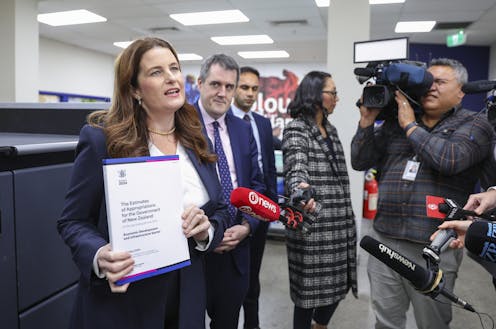
The sensuous, yet unsettling: remembering the groundbreaking Australian photographer Rosemary Laing

Source: The Conversation (Au and NZ) – By Donna West Brett, Associate Professor in Art History, University of Sydney

A ‘swansong’ is a metaphor for an action or a performance prior to an ending. The term conveys the notion of something both grand and final.

This was the opening paragraph, written by curator Victoria Lynn, for the catalogue accompanying Rosemary Laing’s exhibition swansongs, at Tolarno Galleries in March of this year. Ironically the title was apt. It was Laing’s last exhibition before her untimely death after a short illness at age 65.

The Australian photographer and former educator originally trained as a painter and brought a certain sensibility of the painter’s hand to her practice.

Photography enabled her to challenge how we think about social, cultural, and historical issues because of the medium’s relationship to reality.

Her unique approach engaged with the nature of place, inhabitation and Australia’s colonial history, but also to technology, time and speed – elements seen in her work since the 1980s.

Known for her groundbreaking photo-media series flight research (1999) and bulletproofglass (2002), her work came to be “embedded in our psyche,” as Melbourne’s Tolarno Galleries has commented.

Interventions in the landscape

Like a 19th century painter, Laing often worked en plein air, eschewing the studio to respond to the landscape with certain interventions that laid bare our ongoing impact on nature.

Such works of intense, persistent labour saw her travelling to the southern alps of New Zealand in 2018 to produce skyground.

These sensuous, yet unsettling images undo what we think the landscape should look like. When hung, they appear inverted: the ground above and the sky below, relaying a “sense of slow-motion disaster,” as artist and writer Tanya Peterson has referred to it.

Laing’s concern with natural and unnatural disasters can be traced through a number of photographic series that draw our attention to weather, floods, bushfires, pollution, land degradation, but also to colonisation.

Buddens (2017) and Groundspeed (2001) are incongruous in their clash of nature, domesticity and industrial labour.

In Buddens, Laing replaced the river’s flow through the landscape of Wreck Bay with discarded red-toned clothes recalling the debris left behind in floods or ship disasters. In Groundspeed, Laing meticulously laid Feltex carpet patterned with European floral motifs across the forest floor.

In effort + rush (2015), Laing takes us to Madagascar, where Laing had to reconcile the expected consumptive tourist image with the devastated landscape. Images capture the rush of bushfires devouring the earth.

Using the camera as a paintbrush, these works remind us of the force of nature but also of human destruction, often seen in a blur as we race through the landscape in speeding vehicles.

The intersection of nature and culture with technology and speed can be seen in brownwork (1996–97), described by curator Blair French as picturing flight in a contradictory state of being, and greenwork (1995), which saw her producing large-scale documentary and staged images.

Experimenting with digital interventions and time-lapse, Laing encapsulated “fluid abstractions of flight,” as she called it in a 1998 interview in Art & Text.

In some photographs we see the residue of plane jet streams held in a strange state between stasis and flux. In others, the vivid green forests seemingly rupture from a moment of stillness into motion in a rare digital intervention.

Dark histories

Laing was also deeply affected by the intersection of nature and the dark, shameful history of Australia’s treatment of its First peoples, its migrants and refugees. As she commented:

the arrival of people, throughout history, shifts what happens in land, challenging those who have left their elsewhere, and disrupting the continuum of their destination place. A disruption causes a reconfiguration. It elaborates both the beforehand and the afterward.

Her photographic series swansongs (2024) and poems for recent times (2021) reflect on the horrific, unsettling Black Summer bushfires that raged across the Shoalhaven and neighbouring regions in 2019–20, which saw Laing move to the studio for these contemplative works.

What at first look not unlike traditional still-life paintings in poems for recent times, Laing embeds these images with unquiet signs of repair in bandaged twigs, and loss and remembrance in floral tributes, along with signs of new life rising from the ashes.

This sense of unquiet was personal for Laing as she and her partner, artist Geoff Kleem, watched on as the fires crept up to the edges of the lake near their home.

Three years later, Laing continued this concern in swansongs, with assemblages of crustaceans animated by reparative interventions; bandages or “everyday things that mend, bind or heal a wound,” as Victoria Lynn writes.

The exhibition featured photographs that capture suspended crustacean shellwork in vivid arrangements set against the photographic background of previous series, along with the shellwork subjects positioned on precarious shelves.

The sense of recuperation, recycling and repair in these works reminds of the fragility of life, but also of European impact on Australia’s nature and its first inhabitants.

Making us look

As Laing said of swansongs, the photographs relate to

a love of, an attachment to, homeland or places of belonging … all the memories and histories that have stemmed from that place, and the making of a kind of ‘song’ that combines the enigma of this attachment with a sadness for what has happened in this place.

The last time I saw Rosemary, we were yet again talking incessantly about photography and looking at the numerous photographs of sunsets at Swan Lake on her phone; “Look at this one, and this… and what about the colour in this…” she said.

Always looking, always making us look.

The Conversation

Donna West Brett does not work for, consult, own shares in or receive funding from any company or organisation that would benefit from this article, and has disclosed no relevant affiliations beyond their academic appointment.

ref. The sensuous, yet unsettling: remembering the groundbreaking Australian photographer Rosemary Laing – https://theconversation.com/the-sensuous-yet-unsettling-remembering-the-groundbreaking-australian-photographer-rosemary-laing-231157

Wondering how to teach your kids about consent? Here’s an age-based guide to get you started

Source: The Conversation (Au and NZ) – By Giselle Natassia Woodley, Researcher and Phd Candidate, Edith Cowan University

Brett Sayles/Pexels

The Australian government’s new campaign Consent Can’t Wait challenges us all to improve our understanding of consent. It asks a series of questions to illustrate this issue is more complex than simplistic “no means no” messaging.

The campaign invites viewers to consider the nuances of consent, so we can raise these important issues with children and young people in our lives.

But what is a good age to start talking about consent? How do parents tackle such conversations when this information probably wasn’t readily discussed in our own upbringing?

How it starts – early childhood (0–5 years)

Small on-going conversations about consent that start early are best. At this age, children are becoming aware of their bodies, and this is a great time to start basic conversations around consent, body safety and boundaries.

If you’re tickling or rough-housing with your child and they ask you to stop, respect this. Similarly, you want your child to learn that they should listen to and respect the feelings of others.

Dad talks to son at the beach
Talk to young children about body safety and boundaries.
Jan Kopriva/Unsplash

We should also not force a child to give a hug or a kiss to a family member if they don’t feel comfortable. Teaching them to be polite and respectful without having to cross their own personal boundaries is key.

Bath time can also be a great setting to discuss how children’s bodies are their own and the basics of boundaries and privacy.

Childhood and primary school (6–11 years)

As children enter school, their social networks start to expand and the potential for conflict is inevitable. As parents, we can help them to navigate this time and unpack more developed ideas around consent.

The focus at this stage should be to ensure young people have the necessary skills to form healthy friendships and to engage respectfully with others. You may also want your child to recognise the diversity and difference that exists in our society.

It’s important your child starts to learn about verbal and non-verbal communication. Body language can provide great insight into how another person might be feeling, and children can learn how to tune in and respect others as much as possible.

Mother and child hug
Teach kids to tune into others’ body language.
Eye for Ebony/Unsplash

As your child starts to form a stronger personal identity, help them identify and maintain their own personal boundaries. Demonstrating how to respond if someone is behaving or touching them in a way that makes them feel uncomfortable helps develop skills to communicate boundaries.

Finally, remember that young people begin to connect in online spaces too. Encourage your child to think critically about what they see online and who they talk to. Teaching children to engage respectively can assist with consensual experiences online too.

Adolescence and secondary school (12–18 years)

As we transition through the adolescent years, those foundations skills that first applied to relationships with friends and family, extend to romantic relationships, where consent is important for respectful, safe and healthy experiences.

If they haven’t already grasped the notion, it’s important for adolescents to understand that consent can be withdrawn. People have the right to change their mind at any time, even if it might be an activity they had previously agreed to.

Teens sit on a rock by the ocean
A child’s foundational skills will extend to romantic relationships in adolescence.
Tim Mossholder/Unsplash

Navigating sexual consent can be more complex than seeking and giving permission. Consent must be voluntary and freely given, without coercion or pressure. Just because we are in a romantic relationship with someone, this does not mean we should be expected to engage in particular behaviours if they cross our boundaries.

Adolescents also need to understand that rejection is inevitable. Sometimes people won’t want to go on a date with us, to give us a kiss, or to engage in a particular sexual act and that’s OK. Encourage young people to not take rejection personally, respect the wishes and boundaries of others, and be vigilant to verbal and non-verbal cues.

Adolescents will also start to communicate regularly with peers online and may engage in sexting: sending intimate images to one another. Teach them to express and practise consent to be safe online and be mutually respectful of each other.

Being accessible and inclusive

Consent can be complex, particularly for minority populations.

Yarning Quiet Ways is a resource designed for First Nations families.

The Sexuality Education Counselling and Consultancy Agency (SECCA) offers resources suitable for helping to navigate discussions with people with disability or people who require resources written in simple English.

The Rainbow Project has resources about consent for LGBTQI+ people.

Final tips for families

Start the conversations early focusing on basic ethics, rights and bodily autonomy. Consent conversations can build in an age-appropriate way and extend to discussions about sexual relationships as children age.

While discussions should be age-appropriate where possible, it may be relevant to introduce certain topics earlier if need be too.

Communication about consent is best when it’s direct, free from judgement and maintains an open-dialogue. These discussions might feel awkward or uncomfortable but they are important. Homes are critical places for these discussions and it is important that your child sees you as an approachable and askable parent.

Education around consent won’t stop sexual violence on it’s own, so it’s important to have these discussions alongside other areas of importance.

Discussions around challenging gender stereotypes, modelling respect and how to intervene, the importance of empathy, as well as online safety such as sexting and pornography can assist.

The Conversation

Giselle Natassia Woodley receives funding as part of the Australian Research Council (ARC) Discovery Project Adolescents’ perceptions of harm from accessing online sexual content (DP 190102435). Giselle is also a founding member of not-for-profit advocacy group, Bloom-Ed who are committed to ensuring evidence-based Relationships and Sexuality Education (RSE) is offered to all young people in their homes, schools and and communities.

Jacqueline Hendriks (she/her) is Project Lead of the Curtin University Relationships and Sexuality Education Project and is part of the Management Team for SiREN. She receives funding from the WA Department of Health (Sexual Health and Blood-borne Virus Program) and various other Australian government and non-government organisations. They are a founding member of Bloom-ED, a collective action group to promote improved relationships and sexuality education throughout Australia, and is current Vice President of the Australian Association for Adolescent Health. Jacqui was engaged as a subject matter expert in the most recent revision of the Talk Soon. Talk Often resource that is mentioned in this article.

ref. Wondering how to teach your kids about consent? Here’s an age-based guide to get you started – https://theconversation.com/wondering-how-to-teach-your-kids-about-consent-heres-an-age-based-guide-to-get-you-started-230976

We know the seas are rising – so why are Australian governments not planning for it?

Source: The Conversation (Au and NZ) – By Anthony Boxshall, Enterprise Fellow, The University of Melbourne

KarenHBlack/Shutterstock

The vast majority of Australians (87%) live within 50 kilometres of a coastline. The coast offers scenery, swimming and cooling from the sea.

But the problem is, coastlines as we know them are going to change. Sea-level rise is accelerating. As seas inch higher, storm surges can reach further inland and coastal erosion intensifies. Australia’s coasts are not immune.

Low-lying areas are particularly vulnerable, such as towns around Western Port Bay in Victoria.

So why aren’t we planning for what will happen? In this year’s federal budget funds were allocated to many long-term needs, such as submarines for defence (around a 20-year timeframe), the Inland Rail project for freight (around 15 years), Sunshine Coast rail link for transport (at least 10 years) and long term policies for green manufacturing. State budgets also make long-term commitments.

But there was nothing to prepare our coastal communities for the water. Sea level rise and storm surge are problems which get steadily worse. If we spend to avoid A$1 billion of damage in 2040, that’s the same as avoiding $4 billion in 2070 and $10 billion by 2100, according to the Kompas report released last year by co-author Tom Kompas and colleagues.

cyclists on top of flooded seawall
As seas inch upwards, storm surges can reach further inland. This image shows cyclists atop a seawall as a storm surge hits Brisbane in 2013.
Silken Photography/Shutterstock

The economic costs are known

If we don’t prepare, we risk damage to housing, the environment, towns and fast-growing coastal and marine industries.

What does sea-level rise cost? The Kompas report found within 75 years, the projected sea-level rise of 0.82 metres coupled with 19% more storm surges would cause staggering economic loss in Victoria, to the tune of $442 billion, flooding 45,000 hectares of inhabited land and affecting almost every coastal community.

Overseas, the scale of the problem is staggering. Estimates for damage to coastal towns and cities in the European Union and United Kingdom are up to $1.4 trillion.

Why aren’t we taking this seriously?

It is good practice to strategically plan for known risks and needs. And we do make long-term plans in many areas. But so far, coastal adaptation is not one of them.

Because greenhouse gas emissions aren’t dropping as needed, we have already locked in a certain level of sea-level rise. That’s because there’s a lag time between emitting gases, warming the atmosphere and oceans, and melting ice flowing into seas.

What does adaptation look like? We have six options:

1. Non-intervention: authorities deliberately let impacts occur. You might use this strategy if it would be too expensive or impossible to protect a coastal area, or if there are no people living there.

2. Avoid: make sure new houses, infrastructure and human uses for coastline are moved away from the area to be affected.

In Australia, local or state-wide sea-level planning benchmarks are used to denote areas where permanent development needs justification. Benchmarks and assessments differ markedly around the nation.

3. Nature-based methods: boost or restore natural systems able to reduce damage.

This method involves working to bring back or improve natural habitats such as coral reefs, sand, shellfish reefs, mangroves, wetlands, saltmarshes, or seagrasses to build up sediment, adding height and natural ways to absorb some of the force of higher seas.

Many Australian states already have examples up and running. In the EU, the REST-COAST program is working on many nature-based restoration projects, while the United States has many examples, such as oyster reef restoration.

4. Managed retreat: relocate away from the danger.

The community of Isle de Jean Charles in Louisiana was the first community globally to retreat inland in a planned way. In Vietnam, farms and villages in Hue province have had to relocate away from the sea.

While no Australian community has gone through a managed retreat due to sea level, the Summerlands estate on Phillip Island was relocated to protect Australia’s most famous penguin colony.

5. Accommodate: rebuild to reduce risk.

When disaster strikes, it makes sense to rebuild to reduce future risk. Australian authorities often use this technique after river floods. But there are no known examples of similar work on our coasts. In the US, areas of New Orleans were rebuilt to let future floodwaters escape rather than stay trapped for weeks, as they did after Hurricane Katrina.

6. Protect: build hard physical barriers to stop the water getting through.

Historically, building seawalls and dikes has been the first response authorities reach for. The problem is, these barriers are expensive to build and maintain, especially at the scale that will be needed.

Where to from here?

What will nudge authorities to start preparing in earnest? Time, for one. As sea-level rise accelerates, authorities will have to act.

But acting late is much more expensive than acting early. We need to avoid the Tragedy of the Horizon, where catastrophe seems far enough away in time that we can delay acting.

What our policymakers need is the social license to act. The planned retreat of the Welsh town of Fairbourne became controversial because when the council’s plans became public, house values plummeted.

To be able to focus on coastal adaptation means decoupling from the political cycle so politicians are supported to make hard but necessary decisions in the interests of the next generation.

A national approach would help. Not everywhere can be protected. It makes sense to focus our efforts on places where many people live, or the special habitats we want to keep.

If we keep putting our heads in the sand, we’ll get soaked.

Acknowledgement: Alan Stokes of the Australian Coastal Councils Association contributed to this article

The Conversation

Anthony Boxshall an Enterprise Fellow at the University of Melbourne, the Chair of the Victorian Marine & Coastal Council, a Board member of Parks Victoria, and the Principal & Founder of Science into Action, a science impact company.

Anna Grage is a Visiting Research Fellow with the University of Adelaide, and a Board Member on the Victorian Marine and Coastal Council (VMaCC). The Kompas Report, as referred to in the article, was commissioned by VMaCC. Anna is also a Principal Consultant with Earth-Sea Planning.

The University of Melbourne and Tom Kompas received support and research funding from the Victorian Marine and Coastal Council, Life Saving Victoria, and the (then) Victorian Department of the Environment, Land, Water and Planning.

ref. We know the seas are rising – so why are Australian governments not planning for it? – https://theconversation.com/we-know-the-seas-are-rising-so-why-are-australian-governments-not-planning-for-it-230944

Profession or trade? Why training NZ’s teachers in the classroom is not the right answer

Source: The Conversation (Au and NZ) – By Kirsten Locke, Associate Professor, University of Auckland, Waipapa Taumata Rau

Choreograph/Getty Images

How New Zealand trains teachers is about to change with the government’s push to increase the workforce by 1,500. The plan, announced ahead of the 2024 budget, includes funding 1,200 places for aspiring teachers to be trained in the classroom, rather than in universities as they currently are.

While there will still be funding for university places, the policy appears to prioritise school-based training. Trainee teachers will be based primarily in schools, with coursework on top of their daily teaching responsibilities.

It is a significant shift away from the dominant training model whereby student teachers undertake tertiary level courses alongside periods of teaching experience in schools.

By training teachers on site, the government hopes to improve classroom preparedness. It follows similar moves in the United Kingdom and elsewhere.

And to be fair, while a lot of the policy detail is unknown, additional funding of teacher education will almost certainly increase the number of places where prospective teachers can train.

However, moving away from university-based teacher education has the potential to undermine the profession by disconnecting teachers from education research.

A profession, not a trade

New Zealand’s standalone education colleges merged with universities during the 1990s and early 2000s. In part, the change sought to strengthen teachers’ capacity to critically engage with complex teaching practices and evolving education research.

Like medicine, law, engineering and architecture, teaching is now considered a profession. This means it has its own distinct body of knowledge, a code of ethics, and an independent governing and registering body.

Becoming a member of any profession involves a breadth and complexity of professional learning typically housed within a university. Teachers must learn to engage with research, develop critical thinking, and recognise how their actions – and the actions of others – affect learning.

Indeed, the legally required core characteristics of universities in New Zealand include research, teaching, and their role as “critic and conscience of society”. These characteristics mean universities can provide an ideal setting for the kind of professional training teachers need.

University-based teacher education still involves a substantial amount of time on school-based placements. This is where student teachers develop practical skills to complement their wider understanding of education, research and professional knowledge.

Research has also found time away from the classroom allows student teachers the space to engage in more abstract levels of critical thinking and personal development.

Erica Stanford and Christopher Luxon speaking to the press
Most of the 1,500 new places for aspiring teachers announced by education minister Erica Stanford will be based in the classroom.
Phil Walter/Getty Images

Devaluing university-based teacher education

Shifting towards school-based training models signals a belief that the knowledge that matters for teacher education is to be found largely or exclusively within schools themselves.

This apprenticeship approach requires student teachers to sit “at the side of the master” – learning primarily by observation and copying what they see.

Apprenticeship learning is an excellent way to approach adult education in many skills and trades. However, in a profession such as teaching it falls short. It adopts a “what works” approach without stopping to interrogate who it’s working for and why.

An apprenticeship model can also only ever replicate current practice. Given the concern over educational outcomes in New Zealand, there needs to be real change – not more of the same.

Apprenticeship models typically focus on strategies, curriculum delivery and managing student behaviour. Education research will become less accessible to those in the teaching profession, making it harder to implement any significant change.

Furthermore, apprenticeship models risk narrowing the teacher education curriculum by focusing on current practices and trends. Rather than being adopted outright, new teaching practices and trends need to be critiqued and examined within their historical, social, cultural and research contexts.

The challenge ahead

Professionals recognise knowledge will continue to move over time. The best thing we can do is equip new teachers with adaptive expertise — the ability to think flexibly, to adapt to varied contexts, and to gain new understanding.

Universities must have a central place in New Zealand’s teacher education if the profession is to be as strong as is needed.

The country needs teacher training to cultivate a worldview comfortable with complexity and with asking questions, seeking feedback, and gaining new understanding on unfamiliar topics.

The government needs to support the continual improvement of teacher training in all its forms, including within universities. The education of future generations depends on it.

The Conversation

Alex Gunn has previously received funding through the Teaching and Learning Research Initiative.

Katrina McChesney and Kirsten Locke do not work for, consult, own shares in or receive funding from any company or organisation that would benefit from this article, and have disclosed no relevant affiliations beyond their academic appointment.

ref. Profession or trade? Why training NZ’s teachers in the classroom is not the right answer – https://theconversation.com/profession-or-trade-why-training-nzs-teachers-in-the-classroom-is-not-the-right-answer-230862

Palestine solidarity group condemns ‘colonial violence’ in Rafah, Kanaky

Asia Pacific Report

A New Zealand solidarity group for Palestine with a focus on settler colonialism has condemned the latest atrocities by the Israeli military in its attack on Rafah — in defiance of the International Court of Justice order last Friday to halt the assault — and also French brutality in Kanaky New Caledonia.

In its statement, Justice for Palestine (J4Pal) said that Monday had been “a day of unconscionable and unforgivable violence” against the people of Rafah.

As global condemnation over the attack on displaced Palestinians in a tent camp and the UN Security Council convened an emergency meeting on the ground invasion, a new atrocity was reported yesterday.

Israeli forces shelled a tent camp in a designated “safe zone” west of Rafah and killed at least 21 people, including 13 women and girls, in the latest mass killing of Palestinian civilians.

“Gaza deserves better. Kanaky deserves better. Aotearoa deserves better. All our babies deserve better,” said the group.

“It is not our role to articulate what indigenous Kanak people are fighting for. Kanak people are the experts in their own lives and struggle, and they must be listened to on their own terms at this critical moment,” the statement said.

“Our work for Palestinian rights is, however, part of a larger struggle against settler-colonialism. It is our duty, honour and joy to make connections in this common struggle.

‘Dangerous ideologies’
“These connections begin right here in Aotearoa, where Māori never ceded sovereignty. As New Zealand’s current government, France and Israel all demonstrate, the dangerous ideologies of colonialism are not yet the footnotes in history we strive to make them.

“We recognise common injustices:

• The failure of media to place the current uprising in the context of 150 years of history of French violence in Kanak,
• The characterisation of Kanak activists as ‘terrorists’ all while a militarised foreign force represses them on their own land,
• The deliberate transfer of a settler population to disenfranchise indigenous people and their control over their own territory,
• A refusal to engage with the righteous aspirations of the Kanak people, and
•The lack of support from Western governments around these aspirations.”

Justice for Palestine said in its statement that it was its sincere belief that a world without colonialism was not only necessary, it was near.

“With thanks to the steadfastness of not only Kanak, Māori and Palestinian people, and indigenous people everywhere.

“The struggle of the Kanak people is an inspiration and reminder that while we may face the brute power of empire, we are many, and we are not going anywhere.”

Justice for Palestine is a human rights organisation working in Aotearoa to promote justice, peace and freedom for the Palestinian people.

It added: “Now is the hour for Te Tiriti justice, and liberation for both the Kanak and Palestinian people.”

Print Friendly, PDF & Email

Article by AsiaPacificReport.nz

Vanuatu is holding its first-ever referendum – here’s what’s at stake

Source: The Conversation (Au and NZ) – By Kolaia Raisele, PhD candidate, youth leadership in the Pacific, La Trobe University

Members of the ‘Muvmen Red’ rally in Port Vila, Vanuatu, holding a banner that reads ‘Voes Blong Yumi: Stopem Instabiliti Tede’ (Our Voice: Stop Instability Today). Voes Blong Yumi/Facebook

Vanuatu’s young people are tired of political instability. And they are not just sitting back as political spectators, they’re actively pushing for reform and are determined to steer their country towards stability and prosperity.

Their activism is centred around a crucial national referendum being held today, which is aimed at creating a more stable government. If approved, the referendum would lead to important changes meant to reduce the political instability caused by MPs often switching parties.

Political instability has wracked Vanuatu since it gained independence in 1980, severely affecting its governance and public trust in its institutions.

In recent years, this turmoil has intensified. In 2023, for example, the country cycled through three different prime ministers in a month due to successful no-confidence votes.

One of these no-confidence votes in November meant that many important bills, including the 2024 budget, were not able to be passed.

How Vanuatu plans to stop its high turnover of leaders.

This is what prompted ni-Vanuatu youth to form “Muvmen blong Red” (or Movement Red) last year. The movement is aimed at creating a future in which the government is more responsive to the people and adept at tackling key livability issues, such as improving roads, reducing food prices, offering assistance to young people looking for work, improving health care and helping communities hit by cyclones to rebuild.

Putting an end to the rampant party-switching among MPs will help toward this goal. Young ni-Vanuatu believe this practice undermines the integrity of the political process and leads to short-lived policies that fail to address the long-term needs of the country.

For example, during my fieldwork in Vanuatu last year, the country was without a minister for youth and sports for a few months – a direct consequence of these frequent government changes. This significantly hampered the ministry’s work – provincial youth officers told me their funds had been delayed or redirected as a result.

Furthermore, my conversations with young people from the outer islands revealed a deepening distrust in the government. This was largely due to MPs frequently switching sides in parliament, which many people felt led to a neglect of their needs and interests.

What is the referendum asking?

One major step forward was the approval of the Political Parties Registration Act in December, which was strongly supported in parliament.

This law requires all political parties to officially register and follow strict financial reporting rules, similar to those of private entities and NGOs, with oversight provided by the Election Commission. These measures are designed to make the government more stable, ensure election results are followed, and reduce the formation of temporary political parties without clear platforms.

Parliament also passed a separate act that would amend the constitution with two new articles aimed at ensuring politicians stay true to their duties.

Article 17A would require that MPs who are elected as part of a political party to stay with that party for their entire time in office. If they leave the party or are kicked out, they will lose their seat in parliament.

Article 17B applies to independent candidates and members of single-member parties. After an election, they must join a larger political party and support that party during their term. If they don’t, they will also lose their seat.

For these amendments to come into effect, they now need to be approved through a national referendum. More than 200,000 registered voters are able to take part in Vanuatu and overseas. It’s the first referendum of its kind to be held in the country.

Opposition MP Ishmael Kalsakau, who had been ousted as prime minister last year, argued for the referendum to be delayed, saying it was more important to look at the root cause of political instability before amending the Constitution.

What this moment means

As Vanuatu has been gearing up for this monumental event, there’s been a real buzz among the youth and wider community.

The “Movmen blong Red” group has been very active in the campaign, using social media, public meetings and peaceful protests to educate the public on the importance of the referendum. They have also been working with national leaders, which marks a significant move towards a more inclusive government.

The referendum isn’t just about changing laws – it’s about young people, in particular, stepping up to shape their nation’s path forward. They’re not just hoping for better governance, they’re actively participating in creating it.

This is a pivotal moment for Vanuatu, showing just how powerful a united, informed public can be in steering their country towards a more stable future.

The Conversation

Kolaia Raisele works for La Trobe University. He receives funding from the Department of Social Inquiry at La Trobe University.

ref. Vanuatu is holding its first-ever referendum – here’s what’s at stake – https://theconversation.com/vanuatu-is-holding-its-first-ever-referendum-heres-whats-at-stake-228192

Vivid Sydney’s future seems bright if it can balance spectacle with subtlety – but challenges abound

Source: The Conversation (Au and NZ) – By Emrah Baki Ulas, Associate Professor of Practice, University of Sydney

Hika Rakuyo by Art Space Eternal hovers above the waters of Cockle Bay as part of Vivid Sydney 2024.
Destination NSW

It’s the year 2008, and some members of the International Association of Lighting Designers are gathered in a boardroom in North Sydney, myself included. My colleagues Mary-Anne Kyriakou (who would later be Vivid’s inaugural festival director) and Michael Day are sharing a vision of what’s almost unthinkable at the time.

They paint a picture of a light festival in which the winter of Sydney has become vibrant in colour: buildings are illuminated, streets are alive with creative light installations and the crowds walk about in awe. It is a vision that would soon become Vivid Sydney.

This year’s program promises to impress once again with a diverse range of content including Julia Gutman’s first ever animation work, Echo, a story of wonder, vulnerability and strength displayed on the shells of the Sydney Opera House.

Installations such as Stateless and Humanity by Sinclair Park touch on world issues in ways that offer both delight and prompt reflection.

We also see First Nations artist Tori-Jay Mordey’s work, Faces of Change, on the pylons of Sydney Harbour Bridge. It explores, among other themes, humanity’s connection to nature and the threat that rising sea levels pose to the Torres Strait Islands.

Artist Tori-Jay Mordey’s work, Faces of Change, will be projected onto the Sydney Harbour Bridge pylons.
Destination NSW

On the lighter side, there’s a Tekno Train you can have a rave on, and some parties held in a 100-year-old heritage substation.

It’s my hope Vivid Sydney will continue to captivate locals and visitors this year, and for the years to come. But while we look forward to these experiences, let’s also look at the challenges to overcome.

When it all began

The inaugural Smart Light Sydney event was staged in May 2009, laying the foundation for Vivid. The shells of the Sydney Opera House became a canvas for the festival’s first headline projection by Brian Eno.

Several small and large installations were staged across Circular Quay and the Rocks, with various landmark buildings lit up. A number of light artists and designers participated with passion, somewhat tight budgets, and relatively modest works compared to today’s.

Smart Light Sydney offered glimpses of what could be possible in the future. Support from the government and private sector soon followed, and the stage was set for the future of Vivid.

Throughout the 2010s, Vivid inspired a number of smaller and regional towns in New South Wales and beyond to experiment with how lighting could become a spectacle and contribute to their own nightscapes.

In just a few years, Vivid evolved from a modest initiative into a globally recognised celebration of light, music and ideas – positioning itself next to longer-running festivals such as Lyon’s famous Fête des Lumières, Montréal en Lumière and the Berlin Festival of Lights.

A balancing act

The success of such a massive festival will, of course, come with challenges. Vivid, for instance, must grapple with balancing genuine artistic endeavour with the objective of attracting the masses.

This is a fine and delicate balance. If tipped, Vivid could fall into the trap of prioritising spectacle over substance. Some critics already contend that the festival emphasises grandiosity in a way that overshadows creative pursuit.

In recent years, the public and politicians have also criticised key light installations being ticketed, including this year’s Lightscape in the Botanic Gardens and Dark Spectrum in the Wynyard Tunnels.

The Wynyard Tunnels will be lit up as part of Dark Spectrum: A New Journey.
Destination NSW

Perhaps ticketing these offerings helps kerb visitor numbers so they can remain enjoyable (albeit for a smaller number of people). Or it may provide the revenue needed for the festival to deliver more innovative and valuable experiences.

Nonetheless, the decision has sparked debate over the commercialisation of what started as a cultural community event. Numerous corporate-sponsored installations have also now become centrepieces of the festival.

A spectator gets lost in the lamplight at Dark Spectrum: A New Journey.
Destination NSW

Beyond this is a growing challenge for creatives to build on what has already been done. The installations and projections this year again showcase great examples of what can be achieved through the creative use of light and technology. As the festival matures, however, people’s expectations also grow.

Festival-goers in front of the work Connection by New Zealand-based artist Angus Muir.
Destination NSW

Sustainability and logistical challenges

Environmental impact and sustainability are key considerations when thinking about Vivid’s future. The festival’s website details actions it has taken to deliver on this front, which have included partly offsetting its carbon footprint, using more renewable power, installing taps to reduce plastic landfill, encouraging public transport and going paper-free when possible.

Nonetheless, environmental issues remain intrinsic to an event of this scale. The festival’s light pollution and reliance on large-scale energy consumption are points of contention, especially as awareness of these issues grows. Among all the environmental challenges the festival faces, using dark-sky friendly lighting is perhaps one of the most tricky.

Another challenge is that the festival’s growth has somewhat strained local infrastructure, leading to overcrowded public spaces and transport systems. During the festival weeks, portaloos, barricades and other temporary infrastructure also decorate the city.

While Vivid puts in a notable effort into remaining accessible and inclusive for all, the sheer number of attendees (supposedly 3.4 million last year) means managing this size comes with many hurdles.

What the future may hold

These challenges aren’t unique to Vivid Sydney. They are faced by many similar events. In each context, there is nuance and also unique opportunities.

Vivid could play a profound, flagship role in showcasing Australia’s design culture to its own people and to the world. This is a culture characterised by kindness, fairness, diversity, creativity and a commitment to innovation and sustainability.

Perhaps Vivid’s future doesn’t rely on getting bigger and brighter, but on the finer aspects of its content. From embracing Indigenous wisdom, to connecting to nature, to highlighting world-class architecture and lighting design – Vivid has the potential to reinvent itself year on year.

But it will need to continue to deliver spectacle with subtlety to achieve this, and tell stories that touch people on a deeper level. Perhaps, unconventionally, it makes sense to embrace the darkness as much as the light.

Visitors get lost in the lights at Dark Spectrum: A New Journey.
Destination NSW

The Conversation

Dr Emrah Baki Ulas has participated in Vivid Sydney since its beginnings and exhibited several installations over the years. He is an Associate Professor of Practice at the University of Sydney and Co-leads Lighting Design at Steensen Varming.

ref. Vivid Sydney’s future seems bright if it can balance spectacle with subtlety – but challenges abound – https://theconversation.com/vivid-sydneys-future-seems-bright-if-it-can-balance-spectacle-with-subtlety-but-challenges-abound-226507

The voice in your head may help you recall and process words. But what if you don’t have one?

Source: The Conversation (Au and NZ) – By Derek Arnold, Professor, School of Psychology, The University of Queensland

fizkes/Shutterstock

Can you imagine hearing yourself speak? A voice inside your head – perhaps reciting a shopping list or a phone number? What would life be like if you couldn’t?

Some people, including me, cannot have imagined visual experiences. We cannot close our eyes and conjure an experience of seeing a loved one’s face, or imagine our lounge room layout – to consider if a new piece of furniture might fit in it. This is called “aphantasia”, from a Greek phrase where the “a” means without, and “phantasia” refers to an image. Colloquially, people like myself are often referred to as having a “blind mind”.

While most attention has been given to the inability to have imagined visual sensations, aphantasics can lack other imagined experiences. We might be unable to experience imagined tastes or smells. Some people cannot imagine hearing themselves speak.

A recent study has advanced our understanding of people who cannot imagine hearing their own internal monologue. Importantly, the authors have identified some tasks that such people are more likely to find challenging.

What the study found

Researchers at the University of Copenhagen in Denmark and at the University of Wisconsin-Madison in the United States recruited 93 volunteers. They included 46 adults who reported low levels of inner speech and 47 who reported high levels.

Both groups were given challenging tasks: judging if the names of objects they had seen would rhyme and recalling words. The group without an inner monologue performed worse. But differences disappeared when everyone could say words aloud.

Importantly, people who reported less inner speech were not worse at all tasks. They could recall similar numbers of words when the words had a different appearance to one another. This negates any suggestion that aphants (people with aphantasia) simply weren’t trying or were less capable.

image of boy sitting with diagram of gold brain superimposed over image
Hearing our own imagined voice may play an important role in word processing.
sutadimages/Shutterstock

A welcome validation

The study provides some welcome evidence for the lived experiences of some aphants, who are still often told their experiences are not different, but rather that they cannot describe their imagined experiences. Some people feel anxiety when they realise other people can have imagined experiences that they cannot. These feelings may be deepened when others assert they are merely confused or inarticulate.

In my own aphantasia research I have often quizzed crowds of people on their capacity to have imagined experiences.

Questions about the capacity to have imagined visual or audio sensations tend to be excitedly endorsed by a vast majority, but questions about imagined experiences of taste or smell seem to cause more confusion. Some people are adamant they can do this, including a colleague who says he can imagine what combinations of ingredients will taste like when cooked together. But other responses suggest subtypes of aphantasia may prove to be more common than we realise.

The authors of the recent study suggest the inability to imagine hearing yourself speak should be referred to as “anendophasia”, meaning without inner speech. Other authors had suggested anauralia (meaning without auditory imagery). Still other researchers have referred to all types of imagined sensation as being different types of “imagery”.

Having consistent names is important. It can help scientists “talk” to one another to compare findings. If different authors use different names, important evidence can be missed.

bare foot on mossy green grass
We’re starting to broaden our understanding of the senses and how we imagine them.
Napat Chaichanasiri/Shutterstock

We have more than 5 senses

Debate continues about how many senses humans have, but some scientists reasonably argue for a number greater than 20.

In addition to the five senses of sight, smell, taste, touch and hearing, lesser known senses include thermoception (our sense of heat) and proprioception (awareness of the positions of our body parts). Thanks to proprioception, most of us can close our eyes and touch the tip of our index finger to our nose. Thanks to our vestibular sense, we typically have a good idea of which way is up and can maintain balance.

It may be tempting to give a new name to each inability to have a given type of imagined sensation. But this could lead to confusion. Another approach would be to adapt phrases that are already widely used. People who are unable to have imagined sensations commonly refer to ourselves as “aphants”. This could be adapted with a prefix, such as “audio aphant”. Time will tell which approach is adopted by most researchers.

Why we should keep investigating

Regardless of the names we use, the study of multiple types of inability to have an imagined sensation is important. These investigations could reveal the essential processes in human brains that bring about a conscious experience of an imagined sensation.

In time, this will not only lead to a better understanding of the diversity of humans, but may help uncover how human brains can create any conscious sensation. This question – how and where our conscious feelings are generated – remains one of the great mysteries of science.

The Conversation

Derek Arnold has received funding from the Australian Research Council.

ref. The voice in your head may help you recall and process words. But what if you don’t have one? – https://theconversation.com/the-voice-in-your-head-may-help-you-recall-and-process-words-but-what-if-you-dont-have-one-230973