Page 458

50 years of challenge and change: David Robie reflects on a career in Pacific journalism

Dr David Robie was named as a Member of the New Zealand Order of Merit for services to journalism and Asia-Pacific media education.

This King’s Birthday, the New Zealand Order of Merit recognises Professor David Robie’s 50 years of service to Pacific journalism.

He says he is astonished and quite delighted, and feels quite humbled by it all.

“However, I feel that it’s not just me, I owe an enormous amount to my wife, Del, who is a teacher and designer by profession, but she has given journalism and me enormous support over many years and kept me going through difficult times,” he said.

“There’s a whole range of people who have contributed over the years so it’s sort of like a recognition of all of us. So, yes, it is a delight and I feel quite privileged,” he said.

Starting his career at The Dominion in 1965, Dr Robie has been “on the ground” at pivotal events in regional history, including the bombing of the Rainbow Warrior in 1985 (he was on board the Greenpeace ship on the voyage to the Marshall Islands and wrote the book Eyes of Fire about it), the 1997 Sandline mercenary scandal in Papua New Guinea, and the George Speight coup in Fiji in 2000.

In both PNG and Fiji, Dr Robie and his journalism students covered unfolding events when their safety was far from assured.
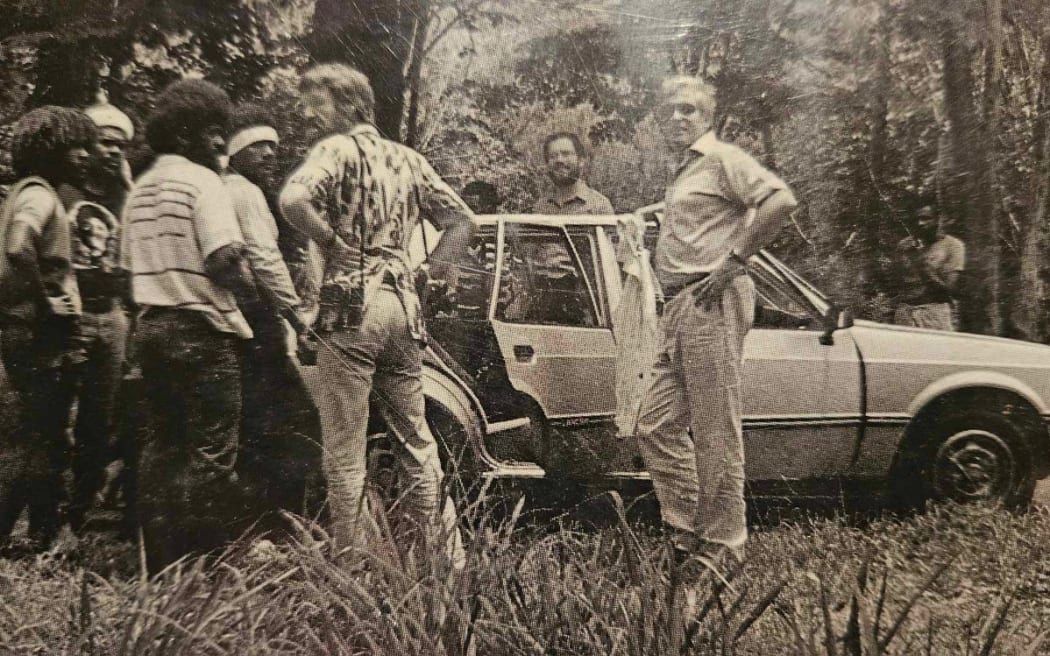
David Robie standing with Kanak pro-independence activists and two Australian journalists at Touho, northern New Caledonia, while on assignment during the FLNKS boycott of the 1984 New Caledonian elections. (David is standing with cameras strung around his back).
David Robie standing with Kanak pro-independence activists and two Australian journalists at Touho, north-eastern New Caledonia, while on assignment during the FLNKS boycott of the 1984 New Caledonian elections. (Robie is standing with cameras strung around his back). Image: Wiken Books/RNZ

As an educator, Dr Robie was head of journalism at the University of Papua New Guinea (UPNG) 1993-1997 and then at the University of the South Pacific (USP) in Suva from 1998 to 2002.

Started Pacific Media Centre
In 2007 he started the Pacific Media Centre, while working as professor of Pacific journalism and communications at Auckland University of Technology (AUT). He has organised scholarships for Pacific media students, including scholarships to China, Indonesia and the Philippines, with the Asia New Zealand Foundation.

Running education programmes for journalists was not always easy. While he had a solid programme to follow at UPNG, his start at USP was not as easy.

He described arriving at USP, opening the filing cabinet to discover “…there was nothing there.” It was a “baptism of fire” and he had to rebuild the programme, although he notes that currently UPNG is struggling whereas USP is “bounding ahead.”

He wrote about his experiences in the 2004 book Mekim Nius: South Pacific media, politics and education.

Dr Robie recalled the enthusiasm of his Pacific journalism students in the face of significant challenges. Pacific journalists are regularly confronted by threats and pressures from governments, which do not recognise the importance of a free media to a functioning democracy.

He stated that while resources were being employed to train quality regional journalists, it was really politicians who needed educating about the role of the media, particularly public broadcasters — not just to be a “parrot” for government policy.

Another challenge Robie noted was the attrition of quality journalists, who only stay in the mainstream media for a year or two before finding better-paying communication roles in NGOs.

Independence an issue
He said that while resourcing was an issue the other most significant challenge facing media outlets in the Pacific today was independence — freedom from the influence and control of the power players in the region.

While he mentioned China, he also suggested that the West also attempted to expand its own influence, and that Pacific media should be able set its own path.

“The other big challenge facing the Pacific is the climate crisis and consequently that’s the biggest issue for journalists in the region and they deal with this every day, unlike Australia and New Zealand,” he said.

Dr Robie stated his belief that it was love of the industry that had kept him and other journalists going, that being a journalist was an important role and a service to society, more than just a job.

He expressed deep gratitude for having been given the opportunity to serve the Pacific in this capacity for so long.

This article is republished under a community partnership agreement with RNZ.

The King’s Birthday Honours list:

To be Officers of the New Zealand Order of Merit:

  • The Very Reverend Taimoanaifakaofo Kaio for services to the Pacific community
  • Anapela Polataivao for services to Pacific performing arts

To be a Member of the New Zealand Order of Merit:

  • Bridget Kauraka for services to the Cook Islands community
  • Frances Oakes for services to mental health and the Pacific community
  • Leitualaalemalietoa Lynn Lolokini Pavihi for services to Pacific education
  • Dr David Robie for services to journalism and Asia-Pacific media education

The King’s Service Medal (KSM):

  • Mailigi Hetutū for services to the Niuean community
  • Tupuna Kaiaruna for services to the Cook Islands community and performing arts
  • Maituteau Karora for services to the Cook Islands community

Article by AsiaPacificReport.nz

Independent committee needed for Fiji MPs’ salaries, says parliament chief

By Repeka Nasiko in Suva

“Let other people decide your salaries” is the latest message in the Fiji parliamentary pay controversy.

This is the call of Fiji’s longtime House of Representatives Secretary Edward Blakelock, who believes that the Special Emoluments Committee must be independent.

He said the Emoluments Committee, traditionally comprised independent consultants who were not sitting parliamentarians and cabinet ministers.

Fiji Labour Party leader Mahendra Chaudhry echoed similar sentiments, adding the report on the review of emoluments for parliamentarians should have been cleared by Finance Minister Professor Biman Prasad in cabinet before it was tabled in Parliament.

RNZ Pacific reports that the political fallout from Fijian parliamentarians giving themselves a pay rise last week is spiralling out of control after the main opposition — FijiFirst, the largest single political party in Parliament — sacked 17 out of 26 of its MPs.

While Parliament decides on the make-up of the Special Emoluments Committee, Blakelock said it should not comprise ministers and members of Parliament.

The Parliamentary Remunerations Act 2014 does not spell out who should be members of this committee, but in accordance with parliamentary tradition, the body is expected to be independent of the Parliament.

It should not include current sitting members as committee members so as to ensure no conflict of interest but to be eventually be answerable to Parliament in terms of the approval of its report.

Not eligible
He said the 1997 Constitution specified that exclusion under Section 83 (4) — that a person whose renumeration is reviewable by the Parliamentary Emoluments Committee is not eligible to be appointed as a member.

“As a matter of principle, I personally believe that a member of Parliament — whether a minister or not — should not be a member of a committee which reviews their own salaries, allowances and benefits purely because of conflict of interests issues and just basic fairness,” said Blakelock.

“As mentioned earlier, the 1997 Constitution specifies that exclusion in no uncertain terms.

“In other words, members are expected to be drawn from outside of the current membership of Parliament.

“The Parliament itself chooses by agreement who should be a member of the committee.

“Again, Parliament has to act within the confines of the relevant constitutional provisions and precedence, as well as the provisions in the Parliamentary Remunerations Act 2014.

“I would have thought that if the committee had comprised of members who are not current sitting members of Parliament, we would certainly not be going through all these rigmaroles today.

Independent committee
“The committee should, in my opinion, be independent and consist of experienced and qualified persons from outside of Parliament.”

The 2013 Constitution requires that Parliament “must, under its rules and orders, establish committees with the functions of scrutinising government administration and examining Bills and subordinate legislation and such other functions as are specified from time to time in the rules and orders of Parliament”.

And according to Parliament’s Standing Orders on Special Committees, a special committee may be established by a resolution of Parliament to carry out the assignment specified in the resolution.

This allowed Parliament to pass a resolution on July 12, 2023, for the establishment and membership of the Special Emoluments Committee.

The committee is chaired by Minister for Women Lynda Tabuya and comprises Minister for Infrastructure Ro Filipe Tuisawau, Education Minister Aseri Radrodro, and Opposition MPs Alvick Maharaj and Mosese Bulitavu.

Repeka Nasiko is a Fiji Times reporter. Republished with permission.

Print Friendly, PDF & Email

Article by AsiaPacificReport.nz

Low-paid wages up 3.75%, with more to come for childcare and health professionals

Source: The Conversation (Au and NZ) – By John Buchanan, Professor, Discipline of Business Information Systems, University of Sydney Business School, University of Sydney

The Fair Work Commission has boosted the wages of workers on awards by 3.75%, just a touch above the official inflation rate of 3.6%.

The increase will apply to fortnightly pay packets from next month and will only directly apply to the one-fifth of Australian workers on centrally determined awards.

Taking into account other workers who will get pay rises because their pay is linked to awards, the Commission says the decision will affect one in four employees.

Most of the workers affected are part time, most are women, and almost half are casual.


While the decision will maintain real wages in the sense that it is just above the official rate of inflation, the Commission reports that even after it real wages for award-reliant employees will remain lower than they were five years ago.

Workers with mortgages will fall further behind. The employee living cost index (which takes into account changes in mortgage interest rates, unlike the consumer price index) has climbed 6.5% over the past 12 months.

Why didn’t the Commission do more?

The Commission noted that “discretionary expenditure” in the retail and hospitality sectors is down. These two industries alone account for one-third of employees on awards.

Less spending means less ability of employers to fund pay rises.

As well, employers of workers on awards are going to have to find an extra 0.5% of each wage to pay the latest increase in the compulsory superannuation contributions, which comes into effect in July.

The Commission also noted low-paid workers will get help from a number of the measures announced in the budget, including the energy bill rebate and an increase in Commonwealth rent assistance.

There’s more to come, for some

In a year’s time, next July, the Commission has offered hope of extra increases for workers in industries including childcare, where work is largely done by women and has historically been undervalued.

The Commission has already received a report on the effect of gender-based occupational segregation and plans to commence work within weeks on determining the size of the increases needed.

In line for extra increases are

  • early childhood education and care workers

  • disability home-care workers and social and community services workers

  • dental assistants

  • medical technicians

  • pharmacists

  • psychologists

  • other health professionals (including Aboriginal health workers)

Importantly, the Commission says it’s reviews won’t begin with a “blank slate”. They will build on the reasoning used to increase the wages of aged-care workers and teachers.

Those decisions found the “invisible” caring skills of interpersonal and contextual awareness, verbal and non-verbal communication and emotion management had been “effectively disregarded” by the simplistic use of masculinised benchmarks such as technical skills, strength and responsibility.

The Commission’s new approach, required by legislation, opens up the possibility of a new era in wage setting in which revaluing work traditionally done by women becomes a lever for lifting the pay of people neglected for decades.


For now, it’s a safe decision

This year’s decision is best described as “safe” – or more accurately, unlikely to feed inflation. It affects around 11% of Australia’s wage bill, and it won’t increase it by much. It will lift the minimum hourly wage from $23.23 to $24.10.

Last year’s bigger increase of 5.75% didn’t flow through to overall wages, which have climbed 4.1% over the year to March, with the rate of increase slowing.

For those on low pay, Monday’s decision will be disappointing. The increase of 3.75% won’t be nearly enough.

But the Commission has maintained the possibility of modest but permanent increases in the pay and status of some of Australia’s lowest paid, but most essential, workers. There’s more to come.

The Conversation

Professor John Buchanan has built his career through undertaking scholarly and applied research for ALP and Coalition Governments, employers, unions and non-government bodies. Currently he is undertaking applied research projects supported by Industry Funds Management (associated with the industry superannuation funds), the NSW Teachers Federation, the NSW Nurses and Midwives Association and the Queensland Nurses and Midwives Union – as well as for icare NSW. He has been a member of the National Tertiary Education Union since 1991 and was a member of the Enterprise Bargaining Team at the University of Sydney from 2021 – 2023.

ref. Low-paid wages up 3.75%, with more to come for childcare and health professionals – https://theconversation.com/low-paid-wages-up-3-75-with-more-to-come-for-childcare-and-health-professionals-231473

Little Ima puts a question to PM Marape for Mulitaka survivors

By Miriam Zarriga in Mulitaka, Papua New Guinea

Little Ima met Papua New Guinea Prime Minister James Marape last Friday during the “haus krai” in Mulitaka, Enga, after the landslide disaster more than a week ago.

His meeting happened when Marape beckoned him to get water from him.

The action of the Prime Minister only moved the boy to be more courageous and in front of about 200 people at the site marked as a haus krai (traditional mourning), Ima did the unthinkable by walking up to the PM and asking him a question.

“Could my friends join me in meeting the Prime Minister?”

Within five minutes of asking, Marape said yes and suddenly the children came from all corners to sit with Marape and his colleagues who had come to see for themselves the devasting impact of the landslide.

Ima had a conversation with the Prime Minister and from the smiles of the PM, Ima had made a good impression on the man who has been faced with a barrage of criticism of late.

Walking into the “haus krai” site Marape choked back tears as he slowly made his way to the front.

Beside him was Minister for Defence Dr Billy Joseph and Enga Provincial Member Sir Peter Ipatas.

Highlighted children’s resilience
His meeting with Ima highlighted the resilience of the children who continue to smile despite the challenges and the changes in their life in the last few days.

Ima and the children have been the centre of attention as those who have come to help have doted on them.

On Thursday, the Queensland Fire Service officers had the children’s attention as the buzz of the drone caught the eye of everyone at Mulitaka.

As an officer with the Queensland fire service brought the drone over to show the children, it was a moment of mad scramble by the children and even adults to see the workings of a drone.

The officer showed Ima and the rest of the children and tried his best to explain what a drone does.

While many are still mourning the loss of loved ones, the smiles on the faces of the children was something a mother said she had not seen in a while.

‘Bringing peace’
In rapid Engan language, she said that “to see her son smile was bringing peace to her”.

Many of the women, girls and children have no clothes, basic necessities, blankets, or a shelter for the night.

Little Ima ended his week smiling after he was granted special access to the PM of this country.

However, for the rest of the children the Mulitaka Health Centre has been assisting providing health care for those who survived the landslide.

Amid the arrival of the Marape, women, girls and children continued to pour in seeking help for minor injuries and sickness.

RNZ Pacific reports that more than 7000 people have been evacuated and the PNG government believes more than 2000 people are buried under a landslip which is still moving, more than a week after the disaster.

Miriam Zarriga is a PNG Post-Courier reporter. Republished with permission.

Print Friendly, PDF & Email

Article by AsiaPacificReport.nz

Carriage romps, good vibrations and a web of lies: what we’re streaming in June

Source: The Conversation (Au and NZ) – By Erin Harrington, Senior Lecturer in English and Cultural Studies, University of Canterbury

The Conversation

June is set to be a month of holding up the mirror to reality, with our experts recommending three new non-fiction watches.

No streaming list is complete without some true crime, so we’ve got the long-awaited second season of The Jinx (which comes nearly a decade after the first). We also look at Netflix’s scandalous Ashley Madison: Sex, Lies & Scandal, a three-part docuseries that dissects the infamous site designed for people seeking affairs.

Of course, we’d be remiss to not pay attention to the latest Bridgerton offering, which has proven to be equal parts sultry, dramatic and inventive. And if, after all the crime, scandal and heavy petting, you seek some light relief – we’ve got some great options for that too.

There’s no shortage of captivating storytelling on hand, so dive in!

The Jinx season two

Binge

Season one of the gripping American true crime documentary The Jinx (2015) culminated in its subject, enigmatic millionaire Robert Durst, seemingly confessing his role in the murders of his first wife, his best friend and his neighbour when he thought Director Andrew Jarecki’s microphones weren’t rolling.

Nine years on, the second season is just as compelling, although its remit is wider. We follow the fallout from the first season, the launch of a new investigation into the murder of Durst’s friend, Susan Berman, in 2000, and ultimately a new trial. Jarecki and producer Marc Smerling have impressive access. They interview the victims’ families, journalists, the prosecution, some of Durst’s most loyal longtime friends and even his defence team, all while acknowledging their own roles as participants.

They also draw on decades’ worth of archival material, tastefully staged reenactments and candid prison phone calls that do much to undermine Durst and his closest supporters’ credibility. The show ultimately builds an unsettling picture of how Durst used his wealth and charisma to attract a messy network of people who were willing to enable and protect him at the expense of victims and their families – some of whom have waited more than 40 years for justice.

Even those who know what’s coming will find this captivating, illuminating viewing.

– Erin Harrington

The Beach Boys

Disney+

Disney’s documentary The Beach Boys feels like catching a wave through the iconic band’s storied past. From their humble beginnings in a garage in the 1960s to their mid-70s revival, the documentary highlights some touching moments and celebrates many a sunny success.

However, unlike a surfer riding the crest, we don’t get to witness those defining wipeouts. Rather, the production seems to avoid delving into the darker, more complex aspects of the band’s history. I couldn’t help but notice the absence of member Brian Wilson, who is portrayed largely through archival footage. This year, the death of Wilson’s wife (and subsequent declining health) led to him being placed under a conservatorship. With this in mind, his omission takes on a bittersweet tone.

Ultimately, The Beach Boys misses an opportunity to embrace all the bumps and pivots in the band’s illustrious career. And this is a shame since their story has always been about celebrating life despite its hardships.

That said, the documentary is enjoyable, and it serves as a great entry point for those yet to ride the ups and downs of the band’s career. So grab your board and dive in!

– Jadey O’Regan


Read more:
New Disney documentary The Beach Boys tells the iconic band’s story – but not the whole story


Bridgerton season three (part one)

Netflix

As someone raised on BBC’s North and South and Pride and Prejudice, I was convinced Bridgerton wasn’t my cup of tea. However, curiosity caught me during a COVID-induced moment of weakness: I binged it all and added season three’s dates to my calendar.

Bridgerton’s seduction lies in creative world-building, extravagant visuals and gripping social tensions. Heaped servings of lustful fervour don’t hurt either. I shock myself by saying these elements are well executed because of, and not in spite of, a gleeful lack of historical accuracy.

We see the inimitable Lady Featherington (Polly Walker) grill her married daughters about sex, to which a gormless Phillipa cheerily asks, “inserts himself where?” Elsewhere, the Queen wears a gasp-worthy mechanical wig, one smutty scene in a carriage is set to a (genuinely) stirring string rendition of a Pitbull song, and Cressida Cowper’s satellite-like sleeves are big enough to transmit the show itself.

Bridgerton’s inventiveness is balanced by genuine onscreen chemistry. Our friends-to-lovers couple, Penelope Featherington (Nicola Coughlan) and Colin Bridgerton (Luke Newton), orbit one another beautifully. There is true tension via an alternative suitor, along with some tender self-discovery.

All is heightened by the suspicion these fledgling foundations will shake in part two. It is escapist storytelling at its most charming.

– Marina Deller

Ashley Madison: Sex, Lies & Scandal

Netflix

Ashley Madison: Sex, Lies & Scandal is a recent three-part docuseries that delves into the history of an infamous dating website that guaranteed anonymity for individuals seeking extramarital affairs. It spans the startup of the online service soon after the dot-com boom, the impact of a massive data breach in 2015 and the stories of those affected.

With elements we’ve come to expect of Netflix’s storytelling style, the docuseries presents nail-biting narratives and cliffhangers typical of a true crime documentary set in the digital age. Interviews are expertly conducted, providing valuable insights from key individuals involved – although some responsible parties are notably absent.

One intriguing aspect of the plot is the self-righteous hackers known as the The Impact Team, whose identities remain unknown to law enforcement to this day. They broke through Ashley Madison’s paltry cybersecurity defences, outing millions of users and publicly spilling the tea on the company and its duplicitous CEO, Noel Biderman.

What I discovered watching this docuseries is trust means little when it comes to infidelity. Many associated with the website learned this lesson the hard way and have only restored their reputations by coming clean. The debacle serves as a cautionary tale: if you build relationships on deceit, don’t expect them to last.

– Phoebe Hart

Hacks season three

Stan

At the time of writing, eight episodes of Hacks’ third season are currently available on Stan. Critics and fans of the show, myself included, had their misgivings upon hearing there would be a third season – given how neatly all the storylines had concluded at the end of season two. Deborah Vance (Jean Smart) had a successful comedy special, where she took a humorous look at her life’s trauma and fired her comedy writing assistant, Ava (Hannah Einbinder), so she would pursue bigger and better opportunities.

I am so thankful for this third season, however, because it’s the strongest one yet. The writing is a lot tighter and the jokes richer. The season arc focuses on the friendship between Deborah and Ava where, on her break from her esteemed comedy writing gig for a late-night talk show, Ava assists Deborah in securing a late-night hosting gig of her own.

The season smartly focuses on this friendship, whereas season two featured extensive distractions from several subplots with the supporting cast, which ultimately felt like just that: distractions. The focus on Deborah’s aspirations for the top hosting gig provides a poignant commentary on ageing and the “boys’ club” nature of comedy.

– Stuart Richards


Read more:
Psychological drama, wilderness reality and everyone’s favourite dog: the best of streaming this May


The Conversation

The authors do not work for, consult, own shares in or receive funding from any company or organisation that would benefit from this article, and have disclosed no relevant affiliations beyond their academic appointment.

ref. Carriage romps, good vibrations and a web of lies: what we’re streaming in June – https://theconversation.com/carriage-romps-good-vibrations-and-a-web-of-lies-what-were-streaming-in-june-230785

Josh Frydenberg rules out seeking Kooyong preselection

Source: The Conversation (Au and NZ) – By Michelle Grattan, Professorial Fellow, University of Canberra

Former Treasurer Josh Frydenberg has ruled out attempting to displace Amelia Hamer as the Liberals’ candidate for Kooyong.

Frydenberg’s quick decision comes after a public backlash against the possibility he could push aside an already preselected woman.

It had also become clear the redrawn draft boundaries for Kooyong, unveiled by the Australian Electoral Commission on Friday, are unlikely to give the boost to the Liberal vote in the seat that some Liberals had initially thought. The seat is held by teal Monique Ryan.

Under the Victorian draft boundaries, the seat of Higgins, held by Labor, is set to be abolished, with large numbers of its voters pushed into Kooyong and Chisholm. Chisholm, now in Labor hands, improves for the Liberals.

Frydenberg posted on X (formerly Twitter) on Monday that he was “not rushing back to politics.

“My position on contesting the next election remains unchanged. I will continue to support the Liberal Party and our local candidate Amelia Hamer.”

The speculation about Frydenberg had split Liberals, with a faultline between those appalled at the idea of dumping a woman – the Liberals are under criticism for not promoting enough female candidates – and those who argued Frydenberg’s return (assuming he won the seat) would boost the parliamentary party’s talent pool.

Former minister Karen Andrews had strongly backed an effort to get him back into parliament.

But Charlotte Mortlock, founder of Hilma’s Network, which encourages women to join the Liberal Party, posted: “Josh could have challenged Scott Morrison for the leadership, he didn’t. Josh could have put his hand up for Kooyong, he didn’t. He could have run for the Victorian Senate vacancy, he didn’t. Women are not collateral damage for Josh Frydenberg’s regrets.”

With Kooyong settled, the Victorian Liberal Party will still have to decide whether to reopen nominations for Chisholm where Theo Zographos was preselected unopposed. There is a push to have Katie Allen, who is the Higgins Liberal candidate, moved to Chisholm.

The Conversation

Michelle Grattan does not work for, consult, own shares in or receive funding from any company or organisation that would benefit from this article, and has disclosed no relevant affiliations beyond their academic appointment.

ref. Josh Frydenberg rules out seeking Kooyong preselection – https://theconversation.com/josh-frydenberg-rules-out-seeking-kooyong-preselection-231487

King’s Birthday Honours: NZ journalist reflects on work in the Pacific

Dr David Robie, has been recognised in the King's Honours List and named as a Member of the New Zealand Order of Merit.

By Alakihihifo Vailala of PMN News

Flipped “back in time” is how New Zealand author, journalist and media educator Dr David Robie describes the crisis in New Caledonia.

Robie has covered the Asia-Pacific region for international media and educated Pacific journalists for more than four decades.

He reported on the indigenous Kanak pro-independence uprising in the 1980s and says it is happening again in the French-colonised territory.

Recognised for their services to the Pacific community in the King's Birthday Honours
Recognised for their services to the Pacific community in the King’s Birthday Honours . . . Reverend Taimoanaifakaofo Kaio (from top left, clockwise:, Frances Mary Latu Oakes (JP), Maituteau Karora, Anapela Polataivao, Dr David Telfer Robie, Leitualaalemalietoa Lynn Lolokini Pavihi, Tupuna Mataki Kaiaruna, Mailigi Hetutū and Bridget Piu Kauraka. Montage: PMN News


Dr David Robie talks to Ma’a Brian Sagala of PMN News in 2021.     Video: PMN/Café Pacific

Robie’s comments follow the rioting and looting in New Caledonia’s capital Nouméa on May 13 that followed protesters against France President Emmanuel Macron’s plan for electoral reform.

At least seven people have died and hundreds injured with damage estimated in the millions of dollars.

“The tragic thing is that we’ve gone back in time,” he told PMN News.

“Things were progressing really well towards independence and then it’s all gone haywire.

“But back in the 1980s, it was a very terrible time. At the end of the 1980s with the accords [Matignon and Nouméa accords], there was so much hope for the Kanak people.”

Robie, who has travelled to Noumēa multiple times, has long advocated for liberation for Kanaky/New Caledonia and was even arrested at gunpoint by French police in January 1987.

He reflected on his work throughout the Pacific, which includes his involvement in the Rainbow Warrior bombing — the subject of his book Eyes of Fire; covering the Sandline crisis with student journalists in Papua New Guinea; and helping his students report the George Speight-led coup of 2000 in Fiji.


Dr David Robie talks to Ma’a Brian Sagala of PMN News in August 2018.  Video: PMN/PMC

“Because I was a freelance journalist, I could actually go and travel to many countries and spend a lot of time there.”

“I guess that’s been my commitment really, helping to tell stories at a grassroots level and also trying to empower other journalists.”

Robie’s commitment has been recognised in this year’s King’s Birthday Honours and he has been named a Member of the New Zealand Order of Merit.

He headed the journalism programmes at the University of Papua New Guinea and University of the South Pacific for 10 years, and also founded the Pacific Media Centre at AUT University.

What Robie calls “an incredible surprise”, he says the award also serves as recognition for those who have worked alongside him.

“Right now, we need journalists more than ever. We’re living in a world of absolute chaos of disinformation,” he said.

Robie said trust in the media had declined due to there being “too much opinionated and personality” journalism.

“We’re moving more towards niche journalism, if I might say, mainstream journalism is losing its way and Pacific media actually fit into the niche journalism mode,” he said.

“So I think there will be a growing support and need for Pacific journalism whereas mainstream media’s got a lot more of a battle on its hands.”

Republished from PMN News with permission.

Print Friendly, PDF & Email

Article by AsiaPacificReport.nz
The housing crisis hit Queensland hard. Jolted into action, the state has raised its game

Source: The Conversation (Au and NZ) – By Hal Pawson, Professor of Housing Research and Policy, and Associate Director, City Futures Research Centre, UNSW Sydney

Post-COVID housing stress has been especially intense in Queensland. Brisbane property prices have climbed by 65% since the pandemic began. That’s almost double the Australian capital city average (34%).

According to new data released by CoreLogic this week, Brisbane now has the second-most expensive housing in the country, behind Sydney. Prices rose by 1.4% in May, with the median property price hitting $843,231.

Across the state, new tenancy rents are up by 45% in just four years. Adjusted for inflation, that’s a 23% increase in real terms, much more than the growth in incomes over that time. Without doubt, rising accommodation costs are inflicting financial pain on many in the Sunshine State.

Soaring rents have squeezed people on lower incomes particularly hard. Our analysis shows the share of new lettings at rents low-income households can afford has slumped from 23% to 10% of all private tenancies since 2020. And less than 1% of available Queensland rentals in March 2024 were affordable to a single person earning minimum wage or a pensioner couple.

These conditions push some people into homelessness. With “tent cities” appearing across Brisbane, the crisis looks to be deepening.

Yet, as we report today, this situation has triggered a flurry of constructive housing policymaking. Queensland has begun to reverse a long-term decline in its social housing stock. The state has also boosted homelessness funding and services.

What led to this crisis?

The pandemic’s economic disruption and state population growth well above the national rate have made the housing situation worse. Since COVID hit in 2020, Queensland’s population has grown by 6.6%, compared with 4.7% for Australia as a whole.

But historic policy inaction and complacency on housing are also to blame. Both state and federal governments have been highly culpable. And, given their complexity, the fundamental flaws of our housing system cannot be quickly solved, even if there is the political will to do so.

Despite this, as argued in our new report for Queensland Council of Social Service (QCOSS), we have recently seen something of a sea change in official policy responses to the state’s housing challenges. The past two years, especially, have been a remarkably fertile time for housing policy (both state and federal).

Social housing is expanding at last

Nowhere is this shift more striking than in the area of social housing – public or community housing for the lowest income earners.

This is a sector in long-term decline across Australia. Investment has been minimal since the 1990s. By 2021, social housing was down to barely 3% of all occupied dwellings in Queensland.

The sector has withered on the vine, even as demand for its secure and affordable tenancies soared. To manage the resulting mismatch, the state government ratcheted up entry restrictions on social housing.

The income limit to be eligible for social housing has been frozen since the 2000s. The freeze has effectively lowered the income limit by 30% in real terms. The effect is to exclude more of those who are merely poor, rather than extremely poor.

In the past five years, though, we have seen a marked turnaround. Thanks to increasing state investments, the number of social housing dwellings has begun to grow.

Building on that progress, the Queensland government pledged in early 2024 to add 53,500 social housing units by 2046. This would expand the stock of public and community housing by 73%.

Compatible with this target, a medium-term goal is to expand annual output to 2,000 units by 2027-28 – a fourfold increase on the late 2010s.

Crucially, committed (or reasonably expected) state and federal government funding and building contracts underpin this four-year goal. The “reasonably expected” part of this is the Commonwealth’s Housing Australia Future Fund (HAFF), a share of which should flow to Queensland.

Adding 2,000 social housing units a year by the late 2020s would reverse the sector’s historic decline. If sustained over time, it would begin to expand social housing back towards 5% of all housing, where it once was.

State leads way on evidence-based policy

An aspect of this story is notable not so much for the policy itself, but for the policymaking process. By its own account, the Queensland government scaled its long-term social housing construction target based on demographic modelling of current and projected need.

For readers familiar with service planning in areas like health or education this might sound pretty humdrum. For social housing, though, it is virtually unprecedented in Australia. For example, no such evidence base underpins the size of the Albanese government’s HAFF program.

Queensland can therefore reasonably claim to be leading the way on long-term, evidence-informed planning of social housing investment. That said, the government’s very limited disclosure of its modelling assumptions makes it difficult to assess the adequacy of its 53,500 target. Compared with our own census-based estimate of currently unmet need, it appears relatively low.

Will Queensland’s ambition inspire others?

In other creditable recent initiatives, the state government has stepped up homelessness service funding, acquired former National Rental Affordability Scheme homes that would otherwise revert to market prices, and expanded homelessness case co-ordination and outreach services.

In other areas, reform has been more hesitant. These include tenants’ rights and the use of the planning system to leverage affordable housing production.

At the federal level, the current modest scale and duration of pledged social and affordable housing investment under the Housing Australia Future Fund is similarly concerning. A broader Commonwealth shortcoming is the continuing lack of any commitment to consider – at the very least – the fundamental property tax reforms needed to rebalance Australia’s distorted housing system.

Nevertheless, the recent direction of housing policy has been generally more positive for Queensland than many might imagine. Let’s hope this trajectory continues, as well as inspiring more progressive ambition and action by other Australian governments.

The Conversation

Hal Pawson receives research funding from the Australian Research Council, the Australian Housing and Urban Research Institute, the Lord Mayor’s Charitable Foundation (Melbourne) and Crisis UK. He is also an advisor to Senator David Pocock and a Director of Community Housing Canberra.

ref. The housing crisis hit Queensland hard. Jolted into action, the state has raised its game – https://theconversation.com/the-housing-crisis-hit-queensland-hard-jolted-into-action-the-state-has-raised-its-game-230870

What’s the difference between vegan and vegetarian?

Source: The Conversation (Au and NZ) – By Katherine Livingstone, NHMRC Emerging Leadership Fellow and Senior Research Fellow at the Institute for Physical Activity and Nutrition, Deakin University

Creative Cat Studio/Shutterstock

What’s the difference? is a new editorial product that explains the similarities and differences between commonly confused health and medical terms, and why they matter.


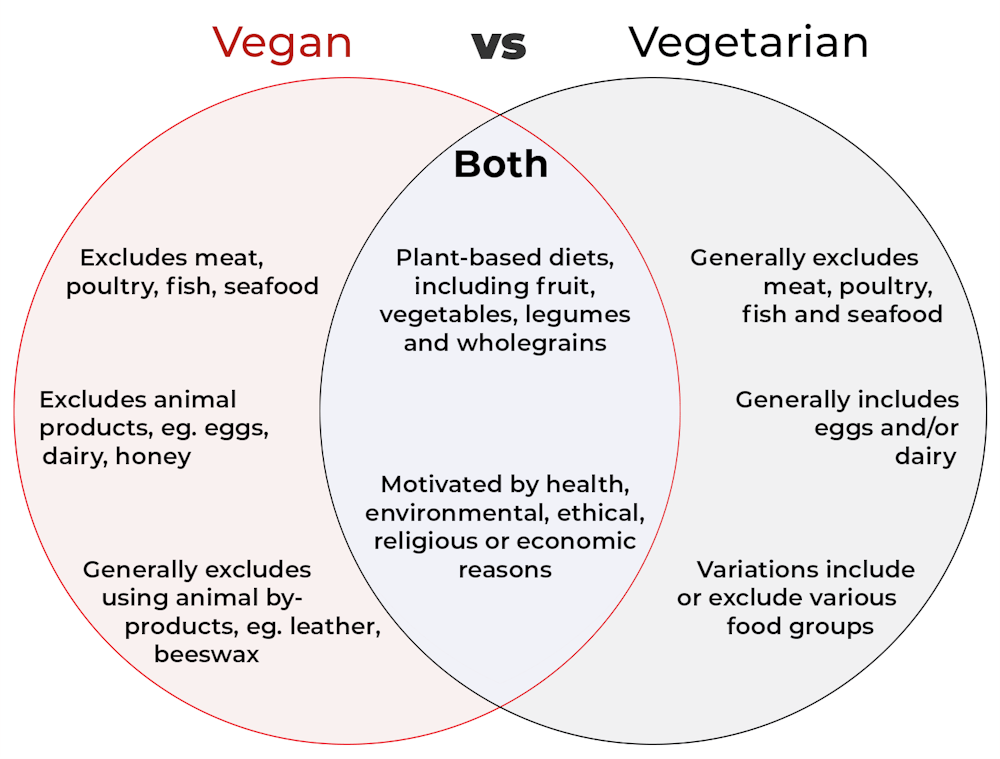
Vegan and vegetarian diets are plant-based diets. Both include plant foods, such as fruits, vegetables, legumes and whole grains.

But there are important differences, and knowing what you can and can’t eat when it comes to a vegan and vegetarian diet can be confusing.

So, what’s the main difference?

What’s a vegan diet?

A vegan diet is an entirely plant-based diet. It doesn’t include any meat and animal products. So, no meat, poultry, fish, seafood, eggs, dairy or honey.

What’s a vegetarian diet?

A vegetarian diet is a plant-based diet that generally excludes meat, poultry, fish and seafood, but can include animal products. So, unlike a vegan diet, a vegetarian diet can include eggs, dairy and honey.

But you may be wondering why you’ve heard of vegetarians who eat fish, vegetarians who don’t eat eggs, vegetarians who don’t eat dairy, and even vegetarians who eat some meat. Well, it’s because there are variations on a vegetarian diet:

  • a lacto-ovo vegetarian diet excludes meat, poultry, fish and seafood, but includes eggs, dairy and honey

  • an ovo-vegetarian diet excludes meat, poultry, fish, seafood and dairy, but includes eggs and honey

  • a lacto-vegetarian diet excludes meat, poultry, fish, seafood and eggs, but includes dairy and honey

  • a pescatarian diet excludes meat and poultry, but includes eggs, dairy, honey, fish and seafood

  • a flexitarian, or semi-vegetarian diet, includes eggs, dairy and honey and may include small amounts of meat, poultry, fish and seafood.

Are these diets healthy?

A 2023 review looked at the health effects of vegetarian and vegan diets from two types of study.

Observational studies followed people over the years to see how their diets were linked to their health. In these studies, eating a vegetarian diet was associated with a lower risk of developing cardiovascular disease (such as heart disease or a stroke), diabetes, hypertension (high blood pressure), dementia and cancer.

For example, in a study of 44,561 participants, the risk of heart disease was 32% lower in vegetarians than non-vegetarians after an average follow-up of nearly 12 years.

Further evidence came from randomised controlled trials. These instruct study participants to eat a specific diet for a specific period of time and monitor their health throughout. These studies showed eating a vegetarian or vegan diet led to reductions in weight, blood pressure, and levels of unhealthy cholesterol.

For example, one analysis combined data from seven randomised controlled trials. This so-called meta-analysis included data from 311 participants. It showed eating a vegetarian diet was associated with a systolic blood pressure (the first number in your blood pressure reading) an average 5 mmHg lower compared with non-vegetarian diets.

It seems vegetarian diets are more likely to be healthier, across a number of measures.

For example, a 2022 meta-analysis combined the results of several observational studies. It concluded a vegetarian diet, rather than vegan diet, was recommended to prevent heart disease.

There is also evidence vegans are more likely to have bone fractures than vegetarians. This could be partly due to a lower body-mass index and a lower intake of nutrients such as calcium, vitamin D and protein.

But it can be about more than just food

Many vegans, where possible, do not use products that directly or indirectly involve using animals.

So vegans would not wear leather, wool or silk clothing, for example. And they would not use soaps or candles made from beeswax, or use products tested on animals.

The motivation for following a vegan or vegetarian diet can vary from person to person. Common motivations include health, environmental, ethical, religious or economic reasons.

And for many people who follow a vegan or vegetarian diet, this forms a central part of their identity.

Woman wearing and pointing to her t-shirt with 'Go vegan' logo
More than a diet: veganism can form part of someone’s identity.
Shutterstock

So, should I adopt a vegan or vegetarian diet?

If you are thinking about a vegan or vegetarian diet, here are some things to consider:

  • eating more plant foods does not automatically mean you are eating a healthier diet. Hot chips, biscuits and soft drinks can all be vegan or vegetarian foods. And many plant-based alternatives, such as plant-based sausages, can be high in added salt

  • meeting the nutrient intake targets for vitamin B12, iron, calcium, and iodine requires more careful planning while on a vegan or vegetarian diet. This is because meat, seafood and animal products are good sources of these vitamins and minerals

  • eating a plant-based diet doesn’t necessarily mean excluding all meat and animal products. A healthy flexitarian diet prioritises eating more whole plant-foods, such as vegetables and beans, and less processed meat, such as bacon and sausages

  • the Australian Dietary Guidelines recommend eating a wide variety of foods from the five food groups (fruit, vegetables, cereals, lean meat and/or their alternatives and reduced-fat dairy products and/or their alternatives). So if you are eating animal products, choose lean, reduced-fat meats and dairy products and limit processed meats.

The Conversation

Katherine Livingstone receives funding from the National Health and Medical Research Council (APP117380) and the National Heart Foundation (ID106800).

ref. What’s the difference between vegan and vegetarian? – https://theconversation.com/whats-the-difference-between-vegan-and-vegetarian-225275

Outpouring of grief following death of acclaimed Samoan poet and writer

RNZ Pacific

Tributes are pouring in for an acclaimed American Samoan poet and teacher who was murdered last Saturday in Apia allegedly by a fellow poet.

According to local police Dr Caroline Sinavaiana-Gabbard, a retired professor from the University of Hawai’i Manoa, was found dead at the Galu Moana Theatre in Vaivase-Uta.

The Samoa Observer reported last Sunday that police had charged playwright and poet, Papalii Sia Figiel, with manslaughter with the death but on Monday upgraded the charge to murder.

Playwright Papalii Sia Figiel
Novelist and poet Papalii Sia Figiel . . . charged with murder. Image: (cc) Wikipedia

The 78-year-old Dr Sinavaiana-Gabbard, who was also a historian and environmentalist, has been described as a peaceful and calm person.

The Samoa Observer reports a friend of Dr Sinavaiana-Gabbard said she was completely shocked and saddened when she found out.

She said Dr Sinavaiana-Gabbard was a kindred spirit, a brilliant writer, and a supporter of writers.

“Someone who did not deserve to die like that. She was a very private person despite being a giant in the literary world,” they told the Observer.

Shocked literary friends
Dr Sinavaiana-Gabbard’s death has also shocked many of her literary friends, who have been posting messages of condolence, and resulted in an outpouring of grief on social media reacting to the news.

Front to right - Mele Wendt, Eteuati Ete and Dr Caroline Sinavaiana-Gabbard
Mele Wendt (from left), Eteuati Ete and Dr Caroline Sinavaiana-Gabbard . . . she taught creative writing at the University of Hawai’i for nearly 20 years. Image: Mele Wendt/RNZ

In 2022, Dr Sinavaiana-Gabbard warned of the implications of the Samoa government’s inaction to address concerns about the adverse effects of paraquat. She was part of the group advocating for the ban on the dangerous weedkiller.

Born in 1946, she was an American Samoan academic, writer, poet, and environmentalist and was the first Samoan to become a full professor in the United States. She is the sister of American politician Mike Gabbard and the aunt of politician Tulsi Gabbard.

She was born in Utulei village in American Samoa and educated at Sonoma State University, University of California, Berkeley, and the University of Hawai’i.

Her PhD thesis called ‘Traditional Comic Theatre in Samoa: A Holographic View’. She taught creative writing at the University of Hawai’i for nearly 20 years and was an associate professor of Pacific literature at the University of Hawai’i at Mānoa.

In 2002, she published her collection of poetry, Alchemies of Distance and in August 2020, she was named by USA Today on its list of influential women from US territories.

This article is republished under a community partnership agreement with RNZ.

Print Friendly, PDF & Email

Article by AsiaPacificReport.nz

Could a green investment deal help Indonesia and Australia overcome their past tensions?

Source: The Conversation (Au and NZ) – By Cahyani Widi Larasakti, PhD Student in International Relations, The University of Melbourne

MMES Studio/Shutterstock

Australia and Indonesia have long had an uneasy relationship, over issues ranging from Timor-Leste’s independence to asylum seekers and bans on live cattle export to the aftermath of the Bali bombings.

While the politics have long been challenging, there’s reason to believe a change may be coming. One of the fastest-growing economies in the world, Indonesia has long been powered by coal. Now, it’s endeavouring to go green through renewables, grid modernisation, electric vehicles and geothermal.

That’s where Australia comes in. In March this year, the two nations formalised a climate partnership, named KINETIK. Through the agreement, Indonesia will secure supplies of lithium for EV batteries, and Australia will gain more export markets for its critical minerals, as well as potential access to the batteries’ industry supply chain.

Why has the relationship been rocky?

Since winning independence from the Dutch, Indonesia has focused heavily on keeping its many islands and ethnic groups united.

But Australia’s role has sometimes been destabilising. During the Cold War, Australian agencies backed the Indonesian army’s bloody purges of communists.

Australia also backed the cause of East Timorese secession. In 1998, Australian Prime Minister John Howard wrote to Indonesia’s President, B.J Habibie, pushing for East Timorese independence. A year later, over 5,500 Australian soldiers arrived as peacekeepers during a tense referendum over the region’s future.

Many people in Indonesia saw Australia’s involvement as a threat to national unity and cohesion. Before Howard and Indonesia’s next president, Megawati Soekarnoputri, had time to restore the relationship, tensions ramped up again after the 2002 terrorist bombings in Bali which killed 88 Australians.

Four years later, the Australian decision to grant temporary protection visas to 43 asylum seekers from Papua, which has long sought independence from Indonesia, led Indonesia’s ambassador to Canberra to be recalled.

This diplomatic incident bore positive fruit, resulting in improved dialogue and, the same year, the signing of the Lombok Treaty, in which both countries promised not to interfere with the sovereignty of the other.

Since then, Australia has been diplomatically silent on other Indonesian territorial issues, such as the separatist movement in Papua.

Despite these efforts, many differences remain. Experts have often warned the relationship is tenuous.

In 2019, the two nations signed a new Comprehensive Economic Partnership after a tortuous negotiation period. With a focus on climate change and energy transition, this paved the way for this year’s announcement.

In a broader context, this partnership also illustrates Australia’s approach as a middle power nation to counterbalance China’s increasing economic dominance in the Indo-Pacific region.

Could the green transition help the relationship?

In 2022, Australian Prime Minister Anthony Albanese visited Indonesia, where he promised A$200 million to kickstart climate and infrastructure projects.

Now we have a formalised partnership. This is an important step, which should improve the political relationship.

The two nations already trade $18 billion of goods and services yearly, centred on Australian coal and beef and Indonesian fertilisers and petrol.

But there is room for much more growth. Indonesia’s population is young and large, with almost 280 million people. By 2030, estimates suggest it could be the world’s fifth-largest economy.

If the KINETIK partnership works, it will be because it offers both nations what they need – Australia gets a new export market for green minerals, technology and know-how, and Indonesia starts to shift away from coal.

The agreement builds on a memorandum of understanding on electric vehicles and another between Export Finance Australia and Indonesia’s State-owned Electricity Company last year.

What are we likely to see as tangible outcomes?

Indonesia perches on the Pacific Ring of Fire, with a number of active volcanoes and frequent earthquakes. This also means the archipelago nation has huge geothermal resources, estimated at 40% of the world’s total. Many geothermal plants are already running.

But making the most of the resource faces many technological challenges. The best underground heat resources tend to be located in mountains or in isolated areas. The KINETIK partnership could help through connecting Australian mining expertise to Indonesia’s deep heat resources.

Australia’s expertise in using renewables to power isolated communities will be vital to make exploration easier. And Australian investors will be allowed to own a majority share of Indonesian geothermal plants.

geothermal plant in Java, with farmers in foreground.
Indonesia has 16 geothermal plants running at present – but the resource is much larger.
Geothermal Rising/Flickr, CC BY-NC-ND

The partnerships are expected to align with Indonesia’s National Energy Policy, which aims in part to shift from exporting raw energy resources and critical minerals to exporting value-added energy products through downstream projects such as EV and battery industries.

Australia is home to the world’s largest hard-rock lithium mine, Greenbushes. The new partnership will open up options for Indonesian battery manufacturers to access this key metal.

Indonesia, in turn, is rich in nickel, which will be needed in great quantities for green technologies. In fact, cheaper Indonesian nickel has pushed some Australian producers out of the market. Indonesia has already secured commercial deals with EV and battery manufacturers such as Hyundai and LG from South Korea, as well as Foxconn from Taiwan.

Will this be enough?

Politically, the relationship between Indonesia and Australia has long been thorny. A new focus on mutual advantageous investment could help, especially given the deal has strong political backing on both sides. Developing electric vehicles in Indonesia was also a key campaign issue for the newly elected Indonesian president, Prabowo Subianto.

From the Australian side, the agreement bolsters the Albanese government’s push to make the nation a green energy superpower.

Of course, many agreements stay on paper and don’t shape the real world. But this one has a better chance, given the alignment between Indonesia’s efforts to make itself part of the electric vehicle supply chain, and Australia’s dream of becoming a green superpower.

Bilateral agreements like these also show how the world is changing. More and more, middle power cooperation is emerging as a counterbalance against the intensifying Chinese-American rivalry.

It’s also a positive sign Australia has realised the need to more actively build alliances across the Indo-Pacific region.

The Conversation

Cahyani Widi Larasakti receives funding from the Department of Foreign Affairs and Trade of the Australian Government through the G20 “Recover Together, Recover Stronger” Australia Awards Scholarship for her PhD at the University of Melbourne. She is also a member of Melbourne Climate Future at the University of Melbourne.

ref. Could a green investment deal help Indonesia and Australia overcome their past tensions? – https://theconversation.com/could-a-green-investment-deal-help-indonesia-and-australia-overcome-their-past-tensions-229913

Patents based on traditional knowledge are often ‘biopiracy’. A new international treaty will finally combat this

Source: The Conversation (Au and NZ) – By Margaret Raven, Senior Scientia Lecturer (Research), UNSW Sydney

wk1003mike / Shutterstock

Last week, at a conference in Geneva, the member states of the World Intellectual Property Organisation agreed on a new treaty aimed at preventing the for-profit piracy of traditional knowledge.

So-called “biopiracy”, in which companies lift ideas from traditional knowledge and patent them, is a significant problem. In one case a US company patented derivatives of the neem tree as pesticides, when the plant’s properties were already well known to local communities in India. There have also been attempts to patent traditionally cultivated plant varieties, such as basmati rice and jasmine rice.

The main purpose of the new Treaty on Intellectual Property, Genetic Resources and Associated Traditional Knowledge is to ensure patent applications disclose any involvement of traditional knowledge.

At last week’s conference, we contributed advice on the treaty text to the Indigenous Caucus, member states and advisors, and gave presentations at side events. The final text of the treaty, while it does contain some compromises, is an important step for protection of traditional knowledge after 24 years of deliberation.

What international law says

International law already has protections for genetic resources and traditional knowledge. The 2010 Nagoya Protocol established some rules.

Under the Nagoya Protocol, “users” of genetic resources and associated traditional knowledge must obtain permission from “providers”. “Users” must also come to agreements with “providers” and traditional knowledge holders about sharing the fruits of their research and development activities.

However, the Nagoya Protocol doesn’t cover patents. That’s where the new treaty comes in. It contains three key provisions on genetic resources and associated traditional knowledge.

Disclosure: where did the resources and knowledge come from?

The treaty requires applicants for patent claims “based on” genetic resources to disclose where the genetic resources came from. This is often places such as herbariums or gene banks.

For patents “based on” traditional knowledge, applicants must disclose the Indigenous peoples and local communities who provided it. If this is unknown, the applicant must disclose where they sourced it from.

Sometimes the applicant doesn’t know where the genetic resources or traditional knowledge came from. In these cases they must declare they genuinely don’t know the source.

Patent officers are expected to provide guidance to help applicants with the disclosure requirement. They should also provide opportunities to fix any failures to disclose.

The disclosure requirement is not retroactive: it doesn’t apply to patents granted in the past.

Sanctions and remedies: what happens if people don’t follow the rules?

During the treaty negotiations, Japan, the United States and the Republic of Korea claimed that punitive measures for not disclosing would dampen innovation. On the other hand, the Group of Latin American Countries, the Indigenous Caucus and the African Group argued that a treaty without teeth would do little to rein in biopiracy and patent fraud.

This negotiation resulted in a compromise. The treaty doesn’t allow patents to be revoked or made unenforceable if an applicant has failed to disclose. However, it does allow other sanctions and remedies if a patent holder has failed to disclose with “fraudulent intent”, which may include fines.

Information systems: what is already known?

The treaty allows states to establish systems (such as databases) of information about genetic resources and associated traditional knowledge. This is to be done in consultation with Indigenous peoples, local communities and other stakeholders.

These systems should then be available to patent offices to use when determining whether patent applications are actually new or cover information that is already publicly available.

While this provision mentions “appropriate safeguards” for these information systems, it doesn’t indicate who should own and control the systems. This is a shortcoming, as it disregards the idea that Indigenous peoples should retain sovereignty over their own data.

Treaty negotiations and compromises

At the conference, members of the Indigenous Caucus made suggestions on the draft treaty text. However, this text needed to be endorsed by a member state to be considered in the negotiations.

This is something of a flaw in the process, as the treaty relates specifically to Indigenous peoples’ knowledge.

The final treaty reflects compromises between the member states of the World Intellectual Property Organisation (influenced by the Indigenous Caucus), industry bodies and representatives of civil society.

What is Australia’s role in combatting biopiracy?

In Australia, patents relating to Kakadu plum, emu oil and native tobacco include claims that seem to be based on traditional knowledge and uses.

Australia’s government agency for intellectual property rights, IP Australia, has created an Indigenous Knowledge Initiative to improve the handling of Indigenous knowledge in our intellectual property system.

Australia played an important role in the treaty negotiations, with an Australian delegate – Jodie McAlister from IP Australia – elected president of one of the two main committees. Australia welcomed Indigenous participation both in informal and formal negotiations, as well as supporting the text proposed to protect traditional knowledge.

Australia’s progress on protecting Indigenous knowledge will be influenced by future negotiations at the World Intellectual Property Organisation. These will include working out exactly what sanctions will be faced by those who breach the patent disclosure requirement.

The Conversation

Margaret Raven receives funding from Australian Research Council. She is affiliated with NSW Government as a member of an Indigenous Advisory Group and a grant to examine co-governance.

Daniel Robinson receives funding from the Australian Research Council Discovery Project Scheme, for the Indigenous Knowledge Futures project. Daniel previously received European Union funding relating to the implementation of the Nagoya Protocol in the Pacific.

Alana Gall and Bibi Barba do not work for, consult, own shares in or receive funding from any company or organisation that would benefit from this article, and have disclosed no relevant affiliations beyond their academic appointment.

ref. Patents based on traditional knowledge are often ‘biopiracy’. A new international treaty will finally combat this – https://theconversation.com/patents-based-on-traditional-knowledge-are-often-biopiracy-a-new-international-treaty-will-finally-combat-this-231272

Migration has been in the news a lot lately. What’s going on?

Source: The Conversation (Au and NZ) – By Sara Dehm, Senior lecturer, International Migration and Refugee Law, University of Technology Sydney

Anyone following recent news reporting may rightly think Australia’s migration system is in “crisis”. Much of this reporting is fixated on the perceived threat posed by non-citizens to the safety or prosperity of the Australian community.

Last week, this panic was reflected in Immigration Minister Andrew Giles’ proposed revised directive to decision-makers to prioritise vague notions of “community safety” over other important considerations, such as an individual’s connection to Australia, when reviewing visa cancellation cases.

And earlier this month, Opposition Leader Peter Dutton dubiously claimed migration exacerbates Australia’s housing crisis, including through “excessive numbers” of international students.

Such framing misses the real “crisis” of Australia’s migration system and the real harms it enables and produces to non-citizens. Ongoing failures to bring in systemic, migrant-centred reforms has left many non-citizens exposed to situations of exploitation, prolonged immigration detention, painful legal uncertainty or even punitive deportation.


Read more:
Albanese government gives new Ministerial Direction on visa appeals to make ‘community safety’ paramount


Australia’s long history of ‘migration panic’

Sociologist Zymunt Bauman describes “migration panic” as a magnified hostility towards migrants animated by politically motivated fearmongering and xenophobia.

Non-citizen migrants become scapegoats for perceived dangers to the wellbeing of the national population. They can also be blamed for the “uncertainties” of contemporary global capitalism.

Such migration panic fosters an artificial “us and them” divide and creates the perception of a crisis around immigration that is then used to justify more migration controls and restrictions against non-citizens.

Such migration panic is not new. Australia has a long colonial history of racial exclusion through immigration law. The Whitlam government’s formal dismantling of the White Australia Policy in 1973 did not end this racial anxiety. In fact, the Whitlam government commissioned Australia’s first purpose-built immigration detention centres, with Sydney’s Villawood centre opening in 1976.

Today, this migration panic centres around “unauthorised” asylum seekers arriving by boat and criminalised non-citizens.

Prolonged detention or precarity

A key failure of successive recent governments has been their unwillingness to provide a pathway to permanency to all asylum seekers who arrived by boat from August 2012 onwards. During this time, around 35,000 people – mainly from Iran, Iraq, Afghanistan, Pakistan and Sri Lanka – arrived “unauthorised” by boat to seek asylum.

The vast majority of these people remained in Australia, first in immigration detention and later on short-term bridging visas. Successive governments have referred to this group of people as the “legacy caseload”.

A small portion of 4,245 people were forcibly sent to Australian-run immigration detention in Nauru and Papua New Guinea between 2012 and 2014. More than 1,000 of them are now in Australia on short-term final departure visas, after a decade of waiting for elusive third country resettlement. Despite the documented harms many suffered, and their rebuilding of lives in Australia, they all remain ineligible for any Australian visas.

From 2015 onwards, individuals in the legacy caseload were invited to apply for temporary protections visas. Unlike asylum seekers who arrived by plane, they were largely barred from permanent visas.

The process for reviewing their asylum applications (known as the “fast track” process) was discriminatory, flawed and unfair, with a disproportionately high rejection rate of cases.

In May 2022, the Albanese government was elected on an election promise to ensure “no migrant is ‘permanently temporary’”. In 2023, it created a pathway for temporary protection visa holders to apply for permanent ones.

But this process excluded around 7,500 people who were rejected via the fast-track process. They now remain either in immigration detention or on short-term final departure bridging visas.

The recent High Court case of a bisexual Iranian man who has been in immigration detention for almost a decade is a well-known example of a person failed by this fast-track process.

As a migration expert recently stated before a senate inquiry:

Given the legitimate criticisms of the fast-track process and the fact that those people have now been living in and contributing to Australian society for over a decade, this parliament should find a way to provide those persons a pathway to permanent residence.

Instead, the current government continues to maintain arbitrarily created distinctions between this population.

Visa cancellations as double punishment

Another failure has been successive governments’ decision to politicise the offending of non-citizens.

Since 2014, Australian law says certain non-citizens must have their visas cancelled. This includes people who have been convicted of a crime carrying a sentence of 12 months or more. These offences “vary enormously in seriousness” and can include non-violent property offences. All visa cancellation decisions can be reviewed by independent tribunal decision-makers.

Between July 2018 and December 2023, immigration ministers cancelled the visas of 4,415 people on the basis of “character grounds”, with New Zealanders being the single largest most cancelled visa nationality group. Many have lived in Australia for years, with strong family ties to Australia. Only a small proportion (883 people) managed to have this decision revoked by an administrative tribunal.

This has long caused friction in Australia’s relationship with New Zealand, prompting Giles to issue Ministerial Direction 99 in early 2023. This directed tribunal decision-makers to weigh up five factors when deciding to revoke a visa cancellation decision, including the “protection of the Australian community from criminal or other serious conduct” as well as the “strength, nature and duration of [a person’s] ties to Australia”. It also directed decision-makers to consider any future “risk” to the Australian community.

Last November, the High Court ruled indefinite detention to be unlawful where there was “no real prospect” of removal from Australia. A small cohort of people was then released from long-term immigration detention, including people with criminal convictions or who had been denied visas on “character grounds”.

Since then, there’s been a lot of media coverage around the reoffending of people released from immigration detention, as well as others who have had their visa cancellation decisions revoked by the tribunal decision-makers.

In response, Giles this week announced that he would revise Directive 99 to “ensure the protection of the community outweighs any other consideration” in reviews of visa cancellations.

Yet this means further entrenching how immigration law duplicates the work of the criminal law system. Criminal law can already broadly consider questions of the “risk” to or “protection” of the Australian community when making sentencing or parole decisions.

Mandatory visa cancellation laws effectively punish non-citizens twice. People impacted by visa denials or cancellations have been stuck for many years in immigration detention pending deportation. Even if they are eventually released, they are subject to heightened monitoring through the use of electronic ankle shackles and even drones.

But rather than reexamining this duplication between immigration law and criminal law, the government is now proposing a controversial new law that will further criminalise people who refuse to participate in their own deportation. This will lead to people being further caught between the criminal justice system and immigration detention.

There are currently around 900 people in Australian immigration detention, with the average time a person spends in immigration detention now reaching 610 days (almost two years).

Rather than promoting “migration panic”, perhaps the greater challenge is how to undo the enduring legacies of Australia’s long practice of inflicting harms to non-citizens at our borders.

The Conversation

Sara Dehm receives funding from the Australian Research Council.

ref. Migration has been in the news a lot lately. What’s going on? – https://theconversation.com/migration-has-been-in-the-news-a-lot-lately-whats-going-on-231270

Australia can afford to bulk bill all GP visits. So why don’t we?

Source: The Conversation (Au and NZ) – By Yuting Zhang, Professor of Health Economics, The University of Melbourne

Monkey Business Images/Shutterstock

Being able to afford health care is a pressing issue for many Australians. And encouraging GPs to bulk bill is one measure the government is taking to ease the strain.

So what would it take for GPs to bulk bill everyone? In our recent paper, we calculated this is possible and affordable, given the current health budget.

But we show recent incentives for GPs to bulk bill aren’t enough to get us there.

Instead, we need to adjust health policies to increase bulk-billing rates and to make our health system more sustainable.

How do the incentives work?

In recent years, the government has introduced various incentives to try and encourage GPs to bulk bill (so patients pay nothing out-of-pocket).

The most recent has been the “triple bulk-billing incentives” or “triple bonus” for short. These have been in place since November 2023.

Under these incentives, GPs in metropolitan areas are paid a A$20.65 bonus if they bulk bill concession card holders or children under 16 years. GPs in rural and remote areas are paid $31.35-$39.65 extra. These bonus payments are in addition to regular Medicare rebates GPs receive.

But when we looked at whether these latest incentives are likely to work to boost bulk billing, we found a city-country divide.

Bulk billing sign on window of GP clinic
Current incentives for GPs to bulk bill may not work across Australia.
Rose Marinelli/Shutterstock

City GPs may not be convinced

We worked out the triple bonus will not help most people in metropolitan areas.

That’s because in these areas the bonus is much lower than what patients currently pay out-of-pocket. In other words, if GPs did bulk bill these groups, their income would be lower than what they could have charged. So the bonus wouldn’t be enough incentive for them to bulk bill.

For example, we found in greater Melbourne, the average out-of-pocket costs for a non-bulk billed GP visit is about $30-$56 depending on the suburb. This is much higher than the $20.65 triple bonus amount in metropolitan regions. We see similar patterns across all metropolitan areas.

But country GPs may be swayed

The picture is different in rural and remote areas. Here, the average out-of-pocket cost for a non-bulk billed GP visit varies substantially – around $28-52 in rural regions and $32-123 in remote areas. The highest cost on the mainland was $79 but GP visits on Lord Howe Island were the most expensive overall, at $123.

For patients living in areas where their actual payment is less than the bonus amount, the incentive does help. In other words, it would be financially advantageous for GPs to bulk bill these patients, but not where the out-of-pocket costs are higher than the bonus.

Our online map shows where GPs are most likely to bulk bill. The map below shows how out-of-pocket costs vary around Australia.

How about bulk billing for all?

The picture is a little more complex when we start talking about bulk billing all GP visits – regardless of location or patients’ concession card status.

We worked out this would cost about $950 million a year for all GP services, or $700 million a year for face-to-face GP consultations.

This is within reach under the current budget, especially for face-to-face GP consultations.

The government has earmarked $3.5 billion over five years for the “triple bonus” incentives. That’s $700 million a year.

Medicare card, $20 and $50 notes
Could Medicare afford universal bulk billing? We say ‘yes’, with caveats.
Robyn Mackenzie/Shutterstock

We can afford to, but should we?

Introducing free GP visits for all would require careful consideration, as it would encourage more GP visits.

This might be a good thing, particularly if people had previously skipped beneficial care due to high costs. However, it may encourage more people to see their GP unnecessarily, taking away limited resources from those who really need them. This could ultimately increase wait times for everyone.

So providing free GP visits for all may not be efficient or sustainable, even if it’s within the budget.

But paying more than $50 for a GP visit, as many do, seems too expensive and also makes the health-care system less efficient.

That’s because primary care is often considered high-value and preventive care. So if people can’t afford to go to the GP, it can lead to more expensive hospital and emergency room costs down the track.

So we need to strike a balance to make primary care more affordable and sustainable.

How do we strike a balance?

One, concession card holders and children should get free primary care regardless of where they live. This would allow more equitable care to populations who need health care the most. Bulk bulling children is a long-term investment, which may delay onset of diseases, and prevent intergenerational poverty and poor health.

Two, the government could also provide free primary care to all people in rural and remote areas. It can do this by lowering the triple bonus to match what GPs currently charge. Over time, GPs and the government can evaluate and negotiate fair prices for GPs to charge. This can be adjusted in line with inflation and other measures.

Three, the government can increase Medicare rebates (the amount Medicare pays a doctor for a GP visit) so patients not covered above only pay about $20-30 a visit. We consider this an affordable amount that will not result in more use of primary care than necessary.

Four, the government can design a policy to reduce unnecessary GP visits that take away limited GP time from high-need patients. For example, patients currently need to see GPs to get referral letters although they already have an established specialist for their ongoing chronic conditions.

Five, the government can provide GPs funding needed to improve patient outcomes and reward GPs who provide high-quality preventive care.
The current fee-for-service funding model hurts good doctors who keep their patients healthy because doctors are not paid if their patients do not come back.

The Conversation

Yuting Zhang has received funding from the Australian Research Council (future fellowship project ID FT200100630), Department of Veterans’ Affairs, the Victorian Department of Health, and National Health and Medical Research Council. In the past, Professor Zhang has received funding from several US institutes including the US National Institutes of Health, Commonwealth fund, Agency for Healthcare Research and Quality, and Robert Wood Johnson Foundation. She has not received funding from for-profit industry including the private health insurance industry.

Karinna Saxby has previously received funding from the department of health and aged care.

ref. Australia can afford to bulk bill all GP visits. So why don’t we? – https://theconversation.com/australia-can-afford-to-bulk-bill-all-gp-visits-so-why-dont-we-230204

Why do so few people cycle for transport in Australia? 6 ideas on how to reap all the benefits of bikes

Source: The Conversation (Au and NZ) – By Melanie Davern, Associate Professor, Director Australian Urban Observatory, Centre for Urban Research, RMIT University

Abdul Razak Latif/Shutterstock

Less than 1% of the 12 million Australians who travelled to work on Census Day in 2021 rode a bicycle to get there.

Bicycles are readily available and affordable. Cycling also supports healthy, liveable and sustainable cities.

Yet most of us shun this form of transport in Australia. The number of people cycling to work fell by 26.4% between 2016 and 2021.

So, on World Bicycle Day, we ask why is this form of transport so undervalued and neglected?

We offer the following ideas about what needs to happen so more of us use bicycles for everyday transport.

Vertical bar chart showing numbers in Australia who used active transport – cycling and walking – to get to work at each census date from 1976 to 2021

Chart: The Conversation. Data: Australian Bureau of Statistics, Australia’s journey to work, CC BY

1. Improve cycling infrastructure across our cities

Remember the pop-up cycling lanes during COVID and how quickly many of them vanished? With multiple local and state governments managing roads across the country, we have no way of knowing where all the painted or separated cycling lanes currently exist.

Better-connected cycling infrastructure is needed to increase the use of bicycles for transport. At present we don’t understand how well, safely and equitably cycling routes connect up across Australian cities.

2. Use AI to help fill the gaps

Deep-learning artificial intelligence (AI) methods can help pinpoint areas with limited or no cycling infrastructure across the nation. The Australian Urban Observatory will lead a new research project to trial this technology.

AI could help governments identify neighbourhoods lacking cycling infrastructure and end-of-trip facilities, street signs, measure cycling participation and monitor cycling lanes to ensure they’re well marked and maintained. Deep-learning AI is already used to improve cycling performance. It has huge potential to support detailed, cost-effective, real-time identification, management and maintenance of cycling infrastructure.

A big advantage of AI is it can be scaled up. Once trained, AI models can be replicated across many neighbourhoods to identify urban design features that support cycling. It’s even more useful when combined with citizen science and rider experiences, as we plan to do.

This AI technology requires high-resolution satellite imagery and spatial data to identify objects and features. Imagery collected by organisations such as Australia Post, transport departments and road maintenance companies would be perfect for AI analysis. We welcome approaches from potential industry partners for our project.

3. Use simulations to evaluate decisions on cycling

Our cities are growing fast. This creates many challenges, including climate change, traffic congestion, air quality and health. To tackle these challenges, we need evidence to minimise trial-and-error decision-making.

Virtual laboratories can be very useful for evaluating policies and investments before they are put into effect. The key question for decision-makers is where to invest for maximum benefit and minimal harm. Computer transport simulation models can help answer this question.

These models can calculate changes in traffic, cycling uptake and emissions before infrastructure is built. They have traditionally been used to build business cases for infrastructure investment.

However, these models have often neglected cycling. The result is a lack of quantitative, case-specific evidence to support investment decisions on cycling infrastructure.

That’s why we developed the Transport Health Assessment Tools for Brisbane and Melbourne. The results show the health benefits of walking and cycling.

A smiling older man ride a bicycle along a cycle path through a park
Policymakers’ decision-making has neglected cycling’s benefits for health, wellbeing and liveability.
IndianFaces/Shutterstock

4. Plan with a focus on cycling

Australia will have to do more than set up a Net Zero Economy Authority to get to net zero. Electric vehicles won’t solve the problem soon. Transport produces about a fifth of Australia’s emissions but its share is predicted to grow, becoming the largest source of emissions by 2030.

Cycling offers transport that’s almost free, sustainable, time-efficient and healthy. Walking and cycling are no-brainer options to get to net zero sooner.

We can measure basic walkability across neighbourhoods, but where is the connected urban policy support for cycling? We need academics, policymakers and cycling advocates to work together on these problems.

It would be great to see “bicycle mayors” such as Chennai’s Felix John in our cities. Places like the Netherlands and New Zealand give priority to cycling through planning policies and infrastructure such as bike paths and dedicated cycle lanes. The result is high rates of cycling, including children, women and older people who are considered more vulnerable road users.

Australian rates of cycling for transport are dismally low. There’s also a huge gender gap.

Cyclists wait in line on a cycle path for the lights to change
Commuters cycle home from work in London.
Joe Kuis/Shutterstock

5. Make active transport a funding priority

Government infrastructure policies prioritise large, costly road megaprojects, such as Victoria’s A$26 billion North East Link. They entrench many harms of car use, including carbon emissions and other pollution, and displace more active and sustainable forms of travel.

By comparison, walking and cycling infrastructure is cheap and small scale. But to get the greatest benefit it must be broadly spread and connected. We need comprehensive cycling infrastructure plans for our cities that put cycling projects ahead of megaroads for funding.

The federal budget provided an extra $3.2 billion for the over-budget North East Link in Victoria. It announced $100 million for a National Active Transport Fund and a national approach to sustainable urban development.

Halting or deferring funding for massive road projects could free up enough money to transform metropolitan cycling networks. That would support a shift away from cars, creating savings as road projects could be deferred or cancelled.

6. Connect cycling to long-term health benefits

A lack of safe cycling infrastructure denies vulnerable road users the use of this sustainable and healthy transport. This has a long-term and compounding effect: if people don’t take up cycling when young it translates into fewer adult cyclists later. They miss out on being physically active through cycling and its life-long health benefits.

Cycling improves physical and mental health. Some studies suggest cyclists are happier and more productive workers. There’s an incentive for employers to support cycling – even at their desks.

Cycling also benefits children by improving their health, social wellbeing and academic performance.

For all these reasons, cycling is an undervalued mode of transport that needs urgent support. It’s critical for healthy, sustainable and liveable cities of the future.

The Conversation

Melanie Davern receives funding from the ARC, NHMRC and The Ian Potter Foundation, which is funding the Australian Urban Observatory AI research project.

Afshin Jafari receives funding from VicHealth, iMOVE, and The Ian Potter Foundation, which is funding the Australian Urban Observatory AI research project.

Alan Both receives funding from VicHealth, iMOVE, NHMRC and The Ian Potter Foundation, which is funding the Australian Urban Observatory AI research project.

RMIT University receives funding from the Australian Housing and Urban Research Institute to support Jago Dodson’s research.

Lucy Gunn receives funding from the ARC, NHMRC and The Ian Potter Foundation, which is funding the Australian Urban Observatory AI research project.

Qian (Chayn) Sun receives funding from ARC, AURIN and The Ian Potter Foundation, which is funding the Australian Urban Observatory AI research project.

ref. Why do so few people cycle for transport in Australia? 6 ideas on how to reap all the benefits of bikes – https://theconversation.com/why-do-so-few-people-cycle-for-transport-in-australia-6-ideas-on-how-to-reap-all-the-benefits-of-bikes-229811

How should the skilled migration points test be reformed? It’s an $84 billion question

Source: The Conversation (Au and NZ) – By Brendan Coates, Program Director, Economic Policy, Grattan Institute

Photoroyalty/Shutterstock

As the government consults on potential reforms to points-tested visas for skilled migrants, the stakes couldn’t be higher.

Skilled migrants contribute enormously to Australia’s prosperity – shaping our diverse society, making us more productive and boosting Australians’ earnings.

Female civil engineer discusses documents and plans with colleague
Skilled migrants make an outsized contribution to Australia.
ThisisEngineering

The points test allocates points to potential migrants depending on characteristics such as their age, proficiency in English, education, and work experience.

It’s the workhorse of Australia’s skilled migration program. Points-tested visas account for nearly two-thirds of all permanent skilled visas offered each year.

On current trends, Australia will offer 800,000 points-tested visas over the next decade. But the system isn’t perfect.

Our latest report shows that tweaking the allocation of points would increase the long-term earnings of points-tested visa holders, boosting government budgets by $84 billion over the next 30 years.

It would also increase the prospects that migrants raise the productivity of Australian workers.

There are three key problems that need fixing.

The points test does not reward the most-skilled migrants

First, points-tested visas should be allocated to migrants who are likely to make the biggest economic contribution to Australia, for which lifetime earnings is a good proxy.

Earnings certainly don’t capture everything, including the value of unpaid work or working in underpaid occupations. But they’re a better measure than the alternatives.

All else being equal, higher earnings provide a bigger budgetary boost to Australian governments since migrants pay more tax and rely less on government-funded supports. Higher earnings are also more likely to reflect skills that employers value and are more likely to be associated with productivity spillovers to other workers.

New ABS data allows us to measure what drives skilled migrants’ long-run earnings, for up to 20 years after their visa is granted.

Our analysis shows that education levels, English language proficiency, occupational skill levels, and high prior earnings in Australia matter most for migrants’ earnings in the long run.

Yet these factors account for just 70 of the 130 points available.


The points test has become bloated with unnecessary points

The second problem stems from allocating points for characteristics that are poor predictors of migrants’ lifetime earnings.

This includes studying in Australia. Applicants receive five points if they have an approved Australian qualification, and an additional five points if they studied outside of Sydney, Melbourne and Brisbane.

But skilled migrants who studied in Australia tend to earn around 10% less than migrants with equivalent qualifications earned abroad. This is partly because offering extra points for domestic study lowers the bar for graduating students who receive a points-tested visa.

Similarly, pushing students to study in the regions doesn’t help their lifetime earnings, and doesn’t guarantee they will stay there after they graduate.

Migrants are also granted five points for completing a “professional year”. This qualification was created exclusively for international students graduating from accounting, IT and engineering degrees, and costs up to $15,000. Yet it does not appear to make them more employable, or boost their long-term earnings.

Many skilled migrants are ineligible for points-tested visas

Third, permanent points-tested visas are currently limited to applicants qualified in skilled occupations deemed in shortage.

Dentist wearing hairnet works on patient
Dentistry is one of many high skill occupations currently ineligible for the Skilled Independent visa.
Jonathan Borba/Unsplash

This limits our access to much of the best global talent. Prospective migrants working in more than 200 other high-skilled occupations are currently ineligible for the Skilled Independent visa.

On top of this, most migrants don’t keep working in their nominated occupation over the long term.

Within one year of being granted permanent residency, only half of employed points-tested visa-holders were working in the occupation they nominated when they applied for the visa.

And within 15 years, only about 40% were working in their nominated occupation, often switching to other, high-skilled occupations that better utilise their skills.


Simple changes could make us all better off

Our reformed points test would reward skilled migrants who are more likely to succeed in Australia. We recommend:

  • Increasing the maximum points available to 500, up from 130
  • Offering more points to applicants with higher degrees, excellent English language skills, and those with skilled spouses
  • Offering more granular points based on an applicant’s age
  • Abolishing bonus points for Australian study, regional study, a professional year, and specialist education qualifications
  • Offering points for only the first two years of high-skilled employment experience and also for high-paying Australian work experience
  • Opening points-tested visas to all high-skill occupations
  • Setting the minimum points floor for a points-tested visa to 300 points and guaranteeing an invitation to apply for a visa to applicants with at least 400 points

When it comes to selecting skilled migrants for permanent visas, even small changes quickly add up.

The Conversation

Grattan Institute began with contributions to its endowment of $15 million from each of the Federal and Victorian Governments, $4 million from BHP Billiton, and $1 million from NAB. In order to safeguard its independence, Grattan Institute’s board controls this endowment. The funds are invested and contribute to funding Grattan Institute’s activities. Grattan Institute also receives funding from corporates, foundations, and individuals to support its general activities, as disclosed on its website. We would also like to thank the Scanlon Foundation for its generous support of our migration research.

Natasha Bradshaw and Trent Wiltshire do not work for, consult, own shares in or receive funding from any company or organisation that would benefit from this article, and have disclosed no relevant affiliations beyond their academic appointment.

ref. How should the skilled migration points test be reformed? It’s an $84 billion question – https://theconversation.com/how-should-the-skilled-migration-points-test-be-reformed-its-an-84-billion-question-231283

Sue me, if you can. How laws that prevent directors being sued make firms less likely to recall potentially dangerous products

Source: The Conversation (Au and NZ) – By Arvid O. I. Hoffmann, Professor of Marketing, University of Adelaide

About half the states in the United States have introduced so-called universal demand laws that make it harder for aggrieved shareholders to sue company directors and hold managers personally liable for decisions that have harmed the company.

One such lawsuit by Boeing shareholders resulted in current and former directors of the airline agreeing to pay it US$225 million over claims they had failed to properly oversee matters related to the safety of the relatively new 737 MAX after crashes in 2018 and 2019 that killed 346 people.

The payment went to the company rather than the shareholders who sued, allowing them to benefit indirectly along with other shareholders.

Boeing is incorporated in Delaware. Had it instead been incorporated in one of the 25 or so states with “universal demand” laws, the lawsuit would have been harder to get off the ground.

Universal demand laws make it harder to sue directors

In an attempt to work out the way in which the spread of these laws has changed the behaviour of directors and managers, we took advantage of their staged introduction, which began with the state of Georgia in 1989.

Our findings, analysing over 30 years of data from thousands of firms, were published this year in the Journal of Marketing. They point to an alarming unintended consequence of universal demand laws: a reduced willingness of firms to recall potentially hazardous products.


States shaded green had adopted universal demand laws by 2025.
Pouyan Foroughi

Firms incorporated in states that have adopted these laws are on average about 30% less likely to announce product recalls than firms incorporated in states without these rules.

We can find nothing else – neither improvements in product quality nor improvements in operational processes – that explains what we have found.

We have also observed a delay in the timing of the product recalls that firms in these states do issue.

On average, firms incorporated in states that have adopted universal demand laws wait about 50% longer before announcing recalls than firms in states that have not.

It means customers of firms incorporated in these states are exposed to potentially dangerous products for longer than customers of other firms.

In Australia and the UK too

Although our research uses data from the United States, its insights are universal.

Australia and the United Kingdom are two countries in which legal precedents make it hard for shareholders to sue directors and officers of companies. This means the rules are more like those of the US states that have adopted universal demand laws than those that have not.

Our findings suggest that, by shielding Australian and UK executives from personal liability, the law in these countries makes product recalls less likely than it could be. In turn, that makes the continued use of potentially dangerous products more likely.

In the absence of effective legal sanctions in these countries and in the US states that have adopted universal demand laws, it is up to companies themselves to make it harder for their executives to cut corners.

Firms need to help themselves

Our research has identified two things that can help. Both seem to have an effect in the US states that make it hard for shareholders to sue directors.

One is oversight by institutional investors. As shareholders with large financial stakes, they are motivated to monitor executives in order to protect their long-term interests in a way in which company officials might not be.

We found the effect on product recalls of being incorporated in a state with universal demand laws was 10% less strong in firms with a high proportion of institutional ownership.

It’s an argument for firms to try to build up the proportion of their shares owned by long-term institutional investors.

Customer advocates can make a difference

The other thing that helps is a customer-focused culture. Such a culture is often denoted by the appointment of a chief marketing officer to the board of directors or the appointment of a consumer advocate.

We used text analysis of financial disclosures to develop a metric for the extent to which public companies were customer-focused.

We found the effect on product recalls of being in a state with universal demand laws was 11% less strong in companies that were highly customer-focused.

Without a strong customer-focused culture or pressure from investors or laws that focus the minds of executives, we have found firms are more likely to take shortcuts that will hurt both their customers and their enduring reputations.

For example, in 2021 the execise equipment company Peloton finally announced a recall of its treadmills after weeks of saying there was “no reason” to stop using them. Its share price fell 15.8%.

Dozens of customers had been injured and one child was reported to have died.

Peloton’s chief executive, John Foley, was forced to admit: “Peloton made a mistake in our initial response.” It cost it US$165 million in sales.

The Conversation

The authors do not work for, consult, own shares in or receive funding from any company or organisation that would benefit from this article, and have disclosed no relevant affiliations beyond their academic appointment.

ref. Sue me, if you can. How laws that prevent directors being sued make firms less likely to recall potentially dangerous products – https://theconversation.com/sue-me-if-you-can-how-laws-that-prevent-directors-being-sued-make-firms-less-likely-to-recall-potentially-dangerous-products-224360

View from The Hill: Josh Frydenberg mulls political temptation after Kooyong gets new draft boundaries

Source: The Conversation (Au and NZ) – By Michelle Grattan, Professorial Fellow, University of Canberra

Josh Frydenberg is mulling over whether to try to make a lunge for his old Melbourne seat of Kooyong, now that new circumstances have suddenly raised his political heart rate.

Friday’s draft redistribution of Victorian federal electoral boundaries have opened a possible path. But he’d have to smash through formidable barriers to walk down it.

Frydenberg, despite a high-paying, high-prestige position in the banking sector, still yearns for politics and supporters want him to be the candidate. Recently he has been in the public eye with a powerful documentary about antiseminitism in Australia.

To have Frydenberg in the parliament after the next election would be an asset for the Liberals. Assuming they lose, he would be the stand-out candidate for next leader.

But to have him try to wrest preselection for Kooyong now would bring the party all sorts of pre-election trouble.

The central problem is the Liberals have selected a well-qualified young woman, Amelia Hamer – a grand niece of former Victorian premier Dick Hamer – to run for the seat.

For Frydenberg and the Liberals to argue he should replace Hamer would invite the criticism that the party was not just failing to promote women as candidates, but actively trashing a woman it had chosen.

Hamer sent a careful but pointed message when at the weekend she posted a picture of herself with a local elite athlete, accompanied by the line, “Here in Kooyong the community loves to support strong women”.

On the other hand, former Liberal federal minister Karen Andrews has weighed in to strongly back Frydenberg, telling The Age that he “is someone we need to bring back into the Liberal Party and into federal politics.”

“I think that this is an opportunity to bring Josh Frydenberg back, but I also think it’s an opportunity for the party to look at who is going to be [in] the best possible position to not only win the seat, but then to go on and take a strong leadership role in the party.”

If Frydenberg did become the candidate for Kooyong, that would produce some unwelcome leadership speculation for Dutton; it would relate to after the election but get a big run in the media before it.

Frydenberg’s supporters argue he’d have the best chance to retaking Kooyong. But overturning Hamer, or forcing her to stand aside, would also give ammunition to teal incumbent Monique Ryan to mount the gender case, a strong point for the teals.

The draft boundaries have abolished Higgins, won by Labor in 2022 but previously a Liberal seat, and pushed substantial parts of it into both Kooyong and Chisholm, also won by Labor last time. The abolition of Higgins not only leaves its member,  Michelle Ananda-Rajah, without a perch but also the Liberal candidate, Katie Allen, who was the previous member.

The draft redistribution has taken some 35,000 Higgins voters into Chisholm and some 30,000 into Kooyong.

The changes have improved the chances of the Liberals regaining Chisholm. But the situation is more complicated in Kooyong and no one quite knows where it stands. Some Liberals argue the draft new boundaries improve it for them, but others believe there is zero evidence it is more winnable. ABC election analyst Antony Green does not believe the Liberal position has been substantially improved there. It is not possible to estimate at this stage how the voters new to the seat would affect Ryan’s support.

The final boundaries are not expected until October, and the AEC will receive submissions from those unhappy with the draft. But it is considered unlikely to make major changes.

Whether the Liberals reopen nominations for Kooyong and Chisholm is up to the party’s state administrative committee.

In Kooyong a major factor would be if Frydenberg put up his hand. If he doesn’t, there would be little reason to reopen.

While large parts of Higgins are destined for both Kooyong and Chisholm, obviously Allen’s best chance of staying a candidate will be to look to Chisholm. The Liberals already have a candidate, Theo Zographos, who was chosen in an uncontested preselection.

Allen would be a higher-profile candidate and, if she were running in Chisholm those wanting Frydenberg in Kooyong would have the argument that the gender balance would be maintained.

While logically the Victorian party should wait for the final boundaries before deciding what to do about the preselections, in practical terms it needs to act faster than that. So does Frydenberg. To let the speculation run is neither good for the Liberal Party or indeed for his own reputation.

The Conversation

Michelle Grattan does not work for, consult, own shares in or receive funding from any company or organisation that would benefit from this article, and has disclosed no relevant affiliations beyond their academic appointment.

ref. View from The Hill: Josh Frydenberg mulls political temptation after Kooyong gets new draft boundaries – https://theconversation.com/view-from-the-hill-josh-frydenberg-mulls-political-temptation-after-kooyong-gets-new-draft-boundaries-231456

PNG’s police and defence force close ranks to foil ‘opportunist crimes’

PNG Post-Courier

Papua New Guinea’s Police Commissioner David Manning has commended the coordinated efforts between police and defence intelligence units in the lead up to and during the current sitting of Parliament.

Commissioner Manning said claims made over the past five months, particularly on social media, had led to heightened public awareness of safety during significant national events, and the nation’s disciplined forces were working together to ensure security.

“The RPNGC [Royal Papua New Guinea Constabulary] and the PNGDF [PNG Defence Force] are working closely to collate and share information on potential criminal activities that might be instigated while Parliament is in session during May and June,” Commissioner Manning said.

“This includes ongoing cooperation between RPNGC specialist units and the PNGDF Long Range Reconnaissance Unit in the analysis of information of law-and-order significance.

“Respecting legislative and constitutional compliance, this engagement in providing for enhanced public safety and security as the nation’s leaders debate matters of policy.

“Ongoing co-operation between police and military units further sends a very clear message to opportunists thinking they can get away with crimes with the misconception that police are distracted during this period.

“These measures, as approved by the National Executive Council and the Governor-General, have served the country well in the lead-up to and during the current sitting of Parliament.”

Collaborative approach
Commissioner Manning said he had briefed NEC on the importance of ensuring a collaborative approach to criminal intelligence to ensure that PNG communities remained safe and secure during events of national significance.

The collaborative approach, approved by NEC, was enabled by the continuing callout of the Defence Force by the Head of State.

“The collaboration of security forces, particularly when it comes to criminal intelligence, supports a secure environment for the democratic process and to protect the community and businesses,” Commissioner Manning said.

“It is essential that while matters of national importance are taking place, be these Parliament sittings, high level visits or even protests, that people can go about their normal business without hindrance.”

Commissioner Manning said the job of the police force was to preserve peace and good order in the country so that PNG communities could go about their daily lives.

“We remain focused on delivering upon this job,” he said.

Republished from the PNG Post-Courier with permission.

Print Friendly, PDF & Email

Article by AsiaPacificReport.nz

Newshub closures: creating waves of change across the Pacific

By Alana Musselle of Te Waha Nui

Cook Islands News, the national newspaper for the Cook Islands, is one of many Pacific news media agencies expecting change in the face of New Zealand’s NewsHub closure next month.

The organisation has content-sharing agreements with traditional NZ media organisations including Stuff, New Zealand Herald, RNZ and TVNZ, and is dependent on them for some news relevant to their readers.

Cook Islands News editor Rashneel Kumar said that NewsHub, New Zealand’s second major television news and website which CIN did not have an agreement with, was still an excellent source of extra context or additional angles for the paper’s international pages, and its absence would be felt.

Cook Islands News editor Rashneel Kumar
Cook Islands News editor Rashneel Kumar . . . “NewsHub was a really good alternative in terms of robust and independent journalism.” Image: APR screenshot FB

“You can understand the decisions that were taken by the owners but at the same time it is really sad for journalism in general,” Kumar said.

“What it does is provide fewer options for quality journalism.

“Media like NewsHub was a really good alternative in terms of robust and independent journalism.”

Cook Islands News is in the process of signing a new share agreement with Pacific Media News (PMN), which is hiring a former NewsHub reporter of Cook Islands descent.

“This will boost our coverage because the experience he brings from NewsHub will be translated into a platform that we have access to stories with,” Kumar said.

‘One positive effect’
“So that is one positive effect of the closures.

“We see the changing landscape, and we must adapt to the changes we are seeing.”

Pacific Island countries consist of small and micro media systems due to the relatively small size of their populations and economies, resulting in limited advertising revenue and marginal returns on investment.

Associate professor in Pacific Journalism and head of journalism at the University of the South Pacific Dr Shailendra Singh said what was happening in New Zealand could also happen in the Pacific.

“This advertising-based model is outdated in the digital media environment, and Pacific media companies, like their counterparts worldwide, need to change and innovate to survive,” he said.

CEO of Cook Islands Television Jeanne Matenga said that the only formal relationship they had with overseas agencies was with Pasifika TV, but that NewsHub’s closure meant they would no longer get any of their programmes.

“As long as we can get one of the news programmes, then that should suffice for us in terms of New Zealand and international news,” she said.

All major Pacific Island media organisations are already active on social media platforms, and are still determining how to harness, leverage, and monetise their social media followings.

Newshub is due to close on July 5.

Republished from the Te Waha Nui student journalist website at Auckland University of Technology. TWN used to be a contributing publication to Asia Pacific Report.

Print Friendly, PDF & Email

Article by AsiaPacificReport.nz

‘France has caused this crisis’ – Pacific Islands Forum offers support to New Caledonia

By Lydia Lewis, RNZ Pacific journalist

Cook Islands Prime Minister and Pacific Islands Forum (PIF) chair Mark Brown has written to the president of the government of New Caledonia to offer support in finding a way forward.

Brown said the political situation in the French territory — which is a full member of the PIF — remains deeply concerning to the Forum family.

He said there were a number of mechanisms and processes available to PIF members to help resolve “complex and historical issues” which remain “unsettled”.

He also stressed implementing an agreed way forward “must not be rushed”.

“Our Pacific region is home to independent experts and skilled personnel, that are familiar with this region, its history, its people, and importantly, its context, that can support all parties to move this process forward,” Brown said.

“Pacific Islands Forum [is ready to] to facilitate and provide a supported and neutral space for all parties to come together in the spirit of the Pacific Way, to find an agreed way forward that safeguards the interests of the people of New Caledonia.”

French President Emanuel Macron came and left Nouméa last week without announcing a return to a freeze or scrapping of the controversial constitutional amendment, which indigenous Kanaks and pro-independence groups have been calling for.

Dialogue promised
He promised dialogue would continue, “in view of the current context, we give ourselves a few weeks so as to allow peace to return, dialogue to resume, in view of a comprehensive agreement,” he said.

Indigenous Kanaks have also called for Macron to investigate the death toll, with more young rioters feared dead, and for the proposed constitutional amendments to be withdrawn.

Concerns have also been raised around the Kanak population facing a great deal of inequity and poor health, education and job outcomes.

Vanuatu Climate Minister Ralph Regenvanu told the media at the fourth UN Small Islands Developing States conference that “everyone could see this coming three years ago”.

“France has caused this crisis by its failure to recognise the Kanaks’ call for the third referendum to be deferred,” Regenvanu said.

Regenvanu said Macron’s visit made no difference “because France has to withdraw its legislative change to open the electoral rolls to allow for a resolution through dialogue”.

He said if that did not happen it will push the situation back to the cycle of violence that was prevalent in the 1980s.

“We are calling on France to withdraw the legislative proposals, and come back to the table and set up a new accord with the indépendantistes and the anti-independentists in the territory,” Regenvanu said.

“If France does not withdraw the legislative amendments, the violence will continue.”

‘France’s credibility challenged’
Massey University Defence and Security Studies associate professor Dr Powles said the PIF had produced a “fairly scathing” report on the third and final New Caledonia referendum.

But the French President’s stand on the issue of the third self-determination referendum (held in December 2021 and boycotted by the pro-independence camp) is: “I will not go back on this.”

Dr Powles said there were options for the Forum Secretariat, including using the existing regional crisis mechanism under the Biketawa Declaration.

The declaration has been used on a number of occasions in the Pacific, in Nauru, in Solomon Islands, as well as in several other cases, she said.

“France’s credibility was strongly challenged by virtue of the fact that it is a colonial power in the Pacific,” Dr Powles said.

“A resilient Pacific is a Pacific in which all Pacific peoples are free and independent. And that is really the best type of resilience which will keep the region safe.”

This article is republished under a community partnership agreement with RNZ.

Print Friendly, PDF & Email

Article by AsiaPacificReport.nz
What Donald Trump’s fiery reaction to his conviction says about this moment in US politics

Source: The Conversation (Au and NZ) – By Emma Shortis, Adjunct Senior Fellow, School of Global, Urban and Social Studies, RMIT University

In the week leading up to the conviction delivered in a Manhattan courtroom on Friday, right-wing media was focused on Donald Trump’s innocence. Hosts of the popular podcast “Timcast IRL”, which scored an exclusive, 17-minute interview with the former president before his speech at the Libertarian National Convention, discussed the case at length.

Their guest, Kash Patel, a former Trump administration official, argued that he had watched Michael Cohen – Trump’s former lawyer and the star witness in the criminal case against the former president – “implode the prosecution’s case”. Host Tim Pool agreed that “there is nothing here” and the case was “absurdity and insanity”.

The three hosts and their guest had all been watching the case very closely; they were deep in the weeds. And they were utterly convinced it was bogus, that only a “rigged system” would find him guilty.

On Friday, a jury of his peers did find Trump guilty of falsifying business records in relation to hush money payments intended to cover up his affair with an adult movie star. Trump, who was found guilty on all 34 felony counts he faced, is now the first president in American history to be convicted of a crime.

Much about Trump is unprecedented. This moment is history-making.

Is America more polarised than ever?

Many Trump supporters, like Pool and his friends, had suspected this was coming. The guilty verdict only reinforced their certainty that the system is “rigged” against Trump – and by extension, anyone who supports him or even just some of his politics.

In the right-wing media universe, that is the only logical conclusion.

Trump has successfully deployed this narrative in the right-wing media for years now, and it has stuck. A day after the verdict was handed down, Trump told his supporters – as he has many times before – that “if they can do this to me, they can do this to anyone.”

Outside of the right-wing media universe, however, comments like these are reported on with a mixture of incredulity and concern. Mainstream media outlets note the significant threat this kind of rhetoric – and the increasing normalisation of political violence – pose to the institutions of American democracy.

This increasing divide in American politics, culture and society is often described as “polarisation” – a phenomenon where two entirely separate political universes (one right-wing, the other left) move further away from each other and into the extreme.

But the notion that polarisation is getting worse or is the biggest problem in American politics today suggests there was, at some point, a golden age of political consensus in the US. It also assumes there is a constant political centre to return to, and that there is a similar level of extremism on both sides of the political divide.

This plays into a very Trumpian framing that labels US President Joe Biden and the Democratic Party as extremists – or, in Trump’s words, “socialists” and “Marxists” – when they are nothing of the sort.

The reality of American politics today is not a simple question of polarisation that can somehow be reversed. Rather, the stark division between the two camps – and their world views – is, for the moment at least, irreconcilable.

That division has a long history. The wildly different reactions to the conviction are emblematic of a fundamental truth: the United States has never been one country. Trump did not create that situation, but he is better than anyone at exploiting it. He is already turning a criminal conviction into a winning campaign strategy.


Read more:
1968 was an inflection point for the US. Is another one coming in 2024?


The new normal

Those with enduring faith in the strength of American democracy and its institutions will argue this division is not necessarily all-encompassing. They might point to polling which has fairly consistently shown that Trump supporters outside of his core base might be shifted by a criminal conviction. This is particularly true of Democrats and independents who had previously voted for Trump – the voters Biden was able to attract back into the fold in the 2020 presidential election and needs to keep onside come November.

But even that is changing; recent polling suggests it might be prison time over a criminal conviction that would be decisive for voters – an unlikely outcome. Some polling suggests a criminal conviction may not matter at all.

Trump is masterful at shifting the political ground. And voters have known who he is for a long time. His ability to avoid accountability – to defy the “rigged” system – is something many of them admire.

Many things about his presidency and his political career are unprecedented. It is now entirely possible Trump will be the first former president to win an election despite – or perhaps even because of – multiple criminal convictions.

The Conversation

Emma Shortis is Senior Researcher in International and Security Affairs at The Australia Institute, an independent think tank.

ref. What Donald Trump’s fiery reaction to his conviction says about this moment in US politics – https://theconversation.com/what-donald-trumps-fiery-reaction-to-his-conviction-says-about-this-moment-in-us-politics-231381

NZ foreign minister Peters calls for ‘calm wise heads’ in New Caledonia crisis

RNZ Pacific

New Zealand Foreign Minister Winston Peters says “calm wise heads” are needed to sort out the crisis in New Caledonia.

A security force of more than 3000 personnel — more than half of them flown in from France — have returned to the capital Nouméa of the French territory to restore a sense of normalcy.

It comes after weeks of deadly unrest during which seven people were shot and killed, and others causing more than 200 million euros (NZ$353m) in damage.

But protests continue in the outskirts of Nouméa against the French government’s move to change New Caledonia’s electoral laws which pro-independent indigenous groups fear will dilute their political power.

Pacific Islands Forum chair Mark Brown wrote to the New Caledonia president to offer support, while Vanuatu’s climate minister Ralph Regenvanu blamed France for the crisis.

Speaking earlier this week as the final evacuation flight for New Zealand citizens and other nationals was about to depart from Nouméa, Peters would not be drawn on New Zealand’s position on Kanak aspirations for decolonisation.

“We think it’s wise for us to join with the Pacific Islands Forum, and have a statement we all agree to, rather than [New Zealand] … speaking out of turn,” Winston Peters said.

Long-term future
Peters said this was especially prudent given the views some members of the forum had been expressing in regard to New Caledonia’s long-term future.

“It’s not being reluctant to say something. But when you’re dealing with a major crisis of law and order and the destruction of property and businesses which will cost hundreds of millions of dollars to fix up, we need to keep our mind on that,” he said.

“And then, when we’ve got that under control, look at the long-term pathway forward to a peaceful solution. In the end, you would expect there to be agreed self-determination.”

From May 21-28, seven New Zealand flights helped to evacuate 225 New Zealanders and 145 foreign nationals from New Caledonia.

Peters paid tribute to the hardworking teams behind the joint NZ Defence Force and Ministry of Foreign Affairs and Trade (MFAT) operation which made the assistance possible.

Commercial flights into and out of New Caledonia remain closed until Sunday, June 2, and a nightly curfew is still in effect.

On Wednesday, New Caledonia’s public prosecutor confirmed three Nouméa municipal police officers were facing criminal charges after they were found to have engaged in acts of severe violence against a Kanak man they had just arrested.

The municipal police officers are not part or the French security forces that have been sent to restore law and order in New Caledonia, RNZ Pacific understands.

This article is republished under a community partnership agreement with RNZ.

Print Friendly, PDF & Email

Article by AsiaPacificReport.nz

12 reportedly dead after tribal clashes near PNG landslide in Enga

By Eleisha Foon, RNZ Pacific senior journalist

Papua New Guinean Prime Minister James Marape visited Wabag, the capital of Enga  province, to meet authorities before flying to the site of last week’s landslide disaster to inspect the damage up close.

Tribal violence between two clans in Tambitanis is still active, reportedly leading to 12 deaths since Saturday last week, reports said.

Provincial Administrator Sandis Tsaka said that after 14 days the affected area would be quarantined with restricted access to prevent the spread of infection, and those who remained undiscovered would be officially declared missing persons.

According to the UN International Organisation for Migration, 217 people with minor injuries had received treatment, while 17 individuals who had major and minor injuries were treated at the Wabag General Hospital (as of 30 May).

The IOM said some patients with major injuries remained in the hospital

Earlier, PNG police chief inspector Martin Kelei told RNZ Pacific people on the ground want the bodies of their loved ones to be retrieved as soon as possible.

Meanwhile, a geotechnical expert from New Zealand, who arrived on Thursday, is conducting a ground assessment as the landslip is still moving.

ABC News reports that uncertainty surrounds the final death toll from the landslide with a local official saying he believed 162 people had been killed in the natural disaster — far fewer than estimated by the United Nations or the country’s government.

This article is republished under a community partnership agreement with RNZ.

Print Friendly, PDF & Email

Article by AsiaPacificReport.nz

View from The Hill: parliamentary sittings have become as painful for Albanese as they were for Morrison

Source: The Conversation (Au and NZ) – By Michelle Grattan, Professorial Fellow, University of Canberra

It was often said of the former Morrison government that it found parliamentary sittings particularly fraught. The same has become true of its successor.

Labor has had a very ragged sitting week, and there are several more weeks to go before the relief of the winter recess.

Prime Minister Anthony Albanese has been hosing down speculation of a reshuffle, after Immigration Minister Andrew Giles found himself once again in turbulent seas.

The immigration row stifled the government’s sales job for a budget that contained significant measures for cost of living relief – the major issue on which voters remain focused.

Obviously, Albanese is not going to throw Giles to the sharks just now.

But his Friday words are worth parsing: “Andrew Giles is the Immigration Minister. I’m the Prime Minister and I have no intentions of making changes imminent.”

The word “imminent” flashed out.

In Labor circles there is an increasing expectation a reshuffle is likely in coming months. Put it this way: it would be extraordinary if Giles was still immigration minister at the next election.

Albanese flagged on Tuesday that Labor was going onto an election footing – although the poll is still expected to be nearly a year away – with cabinet working on a second-term agenda. A refresh of the team logically could accompany this work.

Organisationally, Labor will soon be headed into a period of intense activity. .

On Friday the Australian Electoral Commission released the proposed redistribution of seat boundaries in Victoria and Western Australia. The new boundaries for New South Wales are imminent.

In Victoria, the AEC proposes to scrap the Melbourne seat of Higgins, held by Labor’s Michelle Ananda-Rajah, (although previously a Liberal seat). In WA a new seat will be created, to be called Bullwinkel, set to be Labor. A seat will disappear in NSW, but it is not clear who will lose out.

The changes will have flow-on effects for many electorates and MPs.

These are only provisional boundaries and there will be submissions to the AEC. But it is considered unlikely to dramatically alter its proposals, and Labor will start its preselections on the basis of the draft boundaries.

One question being asked is whether during the preselection process any ministers will announce they don’t intend to contest the election. There has long been speculation the Minister for Indigenous Australians Linda Burney might not seek another term.

If there were any such announcements that would give Albanese a useful (and respectable) peg for a reshuffle. (Of course, a minister can get re-selected but then announce later they plan to depart at the election.)

Meanwhile, Albanese has to concentrate on cleaning up the current political mess around immigration.

Sensibly, he quickly announced the “Migration Direction” that has caused the latest problem would be rewritten. This had elevated a person’s ties to Australia as a criterion when considering whether criminal non-citizens should be deported. It was a concession Albanese had given to former New Zealand Prime Minister Jacinda Ardern (one Morrison had refused to grant).

But actions can bring reactions, and Albanese was immediately fielding a complaint from the present New Zealand PM, Christopher Luxon.

Luxon told a press conference:“We understand Australia is a sovereign nation and it can make its own decisions, but we have great concern about that decision because we don’t think that people who have very little attachment to this country but with strong connections to Australia should be deported here”.

Luxon said Albanese had told him a “common sense approach would remain”.

As he struggled for defences over the immigration snafu, Albanese tried to shift some blame onto the Administrative Appeals Tribunal, which overrode deportation decisions (and, coincidentally, was abolished this week, to be replaced by a new Administrative Review Tribunal). Labor also pointed to criminals who had had favourable decisions when Peter Dutton was the minister.

But the defensive tactics couldn’t counter the damage. And that damage was not only to the minister but to the Home Affairs Department.

Its secretary Stephanie Foster (appointed by Albanese) admitted at an estimate committee hearing the department had not notified Giles when the AAT had overruled visa decisions. That was despite an agreement to do so. It seems to have been too busy.

Giles is responsible for the department but he has reason to be angry at its sloppiness and incompetence.

Is it too much to hope that when a reshuffle does come, Albanese considers breaking up the Home Affairs behemoth? Probably.

.

The Conversation

Michelle Grattan does not work for, consult, own shares in or receive funding from any company or organisation that would benefit from this article, and has disclosed no relevant affiliations beyond their academic appointment.

ref. View from The Hill: parliamentary sittings have become as painful for Albanese as they were for Morrison – https://theconversation.com/view-from-the-hill-parliamentary-sittings-have-become-as-painful-for-albanese-as-they-were-for-morrison-231395

Report finds ‘clear need’ for an Australian Human Rights Act. What difference would it make?

Source: The Conversation (Au and NZ) – By Bruce Chen, Senior Lecturer, Deakin Law School, Deakin University

Shutterstock

This week, the Parliamentary Joint Committee on Human Rights reported on its Inquiry into Australia’s Human Rights Framework. By majority, it recommended the federal government introduce an Australian Human Rights Act.

This represents a generational milestone to greatly improve human rights protections for Australia. It remains to be seen whether the federal government will accept this main recommendation, but is a significant development.

Where did it come from?

The inquiry was prompted by an earlier Free and Equal Inquiry undertaken by the Australian Human Rights Commission. The first inquiry’s purpose was to conduct “a national conversation on human rights” and find out “what makes an effective system of human rights protection for 21st century Australia, and what steps Australia needs to take to get there”. This put the question of whether we should have an Australian Human Rights Act back on the political agenda.

After several years of engagement with the public and stakeholders, the commission concluded that introducing such an act was “strongly supported”. It recommended a new national human rights framework with an Australian Human Rights Act as its “centrepiece”.

Why an Australian Human Rights Act?

Human rights acts already exist in three states and territories – the Australian Capital Territory, Victoria and Queensland. There are many examples demonstrating how these acts protect human rights:

  • people with mental health illnesses are not forced to undergo electroconvulsive treatment, when they have the capacity to refuse

  • strip searches of prisoners are to be carried out in a manner that respects dignity

  • human rights need to be properly considered when mandating COVID-19 vaccinations for the police force

  • requests for independent investigations of alleged racist assaults by the police have to be properly considered.

It is time to build on these successes at the federal level.

The commission’s report described the current federal protection of human rights as “piecemeal” and “patchy”. Over the past decade, the government and parliament have been required to consider human rights in the process of making laws.

However, this has not proven enough. The commission proposed an Australian Human Rights Act to fill the gaps. It would mean human rights considerations will also influence the government when it makes decisions and develops policies.

Every Australian deserves to have their human rights respected and protected, including at the federal level. This applies to aged care residents, social security recipients (such as those affected by the Robodebt scandal), people with a disability, and Aboriginal and Torres Strait Islander peoples. Access to human rights protection should not depend on where a person lives or which level of government carries the responsibility.

What did the parliamentary inquiry report say?

The report observed a “clear need” for a comprehensive and enforceable rights-based framework – to ensure a “fair go” for all. It agreed existing protections were “piecemeal”.

Submissions received overwhelmingly favoured (87%) an Australian Human Rights Act. The committee was reassured by the ACT, Victoria and Queensland experiences. It said these showed human rights legislation “could help embed a rights-respecting culture” and “has not led to overwhelming litigation”.

The report made 17 recommendations, including the enactment of an Australian Human Rights Act that broadly reflects the commission’s model. The act would protect rights based on those under international treaties to which Australia has agreed to be bound. This includes the right to freedom of religion and a prohibition against advocacy of national, racial or religious hatred.

The act would include basic aspects of economic, social and cultural rights, such as the rights to education, health and social security. The framing of cultural rights, and a right to a healthy environment, would be informed by consulting with Aboriginal and Torres Strait Islander peoples.

The act would impose a positive duty on public authorities to comply with and properly consider human rights in their decision-making and actions. They could still impose limits on human rights where parliament permits or where the limits are reasonable and justifiable.

The positive duty would be directly enforceable by a federal court, where conciliation is not appropriate. Courts would also need to interpret statutes so as not to breach human rights, so far as is reasonably possible.

The report recommended strengthening scrutiny by government and parliament of policy and legislation for compatibility with human rights. It also recommended extensive human rights education in schools and the broader community, in part to drive the cultural changes needed to fully realise rights.

By contrast, a minority of the committee recommended an Australian Human Rights Act not be introduced.

Where to next?

The recommendations are now with the federal government to consider and seek further advice. The report helpfully provides an example of what a human rights bill might look like, to promote understanding and discussion.

It is up to government to decide whether to accept the recommendations and, if so, for parliament to vote.

Securing an Australian Human Rights Act would demonstrate that Australia is a modern democratic nation that values fairness, transparency and accountability.

The Conversation

Bruce Chen is affiliated with the Human Rights Committee of the Law Institute of Victoria, the peak body for the Victorian legal profession.

Julie Debeljak is affiliated with the Advisory Committee of the Human Rights Act Coalition, which is a coalition of 104 civil society organisations.

Pamela Tate is the Patron of the Human Rights Law Association and a member of the Castan Centre for Human Rights Law.

ref. Report finds ‘clear need’ for an Australian Human Rights Act. What difference would it make? – https://theconversation.com/report-finds-clear-need-for-an-australian-human-rights-act-what-difference-would-it-make-231376

The Delhi heatwave is testing the limits of human endurance. Other hot countries should beware and prepare

Source: The Conversation (Au and NZ) – By Liz Hanna, Honorary Associate Professor in Environmental Health, Australian National University

Delhi is reeling from the most extreme heatwave India has ever seen. While the record-breaking maximum recorded temperature of 52.9°C has been called into question by India’s Meteorological Department, it’s entirely possible. The city has been sweltering, with top temperatures ranging from 45.2°C to 49.1°C, at the limit of human endurance.

This event follows hot on the heels of extreme heatwaves across Asia as well as the Sahel in Africa.

Climate scientists have long warned these days would come. The recent acceleration in warming means it’s happening sooner than we expected. So we need to work harder and faster to reduce greenhouse emissions and get global heating under control.

Fortunately, India’s current heatwave conditions are expected to ease over the coming days. But the death toll is likely to rise, as people succumb to multiple health effects. Extreme heat has a long tail of destruction. Almost every chronic health condition is made worse by exposure to such temperatures.

Australians should take note. We are not safe, and we need to prepare for heat to hit us just as hard. It could even be worse here, because people with air conditioning can be lulled into a false sense of security. There’s no guarantee these air con units will extract enough heat to effectively cool our living and working areas, and electricity networks can fail.

What does extreme heat do to people?

When you’re hot, your body tries to cool off by sweating. This involves sending blood to the surface. Blood vessels at the skin dilate and the skin looks flushed, but this causes your blood pressure to fall. The heart has to work harder.

We need to keep our core temperature around 36–37°C. If the surrounding air is hotter, the body’s efforts to cool down can do just the opposite and absorb more heat. This is made worse during exercise, when 80% of the energy produced by working muscles is heat.

When we cannot shed that extra heat, our core temperature increases. At the microscopic level, cellular damage occurs. Extended heat exposure can lead to organ failure and death.

The “wet bulb globe temperature” factors in the humidity of the atmosphere. High humidity means the air is already saturated with water, so sweat on our skin doesn’t evaporate and we don’t get that cooling mechanism.

That’s why 33°C in dry Melbourne can be warm but tolerable, but 33°C in Darwin can feel stifling.

It’s not as if we could climb into an oven and be ok though, just because an oven is dry. There’s a dry heat maximum, which varies from person to person depending on their overall health and fitness. There is no particular temperature at which we can say a certain proportion of people will die, because there are so many variables.

In public health we talk about extreme heat having a “long tail” in a statistical sense. The number of excess deaths spikes during and immediately after the heatwave, but death rates don’t drop back to zero straight away. Organ damage is a likely cause. Mass heat death events are a relatively new phenomena, so the detailed understanding of the physiological mechanisms is still lacking.

India: hot and humid on the campaign trail

The India Meteorological Department installed more automatic weather stations across Delhi and the national capital region during the summer of 2022.

Wednesday’s maximum temperature ranged from 45.2°C to 49.1°C, except for Mungeshpur on Delhi’s northwest outskirts, which reported 52.9°C. As this was an outlier compared to other weather stations, the Department said it could be due to an error in the sensor.

However, it’s also possible Mungeshpur is a genuine hotspot due to local heat generation and trapping – the so-called “heat island effect”.

Delhi is crowded, hot and humid with limited access to air conditioning. What’s more, people have been coming out in the heat during India’s elections.

In previous heatwaves across India and Pakistan, many thousands of people died in their homes. It’s unclear what the ultimate death toll from the current heatwave will be.

India heatwave sees temperatures rise above 50C (BBC News)

The message for other nations

Clearly it’s time for other hot countries to ramp up their own heatwave preparations.

Australia, for example, is vulnerable to extreme heat, not just because of its hot climates but also because people acclimatise to their average local conditions. Problems arise when the weather is extreme for a particular location.

Tasmanians can succumb to temperatures regarded as normal for people in Broken Hill, New South Wales. Human tolerance for heat is variable, and can vary markedly within each individual, depending on their fitness level, stage of life, familiarity with heat and capacity to regulate their core temperature.

Climate science, modelling and human physiology may be complex, but how we must respond is simple. Everyone should be familiar with the signs and symptoms of heat stress, first aid treatment and when to call an ambulance. This includes school-aged children who may be the first to encounter their parent in strife.

People most at risk include those who are working outside or caring for others, travelling long distances, suffering from chronic illness, or simply ill-informed about the dangers of extreme heat.

How to plan and prepare for a heatwave | Emergency Tips | ABC Australia.

Climate change is here, now

Climate scientists have been warning the world about the dangers of extreme heat for decades. It’s just going from bad to worse.

The Delhi heatwave is further evidence that climate modelling has been largely underestimating the speed and intensity of global warming.

Heat beyond the limits of human endurance is no longer a distant dystopian future. It’s here and now.

The Conversation

Liz Hanna has received funding from the National Health and Medical Research Council to study the human health effects of extreme heat.

ref. The Delhi heatwave is testing the limits of human endurance. Other hot countries should beware and prepare – https://theconversation.com/the-delhi-heatwave-is-testing-the-limits-of-human-endurance-other-hot-countries-should-beware-and-prepare-230866

Why do we need a Net Zero Economy Authority? And how can it fulfil its promise?

Source: The Conversation (Au and NZ) – By Frank Jotzo, Professor, Crawford School of Public Policy and Head of Energy, Institute for Climate Energy and Disaster Solutions, Australian National University

Love Silhouette/Shutterstock

To support its climate agenda, the Albanese government is building new institutions. One of the most important will be the Net Zero Economy Authority. The proposed laws to create this authority are currently before the Senate.

Institutions like this can prove enduring despite Australia’s contested climate politics. While the carbon price introduced in 2012 was repealed, the climate and renewables institutions the Rudd/Gillard Labor governments created continue to this day.

You might ask why we need another one. It’s because getting to net zero is a very big job, as new low-emissions industries come online while high-emissions industries exit. This authority would take the lead on aligning policies between different tiers of government, facilitating investment, helping fossil fuel workers transition to new jobs, and communication.

What should it look like? We reviewed international best practice in a newly released report for the authority’s predecessor, the Net Zero Economy Agency. Our recent submission suggests Australia’s authority should identify green investment options and co-ordinate, but should not invest itself. It should focus on finding and evaluating new green industrial options. And it should focus not just on helping coal workers change careers, but on the surrounding communities as well.

green energy society isometric graphic
It’s a big job to go from a fossil-fuel dependent society to a clean energy one. The transition needs support.
petovarga/Shutterstock

The authority should look for green investments but not invest directly

We already have a rich landscape of green investment support, including the Clean Energy Finance Corporation, Australian Renewable Energy Agency, the National Reconstruction Fund, and the Powering the Regions Fund, as well as the new Future Made in Australia agenda, and direct government grants and tax credits.

There is no need for another funding body.

What the authority can do here is provide insights and a coordination role, using sound investment principles such as cost effectiveness and assessing the likelihood of future financial and economic returns to governments and society.

It could help policymakers prioritise actions amid a complex mix of policy objectives, such as low-emissions systems, supply-chain security, jobs, regional development, benefits to First Nations communities, and social equity.

Find and scrutinise new industrial opportunities

Governments globally are turning to green industrial policies to support jobs and growth as well as to decarbonise. The United States, the European Union, and Japan are using green stimulus in the race with China, which dominates many renewable industries.

As a mid-sized economy, Australia cannot compete in every sector and segment of the value chains likely to thrive through the energy transition. We have to choose.

That’s where the Net Zero Economic Authority comes in. We need a lead agency to coordinate industry strategies, including identifying Australia’s competitive advantages across global value chains.

Green industry policies should be understood as a process of discovery and problem solving, not just handing out subsidies.

Focus on fossil fuel communities

Many communities have grown up around fossil fuel power stations and industries, including towns in Gippsland in Victoria, the Hunter Valley in New South Wales and the gas export hub of Gladstone in Queensland.

To do its job well, the authority should not be limited to helping workers directly affected by the closure of coal power stations, as the bill indicates.

Just under 20% of coal mined in Australia is burned here for electricity generation. Almost 50% is exported for coal plants overseas, and metallurgical coal exports for steel-making make up the remainder. In the global transition to net zero, demand for both thermal and metallurgical coal will fall, and with it, Australian export income.

At present, the Net Zero Economy Authority Bill relies on planned closures of domestic power stations as the trigger to provide worker transition support. The scope is limited to workers in coal power stations and the supplying coal mines –  excluding the vast majority of Australia’s coal workers. It is difficult to see the rationale for this.

It would be better if the authority’s remit included a strong focus on regional prosperity in the transition. That’s because shutting down a major mine has wider effects, including to contractors and regional small businesses. The authority has a sizeable budget allocation for its support functions, which could be used more widely toward broader regional prosperity.

Extending support out beyond just the affected workers is something we should have learned from the painful shutdown of Australia’s car manufacturing industry.

Learning, participation, monitoring and reporting

Many other nations have moved to create new institutions to usher in the new economy, for instance Germany’s Coal Commission, Canada’s Ministry of Just Transition, and South Africa’s Presidential Climate Commission. We don’t have to reinvent the wheel – we can draw on international experience.

For Australia’s authority to be effective, it will have to excel in policy coordination. Often, state and federal policies may not align directly – or may even pull in different directions.

For instance, it could play a vital role in coordinating the efforts of NSW’s authority overseeing renewable energy zones, EnergyCo, and the federal green manufacturing and mining agenda, Future Made in Australia. Let’s say you wanted to make green hydrogen. It makes sense to locate federally backed hydrogen plants next to big state-run renewable zones.

Change can be confronting – especially when communities feel it is being imposed on them. To avoid this, the authority must make community participation a central part of its efforts, especially in the regions set to house many of our new green industries and power sources.

The final role for the Net Zero Economic Authority could be to monitor, report and evaluate progress. This is essential, given the size of the transition. It can help governments, business and the community understand whether policy interventions are working or if it’s time to rethink.

Transparency about successes and failures of transition will be essential to build and maintain public trust during a time of fundamental change in parts of Australia’s economy.

The Conversation

Frank Jotzo currently leads the Australian government’s Carbon Leakage Review, alongside his university roles. He leads research funded from a variety of government and non-government sources.

Llewelyn Hughes has received funding from a variety of different government and non-government sources, and sits on the Clean Energy Transition Committee of the Australia Japan Business Cooperation Committee.

Rebecca Colvin serves on advisory/research committees/panels for: the Australian Museum’s Climate Solutions Centre; The Climate Risk Group; The Blueprint Institute; the RE-Alliance; the NSW Environmental Trust. She receives funding from The Australian Research Council.

ref. Why do we need a Net Zero Economy Authority? And how can it fulfil its promise? – https://theconversation.com/why-do-we-need-a-net-zero-economy-authority-and-how-can-it-fulfil-its-promise-228408

An inquiry has recommended Australia legislate a Human Rights Act. Here’s why we need one

Source: The Conversation (Au and NZ) – By Paula Gerber, Professor of Human Rights Law, Monash University

Australia is the only Western democracy that does not have a national Human Rights Act, but this may be about to change.

After an inquiry lasting more than a year, the Parliamentary Joint Committee on Human Rights has just delivered its report to parliament. The report sets out 17 recommendations, including that “the government introduce legislation to establish a Human Rights Act”.

The report is a comprehensive 486 pages. Of particular note is that of the 335 submissions received, 87.2% (292) support the adoption of federal Human Rights Act.

So why do we need laws like this, and what might they look like?

A ‘patchwork quilt’ approach

Australia has a notoriously “patchwork quilt” approach to protecting human rights. We have some specific laws that aim to prevent discrimination based on particular attributes, such as sex, race, disability and age.

But these laws only prohibit discrimination. They don’t set out the basic human rights we all have, such as the right to a fair trial, the right to education and the right to freedom of religion and belief.

Our existing anti-discrimination laws do not provide adequate protection against government conduct that violates human rights. As President of the Australian Human Rights Commission Rosalind Croucher noted:

Policy failures like Robodebt and evidence from the Disability Royal Commission have focused community attention on the need for better human rights protections.

Australia needs comprehensive laws that address the rights of all people across the country. Three of Australia’s eight states and territories have such acts, which means rights protection in Australia is a geographic lottery, with Victorians, Canberrans and Queenslanders the winners.

These state laws are having a positive impact on the lives of people in these jurisdictions. For example, in Queensland, a single mother who had experienced family violence was able to rely on the state Human Rights Act to stop her being evicted as a result of serious breaches of the lease caused by her ex-partner, who had refused to leave the premises.

A federal Human Rights Act in Australia would go a long way to fixing our current unequal and lopsided approach to protecting human rights.

International broken promises

It’s more than 40 years since Australia ratified the International Covenant on Economic, Social and Cultural Rights (ICESCR) and the International Covenant on Civil and Political Rights (ICCPR).

When the government committed to these two landmark international treaties (along with more than 170 other countries), it promised to implement these human rights laws in Australia. It has not.

In 2017, the United Nations Human Rights Committee urged Australia to “adopt comprehensive federal legislation giving full legal effect” to the treaties. In the same year, the UN Committee on Economic, Social and Cultural Rights, stated:

The Committee remains concerned that in spite of its previous concluding observations, the Covenant provisions are still not fully incorporated into the State party’s domestic legal order.

Incorporating these treaties into a Federal Human Rights Act would bring us into line with all other western democracies who have implemented agreed global norms.

What would a Human Rights Act look like?

Helpfully, the parliamentary committee’s report includes a model Human Rights Act the government can use as a draft bill. The model legislation includes important fundamental rights, currently not well protected in Australia, such as,

  • protection of children

  • protection of families

  • freedom of thought, conscience and religion

  • rights to culture

  • right to health

  • right to adequate standard of living

  • right to a healthy environment.

What difference would laws like this make?

Having a national Human Rights Act will not fix every human rights problem we have in Australia. It won’t magically end family violence, stop climate change or solve the housing crisis. No law alone can do this.

But it will create a more rights-respecting culture, in government decision-making and in the community broadly, which will contribute to a stronger society. Having a Human Rights Act will make government more attuned to respecting human rights and more accountable for the consequences if it acts contrary to human rights.

Laws like these won’t lead to human rights eclipsing other democratic values and concerns. This is because the proposed Human Rights Act allows reasonable and justifiable limits to be placed on rights.

For example, the right to free speech, is limited by defamation, privacy and hate speech laws, and the right to freedom of assembly can be limited by the need for public safety. The proposed Human Rights Act will “force parliament to be more transparent about the justifications for limiting rights, and this contributes to the democratic accountability of parliament”.

So, will it actually happen?

Unfortunately, this is not the first time that the government’s own appointees have recommended Australia enact a federal Human Rights Act.

In 2009, the National Human Rights Consultation Committee, led by Frank Brennan, recommended these laws. This recommendation was rejected, and we instead got a non-legislative “Human Rights Framework”.

It would be a brave government that rejects a second recommendation, particularly when it comes from their own parliamentary committee and has such wide community backing, as evidenced by the hundreds of submissions in support.

The Conversation

The authors do not work for, consult, own shares in or receive funding from any company or organisation that would benefit from this article, and have disclosed no relevant affiliations beyond their academic appointment.

ref. An inquiry has recommended Australia legislate a Human Rights Act. Here’s why we need one – https://theconversation.com/an-inquiry-has-recommended-australia-legislate-a-human-rights-act-heres-why-we-need-one-229387

From injuries to infectious diseases, what are the health risks in the aftermath of PNG’s landslide?

Source: The Conversation (Au and NZ) – By Meru Sheel, Associate Professor and Epidemiologist, Infectious Diseases, Immunisation and Emergencies Group, Sydney School of Public Health, University of Sydney

It’s a week since Papua New Guinea (PNG) experienced a massive landslide in the Enga province, in the country’s highlands.

More than 7,800 people have been affected by the landslide, including more than 3,300 children. This could mean they’ve been displaced from their homes or are lacking access to basic necessities.

The exact death toll is still unknown, and estimates have varied, but the figure could be as many as 2,000 or more. Estimating deaths in disasters comes with a range of challenges and we may never know the actual number of lives lost.

But even many survivors are likely to be facing serious injuries and illness, with warnings of a significant risk of disease outbreaks in the region.

So what are the potential health risks following a landslide? And what can we do to mitigate them?

From injuries to illness

Like many natural disasters, landslides can lead to serious physical harms. Rapidly flowing water and debris can cause injury and death. People may become trapped as the landslide carries buildings, structures and people in an unpredictable manner.

The Enga landslide happened in the middle of the night, which sadly meant most people could not escape in time.

Early efforts after a natural disaster almost always focus on minimising casualties and providing essential and immediate medical care.

Once the situation stabilises, the health situation on the ground may require a risk assessment to review the potential public health impacts and further determine the needs of the community.

Other natural disasters show us it’s likely there will be an increased risk of disease outbreaks after the landslide. This could include water-borne diseases, such as diarrhoea, possibly due to disrupted access to clean drinking water, as well as reduced sanitation and hygiene.

Skin diseases, such as scabies and yaws (a bacterial infection), occur commonly in PNG, which could also lead to outbreaks with close contact in overcrowded settings.

Heavy rainfall and landslides can also lead to proliferation of mosquitoes and other vectors. This could increase the risk of vector-borne diseases, such as dengue, especially if the disease is already circulating, which is the case in PNG.

PNG is one of the few countries in the Pacific region where malaria transmission is ongoing. So there could also be a risk of increased cases of malaria (another mosquito-borne disease) in the region.

We could even see a surge in vaccine-preventable diseases. The 2005 tsunami in Aceh, Indonesia, resulted in an outbreak of tetanus. While tetanus is not spread from person to person, contaminated wounds in people where vaccine coverage is low can result in tetanus cases and deaths.

Aceh also saw clusters of measles after the tsunami due to overcrowding among displaced populations, combined with patchy vaccination coverage.

Health system weaknesses

The risk of infectious diseases outbreaks in PNG stems from some underlying weaknesses in the health system, and poorer health outcomes. For example, in PNG, it’s estimated that for children under five years old, 41 children die for every 1,000 live births. In Australia, this number is ten times lower, at four deaths per 1,000 live births. Disparities also exist for maternal deaths, and infectious diseases such as HIV.

Nationally, PNG’s immunisation rates are low. For example, in 2023, coverage for the first dose of the measles vaccine for children was only 52%. Because measles is so transmissible, 95% of children should be vaccinated with at least two doses of measles vaccine.

Low vaccination coverage can lead to outbreaks during natural disasters, so PNG may be at risk.

The risk of infectious diseases outbreaks might also be influenced by the disruption in access to health-care services. This can result in delayed diagnosis and treatment of infections.

Mitigating the risks

A disaster like this will have severe societal and economic impacts that will last for some time. We also know individuals affected by natural disasters can face mental health problems and gender-based violence.

Beyond providing medical care, local and international agencies are working to offer shelter, clean water and food, and mental health support to affected people.

Over the coming days and weeks, it will be important to closely monitor the health situation in PNG. This will require close coordination between, and leadership from local, national and international agencies.

As primary health care is restored around the affected area, one of the key aspects to preventing outbreaks is to have effective disease surveillance systems in place. These can detect outbreaks early, enabling a rapid response.

For example, in Fiji after cyclone Winston in 2016, a similar surveillance system detected outbreaks of influenza, conjunctivitis and typhoid. This prompted public health responses to prevent further spread of infection.

A rough road

PNG, like the Pacific more broadly, is vulnerable to the health risks from climate change due to the geography, rising temperatures and communities living in remote locations.

In the past ten years, PNG has experienced storms, droughts, floods, earthquakes, volcanic activity and landslides. We know climate change can increase the risk of these sorts of natural disasters.

Places such as PNG are at heightened risk of landslides due to their geographical location, terrain and climate.
Landslides are also difficult to predict.

Ultimately the health effects from natural disasters and other emergencies can be minimised through preparedness, strengthening the health system, and mitigating the impacts of climate change. Beyond focusing on helping people in the Enga province, these are the things we should be working towards.

The Conversation

Meru Sheel does not work for, consult, own shares in or receive funding from any company or organisation that would benefit from this article, and has disclosed no relevant affiliations beyond their academic appointment.

ref. From injuries to infectious diseases, what are the health risks in the aftermath of PNG’s landslide? – https://theconversation.com/from-injuries-to-infectious-diseases-what-are-the-health-risks-in-the-aftermath-of-pngs-landslide-231163

Labor slightly helped by Victorian and WA draft federal redistributions

Source: The Conversation (Au and NZ) – By Adrian Beaumont, Election Analyst (Psephologist) at The Conversation; and Honorary Associate, School of Mathematics and Statistics, The University of Melbourne

The electoral commission today released draft boundaries from a federal redistribution of Victoria and Western Australia. In WA, the new seat of Bullwinkel was created, while in Victoria, Higgins was abolished.

The Poll Bludger said Bullwinkel will be Labor-held by a 52.9–47.1 margin. All other WA seats will be held by their previous party, with the biggest change a 4.7-point lift in Labor’s Hasluck margin to 60.7–39.3.

At the 2022 federal election, there was a 10.6% two-party swing to Labor in WA, compared with a 3.7% national swing. This made WA the best state for Labor, with a 55.0–45.0 two-party vote in their favour.

Historically, WA has been relatively weak for federal Labor, and Labor would be worried by the possibility of a significant swing back to the Coalition at the next federal election. If this occurs, Bullwinkel and Tangney (also Labor-held by 52.9–47.1) are vulnerable.

In Victoria, Labor gained Higgins at the last election, so its abolishment costs Labor. However, the Liberal-held Menzies will be notionally Labor by 50.7–49.3 after Labor gained 1.3 points, and the Liberal-held Deakin lineball at 50.0-50.0 after Labor gained 0.2 points. But Labor’s margin in Chisholm was reduced to 52.8–47.2, a 3.6% swing to the Liberals.

Seats held by teal independents (Goldstein and Kooyong) have been expanded. New areas of these seats did not have a teal running at the last election, and this is likely to make it more difficult for the teals to retain. The Poll Bludger’s three-way two candidate splits suggest Monique Ryan (Kooyong) has a more difficult task to retain than Zoe Daniel (Goldstein).

Greens leader Adam Bandt’s seat of Melbourne has also been expanded, and The Poll Bludger’s three-way two candidate vote suggests Bandt only leads Labor by 47.4–44.4 with 8.2% for the Liberals.

Overall, these redistributions slightly help Labor, since the abolishment of Higgins in Victoria is compensated by the gain of Menzies while Deakin is line-ball. And in WA, Bullwinkel is notionally Labor, although WA could swing back to the Coalition.

The Victorian and WA redistributions are drafts, and are unlikely to be finalised for months. The new boundaries cannot be used at an election until after finalisation. We are also still waiting for a New South Wales draft proposal; NSW will lose a seat.

Morgan poll: Coalition’s best position since last election

In the national Morgan poll conducted May 20–26 from a sample of 1,488, the Coalition led by 51.5–48.5, a two-point gain for the Coalition since the May 13–19 poll. This is the Coalition’s best position in this poll since the last election.

Primary votes were 37% Coalition (steady), 28.5% Labor (down two), 15% Greens (up 0.5), 6% One Nation (up 0.5), 9% independents (up 0.5) and 4.5% others (up 0.5). An estimate based on 2022 election preference flows would give Labor about a 51–49 lead, so respondent flows were weak for Labor.

Redbridge MRP poll: 52–48 to Labor

Redbridge and Accent Research jointly conducted a national poll from February to May from a sample of 4,040. Overall, Labor led by 52–48, from primary votes of 36% Coalition, 32% Labor, 13% Greens and 19% for all Others; these figures are almost identical to the 2022 election results.

If this poll were replicated at an election, few seats would change hands, and Labor would retain government in minority or majority. The four-month fieldwork period means this poll is not useful as a measure of current voting intentions.

Further Resolve questions

I covered a federal Resolve poll for Nine newspapers on May 20. In further questions, respondents were told that the “government recently released its future gas strategy, which outlines its plans for gas in Australia for the next few decades”. By 60–15, voters supported the use of gas in Australia’s energy mix. There was strong support for various uses of gas.

Tasmanian EMRS poll: major parties down since election

A Tasmanian EMRS poll, conducted May 16–23 from a sample of 1,000, gave the Liberals 35% of the vote (down two since the March 23 election), Labor 28% (down one), the Greens 15% (up one), the Jacqui Lambie Network 7% (steady), independents 12% (up two) and others 3% (down one).

Incumbent Liberal Jeremy Rockliff led new Labor leader Dean Winter by 40–32 as preferred premier (41–38 for Rockliff against former Labor leader Rebecca White in February).

Labour landslide likely at July 4 UK general election

United Kingdom national polls have Labour over 20 points ahead of the Conservatives. If this happens at the July 4 election, the first-past-the-post system will give Labour a massive landslide. I covered this for The Poll Bludger on Thursday.

Right-wing Indian PM Narendra Modi is expected to win the seven-stage Indian election, with votes to be counted next Tuesday. Far-right parties are expected to make gains at the June 6–9 European parliament election. In the US, Donald Trump narrowly leads Joe Biden nationally, though this post was written before Trump’s conviction.

The Conversation

Adrian Beaumont does not work for, consult, own shares in or receive funding from any company or organisation that would benefit from this article, and has disclosed no relevant affiliations beyond their academic appointment.

ref. Labor slightly helped by Victorian and WA draft federal redistributions – https://theconversation.com/labor-slightly-helped-by-victorian-and-wa-draft-federal-redistributions-230937

All Eyes on Rafah: sharing images of war comes with a moral responsibility. What can we make of this AI-generated anomaly?

Source: The Conversation (Au and NZ) – By Sara Oscar, Senior Lecturer, Visual Communication, School of Design, University of Technology Sydney

Over the past few days, one image has been shared at least 45 million times on Instagram. It shows an aerial landscape with hundreds of thousands of tents, pitched in rows, on red earth. In the centre, the tents align to form the slogan “All Eyes on Rafah”.

The image reads ‘All Eyes On Rafah’ in large block letters.

The immense popularity of this image provokes questions about the ethics of how we portray atrocity. Do we, as distributors of the image, have a certain moral responsibility? And why has an AI-generated image ultimately captured the world’s attention over the thousands coming directly out of Gaza?

Image origins and going viral

The image appears to have been made as a shareable sticker by Instagram user @shahv4012 in the days following an air strike by Israel that killed around 45 people in Rafah, including many women and children. Its relatively non-confronting nature means it has bypassed social media censorship (which might help explain its popularity).

Numerous media articles suggest the image is AI-generated based on certain irregularities. For instance, it is slightly blurred around the margins, the tents are uniformly distributed, and there is some inconsistency between the different areas of light and shadow.

The image borrows the tropes of aerial/drone photography, offering a totalising view of the earth from above, devoid of people. With its golden light and bucolic snow-capped mountains, it could have been plucked from a fictional world. Unlike the horrifying photos coming out of Gaza, there is no suffering to be witnessed.

Criticisms and moral responsibility

Criticisms have surfaced over why people are more comfortable sharing this AI-generated image over the countless photographs of Palestinian casualties taken by photojournalists and citizens who are risking their lives to document the conflict.

At the crux of this criticism is the demand that the images we share should authentically communicate the truth of the war. Critics contend the AI image sanitises the horrors, and call into question the virtue of people who would share this image, but not others.

In a post-truth era, the weaponising of images to deliberately spread misinformation has made AI images particularly contentious. At a time where there is concern over finding “the truth”, it becomes a moral question as to whether it is useful, or even appropriate, to represent war with an AI image.

In approaching this question, it helps to look at the history of picturing atrocity – and how the All Eyes on Rafah image circumvents the paralysing burden of real war photography.

War images are (very) confronting

We’ve seen images of warfare in films, video games and on the news: think of the hunt scenes from the raid on Osama Bin Laden, the so-called images of “weapons of mass destruction” in the Iraq War, or the 2015 photograph by Turkish journalist Nilüfer Demir of drowned Syrian toddler, Alan Kurdi.

Or consider some of the most explicit representations of atrocity popularised by the media, such as Nick Ut’s iconic 1972 photograph, Napalm Girl – often referred to as the image that changed the Vietnam War – or Malcolm Browne’s photograph of the self-immolation of monk Thich Quang Duc.

Such examples reveal the power of images to capture tragedy. But they also provoke questions around voyeurism and the ethics of witnessing suffering. For instance, for people in the West, such images may normalise the depiction of those in the Middle East and Global South as always being subjected to war and atrocity.

The earliest discussions on the ethics of viewing and sharing images of atrocity came in the late 1960s, during the Vietnam War, from American writer Susan Sontag. Sontag initially said photographic representations of war “anaesthetised” people to the reality of suffering. She wrote:

To suffer is one thing; another thing is living with the photographed images of suffering, which does not necessarily strengthen conscience and the ability to be compassionate […] after repeated exposure to images it also becomes less real.

However, she later revised this position following a first-hand experience of the 1993 siege of Sarajevo.

What is war imagery for?

The All Eyes on Rafah image enables social media users to share their solidarity in a politically “safe” and non-contentious way. The image’s somewhat diluted nature has no doubt contributed to its rapid spread.

In assessing it as a war image, we must ask the question: what is an image of conflict supposed to do, and does it do this?

We might hope such an image would stop the war altogether, but this is probably unrealistic. Perhaps, then, the sharing of the image to raise awareness and express solidarity is the most we can hope for – even though, as Sontag said, such images are ultimately destined to fade from view.

Or, it might be more productive to instead think of this AI image as a symbol, or a new form of graphic storytelling. Similar powerful symbols in the past have been granted meaning through a collective investment in them, such as the black square of the Black Lives Matter movement, the raised fist symbol of the anti-Apartheid movement, or the appropriation of the pink triangle to represent the AIDS movement.

Maybe this is a better way to approach AI images in the context of war, by untethering them from photography’s connection to “the real” spectacle of war. As long as the real images are also shared and centred, there is no harm in using a symbol to signal solidarity.

The Conversation

The authors do not work for, consult, own shares in or receive funding from any company or organisation that would benefit from this article, and have disclosed no relevant affiliations beyond their academic appointment.

ref. All Eyes on Rafah: sharing images of war comes with a moral responsibility. What can we make of this AI-generated anomaly? – https://theconversation.com/all-eyes-on-rafah-sharing-images-of-war-comes-with-a-moral-responsibility-what-can-we-make-of-this-ai-generated-anomaly-231271

Rugby union cops another body blow as the Melbourne Rebels are axed. How can the sport bounce back?

Source: The Conversation (Au and NZ) – By Tim Harcourt, Industry Professor and Chief Economist, University of Technology Sydney

The axing of the Melbourne Rebels from the Super Rugby competition, though not unexpected, is another blow to rugby union in Australia.

The Rebels were axed because they were in serious debt to the tune of A$23 million (including $11.5 million owed to the tax office) and in administration since January.

Rugby Australia rejected a rescue package from a consortium led by former Qantas and Rio Tinto supremo Leigh Clifford, ultimately taking the view there wasn’t enough rugby talent to spread across five teams in Australia.

The fact the Perth-based side Western Force was also axed in 2017 and then resurrected adds to the uncertainty surrounding the sport in Australia.

Rugby Australia chief executive Phil Waugh and chairman Daniel Herbert speak after the axing of the Rebels.

Rugby union’s glory days are long gone

It wasn’t always this way – Australian rugby was once rich in talent and finances.

Two decades ago, the Wallabies were riding high under captain John Eales, with two World Cups and a trophy cabinet full of silverware. The sport was well run and about to host the 2003 Rugby World Cup in Australia.

Rugby union was also considered to be strong financially, too. I knew this as chief economist at Austrade when we set up Rugby Business Club Australia to encourage trade and investments deals for business people coming to the World Cup.

The model was based on the Business Club Australia, which we hosted very successfully at the Sydney Olympics in 2000. We chose rugby union as the first sport after the Olympics as it was considered well-heeled and would allow the nation to benefit from the “power of schmooze”.

Yes, rugby union in those days was rich, having just turned professional, while the Wallabies were winning and the code was very popular with the general sporting public.

But things are very different now.

Australian rugby’s money issues

Financially, rugby is now far from rich. According to its 2023 annual report, Rugby Australia posted a $9 million loss, revealing an equity of negative $13 million.

By contrast, when we ran the Rugby Business Club Australia in 2003, Rugby Australia had $35 million in positive equity. That’s a $48m loss at a time when rival football codes like AFL and NRL have boomed.

So where did the money go?

Like all sports, Rugby Australia revenues did grow, from $58 million in 2001 to $124 million in 2023. It gained a $50 million injection from the highly successful British and Irish Lions tour in 2013 but also copped a $45 million loss thanks to the COVID-19 pandemic.

But expenses grew too – astronomically. Rugby Australia expenses grew from $51 million in 2001 to $130 million in 2023, shrinking the $35 million World Cup windfall (made from hosting the tournament) over time.

The money was spent on expansion of Super Rugby teams, grants to state unions, a write-off for the (now defunct) Australian Rugby Championship and even a multi-million payout to high-profile player Israel Folau, who was sacked before suing Rugby Australia for religious discrimination and then receiving a financial settlement.

Rugby Australia’s broadcast deal has been a big Achilles heel. Deakin University’s Hunter Fujak has estimated rugby’s revenues are 14% of the AFL’s, with Rugby Australia’s $30 million annual broadcast deal with Nine/Stan tiny compared to the AFL’s $650 million rights deal for 2025.

The Super Rugby expansion doesn’t appear to have been supported by the public, with crowds and viewers declining.

Rugby union, like soccer, desperately needs a new broadcast deal to generate fan interest in the game for those at home and in the stands.

What about things on the pitch?

Things are not much better on the field either.

The Wallabies are a shadow of their former selves, being bundled out at the last World Cup in the pool matches in the shadow of the Eddie Jones-Japan coaching saga – when he quit his post less than 10 months into a five-year deal before signing to coach Japan – and they are now rarely competitive in the Bledisloe Cup against the All Blacks.

There’s also confusion about how to best structure a national provincial club competition to develop pathways at different tiers of the sport.

And then there’s participation levels.

On an international basis, Australian rugby is growing compared to rugby elsewhere, but not in comparison to rival codes in sports-mad Australia.

In 2023, the Australian Sports Commission reported there were 145,000 adults and 95,000 kids playing rugby. But Australian rules football had four times that many, while 500% more kids played basketball.

Rugby union was Australia’s ninth most popular participation sport, behind even badminton and rock climbing.

So, what can be done?

Critics believe rugby union has a governance issue, and some have suggested radical change is needed.

The sport is also governed very differently and makes it difficult for Rugby Australia to have the leadership authority of the NRL and AFL. In NRL and AFL, there is a governing commission that makes decisions but in rugby union, state unions have voting rights which means Rugby Australia can only act with the blessing of the states.

Rugby Australia also has a problem those rival codes don’t have: the global nature of the sport. The northern hemisphere controls the rules but the southern hemisphere has more of the talent, making reform difficult.

For a start, rugby needs leadership that can deliver a better broadcast deal, so it’s not a case of out of sight, out of mind as it has been for a long time now.

Are there reasons to be cheerful?

There are some bright spots.

Like with soccer, people still love the World Cup, and with men’s and women’s World Cups both coming up in Australia in 2027 and 2029 respectively, that will provide a windfall to Rugby Australia, along with the very popular British and Irish Lions tour in 2025.

International tournaments are still popular in the Rugby 7s, including at the Olympics where the Australian women’s team in particular has captured the imagination of the Australian public.

Finally, in the tense geo-politics of the Pacific, having two Pacific teams, Moana Pasifika and Fijian Drua, in Super Rugby can potentially assist Australian foreign policy objectives in the same way that the Papua New Guinea team in rugby league may help in terms of soft diplomacy.

The Pacific teams also provide professional sports labour market opportunities for Pacific players at home as well as in Australia and New Zealand.

The bottom line is, rugby union in Australia needs change in terms of “the three Rs” – rules, revenue (especially broadcasting deals) and reform in governance and structure to get it back to a financial place where people can again enjoy “the game they play in heaven”.

The Conversation

Tim Harcourt does not work for, consult, own shares in or receive funding from any company or organisation that would benefit from this article, and has disclosed no relevant affiliations beyond their academic appointment.

ref. Rugby union cops another body blow as the Melbourne Rebels are axed. How can the sport bounce back? – https://theconversation.com/rugby-union-cops-another-body-blow-as-the-melbourne-rebels-are-axed-how-can-the-sport-bounce-back-230959

Business basics: what is comparative advantage?

Source: The Conversation (Au and NZ) – By Martin Richardson, Professor, Australian National University

Paul Teysen/Unsplash

For the best part of two centuries, the principle of “comparative advantage” has been a foundation stone of economists’ understanding of international trade, both of why it occurs in the first place and how it can be mutually beneficial to participants.

Man wearing a plastic mask cuts material with an angle grinder, sparks fly
Different countries specialise in the production of different goods and services.
Spencer Davis/Unsplash

The principle largely aims to explain which countries produce and trade what, and why.

And yet, even 207 years on from political economist David Ricardo’s first exposition of the idea, it is still frequently misunderstood and mischaracterised.

One common oversimplification is that comparative advantage is just about countries making what they’re best at.

This is a bit like saying Macbeth is a play about murder – yes, but there’s quite a bit more to it.

Costs represent missed opportunities

Comparative advantage does suggest that a country should produce and export the goods it can produce at a lower cost than its trading partners can.

But the most important detail of the principle is that cost is not measured simply in terms of resources used. Rather, it is in terms of other goods and services given up: the opportunity cost of production.

An asset like land used for agriculture has an enormous range of other potential productive purposes – such as growing timber, housing or recreation. A production decision’s opportunity cost is the value forgone by not choosing the next best option.

aerial photograph showing land used for both housing and agriculture
Decisions about how to use productive assets like land lead to opportunity costs.
Adie_Pulung/Shutterstock

Ricardo’s deep insight was to see that focusing on relative costs explains why all countries can gain from comparative advantage based trade, even a hypothetical country that might be more efficient, in resource-use terms, in the production of everything.

Imagine a country rich in capital and advanced technology that can produce anything using very few resources. It has an absolute advantage in all goods. How can it possibly gain from trading with some far less efficient country?

The answer is that it can still specialise in those goods at which it is “most best” at producing. That’s where its advantage relative to other countries is greatest.

Who’s best at producing wheat?

Here’s an example. In 2023, Canada’s wheat industry produced about three tonnes of wheat per hectare. But across the Atlantic, the United Kingdom yielded much more per hectare – 8.1 tonnes. So which country has a comparative advantage in wheat production?

The answer is actually that we can’t say, because these numbers are about absolute efficiency in terms of land used. They tell us nothing about what has been given up to use that land for wheat production.

Combine harvester in a wheat field during harvest in Saskatchewan, Canada
Canada and the UK both produce wheat, but who has a relative advantage?
Nancy Anderson/Shutterstock

The plains of Saskatchewan, Alberta and Manitoba are great for growing wheat but have few other uses, so the opportunity cost of producing wheat there is likely to be pretty low, compared with scarce land in crowded Britain.

It’s therefore very likely that Canada has the comparative advantage in wheat production, which is indeed borne out by its export data.

Why does it matter?

We have recently seen a lot in the news about industrial policy: governments actively intervening in markets to direct what is produced and traded. Current examples include the Future Made in Australia proposals and the US Inflation Reduction Act. Why is comparative advantage relevant to these discussions?

Well, to the extent that a policy moves a country away from the pattern of production and trade governed by its existing comparative advantage, it will involve efficiency losses – at least in the short term.

Resources are allocated away from the goods the country produces “best” (in the terms discussed above), and towards less efficient industries.

Solar panels on assembly line in factory
Both the Australian and US governments have recently introduced policies to boost their own ‘green manufacturing’ industries.
IM Imagery/Shutterstock

It’s important to note, however, that comparative advantage is not some god-given, immutable state of affairs.

Certainly, some sources of it – such as having a lot of natural gas or mineral ore – are given. But innovation and technical advances can affect costs. A country’s comparative advantage can therefore change or be created over time – either through “natural” changes or through policy actions.

The big hard-to-answer question concerns how good governments are at doing that: will claimed future gains be big enough to offset the losses?

Does everybody gain from international trade?

Supporters of free trade are often accused of arguing that everybody gains from trade. This was true in Ricardo’s early model, but pretty much only there. It has been understood for centuries that within a country there will typically be gainers and losers from international trade.

When economists talk of the mutual gains from comparative-advantage-based trade, they’re referring to aggregate gains – a country’s gainers gain more than its losers lose.

In principle, the winners could compensate the losers, leaving everybody better off. But this compensation can be politically difficult and seldom occurs.

But the concept can’t explain everything

The theory of comparative advantage is a powerful tool for economic analysis. It can easily be extended to comparisons of many goods in many countries, and it helps explain why there can be more than one country that specialises in the same good.

But it isn’t economists’ only basis for understanding international trade. A great deal of international trade in recent decades, particularly among developed nations, has been “intra-industry” trade.

For example, Germany and France both import cars from and export cars to each other, which cannot be explained by comparative advantage.

Economists have developed many other models to understand this phenomenon, and comparative-advantage-based trade is now only one of a suite of tools we use to explain and understand why trade happens the way it does.


Read more:
Australia is playing catch-up with the Future Made in Australia Act. Will it be enough?


The Conversation

Martin Richardson does not work for, consult, own shares in or receive funding from any company or organisation that would benefit from this article, and has disclosed no relevant affiliations beyond their academic appointment.

ref. Business basics: what is comparative advantage? – https://theconversation.com/business-basics-what-is-comparative-advantage-230869

Archibald Prize 2024: this year’s finalists range from downright fun to politically ferocious

Source: The Conversation (Au and NZ) – By Joanna Mendelssohn, Honorary (Senior Fellow) School of Culture and Communication University of Melbourne. Editor in Chief, Design and Art of Australia Online, The University of Melbourne

Archibald Prize 2024 finalist, Shaun Gladwell ‘A spangled symbolist portrait of Julian Assange floating in reflection’, oil and aluminium flakes on canvas, 151.5 x 112 cm © the artist, image © Art Gallery of New South Wales, Jenni Carter

Wayne Tunnicliffe, head of Australian art at the Art Gallery of NSW, has a sense of humour. The main entrance to this year’s Archibald, Wynne and Sulman Prize exhibition features a giant black and white photograph of a student demonstration from 1953. At the time the gallery trustees, who are named in Archibald’s will as the judges of the prize, were actively hostile to any idea of modern art. Their taste was so predicable that the gallery’s director, Hal Missingham, would write the telegram congratulating the winner before the voting.

By the 1970s, when I was working at the gallery, trustees were less likely to vote for their mates. But there was a deep cultural disconnect between the aesthetic taste of the gallery’s professional curators, the arts community and the media, who lived in hope of a controversy such as the 1944 William Dobell court case.

The task of turning the trustees’ choice into an interesting exhibition was best described as “a challenge”.

Archibald Prize 2024 finalist, Thom Roberts ‘Big Bamm-Bamm’, synthetic polymer paint on canvas, 152.5 x 102.5 cm © the artist, image © Art Gallery of New South Wales, Jenni Carter.

In recent years, the gallery’s board has learned to have more faith in the two artist trustees, and winners have tended to reflect their interests. It is therefore appropriate to thank both Tony Albert and Caroline Rothwell, who also judged last year’s prize, for this year’s very lively exhibition. The awarding of the prize to Julia Gutman’s embroidered and painted collage last year appears to have unleashed an especially lively range of entries this year.

In addition, the Packing Room prize is now judged by a trio of the gallery’s expert installation crew, all of whom know more about art than just what they like. This year’s prize winner, Matt Adnate, began as a street artist spraying graffiti. He is now better known for his murals, including some of the popular Yolngu rapper Baker Boy – the subject of his winning painting.

Winner Packing Room Prize 2024, Matt Adnate ‘Rhythms of heritage’, spray paint and synthetic polymer paint on linen, 220 x 188.5 cm © the artist, image © Art Gallery of New South Wales, Jenni Carter.

The biggest change is that the exhibition has been hung by the Head of Australian Art, an indication the gallery now takes the Archibald very seriously indeed. Only a very brave person would predict this year’s winner of the Archibald Prize.

Whether or not they are likely to win, there are quite a few works that deserve a closer look. Some because they are wittily original, others because of the political message they carry, or because their subject is especially newsworthy. Then there are paintings that simply bring joy.

There is a special pleasure in looking at Emily Crockford’s Singing with my selfie at the top of the world with my imagination, remembering her previous exhibits and seeing how her art has developed. That is also true of Digby Webster, another returned exhibitor who has painted his filmmaker, Trevor. Meagan Pelham, who like Crockford works through Studio A, has called her portrait of the National Portrait Gallery’s curator, Isobel Parker Philip, Highlight in the moonlight.

Archibald Prize 2024 finalist, Emily Crockford ‘Singing with my selfie at the top of the world with my imagination’, synthetic polymer paint on canvas, 150 x 120 cm © the artist, image © Art Gallery of New South Wales, Jenni Carter.

Drew Bickford’s gloriously lurid Direct-to-Video portrait of filmmaking duo Soda Jerk is at first a puzzle as the two sisters have been melded into one, but he has captured both their ambiguity and their glorious sense of anarchy as they happily make “directors’ cuts” of iconic cinema.

Archibald Prize 2024 finalist, Drew Bickford ‘Direct-to-video’, oil on canvas, 152 x 101.7 cm © the artist, image © Art Gallery of New South Wales, Jenni Carter.

Camellia Morris’s Wild Wild Wiggle is just fun, while Thom Roberts’ Big Bamm-Bamm is a reminder of a time when anything relating to Ken Done (the sitter) would automatically be rejected.

Archibald Prize 2024 finalist, Camellia Morris ‘Wild Wild Wiggle’, synthetic polymer paint on canvas, 183 x 91.5 cm © the artist, image © Art Gallery of New South Wales, Jenni Carter.

Several entries in this year’s prize, while not being of politicians, can be described as political, as their subjects are the change-makers who prick our conscience. Chief among these is Shaun Gladwell’s A spangled symbolist portrait of Julian Assange floating in reflection (pictured at the top of this article). Assange’s eyes look out from a balloon of his head, gagged by a US flag. An image of the Queen is stamped on one cheek, based on the banknote Gladwell used to sketch Assange during his time in Belmarsh Prison, while below his head is suspended in profile.

It hangs next to Anna Mould’s Complicit, ostensibly a portrait of Joan Ross, but as with Ross’s own work, this is a critique of colonisation. More conventional portraits of newsmakers include Sam Leach’s sensitive portrait of Louise Milligan and Kirsty Nielson’s angst-ridden portrait of Cheng Lei.

Julia Gutman did not exhibit in this year’s Archibald. Instead she has entered the Wynne with Olive, a suspended sculpture of textiles and wire, showing Olive the dog comforting a grieving friend.

Wynne Prize 2024 finalist, Julia Gutman ‘Olive’, found textiles and wire, 151 x 101 x 1.5 cm © the artist, image © Art Gallery of New South Wales, Jenni Carter.

Also in the Wynne Prize, the creative duo of Clair Healy and Sean Cordero use flashing lights on their Grey Nomadic Visions. The traditional divisions between different forms of media continue to be dissolved, with Billy Bain’s The fighters incorporating a flag, sewn by his mother.

Juanita McLauchlan’s mudhay burrugarrbuu- bula / Possum Magpie also dissolves the barriers between printing, embroidery and collage to evoke a sense of place. More conventionally, Jenna Mayilema Lee has woven a xanthorrhoea in Grass tree (at rest). But the weaving includes pages from an old dictionary of Aboriginal words.

Wynne Prize 2024 finalist, Jenna Mayilema Lee ‘Grass tree (at rest)’, pages from ‘Aboriginal words and place names’ by AJ Reed (1977), organic cotton thread, bamboo, rice starch glue, book cover board, acacia stool, 185 x 38 x 38 cm (variable) © the artist, image © Art Gallery of New South Wales, Jenni Carter.

The dominance of Indigenous artists in this year’s Wynne Prize is a reminder of how John Olsen, who as an art student vocally objected to the trustees’ conservatism, later became a trustee. In his extreme old age he complained to various news media outlets that Aboriginal artists were not painting landscapes. He was, of course, wrong.

The Conversation

Joanna Mendelssohn has in the past received funding from the Australian Research Council

ref. Archibald Prize 2024: this year’s finalists range from downright fun to politically ferocious – https://theconversation.com/archibald-prize-2024-this-years-finalists-range-from-downright-fun-to-politically-ferocious-228492

New Caledonians are looking to Australia as a safe haven. But for most, migration remains out of reach

Source: The Conversation (Au and NZ) – By Florence Monique Boulard, Senior Lecturer in Humanities and Education, James Cook University

In recent weeks, New Caledonia has been wracked by the worst unrest on the island in 40 years, making headlines around the world. Hundreds of Australians were trapped in the French territory, unable to return home until French troops restored order.

However, despite its geographical proximity to Australia, New Caledonia (also known as Kanaky to the Indigenous Kanak population) rarely enters into the imagination of everyday Australians.

One of us, (Florence), emigrated from New Caledonia to Australia 20 years ago. I’m often struck by how confused some Australians seem when I tell them there is a French-speaking island less than a two-hour flight from Brisbane.

This is not surprising, given that in Australian schools, the Pacific Islands remain a topic studied only at the discretion of educators. Given the ever-increasing presence of Pacific Islanders in Australian culture, sport and society, this lack of awareness about our neighbours needs to be rectified.

What our research found

Kanak people have a long history in Australia due to the infamous practice of blackbirding, also known as the Pacific labour trade. Thousands of Kanak people were among those shipped from across the Pacific to work in the sugarcane plantations in Queensland from the 1860s onwards.

Research on contemporary Pacific mobility tends to focus on just a few countries, particularly New Zealand, Vanuatu, Tonga and Samoa. As a result, we know little about the cultural diversity of other Pacific migrant communities in Australia, including those from Kanaky-New Caledonia.

As scholars researching Kanaky-New Caledonian migration patterns, we have seen a significant interest in Australia as a destination in recent years.

According to the 2021 census data, there were 1,378 people living in Australia that year who were born in Kanaky-New Caledonia.

Visitor numbers are much bigger. Data from the Institute of Statistics and Economic Studies New Caledonia showed that in 2023 more than 40,000 New Caledonians had visited Australia. That compares with around 32,000 who went to France and 12,000 who travelled to New Zealand.

Our research shows that for some residents, these trips to Australia are more than a holiday – they prompt many to imagine a life in this country. For example, one participant in our study explained:

We were hearing a lot about Australia. We came with some mates. We had a great time. […] Then I came back and when I told my wife about the experience, she said that she wanted to go with her girlfriends. She went. She came back and she said it is so great there, let’s go back.

It took this family ten years, but they achieved their dream of moving permanently to Australia.

In addition, a Facebook group called “Calédoniens en Australie”, created during the height of the COVID pandemic, also highlights this increasing desire to come to Australia. Many of the 13,600 members are regularly seeking advice on how to migrate.

However, interviews we conducted in 2023 revealed a number of challenges for these prospective migrants:

  • having French qualifications recognised by Australian employers
  • demonstrating advanced English language skills for the visa
  • the need for a skilled immigration agent.

That same research participant from above explained:

It cost us so much. We put all our savings into this. We had to do so many tests. Language tests. Medical tests. […] We began talking about this in 2003, started the paperwork in 2004 and we got granted Australian citizenship in 2013.

Many potential migrants are driven by the prospect of better economic or educational opportunities in Australia. With the political instability in the territory in recent years, Australia is perceived as a safe option, too.

As another participant in our study suggested:

I’m still scared for [my dad] sometimes because you don’t know what’s gonna happen in ten years or 15 […] I feel like it would be so much easier if there was at least the structure [to migrate] in case something is happening. For example, if my dad had to be kicked out of the country, who knows? I want to be able to get him into Australia but it’s not possible […].

Limited pathways

Despite Australia’s deepening security and defence links with Kanaky-New Caledonia, emigration remains an unreachable dream for most residents of the island.

Kanaky-New Caledonia was reinstated to the Australia Awards scholarship program in February 2023 after a ten-year absence, but this is currently limited to just five students per year. And the list of countries eligible for the new Pacific Engagement Visa does not include Kanaky-New Caledonia.


Read more:
Is it time for Australia to reassess its position on France’s role in New Caledonia?


One can only hope the Australia-France roadmap agreement, launched in December 2023 to deepen cooperation between Australia and France on defence, security and critical minerals, will also provide easier migration pathways between Kanaky-New Caledonia and Australia.

Even in the worst news stories, there is always a ray of hope. While the world has been looking at Kanaky-New Caledonia for all the wrong reasons, the recent unrest at least provides an opportunity to shift Australia’s attention to its neighbours in the Pacific region.

The Conversation

The authors do not work for, consult, own shares in or receive funding from any company or organisation that would benefit from this article, and have disclosed no relevant affiliations beyond their academic appointment.

ref. New Caledonians are looking to Australia as a safe haven. But for most, migration remains out of reach – https://theconversation.com/new-caledonians-are-looking-to-australia-as-a-safe-haven-but-for-most-migration-remains-out-of-reach-230669

What’s that in my nest? How the evolutionary arms race between cuckoos and hosts creates new species

Source: The Conversation (Au and NZ) – By Naomi Langmore, Professor, Australian National University

A superb fairy wren foster parent about to feed a Horsfield’s bronze cuckoo chick. Mark Lethlean

How do new species arise? And why are there so many of them? One possible reason is the arms race between animals such as predators and parasites, and the victims they exploit.

Many predators and parasites have evolved specialised strategies to avoid detection, such as mimicking their prey or host. In these cases, when the exploiter adopts a new victim, it needs to mimic the new victim to succeed.

As a result, the exploiter can diverge from its original population and ultimately become a new species. Charles Darwin proposed this process more than 160 years ago, but it has been difficult to observe in practice.

In new research published in Science, we show how this process drives the creation of new species of cuckoos. These birds lay their eggs in the nests of other species, and their chicks mimic the appearance of their host’s chicks to avoid detection.

An escalating arms race

The deceptive behaviour of bronze-cuckoos imposes heavy costs on their hosts. They lay their eggs in the nests of small songbirds, such as fairy wrens and gerygones, and abandon their young to the care of the host.

Soon after hatching, the cuckoo evicts the host eggs or chicks from the nest to become the sole occupant. The host parents not only lose all their own offspring, but also invest several weeks rearing the cuckoo, which eventually grows to around twice the size of its foster parents.

Short video loop of an adult bird grabbing a chick from a nest
A large-billed gerygone evicting a cuckoo chick from its nest.
Hee-Jin Noh

Not surprisingly, given these high costs, hosts have evolved the ability to recognise and reject odd-looking chicks from their nests.

Only the cuckoo chicks that most closely resemble the host’s chicks will evade detection, and so with each generation, the cuckoo chicks become a closer and closer match to the host chicks. This is why the chicks of each species of bronze-cuckoo look almost identical to their hosts’ chicks.

Photos of four pairs of chicks, each similar in appearance.
Each bronze-cuckoo species mimics the appearance of its host’s chicks.
Naomi Langmore

Divergence between populations that exploit different hosts

This exquisite mimicry has evolved to an even more fine-tuned level. Within a single species of bronze-cuckoo that exploits several different hosts, the appearance of the chicks tracks that of their hosts.

In response to chick rejection by hosts, both the little bronze-cuckoo and the shining bronze-cuckoo have diverged into several separate subspecies. Each subspecies exploits a different host and produces a chick that matches that of the host.

Photos of different appearances of different cuckoo subspecies.
Subspecies of the little bronze-cuckoo and the shining bronze-cuckoo track the appearance of their host’s chicks across their geographic range. A. Little bronze-cuckoo and mangrove gerygone host. B. Little bronze-cuckoo and large-billed gerygone host. C. Little bronze-cuckoo and fairy gerygone host. D. Shining bronze-cuckoo and yellow-rumped thornbill host. E. Shining bronze-cuckoo and fan-tailed gerygone host. F. Shining bronze-cuckoo and grey warbler host.
Naomi Langmore, Hee-Jin Noh, Rose Thorogood, Alfredo Attisano

This divergence can happen even when two hosts live in the same geographic area. In northern Queensland, the little bronze-cuckoo exploits both the large-billed gerygone and the fairy gerygone. The cuckoos have undergone selection to match the chicks of their respective hosts, leading to genetic divergence into two separate subspecies.

This shows the split into subspecies cannot be explained by geographic separation.

A higher cost for hosts leads to more new species

It was difficult to find out exactly what was happening with these birds, because we couldn’t easily find cuckoo chicks in host nests in the wild. So we developed a non-destructive method for extracting DNA from the shells of tiny cuckoo eggs (2.5cm long), which allowed us to sample museum egg specimens that have been collected over many decades.

Photo of a tiny egg with an even tinier hole drilled in it.
A museum cuckoo eggshell specimen, showing the original blowhole in the specimen and the tiny expansion of the blowhole to extract DNA.
Naomi Langmore

Our results also suggest that the evolution of cuckoos and their hosts is most likely to drive the creation of new species when the cuckoos impose a high cost on their hosts – such as by killing off all the host’s own offspring. This leads to an “evolutionary arms race” between the host’s defences and the cuckoo’s counter-adaptations.

This finding was supported by our broad analysis using evolutionary modelling across all cuckoo species. We found lineages that are most costly to their hosts split into new species more often than less costly cuckoo species (those that live alongside their host’s chicks) and their non-parasitic relatives.

Interactions between exploiters and their victims may be one of the main drivers of biodiversity. The process of speciation we described, in which the exploiter shows very specialised adaptations to their victim, may occur in other parasites and hosts, and in predators and prey. These tightly coupled interactions might even explain why there are millions, rather than thousands, of uniquely specialised species across the globe.

The Conversation

Naomi Langmore receives funding from the Australian National University and the Australian Research Council.

Alicia Grealy received funding from the Centre for Biodiversity Analysis (CBA).

Clare Holleley receives funding from the Australian Research Council and CSIRO, Australia’s National Science Agency.

Iliana Medina receives funding from The University of Melbourne and the Australian Research Council.

ref. What’s that in my nest? How the evolutionary arms race between cuckoos and hosts creates new species – https://theconversation.com/whats-that-in-my-nest-how-the-evolutionary-arms-race-between-cuckoos-and-hosts-creates-new-species-230986

We’re the ‘allergy capital of the world’. But we don’t know why food allergies are so common in Australian children

Source: The Conversation (Au and NZ) – By Jennifer Koplin, Group Leader, Childhood Allergy & Epidemiology, The University of Queensland

Miljan Zivkovic/Shutterstock

Australia has often been called the “allergy capital of the world”.

An estimated one in ten Australian children develop a food allergy in their first 12 months of life. Research has previously suggested food allergies are more common in infants in Australia than infants living in Europe, the United States or Asia.

So why are food allergies so common in Australia? We don’t know exactly – but local researchers are making progress in understanding childhood allergies all the time.

What causes food allergies?

There are many different types of reactions to foods. When we refer to food allergies in this article, we’re talking about something called IgE-mediated food allergy. This type of allergy is caused by an immune response to a particular food.

Reactions can occur within minutes of eating the food and may include swelling of the face, lips or eyes, “hives” or welts on the skin, and vomiting. Signs of a severe allergic reaction (anaphylaxis) include difficulty breathing, swelling of the tongue, swelling in the throat, wheeze or persistent cough, difficulty talking or a hoarse voice, and persistent dizziness or collapse.

Recent results from Australia’s large, long-running food allergy study, HealthNuts, show one in ten one-year-olds have a food allergy, while around six in 100 children have a food allergy at age ten.

https://www.shutterstock.com/image-photo/skin-rashes-babies-concept-1228925236
A food allergy can present with skin reactions.
comzeal images/Shutterstock

In Australia, the most common allergy-causing foods include eggs, peanuts, cow’s milk, shellfish (for example, prawn and lobster), fish, tree nuts (for example, walnuts and cashews), soybeans and wheat.

Allergies to foods like eggs, peanuts and cow’s milk often present for the first time in infancy, while allergies to fish and shellfish may be more common later in life. While most children will outgrow their allergies to eggs and milk, allergy to peanuts is more likely to be lifelong.

Findings from HealthNuts showed around three in ten children grew out of their peanut allergy by age six, compared to nine in ten children with an allergy to egg.

Are food allergies becoming more common?

Food allergies seem to have become more common in many countries around the world over recent decades. The exact timing of this increase is not clear, because in most countries food allergies were not well measured 40 or 50 years ago.

We don’t know exactly why food allergies are so common in Australia, or why we’re seeing a rise around the world, despite extensive research.

But possible reasons for rising allergies around the world include changes in the diets of mothers and infants and increasing sanitisation, leading to fewer infections as well as less exposure to “good” bacteria. In Australia, factors such as increasing vitamin D deficiency among infants and high levels of migration to the country could play a role.

In several Australian studies, children born in Australia to parents who were born in Asia have higher rates of food allergies compared to non-Asian children. On the other hand, children who were born in Asia and later migrated to Australia appear to have a lower risk of nut allergies.

Meanwhile, studies have shown that having pet dogs and siblings as a young child may reduce the risk of food allergies. This might be because having pet dogs and siblings increases contact with a range of bacteria and other organisms.

This evidence suggests that both genetics and environment play a role in the development of food allergies.

We also know that infants with eczema are more likely to develop a food allergy, and trials are underway to see whether this link can be broken.

Can I do anything to prevent food allergies in my kids?

One of the questions we are asked most often by parents is “can we do anything to prevent food allergies?”.

We now know introducing peanuts and eggs from around six months of age makes it less likely that an infant will develop an allergy to these foods. The Australasian Society of Clinical Immunology and Allergy introduced guidelines recommending giving common allergy-causing foods including peanut and egg in the first year of life in 2016.

Our research has shown this advice had excellent uptake and may have slowed the rise in food allergies in Australia. There was no increase in peanut allergies between 2007–11 to 2018–19.

Introducing other common allergy-causing foods in the first year of life may also be helpful, although the evidence for this is not as strong compared with peanuts and eggs.

A boy's hand holding some peanuts.
Giving kids peanuts early can reduce the risk of a peanut allergy.
Madame-Moustache/Shutterstock

What next?

Unfortunately, some infants will develop food allergies even when the relevant foods are introduced in the first year of life. Managing food allergies can be a significant burden for children and families.

Several Australian trials are currently underway testing new strategies to prevent food allergies. A large trial, soon to be completed, is testing whether vitamin D supplements in infants reduce the risk of food allergies.

Another trial is testing whether the amount of eggs and peanuts a mother eats during pregnancy and breastfeeding has an influence on whether or not her baby will develop food allergies.

For most people with food allergies, avoidance of their known allergens remains the standard of care. Oral immunotherapy, which involves gradually increasing amounts of food allergen given under medical supervision, is beginning to be offered in some facilities around Australia. However, current oral immunotherapy methods have potential side effects (including allergic reactions), can involve high time commitment and cost, and don’t cure food allergies.

There is hope on the horizon for new food allergy treatments. Multiple clinical trials are underway around Australia aiming to develop safer and more effective treatments for people with food allergies.

The Conversation

Jennifer Koplin receives funding from the National Health and Medical Research Council of Australia. She is a member of the Executive Committee for the National Allergy Centre of Excellence (NACE), which is supported by funding from the Australian government.

Desalegn Markos Shifti is supported by the National Health and Medical Research Council (NHMRC)-funded Centre for Food and Allergy Research (CFAR) Postdoctoral Funding.

ref. We’re the ‘allergy capital of the world’. But we don’t know why food allergies are so common in Australian children – https://theconversation.com/were-the-allergy-capital-of-the-world-but-we-dont-know-why-food-allergies-are-so-common-in-australian-children-228786

Jane Goodall inspires generations of conservationists – we need her education program in schools

Source: The Conversation (Au and NZ) – By Mahima Kalla, Digital Health Transformation Research Fellow, The University of Melbourne

Renowned scientist and conservationist Jane Goodall is touring Australia and New Zealand this week and next.

The 90-year-old “woman who redefined man” is best known for her discovery of tool-making in chimpanzees, our closest living relatives.

But I believe her impact on young people all over the world is even more profound.

For more than three decades, “Dr Jane” has inspired generations of conservationists through her youth-led action program Roots & Shoots. This successful self-directed project-based learning approach must be integrated into the school curriculum to support progress towards the United Nations’ Sustainable Development Goals.

Jane Goodall Reasons for Hope Trailer.

The rise of ‘Roots & Shoots’

A global environmental education movement was born in 1991, when a group of 12 distressed teenagers gathered on Goodall’s front porch in Tanzania. The teens shared their concerns for the planet and explained they felt powerless to do anything about it.

Goodall listened. Together, they exchanged stories and ideas about potential solutions. The group left with a plan of action and “reasons for hope”.

More than 30 years later, Roots & Shoots is active in more than 60 countries.

Through Roots & Shoots, members select a cause they feel strongly about. Then they receive the tools, resources and support they need to develop and carry out their plan of action.

In this way, children as young as five can make a difference. Projects range from helping bring back local bird and bee populations, to reforesting derelict plots of urban land, or raising awareness of environmental issues through podcasts and videos.

Dear World – sharing success stories

Our new book, Dear World, is a collection of letters from environmental and social justice activists of all ages.

Both renowned and unsung activists share their personal stories and offer advice to others who want to create positive change.

For example, 13-year-old Spencer Hitchen of Noosa in Queensland was worried about the “Wallum ecosystem” of shrubs and grasslands in his “backyard” at Sunshine Beach.

He received a A$250 mini grant from Roots & Shoots Australia to help create a calendar featuring his photography, to raise awareness.

A quote from 13-year old Spencer Hitchen on using his photography skills to protect nature
13-year old Spencer Hitchen writes about using his photography skills to protect nature in the new book ‘Dear World’

Other Roots & Shoots members are helping bring back local bee populations, raising awareness of “amazing animals” through educational videos, and offering earth-friendly lifestyle tips online.

It is the unstructured, informal nature of Roots & Shoots activities that make them so successful.

But there’s no reason why this model couldn’t work in the classroom. Students could be given the opportunity to conceptualise and implement their own environmental and social justice projects, applying their natural talents and interests to a cause of their choosing.

Check out the eastern water skink (Zavier’s Amazing Animals)

Expanding the Roots & Shoots model into formal education

As our research shows, there’s a strong evidence base for this. The free-choice project-based learning approach can be integrated into the curriculum on sustainable development. This would enable students to solve real-world environmental and social challenges.

The students could take part in a project for a single school term or a whole year, in the following way:

1) select a Sustainable Development Goal and topic of inquiry (such as a specific local environmental or social justice issue) of their choice, based on personal interest and curiosity

2) conduct self-directed research into potential solutions

3) tap into the expertise of local community leaders, Indigenous elders, older students, teachers and peers

4) implement the project and report back to the class about their impact

5) celebrate their success and learn from each other at a suitable forum, such as an open day or community exhibit.

Technology such as multimedia resources, online discussion forums and virtual field trips can also support the curriculum.

Step-by-step approach to implementing the Roots & Shoots program in the classroom

A lasting legacy

Young people will inherit the Earth. Their education must include developing skills to tackle the challenges they will surely face. This goes beyond learning about abstract concepts such as deforestation in the Amazon and climate change in Antarctica.

Nothing beats first-hand experience of developing and implementing practical solutions. Imagine the benefits of restoring a local ecosystem to witness the return of birdlife during the course of their schooling? Or making recycled toys for refuge dogs.

Last month we celebrated Goodall’s 90th birthday. I can’t think of a better way to honour her evolving legacy than to embed her Roots & Shoots model in our classrooms. It can be so much more than a nice-to-have extracurricular activity, enjoyed by a select few.

The author would like to acknowledge fellow Dear World co-editors, Nila Taylor and Benjamin Howes, and the 18 contributors who shared their stories for the book. Thanks also to Sakshi Srivastava for her comments on the draft of this article.

The Conversation

I have volunteered for the Jane Goodall Institute for more than 10 years. I have never received any financial compensation from the organisation or its youth-led education program Roots & Shoots.
I am the co-editor of the new book, Dear World, which is a partnership between the Jane Goodall Institute Australia and education social enterprise, Upschool. However, I will not receive financial compensation from sales of this edition. All of the profits will be directed to charity.

ref. Jane Goodall inspires generations of conservationists – we need her education program in schools – https://theconversation.com/jane-goodall-inspires-generations-of-conservationists-we-need-her-education-program-in-schools-228365

Mattel’s new athlete Barbies might seem like a win for feminists and young girls – but they’re not

Source: The Conversation (Au and NZ) – By Lauren Gurrieri, Associate Professor in Marketing, RMIT University

Mattel released a new range of Barbie dolls this week honouring nine trailblazing women in sport. The recognised athletes include Matildas soccer star Mary Fowler, tennis champion Venus Williams and seven other record-breaking and world champion sports stars from across the globe.

Mattel’s Krista Berger said the brand wishes to acknowledge “the impact of sports in fostering self-confidence, ambition and empowerment among the next generation”.

But is this a genuine effort by a corporation to be gender progressive, or is it a marketing ploy that co-opts feminism in the pursuit of profit?

Dolls and ‘learning’ gender

Discussions about Mattel’s revamping of its Barbie range matter, as research has long recognised that “play” is foundational to children’s development.

Dolls matter in all kinds of ways: they connect us to our younger selves and are transitional objects that provide us with an early sense of comfort and security.

However, doll play has historically been marketed as “for girls”, while promoting gendered norms of domesticity and ideals of physical attractiveness.

Feminists have long raised concerns about the impacts of such stereotypical portrayals – and especially their potential to socialise children in ways that both highlight and exaggerate gender differences.

Barbie in particular has often been accused of spreading narrow ideals of femininity, girlhood and womanhood into the lives of young girls.

Does this latest range promise something different? Part of answering this question requires us to trace Barbie’s origins.

A chequered history

Barbie was originally a West German doll named Bild Lilli, which was crafted for an adult consumer. Ruth Handler’s discovery of this German figurine led to her adaptation for an American marketplace, which included a name change and wardrobe update.

Significantly, Barbie was first marketed as a “teenage fashion model” whose anatomically impossible curves and dimensions proved to be a marketing triumph. Ever since, Barbie’s unrealistic body has generated body image and appearance-focused anxieties. The long-term cultural repercussions still resonate today.

The doll also communicates a narrow set of beauty ideals that conflate blondness and whiteness with physical attractiveness. In response to growing backlash, Mattel has introduced more “diverse Barbies” in recent times.

Mattel’s Barbie sales shot up after the global success of the 2023 film. It also received a share of ticket sales and revenue.
IMDB

The founder of psychoanalysis, Sigmund Freud, said there is something uncanny about dolls, in that they mediate between reality and fantasy — a tension sustained by a fear and wish they could somehow come alive.

The question is, does this new range of Barbies modelled on real pioneering athletes fall within the realm of reality or fantasy? Is it a genuine attempt to make Barbie more relatable?

Broadening and narrowing representation

On face value, Mattel’s recent efforts to diversify its range of Barbies through embracing and promoting women’s sporting is positive. After all, women’s visibility in sport is a longstanding problem, plagued by issues of unequal pay, representation and participation. And you can’t be what you can’t see.

But what exactly are we seeing in the new Barbies? While the range promotes diversity in terms of skin colour and abilities, we’re once again confronted with a sameness of bodies. Each of the Barbies conforms to a prescriptive thin ideal and doesn’t convey the athleticism of their likeness.

For instance, Venus Williams’s muscularity – a feature that makes her a powerful tennis player – is missing in her replica.

A corporate hijacking of feminism

By portraying Barbie viz a viz these pioneering women athletes as strong, capable and accomplished, the doll appears to challenge gender stereotypes.

Yet, in popular culture, the contemporary woman is increasingly being represented by notions of autonomy, agency and choice. This sensibility, that women can “have it all” (known as post-feminism) positions women as individually responsible for their own wellbeing, care and liberation.

When taken up by brands that promote this kind of “girl power”, a new type of corporate feminism is created. The result is a watering down of feminism. Women’s empowerment is reduced to a marketable commodity rather than a genuine engagement with feminist politics.

The dolls in Barbie’s new range embody a combination of physical perfection and sporting prowess. As such, they communicate new levels of expectation and standards for young girls to “aspire” to.

Realistic Barbie?

Mattel’s new range suggests the company is willing to go only so far in its efforts to be “inclusive” – unable to break away from the rigid plastic mould of Barbie’s unrealistic contours.

Evidence shows that girls who play with a doll with a more realistic body exhibit less body dissatisfaction than those who play with Barbie. Could Barbie be realistic? Could she ever represent the countless women in the world who might be “ordinary”, unremarkable and even flawed?

If Mattel really wants to join the inclusive revolution, it ought to rethink the rigid ideals that Barbie continues to promote.

The Conversation

The authors do not work for, consult, own shares in or receive funding from any company or organisation that would benefit from this article, and have disclosed no relevant affiliations beyond their academic appointment.

ref. Mattel’s new athlete Barbies might seem like a win for feminists and young girls – but they’re not – https://theconversation.com/mattels-new-athlete-barbies-might-seem-like-a-win-for-feminists-and-young-girls-but-theyre-not-231064