Page 311

More women are using medical cannabis – but new research shows barriers push some into illegal markets

Source: The Conversation (Au and NZ) – By Vinuli Withanarachchie, PhD candidate, College of Health, Te Kunenga ki Pūrehuroa – Massey University

Getty Images

The number of women using medicinal cannabis is growing in New Zealand and overseas. They use cannabis treatment for general conditions such as pain, anxiety, inflammation and nausea, as well as gynaecological conditions, including endometriosis, pelvic floor conditions, and menopause.

However, their experiences with medicinal cannabis remain under-explored in research and overlooked in policy and regulation. As our work shows, they face several gender-specific barriers to accessing medicinal cannabis. Some of these hurdles lead women to seeking cannabis from illegal markets.

New Zealand introduced the medicinal cannabis scheme five years ago to enable access to legal, safe and quality-controlled cannabis products for any condition a doctor would deem suitable for a prescription.

A recent analysis found the number of medicinal cannabis products dispensed has increased more than 14-fold since 2020, with more than 160,000 prescriptions administered during 2023/2024.

In the first two years of the scheme, women were the primary recipients of medicinal cannabis prescriptions. Between 2022 and 2023, the number of prescriptions issued to female patients doubled to 47,633.

Our findings from a large-scale national survey show that although women perceive physicians as supportive of prescribing medicinal cannabis, they were less likely to have prescriptions than men. This is similar to findings from Australia.

Potential reasons include the cost of visiting health professionals, unpaid care-giving duties, lower workforce participation and a pay disparity – all creating barriers to accessing health services.

Women were also more likely not to disclose their medicinal cannabis use to others, citing it would be less accepted by society because of their gender.

Gendered risks in illegal cannabis markets

Our latest study aligned with Australia in finding that women often seek cannabis from illegal sources because of perceived lower prices. Many could not financially sustain accessing legal prescriptions because medicinal cannabis is not funded by New Zealand’s drug-buying agency Pharmac.

Study participants discussed the health risks of accessing illegal cannabis such as consuming products without knowing how strong they are or whether they have been contaminated with harmful substances.

They also characterised illegal cannabis markets as unsafe and intimidating for women, with little legal protection and the presence of predatory male sellers. Some even described gender-specific experiences of physical assault, intimidation and sexual harassment, particularly when cannabis buying occurred in drug houses or locations controlled by the seller.

Women accessing medicinal cannabis in illegal markets increasingly relied on female suppliers, viewing them as safer and more reliable. Some also helped connect others to these suppliers and used social media to warn other women of unsafe male suppliers. This created informal women-led support networks for access.

Accessing legal prescriptions

A woman stands at the counter of a legal cannabis retailer as she holds out a lid of buds.
Women increasingly use cannabis clinics to access pain treatments.
Getty Images

One of our recent studies found many women begin their journeys with medicinal cannabis online via social media, often leading them to cannabis clinics with a strong digital presence. Women are now a growing demographic for specialised medicinal cannabis clinics in New Zealand and in other countries.

Cannabis clinics have a reputation among medicinal cannabis consumers for being more knowledgeable and positive about treatments than general practitioners and other health providers. Women have been encouraged by positive online testimonies from other women using cannabis treatments for gynaecological and other conditions.

Female medicinal cannabis patients also described the financial burden of accessing a prescription, including consultation fees and the costs of products as barriers to access.

Their relationships with their GPs strongly influenced their decision to seek a prescription. Those with prior experiences of having their pain underestimated or misdiagnosed in mainstream care were more likely to source legal medicinal cannabis from cannabis clinics.

Policy and practice

The current scientific evidence for using medicinal cannabis for gynaecological conditions is still emerging. Clinical trials are under way in Australia to evaluate cannabis treatment for endometriosis and period pain.

Women’s reliance on online sources and personal recommendations to learn about medicinal cannabis highlights a gap in public awareness and government education about the legal prescription scheme. Hesitance to discuss and recommend cannabis treatment among GPs also persists as a barrier to access.

Online peer networks on social media platforms are promoting women’s agency and informing their decision making around medicinal cannabis, but also raise the risks of misinformation.

Although marketing of medicinal cannabis to women may improve their engagement with the prescription scheme, it may also put them in a vulnerable position where they are encouraged to pursue expensive treatment options which may not be effective.

The collective findings from our studies indicate complex financial, social and systemic factors affecting safe and equitable access to medicinal cannabis for women. To improve women’s engagement with New Zealand’s medicinal cannabis scheme, we suggest GPs should have informed and non-stigmatising discussions with female patients to explore when medicinal cannabis might be an appropriate treatment option.

Better access to good official consumer information about medicinal cannabis and greater investment in clinical trials for gynaecological conditions would also improve and support women’s decision making about their health.

The Conversation

Vinuli Withanarachchie receives funding from the Health Research Council for research on cannabis policy reform.

Chris Wilkins receives funding from the Health Research Council for studies on cannabis policy and vaping.

Marta Rychert receives funding for cannabis research from the Royal Society of NZ and the Health Research Council.

ref. More women are using medical cannabis – but new research shows barriers push some into illegal markets – https://theconversation.com/more-women-are-using-medical-cannabis-but-new-research-shows-barriers-push-some-into-illegal-markets-258797


It’s time to face an uncomfortable truth: maybe our pampered pets would be better off without us

Source: The Conversation (Au and NZ) – By Nancy Cushing, Associate professor, University of Newcastle

ROSLAN RAHMAN/AFP via Getty Images

Pet-keeping is often promoted for the benefits it brings humans. A close association with another animal can provide us with a sense of purpose and a daily dose of joy. It can aid our health, make us more conscientious and even help us form relationships with other humans.

But the situation is perhaps not as rosy for the animal itself. Domesticated animals often live longer than their free-living counterparts, but the quality of those lives can be compromised. Pets can be fed processed foods that can lead to obesity. Many are denied a sexual life and experience of parenthood. Exercise can be limited, isolation is common and boredom must be endured.

In the worst cases, pets suffer due to selective breeding practices, physical abuse and unethical commercial breeding.

Is this the best life for the species we feel closest to? This question was raised for me when I heard the story of Valerie, the dachshund recaptured in April this year after almost 18 months living on her own on South Australia’s Karta Pintingga/Kangaroo Island.

A sad-looking dog with its fur tied in a ponytail
Is being a pet the best life for the species we feel closest to?
Oleksandr Rupeta/NurPhoto via Getty Images

Valerie: the story that captivated a nation

Valerie, a miniature dachshund, escaped into the bush during a camping trip on Kangaroo Island in November 2023. After several days of searching, her bereft humans returned to their home in New South Wales. They assumed the tiny dog, who had lived her life as a “little princess”, was gone forever.

Fast-forward a year, and sightings were reported on the island of a small dog wearing a pink collar. Word spread and volunteers renewed the search. A wildlife rescue group designed a purpose-built trap, fitting it out with items from Valerie’s former home.

After several weeks, a remotely controlled gate clattered shut behind Valerie and she was caught.

Cue great celebrations. The searchers were triumphant and the family was delighted. Social media lit up. It was a canine reenactment of one of settler Australia’s enduring narratives: the lost child rescued from the hostile bush.

A dog’s-eye view

But imagine if Valerie’s story was told from a more dog-centred perspective. Valerie found herself alone in a strange place and took the opportunity to run away. She embarked on a new life in which she was responsible for herself and could exercise the intelligence inherited from her boar-hunting ancestors.

No longer required to be a good girl, Valerie applied her own judgement – that notorious dachshund “stubbornness” – to evade predators, fill her stomach and pass her days.

Some commentators assumed Valerie must have been fed by anonymous benefactors – reflecting a widely held view that pets have limited abilities.

Veterinary experts, however, said her diet likely consisted of small birds, mammals and reptiles she killed herself – as well as roadkill, other carrion and faeces.

Valerie was clearly good at life on the lam. Unlike the human competitors in the series Alone Australia, she did not waste away when left in an island wilderness. Instead, she gained 1.8 kg of muscle – and was so stocky she no longer fit the old harness her humans brought to collect her. She had literally outgrown her former bonds.

Valerie could have sought shelter with the island’s humans at any time, but chose not to. She had to be actively trapped. Once returned to her humans, she needed time to reacclimatise to life as a pet.

Not all missing pets thrive in the wild. But all this raises the question of whether Valerie’s rescue would be better understood as a forced return from a full life of freedom, to a diminished existence in captivity?

A long history of pets thriving in the wild

Other examples exist which suggest an animal’s best life can take place outside the constraints of being a pet.

Exotic parrots have fled lives in cages to form urban flocks. In the United States, 25 species initially imported as pets have set up set up self-sustaining, free-living populations across 23 states.

Or take the red-eared slider turtle, which is native to parts of the US and Mexico. It’s illegal to keep the turtles as pets in Australia, but some of those smuggled in have later been released into urban wetlands where they have established large and widespread populations.

Cats are perhaps the most notorious example of escaped pets thriving on their own in Australia. They numbers in the millions, in habitats from cities to the Simpson Desert to the Snowy Mountains, showing how little they need human assistance.

One mark of their success is their prodigious size. At up to 7kg, free-living cats can be more than twice the weight of the average domestic cat.

Around the world, exotic former companion mammals, birds, fish, reptiles, amphibians and insects have all established populations large enough to pose problems for other species.

Rethinking animals as pets

Of course, I am not advocating that pets be released to the wild, creating new problems. But I do believe current pet-keeping practices are due for reconsideration.

A dramatic solution would be to take the animal out of the pet relationship. Social robots that look like seals and teddy bears are already available to welcome you home, mirror your emotions and offer up cuddles without the cost to other animals.

A less radical option is to rethink the idea of animals as “pets” and instead see them as equals.

Some people already enjoy these unforced bonds. Magpies, for example, are known to have strong allegiances with each other and are sometimes willing to extend those connections to humans in multi-species friendships.

As for Valerie, she did make “her little happy sounds” when reunited with her humans. But she might look back with nostalgia to her 529 days of freedom on Kangaroo Island.

The Conversation

Nancy Cushing receives funding from the State Library of New South Wales as the Coral Thomas Fellow. She is a member of the executive committee of the Australian Historical Association.

ref. It’s time to face an uncomfortable truth: maybe our pampered pets would be better off without us – https://theconversation.com/its-time-to-face-an-uncomfortable-truth-maybe-our-pampered-pets-would-be-better-off-without-us-256903

Work, wages and apprenticeships: sifting for clues about the lives of girls in ancient Egypt

Source: The Conversation (Au and NZ) – By Julia Hamilton, Lecturer in History and Archaeology, Macquarie University

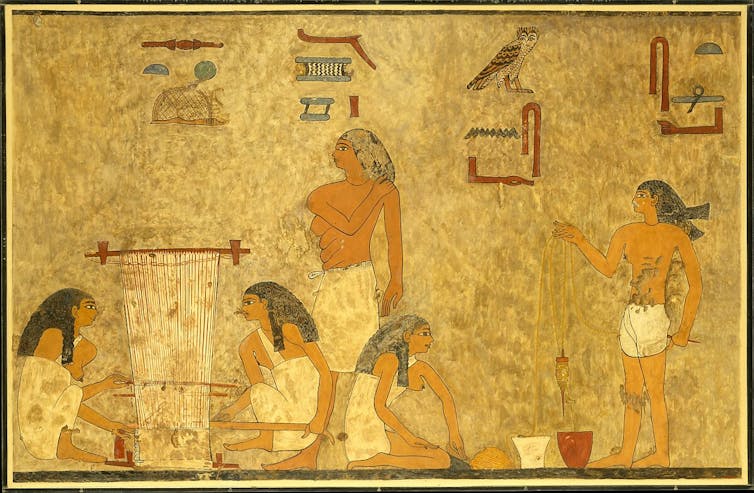
Weavers in the Tomb of Khnumhotep II, Beni Hassan, Egypt. Painted by Norman de Garis Davies (MMA 33.8.16)

We know surprisingly little about the lives of children in ancient Egypt.

And what records we do have about them often concern the lives of the elite – the young king or the children of senior officials. They are more prominent in surviving material evidence, especially funerary art. Infant mortality rates were high in ancient Egypt.

As a result, much of the work in Egyptology on representations of childhood in ancient Egypt is dominated by evidence for the lives of boys and young adult men.

But what were the lives of ordinary girls like in ancient Egypt? And how did they make their way in a deeply patriarchal culture?

Finding hieroglyphic words for girls

An initial problem in studying girls’ lives in ancient Egypt is answering the question: who was a girl in ancient Egypt?

Chronological age was not always recorded by ancient Egyptians in their letters or inscriptions.

Instead, more general words and hieroglyphic signs tended to accompany images of men, women and children to indicate their social roles.

A woman is shown nursing her child while another woman is dressing her hair.
A woman is shown nursing a child while another woman is dressing her hair.
Metropolitan Museum of Art, New York (22.2.35)

These words and signs were only loosely associated with biological development.

Hieroglyphic words for infants and small children, for instance, could be marked with an image of a small, seated child – sometimes with a finger held to its mouth.

Among the words used to describe young girls – talking, walking, and participating alongside adults in their work – was sheriyt.

This is the word often found in ancient accounting documents recording payments of wages, indicating a girl-child worker. They are distinguished from older women in these documents, although it is difficult to know precisely how young they might have been.

In this way, written administrative records and archaeological evidence reveals girls of many social classes were integrated into economic production from an early age.

Payment for work

Elephantine, a town at Egypt’s southern frontier near modern-day Aswan, provides a unique window into the urban life of some girls who worked in textile workshops during the ancient Egyptian Middle Kingdom, which dates approximately 2030–1650 BCE.

First published in 1996, archaeologists found a ceramic bowl repurposed as a writing surface in a house in the densely packed urban settlement.

The excavators initially dated the bowl to the reign of King Amenemhat III, who ruled almost 3,800 years ago. However, based on the style of writing and the types of names listed, some scholars have also dated it earlier. It contains lists of payments of provisions of grain for textile workers over the course of a month.

What makes this document so important is that it names at least 18 child workers. Of these, 11 are girls, clearly marked with the Egyptian word sheriyt, working alongside 28 adult women.

The list shows adult women in this workshop received between 50–57 heqat (around 240–274 litres) of grain – although it’s not entirely clear if this was a one-off payment, a payment per month, or something else. The girls earned smaller but still significant wages of 3–7 heqat (around 14–34 litres).

Some other adult women seem to have also received comparable provisions to the girls, although without further information it is difficult know their social status or age.

This document not only confirms that girls received payment for their labour. It also suggests a structured apprenticeship system where young girls (and boys) worked alongside experienced craftswomen.

This corroborates evidence from visual art of textile workshops from the same period.

Scene of four weavers and an overseer, two figures are plying thread on the left, and two figures are working a ground loom
Weavers in the Tomb of Khnumhotep II, Beni Hassan, Egypt. Painted at the tomb in 1931 by Norman de Garis Davies.
Metropolitan Museum of Art, New York (33.8.16)

Work life, home life

Archaeological evidence suggests textile production occurred both within homes and in dedicated workshops.

Evidence from the excavations at Elephantine suggests homes had several rooms with multiple purposes, including courtyards, entrance vestibules, kitchens with ovens (recognisable by blackened walls and ash deposits), and possible stairs leading to roof spaces.

Privacy would have been limited. Daily life would have included close interaction with animals, as evidenced by attached animal pens.

More recently, close to the house where the provision list was discovered, archaeologists found needles, spindles, shuttles, and remains of pegs for a large loom.

These were found both inside houses and in the courtyards attached to them.

It’s hard to know what exactly these buildings were for; they probably served multiple purposes.

Lives shaped by class and legal status

Not all girls at Elephantine had the same experience of life. The town’s position at Egypt’s southern frontier in this period meant it was home to diverse populations, which included migrants, enslaved people and transitory workers.

A letter dating to the reign of King Amenemhat III documents some families, including women and children, arriving at Elephantine seeking work during a famine in their home region.

A letter from ancient Egypt.
This ancient letter mentions families, including women and children, looking for work.
© The Trustees of the British Museum. Shared under a Creative Commons Attribution-NonCommercial-ShareAlike 4.0 International (CC BY-NC-SA 4.0) licence, CC BY-NC-SA

This evidence can be compared to a legal document from the same time period but from another Egyptian town, El Lahun. This document mentions the purchase and transfer of enslaved women and infants who are called Aamut, referring to a region in West Asia. The document shows they have been given new Egyptian names.

These documents remind us factors such as class and legal status have always profoundly shaped girls’ lives.

Valuing the work of girls

Accessing the everyday thoughts, feelings, and perspectives of many ancient people, especially children, is challenging for historians. We don’t, for instance, have a wealth of personal diaries from ancient Egypt to learn about girls’ interior lives.

But what’s clear is that girls were not merely passive participants in society. They were active economic contributors, who often received formal compensation for their work.

Historians must always look beyond elite contexts to incorporate diverse evidence types – administrative documents, archaeological remains, and artistic representations – to construct a more complete picture of ancient lives.

The Conversation

Julia Hamilton does not work for, consult, own shares in or receive funding from any company or organisation that would benefit from this article, and has disclosed no relevant affiliations beyond their academic appointment.

ref. Work, wages and apprenticeships: sifting for clues about the lives of girls in ancient Egypt – https://theconversation.com/work-wages-and-apprenticeships-sifting-for-clues-about-the-lives-of-girls-in-ancient-egypt-249581

Archetyp was one of the dark web’s biggest drug markets. A global sting has shut it down

Source: The Conversation (Au and NZ) – By Elena Morgenthaler, PhD Candidate, School of Criminology and Criminal Justice, Griffith University

Operation Deep Sentinel

Last week, one of the dark web’s most prominent drug marketplaces – Archetyp – was shut down in an international, multi-agency law enforcement operation following years of investigations. It was touted as a major policing win and was accompanied by a slick cyberpunk-themed video.

But those of us who have studied this space for years weren’t surprised. Archetyp may have been the most secure dark web market. But shutdowns like this have become a recurring feature of the dark web. And they are usually not a significant turning point.

The durability of these markets tells us that if policing responses keep following the same playbook, they will keep getting the same results. And by focusing so heavily on these hidden platforms, authorities are neglecting the growing digital harms in the spaces we all use.

One of the most popular dark web markets

Dark web markets mirror mainstream e-commerce platforms – think Amazon meets cybercrime. These are encrypted marketplaces accessed via the Tor Browser, a privacy-focused browser that hides users’ IP addresses. Buyers use cryptocurrency and escrow systems (third-party payment systems which hold funds until the transaction is complete) to anonymously purchase illicit drugs.

Usually these products are sent to the buyer by post and money transferred to the seller through the escrow system.

Archetyp launched in May 2020 and quickly grew to become one of the most popular dark web markets with an estimated total transaction volume of €250 million (A$446 million). It had more than 600,000 users worldwide and 17,000 listings consisting mainly of illicit drugs including MDMA, cocaine and methamphetamine.

Compared to its predecessors, Archetyp enforced enhanced security expectations from its users. These included an advanced encryption program known as “Pretty Good Privacy” and a cryptocurrency called Monero. Unlike Bitcoin, which records every payment on a public ledger, Monero conceals all transaction details by default which makes them nearly impossible to trace.

Despite the fact Archetyp had clearly raised the bar on security on the dark web, Operation Deep Sentinel – a collaborative effort between law enforcement agencies in six countries supported by Europol and Eurojust – took down the market. The front page has now been replaced by a banner.

While these publicised take-downs feel effective, evidence has shown such interventions only have short-term impacts and the dark web ecosystem will quickly adapt.

A persistent trade

These shutdowns aren’t new. Silk Road, AlphaBay, WallStreet and Monopoly Market are all familiar names in the digital graveyard of the dark web. Before these dark web marketplaces were shutdown, they sold a range of illegal products, from drugs to firearms.

Yet still, the trade persists. New markets emerge and old users return. In some cases, established sellers on closed-down markets are welcomed onto new markets as digital “refugees” and have joining fees waived.

What current policing strategies neglect is that dark web markets are not isolated to the storefronts that are the popular target of crackdowns. These are communities stretched across dark and surface web forums which develop shared tutorials and help one another adapt to any new changes. These closures bind users together and foster a shared resilience and collective experience in navigating these environments.

Law enforcement shutdowns are also only one type of disruption that dark web communities face. Dark web market users routinely face voluntary closures (the gradual retirement of a market), exit scams (sudden closures of markets where any money in escrow is taken), or even scheduled maintenance of these markets.

Ultimately, this disruption to accessibility is not a unique event. In fact, it is routine for individual’s participating in these dark web communities, par for the course of engaging in the markets.

This ability of dark web communities to thrive in disruptions reflects how dark web market users have become experts at adapting to risks, managing disruptions and rebuilding quickly.

Dark web markets are accessed via the highly private and secure Tor Browser.
Daniel Constante/Shutterstock

Missing the wider landscape of digital harms

The other emerging issue is that current policing efforts treat dark web markets as the core threat, which might miss the wider landscape of digital harms. Illicit drug sales, for example, are promoted on social media, where platform features such as recommendation systems are affording new means of illicit drug supply.

Beyond drugs, there are now ever-growing examples of generative AI being used for sexual deepfakes across schools and even of public figures, including the recent case of NRL presenter Tiffany Salmond.

This is all alongside the countless cases of celebrities and social media influencers caught up in crypto pump-and-dump schemes, where hype is used to artificially inflate the price of a token before the creators sell off their holdings and leave investors with worthless tokens.

This shows that while the dark web gets all the attention, it’s far from the internet’s biggest problem.

Archetyp’s takedown might make headlines, but it won’t stop the trade of illicit drugs on the dark web. It should force us to think about where harm is really happening online and whether current strategies are looking in the wrong direction.

The authors do not work for, consult, own shares in or receive funding from any company or organisation that would benefit from this article, and have disclosed no relevant affiliations beyond their academic appointment.

ref. Archetyp was one of the dark web’s biggest drug markets. A global sting has shut it down – https://theconversation.com/archetyp-was-one-of-the-dark-webs-biggest-drug-markets-a-global-sting-has-shut-it-down-259441

How do sleep trackers work, and are they worth it? A sleep scientist breaks it down

Source: The Conversation (Au and NZ) – By Dean J. Miller, Senior Lecturer, Appleton Institute, HealthWise Research Group, CQUniversity Australia

Many smartwatches, fitness and wellness trackers now offer sleep tracking among their many functions.

Wear your watch or ring to bed, and you’ll wake up to a detailed sleep report telling you not just how long you slept, but when each phase happened and whether you had a good night’s rest overall.

Surfing is done in the ocean, planes fly in the sky, and sleep occurs in the brain. So how can we measure sleep from the wrist or finger?

The gold standard of sleep measurement

If you’ve ever had a sleep study or seen someone with dozens of wires attached to their head, body and face, you’ve encountered polysomnography or PSG.

Eye movements, muscle tone, heart rate and brain activity are measured and assessed by experts to detect which stage of sleep or wakefulness a person is in.

When we sleep, we cycle through different stages, generally classified as light sleep, slow-wave sleep (also known as deep sleep), and rapid eye movement or REM sleep.

Each stage has an effect on brain activity, muscle tone and heart rate – which is why sleep scientists need so many wires.

Accurate? Absolutely. Convenient? Like two left shoes.

This is where the convenience of wearable at-home sleep trackers comes in.

What sensors are in sleep trackers?

Since the 1990s, sleep researchers have been using actigraphy to measure people’s sleep outside the laboratory.

An actigraphy device is similar to a wristwatch and uses accelerometers to measure the person’s movement. Coupled with sleep diaries, actigraphy assumes a person is awake when they’re moving and asleep when still. Simple.

While this is a scientifically accepted method of estimating sleep, it’s prone to mislabelling being awake but at rest (such as when reading a book) as sleep.

There’s one key addition that makes wrist-worn sleep trackers more accurate – PPG or photoplethysmography.

It’s hard to pronounce, but photoplethysmography is a key driver in the explosion of wearable health tracking.

It uses those little green lights on the skin-side of the wearable to track the amount of blood passing through your wrist at any given time. Clip-on pulse oximeters used by doctors are the same type of tech.

The addition of PPG to a wrist tracker allows for the measurement of raw data like heart rate and breathing rate. From this data, the wearable can estimate a number of physiological metrics, including sleep stages.

Since fitness wearables already have accelerometers and PPG to track your physical activity and heart rate, it makes sense to use these sensors to track sleep too. But how accurate are they?

Many fitness trackers leverage the sensors used to measure your fitness activities and heart rate for sleep tracking.
The Conversation

How do scientists test sleep trackers?

Two main factors determine the accuracy of sleep trackers. How well does the device detect whether you’re asleep or awake? And how well can it distinguish the sleep stages?

To answer these questions, sleep scientists conduct validation studies. Participants sleep overnight in a laboratory while wearing both a sleep tracker and undergoing PSG.

Then, scientists compare the data from both methods in 30-second blocks called “epochs”. That means for a nine-hour sleep there will be 1,080 epochs to compare.

If both the device and PSG indicate “sleep” for the same epoch, they’re in agreement. If the device indicates “wake” and PSG indicates “sleep” for the same epoch, that’s considered an error. The same is done for sleep stages.

How accurate are sleep trackers?

In a 2022 study of several popular trackers, most correctly identified more than 90% of sleep epochs. But because light sleep and restful wake are so similar, wearables struggle more to estimate wakefulness, correctly identifying between 26% and 73% of wake epochs.

When it comes to sleep stages, wearables are less precise, correctly identifying between 53% and 60% of sleep stage epochs. However, for some devices and some sleep stages the precision can be greater. A recent validation study showed that a latest generation ring-shaped wearable didn’t differ from PSG for estimating light sleep and slow wave sleep.

In short, most modern sleep trackers do a decent job of estimating your total sleep each night. Some are more accurate for sleep staging, but this level of detail isn’t essential for improving the basics of your sleep.

Do I need a sleep tracker?

If you’re struggling with sleep, you should speak to your doctor. A sleep tracker can be a useful tool to help track your sleep goals, but ultimately your behaviour is what will improve sleep.

Keeping regular bedtimes and wake-up times, having a distraction-free sleep space, and keeping home lighting low in the evenings can all help to improve your sleep.

If you love tracking your sleep, make sure your device has been independently validated. While sleep stage data may not be essential, devices that perform well in estimating sleep stage also tend to be more accurate at detecting when you’re asleep or awake. When reviewing your data, look at long term trends in sleep rather than day-to-day variability.

If you don’t love your sleep tracker, you can take it off or ignore it. For some people, access to sleep data can negatively impact sleep by creating stress and anxiety for getting a perfect night’s sleep. Instead, focus on improving your healthy sleep strategies and pay attention to how you feel during the day.

Dr Dean J. Miller is a member of a research group at Central Queensland University that receives support for research (i.e., funding, equipment) from WHOOP Inc, a smart device maker.

ref. How do sleep trackers work, and are they worth it? A sleep scientist breaks it down – https://theconversation.com/how-do-sleep-trackers-work-and-are-they-worth-it-a-sleep-scientist-breaks-it-down-258304

‘It feels like I am being forced to harm a child’: research shows how teachers are suffering moral injury

Source: The Conversation (Au and NZ) – By Glenys Oberg, PhD candidate in education and trauma, The University of Queensland

SolStock/Getty Images

Australia is in the grip of a teacher shortage. Teachers are burning out, warning the job is no longer sustainable and leaving the profession.

We know this is due to excessive workloads, stress and abuse. But research suggests there is another element at play: some teachers are also experiencing moral injury.

Moral injury occurs when teachers are forced to act against their values – leaving them feeling disillusioned and complicit in harm. In my study of 57 Australian teachers, many shared emotionally-charged accounts of being put in impossible situations at work.

What is moral injury?

Moral injury is when professionals cannot act in line with their values due to external demands.

It differs from burnout or compassion fatigue: burnout stems from chronic stress and compassion fatigue comes from emotional overload.

Moral injury was initially developed in military psychology but has since been applied to healthcare and education – professions where high-stakes ethical decision-making and institutional failures often collide.

Previous studies on moral injury in schools have shown how rigid disciplinary policies, high-stakes testing regimes and chronic underfunding often force teachers to act in ways that contradict their professional judgement. This can lead to frustration, guilt and professional disillusionment.

Recent studies have reframed moral injury as a systemic issue rather than an individual psychological condition. This is because institutional constraints – such as inflexible accountability measures and bureaucratic inefficiencies – prevent teachers from fulfilling their ethical responsibilities.

My new study

This research stems from an initial study, which looked at burnout in Australian teachers.

The initial study included a national sample of 2,000 educators. This new study is a subset of 57 teachers who participated in follow-up surveys and focus groups. The teachers were a mix of primary and secondary teachers and some also held leadership positions within their schools.

While the original study focused on compassion fatigue and burnout, a striking pattern emerged: teachers repeatedly described moral conflicts in their work.

‘It feels like I’m being forced to harm a child’

A key theme of the new research was teachers having to enforce school or departmental policies they believed were harmful. This was particularly the case when it came to discipline. As one teacher described:

The policy says I should suspend a student for attendance issues, but their home life is falling apart. How does that help? It feels like I’m being forced to harm a child instead of helping them.

Others talked about having to focus on standardised tests (for example, NAPLAN), rather than using their professional judgement to meet children’s individual needs. This is a contentious issue for teachers.

As one high school teacher told us:

We’re asked to push students through the curriculum even when we know they haven’t grasped the basics […] but we’re the ones who carry the guilt.

A primary teacher similarly noted:

Teaching to the test means leaving so many kids behind. It’s not what education should be.

‘It’s heartbreaking’

Teachers also spoke about teaching in environments that were not adequately resourced. In some schools, teacher shortages were so severe that unqualified staff were delivering classes:

We’ve got classes being taught by teacher aides […] but that’s because we don’t have enough staff.

Or in other classes, students were not getting the help they needed.

Larger class sizes and fewer staff mean that the kids who need the most attention are getting the least. It’s heartbreaking.

The emotional impact was profound, as one high school teacher told us:

At some point, you stop fighting. You realise that no matter how many times you raise concerns, nothing changes. It’s like the system is designed to wear you down until you just comply.

What can schools do to prevent moral injury?

While these findings are confronting, teachers also gave positive examples of what can buffer against moral injury in the workplace. This involved listening to teachers and including them in policies and decisions.

One primary teacher told us how their school had changed their disciplinary approach:

Our school’s push for restorative justice instead of punitive measures has been a game changer. It lets us address the root causes of issues instead of just punishing kids.

Others talked about being asked to collaborate with school leadership to address discipline issues. As one primary teacher said:

We helped create a new behaviour management framework. Having a say in the process made all the difference.

What now?

My research indicates when teachers are consistently asked to compromise their ethics, they don’t just burn out, they question the integrity of the entire system.

This suggests if we want to keep teachers in classrooms, we need to do more than lighten their workloads. We need to make sure they are no longer placed in positions where doing their job means going against their professional values.

This means teachers need to feel heard, respected and empowered in classrooms and schools.

Glenys Oberg does not work for, consult, own shares in or receive funding from any company or organisation that would benefit from this article, and has disclosed no relevant affiliations beyond their academic appointment.

ref. ‘It feels like I am being forced to harm a child’: research shows how teachers are suffering moral injury – https://theconversation.com/it-feels-like-i-am-being-forced-to-harm-a-child-research-shows-how-teachers-are-suffering-moral-injury-258821

NZ Greens call on state to condemn US over ‘dangerous’ attack on Iran

Asia Pacific Report

New Zealand’s opposition Green Party has called on the government to condemn the United States for its illegal bombing of Iran and inflaming tensions across the Middle East.

“The actions of the United States pose a fundamental threat to world peace,” said Green Party co-leader Marama Davidson in a statement.

“The rest of the world — including New Zealand– must take a stand and make it clear that this dangerous escalation is unacceptable.

“We are calling on the New Zealand government to condemn the United States for its attack on Iran. This attack is a blatant breach of international law and yet another unjustified assault on the Middle East from the US.”

Davidson said the country had seen this with the US war on Iraq in 2003, and it was happening again with Sunday’s attack on Iran.

“We are at risk of a violent history repeating itself,” she said.

“[Prime Minister] Christopher Luxon needs to condemn this escalation from the US and rule out any participation in this conflict, or any of the elements of the AUKUS pact.

Independent foreign policy
“New Zealand must maintain its independent foreign policy position and keep its distance from countries that are actively fanning the flames of war.”

Davidson said New Zealand had a long and proud history of standing up for human rights on the world stage.

“When we stand strong and with other countries in calling for peace, we can make a difference. We cannot afford to be a bystander to the atrocities unfolding in front of our eyes.”

It was time for the New Zealand government to step up.

“It has failed to sanction Israel for its illegal and violent occupation of Palestine, and we risk burning all international credibility by failing to speak out against what the United States has just done.”

Meanwhile, Prime Minister Luxon said New Zealand wanted to see a peaceful stable and secure Middle East, but more military action was not the answer, reports RNZ News.

The UN Security Council met in emergency session today to discuss the US attack on the three key nuclear facilities.

UN Secretary-General António Guterres said the US bombing marked a “perilous turn” in a region already reeling.

Iran called on the 15-member body to condemn what it called a “blatant and unlawful act of aggression”.

Article by AsiaPacificReport.nz

View from the Hill: Albanese supports US bombing, reluctantly

Source: The Conversation (Au and NZ) – By Michelle Grattan, Professorial Fellow, University of Canberra

When Prime Minister Anthony Albanese and Foreign Minister Penny Wong went out on Monday to back the United States attack on Iran, it was obvious their support was through gritted teeth.

Albanese told their joint news conference: “The world has long agreed that Iran cannot be allowed to get a nuclear weapon. And we support action to prevent that. That is what this is.

“The US action was directed at specific sites central to Iran’s nuclear program. We don’t want escalation and a full-scale war. We continue to call for dialogue and for diplomacy. As I’ve said for many days now, we are deeply concerned about any escalation in the region and we want to see diplomacy, dialogue and de-escalation.”

At the news conference and in Wong’s media round beforehand, one big question was, why did they take so long to appear?

The attack is a seismic event in the Middle East conflict. Yet on Sunday the government only put out a tepid statement attributed to a “spokesperson”, which did not endorse the American action.

This suggests the prime minister and foreign minister are, at the very least, uncomfortable with the action.

It is further evidence of the current distance between the Australian government and the Trump administration. Whether it affects Albanese’s attempt to get the now much-sought after bilateral remains to be seen.

At every stage of the Middle East conflict, as the situation has progressively escalated, the Australian government has been urging restraint and/ or de-escalation.

Albanese is caught between not wanting to repudiate the Americans, the conflicting pressures of domestic lobbies, and his Labor constituency.

Over the years, Albanese has moved to the political centre. But he hasn’t taken down from his website a strong speech he made in 2003 opposing the Iraq war.

“In the short term, the conflict that is now clearly about to start can only make things worse, perhaps much worse,” Albanese told parliament then. “Iraq does not represent a threat to Australia. We are, with this [Howard government] decision, supporting a pre-emptive strike, which changes forever the way that international politics works.”

In that war and this war, some of the same issues are at play. Iraq was thought to have weapons of mass destruction – later it was found it did not. Iran has long been on the path to developing nuclear weapons, but there are varying intelligence assessments of how much progress it has made.

One can’t help thinking Albanese probably has the same sort of reservations about the Iran strike that he did about the Iraq war.

For Australia’s there is one big difference: there is no thought of involving Australian defence forces, as happened in Iraq.

Former Labor senator Doug Cameron, in parliament from 2008 to 2019 and a firebrand of the left, on Monday recalled how then opposition leader Simon Crean opposed Australia’s support for and participation in the Iraq war. (Crean said, “Never allow our foreign policy to be determined by another nation. Never commit to unnecessary war when peace is possible.”)

Cameron, now a national patron of Labor Against War, issued several tweets condemning the government’s stand, and saying “time for Labor backbenchers to speak up”.

But the Labor backbench is far from what it once was. Hardly anyone speaks up to challenge anything. As for the left, it is a shadow of its old feisty self.

“What has happened to the left?” Cameron asks. “To be honest I don’t understand it,” he admits to The Conversation.

Cameron recalls how the left – and indeed the wider caucus – was up in arms when Bob Hawke in the mid-1980s wanted Australia to facilitate the Americans’ testing of MX missiles that would splash down in the Tasman Sea. Hawke had to back down.

He wonders if it’s a matter of not wanting to contradict a “left prime minister, and a left foreign minister”. “Personal support and party solidarity have come before common sense.”

There are many causes of the demise of the ALP left, as Cameron knew it. They include the loss of what power Labor’s rank-and-file once had, the splintering of the left more broadly to minor parties notably the Greens, and the decline of ideology within Labor (and generally). There is no current “Doug Cameron”-equivalent in the caucus. The factions no longer fight over ideas – they preside over spoils.

Those who contest the thesis of the decline of the left argue the contemporary Labor left has been shaping the Albanese government’s agenda on key issues from within, for example on industrial relations, industry policy, climate policy, and gender issues.

If the Albanese of 2003 could have foreseen what the caucus left of 2025 would be like, he’d have been surprised, and possibly shocked. As it is, he’s pretty pleased the left is so quietly behaved.

The Conversation

Michelle Grattan does not work for, consult, own shares in or receive funding from any company or organisation that would benefit from this article, and has disclosed no relevant affiliations beyond their academic appointment.

ref. View from the Hill: Albanese supports US bombing, reluctantly – https://theconversation.com/view-from-the-hill-albanese-supports-us-bombing-reluctantly-258967

Woodside’s North West Shelf gas extension is being challenged in the courts. Could it be stopped?

Source: The Conversation (Au and NZ) – By Samantha Hepburn, Professor, Deakin Law School, Deakin University

The controversial extension of Woodside’s North West Shelf gas project off Western Australia faces two legal challenges. Both raise significant concerns about the validity of government approvals. One could even seek an injunction, preventing federal environment minister Murray Watt from making a final decision.

The first battle is being fought along climate lines. Enormous amounts of greenhouse gases will be released when gas from the project is exported and burned overseas. The Friends of Australian Rock Art group now argues the then WA environment minister Reece Whitby should have taken this pollution into account when approving the extension in December.

The second concerns ancient Aboriginal rock art in the Murujuga National Park on the Burrup Peninsula. There’s evidence greenhouse gas emissions released during extraction of fossil fuels is damaging the artwork, and Traditional Owners are seeking a protection order.

The decision to grant the extension appears at odds with national heritage and state environment laws. Both cases will be a closely watched test of these legal protections.

What’s the North West Shelf approval about?

Approval for the North West Shelf gas processing plant in Karratha, WA, was to expire in 2030. Woodside Energy sought to extend the project to 2070.

The state government gave approval to the extension in December, and the federal government gave conditional approval last month.

Watt gave Woodside ten business days to respond to “strict conditions particularly relating to the impact of air emissions” on nearby rock art, but that deadline was not met. Woodside has been given more time to review the conditions.

Meanwhile, two legal challenges have been mounted.

The Friends of Rock Art case

Earlier this month, the group Friends of Australian Rock Art requested judicial review of the approval by Whitby.

Judicial review is where courts review government decisions to ensure they are lawful and fair. The case is yet to be heard in the WA Supreme Court.

The group argues the state failed to give proper regard to the climate impact of the proposal, as required under the WA Environment Protection Act.

Specifically, the group argues the approval did not fully examine the climate impacts of so-called “scope three” emissions. These occur when the exported gas is burned overseas.

Under WA state law, the minister must consider whether a proposal will have a significant effect on the environment. This is a broad requirement and the climate effects of a decision are relevant.

The WA Office of Environmental Protection makes this clear in a statement of objectives, which include minimising “the risk of environmental harm associated with climate change by reducing greenhouse gases as far as practicable”.

Guidelines published in November to help implement this objective set out that where scope three emissions are likely to exceed 100,000 tonnes a year, extra information must be provided to government. This includes “a summary of where the scope three emissions will be emitted (domestic or international), and whether they are or are reasonably likely to be subject to emission reduction requirements as scope 1 or 2 emissions”.

The guidelines further state that the EPA’s usual minimum expectation for proposals is for “deep, substantial and sustained emission reductions” this decade – with net zero no later than 2050, and reductions occurring along a linear trajectory (at minimum) from 2030.

Woodside has indicated the project extension would emit about 80 million tonnes of scope three emissions annually – about equal to the emissions from a small to medium-sized country.

Co-convener of the Friends group, Judith Hugo, said the minister did not give adequate regard to the guidelines and failed to consider the project’s full impact on the climate, as well as the nearby rock art.

While litigation on scope three emissions is relatively new, it is gaining traction globally. It has become an increasingly significant factor underlying corporate climate action and policy development.

Announcing the legal challenge on June 17, 2025 (Friends of Australian Rock Art)

2. The Traditional Owner case

Raelene Cooper is a Mardathoonera woman and founder of the group Save our Songlines. She filed legal action in the Federal Court in 2022, seeking temporary protection from industrial emissions for the art.

Murujuga has some of the planet’s oldest known rock art, dating back 40,000 years. Research has shown rocks closer to the industrial operations have been degraded by past emissions.

On May 23 this year, Cooper called for an “urgent assessment of the ongoing impacts of all industry on the Burrup” before the federal government decided on Woodside’s proposed extension.

She had filed a motion in the Federal Court seeking to compel Watt to make a determination of her Murujuga Section 10 cultural heritage assessment. But Watt announced conditional approval for the Woodside extension on May 28.

Watt reportedly promised to give Cooper three days’ notice of the approval. That would have given Cooper an opportunity to file an injunction preventing the minister from making a final decision to approve the North West Shelf prior to resolving her section 10 protection order.

Resolution of the protection order is particularly important given the art has been nominated for UNESCO World Heritage listing. The World Heritage Committee referred the nomination back to the federal government so as to “prevent any further industrial development adjacent to, and within, the Murujuga Cultural Landscape”.

This referral occurred before the project extension was approved. If the approval is finalised, the nomination may fail, because the government cannot ensure the area will be protected.

Cooper’s case is set to be heard in July.

Saving Murujuga Rock Art (The Australia Institute)

High stakes and delicate decision-making

These legal actions reflect deep public concern over the North West Shelf gas project extension.

In the context of a worsening climate emergency and damage to ancient rock art, properly adhering to the legal requirements for the assessment of such projects couldn’t be more crucial.

The Conversation

Samantha Hepburn does not work for, consult, own shares in or receive funding from any company or organisation that would benefit from this article, and has disclosed no relevant affiliations beyond their academic appointment.

ref. Woodside’s North West Shelf gas extension is being challenged in the courts. Could it be stopped? – https://theconversation.com/woodsides-north-west-shelf-gas-extension-is-being-challenged-in-the-courts-could-it-be-stopped-259130

Australian CEOs are still getting their bonuses. Performance doesn’t seem to matter so much

Source: The Conversation (Au and NZ) – By Richard Denniss, Adjunct Professor, Crawford School of Public Policy, Australian National University

RomanR/Shutterstock

Almost all of Australia’s top chief executives are, according to their boards at least, knocking it out of the park in terms of performance.

That is despite sluggish productivity, persistently high carbon emissions, rising inequality and Australia’s public spending on research and development being among the lowest in the OECD.

According to new data from the Australian Council of Superannuation Investors, 91% of Australia’s top chief executive officers (CEOs) received some form of performance bonus last year. That elevated their pay well above their base salaries (which were already over A$1 million). Only five CEOs out of 142 eligible for a bonus received zero.

The fact nearly all of Australia’s top CEOs are receiving these performance bonuses shows performance pay is more about rewarding conformity and discipline than risk-taking and entrepreneurship.

Do we really believe 91% of our CEOs made big bets that paid off last year? A more plausible explanation is that we simply reward executives for not stuffing up. Their customer base is growing in line with population growth and their prices are rising faster than their cost of production, which means profits rise without too much effort.

Not keeping up with change

Take the electricity industry for example. It’s hard to imagine an industry in which change is more inevitable than the industry responsible for transitioning away from gas and coal-fired power stations to renewable energy.

But according to the Australian Bureau of Statistics, the electricity, gas and water industry spends a mere 0.24% of sales on research and development each year. That is half the economy-wide average.

Unfortunately, innovation does not appear to be a prerequisite for CEOs being rewarded with large bonuses. According to Energy Australia, its CEO Mark Collette (base salary over $1 million) recently challenged a room full of other well-paid leaders at Australian Energy Week to continuously ask themselves: “Will this make energy cheaper?

However instead of focusing on keeping costs down for consumers, companies have sometimes resorted to misleading statements. Energy Australia recently admitted to misleading customers by claiming the coal and gas-fired electricity it was selling was “carbon neutral”.

But there is no correlation between student satisfaction and vice chancellor pay.  And while Australian vice chancellor pay has been soaring, Australian universities have been slipping steadily down international rankings for university quality.  (I have
Companies purchase carbon credits to offset emissions elsewhere in their businesses.
tech_BG/Shutterstock

Energy Australia was buying widely used carbon offsets to make the claim the fossil-fuel fired electricity it was selling was carbon neutral. In its apology Energy Australia conceded “offsets do not prevent or undo the harms caused by burning fossil fuels for a customer’s energy use”.

While it is clear Energy Australia’s spending on carbon credits did nothing to make the company’s energy cheaper, it is not yet clear if the board will award a “performance bonus”.

Leading the world – in pay packets

Another example of the lack of relationship between CEO pay and organisational performance is Australia’s university sector. The vice chancellors of Australian universities are among the best paid in the world, with over a dozen Australian earning more than the head of Cambridge University.

But there is no correlation between student satisfaction and vice chancellor pay.

And while Australian vice chancellor pay has been soaring, Australian universities have been slipping steadily down international rankings for university quality.

Inequality is rising

While performance-based bonuses and incentives are common among CEOs and vice chancellors, the same is not true for lower-paid staff.

Instead, these staff are often asked to “do more, with less” even as their real wages have declined. Universities have seen a notable decline in academic staff per student while the gap between the pay of lecturers and vice chancellors has skyrocketed.

Extremely high salaries for CEOs and vice chancellors have done nothing to boost Australian productivity growth, or our performance in global rankings for our universities, research and development or innovation. Paying out large bonuses for average performance has done little to help either.

Inequality in Australia is rising. As long as CEO pay is rising faster than the minimum wages, that gap will continue to widen. The latest data showed CEO salaries are 55 times that of the average worker.

Just doing their job

While it is true it is hard to measure the performance of a CEO, it’s also hard to measure the care and attention provided by a childcare worker, the compassion of an aged care nurse, the helpfulness of a call centre operator or the enthusiasm of a lecturer.

Few CEOs think we need bonuses to motivate the vast majority of Australian workers. But it is heresy to suggest those at the top of a big organisation could simply work diligently without a giant bonus.

So, it’s not just income that is unequal in Australia. We expect a lot more self-motivation from those at the bottom of the income distribution than those at the very top.

The Conversation

Richard Denniss does not work for, consult, own shares in or receive funding from any company or organisation that would benefit from this article, and has disclosed no relevant affiliations beyond their academic appointment.

ref. Australian CEOs are still getting their bonuses. Performance doesn’t seem to matter so much – https://theconversation.com/australian-ceos-are-still-getting-their-bonuses-performance-doesnt-seem-to-matter-so-much-259382

Strait of Hormuz: closing vital oil and gas route would disrupt global supplies. How will Australia be affected?

Source: The Conversation (Au and NZ) – By Sanjoy Paul, Associate Professor in Operations and Supply Chain Management, UTS Business School, University of Technology Sydney

Below the Sky/Shutterstock

The Iranian parliament has approved the closure of key shipping route the Strait of Hormuz, in a move that could further escalate the Israel/Iran war.

The strait lies between Iran and its Gulf Arab neighbours and is used to transport about 20 million barrels per day of oil – the equivalent of 20% of global daily oil consumption.

Since 2020, this critical route has been used to transport an average of 14.8 million barrels a day of crude oil and natural gas liquids, 5.5 million barrels a day of petroleum products and 10.8 billion cubic feet per day of LNG.

The closure of the strait, which will not take effect until endorsed by Iran’s Supreme National Security Council, will significantly impact global oil and gas supplies and could potentially create energy crises.

An important route for Asia

In 2024, 84% of the crude oil and natural gas liquids, and 83% of the LNG passed through this channel were destined for Asian countries including China, India, Japan and South Korea.

In the first quarter of 2025, China alone imported about 38% of crude oil shipped through the strait.

It is likely these countries will be directly impacted by a closure.

What it means for Australia

Only about 15% of Australia’s crude oil and 5% of petroleum products are imported from Middle Eastern countries including Saudi Arabia and the United Arab Emirates.

However, 30% of Australia’s refined oil effectively transits through the Strait of Hormuz. This is because Australia sources refined oil from the Republic of Korea and Singapore that is refined from crude oil from the Middle East.

If Australia’s key suppliers are affected by the closure, there could be devastating flow-on effects for the country’s oil supply.

Since the conflict between Iran and Israel started, the oil price has increased by 10%. The closure of the strait could further inflate the oil price globally

Though Australia does not rely directly on crude oil from the Middle East, its reliance on South Korea and Singapore for refined oil is significant. The increased oil price and its impact on the cost of goods and services could also hurt Australia’s fight to control inflation.

Past tensions in the strait

The Strait of Hormuz has never been fully closed. However, it has been disrupted a few times leading to reduced capacity.

Notable disruptions include attacks on commercial ships including oil tankers during the Iran-Iraq war in the 1980s and the tension in the strait between Iranian and US navies in 2007.

None of these disruptions led to the closure of the channel so the impact of these disruptions on global oil supply was minimal.

Bypassing the strait

Both Saudi Arabia and the United Arab Emirates have established oil pipelines that could bypass the Strait of Hormuz if it is closed or compromised.

Saudi Arabia’s pipeline can carry five million barrels per day and the emirates’ capacity is 1.5 million barrels per day. This is compared to their production capacities of nine and 3.3 million barrels per day respectively.

This could significantly slow down the transportation of crude oil from both countries.

Qatar relies on the Strait of Hormuz to transport nearly all of its LNG shipments. Last week Qatar instructed all LNG carriers to hold off transiting through the strait until the day before loading and to remain east of Hormuz. This has kept their carriers outside the impacted regions.

The limited alternative options and reduced capacities of pipelines could potentially disrupt the global oil and LNG supply.

Potential strategies

If the strait is fully closed, the impacts could be severe, especially for Asian countries which rely on energy from the Middle East.

Many countries, such as China, have oil reserves that can sustain their current oil consumption for about five years. However, many developing countries don’t keep supply inventories.

In the short term, countries should seek to diversify their sources of oil and gas supply. In the long term, they should create a strategic reserve for it.

Supply countries should focus on expanding alternative routes such as pipelines connected to alternative ports.

Most importantly, countries should focus on creating renewable energy sources and speed up their adoption to meet energy needs. In future, renewable energies will be the most viable alternatives to crude oil and LNG amid geopolitical tensions.

The Conversation

Sanjoy Paul does not work for, consult, own shares in or receive funding from any company or organisation that would benefit from this article, and has disclosed no relevant affiliations beyond their academic appointment.

ref. Strait of Hormuz: closing vital oil and gas route would disrupt global supplies. How will Australia be affected? – https://theconversation.com/strait-of-hormuz-closing-vital-oil-and-gas-route-would-disrupt-global-supplies-how-will-australia-be-affected-259535

MIT researchers say using ChatGPT can rot your brain. The truth is a little more complicated

Source: The Conversation (Au and NZ) – By Vitomir Kovanovic, Associate Professor and Associate Director of the Centre for Change and Complexity in Learning (C3L), Education Futures, University of South Australia

Rroselavy / Shutterstock

Since ChatGPT appeared almost three years ago, the impact of artificial intelligence (AI) technologies on learning has been widely debated. Are they handy tools for personalised education, or gateways to academic dishonesty?

Most importantly, there has been concern that using AI will lead to a widespread “dumbing down”, or decline in the ability to think critically. If students use AI tools too early, the argument goes, they may not develop basic skills for critical thinking and problem-solving.

Is that really the case? According to a recent study by scientists from MIT, it appears so. Using ChatGPT to help write essays, the researchers say, can lead to “cognitive debt” and a “likely decrease in learning skills”.

So what did the study find?

The difference between using AI and the brain alone

Over the course of four months, the MIT team asked 54 adults to write a series of three essays using either AI (ChatGPT), a search engine, or their own brains (“brain-only” group). The team measured cognitive engagement by examining electrical activity in the brain and through linguistic analysis of the essays.

The cognitive engagement of those who used AI was significantly lower than the other two groups. This group also had a harder time recalling quotes from their essays and felt a lower sense of ownership over them.

Interestingly, participants switched roles for a final, fourth essay (the brain-only group used AI and vice versa). The AI-to-brain group performed worse and had engagement that was only slightly better than the other group’s during their first session, far below the engagement of the brain-only group in their third session.

The authors claim this demonstrates how prolonged use of AI led to participants accumulating “cognitive debt”. When they finally had the opportunity to use their brains, they were unable to replicate the engagement or perform as well as the other two groups.

Cautiously, the authors note that only 18 participants (six per condition) completed the fourth, final session. Therefore, the findings are preliminary and require further testing.

Does this really show AI makes us stupider?

These results do not necessarily mean that students who used AI accumulated “cognitive debt”. In our view, the findings are due to the particular design of the study.

The change in neural connectivity of the brain-only group over the first three sessions was likely the result of becoming more familiar with the study task, a phenomenon known as the familiarisation effect. As study participants repeat the task, they become more familiar and efficient, and their cognitive strategy adapts accordingly.

When the AI group finally got to “use their brains”, they were only doing the task once. As a result, they were unable to match the other group’s experience. They achieved only slightly better engagement than the brain-only group during the first session.

To fully justify the researchers’ claims, the AI-to-brain participants would also need to complete three writing sessions without AI.

Similarly, the fact the brain-to-AI group used ChatGPT more productively and strategically is likely due to the nature of the fourth writing task, which required writing an essay on one of the previous three topics.

As writing without AI required more substantial engagement, they had a far better recall of what they had written in the past. Hence, they primarily used AI to search for new information and refine what they had previously written.

What are the implications of AI in assessment?

To understand the current situation with AI, we can look back to what happened when calculators first became available.

Back in the 1970s, their impact was regulated by making exams much harder. Instead of doing calculations by hand, students were expected to use calculators and spend their cognitive efforts on more complex tasks.

Effectively, the bar was significantly raised, which made students work equally hard (if not harder) than before calculators were available.

The challenge with AI is that, for the most part, educators have not raised the bar in a way that makes AI a necessary part of the process. Educators still require students to complete the same tasks and expect the same standard of work as they did five years ago.

In such situations, AI can indeed be detrimental. Students can for the most part offload critical engagement with learning to AI, which results in “metacognitive laziness”.

However, just like calculators, AI can and should help us accomplish tasks that were previously impossible – and still require significant engagement. For example, we might ask teaching students to use AI to produce a detailed lesson plan, which will then be evaluated for quality and pedagogical soundness in an oral examination.

In the MIT study, participants who used AI were producing the “same old” essays. They adjusted their engagement to deliver the standard of work expected of them.

The same would happen if students were asked to perform complex calculations with or without a calculator. The group doing calculations by hand would sweat, while those with calculators would barely blink an eye.

Learning how to use AI

Current and future generations need to be able to think critically and creatively and solve problems. However, AI is changing what these things mean.

Producing essays with pen and paper is no longer a demonstration of critical thinking ability, just as doing long division is no longer a demonstration of numeracy.

Knowing when, where and how to use AI is the key to long-term success and skill development. Prioritising which tasks can be offloaded to an AI to reduce cognitive debt is just as important as understanding which tasks require genuine creativity and critical thinking.

The authors do not work for, consult, own shares in or receive funding from any company or organisation that would benefit from this article, and have disclosed no relevant affiliations beyond their academic appointment.

ref. MIT researchers say using ChatGPT can rot your brain. The truth is a little more complicated – https://theconversation.com/mit-researchers-say-using-chatgpt-can-rot-your-brain-the-truth-is-a-little-more-complicated-259450

Why the US strikes on Iran are illegal and can set a troubling precedent

Source: The Conversation (Au and NZ) – By Donald Rothwell, Professor of International Law, Australian National University

After the United States bombed Iran’s three nuclear facilities on Sunday, US President Donald Trump said its objective was a “stop to the nuclear threat posed by the world’s number one state sponsor of terror”.

US Defence Secretary Pete Hegseth echoed this justification, saying:

The president authorised a precision operation to neutralise the threats to our national interest posed by the Iranian nuclear program and the collective self-defence of our troops and our ally Israel.

Is this a legitimate justification for a state to launch an attack on another?

I believe, looking at the evidence, it is not.

Was it self defence?

Under the UN Charter, there are two ways in which a state can lawfully use force against another state:

  • the UN Security Council authorises force in exceptional circumstances to restore or maintain international peace and security under Chapter 7

  • the right of self defence when a state is attacked by another, as outlined in Article 51.

On the first point, there was no UN Security Council authorisation for either Israel or the US to launch an attack on Iran to maintain international peace and security. The security council has long been concerned about Iran’s nuclear program and adopted a series of resolutions related to it. However, none of those resolutions authorised the use of military force.

With regard to self defence, this right is activated if there is an armed attack against a nation. And there’s no evidence of any recent Iranian attacks on the US.

There have been incidents involving attacks on US assets by Iranian-backed proxy groups in the region, such as the Houthi rebels in Yemen and Hezbollah. In his address to the nation on Saturday night, Trump made reference to historical incidents the US believes the Iranians were responsible for over the years.

However, none of these actions is directly related to the strikes on Iran’s nuclear facilities.

What about a preemptive strike?

Another possible ground the US can use to mount a case for its bombardments is anticipatory or preemptive self defence.

Both of these aspects of self defence are controversial. They have never been clearly endorsed by the UN Security Council or the International Court of Justice.

The US has sought to assert a fairly wide-ranging, robust interpretation of the right of self defence over many years, including both anticipatory self defence and preemptive self defence (which is particularly relevant in the Iran strikes).

The major point of distinction between the two is whether a potential attack is imminent. Anticipatory self defence is in response to an attack on the brink of happening, such as when armed forces are massing on a border. Preemptive self defence is a step further removed, before a genuine threat materialises.

Famously, in 2002, the administration of President George W. Bush adopted what is known as the “Bush doctrine” following the September 11 terrorist attacks.

This doctrine was framed around the notion of preemptive self defence justifying a strike on another nation. This was one of the grounds the US used to justify its military intervention of Iraq in 2003 – that Iraq’s alleged program of weapons of mass destruction posed an imminent threat to the US.

However, this justification was widely discredited when no evidence of these weapons was found.

Did Iran pose an imminent threat?

With regard to Iran’s nuclear program, an imminent threat would require two things: Iran having nuclear weapons capability, and an intent to use them.

On capability, there have been debates about Iran’s transparency with respect to its cooperation with the International Atomic Energy Agency (IAEA).

But, importantly, the IAEA is the body that has the authorisation and capability to make judgements about a nation’s nuclear program. And it said, at this point in time, Iran did not yet have nuclear weapons capability.

As Rafael Grossi, the head of the IAEA told the BBC:

[…]whereas until the early 2000s there used to be […] a structured and systematic effort in the direction of a nuclear device, that is not the case now.

Trump’s statement in which he referred to the US military operation against Iran’s “nuclear enrichment facilities” was particularly striking. There was no reference to weapons. So, even the language coming out of the White House does not make reference to Iran possessing weapons at this point in time.

Trump’s address to the nation after the Iran strikes.

Further, many states have nuclear weapons capability, but they’re not necessarily showing intent to use them.

Iran has a long track record of aggressive rhetoric against Israel and the US. But the critical question here is whether this equates to an intent to strike.

What about collective defence?

Israel began its military campaign against Iran on June 13, also arguing for the need for anticipatory or preemptive self defence to counter the threat posed by Iran’s nuclear program.

If Israel is exercising its right to self defence consistently with the UN Charter, as it claims, it can legitimately call on the assistance of its allies to mount what is known as “collective self defence” against an attack.

On all the available evidence, there’s no doubt the Israelis and Americans coordinated with respect to the US strikes on June 22. At face value, this is a case of collective self defence.

But, importantly, this right is only valid under international law if the original Israeli right to self defence is legitimate.

And here, we encounter the same legal difficulties as we do with the US claim of self defence. Israel’s claim of an imminent attack from Iran is very dubious and contentious on the facts.


Read more:
Are Israel’s actions in Iran illegal? Could it be called self-defence? An international law expert explains


A concerning precedent

The overarching concern is these strikes can set a precedent. Other states can use this interpretation of the right of self defence to launch anticipatory or preemptive strikes against other nations any time they want.

If this practice is allowed to go unchecked and is not subject to widespread condemnation, it can seen by the international community as an endorsement – that this type of conduct is legitimate.

There are many states acquiring conventional weapons that could be seen to pose a potential threat to their neighbours or other states. And there are several states considering the acquisition of nuclear weapons.

One example is Japan, where there has been some debate about nuclear weapons as a deterrence to future possible threats from China.

So, how might Japan’s actions be seen by its neighbours – namely China and North Korea? And how might these countries respond in light of the precedent that’s been set by the US and Israel?

Should Australia condemn the US strikes?

Australia’s Foreign Minister Penny Wong has come out in support for the US action, saying “we cannot allow Iran to have a nuclear weapon”. She hasn’t, however, addressed the legality of the US strikes.

The Albanese government should be discussing this. There’s an expectation, in particular, on the part of Labor governments, given former leader Doc Evatt’s role in the creation of the UN Charter, that they show strong support for the rules-based international order.

Labor governments were very critical of the way in which the Howard government engaged in the US-led invasion of Iraq, asserting there was no basis for it under international law.

Accordingly, there’s an expectation that Labor governments should be holding all states accountable for egregious breaches of international law. And, when viewed through the lens of international law, there’s no other way you can characterise the US strikes on Iran.

Donald Rothwell receives funding from Australian Research Council

ref. Why the US strikes on Iran are illegal and can set a troubling precedent – https://theconversation.com/why-the-us-strikes-on-iran-are-illegal-and-can-set-a-troubling-precedent-259542

How do I get started in the gym lifting weights?

Source: The Conversation (Au and NZ) – By Mandy Hagstrom, Senior Lecturer, Exercise Physiology. School of Health Sciences, UNSW Sydney

Thomas Barwick/Getty

So you’ve never been to a gym and are keen to start, but something’s holding you back. Perhaps you don’t know what to actually do in there or feel like you’ll just look stupid in front of everyone. Maybe you’re worried about injuring yourself.

It’s OK. Everyone starts somewhere. I did, too.

Resistance exercise (such as weight lifting) is really good for your health. Benefits include a reduced risk of osteoporosis-related fractures, reduced risk factors for chronic diseases such as diabetes, better sleep, improved mental health and, of course, stronger and bigger muscles.

So, how do people get started in the gym? Here’s what you need to know, and what the research says.

Worried about injury?

Don’t be. It’s probably less risky than lots of other forms of exercise you might already do or did in the past.

Team sports such as rugby and soccer, and strength-based sports such as powerlifting, weightlifting, and cross fit all have similar injury rates. They’re all in the vicinity of three to four injuries per 1,000 hours of participation.

Going to the gym has almost half this rate of injuries, at about 1.8 per 1,000 hours.

Let’s put that into context.

If you go to the gym three times per week for a one-hour session – and you do that every week of the year – you achieve approximately 156 hours of resistance training exercise a year.

So if the injury rate is about 1.8 injuries per 1,000 hours, that means that you could exercise for years in the gym without even a little niggle!

Some groups, such as young men under 40, may be at a greater risk of injury in the gym. So if that’s you, you may want to be a little more conscious about how fast you progress, and the types of exercises you do in the gym.

Compare these injury risk stats to the known risks of sedentary lifestyles, and the worry should go out the door.

In short, it’s a lot more dangerous to be sedentary than it is to go to the gym.

OK, how do I get started?

It’s fine to begin with what you feel most comfortable with. You don’t have to go straight to a ridiculously complex or challenging program.

However, that doesn’t mean you don’t need to put in the effort!

Most gyms can start you off by designing a workout program for you (you might have to pay for a personal training session). If you have a medical condition, find an accredited exercise physiologist. They’re trained to help you exercise safely.

It’s OK to start with gym machines, which are designed to make it easier to keep your movements consistent.

But keep your mind open about trying the free weights section (where the dumbbells, barbells and mirrors are). Benefits from this type of training may vary from what you get via machines.

That’s because a lot of the moves you do with free weights are what’s called compound exercises, meaning they work a lot of muscles and joints together at the same time. They’re really good for you. Examples of compound exercises include:

  • squats
  • lunges
  • deadlifts
  • bench presses
  • hip thrusts
  • kettle bell swings.
A woman lifts weights while being supervised by a trainer.
Most gyms can connect you with a trainer to show you what to do.
PeopleImages.com – Yuri A/Shutterstock

How much should I do in the gym?

Standard government physical activity recommendations state you should do muscle strengthening twice per week.

If you are new to the gym, you can make progress with a minimalist approach. For example, you may choose to only lift once or twice per week, compared with many seasoned gym-goers who might lift four or five times per week.

Recent research shows even those people already consistently lifting in a gym can maintain or slowly improve by doing just two sessions per week, in which each exercise is only performed for one set and the whole session lasts just 30 minutes or so.

So if you can stick to one hour per week (made up of two challenging half-hour sessions) then you will still be making progress.

How do I make my habit stick?

Sticking to the habit after the novelty has worn off is where many come unstuck.

Some research suggests it takes six weeks to form a gym habit, and that the more frequent the attendance in those first six weeks, the more likely the habit will stick.

At the one-year mark, the biggest predictor of regular attendance (defined as twice per week) was enjoyment. This was followed closely by the concept of self-efficacy (believing in yourself and your ability to stick to it), and social support.

This is really important.

Find what you like about the gym. Train the way that you enjoy. Find a friend to join the gym with. That will help you create the habit.

From there, you can progress the types and intensity of gym exercises you do.

A man sweats while lifting weights
It’s OK if it’s hard at first.
I love photo/Shutterstock

I feel like a duck out of water

Every gym-goer felt this at first. I did too.

The confusion about which bit of the machine to sit on, pull, or push, is a tad overwhelming.

The sense of security in sticking to the familiar, shying away from the free weight area.

Remember: everyone is there to improve themselves and is on their own journey.

Most people won’t even notice that you are there, and most experienced gym-goers will be delighted to help if you’re unsure.

If that’s not your experience at your local gym, perhaps look for a new and more welcoming environment. Not all gyms and gym cultures are created equal.

The Conversation

Mandy Hagstrom is affiliated with Sports Oracle, a company that delivers the International Olympic Committee diploma in Strength and Conditioning.

ref. How do I get started in the gym lifting weights? – https://theconversation.com/how-do-i-get-started-in-the-gym-lifting-weights-258291

NZ’s plan to ‘welcome anyone, from anywhere, anytime’ is not a sustainable tourism policy

Source: The Conversation (Au and NZ) – By Regina Scheyvens, Professor of Development Studies, Te Kunenga ki Pūrehuroa – Massey University

Getty Images

Attracting more Chinese tourists to New Zealand, including during the off-season, was a major part of Prime Minister Christopher Luxon’s trade agenda during his visit to China last week. As Tourism Minister Louise Upston put it: “we welcome anyone, from anywhere, anytime”.

It’s all part of the government’s plan to “turbocharge” the tourism sector with an additional NZ$13.5 million for marketing this year. The hope is this will help double the value of tourism as an export earner by 2034.

The China visit built on the government’s Tourism Growth Roadmap which aims to attract 3.89 million visitors by 2026, and 4.78 million by 2030-34.

Ironically, the release of the roadmap coincided with unprecedented, organised push-back against mass tourism across southern Europe this month. Fed up with the economic and cultural impact of too much “touristification”, residents of popular cities and islands in Italy, Portugal and Spain took part in coordinated protests, some even spraying tourists with water pistols.

Before COVID upended international tourism in 2020, similar serious concerns were voiced in New Zealand about environmental degradation, crowding and congestion, and declining public support for tourism.

But the plan to turbocharge tourism specifically aims to return international visitor arrivals to pre-COVID levels.

From destination management to marketing

As part of the government’s Tourism Boost Package, money generated by the International Visitor Levy (IVL) will be spent driving demand in Australia and elsewhere over the next two years.

But this use of the visitor levy (which was raised to $100 in October last year) seems at odds with its stated purpose. According to New Zealand Immigration, “The IVL is your contribution to maintaining the facilities and natural environment you will use and enjoy during your stay”.

Visitor levy revenue was strategically intended to support tourism regions to protect their natural environments and maintain crucial infrastructure.

Diverting visitor levy income to fund overall tourism growth also seems to turn a deaf ear to the 2020 interim report from the Tourism Futures Taskforce and the 2023 Tourism Adaptation Roadmap from the Aotearoa Circle industry group.

Both were widely acknowledged for their vision and ambition to create a future tourism that served the aspirations of Māori and local communities.

There’s also a risk of the 29 Destination Management Plans developed since 2021 (with financial support from the visitor levy) being shelved in this detour from destination management to marketing.

Anti-tourism protesters in Barcelona brandish water pistols, June 15.
Getty Images

Redefining tourism ‘value’

There are several key questions about the practical implications of the government’s growth-oriented tourism development approach.

Firstly, staff and infrastructure limitations mean destinations and business will struggle to accommodate more numbers. As the acting mayor of MacKenzie District has noted, several businesses around Tekapo were forced to operate below capacity last summer because there was no suitable housing available for the staff, only up-market holiday rentals.

New Zealand also faces a tourism workforce crisis. Over the past ten years, there has been a 63% drop in the number of students taking tourism-related tertiary courses, and a 73% decrease in those completing hospitality courses.

Meanwhile, from Northland to Queenstown, basic utilities such as electricity and drinking water are being stretched beyond capacity during peak visitation times.

Secondly, there is a real risk of environmental damage from overtourism compromising the appeal of iconic attractions and destinations.

But despite concern over growing visitor pressure at Piopiotahi/Milford Sound over the past decade, the government recently rejected a plan to manage numbers and ban cruise ships in the inner sound.

Thirdly, there is the risk of tourism losing its social licence, as is happening in parts of Europe, given the huge burdens on small communities. As the mayor of Queenstown said recently: “When I first started as the mayor, I think it was one resident night to every 30 visitor nights. It is now one to 47.”

Ultimately, long-term value creation through tourism can only happen when “value” is defined in more than monetary terms and in ways that deliver for all stakeholders, including businesses, visitors, communities, mana whenua and nature.

The government’s focus on “turbocharging” economic growth through tourism now puts at risk what little progress has been made toward a sustainable tourism model and giving the regions most affected a voice.

The Conversation

The authors do not work for, consult, own shares in or receive funding from any company or organisation that would benefit from this article, and have disclosed no relevant affiliations beyond their academic appointment.

ref. NZ’s plan to ‘welcome anyone, from anywhere, anytime’ is not a sustainable tourism policy – https://theconversation.com/nzs-plan-to-welcome-anyone-from-anywhere-anytime-is-not-a-sustainable-tourism-policy-259246

Myth meets modernity in Aphrodite, a striking opera that dissects the links between beauty, power and desire

Source: The Conversation (Au and NZ) – By Laura Case, Lecturer in Musicology, Sydney Conservatorium of Music, University of Sydney

Daniel Boud

A new opera by American composer Nico Muhly is reimagining the myth of Aphrodite through a contemporary lens, exploring beauty, desire and identity in a strikingly relevant way.

Aphrodite had its world premiere on Friday at Sydney’s Carriageworks arts precinct. The opera is directed by Alexander Berlage, performed by the Sydney Chamber Opera (in collaboration with Omega Ensemble), and features a sharp libretto by Melbourne playwright Laura Lethlean.

It is a reflective production that challenges societal ideals and the enduring weight of cultural myths.

A contemporary take on mythology

Rather than simply retelling the myth, Nico Muhly’s Aphrodite engages in a creative dialogue with it. Through its protagonist Ava, an author and recently divorced mother of three, it interrogates the ideals and pressures associated with beauty and desirability.

The story opens as Ava (Jessica O’Donoghue) returns to her hotel room after the premiere of a Netflix documentary based on her best-selling book, The Aphrodite Complex.

Alone, Ava confronts personal insecurities, societal critiques, the fallout from her divorce, and fantasies of Hector, the young director of photography who worked on the documentary’s production with her in Athens.

From her vulnerability emerges Aphrodite (Meechot Marrero) – a manifestation of the mythical Greek goddess, and a subconscious force embodying Ava’s desires and fears.

Meechot Marrero is phenomenal as Aphrodite, embodying the goddess’s power.
Daniel Boud

Although it is brief (running for one hour) the opera’s plot is tightly focused. It centres on Ava’s emotional unravelling and her interaction with Aphrodite.

The interplay between both characters blurs the boundaries between myth and reality, exploring how the stories we tell about ourselves, our culture, and our ideals, shape our identities.

The opera poses profound questions. What does it means to be beautiful? Does beauty bestow power? How do societal expectations distort perceptions of self worth?

Despite her academic expertise in deconstructing the Aphrodite myth, Ava finds herself trapped in the very ideals she critiques. This highlights the inescapable pull these ancient narratives continue to have in contemporary life.

A visually stunning experience

From the moment Ava steps on stage in a black tailored suit and heels, the opera’s modern aesthetic is unmistakable.

The setting, designed by Isabel Hudson, is confined to a single hotel suite, including a bedroom, wardrobe and bathroom, with the bedroom backlit by a city skyline. Everyday details such as a flatscreen TV and a minibar cart create an atmosphere that feels both intimate and starkly contemporary.

The opera, with its unmistakably contemporary setting, seems made with the modern viewer in mind.
Daniel Boud

A standout feature is the black-and-white screen above the stage. This screen displays subtitles for the English libretto, alongside live visuals of the performance (handled by video designer Morgan Moroney).

The projections, captured by roving cameras, do more than just document the action. They add an artistic layer by focusing on intimate details, such as a hand gripping a thigh, or toes curling in a carpet.

This visual storytelling evokes the voyeuristic tone of a music video or vintage film noir, accentuating the themes of scrutiny and self-perception. It reflects both the mythological obsession with beauty and the modern culture of constant observation.

As the opera progresses, the visuals evolve. Toward the climax, earlier footage is replayed, creating a dynamic where Ava and Aphrodite must confront their own images. This layering transforms the cameras from passive observers into active participants.

Musically engaging

Muhly’s score is performed with technical brilliance by Omega Ensemble, and perfectly complements Lethlean’s libretto.

Ava’s music alternates between structured and rhythmic patterns, reflecting her controlled persona – while more fragmented and fluid melodies mirror her internal struggles.

By contrast, Aphrodite’s music is bold and forceful, underscoring the goddess’s power and allure. As the narrative unfolds, the musical identities of Ava and Aphrodite intertwine, mirroring the blurring of their characters.

The collaboration between the Sydney Chamber Opera, Omega Ensemble, and the creative team results in a production that is intellectually stimulating and musically stunning.
Daniel Boud

The opera’s success is due in no small part to the extraordinary performances of its two leads. Jessica O’Donoghue is outstanding as Ava, delivering a vocally precise and emotionally raw performance. She captures Ava’s complexities – such as her intellectual sharpness and emotional vulnerability – with extraordinary depth.

Meechot Marrero is equally phenomenal as Aphrodite. Marrero embodies the goddess’s desirability and power with a commanding stage presence and thrilling vocals.

Together, O’Donoghue and Marrero create a dynamic interplay that forms the opera’s emotional core.

A triumph of modern opera

In Aphrodite, Nico Muhly and Laura Lethlean have created a bold and thought-provoking opera that will resonate deeply with contemporary audiences.

It is not merely a performance, but an experience that will linger long after the final note. By reframing mythology through a modern lens, it challenges us to reconsider the ideals we uphold, and the myths we live by.

Aphrodite is a powerful reminder that beauty, like myth, is multifaceted: its power lies not in perfection, but in its ability to challenge, inspire and transform.

Aphrodite is on at Carriageworks, Sydney, until June 28.

The Conversation

Laura Case does not work for, consult, own shares in or receive funding from any company or organisation that would benefit from this article, and has disclosed no relevant affiliations beyond their academic appointment.

ref. Myth meets modernity in Aphrodite, a striking opera that dissects the links between beauty, power and desire – https://theconversation.com/myth-meets-modernity-in-aphrodite-a-striking-opera-that-dissects-the-links-between-beauty-power-and-desire-257964

ER Report: A Roundup of Significant Articles on EveningReport.nz for June 23, 2025

ER Report: Here is a summary of significant articles published on EveningReport.nz on June 23, 2025.

Illegal US attack on Iran’s nuclear facilities came in spite of no evidence
BEARING WITNESS: By Cole Martin in occupied Bethlehem Kia ora koutou, I’m a Kiwi journo in occupied Bethlehem, here’s a brief summary of today’s events across the Palestinian and Israeli territories from on the ground. The US struck three of Iran’s nuclear facilities overnight, entering the illegal aggression on Iran with heavy airstrikes despite no

My kids only want to eat processed foods. How can I get them eating a healthier and more varied diet?
Source: The Conversation (Au and NZ) – By Nick Fuller, Clinical Trials Director, Department of Endocrinology, RPA Hospital, University of Sydney If it feels like your child’s diet consists entirely of breakfast cereal, chicken nuggets and snacks that’d outlast the apocalypse, you’re not alone. Processed foods are the go-to for many kids, and for some,

Defence Force to send plane to assist New Zealanders stranded in Iran and Israel
By Giles Dexter, RNZ News political reporter The Defence Force is sending a plane to the Middle East to assist any New Zealanders stranded in Iran or Israel. The C-130J Hercules, along with government personnel, will leave Auckland on Monday. Airspace is still closed in the region, but Defence Minister Judith Collins said the deployment

Trump’s decision to bomb Iran exposes fissures in US politics
Source: The Conversation (Au and NZ) – By Lester Munson, Non-Resident Fellow, United States Studies Centre, University of Sydney US President Donald Trump’s strike on Iran’s nuclear weapons program, which he foreshadowed on and off for the past few days, has revealed a surprisingly broad middle ground in US politics, even as it has provoked

Leaders in US-affiliated Pacific react to surprise strikes on Iran
By Mark Rabago, RNZ Pacific Commonwealth of the Northern Marianas correspondent Leaders in the US-affliliated Pacific Islands have reacted to the US strikes on Iran. US president Donald Trump said Iran must now make peace or “we will go after” other targets in Iran, after US strikes on Iranian nuclear sites. Iran’s Foreign Ministry said

Global warming is changing cloud patterns. That means more global warming
Source: The Conversation (Au and NZ) – By Christian Jakob, Director, ARC Centre of Excellence for the Weather of the 21st Century, Monash University Caleb Weiner / Unsplash At any given time, about two-thirds of Earth’s surface is covered by clouds. Overall, they make the planet much cooler than it would be without them. But

NZ’s changing diet: Māori bread and jackfruit join other new foods in the country’s nutritional database
Source: The Conversation (Au and NZ) – By Nick William Smith, Associate Investigator in Nutritional Science, Te Kunenga ki Pūrehuroa – Massey University Shutterstock/Alesia Bierliezova The latest update to the New Zealand food composition database, a comprehensive collection of nutrient data collated jointly by Plant & Food Research and the Ministry of Health, brings more

How pregnant women are tested for gestational diabetes is changing. Here’s what this means for you
Source: The Conversation (Au and NZ) – By Alexis Shub, Obstetrician & Maternal Fetal Medicine specialist, The University of Melbourne How Australian pregnant women are tested for gestational diabetes is set to change, with new national guidelines released today. Changes are expected to lead to fewer diagnoses in women at lower risk, reducing the burden

Freak wind gusts made worse by climate change threaten airline passenger safety
Source: The Conversation (Au and NZ) – By Milton Speer, Visiting Fellow, School of Mathematical and Physical Sciences, University of Technology Sydney Unexpected severe turbulence injured crew and passengers on a Qantas Boeing 737 during descent at Brisbane on May 4 2024. The subsequent Australian Transport Safety Bureau investigation suggested the severity of the turbulence

Labubu plushies aren’t just toys. They’re a brand new frontier for Chinese soft power
Source: The Conversation (Au and NZ) – By Ming Gao, Research Fellow of East Asia Studies, Lund University Katerina Elagina/Shutterstock One of the most sought-after items of 2025 isn’t a designer handbag or the latest tech gadget. It’s a plush elf with a snaggle-toothed grin. Labubu (拉布布) is a global sensation. From David Beckham and

Pro-independence advocates urge MSG to elevate West Papua membership
By Scott Waide, RNZ Pacific PNG correspondent Two international organisations are leading a call for the Melanesian Spearhead Group (MSG) to elevate the membership status of the United Liberation Movement for West Papua (ULMWP) at their upcoming summit in Honiara in September. The collective, led by International Parliamentarians for West Papua (IPWP) and International Lawyers

Starving Gaza civilians toll climbs at Israeli humanitarian ‘death traps’
Pacific Media Watch BEARING WITNESS: By Cole Martin in occupied Bethlehem Kia ora koutou, I’m a Kiwi journo in occupied Bethlehem, here’s a brief summary of today’s events across the Palestinian and Israeli territories from on the ground. Israeli forces killed over 200 Palestinians in Gaza over the last 48 hours, injuring over 1037. Countless

NZ group slams Israeli ‘hoodwinking’ of US over nuclear strikes – Peters calls for talks
Asia Pacific Report The Palestine Solidarity Network Aotearoa has called on New Zealanders to condemn the US bombing of Iran. PSNA co-chair Maher Nazzal said in a statement that he hoped the New Zealand government would be critical of the US for its war escalation. “Israel has once again hoodwinked the United States into fighting

The US has entered the Israel-Iran war. Here are 3 scenarios for what might happen next
Source: The Conversation (Au and NZ) – By Ian Parmeter, Research Scholar, Middle East Studies, Australian National University After prevaricating about whether the United States would enter Israel’s war on Iran, President Donald Trump finally made a decision. Early Sunday, US warplanes struck three of Iran’s nuclear sites at Natanz, Isfahan and Fordow, where the

What is a ‘bunker buster’? An expert explains what the US dropped on Iran
Source: The Conversation (Au and NZ) – By James Dwyer, Lecturer, School of Social Sciences, University of Tasmania The jagged silhouette of a B2 stealth bomber seen during a 2015 flyover in the US. Jonathan Daniel / Getty Images Late on Saturday night, local time, the United States carried out strikes against Iranian nuclear enrichment

Muted response from Albanese government on US attack on Iran
Source: The Conversation (Au and NZ) – By Michelle Grattan, Professorial Fellow, University of Canberra The Albanese government has given a tepid response to the United States’ bombing of Iran’s nuclear facilities. The Prime Minister’s Office issued a statement from a government spokesperson, but there were no plans on Sunday afternoon for Anthony Albanese or

What is a ‘bunker buster’? An expert explains what the US dropped on Iran – and what might happen now
Source: The Conversation (Au and NZ) – By James Dwyer, Lecturer, School of Social Sciences, University of Tasmania The jagged silhouette of a B2 stealth bomber seen during a 2015 flyover in the US. Jonathan Daniel / Getty Images Late on Saturday night, local time, the United States carried out strikes against Iranian nuclear enrichment

Illegal US attack on Iran’s nuclear facilities came in spite of no evidence

BEARING WITNESS: By Cole Martin in occupied Bethlehem

Kia ora koutou,

I’m a Kiwi journo in occupied Bethlehem, here’s a brief summary of today’s events across the Palestinian and Israeli territories from on the ground.

The US struck three of Iran’s nuclear facilities overnight, entering the illegal aggression on Iran with heavy airstrikes despite no evidence that nuclear weapons are being developed. Israel continued its strikes attacking dozens of locations across Iran throughout the day. Three were killed in an Israeli drone attack on an ambulance in central Iran. At least 400 have been killed and 2000 injured, according to the latest Health Ministry figures.

*

Heavy Iranian retaliation strikes on Israeli territories saw about 27 injured.

*

At least 47 killed by Israeli attacks in Gaza today, 18 while seeking aid. Two killed and 15 wounded in an Israeli airstrike on a house west of Gaza city. The murder of firefighter Muhammad Ghurab brings the total Gaza civil defence casualties to 121, representing 14.3 percent of its employees.

Today I met a 10-year-old kid called Hassan on the streets of Bethlehem. He was looking for work. His dad had recently stopped working, unemployed like many in Bethlehem; around 80 percent of jobs here depend on tourism. He lives in al-Khader village, an hour’s walk away, but without opportunities there he had walked all this way in an attempt to help support his family.

Israel’s illegal occupation of the West Bank has suffocated the economy here for decades. Now, as the genocidal war on Gaza continues and Israeli aggression expands to Iran, drawing in the USA and threatening regional collapse, a 10-year-old boy takes to the streets of Bethlehem to find work.

*

Israel’s illegal siege across the West Bank continues. Large numbers of Israeli soldiers conducted extensive raids on Bethlehem’s Dheisheh camp including demolitions, arrests, and interrogations last night. Mass demolitions continue across Nour Shams camp in the north, and further arrests, demolitions, and incursions took place across the West Bank. Bethlehem’s gasoline shortages continue due to Israel’s ongoing siege.

*

Twenty five killed in a terror attack targeting Mar Elias Church in Damascus, Syria.

Cole Martin is an independent New Zealand photojournalist based in the Middle East and a contributor to Asia Pacific Report.

Article by AsiaPacificReport.nz

My kids only want to eat processed foods. How can I get them eating a healthier and more varied diet?

Source: The Conversation (Au and NZ) – By Nick Fuller, Clinical Trials Director, Department of Endocrinology, RPA Hospital, University of Sydney

If it feels like your child’s diet consists entirely of breakfast cereal, chicken nuggets and snacks that’d outlast the apocalypse, you’re not alone.

Processed foods are the go-to for many kids, and for some, they’re the only foods they’ll eat.

Here’s why – and what you can do about it.

Processed foods and their prevalence in kids’ diets

Processed foods are any foods altered from their natural state.

While some food processing is beneficial – such as pasteurising milk to kill bacteria – the ones that cause parents concern are ultra-processed foods, which use industrial methods to enhance flavour, texture and shelf life by adding sugars, salt, fats and artificial flavours, colours and preservatives.

Parents know some ultra-processed foods all too well – they’re the fast and junk foods kids love. But others hide in plain sight, disguised as “healthy” convenience foods such as flavoured yoghurts and muffins.

Ultra-processed foods offer low-to-no nutrition, which is why dietary guidelines recommend limiting them. But these
“discretionary foods” make up one-third of Aussie kids’ daily energy intake.

Why do kids find processed foods so appealing?

Basic biology

Ultra-processed foods are engineered to be addictive, with their added sugar, salt and fat activating kids’ brains’ reward system, releasing feelgood chemicals.

Evolution has hardwired humans to seek natural sugar- and fat-rich foods – a physiological response our hunter-gatherer ancestors developed to avoid starvation.

Food fussiness

One in two kids will experience a fussy eating phase – another survival response inherited from our ancestors, who avoided toxins by developing an aversion to unfamiliar and bitter foods.

Fussy eaters also favour ultra-processed foods, such as chicken nuggets, chips and breakfast cereals, because they’re familiar and non-threatening, often beige like breastmilk and kids’ first solid foods. Plus their blander flavours don’t overwhelm developing tastebuds.

Pester power

From sneaky YouTube ads to eye-level supermarket displays, kids are incessantly exposed to marketing that makes them crave – and demand – ultra-processed foods.

How processed foods impact kids’ health

Ultra-processed foods can impact kids’ health in a range of ways, contributing to:

  • nutritional deficiencies. Kids filling up on ultra-processed foods are less likely to eat vegetables, fruits, whole grains and lean meats, producing a diet lacking in fibre and other key nutrients needed for growth and development

  • childhood obesity. Ultra-processed foods are high in calories, unhealthy sugars, salt and fat, and often lack portion control, promoting overeating

  • increased risk of diseases. Long-term overconsumption of ultra-processed foods is linked with a higher risk of developing a range of chronic diseases, including heart disease, type 2 diabetes and cancer.

Unhealthy eating habits can be hard to break, but positive diet and lifestyle changes – even later in childhood – can reverse these negative health effects.

Science-based tips for healthier eating habits

1. Eat together

Family mealtimes allow you to model healthy eating. Sit together around the table, share the same meal, and put devices away so everyone’s attention is on eating.

2. Introduce foods carefully

Research shows kids need eight to ten exposures before they willingly eat new foods. So offer them regularly, encourage tasting and don’t pressure them to eat.

While it’s tempting, avoid offering dessert as a reward for trying something healthy. Using treats as a reward increases kids’ preference for unhealthy foods.

Kids are also more likely to try new foods when they’re hungry, so avoid snacks one to preferably two hours before mealtimes.

3. Introduce variety to family favourites

Children are more open to trying new foods when there’s something familiar on their plate.

So, tweak family favourites by swapping ingredients, such as using lentils instead of beef in bolognese or roasting carrots to make “orange chippies”. Grating veggies into sauces also expands kids’ diets without overwhelming them.

4. Make food fun

Children respond positively when healthy foods are presented in fun ways, so include different colours, textures and shapes on their plate to hold their interest.

Changing meal locations – and enjoying an occasional outdoor picnic – is another simple way to make mealtimes feel special and fun.

Family eats outdoors
Changing where you eat can make meals fun.
RDNE/Pexels

5. Teach kids about the science of food

Teaching children in an age-appropriate way about the foods we eat promotes healthier eating, so:

  • encourage kids to grow herbs and veggies so they understand where healthy food comes from: toddlers can harvest produce; older kids can plant and prune

  • visit the greengrocer, fishmonger and butcher regularly so kids can see and explore the healthy foods on offer

  • talk to toddlers about food in energy terms: “eating wholegrain toast helps you play longer”

  • share fun facts with older kids: “fish has a special type of fat called omega-3 that makes us smarter”.

6. Involve kids in cooking

Spark kids’ interest in healthy meals by involving them in food preparation. Let them choose recipes and take on age-appropriate tasks such as mixing and chopping.

When kids help make a meal, they feel proud of their effort, and research shows they’re more likely to try what they’ve created.

It takes about two months to form a habit, so expect resistance along the way. But with perseverance, we can shift kids’ love of processed foods toward healthier choices, helping them establish healthy eating habits for life.

Nick Fuller is the author of Healthy Parents, Healthy Kids – Six Steps to Total Family Wellness.

The Conversation

A/Professor Nick Fuller works for the University of Sydney and RPA Hospital and has received external funding for projects relating to the treatment of overweight and obesity. He is the author and founder of the Interval Weight Loss program, and the author of Healthy Parents, Healthy Kids with Penguin Books.

ref. My kids only want to eat processed foods. How can I get them eating a healthier and more varied diet? – https://theconversation.com/my-kids-only-want-to-eat-processed-foods-how-can-i-get-them-eating-a-healthier-and-more-varied-diet-242764

Defence Force to send plane to assist New Zealanders stranded in Iran and Israel

By Giles Dexter, RNZ News political reporter

The Defence Force is sending a plane to the Middle East to assist any New Zealanders stranded in Iran or Israel.

The C-130J Hercules, along with government personnel, will leave Auckland on Monday.

Airspace is still closed in the region, but Defence Minister Judith Collins said the deployment was part of New Zealand’s contingency plans.

“Airspace in Israel and Iran remains heavily restricted, which means getting people out by aircraft is not yet possible, but by positioning an aircraft, and defence and foreign affairs personnel in the region, we may be able to do more when airspace reopens,” she said.

The government was also in discussions with commercial airlines to see what they could do to assist, although it was uncertain when airspace would reopen.

Foreign Affairs Minister Winston Peters said New Zealanders should do everything they could to leave now, if they could find a safe route.

“We know it will not be safe for everyone to leave Iran or Israel, and many people may not have access to transport or fuel supplies,” he said.

‘Stay in touch’
“If you are in this situation, you should shelter in place, follow appropriate advice from local authorities and stay in touch with family and friends where possible.”

Peters reiterated New Zealand’s call for diplomacy and dialogue.

“Ongoing military action in the Middle East is extremely worrying and it is critical further escalation is avoided,” he said. “New Zealand strongly supports efforts towards diplomacy.

“We urge all parties to return to talks. Diplomacy will deliver a more enduring resolution than further military action.”

NZ’s Defence Minister Judith Collins and Foreign Minister Winston Peters address the media . . . “Look, this is a danger zone . . . Get out if you possibly can.” Image: RNZ/Calvin Samuel

It will take a few days for the Hercules to reach the region.

New Zealanders in Iran and Israel needing urgent consular assistance should call the Ministry’s Emergency Consular Call Centre on +64 99 20 20 20.

New Zealand hoped the aircraft and personnel would not be needed, and diplomatic efforts would prevail, Collins re-iterated.

The ministers would not say where exactly the plane and personnel would be based, for security reasons.

Registered number in Iran jumps
Peters told reporters the number of New Zealanders registered in Iran had jumped since the escalation of the crisis.

How the New Zealand Herald, the country’s largest newspaper, reported the US strike on Iran today. Image: APR

“We thought, at a certain time, we had them all counted out at 46,” he said. “It’s far more closer to 80 now, because they’re coming out of the woodwork, despite the fact that, for months, we said, ‘Look, this is a danger zone’, and for a number of days we’ve said, ‘Get out if you possibly can’.”

There were 101 New Zealanders registered in Israel. Again, Peters said the figure had risen recently.

He indicated people from other nations could be assisted, similar to when the NZDF assisted in repatriations from New Caledonia last year.

Labour defence spokesperson Peeni Henare supported the move.

“I acknowledge the news that the New Zealand Defence Force will soon begin a repatriation mission to the Middle East, and thank the crew and officials on this mission for their ongoing work to bring New Zealanders home safely,” he said.

While he agreed with the government that the attacks were a dangerous escalation of the conflict and supported the government’s calls for dialogue, he said the US bombing of Iran was a breach of international law and the government should be saying it.

This article is republished under a community partnership agreement with RNZ.

Article by AsiaPacificReport.nz

Trump’s decision to bomb Iran exposes fissures in US politics

Source: The Conversation (Au and NZ) – By Lester Munson, Non-Resident Fellow, United States Studies Centre, University of Sydney

US President Donald Trump’s strike on Iran’s nuclear weapons program, which he foreshadowed on and off for the past few days, has revealed a surprisingly broad middle ground in US politics, even as it has provoked controversy in the international community.

Almost immediately after news of the US military action broke, John Fetterman, a Democrat from Pennsylvania, blasted out a statement of support, calling the attack the “correct move”.

Steny Hoyer of Maryland, who spent decades in House Democratic Leadership roles, said the strike “was essential to preventing Iran from developing a nuclear weapon”.

Governor of Pennsylvania Josh Shapiro, a likely presidential candidate in 2028, gave a thoughtful evaluation of the attack, calling Iran’s nuclear weapons program “dangerous”.

Other Democrats were more muted. Leading Senators, including Leader Chuck Schumer, complained about the lack of congressional authorisation and the administration’s failure to consult Congress before the strike, but didn’t specifically oppose the US action.

In the US system, only Congress can declare war, but the president has broad power as commander-in-chief to respond to threats. Most defenders of presidential authority acknowledge his authority to act militarily – particularly when the US’s role is highly limited, such as in the Iran strike. Should US involvement deepen, the calls for a congressional role in authorising the war will become louder and more legitimate.

Some on the far left, including Bernie Sanders and Alexandria Ocasio-Cortez, openly opposed the strike and even called for Trump’s impeachment. Ocasio-Cortez said:

The President’s disastrous decision to bomb Iran without authorization is a grave violation of the Constitution and Congressional War Powers. He has impulsively risked launching a war that may ensnare us for generations. It is absolutely and clearly grounds for impeachment.

On the Republican side, there has also not been unanimous support for the strike.

Even within the president’s coalition, some isolationists have been opposed to any US strike on Iran. They rightly pointed out that Trump campaigned on ending wars, not starting them.

Media personalities Tucker Carlson and Steve Bannon openly urged the president not to strike Iran. Carlson’s interview on the issue with hawkish Republican Ted Cruz gathered huge attention on social media.

Tulsi Gabbard, Trump’s Director of National Intelligence and a member of his cabinet, went so far as to make a video about the horrors of nuclear conflict.

Trump’s reaction to Gabbard’s video was furious. He even suggested he might eliminate her office, which is charged with coordinating America’s many intelligence agencies.

Trump also called Carlson, whose millions-strong following on X is a key component of Trump’s political base, “kooky” for opposing a strike on Iran. Trump later walked that back, saying Carlson had called to apologise, and that Carlson “is a nice guy”.

In Congress, one notable Trump ally opposed the Iran attack. Marjorie Taylor Greene, the controversial congresswoman from Georgia, said:

Every time America is on the verge of greatness, we get involved in another foreign war […] This is not our fight. Peace is the answer.

Trump’s decision has wide cross-party support

It is certainly fair to look closely at Trump’s base and explore divisions and disagreements. However, it is highly likely that Trump’s dominant personality means he will keep the vast majority of his base together.

More revealing about US politics is the support across the aisle for his Iran policy.

Trump’s brash manner and divisive rhetoric make it difficult for Democrats to support him in any circumstance, but the US people’s disdain for Iran appears to be much stronger.

In 1979, Iranian revolutionaries took 52 US diplomats hostage. The image of those captive hostages blindfolded and at the mercy of Iranian radicals is burned into older Americans’ brains.

A generation later, Iran-backed militias killed more than 600 Americans in the war in Iraq. There are other sins Iran has committed against the US, included the attempted assassination of Trump. In this context, Trump’s policy is in the US mainstream.

Why didn’t Trump consult Congress?

It has been the standard practice of US presidents to brief the bipartisan leadership of Congress on key national security initiatives, such as a strikes on adversaries. While not a hard-and-fast rule, the practice can produce more bipartisan support for a president’s actions that he might otherwise have. It’s not unreasonable to think senior congressional Democrats might be more openly supportive of the Iran strike if they had been consulted in this manner.

However, Trump and his administration did not do this, for a reason. There is little value in open bipartisanship in America today. Even though both parties are very close on Iran policy, neither wants that to be seen in public as cooperating across the aisle. Each party would much rather make the case to its base that it represents their interests and is not willing to compromise with the other party. Support from Democrats does not strengthen Trump, as his base is highly suspicious of the opposition party.

The reverse is true for elected Democrats, including those in leadership. They will be more vulnerable from progressives in next year’s primary contests if they are seen as insufficiently resisting Trump. There is no Trump-like figure in their party to protect them from this base.

In US politics today, nothing is more dangerous than agreeing with the other party. There is a premium value on publicly opposing your political adversaries, no matter what the issue. It makes for a foreign policy that appears more fractured than it actually is.

Lester Munson receives funding from the U.S. Studies Centre at the University of Sydney. He is affiliated with the Republican Party.

ref. Trump’s decision to bomb Iran exposes fissures in US politics – https://theconversation.com/trumps-decision-to-bomb-iran-exposes-fissures-in-us-politics-259446

Leaders in US-affiliated Pacific react to surprise strikes on Iran

By Mark Rabago, RNZ Pacific Commonwealth of the Northern Marianas correspondent

Leaders in the US-affliliated Pacific Islands have reacted to the US strikes on Iran.

US president Donald Trump said Iran must now make peace or “we will go after” other targets in Iran, after US strikes on Iranian nuclear sites.

Iran’s Foreign Ministry said the US had begun a “dangerous war against Iran”, according to a statement shared by Iran’s semi-official Tasnim news agency.

Governor Arnold Palacios of the Northern Marianas said he WAs “monitoring the situation in our region with our US military partners”.

“The Northern Marianas remains alert and we remain positively hopeful and confident that peace and diplomacy reign for the benefit of our fellow brethren here at home and around the world.”

Governor Arnold Palacios of the Northern Marianas . . . “monitoring the situation.” Image: Mark Rabago/RNZ Pacific

Delegate Kimberlyn King-Hinds said the Marianas had long understood “the delicate balance between strategic presence and peace”.

“As tensions rise in the Middle East, I’m hopeful that diplomacy remains the guiding force,” she said.

“My prayers are with the service members and their families throughout the region, most especially those from our islands who quietly serve in defense of global stability.”

No credible threats
Guam’s Governor Lou Leon Guerrero said that there were no credible threats to their island, and “we will do everything in our power to keep Guam safe”.

“Our people have always been resilient in the face of uncertainty, and today, as we watch our nation take action overseas, that strength matters more than ever,” she said.

“Guam is proud to support the men and women who serve our country — and we feel the weight of that commitment every day as home to vital military installations.”

She said she and her team have been in close touch with local military leaders.

“I encourage everyone to stay calm and informed by official sources, to look out for one another, and to hold in our thoughts the troops, their loved ones, and all innocent people caught in this conflict.”

Lieutenant-Governor Josh Tenorio said: “What is unfolding in the Middle East is serious, and it reminds us that our prayers and our preparedness must go hand in hand.

“While we stand by our troops and support our national security, we also remain committed to the values of peace and resilience. Our teams are working closely with our Homeland Security advisor, Joint Region Marianas, Joint Task Force-Micronesia, and the Guam National Guard to stay ahead of any changes.”

Long-time warnings
Meanwhile, Mark Anufat Terlaje-Pangelinan, one of the protesters during the recent 32nd Pacific Islands Environmental Training Symposium on Saipan, said he was not surprised by the US attack on Iran.

“This is exactly what we concerned citizens have been warning against for the longest time,” he said.

Terlaje-Pangelinan said the potential of CNMI troops and the Marianas itself being dragged into a wider and more protracted conflict was disheartening.

“Perpetuating the concept of the CNMI being a tip of the spear more than being a bridge for peace between the Pacific landscapes does more harm than good.

“The CNMI will never be fully prepped for war. With our only safe havens being the limited number of caves we have on island, we are at more risk to be under attack than any other part of America.”

Iran requested an emergency meeting of the UN Security Council, it said in a letter issued Sunday, urging the council to condemn the US strikes on its nuclear facilities.

UN Secretary-General Antonio Guterres has described the US military action in Iran as a direct threat to world peace and security.

Officials in Iran are downplaying the impact of US strikes on its nuclear facilities, particularly the Fordow site buried deep in the mountains, in sharp contrast with Trump’s claims that the attack “obliterated” them.

This article is republished under a community partnership agreement with RNZ.

Article by AsiaPacificReport.nz

Global warming is changing cloud patterns. That means more global warming

Source: The Conversation (Au and NZ) – By Christian Jakob, Director, ARC Centre of Excellence for the Weather of the 21st Century, Monash University

Caleb Weiner / Unsplash

At any given time, about two-thirds of Earth’s surface is covered by clouds. Overall, they make the planet much cooler than it would be without them.

But as Earth gets warmer, mostly due to the rise in greenhouse gases in the atmosphere from humans burning fossil fuels, clouds are changing too. And that might already be causing more warming – adding to the greenhouse heat boost, and changing clouds even more.

Over the past few years, the world’s average temperature has increased more than climate scientists were expecting. In our latest research, led by NASA Goddard Institute for Space Studies, we show that changes in clouds have made a significant contribution to turning up the thermostat.

Clouds and climate

Clouds help to keep Earth cool by reflecting sunlight back out to space before it can reach the ground. But not all clouds are equal.

Shiny, white clouds reflect away more sunlight – especially when they are closer to the equator, in the parts of Earth that receive the most sun. Grey, broken clouds reflect less sunlight, as do clouds closer to the poles where less light falls.

Research published last year showed that Earth has been absorbing more sunlight than the greenhouse effect alone can explain. Clouds were involved, but it wasn’t clear exactly how.

Bright cloud zones are shrinking

Our new study shows what is happening. The areas covered by highly reflective clouds are shrinking. At the same time, the areas containing broken, less reflective clouds are growing.

The net effect is that additional energy from sunlight is reaching Earth’s surface. Here it is absorbed, leading to extra heating.

We also looked at the effect of changes in the properties of the highly reflective clouds, caused by things such as changes in the amount of aerosol pollution in the atmosphere. However, we found these effects are much smaller than the effect of the change in area.

The global picture

In the big picture, Earth’s wind patterns are driven by hot air rising near the equator and the rotation of the planet. This creates huge, looping currents of atmospheric circulation around the globe.

Local weather systems – the kind that determine the location and type of clouds – depend on these major, large-scale wind systems. The major circulation patterns in the atmosphere are changing as a result of global warming.

We found much of the cloud action is taking place at the edges of these major wind systems.

Diagram of Earth showing various regions.
Cloud cover is changing in several parts of Earth.
NASA Earth Observatory

Highly reflective clouds are on the decline in a region near the equator called the intertropical convergence zone, and also two other bands called the storm tracks, which lie between 30 and 40 degrees of latitude.

At the same time the subtropical trade-wind regions, home to ever-present but less reflective broken clouds, are expanding.

A feedback loop

In short, the global warming induced by increased greenhouse gases changes the major wind systems on Earth. This in turn reduces the area of highly reflective clouds, leading to additional warming.

Warming changes wind patterns, which changes cloud patterns, which results in more warming. This is what we call a “positive feedback” in the climate system: warming leads to more warming.

We still have a lot to learn about the details of this feedback loop. Our research will use ongoing satellite-based observations of clouds and how much energy Earth receives and radiates back out to space.

The Conversation

Christian Jakob receives funding from the Australian Research Council.

ref. Global warming is changing cloud patterns. That means more global warming – https://theconversation.com/global-warming-is-changing-cloud-patterns-that-means-more-global-warming-259376

NZ’s changing diet: Māori bread and jackfruit join other new foods in the country’s nutritional database

Source: The Conversation (Au and NZ) – By Nick William Smith, Associate Investigator in Nutritional Science, Te Kunenga ki Pūrehuroa – Massey University

Shutterstock/Alesia Bierliezova

The latest update to the New Zealand food composition database, a comprehensive collection of nutrient data collated jointly by Plant & Food Research and the Ministry of Health, brings more than just numbers: it adds insights into culturally important foods and their role in diets.

For the first time, certain traditional foods such as rēwena (Māori bread) and ingredients such as natto, paneer, jackfruit and lentils are included. Alongside these are modern supermarket staples, including lactose-free yoghurts and dairy-free cheeses.

As New Zealand’s population continues to diversify and people’s food choices evolve, the database is keeping pace, ensuring everyone’s plate is represented. The latest update introduces 191 new or updated food records, each with a detailed list of all nutrients, from a wide range of culturally relevant, plant-based and speciality diet foods. These include:

  • traditional Māori foods such as rēwena

  • ethnic staples, including natto, paneer, black beans

  • high-protein yoghurts, dairy-free cheeses and lactose-free options, reflecting market trends.

New Zealanders’ changing food habits

New Zealand’s population is becoming more ethnically diverse. The 2023 census shows nearly a third of New Zealand residents were born overseas and the population of people with Asian ethnicity is the fastest growing in the country. Our supermarkets and food services reflect these changes in their offering.

At the same time, demand is growing for plant-based options, allergen-friendly foods and products tailored to different dietary needs. The database update captures these shifts, offering data on foods that might previously have been overlooked or underestimated.

For example, including rēwena means nutrition professionals working with Māori communities or individuals can offer tailored advice using culturally relevant foods. Including natto or paneer gives dietitians more information to support New Zealanders of Asian or Indian heritage.

A cut loaf of fresh rēwena, a potato sourdough Māori bread, on a brown paper bag.
Rēwena includes potato and is higher in protein and dietary fibre than most white breads.
Shutterstock/EQRoy

The newly added foods weren’t chosen at random. They reflect real changes in the way New Zealanders eat, informed by surveys that reflect the quantities of foods consumed and also how important they are for delivering essential nutrients. The additions also capture new products available in supermarkets or significant changes in recipes.

Foods are collected from around the country to represent our geographically spread population. They are then sent for independent lab analysis to quantify their content of macro (proteins, carbohydrates, fats) and micronutrients (minerals and vitamins).

Including new foods ensures the database stays relevant for a modern, multicultural population and provides accurate nutrition information for consumers, healthcare providers, food businesses and researchers. This facilitates future national surveys to more accurately capture the diversity of New Zealand diets and their implications for population nutrition.

Where these new foods sit in a healthy diet

With the addition of 74 new food components, including detailed profiles of fatty acids and a new method for measuring dietary fibre, the database doesn’t just tell us what is in our food, but also how these foods contribute to nutrition.

Many of the newly included foods are rich in protein, dietary fibre or plant-based nutrients. This is true for rēwena, which includes potato and is higher in protein and dietary fibre than most white breads. Black beans and lentils are affordable sources of protein and iron, while jackfruit offers a low-fat, meat-like texture for vegetarian meals.

The database is reviewed and updated every two years to reflect what people are actually eating. With 2,857 foods and 434 nutrient components now in the system, it offers an unparalleled window into New Zealand’s food supply and provides information to support national nutrition surveys and dietary intake studies.

The data also supports educational resources, such as those produced by organisations that encourage New Zealanders to eat fruits and vegetables.

The food composition database is New Zealand’s most comprehensive source of high-quality nutrient data. It is used by researchers, the food industry, public health agencies and regulators to develop and reformulate products, create accurate nutrition labels, model dietary trends and monitor how changing food habits affect nutrition.

The Conversation

Nick William Smith works for Plant & Food Research.

Carolyn Elizabeth Lister does not work for, consult, own shares in or receive funding from any company or organisation that would benefit from this article, and has disclosed no relevant affiliations beyond their academic appointment.

ref. NZ’s changing diet: Māori bread and jackfruit join other new foods in the country’s nutritional database – https://theconversation.com/nzs-changing-diet-maori-bread-and-jackfruit-join-other-new-foods-in-the-countrys-nutritional-database-257791

How pregnant women are tested for gestational diabetes is changing. Here’s what this means for you

Source: The Conversation (Au and NZ) – By Alexis Shub, Obstetrician & Maternal Fetal Medicine specialist, The University of Melbourne

How Australian pregnant women are tested for gestational diabetes is set to change, with new national guidelines released today.

Changes are expected to lead to fewer diagnoses in women at lower risk, reducing the burden of extra monitoring and intervention. Meanwhile the changes focus care and support towards women and babies who will benefit most.

These latest recommendations form the first update in screening for gestational diabetes in more than a decade, and potentially affect more than 280,000 pregnant women a year across Australia.

The new guidelines, which we have been involved in writing, are released today by the Australasian Diabetes in Pregnancy Society and published in the Medical Journal of Australia.

What is gestational diabetes? Why do we test for it?

Gestational diabetes (also known as gestational diabetes mellitus) is one of the most common medical complications of pregnancy. It affects nearly one in five pregnancies in Australia.

It is defined by abnormally high levels of glucose (sugar) in the blood that are first picked up during pregnancy.

Most of the time gestational diabetes goes away after the birth. But women with gestational diabetes are at least seven times more likely to develop type 2 diabetes later in life.

In Australia, routine screening for gestational diabetes is recommended for all pregnant women. This will continue.

That’s because treatment reduces the risk of poorer pregnancy outcomes. This includes
babies being born very large – a condition called macrosomia – which can lead to difficult births, and a caesarean. Treatment also reduces the risk of pre-eclampsia, when women have high blood pressure and protein in their urine, and other serious pregnancy complications.

Screening for gestational diabetes is also an opportunity to identify women who may benefit from diabetes prevention programs and ways to support their long-term health, including support with nutrition and physical activity.

Why is testing changing?

Most women benefit from detection and treatment. However, for some women, a diagnosis can have negative impacts. This often relates to how care is delivered.

Women have described feeling shame and stigma after the diagnosis. Others report challenges accessing the care and support they need during pregnancy. This may include access to specialist doctors, allied health professionals and clinics. Some women have restricted their diet in an unhealthy way, without appropriate supervision by a health professional. Some have had to change their preferred maternity care provider or location of birth because their pregnancy is now considered higher risk.

So we must diagnose the condition in women when the benefits outweigh the potential costs.

Pregnant woman sitting in chair while health worker takes blood sample from right arm
Which pregnant women need a blood test and when? And when are other types of testing warranted?
Elizaveta Galitckaia/Shutterstock

When are blood sugar levels too high?

Diagnosing gestational diabetes is based on having blood glucose levels above a certain threshold.

However, there is no clear level above which the risk of complications starts to increase. And determining the best thresholds to identify who does, and who does not, have gestational diabetes has been subject to much research and debate.

Globally, screening approaches and diagnostic criteria vary substantially. There are differences in who is recommended to be screened, when in pregnancy screening should occur, which tests should be used, and what the diagnostic glucose levels should be.

So, what changes?

The new recommendations are the result of reviewing up-to-date evidence with input from a wide range of professional and consumer groups.

Screening will continue

All pregnant women who don’t already have a diagnosis of pre-pregnancy diabetes, or gestational diabetes, will still be recommended screening at between 24 and 28 weeks’ gestation. They’ll still have an oral glucose tolerance test, a measure of how the body processes sugar. The test involves fasting overnight, and having a blood test in the morning before drinking a sugary drink. Then there are two more blood tests over two hours. However, fewer women will have this test twice in their pregnancy.

Changes mean more targeted care

The following changes mean health services should be able to reorient resources to ensure women have access to the care they need to support healthier pregnancies, including early support for women who need it most:

  • women with risk factors of existing, undiagnosed diabetes (such as a higher body-mass index or BMI, or a previous large baby) will be screened in the first trimester, with a single, non-fasting blood test (known as HbA1c)

  • fewer women will have an oral glucose tolerance test early in the pregnancy, ideally between ten and 14 weeks gestation. This early testing will be reserved for women with specific risk factors, such as gestational diabetes in a previous pregnancy, or a high level on the HbA1c test

  • women will only be diagnosed if their blood glucose level is above new, higher cut-off points for the oral glucose tolerance test, for tests conducted early or later in the pregnancy.

Which tests do I need?

These changes will be implemented over coming months. So women are encouraged to speak to their maternity care provider about how the changes apply to them.

The Conversation

Alexis Shub is a board director of the Australasian Diabetes in Pregnancy Society. She has received research funding from ADIPS.

Matthew Hare has received research funding from the NHMRC, MRFF, Diabetes Australia, Australian Diabetes Society, Royal Australasian College of Physicians, Viertel Charitable Foundation and Australian government Department of Health. He has received honoraria for consultancies, steering committees and invited talks from Novo Nordisk, Eli Lilly, Boehringer Ingelheim and AstraZeneca. He is president and board chair of the Australasian Diabetes in Pregnancy Society, and a member of the Australian Diabetes Society and Endocrine Society of Australia.

Susan de Jersey has received research funding from the NHMRC, MRFF, Royal Brisbane and Women’s Hospital Foundation, Diabetes Australia, Metro North Health. She is a member of Dietitians Australia, Australian Diabetes Educators Association, and is vice chair and board director of the Australasian Diabetes in Pregnancy Society.

ref. How pregnant women are tested for gestational diabetes is changing. Here’s what this means for you – https://theconversation.com/how-pregnant-women-are-tested-for-gestational-diabetes-is-changing-heres-what-this-means-for-you-259260

Freak wind gusts made worse by climate change threaten airline passenger safety

Source: The Conversation (Au and NZ) – By Milton Speer, Visiting Fellow, School of Mathematical and Physical Sciences, University of Technology Sydney

Unexpected severe turbulence injured crew and passengers on a Qantas Boeing 737 during descent at Brisbane on May 4 2024. The subsequent Australian Transport Safety Bureau investigation suggested the severity of the turbulence caught the captain by surprise.

This is not an isolated event. Thunderstorms featuring severe wind gusts such as violent updrafts and downbursts are hazardous to aircraft. Downbursts in particular have been known to cause many serious accidents.

Our new research suggests global warming is increasing the frequency and intensity of wind gusts from thunderstorm “downbursts”, with serious consequences for air travel.

We used machine learning techniques to identify the climate drivers causing more thunderstorm downbursts. Increased heat and moisture over eastern Australia turned out to be the key ingredients.

The findings suggest air safety authorities and airlines in eastern Australia must be more vigilant during takeoff and landing in a warming world.

Example depiction of 737 weather radar returns on pilot's navigational display, showing heavy turbulence
The weather radar system on a 737 jet plane can detect a microburst just before it causes heavy turbulence.
Qantas, annotated by the ATSB

Warm, moist air spells trouble for planes

Global warming increases the amount of water vapour in the lower atmosphere. That’s because 1°C of warming allows the atmosphere to hold 7% more water vapour.

The extra moisture typically comes from adjacent warmer seas. It evaporates from the surface of the ocean and feeds clouds.

Increased heat and water vapour fuels stronger thunderstorms. So climate change is expected to increase thunderstorm activity over eastern Australia

For aircraft, the main problem with thunderstorms is the risk of hazardous, rapid changes in wind strength and direction at low levels.

Small yet powerful

Small downbursts, several kilometres wide, are especially dangerous. These “microbursts” can cause abrupt changes in wind gust speed and direction, creating turbulence that suddenly moves the plane in all directions, both horizontally and vertically.

Microburst wind gusts can be extremely strong. Brisbane airport recorded a microburst wind gust at 157km per hour in November 2016. Three planes on the tarmac were extensively damaged.

On descent or ascent, aircraft encountering microbursts can experience sudden, unexpected losses or gains in altitude. This has caused numerous aircraft accidents in the past. Microbursts will become increasingly problematic in a warming climate.

Delta Flight 191 is the most famous aviation accident caused by a microburst | Smithsonian Channel Aviation Nation

Microburst analysis and prediction

Microbursts are very difficult to predict, because they are so small. So we used machine learning to identify the environmental factors most conducive to the formation of microbursts and associated severe wind gusts.

We accessed observational data from the Bureau of Meteorology’s extensive archives. Then we applied eight different machine learning techniques to find the one that worked best.

Machine learning is a field of study in artificial intelligence using algorithms and statistical models to enable computers to learn from data without explicit programming. It enables systems to identify patterns, make predictions and improve performance over time as they take in more information.

We found atmospheric conditions in eastern Australia are increasingly favouring the development of stronger, more frequent thunderstorm microbursts.

We investigated a microburst outbreak from a storm front in 2018. It produced severe surface wind gusts at six regional airports in New South Wales: Bourke, Walgett, Coonamble, Moree, Narrabri and Gunnedah.

Regional airports in Australia and around the world often use small aircraft. Small planes with 4–50 passenger seats are more vulnerable to the strong, even extreme, wind gusts spawned by thunderstorm microbursts.

Widespread consequences

Our extensive regional case study identified the weather patterns that create severe thunderstorms in eastern Australia during the warmer months.

High cloud water content creates a [downward force] [https://repository.library.noaa.gov/view/noaa/11215] in the cloud. This force induces a descending air current. When the heavier air reaches the ground, wind gusts spray out in multiple directions.

Sketch showing a thunderstorm microburst and its effect on wind gusts and the flight path.
A small yet powerful downburst can deflect a plane from it’s intended path of descent, pushing it down towards the ground.
Mehmood, K., et al (2023) Fluids., CC BY

These wind gusts endanger aircraft during takeoff and landing, because rapid wind shifts from tail winds to head winds can cause the aircraft to dangerously gain or lose altitude.

Our analysis highlights the elevated aviation risks of increased atmospheric turbulence from thunderstorm microbursts across eastern Australia.

Smaller aircraft at inland regional airports in southeastern Australia are especially vulnerable. But these sudden microburst-generated wind gusts will require monitoring by major east coast airports, such as Sydney and Brisbane.

Beware of heightened microburst activity

Flying has long been recognised as a very safe mode of travel, with an accident rate of just 1.13 per million flights.

However, passenger numbers worldwide have increased dramatically, implying even a small risk increase could affect a large number of travellers.

Previous research into climate-related risks to air travel has tended to focus on high-altitude cruising dangers, such as clear air turbulence and jet stream instability. In contrast, there has been less emphasis on dangers during low-level ascent and descent.

Our research is among the first to detail the heightened climate risk to airlines from thunderstorm microbursts, especially during takeoff and landing. Airlines and air safety authorities should anticipate more strong microbursts. More frequent wind gust turbulence from microbursts is to be expected over eastern Australia, in our ongoing warming climate.

The Conversation

The authors do not work for, consult, own shares in or receive funding from any company or organisation that would benefit from this article, and have disclosed no relevant affiliations beyond their academic appointment.

ref. Freak wind gusts made worse by climate change threaten airline passenger safety – https://theconversation.com/freak-wind-gusts-made-worse-by-climate-change-threaten-airline-passenger-safety-258823

Labubu plushies aren’t just toys. They’re a brand new frontier for Chinese soft power

Source: The Conversation (Au and NZ) – By Ming Gao, Research Fellow of East Asia Studies, Lund University

Katerina Elagina/Shutterstock

One of the most sought-after items of 2025 isn’t a designer handbag or the latest tech gadget. It’s a plush elf with a snaggle-toothed grin.

Labubu (拉布布) is a global sensation. From David Beckham and Rihanna to Dua Lipa and Blackpink’s Lisa, celebrities – and even members of the Thai royal family – have been spotted showcasing their Labubu collections.

Created in 2015 by Hong Kong artist Kasing Lung for his picture-book series The Monsters, Labubu gained mass popularity when toy company Pop Mart began releasing it as blind-box collectables in 2019. The toys are often sold in these blind-boxes, where people don’t know what make they’ve bought until after opening the box.

The niche designer toy has since spiralled into a multi billion-dollar obsession. Plushies sell out within minutes, fans queue for hours, and rare editions like the human-sized mint-green-coloured Labubu have fetched over A$230,000 at auction.

Labubu isn’t just a toy. It’s a glimpse of how China’s long-awaited soft power is beginning to take shape in unexpected ways.

China’s accidental soft power icon?

For years, the Chinese government has tried to cultivate a positive image abroad through the Belt and Road Initiative, introducing visa-free entry to boost tourism, and promoting homegrown brands.

None of these efforts have matched the spontaneous global appeal of this small plush creature. Unlike Japan’s government-funded “Cool Japan” initiative launched in 2010, or South Korea’s highly coordinated export of creative industries, Labubu succeeded without central planning. It went viral organically: fanned by fandoms, fuelled by TikTok and amplified by celebrity endorsements.

Now, China is starting to look “cool” to the outside world.

Pop Mart’s blind-box sales model taps into the same reward mechanisms as online gaming. More than buying a toy, it’s about the thrill of unboxing the rarest edition, the social status of ownership, and the resale value of a seemingly childish product. This cultural product is emotionally charged and economically strategic.

A girl holds up a labubu.
Labubu uses ‘blind boxes’ – where buyers don’t know what model they’ll get – to emotionally hook collectors.
Tatiana Diuvbanova/Shutterstock

For China, Labubu represents an unintentional yet potent form of soft power: a quirky figure that makes the country feel playful, creative and emotionally accessible.

In an era when global perceptions of China are often shaped by geopolitics, surveillance, and authoritarianism, Labubu seems to offer something different – something disarming.

How Japan and Korea use cultural exports

Japan, long celebrated for its exports of anime, fashion, and food culture, launched its “Cool Japan” strategy in 2010 to formalise and promote its creative industries abroad.

The initiative helped amplify global interest in sectors such as anime and cuisine but it often struggled with bureaucratic inefficiency, market misjudgements and unclear performance metrics.

Many of the country’s cultural successes – from Pokémon and Studio Ghibli to ramen and izakaya – were largely driven by market forces and fan communities, rather than by the government.

South Korea provides a more recent, effective model. The Korean Wave, or hallyu, has been heavily supported by state investment and infrastructure.

From the film Parasite to global icons such as K-Pop band BTS, South Korea’s cultural output has earned international acclaim and helped rebrand the nation on the world stage.

Importantly, it was a case of soft power being harnessed intentionally and strategically, with entertainment at the forefront of foreign policy.

Labubu represents a third model: accidental soft power born from a commercial ecosystem in China increasingly focused on intellectual property (IP), lifestyle branding and consumer-driven trends.

The emotional politics of toys

Beyond its political implications, the Labubu craze reflects wider shifts in global consumer culture. Today’s toy market is no longer just for children.

The adult “kidult” sector, driven by nostalgia, comfort-seeking, and collectability, is rising.

The frenzy over Labubu is part of this trend, where millennials and Gen Z buyers invest in emotionally charged objects as expressions of identity, status and belonging.

A long line.
The popularity of labubu has seen long lines at PopMart shops around the world, like this one in South Jakarta.
petanicupu/Shutterstock

At the same time, Labubu represents a growing intersection between play and finance. The resale market treats plushies like speculative assets. Their scarcity creates value; their emotional resonance creates demand.

It’s capitalism with a fuzzy face.

Not everything is cuddly. In cities like London or Seoul, Pop Mart was forced to suspend sales after scuffles broke out among fans competing to buy the toys. And a surge in global counterfeits has raised growing concerns over IP protection and consumer trust.

The rise of China’s soft power

Labubu may look like a mischievous little elf, but it carries serious cultural weight.

It reflects a China that is no longer just a producer of goods, but a producer of desire.

It’s tempting to see Labubu as a fad like fidget spinners, Beanie Babies, or Tamagotchis. But it signals something deeper: a shift in how Chinese cultural products can evoke emotion, status and aspiration on a global scale.

This tiny plush toy took nearly a decade to become a global sensation. China’s hopes of fully realising its soft power potential may take even longer. But if Labubu is any indication, the way forward may depend less on state-led campaigns and more on organic, bottom-up cultural momentum.

The Conversation

Ming Gao receives funding from the Swedish Research Council. This research was produced with support from the Swedish Research Council grant “Moved Apart” (nr. 2022-01864). Ming Gao is a member of Lund University Profile Area: Human Rights.

ref. Labubu plushies aren’t just toys. They’re a brand new frontier for Chinese soft power – https://theconversation.com/labubu-plushies-arent-just-toys-theyre-a-brand-new-frontier-for-chinese-soft-power-259146

Pro-independence advocates urge MSG to elevate West Papua membership

By Scott Waide, RNZ Pacific PNG correspondent

Two international organisations are leading a call for the Melanesian Spearhead Group (MSG) to elevate the membership status of the United Liberation Movement for West Papua (ULMWP) at their upcoming summit in Honiara in September.

The collective, led by International Parliamentarians for West Papua (IPWP) and International Lawyers for West Papua (ILWP), has again highlighted the urgent need for greater international oversight and diplomatic engagement in the West Papua region.

This influential group includes PNG’s National Capital District governor Powes Parkop, UK’s former Labour Party leader Jeremy Corbyn, and New Zealand’s former Green Party MP Catherine Delahunty.

The ULMWP currently holds observer status within the MSG, a regional body comprising Fiji, Papua New Guinea, Solomon Islands, Vanuatu, and the Kanak and Socialist National Liberation Front (FLNKS) of New Caledonia.

A statement by the organisations said upgrading the ULMWP’s membership is “within the remit of the MSG” and requires a consensus among member states.

They appeal to the Agreement Establishing the MSG, which undertakes to “promote, coordinate and strengthen…exchange of Melanesian cultures, traditions and values, sovereign equality . . . to further MSG members’ shared goals of economic growth, sustainable development, good governance, peace, and security,” considering that all these ambitions would be advanced by upgrading ULMWP membership.

However, Indonesia’s associate membership in the MSG, granted in 2015, has become a significant point of contention, particularly for West Papuan self-determination advocates.

Strategic move by Jakarta
This inclusion is widely seen as a strategic manoeuvre by Jakarta to counter growing regional support for West Papuan independence.

The ULMWP and its supporters consistently question why Indonesia, as the administering power over West Papua, should hold any status within a forum intended to champion Melanesian interests, arguing that Indonesia’s presence effectively stifles critical discussions about West Papua’s self-determination, creating a diplomatic barrier to genuine dialogue and accountability within the very body meant to serve Melanesian peoples.

Given Papua New Guinea’s historical record within the MSG, its likely response at the upcoming summit in Honiara will be characterised by a delicate balancing act.

While Papua New Guinea has expressed concerns regarding human rights in West Papua and supported calls for a UN Human Rights mission, it has consistently maintained respect for Indonesia’s sovereignty over the region.

Past statements from PNG leaders, including Prime Minister James Marape, have emphasised Indonesia’s responsibility for addressing internal issues in West Papua and have noted that the ULMWP has not met the MSG’s criteria for full membership.

Further complicating the situation, the IPWP and ILWP report that West Papua remains largely cut off from international scrutiny.

Strict journalist ban
A strict ban on journalists entering the region means accounts of severe and ongoing human rights abuses often go unreported.

The joint statement highlights a critical lack of transparency, noting that “very little international oversight” exists.

A key point of contention is Indonesia’s failure to honour its commitments; despite the 2023 MSG leaders’ summit urging the UN High Commissioner for Human Rights to conduct a human rights mission to West Papua before the 2024 summit, Indonesia has yet to facilitate this visit.

The IPWP/ILWP statement says the continued refusal is a violation of its obligations as a UN member state.

This article is republished under a community partnership agreement with RNZ.

Article by AsiaPacificReport.nz

Starving Gaza civilians toll climbs at Israeli humanitarian ‘death traps’

Pacific Media Watch

BEARING WITNESS: By Cole Martin in occupied Bethlehem

Kia ora koutou,

I’m a Kiwi journo in occupied Bethlehem, here’s a brief summary of today’s events across the Palestinian and Israeli territories from on the ground.

Israeli forces killed over 200 Palestinians in Gaza over the last 48 hours, injuring over 1037. Countless more remain under the rubble and in unreachable zones. 450 killed seeking aid, 39 missing, and around 3500 injured at the joint US-Israeli humanitarian foundation “death traps”.

Forty one  killed by Israeli forces since dawn today, including three children in an attack east of Gaza City. Gaza’s Al-Quds brigades destroyed a military bulldozer in southern Gaza.

*

Settlers, protected by soldiers, violently attacked Palestinian residents near the southern village of Susiya last night, including children. The West Bank siege continues with Israeli occupation forces severely restricting movement between Palestinian towns and cities. Continued military/settler assaults across the occupied territories.

*

Iranian strikes targeted Ben Gurion airport and several military sites in the Israeli territories. Israeli regime discuss a 3.6 billion shekel defence budget increase.

*

400 killed and 3000 injured by Israel’s attacks on Iran, in the nine days since Israel’s aggression began. Iranian authorities have arrested dozens more linked to Israeli intelligence, and cut internet for the last three days to prevent internal drone attacks from agents within their territories.

Israeli strikes have targeted a wide range of sites; missile depots, nuclear facilities, residential areas, and reportedly six ambulances today.

Cole Martin is an independent New Zealand photojournalist based in the Middle East and a contributor to Asia Pacific Report.

Article by AsiaPacificReport.nz

NZ group slams Israeli ‘hoodwinking’ of US over nuclear strikes – Peters calls for talks

Asia Pacific Report

The Palestine Solidarity Network Aotearoa has called on New Zealanders to condemn the US bombing of Iran.

PSNA co-chair Maher Nazzal said in a statement that he hoped the New Zealand government would be critical of the US for its war escalation.

“Israel has once again hoodwinked the United States into fighting Israel’s wars,” he said.

“Israel’s Prime Minister has [been declaring] Iran to be on the point of producing nuclear weapons since the 1990s.

“It’s all part of his big plan for expulsion of Palestinians from Palestine to create a Greater Israel, and regime change for the entire region.”

Israel knew that Arab and European countries would “fall in behind these plans” and in many cases actually help implement them.

“It is a dreadful day for the Palestinians. Netanyahu’s forces will be turned back onto them in Gaza and the West Bank.”

‘Dreadful day’ for Middle East
“It is just as dreadful day for the whole Middle East.

“Trump has tried to add Iran to the disasters of US foreign policy in Iraq, Syria and Afghanistan. The US simply doesn’t care how many people will die.”

New Zealand’s Foreign Minister Winston Peters “acknowledged the development in the past 24 hours”, including President Trump’s announcement of the US strikes on Iran’s nuclear facilities.

He described it as “extremely worrying” military action in the Middle East, and it was critical further escalation was avoided.

“New Zealand strongly supports efforts towards diplomacy. We urge all parties to return to talks,” he said.

“Diplomacy will deliver a more enduring resolution than further military action.”

The Australian government said in a statement that Canberra had been clear that Iran’s nuclear and ballistic missile programme had been a “threat to international peace and security”.

It also noted that the US President had declared that “now is the time for peace”.

“The security situation in the region is highly volatile,” said the statement. “We continue to call for de-escalation, dialogue and diplomacy.”

Iran calls attack ‘outrageous’
However, the Iranian Foreign Minister, Abbas Araghchi, said the “outrageous” US attacks on Iran’s “peaceful nuclear installations” would have “everlasting consequences”.

His comments come as an Iranian missile attack on central and northern Israel wounded at least 23 people.

In an interview with Al Jazeera, Dr Mehran Kamrava, a professor of government at Georgetown University in Qatar, said the people of Iran feared that Israel’s goals stretched far beyond its stated goal of destroying the country’s nuclear and missile programmes.

“Many in Iran believe that Israel’s end game, really, is to turn Iran into Libya, into Iraq, what it was after the US invasion in 2003, and/or Afghanistan.

“And so the dismemberment of Iran is what Netanyahu has in mind, at least as far as Tehran is concerned,” he said.

US attack ‘more or less guarantees’ Iran will be nuclear-armed within decade

‘No evidence’ of Iran ‘threat’
Trita Parsi, the executive vice president of the Quincy Institute for Responsible Statecraft, said there had been “absolutely no evidence” that Iran posed a threat.

“Neither was it existential, nor imminent,” he told Al Jazeera.

“We have to keep in mind the reality of the situation, which is that two nuclear-equipped countries attacked a non-nuclear weapons state without having gotten attacked first.

“Israel was not attacked by Iran — it started that war; the United States was not attacked by Iran — it started this confrontation at this point.”

Dr Parsi added that the attacks on Iran would “send shockwaves” throughout the world.

Article by AsiaPacificReport.nz

The US has entered the Israel-Iran war. Here are 3 scenarios for what might happen next

Source: The Conversation (Au and NZ) – By Ian Parmeter, Research Scholar, Middle East Studies, Australian National University

After prevaricating about whether the United States would enter Israel’s war on Iran, President Donald Trump finally made a decision.

Early Sunday, US warplanes struck three of Iran’s nuclear sites at Natanz, Isfahan and Fordow, where the Iranians have a uranium enrichment plant buried about 80 metres beneath a mountain.

These strikes have to be viewed as part of an overall continuum that began with the Gaza war following Hamas’ attack on Israel on October 7, 2023, and then continued with Israel’s attacks on Hezbollah (the Iran-backed militant group in Lebanon) and the fall of the Iran-backed Assad regime in Syria.

Iran has never been weaker than it is now. And when Trump said it may take two weeks for him to decide whether to bomb Iran, the Israelis likely pushed him to act sooner.

We can assume there was a lot of Israeli pressure on Trump to use the massive ordnance penetrators, the 30,000-pound (13,600-kilogram) “bunker buster” bombs that only the US can deploy with its B2 bombers.

Now that Trump has taken the significant step of entering the US in yet another Middle East war, where could things go from here? There are a few possible scenarios.

Iran strikes back

The Iranians know they don’t have the strength to take on the US, and that the Americans can do enormous damage to their country and even put the Iranian regime’s stability at risk.

This is always the prime consideration of of the clerical regime led by Supreme Leader Ali Khamenei – everything else is subordinate to that.

To gauge Iran’s possible reaction, we can look at the how it responded to the first Trump administration’s assassination of the head of the Islamic Revolutionary Guard Corps’ elite Quds Force, Qassem Soleimani, in January 2020.

Iran said there would be a major reaction, but all it did was launch a barrage of missiles at two American bases in Iraq, which caused no US fatalities and very little damage. After that token retaliation, Iran said the matter was closed.

Iran’s reaction to the new US strikes will likely be along these lines. It probably won’t want to get into a tit-for-tat with the US by launching attacks against American facilities in the region. Trump has promised to respond with force:

Iran, a bully of the Middle East, must now make peace. If they do not, future attacks will be far greater and a lot easier.

It’s also unclear how long Iran will be able to prosecute this war. This depends largely on how many ballistic missiles and launchers it has left.

There are various estimates as to how many ballistic missiles Iran may have remaining in its stockpiles. It was believed to have about 2,000 missiles capable of reaching Israel at the start of the war. Some estimates say Iran has fired 700 of them; others say around 400. Whatever the number is, its stockpiles are dwindling quickly.

Israel has also destroyed about a third of Iran’s ballistic missile launchers. If Israel is able to destroy all of them, Iran would have very limited ability to fight back.

Iran backs down

Before the US got involved in the conflict, Iran said it was prepared to negotiate, but it wouldn’t do so while Israel was still attacking.

So, one scenario is that some sort of compromise can now be worked out, in which Israel announces a ceasefire and Iran and the US agree to resume negotiations on Tehran’s nuclear program.

The big problem is that Israeli Prime Minister Benjamin Netanyahu has said he doesn’t trust the negotiating process and he doesn’t want to stop Israel’s military actions until all of Iran’s nuclear facilities have been completely destroyed. He’s also been bombing Iran’s oil terminals and gas facilities to put even more pressure on the regime.

But the regime has shown itself to be incredibly determined not to lose face. It was under great pressure at different times during the Iran-Iraq war in the 1980s and never considered surrendering until a US missile mistakenly took down an Iranian passenger jet, killing 290 people.

Iran then agreed to a UN-brokered ceasefire. But the Iran-Iraq war lasted eight years, causing an estimated one million deaths. And when the then-supreme leader, Ayatollah Ruhollah Khomeini, agreed to the ceasefire, he said it was “worse than drinking poison”.

Given the state of Iran’s military capabilities, Khamenei, the current supreme leader, might surrender simply to try to preserve the regime. But this would be quite a climbdown as far as he’s concerned, and he has been very obstinate in the past.

The regime is very unpopular, but the Iranian people, in my experience, are strongly patriotic – loyal to their country, if not the regime. Though it’s difficult to gauge opinion in a country of 90 million people, a lot of Iranians would not want to be ordered to do anything by the US or Israel, and would rather fight on.

Netanyahu has said he wants to create the conditions for the Iranian people to rise up against the regime.

But it’s worth bearing in mind that the opposite of autocracy is not necessarily democracy. It could possibly be chaos. Iran has a number of different ethnic groups and there may be huge disagreements over what should take the place of the clerical regime, were it to fall.

At this stage, the regime will probably be able to hold together. And even if Khameini were to die suddenly, the regime will likely be able to quickly replace him.

Though we don’t know his probable successor, the regime has had plenty of time to plan for this. Those in senior positions will also know that a post-Khamenei succession struggle really would put the regime at risk.

The US engagement is limited

According to the new polling by The Economist and YouGov, released on June 17, 60% of Americans were opposed to joining the conflict between Israel and Iran, with just 16% in favour. Among Republicans, 53% opposed military action.

So, these strikes were not an obviously popular move among Americans at this stage. However, if this is an isolated event and succeeds in bringing a swift end to the war, Trump will probably be applauded by a majority of Americans.

If the US has to go back with more bombers – or there are serious attacks on US interests in the region – there could be more adverse reactions among Americans.

Another question is whether Iran’s 400 kilograms of 60% enriched uranium have been destroyed in the US attack.

If it hasn’t been destroyed, and depending how much damage has been done to its centrifuges, Iran may be able to reconstruct its nuclear program relatively quickly. And it could have more incentive to further enrich this uranium to 90% purity, or weapons-grade level, to build a nuclear device.

The Conversation

Ian Parmeter does not work for, consult, own shares in or receive funding from any company or organisation that would benefit from this article, and has disclosed no relevant affiliations beyond their academic appointment.

ref. The US has entered the Israel-Iran war. Here are 3 scenarios for what might happen next – https://theconversation.com/the-us-has-entered-the-israel-iran-war-here-are-3-scenarios-for-what-might-happen-next-259509

What is a ‘bunker buster’? An expert explains what the US dropped on Iran

Source: The Conversation (Au and NZ) – By James Dwyer, Lecturer, School of Social Sciences, University of Tasmania

The jagged silhouette of a B2 stealth bomber seen during a 2015 flyover in the US. Jonathan Daniel / Getty Images

Late on Saturday night, local time, the United States carried out strikes against Iranian nuclear enrichment sites at Fordow, Natanz and Isfahan, marking its open participation in the conflict between Iran and Israel.

The US says it fired 30 submarine-launched missiles at the sites in Natanz and Isfahan, as well as dropping more than a dozen “bunker buster” bombs at Fordow and Natanz.

The kind of bomb in question is the extremely destructive GBU-57 Massive Ordance Penetrator, or MOP, which weighs around 13.5 tonnes.

The attacks raise a lot of questions. What are these enormous bombs? Why did the US feel it had to get involved in the conflict? And, going forward, what does it mean for Iran’s nuclear ambitions?

What are ‘bunker busters’, and why are they used?

Bunker busters are weapons designed to destroy heavily protected facilities such as bunkers deep underground, beyond the reach of normal bombs.

Bunker busters are designed to bury themselves into the ground before detonating. This allows more of the explosive force to penetrate into the ground, rather than travelling through the air or across the surface.

Iran’s nuclear enrichment sites at Fordow, Natanz and Isfahan are built deep underground. Estimates suggest that Fordow for example could be 80m beneath the surface, and capped with layers of reinforced concrete and soil.

What is the MOP?

The bunker buster used in this particular operation is the largest in the US arsenal. Leaving aside nuclear weapons, the MOP is the largest known buster buster in the world.

Weighing some 13.5 tonnes, the MOP is believed to be able to penetrate up to 60 metres below ground in the right conditions. It is not known how many the US possesses, but the numbers are thought to be small (perhaps 20 or so in total).

We also don’t know exactly how many were used in Iran, though some reports say it was 14. However, it is likely to be a significant portion of the US MOP arsenal.

Why does only the US possess this capability?

The US is not the only state with bunker-busting weaponry. However, the size of MOP means it requires very specialised bombers to carry and drop it.

Only the B2 stealth bomber is currently able to deploy the MOP. Each B2 can carry at most two MOPs at a time. Around seven of America’s 19 operational B2s were used in the Iran operation.

There has been some consideration whether large transport aircraft such as the C-130 Hercules could be modified to carry and drop the MOP from its rear cargo doors. While this would allow other countries (including Israel) to deploy the MOP, it is for now purely hypothetical.

Why has the US (apparently) used them in Iran

The Trump administration claims Iran may be only a few weeks from possessing a nuclear weapon, and that it needed to act now to destroy Iranian nuclear enrichment sites. This claim is notably at odds with published assessments from the US intelligence community.

However, Israel lacks bunker busting weaponry sufficient to damage the deeply buried and fortified enrichment sites at Fordow, Natanz and Isfahan.

An F-15E Strike Eagle releases a GBU-28 ‘bunker buster’ laser-guided bomb, a smaller equivalewnt of the 13,600 kg GBU-57 ‘Massive Ordnance Penetrator’ believed to have been used in Iran.
Michael Ammons / US Air Force

Only the MOP could do the job (short of using nuclear weapons). Even then, multiple MOPs would have been required to ensure sufficient damage to the underground facilities.

The US has claimed that these sites have been utterly destroyed. We cannot conclusively say whether this is true.

Iran may also have other, undeclared nuclear sites elsewhere in the country.

Iran’s reaction

The US has reportedly reached out to Iran via diplomatic channels to emphasise that this attack was a one-off, not part of a larger project of regime change. It is hard to say what will happen in the next few weeks.

Iran may retaliate with large strikes against Israel or against US forces in the region. It could also interrupt shipping in the Strait of Hormuz, which would affect a large portion of global oil shipments, with profound economic implications.

Alternatively, Iran could capitulate and take steps to demonstrate it is ending its nuclear program. However, capitulation would not necessarily mean the end of Iran’s nuclear ambitions.

The value of nuclear weapons

Perhaps a greater concern is that the attack will reinforce Iran’s desire to go nuclear. Without nuclear weapons, Iran was unable to threaten the US enough to deter today’s attack.

Iran may take lessons from the fate of other states. Ukraine (in)famously surrendered its stockpile of former Soviet nuclear weapons in the early 1990s. Russia has since felt emboldened to annex Crimea in 2014 and launch an ongoing invasion in 2022. Other potential nuclear states, such as Iraq and Gadaffi’s regime in Libya, also suffered from military intervention.

By contrast, North Korea successfully tested its first nuclear weapon in 2006. Since then there has been no serious consideration of military intervention in North Korea.

Iran may yet have the ability to produce useful amounts of weapons-grade uranium. It may now aim to buy itself time to assemble a relatively small nuclear device, similar in scale to the bombs used in Hiroshima and Nagasaki.

Depending on what facilities and resources have survive the US strikes, the attack has likely reinforced that the only way the Iranian regime can guarantee its survival is to possess nuclear weapons.

James Dwyer does not work for, consult, own shares in or receive funding from any company or organisation that would benefit from this article, and has disclosed no relevant affiliations beyond their academic appointment.

ref. What is a ‘bunker buster’? An expert explains what the US dropped on Iran – https://theconversation.com/what-is-a-bunker-buster-an-expert-explains-what-the-us-dropped-on-iran-259508

Muted response from Albanese government on US attack on Iran

Source: The Conversation (Au and NZ) – By Michelle Grattan, Professorial Fellow, University of Canberra

The Albanese government has given a tepid response to the United States’ bombing of Iran’s nuclear facilities.

The Prime Minister’s Office issued a statement from a government spokesperson, but there were no plans on Sunday afternoon for Anthony Albanese or any minister to front the media.

This contrasted with the full support given by the opposition, which said, “the Coalition stands with the United States of America today. We can never allow the Iranian regime the capacity to enact its objectives of the destruction of the United States and Israel.”

The government has constantly urged deescalation of the Middle East conflict.

The government spokesperson’s statement recognised the threat posed by Iran’s nuclear program but did not specifically refer to the American military action.

It said: “we have been clear that Iran’s nuclear and ballistic missile program has been a threat to international peace and security.”

“We note the US President’s statement that now is the time for peace.

“The security situation in the region is highly volatile.

“We continue to call for de-escalation, dialogue and diplomacy.

“Australians in Israel and Iran and the region should continue to monitor public safety information provided by local authorities, including to shelter in place when required.

“The Department of Foreign Affairs and Trade will be communicating directly with registered Australians about preparations for assisted departures.”

Earlier, Defence Minister Richard Marles, interviewed before news of the US bombing, said the Australian government was making it clear it saw the Iranian program as a threat to the peace and stability of the region and the world.

“What we’re saying in relation to this specific conflict is that we are worried about its prospect for escalation,” he said.

Marles, who will attend this week NATO summit at The Hague, declined to say whether he had conversations or communication with US Defence Secretary Pete Hegseth in the last week or so to discuss the American position.

But he told Sky: “America is considering its position. So, exactly where America stands is a matter which is under consideration right now”.

He said the US had been holding a defensive posture in support of their assets and people in the region.

“We obviously understand that. And they too have been making arguments in relation to there being greater dialogue around this question and in this moment.”

Opposition Leader Sussan Ley and acting Shadow Foreign Affairs Minister Andrew Hastie released a statement saying,

“The world can never accept a nuclear-armed Iranian regime and today the United States military has taken proactive action to ensure that we never need to.

“A nuclear armed Iranian regime would be a serious and direct threat to world peace and stability, especially as it continues to engage in terrorism including by supporting its proxies: Hamas in Gaza, Hezbollah in southern Lebanon and the Houthis in Yemen.”

Michelle Grattan does not work for, consult, own shares in or receive funding from any company or organisation that would benefit from this article, and has disclosed no relevant affiliations beyond their academic appointment.

ref. Muted response from Albanese government on US attack on Iran – https://theconversation.com/muted-response-from-albanese-government-on-us-attack-on-iran-259510

What is a ‘bunker buster’? An expert explains what the US dropped on Iran – and what might happen now

Source: The Conversation (Au and NZ) – By James Dwyer, Lecturer, School of Social Sciences, University of Tasmania

The jagged silhouette of a B2 stealth bomber seen during a 2015 flyover in the US. Jonathan Daniel / Getty Images

Late on Saturday night, local time, the United States carried out strikes against Iranian nuclear enrichment sites at Fordow, Natanz and Isfahan, marking its open participation in the conflict between Iran and Israel.

The US says it fired 30 submarine-launched missiles at the sites in Natanz and Isfahan, as well as dropping more than a dozen “bunker buster” bombs at Fordow and Natanz.

The kind of bomb in question is the extremely destructive GBU-57 Massive Ordance Penetrator, or MOP, which weighs around 13.5 tonnes.

The attacks raise a lot of questions. What are these enormous bombs? Why did the US feel it had to get involved in the conflict? And, going forward, what does it mean for Iran’s nuclear ambitions?

What are ‘bunker busters’, and why are they used?

Bunker busters are weapons designed to destroy heavily protected facilities such as bunkers deep underground, beyond the reach of normal bombs.

Bunker busters are designed to bury themselves into the ground before detonating. This allows more of the explosive force to penetrate into the ground, rather than travelling through the air or across the surface.

Iran’s nuclear enrichment sites at Fordow, Natanz and Isfahan are built deep underground. Estimates suggest that Fordow for example could be 80m beneath the surface, and capped with layers of reinforced concrete and soil.

What is the MOP?

The bunker buster used in this particular operation is the largest in the US arsenal. Leaving aside nuclear weapons, the MOP is the largest known buster buster in the world.

Weighing some 13.5 tonnes, the MOP is believed to be able to penetrate up to 60 metres below ground in the right conditions. It is not known how many the US possesses, but the numbers are thought to be small (perhaps 20 or so in total).

We also don’t know exactly how many were used in Iran, though some reports say it was 14. However, it is likely to be a significant portion of the US MOP arsenal.

Why does only the US possess this capability?

The US is not the only state with bunker-busting weaponry. However, the size of MOP means it requires very specialised bombers to carry and drop it.

Only the B2 stealth bomber is currently able to deploy the MOP. Each B2 can carry at most two MOPs at a time. Around seven of America’s 19 operational B2s were used in the Iran operation.

There has been some consideration whether large transport aircraft such as the C-130 Hercules could be modified to carry and drop the MOP from its rear cargo doors. While this would allow other countries (including Israel) to deploy the MOP, it is for now purely hypothetical.

Why has the US (apparently) used them in Iran

The Trump administration claims Iran may be only a few weeks from possessing a nuclear weapon, and that it needed to act now to destroy Iranian nuclear enrichment sites. This claim is notably at odds with published assessments from the US intelligence community.

However, Israel lacks bunker busting weaponry sufficient to damage the deeply buried and fortified enrichment sites at Fordow, Natanz and Isfahan.

An F-15E Strike Eagle releases a GBU-28 ‘bunker buster’ laser-guided bomb, a smaller equivalewnt of the 13,600 kg GBU-57 ‘Massive Ordnance Penetrator’ believed to have been used in Iran.
Michael Ammons / US Air Force

Only the MOP could do the job (short of using nuclear weapons). Even then, multiple MOPs would have been required to ensure sufficient damage to the underground facilities.

The US has claimed that these sites have been utterly destroyed. We cannot conclusively say whether this is true.

Iran may also have other, undeclared nuclear sites elsewhere in the country.

Iran’s reaction

The US has reportedly reached out to Iran via diplomatic channels to emphasise that this attack was a one-off, not part of a larger project of regime change. It is hard to say what will happen in the next few weeks.

Iran may retaliate with large strikes against Israel or against US forces in the region. It could also interrupt shipping in the Strait of Hormuz, which would affect a large portion of global oil shipments, with profound economic implications.

Alternatively, Iran could capitulate and take steps to demonstrate it is ending its nuclear program. However, capitulation would not necessarily mean the end of Iran’s nuclear ambitions.

The value of nuclear weapons

Perhaps a greater concern is that the attack will reinforce Iran’s desire to go nuclear. Without nuclear weapons, Iran was unable to threaten the US enough to deter today’s attack.

Iran may take lessons from the fate of other states. Ukraine (in)famously surrendered its stockpile of former Soviet nuclear weapons in the early 1990s. Russia has since felt emboldened to annex Crimea in 2014 and launch an ongoing invasion in 2022. Other potential nuclear states, such as Iraq and Gadaffi’s regime in Libya, also suffered from military intervention.

By contrast, North Korea successfully tested its first nuclear weapon in 2006. Since then there has been no serious consideration of military intervention in North Korea.

Iran may yet have the ability to produce useful amounts of weapons-grade uranium. It may now aim to buy itself time to assemble a relatively small nuclear device, similar in scale to the bombs used in Hiroshima and Nagasaki.

Depending on what facilities and resources have survive the US strikes, the attack has likely reinforced that the only way the Iranian regime can guarantee its survival is to possess nuclear weapons.

James Dwyer does not work for, consult, own shares in or receive funding from any company or organisation that would benefit from this article, and has disclosed no relevant affiliations beyond their academic appointment.

ref. What is a ‘bunker buster’? An expert explains what the US dropped on Iran – and what might happen now – https://theconversation.com/what-is-a-bunker-buster-an-expert-explains-what-the-us-dropped-on-iran-and-what-might-happen-now-259508

ER Report: A Roundup of Significant Articles on EveningReport.nz for June 22, 2025

ER Report: Here is a summary of significant articles published on EveningReport.nz on June 22, 2025.

Caitlin Johnstone: Israel supporters will be despised for the rest of their lives
Report by Dr David Robie – Café Pacific. – COMMENTARY: By Caitlin Johnstone Do Israel’s supporters know it’s over for them? Like, they know they’re going to be despised for the rest of their lives, right? That they will never, ever live down the fact that they supported a live-streamed genocide? And that it will

Another Iraq? Military expert warns US has no real plan if it joins Israel’s war on Iran
Report by Dr David Robie – Café Pacific. – Iran’s Foreign Minister, Abbas Araghchi, held talks with France, Germany, and the United Kingdom yesterday in Geneva as Israel’s attacks on Iran entered a second week. A US-based Iranian human rights group reports the Israeli attacks have killed at least 639 people. Israeli war planes have

Israel blocks Gaza aid organisations’ access to fuel, hospitals running out
BEARING WITNESS: By Cole Martin in occupied Bethlehem Kia ora koutou,  I’m a Kiwi journo in occupied Bethlehem, here’s a brief summary of today’s events across the Palestinian and Israeli territories from on the ground. Sixty nine people killed in Gaza, 12 while seeking aid, and 221 injured (172 seeking aid). 11 killed by Israeli

Analyst dismisses ‘lie by rogue’ Netanyahu over Iran’s nuclear programme
Asia Pacific Report A leading Middle East analyst has pushed back against US President Donald Trump’s dismissal of the conclusion of his own national intelligence chief, who said in April that Iran is not building a nuclear weapon. Marwan Bishara, Al Jazeera’s senior political analyst, said in an interview that Tulsi Gabbard, the US Director

ER Report: A Roundup of Significant Articles on EveningReport.nz for June 21, 2025
ER Report: Here is a summary of significant articles published on EveningReport.nz on June 21, 2025.

Caitlin Johnstone: Israel supporters will be despised for the rest of their lives

Report by Dr David Robie – Café Pacific.

COMMENTARY: By Caitlin Johnstone

Do Israel’s supporters know it’s over for them? Like, they know they’re going to be despised for the rest of their lives, right? That they will never, ever live down the fact that they supported a live-streamed genocide?

And that it will only get worse for them as history clarifies things?

Surely they must realise this by now. Surely they must realise that nothing they do for the rest of their lives will ever be as significant as the fact that they played cheerleader for genocide and all of Israel’s demented warmongering, long after normal people realised it was the wrong thing to do.

That in the eyes of the world they will all always be first and foremost someone who supported and defended history’s first live-streamed genocide.

I wonder what that’s like, knowing that about yourself? If that was me maybe I’d be pushing for World War Three as well, I dunno. Maybe I’d hope we could turn the whole world into Gaza and let the flames wash away human memory of the things we had done. That enough death and destruction spread out across enough of the earth would make my crimes look small in comparison or something.

It won’t work, though. Everyone’s always going to remember what they did. Their grandchildren will be disgusted by them. Their families will carry their shame for generations.

What a terrible way to be.


Israel supporters will be despised for the rest of their lives    Video: Caitlin Johnstone

STOP PRESS:

The UK will reportedly be designating Palestine Action as a terrorist group for spraying British military planes with red paint to protest the genocide in Gaza.

It says a lot about how backwards and diseased western civilization has become when peace activists are designated as terrorists for trying to stop the world’s worst acts of terrorism.

Iran is having more and more success with its missile strikes on Israel. I am not a military expert, but I’ve been hearing for years that Israel doesn’t want to fight Iran because it can’t reliably stop Iran’s missiles. Israel of course would have known this, so it looks like the plan was always for Israel to get itself into hot water and have the US pull it out.

Iran’s real sin is insisting upon its own sovereignty as a nation. That’s why it’s a target of the Western empire. Giving up sovereignty over its own energy infrastructure would be giving up the very thing the Iranians started fighting for in the first place all those years ago. They’re not going to do it unless they are forced to, otherwise what was the point of resisting absorption into the imperial blob that whole time?

I’m supposed to hate a country for saying “Death to America”? I yell that during sex.

The only reason they get to call the Gaza holocaust a “war” is because they’re using bombs and bullets to do the extermination. If they were using gas chambers to kill the same number of people with the exact same motive, all it would change is the world’s understanding of what’s happening.

War after war after war the Western empire has told us it needs to ship off our young to go fight evil murderous tyrants, only for the West to wake up to the reality that the empire’s dearest ally in the Middle East is the most evil, murderous and tyrannical regime around.

The idea of war with Iran would be even less popular than it is now if the Western media hadn’t spent all these years referring to Iran’s civilian nuclear energy programme as “Iran’s nuclear programme”, deliberately causing people to assume that Iran is working on nuclear weapons.

Friendly reminder that last year the official Democratic Party platform slammed Trump for choosing not to go to war with Iran in 2018, 2019 and 2020 during his last presidency.

Americans aren’t allowed to vote against war.

Caitlin Johnstone is an Australian independent journalist and poet. Her articles include The UN Torture Report On Assange Is An Indictment Of Our Entire Society. She publishes a website and Caitlin’s Newsletter. This article is republished with permission.

This article was first published on Café Pacific.

Another Iraq? Military expert warns US has no real plan if it joins Israel’s war on Iran

Report by Dr David Robie – Café Pacific.

Iran’s Foreign Minister, Abbas Araghchi, held talks with France, Germany, and the United Kingdom yesterday in Geneva as Israel’s attacks on Iran entered a second week.

A US-based Iranian human rights group reports the Israeli attacks have killed at least 639 people. Israeli war planes have repeatedly pummeled Tehran and other parts of Iran. Iran is responded by continuing to launch missile strikes into Israel.

Hundreds of thousands of Iranians have protested in Iran against Israel. Meanwhile, President Trump continues to give mixed messages on whether the US will join Israel’s attack on Iran.

On Wednesday, Trump told reporters, “I may do it, I may not do it”. On Thursday, White House Press Secretary Karoline Leavitt delivered a new statement from the President.

KAROLINE LEAVITT: “Regarding the ongoing situation in Iran, I know there has been a lot of speculation among all of you in the media regarding the president’s decision-making and whether or not the United States will be directly involved.

“In light of that news, I have a message directly from the president. And I quote, ‘Based on the fact that there’s a substantial chance of negotiations that may or may not take place with Iran in the near future, I will make my decision whether or not to go within the next two weeks.’”

AMY GOODMAN, The War and Peace Report: President Trump has repeatedly used that term, “two weeks,” when being questioned about decisions in this term and his first term as president. Leavitt delivered the message shortly after President Trump met with his former adviser, Steve Bannon, who has publicly warned against war with Iran.

Bannon recently said, “We can’t do this again. We’ll tear the country apart. We can’t have another Iraq,” Bannon said.

This comes as Trump’s reportedly sidelined National Intelligence Director Tulsi Gabbard from key discussions on Iran. In March, Gabbard told lawmakers the intelligence community, “Continues to assess that Iran is not building a nuclear weapon.”

But on Tuesday, Trump dismissed her statement, saying, “I don’t care what she said.”

Earlier Thursday, an Iranian missile hit the main hospital in Southern Israel in Beersheba. After the strike, Israeli Defense Minister Israel Katz threatened to assassinate Ayatollah Khamenei, saying Iran’s supreme leader, “Cannot continue to exist.”

Israeli Prime Minister Benjamin Netanyahu visited the hospital and likened Iran’s attack to the London Blitz. Netanyahu stunned many in Israel by saying, “Each of us bears a personal cost. My family has not been exempt. This is the second time my son Avner has cancelled a wedding due to missile threats.”

We’re joined now by William Hartung, senior research fellow at the Quincy Institute for Responsible Statecraft. His new article for The National Interest is headlined, “Don’t Get Dragged Into a War with Iran.”

Can you talk about what’s going on right now, Bill, the whole question of whether the U.S. is going to use a bunker-buster bomb that has to be delivered by a B-2 bomber, which only the US has?


Another Iraq: Military expert warns US has no real plan    Video: Democracy Now!

WILLIAM HARTUNG: Yeah. This is a case of undue trust in technology. The US is always getting in trouble when they think there’s this miracle solution. A lot of experts aren’t sure this would even work, or if it did, it would take multiple bombings.

And of course, Iran’s not going to sit on its hands. They’ll respond possibly by killing US troops in the region, then we’ll have escalation from there. It’s reminiscent of the beginning of the Iraq War, when they said, “It’s going to be a cakewalk. It’s not going to cost anything.”

Couple of trillion dollars, hundreds of thousands of casualties, many US veterans coming home with PTSD, a regime that was sectarian that paved the way for ISIS, it couldn’t have gone worse.

And so, this is a different beginning, but the end is uncertain, and I don’t think we want to go there.

AMY GOODMAN: So, can you talk about the GBU-57, the bunker-buster bomb, and how is it that this discussion going on within the White House about the use of the bomb — and of course, the US has gone back and forth — I should say President Trump has gone back and forth whether he’s fully involved with this war.

At first he was saying they knew about it, but Israel was doing it, then saying, “We have total control of the skies over Tehran,” saying we, not Israel, and what exactly it would mean if the US dropped this bomb and the fleet that the US is moving in?

WILLIAM HARTUNG: Yes, well, the notion is, it’s heavy steel, it’s more explosive power than any conventional bomb. But it only goes so deep, and they don’t actually know how deep this facility is buried. And if it’s going in a straight line, and it’s to one side, it’s just not clear that it’s going to work.

And of course, if it does, Iran is going to rebuild, they’re going to go straight for a nuclear weapon. They’re not going to trust negotiations anymore.

So, apparently, the two weeks is partly because Trump’s getting conflicting reports from his own people about this. Now, if he had actual independent military folks, like Mark Milley in the first term, I think we’d be less likely to go in.

But they made sure to have loyalists. Pete Hegseth is not a profile in courage. He’s not going to stand up to Trump on this. He might not even know the consequences. So, a lot of the press coverage is about this bomb, not about the consequences of an active war.

AMY GOODMAN: Right, about using it. In your recent piece, you wrote, “Israeli officials suggested their attacks may result in regime change in Iran, despite the devastating destabilising impact such efforts in the region would have.”

Can you talk about the significance of Israel putting forward and then Trump going back and forth on whether or not Ali Khamenei will be targeted?

WILLIAM HARTUNG: Yeah, I think my colleague Trita Parsi put it well. There’s been no example of regime change in the region that has come out with a better result. They don’t know what kind of regime would come in.

Could be to the right of the current one. Could just be chaos that would fuel terrorism, who knows what else.

So, they’re just talking — they’re winging it. They have no idea what they’re getting into. And I think Trump, he doesn’t want to seem like Netanyahu’s pulling him by the nose, so when he gets out in front of Trump, Trump says, “Oh, that was my idea.”

But it’s almost as if Benjamin Netanyahu is running US foreign policy, and Trump is kind of following along.

AMY GOODMAN: You have Netanyahu back in 2002 saying, “Iran is imminently going to have a nuclear bomb.” That was more than two decades ago.

WILLIAM HARTUNG: Exactly. That’s just a cover for wanting to take out the regime. And he spoke to the US Congress, he’s made presentations all over the world, and his intelligence has been proven wrong over, and over, and over.

And when we had the Iran deal, he had European allies, he had China, he had Russia. There hadn’t been a deal like that where all these countries were on the same page in living memory, and it was working.

And Trump trashed it and now has to start over.

AMY GOODMAN: So, talk about the War Powers Act. The Virginia Senator Kaine has said that — has just put forward a bill around saying it must be — Congress that must vote on this. Where is [Senator] Chuck Schumer [Senate minority leader]? Where is [Hakeem] Jeffries [Congress minoroity leader] on this, the Democratic House and Senate leaders?

WILLIAM HARTUNG: Well, a lot of the so-called leaders are not leading. When is the moment that you should step forward if we’re possibly going to get into another disastrous war? But I think they’re concerned about being viewed as critical of Israel.

They don’t want to go out on a limb. So, you’ve got a progressive group that’s saying, “This has to be authorised by Congress.” You’ve got Republicans who are doubtful, but they don’t want to stand up to Trump because they don’t want to lose their jobs.

“Risk your job. This is a huge thing. Don’t just sort of be a time-server.

AMY GOODMAN: So, according to a report from IAEA, the International Atomic Energy Agency, released in May, Iran has accumulated roughly 120 kilograms of uranium enriched to 60 percent, which is 30 percent away from weapons-grade level of 90 percent. You have Rafael Grossi, the head of the IAEA, saying this week that they do not have evidence that Iran has the system for a nuclear bomb.

WILLIAM HARTUNG: Yes, well, a lot of the discussion points out — they don’t talk about, when you’ve got the uranium, you have to build the weapon, you have to make it work on a missile.

It’s not you get the uranium, you have a weapon overnight, so there’s time to deal with that should they go forward through negotiations. And we had a deal that was working, which Trump threw aside in his first term.

AMY GOODMAN: Talk about the foreign minister of Iran, Araghchi, in Geneva now speaking with his counterparts from Britain, France, the EU.

WILLIAM HARTUNG: Well, I don’t think US allies in Europe want to go along with this, and I think he’s looking for some leverage over Trump. And of course, Trump is very hard to read, but even his own base, the majority of Trump supporters, don’t want to go to war.

You’ve got people like Tucker Carlson, Steve Bannon saying it would be a disaster. But ultimately, it comes down to Trump. He’s unpredictable, he’s transactional, he’ll calculate what he thinks it’ll mean for him.

AMY GOODMAN: And what impact does protests have around the country, as we wrap up?

WILLIAM HARTUNG: Well, I think taking the stand is infectious. So many institutions were caving in to Trump. And the more people stand up, 2000 demonstrations around the country, the more the folks sitting on the fence, the millions of people who, they’re against Trump, but they don’t know what to do, the more of us that get involved, the better chance we have of turning this thing around.

So, we should not let them discourage us. We need to build power to push back against all these horrible things.

AMY GOODMAN: Finally, if the US were to bomb the nuclear site that it would require the bunker-buster bomb to hit below ground, underground. Are we talking about nuclear fallout here?

WILLIAM HARTUNG: I think there would certainly be radiation that would of course affect the Iranian people. They’ve already had many civilian deaths. It’s not this kind of precise thing that’s only hitting military targets.

And that, too, has to affect Iran’s view of this. They were shortly away from another negotiation, and now their country’s being devastated, so can they trust us?

AMY GOODMAN: Bill Hartung is senior research fellow at the Quincy Institute for Responsible Statecraft. His new piece for The National Interest is headlined, “Don’t Get Dragged Into a War with Iran.”

Republished from Democracy Now! under Creative Commons.

This article was first published on Café Pacific.

Israel blocks Gaza aid organisations’ access to fuel, hospitals running out

BEARING WITNESS: By Cole Martin in occupied Bethlehem

Kia ora koutou, 

I’m a Kiwi journo in occupied Bethlehem, here’s a brief summary of today’s events across the Palestinian and Israeli territories from on the ground.

Sixty nine people killed in Gaza, 12 while seeking aid, and 221 injured (172 seeking aid). 11 killed by Israeli airstrike on a house in central Gaza. Qassam Brigades carried out a “complex” ambush against Israeli forces in southern Gaza. Israel are preventing humanitarian organisations from accessing fuel storage sites in the enclave, hospital supplies last for just three days.

*

Iranian authorities report five hospitals damaged in targeted Israeli strikes, have arrested 16 agents allegedly linked to Israel, and offered Israeli “collaborators” a pardon if they surrender their drones by July 1.

*

Two US destroyers have arrived in the eastern Mediterranean, bringing the total to five in the region and two in the Red Sea.

*

An Israeli drone targeted a car in southern Lebanon, violating the existing ceasefire and Lebanese sovereignty yet again.

*

Israeli leaders double down on their accusations that Iran is developing nuclear bombs, despite the international watchdog, IAEA [International Atomic Energy Agency], saying there is no sufficient evidence. 18 injured by Iranian missile in the southern Israeli territories, 17 in Haifa. Strikes targeted Israel’s Channel 14 news stations as threatened, after Israeli forces struck Iran’s state broadcaster two days ago. 100 million shekel pledged by Israeli regime to build 1000 new bomb shelters in some areas; the regime is known for under-investment in Palestinian neighbourhoods.

*

More checkpoints and barriers installed across the West Bank. Ambulance movement continues to be disrupted by gas shortages in Bethlehem. Despite the war, Israeli occupation forces continue extensive home demolitions in Nour Shams refugee camp in the northern West Bank. Settlers crush and uproot Palestinian olive trees near Sinjil, north of Ramallah. Occupation bulldozers dug up roads south of Jenin. Palestinian residents were shot at by settlers while trying to extinguish fires west of Bethlehem.

*

Israel’s genocidal war in Gaza continues, with minimal political intervention to prevent it.

Cole Martin is an independent New Zealand photojournalist based in the Middle East and a contributor to Asia Pacific Report.

Article by AsiaPacificReport.nz

Analyst dismisses ‘lie by rogue’ Netanyahu over Iran’s nuclear programme

Asia Pacific Report

A leading Middle East analyst has pushed back against US President Donald Trump’s dismissal of the conclusion of his own national intelligence chief, who said in April that Iran is not building a nuclear weapon.

Marwan Bishara, Al Jazeera’s senior political analyst, said in an interview that Tulsi Gabbard, the US Director of National Intelligence, who issued the determination on Iran, “does not speak for herself” or her team alone.

“She speaks for all the intelligence agencies combined,” Bishara said.

“This intelligence is supposed to be sound. This is not just one person or one team saying something. It’s the entire intelligence community in the United States. He [Trump] would dismiss them? For what?

“For a lie by a rogue element called Benjamin Netanyahu, who has lied all his life, a con artist who is indicted for his crimes in Gaza? It’s just astounding.”

US senators slam Netanyahu
Two US senators have also condemned Netanyahu while Israel continues to bomb and starve Gaza

Chris Van Hollen and Elizabeth Warren, two Democrats in the US Senate, have urged the world to pay attention to what Israel continues to do in Gaza amid its conflict with Iran.

“Don’t look away,” Van Hollen wrote on X. “Since the start of the Israel-Iran war 7 days ago, over 400 Palestinians in Gaza have been killed, many shot while seeking food.

“It’s unconscionable that Netanyahu has not allowed international orgs to resume food delivery.”

Warren said the Israeli prime minister “may think no one will notice what he’s doing in Gaza while he bombs Iran”.

“People face starvation. 55,000 killed. Aid workers and doctors turned away at the border. Shooting at innocent people desperate for food. The world sees you, Benjamin Netanyahu,” she wrote.

‘A trust gap’
The UN Secretary-General, António Guterres, appealed for an end to the fighting between Israel and Iran, saying that Teheran had repeatedly stated that it was not seeking nuclear weapons.

“Let’s recognise there is a trust gap,” he said.

“The only way to bridge that gap is through diplomacy to establish a credible, comprehensive and verifiable solution — including full access to inspectors of the IAEA [International Atomic Energy Agency], as the United Nations technical agency in this field.

“For all of that to be possible, I appeal for an end to the fighting and the return to serious negotiations.”

UN Secretary-General António Guterres . . . “I appeal for an end to the fighting and the return to serious negotiations.” Image: UNweb screenshot APR

Meanwhile, in New Zealand hope for freedom for Palestinians remained high among a group of trauma-struck activists in Cairo.

In spite of extensive planning, the Global March To Gaza (GMTG) delegation of about 4000 international aid volunteers was thwarted in its mission to walk from Cairo to Gaza to lend support.

Asia Pacific Report special correspondents report on the saga.

Article by AsiaPacificReport.nz

ER Report: A Roundup of Significant Articles on EveningReport.nz for June 21, 2025

ER Report: Here is a summary of significant articles published on EveningReport.nz on June 21, 2025.

Former New Zealand PM Helen Clark blames Cook Islands for crisis
By Lydia Lewis, RNZ Pacific presenter/producer Former New Zealand Prime Minister Helen Clark believes the Cook Islands, a realm of New Zealand, caused a crisis for itself by not consulting Wellington before signing a deal with China. The New Zealand government has paused more than $18 million in development assistance to the Cook Islands after

View from The Hill: Albanese decides against pursuing Donald Trump to NATO
Source: The Conversation (Au and NZ) – By Michelle Grattan, Professorial Fellow, University of Canberra Anthony Albanese, just back from the G7 and his cancelled meeting with Donald Trump, has abandoned the idea of going to next week’s NATO meeting in pursuit of face time with the elusive president. The word was that the prime

Britain’s support for AUKUS is unwavering – but its capacity to deliver is another matter
Source: The Conversation (Au and NZ) – By Tom Howe, PhD candidate in International Relations, Monash University A recently announced Pentagon review of the AUKUS pact has sparked a renewed bout of debate in Australia. Led by the “AUKUS-agnostic” US Undersecretary of Defense Elbridge Colby, the review raises serious questions over whether Australia will receive

‘I was in a semi-breaking-down sort of place’: new study sheds light on the emotional toll for emergency volunteers
Source: The Conversation (Au and NZ) – By Natalie Roche, PhD Candidate, Centre for Ergonomics and Human Factors, La Trobe University Sergey Dolgikh/Getty Images In Australia, there are around 235,000 emergency service volunteers who help communities respond and recover after natural disasters and other traumatic events. These include volunteers with metropolitan and rural fire services

Australia wants more foreign investment. That’s why a $29 billion bid for Santos puts the Treasurer in a tricky position
Source: The Conversation (Au and NZ) – By Shumi Akhtar, Associate Professor, University of Sydney Marlon Trottmann/Shutterstock The Australian origins of Santos have made an indelible mark on the company’s very name. The energy giant was first incorporated in 1954 under the acronym for “South Australia Northern Territory Oil Search”. It was publicly listed on

15 months after ‘flour massacre’ shock, Israel commits daily Gaza food aid killings
BEARING WITNESS: By Cole Martin in occupied Bethlehem Kia ora koutou,  I’m a Kiwi journo in occupied Bethlehem, here’s a brief summary of today’s events across the Palestinian and Israeli territories from on the ground. At least 16 killed by Israeli airstrike on al-Shati refugee camp in northern Gaza. 92 killed across Gaza in total,

ER Report: A Roundup of Significant Articles on EveningReport.nz for June 20, 2025
ER Report: Here is a summary of significant articles published on EveningReport.nz on June 20, 2025.

ER Report: A Roundup of Significant Articles on EveningReport.nz for June 20, 2025
ER Report: Here is a summary of significant articles published on EveningReport.nz on June 20, 2025.