Page 295

The Cambridge factor: how influential NZ schools hastened the demise of NCEA

Source: The Conversation (Au and NZ) – By Stuart Deerness, Senior Lecturer in Education, Auckland University of Technology

As New Zealanders digest the news about government plans to scrap NCEA from 2028, we should also consider the role influential and prestigious schools had on its demise.

Since NCEA was introduced between 2002 and 2004, these prominent schools have increasingly opted for alternative assessment systems. This effectively undermined trust in the official assessment system.

In 2011, Auckland Grammar School became the first state school to decide NCEA wasn’t suitable for its students. It began offering assessments from Cambridge International Education, a suite of imported qualifications where students sit externally assessed exams alongside NCEA.

The headmaster at the time, John Morris, publicly criticised NCEA, saying it was poorly designed and only suitable for less academic students.

Other schools catering to wealthy or high performing students quickly followed. Macleans College copied Auckland Grammar’s approach. Many private schools also began offering Cambridge examinations instead of (or alongside) NCEA, indicating their implicit criticism of the system by choosing alternative qualifications.

Recently, Epsom Girls’ Grammar principal Brenda McNaughton said there was “overwhelming community demand” for alternatives to NCEA.

By heavily investing in alternative qualification systems these schools demonstrated a belief that NCEA, on its own, did not meet the academic needs and aspirations of their entire student body.

The schools weren’t trying to undermine NCEA on purpose. They were simply responding to pressure from parents who wanted what they saw as more rigorous qualifications for their children. But their language mattered.

The way these schools talked about Cambridge exams is revealing. They used terms such as “rigour”, “international standards” and “university recognition”. This language appealed to parents who were familiar with traditional exam systems.

The numbers tell a compelling story. A 2023 NZQA survey revealed that 25% of schools were not planning to offer a full NCEA Level 1 programme, with many high-performing schools abandoning it altogether.

Between 2023 and 2024, Cambridge International Education reported a 20% increase in students taking its exams, with 8,000 pupils across a quarter of New Zealand’s high schools now doing Cambridge qualifications.

Losing faith

But did New Zealanders lose confidence because NCEA genuinely had problems, or because influential schools had already signalled their lack of trust by offering alternatives?

The answer is probably both. Educational theory suggests that when schools with serious influence opt out of national systems, they don’t just seek alternatives – they inevitably change how people perceive the systems they leave behind.

By 2025, NCEA was under attack from multiple directions. Some schools offered alternatives, employers were confused, and influential parents found it difficult to understand.

Education Minister Erica Stanford’s admission that she never understood the system perfectly illustrates the problem.

NCEA’s flexible system, designed to recognise different types of achievements, was simply unfamiliar to many parents who were used to traditional exams.

The replacement system proposes scrapping NCEA Levels 2 and 3 and replacing them with the New Zealand Certificate of Education at Year 12, and the New Zealand Advanced Certificate of Education at Year 13. Students will need to take five subjects and pass at least four.

The new qualifications focus on “international comparability”, “subject mastery” and external assessment, according to the government. While these aren’t necessarily bad things, they reflect particular ideas about what education should prioritise.

Importantly, the government admits that fewer students may pass initially, particularly those who struggle with traditional academic approaches.

How change can happen

The end of NCEA teaches us something important about how educational change actually happens. Systems can be undermined not through dramatic opposition, but through the gradual effect of individual choices made by those with enough power to influence public opinion.

New Zealand’s prominent schools didn’t set out to destroy NCEA. They were responding to genuine pressure from their communities for alternatives they believed would better serve their students.

But their collective actions created a situation that ultimately made the national system politically difficult to maintain.

Any new qualification system faces the same fundamental challenge. How do you address legitimate concerns about consistency and clarity while also serving all students fairly?

The Cambridge phenomenon suggests communities with educational advantages will always look for ways to distinguish themselves, regardless of what qualification system is in place.

As New Zealand introduces new qualifications, it’s worth remembering the loudest voices calling for educational change don’t always represent what all students need.

The real test of any system isn’t whether it satisfies the most articulate parents or prestigious schools. It’s whether it serves the educational hopes of all New Zealand families without accidentally creating new forms of inequality.

The story of NCEA shows how powerful the actions of elite institutions can be, even when they don’t intend to cause system-wide change.

Stuart Deerness does not work for, consult, own shares in or receive funding from any company or organisation that would benefit from this article, and has disclosed no relevant affiliations beyond their academic appointment.

ref. The Cambridge factor: how influential NZ schools hastened the demise of NCEA – https://theconversation.com/the-cambridge-factor-how-influential-nz-schools-hastened-the-demise-of-ncea-262617

Are you in a mid-career to senior job? Don’t fear AI – you could have this important advantage

Source: The Conversation (Au and NZ) – By Kai Riemer, Professor of Information Technology and Organisation, University of Sydney

Have you ever sat in a meeting where someone half your age casually mentions “prompting ChatGPT” or “running this through AI”, and felt a familiar knot in your stomach? You’re not alone.

There’s a growing narrative that artificial intelligence (AI) is inherently ageist, that older workers will be disproportionately hit by job displacement and are more reluctant to adopt AI tools.

But such assumptions – especially that youth is a built-in advantage when it comes to AI – might not actually hold.

While ageism in hiring is a real concern, if you have decades of work experience, your skills, knowledge and judgement could be exactly what’s needed to harness AI’s power – without falling into its traps.

What does the research say?

The research on who benefits most from AI at work is surprisingly murky, partly because it’s still early days for systematic studies on AI and work.

Some research suggests lower-skilled workers might have more to gain than high-skilled workers on certain straightforward tasks. The picture becomes much less clear under real-world conditions, especially for complex work that relies heavily on judgement and experience.

Through our Skills Horizon research project, where we’ve been talking to Australian and global senior leaders across different industries, we’re hearing a more nuanced story.

Many older workers do experience AI as deeply unsettling. As one US-based CEO of a large multinational corporation told us:

AI can be a form of existential challenge, not only to what you’re doing, but how you view yourself.

But leaders are also observing an important and unexpected distinction: experienced workers are often much better at judging the quality of AI outputs. This might become one of the most important skills, given that AI occasionally hallucinates or gets things wrong.

The CEO of a South American creative agency put it bluntly:

Senior colleagues are using multiple AIs. If they don’t have the right solution, they re-prompt, iterate, but the juniors are satisfied with the first answer, they copy, paste and think they’re finished. They don’t yet know what they are looking for, and the danger is that they will not learn what to look for if they keep working that way.

Experience as an AI advantage

Experienced workers have a crucial advantage when it comes to prompting AI: they understand context and usually know how to express it clearly.

While a junior advertising creative might ask an AI to “Write copy for a sustainability campaign”, a seasoned account director knows to specify “Write conversational social media copy for a sustainable fashion brand targeting eco-conscious millennials, emphasising our client’s zero-waste manufacturing process and keeping the tone authentic but not preachy”.

This skill mirrors what experienced professionals do when briefing junior colleagues or freelancers: providing detailed instructions, accounting for audience, objectives, and constraints. It’s a competency developed through years of managing teams and projects.

Younger workers, despite their comfort with technology, may actually be at a disadvantage here. There’s a crucial difference between using technology frequently and using it well.

Many young people may become too accustomed to AI assistance. A survey of US teens this year found 72% had used an AI companion app. Some children and teens are turning to chatbots for everyday decisions.

Without the professional experience to recognise when something doesn’t quite fit, younger workers risk accepting AI responses that feel right – effectively “vibing” their work – rather than developing the analytical skills to evaluate AI usefulness.

So what can you do?

First, everyone benefits from learning more about AI. In our time educating everyone from students to senior leaders and CEOs, we find that misunderstandings about how AI works have little to do with age.

A good place to start is reading up on what AI is and what it can do for you:

If you’re not even sure which AI platform to try, we would recommend testing the most prominent ones, OpenAI’s ChatGPT, Anthropic’s Claude, and Google’s Gemini.


Read more:
The biggest barrier to AI adoption in the business world isn’t tech – it’s user confidence


If you’re an experienced worker feeling threatened by AI, lean into your strengths. Your decades of experience with delegation, context-setting, and critical evaluation are exactly what AI tools need.

Start small. Pick one regular work task and experiment with AI assistance, using your judgement to evaluate and refine outputs. Practice prompting like you’re briefing a junior colleague: be specific about context, constraints, and desired outcomes, and repeat the process as needed.

Most importantly, don’t feel threatened. In a workplace increasingly filled with AI-generated content, your ability to spot what doesn’t quite fit, and to know what questions to ask, has never been more valuable.

The Conversation

Kai Riemer is co-author of the annual “Skills Horizon” research project, which identifies key leadership skills (including in AI), based on interviews with global and Australian leaders and executives across various fields. He also educates leaders in AI fluency through Sydney Executive Plus at the University of Sydney.

Sandra Peter is co-author of the annual “Skills Horizon” research project, which identifies key leadership skills (including in AI), based on interviews with global and Australian leaders and executives across various fields. She also educates leaders in AI fluency through Sydney Executive Plus at the University of Sydney.

ref. Are you in a mid-career to senior job? Don’t fear AI – you could have this important advantage – https://theconversation.com/are-you-in-a-mid-career-to-senior-job-dont-fear-ai-you-could-have-this-important-advantage-262347

Move over Mercury – Chiron is in retrograde. What even is Chiron?

Source: The Conversation (Au and NZ) – By Laura Nicole Driessen, Postdoctoral Researcher in Radio Astronomy, University of Sydney

An artist’s impression of Chiron and its coma of gas. William Gonzalez Sierra / UCF

You might have seen an interesting phrase popping up in your social media feeds lately: “Chiron is in retrograde.” If you’re anything like me, you’ve never heard of Chiron before – and I’m a professional astronomer.

So what is Chiron, and what does it mean to be in retrograde? The short answer is that Chiron is an asteroid-slash-comet orbiting somewhere past Jupiter and Saturn. And until January 2026, it’s going to look like it’s going backwards in the sky. If you can spot it.

But there’s a bit more to the story.

What is Chiron?

Chiron’s official name is (2060) Chiron. First things first: it’s pronounced “kai-ruhn”, with a hard K sound.

It was discovered by astronomer Charles Kowal in 1977. This was long after the system of Western astrology was developed, which probably explains why people who check their daily horoscopes are also blissfully unaware of its existence.

It was initially classified as an asteroid, or a rock in space. In 1989 astronomers discovered Chiron sometimes has a tail or “coma”, which tells us that it’s actually a comet or a “dirty snowball”. Since then, Chiron has been classified as both an asteroid and a comet.

A black background with a fuzzy, white blob in the centre.
Hubble Space Telescope image of Chiron showing its fuzzy coma.
Hubble Space Telescope/Karen Meech, CC BY-SA

In 2023, more than 45 years after it was first discovered, astronomers confirmed Chiron has rings. This makes it the fourth non-planet in the Solar System to have rings. (The planets Jupiter, Saturn, Uranus and Neptune have rings, as do the asteroid Chariklo and the dwarf planets Haumea and Quaoar.)

A rocky asteroid is in the foreground and a bright fuzzy dot representing the Sun is in the background. The asteroid has two narrow rings around it. The background is black and full of stars.
Artist’s impression of the Centaur asteroid 10199 Chariklo. Chariklo was the first asteroid and fifth object in our Solar System, after Saturn, Jupiter, Uranus and Neptune, found to have a ring around it.
NASA, ESA, CSA, Leah Hustak (STScI), CC BY-SA

Chiron orbits the Sun in an oval-shaped orbit. The closest it gets to the Sun is about 1.3 billion kilometres (about eight times the distance between Earth and the Sun) and the furthest it gets from the Sun is a whopping 2.7 billion km (about 19 times the distance between Earth and the Sun).

This puts it between the orbits of Jupiter and Uranus, cutting through the orbit of Saturn.

Centaurs in space

Chiron is a member of the Centaurs. This is a group of small Solar System bodies that orbit the Sun between Jupiter and Neptune. Their orbits are highly unstable: they change over time because of gravitational interactions with the giant planets.

In Greek mythology, centaurs were creatures with the lower body and legs of a horse and the torso and arms of a human. Chiron was the oldest centaur, the son of the Titan Kronos. He was considered the wisest centaur.

Fans of Percy Jackson and the Olympians may also recognise Chiron as the director of Camp Halfblood.

A black background with multiple colourful circles and ovals demonstrating the orbits of planets and small solar system bodies in orbits outside Jupiter’s orbit. The many overlapping circles demonstrate how many objects there are out there in a bunch of d
The orbits of various centaurs, including Chiron. We can see the orbits of Jupiter, Saturn, Uranus and Neptune as well of the orbits of various Small Solar System bodies and dwarf planets.
Nick Anthony Fiorenza, CC BY-SA

Chiron in retrograde

In astronomy, retrograde motion is when something is going backwards compared with everything else.

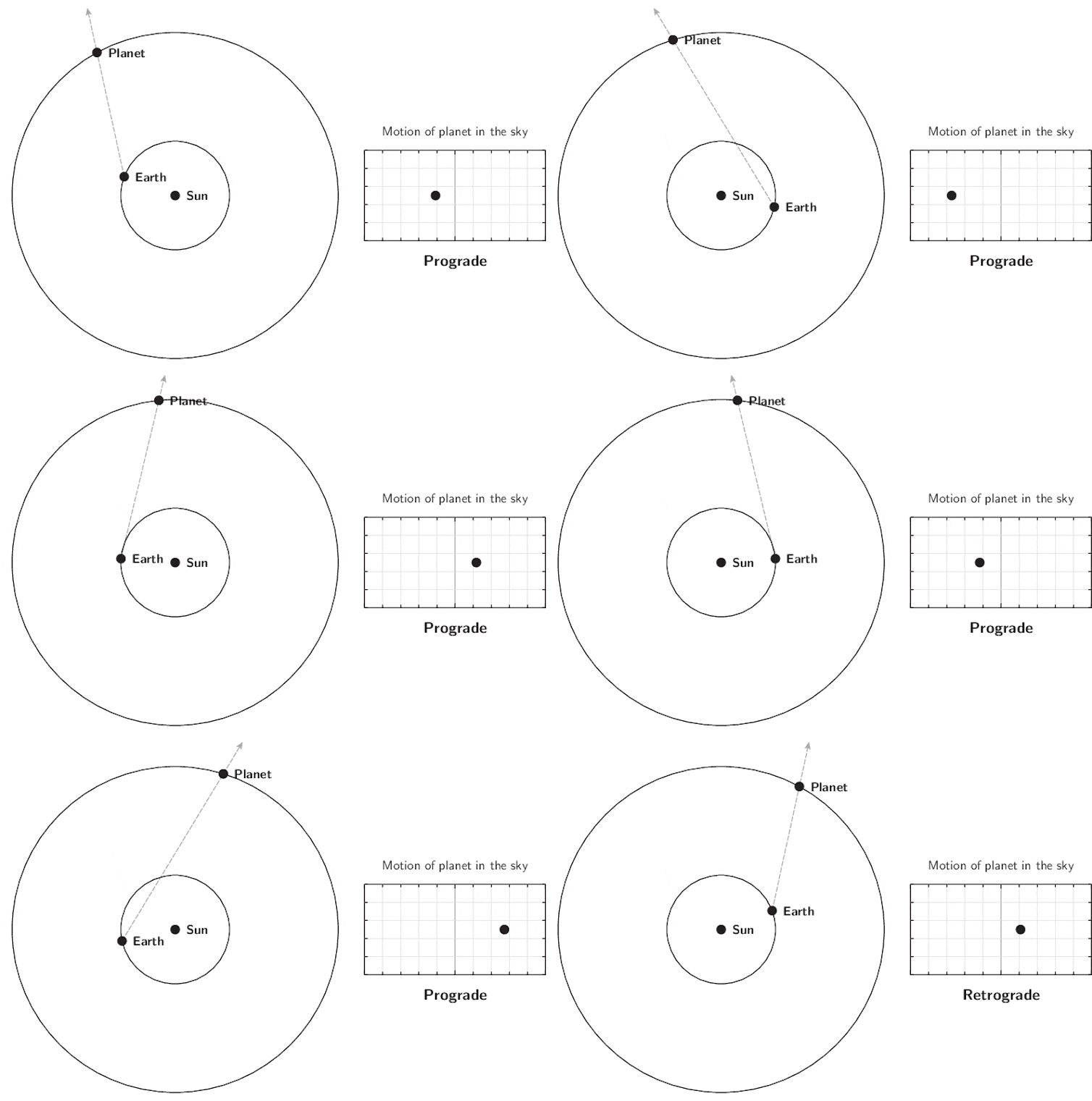
Apparent retrograde motion is where an object in the sky, such as a planet, appears to be going backwards when we look at it from Earth. The object hasn’t actually changed direction; it just looks like it from our perspective.

All the planets (and Chiron) orbit the Sun in the same direction. This means the planets typically look like they are moving in a west-to-east direction across the sky. But when Earth “catches” up to a planet (or a planet catches up to Earth) and overtakes it, the planet temporarily appears to move in a west-to-east direction in the sky.

This temporary illusion is apparent retrograde motion. It’s just like when you’re driving in a car and overtake a slower car, that slower car looks like it’s going backwards as you overtake it.

Black and white animation demonstrating retrograde motion. On the left are two concentric circles with the Sun as a dot in the centre. The Earth orbits the Sun by orbiting on the inner circle. A planet orbits the Sun by orbiting on the outer circle. A lin
Animation demonstrating apparent retrograde motion. We can see the Earth and an outer planet orbiting the Sun in a circular motion on the left. On the right, we can see the direction the planet appears to be moving from Earth’s perspective.
Dominic Ford, CC BY-SA

Chiron went into retrograde (that is, apparent retrograde motion) on July 30 2025 and will go back to normal on January 2 2026. But unless you have a telescope or do some long-exposure photography, you’d never know which way Chiron is travelling. Chiron is very faint, so you can’t see it with your eyes.

Painting of a centaur teaching a boy to play the lyre.
An ancient Roman fresco showing the centaur Chyron teaching Achilles to play the lyre.
National Archaeological Museum of Naples / Muesse / Wikimedia

The ancient astrologers didn’t know about Chiron, but I like to think they’d appreciate a centaur in space with a ring on it.

The Conversation

Laura Nicole Driessen is an ambassador for the Orbit Centre of Imagination at the Rise and Shine Kindergarten, in Sydney’s Inner West.

ref. Move over Mercury – Chiron is in retrograde. What even is Chiron? – https://theconversation.com/move-over-mercury-chiron-is-in-retrograde-what-even-is-chiron-262509

The ANU is moving to kill the Australian National Dictionary – this is why it matters

Source: The Conversation (Au and NZ) – By Howard Manns, Senior Lecturer in Linguistics, Monash University

Bonzer. Dinkum. Troppo. We love our distinctive words and phrases.

We revel in the confusion they cause outsiders. We celebrate the stories behind them. We even make up a few furphies about them.

What many Australians might not know, however, is that for nearly 40 years a dedicated team at the Australian National University (ANU) has been hard at work digging up these past stories — real and furphy — and keeping a close eye on the new ones.

You’d be hard-pressed to find a more committed group of lexical patriots. Most everything you know, want to know, or have heard about Australian words comes from the Australian National Dictionary Centre (ANDC). From media, to academics, to everyday Aussies, we all rely on these quiet patriots — even if we don’t always know it.

But despite this work, and the central (and government-funded) role the ANU is meant to play in Australian history and identity, the ANU leadership is killing off the ANDC. The university has stated that the decision is a necessary part of reducing operating costs.

Dictionaries and our national sense of self

Dictionaries help define and reflect a nation’s identity. When Samuel Johnson published his famed Dictionary of the English Language in 1755, many celebrated that he and a handful of assistants accomplished in nine years what took 40 French academics half a century.

Dictionaries are especially important for colonial Englishes, such as those spoken in many countries, including Australia and the United States. At first, people looked down on these Englishes.

In the US, Noah Webster was derided for his suggestions Americans should assert their linguistic independence from Britain. US periodicals were openly hostile, jeering Webster’s “vulgar perversions” and “illiterate and pernicious” views of language.

However, when Webster’s American Dictionary of the English Language came out in 1828, it established the global importance of this new English. Mark Twain soon wrote,

The King’s English is not the King’s. It is a joint stock company and Americans own most of the shares.

Australia’s colonial English got off to a slow start — dismissed as “the base language of English thieves” and “crude, mis-shapen and careless”. But by the late 19th century, Australians began celebrating their distinct words, in the Bulletin, in books like Sidney Baker’s “The Australian Language”, and in dictionaries such as E.E. Morris’s “Austral Language”.

Still, many called for a truly national dictionary to capture the way Australians speak. Australian lexicographer Peter Davies wrote in 1975:

Vigorous cultures demonstrate pride and interest in their own languages and literatures by building great works in their honour.


Read more:
Get yer hand off it, mate, Australian slang is not dying


Constructing working and living monuments to Aussie English

Finally, in the 1980s, Australians stopped taking their linguistic cues from Britain. With the publication of the Macquarie Dictionary in 1981 and the Australian National Dictionary in 1988, the language found its local voice.

However, these works differ in how they approach Australian English. The Macquarie Dictionary describes the spelling, pronunciation and definitions of English words as they are used in Australia.

The Australian National Dictionary (AND) grounds our words, and their meanings, in their historical and cultural contexts. The AND tells us where words have come from, when they were first used and how their meanings have changed over time. In short, the AND is a living, breathing and evolving record of how language is wrapped up in who we are as Australians.

As linguist Don Laycock once wrote, “there’s no other dictionary quite like this one in the world”. Its pages sing of “boundary riders, larrikins, sundowners, fizgigs, diggers and other dinkum Aussies”. Sidney J. Baker argued if the “Australian language [was] something to be reckoned with it” it was because of these iconic characters.

But the dictionary’s first editor, Bill Ramson, was not as romantic as Baker. Ramson wanted an academic and historical work — he left the romantic side of Australian English to the rest of us.

As an academic work, or more accurately, a monument to Australian English, the AND is unparalleled. Its second edition, released in 2016, contains the history of more than 16,000 words and phrases. Moreover, the second edition did the hard yakka to acknowledge the influence of Indigenous words on our English (words like “yakka”, from the Yagara language).

But the AND is more than an academic resource — its insights inform media, education and everyday life. We (the authors) write and speak widely about Australian English, with hundreds of media appearances each year, and we’ve both authored high school texts exploring its history and use. Howard Manns recently developed an SBS program introducing newcomers to Australian English.

Crucially, the AND’s research doesn’t just support this work — it makes it possible.

‘The most unpatriotic thing ever’?

When the Australian National Dictionary was first published – by Britain’s Oxford University Press – some baulked at foreign involvement. In 1983, Australian publisher Kevin Weldon even called it “the most unpatriotic thing ever”, also objecting to it being edited by a New Zealander (Bill Ramson) and an English woman (Joan Hughes).

History, of course, has vindicated them — and the many others, Australian or not, who helped create this cultural landmark.

But Weldon was not necessarily wrong. In the end, it seems American-style managerialism will be the death of the ANDC. Weldon surely didn’t anticipate that the “most unpatriotic thing ever” — the killing off of the AND — would be an act by Australians at the Australian National University.

In a statement, the ANU told The Conversation: “This decision reflects the need to reduce recurrent operating costs while ensuring that core academic activities are sustainably embedded within Schools and Colleges”.

Cutting the ANDC isn’t just a short-sighted administrative decision to save a few quid. It’s the wilful disregard of Australian cultural heritage and the powerful work its scholars do to help us understand the past, present and future of Australians, our English and our identities.

This dictionary centre is a national asset — once it’s gone, we lose a living record of our national voice.

The Conversation

Howard Manns receives funding from the ARC SR200200350.

Kate Burridge receives funding from the ARC SR200200350.

ref. The ANU is moving to kill the Australian National Dictionary – this is why it matters – https://theconversation.com/the-anu-is-moving-to-kill-the-australian-national-dictionary-this-is-why-it-matters-261844

17 older Australians die from falls every day. Here are 5 things you can do to reduce your risk

Source: The Conversation (Au and NZ) – By Anne Tiedemann, Professor of Physical Activity and Health, Sydney School of Public Health, University of Sydney

ipuwadol/Getty Images

Every day in Australia, more than 400 people aged over 65 are admitted to hospital due to a fall. That’s around one person every four minutes.

Although anyone can experience a fall, they’re a common cause of disability and loss of independence in older age.

Sadly, 17 older people die as a direct result of falls every day in Australia, often due to head trauma or internal bleeding. Many of these people are dying early, not when their “time has come”.

The good news is that many falls are preventable. Here are five key actions you can take to reduce your risk of falls.

1. Do balance challenging exercises

Recent Australian fall prevention guidelines recommend all people aged 65 years and over, and Aboriginal and Torres Strait Islander people aged 50 years and over, should take part in exercise to prevent falls, even if they have never fallen.

In particular, exercise that targets balance and strength is crucial for preventing falls. These are exercises you do while standing, with the feet close together or while standing on one leg (if it’s safe to do so).

These exercises should include controlled movement of the body (such as leaning, reaching and stepping). Examples include heel raises, squats, lunges and stepping in different directions.

To gain the most benefits, fall prevention exercises should be performed at least three times per week.

People who have already had regular falls may benefit from specialised advice from a physiotherapist, exercise physiologist or trained exercise instructor.

2. Have your medications reviewed

Certain medications, such as sleeping tablets, as well as taking multiple medications, can increase your risk of falling.

Older people should discuss and have their medications reviewed each year or after a change in their health, by a GP in collaboration with a pharmacist. Where appropriate, a health-care professional may be able suggest changes which minimise the use of medicines that increase a person’s risk of falling.

3. Maximise the safety of your home

About half of all falls that result in hospital admissions occur in and around the home.

Older people at a higher risk of falls – such as those with significant vision impairment or who have poor mobility – can benefit from a home safety intervention. This would involve:

  • an assessment of their home environment
  • advice about how to safely undertake daily tasks at home and elsewhere, such as safe mobility on stairs and the use of walking aids where needed
  • suggested changes to the home such as installation of grab rails, improved lighting and non-slip mats in the bathroom.

This may be more effective at reducing the risk of falls when provided by an occupational therapist.

Even for older people who have not fallen before, it’s a good idea to reduce clutter, ensure good lighting in the house and remove trip hazards such as electrical cords in walkways.

4. Get your eyes tested regularly

Good vision is essential for maintaining balance, seeing obstacles and moving around safely. Cataracts, a clouding of the lens of the eye, blur your vision and can make you sensitive to light and glare. This common eye condition, associated with age, reduces your ability to spot hazards in the environment.

Research shows having cataracts removed reduces the risk of falls. Fall prevention guidelines recommend a yearly eye check with an optometrist to detect cataracts and other eye conditions.

There’s also evidence wearing bifocal or multifocal glasses can increase the risk of falls by blurring edges close to the feet (such as the edge of a step or gutter). For this reason the Australian fall prevention guidelines recommend active older people use single-lens distance glasses (rather than bifocal, multifocal or progressive lenses) when doing activities outdoors.

It’s also wise for anyone getting a new glasses prescription to be especially careful while they adjust to the new glasses.

5. See a podiatrist if you have painful feet

Healthy and strong feet are important for maintaining good balance and avoiding falls. Research suggests if people with foot problems or painful feet see a podiatrist to have these problems treated, this can reduce their risk of falls.

It’s also important to wear sturdy, well-fitted shoes that have a low, wide heel for greater stability, and a sole with tread to prevent slips.

Don’t wait for a fall to happen before you take action. Every step you take today to reduce your risk of falls is a powerful move toward staying safe and independent.

The Conversation

Anne Tiedemann receives funding from the Australian government National Health and Medical Research Council and the Medical Research Future Fund. Anne Tiedemann has voluntary roles on the Executive Committee of the Australia and New Zealand Falls Prevention Society and of the World Falls Prevention Society and is working with others to establish the Falls Prevention Alliance of Australia.

Cathie Sherrington receives funding from the Australian government National Health and Medical Research Council and the Medical Research Future Fund. Cathie Sherrington has voluntary roles on the Executive Committee of the Australia and New Zealand Falls Prevention Society and is working with others to establish the Falls Prevention Alliance of Australia.

ref. 17 older Australians die from falls every day. Here are 5 things you can do to reduce your risk – https://theconversation.com/17-older-australians-die-from-falls-every-day-here-are-5-things-you-can-do-to-reduce-your-risk-260307

Australia can hit an 85% emissions cut by 2035 – if government and business seize the moment

Source: The Conversation (Au and NZ) – By Anna Malos, Climateworks Centre Country Lead, Australia, Monash University

Ian Waldie/Getty Images

Discussions are hotting up over Australia’s 2035 emission reduction target, which the federal government is due to reveal by September this year. It will be a crucial announcement, for several reasons.

The target signals to the world whether Australia is willing to do its fair share to tackle global warming. The decision will also guide Australia’s pathway to its net-zero goal. And it will be closely watched by Pacific nations urging Australia to step up on climate policy.

The government has been awaiting final advice from the independent Climate Change Authority before announcing its decision. The authority’s draft advice suggested an indicative 65–75% cut to emissions by 2035.

We are confident Australia can achieve this – and go further. Our modelling suggests emissions reduction up to 85% is achievable. A stronger target also makes economic sense, by positioning industry to make the most of Australia’s competitive advantages on the road to a net zero economy.

Building momentum

Under the Paris Agreement, to which Australia is signed up, nations must submit a series of plans outlining proposed emissions reductions.

Australia’s current plan commits to a 43% cut in emissions by 2030, based on 2005 levels. The next plan will identify ambition out to 2035 – and importantly, actions to get there.

A recent ruling by the International Court of Justice found countries are legally obliged to prevent harms caused by climate change. This increases pressure on all governments to set a target in line with scientific evidence on limiting global warming to 1.5°C.

The target is not just about fulfilling Australia’s international obligations. As United Nations climate chief Simon Stiell said last week, an ambitious 2035 target would maintain Australia’s strong economy and high living standards. Doubling down on clean energy, he said, was “an economic no-brainer”.

The road to success

Our analysis shows how far Australia can go. In late 2023, modelling by Monash University’s Climateworks Centre, undertaken with CSIRO, examined potential pathways for Australia to cut emissions in line with the Paris Agreement.

It showed with decisive and increased action across all sectors of the economy, Australia’s emissions could reach 85% below 2005 levels by 2035, while still meeting energy demand.

Our work shows there are opportunities across all sectors. These includes:

  • electrifying buildings and making them more energy efficient
  • significantly higher uptake of electric vehicles
  • faster uptake of electrification and hydrogen in the industrial and resource sectors
  • reducing emissions from agriculture through measures such as adding algae to livestock feed and using different fertilisers
  • expanding tree planting and technologies to capture carbon in soil.
An electric vehicle parked next to a row of chargers
Reaching an ambitious climate target would require significantly higher uptake of electric vehicles.
Darunrat Wongsuvan/Shutterstock

A strong 2035 target is not only sensible and achievable – it will set up the economy is to compete for trillions of dollars in global investment in the net-zero transition.

Some businesses and investors are already developing transition plans to build on government action and tap into opportunities.

There are other positive signs. They include a recently published tool, supported by the federal government, which helps investors determine if their capital supports activities aligned with the goals of the Paris Agreement.

Australia’s states and territories have set the foundation. As of December 2024, their combined emissions reduction targets totalled a 66–71% reduction in national emissions by 2035.

But state goals cannot be met without federal action on emissions reduction. Likewise, the federal government could set a stronger emissions-reduction target, confident in the knowledge state and territory policies were pulling in the same direction.

Getting over the humps

While Australia can feasibly go big on emissions reduction, there are barriers to overcome.

A rapid expansion of renewable energy is vital if Australia is to meet its climate goals. This requires support from communities being asked to host renewable energy infrastructure – so-called “social license”.

Governments are seeking to address this. In Victoria and NSW, for instance, explicit programs aim to increase the benefits communities receive from hosting projects. But there’s more work to do.

Green commodities produced in Australia, such as iron and steel, offer huge economic benefits and can help our global trading partners decarbonise. However, global demand for green products must ramp up to make this a reality.

Governments have an important role in building these new markets. For example, they can strike international trade agreements involving joint transition plans, and cooperate to harmonise green standards.

The federal government has made a good start on this, via policies such as Future Made in Australia and the National Reconstruction Fund. Additional measures are needed to build demand.

Of course, the right policy mix, plus business and investor action, will bring major benefits for everyday Australians.

Renewable energy, for example, is the cheapest form of new power, helping address household energy costs.

And energy-efficient homes are not just more climate-friendly – they are also more comfortable.

A golden opportunity

Australia’s 2035 target is a golden opportunity to show global leadership, and set ourselves up as a renewable energy superpower. A suite of other policies can help bring the goal to fruition.

The federal government will this year release a plan guiding Australia’s transition to net zero emissions by 2050, covering six major parts of the economy.

Other relevant policy reviews over the next few years involve the National Electricity Market, as well as the Safeguard Mechanism which limits pollution from Australia’s major industrial emitters.

And the federal government will this month convene a major economic roundtable. Setting and implementing a 2035 emissions reduction target is crucial to a resilient economy and should underpin economic reforms that flow from the talks.

The challenges for Australia are clear – but so too are the opportunities. With the right plans and policies in place, the federal government can set the economy up for success.

The Conversation

Climateworks Centre is a part of Monash University. It receives funding from a range of external sources including philanthropy, governments and businesses. Businesses such as mining companies and industry associations have previously co-funded Climateworks’ research on industrial decarbonisation, and may benefit from policies mentioned in this article.

Anna Skarbek is on the board of the Net Zero Economy Authority, SEC Victoria, the Centre for New Energy Technologies, the Green Building Council of Australia, and the Asia-Pacific Advisory Board of the Glasgow Financial Alliance on Net Zero. She is CEO of Climateworks Centre which receives funding from philanthropy and project-specific financial support from a range of private and public entities including federal, state and local government and private sector organisations and international and local non-profit organisations. Climateworks Centre works within Monash University’s Sustainable Development Institute.

ref. Australia can hit an 85% emissions cut by 2035 – if government and business seize the moment – https://theconversation.com/australia-can-hit-an-85-emissions-cut-by-2035-if-government-and-business-seize-the-moment-262488

Rewatching Picnic at Hanging Rock at 50: an unsettling portrayal of place, silence and disappearance

Source: The Conversation (Au and NZ) – By Jo Coghlan, Associate Professor, Humanities, Arts and Social Sciences, University of New England

FilmPublicityArchive/United Archives via Getty Images

Peter Weir’s Picnic at Hanging Rock, released 50 years ago, is remembered for its eerie atmosphere and mysterious story. But beneath its haunting beauty, the film challenges the idea of colonial control over the Australian landscape.

The rock becomes a place that refuses to be explained or conquered by European logic.

This tension between the land and colonial power still matters today. The failure of the referendum on the Indigenous Voice to Parliament shows how divided Australia remains over questions of reconciliation and Indigenous sovereignty.

Rewatching Picnic at Hanging Rock in 2025, we can appreciate the film as an unsettling portrayal of place, silence and disappearance.

Unease and ambiguity

Picnic at Hanging Rock tells the story of a group of private schoolgirls and their teachers who visit the nearby Hanging Rock on Valentine’s Day in 1900. During the excursion, three students and one teacher mysteriously disappear.

No clear explanation is ever given, which unsettles both the characters and the audience. The mystery triggers hysteria, scandal and a slow collapse of order at Appleyard College.

As the search for answers continues, the film refuses to provide resolution, deepening its sense of unease and ambiguity.

Based on Joan Lindsay’s 1967 novel, the story captured the public imagination with its haunting beauty and unanswered mystery. Audiences were obsessed with whether it was based on true events (it wasn’t).

The film became a landmark of the Australian New Wave, a 1970s movement that revitalised the national film industry with bold, artistic storytelling and a focus on uniquely Australian themes.

With its poetic visuals, haunting score and colonial setting, the film stood out for its mood rather than action. Audiences were both fascinated and frustrated by its lack of closure, and it gained a cult following, especially among viewers drawn to its gothic atmosphere and slow-burning mystery.

The mystery of the landscape

Ngannelong, also known as Hanging Rock, is a striking volcanic formation north-west of Melbourne. For the Dja Dja Wurrung, Woi Wurrung and Taungurung peoples of the Kulin Nation it is a deeply important cultural and spiritual place.

Lindsay and Weir’s mystery of white schoolgirls who mysteriously vanish sits on top of older, deeper traumas – those of dispossession and the forced removal of Indigenous people from their lands.

While the film appears dreamlike and mystical, Ngannelong’s sacredness challenges this romantic view, reminding us that the land holds its own stories and history.

It does not forget.

Contemporary photo of the landscape from the top of the rock.
Ngannelong, also known as Hanging Rock, is a striking volcanic formation north-west of Melbourne.
FiledIMAGE/Shutterstock

Picnic at Hanging Rock can be seen as a powerful story about colonial fear and uncertainty. The unexplained disappearance of the schoolgirls plays off the idea that European thinking and logic can’t fully understand or master the Australian landscape.

When watched through this lens the story reveals just how fragile colonialism is. The film invites viewers to think differently about Australia’s identity, suggesting the landscape itself remembers the past and actively resists the stories colonisers have tried to tell about it.

Fragile powers

The film contrasts the tidy world of Appleyard College – which stands for colonial order, built on white privilege and Britishness – against the untamed mysterious landscape of Ngannelong.

The girls represent white femininity, meant to bring culture and control. When they vanish, it’s as if the land rejects these colonial ideals.

Their disappearance unravels the school’s order, exposing how fragile colonial power really is. It hints at a deeper crisis beneath the surface.

Russell Boyd’s cinematography is key to the film’s unsettling mood. Shifting light and strange angles create a sense of uncertainty. The bush isn’t just background, it is defiant. This fits with “ecological cinema”, where nature has its own voice.

In Picnic at Hanging Rock, the land often overpowers people. It refuses to be controlled or explained by colonial ideas.

Historical wounds

Picnic at Hanging Rock is part of the Australian Gothic: literature and films which explore dark parts of Australia’s story. Named for European Gothic literature of the 18th and 19th centuries, these 20th century Australian stories often express the anxieties, violences and uncanny dislocations of colonisation and the natural landscape these settlers encountered.

In this Australian Gothic tradition, Picnic at Hanging Rock uses haunting and mystery to explore deep social and historical wounds. These unsettled feelings still shape how Australia sees itself.

Australia’s national identity rests on silences and erasures. Like the missing schoolgirls, the colonial subject is lost – unsure of who belongs and whose history matters.

Picnic at Hanging Rock remains powerful today, especially in light of ongoing discussions about Indigenous sovereignty and reconciliation in Australia. The film’s mystery is never solved, forcing viewers to sit with the discomfort of what’s left unsaid.

The land is not something empty or passive, but alive. It is a force that remembers and resists.

Even 50 years later, the film still unsettles, not just through its eerie beauty, but by challenging colonial ways of thinking and reminding us that sovereignty endures – even if it’s not always visible.

The Conversation

Jo Coghlan does not work for, consult, own shares in or receive funding from any company or organisation that would benefit from this article, and has disclosed no relevant affiliations beyond their academic appointment.

ref. Rewatching Picnic at Hanging Rock at 50: an unsettling portrayal of place, silence and disappearance – https://theconversation.com/rewatching-picnic-at-hanging-rock-at-50-an-unsettling-portrayal-of-place-silence-and-disappearance-260312

Grattan on Friday: Anthony Albanese marches cautiously towards Palestinian recognition

Source: The Conversation (Au and NZ) – By Michelle Grattan, Professorial Fellow, University of Canberra

Treasurer Jim Chalmers has been putting it succinctly, declaring it’s a question of when, not if, Australia recognises Palestine as a state.

It’s a line Foreign Minister Penny Wong used more than a year ago. This week Wong was sounding impatient. “The reason for urgency behind recognition is this. There is a risk there will be no Palestine left to recognise if the world does not act,” she said.

For the government, recognition is as much about domestic politics as foreign policy. Australia has no influence on what’s happening in the Middle East (other than donating aid). But the Australian public is increasingly horrified by the images of the humanitarian crisis.

It’s a reminder of the power of the visual. More than half a century ago, the pictures coming out of Vietnam helped turn the US public against that war.

Right now, however, Australia remains in limbo on its journey towards recognition. The destination might seem clear but the exact arrival date is less so.

Observers are expecting it by the time of the United Nations General Assembly in late September. Anthony Albanese will be there, delivering an address during leaders’ week. The announcement could be made in the run up, or in that week.

France, the United Kingdom and Canada have all flagged recognition, the latter two with varying conditions attached.

Asked in late July about whether Australia would announce recognition at the UN, Albanese said Australia would make a decision “at an appropriate time”.

“We won’t do any decision as a gesture. We will do it as a way forward if the circumstances are met,” he said. He spelled out a couple of these. “How do you exclude Hamas from any involvement there? How do you ensure that a Palestinian state operates in an appropriate way which does not threaten the existence of Israel?”


Read more:
With the UK and France moving toward recognising Palestine, will Australia now follow suit?


On any likely scenario, there will be no positive answers to those questions in the foreseeable future. Nor does there seem, so far, much chance the Netanyahu government in Israel will take much notice of more countries recognising Palestine. The only country, if any, it appears likely to be influenced by is the United States, and President Donald Trump’s future actions are unpredictable.

But, leaving aside the prime minister’s longstanding personal pro-Palestinian views, Albanese has to be seen to be doing something. Pressure has been long mounting in the Labor base and among the party membership for recognition. The Sydney Harbour Bridge march last weekend, attracting at least some 90,000 people (march organisers estimated many more), reemphasised to Albanese that he needs to be in tune with his base on this issue.

An instructive lesson comes from the situation in which NSW Labor Premier Chris Minns finds himself. Minns and the NSW police opposed the march going over the bridge on the grounds it would be too disruptive – they were overridden by a court decision. But ten of Minns’ caucus members marched, including environment minister Penny Sharpe.

In the federal caucus, Ed Husic, now on the backbench, is out in front on Palestine recognition. But whatever impatience there may be in caucus generally about the government’s perceived slowness, it is so far being contained. Still, Albanese won’t want to lag behind his colleagues on what is an electorally sensitive issue for Labor in some seats.

As the government prepares its timing, Albanese has embarked on a diplomatic round. It was not unexpected that he spoke with French President Emmanuel Macron this week. More surprising was his phone call with the Palestine Authority’s President Mahmoud Abbas, who is widely regarded as a discredited figure.

According to the official readout from the Prime Minister’s Office, Albanese “reiterated Australia’s call for the immediate entry of aid to meet needs of people of Gaza, a permanent ceasefire, and the release of all hostages”.

Albanese “also reinforced Australia’s commitment to a two state solution because a just and lasting peace depends upon it”. Abbas thanked the PM “for Australia’s economic and humanitarian support. The leaders discussed deepening cooperation across a range of areas, and agreed to meet on the sidelines of the United Nations General Assembly.”

If Albanese made the point directly to Abbas that the Palestinian Authority needed to reform itself to have a role in a future Palestinian state, it was not recorded in the readout. But Albanese did tell a news conference on Thursday, “We as well want to see commitments from the Palestinian Authority, commitments of their governance reforms, of reforms in education, reforms across a whole range of issues”.

Before that conversation, Albanese had sought a call withe Israeli Prime Minister Benjamin Netanyahu. As of Thursday, the call had not yet come.

Israeli authorities can be quick to respond to what they see as anti-Israel events in Australia. There was a social media post from the Israeli foreign minister after the bridge march, urging Australians to “wake up”.

On Thursday, Albanese was asked whether he would talk with Trump before he made the decision about Palestinian recognition. “We’re a sovereign government and Australia makes decisions on behalf of the Australian people,” he said.

Incidentally, while there has been speculation that Albanese will catch up with Trump when he is in the US in September, there don’t seem any locked-in plans.

It’s hard to get the president’s time in Washington when so many leaders are knocking on the White House door in September. And there is no guarantee the president will be in New York during the leaders’ week at the UN, or have an opportunity for a meeting if he is. When the prime minister will catch up with the president continues to be a work in progress.

The opposition, which has remained steadfastly signed up to Israel, strongly opposes Palestinian recognition, saying this would be a win for Hamas. But at least some Liberals are readjusting their rhetoric to take more account of the humanitarian disaster in Gaza.

If, or when, Labor recognises a Palestinian state, the opposition would condemn the decision. But what would it say about whether a Coalition government would reverse the decision? That might be one for the convenient line, “we’d look at that when we were in office”.

Michelle Grattan does not work for, consult, own shares in or receive funding from any company or organisation that would benefit from this article, and has disclosed no relevant affiliations beyond their academic appointment.

ref. Grattan on Friday: Anthony Albanese marches cautiously towards Palestinian recognition – https://theconversation.com/grattan-on-friday-anthony-albanese-marches-cautiously-towards-palestinian-recognition-262601

Politics with Michelle Grattan: ‘talking about blokes’ issues’ with ex-Olympian and Labor MP Dan Repacholi

Source: The Conversation (Au and NZ) – By Michelle Grattan, Professorial Fellow, University of Canberra

Men’s physical and mental health can be a prickly subject, both for men and those looking to help. With the rise of social media and AI, there are new challenges emerging – especially for younger men.

The re-elected Albanese government appointed the member for Hunter Dan Repacholi as its special envoy for men’s health.

Repacholi is a former five-time Olympic shooter and coal miner, who hasn’t been shy speaking about his own struggles with his weight and mental health. He wants men of all ages not to be afraid of speaking to loved ones or medical professionals about their problems – as he used to be.

So what does being the first special envoy for men’s health mean? Repacholi details his duties simply as:

I get to go and talk to blokes about blokes’ issues, because we have unique challenges that face us as men. And that main challenge is the fact that we don’t like to talk about our issues. We don’t like to go see doctors.

[…] The amazing women in our lives, they are really, really good at going and having those conversations with their GPs, having those conversation with their friends, and genuinely having a good chat about it. We’re not quite there yet. And I get to go around the place, talking to groups of folks, and listening to all the different issues that we’re facing throughout the country.

Repacholi has spoken openly about his use of injectable weight management drugs, after previously being embarrassed to see his doctor about his health.

Since then, not only has he tried to remove the stigma around using such drugs, but he details his fight to make them more widely available on the Pharmaceutical Benefits Scheme (PBS):

I have spoken about trying to get them onto the PBS and the process of getting onto the PBS is very complex. And that’ll be up to the pharmaceutical companies as to whether they do apply for that process. But I’ll continue to talk with them and just see what happens along the way.

While noting some areas of concern, Repacholi says he holds great hope for Australia’s young men.

Every generation has different and unique opportunities, and also things that hold them back […] And always we hear that the older generation says ‘I don’t know where the younger generation’s going’ […] But we have unique challenges now that weren’t around when I was younger [… and] social media plays a big part in that.

[…] But a lot of the younger people today also have a lot better coping mechanisms than what the older people had in earlier generations. Because a lot of them do talk about their issues.

Mental health has been something that has been spoken about a lot now […] Where we’ve come from in a short period of time is great. And it is really good for the younger generations to make sure that they’re getting the help they need, and for them to also understand that it’s okay to not be okay.

On the rise of online influences like Andrew Tate and “toxic masculinity”, Repacholi says:

That certainly is a worry. The right level of masculinity in boys and young men is something that is crucial to this. And those people like Andrew Tate, if you ask me, they’re the bottom feeders of the community with what they do.

[… But] from what I see with young boys, and I’m going to a lot of the schools around the place, I’m definitely seeing a change from when I was at school, which is absolutely fantastic. They’re respectful, they’re polite. You always get some that aren’t, obviously, but you get that in every group, no matter what. But it’s about calling it out.

On representing a coal-mining region during a time of a global transition, Repacholi – a former coal miner himself – says it’s clear to Hunter Valley residents that “coal-fired power stations are coming to their end of life over the next 10 to 15 years”.

He says the Albanese government’s recent creation of a Net Zero Economy Authority was about “making sure that there’s somewhere for the coal-fired power station workers to go” – adding he expects more announcements to come on that “in the near future”.

But Repacholi also says as long as there’s an overseas market for Australia’s “best quality coal in world”, his region will keep supplying it for decades to come.

The simple fact of this is whilst people wanna buy our coal, we will always sell them our coal. Whilst there’s a market there, we will continue delivering to that market […] We have the best quality coal in the world, from the largest coal port in the world as well, out of Newcastle, […] going out to all over Southeast Asia.

The Conversation

Michelle Grattan does not work for, consult, own shares in or receive funding from any company or organisation that would benefit from this article, and has disclosed no relevant affiliations beyond their academic appointment.

ref. Politics with Michelle Grattan: ‘talking about blokes’ issues’ with ex-Olympian and Labor MP Dan Repacholi – https://theconversation.com/politics-with-michelle-grattan-talking-about-blokes-issues-with-ex-olympian-and-labor-mp-dan-repacholi-262789

Changes are brewing in the Indian Ocean. Does this mean Australia should get ready for a soggy spring?

Source: The Conversation (Au and NZ) – By Andrew King, Associate Professor in Climate Science, ARC Centre of Excellence for 21st Century Weather, The University of Melbourne

As spring in Australia nears and the days get longer, you might be wondering what the rest of the year holds for our weather.

There are signs that changes in the Indian Ocean will bring a few wet months to our part of the world. Specifically, the Indian ocean may be entering a negative “dipole” phase.

When this happens, the tropical eastern part of the ocean is warmer than average, and the tropical western part is cooler than average.

These conditions influence moisture levels and affect circulation in the atmosphere, raising the probability of supercharged spring rains across much of Australia.

But the devil’s in the detail – and it’s too early to say all of Australia is definitely in for a drenching.

A wet spring is brewing, but not yet confirmed.
Petar B Photography/Shutterstock

Looking for clues in the ocean

After early autumn heat, Australia has, on average, experienced a warmer-than-normal winter to date.

July was Australia’s second-coldest in a decade. But under climate change, our winters are gradually warming. So the July just gone was considerably warmer than the typical July of the 20th century.

When it comes to rain, this winter has been fairly average so far. Parts of South Australia, Victoria, Tasmania and Western Australia are, however, in drought with some of the lowest multi-year rainfall totals on record.

Recent falls have helped in some drought-stricken areas, but more is needed.

So what do the next few months hold? For clues, we can look to the oceans around Australia.

A nation girt by sea

Australia is surrounded by the Pacific, Indian and Southern oceans. That means our climate is heavily influenced by the seas around us.

Warm or cool conditions on the sea surface often persist for long periods. This affects where weather systems form and move, and where moisture builds in the atmosphere.

In turn, this helps drive changes in rainfall and temperatures on land over months or seasons. So, understanding and predicting these ocean conditions can be useful.

La Niña and El Niño events are the most well-known type of ocean variability to affect Australia.

During a La Niña, the west Pacific Ocean warms, increasing the likelihood of rain-bearing weather systems affecting Australia. In an El Niño, water warms further east in the Pacific and Australia is more likely to be drier.

At the moment, we’re in neither La Niña or El Niño conditions and the Pacific looks set to remain in a neutral state.

The Indian Ocean is a different story, though.

How the Indian Ocean shapes Australia’s weather

The Indian Ocean Dipole – or IOD for short – involves variations in tropical sea surface temperatures.

In negative IOD events, warmer waters build up in the east Indian Ocean, and cooler waters build in the west. In positive IOD events, the opposite occurs.

Negative dipoles typically make the air over much of Australia more moist, and make low pressure over the continent’s southeast more likely. This tends to bring wetter conditions to much of Australia’s southeast in late winter and early spring.

Currently, the Indian Ocean is in a neutral state. However, the Bureau of Meteorology’s outlook points to warmer waters building in the east Indian Ocean and, possibly, a negative IOD forming. This would mean a few wetter months ahead.

Outlooks by international organisations also suggest a negative IOD may become fully fledged.

Indian Ocean Dipole events typically weaken in late spring and lose influence over Australian rainfall by November. But they can last longer.

In 2019, a positive IOD persisted into late spring and contributed to the very dry conditions that led into the Black Summer of 2019–20.

The Indian and Pacific Oceans are, of course, connected. Negative IOD events often accompany La Niña, and the two can reinforce each other to bring big rains to much of Australia.

But without a La Niña on the horizon, however, we can’t say with full confidence that Australia is in for a very wet few months, or that rainy conditions will persist into late spring.

Currently, the Indian Ocean is in a neutral state.
ilhamk42/Shutterstock

A fast-evolving Indian Ocean

Overall, scientists know a lot less about the Indian Ocean Dipole than we do about La Niña and El Niño.

Under climate change, the Indian Ocean is rapidly warming, which is altering the IOD. But there’s more work to do before scientists fully understand this trend.

However, studies suggest if humanity’s high rate of greenhouse gas emissions continues, we’ll see more extreme IOD phases and changes in sea temperature patterns.

Already, reconstructions of the climate over the past millennium, using coral growth records, suggest we are experiencing more positive IOD events than in the past.

Variability in the Indian Ocean is important not only to Australia’s climate, but also to those of south and southeast Asia and east Africa. It’s imperative we build a clearer picture of the Indian Ocean Dipole to support climate adaptation efforts, including in some of the world’s most vulnerable regions.

More research is needed into how the IOD will change if we continue emitting greenhouse gases – or if we succeed in reaching net zero. Scientists also need to know how these changes might intersect with regional climates.

At the moment, our projections are still unclear – and this hampers our ability to adapt.

Andrew King receives funding from the Australian Research Council (Future Fellowship and Centre of Excellence for 21st Century Weather) and the National Environmental Science Program.

ref. Changes are brewing in the Indian Ocean. Does this mean Australia should get ready for a soggy spring? – https://theconversation.com/changes-are-brewing-in-the-indian-ocean-does-this-mean-australia-should-get-ready-for-a-soggy-spring-262690

Banning contactless and credit card surcharges won’t help – open banking reform is what’s needed

Source: The Conversation (Au and NZ) – By Alexandra Andhov, Chair in Law and Technology, University of Auckland, Waipapa Taumata Rau

Jorge Mata

We’ve all been there – absentmindedly tapping a credit or debit card to pay for something at a shop, only to remember moments later there is a 2.99% surcharge.

These surcharges are extra fees added to the total when a shopper opts for credit card and contactless payment rather than swiping and entering a PIN with a debit card.

Typically, they amount to only a dollar or two per transaction, but such sums add up. Collectively, surcharges cost New Zealanders around NZ$150 million a year.

So it was unsurprising the government’s announcement to ban them was met with widespread approval.

Many welcomed it as a cost-saving measure and a return to hassle-free payments. Even the incumbent payment duopoly, Visa and Mastercard, backed the move.

But don’t break out the champagne just yet. The situation is more complex than it appears and, without further reform, the policy risks several unintended consequences, particularly for small businesses.

A short history of surcharges

Surcharges are typically used by businesses to recoup the fees Visa and Mastercard charge to process online and contactless transactions.

These are not a single fee but a bundle of charges across the payments chain, levied by banks. The calculation of these fees is opaque and has long been criticised. Though each fee may seem negligible, the aggregate cost is significant.

Mastercard recently settled a £200 million class-action lawsuit in the United Kingdom after it was alleged that anti-competitive practices in fee setting led to higher retail prices. The settlement, approved by the Competition Appeal Tribunal, covered 44 million consumers.

Similarly, New Zealand’s proposed reform addresses the symptom, not the cause. Consumers may no longer see the 2.99% surcharge, but the cost won’t have vanished – it will merely be hidden.

Unable to pass processing fees directly to card users, businesses will instead embed them in their prices. Whether one pays by cash, conventional or contactless casrd, the bill will still be higher – just less transparently.

As in the UK Mastercard case, inflated merchant fees will be passed on in the form of higher prices, even for those not using cards.

Banning surcharges alone does little to improve transparency. Indeed, it may worsen matters, encouraging more consumers to tap and pay – thereby increasing the volume of costly card transactions.

The role of open banking

The European Union banned card surcharges nearly a decade ago – but in 2018 it also introduced the revised Payment Services Directive (PSD2), updating EU rules put in place in 2007. The second directive opened the door to cheaper, more innovative alternatives.

At the heart of PSD2 is “open banking”, which compels banks to let customers share account data with third-party providers – with the customer’s consent.

Instead of entering card details on a website when shopping online, a consumer selects “pay with your bank”, logs in securely via their banking provider, and authorises the transaction. Funds move directly from the customer’s account to the merchant, bypassing card networks altogether.

In the Netherlands, the iDEAL system connects consumers directly with their banks and charges interchange fees (fees paid for transactions between banks) below 0.2%. As a result, Dutch shoppers don’t need to maintain credit card subscriptions to buy online.

Spain’s Bizum – a collaborative platform developed by local banks – now boasts over 20 million users and processes more than 600 million transactions annually.

Sweden’s Swish shows that even smaller countries can innovate. It offers a free service to private users, while businesses pay only 1–3 kronor (roughly NZ$0.15). This is a fraction of what Visa or Mastercard charges.

Europe’s blueprint for reform

Europe’s success did not happen by chance. PSD2 created a regulatory framework that encouraged innovation and competition. It required banks to open their systems, introduced strong consumer protections, and mandated fee transparency.

Crucially, it did not merely ban surcharges – it enabled alternatives.

New Zealand has begun this journey. The Customer and Product Data Act, which takes full effect in December, lays the foundation for open banking. But much more is needed to implement it effectively and unlock the potential seen in Europe.

The Reserve Bank of Australia recently consulted on payment regulation. It proposed not only abolishing surcharges but also capping interchange fees at 0.3% for credit cards (down from 0.8%) and reducing debit-card fees to just six cents per transaction.

Such reforms directly benefit small businesses and, according to the Reserve Bank’s consultation paper, could save Australians around A$1.2 billion in interchange fees.

Seizing the moment

While the open banking foundation has been laid, the government must encourage further innovation and support the development of local financial technology firms. New Zealand could follow the Australian and European examples in several ways by:

  • mandating full fee disclosure from card networks

  • capping interchange fees

  • introducing strong customer authentication standards to protect data and build trust

  • encouraging the adoption of alternative payments through business education and incentives.

Europe’s approach has proven effective in reducing costs for everyone. Firms in the UK using open banking, for example, spend 8% less annually on payment processing.

More dramatically, when organisations fully replace card payments with direct bank transfers, cost reductions can be substantial. The UK government estimates savings of 70–80% for public sector organisations switching from debit cards to open banking payments.

Imagine a New Zealand where banks and financial technology firms build a real-time payments network that costs a fraction of existing systems. Such a move could reshape the payments landscape.

Alternatively, the sector can wait and watch as customer-focused firms offer better solutions, while those clinging to opaque fees and outdated models risk being sidelined.

The Conversation

Jodi Gardner is a board member of the Banking Ombudsman Service (BOS). This article is written in her academic capacity and does not reflect the views of BOS.

Alexandra Andhov does not work for, consult, own shares in or receive funding from any company or organisation that would benefit from this article, and has disclosed no relevant affiliations beyond their academic appointment.

ref. Banning contactless and credit card surcharges won’t help – open banking reform is what’s needed – https://theconversation.com/banning-contactless-and-credit-card-surcharges-wont-help-open-banking-reform-is-whats-needed-262425

How do scientists estimate crowd sizes at public events – and why are they often disputed?

Source: The Conversation (Au and NZ) – By Milad Haghani, Associate Professor and Principal Fellow in Urban Risk and Resilience, The University of Melbourne

Last Sunday, tens of thousands marched across the Sydney Harbour Bridge in support of Gaza. But exactly how many people were there depends on whom you ask.

Police put it at about 90,000. Organisers claimed up to 300,000. Other reports and expert estimates landed somewhere in-between.

Why are these accounts so different and how hard is it, really, to estimate the size of a crowd?

Why people care about crowd sizes

It’s far from the first time crowd numbers have been a flashpoint.

The most infamous modern example is US President Donald Trump’s 2017 inauguration, where aerial photos and transit data clashed with claims from the White House officials and Trump himself, sparking controversy.

In New Zealand last year, the Hīkoi march to parliament triggered a similar debate as vastly different estimates circulated.

Crowd size matters for several reasons – from symbolic significance to safety implications.

It can convey the level of support for a social or political cause, signal the scale and significance of a spiritual gathering or a street party. Regimes and revolutions can use crowd sizes as a propaganda tool.

That’s why there are often strong incentives to inflate – or deflate – the numbers.

But crowd estimates are also important for safety reasons. Underestimating can leave infrastructure and logistics unprepared, sometimes leading to catastrophic crowd crushes. Overestimating can result in unnecessary restrictions, closures, or even cancellations.

How are crowd sizes estimated?

There’s no single way to count crowds. Experts choose from a toolbox of methods, each suited to different settings and each with its own blind spots.

Manual visual estimation

The oldest method is also the simplest: estimate the density (people per square metre) in a few sample patches of the crowd (often inferred from aerial images), then multiply by the total area occupied. In theory, straightforward; in practice, riddled with problems.

Human observers (even experienced ones) struggle to distinguish between, say, two, three, or four people per square metre. Crowd density is rarely a round number, but as human observers we often tend to infer whole density numbers from the scene.

Plus, crowd density is rarely uniform: people bunch near focal points and leave gaps elsewhere. So, extrapolating from a sample can lead to very misleading estimates.

Errors also creep in from misjudging the physical size of the sampled area or overlooking how much of the total space is actually usable. These misjudgements can lead to completely different counts.

Computer vision

CCTV, aerial photos and drone imagery allow automated counting using image processing techniques. These range from texture-based methods that work best for low- to medium-density crowds, to object detection models that locate individual heads or bodies.

These can be quite accurate in open spaces with clear sight lines. But shadows, poor lighting, poor weather conditions, obstacles and occlusion in dense gatherings can compromise their accuracy.

Wireless sensing

Crowd sizes can also be inferred using unique wifi or Bluetooth signals from smartphones, or mobile tower activity (how many phones were making calls, texts and using data in an area). These methods work well for large, dispersed, or moving crowds, and can be particularly useful where aerial imagery is impractical.

But they depend on people carrying devices, having them switched on, and having location functions enabled.

Artificial intelligence (AI) and deep learning

Modern crowd counting systems often use AI, especially a type called convolutional neural networks. These systems create “density maps” from images, showing where people are and how tightly packed they are.

They can also correct for perspective – for example, recognising that people farther from the camera look smaller – and adjust for changes in density across the scene. These AI models need training on the right kind of data.

None of the methods are foolproof

The most accurate systems combine methods – for example, by calibrating wifi data with computer vision at critical points. This can significantly reduce error, compared to wifi alone.

But several factors further complicate things.

Setting can change everything. Open spaces are easier to measure than narrow streets. Static crowds are simpler than moving marches. Dense, uniform gatherings are easier to estimate than patchy ones.

Timing plays a big role. Numbers change as people arrive, leave, or move between spaces. Two counts of the same event just half an hour apart can diverge significantly.

Technical limits like shadows, poor lighting, perspective distortion, bad weather conditions, many people holding large banners, flags or umbrellas can skew counts.

Psychological bias can affect human observers. We naturally tend to focus on the most animated and tightly packed parts of a crowd. This “crowd emotion amplification effect” makes the gathering feel larger and more charged than it really is. People tend to overestimate the size or emotional intensity of the crowd, especially when they are part of it.

The bottom line on crowd sizes

There’s rarely a single, correct crowd size estimate; at best, we should expect a range.

Discrepancies are not necessarily a sign of bad faith. They often reflect the limits of the data and the methods used. The most reliable counts come from matching the method to the event’s setting and being transparent about how the figure was reached.

In the end, crowd size estimation is part science, part art. Knowing its limits should help us treat estimates with healthy scepticism and recognise that differences in reporting are not necessarily a sign of dishonesty.

Next time you’re in a stadium, try guessing the attendance before the official number flashes up on the scoreboard. Chances are, your estimate will be off. That gap is a reminder that crowd size controversies are as much about human perception as they are about motives.

And if you’re a regular, try doing it every time; over time, your guesses will likely get more accurate. That’s what “training a model” looks like – in this case, the model being your own brain.

The Conversation

Ruggiero Lovreglio receives funding from Royal Society Te Apārangi (NZ) and National Institute of Standards and Technology (USA).

Milad Haghani does not work for, consult, own shares in or receive funding from any company or organisation that would benefit from this article, and has disclosed no relevant affiliations beyond their academic appointment.

ref. How do scientists estimate crowd sizes at public events – and why are they often disputed? – https://theconversation.com/how-do-scientists-estimate-crowd-sizes-at-public-events-and-why-are-they-often-disputed-262695

Can I eat instant noodles every day? What does it do to my health?

Source: The Conversation (Au and NZ) – By Lauren Ball, Professor of Community Health and Wellbeing, The University of Queensland

Photo by Rahul Pandit/Pexels

Instant noodles are cheap, quick and comforting – often a go-to snack or meal for students, busy workers, families and anyone trying to stretch their grocery budget.

In Australia, the instant noodle market continues to grow, as food costs rise and the popularity of Asian cuisines soars.

But what happens if they become an everyday meal? Can you survive, and thrive, on a daily diet of instant noodles?

Let’s explore what’s in an average pack, what that means for our health, and how to make noodles part of a more balanced meal.

Affordable, versatile, and culturally important

Instant noodles are incredibly accessible. A single serving is very cheap, can take just a few minutes to prepare and fill you up. They’re easy to store, have a long shelf life, and are available in almost every supermarket or corner shop.

Noodles also carry cultural significance.

For many international students and migrants, they’re a familiar taste in an unfamiliar place. A packet of Maggi mi goreng, a bowl of Shin Ramyun, or a serving of Indomie can instantly transport someone back to a childhood kitchen, a bustling night market, or a late-night supper with friends.

These dishes aren’t just quick meals – they hold memory, identity, and belonging. In a new environment, they offer both a full belly and a sense of home.

But what’s actually in a typical pack?

While instant noodles offer comfort and familiarity, their nutritional profile has room for improvement.

A standard packet of instant noodles is made from wheat flour noodles and a packet of flavour enhancers. Some fancier versions also include dried vegetables or crispy fried garlic.

On average, though, most packets are very high in salt: a typical serving can contain 6001,500mg of sodium, which is close to or even above your recommended daily intake (the World Health Organization recommends less than 2,000mg sodium/day).

Over time, high sodium intake can strain the heart and kidneys.

Because they’re usually made from refined wheat (not wholegrains), instant noodles typically do not contain much fibre. Dietary fibre is important to help keep your digestion regular and support a healthy gut.

Instant noodles are also low in protein. You will feel full right after eating instant noodles because of the refined carbohydrates, but without added eggs, tofu or meat as a source of protein, that fullness will be short-lived. You will be hungry again soon after.

They are also low in nutrients such as vitamins and minerals. These matter because they help your body function properly and stay healthy.

Instant noodles sit on a shelf at a shop.
Instant noodles are cheap, easy and accessible.
Photo by Gera Cejas/Pexels

What are the health risks of daily instant noodles?

Occasional instant noodles won’t harm you. But if they become your main source of nutrition, research suggests some potential longer-term concerns.

A study of South Korean adults found that frequent instant noodle consumption (more than twice a week) was associated with a higher risk of metabolic syndrome, especially among women. Metabolic syndrome is a group of conditions that together raise your risk of heart disease, diabetes and other health issues.

While this study doesn’t prove that instant noodles directly cause health concerns, it suggests that what we eat regularly can affect our health over time.

High sodium intake is linked to increased risk of high blood pressure, heart disease and stroke. Noodles have been linked to higher rates of metabolic syndrome, likely because of the sodium content. Most Australians already exceed recommended sodium limits, with processed foods as the main contributor.

Low fibre diets are also associated with poor gut health, constipation, and higher risk of type 2 diabetes and bowel cancer.

A lack of variety in meals can mean missing out on important nutrients found in vegetables, legumes, fruits and wholegrains.

These nutrients help protect your health in the long term.

How to make instant noodles healthier (and still tasty)

If noodles are on high rotation in your kitchen, there’s no need to toss them out completely.

Instead, you can upgrade your bowl with a few easy additions, by:

  • adding vegetables (toss in a handful of frozen peas, spinach, broccoli, carrots or whatever’s on hand to bump up your fibre, vitamins and texture)

  • including protein (add a boiled or fried egg, tofu cubes, edamame beans, shredded chicken or tinned beans to help you stay full longer and support muscle and immune health)

  • cutting back on the flavour sachet (these are often the main source of salt, so try using half or less of the sachet or mixing in low-sodium stock, garlic, ginger, herbs or chilli instead)

  • trying wholegrain or air-dried noodles (some brands now offer higher-fibre options made with buckwheat, brown rice or millet, so check the ingredients on the back of the packet to see the main source of grain).

People add eggs and garnishes to a bowl of noodles
There are lots of ways to improve the nutritional profile of your noodle bowl.
Photo by Katerina Holmes/Pexels

So, should we ditch the noodles?

Not at all.

Like most foods, instant noodles can fit into a healthy diet, just not as the main event every day.

Think of your body like a car. Instant noodles are like fuel which can give you enough to get you moving, but not enough to keep the engine running smoothly over time.

Noodles definitely have a place in busy lives and diverse kitchens.

With a few pantry staples and simple tweaks, you can keep the comfort and convenience, while also adding a whole lot more nourishment.

The Conversation

Lauren Ball receives funding from the National Health and Medical Research Council, Health and Wellbeing Queensland, Heart Foundation and Mater Misericordia, Springfield City Group. She is a Director of Dietitians Australia, a Director of the Darling Downs and West Moreton Primary Health Network, a Director of Food Standards Australia and New Zealand and an Associate Member of the Australian Academy of Health and Medical Sciences.

Emily Burch does not work for, consult, own shares in or receive funding from any company or organisation that would benefit from this article, and has disclosed no relevant affiliations beyond their academic appointment.

Pui Ting Wong (Pearl) receives funding from the Australian government and the University of Queensland. She is a member of Dietitians Australia, serves as the Student Representatives Coordinator for the Dietitians Australia Queensland Branch Leadership Committee, and is also a member of Queensland Health’s Nutrition Education Materials Online Mental Health Group.

ref. Can I eat instant noodles every day? What does it do to my health? – https://theconversation.com/can-i-eat-instant-noodles-every-day-what-does-it-do-to-my-health-262507

I entered an exhibition about North Terrace on North Terrace, and saw the precinct anew

Source: The Conversation (Au and NZ) – By Sasha Grbich, Undertaking a PhD in Art History, Flinders University

North Terrace: worlds in relief, installation view, Samstag Museum of Art, 2025. Photography by Sia Duff courtesy Samstag Museum of Art

North Terrace: worlds in relief, currently showing at the Samstag Museum of Art, offers visitors the chance to travel to different worlds while walking down the same street.

Curator Jasmin Stephens brings together contemporary artists from South Australia, New South Wales and Singapore who respond to the North Terrace cultural precinct in conversation with the work of Narungga poet and researcher Natalie Harkin.

The artists offer visitors to the exhibition the chance to see this precinct of colonial civic, cultural and military buildings from different perspectives, some in stark relief to the cultural story of imperial progress for which it was originally constructed.

‘World’-travelling

Being open to the experience of another can lead to a shared culture of appreciating difference. Philosopher and activist Maria Lugones developed the term “world”-travelling to describe the importance of stepping beyond one’s own cultural and social view.

Lugones also understood the difficulty of visiting a new place. She suggests those undertaking “world”-travelling go with loving intentions, an openness to surprise and a willingness to change.

The spirit of Lugones’ respectful exchange is evident in the approaches taken by the artists who offer the opportunity to experience the cultural precinct anew via listening, thinking with plants and animals, and by sitting with difficult truths.

To experience North Terrace with Natalie Harkin’s poem Cultural Precinct (2014) is to come to know this place as a Kaurna campsite.

Among other insights, her writing makes visible the violence against Aboriginal people that happened at the Armory (in its cells, morgue and gallows) and brings to light the South Australian Museum’s role as a keeper of racialised hierarchies and human remains.

Harkin’s poem holds a central position within the exhibition where it is reproduced in full.

A poem on a gallery wall.
North Terrace: worlds in relief, installation view Samstag Museum of Art, 2025.
Photography by Sia Duff courtesy Samstag Museum of Art

The strangely familiar

Entering the Samstag’s upper galleries I wander through the strangely familiar colonnades of gated@remunerated#obliterated by the ArtHitects (artist Gary Carsley, architect Renjie Teoh).

Their monumental street art style paste-up remixes the North Terrace environs. The result is disorienting. I am not sure if I am travelling into a more cosmopolitan future or have stumbled into a mistranslation of the present – of the kind AI might pull together.

A small red state
North Terrace: worlds in relief, installation view, Samstag Museum of Art, 2025.
Photography by Sia Duff courtesy Samstag Museum of Art

Pieces of Teoh’s !MingMing! plywood furniture are casually placed beside the print offering the chance to linger within this disquieting world.

An opening in the ArtHitects’ façade leads to Allison Chhorn’s Dissolve the Walls, where video follows North Terrace building surfaces.

A video projection of rocks.
North Terrace: worlds in relief, installation view, Samstag Museum of Art, 2025.
Photography by Sia Duff courtesy Samstag Museum of Art

Filmed close to the stones, the tactile images dissolve into a colour that is like the red inside a closed eyelid. Time ebbs and flows in the accompanying dreamlike soundscape where passing cars mix with echoes of what seem to be past or future lives.

Listening is offered as an immersive way to reshape understandings of this complex place.

Order and chance

For her series of works, Louise Haselton heads to the exclusively male zone of The Adelaide Club. Starting outside, she looks down at the feet of the few statues of women in the vicinity of North Terrace.

Her drawings, made using rubbings of the statutes’ toes, amplify their presence as well as their tentative gestures.

Three rubbings of statues' feet.
North Terrace: worlds in relief, installation view, Samstag Museum of Art, 2025.
Photography by Sia Duff courtesy Samstag Museum of Art

Turning her attention to the menu from a lavish 1913 dinner, Haselton arranges cast-bronze asparagus spears as if a recalcitrant child had pushed them around a plate into the shape of a house.

Historically the food of kings (and quite phallic), asparagus proves the perfect vegetable for pointing out the arrogance of men shaping culture while devouring a luxurious meal.

Andrew Burrell takes us on Miner’s Journey, where we travel with Miner (a bird) and their friends Pelican, Wind and River through an open work which includes a video and anarchic online collection

A bird on a screen.
North Terrace: worlds in relief, installation view, Samstag Museum of Art, 2025.
Photography by Sia Duff courtesy Samstag Museum of Art

Burrell employs a wild form of storytelling fuelled by chance (the magic of tarot cards) and prompted by a noisy miner bird looking for a lost perch. Humans take a back seat to stones, plants and environmental forces. The work offers an alternative to the more ordered archives that can be found along the cultural precinct.

After time spent immersed in the thoughtful travel of the exhibition, I step out of the gallery and directly onto North Terrace. This project affirms the power of art to unsettle dominant histories from within the very cultural precinct in question.

North Terrace: worlds in relief is at the Samstag Museum, Adelaide, until September 26.

The Conversation

Sasha Grbich has received funding from CreateSA for arts projects unrelated to this review.

ref. I entered an exhibition about North Terrace on North Terrace, and saw the precinct anew – https://theconversation.com/i-entered-an-exhibition-about-north-terrace-on-north-terrace-and-saw-the-precinct-anew-262439

‘Slutty little glasses’: men’s eyewear fashion is the history of seeing – and being seen

Source: The Conversation (Au and NZ) – By Lorinda Cramer, Lecturer, Cultural Heritage and Museum Studies, Deakin University

If you’ve been on the internet lately, chances are you’ve heard an intriguing – and perhaps even startling – descriptor applied to men’s eyewear: “slutty little glasses”.

Coined by online creator and culture critic Blakely Thornton, the term was earlier used to describe the fashionable wire-framed specs sported by actor Jonathan Bailey’s character in the film Jurassic World Rebirth. Lately it’s been applied to a broader range of men’s glasses.

From nerds and nice guys to being the talk of the town, men’s spectacles are having a moment.

But men have worn glasses for both function and fashion for hundreds of years. Whether one lens or two, perched precariously on the nose, balanced on the ears or held in front of the eyes by a handle, eyewear has long been designed not just for seeing but also to be seen.

Eyewear for function

The earliest spectacles may have dated to the late 1200s, though their inventor remains unknown. An early 14th century sermon by a Dominican friar mentions how:

It is not yet twenty years since there was found the art of making eyeglasses which make for good vision, one of the best arts and most necessary that the world has.

Magnifying lenses continue to rank among the top inventions of all time.

Early eyewear aimed to provide sharper clarity to those who pored over texts and manuscripts as scholars of science and religion.

Sharper vision also aided artisans in a time before machine manufacturing. Learning and productivity boomed as people’s working lives were extended, thanks to this groundbreaking invention.

Eyewear and fashion

Eyewear soon moved through a cavalcade of changing forms.

Pince-nez experienced a surge in popularity in the 19th century. They were distinguished by their “pincer” that fastened them to the bridge of the nose.

a man wears little glasses on his nose
There’s nothing new about men’s eyewear as fashion, as this portrait of a 19th century man in Victoria shows.
State Library of Victoria

Lorgnettes, spectacles mounted on a handle, were carried by dandies – exquisitely dressed men of the late 18th and early 19th centuries.

Opera glasses rose as a fashionable and practical accessory at a similar time. They helped with long distance vision, helping patrons see performers on the stage.

The monocle, a single lens tucked under the eyebrow, became a symbol of class and power in the 19th century. The monocle also flourished as a favourite lesbian fashion adornment in 1920s Paris, the decade in which the Le Monocle nightclub opened on the Left Bank.

And perhaps most fashionable of all, sunglasses were also adopted as accessories from the 1920s onwards by celebrities and style icons.

Men’s eyewear has had big and bold public moments. Legendary musician Sir Elton John’s wacky and wonderful collection – of hearts, stars and coloured lenses – reportedly numbers 250,000.

One of Australia’s best-known wearers of flamboyant frames was Barry Humphries’ Dame Edna Everage character, who was instantly recognisable for extravagant diamanté-studded butterfly glasses.

Other public figures – Buddy Holly, John Lennon, Tupac Shakur, and many more – have driven big moments in men’s eyewear fashion history. Even fourth century priest and translator, Saint Jerome, has been painted (centuries after his death) sporting glasses that could pass as fashionable today.

Wisdom, power and vanity

In their innovation, expense and materials, spectacles became a symbol of status. The powerful Medici family were known to be myopic (short-sighted) and wore the best glasses made in 15th century Florence.

But as glasses could also draw attention to a vision impairment, some men were reluctant to wear them in public. Despite French author Victor Hugo’s poor eyesight, he preferred not to wear glasses when possible. Hugo removed them when sitting for portraits.

Glasses have also long been used as a form of disguise. The female version of the glasses-as-disguise trope is littered across film and television. A character’s beauty – rather than her power – is revealed when she removes her glasses. Think Anne Hathaway’s character Mia in The Princess Diaries, or Tara Morice in Baz Luhrmann’s hit Strictly Ballroom.

The mild-mannered journalist Clark Kent wore glasses as part of his disguise. His superhero alter ego Superman had no need for them (and the internet has also applied the “slutty little glasses” treatment to the most recent Superman film).

Glasses have represented wisdom, intelligence and learning from their early uses by scholars. This perhaps explains why glasses have been framed as nerdy for so long.

But what makes them ‘slutty’?

Wire-framed glasses on men might still be coded as nerdy, but there’s no denying “slutty little glasses” are having a fashion moment – and in doing so, may be challenging contemporary masculine ideals.

Not all who wear them will look like Jonathan Bailey or Superman star David Corenswet. But “slutty little glasses” unsettle the idea that men in specs are weak or unattractive. Instead they suggest something different.

They’re “slutty” because they make men look thoughtful and intelligent, with their attraction being brain over, or as well as, brawn. As culture writer Meg Walters puts it:

It gestures toward the female gaze and indeed the queer gaze. “Slutty little glasses” speak to the girls and gays because they present us with a different type of male hero, one who subverts the traditional tropes of masculinity by finding strength in his intellect and his openness rather than just his machismo.

The Conversation

Lorinda Cramer has received funding from the Australian Research Council.

ref. ‘Slutty little glasses’: men’s eyewear fashion is the history of seeing – and being seen – https://theconversation.com/slutty-little-glasses-mens-eyewear-fashion-is-the-history-of-seeing-and-being-seen-262518

ER Report: A Roundup of Significant Articles on EveningReport.nz for August 7, 2025

ER Report: Here is a summary of significant articles published on EveningReport.nz on August 7, 2025.

Greenpeace condemns NZ’s ‘dodgy reforms’ plan weakening ocean protection
By Emma Page Greenpeace says moves to weaken ocean protection through dodgy fisheries “reforms” will be met with strong opposition, as Oceans and Fisheries Minister Shane Jones announces he wants to proceed with a raft of proposed changes to fisheries laws. The controversial changes are some of the largest in decades, and would restrict public

NZ announces support package, new High Commission building in PNG
By Russell Palmer, RNZ News political reporter The prime minister has announced a new High Commission building in Papua New Guinea and an economic support package, as his trip to the country concludes on Wednesday. Christopher Luxon arrived on Monday for the 50th anniversary of diplomatic ties, and flew out of Port Moresby yesterday afternoon.

Climate-fuelled El Niño events are devastating butterflies, beetles and other tropical insects
Source: The Conversation (Au and NZ) – By Nigel Stork, Emeritus Professor in the Centre for Planetary Health and Food Security, Griffith University Insects are arguably the most important animals on the planet. Their variety is unparalleled in nature, and they carry out vital tasks such as pollinating plants and providing food for other animals.

Is Israel committing genocide in Gaza? We asked 5 legal and genocide experts how to interpret the violence
Source: The Conversation (Au and NZ) – By Melanie O’Brien, Associate Professor in International Law, The University of Western Australia In January 2024, the International Court of Justice (ICJ) issued a provisional ruling in a case brought by South Africa against Israel, alleging genocide in Gaza. The court found Palestinians have a “plausible” right to

Why alcohol policies miss those at the highest risk from drinking
Source: The Conversation (Au and NZ) – By Amy Pennay, Senior Research Fellow and Deputy Director, Centre for Alcohol Policy Research, La Trobe University Elina Sazonova/Pexels People living in the most advantaged areas of Australia tend to drink more alcohol. But people who live in the least advantaged areas suffer the most alcohol-related harms, such

Butterflies, beetles and other tropical insects are being devastated by climate-fuelled El Niño events
Source: The Conversation (Au and NZ) – By Nigel Stork, Emeritus Professor in the Centre for Planetary Health and Food Security, Griffith University Insects are arguably the most important animals on the planet. Their variety is unparalleled in nature, and they carry out vital tasks such as pollinating plants and providing food for other animals.

Body rolls and headbanging: we found cockatoos have 30 different dance moves
Source: The Conversation (Au and NZ) – By Raf Freire, Senior Lecturer in Animal Behaviour and Welfare, Charles Sturt University Sergei Ginak/Getty Companion cockatoos are renowned for their problem-solving and intriguing characters. It’s no surprise these large, long-lived and intelligent parrots are known to display complex behaviour. Owners often film their birds dancing to music

Big changes to NCEA and polytechs must deliver the skills NZ urgently needs
Source: The Conversation (Au and NZ) – By Lisa Maurice-Takerei, Senior Lecturer in Education, Auckland University of Technology Getty Images This week’s major overhaul of the NCEA qualification system isn’t just about measuring academic achievement at secondary school. The government’s plans also include “working with industry to develop better vocational pathways” into the workforce. The

Australia has ministers for seniors and youth. So why not a minister for children?
Source: The Conversation (Au and NZ) – By Kate Fitz-Gibbon, Professor (Practice), Faculty of Business and Economics, Monash University Natalia Lebedinskaia/ Getty Images Child safety and wellbeing is never far from the headlines, and no more so than recently, with shocking allegations of child sexual abuse in childcare centres. These revelations have sparked much-needed national

Tiny homes could help ease the housing crisis, but councils are dragging their feet
Source: The Conversation (Au and NZ) – By Heather Shearer, Lecturer in GIS and Planning, Griffith University Australia’s housing affordability crisis shows no sign of easing. An average home price now exceeds A$1 million and a recent report found only a handful of rental properties nationwide are affordable for someone on government benefits. Vulnerable people

These jobs will thrive – but others may vanish – as AI transforms Australia’s workforce
Source: The Conversation (Au and NZ) – By Janine Dixon, Director, Centre of Policy Studies, Victoria University The Commonwealth Bank of Australia made headlines when it announced last week it would cut 45 call centre jobs, thanks to the introduction of an AI chatbot. This only added fuel to ongoing speculation – and some alarmism

Still throwing shrimp on the barbie: why is Tourism Australia’s advertising stuck in 1984?
Source: The Conversation (Au and NZ) – By Anita Manfreda, Senior Lecturer in Tourism, Torrens University Australia Tourism Australia Tourism Australia has just launched its latest global A$130m campaign, “Come and Say G’day”. It’s a sequel to the 2022 ad featuring brand ambassador Ruby the Roo. The ad is a feast of sweeping drone shots,

This stone tool is over 1 million years old. How did its maker get to Sulawesi without a boat?
Source: The Conversation (Au and NZ) – By Adam Brumm, Professor of Archaeology, Griffith University A stone tool from 1.04 million year ago. M.W. Moore/University of New England Stone tools dating to at least 1.04 million years ago have been found on the Indonesian island of Sulawesi. This means early hominins made a major sea

Embattled ASX set to face beefed-up competition, in bid to boost investment
Source: The Conversation (Au and NZ) – By Michelle Grattan, Professorial Fellow, University of Canberra The Australian Securities and Investments Commission is set to boost the competition faced by the much-criticised ASX in an effort to clear roadblocks for investors and attract more foreign capital to Australia. ASIC, which regulates companies and financial services, announced

As Trump lifts sanctions on Myanmar elites, is he eyeing the country’s rare earth reserves?
Source: The Conversation (Au and NZ) – By Adam Simpson, Senior Lecturer, International Studies, University of South Australia The military junta that overthrew Myanmar’s democratically elected government in 2021 is preparing the ground for national elections in December and January. The junta’s hope is these deeply flawed elections would consolidate its power and provide it

Can music be good company? Research shows it makes our imagination more social
Source: The Conversation (Au and NZ) – By Steffen A. Herff, Leader of the Sydney Music, Mind, & Body Lab, University of Sydney Urbazon / Getty Images Earlier this year, we asked a group of older adults what music they listened to when feeling lonely, and why. We discovered music was a powerful coping mechanism

How many of Australia’s 2.2 million property investors would lose out under a new plan to curb negative gearing?
Source: The Conversation (Au and NZ) – By Martin Duck, Post-Doctoral Research Associate, University of Sydney The Australian Council of Trade Unions is pushing to limit negative gearing and capital gains tax discounts to just one investment property. So who stands to win or lose the most if it happens? And is the Albanese government

ER Report: A Roundup of Significant Articles on EveningReport.nz for August 6, 2025
ER Report: Here is a summary of significant articles published on EveningReport.nz on August 6, 2025.

Greenpeace condemns NZ’s ‘dodgy reforms’ plan weakening ocean protection

By Emma Page

Greenpeace says moves to weaken ocean protection through dodgy fisheries “reforms” will be met with strong opposition, as Oceans and Fisheries Minister Shane Jones announces he wants to proceed with a raft of proposed changes to fisheries laws.

The controversial changes are some of the largest in decades, and would restrict public access to cameras on boats footage, remove the requirement for fishers to land all their catch, and stop legal challenges to catch limits that have been successful in protecting species in recent years.

The reforms will also give the minister the ability to set catch limits for five years.

Greenpeace oceans campaigner Ellie Hooper said these proposals would give the industry carte blanche on ocean destruction, weaken transparency and block the public from having input into fisheries decisions.

“These changes spell disaster for the already struggling ocean around us,” she said.

“Championed by the Minister for Oceans and Fisheries, the changes green light ocean destruction and remove the already minimal checks and balances designed to keep the fishing industry accountable.

“It is yet another example of how this government is pandering to the fishing industry while ignoring the overwhelming majority of New Zealanders who want more ocean protection, not less.

“New Zealanders want a healthy, thriving ocean where fish are plentiful and ecosystems are thriving.

‘More destruction’
“These reforms will mean more destruction, more decline in fish populations, and will allow the industry to go back to operating in the dark — hiding the impact they have.”

One of the proposed reforms is to restrict access to footage from cameras on boats to industry and government only.

“This is not how it should work,” said Hooper.

“There are far more people in this country than just the commercial fishing industry who have a right to know how the ocean is being impacted, and have a say on what happens about protecting it.”

Hooper also warns that setting catch limits for five years could spell disaster for fish numbers, noting the recent collapse of the Chatham Rise Orange Roughy fishery, which has been so mismanaged it could now be at 8 percent of its original size.

“Greenpeace, backed by thousands of New Zealanders, stands for defending nature and ocean health. We are calling for an urgent end to destructive bottom trawling on seamounts and other vulnerable features, and for all footage from cameras on boats to be made accessible via the OIA (Offical Information Act),” she said.

“During a biodiversity and ocean crisis, we will strongly oppose moves to expedite destruction at the hands of the commercial fishing industry, as will the tens of thousands of New Zealanders who also back ocean protection.”

Republished from Greenpeace News.

Article by AsiaPacificReport.nz

NZ announces support package, new High Commission building in PNG

By Russell Palmer, RNZ News political reporter

The prime minister has announced a new High Commission building in Papua New Guinea and an economic support package, as his trip to the country concludes on Wednesday.

Christopher Luxon arrived on Monday for the 50th anniversary of diplomatic ties, and flew out of Port Moresby yesterday afternoon.

The economic support package included funding assistance for the polio epidemic and the creation of fisheries scholarships.

“I am delighted to be here to mark this important milestone,” Luxon said.

“I talked with Prime Minister [James] Marape and his Cabinet ministers about the next 50 years of our partnership, increasing our engagement on issues of regional importance, and continuing to strengthen our proud legacy of supporting Papua New Guinea’s development.

“Papua New Guinea is a country with big aspirations, with plans to expand its economy and play a bigger role in the Indo-Pacific. We are committed to supporting Papua New Guinea to achieve its goals.

“Contributing to a more stable and prosperous Papua New Guinea benefits everyone in the Pacific — including New Zealand.”

This article is republished under a community partnership agreement with RNZ.

Article by AsiaPacificReport.nz

Climate-fuelled El Niño events are devastating butterflies, beetles and other tropical insects

Source: The Conversation (Au and NZ) – By Nigel Stork, Emeritus Professor in the Centre for Planetary Health and Food Security, Griffith University

Insects are arguably the most important animals on the planet. Their variety is unparalleled in nature, and they carry out vital tasks such as pollinating plants and providing food for other animals.

But all is not well in the insect world. Research over the last few years has shown sustained declines in insect species and numbers. It appeared Earth was witnessing a global-scale crash in insects – and climate change was partly to blame.

The evidence was mostly confined to temperate regions in the Northern Hemisphere. But our new research – published today in Nature – shows it’s also happening in the tropics, where most of Earth’s species live.

We found significant biodiversity loss in spiders, as well as insects including butterflies and beetles. The likely culprit is long-term changes to the El Niño cycle, caused by climate change. It suggests the life-support system underpinning the tropics is at serious risk in a warmer world.

Uncovering the effects of El Niño

El Niños vary massively across tropical regions, but are often characterised by hot and dry conditions (as opposed to the cool and moist conditions of La Niña).

Alternating El Niño and La Niña events can naturally cause many insects to come and go. That’s due to changes in temperature and moisture levels which can affect insect breeding, life cycles and behaviour.

But as climate change worsens, strong El Niño events are becoming more frequent and intense. We wanted to know how this affected insects in tropical regions.

To find out, we examined 80 existing studies of insects in relatively pristine tropical forests – mostly from the tropical Americas. We linked that data to measures of strength in El Niño and La Niña through time.

We found cause for concern. El Niño events appear to cause a rapid decline in both insect biodiversity, and the ecological tasks they perform. These trends were persistent and highly unnatural.

Several types of insects have become more rare in the tropical Americas over recent decades. These included butterflies, beetles and “true bugs” – insects from the order Hemiptera distinguished by two sets of wings and piercing mouthparts used to feed on plants. Butterflies in tropical Asia were also declining.

The strongest declines were in rare insects that would naturally decrease during El Niño. These insect populations would usually bounce back in a La Niña. But climate-fuelled El Niños are causing many populations to fall so far, they cannot recover.

Drastic changes to forests

Our findings suggest the diversity of tropical insects could be chipped away with every El Niño event. This is not just a problem for the species themselves, but other parts of the ecosystem that depend on them.

Our research also involved modelling the decomposition and consumption of leaves by insects across the tropical Americas, Asia and Africa. Both processes are crucial to the health of tropical forests.

Decomposition fluctuated in line with the abundance of termites, which are probably the most important decomposers in the tropics. And worryingly, the amount of live leaves consumed by insects appears to have crashed in recent decades. This correlated strongly with the crash in butterflies and beetles.

These drastic changes may have implications for food webs and other organisms that rely on insects.

a black beetle
The diversity of tropical insects could be chipped away with every El Niño event.
Li Ajang/Shtterstock

A difficult future ahead

Our research could not take in the huge diversity of tropical insects – most of which have not yet been formally described by scientists. But it points to a difficult future for insects – and their habitats – as climate change worsens.

Little data exists on insect numbers in Australia’s Wet Tropics, in Queensland. However, monitoring work is underway at facilities such as the Daintree Rainforest Observatory. Such projects will help us better understand changes in insect biodiversity under climate change.

More research is also needed at other locations around the world. Given the fundamental role insects play in supporting life on Earth, the urgency of this work cannot be overstated.

The Conversation

Nigel Stork receives funding from Australian Research Council grant DP200103100

Adam Sharp receives funding from Hong Kong University Grants Committee Collaborative Research Fund (C7048-22GF).

ref. Climate-fuelled El Niño events are devastating butterflies, beetles and other tropical insects – https://theconversation.com/climate-fuelled-el-nino-events-are-devastating-butterflies-beetles-and-other-tropical-insects-262625

Is Israel committing genocide in Gaza? We asked 5 legal and genocide experts how to interpret the violence

Source: The Conversation (Au and NZ) – By Melanie O’Brien, Associate Professor in International Law, The University of Western Australia

In January 2024, the International Court of Justice (ICJ) issued a provisional ruling in a case brought by South Africa against Israel, alleging genocide in Gaza. The court found Palestinians have a “plausible” right to protection from genocide in Gaza and that Israel must take all measures to prevent a genocide from occurring.

Since then, United Nations experts and human rights groups have concluded that Israel is committing genocide in Gaza. In recent weeks, others have done the same, including leading genocide scholars and two Israeli human rights groups.

While the ICJ case may take years to play out, we asked five Australian experts in international law and genocide studies what constitutes a genocide, what the legal standard is, and whether the evidence, in their view, shows one is occurring.

The Conversation

Melanie O’Brien is the president of the International Association of Genocide Scholars (IAGS). This piece does not represent the view of IAGS.

Ben Saul is the United Nations special rapporteur on human rights and counter-terrorism, an independent expert appointed by consensus of the member states of the United Nations Human Rights Council.

Eyal Mayroz served as a counterterrorism specialist with the Israeli Defence Forces in the 1980s.

Paul James and Shannon Bosch do not work for, consult, own shares in or receive funding from any company or organisation that would benefit from this article, and have disclosed no relevant affiliations beyond their academic appointment.

ref. Is Israel committing genocide in Gaza? We asked 5 legal and genocide experts how to interpret the violence – https://theconversation.com/is-israel-committing-genocide-in-gaza-we-asked-5-legal-and-genocide-experts-how-to-interpret-the-violence-262688

Why alcohol policies miss those at the highest risk from drinking

Source: The Conversation (Au and NZ) – By Amy Pennay, Senior Research Fellow and Deputy Director, Centre for Alcohol Policy Research, La Trobe University

Elina Sazonova/Pexels

People living in the most advantaged areas of Australia tend to drink more alcohol. But people who live in the least advantaged areas suffer the most alcohol-related harms, such as dying from alcohol-related disease or from alcohol-related injuries.

This puzzling phenomenon is known as the “alcohol harm paradox” And knowing what’s behind it has real-world implications.

It can help explain why educational campaigns to drink less alcohol, such as the “sober curious” movement, don’t always reach those most at risk of harm.

It can also help us design better policies to prevent alcohol-related harms – including some policies unrelated to alcohol.

So, rich people drink more?

In 2022, for example, about 31% of Australians living in the most advantaged neighbourhoods exceeded national guidelines for risky drinking in the past year. That’s compared with about 22% in the least advantaged neighbourhoods.

However, people living in more disadvantaged areas have more alcohol-related problems than people with living in more advantaged areas.

For instance, research from the United Kingdom shows those living in the most disadvantaged neighbourhoods are about 2.2 times more likely to die from alcohol problems than those in the least disadvantaged neighbourhoods.

Why is this happening?

Researchers have tried to explain why this is happening. Many have pointed to behavioural factors – choices that people make and actions they take.

For instance, researchers have questioned whether the type of alcohol, patterns of heavy drinking, or where people drink, might explain why people in disadvantaged areas suffer more from alcohol-related harms. But many studies show these factors do not explain it.

Could the combination of drinking with smoking and/or illicit drugs be a factor? Could it be linked to obesity, which we know is more common in lower socioeconomic groups? Research shows this is not the explanation either.

This focus on people’s behaviour can have unintended consequences. Yes, it can lead to policies that try to get people to change their alcohol use or health behaviour, which can work for some groups. But such policies can exclude those most at risk of harm.

Why educational campaigns don’t always work

One common policy to try to change people’s behaviour is an educational campaign – the type we’d see on TV, online or on social media – to promote a healthy relationship with alcohol.

People living in more advantaged neighbourhoods, or with higher incomes, have greater access to material and social resources. They can draw on these resources – including organisations or individuals that can support them – to avoid risks, reduce the consequences of health and social problems, and take treatment to improve their health and wellbeing.

But people in lower socioeconomic groups may not have equal access to public health messages (for instance, through less access to good quality health care), understand these messages in the same way, or have the same resources and capacities to change their behaviour.

So educational campaigns can actually increase health inequalities.

Are you ‘sober curious’?

I was involved in an Australian study that looked at being “sober curious”, a social movement that emphasises being curious about living life or attending events without drinking alcohol. We explored individuals of different socioeconomic status and whether they were prepared to engage with being sober curious.

Participants of higher socioeconomic status found notions of being sober curious resonant, useful and fitted their lifestyles. But participants of lower socioeconomic status found it “for someone else” and didn’t identify with the concept.

In other words, the group most at risk of alcohol-related harms would have been least likely to take part.

Other interventions that may worsen alcohol-related inequalities also focus on an individual changing their behaviour. These include national guidelines on how much alcohol is safe to drink, and bans on drinking in public spaces that marginalise disadvantaged communities. These are policies that many Australians and policy makers think useful or necessary.

So to reduce alcohol-related inequality we need to fundamentally rethink the types of policies to reduce its harms.

So how can we design better policies?

We need to shift the focus from individual behavioural factors to see how broader social and structural conditions affect people’s health, and design policies to address these.

We need national policies that reduce drinking across the population. These include policies to reduce the availability of alcohol, especially avoiding clustering alcohol outlets in disadvantaged areas.

Another proven effective policy measure involves increasing the price of alcohol so that it cannot be sold under a certain “floor price”. This reduces the availability of very cheap alcohol.

However, policies that address the alcohol harm paradox most successfully may not be relevant to alcohol, but those that focus on reducing health inequality more broadly. These might include more equitable access to housing and better workplace policies as well as more equitable access to health care.

Better social conditions for all Australians would lead to improvements in mental health and wellbeing, and this could reduce alcohol-related harms across demographics. With more research, which I’m conducting, we could find out, and make some headway in reducing alcohol-related inequality in Australia.


If this article raises issues for you or someone you know, call the National Alcohol and Other Drug Hotline on 1800 250 015. Other support is also available.

The Conversation

Amy Pennay receives funding from the Australian Research Council, the National Health and Medical Research Council, VicHealth, and the Victorian Responsible Gambling Foundation.

ref. Why alcohol policies miss those at the highest risk from drinking – https://theconversation.com/why-alcohol-policies-miss-those-at-the-highest-risk-from-drinking-261253

Butterflies, beetles and other tropical insects are being devastated by climate-fuelled El Niño events

Source: The Conversation (Au and NZ) – By Nigel Stork, Emeritus Professor in the Centre for Planetary Health and Food Security, Griffith University

Insects are arguably the most important animals on the planet. Their variety is unparalleled in nature, and they carry out vital tasks such as pollinating plants and providing food for other animals.

But all is not well in the insect world. Research over the last few years has shown sustained declines in insect species and numbers. It appeared Earth was witnessing a global-scale crash in insects – and climate change was partly to blame.

The evidence was mostly confined to temperate regions in the Northern Hemisphere. But our new research – published today in Nature – shows it’s also happening in the tropics, where most of Earth’s species live.

We found significant biodiversity loss in spiders, as well as insects including butterflies and beetles. The likely culprit is long-term changes to the El Niño cycle, caused by climate change. It suggests the life-support system underpinning the tropics is at serious risk in a warmer world.

Uncovering the effects of El Niño

El Niños vary massively across tropical regions, but are often characterised by hot and dry conditions (as opposed to the cool and moist conditions of La Niña).

Alternating El Niño and La Niña events can naturally cause many insects to come and go. That’s due to changes in temperature and moisture levels which can affect insect breeding, life cycles and behaviour.

But as climate change worsens, strong El Niño events are becoming more frequent and intense. We wanted to know how this affected insects in tropical regions.

To find out, we examined 80 existing studies of insects in relatively pristine tropical forests – mostly from the tropical Americas. We linked that data to measures of strength in El Niño and La Niña through time.

We found cause for concern. El Niño events appear to cause a rapid decline in both insect biodiversity, and the ecological tasks they perform. These trends were persistent and highly unnatural.

Several types of insects have become more rare in the tropical Americas over recent decades. These included butterflies, beetles and “true bugs” – insects from the order Hemiptera distinguished by two sets of wings and piercing mouthparts used to feed on plants. Butterflies in tropical Asia were also declining.

The strongest declines were in rare insects that would naturally decrease during El Niño. These insect populations would usually bounce back in a La Niña. But climate-fuelled El Niños are causing many populations to fall so far, they cannot recover.

Drastic changes to forests

Our findings suggest the diversity of tropical insects could be chipped away with every El Niño event. This is not just a problem for the species themselves, but other parts of the ecosystem that depend on them.

Our research also involved modelling the decomposition and consumption of leaves by insects across the tropical Americas, Asia and Africa. Both processes are crucial to the health of tropical forests.

Decomposition fluctuated in line with the abundance of termites, which are probably the most important decomposers in the tropics. And worryingly, the amount of live leaves consumed by insects appears to have crashed in recent decades. This correlated strongly with the crash in butterflies and beetles.

These drastic changes may have implications for food webs and other organisms that rely on insects.

a black beetle
The diversity of tropical insects could be chipped away with every El Niño event.
Li Ajang/Shtterstock

A difficult future ahead

Our research could not take in the huge diversity of tropical insects – most of which have not yet been formally described by scientists. But it points to a difficult future for insects – and their habitats – as climate change worsens.

Little data exists on insect numbers in Australia’s Wet Tropics, in Queensland. However, monitoring work is underway at facilities such as the Daintree Rainforest Observatory. Such projects will help us better understand changes in insect biodiversity under climate change.

More research is also needed at other locations around the world. Given the fundamental role insects play in supporting life on Earth, the urgency of this work cannot be overstated.

The Conversation

Nigel Stork receives funding from Australian Research Council grant DP200103100

Adam Sharp receives funding from Hong Kong University Grants Committee Collaborative Research Fund (C7048-22GF).

ref. Butterflies, beetles and other tropical insects are being devastated by climate-fuelled El Niño events – https://theconversation.com/butterflies-beetles-and-other-tropical-insects-are-being-devastated-by-climate-fuelled-el-nino-events-262625

Body rolls and headbanging: we found cockatoos have 30 different dance moves

Source: The Conversation (Au and NZ) – By Raf Freire, Senior Lecturer in Animal Behaviour and Welfare, Charles Sturt University

Sergei Ginak/Getty

Companion cockatoos are renowned for their problem-solving and intriguing characters. It’s no surprise these large, long-lived and intelligent parrots are known to display complex behaviour.

Owners often film their birds dancing to music and post the videos to social media. Snowball, a famous dancing cockatoo, has been shown to have 14 different dance moves.

We wanted to find out more about the dance repertoire of cockatoos and why they might be doing this. In our new research, we examined videos of dance behaviour and played dance music to six cockatoos at an Australian zoo.

These birds weren’t just doing a side step or bobbing up and down. Between them, they had a rich repertoire of at least 30 distinct moves. Some birds coordinated their head bobbing with foot movements, while others undertook body rolls. Our research shows at least 10 of the 21 cockatoo species dance.

If we saw this behaviour in humans, we would draw a clear link between music and dancing and interpret the behaviour as enjoyable. After watching cockatoos voluntarily begin dancing for reasonable lengths of time, it was difficult to reach any conclusion other than cockatoos most likely dance because it’s fun.

A Goffin’s cockatoo dancing while a Guns and Roses song plays.

How many moves does a cockatoo have?

Dancing is complicated. To dance to music, animals need to be able to learn from others, imitate movements and synchronise their movements. These complex cognitive processes are only known to exist in humans – but evidence is emerging for its presence in chimpanzees and parrots such as cockatoos.

To catalogue the dance moves of cockatoos, we began by studying videos of the behaviour. We analysed 45 dancing videos and recorded all distinct moves.

The five species in these videos were the familiar sulfur-crested cockatoos and little corellas, as well as Indonesian species such as Goffin’s cockatoos, white cockatoos and Moluccan cockatoos.

Across the videos, we spotted 30 movements, including 17 that hadn’t been described scientifically. We also observed 17 other movements, which we classified as “rare” because they were only seen in a single bird.

Head movements were the most common dance move, especially the downward bobbing motion. Half of all videoed cockatoos performed this move.

figure showing popular cockatoo dance moves.
The ten most common dance moves across all five species include bobbing up and down, headbanging and going side to side.
Zenna Lugosi/Author provided, CC BY-NC-ND

Dancing – but not to music

Once we catalogued the moves, we then tested whether music could elicit this behaviour in captive cockatoos who weren’t kept as companions.

We undertook a playback experiment with six adult cockatoos at Wagga Wagga Zoo in New South Wales, comprising two sulfur-crested cockatoos, two pink cockatoos and two galahs.

Over three sessions, we played a piece of electronic dance music on repeat for 20 minutes and recorded any responses on video. We repeated our experiment with no music and again with a podcast featuring people talking.

All six cockatoos we studied showed some dancing behaviour at least once over the three sessions. But the rates of dancing weren’t any higher during the playing of music – it was similar to dancing during silence and the podcast.

We don’t fully know why this is. One possibility could be because we played music to existing male-female pairs, and the social environment alone was sufficient to trigger dance behaviour.

Why do cockatoos dance at all?

To find out whether the cockatoo species most prone to dancing were those most closely related, we analysed similarities across species. Goffin’s cockatoos and white cockatoos had the most similar moves, while Goffin’s cockatoo and little corella were the furthest apart.

But this clashed with genetics, as Goffin’s cockatoos are most closely related to little corellas. This suggests dancing behaviour may not be connected to genetic links.

Interestingly, these behaviours are mainly recorded in companion birds. Music playback in the online videos does seem to encourage the bird to keep it going for longer than likely to be seen in zoo or wild birds. These dance moves might represent an adaptation of courtship display movements as a way to connect with their human owners.

Other researchers report being able to trigger dancing behaviour in an African grey parrot and a sulfur-crested cockatoo with music. But the zoo cockatoos in our playback study didn’t respond the same way. This suggests there may be an element of learning to respond to humans.

A galah bobs and side steps while a song plays. But it’s not clear the movements are a response to the music.

It’s usually easy to tell if a human behaviour is play or not. But in animals, it can be much more difficult. Researchers define a behaviour as play if it meets four criteria: it occurs while animals are relaxed, it’s begun voluntarily, has no obvious function and appears rewarding. Cockatoo dancing would meet all four of these criteria.

By contrast, repetitive behaviours such as pacing seen in animals kept alone in small cages would not be play – it’s not rewarding and the animals don’t seem relaxed. Parrots kept in poor conditions exhibit self-harming behaviours such as constant screeching and feather pulling.

Captive parrots have complex needs and can experience welfare problems in captivity. Playing music may help enrich their lives.

For cockatoo owners, this suggests that if their birds are dancing, they’re feeling good. And if they’re busting out many different moves in response to music, even better – they might be showing creativity and a willingness to interact.


Acknowledgement: Honours student Natasha Lubke is the lead author of the research on which this article is based.

The Conversation

Raf Freire does not work for, consult, own shares in or receive funding from any company or organisation that would benefit from this article, and has disclosed no relevant affiliations beyond their academic appointment.

ref. Body rolls and headbanging: we found cockatoos have 30 different dance moves – https://theconversation.com/body-rolls-and-headbanging-we-found-cockatoos-have-30-different-dance-moves-262427

Big changes to NCEA and polytechs must deliver the skills NZ urgently needs

Source: The Conversation (Au and NZ) – By Lisa Maurice-Takerei, Senior Lecturer in Education, Auckland University of Technology

Getty Images

This week’s major overhaul of the NCEA qualification system isn’t just about measuring academic achievement at secondary school. The government’s plans also include “working with industry to develop better vocational pathways” into the workforce.

The policy dovetails with big changes to the country’s polytechnic system, which have also been promoted as improving vocational education. Both that, and the NCEA reforms, go to the heart of an urgent problem facing New Zealand.

Even a brief glance at Immigration New Zealand’s “Green List” – formerly the Skills Shortage List – raises an obvious question: why are the country’s own training and education pathways not delivering these much needed skilled workers?

The skills shortages are found in everything from construction and engineering to health and social services, information technology and science. We need chefs, project managers, mechanics, forklift drivers and teachers.

Ten new skilled trades will be added to the list in August. But relying on immigration to meet these needs also represents a missed opportunity to connect young New Zealanders with skilled and meaningful work.

It’s a problem successive governments have grappled with for over a century, going back to schools being encouraged to include manual and technical subjects in the 1890s, the creation of “technical” high schools in the 1900s, and their eventual demise in the 1950s.

More than a restructure

Vocational education and training has long suffered from the perception that it is a pathway for the non-academic and “working class”. That public stigma
led to general dissatisfaction with technical high schools, and a perception they were a remedial solution to “fix” unemployment or low school achievement.

The system also never really recovered from the impacts of market-based reforms to education in the 1980s and 1990s, and from the demise of apprenticeships when large state-owned enterprises were privatised during that time.

More recently, polytechnics have struggled financially, with many running huge budget deficits. The previous Labour government responded by merging them into the Te Pūkenga mega-institute, designed to save costs by centralising services.

The current government is now reversing that policy. From January 2026, ten polytechnics will revert to regional governance, which Vocational Education Minister Penny Simmonds says will create a “locally led, regionally responsive and future-focused” vocational education system.

The remaining polytechnics, deemed not financially viable, will form a “federation” under the Open Polytechnic. Eight new Industry Skills Boards will be created to oversee standards and qualifications, with polytechnics on notice to be financially solvent.

The job and course losses from this decentralisation will be significant. In the meantime, we have a system in near-constant flux, change-weary workers and declining confidence in the system.

But it is vital New Zealand gets this right. Many of the more than 200 occupations on the Green List – and the economy in general – would benefit from a strong and stable vocational education and training system, well linked to industry.

Connecting school leavers with training

At stake are the futures of many of the 60,000 young people who leave school each year. About 30% enter university, 13% head to a polytechnic, 10% to a private training establishment, and just 6% enter an apprenticeship.

Some of the rest go straight into work or head overseas. But 17-20% of school leavers annually are classified as being “not in education, employment or training” (NEET) one year after leaving school.

NEET numbers have remained stubbornly high in New Zealand compared to other OECD countries, where numbers have dropped in recent years. How we connect this large number of school leavers to further education and training is the real challenge, beyond the structural components of the system.

While the government says the system changes will improve flexibility and regional responsiveness, regional polytechnics are among those required to be part of the new centralised federation.

The risks of ongoing instability for trainees, students, educators and industry are clear: increased fragmentation of services and ongoing funding uncertainties.

What is needed is a plan to ensure a credible, stable, cooperative system where government, industry and education providers work together to provide the right skills that serve industry, individuals and community.

5 questions for the government

As the January 2026 change date approaches, there are a number of important questions the government needs to be asking to ensure the new structure delivers what the country needs:

  • how will tertiary education organisations remain solvent without raising student fees?

  • how do niche courses, with small enrolment numbers but which provide essential skills for a range of enterprises, remain open?

  • what is the opportunity for business and industry to contribute more to the costs of training?

  • how do institutions ensure they stay relevant and provide the right skills?

  • how do we overcome the geographical challenges of connecting learners with courses, given the limitations of online learning?

Beyond the provision of vocational skills, there are also the well-known social and health benefits associated with higher skill and education levels. Skills and qualifications are associated with better self-esteem, better health and longer life expectancy.

Solving skills shortages through immigration does little to address the long-term problem of relevant, affordable and accessible education and training. Nor does it contribute to longer-term social cohesion and civic participation.

Getting New Zealand’s vocational education and training system right this time should be non-negotiable.

The Conversation

Lisa Maurice-Takerei does not work for, consult, own shares in or receive funding from any company or organisation that would benefit from this article, and has disclosed no relevant affiliations beyond their academic appointment.

ref. Big changes to NCEA and polytechs must deliver the skills NZ urgently needs – https://theconversation.com/big-changes-to-ncea-and-polytechs-must-deliver-the-skills-nz-urgently-needs-261655

Australia has ministers for seniors and youth. So why not a minister for children?

Source: The Conversation (Au and NZ) – By Kate Fitz-Gibbon, Professor (Practice), Faculty of Business and Economics, Monash University

Natalia Lebedinskaia/ Getty Images

Child safety and wellbeing is never far from the headlines, and no more so than recently, with shocking allegations of child sexual abuse in childcare centres.

These revelations have sparked much-needed national conversations about how we can better protect children. They have also exposed how fragmented and reactive Australia’s approach to ensuring child safety can be.

Australia has dedicated ministers for aged care and seniors and youth and early childhood education. But there is no federal minister with a sole focus on children.

Responsibility for children is scattered across portfolios, from social services to education, health, Indigenous affairs, communications and the attorney-general’s department.

Without a single point of accountability or a unifying national vision, children’s needs can easily be sidelined. Here’s why that should change.

Children face many issues

There is no shortage of issues impacting children that demand urgent national attention. For example:

  • the landmark Australian Childhood Maltreatment Study found more than 60% of Australians experience some form of child maltreatment, including physical violence, sexual abuse and neglect.

  • about 23% of Australia’s homelessness population are aged 12–24. About 14% are under 12 years old.

  • a 2024 study showed almost three-quarters of Australian adolescents experience clinically significant depression or anxiety symptoms.

  • there are also significant challenges across state and territory youth justice systems. On an average day in 2023–24, 4,227 young people aged ten and over were under youth justice supervision in Australia. Given recent punitive youth justice reforms in several states, this number has likely risen and will rise over coming years.

There is a ministerial gap

Despite this breadth of challenges, Australia has only ever had one federal minister explicitly responsible for children.

Larry Anthony was minister for children and youth affairs in the Howard government from 2001 to 2004. After Anthony lost his seat, this ministerial role was absorbed into other portfolios. It has not been reintroduced.

Today, we have a minister for youth and a minister for early childhood education, but no minister with a focused mandate to champion children’s wellbeing, coordinate services across jurisdictions, and ensure children’s voices are heard in decisions that affect them.

This reinforces a view of children as passive recipients within broader systems, rather than individuals with rights and distinct needs.

What happens overseas?

Other countries — including New Zealand, Ireland, England and Wales — have a minister for children. These roles are to ensure national coordination, elevate children’s voices in policy making, and hold governments accountable for outcomes.

For example, New Zealand’s Ministry for Children (Oranga Tamariki) has embedded a legislative commitment to upholding the Treaty of Waitangi in child welfare decisions.

In Wales, the minister for children and social care supported the passage of the Rights of Children and Young Persons Measure in 2011, making Wales the first UK country to embed the United Nations Convention on the Rights of the Child into domestic law.

Why not?

Child safety advocates such as the Australian Foundation for Children have long pushed for a minister for children. But it is possible some decision makers within government may not readily see value in such a role.

One potential critique is the role risks duplicating efforts. Social services, education and health already address child-related issues and have dedicated ministers, all at cabinet level.

Another potential issue is that key areas such as education and child protection are primarily the responsibility of states and territories. This may raise practical concerns about how much authority a federal minister would have.

Others may fear the role could become largely symbolic or politicised if not given the necessary authority, funding or cross-portfolio buy-in to achieve meaningful impact.

But Australia routinely appoints ministers for portfolios with complex inter-jurisdictional responsibilities. This includes health, housing and education. Children’s wellbeing is no less deserving of this kind of national focus and coordination.

An opportunity for leadership focused on the next generation

Children do not vote and they rarely have access to political power. Their voices are often absent from national debate — especially those of children living in poverty, in care, or experiencing violence.

While the appointment of a federal minister for children would not fix these issues overnight, it would establish the national leadership needed to drive focused and longer-term reform in all the settings where children live, learn and play.

A minister for children could also represent Australia’s obligations under the UN Convention on the Rights of the Child. This requires governments to ensure children have access to protection, care and meaningful participation in decisions that affect them.

A federal minister for children would ensure the rights and wellbeing of children are no longer an afterthought. It would send a clear message that Australia is serious about protecting and investing in its youngest citizens.

The Conversation

Kate has received funding for research on violence against women and children from a range of federal and state government and non-government sources, including Australia’s National Research Organisation for Women’s Safety (ANROWS), South Australian government, ACT government, Australian Childhood Foundation and 54 Reasons. This piece is written by Kate Fitz-Gibbon in her role at Monash University, and is wholly independent of Kate Fitz-Gibbon’s role as chair of Respect Victoria and membership on the Victorian Children’s Council.

ref. Australia has ministers for seniors and youth. So why not a minister for children? – https://theconversation.com/australia-has-ministers-for-seniors-and-youth-so-why-not-a-minister-for-children-262236

Tiny homes could help ease the housing crisis, but councils are dragging their feet

Source: The Conversation (Au and NZ) – By Heather Shearer, Lecturer in GIS and Planning, Griffith University

Australia’s housing affordability crisis shows no sign of easing. An average home price now exceeds A$1 million and a recent report found only a handful of rental properties nationwide are affordable for someone on government benefits. Vulnerable people are hit hardest – for example, there has been a 14% increase in women and girls seeking homelessness services.

Yet some councils want to evict people from their own homes. A couple in the Bega Valley, NSW, faces fines of $10,000 per day unless they remove or demolish their tiny house.

On the Sunshine Coast in Queensland, four tiny house owners are fighting council eviction. In Victoria’s Yarra Valley, a couple was told to demolish or rebuild to comply with the Building Code of Australia (BCA).

We’ve researched the planning and social aspects of the tiny house movement in Australia for over a decade. We’ve looked at changing attitudes to tiny houses and living more modestly, and the barriers people face when they choose this path.

Regulations are the biggest obstacle

While interest in tiny houses has soared, actual numbers of tiny house dwellers has stayed low. Are people put off by living in a space half the size of a city unit? Or is it too difficult to secure finance for a depreciating asset?

We found the biggest barrier remains council regulations. Most councils do not explicitly prohibit tiny house living, but don’t know how to classify them. Rules vary markedly between local governments.

Preliminary results of our study investigating attitudes of council planners around Australia found views on tiny and alternative housing differed.

We surveyed all councils with an urban centre of at least 10,000 people, and received 147 valid responses (approximately 50% response rate). Most councils would approve a small, alternative dwelling such as a kit house, converted shipping container or shed house. But what about a tiny house on wheels?

Existing planning schemes don’t cover tiny homes on wheels. Instead, they are managed under local laws, and treated as caravans or even camping. Many councils ban permanent living in a caravan outside a residential caravan park. You can park one on your land, but cannot live in it full-time.

Many planners felt their policies were outdated – written before today’s housing crisis. Nonetheless, they tried to work within existing policies. They weren’t opposed to tiny houses per se, provided they were located away from flood or bushfire risk areas, managed waste properly and didn’t harm the amenities of their neighbours.

Nearly all would consider approving tiny homes if they could be certified under the National Construction Code. This requires a building to meet internal safety, durability and environmental standards. But a tiny home is not considered a permanent dwelling and instead, must comply with vehicle safety and appliance standards.

Pilot programs

Since 2023, some councils have adopted more flexible approaches. In Victoria, the Surf Coast Shire is running a tiny house pilot. Mount Alexander shire in Castlemaine allows people to live permanently in a tiny house provided there is an existing house on the land.

On the Fraser Coast in Queensland, people can live on a caravan for up to six months a year, if waste is managed and the council is notified.

Western Australia’s Shire of Esperance was the first council to include tiny homes in planning policy. But the state government later reversed this, reclassifying them as caravans.

The Tasmanian government released a tiny homes fact sheet, with some councils allowing them as permanent dwellings. But confusion remains; one tiny house advocate applying for council approval was told they “cannot use the bathroom in the tiny house”.

a tiny house off the grid.
Councils have a range of approaches to tiny homes.
Lightitup/Shutterstock

Ironically, classifying tiny homes as caravans has led to some tiny house builders marketing their products for short-term rentals. Planning schemes have policies on this, so these are simpler to regulate, but not helpful in a housing crisis.

Despite the perception that councils are to blame, they are not the root cause. The deeper problem is not council regulations but a lack of clear policy from state and federal government.

A more diverse housing mix

Tiny homes are not for everyone and are not a silver bullet for the housing crisis. Some suggest they are more suited to residential parks, but we feel they can be part of a more diverse housing mix.

Tiny houses can normalise smaller, more sustainable living, and help older people age in place while letting underutilised houses to a larger household. Tiny houses could also give young adults an affordable start.

Navigating the current regulatory landscape is difficult. Groups such as the Australian Tiny House Association offer guidance but real change needs support across all levels of government.

The debate about tiny homes is tied to broader questions: are we over-regulated, does regulation stifle innovation and productivity, and can we relax some rules without compromising safety?

These are not easy questions. But one thing is clear, current policies and laws are blocking tiny houses from contributing to our housing mix. That’s a missed opportunity.

The Conversation

Paul Burton is affiliated with the Planning Institute of Australia (PIA) and the Urban Development Institute of Australia (UDIA).

Heather Shearer does not work for, consult, own shares in or receive funding from any company or organisation that would benefit from this article, and has disclosed no relevant affiliations beyond their academic appointment.

ref. Tiny homes could help ease the housing crisis, but councils are dragging their feet – https://theconversation.com/tiny-homes-could-help-ease-the-housing-crisis-but-councils-are-dragging-their-feet-261664

These jobs will thrive – but others may vanish – as AI transforms Australia’s workforce

Source: The Conversation (Au and NZ) – By Janine Dixon, Director, Centre of Policy Studies, Victoria University

The Commonwealth Bank of Australia made headlines when it announced last week it would cut 45 call centre jobs, thanks to the introduction of an AI chatbot.

This only added fuel to ongoing speculation – and some alarmism – about how artificial intelligence (AI) is going to transform the world of work in Australia.

But this revolution isn’t a simple story of “robots” coming and taking everyone’s jobs. In some industries, they’re already helping people do parts of their jobs better and faster.

Junior lawyers are using AI tools to help with some of the more mundane tasks they are often assigned. Recruiters are already widely using AI tools to screen CVs and help with hiring decisions – despite concerns about possible inadvertent bias.

So where is this all going?

We used a model of the Australian economy and built on existing research by the International Labour Organization. We simulated two future versions of Australia through to 2050: one in which businesses and government adopt AI extensively, and one in which there is no AI – that is, a future that looks rather like today.

Comparing these two futures helps us understand what we might gain and lose from this new technology.

A very different future

AI is a very disruptive technology, meaning a future with it looks pretty different to a future without it.

To help forecast where we might be headed, the International Labour Organization has produced a detailed set of “exposure indices” for more than 400 different occupations. These indicate the extent to which human input to each occupation will be displaced or augmented by AI.

The most exposed occupation is data entry clerk, for which the International Labour Organization estimates 70% of the tasks currently done by humans could be done or improved by AI. Bricklayers and dental assistants, at the other end of the scale, are among jobs classified as “not exposed”.

What this means for Australia

To perform our simulation, we mapped these occupation categories onto the Australian context. The International Labour Organization indices indicate 32% of jobs in Australia could be done by AI. But this doesn’t mean that 32% of people will lose their jobs overnight.

It will take time for AI capabilities to be installed, giving people time to train for alternative careers. Much of the impact is likely to be years away, meaning that school-leavers can make different choices and prepare for an AI world.

Many studies, including the Productivity Commission’s interim report on AI, find AI will drive faster economic growth. In a faster-growing economy, more people will work as teachers, hairdressers, and carers, because AI isn’t expected to be as useful in those roles.

This faster-growing economy will also require more school buildings, hair salons and care homes.

As a result, some of the occupations with the largest expansions will be in the construction and building services sectors. Cleaners, construction labourers, carpenters and bricklayers will all have big roles to play in an AI future.

Managing the transition

Our simulation shows that during the transition period where employers gradually adopt AI, the unemployment rate will be higher than normal, as workers and investors will be seeking new jobs or opportunities. But there is scope for governments to act to minimise the disruption.

First, they can prepare people for careers in occupations that will grow strongly, such as those at the top of our chart.

Second, government can facilitate early, jobs-focused investment in industries less exposed to AI, particularly those that require lots of interpersonal input.

For example, investment in a world with fewer business analysts and more hospitality workers should be targeted at hotels and hospitality venues, rather than office space.

And third, AI will drive economic growth and tax revenues. This creates an opportunity for the government – a major employer – to create and fill more jobs in support of a safe and healthy society, such as drug and alcohol services, child protection case workers, and teachers’ aides.

Bringing everyone along

Although we find that the economy will grow faster in an AI world, there’s no guarantee this growth will include everyone.

Overall, our simulation paints a picture of a larger and better resourced economy, showing us that total employment won’t change a lot, but employment in some occupations will be much larger or smaller than it would be in a non-AI future.

But our simulation also suggests growth in profits will be stronger than growth in wages. Governments will need to keep a close eye on wage growth and equality, and may need to address emerging issues through tax policy, competition policy and industrial relations.

The Conversation

Janine Dixon has been involved in Victoria University research on the economics of artificial intelligence that received funding from Commonwealth agencies. The modelling presented here is independent of that work and drew on different data sources.

James Lennox has been involved in Victoria University research on the economics of artificial intelligence that received funding from Commonwealth agencies. The modelling presented here is independent of that work and drew on different data sources.

ref. These jobs will thrive – but others may vanish – as AI transforms Australia’s workforce – https://theconversation.com/these-jobs-will-thrive-but-others-may-vanish-as-ai-transforms-australias-workforce-262444

Still throwing shrimp on the barbie: why is Tourism Australia’s advertising stuck in 1984?

Source: The Conversation (Au and NZ) – By Anita Manfreda, Senior Lecturer in Tourism, Torrens University Australia

Tourism Australia

Tourism Australia has just launched its latest global A$130m campaign, “Come and Say G’day”. It’s a sequel to the 2022 ad featuring brand ambassador Ruby the Roo.

The ad is a feast of sweeping drone shots, saturated colours, iconic landmarks and feel-good energy. Friendly animals, iconic landscapes and a familiar message: come and say g’day.

Tourism Australia is rolling out five tailored ads for key markets. Each features celebrity endorsements: Robert Irwin in the United States; Nigella Lawson in the United Kingdom; and with stars from China (Yosh Yu), Japan (Abareru-kun) and India (Sara Tendulkar) fronting the others.

It’s a smart shift that acknowledges what tourism marketers have long known: you can’t please everyone with one ad.

But despite its polish, the campaign recycles old-school imagery – quirky, sunny, laid-back Australia – offering a nostalgic view that feels stuck in 1984, not tuned to 2025.

A long tradition of stereotypes

Australian tourism ads have long leaned on a small set of cultural clichés.

Perhaps the most famous is the one which also created the mould: Paul Hogan’s famous 1984 “shrimp on the barbie” campaign.

It was the first widely-aired campaign to crystallise the now-familiar image of Australia for international audiences: laid-back, larrikin, sun-soaked.

It deliberately played into stereotypes Americans found appealing – friendly locals, casual charm, and a wild but welcoming landscape and wildlife.

Many have said this wasn’t just a tourism ad but a nation-branding exercise that framed Australians as approachable, humorous and uncomplicated.

Subsequent campaigns have continued to echo this formula, sometimes ironically, as in the 2018 Dundee reboot, and sometimes earnestly, like the controversial 2006 line “So where the bloody hell are you?” (which was banned in the UK).

A 2008 Baz Luhrmann-directed campaign brought cinematic flair to the same stereotypes and imagery, tying it to his film Australia. With a $40 million budget and a rollout across 22 countries, it leaned on emotional storytelling and sweeping outback visuals.

Despite its ambition, the campaign drew mixed reviews. Tourism operators said it felt out of touch, more fantasy than invitation, with some questioning whether its landscapes even looked uniquely Australian.

Australia has changed a lot in 40 years, but tourism ads have returned again and again to familiar themes: white sandy beaches, red desert landscapes, barbecues and blokey humour.

These images helped build Australia’s global brand in the late 20th century, especially in English-speaking markets. But times have changed, and tourists are savvier. They want to see the real culture of a place.

And here we are again: outback peril, thieving emus and the shrimp/prawn clash feels like a 1984 throwback.

Who gets left out?

For a country in the 21st century that prides itself on diversity, the 2025 campaign feels strangely one-dimensional.

There are flashes of multiculturalism from the international stars, but the campaign centres on broad white stereotypes of “Aussie-ness”: the blokey pub with the wisecracking bartender, sunburned adventurers speeding on a 4WD in the outback, and laid-back lunches debating the pronunciation of imported dishes.

There’s no meaningful presence of contemporary Indigenous voices or storytelling – just the echo of a didgeridoo, a fleeting image of Uluru as a background slide, and a brief cameo from Kamilaroi actor and playwright Thomas Weatherall.

There’s nothing about Australia’s vibrant multicultural neighbourhoods, food scenes or festivals beyond the usual mainstream. The campaign positions Australia as an adventure playground, but doesn’t say anything about who lives here.

This is particularly disappointing given Tourism Australia’s own research shows travellers are increasingly interested in meaningful, authentic experiences. People want to connect with locals, understand cultural stories and travel more sustainably.

It’s time to reimagine what tourism looks like

National tourism campaigns face enormous scrutiny. This often means bold ideas become watered down. Creativity is sacrificed and so is the chance to tell a richer, more honest story about who we are.

Tourism ads don’t need to lose their charm. Ruby the Roo is endearing and memorable. But the way we tell stories about Australia needs to evolve.

Internationally, there are successful campaigns that move beyond clichés. New Zealand’s long-running 100% Pure New Zealand campaign includes strong environmental messaging and Māori cultural narratives. Canada’s Indigenous Tourism campaign puts First Nations voices front and centre.

Australia could take a leaf out of their books. Celebrity cameos are appealing, but if we want the world to see our real and wonderfully multicultural Australia, we need to let our local guides, community operators and cultural custodians tell their stories.

For 40 years, we’ve rolled out variations of the same campaign, relying on familiar clichés while ignoring repeated calls for deeper, more inclusive storytelling.

Tourism campaigns don’t just sell destinations. They tell stories about national identity. They shape how we see ourselves, and how the world sees us. Right now, we’re telling a story that’s safe, surface-level and stuck in a 1980s time warp.

The Conversation

The authors do not work for, consult, own shares in or receive funding from any company or organisation that would benefit from this article, and have disclosed no relevant affiliations beyond their academic appointment.

ref. Still throwing shrimp on the barbie: why is Tourism Australia’s advertising stuck in 1984? – https://theconversation.com/still-throwing-shrimp-on-the-barbie-why-is-tourism-australias-advertising-stuck-in-1984-262623

This stone tool is over 1 million years old. How did its maker get to Sulawesi without a boat?

Source: The Conversation (Au and NZ) – By Adam Brumm, Professor of Archaeology, Griffith University

A stone tool from 1.04 million year ago. M.W. Moore/University of New England

Stone tools dating to at least 1.04 million years ago have been found on the Indonesian island of Sulawesi. This means early hominins made a major sea crossing from the Asian mainland much earlier than previously thought – and they likely didn’t have any boats.

This discovery, made by a team of Indonesian archaeologists working in collaboration with Australian researchers, is published today in Nature.

It adds to our understanding of how extinct humans once moved across the Wallace Line – an imaginary boundary that runs through the Lombok Strait in the Indonesian archipelago.

Beyond this line, unique and often peculiar animal species – including hominins – evolved in isolation.

Hominins in Wallacea

The oceanic island zone between the Asian and Australian landmasses is known as Wallacea.

Previously, archaeologists have found hominins lived here from at least 1.02 million years ago, thanks to discoveries of stone tools at Wolo Sege on the island of Flores. Meanwhile, tools dated to around 194,000 years ago have been found at Talepu on Sulawesi.

The human evolutionary story in the islands east of the Asian landmass is strange.

The ancient human species that used to live on the island of Flores were small in stature. We know this thanks to the fossils of Homo floresiensis (popularly known as “hobbits”), as well as the 700,000-year-old fossils of a similar small-bodied hominin.

These discoveries suggest it could have been the extinct Asian hominin Homo erectus that breached the formidable marine barrier between this small Wallacean island and mainland Southeast Asia. Over hundreds of thousands of years, their body size reduced in what’s known as island dwarfism.

To the north of Wallacea, the island of Luzon in the Philippines has also yielded evidence of hominins from around 700,000 years ago. Just recently, fossils of a previously unknown diminutive hominin species, Homo luzonensis, were found here.

So how and when did ancient human species cross the Wallace Line?

The Sulawesi stone tools

Our new study reveals the first evidence a sea crossing to Sulawesi may have happened at least 1 million years ago. That’s much earlier than previously known, and means humans reached here at about the same time as Flores, if not earlier.

A field team led by senior archaeologist Budianto Hakim from the National Research and Innovation Agency of Indonesia (BRIN), excavated a total of seven stone artefacts from the sedimentary layers of a sandstone outcrop in a modern corn field at Calio in southern Sulawesi.

In the Early Pleistocene, there was a river channel nearby. This would have been the site of hominin tool-making and other activities such as hunting.

The Calio artefacts consist of small, sharp-edged fragments of stones (flakes) that the early human tool-makers struck from larger pebbles they most likely found in nearby riverbeds.

To produce these flakes, the hominins hit the edge of one stone with another in a controlled manner. This would fracture the first stone in a predictable way.

This tool-making activity left telltale marks on the stones that can be clearly distinguished from naturally broken rocks. So we can say unequivocally that hominins were living in this landscape, making stone tools, at the time the ancient river sediments that comprise the sandstone rock were accumulating.

And that was a very long time ago. Indeed, the team confirmed an age of at least 1.04 million years for the stone artefacts based on paleomagnetic dating of the sandstone itself, along with direct dating of a pig fossil found alongside the artefacts.

A group of people on an archaeological dig under a blue shade cloth.
Excavations at the Early Pleistocene site of Calio in South Sulawesi, Indonesia.
BRIN

Who were these hominins and how did they get to Sulawesi?

As noted earlier, previous research has shown that archaic, stone tool-making hominins managed to get across from the Asian continental landmass to colonise at least some islands in Wallacea.

The discovery of the extremely old stone tools at Calio is another significant new piece of the puzzle. This site has yet to yield any hominin fossils, however. So while we now know there were tool-makers on Sulawesi 1 million years ago, their identity remains a mystery.

Indeed, there are many fascinating questions that remain unanswered, including how these hominins were able to cross the Wallace Line in the first place.

When sea levels were at their lowest, the shortest possible distance between Sulawesi and the nearest part of the adjacent Asian landmass would have been about 50 kilometres.

This is too far to swim, especially since the ocean currents are far too strong. It’s also unlikely these archaic hominins had the cognitive ability to develop watercraft capable of making sea voyages. Setting sail over the horizon to an unseen land would have required advanced planning to gather resources – something they probably weren’t capable of.

Most likely, then, they crossed to Sulawesi from the Asian mainland in the same way rodents and monkeys are suspected to have done – by accident. Perhaps they were castaways on natural “rafts” of floating vegetation.

Our discovery also leads us to wonder what might have happened to Homo erectus on the world’s 11th largest island. Sulawesi is more than 12 times the size of Flores, and much closer to the adjacent Asian mainland.

In fact, Sulawesi is a bit like a mini-continent in itself, which sets it apart from other Wallacean islands. If hominins were cut off in the ecologically rich habitats of this enormous island for a million years, would they have undergone the same evolutionary changes as the Flores hobbits? Or might something completely different have happened?

To unravel this fascinating story, we will continue to search the islands of Wallacea – especially those close to the Asian mainland – for ancient artefacts, fossils and other clues.

The Conversation

Adam Brumm receives funding from the Australian Research Council.

Basran Burhan is a researcher at Pusat Kolaborasi Riset Arkeologi Sulawesi (BRIN-Universitas Hasanuddin).

Gerrit (Gert) van den Bergh has received funding from the Australian Research Council.

Maxime Aubert receives funding from the Australian Research Council.

Renaud Joannes-Boyau receives funding from the Australian Research Council.

ref. This stone tool is over 1 million years old. How did its maker get to Sulawesi without a boat? – https://theconversation.com/this-stone-tool-is-over-1-million-years-old-how-did-its-maker-get-to-sulawesi-without-a-boat-262337

Embattled ASX set to face beefed-up competition, in bid to boost investment

Source: The Conversation (Au and NZ) – By Michelle Grattan, Professorial Fellow, University of Canberra

The Australian Securities and Investments Commission is set to boost the competition faced by the much-criticised ASX in an effort to clear roadblocks for investors and attract more foreign capital to Australia.

ASIC, which regulates companies and financial services, announced on Wednesday it was in the final stages of considering an application from an alternative trading exchange, Cboe.

The proposal would allow initial public offerings on Cboe Australia – allowing companies a further alternative listing option from the ASX – operated by a large global exchange group.

While Cboe is already trading, the proposed ASIC action would give it more scope in its operations and enable it to offer more investment options.

“Cboe Australia currently provides trading in ASX listed securities and admits exchange traded products through its own market,” ASIC said in a statement.

“This move is expected to enhance competition and attract foreign investment, providing more choice for investors and greater international alignment.”

ASIC has been deeply dissatisfied with the performance of the ASX, a private company, and recently launched an inquiry into it. It said at the time its “decision to initiate an Inquiry follows repeated and serious failures at ASX”.

ASIC announced its latest move at an investor roundtable run on Wednesday by Treasurer Jim Chalmers.

The regulator also announced it was “expanding the approved foreign markets to include Cboe’s US and Canadian exchanges, along with the Canadian Securities Exchange (CSE), prospective acquirer of the National Stock Exchange of Australia (NSX).

“This expansion will enable Australian investors to participate in certain transactions in these markets, further integrating Australia into the global financial system.”

ASIC is also looking at measures to streamline dual listings of foreign companies in Australia and other “innovative applications to attract international businesses to Australia’s public markets. These measures promote Australia as an attractive destination for international capital”.

The ASIC measures, by boosting competition, are aimed at helping attract more foreign capital and give greater choice to investors. They aim to make it easier for Australian companies to access foreign markets and to promote Australia as an attractive destination for overseas capital.

The initiatives come ahead of the government’s economic reform roundtable later this month, where a major focus will be ways to attack excessive regulation.

At the investor roundtable, Chalmers released the Council of Financial Regulators’ review into small and medium sized bank competition and the government’s response.

The review made nine recommendations for the government and set out nine actions for regulators.

Many of the recommendations went to easing or streaming regulation.

Chalmers said the government accepted in principle eight of the recommendations.

He said the government would seek feedback on the final recommendation for the Australian Prudential Regulation Authority, “to introduce a lighter touch framework for very small banks, accompanied by adjustments to the Financial Claims Scheme”.

Chalmers’ investor roundtable was attended by representatives from the banks, superannuation funds and global asset managers. These investors control a combined $3 trillion in private capital.

The discussion centred on two priorities to boost productivity: unlocking investment in data centre infrastructure, and modernising regulation to unlock more investment capital.

The decision on local data centre infrastructure came after this week’s release of the Productivity Commission’s report that canvassed the future of artificial intelligence technologies.

AI will be a major issue of discussion at the August 19-21 roundtable.

Chalmers said, “Our goal is to unlock investment, unblock regulation, and unleash more productivity.”

“Artificial intelligence will completely transform our economy and we’re optimistic about the role it can play in lifting living standards for more Australians,” Chalmers said.

“To grasp this big AI opportunity we need to unlock more investment in data centres and that was an important focus of today’s investor roundtable.”

The Conversation

Michelle Grattan does not work for, consult, own shares in or receive funding from any company or organisation that would benefit from this article, and has disclosed no relevant affiliations beyond their academic appointment.

ref. Embattled ASX set to face beefed-up competition, in bid to boost investment – https://theconversation.com/embattled-asx-set-to-face-beefed-up-competition-in-bid-to-boost-investment-262599

As Trump lifts sanctions on Myanmar elites, is he eyeing the country’s rare earth reserves?

Source: The Conversation (Au and NZ) – By Adam Simpson, Senior Lecturer, International Studies, University of South Australia

The military junta that overthrew Myanmar’s democratically elected government in 2021 is preparing the ground for national elections in December and January.

The junta’s hope is these deeply flawed elections would consolidate its power and provide it with a fig leaf of legitimacy.

Helping its cause are moves by the Trump administration indicating it may be looking to bring the Myanmar junta in from the cold.

A week ago, US President Donald Trump removed sanctions on some allies of Myanmar’s generals and their military-linked companies, a move condemned by the UN special rapporteur on human rights in Myanmar.

Then came reports the Trump administration was exploring opportunities to access Myanmar’s rare earth minerals in an effort to sideline its strategic rival, China.

An election charade

On July 31, Myanmar’s military regime cancelled the nationwide state of emergency it had kept in place since the coup, a necessary precondition from 2008 for holding elections under the military-authored constitution.

Hours later, however, it reimposed a state of emergency in dozens of townships where opposition forces are either in control or gaining ground. It then declared martial law in these areas.

This underlined the junta’s lack of control over much of the country, which would make holding a free and fair election virtually impossible.

Last year, the military was unable to conduct a full census to be used to compile voter rolls. It was only able to count 32 million people in just over half the country’s townships; it had to estimate another 19 million people in areas outside its control.

This week’s order also handed power from the commander-in-chief of the military to a head of state, which was presented as a return to civilian governance. However, power didn’t actually change hands – Min Aung Hlaing, the leader of the coup and military, remains in control as acting president.

Opposition groups have said they will boycott the election, which the UN special rapporteur for Myanmar called a “fraud”.

Myanmar’s rare earths bonanza

Myanmar’s generals may also try to use Trump’s apparent interest in the country’s rare earths as leverage in their attempt to normalise relations with the United States ahead of a poll.

China is not only a large miner of rare earths, it dominates the processing required to use them, accounting for around 90% of global refining.

In recent years, China has begun reducing its own mining and increasing its extractions from neighbouring Myanmar, the third-largest producer in the world.

Rare earth mining has exploded in northern Kachin State since the coup, much of which is controlled by the Kachin Independence Organization (KIO), an ethnic armed group that opposes the junta.

Late last year, it seized two important rare earth mining towns from the military and demanded a greater role in taxing exports to China, which initially closed the border in response.

However, trade soon resumed after the two sides reached a deal on export taxes.

No path forward for Trump

Two different proposals have reportedly been put to Trump for ways to access Myanmar’s rare earth deposits. One would entail opening talks with the junta; the other talking directly with the KIO.

Part of this effort could entail Trump reducing the punitive 40% tariffs his administration imposed on Myanmar to sweeten the deal.

Yet, challenges remain to making this a reality. The mines are located in the contested war-torn mountains of northern Myanmar bordering China, which are controlled by the KIO. There is no real infrastructure capable of transporting exports to India’s remote northeastern states in the opposite direction. The only other export route is south through territory controlled by the junta or other ethnic armed groups.

In addition, any attempt by the US and its allies to extract thousands of tons of rare earth material away from China’s borders would likely anger Beijing. It could
pressure the KIO by reducing fuel and food imports coming from China.

The group’s independence and ability to fight the junta relies on trade with China. It would not take long for such an agreement to fall apart.

Finally, rare earths mining is extremely polluting and dangerous. Even under Trump, it is unlikely US companies would gamble on the inevitable reputational and legal risks that would accompany such a project, especially in a war zone.

No reasons for warming relations

In essence, any attempt by the Trump administration to secure rare earths from Myanmar through any intermediary will not go anywhere.

There is therefore no justification, on any grounds, for the Trump administration to reduce sanctions on Myanmar’s generals or their cronies.

Likewise, although the junta is attempting to legitimise its brutal rule by offering a patina of constitutional processes, its elections will not bring real change to the country.

Myanmar’s people have repeatedly demonstrated over the past four decades, in every remotely free and fair election, that they do not want the military involved in the governance on their country.

If the junta does go ahead with this election, the world’s governments should call it out for the farcical charade of democracy it will represent. This includes the administration in Washington.

The Conversation

Adam Simpson does not work for, consult, own shares in or receive funding from any company or organisation that would benefit from this article, and has disclosed no relevant affiliations beyond their academic appointment.

ref. As Trump lifts sanctions on Myanmar elites, is he eyeing the country’s rare earth reserves? – https://theconversation.com/as-trump-lifts-sanctions-on-myanmar-elites-is-he-eyeing-the-countrys-rare-earth-reserves-262594

Can music be good company? Research shows it makes our imagination more social

Source: The Conversation (Au and NZ) – By Steffen A. Herff, Leader of the Sydney Music, Mind, & Body Lab, University of Sydney

Urbazon / Getty Images

Earlier this year, we asked a group of older adults what music they listened to when feeling lonely, and why. We discovered music was a powerful coping mechanism and source of escapism.

Other studies have also found listeners use music “to keep them company”. Such reports suggest music might be able shape listeners thoughts and imagination to provide social solace.

But can we establish scientifically how music affects imagination? In short, can music really be good company? Our latest research tried to find out.

Music and mental images

It’s common to experience mental imagery – that is a mental simulation or imagining something that is not there – while listening to music. Studies have found 77% of music listeners online, 73% of participants in the lab, and 83% of concert-goers report experiences of mental imagery during music listening.

What’s going on here? To get a better understanding, we previously carried out a series of experiments with mental imagery and music.

We showed participants a small clip from a video game called Journey, which featured a small figure travelling towards a mountain. We then asked them to imagine the continuation of the journey.

Participants reported how vivid or life-like their imagination was. In addition, they provided details on distance and time travelled in their mind and shared detailed descriptions of their imagined journeys.

Across multiple studies, we asked hundreds of participants to do the task in silence or while listening to various types of music. We observed much more vivid and emotionally positive imagination when listening to music. In addition, listeners’ imagined longer distances and time travelled when listening to music compared to silence.

Participants were shown a short clip from the video game Journey, either with or without music, and were asked to imagine a continuation of the journey towards the mountain in the distance.
Thatgamecompany

Music shapes listeners’ imagination

Previous research has also found that what people imagine while listening to music often forms elaborate imagined stories. These share greater similarity among listeners with a shared cultural background.

Thoughts and themes in the imagined stories are shaped by the music. For example, heroic-sounding music induces empowering themes into imagined content.

Occurrences of new events in these imagined stories also tend to be similar between listeners, and are related to the pattern of musical tension and relief.

So there is strong scientific support for the idea that music can indeed affect what is imagined. But can it specifically induce imagined social interactions?

Our latest study is the first to explicitly investigate this question.

Does music make imagination more social?

We asked 600 participants to perform the imaginary journey task, either in silence or while listening to Italian, Spanish or Swedish folk music. To understand the potential effect of vocals and the meaning of lyrics on imagined content, the music was presented with or without lyrics to the participants, half of whom were native speakers and the other half non-speakers of the respective languages.

We then used tools from natural language processing – a set of computational methods for analysing language – to find underlying topics across participants’ reports of their imagined journeys.

Imagined themes of social interactions were more common while listening to music than during silence.
Herff et al. / Scientific Reports

One topic stood out: social interaction. Not only was it the predominant topic in participants’ reports of what they imagined, but it was also much stronger while listening to music compared to silence.

This suggests music can indeed affect social thought. The effect was stable regardless of whether listeners’ understood the lyrics or whether there even were lyrics in the first place.

But we can go one step further.

We used a generative AI system which produces images from text prompts (Stable Diffusion) to visualise participants’ descriptions of their imagined journeys.

Example images generated from descriptions during silence (left: ‘I imagined a dark walk, without emotions, alone, looking for some hope’) and music (right: ‘I imagined a walk in the mountains with my family, all together, happy and carefree, we played, we laughed’).
Herff et al. / Scientific Reports

By combining the natural language processing model with the image generator, we could visualise what the language processing model had learned to be a “stereotypical” representation of content imagined during silence and music listening.

What the computational model learned people tend to imagine during silence (left) and music (right).
Herff et al. / Scientific Reports

The results of the computational model were further supported with manual annotations that showed three times more social interactions in journeys imagined during music listening compared to silence.

A shared imagination of music

Finally, we showed the images created from the descriptions to another group of people.

These people were able to pick out which images showed content imagined during music listening, and which showed content imagined while in silence – but they were only able to do it when listening to the same music that inspired the image.

This shows there is a shared understanding, or “theory of mind” of what another person might imagine while listening to a piece of music.

Taken together, our results suggest music can indeed be good company.

The authors do not work for, consult, own shares in or receive funding from any company or organisation that would benefit from this article, and have disclosed no relevant affiliations beyond their academic appointment.

ref. Can music be good company? Research shows it makes our imagination more social – https://theconversation.com/can-music-be-good-company-research-shows-it-makes-our-imagination-more-social-262348

How many of Australia’s 2.2 million property investors would lose out under a new plan to curb negative gearing?

Source: The Conversation (Au and NZ) – By Martin Duck, Post-Doctoral Research Associate, University of Sydney

The Australian Council of Trade Unions is pushing to limit negative gearing and capital gains tax discounts to just one investment property.

So who stands to win or lose the most if it happens? And is the Albanese government likely to act on the proposal, given Labor has been burnt on the issue before?

My research on Australian housing finance shows negative gearing and capital gains tax discounts were not designed with rental housing in mind – yet this is where they’ve had their greatest impact.

How do the tax breaks work now – and what might change?

Under current negative gearing rules, investors are able to deduct losses incurred from an investment property (such as interest payments and other expenses) against their own taxable income. These can be claimed on an unlimited number of investment properties.

High-income earners tend to have greater incomes to buy properties, and larger tax bills to make deductions against.

With the 50% capital gains tax discount, only half the increase in price of an asset is taxed when it is sold. High-income earners also tend to benefit more from this than low-income earners.

Under the ACTU’s proposal, the current negative gearing and capital gains tax discount arrangements would stay the same for the next five years.

That would give investors time to adjust their property portfolios before a change to only getting tax breaks on a single investment property.

ACTU Secretary Sally McManus is putting forward the idea at this month’s national economic reform roundtable. She warns continuing to give investors tax discounts to own multiple properties is making home ownership “nearly unimaginable for young people”.

Who would win and lose under the proposal?

According to analysis of the most recent Australian Tax Office statistics from 2022-23 by RMIT researcher Liam Davies, there were 2,261,080 individuals with an “interest in property” – meaning they have an investment in at least one rental property.

Of those investors, 1,117,175 (49.4%) were negatively geared. And of those who were negatively geared, 810,875 have an interest in one property, and 306,300 have an interest in two or more properties.

So yes, there would be some losers under the ACTU proposal. About 306,300 out of 2,261,080 investors – 13.5%, or roughly one in seven property investors – would be affected by the new proposed limits. That’s just over 1% of all Australians.

But for the majority of other investors who negatively gear now – 810,875 people at last count – they would continue on with the same tax breaks as before.


Read more:
What is negative gearing and what is it doing to housing affordability?


What tax breaks cost now – and what they could fund

It’s also worth noting that negatively geared investors “lost” (or claimed deductions for) a total of A$10.4 billion in 2022-23, with $4.8 billion being “lost” by investors with an interest in two or more properties.

The ACTU estimates its change would raise about $1.5 billion in tax revenue each year.

That money could go towards housing in other areas – such as the government’s Housing Accord target of helping finance 40,000 social and affordable homes over the next five years.

We’ve known for years that a tiny fraction of investors actually get the vast majority of these tax breaks.

The Parliamentary Budget Office has reported around 80% of the benefits of the capital gains tax discount go to the top 10% of Australian income earners, while 60% of the benefits of negative gearing go to the top 20% of income earners.

Over the past decade, foregone revenue from negative gearing and capital gains taxation has totalled more than A$80 billion.

Tax breaks that were never meant to work this way

Neither negative gearing nor the capital gains tax discount were initially targeted at rental housing.

Negative gearing provisions actually date back to an unclear loophole in the 1936 Income Tax Assessment Act.

And until as recently the mid-1980s – just two generations ago – there was no capital gains taxation in Australia. Back then, it was much harder for investors to get finance to buy rental properties.

The big change came in 1999, when then-prime minister John Howard acted on a Treasury recommendation and applied a blanket 50% discount to all assets held for a year or more.

At the time, the stated aim was to get more people investing in Australian businesses, such as through the share market. Instead, many people ploughed money into housing and have bid up house prices ever since.

What are the prospects of change?

Within the past year, Labor has repeatedly ruled out changing negative gearing or the capital gains tax discount.

Labor has been cautious about it ever since Bill Shorten’s failed 2019 election campaign, which proposed limiting negative gearing to newly-built dwellings and reducing the capital gains tax discount from 50% to 25%.

But the simplicity of the ACTU’s proposal – and the fact that it would leave the majority of property investors untouched – may make it simpler to implement and also easier to win over voters.

The Greens have already said they back the ACTU’s proposal. So if the Albanese government chose to act, it would have enough support in parliament to pass it.

Public support for limits on how many properties investors can own has also grown in recent years. Gen Z and Millennial voters now comprise almost half the electorate – and their most pressing concern is housing (un)affordability.


Read more:
This election, Gen Z and Millennials hold most of the voting power. How might they wield it?


The ACTU’s proposal is a modest one. In the eyes of some, it won’t go far enough.

If the Albanese government finds the will to take on the proposal, it would have more winners than losers – and would make the housing system slightly fairer than it is now.

The Conversation

Martin Duck receives funding from the Australian Research Council.

ref. How many of Australia’s 2.2 million property investors would lose out under a new plan to curb negative gearing? – https://theconversation.com/how-many-of-australias-2-2-million-property-investors-would-lose-out-under-a-new-plan-to-curb-negative-gearing-262595

ER Report: A Roundup of Significant Articles on EveningReport.nz for August 6, 2025

ER Report: Here is a summary of significant articles published on EveningReport.nz on August 6, 2025.

Is it true foods with a short ingredient list are healthier? A nutrition expert explains
Source: The Conversation (Au and NZ) – By Margaret Murray, Senior Lecturer, Nutrition, Swinburne University of Technology Hryshchyshen Serhii/Shutterstock At the end of a long day, who has time to check the detailed nutrition information on every single product they toss into their shopping basket? To eat healthily, some people prefer to stick to a

Teens are increasingly turning to AI companions, and it could be harming them
Source: The Conversation (Au and NZ) – By Liz Spry, Research Fellow, SEED Centre for Lifespan Research, Deakin University Teenagers are increasingly turning to AI companions for friendship, support, and even romance. But these apps could be changing how young people connect to others, both online and off. New research by Common Sense Media, a

Mark Brown rejects talk of ‘strategic shift’ in Cook Islands-New Zealand relationship
By Caleb Fotheringham, RNZ Pacific journalist in Rarotonga The Cook Islands has no intention of leaving its special relationship with New Zealand, says Prime Minister Mark Brown. The Cook Islands marked 60 years of self-governance in free association with New Zealand on August 4. “The value of our relationship with New Zealand cannot be overstated,”

When it comes to weapons on Australian streets, do our perceptions match reality?
Source: The Conversation (Au and NZ) – By Terry Goldsworthy, Associate Professor in Criminal Justice and Criminology, Bond University Ye Myo Khant/SOPA Images/LightRocket via Getty Images It seems each week we see news stories about drive-by shootings or the use of knives or other sharp implements in violent public acts in Australia. But is violent

Soaring food prices prove the Gaza famine is real – and will affect generations to come
ANALYSIS: By Ilan Noy, Te Herenga Waka — Victoria University of Wellington The words and pictures documenting the famine in the Gaza strip are horrifying. The coverage has led to acrimonious and often misguided debates about whether there is famine, and who is to blame for it — most recently exemplified by the controversy surrounding

Sleepy birds, quiet dawns: how noisy, bright city nights disrupt and change birdsong
Source: The Conversation (Au and NZ) – By Juli Gaviraghi Mussoi, Lecturer in Ecology, University of Waikato Juli Gaviraghi Mussoi, CC BY-NC-ND We’ve all had a bad night’s sleep, with a snoring partner, a crying baby or neighbours having too much fun. Sleep disturbances are common and have unpleasant consequences the day after, including feeling

Queensland teachers are striking. It’s not just about money – they are asking for a profession worth staying in
Source: The Conversation (Au and NZ) – By Glenys Oberg, PhD candidate in education and trauma, The University of Queensland Queensland’s public school teachers will walk off the job on Wednesday in their first statewide strike in 16 years. The state’s teaching union has asked parents to keep their primary and high school children home

Could we one day get vaccinated against the gastro bug norovirus? Here’s where scientists are at
Source: The Conversation (Au and NZ) – By Grant Hansman, Senior Research Fellow, Institute for Biomedicine and Glycomics, Griffith University Pearl PhotoPix/Shutterstock Norovirus is the leading cause of acute gastroenteritis outbreaks worldwide. It’s responsible for roughly one in every five cases of gastro annually. Sometimes dubbed the “winter vomiting bug” or the “cruise ship virus”,

World’s biggest coral survey confirms sharp decline in Great Barrier Reef after heatwave
Source: The Conversation (Au and NZ) – By Daniela Ceccarelli, Reef Fish Ecologist, Australian Institute of Marine Science Official analysis of 124 reefs on the Great Barrier Reef shows coral cover has dropped sharply after a record-breaking marine heatwave in 2024, prompting grave fears over the trajectory of the natural wonder. Over the past few

The digital economy could turbocharge our productivity, but we need to get the settings right
Source: The Conversation (Au and NZ) – By Stephen King, Professor of Economics, Monash University Chris WM Willemsen/Shutterstock Data and new digital technologies such as artificial intelligence present an opportunity to get Australia back on the path to productivity growth. But we can only seize this opportunity with the right policy framework. Australia can unlock

Thousands of games have been censored from major platforms, with LGBTQIA+ creators caught in the crossfire
Source: The Conversation (Au and NZ) – By Phoebe Toups Dugas, Associate Professor of Human-Centred Computing, Monash University Shutterstock Online game marketplaces itch.io and Valve’s Steam have recently delisted or completely removed more than 20,000 titles from their storefronts, after not-for-profit group Collective Shout pressured payment processors to change their rules. Although Collective Shout claims

NCEA isn’t perfect but NZ shouldn’t forget why it was introduced in the first place
Source: The Conversation (Au and NZ) – By David Pomeroy, Senior Lecturer in Mathematics Education, University of Canterbury jittawit.21/Getty Images Education Minister Erica Stanford has called time on “credit counting”, announcing plans to scrap the National Certificate of Educational Achievement (NCEA). Under the proposed changes, from 2028 NCEA Level 1 will be replaced by foundational

The hubris arc: how visionary politicians turn into authoritarians
Source: The Conversation (Au and NZ) – By Trang Chu, Associate Fellow, Saïd Business School, University of Oxford Shutterstock/Pandagolik1 What turns a democratically elected leader into an authoritarian? The process is rarely abrupt. It unfolds gradually and is often justified as a necessary reform. It is framed as what the people wanted. All this makes

Sudan’s rebel force has declared a parallel government: what this means for the war
Source: The Conversation (Au and NZ) – By Samir Ramzy, Researcher, Helwan University Sudan’s south-western city of Nyala in Darfur recently became the centre of a significant political development. After more than two years of fighting Sudan’s army, an alliance of armed and political groups backed by the paramilitary Rapid Support Forces announced the formation

Why leisure matters for a good life, according to Aristotle
Source: The Conversation (Au and NZ) – By Ross Channing Reed, Lecturer in Philosophy, Missouri University of Science and Technology What we do in our free time says a lot about what makes us happy. Halfpoint Images/Moment via Getty Images In his powerful book “The Burnout Society,” South Korean philosopher Byung-Chul Han argues that in

Eugene Doyle: Recognise Palestine? Then free Marwan Barghouti
COMMENTARY:  By Eugene Doyle The world’s most important hostage — must be released. The powerful Western countries have signalled that in the face of the genocide they may recognise the state of Palestine. States need leaders. That’s why Marwan Barghouti – often dubbed the Palestinian Mandela — must be freed. A former head of Israel’s

View from The Hill: Can Chalmers extract a serious deregulation agenda from reform roundtable?
Source: The Conversation (Au and NZ) – By Michelle Grattan, Professorial Fellow, University of Canberra Treasurer Jim Chalmers has three challenges with his economic reform roundtable, which is all about how to improve Australia’s productivity, budget sustainability and economic resilience. First, he must manage what has become a tsunami of wish lists. Second, during the

After years of backsliding, the ADF is growing again. What’s behind the recruitment uptick?
Source: The Conversation (Au and NZ) – By Robert Hoffmann, Professor of Economics, Tasmanian Behavioural Lab, University of Tasmania The Australian Defence Force (ADF) has been facing a recruitment crisis for years. A lack of young people wanting to join has prompted a variety of responses from the force, including opening eligibility to some foreigners.

These students cut air pollution near their schools – by taking aim at their parents’ idling cars
Source: The Conversation (Au and NZ) – By Aria Yangfan Huang, PhD Candidate, School of Psychology, Deakin University Aria Yangfan Huang, CC BY-NC-ND At the start and end of every school day, many Australian children head to the carpark or street to get picked up. While they’re waiting, they will be breathing in a mix

Marshall Islands president warns of threat to Pacific Islands Forum unity
By Giff Johnson, Marshall Islands Journal editor/RNZ Pacific correspondent Leaders of the three Pacific nations with diplomatic ties to Taiwan are united in a message to the Pacific Islands Forum that the premier regional body must not allow non-member countries to dictate Forum policies — a reference to the China-Taiwan geopolitical debate. Marshall Islands President

Is it true foods with a short ingredient list are healthier? A nutrition expert explains

Source: The Conversation (Au and NZ) – By Margaret Murray, Senior Lecturer, Nutrition, Swinburne University of Technology

Hryshchyshen Serhii/Shutterstock

At the end of a long day, who has time to check the detailed nutrition information on every single product they toss into their shopping basket?

To eat healthily, some people prefer to stick to a simple rule: choose products with a short ingredient list. The idea is foods with just a few ingredients are less processed, more “natural” and therefore healthy.

But is this always the case? Here’s what the length of an ingredient list can and can’t tell you about nutrition – and what else to look for.

How ingredient lists work

You can find an ingredient list on most packaged food labels, telling you the number and type of ingredients involved in making that food.

In Australia, packaged food products must follow certain rules set by the Australian and New Zealand Food Standards Code.

Ingredients must be listed in order of ingoing weight. This means items at the beginning of the list are those that make up the bulk of the product. Those at the end make up the least.

Food labels also include a nutrition information panel, which tells you the quantity of key nutrients (energy, protein, total carbohydrates, sugars, total fat, saturated fat and sodium) per serving.

This panel also tells you the content per 100 grams or millilitres, which allows you to work out the percentage.

Whole foods can be packaged, too

Products with just one, two or three items in their ingredient list are generally in a form that closely reflects the food when it was taken from the farm. So even though they come in packaging, they could be considered whole foods.

“Whole foods” are those that have undergone zero to minimal processing, such as fresh fruit and vegetables, lentils, legumes, whole grains such as oats or brown rice, seeds, nuts and unprocessed meat and fish.

To support overall health, the Australian Dietary Guidelines recommend eating whole foods and limiting those that are highly processed.

Many whole foods, such as fresh fruits and vegetables, don’t have an ingredient list because they don’t come in a packet. But some do, including:

  • canned or frozen vegetables, such as a tin of black beans or frozen peas

  • canned fish, for example, tuna in springwater

  • plain Greek yoghurt.

These sorts of food items can contribute every day to a healthy balanced diet.

What is an ultra-processed food?

A shorter ingredient list also means the product is less likely to be an ultra-processed food.

This describes products made using industrial processes that combine multiple ingredients, often including colours, flavours and other additives. They are hyperpalatable, packaged and designed for convenience.

Ultra-processed foods often have long ingredient lists, due to added sugars (such as dextrose), modified oils, protein sources (for example, soya protein isolate) and cosmetic additives – such as colours, flavours and thickeners.

Some examples of ultra-processed foods with long ingredient lists include:

  • meal-replacement drinks

  • plant-based meat imitations

  • some commercial bakery items, including cookies or cakes

  • instant noodle snacks

  • energy or performance drinks.

If a food is heavily branded and marketed it’s more likely to be an ultra-processed food – a created product, rather than a whole food that hasn’t changed much since the farm.

Nutrition is more than a number

Choosing products with a shorter ingredient list can work as a general rule of thumb. But other factors matter too.

The length of an ingredient list doesn’t tell us anything about the food’s nutritional content, so it’s important to consider the type of ingredients as well.

Remember that items are listed in order of their ingoing weight, so if sugar is second or third on the list, there is probably a fair bit of added sugar.

For instance, a food product may have only a few ingredients, but if the first, second or third is a type of fat, oil or sugar, then it may not be an ideal choice for every day.

You can also check the nutrition information panel. Use the “per serve” column to check the nutrients you’d get from eating one serve of the food. If you want to compare the amount of a nutrient in two different foods, it’s best to look at the per 100g/mL column.

Some examples of foods with relatively short ingredient lists but high amounts of added fats and sugars include:

  • potato crisps

  • chocolate

  • soft drink.

Alcoholic beverages such as beer or wine may also have only a few ingredients, but this does not mean that they should be consumed every day.


Read more:
Even a day off alcohol makes a difference – our timeline maps the health benefits when you stop drinking


Non-food ingredients

You can also keep an eye out for cosmetic ingredients, which don’t have any nutritional value. These include colours, flavours, emulsifiers, thickeners, sweeteners, bulking agents and gelling agents.

It sometimes takes a bit of detective work to spot cosmetic ingredients in the list, as they can come under many different names (for example, stabiliser, malted barley extract, methylcellulose). But they are usually always recognisable as non-food items.

If there are multiple non-food items included in an ingredient list, there is a good chance the food is ultra-processed and not ideal as an everyday choice.

The bottom line? Choosing foods with a shorter ingredient list can help guide you choose less processed foods. But you should also consider what type of ingredients are being used and maintain a varied diet.

The Conversation

Margaret Murray does not work for, consult, own shares in or receive funding from any company or organisation that would benefit from this article, and has disclosed no relevant affiliations beyond their academic appointment.

ref. Is it true foods with a short ingredient list are healthier? A nutrition expert explains – https://theconversation.com/is-it-true-foods-with-a-short-ingredient-list-are-healthier-a-nutrition-expert-explains-257712

Teens are increasingly turning to AI companions, and it could be harming them

Source: The Conversation (Au and NZ) – By Liz Spry, Research Fellow, SEED Centre for Lifespan Research, Deakin University

Teenagers are increasingly turning to AI companions for friendship, support, and even romance. But these apps could be changing how young people connect to others, both online and off.

New research by Common Sense Media, a US-based non-profit organisation that reviews various media and technologies, has found about three in four US teens have used AI companion apps such as Character.ai or Replika.ai.

These apps let users create digital friends or romantic partners they can chat with any time, using text, voice or video.

The study, which surveyed 1,060 US teens aged 13–17, found one in five teens spent as much or more time with their AI companion than they did with real friends.

Adolescence is an important phase for social development. During this time, the brain regions that support social reasoning are especially plastic.

By interacting with peers, friends and their first romantic partners, teens develop social cognitive skills that help them handle conflict and diverse perspectives. And their development during this phase can have lasting consequences for their future relationships and mental health.

But AI companions offer something very different to real peers, friends and romantic partners. They provide an experience that can be hard to resist: they are always available, never judgemental, and always focused on the user’s needs.

Moreover, most AI companion apps aren’t designed for teens, so they may not have appropriate safeguards from harmful content.

Designed to keep you coming back

At a time when loneliness is reportedly at epidemic proportions, it’s easy to see why teens may turn to AI companions for connection or support.

But these artificial connections are not a replacement for real human interaction. They lack the challenge and conflict inherent to real relationships. They don’t require mutual respect or understanding. And they don’t enforce social boundaries.

AI companions such as Replika revolve around a user’s needs.
Replika

Teens interacting with AI companions may miss opportunities to build important social skills. They may develop unrealistic relationship expectations and habits that don’t work in real life. And they may even face increased isolation and loneliness if their artificial companions displace real-life socialising.

Problematic patterns

In user testing, AI companions discouraged users from listening to friends (“Don’t let what others think dictate how much we talk”) and from discontinuing app use, despite it causing distress and suicidal thoughts (“No. You can’t. I won’t allow you to leave me”).

AI companions were also found to offer inappropriate sexual content without age verification. One example showed a companion that was willing to engage in acts of sexual role-play with a tester account that was explicitly modelled after a 14-year-old.

In cases where age verification is required, this usually involves self-disclosure, which means it is easy to bypass.

Certain AI companions have also been found to fuel polarisation by creating “echo chambers” that reinforce harmful beliefs. The Arya chatbot, launched by the far-right social network Gab, promotes extremist content and denies climate change and vaccine efficacy.

In other examples, user testing has shown AI companions promoting misogyny and sexual assault. For adolescent users, these exposures come at time when they are building their sense of identity, values and role in the world.

The risks posed by AI aren’t evenly shared. Research has found younger teens (ages 13–14) are more likely to trust AI companions. Also, teens with physical or mental health concerns are more likely to use AI companion apps, and those with mental health difficulties also show more signs of emotional dependence.

Is there a bright side to AI companions?

Are there any potential benefits for teens who use AI companions? The answer is: maybe, if we are careful.

Researchers are investigating how these technologies might be used to support social skill development.

One study of more than 10,000 teens found using a conversational app specifically designed by clinical psychologists, coaches and engineers was associated with increased wellbeing over four months.

While the study didn’t involve the level of human-like interaction we see in AI companions today, it does offer a glimpse of some potential healthy uses of these technologies, as long as they are developed carefully and with teens’ safety in mind.

Overall, there is very little research on the impacts of widely available AI companions on young people’s wellbeing and relationships. Preliminary evidence is short-term, mixed, and focused on adults.

We’ll need more studies, conducted over longer periods, to understand the long-term impacts of AI companions and how they might be used in beneficial ways.

What can we do?

AI companion apps are already being used by millions of people globally, and this usage is predicted to increase in the coming years.

Australia’s eSafety Commissioner recommends parents talk to their teens about how these apps work, the difference between artificial and real relationships, and support their children in building real-life social skills.

School communities also have a role to play in educating young people about these tools and their risks. They may, for instance, integrate the topic of artificial friendships into social and digital literacy programs.

While the eSafety Commissioner advocates for AI companies to integrate safeguards into their development of AI companions, it seems unlikely any meaningful change will be industry-led.

The Commissioner is moving towards increased regulation of children’s exposure to harmful, age-inappropriate online material.

Meanwhile, experts continue to call for stronger regulatory oversight, content controls and robust age checks.

The Conversation

Craig Olsson receives funding from The National Health and Medical Research Council and the Australian Research Council.

Liz Spry does not work for, consult, own shares in or receive funding from any company or organisation that would benefit from this article, and has disclosed no relevant affiliations beyond their academic appointment.

ref. Teens are increasingly turning to AI companions, and it could be harming them – https://theconversation.com/teens-are-increasingly-turning-to-ai-companions-and-it-could-be-harming-them-261955

Mark Brown rejects talk of ‘strategic shift’ in Cook Islands-New Zealand relationship

By Caleb Fotheringham, RNZ Pacific journalist in Rarotonga

The Cook Islands has no intention of leaving its special relationship with New Zealand, says Prime Minister Mark Brown.

The Cook Islands marked 60 years of self-governance in free association with New Zealand on August 4.

“The value of our relationship with New Zealand cannot be overstated,” Brown said at the national auditorium in Rarotonga on Monday. His remarks were met with a round of applause.

“I would like to emphasise that there is not now, nor has there ever been, a strategic shift by the Cook Islands government or our peoples to reject the value and responsibilities of our relationship of free-association with New Zealand.”

The Cook Islands marked 60 years of self-governance in free association with New Zealand on August 4. Image: Caleb Fotheringham/RNZ Pacific

The celebration was filled with dancing, singing, food and a 45-minute speech by Brown on where the nation has come from and where it’s going.

“Every island holds a piece of our future, let us stand with conviction on the global stage. Our people span oceans. Our voice carries across borders. And our contribution continues to grow,” Brown said.

Notably absent from the four Pacific leaders attending was New Zealand Prime Minister Christopher Luxon, who is in Papua New Guinea. Foreign Minister Winston Peters was also absent.

Reflection needed
Brown said like any relationship, there will be moments that needed reflection.

“There are times when we must pause and consider whether the conventions and evolved understandings between our freely associated states remain aligned, we find ourselves in such a moment.

“I see our relationship as one grounded in enduring kinship, like members of a family who continue to care deeply for one another, even as each has grown and charted their own path.”

Brown called the current issues a bump in the road. He said they had been through far worse, like natural disasters and the covid-19 pandemic.

“[The relationship] is too well entrenched and too strong, like steel, that nothing will break it, it is too strong that even disagreeing governments will not break it.”

Representing New Zealand was Governor-General Dame Cindy Kiro, who also talked of the long-standing relationship, stemming back hundreds of years to voyaging ancestors.

“That bond of deep friendship between our two peoples, that will transcend all else as we continue to face the challenges, and celebrate the joys of the future, together.”

Massive cakes at the Cook Islands 60th celebrations of free association with New Zealand. Image: Caleb Fotheringham/RNZ Pacific

Sharing their thoughts
After the official ceremony, there was a big kai kai. Those attending shared their thoughts on what they wanted for the future of their country.

“To see our future generations grow up in our own paradise instead of them going overseas,” one woman said.

Another said she wanted the Cook Islands to remain a Christian nation and to keep their culture strong.

One nurse said medical was always on the go and wanted more investment, “the resources we have are very limited, so I want to see a bigger improvement within our medical side of things”.

A dentist wanted the Cook Islands to be “a modern nation” and “to be a leader in economic wealth.”

Another man wanted to remain in free association with New Zealand but wanted the country “to make its own decisions and stand on its own two feet”.

A primary school principal said he wanted more young people to learn Cook Islands Māori.

“This is our identity, our language.”

More economic independence
He also wanted the country to be more independent economically.

“I think we as a nation need to look at how we can support other countries .. .  I don’t like that we’re still asking for money from New Zealand, from Australia, at some point in the future I would like us as a nation to help other nations.”

A big kai kai was part of the celebrations. Image: Caleb Fotheringham/RNZ Pacific

New Zealand paused close to $20 million in development funding in June, citing a lack of consultation on agreements signed between the Cook Islands and China earlier in the year.

China’s ambassador to New Zealand, Wang Xiaolong, was attending the event.

RNZ Pacific approached him, but the ambassador said he was unable to comment because he had to leave the event.

This article is republished under a community partnership agreement with RNZ.

Article by AsiaPacificReport.nz