Page 288

We can’t fix what we don’t track. That’s why Australia needs an official poverty measure

Source: The Conversation (Au and NZ) – By Melek Cigdem-Bayram, Ronald Henderson Senior Research Fellow, The University of Melbourne

Duncan Sanchez/Unsplash

Following last month’s economic reform roundtable, Treasurer Jim Chalmers said all attendees agreed “higher living standards is the holy grail, and a more productive economy is how we deliver it”.

This signalled the government’s understanding that leaving no one behind can unlock greater prosperity and productivity for everyone.

But for all the discussion about improving living standards, there was little explicit mention of poverty. This is despite evidence that, by some estimates, one in seven Australians is living in poverty.

One reason the issue didn’t get a lot of airtime may be because Australia doesn’t have official measures of poverty.

We’ve researched effective ways of measuring poverty and what they reveal about standards of living. We’ve found if Australia tracked poverty properly, we’d likely find out not only how many Australians are struggling, but also why. This insight can help governments, business and the community to formulate better responses.

Half a century of trying

There have been efforts over the decades to try to track poverty in Australia, starting with the government’s Commission of Inquiry into Poverty in 1975.

Chaired by Ronald Henderson, the so-called “Henderson report” became a landmark piece of research.

The inquiry established the Henderson Poverty Line: an unofficial, income-based poverty line.

Today, the Henderson Poverty Line continues to be updated by the Melbourne Institute, but it no longer reflects contemporary living standards. It’s been largely superseded by the approach of the OECD, which defines poverty as 50% of median household disposable income.

Perhaps most enduring, however, was the inquiry’s recognition that housing costs are central to the household budget and should therefore be factored into poverty measurement. This practice remains an international standard.

Australia left behind

Despite the legacy of the Henderson report, Australia has been leapfrogged by the rest of the world in measuring poverty. In lacking official poverty measures, we’re an international outlier.

Almost 160 countries have official poverty measures. These are either a monetary measure, which is based on income, consumption or expenditure, or it’s a multidimensional measure that captures non-monetary aspects such as health, education and employment. Some countries use both, which is best practice.

Australia has neither. In Australia, unofficial income-based indicators continue to dominate the poverty framework.

This recent paper shows under the OECD measure, around 12% of Australians were in poverty in 2022 before housing costs.

When housing costs, such as rent and mortgage repayments, are included, the rate rises above 13%. This signals the growing role of housing in driving inequality.

However, as Henderson observed and is now internationally recognised, poverty cannot be measured by monetary indicators alone. Wellbeing is about economic factors, but also about freedom, and people having choices and opportunities in their lives.

Addressing poverty now requires more comprehensive measurement tools. Failing to do this places us increasingly out of step with international approaches to poverty measurement.

As recognised earlier this year by the Economic Inclusion Advisory Committee, looking at both monetary and multidimensional measures would make for better policies and services.

What could poverty look like in Australia?

Today, multidimensional approaches are used in 84 countries, including Canada and New Zealand. International organisations such as UNICEF, the European Union and the World Bank also use them.

More than half of these countries apply the Multidimensional Poverty Index (MPI), developed by researchers Sabina Alkire and James Foster in 2011. This measures the incidence and intensity of poverty across multiple areas.

Our team worked alongside Alkire to apply the MPI method to Australia to track deprivations across the following five areas:

  • housing

  • employment

  • health

  • education and skills

  • and social connection.

Each dimension is weighted equally and represented by two indicators.

In this illustrative example, which uses HILDA Survey data, people are identified as multidimensionally poor if deprived in at least one-third of the weighted indicators.

The chart shows the percentage contribution of each indicator to total multidimensional poverty between 2003 and 2023. The wider the colour, the larger the contribution to poverty.

The chart highlights areas where progress is being made. For instance, it shows improvements in educational attainment and unemployment (the latter likely a result of temporary pandemic supports such as JobKeeper).

But the chart also highlights new risks, including mounting housing stress, increases in poor mental health and deepening social isolation.

These patterns are largely invisible in standard income-based measures which, while essential for showing how many people are in poverty, do not reveal why they are in poverty or the depth of their disadvantage.

The MPI fills this gap and, when coupled with income-based measures and developed using official ABS data, will provide a more complete picture of poverty.

A poverty-free economy, measured in both monetary and non-monetary terms, is one in which all citizens can reach their full capabilities and productivity is maximised.

To achieve this, governments must track poverty comprehensively over time and adopt official poverty measures.


The authors would like to acknowledge the contributions of researchers Nicole Bieske, Cara Nolan and Ismo Rama to this article.

The Conversation

Melek Cigdem-Bayram receives funding from Paul Ramsay Foundation

The Brotherhood of St Laurence (BSL) receives funding and partners with organisations across government, business, philanthropy and the community to advance our vision and purpose. The demonstration multi-dimensional poverty index is being supported by the Paul Ramsay Foundation, and developed by the BSL team in partnership with the Melbourne Institute and the University of Oxford. BSL colleagues Nicole Bieske, Ismo Rama, and Cara Nolan continue to play a key role in this work and are co-authors of this article.

ref. We can’t fix what we don’t track. That’s why Australia needs an official poverty measure – https://theconversation.com/we-cant-fix-what-we-dont-track-thats-why-australia-needs-an-official-poverty-measure-263724

How MPs’ ‘abandoned’ cats became the unexpected symbol of Indonesia’s protests

Source: The Conversation (Au and NZ) – By Ken M.P. Setiawan, Senior Lecturer in Indonesian Studies, The University of Melbourne

Instagram/animals_hopeshelterindonesia

During Indonesia’s recent mass protests, the looted homes of politicians in Jakarta revealed unexpected victims: cats reportedly left behind or stolen as their owners fled for safety.

The cats have gone viral on social media. Their politician owners – celebrities-turned-MPs Uya Kuya and Eko Patrio of the National Mandate Party (PAN) – were accused of “abandoning” their pets. This is a framing they reject, arguing they just didn’t have any opportunity to collect them before fleeing looters.

Wherever the truth lies, images of these frightened cats rescued by concerned citizens have struck a deep chord in cat-obsessed Indonesia.

Protesters and netizens quickly came to view these incidents as symbolic of politicians’ betrayal of their duty toward society’s most vulnerable.

Pets are political

Cats are hugely popular in Indonesia, which boasts the highest rate of cat ownership in the Asia-Pacific.

Indonesia is a majority Muslim country, and the high status of cats in Islam may help explain why cats are so popular there.

Beyond the cultural significance of cats, however, the recent incidents also offer insights into the nature of political image-making in Indonesia.

The phenomenon of politicians using cats and other animals to bolster their popularity is of course not new, nor is it uniquely Indonesian.

From Winston Churchill’s wartime cat Nelson, to Bill Clinton’s cat Socks or Downing Street’s “chief mouser” Larry, politicians have long used pet cats to carefully curate their public images as warm, approachable, relatable and humane.

The prime example from Indonesia is President Prabowo Subianto and his rescue tabby cat Bobby Kertanegara.

Bobby boasts almost 1 million followers on Instagram. Images of Prabowo feeding, playing with, and cuddling him helped transform the former army general’s public image in the lead-up to last year’s presidential election. He went from strongman with a questionable human rights record to a cuddly, sweet, animal-loving grandpa.

Now Indonesia’s “first cat” Bobby gets wheeled around in a luxury pet stroller and has his own security detail. He makes appearances at state functions where he receives gifts from foreign leaders. This includes a bespoke scarf Bobby recently received from Australian Prime Minister Anthony Albanese.

Vice President Gibran Rakabuming Raka and former Jakarta governor and 2024 presidential candidate Anies Baswedan have also used their pets to bolster their public image in Indonesia.

The recent protests

The recent protests in Jakarta were triggered by a proposed rise in MP allowances but also by general resentment towards the political class.

Anger has intensified over coverage of politicians’ lavish lives, as ordinary Indonesians struggle with high living costs and youth unemployment rates.

During the recent protests, several high-profile politicians had their houses looted.

Kuya and Patrio were reported to have left behind their cats, some of which were taken by looters or rescued by concerned citizens.

While many of these claims have been disputed by the politicians, commentary on viral posts have asked: if politicians can’t take responsibility for their own pets, how can they be trusted to care for the citizens they are supposed to represent?

Political image-crafting

Social media attention for these cats soon triggered a response from their owners.

Both Kuya and Patrio refuted claims the cats were “abandoned”. They argue there was no opportunity to grab the cats when their homes were targeted for looting, with the animals fleeing on their own.

Both have appealed for their pets to be returned, which has received some support from netizens.

The damage to the politicians’ reputations, however, has been done.

In the age of social media, pets have proven to be a double-edged sword.

Once used to soften politicians’ images and generate public support, these cats have now been drawn into a narrative that positions politicians as uncaring and out of touch. They have become metaphors for what some see as the elites’ betrayal of the people.

These cat incidents also reveal the precarious nature of political image-crafting in the age of social media.

Where once social media enabled political pets to be used to drive public adoration, it has now become a vehicle for backlash.

The Conversation

Ken M.P. Setiawan receives funding from the Australian Research Council. She is a Board Member of EngageMedia, a nonprofit organisation that promotes digital rights, open and secure technology, and social issue documentary in the Asia-Pacific.

Charlotte Setijadi has previously received research funding from Singapore’s Ministry of Education and the Singapore Social Science Research Council. She is currently one of the co-convenors of the University of Melbourne’s Indonesia Forum.

Elisabeth Kramer receives funding from the Australian Research Council. She is affiliated with the Australia-based Indonesia Council and the Australian Consortium for In-Country Indonesian Studies (ACICIS).

ref. How MPs’ ‘abandoned’ cats became the unexpected symbol of Indonesia’s protests – https://theconversation.com/how-mps-abandoned-cats-became-the-unexpected-symbol-of-indonesias-protests-264511

ER Report: A Roundup of Significant Articles on EveningReport.nz for September 5, 2025

ER Report: Here is a summary of significant articles published on EveningReport.nz on September 5, 2025.

Australia has some new marsupial species – but they’re already extinct
Source: The Conversation (Au and NZ) – By Jake Newman-Martin, PhD Candidate in Palaeontology, Curtin University An artist’s recreation of what the newly discovered (but extinct) species _Bettongia haoucharae_ may have looked like. Nellie Pease, CC BY-NC You are probably familiar with kangaroos. Wallabies too, and most likely quokkas as well. Less famous are their

What actually happens in your brain when you change your mind?
Source: The Conversation (Au and NZ) – By Dragan Rangelov, Senior Lecturer in Psychology and Cognitive Neuroscience, Swinburne University of Technology master1305 / Getty Images Imagine a game show where the host asks the contestant to randomly pick one option out of three: A, B or C. After the contestant chooses, say, option B, the

Some tropical trees cool their leaves to survive the heat — but not all species have ways to cope
Source: The Conversation (Au and NZ) – By Kali Middleby, Postdoctoral research fellow, Institut de recherche pour le développement (IRD) Kali Middleby How do you cool yourself on a hot day? Perhaps you find shade, switch on a fan or retreat to air conditioning? But spare a thought for tropical forest trees. As the climate

Insurers have detailed data on your home’s flood risk. So, why don’t you?
Source: The Conversation (Au and NZ) – By Daniel Melser, Senior Research Fellow, Monash University Buying a house is one of the most high-stakes decisions many people will make in their lives. Yet many households are investing millions without an adequate understanding of a property’s exposure to growing climate risks. In Australia, perhaps the starkest

To fix broken electricity markets, stop promoting the wrong kind of competition
Source: The Conversation (Au and NZ) – By Richard Meade, Adjunct Associate Professor, Centre for Applied Energy Economics and Policy Research, Griffith University Getty Images Competition is seen as a panacea in electricity markets: if only we had more, prices would be lower, and investment and supply security would be higher. Politicians love this story

How ‘brain cleaning’ while we sleep may lower our risk of dementia
Source: The Conversation (Au and NZ) – By Julia Chapman, Clinical Trials Lead and Postdoctoral Research Fellow, Woolcock Institute of Medical Research and Conjoint Lecturer, Macquarie University nopparit/Getty The brain has its own waste disposal system – known as the glymphatic system – that’s thought to be more active when we sleep. But disrupted sleep

How do we get more Year 12s doing maths?
Source: The Conversation (Au and NZ) – By Bronwyn Reid O’Connor, Lecturer in Mathematics Education, University of Sydney Black ice/ Pexels , CC BY Mathematics has been the broccoli of school subjects for generations of Australian teenagers. Often pushed aside, dreaded, or even feared, nearly one third of students opt out of any senior maths

Local journalists and fixers are dying at unprecedented rates in Gaza. Can anyone protect them?
ANALYSIS: By Simon Levett, University of Technology Sydney Journalist Mariam Dagga was just 33 when she was brutally killed by an Israeli airstrike in Gaza on August 25. As a freelance photographer and videographer, she had captured the suffering in Gaza through indelible images of malnourished children and grief-stricken families. In her will, she told

Grattan on Friday: Dan Andrews’ red carpet walk in Beijing puts Albanese on the spot
Source: The Conversation (Au and NZ) – By Michelle Grattan, Professorial Fellow, University of Canberra Despite he and his government being in an overwhelmingly dominant position politically, Anthony Albanese sounded quite tetchy at times this week. He argued the toss on the ABC when pressed, reasonably enough, for detail on the expensive deal for Nauru

When it comes to neo-Nazis, we can’t legislate our way to safety
Source: The Conversation (Au and NZ) – By Greg Barton, Chair in Global Islamic Politics, Alfred Deakin Institute for Citizenship and Globalisation, Deakin University What sort of legislation do we need to stop neo-Nazis marching through our streets and threatening our social cohesion? It certainly makes sense to consider incremental changes such as banning the

Government settles Robodebt class action appeal for $475 million in compensation
Source: The Conversation (Au and NZ) – By Michelle Grattan, Professorial Fellow, University of Canberra The federal government has reached a $475 million compensation settlement in an appeal case from the Robodebt class action. The settlement of the appeal, which is still to be approved by the federal court, would be the largest class action

Do you really need a dental check-up and clean every 6 months?
Source: The Conversation (Au and NZ) – By Tan Nguyen, Casual Research Fellow in Oral Health, Deakin University Just over half of Australian adults saw a dental practitioner in the past 12 months, most commonly for a check-up. But have you been told you should get a check-up and clean every six months? Perhaps your

Tragedy has struck Lisbon’s funicular railway. A transport expert explains how these old-fashioned trains work
Source: The Conversation (Au and NZ) – By Peter Newman, Professor of Sustainability, Curtin University Some 15 people have died after the Gloria funicular railway car in Lisbon, Portugal, derailed and crashed on Wednesday local time. Emergency services have also confirmed that more than 18 people were also injured, five of them seriously, in the

Yes, freedom of information laws need updating, but not like the government is proposing
Source: The Conversation (Au and NZ) – By Maria O’Sullivan, Associate Professor of Law, Member of Deakin Cyber and the Centre for Law as Protection, Deakin University, Deakin University The issue of open government and Freedom of Information (FOI) is again in the news, after the federal government proposed major reforms to the system. FOI

ER Report: A Roundup of Significant Articles on EveningReport.nz for September 4, 2025
ER Report: Here is a summary of significant articles published on EveningReport.nz on September 4, 2025.

Australia has some new marsupial species – but they’re already extinct

Source: The Conversation (Au and NZ) – By Jake Newman-Martin, PhD Candidate in Palaeontology, Curtin University

An artist’s recreation of what the newly discovered (but extinct) species _Bettongia haoucharae_ may have looked like. Nellie Pease, CC BY-NC

You are probably familiar with kangaroos. Wallabies too, and most likely quokkas as well.

Less famous are their small endangered cousins, the bettongs. These little marsupials love to dig and have a thing for mushrooms.

Because of their size and relative scarcity, it has always been hard to work out exactly how many different species of bettongs there are and where they all live.

Scientists have believed there are five living species of bettongs – but our new research, published today in Zootaxa, changes our understanding of the diversity of these creatures. And knowing that might help us understand why many efforts to protect them have failed, and how we can do better in future.

A small hopping engineering crew

A single bettong weighs just a couple of kilos, but can move tonnes of earth each year in an effort to find food. This makes them “ecosystem engineers”, turning the soil over and improving ecosystem health as they forage.

Photo of sleeping baby marsupials
Woylie joeys sleeping.
S. J. Bennett, CC BY

There have long been five acknowledged living species of bettong: the boodie, the woylie, the northern bettong, the rufous rat-kangaroo, and the eastern bettong. There are also a few subspecies that are thought to have gone extinct due to feral cats and foxes.

But our new study changes things.

Bones and teeth

We measured the skulls and teeth of 193 bettongs from museums across Australia, as well as in the Natural History Museum of London and the Oxford University Museum of Natural History. We also looked at their arm and leg bones, to determine how the shape and function of their limbs can be used to tell between species, something that had not been done in detail previously.

The aim of our investigation was to better understand the woylie. It has always been difficult to identify woylie bones in fossil beds, so our work would also help palaeontologists in the field.

Mummified body of a marsupial
A mummified specimen of the newly identified extinct species Bettongia haoucharae, or the little bettong, found in a Nullarbor cave. The arm and leg bones have been removed for identification.
Jake Newman-Martin, CC BY-NC

Our analysis surprisingly showed that what we have been calling a woylie was actually three separate species.

Meet the family

It was previously believed there were two subspecies of woylie.

The first is what we generally call a woylie: Bettongia penicillata ogilbyi, a living species found in Western Australia. The second is extinct: Bettongia penicillata penicillata (the brush-tailed bettong), once found in South Australia and New South Wales.

However, our study indicates there are enough differences in the teeth and skull to recognise these as two separate species.

We also identified an extinct third species, Bettongia haoucharae or the “little bettong”. Its partially fossilised remains were located in the Great Victoria Desert and Nullarbor Plain, indicating that it was well adapted for the arid outback.

Photo of six animal skulls
The official skulls used to define the species of the bettongs in this investigation showing differences in shape and size: (A) Bettongia ogilbyi sylvatica, (B) Bettongia ogilbyi odontoploica, (C) Bettongia penicillata, (D) Bettongia ogilbyi ogilbyi, (E) Bettongia haoucharae, and (F) Bettongia ogilbyi francisca.
Jake Newman-Martin, CC BY-NC

Once we were able to split the woylie (Bettongia ogilbyi) from the brush-tailed bettong (Bettongia penicillata) we could look more closely at the populations within the southwest.

From here we identified that the living woylies of the southwest are made up of two subspecies, both critically endangered. These are Bettongia ogilbyi sylvatica, or the “forest woylie”, and Bettongia ogilbyi ogilbyi, the “scrub woylie”.

The forest woylie is found throughout the cool wet forests southwest of Western Australia, particularly the Jarrah forest, while the scrub woylie is found in more open scrub habitats. Some individuals of scrub woylies were recorded as far as Shark Bay in Western Australia’s arid Gascoyne region. The scrub woylie was better adapted to dry conditions than the forest woylie, but was not a true desert dweller like the extinct little bettong.

So why does this matter?

The woylie is critically endangered, with about 12,000 individuals thought to remain. Conservation efforts have been focused on moving individuals to areas where they were thought to have previously occurred.

At least 4,000 woylies have been moved into different habitats during conservation efforts. However, our new study shows woylies were always restricted to southwest Western Australia and so were unsuited to some of the areas they were moved to. The bettongs that once lived in those other areas were very likely different species, with different adaptations.

Photos of six sets of animal teeth
Rows of teeth showing adaptations for different diets in different species of bettong in this study. (A) Bettongia ogilbyi ogilbyi, (B) Bettongia ogilbyi francisca, (C) Bettongia ogilbyi sylvatica, (D) Bettongia haoucharae, (E) Bettongia ogilbyi odontoploica, and (F) Bettongia penicillata.
Jake Newman-Martin, CC BY-NC

Woylies eat fungi, which are known to grow in damp places on the forest floor. The northern bettong is also a fungi specialist, and it faces a threat as temperature increases make mushrooms less available.

When woylies are moved out of the southwest they no longer have access to their fungi food sources. Some previous attempts to move individuals have failed – and researchers have been unsure of why the woylies could not survive where they were thought to have previously lived.

According to our research, the woylie actually was never present in these environments. It was instead another kind of bettong that was better adapted to live in these arid habitats.

Map of Australia showing different species of bettong marked in different locations
The ranges of the different bettong species.
Jake Newman-Martin, CC BY-NC

Moving individual animals can be a useful tool for both species conservation and ecosystem management. If a species becomes extinct, it may be substituted with a similar species that performs the functions previously carried out by the extinct species.

In the case of bettongs, it’s about finding which species can do that job and thrive in these arid ecosystems. This is worth doing as the ecosystems are suffering in their absence.

With the brush-tailed bettong elevated to full species and the description of the little bettong, our findings add two new extinct species to the ever-growing list of extinct mammal species in Australia.

Our work further highlights the terrible loss of unique marsupial species across Australia that we were not even aware of, and the urgency of protecting what remains.

Artist’s recreation of Bettongia haoucharae based on skulls from museum collections.
Nellie Pease, CC BY-NC

The Conversation

Kenny Travouillon works for the Western Australian Museum. He received funding from the Australian Biological Resource Study.

Milo Barham has received funding from the Minerals Research Institute of Western Australia.

Natalie Warburton currently receives funding from the Australia and Pacific Science Foundation and has previously received funding from Australian Research Council.

Alison Blyth and Jake Newman-Martin do not work for, consult, own shares in or receive funding from any company or organisation that would benefit from this article, and have disclosed no relevant affiliations beyond their academic appointment.

ref. Australia has some new marsupial species – but they’re already extinct – https://theconversation.com/australia-has-some-new-marsupial-species-but-theyre-already-extinct-261572

What actually happens in your brain when you change your mind?

Source: The Conversation (Au and NZ) – By Dragan Rangelov, Senior Lecturer in Psychology and Cognitive Neuroscience, Swinburne University of Technology

master1305 / Getty Images

Imagine a game show where the host asks the contestant to randomly pick one option out of three: A, B or C.

After the contestant chooses, say, option B, the host reveals one of the remaining choices (say C) does not contain the prize. In the final step, the contestant is asked whether they want to change their mind and select the remaining option A or stick with their original choice, B.

Dubbed the Monty Hall problem after an American game show host, this famous puzzle has entertained mathematicians for decades. But it can also tell us something about how the human mind and brain function.

Why do some people choose to change their minds while others stick with their first choice? What would you do and what might your choice reveal about your mind?

Choosing when to change

Research on changes of mind uses the concept of “metacognition” to explain when and how mind changes occur. Broadly speaking, metacognition refers to psychological and biological processes that inform us about how well we are doing the task.

In a sense, metacognition is that inner voice telling us we are either on track or that we should try harder.

Intuitively, changes of mind may be triggered by low confidence in our initial choice. Yet, when my colleagues and I reviewed the research on changes of mind about a range of different kinds of decisions, we found many studies showing people change their minds less often than you might think. This was surprising, given how often we feel uncertain about our choices.

On the other hand, when people do choose to change their mind, it is often for the better. This ability to accurately gauge whether to change your mind is referred to as metacognitive sensitivity.

Our research has found people often make better decisions about whether to change their minds when they are put under time pressure.

Understanding more about how we decide to change our minds may lead to ways to train our minds to make better choices.

Our brains show when we will change our minds

Another interesting question about changes of mind is when do people choose to change their minds. The answer to this question might seem obvious, as people can change their minds only after they have made the first choice.

To find out more about this process, we measured people’s brain activity before they even made their initial choice in a laboratory task that involved answering questions about moving images on a screen. We successfully predicted changes of mind seconds before they took place.

These findings suggest brain activity that predicts changes of mind could be harnessed to improve the quality of the initial choices, without needing a change of mind later. Training based on this brain activity may help people in sensitive professions such as health or defence make better choices.

Why don’t we change our minds more often?

Research on metacognition has provided robust evidence that changes of mind tend to improve choice outcomes. So why are people so reluctant to change their minds?

There are at least two possible reasons. First, deciding to change your mind is typically a result of making extra cognitive effort to analyse the quality of the initial choices. Not every decision requires that effort, and most everyday choices can be good enough rather than perfect.

For example, choosing a wrong brand of orange-flavoured soft drink will probably not significantly impact our wellbeing. In fact, consumer research shows buyers tend to report higher product satisfaction when offered fewer choices, a phenomenon called “the paradox of choice”. This suggests having more choices and, therefore, greater opportunity to change one’s mind may be more cognitively effortful.

Second, frequent changes of mind may signal personality traits that are not socially desirable. Meaningful and fulfilling interpersonal relationships rely on the ability to predict and rely on another person’s actions.

Erratic and frequent changes of mind could negatively impact relationships and people may avoid doing this to improve their social integration.

The future of changing your mind

The science of changes of mind is an exciting field of research, developing at a fast pace.

Future developments in the field might focus on identifying specific brain activity markers of subsequent correct changes of mind. If reliable and valid markers are found, they could be harnessed to help people become experts on when they should change their minds to achieve better professional and social outcomes.

Oh, and coming back to the Monty Hall problem: if you ever do find yourself offered this choice by a game show host, you should definitely change your mind. In this scenario, for mathematical reasons, switching away from your first pick will double your chances of winning.

The Conversation

Dragan Rangelov does not work for, consult, own shares in or receive funding from any company or organisation that would benefit from this article, and has disclosed no relevant affiliations beyond their academic appointment.

ref. What actually happens in your brain when you change your mind? – https://theconversation.com/what-actually-happens-in-your-brain-when-you-change-your-mind-263907

Some tropical trees cool their leaves to survive the heat — but not all species have ways to cope

Source: The Conversation (Au and NZ) – By Kali Middleby, Postdoctoral research fellow, Institut de recherche pour le développement (IRD)

Kali Middleby

How do you cool yourself on a hot day? Perhaps you find shade, switch on a fan or retreat to air conditioning? But spare a thought for tropical forest trees. As the climate warms, they must either adjust to the heat, adapt over generations, or begin a slow decline toward death.

In full sun, tropical leaves can become much hotter than the surrounding air – hot enough to slow – or even stop – the life-sustaining process of photosynthesis.

So how can trees keep their leaves within safe temperature limits? And are some species better at this than others? Our new research examined that question.

We found some tropical tree species have ways to cope with damaging temperatures in warmer parts of their range. This could give them an advantage over competitors as the climate continues to warm.

Thermal image showing leaves in different colours.
A thermal image showing high daytime leaf temperatures in tropical trees.
Author provided

The cooling strategies of leaves

In warmer climates, plants may cool their leaves and avoid heat damage by evaporating water through their “stomata” – tiny pores on the surfaces of leaves and stems.

Or they might develop narrower, smaller leaves. These can shed heat more effectively than large leaves because wind passes closer to the leaf surface, breaking up the thin layer of still air that insulates the leaf.

Leaves may also change their orientation to absorb less radiation from the Sun.

Yet we don’t know what species are best at making these shifts, which are collectively known as “thermoregulation”. We also don’t know if this ability evolved over generations or if trees have adjusted during their lifetime. Our new study sought to shed light on these questions.

What the study involved

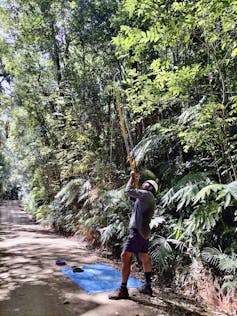
A man points a giant slingshot at the canopy
The researchers trekked into remote forests then used a giant slingshot to knock down branches from high in the canopy.
Kali Middleby

First, we tested how various characteristics of leaves influence how hot they get. To do this, we sampled trees from 16 forest sites across the Wet Tropics of Queensland, from hot lowlands to cool mountaintops.

The sampling involved three species: Darlingia darlingiana (silky oak), Elaeocarpus grandis (blue quandong) and Cardwellia sublimis (bull oak).

We trekked into remote forests to locate our study species. Then we used a giant slingshot to knock down branches from high in the canopy.

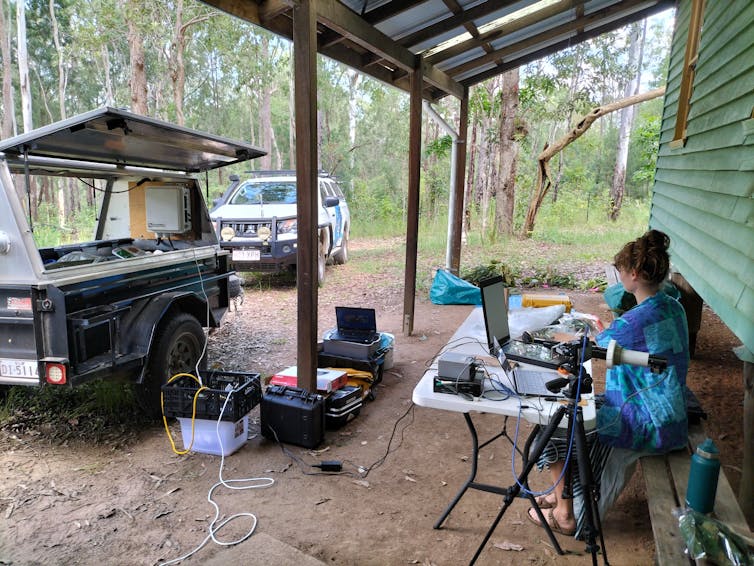
We measured the leaves according to factors that influence how hot they become: width and thickness, chemical composition, the use of stomata to expel water for cooling, and colour and reflectivity.

These field measurements were entered into a computer model. We asked the model to predict how the temperature difference between leaves and air changed across the habitats where the species grew.

The modelling showed two of the three studied species – silky oak and blue quandong – were clearly able to “self cool” in hotter environments. They did this by increasing the activity of their “stomata” and by having narrower, smaller leaves.

A woman sits at a table surrounded by scientific equipment
The researchers measured the leaves according to factors that influence how hot they become.
Alexander Cheesman

Was this evidence of climate adaptation?

But why were some tree populations able to avoid damaging temperatures? Did the genes of those populations evolve from one generation to the next to become better suited to a warmer world? Or was another factor at play?

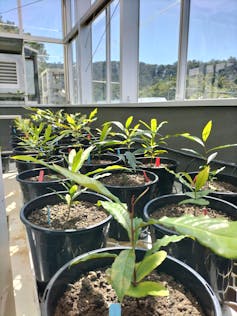
plants in pots within a greenhouse
The study involved a glasshouse experiment using blue quandong seedlings.
Kali Middleby

To answer these questions, we examined the DNA of the varying populations of all three species. We were looking for small differences linked to the climates in which individual trees grew.

We found signals in all three species associated with both temperature and rainfall. This suggests climate history has shaped their genetic responses – but not always with the same outcome.

For example, although bull oak showed signs of adaptation, this may not help with temperature regulation, but instead influence the plant’s function in other ways.

To test the idea, we ran a glasshouse experiment using common garden plantings of blue quandong seedlings, collected from different populations. The plants were exposed to warmer or cooler temperatures in separate glasshouse chambers to mimic the current conditions of the uplands and lowlands.

Seedlings of blue quandong, grown from populations originating in different climates, showed the same variation in leaf-to-air temperature differences that we observed in the field. This occurred regardless of whether they were grown in the cooler or warmer glasshouse chambers.

It suggests genetic adaptation is helping some tree populations keep their leaves cooler. This could guide conservation managers when choosing where to collect seeds for rainforest restoration in a warming world.

Different species, different strategies

Tropical rainforests are vital for biodiversity, and for tackling climate change by absorbing carbon dioxide from the atmosphere. But heatwaves and droughts are pushing many tree species to their limits.

Our study shows variation within species that can buffer some risk from rising temperatures. But not all tree species have these strategies to cope with heat.

As we’ve shown, some tropical trees may be more vulnerable to a warming world. As heatwaves become more frequent and intense, trees that can’t adjust their leaf temperatures may face higher risks of tissue damage, reduced growth or even local extinction.

Understanding how tropical trees have adapted to temperature rises is crucial for evaluating their resilience to global warming – and helping to protect them.

The Conversation

Kali Middleby received funding from James Cook University, the Holsworth Wildlife Research Endowment, and Skyrail Rainforest Foundation.

Lucas Cernusak receives funding from the Australian Research Council.

ref. Some tropical trees cool their leaves to survive the heat — but not all species have ways to cope – https://theconversation.com/some-tropical-trees-cool-their-leaves-to-survive-the-heat-but-not-all-species-have-ways-to-cope-264117

Insurers have detailed data on your home’s flood risk. So, why don’t you?

Source: The Conversation (Au and NZ) – By Daniel Melser, Senior Research Fellow, Monash University

Buying a house is one of the most high-stakes decisions many people will make in their lives. Yet many households are investing millions without an adequate understanding of a property’s exposure to growing climate risks.

In Australia, perhaps the starkest climate hazard is flood. Flooding ranks as one of the most financially damaging weather-related disasters, with costs rising sharply over the past five years.

So, how do you find out a given property’s flood risk? This information certainly exists. It is embedded in the insurance premiums we are charged.

But in Australia, unlike many comparable countries, this information is not readily available to all households. Changing that would help them make smarter, more informed decisions – and could benefit us all.

The growing threat of floods

Flooding is a growing problem for households across the nation, and forecast to grow as the climate changes. Yet, flood risk is not always easy to identify. It reflects the complex interplay of two key elements.

The first is topography, the layout of natural and built features on the land, such as hills, rivers, roads, and buildings. The second is hydrology, the way water sources including rainfall, rivers and groundwater are distributed and interact with the environment and human systems.

Efforts to create a unified flood risk map have been limited by fragmented data ownership, proprietary licensing and poor coordination.

Some detailed resources do exist. Queensland, for example, has developed a Property Level Flood Information Portal, currently available to 39 eligible local governments. It’s part of an opt-in program requiring councils to voluntarily participate.

Scaling this kind of initiative to a national level would require collaboration across hundreds of councils, each with varying priorities, resources and technical capacities.

Other public resources, such as the Australian Flood Risk Information Portal (AFRIP), provide metadata that can help identify where flood studies have been done, but do not offer consistent, property-level flood risk data.

Helpful insights, hidden

Australia does, however, have a National Flood Information Database (NFID). This estimates flood risk for approximately 14 million Australian homes and is used by insurers to assess and price flood risk.

It was constructed by the Insurance Council of Australia over many years, by integrating and harmonising much of the flood mapping undertaken by local and state governments in Australia.

Currently, this data is proprietary – meaning insurers who pay can access it to set premiums, but Australian households can’t due to commercial licensing and data ownership restrictions.

This sits awkwardly with the fact that much of National Flood Information Database is based on mapping and studies commissioned by local and state governments.

Lagging the world

Australia is an outlier among comparable countries in not having reliable public data on property-level flood risk. On this front, the Netherlands is widely considered to be the gold standard.

National flood maps are made accessible to households through a government website that allows households to view flood risk information tailored to individual addresses.

This includes information about possible flood depth, what to expect in a flood event and how to stay safe. Information is presented in plain language and with simple infographics.

Elsewhere around the world, the United States has long provided national flood maps in relation to its National Flood Insurance Program. There are also laws in many US states requiring flood risk disclosures when a property is sold.

One of the US’ largest real estate listing websites, Zillow, includes detailed information on an individual property’s exposure to the full range of climate hazards.

And in the United Kingdom, the government produces national maps of flood risk and makes them publicly available.

How we could benefit

In fighting climate change, we need to understand the flood risk to reduce exposure and vulnerability as much as possible.

One key federal government initiative is the Disaster Ready Fund. This supports a variety of programs, from investments in physical and social infrastructure to nature-based solutions and research.

While this holistic approach is important, a much more structured one is needed, especially around flood risk mitigation.

Providing Australians with greater transparency around a home’s flood risk would enable households to make more informed decisions about the properties they purchase or rent.

It would also limit insurance bill shock and better align households’ expectations with the reality of the climate risks they face.

Most importantly, it would provide a much-needed climate signal to property owners and may encourage many to undertake measures to reduce damage in the event of a flood.

More informed discussions

Having reliable and consistent publicly shared flood data information will also support community discussions on what is an acceptable level of risk and guide decisions on where and how to mitigate or relocate.

Making the data we already have on property-level flood risk available for general consumption is a no-brainer. But it is the thin end of the wedge. We also need better data to begin with.

In many areas, the current flood maps are outdated. This introduces additional uncertainty, which is priced into insurance premiums.

This problem calls on Australia to raise the bar, improving the quality and updating the frequency of flood mapping to better inform decisions and debate.

The taxpayer spending required to do this is hard to justify if this data remains locked up within the insurance industry – but it makes more sense if there are wider public benefits, such as for households.

The Conversation

Daniel Melser receives funding from the Australian Research Council (ARC) and the Australian Housing and Urban Research Institute (AHURI).

This article has been produced by Daniel Melser in his role as a Senior Research Fellow at Monash University and is wholly independent of his work in the banking sector.

Francesca Perugia receives funding from the Australian Housing and Urban Research Institute (AHURI) and the Department of Climate Change, Energy, the Environment and Water (DCCEEW).

Antonia Settle does not work for, consult, own shares in or receive funding from any company or organisation that would benefit from this article, and has disclosed no relevant affiliations beyond their academic appointment.

ref. Insurers have detailed data on your home’s flood risk. So, why don’t you? – https://theconversation.com/insurers-have-detailed-data-on-your-homes-flood-risk-so-why-dont-you-264110

To fix broken electricity markets, stop promoting the wrong kind of competition

Source: The Conversation (Au and NZ) – By Richard Meade, Adjunct Associate Professor, Centre for Applied Energy Economics and Policy Research, Griffith University

Getty Images

Competition is seen as a panacea in electricity markets: if only we had more, prices would be lower, and investment and supply security would be higher.

Politicians love this story because it offers respite when electricity prices rise. Just unleash regulators and competition authorities to “fix” competition barriers – problem solved (for now).

Encouraging retail competition becomes a priority. Consumers are slow to change retailers, even if they could save hundreds of dollars a year, which is seen as a brake on competition.

Regulators and policymakers therefore champion price comparison services and other measures to encourage electricity customers to shop around.

Also, standalone retailers often protest they can’t access generation from their rival “gentailers” – firms that combine electricity generation and retailing – on fair terms.

If only they could – and customers more keenly switched providers – retail-only companies could provide stiffer competition. Their solutions include lobbying for gentailers to be broken up, or forced to supply retailers on the same terms as the gentailers’ own retail arms.

The trouble is, if we misidentify the causes of lacklustre electricity market competition, our solutions may only make things worse.

Rather than the lack of competition being about too little customer switching and barriers to retailers entering the market, the more likely cause is too much of both.

Hit-and-run retailers

For the big gentailers (such as New Zealand’s Mercury, Meridian, Contact and Genesis) to face more competition, we need either more gentailers or other ways to achieve the benefits of gentailing. Those benefits are twofold:

  • combining generation with retailing effectively manages the huge risks standalone generators or retailers face when they buy and sell on wholesale markets, where prices are highly volatile and can rise to levels that kill businesses; in turn, this helps gentailers finance investment in generation

  • and gentailers only need to add one profit margin to their generation cost when setting retail prices; separated generators and retailers add separate margins, which can accumulate to more than what gentailers alone charge.

Separating generation from retailing is therefore a bad idea – if you want lower prices and better investment, you probably want more gentailing.

But why can’t separated generators and retailers replicate these gentailing advantages through long-term contracts? Because generators incur large investment costs to be recovered over many years, so to finance their investments they need long-term revenue security.

Standalone retailers can’t credibly sign contracts offering that security. If they do, new retailers (which can be set up relatively cheaply) can steal their customers when wholesale prices fall below the level of those long-term contracts.

If retailers do sign long-term contracts with generators, they risk failing when exposed to such “hit and run” competition by rival retailers – or they renege on those contracts to survive.

Generation investors see this coming, so don’t contract long-term with standalone retailers. Result: lack of viable investment and competition by separated generators and retailers.

The right kind of competition

To resolve this, we would need to eliminate hit-and-run retail entry – first, by making it harder for customers to change retailers if wholesale prices fall below long-term contracted prices.

This could be achieved by requiring retail customers to sign up to long-term retail contracts themselves, rather than being able to flexibly change retailer. Ironically, price comparison websites take us in the wrong direction.

Second, new retailers could be required to have either their own generation – be gentailers, in other words – or have long-term supply contracts in place with generators.

Counterintuitively, this actually makes it easier – or at least more sustainable – for retailers to enter the market, because they know they won’t face hit-and-run competition if they do.

This also means generators can more confidently sign long-term contracts with retailers. Retailers wouldn’t then need to convince regulators to force gentailers to supply them, as they can secure their own supply through contracting.

Standalone retailers might object that they would do this now if they could. But generators can’t supply standalone retailers given the current long-term contracting uncertainty.

Fix that uncertainty – by increasing the ability of retailers to commit to long-term contracts – and both generators and retailers win. Ultimately, this means gentailers face more credible competition, which also means consumers win.

By discouraging the wrong kind of competition (rather than promoting it), genuine competition can be made more durable and effective. That would support long-term investments by generators, and also investments by retailers in innovative services that benefit consumers.

Neither is possible when customers can change retailers with ease, and retailers face hit-and-run competition. If we want more competitive electricity markets, we need to encourage the right type of competition – by discouraging the wrong type.

The Conversation

Richard Meade was funded in 2021 by an industry body representing New Zealand electricity retailers to survey the economic literature on vertical integration versus vertical separation in electricity sectors. In 2025 he submitted on his own account to the Electricity Authority on its proposal to force generator-retailers to offer supply to rivals on non-discriminatory terms.

ref. To fix broken electricity markets, stop promoting the wrong kind of competition – https://theconversation.com/to-fix-broken-electricity-markets-stop-promoting-the-wrong-kind-of-competition-264572

How ‘brain cleaning’ while we sleep may lower our risk of dementia

Source: The Conversation (Au and NZ) – By Julia Chapman, Clinical Trials Lead and Postdoctoral Research Fellow, Woolcock Institute of Medical Research and Conjoint Lecturer, Macquarie University

nopparit/Getty

The brain has its own waste disposal system – known as the glymphatic system – that’s thought to be more active when we sleep.

But disrupted sleep might hinder this waste disposal system and slow the clearance of waste products or toxins from the brain. And researchers are proposing a build-up of these toxins due to lost sleep could increase someone’s risk of dementia.

There is still some debate about how this glymphatic system works in humans, with most research so far in mice.

But it raises the possibility that better sleep might boost clearance of these toxins from the human brain and so reduce the risk of dementia.

Here’s what we know so far about this emerging area of research.

Why waste matters

All cells in the body create waste. Outside the brain, the lymphatic system carries this waste from the spaces between cells to the blood via a network of lymphatic vessels.

But the brain has no lymphatic vessels. And until about 12 years ago, how the brain clears its waste was a mystery. That’s when scientists discovered the “glymphatic system” and described how it “flushes out” brain toxins.

Let’s start with cerebrospinal fluid, the fluid that surrounds the brain and spinal cord. This fluid flows in the areas surrounding the brain’s blood vessels. It then enters the spaces between the brain cells, collecting waste, then carries it out of the brain via large draining veins.

Scientists then showed in mice that this glymphatic system was most active – with increased flushing of waste products – during sleep.

One such waste product is amyloid beta (Aβ) protein. Aβ that accumulates in the brain can form clumps called plaques. These, along with tangles of tau protein found in neurons (brain cells), are a hallmark of Alzheimer’s disease, the most common type of dementia.

In humans and mice, studies have shown that levels of Aβ detected in the cerebrospinal fluid increase when awake and then rapidly fall during sleep.

But more recently, another study (in mice) showed pretty much the opposite – suggesting the glymphatic system is more active in the daytime. Researchers are debating what might explain the findings.

So we still have some way to go before we can say exactly how the glymphatic system works – in mice or humans – to clear the brain of toxins that might otherwise increase the risk of dementia.

Does this happen in humans too?

We know sleeping well is good for us, particularly our brain health. We are all aware of the short-term effects of sleep deprivation on our brain’s ability to function, and we know sleep helps improve memory.

In one experiment, a single night of complete sleep deprivation in healthy adults increased the amount of Aβ in the hippocampus, an area of the brain implicated in Alzheimer’s disease. This suggests sleep can influence the clearance of Aβ from the human brain, supporting the idea that the human glymphatic system is more active while we sleep.

This also raises the question of whether good sleep might lead to better clearance of toxins such as Aβ from the brain, and so be a potential target to prevent dementia.

How about sleep apnoea or insomnia?

What is less clear is what long-term disrupted sleep, for instance if someone has a sleep disorder, means for the body’s ability to clear Aβ from the brain.

Sleep apnoea is a common sleep disorder when someone’s breathing stops multiple times as they sleep. This can lead to chronic (long-term) sleep deprivation, and reduced oxygen in the blood. Both may be implicated in the accumulation of toxins in the brain.

Sleep apnoea has also been linked with an increased risk of dementia. And we now know that after people are treated for sleep apnoea more Aβ is cleared from the brain.

Insomnia is when someone has difficulty falling asleep and/or staying asleep. When this happens in the long term, there’s also an increased risk of dementia. However, we don’t know the effect of treating insomnia on toxins associated with dementia.

So again, it’s still too early to say for sure that treating a sleep disorder reduces your risk of dementia because of reduced levels of toxins in the brain.

So where does this leave us?

Collectively, these studies suggest enough good quality sleep is important for a healthy brain, and in particular for clearing toxins associated with dementia from the brain.

But we still don’t know if treating a sleep disorder or improving sleep more broadly affects the brain’s ability to remove toxins, and whether this reduces the risk of dementia. It’s an area researchers, including us, are actively working on.

For instance, we’re investigating the concentration of Aβ and tau measured in blood across the 24-hour sleep-wake cycle in people with sleep apnoea, on and off treatment, to better understand how sleep apnoea affects brain cleaning.

Researchers are also looking into the potential for treating insomnia with a class of drugs known as orexin receptor antagonists to see if this affects the clearance of Aβ from the brain.

If you’re concerned

This is an emerging field and we don’t yet have all the answers about the link between disrupted sleep and dementia, or whether better sleep can boost the glymphatic system and so prevent cognitive decline.

So if you are concerned about your sleep or cognition, please see your doctor.

Julia Chapman has received funding from the Amercian Academy of Sleep Medicine Foundation, NHMRC Centre of Research Excellence, CogSleep, Woolcock Institute’s Centre for Chronic Diseases of Ageing. Julia Chapman’s department has received funding for clinical trial activities performed for Alkermes, Takeda, and Lilly.

Camilla Hoyos is affiliated with Australasian Sleep Association (current board member).
Camilla Hoyos has received funding from NHMRC, MRFF, Woolcock Institute’s Centre for Chronic Diseases of Ageing and her research group has recieved funding from BOD Australia and in-kind support from Eisai, Fisher Paykel, Somnomed.

Craig Phillips receives grant funding from the National Health and Medical Research Council of Australia.

ref. How ‘brain cleaning’ while we sleep may lower our risk of dementia – https://theconversation.com/how-brain-cleaning-while-we-sleep-may-lower-our-risk-of-dementia-259979

How do we get more Year 12s doing maths?

Source: The Conversation (Au and NZ) – By Bronwyn Reid O’Connor, Lecturer in Mathematics Education, University of Sydney

Black ice/ Pexels , CC BY

Mathematics has been the broccoli of school subjects for generations of Australian teenagers.

Often pushed aside, dreaded, or even feared, nearly one third of students opt out of any senior maths courses.

This has serious implications for Australia’s future. As an Australian Academy of Science report warned on Thursday, we need people with maths skills to support a whole range of careers in science. This includes agricultural science, artificial intelligence, data science, biotechnology and climate science.

The skills we gain during school mathematics – problem-solving, pattern-finding, reasoning logically, and computational thinking – are essential to the work of many STEM careers.

The challenge is turning maths from broccoli to the ingredient every student wants on their plate for their future. So, what can we do?


Read more:
New report reveals glaring gaps between Australia’s future needs and science capabilities


What has been happening with high school maths?

Across Australia, there has been a decline in students studying maths in years 11 and 12 since the 1990s. Today, only 8.4% of Australian high school students study the most difficult level of maths.

There are diverse reasons explaining why students opt out of maths during school.

Many students struggle to see the relevance of the maths they are learning for their future. Others have low self-confidence and avoid maths, believing they are not capable. An increasing range of senior subjects has also led to students being drawn to more enticing alternatives.

What can parents do?

Research shows parents’ attitudes towards maths can predict the attitudes their children will have towards the subject.

This means we need to be careful as parents. If we have negative attitudes towards maths due to our own anxieties or past struggles, this can affect our children’s attitudes and performance too.

Instead, parents should try to focus on the positive aspects of maths.

For example, this is a subject where you learn about the mechanics of the world, rather than a subject to be endured before moving to the “fun” stuff. Maths can come alive once we notice how we use it in sports, art, cooking, travel, money management and games.

Parents can also be curious co-learners with their children – we never need to have all the answers ourselves. But showing interest, having a growth mindset (a belief you can improve your abilities through effort), and asking questions can support students’ positive attitudes and performance in maths.

You can also talk to your child about why mastering maths is central to a wide range of occupations, from coding to trades, retail, nursing, animation and architecture.


Read more:
‘Maths anxiety’ is a real thing. Here are 3 ways to help your child cope


What should schools do?

Research suggests 20% of 15-year-old boys and 33% of 15-year-old girls do not think maths will be relevant to their future.

So we need a new approach to careers advice in schools. Students need adequate support from informed adults to make accurate judgements about career pathways – emphasising how maths can help.

On top of this, schools could consider the ways in which mathematics is celebrated and promoted in schools. While music, drama, and sport days are regular features of the school calendar, maths is rarely included. Exciting maths competitions and maths days are prime opportunities to show students how important maths is in our world.

What about teachers?

Some of us may remember maths lessons as rather dry with a focus on lots of questions and whether something was “wrong” or “right”.

So teachers who make maths engaging for students and maximise opportunities for success are crucial.

This involves making abstract mathematics real (how does this concept apply to something physical in the real world?).

Teachers should also provide step-by-step support to students (what educators call “scaffolding”), so young people experience a sense of achievement and success with maths. Success builds motivation, creating an upward spiral of positive maths experiences.

What can governments do?

The alarm bells over maths participation have been raised for 30 years, with government funding supporting research into this phenomenon.

Despite this, the declines persist, and gender gaps in maths have widened, with more boys doing maths and more boys achieving higher marks.

So while governments should continue to support research into this matter, they should prioritise translating it into practical strategies for schools and teachers.

Some evidence-based approaches include:

Getting kids back into maths

Maths participation is both a national concern and something we should all be personally attuned to.

The lifestyles of future generations will be dependent on our capacity to be STEM innovators.

At an individual level, when students opt-out of mathematics, they are potentially closing many doors in their lives and career.

The authors do not work for, consult, own shares in or receive funding from any company or organisation that would benefit from this article, and have disclosed no relevant affiliations beyond their academic appointment.

ref. How do we get more Year 12s doing maths? – https://theconversation.com/how-do-we-get-more-year-12s-doing-maths-264337

Grattan on Friday: Dan Andrews’ red carpet walk in Beijing puts Albanese on the spot

Source: The Conversation (Au and NZ) – By Michelle Grattan, Professorial Fellow, University of Canberra

Despite he and his government being in an overwhelmingly dominant position politically, Anthony Albanese sounded quite tetchy at times this week.

He argued the toss on the ABC when pressed, reasonably enough, for detail on the expensive deal for Nauru to take former immigration detainees. Later in the week, a brief Senate inquiry revealed the 30-year agreement could cost up to $2.5 billion.

Albanese dismissed as “not accurate” a story about officials helping the return to Australia of so-called “ISIS brides” and their families, when a fuller response would have been wiser. It emerged that while the government is not facilitating the repatriation, New South Wales and federal police are making arrangements for if and when the people arrive.

Albanese was on the back foot over issues of the government’s lack of transparency,  highlighted by aspects of new freedom of information legislation introduced this week. Although some changes are reasonable, the new regime will further restrict public access to information relating to decision-making at senior levels of government. Former crossbench senator Rex Patrick, who constantly runs FOI cases, describes it as an “Albanese counterrevolution” that “strips away citizens’ right to access important information”.

Perhaps the prime ministerial mood was darkened this week by his good political friend, former Victorian premier Dan Andrews, being caught up in a firestorm of criticism for attending China’s enormous military parade in Beijing on Wednesday.

Andrews is a private citizen now, but his presence in the “family photo” with the who’s who of the world’s dictators dismayed many people in Labor.

The parade highlighted the delicate diplomatic dance the Albanese government finds itself in with China. The show of strength sent unmistakable messages to the world. The Australian government kept its distance from the spectacle; embassy officials attended but Australia’s ambassador was in another part of China.

Albanese knew the presence of Andrews was unfortunate, although he held back from robust criticism. On Thursday, he told parliament, “I am not responsible for what every Australian citizen does”. (Andrews said in a Thursday statement the occasion had been a chance to “engage with regional leaders”.)

On the other side of politics, the opposition remains in a world of pain, deeply divided over net zero and with members breaking ranks, in comments or votes, apparently whenever they feel like it. This week several senators, including Nationals frontbenchers Bridget McKenzie and Ross Cadell, crossed the floor to support a motion moved by One Nation’s Pauline Hanson on immigration. So much for the Nationals’ agreement to accept the principle of shadow cabinet solidarity.

Separately, Senator Jacinta Nampijinpa Price, damaged the Liberals with an inflammatory comment about Indian immigration.

But amid her deep troubles, Opposition Leader Sussan Ley had a useful win this week. On Monday and Tuesday the opposition in question time targeted the new Minister for Aged Care Sam Rae over the unacceptably long waiting list for home care packages, and the delay of the roll-out of planned aged care reforms, from July to November.

Rae, it will be remembered, owed his elevation to the ministry after the election to being a factional numbers man for Deputy Prime Minister Richard Marles. Labor observers felt he held his own under the attack, but the government found itself in an untenable position.

The opposition had leverage because the government needed to get its latest aged care legislation through the Senate this week. On Wednesday morning, the Senate passed an amendment to bring forward a batch of home packages, when a rare combination of the Coalition, Greens and crossbenchers imposed an equally rare defeat on Labor. Although there was no division, the government registered its opposition.

Then almost immediately, Minister for Ageing Mark Butler announced the government would indeed bring forward the packages.

In the post-election Senate, the government typically only needs either the Greens or the Coalition to pass legislation – and they are usually on different sides of issues. But the unusual alignment this week shows that the Senate, although easier for the government than in its first term, retains the ability to embarrass.

Albanese, like some of his prime ministerial predecessors, tends to find sitting weeks trying. As one Labor man puts it, “Parliament is the home ground for the opposition.” Albanese would prefer to be out and about, dashing around the country – although that does come with a level of exhaustion.

Those around the prime minister would dispute the assessment of his mood as peevish. The alternative interpretation is that he’s showing some second-term arrogance. There was a whiff of this at the end of Thursday’s question time when he advised the opposition, “that they go touch grass during the break and get in touch, and get in touch with what Australians are concerned about”.

Albanese has a strong belief, reinforced by the election, in his own political judgement. He’s irritated by assessments his has been a don’t-rock-the-boat government. We don’t know directly but he must be particularly frustrated by the constant refrain from some commentators that he should be using his large majority to be more radical and reformist.

This week, for example, the respected Nine newspapers’ economics writer Ross Gittins declared that if he “can’t bring himself to govern”, Albanese should retire. “No shame in being past it,” Gittins added, twisting the knife. Galling for a leader who turned a likely minority government into one with a massive majority.

With the pesky parliament now away for a month, Albanese enters international summit season. Next week he’ll be at the Pacific Islands Forum in the Solomon Islands.

Leaders there will be curious for a clue about the government’s proposed level of ambition in its 2035 emissions reduction target under the Paris agreement. This will be announced later this month, before Albanese goes to the United Nations leaders’ week in New York, which starts on September 22. The target is set to be a band, within the broader range of 65-75% reduction on 2005 levels. Energy Minister Chris Bowen indicated this week the government might not legislate the target if there was too much parliamentary opposition.

Summit season includes a clutch of forums, but for Albanese his most important trip is the September one to the United States.

Preparations appear to be on course for a much-anticipated meeting with President Donald Trump then, either in New York or in Washington. The question on the day of that meeting will not be about Albanese’s mood, but what might be the frame of mind of the volatile, unpredictable president.

The Conversation

Michelle Grattan does not work for, consult, own shares in or receive funding from any company or organisation that would benefit from this article, and has disclosed no relevant affiliations beyond their academic appointment.

ref. Grattan on Friday: Dan Andrews’ red carpet walk in Beijing puts Albanese on the spot – https://theconversation.com/grattan-on-friday-dan-andrews-red-carpet-walk-in-beijing-puts-albanese-on-the-spot-263911

When it comes to neo-Nazis, we can’t legislate our way to safety

Source: The Conversation (Au and NZ) – By Greg Barton, Chair in Global Islamic Politics, Alfred Deakin Institute for Citizenship and Globalisation, Deakin University

What sort of legislation do we need to stop neo-Nazis marching through our streets and threatening our social cohesion?

It certainly makes sense to consider incremental changes such as banning the Nazi swastika and the wearing of full-face masks when protesting.

But really, the question is not what sort of legislation we need. The question is what sort of legislature – sort of parliament – will keep us safe?

It is reasonable to adjust laws to respond to changing threats, but we need to recognise we can’t legislate our way to safety. Australia already has some of the most extensive counterterrorism legislation in the world. Any changes we make now will bring – at best – incremental gains. And nothing we do is without cost and risk. If we succumb to the temptation to broaden the meaning of terrorism in the law, we will almost certainly weaken our counterterrorism apparatus and discredit it in the process.

Lessons from Germany

Instead of focusing on improving legislation, our focus needs to be on strengthening democracy. The experience of two leading Western democracies serve as salient reminders of the challenge we’re facing.

Probably no Western democracy has done more to counter Nazi and neo-Nazi ideas and their expression than modern Germany. If ever tighter legislation was going to keep us safe from the rise of fascism, it would have done so in Germany.

Sadly, that is not the case. Germany faces a massive problem of neo-Nazi recruitment in the ranks of the uniformed services and across German society, despite all the carefully constructed barriers against it.

Even more worrying is the rise of support for far-right politics in Germany. Every year the extremist Alternative Für Deutschland (AfD) party steadily gains ground, and were it not for the “firewall” designed to keep parties such as the AfD out of governing coalitions, the strength of its popular support would surely have earned it a place in government by now.

In fact, it is looking increasingly difficult to see how AfD can be kept out of power in Germany. And while it denies its clear neo-Nazi heritage, the party openly campaigns on ideas associated with white supremacists and “Germany for Germans”.

An alternative: strengthening democracy

Even more worrying than the case of Germany is that of the United States and the great Republican elephant in the room. In his first term as president, Donald Trump’s administration was divided and reluctant to implement his radical agenda. But in his second presidency, a very different administration team is working with a worrying sense of sycophantic purpose to bring about a radical reinvention of US politics and the end of US democracy as we have known it.

The Republican Party in Congress no longer works to block the president’s radical agenda. Instead, we are witnessing the implementation at scale and at a rapid pace of the radical Project 2025 plans that were carefully drawn up before Trump’s remarkable electoral victory.

The fact that court after court has declared his actions illegal does little to impede the project. The flood-the-zone strategy is clearly working and the guardrails of tradition and public expectation have shown themselves to be disturbingly weak or non-existent.

The nature of this radical agenda is seen most sharply in the ideas, and now fully implemented policy, of Trump’s homeland security advisor Stephen Miller. He has been behind the expansion and aggressive implementation of the Immigration and Customs Enforcement (ICE) campaign of arrest and deportation. It may not be legal for unidentified, masked ICE officers to profile Latino and other brown Americans then violently apprehend them and bundle them into unmarked vans, and disappear them to remote detention sites for weeks at a time. But that is exactly what ICE is doing.

It would be inaccurate to call Miller a neo-Nazi. But what is not debatable is that he is openly supporting, and implementing, white supremacist “great replacement” ideas without any sense of shame or any level of accountability. Trump’s so-called Big Beautiful Bill expanded the ICE budget to the point it is larger than all but a few of the world’s national militaries.

The campaigning ahead of the 2025 federal elections in Australia saw some political actors promoting a narrative based on the politics of fear. They were spectacularly unsuccessful, and that that should give us confidence in our democratic system.

But we cannot afford to take it for granted that we will not quickly face the sort of problems currently seen in Germany and the US. Australia has a long history of institutionalised racism, from the frontier wars through the decades of the white Australia policy, and the demonising of asylum seekers arriving by boat.

At the same time our social cohesion holds strong. Each week, thousands take to the street to protest peacefully. So far, the extremist elements who would seek to take advantage of this have gained little traction.

As ugly and pathetic as the sight of neo-Nazis grandstanding in public places is, we must not let their attention-seeking define our framing of the problem. In an open society, there will always be fringe elements saying and doing things that lie on the very edge of the law and that challenge mainstream sensibilities.

In the weeks before the recent anti-immigration marches, Australians of colour experienced the chilling fear that can come from these kinds of political stunts.

But the real risk in Australia comes not from the shrill voices of fascist extremists prancing in public places. Rather, it comes from a slide into the wholesale demonising of migrants in our public discourse. If we can address this, not only will we see fewer Australians drawn to the ugly intolerance and open racism of neo-Nazism, we will be doing the one thing that can really make us safer: strengthening our democracy.

The Conversation

Greg Barton receives funding from the Australian Research Council. He is engaged in a range of projects funded by the Australian government that aim to understand and counter violent extremism in Australia and in Southeast Asia and Africa.

ref. When it comes to neo-Nazis, we can’t legislate our way to safety – https://theconversation.com/when-it-comes-to-neo-nazis-we-cant-legislate-our-way-to-safety-264576

Government settles Robodebt class action appeal for $475 million in compensation

Source: The Conversation (Au and NZ) – By Michelle Grattan, Professorial Fellow, University of Canberra

The federal government has reached a $475 million compensation settlement in an appeal case from the Robodebt class action.

The settlement of the appeal, which is still to be approved by the federal court, would be the largest class action settlement in Australian history.

It is for compensation for the harm caused by the Robodebt scheme, which was found to have been illegal. The scheme and the ministers and public servants involved in it were strongly condemned by a royal commission set up by the Labor government. Robodebt ran between 2015 and 2019.

The scheme involved using automated processes for levying debts, many of which were non-existent or calculated wrongly. The scheme traumatised thousands of welfare recipients.

Attorney-General Michelle Rowland, said the settlement would be in addition to what was paid after the original Robodebt case action settlement in 2020. That comprised interest and repayments of wrongfully-raised debts. It amounted to a $1.2 billion payout.

The latest agreement also allows the court to determine separate amounts for the applicants’ “reasonable legal costs” and for the reasonable costs of administering the settlement scheme.

Rowland said, “Today’s settlement demonstrates the Albanese Labor government’s ongoing commitment to addressing the harms caused to hundreds of thousands of vulnerable Australians by the former Liberal government’s disastrous Robodebt Scheme”.

“The Royal Commission described Robodebt as a ‘crude and cruel mechanism, neither fair nor legal’. It found that ‘people were traumatised on the off chance they might owe money’ and that Robodebt was ‘a costly failure of public administration, in both human and economic terms’.

“Settling this claim is the just and fair thing to do,” Rowland said.

She said class action members did not have to take any action at this stage other than ensure their contact details were up to date with Services Australia.

The Conversation

Michelle Grattan does not work for, consult, own shares in or receive funding from any company or organisation that would benefit from this article, and has disclosed no relevant affiliations beyond their academic appointment.

ref. Government settles Robodebt class action appeal for $475 million in compensation – https://theconversation.com/government-settles-robodebt-class-action-appeal-for-475-million-in-compensation-263918

Do you really need a dental check-up and clean every 6 months?

Source: The Conversation (Au and NZ) – By Tan Nguyen, Casual Research Fellow in Oral Health, Deakin University

Just over half of Australian adults saw a dental practitioner in the past 12 months, most commonly for a check-up.

But have you been told you should get a check-up and clean every six months? Perhaps your dental clinic’s or health insurance policy’s default is to ask you to book these services twice a year.

Let’s look at whether this advice is based on evidence or opinion.

Why do you need regular check-ups and cleans?

A regular oral health checkup usually involves a dentist or oral health practitioner (dental therapist, dental hygienist, oral health therapist) examining the teeth, gums and surrounding structures of the mouth. This helps identify signs of tooth decay or gum disease, in addition to any changes to soft tissues.

In most instances, you will have your teeth professionally cleaned in the same visit, with a “scale and clean”, along with dental x-rays to identify issues that aren’t visible to the eye.

Regular brushing with fluoride toothpaste and cleaning between teeth (for example, by flossing) at home can’t reach all the surfaces of the teeth and gums. Professional cleaning is needed to remove the remaining plaque and tartar (calcified dental plaque) and the bacteria they contain, which cause tooth decay and gum disease.

What does the research evidence say?

Not all research is equal: some types of evidence are more reliable than others.

Cochrane systematic reviews are the most trusted because they use rigorous methods to collect and evaluate all available research evidence on a specific health question. These reviews judge how strong the evidence is and whether the studies might be affected by bias.

For adult oral health check-ups, a 2020 Cochrane review found strong evidence that six-monthly check-ups did not offer any additional benefit in preventing tooth decay or gum bleeding, compared to those whose frequency of check-ups was risk-based.

Risk-based means dental practitioners set the time between dental check-ups depending on the individual’s risk of dental disease.

The review, which looked at data over four years, also found there wasn’t enough good research to know how different dental check-up schedules affected children’s and teenagers’ teeth and gums.

On the issue of six-monthly professional cleaning, a 2018 Cochrane review found strong evidence that having regular professional cleaning made little or no difference to signs of gum disease (gingivitis or bleeding gums), or to levels plaque deposits, compared to adults with less regular professional cleaning.

There was a small reduction in tartar levels, however it’s unclear if this is meaningful to consumers and dental practitioners.

Participants who had six- or 12-monthly cleans reported their teeth felt cleaner than those who didn’t have scheduled cleans, but there was no difference between groups in reports of quality of life.

Based on these reviews, six-monthly visits and cleans don’t seem to consistently lead to better oral health for adults compared to check-ups and cleans based on individual risk.

So can you forgo six-monthly visits?

Regular professional dental check-ups are important throughout life, starting from the eruption of the first tooth.

But everyone has different oral health needs and risk levels which should be reflected in the frequency of their check-ups.

Some people who are at high risk of oral disease do need to see a dental practitioner more regularly: every six months or even more often – such as every three months – to treat severe gum disease or tooth decay.

Those with good oral health might only need to visit a dental practitioner every year or two years.

Others still may be willing to pay for six-monthly check-ups and cleans for peace of mind, despite their lower oral health risk profile.

How else can I keep my teeth and gums healthy?

Maintain your oral health by brushing twice a day with fluoridated toothpaste. The evidence shows children and adults who brush less than twice daily are at high risk of tooth decay.

Cleaning between your teeth can also help reduce gum problems and dental plaque – more than brushing alone. You can use traditional dental floss or a flossing tool. Interdental brushes, which have a tiny bristled head that fits between teeth, can also be more effective than flossing.

For people who lack manual dexterity and for children, water flossers can be an effective alternative to traditional flossing.

Finally, avoiding sugars added to foods and drinks, as well as the sugars naturally found in honey, syrups and fruit juices, helps protect teeth from tooth decay.

The Conversation

Tan Nguyen receives funding from National Health and Medical Research Council. He is employed by Oral Health Victoria (formerly Dental Health Services Victoria), is the Co-convenor for the Public Health Association of Australia, and a dental practitioner member on the Dental Board of Australia.

Santosh Tadakamadla receives funding from the National Health and Medical Research Council Early Career Fellowship (APP1161659) from 2019 to 2023.

ref. Do you really need a dental check-up and clean every 6 months? – https://theconversation.com/do-you-really-need-a-dental-check-up-and-clean-every-6-months-263259

Tragedy has struck Lisbon’s funicular railway. A transport expert explains how these old-fashioned trains work

Source: The Conversation (Au and NZ) – By Peter Newman, Professor of Sustainability, Curtin University

Some 15 people have died after the Gloria funicular railway car in Lisbon, Portugal, derailed and crashed on Wednesday local time.

Emergency services have also confirmed that more than 18 people were also injured, five of them seriously, in the tragedy, which occurred at the start of the evening rush hour.

It follows another accident on the same line in May 2018, when one of the cars derailed due to flaws in the maintenance of its wheels. No one was killed in that incident.

The exact cause of the most recent accident is not yet known. Witnesses have reported that the yellow-and-white tram appeared out of control as it sped downhill, before derailing as it rounded a bend and crashing into a building. Photos of the aftermath show a crumpled heap of cables and steel.

These cable car–like transport systems are rare relics of the 19th century, found in only a few very hilly places around the world. So how do they work? And why are they still in use?

How do funicular railways work?

Trains and trams typically only work on flat terrain. That’s because their steel wheels can’t get enough traction on steel rails on steep hills. As a workaround, railway engineers often build tunnels through steep mountainsides.

Funicular railways, however, can go up very steep hills.

They usually feature two counterbalanced cars that are attached via a haulage cable.

As one car descends, it helps pull the ascending car up the hillside. The weight of the ascending car also prevents the descending one from careening out of control. Some now have electric motors to help power them and some are able to engage a one-way mechanical drive just for steep hills.

Even though funicular systems are typically quite slow and clunky, they are still popular with both tourists and residents in the places where they’re found.

Where are they found?

The Gloria funicular railway line in Lisbon opened in 1885. One of three funicular lines in Lisbon, it connects the city’s downtown area with the Bairro Alto (Upper Quarter).

But there are other examples of these transport relics around the world.

Switzerland has several funicular railways. The most notable is the Stoosbahn – the steepest funicular in the world. It covers a total ascent of around 744 metres, reaching a gradient of 47 degrees. It is a very popular tourist trip.

In Hong Kong, the Peak Tram is a funicular railway that has operated since 1888 and takes people to near the top of Hong Kong Island.

Last year, there was also some discussion about installing a new funicular railway system in the Blue Mountains in New South Wales, Australia, that would travel 14 metres every second.

A yellow and black railway car travels along a track, with mountains in the background.
The Stoosbahn in Switzerland is the steepest funicular in the world.
Stéphane Gottraux/Wikipedia, CC BY

The rise of trackless trams

Funicular railways still serve a purpose for people living in – or visiting – steep areas where they’re found. However, newer technology means more conventional forms of rail transport are now far less limited in travelling up and down hills.

For example, trackless trams are kind of a combination between a tram and a bus. They use GPS and digital sensors to move precisely along an invisible track and have rubber wheels, enabling them to ascend gradients of up to 15%. However, these have not yet been built for steeper hills.

I have enjoyed riding such funicular trams in a range of hilly cities, but this crash is likely to take the shine off the tourist experience. It’s about time we had a 21st-century option that is clearly safer.

The Conversation

Peter Newman receives funding from the CRC RACE.

ref. Tragedy has struck Lisbon’s funicular railway. A transport expert explains how these old-fashioned trains work – https://theconversation.com/tragedy-has-struck-lisbons-funicular-railway-a-transport-expert-explains-how-these-old-fashioned-trains-work-264574

Yes, freedom of information laws need updating, but not like the government is proposing

Source: The Conversation (Au and NZ) – By Maria O’Sullivan, Associate Professor of Law, Member of Deakin Cyber and the Centre for Law as Protection, Deakin University, Deakin University

The issue of open government and Freedom of Information (FOI) is again in the news, after the federal government proposed major reforms to the system.

FOI laws allow people to access government documents (subject to exceptions) and are routinely used by journalists, academics and the general public.

The reforms, which are going to a parliamentary committee for review, raise important questions about how we modernise these decades-old laws while ensuring government is transparent and can be easily held to account.

This proposed reform, which severely threatens government transparency, is not the way to do it.

What is the government proposing?

The government says the FOI Amendment Bill will introduce measures to modernise the FOI system and make it more efficient.

Changes include introducing fees for certain applications, a ban on anonymous FOI requests and stronger powers to deter vexatious, abusive and frivolous requests.

The amount of the application fee is not yet clear, but according to media reports, it is expected to be between A$30 and $58 per application.

This would be in addition to the current costs that people may incur from the department as they gather relevant information.

Personal information requests (where people request information about their own government files) will be exempt from this charge.

In addition, the government is proposing substantial changes to provisions relating to “deliberative” processes and cabinet documents.

Attorney-General Michelle Rowland has stated these changes are necessary due to resourcing pressures being placed on the FOI system. In particular:

modern technology has made it possible to create large volumes of vague, anonymous, vexatious or frivolous requests.

As an example of the resources necessary to operate the FOI system, Rowland said public servants spent “more than a million hours processing FOI requests” in 2023-24.

The changes have therefore been largely justified as a means of addressing frivolous and automated requests.

Is the FOI system being misused?

It is true that various reports by parliamentary inquiries and public organisations have indicated there are shortcomings in the current FOI regime.

For instance, in 2023, a Senate inquiry received evidence suggesting the FOI regime was under-resourced, leading to extensive delays in the processing of requests.

It described the federal FOI system as “dysfunctional and broken”.

However, there does not appear to be specific, concrete evidence that artificial intelligence (AI) bots are being used at scale to overwhelm the system. Nor is there evidence that the ability for people to submit an application under a pseudonym has caused integrity problems in the system.

The latter will significantly affect how people use important FOI help platforms, such as The Right to Know.

As I have argued elsewhere, the FOI system should be reformed to reflect the technological advances that have occurred since the legislation was first introduced in 1982.

The government has said some agencies, such as the Office of the eSafety Commissioner, have received hundreds of automated FOI requests. This is undoubtedly a problem.

But because large changes are now being proposed to limit access to information, citing chatbots and automation as some of the reasons, it would be good to see more evidence of the system being misused in this way.

Secret cabinet business

A substantive change to the exemption of cabinet documents from FOI disclosure requirements also raises some concerns.

Under the current FOI laws, documents that have the “dominant purpose” of going before cabinet for discussion are exempt from being disclosed.

The proposed change alters the wording from “dominant purpose” to “substantive purpose”. This will allow more cabinet documents to be exempt from FOI’s transparency regime.

Unsurprisingly, leading organisations such as the Centre for Public Integrity have raised concerns. Indeed, this is one of the most troubling parts of the current FOI reform package.

The move is in direct conflict with the 2023 Robodebt Royal Commission report. It recommended the cabinet exemption in the FOI be repealed entirely.

The commission made this recommendation because it found affected people and advocacy groups faced significant difficulties in obtaining information about the operation of the Robodebt scheme through FOI.

Despite this, the Albanese government refused to implement this change. It said:

Cabinet must have the benefit of frank and fearless advice from Ministers and senior public servants.


Read more:
Governments are becoming increasingly secretive. Here’s how they can be made to be more transparent


While recognising the importance of cabinet confidentiality, I and other experts have recommended the cabinet confidentiality exemption in the FOI act be narrowed, not expanded.

Another recommendation, from the Centre for Public Integrity, is cabinet documents should only be exempt for 30 days (unless another valid exemption applies).

Getting the balance right

One of the major obstacles facing people wishing to use Australia’s FOI system is the delay in processing applications and reviews. Greater efficiencies are necessary and welcome.

Against this backdrop, the introduction of a modest application fee for some applicants may be justified as a control mechanism.

Similarly, the strengthening of processes to deal with vexatious applications may improve aspects of the system (where that is warranted).

Of greater concern is the ban on anonymous requests and the expansion of the cabinet document exemption. These changes will make information less accessible to journalists and members of the public.

In addition, there are other means of improving the FOI system which have not been addressed.

For instance, the 2023 Senate report into FOI
recommended greater use of proactive disclosure. It recommended personal information could be released directly to the people to which the information pertains, without requiring applicants to use the FOI regime.

This would clearly take some resourcing pressure off public servants.

Australia’s FOI system is a fundamental part of our democracy. It allows journalists, public interest organisations and the Australian people to find out how decisions are being made and hold government accountable.

The current reform package rightly notes that aspects of our FOI regime require modernising. But that shouldn’t come at the expense of a culture of open government and accountability.

The Conversation

Maria O’Sullivan is part of a Public Intoxication Reform Evaluation which is funded by the Victorian Department of Justice. She also serves as a member of the Human Rights Advice Panel for the Queensland Parliament.

ref. Yes, freedom of information laws need updating, but not like the government is proposing – https://theconversation.com/yes-freedom-of-information-laws-need-updating-but-not-like-the-government-is-proposing-264474

ER Report: A Roundup of Significant Articles on EveningReport.nz for September 4, 2025

ER Report: Here is a summary of significant articles published on EveningReport.nz on September 4, 2025.

Why the Eureka flag and other ‘alternative national flags’ were claimed by anti-immigration protesters
Source: The Conversation (Au and NZ) – By Clayton Chin, Associate Professor in Political Theory, The University of Melbourne The recent violence and tension around the nationwide “March for Australia” anti-immigration rallies has pushed questions around migration, diversity and Australian national identity to the centre of public debate. The march seems to have been attended

Antony Loewenstein: Israel’s murderous killing spree against Palestinian journalists
By Antony Loewenstein in Sydney The grim facts should speak for themselves. Since 7 October 2023, Israel has deliberately killed an unprecedented number of Palestinian journalists in Gaza. Those brave individuals are smeared as Hamas operatives and terrorists by Israel and its supporters. But the real story behind this, beyond just Western racism and dehumanisation

The science behind a freediver’s 29-minute breath hold world record
Source: The Conversation (Au and NZ) – By Theresa Larkin, Associate Professor of Medical Sciences, University of Wollongong Croatian freediver Vitomir Maričić. Facebook.com @molchanovs, Instagram.com @maverick2go, Facebook.com @Vitomir Maričić, CC BY Most of us can hold our breath for between 30 and 90 seconds. A few minutes without oxygen can be fatal, so we have

Prisoner transfer sparks new human rights concerns in West Papua
By Susana Suisuiki, RNZ Pacific Waves presenter/producer A West Papuan activist says the transfer of four political prisoners by Indonesian authorities is a breach of human rights. In April, the men were arrested on charges of treason after requesting peace talks in the city of Sorong in southwest Papua. They were then transferred to Makassar

New report reveals glaring gaps between Australia’s future needs and science capabilities
Source: The Conversation (Au and NZ) – By Chennupati Jagadish, President of the Australian Academy of Science and Emeritus Professor of Physics and Electronic Materials Engineering, Australian National University Since 1945, three-quarters of all global economic growth has been driven by technological advances. Since 1990, 90% of that advance has been rooted in fundamental science,

Why major policy reform in Australia has stalled for decades – and how to change it
Source: The Conversation (Au and NZ) – By Aruna Sathanapally, Chief Executive, Grattan Institute When last month’s economic reform roundtable was announced, there was both hope and cynicism about the potential for progressing policy reforms in Australia that have been long understood to be necessary – tax reform being a leading example – but have

New online gambling laws could deal a bad hand to NZ’s grassroots sports clubs
Source: The Conversation (Au and NZ) – By Blake Bennett, Senior Lecturer in Sport Coaching and Pedagogy, University of Auckland, Waipapa Taumata Rau Getty Images Every weekend, thousands of New Zealand children pull on team jerseys, play on well-kept fields, and benefit from the quiet dedication of volunteers. Few stop to think about where the

Scrolling on the toilet increases your risk of haemorrhoids, new study shows
Source: The Conversation (Au and NZ) – By Vincent Ho, Associate Professor and Clinical Academic Gastroenterologist, Western Sydney University Arisara_Tongdonnoi/Getty Many of us are guilty of scrolling our smartphones on the toilet. But a new study from the United States, published today, has found this habit may increase your risk of developing haemorrhoids by up

Sydney once produced its own food – but urban development has devoured the city’s food bowl
Source: The Conversation (Au and NZ) – By Joshua Zeunert, Scientia Associate Professor in Environmental Design, UNSW Sydney A 1970s photo of farmland in Glenorie, around 45 km from the Sydney CBD. Spatial Services NSW, CC BY-NC-ND For much of Sydney’s history, the city supported its population with crops, orchards, dairies, abattoirs, oyster beds, wineries

Autistic students say they want schools to focus on their strengths – not their diagnosis
Source: The Conversation (Au and NZ) – By Jia White, Lecturer in Education, Curtin University DGLimages/ Getty Images An increasing number of young Australians are autistic. About 4.4% of children aged to 10 to 14 years and 3.4% of older teens have an autism diagnosis. While research shows including autistic students in mainstream education benefits

Is the Australian sharemarket headed for a correction? Here’s one way to judge
Source: The Conversation (Au and NZ) – By Mark Crosby, Professor of Economics, Monash University William West/AFP via Getty Images The Australian sharemarket has had a remarkably strong run since December 2023, when the S&P/ASX 200 index was around 7,000. In recent weeks the index topped 9,000 for the first time, a rise of about

How migrant stories and contributions have shaped Australian TV since the 1950s
Source: The Conversation (Au and NZ) – By Kate Darian-Smith, Professorial Fellow in History, School of Historical and Philosophical Studies, The University of Melbourne Mitchell Library, State library of New South Wales, ON 388/Box 076/Item 102 The introduction of television in Australia in 1956 coincided with mass post-war immigration, initially from Britain and Europe, and

Google just dodged a major penalty in the courts – here’s what happens next
Source: The Conversation (Au and NZ) – By Rob Nicholls, Senior Research Associate in Media and Communications, University of Sydney Google will not have to sell its Chrome web browser in order to fix its illegal monopoly in the online search business, a United States federal judge has ruled. It will, however, need to do

Australia set to ban ‘nudify’ apps. How will it work?
Source: The Conversation (Au and NZ) – By Nicola Henry, Professor, Australian Research Council Future Fellow, & Deputy Director, Social Equity Research Centre, RMIT University Karla Rivera/Unsplash The Australian government has announced plans to ban “nudify” tools and hold tech platforms accountable for failing to prevent users from accessing them. This is part of the

Albanese government to bring forward home care packages in major backdown
Source: The Conversation (Au and NZ) – By Michelle Grattan, Professorial Fellow, University of Canberra The Albanese government has announced 20,000 home care packages will be brought forward to be delivered before the end of October – immediately after opposing doing so in the Senate. The Coalition, Greens and crossbenchers passed an amendment to aged

Australia’s economy shows best result in two years as consumer spending picks up
Source: The Conversation (Au and NZ) – By Stella Huangfu, Associate Professor, School of Economics, University of Sydney Diego Fedele/Getty Images The Australian economy picked up strength in the June quarter as consumers opened their wallets, boosted by interest rate cuts earlier in the year. New figures from the Australian Bureau of Statistics showed gross

Australia’s rivers play secret symphonies. Click to hear what this underwater world is telling us
Source: The Conversation (Au and NZ) – By Katie Turlington, PhD Candidate, Australian Rivers Institute, Griffith University Airam Dato-on/Pexels Scientists have long used sound to study wildlife. Bird calls, bat echolocation and whale songs, for example, have provided valuable insights for decades. But listening to entire ecosystems is a much newer frontier. Listening to rivers

What’s behind the rioting in Indonesia? And will the much-loathed political elite back down?
Source: The Conversation (Au and NZ) – By Tim Lindsey, Malcolm Smith Professor of Asian Law and Director of the Centre for Indonesian Law, Islam and Society, The University of Melbourne For many Indonesians, the violent riots currently wracking Jakarta and other cities across the archipelago are eerily reminiscent of the riots of 1998 that

Politics with Michelle Grattan: Abul Rizvi on how silence and stalling stoke anti-migrant fears
Source: The Conversation (Au and NZ) – By Michelle Grattan, Professorial Fellow, University of Canberra Immigration has once again become a hot button issue, from weekend protests featuring neo-Nazis to a new A$408 million deal with Nauru to accept former immigration detainees Australia cannot legally deport back to their own countries. The federal government has

ER Report: A Roundup of Significant Articles on EveningReport.nz for September 3, 2025
ER Report: Here is a summary of significant articles published on EveningReport.nz on September 3, 2025.

Why the Eureka flag and other ‘alternative national flags’ were claimed by anti-immigration protesters

Source: The Conversation (Au and NZ) – By Clayton Chin, Associate Professor in Political Theory, The University of Melbourne

The recent violence and tension around the nationwide “March for Australia” anti-immigration rallies has pushed questions around migration, diversity and Australian national identity to the centre of public debate.

The march seems to have been attended by a wide spectrum of individuals united by concerns around “mass immigration” and the future of Australian political community. But the event was clearly organised, directed and motivated by far-right and neo-Nazi political groups intent on connecting their politics to wider political dynamics.

The duality of this politics is also exposed by the visual symbols of the march. Organisers did not release many details beforehand. However, they had emphasised one directive: “no foreign flags”.

The result was a sea of Australian flags, with two notable additions: the presence of the Eureka flag and, to a lesser extent, the Australian Red Ensign. The use of these symbols is part of an ongoing trend to link these flags to a politics opposed to immigration (or high immigration).

But why these flags? And what is the point of doing this?

The origins of the Eureka flag

The Eureka flag originated in the Eureka Rebellion, an armed conflict between miners and government soldiers in Ballarat. Occurring in 1854, during Victoria’s Gold Rush, the miners used a hastily built fort, Eureka Stockade, in a battle that quickly saw the miners soundly defeated.

The miner’s doomed fight came to have larger political significance.

A crowd gathers around the Eureka flag.
Bakery Hill on December 1 1854: Swearing Allegiance to the ‘Southern Cross’, painted by Charles Doudiet.
Wikimedia Commons

The miners were seeking greater political representation and the right to vote. As a result, their fight – and their flag – came to represent a foundational moment in Australian democracy, associated with ideas of political equality, democracy and liberty.

Historically, the flag has periodically been conflated with the Lambing Flat flag, which has some broad similarities and was used in anti-Chinese riots. Historians of the Eureka flag point out the differences, and the fact participants in the Eureka Rebellion were not all white.

Women parading with the Eureka flag at a May Day March in the 1940s, Melbourne.
University of Melbourne Archives/UMA-ITE-1991015200008.

Since at least 1942, the trade union movement in Australia has often employed the flag as a symbol of the ongoing fight for worker’s rights.

In recent years, with increasing frequency, the Eureka flag has been seen at far-right events. It has been employed as a symbol by the Australia First Party and used by white supremacists who marched in Ballarat on the 169th anniversary of the rebellion.

Alternative national flags

This use of the Eureka flag replicates the use of “alternative national flags” by contemporary anti-immigration and government-sceptical protest movements around the world.

In the United States, the Confederate flag has been used to represent hostility to the American federal government and support for white supremacy.

A protestor carries a Confederate flag  in the US Capitol Rotund
The Confederate flag was on display at the US Capitol riots, January 6 2021.
Saul Loeb/AFP via Getty Images

In Canada, alt-right groups using the name “Proud Boys” have attempted to use a historical Canadian flag, the Red Ensign (not to be confused with Australia’s red ensign). This flag was the official flag of Canada between 1957 and 1965.

It had been long in use in the preceding decades, and is often associated with Canada’s contributions in World War I and II. This practice does not seem to be taking root.

The Australian Red Ensign, the official flag flown by Australian registered merchant ships, has also been used sporadically by anti-immigration protesters. It was historically used by private landowners, with the blue ensign (now the national flag) traditionally reserved for government use.

But the use of this flag in anti-immigration movements is in lesser numbers and without the same history of use as the Eureka flag.

These uses of flags share a common legitimation project. They seek to tie contemporary politics to a historical moment that enjoys broad legitimacy, is seen as founding, and in which the community struggled to achieve a broadly democratic aim.

The history of the Eureka flag is especially fertile ground. It is one of an underdog struggle for basic democratic rights against an overbearing and unrepresentative government.

The use of the flag by protesters allows them to frame themselves as similarly oppressed and unheard, resisting an unjust agenda and government.

Symbolic shift

For both attendees and organisers, the March for Australia is not only about a specific policy (migration) or a specific politics (white nationalism). It is about the soul of the Australian political community, what it means and where it is going.

Beyond the issue of migration, the march website framed itself as motivated by a perceived decline in national pride and patriotism. The website features a photograph of a protester burning an Australian flag and calls this “a symptom” of a crisis in national pride and identity. It continues: “we need to act now”.

There is an inaccuracy in seeing the march only in terms of either of its two ends: concerned citizens about migration, or racist thugs.

The use of the Eureka flag shows us the march is part of a wider attempt at symbolic shift. Those who fly it wish to move a politics of anti-immigration, and potentially a politics of neo-Nazism, to the centre of the Australian political community and national identity.

By framing marchers and skeptics of immigration as a new Eureka movement, they cast themselves as the defenders of democracy – and the destined victors in this battle of political symbols.

The Conversation

Clayton Chin does not work for, consult, own shares in or receive funding from any company or organisation that would benefit from this article, and has disclosed no relevant affiliations beyond their academic appointment.

ref. Why the Eureka flag and other ‘alternative national flags’ were claimed by anti-immigration protesters – https://theconversation.com/why-the-eureka-flag-and-other-alternative-national-flags-were-claimed-by-anti-immigration-protesters-264258

Antony Loewenstein: Israel’s murderous killing spree against Palestinian journalists

By Antony Loewenstein in Sydney

The grim facts should speak for themselves. Since 7 October 2023, Israel has deliberately killed an unprecedented number of Palestinian journalists in Gaza.

Those brave individuals are smeared as Hamas operatives and terrorists by Israel and its supporters.

But the real story behind this, beyond just Western racism and dehumanisation towards Arab reporters who don’t work for the corporate media in London or New York, is an Israeli military strategy to deliberately (and falsely) link Gazan journalists to Hamas.

The outlet +972 Magazine explains the plan:

“The Israeli military has operated a special unit called the ‘Legitimization Cell,’ tasked with gathering intelligence from Gaza that can bolster Israel’s image in the international media, according to three intelligence sources who spoke to +972 Magazine and Local Call and confirmed the unit’s existence.

“Established after October 7, the unit sought information on Hamas’ use of schools and hospitals for military purposes, and on failed rocket launches by armed Palestinian groups that harmed civilians in the enclave.

“It has also been assigned to identify Gaza-based journalists it could portray as undercover Hamas operatives, in an effort to blunt growing global outrage over Israel’s killing of reporters — the latest of whom was Al Jazeera journalist Anas Al-Sharif, killed in an Israeli airstrike this past week [august 10].

According to the sources, the Legitimisation Cell’s motivation was not security, but public relations. Driven by anger that Gaza-based reporters were “smearing [Israel’s] name in front of the world,” its members were eager to find a journalist they could link to Hamas and mark as a target, one source said.

As a journalist who has visited and reported in Gaza since 2009, here is a short film I made after my first trip, Palestinian journalists are some of the most heroic individuals on the planet. They have to navigate both Israeli attacks and threats and Western contempt for their craft.

I stand in solidarity with them. And so should you.

After the Israeli murder of Al Jazeera journalist Anas Al-Sharif on August 10, I spoke to Al Jazeera English about him and Israel’s deadly campaign:


Antony Loewenstein speaking on Al Jazeera English on 11 August 2025.   Video: AJ


Antony Loewenstein interviewed by Al Jazeera on 11 August 2025.  Video: AJ

News graveyards – how dangers to journalists endanger the world. Image: Antony Loewenstein Substack

Republished from the Substack of Antony Lowenstein, author of The Palestine Laboratory,  with permission.

Article by AsiaPacificReport.nz

The science behind a freediver’s 29-minute breath hold world record

Source: The Conversation (Au and NZ) – By Theresa Larkin, Associate Professor of Medical Sciences, University of Wollongong

Croatian freediver Vitomir Maričić. Facebook.com @molchanovs, Instagram.com @maverick2go, Facebook.com @Vitomir Maričić, CC BY

Most of us can hold our breath for between 30 and 90 seconds.

A few minutes without oxygen can be fatal, so we have an involuntary reflex to breathe.

But freediver Vitomir Maričić recently held his breath for a new world record of 29 minutes and three seconds, lying on the bottom of a 3-metre-deep pool in Croatia.

Vitomir Maričić set a new Guinness World Record for “the longest breath held voluntarily under water using oxygen”.

This is about five minutes longer than the previous world record set in 2021 by another Croatian freediver, Budimir Šobat.

Interestingly, all world records for breath holds are by freedivers, who are essentially professional breath-holders.
They do extensive physical and mental training to hold their breath under water for long periods of time.

So how do freedivers delay a basic human survival response and how was Maričić able to hold his breath about 60 times longer than most people?

Increased lung volumes and oxygen storage

Freedivers do cardiovascular training – physical activity that increases your heart rate, breathing and overall blood flow for a sustained period – and breathwork to increase how much air (and therefore oxygen) they can store in their lungs.

This includes exercise such as swimming, jogging or cycling, and training their diaphragm, the main muscle of breathing.

Diaphragmatic breathing and cardiovascular exercise train the lungs to expand to a larger volume and hold more air.

This means the lungs can store more oxygen and sustain a longer breath hold.

Freedivers can also control their diaphragm and throat muscles to move the stored oxygen from their lungs to their airways. This maximises oxygen uptake into the blood to travel to other parts of the body.

To increase the oxygen in his lungs even more before his world record breath-hold, Maričić inhaled pure (100%) oxygen for ten minutes.

This gave Maričić a larger store of oxygen than if he breathed normal air, which is only about 21% oxygen.

This is classified as an oxygen-assisted breath-hold in the Guiness Book of World Records.

Even without extra pure oxygen, Maričić can hold his breath for 10 minutes and 8 seconds.

Resisting the reflex to take another breath

Oxygen is essential for all our cells to function and survive. But it is high carbon dioxide, not low oxygen that causes the involuntary reflex to breathe.

When cells use oxygen, they produce carbon dioxide, a damaging waste product.

Carbon dioxide can only be removed from our body by breathing it out.

When we hold our breath, the brain senses the build-up in carbon dioxide and triggers us to breathe again.

Freedivers practice holding their breath to desensitise their brains to high carbon dioxide and eventually low oxygen. This delays the involuntary reflex to breathe again.

When someone holds their breath beyond this, they reach a “physiological break-point”. This is when their diaphragm involuntarily contracts to force a breath.

This is physically challenging and only elite freedivers who have learnt to control their diaphragm can continue to hold their breath past this point.

Indeed, Maričić said that holding his breath longer:

got worse and worse physically, especially for my diaphragm, because of the contractions. But mentally I knew I wasn’t going to give up.

Mental focus and control is essential

Those who freedive believe it is not only physical but also a mental discipline.

Freedivers train to manage fear and anxiety and maintain a calm mental state. They practice relaxation techniques such as meditation, breath awareness and mindfulness.

Interestingly, Maričić said:

after the 20-minute mark, everything became easier, at least mentally.

Reduced mental and physical activity, reflected in a very low heart rate, reduces how much oxygen is needed. This makes the stored oxygen last longer.

That is why Maričić achieved this record lying still on the bottom of a pool.

Don’t try this at home

Beyond competitive breath-hold sports, many other people train to hold their breath for recreational hunting and gathering.

For example, ama divers who collect pearls in Japan, and Haenyeo divers from South Korea who harvest seafood.

But there are risks of breath holding.

Maričić described his world record as:

a very advanced stunt done after years of professional training and should not be attempted without proper guidance and safety.

Indeed, both high carbon dioxide and a lack of oxygen can quickly lead to loss of consciousness.

Breathing in pure oxygen can cause acute oxygen toxicity due to free radicals, which are highly reactive chemicals that can damage cells.

Unless you’re trained in breath holding, it’s best to leave this to the professionals.

The Conversation

The authors do not work for, consult, own shares in or receive funding from any company or organisation that would benefit from this article, and have disclosed no relevant affiliations beyond their academic appointment.

ref. The science behind a freediver’s 29-minute breath hold world record – https://theconversation.com/the-science-behind-a-freedivers-29-minute-breath-hold-world-record-264020

Prisoner transfer sparks new human rights concerns in West Papua

By Susana Suisuiki, RNZ Pacific Waves presenter/producer

A West Papuan activist says the transfer of four political prisoners by Indonesian authorities is a breach of human rights.

In April, the men were arrested on charges of treason after requesting peace talks in the city of Sorong in southwest Papua. They were then transferred to Makassar city in Eastern Indonesia and are awaiting trial.

Last week, protesters gathered in front of Sorong City Municipal Police HQ opposing the transferral, but the demonstrations turned violent. as protests about civil rights swept across Indonesia.

Police had reportedly used “heavy-handed” attempts to disrupt the protest but was met with riotous responses, with tyres set on fire and government buildings being attacked.

A 28-year-old man was seriously injured when police shot him in the abdomen.

Seventeen people were arrested for property damage, while police are still search for former political prisoner Sayan Mandabayan accused of being the “organiser” of the protest.

West Papuan activist Ronny Kareni told RNZ Pacific Waves the protest was initially meant to be peaceful.

He said the four political prisoners being far from their home city had raised concerns.

‘Raises many concerns’
“What the transfer really transpired, is it raises many concerns from human rights defenders and many of us arguing that the transfer violates the principles of the Article 85 of the Indonesian Procedure Code which requires trials to be held where the alleged offence occured.”

Kareni said the transfer isolated prisoners from their families, community support and legal counsel.

Indonesian authorities say the group were transferred due to security concerns for the trial.

Kareni said the movement to liberate West Papua from Indonesia would continue to be seen as “treason”, even if there was peaceful dialogue.

“There is no space for exercising your right to determine your future or determine what you feel that matters to you,” he said.

“Just talking peace, just to kind of like come to the table to offer peace talks, is seen as treason.”

This article is republished under a community partnership agreement with RNZ.

Article by AsiaPacificReport.nz

New report reveals glaring gaps between Australia’s future needs and science capabilities

Source: The Conversation (Au and NZ) – By Chennupati Jagadish, President of the Australian Academy of Science and Emeritus Professor of Physics and Electronic Materials Engineering, Australian National University

Since 1945, three-quarters of all global economic growth has been driven by technological advances. Since 1990, 90% of that advance has been rooted in fundamental science, according to Michael M. Crow, president of Arizona State University.

Corporate leaders in the United States understood this decades ago when they urged Congress to back “patient capital” for research – because this type of investment creates openings for breakthrough applications.

Think of the building blocks of our modern economy – wifi, smartphones, advanced cancer therapies, drought-tolerant crops and satellite navigation. These began as basic research, often with no obvious immediate application. Then they became the platforms for whole new industries.

But in Australia, we still treat research funding as a discretionary extra, subject to the ebb and flow of political expediency and annual budgets. Despite decades of speeches, reviews and strategic papers, our investment in knowledge creation and its application has nose-dived.

Today, the Australian Academy of Science released a landmark report that systematically measures our science capability against future needs for the first time.

The findings are blunt. We have gaps – in workforce, infrastructure and coordination – that will cripple our ability to secure a bright future for the next generation, unless we act now.

What did the report find?

The new report maps Australia’s scientific capability and shortfalls across three major areas.

Over the next decade, Australia is facing a demographic change with an ageing population, a decreasing fertility rate, and increasing growth in urban and regional cities.

The second national challenge is technological transformation. In most areas of life, we’re experiencing rapid technological changes. This includes advances in artificial intelligence (AI) that are already changing the shape of the workforce.

The third challenge is climate change, decarbonisation and environment. It’s imperative for Australia to transition to a net-zero economy and become resilient against the impacts of climate change.

What do we need to have in place for Australia to meet these challenges by 2035? Two key factors are science literacy and education, and national resilience. In a world of fractured geopolitics and technological competition, the countries that will thrive are those that can generate and apply knowledge for their own needs, in their own context.

The report has found eight key science areas that will be most in demand by 2035: agricultural science, AI, biotechnology, climate science, data science, epidemiology, geoscience and materials science.

For each of these, the report contains a full dashboard that shows gaps in capabilities – from education to workforce needs, research and development spending, publications and more.

Chart showing Australian science publications compared to global output.

Still not innovative enough

Since 2008, Australia’s spending on research and development as a proportion of gross domestic product has fallen so far behind the OECD average, it would take an extra A$28 billion a year just to reach parity.

In his election speech in 1990, then Prime Minister Bob Hawke issued a warning: being the lucky country was not enough, we had to become a clever country, too.

Today, 35 years on, Hawke’s vision of the clever country remains just that – a vision. Former Prime Minister Malcolm Turnbull tried to rekindle the impetus in 2015 with “the innovation nation”. However, this year Treasurer Jim Chalmers conceded our economy is still “not dynamic or innovative enough”.

The vast majority of global climate and earth system models have been developed in the northern hemisphere, and we need more work to understand Australian conditions as well as the Southern Ocean.

Our AI capacity is hostage to developments offshore. We import more than we invent in biotechnology, advanced manufacturing and clean energy.

These are not merely academic concerns – they are constraints on our sovereignty, resilience and competitiveness.

We need a ‘reservoir of talent’

But scientific capability is not something you can simply conjure up on a whim. You need a “reservoir of talent”, infrastructure and knowledge that takes decades to build.

Developing a climate scientist, a quantum physicist, or a vaccine researcher takes long-term investment in education, facilities and research programs. Abandoning or under-funding these pipelines for even a few years creates gaps. Knowledge can’t just flow when the tap is turned on if the reservoir is dry.

Today’s report shows the current pipeline and study choices of students don’t match the needs of Australia’s future workforce.

For example, in 2023 only 25.2% of students with a Year 12 qualification studied mathematics to at least intermediate level. Yet it’s a fundamental science discipline for AI.

Chart that shows percentage of year 12 students studying higher and intermediate mathematics in Australia.

Similarly, our economy relies heavily on resources and critical minerals, yet Australia isn’t training enough geoscientists.

It’s time for a whole-of-government science strategy, embedded in economic, education, defence and industry policy. The government should use the evidence in this report to address capability gaps and direct resources strategically to better position Australia for the next ten years and beyond.

Thirty-five years after Hawke’s challenge, it’s never been clearer: if we don’t act now, our luck will run out.

The Conversation

Chennupati Jagadish has received funding from the Australian Research Council, Dementia Research Australia Foundation and Yulgilbar Foundation. He is on the Board of Directors of Australian National Fabrication Facility.

ref. New report reveals glaring gaps between Australia’s future needs and science capabilities – https://theconversation.com/new-report-reveals-glaring-gaps-between-australias-future-needs-and-science-capabilities-264355

Why major policy reform in Australia has stalled for decades – and how to change it

Source: The Conversation (Au and NZ) – By Aruna Sathanapally, Chief Executive, Grattan Institute

When last month’s economic reform roundtable was announced, there was both hope and cynicism about the potential for progressing policy reforms in Australia that have been long understood to be necessary – tax reform being a leading example – but have languished in the “too hard” basket across both Coalition and Labor governments.

The roundtable, broadly considered a success, is now over, leaving the government with a list of tasks. Some of these can be done immediately, while other, more ambitious ideas will take longer to see through.

But while there’s no shortage of ideas, Australia’s recent track record on implementing large-scale policy reform has been patchy.

In 2021, in the midst of the pandemic, the Grattan Institute published a report, Gridlock, which explored the idea that Australia had lost its ability to do major policy reform.

Australia’s prosperity since the 1990s was underscored by a suite of major reforms enacted from the 1970s onwards. These reforms – liberalising our economy, while setting up supports and services across welfare, healthcare, and education – produced much of the social compact we still have today.

But in the decades since, fewer major reforms have progressed.

Some were proposed then abandoned. Emissions trading by Labor and the Coalition policies to cut the company tax rate and increase the pension age spring to mind.

And some major reforms were enacted but haven’t lasted. Australian governments this century have been more prone to unwinding policy changes of their predecessors.

More than the sum of the parts

One possibility to consider is whether this drop-off in policy reform simply reflects less opportunity for major reform. As many economists will tell you, you can only float the dollar once.

It is true that some of the sweeping reforms to open up Australia’s economy are not easy to replicate. Today’s hunt for productivity-enhancing economic reforms requires looking at a broad range of smaller measures: better regulation, harmonising rules and standards across Australia and reducing barriers across the workforce.

To paraphrase Productivity Commission Chair Danielle Wood, governments should reform in inches rather than miles.

But it would wrong to assume any of these reforms are easy. Rather, they are the opportunities left precisely because they have been harder to realise.

This is often because they involve different levels of government, or social and business practices that take a suite of measures to shift.

They cannot be delivered in one big bang. They require sustained attention. Perhaps we should be more willing to recognise that major policy reform may actually constitute a series of incremental steps.

The handbrake of public opinion

At the same time, it’s not correct that there are no opportunities for bigger economic reform.

Reforms to the tax mix, to tax in better ways than we do today, remain vital to boosting economic growth and making Australia fairer.

And there are broader opportunities, as we at the Grattan Institute outlined in the 2025 Orange Book, published in the lead-up to the May federal election. It sets out several suggestions across energy and climate change, health, retirement incomes, to name a few. Previous Orange Books have done the same.

In the Gridlock report, the inaugural chief executive of the Grattan Institute, John Daley, analysed the period to 2020. He offered a range of explanations for why policy reform had proved difficult. They included, among others:

  • the role of ideology

  • campaigns by vested interests

  • and the federal division of responsibilities across different levels of government.

These remain potential roadblocks to many sensible reforms. But Daley concluded the most prominent blocker was simply that a reform was unpopular, and politicians were less prepared to take on that challenge.

It might seem self-evident that elected governments have not enthusiastically adopted reforms that do not have public favour.

Yet, it isn’t the role of governments in a democracy to blindly reflect public sentiment. It is their job to respond to the facts and the evidence, to make the case for changes that may not be comfortable – and may indeed leave some people worse off – but will make us better off as a country over the long term.

Indeed, many of the reforms of 1980s and 1990s were unpopular at the time.

But the ability of ministers to do this crucial job may well have become harder. There’s a more punishing, short-term media cycle than during the “golden age” of reform. This has been accompanied by an increasing reliance on more fragmented, non-traditional media and shorter audience attention spans.

Progress without crisis

To their credit, state and federal politicians have taken on the much-needed task of increasing housing density in our biggest cities despite strong opposition.

But such action only happened once housing affordability reached dire levels.

And as the pandemic illustrated, where there is a genuine crisis, Australian governments are able to communicate and effect policies that inflict short-term pain for long-term benefit.

The question now is whether policy reform can progress without a crisis on foot.

The exercise the federal government kicked off over July and August – that of canvassing ideas, even if many are not surprising – can be seen through this lens of building public acceptance.

Bringing people along for the journey is crucial because many of Australia’s public policy challenges are not considered urgent, at least not in the same way as the pandemic or similar events.

There’s little sense of emergency around shaping a health system that meets our growing needs, or the transition to net zero.

Lagging educational performance continues and gender inequality remains sticky, but neither issue dominates headlines.

But perhaps, a deliberate and methodical case for reforms to meet these challenges, built up in stages, is the way to get the best kind of policy reform: the kind that actually happens, and sticks.

The Conversation

The Grattan Institute began with contributions to its endowment of $15 million from each of the federal and Victorian Governments, $4 million from BHP Billiton, and $1 million from NAB. In order to safeguard its independence, Grattan Institute’s board controls this endowment. The funds are invested and contribute to funding Grattan Institute’s activities. Grattan Institute also receives funding from corporates, foundations, and individuals to support its general activities as disclosed on its website.

ref. Why major policy reform in Australia has stalled for decades – and how to change it – https://theconversation.com/why-major-policy-reform-in-australia-has-stalled-for-decades-and-how-to-change-it-263818

New online gambling laws could deal a bad hand to NZ’s grassroots sports clubs

Source: The Conversation (Au and NZ) – By Blake Bennett, Senior Lecturer in Sport Coaching and Pedagogy, University of Auckland, Waipapa Taumata Rau

Getty Images

Every weekend, thousands of New Zealand children pull on team jerseys, play on well-kept fields, and benefit from the quiet dedication of volunteers. Few stop to think about where the money comes from for uniforms, buses or tournament fees.

For decades, a large slice of that funding has been drawn from gaming machine (“pokie”) revenue, redistributed into communities through grants. That pipeline is now in danger of being broken.

The government’s proposed Online Casino Gambling Bill – due for its second reading in parliament soon – would regulate and license up to 15 offshore casino operators in New Zealand. On the surface, this looks like common sense: rein in an unregulated online market, protect consumers and tax the industry.

But buried in the detail is a potentially serious unintended consequence: there is no requirement for licensed online casinos to return a share of their revenue to community funding.

For grassroots sports, already struggling with a volunteer crisis, this could be another blow.

Each year, around NZ$170 million flows from gaming machine profits back into communities. These grants are lifelines for sports clubs (as well as arts groups, community health initiatives and local charities). They don’t just buy jerseys, they keep clubs alive.

If online casinos are legalised without community return requirements, the fear is that gambling dollars will shift away from local pokie venues and into the pockets of offshore operators. Community organisations would then suffer.

Sports leaders have spoken out already. Chair of Cycling NZ Martin Snedden has called the proposal a “crazy move” that poses a “massive risk” to grassroots sport. Without those grants, he says, thousands of small volunteer-run organisations will struggle to survive.

Volunteers under pressure

The timing could hardly be worse for a volunteer sector that’s been under strain for years. Once thriving clubs are now struggling to recruit and retain people.

My research with volunteer coaches and administrators shows compliance demands are growing, from child safeguarding checks to health and safety paperwork, meaning fewer people are willing to take on such roles.

The rising cost of living means fewer families can afford club fees or take unpaid time to help. Reduced community funding will only exacerbate the problem.

Supporters of the Online Casino Gambling Bill point to its intended benefits: a safer, regulated gambling market that protects consumers, generates tax revenue and imposes strong rules on age limits and advertising, with hefty fines for non‑compliance.

They also highlight the government’s promise of $81 million to address gambling harm through treatment and prevention.

For generations, however, New Zealand has operated on a social contract: gambling is permitted on the condition that profits are partially reinvested in communities.

This isn’t to say the pokie system is ideal. A 2021 report released by Hāpai Te Hauora-Māori Public Health and others, “Ending community sector dependence on pokie funding”, described pokies as a harmful model that makes community organisations dependent on losses from the very people they’re trying to support.

Written in the wake of COVID’s disruption to gambling revenues, the report argued it was the ideal moment to shift to a fairer system, calling for the government to directly fund community and sport grant recipients.

The new bill, however, doesn’t resolve the bigger picture. It may reduce some consumer harms by bringing offshore casinos under regulation, but it does nothing to replace the community funding that will be lost.

Instead, it simply cuts community organisations out of the loop. The consequences will likely be felt widely:

  • clubs will fold or be forced to cut programs, and participation will shrink, especially in low-income areas where grants have been most crucial

  • wealthier communities may survive on fees and private sponsorships while poorer ones won’t, deepening inequality

  • with fewer resources, volunteers will face even greater pressure as they are expected to do more with less

  • and the social cohesion enhanced by community groups is undermined.

A consistent approach

The solution could be relatively simple, if politically inconvenient: apply the same community return principle to online casinos that already exists for pokies. That could mean:

  • requiring licensed online operators to contribute a fixed percentage of gross gambling revenue to a community trust

  • ring-fencing a portion of tax revenue for community funding (beyond gambling harm services)

  • establishing a transparent framework so communities can see and trust where the money goes.

Another option, raised in the Hāpai Te Hauora report, is for the government to move away from gambling reliance altogether and directly fund community and sports groups. The $170 million a year is hardly unmanageable, and it would signal a commitment to sustaining the volunteers and organisations that underpin community life.

These approaches would be consistent with New Zealand’s longstanding gambling policy principle: if governments allow gambling to expand, they must also support the communities that feel the downstream impact.

For parents watching their children play on Saturday mornings, for volunteers balancing spreadsheets late at night, and for already stretched communities, this is more than just another abstract policy debate.

The Conversation

Blake Bennett does not work for, consult, own shares in or receive funding from any company or organisation that would benefit from this article, and has disclosed no relevant affiliations beyond their academic appointment.

ref. New online gambling laws could deal a bad hand to NZ’s grassroots sports clubs – https://theconversation.com/new-online-gambling-laws-could-deal-a-bad-hand-to-nzs-grassroots-sports-clubs-264181

Scrolling on the toilet increases your risk of haemorrhoids, new study shows

Source: The Conversation (Au and NZ) – By Vincent Ho, Associate Professor and Clinical Academic Gastroenterologist, Western Sydney University

Arisara_Tongdonnoi/Getty

Many of us are guilty of scrolling our smartphones on the toilet. But a new study from the United States, published today, has found this habit may increase your risk of developing haemorrhoids by up to 46%.

So, what’s the link? How can time on your phone lead to these painful lumps in and around your anus? Here’s what we know.

What are haemorrhoids?

Every healthy person has haemorrhoids, sometimes called piles. They are columns of cushioned tissue and blood vessels found close to the opening of the anus.

Diagram showing haemorrhoid types: normal, internal and external.
We don’t notice haemorrhoids until they’re symptomatic.
Aleksandr Kharitonov/Getty

Haemorrhoids have a really important role in maintaining bowel continence or, to put it simply, keeping your poo in.

When all is well, we don’t notice them. But haemorrhoids can get swollen and this can lead to symptoms such as pain, bleeding or feeling a lump just inside your anus (internal haemorrhoids) or protruding outside (external haemorrhoids).

So when someone “has haemorrhoids”, it means they have become inflamed or symptomatic.

This is extremely common: more than one in two of us will experience symptomatic haemorrhoids at some point in our lives.

You are more likely to get haemorrhoids if you:

  • are older (over 45)
  • are pregnant
  • are overweight
  • have persistent constipation or diarrhoea
  • regularly lift heavy objects
  • spend a lot of time on the toilet.

The link between toilet time and haemorrhoids

Prolonged sitting in general has not been linked to developing haemorrhoids.

However, a standard toilet seat – unlike a chair or couch – has a large internal opening that provides no support for the pelvic floor (the group of muscles and ligaments that support the bladder, bowel and uterus).

Prolonged sitting on a toilet seat is believed to increase pressure inside the pelvic floor and lead to blood pooling in the vascular cushions of the anus. This makes haemorrhoids more likely to develop.

What the new study looked at

The new US study recruited 125 adults, aged 45 and older, who were undergoing a colonoscopy at Beth Israel Deaconess Medical centre.

Researchers surveyed them about their smartphone habits while using the toilet, including how often they checked their phone and for how long. Participants also reported on other behaviours such as straining, their fibre intake, and how much physical activity they did.

The researchers recorded whether they had haemorrhoids. Since the participants were all having a colonoscopy, the presence of internal haemorrhoids could be directly confirmed visually.

What did the study show?

Two-thirds (66%) of all participants used smartphones while on the toilet. The most common activity was reading news (54.3%), followed by social media (44.4%).

Those who used their smartphones spent longer on the toilet than those who didn’t. More than one in three (37.3%) toilet smartphone users spent over five minutes on the toilet, compared to just over one in 20 (7%) of those who didn’t use their smartphones.

The smartphone users had a 46% higher risk of haemorrhoids, compared to those who didn’t use their smartphone. To calculate this, researchers took into account other known risk factors for haemorrhoids such as gender, age, body mass index, exercise activity, straining and fibre intake.

However, unlike some other research, this study did not find a link between straining and haemorrhoids.

As a result, the researchers concluded that time spent on the toilet poses a more significant risk for haemorrhoids than straining. However, we can’t rule out straining as a risk factor, based on one study.

Some other limitations to consider

The study relied on participants remembering whether or not they strained, and how long they spent on the toilet.

This kind of recall is subjective, and may also be influenced by taking part in the study. For example, if the participants thought they had haemorrhoids, they may be more likely to report straining.

The study’s small sample size and the participants’ age (all over 45) also mean it is unlikely to be representative of the broader population.

Toilet sitting time

The new study is not the first to study the link between time spent on the toilet and developing haemorrhoids. In 2020, a Turkish study found spending more than five minutes on the toilet was associated with haemorrhoids.

Another 2020 study from Italy of 52 people with diagnosed internal or external haemorrhoids noted the longer they spent on the toilet, the more severe their haemorrhoids.


Read more:
Do men really take longer to poo?


So, what are we doing on the toilet?

Defaecation itself usually doesn’t take long. One study found it took healthy adults an average two minutes when sitting, but only 51 seconds when squatting.

The majority of “toilet sitting time” usually means just that – sitting on the toilet, doing other activities aside from pooing (or weeing).

One 2008 study from Israel surveyed 500 adults and found more than half (52.7%) read books or newspapers while on the toilet. It also found toilet readers spent significantly more time on the toilet.

How to avoid haemorrhoids

The usual advice is to increase the amount of fibre in your diet (eating more fruit, vegetables and wholegrains) and ensure you drink enough water. This makes it easier to pass a stool and reduces straining – which you should also try to avoid.

However, the new research confirms previous evidence that cutting down toilet sitting time may also help. So, avoiding distractions by leaving your smartphone outside the bathroom is a good idea (and as a bonus, will expose your device to fewer germs).


Read more:
Your phone is covered in germs: a tech expert explains how to clean it without doing damage


If you have any concerning symptoms, such as blood in your stool, a new lump in the anal region, or pain when passing a bowel motion then you should see your local doctor for further investigations and treatment.

The Conversation

Vincent Ho does not work for, consult, own shares in or receive funding from any company or organisation that would benefit from this article, and has disclosed no relevant affiliations beyond their academic appointment.

ref. Scrolling on the toilet increases your risk of haemorrhoids, new study shows – https://theconversation.com/scrolling-on-the-toilet-increases-your-risk-of-haemorrhoids-new-study-shows-264107

Sydney once produced its own food – but urban development has devoured the city’s food bowl

Source: The Conversation (Au and NZ) – By Joshua Zeunert, Scientia Associate Professor in Environmental Design, UNSW Sydney

A 1970s photo of farmland in Glenorie, around 45 km from the Sydney CBD. Spatial Services NSW, CC BY-NC-ND

For much of Sydney’s history, the city supported its population with crops, orchards, dairies, abattoirs, oyster beds, wineries and market gardens scattered across the basin.

In 1951, New South Wales’ soon-to-be premier Joseph Cahill saw the development pressures building on the city’s food bowl. In parliament, he promised Sydney’s rural areas would be preserved “for vital food production […] soil conservation, irrigation, afforestation”.

Cahill’s promise was in vain. Farms continued to be paved over or turned into housing as the suburban expansion gathered pace. Smaller urban farms disappeared in the face of pressures from developers and larger rural producers. Urban development has now severely weakened Sydney’s local food economy.

Sydney still has room to grow food, which would boost resilience in the face of climate threats and extreme weather. But the city has long been geared towards converting farmland into houses, shops or industries. Today, the city’s five million residents rely almost entirely on food transported into the city’s topographic basin.

We have unearthed the diversity of what was lost in our new book, Sydney’s Food Landscapes and in our Google Maps database of the city’s former wealth of food production sites.

The black dots on this map of Sydney represent lost sites of agricultural production between 1788 and 2021.
Joshua Zeunert and Josh Gowers, CC BY-NC-ND

Botany: Sydney’s backyard vegetable garden

In 1770, the naturalist Joseph Banks recorded the botanical abundance of Kamay (Botany Bay). He later convinced the British House of Commons this would quickly lead to a self-sustaining colony. Following reconnaissance, Governor Arthur Phillip moved the settlement north to Port Jackson, but European crops didn’t grow well in the sandstone soils.

The colony almost collapsed in the “hungry years” of 1788–92. Soil fertility is usually blamed for this, but we argue poor agricultural planning and social factors were also central causes.

In the mid-19th century, Botany became a prolific food district. Chinese market gardeners transformed sandy wetlands through highly productive cooperatives, ingenuity, irrigation and liberal application of night soil as fertiliser. At their peak, market gardeners supplied up to half the city’s vegetables, hawking vegetables such as cabbages and turnips door to door.

Prejudice and industrialisation intervened. In 1901, the Immigration Restriction Act came into effect – laws aimed at limiting Chinese migration. Market garden leases were withdrawn amid persistent racism.

By the 1970s, most had been displaced by factories, ports and airports, with a few gardens remaining today at Matraville, La Perouse, Arncliffe and Kyeemagh – fragile traces of an industry once vital to Sydney’s food security.

Botany was home to many food producers, such as the Davis Gelatine Factory on Spring Street (1937).
Royal Australian Historical Society, CC BY-NC-ND

Hawkesbury: Sydney’s engine room

From Botany, the story moved inland. Wheat and maize fields in Parramatta proved the colony’s first real agricultural success, but slash-and-burn practices soon exhausted soils. Farmers switched to citrus orchards, planting as widely as Pittwater.

Dyarubbin (the Hawkesbury River) was the true catalyst making the colony viable. In the 1790s, these rich floodplains became the “granary of the colony”. The Darug had cultivated the yam daisy, murnong, on these flats for millennia. The bloody dispossession known as the Sydney Wars lasted decades.

Convicts, ex-convict emancipists and opportunistic officials planted wheat, maize, fruit and vegetables. By 1810, Governor Lachlan Macquarie had proclaimed five farming towns to secure food supply.

Sadly, even Sydney’s most fertile soils for agriculture would succumb to suburbanisation after World War II. Large land parcels continue to be lost. Turf-growing, ornamental plants and cut flowers further typically prove more lucrative than food.

Orchards were once common across Parramatta. Pictured are Pye’s orchards in 1878.
State Library of NSW, CC BY-NC-ND

Lost landscapes

Botany and the Hawkesbury are only part of a kaleidoscopic legacy.

Histories range from the troubling use of child labour to produce 40,000 cabbages a year on Cockatoo Island, to local triumphs such as the Granny Smith apple and Narrabeen Plum varieties.

Six cows brought by the First Fleet escaped and made their way to rich grasslands. When rediscovered in what is now Camden, their numbers had multiplied. The rich “Cowpastures” catalysed a pastoral industry which would eventually dominate half the continent.

Dairies proliferated, with 517 registered in 1932. The gaols at Parramatta and Long Bay produced convict-grown crops. Liverpool became home to Australia’s first irrigation district in 1856, before giving way to industrial-scale poultry farming and billion-dollar empires.

Oyster leases producing what were praised as “the world’s finest oysters” dotted the Georges River. Warriewood’s “glass city” of greenhouses foreshadowed Spain’s plastic megafarms.

Vineyards expanded before the Phylloxera mite devastated much of the industry in 1888. One of the oldest wineries was paved over in 2015 for the construction of the Western Sydney International Airport. In the early 20th century, the St George region became Sydney’s “salad bowl”.

In the mid-twentieth century, agriculture was still Sydney’s most spatially dominant land use.
Adapted from Denis Winston (1957) by Stephanie Stankiewicz and Joshua Zeunert, CC BY-NC-ND

Could it have been different?

England gives its farmland greater protection through green belts, while Oregon in the United States relies on urban growth boundaries. Japan uses “productive green zones” to protect millions of farms ringing large cities and the European Union has policy settings to help small and medium producers near cities.

By contrast, Sydney has historically treated farming as a mere transition stage before urban development. Mid 20th century plans for a green belt collapsed under developer pressure, as agriculture was written out of official metropolitan plans.

Parramatta’s 19th century farms (top, 1804-5) have been replaced by buildings (2021). Both images are looking east from Government House Gates.
George William Evans/Museums of History NSW (top)/Joshua Zeunert (bottom), CC BY-NC-ND

Eating the future

As development squeezed out local food production, more and more food had to be brought in. Sydney now relies on trucks, ships and planes importing food from farms hundreds or thousands of kilometres away. The energy required for transport is greater than the calorific energy in the food. The city’s food system is exposed to natural disasters, global supply shocks and climate volatility.

Over the last 70 years, Sydney has engulfed most of its local food producers. It wasn’t due to poor soils, floods or disappointing harvests. It was a deliberate choice to privilege capital gains above all else.

Newer suburbs such as Austral (pictured in 2022) are often built over agricultural land.
Joshua Zeunert, CC BY-NC-ND

It’s a slow process to re-centre a city around local food production. But it can be done, if planners and decision makers protect farms and food producers the same way they protect heritage buildings, parks and water catchments. Like clean water, food production has to be treated as vital civic infrastructure – not expendable land. Not all has been lost. Western Sydney still has available farmland.

Sydney may have eaten itself. But it need not starve. Its spectral metropolitan food landscapes offer both warning and inspiration for more resilient, equitable and sustainable futures.

The Conversation

Joshua Zeunert receives funding from the Australian Research Council.

Alys Daroy does not work for, consult, own shares in or receive funding from any company or organisation that would benefit from this article, and has disclosed no relevant affiliations beyond their academic appointment.

ref. Sydney once produced its own food – but urban development has devoured the city’s food bowl – https://theconversation.com/sydney-once-produced-its-own-food-but-urban-development-has-devoured-the-citys-food-bowl-263105

Autistic students say they want schools to focus on their strengths – not their diagnosis

Source: The Conversation (Au and NZ) – By Jia White, Lecturer in Education, Curtin University

DGLimages/ Getty Images

An increasing number of young Australians are autistic. About 4.4% of children aged to 10 to 14 years and 3.4% of older teens have an autism diagnosis.

While research shows including autistic students in mainstream education benefits all students, autistic learners still face academic and social challenges.

Too often, efforts aimed at improving their school outcomes have largely excluded the voices of autistic students and have focused on their challenges.

But what if we listened to autistic students and focused on their strengths?

We did just that in our recent study published in the journal Autism. We interviewed 16 autistic adolescents about their experiences at school, focusing on what helped them thrive.

Our study

We invited young people from Western Australia to take part in our research through community groups, autism events and university programs.

Interviewees were either still in high school or had just left, they ranged in age from 13 to 20. The majority were male.

Students spoke candidly about friendships, learning and future goals, offering reflections and practical insights into what makes school feel meaningful, engaging and empowering.

Students want teachers to understand them

Students told us what mattered most to them was feeling understood by teachers. They wanted their teachers to see them as a whole person, with strengths and interests, rather than focusing on their diagnosis or challenges. Chris* explained:

They just sort of know me and they understand me.

Sometimes shared interests were the bridge. Isabelle appreciated that her teachers liked Harry Potter, which was also her passion. This made her feel more connected and respected. For others, time built understanding. Ben reflected his science teacher “knows me more than most of my new teachers” after three years together.

But not every experience was positive. Jaxton told us:

Teachers are less helpful to me because there’s something wrong with me in their eyes.

Students want to use their strengths

Individual strengths and interests also helped students connect with their classmates. Some found themselves helping their peers, boosting confidence and belonging. Aaron said:

If my friends were having trouble doing the question […] I would help them.

Even less social students said it was easier to connect with peers when talking about something they loved.

Students were also most engaged with school when their learning aligned with their interests. Jack, who loved programming, said:

It’s fun, it’s cool to learn, and it reliably makes sense […] if you write the code correctly, it’ll do what it’s supposed to do.

Rex liked science and maths for the problem-solving, and Aaron enjoyed subjects that involved “doing questions” over memorising content.

Students want clarity

Students told us they needed teachers’ expectations around the classroom and learning tasks to be clear – this helped them self-regulate and feel more secure. As Teo explained:

There needs to be clarity […] stress can come from when there are unexpected things.

Students told us helpful adjustments in the classroom include:

  • working through an example with the class or teacher before working on their own

  • step-by-step tasks

  • being able to use noise-cancelling headphones when they want and need.

Students want support to follow their dreams

For many students, they thrived when school experiences aligned with their goals. Taylor, who wants to be a Manga artist, described her whole school experience as “gravitating towards my dream”.

Her passion began in the library and grew through creative activities. Rex dreams of being an “IT person or a pilot,” and Teo, drawn to logic and justice, hopes to become a barrister for autistic people.

Students wanted more help connecting their current learning with future pathways, and they wanted this well before they finished school. Taylor (who was 14 and in Year 9) explained:

They should have more stuff on what we want to be […] Everyone should be able to choose their own path […] Not from the end of Year 12 […] I’m talking about now, when we actually have the imagination and freedom.

So what do autistic students want? The young people in our study were not asking for special treatment. They just ask to be seen, heard and supported. Their insights offer clear direction for building inclusive and strengths-based schools, and remind us why student voice matters in shaping education that works for all.

*Names have been changed.

The Conversation

Jia White receives funding from Autism CRC.

Melissa H. Black does not work for, consult, own shares in or receive funding from any company or organisation that would benefit from this article, and has disclosed no relevant affiliations beyond their academic appointment.

ref. Autistic students say they want schools to focus on their strengths – not their diagnosis – https://theconversation.com/autistic-students-say-they-want-schools-to-focus-on-their-strengths-not-their-diagnosis-264026

Is the Australian sharemarket headed for a correction? Here’s one way to judge

Source: The Conversation (Au and NZ) – By Mark Crosby, Professor of Economics, Monash University

William West/AFP via Getty Images

The Australian sharemarket has had a remarkably strong run since December 2023, when the S&P/ASX 200 index was around 7,000. In recent weeks the index topped 9,000 for the first time, a rise of about 16% on an annualised basis over this 21-month period.

This strong performance comes despite the economy and many companies facing difficult times. Recent earnings performance of companies has been mixed, and doesn’t seem to warrant such strong stockmarket growth. This raises the question of whether the market is due for a fall.

On Wednesday, the market posted its biggest one-day decline since April, losing 1.8%, for its fourth straight down day.

How to think about fair value

The best way to think about the “right” value for the stockmarket is to remember that when you are buying a share in a company, you are buying a share of their future dividends, which will in turn be related to the company’s earnings.

Economists and finance professionals use the “price-to-earnings ratio” as a way of assessing whether a company’s shares are high or low. This “PE ratio” compares a company’s share price with its earnings per share, and it can be used for comparisons with history, with competitors in the market, or with the stockmarket as a whole.

Take the Commonwealth Bank for example, which is held by all the superannuation funds. The bank has recently been trading at around A$170 a share, and its last 12 months’ earnings per share were about $6. So the price-to-earnings ratio is about 28.3.

For the stockmarket as a whole (more than 2,300 companies), the current PE ratio is about 25, which is well above the average PE ratio historically of around 16 in Australia.

Both the Commonwealth Bank, and the market as a whole, are “expensive” compared with historical valuations using this measurement. So are they going to fall?

The important point to note is that price-to-earnings ratios are based on past earnings. When you buy a share, it is not past earnings but future earnings that will determine future dividends and the value of the company. High PE ratios tell us that investors in the sharemarket see a rosy future, with rising profits and dividends.

Interest rates are a big factor

Price-to-earnings ratios might also be high because interest rates are still low by historical standards.

Low interest rates support businesses and future earnings. Low rates also lead investors to switch from low-return bonds and term deposits to higher yielding shares. This interest rate effect has been very strong in recent years, and explains part of the current market strength.

Another factor leading to strong sharemarket growth has been the surge in prices of artificial intelligence (AI) and related tech stocks. As with the internet boom in the late 1990s, there are hopes we are headed for a “new economy,” and many companies with good exposure to AI and technology might see earnings surge in future years.

Of course, the internet boom of the 1990s ended with the dotcom crash of 2000, when the high-tech Nasdaq index of stocks in the United States lost more than 60% of its market capitalisation in two years, to a low of around 1,300.

Yet the Nasdaq index today stands at more than 21,000. Many internet companies were wiped out during 2000 to 2002 – but those that survived are some of today’s titans.

For example, Amazon’s total market value has surged from a low of US$7 billion in 2002 to US$2.4 trillion now, with a PE ratio of 35.

This AI-related boom is a key consideration of many investors. Sure, some companies might not make it – but if you can hold on to the right ones you could make a very tidy return.

The new economy doesn’t apply to Australia

The new economy argument is not as strong a driver of Australia’s equity market, with our banks and miners dominating the market rather than tech companies.

Australian companies are seen as either safe and having solid profit growth due to low competition and scale (the banks), or exposure to a rapidly growing China (the miners).

So where will the market go? Yes, the market is expensive. But
as economist Burton Malkiel argued in his influential analysis of the US stockmarket in 1973, A Random Walk Down Wall Street, nothing can predict movements in stocks.

He said that on average, the market should rise by about 6% or 7% a year – a return above interest rates to compensate for the higher risk. (The Australian stockmarket has returned about 6% per year over its history.) But nothing can predict whether the market will have a better or a worse year than this normal return.

Importantly, a recent run of good returns does not predict the market will do worse in the coming year – and nor does it predict the market will do better.

Malkiel’s point is that the market might be in “bubble” territory and about to fall – but predicting when and how far is a mug’s game.

The Conversation

Mark Crosby does not work for, consult, own shares in or receive funding from any company or organisation that would benefit from this article, and has disclosed no relevant affiliations beyond their academic appointment.

ref. Is the Australian sharemarket headed for a correction? Here’s one way to judge – https://theconversation.com/is-the-australian-sharemarket-headed-for-a-correction-heres-one-way-to-judge-264044

How migrant stories and contributions have shaped Australian TV since the 1950s

Source: The Conversation (Au and NZ) – By Kate Darian-Smith, Professorial Fellow in History, School of Historical and Philosophical Studies, The University of Melbourne

Mitchell Library, State library of New South Wales, ON 388/Box 076/Item 102

The introduction of television in Australia in 1956 coincided with mass post-war immigration, initially from Britain and Europe, and later from Asia, the Americas and Africa. Both played a significant role in forming modern society.

Our new book, Migrants, Television and Australian Stories, explores this intertwined history across seven decades, through dozens of interviews with screen creatives, technical staff and migrant viewers.

We provide fresh insight into the ways television introduced migrant audiences to the “Australian way of life”, as well as how the screen industry responded to a need for cultural diversity and inclusion.

A figure stands in a television studio, talking with a camera operator who is sitting with a television camera.
Indian migrant and television trainee Jyotikana Ray with a camera operator at ABC television studios in Sydney, circa 1959.
National Archives of Australia, A1501, A2062/2

Migrants were active audiences

Migrants arriving in Australia after the second world war were keen television viewers, despite the relatively high cost of owning a set.

Vietnamese refugee Cuc Lam told us she purchased a bulky secondhand television from a charity shop soon after arriving in Melbourne in 1978. She watched shows such as Play School (1966–) with her young children, picking up English phrases in the process.

The arrival of SBS television in 1980 (a service dedicated to migrant communities) is often heralded as a landmark initiative in Australian multiculturalism.

However, several earlier music and variety program aimed to showcase migrant groups and “exotic” international entertainers. Some examples included ABC’s Café Continental (1958–61) and Latin Holiday (1961).

A man poses for the camera in a dinner suit, holding a cigarette.
Czech-born host of Café Continental, Hans Wehner, was better known by his stage name Hal Wayne.
National Archives of Australia, SP1011/1, 4597/1-696

One 1957 episode of the childrens’ show Romper Room (1953–94) featured insights into Chinese culture (pictured in the header image). This was unfamiliar viewing for most Australians at the time.

From the late 1960s, canny entrepreneurs with links to international diasporas produced shows such as the long-running Variety Italian Style (1972–87).

This commercial program featured music, cooking, travel, sport and documentary segments. It was sold to stations in North America and Europe, where it was broadcast to other Italian migrant populations.

Four figures surround a desk. Each wears colourful clothes from the 1970s.
A production meeting takes place on the set of Variety Italian Style, circa 1978. From left: compère John Mahon, director John Adey, compère Anne Luciano and producer Antonio Luciano.
Panorama International Productions Pty Ltd

Another such show was the Greek Variety Show (1977–84) produced by Greek Cypriot actor Harry Michaels, who also made the internationally successful Aerobics Oz Style (1982–2005). Michaels told us:

I was selling Greece to Australians, and then I ended up selling Australia to the world.

Representation on- and off-screen

Historically, many Australian-made dramas, comedies and other programs have reduced immigrants and other cultures to crude stereotypes.

In the gritty crime dramas Homicide (1964–77) and Division 4 (1969–75), migrant characters were often portrayed as criminals or victims of crime.

This trend started to change in the 1980s and 1990s. Children of migrants began making their own successful shows that asserted their cultural identities. For example, Acropolis Now (1989–92) centred on the multicultural staff working at a Greek cafe in Melbourne.

Three figures in front of a pink background. One is seated. Each have comical expressions.
George Kapiniaris, Mary Coustas and Nick Giannopoulos, stars of Acropolis Now, c. 1990.
Crawfords DVD

Pauline Chan, a refugee of Vietnamese and Chinese backgrounds, worked on the landmark 1986 miniseries Vietnam, which explored the impact of the Vietnam War on a white Australian family.

Despite having worked in Hong Kong’s fast-paced film industry, she struggled to find work after arriving in Australia in 1982. Initially employed on Vietnam as a researcher, the production team quickly realised the value of Chan’s personal expertise. She ended up consulting, acting and working with Vietnamese extras. She said the project “was like going back into the past […] it was a very emotional experience for me”.

Two figures in the forest, looking away from the camera. Both wear Vietnamese clothing.
Pauline Chan (left) and Filipina Australian actress Grace Parr in a 1986 promotional photograph for Vietnam.
Kennedy Miller Mitchell

Viewing as a family ritual

Jasmina Pandevski, a Macedonian Australian from Wollongong, told us watching Hey Hey It’s Saturday (1971–99) in the early 1980s was a “bit of an event” for her family. Her father would make rice pudding as a special dessert to eat during the show.

World Championship Wrestling (1964–78) was also popular with viewers during its run on Channel 9. It routinely pitted overseas wrestlers against local stars.

Libnan Ayoub, the son of Lebanese migrant wrestler “Sheik” Wadi Ayoub, went as far as to describe it as Australia’s “first multicultural sport”.

Family viewing changed with the arrival of the video recorder. Tala Jovanovski said her parents would source Macedonian videos of dance concerts and films from a neighbourhood shop. While they watched these videos in one room, she and her siblings were more likely watching Home and Away or Neighbours in another, eager to engage with Australian customs and teen culture.

Three siblings of Malaysian–Chinese background told us their conventional Australian children’s television diet was widened by their parents ownership of a video rental store in Brisbane. This meant they would also watch Jackie Chan’s kung-fu films. Now, they enjoy a new ritual of watching Eurovision with their own families.

A suburban shopfront with Italian language writing on the front windows.
A 2016 photo of The Italian DVD Centre, formerly known as Tempo Video, in Melbourne’s suburb of Coburg. The Italian writing on the right window reads ‘laugh; be moved; have fun; be passionate’.
David Wadelton

We found today’s children and young adults of migrant backgrounds prefer the diversity of streaming platforms over commercial television. This corresponds with a wider trend of a preference for streaming.

Inclusion is an ongoing issue

Since the 1980s, a plethora of studies, surveys, forums and reports by media bodies, academics and advocates have suggested Australian broadcast media has been hesitant at best, and racist at worst, in representing cultural difference across scripted and unscripted television.

One 1990 report for the Office of Multicultural Affairs found “mainstream Australian media are neither competent in nor capable of accurately reflecting the diversity of Australian society”.

The situation has improved with gradual gains in access and opportunity for people from diverse backgrounds, along with significant policy changes – but only somewhat.

Actions to ensure diversity in Australian television remain ongoing. Some media creators use humour to critique the process of these well-meaning yet tokenistic efforts for inclusion.

Pearl Tan’s award-winning 2023 podcast Diversity Work, for instance, explores a fictional television writers’ room trying to tick off all its diversity “boxes”.

Tai Hara’s 2020 web series Colour Blind focuses on a hapless white casting agent navigating cultural sensitivities in the modern Australian screen industry.

Our research demonstrates migrants have always been important in producing and watching television. It also traces the continuing complexities of the question: what makes an Australian story?

The Conversation

Kate Darian-Smith receives funding from the Australian Research Council.

Sue Turnbull receives funding from the Australian Research Council

Sukhmani Khorana receives funding from the Australia Research Council, and has previously undertaken commissioned research for Diversity Arts Australia.

Kyle Harvey does not work for, consult, own shares in or receive funding from any company or organisation that would benefit from this article, and has disclosed no relevant affiliations beyond their academic appointment.

ref. How migrant stories and contributions have shaped Australian TV since the 1950s – https://theconversation.com/how-migrant-stories-and-contributions-have-shaped-australian-tv-since-the-1950s-262949

Google just dodged a major penalty in the courts – here’s what happens next

Source: The Conversation (Au and NZ) – By Rob Nicholls, Senior Research Associate in Media and Communications, University of Sydney

Google will not have to sell its Chrome web browser in order to fix its illegal monopoly in the online search business, a United States federal judge has ruled. It will, however, need to do a few other things, such as sharing data with rival companies, in order to improve competition.

The remedies ruling was handed down by DC District Court Judge Amit Mehta, who last year found Google had violated antitrust laws in relation to its online search business.

This was not the worst-case scenario for Google, and the share price of its parent Alphabet rose 8% after the news. But the ruling could still have a significant impact on the tech giant – and the entire internet.

What was the case actually about?

The US Department of Justice (DOJ) filed its antitrust suit against Google in 2020, arguing the tech giant had used exclusive agreements with device makers such as Apple and Samsung to unfairly box out competitors from the search engine market.

For years, Google accounted for reportedly 90% of all search queries in the US, using what the DOJ called “anticompetitive tactics” to maintain and extend its monopolies in search and search advertising.

In August 2024, Judge Mehta ruled in the DOJ’s favour, finding Google had maintained an illegal monopoly.

The case centred on Google’s practice of entering into exclusionary agreements that collectively locked up the primary avenues through which users access online search, making Google the pre-set default general search engine on billions of mobile devices and computers – and particularly on Apple devices.

The remedies – proposed and actual

The DOJ urged the sell-off of the Chrome browser and possibly its Android operating system, and the sharing of search data. It said these remedies would limit Google’s ability to monopolise the search market and prevent it from gaining an unfair advantage in other markets, notably artificial intelligence (AI).

The DOJ also demanded an end to its multibillion-dollar agreements with Apple and other partners.

Judge Mehta’s remedies ruling fell significantly short of the DOJ’s harshest demands.

Under the remedies ordered, Google will be barred from entering or maintaining exclusive contracts relating to the distribution of Google Search, Chrome, Google Assistant, and the AI-powered Gemini app.

Google cannot enter agreements that condition the licensing of any Google application on the distribution or placement of these products, or condition revenue share payments on maintaining these products on any device for more than one year.

Google must also provide competitors with access to its search results and advertising services at standard rates. This will help them to deliver quality search results to their own users while building their own technology.

However, Google will not be barred from paying device makers to preload its products, including Google Search and generative AI products.

A technical committee will be established to help enforce the final judgment, which will last six years and go into effect 60 days after entry. Judge Mehta ordered the parties to meet by September 10 for the final judgment.

Shortly after the judge’s ruling, Google released a statement reiterating its opposition to the initial ruling in August 2024, which it still plans to appeal.

Today’s decision recognises how much the industry has changed through the advent of AI, which is giving people so many more ways to find information. This underlines what we’ve been saying since this case was filed in 2020: competition is intense and people can easily choose the services they want.

More cases to come

This decision opens up competition in the search market while allowing Google to maintain its core business structure. The data-sharing requirements could particularly benefit AI competitors who need large datasets to train their models.

Google faces additional antitrust pressure beyond this search case. In April 2025, US District Judge Leonie Brinkema found Google illegally monopolised advertising technology markets. The remedies trial for that case is scheduled for later this month.

As William Kovacic, a global competition law professor at George Washington University and former Federal Trade Commission commissioner, told TechCrunch:

We’ve never had a circumstance in which the Department of Justice has had two largely parallel cases involving major elements of alleged misconduct against the same dominant firm with two parallel remedy processes going ahead.

Google’s competitors, however, believe the remedies should have been more severe in this case.

In a statement, Gabriel Weinberg, the chief executive of search engine competitor DuckDuckGo, claimed Google “will still be allowed to continue to use its monopoly to hold back competitors, including in AI search”. He also called on the US congress to step in “to swiftly make Google do the thing it fears the most: compete on a level playing field”.

It seems likely the DOJ will need to demonstrate abuse of dominance in the AI search field in order to get a remedy that will satisfy DuckDuckGo.

The full resolution of these cases likely won’t occur until late 2027 or early 2028, as Google has indicated it will appeal both the liability and remedy decisions.

Rob Nicholls receives funding from the Australian Research Council.

ref. Google just dodged a major penalty in the courts – here’s what happens next – https://theconversation.com/google-just-dodged-a-major-penalty-in-the-courts-heres-what-happens-next-264473

Australia set to ban ‘nudify’ apps. How will it work?

Source: The Conversation (Au and NZ) – By Nicola Henry, Professor, Australian Research Council Future Fellow, & Deputy Director, Social Equity Research Centre, RMIT University

Karla Rivera/Unsplash

The Australian government has announced plans to ban “nudify” tools and hold tech platforms accountable for failing to prevent users from accessing them.

This is part of the government’s overall strategy to move towards a “digital duty of care” approach to online safety. This approach places legal responsibility on tech companies to take proactive steps to identify and prevent online harms on their platforms and services.

So how will the nudify ban happen in practice? And will it be effective?

How are nudify tools being used?

Nudify or “undress” tools are available on app stores and websites. They use artificial intelligence (AI) methods to create realistic but fake sexually explicit images of people.

Users can upload a clothed, everyday photo which the tool analyses and then digitally removes the person’s clothing by putting their face onto a nude body (or what the AI “thinks” the person would look like naked).

The problem is that nudify tools are easy to use and access. The images they create can also look highly realistic and can cause significant harms, including bullying, harassment, distress, anxiety, reputational damage and self-harm.

These apps – and other AI tools used to generate image-based abuse material – are an increasing problem.

In June this year, Australia’s eSafety Commissioner revealed that reports of deepfakes and other digitally altered images of people under 18 have more than doubled in the past 18 months.

In the first half of 2024, 16 nudify websites that were named in a lawsuit issued by the San Francisco City Attorney David Chiu were visited more than 200 million times.

In a July 2025 study, 85 nudify websites had a combined average of 18.5 million visitors for the preceding six months. Some 18 of the websites – which rely on tech services such as Google’s sign-on system, or Amazon and Cloudflare’s hosting or content delivery services – made between US$2.6 million and $18.4 million in the past six months.

Aren’t nudify tools already illegal?

For adults, sharing (or threatening to share) non-consensual deepfake sexualised images is a criminal offence under most Australian state, federal and territory laws. But aside from Victoria and New South Wales, it is not currently a criminal offence to create digitally generated intimate images of adults.

For children and adolescents under 18, the situation is slightly different. It’s a criminal offence not only to share child sexual abuse material (including fictional, cartoon or fake images generated using AI), but also to create, access, possess and solicit this material.

Developing, hosting and promoting the use of these tools for creating either adult or child content is not currently illegal in Australia.

Last month, independent federal MP Kate Chaney introduced a bill that would make it a criminal offence to download, access, supply or offer access to nudify apps and other tools of which the dominant or sole purpose is the creation of child sexual abuse material.

The government has not taken on this bill. It instead wants to focus on placing the onus on technology companies.

How will the nudify ban actually work?

Minister for Communications, Anika Wells, said the government will work closely with industry to figure out the best way to proactively restrict access to nudify tools.

At this point, it’s unclear what the time frames are or how the ban will work in practice. It might involve the government “geoblocking” access to nudify sites, or directing the platforms to remove access (including advertising links) to the tools.

It might also involve transparency reporting from platforms on what they’re doing to address the problem, including risk assessments for illegal and harmful activity.

But government bans and industry collaboration won’t completely solve the problem.

Users can get around geographic restrictions with VPNs or proxy servers. The tools can also be used “off the radar” via file-sharing platforms, private forums or messaging apps that already host nudify chatbots.

Open-source AI models can also be fine-tuned to create new nudify tools.

What are tech companies already doing?

Some tech companies have already taken action against nudify tools.

Discord and Apple have removed nudify apps and developer accounts associated with nudify apps and websites.

Meta also bans adult content, including AI-generated nudes. However, Meta came under fire for inadvertently promoting nudify apps through advertisements – even though those ads violate the company’s standards. The company recently filed a lawsuit against Hong Kong nudify company CrushAI, after the company ran more than 87,000 ads across Meta platforms in violation of Meta’s rules on non-consensual intimate imagery.

Tech companies can do much more to mitigate harms from nudify and other deepfake tools. For example, they can ensure guardrails are in place for deepfake generators, remove content more quickly, and ban or suspend user accounts.

They can restrict search results and block keywords such as “undress” or “nudify”, issue “nudges” or warnings to people using related search terms, and use watermarking and provenance indicators to identify the origins of images.

They can also work collaboratively together to share signals of suspicious activity (for example, advertising attempts) and share digital hashes (a unique code like a fingerprint) of known image-based abuse or child sexual abuse content with other platforms to prevent recirculation.

Education is also key

Placing the onus on tech companies and ensuring they are held accountable to reduce the harms from nudify tools is important. But it’s not going to stop the problem.

Education must also be a key focus. Young people need comprehensive education on how to critically examine and discuss digital information and content, including digital data privacy, digital rights and respectful digital relationships.

Digital literacy and respectful relationships education shouldn’t be based on shame and fear-based messaging but rather on affirmative consent. That means giving young people the skills to recognise and negotiate consent to receive, request and share intimate images, including deepfake images.

We need effective bystander interventions. This means teaching bystanders how to effectively and safely challenge harmful behaviours and how to support victim-survivors of deepfake abuse.

We also need well-resourced online and offline support systems so victim-survivors, perpetrators, bystanders and support persons can get the help they need.


If this article has raised issues for you, call 1800RESPECT on 1800 737 732 or visit the eSafety Commissioner’s website for helpful online safety resources. You can also contact Lifeline crisis support on 13 11 14 or text 0477 13 11 14, Suicide Call Back Services on 1300 659 467, or Kids Helpline on 1800 55 1800 (for young people aged 5-25). If you or someone you know is in immediate danger, call the police on 000.

Nicola Henry receives funding from the Australian Research Council (ARC), the Australian Government Department of Social Services, and Google. She is also a member of the Australian eSafety Commissioner’s Expert Advisory Group.

ref. Australia set to ban ‘nudify’ apps. How will it work? – https://theconversation.com/australia-set-to-ban-nudify-apps-how-will-it-work-264349

Albanese government to bring forward home care packages in major backdown

Source: The Conversation (Au and NZ) – By Michelle Grattan, Professorial Fellow, University of Canberra

The Albanese government has announced 20,000 home care packages will be brought forward to be delivered before the end of October – immediately after opposing doing so in the Senate.

The Coalition, Greens and crossbenchers passed an amendment to aged care legislation moved by ACT independent David Pocock.

The vote went through without a division, but the government recorded its opposition.

The new Minister for Aged Care and Seniors, Sam Rae, had been under pressure in the House of Representatives this week over the huge waiting lists for packages, a position made worse by the delay of the implementation of the new aged care system from July to November.

According to the latest figures, there are 121,000 people waiting to be assessed, and nearly 109,000 waiting for packages. The government admitted to the latter figure in the Senate on Wednesday.

Minister for Ageing Mark Butler announced soon after the Senate vote that there would be 20,000 home care packages brought forward for release between now and the end of October, after which the new aged care system starts.

Between November 1 and December 31, 20,000 packages would be put into the system, he said. In the first six months of next year, the remaining 43,000 packages would be rolled out.

Butler said this reflected “an agreed position” between the government and the Liberals, “the two parties of government”. He said there would be some additional cost in bringing the rollout forward.

He flagged this cleared the way for the government’s legislation to get through the Senate this week.

The opposition said Rae had repeatedly claimed the figure was “around 87,000 people waiting” at the end of March, rather than providing the updated figure.

Oppositon leader Sussan Ley and aged care spokeswoman Anne Ruston said in a statement, “Labor promised 83,000 new packages from 1 July 2025, but instead decided to withhold support – despite the sector and the Department being ready to deliver them. Because of Labor’s delays not a single new home care package has been released this financial year.

“As a result, the priority waitlist has blown out to more than 108,000, a 400% increase in just two years, whilst wait times have tripled.”

Pocock said: “The government should have never delayed these additional Home Care packages. My amendment to release additional packages got support in the Senate today despite the Aged Care Minister’s opposition.

“Now the Health Minister has stepped in and announced the government will release the 20,000 additional home care packages the crossbench has been calling for since June.

“This is a huge win for community advocacy and will make a huge difference to older Australians but there is still so much more to do.”

The opposition said Rae was excluded from the government-opposition negotiation over the changed arrangements.

Asked at question time why he had not given the updated 109,000 number to the House of Representatives, Rae pointed to a longstainding process of verification.

Michelle Grattan does not work for, consult, own shares in or receive funding from any company or organisation that would benefit from this article, and has disclosed no relevant affiliations beyond their academic appointment.

ref. Albanese government to bring forward home care packages in major backdown – https://theconversation.com/albanese-government-to-bring-forward-home-care-packages-in-major-backdown-263912

Australia’s economy shows best result in two years as consumer spending picks up

Source: The Conversation (Au and NZ) – By Stella Huangfu, Associate Professor, School of Economics, University of Sydney

Diego Fedele/Getty Images

The Australian economy picked up strength in the June quarter as consumers opened their wallets, boosted by interest rate cuts earlier in the year.

New figures from the Australian Bureau of Statistics showed gross domestic product (GDP) grew by 0.6% in the June quarter and 1.8% over the year — the strongest outcome in two years and above market and economists’ expectations.

Treasurer Jim Chalmers said the report showed “a welcome and substantial pick-up in growth”. The increase followed growth of just 0.3% in the March quarter, which was heavily impacted by extreme weather events.

According to the Bureau, household spending provided the main lift, and government spending to a lesser extent. The overall result suggests the economy is starting to turn a corner after a run of weaker quarters.

Households are regaining confidence

Household consumption rose 0.9% — the strongest increase since December 2022 — contributing 0.4 percentage points to growth. Discretionary spending drove the gains, with recreation, transport and hospitality boosted by the Easter and ANZAC Day holidays, overseas travel, and strong event attendance. The rise suggests households are regaining confidence, helped by recent cash rate cuts.

Government spending added a further 0.2 percentage points, with increased spending on Medicare and pharmaceutical benefits, and defence.

Exports also helped: education and tourism services were strong, while iron ore and liquefied natural gas shipments to major Asian markets remained solid. Exports rose 1.7% and imports were up 1.4% in the quarter.

However, public investment in infrastructure such as roads and rail dropped 3.9% as large projects neared completion in several states, weighing on growth.

Interest rate cuts are flowing through

Looking ahead, the economy is starting to build some momentum. Household spending is lifting, helped by the Reserve Bank’s rate cuts in February and May. Lower repayments are giving families a little more breathing room, and this is flowing through to extra spending on travel, recreation and hospitality.

While many households remain cautious, the fact discretionary spending is picking up shows confidence is returning. It also suggests past interest rate cuts are starting to work their way through the economy, softening the squeeze from high rents and living costs.

Economic growth per person, known as per-capita GDP, has been soft in recent quarters but edged up 0.2% in the June quarter.

Chalmers said the outcome was “very encouraging, as some comparable economies such as Germany and Canada went backwards in the quarter”.

Markets expect the Reserve Bank to cut interest rates again, with at least one more cut possible later this year if the economy does not strengthen much further and inflation stays under control.

Running down savings

Perhaps the most telling number in the economic release is the household saving rate, which fell from 5.2% in March to 4.2% in June. This was because spending jumped 1.5%, while disposable income rose only 0.6%.

Although wages were stronger, income growth slowed as insurance payouts and social benefits eased after the cyclone-related spike earlier in the year.

Households had to dip into savings to keep spending — a sign they are feeling resilient enough to spend rather than hold back.

The global backdrop

Global conditions remain difficult and pose clear risks for Australia’s outlook. China’s slowdown, driven by a weak property sector and soft domestic demand, continues to weigh on Australia’s export outlook, while trade tensions add further uncertainty.

The United States has stayed relatively resilient, but Europe remains stuck in stagnation. For a small, open economy like Australia’s, these headwinds highlight the need for caution, as global demand and financial conditions will heavily influence growth prospects.

What it all means

Overall, the picture looks brighter than in recent quarters.

Families are still under pressure, yet the rise in spending suggests confidence is returning and lower interest rates are starting to help. For policymakers, the challenge is to keep the recovery moving without reigniting inflation. With exports and government demand steady, and households showing signs of life, there is now more reason to be hopeful about the months ahead.

Stella Huangfu does not work for, consult, own shares in or receive funding from any company or organisation that would benefit from this article, and has disclosed no relevant affiliations beyond their academic appointment.

ref. Australia’s economy shows best result in two years as consumer spending picks up – https://theconversation.com/australias-economy-shows-best-result-in-two-years-as-consumer-spending-picks-up-264277

Australia’s rivers play secret symphonies. Click to hear what this underwater world is telling us

Source: The Conversation (Au and NZ) – By Katie Turlington, PhD Candidate, Australian Rivers Institute, Griffith University

Airam Dato-on/Pexels

Scientists have long used sound to study wildlife. Bird calls, bat echolocation and whale songs, for example, have provided valuable insights for decades. But listening to entire ecosystems is a much newer frontier.

Listening to rivers is especially tricky. Beneath the water is a soundscape of clicks, pops and hums that most of us never hear. Many of these sounds are a mystery. What produces them – an insect? A fish? The water itself?

A new tool developed by my colleagues and I aims to help scientists decode what underwater river sounds really mean. We hope it will help monitor river health and tell the untold stories of these fascinating underwater places.

Sonic sleuthing

Rivers around the world face growing threats, including pollution, water extraction and climate change. So scientists are always looking for better ways to keep an eye on river health.

Sometimes river animals make sounds to attract a mate or ward off rivals. Other times the noise may simply be incidental, made when the animal moves or feeds.

These sounds can reveal a lot. Changes in the pattern or abundance of a sound can be a sign that a species is in decline or the ecosystem is under stress. They might reveal that a species we thought was silent actually makes sounds. Or we might discover a whole new species!

That’s why scientists use sound to monitor ecosystems. It essentially involves lowering waterproof microphones into the water and recording what’s picked up.

Recorders can run continuously, day and night, without disturbing wildlife. Unlike cameras, the recorders work in murky waters. And scientists can leave a recorder running and leave, allowing them to capture far more information with far less effort than traditional surveys.

Every recording is a time capsule. And as new technology develops, these sound files can be re-analysed, offering fresh insights into the state of our rivers.

But there’s a catch. Analysing the hours of recordings can be very time-consuming. Unlike for land-based recordings, no automatic tools have existed to help scientists identify or document what they’ve recorded underwater.

The best method available has been painfully old-fashioned: listening to recordings in real time. But a single recorder can capture tens of thousands of sounds each day. Manually analysing them can take a trained professional up to four times longer than the recording itself.

Our new, publicly available tool sought to address that problem.

Pebbles underwater in a stream
Every underwater river recording is a time capsule.
Doğan Alpaslan Demir/Pexels

A smarter way to listen to rivers

Our tool uses R, a free program for analysing data. The author of this article wrote a code instructing the program to analyse sound from underwater recordings.

We then uploaded sound recordings from Warrill Creek in Southeast Queensland. The program scanned the recordings and pulled out each individual sound.

Using the frequency, loudness and duration of every sound, it compared them all — a mammoth task if done by hand. Finally, it grouped similar sounds together — for example, clicks with clicks or hums with hums — turning them into simple clusters of data.

This process allows researchers to study the sounds more easily. Instead of spending hours listening to a recording and trying to distinguish the clicks of waterbugs from the grunts of a fish, the tool sorts the sounds into groups so researchers can jump straight to analysing patterns in the data.

For example, they might analyse which sounds are present in which rivers, or how the sounds change over time or between regions.

In yet-to-be published research, we tested the tool on a further 22 streams and found it successfully processed the sound data into groupings.

Our study found the tool is accurate. It correctly identified almost 90% of distinct sounds – faster and with far less effort than manual listening.

Listen to life beneath the surface

Listen to this recording of waterbugs from the order Hempitera. You’ll hear a chorus of sharp clicks, like marbles rattling in a glass. The recording is filled with hundreds of near-identical calls — a task that would take hours to label by hand.

Waterbugs create a rhythmic chorus of sharp clicks.
Katie Turlington660 KB (download)

After we uploaded the sound file, the tool grouped these repetitive calls automatically, saving huge amounts of listening time.

Below is an underwater recording of aquatic macroinvertebrates. The calls of these tiny river creatures, from the orders Hemiptera and Coleoptera, hum like cicadas. The sound is interspersed with the grunts of a fish (order Terapontidae), all set against the quiet backdrop of flowing water.

The tool can handle these layers, grouping sounds to show the community beneath the surface.

A grunting fish joins the chorus of aquatic invertebrates.
Katie Turlington92.8 KB (download)

In this next clip, the sound of flowing water is prominent. This is one of the biggest challenges in listening to rivers. But our tool can separate out sounds masked by the constant background noise, so scientists can analyse them.

The steady rush of water over rocks.
Katie Turlington322 KB (download)

Below, a chorus of clicking macroinvertebrates fills the recording, until a vehicle sound cuts across from above the water’s surface. It shows how easily human noise crosses the boundary between air and water.

A waterbug chorus competes with the rumble of a passing vehicle.
Katie Turlington351 KB (download)

Helping protect our rivers

The tool allows underwater recordings to be processed at scale. It moves beyond hours of manual listening towards truly exploring what rivers are telling us.

It’s also flexible, able to handle data sets of any size, and adaptable to different ecosystems.

We hope the tool will help protect rivers and other water resources, such as oceans. It opens up new ways to monitor these environments and find strategies to protect them.

Scientists have only just begun exploring freshwater sound. By making this tool free, easy to use and publicly available, we hope more people can join in, ask questions and make discoveries of their own.

The Conversation

Katie Turlington does not work for, consult, own shares in or receive funding from any company or organisation that would benefit from this article, and has disclosed no relevant affiliations beyond their academic appointment.

ref. Australia’s rivers play secret symphonies. Click to hear what this underwater world is telling us – https://theconversation.com/australias-rivers-play-secret-symphonies-click-to-hear-what-this-underwater-world-is-telling-us-264262

What’s behind the rioting in Indonesia? And will the much-loathed political elite back down?

Source: The Conversation (Au and NZ) – By Tim Lindsey, Malcolm Smith Professor of Asian Law and Director of the Centre for Indonesian Law, Islam and Society, The University of Melbourne

For many Indonesians, the violent riots currently wracking Jakarta and other cities across the archipelago are eerily reminiscent of the riots of 1998 that accompanied the fall of former dictator Soeharto and his New Order regime after three decades in power.

As in 1998, demonstrators have targeted the legislative complex and “fat cat” politicians they see as neglecting and even impoverishing them. Rioters are also vandalising the homes of politicians and stripping them of luxury goods.

Also striking is the behaviour of the security forces. While there are widespread reports of violence by police, some members of the military are said to have been standing by and not stopping the looting. In one case, they even handed out drinks and cash to rioters.

Again, this reminds many of the involvement of the military in the 1998 riots, when soldiers harshly cracked down on protesters, but were also accused of facilitating rioting and looting. Current President Prabowo Subianto, then a senior army general, was dismissed after being allegedly implicated in these events, particularly in the forced disappearances of democracy activists.

The situation in Jakarta is not yet as serious as it was in 1998, but the presence of thousands of violent rioters targeting the rich and powerful is still a nightmare for Indonesia’s oligarchic elite. Mass protests are one of the few things that give them pause – and sometimes even force them to back down.

This is why those protests can also be vulnerable to manipulation by members of that same elite: they hope to weaponise public fury against each other.

But there is much more to these events than just elite rivalry.

Political perks and public pain

In recent years, huge protests calling on legislators to abandon plans to pass a repressive new criminal code or gut the once-respected Anti-Corruption Commission have failed. But this has only added to a backlog of grievances against politicians. On Independence Day on August 17, some protesters even flew pirate flags below the national flag. Officials called this act “treason”.

The current street protests began spontaneously a week later on August 25, with people calling for the dissolution of the national legislature (known by the acronym DPR). Protesters were enraged that legislators had granted themselves lavish new monthly housing allowances of approximately A$4,700, which the deputy speaker claimed was still not enough, even though many politicians already earn more than $9,000 per month (and some more than $21,000), tax free.

The angry public response was understandable, given the minimum wage in Jakarta is just $500 per month. There is deep resentment in Indonesia of politicians, who are seen as corrupt, lazy and out of touch.

The growing budget hole created by Prabowo’s costly signature projects means many basic social services have been slashed since he was sworn in last October, including health, education and local government funding. The ranks of the poor are growing and the middle class is shrinking. Both segments of society are hurting.

Unsurprisingly, the demonstrators demanded the legislators’ new housing allowances be cancelled, along with other perks such as overseas junkets. Lawmakers responded arrogantly, with one even calling the protesters “the dumbest people in the world”.

The demonstrations were relatively calm at first. Then, on August 28, a 21-year-old motorcycle taxi driver, Affan Kurniawan, who happened to be making a delivery near the protests, was run over and killed by a police vehicle.

The symbolism could hardly be starker. A precarious gig economy worker struggling to support his parents on a pittance crushed by an armoured vehicle driven by the police, popularly seen as corrupt and oppressive agents of the political elite. It seemed to encapsulate the issue at the heart of the demonstrations – elite greed and lack of concern for the “little people”.

Motorbike taxi associations and many other community groups quickly organised, demanding police be held accountable. The protests then grew outside Jakarta police headquarters and spread rapidly across Indonesia. Rioters targeted police stations, government buildings, and bus and train stations.

Looting and even arson attacks followed, resulting in numerous regional legislatures being destroyed. There have been at least seven deaths so far.

Prabowo now says he is listening to protesters’ grievances and the DPR will cancel the legislator allowances. It remains to be seen if that ever happens and whether it will last, given it’s in Prabowo’s interests to keep lawmakers’ pockets full.

Reflecting his military past and “strongman” self-image, the president has also said the protesters are committing treason and terrorism. He has called on police to act against them with “determination”.

Conspiracy theories running wild

These events are clearly a threat to some members of the elite, but there is no doubt they offer opportunities to others.

Some protesters believe the different responses of the police and the army – longstanding rivals for status, funds and influence – reflect their competing political allegiances.

Prabowo, a former Special Forces commander, is said to be backed by the army, while the police chief, Listyo Sigit Prabowo (no relation), is loyal to former president Joko “Jokowi” Widodo, who appointed him. Jokowi also presided over huge growth in police budgets and numbers while in office.

While Prabowo won last year’s presidential election thanks to an alliance he formed with Jokowi, the two now seem locked in a struggle for power.

Some critics suggest it would suit Prabowo for the police to be the villains in the current protests, as that would weaken Jokowi. Army inaction (or even provocation or support for the rioting) helps achieve that. The ultimate aim, they suggest, might even be to disband the national police and make it a subordinate branch of the military, as it was under Soeharto.

In 1998, Prabowo was allegedly involved in manipulating the rioting in Jakarta in a failed effort to win power. Many Indonesians believe a similar high-stakes scheme today is not beyond him.

Whether or not this is true, conspiracy theories are running wild. It’s certainly possible the elite would try to meddle in events in the streets, even if details are likely to remain murky.

But it’s equally apparent the protests are a genuine outburst of long-simmering grievances against the political elite, guided by grassroots civil society organisations. Unfortunately, these groups have not yet been able to articulate the clear set of political demands that could create a more unified movement out of the street protests, as happened in 1998.

How will Prabowo respond?

Will the elite back down? They did in 1998. Then, the rioting forced the New Order elite to purge themselves of their more toxic members (such as Soeharto and, for a while, his then son-in-law, Prabowo) and reconfigure as nominal Reformasi democrats.

But that does not look likely this time – at least not yet. Although Indonesia has been a constitutional democracy since 1999, real political authority is still firmly in the hands of a relatively small, entrenched, oligarchic elite.

They have learned to win elections and control the political process so effectively there is no meaningful political party opposition at all. This has created an increasingly undemocratic ruling coalition that has its own savage internal fights (such as those between Jokowi and Prabowo), but has proved extraordinarily resilient and resistant to external pressure.

While many rich and powerful oligarchs fear Prabowo’s innate authoritarianism, the current crisis is probably not enough to force a split with him.

Indeed, Prabowo may even be able to use his response to the riots to further consolidate his power. Some suggest he may even impose martial law if they continue.

And this means that once the current unrest dies down (and that may take a while), and Prabowo and his inner circle feel sufficiently in control again, a harsh crackdown on civil society critics and protest leaders is a very real possibility.

The Conversation

Tim Lindsey receives funding from the Australian Research Council.

ref. What’s behind the rioting in Indonesia? And will the much-loathed political elite back down? – https://theconversation.com/whats-behind-the-rioting-in-indonesia-and-will-the-much-loathed-political-elite-back-down-264470

Politics with Michelle Grattan: Abul Rizvi on how silence and stalling stoke anti-migrant fears

Source: The Conversation (Au and NZ) – By Michelle Grattan, Professorial Fellow, University of Canberra

Immigration has once again become a hot button issue, from weekend protests featuring neo-Nazis to a new A$408 million deal with Nauru to accept former immigration detainees Australia cannot legally deport back to their own countries.

The federal government has also just belatedly announced the permanent migration figure for this financial year. At 185,000, it’s unchanged from the previous year.

On this podcast we’re joined by Abul Rizvi, a former deputy secretary of the Department of Immigration under the Howard government turned media commentator. He says it was “very, very unusual” that it took the Albanese government so long to announce the latest migration figures.

The delay was unprecedented. I cannot remember a year in which the government did not announce the programme for the relevant year before that year started.

But Rizvi says both major political parties should take responsibility for fuelling public concerns about immigration, after two decades of stalling on hard decisions and avoiding difficult conversations.

At least since Kevin Rudd unleashed on us the big Australia debate […] both major parties have been reluctant to talk about immigration policy […] They have lacked a will to explain our long-term directions in terms of population and net overseas migration. And as a result, I think they have left a vacuum.

And that vacuum is now being filled […] by extremists such as neo-Nazis and others. But I think they are a small portion of the people that the government needs to be talking to. They need to be talking to middle Australia, who just wants to know that immigration is being managed in the national interest.

Rizvi says successive federal governments have failed to properly manage or explain how they’re dealing with migrant numbers. That’s having unintended consequences, both for families and businesses trying to bring workers or loved ones to Australia.

The big pressure is under employer-sponsored migration, where I suspect what [the government will] do is simply slow processing. And that will just make employers angry. It will make the applicants angry. It’s just really poor practice.

But more importantly, they’re confronted with a massive backlog of partner visa applications, which on my estimates […] the backlog is around 100,000 […] They come under the Permanent Migration Programme, so they’ve got to be fit within that programme. We’re getting about 60,000 to 65,000 applications per annum, and the government has allocated 40,000 places for partner visas.

In other words, it’s saying, yet again for another year, they’re just going to let the backlog grow. The law, the Migration Act, says the government must manage these visas on a demand-driven basis. And the government proudly puts that on the website, that it does that. But when you’re constantly letting the backlog grow and grow and grow, you’re not really managing it on a demand-driven basis.

The Conversation

Michelle Grattan does not work for, consult, own shares in or receive funding from any company or organisation that would benefit from this article, and has disclosed no relevant affiliations beyond their academic appointment.

ref. Politics with Michelle Grattan: Abul Rizvi on how silence and stalling stoke anti-migrant fears – https://theconversation.com/politics-with-michelle-grattan-abul-rizvi-on-how-silence-and-stalling-stoke-anti-migrant-fears-264351

ER Report: A Roundup of Significant Articles on EveningReport.nz for September 3, 2025

ER Report: Here is a summary of significant articles published on EveningReport.nz on September 3, 2025.

So-called ‘clutch’ athletes might be more hype than nerveless match-winners
Source: The Conversation (Au and NZ) – By Ger Post, Lecturer Neuroscience, PhD student collaborative reasoning, The University of Melbourne With the AFL finals approaching, discussions about the league’s clutch players – those who excel under pressure – will soon appear in the media and be debated among fans. Last year, Gold Coast captain Noah

Not all processed foods are bad for you. Here’s what you can tell from reading the label
Source: The Conversation (Au and NZ) – By Clare Collins, Laureate Professor in Nutrition and Dietetics, University of Newcastle If you follow wellness content on social media or in the news, you’ve probably heard that processed food is not just unhealthy, but can cause serious harm. Eating a diet dominated by highly processed foods means

What happens if I eat too much protein?
Source: The Conversation (Au and NZ) – By Margaret Murray, Senior Lecturer, Nutrition, Swinburne University of Technology lakshmiprasad S/Getty Images The hype around protein intake doesn’t seem to be going away. Social media is full of people urging you to eat more protein, including via supplements such as protein shakes. Food companies have also started

Touch reveals what eyes can’t see – so museums should embrace interactivity
Source: The Conversation (Au and NZ) – By Sanné Mestrom, Senior Lecturer, DECRA Fellow, Sydney College of the Arts, University of Sydney Maja Baska Photography Walk into most art galleries with children, and you’ll hear the familiar refrain “look but don’t touch”. This instruction reveals something troubling about how cultural institutions understand learning. Museums have

Chris Hedges: The betrayal of Palestinian journalists
The colleagues of these Palestinian journalists in the Western press broadcast from the border fence with Gaza decked out in flak jackets and helmets, where they have as much chance of being hit by shrapnel or a bullet as being struck by an asteroid. They scurry like lemmings to briefings by Israeli officials. They are

What are ShinyHunters, the hackers that attacked Google? Should we all be worried?
Source: The Conversation (Au and NZ) – By Jennifer Medbury, Lecturer in Intelligence and Security, Edith Cowan University Cyber crime group ShinyHunters has received global attention after Google urged 2.5 billion users to tighten their security following a data breach via Salesforce, a customer management platform. Unlike data breaches where hackers directly break into databases

UN chief to address PNG parliament today during ‘historic’ visit
RNZ Pacific The United Nations Secretary-General António Guterres will address Papua New Guinea’s national Parliament today. The UN chief is in Papua New Guinea on a four-day official state visit September 2-5. Prime Minister James Marape has held bilateral discussions with Guterres at his Melanesian House Office in Port Moresby yesterday. “We remain fully committed

Here’s what we know – and don’t know – about using IVF sperm donors from overseas
Source: The Conversation (Au and NZ) – By Karin Hammarberg, Adjunct Senior Research Fellow, Global and Women’s Health, School of Public Health & Preventive Medicine, Monash University fitopardo/Getty Australia’s fertility sector has been rocked by yet more reports of serious errors, this time involving sperm donors from overseas. On Monday, an ABC investigation revealed a

Half a century ago, the Great Barrier Reef was to be drilled for oil. It was saved – for a time
Source: The Conversation (Au and NZ) – By Rohan Lloyd, Lecturer in Science and Society, James Cook University Peter Harrison/Getty At the end of the 1960s, there was every expectation the Great Barrier Reef would be drilled for oil. The first gas well had been drilled in Victoria’s Bass Strait in 1965 and oil was

Some unis are moving away from in-person lectures. Here’s why that’s not such a bad thing
Source: The Conversation (Au and NZ) – By Alice Brown, Associate Professor, School of Education, University of Southern Queensland Maskot/Getty Images Students have been protesting to keep in-person lectures at the newly amalgamated Adelaide University next year. University representatives say Adelaide University will not remove face-to-face lectures but “rework” the traditional format in line with

Underuse of migrants’ skills is costing us billions. Discrimination often starts at the job interview
Source: The Conversation (Au and NZ) – By Melissa Parris, Senior Lecturer, Deakin Business School, Deakin University David Gray/AFP via Getty Images Pathways to resolving Australia’s skills shortage were a key discussion point at the government’s recent economic reform roundtable. One of those discussions specifically focused on the need to streamline skills recognition for qualified

YouTube’s AI editing scandal reveals how reality can be manipulated without our consent
Source: The Conversation (Au and NZ) – By Timothy Koskie, Postdoctoral Researcher, School of Media and Communications, University of Sydney ThisIsEngineering/Pexels Disclosure, consent and platform power have become newly invigorated battlefields with the rise of AI. The issue came to the fore recently with YouTube’s controversial decision to use AI-powered tools to “unblur, denoise and

Third time lucky for a 4-year parliamentary term? A lack of checks and balances is still the problem
Source: The Conversation (Au and NZ) – By Grant Duncan, Visiting Scholar in Politics, School of Policy and Global Affairs, City St George’s, University of London Getty Images If history is a guide, any future referendum on extending the parliamentary term to four years will be rejected by New Zealanders. Two previous referendums, in 1967

How Australia’s anti-immigration rallies were amplified online by the global far right
Source: The Conversation (Au and NZ) – By Callum Jones, Associate research fellow, Deakin University Over the weekend, rallies were staged across various Australian cities under the branding “March for Australia”. The rallies, which were attended by avowed neo-Nazis and elected politicians alike, called for an end to mass migration. These protests are not unique

Russia’s GPS interference: do I need to worry when flying?
Source: The Conversation (Au and NZ) – By Lucia McCallum, Senior Scientist in Geodesy, University of Tasmania Gints Ivuskans / AFP via Getty Images On Sunday, a plane carrying European Union chief Ursula von der Leyen was reportedly forced to land in Bulgaria using paper maps after its GPS navigation systems were jammed. Bulgarian authorities

Albanese government sets unchanged 185,000 intake under permanent migration program
Source: The Conversation (Au and NZ) – By Michelle Grattan, Professorial Fellow, University of Canberra The government will keep the permanent migration level for 2025-26 at 185,000, the same level as the previous financial year. Immigration Minister Tony Burke announced the figure amid a fresh divisive debate about immigration, intensified by the weekend marches calling

Long-hidden methane leak in Darwin raises fresh doubts over Australia’s climate action
Source: The Conversation (Au and NZ) – By Melissa Haswell, Professor of Health, Safety and Environment, School of Public Health and Social Work, Queensland University of Technology Environment groups have called for federal intervention following revelations an LNG export hub in Darwin has emitted large volumes of methane from an LNG storage tank since 2006.

Donald Trump was once India’s best friend. How did it all go wrong?
Source: The Conversation (Au and NZ) – By Ian Hall, Professor of International Relations, Griffith University Just months into President Donald Trump’s second term in office, one of the United States’ most important strategic partnerships is in crisis. Relations between the US and India are at their lowest ebb in a quarter of a century.

Neo-Nazis and racist rallies: why it’s important the Australian media call them for what they are
Source: The Conversation (Au and NZ) – By Denis Muller, Senior Research Fellow, Centre for Advancing Journalism, The University of Melbourne If there was any doubt about neo-Nazi leader Thomas Sewell’s racist and anti-democratic attitudes, they were dispelled on the morning of September 2 when he gatecrashed a press conference by Victorian Premier Jacinta Allan

A warm, wet spring means more mozzies. How to protect yourself from the diseases they spread
Source: The Conversation (Au and NZ) – By Cameron Webb, Clinical Associate Professor, School of Medical Science & Sydney Infectious Diseases Institute; Principal Hospital Scientist, University of Sydney Mosquito bites are annoying. They can also have deadly consequences. So what diseases do mosquitoes in Australia carry? And with warmer weather on its way and rain

So-called ‘clutch’ athletes might be more hype than nerveless match-winners

Source: The Conversation (Au and NZ) – By Ger Post, Lecturer Neuroscience, PhD student collaborative reasoning, The University of Melbourne

With the AFL finals approaching, discussions about the league’s clutch players – those who excel under pressure – will soon appear in the media and be debated among fans.

Last year, Gold Coast captain Noah Anderson was ranked highest in a list of AFL clutch players, followed by more established names including the Western Bulldogs’ Tom Liberatore and Geelong’s Patrick Dangerfield.

But what does clutch really mean and is it possible for athletes to be “clutch”?

Noah Anderson enhanced his reputation as a so-called clutch player with a match-winning effort against Collingwood.

The power of labels and narratives

While most people struggle when the pressure rises – they may even “choke”, where they lose the ability to perform a skill in front of an audience – clutch players seem to excel in these circumstances.

They thrive when the heat is on and seem to save something special for these moments.

The label of being a clutch player is often shaped by stereotypical narratives of, as some media commentary has put it, “hardened, stubborn men” who will “take themselves to the next level through sheer guts and an iron will”.

In 2018, former Port Adelaide great and outspoken media pundit Kane Cornes earmarked Bulldogs champion Marcus Bontempelli as a clutch player:

The one player who I want with the ball in their hands, when the game is on the line is “The Bont”. For me, Marcus Bontempelli, is right now the best clutch performer in the competition.

More recently, Carlton’s Blake Acres was described as “intense, desperate and completely unwilling to give an inch” in the finals:

Acres was the big moment player, full of desperation, intensity and a relentless attack on the ball.

But are these players really clutch?

Blindspots and biases

These character sketches and rankings of clutch players mask many blind spots and biases in how the data are compiled and interpreted.

For example, the data tend to favour players who generate impact with eye-catching and easily measurable actions (such as Bontempelli, who often brilliantly takes marks and kicks goals) while undervaluing those who do the less glamorous grunt work that helps the rest of the team (such as Liberatore, who plays a more selfless role).

More importantly, the data don’t reflect whether a player actually improves under pressure (the definition of clutch).

In the case of Anderson, is he indeed performing better than others in the final quarters of tight games? Or is he just more talented than others and ranks higher in all quarters of games?

Or maybe he is better in the first three quarters of the game and then declines in the fourth quarter – yet he is he still better than the rest?

We don’t know solely from assessing his performances in final quarters.

Studies from other team sports including basketball, soccer and baseball cannot definitely prove players excel under pressure.

No one saves something special for when it’s needed most.

It seems more likely that clutch performances simply stick in our memories: game-deciding moments are more memorable than efforts that fail to seal victory.

There could be other reasons, too.

The power of opportunity

Statistics from many sports show even if athletes are involved in more goals or baskets when the game is on the line, it doesn’t necessarily mean they excel in these moments.

When late-game performances by basketball legends including LeBron James and Kobe Bryant were analysed, another option surfaced: clutch performers seem to be doing more instead of better in the last minutes of tight games.

Their scoring accuracy doesn’t improve in these moments (they miss, on average, just as much as most players) but they do get more scoring opportunities.

These opportunities are created by many involved, not in the least the teammates who pass the ball to the clutch player.

These teammates often follow the instructions from their coaches to get the clutch player in scoring position in the dying seconds.

Opponents can, unintentionally, assist by making more fouls on clutch players when the heat is on, giving them more free throws to seal the victory.

Finally, there are fans and pundits who label these players as the ones who should decide the game.

So to get more opportunities to decide a match, an athlete needs to build a reputation that they will take themselves “to the next level” when it matters most. Tattooing “CHOSEN1” on your back might help build these reputations, as LeBron James did.

Even better is when others talk about your confidence, hunger for victories, or hardened, stubborn competitiveness. This signals to fans, teammates and coaches that you are the one who should be getting the ball to decide the game.

More opportunities means more game-winning shots, which reinforces the idea you are a clutch player.

Being listed as one of the most clutch players of the competition might be the best assist an athlete can get to decide a final.

The Conversation

Ger Post does not work for, consult, own shares in or receive funding from any company or organisation that would benefit from this article, and has disclosed no relevant affiliations beyond their academic appointment.

ref. So-called ‘clutch’ athletes might be more hype than nerveless match-winners – https://theconversation.com/so-called-clutch-athletes-might-be-more-hype-than-nerveless-match-winners-263111

Not all processed foods are bad for you. Here’s what you can tell from reading the label

Source: The Conversation (Au and NZ) – By Clare Collins, Laureate Professor in Nutrition and Dietetics, University of Newcastle

If you follow wellness content on social media or in the news, you’ve probably heard that processed food is not just unhealthy, but can cause serious harm.

Eating a diet dominated by highly processed foods means you’re likely to consume more kilojoules than you need, and greater amounts of salt, sugar – as well as food additives.

But not all processed foods are equal, nor bad for you. Here’s what to look out for on food labels if you want to buy processed, but convenient, foods.

What do the processing categories mean?

Researchers use the Nova processed food classification system to group foods into four processing levels.

Group 1: Unprocessed or minimally processed foods are either in their natural state or have minimal processing. They’re basic foods you could eat straight away, such as vegetables and fruit, or foods that only need minimal processing to make them safe and palatable, such as eggs, meat, poultry, fish, oats, other grains, plain pasta, legumes, milk, plain yoghurt, ground herbs and spices, or nuts with shells.

Group 2: Processed culinary ingredients are derived from group 1. These are used in cooking to enhance flavour and texture, and include oils, sugar and honey.

Group 3: Processed foods are treated using traditional processing methods such as canning, bottling, fermenting, or salting to extend shelf life. These include canned fruits, tomato paste, cheese, salted fish, and breads with minimal ingredients. You could make these foods in a home kitchen.

Group 4: Ultra-processed foods are industrially produced with ingredients and additives not normally found in home kitchens, and have little, if any, group 1 items left intact. These foods are engineered to be hyper-palatable, meaning you can’t stop eating them, and have long shelf lives. Products include factory-made biscuits, snack foods, instant meals, frozen desserts, preserved meats, instant noodles, margarine, some breakfast cereals and sugar-sweetened drinks.

However, group 4 products vary greatly in their nutritional quality and the number and type of food additives used to manufacture them.

What’s the concern about eating lots of ultra-processed foods?

About 42% of Australians’ total energy intake comes from ultra-processed foods. These are relatively cheap and are energy-dense, but nutrient-poor. This means they can contain a lot of kilojules, salt and added sugars but are poor sources of nutrients the body needs such as vitamins, minerals and dietary fibre.

Studies have linked higher intakes of ultra-processed foods with poorer diet quality and worse health outcomes. A review of 122 observational studies found people with the highest intakes (compared with the lowest) were about 25% more likely to have had a decline in kidney function. They were 20% more likely to be overweight, or have obesity or diabetes, and were 40% more likely to have common mental health conditions such as depression.

However, a recent review highlighted that the health impact of these foods and drinks varies depending on their category. Products such as sugar-sweetened drinks can negatively affect health, while others – such as cereals with added vitamins and minerals and some dairy products – can be neutral or even protective.

Some level of food processing can improve food safety, extend shelf life and reduce food waste. This is likely to include the use of additives, such as emulsifiers, flavour enhancers, preservatives, food acids, colours and raising agents. Additives need to be approved by Food Standards Australia and New Zealand (FSANZ) after a safety assessment, with the lowest amount added to achieve the specific purpose in the food product.

A cheese board
Processed foods have different health risks and benefits.
Kyle Roxas/Getty Images

However, some adults and children eat a lot of ultra-processed foods. This means they have high intakes of food additives, in terms of total amount and different types.

Researchers have raised concerns about a potential link between high intakes and increased risks of some health conditions, ranging from mental health disorders to heart disease and metabolic disorders such as diabetes. The researchers called for transparent use of evidence to ensure public health messaging is kept up to date.

An observational study in more than 100,000 French adults also raised concerns about potential “cocktail” effects of food additive combinations. Although more research is needed, they found some additive combinations were associated with a higher risk for developing type 2 diabetes.

Finally, a recent review highlighted the potential for additives, particularly emulsifiers, to damage the gut lining and alter the balance of healthy versus unhealthy gut microbes. This could potentially increase the risk of developing inflammatory bowel conditions.

What processed foods should you choose?

It depends on how they’re made, the additives used, how often you eat them, and how much you have.

When choosing processed foods:

  1. Read the ingredient list on the food label. It tells you a lot about the level of processing and additives used. Look for products that contain minimal to no additives, and ingredients that could be found in a home kitchen. Note that additives could be listed by name or number.

  2. If there are a number of products in the same category, choose the one with more Health Stars as it will contain less salt, saturated fat and added sugars, compared to products with fewer Health Stars.

  3. Think about how often you eat the product. If you do eat it weekly or more often, spend more time comparing products before making a final choice.

While you might expect all Nova 3 processed foods to be healthier than Nova group 4 (ultra-processed), this isn’t always the case. Nova group 3 items don’t necessarily meet the nutrient criteria that deems them “healthy”. They could still contain excessive amounts of added salt, saturated fat or sugars.

For help to review the level of processing alongside the nutrient criteria, consider using an app such as Open Food Facts. This assigns food products a Nova group score, a nutrition score, and another to rate its impact on the environment.


Read more:
Ultra-processed foods might not be the real villain in our diets – here’s what our research found


The Conversation

Clare Collins AO is a Laureate Professor in Nutrition and Dietetics at the University of Newcastle, NSW and a Hunter Medical Research Institute (HMRI) affiliated researcher. She is a National Health and Medical Research Council (NHMRC) Leadership Fellow and has received research grants from NHMRC, ARC, MRFF, HMRI, Diabetes Australia, Heart Foundation, Bill and Melinda Gates Foundation, nib foundation, Rijk Zwaan Australia, WA Dept. Health, Meat and Livestock Australia, and Greater Charitable Foundation. She has consulted to SHINE Australia, Novo Nordisk, Quality Bakers, the Sax Institute, Dietitians Australia and the ABC. She was a team member conducting systematic reviews to inform the 2013 Australian Dietary Guidelines update, the Heart Foundation evidence reviews on meat and dietary patterns and was Co-Chair of the Guidelines Development Advisory Committee for Clinical Practice Guidelines for Treatment of Obesity 2025.

ref. Not all processed foods are bad for you. Here’s what you can tell from reading the label – https://theconversation.com/not-all-processed-foods-are-bad-for-you-heres-what-you-can-tell-from-reading-the-label-260818

What happens if I eat too much protein?

Source: The Conversation (Au and NZ) – By Margaret Murray, Senior Lecturer, Nutrition, Swinburne University of Technology

lakshmiprasad S/Getty Images

The hype around protein intake doesn’t seem to be going away.

Social media is full of people urging you to eat more protein, including via supplements such as protein shakes. Food companies have also started highlighting protein content on food packages to promote sales.

But is all the extra protein giving us any benefit – and can you have too much protein?

Protein’s important – but many eat more than they need

Eating enough protein is important. It helps form muscle tissue, enzymes and hormones and it plays a role in immune function. It can also give you energy.

Australia’s healthy eating guidelines, penned by experts and backed by government, recommend we get 15–25% of our daily energy needs from protein.

The recommended daily intake of protein for adults is 0.84 grams per kilogram of body weight for men and 0.75 grams per kilogram of body weight for women

This is about 76 grams per day for a 90 kilogram man or 53 grams per day for a 70 kilogram woman. (It’s a bit more if you’re over 70 or a child, though).

Most Australian adults are already eating plenty of protein.

Even so, many people still go out of their way to add even more protein to their diet.

For people working to increase muscle mass through resistance training, such as lifting weights, a protein intake up to 1.6 grams per kilogram of body weight per day (that’s 144 grams a day for a 90 kilogram person) can help with increasing muscle strength and size.

But research shows there is no additional muscle gain benefit from eating any more than that.

For most of us, there’s no benefit in consuming protein above the recommended level.

In fact, having too much protein can cause problems.

A family eats prawns and poultry at dinner.
For most of us, there’s no benefit in consuming protein above the recommended level.
Photo by Angela Roma/Pexels

What happens when I eat too much protein?

Excess protein is not all simply excreted from the body in urine or faeces. It stays in the body and has various effects.

Protein is a source of energy, so eating more protein means taking in more energy.

When we consume more energy than we need, our body converts any excess into fatty tissue for storage.

There are some health conditions where excess protein intake should be avoided. For example, people with chronic kidney disease should closely monitor their protein intake, under the supervision of a dietitian, to avoid damage to the kidneys.

There is also a condition called protein poisoning, which is where you eat too many proteins without getting enough fats, carbohydrates and other nutrients.

It’s also known as “rabbit starvation”, a term often linked to early 20th century explorer Vilhjalmur Stefansson, in reference to the fact that those who subsisted on a diet of mainly rabbits (which are famously lean) quickly fell dangerously ill.

Where you get your protein from matters

We can get protein in our diets from plant sources (such as beans, lentils, wholegrains) and animal sources (such as eggs, dairy, meat or fish).

A high intake of protein from animal sources has been associated with an increased risk of premature death among older Australians (especially death from cancer).

High animal protein intake is also associated with increased risk of type 2 diabetes.

On the other hand, consuming more plant sources of protein is associated with:

Many animal sources of protein are also relatively high in fat, particularly saturated fat.

A high intake of saturated fat contributes to increased risk of chronic diseases such as heart disease. Many Australians already eat more saturated fat than we need.

Many plant sources of protein, however, are also sources of dietary fibre, which most Australians don’t get enough of.

Having more dietary fibre helps reduce the risk of chronic diseases (such as heart disease) and supports gut health.

Striking a balance

Overall, where you get protein from – and having a balance between animal and plant sources – is more important than simply just trying to add ever more protein to your diet.

Protein, fats and carbohydrates all work together to keep your body healthy and the engine running smoothly.

We need all of these macro nutrients, along with vitamins and minerals, in the right proportions to support our health.

The Conversation

Margaret Murray does not work for, consult, own shares in or receive funding from any company or organisation that would benefit from this article, and has disclosed no relevant affiliations beyond their academic appointment.

ref. What happens if I eat too much protein? – https://theconversation.com/what-happens-if-i-eat-too-much-protein-261849