Page 1206

Pōhiva’s cabinet stays as caretaker – NZ SAS troops to quit Tonga

]]>

AsiaPacificReport.nz

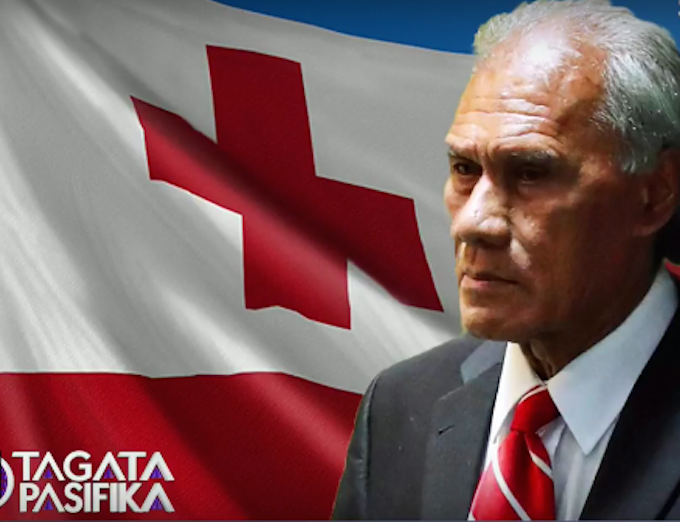
Dumped PM ‘Akilisi Pōhiva … pro-democracy supporters question lack of “solid reasons” for surprise royal dismissal. Image: Tagata Pasika

By Kalino Latu, editor of Kaniva News

King Tupou VI has proclaimed ʻAkilisi Pōhiva’s cabinet will continue on as Tonga’s caretaker government, which will run the kingdom until after the upcoming general election in November.

The Lord Chamberlain made the announcement yesterday.

The caretaker government royal proclamation. Image: Kaniva News

“His Majesty commanded that new representatives of nobles and the people to be elected to enter the Legislative Assembly at elections to be held in no later than November 16,″ the Lord Chamberlain said in a statement.

“Until those elections take place, the present government will continue as caretaker government.

“During this time, the administration of government services, especially Health and Education services to the people, should remain a priority”.

Pōhiva and his cabinet were dismissed on Friday after King Tupou VI had dissolved Parliament.

-Partners-

NZ troops in Tonga come home
Meanwhile, the New Zealand SAS troops in Tonga will be brought home as soon as possible, the New Zealand government announced.

A group of 20 SAS soldiers are in Tonga, where the Prime Minister has suddenly been dismissed by the King.

Foreign Minister Gerry Brownlee told The New Zealand Herald the troops were there for a routine exercise, and yesterday confirmed they would be pulled out of the country as soon as possible.

“Rather than continuing on to do their scheduled training exercise, we’ve concluded this is a time for Tonga to have some clear air, uncomplicated by the coincidental presence of NZDF personnel in the country.”

Pōhiva to stand again
ʻAkilisi Pōhiva plans to run for Parliament again in the November election, his son and personal assistant Poʻoi Pōhiva confirmed to Kaniva News.

The dissolution of the Parliament came after the king was advised by his Privy Council and the Speaker of Parliament.

In an interview with Pōhiva three years ago, the long-time democratic veteran campaigner said he would stand for election one last time in the 2014 general election.

The revelation of Pōhiva’s plan could give his great number of supporters in the kingdom and abroad a sense of relief, after many of them were devastated by his dismissal.

Po’oi Pōhiva did not give further details about his father’s plan but most of ‘Akilisi’s supporters had called on him to stand again for Parliament since his dismissal.

His supporters do not believe there were solid reasons for the king to dismiss the people’s first elected Prime Minister.

The Privy Council has yet to give any reasons why it made the surprising royal command.

ʻAkilisi Pōhiva’s supporters have questioned the Privy Council and the Speaker of the House over their advice to dissolve Parliament given they were only elected to their positions by the king and the only 33 members of the nobility.

]]>

Disappointment, fears of violence in wake of royal dismissal of PM Pohiva

]]>

AsiaPacificReport.nz

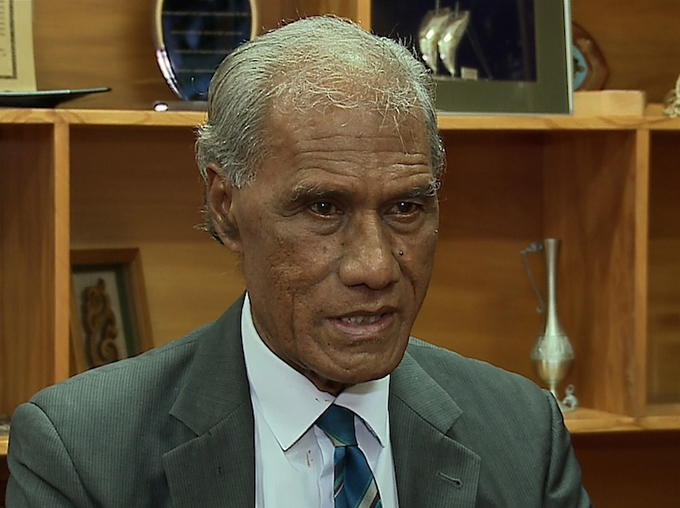
Sacked Tongan Prime Minister ‘Akilisi Pohiva … popular democracy leader but leader of unstable government. Image: Kaniva News

By Philip Cass in Auckland

There was disappointment and fears of violence early today in the aftermath of King Tupou IV’s dismissal of Tongan Prime Minister ‘Akilisi Pohiva.

New Zealand Foreign Minister Gerry Brownlee said the possibility of civil unrest was a concern.

A leading Tongan academic said last night there was “a very real fear of violence” following the dismissal of Pohiva.

Dr Malakai Koloamatangi, Pasifika director at Massey University, said Pohiva had a lot of support among the people of Tonga.

Dr Koloamatangi told TVNZ last night that while the kingdom had been moving towards a more democratic government, King Tupou IV’s dismissal of the Prime Minister was ”highly unusual”.

Radio New Zealand described the move as the downfall of Pohiva and noted that his government had been marred by controversy and allegations of incompetence.

-Partners-

As Kaniva News reported yesterday afternoon, the dismissal followed an approach by the Speaker of Parliament to King Tupou VI and a decision made by the Privy Council.

According to the government gazette, fresh elections must be held by November 16.

Former parliamentarian Dr Sitiveni Halapua said the people had high hopes for Pohiva’s government, but had not seen any real fruits from the democratic change.

“It’s a great disappointment all round,” Dr Halapua said.

Tongan publisher Kalafai Moala said the King’s decision was a setback for democracy, but told Agence France-Presse the dismissal had support.

“Pohiva has a core of supporters and they’re out there on social media expressing disappointment,” he said.

“But I think most people are happy and felt like this had been coming for some time.”

Meanwhile, Brownlee said New Zealand SAS troops who were in the kingdom were confined to barracks.

He said it was a complete coincidence the troops were in the kingdom.

Brownlee told The New Zealand Herald the government had had no indication the move was coming.

“We will be trying to work out over the next couple of days what it is going to mean for democracy in Tonga and what the implications will be for New Zealand,” he said.

]]>

Tongan king sacks democracy PM, dissolves Parliament for election

]]>

AsiaPacificReport.nz

King Tupou VI … surprise move to end the Tongan political impasse. Image: Kaniva Tonga

By Kalino Latu, editor of Kaniva News

King Tupou VI of Tonga has officially dissolved Tongaʻs Parliament effective from Thursday, dismissing democracy Prime Minister ‘Akilisi Pohiva and called for a new election no later than November 17.

Acting Attorney-General ‘Aminiasi Kefu has confirmed the royal command.

The Crown Law website said King Tupou VI made the decision after he had received advice from the Speaker, Lord Tu’ilakepa.

The announcement was made on the Crown Law website yesterday afternoon.

As Kaniva News reported earlier yesterday, when the Prime Minister’s Office was contacted and some noble MPs for confirmation, they said they were unaware of the dissolution decision.

The announcement:

WE, TUPOU VI, BY THE GRACE OF GOD, OF TONGA, KING:

-Partners-

HAVING CONSIDERED Advice from the Lord Speaker of the Legislative Assembly, and

HAVING REGARD to Clauses 38 and 77(2) of The Act of Constitution of Tonga (Cap. 2) DO lawfully dissolve the Legislative Assembly with effect from Thursday24 August2017 at 1700 hours and DO Command that new Representatives of the Nobles and People be elected to enter the Legislative Assembly at Elections to be held no later than 16 November 2017.

DONE by Us at Nuku’alofa, this Twenty Fourth day of August inthe Year of Our Lord Two Thousand and Seventeen and in this the Sixth Year of Our Reign.

An earlier Kaniva News report said:

The Members of Parliament were told this morning to return home as the House was closed down for the rest of this term.

The Prime Minister’s Office was unaware of any decision the King has dismissed the Prime Minister, a spokesperson from the Office told Kaniva News.

She said the Office was inquiring and would release a statement soon.

Reports on social media this afternoon cited Tangata Pasifika correspondent John Pulu as saying the King had “dissolved” Parliament and “dismissed” Prime Minister ‘Akilisi Pohiva.

But Pulu told Kaniva News “ I am still waiting on official word from Tonga – will keep you posted…”

Lord Tu’iakepa has confirmed they were told tto go home but when he was told it had been reported the King had dissolved the Legislative Assembly he said they have yet to receive any official statement about it.

“Ko e tala mai pe ia ke mau foki ki ‘api ‘e tapuni e Fale Alea ki he ta’u ni ko ia pe,” Tu’ilakepa said. (Translated: “We were told to go home the Parliament will be closed down for this year that’s it”.)

Lord Tu’ilakepa was unaware of any decision to dismiss Prime Minister ‘Akilisi Pohiva.

A lady in Parliament said the Chief Clerk and the Speaker were in a meeting.

When she was told that Kaniva News wanted to talk to one of them she hung up the phone.

The New Zealand Herald reported that 20 New Zealand SAS troops were in Tonga for a “routine exercise”.

]]>

Thousands of Filipinos demand end to killings in Duterte’s drug war

]]>

AsiaPacificReport.nz

Children as young as five have become the latest victims in what’s believed to be the bloodiest week in the Philippines since President Rodrigo Duterte’s so-called ‘war on drugs’ began.Video: Al Jazeera’s Jamela Alindogan

Thousands of demonstrators have taken to the streets of the Philippine capital of Manila to denounce President Rodrigo Duterte’s war on drugs, as they marked the death anniversary of one of the country’s pro-democracy heroes.

Human rights advocates, youth groups, and religious communities defied a tropical storm that brought steady rain to gather at the memorial of the 1986 People Power revolution to call for an end to the killings in Duterte’s war on drugs.

Amid public pressure, Duterte admitted on Monday there could have been abuses in his anti-drug war policy.

“There is a possibility that in some of police incidents there could be abuses. I admit that,” Duterte told reporters in Manila. “These abusive police officers are destroying the credibility of the government.”

READ MORE: Duterte says ‘bloodiest’ day of war on drugs ‘beautiful’

Al Jazeera’s Jamela Alindogan, reporting from Manila, said at least 4000 people joined in the rally, adding that a separate protest was also held in another part of the city.

-Partners-

Protesters are demanding an independent investigation into the summary executions and police operations that left thousands of people dead. They said the president should be held accountable for the deaths.

Demonstrators waved Philippine flags and carried banners that read: “Resist the Fascist!”, “Stop the Killings!”, and “We will fight” among others.

Monday marked the 34th anniversary of the assassination of democracy icon Benigno Aquino, who fought the 20-year dictatorship of Ferdinand Marcos. Marcos was overthrown in 1986 in a peaceful protest, which saw Aquino’s widow, Corazon, become president. Duterte is an avowed supporter of Marcos.

Leaders of Monday’s protest said the death toll in Duterte’s war on drugs had now reached 13,000 – surpassing the number of deaths of anti-government activists during dictator Marcos’ two decades in office.

Government figures show that since Duterte took office last year, an estimated 3451 “drug personalities” have been killed in gun battles with police up to July 26, 2017.

Another 2000 more died in drug-related homicides, including attacks by motorcycle-riding masked gunmen and other assaults, while 8200 homicide cases are “under investigation”.

17-year-old student killed
At the rally, demonstrators also expressed outrage over the death of 17-year-old student, Kian delos Santos, who witnesses said was falsely accused of being a drug dealer and summarily executed by police earlier this week.

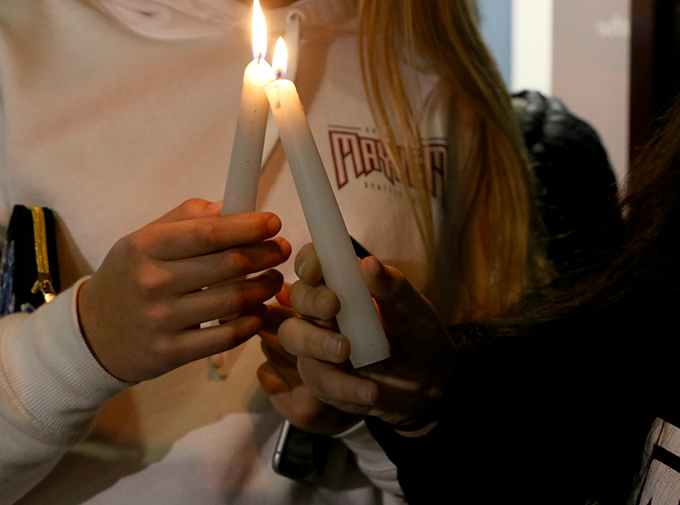
In another part of Manila, hundreds of marching neighbours and activists lit candles near the spot where delos Santos was shot dead during a mass raid that left at least 80 people dead in three days.

“Please be fair,” the student’s father, Zaldy delos Santos, told police. “We are the victims here. We are the ones you should help.”

He made the appeal after authorities went on the offensive to defend the police action, saying there was information indicating the boy was a drug courier and addict.

But initial forensic evidence showed there was no gunfight, and the three bullet wounds indicated the student was shot at close range in the back of the head.

According to reports, there have been at least 30 minors killed in the drug war since June 2016, when Duterte took office.

Arrests ordered
On Monday, Duterte ordered the police to take custody of officers who were involved in the killing of delos Santos, saying he would not condone abuses, and that the police officers would have to face the consequences of their actions if that is the recommendation of a formal investigation.

The head of the Public Attorney’s Office, Persida Acosta, told reporters she was recommending murder charges against the officers involved based on the initial autopsy report.

“Murder charges will most likely be filed because of the location of the entry wounds,” Acosta said in a television interview.

Neighbours, teachers and classmates of the boy also vouched for his good character. The education ministry issued a statement condemning the police action.

]]>

Australia crowned new king of basketball in FIBA Asia Cup

]]>

AsiaPacificReport.nz

Tight game … “sweeping” Australia versus “gritty” Iran in FIBA Asia Cup final. Video: FIBA Asia Cup

By Jeremaiah M. Opiniano 

A second-tier Australian team ruled a basketball kingdom that is the world’s largest by size: Asia.

The Boomers swept past the opposition, including a gritty Iran side last night, 79-56, to claim the FIBA Asia Cup championship in Beirut, Lebanon.

Australia swept all six matches in both preliminary and knock-out phases, beating opponents by an average of 28.83 points.

In the final, Australia led 12-2 to start off the game, but Iran soon gained ground. With the margins 16-14, guard Jason Cadee made a back-to-the-basket shot over Iranian center Meisam Mirzaetalarposhti with 2.5 ticks left in the first quarter.

From there, world number ten Australia were never threatened by world number 25 Iran, three-time champions of the old FIBA Asia Championships.

-Partners-

The gold medal match was the first FIBA Asia Cup which covers the old Asia zone and the Oceania zone, which Australia ruled for decades.

The scary part is Australia’s Beirut squad had none of its eight current NBA players led by Andrew Bogut and Patty Mills. There were only two holdovers of the 2016 Rio Olympics team who barely missed the bronze medal over Spain: David Andersen and Brad Newley.

On average, Adelaide 36er Mitch Creek led the Boomers in scoring (14.7 points per game) while fellow 36er Matthew Hodgson towed Australia in the rebounding department (6.6 rebounds per game).

Australia’s offensive attack was more balanced, to the point no Boomer made it to the tournament’s mythical five and the top five players in the major statistical categories like points, rebounds, assists, steals, blocks and three-point shooting percentage – an exception is overall field goal shooting percentage, which Creek topped (68.5 per cent field goal).

That alone reflects the depth of the Australian basketball program. Asian countries like Iran, China and the Philippines had some of their best players skipping the tournament or retiring from international play. But some of their leagues’ best players played in Beirut.

Australia’s long-time Oceania rival New Zealand lost to Korea in the bronze medal game, 71-80. China snatched fifth spot over Lebanon (79-78) while the Philippines got some end-game luck to beat Jordan for seventh place (75-70).

The entire FIBA Asia Cup mattered for countries’ current world rankings. But the tournament did not create any impact on the forthcoming home-and-away qualification matches for the 2019 FIBA World Cup in China.

These matches, patterned after football’s FIFA World Cup qualifications, begin November 2017 and end November 2018. Australia is bracketed with Japan, the Philippines and Chinese-Taipei.

Jeremaiah Opiniano is an Assistant Professor with the Faculty of Arts and Letters at the University of Santo Tomas (UST) in Manila, Philippines.

]]>

RNZI hits back at Tongan media bias claims

]]>

AsiaPacificReport.nz

Critics of Tongan Prime Minister ‘Akilisi Pohiva … use media freedom issues to increase profits, help friends in Tonga Broadcasting Commission, son accuses. Image: TNews

By Philip Cass in Auckland

Radio New Zealand International’s presenter of Dateline Pacific, Don Wiseman, has suggested Prime Minister ‘Akilisi Pohiva’s son read the New Zealand broadcaster’s website more carefully before accusing it of media bias.

This comes after an attack on the region’s media by Siosiua Po’oi Pohiva, who acts as his father’s personal assistant.

In a press release, the prime minister’s personal assistant demanded journalists critical of his father’s government apologise to King Tupou VI and the Tongan people.

Siosiua singled out RNZI, Taimi o Tonga and publisher Kalafi Moala, Pacific Freedom Forum head Monica Miller and Pacific Islands News Association’ Moses Stevens for their coverage and comments on the removal of former Tonga Broadcasting Commission (TBC) General Mananger Nanise Fifita.

Wiseman, who is also RNZI’s deputy news editor, said he found Siosiua’s version of events “extraordinarily partial”.

“There are a number of statements from your father and other people that you have chosen ignore. I think a more thorough read of our website will help,” he said.

-Partners-

Fifita’s removal has been widely seen by the Pacific media as being the result of Prime Minister Pohiva’s feud with the TBC over what he perceives as biased reporting against his government.

Tongan integrity ‘damaged’
Siosiua has painted those who have been critical of the removal of Fifita as being aligned with the government’s enemies.

He said they should also apologise to his father and the Tongan government “for the damage they had caused on Tonga’s integrity”.

“Journalists and media groups in Tonga, New Zealand and the Pacific region began attacking the prime minister and his government, accusing them of threatening media freedom in Tonga,” he said.

“Those who were pro-establishment and who did not support the democratic reforms led by ‘Akilisi Pohiva are now those of who are against the new government and its new administration.”

Siosiua accused the prime minister’s critics of using the issue of media freedom to increase their profits and help their friends in the TBC.

In his press release, Siosiua referred to Lord Chief Justice Paulsen’s findings on Fifita’s application for a judicial review. The review examined the Minister of Public Enterprise’s declaration that her reappointment was void and the notice of TBC advising her of that decision.

Siosiua quoted Lord Chief Justice Paulsen as saying her reappointment was void because it required the minister’s approval, which was never obtained.

Sympathy for Fifita
However, as Kaniva News reported at the time, Lord Chief Justice Paulsen also said he had considerable sympathy for Fifita.

“She has, by all accounts, been an excellent employee,” he said.

The judge described her as “a long term, loyal and able servant of TBC” who had been general manager since October 2008.

In his report on the case, the judge said he made no comment as to whether she might still have remedies available to her in respect of any failings of the board of TBC to obtain the minister’s approval to her reappointment.

Dr Philip Cass is a research associate with the Pacific Media Centre and associate editor of Pacific Journalism Review. He is a senior lecturer at Unitec Institute of Technology and is a regular contributor for Kaniva Tonga.

]]>

Keith Rankin: Letter to Labour about Income Tax

]]>

Letter to Labour about Income Tax – By Keith Rankin.

As the fog clears, three options emerge for the 2017-2020 government:

·         conservative: National and New Zealand First (English or Peters as PM)

·         Peronista: Jacinda Ardern (as Evita) and Winston Peters (as Peron)

·         progressive: Labour, Green, Māori (Ardern as PM)

Whichever of these we get, I would like to see a government true to its parties’ philosophies, and with good twenty-first century income tax policies.

The progressive option is looking much more probable than at any other time since 1999. Jacinda Ardern can act now to make this outcome both more likely and more authentic.

Understanding the reality of the economic struggle of low- and middle-income households is critical. Among other things, these people need more money, unconditionally. No bureaucracy, no abatements. Unconditional benefits have always been delivered in liberal democracies through the income tax system. These tax benefits, in the past, have taken the form of allowances, exemptions and progressive graduations.

The Present

What can Labour announce this week, to replace the Budget 2017 income tax adjustments? It needs to do something in addition to extending existing bureaucratic benefits. A political party representing ordinary people, with a good ear for their people, would hear that the bureaucracy around the benefit system is even more frustrating than the penury of those benefits.

The following simple remedy will work for Labour in the 2017 election campaign:

·         Remove the 30% income tax bracket by joining it with the 33% bracket.

·         Reduce the rate on the first bracket from 10.5% to zero, and lower the threshold to $9,370.

Why?

This will give ‘tax cuts’ to everyone earning less than $70,000 per year, while leaving all persons earning more than $70,000 at 2017 levels of taxation. More specifically, it would give everyone earning from $14,000 to $48,000 an extra $12.69 per week of unconditional cash, over and above any other benefit increases Labour would like to provide. This would make it a policy – albeit a tentative policy – that acknowledges everyone on struggle street.

Perhaps more importantly, as a guide to future income tax policy, please note the following simple tax formula:

  • weekly after-tax personal income equals 67% of gross earnings, plus $175

This formula is the present reality for every New Zealander earning $70,000 or more per year. The simple tax change suggested above extends that formula to every New Zealander earning $48,000 or more per year, while delivering symbolically important unconditional tax benefits to every New Zealander earning less than $48,000 per year. Further, it does nothing to antagonise anybody. It raises nobody’s income tax, from 2017 levels.

Let’s do this.

The Near Future

By following the same principle, the other middle tax bracket at present (the 17.5% bracket) can also be eliminated (for example in Budget 2019). This would mean having a zero-tax bracket upto incomes of $27,500 and a 33% marginal rate on all income in excess of $27,500. (This would also displace the present Independent Earner Tax Credit.)

As a result, everybody earning above $27,500 would be subject to the simple tax formula above. This would deliver significant unconditional tax benefits to people whose annual incomes are in the $20,000 to $40,000 range; benefits to the precariat, Labour’s new natural constituency.

Just Beyond the Near Future

As productivity increases progressively, the ratio of capital income (income arising from what we own) to labour income (income arising from what we do) must increase. So, say in Budget 2021, raise the tax rate from 33% to 35%, and raise the threshold from $27,500 to $32,000. The simple tax formula, which would apply to all persons earning over $32,000 per year, would become:

·         weekly after-tax personal income equals 65% of gross earnings, plus $215

Further, extend this simple tax formula to all independent people under 25 years of age, displacing youth benefits, student allowances, and student loan living allowances. (Young adults with dependent children or with disabilities would continue to be eligible for indexed Work and Income benefits. Eligibility for accommodation benefits would not change.)

It’s not rocket science. It is the twenty-first century. Let’s do these, one simple step at a time.

]]>

Duterte inspired by ‘Petrus’ shootings, says Indonesia’s Wiranto

]]>

AsiaPacificReport.nz

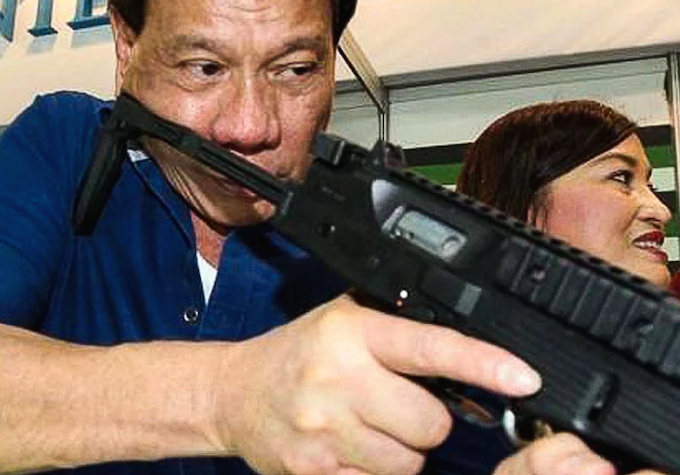
President Rodrigo Duterte … green light to a shooting spree of alleged drug traffickers. Image: New Mandala

Summary execution-style killings between 1982 and 1985, known locally as penembakan misterius (mysterious shootings), or Petrus, were infamous as a means of bringing down crime rates in the country during the dictatorial regime of former president Soeharto.

More than three decades later, Petrus, considered one of Indonesia’s past gross human rights violations, is said to be an inspiration for President Rodrigo Duterte, the leader of the Philippines, in his notorious war on drugs.

This claim was made by Coordinating Political, Legal and Security Affairs Minister Wiranto, who was also a former Defence Minister and Armed Forces (ABRI) commander before the fall of the New Order regime in 1998.

According to Wiranto, Duterte revealed the source of inspiration behind his “shooting-spree” of drug traffickers to President Joko “Jokowi” Widodo during their casual conversations on the sidelines of the 30th ASEAN Summit in Manila on Saturday last week.

“Duterte joked ‘I learned from Indonesia.’ President Jokowi was confused [and asked] when President Duterte came to learn about Indonesia,” Wiranto said as quoted by kompas.com on Friday.

“President Duterte answered, ‘No, I learned from Petrus [during the administration] of Soeharto’,” he added.

“Apparently, Petrus, which in Indonesia is thought of as an unresolved case of past human rights abuse, has become an example in [the Philippines],” Wiranto said.

-Partners-

Operation Sickle
The Petrus shootings started in August 1982 under the command of then chief of the Operational Command for the Restoration of Security and Order (Kopkamtib), the late Admiral Soedomo. The operation was codenamed “Operasi Clurit” (Operation Sickle).

In March 1983, General Benny Moerdani, who replaced Soedomo as commander of Kopkamtib, took over the security operation.

The operation targeted recidivists, local gangs, unemployed youths and others considered sources of violent crime. Some were targeted by the operation simply because they had tattoos, considered a mark of criminals.

After a four-year investigation that started in 2008, the National Commission on Human Rights (Komnas HAM) announced in 2012 that the Petrus shootings were a gross violation of human rights as they involved systematic extra-judicial killings, torture and abduction.

The Indonesian Military and their territorial commanders as well as the National Police were mostly responsible for carrying out the widespread killings, which resulted in the deaths of at least 2000 people according to the state rights body.

In the Philippines, up to 9000 people have been killed in extrajudicial executions by police and vigilantes working in Duterte’s drug war campaign, according to Amnesty International.

More than 2500 people have been killed in shoot-outs during raids since Duterte took office on June 30 last year. His war on drugs has been condemned by human rights groups for what they claim amounts to crimes against humanity.

Poor targeted
Amnesty International’s report released in January reveals that the Philippine police have systematically targeted mostly poor and defenceless people across the country and have paid others to kill thousands of alleged drug offenders.

In an alarming development, Duterte’s brutal crackdown on the drug trade has inspired Indonesian security officials, including National Narcotics Agency (BNN) head General Budi Waseso, to take a tougher stance on drugs.

Recently, Jokowi instructed law enforcement officers to impose the sternest sanctions on drug dealers operating in Indonesia. The President has given law enforcement bodies the permission to gun down suspected drug dealers in the streets if necessary.

]]>

NZ’s Labour Party needs to ‘reach back into Pacific community’, says panel

]]>

AsiaPacificReport.nz

Tagata Pasifika’s first election talanoa … Labour must engage Pacific voters. Video: Tagata Pasifika

Tagata Pasifika has kicked off its election talanoa series with a panel discussion weighing-in on Jacinda Ardern’s recent appointment to leader of the Labour Party.

The panel welcomed Ardern’s abrupt rise from deputy leader to leader following Andrew Little’s resignation on August 1, continuing the media’s positive coverage.

Manukau Ward councillor Fa’anana Efeso Collins said Ardern was the “silver bullet” New Zealand had been looking for.

“I think Jacinda’s going to make a huge difference to this election,” he said.

Despite only being six weeks out from elections, Innes Logan, SPASIFIK magazine editor and publisher, said Labour had made the right decision.

“I think it’s quite a smart move timing wise.”

-Partners-

CEO of Leadership New Zealand, Sina Wendt Moore, told host Seinafolava Sanele Chadwick Ardern’s leadership was important for Pasifika women.

“This change is really positive for Labour,” she said.

Engage Pacific community
However, Fa’anana, Logan and Moore warned it was important for Labour to continue to engage with the Pacific community and retain its strong voting base.

Moore said Ardern subsequently needs to ensure her empathetic, warm and approachable leadership style extended to the Pacific community.

“She connects well with people, so if she goes out and does that across the community, including our women, then I think it’s going to work for Labour.”

Both Fa’anana and Logan agreed it was essential Labour address the “cut through” issues facing the Pacific community, such as housing, in order to retain its strong voting base.

“It’s now time to deal to some of these issues that we’re facing. If Jacinda can lead with these messages, I think we’re going to see a really good turnout, especially in South Auckland,” Fa’anana said.

Logan added the Pasifika community would continue to engage in politics despite media reports to the contrary.

“I’ve got no doubt voter turnout will be even more for this election.”

]]>

LETTERS: Operation Burnham – New Zealand Government Must Initiate Independent Inquiry

]]>

LETTERS to the Editor: Operation Burnham – New Zealand Government Must Initiate Independent Inquiry
In July It was revealed Australia Special Forces may have been responsible for the deaths of children in Afghanistan.
In response the Australia Defence Force is conducting an inquiry into the allegations-a step the New Zealand Government has been avoiding since March for our own Defence Force.
When you read the book ”Hit and Run” as I have three times now you feel uneasy & disappointed. We assume our military would do their utmost to avoid civilian deaths and to treat prisoners with dignity.
Isn’t it the ”Kiwi” thing to do and the way we carry ourselves around the world?. We need to put things right if we did something wrong in Afghanistan.
The allegations against SAS reflect poorly on New Zealand and the people=us. We know we’re better than this. If New Zealanders killed and hurt innocent civilians we need to stand-up and hold ourselves to account.
Shame that the Defence Force and Government were able to smoke screen the allegations of Operation Burnham in the book ”Hit and Run” by suggesting they had the town wrong (Baghlan) on 22 August, 2010 which then led them to drawing a long bow and saying “well if  they got the town wrong then of course they must have got other stuff wrong as well” – but really that was just obfuscation and distraction aimed at moving things away from an inquiry.
Under UN Human Rights Articles 12 and 13, convention Member states are asked to ensure competent authorities ( like the government in this case ) conduct prompt and impartial investigations where there are any allegations of torture.
In the book the claim is made six civilians were killed and 15 injured in the raid by NZ SAS .
Now the UN is calling on the New Zealand government to show how those allegations are being thoroughly addressed.
Truth may well be an elusive concept these days, especially where there is conflict, but that is no reason why we should cease to pursue the truth.
If mistakes were made (and obviously there were) an inquiry will help us understand why and how so they’re not repeated in the future.
It’s clearly the right thing to do for the families of the Afghan victims and indeed the public of New Zealand.
It would seem New Zealand could well be headed to the International Criminal Court for war crimes.
The government faces High Court proceedings over the alleged deaths of civilians in Afghanistan.
Just recently on the eve of being the anniversary of seven years 22/8/2010 the Prime Minister calls it political pressure.
Paul Mulvaney.
]]>

Bryce Edwards Analysis: Political Roundup – Bittersweet “Pollquake” for the left

New Zealand Prime Minister, Jacinda Ardern.

Bryce Edwards Analysis: Political Roundup – Bittersweet “Pollquake” for the left

[caption id="attachment_13635" align="alignright" width="150"] Dr Bryce Edwards.[/caption] New Zealand politics has been relatively stable for the last nine years. Public opinion hasn’t moved around much at all, even in the face of all sorts of scandal and chaos amongst the politicians. And when volatility hit other countries, New Zealand appeared to be comfortably unmoved. Everything has now changed. The public is suddenly shifting their support around – and on the left that has meant deserting the Greens and jumping on board Jacinda Ardern’s Labour Party. [caption id="attachment_6928" align="aligncenter" width="612"] Labour Party leader Jacinda Ardern. Image courtesy of Jacinda.org.nz.[/caption] Volatility rules Volatility now rules. The latest 1News Colmar Brunton poll exemplifies this – see 1 News Colmar Brunton poll: Greens plummet below five per cent, ‘Jacinda effect’ keeps Labour climbing. This has the Greens going from their highest support three weeks ago, to their lowest support in decades. When was the last time a party lost over two-thirds of its support in a few weeks? It seems the election campaign really is making a difference this year. Previous recent wisdom was that campaigns don’t have a particularly big impact on elections anymore. In the recent past, even though polling might have bounced around a bit in the lead-up to election day, political parties have ended up getting similar support to what they had at the start of the campaign. But, internationally– exemplified by the Corbyn and Trump campaigns – election campaigns have lately turned public opinion around considerably. People nowadays are more open to changing their votes. And the sudden closeness of this campaign has made politics so much more interesting. Last night on RNZ, I said “It is just an election that is so close, I think we’re going to see much more fascination with what’s happening … we’re going to see a higher voter turnout because people like when there’s actually a contest… This is the most dramatic election I think we’ve seen for many decades” – see RNZ’s Poll puts Greens below threshold as Labour surges. Other commentators have been saying similarly things in recent hours: “the ‘Jacinda Effect’ has redesigned the electoral map”; “Ardern’s elevation to the leadership just 17 days ago has electrified the contest”; and “the implosion of support for the Greens has transformed the election campaign”. In fact the Herald’s Audrey Young puts it best, saying that “new leader Jacinda Ardern has managed to make New Zealand politics as gripping as the dramas in the United States and Britain that captured world attention” – see: Julie Bishop may have given Jacinda Ardern an extra lift. Mike Hosking emphasises how close things have become: “So, it’s tight, tighter than most thought, which makes every day, every policy, every announcement critical” – see: National appear to be in some level of trouble. And Toby Manhire draws attention to just how much the latest 1News poll differs from the mid-August poll of 2014: “National now 44%, then 50%; Labour now 37%, then 26%; NZ First now 10%, then 5%; Green now 4%, then 11%; Māori now 2%, then 0.9%; TOP now 2%, then not a twinkle in Gareth Morgan’s eye” – see: Greens are goneburger in new poll which shows English and Ardern level pegging. Although last night’s poll “is only one poll”, the NBR’s Rob Hosking emphasises the new political territory we are now in, saying “in these days of increased global political volatility, [such polls] can swing violently again… And these are – as we have seen from overseas – volatile times. These polls could swing again, with similar statistical violence, in other directions. There is still a long way to go between now and September 23” – see: Poll shock for Greens, wake up for National (paywalled). The Greens’ pollquake Obviously the Green Party bore the brunt of this week’s pollquake. I described their dramatic decline as being due to a “perfect storm” because two factors have been at work – the “Jacinda Effect” and the “Metiria Effect” – which by themselves might not have produced such an extreme slump in the polls: “not only have they had this horrible scandal, it’s happened at a time that Labour is buoyant… People see that Labour is back in the game, that they have a credible leader, and that’s why they’re taking 37 percent of the vote” – see RNZ’s Poll puts Greens below threshhold as Labour surges. See also my interview on TVNZ’s Breakfast: ‘There’s a chance Greens might be wiped out this election’ after sharp poll fall – Bryce Edwards. So why have Green supporters deserted the party they once supported? Audrey Young says: “They are being punished for many things in the past five weeks but disunity is top of the list, or as leader James Shaw calls it, ‘messiness’.” And Mike Hosking argues it’s not only Metiria Turei at fault: “What a catastrophic mistake it will be if the Turei debacle sank the party. It is widely accepted now that James Shaw failed the leadership test. He should have cut her loose; by standing by her he looked weak and he and the rest of them are now paying the price.” Turei herself isn’t quite apologising for her impact on her party. At a public meeting on Monday night in Timaru, she is reported as being “unrepentant”, and saying that although it had been a “sad” few days “she was still confident her decision to discuss her past was the right one” – see Daisy Hudson’s Metiria Turei says admitting benefit fraud was the right thing to do. Turei does, however, say that in hindsight “she would have thought more about the impact on her family before making the announcement.” As for the Greens’ initial polling plummet, Turei maintained that “It was much less than I expected”, and pointed more to other events as causing the damage: “I absolutely expected to see a drop as a result of the resurgence in Labour”. But she is optimistic that the damage wasn’t permanent: “I’ve been really pleased to see the party continue through the campaign, we’ve got fantastic candidates, great leadership in James Shaw, the party is really rallying.” James Shaw is also putting an optimistic spin on things, suggesting that the only way is now up: “This is about as bad as it ever gets” – see Vernon Small’s Green Party out of Parliament, Labour surges in new poll. Shaw is ruling out the possibility of help from Labour: “I honestly don’t think we’ll need it.” Could support for the Greens fall further? It’s possible. First, the Greens have to fight against the “reverse-momentum factor”, in which supporters abandon the party due to the perception they’re no longer a popular or viable option. Second, the psychological effect of the Greens potentially being below the crucial 5 per cent MMP threshold means that some voters will be unwilling to risk supporting a party that might not make it into Parliament. The risk of a “wasted vote” is a significant deterrent for some. Those on the left who want to “change the government’ will now feel safer giving their support to Labour, even if they prefer the Greens. And although many commentators assume that the Greens have a loyal “core vote”, the fate of the Alliance party needs to be remembered. The Alliance went from 10% in 1996 (down from 18% in 1993 under FPP) to around 1% of the vote in 2002. In both cases – although over a much longer period for the Alliance  – resurgent support for Labour and internal divisions were key factors in the catastrophic losses. The focus will now be on whether Labour will activity help or hinder the Greens. Toby Manhire looks at the possibility of an electorate deal: “Does it mean that a Greens-Labour deal in Wellington Central is on the cards? In the Espiner Scenario – named for the RNZ host who mooted it – Grant Robertson would stand aside in the seat for Greens co-leader James Shaw. All going to plan, that would mean the Greens would go in to parliament irrespective of party vote, on the coat-tails exemption-to-the-threshold rule. Both Ardern and Shaw told TVNZ tonight that was not going to happen. Can that position sustain another couple of polls showing similar numbers?” – see: Greens are goneburger in new poll which shows English and Ardern level pegging. In any case, Manhire thinks the Greens will not disappear: “The Greens missing out altogether seems altogether unlikely. But their target now will be considerably more modest, maybe 7%. The challenge will in part be to keep spirits up.” Clearly the Greens will be desperately trying to figure out how to get themselves out of this mess. The most obvious re-orientation would be to focus again on their core reason for being and stated point of difference – the environment. This is exactly what John Armstrong suggests in his column yesterday, published prior to the shock poll – see: Greens in election no-man’s land after Metiria Turei shambles. He argues that the party needs to look seriously at “the very vexed question of the party’s positioning on the political spectrum.” This means, not only re-asserting their environmental focus, but also ditching the party’s alignment with Labour: “Expressing a willingness to at least talk to National post-election would put a whole different complexion on the election. And no party is currently in greater need of such a change in the election’s dynamics than Shaw’s crew.” Here’s Armstrong’s main point: “Labour’s resurgence means there is now only one escape route from the cul de sac in which the Greens are trapped. They need to reposition themselves in the centre of the political spectrum so that if they have the numbers to be a player in post-election talks on government formation, they have the flexibility to engage in serious negotiations with either Labour or National or both major parties.” Finally, what could happen next? Such a volatile campaign could easily produce further surprises and upsets, and so Simon Wilson outlines 10 more things that could change this election campaign.]]>

MIL Video: Message from America Trumps Waterloo – Paul Buchanan and Selwyn Manning

Message from America: Welcome to this the first episode in a four month series titled, Message from America, featuring political and security analyst Dr Paul Buchanan and host Selwyn Manning. This week we cross to Florida to discuss the vibe on the ground and the fallout for President Donald Trump over the race riots in Charlottesville. https://youtu.be/HpKCD5vdM9I Span of questions: 1) Is this Trump’s Waterloo? 2) Is he realy trying to empower and validate the alt-Right? 3) is he a racist? 4) Given that major corporate figures, senior GOP leaders and military commanders have repudiated white supremecism and indirectly in some cases, Trump himself, what does this mean for his presidency and his policy agenda? 5) Is there a crisis of civil-militaryrelations in the making? 6) Are the jobs of General Kelly (Chief of Staff) and Gen MacMaster (NSC advisor) tenable if Trump does not back down on his suport for Rightists? 7) Nazis openly marching in the streets of the US 72 years after they surrendered in Europe–who would have thought it possibel? 8) is civil war in the US imminent or possible? How large is the alt-Right/neo-Nazi/whiote supremacist movement? 9) As a diversion from the mueller investigation into his campiagn connections with Russia the alt-Right dog whistle-turned-into bugle call has backfired. But what about that investiogation? Where is it in terms of results? 10) Is Steve Bannon the puppet master and is his job safe? 11) With trump increasingly isolated and lashing out at members of his own party, is impeachment or resignation possible?]]>

Korea, Iran in with a shot to verse Australia, NZ for basketball crown

]]>

AsiaPacificReport.nz

Korean basketballers too hot, slick and tough … Philippines beaten. Video: FIBA Asia Cup

By Jeremaiah M. Opiniano in Adelaide 

Two former Asian champions earned the right to square-off for a finals ticket and possibly an opportunity to beat Australia or New Zealand in the ongoing FIBA Asia Cup in Beirut.

Former Asian Games champion Korea (world number 30) was too hot, too slick and too tough on defense in a masterful 118-86 win over previously unbeaten Philippines in the first quarterfinal yesterday.

Former three-time FIBA Asia Championships titlist Iran then broke the hearts of home fans by beating Lebanon, 80-70 in the second quarterfinal tussle.

The two countries will meet in the upper bracket of the semifinal round Saturday, August 19.

The lower bracket of the semifinal round is yet to be determined with games today pitting long-time FIBA Oceania champions Australia versus reigning FIBA Asia champions China, and New Zealand battling underdogs Jordan.

-Partners-

Winners of the last two quarterfinals matches will meet in the other semifinal match. Should the Boomers and the Tall Blacks win, only one team from the Pacific will head on to the finals slated Sunday, August 20.

Korea upset New Zealand, 76-75, in during a Group B preliminary round match. And with the way they played against the Tall Blacks and against the Philippines’ Gilas players, the Koreans may enter the finals.

Korea played with a younger batch of players. Its stalwarts in either FIBA Asia or the FIBA World Cup such as guard Yang Donggeun, shooters Cho Sungmin and Kim Taesul and the Moon brothers are have given way to the younger players like centers Oh Sekeun and Kim Jongkyu, and guard Sun Hyungkim.

Iran still has ageless Hamed Haddadi, part of a triumvirate that towed Iran’s title runs in the 2007, 2009 and 2013 FIBA Asia Championships (former name of today’s FIBA Asia Cup). That triumvirate included players who have retired from FIBA play: small forward Samad Nikkahbahrami and Mahdi Kamrani, both former mythical five selections in previous FIBA Asia tournaments.

Given the reformatting of continental tournaments, as well as qualification for the 2019 FIBA World Cup to be held in China, the former Asia and Oceania zones merged into one FIBA zone (Asia).

The merger made Australia the zone’s top team (world number 10), followed by China (number 14) and New Zealand (number 20). Australia, with a line up filled with at least six NBA players, almost won the bronze medal at the 2016 Rio de Janeiro Olympic Games.

Most of the teams at the FIBA Asia Cup did not field in their best players. Some teams are reserving these players when the FIBA World Cup qualification tournaments, featuring home-and-away games (similar to football), begin this November.

Jeremaiah Opiniano is an Assistant Professor with the Faculty of Arts and Letters at the University of Santo Tomas (UST) in Manila, Philippines.

]]>

Bryce Edwards Analysis: Political Roundup: NZ (and Australia) needs better political scandals

Bryce Edwards Analysis: Political Roundup: NZ (and Australia) needs better political scandals [caption id="attachment_14990" align="aligncenter" width="640"] Trans-Tasman rivalry between New Zealand and Australia.[/caption] [caption id="attachment_13635" align="alignright" width="150"] Dr Bryce Edwards.[/caption] The current trans-Tasman citizenship saga doesn’t warrant the level of hysteria coming from politicians in both countries, on both sides of the political divide, or the media coverage that has ensued. It’s a scandal without much substance – it doesn’t illuminate any political principles or ideologies, and therefore doesn’t help New Zealand voters in their decision-making for the upcoming general election. So why does it warrant this Political Roundup column? Because the saga does elucidate what is wrong with modern politics. It helps illustrate why so much of the public is alienated from politics and voting. So-called scandals like this, involving high levels of posturing and disingenuous game playing, mostly serve to convince people that parliamentary politics is rather pathetic. The Australian Government develops a bad case of “The Trumps” The most pathetic reaction in the whole episode has come from the Australian Government, which has wallowed in an overblown example of victimhood, making loud statements about a conspiracy against Australia. Foreign minister, Julie Bishop, has talked ominously about the “foreign power” of New Zealand meddling in their politics. Indeed, Australian Prime Minister, Malcolm Turnbull accused his Labor Party opponents of plotting “to steal government by entering into a conspiracy with a foreign power”. The best response to this came from the Australian Financial Review’s Laura Tingle: “Talk about losing it. The Barnaby vortex opened and consumed Foreign Minister Julie Bishop in a whirlpool of hysteria and conspiracy theories that would do Donald Trump proud” – see: The day New Zealand conspired to overturn Prime Minister Malcolm Turnbull. Tingle explains in plain language what really happened: “someone in the ALP dared to ask someone in New Zealand to check up on citizenship requirements”. The National Government joins in New Zealand’s National Government also has an interest in exaggerating the saga. Prime Minister Bill English has jumped in: “I can’t remember a time when an MP has done something like that that involves the politics of another country. It’s just another misjudgement about what is actually a serious issue” – see: Anna Bracewell-Worrall’s Bill English condemns Labour’s Chris Hipkins in Aussie citizenship saga. To Gordon Campbell, National is simply running the same line as the Australian Government: “The real conspiracy here isn’t the one between Hipkins and his mates in the Australian Labor Party. It’s the one between the National Party and the Liberal coalition in Australia. In both countries, the two conservative governments have found common cause in running a treasonous conspiracy theory aimed at their respective opposition parties” – see: On why Labour isn’t responsible for Barnaby Joyce. Campbell explains why “our own government has chosen to further that narrative, and make itself an accomplice. Evidently, the National government is similarly desperate for anything that might discredit or derail the Ardern juggernaut”. According to Claire Trevett, Foreign Minister Gerry Brownlee has also used the incident to suggest that if New Zealanders living in Australia lose even more rights there, then Labour would be to blame – which Trevett suggests is an argument without merit – see: Aussies accuse Labour of foul play. And it’s not just National attempting to make political gain out of it. Winston Peters has gone hard against Labour, suggesting that Labour MP Chris Hipkins – as well as Peter Dunne, who has backed him – have sunk to the levels of infamous Australian cricketers, the Chappell brothers: “The hit put on Australian Deputy Prime Minister by the Labour Party and corroborated by a Minister in the National-led government is like an underarm delivery” – see the Herald’s Barnaby Joyce citizenship ‘hit’ compared to underarm cricket. Peters concludes, “This is not how we do things this side of the Tasman. Simply put, it is not cricket.” Chris Hipkins is caught out MP Chris Hipkins was the MP who put in the written question to the Minister of Internal Affairs, which helped spark the whole saga. This is all well covered by Richard Harman in his account, NZ Government kept Barnaby Joyce’s citizenship top secret. Harman points out that Hipkins’ parliamentary questions carried special weight because, “Unlike media questions, there was a formal obligation on Internal Affairs to answer Hipkins’ questions.” National-aligned blogger David Farrar expands on this: “Here’s why Hipkins involvement was important, even though there had been media inquiries also. There is no deadline for DIA to respond to inquiries by foreign journalists. Even if it was a NZ journalist asking, they could take up to four weeks to answer under the OIA. But by having Hipkins ask a parliamentary question, the Minister is obliged to answer within five working days or one week. So Hipkins was able to get Australian Labor the information as much as three weeks earlier” – see: Labour causes rift with Australia. Of course, Hipkins has made a number of statements pleading ignorance of the role he was playing in the saga. For example, Sam Sachdeva reports that “Hipkins said it was his decision to lodge the questions as part of a broader interest in the treatment of New Zealanders living in Australia, and he did not want to affect Australian politics” – see: Accusations of meddling fly in Trans-Tasman barney. Few people seem to accept that Hipkins didn’t know what he was doing. Barry Soper says: “The story doesn’t stack up here because if Chris Hipkins wasn’t told by his fraternal comrades in Australia that the target was Joyce, then he was sucked in. And for a senior politician, that’s inexcusable. It beggars belief that he wouldn’t have asked why they wanted to know” – see: Jacinda Ardern has a John Key moment. Similarly, Mike Hosking reacts: “He argues he didn’t know what the questions were about, or who they were for. Really? So is he saying he just asks questions for the sake of it? You can get him to use his time to fire off any series of questions you like on any old subject going, and he’s not a bloke who asks questions about the questions? Does anyone really believe that?” – see: What the hell was Chris Hipkins doing? Jacinda Ardern looks strong The big winner out of the episode is probably the new Labour leader. By all accounts she has been able to make good use of the “bad news” to show leadership. For example, Gordon Campbell says: “Jacinda Ardern, for her part, has handled the first international flap under her leadership admirably and showed the same sort of steely aplomb that one used to associate with Helen Clark” – see: On why Labour isn’t responsible for Barnaby Joyce. Of course, National was trying to make use of the scandal “as a way to undermine new Labour leader Jacinda Ardern’s inexperience, just two weeks into the job”, according to Tracy Watkins – see: Everyone smeared by trans-Tasman dirt slinging. But it hasn’t’ worked out that way. Watkins gives Ardern top marks for her handling of the situation: “Ardern’s response, however, was straight out of the Helen Clark play book. Clark operated on the golden rule that no one ever lost votes by standing up to the Aussies. Ardern didn’t mince words about Hipkins, whose behaviour she said was completely inappropriate. Ardern even offered to talk to Bishop and talked up the importance of the relationship. But she would not apologise. Labour’s new leader could have had the wind knocked out of her by the force of Bishop’s attack. But she managed to look decisive and unflappable.” In fact, Ardern upped the ante, hitting out at the Australians and accusing them of making “false claims”. She met with the Australian High Commissioner yesterday to “register my disappointment”. And many New Zealanders will her cheer on – see, for example, No Right Turn’s blog post, Ardern stands up for kiwis. Overall, it seems that almost every politician has found a way to try to make the scandal work to their electoral advantage. But voters have not gained any great insight into principles or policies – probably only confirming that politicians love a good political fight to posture over. Finally, the Australian Government’s whole problem can be easily fixed, says Toby Manhire. He suggests New Zealand could establish a new law “so that anyone holding New Zealand citizenship who is successfully elected to the Australian house or senate has that citizenship automatically revoked” – see: Dear Australia. We can fix your politician citizenship crisis. Love, NZ. And all we would want in return is for Australia to “bin all the changes you’ve been stealthily introducing that discriminate against the 600,000-or-so New Zealanders – many born in Australia”.]]>

Australia, NZ slug it out with Asian counterparts for FIBA Asia Cup crown

]]>

AsiaPacificReport.nz

Australia and New Zealand face-off against Asia-Pacific counterparts … basketball tournament kicks off. Video: FIBA Asia Cup

By Jeremaiah M. Opiniano in Adelaide

Basketball countries in the rugby-crazed Pacific will try to rule a merged Asia-Pacific regional zone when the quarterfinals of the new FIBA Asia Cup begin today in Beirut, Lebanon.

That is even if many countries in the ongoing continental hoops showcase did not send their best players.

Like Australia. With the merging of the old FIBA Asia and FIBA Oceania zones beginning this year, the world number 10 is tipped to rule the tournament over defending 2015 FIBA Asia champion China (number 14) this August 17th.

The other team that did not send its best players is world number 20 New Zealand. And even if it lost to Korea, 75-76, in Group D preliminary action, the Tall Blacks are primed to make it to the semi-finals.

Owing to changes in the format of FIBA’s international competitions, many countries across the world have opted to keep their players for the home-and-away 2019 FIBA World Cup qualifiers that begin this November 22. The new format for spots in the 2019 FIBA World Cup in China are similar to that of football’s qualification format in the triennial FIFA World Cup.

-Partners-

Australia sent a crew made up players from its National Basketball League (NBL) led by Rio Olympics veterans David Andersen and Brad Newley. The country has eight NBA players —Patty Mills, Andrew Bogut, Matthew Dellavedova, Dante Exum, Joe Ingles, Thon Maker, Aron Baynes, and 2016 top rookie pick Ben Simmons— who can all form a formidable FIBA World Cup team. (Andersen plays in the French league as Newley returned to the NBL after a stint in the Spanish league).

And even with the NBL players towing the Boomers, Australia breezed past Japan (84-68), Hong Kong (99-58) and Chinese-Taipei (90-50). The Boomers will play a struggling Chinese team, with the latter playing minus former NBA center Yi Jianlian and NBA rookie Zhou Qi.

New Zealand, for its part, still topped Group C (the “Group of Death”) in Lebanon despite the loss to Korea. New Zealand, Korea and host Lebanon all had 2-1 win-loss cards but the Tall Blacks had the superior quotient.

New Zealand thumped Kazakhstan, 70-49 and endured a rowdy hometown crowd to beat Lebanon 86-82.

The Tall Blacks team in Beirut differs from the 2016 FIBA Olympic Qualifying tournament squad in Manila last July 2016. Missing in Beirut include brothers Corey and Tai Webster, center Isaac Fotu, Thomas Abercrombie and Mika Vokuna. Only Shea Ili and Jordan Ngatai are remnants from the Manila squad who are in Beirut.

Adelaide 36er Mitch Creek banners the Boomers’ scoring binge during preliminary play (15.7 pts. per game) as his team balances its offensive arsenals. Meanwhile, Ili of the Wellington Saints (14.7 pts. per game) tows the Tall Blacks offense.

If Australia beats China and New Zealand hurdles Jordan August 17, the two face off in the semi-finals August 19.

But the other topnotchers in two other preliminary groups, Iran (Group A) and the Philippines (B), hope to make it to the Final Four as well.

Two-time FIBA Asia Champions Iran, with former NBA Center Hamed Haddadi and two others left from its previous champion squads, meet Lebanon today.

The biggest surprise is the smallest team, the Philippines. Without its naturalized American Andray Blatche and three-time Philippine Basketball Association (PBA) most valuable player June Mar Fajardo, and with only a week’s practice, Southeast Asia’s only qualifier upset China (96-87) and breezed past Iraq and Qatar to top Group B.

However, an old continental nemesis —Korea— awaits the Filipinos. Korea always breaks generations of Philippine teams in continental meets such as the old FIBA Asia Championships and the quadrennial Asian Games.

The breakthrough came at the 2013 FIBA Asia Championships in Manila when the Philippines upset the Koreans and qualified for the 2014 FIBA World Cup in Spain.

The now FIBA Asia Cup was previously called as the FIBA Asia Championships and the older Asian Basketball Confederation (ABC) Championships. The now FIBA World Cup was then the FIBA World Championship and the World Basketball Championships.

No matter who wins the Beirut conclave, results will not affect the FIBA World Cup Qualification matches. The home-and-away matches will be on November 2017 and on February, June, July, September and November 2018.

Australia is bracketed with Japan, the Philippines and Chinese-Taipei. New Zealand is grouped along with Korea, China and Hong Kong. Iran is the luckiest as it is bracketed with Kazakhstan, Iraq and Qatar.

The FIBA Asia zone offers seven slots for the 32-team FIBA World Cup in China. Australia, New Zealand (Oceania zone), Iran, the Philippines and Korea (Asia zone) played at the 2014 FIBA World Cup in Spain.

Assistant Professor Jeremaiah Opiniano is coordinator of the undergraduate and graduate journalism degree programmes of the University of Santo Tomas (UST) in Manila, Philippines.

]]>

Plans to end violence, improve human rights in West Papua ‘unravelling’

]]>

AsiaPacificReport.nz

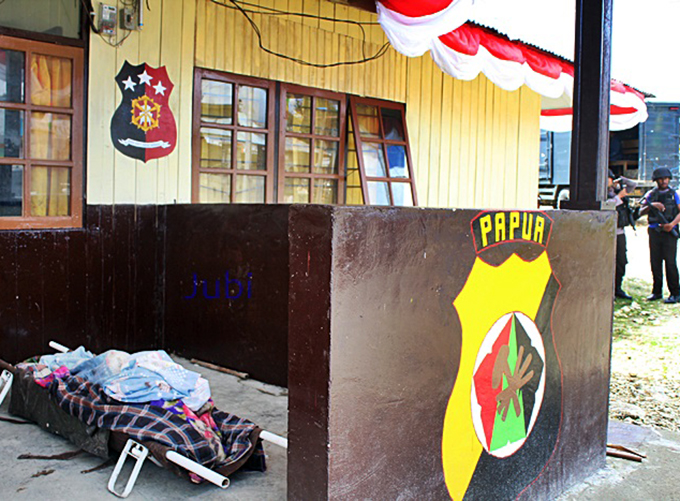
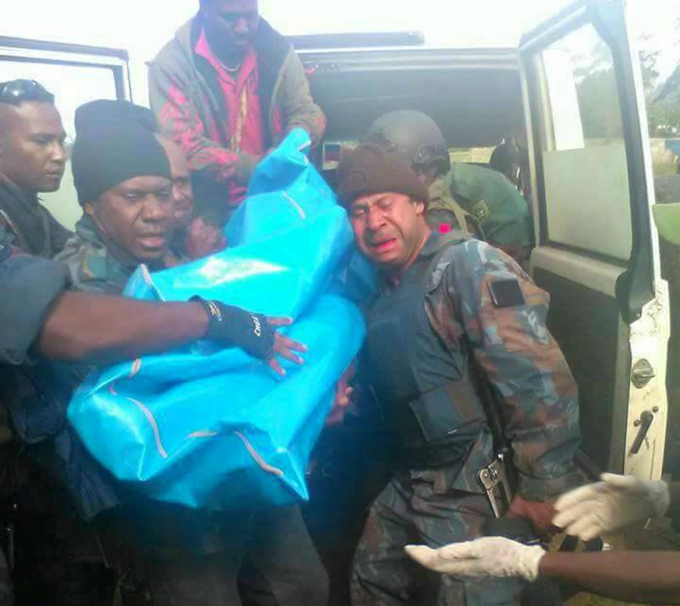
Shooting protest … body of Yulianus Pigai, killed earlier this month by security forces, delivered to Tigi Subdistrict Police Station by family. Image: Abeth You/Tabloid Jubi

ANALYSIS: By Hipolitus Yolisandry Ringgi Wangge in Jakarta

Reports about the shooting of an indigenous Papuan by police officers early this month in Deiyai district, Papua, have renewed focus on how human rights abuses by security officials in the region remain unaddressed by the government of President Joko “Jokowi” Widodo.

Accounts of what triggered the incident differ, although most suggest it began when workers at a construction company refused to take a near-drowned villager to the hospital. The villager’s relatives and other local residents protested and a scuffle broke out. Police and military officials arrived and, according to an eyewitness, opened fire on the crowd without firing any warning shots. This left one man, Yulianus Pigai, dead, and 16 other Papuans wounded, including children.

Local police claimed Mobile Brigade (Brimob) personnel only used rubber bullets to disperse the crowd. But a relative of one of the injured residents has posted photos on social media of real bullet casings, allegedly used by police.

Despite government pledges to change the approach to the region, violence against indigenous Papuans at the hands of security forces has continued unabated. Hundreds of thousands of military and police officials have been deployed to the region. The government justifies this security presence for three main reasons: The first is to secure so-called national assets, such as the massive Freeport McMoran mine. The second is to respond to the Free Papua Movement (OPM), and other small-scale organisations agitating for independence. The third is to prevent and address horizontal conflict between non-indigenous and indigenous Papuans, and among Papuan tribes.

The shooting has also highlighted the lack of policy coherence of the Jokowi administration. Since Jokowi took over from Susilo Bambang Yudhoyono in 2014, the government has initiated several economic policies, including establishing massive infrastructure projects, and implementing a one-fuel price policy, which aim, among other things, to improve economic development in Papua.

On the political front, Jokowi granted clemency to five Papuan political prisoners in 2015. Human Rights Watch researcher Andreas Harsono recently reported Jokowi has been quietly releasing dozens more over the past year. In his first nearly three years in power, he has visited the two Papuan provinces far more often than his predecessors. Yet none of these efforts have had much of an impact on the central problem in Papua, which is one of human rights.

-Partners-

Jokowi does not appear to have any clear design for addressing violations of human rights in Papua, or across the country more broadly. About the same time as the shooting, for example, police officers dispersed a workshop convened by the Indonesian People’s Tribunal on the 1965 violence – a reminder of how quickly Jokowi’s plans for reconciliation for past human rights abuses have unravelled.

Lack of justice
Scholars argue ethno-nationalist protests can gather steam when the government is resistant to holding human rights violators – particularly state security officials – to account through the courts. This lack of justice results in deep trauma for victims’ families and increases public mistrust of the central government. This, in turn, enables political actors to mobilise the people to express aspirations for independence, as has happened in Papua.

There are two basic problems within the government approach to human rights in Papua. First, institutions and approaches are poorly coordinated. This is an old and unresolved problem that the Indonesian government has faced since it initiated structural reforms in the early 2000s. For years, government institutions, in particular, the Coordinating Ministry for Legal, Political, and Security Affairs, the Home Affairs Ministry, the Foreign Affairs Ministry, the National Police (Polri) and the Indonesian Military (TNI), have promoted different and sometimes inconsistent policies to deal with problems in Papua.

Luhut Panjaitan, former coordinating minister for legal, political, and security affairs, formed an integrated working group to find a solution to three of the most concerning human rights cases: the 2014 Paniai shootings, the 2001 Wamena incident, and the 2003 Wasior incident. However, when former General Wiranto succeeded Luhut in 2016, the team was dismissed, and there have been no follow-up activities to address these crucial issues. Wiranto recently claimed the shooting in Deiyai was not a human rights violation.

Further evidence of this inconsistent approach is Jokowi’s 2015 promise to lift restrictions on foreign journalists reporting from Papua. There have still not been any specific policies introduced to implement this directive. Any foreign journalist who wishes to go to Papua must still undertake a complicated application process and follow strict requirements, particularly from security-related agencies and, occasionally, the Ministry of Foreign Affairs.

A comprehensive human rights policy – not an economic policy – should be the priority for resolving the issues in Papua. Economic policy has been the prescription favoured by every Indonesian president to address problems in Papua. They seem to believe aspirations for independence are simply a function of the poor quality of life of many indigenous Papuans, and improving welfare will lead to these demands fading.

In reality, the situation is far more complex. Papuans’ trust issues with the central government do not stem from poverty. Rather, they result from the insecurity of living with the threat of violence from the security officers who surround them, a massive presence that in itself contributes to trauma. In addition, the stagnation of internal reforms in the police and TNI which might make them better able to deal with low-level conflicts and protests in Papua without violence has made a bad situation worse.

Indigenous Papuans will continue to be killed as long as the central government lacks the political will or capacity to better coordinate national institutions and prioritise human rights issues in Papua.

Hipolitus Yolisandry Ringgi Wangge is a researcher at the Marthinus Academy in Jakarta. His current research focuses on democratisation in developing countries, particularly the role of crucial actors such as the military during democratic transition and consolidation. He has conducted fieldwork in West Papua on the role of Papuan youth in political and cultural identity during the special autonomy era.

]]>

PM O’Neill wins stay order preventing arrest

]]>

AsiaPacificReport.nz

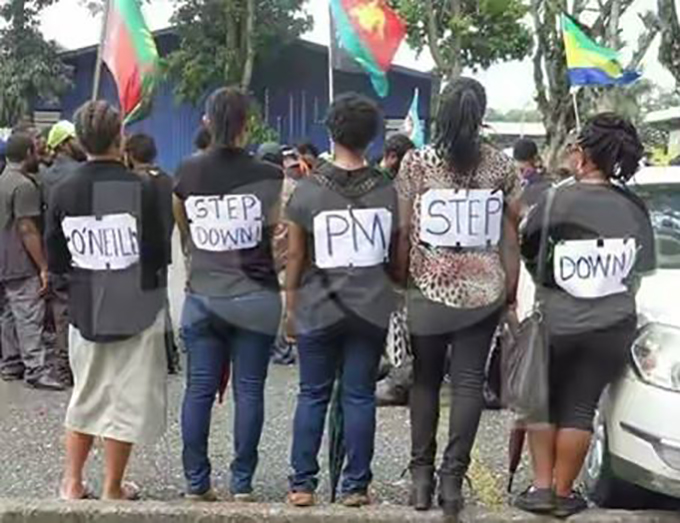
Papua New Guinea’s prime minister, Peter O’Neill, has successfully obtained a stay order in the Supreme Court preventing his arrest by police pending a review of the warrant issued on him.

An urgent stay application was filed following Tuesday’s decision by National Court Justice Collin Makail’s ruling that the 2014 warrant of arrest was not reviewable, the PNG Post-Courier reports.

A lawyer representing the Prime Minister, Mal Varitimos QC, appealed the matter after highlighting inconsistencies in the August 8 ruling by Justice Makail.

The trial judge judicially reviewed the three-year old stay orders of the warrant of arrest and dismissed it on the grounds that the orders were not reviewable.

Yesterday, Varitimos submitted that among the inconsistencies, Justice Makail overlooked Supreme Court binding case references relating to the matter.

The binding references relate to former Attorney General Ano Pala’s appeal against his 2014 warrant of arrest, an order by the District Court where the Supreme Court upheld it saying it was reviewable by the National Court.

In a 2014 decision of the five-men bench of the supreme court considering the power, functions, duties and responsibilities of the commissioner of police, it ruled a warrant of arrest was amendable as opposed to Justice Makail’s ruling.

-Partners-

Arrest warrant challenged
It considered the question of whether the commissioner of police had a sufficient standing to seek leave for judicial review of the decision to use the warrant of arrest that is subject to the current challenge.

The submission by Varitimos was that the binding references were erroneously over-looked and as a result Chief Justice Sir Salamo Injia granted the stay orders.

The PNG Post-Courier also reports police commissioner Gari Baki will be inviting O’Neill for an interview in light of Justice Makail’s ruling on August 8.

“As Commissioner of Police, I welcome the decision of the court as it now paves the way for us to move forward on this matter.

“Since the Court decision I have had consultations with my senior officers on the case and as the Commissioner of Police, myself, to invite the Prime Minister to come in for an interview.

“I want the people of Papua New Guinea to appreciate that this is a very sensitive and delicate matter involving the Prime Minister of the Independent State of Papua New Guinea.

“The interview is not a requirement by law but an existing and established protocol the constabulary has engaged over the years for leaders and high profile people,” Baki said.

]]>

NZ government rejects calls for ‘public, unequivocal’ stand for West Papua

]]>

AsiaPacificReport.nz

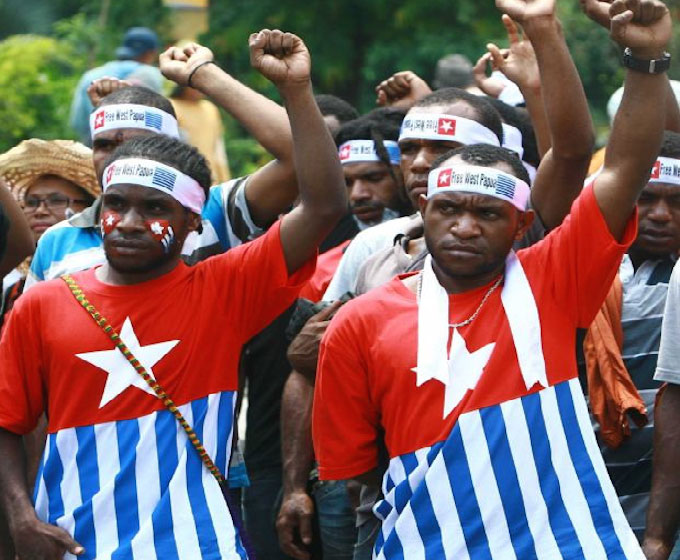
Petition prompted by news of West Papuan arrests at 2016 peaceful demonstrations … rejected by New Zealand government. Image: ABC

Pacific Media Watch reports

New Zealand’s Foreign Affairs, Defence and Trade Committee has dismissed a call for the government to make a stand and address the ongoing human rights situation in West Papua.

This comes in response to a 2016 petition spearheaded by West Papua Action Auckland’s Maire Leadbeater which urges the government to take a “public and unequivocal” stand and condemn Indonesia’s arrest and intimidation of peaceful protesters and end the state sanctioned torture and killing of West Papuans.

The committee stated the United Nations Universal Periodic Review process and engagement with Indonesia directly remain the appropriate channels to make New Zealand’s views known on such issues, although it agreed with Leadbeater the “fundamental human rights of freedom of speech and assembly must be upheld”.

Some of the committee also felt the government should support a call for working through the UN alongside Pacific nations to better address the human rights abuses in the Indonesian province.

“We encourage the Ministry of Foreign Affairs and Trade to continue monitoring the human rights situation in West Papua, and to raise any concerns it may have,” the committee said.

But such a position has been criticised as a “business as usual” approach.

-Partners-

“I am appalled that ministry officials have told the committee that there is doubt about the practice of torture in West Papua.

Torture practices ‘endemic’
“This flies in the face of extensive documentation from numerous human rights, church and academic reports all of which describe the practices of torture as endemic,” Leadbeater said.

Leadbeater’s comments come after the committee’s report revealed The Ministry of Foreign Affairs and Trade feels the killings of alleged separatists by Indonesia are “random acts of violence rather than systematically planned or organised acts”.

The petition, endorsed by several human rights groups, academics and leaders of the Anglican and Catholic Church, also calls for the government to push for the UN special rapporteur on freedom of expression to visit West Papua.

Although the report notes such a visit would be consistent with increased international transparency, it does not appear New Zealand will propel this as the ministry continues to stand by its position which recognises the sovereign integrity of Indonesia and its territorial jurisdiction over West Papua.

Despite ongoing criticism from groups such as West Papua Action Auckland, the ministry states it monitors the human rights situation in West Papua through diplomatic reporting from New Zealand’s embassy in Jakarta and has repeatedly called on Indonesia’s government to grant journalists and NGOs further access to West Papua.

New Zealand has also been criticised for its alleged lacklustre stance regarding calls for West Papua to be included on the UN’s list of nations to be decolonised.

“New Zealand is missing in action while other small Pacific nations such as Vanuatu, Tonga and the Solomon Islands stand up for the West Papuan people and their fundamental rights,” Leadbeater said.

Pacific leads way
The Solomon Islands, Vanuatu, Tonga, the Republic of the Marshall Islands, Nauru, Tuvalu and Palau have all called for UN intervention in West Papua while New Zealand has so far remained silent.

West Papua Action Auckland is not taking the report as a defeat, however, and will continue fighting for West Papua’s independence.

The group stated it is now approaching all political parties ahead of New Zealand’s election in September seeking a clear policy statement on whether or not they support West Papua’s quest for self-determination.

“New Zealand’s shameful acquiescence in this horror story in our neighbourhood must end.”

]]>

Bryce Edwards Analysis: Who’s to blame for Metiria Turei’s downfall?

]]>

Bryce Edwards Analysis: Who’s to blame for Metiria Turei’s downfall?

[caption id="attachment_13635" align="alignright" width="150"] Dr Bryce Edwards.[/caption] The fallout from Metiria Turei’s benefit confession is producing some fascinating and revealing analysis and reaction about the state of politics, media, and society.
There is anger and disappointment on all sides and much of the very polarised emotion is directed at determining who is responsible for Turei’s political demise. Below are some of the targets.
[caption id="attachment_8918" align="aligncenter" width="599"] Green Party co-leader Metiria-Turei has resigned as co-leader and from the party’s list.[/caption]
1) Metiria Turei is to blame
There is a case to be made that Turei has been her own worst enemy in this whole mess, and the blame for her departure sits fairly and squarely with her. Herald political editor Audrey Young is exasperated that Turei has continued to avoid apologising and refuses to accept she is in any way at fault: “At no point has she conceded she did the wrong thing, not even politically, not for a second. At no point did she think about the damage she would be doing to Labour or the Greens relationship with Labour. And that lack of self-doubt has led to slow-motion kamikaze mission of a politician, destroying herself and wounding her party. Turei’s supporters had no sense of how their adulation of her attitude serving to divide the country as much as her party. It was a shocking display of being unable to see what damage they were doing” – see: Turei resigns without the slightest concession what she did was wrong.
John Armstrong, writing on the 1News website, is even harder on the Green politician, saying “Few in the world of politics will shed a tear for her in the wake of her decision to quit politics. Not even those of the crocodile variety” – see: Metiria Turei will be remembered, but she won’t be missed.
According to Armstrong, “the glaring gaps in her account of life on the Domestic Purposes Benefit”, as well as her “refusal to divulge details of her living arrangements at the time and her convenient memory lapses”, and the revelation “that she had registered as a voter at the address of the father of her child”, all meant that the “public felt that the wool was being pulled over its eyes”.
He comments on the souring Green-Labour relationship: “The Greens had jumped in the opinion polls at Labour’s expense but the Labour Party got revenge by insisting that Turei could no longer be a Minister in a Labour-Greens Cabinet. The sound of Turei nailing herself on to the cross of martyrdom was replaced by the sound of Labour nailing the lid on her political coffin.”
He believes Turei should have expected the “very toxic and very explosive combination of nastiness” that followed her admission, as her story combined two popular targets: “There are many people who hate beneficiaries. They also hate politicians.”
But his strongest point is this: “Most MPs go to extraordinary lengths to protect their families from the ugly side of politics… In marked contrast, Turei used her family as a political weapon with which to wage her war on poverty.”
This is also the point made by former Act MP, Deborah Coddington – see: Political life is both good and bad for MPs’ children. Coddington says: “Turei is correct, her family doesn’t deserve this pain. But the media didn’t start this; Turei did. She stood up and used her child, her former partner, and her mother, as a vehicle for her narrative when she said she lied to claim more welfare and to ‘debate poverty’. From that point on the public had every right to ask questions (via media) about other authorities Turei may have lied to, what else might be exposed in future, and be given the entire story not selected tidbits Turei has chosen to offer.”
2) The Greens are to blame 
There are some who are sympathetic to Metiria Turei’s plight, but believe the whole scandal was a spectacular own-goal delivered by the party itself. Finlay Macdonald has a thoughtful must-read critique in which he says that the “Greens backroom team should probably quit, too”.
Macdonald argues from the side of the beneficiaries and poor, who he thinks have been poorly served by the Greens’ ill-considered campaign – see: Victims deserve better than Turei’s poorly played hand. He sympathises with Turei’s goals, “But it is one thing to agitate to change the system, and quite another to set yourself up as the embodiment of all that is wrong with that system. If you are going to turn your own personal history into a narrative of social injustice and the case for reform, you had better be very sure your story has a beginning, a middle and an end. It’s called political management 101, and the Greens failed it so spectacularly”.
The Greens needed to have Turei much more prepared than she was: “Turei needed to have explained her entire situation from the outset, anticipated the hard questions and been able to spin them honestly, and perhaps even have already paid back the notional amount owing. The Greens should have known all this.”
Leftwing union activist Mike Treen also makes this point: “the Greens have to bear some of the blame for that. There is no excuse for not seeing what was coming after the announcement and preparing for that with the obvious response that every cent would be repaid. Failure to do so is just stupid” – see: Resignation fever! Who is advising our political leaders?
Here’s Treen’s main point: “An advisor worth their salt would have asked those challenging questions before they were asked in public. Even when an acceptable narrative had been developed, the first thing that needed to be sorted before going public was repaying WINZ. It doesn’t matter whether she thought it was right to lie in the first place or not. To most people, if you are on the public payroll to the tune of $175,000 a year, you can afford to repay money obtained in the past by some form of deceit, justified or not. There is a strange, and unjustified, sense of entitlement to think otherwise. As far as I’m aware to this day she has said she will only pay it back if WINZ ask for it. That is just arrogant and stupid. Now the opportunity to shift the debate to how badly WINZ claimants have been treated is being lost.
3) The Media and “commentariat” are to blame
Most of the leftwing responses to Metiria Turei’s downfall place part of the blame at the feet of the media and political pundits. And certainly there were plenty of political journalists and commentators calling for the then co-leader to resign, and some very hard questions were being asked of her.
Leftwing blogger Steven Cowan sums it up as being down to “the anti-Turei cacophony of the corporate media” – see: The Media war against Metiria Turei. He says “The well heeled members of The Commentariat were tripping over themselves to see who could denounce Metiria Turei and The Green Party the loudest.”
Cowan elaborates: “Turei has been talkback gold. She’s female, Maori, an environmentalist, liberal – and a former beneficiary who fiddled the system. She is fully qualified for a good talkback kicking and kick out they did. It’s been difficult to find anyone from within the corporate media who has actually supported the Green co-leader.”
Young Greens co-convener Meg Williams explains: “She was beaten down relentlessly by the media and commentators, to the point that it became too much for her and her family and she decided to resign for their protection. All this vitriol, all this hate and disgust, because a politician was bold enough to say what needed to be said about poverty and inequality: we are not doing enough” – see: What our politics has lost with Metiria Turei’s resignation.
4) Racism and sexism are to blame
Backward attitudes on race and gender are thought by many of Turei’s supporters to be central to her demise, with accusations of double standards and hypocrisy being levelled at Turei’s opponents and critics. Gordon Campbell says in his column today, “far less is expected of white male politicians than brown female ones” – see: On the Turei finale.
Steve King explains how personal identity and “privilege” can lead to judgement of people like Turei: “I belong to the dominant ethnic group. I am male, and I am middle-class. Everything in our society is geared towards helping me along. My privilege is a consequence of matters of fortune over which I had absolutely no control at all. I had a comfortable upbringing.” And therefore “people like me are tempted to make judgements about people who are not so fortunate as them” – see: Not prepared to criticise from privileged position.
5) It’s all about class
Victoria University of Wellington political scientist Claire Timperley suggests that Turei’s downfall is directly related to being working class and a beneficiary – see: Metiria Turei debate: It’s all about class.
Timperley argues that being poor is what puts people in a situation where following the rules is a luxury: “Beneficiary fraud is a uniquely class-based problem. The only people who are in the position of having to make difficult choices about whether to ‘play by the rules’ and by doing so risk not having the means to support their family are those who are in the poorest group of New Zealanders. The fact Turei lied to the authorities demonstrates the very difficult position many beneficiaries find themselves in.”
Timperley argues that implicit in many of the calls for Turei to resign is the notion that Parliament is not a place for those “who have not experienced the security of a middle-class upbringing.” Therefore, this also raises questions about how representative our democracy is: “Recent commentary has lauded the diversity of the new Labour leadership, focusing on classic markers of identity politics: age, sex, ethnicity and geography – Jacinda Ardern is young and female, Kelvin Davis is Māori and from the North. A characteristic missing from that list is class. Labour has a history of appealing to the working class, although this has eroded in recent years… But if we look around the halls of power, we see very few MPs from working class backgrounds.”
Similarly, see No Right Turn’s Class and Metiria. He says “its all the more apparent when you compare it with Bill English’s housing allowance rort: there, a rich man lied about where he lived and paid lawyers to order his affairs to scam the taxpayer of tens of thousands of dollars. But it was “within the rules” – rules he helped write – so its all OK.”
Similarly, Simon Wilson says “Turei didn’t get any help from lawyers: she was a beneficiary on her own. Poor people take their chances: you steal a loaf of bread and hope you don’t get caught. Rich people, however, employ people to tell them where to find the free bread” – see: The sins of Metiria, Bill and John: sense-checking the fact checkers.
And Lynn Williams argues that the Turei saga “exemplifies and exposes the class divide which the politics of the past 30 years has been all about both opening and obfuscating” – see: “Nobody should steal from taxpayers”.
A class analysis also highlights the differences between Turei and Labour’s new leader: “She has supposedly caused a wave of “Jacindamania” in her first week in the job, emerging as a feminist icon. Yet the feminism she is engaging is superficial at best, as the women she stands for are not the ones who are materially disadvantaged, reflected in her firm position to exclude Turei from a ministerial position should Labour and the Greens work together. She will stand up for women, but just the ones who don’t have to lie to WINZ to receive the benefit to feed their children. Even with this kind of position, Ardern remains clear of the public’s moralising gaze” – see Erica Hye Ji Lee’s Lessons from Metiria Turei’s resignation.
Finally, for a poignant view about the Turei poverty conversation, see Toby Morris’ cartoon on the RNZ website, Turei’s exit no fairytale ending.
]]>

Stay order on PM O’Neill’s arrest dismissed by court

]]>

AsiaPacificReport.nz

Papua New Guinea’s prime minister Peter O’Neill may be arrested … stay order dismissed by court. Image: PNG Today

By Nellie Setepano in Port Moresby

Papua New Guinea’s National Court has dismissed stay orders preventing the arrest of Prime Minister Peter O’Neill.

This means police can now execute the arrest on the prime minister.

This comes after a judicial review in relation to the June 2014 warrant of arrest for the prime minister which was dismissed by Justice Collin Makail in the Waigani National Court yesterday.

The former police commissioner Geoffrey Vaki had challenged the legality of the warrant of arrest that was issued by the District Court by chief magistrate Nerrie Eliakim on June 12,  2014.

Despite the judgment made on the dismissal yesterday morning, a second attempt by the prime minister’s lawyer in the afternoon to delay the court orders for 14 days was made but failed.

Justice Makail said it was an abuse of court process and another attempt by the defendant to delay the court process.

-Partners-

Justice Makail said the defendant has the re-course in the Supreme Court.

Outside the court, director for National and Anti-Corruption, Mathew Damaru said it was now up to the police to issue a warrant of arrest.

Damaru said that the onus was on the police commissioner to act on the warrant and that it was out of respect of the office to leave it to commissioner Gari Baki to act on the warrant.

On June 12, 2014, a warrant of arrest was issued by Eliakim on the application of officers of the National Fraud Squad and Anti-Corruption Directorate.

This was in relation to allegations of official corruption made against the prime minister in relation to monetary benefits for Paul Paraka lawyers.

Loop PNG reports O’Neill’s lawyers will be appealing the National Court’s decision in the Supreme Court.

Nellie Setepano is a reporter with the PNG Post-Courier.

]]>

Bryce Edwards Analysis: The Inevitable split in the Greens

Green Party member of Parliament, Chloe Swarbrick.

[caption id="attachment_14974" align="aligncenter" width="640"] A future face of the Green Party, candidate Choe Swarbrick. Image: Courtesy of chloeswarbrick.co.nz.[/caption]

Bryce Edwards Analysis: The Inevitable split in the Greens
[caption id="attachment_13635" align="alignright" width="150"] Dr Bryce Edwards.[/caption] The split in the Green Party over Metiria Turei’s benefit confession and campaign is hardly surprising. The party has always contained an array of very different views and ideologies, which have co-existed under the broad banner of environmentalism. What is surprising is that it’s taken until now for the tensions to boil over. There are splits and deep divisions in every political party, and this one has always been inevitable.
For details of the current divide and the reactions of Green MPs, the best item to read is Isaac Davison’s Greens in crisis: Two MPs quit over Turei. He says the party “has been plunged into unprecedented disarray and disunity”. And for details about the rebel MPs, Kennedy Graham and David Clendon, see RNZ’s The dissenting Greens: Who exactly are they?
Divisions in the Greens
The bitter divisions in the Greens are stressed by Audrey Young in her column, Crisis unprecedented for the Green Party. She says it took a while before the impact of Turei’s benefit bomb was truly felt within the party: “It seemed too good to be true and it was. The apparent solidarity behind Greens co-leader Metiria Turei masked bitter divisions, just like other parties have… Turei’s handling of historic offending has lifted the lid on turmoil in the Greens.”
Young is particularly critical of how the party has handled the departure of MPs Graham and Clendon: “The party establishment moved to contain the fall-out in the way that other parties do – to criticise the two rebel MPs as pretty useless and lazy, which is particularly unfair on Kennedy Graham who works his butt off in strange areas of international law.”
She paints the picture as incredibly serious for the party: “The crisis is unprecedented for the Green Party. At its best it has been the conscience of the Parliament, at its worst its holier than thou preachers. Now it appears like all the rest.”
It’s not only the departing Green MPs who are calling for Metiria Turei to quit. Today, Fairfax political editor Tracy Watkins says its time for her to go: “Green Party co-leader Metiria Turei should resign before she tears the party even further apart. The way the Green Party has flaunted Turei’s benefit fraud admission has polarised New Zealand, and now the party. The ugly infighting has exposed real divisions in the Greens – and those divisions are not just over Turei, but about what the party stands for” – see: Metiria Turei should quit.
The Greens aren’t green enough
Watkins is very critical of Turei, saying her “preening at the attention” is “a big turn off to many” potential Green voters. But her more important criticism is that the Greens aren’t being green enough: “The Greens have for years leveraged off the Green ‘brand’ and all that stands for – sustainability, the environment, clean green New Zealand – while spending much of its time talking about anything but.”
The charge that the Greens have ceased to being a “real environmental party” is central to commentary on the party at the moment. There are certainly tensions in the party about how much focus should be put on social and economic issues versus a concentration on the environment. Newshub’s Lloyd Burr has put this best, with his column, The Greens have lost their way.
Here’s his main point: “Thanks to Metiria Turei, the Green Party is in the midst of an identity crisis. It’s a crisis that cuts to the heart of what the party stands for, and what its priorities are.  Just as importantly, it cuts to the heart of its name: The Greens. The party doesn’t look like the strong, unwavering voice for the environment anymore. It is not focussed on forests and rivers, or climate change, or conservation underfunding, or waste and pollution reduction. It is now a party focussed on fighting for the rights of beneficiaries. It is focussed on legitimising benefit fraud, boosting welfare payments, and removing welfare obligations.”
Burr rightly points out that “The struggle of the environment vs social welfare isn’t new to the Greens – it’s been simmering away in the background for years.” And this tension hasn’t been resolved for the upcoming election, which means “There is a big pool of them who want to prioritise the protection of the environment, cleaning our rivers, combating climate change, and reducing the amount of plastic that ends up in our oceans. These voters may will be put off by the Green Party’s new direction – and they’ll look elsewhere.”
Some similar points were recently made by Shane Cowlishaw in his article, Making the Greens green again. He says “You could be forgiven for wondering if the Greens have forgotten their own name.”
Should the Greens ditch the red politics?
The strongest argument for the Greens going back to being a more focused environmental party are put by Alex Tarrant, who recently wrote that “The Metiria Turei covfefe over the past few weeks has laid one thing bare above all others: The Green Party needs to take a long, hard look at itself and then split or grow up and focus purely on environmental issues. This election and the next more than any before are screaming out for an environment-focussed party to hold the balance of power” – see: The Greens need to split or grow up and focus only on environmental issues.
Tarrant wants to see the Greens focus on pure green issues: “Swimmable rivers, water pricing, criticism of the government’s climate change policy, the rise of electric vehicles, synthetic meat and milk, Trump’s anti-Paris Agreement stance, polluted drinking supplies in rural towns, Auckland public transport. Sure, they’ve made noises on all the above. But what has had them leading news cycles in the lead up to the election campaign? Turei on social welfare, and the Party’s decision to back National’s families package.”
He also points out that Gareth Morgan’s “TOP is quickly making inroads into some of its liberal urban voting base… The best defence would have been for the Greens to be an environment-only party.” And he concludes that “It is time for the Greens to plant some organic fertiliser and grow up.”
There is a chance that Morgan’s TOP will be one of the main winners from the Greens current crisis. In the past TOP has apparently unsuccessfully tried to recruit Green MP Julie Anne Genter, but has had more success with other former candidates – see Henry Cooke’s Greens candidate defects to Gareth Morgan’s TOP party.
Losing Green votes – how low can they go?
The consensus seems to be that the Greens will bleed votes over the current controversy, and Toby Manhire asks how low they might go: “Double figures already feels like a stretch. If they slip below 7% – and that’s entirely plausible; in 2008 they were 6.7%, in 2005 5.3% – the two young women who in many ways represent the future face of the Green Party, Chlöe Swarbrick and Golriz Ghahraman (8 and 9 on the list following Graham’s departure) may not make it to parliament. Mojo Mathers, at 10, would be out. Other young talent such as Jack McDonald and John Hart (12 and 13): toast” – see: The Greens are in disarray, leaving the left resurgence hanging by a thread.
And certainly, the next Green Party caucus is going to look quite different, after the departure of the two candidates. As blogger Pete George points out, the party list will be affected: “In the past the Greens also promoted their principles of gender balance. Of the top 10 on the list, eight are female… If they get the same number of MPs back into Parliament (this now looks unlikely) 9 of 14 will be female, 5 will be male” – see: Green list more dominated by females.
Finally, for the most colourful critique of what’s happening in the party, see Patrick Gower’s Metiria Turei is causing the Greens to self-destruct. He says: “Metira Turei has switched the Green Party into a meltdown mode that it refuses to switch off. The Greens seem to be in pathological denial about the damage that Turei’s benefit fraud admission is doing. If Monday’s double resignation of two senior MPs isn’t enough to send the message ‘enough is enough’, then what is?”
]]>

‘A price they never should have paid’: Hiroshima, Nagasaki victims remembered

]]>

AsiaPacificReport.nz

Victims of Hiroshima and Nagasaki …. remembered in candlelit vigil 72 years on. Image: Kendall Hutt/PMC.

By Kendall Hutt in Auckland

The estimated 226,000 people who lost their lives in the atomic bombs on Hiroshima and Nagasaki have been remembered in Auckland.

In a commemoration organised by the Women’s League for International Peace and Freedom (WILPF) Aotearoa, members of the public and nuclear-free activists gathered in the Grey Lynn Community Centre to remember those who died on August 6 and August 9, 1945.

72 years on from the end of World War II, calls for the abolition of nuclear weapons and a halt to militarisation have not waned in efforts by women to bring world peace.

Professor Kozue Akibayashi, the international president of WILPF, led such calls last night.

“It has been my source of energy to be connected to women in many parts of the world who share a similar concern of the usage of power, the masculine idea that puts more importance in the use of force to solve disputes or to gain superiority of others.

“It has been my source of energy to work with women in other parts of the world to bring about a more equal world and to bring gender equality, which we feel very strongly can bring world peace so threats do not exist or nuclear power, because the use of nuclear arms are not justified,” she said.

-Partners-

Dr Akibayashi, who teaches at Doshisha University’s Graduate School of Global Studies in Osaka, Japan, highlighted the significant number of US bases on the island of Okinawa and the ongoing tensions surrounding the Korean peninsula to reinforce the absence of de-militarisation globally.

WILPF president Kozue Akibayashi … use of nuclear weapons “not justified”. Image: Kendall Hutt/PMC.

International community responsible
“The larger international community is responsible for bringing peace to the region and ending the grave human rights issue in North Korea,” she said.

The US has maintained bases on Okinawa since World War II and 70 per cent of its forces in Japan are centralised on the island in a move Dr Akibayashi described as “colonialism”.

This concentration of forces may have enabled the US to wage wars in Vietnam, Korea, Iraq and Afghanistan, but it has had an adverse effect on Okinawans, she added.

“No year passes by without sexual assault by US soldiers on Okinawans. It’s ongoing and they have the power.

“Their safety and wellbeing has been undermined and destroyed by the presence of the US military.

“They want to live in an Okinawa which is free from military bases and militarism,” she told her audience.

Soka Gakkai International New Zealand youth leader Soumya Puri reflected:

Value of human life
“I find the horrific events that unfolded 72 years ago on August 6, 1945 and August 9, 1945 during the heights of World War II deeply upsetting and forces me to question the value placed on human life and humanity as a whole.

Soumya Puri … events of Hiroshima “deeply upsetting”. Image: Kendall Hutt/PMC.

“The survivors of these nuclear bombs, known as Hibakusha, have shared their stories that clearly illustrate the pains and sufferings they’ve had to endure and overcome to lead a somewhat normal life. It was a price they never should have paid.”

“The bombings at Hiroshima and Nagasaki possess a great reminder that any technological breakthrough or advancement should be used for constructive purposes that pushes the human race forward, which is the ability for everyone to do more than they ever could.

“However, the opposite was achieved with the creation of nuclear bombs as they pose a constant threat to our existence, our most fundamental human right,” he said.

WILPF and its supporters also held a candlelit vigil in the form of a peace symbol to remember the approximately 226,000 people who lost their lives.

Remembering the victims of Hiroshima and Nagasaki … candlelit peace symbol. Image: Kendall Hutt/PMC.

Despite the wind and the rain, and thanks to the persistence of the younger generation, the peace symbol remained lit for some time.

The Nuclear Weapon Ban Treaty, signed by 122 countries on July 7, 2017, provides some hope for future generations, although the fight is not over, WILPF Aotearoa president Megan Hutching reflected.

Treaty ‘significant step’
“This treaty is a significant step towards nuclear disarmament, but it is only a step. We all need to be active and continue to work towards complete nuclear disarmament. WILPF would also say complete disarmament, no weapons.

“We hope that this treaty banning the last legal remaining weapons of mass destruction will provide the ethical momentum to banish them to history and for that to happen sooner rather than later.”

A paper crane by Tumanako Zijlstra-Schmidt, eight … “banish nuclear weapons to history”. Image: Kendall Hutt/PMC.
]]>

‘They get up in the morning, sing their dreams’ – PNG doco explores shaman cult

]]>

AsiaPacificReport.nz

Sorcery and magic in Papua New Guinea is something that is celebrated at the same time it is feared.

Every year, hundreds of suspected sorcerers and witches are killed and only in 2013 did the government repeal a law that criminalised the practice.

It is usually a taboo subject and not openly talked about in a region where religion is strong and people are “Christian in one form or another”.

But what about the shamanistic practice of Buai in East New Ireland?

This is the premise of What Lies That Way by New Zealand filmmaker Paul Wolffram.

Premiering at the New Zealand International Film Festival, Wolframm takes his audience on a personal journey to the rainforests of southern New Ireland and inside the spiritual world of the Lak people.

Having spent time with the Lak people in the early 2000’s for his documentary Stori Tumbuna: Ancestors’ Tales and gaining an understanding of their musical and dance traditions, Wolframm returns in 2015 and What Lies That Way for more of a spiritual understanding of this isolated and remote community.

-Partners-

By undergoing the dangerous initiation process into their Buai shaman cult, which involves fasting for four days and five nights, Wolframm hoped to do so.

Despite being the only white man to undergo such a secretive practice, Wolframm told the audience of last night’s screening in a Q and A session it is in danger.

“There are only four shamans remaining in the Lak region,” he said.

Wolffram explained this is due to the fact young men can now more easily travel outside of the community, where smartphones and internet is readily available.

“Technology is closer.”

But after showing the documentary to the Lak people in May this year, many have expressed their desire to become a shaman too, he said.

Although not allowed to impart the knowledge of his initiation and the psychoactive substances involved to anyone, the Victoria University film lecturer-turned shaman admitted the centrality of Buai is creativity.

“Dreams are songs. For those who have accepted the Buai spirit, they get up in the morning and sing their dreams.”

Touted as the film “by and about magic”, Wolffram hopes the audience will gain an insight into the people of Papua New Guinea and its culture.

“It’s not about me, I’m the vehicle through which the audience will experience this very different way of understanding the world,” he said.

]]>

Report reveals US, Chinese companies linked to PNG land theft, deforestation

]]>

AsiaPacificReport.nz

Landowner-turned activist Paul Pavol talks about the widespread land theft and deforestation occurring in Papua New Guinea at the hands of foreign companies. Video: Global Witness.

Major hardware companies in the US and China have been forced to halt sales of exotic wood flooring and review supply chains after a report has revealed potential links to the devastating and illegal logging trade in Papua New Guinea.

This follows a three-year investigation by international NGO Global Witness into the land theft and deforestation at the heart of Papua New Guinea’s controversial land leases.

Their new report, ‘Stained Trade’, reveals how a third of the country’s timber has been illegally obtained by clear-cutting rainforests on land owned by local communities.

US hardware giant Home Depot and its supplier, Home Legend, along with China’s largest flooring seller, Nature Home, are allegedly involved in this trade worth US$15 billion (NZD$20 billion) a year.

Home Depot and Home Legend have stated they have taken all necessary steps and complied with the Lacey Act, a US law which bans the import of illegal wood, but Global Witness claims wood from Papua New Guinea is readily available on US markets in the form of flooring manufactured in China.

“Papua New Guinea’s government has illegally handed over vast tracts of indigenous land to logging companies who are gutting virgin rainforests at breakneck speed. Responsible logging companies should not be dealing in this wood,” Rick Jacobsen of Global Witness said.

-Partners-

“Tens of thousands of people have been affected. Many who tried to speak out have been threatened, arrested or beaten up by police on the payroll of logging companies.”

Land given away
One of those people is landowner-turned-activist Paul Pavol.

Pavol believes the lease the government used to “give away” his land to logging and palm oil interests involved fraud and forgery.

Despite challenging the move in court, he faces an uphill battle in the face of police intimidation, legal harassment, and a better-funded opponent, Global Witness stated.

“These people say they own the land now, and they do whatever they want. Police came to our community at night. People were scared that they might burn down our houses. That’s the reason we raise our voices. Something’s got to be done to save our forest,” Pavol said.

Global Witness has also called out recently re-elected prime minister, Peter O’Neill, for his involvement in such issues.

“Prime Minister Peter O’Neill has been promising for years to cancel illegal leases, but has failed to follow through. Clear-cutting of forests under the leases is destroying sources of food, water and medicine on which indigenous communities rely.”

Apparent widespread abuse of the land leasing scheme – Special Agriculture and Business Leases – has seen 12 per cent of Papua New Guinea given away to foreign interests for up to 99 years, Global Witness said.

End complicity calls
The NGO has therefore called on US companies selling flooring potentially made from Papua New Guinea’s wood to end their complicity in fueling the theft of indigenous land and deforestation.

“US companies need to take steps to ensure wood products they buy from China are not linked to the abuses of the kind we’re seeing in Papua New Guinea,” Jacobsen said.

According to Global Witness, only half of the ten companies contacted about their potential involvement have responded.

]]>

Bryce Edwards Analysis: Reality check on Jacindamania

New Zealand Prime Minister, Jacinda Ardern.

Bryce Edwards Analysis: Reality check on Jacindamania

[caption id="attachment_13635" align="alignleft" width="150"] Dr Bryce Edwards.[/caption] It’s wall-to-wall Jacinda Ardern in the news, with a level of hype that suggests she’s already turned the Labour Party’s fortunes around, and National is now on the back-foot. Yesterday’s column – Jacindamania – showed just how much excitement there is about Labour’s new leader.  But amongst the fanfare there are voices sounding a note of caution. Below are the most interesting reality checks on Jacindamania.
[caption id="attachment_6928" align="aligncenter" width="612"] Labour Party leader Jacinda Ardern. Image courtesy of Jacinda.org.nz.[/caption]
1) Veteran political journalist John Armstrong is not inclined to go along with hype, and today he gives the strongest reality check about the meteoric rise of the new Labour leader, saying what “Labour could do with is a lot more caution before casting its new leader as the Wonder Woman of New Zealand politics” – see: Ardern gives Labour a chance, but she has hard choices to make.
Armstrong says the “prevailing wisdom” is that Ardern will win back all those former Labour voters, but there is “little evidence as yet to make such an assumption”. Here’s his main point: “you could have been excused for thinking Labour had just won the general election, rather than indulging in a last-minute exercise in survival. Amidst such euphoria, it is easy to forget the scale of the leap required to bridge the gap between leader and deputy leader. In her prior capacity as deputy, Ardern had run up all of four months’ experience in a senior management position in the party. She has never stamped a particular personal vision on the policies that have emerged from the shadow portfolios she has held during her nine years as an MP. Neither has she shown that she possesses the finely-tuned political instincts of a John Key, a Richard Prebble or, crucially in her case, a Bill English.
Perhaps most important of all, she has never landed a sustained hit which really rattled Labour’s old foe.”
2) Mike Hosking doubts that Ardern is a saviour for Labour, raising questions about her lack of experience, and saying “I am not sure how relatable she is to middle New Zealand – see: Jacinda Ardern would have been better to wait. Hosking also wonders how different she’ll really be to Little: “She’s promising new policy but it will have to be dramatically different than what they’ve already rolled out and judging by her opening comments in her first press conference, it was the same old stuff: closing gaps, more money, an inclusive society”. See also his video: Jacinda Ardern has a credibility issue.
4) National Party blogger David Farrar makes a positive assessment of Ardern, concluding that “Overall the pros clearly outweigh the cons. I think she will do better than Andrew Little” – see: The pros and cons of Jacinda. But Farrar points to some important drawbacks: “Is she ready to be PM? NZ has never elected someone PM who has been a party leader for just eight weeks. She is untested as a leader. Does the public think she can run the country? Running a country is vastly different to running a club of youth wings.” And on economic issues, he asks: “Will the public think her and Grant Robertson will be better economic managers than Bill English and Steven Joyce?” Her electoral track record is also brought up: “She is popular and liked but she did fail to win Auckland Central (a previous safe seat for Labour) in both 2011 and 2014”.
5) Also on the right, Matthew Hooton has long been the most vocal commentator forecasting that Ardern would take over from Andrew Little and lead Labour into the election, but he wasted no time in declaring her not up to the task: “I think she’ll fail. I think she’s an absolute flake but obviously Labour Party caucus knows her better than I do and feels she’s the right person to fill the shoes of Savage and Fraser and Lange and Clark” – see the Herald’s Matthew Hooton: Jacinda Ardern ‘will fail, I think she’s a flake’.
6) While we might expect right wing commentators to express strong reservations about Ardern’s ability to turn her party’s fortunes around, one of the most challenging responses has come from Gordon Campbell, who actually thinks Labour’s situation could worsen under Ardern: “It isn’t entirely beyond the realm of possibility that this episode could mark the end of the Labour Party as a major political force” – see: The Labour leadership change.
Campbell’s main point is that Ardern appears to be just another in a long list of ideologically-centrist leaders who aren’t willing to make radical changes to the party: “All of them tried and all failed to sell the public on a political brand that consisted of loudly bewailing the social outcomes of the market, while quietly embracing its core precepts about how a modern economy should be run. Since Labour appears to lack any appetite for fundamental change (much less any idea of what that might entail) Labour’s political messaging has been almost entirely negative. On the doorstep, Labour candidates have been left promoting a culture of complaint. In this void, Gareth Morgan – so help us –is now seen as the visionary alternative. Even the social spending on health and education that Labour is offering at election 2017 is almost entirely dependent on the surpluses that National’s economic policies have generated. Point being, a lot more than a change of leader is required, longer term. That will have to wait until next year, and beyond. No one will be blaming Jacinda Ardern if she fails to win this election; her immediate job is to lessen the scale of the defeat.”
7) There are plenty of others who might be seen as sympathetic to Labour’s reinvigoration, also pausing before declaring Ardern a “game changer”. For example, University of Otago’s Andrew Geddis has been reported as believing “Ardern must prove she has substance, as at present her new deputy has more credibility” – see Eileen Goodwin’s Leader needs to prove herself: prof. Geddis says: “One of the things about Jacinda that will be raised is what she’s actually achieved… With Kelvin Davis, you can point to a lot of stuff that he’s done… He’s got a lot more gravitas than I think perhaps Jacinda could claim at this moment”.
Furthermore, he says that questions about Ardern’s lack of achievement have a ‘”fair basis in reality”. The article reports that “She had not steered a member’s Bill through Parliament, and nor had she been a leading figure in public debate”. Geddis says: “It’s hard to think of many issues on which she’s been a leading figure to engage the public conversation.”
8) The Dominion Post also says today that Ardern needs to show she has some substance: “she will have to prove her worth. Relying on personal popularity and connecting with younger voters is a start, but it won’t be enough. She has to foot it with English on policy detail that will somehow resonate with the kind of voters her party has not been able to capture at the last three general elections” – see: Talent, temperament and tenacity paramount to leading the country. The editorial adds: “Ardern may have more charisma and a boost in momentum, but there’s more to being prime minister than a feelgood honeymoon period and the platitudes of the past couple of days.”
9) Veteran leftwing activist John Minto says he’s also sceptical whether “Ardern can breathe some life into Labour’s neo-liberal corpse” and argues that her “election, alongside that of Kelvin Davis as deputy, represents a shuffle further to the right” – see: Labour’s last throw of the neo-liberal dice. He worries that Labour is simply making cosmetic change at the expense of getting the party in sync with today’s more radical mood: “Labour believes it has a perception problem so it keeps changing the packaging. But the packaging isn’t the problem. It’s the content of the package that leaves them in a political backwater. Unlike the UK for example where Jeremy Corbyn has performed well as UK Labour leader, Labour in New Zealand has no bold, progressive policies.”
10) Ardern seems to be backtracking on her self-described “democratic socialist” label, with the emphasis now on being a “pragmatic idealist”, and this is concerning leftwing blogger Steven Cowan, who says this term “could mean anything. And this should raise alarm bells given her long held admiration for a ‘Third Way’ exponent like Helen Clark. If Ardern’s intention is to simply ‘cherry pick’ which policies that Labour should emphasise while leaving the logic of market capitalism unchallenged, then this will not be the ‘bold’ Labour she says that she wants. It will not shift Labour from its failed centrist path and present the electorate with a clear political and economic alternative” – see: Jacinda Ardern: Will she swing Labour to the left?
11) Ardern is no Jeremy Corbyn, according to Finlay Macdonald, who says the British Labour has undergone quite a different transformation to Ardern’s Labour Party: “Labour in New Zealand has had no such genuine reckoning. Here, beneath the squabbling over policy and scandal, lies a cosy bipartisan pact never to frighten the horses with talk of higher taxes and full employment” – see: Ardern’s new role: ‘People’s Princess versus Dreary of Dipton’. Even under Ardern, “despite crises in housing, health and the environment, Labour is not perceived as the rightful champion of the dispossessed and disenchanted. Changing that at this late stage will take a fresh approach indeed.”
12) Jane Patterson makes some similar points: “Ms Ardern is now the sixth leader of the Labour Party in nine years, and while she may provide a ‘fresh face’, the party’s problems run deeper. They need to define what they stand for and present a clear vision of what New Zealand would look like under a Labour government, as opposed to the current administration” – see: Ardern a ‘fresh face’, but Labour’s problems run deeper.
13) Jacinda Ardern will be announcing a number of policy changes over the next day or so, and this will be the test for Chris Trotter, who points forward a number of must-do policies to adopt if Labour is to succeed – see: Labour Can Win If … Defining Jacinda’s Political Mission. He is pushing her to be truly radical and authentic: “Labour can win if … Jacinda resists any and all attempts to make her the promoter of policies which clash with her self-definition as a “pragmatic idealist”. If Labour’s so-called “strategists” dismiss the “idealist” half of her descriptive pairing and load Jacinda up with the same highly pragmatic (but utterly uninspiring) policy baggage that drove its poll ratings below 25 percent, then the candle of hope which she has ignited will be snuffed out”.
14) Labour appear to be adopting a new campaign slogan of “Let’s do this!” – see Anna Bracewell-Worall’s ‘Let’s Do This’: Labour’s new campaign slogan? But is their sales pitch going to be successful? Political marketing expert Jennifer Lees-Marshment has some doubts: “In political marketing terms, Labour is more in touch with voters’ concerns than National. They have raised all the right issues and focus on the problems facing ordinary New Zealanders. But their problem is political management. They have not demonstrated that they can do anything about the problems they raise. They have spent too much time talking about National, and too little about their own solutions” – see: Labour’s problem with political management.
And changing leaders could be making this worse: “A change of leadership at this stage shows disunity and lack of political management, and these are all things Labour was weak on already. They needed to plug a hole in their delivery capability, not blow it wide open.”
15) “Beware cries of a Labour miracle” says Tim Watkin, because “While Jacinda Ardern is ‘a young proposition’, she’s not just been pulled from the bullrushes, and while the past 36 hours have seen a remarkable ‘Jacinda Effect’, she’s not the saviour” – see: How the Jacinda Effect changes everything & nothing. Also, rather than moving to the left, Watkin says Ardern needs to take Labour towards the centre: “Labour isn’t suddenly no longer a bit of a mess. The change of leadership has made some things possible again, but it’s far from a slam dunk. The next week and whatever new policy Ardern announces to make her mark is vital. It must appeal to the centre, not the left, of her party.”
Finally, for more cartoons on the new Labour leader, see my new blog post, A History of Jacinda Ardern through cartoons.
Today’s content – All items are contained in the attached PDF. Below are the links to the items online.
Labour Party
Claire Trevett (Herald): Will Jacinda Ardern eat the Greens?
Gwynn Compton (Libertas Digital): Brand Bill vs Brand Jacinda – Game on
Michael Reddell (Croaking Cassandra): A fresher approach for ordinary New Zealanders
Steven Cowan (Against the current): Jacinda Ardern: Will she swing Labour to the left?
No Right Turn: The Jacinda effect
Ben O’Connor and Scott Palmer (Newshub): Public reacts to new Labour leader Jacinda Ardern
Greg Presland (Standard): The big mo #LetsDoThis
Jacinda Ardern’s baby plans
Barry Soper (Herald): Ardern the flip up
Election
Sarah Dowie (Southland Times): Govt is backing the regions
Metiria Turei benefit fraud
Housing
Employment
Life on a benefit
Andrea Black (Let’s talk tax): #WeareallMetiria
Health
Marewa Glover & David Sweanor (Herald): Vaping can make us smoke-free by 2025
Euthanasia
No Right Turn: Pissing on the public
Mental Health
No Right Turn: Not a good look
Education
Stuart McCutcheon and Harlene Hayne (Stuff): Opinion: A university by any other name
Kim Dotcom
Other
Southland Times Editorial: A sororal state of affairs
Anna Bracewell-Worrall (Newshub): Window washers to be banned under new law
]]>

Deported NZ missionary to push for reform on return to PNG

]]>

AsiaPacificReport.nz

Set to return to Papua New Guinea … New Zealand missionary Douglas Tennent’s “moral obligation” to push for deportation reform. Image: Kendall Hutt/PMC.

By Kendall Hutt in Auckland

Deported New Zealand missionary Douglas Tennent will hopefully be returning to Papua New Guinea in the next week.

This comes after the court ordered immigration services to issue Tennent a new visa last month which will see him return by or before August 8.

Tennent is scheduled to fly out on Friday, but is not confident his visa will come together in time.

“It doesn’t look like that’s happening,” he says.

Tennent was deported on June 12, 2017, over an alleged breach of visa conditions.

Authorities claim Tennent was deported due to “blatant abuse” of his special exemption/religious worker visa after engaging in “sensitive landowner issues in East New Britain Province”.

-Partners-

Tennent was deported after some landowners lodged a complaint regarding his involvement in such “sensitive landowner issues”.

‘Just doing his job’
It is believed the complaint comes due to Tennent’s involvement in remedying a special agricultural business lease regarding Malaysian multinational Rimbunan Hijau’s Sigite Mukus oil palm project in West Pomio.

Both Tennent and Archbishop Francesco Panfilo hold firm to the belief Tennent is “just doing his job”, however.

Returning to Papua New Guinea in the coming week will mark a seven week absence from his duties as the administrator for the Archdiocese of Rabaul.

Tennent told Asia Pacific Report this morning the actions of immigration and the acting chief migration officer therefore have put not only himself, but Archbishop Francesco Panfilo under undue stress as the Archdiocese continues to settle disputes.

“The Archbishop is getting very stressed out. He’s had to put off a very much-needed holiday at 75 until I get back.”

“It’s just a matter of picking up the pieces,” Tennent therefore says of negotiations with Rimbunan Hijau.

Tennent’s deportation has also “knocked off track” the giving back of 160 hectares of land to four local communities which was purchased illegally.

‘It needs to be sorted out’
The case was due to be heard in court on July 11, but that never happened due to Tennent’s absence.

“It needs to be sorted out in court and this has had adverse effects on the Kokopo community,” he says.

Despite criticisms he should be suing immigration for damages, Tennent is just looking forward to returning to work.

“The Archbishop and I have decided we’re not in to that. We just want to get back, carry on with the job.”

But Tennent will be making submissions to the Ombudsman, Constitutional Law Reform Commission and immigration calling for a change in the deportation process.

“I don’t want this sort of thing to happen again. If you’ve got a concern about somebody, you go to them firstly and you let them respond. That was not done at all.

“I think we’ve got a moral obligation to try and address that.”

Tennent says he would like to see potential deportees given fair notice around the reason for their deportation and ensure associated evidence is provided to them so they are allowed to respond to the allegations.

He would also like to see careful and thorough investigation carried out by immigration before people are deported and says reasonable time needs to be given for them to sort out their affairs.

“The number of deportations are not large in PNG, so there’s no excuse for not getting them right.”

]]>

O’Neill re-elected PNG prime minister following ‘chaotic’ day in parliament

]]>

AsiaPacificReport.nz

Prime Minister Peter O’Neill re-elected amid parliamentary ‘chaos’ … Alliance will take government “to task”. Image: PMO

Peter O’Neill has been re-elected as Prime Minister of Papua New Guinea amid a chaotic day inside parliament.

The tenth sitting of parliament suffered a delay and tensions broke out between Nick Kuman from the People’s National Congress and Lukas Dekena of the PNG party over who was the MP-elect for the Gumine seat, Radio New Zealand International reported.

EMTV’s Your Vote 2017 reported there was “commotion” as both members refused to move from their seat when asked by parliamentary staff to do so.

Dekena was declared on July 28 and Kuman on July 30, so the matter is currently before the court.

Due to such issues and the fact several seats are still to be declared — only 105 of the 111 writs have been returned — Kerenga Kua, MP-elect for Sinasina-Yonggamugl Open, visibly voiced his concerns, urging the Chief Justice to stop proceedings as members of the Alliance and PNC yelled at one another from across the room.

This prompted his Alliance colleagues to stand in solidarity with him before things eventually calmed down as newly elected MPs were sworn in.

O’Neill was the only candidate put forward by PNC after the party was invited to do so by new speaker Joe Pomat (PNC) on advice of the Governor-General, Loop PNG reported.

-Partners-

PNC holds majority
Pomat beat Allan Marat of the Melanesian Liberal Party 60 votes to 46, while PNC was invited to nominate a candidate for Prime Minister because the PNC coalition had the majority of seats (60), compared to the Alliance’s 47, Your Vote 2017 reported just after 10am.

Both camps had been confident they had the numbers going in today’s sitting.

O’Neill’s appointment marks the end of Papua New Guinea’s tumultuous election period which began in April.

The country’s 2017 general election has been marred with electoral roll issues, shortages of ballot papers, disputed ballot boxes and violence, as reported by Asia Pacific Report.

For those wanting a change of government, the only consolation seems to be the decrease in O’Neill’s majority and the Alliance’s determination to stand by “the cry of the people” following a press conference.

Kua says the Alliance is not a lost cause and O’Neill’s government can expect to be “taken to task” over every policy.

With several seats still undeclared, the make-up of Papua New Guinea’s tenth parliament is still to be cemented.

]]>

Bryce Edwards Analysis: Jacindamania

Bryce Edwards Analysis: Jacindamania

[caption id="attachment_1983" align="aligncenter" width="635"] Labour Party leader, Jacinda Ardern.[/caption]
New Labour leader Jacinda Ardern is promising to run an election campaign characterised by “relentless positivity”. And, so far, there’s been an almost relentlessly positive response to her rise to the top. It appears that Ardern’s extraordinary elevation is going to lift this election campaign out of the ordinary, too. Below are some of the more interesting examples of “The Jacinda Effect” taking hold.
1) Jacinda Ardern dominates the newspaper front pages today – see my blog post aggregating how the media has responded: Media coverage of Jacinda Ardern as Labour leader.
2) Newshub’s political editor Patrick Gower is not afraid of attacking or grilling politicians, but he seems to have been struck by Jacindamania, writing two very positive accounts of the new leader. In his report, Ardern could capitalise on the mood for change, he says “Jacinda Ardern represents one thing that Bill English and National never can – change. And if you can harness change, it is one of the most powerful political weapons there is.”
3) In a second opinion piece, Jacinda’s on fire, National should be frightened, Gower really lets loose, summing up Ardern’s first media appearance like this: “Powerful, composed, eloquent – and actually quite funny.” He adds: “Ardern brings energy…. She has presence. She isn’t anxious – she looks in control. She doesn’t look reluctant – she looks ready. And importantly, Jacinda Ardern has got that valuable political ingredient – vibe. She has got serious vibe. One of her weaknesses was supposedly that ‘she doesn’t want it’. Well, she has got it now – and looks like she really wants it. If National aren’t scared now – they should be. Because if anyone can cause a political ‘youthquake’, it’s Jacinda.”
4) Other political editors also have high praise for Ardern. Fairfax’s Tracy Watkins reports on her power: “I’ve seen her on the campaign trail and it is clear she has the x-factor. At a gathering in New Plymouth she was supposedly the warm up act to Little. But it was clear she was the main event. Ardern had the audience in the palm of her hand – when Little took over he spent 50 minutes talking into a microphone and it was clear he had lost them after the first 10. The people who left that pub that night would have voted for Ardern – but I’m not sure they would have voted for Little. Even the party faithful among them” – see: Can the Ardern factor save Labour?
Watkins believes Ardern and Kelvin Davis “are potential game changers.” She says they “will shake up the political landscape. And they ring the generational changes after three terms of National.”
5) Herald political editor Audrey Young believes that Ardern will inject some dynamism into the election campaign: “Jacinda Ardern will have what the billboard promises: a fresh approach. When people turn on their screens to watch Bill English debate the Labour leader over the next two months, they are now less likely to change channels or scroll away. Bill English vs Andrew Llttle was a gift for the likes of Winston Peters and Metiria Turei. English vs Ardern will inject a level of interest in this election and a fresh hope for Labour to recover some dignity from the result. It is still not inconceivable that Labour could be part of the next Government” – see: Ardern is fresh, impressive and interesting.
6) Audrey Young also suggests that Ardern is going to make National’s re-election more difficult: “Jacinda Arden’s elevation as Labour leader has sent a chill through the National Party in inverse proportion to the sheer radiance emanating from the Labour caucus over the change” – see: Ardern does not need to be Labour’s Joan of Arc. Again, on Ardern’s first media appearance: “Arden’s press conference was a command performance of a competent new leader that stunned most of those watching, and especially those who have believed she was not a woman of substance.”
7) TVNZ political editor Corin Dann was also impressed by Ardern, saying she clearly energises people. He describes the change in leadership as a circuit breaker for the Labour campaign, saying it gets them back in the game as they now have a leader who can communicate their policies effectively – see: “She absolutely convinced everyone she wants the job” – Corin Dann impressed by Jacinda Ardern’s first day in charge.
8) The political editor of The Spinoff website hedges his bets with the pros and cons of the new leadership team, but his pros are worth citing: “Jacinda Ardern is Labour’s greatest hope, a potential breath of fresh air, a vital contrast with the grey familiarity of prime minister Bill English”, and, “the centre-left alternative now looks decisively more diverse and modern than the status quo” – see: Jacinda Ardern and Kelvin Davis: why this is terrible for Labour, and why it is brilliant.
9) Also at The Spinoff, Simon Wilson predicts big things for the new leadership team: “Jacinda Ardern is going to try hope. She’ll keep flashes of the anger, that’s plain enough, but she knows what it really takes: project a warm, winning confidence, make people like you so they want to listen to you, identify with them and inspire them with the belief that you are there for them and have the skills to help them. It’s what Bill English does, and Metiria Turei and Winston Peters too. It’s what John Key did. It’s what Andrew Little couldn’t do. But Jacinda Ardern has already demonstrated that she can” – see: Why Jacinda is the answer and Andrew didn’t understand the question.
Wilson also comments on Ardern’s strong performance at her first press conference: “She reduced the assembled hacks of the press gallery to laughter, several times. She reduced ol’ hatchet man Paddy Gower to something you might almost call adulation. Imagine what that takes.”
10) Veteran political journalist Richard Harman of the Politik website declares that “Ultimately this has made the election more difficult for National to win”, and he reports that National is worried about how to deal with the new Leader of the Opposition: “National fears that any attacks on Ardern, a relentlessly positive person, could be seen as bullying” – see: What will Ardern mean for the Nats. He also notes that Ardern might even steal votes off National: “Whether she will win over National votes is less clear. But during the Mt Albert by-election earlier this year there was some evidence that she picked up votes in National voting parts of the electorate.”
11) Writing just before the leadership change, Newsroom’s Tim Murphy argued why Ardern was the best choice to take Labour into the election – see: Cometh the hour, cometh Jacinda. He makes plenty of arguments in her favour, which include: “She matches Peters too, in being familiarly known by her first name – and being able to flash a smile that could burst a ballot box. She’s urban but not too urban, being from Morrinsville and the University of Waikato. She’s young, having turned 37 last week, but Emmanuel Macron is 39 and vying for leadership of the free world. She’s been an MP for nearly nine years, has claimed a lifetime seat in Mt Albert, and worked under four Labour leaders. She worked as a researcher for Helen Clark before that.”
12) The leftwing blogosphere appears to be highly favourable towards the new leader. And Martyn Bradbury represents this best in his blog post, Why is Jacinda popular and can she turn Labour’s fortunes around? Bradbury puts forward a generational argument in Ardern’s favour: “She’s part of a kinder Generation taught and brought up in a culture that was desperate to be inclusive of others and that ignoring inclusivity was the greatest sin. This is why she is so widely popular. She brings with, she doesn’t talk down to, she is all about getting agreement to move forward because that was how decision making was being taught in our education system. Jacinda is a product of her generation, and because most of the pundits are older than her, they judge her by their own generations combativeness and cynicism. Which is why they don’t get her. I think her skills to quietly bring together and find unoffensive ways to work alongside each other for a common good came incredibly early for Jacinda.”
13) The political commentariat are increasingly using the term “game changer” about Ardern. And that spans the likes of both Chris Trotter and Matthew Hooton – see Anna Bracewell-Worrall’s Jacinda Ardern is a ‘game changer’ – commentators.
14) “The Jacinda Effect” is galvanising Labour’s support base. Isaac Davison reports Labour’s General secretary Andrew Kirton: “We’ve never seen anything remotely like this. It was coming in at something like $700 a minute” – see: New Labour leadership has lifted fundraising and galvanised Maori, Kelvin Davis says. Kelvin Davis also claims that the change of leadership “has brought in more than $100,000 and 600 new volunteers for Labour in 24 hours”.
15) So far the only public opinion polls providing any feedback on how the public feel about the leadership change are online (unscientific) ones. Nonetheless, they suggest that Jacindamania is widespread. The Herald’s online survey says “43 per cent said they would now consider switching their vote to Labour” – see: Labour’s new leader Jacinda Ardern gets a warm welcome from voters. Similarly, on the Herald Facebook site, “Of the 3700 people who responded, 2400 said they would now vote for her, or 65 per cent”. And the Interest.co.nz website also records very positive results for Labour – see: Interest.co.nz readers believe installing Ardern and Davis was the right move and that it’ll help their election chances.
16) Radio talkback land is also apparently positive about Labour’s new line-up. Newstalk ZB’s Mark Dye reports on what he heard from callers yesterday: “if the feedback I witnessed in the four hours of talkback Kerre and I did on the subject on Tuesday is anything to go by, this is a step in the right direction. No more Little, and Ardern in his place has people excited. I know this will upset the policy wonks amongst us, but the populace like warm and personable. As a wonk myself, I hope an approachable demeanour is not the only reason a person chooses to vote for a particular party, but it certainly warms them to it. Time and time again we heard that this is why people liked Key. Ardern has this” – see: Old and worn versus fresh and new.
17) Finally, to see how satirists are dealing with the new leader, see my blog post, Cartoons about new Labour leader Jacinda Ardern.
Today’s content All items are contained in the attached PDF. Below are the links to the items online.
Labour Party leadership
Fran O’Sullivan (Herald): Can Ardern pull bunny out of new hat?
Southland Times Editorial: Labour goes full speed Ardern
Sam Sachdeva and Shane Cowlishaw (Newsroom): Taking stock of Jacinda Ardern’s stocktake
David Farrar (Kiwiblog): The pros and cons of Jacinda
Jennifer Lees-Marshment (Newsroom): Labour’s problem with political management
Tim Beveridge (Newstalk ZB): One fact hasn’t changed for Labour
Tracy Watkins (Stuff): Can the Ardern factor save Labour?
Richard Harman (Politik): What will Ardern mean for the Nats
Eileen Goodwin (ODT): Selection review urged
Gordon Campbell (Werewolf): The Labour leadership change
Greg Presland (Standard): Solidarity forever
Willie Jackson (Daily Blog): Jacinda’s mana shines through
Tim Murphy (Newsroom): What Jacinda Ardern wants
No Right Turn: The big gamble
Daphna Whitemore (Redline): Jacinda – Labour’s most pleasant leader
Russell Brown (Public Address): That escalated quickly …
Martyn Bradbury (Daily Blog): Jacinda Ardern – First impressions as Leader
Emma Hurley (Newshub): Politicians react to Jacinda Ardern
Election
Bryce Edwards (Newsroom): Make NZ vote again
Election – Greens 
Shane Cowlishaw (Newsroom): Making the Greens green again
Election – Labour
Mike Yardley (Press): Does Raf Manji have a prayer?
Todd Barclay scandal
Mental health
Katie Kenny, Laura Walters and Alex Liu (Stuff): Take a walk Through the Maze of New Zealand’s mental health journey
Health
Economy and trade
Michael Reddell (Croaking Cassandra): A radical alternative to macro policy?
Solid Energy
Other
Michael Littlewood (Kiwiblog): Guest Post: The politics of superannuation
]]>

Public interest journalism at a ‘crossroads’, says MEAA

]]>

AsiaPacificReport.nz

Desolate newsrooms may become more common … public interest journalism at a “crossroads” thanks to social media. Image: MEAA

Australia’s Media, Entertainment and Arts Alliance (MEAA) says public interest journalism is at a “crossroads” in its submission to the country’s Senate inquiry into the future of the form.

The union for Australian media workers therefore feels it is time for the government to step in and support independent journalism in order to preserve democracy.

“The digital disruption that has transformed the media has shaken everything we knew about out industry.

“There is no certainty. The audience is fragmented,” the MEAA noted in a statement.

The MEAA’s submission details the blow the internet and social media has dealt journalism in Australia, robbing media of its revenue — part of a growing global trend.

A series of recommendations have also been made to the Senate inquiry, namely around increases in funding and the establishment of further protections.

However, the MEAA acknowledges there is no “magic bullet” which will restore the media to its former glory of six years ago.

-Partners-

‘No going back’
“Digital disruption has and will continue to reshape the industry. There is no going back.”

This may mean the industry undergoes more hardships as improvements are potentially made, the MEAA says.

“It is true that, unless something urgent and comprehensive is done the media will continue to collapse.

“It is time for government to foster, encourage, promise and support the media so that it can continue to function for all Australians.”

The MEAA’s submission to the public interest journalism inquiry comes amid increasing surveillance attempts on the media by the Turnbull government as previously reported by Pacific Media Watch.

]]>

NZ climate change approach must ‘transcend government’, says report

]]>

AsiaPacificReport.nz

By Kendall Hutt in Auckland

Concerns have emerged New Zealand may not meet its obligations under the Paris Agreement if a law on emissions is not enacted and soon.

This is the view of New Zealand’s Parliamentary Commissioner for the Environment, Dr Jan Wright, which was revealed in her final report ‘Stepping stones to Paris and beyond: Climate change, progress, and predictability’ released this week.

“There is no direct link between New Zealand climate policy and reaching the Paris target,” she says.

“My chief concern in this report is not the level of our targets, but the lack of a process for achieving them.”

Dr Wright therefore believes the government should take a note out of the UK’s book and implement a climate change act which puts emissions targets in legislation and sets up a process for reaching them.

This is because between 1990 and 2015 New Zealand’s emissions have risen by 64 per cent, while the UK’s have fallen by 38 per cent in the same period.

-Partners-

Under the 2015 Paris Agreement, New Zealand’s emissions should be 11 per cent below those of 1990 levels by 2030.

Paris target unreachable
But if the concerns raised in Dr Wright’s report are anything to go by, that target may not be reached.

Dr Wright herself acknowledges our 2030 greenhouse gas target may not be “ambitious enough” so charting a pathway to that target and beyond is the “bigger issue”.

New Zealand’s Paris Agreement emissions target … “not ambitious” according to Dr Jan Wright. Image: Parliamentary Commissioner for the Environment.

So what would such a pathway look like?

Firstly, New Zealand’s emission targets would become law, with “carbon budgets” approximately every five years ensuring these targets are met.

An expert body would also be established to provide successive governments objective analysis and advice about how their targets are tracking and what steps could be taken to improve.

But Dr Wright warns this legislation must transcend the current government.

“Support across political parties is vital. Climate change is the ultimate inter-generational issue, and governments change.”

Climate ‘transcends governments’
As a result, Dr Wright sees the implementation of this act being via a “apolitical long-term approach”, which means businesses largely pick up the baton from government.

“Climate change transcends governments and our approach must do the same,” she says.

However, New Zealand currently has no strong policy on emissions or mitigating and adapting to climate change, Dr Wright says.

“Currently, New Zealand has no climate change target in law.”

This is also something climate change minister Paula Bennet herself has acknowledged.

She told The AM Show: “We’re just not quite there. I don’t think the time is right for us to be doing the legislation.”

New Zealand’s climate change policy is seen by some as ad hoc, so much so that a 26-year-old law student took the government to court in June over its climate policy “failure”.

Government ‘shirked responsibilities’
“So far the New Zealand government has shirked its responsibilities, set unambitious and irrational targets, and justified it all by saying we’re too small to make a difference,” Sarah Thomson told Asia Pacific Report.

“I’m young and I’m terrified of a time when I might have to look my kids in the eye and explain to them how we let this happen.”

Currently, the Emissions Trading Scheme is New Zealand’s main policy for making the much-needed transition to a low carbon-economy.

However, with no restrictions on the number of carbon units New Zealand purchases from other countries, New Zealand’s emissions can appear more rosy than they actually are.

13 years shy of reaching its Paris target, the “clean energy revolution” taking place across the globe does not appear to have reached New Zealand’s shores yet, but it could.

A 2013 report by Greenpeace New Zealand ‘The future is here: New jobs, new prosperity and a new clean economy’ reveals New Zealand could have an economy based entirely on renewables by 2050.

New Zealand is already a world leader in geothermal energy, but if the country invested more in smart electricity and smart transport over 25,000 jobs would be created while New Zealand’s carbon footprint would reduce to 1.8 million tonnes.

Clean, green reputation
Currently, 50 per cent of the country’s jobs rely on New Zealand’s “clean, green reputation” while 70 per cent of its exports rely on that same reputation.

If New Zealand makes the switch and invests more in renewable sources, those percentages are sure to climb.

Already, 70 per cent of New Zealand’s electricity needs are met by renewable sources.

“Only a small proportion of New Zealand’s electricity is generated by burning coal and gas,” Dr Wright acknowledges.

Along with the Asian Development Bank, she has recognised the opportunities for more renewable energy in the region.

“New Zealand is rich in geothermal energy, and with the best wind in the world, we have a great opportunity for decarbonising transport.”

Renewable costs decreasing
In a July 2017 report, the Asian Development Bank note: “The rapidly decreasing costs of wind and solar power generated clearly indicates that consumption and production of the future could be driven by renewable energy sources.”

It is, however, difficult to pin down the “when and where” of this transition, they note.

But if New Zealand continues down its current “business as usual” path, the outlook for the country and its neighbours in the Pacific is bleak.

“The scientific understanding, and our daily experience, is that climate change is happening at a faster rate than was appreciated at the time of the Paris Agreement,” the 13 nations of the Pacific Small Island Development States (PSIDS) said in a joint July statement.

Sea levels around the world are expected to rise between 75cm and 1.5 metres by the end of the century and none are more at risk than the low-lying coral atolls and islands of the Pacific.

Already, the people of Kiribati are expected to relocate 200km away to Fiji by 2020 as stories across the Pacific region have emerged of the sea swallowing land.

In Palau, at its peak, high tide is 30cm higher than when the President of Palau, Tommy Remengesau, built his house in 1989.

For Vilimaina Naqalevuki climate change is personal… “we’re going to lose our land, our culture, our identity”. Image: Julie Cleaver/PMC

Sea swallowing land
Remengesau observed such a change four years ago, when seaweed and tidal debris drew ever closer to his home.

In the Torres Strait, the cemetery on Boigu Island faces inundation while roads are being washed into the sea because the seawall is “already failing”.

For the people of Masig Island, there are fears they may have to abandon their ancestral home.

In Vanuatu, the islands of Nguna, Espiritu Santo and Tanna are facing water scarcity, food shortages, and an increase in natural disasters.

As Vilimaina Naqelevuki of the village of Narikoso on Ono Island in the Kadavu Group told the Bearing Witness project: “We’re going to lose our land, we’re going to lose our culture, our identity, if we don’t do anything about climate change at all.”

There are also concerns that even under the Paris Agreement, in which global warming is limited to 1.5 to two degrees Celsius above pre-industrial levels, the Pacific will not survive.

“For Pacific Island countries, because of our vulnerable ecosystems, we can manage up to 1.5°C, but beyond that we’re going to start losing our ecosystems and livelihood, our resources, and then the survival of our people,” Dr Morgan Wairiu, an expert in food security and climate change with the University of the South Pacific’s Pacific Centre for Environment and Sustainable Development (PaCE-SD), told Asia Pacific Report.

Professor Morgan Wairiu … beyond 1.5 degrees Celsius the people of the Pacific will not survive. Image: Julie Cleaver/PMC.

‘Decisive action’ call
However, it is important to remember Pacific Island countries are fighting.

As PSIDS themselves note: “Our solemn obligation and responsibility is to ensure that the international community takes immediate and decisive action to address the underlying causes of global climate change.”

Perhaps the greatest evidence of this “solemn obligation” is Fiji’s presidency of COP23 in Bonn, Germany, in November this year.

But the importance of clean energy in New Zealand cannot be more clear, both for the country and the Pacific region.

As Dr Wright asks: “What will our responsibility be towards our neighbours who live on low-lying coral atolls?”

]]>

Former chief justice slams Gamato’s ‘premature’ PM election move

]]>

AsiaPacificReport.nz

Papua New Guinea’s Sir Arnold Amet … wrong move legally for Electoral Commissioner to recommend that O’Neill should form government. Image: PNG Blogs

Pacific Media Centre Newsdesk

A former Chief Justice of Papua New Guinea, Sir Arnold Amet, today condemned the actions of the beleagured Electoral Commissioner in calling on the Governor-General to invite incumbent Prime Minister Peter O’Neill to form a government without the elections counting having been completed.

Commissioner Patilias Gamato took this controversial step with the Governor-General, Sir Bob Dadae, while 23 out of the 111 seats in Parliament were still undeclared.

Sir Arnold, himself an unsuccessful candidate in the elections having stood for Sumkar Open, said the commissioner’s move was “principally wrong and premature”.

“By yesterday afternoon 23 writs had not been returned because counting was still progressing,” Sir Arnold wrote on his Facebook page.

“The Electoral Commissioner had the responsibility to seek a further extension to allow those 23 electorates’ counting to be completed and for their writs to returned first before he determined which party returned the most nominated candidates to advise the GG to issue the letter of invitation.

“As we now understand the nation is grateful to the Ombudsman Commission for the brave and responsible initiative to go to the Supreme Court to obtain the order to extend the return of writs to Monday.”

-Partners-

From a practical legal perspective, the Supreme Court order meant that the Electoral Commissioner must return all the remaining writs before it is determined which party has the strongest support,” Sir Arnold wrote.

“That may still be PNC [O’Neill’s People’s National Congress]. That is not the issue. The EC had misapplied [his] responsibility and it was wrong and we, the nation, [are] pleased that the OC took the initiative to seek the intervention of the Supreme Court.

Sir Arnold appealed to Gamato to “not keep abusing and misapplying the law”.

Gamato was been widely condemned for the conduct of the elections.

]]>

Keith Jackson: From cusp of defeat, O’Neill’s stunning attempt to ‘steal’ PNG election

]]>

AsiaPacificReport.nz

The headlines variously read “O’Neill ‘invited’ to form government”, “O’Neill gets tap to form government” and “People’s National Congress invited to form PNG government“.

Naive headlines that gave a hint of legitimacy and respectability to what occurred in Papua New Guinea yesterday.

But the day had witnessed the most breathtaking ploy yet in what has been a national election liberally laced with fraud, deceit, bribery, violence and manipulation.

With counting in 23 of the 111 seats still incomplete, Electoral Commissioner Paulias Gamato – already under a cloud for his conduct of the election – advised the Governor-General that Peter O’Neill’s People’s National Congress commanded enough seats to form a government – a palpable lie.

By Friday afternoon PNC had won only one-quarter of the seats declared.

“I certify that the People’s National Congress party has won the largest number of declared seats in the 2017 national election, Your Excellency,” Gamato said, “accordingly I advise that you call on the public officer of the PNC to receive the invitation on behalf of the party.”

-Partners-

As political commentator and prominent blogger Martyn Namorong tweeted: “We’ve essentially witnessed a coup unfold in Port Moresby this afternoon.”

A ‘coup’ to be tested
Of course it was a “coup” that will have to be tested in Parliament – should it be recalled – but the very fact that O’Neill can wear the prime ministerial badge during the period when loyalties are being tested is a ploy to drag wavering members-elect to the PNC and so attempt to consolidate its numbers on the floor of the house.

With the numbers seeming to be very close between the PNC coalition and its newly invigorated and numerically stronger opposition, every vote is important.

But nothing in conventional politics explains what has been O’Neill’s breathtaking attempt to steal an election that was apparently slipping out of his grasp.

Parliament is due to sit next Friday for the formation of government and it has yet to be seen whether a prime minister who has dishonoured many of the conventions and protocols so far will honour one of the most important of all, the ability of an elected Parliament to freely determine who shall govern the country.

“We’re look forward to forming government in the coming days and we believe the PNC has been given a mandate under the laws of this country governing the electoral process,” O’Neill told a media conference.

Electoral Commissioner Gamato, whose performance in this election has been appalling, professed that it was “unfortunate” that so many seats were undeclared.

Meanwhile, the PNG Ombudsman Michael Dick made an heroic effort to preserve democratic values by filing an urgent application for the extension of writs, which the courts granted until Monday.

Registrar outraged
At the time of writing it was uncertain whether the government would comply.

An outraged Registrar of Political Parties, Alphonse Gelu, also called for an extension of time for the return of writs.

But it seemed all in vain; the Governor-General, Sir Bob Dadae, was entertaining Prime Minister O’Neill and besuited cohorts William Duma and Powes Parkop and sharing a glass of celebratory orange juice with them (see top picture).

At the same time, reports SBS’s Stefan Armbruster, violent post-election clashes and gun battles continued in Duma’s backyard in the Highlands and there was an attempted kidnapping of a candidate at gunpoint at Port Moresby international airport by alleged PNC elements.

Mt Hagen is in lockdown and local media have posted footage showing crowds of people fleeing gunfire in the streets. Tensions escalated as results were progressively declared and challenged, Armbruster reported.

While O’Neill was having his faux government sworn in, the growing Alliance of parties  determined to remove him from power said it was confident it would have the support of enough MPs to form a new government next week.

Opposition MPs .. numerically stronger than O’Neill’s PNC and allies. Image: PNG Attitude blog

The coalition includes the next two biggest parties after PNC, National Alliance and Pangu Pati.

Radio New Zealand International said it was unclear how many of the remaining MPs-elect to be declared would attend the crucial first sitting of Parliament.

In Canberra, Australia’s foreign minister Julie Bishop refused to say whether she considered the election free and fair until after “final reports” from four Australian parliamentarians who observed the poll, according to PNG commentators in circumstances that would have left them without much idea of what had transpired.

But Ms Bishop admitted that “Australia provided extensive technical advice and logistical support to PNG’s election authorities”. This included assistance in compiling the catastrophically inadequate and criminally rorted common roll.

Beyond that, there was no substantive comment other than an unintentionally ironic “we will continue to work with PNG to help strengthen its electoral system.”

As Australian reader David Harley‏ tweeted, “Hey @JulieBishopMP how long are we going to ignore these goings on to our north?”

]]>

PNG Ombudsman wins court order to extend electoral writs deadline

]]>

AsiaPacificReport.nz

EMTV News reports on the election writs court order.

Pacific Media Centre Newsdesk

The Ombudsman Commission has obtained an interim court order to extend the return of the general election writs until 2pm on Monday as uncertainty continued over Papua New Guinea’s new government.

Chief Ombudsman Michael Dick said this was to ensure the remaining seats were returned within legal boundaries to ensure elected MPs could participate in the election of the Speaker and Prime Minister.

The Governor-General, Sir Bob Dadae, today invited incumbent Prime Minister Peter O’Neill to form a government, reports Loop PNG.

But Electoral Commissioner Patilias Gamato recommended that O’Neill be invited on the basis of incomplete writs – only those for 80 seats out of the 111-seat Parliament were presented, although 88 seats are understood to have been declared.

O’Neill’s People’s Congress Party (PNC) won the highest number of seats – 24 elected members. But O’Neill depends heavily on coalition partners to be able to form a government.

-Partners-

EMTV News reports that Chief Ombudsman Dick said Gamato must abide by the court order to hand over all the writs on Monday.

The Chief Ombudsman was accompanied by legal counsel Dr Vergil Narokobi and Ombudsman Richard Pagen.

Chief Ombudsman Dick resssured the electorates whose writs have not yet been returned that this court order would allow their elected members to participate in the first sitting of parliament.

It is unclear when that sitting will take place.

Asia Pacific Report is publishing electoral news from Papua New Guinea’s EMTV with permission.

]]>

Climate change in Asia-Pacific, advocacy journalism in PJR

]]>

AsiaPacificReport.nz

Powering a people – The Solar Nation of Tokelau. Image: © Documentary by Ulrich Weisbach, Pacifica Productions

Pacific Media Watch Newsdesk

Climate change research ranging from Australia and Indonesia to Fiji and Vietnam feature in the latest Pacific Journalism Review in the first publication to focus on media and global warming in the region.

The edition, published next week, is timely as Fiji prepares to co-host the COP23 global climate change summit in Bonn, Germany, in November.

The latest Pacific Journalism Review with a featured cover cartoon by Malcolm Evans.

Canadian media academic professor Robert A Hackett argues for an overhaul of the approach by journalists and media groups to “address the need for public engagement and a sense of urgency in the context of global climate crisis”.

He advocates peace journalism as a component of a strategy for “both journalists and the public to recover a sense of political agency”.

New Zealand investigative journalist Phil Vine, now attached to Greenpeace as a journalist, writes about the dilemmas facing seasoned journalists when joining non-government organisations in an independent media role.

“In order to stem plunging levels of credibility and adapt to the fast changing digital environment while recognising existing biases within traditional reporting, it may be that mainstream media needs to embrace a more inclusive attitude towards so-called ‘NGO journalism’,” he writes.

-Partners-

Documentary maker Ulrich Weissbach offers a case study on his film The Solar Nation of Tokelau while David Robie and Sarika Chand also file a case study on the “Bearing Witness” climate change collaboration between the Fiji-based University of the South Pacific and AUT’s Pacific Media Centre by postgraduate student journalists.

Staff and researchers at USP’s Pacific Centre for Environment and Sustainable Development and School of Government, Development and International Affairs have contributed several papers in the peer-reviewed edition.

Introducing this edition, Wendy Bacon and Chris Nash write in the editorial about the contribution and demise of the Australian Centre for Independent Journalism (ACIJ), which has been a trailblazer for university based investigative journalism for a quarter century.

Paying tribute to the many journalists who have contributed over the years and the collaboration between ACIJ and PJR, they write: “It is important that the sense of crisis in the journalism profession and the threat of increasing concentration of mainstream media ownership does not overwhelm the many worthwhile initiatives and projects that continue to be undertaken.”

In the journal’s unthemed section, research papers include defamation and the “hazards of relying on the ‘ordinary, reasonable person’ fiction”, news media representations of the “brown” community in New Zealand, and citizen news podcasts and the counter-public sphere in South Korea.

This edition has been co-edited by professors David Robie (AUT) and Chris Nash Monash), Dr Shailendra Singh (USP) and Wendy Bacon (PMC) with associate editor Dr Philip Cass (Unitec).

Full papers from the edition are already available online at the INFORMIT database.

]]>

Rights, cultural activists among winners of Asia’s Nobel Prize

]]>

AsiaPacificReport.nz

Then President Benigno S. Aquino III delivers his speech during the Ramon Magsaysay Award Foundation 2015 presentation ceremony at the Main Theatre of the Cultural Center of the Philippines in Pasay City. Image: Benhur Arcayan/Malacañang Photo Bureau

By Joe Torres in Manila

An Indonesian tribal rights activist, a Sri Lankan woman who has helped civil war victims, and a Japanese man working for the preservation of Cambodia’s Angkor Wat are among this year’s winners of the Ramon Magsaysay Award, considered Asia’s equivalent to the Nobel Prize.

The formal presentations will be made next month.

Indonesian Abdon Nababan has been recognised for “his brave, self-sacrificing advocacy to give voice and face to his country’s indigenous people communities, his principled, relentless, yet pragmatic leadership of the world’s largest tribal rights movement, and the far-reaching impact of his work on the lives of millions of Indonesians.”

Gethsie Shanmugam of Sri Lanka has been recognised for her “compassion and courage in working under extreme conditions to rebuild war-scarred lives” and for her “tireless efforts” in building Sri Lanka’s capacity for “psychosocial support, and her deep, inspiring humanity” in caring for women and child victims of war.

Yoshiaki Ishizawa from Japan will receive the award for “his selfless, steadfast service to the Cambodian people, his inspiring leadership in empowering Cambodians to be proud stewards of their heritage, and his wisdom in reminding us all that cultural monuments like the Angkor Wat are shared treasures whose preservation is thus, also our shared global responsibility”.

From the Philippines, former PEZA director-general Lilia de Lima was recognised for “her unstinting, sustained leadership in building a credible and efficient [economic zone], proving that the honest, competent and dedicated work of public servants can, indeed, redound to real economic benefits to millions of Filipinos.”

-Partners-

Also given recognition was Tony Tay of Singapore for his “quiet, abiding dedication to a simple act of kindness – sharing food with others – and his inspiring influence in enlarging this simple kindness into a collective, inclusive, vibrant volunteer movement that is nurturing the lives of many in Singapore”.

Shaping theatre arts
Also a recipient of this year’s award is the Philippine Educational Theatre Association of the Philippines for its “bold, collective contributions in shaping the theatre arts as a force for social change, its impassioned, unwavering work in empowering communities … and the shining example it has set as one of the leading organizations of its kind in Asia”.

Established in 1957, the Ramon Magsaysay Award is Asia’s highest honour aimed at celebrating the memory and leadership example of the third Philippine president after whom the award is named.

It is given every year to individuals or organisations in Asia who manifest “selfless service and transformative influence”.

Carmencita Abella, president of the Ramon Magsaysay Award Foundation, said this year’s awardees “are all transforming their societies through their manifest commitment to the larger good. Each one has addressed real and complex issues, taking bold and innovative action that has engaged others to do likewise”.

“The results of their leadership are palpable, generating both individual efficacy and collective hope,” Abella said in a statement.

“All are unafraid to take on large causes. All have refused to give up, despite meager resources, daunting adversity and strong opposition,” she added.

The six awardees will join a community of 318 other laureates who have received Asia’s highest honour to date.

This year’s winners will each receive a certificate, a medallion bearing the likeness of the late president Magsaysay, and a cash prize.

They will be formally conferred the award during formal presentation ceremonies in Manila on August 31.

]]>

Only 10% NZ school leavers ‘Asia-ready’ and just one-third ‘in zone’

]]>

AsiaPacificReport.nz

Only 37 percent of New Zealand school leavers believe Asia-related skills and knowledge will be important for the country’s future workforce. Image: Asia NZ Foundation

Pacific Media Centre Newsdesk

Less than 10 percent of school leavers are “Asia-ready” and only 36 percent are “in the zone” when it comes to Asia readiness, shows new research released by the Asia New Zealand Foundation.

The Foundation’s Losing Momentum – School Leavers’ Asia Engagement report also finds that while 69 percent of senior secondary school students believe Asia is important to New Zealand’s future, only 37 percent believe Asia-related skills and knowledge will be important for the country’s future workforce.

In 2012, when the foundation first surveyed school leavers, 46 percent believed it would be important.

The Losing Momentum report on NZ attitudes towards Asian countries and culture. Image: Asia New Zealand Foundation

High school students studying Asian languages discuss why more students are not taking an interest in learning about Asia and what could be done to raise the numbers.

The survey also reveals 18 percent either “do not believe Asia is important to our future” or “have no interest in Asia or Asian cultures”.

“This is a concerning trend given New Zealand’s present and future – economically, culturally and socially – are tied to Asia,” says Asia New Zealand Foundation executive director Simon Draper.

-Partners-

“If this continues, our kids will likely miss out on life-changing opportunities brought about by the rise of Asia’s influence and relevance to New Zealand.”

Businesses seeking Asian-related skills
Draper noted businesses were increasingly looking for employees who had Asia-related skills and knowledge – and they are not getting those skills.

“All indicators show Asia will play a critical role in young New Zealanders’ careers, their personal relationships, and their life experiences. Developing Asia-related competencies will be a necessity for their future.”

The survey also shows general knowledge of Asia has decreased. Students scored less than six out of nine on basic Asia questions, a small drop from 2012.

“These trend lines are in the wrong direction. There needs to be a course correction if we want school leavers to thrive in the Asian century,” says Draper.

The survey revealed an urban-rural and socio-economic divide.

Those who feel they know nothing about Asian countries – about one in five students – are more likely to come from the two lowest deciles, are likely to be Māori or Pasifika, and live in a small town or rural area.

“We don’t want a two-tier system when it comes to Asia-readiness. This is a bad outcome and is unfair,” says Draper.

‘Meaningful conversation’
“We hope this report prompts schools, parents, students, educators, officials, and community groups to engage in a meaningful conversation about whether we should formalise learning about Asia in our education system.”

On the positive side, the survey revealed those who said they could not describe anything about any Asian country tended to answer four out of nine Asia-knowledge questions correctly.

“These kids obviously know more than they give themselves credit for and this is similar to what we found in our annual Perceptions of Asia survey released earlier in the year, said Draper.

The research is based on the foundation’s Asia-Readiness Framework and this report is drawn from the foundation’s findings.

Only 3 percent are “passionate” about Asian cultures and 30 percent are “not interested”, according to the research findings. Image: Asia NZ Foundation
]]>

Constable Jimmy dies in PNG elections ambush – ‘being a cop’s no mistake’

]]>

AsiaPacificReport.nz

Highlands police colleagues with the body of Constable Glenn Jimmy, shot in an elections ambush at Wabag. Image: EMTV News

By Elizah Palme in Wabag, Papua New Guinea

Duty called for two police officers and other members of Papua New Guinea’s Mt Hagen Mobile Squad 6 (MS 6) last weekend.

It took them out of the Tambul area in the Western Highlands province to provide security for the 2017 national election in neighbouring Enga province.

Obeying their call, constables Glenn Jimmy, Alex Kopa and team served in Enga until fate met them at the front gate of My Kids Inn, Sangurap residential area, last Saturday morning.

These officers started off the new day by preparing to tackle the usual struggles – included the heat, crowd control, monitoring the counting area, officials and unexpected events.

Constable Glenn Jimmy … killed during Papua New Guinean election duties. Image: EMPTV News

Little did they know that day would be a tragic one for the Mt Hagen Mobile Squad 6 and the Royal Constabulary of Papua New Guinea (RPNGC).

Walking out of their camp that morning, Constables Glen Jimmy and Alex Kopa – along with their colleague Constable Mathew Kassap – were hit by a hail of bullets from high-powered M16 rifles fired by Papua New Guineans who did not care about casualties.

-Partners-

The two gunmen were shot dead after MS6 members reacted quickly.

PNG police detain election scrutineers after a Highlands rampage on Friday. Image: PNG police

Two constables die
However, while being rushed to Wabag General Hospital Emergency Unit for initial treatment before being evacuated by helicopter to Port Moresby, Constables Jimmy and Kopa died. Constable Kasap was left fighting for his life in a hospital in Port Moresby.

The family of late Constable Glenn Jimmy are left only with the memories. Who was Glenn Jimmy and how should we remember him?

Glenn Jimmy, from the Tongai Tribe, Menspi Clan, a small village of Panjin, was the eldest of three siblings.

Jimmy, a Christian, was a person of good character to those who knew him – a leader and God-fearing man.

He was the TSCF president during his time at the Goroka Technical College (2013-2014) prior to joining the police and was an outstanding young man.

Constable Jimmy showed true patriotism in what he did when he made his final posting on Facebook:

“Being a cop it’s not a mistake, no matter what I will always be the servant to the public… if you asleep I’m awake thinking of your wealth for 2moro….and when you enjoying with your loved ones, I’m standing static guard to your properties (boxes) in any weather conditions…no matter how u criticizes us, I will still give the best to serve my citizens of the nation PNG until I leave…I’m 4 U PNG & die as PNG.”

Constable Jimmy’s testimony in the line of duty stands out and has been shared by many of his colleagues.

Jimmy leaves behind his two-year-old son, Simon, wife Hadassah – who is also four months pregnant – and his grieving parents and relatives.

New PNG government? … Coalition leaders Powes Parkop (SDP), incumbent PM Peter O’Neill (PNC), Sir Julius Chan (PPP), and William Duma (URP) show their unity in Port Moresby last night. Image: EMTV News

New PNG government?
In Port Moresby last night, the People’s National Congress (PNC) party announced it had formed a coalition group with independent members of Parliament to form the new Papua New Guinea government.

In a joint statement released to the media, party leaders of the People’s Progress Party (PPP), United Resources Party (URP), Social Democratic Party (SDP) and the People’s National Congress (PNC) said the incumbent Prime Minister Peter O’Neill’s party now anticipated being called upon by the Governor-General to form government.

The statement said, “during the past five years, the government has delivered unprecedented growth through the delivery of clear, and targeted policies,” reports EMTV News.

“There have been programs and policies that could have been run with greater efficiency, and lessons have been learnt. The new government will increase its capability to meet the expectations of our people.”

The joint statement signatories were PNC leader Peter O’Neill, PPP leader Sir Julius Chan, URP leader William Duma, and SDP leader Powes Parkop.

This has been the strongest claim to numbers to date, following PNC’s latest declaration of Wake Goi and the potential declaration of Robert Atiyafa for the Henganofi seat, taking the total PNC declared members to 23 in the 111-member Parliament.

Elizah Palme studied chemistry at the University of Papua New Guinea and is current vice-president of Jiwaka Students and Graduates Association Inc.

]]>

Keith Rankin Analysis: What’s happened to Labour Productivity?

]]>

Keith Rankin Analysis: What’s happened to Labour Productivity? [caption id="attachment_14932" align="aligncenter" width="976"] Productivity plummets despite high annual growth. Graph copyright 2017, Keith Rankin.[/caption] Labour productivity is an important economic concept, that should equate to living standards. It is rising labour productivity that makes it possible to remunerate people with rising incomes. Productivity, by definition, is economic outputs divided by economic inputs. Thus labour productivity for a country is its GDP (gross domestic product) divided by some measure of labour input. The chart shows productivity change in New Zealand from 1990, using two different measures of labour inputs. It also shows annual economic growth rates, which are simply annual percentage increases in real GDP. In individual industries, labour productivity growth is a measure of the output (economic value-added) of the industry, divided by the amount of labour employed in that industry. In some industries, productivity growth has been very high, thanks mainly to increased knowledge and connectivity, for the most part expressed through improved technology. Indeed the whole ‘future of work’ debate is predicated on the possible social consequences of forecast rapid rises in labour productivity in the industries that could be most affected by ‘robotics’. Looking at productivity in a single firm or industry is looking at productivity at the ‘micro’ level. However, what affects society most is productivity at the ‘macro’ level. It is possible that, under prevailing institutional arrangements which prevent productivity gains from being properly disseminated throughout the population, productivity gains in some industries actually cause productivity to decline in other industries. Looking at the chart, we see that productivity changes generally have been aligned with the business (GDP growth) cycle. Further, the gaps between economic growth and productivity growth can, for the most part, be explained by faster population growth during periods of economic expansion. When we look at the two different measures of labour productivity, the ‘dark red’ measure includes unemployed labour. (The fulltime-equivalent labour force measure counts each part-time employed and unemployed person as half a labour force participant.) So, at times of rising unemployment – such as the early 1990s – the red measure is typically lower than the blue measure; and at times of falling unemployment the red measure of productivity growth tends to be higher. The ‘light blue’ productivity data for 2009/10 reflects declines in labour inputs rather than growth of output. What is happening in 2017? There’s a sign of something new happening. Productivity appears to have fallen by two percent in 2016/17, despite a high annual economic growth rate of over three percent. There are two important issues that reflect a substantial disconnection between economic reality and orthodox rhetoric. The first issue relates to the growth process itself. Sustainable economic growth is largely a consequence of improved public inputs, such as knowledge and infrastructure. Good growth is a consequence of economic improvement, not a cause of it. Yet we treat economic growth – all forms of growth – as the font of ‘wealth creation’. Governments – blue ones and red ones – want increased labour supply (more workers) as well as productivity growth to generate an accelerated ‘expansion of wealth’. What we see in this chart is a substantial increase of labour supply. While this is partly due to immigration, it is also due to unequipped beneficiaries being increasingly tormented into becoming ‘independent from the state’. The result is that these marginal workers (not the immigrants) are increasingly augmenting the productivity denominator while having minimal impact on measured economic output. The policy of increasing labour force participation rates is undermining the goal of productivity improvement. The second issue relates to the service sector – in particular the precarious personal service ‘industries’. A few examples: liquor supply, touting, hospitality, domestic service, and the (now legal) prostitution industry. A combination of labour‑shedding in traditional industries (industries which are showing productivity gains) and increased cajoling of poor, underskilled, overstressed and undercapitalised people into the labour force, means that the available work in these personal‑service industries must be increasingly shared among an increasing supply of workers offering these services. What does it mean to increase productivity in industries like prostitution? In a country like Germany it would mean satisfying the market with fewer workers – ‘professionalising’ the industry – allowing displaced sex workers to move into ‘other activities’. But in New Zealand, where the only alternative employment opportunities may be in the borderline criminal sectors (eg scams, drugs), ‘independent’ undercapitalised labour force participants have few options other than to overpopulate sectors of diminishing productivity such as prostitution. Rising denominators – falling productivity – in personal services in New Zealand is simply the flipside to rising productivity in agriculture, manufacturing and other labour-shedding activities. In China and India, people wanting employment are migrating from low productivity (especially agriculture) to high productivity industries. New Zealand is starting to see the opposite, a relative and absolute expansion of employment in the inherently low‑productivity personal service activities. In New Zealand, coming off a benefit to become a self‑reliant prostitute is now accounted for as a contribution to one measure of economic success. Beneficiaries becoming prostitutes represents an increase in labour supply. Payment of a public equity dividend – a Universal Basic Income – would enable the benefits of productivity gains realised in some sectors to be dispersed throughout our communities, and would give those displaced workers – and the young people who would otherwise have taken jobs lost through natural attrition – options other than low productivity ethically dubious personal and touting services.]]>

No mercy for Indonesian drug dealers, says Widodo in ‘just shoot’ policy

]]>

AsiaPacificReport.nz

Indonesian President Joko Widodo … “no mercy” drug policy announcement mirrors Duterte’s “war on drugs”. Image: Amnesty International

By Dames Alexander Sinaga in Jakarta

President Joko “Jokowi” Widodo has ordered law enforcers to shoot drug traffickers to deal with what he called a narcotics emergency facing the country.

“No mercy for foreign drug traffickers. We are currently in an emergency in terms of drug abuse,” Widodo said.

The president spoke after police seized a ton of crystal methamphetamine worth Rp 1.5 trillion ($151 million NZD) in Serang, Banten, on July 13, 2017. The narcotic, locally known as shabu-shabu, was smuggled from China and constitutes the Indonesia’s largest seizure to date, reports the state-run news agency Antara.

Police arrested four Taiwanese men who allegedly attempted to distribute the drugs in the greater Jakarta area. One of them was shot dead while resisting arrest.

Widodo said the police and the Indonesian Military (TNI) were working together to act decisively against drug traffickers.

“Now, the police and the TNI are really firm, particularly against international drug dealers who enter Indonesia. Just shoot them if they even show a little resistance,” he added.

-Partners-

National police chief General Tito Karnavian was quoted by Antara as saying that drug smugglers were targeting Indonesia because they deemed the country’s law enforcement efforts weak – unlike Singapore, Malaysia and the Philippines.

Drug traffickers ‘rampant’
“Drug traffickers have noticed that, apart from the potential market, law enforcement officers may be weak to act. Our laws are considered weak; that causes them to become rampant in Indonesia,” Karnavian said.

He said international drug traffickers have been given a stern warning not to consider Indonesia as one of their main destinations for the illegal drug trade.

“I have ordered the police to crack down and act tough, especially against foreign drug dealers. I have also told officers to act in accordance with their standard operational procedure, which also means shooting them if they resist arrest,” Karnavian said.

Indonesia is not the only Southeast Asian country under threat from the widespread distribution of illicit drugs. The Philippines government under President Rodrigo Duterte declared war on drug pushers last year.

Extrajudicial killings in the Philippines have drawn condemnation from the international community and human rights groups.

Usman Hamid, country director for the United Kingdom-based rights group Amnesty International in Indonesia, said the statements by Jokowi and Tito may result in law enforcement officials on the ground committing unlawful actions, such as extrajudicial killings or summary executions, which constitute gross human rights violations.

“Duterte’s war on drugs is the wrong kind of approach for a democratic country. Indonesia must look for a better approach or best practices from other countries,” Hamid told the Jakarta Globe.

Shoot-on-sight policy
He added that Duterte declared war on drugs after the state imposed martial law with the approval of Congress. The implementation of Duterte’s shoot-on-sight policy violates the country’s constitutional law and other regulations.

Hamid said Jokowi and Tito’s remarks could be regarded as a move to implement martial law in Indonesia. He added that their statements show a lack of understanding of basic norms of human rights and the rule of law.

Jakarta Globe also reports an overdue election bill has finally been approved, which will serve as the legal basis for the 2019 presidential vote.

The bill, which is waiting to be signed into law by Widodo, requires presidential candidates to gain the support of a political party or coalition of parties with 20 per cent of the seats in the legislature as of the 2014 poll.

Candidates can also be supported by parties that won 25 percent of the vote in the election.

However, this has drawn criticism as fears emerge that the new threshold may limit the right to stand for election.

This comes as Indonesians will, for the first time in 2019, choose the legislature and executive on the same day.

Dames Alexander Sinaga is a reporter with Jakarta Globe. 

]]>

Global media freedom summit slams Gulf states, supports Al Jazeera

]]>

AsiaPacificReport.nz

International media freedom conference delegates inside Al Jazeera’s main studio in Doha. The network broadcast messages of support from conference delegates. Image: Joseph M Fernandez/PMC

By Dr Joseph M Fernandez in Doha, Qatar

The international freedom of expression conference in Doha has ended with a strong condemnation of the threats by a group of Gulf states against Qatar and an expression of “total solidarity” with journalists and workers at Al Jazeera and other media targeted by the group.

The conference also issued recommendations on the safety of journalists, media freedoms and on workers rights.

On the safety of journalists the conference expressed concern at the chilling effect of the attacks on journalists and other media workers and on the public’s right to information and freedom of expression.

The Gulf group comprises Saudi Arabia, the UAE, Egypt and Bahrain who recently issued a list of 13 demands including one calling for the closure of the Al Jazeera network and other media outlets including Arabi21, Rassd, Al Araby Al-Jadeed and Middle East Eye.

On media freedoms the conference reaffirmed freedom of expression as a fundamental right enshrined in Article 19 of the Universal Declaration of Human Rights and called on nations to observe their duty to ensure that legislation designed to address national security and crime concerns do not override source protection laws other than in narrowly defined exceptional circumstances.

It called on governments to legislate to protect the rights of sources.

-Partners-

It also called on governments to recognise the media’s right to report freely and without interference from government and to allow citizens to access information on their own governments and institutions “in the cause of transparency and accountability”.

The conference acknowledged the vital role played by trade unions in supporting freedom of expression and defending the right of journalists to hold power to account.

On workers rights the conference called on governments to honour Article 23 of the Universal Declaration of Human Rights and to comply with the conventions of the International Labour Organisation.

At the end of the conference, the delegates visited the Al Jazeera network headquarters in Doha in a further show of solidarity with the journalists and workers.

Associate Professor Joseph M Fernandez is head of journalism at Curtin University and also the Australian correspondent for the Paris-based Reporters Without Borders. He is attending the “Freedom of Opinion” conference on the invitation of Australia’s Media, Entertainment and Arts Alliance. This is a special commissioned report by Asia Pacific Report/Pacific Media Watch.

]]>