Page 1149

Five ways to reduce the risk of stillbirth

]]>

Source: The Conversation (Au and NZ) – By Vicki Flenady, Professor, Mater Research Institute; Director, Centre of Research Excellence in Stillbirth, The University of Queensland

Six Australian babies are stillborn each day. This equates to more than 2,000 babies each year.

Stillbirth is defined as the death of a baby of at least 20 weeks’ gestation or 400 grams in weight. Most stillbirths occur during pregnancy.

There’s been a reduction over the past 20 years of baby deaths within the first four weeks of life. But stillbirth rates have not declined. The current rate of 7.1 per 1,000 births puts Australia 28th among the 34 OECD countries for stillbirth.

The rate of late gestation stillbirths (after 28 weeks) in Australia of 2.7 per 1,000 births is around 50% higher than top performing countries worldwide, such as the Netherlands, Finland and Denmark, which have rates of 1.8, 1.8 and 1.7 per 1,000 respectively. And the rates of stillbirth for Aboriginal and Torres Strait Islander and disadvantaged women are often double that of non-Indigenous Australians.

Up to 50% of stillbirths happen unexpectedly and a clear cause is never identified. In around one-third, deficiencies in the quality of care in pregnancy and labour are known to play a part.


Read more: Five ways to help parents cope with the trauma of stillbirth


This week, a Senate Report put forward 16 recommendations to reduce the rates of stillbirth in Australia targetting a 20% reduction in the stillbirth rate within three years.

We can achieve this aim by focusing on five evidence-based practices for women and health providers:

1) Sleep on your side in the last trimester

The position pregnant women sleep in has recently emerged as an important risk factor for stillbirth. Women who report going to sleep on their back after 28 weeks of pregnancy have an almost three-fold increased risk of stillbirth.

It’s recommended women after 28 weeks of pregnancy settle to sleep on their side although not all women are aware of this advice. A public awareness campaign on maternal sleep position will be launched in Australia early in 2019. This is based on those in the United Kingdom and New Zealand.

2) Seek help if fetal movements decrease

Women who experience decreased or altered fetal movement should immediately contact their midwife or doctor, as this is a marker for potential problems with the baby, including poor growth, disability and stillbirth.

But women are often not aware of this risk factor and, as such, don’t immediately report decreased fetal movement. A public awareness program on decreased fetal movement was recently launched in Victoria.

We are currently testing a mobile phone app for women to track fetal movement. Our preliminary data shows around 20% of women report concerns about decreased fetal movement during their pregnancy. Of these, around one-third will wait longer than 24 hours to contact their health care provider.

The response by care providers to maternal reporting of decreased fetal movement is often not as good as it should be.

3) Get help to stop smoking

Smoking during pregnancy is strongly associated with stillbirth and other serious problems such as fetal growth restriction, premature birth, and SIDS. It impacts on the child’s health throughout his or her life.

One in ten Australian mothers smoke during pregnancy, and rates are higher for women under 20 years (31%), who live remotely (35%) or are Indigenous (42%).

Quitting smoking has massive benefits for women and their babies, but the rate of quitting in pregnancy is low.


Read more: Here’s how to close the gap on Indigenous women smoking during pregnancy


4) Attend check-ups to monitor baby’s growth

Fetal growth restriction – when the baby isn’t growing well – is a strong marker of potential problems with the baby, including stillbirth, death in the first weeks of life and also chronic diseases later in life.

Good antenatal detection, combined with careful management, improve the baby’s chances of being born healthy.

But Australian midwives and doctors are often poor at detected fetal growth restriction; we only identify around one-third of babies who have it.

We have developed a program to educate midwives and doctors about fetal growth restriction, through improved screening and management of women at risk. So far this has been well-received.

We hope to see similar improvements to that of the UK’s screening and management program, which increased the detection of babies with growth restriction from 34% to 54%.

5) Optimise birth timing, if possible

The risk of stillbirth increases as women approach and go past their due date, as the placental function decreases.

The absolute risk of stillbirth from being overdue is very low, affecting about one in 1,000 women. But women in higher-risk groups should be more closely monitored for their risk of stillbirth and, if necessary, have their labour induced. This includes women who:

  • are older than 35 years
  • smoke
  • are overweight or obese
  • have pre-existing diabetes
  • are having their first baby
  • have had a previous stillbirth
  • are Indigenous or from other disadvantaged groups
  • have South Asian heritage.

However, the benefit of reducing the risk of stillbirth via an early birth needs to be carefully weighed against the risk of intervention for the baby at a given gestation.

We’ve long known that preterm babies have poorer outcomes than those born at term. It’s becoming increasingly apparent birth at 37-38 weeks’ gestation is also associated with a greater risk of disease, developmental problems and early death.

Obstetric interventions, such as caesarean section, also increase risks of infection and blood loss for the mother. The aim is to reduce stillbirths for women at or near the end of the pregnancy, while not increasing unnecessary intervention.


Read more: What happens when labour is induced and when is it necessary?


Education to improve risk assessment and monitoring are under development, as are measures to assist women and their care providers to jointly assess the risks and benefits of inducing labour.

While the Senate report highlighted need for further research to better understand and predict who is at highest risk of stillbirth, with what is already known, we can substantially reduce the numbers of stillborn babies and families who suffer the tragedy of this loss.

ref. Five ways to reduce the risk of stillbirth – http://theconversation.com/five-ways-to-reduce-the-risk-of-stillbirth-108253

The best thing about the new Oz horror film The School is its poster

]]>

Source: The Conversation (Au and NZ) – By Ari Mattes, Lecturer in Media Studies, University of Notre Dame Australia

Review: The School


There’s something about the Australian context that lends itself to explorations of horror. As I have argued elsewhere, the combination of what historian Geoffrey Blainey famously described as the “tyranny of distance,” the barrenness of the Australian outback and landscape for European settlers, white Australia’s convict origins, and its guilt regarding the genocide of the Indigenous Australians, have all helped create a cultural milieu ripe for narratives of anxiety, despair, and terror.

Some of the best examples of horror and fantasy genre films have emerged from Australia, from Peter Weir’s masterful The Cars that Ate Paris to Leigh Whannell’s recent Upgrade.

Unfortunately, The School, a new film from writer-director Storm Ashwood, is not one of them. Like many of the 1980s trashploitation films by which The School seems to be inspired, the best thing about this kids adventure-cum-horror film – think The Goonies meets Silent Hill – is its poster.

Poster for The School. Bronte Pictures, Head Gear Films, Kreo Films FZ

The film opens quite well, recalling, in its pre-title sequence, recent, closed-room horror thrillers like Saw and Cube. The protagonist, Amy (Megan Drury), wakes in a grimy, post-apocalyptic style building in a bathtub full of blood, to find herself under attack from “hungries,” zombie-like creatures who crawl along the ground, as young Timmy (Jack Ruwald) tells her.

From this point, though, things get murky, with the story cutting between Amy’s past – she is a doctor who works in the same hospital in which her son has lain in a coma for two years following a near-drowning accident – and “The School,” a kind of purgatory presided over by Escape From New York-style gangs of upset schoolkids and an array of creatures like “weepers” and “the wall walker.”
She discovers that her son David (who is or isn’t dead?) is in a place called the Forbidden Zone, and sets off with two young guides, Timmy and Becky (Alexia Santosuosso), to help her navigate the nightmarish School. Along the way, they battle creatures and the more menacing gang, ruled by the tyrannical and predictably camp Zac (Will McDonald). It culminates with various revelations that aren’t at all unexpected, and yet still don’t seem to make much sense according to the rules established by the film itself.

The tyrannical and predictably camp Zac (Will McDonald). Bronte Pictures, Head Gear Films, Kreo Films FZ

The filmmakers seem to think it’s more interesting if the audience doesn’t know what’s going on, and that confusion automatically leads to curiosity. This, of course, usually isn’t the case.

Its incoherent story is matched by limp design choices. It embraces a trash aesthetic, and yet looks cheap and ineffective, and thus lacks the capacity to convince the viewer and make us believe in this world. The creatures look like they’ve come from a low-rent videogame, and the score is awkward in its attempt to create an atmosphere of dark fantasy.

It is critical to the success of a film like The School, so centralised as it is around the interior psychological and emotional shape of its protagonist, that its lead actor is flawless; this, unfortunately, is not the case here – Megan Drury’s performance is wooden and melodramatic, and not at all compelling.

Indeed, the worst thing about The School is the acting. Aside from the always excellent Nicholas Hope in a small role, most of the performances are well below what one expects from a professionally-made feature film with these resources.

Even though it’s not a complete disaster – few films are, and The School is efficiently shot and edited – it is a good example of an indie film that doesn’t work in part because of a poor story and script.

The scenario of the film should be engaging – seeing someone trapped in an inescapable hell automatically raises compelling existential questions, which explains why it’s been the premise of a diverse array of narratives from Jean-Paul Sartre’s play, No Exit, to the recent television series Wayward Pines.

And yet The School just doesn’t seem to know what it’s doing – it never gets into, for example, the potentially interesting material raised by the overlaying of two key modern disciplinary institutions, the school and the hospital – instead settling for lines like Dr Masuta’s (delivered by Nicholas Hope with a serious face): “And hell, like heaven – it’s only a story… Hell exists only in the mind Amy. It is the place we imagine all our suffering belongs.”

The School is a dreary and unsatisfying film; any potentially interesting notes are drowned out by the acting and heavy-handed approaches to most of the key cinematic areas, including composition and production design. It is a shame, because there are much better indie Australian genre films around – Michael Chrisoulakis’ Los Angeles Overnight, for example – that fail to acquire local theatrical release.


The School is in cinemas now.

ref. The best thing about the new Oz horror film The School is its poster – http://theconversation.com/the-best-thing-about-the-new-oz-horror-film-the-school-is-its-poster-108340

Sexual subcultures are collateral damage in Tumblr’s ban on adult content

]]>

Source: The Conversation (Au and NZ) – By Zahra Zsuzsanna Stardust, PhD Candidate, Arts/Media & Law, UNSW

The social networking and microblogging site Tumblr announced on Monday that from December 17 it will no longer host adult content on its platform. The Washington Post reported that the policy “removes one of the last major refuges for pornography on social media”.

But the move will affect more than just porn.

Over time, Tumblr has become a haven for fanfiction writers, artists, sex workers, kinksters and independent porn producers who have built subcultural community networks by sharing and discussing their user-generated content.

Tumblr’s definition of what constitutes permissible adult content fails to recognise the value of this kind of work. It separates sex from politics, preserves a class-based distinction between art and pornography, and limits representations of female nudity to reproduction and health.

The result is the loss of a dynamic cultural archive and the unnecessary sanitisation of public space.


Read more: What the latest data reveals about our passion for pornography – and its legality


Policing women’s bodies

In updates to Tumblr’s Community Guidelines:

Adult content primarily includes photos, videos, or GIFs that show real-life human genitals or female-presenting nipples, and any content—including photos, videos, GIFs and illustrations—that depicts sex acts.

Aside from the obvious regulatory dilemma of ascertaining which nipples appear to be “female-presenting”, this kind of targeting of women’s bodies has met with public criticism. For example, the Free the Nipple campaign has protested the criminalisation, censorship and fetishisation of women’s breasts.

Tumblr’s new policy still permits:

… exposed female-presenting nipples in connection with breastfeeding, birth or after-birth moments.

These policies are presumably a response to campaigns to normalise breastfeeding. Nipples are also permitted in:

… health-related situations, such as post-mastectomy or gender confirmation surgery.

These policies restrict representations of women’s bodies to their reproductive functions and repeat the tired framing of women’s bodies through medical lenses, at the expense of pleasure.

Distinguishing art and pornography

Tumblr will continue to allow written erotica and artistic nudity, which is defined as “nudity found in art, such as sculptures and illustrations”. But this policy reinforces a tenuous conceptual distinction between art and pornography.

The demarcation of art as something distinct from pornography was influenced by the increasing availability of photography in the 19th century, which threatened the very existence of art. While traditional paintings sought to imitate the real, photography was considered “too real” and “too close”. It prompted fears about proximity (its corporeal effect on the viewer), danger (its seductive power) and contagion (its potential to harm or infect).

Pornographic photography became a scapegoat. It was used to distinguish lowbrow forms of cultural consumption for the masses from highbrow forms of art for the elite. Pornography became a pejorative term that served to preserve and maintain the status of art.

Phanatic/Flickr, CC BY


Read more: Virtual reality could transform pornography – but there are dangers


Purging sex workers

Although Tumblr maintains its policy change was unrelated to its failure to effectively filter child pornography, the decision comes against the backdrop of the Fight Online Sex Trafficking Act (FOSTA), which was passed in the United States in April.

FOSTA prompted platforms such as Google, Microsoft and Facebook to amend their terms of service to preclude nudity, sexual content and sexual services in order to avoid charges of promoting or facilitating sex work.

Migrant sex workers respond to anti-trafficking campaigns. Scarlet Alliance and the Cross Border Collective

Unfortunately this legislation has not improved grievance avenues for those experiencing exploitation. Instead, this blunt law has shut down sites that law enforcement could use to trace criminal activity, platforms where survivors could seek assistance, and forums where sex workers could screen safety information.

Sex workers were pioneers of the web. They designed, coded, built and used websites and cryptocurrencies to advertise and transact in the context of criminalisation.

They helped sites like Tumbr to flourish by populating the platforms with content, increasing their size and commercial viability. Indeed, adult content was reportedly responsible for 20% of traffic to Tumblr.

Now sex workers are now being effectively erased from social media.

There is evidence about the human rights impact of anti-trafficking campaigns, which can victimise those they are intended to protect.

But the pressure to be seen as proactive partners in response to trafficking and child abuse is so significant that tech companies are willing to erase sex completely from their platforms and accept sex as a necessary casualty.

Containing the democratisation of culture

The sequestering of sex is not an inevitable response. It has not always been the case that adult content has been treated as something external to art, culture or society.

Depictions of sexual practices can be traced back to ancient civilisations. The sexually explicit frescoes of ancient Greece and Rome were displayed publicly and integrated into daily life rather than being, as Walter Kendrick describes, “locked away in secret chambers safe from virginal minds”.

It was the process of archaeological extraction in the 18th century that commenced a process of identifying and labelling ancient artefacts as “pornographic”, and removing them from public view.

A two thousand years old roman antique erotic fresco in Pompeii, Italy.

Historians have found that the modern regulatory category of “pornography” was invented at the same time, alongside the emergence of technologies (such as the printing press) that allowed for mass-distribution. As Lynn Hunt argues, it was created:

in response to the perceived menace of the democratization of culture.

As the evolution of the internet promises increased access to technologies and rapid circulation of cultural materials, regulatory attempts to restrict them are being met with contest, protest and resistance.


Read more: Porn viewers prefer women’s pleasure over violence


Sanitising public space

Private corporations have now become the arbiters of community standards, making decisions about what content is permissible to circulate. Corporate monopolies now have a greater impact than national classifiers on what material the public can access.

Apple, which dropped Tumblr from its App Store on 20 November, has had a “homogenizing and sanitizing effect on the internet”. It refuses any apps that contain “pornographic” or “offensive” content, including hook up apps with “overtly sexual content”.

Steve Jobs himself has stated:

We do believe we have a moral responsibility to keep porn off the iPhone.

Designating representations of sex to the private, personal realm, outside of the public or political sphere, obscures the fact that heterosexual intimacies saturate public culture. Tumblr has been a site for LGBTQ, kinky and geeky individuals to build spaces, networks and cultures, and for sex workers to share skills and referrals for safety.

From December 17 (coincidentally, International Day to End Violence Against Sex Workers), Tumblr will only permit nudity “related to political or newsworthy speech”. This positioning reflects the historical development of obscenity law that has viewed representations of sex as devoid of merit unless they are redeemed by “serious literary, artistic, political or scientific value”.

In removing sex and nudity entirely from the platform, Tumblr’s new policy misses the fact that sexual subcultures are a crucial part of public life and contribute to critical social conversations and meaningful political alliances.

ref. Sexual subcultures are collateral damage in Tumblr’s ban on adult content – http://theconversation.com/sexual-subcultures-are-collateral-damage-in-tumblrs-ban-on-adult-content-108169

Australians love their sport, but investing in new venues is another matter

]]>

Source: The Conversation (Au and NZ) – By Jessica Richards, Lecturer Sport Business Management, Western Sydney University

For Australians, the accolade “sporting capital of the world” is arguably more prized than “world’s most liveable city”.

Australian cities (and the states) have appeared hell-bent on outdoing one another in building bigger and better sporting venues in pursuit of this moniker. Likewise, across the world, the construction of new stadiums and arenas has been increasing over the last 30 years. However, recent developments suggest that times may be changing.

The Adelaide Oval, the venue for this summer’s first Test between India and Australia, was redeveloped in recent years. It is just over the Torrens River from the central business district and has been widely praised for retaining the charm of the old while adding modern features.

The Australian sports market is comparatively small. As a result, there has been a rationalisation of venues, moving from traditional suburban grounds to multi-use, centrally-located ones. For example, in Victoria, AFL matches are generally now played at either the Melbourne Cricket Ground or Docklands Stadium (now known as Marvel Stadium). Following this example, in 2012 the New South Wales state government announced that funding was to be focused on seven venues across the state, with other venues earmarked for training and exhibition matches.
However, Labor opposition leader Michael Daley has announced NSW Labor will not rebuild either the Sydney Football Stadium at Moore Park, or proceed with an $800 million upgrade to ANZ Stadium if it wins government at the March election.

The backlash has been swift, with NSW Sports Minister Stuart Ayres calling Labor’s plan “irresponsible”, suggesting it would leave Sydney as a “sporting backwater” . National Rugby League (NRL) chief executive Todd Greenberg is also threatening to move the NRL Grand Final away from Sydney if the stadium upgrades are stopped.

Indeed, of all the nation’s state capitals, Sydney appears to be the most befuddled in terms of planning and simply getting on with it. After years of controversy and cost blow-outs, even Perth has welcomed its own new stadium ahead of this year’s cricket season.

The moon rising over Perth Optus Stadium, which opened in February this year, replacing the ground known affectionately as the WACA as the main venue for Test cricket in the Western Australian capital. Shutterstock

As a nation, our love of watching sport is undeniable, but our love of building large multi-purpose stadiums appears to be waning. With a few exceptions, the decades-long infatuation with building large multi-purpose stadiums is now met with a healthy amount of scepticism. Again, that trend can be seen in some overseas markets.

A global trend

In the United Kingdom, sports teams typically own their own venues. These teams are now financing the construction of new home grounds through a combination of bank loans, property development, and private finance. When there is local government involvement, financial support can be in the form of a loan.

Sporting developments involving the substantial investment of public money are unpopular in the UK. For example, there is ongoing frustration that the London Stadium (site of the London 2012 Olympic Games) continues to cost taxpayers money. Built for an initial cost of £486 million, it required a further £323 million to convert it for use by West Ham United Football Club, a soccer club in the English Premier League. The club pays a tiny yearly rent that does not cover running costs.

London Stadium has proved a boon for West Ham United Football Club, a soccer club in the English Premier League – as they get it for fairly cheap rent. Shutterstock

Historically, in the United States, venues were privately owned, but there has been a shift towards public subsidies for sporting venues. One study suggests about 70% of stadium development was publicly funded. While the amount of public funding is high, this contribution is not always from public subsidies. Hotel taxes, tax exemptions for venues, infrastructure improvements, and lottery funding can be used. Indeed, the construction of new venues is an often-used ploy to encourage sporting franchises to relocate to new cities. (Franchise relocation is so common in the US that it even appears as an option in video games.)

Yet even here, there are signs that the tide of public opinion may be turning against this practice. The US$700 million contribution toward the Atlanta Falcons stadium and the US$750+ million outlay for a new Las Vegas stadium have been criticised.

In Australia, KPMG recently conducted a study on Australian stadiums, highlighting how the costs for ongoing maintenance, repair and reinvestment of Australian stadium are significant. This can be more than 2% per annum (e.g. A$4 million per annum for a $200 million stadium).

State governments, who own many of the 12 large-capacity multi-purpose stadiums in Australia, now have to justify government spending on sports stadiums. Should public private partnerships (PPP) of stadiums be considered, where the cost is bridged through increased private sector funding?

Any benefits to partially privatising arenas?

The PPP model sees private contribution in return for a proportion of revenue over a period of time. In the US, public-private partnerships are now the most frequently used funding mix for new sports venues. Such arrangements add value and either lower the financial burden on taxpayers or allow a superior venue to be constructed.

Fully privatising sport stadiums is also being adopted. For example, the central government of Japan plans to privatise the National Stadium to be built for the 2020 Tokyo Olympics after the sports event ends. It is hoped that this move will reduce the running costs and the burden on taxpayers.

Beautifully located Bellerive Oval in Hobart has faced financial hardship given a dropoff in international cricket played in Tasmania. Shutterstock

Elsewhere, it is now common for privately or club financed stadium redevelopments to incorporate residential property development to generate income for the club. Yet in Australia, it is rare for government financed venues to look beyond the stadium itself. In contrast, the Cronulla Sharks, who own their own stadium, have been able to enter into a partnership with Capital Bluestone to develop residential and retail properties that will generate income for both parities.

A study on the relationship between stadium funding and ticket prices in the US revealed that the average ticket prices increased seasonally, regardless of the composition of stadium funding. The results indicated that on average, there is a reduction of US 42c in ticket prices with a 10% increase in public funding.

With proceeds from privatising the NSW Land Titles and Registry office funding the stadium redevelopment, we consider that the question of privatising stadiums should be at least discussed. Otherwise, other publicly owned assets may need to be sold off to fund stadiums.

ref. Australians love their sport, but investing in new venues is another matter – http://theconversation.com/australians-love-their-sport-but-investing-in-new-venues-is-another-matter-108020

Remembering Pearl Harbor and America’s entry into the theatre of war

]]>

Source: The Conversation (Au and NZ) – By James H. Liu, Professor of Psychology, Massey University

December 7, 1941. A date which will live in infamy. The United States of America was suddenly and deliberately attacked by naval and air forces of the Empire of Japan. The United States was at peace with that nation and, at the solicitation of Japan, was still in conversation with its government and its emperor looking toward the maintenance of peace in the Pacific.

Thus began President Franklin Delano Roosevelt’s speech declaring war against Japan. On the 77th anniversary of Japan’s surprise attack on Pearl Harbor, we do well to revisit these words, for they claim “casus belli”: provocation where war is a justified response.

President Franklin D. Roosevelt declares war on Japan the day after American naval and military forces were attacked at Pearl Harbor.

Churchill had begged Roosevelt to enter the war against the Axis (Japan, Germany, Italy) for months, but without casus belli, the American President refused. The US had a tradition of “non-interventionism” in European affairs, and its Congress had passed Neutrality Acts in the 1930s to prevent US entanglement in the power politics of the old world that might lead to war. The attack on Pearl Harbor marked a violent end to this era, and the beginning of America’s rise to the centre of world power.


Read more: How the attack on Pearl Harbor shaped America’s role in the world


Narrative of redemption

Psychologist Dan McAdams writes that the narrative of redemption – a story turning from bad to good – is fundamental to the American national identity and character. Roosevelt cast his declaration of war just so: after recounting Japan’s military deeds, he says:

No matter how long it may take us to overcome this premeditated invasion, the American people in their righteous might will win through to absolute victory.

In the case of Pearl Harbor, history vindicated Roosevelt’s claim. There is consensus that America’s entry into the war was justified, in the United Nations and in American public opinion. Consensus is crucial to the force and magnitude of collective remembering. More than this, the consequences of American entry into the theatre of war warrants a redemption narrative casting the USA as a heroic nation in the making of modernity.

The Axis was responsible for the deaths of more than 20 million civilians worldwide (about half in Asia, half in Europe). American entry into the conflict coupled with Russians’ heroic defence of their motherland turned the tide against that brutality.

Visitors at the National World War II Memorial. EPA/Matthew Cavanaugh, CC BY-ND

Truth and facts

Narrative configures facts as “food for thought” in the greater meaning underlying its surface words. Because Stalin was a brutal dictator, and because Western democracies were going to enter into a half century of Cold War with the Communists over whose system would dominate, Russian heroism in WWII is less celebrated in the world’s collective remembering than American.

Churchill once quipped:

History shall be kind to me, for I intend to write it.

Winners write widely accepted history as part of their story of why they have the right to rule. Losers’ versions of history are frequently forgotten, along with the facts that supported them.

Misquoting Alexis de Toqueville in 1983, President Ronald Reagan said:

America is good. If America ever ceases to be good, America will cease to be great.

Reagan invented this quote to argue that the “shrewdest of all observers of America” attributed its greatness to church-going. He contrasted this with the godlessness of their great rival, the Soviet Union:

While they preach the supremacy of the State, declare its omnipotence over individual man, and predict its eventual domination of all peoples on the earth, they are the focus of evil in the modern world.

History as soft power

Reagan understood that victory in WWII provided both the US and the Soviet Union with soft and hard power. Even he practised military buildup, he negotiated for arms control, but ultimately undermined the soft power of the Soviets with speeches like this.

It was soft, not hard power that brought about the collapse of the Soviet Union. This required Soviet leader Gorbachev to buy into the story of glasnost (openness), which was most assuredly keyed to major themes in Western, not Soviet narratives (or its constitution).

The power of narrative is extraordinary, and not as well understood as hard power (e.g. armies). Stories about people like Hitler, the most evil man in the history of the world according to young people today, have the power to cast people and peoples as heroes and villains. These augment or undermine hard power.

The burden of history for the Axis nations Germany and Japan, cast as the villains of WWII, crippled their ability to assert global political power through the latter half of the 20th century, even though they were among the most powerful economies in the world.

The formation of the European Union was assisted by two complementary forces in terms of soft power: Germans needing a positive (superordinate) identity after the war, and French identity becoming more Europeanised as a way to bolster French power. While the signing of treaties forming the European Economic Community and then the European Union may have been decisive, historians assisted by developing more consensual accounts of the past that allowed new identities to emerge, ending more than a century of competition and revenge-based warfare between these two states.

By contrast, Japan’s inability to come to a consensus about the meaning of WWII with its neighbours has rendered Asia incapable of gaining the level of agreement necessary for an “Asian Union”.

The relevance of these collective memories may be fading as a focus of world attention with the rise of China. China’s rise is not a direct consequence of WWII, but the work of two to three generations following in its wake. History is a moving feast of lessons and identity positions that thrives as communicative or “living memory” of generations alive communicating to one another the stories of their lives.

The bombing of Pearl Harbor, and the heroism of the United States in response provided America with an unparalleled position of soft and hard power following WWII: a narrative of redemption. The near dismemberment of China and its suffering at the hands of Japan provided China with a different identity position and different lesson. As WWII fades from living memory, and new crises emerge to challenge our world, what new lessons and identity positions will the new century carve out?

ref. Remembering Pearl Harbor and America’s entry into the theatre of war – http://theconversation.com/remembering-pearl-harbor-and-americas-entry-into-the-theatre-of-war-107698

Men get postnatal depression too, and as the mother’s main support, they need help

]]>

Source: The Conversation (Au and NZ) – By Richard Fletcher, Associate professor, University of Newcastle

England’s National Health Service (NHS) this week announced it will offer mental health screening and treatment for new and expectant fathers whose partners are suffering from mental illness. The NHS described this as a “radical action to support families”, and it certainly is an unusual step.

In Australia, screening mothers for mental illness before and after birth is standard, but fathers are not routinely assessed at any point. The idea new fathers could also have mental health issues related to the birth may seem odd. But there is increasing evidence men experience postnatal mental health and adjustment issues that deserve attention.


Read more: Dads get postnatal depression too


It is true that the rate of depression for new fathers, estimated at 10%, is around half that of mothers. But that still amounts to more than 30,000 babies who start life each year with a father who is miserable and irritable on top of the normal fatigue and stress that come with a newborn. This has negative short- and long-term effects on the mother and child.

Father’s mental health affects the baby

Of 1,500 men surveyed by mental health organisation beyondblue in 2015, one in four said only mothers could get postnatal depression. Health professionals too can be so focused on the risk to mothers that they overlook fathers’ mental health.

But having a stressed and depressed father can have serious implications for infants and relationships. These dads are more likely to be withdrawn and speak with less warmth to their infant. Compared to those who are well, fathers who are depressed are also more likely to use physical discipline on even one-year-old babies and participate less in tasks such as reading storybooks.

We now know this can lead to long-term consequences for the child. Compared to children of fathers without signs of depression, those whose fathers show signs of depression in the first year will have three times the risk of behavioural problems in preschool and twice the risk of mental health problems once at school.


Read more: Children’s well-being goes hand in hand with their dads’ mental health


Leaving aside the effect on children, there are economic costs of fathers’ depression, estimated at A$17.97 million. Further indirect productivity costs add A$223.75 million to the bill.

And fathers’ mental health affects that of mothers. When the predictors of mothers’ depression are examined, fathers’ mental health stands out among the most influential.

Depressed or irritable fathers are less likely to read with their children. Picsea/Unsplash

The NHS will not target all fathers with mental health issues, just those where the mothers have depression, anxiety or a more serious mental illness. This strategy may be simply a way for the NHS to dip a toe into the water of fathers’ mental health. But there is a logic to the approach in that the relationship between the parents may yield the biggest gain for the health dollar.

Helping fathers will help mothers

Treating these dads has multiple benefits. The emotional and practical support a father can offer to his mentally ill partner can contribute to her healing. Mothers with mental illness identify their partner as their main support.

And his involvement in caring for their infant can have dual benefits. The mother is relieved of some responsibility for the care and the impact of the impaired care by the mother can be lessened. Supporting fathers in this role and improving their confidence in parenting has major benefits.

Deciding to screen fathers is the first step. The hard part will be to engage men in screening and then follow through with treatment when there are many barriers. Fathers have relatively little contact with health services, they return to work soon after the birth and there is stigma to combat. Many don’t recognise their own symptoms of mental ill health.


Read more: I had postnatal depression as a new father and know why mental health checks for dads should be expanded


Australia is ahead of the UK in this regard. Beyondblue has developed effective campaigns that have raised awareness of male depression. With funding from Movember, it has also supported SMS4dads sending texts to fathers during and after the pregnancy. The texts provide information and links to online resources to help fathers develop healthy attachments with their infants and offer support to the mother.

We piloted sending such texts to both mothers with severe mental illness and their partners in rural Queensland. We found that fathers were happy to get the texts for up to six months and commented on the usefulness of the messages.

Australia should screen fathers too

The UK has decided that perinatal mental health, with fathers included, will become an ongoing feature of its long-term national health plan. In Australia, we should also set this as a focus and develop approaches to true early intervention and mental health support that benefit parents and infants.

We should use the opportunities of the upcoming National Men’s Health Strategy 2020-2030, the Royal Commission into Mental Health in Victoria and the Productivity Commission’s inquiry into the effects of mental health on workplace and community participation. Supporting men in early parenting is a key national strategy in promoting community mental health.

ref. Men get postnatal depression too, and as the mother’s main support, they need help – http://theconversation.com/men-get-postnatal-depression-too-and-as-the-mothers-main-support-they-need-help-108256

Perth’s brief abalone season is a time of delicacies and danger

]]>

Source: The Conversation (Au and NZ) – By John Charles Ryan, Postdoctoral Research Fellow, University of New England

Starting on December 8, recreational abalone fishing will be allowed in Perth. Fishing will be limited to one hour on four Saturday mornings between December and February. The maximum catch is still 15 per person per day. A complete ban on abalone fishing between Geraldton and the Northern Territory border will remain in place.


Read more: Abalone poaching: lifting the lid on why, how and who


This brief, intense season is a social and dining highlight of the year for many Australians – particularly Chinese migrants. It’s also a risky business, with dangers to both people and the reefs the abalone grow on.

As part of our research, my colleague Li Chen and I interviewed abalone fishers (and even took part ourselves). We found that more needs to be done to communicate how to fish for abalone safely and sustainably, especially on Chinese social media.

Abalone is popular but vulnerable

Among Chinese people, abalone represents wealth and confers social status. In some Hong Kong restaurants, dried abalone can sell for as much as A$5,000 per 500 grams.

But abalone is a fragile marine resource. Western Australia is one of few places in the world with relatively healthy wild stocks.

Among the 11 species found in the state, only brownlip, greenlip and Roe’s abalone grow large enough to be collected.

A young woman holds up a dried Australian abalone on the first day of Seafood Asia Expo 2015, Hong Kong, China. ALEX HOFFORD/EPA

In recent years, marine heatwaves and unlawful harvesting have begun to deplete numbers. Cases of trafficking and overharvesting have been reported.

According to a WA Department of Fisheries report, around 3 tonnes of greenlip is collected illegally each year on the state’s south coast alone.

Despite mounting pressures, the slow-growing mollusc is increasingly sought as a delicacy.

More than 17,000 recreational licences are issued annually in WA. Yet the safety risks, ecological impacts and cultural factors at work each season are not well understood.


Read more: Marine heatwaves are getting hotter, lasting longer and doing more damage


What are the risks?

Earlier this year, a man drowned while collecting abalone at Ocean Reef Marina in Perth. Five recreational fishers have died since 2012.

During 2017–18 patrols, Surf Life Saving WA volunteers intervened to prevent 206 potential accidents and performed five rescues at abalone fishing sites around Perth.

In preparation for the upcoming season, SLSWA has developed a new campaign including online images of safety equipment and translations of safety brochures into Chinese.

Chrissie Skehan, health promotion and research coordinator for SLSWA, explains that “a key target demographic for our campaign has been internationals, particularly the Chinese population”.

Known as a “dive fishery,” the commercial abalone industry in WA operates mainly in shallow waters off the south coast. In contrast, recreational fishing around Perth requires wading and snorkelling.

Fishers must come prepared with reef shoes, prying tools, measuring gauges, and licence cards. Conditions can turn dangerous rapidly. What’s more, many new enthusiasts are not skilled swimmers.

Regulations attempt to reduce the impacts of the intense four-hour season on ecosystems that are already vulnerable to climate change. Wear on reefs would be severe if not tightly managed.

In our survey, which spanned two Perth abalone seasons, we interviewed Chinese migrants and took part in the activities so as to get a feel for the experience.

Our research suggests that more education is needed to reduce environmental impacts and personal risks. Increasing cross-cultural understanding through the abalone harvest is important.

What are the benefits?

For the people we interviewed, the benefits outweigh the risks. Abalone fishing contributes to personal well-being and social networks.

When Billy Han first encountered wild abalone more than 13 years ago, he could not believe the sea treasure was real. “I thought it was impossible to find abalone at the roadside. It is so expensive in China.”

Duan Xin, an experienced fisher, took only ten minutes to reach the daily bag limit of 15 abalone. He spent the rest of the hour helping others learn how to fish while staying safe. The experience each year strengthens Duan’s standing as a mentor.

The abalone season builds a sense of community among Chinese migrants. But participation can also enhance awareness of the environment.

For Tommy Zhan, fishing was a chance to learn more about the coastal habitat. “I know what abalone looks like and tastes like, but I do not know how to harvest it or about the places where it lives.”

Chinese people share fishing stories and swap recipes in person and on social media. These exchanges allow them to adapt ancient traditions to the local environment.

The future of the abalone season

We recommend the inclusion of stronger marine conservation messages in public outreach and safety campaigns.

Undersized abalone can die if returned to the sea upside down. Shelling on the beach can attract sharks and other marine predators.

Conservation and safety groups could work with community leaders such as Duan Xin to spread information via Chinese social media networks rather than English-only channels.

Environmental education will be essential to the long-term sustainability of the abalone harvest.


Read more: We discovered 20 new fish in northern Australia – now we need to protect them


Not merely a management issue, the upcoming season is an opportunity for cultural dialogue in a city that is growing more ethnically diverse all the time.


This article was coauthored by Li Chen, drawing on research conducted for her PhD at Edith Cowan University.

ref. Perth’s brief abalone season is a time of delicacies and danger – http://theconversation.com/perths-brief-abalone-season-is-a-time-of-delicacies-and-danger-108043

The double juggle: how working parents manage school holidays and their jobs

]]>

Source: The Conversation (Au and NZ) – By Candice Harris, Professor of Management, Auckland University of Technology

The countdown is on towards the summer school holidays – a time many working parents approach with a mix of anticipation and trepidation.

School holidays are important for children as they offer a break from the routine and demands of school. They also give families a chance to spend time together doing things they enjoy.

However, the amount of leave employees get doesn’t match school holidays and for working parents the summer school break can be challenging, stressful and expensive.

We know very little about how working families juggle the conflicting demands during the holiday period, but our research aims to better understand the working parents’ conundrum.


Read more: Should we shorten the long summer break from school? Maybe not


The holiday care jigsaw

Lengthy school holidays are an antiquated relic of the Victorian era. They were a necessity for the agricultural economy of the 19th century when schools needed to break for long periods so children could toil in the fields. While the dates and lengths of school holidays around the world differ, a long summer holiday is still a feature in most school systems.

In England, local education authority schools must open for at least 380 sessions (190 days) during a school year. In the US, the academic year typically has around 180 school teaching days, as required by most states. In Australia, school lasts approximately 200 days divided into four terms, as do the New Zealand and Singaporean systems. Minus weekends, all these systems still require children to be on holiday for at least 60 week days a year.

Many parents piece together a jigsaw of childcare, using a mix of formal and informal (complementary) childcare across a week. Such arrangements tend not to be discussed beyond the level of the household. As a consequence, little is known academically, in workplaces or publicly about how working parents manage the juggle.

Formal childcare during school holidays can include services delivered through state, market or voluntary institutions such as creches, childminders, sports clubs, churches or private holiday programmes. It is worth noting that workplace childcare for school aged children is rare, especially in the private sector, and New Zealand and Australia are no exception. Even less is known about the use of informal childcare options, such as relying on friends and relatives to take care of children through arrangements such as play dates, unpaid babysitting, outings with grandparents, or leaving older children home alone.


Read more: To keep your curious kids happy these school holidays, check out Imagine This


Guilt and performance

Our research explores the responses to school holidays by corporate mothers based in New Zealand. We examined how holidays present a form of conflict for working mothers and the mothers’ perceptions of organisational support around managing the holiday period.

The research was conducted as part of a larger study with members of the Corporate Mothers Network which was established in 2013 as an Auckland-based networking platform for corporate women who are balancing busy family commitments with a career. The network recognises that one of the keys to success in business is relationships, so it was designed to provide a forum to hear from inspirational people, facilitate business relationships and support mothers in their careers. The network has 1,100 members and approximately 350 participated in the study.

School holidays clearly create pertinent issues for mothers in the study. Most respondents (90%) have children under the age of 18 living in their household. Just over two-thirds (64%) of respondents said that they experience conflict around managing the school holidays. Further, 60% agreed that the school holidays make it challenging to focus on work and achieve their usual work performance.

Beyond the work performance issues, 68% said they don’t feel like a good parent during the school holidays. This is a major concern.

Minding the gap

The burden tends to fall to families themselves to manage holiday arrangements. In our study, we found the majority of respondents (71%) thought their organisation provided only limited (or less) support, with only 29% reporting some positive level of support.

In New Zealand, all working employees are legally covered by the Holidays Act (2003), under which employees are entitled to at least four weeks of paid annual holidays. However, primary and secondary school aged children are on school holidays for at least 12 weeks each year. This equates to around a quarter of the year.

The silence about how working parents manage school holidays remains surprising.

Until we have a greater shared understanding of the ways working parents manage the holidays in terms of child care provisions, use of leave, cost of services, guilt at not being there for children, and impact on their work performance the holidays will remain the elephant in the room – large and looming but often ignored until the stampede.

Potential solutions to alleviate the difficult holiday juggle could include organisations offering working parents enhanced flexibility during the school holiday weeks. They could also consider providing holiday childcare or programme subsidies built into remuneration options, workplace school holiday programmes for employees’ children, and giving staff the ability to work remotely and/or part-time during holiday weeks.

Organisations could also show care where possible in scheduling work across the year, for example by not offering coveted leadership development initiatives or launching major new products during school holiday weeks. If line managers had regular conversations with employees about school holidays to acknowledge that they are aware of the additional pressures, that would be a good start.

We would like to acknowledge the contribution of our co-author Rebecca Armour, the founder of the Corporate Mothers’ Network and a KPMG tax partner.

ref. The double juggle: how working parents manage school holidays and their jobs – http://theconversation.com/the-double-juggle-how-working-parents-manage-school-holidays-and-their-jobs-108080

Are the tech giants taking over as your city leaders?

]]>

Source: The Conversation (Au and NZ) – By Cristina Mateo Rebollo, Executive Director, IE School of Architecture and Design, IE University

Global tech players such as Amazon, Google, Apple, Facebook, Amazon – the so-called Big 4, or GAFA – Airbnb and Tesla are redefining work, mobility, leisure and the everyday of how we live. Our cities are increasingly being used as laboratories for countless innovations. Cities are expected to be home to nearly 70% of the world’s population by 2050, with 95% of urban population growth taking place in developing countries.

The Big Four have a combined global workforce of more than 400,000 people and market capitalisation of more than US$2.3 trillion, which is roughly equivalent to France’s GDP. Many people demonise them for their excessive power, but how about considering the ways they are contributing to urban life?


Read more: The battle to be the Amazon (or Netflix) of transport


These giant technological gurus are carrying out experiments with cities themselves. For example, Belmont is a futuristic city in southwestern Arizona, conceived by Bill Gates and very much looking to the future. Oakland, California, is another field of social experimentation in which Silicon Valley entrepreneur Sam Altman is analysing the social impact of universal basic income.

Beyond these exercises in urban acupuncture, we need to know who is making the decisions that will define the day-to-day life of our cities, places where we find ourselves swinging between digital and analog realities, between the physical and the virtual. The speed and impact of change means we have a duty to know who is charge of our cities.

The following are just some of the initiatives being driven by the tech giants.

Apple, or how to interact in the city

Apple is building stores it says will redefine the shopping experience. Instead of just buying something, the idea is to generate excitement about entering a space-cum-event in which something is always going on thanks to free WiFi. It’s a kind of private-development town square – a place where we can expect to experience a range of interactive activities, as well as buying stuff, of course.

Apple Michigan Avenue, Chicago. Foster & Partners

A new store at the Carnegie Library in Washington DC will open soon. Designed by Foster & Partners, it will occupy the space previously reserved for library users who can now sniff the aroma of the latest iPhone while watching what happens on the stage.

Google, the world’s first neighbourhood built on our data

Sidewalk Toronto brings together Waterfront Toronto, a government agency, and Sidewalk Labs, belonging to Alphabet, Google’s parent company. The project aims to create a mixed residential and commercial community on Toronto’s eastern shore. It’s the right choice of city, as the economist and town planner Richard Florida would say when describing the best locations for innovation based on the three Ts: technology, tolerance and talent.

Sidewalk Labs’ Quayside project in Toronto. SideWalkToronto

Toronto has a culturally diverse creative community within a highly technological cluster. This didn’t go unnoticed when the decision was made to create the first internet city. Data will be monitored by an independent organisation called the Civic Data Trust in response to some residents’ fears about privacy. Meanwhile, the eyes of the world are on the initiative.


Read more: Can a tech company build a city? Ask Google


Uber, mobility as a service and the future of work

When Uber recently announced it was going to distribute Uber Eats by drones, we all looked skyward. Autonomous driving is now a reality and Uber one of its great explorers.

At its Pittsburgh HQ, located on “Robotics Row” next to the headquarters of other companies developing AI and machine-learning technology, the outside of the Uber building gives little indication of what is happening within. Some 200 high-tech Volvo cars, equipped with 360-degree rotating LIDAR cameras, are constantly coming and going, collecting data from tests on vehicles carrying Uber passengers.

In line with research in the Netherlands, China and Switzerland, Uber is also studying autonomous public transport options. These include driverless electric ferries that can carry up to nine people, along with full-size self-driving buses.

Initiatives like these will redefine transportation and the design of our cities. All this involves important, seemingly unconnected changes: along with the rising value of property located close to public transport nodes, reduced revenue sources from fuel taxes, traffic tickets and parking fees for local authorities, there is also the transformation of the future of work, from driver to mobility manager. If millennials no longer want to own a car and mobility becomes a basic service like electricity, there are new opportunities to explore that must involve consulting citizens and taxpayers.


Read more: For Mobility as a Service (MaaS) to solve our transport woes, some things need to change


The first Amazon Go store on opening day in Seattle, Washington, in 2016. SounderBruce/Wikimedia Commons, CC BY-SA

Amazon’s Olympic contest

While Amazon continues to use its Seattle headquarters as a laboratory to test new retail and logistics models such as Amazon Go and Storefront Pickup, cities throughout the United States have been vying to be the location for the e-commerce giant’s joint new headquarters in a process likened to the bidding process to host the Olympics.


Read more: Amazon drives a fifth city-shaping retail revolution


The winning bid for HQ2, as the dual initiative has come to be known, was decided last month after almost a year of uncertainty. The mayor of Frisco, Texas, had promised to build the remaining 40% of the town around Amazon, while Stonecrest, Georgia, said it would construct a new urban centre called Amazon, and Newark, New Jersey, offered extensive tax cuts. But the decision came down in favour of Arlington, Virginia, and Long Island, New York, and was rightly based on the three Ts mentioned above.

The winds of change are blowing. There was a time when governments invested in infrastructure and taxpayers had a voice in decision-making. Now Apple tells us how to interact in the city, Google controls our data, Uber redefines transportation as a service, and Amazon chooses whether a city is suitable or not to host its headquarters. Are these companies our new mayors?


This is an edited translation of an article that first appeared on The Conversation Spain.

ref. Are the tech giants taking over as your city leaders? – http://theconversation.com/are-the-tech-giants-taking-over-as-your-city-leaders-108259

Vital Signs: 35 extraordinary years. What the float of Australian dollar bought us

]]>

Source: The Conversation (Au and NZ) – By Richard Holden, Professor of Economics and PLuS Alliance Fellow, UNSW

If a week is a long time in politics, then 35 years must be an eternity.

35 years ago, on Monday December 12, 1983, the Hawke-Keating government announced the Australian dollar would be floated.

That is, the prices set by willing buyers and sellers would determine the value of the dollar in US cents rather than decisions made at occasional and later daily meetings of Reserve Bank and Treasury.

Even by the mid-1970s the huge amounts of cash sloshing around international markets had made it hard to pick the right value.


Read more: Explainer: how the Australian dollar affects the results of companies


Too expensive a dollar would mean Australians couldn’t get access to the foreign exchange they needed.

Too cheap a dollar would make imports expensive.

Yet floating it was not a white flag.

It was a bold decision – former RBA governor Glenn Stevens once described it as “one of most profound economic policy decisions in Australia’s modern history” – and one that set the stage for the 27 years of uninterrupted economic growth that began less than a decade afterwards.

It gave us a giant shock absorber

Since it floated, the Australian dollar has bought as much as US$1.10 (in July 2011) and as little as 47.75 US cents (in April 2001).

At first glance that looks like a whole lot of instability. In fact, the opposite is true.

Each time the Australian dollar falls, it makes the products we produce cheaper for overseas buyers, and it makes them cheaper for us compared to overseas products.


After the mining boom ended and overseas buyers of our minerals had less need for our currency, the Australian dollar slid from US$1.10 to US$0.70.

As it happened, other Australian exporters and businesses gained a new lease of life, smoothing the adjustment and creating other homes in other parts of the economy for the labour and other resources that had been devoted to mining.

The floating dollar was just as useful as the mining boom was ramping up.


Read more: Sense, think, act: the principle that governs everything from rocket landings to interest rates


As foreign buyers tried to get hold of the Australian dollars they needed to pay for our minerals, the dollar climbed, making life harder for other exporters and firms that competed with imports who ceded labour and other resources to mining.

The higher dollar made imports cheaper, meaning we didn’t need to make as much, and pushing down inflation in order to give even Australians not connected with mining a higher standard of living – effectively spreading the benefits of the boom.

Australian businesses were also able to import as they couldn’t before – everything from earth-movers to robot production lines to personal computers –investing for the next boom.


Read more: After the boom: where will growth come from?


It was an automatic stablisation that could never have been achieved by bureaucratic price-setting.

Even if the bureaucrats had known what prices to set, the political pressures they would have faced from manufacturers lobbying for a low dollar, and retailers and consumers lobbying for a high one, would have made the process agonising.

Political food fights make for bad economic policy. The floating dollar enables politicians to duck them, blaming “the market”.

Then we freed the Reserve Bank

It was a bit the same with the Reserve Bank. Until the mid-1990s it needed to consult with the Treasurer before moving interest rates.

Its declaration of independence, in a document countersigned by the newly appointed Treasurer Peter Costello in 1996, opened the way for it respond to shocks – such as the financial crisis of 2008 – without involving politicians.


Read more: Call to change Reserve Bank charter raises important questions about macroeconomic policy


The Treasurer does no more than ask it to keep inflation low (2-3% pa) while keeping employment and economic growth sustainability high. The rest is up to the Reserve Bank.

Because it is less likely than the government to succumb to political pressure, its resolve to do these things isn’t doubted. It has been able to embed low inflationary expectations in a way the government might not have been able to, making disastrous wage-price spirals a thing of the past.

And while there is an important debate about what the right monetary policy framework should be in a post-2008 world, there is little debate that Reserve Bank independence is crucial for implementing it.

The world’s fifth most traded currency

Australia is the world’s 15th to 20th largest economy – depending on how it is measured – but it has the fifth most traded currency.

As I noted in a report for the US Studies Centre and American Chamber of Commerce, the Australian dollar is globally relevant. It is increasingly used as a proxy for Asia and for commodity currencies.

The Australia-US dollar pair is the fourth most traded pair in the world. That wouldn’t be possible without a freely floating currency.

It’s about more than vanity. Much of the funding that Australian banks need comes not from deposits but from overseas capital markets. It allows them to lend as needed, unconstrained by the extent of their deposits.

They wouldn’t have that access to overseas capital markets unless the Australian dollar floated; unless it was always possible to find a price at which they could bring in overseas funds.

What’s next?

Bob Hawke and Paul Keating’s floating of the dollar was a one-off. It can’t happen again.

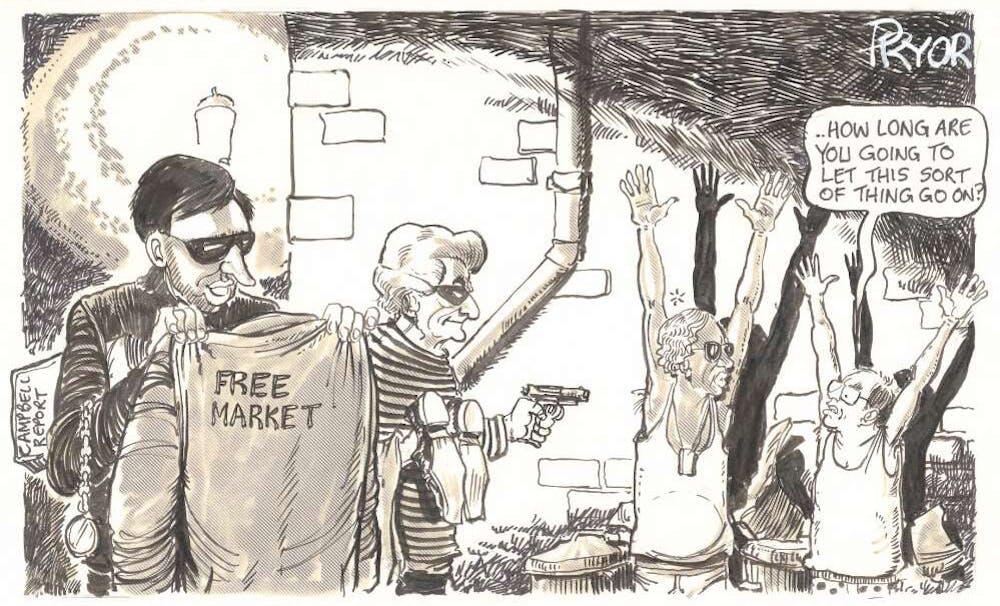
Geoff Pryor cartoon depicting Paul Keating, Bob Hawke, Opposition Leader Andrew Peacock and deputy John Howard. National Library of Australia

But there are other big reforms in prospect. On issues from climate change to tax reform to immigration, it is important to get the underlying settings right.

As could have happened with the dollar, the costs of getting them wrong could be enormous.

ref. Vital Signs: 35 extraordinary years. What the float of Australian dollar bought us – http://theconversation.com/vital-signs-35-extraordinary-years-what-the-float-of-australian-dollar-bought-us-108052

Darwin port’s sale is a blueprint for China’s future economic expansion

]]>

Source: The Conversation (Au and NZ) – By John Garrick, Senior Lecturer, Business Law, Charles Darwin University

An agreement between Darwin’s city council and an overseas municipal counterpart normally wouldn’t attract much attention. Local government officials love signing such deals. Darwin already has no less than six “sister city” arrangements, including with the Chinese city of Haikou.

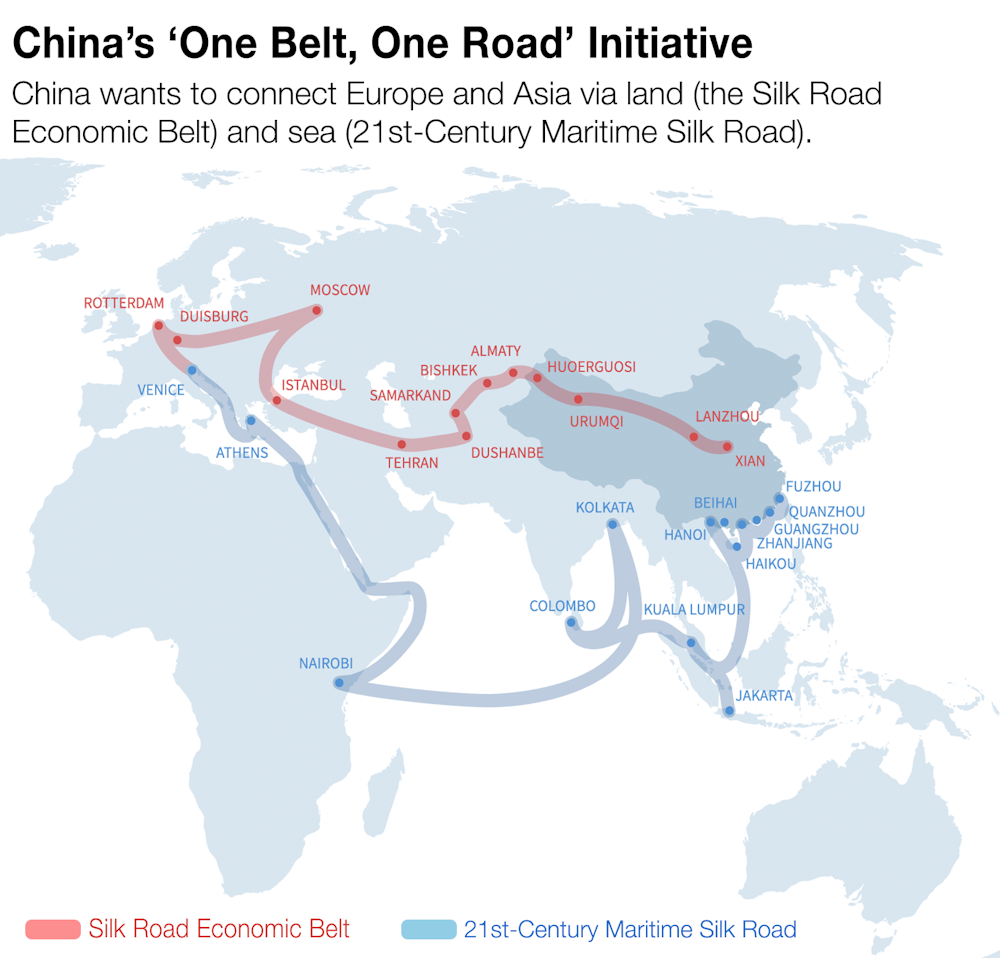
But attention has been drawn to Darwin’s newly minted “friendship” deal with Yuexiu District, in Guangzhou, due to Chinese media describing it as part of President Xi Jinping’s signature Belt and Road Initiative.

This suggests Chinese authorities regard Darwin as having strategic significance.

It invites reflection on the wisdom, three years ago, of the Northern Territory government deciding to lease the Port of Darwin (now known as Darwin Port) to a Chinese company for 99 years – and of the federal government going along with it.

At the time the new owner, billionaire Ye Cheng, claimed the Darwin port deal was “our involvement in One Belt, One Road”. This was discounted by some commentators as hyperbole, an attempt to curry favour with the Chinese government.

But now, by design or not, the Darwin port deal increasingly looks like a blueprint for how Chinese interests can take control of foreign ports – as it is doing by various means around the world – without arousing local opposition. Quite the reverse. All levels of Australian government have encouraged it.

It makes Darwin an interesting case study – a point of contest between the strategies of the US and China. Darwin’s port is under Chinese control, while thousands of US marines are based in the city, as part of the US “Pacific pivot” seen by many as an effort to contain China’s influence in the region.

CC BY-ND

How the port deal was done

The deal to lease parts of the port followed successive federal governments refusing to fund necessary upgrading of the port’s infrastructure to meet growing demand.

Infrastucture Australia advised privatisation. Rather than sell outright, the territory government decided to lease the port, and sell a controlling stake in the port’s operator.

Landbridge Industry Australia, a subsidiary of Shandong Landbridge, won the 99-year lease with its bid of A$506 million in November 2015.

Shandong Landbridge has substantial and varied interests including port logistics and petrochemicals. Though privately owned, like many Chinese companies it has strong ties to the ruling Chinese Communist Party.

The company knows how to cultivate political connections. In Australia it gave influential Liberal Party figure and former trade minister Andrew Robb an $880,000 job just months after he retired from parliament.


Read more: Chinese influence compromises the integrity of our politics


The bid for the port was examined and approved by the Foreign Investments Review Board, the Defence Department and ASIO.

Strategic importance

But the deal put Darwin directly in the crossfire between US and Chinese interests. Then US president Barack Obama expressed concern about the lack of consultation. Former deputy secretary of state Richard Armitage said he was “stunned” that Australia had “blind-sided” its ally.

While the centre of US-Chinese tensions is the South China Sea – where China has militarised reefs in disputed waters – Darwin is important because it is the southern flank of US operations in the Pacific.

An Australian Border Force Cape-class patrol boat docked at the Darwin port. Lukas Coch/AAP

Managing the tensions

Zhang Jie, a researcher at the Chinese Academy of Social Sciences, wrote in 2015 about the concept of “first civilian, later military” – in which commercial ports are to be built with the goal of slowly being developed into “strategic support points” – to assist China defending maritime channel security and control key waterways.

Military-civilian integration was among the goals China set in its 13th five-year plan for 2016-20. President Xi subsequently established an integration committee to oversee civilian and military investment in technology.

As with other Chinese port acquisitions, such as in Sri Lanka, Pakistan, Greece and Djibouti, Landbridge is interested in acquiring and developing not only Darwin’s port facilities but nearby waterfront property.

But the Darwin port deal differs in significant ways to other port acquisitions.

It is a far cry from the “debt-trap colonialism” China stands accused of using to gain leverage over other foreign governments, such as Sri Lanka and Nepal.


Read more: Soft power goes hard: China’s economic interest in the Pacific comes with strings attached


Landbridge has bought the lease, rather than a Chinese bank lending funds to the Northern Territory government to develop the port. If Landbridge was to default, it would lose its money. Any attempt by Landbridge to use the port as security to borrow money from a Chinese bank would trigger renegotiation of the lease.

The territory government retains a 20% stake in the port operator and has a say in key appointments such as the chief executive and chief financial officer. But it will not share any profit that Landbridge may eventually make.

That potential is a long way off. Landbridge Infrastructure Australia reported a loss of A$31 million for the 2017 financial year, with its total borrowings rising to A$463 million. If the deal falls over, the government will need to seek new equity partners. But its immediate commercial risks are relatively contained.

Other risks

Yet risk exposure may take other forms. China’s strategy is very long-term. Darwin is now on the front line in managing tensions between Australia’s most important strategic ally and partner and its major trading partner. Balancing between powerful friends with competing interests may not prove easy.


Read more: The risks of a new Cold War between the US and China are real: here’s why


There are indications of some recognition of this at the federal level. Australia’s foreign investment review processes have been tightened. A Critical Infrastructure Centre has been created to give extra national security advice. There has been some tweaking of rules about political parties accepting foreign donations.

But others may have learnt valuable lessons too.

Weaknesses in Australian governments at all levels have been revealed. They have been reactive, readily accepting the lure of pearls cast on our shores without considering longer-term currents. Foreign and strategic policy has effectively been left to the local level. While the federal government now seeks to shore up its interests in the Pacific with cash for infrastructure, similar commitments to investing in local infrastructure are essential.

Clumsiness and indecision do not serve Australian interests well.

ref. Darwin port’s sale is a blueprint for China’s future economic expansion – http://theconversation.com/darwin-ports-sale-is-a-blueprint-for-chinas-future-economic-expansion-108254

Friday essay: love hurts – on a life of sports fandom

]]>

Source: The Conversation (Au and NZ) – By Sally Breen, Senior Lecturer in Writing and Publishing, Griffith University

When you grow up with no books in the house except maybe the full Readers Digest set of Catherine Cooksons and Bert Ryan’s Guide to Fishing you worship other heroes. The great battles in life are not going down in drama theatres, they’re not happening in-between the dusty covers of old books, they’re happening every weekend on sporting fields. I know this because my dad and everyone else in my suburb is into sport, and really, I have no choice. The other thing is – I like it.

This is the 1980s and the passion that flares in the smoke-filled lounge rooms of suburban houses and public bars is addictive. The ribbing and the rivalries funny, even if they do sometimes edge toward the dark side. The passion is the same whether the action is broadcast from big ticket fields or live on scratchy little league ovals. In fact, the passion is actually worse when it’s occurring on the two lane driveway in my front yard – my dad presiding over cricket matches with improvised rules. Six and out, wheelie bin for wickets and when the ball cannot be retrieved even by the dog – definitely out.

Life moments are one-day test matches between the West Indies and Australia going down to the wire, 16 runs off seven balls, everyone sunburnt and screaming at the TV. Cut to the underdog thrill of watching Wally Lewis get right up into Mark Geyer’s face in a tense State of Origin decider or the excitement I feel racing out of bed at dawn to witness an unlikely Australian victory in the America’s Cup even though I’ve never been on a yacht in my life – a bright blue day when I learn that drinking beer out of a yard glass is a national and political skill and not just something that happens at BBQs.

Sport is a dominant thread in Australia’s cultural DNA. But it’s also divisive. I didn’t realise how much until I started hanging out in underground art scenes and falling asleep under tables in my university tutorials. Not liking sport was something that could set you apart. Sport was the enemy. I wasn’t sure why you had to choose sides. For people who were heavily into pointing out the problematics of binaries on a day to day basis I was pretty surprised they couldn’t see when they were making one.

Most of the artists I knew were always looking for excuses why art couldn’t seem to compete with sport. Publishers chatted to me in mild tones about rugby union over lunch but when I got too excited about sport and my working class roots started showing they tended to change the subject.

That’s why I wasn’t so surprised when around the turn of the new millennium no one except me seemed to like Lleyton Hewitt. Lleyton was a fighter. He wasn’t so different in spirit from many of the Aussie cricket players I’d watched. Or NRL stars. He had that same take no prisoners attitude my dad worshipped and had instilled in me but by the time Lleyton erupted onto the world stage no one was really listening.

When you play tennis there’s no team and no 20 metres of paddock to protect you. Still. I didn’t understand why telling a few inept lines people to go back to the satellites was so harsh, especially when I’d heard worse. By then my dad was gone. His ashes splayed out in sad ceremony over Manly Beach and I watched Lleyton win his first ATP tournament in Adelaide alone. When I watched Lleyton play I admired his skill and his attitude but he fired something else in me. I believed I could win. Achieve things. Make things happen because deep down I doubted if I really could.

Crazy five-hour slogs

By 1999 I’d graduated honours, I’d enrolled in a PhD. I was still poor and hungry but kicking goals and one golden summer day in November my mates and I car pooled it down to the polling booth at Main Beach to vote in the referendum on the republic, slightly stoned, taking great pleasure in freaking out the royalists in their “no” t-shirts. We went home and partied but by six-o-clock the bad news became clear. Australia had voted no. When it came to winning in the political arena, we were getting used to disappointment.

I watched Lleyton’s US Open victory in 2001 alone. The match started at 3am Australian time and ended at 9.15am when a big serving Pete Sampras was summarily dispatched. At 8.15am I rang my boss and said I’m not coming in until he wins. He said who? I said Lleyton Hewitt and then I hung up. I nearly lost my job that day but my boss let it go. I wanted him to fire me. A Gold Coast businessman riding on the coat tails of a Howard government-sponsored sell out of welfare – I spent most of the day taking resumes off people the company rolled through the database tubes like stale bread rolls.

At around 9.15am Lleyton went for a dig down the line and Sampras lost and said he wished he had legs like him and I got on the bus and wondered why there weren’t people screaming in the streets – I’d seen streamers hanging off Yatala pies when Paddy Rafter made the final at Wimbledon but he was a Queenslander and better looking and said “sorry mate” when he fluffed a serve. He also sweated so much he cramped up and lost. People loved Paddy and people didn’t love Lleyton. So I went in to work.

The Australian sports media doesn’t have a great history of supporting individual sports stars. We’re a team sport country, a pack mentality country. There are exceptions. Greg Norman. Pat Rafter. Craig Lowndes. Men with Teflon reputations who can sell anything: housing developments, hotel chains, car insurance, underpants. A preference that stands in for the defining modus operandi of the country. The swell of the crowd. It’s just too easy to run things down especially when you have someone very damn good in your midst. The media was ferocious. Even when Lleyton won they found a way to spin it negatively.

By 2004, I was living in a share house with a bunch of people working the kind of university teaching hours a week that are pretty much illegal now rolling in cash until the semesters ended and then we weren’t. And Mark Latham was priming us to believe in a revolution we thought we wanted. Articulating a distaste for the status quo that felt right and probably real at the time and something we fell for. Maybe the power structure did have a flair. I even wrote him a letter when he lost. I’m glad now, of course, that I never sent it. That’s the thing about political heroes. They come and go. Latham was like a Tamagotchi – something you feel embarrassed about coveting when it’s over. Lleyton, I never gave up on.

Leighton Hewitt training in 2004. Darshan Kumar/AAP

No one who has ever watched Lleyton play one of his epic matches comes out a hater and I mean the whole thing – not just the chainsaws and his trademarked “C’mon’s” in bite-sized highlights. I mean those crazy five hour slogs where you end up doing three weeks’ worth of ironing because you can’t sit still, drinking a bottle of port or whatever’s congealing in the cupboard because the match has gone so long there’s no shops open, going down on your knees in despair when he misses a pull shot, running around the house like you’re on ice swearing you’ll never say a bad word about Nalbandian again as long as the true gods, wherever they are, shine down on the guy in the Rusty branded shoes.

The Darth Vader

That all changed in 2016 when Lleyton walked up the tunnel at Rod Laver arena for the last time, his blonde-locked kids in tow, looking star struck and sad in front of the cameras, their dad stoic and dignified saying only, “Let’s go find mummy.”

If Lleyton was the Vegemite of Australian men’s tennis then Nick Kyrgios is its Darth Vader. The most talented Jedi in the universe, whose greatest battle seems to be playing out in his head. Skulking onto court headphones in, he silences arenas, punters waiting with baited breath to see what the show is going to consist of next – more intense dark or that brilliant, untouchable light?

Whatever he gives, the Australian media makes him pay for it – selecting three second bites from three hour games where he might have let his composure slip. The armchair judgement spooling out in a bad case of déjà vu. Lleyton cared too much, Kyrgios doesn’t care enough. The new Aussie tennis player everyone loves to hate even when he’s got the kind of serve that can slice up a court like a light saber. But to say Nick doesn’t care is a misreading. Like Tomic, one gets the sense that he is very, very conscious of how he appears.

Nick Kyrgios playing in London earlier this year: the most talented Jedi in the universe. Neil Hall/AAP

Both of them playing at times like they don’t want to be there because looking like you couldn’t care less is cool. The kind of guys that might expend a lot of energy to get you alone but once you’re there they spend the whole time looking at their phones. Because you don’t want to appear as if you’re really invested. The difference between them and Lleyton is generational. It’s an attitude I recognise sometimes in my students. When Kyrgios can’t zone, he tunnels into his head.

World rankings of Aussie tennis players shift regularly. Many of our current players have slid in and out of the Top 20 but Australia has not had a world number one since Hewitt. So I wait for the Davis Cup team to grow up under Lleyton’s tutelage and get fired up watching our women tennis players, the bouncy tenaciousness of Daria Gavrilova and the steely determination of Ash Barty – knowing the future of Aussie tennis is bright even if it’s perhaps too hard to call because Top 20 in the world is an incredible achievement by any standard but it ain’t number one – and I’ll keep relishing those moments Lleyton comes back out of retirement to strut his stuff on the doubles court, thankful he’s still got it – the power to exhilarate and light up the winner inside me.

The way I feel about all of this can probably be exemplified by the film clip for the Grimes song Oblivion. Grimes knows she’s playing on that gap between what is real and what gets played out. Oiled up dudes in white towels doing weights in slow motion in dressing rooms while she’s smooching around in an Amish dress or slam dancing jocks at a frat party – she’s not above the fray, she’s in it. When I watch her I am that girl with the boom box at the footy, maybe less cool but with the same smirk, dancing in the spare seats.

ref. Friday essay: love hurts – on a life of sports fandom – http://theconversation.com/friday-essay-love-hurts-on-a-life-of-sports-fandom-105661

Grattan on Friday: Hokey-pokey politics as the government is shaken all about

]]>

Source: The Conversation (Au and NZ) – By Michelle Grattan, Professorial Fellow, University of Canberra

In the topsy turvy Liberal universe, just when the right is trying to tighten its grip on the throat of the party, the government is haring off to the left, with this week’s legislation to allow it to break up recalcitrant energy companies.

As former deputy Liberal leader Julie Bishop – who as a backbencher has become very forthright – said in the Coalition party room on Tuesday, “this is not orthodox Liberal policy”. Bishop canvassed the danger of sovereign risk.

To find a rationale for a frolic into what in other circumstances the Liberals would no doubt denounce as “socialism”, one might see it as driven by the veto of the so-called conservatives.

Those on the right (led by Tony Abbott and his band) have long stopped the government putting forward a sound energy policy, despite the strong pleas from stakeholders across the board.

Instead, trying to respond to the pressing electoral issue of high electricity prices, the government has reached for its “big stick” including the threat of divestiture – a policy that’s being attacked by Labor as well as business.

Shadow treasurer Chris Bowen was correct on Thursday when he said: “this is what we see when a government’s policy agenda falls apart”.

Having to defend this draconian policy, first from critical Coalition backbenchers (who won some changes) and then in parliament, the government found itself tied in knots.

Given this is such a radical proposal, it was also in an enormous rush with the legislation, introducing it on Wednesday and wanting the House of Representatives to pass it by Thursday.

But that timetable was stymied by Labor. Passage through the House will have to wait until February.

Meanwhile there will be a Senate inquiry, reporting in March. This puts off a Senate vote until budget week in April – ensuring a lot of noise about this controversial measure just when the government will want all the attention on a budget crafted to appeal to voters for a May election.

Even if the divestiture legislation gets through the Senate next year, a likely Labor election victory would mean we’ll probably never see this particular “big stick” wielded. It’s highly doubtful the threat will have been worth the angst, or the trashing of Liberal principles.

The final parliamentary fortnight of 2018 coincided with the first fortnight of the hung parliament.

For Scott Morrison, it has been an excruciating two weeks, with the backlash from the Liberals’ trouncing in Victoria, Julia Banks’ defection to the crossbench, Malcolm Turnbull’s provocative interventions, and an impasse with Labor over the plan to protect LGBT students.

The government’s stress culminated in Thursday’s extraordinary battle to prevent a defeat on the floor of the House.

This test of strength was over amendments, based on a proposal originally coming from new Wentworth member Kerryn Phelps, that would make it easier to transfer people needing medical treatment from Nauru and Manus to Australia.

As both sides played the tactics, a remarkable thing happened in the House of Representatives. Behaviour improved one hundred percent, with none of the usual screaming and exchanges of insults. This pleasing development was, unsurprisingly, driven by cynicism – neither government nor opposition could afford to have anyone thrown out ahead of the possible crucial vote.

Earlier, Morrison had shown anything but restraint when at his news conference he described Bill Shorten as “a clear and present threat to Australia’s safety”. Once that would have been taken as a serious claim, which a prime minister would have been called on to justify. In these days, it’s seen as a passing comment.

In what was a highly aggressive performance, Morrison gave us another foretaste of what he’ll be like on the hustings.

In the end, by its delaying tactics in the Senate, the government prevented the amendments reaching the House before it adjourned, and so avoided a test of the numbers.

Defeat in the House would not have equalled a no confidence vote, but it would have been a serious blow for Morrison. Looking for a precedent, the House of Representatives’ clerks office went back to votes lost in 1929 (which led to an election) and on the 1941 budget (which brought down the Fadden government).

But the government may have just put off, rather than prevented, the reckoning. Phelps said on Sky, “I am sad that we didn’t get this through today … because I believe it would have gone through on the numbers … But you know if have to wait until February, at least I believe that there is a light at the end of the tunnel.”

Dodging this vote meant that legislation to give authorities better access to encrypted messages to help in the fight against terrorism looked like it would be delayed. Once the House had adjourned, any Labor amendments the Senate might pass couldn’t go back there until February.

The government had declared the encryption measure was urgent, and the blame game started in anticipation of a hold up. Then, mid-debate in the Senate, Labor abandoned its attempt to amend the bill, which glided through. In an agreement which may mean something or nothing, the government undertook to consider the ALP amendments in the new year.

Shorten didn’t want to be open to the government’s accusations of impeding legislation the security agencies said would help prevent terrorist acts. “I couldn’t go home and leave Australians over Christmas without some of the protections which we all agree are necessary,” he said.

The events of this week show why the government decided to have the minimum of sitting days before the election next year.

The new parliamentary session will open with a deadlock on the protection of gay students, the divestiture plan up in the air, and the Nauru-Manus vote hanging over the government.

And by that time Scott Morrison will have had his first and probably his last Christmas at Kirribilli.

ref. Grattan on Friday: Hokey-pokey politics as the government is shaken all about – http://theconversation.com/grattan-on-friday-hokey-pokey-politics-as-the-government-is-shaken-all-about-108364

Infant formula companies are behind the guidelines on milk allergy, and their sales are soaring

]]>

Source: The Conversation (Au and NZ) – By Karleen Gribble, Adjunct Associate Professor, School of Nursing and Midwifery, Western Sydney University

There has been a six-fold increase in sales of infant formula prescribed for babies with cows’ milk protein allergy in the United Kingdom from 2006 to 2016. This is despite no evidence of a concurrent increase in the prevalence of infants with the allergy.

An investigation published today in the BMJ found infant formula manufacturers have been funding the development of guidelines for the diagnosis and treatment of cows’ milk allergy as well as providing research and consultancy funds to those who wrote them.

Rates of cow’s milk allergy appear to have been relatively stable – estimated at between 1-2% over the last decade.

Research has found the perception of an allergic response to cow’s milk protein in children is ten times greater than what actual diagnosis would indicate. This means guidelines on allergy for doctors are really important.

In some cases, doctors who spoke to the BMJ said the guidelines were so vague that

virtually every single infant could potentially be diagnosed using these symptoms.

A diagnosis can only be made only by excluding cow’s milk protein from the maternal diet, observing symptoms, and then reintroducing it. But the BMJ paper notes that evidence for advising such exclusions to treat non-specific symptoms in breastfed infants is weak.

The paper also found much of the education for health professionals and parents about cows’ milk allergy was provided by organisations also funded by the infant formula industry.

Previous research has found that changes in diagnostic and treatment guidelines can have enormous effects on the revenue of pharmaceutical and nutritional products. Conflicts of interest due to industry funding have been found to affect doctors’ prescribing behaviour, research results and the quality of patient care.

Parents are also vulnerable to marketing. They crave a happy, quiet, calm baby who sleeps, eats and poos in a predictable pattern.

But babies wake often. They can have difficulty adjusting to life outside the womb and their stomachs are getting used to digesting food. They vomit. They cry for reasons that are hard to understand.

Marketing takes this normal infant behaviour and turns it into a problem that can be solved by buying a product.


Read more: Why advertisers use pictures to sell pharmaceuticals – and shouldn’t


When businesses are allowed to shape the guidelines health professionals use to diagnose and treat, this can lead to guidelines that find normal infant behaviour is treatable – with a product.

Unfortunately there may similar pressures on doctors in Australia.

A variety of infant formula products available in Australia claim to be antidotes to normal challenges new parents face such as crying, vomiting and constipation.

An advertisement in Australian Doctor. ., Author provided

The above advertisement is from the publication Australian Doctor (which is available through subscription to medical professionals and includes drug advertising). It is a powerful piece of persuasion. It invokes every parent’s desire for a good night’s sleep and a contented, healthy baby to drive purchasing behaviour. Notice the presence of the mother in this picture. Although we can’t see her, we presume she is also sleeping somewhere.

When parents are desperate for help, doctors want to provide it. Colic is a variation of normal infant behaviour. It has no known medical cause or cure and this can make doctors feel powerless. However, this advertisement offers them a way to help. It gives doctors a solution – they just need to suggest the infant formula.


Read more: My baby is crying. Is it colic? How can I help?


Parents are told to seek assistance from health professionals when they are concerned about their baby. However, if health professional guidelines and education is contaminated with marketing and influenced in other ways by infant formula manufacturers, the support they provide will be of poor quality.

Health professionals need independent, non-commercial information on infant feeding and parents should be protected from predatory marketing through effective enforcement of regulations.

ref. Infant formula companies are behind the guidelines on milk allergy, and their sales are soaring – http://theconversation.com/infant-formula-companies-are-behind-the-guidelines-on-milk-allergy-and-their-sales-are-soaring-108255

George Bush Sr could have got in on the ground floor of climate action – history would have thanked him

]]>

Source: The Conversation (Au and NZ) – By Marc Hudson, PhD Candidate, Sustainable Consumption Institute, University of Manchester

Among the tributes, critiques and personal reminsces on the life of former US president George H.W. Bush, there has been plenty of reflection on his war record – but less on how he handled himself during the early skirmishes of the climate battle.

Scientists had been warning of potential problems from the buildup of greenhouse gases for a decade before Bush took office. The warnings culminated in 1988, when NASA climatologist James Hansen, after testifying to a Senate panel, uttered the famous words:

It is time to stop waffling so much and say that the evidence is pretty strong that the greenhouse effect is here.

By then, Bush’s presidential run was gaining steam. After eight years as vice-president to Ronald Reagan, he wanted the top job, and in Michael Dukakis he faced a Democrat opponent with relatively strong environmental credentials.


Read more: Why we’ll miss George H.W. Bush, America’s last foreign policy president


On August 31, 1988, on the campaign trail, Bush promised:

Those who think we are powerless to do anything about the ‘greenhouse effect’ are forgetting about the ‘White House effect’. In my first year in office, I will convene a global conference on the environment at the White House. It will include the Soviets, the Chinese… The agenda will be clear. We will talk about global warming.

Bush won the election, and hosted his promised summit in April 1990. But he fudged his promise for a clear and open discussion of global warming.

Bert Bolin, the “father of climate science” and founding chair of the Intergovernmental Panel on Climate Change, found himself mysteriously not invited to the summit. Leaked briefing papers showed the Bush administration’s line was that it was “not beneficial to discuss whether there is or is not warming… In the eyes of the public we will lose this debate.”

Denial and obfuscation

In May 1989, Al Gore, who had unsuccessfully sought the Democratic presidential nomination the previous year, accused the president of seeking to dodge the climate issue, after it emerged that the Bush Administration had censored Hansen’s Congressional testimony, altering his conclusions about global warming data to make them seem less certain.

Meanwhile, climate deniers were becoming increasingly active, including in the Bush White House. A coal industry-sponsored documentary titled The Greening of Planet Earth began circulating, while Bush’s chief of staff John Sununu became a vocal roadblock to climate policy, throwing up bureaucratic obstacles and winning Cabinet battles against those who wanted a stronger policy. Bush himself reportedly had no strong interest in global warming and was largely briefed on it by non-scientists.

Yet the world pressed on with the climate issue, setting the June 1992 Rio Earth Summit as the deadline for completing a new United Nations treaty that would formalise the global negotiation process. The US administration said that Bush – up for re-election in November – would refuse to attend if the treaty text included targets and timetables for emissions reductions. Bush’s words were: “The American way of life is not up for negotiations. Period.” It’s a sentiment we’re still used to hearing from many of today’s politicians.

The major dilemma facing international negotiators was whether to accommodate the United States and have a weak treaty, or push ahead without them. The fate of the Convention on the Law of the Sea – which languished for almost a decade without ratification because of US opposition – pushed them towards compromise. It took a British initiative – with UK Environment Secretary Michael Howard flying to the US to convince the Americans they could sign on – before Bush would agree to attend.

An October 1992 Washington Post profile paints a picture of a man who was not really engaged in the global warming issue. Based on interviews with more than 20 policy officials and other advisers, Bush was described as being:

…detached, uninterested, and as his brief remarks in the April meeting showed, responsive only to the politics of a complex issue. He never sat for a full-dress scientific briefing on it or exercised control over administration policy, even after infighting among administration officials became public, or leaders of other industrialised nations pledged action.

Historic compromises

The Rio deal – the UN Framework Convention on Climate Change – was quickly signed and ratified by enough countries, including the US, to become international law. The first annual summit was held in Berlin in 1995, and negotiators are currently gathered in Katowice, Poland, for the 24th round of talks. Along the way, the negotiations have delivered the Kyoto Protocol and the Paris Agreement.

But the key battle, which has never been won, was for the implementation of binding targets and timetables for countries, especially wealthy ones, to cut their emissions. The inherent weakness of Paris Agreement, which does not contain binding targets and is not currently on track to meet its stated goals, is the result of compromises made decades ago.

Bush’s son, George W. Bush, had a far worse record on climate action during his own presidency. But Bush senior was in the White House during the formative years of the international climate effort. He had the chance to be a genuine leader, had he seized it. But when we needed decisive, brave and far-sighted leadership, instead we got the same backing-in of corporate interests, and nearsighted defence of the status quo, that we have grown so used to seeing from political leaders.


Read more: 15th-century Chinese sailors have a lesson for Trump about climate policy


There is of course plenty of blame to go around for our species’ failure to address climate change. One of Bush’s oldest friends, who served as secretary of state, James Baker, has tried to get Republicans on board with climate action, including with the recent Baker-Shulz carbon dividend plan. But many high-profile Republicans, the current president included, still wear their climate recalcitrance as a badge of honour.

We are living with the consequences today. And the children who went on strike last Friday, fighting a battle they should not have had to join, will live with them for the rest of their lives.

ref. George Bush Sr could have got in on the ground floor of climate action – history would have thanked him – http://theconversation.com/george-bush-sr-could-have-got-in-on-the-ground-floor-of-climate-action-history-would-have-thanked-him-108050

Media Files: Covering Trump, funding news and the rise of impunity. The Guardian’s Kath Viner on the big media stories of 2018

]]>

Source: The Conversation (Au and NZ) – By Andrew Dodd, Director of the Centre for Advancing Journalism, University of Melbourne

Today we’re taking a look back at some of the biggest issues of 2018 with special guest Kath Viner, editor-in-chief of The Guardian.

As the media grappled this year with how to cover Donald Trump and his “alternative facts”, Viner says it may be time for the media to pay less attention to what he says.

“Surely the thing to do is report on what is actually happening. So less on what Trump is saying but actually what his administration is doing,” Viner said.

“We don’t hear about what he’s doing because we’re too busy commenting on what he’s saying.”

We also talked about how newsrooms are funding journalism and particularly investigative journalism, in an era when journalists are increasingly vilified and even physically attacked or killed.

Viner also identified what she saw as the major challenges ahead.

“I think the other big challenge for next year is how we deal with the rise of the far right and how we report on it without inflaming it or over-exaggerating it,” she said.


Read more: Media Files: On the Serena Williams cartoon — and how the UK phone hacking scandal led to a media crackdown in South Africa


Media Files is produced by a team of academics who have spent decades working in and reporting on the media industry. They’re passionate about sharing their understanding of the media landscape, especially how journalists operate, how media policy is changing, and how commercial manoeuvres and digital disruption are affecting the kinds of media and journalism we consume.

Media Files will be out every month, with occasional off-schedule episodes released when we’ve got fresh analysis we can’t wait to share with you. To make sure you don’t miss an episode, find us and subscribe on Apple Podcasts, in Pocket Casts or wherever you find your podcasts. And while you’re there, please rate and review us – it really helps others to find us.

You can find more podcast episodes from The Conversation here.


Read more: Media Files: What does the future newsroom look like?


Recorded at the University of Melbourne’s Centre for Advancing Journalism. Producer: Andy Hazel. Production assistance Gavin Nebauer.

Additional audio

Theme music by Susie Wilkins.

ref. Media Files: Covering Trump, funding news and the rise of impunity. The Guardian’s Kath Viner on the big media stories of 2018 – http://theconversation.com/media-files-covering-trump-funding-news-and-the-rise-of-impunity-the-guardians-kath-viner-on-the-big-media-stories-of-2018-106540

Voters are crying out for better government but have mixed views on how to achieve it

]]>

Source: The Conversation (Au and NZ) – By Nicholas Biddle, Associate Professor, ANU College of Arts and Social Sciences, Australian National University

Support for democracy and trust in politicians is falling. We hear a lot about evidence-based policy as a way to stem this decline, but less about how that evidence should be generated.

One idea that may generate the type of evidence that will help make more informed decisions appears, paradoxically, fairly unpopular with the punters.

Perhaps the problem is that not enough has been done to explain to the public what this idea – carefully testing new policies on small groups first – might mean in practice.

In a new paper just released, we show that we may still be a long way off adopting this practice.

The rollout of the National Broadband Network has been plagued by delays, changes of plan and consumers unhappy with the end result. Mark Esposito/AAP

There is an emerging view that there should be much greater use of evaluations of public policies, including randomised controlled trials (RCTs), to test the effectiveness of new policies before they are rolled out. This applies particularly to policies or programs for which there is limited or no evidence about their likely impact.

RCTs have been around for years in medicine and other sciences, and are increasingly being used by small and large companies to test products and services. Conceptually they are simple, although implementing one can be complex. A RCT involves selecting a sample from a population of interest and randomly dividing them into two groups (using the equivalent of a coin toss). One group is given an intervention (that is, a program or policy) and the other is not. If the RCT has been done properly, the differences in the outcomes of the two groups tells us the impact of the intervention being trialled.


Read more: The heart of the matter: how effective is the flu jab really?


There are other ways to try to measure causation, and some are necessary when an RCT isn’t possible. However, Shadow Assistant Treasurer Andrew Leigh argues in his new book Randomistas that:

Researchers have spent years thinking about how best to come up with credible comparison groups, but the benchmark to which they keep returning is the randomised controlled trial. There’s simply no better way to determine the counterfactual than to randomly allocate participants into two groups: one that gets the treatment, and another that does not.

Our study

While there is strong support within the policy and research community on the important role of trials and evaluations, we know far less about what the general public thinks about how policies should be implemented and to what extent they should be trialled before widespread introduction.


Read more: From ‘trust us, we’re doctors’ to the rise of evidence-based medicine


In a survey undertaken as part of the ANUPoll series, we ran an online survey experiment that measured the level of support for trials in general and RCTs in particular. We also looked at the factors that influence that support, and whether there is a causal relationship between expert opinion, party identification and support for an RCT.

That is, we ran an RCT on RCTs.

As part of the survey, we asked respondents to “consider a hypothetical proposal to reform” in one of five policy areas (school education; early childhood education; health; policing; support for those seeking employment). We then asked “which of the following approaches do you think the government should take?”:

  • Introduce the policy for everyone in Australia at the same time
  • Introduce the policy to everyone, but do it in stages
  • Trial on a small segment of the population who need it most, or
  • Trial on a small segment of the population chosen randomly,

We found that more people want new government policies rolled out without testing – except for jobless support.

Some key findings emerge:

  • There is a roughly even split between those who think a new policy should be introduced to everyone at once and those who think it should be trialled on a small segment of the population.

  • Respondents support trials for employment policies the most strongly but are most likely to support an RCT for a policy related to school education. They are least likely to support it for health service delivery and employment support.

  • Those who live in disadvantaged areas and those with low levels of education are the least supportive of RCTs.

What influence do experts’ views have?

The type of policy that is being proposed clearly matters for whether the general public thinks it should be trialled as part of an RCT. However, the views of those outside the political system also matter. We tested this potential effect by randomly varying the wording of the question across respondents.

One “treatment” that we applied to the question was to vary what respondents were told on whether experts generally support the policy, are generally opposed to the policy, or are divided on the policy (with one-third of respondents given each of the options).

Randomised controlled trials are commonplace in the area of medical products – after all, we all feel better knowing a new product has been thoroughly tested. AAP

The greatest support for a trial in general or an RCT in particular occurs when experts are generally opposed to the policy. Conversely, the least support for a trial or an RCT comes when experts are generally in support of the policy, implying respondents believe sufficient evidence must already exist. Support is somewhere in between when there is variation in support.

This has implications, we think, for researchers engaged in policy debates. One potential effect of arguing publicly for a different point of view to policymakers or other researchers is to increase the level of support for trials among the general population. We should make a case for uncertainty when it does exist, as that would appear to increase support for future gathering of evidence.

Indeed, this advocacy for uncertainty has underpinned the push for greater trials and evaluations in policy (and the social sciences).

Building support

It is clear that RCTs are likely to be increasingly used by policymakers to test the effect of policy interventions. However, to be truly effective and to avoid a backlash, RCTs need to be supported not only by researchers and policymakers but also by the general public. At first glance, this buy-in is a long way off.

ref. Voters are crying out for better government but have mixed views on how to achieve it – http://theconversation.com/voters-are-crying-out-for-better-government-but-have-mixed-views-on-how-to-achieve-it-107713

Thanks for the $2 billion for small-business expansion; now all we need are plans to expand

]]>

Source: The Conversation (Au and NZ) – By Jana Matthews, ANZ Chair in Business Growth. Director, Australian Centre for Business Growth, University of South Australia

The Australian government has a plan to help the nation’s small and medium-sized businesses – but it’s not a very well-developed one.

Its cornerstone is A$2 billion for a “Securitisation Fund” to provide loans to small business through smaller banks and non-bank lenders, plus a “Business Growth Fund” that will enable big banks and super funds to take passive equity stakes in small business. The assumption is that more money will help small and medium-sized enterprises fund their expansion plans.

The problem is most small and medium companies do not have expansion plans.

The Australian Bureau of Statistics’ first management capability survey, published in August 2017, indicates that only a third of medium-sized companies (defined as those with 20 to 199 employees) have a written plan of any kind. The percentage is much lower for small companies – those with five to 19 employees (and lower still for micro-businesses, employing four or fewer people).


The Australian Centre for Business Growth at the University of South Australia collects data and delivers programs for those running small and medium-sized companies. Since it began in 2014, the centre has worked with more than 1,500 business proprietors. They all wanted to do better. Hardly any of them had a plan.

The federal government’s assistance package seems to assume that access to more capital will accelerate company growth. Our experience suggests executives of small and medium companies need knowledge capital as well as financial capital to grow.

If they don’t know what to do when, who to hire, how to manage people, or how to plan and execute, simply providing more money does not accelerate growth.


This year we collected data from 145 of the companies that have been through one of our growth programs. In the past financial year they increased their revenues, on average, by 27%, their profits by 19%, and employment by 32%. Their growth was the result of learning how to develop and execute an expansion plan, that is, knowing how to generate and where to deploy financial capital in order to grow.

Passing a public-interest test

It’s true that small and medium enterprises need money for growth. But before they get funding, they need to learn what to do with that money to grow.

Driver’s education and a proficiency test are compulsory before we give people a licence to drive a car. We need something equivalent before we provide public funds – even as loans – to businesses.

We justify allowing people to borrow against their homes to start a company because it’s “their decision” and “their money”. But if taxpayers’ money is being provided, the federal government has a duty of care to ensure every company has a comprehensive plan for growth before receiving funding.

That plan should cover all the bases from products to markets and customers; culture, people and organisation; finance; risks and externalities; governance and strategy.

If financial capital is not coupled with knowledge capital, investments in small and medium-sized companies will not deliver returns. Only after those running a company understand how to grow, and have a plan to grow, will they achieve what we all want – more jobs, higher wages, and greater economic prosperity for all.

ref. Thanks for the $2 billion for small-business expansion; now all we need are plans to expand – http://theconversation.com/thanks-for-the-2-billion-for-small-business-expansion-now-all-we-need-are-plans-to-expand-107797

Student protests show Australian education does get some things right

]]>

Source: The Conversation (Au and NZ) – By Kellie Bousfield, Lecturer, Charles Sturt University

Australia’s education system often suffers a barrage of criticism – claims of stagnant or declining NAPLAN results, slippage in international comparisons and rankings, and an irrelevant curriculum, tend to draw the attention of politicians, the media, and the Australian public.

It’s not often we are able to celebrate what’s right in Australia’s education system. But yesterday’s student presence at Parliament house and Friday’s protests where more than 15,OOO Australian students skipped class to demand greater action on climate change should be cause for celebration.


Read more: The world needs a new generation of citizen lobbyists


Far from being concerned about an afternoon off school, parents should feel satisfied schools and teachers are doing their job. Participation in these protests meets many of the key goals of our current education system, including students’ capacity to engage in, and strengthen, democracy. Rather than proof of a flawed education system, politically active and engaged students are evidence many aspects of our education system are working well.

Students want action on climate change

Protests called out the federal government’s lack of action on climate change during the protests. Wednesday’s parliament house rally specifically targeted the Adani coal mine project. Students were also seeking an audience with the prime minister to have their concerns heard.

The government’s response to these protests has been, at best, dismissive. Students’ actions have not been recognised as a genuine attempt to engage in robust democratic debate about climate change. Before Friday’s walk-out, Scott Morrison relegated students to the confines of their classrooms, “what we want”, he argued, “is more learning in schools and less activism”.

The students are right: activism is learning. Lukas Coch/AAP

Other members of government have been equally off-hand. Senator James McGrath was more concerned with a spelling error on a single student’s placard than the basis of their grievance. Resources minister Matt Canavan deemed protests as nothing more than a quick ticket “to the dole queue”.

The government’s response is both misinformed and misdirected. Beyond the obvious lack of recognition of political protest as a fundamental pillar of democracy, and means to political change, it also demonstrates a lack of recognition of the goals of Australian schooling, as outlined in our Melbourne Declaration.

The Melbourne Declaration and the role of education

The Melbourne Declaration on Educational Goals for Young Australians is a document signed by all Australian education ministers which outlines the mandated knowledge, skills and values of schooling for the period 2009-2018. The declaration is a national road map for education and a statement of intent by both federal and state governments, across partisan lines.

The declaration outlines two key goals:

  1. Australian schooling promotes both equity and excellence
  2. all young Australians become: successful learners, confident and creative individuals, and active and informed citizens

It’s the first goal that gathers public attention as excellence and equity, in the form of measurable academic outcomes, dominates public discussion (think NAPLAN, My School, and PISA). More often than not, we’re told it’s here we’re getting things wrong.


Read more: The Melbourne Declaration on Educational Goals for Young Australians: what it is and why it needs updating


In the second goal, the declaration attends to the broad purpose and significance of education. That is, the democratic purpose of education, as an avenue for students’ successful participation in civil society. If events of the last week are anything to go by, our students are all over goal two.

Students at a rally demanding action on climate change in Sydney, Friday, November 30, 2018. Dan Himbrechts/AAP

Sustainability is a stated priority in the Australian curriculum. Beyond understanding sustainable patterns of living and impacts of climate change, students are expected to develop skills to inform and persuade others to take action. Through these protests, relevant sections of the Melbourne Declaration read like a tick-list of student achievement. Students have demonstrated:

  • the ability to think deeply and logically, and obtain and evaluate evidence
  • creativity, innovation, and resourcefulness
  • the ability to to plan activities independently, collaborate, work in teams and communicate ideas
  • enterprise and initiative to use their creative abilities
  • preparation for their roles as community members
  • the ability to embrace opportunities and make rational and informed decisions about their own lives
  • a commitment to participate in Australia’s civic life
  • ability to work for the common good, to sustain and improve natural and social environments
  • their place as responsible global and local citizens.

The Melbourne Declaration is a recognition that education is more than a classroom test and more than measurable results. This is not to suggest the much lauded 3R’s (reading, writing and arithmetic) are not important in education – they are. Rather, it’s an understanding that education and learning is also, and importantly, social, and sometimes immeasurable in nature and practice.


Read more: Why we’re building a climate change game for 12-year-olds


Australian students’ activities over the past week evidence their knowledge and capabilities in an education system valuing both economic and democratic functions of education.

Rather than dismiss students’ actions as ill-informed or misdirected, or deny their capacity to effectively participate in democratic processes, we should recognise their learning and achievements. Let’s celebrate this achievement in Australian education, and encourage their capacity as active and informed citizens within our democracy.

Australian students understand progress happens when individuals join together to demand change. Politicians, take heed.

ref. Student protests show Australian education does get some things right – http://theconversation.com/student-protests-show-australian-education-does-get-some-things-right-108258

Will Hayne blink? The problems with banks demand tough measures that neither they nor their regulators want

]]>

Source: The Conversation (Au and NZ) – By Andrew Linden, Sessional Lecturer, PhD (Management) Candidate, School of Management, RMIT University

As the final round of what the Twitterverse calls #BankingRC ended, two of Australia’s most highly respected business journalists sought to sum up what has emerged in the 68 days of hearings. They didn’t hold back.

Adele Ferguson said it had exposed rampant institutionalised corruption. The ABC’s Peter Ryan said that, after 34 years in journalism, it had struck him that the royal commission was not so much a finance story as a crime story.

If you were to take both assessments at face value, it would look as if Commissioner Kenneth Hayne’s final recommendations in February will be straightforward: criminal prosecutions and sweeping changes to make the costs of misconduct much higher.

However, as we argue here, there are grounds for concern this won’t be the way it plays out.

Hayne under pressure

This isn’t because Hayne and senior counsel haven’t been diligent in exposing the problems, but because they now have to make a choice between acting on the concerns of victims, or the concerns of those who think that recommending anything (other than asking banks to say sorry and do better in the future) will threaten financial stability and economic growth.

The stakes are suddenly high.

Acting on the concerns of victims and protecting the public requires a three-pronged approach:

  1. ending the traditional exploitative but lucrative business model
  2. tightening regulatory oversight
  3. reforming the basic building blocks of corporate governance.

The finance services sector knows it will have to do something, but it wants to do as little as possible. It’s prepared to raise the spectre of financial instability in order to get away with it.

The illusion of change

It is keen to create the illusion of change – divestitures, executive departures, reorganisations – even before Hayne reports.

Its supporters are putting forward minor red-herring solutions already known not to work, such as increasing financial literacy and “professionalising” selling.

The regulators who have traditionally supported it are launching long-delayed court actions, even though putting bankers behind bars requires watertight cases.

The threat of instability

At the same time external pressures on the commissioner are being ratcheted up.

There is talk of a credit crunch if banks are forced to obey the law and lend responsibly.

Reserve Bank governor Philip Lowe told a parliamentary committee that an overreaction could “stifle innovation”.

Neither the Reserve Bank nor the Australian Prudential Regulation Authority seems keen to accept that the nature of big banks could itself threaten financial stability.

Even though big banks are riskier

That is certainly a finding of longitudinal studies of European banks during and after the global financial crisis.

The big shareholder-focused banks were found to be systemically riskier, less efficient and have lower-quality loans than the smaller not-for-profit banks overseen by boards with employee-and-union-elected directors.


Read more: Research suggests bigger banks are worse for customers


Business models also made a difference. Universal banks that cross-sell financial products were found to be riskier than banks that simply take deposits and provide loans.

Our banks are in denial

The big banks themselves don’t seem to get that their size, cross-selling business models and shareholder-focused boards are part of the problem.

In the final fortnight’s hearings Westpac’s Brian Hartzer was belligerent. ANZ’s Shayne Elliott said his bank had been a victim of credit growth.

AMP chief executive Mike Wilkins blamed bad apples. Commonwealth Bank chair Catherine Livingstone and her new chief executive, Matt Comyn, blamed their predecessors.

The National Australia Bank’s Ken Henry said the problem was a culture that would take years to change. His chief executive, Andrew Thorburn, spoke of “organisational drift”.

They are trying to sidetrack discussion into a narrow debate about how bank directors should interpret their duties, rather than a broader discussion about the nature of banks and who their directors work for.

Anything but structure

Former Institute of Company Directors chair Elizabeth Proust doesn’t see the need to make banks accountable to their customers given that “boards already take non-shareholder interests into account”.

The chair of the Australian Competition and Consumer Commission, Rod Sims, doesn’t see it either.

“We don’t want companies to get confused, so I think their duty should be just to the long-term interests of shareholders,” he said.

Hayne is at risk of being sidetracked into wrestling with what he at one point called a column of smoke – organisational culture.

In the final round he invoked the Group of Thirty as a definitive statement about how to fix bank culture.


Read more: A tip for bankers ahead of the royal commission: be more like doctors


The Group of Thirty is a private think tank made up of a who’s who of ex-central bankers, academics and banking executives, including former Westpac chief Gail Kelly.

Its 2015 report might be the source of incoming AMP chairman David Murray’s line that you can’t regulate for culture.

But the research the Group of Thirty relies on is old, United States-focused and equivocal.


Read more: In defence of ASIC: there’s more to regulation than prosecution


If its views are accepted, it will be left to boards and executives to reform themselves.

Worse still, they won’t get much assistance. Australian Prudential Regulation Authority chairman Wayne Byres has told the commission that his organisation not only lacks the skill set to oversee cultural change but doesn’t want the job.

Which is a column of smoke

You can see where things are heading.

If everyone starts talking about changing culture rather than rules and structures little is likely to change.

Adele Ferguson is right to worry out loud. “This is a moment in time that won’t easily be recaptured. Let’s hope it isn’t squandered,” she said.

Indeed.

ref. Will Hayne blink? The problems with banks demand tough measures that neither they nor their regulators want – http://theconversation.com/will-hayne-blink-the-problems-with-banks-demand-tough-measures-that-neither-they-nor-their-regulators-want-107953

Mythmaking, social media and the truth about Leonard Cohen’s last letter to Marianne Ihlen

]]>

Source: The Conversation (Au and NZ) – By Tanya Dalziell, Associate Professor, English and Literary Studies, University of Western Australia

The note Leonard Cohen wrote to his former lover Marianne Ihlen as she lay upon her death bed became a viral phenomenon after they both died in 2016. But Cohen’s last letter to Ihlen was not entirely what you read.

Ihlen had been hospitalised with leukaemia in Norway when a friend contacted Cohen to inform him of her impending death. He responded with the letter (sent as an email) within hours. Ihlen died several days later, on July 28th, having had this farewell message read to her. For a private communication, this letter soon became very public.

Already it is canonised, and not only among fans of the Canadian poet, singer and songwriter. It was recently included in a collection of correspondence, Written in History: Letters that Changed the World, edited by English historian Simon Sebag Montefiore.

Montefiore starts his introduction to the book with the declaration that, “Nothing beats the immediacy and authenticity of a letter.” But the history of the Cohen letter’s circulation shows how “authenticity” can be rendered questionable by those seeking to exploit its “immediacy”. It also highlights the myth-making around this writer-muse relationship that gathered fabled resonance after Cohen and Ihlen met on the Greek island of Hydra in 1960, although the relationship had all but run its course by the decade’s end.

Ihlen’s friend who brokered this final exchange with Cohen was film-maker Jan Christian Mollestad. Within days of Ihlen’s passing, Canada’s national English-language broadcaster, CBC radio, had tracked down Mollestad. An interview with him was posted on the station’s website, along with a truncated transcription, on August 5 2016.

In response to a question from the interviewer, Mollestad went on to “quote” Cohen’s letter in full.

Well Marianne it’s come to this time when we are really so old and our bodies are falling apart and I think I will follow you very soon. Know that I am so close behind you that if you stretch out your hand, I think you can reach mine.

And you know that I’ve always loved you for your beauty and your wisdom, but I don’t need to say anything more about that because you know all about that. But now, I just want to wish you a very good journey. Goodbye old friend. Endless love, see you down the road.

The text of this letter, as Mollestad recited it, was immediately picked up by other news outlets. The Guardian and Rolling Stone both ran the story of the letter on August 7th, repeating the CBC version in full.


Read more: Friday essay: a fresh perspective on Leonard Cohen and the island that inspired him


The letter’s instant notoriety was born not only of its gentle farewell to the soon-to-be departed Ihlen, but also because of the intimations of Cohen’s own demise. And its consumption was massively enabled by social media.

A YouTube tribute video created after Marianne and Leonard’s deaths.

‘The syntax of love’

A follow-up article in the Guardian praised the letter’s “economy of words, the syntax of love, his ability to go straight to the only matter that matters – her death, his mortality, their love – is a thing of beauty and wisdom in itself.” It was a sentiment echoed by many.

On November 7 2016, Cohen died. The letter was immediately resurrected across multiple news and social media outlets. It was used now to focus on Cohen’s prediction that, “I will follow you very soon,” and his evocation, through the image of Ihlen’s reaching hand, of being drawn towards her in death.

Over the following months, the letter was read in “tributes” for the departed singer, frequently paired with a performance of So Long, Marianne from Cohen’s 1967 debut album. In November 2017, Adam Cohen, Leonard’s son, interpolated the letter into the lyrics of So Long, Marianne at a star-studded, first-anniversary tribute show in Montreal.

Cohen’s letter, now seemingly endorsed by his family, had become part of his canon. All good … except that the words used in it weren’t Cohen’s.

What happened?

Bypassing the abbreviated transcript and listening to the recorded version of the CBC interview with Mollestad is revealing. Journalist Rosemary Barton asks: “I know you don’t have it [the letter] in front of you, but I’m sure given it was written by Leonard Cohen you can remember part of it?”

In response, it is clear that Mollestad is paraphrasing. He stumbles a number of times, trying several phrases over in different forms as he struggles to accurately recall Cohen’s words. As he reaches the conclusion of the letter as he recalls it, he simply mumbles, “something like that”.

When the interview was transcribed for the CBC website some editorial “smoothing” of Mollestad’s recalled version of the letter was undertaken to remove his justifiable hesitations. In the process, more minor changes were made.

In his book, Montefiore resurrects what is likely an accurate copy of Cohen’s letter, with permission to use attributed to “The estate of Leonard Cohen”. Its differences are, understandably, considerable. It reads in full:

Dearest Marianne,

I’m just a little behind you, close enough to take your hand. This old body has given up, just as yours has too, and the eviction notice is on its way any day now.

I’ve never forgotten your love and your beauty. But you know that. I don’t have to say any more. Safe travels old friend. See you down the road. Love and gratitude. Leonard

Not only is the Mollestad/CBC version a full third longer, but in small but meaningful ways the intent of Cohen’s original was also altered.

Cohen’s “Dearest Marianne” strikes a different opening note to the resignation of “Well Marianne”. Mollestad has Ihlen reaching out (or back) for Cohen’s hand, whereas Cohen gives himself the possibility of reaching for hers; Mollestad’s introduced reference to Ihlen’s “wisdom” changes the inflection of the relationship between the two protagonists; and Cohen’s reference to the couple facing “eviction” from their bodies alters the constant gentleness and intimacy of Mollestad’s version.

Arguably Mollestad’s version is a little more pleasing in some of its phrasing, with “so close behind you” coming more easily than Cohen’s “just a little behind you”; and his reference to a “good journey” chiming more satisfactorily than Cohen’s “safe travels” with the shared closing salutation, “see you down the road”.

The Cohen letter’s circulation in its original form may change, ever so slightly, how the personal histories of Cohen and Ihlen are remembered. And this is a letter that has been changed by history, as journalists and social media commentators, feeding a voracious news-cycle, cast authenticity aside in the process.

Although the appearance of the Cohen letter in Montefiore’s volume appears to correct the record, it will be interesting to see which of the two versions survives.

It will likely be the one originally posted by the CBC. Not only is it far more widely known and available, but many people will probably find it more appealing and moving than the original.

ref. Mythmaking, social media and the truth about Leonard Cohen’s last letter to Marianne Ihlen – http://theconversation.com/mythmaking-social-media-and-the-truth-about-leonard-cohens-last-letter-to-marianne-ihlen-108082

Protecting our digital heritage in the age of cyber threats

]]>

Source: The Conversation (Au and NZ) – By Stanley Shanapinda, Research Fellow, La Trobe University

One of the key functions of the government is to collect and archive national records. This includes everything from property records and registers of births, deaths and taxes, to Parliamentary proceedings, and even the ABC’s digital library of Australian news and entertainment.

A new report released today from the Australian Strategic Policy Institute (ASPI) considers the important role these records play as the collective digital identity of our nation.

The report’s author, Anne Lyons, explains how an attack on these records could disrupt the day-to-day functioning of society, and why we need to do more to protect them.


Read more: Hooray, we’re digital natives – so who preserves our culture?


Why are these records important?

Given that we live in the digital era, our digital identity records have been transformed into electronic data and are stored virtually in cloud servers. These servers act as the memory centre of the nation, preserving Australia’s unaltered history.

We can trust these records are accurate, confidential and not interfered with. All this digital information may be referred to as “digital identity assets”.

These assets are worth protecting, because they are important for the functioning of government, and are a legacy for future generations. Collectively, they embody who and what Australia is as a nation, its journey, and its time and place in history.

What could happen if they were hacked?

The impact of any theft, manipulation, destruction or deletion of digital identity assets could be catastrophic.

The courts would not be able to function without the relevant digital records. Manipulated property title deeds could create legal challenges. Passports and visas may not be able to be verified and issued. And historic records could be tampered with or forged.

In the worst-case scenario, such an attack could interfere with the proper functioning of government, and shatter public trust and confidence in government institutions.

Lyons paints a picture of what it would look like if property records were hacked:

You wake up in 2022 to discover that the Australian financial system’s in crisis. Digital land titles have been altered, and it’s impossible for people and companies to prove ownership of their assets. The stock market moves into freefall as confidence in the financial sector evaporates when the essential underpinning of Australia’s multitrillion-dollar housing market – ownership – is thrown into question. There’s a rush to try to prove ownership, but nowhere to turn. Banks cease all property lending and business lending that has property as collateral. The real estate market, insurance market and ancillary industries come to a halt. The economy begins to lurch.


Read more: Preservationists race to capture cultural monuments with 3D images


What are we doing to prevent attacks?

Three pieces of legislation have been passed since 2017 to protect the nation against crimes committed over the internet targeting telecommunications, water, electricity and gas equipment. These are the Security of Critical Infrastructure Act, the National Security Legislation Amendment (Espionage and Foreign Interference) Act and the Telecommunications and Other Legislation Amendment Act.

But cyber attacks are not only targeted at our nation’s critical infrastructure. Servers that host digital identity assets are also at risk. Nation states and individual hackers could gain access to databases using our email communications to gain access.

Despite this risk, our lawmakers have failed to exert the same vigour in crafting laws that protect digital identity assets as they have exerted in efforts to decrypt the WhatsApp messages of criminal targets.

There is no clear and specific cybersecurity governance framework in the law books geared towards detecting and preventing attacks against these assets.

How to protect our digital heritage

1. Assess cyber vulnerabilities alongside social ones

Governments need to improve their holistic situational awareness to counter threats. That means assessing cyber vulnerabilities in conjunction with societal ones.

Online disinformation campaigns and malicious cyber activities are all referred to as hybrid threats. Hybrid threats – which could make use of digital identity assets – are challenging to detect and to make sense of due to their dynamic nature. Understanding the complex nature of a hybrid threat is referred to as cyber situational awareness.

Outside of the cyber environment, situational awareness may refer to an awareness of cultural, ethnic and religious tensions in society that could be vulnerable to online exploitation. For example, in the 1980s the Soviet government used the HIV epidemic to sow social division in the United States. Under operation INFEKTION, Russia spread stories that the American government created the virus and spread it among its population.

In cases like this, it’s feasible that digital health records could be hacked and altered to serve as fake evidence. In this way, societal vulnerabilities can become one part of a mixed bag of threats.

Our ability to effectively resist and recover from malicious hybrid activities depends on our capacity to detect, analyse and understand the nature of the threat, in near real time. Metadata can be used for this purpose to show who accessed a server and from what location.

To improve cyber situational awareness, access logs should be retained and the computer emergency response team must collect metadata from government departments themselves, and analyse the data in near real time. This is a growing trend in the cybersecurity sector and public bodies must gear up.

2. Store copies of historical records offline

We also need to simulate how digital identity assets can be used against us and be prepared to counter the propaganda. Schools and universities can store multiple offline historic records, which can be used to verify accuracy when conflicting stories arise. Using National Archives as a central repository for digital identity assets is a single point of failure. Redundancy work-arounds must be created.


Read more: How the internet is reshaping World Heritage and our experience of it


3. Engage the private sector

This is a job too big and too important to be left to government alone. Historical societies and charitable organisations may need to store hard and soft copies of the same records all over the country. Relevant laws must mandate, cybersecurity situational awareness for telecommunications companies, ISPs, computer emergency response teams, law enforcement and security agencies, but in clear and responsible fashion.

We must take a proactive approach that mandates the roll out of appropriate advance counter measures. A legal mandate that is largely based on past incidents may not be an effective strategy to prevent dynamic hybrid threats. This is how we will tell hackers to back off our national heritage.

ref. Protecting our digital heritage in the age of cyber threats – http://theconversation.com/protecting-our-digital-heritage-in-the-age-of-cyber-threats-108252

How sport can tackle violence against women and girls

]]>

Source: The Conversation (Au and NZ) – By Jonathon Louth, Research Fellow, Australian Centre for Community Services Research, Flinders University

Sport is central to the lives of many Australians. This isn’t simply a reference to participation levels, but the importance of sport as a social institution. Organised sport, from the elite level though to local community clubs, is a part of a complex social ecology that is an important part of our lives.

This means it is vital that we acknowledge sport as a crucial learning place for gendered relations. In our research, we examined how sport can be used as a “hook” to start conversations with men and boys around domestic violence and respectful relationships. Community leaders and role models can be harnessed to instil healthy attitudes in young men. In their absence, the sporting field can serve to sustain the drivers of violence against women and girls.


Read more: Violence towards women in the video game Red Dead Redemption 2 evokes toxic masculinity


Working with Power Community Limited, the community arm of the Port Adelaide Football Club and the NO MORE program in the Northern Territory, we examined the effectiveness of primary prevention family and domestic violence programs aimed at men and boys in distinctly different environments. Port Adelaide’s Power to End Violence Against Women program targets year 10 boys, primarily in metropolitan schools across Adelaide, while the NO MORE program, with a focus on football clubs, works across the NT, with an emphasis on remote Indigenous communities.

Sport is a social glue and a focal point of activity for many families. At a much larger scale, our very sense of nation and what it is to be “Australian” is often defined through sporting prowess. Sport also feeds into an Indigenous sense of manhood, so long as their indigeneity remains unthreatening to the broader Australian community. Outward displays of indigeneity that do not conform are loudly rejected – think former AFL star Adam Goodes and his “war dance”.

Former AFL star for the Sydney Swans was booed for weeks after he performed a war dance directed at opposition fans. Dan Himbrechts/AAP

What it is to be a man is performed through sport. Within this environment, boys are socialised to be tough, competitive, and to win – success and status are core to becoming and being a man.


Read more: Un-designing masculinities: K-pop and the new global man?


In the focus groups for participants from the Port Adelaide program, one student powerfully stated:

men are taught not to show emotions … or you’ll be cut from the crop.

It is a sentiment that drives home how early boys are taught that they are measured against a particular idea of manliness.

However, we were also able to show that positive messages “stick”. Year 11 students, who had taken part in the program the previous year, recalled content on respectful relationships and positive bystanding. One student was adamant that:

…after [doing] this course it is wrong not to step in.

The use of high-profile footballers assisted with the retention of key messages. Students and teachers universally saw the value in having AFL footballers contribute to the delivery of the program as a mechanism to “cut through” and get the attention of participants.

Port Adelaide Player Ambassador Ollie Wines with students as part of the Power to End Violence Against Women program. PAFC

The NO MORE program works with a range of stakeholders, including men’s groups and football clubs. Indeed, on the Tiwi Islands, a men’s group member declared that “It’s Aussie Rules or it’s nothing”.

Another Tiwi Islander made the point that by fixing themselves, they were fixing their community. Bridging between sport and primary prevention programs made complete sense to these men. They also spoke about the need for it to be taken into their schools as part of an Aboriginal-led movement.

Charlie King, the founder of NO MORE, says this is indicative of every remote community that he has spent time in. For Charlie, an ABC sports commentator and Gurindji man, you will always “find small group of men who want to make a difference.”

In Ngukurr, in southeast Arnhem Land, we observed a NO MORE march that snaked its way through the community before gathering on the football oval. There the community came together to link arms as a show strength and connectedness to say “no more” to family and domestic violence.

While the beginning of a community movement and activation could be sensed, there was an understanding that this would take time. As one of the Elders who planned the event noted:

…you’re looking at generation after generation. This is a generational plan … because you might be a father and you might be a mother later on, it’s about what sorts of seeds you’re planting.

Community members link arms on the football oval to say ‘no more’ to family and domestic Violence, Ngukurr 2018. J. Louth

The comment is not dissimilar to one made by an AFL player involved in the Port Adelaide program: “The purpose is to impact the generations … getting the younger generations to know that [violence against women] is an issue and not to tolerate it.”

These are certainly gains, but care needs to be taken to ensure that the programs are not simply activating an ethos of “real men don’t hit women”. Such a view, while advocating nonviolence, is one-dimensional and limited in that it arises from the very norms and attitudes that sustain regimes of gendered violence.

Sporting clubs, whether elite or local, are only just starting to examine their contribution to the reproduction of values and attitudes that permit behaviours – including silence – that contribute to violence against women.

With the onset of the #MeToo movement and wider anti-domestic violence campaigns, the footballing world has the chance to work with this momentum to change the narrative and disrupt harmful and systemic behaviours.

ref. How sport can tackle violence against women and girls – http://theconversation.com/how-sport-can-tackle-violence-against-women-and-girls-107886

I’m having surgery in a public hospital. Will a junior doctor operate on me?

]]>

Source: The Conversation (Au and NZ) – By Seth Delpachitra, Clinical Tutor in Oral and Maxillofacial Surgery, Faculty of Medicine, Dentistry and Health Sciences, University of Melbourne

If you’re about to, or have had, surgery in a public hospital, you may have wondered which doctor was actually operating on you. Was there one, or several? And what kind of training and expertise did they have? Would a junior doctor be allowed to cut you open and stitch you up?

In Australia, training of medical students to become junior doctors, and of junior doctors to become specialists, all occurs in the public system. This means some junior doctors may be involved in your care, but what they can or can’t do is limited to their level of training and qualifications.

The person in charge of your care in the operating theatre is a consultant surgeon. They have years of education and training in their specialty and supervise the more junior staff. They will most likely be operating on you, but may require assistance from specialist registrars, residents and interns.

Here’s what the team of doctors looks like.

Medical students – generally observers

Medical students are university students doing coursework to become a doctor. They are commonplace on hospital wards and will often be present in the operating theatre.

As medical students are in a purely training role, their scope in surgery is limited to helping with paperwork and daily ward activities, including ward rounds. They can only ever perform these duties under direct supervision of a qualified medical practitioner.

There are no specific guidelines on what medical students are allowed to do in a hospital. But in the operating theatre a student is generally just observing.

They may be able to assist with minor, low-risk aspects of care when the senior medical staff deem this appropriate. This might include putting in drips, placing simple skin dressings, and taking basic observations.

Interns – can assist in surgery

Interns have completed their university medical training and are in their first year of being practising doctors. The Medical Board of Australia – the body governing doctors and their scope of practice – gives interns provisional registration.

Interns can only work in directly supervised settings. They often rotate through specialties provided by the hospital (including surgical teams). But they cannot perform any surgical procedures in the operating theatre alone.

They may, however, be called on as a surgical assistant to hold instruments and provide an extra pair of hands. Their involvement is often limited to that of an assistant, so they may retract tissues, suction bodily fluids or pass instruments. This is all done under the direct supervision of the consultant surgeon and registrar.

Interns can be asked to hold surgical instruments. from shutterstock.com

Residents – can do minor procedures under supervision

Residents are junior doctors who have completed their internship and hold a general registration. They do not have any specialist qualifications. You may interact with residents more frequently if you are staying at the hospital overnight, as they are often involved with general care on the ward.

There are senior residents (who can also be called senior house officers, or SHO) and junior residents (junior house officers, or JHO). Senior residents have typically completed a number of years of rotations in a variety of specialities, but have not yet decided on a medical specialty.

A senior resident performs the same duties as a junior, but has more experience and exposure. They may be capable of doing a job two interns may normally be required to perform.

Like interns, residents can’t perform surgical procedures in the operating theatre alone. But senior residents who are interested in becoming surgeons may play a role in minor parts of a surgical procedure. They could suture a surgical wound under the supervision of a senior registrar or consultant, for example.

Again, there are no definite guidelines as to what minor duties a resident or intern can perform in theatre. This decision is based on the experience of the junior doctor, the level of complexity of the case, and the clinical judgement of the consultant supervising surgeon.

Registrar – can perform surgery under supervision

Registrars are senior doctors. They have chosen a specialty and committed to training and working in that specialty only. A surgical registrar may be doing advanced surgical training through their relevant training college. A registrar would typically be registered as a general medical practitioner.

The Royal Australasian College of Surgeons provides surgical training across nine surgical specialities including neurosurgery, plastic and reconstructive surgery and general surgery. The Royal Australasian College of Dental Surgeons provides advanced surgical training for dual qualified oral and maxillofacial (includes the mouth, face and close structures) surgery.

Other surgical colleges provide training to other specialty surgery programs such as opthalmology or obstetrics and gynaecology.

The term “registrar” and “resident” can be confusing as some countries such as the United States use them interchangeably to refer to specialist trainees in their advanced surgical program.

In the US, the term resident and registrar is used interchangeably.

Specialist registrars are responsible for making major decisions about patient care. They will usually be the doctor who admits patients to the hospital from the emergency department and who has the skill to perform a full surgical procedure under consultant supervision.

Registrars usually do an intensive four to six years of an advanced surgical training program. As a surgical registrar advances through their program, they will develop independence in certain procedures and the degree of supervision they require will diminish until they can operate competently and independently.

Consultant – in charge of your surgery

A consultant is the most qualified doctor in the hospital. Consultants have completed their specialist registrar training and are fully qualified to perform surgery independently, without supervision.

A consultant surgeon has typically done four to six years of medical school, an intern and resident year, and then five to seven years of advanced surgical training. Consultant surgeons have specialist registration.

Some consultants will do further fellowship training in a highly specialised aspect of surgery either in Australia or internationally.

Consultants, above all, are teachers, providing surgical guidance to registrars under their wing. Consultant surgeons are ultimately responsible for making decisions about patients with complex conditions, such as cancers or complex reconstructive surgery, or when a patient’s condition is unstable.

They are always present and available if more junior members of the team need support or assistance in theatre.

Simple surgical procedures such as fixing a simple fracture, are often done by a senior surgical registrar or consultant surgeon. More complex surgical procedures, such removing head and neck cancers (which would include removing the cancer and lymph nodes as well as reconstruction) may require more specialists, and there may be multiple consultant surgeons looking after you.

The number of doctors and surgeons will vary with the degree of difficulty of the surgery. Generally, your postoperative care will be provided on ward rounds with the registrar, residents and interns.

It is important to be well informed about the people who will be looking after you while you are in hospital. Public hospitals are teaching and training centres, but you should always feel comfortable asking what each person’s role is in the team responsible for your care.

ref. I’m having surgery in a public hospital. Will a junior doctor operate on me? – http://theconversation.com/im-having-surgery-in-a-public-hospital-will-a-junior-doctor-operate-on-me-106710

Carbon emissions will reach 37 billion tonnes in 2018, a record high

]]>

Source: The Conversation (Au and NZ) – By Pep Canadell, CSIRO Scientist, and Executive Director of the Global Carbon Project, CSIRO

Carbon dioxide (CO₂) emissions from fossil fuels and industry are projected to rise more than 2% (range 1.8% to 3.7%) in 2018, taking global fossil CO₂ emissions to a new record high of 37.1 billion tonnes.

The strong growth is the second consecutive year of increasing emissions since the 2014-16 period when emissions stabilised, further slowing progress towards the goals of the Paris Agreement that require a peak in greenhouse gas emissions as soon as possible. Strong growth in emissions from the use of coal, oil and natural gas suggests CO₂ emissions are likely to increase further in 2019.


Read more: What is a pre-industrial climate and why does it matter?


Strong energy demand is behind the rise in emissions growth, which is outpacing the speed at which decarbonisation of the energy system is taking place. Total energy consumption around the world increased by one sixth over the past decade, the result of a growing global middle class and the need to provide electricity to hundreds of millions of people living in poverty. The challenge, then, is for all nations to decarbonise their economies while also satisfying the need for energy, particularly in developing countries where continued growth in energy supply is needed.

These analyses are part of the new annual assessment of the Global Carbon Project (GCP), published today in three separate papers. The GCP brings together scientists who use climate and industrial data from around the world to develop the most comprehensive picture of the Earth’s sources and sinks of greenhouse gases.

Historical CO₂ fossil fuel emissions (black, red dot is our projection for 2018) and the Shared Socioeconomic Pathways (SSPs) from the IPCC 1.5℃ special report (2018) to stabilise the climate below 1.5℃ and 2℃ warming above pre-industrial levels. Global Carbon Project/Jackson et al. 2018

Sources of fossil fuel emissions

A surprise in 2018 (and 2017) was the return to growth in CO₂ emissions from coal use after an apparent peak in 2013, although coal emissions in 2017 were still 3% below the 2013 record high. This change was one primary reason for the higher increase in emissions growth in 2018, on top of long-term growth in oil and natural gas emissions. The largest national contributions to the growth in coal emissions came from China and India, while the single largest decline in coal emissions was in the United States, where more than 250 coal-fired power plants have closed since 2010 and more are expected to close down over the next five years.

The growth of emissions from cement production has slowed significantly.

Annual global CO₂ fossil fuel emissions to 2017, with the 2018 projection suggesting coal will approach the levels seen in 2013. (Le Quere et al. 2018, ESSD; Jackson et al. 2018, ERL) Global Carbon Project

Country trends

Most countries are contributing to the increase in global fossil CO₂ emissions. However, 19 countries representing 20% of the global emissions, showed declining trends in emissions in the past decade (2008-17) while their economies continued to grow. These countries are: Aruba, Barbados, Czech Republic, Denmark, France, Greenland, Iceland, Ireland, Malta, the Netherlands, Romania, Slovakia, Slovenia, Sweden, Switzerland, Trinidad and Tobago, the UK, the US, and Uzbekistan.

Turning to changes in CO₂ emissions in 2018, unexpectedly, China, which accounts for 27% of global emissions, is set to grow 4.7%, up from 1.7% growth in 2017. Likewise, and despite the long-term trend of emissions declines, the US is set to increase its emissions by 2.5% this year, due to increased heating and cooling demands and oil use. The European Union is set to reduce its emissions by 0.7%, compared with 1.4% growth in 2017, potentially the first reduction since 2014. Indian emissions are expected to grow 6.3% on the back of strong growth in coal use. Greenhouse gas emissions in Australia have increased for the last four years to June 2018.

Annual CO₂ fossil fuel emissions to 2017, and projected 2018 emissions based on partial data to September (dot points with error bars). Global Carbon Project/Le Quere et al. 2018/Jackson et al. 2018 CO₂ emissions per capita to 2017. Global Carbon Project 2018. Access the complete infographic at: http://www.globalcarbonproject.org/carbonbudget/17/infographics.

Outlook

An unprecedented energy revolution is already underway towards cleaner sources of energy. Globally, renewable energy (solar, wind, and biofuels) is growing at an extraordinary rate, with a doubling of the global capacity every four years, albeit starting from a very low base compared with energy generated from fossil fuels. A continuation and acceleration of this trend is consistent with the requirements of the Paris Agreement. However, the same scenarios also call for the equally rapid decline in emissions from fossil fuels, something we do not see in our latest data presented here. The stronger growth in emissions projected for 2018, which is likely to extend into 2019, is inconsistent with agreed-upon climate targets.

Global Carbon Project

The recent Emissions Gap Report 2018 shows large and growing discrepancies among 1) current emissions trends, 2) national emissions reduction committed by countries, and 3) the declining trends required to meet the targets of the Paris agreement.

All countries need to increase their mitigation efforts and levels of ambition to reverse the tide of emissions growth, if decarbonisation pathways consistent with the climate targets of 1.5℃ and well-below 2℃ are to be met.


Read more: We’ve got a climate goal of 1.5 degrees – so how do we get there?


ref. Carbon emissions will reach 37 billion tonnes in 2018, a record high – http://theconversation.com/carbon-emissions-will-reach-37-billion-tonnes-in-2018-a-record-high-108041

The verdict is in: renewables reduce energy prices (yes, even in South Australia)

]]>

Source: The Conversation (Au and NZ) – By Bruce Mountain, Director, Victoria Energy Policy Centre, Victoria University

Does renewable electricity raise or lower electricity prices? There is more to this question than meets the eye: are prices lower before or after renewable subsidies are recovered, how has variability been accounted for, how have changes in network costs been accounted for, and so on and on.

Faced with a complex problem, policy makers often turn to specialists who simulate the future using their assumptions of costs and investments and their characterisation of the power system and market. This sort of thing has a dismal track record in predicting prices and is susceptible to the perception, even if not the reality, that she who pays the piper picks the tune.


Read more: Explainer: why we shouldn’t be so quick to trust energy modelling


An alternative is a data-driven regression that analyses large quantities of historic market data to understand the factors that have driven energy prices in the past. This approach requires few assumptions, and the quality and predictive power of the model is objectively measured. Even if the future is uncertain, we might be able to get a better sense of it by looking carefully at the past.

My colleagues and I used this approach to analyse South Australia’s wholesale prices from July 2012 to July 2018, during which period the annual average wholesale price increased by more than 30%.

There are many potential explanations for this increase: the last coal-fired power station closed in South Australia and two coal-fired power stations closed in Victoria; a greenhouse gas emissions tax came and went; electricity generation from the wind and sun increased by around 70%; while the price of gas climbed by a similar amount.


Read more: How to move energy policy models beyond bias and vested interests


However, our research found by far the biggest reason for higher wholesale electricity prices in South Australia is higher gas prices. It does not help that so much of South Australia’s gas-fired electricity generation is remarkably inefficient.

Victorian Energy Policy Centre, Author provided

Displacing expensive gas that is inefficiently used with cheaper sources of electricity can be expected to reduce wholesale prices. And so it does. In fact we found that in 2018, wind and solar generation in South Australia reduced prices by A$38 per megawatt-hour from what they otherwise would have been. Consumers were charged A$11 per MWh to subsidise this production, suggesting the subsidy paid for itself more than three times over.

Yes, with the rise of variable renewable production in South Australia, spot market electricity prices are more variable in 2018 than 2013. But there is no evidence that the power system, properly operated, can’t cope with it. Indeed, prices have been far more volatile in the past, long before the wind and sun became significant sources of power in South Australia.

In the market, prices are providing incentives for the development of storage and its substitutes and market participants are responding to these signals with investment in batteries and their substitutes and complements.


Read more: Making Australia a renewable energy exporting superpower


We also considered whether customers would have been better off if the state government had stepped in to extend the life of the Northern coal fired power station. Northern’s closure in 2016 raised wholesale prices by A$13 per MWh, but by 2018 all of this was offset by price reductions attributable to higher production from the wind and sun.

If the government had stepped in to keep Northern operating, customers and/or taxpayers would have been charged for the foregone emission reductions needed to ensure that Australia meets its Paris Agreement commitment to reduce greenhouse gas emissions. Even before counting the public money needed to revive the plant and mine, Australians would have been worse off. We are now extending our research and expect to reach similar conclusions on coal generation closure and renewable subsidies in other parts of Australia.

Chief Scientist Alan Finkel’s excellent energy policy review popularised the concept of an energy “tri-lemma”, suggesting that electricity policy needed to address trade-offs between prices, reliability, and emissions reductions.


Read more: Turnbull’s right: we need cheap, clean and reliable power – here’s how


But our research finds, emphatically, that renewable electricity generation brought prices down from what they otherwise would have been – and is likely to continue to do so. In electricity there is no dilemma between decarbonisation and lower wholesale prices.

System reliability and security must be prioritised in the transition to cleaner sources of power. But whether there is a dilemma between reliability and a cleaner power system remains to be seen.

The “tri-lemma” concept is already past its prime. Policy makers of all persuasions need to reflect this in their thinking.

ref. The verdict is in: renewables reduce energy prices (yes, even in South Australia) – http://theconversation.com/the-verdict-is-in-renewables-reduce-energy-prices-yes-even-in-south-australia-108251

Don’t be too quick to dismiss ‘dying trades’, those skills are still in demand

]]>

Source: The Conversation (Au and NZ) – By Jesse Adams Stein, Chancellor’s Postdoctoral Research Fellow, Faculty of Design, Architecture & Building, University of Technology Sydney

With the re-election of the Andrews government in Victoria, the Free TAFE for Priority Courses policy will be rolled out in 2019. This is a positive step towards repairing the TAFE system, which has been damaged by years of funding cuts and competition with an unregulated private training sector.

One question moving forward is whether or not free TAFE will support manufacturing. Although Australian manufacturing now carries a stigma of decline, since 2016 productivity and employment in manufacturing has actually increased. But if we want to continue this upward trend, we must avoid being held back by a lack of skilled workers to supply this expansion.


Read more: TAFE helps skills shortage more than private providers


It’s often assumed digital technologies have replaced traditional trades, and so we must focus our energies on STEM training. To some extent this is true, but right now Australia’s manufacturing skills shortage isn’t only about STEM. We also need skilled workers on the industrial craft side of the spectrum. That is, trades sometimes considered to be dying such as boilermaking, fitting and turning, moulding, toolmaking, and engineering patternmaking.

The skills shortage in Australian foundries

The skills shortage in the foundry sector is a clear example of this problem. Australian foundries make a wide variety of cast metal objects, including mining and agricultural equipment and railway parts. Secretary of the Australian Foundry Institute, Joe Vecchio told me:

Everyone keeps saying foundries are a dinosaur industry, they’re dying. But every foundry is busy right now, and they want new apprentices.

For many years, foundries have experienced difficulty finding qualified tradespeople and apprentices in engineering patternmaking and moulding. Many have resorted to using unskilled labour and providing in-house training.

These shortages haven’t been fully acknowledged on the National Skills Needs List. Although Victoria’s free TAFE program includes hints of manufacturing support, there are some notable gaps.

What is engineering patternmaking and why does it matter?

Engineering patternmakers use technical drawings to construct a 3D pattern (like a model), which is used to produce a mould for metal casting or plastics production. Patternmakers make patterns for objects as large as the buckets on the end of diggers and bulldozers, and as small as the moulds for glucose jube lollies.

A pattern for bear-shaped jubes, made by W.G. Kay & Co. Jesse Adams Stein, Author provided

While traditionally trained as woodworkers, patternmakers today are trained to use a range of materials and technologies, including computer aided design (digital drafting software known as CAD) and CNC machines (computer-numerically-controlled machine tools that use digital data to direct a machine on multiple axes).

Two things make patternmakers valuable for a thriving manufacturing sector: versatility and precision. Patternmakers aren’t tied to a single industry, and they are sticklers for dimensional accuracy. Patternmakers’ materials and production knowledge means their advice to designers and manufacturers can result in a far more successful final product.

Right now, only seven apprentices are undertaking a patternmaking apprenticeship in Australia. To give you some idea of this disparity, Australia has approximately 4,200 qualified patternmakers and toolmakers currently working in a variety of industries associated with metals and plastics production. The situation is similar for moulders.


Read more: To fix higher education funding, we also need to fix vocational education


The only remaining apprentice training location for patternmakers and moulders is TAFE SkillsTech, in Brisbane. One of the barriers for employers taking on new apprentices is sending them to Queensland for block training. If you run a foundry in Tasmania, for instance, it costs a lot to send an apprentice to Queensland if you factor in travel, accommodation and meals. Added to this is the challenge of sending 16-year-olds – almost exclusively boys – on their own.

The patternmaking process. Tim Wighton, Author provided

For foundry and patternmaking employers outside Brisbane, taking on new apprentices often isn’t worth the expense or the stress.

Patternmaking business owner Paul Kay, after a failed attempt to send an apprentice to Queensland said he had just started getting used to the idea of working by himself.

Another patternmaking business owner, Peter Phipps said he might have to look overseas to employ someone, which he feels is too much hassle.

Presently some foundries are resorting to informally upskilling carpenters and cabinetmakers in patternmaking. But this approach carries risks. Other people from other trades may be very good at Computer Aided Design, but don’t necessarily understand patternmaking concepts like metal shrinkage and other intricacies of moulding and casting processes.

What can be done?

The decline of foundry trades isn’t a natural result of market economics or automation. The market demand is there. It was a political choice to ignore these skills, and it can be a political choice to revive them. It’s encouraging to see the free TAFE program supports a Certificate II in Engineering Pathways, for instance, but this is a baby step.

A pattern and casting made using the pattern. Peter White, Dolman Pattern & Model Makers, Author provided

In the immediate term, apprenticeships in the foundry sector must be made more attractive by providing adequate government funding for apprentices to attend training in Queensland. This would support their travel and safe housing on campus, and be customised to meet the unique educational and social needs of teenage apprentices.

Moving into the future, the survival of engineering patternmaking – among other trades – must be taken seriously, rather than written off as already redundant. If funded and prepared adequately, apprentice training could be revived at a state-based TAFE level, with an emphasis on merging digital fabrication skills with traditional craft knowledge.


Read more: Australia needs to do more to arrest the decline in apprenticeships


If we let industrial craft disappear, the ramifications will abound in the products themselves. High quality manufacturing requires high quality workmanship – without those skills, production will be wasteful and full of rejects. Australian manufacturing will gain a reputation for unreliable production.


To learn more about engineering patternmaking and the craft shadows of manufacturing, listen to the newly released HistoryLab podcast episode, Invisible Hands.

ref. Don’t be too quick to dismiss ‘dying trades’, those skills are still in demand – http://theconversation.com/dont-be-too-quick-to-dismiss-dying-trades-those-skills-are-still-in-demand-107894

Looking past the hype about ‘trackless trams’

]]>

Source: The Conversation (Au and NZ) – By Yale Zhuxiao Wong, Doctoral Candidate and Research Analyst, Institute of Transport and Logistics Studies, University of Sydney

The optically guided bus is the latest in a long line of initiatives to repackage the bus as premium rail-derived technology. The name “trackless trams”, the vehicle design, and the modest deployment costs all have broad appeal. The concept has gained traction in Australia, with prominent advocates including Professor Peter Newman.


Read more: Why trackless trams are ready to replace light rail


Recognition of the role of upgraded buses and bus rapid transit is welcome. However, a certain level of dogma, fuelled by inflated claims about the technology and its potential, has taken hold.

This article aims to debunk some misconceptions.

Myth 1: It’s revolutionary technology

Optical guidance systems date back to the late 1980s and have had limited commercial success since the early 2000s. We count just three applications: in the French city Rouen, Castellón in Spain, and Las Vegas in the United States.

Rouen’s TEOR optically guided bus transit system.

The mechanically guided bus remains the most popular — including Adelaide’s O-Bahn-style kerb-guided bus — and, to a more limited extent, rail guidance systems. Magnetic and wire guidance technologies have also been trialled to deliver the same benefits — including precision docking, lane assist, reduced road footprint and better ride quality — but at lower cost than physically guided systems due to the absence of continuous guidance infrastructure.

The systems in Rouen, Castellón and Las Vegas all use the French-developed Visée (later renamed Optiguide) “self-steering” optical guidance system.

This technology uses a roof-mounted camera to detect a “virtual rail” — twin dashed lines painted on a darker road surface. An on-board computer combines the image with the speed, yaw and wheel angle of the bus to determine the path to be followed and steers the vehicle.

In partnership with Renault, the Civis guided bus concept was developed into a transport system using Irisbus Agora articulated buses fitted with the optical guidance system.

The Irisbus Civis using Optiguide technology in Castellon.

The present incarnation is admittedly a more advanced deployment of optical guidance technology. Chinese company CRRC has used high-speed rail technology to develop what it calls autonomous rail rapid transit, or ART.

The system is more like light rail than its predecessors. The vehicles are larger (2.65m wide by 3.4m high) and can be made longer or shorter by adding or removing sections.

The electric vehicles use supercapacitor batteries mounted on the roof and charged at stations via an electric “umbrella”. Supercapacitor technology is not new, having been used in Shanghai, Nanjing, Guangzhou and Ningbo over the past decade.

CRRT unveiled its hybrid rapid transit vehicle in the Chinese city of Zhuzhou in June 2017.

A major advantage of the CRRC system is its multi-axle hydraulic steering technology and bogie-like wheel arrangement, which has less overhang and thus requires less swept path clearance in turns. Each section of the 32m vehicle is around 10.5m long and the minimum turning radius is 15m.

According to CRRC, the cost of deployment is between US$7 million and US$15 million per kilometre. That’s much less than the US$20 million to US$30 million for light rail, and US$70 million to US$150 million for metro. Each vehicle has a capital cost of about US$2.2 million.

CRRC optically guided bus in Zhuzhou, China, a 3.2km system inaugurated in May 2018.

Myth 2: Optically guided buses have better ride quality

This is true up to a point. It has as much to do with traction technology, route alignment and driver behaviour as with optical guidance. Ride quality is a direct result of rubber versus steel traction. The track gauge and axle loads also determine ride quality on a railway.

Another important factor is the alignment geometry. Light rail can handle only 4-6% gradients. Rubber-tyred traction can manage up to 9%. A higher-quality bus corridor with smoother gradients and curves will offer better ride quality.

Pavement quality is also important. We see an example of this in Melbourne’s Albert Park, where roads are built with high-specification concrete for the Australian Grand Prix.

The optically guided bus offers a much smoother ride, but this is mainly due to its advanced automation.

Existing buses can be “jerky”. This has a lot to do with buses getting more powerful (and lighter) over the years. An average bus engine generated 230 horsepower 20 years ago. Today this can be up to 330hp — that’s good for uphill climbs but also allows the driver to accelerate faster.

One suggestion is to apply an acceleration limiter. The need for harsh braking is also an issue, but this is related to the level of priority given to buses in traffic — such as at signals and in congested lanes — as well as driver training.

Myth 3: Optically guided buses are game-changing

The potential success of the technology is not related to whether the buses are optically guided or not, nor to any of the characteristics described above.

The sleek, rail-like appearance of these vehicles is certainly part of their appeal. Optically guided buses could challenge the idea that “buses are boring, and trains are sexy” and what we at ITLS describe as choice versus blind commitment in the bus and rail debate. Rather than being emotionally fixated on technology, we should choose the mode best suited to a particular transport requirement.

Operating on the road, right of way remains the critical factor. What good is a “trackless tram” if it gets stuck in traffic? In car-dominated Australia, governments have struggled to reallocate road space away from inefficient private cars (which average just 1.1 people per vehicle for work commutes) to spatially efficient mass transit.

Bus priority typically arises from road widening, rather than any redesignation of road space. As long as this mentality holds, we will struggle to improve travel time by bus compared with car — which is the most important element for attracting users onto public transport.

If “trackless trams” can radically alter the political paradigm and garner community support for the sensible reallocation of road space and signal priority, that creates a huge opportunity for cost-effective deployment of high-quality mass transit.

ITLS research has shown there is huge latent demand for public transport in the middle and outer suburbs of Australian capitals. The latest bus technology can be readily deployed along cross-town and orbital corridors now serviced by, for example, Metrobus in Sydney and SmartBus in Melbourne.

Time will tell whether “trackless trams” can shift the conversation from the idea of permanent, fixed infrastructure synonymous with rail to the pressing issues of right-of-way quality and public transport priority.


The author thanks Graham Currie (ITS Monash), David Hensher (ITLS), Michael Apps (BIC), Lauran Huefner (BusSA), Stephen Rowe (Busways) and Darryl Mellish (BusNSW) for constructive feedback on an earlier version of this article.

ref. Looking past the hype about ‘trackless trams’ – http://theconversation.com/looking-past-the-hype-about-trackless-trams-107092

Explainer: what does ‘gaslighting’ mean?

]]>

Source: The Conversation (Au and NZ) – By Jessamy Gleeson, Research Officer, School of Global, Urban & Social Studies, RMIT University

Shortlisted for the Oxford English Dictionary’s 2018 word of the year, “gaslighting” has well and truly found its way into contemporary thought and vernacular.

The term has recently been employed to explain the behaviour of contestants on The Bachelor Australia, Monica Lewinksy’s experiences with the media post-Bill Clinton, and the words of US President Donald Trump.

Monica Lewinsky: in a recent essay she wrote of emerging from ‘the House of Gaslight’. Sheri Determan/WENN.com

But what, exactly, does it mean? Where did it come from? And why is it experiencing a resurgence today?

Gaslighting takes its name from the 1944 film Gaslight, starring Ingrid Bergman and Charles Boyer (itself based on the 1938 play Gas Light). In the film, Paula (Bergman) is deliberately and gradually manipulated by her husband, Gregory (Boyer), into believing she is insane. Paula’s late aunt’s priceless jewels are hidden in their house: if Paula is declared insane and committed to an asylum, Gregory can search for the jewels in peace.

One of his main tactics in convincing Paula she is losing her mind is his manipulation of the gaslights in their home. Whenever he sneaks off to the attic to search for the jewels, he switches on the lights in that part of the house: this leads all other lights to flicker and dim. Upon returning to Paula, he denies all knowledge of this, leading her to question her sanity.

In the film’s final scenes, Paula allows a policeman to enter the house while Gregory is preoccupied with his search. The policeman confirms that the lights are flickering, demonstrating that Paula is not insane.

What does gaslighting look like?

Gaslighting is a new term for a relatively old set of behaviours. If you’ve read the ancient Greek myth of Cassandra (about a woman cursed to foresee true prophecies that others disbelieve due to her perceived mental instability), watched The Truman Show, or listened to Shaggy’s hit song, It Wasn’t Me (in which a man tells his girlfriend it wasn’t him she saw having sex with another woman), you’ve seen gaslighting in action.

Although it can cover various behaviours, the central tenet of gaslighting is the psychological manipulation of a person in order to erode their sense of self and sanity.

The behaviour itself is not always deliberate, in that the perpetrator may not have consciously set out to distort another person’s experience of reality. But gaslighting is often used as a method of power and control.

Common gaslighting tactics can include denial of the gaslightee’s experience (“That wasn’t what happened!”), escalation (“Why would you question this? I wouldn’t lie to you!”), trivialisation (“You’re too sensitive, this is nothing”), and countering (“That wasn’t what happened, this was”).

Why now?

Gaslighting’s re-emergence in our day-to-day vernacular is in part due to a wider societal focus on violence against women. As we move towards a broader understanding of what constitutes abuse, there is growing recognition that psychologically abusive techniques such as gaslighting are often used to unnerve and demoralise others.

Gaslighting is increasingly being recognised as a technique of abuse by groups such as the Domestic Violence Resource Centre of Victoria and Safe Steps.

The term also rebuts a common set of stereotypes: the “crazy ex-girlfriend”, the “bitches be crazy” or “psycho bitch” refrain and the “hysterical woman”. Gaslighting reframes these cliches: instead of asking whether women are indeed crazy, it questions the motivations of the accuser.

Unfortunately, gaslighting has also been used to dismiss those who have employed #MeToo to speak out about their abuse. Comments directed to survivors that they must have “misread the situation” or “imagined the abuse” can in turn point to wider questions about a person’s sanity.

Gaslighting’s application in the public lexicon has become quite broad. For instance, many news articles have been written about Donald Trump’s so-called gaslighting behaviour towards the American public, in which he has tried to manipulate people into “doubting their reality”.

Donald Trump: various pundits have described his statements as a form of ‘gaslighting’. Shawn Thew/EPA

In a recent speech, for example, Trump criticised the media for its reaction to his trade tariffs policy, accusing it of broadcasting “fake news” and telling people, “what you are seeing and what you are reading is not what’s happening”.

But in describing Trump’s behaviour as gaslighting, we lose some of the word’s context: it was developed to describe behaviour altogether more intimate and controlling in nature, and difficult to escape.

Still, aside from the latter example, the growing usage of “gaslighting” as a term is broadly a good thing. It signifies a deeper understanding of what abuse looks like and the many forms it can take.

ref. Explainer: what does ‘gaslighting’ mean? – http://theconversation.com/explainer-what-does-gaslighting-mean-107888

Gerald Murnane’s Prime Minister’s Literary award is long overdue

]]>

Source: The Conversation (Au and NZ) – By Anthony Uhlmann, Director, Writing and Society Research Centre, Western Sydney University

I first came to Border Districts through a brief description of it given to me by Gerald Murnane when I first met him three years ago. I thought he had told me that he did not think it was as complex as another work he wrote around the same time, A Million Windows.

I clearly misunderstood the insight Murnane was offering into this book, which he also claimed would be his last. The more I read and reflect on Border Districts, the more profound and difficult it becomes.

Murnane, who has long been recognised as one of Australia’s finest writers, has also long been neglected. The Prime Minister’s Literary Award is the first major award a book of his has received. The recognition is long overdue and just in time. It shows that there is still a place in Australian life for works of art that challenge us to think; that unapologetically ask us to think about what things, the things we live among and perceive, mean.

The novel is situated within a framing setting much like present day Goroke in the border districts of Victoria and South Australia where Murnane now lives. Within this frame, the narrator moves between scenes of a remembered life, using motifs and images to draw these fragments together.

In Border Districts, the narrator claims that the work he is writing is not a work of fiction; rather it is “a report of actual events and no sort of work of fiction”.

He continues:

As I understand the matter, a writer of fiction reports events that he or she considers imaginary. The reader of fiction considers, or pretends to consider, the events actual. This piece of writing is a report of actual events only, even though many of the reported events may seem to an undiscerning reader fictional.

What comprise actual events, however, are the images that occur within the mind of the writer. In the passage just cited the narrator is imagining what it might be like to be within the mind of a long dead maiden “aunt” or cousin of a friend at whose house he stays when visiting the capital city of his state.

He imagines he might be sleeping in the room she slept in. He knows certain things about her, most tellingly, that she was being courted by a young man who went to fight in world war one and never returned. He pictures her associating images that concern a narrative of a possible life she might have led if her suitor had not died, if she had instead married him and moved with him to a farming district to work for a landowner.

The story he imagines would, in anyone else’s terminology, be called a fictional story, and yet the narrator insists that all of these image-events are actual. The heart of the matter is the feeling of understanding, or meaning, that is given to the reader. The narrator questions whether “feeling” is adequate to this process, and so uses the word “essence”.

Fragments into patterns

The narrator of Border Districts speaks of the images with which meaning is created as fragments that are drawn together as a kaleidoscope draws together its fragments of colour.

The narrator sees his mind as drawing together these fragments into patterns, which then become meaningful to him, and this includes beliefs that once gave his life meaning, which he no longer believes in:

He might have begun to understand that even the images that he claimed no longer to believe in — even these were necessary for his salvation, even if they were not more than evidence of his need for saving imagery.

“Saving imagery” might mean “imagery that relates to salvation” or it might mean “imagery that is preserved”.

While unfashionable to do so, then, Murnane charges fiction with a heavy responsibility and claims immense value for it. Fiction needs to preserve or guard images that give our lives a sense of meaning.

ref. Gerald Murnane’s Prime Minister’s Literary award is long overdue – http://theconversation.com/gerald-murnanes-prime-ministers-literary-award-is-long-overdue-108261

Historical fall of Liberal seats in Victoria; micros likely to win ten seats in upper house; Labor leads in NSW

]]>

Source: The Conversation (Au and NZ) – By Adrian Beaumont, Honorary Associate, School of Mathematics and Statistics, University of Melbourne

While it is possible that two seats could change, Labor appears to have won 56 of the 88 seats in the Victorian lower house, up nine seats since the 2014 election. the Coalition won 26 seats (down 12), the Greens three seats (up one) and independents three seats (up two).

These results reflect changes since the 2014 election, and do not account for Labor’s loss of Northcote to the Greens at a byelection, which Labor regained at the general. Party defections are also ignored.

Labor’s unexpectedly crushing victory was capped by triumphs in Hawthorn (50.4-49.6) and Nepean (50.9-49.1). Labor had not won Hawthorn since 1952, and Nepean (formerly known as Dromana) since 1982. It also came close to winning Caulfield (a 50.3-49.7 loss), which has never been Labor-held since its creation in 1927.

The 8-10 point swings to Labor in Hawthorn, Nepean and other affluent Liberal heartland seats such as Brighton and Malvern appear to demonstrate well-educated voters’ anger with the Liberals’ law and order campaign, and the federal Liberals’ ousting of Malcolm Turnbull.


Read more: Labor has landslide win in Victoria


Labor was assisted in Victoria by a strong state economy, and an unpopular federal Coalition government. The national economy is currently good, and this could assist the federal government if they could stop fighting among themselves.

While Labor had massive wins in Melbourne and its outskirts, and increased its margins in regional cities, it did not perform well by comparison in country areas. Labor only gained one country seat, Ripon, and that was by just 31 votes on a swing under 1%; there could be a recount in Ripon.

The Greens held Melbourne and Prahran, and gained Brunswick from Labor. In Prahran, Green Sam Hibbins was third on primaries, trailing Labor by 0.8%. On preferences of left-wing micros, he overtook Labor by 0.7%, and easily defeated the Liberals on Labor preferences. This is the second consecutive election in which Hibbins has come from third on primary votes to win Prahran.

Russell Northe, who defected from the Nationals in the last parliament, retained Morwell as an independent. Ali Cupper, who had contested Mildura in 2010 as a Labor candidate, gained it as an independent from the Nationals. Independent Suzanna Sheed retained Shepparton, a seat she gained from the Nationals in 2014.

Near-final statewide primary votes were 42.8% Labor (up 4.7% since the 2014 election), 35.2% Coalition (down 6.7%) and 10.7% Greens (down 0.8%). It is unlikely we will have an official Labor vs Coalition statewide two party count until next week, but The Poll Bludger estimates Labor won this count by 57.4-42.6, a 5.5% swing to Labor.

Final pre-election polls greatly overstated the Coalition and understated Labor, as shown by the table below. The only poll that came close to the result was a ReachTEL poll for a left-wing organisation, taken 11 days before the election, that gave Labor a 56-44 lead.

Victorian election’s poor polls.

Bold numbers in the table indicate a poll estimate that was within 1% of the results. All polls had the Greens right, but missed on Labor and the Coalition.

Micro parties still likely to win ten upper house seats

The ABC calculator currently gives Labor 18 of the 40 upper house seats, the Coalition 11, the Greens just one, and ten for all others. Others include four Derryn Hinch Justice, two Transport Matters, one Animal Justice, one Liberal Democrat, one Aussie Battler and one Sustainable Australia.


Read more: Coalition pares back losses in late counting, as predicted chaos eventuates in upper house


The upper house has eight regions that each elect five members. The three country regions are very close to completion of their counts, while the city regions lag. In Northern Victoria, Labor will win two seats, the Coalition one, Hinch Justice one and Liberal Democrats one. In Western Victoria, Labor will win two, the Coalition one, Animal Justice one and Hinch Justice one.

In Eastern Victoria, the calculator has Labor and the Coalition each winning two seats with one for Aussie Battler. However, Kevin Bonham says that Aussie Battler is ahead of Hinch Justice at a critical point by just 0.11%, and this lead will be overturned with below-the-line votes. The Shooters will win the final Eastern Victoria seat.

In Eastern Metro, with the count at 87.2%, there will be two Labor, two Liberals and Transport Matters wins the final seat from just 0.6% (0.04 quotas). In Southern Metro, two Labor and two Liberals win. The Greens, with 0.79 of a quota, are easily beaten to the last seat by Sustainable Australia, with just 1.3% or 0.08 quotas.

While the figure used by the ABC is the rechecked percentage counted, the electoral commission has been providing actual primary counts in Word files, which are ahead of the rechecked count in Metro regions.

In South-Eastern Metro, Labor will win three seats and the Liberals one. Bonham says Transport Matters could be excluded at a critical point, and fail to take the final seat, in which case it goes to the Liberal Democrats, who had an even lower vote than Transport Matters in that region (1.2% vs 0.8%).

In Western Metro, Labor will win three seats and the Liberals one. The last seat is likely to go to Hinch Justice, which won 6.9% in that region. However, the Shooters, with just 1.9%, could win the final seat.

In Northern Metro, two Labor and one Green are certain winners. In Bonham’s more up-to-date figures, the Liberals win one seat, and the final seat is probably a contest between Hinch Justice and Fiona Patten.

Labor and the Coalition are likely to win the 18 and 11 seats respectively that the calculator currently gives them. The ten micros could be a little different from the ABC’s current projection.

The group voting tickets are excessively complex, and it would be far easier to call these seats with a more sensible system.

NSW Galaxy: 52-48 to Labor, ReachTEL: 51-49

The New South Wales election will be held on March 23, 2019. A YouGov Galaxy poll for The Daily Telegraph, conducted November 29-30 from a sample of 903, gave Labor a 52-48 lead; this is the first NSW Galaxy poll since the 2015 election. A ReachTEL poll for The Sydney Morning Herald, conducted November 29 from a sample of 1,560, gave Labor a 51-49 lead, a one-point gain for Labor since a September ReachTEL poll.

Primary votes in the Galaxy poll were 39% Labor, 37% Coalition, 9% Greens and 8% One Nation. In ReachTEL, primary votes, after excluding 3.1% undecided, were 37.7% Coalition, 35.2% Labor, 9.9% Greens and 7.7% One Nation. Labor’s primary vote is four points lower in ReachTEL than Galaxy.

After replacing Luke Foley as Labor leader, Michael Daley appears to be benefiting from a honeymoon. He trails incumbent Gladys Berejiklian 33-31 in Galaxy, and leads her 54.2-45.8 in ReachTEL as better Premier. ReachTEL’s forced choice better PM/Premier questions usually benefit opposition leaders.

State parties tend to do better when the opposite party is in power federally, and the current federal government is unpopular. It appears that the federal election will be held in May 2019, and this is bad news for the NSW Coalition, which has to face voters first. In ReachTEL, voters said by 50-36 that federal politics would play a role in their state election decision.

By 58-36, voters in ReachTEL opposed the NSW government’s stadium policy, which includes knocking down and rebuilding stadiums.

Newspoll: 55-45 to federal Labor, but Morrison’s ratings recover

Last week’s federal Newspoll, conducted November 22-25 – the same weekend as the Victorian election – from a sample of 1,720, gave Labor a 55-45 lead, unchanged since three weeks ago. Primary votes were 40% Labor (steady), 34% Coalition (down one), 9% Greens (steady) and 8% One Nation (up two).

43% were satisfied with Scott Morrison’s performance (up four), and 42% were dissatisfied (down five), for a net approval of +1, up nine points. Bill Shorten’s net approval was up two points to -13. Morrison led Shorten by 46-34 as better PM (42-36 three weeks ago).

By 40-34, voters opposed moving the Australian embassy in Israel to Jerusalem. After being told that Indonesia and Malaysia had raised concerns about the embassy move, voters thought by 46-34 that Morrison should announce the move will not take place, rather than ignore those countries’ concerns.

Newspoll was three points better for Labor than two polls last fortnight, which both had Labor leading by just 52-48. The PM’s ratings are usually a good guide to voting intentions, so the hope for the Coalition is that Morrison’s lift could soon lift the Coalition. This poll was taken before last week’s parliamentary session.

UK Brexit deal vote on December 11

The UK House of Commons will decide whether to reject or approve PM Theresa May’s Brexit deal with the European Union on December 11.

Indications are that the deal will be rejected by a large margin, with about 100 Conservative MPs set to vote against the deal. You can read my article on the probable consequences of a “no-deal” Brexit on my personal website.

ref. Historical fall of Liberal seats in Victoria; micros likely to win ten seats in upper house; Labor leads in NSW – http://theconversation.com/historical-fall-of-liberal-seats-in-victoria-micros-likely-to-win-ten-seats-in-upper-house-labor-leads-in-nsw-108047

In 100 years’ time, maybe our food won’t be grown in soil

]]>

Source: The Conversation (Au and NZ) – By Alex McBratney, Professor of Digital Agriculture & Soil Science; Director, Sydney Institute of Agriculture, University of Sydney

It takes a lot to make a room of soil scientists gasp.

Last month, I presented at the National Soils Conference in Canberra, and asked 400 colleagues a simple question: do you think soil will play as significant a role in food production in 100 years as it does today?

A sea of hands went up: the consensus was clearly “yes”. I demurred, saying I’m not so sure.

Gasps rippled across the room. Why say that? You’re a soil scientist! Are you crazy?


Read more: Eyes down: how setting our sights on soil could help save the climate


A century is a long time. Most of our scientific horizons seem no more than a decade or two away. But how we manage food and our environments needs very long-term, inspired thinking.

Within my concern about whether the future of food production is on terra firma, there is also a hope.

That hope rests in the desire that there will be adequate, quality food for all of the 10 billion, 15 billion or 20 billion people in the future. To achieve that, perhaps we don’t need to rely on the our planet’s thin skin of soil after all.

Future farming

We already see the advance of vertical and hydroponic farming, and the potential for growing meat-like protein in the lab. Synthetic biology is one way forward.

We have seen the advances of hydroponic farming. www.shutterstock.com, CC BY

So will we have the technological know-how, and will we be able to afford the infrastructural investment to produce all our food away from natural soil within a century?

Technologically we would like to think this is possible. But will we have the need? Do we have the will?

There are two predominant modern movements in relation to food. The first is the ethical and environmental movement, which holds that food should be produced without harm to the environment or perhaps even to animals. Soil is an important – and non-renewable – part of the environment. This raises the crucial question of whether it can continue to sustain the world’s growing population.

Alongside this is the slow food movement, with its concern for the production of high-quality food of known provenance. It’s sometimes called “paddock to plate” or “field to fork”.

Already, modern food production techniques to manage energy and water use can potentially give 10 times the yield per unit area that normal field conditions provide. This could be transferred to vertical growing spaces, 100 units high.


Read more: Feeding cities in the 21st century: why urban-fringe farming is vital for food resilience


That alone means we would need just 0.1% of the land area we use now for food production. This could free up huge tracts of land to allow soil to recover from degradation, restoring ecosystems across the planet. It would represent a high-tech answer to the question of environmental ethics.

Returning areas of soil currently used for food production back to native vegetation could help us conserve wildlife, defend against floods, and provide natural buffer areas that can filter water and cycle nutrients. Locations may include soils in rainforests with copious biodiversity and voluminous water-cycling capability, or wetlands upstream of cities prone to flooding.

In Australia, the decline of carbon in cropping lands, soil erosion and nutrient imbalances continue largely unchecked and unabated. www.shutterstock.com, CC BY

This approach is not necessarily incompatible with the slow food movement. Indeed, it could actually help the movement achieve its goals, because it would take the pressure off the world’s soils, thus ensuring there is enough high-quality soil left to pursue high-quality ethical production.

More food for more people

The United Nations Food & Agricultural Organisation predicts a need to double agricultural production by 2050 to meet the demand of an estimated population of 9.5 billion. This must be done while simultaneously maintaining functioning ecosystems; therefore securing soils and their life-supporting functions have never been more crucial.

In Australia, while soil care has improved, it is not yet sustainable. Widespread soil acidification and the decline of carbon in cropping lands, soil erosion and nutrient imbalances continue largely unchecked and unabated. With the new approach the appropriate soil and terroir could be dedicated to high-quality sustainable bespoke food and wine production.

The great loessial soils of North America, Russia and Ukraine are often regarded as the best in the world – they could be managed sustainably for the production of cereals for centuries to come. Even some of these most food-productive soils could be returned to their former pre-agricultural state. In Australia our famous red-brown earths might be more useful for forestry than being pressed into service for cereal production.


Read more: Climate change is making soils saltier, forcing many farmers to find new livelihoods


That said, the infrastructural costs of producing food entirely without soil will be enormous. It’s more likely we will land on a blended solution that combines highly engineered growing spaces and “under the sky” soil-based agriculture.

Over the coming century, our challenge will be to move away from our almost total reliance on soil – that mutable and vital thin skin of the earth – to allow large tracts of our most vulnerable soils to repair. Healing our wounded soils will be an important step on the road to global sustainability.

ref. In 100 years’ time, maybe our food won’t be grown in soil – http://theconversation.com/in-100-years-time-maybe-our-food-wont-be-grown-in-soil-108049

How a race scare left South Sudanese star basketballers with nowhere to play

]]>

Source: The Conversation (Au and NZ) – By Keith Rathbone, Lecturer, Modern European History and Sports History, Macquarie University

One of Australia’s most successful youth basketball organisations, the South Sudanese Australian Basketball Association, was forced to cancel their 16th annual Summer Slam tournament last week after being unable to find a venue in Melbourne willing to host them.

Players were distraught when the association called off the event. This is the second cancellation of one of the association’s basketball tournaments in Victoria over the past two years.


Read more: Sudanese heritage youth in Australia are frequently maligned by fear-mongering and racism


The Association issued a statement in response:

We have struggled to get stadiums to host the tournaments. When we got a stadium, unrealistic barriers were put in the way so that the event was not held. Stadium managers are afraid to host our event because of the African gang stories they see in the news. Some of our partner organisations have also had concerns towards our event because of the fear that has been created. The actions of a few teenagers in the community are being unfairly used to stereotype the vast majority that are doing the right thing.

Australia’s Thon Maker, playing for the Milwaukee Bucks, is at full reach in a National Basketball Association (NBA) match in the United States. Tannen Maury/EPA

The cancellation of the tournament has national implications. Last year, the Victorian Basketball Association called the South Sudanese Summer Slam “a boon for hoops”.

Australia’s national team, the Boomers, frequently calls up naturalised immigrants, especially those from South Sudan, who have had notable successes in the NBA and in universities across the US.

Current national level players of South Sudanese descent include Thon Maker, power forward for the Milwaukee Bucks; Deng Adel, who plays in the NBA’s development league; Mangok Mathiang; Ater Majok; and Mathiang Muo.

Many of these players competed in the South Sudanese Australian Basketball Association’s Summer Slam tournament. The cancellation has been reported in the New York Times under the headline “In Australia, a Sudanese basketball league finds itself sidelined by racist fears”.

National political implications

The South Sudanese Australian Basketball Association blamed the media for their coverage of “African youth issues”. Over the past year, liberal politicians in Victoria and nationally have used the threat of gang violence in Melbourne to stoke support before last month’s election in Victoria.

In July, liberal politicians faced criticism for a poster that promised “only the liberals will stop gangs hunting in packs”. From Canberra, Home Affairs Minister Peter Dutton echoed this extreme rhetoric when he claimed in January that Melburnians were afraid to eat out because “they’re being followed home by these gangs”.


Read more: Dutton’s demonisation of refugees is the latest play in a zero-sum game


Past South Sudanese Australian Basketball Association tournaments have been linked to property destruction and violence. A group of teenage girls trashed an Airbnb apartment and bombarded responding police with projectiles. In 2015, a fan was stabbed in the car park of the Warribee Stadium.

However, there is no evidence that South Sudanese sporting events are more violent than similar competitions and the Victoria Police have had to correct false claims made by politicianscorrect false claims made by politicians about Sudanese immigrant criminality.

Moreover, unlike recent AFL and NRL scandals, there are no allegations that the Sudanese basketball players have engaged in anti-social or violent behaviour, although South Sudanese sporting associations are frequently mistaken for gangs both in Melbourne and in Sydney.

Sports as crime prevention

Ironically, sports have been successful anti-crime and anti-gang deterrents. The cancellation of the South Sudanese Australian Basketball Association’s tournament might drive vulnerable young men into the arms of the very gangs that the councils want to combat.

In 2007, the Australian Research Alliance for Children and Youth published a study on Anti-Gang Strategies and Interventions. They concluded that community-based programs, including sports, helped to drive community attachment and improve economic deprivation. Both factors are linked to crime and gangs.


Read more: Three charts on: representation of Australian, New Zealand and Sudan born people in Victorian crime statistics


In 2015, the British Home Office largely concurred, recognising that sports help young people:

engage in supervised prosocial activities, learn new skills, build their self-esteem, and develop trust between youth, schools, police, and communities.

In Chicago, a city familiar with gang violence, organisations such as the YMCA, the Peace Games, and the Resurrection project use sports to draw vulnerable young men away from street violence. The Chicago Police coach potential gang members as part of the Englewood Police/Youth Baseball league. Englewood is one of the most crime-ridden neighbourhoods in the city, but instead of donning gang colours, hundreds of young men will wear the baseball uniforms.

Under the aegis of the United Nations Office on Drugs and Crime, similar programs are finding success in community across globe, but especially in the favelas of Brazil.

Financial consequences

Following the South Sudanese Australian Basketball Association’s statement, a number of Australian sporting institutions have reached out to offer to help, including Basketball Geelong and Bendigo Stadium.

The association still needs to secure a space for the Summer Slam and it is unclear whether the Sudanese association will have the time to organise a tournament before the end of the year.


Read more: Why the media are to blame for racialising Melbourne’s ‘African gang’ problem


A Victoria Basketball official noted that the requirements imposed on the Sudanese association are:

scarcely demanded for other Victorian basketball tournaments and rarely required throughout the entirety of the sporting community.

For the past few years, Eagle Stadium in Wyndham welcomed the Summer Slam, but this year the council declined the association’s business because of capacity issues.

Australia’s Thon Maker, originally from South Sudan, shakes hands with NBA Commissioner Adam Silver after the Milwaukee Bucks selected him as the number ten pick in the first round of the 2016 NBA draft. Jason Szenes/EPA

Without a stadium to compete in, the South Sudanese Australian Basketball Association faces the loss of revenue, which could potentially harm the long-term feasibility of the group.

The cancellation of the Summer Slam raises questions about who has the right to use public accommodations and also about how committed Victorians are to using sports as an avenue for social integration.

Sudanese stars are Australian enough when they play for the Boomers, but perhaps not enough when they play in the public parks and council stadiums of Victoria.

ref. How a race scare left South Sudanese star basketballers with nowhere to play – http://theconversation.com/how-a-race-scare-left-south-sudanese-star-basketballers-with-nowhere-to-play-107940

Who made Australia’s first ever bank deposit? Here’s our unsettling discovery

]]>

Source: The Conversation (Au and NZ) – By Nicole Sutton, Lecturer in Accounting, University of Technology Sydney

One of Australia’s biggest banks, currently under scrutiny at the royal commission, has a long history.

The Bank of New South Wales, which later became Westpac, was established in 1817 under a charter of incorporation signed by Governor Lachlan Macquarie. It was Australia’s first bank and first public company.

But there’s something brushed over in the official history. Its first depositor, Sergeant Jeremiah Murphy, put in an unusually large sum of money (far more than his official salary) three days before the bank opened.

Just as the banking royal commission has been using ledgers, transaction accounts, remuneration reports and meeting minutes to try to get inside the behaviour of today’s banks, I and my colleagues Jason L’Ecuyer, Tom Allinson and Tamson Pietsch examined kangaroo-leather-bound ledgers and microfilm of military paymaster reports to understand how the bank started and how some people were making money in early colonial Australia.

The results can be heard on the latest 2SER History Lab podcast. To many listeners, the findings will be unsettling.

Our investigation

Just like Antarctic ice core samples or ancient tree rings, financial documents capture and preserve events over time. Through them, we can grasp glimpses of the period in which they were created.

The bank’s ledgers show the growing wealth of early entrepreneurs, such as Mary Reiby, the convict-turned-merchant who appears on the Australian $20 bill.

In colonial accounts, we can also see the sale of liquor licences to Sydney’s first establishments, and infrastructure spending on bridges, wharves and hospitals.

There is even a schedule of prices for Australia’s first toll road out to Parramatta.


Nicole Sutton, examining Westpac’s fragile early ledger books. Jason L’Ecuyer, Author provided (No reuse)


But the records also contain sobering evidence of darker aspects of Australia’s past.

Disturbingly, we can see financial payments to settlers and the military for punitive expeditions against Aboriginal Australians.

Why trust the accounts?

Financial records can shed light on what happened because of the meticulous manner in which they were prepared.

Military payslips were cross-referenced against muster sheets. Colonial payments were reviewed by committees.

Customer withdrawals were matched against signatures. Ledgers were periodically balanced. The bank’s own clerks ran the risk of having their pay docked for errors or poor penmanship.


One fo the first banknotes issued by the Bank of New South Wales. April 8, 1817. © Australian Museum


These records also make for compelling sources because, ironically, most were never intended for outsider eyes.

They lack the vague, self-conscious or euphemistic language often found in public proclamations.

Instead, they were working documents.

They served particular functions, such as keeping track of a bank’s funds, maintaining fiscal control over regiments spread across an empire or managing the revenue and expenditure of an emerging colony.

To be effective they had to be accurate, comprehensive, and complete.

Holding to account

In the year before his mysterious deposit Sergeant Jeremiah Murphy was sent out by Governor Macquarie “in pursuit of natives”.

It is highly doubtful that Jeremiah Murphy ever anticipated that some 200 years later, a team of researchers and radio producers would pore over his financial dealings to piece together an account of his movements and decisions.

Yet since his time, there has been an enormous expansion in both the legal and regulatory compliance requirements to maintain and preserve internal records, as well as avenues for public scrutiny, media attention and inquiry.


Read more: So what’s a secretary to do? Banking Royal Commission raises questions about what’s in minutes


Bankers, like all of those who work in organisations and colonial institutions, should be mindful of the traces their actions leave behind in mere administrative records.

Sooner or later someone might look at their books.

The Bank, The Sargent and His Bonus is a collaboration between 2SER 107.3, the Australian Centre for Public History and the UTS Business School. It is available for download through the Think Business Futures and History Lab podcasts.

ref. Who made Australia’s first ever bank deposit? Here’s our unsettling discovery – http://theconversation.com/who-made-australias-first-ever-bank-deposit-heres-our-unsettling-discovery-107809

A taste for terroir: the evolution of the Australian wine label

]]>

Source: The Conversation (Au and NZ) – By Dr Moya Costello, Adjunct Lecturer, Southern Cross University

While we can tell the most about wine by drinking it, the door into this experience for bottled wine is the label. Clearly important from a marketing perspective, most Australian labels also communicate much more about a company, a grape variety or blends and the drop’s place of origin.

The labels of French wines are a cryptic introduction to French geography and that elusive quality, terroir – now considered to mean not only nature but its complex relationship with human intervention.

But our local labels too – those small, focused narratives attached to bottles – can tell us much about Australian history, geography, identity and indeed, terroir.

Some labels have not aged well. In the late 19th century, a Yalumba wine promotion juxtaposed images of Indigenous life with those of settler/invader wine-making.

Early Yalumba label. Author provided

More recently, a contemporary Australian wine was marketed in North America in 2007 under the labels of Hot Bikini and Lost Bikini. These labels echo 1950s’ holiday postcard images of beachside sauciness — without giving a grape variety or zone/region more specific than “Australia”.

Both these labels have an awkward sense of place. But what of some more successful examples?

Jamsheed

Gary Mills, in the Yarra Valley Region, has named his boutique label Jamsheed. It acknowledges the ancient and mythic history of winemaking, and resonates with a globalised, multicultural Australia.

Jamsheed label. Author provided

Jamsheed was a Persian king whose fondness for fresh grapes led him to store them in jars where they spontaneously fermented, making wine. Mills’ Jamsheed label has a continuous Middle Eastern-type pattern, reminiscent of the architectural flourishes of the Alhambra, coloured for the wine inside.

Ashton Hills

Is winemaking an art? The Australian wine critic James Halliday has concluded “most would say so”. We see wine labels, as well as winemaking, as creative, and labels often acknowledge art works in their design.

Ashton Hills, for instance, has a hand-rendered watercolour, implying that the Adelaide hills are cooler and more lush than its hot, dry plains, making for a differing wine style.

Ashton Hills label. Author provided

Schild

The photography on Schild labels, the Barossa Valley Region, represents different family members and farm detail. Everyday humility is indicated by a rusted car body (Merlot) and the lower legs of a tired worker (Cabernet). Delight in specific detail is indicated by the seemingly random sight of the feet of a chicken standing on a barrel (Chardonnay) and then, most powerfully, in the elderly worker’s hands trying to enclose the rich soil (Shiraz).

Black Squid Studio’s designs express labour, age, and honest earthiness. Schild emphasises that all this work is done in one region as “estate grown”.

Schild’s labels emphasise everyday humility. Author provided

Cassegrain

Cassegrain: elegant minimalism.

When Cassegrain’s dominating silver circle is taken into the border of the label, it becomes the “C” of Cassegrain, in the Hastings Rivers Region, but also, in full circle, the company’s sub-label, Stone Circle.

Cassegrain’s elegant minimalism is rendered in white, black, and silver. The circle is presented in full on the top of the cap, making the bottle immediately recognisable when laid down. Cassegrain’s label also names its selection of grape-growing sites across NSW: Orange, Rylstone, Tumbarumba, New England, Cowra and the Hunter Valley.​

Richfield Estate

Richfield Estate chooses to mark out its singular grape-growing area in the New England region of NSW with labels that feature an abstraction of a map’s aerial view. They perhaps also attempt to reference a famous European painter: say, Piet Mondrian or Fernand Léger.

The vineyard’s location is delineated by a small gold rectangle. The crossroads are angled differently for each of the varieties.

Richfield’s asbtract labels. Author provided

Topper’s Mountain

Topper’s Mountain labels are the result of the designer’s encounter with New England’s red soil. The soil dust seemingly seeps into vineyard tools and clothing, a bucket and a boot.

By implication, the soil has seeped into the wine, expressing an earth-based terroir. The red is reinforced in part of the text. The owner of Topper’s Mountain is the vigneron Mark Kirkby. And the wine is made by Mike Hayes of Symphony Hill, in the Granite Belt Region. Here the relationship of nature and culture is acknowledged.

Topper’s labels are steeped in soil dust. Author provided

Jilly Wine

Jared Dixon has used hessian or denim-like labels to signify vineyard labour for his artisan label Jilly Wine.

Without a vineyard of his own, he uses what is at hand on Kirkby’s New England vineyard, making eclectic mixtures, often with more than three varieties listed in hand-writing on labels. His reds can be a combination of Nebbiolo, Shiraz, Tempranillo, Tannat, Pinotage, Tinta Cao, Touriga, Barbera, and the whites Gewürztraminer, Chardonnay, Viognier and Petit Manseng​

Jilly’s denim and hessian-style labels. Author provided

These labels show how the growing place of wine in Australian life – its land, stories, and imagination – is accompanied by an emerging Australian terroir.

This article was written with the assistance of Leonie Lane, Graphic Designer, Booyong Design.

ref. A taste for terroir: the evolution of the Australian wine label – http://theconversation.com/a-taste-for-terroir-the-evolution-of-the-australian-wine-label-102262