Page 1146

Labor’s housing pledge is welcome, but direct investment in social housing would improve it

]]>

Source: The Conversation (Au and NZ) – By Julie Lawson, Honorary Associate Professor, Centre for Urban Research, RMIT University

Despite recent falls in the housing market, housing costs and indebtedness bite deeply into household budgets, especially at Christmas time. Just over 433,000 households confront housing stress and homelessness every day across Australia. They represent the current shortfall of social housing.

If Christmas offers a moment for reflection, ask yourself what should our resolutions be for the housing market? What should we expect our governments to do about it?

In this article, we look at this week’s major statement on housing policy from a key contender to lead Australia’s next government – made by Bill Shorten at the ALP national conference.

We applaud the principle of fairness and the ambition of the ALP policy. We are less supportive of the reliance on for-profit investors, market rent mechanisms and land grabs. Our research shows direct government investment in social housing is ultimately far more efficient and effective than subsidising investors in the long term.


Read more: Australia needs to triple its social housing by 2036. This is the best way to do it


So what is Labor’s policy?

Shorten’s announcement also pledges reform of tax concessions that are driving inequality between households and investors. However, Labor recognises that this might not be enough to tilt the balance in favour of low-income households, and directing the savings from these changes into housing programs is a welcome move.

Labor proposes to subsidise investors in affordable rental housing, much like the Rudd government’s National Rental Affordability Scheme (NRAS). Labor would offer an $8,500-a-year subsidy over 15 years to investors who build new homes for low-income and middle-income households to rent at an “affordable” rate – 20% below market rent.

Starting modestly, the program aims to produce 20,000 affordable units over three years, building to a much larger target of 250,000 dwellings over ten years.


Read more: Shorten’s subsidy plan to boost affordable housing


State governments would also be required to get on board through partnership agreements, as they have done in the past, providing land and other forms of co-investment. Hefty stamp duty revenues in recent years should make this easier for the states.

While Labor’s targets appear high by recent standards, Commonwealth and state governments directly funded the building of 9,000 public housing dwellings each year for the better half of the 20th century – until 1996. Annual production is now down to 3,000 dwellings. That’s not even enough to maintain the existing public share of housing.

Since the mid-1990s, a preference for outsourcing social responsibility through private rental providers and indirect rental support payments has dominated public policy. The ALP’s subsidy-based policy continues this trend.

The proposal centres on maintaining returns to investors at levels that encourage investment. As our previous research has shown, over the longer term this increases cost per dwelling. The question remains, as it did under the NRAS: who are we trying to subsidise here, the investors or the tenants, and is it really equitable and effective?

What are the alternatives?

Previous work has shown that NRAS-type schemes offer most benefit to new affordable housing developments when the funds are directed to not for profit organisations, rather than “leaking” out to the for-profit private sector. The advantages of this approach include:

  • subsidies are retained within the affordable housing system
  • benefits are directed to regulated not-for-profit developers with a social purpose
  • the benefit is stretched out over a longer time, meaning government investment does not expire after a set time.

In the UK, a lack of direct conditional investment and weak definitions of affordability led to an 80% decline in social housing production. Without public equity, recurrent operating subsidies have no influence on design quality or ongoing impact after the expiry of providers’ obligations – or their cancellation. Yes, they can be switched on and off like a tap – as happened in 2014 with the NRAS.

With good design, a new scheme could overcome some of these deficiencies. Labor promises to provide lower annual subsidies than NRAS but for longer – 15 rather than 10 years – adding up to at least $127,500 from the Commonwealth for a tenancy to be offered at below market rents. It’s a substantial commitment.

Yet if this level of support was invested up front to build dwellings, rather than provided as an annual operating subsidy, it would make a substantial and enduring contribution to Australia’s housing needs. This is not only socially responsible, it can drive green innovation and is also more financially responsible too.

The only thing that stands in the way is the narrow public accounting doctrine that privileges day-to-day expenditure over long-term investments. This is something that, in the UK, even the Treasury and the National Audit Office are learning to overcome after the painful experience of the Private Finance Initiative.


Read more: Homeless numbers will keep rising until governments change course on housing


How much more cost-effective is direct investment?

If equity and fairness are to be the yardsticks of policy, age pensioners, people with disabilities and low-paid workers should be the focus of our deepest support. Our AHURI research has established the level, type and location of investment required to meet the needs of 433,000 low-income households in housing stress or homeless across Australia. The current market offers no affordable or secure options for them.

Our research also compared the cost of subsidising investors versus direct investment by government. Our modelling of costs and review of international experience provide evidence that direct investment is far more efficient and effective in the medium and long term.

Capital funding model. Lawson et al, 2018, Author provided Operating subsidy funding model. Lawson et al, 2018, Author provided

Thus, we argue for more direct investment in social housing, strategic use of efficient mission-driven financing and retained investment via public equity and public land leases.

Recognition of the need for national leadership and policy reform is growing. After backpedalling, the Coalition government moved forward in 2018 to establish, with cross-party support, the National Housing Finance Corporation. This mission focused public corporation will soon channel lower-cost financing towards regulated not-for-profit housing. Of course, financing is debt and not quite the same as funding.


Read more: Government guarantee opens investment highway to affordable housing


The Australian Greens have yet to announce their policy but an outline suggests a commitment to invest in social housing and establish a federal housing trust.

The ALP’s proposals are framed in line with the laudable principle of fairness and are a work in progress – rather than mission accomplished. Overcoming the shortfall of affordable and secure housing will require purposeful Commonwealth and state government funding, mission driven financing as well as land policies to make housing markets fairer for all.

ref. Labor’s housing pledge is welcome, but direct investment in social housing would improve it – http://theconversation.com/labors-housing-pledge-is-welcome-but-direct-investment-in-social-housing-would-improve-it-108909

Tidelands struggles to stay afloat in its first series

]]>

Source: The Conversation (Au and NZ) – By Adam Turner, PhD student, University of Newcastle

Review: Tidelands, Netflix


The first original Netflix series filmed in Australia, Tidelands, is a speculative story about half-human/half-siren beings who live in the coastal Queensland town of Orphelin Bay. The story follows the return to the bay of Calliope (Cal), after she has spent time in jail for alleged arson. Tidelands has a lot of expectations to live up to. Unfortunately, it doesn’t always meet them.

Poster for Netflix original series Tidelands. IMDb

The initial episodes offer a strong, if not overly creative, premise. Supernatural beings are meddling in the world of humanity. It is an idea previously encountered in Interview with a Vampire and TV series such as Being Human, Teen Wolf and the Canadian series Bitten.

In Tidelands, the offspring of sirens and a mortal man, known as “tidelanders”, have various supernatural abilities. They can control the flow of water (and by extension blood), breathe underwater, are inhumanly fast and strong, and can influence people using their voices. (The latter ability is attributed to the sirens of Greek myth.)

But aside from the inhuman strength – which is routinely demonstrated- these abilities are left largely unexplored.

The cast is divided in two primary groups, the titular tidelanders and their queen Adrielle (Elsa Pataky), and the humans. The town, seemingly based on fishing, is actually the centre of a drug cartel, the drugs supplied by the tidelanders and sold by the humans.

Successive plots revolve around keeping the cartel running, the discovery of ancient artefacts, tensions between the town people, the tidelanders’ adultery, and several murders. Calliope’s brother runs the drug operation, and the town’s people suspect the tidelanders of the murders. There’s also a rebellion amongst the tidelanders, which draws in almost the entire cast.

Elsa Pataky as Adrielle and Madeleine Madden as Violca in Tidelands (2018) IMDb

The tidelanders themselves present an attractive, sexually diverse cast. The series includes lesbian and bisexual women (but not gay men), and has a notable variety in ethnicity. The townspeople, in contrast, are mostly white Australian actors. The tidelanders also live in a settlement outside of Orphelin Bay, perhaps referencing Romani camps of today.

Plotwise, the series contains many narratives – too many really. Many are left unresolved by the end of the season. There are multiple murders and romances, mysterious prophecies, and ancient artefacts.

The show has something of an identity crisis. It is not a procedural drama, nor an extended murder investigation, or supernatural romance. The result is a tangled confusion of storylines, all enjoyable to watch, but in need of greater exposition.

The cast members do deliver excellent performances but their characters aren’t explored deeply enough. This is, in part, because of the number of story lines but also because a lot of the time, nudity and sex are used as temporary resolutions to sub-plots, distracting from more major plotlines.

Trailer to Netflix original series Tidelands.

Elsa Pataky’s performance as the aloof, enigmatic queen of the tidelanders, Adrielle, is spectacular. She is graceful and charming, despite the character’s vicious tendencies. Alongside Charlotte Best’s performance as the rebellious outcast Calliope, the two actresses create a superb tension, which drives the first season.

The series is very well filmed, showcasing Australia’s beaches, oceans and small town life. The sets are beautifully made, particularly Adrielle’s manor, which is both austere and fitting for the queen of mysterious supernatural people. This focus on detail and capturing the cast’s expression and movements makes it watchable – but it could use more focus and clarity.

ref. Tidelands struggles to stay afloat in its first series – http://theconversation.com/tidelands-struggles-to-stay-afloat-in-its-first-series-108751

We finally have the rulebook for the Paris Agreement, but global climate action is still inadequate

]]>

Source: The Conversation (Au and NZ) – By Kate Dooley, Researcher, Australian German Climate and Energy College, University of Melbourne

Three years after the Paris Agreement was struck, we now finally know the rules – or most of them, at least – for its implementation.

The Paris Rulebook, agreed at the UN climate summit in Katowice, Poland, gives countries a common framework for reporting and reviewing progress towards their climate targets.

Yet the new rules fall short in one crucial area. While the world will now be able to see how much we are lagging behind on the necessary climate action, the rulebook offers little to compel countries to up their game to the level required.


Read more: COP24 shows global warming treaties can survive the era of the anti-climate ‘strongman’


The national pledges adopted in Paris are still woefully inadequate to meet the 1.5℃ or 2℃ global warming goals of the Paris Agreement. In the run-up to the Katowice talks, the Intergovernmental Panel on Climate Change released a special report detailing the urgent need to accelerate climate policy. Yet the summit ran into trouble in its efforts to formally welcome the report, with delegates eventually agreeing to welcome its “timely completion”.

Rather than directly asking for national climate targets to be increased, the Katowice text simply reiterates the existing request in the Paris Agreement for countries to communicate and update their contributions by 2020.

Much now hinges on the UN General Assembly summit in September 2019, to bring the much-needed political momentum towards a new raft of pledges in 2020 that are actually in line with the scientific reality.

Ratcheting up ambition

A key element of the Paris Agreement is the Global Stocktake – a five-yearly assessment of whether countries are collectively on track to meet the Paris Agreement’s goals to limit global warming.

The new rulebook affirms that this process will consider “equity and best available science”. But it does not elaborate specifically on how these inputs will be used, and how the outcomes of the stocktake will increase ambition.

This raises concerns that the rulebook will ensure we know if we are falling behind on climate action, but will offer no prescription for fixing things. This risks failing to address one of the biggest issues with the Paris Agreement so far: that countries are under no obligation to ensure their climate pledges are in line with the overall goals. A successful, ambitious and prescriptive five-yearly review process will be essential to get the world on track.

Transparency and accounting

One of the aims of the Katowice talks was to develop a common set of formats and schedules for countries to report their climate policy progress.

The new rules allow a degree of flexibility for the most vulnerable countries, who are not compelled to submit quantified climate pledges or regular transparency reports. All other countries will be bound to report on their climate action every two years, starting in 2024.

However, given the “bottom-up” nature of the Paris Agreement, countries are largely able to determine their own accounting rules, with guidelines agreed on what information they should provide. But a future international carbon trading market will obviously require a standardised set of rules. The newly agreed rulebook carries a substantial risk of double-counting where countries could potentially count overseas emissions reductions towards their own target, even if another country has also claimed this reduction for itself.

This issue became a major stumbling block in the negotiations, with Brazil and others refusing to agree to rules that would close this loophole, and so discussions will continue next year. In the meantime, the UN has no official agreement on how to implement international carbon trading.

Accounting rules for action in the land sector have also been difficult to agree. Countries such as Brazil and some African nations sought to avoid an agreement on this issue, while others, such as Australia, New Zealand and the European Union, prefer to continue existing rules that have delivered windfall credits to these countries.

Finance

The new rulebook defines what will constitute “climate finance”, and how it will be reported and reviewed.

Developed countries are now obliged to report every two years on what climate finance they plan to provide, while other countries in a position to provide climate finance are encouraged to follow the same schedule.

But with a plethora of eligible financial instruments – concessional and non-concessional loans, guarantees, equity, and investments from public and private sources – the situation is very complex. In some cases, vulnerable countries could be left worse off, such as if loans have to be repaid with interest, or if financial risk instruments fail.

Countries can voluntarily choose to report the grant equivalent value of these financial instruments. Such reporting will be crucial for understanding the scale of climate finance mobilised.


Read more: We can’t know the future cost of climate change. Let’s focus on the cost of avoiding it instead


The Paris Agreement delivered the blueprint for a global response to climate change. Now, the Paris Rulebook lays out a structure for reporting and understanding the climate action of all countries.

But the world is far from on track to achieving the goals of the Paris Agreement. The latest report from the UN Environment Programme suggests existing climate targets would need to be increased “around fivefold” for a chance of limiting warming to 1.5℃. The newly agreed rules don’t offer a way to put us on this trajectory.

Multilateral climate policy has perhaps taken us as far as it can – it is now time for action at the national level. Australia, as a country with very high per-capita emissions, needs to step up to a leadership position and take on our fair share of the global response. This means making a 60% emissions cut by 2030, as outlined by the Climate Change Authority in 2015.

Such an ambitious pledge from Australia and other leading nations would galvanise the international climate talks in 2020. What the world urgently needs is a race to the top, rather than the current jockeying for position.

ref. We finally have the rulebook for the Paris Agreement, but global climate action is still inadequate – http://theconversation.com/we-finally-have-the-rulebook-for-the-paris-agreement-but-global-climate-action-is-still-inadequate-108918

New guidelines for responding to cyber attacks don’t go far enough

]]>

Source: The Conversation (Au and NZ) – By Adam Henry, Adjunct Lecturer, UNSW

Debates about cyber security in Australia over the past few weeks have largely centred around the passing of the government’s controversial Assistance and Access bill. But while government access to encrypted messages is an important subject, protecting Australia from threat could depend more on the task of developing a solid and robust cyber security response plan.

Australia released its first Cyber Incident Management Arrangements (CIMA) for state, territory and federal governments on December 12. It’s a commendable move towards a comprehensive national civil defence strategy for cyber space.

Coming at least a decade after the need was first foreshadowed by the government, this is just the initial step on a path that demands much more development. Beyond CIMA, the government needs to better explain to the public the unique threats posed by large scale cyber incidents and, on that basis, engage the private sector and a wider community of experts on addressing those unique threats.


Read more: What skills does a cybersecurity professional need?


Australia is poorly prepared

The aim of the new cyber incident arrangements is to reduce the scope, impact and severity of a “national cyber incident”.

A national cyber incident is defined as being of potential national importance, but less severe than a “crisis” that would trigger the government’s Australian Government Crisis Management Framework (AGCMF).

Australia is currently ill-prepared to respond to a major cyber incident, such as the Wannacry or NotPetya attacks in 2017.

Wannacry severely disrupted the UK’s National Health Service, at a cost of A$160 million. NotPetya shut down the world’s largest shipping container company, Maersk, for several weeks, costing it A$500 million.

When costs for random cyber attacks are so high, it’s vital that all Australian governments have coordinated response plans to high-threat incidents. The CIMA sets out inter-jurisdictional coordination arrangements, roles and responsibilities, and principles for cooperation.

A higher-level cyber crisis that would trigger the AGCMF (a process that itself looks somewhat under-prepared) is one that:

… results in sustained disruption to essential services, severe economic damage, a threat to national security or loss of life.

More cyber experts and cyber incident exercises

At just seven pages in length, in glossy brochure format, the CIMA does not outline specific operational incident management protocols.

This will be up to state and territory governments to negotiate with the Commonwealth. That means the protocols developed may be subject to competing budget priorities, political appetite, divergent levels of cyber maturity, and, most importantly, staffing requirements.

Australia has a serious crisis in the availability of skilled cyber personnel in general. This is particularly the case in specialist areas required for the management of complex cyber incidents.

Government agencies struggle to compete with major corporations, such as the major banks, for the top-level recruits.

Australia needs people with expertise in cybersecurity.

The skills crisis is exacerbated by the lack of high quality education and training programs in Australia for this specialist task. Our universities, for the most part, do not teach – or even research – complex cyber incidents on a scale that could begin to service the national need.


Read more: It’s time for governments to help their citizens deal with cybersecurity


The federal government must move quickly to strengthen and formalise arrangements for collaboration with key non-governmental partners – particularly the business sector, but also researchers and large non-profit entities.

Critical infrastructure providers, such as electricity companies, should be among the first businesses targeted for collaboration due to the scale of potential fallout if they came under attack.

To help achieve this, CIMA outlines plans to institutionalise, for the first time, regular cyber incident exercises that address nationwide needs.

Better long-term planning is needed

While these moves are a good start, there are three longer term tasks that need attention.

First, the government needs to construct a consistent, credible and durable public narrative around the purpose of its cyber incident policies, and associated exercise programs.

Former Cyber Security Minister Dan Tehan has spoken of a single cyber storm, former Prime Minister Malcolm Turnbull spoke of a perfect cyber storm (several storms together), and Cyber Coordinator Alastair McGibbon spoke of a cyber catastrophe as the only existential threat Australia faced.

But there is little articulation in the public domain of what these ideas actually mean.

The new cyber incident management arrangements are meant to operate below the level of national cyber crisis. But the country is in dire need of a civil defence strategy for cyber space that addresses both levels of attack. There is no significant mention of cyber threats in the website of the Australian Disaster Resilience Knowledge Hub.

This is a completely new form of civil defence, and it may need a new form of organisation to carry it forward. A new, dedicated arm of a distant agency, such as the State Emergency Services (SES), is another potential solution.

One of us (Greg Austin) proposed in 2016 the creation of a new “cyber civil corps”. This would be a disciplined service relying on part-time commitments from the people best trained to respond to national cyber emergencies. A cyber civil corps could also help to define training needs and contribute to national training packages.

The second task falls to private business, who face potentially crippling costs in random cyber attacks.

They will need to build their own body of expertise in cyber simulations and exercise. Contracting out such responsibilities to consulting companies, or one-off reports, would produce scattershot results. Any “lessons learnt” within firms about contingency management could fail to be consolidated and shared with the wider business community.


Read more: The difference between cybersecurity and cybercrime, and why it matters


The third task of all stakeholders is to mobilise an expanding knowledge community led by researchers from academia, government and the private sector.

What exists at the moment is minimalist, and appears hostage to the preferences of a handful of senior officials in Australian Cyber Security Centre (ACSC) and the Department of Home Affairs who may not be in post within several years.

Cyber civil defence is the responsibility of the entire community. Australia needs a national standing committee for cyber security emergency management and resilience that is an equal partnership between government, business, and academic specialists.

ref. New guidelines for responding to cyber attacks don’t go far enough – http://theconversation.com/new-guidelines-for-responding-to-cyber-attacks-dont-go-far-enough-108908

Conform to the social norm: why people follow what other people do

]]>

Source: The Conversation (Au and NZ) – By Campbell Pryor, PhD Student in Psychology, University of Melbourne

Why do people tend to do what others do, prefer what others prefer, and choose what others choose?

Our study, published today in Nature Human Behaviour, shows that people tend to copy other people’s choices, even when they know that those people did not make their choices freely, and when the decision does not reflect their own actual preferences.

It is well established that people tend to conform to behaviours that are common among other people. These are known as social norms.

Yet our finding that people conform to other’s choices that they know are completely arbitrary cannot be explained by most theories of this social norm effect. As such, it sheds new light on why people conform to social norms.


Read more: Digital assistants like Alexa and Siri might not be offering you the best deals


Would you do as others do?

Imagine you have witnessed a man rob a bank but then he gives the stolen money to an orphanage. Do you call the police or leave the robber be, so the orphanage can keep the money?

We posed this moral dilemma to 150 participants recruited online in our first experiment. Before they made their choice, we also presented information about how similar participants in a previous experiment had imagined acting during this dilemma.

Half of our participants were told that most other people had imagined reporting the robber. The remaining half were told that most other people had imagined not calling the police.

Crucially, however, we made it clear to our participants that these norms did not reflect people’s preferences. Instead, the norm was said to have occurred due to some faulty code in the experiment that randomly allocated the previous participants to imagining reporting or not reporting the robber.

This made it clear that the norms were arbitrary and did not actually reflect anybody’s preferred choice.

Whom did they follow?

We found that participants followed the social norms of the previous people, even though they knew they were entirely arbitrary and did not reflect anyone’s actual choices.

Simply telling people that many other people had been randomly allocated to imagine reporting the robber increased their tendency to favour reporting the robber.

A series of subsequent experiments, involving 631 new participants recruited online, showed that this result was robust. It held over different participants and different moral dilemmas. It was not caused by our participants not understanding that the norm was entirely arbitrary.

Why would people behave in such a seemingly irrational manner? Our participants knew that the norms were arbitrary, so why would they conform to them?

Is it the right thing to do?

One common explanation for norm conformity is that, if everyone else is choosing to do one thing, it is probably a good thing to do.

The other common explanation is that failing to follow a norm may elicit negative social sanctions, and so we conform to norms in an effort to avoid these negative responses.

Neither of these can explain our finding that people conform to arbitrary norms. Such norms offer no useful information about the value of different options or potential social sanctions.

Instead, our results support an alternative theory, termed self-categorisation theory. The basic idea is that people conform to the norms of certain social groups whenever they have a personal desire to feel like they belong to that group.

Importantly, for self-categorisation theory it does not matter whether a norm reflects people’s preference, as long as the behaviour is simply associated with the group. Thus, our results suggest that self-categorisation may play a role in norm adherence.

The cascade effect

But are we ever really presented with arbitrary norms that offer no rational reason for us to conform to them? If you see a packed restaurant next to an empty one, the packed restaurant must be better, right?

It’s a busy restaurant so it must be good, right? Shutterstock/EmmepiPhoto

Well, if everyone before you followed the same thought process, it is perfectly possible that an initial arbitrary decision by some early restaurant-goers cascaded into one restaurant being popular and the other remaining empty.

Termed information cascade, this phenomenon emphasises how norms can snowball from potentially irrelevant starting conditions whenever we are influenced by people’s earlier decisions.

Defaults may also lead to social norms that do not reflect people’s preferences but instead are driven by our tendency towards inaction.

For example, registered organ donors remain a minority in Australia, despite most Australians supporting organ donation. This is frequently attributed to our use of an opt-in registration system.

In fact, defaults may lead to norms occurring for reasons that run counter to the decision-maker’s interests, such as a company choosing the cheapest healthcare plan as a default. Our results suggest that people will still tend to follow such norms.

Conform to good behaviour

Increasingly, social norms are being used to encourage pro-social behaviour.

They have been successfully used to encourage healthy eating, increase attendance at doctor appointments, reduce tax evasion, increase towel reuse at hotels, decrease long-term energy use, and increase organ donor registrations.


Read more: Sexual subcultures are collateral damage in Tumblr’s ban on adult content


The better we can understand why people conform to social norms, the able we will be to design behavioural change interventions to address the problems facing our society.

The fact that the social norm effect works even for arbitrary norms opens up new and exciting avenues to facilitate behavioural change that were not previously possible.

ref. Conform to the social norm: why people follow what other people do – http://theconversation.com/conform-to-the-social-norm-why-people-follow-what-other-people-do-107446

We’re not as Grinchy as we think: how gift-giving is inspired by beliefs-based altruism

]]>

Source: The Conversation (Au and NZ) – By Vera L. te Velde, Lecturer in Economics, The University of Queensland

’Tis the season for gift-giving and for the scrooges among us to complain about the wastefulness of gift-giving. Why give gifts, they say, when people know what they want better than anyone else? Others grudgingly admit that, since gift-giving is customary, they will go along with it to avoid being a contrarian.

Many more of us are generous with our close friends and family, so we happily play along even if we question whether the custom makes anyone better off. Is every one of us a little bit of a Grinch?

Thankfully, new research suggests the answer is no. In a recent study, I found that human altruism extends beyond the material realm. That is, many of us experience “beliefs-based altruism”, which is concern for other people’s emotions and other psychological experiences beyond any material measure of well-being.

Beliefs-based altruism means we don’t give gifts only because we want people to have something that they want; we also give gifts because we want them to feel cared about, experience joy or a pleasant surprise when receiving it, or to prevent them from feeling disappointed if we fail to give anything.


Read more: How to have yourself a plastic-free Christmas


This kind of altruism can apply in many other situations. When girl guides come to our doors to sell cookies, we buy them not only to support the group and because we like cookies, but also because we want the girls to feel successful and valued.

When we go Christmas carolling, it’s more important to build a warm holiday spirit than to wow the audience with our amateur singing. And when child welfare charities send us information about our particular sponsored child, it’s because they know we care about the personal impact we’re having, not just the financial bottom line.

These examples may seem obvious but, more impressively, beliefs-based altruism can trump material concerns altogether. Often when we’re asked for feedback – for example, by a friend with a screenplay – we sugarcoat our response to protect their ego, even though they would benefit in the long run from harsher criticism. Or we may fail to let our dinner date know that they have spinach in their teeth to spare them embarrassment, even if they might want to know.

A little good news to end the year: we’re not as Grinchy as we might fear. IMDB

But how can we be sure that a pure concern for others’ feelings is the motivation for these behaviours, instead of (or at least in addition to) our own reputations? After all, I don’t only want girl guides to feel good, I also want to be known as someone who supports them. And I don’t only want to spare my date embarrassment, I also don’t want them to think I’m mean-spirited or superficial.

It’s hard to tell beliefs-based altruism from concern for reputation, and this was the key challenge in my research. To shed light on true motivations, I asked people what would make others happy in a simple sharing game.

In this game, one person (Alice) can share part of $10 with another person (Bob). But the bank handling the transfer occasionally makes a mistake and transfers exactly $1 to Bob. So if Bob receives $1, he does not know if the $1 came from Alice or from a bank mistake. Alice can use this to hide her intentions by choosing to share $1 herself.

Participants in the study were asked whether they thought Bob would prefer to be kept in the dark about Alice’s intentions – that is, if she were either particularly generous or ungenerous. For example, if Alice is selfish and only wants to share $1.10 with Bob, would Bob be happier receiving $1 instead and staying ignorant of her intentions? Many people thought Bob would be unhappy about Alice’s selfishness and happy about her generosity.

Amazingly enough, when they played this game themselves, these people were also more likely to give either exactly $1 (thereby hiding selfishness) or exactly $5 (thereby revealing maximal generosity). Some people share $1 to hide their selfishness, but these results show that Bob’s emotions were also a genuine concern.


Read more: Hate Christmas? A psychologist’s survival guide for Grinches


Economists have grown cynical about human altruism due to studies like this one that show people avoid supermarket entrances where people collecting donations for the Salvation Army are stationed. Certainly, we often avoid pressure to be altruistic, especially when it lets us maintain a reputation for kindness. But, at the same time, using a different entrance does at least save the solicitor from feeling rejected. And the same concern makes us especially generous when we do choose to be altruistic. It’s time to take a more charitable view of charitable actions.

In the meantime, give the nearest scrooge a hug. Maybe this simple act of beliefs-based altruism will remind him that when it comes to holiday gift-giving, it’s the thought that counts.

ref. We’re not as Grinchy as we think: how gift-giving is inspired by beliefs-based altruism – http://theconversation.com/were-not-as-grinchy-as-we-think-how-gift-giving-is-inspired-by-beliefs-based-altruism-108739

Why naming all our mozzies is important for fighting disease

]]>

Source: The Conversation (Au and NZ) – By Bryan Lessard, Postdoctoral Research Fellow, CSIRO

Notorious for spreading diseases like malaria and Zika virus overseas, mosquitoes contribute to thousands of cases of human disease in Australia each year. But only half of Australia’s approximately 400 different species of mosquitoes have been scientifically named and described. So how are scientists able to tell the unnamed species apart?

Climate change means population change

Mosquito populations and our ability to predict disease outbreaks are likely to change in the future. As climates change, disease-carrying mozzies who love the heat may spread further south into populated cities.

As human populations continue to grow in Australia, they will interact with different communities of wild animals that act as disease reservoirs, as well as different mosquito species that may be capable of carrying these diseases. The expansion of agricultural and urban water storages will also create new homes for mosquito larvae to mature, allowing mosquitoes to spread further throughout the country.


Read more: How we kept disease-spreading Asian Tiger mozzies away from the Australian mainland


Mosquito larvae need a body of water to mature in. James Gathany, CDC

Agents of disease

Mosquitoes like the native Common Banded Mosquito (Culex annulirostris) are known to spread human diseases such as Ross River virus, Barmah Forest virus, Dengue fever and Murray Valley encephalitis.

It’s not the adult mosquito itself that causes the disease, but the viruses and other microbes that accumulate in the mosquito’s saliva and are injected into the bloodstream of the unsuspecting victim during feeding.

The mosquitoes that bite humans are female, requiring the proteins in blood to ripen their eggs and reach sexual maturity. Male mosquitoes, and females of some species, are completely vegetarian, opting to drink nectar from flowers, and are useful pollinators.

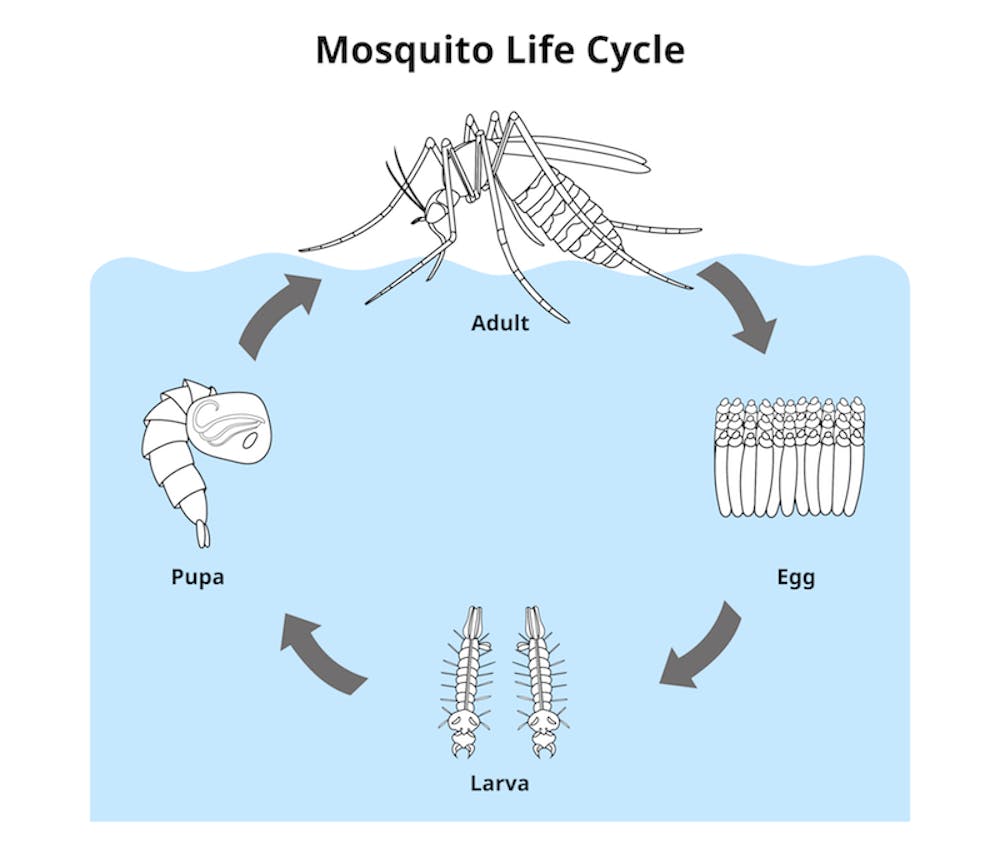
The life cycle of a mosquito. from www.shutterstock.com


Read more: Common Australian mosquitoes can’t spread Zika


The name game

Mosquitoes belong to the fly family Culicidae and are an important part of our biodiversity. There are more than 3,680 known species of mosquitoes in the world. Taxonomists, scientists who classify organisms, have been able to formally name more than 230 species in Australia.

The classification of Australian mosquitoes tapered off in the 1980s with the publication of the last volume of The Culicidae of the Australasian Region and passing of Dr Elizabeth Marks who was the most important contributor to our understanding of Australian mosquitoes.

She left behind 171 unique species with code numbers like “Culex sp No. 32”, but unfortunately these new species were never formally described and remained unnamed after her death. This isn’t uncommon in biodiversity research, as biologists estimate that we’ve only named 25% of life on earth during a time when there is an alarming decline in the taxonomic workforce.

Dr Marks’ unnamed species are still held in Australian entomology collections, like CSIRO’s Australian National Insect Collection, Museum Victoria and the Queensland Museum. Although all the major disease-carrying species of mosquitoes are known in the world, several of Marks’ undescribed Australian species are blood feeding and may have the capacity to transmit diseases.

How do we tell mozzies apart?

Naming, describing and establishing the correct classification of Australia’s mosquitoes is the first step to understanding their role in disease transmission. This is difficult work as adults are small and fragile, and important diagnostic features that are used to tell species apart, like antennae, legs and even tiny scales, are easily lost or damaged.

CSIRO scientists, with support from the Australian Biological Resources Study, Government of Western Australia Department of Health, and University of Queensland, have been tasked with naming Australia’s undescribed mosquitoes. New species will be named and described based on the appearance of the adults and infant larval stages which are commonly intercepted by mozzie surveillance officers. New identification tools will also be created so others can quickly and reliably identify the Australian species.

A 100 year old specimen of the native Common Banded Mosquito Culex annulirostris, capable of spreading Murray Valley encephalitis virus, one of 12 million specimens held in CSIRO’s Australian National Insect Collection in Canberra. CSIRO/Dr Bryan Lessard


Read more: How the new mozzie emoji can create buzz to battle mosquito-borne disease


Scientists are now able to extract DNA and sequence the entire mitochondrial genome from very old museum specimens. CSIRO are using these next generation techniques to generate a reliable DNA reference database of Australian mosquitoes to be used by other researchers and mozzie surveillance officers to accurately identify specimens and diagnose new species. CSIRO are also digitising museum specimens to unlock distribution data and establish the geographical boundaries for the Australian species.

By naming and describing new species, we will gain a more complete picture of our mosquito fauna, and its role in disease transmission. This will make us better prepared to manage our mosquitoes and human health in the future as the climate changes and our growing human population moves into new areas of Australia.

ref. Why naming all our mozzies is important for fighting disease – http://theconversation.com/why-naming-all-our-mozzies-is-important-for-fighting-disease-92379

What’s your beef? How ‘carbon labels’ can steer us towards environmentally friendly food choices

]]>

Source: The Conversation (Au and NZ) – By Adrian R. Camilleri, Senior Lecturer in Marketing, University of Technology Sydney

What did you have for dinner last night? Might you have made a different choice if you had a simple way to compare the environmental impacts of different foods?

Most people do not recognise the environmental impact of their food choices. Our research, published in Nature Climate Change, shows that even when consumers do stop to think about the greenhouse gas emissions associated with their food, they tend to underestimate it.

Fortunately, our study also points to a potential solution. We found that a simple “carbon label” can nudge consumers in the right direction, just as nutrition information helps to highlight healthier options.


Read more: How to reduce your kitchen’s impact on global warming


Most food production is highly industrialised, and has environmental impacts that most people do not consider. In many parts of the world, conversion of land for beef and agricultural production is a major cause of deforestation. Natural gas is a key input in the manufacture of fertiliser. Refrigeration and transportation also depend heavily on fossil fuels.

Overall, food production contributes 19-29% of global greenhouse emissions. The biggest contributor is meat, particularly red meat. Cattle raised for beef and dairy products are major sources of methane, a potent greenhouse gas.

Meat production is inherently inefficient: fertiliser is used to grow feedstock, but only a small portion of this feed becomes animal protein. It takes about 38 kilograms of plant-based protein to produce 1kg of beef – an efficiency of just 3%. For comparison, pork has 9% efficiency and poultry has 13%.

We could therefore cut greenhouse emissions from food significantly by opting for more vegetarian or vegan meals.

Food for thought

To find out whether consumers appreciate the environmental impact of their food choices, we asked 512 US volunteers to estimate the greenhouse emissions of 19 common foods and 18 typical household appliances.

We told the respondents that a 100-watt incandescent light bulb turned on for 1 hour produces 100 “greenhouse gas emission units”, and asked them to make estimates about the other items using this reference unit. In these terms, a serving of beef produces 2,481 emission units.

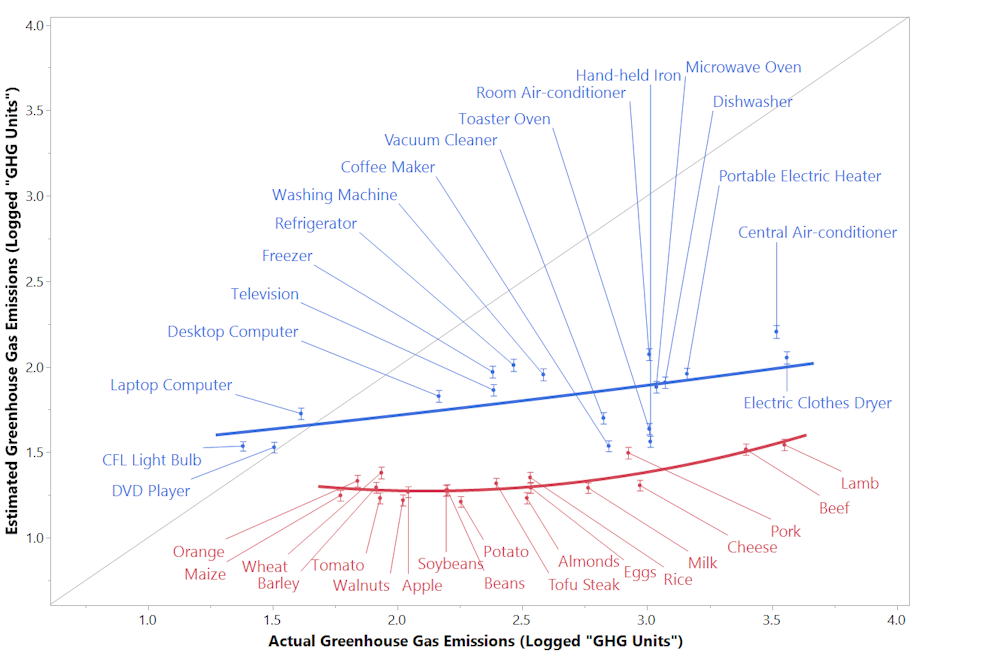
As shown below, participants underestimated the true greenhouse gas emissions of foods and appliances in almost every case. For example, the average estimate for a serving of beef was around 130 emission units – more than an order of magnitude less than the true amount. Crucially, foods were much more underestimated than appliances.

Consumers consistently underestimate the greenhouse emissions of food. Camilleri et al. Nature Climate Change 2018

Improving consumers’ knowledge

People often overestimate their understanding of common everyday objects and processes. You might think you have a pretty solid idea of how a toilet works, until you are asked to describe it in exact detail.

Food is a similarly familiar but complex phenomenon. We eat it every day, but its production and distribution processes are largely hidden. Unlike appliances, which have energy labels, are plugged into an electrical outlet, emit heat, and generally have clear indications of when they are using electricity, the release of greenhouse gases in the production and transportation of food is invisible.

One way to influence food choice is through labelling. We designed a new carbon label to communicate information about the total amount of greenhouse emissions involved in the production and transport of food.

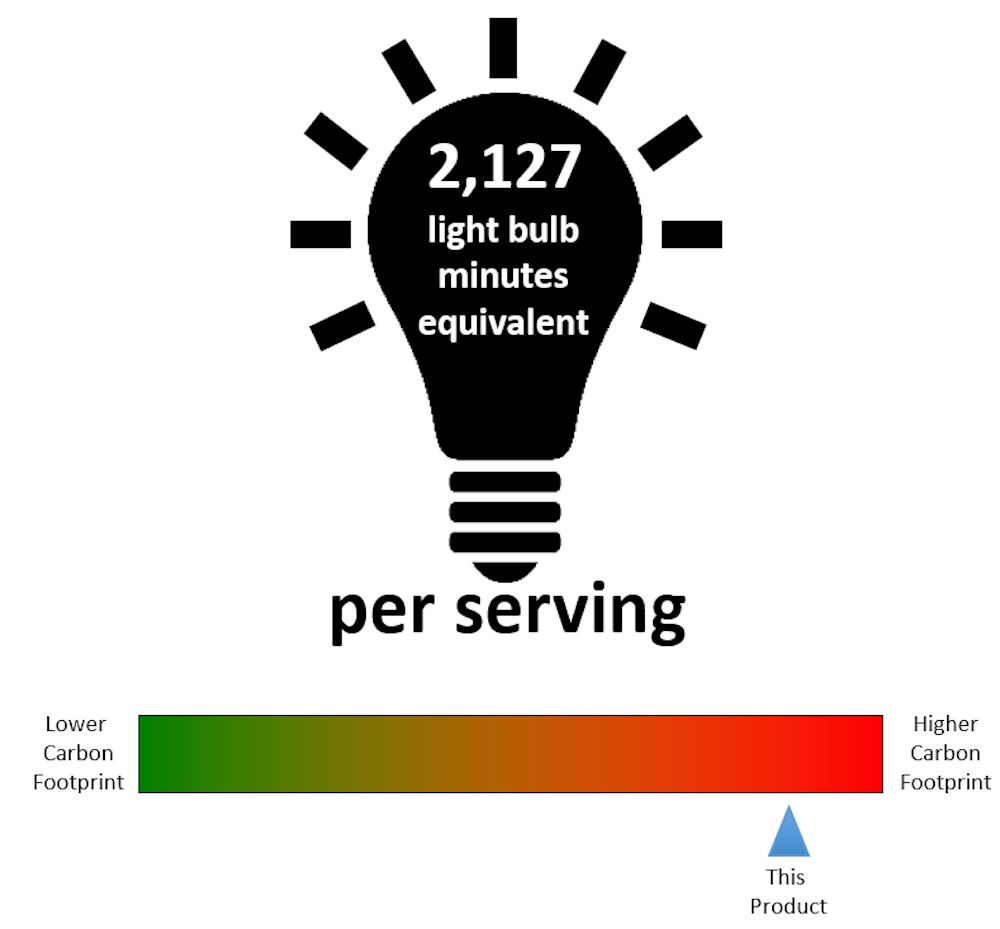
Drawing on knowledge from the design of existing labels for nutrition, fuel economy and energy efficiency, we came up with the label shown below. It has two key features.

First, it translates greenhouse emissions into a concrete, familiar unit: equivalent number of light bulb minutes. A serving of beef and vegetable soup, for example, is roughly equivalent to a light bulb turned on for 2,127 minutes – or almost 36 hours.

Second, it displays the food’s relative environmental impact compared with other food, on an 11-point scale from green (low impact) to red (high impact). Our serving of beef and vegetable soup rates at 10 on the scale – deep into the red zone – because beef production is so emissions-intensive.

In the can – a carbon label for beef and vegetable soup reveals its high environmental impact.

To test the label, we asked 120 US volunteers to buy cans of soup from a selection of six. Half of the soups contained beef and the other half were vegetarian. Everyone was presented with price and standard nutritional information. Half of the group was also presented with our new carbon labels.

Volunteers who were shown the carbon labels chose significantly fewer beef soup options. Importantly, they also had more accurate perceptions of the relative carbon footprints of the different soups on offer.


Read more: You’ve heard of a carbon footprint – now it’s time to take steps to cut your nitrogen footprint


Figuring out the carbon footprint of every food item is difficult, expensive, and fraught with uncertainty. But we believe a simplified carbon label – perhaps using a traffic light system or showing relative scores for different foods – can help inform and empower consumers to reduce the environmental impact of their food choices.

ref. What’s your beef? How ‘carbon labels’ can steer us towards environmentally friendly food choices – http://theconversation.com/whats-your-beef-how-carbon-labels-can-steer-us-towards-environmentally-friendly-food-choices-108424

MYEFO rips A$130 million per year from research funding despite budget surplus

]]>

Source: The Conversation (Au and NZ) – By Margaret Gardner, President and Vice Chancellor, Monash University

Yesterday morning, the mid-year budget update unveiled research funding cuts of A$328.5 million over the next four years. This budget raid on research was more than double the size expected by the university research community.

This new freeze on growth in research funding and PhD scholarships follows last year’s freeze on funding for student places.


Read more: Universities get an unsustainable policy for Christmas


The effect will be felt immediately by the nation’s researchers and their research projects in positions lost and projects slowed, limited or not started. But the damage done will be felt for much longer – in inventions, ideas and opportunities missed.

Why has it been done?

As yet, there has been no adequate public explanation from government, save for two paragraphs in Education Minister Dan Tehan’s media release yesterday:

The decision to pause indexation of research block grant programs for 12 months, along with adjusting growth for RSP (the Research Support Program), will allow the government to prioritise education spending, including on regional higher education.

And this further par:

We have invested over A$350 million since the 2018-19 Budget to support students in regional and remote Australia.

In truth, most of Australia’s regional universities will lose millions of dollars more under the 2017 funding freeze than will be redistributed to them via this latest research cut. And under this new research freeze, they, too, will lose scholarships for PhD students – our next generation of brilliant research talent.

Research funding also goes towards keeping the lights on in libraries and labs so researchers can complete their work. from www.shutterstock.com

Nationwide, the government will fund up to 500 fewer of these scholarships for PhD candidates next year due to the research funding freeze. That’s 500 fewer people who will dedicate their talent to the creation of new knowledge in the national interest.

The education minister has tried to repair the damage inflicted by the 2017 decision of his predecessor – Simon Birmingham – only to compound the damage with this second freeze. That’s throwing bad policy after bad.

Regional universities were among those hardest hit by the 2017 MYEFO decision to cut funding for student places. And that decision continues to cut deeper each year – it will be felt more in 2019 than 2018, and more in 2020 than 2019.

How this will affect Australian research

The harm this will inflict is manifold.

First, it will cut the research funding program. This scheme enables universities to pay the salaries of researchers and technicians whose work enables ground-breaking discoveries. It also funds keeping the lights on in labs and libraries.


Read more: Educational researchers, show us your evidence but don’t expect us to fund it


These overheads of research are not funded by competitive grants. For every A$100,000 an Australian university secures in competitive research grants, it must find an extra A$85,000 to be able to deliver that research. Where will universities find these funds?

Second, it will cut the research training program. This funds scholarships for PhD students to enable them to complete their higher degrees – a necessary first step on the way to a career in research. This is a cut into their brilliant careers, and Australia’s future research capacity.

Third, it damages Australia’s standing as a global research leader. Why would a great researcher come to or stay in Australia, when the government has sent a message that, in a time of budget surplus, it’s prepared to cut into research?

Research funding is critical to Australia’s status as a global research leader. from www.shutterstock.com

Fourth, it will further undermine Australia’s position in research and development investment relative to our economic competitors. China now invests 2.1% of its GDP in research and development – while Australia’s total investment from all sectors in research and development (government, business and research institutions) is now just 1.88% of GDP. China’s economy is ten times bigger than Australia’s, but they’re investing 30 times more than we are.

Our government only spends A$10 billion on research and development each year. Only last Friday, it was revealed Australia’s government spending on research and development was already forecast to fall this year to its lowest level in four decades as a percentage of GDP – to 0.5%. This new research funding cut only worsens this situation.

With the budget in surplus, it makes no sense

University leaders knew research funding was at risk, and so jobs for researchers, technicians and researchers were at risk. But beyond these jobs are the projects they support and the Australians from all walks of life whose lives have or will be transformed by Australian research.


Read more: Margaret Gardner: freezing university funding is out of step with the views of most Australians


Universities Australia has stories of survivors of stroke, cervical cancer and family violence speaking about how crucial university research has been in the lives of people like them at #UniResearchChangesLives.

With a government budget surplus in sight, it makes no sense to cut the research capacity that will create jobs, income and new industries for Australia.

ref. MYEFO rips A$130 million per year from research funding despite budget surplus – http://theconversation.com/myefo-rips-a-130-million-per-year-from-research-funding-despite-budget-surplus-108919

Teleporting and psychedelic mushrooms: a history of St Nicholas, Santa and his helpers

]]>

Source: The Conversation (Au and NZ) – By Louise Pryke, Lecturer, Languages and Literature of Ancient Israel, Macquarie University

There are many sides to the beloved figure of Santa Claus – a giant of pop culture, he also has “miraculous” powers and ties to the celebration of the birth of Jesus. Santa’s blend of religion and popular culture is, however, not modern at all. Several of Santa’s modern features, such as his generosity, miracle-working, and focus on morality (being “naughty or nice”), were part of his image from the very beginning. Others, like the reindeer, came later.

The original Santa, Saint Nicholas, was a fourth century CE bishop of Myra (in modern Turkey) with a reputation for generosity and wonder-working. St Nicholas became an important figure in eighth century Byzantium before hitting pan-European stardom around the 11th century.

He became a focus not just for religious devotion, but Medieval dramas and popular festivals – some popular enough to be suppressed during the Reformation

The naughty list

St Nicholas had his own version of the naughty list, including the fourth century “arch-heretic” Arius, whose views annoyed the saint so much he supposedly smacked Arius in the face in front of Emperor Constantine and assembled bishops at Nicaea.

Portrait of Saint Nicholas of Myra. First half of the 13th century. Wikimedia

An even more surprising listee is the Greek goddess of the hunt, Artemis. In popular Byzantine stories, Nicholas acted like a one-man wrecking crew, personally pulling down her temples, and even demolishing the great temple of Artemis at Ephesus, one of the Seven Wonders of the World. It’s almost a shame, as they probably would have agreed about the importance of reindeer.

The idea of St Nicholas’ conflict with Artemis probably relates to religious change in Anatolia, where the goddess was hugely popular. Historically, the temple was sacked earlier, by a band of Gothic raiders in the 260s CE, but hagiographers had other ideas. Perhaps these furious northmen even count as Santa’s earliest “helpers”. He was after all (as part of his extensive saintly portfolio) the patron of the Varangians, the Viking bodyguard of the Byzantine Emperors.

Fast travelling

Santa’s greatest miracle is intrinsic to modern Christmases: his ability to reach all the children on Earth in one night. NORAD, the US and Canadian air defence force, has tracked Santa’s sleigh since the 1950s, presumably trying to figure out the secret of his super speed. But really, they just need to check their ancient sources.

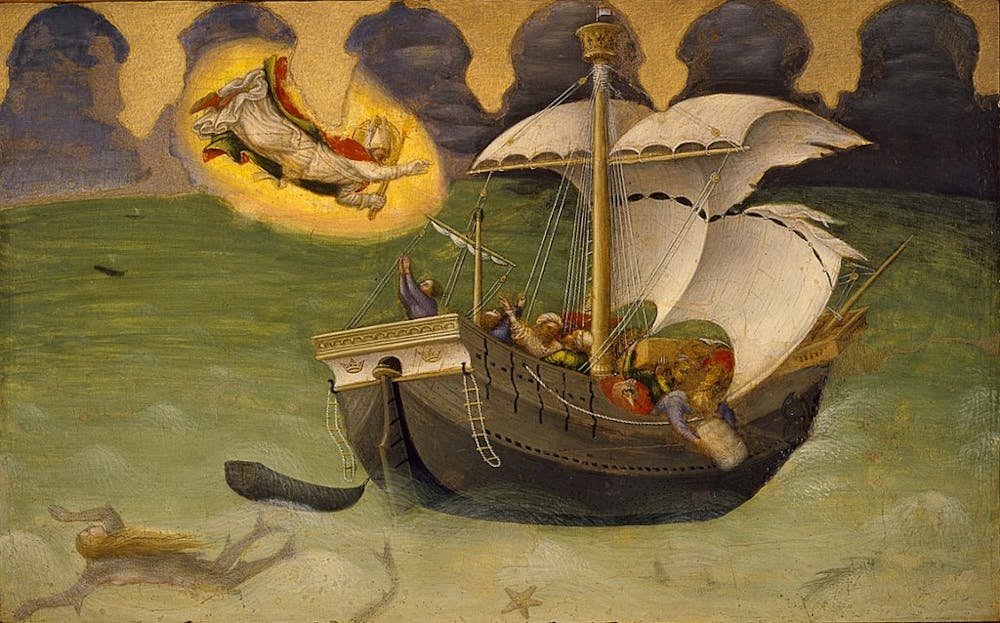
St Nicholas had a history of teleporting about on his own — often showing up in the nick of time when people ask for his help. As the patron saint of sailors, he often did this out at sea.

In one story, sailors in a wild storm in the eastern Mediterranean cried out for the already-famous wonderworker’s help. With the mast cracking and sails coming loose, a white-bearded man suddenly appeared and helped them haul the ropes, steady the tiller, and brought them safe to shore. Rushing up the hill to the local church to give thanks, the sailors were astonished to see Nicholas was already there, in the middle of saying mass.

Saint Nicholas saves a ship. Circa 1425. Wikimedia

Suddenly appearing to save people became a favourite trick in accounts of the saint’s life and in folklore. He once saved three innocents from execution, teleporting behind the executioner and grabbing his sword, before upbraiding the judges for taking bribes.

There’s also the tale of Adeodatus, a young boy kidnapped by raiders and made the cupbearer of an eastern potentate. Soon after, St Nicholas appeared out of nowhere, grabbed the cupbearer in front of his startled master, and zipped him back home.

Artists depicting this story stage the rescue differently, but the Italian artists who have St Nicholas swoop in from the sky, in full episcopal regalia, and grab the boy by the hair are worth special mention.

The flying reindeer

None of the old tales have Saint Nicholas carrying around stacks of gifts when teleporting, which brings us to the reindeer, who can pull the sleigh full of millions of presents. The popular link between Santa Claus and gifting came through the influence of stores advertising their Christmas shopping in the early 19th century. This advertising drew on the old elf’s increasing popularity, with the use of “live” Santa visits in department stores for children from the late 1800s.

Santa Claus became connected to reindeer largely through the influence of the 1823 anonymous poem, A visit from St Nicholas.. In this poem, “Saint Nicholas” arrives with eight tiny reindeer pulling a sleigh full of toys. The reindeer have the miraculous ability to fly.

The fly agaric, a mushroom which produces toxins that can cause humans to hallucinate. Flickr/Björn, CC BY-SA

The origins of the animals’ flight may link back to the Saami reindeer herders of northern Scandinavia. Here, the herders were said to feed their reindeer a type of red-and-white mushroom with psychedelic properties, known as fly agaric fungi (Amanita muscaria). The mushrooms made the reindeer leap about, giving the impression of flying.

The herders would then collect and consume the reindeer’s urine, with its toxins made safe by the reindeer’s metabolism. The reindeer herders could then possibly imagine the miraculous flight through the psychedelic properties of the mushroom.

The ninth reindeer, Rudolph, was created as part of a promotional campaign for the department store Montgomery Ward by Robert Lewis May in 1939. May himself was a small, frail child, who empathised with underdogs. In May’s story, Rudolph Shines Again (1954), the little reindeer is helped by an angel to save some lost baby rabbits, once again blending Santa’s religious and popular sides.

Reindeer in Lapland. Flickr/Steve K, CC BY

And … invisible polar bears

A number of modern depictions have connected Santa with polar bears, such as the 1994 film The Santa Clause. It seems likely the association grew as Santa’s home became accepted as the North Pole — though in one of the oldest stories, St Nicholas saves three Roman soldiers, one of whom is named Ursus (“Bear” in Latin).

Polar bears are undoubtedly useful companions for secretive Santa, and don’t even need his powers to move about unseen – the special properties of their fur mean they are hidden even from night-vision goggles.

Polar bears have fur that is invisible to night vision goggles. Shutterstock

J.R.R. Tolkien’s Letters From Father Christmas (1976), written by the Lord of the Rings’ author to his children, features the (mis)adventures of the North Polar Bear. Like St. Nick, the North Polar Bear isn’t shy about getting physical with those he perceives as wrong-doers. In one letter, the North Polar Bear saves Santa, his elves, and Christmas from a murderous group of goblins.

So with Santa Claus once again coming to town, remember — ancient or modern – it’s better to be on the “nice” side of this teleporting saint and his motley crew of miracle-workers.

ref. Teleporting and psychedelic mushrooms: a history of St Nicholas, Santa and his helpers – http://theconversation.com/teleporting-and-psychedelic-mushrooms-a-history-of-st-nicholas-santa-and-his-helpers-107884

We need to talk about the actual threats to academic freedom on Australian campuses

]]>

Source: The Conversation (Au and NZ) – By Miriam Bankovsky, Senior Lecturer in Politics, La Trobe University

Last week, the Institute for Public Affairs (IPA) published their third annual Free Speech on Campus Audit. It found all but one Australian university (the University of New England) stifles diversity of ideas and academic freedom.

The problem isn’t just that the IPA’s analysis has been criticised for its substandard quality by many academics. Nor that it conflates academic freedom with freedom of expression, and neglects to mention academic autonomy – a fundamental university obligation.


Read more: Special pleading: free speech and Australian universities


The major problem is it polarises debate into clear factions. You’re either for universities or against them. This polarisation prevents us from discussing threats to academic freedom that really do exist, some of which universities perpetuate themselves.

Genuine threats

The ANU’s recent summit on academic freedom and academic autonomy offered a rare opportunity to explore this issue. The event began, predictably, with speakers defending universities against a fabricated crisis. Speakers clarified the relationship between a university’s obligations to uphold:

  • academic autonomy (institutional self-governance)

  • academic freedom (academics’ right to choose what to research, publish, and comment on)

  • freedom of expression (citizens’ rights to express their views).

It became clear that many cases the IPA’s audit identified are actually examples of universities upholding commitment to good scholarship and the dissemination of knowledge in formal teaching and research spaces.

It may be necessary, for example, to reject philanthropic donors who disregard academic autonomy. Or to refuse to host speakers who reject scholarly norms which underpin academic freedom, while also permitting student protest in the university square as free expression.

The Summit’s most important contribution, though, was its determination to discuss an array of genuine and seldom-discussed threats to academic freedom and autonomy. A major threat is policing from within academic orthodoxies, particularly in public health. This can suppress unpalatable findings and ostracise those not toeing the party line.

Researchers working in fields such as obesity, sugar, mammography, smoking and addiction report various attempts from academic colleagues to silence findings that challenge public health orthodoxies. These silencing attempts include threats of violence, legal action and misconduct allegations, among many others because the work is “dangerous” or risks “confusing people”.

For example, professor Wayne Hall recounted he was told to “shut up” by fellow tobacco control researchers because he was critical of the government’s e-cigarette ban. His position was that the potential benefits of e-cigarettes as a harm minimisation strategy had been overlooked.

A related threat is the influence of vested interests, including authoritarian regimes such as China. When Australian universities collaborate with Chinese universities in research, they compromise the intellectual freedom of their own academics.

They also undermine their Chinese colleagues, whose work is seriously limited by government demands. A party communiqué from the Chinese government in 2013 prohibits Chinese academics from researching or teaching in seven areas:

  1. constitutional democracy
  2. civil society
  3. economic liberalisation
  4. freedom of the press
  5. historical critiques of the Communist Party
  6. challenges to socialism with Chinese characteristics
  7. discussion of universal values (such as human rights and freedoms, academic freedom included).

Another threat to academic freedom is misinformation from outside universities, including character assassination of academics in major media outlets and on social media. These pile-ons can be personally traumatic, but also create a broader chilling effect around politically charged issues, leading researchers to self-censor.

The university’s role

Further threats come from universities themselves. Precarious employment and funding prevents the security required for real academic freedom.

Universities also threaten academic freedom when they grant their own managers and councils unilateral power to control the reputational risks of academic work. Academic freedom policies and enterprise bargaining clauses often limit public comment to the academic’s area of expertise. But university managers can narrowly define these areas. Very few permit public critique of university matters. The ANU’s Statement on Academic Freedom provides a fine exception.


Read more: University changes to academic contracts are threatening freedom of speech


Codes of conduct increasingly require researchers to uphold their employer’s “good reputation”. One Australian university prevented an ethics committee review of research on the clinical use of psychadelics to treat PTSD. This was due to concerns the research would damage the university’s reputation.

Undermining academic involvement in university self-governance is a further barrier to academics having input into issues that affect their freedom.

Finally, ARC grants in certain disciplines are harder to come by. Universities are also forced by government to prioritise research that attracts external stakeholders. If scholars in certain disciplines (such as humanities and creative arts) are consistently denied research resources, their academic freedom is only theoretical.

Solutions

The move beyond polarisation allows us to proactively consider how universities might limit these threats. It’s important for universities themselves to model the kind of discourse they value. One idea involves cultivating better research training to allow more nuanced responses in dealing with sensitive research topics.

Nuance and rigour would also be improved by removing conduct clauses around upholding a university’s “good reputation”. Academics should be expressly permitted to comment on university-related matters, as per the ANU’s Statement.

Public health researchers have reported receiving threats of violence, legal action and misconduct allegations. Michael Ramsey/AAP

Getting more academic staff onto university councils would allow academics to better scrutinise the impact university business dealings have on academic freedom.

Whether and how to resource non-profitable research needs frank consideration. There is the option of setting aside a portion of university research block grant funding for quality humanities projects and research where practical, real-world applications aren’t immediately obvious.

As for authoritarian regimes, Australian universities should take a blanket approach to embedding academic freedom clauses in all external funding contracts. They should also lobby to include academic freedom as an indicator in global rankings. This would provide incentives for authoritarian regimes to improve.


Read more: Four fundamental principles for upholding freedom of speech on campus


Finally, it’s essential to promote greater cultures of protection within universities both through proactive legal and complaint-handling processes. There should also be a greater willingness to make a commitment to academic freedom through statements, policy changes and events like the Summit.

Getting beyond the IPA’s polarised terms is essential if we are to realistically address threats to academic freedom.

ref. We need to talk about the actual threats to academic freedom on Australian campuses – http://theconversation.com/we-need-to-talk-about-the-actual-threats-to-academic-freedom-on-australian-campuses-108596

More mirage than good management, MYEFO fails to hit its own targets

]]>

Source: The Conversation (Au and NZ) – By Danielle Wood, Program Director, Budget Policy and Institutional Reform, Grattan Institute

The Morrison government wants next year’s election to be about economic management.

So understandably, it’s using the improved bottom line in the Mid Year Economic and Fiscal Outlook (MYEFO) to talk up its economic credentials.

But the numbers in MYEFO show it has failed to hit many of its own targets.

Target 1: Surpluses on average over the cycle

The government’s overarching fiscal objective is to deliver budget surpluses: not just in one year but on average over the economic cycle.

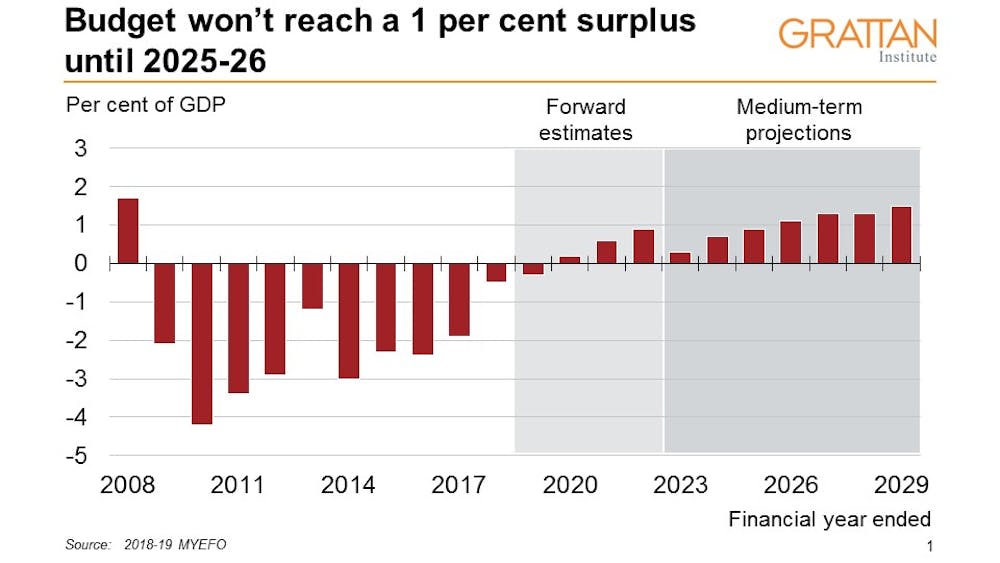
MYEFO indicates the government is expecting a $5.2 billion deficit in 2018-19 (0.3% of GDP).

It will be the 11th consecutive deficit for the Commonwealth budget.

Deficits have averaged $33.2 billion (2.1% of GDP) over those 11 years.

Yes, a $4.1 billion surplus is forecast for next year, with surpluses projected to reach $19 billion (0.9% of GDP) by 2021-22.

But so big have the recent deficits been, that even if everything goes well and the fiscal position continues to improve, the budget would need to be in surplus for decades to produce a surplus on average over each year, far longer than what most economists consider a typical economic cycle.


Read more: MYEFO reveals billions more in revenue, $9 billion in fresh election tax cuts


A related fiscal target is that budget surpluses will build to at least 1% of GDP as soon as possible.

Despite revenue windfalls from income and company taxes (discussed below), the government is still forecasting it won’t reach that 1% of GDP surplus target until 2025-26.

Policy decisions in this year’s budget and MYEFO – including income and company tax cuts, additional funding for independent and Catholic schools, and changes to the GST formula to placate Western Australia – have weakened the bottom line in 2021-22 by $10.5 billion.

Hardly the actions of a government in a hurry to deliver a sizeable surplus.

Verdict: Fail.


Target 2: Reduce the payments-to-GDP ratio

The government’s policy is also to maintain strong fiscal discipline by controlling expenditure, with a falling payments-to-GDP ratio its measure of success.

Whether it has met the target depends on the starting year. Governments payments are forecast to reach 24.9% of GDP in 2018-19, up from 23.9% in 2012-13 before the Coalition took office.

The government prefers the starting point of its first year in office 2013-14 where payments were 25.5% of GDP.

Either way, payments in 2018-19 remain above the 30-year historical average of 24.7% of GDP.


Read more: Morrison’s return to surplus built on the back of higher tax – Parliamentary Budget Office


While the government projects that spending will fall slightly further to 24.6% of GDP by 2021-22, this relies on spending growth across the government’s major programs falling substantially compared to the previous four years – without major policy changes to help facilitate the fall.

Verdict: Debateable pass.


Target 3: Tax-to-GDP ratio below 23.9% of GDP

In last year’s budget, the government introduced a new target of capping tax collections at 23.9% of GDP.

Why 23.9%? That was the average level of tax during the final two terms of the Howard/Costello government.

While the Coalition is understandably keen to follow the lead of one of its most electorally successful governments, that was also a period where tax collections were historically high.

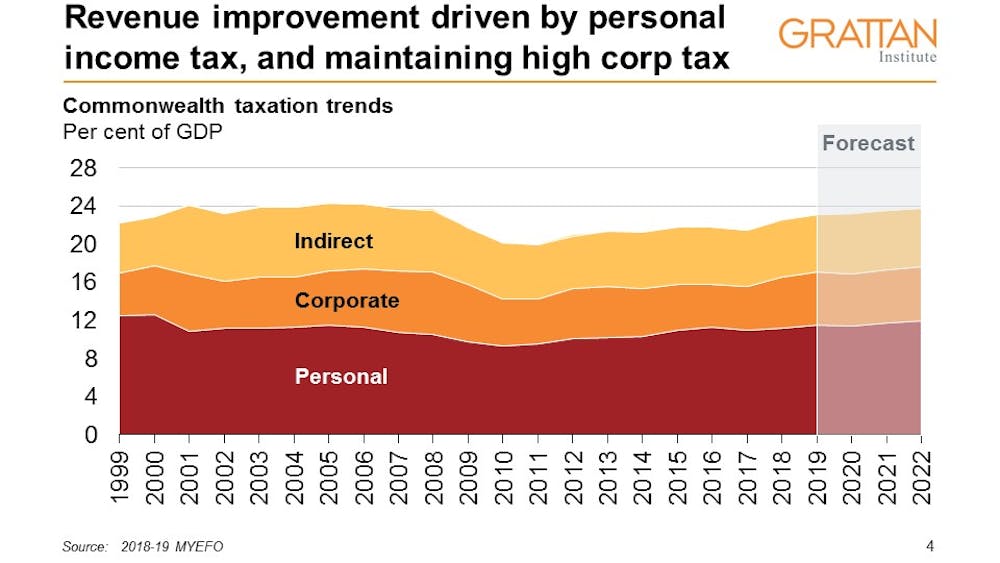
Tax collections are projected to reach 23.8% of GDP in 2022, on the back of stronger than forecast personal income tax and company tax receipts.

Verdict: Pass.


MYEFO Chart.


Target 4: New spending measures more than offset by reductions in spending elsewhere

Since becoming prime minister, Scott Morrison has sent mixed signals about whether his government will adhere to the longstanding budget rule that all new spending proposals be matched with budget savings.

At the MYEFO press conference, Finance Minister Matthias Cormann said it was a “matter of balancing competition priorities”.

Here’s the straight answer – the net effect of policy changes announced in MYEFO are an additional $12.2 billion in spending over four years.

In other words, the government has not offset new spending with cuts to other spending programs. The Turnbull government similarly failed to offset its new spending in 2017-18 (although it succeeded in prior years).


Read more: Monday’s MYEFO will look good, but it will set the budget up for awful trouble down the track


There have been some reductions in spending because of improvements in the economy. The government claims these reductions offset its recent spending announcements. But genuine offsets come from policy changes, not economic good luck.

Verdict: Fail.

Target 5: Shifts due to changes in the economy banked as an improvement in budget bottom line

This objective is key to the government’s fiscal conservative credentials.

If it has some economic good luck, it commits to use the proceeds for budget repair rather than new spending or tax cuts.

This rule has been irrelevant for most of the past decade, because almost every budget had revenue collections falling short of forecast.

But the Morrison government is in the middle of a mini revenue boom – revenue collections were higher than forecast in both the 2018-19 budget and MYEFO.

Company tax collections are higher largely due to strong commodity prices. Income tax collections are up and government spending is down because of improvements in the economy.


Read more: Labor would deliver bigger surpluses than the Coalition: Bowen


So has the government used this chance to show off its fiscal prudence?

Not exactly. It will spend around $11.8 billion of this windfall, give away another $19.3 billion in tax cuts and bank just over half of it ($35.2 billion) to the bottom line.

And in the shadow of an election, we can almost certainly expect further spending. The $9 billion in decisions taken but not announced – potentially a pre-election warchest – suggests that more tax cuts could also be on the way.

Verdict: Fail.

Our final verdict

The challenge in assessing budget management is separating good luck from good management. Governments will always seek to take credit for economic upswings that boost the bottom line.

Fiscal targets are there to keep them on the straight and narrow.

An objective assessment of the government’s performance against its own key targets suggests its good news budget is more mirage than magnificent management.

ref. More mirage than good management, MYEFO fails to hit its own targets – http://theconversation.com/more-mirage-than-good-management-myefo-fails-to-hit-its-own-targets-108830

More mirage than good management, MYEFO fails to meet its own targets

]]>

Source: The Conversation (Au and NZ) – By Danielle Wood, Program Director, Budget Policy and Institutional Reform, Grattan Institute

The Morrison government wants next year’s election to be about economic management.

So understandably, it’s using the improved bottom line in the Mid Year Economic and Fiscal Outlook (MYEFO) to talk up its economic credentials.

But the numbers in MYEFO show it has failed to hit many of its own targets.

Target 1: Surpluses on average over the cycle

The government’s overarching fiscal objective is to deliver budget surpluses: not just in one year but on average over the economic cycle.

MYEFO indicates the government is expecting a $5.2 billion deficit in 2018-19 (0.3% of GDP).

It will be the 11th consecutive deficit for the Commonwealth budget.

Deficits have averaged $33.2 billion (2.1% of GDP) over those 11 years.

Yes, a $4.1 billion surplus is forecast for next year, with surpluses projected to reach $19 billion (0.9% of GDP) by 2021-22.

But so big have the recent deficits been, that even if everything goes well and the fiscal position continues to improve, the budget would need to be in surplus for decades to produce a surplus on average over each year, far longer than what most economists consider a typical economic cycle.


Read more: MYEFO reveals billions more in revenue, $9 billion in fresh election tax cuts


A related fiscal target is that budget surpluses will build to at least 1% of GDP as soon as possible.

Despite revenue windfalls from income and company taxes (discussed below), the government is still forecasting it won’t reach that 1% of GDP surplus target until 2025-26.

Policy decisions in this year’s budget and MYEFO – including income and company tax cuts, additional funding for independent and Catholic schools, and changes to the GST formula to placate Western Australia – have weakened the bottom line in 2021-22 by $10.5 billion.

Hardly the actions of a government in a hurry to deliver a sizeable surplus.

Verdict: Fail.


Target 2: Reduce the payments-to-GDP ratio

The government’s policy is also to maintain strong fiscal discipline by controlling expenditure, with a falling payments-to-GDP ratio its measure of success.

Whether it has met the target depends on the starting year. Governments payments are forecast to reach 24.9% of GDP in 2018-19, up from 23.9% in 2012-13 before the Coalition took office.

The government prefers the starting point of its first year in office 2013-14 where payments were 25.5% of GDP.

Either way, payments in 2018-19 remain above the 30-year historical average of 24.7% of GDP.


Read more: Morrison’s return to surplus built on the back of higher tax – Parliamentary Budget Office


While the government projects that spending will fall slightly further to 24.6% of GDP by 2021-22, this relies on spending growth across the government’s major programs falling substantially compared to the previous four years – without major policy changes to help facilitate the fall.

Verdict: Debateable pass.


Target 3: Tax-to-GDP ratio below 23.9% of GDP

In last year’s budget, the government introduced a new target of capping tax collections at 23.9% of GDP.

Why 23.9%? That was the average level of tax during the final two terms of the Howard/Costello government.

While the Coalition is understandably keen to follow the lead of one of its most electorally successful governments, that was also a period where tax collections were historically high.

Tax collections are projected to reach 23.8% of GDP in 2022, on the back of stronger than forecast personal income tax and company tax receipts.

Verdict: Pass.


MYEFO Chart.


Target 4: New spending measures more than offset by reductions in spending elsewhere

Since becoming prime minister, Scott Morrison has sent mixed signals about whether his government will adhere to the longstanding budget rule that all new spending proposals be matched with budget savings.

At the MYEFO press conference, Finance Minister Matthias Cormann said it was a “matter of balancing competition priorities”.

Here’s the straight answer – the net effect of policy changes announced in MYEFO are an additional $12.2 billion in spending over four years.

In other words, the government has not offset new spending with cuts to other spending programs. The Turnbull government similarly failed to offset its new spending in 2017-18 (although it succeeded in prior years).


Read more: Monday’s MYEFO will look good, but it will set the budget up for awful trouble down the track


There have been some reductions in spending because of improvements in the economy. The government claims these reductions offset its recent spending announcements. But genuine offsets come from policy changes, not economic good luck.

Verdict: Fail.

Target 5: Shifts due to changes in the economy banked as an improvement in budget bottom line

This objective is key to the government’s fiscal conservative credentials.

If it has some economic good luck, it commits to use the proceeds for budget repair rather than new spending or tax cuts.

This rule has been irrelevant for most of the past decade, because almost every budget had revenue collections falling short of forecast.

But the Morrison government is in the middle of a mini revenue boom – revenue collections were higher than forecast in both the 2018-19 budget and MYEFO.

Company tax collections are higher largely due to strong commodity prices. Income tax collections are up and government spending is down because of improvements in the economy.


Read more: Labor would deliver bigger surpluses than the Coalition: Bowen


So has the government used this chance to show off its fiscal prudence?

Not exactly. It will spend around $11.8 billion of this windfall, give away another $19.3 billion in tax cuts and bank just over half of it ($35.2 billion) to the bottom line.

And in the shadow of an election, we can almost certainly expect further spending. The $9 billion in decisions taken but not announced – potentially a pre-election warchest – suggests that more tax cuts could also be on the way.

Verdict: Fail.

Our final verdict

The challenge in assessing budget management is separating good luck from good management. Governments will always seek to take credit for economic upswings that boost the bottom line.

Fiscal targets are there to keep them on the straight and narrow.

An objective assessment of the government’s performance against its own key targets suggests its good news budget is more mirage than magnificent management.

ref. More mirage than good management, MYEFO fails to meet its own targets – http://theconversation.com/more-mirage-than-good-management-myefo-fails-to-meet-its-own-targets-108830

Curious Kids: how do people know what the weather will be?

]]>

Source: The Conversation (Au and NZ) – By Adam Morgan, Senior Meteorologist, Australian Bureau of Meteorology

This is an article from Curious Kids, a series for children. The Conversation is asking kids to send in questions they’d like an expert to answer. All questions are welcome – serious, weird or wacky! You might also like the podcast Imagine This, a co-production between ABC KIDS listen and The Conversation, based on Curious Kids.


How do people know what the weather is? – Liam, age 5.


The weather affects all of us every day and it’s very important for people like pilots, sailors and firefighters to know what weather they should expect. But how do we know what the weather will be like tomorrow or next week?

That’s the job of meteorologists. They’re not experts on meteors, they’re experts on weather!

The name meteorologist comes from a very, very old Greek word, which means “studying things that are high in the air”.

They use three main things to help them decide what weather is on the way: weather observations, computer weather models, and their own experience.

Weather observations

That means what the weather is doing now. So they need lots of measurements of things like air pressure, temperature and rainfall, not just from on the ground, but high in the sky and even from up in space as well. For those measurements they rely on weather balloons and aeroplanes, as well as radars and satellites.

Computer weather models

Really powerful computers use information about what the weather is doing now and how it has behaved in the past to help predict how it will behave in the future. They do lots and lots of calculations to tell us what is most likely to happen.

Experience

The final thing meteorologists need is their own experience. That helps them decide whether the computer’s prediction is likely to be right, or perhaps needs to be changed a little bit. Usually the meteorologists have spent a long time studying the weather so they have a really good knowledge of how it behaves.


Read more: Curious Kids: What existed before the Big Bang? Did something have to be there to go boom?


Twice every day the Bureau of Meteorology (which is sometimes called the Weather Bureau) sends out the official weather forecasts for towns and cities across Australia.

These forecasts look at only the next seven days, because the further ahead they try to predict the harder it is to get it right. That also means the forecast for tomorrow or the day after is likely to be more accurate than the one for this time next week.

You should also remember that sometimes weather is very local. That means it can be raining in one place but dry and sunny just a few kilometres away. So next time you see a forecast for a “shower or two” but you see mostly blue sky where you are, give your friend on the other side of town a call. They might be wearing a raincoat and hiding under an umbrella!

So, we don’t always know exactly what the weather is going to be like at your place, but thanks to the Bureau of Meteorology we can give you a very good idea of what to expect.


Read more: Curious Kids: where do clouds come from and why do they have different shapes?


Hello, curious kids! Have you got a question you’d like an expert to answer? Ask an adult to send your question to curiouskids@theconversation.edu.au

CC BY-ND

Please tell us your name, age and which city you live in. We won’t be able to answer every question but we will do our best.

ref. Curious Kids: how do people know what the weather will be? – http://theconversation.com/curious-kids-how-do-people-know-what-the-weather-will-be-108295

Morrison’s decision to recognise West Jerusalem the latest bad move in a mess of his own making

]]>

Source: The Conversation (Au and NZ) – By Tony Walker, Adjunct Professor, School of Communications, La Trobe University

Prime Minister Scott Morrison will have learned a valuable foreign policy lesson in the past day or so as it relates to the Holy Land.

As ye sow, so shall ye reap (Galatians 6:7).

When Morrison allowed a thought bubble to become a political ploy in the Liberal party’s desperation to cling on to a safe seat in the Wentworth byelection, he miscalculated the damage it would cause to his own credibility and the country’s foreign policy settings.

An inexperienced prime minister blundered into the thicket of Middle East politics by announcing Australia would both consider moving its embassy from Tel Aviv to Jerusalem, and would also review its support for the Joint Comprehensive Plan of Action (JCPOA).

This latter is the 159-page document negotiated by the permanent members of the Security Council, plus Germany. In it, Iran agreed to freeze its nuclear program.


Read more: Shifting the Australian embassy in Israel to Jerusalem would be a big, cynical mistake


In any event, Morrison indicated Canberra would continue to adhere to JCPOA, thus putting itself at odds with Washington. The United States announced it would abandon the JCPOA, pending the negotiation of better terms.

In his efforts to purloin the Jewish vote in Wentworth, Morrison’s shallow marketing impulses got the better of policy prudence.

He proceeded with haste in the first instance, and now he can repent at leisure after having sought – unsuccessfully it seems – to thread the needle in his policy pronouncements at the weekend.

If we stretch the biblical allusions further, we might say that when it comes to the Middle East, it is easier for a camel to pass through the eye of a needle than for a political ingénue to shift the status quo in Australia’s position on the vexed Arab-Israel issue.

What has now happened – as it inevitably would – after Morrison announced that Australia would recognise West Jerusalem as Israel’s capital and establish a branch office there, is a negative reaction not only from the Muslim world, but from Israel itself.

So an Australian prime minister goes out on a limb for the Jewish state, only to have it sawn off by critics in Israel who did not like the distinction he made between Jerusalem’s Jewish west and Arab east.

Under Israel’s Basic Law, the constitution, an undivided Jerusalem is deemed to be the country’s capital in perpetuity. This position was bolstered in a Knesset vote as recently as this year.

Israel’s official reaction to the Morrison announcement was to describe it as a “step in the right direction”. However, as its implications sunk in, Israeli public figures began to take strong exception to Australia’s “acknowledgement” of Palestinian claims to Jerusalem in a final status peace settlement.

Typical of the reaction was this, via Twitter, from Tzachi Hanegbi, a prominent Knesset member of the nationalist Likud party and confidant of Prime Minister Benjamin Netanyahu.

Yuli Edelstein, the speaker of the Knesset, went further.

We expected more from a friendly country like Australia […] I am hoping that our cool response will make it clear to the Australians that this is not what we were wishing for.

Pointedly, Netanyahu had not commented publicly at time of writing.

In his announcement on Saturday at a Sydney Institute event, Morrison set out his stall on the Jerusalem issue. In the process, apart from infuriating the Israeli nationalist right, he exposed himself to withering criticism at home and in the region.

This was the nub of Morrison’s statement:

Australia now recognises West Jerusalem, being the seat of the Knesset and many of the institutions of government, is the capital of Israel […] Furthermore, recognising our commitment to a two-state solution, the Australian Government has also resolved to acknowledge the aspirations of the Palestinian people for a future state with its capital in East Jerusalem.

While Morrison’s use of the word “acknowledge” falls a long way short of “recognising” Palestinian aspirations, his “acknowledgement”, in the context of final status peace negotiations, trespasses on an Israeli article of faith.

Israel’s insistence on an undivided Jerusalem in perpetuity under its control contradicts an international consensus that East Jerusalem remains occupied territory since the 1967 Six-Day War.

Australia has supported numerous United Nations resolutions to this effect, including Security Council resolutions 242 of 1967 and 338 of 1973 that called on Israel to withdraw from territories occupied in war.

In his efforts to find favour with Israel’s supporters, Morrison crossed that divide, thereby infuriating an Israeli government and discomforting Israel’s backers in Australia, notwithstanding their professed delight at the latest turn of events.


Read more: Moving the Australian embassy to Jerusalem makes sense: here’s why


Australia’s position, it might be noted, contrasts with that of the United States. Washington recognised Jerusalem as Israel’s capital earlier this year without making a distinction between “west” and “east”.

In his Sydney Institute speech, Morrison indicated he and his public service advisers had conferred widely in their efforts to come up with a form of words that would be consistent with his pledge to review Australia’s position on Jerusalem.

This review included consultations with:

…some eminent Australian policymakers: former heads of various agencies and departments whether in Defence, Foreign Affairs or Prime Minister and Cabinet.

Advice to Morrison from what was known as a “reference group” of “eminent Australian policymakers” was overwhelmingly, it not unanimously, resistant to changing the status quo.

In other words, Australia should adhere to settled policy.

Morrison chose to ignore this advice after having committed himself to a review. In the process, and unnecessarily, he has risked negative reactions from Australia’s important neighbours, Indonesia and Malaysia, and from the Arab world. At home, he has exposed himself to criticism he has jeopardised Australia’s international standing for no conspicuous benefit.

This has been a mess, and one entirely of Morrison’s own making, driven by short-term political calculations.

ref. Morrison’s decision to recognise West Jerusalem the latest bad move in a mess of his own making – http://theconversation.com/morrisons-decision-to-recognise-west-jerusalem-the-latest-bad-move-in-a-mess-of-his-own-making-108892

Broken records, ‘crunch’ and freemium that’s not free: 2018 was a huge year in gaming

]]>

Source: The Conversation (Au and NZ) – By Marcus Carter, Lecturer in Digital Cultures, SOAR Fellow., University of Sydney

2018 has been a big year for video games – and not just because of the games that were released.

We’ve seen broken revenue records, burgeoning discussions about the labour that goes into producing games, and a crack-down on predatory practices that squeeze more dollars out of players.

Meanwhile, eSports and livestreaming showed bumper growth. Progressively updated games, and the “early access” trend continued to both delight and frustrate.

In the games themselves, we got a heavy dose of nostalgia with new twists on the classics.


Read more: Could playing Fortnite lead to video game addiction? The World Health Organisation says yes, but others disagree


Bumper revenues

The “battle royale” game Fortnite was the most outstanding and unexpected success of the year, hitting 78.3 million players in August 2018 and bumping developer Epic Games to a US$15 billion dollar valuation.

Cementing the economic scale of video-games, Rockstar Games’s Red Dead Redemption 2 had the second highest opening weekend for any media release ever, grossing US$725 million – and outstripping any of the latest Marvel movies .

Red Dead Redemption 2 grossed USD$750 million in its opening weekend. instacodex/flickr

Scrutiny of practices

Accompanying these dizzying numbers were reports of “crunch” – excessive and extensive periods of overtime – to get games released on time.

This has led to louder conversations about the labour that goes into making games, and a growing unionisation movement.

Attention also focused on the gambling-like transactions that now pervade “freemium” games. These games are free to play, but include many premium features that can be accessed with an unlimited number of small, in-game purchases (or “microtransactions”).

In June, the Australian Senate referred some of these practices to a senate inquiry, which concluded with a recommendation for a more comprehensive review.

The classics re-imagined

Many of 2018’s most anticipated and celebrated games drew heavily from the past. Games like Enhance Games’s acclaimed Tetris Effect, and Nintendo’s Pokémon: Let’s Go are both re-imaginings of classic games from well-established franchises.

It may be that the biggest MMOG (massively multiplayer online game) lauch for 2019 will be the re-release of the 2004 “classic” version of World of Warcraft.

Gaming hardware manufacturers are tapping into this too, with devices like Nintendo Classic Mini selling out at launch.


Read more: Facebook punts on gaming to lure millennials back to the platform


Increased longevity of games

Digital games are incredibly time-consuming and costly to produce. As such, games are taking on longer life cycles, with increased focus on online multiplayer game modes.

A good example is 2013’s Grand Theft Auto V, which had an initial development budget over US$250 million. Thanks to the enduring popularity of its online mode, the game is now the most profitable media product of all time.

Bethesda has followed this with a (so far poorly received) foray into the online space with Fallout 76, an online version of its popular singleplayer Fallout series.

With the life cycle of game development stretching across multiple years, it’s likely that future game releases will focus on longer life cycles for games and to support online play, where players can continually make regular microtransactions while they play (as is the case of Grand Theft Auto V).

eSports and livestreaming

eSports and livestreaming have continued to prove immensely popular in 2018.

Valve’s Dota 2 amassed its largest prize-pool to date, over US$25 million. And new eSports promise to emerge, with Valve releasing Artifact this month – its take on the popular digital card game genre (competing with Blizzard’s Hearthstone).

Further blowing up this space, Epic Games announced over US$100 million in prize money for Fortnite’s eSport in 2019.

Much of the success of games like Fornite can be attributed to the recent and rapid growth of video game livestreaming on platforms like Twitch, where you can watch other people play games.

Fortnite streamer ‘Ninja’ on Ellen.

Fortnite streamer Tyler “Ninja” Blevins exemplifies this as a now global phenomenon transcending Twitch; he even played with TV host Ellen. Ninja amassed a viewership of over 600,000 concurrent viewers when he broadcast his gameplay session with popular celebrities like Drake.

Given the immense popularity of watching games, it is likely we will continue to see games designed to be watched, and not just played.

Early access and the ongoing evolution of games

It’s no coincidence that many of the games mentioned so far didn’t actually launch this year, with various trends changing what it means to talk about a “year in videogames”.

Games like Hello Games’s No Mans Sky have been updated significantly in 2018, following the game’s rocky 2016 launch. These updates have been very positively received – but because it is an online game, the 2016 version people paid for no longer exists.


Read more: Gaming or gambling: study shows almost half of loot boxes in video games constitute gambling


Another persistent model is to release unfinished games in “early access” mode while development is ongoing. Digital distribution platforms like Steam are a popular venue for early access games. The digital storefront dedicates an entire section to early access games, inviting gamers to:

Discover, play, and get involved with games as they evolve.

Some games have now been in early access for more than five years.

So when is a game really released? The Australian space-trading game Objects in Space was nominated for a 2018 Australian Game Award, but subsequently removed (at the request of the developer) as it is still in early access.

As we see it, iteratively updated games and the “early access” trend represent a mixed blessing. This business model has allowed the invention of entirely new genres of games that can succeed when supported by early access and improved via player feedback.

Coupled with this there is also an increasing trend of “abandonware”, or unfinished games abandoned by their developer despite being sold to players with the promise of future updates and improvements.

In any case, forecasting what games will have the biggest impact in the next 12 months has become close to impossible. Perhaps it is a case for the Frog Detective?

ref. Broken records, ‘crunch’ and freemium that’s not free: 2018 was a huge year in gaming – http://theconversation.com/broken-records-crunch-and-freemium-thats-not-free-2018-was-a-huge-year-in-gaming-105736

Having a second child worsens parents’ mental health: new research

]]>

Source: The Conversation (Au and NZ) – By Leah Ruppanner, Senior Lecturer in Sociology, University of Melbourne

Children are a wonderful gift, bringing joy, laughter, and love. But, then there are the toys, the sleepless nights, the constant barrage of “why?” questions and the plethora of sticky handprints.

For many parents, the decision to have a second child is made with the expectation that two can’t be more work than one. But our research on Australian parents shows this logic is flawed: second children increase time pressure and deteriorate parents’ mental health.


Read more: If we’re serious about supporting working families, here are three policies we need to enact now


Our study used data from the Household, Income and Labour Dynamics in Australia (HILDA) Survey, following roughly 20,000 Australians for up to 16 years. The goal was to see what happens to parents’ time pressure and mental health as first children are born, age and new siblings arrive.

We weighed two main questions that many parents ask themselves when making the decision to have a second child: Do things get better as children grow older, sleep more and gradually become a bit more independent and robust? Or does a second child add to what may already be a highly stressed and time-poor household?

The most ambitious discussions about having second children occur during a date night, in between the first and second bottle of wine – where the short and long-term impacts of children peer out from the distant future.

These tensions between the short- and long-term impacts of children tap into what social scientists call the stress process model. In this perspective, major life events can increase stress either in the short-term, as an eventful experience, or as a chronic strain, with effects that linger over time.

Health researchers show that chronic stress is the most detrimental to health and well-being, contributing to cardiovascular disease, obesity and other major diseases. We are not arguing that children lead to heart disease – we have our Western diets to thank for that – but rather pose the question of whether the birth of first and second children has short or long-term effects on Australian parents’ time pressure and, because of that, mental health.

The birth of a first child introduces adults to a new role – that of parent – that comes with expectations about how to allocate time to work or family. Following childbirth, many Australian mothers take a year of parental leave. Some return to work, but others do not.

Most Australian fathers maintain full-time work after children are born, in part to make up for mothers’ employment reductions, but also because Australian parents become more traditional in their gender roles following childbirth.

Mothers and fathers are more likely to believe that women should stay home to care for children once they become parents than when they were childless. As a result, the bulk of the childcare falls to mothers.

Second (and third) children do not introduce a new role into parents’ lives, but rather increase the demands of the parent role. In theory, parents of second children have developed parenting skills – including how to clean a bottle while rocking a baby, and to never buy expensive dry-clean-only clothes again. These parenting skills may mean that second children bring less time pressure and stress than first children.

Our results, however, do not support this claim.

Prior to childbirth, mothers and fathers report similar levels of time pressure. Once the first child is born, time pressure increases for both parents. Yet this effect is substantially larger for mothers than fathers. Second children double parents’ time pressure, further widening the gap between mothers and fathers.

Although we hoped parents’ time pressure would diminish over time – as they gained more skills or kids entered school years, we found that time pressure lingered. We also thought that parents working full-time or those doing most of the housework would be the ones experiencing increased time pressure.

Instead, we found that time pressure increased with first and second children for all parents, whether they were working or not. Thus, reducing work to part-time is not a solution to this time-pressure problem. Parents of third children fare no better, indicating that children are not economies of scale.

To better understand the health implications of parents’ increased time pressure, we also looked at their mental health. We found that mothers’ mental health improves with first children immediately following birth and remains steady over the next few years. But, with the second child, mothers’ mental health sharply declines and remains low.

The reason: second children intensify mothers’ feelings of time pressure. We showed that if mothers did not have such intense time pressures following second children, their mental health would actually improve with motherhood. Fathers get a mental health boost with their first child, but also see their mental health decline with the second child. But, unlike mothers, fathers’ mental health plateaus over time. Clearly, fathers aren’t facing the same chronic time pressure as mothers over the long-term.


Read more: Sorry, men, there’s no such thing as ‘dirt blindness’ – you just need to do more housework


So, what does this mean for Australian families and the institutional environment in which they are embedded? First, mothers cannot shoulder the time demands of children alone. Even when they reduce their work time to accommodate children’s demands, their time pressures do not ease. This has important consequences for their mental health.

Further, the effects of children on mothers’ time pressure is not short-lived, but rather is a chronic stress that slowly deteriorates their health. As such, maternal time pressure must become a top health priority for practitioners and policymakers.

Second, mothers need institutions to share in the care. Collectivising childcare – for example, through school buses, lunch programs and flexible work policies that allow fathers’ involvement – may help improve maternal mental health. Since poor post-partum mental health can lead to poor outcomes for children, it is in the national interest to reduce stressors so that mothers, children and families can thrive.

ref. Having a second child worsens parents’ mental health: new research – http://theconversation.com/having-a-second-child-worsens-parents-mental-health-new-research-107806

Children’s health hit for six as industry fails to regulate alcohol ads

]]>

Source: The Conversation (Au and NZ) – By Julia Stafford, Research Fellow in Health Sciences, Curtin University

Australia is kicking off another summer of cricket. And if watching the series is a family affair, you may be concerned with the alcohol advertisements your children are being exposed to.

An extensive body of research shows exposure to alcohol advertising negatively impacts the drinking behaviours and attitudes of young people. Those who have greater exposure to alcohol marketing are more likely to start drinking earlier, and binge drink.

We assessed the potential impact of rules introduced by the alcohol industry in November 2017 to regulate the placement of alcohol advertising. We found these rules have so far been unlikely to protect young people, while most complaints directed to the regulator have been dismissed.

In 2012, the now-defunct Australian National Preventive Health Agency (ANPHA) reviewed the effectiveness of alcohol advertising regulation. The final report was released under Freedom of Information laws in 2015.


Read more: Alcohol advertising has no place on our kids’ screens


Unfortunately, the review had little impact. The Australian government never formally released the final report nor responded to it.

Some state and territory governments, such as WA, have taken notice of the evidence and removed alcohol ads from public transport. But the Australian government must take action to protect children and young people’s health.

How is the placement of alcohol advertising regulated?

Before 2017, the industry-managed Alcohol Beverages Advertising Code (ABAC) Scheme did not cover the placement of alcohol ads. The only restrictions came from the Outdoor Media Association (OMA) to limit alcohol ads on billboards or fixed signs to outside a 150 metre sight line of a school gate, and the Commercial Television Industry Code of Practice (CTICP).

The CTICP places some restrictions on when alcohol can be advertised on TV, but allows ads to be broadcast during sports on weekends and public holidays.

Previous research found high levels of exposure to alcohol advertising during televised sport in Australia. In 2012, children under 18 years received 51 million exposures via sport on TV.

In November 2017, the ABAC Scheme introduced what it called “placement rules”. They require alcohol marketers:

  • comply with existing industry codes (such as the CTICP) regulating placement
  • use available age restriction controls to exclude minors from the audience
  • place alcohol ads only where the audience is reasonably expected to comprise at least 75% adults
  • do not place alcohol ads with programs or content primarily aimed at minors
  • do not send alcohol ads to a minor by email.

Children see many alcohol ads on television during sports coverage. from shutterstock.com

Where do these rules fall short?

The objective to “avoid the direction of alcohol marketing towards minors” is too narrow to be effective. It ignores the fact children are exposed to many alcohol ads that aren’t directed at them. Nor does it reflect recommendations from the World Health Organisation for “comprehensive restrictions” on exposure to alcohol advertising.

The rules don’t cover key forms of marketing, including sponsorship, and they rely on weak existing industry codes. They do nothing to address the exemption in the CTICP, meaning alcohol ads are still allowed during sports broadcasts.

Our research found the panel dismissed complaints about children seeing alcohol ads during test cricket and one-day matches, and the Australian Open tennis. The panel decided the placement complied with the CTICP, the adult audience was over 75%, and the sports were not aimed at minors.

All but one of the 24 placement-related determinations published in the first six months of the rules were either dismissed or found to be “no fault” breaches.

Age restriction controls and an audience threshold of at least 75% adults do little to prevent alcohol ads from being placed where children will see them. Only 22% of the Australian population are aged 0-17 years, so programs with broad appeal easily attract over 75% adults.

Further, there is a lack of transparency and independence in the system. There was no public consultation to inform the development of the placement rules and the alcohol industry is heavily involved in administering the scheme. There is no monitoring of alcohol marketing in Australia, and no penalties when companies breach the rules.

Our findings are in line with recent research from the University of Sydney that found significant weaknesses and limitations in the ABAC scheme system as a whole.

What we need to do

Self-regulation by industries such as alcohol or tobacco does little to reduce children’s exposure to marketing. We need government intervention if we want Australian kids to be protected from alcohol advertising.


Read more: Junk food advertisers put profits before children’s health – and we let them


For starters, the federal government needs to remove the exemption in the CTICP and alcohol sponsorship of sport. This is the focus of End Alcohol Advertising in Sport, a campaign of sporting and community champions encouraging alcohol advertising to be phased out of professional sports.

The alcohol industry has demonstrated that they are unable to effectively control alcohol marketing. Statutory regulation by governments is the necessary step to ensure children’s exposure to alcohol advertising is minimised.

ref. Children’s health hit for six as industry fails to regulate alcohol ads – http://theconversation.com/childrens-health-hit-for-six-as-industry-fails-to-regulate-alcohol-ads-108494

How to have yourself a plastic-free Christmas

]]>

Source: The Conversation (Au and NZ) – By Manuela Taboada, Senior Lecturer, Visual Design, Queensland University of Technology

Research shows that waste can double during the Christmas period, and most of it is plastic from gift wrapping and packaging. The British, for example, go through more than 40 million rolls of (mostly plastic) sticky tape every year, and use enough wrapping paper to go around the Equator nine times.

We love plastic. It is an amazing material, so ubiquitous in our lives we barely notice it. Unfortunately, plastic waste has become a serious worldwide environmental and health issue. If we don’t love the idea of a planet covered in plastic waste, we urgently need to reduce our plastic consumption.

Yet old habits die hard, especially over the holiday season, when we tend to let go and indulge ourselves. Typically, people hold off until the new year to make positive changes. But you don’t have to wait – it’s easier than you might think to make small changes now that will reduce your holiday plastic waste, and maybe even start some enjoyable new traditions in your family or household.


Read more: Five ways to spend with more social purpose this Christmas


Here is our list of suggestions to help you transform this indulgent time into a great opportunity to kickstart your plastic-free new year.

Gifts

The best option is to avoid or minimise gifts, or at least reduce them to a manageable level by suggesting a secret Santa, or a “kids-only” gift arrangement. Of course it’s hard to justify giving no gifts at all, so if you must give…

  • Make a list of presents assigned to each person before you hit the shops. This will help you avoid impulse buys, and instead make thoughtful choices.

  • Look for gifts that will help the recipient eliminate plastic waste: keep-cups, stainless steel water bottles, worm-farm kits, and so on.

  • Gift an experience, event tickets, massage, or a donation to a charity the recipient believes in.

  • Consider making gifts for the natural environment: bee hotels, possum and bird boxes, and native plants are all enjoyable ways to encourage nature.

  • Where possible, avoid buying online so as to avoid wasteful packaging.

  • Consider whether the recipient will treasure their gift or end up throwing it away. Here’s a handy flowchart, which you can also use for your own (non-Christmas) purchases.

Decisions, decisions. Manuela Taboada, Author provided

Gift wrapping

Not only do we buy gifts, we wrap them in paper and decorate them with ribbons often made of synthetic materials. It might look fantastic, but it generates a fantastically tall mound of waste afterwards. Here’s how to wrap plastic-free in style.

  • Ditch the sticky tape and synthetic ribbons. Instead, use recycled or repurposed paper and tie up with fabric ribbons, cotton, or hemp twine.

  • Try Japanese fabric wrapping (Furoshiki). The big advantage: two gifts in one!

  • Choose gifts that do not need wrapping at all, such as the experiences, event tickets or charity donations mentioned above.

Furoshiki: sustainable and stylish. Katorisi/Wikimedia Commons, CC BY

Tableware

Disposable tableware is convenient – perhaps too convenient. Plastic plates, cutlery and cups are handy if you’re hosting dozens of friends and relatives, but they are used for a minimal amount of time and are often non-recyclable. So, when setting up your table:

  • Use “real” tableware. You can easily find funky second-hand options. Mixed tableware is a trend!

  • If your dishwasher (human or mechanical) can’t handle the strain, consider a washing-up game instead. Line up the guests, time their washing, and give them a prize at the end.

  • If disposables are essential, opt for biodegradable tableware such as paper-based uncoated plates and cups, or wooden or bamboo plates and cutlery.

  • Beware of plastic options labelled as “biodegradable”. Often they are only degradable in industrial composting facilities, which are not available across most of Australia. Check your local recycling options.

Toys

Last year, tonnes of plastic waste were found on Henderson Island, one of the most remote places in the world. Among the items were Monopoly houses and squeaky ducks. Toy items are usually non-recyclable, and eventually end up in landfill or scattered throughout the environment.

  • Choose wooden or fabric-based toys. Alternatively, look for toys or games that teach children about the environment.

  • Many board games have dozens of plastic accessories, but not all. Look at the list of contents, and choose ones with less plastic.

  • It might be hard to stay away from Lego or other iconic plastic toy brands. In this case, consider buying second-hand or joining a toy library.

Henderson Island: where the Monopoly real estate boom ends. Jennifer Lavers/AAP Image

Packaging

This is by far the hardest item to avoid. Lots of non-plastic items come packed in plastic, including most of our food. So, simply…

  • Refuse it: find alternatives that don’t come wrapped in plastic. This might mean changing how and where you buy your food.

  • If there are no other options, choose plastic that can be recycled locally and avoid styrofoam, also called expanded polystyrene, which is not recyclable at most facilities.

  • If you are buying online, you can often ask for your items to be packed with no plastic.

  • For party food leftovers, use beeswax wraps or glass containers, or ask guests to bring their own reusable containers.


Read more: ‘I am not buying things’: why some people see ‘dumpster diving’ as the ethical way to eat


There’s a lot going on at Christmas, and it can be easier simply to follow the path of least resistance, and resolve to clean up your act in the new year. But you can avoid getting caught in consumption rituals created by the retail industry.

Make some changes now, and you can have a reduced-plastic Christmas with the same amount of (or even more) style and fun!

ref. How to have yourself a plastic-free Christmas – http://theconversation.com/how-to-have-yourself-a-plastic-free-christmas-108828

Home alone: how to keep your kids safe (and out of trouble) when you’re at work these holidays

]]>

Source: The Conversation (Au and NZ) – By Natalie Gately, Criminology Courses Coordinator, Edith Cowan University

Many working parents battle with school holidays, especially the long period between Christmas and the start of the new school year. Most people receive four weeks’ leave a year, but school holidays take up about 12 weeks of the year.

The maths clearly doesn’t add up. Even if both parents take their leave at different times, they’ll still need to find alternative care arrangements for younger children. Older kids will spend days at home unsupervised.

Leaving young people at home raises questions and concerns for parents. How long can they be at home alone? How can I ensure their safety? How will they occupy their time? What if someone comes to the house? Should I let them leave the house during the day to visit a friend? How secure will the house be?

Based on our soon-to-be-published findings on young offenders and previous research into home security (particularly burglaries), the following advice may provide guidance for concerned working parents during school holidays.


Read more: Should we shorten the long summer break from school? Maybe not


Most burglars reported they are motivated by opportunity and convenience. They look for unoccupied homes with open doors and windows in daylight hours. Teach your children how to operate door locks, ensuring front and back doors stay locked. But keep keys in locked doors in case they need to exit quickly.

Most burglars won’t try to break in if they think someone is home.

Most burglars avoid homes if they detect someone is present. So there is a fine line between making the house occupied, while ensuring children do not open doors to strangers. Ensure your children know your rules on letting someone in the home without your permission or answering the door to anyone they don’t know. Have a plan on how to respond to this.

It’s also worth ensuring that you:

  • ensure your children know how to phone triple 0 in the event of an emergency. Write down your full name, address and telephone number and keep it by the phone. Kids (and adults!) can panic in emergencies and forget basic details

  • write down a responsible available person’s number if you are at a job that cannot take phone calls

  • create a family “phone book” with each family member’s particular friends. Make sure you know the names and phone numbers of their closest mates. That way if you ever lose your child or they do not return you have a starting point to phone their friends

  • limit time online and install security software that allows you to monitor online activity and avoid online predators.


Read more: If we’re serious about supporting working families, here are three policies we need to enact now


Keeping children out of trouble during holidays

While most parents believe their child would never engage in antisocial behaviour, the lack of supervision, structure and boundaries during school holidays can lead some children to push boundaries or even break the law, especially when encouraged by peers.

Our interviews, soon to be released, with children who had been charged with an offence indicated they committed the burglary during daylight hours in the company of friends and for consumable items.

Very few actually “planned” their offences. Most just saw the opportunity (goods left on display, doors and windows left open) while they were roaming the streets looking for something to do. And often they were responding to dares by friends. The most common tactic to determine whether to burgle a property was simply to knock on the door to see if someone was in.

So, if your child is allowed to go out while on school holidays, here are some parameters you can consider for their safety:

  • agree on times they can be outside while you are not home (and limit extended periods of time)

  • agree on where they are allowed to go – locations that provide pseudo-supervision (such as shopping centres) are preferable to long periods of street-wandering

  • make sure they know not to go near people in cars who stop to talk to them (do not approach the car even if the person is speaking quietly). Explain that most adults do not ask young people for help – they usually ask other adults – so children must be wary of assisting adults when they are alone

  • instead of telling children never talk to strangers, tell them if they need help to look for a mother with children or go into a public place (like a shopping centre) and ask for help

  • notice if your child seems to have excess funds or new items in the house. Investigate further if they tell you they have been “given” or “loaned” something from a friend

  • notice if they seem quiet or reluctant to tell you how they have spent their day.

Don’t do this. Storing a spare key in a lock box is far smarter and safer. Shutterstock


Read more: Yes, you can adopt a pet as a Christmas gift – so long as you do it correctly


If you’ve allowed your child to leave the home when you’re not there, there are still things to consider when they return to an empty house:

  • have a lockbox for spare keys so they can re-enter the home (10% of burglars reportedly entered a home with keys left in easily detected locations)

  • given burglaries are often committed during daylight hours, teach children to have a quick “sweep” of doors and not to enter if something looks out of place (such as a door that is now open or a damaged fly screen)

  • ensure they phone you or another responsible adult when they return.

By following these tips you can help keep your child safe and out of trouble when leaving them alone during the holidays.

ref. Home alone: how to keep your kids safe (and out of trouble) when you’re at work these holidays – http://theconversation.com/home-alone-how-to-keep-your-kids-safe-and-out-of-trouble-when-youre-at-work-these-holidays-105581

Afterlife of the mine: lessons in how towns remake challenging sites

]]>

Source: The Conversation (Au and NZ) – By Laura Harper, Lecturer in Architecture, Monash University

The question of what to do with abandoned mine sites confronts both regional communities and mining companies in the wake of Australia’s recent mining boom. The companies are increasingly required to consider site remediation and reuse. Ex-mining sites do present challenges, but also hold opportunities for regional areas.


Read more: No to rehab? The mining downturn risks making mine clean-ups even more of an afterthought


Old mine sites can provide a foundation for unique urban patterns, functions and transformations, as they have done in the past. It is useful to look at historical gold-mining regions, such as the Victorian goldfields, to understand how these sites have shaped the organisation and character of their towns.

Research by The University of Queensland’s Centre for Mined Land Rehabilitation suggests Australia has more than 50,000 abandoned mine sites. Some are in isolated places. But many others are close to or embedded within regional settlements that developed specifically to support and enable mining activity.

Abandoned mines present unique challenges for remediation:


Read more: Soil arsenic from mining waste poses long-term health threats


These characteristics exclude mining sites from reuse for activities such as residential development. The sites are often considered fundamentally problematic. At times former mining sites have been reused opportunistically, accommodating functions and uses that could co-exist with the compromised physical landscape.

How have old mines shaped our towns?

The industrial patterns established during the Victorian gold-mining boom are traceable through observing the street layout and the location of civic buildings, public functions and open spaces of former gold-mining towns.

For example, in the gold-mining town of Stawell, a pattern of informal and winding tracks was established between mining functions. These tracks later provided the basis for the town’s street organisation and land division, including the meandering Main Street, which forms the central spine of the town.

Left: Cascading dams in Stawell are remnants of the industrial crushing processes that were linked together along naturally occurring gullies. Right: Looking from Cato Lake towards Stawell Town Hall. Harper, Laura, Author provided

Cato Lake, behind Main Street, was transformed from the tailings dam of the Victoria Crushing Mill. St Georges Crushing Mill and its associated dams became the Stawell Wetlands.

Current residential allotments in Stawell overlaid with the geographical survey of 1887. The gaps correspond to mining claims, crushing mills, tailings dams and other industrial processes associated with mining. Harper, Laura/Map underlay from Mining Department of Melbourne, Author provided

Other mining sites were transformed into the car park for Stawell Regional Health, the track for Stawell Harness Racing Club and the ovals for the local secondary college. A survey of public open spaces in Stawell shows that over time former mining sites accommodated most of the town’s public functions.

Open space in Stawell showing the correlation of past mining sites with public function: 1. Central Park – public reserve est. 1860s. 2. Cato Park and Bowls Club – was Victoria Co. Crushing Mill 3. Stawell Regional Health – built over a mullock heap associated with the St George Co. Crushing Mill. 4. Wetland Precinct – was part of St George Co. Crushing Mill 5. Stawell Harness Racing Club – was part of Wimmera Co. Crushing Mill 6. Stawell Secondary College and grounds – was part of Wimmera Co. Crushing Mill 7. Borough of Stawell reservoir (disused) – was part of Wimmera Co. Crushing Mill 8. Federation University (Stawell Campus) – was School of Mines and prior, St George Lead (surface diggings) 9. Stawell State School – public reserve established in 1865 10. North Park Recreation Reserve – was part of Galatea Co. Mine / Grants Crushing Mill 11. Stawell Leisure Complex – was part of Galatea Co. Mine / Grants Crushing Mill 12. Oriental Co. Mine Historic Area – was Oriental Co. Mine 13. Moonlight-cum-Magdala Mine Historic Area – was Magdala Mine / Moonlight Co. Mine 14. Big Hill reserve, lookout and arboretum – site of multiple claims including Sloan and Scotchman, Cross Reef Consolidated and Federal Claim Harper, Laura, Author provided

Many other Victorian goldfields towns developed in similar ways to Stawell. These towns have lakes or other water bodies in and around their central urban areas that were born out of mines.

Calembeen Park and St Georges Lake in Creswick and Lake Daylesford in Daylesford were all formed through the planned collapsing of multiple underground mines to create urban outdoor swimming spots.

Calembeen Park in Creswick is a swimming hole with a diving board that takes advantage of the extreme depth of the lake formed through collapsing several underground mines. Author provided

In Bendigo, the ornamental Lake Weeroona was formed on the site of the alluvial diggings. Other sites in these towns became parks, ovals, rubbish tips and public functions that could be accommodated on the degraded land.

Abandoned mine sites outside towns have also been used for unique purposes. Deemed unsuitable for use by the farming and forestry industries, these sites have developed into havens for flora and fauna, including endangered species. A 2015 article in Wildlife Australia magazine details instances of the Eastern Bentwing-bat and the Australian Ghost Bat adopting abandoned gold mines as replacement habitat for breeding and raising their young.

The neglect of other gold-mining sites has preserved historical remnants by default. The Castlemaine Diggings National Heritage Park in Victoria is one example. Here, water races, puddling machines and crushing batteries are hidden amid dense bushland.

The town of Gwalia in Western Australia, abandoned after its mine closed, has been transformed into a town-sized open-air museum.

And what uses are possible in future?

Historical gold-mining sites in or near towns continue to be adapted for unusual uses. The Stawell Goldmine on Big Hill in Stawell is being converted to accommodate the Stawell Underground Physics Laboratory (SUPL), a research laboratory one kilometre below the surface. Cosmic waves are unable to infiltrate the abandoned mining tunnels, so the conditions are ideal for exploring the theorised existence of dark matter.

Working on the Stawell Underground Physics Laboratory deep underground in an old mine tunnel. Swinburne University


Read more: Digging for cosmic gold: the hunt for dark matter at the bottom of a gold mine


In Bendigo it is proposed to use the extensive historical mine shafts under the town to generate and store pumped hydroelectricity. This scheme, recently explored as a feasibility study by Bendigo Sustainability Group, would use solar panels to create power to pump underground water up through the mining shafts to be stored at the surface. When power is required the water would be released through turbines to generate electricity.

The lack of demand for remediating sites for market-led uses (such as urban development, farming or forestry) broadens their potential for uses that might otherwise seem marginal or improbable, such as new forms of public space.


Read more: From mine to wine: creative uses for old holes in the ground


The scale and remoteness of many post-industrial mining sites in Australia – such as Western Australia’s Super Pit gold mine, which is 3.5 kilometres long and 600 metres deep – might mean that approaches to reuse different from those taken with historical goldmines are required. We don’t have to wait until a mine’s closure to think about how it might be used in the future.


The Conversation is co-publishing articles with Future West (Australian Urbanism), produced by the University of Western Australia’s Faculty of Architecture, Landscape and Visual Arts. These articles look towards the future of urbanism, taking Perth and Western Australia as its reference point, with the latest series focusing on the regions. You can read other articles here.

ref. Afterlife of the mine: lessons in how towns remake challenging sites – http://theconversation.com/afterlife-of-the-mine-lessons-in-how-towns-remake-challenging-sites-106073

The great movie scenes: Back to the Future

]]>

Source: The Conversation (Au and NZ) – By Bruce Isaacs, Senior Lecturer in Film Studies, University of Sydney

What makes a film a classic? In this video series, film scholar Bruce Isaacs looks at a classic film and analyses its brilliance.


Back to the Future (1985)


Read more: It’s Back to the Future Day today – so what are the next future predictions?


Back to the Future is that rare Hollywood film that is both a blockbuster and a cult classic, and was easily the highest grossing film that year. In this episode of Close-Up, we look at the politics underpinning Back to the Future in the era of Reagan’s America.


See also:

Hitchcock’s Vertigo
Antonioni’s The Passenger
Eternal Sunshine of the Spotless Mind
Steven Spielberg’s Jaws
Hitchcock’s Psycho
The Godfather
Stanley Kubrick’s 2001: A Space Odyssey
Sofia Coppola’s Marie Antoinette
Darren Aronofsky’s Requiem for a Dream
The great movie scenes: The Matrix and bullet-time

ref. The great movie scenes: Back to the Future – http://theconversation.com/the-great-movie-scenes-back-to-the-future-108345

View from The Hill: Morrison goes a bridge too far to outsmart Shorten

]]>

Source: The Conversation (Au and NZ) – By Michelle Grattan, Professorial Fellow, University of Canberra

The Morrison government is going over the top in trying to outsmart and smother Bill Shorten and the Labor national conference.

Leaving aside the holding of the July Super Saturday byelections when the ALP meeting was originally due, the government is attempting to outdo the rescheduled conference at every turn.

Some time ago the budget update was set for Monday, to overshadow the second day of the conference.


Read more: Monday’s MYEFO will look good, but it will set the budget up for awful trouble down the track


Not content with that, Scott Morrison decided to announce Australia’s new Governor-General, David Hurley, on Sunday morning at the exact same time as Shorten’s opening address in Adelaide.

The prime minister rang Shorten at 7:30am to tell him about the 10 o’clock announcement.

Labor has a legitimate point in complaining about Morrison’s failure to consult on the appointment. He was under no formal obligation to do so, but given that Hurley will not be sworn in until after the election, it would have been the proper course to take.

Regardless of any argument about that, the timing of the announcement was absolutely the wrong course. When Morrison was asked about it he could provide no convincing justification. It was indeed rather disrespectful to Hurley, because the obvious attempted one-upmanship would inevitably be controversial.


Read more: NSW Governor David Hurley will be Australia’s new Governor-General


Less provocative but also designed as a distraction from the attention on Labor was Sunday night’s announcement for the 7pm news of a $552.9 million increase in aged care funding, including the release of 10,000 high level home care places within weeks.

In other years, the Coalition would have wanted all attention on the Labor shindig, expecting fiery debates. But this time the government is worried about a conference which is a highly managed affair where divisions are being contained and participants have their eyes firmly on the prize of Labor winning power next year.

It is all about showcasing Shorten as fit to lead the nation.

Not that there weren’t some fracas on the first day. But they came from demonstrators rather than delegates. Anti-Adani and pro-refugee protesters invaded the stage as Shorten prepared to speak, and there were noisy scenes outside the Adelaide convention centre.


Read more: Labor promises a comprehensive overhaul of federal environmental framework


Shorten in his speech unveiled initiatives on housing affordability, the protection of superannuation and the creation of new national environmental architecture.


Read more: Shorten’s subsidy plan to boost affordable housing


His address was workmanlike – comprehensive rather than a rhetorical rallying cry. His approach at this conference is cautious and careful, designed to avoid false steps – although in policy terms Labor is bold and willing to be a big target.

The ALP’s new national president Wayne Swan told the conference that “the focus now shifts to us”.

In these three days Labor is committed to presenting itself as a convincing alternative government. Its message is that it’s ready for office.

There are two days to go for Labor in Adelaide. But at the end of day one the government was looking desperate while the opposition was looking determined.

ref. View from The Hill: Morrison goes a bridge too far to outsmart Shorten – http://theconversation.com/view-from-the-hill-morrison-goes-a-bridge-too-far-to-outsmart-shorten-108890

It’s despair, not depression, that’s responsible for Indigenous suicide

]]>

Source: The Conversation (Au and NZ) – By Tim Carey, Professor, Director of the Centre for Remote Health, Flinders University

This article was written with Rob McPhee, Deputy CEO of the Kimberley Aboriginal Medical Service and co-chair of the Commonwealth-funded Kimberley Aboriginal Suicide Prevention Working Group.


Last year, 165 Indigenous Australians died as a result of suicide. Despite continued efforts to improve suicide prevention programs, there has been no no appreciable reduction in the suicide rate in ten years.

While suicide is the 14th leading cause of death for non-Indigenous Australians, it is ranked fifth for Aboriginal and Torres Strait Islander people.

We often equate suicide with mental illness, but as a recent Senate inquiry report into rural mental health found:

… in too many cases, the causes of suicide for Aboriginal and Torres Strait Islander peoples is not mental illness, but despair caused by the history of dispossession combined with the social and economic conditions in which Aboriginal and Torres Strait Islander peoples live.

This statement should not be a surprise, but it is all too easily forgotten. A diagnosis of mental illness is only one of a number of risk factors for suicide.

Not just a mental health issue

The medicalisation of suicide may have distracted us from the fact that suicide is a complex social phenomenon, deeply embedded in culture and history.

A diagnosed mental illness is present in only about half of those who die by suicide. A study examining suicides in Victoria between 2009 and 2013, for instance, found 48% of the 2,839 people who took their own life had no history of mental illness diagnosis.

Read more: We need to move beyond the medical model to address Indigenous suicide


The statistics are even more extreme for other cultures. In China, fewer than 50% of people who died by suicide had a diagnosed mental disorder; in India, fewer than 40%. And in Malaysia, the proportion was only 22%.

Research tracking an audit of suicide and self-harm data in the Kimberley region between 2005 and 2014 found that 70% of Aboriginal and Torres Strait Islander people who died by suicide had never been referred to the Kimberley Mental Health and Drug Service and were unknown to this service.

Other factors

While a history of mental illness diagnosis remains an important risk factor, it can sometimes overshadow other factors. There are specific cultural, historical, and political considerations that heavily influence the high rates of suicide among Aboriginal and Torres Strait Islander people.

Other factors include social isolation, unemployment, poverty, family conflict, incarceration, hopelessness, childhood abuse, and homelessness.

The importance of these factors, particularly for people living in remote and very remote communities, must be considered in the context of other crucial elements such as a history of dispossession and transgenerational trauma.

Transgenerational trauma refers to the transfer of the impacts of historical trauma and grief to successive generations. For instance, the trauma can be transmitted from one generation to the next through cycles of family violence. These multiple layers of trauma can have a cumulative effect and increase the risk of destructive behaviours including suicide.

Aboriginal and Torres Strait Islander people need to be empowered to make their own decisions and drive their own reform. Glenn Campbell/AAP

Many Aboriginal and Torres Strait Islander communities are, in essence, not just going about the day, but operating in crisis mode on a daily basis.

Social and emotional well-being

We need to reconsider mainstream assumptions and solutions that see suicide primarily as a mental health issue. Aboriginal and Torres Strait Islander peoples must be able to control the things important to them, and influence and shape the environments in which they live, work and play.

Prior to colonisation, Indigenous Australians could control their day-to-day living in ways that have been largely denied to them since.

Aboriginal and Torres Strait Islander peoples need the support and resources to find their own solutions. Having solutions provided to them, or coaxing them to adopt solutions discovered by others, will not work very well or for very long.

A social and emotional well-being understanding of psychological functioning should underpin efforts to address suicide. This model is a distinctively different way of conceptualising a person’s state of mind.

It emphasises connections or relationships with and between the body, mind and emotions, family and kinship, country, culture, community and spirit, spirituality, and ancestors. This should make it possible for people to feel more engaged with, and in charge of, their lives.

An evaluation of a locally developed program in a very remote community that embraced the above principles reported a dramatic reduction in suicides over a three-year period.

This program involved extensive community involvement and consultation. There were Aboriginal (including a traditional healer) and non-Indigenous people operating the program, with different activities based on community needs and interests. The program was closely connected to the local primary care clinic.


Read more: Traditional Aboriginal healers should work alongside doctors to help close the gap


A model that addresses social and emotional well-being could be useful for all Australians. If we prioritise this model, rather than the mainstream concept of mental health dysfunction, we might finally make some inroads into the far-too-frequent occurrence of Aboriginal and Torres Strait Islander suicide.

Listen rather than tell

As non-Indigenous contributors to the solution, we need to listen rather than tell, because in this terrain we are not the experts. Even in the writing of this article, the non-Indigenous first author prepared this document under the guidance and tutelage of the second author, an Aboriginal man, with cultural connections to Derby and the Pilbara.

Ultimately, for their efforts to be experienced as helpful by Aboriginal and Torres Strait Islander people, non-Indigenous contributors must forgo their own cherished notions of a solution and learn from the wisdom of Aboriginal and Torres Strait Islander peoples. To bring about meaningful change we must follow far more than we lead.

It remains to be seen if we are up to the task but, ultimately, the stakes are too high to fail.


If you or anyone you know needs help or is having suicidal thoughts, contact Lifeline on 131 114 or beyondblue 1300 22 46 36.

ref. It’s despair, not depression, that’s responsible for Indigenous suicide – http://theconversation.com/its-despair-not-depression-thats-responsible-for-indigenous-suicide-108497

Can the Big Bash League’s backyard cricket bat flip truly be fair?

]]>

Source: The Conversation (Au and NZ) – By Stephen Woodcock, Senior Lecturer in Mathematics, University of Technology Sydney

Ahead of the start of the 2018-19 Big Bash League season comes news of a radical change that will bring a smile to the faces of backyard cricketers across the country.

In a move familiar to everyone who has ever improvised a set of stumps from a nearby wheelie bin or Esky, the coin toss is no more.

Instead, batting order will be decided by the tried-and-tested method of backyard cricketers everywhere: the bat flip.

The coin toss was used by Adelaide Strikers captain Suzie Bates and Sydney Sixers captain Ellyse Perry before the Womens Big Bash League (WBBL) match in January this year. AAP Image/Jeremy Ng

No more ‘heads’ or ‘tails’

Rather than calling “heads” or “tails”, team captains will be guessing if the bat will land with its flat side upwards (called “flats”) or downwards (“hills”).

Most seasoned veterans of backyard cricket tend to favour a call of “hills”, thinking that the bat will more likely roll over if it lands on its uneven side, compared with if it lands flat.

The Big Bash League’s Kim McConnie was confident that such predictability will not be an issue.

Cricket Australia’s head of Big Bash League, Kim McConnie. AAP Image/Dave Hunt

She told the ABC that bat-maker Kookaburra had developed a special bat for this purpose:

You’d be surprised at the science that’s gone into this. It is a specially weighted bat to make sure that it is 50-50.

Despite such bold claims, it remains to be seen whether the bat flip will prove to be as unbiased once the season begins.

Howzat for fairness?

Even a standard coin, whose two sides are far more evenly weighted and shaped than any cricket bat, can never be said to be truly a 50-50 proposition.

The simple fact is that there is no such thing as a coin that is absolutely fair. Even a completely symmetrical coin could be biased towards one outcome – whether deliberately or otherwise – by the action of the person tossing the coin.

Some people’s technique will push the coin higher. Others might give the coin more rotation.

As US president Donald Trump recently (and strangely) demonstrated, some people have a style all of their own.

Call that a coin toss?

In a 2009 study, researchers at the University of British Columbia concluded that even a regular coin could easily be made to produce biased outcomes when the person tossing it was told “how to manipulate the toss of a coin” and incentivised to make it so.

Of 13 participants, each flipping the coin 300 times, all managed to produce more heads than tails. Overall, of the 3,900 tosses, 57% landed heads. One participant was able to obtain heads more than twice as often as tails.

Put to the test

In the haphazard and improvised spirit of backyard cricket, I decided to see how a cricket bat would land when flipped. I, of course, did not have access to one of the new Big Bash League bats so had to make to with the old battered bat from the back of the garden shed.

With a nod to procedural fairness, I decided to try two different techniques: low rotation (aiming for two of three flips while in the area) and a high rotation (as many flips as I could manage). Each of these techniques was applied 100 times to the bat being flipped from “hills” up in my hands, and 100 times from “flats” up.

I’ll be the first to admit that this resembles serious scientific rigour about as much as the browning patch of grass next to your parents’ Hills Hoist resembles the MCG.

A greater sample size would have been preferable, but this was as much as I could muster in fading light in a suburban backyard.

Keeping score

Based solely on the results of my backyard testing, you can likely chalk this one up as a win for conventional wisdom.

Especially when the bat was flipped with high rotation, it appeared to exhibit bias towards landing “hills.” For the less vigorous flipping technique, its initial orientation influenced the outcome more and the results were closer to 50-50.

In fairness to the league and its equipment suppliers, I would imagine that the bats used will be a little less prone to bias than the one available to me.

Nonetheless, whatever results Kookaburra’s testing machine produced with its bat, it is difficult to believe that a large, asymmetrical bat will be less susceptible to bias by the flipper’s technique than a simpler, smaller coin.

Finishing off the tail

Even if the bat flip is indeed not as unbiased as confidently claimed, it probably doesn’t matter. The decision to ditch the coin flip for its more unconventional counterpart is not one driven by a desire for sporting equity.

It’s a move designed to further distance the loud, brash, big-slogging and brightly dressed T20 league from traditionalists’ cricket, and to generate hype for the forthcoming season. With all of the international headlines that followed the surprising announcement, the decision already appears to be a huge success for Australian cricket.

But don’t hold your breath for the “one hand, one bounce” rule or other classic backyard cricket innovations further infiltrating the Big Bash League.

Backyard cricket rules: ‘No player can be dismissed first ball.’ Flickr/nemone, CC BY-NC

ref. Can the Big Bash League’s backyard cricket bat flip truly be fair? – http://theconversation.com/can-the-big-bash-leagues-backyard-cricket-bat-flip-truly-be-fair-108601

Native cherries are a bit mysterious, and possibly inside-out

]]>

Source: The Conversation (Au and NZ) – By Gregg Müller, Lecturer in Natural History, La Trobe University

People don’t like parasites. But there’s a local Aussie tree that’s only a little bit parasitic: the native cherry, or cherry ballart.

It’s what we call hemiparasitic. It can photosynthesise, but gains extra nutrients by attaching its roots to host plants.

The native cherry, Exocarpos cupressiformis, might be our most widespread root hemiparasite tree, but we’re not quite sure – root-parasitic shrubs and trees are a bit of a research blank spot. We are not even really sure who all the hosts of cherry ballart are.


Read more: Warty hammer orchids are sexual deceivers


Although other parasites – like mistletoes – have a more direct Christmas association, cherry ballart does have an Australian Yuletide connection: their conifer-like appearance (the species name cupressiformis means “cypress-like”) was noted by homesick European settlers, who chopped them down for Christmas trees.


The Conversation


On the map

Cherry ballart grows from the Atherton Tablelands in Queensland to southern Tasmania, and across to the Eyre Peninsula in South Australia.

The first European to record it was Jacques-Julien Houtou de Labillardière, the botanist on d’Entrecasteaux’s expedition in search of La Perouse. He formally described the species in 1800, but we have no physical type specimen – the botanical type is his illustration and description. Maybe he lost his specimen, or disposed of it, or thought a picture would do; Jacques seems to have been a bit cavalier with his record-keeping.

Or perhaps it was stolen or misplaced after all his specimens were seized in an overlapping series of defections, wars, defeats and revolution as the expedition tried to return to Europe. The collection was eventually returned after the intercession of English botanist Joseph Banks – but no cherry ballart.

Jacques-Julien Houtou de Labillardière’s description of the native cherry. Voyage in search of La Pérouse

Its distinctive shape led to native cherry being marked on early Australian orienteering maps, since they are in a cartographic Goldilocks zone: obvious, just numerous enough to make them useful, but not so many as to clutter the map.

That was until Australia held the World Orienteering Championships in the mid-1980s, when the standardisation of Australian orienteering maps for overseas competitors led to the cherry ballart becoming an early victim of internationalisation – at least cartographically speaking.

Its utility also extended to the timber. Among the uses of its “close-grained and handsome wood” are tool handles, gun stocks and map rollers (although the last is probably a niche market these days).

Indigenous Australians ate the fruit, used the wood for spear throwers and reportedly used the sap as a treatment for snakebite. They called it Tchimmi-dillen (Queensland), Palatt or Ballot (Lake Condah, Victoria) and Ballee (Yarra).


Read more: Leek orchids are beautiful, endangered and we have no idea how to grow them


Grow baby, grow!

Despite producing large quantities of fruit and seed, no one seems to be able to get native cherry to germinate reliably. There are anecdotal reports that feeding the seed to chooks works, but other growers dismiss this approach.

The edible fruit isn’t actually a true fruit: it’s a swollen stem. It’s reported to have the highest sugar level of any native fruit in the forests of southern Victoria and is much tastier than you’d think a stem would be. (It’s also probably an important nutrient supply for some birds, but that’s yet another thing we are yet to prove.)

This odd “fruit” gives rise to the genus name (exo = outside, carpos = fruit,) and was often touted by early European writers as another example of the topsy-turvy nature of Australia – “cherries” with the pit on the outside went along with “duck-billed playtpus”, animals with pouches, trees that shed bark rather than leaves, and Christmas in the middle of summer.

The sweet and delicious fruit of native cherries is actually a swollen stem. Arthur Chapman/Flickr, CC BY-NC

Despite their oddness, native cherries in the bush are biodiversity hotspots. My camera trap data show they preferentially attract echidnas, possums, foxes, swamp wallabies, white-winged choughs and bronzewing pigeons.

This might be because they modify their immediate environment. My research shows they create moderate micro-climates in their foliage, reduce soil temperatures, increase soil water retention, concentrate nutrients in the soil beneath their canopies, and alter the understorey vegetation. They also kill some of their host trees, creating patches with higher concentrations of dead timber. All these probably have something to do with their animal attraction, but exactly how is a mystery yet to be solved.


Read more: ‘The worst kind of pain you can imagine’ – what it’s like to be stung by a stinging tree


In addition to their attractiveness to vertebrates, native cherries are required hosts for some striking moths and share specialist host duties with mistletoe for some of our most beautiful butterflies (although mistletoes take most of the glory in the scientific literature).

My research into our cherry ballart hopes in part to correct these historical slights. I want to set the record straight on this overlooked widespread and attractive little tree, which has a long indigenous use and was one of the first of our native flora to be described by Europeans.


Sign up to Beating Around the Bush, a series that profiles native plants: part gardening column, part dispatches from country, entirely Australian.

ref. Native cherries are a bit mysterious, and possibly inside-out – http://theconversation.com/native-cherries-are-a-bit-mysterious-and-possibly-inside-out-108760

Women don’t speak up over workplace harassment because no one hears them if they do

]]>

Source: The Conversation (Au and NZ) – By Lisa Heap, Adjunct Professor at Institute of Religion, Politics and Society, Australian Catholic University

There are good reasons why those experiencing sexual harassment – particularly in the workplace – don’t report it at the time it occurs. To do so is likely to result in ostracism, exclusion, career suicide or a direct threat to a complainant’s ongoing employment.

The 2018 Australian Human Rights Commission (AHRC) survey on sexual harassment in Australia shows that high levels of sexual harassment occurs in our workplaces. For example, in the information, media and telecommunications industries, 81% of employees reported experiencing sexual harassment in the last five years. An investigation by Victorian Trades Hall Council (VTHC) in 2016 found that 64% of women participants experienced sexual harassment or gendered violence in their workplace.


Read more: Workplace sexual harassment is a public health issue and should be treated as such


Sexual harassment at work goes largely unreported in Australia. The AHRC survey found that only 17% of those who had experienced sexual harassment made a formal complaint. Those experiencing it have little faith in their workplaces to deal with it. Many cited feeling that it would be seen as an overreaction or that it would be easier for them if they stayed quiet.

A 2017 survey of workers in the media and the arts found people were generally reluctant to report harassment for fear of hurting their careers. The VTHC study found 19% of those women who had experienced harassment left a secure job because they didn’t feel safe at work. In other words, they preferred removing themselves from the hazard rather than taking steps to ensure the hazard left the workplace.

Those witnessing harassment do little to stop it. Almost 70% of those who have witnessed or who are aware of harassment did nothing to prevent it or to limit the harm that it caused. This points to a culture in which gendered violence is normalised. It also underscores the broader gender inequality that exists in our workplaces and beyond.

Gender inequality at work mirrors that within society. The sexist attitudes and behaviours that lead to violence outside of work don’t stop at the factory gate or office door.

Our Watch, Australia’s national body for the prevention of violence against women, identifies that gender inequality is at the heart of the unacceptable levels of violence Australian women experience in their homes, intimate relationships and within the broader community.

Our Watch’s research documents the underlying drivers of violence against women: condoning of violence against women; men’s control of decision making and limits to women’s independence; stereotyped constructions of masculinity and femininity; disrespect towards women; and male peer relations that emphasise aggression. These drivers are mirrored in our workplace structures and cultures.


Read more: Women in rural workplaces struggle against the ‘boys club’ that leads to harassment


In a recent article written by myself and colleagues Sally Weller and Tom Barnes, we argue that workplace laws designed to protect women are ineffective because they fail to address the gender inequality that women experience. Gender inequality experienced by women includes gender pay inequality, disadvantage and discrimination due to caring responsibilities, and being subjected to gendered violence.

Ultimately, this inequality undermines women’s capacity to raise complaints, robbing them of agency and voice and creating insecurity. Without the capacity to raise complaints and pursue their rights, these rights remain unrealised. Therefore, any strategies designed to end sexual harassment and other forms of gendered violence at work must address the structures and cultures of inequality and sexism that exist.

An important first step is employer recognition and acceptance of the problem. Given the documented high levels of sexual harassment, it would be helpful if employers started by acknowledging that gendered violence is likely to exist in their organisations. This acceptance would promote a proactive approach to addresses the factors that drive violence rather than the current reactive approach that sees them handle complaints when they come forward. Changing workplace laws to ensure that organisations have a duty to eliminate the risk of gendered violence would reinforce this. However, changing structures, behaviours and attitudes that promote inequality is vital also.

The Victorian government, in conjunction with Our Watch, has developed a workplace equality and respect program aimed at ending violence against women. This program focusses on an organisation’s self-audit of its risks and the adoption of gender equality action plans.

The Victorian trade union movement has developed a comprehensive strategy to stop gendered violence at work. First, it moves gendered violence out of the equality space and into the remit of health and safety, requiring WorkSafe to become more active in this space and workplaces to identify and eradicate their risk of gendered violence.

Secondly, it creates the capacity to bring collective complaints about sexual harassment and gendered violence before the Fair Work Commission through the establishment of new rights under collective agreements.

Finally, it addresses sexism and increases the capacity of the union movement to be proactive in this space by adopting a comprehensive education program for health and safety representatives, union delegates and union officials.


Read more: Report reveals entrenched nature of sexual harassment in Victoria Police


A national inquiry into sexual harassment at work is underway. It is important this inquiry recognises that there is a need for fundamental change to our laws, structures and cultures at work. Change in one area alone will not be enough.

Our system of laws to address sexual harassment at work rely on the individuals who have experienced the harassment raising a complaint. We know that those experiencing this harassment are unlikely to report it and if they do, little will change.

For real change, we must tackle the underlying drivers of sexual harassment and gendered violence – gender inequality.

ref. Women don’t speak up over workplace harassment because no one hears them if they do – http://theconversation.com/women-dont-speak-up-over-workplace-harassment-because-no-one-hears-them-if-they-do-107803

Some sharks have declined by 92% in the past half-century off Queensland’s coast

]]>

Source: The Conversation (Au and NZ) – By George Roff, Postdoctoral Research Fellow, The University of Queensland

There has been a striking decline in the number of large sharks caught off Queensland’s coast over the past 50 years, suggesting that populations have declined dramatically.

Our study, published today in the journal Communications Biology, used historical data from the Queensland Shark Control Program.

Catch numbers of large apex sharks (hammerheads, tigers and white sharks) declined by 74-92%, and the chance of catching no sharks at any given beach per year has increased by as much as seven-fold.

Coinciding with ongoing declines in numbers of sharks in nets and drum lines, the probability of recording mature male and females has declined over the past two decades.

Tiger sharks have undergone a 74% decline in numbers over the past half century. Juan Oliphant/www.oneoceandiving.com

Our discovery is at odds with recent media reports of “booming” shark numbers reaching “plague” along our coastlines. The problem with those claims is that we previously had little idea of what the “natural” historical shark population would have been.

Why is the decline of sharks on the Queensland coastline a cause for concern? Large apex sharks have unique roles in coastal ecosystems, preying on weak and injured turtles, dolphins and dugongs, actively scavenging on dead whale carcasses, and connecting coral reefs, seagrass beds and coastal ecosystems.

Australia’s mixed view on sharks

As a nation, Australia has a long history with sharks. Some of the oldest stories in the world were written by the indigenous Yanyuwa people in the Northern Territory some 40,000 years ago, describing how the landscape of their coastal homeland was created by tiger sharks.

European settlers in the late 18th and early 19th centuries further described Australian coastlines as being “chock-full of sharks”, and upon visiting Sydney in 1895, the US author Mark Twain remarked:

The government pays a bounty of the shark; to get the bounty the fishermen bait the hook or the seine with agreeable mutton; the news spreads and the sharks come from all over the Pacific Ocean to get the free board. In time the shark culture will be one of the most successful things in the colony.

With the rise of Australian beach and surf culture, and the growing population density in coastal communities in the mid-20th century, increasing numbers of unprovoked fatal encounters with sharks occurred along the Queensland and New South Wales coastlines.

White sharks were extensively targeted and killed in “game fishing” tournaments, and harmless grey nurse sharks were hunted almost to extinction through recreational spearfishing in the 1950s and 1960s.

Yet despite this long history of shark exploitation, the historical baseline populations of sharks off Australia’s east coast were largely unknown.

Historical photograph of contractors measuring sharks removed from QSCP nets on the Gold Coast in the early years of the program (3rd November 1963).

Through mesh nets and baited drumlines, the Queensland Shark Control Program targets large sharks, with the aim of reducing local populations and minimise encounters between sharks and humans. Records of shark catches dating back as far as the 1960s provide a unique window into the past on Queensland beaches.

While we will never know exactly how many sharks roamed these waters more than half a century ago, the data points to radical changes in our coastal ecosystems since the 1960s.

The exact causes of declining shark numbers are difficult to pinpoint, largely because of a lack of detailed records from commercial or recreational fisheries before the 2000s. The Queensland government also acknowledges that the program itself has a direct impact on shark populations by selectively removing large, reproductively mature sharks from the population.

The data indicates that two hammerhead species – the scalloped and great hammerheads, both of which are listed as globally endangered – have declined by as much as 92% in Queensland over the past half century.

Similarly, the once-abundant white sharks have also shown no sign of recovery, despite a complete ban on commercial and recreational fishing in Queensland, implemented more than two decades ago.

The idea that shark populations are reaching “plague” proportions in recent years may represent a classic case of shifting baseline syndrome. Using shark numbers from recent history as a baseline may give a false perception that populations are “exploding”, whereas records from fifty years ago indicate that present day numbers are a fraction of what they once were.

Our results indicate that large shark species are becoming increasingly rare along Australia’s coastline. We should not be concerned about a “plague” of sharks, but rather the opposite: the fact that previously abundant apex shark species are increasingly at risk.

ref. Some sharks have declined by 92% in the past half-century off Queensland’s coast – http://theconversation.com/some-sharks-have-declined-by-92-in-the-past-half-century-off-queenslands-coast-108742

How to narrow the gap between Ardern’s foreign policy aspirations and domestic debate

]]>

Source: The Conversation (Au and NZ) – By Nina Hall, Assistant Professor of International Relations, Johns Hopkins University

New Zealand Prime Minister Jacinda Ardern stands out on the international stage. In an era of poisonous xenophobia and mean-spirited rhetoric, she has called for more compassion and kindness in politics and has stressed the importance of cooperation.

Ardern is operating in a challenging environment – with tensions between China and the United States being characterised by some as a new Cold War. This was most evident at the recent APEC summit where leaders failed to reach an agreement even on a final non-binding communique.


Read more: After APEC, US-China tensions leave ‘cooperation’ in the cold


Ardern has attracted attention because she talks – and does – politics differently. Yet there has been little debate domestically about what exactly New Zealand should prioritise on the international stage. This is highlighted in the current discussions about whether New Zealand should sign up to the UN Global Compact on Migration.

Forging a progressive foreign policy

It will take substantial and thoughtful work – by civil society actors, activists, academics, and Ardern’s own government – to spell out a foreign policy platform that would give effect to the aspirations Ardern clearly has for New Zealand on the international scene.

The suite of pressing global problems is well known, from climate change to migration, from global inequality to conflict prevention. There are particular dilemmas for parties on the left. What does it mean to be progressive in this era of widespread dissatisfaction with neo-liberal capitalism? Should progressive parties seek to rebuild the state as an economic actor and accept that this will privilege their own country’s citizens?

Some, such as the new German movement #aufstehen, have argued for more restrictive migration policies. Others, including the [German Green party], are advocating for more open borders. There are strategic choices to be made, and New Zealand’s relatively thin civil society has not as yet provided much guidance about what direction the government should take.

So what could a progressive foreign policy look like today? We have interviewed a wide range of New Zealanders to explore what a values-driven foreign policy would mean for the country.

Peaceful conflict resolution

Governments should find diplomatic, rather than military, solutions to conflict. We interviewed 30 experts in New Zealand and overseas for a report on conflict prevention and peace mediation. We found bi-partisan support for New Zealand to invest more in conflict prevention work.

Official information inquiries revealed internal government documents showing that both the Labour-led Helen Clark and National-led John Key governments expressed an interest in expanding New Zealand’s role in this area. However, neither government translated this into an institutionalised conflict prevention or peace mediation capacity.

In our report, we suggest New Zealand could set up a conflict prevention unit based on our past experiences, both good and bad. This includes Parihaka’s strategic non-violence movement, experiences from the Waitangi Tribunal, our nuclear-free movement and the Bougainville peace talks that New Zealand successfully hosted and facilitated in the 1990s.

We also note the need for decolonisation at home, including a better understanding of the negative effects of colonisation. Māori views need to be part of foreign policy. Without that effort, New Zealand’s advocacy for peace internationally would lack credibility, given the government has not fully addressed the institutionalised racism and economic inequality that are the legacy of historical, colonial injustices.

International trade, people and the environment

New Zealand is well positioned to rethink international trade agreements, given its domestic work on the Living Standards Framework, an emerging alternative to GDP. If New Zealand’s foreign policy flowed out of (and was not disconnected from) the government’s domestic agenda, trade agreements might be reassessed as vehicles to consolidate and support progressive agendas. For example, they might be used to tackle transnational tax avoidance or to cement protections of indigenous rights’ across borders.

Fresh thinking from scholars and public intellectuals can help flesh out the details of this. English economist Kate Raworth has argued we should measure our economy based on whether we are living within the Earth’s environmental limits and delivering the basic resources we need to live (health care, education, energy, democracy). Her work challenges the obsession with growth in GDP and outlines an alternative doughnut economics.


Read more: Is it possible for everyone to live a good life within our planet’s limits?


Todd Tucker, a scholar and fellow at the Roosevelt Institute, has highlighted the need for trade agreements to go forward only if they have substantial union support. Unions are vital stakeholders in international trade negotiations. Not only do they represent the interests of workers, but are critical for addressing domestic inequality.

International Monetary Fund researchers have found a correlation between lower union density and a significant increase in the income share of the top 10%. Genuinely progressive trade agreements should also do more to address global inequalities, and advance global sustainability, rather than just including an environment clause.

Widening the foreign policy discussion

Foreign policy debates should include a diverse range of views. Too often – in New Zealand and elsewhere – foreign policy is discussed by a narrow group of predominantly white middle-class experts who speak the technical language of global governance. This alienates many people from foreign policy discussions.

Foreign policy in New Zealand should be made in partnership with Māori. It should draw on the ideas of young people, unions, academics and the private sector.

There are many other areas a progressive New Zealand foreign policy could tackle, including human rights, environmental justice, and feminist foreign policies. Our aim is widen the Overton window and ignite debate at home, and abroad, about what progressive foreign policy looks like. The debate needs to happen if we are to build an international order capable of responding to challenges such as global inequality and climate change. New Zealand might just be able to set an example – in an emergent ethical, participatory foreign policy – for other progressive countries seeking to rebuild their relationships in that changing international order.

ref. How to narrow the gap between Ardern’s foreign policy aspirations and domestic debate – http://theconversation.com/how-to-narrow-the-gap-between-arderns-foreign-policy-aspirations-and-domestic-debate-106230

How people seeking asylum in Australia access higher education, and the enormous barriers they face

]]>

Source: The Conversation (Au and NZ) – By Lisa Hartley, Senior Lecturer, Centre for Human Rights Education, Curtin University

Accessing higher education is critical for many people seeking asylum. It’s not simply a means of acquiring the qualifications and skills necessary for employment. It’s also essential to living a meaningful life

Despite this, people seeking asylum are among Australia’s most educationally disadvantaged. This is largely due to restrictive federal government policies. In response, a growing number of universities and community organisations have enabled access to higher education for some people seeking asylum.


Read more: Universities need to do more to support refugee students


The first nationwide study into this found more than 200 people seeking asylum have been able to study at university through scholarships and other supports in recent years. But most of the approximately 30,000 people seeking asylum living in Australia continue to face enormous barriers in accessing higher education.

Who are the people seeking asylum?

Most people seeking asylum in Australia are those who arrived by boat since 13 August 2012. This was when the Australian government introduced a system of third country processing, but not all people seeking asylum were sent to offshore detention on Nauru or Manus Island. It also includes people who arrived earlier and didn’t have their protection visa application finalised by 18 September 2013, the date Operation Sovereign Borders commenced.

Then Immigration Minister Peter Dutton and the head of Operation Sovereign Borders, Major General Andrew Bottrell, speaking to press on 17 March 2016. AAP/Lukas Coch

There are approximately 30,000 people in this situation in Australia. If they’re deemed eligible for protection, they’re issued one of two temporary visas:

  1. a three-year Temporary Protection Visa (TPV)
  2. a five-year Safe Haven Enterprise Visa (SHEV).

While they wait for their protection claim to be finalised, most are issued a temporary bridging visa.

In our research, “people seeking asylum” refers to those who are either awaiting the outcome of their refugee application and living in the community on a Bridging Visa, or people found to be a refugee and granted a TPV or SHEV.

More than half of the 30,000 people received a decision on their refugee claim by October 2018. Over 11,000 people continue to wait. The majority have left countries such as Iran, Afghanistan, Sri Lanka and Pakistan to seek protection in Australia.

What are some of the major barriers to higher education?

From 13 August 2012 for up to three years, people seeking asylum were denied the right to work in Australia and only given minimal government income support. Not able to meet their basic needs, this forced people into destitution. While most have been granted the right to work, many are still significantly financially disadvantaged.

The temporary nature of visas for people seeking asylum means their only pathway to higher education is through admission as a full-fee paying international student. The average undergraduate degree costs over A$30,000 per year without government subsidies. This makes accessing higher education financially impossible for most.

Protesters in Sydney on 21 July 2018. AAP/Jeremy Ng

Being issued a temporary visa also creates difficulties in accessing alternative pathways. These include enabling courses, government-funded English language classes, and other supports for successful transition into higher education.

People seeking asylum are also not eligible for income support programs such as Newstart Allowance, Youth Allowance, and Austudy. People on a Temporary Protection Visa or Safe Haven Enterprise Visa also face barriers in accessing the Special Benefit welfare payment. They can only receive income support if they’re taking a vocational course likely to improve their employment prospects, and to be completed in 12 months or less.

The recent removal of Status Resolution Support Services (SRSS) income and casework assistance for people seeking asylum on a bridging visa means they’re expected to support themselves if they want to continue their studies. This puts students at even greater risk of financial destitution and homelessness.

Our research found the stresses of adjusting to academic life, financial difficulties, and living in extremely uncertain situations have a significant negative impact on students’ mental health. These concerns, combined with ongoing trauma from past experiences, separation from family, and mental health impacts of detention act as further barriers to higher education.

Map of asylum seekers accessing Australian higher education

Our research found 23 universities across Australia have introduced scholarships for students in this situation. Other supports include bursaries and stipends, part-time employment opportunities attached to scholarships, computers, and access to alternative entrance pathways.


As of October 2018, this has enabled 204 people seeking asylum to study at an Australian university. But there are a lot of others who have not been able to access a scholarship and/or meet the university entry requirements.

Why should Australians care?

The determination and commitment of these students to their studies is evident in our research and needs to be celebrated. This is despite the fact they’re living in situations of extreme uncertainty and receiving minimal support compared to most other students in Australia.

Without access to higher education, people seeking asylum have less access to employment opportunities, which means they’re less able to contribute economically to their own livelihoods and their host society. In this case, that would be Australia’s economy. It also exacerbates social exclusion from the broader community.

What can be done to open up access to higher education?

University and community organisations responsible for scholarships and other supports for these refugees need to be praised. But further measures need to ensure these students receive supports necessary for success in their studies. This includes offering alternative entrance pathways – such as enabling programs or diploma pathways – and having a dedicated university staff member to support students.


Read more: How a photo research project gives refugee women a voice in resettlement policy


Federal government policies present the most significant barriers to people seeking asylum in accessing higher education. These also need to be addressed. People found to be refugees should be issued permanent visas as they were before. The processing of these visas has taken a long time – some have been waiting more than five years. The process needs to be faster but also fair to ensure that people seeking asylum receive sound decisions on their refugee claims.

ref. How people seeking asylum in Australia access higher education, and the enormous barriers they face – http://theconversation.com/how-people-seeking-asylum-in-australia-access-higher-education-and-the-enormous-barriers-they-face-107892

It’s not so easy to gain the true measure of things

]]>

Source: The Conversation (Au and NZ) – By Cris Brack, Associate professor in forest measurement and management, Australian National University

I teach measurement – the quantification of things. Some people think this is the most objective of the sciences; just numbers and observations, or what many people call objective facts.

Lord Kelvin, a famous British scientist, said:

When you can measure what you are speaking about, and express it in numbers, you know something about it, when you cannot express it in numbers, your knowledge is of a meagre and unsatisfactory kind.

I generally agree.


Read more: Curious Kids: Why do we count to 10?


But – and you knew there was going to be a but – putting numbers on a thing may not be as objective as you may think. Possibly even more surprisingly, putting numbers on a thing may actually change that thing.

Oh, the uncertainty

The Heisenberg’s uncertainty principle says that at the quantum level, if you can quantify one aspect of a particle (say, its position) then you cannot quantify another (its momentum or where it is going).

There is a more general principle in physics called the Observer Effect that states for certain systems, the act of measuring something affects or changes that thing.

Author Douglas Adams noted this problem in his famous Hitchhiker’s Guide to the Galaxy series, in which he concluded the answer to the ultimate question about life, the universe and everything could not exist in the same universe where the actual question existed. If you found the answer then the question would change.

The ultimate answer is 42, but what’s the question? Flickr/Max Sat, CC BY-NC-ND

The act of measurement changing a thing goes beyond hard core physics or even hardcore science fiction, fantasy and comedy. Measurements can make changes to people.

From the psychologist and social scientist Donald Campbell, we get Campbell’s Law, which warns us that:

The more any quantitative social indicator is used for social decision-making, the more subject it will be to corruption pressures and the more apt it will be to distort and corrupt the social processes it is intended to monitor.

Ideally, quantitative social indicators are designed to monitor and help direct progress towards a goal, and so they should change our behaviour. But within a relatively short period, these quantifications can be gamed or manipulated (corrupted) to make some decisions or outcomes appear better than others.

This gaming is common in political debates, where reclassifications or careful re-sampling can change trends in, say, unemployment (under-employment?) or the economy.

Others do the same, for example, standard education scores for private versus public versus religious schools – we have all heard about “teaching to the test” or encouraging selected students to boycott the test.

Such manipulation eventually becomes obvious and often leads to the epithet of “lies, damned lies and statistics”.

Oh, the corruption

As someone who teaches statistics, I am offended on behalf of that noble art – because the problem is not statistics, but rather the way people have corrupted the measurements to make the numbers look better.

OK, it is easy to see how social measurements can be manipulated to make people think or act differently. This is especially true in the aftermath of the failure of social scientists and survey-takers to predict the outcomes of the US elections or Brexit referendum.

But what about hard scientific numbers? Take, for example, a person’s height. We can define it clearly and deal with anomalies (including things like posture, shoes, or the presence or absence of a large hairstyle), and we can easily measure thousands of individuals.

‘Aren’t you a little short for a stormtrooper?’ Flickr/Camille Rose

Good, hard and objective eh? We conclude that, on average, men are taller than women (which is the case in Australia, and elsewhere according to a 2016 study). There is no sexism implicit in this statement, although it does assume gender is strictly binary and ignores the possibility of non-binary groups like those of transgender.

But this simple conclusion often mutates into one that states men are taller than women, or that any random man is taller than any random woman. We have a mental image of men being taller than women and behave that way despite this only being true on average.

So, are men taller than women? It depends. Zeng Jinlian measured up at 246.3cm (8ft 1in) and although she died in 1982 she still holds the record as the tallest woman ever, and was taller than almost every male who has ever lived.

There is a greater than 50% chance that a man chosen at random will be taller than a randomly chosen woman, because that is what the common definitions of average mean.

But if the woman has a genetic heritage from the Netherlands and the man doesn’t, or if the women was born, say, in 1990 but the man was born earlier, then it is more likely the woman will be taller than the man – as average heights vary from country to country and have been on the rise over the past century).

You could make a bit of money playing the odds if you were betting against someone who always acted as if women were shorter than men.

The distribution of heights is quite complex (statistically speaking, it is non-normal, skewed or heterogeneous), so if it were actually “important” to get an itdividual’s relative height correct, an assumption than men are taller than women would be most inappropriate.

So what to measure?

So when is it important to measure the height of a human? Actually, this is related to the hardest question in the entire science of measurement – what do you choose to measure.

Two individuals who are the same total height may have different proportions of length in their legs or their necks, so measurements of one of these components may be more relevant depending on whether you are selling pants, skirts, dresses, shirts or earrings.

There is often little objectiveness in the selection of which thing to measure. Rather there are strong subjective elements that selects something to measure based on its familiarity, cost of measurement, perceived correlation with other parameters of interest.

We measure a person’s height (and weight) not because they tend to be directly relevant to anything but rather because they are easy to measure.

Height and weight are used to calculate our Body Mass Index (BMI), often used as a measure of whether you’re overweight and unhealthy or not.

The relationship between your height and weight is not always the best way to measure obesity. Flickr/Paola Kizette Cimenti, CC BY-NC-ND

But several factors can affect your BMI and health, so a more useful measure of obesity might be your waist circumference.

In the ideal world, we would measure your body’s actual fat and its location (maybe using ultrasound).

But we have a history of using BMI. It is cheap to do and there are industries set up around it, so we continue measuring that parameter.


Read more: A little number theory makes the times table a thing of beauty


The consequence of using this indirect measurement is that actions are focused on reducing BMI, rather than on reducing the fat deposits that directly cause poor health.

So, be careful what you choose to measure and only make your final choice after you have considered a significant number of alternatives.

And be even more careful when someone else uses their numbers to prove their case. Consider how easy it would have been to corrupt or misuse an index or an indirect measurement that is only weakly correlated to the thing of interest.

ref. It’s not so easy to gain the true measure of things – http://theconversation.com/its-not-so-easy-to-gain-the-true-measure-of-things-92741

Morrison’s health handout is bad policy (but might be good politics)

]]>

Source: The Conversation (Au and NZ) – By Stephen Duckett, Director, Health Program, Grattan Institute

The A$1.25 billion Community Health and Hospitals Program Prime Minister Scott Morrison announced this week should be awarded a big policy fail.

The move sets back Commonwealth-state relations by decades – and it’s unclear exactly how much money will actually be provided.

Rather than being based on any coherent policy direction, it appears designed to shore up support in marginal electorates.

Bad for Commonwealth-state relations

One of the complicating factors in providing health care to Australians is the fact that the Commonwealth and states each have leadership roles in different parts of the system: the Commonwealth for primary care; and the states for public hospitals.

Health professionals yearn for the Holy Grail of a single level of government being responsible for all aspects of a patient’s care. That quest has proved illusory. But recent policy direction has at least sought to clarify the roles of the two levels of government.


Read more: Public hospital blame game – here’s how we got into this funding mess


For the past five years, the states have been acknowledged as the “system managers” of the public hospital system. A rational, formula-driven funding framework has been created.

Under this framework, the Commonwealth shares the cost of growth in public hospital activity with the states. This exposes the Commonwealth directly to growing costs of technology-driven needs and giving it an incentive to work with the states to meet needs in the most efficient way.

This framework means there is one level of government to whom all public hospitals are accountable: the state. And it means voters can hold their state government accountable for hospital planning and management.

The proposal would allow the Commonwealth to override state priorities. AAP/Kelly Barnes

The new Morrison proposal tramples all over this policy rationality in the interests of electoral expediency. It replaces state-based planning with submission-based funding, which will enable a politician with a whiteboard in Canberra to override state priorities in favour of projects which have the greatest electoral appeal in targeted marginal seats.

It makes accountability for the overall system more confusing, and it assumes Canberra knows best.

It is a federalism fail.

An opaque policy

Labor ran a devastating campaign in the July federal by-elections, especially in the Queensland seat of Longman, which involved calculating and publicising precisely how much worse off the local hospital was under the Liberal health policy – where the Commonwealth funds 45% of hospital growth – compared with Labor’s 50% sharing policy.

In the Longman case, Labor asserted there was a A$2.9 million cut to Caboolture Hospital based on the decisions taken in the 2014 Abbott/Hockey “slash and burn” budget.

Scott Morrison’s new cash splash is no doubt designed to overcome this political weakness for the Coalition.


Read more: Why scare campaigns like ‘Mediscare’ work – even if voters hate them


However, unlike Labor’s funding, which is ongoing, it’s unclear whether the extra largess the Coalition is offering will continue beyond the budget “forward estimates” (that is, the next four years). It’s unclear how much will be devoured from existing Commonwealth funding agreements, such as the dental agreement, which are coming to an end.

The Commonwealth has responsibility for most aspects of policy to address social determinants of health, particularly employment and income policies. Rational health policy would recognise the importance of considering these issues and balancing the health benefits of, for example, lifting the Newstart allowance, against funding for specific health initiatives. There is no hint this has happened with this announcement.

The announcements sound good but it’s unclear where the funding will end up. AAP/Stefan Postles

New handouts under the Morrison package will be portrayed as being for specific areas of “high political need”. But the reality is funding will eventually be swept into the Grants Commission allocation process and redirected according to the Grants Commission formula.

This may restore some rationality into the health handout, albeit with a lag of a few years. But the actual level of funding to be allocated to specific areas will be shrouded in Grants Commission opacity. Insiders will be able to follow the money, but voters will be kept in dismal ignorance about how much they will benefit in the long-term – after the gloss of a local funding handout has worn off.

This policy is a transparency fail.

Politics versus policy

The Community Health and Hospitals Program lists four feel-good, worthy funding targets:

  • specialist hospital services such as cancer treatment, rural health and hospital infrastructure
  • drug and alcohol treatment
  • preventive health, primary care and chronic disease management, and
  • mental health.

Read more: Morrison government promises $1.25 billion for health care


Everyone has a potential place in this funding Nirvana. Lobby your local MP, and your local hospital or community health program might be the lucky health policy lottery winner!

Provided voters don’t see this as a cynical political exercise – and that is a big risk in an electorate which already ranks politicians low on the trustworthiness scale – then the new policy could be smart politics. We won’t know until the votes in next year’s federal election are counted.

In the meantime, given the drubbing the Liberals received in last month’s Victorian state election, the biggest challenge for the Morrison Government might be deciding which electorates are now marginal and worth shoring up.

ref. Morrison’s health handout is bad policy (but might be good politics) – http://theconversation.com/morrisons-health-handout-is-bad-policy-but-might-be-good-politics-108747

Our cities fall short on sustainability, but planning innovations offer local solutions

]]>

Source: The Conversation (Au and NZ) – By Sebastien Darchen, Senior Lecturer in Planning, The University of Queensland

Thirty years after the landmark Brundtland report, the debate on urban sustainability continues. Urban planners are still grappling with the challenges of making our cities sustainable.

Urban sustainability is an evolving concept. Our edited volume provides planning solutions for eight of the 17 UN Sustainable Development Goals. Has the concept of urban sustainability made a difference in planning practice? Our answer is yes.


Read more: Business as usual? The Sustainable Development Goals apply to Australian cities too


Based on Campbell’s planner’s triangle, urban sustainability encompasses three dimensions:

  1. social sustainability
  2. environmental sustainability
  3. economic sustainability.

Sustainability solutions involve trade-offs between these three dimensions. A planning innovation might solve a challenge in terms of social sustainability but be less efficient in regard to the two other dimensions.

The Sustainable City paradigm has been a dominant school of thought since the 1990s. Yet it is still unclear how cities incorporate this paradigm in urban policies.

Influential works on urban policies have emphasised the transfer of urban policies from one context to another – known as mobile urbanism. Our book highlights evidence to the contrary. Planning innovations are generally shaped by local contextual factors and are not imported.

Of the planning innovations presented in 12 case study chapters in our book, we present those most relevant to Australia later in this article.

Key issues facing Australian cities

Australian cities have urgent sustainability issues that require fresh policy initiatives.

Transport use is too reliant on cars. As a result, fossil fuel use and greenhouse gas emissions remain far too high. Large areas of land are given over to road space and parking.


Read more: Driverless vehicles could bring out the best – or worst – in our cities by transforming land use

Read more: Freeing up the huge areas set aside for parking can transform our cities


High car use goes hand in hand with low-density urban sprawl. This requires longer trips to everything, extra resources for longer pipes, wires and roads, more losses of agricultural land and natural vegetation, and more hard surfaces that increase water pollution run-off as well as heat in summer.

And the design of low-density development produces even more unsustainability. Planning controls have forced developers to reduce the size of new housing lots, but house sizes have barely reduced in size. As a result, backyards are disappearing. Lost along with them are trees to cool the air and sequester carbon, and physical activity opportunities for children.


Read more: Size does matter: Australia’s addiction to big houses is blowing the energy budget


Australia’s cities also have major social sustainability issues. Increasing numbers of professional and managerial households have priced poorer residents out of the best areas of the cities.

The result has been heightened spatial polarisation. Lower-income households have been forced to live further out in suburbs with inadequate public transport and jobs. Solutions for creating places in the suburbs were presented in a recent summit organised by UQ Planning.

What’s happening in cities overseas?

The innovative ways that overseas cities have responded to similar sustainability challenges can provide pathways for Australian cities to follow.

Helsinki’s experience suggests one means of overcoming a sticking point in achieving higher-density development: getting around NIMBY opposition and achieving community agreement on where denser development could go. In Helsinki, the public participated in a public participation geographic information system exercise. This mapped their preferences for areas that should not be developed for apartments.


Read more: Becoming more urban: attitudes to medium-density living are changing in Sydney and Melbourne


Well-intended planning controls can hinder higher-density development, even in desirable locations. In Los Angeles’ historic core, old office buildings lay vacant after a new CBD office precinct outside the old core was developed. Residential use requirements for on-site parking and open space and for a building setback from the front property boundary hindered the conversion of the old buildings to residential use. By relaxing these requirements, the city’s 1999 adaptive reuse ordinance was a key to regenerating the old core as a residential area.

The adaptive reuse of historical buildings has helped regenerate downtown Los Angeles. This particular planning innovation involved a regulatory rethink. Sébastien Darchen, Author provided

The challenge of reducing car use without large public outlays remains daunting, but Seville shows one way this can be achieved. There, a complete bicycle network of 180km – 12% of the total road length in the city – has been built since 2007. Separation from car traffic has been achieved through bollards and the like, or by parked cars where the bikeway is built on a footpath.

Cycle trips now make up about 10% of total vehicle trips in Seville, six times the previous share. The driving forces for the network were the formation of a cyclists’ association, public demonstrations and the election of a left-of–centre city government that gave political support.

The demolition of motorways sounds like an extreme way of reducing car use, but the experience of Seoul shows it can have big economic and environmental benefits. The motorway built over a former stream in the central city was demolished in the early 2000s. The stream was restored to a natural state.

This has reduced air pollution and the heat island impact of the former motorway, and created an ecological passage to the main river in Seoul. Recreational and cultural amenities along the restored stream have made it a desirable area and generated new economic activities. New bus services close to the stream have replaced car access.

The strong powers and finances of the city government and a supportive mayor made the Cheonggyecheon Restoration Project possible.

Cheonggyecheon after restoration. Sun Young Rieh/Global Planning Innovations for Urban Sustainability, Author provided

Spatial polarisation in cities results from market forces dominating urban redevelopment.


Read more: Market-driven compaction is no way to build an ecocity


The experience of Vancouver illustrates how inclusionary planning can ameliorate these forces. City-sponsored local resident groups have been at the centre of making strategies to renew the city’s low-income Downtown Eastside area.

Instead of the high-tech-based development originally proposed, priority has been given to developing employment more suited to the low-income residents’ needs, including opportunities in the informal sector. City council-owned sites have been used for social innovation hubs, services to help residents find jobs, and a street market for a street vendors’ collective.

As explained in our book, these planning innovations are mostly the product of local contextual factors. Therefore, planning innovations for Australian cities will require local involvement in shaping sustainability solutions. Incentives such as changes in regulatory frameworks and tax subsidies might also be needed to develop planning innovations.

ref. Our cities fall short on sustainability, but planning innovations offer local solutions – http://theconversation.com/our-cities-fall-short-on-sustainability-but-planning-innovations-offer-local-solutions-107091

Monday’s MYEFO will look good, but it will set the budget up for awful trouble down the track

]]>

Source: The Conversation (Au and NZ) – By Warren Hogan, Industry Professor, University of Technology Sydney

An appallingly perfect storm is brewing for the federal budget:

  • a government with much more income than expected

  • a federal election due within months

  • a government well behind in the polls

With the election all but announced for May, next Monday’s Mid Year Economic and Fiscal Outlook (MYEFO) will be the effective start of the campaign.

The latest figures put the government’s budget position about A$10 billion better than was expected when it was delivered last May.

The budget has been gifted much higher revenues from corporate income taxes, almost entirely driven by mining companies selling more than they expected (at higher prices than they expected) to China.


Read more: Morrison’s return to surplus built on the back of higher tax – Parliamentary Budget Office


A stronger than expected domestic economy has also helped, producing small upside surprises in various other taxes and cutting the need for government spending.

In the past six months the stars have aligned to hand the government a virtual war chest with which to fight the election.

A full MYEFO, then an election budget

Prime Minister Scott Morrison has laid out the timetable.

MYEFO is due on Monday December 17 and an early Budget will be handed down on Tuesday April 2, days before the government is expected to call the May election.

In announcing it, he promised to deliver a budget surplus in 2019/20.

This tells us two things, firstly, that he has zero interest in bringing that surplus forecast forward to the current financial year, 2018-19; and second, that that surplus is unlikely to be materially different from what Morrison previously forecast (as treasurer) in May.

That will give him room to make some very expensive announcements.

With as much as (or more than) an extra A$10 billion per year to play with, Morrison’s ministers will be rubbing their hands together working out how to get the most electoral bang for the bucks.

Endangering the budget long term

This does not bode well for government finances beyond the next few years.

Highly targeted spending measures aimed at improving election prospects are rarely the best use of public funds.

New spending commitments in the just past few months are set to cost the budget just under A$500 million this year, rising to almost A$1.5 billion next year.

Spending all or most of the extra money that’s pouring into the Treasury coffers risks creating a budget black hole if the sources of that revenue prove to be temporary.

A slowdown in Australia or a drop in China’s demand for raw materials could take a big chunk out of the budget.

The damage to the government’s finances after the global financial crisis was only partly the result of spending aimed at averting a recession.

We now know a big part of the surge in revenues in the years before the crisis were temporary.


Read more: Budget policy check: does Australia need personal income tax cuts?


The increased spending and repeated lower taxes they funded were permanent, creating a structural budget deficit that has taken a decade to repair.

As mentioned, the latest upside surprises on revenue are largely due to strong commodity prices and a rising tax take from mining companies.

They might vanish as quickly as they appeared.

Commodity prices are notoriously volatile and almost entirely dependent on what is happening in China.

Problem: China

Perversely, China is buying more of our commodities because it has upped spending on infrastructure to boost a slowing economy under threat of trade war.

The boost in infrastructure spending won’t last.

Eventually we will see a shift in the drivers of Chinese growth towards domestic consumption and business investment and away from metal-intensive infrastructure spending.

It will curtail the growth of our exports and weaken our corporate income tax take.

Dark clouds are forming at home as well.

Problem: Australia

Bank profitability has stopped growing, and the indications from the Hayne Royal Commission are that bank profits will be challenged over the next few years as remediation costs rise and lending slows.

And then there is housing.

While not a direct source of revenue for the federal government, the fall in house prices could start to bite into economic activity as early as next year.


Read more: Vital Signs: we are witnessing a slowly deflating property bubble, for now


While consumers have so far looked past the lower house values, that is likely to change in 2019 if prices continue to fall.

It’d be wise to hang on to the extra billions

The best economic approach would be for this government to save money and leave it for the next government to use them prudently as needed.

It’s certainly not going to happen.

Centre right governments tend to characterise unexpected bumps in revenue as belonging to the citizenry and to be given back.


Read more: Howard’s end: how the Coalition’s last budget created the ground for the current deficits


They usually do it in the form of income tax cuts. We should prepare for substantial fresh income tax cuts, from as soon as July 1, 2019.

Control of the Treasury is one of the most important weapons available to a political party contesting an election.

Having a prime minister who spent several years as treasurer only enhances the weapon.

The government’s timeline for MYEFO and the April budget suggests they fully intend to use it.

ref. Monday’s MYEFO will look good, but it will set the budget up for awful trouble down the track – http://theconversation.com/mondays-myefo-will-look-good-but-it-will-set-the-budget-up-for-awful-trouble-down-the-track-107567