Page 1116

ABC inquiry finds board knew of trouble between Milne and Guthrie, but did nothing

]]>

Source: The Conversation (Au and NZ) – By Denis Muller, Senior Research Fellow in the Centre for Advancing Journalism, University of Melbourne

The ABC board comes out badly from the report of the Senate inquiry into political interference in the ABC, which culminated last September in the sacking of the managing director, Michelle Guthrie, and the resignation of the chair, Justin Milne.

Referring to the long leap to this crisis, the committee says:

This catalogue of events may give rise to the perception that the ABC Board had not been sufficiently active in protecting either the ABC’s independence from political interference or its own integrity.

The committee says it was “astounded” that the board did not inquire into the causes of what it knew to be tensions between Milne and Guthrie.


Read more: Michelle Guthrie’s stint at ABC helm had a key weakness: she failed to back the journalists


It notes that allegations of political interference against Milne had been preceded by months of government complaints against the ABC.

During this time, ABC board members had been aware of the declining relationship between Milne and Guthrie. But they had not made further inquiries about it, even though it was clearly impacting on the corporation and jeopardising the independence of key personnel.

This was a reference to two journalists, chief economics correspondent Emma Alberici and political editor Andrew Probyn, whom Milne allegedly wanted sacked.

The committee says it was not until Guthrie’s now famous dossier about Milne’s alleged interference came out in the Fairfax press that the rest of the board woke up to what had been going on.

In the dossier, Guthrie alleged that Milne told her to “get rid of” Alberici and “shoot” Probyn because the government “hated” them, and Probyn’s continued presence was putting at risk half-a-billion dollars of funding for the ABC.

Milne has always denied there was any interference by the government. He has said the “interests of the ABC have always been utmost in my mind”.

The committee says that even after all this came to light and the cause of the breakdown between Milne and Guthrie had become clear, the board mishandled it.

A Senate inquiry has found the ABC board handled the deteriorating relationship between Justin Milne and Michelle Guthrie badly. AAP/Joel Carrett

Instead of starting an immediate investigation into the allegations of political interference by Milne, it had persisted with its planned sacking of Guthrie.

The committee says that had the allegations in Guthrie’s dossier not leaked to the media, the board might never have suggested Milne consider his position, a suggestion that led directly to his resignation.

In other words, had it not been for the public pressure caused by the leak of the dossier, the board might never have put pressure on Milne to resign, and his alleged undermining of the ABC’s editorial independence might have been swept under the carpet.

The committee finds that the government’s control over ABC funding featured prominently in Milne’s thoughts and actions.

It also finds that the Coalition government was complicit in the events of September 2018 by using funding as a lever to exert political influence on the ABC.

The committee makes six recommendations. One is that the board reviews these events and reports to the minister for communications on what steps it proposes to take to guard against a recurrence.

Its other recommendations are directed at making appointments to the ABC board more transparent, gathering a broader range of experience, including media experience, on the board, and achieving greater stability in funding for the ABC.

The committee says the problem of politicisation of appointments to the ABC board “runs deep and wide”, and that it is important to bring transparency and accountability to the processes.

It expresses “grave concern” that in the midst of the committee’s inquiry, Prime Minister Scott Morrison chose to make what it called a “captain’s pick” and appoint Ita Buttrose as the new chair.

More broadly, the committee says the formal process for board appointments needs to be tightened up.

It recommends:

  • a formal process of consultation between the prime minister and opposition leader over the appointment of the chair, and a requirement that the prime minister make a statement to parliament about the extent and outcome of that consultation

  • selection criteria for board appointments be broadened to encourage a wider range of backgrounds.

  • inclusion on the board of at least two non-executive directors with substantial knowledge and experience of the media industry

  • explicit selection criteria be established for the appointment of the nomination panel, whose job is to put forward names to the minister for board appointments, so its work will be more transparent.


Read more: Ita Buttrose’s appointment as new ABC chair a promising step in the right direction


The committee also recommends that governments commit to a stable funding cycle for the ABC. This is partly because it gives the ABC certainty and partly to reduce the scope for funding to be used as a lever of political influence.

There is a dissenting report by the two Coalition senators on the committee.

They reject all of this, saying the government has not interfered in the ABC and all the present procedures about board appointments and funding are fine.

What happens next will no doubt be influenced to some extent by the outcome of the forthcoming federal election.

However, much of the response is in the hands of Buttrose. She has the opportunity to assess the quality of the board she has inherited in the light of the committee’s findings, to lead the recommended review of last year’s events and to create a new boardroom culture.

ref. ABC inquiry finds board knew of trouble between Milne and Guthrie, but did nothing – http://theconversation.com/abc-inquiry-finds-board-knew-of-trouble-between-milne-and-guthrie-but-did-nothing-114752

Voluntary assisted dying will soon be legal in Victoria, and this is what you need to know

]]>

Source: The Conversation (Au and NZ) – By Courtney Hempton, PhD Candidate, Monash University

The Voluntary Assisted Dying Act 2017 (Vic) comes into effect on June 19, making Victoria the first state in Australia to allow “voluntary assisted dying”.

The legislation was passed in November 2017 following the recommendations of a state parliamentary inquiry into end of life choices, and a subsequent ministerial advisory panel on voluntary assisted dying.

While Victoria is not the first jurisdiction in the world to offer some form of assisted death, the state’s legislation is unique in the way voluntary assisted dying will be regulated.


Read more: FactCheck Q&A: do 80% of Australians and up to 70% of Catholics and Anglicans support euthanasia laws?


What is voluntary assisted dying?

Voluntary assisted dying refers to a doctor providing assistance to enable a patient to die. It may offer an additional “end of life” option for those considered eligible, allowing a person to choose to die sooner than otherwise anticipated.

A person may request voluntary assisted dying to avoid suffering that cannot be managed in a way they consider tolerable. It’s also a means to control the time and location of their death.

The Victorian regime primarily sets out a practice of “self-administration”, allowing a person to self-administer a prescribed lethal substance. A doctor doesn’t need to be present, though can be.

If a person is physically unable to self-administer, the legislation also provides for “practitioner administration”, allowing a medical practitioner to administer the substance in a way most appropriate for the patient.


Read more: Want to better understand Victoria’s assisted dying laws? These five articles will help


Who is eligible?

To be eligible to access voluntary assisted dying a person must:

  • be aged 18 or over

  • have lived in Victoria for at least one year before making a first request for voluntary assisted dying, and be an Australian citizen or permanent resident

  • have decision-making capacity in relation to voluntary assisted dying, meaning they must be able to understand, retain, and weigh information about voluntary assisted dying, and communicate their decision.

There are several criteria a person must meet in order to qualify for voluntary assisted dying. From shutterstock.com

They must be diagnosed with a disease, illness, or medical condition that is assessed to be:

  • incurable, advanced, and progressive

  • causing suffering that cannot be relieved in a way considered tolerable by the person

  • predicted to cause death within no more than six months, or no more than 12 months for those with a neurodegenerative diagnosis.

Victoria is not establishing a “right” to voluntary assisted dying. This means there will not be universal access, and people cannot demand voluntary assisted dying.

Rather, access to voluntary assisted dying will depend on the availability of participating health services and medical practitioners, and the approval of the state.

How does someone access voluntary assisted dying?

The legislation outlines a formal procedure for accessing voluntary assisted dying, with specific requirements for making a request, assessment of eligibility, and processes for applying for a voluntary assisted dying permit.

In brief, the first step is a request, made directly by the person to a medical practitioner. This is followed by an initial assessment to determine eligibility, conducted by a “coordinating medical practitioner”.

Next, another doctor, called a “consulting medical practitioner” will conduct a second assessment to confirm the person’s eligibility. The patient will also need to make a second request, in the form of a written declaration, signed in the presence of two witnesses and the coordinating medical practitioner.


Read more: From ‘right to die’ to ‘right to choose the way you die’ – the shifting euthanasia debate


The patient will then need to make a third and final request to the coordinating medical practitioner at least nine days after the first request (unless death is likely to occur before).

Lastly, the coordinating medical practitioner will conduct a final review to certify the request and assessment process. They will then apply for a permit, either for self-administration or practitioner administration.

Either or both the coordinating or consulting medical practitioner may refer the patient to another specialist to assess aspects of the eligibility criteria if needed.

Importantly, at any stage of the process, a person who has requested access to voluntary assisted dying may change their mind and decide not to proceed.

What safeguards are in place?

The ministerial advisory panel on voluntary assisted dying detail 68 “safeguards”, considering aspects of eligibility and access, medication management and storage, protections for practitioners, and reporting and oversight.

Safeguards for members of the community include the required “voluntariness” for accessing voluntary assisted dying.

A person requesting voluntary assisted dying must have decision-making capacity at the time of the request. It’s not possible to make a request for voluntary assisted dying in an advance care directive.

A discussion about voluntary assisted dying must be initiated by the person directly, and cannot be initiated by a health practitioner.


Read more: In places where it’s legal, how many people are ending their lives using euthanasia?


Safeguards for health practitioners include provisions for conscientious objection. This means doctors can refuse to participate in any processes related to voluntary assisted dying, including providing information, assessing eligibility, and prescribing or administering drugs.

Medical practitioners participating in voluntary assisted dying must hold certain registrations as relevant to their speciality, and must complete online or face-to-face training on voluntary assisted dying.

A Voluntary Assisted Dying Review Board has been established to monitor and report on the operation of voluntary assisted dying.

Wider implications

The state’s introduction of voluntary assisted dying represents a historic transformation of health law in Victoria.

The task now for the state is to operationalise the legislation in health policy and clinical care. A Voluntary Assisted Dying Implementation Taskforce has been established to prepare for and oversee practical implementation of voluntary assisted dying.

Navigating the complex legislation will be a new challenge for health services, health practitioners, and patients. It remains to be seen how Victoria’s voluntary assisted dying regime will work in practice.


Read more: Voluntary assisted dying is not a black-and-white issue for Christians – they can, in good faith, support it


Whether or not one supports assisted death, Victoria’s approach to voluntary assisted dying raises a number of important questions; about the power of medicine and the role of medical practitioners, about medical treatment decision-making and end of life choices, and about dying and the value of death.

With other jurisdictions in Australia exploring the legalisation of some form of assisted death, the implementation of voluntary assisted dying in Victoria is under close scrutiny, both within the state and beyond.

ref. Voluntary assisted dying will soon be legal in Victoria, and this is what you need to know – http://theconversation.com/voluntary-assisted-dying-will-soon-be-legal-in-victoria-and-this-is-what-you-need-to-know-111836

Don’t be fooled, billions for schools in budget 2019 aren’t new. And what happened to the national evidence institute?

]]>

Source: The Conversation (Au and NZ) – By Peter Goss, School Education Program Director, Grattan Institute

In his first budget speech, Treasurer Josh Frydenberg said education was the

first defence of the nation […] it is critical to our prosperity, harmony and advancement as a country.

Frydenberg said funding for government, independent and Catholic schools was at an “all-time high” when he announced a A$300 billion commitment to schools.


Read more: Infographic: Budget 2019 at a glance


He said the government would set up a $93.7 million scholarship program for over 1,000 students a year to study in a regional university or TAFE.

The government is also dedicating $525 million over five years to fund 80,000 new apprenticeships in areas of skills shortages – including bakers, bricklayers, carpenters and plumbers. The majority of this skills package would be funded from the existing Skilling Australia Fund (which began on July 1, 2018).

Other education announcements were:

  • $67.5 million to trial ten new training hubs in regional areas, connecting schools, industry and young people
  • $62 million boost to second chance literacy, numeracy and digital skills for at-risk workers, including four separate pilots for programs tailored to remote Indigenous communities
  • $453 million over two years from 2019-20 to extend the provision of 15 hours of preschool through to 2021, including $1.4 million to develop strategies to increase preschool attendance among disadvantaged and Indigenous students
  • $30.2 million in 2019-20 for a Local School Community Fund, with local schools to identify their own priorities
  • $19.7 million over the next four years for schools for various arts and life education programs, including theatre, music, preventative health and the constitution.

Here’s what our education policy experts thought of tonight’s budget announcements.

Little change in policy, and the rest – window-dressing

Peter Goss, School Education Program Director, Grattan Institute

Tonight’s education announcements showed no substantial change in policy.

Yes, $300 billion is the biggest ever spend on recurrent school funding (a 63% increase, as Frydenberg said). But with rapidly growing student numbers and the cost of wages going up each year, that doesn’t mean much. And it appears to be exactly what is in the National School Reform Agreement, which was signed between the federal government and all states and territories at the end of 2018.


Read more: What the next government needs to do to tackle unfairness in school funding


Another one year extension on funding for early childhood education should be taken at face value: the Coalition says it values early learning, but doesn’t yet have a long-term plan.

The remaining initiatives are window-dressing – they don’t change anything fundamental, but cost money that could have been used elsewhere.

Frydenberg said “no one knows the needs of a local school better than the school community itself”. This is true, but $30 million for libraries, classrooms and play equipment won’t go far. It will also create red tape and duplicate state initiatives, and is very much the type of funding the Commonwealth should stay away from.

One-off funding for infrastructure also has an opportunity cost: $30 million on better evaluation of existing initiatives would have made a real contribution to efforts to improve teaching and learning at the system level.

The remaining initiatives – including arts, life education, preventative health and the constitution – smack of the Commonwealth meddling in areas beyond its remit.

Given the Commonwealth doesn’t run schools, is there anything useful it what could it have announced in the budget? Here are two ideas. The government has promised a national evidence institute, but has not yet announced the dollars behind it.

And it could have chosen to invest in how best to assess the non-cognitive skills that are important for the workforce, but which are currently hard to measure.

More money, but otherwise more of the same

Steven Lewis, Australia Research Council Discovery Early Career Researcher Award Fellow, Deakin University

Given Treasurer Josh Frydenberg’s insistence that education is “critical to our prosperity, harmony and advancement as a country”, one might expect a roll-out of major policy reform to accompany such lofty rhetoric.

Despite efforts to focus our attention on the quantum of Commonwealth money earmarked for schools in the public, independent and Catholic sectors, there is precious little in the government’s budget to signal any new shifts in policy focus.

So, what can parents, teachers, students and the public expect from a re-elected Coalition government?

First, the government is targeting schools and their local communities by offering $30.2 million via a Local School Community Fund. This program is meant to empower local communities – those closest to schools, and thus most likely to understand their particular contexts and needs.

But, it remains to be seen precisely what long-term benefits to student learning can come from a one-off injection of federal funds, especially when this is to be split between the 9,000-plus schools throughout Australia.

Similarly, the announced attention on theatre, music, preventative health and the constitution appears unlikely to make substantive improvements to these critical, and often underfunded, areas. However, $20 million invested over four years to arts and life education appears superficial at best, especially when the overwhelming discourse from this government has been improving the “core skills” of literacy and numeracy.

We still haven’t got secure, ongoing funding for early childhood education. from shutterstock.com

Same old (not enough) in early childhood education

Susan Irvine, Associate Professor, Early Childhood and Inclusive Education, QUT

The announcement of $453 million to extend preschool provision is welcome, but it’s not enough. Currently the government funds 15 hours of preschool education for 3 ½ to 4 ½ years-old children, led by a degree qualified early childhood teacher in the year prior to school.

But when the commitment to the provision of early childhood education was announced by the previous Labor government, the expectation was that it would be sustained by secure, long-term funding. Tonight’s is another short-term agreement that provides funding security for children, families and service providers for only two years.

The benefits of preschool education are well documented. In fact many OECD countries are now investing in two years of preschool prior to school entry. We need a bipartisan agreement that preschool is the foundation to a modern education system, and, like school, requires a secure and ongoing source of funding.

We also urgently need a new national early years workforce strategy – the previous (and only) one expired in 2016. All our current quality reforms depend on the availability of qualified teachers and educators, but they are set against poor wages and conditions for many working in the sector.

ref. Don’t be fooled, billions for schools in budget 2019 aren’t new. And what happened to the national evidence institute? – http://theconversation.com/dont-be-fooled-billions-for-schools-in-budget-2019-arent-new-and-what-happened-to-the-national-evidence-institute-114193

The trouble with Big W: don’t blame online for killing discount department stores

]]>

Source: The Conversation (Au and NZ) – By Gary Mortimer, Associate Professor in Marketing and Consumer Behaviour, Queensland University of Technology

After weeks of speculation, Woolworths has confirmed it will close 30 of its Big W stores in Australia, as well as two distribution centres. This represents about 16% of its 183-strong network.

The obvious culprit, and the one identified by many analysts, is online shopping.

As one industry analyst explained: “The physical department store footprint is likely to continue to shrink as online sales penetration increases further.”

Online shopping is certainly a factor, but it is not the primary reason for Big W’s troubles.

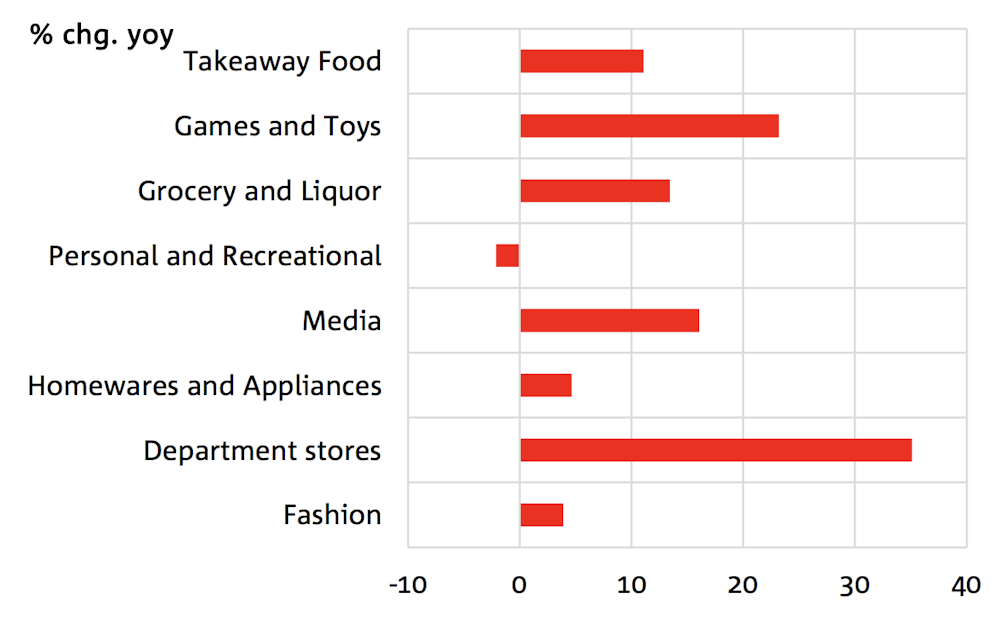
Though online shopping in the department and variety stores category is growing fast (by 29.6% in 2018 according to the NAB Online Retail Sales Index, the total amount of money spent online by Australian shoppers – A$28.8 billion – is still only about about 9% of what is spent in traditional bricks-and-mortar stores.


Online retail sales growth by industry in the 12 months to December 2018, NAB Online Retail Sales Index


More important to Big W’s woes is the growth of the so-called category killers, which are disrupting the entire discount department store business model. It a threat to which Big W has failed to respond with the same agility of rival Kmart.

Departed departments

If you’re old enough you may remember getting your wall paint mixed in the Big W hardware department, or buying car accessories from its automotive department. There was also a large “sight and sound” department filled with televisions, sound systems, videos and CDs. Discount department stores truly lived up to the idea of a variety store.

‘You know the price is low, everyday’: A television advertisement for Big W in 1994.

But the profitability of all these market segments for department stores has been eroded by the growth of “category killers” – retailers specialising in the same product categories.

Examples include Office Works for office supplies, Rebel for sports equipment, JB Hi-Fi for audiovisual, Super Cheap Auto for car parts, and Bunnings for hardware. All have taken market share from the discounters. These stores compete on price and have superior range, and shoppers trust the expertise of staff working in a specialist shop.

Speed of change

The popularity of category killers explains in large part the stagnant sales and talk of store closures throughout the department store segment.

Harris Scarfe and Best and Less are reportedly struggling. The Reject Shop’s net profit for the first half fell from an expected A$17 million to less than A$11 million. David Jones’ half-year profit fell 39% to A$36 million. Myer reported a 2.8% drop in total sales for the same time frame.


Read more: What does the future hold for our traditional department stores?


Wesfarmers expects earnings from its department store brands Kmart and Target to fall about 8% this financial year. Eight Target stores closed during the first half of the financial year, with another six closures expected by the end of June.

Cutting losses

Kmart is considered Australia’s discount department store “darling”. A decade ago it was on life support. Under the direction of chief executive Guy Russo it doubled it profits by 2015.

A key to the turnaround was recognition it needed to quickly reduce or exit categories it could not compete in, such as hardware, automotive, fishing, consumer electronics and sporting goods. It has turned to homeware, soft furnishings, manchester and kitchenware.

There appears no such swiftness in Big W’s moves.

Big W’s chief executive from January to November 2016, Sally MacDonald, reportedly wanted to closes stores and make other major changes but was thwarted by the board of Woolworths Group, owner of Big W.

Such differences in strategic vision explain why MacDonald left the role within the year.

This process of “right-sizing” therefore seems long overdue. To what extent it makes Woolworths a sustainable business, however, will depend on future response to changing circumstances.

What is certain is that discount department stores aren’t what they used to be; and if they want to be around in future, they probably can’t be what they are now.

ref. The trouble with Big W: don’t blame online for killing discount department stores – http://theconversation.com/the-trouble-with-big-w-dont-blame-online-for-killing-discount-department-stores-114630

Cuba boosting ‘Pacific connection’ in defiance of US blockade

]]>
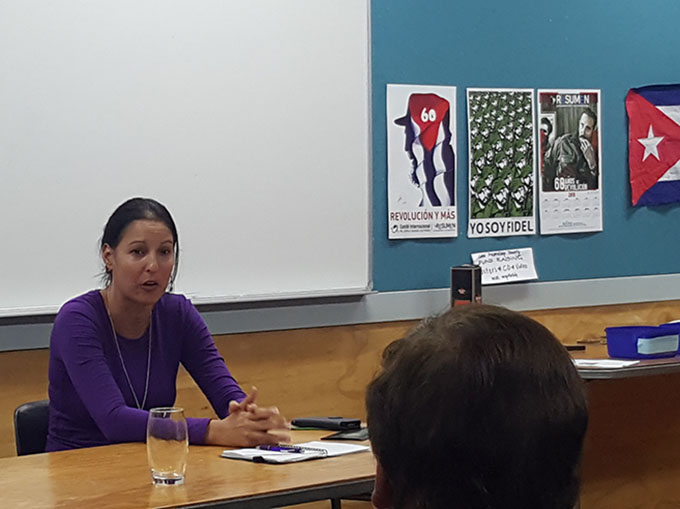
Cuba’s Leima Freire speaking in Auckland on behalf of ICAP … programmes “helping disadvantaged people”. Image: Michael Andrew/PMC

By Michael Andrew

Cuba will develop relationships with Pacific countries despite pressure from the United States, says a visiting advocate.

On a tour of New Zealand, Leima Martinez Freire, Asia Pacific director of the Cuban Institute for Friendship with the Peoples (ICAP) said Cuba was in a position to offer support to Pacific nations.

The Latin American country currently provides medical aid, doctors and training programmes to Kiribati, Vanuatu and others through bilateral agreements.

READ MORE: Sope praises Fidel Castro over Cuban backing of Vanuatu independence

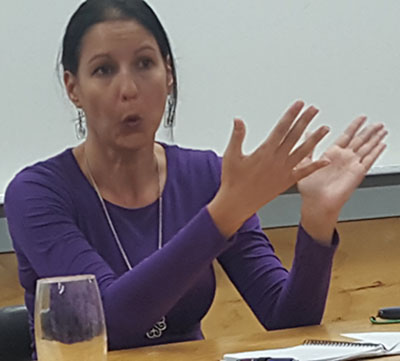
Leima Freire … New Zealanders should read more Cuban writers, journalists and bloggers. Image: Del Abcede/PMC

However, Freire told Asia Pacific Report this week that the US was attempting to dictate how these countries engaged with Cuba.

“The objective of the policies of the US is to isolate Cuba and prevent other countries from receiving Cuban help,” she said.

-Partners-

US blockade
The US imposed an embargo on Cuba in 1960 in response to the Cuban revolution and the nationalising of American owned oil refineries.

Known as El Bloqueo, or “The Blockade”, the embargo is still in place and prohibits trade between the two countries. It also restricts foreign subsidiaries of US companies from doing business with Cuba, making it difficult for foreign countries themselves to conduct trade.

Freire said Cuba’s relationships with Pacific countries allowed the sharing of expertise and humanitarian aid.

“We’re talking about bilateral relationships that brings in programmes that are for the benefit of the most disadvantaged people.”

Cuba also offers trading programmes for students of Pacific countries to travel to Cuba and receive full medical training.

Medical training
Thirty ni-Vanuatu doctors were trained through the programme and more would be sent to Cuba for study.

Freire said the schemes were important because they were completely funded and once trained, the doctors would return to their countries where they could serve the community.

“They don’t pay for accommodation, food, school supplies. The only commitment is to study hard and return to their communities.”

Despite the pressure from the US, Freire said she was positive Pacific countries could make their own decisions about what was best for their people.

“I’m positive and optimistic that the different countries could decide their own future for the benefit of the people.”

Cuba-China relationship
Cuba also had a strong relationship with China through which it traded in biotechnology, clean energy and received financing.

Freire, who also spoke at public meetings in Auckland and Wellington, said she hoped the relationship would enable more help to reach the Pacific.

“I know China has their interests in the Asian Pacific region, I think that together we can implement programmes for the benefit of the people,” she said.

“Probably China with the resources they have and Cuba with the knowledge we have, it could be tremendous support for the populations of the Pacific.”

Freire was visiting New Zealand and Australia on behalf of ICAP before she returned home to Cuba.

She hopes ICAP – founded 59 years ago by former President Fidel Castro – can reach as many people as it can.

She implored New Zealanders to learn more about Cuba and especially by reading content from Cuban writers, journalists and bloggers.

Correcting ‘misinformation’
“There is a lot of misinformation about what is happening in Cuba. Always try to contrast that information.”

She said the best thing was to visit Cuba to see how the society solves its own problems under the US embargo designed to cripple a socialist country.

“I think what is happening to Cuba it is common to other countries. It is the powerful countries telling small countries what they should do.

“That is what we all should denounce. Every country has the right to develop itself and be independent.”

The Cuban ambassador to New Zealand, Mario Alzugaray Rodriguez, was present at Freire’s talk in Auckland.

Michael Andrew is the Pacific Media Centre’s Pacific Media Watch freedom project contributing editor.

Cuban posters at the Auckland Trades Hall meeting of Leima Freire this week. Image: Del Abcede/PMC

Print Friendly, PDF & Email

Article by AsiaPacificReport.nz

The budget super change that helps the wealthy at the expense of the young

]]>

Source: The Conversation (Au and NZ) – By Brendan Coates, Fellow, Grattan Institute

Another federal budget, and yet more tinkering to superannuation tax breaks. But the latest changes will only help older wealthier Australians. The losers are younger workers and taxpayers.

What’s the plan?

From July 1 2020, Australians aged 65 and 66 will be able to make voluntary pre- and post-tax superannuation contributions without having to pass the Work Test, under which they are required to work a minimum of 40 hours over a 30-day period.

About 55,000 Australians aged 65 and 66 will benefit from these changes at a cost of A$75 million over the next four years.

It’s another boost for tax planning

Treasurer Josh Frydenberg says the changes will help Australians save for their retirement.

But most 65- and 66-year-olds still working to top up their superannuation are already eligible to make voluntary super contributions, because they satisfy the Work Test. Working 40 hours over a 30-day period – or little more than one day each week – is hardly onerous.

For every dollar contributed to super that genuinely helps Australians save more for their retirement as a result of these changes, there will be many more dollars funnelled into super to make extra use of superannuation tax concessions.

The biggest winners will be wealthier retired 65- and 66-year-olds with other sources of income, such as from shares or property, which they will now be able to recycle through superannuation.


Read more: View from The Hill: budget tax-upmanship as we head towards polling day


They will be able to put up to $25,000 into super from their pre-tax income and then – because super withdrawals are tax-free – take the money back out immediately. Their contributions to super are taxed at only 15%, whereas ordinary dividends or bank interest is taxed at their marginal tax rate. The tax savings can be as high as $5,000 a year.

Such strategies aren’t costless: other taxpayers must pay more, or accept fewer services, to make up the difference.

It will mean larger inheritances

The government is also allowing 65- and 66-year-olds to make three years’ worth of post-tax super contributions, or up to $300,000, in a single year.

These changes will mainly boost inheritances.

Most people who make after-tax contributions already have large super balances and typically contribute from existing pools of savings to minimise their tax.

Grattan Institute’s 2016 report, A Better Super System, found that only about 1% of taxpayers have total super account balances of more than $1 million, yet this tiny cohort makes almost one-third of all post-tax contributions.

These changes will turbo-charge so-called “recontribution strategies” that minimise the tax paid on superannuation fund balances passed on as inheritances. When inherited, super fund balances originally funded by pre-tax contributions can be taxed at 17% (including the Medicare levy), depending on the age of the deceased and the beneficiary.

To avoid this tax on their estate, individuals can withdraw superannuation funds tax-free and contribute them back as a post-tax contribution, up to the annual post-tax contributions cap of $100,000 each year.

It fails the government’s own test

In 2016, the government tried – but failed – to define the purpose of superannuation as providing “income in retirement to supplement or substitute the Age Pension”.

The proposed objective rightly implied that super should not aim to provide limitless support for savings that increase retirement incomes.

The benefits of super changes should always be balanced against the costs of achieving them. The government’s latest changes fail that test.


Read more: Expect a budget that breaks the intergenerational bargain, like the one before it, and before that


ref. The budget super change that helps the wealthy at the expense of the young – http://theconversation.com/the-budget-super-change-that-helps-the-wealthy-at-the-expense-of-the-young-114811

Is bottom-pinching still ‘indecent’ by today’s community standards?

]]>

Source: The Conversation (Au and NZ) – By Hadeel Al-Alosi, Lecturer, School of Law, Western Sydney University

In a recent court case in Western Australia, Magistrate Michelle Ridley ruled that “in an era of twerking” and easy access to pornography, a police officer pinching a woman’s backside is not indecent assault.

Here’s what happened. In December 2017, 48-year-old police officer of 17 years, Andrew Ramsden, participated in a yearly wheelchair basketball charity event. After the game, the anonymous complainant asked if she could have a “serious photo” with other members of the police team.


Read more: Backlash and gender fatigue. Why progress on gender equality has slowed


But when posing for the photo, Ramsden thought it would be funny to startle her by pinching her buttocks, and she jumped forward in surprise when he did so. Ramsden reportedly then said to her either “I hope you take this the right way” or “don’t take this the wrong way”.

He was charged with “unlawfully and indecently assaulting another person” under section 323 of the Criminal Code (WA). And he was eventually found not guilty.

But twerking, grinding, and the easy availability of pornography should never be an excuse for sexual harassment. This argument effectively shifts the blame on victims and implies that the sexualisation of society means women consent to being sexually harassed, which is far from the truth.

And in the era of the #MeToo movement, where women are holding men to account for sexual harassment, it seems the court in the Ramsden case hasn’t caught up to this wider cultural shift.

What is considered ‘indecent’?

Determining if an act is “indecent” requires considering the intention of the accused.


Read more: #MeToo exposes legal failures, but ‘trial by Twitter’ isn’t one of them


The courts have stated for an assault to be indecent there

must be a sexual connotation to the activity. It must be an activity which offends community standards of propriety prevailing at the relevant time.

In Ramsden’s case, the magistrate held that the act was not indecent because it was not done for a sexual purpose. And the WA Supreme Court recently upheld the magistrate’s decision, and acquitted him.

The magistrate and the Supreme Court rejected the prosecution’s argument:

the prevailing standards of the community today are that any touching by a man of the buttocks of a woman is inherently indecent.

It has never been okay

Determining community standards is best left to a jury rather than a single judge or magistrate to help ensure “the application of the law is fair and consistent with community standards”. However, no jury was used in Ramsden’s case, so it was up to the magistrate alone to decide whether today’s community would regard pinching a person’s bottom as indecent.

Magistrate Ridley said in the 1970s and 1980s, “a pinch on the bottom was naughty and seen as overtly sexual and inappropriate for that time”. But added nowadays “the thought of a pinch on the bottom is almost a reference to a more genteel time”.

Ridley believed pinching a person’s backside lost its overtly sexual connotation “in an era of twerking and grinding, simulated sex and easy access to pornography”.

But it wasn’t okay to touch people inappropriately then, and it still isn’t now.

The worldwide #MeToo movement, which the prosecution referred to in the trial, is just one example showing the significant cultural shift in societal views of sexual harassment.

On appeal, the Supreme Court accepted the movement had led to an

increase in the number of complaints by women and to increase awareness of the unacceptability of such acts and conduct.

However, it held that no evidence was put forward to the magistrate

upon which a finding could be made that the effect of the movement itself had resulted in a change in community standards as to the ‘acts’ and ‘conduct’ that should, at law, be deemed ‘indecent’.

Cultural change takes time. The #MeToo movement is a positive step in changing how we respond to sexual assault. Unfortunately, using pornography and dancing as an excuse for sexual harassment is a step backwards.

University of Technology Sydney criminal law lecturer Dr Katherine Fallah criticised the Ramsden decision. In an interview on Triple J, Fallah made an excellent point, arguing:

The statement about twerking and about porn are offered in a fairly derisory way of talking about things that are very remote from the facts of the case – here we have a woman having a photo taken after … a wheelchair basketball charity event.

The bottom line

A person’s backside is an intimate part of one’s body and no one should have to tolerate unwanted contact of their private parts for someone else’s amusement.

The Ramsden case fails to reinforce this message because of the definition of “indecency”, which requires a sexual motive for the act.


Read more: Rape, sexual assault and sexual harassment: what’s the difference?


Australian legislators need to step in and make it clear that deliberately pinching a person’s backside is a form of sexual harassment. Without consent, such conduct is unacceptable, regardless of whether it is done for a sexual purpose or in a poor attempt at humour.

The bottom line is that “bum pinching isn’t — and has never been OK”.

ref. Is bottom-pinching still ‘indecent’ by today’s community standards? – http://theconversation.com/is-bottom-pinching-still-indecent-by-todays-community-standards-114429

Were you paying attention on budget night? Test yourself with this quiz

]]>

Source: The Conversation (Au and NZ) – By Sunanda Creagh, Head of Digital Storytelling

Are you an #auspol addict? Did you watch the budget speech for fun? Test yourself with our quiz, and catch all our analysis and coverage over here.

Quiz Maker – powered by Riddle


Read more: Budget 2019 has little new for schools and even less for early childhood: education experts respond


ref. Were you paying attention on budget night? Test yourself with this quiz – http://theconversation.com/were-you-paying-attention-on-budget-night-test-yourself-with-this-quiz-114777

The first known case of eggs plus live birth from one pregnancy in a tiny lizard

]]>

Source: The Conversation (Au and NZ) – By Melanie Laird, Postdoctoral Fellow, University of Otago

For most animals, reproduction is straightforward: some species lay eggs, while others give birth to live babies.

But our recent research uncovered a fascinating mix between the two modes of reproduction. In an Australian skink, we observed the first example of both egg-laying and live-bearing within a single litter for any backboned animal.

This suggests some lizards can “hedge their bets” reproductively, taking a punt on both eggs and live-born babies to improve overall survival chances for offspring.


Read more: Ancient fossil fills a 75 million-year gap and rewrites lizard and snake history


Making reproductive leaps

Most vertebrate species (animals with a backbone) fall neatly into one of two distinctly different reproductive categories.

Oviparous species are egg-layers. These eggs may undergo external fertilisation – such as in spawning fish – or are fertilised and shelled internally, like those of reptiles and birds. Oviparous embryos rely on egg yolk as a source of nutrition to continue development until hatching.

In contrast, viviparous species are live bearers that carry their young to term. Some live-bearing species, including humans, support embryonic development internally via a placenta. Egg-laying is ancestral, meaning that modern live-bearers have descended from egg-laying ancestors.

Physiologically, the evolution of live birth from egg-laying is no mean feat. This transition requires a whole suite of changes, sometimes including the evolution of a placenta – an entirely new specialist organ – as well as loss of the hard outer eggshell, and keeping the embryo inside the body for a longer time.

The placenta is a highly complex organ. One of its jobs is to transfer nutrition to the developing baby. from www.shutterstock.com

Despite these complex steps, reptiles, particularly snakes and lizards, appear to be unusually predisposed to making the leap to live birth. This capacity has evolved in at least 115 groups of reptiles independently.


Read more: A hidden toll: Australia’s cats kill almost 650 million reptiles a year


Having it both ways

It’s easy to see why reptiles, as a group, are fascinating models for studying how live birth evolves from egg-laying.

Of particular interest are two Australian skinks that have both live-bearing and egg-laying individuals (known as being bimodally reproductive). These lizards are incredibly valuable to evolutionary biologists as they offer a snapshot into evolutionary processes in action.

The three-toed skink Saiphos equalis is one such species. Reproduction in S. equalis varies geographically: populations around Sydney lay eggs, while those further north give birth to live young.

Whether individuals are live-bearing or egg-laying seems to be genetically determined: when researchers swap their environmental conditions (by moving them from one site to another), the females retain their original reproductive strategy.


Read more: Lizards help us find out which came first: the baby or the egg?


Mothers know best

Our latest research shows this lizard is intriguing in another completely unexpected way.

We observed a live-bearing female that laid three eggs, and then gave birth to a living baby from the same litter weeks later. We incubated two of the eggs, one of which hatched to produce a healthy baby.

A live-bearing female S. equalis in our laboratory colony laid three eggs, one of which hatched to produce a healthy baby. Camilla Whittington

This finding is remarkable for two reasons. First, as far as we are aware, this is the first example of both egg-laying and live birth within a single litter for any vertebrate.

Second, in some cases, individuals may be capable of “switching” between reproductive modes. In other words, as laying eggs and giving birth each come with their own advantages and disadvantages, individuals may be able to “choose” which option best suits the current situation.

Closer look at eggshells

To better understand this reproductive phenomenon, we investigated the structure of the egg coverings of these unusual embryos in minute detail (using an advanced technology called scanning electron microscopy).

We found that in this litter, the egg-coverings were thinner than those of normal egg-laying skinks and had structural characteristics that overlapped with those of both egg-layers and live-bearers (which have thinner coverings that are greatly reduced).

Egg coverings of S. equalis consist of an outer crust (C) and an inner shell membrane (SM). We compared the structure and thicknesses of these layers of both egg-laying (A) and live-bearing (B) S. equalis to identify similarities with our ‘unusual’ embryos (C). Melanie Laird

How evolution works

We still don’t know the trigger that caused this female to lay eggs and give birth to a live baby from the same pregnancy.

However, our findings suggest that species “in transition” between egg-laying and live bearing may hedge their bets reproductively before a true transition to live birth evolves.

Being able to switch between reproductive modes may be advantageous, particularly in changing or uncertain environments.

The three-toed skink lives in eastern Australia. Doug Beckers / flickr, CC BY

For example, extreme cold, drought or the presence of predators can be risky for vulnerable eggs exposed to the environment, meaning that mothers that can carry offspring to term may have the upper hand.

In contrast, lengthy pregnancies can be taxing on the mother, so depositing offspring earlier as an egg may be beneficial in some situations.

We suggest that other species in which live birth has evolved from egg-laying relatively recently may also use flexible reproductive tactics.

Further research into this small Australian lizard, which seems to occupy the grey area between live birth and egg-laying, will help us determine how and why species make major reproductive leaps.


Read more: Curious Kids: why do hens still lay eggs when they don’t have a mate?


ref. The first known case of eggs plus live birth from one pregnancy in a tiny lizard – http://theconversation.com/the-first-known-case-of-eggs-plus-live-birth-from-one-pregnancy-in-a-tiny-lizard-113460

Going to the naturopath or a yoga class? Your private health won’t cover it

]]>

Source: The Conversation (Au and NZ) – By Jon Wardle, Associate Professor of Public Health, University of Technology Sydney

Starting this week, private health insurers are prohibited from providing benefits for a number of natural therapies. This includes aromatherapy, Western herbalism, homeopathy, naturopathy, pilates, reflexology, Rolfing (soft tissue manipulation), Shiatsu, tai chi, yoga, and half a dozen others.

The goal of these changes is to stop taxpayers subsidising these therapies. But the way the changes have been legislated will have a lot of unintended consequences.

Why were some therapies removed?

The therapies were removed after a 2013 government review couldn’t find significant evidence for the clinical effectiveness for these therapies.

Based on the review, a ministerial committee concluded these therapies should no longer attract taxpayer subsidies as part of private health insurance.

Taxpayers subsidise natural therapies via the private health insurance rebate, which covers around 25% of the cost of premiums.

This rebate itself is controversial. It costs the government around $6bn a year and many experts have questioned whether it’s an effective use of taxpayer funds.


Read more: Private health insurance rebates don’t serve their purpose. Let’s talk about scrapping them


However, current government policy is to subsidise premiums. So ensuring taxpayer funds are focused on therapies that work is a worthy goal.

How does the legislation prohibit therapies?

Government subsidies for private health insurance premiums are governed by legislation, with practical considerations fleshed out in regulations. Exclusions from government subsidies would usually be incorporated into these mechanisms.

Instead, the change is contained within a separate set of rules which govern what insurers can offer. Three rules were amended:

Rule 3: The 16 natural therapies are defined in a list as “excluded natural therapy treatment”

Rule 8: “Excluded natural therapy treatment” is prohibited from coverage as hospital treatment

Rule 11: “Excluded natural therapy treatment” is prohibited from coverage as “general treatment” for a specific health condition.

Natural health practitioners draw on a variety of remedies not used by medical doctors. From shutterstock.com

So, what’s the problem?

The term “natural therapies” groups diverse treatments that have very little in common.

Therapies such as iridology (diagnosing health problems by looking at the iris of the eye) are not evidence-based, yet therapies such as yoga and tai chi have a reasonable (and growing) body of evidence. All three are on the list of prohibited therapies.


Read more: Yoga in the workplace can reduce back pain and sickness absence


Chinese medicine, chiropractic and massage therapy are not on the list, and can still attract private health insurance benefits.

The 2013 review noted evidence for some of the natural therapies on the list, but excluded them because it was limited to specific conditions or situations. Evidence for the breathing technique Buteyko, for instance, was limited to asthma.

This limitation may warrant restriction of direct benefits. However, the legislation requires any bundled package of care or management program for asthma that attracts benefits to specifically exclude Buteyko, even if the insurer is not paying for Buteyko directly.

Organisations can still technically offer these services if they are completely separated clinically and administratively from reimbursable items. But the reality is this creates an almost impossible barrier. Natural therapies on this list can no longer interact, interface or integrate with reimbursable services.

The Department of Health’s private health insurance advisor admitted as much, noting it would be almost impossible for insurers – or organisations accepting insurance – to overcome barriers and offer any natural therapy services.

Had the legislation been focused on removal of subsidies there would have been few issues. But the “prohibitive list” in the legislation is highly unusual.

If therapies work, won’t they be allowed back?

The changes have a number of structural problems.

There is no formal process for updating the list as evidence evolves. This means therapies remain prohibited until legislated otherwise and other therapies cannot be added easily.

By virtue of not being included in the list, reiki and crystal healing are eligible for benefits.

Shiatsu, a form of massage, is one of the treatments to have been cut from private health insurance. From shutterstock.com

Meanwhile, the review is already out of date. It examined systematic reviews published between 2008 and 2013, and did not review original research at all. Search criteria for the review were narrow and may not have reflected practice. The review excluded evidence for individual herbal medicines, for example, as it did not believe this evidence was relevant to the practice of herbalism.

Meta-analyses now show yoga to be effective in conditions such as diabetes and back pain. Yoga is now recommended as a first-line treatment for low back pain in the United Kingdom. And NATO recommends military health services use yoga for post-traumatic stress disorder and back pain.

This legislation makes similar programs almost impossible to replicate in Australia.

At the very least, the Department of Health should update the review to ensure the evidence on which they have based this decision is current.

We need an evidence-based approach to natural therapies. But these changes hamper access to therapies known to work, encourage therapies known not to work, and reduce researchers’ ability to investigate what does and doesn’t work.


Read more: Premiums up, rebates down, and a new tiered system – what the private health insurance changes mean


ref. Going to the naturopath or a yoga class? Your private health won’t cover it – http://theconversation.com/going-to-the-naturopath-or-a-yoga-class-your-private-health-wont-cover-it-110699

Banning ‘tiny vehicles’ would deny us smarter ways to get around our cities

]]>

Source: The Conversation (Au and NZ) – By Hussein Dia, Chair, Department of Civil and Construction Engineering, Swinburne University of Technology

E-scooter mania is sweeping cities around the world. Fun, accessible and cheap to rent, shared electric scooters are one of the biggest technology stories this year.

Their main appeal is that they are so easy to ride. A flood of startups offer on-demand services. Simply download an app, scan the barcode, ride and drop at your destination.


Read more: Limes not lemons: lessons from Australia’s first e-scooter sharing trial


While this is a simple idea, it has caused a few problems.

When they reach their destinations, riders leave them and walk away. The scooters, like dockless share bikes before them, end up cluttering pavements, cause friction with pedestrians and provoke controversy and debate.

E-scooters are the future of city transport and will reduce private car use, say the enthusiasts. They will ease congestion and help cities achieve their environmental and road safety targets, according to the optimists.

But for every supporter of these e-boosted contraptions, a dissenting voice says they are annoying and dangerous. Critics argue that e-scooters litter our footpaths, menace pedestrians and cause crashes and injuries. One group in San Diego has even filed a law suit claiming that scooters discriminate against people with disabilities.

Some cities have banned e-scooters. In Australia, Brisbane City Council, while extending a trial of e-scooters operated by Lime, has warned safety must be improved before a permanent permit is granted.

Tiny vehicles, big impacts

The emergence of “tiny vehicles” includes not only e-scooters, but also e-bikes and other electric, low-speed, micromobility solutions.

If we take them seriously, these could be a huge deal for our cities. These emerging modes of transport can be quite effective for “first and last kilometre” travel (e.g. between home and your nearest train station). They can also help with short commuting distances less than 10 kilometres. An estimated 20% of trips from home to work in capital cities are 5-10km long.

E-scooters could be “disruptive” in that they would cut the number of short trips taken by private vehicles today.

In Sydney, around 67% of these short commuting trips (on average) involve private vehicles. The proportions are even higher in Melbourne (76%), Brisbane and Darwin (both 80%), Canberra and Perth (both 83%), and Adelaide and Hobart (both 84%). Across the nation, more than 85% of drivers who commute by private car don’t share with other commuters.

Shifting even a small percentage of these trips would help reduce reliance on cars, ease congestion and improve amenity.

Most commuters do not carry much on their journey to work – a purse, a backpack or similar. That makes tiny vehicles more appealing for the short commute because they do just the one thing: provide personal mobility from A to B. Leather seats and posh interiors are not an option!

E-scooters can help with first and last kilometre travel and short commuting trips. Volkswagen


Read more: Can e-scooters solve the ‘last mile’ problem? They’ll need to avoid the fate of dockless bikes


Clearly, we are nowhere near mass adoption. That would require more variety of tiny vehicles to suit all types of people, trips and weather conditions.

Nevertheless, there is no shortage of ideas to solve these challenges. Many solutions will undoubtedly be imagined. Some might actually work!

Startups are working on a variety of tiny vehicle solutions for different uses.

A regulatory sandbox approach

Regulation remains a major hurdle. Policymakers recognise that micromobility could be a driving force of change for our cities, but safety cannot be an afterthought. Instead of banning the emerging technology, many cities are adapting their approaches to handle it.

Rather than making up new rules without evidence, policymakers are using a regulatory sandbox approach. Borrowed from fintech regulation, this approach allows startups to test new technologies for a specified period.

Businesses can learn quickly and respond to problems as they arise. Regulators can collect data to make informed decisions and prioritise interventions.

We already have examples of these partnerships.

Companies are offering to pay cities a fee per scooter to build protected scooter and bike infrastructure. Others have committed to providing financial incentives to encourage riders to park scooters properly. One company is offering a free ride to customers who park their scooters well ten times in a row.

To keep footpaths safe, businesses are also working with local governments to test ideas such as retractable locks, solar-powered parking, designated on-street drop-off zones – even a “dock for dockless” solution!

Conceptual design of a vehicle parking bay as a designated drop-off zone for tiny vehicles. Lyft


Read more: Electric scooters on collision course with pedestrians and lawmakers


What’s next for the e-scooter market?

These products are not toys and investors know it. Venture capitalists are riding a wave of public acceptance and adoption.

E-scooter growth, in particular, has exceeded first-year adoption rates for similar services such as bike-sharing and ride-hailing. In Sacramento, where the same company offers both bike and car services, the use of shared e-bikes exceeded ride-hailing rentals by a 53-47% margin.

Businesses are betting that shared e-scooters will do to short-distance travel what ride-hailing did to the taxi industry. Globally, investors have poured more than US$5.7 billion into micromobility startups since 2015. New business models are emerging, with some companies considering annual memberships that include free ride time per day.

As with other fast-moving innovations, policymakers need to adapt their approaches. They also need to rethink bans and regulations that undermine the viability of e-scooters.

Tech companies need to prioritise rider safety over growth. They need to work with governments to preserve the sanctity of the footpath as a safe public space.

Without this, our cities will miss out on the potential of tiny vehicles and the opportunities they offer to reduce private car use.

ref. Banning ‘tiny vehicles’ would deny us smarter ways to get around our cities – http://theconversation.com/banning-tiny-vehicles-would-deny-us-smarter-ways-to-get-around-our-cities-113111

How Leonardo da Vinci made a living from killing machines

]]>

Source: The Conversation (Au and NZ) – By Susan Broomhall, Professor of History, University of Western Australia

On the 500th anniversary of his death, our series Leonardo da Vinci Revisited brings together scholars from different disciplines to re-examine his work, legacy and myth.

Leonardo worked for some of the top military and political leaders in the Italian Wars, a major conflict fought on the Italian peninsula that embroiled most of Western Europe. His patrons read like a roll-call of Europe’s leading familes: Sforza and Borgia dukes and French Valois kings.

Like many other artists and technicians, he negotiated the professional and financial opportunities (as well as dangers) that war presented.

As a brilliant designer, technician and artist, he knew how to appeal to the leaders of his day. A well-known 1482 letter to Ludovico Il Moro Sforza, Duke of Milan, one of Italy’s most powerful military leaders, was in essence a job application.

In it, Leonardo promised a raft of new technological possibilities in warfare, boasting he could create an infinite variety of machines for attack or defence:

I have methods for making very light and strong bridges, easily portable, and useful whether pursuing or evading the enemy; and others more solid, which cannot be destroyed by fire or assault …

If the place under siege cannot be reduced by bombardment, because of the height of its banks or the strength of its position, I have methods for destroying any fortress or redoubt even if it is founded upon solid rock …

I will make armoured cars, totally unassailable, which will penetrate the ranks of the enemy with their artillery, and there is no company of soldiers so great that it can withstand them…

Leonardo’s design for a giant crossbow, Codex Atlantico, fol 53v. Wikimedia Commons

His claims spoke powerfully of a dream of invincibility for the Duke. At times, Leonardo followed the armies of his leaders as they waged war across Italy, but he did not fight on the frontline as a soldier himself. His value to his patrons was not his body, but his mind.

Alongside his weapons of war, Leonardo also created magnificent spectacles of his patrons’ military achievements in festivities with advanced dramatic technologies. For instance, the festival Leonardo curated in France in May 1518 for his patron François I celebrated the king’s military achievement. He staged an elaborate, multi-sensory, re-enactment of the Battle of Marignano complete with siege and capture of a castle. The watching crowd were overwhelmed with emotion, as falconets fired missiles of paper and mortars shot out balloons.

Through these displays and performances, — textual, ceremonial, multimedia — Leonardo helped to curate an elite masculine identity for a man at war, shaped and defined by new technological advancements.

Leonardo da Vinci, Codex Atlantico, fol. 9r. Wikimedia Commons

Shock and awe

While Leonardo explored the power of the senses to channel emotional responses in ceremonial contexts, so too was much of his commentary on his weapons and design about shock and awe. His designs explicitly aimed to make men and horses afraid, causing maximum damage.

These interests in exploiting men’s emotional frailties in war are revealed in his 1482 letter to Ludovico:

I have certain types of cannons, extremely easy to carry, which fire out small stones, almost as if it were a hailstorm, and the smoke from these will cause great terror to the enemy, and they will bring great loss and confusion …

Leonardo, Figures fighting on horseback and on foot, c. 1504. Wikiart.org

Of his design for a steam-powered cannon made of copper, he wrote that “the sight of its fury and the sound of its roar will seem like a miracle”.

Leonardo’s weapons were thus not just about physical damage to men, animals and buildings, but exploited the emotional experiences of those fighting at the frontline. They offer the prospect of destroying the fortitude and morale of the men facing them, emphasising warfare’s psychological element.

A turbulent mind

Study of a Warrior’s Head for the Battle of Anghiari, c 1504-5. Red chalk on very pale pink prepared paper, Google Art Project. Wikimedia Commons

But Leonardo was also frustrated. In one manuscript, he discloses what seem to be ambitions as an author on war: “In order to preserve the main gift of nature, that is liberty, I will find a way to attack and defend, when being besieged by tyrannical ambition. And firstly I will speak of the positioning of walls and then how the people can maintain their good and just lords.”

This book project, if that is what it was, seems less about warfare and more a critique of the men he found himself working for. It seems to suggest his ambition to contribute to, or at least comment on, current events and ideas of good and bad government, which he witnessed at close range as the client of some of Europe’s most influential leaders.

Study for a Hoist and for a Cannon in an Ordnance Foundry, c 1487. Royal Library, Windsor. Wikimedia Commons

While Leonardo’s textual record attests to his ambitions, it also documents grievances that surrounded his experiences as a participant in war. Above a picture of a scattershot cannon, an unfinished half-sentence reads: “If the men of Milan would for once do something out of the ordinary …” Perhaps this was a throwaway comment meant only for himself, but it suggests some of his frustrations.

In thinking about Leonardo now, we recognise that among his many talents, he was someone who not only made a living from, but was perhaps uniquely gifted at creating, new forms of killing machines.

ref. How Leonardo da Vinci made a living from killing machines – http://theconversation.com/how-leonardo-da-vinci-made-a-living-from-killing-machines-112402

‘Jobs for the boys’: women don’t get a fair go in sports administration

]]>

Source: The Conversation (Au and NZ) – By Michelle O’Shea, Lecturer Sport Management, Western Sydney University

Women represent just 22% of board chairs and 13% of CEOs across more than 60 Australian sporting organisations.

Why is there such an imbalance? It may be because, in some sporting organisations, women do not get a fair go in progressing their careers in administration.


Read more: More money may be pouring into women’s sport, but there’s still a dearth of female coaches


My (Michelle) doctoral research involved in-depth interviews (conducted over 2012-2014, with follow up in 2015) about career experiences and gender policies with 48 female and male employees from four Australian national and state sport organisations.

The analysis identified a significant gender gap between:

  • women’s experiences of inequity, and
  • the implementation of policies designed to facilitate change, including for recruitment and selection, promotion and retention.

While policies championed the values of equality, fairness and merit, there were ambiguities and tensions relating to how managers interpreted what policies should do, and how gender inequity was viewed as a social, organisational or individual responsibility.

How will you cope managing older men?

The study findings highlight how managers’ hiring practices did not necessarily reflect policy intentions. Managers (both genders) genuinely believed they selected “the best person for the job”. They spoke of how old rules – like simply appointing former athletes to management roles – had been thrown “out the window” with a focus on merit.

However, women’s experiences of recruitment revealed some examples of bias.

Some women shared examples showing the recruitment process was not as “transparent” as it appeared to be within sport organisations. Men would be “given roles without interview”. One interviewee said:

It’s a pal or a mate. They do the whole independent thing [i.e. independent selection panels] but nine times out of ten they all know each other.

When women endeavoured to engage with men’s recruitment networks there were often personal and professional consequences. For one woman, damaging rumours circulated that she must have been sleeping with the married male manager who appointed her to the job.

Women discussed being “grilled” about their ability to balance work and family responsibilities, or asked about future family plans. Questions like this are unlawful.


Read more: The AFLW found instant success, but challenges remain for its long-term sustainability


Other women discussed being overlooked for roles because they were younger.

… he [the interviewer] actually asked me how old I was. He asked me how I would go being responsible for employees who were predominately male.

Across the organisations in the study women said “everyone knows how the system works”, with “nepotism” and “jobs for the boys”.

Despite acknowledging these norms, women were often fearful of reporting or challenging practices. Instead, many tried to minimise being subjected to discriminatory practices by concealing their marital status and family responsibilities, removing their wedding rings before interview and using their maiden names on resumes.

One woman dressed to conceal her pregnancy by wearing loose-fitting clothing, and she expressed ongoing concerns regarding her position and future career prospects.

He asked me what I was wearing

The research highlights how humour, informal socialising and informal work culture can differentially shape women’s and men’s workplace experiences.

For instance, women discussed how sexualised joking and banter made them feel uncomfortable:

I would do the teleconference at home. One … [male manager] said ‘what are you wearing’.

Others discussed how male colleagues used humour to mask inappropriate and unacceptable gender messages. Women discussed having to work harder than their male counterparts just to be recognised:

you [women] have to prove yourself, you have to push buttons … you have to poke and prod to get ahead.

In contrast, male managers often showcased the promotion of women to senior roles and discussed working toward a more “gender-balanced workforce” to support their claims that gender inequities in promotion were no longer a concern.


Read more: Women in sports: double standards a double fault


This thinking had the effect of reinforcing gender bias in promotion practices. For example, managers rationalised that the difficulties women experienced developing their careers were due to their “personal” choices. Through these claims, managers distanced themselves from being responsible for perpetuating or addressing inequities. Instead “generational change and time” would magically fix things.

The identified gaps between how managers interpreted policy intentions and women’s experiences of developing their sport management careers illustrate the ongoing challenge of making gender bias and sexism visible in order to do things differently. Policies alone do not create change.

In a very public way, sport organisations such as Cricket Australia and Football Federation Australia have had to address important questions of culture that relate to fundamental values of sport – integrity, inclusion, fair play – on and off the field.

To sustain effective change in Australian sport management we need to further commit to unearthing and challenging subtler forms of exclusion so sport workplaces live up to the values that they purport to uphold.

A new clear ambition

As mentioned above, this research was collected over 2012-2015 and there are now signs things may improve.

Since her appointment in late 2016 as Chief Executive Office of the Australian Sports Commission (Sport Australia), Kate Palmer has called for a greater focus on gender equity in the culture and leadership of Australian sport organisations. She said:

I have a clear ambition around increasing the number of female CEOs in national sporting organisations because we need more women in positions of influence and power.

As the first woman to lead the commission in its 31-year history, Palmer’s appointment to one of the most influential executive roles in Australian sport is an important step toward creating long term change.


Read more: Trust Me, I’m An Expert: What is sport worth?


Sport Australia has launched its 2019 Women Leaders in Sport Initiative. The partnership between Sport Australia and the Office for Women provides opportunities for women to develop leadership skills and networks, thus ensuring a recognisable talent pool that sport organisations can draw upon.

Other recent change initiatives have shifted the focus from gender equity as an issue for women to solve to engaging male leaders as “champions of change” in sport.

How power shapes careers

While these initiatives contribute to the change strategies that are needed to transform sport organisations, we need more research to better understand how gendered power relations shape women’s sport careers off the field.

More evidence is needed around how gender inequities are perpetuated and challenged, from overt sexism to more subtle forms of exclusion.

While many organisations grapple with these issues, the management of sport is historically grounded in assumptions about the “naturally superior” sporting performance of masculine bodies on and off the field. The growing professionalisation of sport is placing such gender based stereotypes under increasing scrutiny, with accompanying expectations that organisations demonstrate more progressive cultures, practices and policies.

ref. ‘Jobs for the boys’: women don’t get a fair go in sports administration – http://theconversation.com/jobs-for-the-boys-women-dont-get-a-fair-go-in-sports-administration-111350

Total transport spending is about par for the course, but the pattern is unusual

]]>

Source: The Conversation (Au and NZ) – By Marion Terrill, Transport and Cities Program Director, Grattan Institute

The budget just before an election seems to have a special quality: the transport infrastructure will surely be more plentiful than usual, and carefully chosen to shore up the electoral bulwarks. But don’t get too excited: this year the rhetoric may be big, but the scale of the numbers is nothing unusual. What is different is the pattern of spending over the budget’s four-year forward estimates.

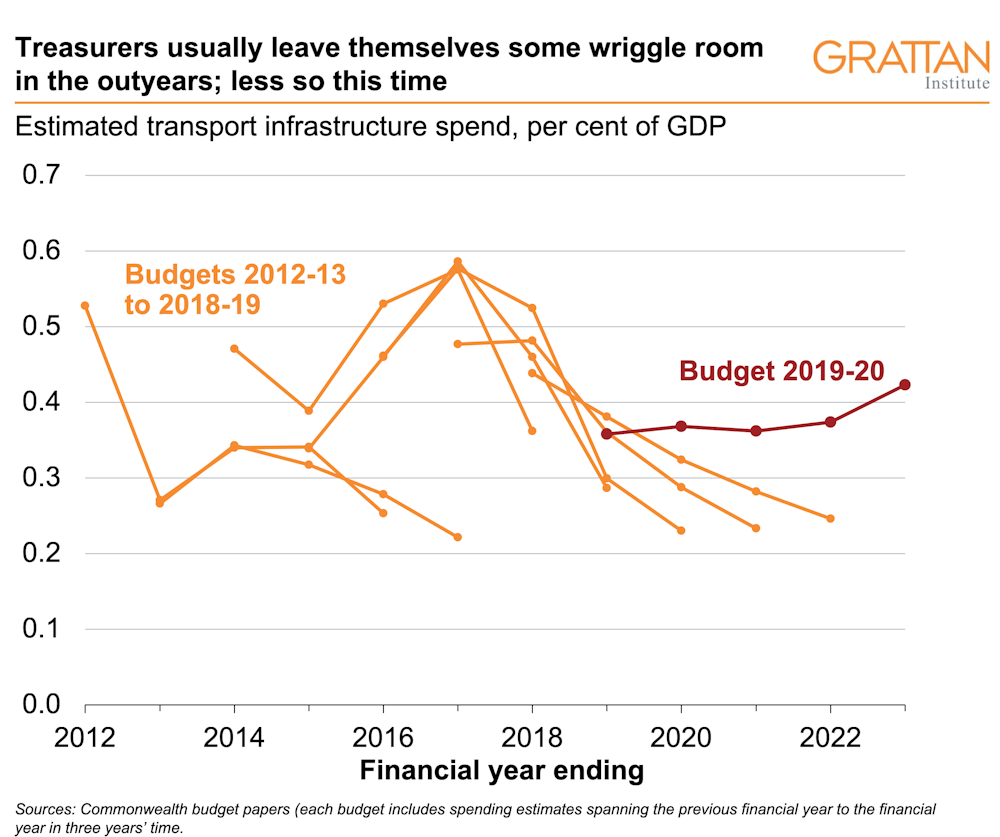
The budget estimates a transport spend of A$7.4 billion for the coming year, 2019-20, and $33 billion over the forward estimates period. The 2019-20 expenditure estimate amounts to 0.37% of GDP – comparable to what we’ve seen in recent years. In fact, governments have spent between 0.26% and 0.53% of GDP under Treasurers Morrison, Hockey and Swan, and Treasurer Frydenberg is no different.

What’s particularly interesting about this budget, though, is that the treasurer is chancing his arm on the medium term.

Usually treasurers leave themselves some wriggle room in the outyears. They can always spend more if the cash is available, and invariably they do. Plus, it gets easier to estimate what will be spent as the time of spending draws closer.

Of course, these days much of the promised spending is further into the future than the forward estimates. The government is touting a $100 billion, ten-year Infrastructure Investment Pipeline. There’s money all over the country.

Where does the money go?

Victoria gets particularly big-ticket items in this budget, totalling $6.2 billion, and somewhat more of it within the next four years than other states. In New South Wales, the longer-term package totals $7.3 billion, including $3.5 billion for the Western Sydney north-south rail link as well as a $1.6 billion upgrade to the M1 Pacific Motorway extension to Raymond Terrace.

But if you look at what’s happening within the next four years, a notable larger item is a road safety package, totalling $400 million over four years. The longer-term goal is for this package to cost $2.2 billion.

Some of the other longer-term spending is squarely focused on rural and regional areas. This includes a billion to improve the Princes Highway in NSW, Victoria and SA.

If it all comes to pass, there’s something here for everyone.

ref. Total transport spending is about par for the course, but the pattern is unusual – http://theconversation.com/total-transport-spending-is-about-par-for-the-course-but-the-pattern-is-unusual-114597

Budget 2019 has little new for schools and even less for early childhood: education experts respond

]]>

Source: The Conversation (Au and NZ) – By Peter Goss, School Education Program Director, Grattan Institute

In his first budget speech, Treasurer Josh Frydenberg said education was the

first defence of the nation […] it is critical to our prosperity, harmony and advancement as a country.

Frydenberg said funding for government, independent and Catholic schools was at an “all-time high” when he announced a A$300 billion commitment to schools.

He said the government would set up a $93.7 million scholarship program for over 1,000 students a year to study in a regional university or TAFE.

The government is also dedicating $525 million over five years to fund 80,000 new apprenticeships in areas of skills shortages – including bakers, bricklayers, carpenters and plumbers. The majority of this skills package would be funded from the existing Skilling Australia Fund (which began on July 1, 2018).

Other education announcements were:

  • $67.5 million to trial ten new training hubs in regional areas, connecting schools, industry and young people
  • $62 million boost to second chance literacy, numeracy and digital skills for at-risk workers, including four separate pilots for programs tailored to remote Indigenous communities
  • $453 million over two years from 2019-20 to extend the provision of 15 hours of preschool through to 2021, including $1.4 million to develop strategies to increase preschool attendance among disadvantaged and Indigenous students
  • $30.2 million in 2019-20 for a Local School Community Fund, with local schools to identify their own priorities
  • $19.7 million over the next four years for schools for various arts and life education programs, including theatre, music, preventative health and the constitution.

Here’s what our education policy experts thought of tonight’s budget announcements.

Little change in policy, and the rest – window-dressing

Peter Goss, School Education Program Director, Grattan Institute

Tonight’s education announcements showed no substantial change in policy.

Yes, $300 billion is the biggest ever spend on recurrent school funding (a 63% increase, as Frydenberg said). But with rapidly growing student numbers and the cost of wages going up each year, that doesn’t mean much. And it appears to be exactly what is in the National School Reform Agreement, which was signed between the federal government and all states and territories at the end of 2018.


Read more: What the next government needs to do to tackle unfairness in school funding


Another one year extension on funding for early childhood education should be taken at face value: the Coalition says it values early learning but doesn’t yet have a long-term plan.

The remaining initiatives are window-dressing; and like most window-dressing, they don’t change anything fundamental but cost money that could have been used elsewhere.

Frydenberg said “no one knows the needs of a local school better than the school community itself”. This is true but $30 million for libraries, classrooms and play equipment won’t go far. It will also create red tape and duplicate state initiatives, and is very much the type of funding the Commonwealth should stay away from.

One-off funding for infrastructure also has an opportunity cost: $30 million on better evaluation of existing initiatives would have made a real contribution to efforts to improve teaching and learning at the system level.

The remaining initiatives – including arts, life education, preventative health and the constitution – smack of the Commonwealth meddling in areas beyond its remit.

Given the Commonwealth doesn’t run schools, is there anything useful it what could it have announced in the budget? Here are two ideas. The government has promised a national evidence institute, but has not yet announced the dollars behind it.

And it could have chosen to invest in how best to assess the non-cognitive skills that are important for the workforce, but which are currently hard to measure.

More money, but otherwise more of the same

Steven Lewis, Australia Research Council Discovery Early Career Researcher Award Fellow, Deakin University

Given Treasurer Scott Frydenberg’s insistence that education is “critical to our prosperity, harmony and advancement as a country”, one might expect a roll-out of major policy reform to accompany such lofty rhetoric.

Despite efforts to focus our attention on the quantum of Commonwealth money earmarked for schools in the public, independent and Catholic sectors, there is precious little in the government’s budget to signal any new shifts in policy focus.

So, what can parents, teachers, students and the public expect from a re-elected Coalition government?

First, the government is targeting schools and their local communities by offering $30.2 million via a Local School Community Fund. This program is meant to empower local communities – those closest to schools and thus most likely to understand their particular contexts and needs.

But, it remains to be seen precisely what long-term benefits to student learning can come from a one-off injection of federal funds, especially when this is to be split between the 9,000-plus schools throughout Australia.

Similarly, the announced attention on theatre, music, preventative health and the constitution appears unlikely to make substantive improvements to these critical, and often underfunded, areas. However, $20 million invested over four years to arts and life education appears superficial at best, especially when the overwhelming discourse from this government has been improving the “core skills” of literacy and numeracy.

We still haven’t got secure, ongoing funding for early childhood education. from shutterstock.com

Same old (not enough) in early childhood education

Susan Irvine, Associate Professor, Early Childhood and Inclusive Education, QUT

The announcement of $453 million to extend preschool provision is welcome, but it’s not enough. Currently the government funds 15 hours of preschool education for 3 ½ to 4 ½ years-old children, led by a degree qualified early childhood teacher in the year prior to school.

But when the commitment to the provision of early childhood education was announced by the previous Labor government, the expectation was that it would be sustained by secure, long-term funding. Tonight’s is another short-term agreement that provides funding security for children, families and service providers for only two years.

The benefits of preschool education are well documented. In fact many OECD countries are now investing in two years of preschool prior to school entry. We need a bi-partisan agreement that preschool is the foundation to a modern education system, and, like school, requires a secure and ongoing source of funding.

We also urgently need a new national early years workforce strategy – the previous (and only) one expired in 2016. All our current quality reforms depend on the availability of qualified teachers and educators, but they are set against poor wages and conditions for many working in the sector.

ref. Budget 2019 has little new for schools and even less for early childhood: education experts respond – http://theconversation.com/budget-2019-has-little-new-for-schools-and-even-less-for-early-childhood-education-experts-respond-114193

Politics with Michelle Grattan: Peter Martin and Tim Colebatch on budget strategy and numbers

]]>

Source: The Conversation (Au and NZ) – By Michelle Grattan, Professorial Fellow, University of Canberra

From inside the budget lockup, The Conversation’s Business and Economics editor Peter Martin and political and economic journalist Tim Colebatch from Inside Story shared their reactions to the pre-election budget.

Martin said the budget featured a substantial tax cut “that goes back in time” and that while the government was forecasting “good times around the corner,” there has been barely any sign of them.

He also said he thought while the budget gives Labor an advantage, Treasurer Josh Frydenberg is unlikely to be embarrassed by it in the future.

Colebatch told The Conversation it “was a modest budget” and that the spending measures were “really fairly restrained”.

“It recognises that the debate has shifted and people are less likely to be bought by big spending and more likely to be bought by the impression of fiscal reticence and control and delivering a budget surplus,” he said.

New to podcasts?

Podcasts are often best enjoyed using a podcast app. All iPhones come with the Apple Podcasts app already installed, or you may want to listen and subscribe on another app such as Pocket Casts (click here to listen to Politics with Michelle Grattan on Pocket Casts).

You can also hear it on Stitcher, Spotify or any of the apps below. Just pick a service from one of those listed below and click on the icon to find Politics with Michelle Grattan.

Additional audio

A List of Ways to Die, Lee Rosevere, from Free Music Archive.

Image:

Mick Tsikas(AAP)/The Conversation/Shutterstock

ref. Politics with Michelle Grattan: Peter Martin and Tim Colebatch on budget strategy and numbers – http://theconversation.com/politics-with-michelle-grattan-peter-martin-and-tim-colebatch-on-budget-strategy-and-numbers-114354

Budget 2019 boosts aged care and mental health, and modernises Medicare: health experts respond

]]>

Source: The Conversation (Au and NZ) – By Stephen Duckett, Director, Health Program, Grattan Institute

This year’s budget includes $448.5 to modernise Australia’s Medicare system, by encouraging people with diabetes to sign up to a GP clinic for their care. The clinic will receive a lump sum payment to care for the person over time, rather than a fee each time they see their GP.

As expected, the indexation freeze on all GP services on the Medicare Benefits Schedule (MBS) will lift from July 1, 2019, at a cost of $187.2 million. The freeze will be lifted on various X-ray and ultrasound MBS rebates from July 1, 2020.


Read more: What is the Medicare rebate freeze and what does it mean for you?


The budget includes $461 million for youth mental health, including 30 new headspace centres, including in regional areas. But it does little to address the underlying structural reforms that make it difficult for Australians to access quality and timely care.

In aged care, the government will fund 10,000 new home care packages, at a cost of $282 million over five years, and will allocate $84 million for carer respite.

Other announcements include:

  • $62.2 million over five yeas to train new rural GPs
  • $309 million for diagnostic imaging services, including 23 new MRI licences
  • $331 million over five years for new pharmaceuticals, including high-cost cancer treatments
  • $107.8 million over seven years for hospitals and facilities including Redland Hospital Bowen Hospital, Bass Coast Health and Ronald McDonald House
  • $70.8 million over seven years for regional cancer diagnosis, treatment and therapy centres
  • $114.5 million from 2020-21 to trial eight mental health facilities for adults
  • $43.9 million for mental health services for expectant and new parents
  • $35.7 million from this year (for the next five years) for increased dementia and veterans’ home care supplements
  • $320 million this year as a one-off increase to the basic subsidy for residential aged-care recipients.

A hesitant step forward for Medicare

Stephen Duckett, Director, Health Program, Grattan Institute

Medicare funding is slowly creeping into the 21st century. The 19th-century model of individual fees for individual services – suitable for an era when medicine was essentially dealing with episodic conditions – is being supplemented with a new fee to better manage the care of people with diabetes.

The budget announcement, as part of the Strengthening primary care package, is for a new annual payment for each person with diabetes who signs up with a specific GP. Funding is provided for about 100,000 people to sign up – about 10% of all people with diabetes in Australia.

Medicare funding reforms are long overdue. Dave Hunt/AAP

The new item number is consistent with the recent MBS review Report on General Practice, which recommended a move toward voluntary enrolment.

The precise details of the new fee – including the annual amount and any descriptors – have not yet been released. But it should encourage practices to move towards a more prevention-oriented approach to chronic disease management, including using practice nurses to call patients to check up on their condition, and using remote monitoring technology.

The budget announcement contained no evaluation strategy for the initiative. The government should produce such a strategy soon.


Support for aged and disability care

Hal Swerissen, Emeritus Professor, La Trobe University, and Fellow, Health Program, Grattan Institute

The budget has short-term measures to address major issues in aged care and disability while we wait for the royal commissions to fix the long-term problems.

The National Disability Insurance Agency (NDIA) is struggling with the huge task of putting the National Disability Insurance Scheme (NDIS) in place.

There has been a major under-spend on the on the scheme. Price caps for services such as therapy and personal care are too low and nearly one-third of services are operating at a loss. The under-spend would have been more if there hadn’t been a last-minute budget decision to significantly increase service caps, at a cost of $850 million.

$528 million dollars has also been announced for a royal commission to look at violence, neglect and abuse of people with disabilities – the most expensive royal commission to date.

There is more funding for aged care. Currently, 130,000 older people are waiting for home care packages – often for a year or more. Nearly half of residential care services are losing money and there are major concerns about quality of care.

The short-term fix is to give residential care $320 million to try to prevent services going under. 10,000 additional home care packages have also been announced at a cost of $282 million – but that still leaves more than 100,000 people waiting.

There’s still a massive shortfall in home care places. eggeegg/Shutterstock


Little for prevention, Indigenous health and to address disparities

Lesley Russell, Adjunct Associate Professor, Menzies Centre for Health Policy, University of Sydney

Prevention

Preventable diseases and conditions are a key factor in health inequalities and rising health-care costs. The two issues looming large are obesity and its consequences, and the health impacts of climate change.

There is $5.5 million for 2018-19 and 2019-20 for mental health services in areas affected by natural disasters, and $1.1 million over two years for the Health Star rating system – otherwise nothing for primary prevention.

Indigenous health

The Treasurer did not mention Closing the Gap in his Budget speech and there is little in the Budget for Indigenous health.

Just $5 million over four years is provided in the budget for suicide-prevention initiatives and the Lowitja Institute receives $10 million for health and medical research.

Some announcements in March contribute a little more:

Inequalities and disparities

Disadvantaged rural and remote communities will (ultimately) benefit from efforts to boost National Rural Generalist Training Pathway, with $62.2 million provided over four years. This was a 2016 election commitment.

The announcement of $200 million over three years to index Medicare payments for ultrasound and diagnostic radiology services (beginning from July 1, 2020) came with claims this will help reduce out-of-pocket costs. Given that these payments have not been indexed in 20 years, will the money go to providers or patients?

Hospitals and private health insurance

Peter Sivey, Associate Professor, School of Economics, Finance and Marketing, RMIT University

There are no major changes to public hospital funding arrangements in this year’s budget.

It’s business as usual for hospital funding, aside from funding injections for a handful of hospital sites. By VILevi

Funding for public hospitals is predicted to increase at between 3.7% and 5.6% over the forward estimates. However, these figures are contingent on the new COAG agreement on health funding between the Commonwealth and states, which is due to be finalised before the end of 2019.

The states will be hoping to wring some more dollars from the federal government given their soaring public hospital admissions and pressure on waiting times.

There is no change to the government’s private health insurance policy which has just come into force.


Read more: Premiums up, rebates down, and a new tiered system – what the private health insurance changes mean


Government spending on the private health insurance rebate is projected to increase more slowly than premiums at between 1.8% and 3.2% because of indexation arrangements which are gradually reducing the rebate over time.


Smaller targets for mental health

Ian Hickie, Co-Director, Brain and Mind Institute, University of Sydney

Numerous reports and accounts from within the community have noted the flaws in Australia’s mental health system: poor access to quality services, the uneven rollout of the NDIS, and the lack of accountability for reforming the system.

The next federal government faces major structural challenges in mental health and suicide prevention.

Not surprisingly, this pre-election budget does not directly address these issues. Instead, it focuses on less challenging but worthy targets such as:

  • continued support for expansion of headspace services for young people ($263m over the next seven years) and additional support for early psychosis services ($110m over four years)
  • support for workplace-based mental health programs ($15m)
  • support for new residential care centres for eating disorders ($63m).

A more challenging experiment is the $114.5 committed to eight new walk-in community mental health centres, recognising that access to coordinated, high-quality care that delivers better outcomes remains a national challenge.

Despite the commitment of health minister Greg Hunt to enhanced mental health investments, the total increased spend on these initiatives ($736.6m) is dwarfed by the big new expenditures in Medicare ($6b), improved access to medicines ($40b), public hospitals ($5b) and aged care ($7b).

It will be interesting to see whether mental health reform now receives greater attention during the election campaign. At this stage, neither of the major parties has made it clear that it is ready to deal directly with the complex challenges in mental health and suicide prevention that are unresolved.

ref. Budget 2019 boosts aged care and mental health, and modernises Medicare: health experts respond – http://theconversation.com/budget-2019-boosts-aged-care-and-mental-health-and-modernises-medicare-health-experts-respond-114194

Congestion-busting infrastructure plays catch-up on long-neglected needs

]]>

Source: The Conversation (Au and NZ) – By Phillip O’Neill, Director, Centre for Western Sydney, Western Sydney University

Infrastructure spending is one of the central themes of Treasurer Frydenberg’s budget speech. His headline announcement was the promise to increase the ten-year federal infrastructure spend from the A$75 billion announced last year to a target of $100 billion.

Major projects previously announced – like the Melbourne Airport rail link, Western Sydney’s north-south airport rail link and Queensland’s Bruce Highway upgrade – are affirmed. A fast rail connection from Melbourne to Geelong is added. Also added are nation-wide packages of roadworks targeted at reducing congestion and improving regional freight corridors.

So the announcements continue the infrastructure program detailed in the 2018-19 budget, as promoted regularly in the government’s expensive “Building Our Future” advertising campaign that gives prominence to the government’s ten-year “Infrastructure Pipeline”.


Read more: Infographic: Budget 2019 at a glance


Lack of transparency is an issue

It needs saying that analysts have found it difficult to verify what last year’s $75 billion promise actually involved. The claim is the subject of a major investigative paper by the Australian Parliamentary Library, with its authors observing:

The Parliamentary Library has been unable to locate any public document which provides a transparent overview of [the federal government’s] total infrastructure commitments.

One suspects that scrutiny over coming weeks of the $100 billion infrastructure spending promises will be thwarted by a repetition of this lack of transparency.

Why are infrastructure needs so great?

The national population growth story is the key framework for assessing the Coalition’s infrastructure plan. Between 1901 and 1948, the nation grew steadily, but modestly, from a population of 3.8 million to 7.7 million. Then the population surged on the back of a post-war baby boom and an expansion of immigration. The population grew by between 2.0 and 2.5 million people each decade from the 1950s through to the 2000s.

But in the last decade, the nation has added nearly 6 million people, with the east coast cities overwhelmingly hosting the increase. Urban infrastructure planning and spending have lagged. Both quality of life and economic productivity have been affected adversely as a consequence.

The infrastructure spending in this budget responds to community concerns about these declines.

We now know we failed to properly plan for and fund the surge in urban growth that has carried congestion on its back. Instead, large federal government surpluses from the 1990s were steered into debt paybacks.

The Future Fund was also created to cover public service pension liabilities. That fund is now custodian of over $150 billion worth of assets.

Dissolving pension liabilities is wise economic management. Australia’s problem is that this resolution took place at the expense of national capital works spending. Around this time, the state-owned utilities that had taken responsibility for the roll-out of post-war infrastructure – with their regular, predictable annual capital works budgets and their vast in-house planning and delivery offices – were on their last legs.

The loss of committed funding and the erosion of the utilities stalled infrastructure delivery at a time in Australian history when it was most needed. The urban infrastructure projects for coping with the acceleration of urban growth are only now coming on stream.

New funding streams have had to be found, led by a new round of state-based asset sell-offs – in New South Wales especially – and new models of private sector delivery, ownership and operation. Pretty much all new urban infrastructure projects in Australia are now some sort of private public partnership.

But, as this budget confirms, private sector involvement in infrastructure spending and delivery needs to be leveraged on the back of public funding and protected from project risk by a raft of government measures. An important risk amelioration measure involves decision-making technologies.

Here, the growing expertise within the federal government’s Infrastructure Australia unit is increasingly important. Established by the Rudd Labor government a decade ago, IA struggled for legitimacy for many years. Now we can see Infrastructure Australia’s priority lists – based on its independent assessments – dominating government budget announcements. Indeed, the government’s ten-year Infrastructure Investment Pipeline is a very close reproduction of Infrastructure Australia’s national priority listing. Which is a good thing.

Why the focus on roads?

The problem, of course, is that rather than infrastructure steering urban growth, as would have been the case had the Howard Coalition government not dramatically lowered the level of national capital works spending, infrastructure spending now chases urban growth.

Not surprisingly, the Morrison government packages a bundle of roads spending as “urban congestion” measures, acknowledging that transport planning has been inadequate.


Read more: View from The Hill: budget tax-upmanship as we head towards polling day


The concentration on roads spending also acknowledges that the millennial growth surge in our cities has been geographically perverse. Greenfields residential projects are rarely aligned to public transport systems. And jobs growth has been a mix of CBD obsession and suburban scatter.

The result is congestion of antiquated CBD-centric public transport systems and suburban journey-to-work patterns that make retrofitting of public transport an impossible task.

No doubt there will be criticism of this budget’s apparent obsession with roads spending. The unfortunate reality is that large sections of our cities are stuck with the roads-based configuration that was instilled into their DNA from the get-go. Roads – not rail – are the thoroughfares that define transport options across our new suburban areas into the future.

Getting used to road spending and having constructive things to say about road use are a major challenge.

ref. Congestion-busting infrastructure plays catch-up on long-neglected needs – http://theconversation.com/congestion-busting-infrastructure-plays-catch-up-on-long-neglected-needs-114598

PODCAST: Michelle Grattan, Peter Martin and Tim Colebatch on the election-eve budget chock full of sweeteners

]]>

Source: The Conversation (Au and NZ) – By Sunanda Creagh, Head of Digital Storytelling

Today’s federal budget, as predicted, was chock full of sweeteners designed to woo voters on the eve of what promises to be a bitterly fought election.

We’ve got loads of analysis and at-a-glance graphics over here but if you’re just looking for the short, sharp version – what was announced, who’s affected, what it all means as polling day approaches – you’re in the right place.

Today on Trust Me, I’m An Expert, we’re bringing you a special episode carried across from The Conversation’s Politics with Michelle Grattan podcast (you can subscribe to it over here).

Chief political correspondent Michelle Grattan, Business and Economics Editor Peter Martin and political and economic journalist Tim Colebatch have all just emerged from the budget lockup.

Here’s their take on all the news that’s just broken.

New to podcasts?

Podcasts are often best enjoyed using a podcast app. All iPhones come with the Apple Podcasts app already installed, or you may want to listen and subscribe on another app such as Pocket Casts (click here to listen to Trust Me, I’m An Expert on Pocket Casts).

You can also hear us on Stitcher, Spotify or any of the apps below. Just pick a service from one of those listed below and click on the icon to find Trust Me, I’m An Expert.


Read more: Shorten to announce Labor’s ‘living wage’ plan but without an amount or timing


Additional audio and production

Today’s episode was recorded and edited by Eliza Berlage.

Theme beats: Kindergarten by Unkle Ho, from Elefant Traks

Image

Mick Tsikas(AAP)/The Conversation/Shutterstock

ref. PODCAST: Michelle Grattan, Peter Martin and Tim Colebatch on the election-eve budget chock full of sweeteners – http://theconversation.com/podcast-michelle-grattan-peter-martin-and-tim-colebatch-on-the-election-eve-budget-chock-full-of-sweeteners-114595

Infographic: Budget 2019 at a glance

]]>

Source: The Conversation (Au and NZ) – By Emil Jeyaratnam, Data + Interactives Editor, The Conversation

The budget bottom line will surge to a surplus next financial year on the back of higher than expected revenues from commodities, strong corporate profits and low unemployment.

The estimated surplus of A$7.1 billion for 2019-20 will be the first time the budget has entered positive territory since 2007-08.


Read more: Iron ore dollars repurposed to keep the economy afloat in Budget 2019


How will the government spend this unexpected windfall of revenues?

Simplifying the tax system will cost the government $158 billion over the next ten years. The measures include:

  • doubling the low and middle income tax offset from $530 to up to $1,080 for people earning up to $126,000, starting from the current 2018-19 financial year

  • changing the 32.5% threshold to be $45,001 to $120,000 from 2022-23, with the 19% bracket covering incomes from the tax-free threshold up to $45,000

  • reducing the 32.5% tax rate to 30% from 2024-25 onwards, and changing the income thresholds so that the 30% rate applies to all earners from $45,000 to $200,000

  • removal of the 37% rate altogether from 2024-25.


Read more: View from The Hill: budget tax-upmanship as we head towards polling day


Other major cuts and spending items are listed below.


The Conversation/AAP


Despite the boost in revenue the government expects to reach its long-term target of surplus being 1% of gross domestic product later than estimated in the December budget update.

The government now expects surplus to exceed 1% of GDP in 2026-27.


This budget, like many before it, predicts wages to increase over the next four years. The government expects the wage price index to increase from its current 2.1 to 3.5 by 2022-23.


Net debt as a share of the economy is expected to peak in 2018-19 (19.2% of GDP), and will then commence a downward trend until fully eliminated in 2029-30.


Read more: Frydenberg’s budget looks toward zero net debt, but should this be our aim?


Government receipts are expected to climb from 24.2% of GDP in 2017-18 to 25% by 2022-23. Payments are expected to be 24.5% of GDP in 2022-23.


ref. Infographic: Budget 2019 at a glance – http://theconversation.com/infographic-budget-2019-at-a-glance-114289

View from The Hill: budget tax-upmanship as we head towards polling day

]]>

Source: The Conversation (Au and NZ) – By Michelle Grattan, Professorial Fellow, University of Canberra

For the government this “election budget” is an exercise in juggling. On the one hand it is throwing out voter bait. On the other, it is running hard on the theme of economic responsibility.

For the second budget in a row there are highly generous tax cuts, amounting to A$158 billion over a decade. This is on top of the earlier $144 billion.

The government wants this election to be all about tax.

The tax cuts you will get, now and later. The “higher taxes” that Bill Shorten would impose – by cracking down on negative gearing and cash refunds for franking credits. And by claiming that Labor’s climate policy is a “carbon tax”.

Under the budget’s tax cuts, low and middle income earners would pocket up to $1080 within weeks of the election – for families with a dual income, this amounts to $2160.

The government points out that its tax cuts are the most generous since John Howard’s time. But two things might be noted about this comparison. The 2007 tax package has since been much criticised for being irresponsible – and Howard did not win the election of that year.

Despite earlier speculation, the Coalition won’t try to rush any of the tax package – which includes a reduction in the 32.5% rate to 30% from July 2024 – through parliament this week.

The government wants to set up as much of a contrast between itself and Labor on tax as possible. Treasurer Josh Frydenberg told a news conference the tax bills were “a package,” covering the immediate tax relief and the rate change. The government was asking the public “who do you trust” to deliver lower taxes.

A theme in Frydenberg’s speech was that the government was taking its initiatives all “without increasing taxes”.

Finance minister Mathias Cormann said: “we are just not prepared to haggle with the Senate in the next 24 hours”. It was up to the Australian people to back the government in, he said.

But in a game of bluff and counter-bluff on tax Labor could simply match the immediate relief.

This would neutralise part of the tax argument, although the government can still highlight the contrast between its longer term tax regime and Labor’s “higher taxing” agenda.

On economic responsibility, the budget’s boast is for a $7.1 billion surplus next financial year – the first surplus in twelve years. “The budget is back in the black and Australia is back on track,” Frydenberg told parliament, as he outlined the growth of surpluses to a total of $45 billion over four years.

We can be sure that in the election campaign, Labor will match or even better the budget’s surplus figures.

Shadow treasurer Chris Bowen has learnt from the experience of the last election, when the Labor program came in with a slightly worse fiscal bottom line over the forward estimates than the government’s. The difference wasn’t huge but it was enough to be a political handicap.

The budget’s economic projections seem credible enough although there is the perennial question over its forecast for wages growth – 2.75% in 2019-20 and 3.25% in 2020-21.

The fact that early in the imminent election campaign the departments of Treasury and Finance produce a detailed economic outlook imposes a discipline on the pre-election budget. A government that tried to fiddle the forecasts would quickly get caught out.

Frydenberg’s speech was notably sombre about the outlook for the economy, despite saying the fundamentals were sound.

“There are genuine and clear risks emerging both at home and abroad” he warned, highlighting the cooling of the residential housing market and global trade tensions.

His words are a reminder of how quickly things can change – including the prospect of strong surpluses projected into the future. Good economic times suddenly turned bleak in the early days of the Rudd government, as a result of the global financial crisis.

The budget provided a nice reality check on the beat-up the government indulged in over the medevac bill. Remember all the hyperbole Scott Morrison sprouted, when he said he was going to have to spend more than $1 billion reopening Christmas Island?

The budget includes just $178.9 million to manage the transfer of people from Nauru and Papua New Guinea for medical treatment, $3.2 million to increase the police presence there and $3 million to reinforce the campaign to discourage people getting on boats.

The government says that if it is re-elected it will repeal the medevac bill and close the Christmas Island facility by July 1 – returning any people who have been transferred back offshore.

Questions to the office of Home Affairs minister Peter Dutton this week about whether anybody had been transferred under the new legislation received the response that no comment was being made.

Morrison told his party room on Tuesday, before the budget, that three dates were available for the May election – May 11, 18 or 25. The general expectation is that he will announce the poll quickly. The budget might look benign but the government does not want an extended period of Senate estimates next week which would facilitate picking up.

ref. View from The Hill: budget tax-upmanship as we head towards polling day – http://theconversation.com/view-from-the-hill-budget-tax-upmanship-as-we-head-towards-polling-day-114183

Frydenberg’s budget looks toward zero net debt, but should this be our aim?

]]>

Source: The Conversation (Au and NZ) – By Richard Holden, Professor of Economics, UNSW

In his budget speech tonight Treasurer Josh Frydenberg announced that under a Coalition government we will see a decade of surpluses that will “continue to build toward 1% of GDP within a decade.”

He went on: “we climb the mountain and reach our goal of eliminating Commonwealth net debt by 2030 or sooner.”

But a funny thing happened on the way to paying off the debt.

As the budget papers point out, net debt as a proportion of Gross Domestic Product (GDP) is predicted in the budget to peak at 19.2%.

You might ask, then, how do we get from 19% to 0% debt/GDP in ten years if we’re generating a surplus of 1% per annum?

A small part of the answer is that with the economy forecast to grow at 3% a year, GDP is a fair bit bigger 10 years from now. And a 1% surplus of a bigger GDP number is a bigger dollar surplus. This has a larger impact on net debt.

That’s part of the story, but not much of it. If we make the most generous assumptions in favour of the treasurer and his surpluses (even if you believe them), they’re only paying down about two-thirds of the debt.

The case of the vanishing debt

So how does the treasurer get the rest of the debt to disappear?

The budget documents, voluminous though they are, don’t have the answers. But there are only a handful of logical possibilities.

First, let’s unpack what net debt is. Net debt is basically the gross debt issued by the government (for example, by issuing government bonds) minus the assets the government holds.

The surpluses Frydenberg announced help reduce gross debt. So, the debt-disappearing act has to involve some assets getting bigger.

The leading possibility concerns the Future Fund (Australia’s sovereign wealth fund). Simply put, if the Future Fund earns, say, 8% per annum then those assets are going to be growing a lot faster than GDP. This itself reduces debt to GDP quite apart from anything else.

Another way to think about it is that the Australian government is running a big hedge fund with a lucrative profit opportunity. If it can earn 8% per annum while the government is funding this with debt that costs less than 2% (as is the case currently, given yields on 10-year Australian government bonds) then that’s a great deal.

Don’t get me wrong, I’m fine with that. But to the extent that debt reduction is coming from the Future Fund, it has nothing to do with fiscal rectitude.

An even more obscure possibility is that asset values are being hypothetically affected by assumptions about the interest rate the government will pay on its debt. Currently it is about 1.72% but the budget documents suggest a return to long-run historical levels of around 5%.

First, that seems very unlikely to happen in a post-GFC world. Second, it’s unclear that it’s of a sufficient magnitude to explain away the vanishing debt. And third, it’s an accounting artefact not a matter of economic substance. Again, whatever it is, it’s not fiscal rectitude.

The only other possibilities are even more remote. A massive increase in the value of the essentially defective National Broadband Network? A colossal spike in student loan repayments while future students pay their own way? Nope, and nope.

Should we be aiming for zero net debt?

Another thing altogether is whether it is a wise thing to reduce government debt to zero in the coming decade.

Fiscal discipline is good and avoiding structural budget deficits is important.

But as I’ve written before, we live in an age of “secular stagnation” where there is a glut of global savings chasing too few productive investment opportunities and where economic growth is permanently lower than in previous decades.

As former US Treasury Secretary Larry Summers has pointed out, in a secular-stagnation world it will likely take a lot more government spending to sustain full employment and reasonable wages growth without financial bubbles.

Or, to put it another way, if the Australian government can borrow at less than 2% then there are a lot of attractive public investments in physical and social infrastructure that should be made. The concept of “Social Return Accounting” which the UNSW Grand Challenge on Inequality launched last year, and I wrote about here offers a framework for thinking about this.

The live hand of Peter Costello

The treasurer presumably didn’t mean to be ironic when he said of the down-to-zero debt paydown: “Only one side of politics can do this…John Howard and Peter Costello paid off Labor’s debt.”

But it is ironic that Peter Costello’s Future Fund is doing a good deal of the heavy lifting in paying off Josh Frydenberg’s debt.

ref. Frydenberg’s budget looks toward zero net debt, but should this be our aim? – http://theconversation.com/frydenbergs-budget-looks-toward-zero-net-debt-but-should-this-be-our-aim-114185

It’s a budget cash splash that reaches back in time

]]>

Source: The Conversation (Au and NZ) – By Peter Martin, Visiting Fellow, Crawford School of Public Policy, Australian National University

Talk about retrospective. In his determination to quickly inject money into the economy (for economic as well as political reasons), Treasurer Josh Frydenberg has reached back in time to give us an extra tax cut on income already earned during the financial year that’s about to finish.

Almost a year ago, in May 2018, Frydenberg’s predecessor Scott Morrison promised a “sort-of” tax cut for the financial year beginning in July 2018. People earning between A$48,000 and A$90,000 would get a tax offset – a bonus – of $530 as part of their tax return.

People earning more, or less, would get lesser amounts but would still get something, right up to a cutoff of $125,333.

The arrangement meant they wouldn’t get the money until the following financial year, the one beginning this July, after they submitted their tax forms.

Labor trumped him within days, announcing a bigger offset in its budget reply speech.

Not only bigger, but backdated

Now Frydenberg has trumped Labor and Morrison, announcing a rebate of almost twice the original size — $1,080 — to be paid out after the end of the financial year.

But, in an innovative piece of policy, he is applying the increased offset to the financial year that’s almost over, as well as the ones to come. It means that after submitting their tax forms for the financial year that’s about to end, most Australians will get $1,080 back for the work they did during 2018-19, instead of the $530 that was promised at the time (assuming the measure is enacted).

It will work the same way as the Rudd government’s “cash splash” during the global financial crisis. It’ll be paid into bank accounts within weeks, providing near-instant, much-needed spending power.

The fact that it will be bigger than the first Rudd government cash splash (which was $800 for qualifying taxpayers) is probably no bad thing.

Consumer spending is much weaker than was expected in the December budget update just five months ago, and a lot weaker than was expected in Morrison’s last budget as Treasurer a year ago.

Morrison expected consumer spending to climb 2.75% for 2018-19. Frydenberg cut that forecast to 2.5% in December and to 2.25% today.

Morrison expected it to climb 3% in 2019-20, and Frydenberg held the line in December. Now he has marked down the 2019-20 forecast to 2.75%. He has also marked down (yet again) the forecasts for wage growth and economic growth.

Home prices, not explicitly forecast in the budget, are also lower than was expected in the last budget and budget update. Along with lower-than-expected wage growth, they are depressing consumer spending.

The markdowns in spending, wage growth and economic growth have started to hurt revenue forecasts, but the damage isn’t yet apparent because at the same time dramatically higher iron ore prices have been pouring more money into the budget than was expected.

When, for whatever reason, the higher iron ore prices recede (and that’s what the Treasury says it is expecting), the budget will look much worse. Unless consumer spending and wages pick up, which is also what the Treasury says it is expecting, in the face of evidence to the contrary.

That’s what makes Frydenberg’s cash splash so important. It will push an extra $3.5 billion into the economy within weeks. On top of it will be an extended instant asset write-off for small and medium-sized businesses, the operative word being “instant”.

From now on, businesses with a turnover of up to $50 million (up from $10 million) will be able to buy equipment worth up to $30,000 (previously $25,000) and deduct the full cost from the tax they will owe from July.

The measure won’t cost the government money until next financial year, but it will inject money into the economy from Wednesday in the nine weeks before that financial year starts, as as many as 22,000 previously ineligible businesses spend up to $30,000 on equipment (even cars) and then spend it again and again without limit.

A peculiarity of the instant asset write-off is that businesses can spend as much as they like and get it all back, as long as it is broken up into parcels of less than $30,000. In an example quoted in the budget papers, a previously ineligible food manufacturing business buys ten new commercial ovens, each for $12,000. The entire $120,000 can be written off within weeks, helping the business “invest, grow, and employ more workers”.

Frydenberg would probably prefer it if the measures weren’t called “stimulus” measures, but that’s what they are, and they are needed, for economic reasons as well as for political ones.

The economists surveyed in January for this year’s Conversation economic survey assigned a 25% probability to a recession within the next two years. The downward revisions in the budget have done nothing to change that assessment.

The government elected in May will inherit a fragile economy in need of help.

Frydenberg has demonstrated that he is just as prepared as was Kevin Rudd during the global financial crisis to provide it.


Read more: Iron ore dollars re-purposed to keep the economy afloat in budget 2019


ref. It’s a budget cash splash that reaches back in time – http://theconversation.com/its-a-budget-cash-splash-that-reaches-back-in-time-114188

Iron ore dollars re-purposed to keep the economy afloat in budget 2019

]]>

Source: The Conversation (Au and NZ) – By Warren Hogan, Industry Professor, University of Technology Sydney

A weaker domestic economy has cost the budget A$15 billion over the next four years, but booming international commodity markets are more than offsetting this. The net result is a budget that will remain comfortably in surplus for the next four years, assuming the economic situation improves, rather than disappoints.

Much lower payments on a range of different programs have also given the government some extra money to play with. Lower spending on the National Disability Insurance Scheme, a big drop in debt servicing costs and lower pension income support payments are just a few of the expenditure surprises that paint a very healthy picture of federal government finances right now.

But weaker domestic economic numbers have come at a considerable cost to the budget in an ominous warning about how vulnerable the government’s finances would be to a domestic economic recession.

Since the release of the mid-year economic outlook last December economic data has generally disappointed expectations, culminating in a much weaker than expected GDP report for the December quarter of 2018. This has forced the treasury to re-set the government’s baseline for the economy and its revenues.

This has been quite small in the scheme of things, with economic variables such as consumption, GDP and wages down by about 0.25% to 0.5% for this year and next.

But these otherwise small changes to the economic baseline have had a big impact on government finances. Revisions to the outlook for wages have cost the budget $800m in 2019-20 and a total of $8.1bn over the four years to 2022/23.

Weaker than previously forecast consumption has knocked $1.7 billion out of GST receipts for 2019/20. Not a problem for the feds, but another sign that state government budgets are about to take a walloping over the next few years.

Economic story hasn’t changed, even if the starting point has

In terms of the picture the government is painting for the economy over the next three years, the economic forecasts are basically unchanged from what was presented in the update in December. Sure, there have been some substantial downward revisions to the current year’s numbers and a knock down in growth in 2019/20. But this is almost entirely the result of a weaker starting point courtesy of the soft GDP numbers we received last month.

The economic story hasn’t changed. Australia’s economy is set to ride out the bursting of the housing bubble in Sydney and Melbourne. Employment is expected to continue to grow at a pace that is strong enough to soak up new entrants into the labour force.

Meanwhile the international economy will maintain a healthy growth rate of 3.5% over the next few years. There is no US recession, no sudden shift down in China’s rate of growth.

The treasury have adopted a pleasingly conservative approach to international commodity prices. Both met coal and iron ore are expected to drop back to more sustainable price levels over the next year in what is an important nod to good budgeting assumptions.

Iron ore is forecast to fall back to US$55 a tonne by March 2020 and then stay at that level while met coal is expected to shift back down to US$150 a tonne over the same time frame.

The oil price, interest rates and the Australian dollar are all forecast to stay at current levels over the forecast horizon. With bond yields having fallen to near record lows in Australia in recent weeks this assumption has had a dramatic effect on Australia’s debt service costs delivering the government a financial windfall of $2.7 billion over the next four years.

Blue Skies or foggy glasses?

Against this backdrop Australia’s economic expansion is forecast to go well past the 30 year mark in 2021. Unemployment is projected to be 5% and wages growth rises back to 3.5%. This is a rosy picture of the economic outlook. The wage growth forecasts will rightly come in for some criticism. The risks to this forecast are not evenly balanced.

At least the government can’t be criticised for being at odds with the reserve bank (RBA). The RBA’s latest set of forecasts, released just a few weeks ago, are basically the same. If anything, the RBA is even more optimistic than the treasury, with an unemployment forecast of 4.75% versus the government’s 5% for as far as the eye can see.

Even though the RBA and the treasury seem to be on the same page about Australia’s economic outlook, there is now a clear distinction between what private and public sector forecasters are looking for over the next few years.

Over the past three months there has been a substantial shift in private sector forecasts for the economy which has not been replicated by either the RBA or the treasury.

This has left the RBA and the treasury at the top of the range of forecasts for the economy. You’d be hard pressed to find a private sector forecaster that is more optimistic on Australia’s economic outlook than our policymakers are right now.

A short term fiscal stimulus could keep the RBA at bay

The great fear within financial markets and across the business community is that Australia’s domestic economy couldbuckle under the weight of high household debt and falling house prices. A run of weak economic data in the last three months has added weight to these concerns and seen a number of economists call for interestrate cuts.

Even though businesses have thus far maintained a deal of optimism about the economic outlook, the concern is that eventually business will shelve hiring and investment plans if consumer demand weakens enough.

Money markets are factoring in a half percentage point cut to the cash rate, taking it from 1.5% to 1% over the next year. In effect, the markets are projecting much weaker outcomes than the RBA or the government.

This budget represents a smart short term fiscal stimulus at a time when consumer sentiment and domestic demand are under pressure. This certainly should take some pressure off the RBA to cut interest rates in the next few months and may even keep monetary policy on hold for an extended period.

The centre piece of the fiscal injection is the lift in the Low and Middle Income Tax Offset (LMITO). This offset has more than doubled to $1,080 and is effective from this financial year. This means 4.5 million Australians will be positively impacted by a higher offset when they file their 2018/19 tax return after 1 July,2019.

This is as close to a cash hand out as you can get without it being a cash handout. A cash handout by a government ideologically opposed to cash handouts.

This is not only a direct cash injection for many households but a retrospective tax cut in the sense that it dates back to 1 July,2018.

People won’t have the extra money until after July, but they know it’s coming and this should help alleviate some financial concerns immediately.

The next leg of the immediate fiscal stimulus is the broadening of the instant asset write off for small and medium businesses with revenue of up to $50 million. This was previously accessible to small business with revenues of up to $10 million. The asset write off has been increased to $30,000 (from $25,000).

This too is effective immediately and will last through to June 2020. This is a strong incentive for a vast number of businesses around Australia to increase capital expenditure in the months ahead of the end of this financial year, and then again next financial year.

Even if it doesn’t have much impact on investment plans, it will impact profitability.

Longer term personal income tax cuts that are happening against the backdrop of a budget that remains in surplus over the medium to long term also has the potential to support consumer confidence.

A strong government financial position will help curtail precautionary saving from households worried about the future of the economy and their finances.

For financial markets the question is whether this fiscal stimulus is enough to keep the RBA at bay over the months and years ahead. This fiscal injection is smart policy and represents a much nimbler government than we’re used to.

In an environment where the effectiveness of interest rate cuts is an open question, a short sharp fiscal injection like this one may be the difference between keeping demand at a rate that will maintain our current low rate of unemployment.

ref. Iron ore dollars re-purposed to keep the economy afloat in budget 2019 – http://theconversation.com/iron-ore-dollars-re-purposed-to-keep-the-economy-afloat-in-budget-2019-114187

The 39 endangered species in Melbourne, Sydney, Adelaide and other Australian cities

]]>

Source: The Conversation (Au and NZ) – By Kylie Soanes, Postdoctoral fellow, University of Melbourne

The phrase “urban jungle” gets thrown around a lot, but we don’t usually think of cities as places where rare or threatened species live.

Our research, published today in Frontiers in Ecology and the Environment, shows some of Australia’s most endangered plants and animals live entirely within cities and towns.

Stuck in the city with you

Australia is home to 39 urban-restricted threatened species, from giant gum trees, to ornate orchids, wonderful wattles, and even a tortoise. Many of these species are critically endangered, right on the brink of extinction. And cities are our last chance to preserve them within their natural range.

Credit: Elia Purtle

Urban environments offer a golden opportunity to preserve species under threat and engage people with nature. But that means we might need to think a little differently about how and where we do conservation, embrace the weird and wonderful spaces that these species call home, and involve urban communities in the process.

Roads to the left of them, houses to the right

When you picture city animals you might think of pigeons, sparrows or rats that like to hang out with humans, or the flying foxes and parrots that are attracted to our flowering gardens.

But that’s not the case here. The threatened species identified in our research didn’t choose the city life, the city life chose them. They’re living where they’ve always lived. As urban areas expand, it just so happens that we now live there too.

The first hurdle that springs to mind when it comes to keeping nature in cities is space: there’s not a lot of it, and it’s quickly disappearing. For example, the magnificent Caley’s Grevillea has lost more than 85% of its habitat in Sydney to urban growth, and many of its remaining haunts are earmarked for future development. Around half of the urban-restricted species on our list are in the same predicament.

It’s especially tough to protect land for conservation in urban environments, where development potential means high competition for valuable land. So when protected land is a luxury that few species can afford, we need to work out other ways to look after species in the city.

Caley’s grevillea has lost 85% of its habitat as Sydney has expanded. Isaac Mammott

Not living where you’d expect

Precious endangered species aren’t all tucked away in national parks and conservation reserves. These little battlers are more often found hiding in plain sight, amid the urban hustle and bustle.

Our research found them living along railway lines and roadsides, sewerage treatment plants and cemeteries, schools, airports, and even a hospital garden. While these aren’t the typical places you’d expect to find threatened species, they’re fantastic opportunities for conservation.

The spiked rice flower is a great example. Its largest population is on a golf course in New South Wales, where local managers work to enhance its habitat between the greens, and raise awareness among residents and local golfers. These kinds of good partnerships between local landowners and conservation can find “win-win” situations that benefit people and nature.


Read more: Just ten MPs represent more than 600 threatened species in their electorates


A series of unfortunate events

It’s no secret that living in the ‘burbs can be risky: a fact best illustrated in the cautionary tale of a roadside population of the endangered Angus’s onion orchid. Construction workers once unwittingly dumped ten tonnes of sand over the patch in the late 1980s, then quickly attempted to fix the problem using a bulldozer and a high-pressure hose. Later, a portaloo was plonked on top of it.

Examples like this show just how important it is for policy makers, land managers and the community to know that these species are there in the first place, and are aware that even scrappy-looking habitats can be important to their survival. Otherwise, species are just one stroke of bad luck away from extinction.

People power

It’s common to think if you want to conserve nature, you need to get as far away from people as you can. After all, we can be a dangerous lot (just ask Angus’s onion orchid). But we also have extraordinary potential to create positive change – and it’s much easier for us to do this if we only have to travel as far as our backyard or a local park.

Many urban-restricted species get support by their local communities. Examples from our research showed communities across Melbourne raising thousands of dollars in conservation crowdfunding, dedicating countless volunteer hours to caring for local habitats, and even setting up neighbourhood watches to combat vandals. This shows a huge opportunity for urban residents to be on the conservation frontline.

Our research focused on 39 species that are restricted to Australian cities and towns today. But that’s not where the opportunity for urban conservation ends.

There are about another 370 threatened species that share their range with urban areas across Australia, as well as countless “common” native species that call cities home. And as cities continue to expand, many other threatened species stand to become urban dwellers. It’s clear that if we only focus conservation efforts in areas far from humans, species like these will be lost forever.

ref. The 39 endangered species in Melbourne, Sydney, Adelaide and other Australian cities – http://theconversation.com/the-39-endangered-species-in-melbourne-sydney-adelaide-and-other-australian-cities-114741

Zuckerberg’s ‘new rules’ for the internet must move from words to actions

]]>

Source: The Conversation (Au and NZ) – By Andrew Quodling, Doctoral researcher investigating governance of social media platforms, Queensland University of Technology

After years of rejecting calls for increased regulatory oversight of Facebook, founder and CEO Mark Zuckerberg has now called for more cooperation with government in dealing with problems posed by internet platforms and emergent internet technologies.

But the social media giant needs to do more than just talk about a solution. What we’re waiting for now are some clear indications that Zuckerberg will take a role in making change real.

It’s important that Facebook, an online platform with more than two billion users, navigates the complexities of platform governance by engaging users, governments and civil society groups in that process.


Read more: Anxieties over livestreams can help us design better Facebook and YouTube content moderation


Zuckerberg’s article followed criticism regarding how the social media platform is used by some for political interference, or to spread harmful material, such as the footage from the alleged gunman who live-streamed his attack on two New Zealand mosques.

In an opinion piece in the Washington Post over the weekend (and available on his Facebook page), Zuckerberg wrote:

Every day, we make decisions about what speech is harmful, what constitutes political advertising, and how to prevent sophisticated cyberattacks.

But he says companies alone should not be the ones to set up rules on what is acceptable.

I believe we need a more active role for governments and regulators. By updating the rules for the Internet, we can preserve what’s best about it — the freedom for people to express themselves and for entrepreneurs to build new things — while also protecting society from broader harms.

Four steps for change

Zuckerberg argues that four areas warrant deeper cooperation:

  • harmful content
  • election integrity
  • privacy
  • data portability.

To tackle harmful content, he suggests the creation of an independent body to review Facebook’s content moderation decisions. He also wants the formation of a set of standardised rules for harmful content.

For election integrity, he bemoans the inconsistency and inadequacy of existing laws for electoral advertising and media.

As for privacy, he points to the European Union’s General Data Protection Regulation as a useful starting point.

Finally, and perhaps most surprisingly given Facebook’s history, Zuckerberg argues legislation should establish and protect data portability rights. This would empower users with access to their data, and give them the ability to choose to take that data to other platforms.

Zuckerberg wrote:

I believe Facebook has a responsibility to help address these issues, and I’m looking forward to discussing them with lawmakers around the world. We’ve built advanced systems for finding harmful content, stopping election interference and making ads more transparent.

But people shouldn’t have to rely on individual companies addressing these issues by themselves. We should have a broader debate about what we want as a society and how regulation can help. These four areas are important, but, of course, there’s more to discuss.

While there’s certainly more to say about each of the issues that Zuckerberg has highlighted, for now, let’s consider the prospect of increased cooperation, and the pursuit of better online governance.

Worth seeking, even if it’s difficult

It’s welcome to see a new enthusiasm from Zuckerberg regarding engagement with government.

His opinion article demonstrates some optimism for unification and standardisation for governance and policing of issues like harmful content and privacy.

This is likely because a global unification of standards poses a significantly lower cost to Facebook for conforming to a standardised regulatory approach, rather than dealing with a patchwork of regulatory frameworks from dozens of countries and regulatory agencies.

That said, we should hope Zuckerberg stays true to this commitment to increased cooperation, even in the absence of international agreement or standardisation.

Whether it is convenient to Facebook or not, it has a duty to its users to operate responsibly. That responsibility should not be abrogated just because international regulatory compliance is difficult.

While Zuckerberg has discussed the notion of greater cooperation with governments and regulatory agencies, it’s important this cooperation doesn’t stop at the offices of government and regulatory bodies.

Governments may be the arbiters of what is legal in a country or territory, but the legislative demands that are made of Facebook and other internet platforms may not necessarily be just or fair to the people affected by those laws.

As an example, I suspect neither Facebook nor its developers particularly want their platform to be used as a tool for the oppression of LGBTQIA+ people in countries where homosexuality is criminalised.

I’ve noted previously that the responsibilities to balance free expression with socio-cultural norms, personal desires, and local regulatory regimes is a particularly complex task. Unfortunately for Facebook, deeper cooperation with government will not make this any easier.

We must consider: when should we expect Facebook to follow the law? And when could we expect Facebook to defy what it considers unjust laws?

As a balance to the demands of government, Facebook should also look to engage with civil society organisations like as the Electronic Frontiers Foundation or the American Civil Liberties Union, as well as academic researchers to weigh the requests of government against appropriate criticism and discourse.

Time to ‘update the rules’

Zuckerberg’s key argument here is that the current rules governing the internet have allowed a generation of entrepreneurs to “build services that changed the world”.


Read more: Becoming more like WhatsApp won’t solve Facebook’s woes – here’s why


This, he writes, has created a lot of value in people’s lives, but now it’s time for reform:

It’s time to update these rules to define clear responsibilities for people, companies and governments going forward.“

It’s equally important that we hold Facebook’s feet to the fires of responsibility, reform, and regulation — to ensure that these latest commitments are more than just hot air.

ref. Zuckerberg’s ‘new rules’ for the internet must move from words to actions – http://theconversation.com/zuckerbergs-new-rules-for-the-internet-must-move-from-words-to-actions-114593

Campaign ‘blackout’ in force ahead of Solomon Islands election

]]>
Evening Report
Evening Report
Campaign ‘blackout’ in force ahead of Solomon Islands election
Loading
/
A Solomon Islands political float in the capital of Honiara yesterday before tomorrow’s general election. Image: Solomon Star/Screen shot PMC

By RNZ Pacific

With less than 24 hours to go before polling booths open for the Solomon Islands election tomorrow, RNZ Pacific’s reporter in Honiara, Koroi Hawkins, describes the mood and effect of a first-time campaign blackout period.

Commenting on RNZ Dateline, he described the atmosphere in the capital Honiara today as very quiet, like a “ghost town”, especially compared with the colourful float parades of yesterday.

But he also said that in spite of the blackout, most media published political content today.

LISTEN TO RNZ DATELINE

“All the papers are splashed with various people holding campaign posters. I think there is even one paper that has a political ad still in it,” Hawkins said.

“It is a very new thing for the country. So it’s the first time they are trying to have a blackout. I think they might have thought they would get away with it; probably just a lack of understanding.”

-Partners-

The Solomon Star reported that over the weekend many candidates and their supporters had hit the roads with convoys of truckloads of voters and supporters.

According to the recently passed election regulation, there should be no election related activities from campaigning, parading and displaying election related materials 24 hours before the election day on Wednesday.

Campaign activities
As such over the past few days, Honiara like other constituencies have been busy with campaign activities and street parade, the Solomon Star reports.

With the remaining days before the election, candidates and their supporters had used whatever means they could to reach out to the public.

Many candidates conducted a number of float parades last week with their final one yesterday.

On Sunday, similar parades were conducted within three of the Honiara constituencies after lunch.

This article is republished under the Pacific Media Centre’s content partnership with Radio New Zealand.

Print Friendly, PDF & Email

Article by AsiaPacificReport.nz

The importance of sports in recovery from trauma: lessons from and for Christchurch

]]>

Source: The Conversation (Au and NZ) – By Holly Thorpe, Professor in Sociology of Sport and Physical Culture, University of Waikato

Sport may seem trivial in times of tragedy. But research shows its power during recovery from a traumatic experience.

We draw on international research in spaces of conflict and following disaster to explain the benefits of engaging in physical activity after traumatic events.

As Muslim communities around the world and many New Zealanders are grieving and trying to make meaning of the horrific events in Christchurch, we look at how informal sport and recreation can help process complex emotions.


Read more: Pushing casual sport to the margins threatens cities’ social cohesion


Sport for peace building

In 2001, UN Secretary-General Kofi Annan founded the Office on Sport for Development and Peace (SDP), advocating sport as having “an almost unmatched role to play in promoting understanding, healing wounds, mobilising support for social causes, and breaking down barriers”.

Since then, the SDP movement has continued to proliferate with organisations using sport and physical activity to help improve the health and well-being of individuals and communities around the world. Of the 1,000-plus organisations currently working under the SDP umbrella, many are focused in sites of war and conflict with the aim of peace building.

Parkour helps young people in conflict zones overcome the stress and despair of their everyday lives. Skateistan, CC BY-SA

There is growing interest in the potential of sports programmes as psycho-social interventions following natural disaster, and in the lives of refugee and migrant communities. SDP organisations such as Football 4 Peace, Right to Play, Hoops 4 Hope, Peace Players International, and Capoeira4Refugees have made valuable contributions to the quality of many people’s lives in contexts of war, conflict and poverty.

The UN Department of Economic and Social Affairs is in the process of strengthening the global framework for leveraging sport for development and peace, and it is exploring how sport may be implemented towards the 2030 Sustainable Development Goals.

Sports in trauma recovery: lessons from Christchurch

In 2016, one of us (Holly Thorpe) began a three-year comparative study, focusing on young people’s engagement with non-competitive action sports in regions of political instability and ongoing conflict. The research included interviews with nearly 100 young people using informal sports and recreation to help improve their own and others’ lives in challenging contexts.

Case studies focused on Skateistan, a non-governmental skateboarding and educational school for disadvantaged children in Afghanistan, Cambodia and South Africa, and a grassroots parkour group in Gaza. Parkour is a sport that involves moving rapidly through an area, typically an urban landscape, negotiating obstacles by running, jumping and climbing.

Two other cases explored the significance of action sports for youth living in communities devastated by natural disaster, such as New Orleans following Hurricane Katrina in 2005 and Christchurch following the 2010 and 2011 earthquakes.

Sporting activities will seem insignificant during the immediate emergency response phase. But in the weeks and months following a natural disaster, as communities begin the slow process of rebuilding their lives, recreational sports can play a valuable role. They help people cope and re-establish networks or make new social connections.

The 2011 earthquake in Christchurch killed 185 people and injured many more. It damaged or destroyed almost 200,000 homes, as well as vital infrastructure and sporting facilities. As Emma, a passionate surfer, explained:

Once we got most of the chores done, we started to realise that something huge was missing from our lives.

Finding new rhythms and routines

For skateboarders, the city centre’s “red zoning” meant the loss of a favourite urban playground. Climbers lost access not only to their indoor climbing facility, but also to hundreds of climbing routes, while mountain bikers lost hundreds of trails in the area. Extensive damage to major sewer lines forced the Christchurch City Council to release untreated wastewater into rivers, closing local beaches for nine months and disrupting the daily routines of local surfers and other beach users.

Cultural geographer Tim Edensor writes that individuals often minimise the effects of a major disruption by trying to “restore familiar spaces, routines and timings”. Building on this work and using French sociologist and philosopher Henri Lefebvre’s notion of “rhythmanalysis, the earthquakes can be described as an “arrhythmic experience”, disrupting all sense of normalcy.

For some Christchurch residents, sporting participation helped restore rhythms and escape (if only temporarily) from the stresses of daily life. Participant Caitlin described the importance of her relationships within the climbing community.

Once I got back into it, I found in climbing a way to carry on, move forward.

Informal sports such as parkour can help people living in conflict zones to cope with frustrations and fear, and build resilience. Gaza Parkour, CC BY-SA

Sports in conflict zones: lessons from Gaza

In our research on informal sports in Gaza, we found some youth adopted unique strategies to overcome the stress and despair of their everyday lives. We revealed how youth (particularly, young men) in Gaza developed their own unique parkour group, despite various social, economic, physical and psychological obstacles. The following comments from Mohammed Al Jakhbeer, cofounder of Parkour Gaza, are revealing:

When I was young, I could not imagine that anything would dominate our consciousness more than our isolation or the occupation. All of Gaza was a series of obstacles, closures and checkpoints. Today, all and any obstacles are my point of departure. With free running, I overcome.

The team advocates the socio-psychological benefits of their everyday parkour experiences, including its value for their resilience with frustrations and fears of living in the Khan Younes refugee camp. The late Gazan psychologist Eyad Al Sarraj said:

Many young people in Gaza are angry because they have very few opportunities and are locked in. An art and sports form such as free-running gives them an important method to express their desire for freedom and allows them to overcome the barriers that society and politics have imposed on them. It literally sets them free.“

Parkour at the Khan Younis refugee camp in Gaza. Mohammed Salem, CC BY-SA

Action sports for development

In contrast to competitive sports, informal sports like parkour, skateboarding and surfing offer participants an opportunity to gain a sense of achievement without having to physically beat an opponent. The non-competitive, creative and play-based nature of such activities is particularly important in contexts of conflict where war and violence is an ever-present part of children and youth’s lives and memories.

Informal activities also offer opportunities for unique social dynamics. Research shows that, when well facilitated, the sharing of social spaces with people of different backgrounds, ages, sexes and ability levels, can offer a valuable space for learning about inclusion, diversity and respecting difference.

For Muslim communities in New Zealand and around the world, participating in sport in public spaces may be associated with a heightened sense of risk and fear. For those seeking to help, we might consider how to create public and sporting spaces that offer safe and accessible “therapeutic landscapes” over the coming months, years and beyond.

ref. The importance of sports in recovery from trauma:
lessons from and for Christchurch – http://theconversation.com/the-importance-of-sports-in-recovery-from-trauma-lessons-from-and-for-christchurch-114368

Livestreaming terror is abhorrent – but is more rushed legislation the answer?

]]>

Source: The Conversation (Au and NZ) – By Robert Merkel, Lecturer in Software Engineering, Monash University

In the wake of the Christchurch attack, the Australian government has announced its intention to create new criminal offences relating to the livestreaming of violence on social media platforms.

The Criminal Code Amendment (Sharing of Abhorrent Violent Material) Bill will create two new crimes:

It will be a criminal offence for social media platforms not to remove abhorrent violent material expeditiously. This will be punishable by 3 years’ imprisonment or fines that can reach up to 10% of the platform’s annual turnover.

Platforms anywhere in the world must notify the Australian Federal Police if they become aware their service is streaming abhorrent violent conduct that is happening in Australia. A failure to do this will be punishable by fines of up to A$168,000 for an individual or A$840,000 for a corporation.

The government is reportedly seeking to pass the legislation in the current sitting week of Parliament. This could be the last of the current parliament before an election is called. Labor, or some group of crossbenchers, will need to vote with the government if the legislation is to pass. But the draft bill was only made available to the Labor Party last night.

This is not the first time that legislation relating to the intersection of technology and law enforcement has been raced through parliament to the consternation of parts of the technology industry, and other groups. Ongoing concerns around the Access and Assistance bill demonstrate the risks of such rushed legislation.


Read more: China bans streaming video as it struggles to keep up with live content


Major social networks already moderate violence

The government has defined “abhorrent violent material” as:

[…] material produced by a perpetrator, and which plays or livestreams the very worst types of offences. It will capture the playing or streaming of terrorism, murder, attempted murder, torture, rape and kidnapping on social media.

The major social media platforms already devote considerable resources to content moderation. They are often criticised for their moderation policies, and the inconsistent application of those policies. But content fitting the government’s definition is already clearly prohibited by Twitter, Facebook, and Snapchat.

Social media companies rely on a combination of technology, and thousands of people employed as content moderators to remove graphic content. Moderators (usually contractors, often on low wages) are routinely called on to remove a torrent of abhorrent material, including footage of murders and other violent crimes.


Read more: We need to talk about the mental health of content moderators


Technology is helpful, but not a solution

Technologies developed to assist with content moderation are less advanced than one might hope – particularly for videos. Facebook’s own moderation tools are mostly proprietary. But we can get an idea of the state of the commercial art from Microsoft’s Content Moderator API.

The Content Moderator API is an online service designed to be integrated by programmers into consumer-facing communication systems. Microsoft’s tools can automatically recognise “racy or adult content”. They can also identify images similar to ones in a list. This kind of technology is used by Facebook, in cooperation with the office of the eSafety Comissioner, to help track and block image-based abuse – commonly but erroneously described as “revenge porn”.

The Content Moderator API cannot automatically classify an image, let alone a video, as “abhorrent violent content”. Nor can it automatically identify videos similar to another video.

Technology that could match videos is under development. For example, Microsoft is currently trialling a matching system specifically for video-based child exploitation material.

As well as developing new technologies themselves, the tech giants are enthusiastic adopters of methods and ideas devised by academic researchers. But they are some distance from being able to automatically identify re-uploads of videos that violate their terms of service, particularly when uploaders modify the video to evade moderators. The ability to automatically flag these videos as they are uploaded or streamed is even more challenging.

Important questions, few answers so far

Evaluating the government’s proposed legislative amendments is difficult given that details are scant. I’m a technologist, not a legal academic, but the scope and application of the legislation is currently unclear. Before any legislation is passed, a number of questions need to be addressed – too many to list here, but for instance:

Does the requirement to remove “abhorrent violent material” apply only to material created or uploaded by Australians? Does it only apply to events occurring within Australia? Or could foreign social media companies be liable for massive fines if videos created in a foreign country, and uploaded by a foreigner, were viewed within Australia?

Would attempts to render such material inaccessible from within Australia suffice (even though workarounds are easy)? Or would removal from access anywhere in the world be required? Would Australians be comfortable with a foreign law that required Australian websites to delete content displayed to Australians based on the decisions of a foreign government?


Read more: Anxieties over livestreams can help us design better Facebook and YouTube content moderation


Complex legislation needs time

The proposed legislation does nothing to address the broader issues surrounding promotion of the violent white supremacist ideology that apparently motivated the Christchurch attacker. While that does not necessarily mean it’s a bad idea, it would seem very far from a full governmental response to the monstrous crime an Australian citizen allegedly committed.

It may well be that the scope and definitional issues are dealt with appropriately in the text of the legislation. But considering the government seems set on passing the bill in the next few days, it’s unlikely lawmakers will have the time to carefully consider the complexities involved.

While the desire to prevent further circulation of perpetrator-generated footage of terrorist attacks is noble, taking effective action is not straightforward. Yet again, the federal government’s inclination seems to be to legislate first and discuss later.

ref. Livestreaming terror is abhorrent – but is more rushed legislation the answer? – http://theconversation.com/livestreaming-terror-is-abhorrent-but-is-more-rushed-legislation-the-answer-114620

The National is a time capsule of new Australian art in uncertain times

]]>

Source: The Conversation (Au and NZ) – By Joanna Mendelssohn, Honorary Associate Professor, Art & Design: UNSW Australia. Editor in Chief, Design and Art of Australia Online, UNSW

The National is an ambitious name for any exhibition of contemporary Australian art. In this case it is justified by the inclusion of artists from every state and territory. The bald statistics of the media release note that over 60% of the 70 artists are women, and over one third are Aboriginal or Torres Strait Islanders.

Their biographies reveal a broad range of age, geographic and cultural backgrounds showing modern, multicultural Australia at work. It is the result of a very conscious curatorial decision to show what is new, and what concerns artists at the end of the second decade of the 21st century.

In both size and subtext, this differs from the two other regular surveys of contemporary Australian art – the National Gallery of Victoria’s Melbourne Now and the Art Gallery of South Australia’s Adelaide Biennial. Despite spreading over two generously sized venues, Melbourne Now has always projected a decidedly local focus – it may include artists from other locations and even other countries – but the city is the hero. Adelaide’s Biennial has always been constrained by the relatively small size of the Art Gallery of SA.

Sally M. Nangala Mulda, Town Camp Anywhere 2018–19 Acrylic on canvas, acrylic on paper, dimensions variable. Courtesy the artist and Tangentyere Artists, Mparntwe (Alice Springs) © the artist and Tangentyere Artists Photo: AGNSW, Mim Stirling

The National casually stretches between three reasonably large locations – Carriageworks, Museum of Contemporary Art and Art Gallery of New South Wales, but in its scope it draws the whole country into its extended embrace.

Each venue has a slightly different flavour. The old industrial space of Carriageworks is the place for the over the top performance by Pope Alice (aka Luke Roberts and entourage) as well as Mark Shorter’s (literally) dark performance piece, Song for von Guérard. At the MCA, curators Anna Davis and Clothilde Bullen explored what they call the “third space”, an overlapping between cultures and gender to produce a greater visual diversity.

Mark Shorter, Song for von Guerard, at Carriageworks. Zan Wimberley

In her catalogue essay, AGNSW curator Isobel Parker Philip likens The National to a black box flight recorder that captures the moment even as the plane falls to its doom. She sees our present time as being “a moment steeped in uncertainty and precariousness”.

Rather than seeing exhibitions of contemporary art as an ever recording black box, it’s probably more appropriate to see them as a time capsule – where the contents are laid out for inspection to show the future what we were.

All three venues have works that explore the nature of history and recovering memories that were either willingly or unwillingly repressed. At the entrance of Carrriageworks, Sam Cranstoun’s ironic Utopia sign is a visual quotation of Ken Done’s triumphalist Australia sign, which welcomed visitors to Brisbane’s World Expo 1988. That year-long celebration marked the end of the repressive Bjelke-Petersen era and the launching of modern Queensland.

On occasion, Utopia is partly obscured by Tom Mùller’s Ghost Line, which steams a foggy reminder of the steam trains that once called the current site of Carriageworks their home.

Tom Muller, Ghost Line, The National, Carriageworks. Zan Wimberley

Inside, Cherine Fahd’s Akrókryhos recovers family photographs recording the funeral of her grandfather, who died young. The works at Carriageworks are more abrasive than those at the AGNSW. There, the first works visitors see are Andrew Hazewinkel’s 12 Figures after Niccolò, where antique heads reveal themselves to be masks, failing to conceal underlying collective anxiety.


Read more: Friday essay: images of mourning and the power of acknowledging grief


Andrew Hazewinkel, Part 1, The Emissaries: Keepers of Our Stories from The Ongoing Remains, (3 parts) 2019. Powdered pigment, gypsum cement, mild steel, 20 sculptures: bust 46 x 21x 22 cm, base 122 x 38 x 33 cm, individual figure, 168 x 38 x 33 cm; installation dimensions variable. Courtesy the artist and Reading Room, Melbourne © the artist. Photo: AGNSW, Mim Stirling

Other works are quieter as they give a slow reveal of distress. Peta Clancy’s giant photographic Undercurrents only gradually reveals itself to be the echo of an old massacre at Dja Dja Wurrung country. This large, understated work is installed adjacent to Sally M. Nangala Mulda’s bleakly humorous paintings of Town Camp Anywhere. It gives a certain continuity to the legacy of displacement.

At the MCA, the late Mumu Mike Williams’ giant painting, Kamantaku Tjukurpa wiya (The Government doesn’t have Tjukurpa), gives an uncompromising critique of the legacy of colonisation and the connection of the Anangu people to country. The canvas it is painted on is government issue mail bags. It maps the water holes where people still remember how they were given flour – laced with arsenic.

Installation view of the National at MCA featuring Mike Williams’ Kamantaku Tjukurpa wiya (The Government doesn’t have Tjukurpa). Jacquie Manning

It is partnered in the exhibition with Abdul Rahman-Abdullah’s exquisite ode to memories of childhood, Pretty Beach. Here sculptures of stingrays and suspended crystals evoke a seascape loved by a dead relative, and so honour him. Mourning can be a complex emotion. Hannah Brontë’s Heala screens her video onto the floor of a luminous, orange-draped room. She draws the viewer into her world, as “Orange is the first colour that you see in the womb. Light from outside through your eyelids.”

Hannah Bronte’s Heala at the National, MCA. Jacquie Manning

Women move, float and sing their way through pregnancy and loss to the rhythm of the most enticing rap, its beat quoting the beat of the artist’s own heart.

Not all new artists are young. Daisy Japulija, Sonia Kurarra, Tjigila Nada Rawlins & Ms Uhl collectively paint a vision of the colours and rhythms of country caught in light – all painted on perspex panels. It comes as a surprise to find that the artists are all residents of the Guwardi Ngadu aged residential care facility. Nothing is as it seems.

The Nation is on Art Gallery of New South Wales until 21 July 2019, and at Carriageworks and the MCA until 23 June 2019.

ref. The National is a time capsule of new Australian art in uncertain times – http://theconversation.com/the-national-is-a-time-capsule-of-new-australian-art-in-uncertain-times-114589

Many professions have codes of ethics – so why not politics?

]]>

Source: The Conversation (Au and NZ) – By Sidney Bloch, Emeritus Professor in Psychiatry, University of Melbourne

Al Jazeera’s explosive investigation, “How to Sell a Massacre”, exposed the One Nation party’s attempts to weaken Australia’s gun laws with pro-gun PR training and donations from the National Rifle Association.

The party joins a growing group of our politicians who have recently behaved unethically.

Already in the first weeks of 2019, a senator attended a rally of far-right extremists using A$3,000 of tax payer money; another accepted the gift of a family holiday from a travel agent with political connections; and the prime minister flew to Christmas Island at a cost of A$60,000 for a PR-laced 20 minute press conference.


Read more: Can a senator be expelled from the federal parliament for offensive statements?


Given this dismal record, unethical conduct will likely feature again in the months ahead, and in myriad forms. It’s no wonder Australians are disillusioned with the standard of politics.

It’s time all nine of Australia’s parliaments join thousands of professional organisations and devise a common code of ethics for their members.

Past attempts to ‘clean house’ have sadly failed

Initiatives over more than half a century to manage unethical conduct in the political realm have proved ineffectual. John Howard, Kevin Rudd and Malcolm Turnbull made paltry efforts – knee jerk reactions essentially – to rein in the shabby behaviour of their own ministers, asserting only a prime minister could determine the offender’s fate. Such judgements would surely lead to arbitrary rulings and bias.

Where independent commissions against corruption have been established, defining their goals and procedures has proved problematic. With corruption and conflict of interest as their principal points of focus, a plethora of other forms of misconduct have been given short shrift.

One would imagine the threat of an enforced, humiliating resignation; the possible end of a parliamentary career; and heartbreaking effects on the offender’s family would deter politicians from behaving improperly.

Yet unethical conduct continues.

A model for a code of ethics

There is nothing new in what I am proposing. Indeed, it is rare today to encounter a professional body that has not established a set of ethical principles to guide their members.

So why should politicians, who have the most pivotal jobs in the nation, not follow suit?

One model they can draw from is the code of ethics of the Royal Australian and New Zealand College of Psychiatrists (RANZCP), with which I have been involved for 30 years.


Read more: Trust in politicians and government is at an all-time low. The next government must work to fix that


In 1990, our members determined a code of ethics could help instil in us a commitment to “cultivate and maintain the highest ethical standards” in our care of patients.

The resulting set of morally informed principles was devised in collaboration with college members, key stakeholders in the mental health field (advocacy organisations like SANE and MIND) and, most relevantly, people with experience of mental illness.

The 11 principles of the current code cover readily recognisable aspects of psychiatric practice, among them respecting patients’ dignity, maintaining confidentiality, providing the best attainable care, obtaining informed consent and never denigrating colleagues.

Most of the ethical challenges politicians face are also readily identifiable, falling under the rubric of always respecting their constituents and never forgetting to place the national interest ahead of their own.

And given politicians across the country grapple with similar ethical dilemmas, we can envisage a single code to serve them all.

How would a code for Australia’s politicians be devised?

Many options present themselves. One possibility that echoes the procedure followed by RANZCP would see the country’s parliamentarians setting up an independent working group charged with the task of devising an ethical code aimed at promoting their moral integrity.

The group could be chaired by an esteemed judge and comprise retired politicians, one from each state and territory and one federal. They would be highly respected for the moral integrity they exhibited during their parliamentary career. A moral philosopher and a legal scholar, both experts in the domain of professional ethics, would consult to the group.

Their initial step would be to invite submissions from all parliamentarians, past and present, relevant stakeholders and the community at large.


Read more: Alternative facts do exist: beliefs, lies and politics


Copies of an advanced draft would be distributed to all current parliamentarians, requesting feedback, substantive and stylistic.

Taking the feedback into account, representatives of each parliament would unite to review the penultimate version and submit any final suggestions.

And like RANZCP and may other organisations, it would be revised every five years. It would bear in mind new developments in ethics, relevant societal changes and how the code improved politicians’ conduct during the preceding five years.

A common criticism of codes of ethics is their lack of teeth. While the RANZCP much prefers to use its code to promote ethical behaviour and moral integrity, serious consequences for any transgressions prevail, including the radical step of expulsion from the college.

Steps would be taken to remind politicians, the very people who have had a hand in devising the code, that its principles apply directly to them and warrant their continued attention. Any ethical misconduct would be dealt with by the offender’s parliament following an agreed procedure.

On a positive note, ethical conduct would be highlighted at every opportunity.

This would include ethics workshops for newly elected MPs; an annual ethics conference for all MPs with participation from moral philosophers and international parliamentarians; and ensuring the national code is readily available online and in all nine parliaments.

Nothing to lose

I may be regarded as naive in proposing a code of ethics for all the nation’s parliamentarians.


Read more: Malcolm Fraser’s political manifesto would make good reading for the Morrison government


However, given its widespread acceptance by thousands of professional organisations universally, establishing a code for politicians devised by politicians is worth a shot. There is nothing to lose except the funds allocated to the process should it flounder.

Given so many politicians have breached moral principles over the years, at times placing our fragile democracy at risk, we need to act vigorously and without delay. Australians deserve politicians of integrity who they can trust and respect unreservedly.

ref. Many professions have codes of ethics – so why not politics? – http://theconversation.com/many-professions-have-codes-of-ethics-so-why-not-politics-113731

TikTok is popular, but Chinese apps still have a lot to learn about global markets

]]>

Source: The Conversation (Au and NZ) – By Xu Chen, PhD candidate; sessional academic, Queensland University of Technology

If Twitter is the revolutionary version of blogging, TikTok might be the revolutionary version of YouTube. Both Twitter and TikTok encourage their users to post shorter, more fragmented content than their precursors.

TikTok, owned by the Chinese tech giant ByteDance, is the international version of China’s short video sharing app, Douyin.

This is TikTok.

Presently the app is considered one of the most valuable start-ups on the planet.

TikTok is not the first Chinese social media platform to go international, although it is likely the first to gain traction with non-Chinese users globally. WeChat and other Chinese social media platforms that have gone global have, in fact, been predominately used by international Chinese citizens.


Read more: Thinking of taking up WeChat? Here’s what you need to know


But TikTok is not yet a complete success story. The video-sharing platform may have broken into some non-Chinese markets, but it still has a lot to learn when it comes to outside regulations and culture.

And this is true for Chinese apps generally – they face obstacles refining their global strategies, particularly in navigating China’s notorious internet censorship.

Chinese social media is already going global

Some scholars attribute the success of Chinese social media to the censorship and isolation of China’s internet. This is because China’s Great Firewall prevents foreign social media from entering the Chinese market.

Nevertheless, many China-based social media platforms, such as Weibo, WeChat, You Ku, Blued and Douyin, are seeking to expand into the global market.

WeChat, for instance, tried (and failed) to expand into the non-Chinese overseas market, even hiring soccer star Lionel Messi to front their advertising campaign.

Unlike the global strategies of its peers, ByteDance has never merged Chinese and international digital realms. Instead, it created a separate app, TikTok, specifically for going abroad.

TikTok and Douyin. Screenshot of the author’s phone

In fact, ByteDance spent A$1.42 billion to purchase Musical.ly, to target the teenage market in the US. On August 2, 2018, ByteDance merged Musical.ly into TikTok, an exceptional boost for TikTok’s success.

TikTok is trying to remove its Chinese roots

Douyin and TikTok are branded as the same product, but they each have distinct characteristics depending on their marketing target. This is wise for ByteDance’s global ambition, given Chinese internet culture doesn’t always translate in a global context.

Interfaces of TikTok (left) vs Douyin (right) Author provided (screenshot of app interfaces)

For instance, TikTok, unlike Douyin, has a set of westernised stickers and effects on its interface, as you can see in the picture above.

Still, some prevailing Chinese traits appear in TikTok that emerged from Douyin, such as a meibai (美白, literally meaning “beautify whitening”) camera tool.

A preview photo of TikTok from an Australian app store. Author provided, Author provided

But the pursuit of white skin isn’t a social motivator in most western countries, and technological constraints like this are easily noticed.

Despite ByteDance’s efforts to minimise Chinese culture in its international app, it is still difficult for TikTok to fully understand western culture.

And this is especially true of other Chinese social media platforms, which don’t really endeavour to incorporate global cultures at all. For instance, WeChat’s mobile payment service, WeChat Pay, only allows Chinese citizens with a Chinese bank account to set up an account.

Global app with Chinese regulations

In April 2018, Chinese internet regulators accused ByteDance, of spreading “unwholesome” content through Douyin.

This includes child users who are making money by live streaming or posting advertising videos on Douyin. And to gain more Douyin followers, some children, for instance, have been reported as recording suggestive gestures or dances.

ByteDance’s chief executive Zhang Yiming responded by saying the company would increase its content moderation team from 6,000 staff members to 10,000. But ByteDance refused to disclose how many of these 10,000 moderators would work for TikTok, and whether the content standards for American users are the same as those for Chinese users.


Read more: China bans streaming video as it struggles to keep up with live content


Chief executive of Common Sense Media James P Steyer said children on TikTok are “significantly too young for it”.

It’s not that the content on TikTok isn’t okay for your 15-year-old. It’s what happens to your six or seven-year-old.

Last month, TikTok was penalised A$8 million by the US Federal Trade Commission due to its violation of Children’s Online Privacy Protection Act.

ByteDance’s low-level attention to underage users on Douyin and TikTok shows the lack of structural mechanisms in place for protecting children in China. And there are possibilities for more unforeseen circumstances due to nontransparent regulation of social media within China.

While TikTok agreed to pay the largest ever penalty in a children’s privacy case in the US, there is still much for it to learn and adapt in the global market.

ref. TikTok is popular, but Chinese apps still have a lot to learn about global markets – http://theconversation.com/tiktok-is-popular-but-chinese-apps-still-have-a-lot-to-learn-about-global-markets-113039

Labor’s climate policy: a decent menu, but missing the main course

]]>

Source: The Conversation (Au and NZ) – By Nicky Ison, Research Associate, Institute for Sustainable Futures, University of Technology Sydney

The federal Labor Party this week released the details of its keenly awaited climate policy package.

With a commitment to cutting climate pollution by 45% on 2005 levels by 2030, compared with the Coalition’s 26-28% target, there was never a doubt that Labor’s policy agenda was going to be more ambitious than the government’s.


Read more: Shorten’s climate policy would hit more big polluters harder and set electric car target


But what exactly does it include, how does it stack up against the scientific imperatives, and what’s missing?

By offering a broad platform, Labor has moved away from a single economy-wide policy solution to climate change, such as a carbon price or emissions trading scheme. Instead, it has opted for a sector-by-sector approach.

This is smart politics and policy. By developing a climate plan for each major sector – industry, electricity, transport, and agriculture and land – it is possible to modernise each sector in a bespoke way, thus driving more innovation and job creation while also cutting carbon pollution.

Emily Nunell/Michael Hopkin/The Conversation

Industry

Labor has taken the politically safe option of expanding the Coalition’s “safeguard mechanism” to lower industrial greenhouse emissions. Under this scheme, big emitters are required to keep their emissions below a prescribed “baseline” level, or to buy offsets if they exceed it.

Labor has lowered the threshold for the scheme, meaning it will now cover all businesses that emit more than 25,000 tonnes of carbon dioxide per year (the cutoff is currently 100,000 tonnes). From there, all of these companies will have to lower their emissions by 45% by 2030 on 2005 levels.

Some details are still to be determined, including the precise trajectories of emissions reductions, the use of offsets (which while welcomed by industry, is considered by many people to be highly problematic), and the treatment of emissions-intensive, trade-exposed industries such as aluminium and cement. As with all complex policies, the devil will be in the detail.

Labor’s policy also includes a “Strategic Industries Reserve Fund”, which would support non-commercial technical innovations to help energy-intensive industries reduce their pollution. The world has already seen significant technical advances, from electrification of gas furnaces, to new cement blends.

But few have been developed, trialled or adopted by Australian industry, and they are not yet as cheap as deploying renewables or energy-efficiency solutions in the electricity sector. The new fund would therefore potentially help drive down emissions in the longer term by opening up access to technologies that are not yet cost-competitive.

Electricity

Labor announced its electricity policy in November 2018, and nothing has changed since. It primarily includes a commitment to adopting the Coalition’s now-abandoned National Energy Guarantee and providing an extra A$10 billion to the Clean Energy Finance Corporation.

Other commitments include plans for energy efficiency, hydrogen power, support for community energy, and establishment of a Just Transition Authority. These are worthwhile next steps, but much more needs to be done to replace Australia’s ageing coal-fired power stations with clean, renewable energy.


Read more: Labor’s policy can smooth the energy transition, but much more will be needed to tackle emissions


Transport

Labor’s transport plans offer a clear chance to deliver economic benefits alongside emissions reductions. It has pledged to introduce vehicle emissions standards equivalent to those in the United States (which are not as strict as those in the European Union).

Australia is the only OECD country that does not have vehicle emissions standards, leaving manufacturers free to dump old, gas-guzzling models on the Australian market. Labor calculates that this costs Australian households an extra A$500 per year in fuel costs, compared with other countries.

Alongside this is also a 50% target for electric vehicles (EVs), requirements for new EV charging infrastructure, and tax breaks for businesses that buy EVs. These are sensible first steps towards driving down transport emissions, which are rising rapidly. Indeed, they are the very least a government should be doing, which makes the fact that after six years in government the Coalition won’t have a plan for electric vehicles until mid-2020 very concerning.


Read more: Labor’s plan for transport emissions is long on ambition but short on details


Agriculture and land

Agriculture is the most difficult of all sectors in which to reduce emissions; it is therefore unsurprising that the lightest-touch policy approach is in this sector. Federal Labor will want to take advantage of all the departmental support it can to properly tackle this tough nut.

What it has done is commit to two main policies: strengthening the Carbon Farming Initiative, and ensuring that Queensland’s land clearing laws are applied across the country. The land clearing laws particularly will help reverse the current widespread land clearing occurring in New South Wales, in response to the state government weakening these laws. And comes in stark contrast to the federal government’s proposal to pay farmers not to chop down trees.

Carbon accounting

The final prong in Labor’s climate strategy is to rule out any creative accounting tricks. The Coalition government is proposing to use carryover Kyoto credits that are a result of the Howard government negotiating a “good deal” for Australia in 1997. Labor has ruled out using these loopholes as part of meeting Australia’s international commitments and has also promised to do more to help our Pacific neighbours. This support may be little help, however, if Labor doesn’t strengthen its support for holding global warming to 1.5℃.

What’s left out?

This package is a solid, technocratic basis for tackling Australia’s rising greenhouse emissions. Unfortunately, there remain some glaring omissions.

The biggest omission is the lack of a plan to keep fossil fuels in the ground. Fossil fuels, particularly the mining and export of coal are Australia’s biggest contribution to climate change. Yet the ALP’s policy contains only two mentions of coal, nothing on coal exports, and no mention of gas. Labor is evidently still sitting on the fence on the future of the controversial Adani coalmine, and on the question of fossil fuel subsidies more generally.

While it might be politically convenient to let the Coalition tear itself apart over coal, the scientific reality is that to have a hope of limiting warming to 1.5℃, Australia needs to rapidly move away from coal both domestically and for exports. This is not something Labor will be able to ignore for long.

There was also no mention of the need to adapt to existing climate change. Given the recent tribulations of Townsville, the Murray-Darling Basin, and drought-stricken farmers, this should surely be a crucial point of emphasis.


Read more: Townsville floods show cities that don’t adapt to risks face disaster


The policy is also missing the human face of climate change. Labor is choosing to frame climate as an economic and environmental issue. It is both of those things, but it is also a social justice issue. Indeed, those most affected by climate change are some of Australia’s (and the world’s) most disadvantaged people. For instance, the Aboriginal community of Borroloola in the Northern Territory, who are currently fighting fracking on their land, were recently evacuated due to Cyclone Trevor.

Yesterday’s policy announcement was a missed opportunity to put Australians’ health and well-being at the centre of the climate crisis and redress historical injustices by actively supporting Aboriginal and other vulnerable communities like Borroloola to benefit from climate action.

The lack of focus on health is doubly puzzling, given that Labor already announced a Climate and Health Strategy in late 2017, and could easily have drawn attention to it here.

While there is no doubt that Labor is far ahead of the Coalition on climate change, this package is far from what the science (and schoolchildren!) are telling us is needed.

As bushfires, floods, droughts and protests are all set to continue, don’t expect this issue to go away after the federal election.

ref. Labor’s climate policy: a decent menu, but missing the main course – http://theconversation.com/labors-climate-policy-a-decent-menu-but-missing-the-main-course-114606

Don’t worry, a school library with fewer books and more technology is good for today’s students

]]>

Source: The Conversation (Au and NZ) – By Elizabeth Tait, Lecturer in Information Management, RMIT University

A recent article about a new approach to a school library sparked vigorous discussion on social media. Many worried the school had completely abolished traditional library services. The article describes how a Melbourne school changed its library to a technology-focused centre staffed by “change adopters” who host discussions with students and encourage creative thinking.

The school’s principal was forced to defend the library’s restructure. She wrote that its traditional purpose hadn’t been lost.

The College Library has been transformed into a Learning Centre that continues to offer all library services to students and staff, including a significant collection of fiction and non-fiction books, journals, newspapers, magazines and other print resources, as well as online access to other libraries.

This school’s approach isn’t unique. Many schools have reconfigured their library spaces to embrace a model of integrating library services – where traditional library resources are combined with technology. Some have installed new technologies in so-called “maker spaces”. These are where students can be creative, often using technologies such as 3D printers and recording suites.

The purpose of today’s libraries isn’t only to maintain the traditional roles of promoting reading, developing information literacy and providing access to a collection of books and other resources. Today’s school libraries are fundamental to broader digital literacy, information provision and developing critical evaluation of information.


Read more: Technology hasn’t killed public libraries – it’s inspired them to transform and stay relevant


The importance of the library

School libraries improve student achievement. A synthesis of international studies demonstrates that having a library leads to successful curriculum outcomes, including information literacy and positive attitudes to learning. It also improves academic achievement through higher test or exam scores.

A detailed study of 30 teacher librarians in Australia showed they also play a key role in supporting students with special educational needs. They do this by identifying readers and students at risk and working with them to improve both educational and social outcomes.

Teacher librarians have dual educational and librarianship qualifications. This means they have knowledge of pedagogy and curriculum combined with library and information management skills.

Today’s students need guidance in interpreting online information. from shutterstock.com

Libraries and library staff have consistently responded to the changing needs of society. And library professionals have been at the forefront of embracing technology: from establishing the first computer labs in schools in the 1980s through to working with students and teachers to use new technologies such as 3D printing, robotics, gaming and recording suites in learning and creativity.


Read more: Technology and learning in the classroom: six tips to get the balance right


Libraries and technology

There is a lack of understanding of what librarians can do for a school community and a belief children don’t need help with learning how to use technology. Information can be inaccessible, and misunderstood, without proper instruction, guidance and support. This is especially true for students from disadvantaged backgrounds who don’t have good access to the internet at home, or those with learning differences.

As the evidence base for what makes an effective library grows, it’s becoming recognised that

the 21st century school library professional is a digital leader, an innovator, a creator, a promoter, a resource and research specialist, a curriculum adviser, and much more.

Teacher librarians educate children in the core skills of searching and evaluating information. They also support and empower students in areas such as digital citizenship. This enables children to fully participate and engage with the complex digital landscape.

As Chelsea Quake, a teacher librarian at a Melbourne public school, told us:

Students leave school reading fake news, turning to Instagram for answers to their health questions, and falling flat on their first university paper, because they never truly learnt how to research.

Skills such as information and digital literacy are core requirements for civic participation. Young people have tremendous opportunities to leverage the power of technologies to ensure their voices are heard about issues that will affect them and their children in the future. And they need new and evolved library services to help them get there.


Read more: Friday essay: why libraries can and must change


ref. Don’t worry, a school library with fewer books and more technology is good for today’s students – http://theconversation.com/dont-worry-a-school-library-with-fewer-books-and-more-technology-is-good-for-todays-students-114356

Government’s population plan is more about maximising ‘win-wins’ than cutting numbers

]]>

Source: The Conversation (Au and NZ) – By Nick Parr, Professor and Demographer, Macquarie University

The Morrison government’s new population plan will have little effect on Australian population growth. Appropriately, it looks to reduce the concentration of this growth in our biggest cities and to raise the benefit-to-cost ratio of population change more broadly.

Australia’s population is growing at five times the average rate for more developed countries. That’s mainly because of its net (immigration minus emigration) migration rate. For 2010-15 Australia’s net migration rate was the second highest (after Saudi Arabia) in the world for a country with over 10 million population.

Net overseas migration to Australia 1948-2017 (break in line is because of a change in the measurement series). ABS, Historical Population Statistics


Read more: Settling migrants in regional areas will need more than a visa to succeed


Net overseas migration, currently 240,100 a year, is high compared to historical levels. It is four times the 58,000 “replacement” rate needed to keep our population above the current 25.3 million, assuming the current fertility rate and life expectancy stay the same.

The major elements of net overseas migration are:

  • permanent migrants granted visas under the Migration Program (skilled and family combined) and the Humanitarian Program

  • temporary migrants who stay in Australia for at least 12 months in a 16-month period, mainly students, working holidaymakers and other work-related temporary visa holders

  • New Zealand and returning Australian citizens

  • (minus) permanent and temporary emigrants.

The reduction in the Migration Program ceiling to 160,000 is small relative to the previous 190,000 ceiling. And it’s a tiny cut relative to the 162,417 places actually filled for 2017-18. This reduction may affect the number who stay in Australia on temporary visas (or without any current visa), and will have flow-on effects on births, deaths and emigration.

Bottom line, the reduced ceiling won’t change population growth much.

Adding to pluses, reducing minuses

Well-targeted increases in immigration can raise labour force participation and productivity, slow population ageing and increase per person taxation revenue. This is partly because of the young, working-age profile of new immigrants.

For the same reason, higher immigration, and hence population growth, increases peak-hour transport use in total and per head.

Population growth also adds to need for all sorts of goods and services, including housing, education and water. Larger city size is associated with higher congestion time delay and cost. Other growth-related issues include public transport crowding, increased housing density, house price inflation, concerns about housing quality, school place shortages, and loss of farmland and native biodiversity.


Read more: City planning suffers growth pains of Australia’s population boom


A “best” choice of location to house increased population based on one criterion sometimes can be a “worst” based on another. For example, locating new housing in CBD areas near to opportunities for work, shopping and other activities may be “best” for reducing car use, but “worst” in terms of locally available, affordable sites for new schools with spacious, ground-level playgrounds.

Good population policy should look for “win-win” solutions that take away the minuses of population growth and add to its pluses.

Easing the big city squeeze

In 2018, Sydney, Melbourne and Brisbane combined accounted for 51% of Australia’s population, 67% of population growth and 72% of net overseas migration. ABS mid-range projections show Sydney’s population reaching 9.7 million in 2066, Melbourne’s 10.2 million and Brisbane’s 4.8 million. These are challenging prospects.


Read more: Migrants want to live in the big cities, just like the rest of us


Responding to a large majority view, the government’s plan aims to reduce city population growth, congestion and other pressures. It intends to fill job vacancies in regional Australia by settling immigrants there and developing transport and other infrastructure.

The proportion of people in the 55-69 age range is much higher outside the capital cities and in Hobart and Adelaide than in Sydney, Melbourne, Brisbane and Perth. This means Baby Boomer retirements can be expected to result in higher percentages leaving the workforce outside the four largest cities, and a related need to recruit migrant (and Australian resident) replacements for these retiring workers.

ABS, 2016 Census

The government’s proposed measures include:

  • 23,000 Migration Program places for regional migration schemes
  • extension of Temporary Graduate Visas for former international students at regional university campuses
  • 4,720 scholarships attached to study at regional campuses.

The definition of “regional” is broad. It extends from sparsely populated inland areas to the Sunshine Coast (2017-18 growth rate 2.58%), the NSW Central Coast, Geelong and all of Adelaide. Current international student locations suggest Adelaide will at first gain the most from the changes for “regional” international students.

Children, a pointless answer

Places in the skilled migration program include spouses and children, as well as primary applicants. The population plan proposes to allocate extra skilled migration points to applicants without dependants.

This change should reduce the immediate effect of the cut to the Migration Program on labour supply (and travel to work), and additions to (currently large) school age groups. Down the track, this will reduce new entrants to the labour market and could add to births in Australia, as immigrants who were childless when they arrived have children later in life.

Fertility and mortality receive only passing mention in the population plan. In retrospect, fluctuations in the fertility rate have been artefacts of changes to the ages of childbirth. There is no clear evidence of substantial and sustained increase to lifetime family size for Australia.


Read more: Australians want more children than they have, so are we in the midst of a demographic crisis?


There is no need to increase fertility to prevent Australia’s population falling. Even if our fertility rate were to halve our population would remain above 25 million, as long as net migration and life expectancy did not fall.

Research needed to better match migration with needs

Welcome recognition of the need for research and consultation to inform policy is apparent from the government’s proposed Centre for Population to “pursue opportunities to improve data and research on population and facilitate collaboration on population planning across Commonwealth, State, Territory and Local governments”.

A majority of migrants work in the mostly professional occupations that skilled migration is designed to supplement. However, a substantial minority work in less-skilled occupations that have never been eligible occupations for visas, or else are unemployed.

Achieving a better match between migrant employment outcomes and national employment priorities is desirable. This requires improvements to data availability.

ABS, 2016 Census

Other key areas the Centre for Population might study include:

  • improvement of population and transport use forecasting
  • harmonising change to skilled migration numbers with change to domestic graduate numbers
  • retention and employment of immigrants in regional areas
  • settlement experiences in regional Australia of new movers from overseas and from Australia’s cities
  • prospects for change to the significant gender imbalance of most occupations into which skilled migrants are recruited, and the implications for Australia’s future need for immigration.

ref. Government’s population plan is more about maximising ‘win-wins’ than cutting numbers – http://theconversation.com/governments-population-plan-is-more-about-maximising-win-wins-than-cutting-numbers-114190

Tax: in Denmark it is a term of affection

]]>

Source: The Conversation (Au and NZ) – By Andrew Scott, Professor of Politics and Policy, Deakin University

In Denmark, you might walk in the door and call out for your “skat” or your “treasure” as a greeting to your family.

This is common according to Denmark’s Ambassador to Australia, who launched the Nordic Policy Centre last month, a partnership between the Canberra-based Australia Institute and Deakin University.

What is more unusual about the word “skat” is that it can also mean “tax” (in Danish and similarly in Swedish). If such a positive connotation in the word for tax is surprising, then the Ambassador’s claim that he pays his taxes “gladly” would be downright shocking to many Australians.

And Nordic citizens and companies certainly do pay taxes. The main Nordic nations make up four of the top six OECD countries in terms of taxes as a portion of the economy, with Norway at 53.8%, Finland at 52.1%, Denmark 51.6%, and Sweden at 50.2% (see Table 30 here).

By contrast, Australia is a low-tax country, with tax and other revenue at just 35.3% of GDP in 2018. This is below the OECD average of 37.1% and sits in the bottom six of 33 OECD nations.

High taxes do the Nordics no harm

At the same time, Nordic nations often top lists of economic indicators. They make up four of the top twelve on the Global Competitiveness Index published by the World Economic Forum.

Including Iceland, they are five of the top 16 countries by GDP per capita. Unlike the tax havens and oil states on that list, they are also among the most equal in terms of income distribution – five in the top nine by one of the most widely used measures, while Australia languishes at number 20 (see xls here).

Yet Australians are more used to being told “no country ever built a strong economy by clobbering itself with tax after tax after tax”.

A better understanding of what makes the Nordic economies so strong is probably in order for Australia.

The first paper from the Nordic Policy Centre focuses on the substantial differences between the structure of taxes in Australia and the Nordic nations.

Income taxes are much higher in Denmark than Australia, and goods and services taxes are significantly higher in all four main Nordic nations. In the early 1990s, the four main Nordic nations were among the first in the world to introduce carbon taxes. Australia repealed its carbon tax after just two years in 2014.

Companies pay on behalf of their workers

As retirement income shapes up as an election issue in Australia, it’s worth considering that we are one of few members of the Organisation for Economic Co-operation and Development in which corporations are not required to pay social security contributions.

By contrast, in Norway, the Social Security Contribution component of taxation paid by employers amounts to more than 6% of GDP, in Sweden it is 7%, and in Finland it is nearly 9% – compared with zero in Australia.

Some of these employer payments are hypothecated – notionally set aside for particular uses. For example, employers in Sweden contribute:

  • Ålderspensionsavgiften, an old-age pension fee of 10.21% of gross salary

  • Efterlevandepensionsavgift, a loss of spouse or parent insurance fee of 0.7% of gross salary

  • Sjukförsäkringsavgift, a sick leave insurance fee of 4.35% of gross salary

  • Arbetsmarkadsavgift, an unemployment insurance fee of 2.64% of gross salary.

Similarly, in Denmark, all employers contribute to a labour market supplementary pension fund, an unemployment benefits fund, and an insurance fund which protects workers against bankruptcy.

We could do it too

If Australian companies paid social security contributions on a similar scale, they would pay at least A$100 billion more tax each year than they currently do. This would double the A$89.1 billion company tax they are estimated to pay this financial year.

Nordic companies get value for these payments. Publicly funded labour market programs provide well-matched job seekers when, and where, companies need them. And their workers are healthy, highly skilled and motivated.

Which brings us from tax and treasure to other Nordic policies like paid parental leave (which can be for as long as 16 months in Sweden), skills training, and income support for the sick and unemployed.

Australia can learn from all of them.

While Sweden, Denmark, Norway and Finland combined have a similar population to Australia and other similarities, in many policy areas they have taken very different approaches.

The Nordic Policy Centre, The Australia Institute and Deakin University look forward to exploring these topics and welcome the enormous support received already from the Nordic and Australian diplomatic and academic communities.


Rod Campbell of The Australia Institute assisted with the preparation of this piece.

ref. Tax: in Denmark it is a term of affection – http://theconversation.com/tax-in-denmark-it-is-a-term-of-affection-114180