Page 1081

Marchers in Tahiti ‘mourn’ French nuclear weapons test legacy

By RNZ Pacific

An estimated 2000 people have joined a march in French Polynesia this week to mark the 53rd anniversary of France’s first atomic weapons test in the Pacific.

The first test was on July 2, 1966, after nuclear testing was moved from Algeria to the Tuamotus.

Organisers of the Association 193 described it as a “sad date that plunged the Polynesia people into mourning forever”.

READ MORE: The effects of the French nuclear tests in the Pacific are still reverberating

The test on Moruroa atoll was the first of 193 which were carried out over three decades until 1996.

The march was to the Pouvanaa a Oopa place honouring a Tahitian leader.

-Partners-

The march and rally were called by test veterans’ groups and the Maohi Protestant church to also highlight the test victims’ difficulties in getting compensation for ill health.

After changes to the French compensation law, the nuclear-free organisation Moruroa e Tatou wants it to be scrapped as it now compensates no-one.

The Association 193 said it was withdrawing from the project of the French state and the French Polynesian government to build a memorial site in Papeete, saying it will only serve as propaganda.

Apart from reparations for the victims, the organisation want studies to be carried out into the genetic impact of radiation exposure.

  • This article is published under the Pacific Media Centre’s content partnership with Radio New Zealand.
Mock coffins as Tahitians “mourn” the 53rd anniversary of France’s first atomic weapons test in the Pacific. Image: Association 193
Anti-nuclear rally
Tahitians at the rally to “mourn” the 53rd anniversary of France’s first atomic weapons test in the Pacific. Image: Association 193
Print Friendly, PDF & Email

Article by AsiaPacificReport.nz

Walking and cycling to work makes commuters happier and more productive

Source: The Conversation (Au and NZ) – By Liang Ma, Vice-Chancellor’s Postdoctoral Research Fellow, RMIT University

In Australia, more than 9 million people commute to work every weekday. The distance they travel and how they get there – car, public transport, cycling or walking – can influence their well-being and performance at work.

Our study, involving 1,121 full-time workers who commute daily to work, made several important findings:

  • those who commute longer distances tend to have more days off work
  • among middle-aged workers, those who walk or cycle performed better in the workplace
  • Those who commute short distances, walk or cycle to work, are more likely to be happy commuters, which makes them more productive.

Read more: How the everyday commute is changing who we are


In Australia, full-time workers spend 5.75 hours a week on average travelling to and from work. Among them, nearly a quarter of commutes can be classed as lengthy (travel for 45 minutes or more one way).

Long commutes not only cause physical and mental strains on workers, but may also affect their work participation, engagement and productivity.

And Australia’s pervasive urban sprawl means most workers commute by car. But driving has been found to be the most stressful way to commute.

Driving to work is associated with a series of health problems and lower social capital (smaller social networks with less social participation), which all affect work performance and productivity.

What did the study look at?

Our research investigated how and to what extent our daily commuting can influence workplace productivity. We surveyed 1,121 employees from Sydney, Melbourne and Brisbane. These employees are all employed full-time, have a fixed place of employment, make regular commuting trips and work in different industries and occupations.

We found that workers with a long-distance commute have more absent days, as the graph below shows.

Predicted number of days absent from work with increasing commuting distance. Author provided

Two reasons can explain this result. First, workers with long commutes are more likely to become ill and be absent. Second, workers with long commutes receive less net income (after deducting travel costs) and less leisure time. Therefore, they are more likely to be absent to avoid the commuting cost and time.

The average commuting distance for Australian capital cities is about 15km. Workers with a commuting distance of 1km have 36% fewer absent days than those commuting 15km. Workers who commute 50km have 22% more absent days.

This study also finds that middle-aged (35-54) commuters who walk or cycle – known as active travel – have better self‐reported work performance than public transport and car commuters. This result may reflect the health and cognitive benefits of active travel modes.

Finally, this study finds the short-distance and active travel commuters reported they were relaxed, calm, enthusiastic, and satisfied with their commuting trips, and were more productive.


Read more: Commuters help regions tap into city-driven growth


How does commuting affect productivity?

Urban economic theory provides one explanation of the link between commuting and productivity. It argues that workers make trade-offs between leisure time at home and effort in work. Therefore, workers with long commutes put in less effort or shirk work as their leisure time is reduced.

Commuting can also affect work productivity through poorer physical and mental health. Low physical activity can lead to obesity as well as related chronic diseases, significantly reducing workforce participation and increasing absenteeism. The mental stress associated with commuting can further affect work performance.

A growing number of studies have found active commuting by walking and cycling is perceived to be more “relaxing and exciting”. By contrast, commuting by car and public transport is more “stressful and boring”. These positive or negative emotions during the commute influence moods and emotions during the work day, affecting work performance.

Finally, commuting choice could influence work productivity through cognitive ability. Physical activity improves brain function and cognition, which are closely related to performance. So it’s possible that active travel commuters might have better cognitive ability at work, at least in the several hours after the intense physical activity of cycling or walking to work.

The pathways through which walking and cycling to work might influence productivity. authors

Read more: Stop working on your commute – it doesn’t benefit anyone


What are the policy implications?

Employers should consider types of commuting as part of their overall strategies for improving job performance. They should aim to promote active commuting and, if possible, to shorten commuting time. For example, providing safe bike parking and showers at work could significantly increase cycling to work.

As for governments, in most states of Australia, only a tiny portion (less than 2%) of transport funding is devoted to bicycling infrastructure.

By contrast, in the Netherlands most municipalities have specific budget allocations to implement cycling policies. Australia should allocate more transport infrastructure funding to active travel, given the economic benefits of walking and cycling to work.


Read more: Cycling and walking are short-changed when it comes to transport funding in Australia


ref. Walking and cycling to work makes commuters happier and more productive – http://theconversation.com/walking-and-cycling-to-work-makes-commuters-happier-and-more-productive-117819

Emoji aren’t ruining language: they’re a natural substitute for gesture ???

Source: The Conversation (Au and NZ) – By Lauren Gawne, David Myers Research Fellow, La Trobe University

We’re much more likely to be hanging out on social media than at the watercooler these days. But just because we’re no longer face-to-face when we chat, doesn’t mean our communication is completely disembodied.

Over the last three decades, psychologists, linguists, and anthropologists, along with researchers from other traditions, have come together to understand how people gesture, and the relationship between gesture and speech.

The field of gesture studies has demonstrated that there are several different categories of gesture, and each of them has a different relationship to the words that we say them with. In a paper I co-authored with my colleague Gretchen McCulloch, we demonstrate that the same is true of emoji. The way we use emoji in our digital messages is similar to the way we use gestures when we talk.


Read more: What your emojis say about you


What gestures and emoji have in common

We can break speech down into its component parts: sentences are made of words, words are made of morphemes, and morphemes are made of sounds.

Signed languages have the same features of grammar as spoken languages, but with hand shapes instead of sounds. They have some advantages in complex expressions that spoken languages don’t have, but there are gestures as well as grammatical features when people sign.

By contrast, gestures and emoji don’t break down into smaller parts. Nor do they easily combine into larger words or sentences (unless we’re using a clunky version of the grammar of our language).

While there are preferences, there is nothing “grammatical” about using ? instead of ?. Rather, what is most important is context. ? could be a reference to your own dog, a good dog you saw while out for a walk, or a sign of your fondness for puppers over kitties.

There are some gestures that can have a full meaning even in the absence of speech, including the thumbs up ?, the OK sign ? and good luck ?. Gestures like these are known as emblems, some of which are found in the emoji palette. Some object emoji have also developed emblematic meanings, such as the peach ?, which is most typically used non-illustratively to represent a butt.

Many gestures and emoji do not have these specific meanings. So, let’s take a look at different ways emoji are used to communicate with reference to a common framework used to categorise gestures.

Illustrative and metaphoric emoji

Illustrative gestures model an object by indicating a property of its shape, use, or movement, such as the classic “the fish was THIS big” gesture. Similarly, we often use emoji to illustrate the nature of a message. When you wish someone a happy birthday you might use a variety of emoji, such as the cake with candles ?, slice of cake ?, balloon ?, and wrapped gift ?.

It’s not grammatically correct to say “birthday happy”, but there’s no “correct” sequence of emoji, just as there is no one correct way to gesture your description of the fish you caught.

We also have metaphoric uses of gesture and emoji. Unlike a “big fish”, a “big idea” doesn’t have a physical size, but we might gesture that it does. Similarly, our analysis showed that people typically use the “top” emoji ? to mean something is good.


Read more: Emoji are becoming more inclusive, but not necessarily more representative


Beat gestures are used for emphasis

Another common type of gesture used to draw attention is a beat gesture, distinguished by a repetitive “beat” pattern. Some uses of emoji have a direct parallel to beat gestures. For example, using the double clap ? for emphasis, which has its origins in African American English.

The emphatic nature of beat gestures helps explain something about common strings of emoji. When we looked at sequences of emoji the most common patterns are pure repetition, such as two tears of joy emoji ??, or partial repetition such as two heart eyes and blowing a kiss/heart ???. Repetition for emphasis is rare (but possible) with words, but very common for gesture and emoji.

Along with these categories, we also looked at pointing and illocutionary gestures and emoji, which help show your intentions behind what you’re saying – whether that’s amused ? or ambivalent ?.


Read more: Understanding the emoji of solidarity


Emoji have limitations that gestures don’t

There are obviously some differences between online and physical chat. Gestures and speech are closely synchronised in a way emoji and text can’t be. Also, the scope of possibilities with gesture are limited only to what the hands and body can do, while emoji use is limited to the (currently) 2,823 symbols encoded by Unicode.

Despite these differences, people still use the resources available to them online to do what they’ve been doing in face-to-face conversations for millennia. Bringing together research on gesture and internet linguistics, we argue there are far more similarities between emoji and gesture than there are between emoji and grammar.

Instead of worrying that emoji might be replacing competent language use, we can celebrate the fact that emoji are creating a richer form of online communication that returns the features of gesture to language.

ref. Emoji aren’t ruining language: they’re a natural substitute for gesture ??? – http://theconversation.com/emoji-arent-ruining-language-theyre-a-natural-substitute-for-gesture-118689

Australia: Why Christopher Pyne and Julie Bishop fail the ‘pub test’ with their new jobs

Source: The Conversation (Au and NZ) – By Yee-Fui Ng, Senior Lecturer, Faculty of Law, Monash University

Labor has criticised former ministers Christopher Pyne and Julie Bishop for taking up new roles related to their government portfolios, saying these actions breach ministerial standards.

Pyne, the former defence minister, was appointed as defence consultant to consulting firm EY a month after leaving parliament, while Bishop, the former foreign minister, was appointed to the board of the private overseas aid consultancy firm Palladium, less than a year after quitting the ministry.

Following the threat by Senator Rex Patrick to call a Senate inquiry into Pyne’s new job, Prime Minister Scott Morrison has sought advice from the head of his department on whether there has been a breach of ministerial standards.

What do the ministerial standards say?

Ministerial standards set out the standards of conduct expected of ministers. The principle underlying the standards is that ministers should uphold the public’s trust since they wield a great deal of power deriving from their public office.

Morrison’s statement of ministerial standards proclaims

All ministers and assistant ministers are expected to conduct themselves in line with standards established in this statement in order to maintain the trust of the Australian people.

In the cases of Pyne and Bishop, the standards further state that ministers must not “lobby, advocate or have business meetings with members of the government, parliament, public service or defence force” for 18 months after leaving parliament on matters they dealt with in their final 18 months as ministers.

It also prohibits ministers from taking personal advantage of information to which they have had access as a minister, where that information is not generally available to the public.

Pyne and Bishop have both claimed their new jobs are consistent with the ministerial standards.

Pyne argued that providing occasional high-level strategic advice in his new role at EY does not equate to lobbying or involve the use of information he had acquired in his portfolio.


Read more: Cabinet ministers Pyne and Ciobo set to head out door


Bishop, meanwhile, has defended her new role by saying

I am obviously aware of the obligations of the ministerial guidelines and I am entirely confident that I am and will remain compliant with them.

Regardless of their statements of assurances, it can be argued that neither of these new positions pass the “pub test.”

Why should we have cooling-off periods for ministers?

The Grattan Institute has found that one in four former ministers go on to take lucrative roles with special interest groups after leaving politics.

Likewise, as my co-authored discussion paper for the NSW Independent Commission Against Corruption shows, more than one-third of lobbyists are former government representatives (that is, former politicians, senior public servants or ministerial advisers).

There is, thus, a well-established revolving door between government and lobbying due to the extensive and beneficial networks developed by public officials in the course of their duties.


Read more: Will heads roll? Ministerial standards and Stuart Robert


The post-ministerial employment restrictions have been put into place to reduce the risk of corruption and undue influence by former public officials-turned-lobbyists hoping to sway their former colleagues and underlings and influence public policy for the benefit of their clients.

There are three main ethical and democratic issues underlying this phenomenon.

The first is the possession of confidential information by former officials.

Second, there is the issue of a minister-turned-lobbyist’s access to and influence over key decision-makers in government – connections that can be used to benefit cheque-writing interest groups.

And third, there is the risk that powerful industry groups may approach ministers while they are still in office with promises of lucrative positions after politics if their grants or applications are approved.

Despite these issues, the cooling-off periods for ex-ministers who go on to lobbying roles have been historically poorly enforced. As a result, former politicians are often able to take up roles in breach of these post-employment restrictions without any repercussions.

For example, former Australian trade minister Andrew Robb walked into a $880,000-a-year consultancy with Chinese company Landbridge five months after leaving parliament in 2016. The then-special minister of state ruled that this did not breach ministerial rules, claiming that someone with a broad portfolio like Robb should not be prohibited completely from work after they leave parliament.

How can we fix the system?

The post-employment separation requirements serve a legitimate purpose in reducing the risk of corruption and undue influence in our democracy.

The first step for the government to address the problem is to properly enforce the cooling-off periods. Having these requirements in ministerial standards does no good if prime ministers turn a blind eye to these kinds of appointments. We need to pass a law to give an independent commissioner the power to punish those who are in breach.


Read more: The Barnaby Joyce affair highlights Australia’s weak regulation of ministerial staffers


For example, Canada has a law mandating a five-year post-separation period for ministers, MPs, ministerial advisers and senior public servants before taking up positions as third-party or in-house lobbyists. This law is strongly enforced by an independent commissioner of lobbying. Breaches are an offence punishable by a C$50,000 fine.

Second, the rules need to be tightened to avoid technical arguments about compliance. For example, laws are needed to explicitly ban former ministers, their advisers and senior public servants from carrying out lobbying activities for a certain period of time, whether as individuals, or on behalf of organisations or corporations, including consulting firms.

More broadly, there is also a need for greater transparency in the lobbying industry – specifically, what types of individuals and organisations are successfully gaining access to and influencing government.

Due to concerns over this, the NSW ICAC has launched a public inquiry into the regulation of political lobbying called “Operation Eclipse.” The outcome of this inquiry should provide many options for reform at both the federal and state levels.

The regulation of the revolving door between politicians and lobbying groups has been extraordinarily weak in Australia. The phenomenon of ministers taking up plum positions that create actual or perceived conflicts of interest has continued unabated for many years.

To restore public trust in government, it is time to tighten the rules and be serious about enforcement.

ref. Why Christopher Pyne and Julie Bishop fail the ‘pub test’ with their new jobs – http://theconversation.com/why-christopher-pyne-and-julie-bishop-fail-the-pub-test-with-their-new-jobs-119875

Research Check: can drinking coffee help you lose weight?

Source: The Conversation (Au and NZ) – By Andrew Carey, Group Leader: Metabolic and Vascular Physiology, Baker Heart and Diabetes Institute

Researchers from the University of Nottingham in the UK recently published a study in the journal Scientific Reports suggesting caffeine increases brown fat.

This caught people’s attention because brown fat activity burns energy, which may help with weight loss. Headlines claimed drinking coffee can help you lose weight, and that coffee is possibly even the “secret to fighting obesity”.

Unfortunately, it’s a little more complicated than that. The researchers did find caffeine stimulated brown fat, but this was mainly in cells in a lab.

For a human to reap the benefits seen in the cells, we estimate they’d need to drink at least 100 cups of coffee.

Although part of this research did look at people, the methods used don’t support coffee or caffeine as weight-loss options.


Read more: These 5 foods are claimed to improve our health. But the amount we’d need to consume to benefit is… a lot


What is brown fat?

Brown adipose (fat) tissue is found deep within the torso and neck. It contains fat cell types which differ from the “white” fat we find around our waistlines.

Brown fat cells adapt to our environment by increasing or decreasing the amount of energy they can burn when “activated”, to produce heat to warm us up.

When people are cold for days or weeks, their brown fat gets better at burning energy.

We understand caffeine may be able to indirectly accentuate and prolong some of these processes, mimicking the effects of cold exposure in stimulating brown fat.

Brown fat – and anything thought to increase its activity – has generated significant research interest, in the hope it might assist in the treatment of obesity.

What did the researchers do in this latest study?

The research team first conducted experiments where cells taken from mice were grown into fat cells in petri dishes. They added caffeine to some samples, but not others, to see whether the caffeinated cells acquired more brown fat attributes (we call this “browning”).

The dose of caffeine (one millimolar) was determined based on what would be the highest concentration that browned the cells but didn’t kill them.

The fat cell culture experiment showed adding caffeine did “brown” the cells.


Read more: Can ‘brown fat’ really help with weight loss?


The researchers then recruited a group of nine people who drank a cup of instant coffee, or water as a control.

Before and after the participants drank coffee, the researchers measured their brown fat activity by assessing the temperature of the skin near the neck, under which a major region of brown fat is known to lie.

Skin temperature increased over the shoulder area after drinking coffee, whereas it didn’t after drinking only water.

How should we interpret the results?

Some people will criticise the low number of human participants (nine). We shouldn’t make broad recommendations on human behaviour or medicine based on small studies like this, but we can use them to identify new and interesting aspects of how our bodies work – and that’s what these researchers sought to do.

But whether the increased skin temperature after drinking coffee is significant cannot be determined for a few important reasons.

Firstly, although the study showed an increase in skin temperature after drinking coffee, the statistical analysis for the human experiment doesn’t include enough data to accurately compare the coffee and water groups, which prevents meaningful conclusions. That is, it doesn’t use appropriate methods we apply in science to decide if something really changed or only happened by chance.

Enjoy coffee for the taste, or the buzz. But don’t expect it to affect your waistline. From shutterstock.com

Second, measuring skin temperature is not necessarily the most accurate indicator for brown fat in this context. Skin temperature has been validated as a way to measure brown fat after cold exposure, but not after taking drugs which mimic the effects of cold exposure – which caffeine is in the context of this study.

Myself and other researchers have shown the effects of these “mimic” drugs result in diverse effects including increased blood flow to the skin. Where we don’t know if changes in the skin temperature are due to brown fat or unrelated factors, relying on this measure may be problematic.

Although also suffering its own limitations, PET (poistron emission tomography) imaging is currently our best option for directly measuring active brown fat.

It’s the dose that matters most

The instant coffee used in the study contained 65mg of caffeine, which is standard for a regular cup of instant coffee. Brewed coffees vary and might be double this.

Regardless, it’s difficult to imagine this dose could increase brown fat energy burning when studies using large doses of more potent “cold-mimicking” drugs (such as ephedrine) cause no, or at best modest, increases in brown fat activity.


Read more: Health check: can caffeine improve your exercise performance?


But let’s look at the caffeine dose used in the cell experiments. The one millimolar concentration of caffeine is a 20-fold larger dose than 300-600mg of caffeine dose used by elite athletes as a performance-boosting strategy. And this dose is five to ten times higher than the amount of caffeine you’d get from drinking an instant coffee.

Rough calculations therefore suggest we’d need to drink 100 or 200 cups of coffee to engage the “browning” effects of caffeine.

So people should continue to drink and enjoy their coffee. But current evidence suggests we shouldn’t start thinking about it as a weight loss tool, nor that it has anything meaningful to do with brown fat in humans. – Andrew Carey


Blind peer review

This Research Check is a fair and balanced discussion of the study. The limitations identified by this Research Check apply equally to diabetes, which the study encompassed, but didn’t get picked up as much in the headlines.

Coffee contains more than caffeine, and while there is some evidence that modest coffee consumption may reduce diabetes risk, decaffeinated coffee seems to be as effective as caffeinated coffee. This is consistent with the point made by the Research Check that you would need to drink an implausible number of cups of coffee to produce the effect seen with caffeine in the cultured fat cells. – Ian Musgrave


Research Checks interrogate newly published studies and how they’re reported in the media. The analysis is undertaken by one or more academics not involved with the study, and reviewed by another, to make sure it’s accurate.

ref. Research Check: can drinking coffee help you lose weight? – http://theconversation.com/research-check-can-drinking-coffee-help-you-lose-weight-119740

What other countries can teach us about ditching disposable nappies

Source: The Conversation (Au and NZ) – By Kelly Dombroski, Senior Lecturer in Human Geography, University of Canterbury

This year, the small Pacific Island nation of Vanuatu announced a plan to ban disposable nappies, as well as other throwaway items such as plastic bags. While some commentators praised the move, others worried about what the alternatives might be, and how this might affect household workloads, particularly for women.

While Vanuatu is the first nation to take such a bold step, it is not the first nation to recognise the environmental problems disposable nappies pose. Although most landfill waste in Australia and New Zealand consists of building waste, disposable nappies make up a significant percentage of household waste entering landfill – Australia uses an estimated 3.75 million of them every day.


Read more: Does becoming a mother make women ‘greener’?


Many urban parents find that a week’s worth of nappies barely fits into their kerbside bin, especially for families with two children in nappies. I’ve certainly met these parents stalking the streets on the evening before bin day, searching for half-empty bins to dump their surplus dirty nappies.

But this is not the only problem: nappies are a significant source of contamination in the waste stream. Infant faeces are a source of live vaccine, bacteria such as E. coli, and many other hazardous contaminants. The correct procedure is to scrape faeces into the toilet before disposing of the nappy. But let’s be honest – the whole attractiveness of disposable nappies is not having to do this, especially while out and about.

Lessons from a bygone age

So what is the alternative? Obviously, before disposable nappies, parents had to use cloth nappies. In Australia, the standard was the fluffy terry cloth folded into a triangle; in New Zealand, the flat flannelette folded differently for boys and girls.

Traditional cloth nappies were much less absorbent, and therefore had to be changed about 15 times per day, before being washed, dried, and folded for next time. It’s no coincidence that this practice dates to an era when households typically featured a stay-at-home mother.

In recent years, modern cloth nappies have emerged, with more absorbent designs that require less frequent changing. They use modern materials such as microfibre, microfleece, polyurethane laminate, and fabrics derived from bamboo. These nappies may be snug in design, pleasing to the eye, and less prone to leaks. They also require less water for laundry, because they can be put straight into a washing machine rather than being soaked as traditional nappies were.

Yet, as Ni-Vanuatu commentators have already pointed out, these designs are not necessarily suitable for tropical climates or warmer weather due to the use of non-breathable fabrics. These fabrics might also encourage nappy rash and other related problems for babies’ delicate skin.

Lessening the load

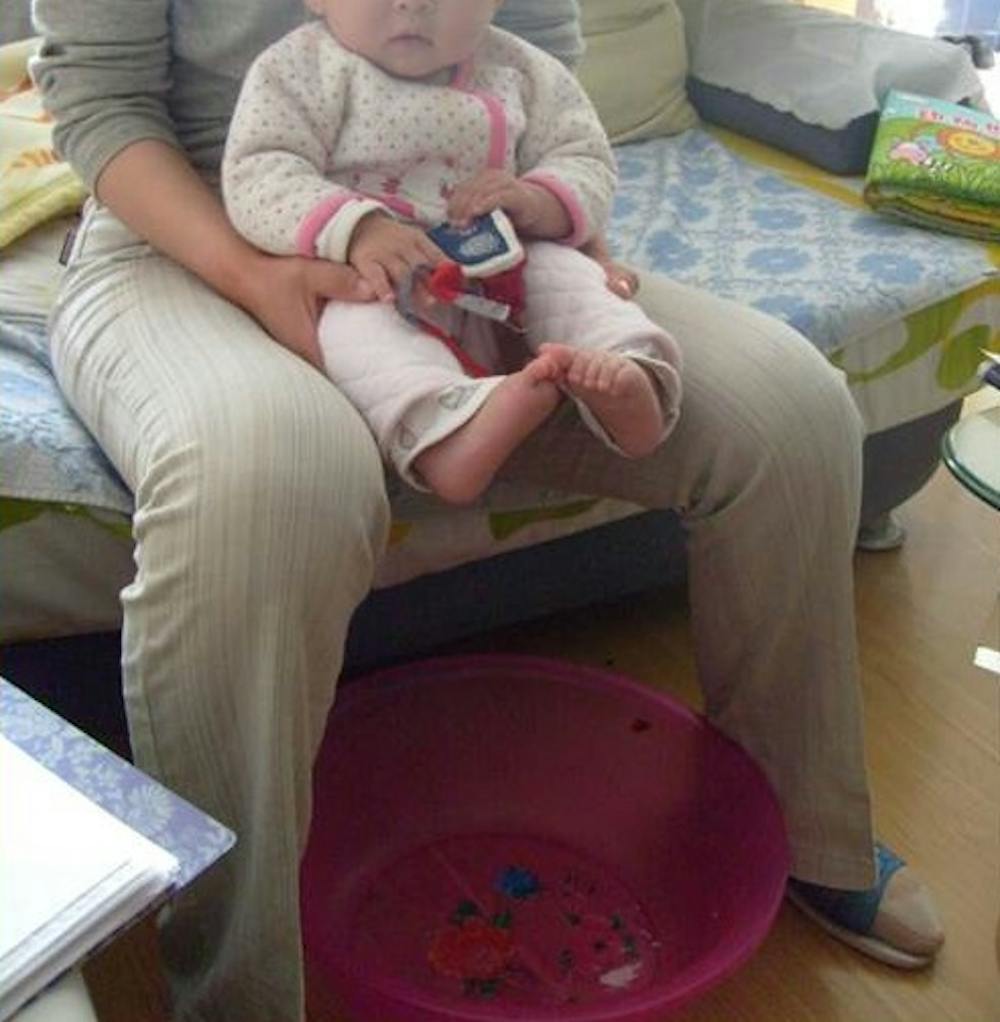
The search for alternatives does not need to be limited to Oceania, however. My research with families with young infants in northwestern China examined a practice known as ba niao, or “holding out to urinate”. This method of infant hygiene involves very limited use of nappies, meaning laundry can feasibly be done by hand.

Briefly, it involves learning the signals and timing of a baby’s patterns of poop and pee, then holding them out over a basin, toilet or potty for them to release, nappy-free. Caregivers look for signs such as squirming, pushing, fussing, stillness, and other forms of more direct communication that precede an “elimination”. As babies get older and begin to walk, they can be taught to urinate in Chinese-style squat toilets or other appropriate places, with the help of pants with a hole cut out of the crotch.

Items used for ba niao in northwestern China. Kelly Dombroski, Author provided

In colder parts of China, this is done by using several layers of pants, each with a hole, so babies do not have to be undressed. Caregivers tuck nappy-cloths made from old sheets or other soft rags up into the waistband of the pants, to be quickly and easily removed when a baby seems ready to “go”. If the caregiver misses the signal, the small, light cloth can be easily handwashed and dried on a balcony or radiator. If the caregiver is not near a toilet, the baby may even be held out over the ground or tiles, and urine cleaned up with a mop.

For faeces, babies are encouraged into a regular routine through a large morning feed of milk, and patient “holding out” until the morning elimination is done. If the baby’s bowel movements are less predictable, perhaps due to illness, some families use disposable nappy pads, tucked in the same way as the traditional nappies, but more as a backup for missing a signal rather than relying on it.

‘Holding out’ over a basin as part of traditional hygiene practices. Kelly Dombroski, Author provided

Households without indoor toilets also use this method, including families who live in their shop and rely on public showers and toilets for hygiene.

This method is used by rich and poor families alike. Research by disposable nappy producers Proctor & Gamble estimated that Chinese consumers of disposable nappies use only one per day – or more accurately, per night. Even those who can afford disposable nappies tend to eschew them in favour of ba niao during daylight hours. Besides a lot less laundry, the reported benefits include less nappy rash, earlier toilet independence, and less crying and fussing.


Read more: Toilet training from birth? It is possible


Is this a realistic practice for countries seeking to quit disposable nappies? It may seem far from westernised norms, but my research has also analysed the content of Australian and New Zealand-based web forums and Facebook groups, with collectively around 2,000 members. These caregivers, mostly mums, are trying to work out the best way to introduce a similar practice to everyday life here, too.

They are inspired by the fact that this is possible in other parts of the world, and may indeed be a key to reducing the laundry load. And if they’re not quite ready to quit disposable nappies altogether, they might at least give up the weekly raid on the neighbours’ rubbish bins.

ref. What other countries can teach us about ditching disposable nappies – http://theconversation.com/what-other-countries-can-teach-us-about-ditching-disposable-nappies-114604

Why walking and cycling to work makes commuters happier and more productive

Source: The Conversation (Au and NZ) – By Liang Ma, Vice-Chancellor’s Postdoctoral Research Fellow, RMIT University

In Australia, more than 9 million people commute to work every weekday. The distance they travel and how they get there – car, public transport, cycling or walking – can influence their well-being and performance at work.

Our study, involving 1,121 full-time workers who commute daily to work, made several important findings:

  • those who commute longer distances tend to have more days off work
  • among middle-aged workers, those who walk or cycle performed better in the workplace
  • Those who commute short distances, walk or cycle to work, are more likely to be happy commuters, which makes them more productive.

Read more: How the everyday commute is changing who we are


In Australia, full-time workers spend 5.75 hours a week on average travelling to and from work. Among them, nearly a quarter of commutes can be classed as lengthy (travel for 45 minutes or more one way).

Long commutes not only cause physical and mental strains on workers, but may also affect their work participation, engagement and productivity.

And Australia’s pervasive urban sprawl means most workers commute by car. But driving has been found to be the most stressful way to commute.

Driving to work is associated with a series of health problems and lower social capital (smaller social networks with less social participation), which all affect work performance and productivity.

What did the study look at?

Our research investigated how and to what extent our daily commuting can influence workplace productivity. We surveyed 1,121 employees from Sydney, Melbourne and Brisbane. These employees are all employed full-time, have a fixed place of employment, make regular commuting trips and work in different industries and occupations.

We found that workers with a long-distance commute have more absent days, as the graph below shows.

Predicted number of days absent from work with increasing commuting distance. Author provided

Two reasons can explain this result. First, workers with long commutes are more likely to become ill and be absent. Second, workers with long commutes receive less net income (after deducting travel costs) and less leisure time. Therefore, they are more likely to be absent to avoid the commuting cost and time.

The average commuting distance for Australian capital cities is about 15km. Workers with a commuting distance of 1km have 36% fewer absent days than those commuting 15km. Workers who commute 50km have 22% more absent days.

This study also finds that middle-aged (35-54) commuters who walk or cycle – known as active travel – have better self‐reported work performance than public transport and car commuters. This result may reflect the health and cognitive benefits of active travel modes.

Finally, this study finds the short-distance and active travel commuters reported they were relaxed, calm, enthusiastic, and satisfied with their commuting trips, and were more productive.


Read more: Commuters help regions tap into city-driven growth


How does commuting affect productivity?

Urban economic theory provides one explanation of the link between commuting and productivity. It argues that workers make trade-offs between leisure time at home and effort in work. Therefore, workers with long commutes put in less effort or shirk work as their leisure time is reduced.

Commuting can also affect work productivity through poorer physical and mental health. Low physical activity can lead to obesity as well as related chronic diseases, significantly reducing workforce participation and increasing absenteeism. The mental stress associated with commuting can further affect work performance.

A growing number of studies have found active commuting by walking and cycling is perceived to be more “relaxing and exciting”. By contrast, commuting by car and public transport is more “stressful and boring”. These positive or negative emotions during the commute influence moods and emotions during the work day, affecting work performance.

Finally, commuting choice could influence work productivity through cognitive ability. Physical activity improves brain function and cognition, which are closely related to performance. So it’s possible that active travel commuters might have better cognitive ability at work, at least in the several hours after the intense physical activity of cycling or walking to work.

The pathways through which walking and cycling to work might influence productivity. authors

Read more: Stop working on your commute – it doesn’t benefit anyone


What are the policy implications?

Employers should consider types of commuting as part of their overall strategies for improving job performance. They should aim to promote active commuting and, if possible, to shorten commuting time. For example, providing safe bike parking and showers at work could significantly increase cycling to work.

As for governments, in most states of Australia, only a tiny portion (less than 2%) of transport funding is devoted to bicycling infrastructure.

By contrast, in the Netherlands most municipalities have specific budget allocations to implement cycling policies. Australia should allocate more transport infrastructure funding to active travel, given the economic benefits of walking and cycling to work.


Read more: Cycling and walking are short-changed when it comes to transport funding in Australia


ref. Why walking and cycling to work makes commuters happier and more productive – http://theconversation.com/why-walking-and-cycling-to-work-makes-commuters-happier-and-more-productive-117819

Vital Signs: Trump’s nominations for the US Federal Reserve are an odd lot, and an even bet

Source: The Conversation (Au and NZ) – By Richard Holden, Professor of Economics, UNSW

This week US president Donald Trump announced two more nominees — Judy Shelton and Christopher Waller — for the two vacant positions on the US Federal Reserve’s board of governors.

He will be hoping for better luck than he has had thus far in filling the vacant slots. Four nominees have already gone down in varying degrees of flames.

These are important positions, with the board’s seven members having significant influence over monetary policy and financial supervision.

The board doesn’t sets official interest rates, but all seven governers are also members of the Federal Open Market Committee, which does.

Given this, and the fact the governors serve terms of up to 14 years, they are influential and important figures.


Read more: Why Federal Reserve independence matters


In the pre-Trump era, those nominated to be governors tended to be distinguished individuals with an extensive background in a relevant field.

A significant number of recent governors have been academic economists. Examples include Janet Yellen, Jeremy Stein, Lael Brainard, Richard Clarida, Stanley Fischer, Ben Bernanke, Randall Kronser, Frederic Mishkin and Alice Rivlin.

Some have been long-term employees of the Federal Reserve system (Donald Kohn, for example), while others have had extensive experience in financial markets (Jerome Powell, Sarah Bloom Raskin and Betsy Ashburn Duke).

The Fed Board’s weighting towards PhD economists and those with impeccable credentials in financial markets contrasts somewhat with the Reserve Bank of Australia, which is largely comprised on people from the business community.


Read more: Vital Signs: the RBA’s marching orders are no longer realistic. They’ll have to change


Current RBA board member Ian Harper has a PhD in economics, and so did former member Warwick McKibbin, but there has never been more than one such member (setting aside the RBA governor and deputy governor) at a time.

Failed nominees

Trump tends to favour people who agree with him. Two of his failed nominees were former presidential rival Herman Cain and Club for Growth founder Stephen Moore. Both were criticised as being egregiously unqualified, but both had consistently said very nice things about Trump.

Before Cain and Moore, Trump nominated Marvin Goodfriend, a Carnegie Mellon professor, and Nellie Liang, a long-time Fed official.

Goodfriend failed to gain enough support in the Senate because he had put both Democrats and Republicans offside. He had been critical of the stimulus spending following the Global Financial Crisis. This alienated Democrats. In 2000, he suggested the government put magnetic strips on money so it could tax cash to avoid deflation. This did not endear him to the libertarian Republican senator Rand Paul.

Liang should have been a slam dunk. She was widely respected and her nomination was smiled upon by Fed chairman Jay Powell. But she had led the Fed’s post-GFC efforts to tighten regulation of financial institutions. The banking lobby apparently didn’t like this too much. A confirmation hearing was never scheduled before the Republican-led Senate, and she withdrew.

Current nominees

With Waller and Shelton, one is qualified (if not exceptional), the other is dubious.

Waller has been director of research at the Federal Reserve Bank of St Louis (one of the 12 regional US reserve banks). He has a Phd from Washington State University, and has been a professor at the University of Notre Dame.

He has written academic papers about the independence of central banks, and on the determinants of low inflation. His view on the latter is perhaps why Trump nominated him.

In an interview last week he said he didn’t think low unemployment drove up inflation:

We don’t buy into it. Look at Japan. If you take that off the table, suddenly you’re like: Unemployment can stay low, and it doesn’t cause inflation, then what are you worried about?

The implication is that he wants the Fed to cut rates – a position consistently argued by Trump.

Shelton also favours rate cuts and seems to support almost every position Trump holds – from tax cuts to deregulation to the trade war with China. She is also an advocate of pegging the value of the US dollar to gold or some composite basket of commodities.

She lacks the academic credentials of anyone who has ever served as a governor of the Fed. But her views on economic matters line up with Trump’s.

Will the Senate confirm?

It’s hard to predict what the US Senate will do. The confirmation hearings may prove pivotal. Waller is not a star, but he is well-credentialled enough. He holds views on interest rates and inflation – that the Fed can safely cut – that might appeal to both Democrats and Republicans.

Shelton’s path to confirmation is much less clear. Gold bugs like Rand Paul will presumably be excited, but her position is way out of the mainstream, and reflexively pro-Trump positions are unlikely to endear her to Democrats.

Perhaps the key question is whether enough Republican senators see her as a Cain/Moore-level intellect, completely out of keeping with past Fed governors.

But Cain’s and Moore’s nominations ostensibly failed because of their history with and remarks about women. So who knows.

ref. Vital Signs: Trump’s nominations for the US Federal Reserve are an odd lot, and an even bet – http://theconversation.com/vital-signs-trumps-nominations-for-the-us-federal-reserve-are-an-odd-lot-and-an-even-bet-119868

Friday essay: romancing the moon – space dreaming after Apollo

Source: The Conversation (Au and NZ) – By Mitch Goodwin, Faculty of Arts, University of Melbourne

Last weekend I sat down for a chat with Lisa Sullivan, senior curator at the Geelong Gallery, to get a handle on the gallery’s new exhibition, The Moon. Two and a half years in the making, the exhibit is timed to coincide with this month’s 50th anniversary of the Apollo program’s crowning achievement: a manned spaceflight to the lunar surface.

The exhibition is an ambitious take on this event and, more broadly, our relationship with our nearest celestial neighbour. Or as Sullivan characterises it: “a beautiful poetic presence in the night sky”.

The moon is of the Earth, the product of a celestial collision, whether in part or in whole. We consider it as we would a fellow traveller. After all, the near side of the moon is perhaps the grandest example of pareidolia – the psychological phenomenon that makes us see patterns (often human characteristics) in random objects. And so it is that we see our likeness emblazoned on its crater-filled surface.

We are enamoured by the courting arc of this shapeshifter across our night sky. We anthropomorphise its gaze – the “man in the moon” is said to be “facing us”, while the concealed facade is known as “the dark side”. The moon has revealed itself to be a complicated character.

Georges Méliès, A trip to the Moon (Le voyage dans la lune) (still, detail) 1902, black and white; silent, duration 00:10:19. Australian Centre for the Moving Image, Melbourne

The Geelong Moon exhibition is an opportunity to examine this relationship, to pause and reflect on how our perception and interpretation of the moon has evolved. This is particularly relevant now, not only with the Apollo anniversary, but also in the absence of a return to the moon and our retreat from manned space exploration. We do so now at a distance, via Twitter and YouTube. Our experience of the moon and space has become a virtual one.


Read more: Satellite of love: our on-off relationship with the moon


In the exhibition, one is reminded not of the record of history so much – though it’s there in those iconic photos, the media sampling and the multitude of graphical renderings – but more so how an object so ubiquitous as the moon becomes a conduit for a shared narrative.

H Kawase Hasui, Full Moon in Magome 1930, colour woodcut. Art Gallery of New South Wales, Sydney. Purchased 1960. Photographer: Felicity Jenkins, AGNSW

There are no werewolves in Geelong, but there is a blend of fantasy, the domestic and the ancient. There is Arthur Loureiro’s painting Study for The spirit of the New Moon (1888), inspired by an epic poem in which the goddess Venus wards off the dangerous seas allowing safe passage for the explorer Vasco de Garma.

And there is a James Gleeson painting, The Siamese Moon (1951), demonstrating in exquisite detail the moon’s ethereal embrace, and according to Sullivan, how “important the moon was to the surrealists in terms of dreams and the subconscious and representing the unknown”.

Images of the moon, like Kawase Hasui’s Full Moon in Magome (1930), evoke a familiarity with the moon as a companion, a beacon or as a singular yet powerful light source; a seductive aesthetic if there ever was one.

The moon across time and culture

It is impossible to imagine today, but there was a time when only moonlight lit the streets and the pathways, its luminance stretching out across the moors and the ocean swells. It wasn’t until as recently as around 1807 that 23 of the first gas-fired street lamps were installed in London. By 1825, there were 40,000.

When electricity finally did arrive in the 1870s, the economical route to municipal lighting was by erecting light towers, designed to mimic the moon, the first appearing in San José, California, in December 1881.

Felicity Spear, Somnium 2016, inkjet pigment print. Courtesy of the artist and Stephen McLaughlan Gallery, Melbourne © Felicity Spear

There are ancient stories to tell here too. Oral traditions of Indigenous Australians not only mapped the night sky, but the stars helped to choreograph one of the earliest cultural dreamings of space. First Nations people had a sophisticated understanding of the subtle variations in the night sky.

The moon too is a strong romantic presence in Indigenous culture. Hector Jandanay’s moon dreaming Garnkeny (Moon man) (1993), on display in the Geelong exhibition, tells a story of forbidden love, the merging of Earth and Moon and the endurance of love eternal, reborn in the lunar cycle.

Through Sullivan’s curation of the exhibition, cultures speak across time, the works becoming a collective voice that detail the technique of space exploration but also the mystery of what it goes in search of. “People do ask me, ‘Is it about the science?’ and I say, ‘No, it is about the romance.’”

Photographs behind glass appear like rare artefacts from a distant time. Familiar iconic photo plates – the Earthrise image from Apollo 8, a moon boot in the space dust, the Apollo 11 Landing Module hurtling towards the lunar horizon – sit alongside the rare and the uncommon, such as photographic prints of the Russian Luna 3 flyby of the far side of the moon in 1959 and the landing of Lunar 9 spacecraft in 1966.

NASA Washington DC, Close-up view of astronauts foot and footprint in lunar soil 1969, black and white photograph. Collection of Theodore Wohng

There is a stunning engineering document, The Apollo 11 Earth Orbit Chart (1969), showing in detail the rocket revolutions, ground tracking trajectories and burn initiation points of the launch vehicle as prepared by the US Department of Defence.

And then there is the lunar map Almagestum Novum (published in 1651) by 17th century astronomer Giovanni Battista Riccioli, which has been playfully decoded and re-purposed by Mikala Dwyer in her installation piece, The Moon (2008).

Mikala Dwyer, installation view, The Moon 2008 , hessian, felt, modelling clay, glitter, cardboard, found object. National Gallery of Victoria, Melbourne, 375.0 x 175.0 x 375.0 (variable, installation). Gift of Robert Nubbs and Michaela Webb through the Australian Government’s Cultural Gifts Program, 2016. Supplied

Sullivan points out that “while some may say this is not art, that these images are not taken by artists”, she counters that these images are “a part of our visual culture. They are ingrained in our psyche and I very much wanted this exhibition to create that nexus between art and the sciences”.

The moon and the media

The Apollo moon landing represented the dawn of the global media event. Bringing the images back to Earth – the descent to the surface, those first steps down the gantry, and those immortal words of Neil Armstrong – were just as important as bringing back the crew.

After all, this was a time of war – a Cold War – this was nation building stuff, this must be seen, this must be recorded and most significantly transmitted as it happens. In 1969, live television would emerge as an important cornerstone of American public life.

The Apollo 11 lunar module, the moon, and the Earth. NASA/Wikimedia Commons

The Apollo program was also a prized commission for American artists. In 1969 Robert Rauschenberg was invited by NASA to witness the preparation and eventual launch of Apollo 11, producing a series of 34 lithograph prints he called Stoned Moon (1969-70).

Meanwhile, that year’s Pulitzer Prize winner Norman Mailer was charged with writing the definitive journalistic account of the mission for Life magazine, over three sprawling essays.

The Apollo missions had already provided the perfect heroic setup, a tragic (Apollo 1) and euphoric (Apollo 8) narrative built around a cast of characters, that Mailer would describe as “men with a sense of mission so deep it could not be communicated”. And yet, it sat uneasily with Mailer – he found the power of the Saturn V and the pomp of NASA’s patriotism a difficult sell.

Of the astronauts, he could not reconcile the fact these men were walking contradictions, “technicians and heroes, robots and saints, adventurers and cogs of machine”. Where Rauschenberg was enamoured by the promise of technology and its relationship with nature, Mailer sensed a foreboding. America, he was sure, was being “gassed by the smog of computer logic”.


Read more: Friday essay: shadows on the Moon – a tale of ephemeral beauty, humans and hubris


NASA Washington DC, United States flag on moon surface with lunar surface television camera in background 1969, type C photograph. National Gallery of Victoria, Melbourne. Purchased 1980

NASA was guilty of Cold War posturing to be certain, and the Apollo program was not one without its critics and satirists. In 1968, Stanley Kubrick had provided the cinematic warm-up in his epic ode to space exploration 2001: A Space Odyssey. Here, he anticipated the celestial dance of the slowly rotating Command and Service Module, the descent of the Lunar Module to the surface, and the docking of the two vehicles.

David Bowie, who had seen the film on more than one occasion stoned “off my gourd”, understood the irony of Kubrick’s film. The space fever that pre-occupied those months leading up to the Apollo 11 launch would foreground the writing of his own playful moon cabaret, Space Oddity.

Virtualising the moon

Sullivan tells me there are other efforts to tap into the Apollo anniversary. Locally, the Powerhouse Museum in Sydney and the Queensland Museum are both conducting an object based survey of the period, while the Grand Palais in Paris and the Aga Khan Museum in Toronto are hosting similar artistic reflections on the moon’s cultural significance.

It is certainly the season for such reflections. I have recently attended two moon-related installations at Scienceworks in Melbourne, the Museum of the Moon by Luke Jerram and the Earthlight Lunar Hub VR (virtual reality) experience.

The Earthlight narrative was simple: it is 2038 and we have colonised the moon. As a participant, you don a VR headset and a PC backpack enabling full movement and navigation of the VR world. You are an astronaut exploring the technology and the habitation environment of this new lunar colony.

Eventually you and your fellow crew members – also in VR gear but represented in the experience as other (very realistic) astronauts – step out onto a bridge-like structure, and before you is the lunar landscape, and in the distance – the Earth.

It is akin to the stunning scene at the end of Damien Chazelle’s film, First Man (2018), when Ryan Gosling’s Neil Armstrong steps down onto the lunar surface and the camera pans around to reveal his perspective. Like Alfonso Cuarón’s Gravity, and Ridley Scott’s The Martian, the realism is palpable.

These image constructions try to make the remoteness of space a tangible reality, to evoke a sense of realism. Clearly, the hope – from NASA, from Hollywood, from space agencies in Japan and China and from the entrepreneurial space exploration community – is to bring the spectator in all of us a little closer to the action.

Stunts and gimmicks

Despite the clamouring towards commercialising the cosmos, from space tourism to the quest to mine the moon and even asteroids for resources, manned missions to the moon or even to Mars seem like a very remote and distant proposition. The economics don’t add up and the rise of robotic exploration provides a safe, if remote alternative.

And so human interactions in space have become a gimmick, a floor show for the underlying science that makes them possible. Remember astronaut Chris Hadfield singing David Bowie’s Space Oddity from the International Space Station? (Oh, how I would have loved to have seen Bowie in space!). And then there was model Kate Upton sporting a bikini for a Sports Illustrated photo shoot aboard a zero gravity test facility, and skydiver Felix Baumgartner, adorned in Red Bull garb, live streaming his free fall from the edge of space.


Read more: Five ethical questions for how we choose to use the Moon


And then of course, perhaps the most audacious advert of them all, Elon Musk stowing a Tesla Roadster vehicle into the SpaceX Heavy Falcon rocket, to be jettisoned into Earth’s orbit during the vehicle’s maiden voyage in February 2018.

The cherry-red Tesla, replete with a Starman at the wheel, has since sailed passed Mars on its journey into the cosmos to the soundtrack of Bowie’s Space Oddity. And yet, as we know, in space no one can hear the unexpected harmonic shifts of a stylophone.

As our chat about all things moon-like, dreamt or otherwise foretold draws to a close, Sullivan notes that we are left with what can only be a virtual space dream. I tend to agree, perhaps it has always been so. This is the near and the far of the lunar embrace. All we admire, so clear and stark in the night sky, is perceptibly a thing of beauty but so tantalisingly out of reach. As Sullivan says:

The majority of the Earth’s population will never experience what it is like to walk on the moon. That experience will always be unattainable. Even if we see some lunar dust in a museum, or handle a sample of moon rock, it is not the same as seeing the lunar landscape, of experiencing what it is like to walk on the lunar surface. Perhaps that is part of the romance of the moon. This ever-present but ever shifting shape in our night sky.


The Moon is on at Geelong Gallery until September 1.

ref. Friday essay: romancing the moon – space dreaming after Apollo – http://theconversation.com/friday-essay-romancing-the-moon-space-dreaming-after-apollo-119816

Grattan on Friday: A kinder, gentler Senate – at least for now

Source: The Conversation (Au and NZ) – By Michelle Grattan, Professorial Fellow, University of Canberra

This first week of the new parliament has been bitter sweet for Senate leader Mathias Cormann.

With journalist Niki Savva’s book Plots and Prayers out on Monday, Cormann that morning faced yet another barrage of questioning over his role in last year’s coup against Malcolm Turnbull.

His spectacular desertion of the then prime minister has much tarnished Cormann, and it is certainly not pleasant to be asked in a radio interview about being seen as a “political Judas”.

But while Cormann’s personal reputation has taken a big knock from the events of August, his reputation as a Senate wrangler has been retrieved with the Thursday passage of the government’s $158 billion three stage tax plan. Cormann had failed last year to get the then crossbench to pass the tax cuts for big business, which he persuaded Turnbull to hang onto for far too long, costing the government votes in the Longman byelection of Super-Saturday.

Despite Cormann’s insistence there would be “no deals” to secure the income tax package, agreements there were, although there’s some lack of clarity around the edges. Centre Alliance extracted undertakings on gas policy. Jackie Lambie, the last crucial vote, has been promised help for Tasmania on the housing front. There may be debate about what constitutes a “deal” but the government would fail to live up to its word at its peril.


Read more: Morrison’s $158 billion tax plan set to sail through Senate after deals with crossbenchers


There will also probably be plenty of such deals ahead, even if Cormann declines to acknowledge them as such.

This initial parliamentary week has vindicated the observation that the Senate non-Green crossbench, smaller than the last, is set to be easier for the government to cope with.

Notably, the two Centre Alliance (formerly called the Nick Xenophon Team) senators have a consultative arrangement with Lambie (back in parliament after her time out because of her citizenship problem). This is not an alliance, and they and she are very different politically. (Centre Alliance has shades of the old Australian Democrats, with which the Howard government struck important agreements over legislation, especially on tax and industrial relations.)

But the Centre Alliance-Lambie arrangement to talk on issues should work to the government’s advantage, not least because it will mean the very volatile Lambie won’t be so isolated, and thus angry and alienated, as often in the past. The Centre Alliance senators, Stirling Griff and Rex Patrick, showed her respect by going to Devonport after the election – and Lambie craves respect.

Whenever the government can work with Centre Alliance and Lambie, it won’t require One Nation’s two votes, something that will infuriate Pauline Hanson, who needs relevance.

The government was desperate to get the tax cuts through this week, despite time being tight due to the ceremonial commitments with the opening of parliament and the tributes to the late Bob Hawke. It wanted the first stage to be available for payment as quickly as possible after the due date of July 1. The money will be flowing in a week or so.

Labor was always going to be placed in a difficult position over the tax package. It felt it could not drop its argument of the election campaign that the third stage, paid from 2024-25 and costing $95 billion, was irresponsible given economic circumstances can’t be known so far ahead.

But to be voting against tax relief on which the re-elected government could be considered to have a clear mandate (if campaign promises mean anything) would leave Labor open to continued attacks.

The opposition’s contortions have been understandable but awkward, making the early days of new leader Anthony Albanese messy.

Inevitably, Labor’s final position, announced shortly before the Senate vote, was that if it couldn’t get its way with amendments it would not oppose the package.

But it also said it would “review” the third stage closer to the election, due in 2022. This sounds unrealistic – would a Labor government be able to roll back legislated cuts anyway? And it is politically counter-productive, keeping the argument alive.


Read more: Stages 1 and 2 of the tax cuts should pass. But Stage 3 would return us to the 1950s


There are some hints of changed dynamics in this parliament compared with the last. While Scott Morrison pours out the harsh rhetoric at his opponent (“this is a Labor Party which has more in common with Jeremy Corbyn than Paul Keating” he told parliament), the Prime Minister invited Albanese to his office on Wednesday to canvass areas of potential bipartisanship, especially Indigenous reconciliation and recognition.

Talk of bipartisanship is an easy gesture at the start of a term and mightn’t last. There have been such suggestions in previous parliaments. But equally it might be another pointer to Morrison’s pragmatic style. He may want to carve out some battle-free areas.

The new parliament’s first question time, which was on Thursday. also gave a hint of the Albanese approach. The opposition questions were framed tightly, without waffly preambles, designed to stop answers being just a rant. It’s a tactic that forces ministers, and the Prime Minister, into greater relevance.

It is to be hoped the opposition and the Speaker Tony Smith can hold the government to the point in answers this term. It has got away with far too much.

The cloud over the government’s political success this week was the delivery of yet another worrying message about the economy, with the Reserve Bank cutting interest rates for the second consecutive month and a fresh exhortation from Bank Governor Philip Lowe for further government action, beyond the tax cuts.

The bank wants unemployment and underemployment down and the spare capacity in the economy taken up. Australia is exposed to the risks in the international economy. Historically-low interest rates could be pushed down further. Lowe pointed to the need for more infrastructure spending and structural reforms that “support firms expanding, investing, innovating and employing people”.


Read more: Back-to-back Reserve Bank cuts take interest rates to new low of 1%


The only certainty about the Australian economy in the months and years ahead is uncertainty.

Presumably the government sooner or later will have to respond to Lowe’s high-end hectoring, which will require some challenging decisions that can’t be delivered by deals, however characterised.

ref. Grattan on Friday: A kinder, gentler Senate – at least for now – http://theconversation.com/grattan-on-friday-a-kinder-gentler-senate-at-least-for-now-119902

How rehab helps heavy drug and alcohol users think differently

Source: The Conversation (Au and NZ) – By Julaine Allan, Senior research fellow, Charles Sturt University

Around 16,700 Australians stay in residential rehabilitation centres each year, most commonly for problems with alcohol, amphetamines and opiates.

Rehab is a structured, drug- and alcohol-free environment. Residents participate in the same daily and weekly routines and activities, including educational and therapeutic groups and individual counselling sessions. Household chores, cooking, exercise, education and recreational activities fill the time.

Some rehabs have as few as 12 residents at one time, others have as many as 60. Programs last from six weeks to 18 months, with eight weeks the average in Australia.

Our recent study of 12 rehab residents in Australia found the safe, structured environment and the support of others going through the same experience were key to helping residents change their thinking about drug and alcohol use.


Read more: Drug rehab: what works and what to keep in mind when choosing a private treatment provider


Safety and routine

We asked people what program elements they thought were important. They most often talked about the safe environment, structured routines and staff support. As one woman explained, “I love my room, it’s my space. I am safe there.”

Living in a group environment with strangers while fighting mood swings and cravings is tough. The staff maintained the routines and monitored the group dynamics but they also responded to individual needs for support:

I’ve had down days and they’re (staff) pretty quick to pick it up. I’m not the sort of person that likes to talk about emotions and let it out, but they’re pretty quick. The times I’ve been down, they pick it up pretty quick.

Living in a group environment is part of learning how to manage without using drugs. Critical changes that study participants attributed to the program were about dealing with their own and others’ emotions:

I think, what I’ll take away is to understand that that’s the person I am and I’ll manage it. To understand my feelings, like when I am angry, to get away from the situation and take a breath and understand my feelings, I guess. Just understand what I’m feeling. If I’m angry, I know there’s other options than to go use, or drink.

A new way of living

Most participants described the shared experience of everyday life without drugs or alcohol for an extended period as particularly important. One woman said:

we’d sit around laughing our heads off and actually we’d say we’ve probably never laughed so much in our lives. We were just sitting around with no alcohol, no drugs and just making do with what we’ve got.

For many, that change was unexpected:

There was no drugs or alcohol involved and pretty much the first time since I was a young teenager, I realised you can be happy. I don’t know. It was just a bit of a change in life.

Rehab programs are not usually designed around a specific type of drug or individual. The same therapies are applied to everyone.

The group content used in the rehab we studied included health and well-being education and psychological therapies intended to help people deal with triggers and make decisions around drug use.


Read more: Drug rehab and group therapy: do they work?


However, the most important thing for most people was a daily, group-based reflection on personal values which helped create a different view of themselves as, say, a mother or friend. As one man said:

so it makes me look at myself, like I’m forgiving and humility, and really looking at me and going, okay, well, I’m not such a crap person, because I’m an addict. I’ve got some good values there.

Possibility of relapse

Fear and anxiety about relapse after leaving rehab were common. People felt vulnerable to resuming drug use despite gains made during the program and their desires to remain substance-free:

I’m getting a bit anxious, knowing that I’m going. I’ve been here, wrapped in cotton wool for two months, and being released back into the big, wide world, I’m scared that I’m going to relapse.

Few study participants had support to cope in the future. Friends and social groups were limited because past connections usually involved drug use:

That’s going to be the hardest thing for me, seeing old mates and them asking if I want some. That’s the hardest part. You are who you hang around. It’s sad to say, but I’ve started hanging around some pretty ordinary people. You think they’re your friends but they’re not.

Maintaining change after rehab is a challenge and few supports are available.

Relapse rates are high. Most people use drugs in the year after treatment. Between 40% and 60% return to substance dependence.


Read more: What is ‘success’ in drug rehab? Programs need more than just anecdotes to prove they work


The downsides

Several people described being fearful of what would happen when they got there. Others described conflicts between residents and lack of contact with children as challenges they faced.

Cost can also be an issue. The centre we studied charged A$240 a week for all facilities including therapeutic programs. But private rehabs are also available and can cost as much as A$30,000 a month.

Rehab fills the day and provides intensive support for people that doesn’t exist when they go home. Community support programs like counselling, employment and drug-free social and recreational programs, which bring safe family members and friends back into the picture, could reduce relapse.

ref. How rehab helps heavy drug and alcohol users think differently – http://theconversation.com/how-rehab-helps-heavy-drug-and-alcohol-users-think-differently-118822

Bonuses for clicks: the Herald Sun model can’t be the future of journalism

Source: The Conversation (Au and NZ) – By Leon Gettler, PhD student, RMIT University

As newspapers around the world struggle with revenue, News Corp Australia’s Melbourne tabloid the Herald Sun is trialling a bold idea to lure more readers over its paywall.

The plan is to give its reporters bonuses of $10 to $50 based on page views and if casual readers attempting to read a paywalled story are motivated to buy a subscription. Herald Sun reporters could potentially make hundreds of dollars extra a week.

But the rest of us should be concerned about this strategy – particularly that it might succeed.

At a time when readership, circulation and advertising revenues are collapsing, it is important to examine the innovations print media companies are deploying to stay afloat. Their responses to the contraction of print news have implications for the broad distribution of information that is crucial to a healthy modern democracy.

Declining revenue

The Herald Sun plan comes as owner News Corp Australia continues to struggle with declining revenue.

The company’s latest profit figures show revenue down 7% across its almost-150 Australian news titles. While digital subscriber numbers were up an impressive 20.5%, from 409,000 to 493,200, over 12 months, this did not offset losses from its traditional revenue streams, print subscriptions and advertising.

As with other newspaper organisations, job cuts have become an annual event. Last month News Corp Australia announced another 50 jobs would go, with a particular focus on the Herald Sun and journalists lacking digital skills.

New skills were needed as the company focused on digital publishing, said executive chairman Michael Miller: “We’ll see some skills come into the company and unfortunately some people who have been here a while will be leaving.”

You won’t believe what’s driving this!

So this bonus scheme is clearly intended to accelerate the growth in online subscribers, given its strategies so far have not managed to keep up with losses.

Will it succeed, and what are the possible consequences?

First, there is the strong possibility it will further promote clickbait and encourage reporters to focus on stories about sex, crime and entertainment at the expense of politics or analysis. A problem with any online economic model based on monetising “views” is that it incentivises speed and spectacle over restraint and verification.


Read more: Australians are less interested in news and consume less of it compared to other countries, survey finds


Second, the strategy is unlikely to boost advertising revenue. Search engine analysts say the value of internet advertising is more complicated than that. More important than sheer numbers is focused, high-quality, high-value traffic.

Third, focusing on traffic and click conversions overlooks an alternative approach to finding a sustainable news model.

Newspapers can look to use technology in a variety of way to become more viable propositions. In the Herald Sun’s case, News Corp has commissioned a “proprietary analytics platform” called Verity that will give editors “real-time performance updates”.

But it could have gone another way. In other parts of the world news organisations are using technology to pursue an alternative strategy – better connection with their communities.

Investing in conversations and community

In the US, the New York Times and the Washington Post are collaborating with Mozilla (developer of the open-source Firefox browser) to build tools to increase engagement between news organisations and readers. It is known as the Coral Project, and backed by the philanthropic Knight Foundation, which believes “informed and engaged communities […] are essential for a healthy democracy”.

Knight has given almost US$4 million for the Coral Project to build a new commenting platform, called Talk. Its developers hope Talk can help overcome the behavioural problems prolific on commenting systems. The goal is for comment sections to foster better conversation.

“Talk is a key way for The Washington Post to integrate reader voices with our reporting, and to grow our communities of readers who engage with news,” says the Post’s comments editor, Teddy Amenabar. “Coral’s software was created by newsrooms for newsrooms, so their tools are tailored to our needs.”


Read more: How The Conversation makes an impact by doing things differently


Another trend in journalism is hyperlocal journalism – internet-based media focused on the stories and interests of a local community. So far the model for hyperlocal journalism is very small. A lot of it is done by volunteers. But there are cases of viable businesses. At this stage it is not a big money spinner but it’s early days, and there is a lot of experimentation.

As traditional newsrooms lose the resources to practise “shoe leather” journalism, hyperlocal ventures are “promising alternatives for fostering civic discourse and engagement,” according to media academic Andrea Carson and colleagues. This is despite “a reduced capacity for verified journalism”.

Certainly these examples of using technology to connect with a community are closer to the way newspapers originated 300 years ago. They brought communities together with news travelling by word of mouth or letter, and circulating in taverns and coffee houses in the form of pamphlets, newsletters and broadsides.

The Herald Sun model to drive traffic moves in the opposite direction.

ref. Bonuses for clicks: the Herald Sun model can’t be the future of journalism – http://theconversation.com/bonuses-for-clicks-the-herald-sun-model-cant-be-the-future-of-journalism-119638

The real Tinkerbell: don’t mess with these tiny fairy wasps

Source: The Conversation (Au and NZ) – By Manu Saunders, Research fellow, University of New England

Have you ever seen a fairy? They exist, and may very well be in your garden. But you would need a high-powered microscope to spot the dainty creatures.

Fairy wasps (family Mymaridae) are tiny, feathery-winged parasitoid wasps. They’re often called fairy flies, which is a misnomer. The Mymaridae family includes the smallest known insects in the world. Most species are less than 1mm long – smaller than the average pinhead.


Read more: In defence of wasps: why squashing them comes with a sting in the tale


But two species in particular have the record for being the smallest insects in the world. Measuring 0.15-0.19mm, the smallest recorded winged insects are female Kikiki huna.

Images of a female Kikiki huna body and wings. The scale line represents 0.1mm. Huber J, Noyes J (2013) via Wikimedia Commons, CC BY-SA

Not much is known of K. huna’s ecology, but the species was first discovered in Hawai’i (the scientific name is made from Hawaiian words for “tiny bit”). Since then, specimens have been recorded from Western Australia and South and Central America, suggesting the species could be distributed much more widely.

In 2013, another closely related species was discovered in Costa Rica and named Tinkerbella nana, after Peter Pan’s fairy friend.

The smallest known insect of all, at around 0.13mm, is a wingless male specimen of another fairy wasp, Dicopomorpha echmepterygis, found in the United States. Many insect species are sexually dimorphic, meaning males and females can look so different they may be confused as different species. For this fairy wasp, females are much larger than the record-breaking males, and have wings.

Eggs in eggs, wheels within wheels

All fairy wasp larvae are parasites. Adult females search for the eggs of other insects in sheltered places, such as under leaves or in leaf litter. When she finds a stash, she lays her own eggs inside the other eggs – an indication of just how tiny these wasps are! The wasp larva uses the nutrients from the egg to develop, killing the other insect in the process, before emerging through a tiny hole in the egg surface. The BBC captured this process in mesmerising underwater footage in 2017.

The smallest kinds of fairy wasp lay their eggs inside the eggs of barklice, who are also extremely tiny. Katja Schulz/Flickr, CC BY

Adults only live for a couple of days to reproduce and start the cycle again. In fact, some males never leave the egg they develop in – as soon as they emerge from their own egg within an egg, they mate with a female and die.

Despite their diminutive size, fairy wasps pack a punch when it comes to impact. Their dependence on other insects to complete their life cycle means they play an important role in controlling populations of many other insects.

Scientists don’t think these wasps have strong preferences about their host species, which means they seem to pick whatever eggs are available. But very little is known of the ecology of most species, so it is hard to know for certain.


Read more: Five deadly parasites that have crossed the globe


Most of the known records of fairy wasps have emerged from eggs of Hemiptera species, the group of sucking bugs that includes planthoppers and aphids. But other hosts are known to include thrips (Thysanoptera), beetles (Coleoptera), and psocid (Psocoptera).

The smallest insect in the world, D. echmepterygis, was reared from eggs of a psocid, or barklouse species – another group of small insects that is often overlooked. Barklice and booklice, also called psocids, are in the order Psocoptera; barklice usually feed on lichen and algae on tree trunks, while their cousins the booklice are often found feeding on mould inside book bindings in old libraries.

Other fairy wasp species have become valued for their important role as biological control agents in agricultural systems. Mymarids can control many damaging economic pests, including the glassy-winged sharpshooter, and weevil and sucking bug pests of eucalypt plantations. Many other associations remain to be discovered.

Fairy wasps can help keep down numbers of glassy-winged sharpshooters, which are a pest. Chuck/Flickr, CC BY-NC-SA

Fairy wasps are a fascinating example of how much biodiversity is still undiscovered. With so much focus on larger, or more charismatic species, the tiny world of the smallest animals on Earth goes by unnoticed.

We still have much to learn about the ecology and life history of minuscule fairy wasps. Most of us would walk past one nearly every day without noticing. But we can support them without seeing them. Like many other flying insects, adults need sugar from floral nectar or insect honeydew for their energy.

This means that encouraging flowering plants to grow in and around crop fields can help production. These wild floral resources support populations of many beneficial insects, including fairy wasps, making them more effective as biological control agents. And, just like many other beneficial insects, pesticides can kill fairy wasps, or make them less effective at controlling other pests.


Read more: Ants, bees and wasps: the venomous Australians with a sting in their tails


The same principle goes for gardens. Next time you find a pesky insect herbivore munching on your plants, consider an experiment: let them be and see how long it takes before fairies have moved into the bottom of your garden.

ref. The real Tinkerbell: don’t mess with these tiny fairy wasps – http://theconversation.com/the-real-tinkerbell-dont-mess-with-these-tiny-fairy-wasps-109796

Why the ‘molecular scissors’ metaphor for understanding CRISPR is misleading

Source: The Conversation (Au and NZ) – By Elinor Hortle, Research Fellow, University of Sydney

Last week I read an article about CRISPR, the latest tool scientists are using to edit DNA. It was a great piece – well researched, beautifully written, factually accurate. It covered some of the amazing projects scientist are working on using CRISPR, like bringing animals back from extinction and curing diseases. It also gave me the heebies, but not for the reason you might expect.

My unease was the echo of a feeling I’d had during the early days of my PhD, when some fellow malaria researchers made a discovery that was reported on the news. I was thrilled for them, but I understood the incremental nature of the work they were doing. I knew that in a real-world, drugs-in-the-clinic sense, we were no closer to a breakthrough than we’d been the day before. I thought the reporters had communicated that clearly. Five minutes later my Dad called to ask if I was out of a job, and what I was going to do now that malaria was cured.

I don’t pretend to understand all the myriad reasons for the gaping chasm between what scientists say and what the public hears. Lately though, I’m starting to think it might have something to do with the metaphors we use, and the way they shape our perception of the complexity involved.

Take CRISPR. It’s most often described as a pair of molecular scissors that can be used to modify DNA, the blueprint for life. And when we read that, I think most of us start imagining something like a child with her Lego bricks strewn in front of her, instruction booklet in one hand, scissors in the other. One set of pictograms, one model; one gene, one disease; one snip, one cure. We’re there in a blink. CRISPR seems like it can work miracles.


Read more: What is CRISPR gene editing, and how does it work?


I want to stress that the molecular scissors metaphor is pretty damn accurate as far as it goes. But in focusing on the relatively simple relationship between CRISPR and DNA, we miss the far more complicated relationship between DNA and the rest of the body. This metaphor ignores an entire ecosystem of moving parts that are crucial for understanding the awe-inspiring, absolutely insane thing scientists are trying to do when they attempt gene editing.

I prefer the metaphor of malware

In my research I use CRISPR from time to time. To design experiments and interpret results effectively, I need a solid way to conceptualise what it can (and can’t) do. I do not think of CRISPR as molecular scissors.

Instead I imagine a city. The greater metropolis represents the body, the suburbs are organs, the buildings are cells, the people are proteins, and the internet is DNA.

In this metaphor CRISPR is malware. More precisely, CRISPR is malware that can search for any chosen 20-character line of code and corrupt it. This is not a perfect metaphor by any stretch, but it gets me closer to understanding than almost anything else.

Shutterstock

Read more: Editing human embryos with CRISPR is moving ahead – now’s the time to work out the ethics


Alzheimer’s is like a riot

As an example, let’s look at Alzheimer’s, one of the diseases CRISPR is being touted to cure. The headlines are usually some variation of “CRISPR to correct Alzheimer’s gene!”, and the molecular scissors analogy is never far behind.

It seems reasonable to me that someone could read those words and assume that chopping away the disease-gene with the DNA-shears should be relatively simple. When the cure doesn’t appear within five years, I can understand why that same person would come to ask me why Big Pharma is holding out (this has happened to me more than once).

Now let’s see how it looks using the malware metaphor. The consensus is that Alzheimer’s manifests when a specific protein goes rogue, causing damage to cells and thereby stopping things from working properly inside the brain. It might have a genetic cause, but it’s complicated. In our allegorical city, what would that look like?

I think riots would come close. Rampaging humans (proteins) destroying houses and property (cells), thereby seriously derailing the normal functioning of a specific suburb (the brain).

And you want to fix that with malware?

It’s hard to predict the domino effect

Can you imagine for a second trying to stop soccer hooligans smashing things on the streets of Buenos Aires by corrupting roughly three words in the FIFA by-laws with what’s essentially a jazzed-up command-F function?

I’m not saying it’s not possible – it absolutely is.

But think of all the prior knowledge you need, and all the pieces that have to fall in place for that to work. You’d have to know that the riots are caused by football fans. You’d have to understand which rule was bothering them (heaven help you if it’s more than one), and if that rule causes drama at every game. You’d have to find a 20-character phrase that, when corrupted, would change how the rule was read, rather than just making a trivial typo.

You’d have to know that the relevant footballers have access to the updated rule book, and you’d have to know there were no other regulations making your chosen rule redundant. You’d have to know there aren’t any similar 20-character phrases anywhere on the internet that might get corrupted at the same time (like in the rules for presidential succession say, or in the nuclear warhead codes). Even then you’d still be rolling the dice.

Even if you stop the riots successfully, which of us really know the long-term consequences of changing the World Game forever?


Read more: These CRISPR-modified crops don’t count as GMOs


Reflecting the right level of complexity

At this point, you might say I’m stretching the metaphor a bit far; that this analogy has become a little stuck up its own behind. You’d not be wrong.

But by thinking the problem this way, we’ve just given ourselves a pretty decent feel for the complications of polygenic disease, incomplete penetrance, missense/nonsense mutations, epigenetic silencing, genetic compensation, off target and germline effects – all without a single word of science jargon.

These are real difficulties scientists are trying to work through to make sure CRISPR is effective and safe. That’s why it takes a long time and costs a lot of money. That’s why most of the promising leads end up going nowhere.

Amazingly, astoundingly, sometimes it works.

ref. Why the ‘molecular scissors’ metaphor for understanding CRISPR is misleading – http://theconversation.com/why-the-molecular-scissors-metaphor-for-understanding-crispr-is-misleading-119812

In Australia, criticising a judge can land you in jail. This is a danger for democracy

Source: The Conversation (Au and NZ) – By Bill John Swannie, Lecturer in College of Law and Justice, Victoria University

Under Australian law, a person can be jailed or fined for criticising a court or a judge, an action that is known as “scandalising the court.”

This type of contempt has been described as “dangerous” by former High Court judge Lionel Murphy, who noted the offence is so vague and general, it is an oppressive limitation on free speech.

The offence, which has been abolished in the UK, particularly affects journalists and those commenting on court decisions publicly. In a democracy, courts should be accountable for their decisions. Thus, the power of courts to punish critics of judicial decisions should be removed.

Contempt in the spotlight

Contempt of court laws are currently in the spotlight in Victoria after 36 journalists and media organisations were charged with contempt by the director of public prosecutions for allegedly breaching suppression orders in the trial of Cardinal George Pell. The Victorian Law Reform Commission is currently reviewing these laws.


Read more: PODCAST: Pell trial reporters, a judge and a media lawyer on why the suppression order debate is far from over


In 1987, the Australian Law Reform Commission recommended the principles developed by the courts over the years regarding contempt of court laws be replaced by statutory provisions. More than 30 years later, this recommendation has not been acted on – contempt of court laws, which apply in every Australian state and territory, remain unclear on what type of conduct is punishable.

Broadly speaking, four main types of contempt are punishable by law:

  1. Sub judice contempt involves making public comments on a current or pending trial. This seeks to ensure that criminal defendants receive a fair trial.

  2. Disobedience contempt involves failing to comply with a court order, such as the suppression orders in the Pell trial.

  3. Contempt in the face of the court involves interfering with or interrupting a court hearing.

  4. Lastly, contempt by scandalising the court targets conduct that may undermine public confidence in the courts or which threatens a court’s authority. This could include statements alleging judicial bias or impropriety on the part of judges.

The most famous Australian court decision on scandalising contempt involved a newspaper article that humorously criticised the High Court’s rulings in the 1930s. The High Court held that this scandalised the court. Although the case was decided in 1935, it has never been overruled and has often been referred to by other courts.

Features of contempt by scandalising

Four features of contempt by scandalising the court highlight the danger it presents to free speech, particularly when it comes to journalists and media organisations who are publicly commenting on the courts and court decisions.

First, as mentioned above, the offence of contempt is currently defined by numerous court decisions that do not clearly articulate what type of conduct may be punished.


Read more: Explainer: why three government ministers might face contempt of court charges


Second, contempt of court can be decided by the judge alleged to have been scandalised. There is no requirement for a jury trial, or any other procedural safeguards.

The Victorian Charter of Human Rights and Responsibilities Act 2006 requires all court hearings to be “fair.” Arguably, a hearing would not be fair if a person’s guilt and punishment were determined by the judge alleged to have been scandalised. This undermines public trust and confidence in the courts.

Third, there is no limit in any Australian jurisdiction on the fine or jail term that can be imposed for contempt of court. Being a common law offence, ordinary sentencing principles and limits do not apply. Jail terms of varying lengths have been imposed on Australian journalists for contempt – and an unlimited jail term is even possible under the law.

Fourth, there is no requirement to prove that the person alleged to have scandalised a court intended to do this.

A better way to deal with criticism

These problems could be rectified through legislation by clarifying the scope of the contempt of court offences, specifying maximum penalties and introducing procedural safeguards.

Arguably, however, there is no need in a modern democracy to punish statements that criticise the decisions made by the courts. Judges can and often do respond to criticism by the media by publicly explaining their decisions. This seems to be more effective for maintaining public confidence in and respect for the courts than punishing individuals.

Since the High Court’s free speech cases of the 1990s, there is a greater emphasis on transparency and accountability in government. In this light, the offence of scandalising the court seems archaic and oppressive. Especially considering the extent to which the Australian public relies on media reports and commentary on court proceedings – and the public interest in allowing such commentary – the arguments for abolishing the offence of scandalising the court now seem overwhelming.

ref. In Australia, criticising a judge can land you in jail. This is a danger for democracy – http://theconversation.com/in-australia-criticising-a-judge-can-land-you-in-jail-this-is-a-danger-for-democracy-119296

Media Files: Washington Post weather editor Jason Samenow on how weather coverage is evolving – and building audience growth

Source: The Conversation (Au and NZ) – By Andrea Carson, Associate Professor at La Trobe University. Department of Politics, Media and Philosophy, La Trobe University

When he founded the blog CapitalWeather.com 15 years ago in Washington DC, Jason Samenow was working for the US government as a climate change analyst. A full-time media career was probably the last thing on his mind.

But the blog – which became known as the Capital Weather Gang – gained traction, and was gradually absorbed by The Washington Post.

These days, Samenow is chief meteorologist and weather editor for the Post, where his work is driving audience growth and engagement.

Jason Samenow began his career as a climate change analyst before transitioning into journalism. Jason Samenow, Author provided (No reuse)

Lawrie Zion caught up with him for a chat about how digital media has changed the way that we connect to the weather, and why it’s wrong for weather editors to leave climate change out of the discussion.

New to podcasts?

Podcasts are often best enjoyed using a podcast app. All iPhones come with the Apple Podcasts app already installed, or you may want to listen and subscribe on another app such as Pocket Casts (click here to listen to Media Files on Pocket Casts).

You can also hear us on any of the apps below. Just pick a service from one of those listed below and click on the icon to find Media Files.


Additional credits

Producer: Andy Hazel.

Theme music: Susie Wilkins.

Image

Flickr/Shannon Dizmang

ref. Media Files: Washington Post weather editor Jason Samenow on how weather coverage is evolving – and building audience growth – http://theconversation.com/media-files-washington-post-weather-editor-jason-samenow-on-how-weather-coverage-is-evolving-and-building-audience-growth-119811

USP hosts talks on social media and fake news in Pacific

Pacific Media Watch Newsdesk

Journalists have gathered for a three-day event at the University of the South Pacific in Suva to discuss the rise of social media and fake news in the Pacific, reports FBC News.

The annual Pacific Update brings together policymakers, academics and development partners to present and discuss research relating to economic and social issues throughout the region.

Founder of the Melanesia News Network, Solomon Islands-based Dorothy Wickham said social media is a challenge that they are learning to work with, in particular calling out fake news when it arises.

READ MORE: Media celebrated as ‘backbone of democracy’ in Pacific

“As people in our country and people in our region learn to use social media responsibly and also to understand that when you post up something, it’s not only among your friends that can be seen, it’s shared, it can be screenshot and it can be sent on as a message without you even knowing whatever you sent and put up is past on.

“It just goes global without you realising and this is the challenge we face back home is the lack of understanding of the internet.”

-Partners-

General manager of the Pacific Islands News Agency Makereta Komai said the rise of social media is already cutting into profits of media organisations.

She said one national paper has already begun charging the public to read it’s online content.

“The impact of social media is already more visible now and a lot of our media organisations are already feeling the impact on their profitability and on their bottom line.”

Former ABC journalist and now journalism trainer Jemima Garrett spoke about the possibility of joining forces and getting the social media giants to do more in the region.

“Ask Facebook to have a Pacific office,” she said.

“Facebook offers fact checking, you know they talk a lot of their ability to identify fake news, to change the algorithms to downgrade it, but they need people who speak the language, tok pisin, speak Fijian, speak Tongan, speak Samoan to do this, there’s none of that in the Pacific.”

“So at the moment, Facebook which everyone knows is huge has got everything to gain from the Pacific and is contributing nothing.”

The Pacific Update is being held at USP’s Laucala campus and will conclude Friday, June 5.

Other focus areas will include Pacific climate risk, gender empowerment, labor mobility, health, and foreign aid.

Print Friendly, PDF & Email

Article by AsiaPacificReport.nz

Morrison’s $158 billion tax plan set to sail through Senate after deals with crossbenchers

Source: The Conversation (Au and NZ) – By Michelle Grattan, Professorial Fellow, University of Canberra

The Morrison government will finish the first week of the new parliament with its election centrepiece – the $158 billion, three-stage tax package – passed into law.

The first stage of the tax relief – in the form of an offset for low- and middle-income earners when people submit their returns – will be available as soon as the Tax Office makes the necessary arrangements over the next few days. Getting the legislation through this week means there is only minimal slippage from the July 1 start date that was promised in the budget.

The numbers fell into place with Tasmanian crossbench senator Jacqui Lambie declaring she would vote for the package. She had negotiated with the government on her demand that it forgive the $157 million social housing debt her state owes the Commonwealth. This would save Tasmania $15 million a year, which Lambie wants used to deal with issues of homelessness and social housing.

Lambie said: “The good will is there and they know that we’ve got housing problems down there.”


Read more: View from The Hill: Jacqui Lambie plays the Harradine game


While Finance Minister Mathias Cormann, who had said there would be no horse-trading over the package, was publicly coy about the deal, Lambie is confident it will be delivered.

She said some details still had to be sorted out.

What I don’t want to be doing is rushing out saying here’s the money and that’s it. We want to make sure that that money is targeted […] we’re still dealing on good faith. And I look very forward to that over the next four to six weeks.

Cormann told Sky News: “Senator Lambie has been a very forceful advocate.

She has raised issues with us. We are very happy to work through these issues with her. When we are in a position to make further announcements down the track we will.


Read more: Stages 1 and 2 of the tax cuts should pass. But Stage 3 would return us to the 1950s


The other crossbench votes needed for the package come from independent Cory Bernardi and the two Centre Alliance senators.

Centre Alliance extracted a deal over action on gas prices.

It said in a Thursday statement that it had “worked with the government on both short- and long-term reforms to deal with gas market concerns.”

The government would announce the full package in coming weeks, it said.

It would include

changes to the Australian Domestic Gas Security Mechanism (ADGSM) to deal with current pricing, market transparency measures, measures to deal with the monopoly nature of East Coast gas pipelines and longer term measures to ensure future gas projects deliver surplus supply to the Australian market.

The gas agreement, canvassed publicly in recent days, has caused some blow-back from the industry.

Faced with the inevitability of the tax package passing, Labor said it would continue to pursue its attempt to split the package and then consider its options.

It is likely not to oppose in the final vote.


Read more: Lambie’s vote key if government wants to have medevac repealed


Eyes are now on Lambie’s position on the government’s bid to repeal the medevac act. Home Affairs minister Peter Dutton on Thursday introduced legislation for the repeal. Lambie said she was still making up her mind on how she will vote when the legislation arrives in the Senate. She is set to be the crucial vote.

ref. Morrison’s $158 billion tax plan set to sail through Senate after deals with crossbenchers – http://theconversation.com/morrisons-158-billion-tax-plan-set-to-sail-through-senate-after-deals-with-crossbenchers-119873

‘I’ll resign if found guilty’ pledges PM Marape over UBS loan saga

Deputy Prime Minister Davis Steven has been tasked to set boundaries on the terms of reference and set a timeframe to complete Papua New Guinea’s proposed Commission of Inquiry into the UBS Loan Report. Video: EMTV News

By Miriam Zarriga in Port Moresby

Papua New Guinea Prime Minister James Marape says he will resign from office if found guilty of improper conduct in securing the controversial K4 billion (NZ$1.8 billion) UBS – Union Bank of Switzerland – loan five years ago.

He said during question time in Parliament yesterday that he was open to total scrutiny but insisted all other players, including private lawyers, accountants, Oil Search, Kumul Petroleum Holdings Limited, and all members named in the report, including former prime minister Peter O’Neill, would be open to the commission of inquiry.

Marape said the Australian Security Commission would be asked to provide information on the loan while the UBS commission of inquiry would act as a precursor to what the Independent Commission against Corruption (ICAC), would eventually be and would continue as a buffer for corruption into the future.

READ MORE: PNG leadership rivals O’Neill, Marape both implicated in UBS loan saga

The then government of Peter O’Neill had borrowed A$1.239 billion (K4bn) from the Australian branch of UBS to buy 149,390,244 Oil Search Limited shares in 2014.

-Partners-

“The UBS report that was furnished in this House and emanates from the Ombudsman Commission was more geared towards establishing the culpability of leadership breaches in the context of those of us who held offices in relation to our subscription to the Leadership Code of conduct,” he said.

“When I made the announcement in response to the tabling of this report, it was my humble opinion that a greater cry was out there. While the focus was on those of us that hold leadership the offices pertaining to the subscription of Leadership Code, the UBS saga extends beyond leadership breach and culpability that relates to the leadership, a greater step back and a dive into the entire UBS saga in the first instance.

“The OC report is one that has come out for the benefit of the public and Parliament and for the benefit in the instance for the OC to pick on and expand beyond just a report, and see those of us implicated and breach of the leadership code and for them to initiate individual proceedings in this manner,” Marape said.

Terms of reference
“The COI (commission of inquiry) must be established to fully ascertain whether there are other corruptions involved in the entire saga, an inquiry will be set up on the earliest I have asked the Deputy Prime Minister and Attorney-General to bring into Cabinet at the earliest a paper that will entail the inquiry start, when it will terminate and what the boundaries of the Terms of Reference of the inquiry.

“The investigations will not stop at the leadership level and that involves some of us including the former prime minister, in the process of UBS our country lost money and lost in the billions and we need to know exactly how much we lost.

“Oil Search will be asked to answer several questions including what happened to the 10.01 per cent of shares the country should have a share in, with KPHL asked on their involvement in the UBS loan as well.

“The former PM made a suggestion that the UBS saga predates even as to when UBS took place, it might be correct it may not be correct, the question of corruption the question of the possibility of corruption doesn’t only entail leadership breaches, but goes beyond this one to fully ascertain what has transpired.

“And in the name of giving honest sincere answers to the public who demand accurate information on what has taken place.”

Marape said the commission “must be established to fully ascertain whether there are other corruptions involved in the entire saga because the question is whether there is corruption in the UBS transaction”.

He added the inquiry “must establish who are the middlemen, the nation talks about corruption.

Leadership breach?
”We need to establish not only Leadership Code breach but entire criminality in it if there was any criminal offence conducted by anyone”.

“Money flowed from UBS to purchase of Oil Search shares, what happened beyond the Oil Search share, did PNG government spend any money it? The nation deserves greater scrutiny instead of just leadership scrutiny, how much did we lose in the process and revenue that was meant to support the budget of 2014-2016 if we did lose it, the inquiry must ascertain and establish exactly how much we lost,” Marape said.

“We want this to be concluded at the earliest and questions must be framed to make up the terms of reference when it is established.”

Miriam Zarriga is a reporter with the PNG Post-Courier.

Print Friendly, PDF & Email

Article by AsiaPacificReport.nz

Using virtual reality could make you a better person in real life

Source: The Conversation (Au and NZ) – By Thuong Hoang, Lecturer in Virtual and Augmented Reality, Deakin University

If you’ve ever participated in a virtual reality (VR) experience, you might have found yourself navigating the virtual world as an avatar. If you haven’t, you probably recognise the experience from its portrayal in film and on television.

Popular media has brought us characters like Jake Sully in Avatar, Wade Watts in Ready Player One, and Danny and Karl in the Black Mirror episode Striking Vipers.

In these examples, the character’s virtual alter-ego is physically different from who they are in the real world. The connection between the real person and their virtual avatar is called “embodiment”. If you have a strong sense of embodiment when using VR, you might feel as if your virtual body is your own biological body.

The moment in the film Avatar when Jake Sully experiences his virtual body for the first time.

Virtual embodiment provides an opportunity to explore the world from a different point of view. And studies have shown that experiencing new perspectives in the virtual world can alter your behaviour in real life.


Read more: Virtual reality adds to tourism through touch, smell and real people’s experiences


How virtual embodiment works

Virtual embodiment isn’t entirely new. PC or console role-playing games generate a similar effect, albeit to a lesser extent. VR technology creates a far greater sense of immersion in the virtual world than two-dimensional screen experiences.

That’s because successful 3D virtual environments use more senses, compared with just visual and audio in 2D screen-based technologies. This approach ensures the user is fully engulfed in the synthetic world, which they experience through their virtual avatar.

Immersive visuals in VR trick the user into believing they are elsewhere, such as atop Mount Everest or at the Eiffel Tower. By presenting separate images to each eye, a 3D effect can be achieved when the user incorporates the information from each screen in the VR headset.

Stereoscopic view of the Eiffel Tower. Google Maps Street View in VR

These visuals are captured with 360-degree photography or video cameras. Alternatively, actual photography or video can be used in VR environments.

Appropriate 360-degree sound also plays an important role as it can help convince the user of the authenticity of the virtual world.


Read more: Walk inside a plant cell or glide over a coral reef: three ways virtual reality is revolutionising teaching


Touch, smell and ‘body ownership’

The sense of touch is a common form of sensory feedback. Every time you feel your mobile vibrate in your pocket, you’re interacting with “haptic” technology.

In VR, haptic devices simulate physical sensations that are triggered when avatars interact with virtual objects. There are devices that can alter an avatar’s weight distribution or aerodynamics to mimic what is happening in the virtual environment. Real physical props can also be used to introduce real-life challenges to VR sports. Haptic sensations can even be created in mid-air.

Smell, or olfactory sense, is another important mechanism that improves engagement within a virtual world. A Kickstarter campaign for a VR mask that can simulate the sense of smell using aroma capsules has exceeded its funding target, demonstrating the level of interest in multisensory VR.

In addition to extra senses, VR gives the user a sense of body ownership over the virtual avatar. Body ownership refers to the self-attribution of a (virtual) body. This can be achieved by synchronising multiple sensory feedback.

For example, when the user can see their virtual hand being touched and can feel the haptic sensation at the same time, they are more likely to believe the virtual body is theirs. This is demonstrated by the famous rubber hand experiment.

How virtual bodies affect behaviour

People respond differently to virtual avatars depending on who they are and the characteristics of the avatar. For example, a recent study found that women dislike their virtual avatar having male hands, whereas men are more likely to accept avatar hands of any gender.

Another study found that racial bias decreases when caucasians are represented by avatars that have darker compared with lighter skin.

The body shape of the avatar also affects behaviour. Researchers found that game players showed increased physical activity in the real world if they regularly played games with thin avatars as opposed to obese ones.

This suggests that the identities of virtual avatars can take precedence over our usual identities.


Read more: How Virtual Reality is giving the world’s roller coasters a new twist


Choosing the right path

The ability to embody a virtual avatar blurs the lines between what’s going on in the headset and what’s happening in real life. It feeds the freedom to explore and experiment, whether that’s with a different personality, gender or physicality.

But the option has to be available in the first place if it’s going to have an impact. PC Gamer reported this week that the developers of the medieval multiplayer game Mordhau were considering introducing female and racially diverse skin tones into the game. The suggestion (which they deny) that they were also planning to give players the option to turn off this diversity if they don’t like it led to a wave of backlash within the gaming community.

Our own research with older adults has also revealed frustrations with the lack of flexibility in avatar creation tools, such as the inability to modify personal characteristics like facial features and fitness levels.

Embodiment is powerful. It can influence your self-identity, perception, and behaviours both in and outside of virtual worlds. The onus is on the future designers and developers of this technology to ensure this power is used for good.

ref. Using virtual reality could make you a better person in real life – http://theconversation.com/using-virtual-reality-could-make-you-a-better-person-in-real-life-119301

Parliamentary press freedom inquiry: letting the fox guard the henhouse

Source: The Conversation (Au and NZ) – By Denis Muller, Senior Research Fellow in the Centre for Advancing Journalism, University of Melbourne

Fox guarding the henhouse; poacher in charge of the game-keeping. Choose your idiom, but appointing the parliamentary joint committee on intelligence and security to inquire into press freedom is guaranteed to get the opposite result to what is ostensibly intended.

The committee – called PJCIS for short – is part of the problem that the inquiry is meant to solve.

Proposing that it lead the quest for a solution shows the inquiry for what it is – a public relations exercise designed to buy time until the hue and cry over last month’s raids by the Australian Federal Police on two media organisations dies down.


Read more: Explainer: what are the media companies’ challenges to the AFP raids about?


The inquiry is due to report on October 17. That will be four months after the raids on the home of a News Corp reporter and the headquarters of the ABC, which provoked a powerful reaction last week from the heads of the ABC, News Corp and Nine in a panel at the National Press Club. They were united in calling for far-reaching changes to Australia’s secrecy, national security and whistleblower laws.

The government’s strategy is transparently obvious. For the next four months, it can bat away pressure for reform by saying everyone should wait and see what the PJCIS comes up with.

However, any proposal to do something substantive about reforming the oppressive regime of secrecy and national security laws will generate severe blowback from the intelligence services, the federal police, and the bureaucracy in general.

They love secrecy and hate disclosure. They devised the current regime in the first place, and the PJCIS waved it through in successive tranches of legislation, often in a rush with no time for a thorough review by parliament.


Read more: Media chiefs unite on press freedom, but will it result in any action?


The result is that Australia now has more than 70 pieces of national security legislation, the vast bulk of them passed in the 18 years since the September 11, 2001 terror attacks. They are laced with criminal sanctions against journalism. Where a public-interest defence is available, the onus is on journalists to prove their defence rather than on the prosecution to prove guilt.

On top of that are the general government secrecy laws contained in Part 5.6 of the Commonwealth Criminal Code, which are written so broadly as to encompass any government information at all. They, too, provide for criminal sanctions against journalists, as well as whistleblowers.

The Public Interest Disclosure Act, which is designed to give the impression that whistleblowers are protected, is a complete piece of window-dressing. We are seeing now how this plays out with the prosecutions of two whistleblowers, Richard Boyle, formerly of the Tax Office, and David McBride, formerly of the Defence Department, for making disclosures that were clearly in the public interest.

Then there are the warrant systems designed to give the impression that journalists can offer some protection to confidential sources and that media organisations cannot be arbitrarily raided by the police. The impression that the warrants are subject to judicial review is simply illusory. The warrant for the raid on the ABC last month, for instance, was issued by a local court registrar in Queanbeyan.

What media chiefs want vs. what the inquiry will review

The three media bosses were unanimous in telling National Press Club on June 26 what needs to be done:

  • decriminalise journalism

  • narrow the scope of national security laws so sanctions against journalists apply only when a serious issue of national security is at stake

  • fix the whistleblower laws so they really do protect public-interest disclosures

  • make warrants contestable in the courts and subject to proper judicial review

  • take action to counter the culture of secrecy that, as Hugh Marks, CEO of Nine, put it, has become “a twisted default position” for government agencies.

The media bosses say no inquiry is needed to establish this. Naturally, however, they are going along with the PJCIS inquiry, and had talks with the Attorney-General Christian Porter this week over the reforms they want.


Read more: Four laws that need urgent reform to protect both national security and press freedom


The terms of reference for the inquiry, as reported in The Australian, include:

  • finding out from journalists what it is like being the subject of police or intelligence operations and what impact it has on their work

  • determining whether any changes can be made to legal procedures and thresholds to rebalance press freedom and national security considerations

  • assessing whether there should be contested hearings over warrants

  • evaluating the appropriateness of allowing police and intelligence services to access electronic data held by media organisations.

There’s nothing in there about decriminalising journalism, narrowing the scope of national security, or making the whistleblower laws work. And of course, there’s nothing about the culture of secrecy in this country.

Labor is proposing a cross-party Senate inquiry which, given the numbers in the Senate, stands a chance of getting up.

Meanwhile, it would be a triumph of hope over experience to expect the PJCIS to come up with anything like a regime to enable the press to exert the kind of scrutiny on government that democracy requires.

ref. Parliamentary press freedom inquiry: letting the fox guard the henhouse – http://theconversation.com/parliamentary-press-freedom-inquiry-letting-the-fox-guard-the-henhouse-119820

Smoking at record low in Australia, but the grim harvest of preventable heart disease continues

Source: The Conversation (Au and NZ) – By Simon Chapman, Emeritus Professor in Public Health, University of Sydney

Smoking rates in Australia are at an all-time low. And yet, nearly 11,500 people are hospitalised from smoking-related cardiovascular (heart and blood vessel) disease each year, while almost 6,500 die as a result.

And it’s not just older people dying from their addiction. More than one-third of deaths from cardiovascular disease, such as heart attack or stroke, in people under the age of 65 in Australia can be attributed to smoking.

A recent publication of the largest and most comprehensive study of smoking and cardiovascular disease in Australia is a reminder we can’t be complacent.

The study, published this week in BMC Medicine, found current smokers have a five-fold increase in the risk of peripheral vascular disease, such as gangrene. Smoking also doubles the risk of heart attack, stroke and heart failure and triples the risk of dying from these diseases. This is compared to people who have never smoked.

The study’s authors said the findings suggest that if a smoker has a heart attack or a stroke, it’s highly probable smoking caused it.


Read more: How Australians Die: cause #1 – heart diseases and stroke


Our smoking rates

The table below shows how Australia’s smoking rates compare with four other nations with which we are often benchmarked: USA, Canada, New Zealand and the UK.

So at 15.1%, we are level with the UK. But we are almost certainly ahead of them because their 15.1% only includes people who smoke cigarettes (including rollies). It excludes people who only smoke other tobacco products, such as cigars or pipes.

The very latest data from Victoria are even more promising with only 10.7% smoking daily, down from 13.5% in 2015.

But the new research shows the impacts of past decades of smoking.

What the researchers did and found

Researchers followed 188,167 people aged 45 and over for an average of 7.2 years.

At the start of the study, none had been diagnosed with cardiovascular disease, 8% smoked and 34% had given up smoking.

The researchers used questionnaires, as well as hospitalisation and death data, to the end of 2015 and examined 36 sub-types of cardiovascular disease.


Read more: Women have heart attacks too, but their symptoms are often dismissed as something else


Current smokers were significantly more likely to have a diagnosis or an event (a heart attack or stroke) in 29 out of the 36 cardiovascular disease types.

The new paper estimates that every year, smoking-related cardiovascular disease results in 11,400 people being sent to hospital and 6,400 people dying. This translates to 17 preventable deaths and 31 preventable hospitalisations a day.

The authors report one-third of premature cardiovascular deaths are attributable to smoking. The same researchers earlier calculated long-term smokers have a two in three chance of dying from a smoking-caused disease.

How about those who cut back smoking?

Australians who smoke daily smoke an average 12.3 cigarettes a day. Many smokers believe cutting back instead of quitting will reduce much of the health risk.

But in this study, people who smoked four to six cigarettes a day had double the risk of dying from cardiovascular disease compared to people who had never smoked.

These results are similar to those found in smokers followed for years who had cut back rather than quit.


Read more: Ten myths about smoking that will not die


For example, a Norwegian cohort of 51,210 people followed from the 1970s until 2003 found “no evidence that smokers who cut down their daily cigarette consumption by >50% reduce their risk of premature death significantly”.

Another study from Korea, involving nearly half a million men followed for 11 years, found no link between smoking less and the risk of all types of cancer. While there was a significant decrease in the risk of lung cancer, this was “disproportionately smaller than that expected”.

And now, the good news

Finally, some good news for smokers who think the damage may have already been done. Quitting smoking dramatically reduces the risk of cardiovascular disease compared with continuing to smoke: the earlier the better.

People who quit smoking by age 45 avoid more than 95% of the cardiovascular disease risks related to smoking. Quitting at any age reduced their risk.

Looking to the future

Health minister Greg Hunt’s recently announced national prevention strategy must give high priority to tobacco control.

The Australian National Preventive Health Agency, set up by Labor’s health minister Nicola Roxon in the Rudd government and then axed by the Abbott government, produced a report on how best to drive tobacco control in Australia, which I co-authored. This followed a lengthy national and international evidence-based assessment and consultation on how to best accelerate the historical decline in smoking.

This report can be used to drive research and action to get smoking in Australia well below 10%.

ref. Smoking at record low in Australia, but the grim harvest of preventable heart disease continues – http://theconversation.com/smoking-at-record-low-in-australia-but-the-grim-harvest-of-preventable-heart-disease-continues-119169

No-take marine areas help fishers (and fish) far more than we thought

Source: The Conversation (Au and NZ) – By Dustin Marshall, Professor, Marine Evolutionary Ecology, Monash University

One hectare of ocean in which fishing is not allowed (a marine protected area) produces at least five times the amount of fish as an equivalent unprotected hectare, according to new research published today.

This outsized effect means marine protected areas, or MPAs, are more valuable than we previously thought for conservation and increasing fishing catches in nearby areas.

Previous research has found the number of offspring from a fish increases exponentially as they grow larger, a disparity that had not been taken into account in earlier modelling of fish populations. By revising this basic assumption, the true value of MPAs is clearer.


Read more: Protecting not-so-wild places helps biodiversity


Marine Protected Areas

Marine protected areas are ocean areas where human activity is restricted and at their best are “no take” zones, where removing animals and plants is banned. Fish populations within these areas can grow with limited human interference and potentially “spill-over” to replenish fished populations outside.

Obviously MPAs are designed to protect ecological communities, but scientists have long hoped they can play another role: contributing to the replenishment and maintenance of species that are targeted by fisheries.

Wild fisheries globally are under intense pressure and the size fish catches have levelled off or declined despite an ever-increasing fishing effort.

Yet fishers remain sceptical that any spillover will offset the loss of fishing grounds, and the role of MPAs in fisheries remains contentious. A key issue is the number of offspring that fish inside MPAs produce. If their fecundity is similar to that of fish outside the MPA, then obviously there will be no benefit and only costs to fishers.


Read more: More fish, more fishing: why strategic marine park placement is a win-win


Big fish have far more babies

Traditional models assume that fish reproductive output is proportional to mass, that is, doubling the mass of a fish doubles its reproductive output. Thus, the size of fish within a population is assumed to be less important than the total biomass when calculating population growth.

But a paper recently published in Science demonstrated this assumption is incorrect for 95% of fish species: larger fish actually have disproportionately higher reproductive outputs. That means doubling a fish’s mass more than doubles its reproductive output.

When we feed this newly revised assumption into models of fish reproduction, predictions about the value of MPAs change dramatically.

Author provided

Fish are, on average, 25% longer inside protected areas than outside. This doesn’t sound like much, but it translates into a big difference in reproductive output – an MPA fish produces almost 3 times more offspring on average. This, coupled with higher fish populations because of the no-take rule means MPAs produce between 5 and 200 times (depending on the species) more offspring per unit area than unprotected areas.

Put another way, one hectare of MPA is worth at least 5 hectares of unprotected area in terms of the number of offspring produced.

We have to remember though, just because MPAs produce disproportionately more offspring it doesn’t necessarily mean they enhance fisheries yields.

For protected areas to increase catch sizes, offspring need to move to fished areas. To calculate fisheries yields, we need to model – among other things – larval dispersal between protected and unprotected areas. This information is only available for a few species.

We explored the consequences of disproportionate reproduction for fisheries yields with and without MPAs for one iconic fish, the coral trout on the Great Barrier Reef. This is one of the few species for which we had data for most of the key parameters, including decent estimates of larval dispersal and how connected different populations are.

No-take protected areas increased the amount of common coral trout caught in nearby areas by 12%. Paul Asman and Jill Lenoble/Flickr, CC BY

We found MPAs do in fact enhance yields to fisheries when disproportionate reproduction is included in relatively realistic models of fish populations. For the coral trout, we saw a roughly 12% increase in tonnes of caught fish.

There are two lessons here. First, a fivefold increase in the production of eggs inside MPAs results in only modest increases in yield. This is because limited dispersal and higher death rates in the protected areas dampen the benefits.


Read more: Caught on camera: Ancient Greenland sharks


However the exciting second lesson is these results suggest MPAs are not in conflict with the interests of fishers, as is often argued.

While MPAs restrict access to an entire population of fish, fishers still benefit from from their disproportionate affect on fish numbers. MPAs are a rare win-win strategy.

It’s unclear whether our results will hold for all species. What’s more, these effects rely on strict no-take rules being well-enforced, otherwise the essential differences in the sizes of fish will never be established.

We think that the value of MPAs as a fisheries management tool has been systematically underestimated. Including disproportionate reproduction in our assessments of MPAs should correct this view and partly resolve the debate about their value. Well-designed networks of MPAs could increase much-needed yields from wild-caught fish.

ref. No-take marine areas help fishers (and fish) far more than we thought – http://theconversation.com/no-take-marine-areas-help-fishers-and-fish-far-more-than-we-thought-119659

Daylight robbery: how human-built structures leave coastal ecosystems in the shadows

Source: The Conversation (Au and NZ) – By Martino Malerba, Postdoctoral Fellow, Monash University

About half of the coastline of Europe, the United States and Australasia is modified by artificial structures. In newly published research, we identified a new effect of marine urbanisation that has so far gone unrecognised.

When we build marinas, ports, jetties and coastal defences, we introduce hard structures that weren’t there before and which reduce the amount of sunlight hitting the water. This means energy producers such as seaweed and algae, which use light energy to transform carbon dioxide into sugars, are replaced by energy consumers such as filter-feeding invertebrates. These latter species are often not native to the area, and can profoundly alter marine habitats by displacing local species, reducing biodiversity, and decreasing the overall productivity of ecosystems.

Incorporating simple designs in our marine infrastructure to allow more light penetration, improve water flow, and maintain water quality, will go a long way towards curbing these negative consequences.

Pier life

We are used to thinking about the effects of urbanisation in our cities – but it is time to pay more attention to urban sprawl in the sea. We need to better understand the effects on the food web in a local context.


Read more: Concrete coastlines: it’s time to tackle our marine ‘urban sprawl’


Most animals that establish themselves on these shaded hard structures are “sessile” invertebrates, which can’t move around. They come in a variety of forms, from encrusting species such as barnacles, to tree-shaped or vase-like forms such as bryozoans or sponges. But what they all have in common is that they can filter out algae from the water.

In Australian waters, we commonly see animals from a range of different groups including sea squirts, sponges, bryozoans, mussels and worms. They can grow in dense communities and often reproduce and grow quickly in new environments.

The sheltered and shaded nature of marine urbanisation disproportionately favours the development of dense invertebrate communities, as shown here in Port Phillip Bay.

How much energy do they use?

In our new research, published in the journal Frontiers in Ecology and the Environment, we analysed the total energy usage of invertebrate communities on artificial structures in two Australian bays: Moreton Bay, Queensland, and Port Phillip Bay, Victoria. We did so by combining data from field surveys, laboratory studies, and satellite data.

We also compiled data from other studies and assessed how much algae is required to support the energy demands of the filter-feeding species in commercial ports worldwide.

In Port Phillip Bay, 0.003% of the total area is taken up by artificial structures. While this doesn’t sound like much, it is equivalent to almost 50 soccer fields of human-built structures.

We found that the invertebrate community living on a single square metre of artificial structure consumes the algal biomass produced by 16 square metres of ocean. Hence, the total invertebrate community living on these structures in the bay consumes the algal biomass produced by 800 football pitches of ocean!

Similarly, Moreton Bay has 0.005% of its total area occupied by artificial structures, but each square metre of artificial structure requires around 5 square metres of algal production – a total of 115 football pitches. Our models account for various biological and physical variables such as temperature, light, and species composition, all of which contribute to generate differences among regions.

Overall, the invertebrates growing on artificial structures in these two Australian bays weigh as much as 3,200 three-tonne African elephants. This biomass would not exist were it not for marine urbanisation.

Colonies of mussels and polychaetes near Melbourne.

How does Australia compare to the rest of the world?

We found stark differences among ports in different parts of the world. For example, one square metre of artificial structure in cold, highly productive regions (such as St Petersburg, Russia) can require as little as 0.9 square metres of sea surface area to provide enough algal food to sustain the invertebrate populations. Cold regions can require less area because they are often richer in nutrients and better mixed than warmer waters.

In contrast, a square metre of structure in the nutrient-poor tropical waters of Hawaii can deplete all the algae produced in the surrounding 120 square metres.

All major commercial ports worldwide with associated area of the underwater artificial structures (size of grey dots) and trophic footprint (size of red borders). Trophic footprints indicate how much ocean surface is required to supply the energy demand of the sessile invertebrate community growing on all artificial structures of the port, averaged over the year. This depends on local conditions of ocean primary productivity and temperature. Ports located in cold, nutrient-rich waters (dark blue) have a lower footprint than ports in warmer waters (light blue).

Does it matter?

Should we be worried about all of this? To some extent, it depends on context.

These dense filter-feeding communities are removing algae that normally enters food webs and supports coastal fisheries. As human populations in coastal areas continue to increase, so will demand on these fisheries, which are already under pressure from climate change. These effects will be greatest in warmer, nutrient-poor waters.

But there is a flip side. Ports and urban coastlines are often polluted with increased nutrient inputs, such as sewage effluents or agricultural fertilisers. The dense populations of filter-feeders on the structures near these areas may help prevent this nutrient runoff from triggering problematic algal blooms, which can cause fish kills and impact human health. But we still need to know what types of algae these filter-feeding communities are predominantly consuming.


Read more: Explainer: what causes algal blooms, and how we can stop them


Our analysis provides an important first step in understanding how these communities might affect coastal production and food webs.

In places like Southeast Asia, marine managers should consider how artificial structures might affect essential coastal fisheries. Meanwhile, in places like Port Phillip Bay, we need to know whether and how these communities might affect the chances of harmful algal blooms.

Mussels in the port of Hobart.

ref. Daylight robbery: how human-built structures leave coastal ecosystems in the shadows – http://theconversation.com/daylight-robbery-how-human-built-structures-leave-coastal-ecosystems-in-the-shadows-118690

We subscribe to movies and music, why not transport?

Source: The Conversation (Au and NZ) – By Benjamin Kaufman, PhD Scholar in Transport, Griffith University

Many mainstays in our lives – phones, personal music libraries and movies – began as pay-as-you-go services. But subscription services are starting to rule, from iTunes shifting to Apple Music, and “all-you-can-watch” subscriptions to the Netflix catalogue.

It should be no surprise subscription services have been growing fast, with an estimated market share of US$420 billion in the US in 2015. And growth rates are increasing, with predicted revenue increases of 22% across the market in 2019.


Read more: Uber in the air: flying taxi trials may lead to passenger service by 2023


It’s time transport became the next home for subscription services. This shift may have already begun with subscriber-based e-scooters in Brisbane and global growth in Mobility as a Service (MaaS), which connects multiple modes of transport under one app.

It won’t be long before many cities find life without a car even easier, and possibly even cheaper.

Is transport ready for subscriptions?

Few people realise they already have a version of transport subscription. Car drivers pay annual fees for registration, insurance and financing. Sure, they pay for fuel, but they might be encouraged to drive less often if they had to weigh the cost of each car trip in terms of fees.

Other than toll roads, Australia has no road or congestion-pricing – a surcharge for drivers who use roads at busy times. So this high “subscription” cost of car ownership encourages more driving to reduce per-kilometre costs.

Public transport, on the other hand, is usually pay-as-you-go in Australia – periodical tickets have been removed in some states, with the introduction of contactless cards.


Read more: Driverless cars: once they’re on the road, human drivers should be banned


The costs of each trip are consciously calculated and there is little reward for a transit user’s loyalty to an operator. In fact, more travel leads to greater costs, and therefore discourages riders from using the service. It’s hard to imagine bingeing an entire season on Netflix if you have to pay for each episode.

Subscription to transport services would encourage use and promote riders to commit to more sustainable options.

Weekly or monthly ticketing is a start, and bundling more modes, for instance ride-sharing or bike-hire, would not be difficult to imagine.

Brisbane’s e-scooter scene sees transport moving to subscription services

Brisbane has been at the forefront of recent transport revolutions, hosting the largest and most successful e-scooter sharing trial in Australia. And soon, the city’s e-scooter scene will become a natural experiment in whether subscription services can outcompete pay-as-you-go services.

Last year, Lime Scooters launched more than 700 dockless electric scooters on the city’s streets on a pay-as-you-go basis.


Read more: Limes not lemons: lessons from Australia’s first e-scooter sharing trial


During the trial, Lime was extremely profitable, with Brisbane being one of fastest cities in the world to reach 1 million rides in less than six months of deployment. But they now face stiff competition.

Brisbane City Council decided to create an e-scooter duopoly to foster competition, leading the company Neuron to join Lime in providing e-scooter services in the city. We expect Neuron to launch in Brisbane in the coming month or two.

Pay-as-you-go e-scooter company, Lime, is facing stiff competition from the subscriber-based e-scooter company, Neuron, in Brisbane. Which model will win? Juan Carlos Cardenas/EPA

These two companies have important differences in operational and pricing models.

Lime offers traditional pay-as-you-go scooter hiring. This worked well when Lime was the only choice in town. But Neuron is breaking new ground by offering weekly and monthly subscriptions in addition to per-trip payment options.

As Lime already has an established customer base, they should start strongly. Time will tell if Neuron’s subscription model will win out and if consumers are loyal enough to pay an up-front fee to gain greater access to scooters.

The subscription model of ‘Mobility-as-a-Service’ is being embraced globally

Neuron’s subscription model signals a greater change in how we might pay for transport services in future.

Australian transport authorities, like those abroad, are almost all working feverishly on opportunities to provide Mobility as a Service (MaaS). This means they’re creating a single-platform journey planner and ticket purchasing marketplace for customers who use many different modes of transport.


Read more: For Mobility as a Service (MaaS) to solve our transport woes, some things need to change


The aim is to provide seamless connections between transport modes for a single journey, giving each user tailored routes and transport options (whether ride-hailing, an e-scooter, a council-bus or a ferry, in whatever combination) for their journey.

Australia should adopt a MaaS model, paying for all kinds of transport services with one subscription. Shutterstock

MaaS will house these options under one roof. Easy payments on one app are a start. Subscriptions will then “lock-in” users to a grab-bag of these services. For instance, offering all your public transport in certain zones, plus a month’s worth of short e-scooter rides, a set number of bike-share trips and ride-hailing kilometres.

The hope is this will make alternatives to private car use irresistible.

A Helsinki start-up, Whim, is already doing this by providing subscription services to public transport, city bikes, taxis and rental cars. Grab, in Southeast Asia, innovated a new payment ecosystem offering both ride-hailing and deliveries (like combining Uber and UberEats). This is just the beginning.

For Australians, MaaS may still be on the distant horizon, but subscription scooter services may be a sign of how we will soon approach mobility.

ref. We subscribe to movies and music, why not transport? – http://theconversation.com/we-subscribe-to-movies-and-music-why-not-transport-119538

Early days, but we’ve found a way to lift the IQ and resilience of Australia’s most vulnerable children

Source: The Conversation (Au and NZ) – By Jeff Borland, Professor of Economics, University of Melbourne

What happens in our first three years profoundly influences the rest of our lives.

Children who encounter extreme adversity in those early years – including prolonged exposure to physical or sexual abuse and living in a highly stressful family environment – are likely to suffer major impairments to their development that can lead to lower educational achievement and workforce participation, involvement in risky behaviours including criminal activity, and lifelong health problems.

These things are expensive, both to society and to governments.

It has long been established overseas through trials of programs implemented in the United States in the 1960s that targeted interventions that direct high-quality care and education to highly disadvantaged children can have big impacts.


Read more: Both major parties are finally talking about the importance of preschool – here’s why it matters


melbourne Institute

Yet often the refrain here has been: “Well, these programs worked in the United States, but that was a long time ago in a different environment – how do we know they would work in Australia?”

For the past decade, as part of a multidisciplinary team of researchers, we have been taking up this challenge – trialling a new type of intervention in Australia in partnership with the Children’s Protection Society, an independent not-for-profit child welfare organisation in Melbourne.

Developed by Associate Professor Brigid Jordan and Dr Anne Kennedy, it is called the Early Years Education Program (EYEP).

Today in Canberra our research team will release the results of an evaluation of its effects after 24 months.

Highly targeted

To be eligible for the trial, children had to be aged less than 36 months, assessed as having two or more defined risk factors, be currently engaged with family services or child protection services, and have early education as part of their care plan.

Compared with a general population of children, these children had lower birth weight and, at the time of entry to the trial, compromised development of intelligence as measured on IQ tests, weaker language and motor skills and adaptive behaviour. Their primary caregivers had lower levels of labour force engagement and family income and greater levels of psychological distress than other caregivers.

A total of 145 children from 99 families were recruited to the trial; 72 in the intervention group and 73 in the control group.

Those in the intervention group were offered three years of care and education in EYEP (50 weeks per year and five hours per day each week from Monday to Friday).

The novelty of EYEP is its twin objectives to address the consequences of family stress on children’s development and to redress their learning deficiencies.

The key features of the program are high staff/child ratios (1:3 for children under three years, and 1:6 for children over three years), qualified and experienced staff, a rigorously developed curriculum, and an in-house infant mental health consultant who assessed each child and drew up an individualised learning plan.

Higher IQs, language skills and resilience

The estimated impact on IQ was 5 to 7 points.

This is a relatively large impact, representing about one-third to one-half of a standard deviation, which is a measure of deviation from what was expected. By comparison, recent reviews of early years demonstration programs in the US have generally found average impacts on IQ of about one-quarter of a standard deviation.

The estimated impact on within-child protective factors related to resilience was about one-third of a standard deviation. The proportion of children enrolled in the program who required clinical attention for social-emotional development was 30 percentage points lower than the control group, a substantial impact.

Primary caregivers of the children, usually parents, had a reduced level of distress on the 30-point Kessler Psychological Distress K6 Scale of about 1.5 points.

The impact on IQ appears to have been concentrated in the initial twelve months of the program. Other outcomes show a more pronounced impact after the second year. For protective factors related to resilience the estimated impact size after 24 months is two to three times larger than after twelve months.

Proof of concept

The results so far provide a “proof of concept” showing that it is possible to design and implement a program to improve the lives of children who experience extreme adversity.

And they confirm the necessity and value of having a program that is targeted at children experiencing the worst adversity. Considerable time and effort were required to initiate and maintain day-to-day contact with children who otherwise would have been unlikely to attend.

We have made enormous progress in dealing with childhood diseases. While there is still a way to go in the trial, these results hold out the possibility of doing the same for children who experience extreme adversity.

ref. Early days, but we’ve found a way to lift the IQ and resilience of Australia’s most vulnerable children – http://theconversation.com/early-days-but-weve-found-a-way-to-lift-the-iq-and-resilience-of-australias-most-vulnerable-children-119003

Getting out of liquor and pokies will cost Woolworths, but deliver lasting benefits

Source: The Conversation (Au and NZ) – By Jason Pallant, Lecturer of Marketing, Swinburne University of Technology

The Woolworths Group proclaims it celebrates “family-friendly values”.

Within its supermarkets the company has sought to demonstrate this commitment. Woolies gives out free fruit to kids, for example, and no longer gives out plastic bags.

Its goal, the group states, is to “inspire our customers to consume all of our products in a healthy, sustainable way”. It’s a noble goal – but one undercut by its profits from pubs and pokies.

The company announced yesterday it will separate from its liquor and gaming businesses. This should be be welcomed as a bold step showing its stated commitments aren’t just PR gimmickry.

The company’s hotels division encompasses 323 licensed venues, many operating poker machines. Its liquor retailing division is bigger still, and includes the well-known brands Dan Murphys, BWS, and Cellarmasters.

Alcohol and gambling both represent significant social problems in Australia. The number of alcohol-induced deaths in 2017 – 1,366 – was the highest in two decades. Per capita gambling losses are the highest in the world.

Just last month, several Woolworths-owned hotels in New South Wales were accused of serving free drinks to encourage patrons to continue gambling.

As much as Woolworths might have done to ensure these business divisions operate as responsibly as possible, there is a stigma associated with their profits. They do not fit easily with “family-friendly values”.

Reputational risk

Continuing to operate these businesses would represent a clear reputational risk for Woolworths at a time when consumers increasingly expect organisations to walk their talk and demonstrate they make a positive impact on society.

Protestors outside the Woolworths Group’s annual general meeting in Sydney, 2015. David Moir/AAP

This trend in consumer sentiments is demonstrated by the result of Swinburne University’s Australian Leadership Index. The index is based on a nationally representative survey run quarterly. It tracks consumer perceptions about whether organisations show leadership for the greater good.

At the aggregate level, perceptions of big companies like Woolworths are consistently negative. More consumers think they do little to nothing to contribute to the greater good than those who think they make a positive impact. There is clear desire for businesses to contribute more to society.


Read more: One-third of Australians think banks do nothing for the greater public good


Research by global professional services firm Accenture indicates 61% of Australian consumers consider a company’s ethical values and authenticity when making their purchasing decisions, and 40% have boycotted a company over its actions on a social issue. Younger consumers are particularly adamant that companies have clear social values.

The Woolworths Group will first combine its pubs and liquor retail divisions into one, then spin off that division into a separate company, listed on the Australian Stock Exchange.

It will be Australia’s largest drinks and hospitality businesses, with expected annual sales of up to A$10 billion.

Losing the revenue will cost Woolworths. But the potential long-term benefits are considerable.

The separation presents an opportunity for the group to create a clearer perception among consumers of the company’s values – a smart move in an evolving marketplace of empowered consumers demanding organisations be social leaders.

ref. Getting out of liquor and pokies will cost Woolworths, but deliver lasting benefits – http://theconversation.com/getting-out-of-liquor-and-pokies-will-cost-woolworths-but-deliver-lasting-benefits-119817

Australian Gothic: from Hanging Rock to Nick Cave and Kylie, this genre explores our dark side

Source: The Conversation (Au and NZ) – By Emma Doolan, Lecturer in Creative Writing, Southern Cross University

In the popular imagination, the term “Gothic” evokes images of grim, crumbling castles, wild moors, jagged mountain peaks, and coffins creaking open in labyrinthine underground crypts.

Populating this Gothic terrain are bloodsucking (or, more recently, sparkling) vampires, howling werewolves, ghostly apparitions, black-browed villains, and virginal maidens (usually with great hair) fleeing persecution and imprisonment.

Gothic novels, films, and other texts explore the terrors of the unseen, or the half-seen – the repressed matter that threatens to return. Its plots turn on uncertainty and anxiety, sexual danger and desire, inheritance and usurpation, and boundaries and their transgression.


Read more: Friday essay: the female werewolf and her shaggy suffragette sisters


Early Gothic novels, arguably beginning with Horace Walpole’s The Castle of Otranto in 1764, were the bestsellers of their day.

Ann Radcliffe’s literary hits, such as The Mysteries of Udolpho (1794), were so popular, particularly among young female readers, that Jane Austen satirised the period’s Gothic craze in Northanger Abbey (1817).

Goodreads

The Gothic lives on today in a variety of forms, from books like Stephanie Meyer’s Twilight to binge-worthy television shows like The Haunting of Hill House.

An Australian tradition

For some early commentators, the idea of an Australian Gothic aesthetic was laughable. Australia, given its lack of European history or ivy-covered ruins, couldn’t hope to lay “the foundations of a second ‘Castle of Otranto’”, wrote journalist Frederick Sinnett in 1856.

But consider these examples: Albert Tucker’s 1956 painting Apocalyptic Horse; Kenneth Cook’s 1961 novel Wake in Fright; Joan Lindsay’s Picnic at Hanging Rock and its adaptations; and George Miller’s Mad Max films.

Or what about Nick Cave and Kylie Minogue’s Where the Wild Roses Grow?

These works all belong to an Australian Gothic tradition that took root alongside colonisation.

Nick Cave and Kylie Minogue – Where the Wild Roses Grow.

Read more: How Gothic buildings became associated with Halloween and the supernatural


The Gothic genre gave early Australian writers and artists a way to explore the dark side of the Australian experience. This included the perceived hostility of the natural environment, the violence of colonisation, convicts’ experiences of exile and entrapment, settlers’ feelings of alienation, and European fears of the racial Other.

In Marcus Clarke’s For the Term of His Natural Life (1874), Henry Lawson’s The Bush Undertaker (1892), and Barbara Baynton’s Bush Studies (1902), Australia is not a country of promise and plenty, but rather a menacing and claustrophobic hell. The iconic swagman becomes a monstrous figure, the bush is haunted by a “weird melancholy”, and the landscape imprisons and threatens.

Contemporary Australian Gothic

Anxieties about Australia’s colonial past have also been explored more recently in Gothic literature and film. Kate Grenville’s The Secret River (2005) returns to the Gothic bush to confront the guilty legacy of colonisation. The novel traces convict William Thornhill’s determination to possess a land plot along the Hawkesbury River, and the desire, fear, and greed that lead him to participate in the massacre of its Aboriginal owners.

Goodreads

Indigenous writers such as Alexis Wright and Kim Scott have also appropriated the Gothic, overturning tropes that cast Indigenous people as the monstrous Other and instead positioning colonisers as terrifying figures.

The subgenre Tasmanian Gothic (see Richard Flanagan and Rohan Wilson), meanwhile, often reveals anxieties about the colonial genocide of Aboriginal people, and present-day environmental degradation. For example, the extinct Tasmanian Tiger haunts Tasmania’s landscape in the 2011 Daniel Nettheim film The Hunter, based on the 1999 novel by Julia Leigh.

Australian Gothic increasingly finds new sites to play out its terrors. In Jennifer Kent’s 2014 film The Babadook, the Gothic moves into the urban, domestic space of an Adelaide terrace house where a mother and child are terrorised when the horrifying “Babadook” emerges from a child’s pop-up book.

The film has been read as an exploration of grief and the terrors of childhood and parenting, demonstrating Australian Gothic’s ability to tackle diverse topics.

Essie Davis in The Babadook, a film which explores gothic themes in suburbia. Screen Australia/IMDB

Read more: Friday essay: why YA gothic fiction is booming – and girl monsters are on the rise


Tropical and subtropical Australia have also been portrayed as “Gothic” in the novels of Janette Turner Hospital and Thea Astley, and in the recent Netflix series Tidelands, in which supernatural sirens inhabit the waters off the Queensland coast.

As literary scholars David Punter and Glennis Byron have pointed out, the Gothic genre flourishes at times of upheaval. It allows us to share fears, subvert norms, and point towards what might be overlooked in our history and culture.

Gothic will remain a popular mode for Australian writers, filmmakers, and other artists as long as anxieties about the colonial past, race, gender, and difference remain with us.

ref. Australian Gothic: from Hanging Rock to Nick Cave and Kylie, this genre explores our dark side – http://theconversation.com/australian-gothic-from-hanging-rock-to-nick-cave-and-kylie-this-genre-explores-our-dark-side-111742

View from The Hill: Jacqui Lambie plays the Harradine game

Source: The Conversation (Au and NZ) – By Michelle Grattan, Professorial Fellow, University of Canberra

In an intervention that would resonate with the late Brian Harradine, who was legendary for extracting concessions for Tasmania in return for his Senate vote, Jacqui Lambie has demanded the federal government forgive the state’s housing debt.

The Tasmanian senator – who has returned to the parliament after being disqualified in the citizenship crisis – is the last vital vote if the government is to rely on the crossbench, rather than Labor, to pass its tax package intact on Thursday.

Lambie refused to be drawn publicly until this week, although she’s had plenty of attention. For example the two Centre Alliance senators, Stirling Griff and Rex Patrick, journeyed to Davonport to see her. She and they agreed to keep in touch as issues came up.

In the last couple of days, sources have been sure Lambie was in the government’s tax cart.

But on the eve of the vote, she issued a strong statement and video, saying she had “yet to arrive at a final position”. (She supports the first and second stage of the package but is arguing over the final one, delivered years on.)

She condemned homelessness in Tasmania, linking it to the $157 million the state owes the federal government in social housing debt (involving payments of some $15 million a year).


Read more: Councils’ help with affordable housing shows how local government can make a difference


These debts are from funds borrowed by the states and territories from the federal government between 1945 and 1989 to build new housing, maintain existing stock and provide housing assistance.

“Tasmania is paying 50c in every dollar of our state housing budget back to the federal government in interest and debt repayments. That means we are building half as many homes, helping half as many people,” Lambie said.

“This debt is holding Tasmania back and denying shelter to thousands of Tasmanian families. The Commonwealth coffers don’t need $15 million a year from the Tasmanian budget,” she said.

“It’s only by having the balance of power for Tasmania in the Senate that real debt relief is going to happen and that’s what I am here to fight for.

“There is no way in good conscience I can vote for substantial tax cuts without making sure that the people who so desperately need a roof over their heads aren’t left to go without.”

The Tasmanian Liberal government has been pressing the federal government to forgive the debt, although Tasmanian Liberal senator Eric Abetz has opposed that, saying it would lead to demands from other states.

The Morrison government has claimed it won’t do any deals in its push to get the tax package through. In fact, this has not been true – Centre Alliance is confident, following detailed negotiations, there will be measures on gas policy to help smooth the way for its votes.

But Lambie’s demand is a very direct quid pro quo.

Senate leader Mathias Cormann, the government’s negotiator on the tax package, declared on Wednesday: “We are always happy to engage with senators in relation to issues of concern to them and their constituents”.


Read more: Grattan on Friday: Those tax cuts test Albanese and provoke Hanson


There is a general expectation the tax package with its three stages intact will be passed this week. It’s just a matter of who is blinking.

Does the government throw some money at Lambie, not just to secure her support on this measure but to keep her on side for the future?

Would Lambie retreat from her stand if she was not accommodated and still vote with the government on the package – or would she have a long-lasting hissy fit?

According to some sources, a fix was likely already in with Lambie on Wednesday.

Anyway, Labor is there as a fallback. Despite its objections to stage three, it can’t afford to be endlessly blamed for blocking tax relief.

Regardless, it was clear that every which way Pauline Hanson’s One Nation had been left out in the cold.

ref. View from The Hill: Jacqui Lambie plays the Harradine game – http://theconversation.com/view-from-the-hill-jacqui-lambie-plays-the-harradine-game-119824

Politics with Michelle Grattan: Father Frank Brennan on Israel Folau and religious freedom

Source: The Conversation (Au and NZ) – By Michelle Grattan, Professorial Fellow, University of Canberra

Frank Brennan, Jesuit priest and member of the expert panel on Religious Freedom set up by Malcolm Turnbull, says the Israel Folau matter is a “simple freedom of contract case regardless of Mr. Folau’s religious views”.

“I think the question is, did he voluntarily, and for a very large sum of money, agree with his employer to follow a work code which included an undertaking not to make statements on social media about various things which may or may not have a religious component?”

Responding to Senator Concetta Fierravanti-Wells’ renewed call this week for a Religious Freedom Act – as distinct from narrower legislation favoured by the Morrison government – Brennan told The Conversation: “I continue to have my reservations about that, mainly on the basis that I don’t think religious freedom is an enormous problem in Australia”.

He sees the way forward as a Religious Discrimination Act, recommended by the review, in line with other existing anti-discrimination laws on race and gender.

As for issues to do with religious schools, “Penny Wong’s bill was correct,” he said – referring to the Senator’s Amendment to the Sex Discrimination Act late last year which sought to remove the capacity of religious schools to directly discriminate against students on the basis of their sexual orientation, gender identity or intersex status.

The only addition needed to this, he said, would be a clear commitment that “religious schools are free to teach their doctrine”.

Transcript (edited for clarity)

Michelle Grattan: Religious freedom has become a big issue in federal politics with the government planning to have legislation to protect against religious discrimination in the parliament later this year. Scott Morrison told Coalition MPs this week that meetings will be held to brief them and talk through the complexities of the issue. He wants the issue dealt with in a bipartisan and non-confrontational way. But the case of Israel Folau, sacked by Rugby Australia over a homophobic posting based on the Bible, has inflamed an already difficult issue that involves conflicting rights. The right to freedom of speech in religious matters versus the right of employers to set conditions in contracts. Folau has taken Rugby Australia to court. Father Frank Brennan, a Jesuit priest was a member of the committee that Malcolm Turnbull set up out of the debate about same sex marriage to make recommendations to protect religious freedom. He joins us today.

Michelle Grattan: Why has religious freedom become such an issue? Is this just because of the same sex marriage debate, or are there wider causes? People weren’t talking about this 20 or 30 years ago.

Frank Brennan: I think there are a number of factors – one is that of course religious affiliation in the community generally has declined. And I think there is a perception among some religious people that what you might call the intellectual elite is much less interested in religion. In fact, has even got to the stage regarding religion being a bit wacky. I think also there’s been the Royal Commission into Institutional Responses to Child Sexual Abuse and quite rightly there was a strong spotlight on major religious institutions which were found to have fallen short but at the same time I think there’s a sense that during the same-sex marriage debate that the concerns of religious folk were not being taken sufficiently seriously. So a combination of those factors, I think, has resulted in the fact that as the vote was very strongly for yes 62% or whatever that I think some of religious people have felt that there is a need for a rearguard action.

Michelle Grattan: Do you think we actually have a problem that needs to be addressed in terms of legislation? The Constitution, after all, contains some protection on religion, doesn’t it? So is that not enough?

Frank Brennan: It’s not enough in the sense that what’s in the Constitution was actually put there – even non-lawyers will appreciate – that it’s in a chapter of the Constitution entitled The States. So if you actually look at the history of those provisions, they’re pretty restricted, and they were put there so as to ensure that questions of religion were dealt with by the states and not by the Commonwealth. Which then brings us to the next point about Australia’s legal or constitutional machinery. We don’t have a constitutional bill of rights but neither do we have any form of a statutory Human Rights Act. This now makes us pretty unique in the western world and, that being the case, it’s been admitted by a number of inquiries – even by the Australian Law Reform Commission, so outfits which do pretty analytical reports – they have said and pointed out that the protection of religious freedom is definitely one of the lacuna in the statutory framework that we have in Australia. Because given that we do not have a National Human Rights Act, we Australians have done what we do well which is pragmatically we’ve said over the years that we want to be a good international citizen. We’ve signed up to all of the key international human rights instruments and then we’ve attempted to legislate those in domestic legislation. Now the usual way we’ve done that is with discrimination laws. So for example we have a Sex Discrimination Act or an Age Discrimination Act or a Racial Discrimination Act. But at the moment we do not have a Religious Discrimination Act.

Michelle Grattan: You mentioned a Bill of Rights and it does seem to me odd that the people who are pressing hard for action on religious freedom are often the same people who are very much opponents of a bill of rights because they don’t want to put too much power into the hands of activist judges.

Frank Brennan: It’s a profound irony for me, Michelle, because you’ll recall that I chaired the National Human Rights Inquiry for the Rudd government and yes some of the most eloquent opponents of a Human Rights Act in those days were the religious leaders. I think it’s nicely summed up by an anecdote which Bob Carr was fond of reporting at the time that we conducted that inquiry. Bob, he told me privately but then, publicly at an event organised I think by the Australian Christian Lobby. He recalled how when he was premier of New South Wales and they were drawing up discrimination legislation and they had to look at exemptions. He said that the Anglican Archbishop of Sydney and the Catholic Archbishop of Sydney came to meet with him in his office. They were able to reach agreement and shake hands and fix it all up. As he joked, he said he felt he was fixing up the reformation and he joked also that if you had a Human Rights Act you couldn’t do that sort of thing come to a gentlemen’s agreement. Well from my perspective, I say 20 or 30 years, on I think the days of those sorts of gentlemen’s agreements behind closed doors have gone and that’s why it’s now somewhat ironic that some of the religious leaders who were most concerned in 2009 about giving too much power to unelected judges are now saying, “well yes what we need is a comprehensive law that deals with religious freedom” which guess what puts it in the power of the judges.

Michelle Grattan: Now, you will remember the inquiry into this issue chaired by former Liberal minister Philip Ruddock. Can you just summarise for us just very briefly and broadly the main recommendations out of that inquiry? I know it was detailed but also the main ones.

Frank Brennan: Sure. The main ones were born of the insight that we came to with the consultations which were that religious freedom is not really a big burning issue in Australia. But I suppose that was before the Folau crisis, which I presume we’ll come to, but we admitted – as did every previous inquiry of parliamentary inquiry – that if you just lined up the legislation we have in Australia then the major lacuna, or lack, in terms of discrimination legislation was in relation to the attribute of religion. So our major recommendations followed this course. It’ll come as no surprise, given that it was chaired by Philip Ruddock, a lot of emphasis on federalism. Namely, that it’s best that the states decide these things for themselves. Now there’s a whole plethora of state legislation dealing with religious discrimination. We found for example that New South Wales and South Australia are deficient in their legislation in outlawing religious discrimination whereas other states do it pretty well. And so we recommended that New South Wales and South Australia address that. We also found that when it comes to employment the Fair Work Act of the Commonwealth parliament simply builds upon what’s there in state legislation. So it says you can’t deal adversely with someone in their employment if what is being done is unlawful in the state legislation. Now, obviously with New South Wales and South Australia you’d need to top that up. When it came to the overall assessment as to what was needed. We really had two distinct sets of recommendations. The first was because Australia never had a Religious Freedom Act or Religious Discrimination Act then the usual way in which the issues which caused controversy were dealt with were by way of exceptions or exemptions in the Sex Discrimination Act which said, for example, that you can’t discriminate on the basis of gender or whatever sexual orientation but there were exemptions put in there for religious bodies wanting to run their institutions according to their ethos. Now we saw that those exemptions were overbroad but more to the point just making them exemptions in the Sex Discrimination Act was philosophically incoherent. But we basically said if you’re going to maintain that approach there was a need for some tweaking of those provisions so as to ensure that you didn’t have unwarranted discrimination against gay students or gay teachers or whatever. The second major raft of recommendations related to the overarching legislation at the Commonwealth level where we admitted that the key conservative religious groups would have liked a Religious Freedom Act which basically enacted all the provisions of what we call Article 18 of the International Covenant on Civil and Political Rights. We thought that was unwarranted in that given that we don’t have a National Human Rights Act, we thought that in the name of treating rights equally, given that we’ve just got a series of discrimination acts then what’s necessary is some form of Religious Discrimination Act. So they were the two main sets of recommendations that we made. The final one was basically to say that we thought religious freedom had come to be treated by the Human Rights Commission as a bit of a second order issue and that should be part of their day job. But your listeners will be aware the Morrison government before the election announced they wanted to go one step further and appoint a full time human rights commissioner for religious freedom. I continue to have my reservations about that mainly on the basis that I don’t think religious freedom is an enormous problem in Australia and I think they have a full time commissioner doing it risks creating a vacuum that has to be filled by someone having to find problems which might not exist.

Michelle Grattan: When part of the report was leaked last year, the debate turned to protection of gay students so that they couldn’t be expelled and then people were starting to talk about the rights of teachers in religious institutions versus the rights of the institutions. Now I don’t think there’s any real debate about protection of gay students. Not that there seem to be a great deal of a problem. But in terms of the employees of religious schools do you think there are real problems there? Or do you think even though the legislative framework might be messy that really the present situation is okay?

Frank Brennan: Let me first address gay kids because I mean no. Yes I think we’re agreed, there is no problem. But let’s face it, this parliament – both the 44th parliament and presumably this parliament – has not yet found a way in order in a bipartisan fashion to simply clean that up. Now part of the problem was that the amendments to the Sex Discrimination Act with the exceptions and exemptions for that were introduced by Labor in 2013. Mark Dreyfus was the Attorney-General at the time. Now that being the case we as the Ruddock committee didn’t recommend just wholesale abolition of those exemptions but we said if any school was going to try to do that then they should only do it in relation to future students not existing students and it should be in the result of a published policy which is out there for all parents and students to be able to see. But given that there is now agreement that those provisions should not be there at all, I think what’s important if you go back to the debate that occurred at the end of the last parliament just before Christmas, Penny Wong introduced a bill in the Senate, you might recall, that dealt with this. Now where there was a failure to reach agreement, I would hope the 46th parliament could see that Penny Wong’s bill was correct, except I think it needs one addition. It needs to be made very clear that religious schools are free to teach their doctrine and that that is not a detriment to students. As I often say, it’s a bit like asking, well, if you’re teaching rich kids can you teach the bit of the scriptures that says, well, it’s more difficult for a wealthy person to get into heaven than a camel to get through the eye of a needle. Now people might find that upsetting but it is part of the teaching. So I think that sort of thing needs to be dealt with. Penny Wong’s bill plus a guarantee of being able to teach a doctrine. That then brings us to the more thorny issue about the employment of staff. Now I think what is important as an ideal is the idea that a very evangelical or very religious school be able to employ teachers who get with the message, get with the ethos of the institution. I remember during the Ruddock inquiry we had some of the more conservative religious folk saying to us well we know that some say that it should just be the principal or the religious education teacher. But they said but look what we’d like to be able to do is to employ an evangelical gardener because the kid can speak to the gardener and really get the ethos of the institution. Now, I am one who is prepared to concede that. I think it’s a bit like, you know, the Greens run an office. Are they entitled when employing the receptionist to make sure it’s someone who’s opposed to Adani rather than a strong supporter of Adani? Now that sort of provision I think is well enough dealt with under the Fair Work Act. But if there is a need for an added provision then that’s what you’d expect to find in the Religious Discrimination Act. But I think to enhance it further with a Religious Freedom Act would be going one step too far.

Michelle Grattan: A lot of the crusaders on this issue at the moment are worried about attacks on Christianity, but in your inquiry did you find strong concerns from other religious communities – the Jewish community the Muslim community for example. Are they worried?

Frank Brennan: Definitely. Well they’re worried about the endemic discrimination which is often suffered by them as groups. I’d say that particularly the Jewish community were pretty nuanced with us in terms of saying, look, we’re pretty used to navigating this space and the last thing we want to do is to draw attention to ourselves. I would say that some from the Muslim community were expressing concerns to us that often even in the media there can be just too general an assessment made which has the public thinking that well all Muslims must be terrorists. And so that there is a need for greater sensitivity on those issues. So we did get submissions from those two groups but I have to say I was a bit surprised. I thought there would be a greater number of submissions from those groups than we did receive which highlighted to my mind once again – and I can’t speak for all members of the Ruddock committee – but that the thought that legislation was the way in which to deal with this social problem, I don’t think that wins universal support.

Michelle Grattan: It does seem that in recent times with the Folau case this has morphed into a what the political scientists would call a “wicked problem” – one that involves conflicting rights it’s hard to see any way through. We’ve come to have the rights to express one’s religious views versus the right of an employer to control in certain circumstances the behaviour of their employees. Do you see it as having become suddenly a lot more complex? And what is your opinion on the Folau situation?

Frank Brennan: Well, I think the legal issue is still pretty simple and I keep coming back to saying that I think a Religious Discrimination Act which basically mirrors your Racial Discrimination Act and a Penny Wong bill plus the right to teach your doctrine. I think those two legislative provisions would basically solve most of the problems but it has become more of a political and social “wicked problem” which I don’t think is susceptible to that sort of legislative change. If I might put it this way with Mr Folau’s case. Mr Folau’s case presumably arises under the Fair Work Act as it applies in applying the New South Wales discrimination legislation. Now, you’ll recall I pointed out that the Ruddock committee found that the New South Wales and South Australian legislation was deficient. It might be interesting to know whether if Rugby Australia had its headquarters in the capital city which administers the Australian Football League namely Melbourne with their legislation whether or not the matter would be dealt with in the same way. But basically the Folau case I have always seen as a simple freedom of contract case regardless of Mr Folau’s religious views. I think the question is: did he voluntarily and for a very large sum of money agree with his employer to follow a work code which included an undertaking not to make statements on social media about various things which may or may not have a religious component? Now I think that’s just a straight question of freedom of contract. What we do know is that his lawyers and the Rugby Australia lawyers were behind closed doors for three days and couldn’t find an answer. So we do know that the contract is not clear. The Folau issue I think is an employment contract issue but yes it has been a lightning rod for these concerns about religious freedom. Now, why? I think, in part because of the mishandling after the same-sex marriage debate, after the mishandling of the release of the Ruddock report, after the clear divisions within the Liberal Party and about wondering within the Liberal Party whether even a government led by a religious person like Morrison would deliver on what’s needed. So for example here around the parliament last night you had Senator Concetta Fierravante-Wells in the adjournment debate launching a petition for a Religious Freedom Act saying a Religious Discrimination Act is not sufficient. Well, that’s the sort of issue that now has to be resolved once and for all by the Morrison government.

Michelle Grattan: Do you think that that sort of petition could start to get a lot of support? You obviously are saying that you think a Religious Freedom Act would go too far but this could take off couldn’t it.

Frank Brennan: It could take off and I think what is the critical thing here is for the Morrison government to show the leadership in terms of asking right, what do we think might have a chance of getting through the Senate? Now, I think the absolute best outcome would be a Religious Discrimination Act plus the Penny Wong bill with the freedom of teaching your doctrine. If that could be agreed to by Liberal and Labor. I think that would be absolutely the best possible solution. If that is not to occur then the Morrison government will need to deal with the crossbench but we already know from the way they address the Penny Wong bill that the Centre Alliance senators are much closer to Labor than to the government on this. So the government I think has to be careful in not overreaching in terms of what might be achievable.

Michelle Grattan: Of course the problem for Scott Morrison is that he will have albeit a minority but some in his own ranks who will want to follow the Religious Freedom line that the senator has already…

Frank Brennan: He will. But he’ll be able to eyeball them and say there’s no way I can get a Religious Freedom Act through the Senate as it is constituted. This is an issue which has gone on for too long. We’ve done and dusted same sex marriage. Everyone, including John Howard, said we should address the issues of religious rights as promptly as we can. Isn’t it better to have a Religious Discrimination Act which shows in the absence of an overall Human Rights Act that we treat religion as seriously as we do every other attribute and anything that needs to be improved upon with that we’ve got the issue which was referred to the Law Reform Commission where they’re to report back next year. We can look at that in time when we get a reasoned report from the Law Reform Commission.

Michelle Grattan: I want to just return to the issues underlying the Folau case. Whatever the ins and outs of the contract and whether he breached it and the rights of Rugby Australia under present law, this does go to the fundamental issue of whether one’s right to express one’s religious views should be overridden by the rights of an employer to lay down a certain contract.

Frank Brennan: Yes.

Michelle Grattan: And where do you think the rights and wrongs of that are?

Frank Brennan: Well, I’m sufficient a believer in the market to say that that’s up to the parties to decide. Yes, I am a Catholic priest but I am free to enter into a contract with someone who wants to employ me where I undertake not to publicly express a view about a particular issue even though my own religious faith may inform me on that issue. And let’s remember with Mr. Folau the particular views that he wishes to express are, to say the least, very distinctive and one of the reasons I would like to see a resolution of this is that I think too many of us as religious people are being painted with the same brush – as if being religious we must be anti-gay or whatever. Let’s remember Mr. Folau has lots of people in the gun, I gather even forminates against those who are said to be idolaters. Now, those of his religious persuasion probably would include me as a Catholic and a Jesuit priest as an idolater. So the issues about what he wants to express I think can be traded away under contract. And the question is whether or not he’s done so. But yes being a sporting hero we can expect that the public will pay much more attention to any sermon he will ever give than one that I would ever give.

Michelle Grattan: But of course if we take away the high profile people in this debate you could have ordinary people who have no great power against employers but nevertheless have strong views and feel the need to express them especially as we’re seeing more and more fundamentalists emerging, it seems. How do you deal with their situation? And does this also cover what they say in church? Should there be a distinction between what you post on social media (or allowed to post by your employer) and what you say in church which is after all a public place and anyone can go in and listen to you?

Frank Brennan: Well, your first part of the question, I think comes back to the whole issue of freedom of expression and I’m one who strongly advocates freedom of expression and the capacity of employers to interfere with that freedom of expression I think as a society a lot of us say no we don’t think you should be able to do that. But equally with freedom of contract those who want to trade it away, so be it. In terms of what you might be able to preach in church. Yes I think what can be preached in church should be sacred in the sense that the state should keep out of it in that anyone who is attending church who doesn’t like what the preacher is saying is free to leave. But I think within the environs provided there is no preaching of violence or of preaching of criminal offences to be committed against other citizens then I think it’s got to be a space where there can be that freedom of expression.

Michelle Grattan: Potentially this can be an increasing problem though can’t it because a number of companies and public institutions groups and so on these days are becoming much more socially aware. They express views. We saw this in the same-sex marriage debate so they can become more sensitive to what their workers might say and do even in their private life.

Frank Brennan: They can and I’m one who isn’t all that fortified by seeing corporate heads taking these sorts of social positions.

Michelle Grattan: You think they shouldn’t?

Frank Brennan: I’m one who doesn’t like to see them do it but I think in a democracy you let a thousand flowers bloom.

Michelle Grattan: Why don’t you like to see them do it? Because often their views that you probably as a priest would agree on.

Frank Brennan: Well they are. I know during the National Human Rights Consultation one of the first submissions we received was from Telstra saying that they were in favour of a Human Rights Act. But the democratic question that I have to myself is well why should people just because they have a lot of money or just because they’re sitting at a corporate board be in a better position than their fellow citizens to be able to agitate their social views? I think there’s got to be a limit to that.

Michelle Grattan: You sound on the same line here as Peter Dutton who was quite critical of this.

Frank Brennan: There you go. We’re both originally Queenslanders.

Michelle Grattan: Now, just to finish up. Scott Morrison has been emphasising that he doesn’t want this to be a divisive issue. But isn’t it inevitable that it is becoming a very divisive issue and potentially will become more so?

Frank Brennan: It could – my one light of hope at the moment is that I think some of the senior people in the Labor Party including Anthony Albanese have said that we know that one of the take home messages of the federal election result is that we the Labor Party need to be more sympathetic or understanding of the viewpoint of religious people. So I think that’s a positive sign. On the government’s side, I think a positive sign is that yes, Malcolm Turnbull is no longer there. Tony Abbott is no longer there. So two of the chief proponents at either end of the debate in the Liberal Party have gone. Morrison’s there with his legitimacy. He is a religious person.

Michelle Grattan: The most religious of the more – well maybe Tony Abbott would give him a run for its money.

Frank Brennan: Well I, being a priest, I’m not one for making public judgments as to who’s the most religious. But yes he’s a self-confessed oddly religious but also clearly a very pragmatic politician. Now a very pragmatic politician who’s got a fresh mandate who’s got a lot of things on his agenda. The question will be how much political capital does he want to waste in order to attempt legislation which has no chance of getting through the Senate? So given the concession that it’s a “wicked problem” but given that there might be some prospect of putting this aside or putting it to bed by enacting promptly a Religious Discrimination Act with bipartisan support and enacting Penny Wong’s bill with the added provision that schools are able to teach their doctrine – if I were Morrison I’d grab it with both hands.

Michelle Grattan: Frank Brennan, thank you very much for talking with us today on an issue that’s only going to grow I think in coming months. That’s all for today’s podcast. Thank you to my producer Rashna Farrukh and we’ll be back with another interview very soon. But goodbye for now.

New to podcasts?

Podcasts are often best enjoyed using a podcast app. All iPhones come with the Apple Podcasts app already installed, or you may want to listen and subscribe on another app such as Pocket Casts (click here to listen to Politics with Michelle Grattan on Pocket Casts).

You can also hear it on Stitcher, Spotify or any of the apps below. Just pick a service from one of those listed below and click on the icon to find Politics with Michelle Grattan.

Additional audio

A List of Ways to Die, Lee Rosevere, from Free Music Archive.

Image:

AAP/ Alan Porritt

ref. Politics with Michelle Grattan: Father Frank Brennan on Israel Folau and religious freedom – http://theconversation.com/politics-with-michelle-grattan-father-frank-brennan-on-israel-folau-and-religious-freedom-119821


Victoria’s commitment to a non-fatal strangulation offence will make a difference to vulnerable women

Source: The Conversation (Au and NZ) – By Heather Douglas, Professor of Law, The University of Queensland

Bob pushed me onto the floor and dragged me into the closet. While I was in the closet he put his hand over my mouth again and pushed on my neck. I started to feel dizzy and was kicking my legs and hitting his arm to try to let him know I thought I would die. – Doya, domestic violence strangulation survivor

Among women who have been abused, Doya’s experience is sadly not unique. In my research interviewing women who have experienced domestic violence, 24 out of 65 women (37%) reported having been choked, suffocated or strangled by an abusive partner or former partner.

This type of non-fatal strangulation can have serious health effects including memory loss, paralysis, pregnancy miscarriage, and changes to vision, vocal chords, hearing and breathing.

It’s also a red flag for future harm. US data shows victims who have been strangled by their violent partner are seven times more likely to later be killed or seriously harmed than a woman who has been physically assaulted or threatened by a current or former intimate partner but not previously strangled.


Read more: Victorian government should be wary of introducing a stand-alone offence of non-fatal strangulation


Yet non-lethal strangulation remains unrecognised as a specific criminal offence in some states. In the absence of a specific law, strangulation is typically charged as common assault, which carries much lower sentences.

This week Victoria has joined Queensland, New South Wales, South Australia and the ACT and committed to introducing a non-fatal strangulation offence.

The Queensland experience suggests introducing this type of offence will make a big difference to Victorian women experiencing or at risk of domestic violence.

High uptake in Queensland

Queensland introduced an offence for non-fatal strangulation in May 2016. A person commits this offence if they unlawfully choke, suffocate or strangle another person without the other person’s consent. The Queensland offence is specifically limited to domestic violence.

When the offence was introduced, the explanatory notes identified both the inherent danger of non-fatal strangulation and its association with escalation of violence and future homicide.

Analysis undertaken by the Queensland Sentencing Advisory Council shows there has been a strong take-up of the offence across the criminal justice process in Queensland. From June 2016 to June 2018 there were more than 400 cases sentenced for the non-fatal strangulation offence.

In almost half of those cases (49%), the non-fatal strangulation was also a breach of a domestic violence protection order. Nearly all offenders were male (98%) and most received a prison sentence (76%).

While the maximum penalty for assault charges is three years in prison, the maximum penalty for strangulation is seven years.


Read more: See What You Made Me Do: why it’s time to focus on the perpetrator when tackling domestic violence


Recent judgements show courts increasingly have a clear understanding of non-fatal strangulation.

In one case, the sentencing judge acknowledged that the victim “could have been dead within seconds” and that the act is “inherently dangerous” and “could easily have caused permanent serious injury or death”.

This improved knowledge should help judges to make more appropriate decisions about bail, sentencing and parole to help keep victims safe.

Why it needs to be a separate offence

The introduction of the offence in Queensland has underpinned training for first responders, including police, ambulance officers and hospital admissions staff. They now learn about the dangers and risks of non-fatal strangulation, how to ask about it and how to respond.

Information is now included in policy manuals and risk-assessment tools. This helps first responders appropriately use powers such as arrest and detention, make appropriate referrals, and help with safety planning.

While other offences throughout Australian criminal law can be charged when there is a non-fatal strangulation, they may be difficult to prove. Evidence of intention to kill or cause serious harm is needed for attempted murder, and this is often hard to find.

Many women who have been victim to domestic violence have experienced non-fatal strangulation. From shutterstock.com

Other charges, such as assault, fail to reflect the seriousness of non-fatal strangulation. These offences may conceal the particular dangers and risks associated with non-fatal strangulation from judges considering bail, sentence and parole.

Some charges require evidence about particular injuries. But non-fatal strangulation often leaves no visible physical injury. The non-fatal strangulation offence properly labels the offending behaviour and ensures the offender’s criminal record properly records it.

Research found that after the introduction of a non-fatal strangulation offence in New York ten years ago, some perpetrators, who had previously avoided any punishment because of a lack of visible injuries, faced criminal sanctions for non-fatal strangulation.

Barriers to overcome

Despite positive aspects associated with the non-fatal strangulation offence in Queensland, there are some concerns. Imprisonment is often not the best way to rehabilitate an offender. More resources are needed to support programs that work intensively with perpetrators to support behaviour change.

The abuser’s imprisonment can buy women time to escape to safety and re-establish housing, finances and schools for the children, but may not deter future domestic violence offending or keep the victim safe in the longer term.

Further, any use of criminalisation as a strategy to respond to domestic violence is likely to contribute to higher rates of imprisonment for Aboriginal and Torres Strait Islander people.

Although around 3.8% of Queensland’s population identify as Aboriginal and Torres Strait Islander, 21% of offenders sentenced for non-fatal strangulation are Aboriginal and Torres Strait Islander people.


Read more: Infographic: A snapshot of domestic violence in Australia


The high use of imprisonment as a response to non-fatal strangulation may point to a lack of sentencing options, both for Aboriginal an Torres Strait Islander people and non-Indigenous Australians.

There may also be concerns about the scope of the Queensland offence. The offence must involve choking, suffocation and strangulation but these actions are not defined and may not encompass incidents that involve the offender “pushing on the neck”, which has the same risks and effects.

These matters would be worth considering as Victoria begins to draft its new offence.


The National Sexual Assault, Family & Domestic Violence Counselling Line – 1800 RESPECT (1800 737 732) – is available 24 hours a day, seven days a week for any Australian who has experienced, or is at risk of, family and domestic violence and/or sexual assault.

ref. Victoria’s commitment to a non-fatal strangulation offence will make a difference to vulnerable women – http://theconversation.com/victorias-commitment-to-a-non-fatal-strangulation-offence-will-make-a-difference-to-vulnerable-women-119743

Timor-Leste free speech, criminal defamation and protecting Maun Bo’ot (‘Big Brother’)

By Tempo Timor in Dili

Proposals to make defamation a crime in Timor-Leste have sparked public debate about a controversial law that could see people jailed for their opinions on popular platforms like Facebook.

Supporters of criminalising defamation argue that the growing instances of leaders being cursed and abused on Facebook – with more than 400,000 users in a population of 1.3 million – is “not public debate”.

Opponents claim the proposed law will limit media freedom and prevent the expression of public opinion that has so far been protected by law.

READ MORE: Bob Howarth’s Pacific Journalism Review article on Timor-Leste media

On December 6, 2005, the Constitutional Government ratified the Criminal Law Act, including a section which defined defamation as a crime.

This led to civil society protests to then President Xanana Gusmão in January 2006.

-Partners-

The fourth Constitutional Government led by Prime Minister Xanana had planned “to action” defamation into criminal law.

Then on December 12, 2018 the General Prosecutor’s Office of Timor-Leste used Indonesian Criminal Code to criminalise defamation, thus targeting a journalist who had reported on issues raised over a prison guard uniforms contract

Draft criminal law
At the same time, a draft criminal law on defamation was prepared by the Constitutional Government. But after being widely criticised by civil society, the new Timor-Leste Penal Code did not include defamation as a crime.

The court tried former Minister of Justice Lucia Lobato in 2012. She was convicted of corruption and sentenced to 18 months jail.

President Taur Matan Ruak pardoned her in August 2014.

Even though the Criminal Code does not apply to defamation, there is still one section “denuncia Calunioza”, which presents a threat to the work of journalists.

The Timor-Leste Prosecutor’s Office investigated a Timor Post newspaper journalist after the Prosecutor’s Office received a complaint from the leader of the sixth Constitutional Government.

The court tried and sentenced the reporter because of the news he wrote.

After government changes and changes in information technology became increasingly advanced, the campaign to criminalise defamation emerged again in the eighth Constitutional government led by Prime Minister Taur Matan Ruak.

Press Council critical
The president of the Press Council of Timor-Leste (Consuelo de Impreza – CI), Gil Guterres, strongly disagrees with the criminalisation campaign.

Guterres said that by criminalising defamation, Timor-Leste would undermine its international standing, and it would be a betrayal of the constitutional commitment to establish Timor-Leste as a state based on due process.

He said that when the reason used to criminalise defamation was only because people “cursed and insulted” the leaders, it was not justified.

The law was not only to protect the leaders – or “Maun Bo’ot sira” or “Big Brother” – but to protect all citizens.

“If you curse and insult them in the ‘discurso de ódio‘ (hate speech) category, we don’t need new laws anymore. The law of ‘denúnsia Kalunioza’ already exists,” he said.

Guterres said criminalisation of defamation would have a “chilling” affect on journalists. They would be afraid to be critical or conduct investigative journalism because of the threat of a prison sentence.

Print Friendly, PDF & Email

Article by AsiaPacificReport.nz

Trump and Kim are talking (again). But the leaders have yet to find real common ground

Source: The Conversation (Au and NZ) – By Benjamin Habib, Lecturer in International Relations, Department of Politics and Philosophy, La Trobe University

Sunday’s trilateral meeting in the Korean Demilitarized Zone between US President Donald Trump, North Korean leader Kim Jong Un, and South Korean President Moon Jae In made for compelling viewing, the latest chapter in Korean peninsula summit diplomacy.

Indeed, such a meeting would have been unthinkable only 18 months ago. It was an unprecedented event – the leaders of the US, South Korea and North Korea meeting together, especially in the DMZ.

Critics have argued, however, that the meeting was merely a heavily manicured photo-op. While heavy on symbolism, it covered nothing substantive and signalled only that the parties are willing to restart the negotiating process.


Read more: Kim Jong-un’s nuclear ambition: what is North Korea’s endgame?


A couple of major questions remain unanswered. First, what is the ultimate purpose of negotiations? Are the US, North Korea and South Korea talking about the same thing when they talk about “denuclearisation”?

And is the endgame of negotiations ultimately about denuclearisation, or is it about reaching a permanent peace settlement to formally end the Korean War?

Symbolism vs substance

Given the abrupt failure of the US-North Korea summit in Hanoi in February, a symbolic photo-op at the DMZ is an encouraging sign that the parties are still interested in talking.

These kinds of symbolic gestures are the foundation upon which negotiations can move forward, given that all parties are starting from a place of mutual mistrust. Without this kind of patient state-to-state relationship building, the US and North Korea will never reach a stage where more substantive issues can be discussed.

The symbolism is also important in signalling intent to the public in all three countries. For the US and South Korea, building domestic support for engagement is key to the ultimate ratification of any future agreement.

Define ‘denuclearisation’

We also need to place the DMZ meeting in the proper context. There are several parallel games at play in which the US, North Korea and South Korea have diverging interests.

The first of these games revolves around the US demand of “complete, verifiable and irreversible denuclearisation”, or CVID, which has formed the basis of US policy on North Korea for successive administrations since 2002.

North Korea’s nuclear weapons program represents a threat to America’s nuclear weapons supremacy – both in and of itself, and as an example to other countries that might seek to develop their own nuclear weapons capability. A nuclear-armed North Korea also demonstrates the diminished authority of the US as a regional and global power.

We see the CVID game at play in the rhetorical commitment of the US government to denuclearising the DPRK, despite the evidence that CVID has thus far failed, and in the pushback against Trump for his perceived willingness to sacrifice this aim in order to reach a deal with Kim.

The North Korean interpretation of a nuclear-free Korea, meanwhile, involves the full relinquishment of nuclear weapons by all nuclear powers, including the US.

With this in mind, the Kim government is committing to a negotiating process from which it can obtain sweeteners, not an end goal.


Read more: Hermit kingdom, nuclear nation … If the media keep calling North Korea names, it will only prolong conflict


This leads into the second game at play: Kim’s quest to modernise the North Korean economy, which is important to the legitimacy and longevity of his government. Pyongyang’s nuclear weapons program was developed as a security umbrella under which the government can move forward with economic modernisation, while minimising the risk of state collapse.

As such, the North Koreans are likely to seek an easing of economic sanctions and economic assistance to accelerate the development of their economy in negotiations with the US.

One way to achieve these objectives is by stretching the negotiating process out for as long as possible – this allows the North Koreans to secure incentives for small concessions over a longer-term, incremental negotiating process.

The impromptu trilateral meeting on Sunday played well to audiences in the US, North Korea and South Korea. Yonhap/EPA

The race to develop the North

The third game relates to the potential opening of North Korea to foreign investment. Kim’s economic modernisation drive means that extensive opportunities for infrastructure development will emerge for foreign investors when the political climate eventually warms sufficiently.

The contours of a contest to develop North Korea are beginning to coalesce, with South Korean, Chinese and Russian companies jockeying for position to develop this relatively untapped space.

Moon, for one, sees this engagement strategy as part of South Korea’s broader push to integrate northeast Asia through economic and infrastructure linkages, such as gas pipelines, railway connections, seaports, regional electricity grid integration, Arctic shipping routes, shipbuilding, labour exchange, and the development of agriculture and fisheries projects.


Read more: If a US-North Korea summit does happen, we’ll have Moon Jae-in to thank for it


Elements of this emerged in last year’s Panmunjom Declaration, which mentioned the potential opening of railway and road corridors across the DMZ.

A peace settlement, or at least a negotiating process towards that end, is the magic key that could unlock possibilities for infrastructure development in North Korea. This would remove economic sanctions as an obstacle to investment and reduce the political and economic risk for investors.

Trump’s unique diplomatic style

Finally, the fourth game relates to Trump himself. His businesslike approach to diplomacy and penchant for policy-by-Twitter are far removed from longstanding US diplomatic practices, in both style and substance.

Trump’s desire to reach an agreement with Kim has brought him to the brink of relinquishing the US demand for “complete, verifiable and irreversible denuclearisation” by the North.


Read more: North Korea is firing missiles again. Does diplomacy still have a chance?


While one could argue, as I have, that CVID has long been a fantasy anyway, Trump’s apparent willingness to make concessions on this front puts him at odds with many in his administration and within the broader US foreign policy establishment.

This may explain one notable absentee from Trump’s entourage in South Korea – National Security Advisor John Bolton, who was dispatched to Mongolia instead. Bolton’s hardline stance on North Korea is well known, so his absence was significant. In February, the North Korean media criticised Bolton for trying to be a spoiler in the negotiations in Hanoi.

More work to be done

Engagement with the North is hugely preferable to the uneasy status quo on the Korean peninsula that carries with it a heightened risk of conflict escalation. However, for this engagement to continue, the parties need an agreed purpose to keep negotiations moving forward.

The DMZ leaders’ meeting shows just how far apart the interests of the US, South Korea and North Korea are, and how much work needs to be done to build trust and align the parties to a basic common goal.

Handshakes and symbolism only go so far. Eventually, the parties will need to work towards something more concrete for the process to be sustained.

ref. Trump and Kim are talking (again). But the leaders have yet to find real common ground – http://theconversation.com/trump-and-kim-are-talking-again-but-the-leaders-have-yet-to-find-real-common-ground-119737

From Shark Bay seagrass to Stone Age Scotland, we can now assess climate risks to World Heritage

Source: The Conversation (Au and NZ) – By Scott Heron, Senior Lecturer, James Cook University

Climate change is the fastest-growing global threat to World Heritage. However, no systematic approach to assess the climate vulnerability of each particular property has existed – until now.

Our newly developed tool, the Climate Vulnerability Index, was showcased this week at the UNESCO World Heritage Committee meeting in Baku, Azerbaijan. This CVI provides a systematic way to rapidly assess climate risks to all types of World Heritage properties – natural, cultural and mixed.

We have successfully trialled this approach for two very contrasting World Heritage properties: Shark Bay, Western Australia and the Heart of Neolithic Orkney, a late Stone Age settlement and series of monuments off mainland Scotland’s north coast.


Read more: Shark Bay: A World Heritage Site at catastrophic risk


Hundreds of World Heritage properties are already being significantly impacted by climate change. Coral reefs, glaciers, tundra, wetlands, forests, archaeological sites, historic buildings and cities are all being affected.

Inundation of the World Heritage property Venice and its Lagoon, Italy, in 2015. Shutterstock

In most cases, climate change results in a deterioration in a property’s “Outstanding Universal Value” – the set of characteristics that led to it being internationally recognised as World Heritage in the first place.

The severity of the current climate impacts varies widely between different properties, as does the timescale over which the damage is occurring. In many places, we can expect climate-related deterioration to accelerate in the future.

Retreat of the Athabasca Glacier in the Canadian Rocky Mountain Parks World Heritage property. Mountain Legacy Project/Library and Archives Canada

The Climate Vulnerability Index

The CVI applies a risk-assessment approach that builds upon an existing vulnerability framework used by the Intergovernmental Panel on Climate Change. However, ours is the first such tool specifically customised for application to World Heritage properties and their associated communities.

In assessing a particular property, we look first at the Statement of Outstanding Universal Value, which highlights the internationally recognised characteristics. The vulnerability to physical climate drivers (such as sea level rise) is then assessed, identifying three key drivers most likely to impact those values over an agreed timescale (for instance, by 2050).

The next stage is to evaluate the “Community Vulnerability” – the level of economic, social and cultural risk to the associated community, and its capacity to adapt to future changes.

The Climate Vulnerability Index framework. Climate Vulnerability Index project, Author provided

The whole process is best undertaken in a 2-3 day workshop. Ideally, this includes heritage managers, community members, associated businesses, academics, and other stakeholders.

The aim is to provide guidance that is scientifically robust and practical. Because the workshops are relatively short, they can be periodically repeated as part of management processes. This is important given the rapid pace of climate change.

Seagrass before (left) and after (right) the 2015 die-off in Shark Bay, Western Australia resulting from an extreme marine heat event. Matthew Fraser

Key climate drivers determined for Shark Bay were extreme marine heat events, storm intensity and frequency, and air temperature change. Storm intensity and frequency was also identified for Orkney, along with sea-level rise and precipitation change.

Where to next?

The CVI method is currently in a pilot phase, but the two trials so far have successfully demonstrated its value as a rapid yet robust assessment tool. Historic Environment Scotland has recommended that the CVI be applied to other Scottish World Heritage properties and repeated at five-yearly intervals in parallel with management plan reviews.

Damage to the footpath resulting from higher visitor numbers and increased rainfall levels at the Ring of Brodgar, part of the Scottish World Heritage property, Heart of Neolithic Orkney. Historic Environment Scotland

Meanwhile, planning is underway for further trial assessments in the Wadden Sea, a network of tidal mud flats along Europe’s northwest coast, and Norway’s Vega Archipelago. International colleagues have also proposed trials in Africa and South America.


Read more: The UN is slowly warming to the task of protecting World Heritage sites from climate change


Scientifically robust, transparent and repeatable assessments will be increasingly important for managing all types of threatened heritage in the face of climate change, and for prioritising actions within World Heritage processes.

Almost all parties to the World Heritage Convention have signed or ratified the Paris climate agreement. However, the current global trajectory will not achieve the goal to keep global temperature rise well below 2℃ above pre-industrial levels. Immediate and significant action on the causes of climate change is critical. Our new tool can help governments better understand the implications of climate change for the heritage for which they are individually and collectively responsible, and can help them respond in a more strategic way.


This article was coauthored by Adam Markham, Deputy Director of Climate and Energy, Union of Concerned Scientists, USA.

ref. From Shark Bay seagrass to Stone Age Scotland, we can now assess climate risks to World Heritage – http://theconversation.com/from-shark-bay-seagrass-to-stone-age-scotland-we-can-now-assess-climate-risks-to-world-heritage-119643

To be a rising star in the space economy, Australia should also look to the East

Source: The Conversation (Au and NZ) – By Nicholas Borroz, PhD candidate in international business and comparative political economy, University of Auckland

The UK’s space agency is already planning for spaceflights to Australia, taking just 90 minutes. This week it announced the site of its first “spaceport”.

Where exactly a spacecraft might land in Australia is still anyone’s guess.

Australia wants to become a bona fide space power in the emerging space economy – exemplified by the rise of private space companies such as SpaceX, Virgin Galactic, Blue Origin and others.

But the UK Space Agency’s well-developed plans to build Europe’s first spaceport in Cornwall, southwest England, as well as another to launch rockets carrying micro-satellites in Sutherland, north Scotland, shows the Australian venture has a lot more groundwork to do.


Read more: Ten essential reads to catch up on Australian Space Agency news


The Australian government founded the Australian Space Agency just one year ago. It is about to invest tens of millions of dollars in international space projects.

But right now, it could be argued, it has a large problem: How will Australia connect to the rest of the international space economy?

Focused on old friends

Before the Australian Space Agency was founded, Australia’s main international relations regarding outer space were with the United States and some European countries. It has long hosted ground stations for NASA and the European Space Agency.

It has cooperated with other international partners to a lesser extent. The most notable project is the Square Kilometre Array, an astronomy project being built in Australia and South Africa. International partners include Canada, China, India and New Zealand.

An artist’s impression of the Square Kilometre Array (SKA) telescope installation, which will have up to 50 times the sensitivity and 10,000 times the speed of current radio telescopes. EPA/Skatelscope

Though Australia has indicated it wants to “open doors internationally” for space partnerships, so far it has been focused on building up ties with its old friends in the US and Europe.

The Australian Space Agency has been talking to NASA about cooperation, including on NASA’s Lunar Gateway effort to build a permanent presence on the Moon. It has signed statements of strategic intent with Boeing and Lockheed Martin, two large American aerospace firms that are NASA contractors. A private northern Australian rocket launch company reports it is negotiating to launch NASA sounding rockets next year.


Read more: NASA and space tourists might be in our future but first we need to decide who can launch from Australia


The US communications firm Viasat plans to build a ground station near Alice Springs. American universities are the only foreign partners of Australia’s newly opened CubeSat and unmanned aerial vehicle research centre, CUAVA.

With the Europeans, the Australian Space Agency has signed memoranda of understanding with France and Britain. The Italian space company SITAEL has expanded to Adelaide, where the Australian Space Agency is based. The federal government’s new SmartSat cooperative research centre has a consortium of nearly 100 industry and research partners. One is the European aerospace giant Airbus, with which the Australian Space Agency has also signed a statement of strategic intent.

These are still early days, but outside of partnerships with the Americans and Europeans, the only major international developments since the Australian Space Agency’s founding are with Canada and the United Arab Emirates.

Ties with China and India

So should Australia diversify its relations?

On the one hand, tying Australia’s space economy to the Americans and Europeans makes sense. Both have large markets and developed space industries. Close ties to both will likely ensure a steady stream of business.

On the other hand, there are benefits to pursuing a new type of multilateralism that is less US- or Euro-centric.

Through the Square Kilometre Array project, Australia has links with China and India. Compared to the Americans and Europeans, these two countries have different competitive strengths in the global space industry.


Read more: To carve out a niche in space industries, Australia should focus on microgravity research rockets


Positioning between them could put Australia in a unique place in the global production networks of space science and technology. This is particularly so if relations between some of these larger players are distant (the United States and China, for example). Australia could benefit from being a go-between.

Australia could also choose to supplement these larger relationships with ties to smaller countries. Especially with other new entrants into the space economy – New Zealand established a space agency in 2016, for example – there are common points of interest.

All are likely to want to diversify relationships with big space powers and not be pushed into dealing with just one or another. Again, friction between the United States and China comes to mind. Smaller space powers could band together to maintain their ability to make their own independent decisions.

There is no right answer about how Australia should proceed with international engagement in the space economy. More accurately, there are different right answers depending on what sort of space power Australia ultimately wants to become.

Australia’s space agency is just one year old. The country does not need to automatically continue its Western orientation. It can instead recreate itself as a truly international actor in the new space economy.

ref. To be a rising star in the space economy, Australia should also look to the East – http://theconversation.com/to-be-a-rising-star-in-the-space-economy-australia-should-also-look-to-the-east-119742

Pro-democracy broadcaster Citizens’ Radio vandalised in Hong Kong

Mixed reactions in Hong Kong after protesters stormed the Legislative Council on Monday, the anniversary of the former British colony’s 1997 return to Chinese rule. Video: Al Jazeera

Pacific Media Watch Newsdesk

Authorities in Hong Kong should swiftly investigate the vandalism of the Citizens’ Radio office and hold those responsible to account, the Committee to Protect Journalists said today.

Yesterday, at about 2:45 a.m., four men wearing masks forced their way into the offices of Citizens’ Radio and smashed its door, windows, and broadcasting equipment, according to news reports and Tsang Kin Shing, the station’s founder, who spoke to CPJ via phone.

The men broke broadcasting equipment that Tsang planned to use to cover yesterday’s protests, he told CPJ.

READ MORE: Hong Kong demonstrators storm lawmakers building

Police guard outside the Legislative Council building in Hong Kong yesterday. Image: CPJ/Vincent Yu

Citizens’ Radio was still able to cover the protests, as seen in video it posted to Facebook.

-Partners-

Hong Kong has faced protests since May, chiefly against a proposed amendment to its extradition law that would allow Hong Kong to send fugitive suspects to places where it lacked extradition agreements, including mainland China, according to news reports.

In May, CPJ called on Hong Kong authorities to revise or drop the bill.

“Hong Kong authorities must take swift action to apprehend those responsible for vandalising Citizens’ Radio,” said Steven Butler, CPJ’s Asia programme coordinator, in Washington, DC.

“Authorities need to demonstrate that the use of violence to halt news coverage has no place in Hong Kong.”

Tsang told CPJ that he witnessed the men enter the station brandishing hammers and a baseball bat, vandalise the office, and leave, and said that the entire incident lasted about two minutes.

He estimated the damage at between HK$20,000 to $30,000 (US$2560 to US$3845), and told CPJ that he filed a report with the local police.

Citizens’ Radio is a nonprofit broadcaster affiliated with the League of Social Democrats, a pro-democracy political party in Hong Kong, which broadcasts without a permit since its license application has been pending since 2005, according to news reports.

Tsang and other employees of the broadcaster have been prosecuted and fined for broadcasting illegally, and the station has been shut down by authorities multiple times since 2005, according to media reports.

The Hong Kong Police Force did not answer CPJ’s phone call requesting comment.

Hong Kong police crackdown
Hong Kong police crack down on protesters who had stormed the Legislative Assembly on Monday. Image: Al Jazeera screenshot PMC
Print Friendly, PDF & Email

Article by AsiaPacificReport.nz