Page 1068

Queenslanders are among our heaviest drinkers on nights out, and changing that culture is a challenge

Source: The Conversation (Au and NZ) – By Jason Ferris, Associate Professor, Program Leader for Research and Statistical Support Service and Program Leader for Substance Use and Mental Health, Centre for Health Services Research, The University of Queensland

This is the second in a series of articles discussing a recently released comprehensive evaluation of the Queensland government’s 2016 policy reforms to tackle alcohol-fuelled violence and the implications for liquor regulation and the night-time economy in Queensland and Australia. A summary report is also available.


Our evaluation of the Queensland government’s 2016 “Tackling Alcohol-Fuelled Violence” (TAFV) policy has found Queenslanders are still drinking more heavily than people in other states when going out at night.

Despite significant reductions in serious assaults and other health-related outcomes, reported levels of aggression are also high.


Read more: Lessons from Queensland on alcohol, violence and the night-time economy


Queenslanders report much higher levels of aggression than reported in our previous studies, which asked the same question in Canberra, Hobart, Melbourne, Sydney, Perth, Wollongong, Geelong and Newcastle.
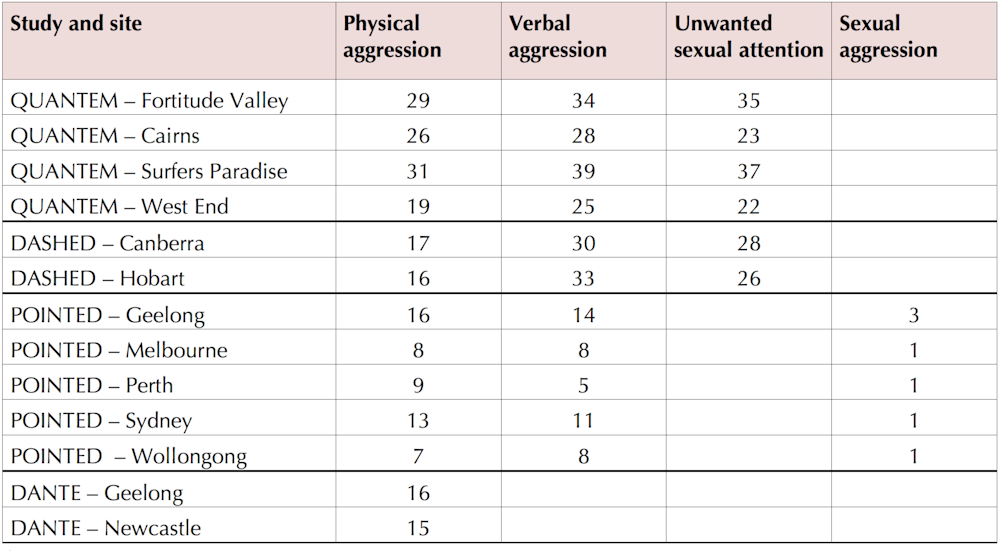
Table 1. Percentage of interviewees who report being involved in aggression in and around night-time entertainment precincts in the previous three months. QUANTEM final report, Author provided

Female patrons reported experiencing more of all types of aggression than men across all precincts. The next article in this series highlights the worrying number of women who experience unwanted sexual attention while out.

To measure the impact of the 2016 policy changes on alcohol consumption, illicit drug use and aggression, our research teams conducted street intercept surveys on Saturday nights in Fortitude Valley (Brisbane), Surfers Paradise and Cairns between 2016 and 2018. All participants were breathalysed. Every fifth person was invited to participate in a saliva drug swab.

Across the precincts, 4,401 people – 57% of them male – completed surveys.

Blood alcohol concentration (BAC)

Half of patrons’ blood alcohol concentration (BAC in g/dL) readings were over 0.077 (the median value, with a range of 0.000-0.300) in Fortitude Valley, 0.086 (range 0.000-0.290) in Surfers Paradise and 0.087 (range 0.000-0.289) in Cairns. The highest reading, 0.300, is six times the legal driving limit.

These median BAC levels are much higher than other, previously studied cities. The results highlight the challenges of achieving change in Queensland’s drinking culture.
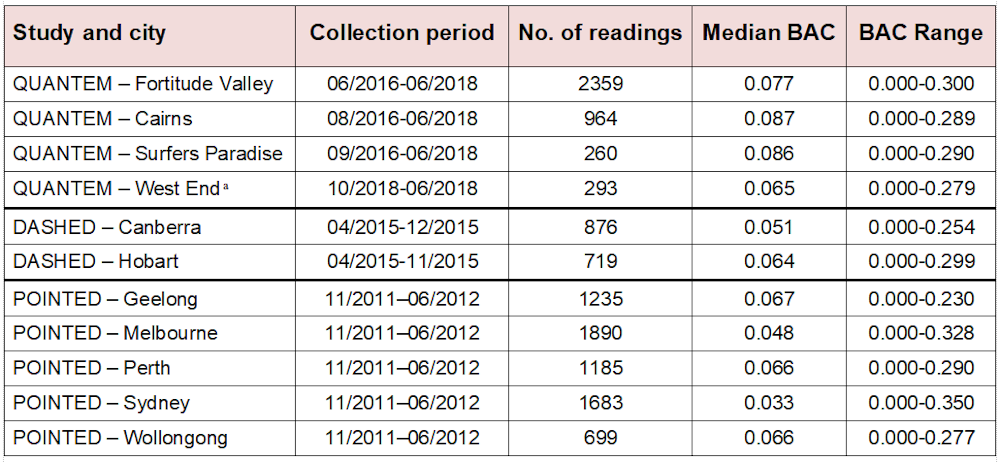
Table 2. Patrons’ median blood alcohol concentration (BAC in g/dL) and range of readings. QUANTEM final report, Author provided

Interestingly, most patrons are more drunk than they think they are. Before undertaking a breath test patrons were asked to guess their level of intoxication. For example, in Cairns, patrons’ median guess of their BAC reading was 0.070, compared to the measured median of 0.087.

Pre-drinking

High alcohol consumption when going out to night-time entertainment precincts includes pre-drinking (drinking at home before going out; also known as pre-gaming, pre-partying or pre-loading in other countries). As our research teams have documented since 2012, pre-drinking has continued to increase.

With 84% of all patrons reporting pre-drinking before going out, Queensland shows higher levels than in most other previously studied cities.

Overall, male patrons drank significantly more than female patrons when pre-drinking. In Fortitude Valley, though, female patrons were significantly more likely to pre-drink than males.


Read more: Women’s alcohol consumption catching up to men: why this matters


It’s a common belief that patrons choose to pre-drink to avoid buying more expensive drinks while they’re out in bars or clubs. But we found patrons who reported pre-drinking were more likely to drink more heavily across the night. They also reported drinking for longer than those who did not pre-drink.

Our report also shows the rate of pre-drinking across the precincts remained mostly stable in the two years after the TAFV policy was introduced in 2016. This suggests it did not affect rates of pre-drinking.

Illicit drug use

Rates of self-reported illicit drug use varied between precincts, from 13% of patrons in Fortitude Valley to 25% of all patrons in Surfers Paradise.

Ecstasy was the most commonly used illicit substance reported by patrons (5.5%), followed by cannabis (4%).

Among those who completed saliva drug swabs, the most commonly detected substances were amphetamines in Fortitude Valley and Cairns. In Surfers Paradise, however, it was methamphetamine; with 23.5% of patrons interviewed in Surfers Paradise testing positive for the substance.

Although rates of illicit drug use fluctuated in the two years after the TAFV policy was introduced, overall rates remained largely stable. This indicates the policy did not result in a clear increase or decrease in illicit drug use.


Read more: Fact check: only drugs and alcohol together cause violence


So what does it all mean?

Historically, Queensland has high levels of harmful consumption of alcohol, especially in high-risk groups. Around 46% of Queenslanders have exceeded single-occasion risk guidelines in the past year, higher than in New South Wales and Victoria.

There has been significant investment in education campaigns across social media and in schools. Despite this, Queenslanders continue to show hazardous levels of alcohol consumption, illicit drug use and experiences of aggression.

Changing cultural patterns relating to pre-drinking and alcohol-related harms will not be easy. Previous research suggests further tightening of licensed venues’ trading hours will help. Our report recommendations include introducing a minimum unit price on alcohol and promoting low-risk drinking guidelines at all points of sale across Queensland.

Our report also recommends trialling live music early in the night to try to bring people into entertainment districts earlier.

Despite the promising results of government policy efforts to date, our evaluation suggests the work to reduce alcohol-related harm across Queensland is not finished.


Read more: FactCheck: can you change a violent drinking culture by changing how people drink?


ref. Queenslanders are among our heaviest drinkers on nights out, and changing that culture is a challenge – http://theconversation.com/queenslanders-are-among-our-heaviest-drinkers-on-nights-out-and-changing-that-culture-is-a-challenge-121115

Adani beware: coal is on the road to becoming completely uninsurable

Source: The Conversation (Au and NZ) – By John Quiggin, Professor, School of Economics, The University of Queensland

The announcement by Suncorp that it will no longer insure new thermal coal projects, along with a similar announcement by QBE Insurance a few months earlier, brings Australia into line with Europe where most major insurers have broken with coal.

US firms have been a little slower to move, but Chubb announced a divestment policy in July, and Liberty has confirmed it will not insure Australia’s Adani project.

Other big firms such as America’s AIG are coming under increasing pressure.

Even more than divestment of coal shares by banks and managed funds, the withdrawal of insurance has the potential to make coal mining and coal-fired power generation businesses unsustainable.

As the chairman and founder of Adani Group, Gautam Adani, has shown in Queensland’s Galilee Basin, a sufficiently developer can use its own resources to finance a coal mine that banks won’t touch.


Read more: Echoes of 2008: Could climate change spark a global financial crisis?


But without insurance, mines can’t operate.

(Adani claims to have insurers for the Carmichael project, but has declined to reveal their names.)

Why are insurers abandoning coal?

By the nature of their business, insurers cannot afford to indulge the denialist fantasies still popular in some sectors of industry. Damage caused by climate disasters is one of their biggest expenses, and insurers are fully aware that that damage is set to rise over time.

Even so, a sufficiently hard-headed company might choose to work both sides of the street – continuing to do business with fossil fuel companies, while also writing more expensive insurance against climate damage.

The bigger problem insurers face is the risk of litigation holding fossil fuel companies responsible for climate-related damage. For the moment, this is a potential rather than an immediate risk.

As US insurer AIG, yet to announce a divestment policy, has observed:

Based on our monitoring, while the overall volume of litigation activity has increased, past litigation seems to have largely been unsuccessful on numerous grounds including difficulties in determining and attributing fault and liability to a particular company, and the judiciary’s deference to the political branches of government on questions relating to climate change.

Recent development suggest these difficulties will be overcome.

It’s becoming easier to finger climate culprits…

Until recently, the most immediate problem facing potential litigants has been demonstrating that an event was the result of climate change as opposed to something else, such as random fluctuations in climatic conditions.

Scientific progress on this “extreme event attribution problem” has been rapid.

It is now possible to say with confidence that climate change is causing an increase in both the frequency and intensity of extreme weather and weather-related events such as extreme heatwaves, drought, heavy rains, tropical storms and bushfires.

The Bulletin of the American Meteorological Society has highlighted three extremes in 2016 that would not have occurred if not for the added influence of climate change:

  • a persistent area of unusually warm water that lingered off the Alaskan coast, causing reduced marine productivity and other ecological disruptions

  • the extreme heatwave that happened in Asia, killing hundreds and destroying crops

  • the overall global atmospheric heat record set that year.

…and to allocate liability

The second line of defence against climate litigation that has held so far is the difficulty of imputing damage to the companies that burn fossil fuels.

While it is true that all weather events have multiple causes, in many circumstances climate change caused by the burning of fossil fuels has been a necessary condition for those events to take place.

Courts routinely use arguments about necessary conditions to determine liability.

For example, a spark from a power line might cause a bushfire on a hot, dry, windy day, but would be harmless on a wet cold day. That can be enough to establish liability on the part of the company that operates the power line.

These issues are playing out in California, where devastating fires in 2017 caused damage estimated at US$30 billion and drove the biggest of the power companies, PG&E, into bankruptcy.

As a result there has been pressure to loosen liability laws, leaving the cost of future disasters to be borne by Californians in general, and their insurers.

Lawyers will be looking for someone to sue.

Adani is a convenient target

The question facing potential litigants is whether any single company contributes enough to climate change to make it meaningfully liable for particular disaster.

Adani’s Carmichael mine provides a convenient example.

Adani says the 10 million tonnes of coal it plans to mine will produce only 240,000 tonnes of carbon dioxide, but this is semantic trickery. The firm is referring only to so-called “scope 2” emissions associated with the mining process itself.

When the coal is burned it might produce an extra 30 million tonnes of carbon dioxide, amounting to about 0.05% of global emissions.

A 0.1% share of the damage associated with the California fires is US$15 million, enough to be worth suing for. Other similarly sized mines will face similar potential liabilities.
Once a precedent is established, any company in the business of producing or burning fossil fuels on a large scale can expect to be named in a regular stream of suits seeking substantial damages.

When governments are successfully sued…

The remaining line of defence for companies responsible for emissions is the history of courts in attributing climate change to decisions by governments rather than corporations.

In the Netherlands, a citizen action group called Urgenda has won a case against the Dutch government arguing it has breached its legal duty of care by not taking appropriate steps to significantly restrain greenhouse gas emissions and prevent damage from climate change.

The government is appealing, but it has lost every legal round so far. Sooner or later, this kind of litigation will be successful. Then, governments will look for another party that can be sued instead of them.

…they’ll look for someone else to blame

Insurance companies are an easy target with deep pockets. Despite its hopeful talk quoted above, AIG would find it very difficult to avoid paying up if Californian courts found the firms it insured liable for their contributions to a climate-related wildfires or floods.

This is not a message coal-friendly governments in the US or Australia want to hear.

But the decision of Suncorp to dump coal, just a couple of months after the re-election of the Morrison government, makes it clear that businesses with a time horizon measured in decades cannot afford wishful thinking. They need to protect themselves against what they can see coming.


Read more: Explaining Adani: why would a billionaire persist with a mine that will probably lose money?


ref. Adani beware: coal is on the road to becoming completely uninsurable – http://theconversation.com/adani-beware-coal-is-on-the-road-to-becoming-completely-uninsurable-121552

How Indigenous fashion designers are taking control and challenging the notion of the heroic, lone genius

Source: The Conversation (Au and NZ) – By Alexandra Crosby, Senior Lecturer, Design, University of Technology Sydney

Indigenous Australians have influenced modern Australian dress since first contact. From possum skin cloaks and booka kangaroo capes to shell necklaces in Tasmania, Europeans have been fascinated with Indigenous materials, skills and aesthetics. They have stolen, purchased, borrowed and worn them for more than 200 years.

In turn, Indigenous Australians have at times enjoyed wearing soldiers’ red jackets as battle spoils and possibly mocked the Europeans by wearing their top hats cockily in the early streets of Sydney.

William Barak, Figures in possum skin cloaks, 1898. Wikimedia Commons

Later, as First Australians were dispossessed from their lands and herded into reserves and missions, clothing was imposed on them, ranging from shapeless “mother hubbard” dresses for women to shabby but respectable woollen two-piece suits for men.

Traditional dress practices, along with ceremony, language and music-making, were often banned by the colonisers. Missionaries often taught western-style leatherwork to men and needlecraft to women – yet powerful hybrids of self-determined dress also emerged, expressing subversive gestures and quiet resistance.

In the mid 20th century, missionary nuns in Far North Australia began to allow Indigenous women to craft their own textiles. Brightly coloured fabrics were the result, with unusual combinations of motifs. As Indigenous Art Centres were developed across Australia from the 1970s, mostly in remote communities, the fertile hybrid of painting and textile design generated wholly new looks – leading to the Indigenous textile revolution.

For some time, Indigenous Australian art was often seen as the future of a distinctively Australian design, as evident in the 1970s energy of Jenny Kee and Linda Jackson, but on the whole, Indigenous design was not recognised in its own right. This is now changing – Indigenous fashion design today is being shaped by First Nations people at every level.

From Country to Couture: Art Centre: Bula’bula Aboriginal Art Corporation. Designer: Julie Shaw, MAARA Collective. Dylan Buckee

Last weekend, the Darwin Aboriginal Art Fair was held on Larrakia Country. For the second year in a row, a major fashion parade more akin to a performance filled Darwin’s large Convention Centre. The fashion event From Country to Couture, held on 7 August, showcased fashion and textile design. But there was a very big difference from the way such a parade would have appeared in the 1980s or even the 1990s.

Indigenous Fashion is about a new framing of self-determination. From Country to Couture was designed, coordinated, produced, curated and mobilised from wholly Indigenous standpoints. This was apparent in many striking ways – from the inclusion of Indigenous models, to the deep strains of a “black power” music track.

Artist: Kaiela Arts Shepparton. Designer: Wendy Crow. Collection: Yurri Wala Kaiele- Fresh Water River. Dylan Buckee

This year’s creative director of the event was Grace Lillian Lee, whose own designs are in major collections including the Museum of Applied Arts and Sciences (Sydney). Grace also leads a project called First Nation Fashion + Design which nurtures relationships between Indigenous artists and the fashion industry. Lee notes that she is “empowering black women and men to have their voices in the fashion space, which doesn’t always have to be overtly political, and can just be beautiful, and a lot of fun”.

Lee worked with dozens of artists, mainly from remote Indigenous Art Centres. Textile approaches ranged from silkscreen, batik, weaving, natural dying, digital printing, and embroidery. Some of these collaborations had the energy of new experiments, and others are ongoing.

The anniversary collection of Tiwi clothing label Bima Wear, in collaboration with Clair Helen celebrated 50 years of the women’s creative enterprise. The designs worked with the quintessential geometric patterns of Bima in bold combinations. The message was as much about ethical, community-led industry as it was about beautiful textiles and clothes.

Bima Wear artists. James Taylor

Fashion has always been collaborative. It relies on the varied skills of textile designers, manufacturers, hidden hands or makers (petits mains in French), stylists, marketers, photographers, distributors, as well as designers. Yet since the late 18th century, the idea of fashion has been generated around one powerful individual – the high fashion designer.

Indigenous fashion challenges this focus on hero designers – many of whom are men in western society. Based on deep community engagement, it challenges the conventional understanding of the fashion designer as sole, individual author and draws on the talents of large numbers of women.

As much a cultural performance as a fashion parade, Lee’s Darwin event featured a set and a narrative of smoking, burning, and regeneration to thread the six collections together, interspersed with dance performances by Luke Currie-Richardson and Yolanda Lowatta.

From Country to Couture highlighted how the success of the textile design movement in remote Indigenous communities has shaped high-end fashion in Australia. But it also signalled a new way forward, grounded in community relationships, for Indigenous fashion design.

ref. How Indigenous fashion designers are taking control and challenging the notion of the heroic, lone genius – http://theconversation.com/how-indigenous-fashion-designers-are-taking-control-and-challenging-the-notion-of-the-heroic-lone-genius-121041

Australia – It’s time whistleblowers had better protection

Source: The Conversation (Au and NZ) – By A J Brown, Professor of Public Policy & Law, Centre for Governance & Public Policy, Griffith University

Never has the case for law reform to properly protect public-interest whistleblowers been so stark.

Today, the public hearings into press freedom begin, following the “seismic” raids on media organisations in early June.

A broader Senate inquiry into protecting public whistleblowing is hot on its heels. This builds on a 2017 parliamentary inquiry, which recommended reforms only partially implemented.


Read more: Dutton directive gives journalists more breathing space, but not whistleblowers


Yesterday, a crowdfunding campaign for Richard Boyle’s legal defence was launched. Boyle is charged with 66 offences for disclosing concerns about oppressive debt collection by the Australian Taxation Office in Adelaide.

What’s more, the unknown Australian Secret Intelligence Service agent “Witness K” last week pleaded guilty to exposing secrets by revealing Australia bugged Timor Leste government buildings during treaty negotiations in 2004.

Witness K’s legal advisor, Bernard Collaery – still fighting his own charges – described the prosecution as:

a very determined push to hide dirty political linen […] under the guise of national security imperatives.

The trouble is, Australian laws make it inevitable for whistleblowers to be charged whenever national security might be involved – even when, in theory, they’re intended to protect public interest whistleblowing.

Richard Boyle exposed abuse of power inside the ATO, including aggressive debt collection practices. David Mariuz/AAP

Most whistleblowers don’t go public

New research – the world’s largest on whistleblowing – demonstrates the importance of whistleblower protection to public integrity and regulatory systems like never before.

Released last week, our Clean As A Whistle study reports on whistleblowing policies in 699 public and private sector organisations, and the experience of 17,778 employees in 46 of them. This includes 5,055 who raised concerns about wrongdoing, internally and outside their organisation.
The study confirms just how rare public whistleblowing is, even though whistleblowing within organisations is the lifeblood of integrity. In fact, whistleblowing is ranked as the single most important way wrongdoing is brought to light, leading to action or reform more than 60% of the time.


Read more: Parliamentary press freedom inquiry: letting the fox guard the henhouse


In our study, 98% of whistleblowers raised their concerns internally. Only 2% went outside their organisations in the first instance. Even when whistleblowers feel forced to go outside, it is rarely directly to the media. In fact,

  • only 16% of reporters ever went to an external regulatory body
  • of the 20% of reporters who ever went public, 19% went to a union, professional association or industry body. Only 1% of whistleblowers ever went directly to a journalist, media organisation or public website.

These data show there’s hardly a crisis of leaking and external disclosure of information in Australian institutions.

As our research highlights, Australia’s whistleblowing laws need many reforms to make protections real – including a properly resourced whistleblower protection authority. But reform of public disclosure rules is especially critical.

The latest laws to protect whistleblowers don’t go far enough

The government’s latest improvements to whistleblower protection laws, for the private sector, try to recognise the principle that whistleblowers should remain protected if they need to go public.


Read more: It’s a new era for Australia’s whistleblowers – in the private sector


The improvements include a “three-tiered” approach to protect internal, regulatory and public disclosures. Pioneered in NSW, and expanded in the UK, this is now reflected in seven of Australia’s nine public sector whistleblowing laws, as well as amendments to the Corporations Act.

Legislation from Western Australia uses a simple test to determine when public whistleblowing should be protected. Protection applies wherever an agency has refused to investigate, has not completed an investigation within six months, or has investigated but failed to recommend action.

But the equivalent federal law has been crippled by blanket prohibitions on certain types of information, especially anything connected with national security or “intelligence”, since inception in 2013.

Now, these fundamental flaws in our laws are embarrassing everyone from the AFP to the government itself, triggering criminal investigations and charges against whistleblowers, irrespective of the public interest.


Read more: Four laws that need urgent reform to protect both national security and press freedom


Punishment for revealing any intelligence information, any at all

These flaws mean fraud, corruption or criminal behaviour in any activity vaguely touched by intelligence agency functions cannot be revealed to the public, even when the same disclosure about any other agency would be protected.

The key problem is section 41 of the Public Interest Disclosure Act 2013 (PID Act). It says protection can never be given to someone who revealed “intelligence information” to the public. This is defined as anything which “has originated with, or has been received from, an intelligence agency”.

It doesn’t matter how grievous the wrongdoing was – or even that revealing it would not actually harm any security or intelligence interests. If it is connected in any way to the agency, the whistleblower will still be punished.

The same is true of the poorly-named exclusion of “inherently harmful information” from disclosure under sections 121 and 122 of the Criminal Code.

Contrary to its name, the information excluded from whistleblower protection doesn’t necessarily need to be harmful. Instead, it refers to any information with security classification, or, like the PID act, any record “obtained by, or made by or on behalf of” an intelligence agency.


Read more: Explainer: what are the media companies’ challenges to the AFP raids about?


The inappropriateness of these blanket exclusions was vividly confirmed last week. Peter Dutton directed the AFP to only investigate secrecy breaches by journalists when the case includes:

a harm statement indicating the extent to which the disclosure is expected to significantly compromise Australia’s national security.

But why is this “harm test” not already the basis of the law in the first place?

Unless we extend the protections applying to public whistleblowing, we cannot expect the public to take the rest of our whistleblowing regimes seriously. And the effect will be chilling on all reporting of wrongdoing on which public integrity daily depends.

ref. From Richard Boyle and Witness K to media raids: it’s time whistleblowers had better protection – http://theconversation.com/from-richard-boyle-and-witness-k-to-media-raids-its-time-whistleblowers-had-better-protection-121555

To restore trust in government, we need to reinvent how the public service works

Source: The Conversation (Au and NZ) – By Rod Glover, Professor and Director, Monash Sustainable Development Institute, Monash University

Around the world, the most informed and effective public servants are changing the way they develop policy and services. Australian public servants are eager to do the same, but their leaders are not supporting them to do so.

This is the key message from our new research on innovation in the public service, conducted for the Australian and New Zealand School of Government (ANZSOG).

With the final report of the independent review of the Australian Public Service by former Telstra CEO David Thodey expected to be published any day, Prime Minister Scott Morrison has signalled the need for a fundamental shake-up of the public service to improve the implementation of policies and strengthen accountability.

The prime minister is right to stress the performance of the public service. Concerns that it has lost capability and confidence in recent years are widespread, and important public outcomes are not being met.


Read more: Australia’s public servants: dedicated, highly trained … and elitist


This struggle to deliver solutions to crucial public challenges, such as tackling greenhouse gas emissions or reducing Indigenous incarceration rates (the highest for any people in the world), helps explain why trust in Australian government is at an all-time low. Fewer than 41% of citizens are satisfied with the way democracy works, a decline from 86% in 2007.

To avoid making this worse, our leaders need to make sure they do not strip the public service of its ability to advise governments wisely and truthfully, and resist relying excessively on private sector consultants for solutions to public problems.

If Morrison wants a more effective public service, he instead needs to focus on investing in talent and letting the creative thinkers in the service advance innovative ideas that improve people’s lives.

Our governments also need to better understand public problems and how communities experience them – a challenge we can meet with better use of data-driven and participatory practices.

The findings of our research

Our report’s world-first survey of nearly 400 public servants shows that public servants are eager to become innovative public problem solvers, or what we call “public entrepreneurs”. Of the respondents who were not aware of specific innovation skills, for example, two out of three wanted to learn more about them.

The skills such public servants possess are specific and concrete. They know how to define actionable and specific problems. They consult data, and design effective solutions in partnership with the public. Above all, they recognise that we cannot be as smart alone as we are together, so they collaborate.

Our survey sets out nine specific skills – such as data anaytics, behaviour change and systems thinking – that make up a 21st century toolkit for public problem solving. We believe this toolkit is the strongest response yet to concerns about silo mentalities and risk aversion in the public service.


Read more: Grattan on Friday: Morrison can learn a lot from the public servants, but will he listen?


Such tools are powerful. For instance, the city of New Orleans used data analytics to reduce its murder rate by 20% in one year. However, we argue against over-hyping any one method, as they are most powerful when used in combination.

Along with this new mindset comes a need to rethink how these skills are taught. Our analysis of the best public sector training programs from around the world suggests a need for more online learning, flexible and self-paced formats, and hands-on coaching in problem-solving.

Another important change to implement here in Australia: learning how to work smaller and think bigger.

For instance, instead of researching and planning a project, policy or service from start to finish, some practitioners are breaking down big projects into smaller chunks. They develop projects incrementally and assess progress frequently, assessing the success of a small product before it is rolled out on a larger scale.

Public servants also need to make better use of digital technologies to amplify the impact of these new approaches. This enables conversations with the community about both problems and solutions, which leads to better-informed and more effective policy-making.

Innovations that are making a difference

To date, the adoption of these innovative ways of working in the public sector is not widespread in Australia.

The structures, incentives and cultures within the public sector are not set up to encourage innovation. In our interviews, middle management was pinpointed as a key blocker to innovation, while only 40% of respondents said that senior management was willing to take risks to support new ideas. The problem is pervasive.

But there are signs of hope, such as Australia’s early experiments with policy labs and mission-driven ways of working to tackle important problems.

For example, Victoria’s Transport Accident Commission and its many partners have employed a host of innovations to prevent injuries, save lives and optimise recovery for accident victims. These have included seat belt legislation, new road design, vehicle safety standards, case-managed rehabilitation, speed cameras and sophisticated advertising campaigns. Such initiatives have together reduced the road fatality rate in the state by 85% over the past 50 years.


Read more: Dealing with ministerial advisers: a practical guide for public servants


The scale of the changes needed is not small. Indeed, Australia may even require an innovation reset, through the creation of a new institution (like Nesta in the UK or Sitra in Finland) dedicated to advancing public problem-solving.

The consequences of inaction cannot be more serious. Although Australia’s public sector is generally well-functioning, there is a creeping crisis of effectiveness in the sector that must be addressed.

This radical re-imagining of the role of government and the public servant will be a defining challenge for the Thodey review and all Australian governments.

ref. To restore trust in government, we need to reinvent how the public service works – http://theconversation.com/to-restore-trust-in-government-we-need-to-reinvent-how-the-public-service-works-121634

Red tape in aged care shouldn’t force staff to prioritise ticking boxes over residents’ outcomes

Source: The Conversation (Au and NZ) – By Joachim Sturmberg, Conjoint Associate Professor of General Practice, University of Newcastle

Last week’s hearings at the aged care royal commission in Brisbane looked at regulation in aged care. While rules and regulations are designed to safeguard residents, bureaucratic “red tape” also contributes to the failings in aged care.

The fear among nursing home staff of failing a review visit by an Aged Care Quality and Safety Commission surveyor has been known to shift the focus from care for residents to meeting paper trail requirements.

The best outcome for aged care residents and their families would be new reporting requirements centred on outcomes rather than processes. Their primary focus should be on the mediation of critical incidents – that is, looking at what caused them and how they could be prevented in future – and the maintenance of health.


Read more: Our ailing aged care system shows you can’t skimp on nursing care


How did we get here?

The crisis in the aged care sector has emerged over time. At least in part, systemic problems in organisations arise from interactions among its key players. These interactions must be aligned to achieve its common goals.

But the key players in the aged care system pursue divergent agendas. Regulators focus on process adherence, while staff struggle with their limited capacity to manage the complex needs of residents. Meanwhile, proprietors focus on economic viability.

The prevailing approach of dealing with the problem of a particular key player in isolation will not solve the problems of aged care as a whole.

Governance and accountability

Our research suggests the need for a major culture shift in the aged care system.

Around the world, governments are being urged to put less emphasis on process measurement and more on outcome transparency.


Read more: We’ve had 20 aged care reviews in 20 years – will the royal commission be any different?


Peter Drucker, a well-known management consultant, educator and author, once said “management is doing things right; leadership is doing the right things”.

Ticking the boxes of a protocol to demonstrate “regulatory compliance” – that is, doing things right – is no longer an option on its own. Residents and their families expect staff to be attentive to residents’ changing physical, emotional, social and cognitive needs; that is, doing the right things.

These insights tell us the aged care system needs to be redesigned.


Read more: Nearly 2 out of 3 nursing homes are understaffed. These 10 charts explain why aged care is in crisis


What would this look like in practice?

Let’s consider two common aged care problems – falls and diabetes – whose management is significantly influenced by the chosen accountability framework. The differences between an outcomes-based approach (that is, adapting care to problems in their context) and a process-based approach (adhering to a protocol) are stark.

The extent to which staff in aged care are required to focus on documentation may detract from their capacity to care for residents. From shutterstock.com

The first example: a resident has a fall. Rather than only assessing her for injuries and vital signs (as per protocol), staff would also assess potential reasons for the fall – for example, lack of mobility, pain, low blood pressure, or polypharmacy (taking multiple prescription medications at once) – and involve allied health professionals in preventive and rehabilitative care. This could include muscle strengthening exercises, gait and balance retraining, pain management and medication review. These are measures that could reduce the likelihood of the patient falling again, thereby improving her outcomes.

And let’s take a resident with normally stable diabetes, who one day records an elevated blood sugar reading. Rather than just giving him more insulin, staff would also assess potential underlying reasons for the elevated reading. These could include loss of appetite, an infection, or an episode of delirium.

The royal commission should do many things, but adding red tape isn’t one of them

Increasing frailty and/or significant memory decline are the main reasons for admission to an aged care facility. These people are particularly vulnerable as their health changes frequently and rapidly.

Being bogged down by regulatory ritualism reduces the time staff have available to spend on residents’ physical, social, emotional and cognitive needs.


Read more: Don’t wait for a crisis – start planning your aged care now


True accountability in aged care is achieved by demonstrating how the provided care has impacted a resident’s well-being. In that regard, the Aged Care Quality and Safety Commission should provide leadership and primarily act as an educator, helping facilities to become learning organisations. If an aged care facility fails to “learn and improve”, then sanctions and penalties become necessary.

More bureaucracy would only serve to perpetuate the current crisis, and would fail those residents and families who have suffered from the current failings in the sector.

Len Gainsford, a former adjunct research fellow in accounting & governance at Swinburne University of Technology, contributed to this article.

ref. Red tape in aged care shouldn’t force staff to prioritise ticking boxes over residents’ outcomes – http://theconversation.com/red-tape-in-aged-care-shouldnt-force-staff-to-prioritise-ticking-boxes-over-residents-outcomes-121561

Peace with nature: helping former Colombian guerrilla fighters to become citizen scientists

Source: The Conversation (Au and NZ) – By Jaime Gongora, Associate Professor, Animal and Wildlife Genetics and Genomics, University of Sydney

Colombia is the second most biodiverse country in the world with more than 56,000 recorded species, some 9,000 of which are unique. However protecting and researching this natural treasure has been extraordinarily difficult during Colombia’s nearly 55 years of internal conflict.

Since the 2016 peace agreement 21 scientific bio-expeditions have been carried out, most in areas that were previously conflict zones. This has led to the discovery of more than 150 new animal and plant species.


Read more: Ecotourism could be making animals less scared, and easier to eat


This flowering of research offers a new opportunity to the thousands of ex-combatants now looking for productive and peaceful work. We worked with former guerrillas in our project GROW-Colombia to train them to protect Colombia’s biodiversity.

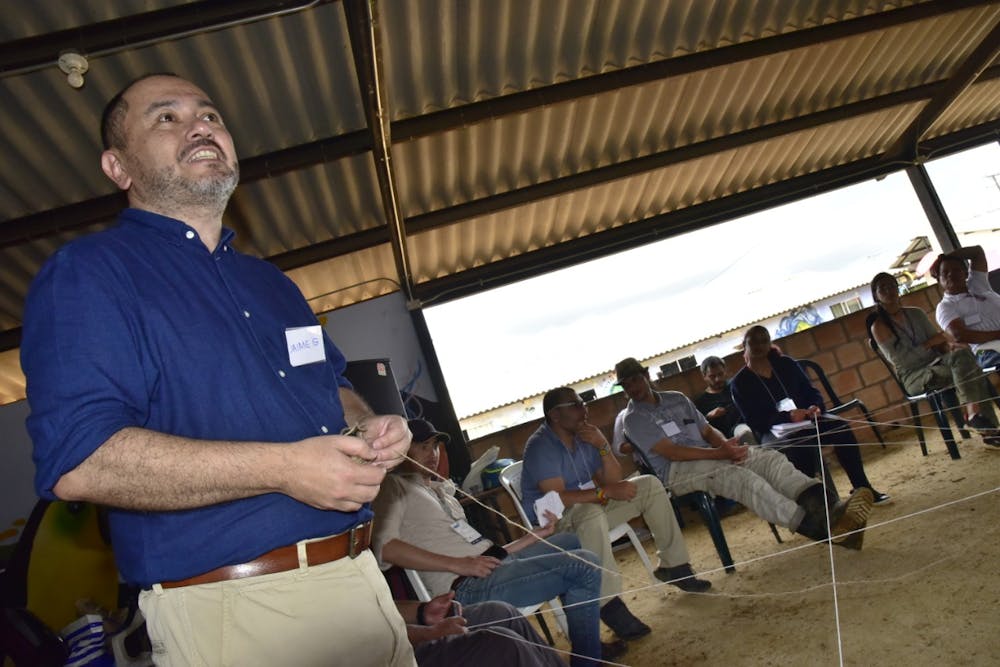
Jaime Gongora led workshops with former guerrillas on the promise of biodiversity. Mario Murcia, Author provided

Who are the ex-combatants?

A huge effort to reincorporate these combatants back into civilian life is under way. Paramount is finding suitable jobs, to rebuild the country and offer stable wages.

A recent census found the former Revolutionary Armed Forces of Colombia (the FARC-EP) consists of some 10,000 people. Ranging between their 20s and 40s, around three-quarters are men.

Around 40% of these ex-guerrillas have experience in environmental conservation, and 70% have agricultural skills. Some 10% would like to work in veterinary, aquaculture and animal production fields, 60% in agriculture, and 84% in terrestrial and river environmental restoration.

There is also increasing interest in ecotourism in the 26 Territorial Training and Reincorporation Spaces (ETCRs) where the ex-combatants are currently based.

Their interests, the new political environment, and nearly 20 tourism initiatives in the ETCRs provide a unique opportunity to promote biodiversity as part of the peace process.

Training ex-combatants to protect biodiversity

We wanted to teach ex-FARC-EP combatants some basic conservation skills and identify the potential of nature to create sustainable business opportunities.

We started with a national workshop with the representatives of 16 ETCRs from across the country. These members reflected on their personal and scientific perceptions of the natural world, mapped ecosystems in their local areas and canvassed ecotourism projects. We then discussed the contributions they made to protecting biodiversity before the peace agreement.

One participant, Curruco* had his own farm before being displaced by the armed conflict. He told us,

our participation in the workshops is evidence of our commitment to peace. We protected the fauna and flora during the conflict.

We then used case studies to teach our workshop members how to take inventory of the species in a given area, explored tourism of nature and conservation in Colombia and discussed business models for the use of biodiversity in ecotourism enterprises.

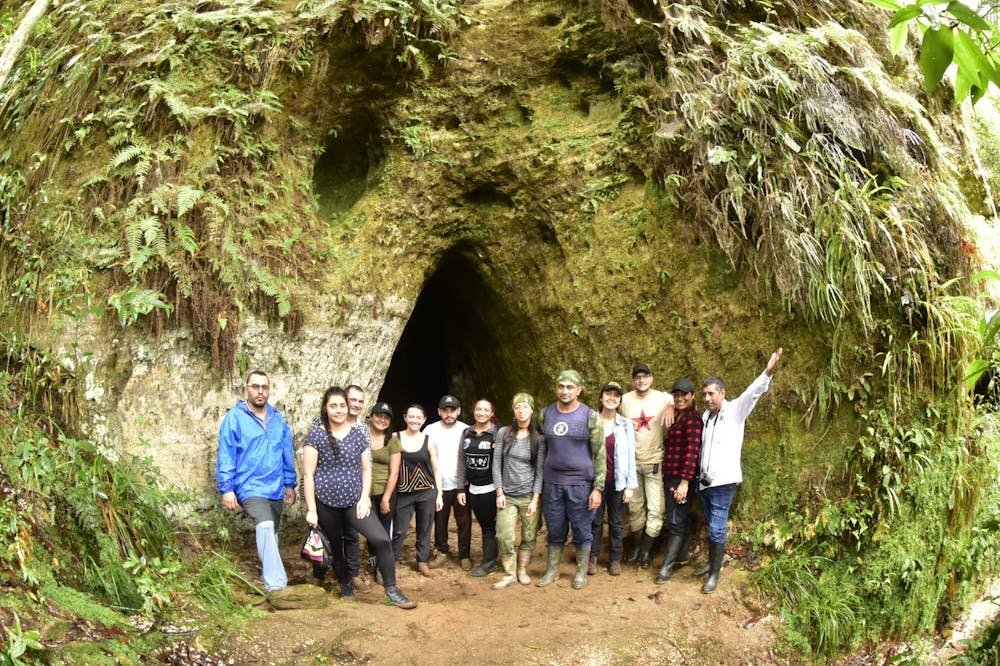
Some participants explore caves. Mario Murcia, Author provided

One of the most interesting parts for the ex-combatants was learning techniques for making inventories. We used teaching stations where they learnt about indirect surveys, for example using footprints and faeces, and direct observation and capture. We covered the use of binoculars, trapping cameras, tablets and mobiles, access to taxonomic identification resources and some basic non-invasive sampling methods.

One of the participants, Solangie, had a remarkable knowledge of the Amazon forest. She said:

I enjoyed all the content of the training but I like the bird sightings and plant cataloguing the most because during my time as a combatant we were living among the fauna, including tapirs, reptiles, frogs and butterflies.

I was impressed with the training about plants because in our time in the jungle we used plants as medicine and health treatments.

We then used these skills in practical field work to collect and inventory plants, sight birds and explore caves. The resulting notes and photographs were documented with iNaturalist, an online repository considered a major drawcard in engaging the public in science around the world.

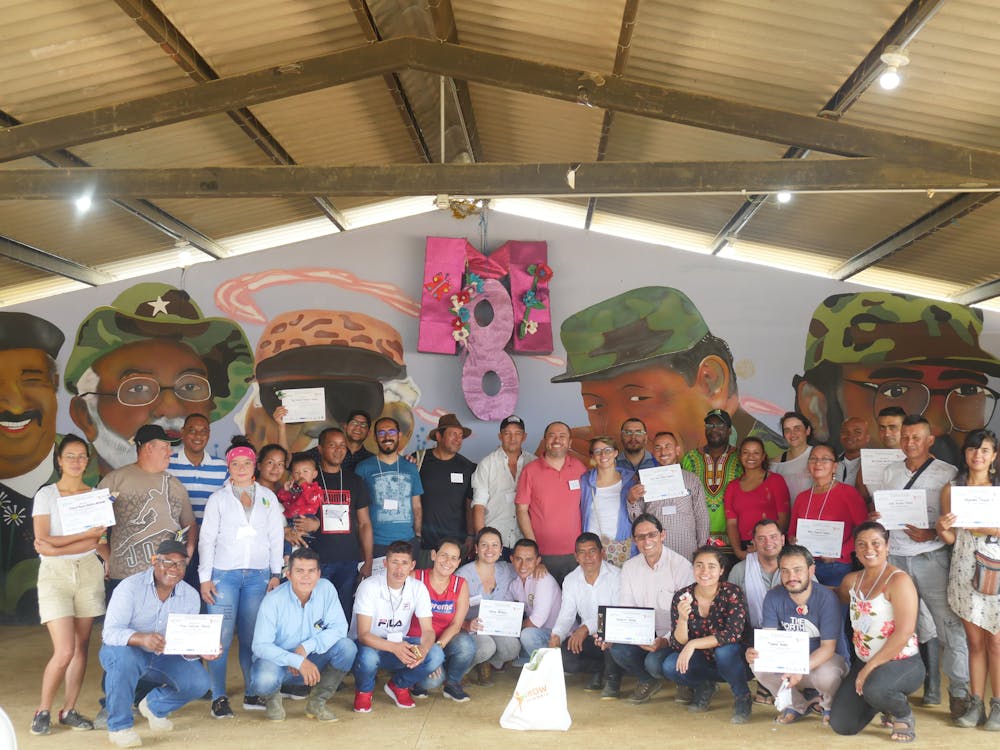
Participants graduated with new knowledge, skills and contacts in research and business. Jaime Gongora, Author provided

Turning knowledge into business

We also wanted to give our participants a clear idea of how this knowledge could become profitable work. We hosted a business network forum, and 60 meetings were organised so FARC-EP ex-combatants could meet representatives of the major Colombian research institutions and agencies and gain support for their ecotourism and biodiversity initiatives.

Yesenia*, a mother of two, joined FARC at a young age after the paramilitary killed her parents. During the research, she said:

If we want this peace process to succeed it will require the continued involvement of the various components of society, including scientific institutions and universities.

Our work established two levels of organisation: a national biodiversity committee of ETCR representatives from across the country, and a committee of government and non-government institutions and agencies to coordinate and support their biodiversity and ecotourism initiatives.

All of this may sound relatively simple, but this is new and life-changing knowledge for people who were part of an armed conflict, fighting in the jungle against the government.


Read more: Violence and killings haven’t stopped in Colombia despite landmark peace deal


One of us, Jaime, lived part of his life under this conflict, and found it very moving to see how the climate of trust has been changing. While there are, of course, considerable challenges, this was unimaginable before the peace agreements.


The authors would like to acknowledge the support of the University of Amazonia, Research Institute of Biological Resources Alexander Von Humboldt, Sinchi Amazonic Institute of Scientific Research, COLCIENCIAS-Colombia BIO, United Nations Development Programme, National Natural Parks Colombia, Vice-Ministry of Tourism, Social Economies of the Common, Agency for Reincorporation and Normalisation, Verification Mission of the United Nations, British Embassy in Colombia, ETCR participants, the GROW Colombia team at Earlham Institute, The University of East Anglia and The University of Sydney.

ref. Peace with nature: helping former Colombian guerrilla fighters to become citizen scientists – http://theconversation.com/peace-with-nature-helping-former-colombian-guerrilla-fighters-to-become-citizen-scientists-121695

Australia has too few home-grown experts on the Chinese Communist Party. That’s a problem

Source: The Conversation (Au and NZ) – By Euan Graham, Executive Director, La Trobe Asia, La Trobe University

Concerns are growing about Chinese influence on Australian universities. Some universities are reviewing research partnerships with Chinese state-owned companies after the ABC’s Four Corners revealed links to technology being used by the Chinese Government to carry out mass human rights abuses against the Uygur ethnic minorities in Xinjiang.

There are also reports the attorney-general’s department is looking into whether activities conducted by Confucius Institutes at Australian universities potentially fall foul of Australian’s foreign interference laws.

And the protests in Hong Kong against China’s controversial extradition laws have spilt over onto Australian university campuses, leading to scuffles between pro-Hong Kong and pro-China activists.

It’s a tough balancing act for Australia: being alert to the Chinese Communist Party’s potential for domestic influence and interference, while maintaining a relationship critical to our economic and strategic interests.

In March, foreign minister Marise Payne announced a A$44 million National Foundation for Australia-China Relations to “turbo-charge our national effort in engaging China”.

If Australia wants to understand China as a foreign policy partner and strategic actor, some of that effort should be directed at improving our collective understanding of the ruling Chinese Communist Party (CCP): its structures, its leaders and its military wing, the People’s Liberation Army (PLA).

Such expertise is spread dangerously thin across Australia’s universities and, to a lesser extent, think tanks.

The CCP calls the shots in China, internally and externally. Unless we understand the Party’s objectives, how its leaders think and make decisions, our policies are likely to come up short. Australia must develop the intellectual acumen to see the world through China’s leaders’ eyes to manage the relationship on its own terms.

The knowledge gap

During the Cold War, Western governments recognised a strategic requirement to better understand the Soviet Union. They encouraged universities to develop specialist language skills and expertise on the Communist world.

Australia’s location, its alliance with the United States and its reliance on China for trade, mean knowledge of the party leadership’s machinations matters more to Australia than Cold War Kremlinology ever did.

Chinese language is widely taught in Australia, including through Confucius Institutes. But China Studies, as a discipline, is not currently structured or incentivised to develop expertise on China’s ruling CCP or the PLA.


Read more: Explainer: what are Confucius Institutes and do they teach Chinese propaganda?


Since the mid-1990s, Australia’s empirical research expertise on China (and Asia more broadly) has declined.

Few Australian universities offer courses on Chinese politics, while those that do tend to be historically focused. The study of Chinese culture, literature and philosophy and other subjects commonly featured in the curriculum of China Studies, is perfectly legitimate.

But China-literate expertise in the contemporary political and security fields has atrophied to such a point that it needs to be addressed head-on, through active partnership between universities and government.

The knowledge gap is not only impoverishing the public debate. Universities are also incubators for Australia’s next generation of China experts who will populate government, business and academia itself.

This is a sensitive point, but universities should resist the temptation to hire China-trained academics as a quick fix to plug the expertise gap. Chinese-born Australians should of course be welcomed if they have received a liberal education outside of China. The language skills and knowledge they bring are invaluable.

The Chinese Communist Party calls all the shots in China. Roman Plipey/AAP

But Australia needs a cohort of homegrown analysts, with the ability to read source material in Mandarin, who are motivated to pursue a career here, whether in academia or in government.

A healthy public discourse requires strategists, linguists, economists, historians and political scientists to contribute, as each sees the “problem” from a different angle. Moreover, the China debate is too important to leave exclusively to country experts, some of whom have a vested interest in preserving their access and networks in the PRC.

Academia is not playing the role it could and should to raise Canberra’s policy game and elevate the public debate on China. The government should explicitly identify this as a knowledge gap for Australian universities to fill.

How should the government do this?

The focus of these efforts should be on investing in individuals rather than on setting up new centres. An external review completed last year judged that the Australian Centre on China in the World, set up in 2010 at the Australian National University and the recipient of A$53 million in federal funding, was “faltering and cannot be said to be meeting expectations”.

This is a salutary reminder of the potential wastage of a centre-led approach.

Instead, resources should be invested in funded positions, scholarships and tied research programs to support and incentivise a new generation of China scholars specialising in CCP elite politics, the Party’s influence over foreign policy, the PLA and other designated strategic subjects, such as cross-Strait relations.

More doctoral research should be encouraged, provided there are enough qualified supervisors in academia. The government should be explicit in its riding instructions, but the conduct of research and academic appointments must be left to universities.

Resources should also be spread to ensure a pool of expertise across universities and think tanks, to avoid over-dependence on any one institution. Given Australian universities’ financial reliance on Chinese international students, a diversified approach makes sense.

This could be achieved by creating research networks that pool expertise across institutional boundaries, linking universities and think tanks, and by selecting institutions that are less susceptible to self-censorship or pressure from pro-Beijing organisations, on or off campus. Universities that rely heavily on China for student recruitment or co-funded research are most vulnerable in this regard.


Read more: Australian universities must wake up to the risks of researchers linked to China’s military


Senior officials and diplomats could do more to engage leading scholars on China, including offering regular briefings and providing guidance from the intelligence community on partnership and interference risks. China experts schooled on elite politics and the PLA can contribute directly to government intelligence assessments by challenging or refining key judgements.

Unfortunately, academic freedom cannot be taken for granted on topics deemed sensitive by the CCP such as Taiwan, Tibet, Xinjiang or even Hong Kong.

Building a cadre of China experts with the necessary language skills and knowledge to help Australia meet the complex policy challenges ahead won’t have an instant payoff. This is a long game – but a crucial one.


This is a modified extract of an article that first appeared in Australian Foreign Affairs.

ref. Australia has too few home-grown experts on the Chinese Communist Party. That’s a problem – http://theconversation.com/australia-has-too-few-home-grown-experts-on-the-chinese-communist-party-thats-a-problem-121174

Here’s why there should be no gestational limits for abortion

Source: The Conversation (Au and NZ) – By Erica Millar, Lecturer, La Trobe University

Family planning organisation and abortion provider Marie Stopes today warned that Australian women face a confusing patchwork of state-based laws and service shortages that restrict access to abortions, based on where they live.

At the centre of these inconsistent laws is the gestational cut off – the point where the pregnant person is no longer the primary decision-maker and, instead, specific criteria must be met (generally, two doctors must agree that the abortion is necessary on medical and/or social grounds).

Gestational cut-off points vary from state to state. The Australian Capital Territory has no cut off. Others are set at 14 weeks (the Northern Territory), 16 weeks (Tasmania), 22 weeks (Queensland and the bill currently under debate in New South Wales), and 24 weeks (Victoria).


Read more: After 119 years, NSW is set to decriminalise abortion. Why has reform taken so long?


Around the world, Canada has no cut off, while Ireland’s is set at 12 weeks. The bill set to be debated in New Zealand has a gestational limit of 20 weeks.

Around 13% of abortions in Australia occur after 20 weeks. About half are performed because of foetal abnormality. The other half are for a number of reasons: women who don’t menstruate regularly (because they are young, perimenopausal or on contraceptives, for example) miss early symptoms of pregnancy; abusive partners prevent women from accessing abortion services at an earlier date; relationships break down; socioeconomic circumstances change.

There’s no evidence gestational limits result in fewer second and third trimester abortions. But there is evidence that such cut-offs harm women, especially those who are already disadvantaged. They also prevent medical professionals from providing pregnant people with the best possible care.

Cut-offs are often based on foetal viability

The 24-week limit in Victoria was adopted from law in the United Kingdom. It’s based on foetal viability: the age at which an extremely premature baby can survive outside the uterus. 22-weeks is commonly considered the “threshold of viability”.

But viability is subject to medical technologies that are constantly evolving. 22-26 weeks’ gestation is considered a “grey zone”, where some foetuses have survived with major medical intervention, mostly with ongoing disabilities.

Attempts to legally differentiate “early” from “later” abortions are arbitrary, and based on the technology of the day. When applied in law, these cut-offs are likely to be subject to judicial review in the future as technology advances.

Life-saving treatment is not generally provided for babies born before 22 weeks’ gestation. Parents of babies born before 26 weeks can decide whether or not their babies receive treatment, even when there is a chance of survival.

As bioethicists Lachlan de Crespigny and Julian Savulescu argue, the discrepancy between this practice and gestational limits on abortion grants “the foetus inside a woman’s body […] a higher moral status than a newborn infant of the same gestation outside the woman’s body”.

Most Australians support women’s right to choose

Although the inclusion of gestational limits for abortion is commonly viewed as a “middle ground” between pro- and anti-choice positions on abortion, they represent a significant move towards the position of a vocal minority.

The most recent study of public opinion towards abortion in Australia found 73% of respondents believed abortion should be fully decriminalised and 57.9% agreed that “women should be able to obtain an abortion readily when they want one”.

Only 5.6% were unequivocally opposed to abortion.


Read more: One in six Australian women in their 30s have had an abortion – and we’re starting to understand why


A study from 2008 similarly concluded “a majority of Australians support laws which enable women to access abortion services after 24 weeks’ gestation”.

Leading professional health bodies also oppose gestational limits, including the Royal Australian College of Obstetricians and Gynaecologists, the Royal Australasian College of Physicians, the Australian Psychological Society, and the Public Health Association of Australia.

Cut-offs don’t reduce late-term abortions

There is a fiction circulating that an absence of legal restrictions on abortion would compel doctors to perform abortions “until birth”. The claims that, without legal oversight, women would terminate pregnancies they have carried to near term and highly trained doctors would perform such procedures are clearly untrue.

There is no evidence that legal restrictions on second and third trimester abortions reduce the number of abortions that occur later in pregnancy. In fact, based on the most recent statistics, the proportion of abortions performed after 20 weeks in Canada, which has no gestational cut off, is half that in Queensland, which has a 22 week cut off (0.66% compared with 1.34%).

The Royal Australian College of Obstetricians and Gynaecologists states that in some circumstances, it’s unreasonable for women to make a decision about termination at an earlier gestation. Second trimester ultrasounds, for example, are generally performed between 19-20 weeks’ gestation. Further testing is required when anomalies are detected, and some abnormalities are not diagnosable until much later.

When faced with a diagnosis of major foetal abnormality, even people who consider themselves anti-choice often re-evaluate their opposition to terminating a pregnancy.

Gestational cut-offs compel pregnant people (and often their partners) to make decisions without the necessary time or information that is required to comprehend complex medical conditions. This means women terminate pregnancies they would otherwise keep; they keep pregnancies they would have otherwise terminated; and they terminate pregnancies before they are emotionally and psychologically prepared to end a pregnancy that was, until that time, wanted.


Read more: It’s time to lift the restrictions on medical abortion in Australia


Cut-offs disadvantage the vulnerable

Restrictions on abortion past 20 weeks’ gestation disproportionately impact on women who are disadvantaged socially and/or geographically and those experiencing reproductive coercion and other forms of domestic violence.

Women living in rural and regional areas, for example, can experience delays in accessing the medical testing required to diagnose foetal abnormality and then further delays when accessing abortions. At later gestations, this generally involves travel to urban centres. Such delays are more onerous for women who do not have ready access to the financial resources to pay for the abortion, and associated costs such as travel, accomodation and childcare.

Only a handful of providers perform abortion post 16 weeks in Australia. This is due to a combination of factors, including laws that differentiate “early” from “late” abortions, a shortage of doctors trained to provide later gestation abortions, and the privatisation of abortion services (and withdrawal of state responsibility for providing access to abortion).

Restrictions on access to second/third trimester abortions produce a two-tiered system, where women with financial resources have access to abortion services interstate and overseas.

Aware that re-criminalising abortion in all circumstances is politically untenable, anti-abortion campaigners have increasingly focused attention on challenging the upper limit of abortion.

This focus misrepresents the practice of abortion and ignores the fact all foetuses exist within the bodies of pregnant people, and pregnant people always exist within a social space that is particular to them.

ref. Here’s why there should be no gestational limits for abortion – http://theconversation.com/heres-why-there-should-be-no-gestational-limits-for-abortion-121500

How to spot a fake review: you’re probably worse at it than you realise

Source: The Conversation (Au and NZ) – By Adrian R. Camilleri, Senior Lecturer in Marketing, University of Technology Sydney

Ever relied on an online review to make a purchasing decision? How do you know it was actually genuine?

Consumer reviews can be hugely influential, so it’s hardly surprising there’s a thriving trade in fake ones. Estimates of their prevalence vary – from 16% of all reviews on Yelp, to 33% of all TripAdvisor reviews, to more than half in certain categories on Amazon.

So how good are you at spotting fake consumer reviews?

I surveyed 1,400 Australians about their trust in online reviews and their confidence in telling genuine from fake. The results suggest many of us may be fooling ourselves about not being fooled by others.

In strangers we trust

Online consumer reviews were the equal-second most important source for information about products and services, after store browsing. Most of us rate consumer reviews – the views of perfect strangers – just as highly as the opinion of friends and family.

Trust is central to the importance of reviews in our decision-making. The following chart shows the trust results broken down by age: in general, people most trust product information from government sources and experts, followed by consumer reviews.


The chart below displays trust ratings according to website, with the most trusted sources for reviews being TripAdvisor.com.au, Google Reviews and ProductReview.com.au.

Those aged 23-38 tended to trust sites the most, and those above 55 tended to trust sites the least.


While 73% of participants said they trusted online reviews at least a moderate amount, 65% also said it was likely they had read a fake review in the past year.

The paradox of these percentages suggests confidence in spotting fake reviews. Indeed, 48% of respondents believed they were at least moderately good at spotting fake reviews. Confidence tended to correlate with age: those who were younger tended to rate themselves as better at detecting fake reviews.


In my opinion, respondents’ confidence is a classic example of overconfidence. It’s a well-documented paradox of human self-perception, known as the Dunning-Kruger effect. The worse you are at something, the less likely you have the competence to know how bad you are.

The fact is most humans are not particularly good at distinguishing between truth and lies.

A 2006 study involving almost 25,000 participants found that lie-truth judgments averaged just 54% accuracy – barely better than flipping a coin. In a study looking more specifically at online reviews (but with only a small number of judges), Cornell University researchers found an accuracy rate of about 57%. A similiar study based at the University of Copenhagen found an accuracy rate of about 65%, with information about reviewers improving scores slightly.

What we look for

So what tends to sway people’s judgement about whether a review is fake or not? My research suggests the most important attribute people look out for is “extremity” – going over the top in one-sided praise or criticism.


This sentiment is a relatively sound rule of thumb, supported by analysis. Studies suggest fake reviews also tend to:

  • focus on describing product attributes and features
  • have much fewer subjective and anecdotal details
  • be shorter than others
  • be relatively more difficult to read (probably due to fake reviewers being hired from foreign countries).

Fake reviews might also be identified by characteristics of the reviewer. Their profiles tend to be new and unverified accounts with few details and little or no history of other reviews. They will have gained very few “helpful” votes from others.


The Conversation/Author provided content, CC BY-ND

Test yourself

With all this in mind, it’s now’s time to see how good you are at spotting fake reviews with this quiz.


Chances are you didn’t do as well as you thought you would. That’s because clever fraudsters work to hide all the attributes of fake reviews outlined above.

So two final pieces of advice.

Use some technology to help. Two websites I recommend are Fakespot.com and ReviewMeta.com. In my experience, both do a good job weeding out suspicious reviews (tip: be sure to delete domain suffixes such as “.au” from the URLs you check).

Also check out multiple review sites to get second, third and fourth opinions. It is less likely a fraudster will be paying for fake reviews on every platform.

ref. How to spot a fake review: you’re probably worse at it than you realise – http://theconversation.com/how-to-spot-a-fake-review-youre-probably-worse-at-it-than-you-realise-121043

Pacific Islands Forum: What to watch out for

By Jamie Tahana of RNZ Pacific

There was a frenetic energy outside the Sir Tomasi Puapua Convention Centre on Sunday, where the finishing touches were being hurriedly put to the newly-built centre on reclaimed land here on Tuvalu’s main atoll, Funafuti.

People were sweeping the freshly-laid pavement, laying out the desks inside, finishing off the wiring. Only on Thursday was a crane out front, hoisting the flagpoles into place.

Over the weekend, dozens of people painted walls, fences and even the roads, which had newly-planted shrubs along their length. Kids were enlisted in the island-wide spruce up, too, shooing dogs off the airport runway and rehearsing their welcoming songs.

READ MORE: West Papua, climate to top agenda at Pacific Islands Forum

They’re not quite finished, but they will be by the time Tuesday comes, said Enele Sopoaga, Prime Minister of Tuvalu, as he inspected progress on Saturday.

On Tuesday, Funafuti, a slither of an atoll just south of the equator, will see its population increase by about 10 percent as delegates pour in for the Pacific Islands Forum summit, an annual meeting that brings together the leaders from every country in the Pacific, and Australia and New Zealand.

– Partner –

For Tuvalu, it’s a daunting task. Nine atolls with a population of 11,000, it’s one of the world’s smallest countries. Accommodation is tight, and extra flights have been put on, (there’s normally only three a week), to get everybody here. They’ve built new accommodation and a convention centre.

The Secretary-General of the PIF, Dame Meg Taylor, was confident: “As the priest at mass this morning said, ‘a courageous effort to host this meeting,’ and he was right.”

That’s because it’s also one of Tuvalu’s greatest opportunities. Hosting the Forum gives it an opportunity to bask in the spotlight, to highlight the issues pertinent to it. Being on the front line of climate change, Sopoaga is hoping to hammer home his country’s push for greater commitments – particularly from the region’s largest economies, Australia and New Zealand.

But this year’s forum also comes at a time when the world’s attention is drawing in, with great powers competing for a slice of the pie. There are so-called pivots, resets, uplifts and step-ups, and they’re all likely to come with open arms and wallets.

But with that comes competing interests. The United States’ interest is in large part because of its contest with the rise of China. Australia and New Zealand’s are in part because of that too, while also making up for years of neglect.

China’s coming in part to win influence and allies, but also to finally end Taiwan’s support, while Taiwan’s here to maintain that support, as most of its dwindling international allies are here in the Pacific, Tuvalu among them. The UK’s here, looking for friends in a post-Brexit world, and others are coming too.

It could also be a recipe for a testy forum, especially when the leaders meet for the day-long retreat on Thursday, highlighting a growing chasm between the island states and the western ones, (Australia, in particular), on several matters.

Climate Change

On Saturday, Sopoaga stood out the back of the convention centre and gestured towards the lagoon. “This is our biggest threat,” he said. Then, the sea was a placid blue, but the threat it poses to Tuvalu is great.

Tuvalu is one of the most vulnerable countries in the world. Its highest point is little more than four metres, its widest point about the same — a causeway at the northern end of the main island of Funafuti, scarred by sand and debris washed across every time there’s a storm or king tide.

Hire a scooter or hitch a ride to travel the length of Funafuti, (it only takes about 20 minutes), and the signs of its vulnerability are everywhere. Wilted crops, palm trees leaning, their roots exposed, the ground hollowed out by a sea nibbling at their base.

The shoreline along Tuvalu’s Funafuti Photo: RNZ Pacific / Jamie Tahana

When Cyclone Pam hit Vanuatu in 2015, Tuvalu suffered gravely. The ferocious seas whipped up by the category five storm inundated about 40 percent of the country, the government estimated. As sea levels rise, and the effects of climate change bed in, such events could become all the more frequent.

‘Save Tuvalu, save the world’

Sopoaga has made a name for himself bringing Tuvalu’s plight to the world, he’s been one of the key figures at climate talks, urging countries to commit to reducing carbon emissions, to increase their climate financing, and, in some cases, to even acknowledge the threat it poses. “Save Tuvalu, save the world,” has been his slogan.

Now, the leaders of the Pacific are coming to Tuvalu. The hall where the Presidents and Prime Ministers of the 18 countries will retreat to sits near that washed over causeway, in sight of the island’s narrowest point. There’s a reason for that.

“We have a big job to do this week. The job is to review where we are? Where do we want to go to, and how are we going to get there?” he said.

This year is the 50th Pacific Islands Forum, and Sopoaga – who is about to take over as chair, (for now, Tuvalu has elections on 9 September) – is looking to make climate change the key focus. He wants strong commitments in this year’s communiqué, to follow on from last year’s summit in which the Boe Declaration declared climate change the region’s single greatest security threat, and for a united statement to take to a major UN climate summit next month.

And that could bring some heat on the region’s two largest economies: New Zealand and Australia, both in the midst of trying to reinvent their relationships with their respective Pacific resets and Pacific step-ups.

NZ and Aus 

New Zealand’s Prime Minister, Jacinda Ardern, will arrive on Wednesday, ready to tout her coalition government’s policy to cut carbon emissions, and its increased aid and support for climate diplomacy. The Pacific, however, is also aware that New Zealand’s emissions continue to rise, and will be asking whether what’s been announced is enough.

But she’ll get off lightly compared to Australia’s Scott Morrison, the recently re-elected conservative Prime Minister, who once famously raised a lump of coal in parliament, to the ire of Pacific leaders including Sopoaga.

Australia has come under fire from several Pacific countries for its climate stance in the lead-up to the forum, both in veiled criticism and explicit statements. Just in the past month, some Pacific leaders have issued a communiqué calling for it to end its support for coal and to avoid trying to water down climate commitments, as happened at last year’s summit in Nauru. Separately, Palau’s president Tommy Remengesau made a plea for further climate action.

Morrison, for his part, is fond of talking of the family relationship between the countries. He’s already visited the region three times since becoming Prime Minister, and will be keen to stress whatever ties he can, dodging the climate issue.

But that’s unlikely to placate countries who are demanding the region’s biggest player do more.

New Friends and Old Foes

This year’s forum also comes at a time of simmering geopolitical tensions between powers on the ocean’s edges: mainly, the United States and China, which are both sending sizeable delegations to Funafuti. The US is understood to be sending an entire plane-load of officials.

Geopolitical plays have always been a part of the forum, but with the rise of China, things have taken on a new dynamic as some of the older powers – Australia, New Zealand and the United States – start to get jittery.

And that will be the key issue Morrison is likely to bring to the forum: security. Already, there has been a swathe of announcements. A Pacific security college, a range of new patrol boats for Pacific countries, joint military training, an Australian Pacific Force, and a naval presence – with the US – on Manus Island.

There is validity to that, as in the drug problems that are emerging in Pacific countries as a result of increased drug trafficking across the ocean, protecting vulnerable fisheries with few resources and vast oceans, and, to an extent, the threat of unrest.

But Canberra is a signatory to the Boe Declaration. That means it too must have acknowledged that climate change is the greatest security threat, and attention is likely to be drawn to that.

On different pages

This forum could show how much Australia, New Zealand and the regional states are reading from completely different pages.

Beyond that, the Taiwan issue could prove to be a thorn again. The island – which is regarded as a renegade state by China – is recognised by Tuvalu, as was the case for last year’s host, Nauru. There, there was a commotion when the Chinese delegation demanded speaking rights and stormed out after a confrontation with President Baron Waqa. It’s understood work’s been done to ensure such a scene is avoided this year.

But none of those things are what Sopoaga wants the focus to be on.

Children’s greeting

As leaders and delegates arrive at the airport, they walk off the plane to be greeted by a display. Children sit in a swimming pool, smiling and waving flags, behind them is a pile of sand, with wilted palm trees and a leaning fale.

The leaders are asked to pause and read a sign:

“Before us we see the devastating effects of climate change on our children; Sea level rising, land erosion, cyclone damage.

In your meetings this week remember: We must act before it is too late. We must save Tuvalu to save the world.”

Sopoaga said on Saturday: “We don’t care about that C [China], we’re only interested in doing something about that sea,” gesturing to the ocean.

Bainimarama returns

Voreqe Bainimarama strutted off the plane with a wide grin to arrive at his first forum in 12 years. Fiji was suspended in 2009 after his then-military government abrogated the constitution, three years after he took power in a military coup.

And, if statements in recent weeks are anything to go by, he’s looking to make his return count.

The Pacific Islands Development Forum, which Bainimarama established after Fiji’s suspension, met last month, where the strongly-worded Nadi Declaration was released. It declared a climate crisis, demanded an end to the use of coal, called on high-emitting countries to stop hindering climate change efforts, and demanded PIF members stop subsidising fossil fuels.

There, Bainimarama said this week’s forum should expect nothing less than concrete commitments to cut emissions.

“We cannot allow climate commitments to be watered down at a meeting hosted in a nation whose very existence is threatened by the rising waters lapping at its shores,” he said.

Bainimarama has in the past said he wouldn’t return to a forum meeting until Australia and New Zealand were no longer full members, criticising what he called an outsize influence. He’s back anyway, but that doesn’t mean he’ll make it easy for them.

But what does that mean for the hordes of Tuvaluans who raced to the runway to welcome the plane loads of dignitaries buzzing in? Lazing in a hammock beneath a tree on Sunday afternoon, watching the planes come in and out while escaping the searing midday sun, lay 14-year-old Saugali Koveu.

She’d been gripped by the spectacle; it had rarely been this busy before, she said.

“I hope they will take them back home, remembering the forum,” she said shyly. “Especially for the children’s future.”

  • This article is published under the Pacific Media Centre’s content partnership with Radio New Zealand
Tuvalu children sitting in a swimming pool greeting PIF delegates. Image: RNZ Pacific/Jamie Tahana
Print Friendly, PDF & Email

Article by AsiaPacificReport.nz

Australia urgently needs real sustainable agriculture policy

Source: The Conversation (Au and NZ) – By Jacqueline Williams, Senior Research Fellow & Lecturer, School of Environmental and Rural Science, University of New England

Australia has made a global commitment to “sustainable agriculture”, an endeavour seen as increasingly crucial to ending world poverty, halting biodiversity loss, and combating climate change. A recent report from the UN found land use – including food production – is responsible for around one-third of the world’s greenhouse gas emissions.

Unfortunately, Australia has something of a sustainable agriculture policy vacuum, after years of a fragmented, stop-start approach.


Read more: UN climate change report: land clearing and farming contribute a third of the world’s greenhouse gases


To honour our international obligations and respond to growing sustainability markets, Australia urgently needs a contemporary definition of sustainable agriculture, including agreed on-farm metrics.

Good policy abandoned

Australia spent more than a decade developing promising policies that defined sustainable agriculture with broad indicators for measuring progress.

In 1997 Australia passed federal legislation defining “sustainable agriculture” as:

agricultural practices and systems that maintain or improve […] the economic viability of agricultural production; the social viability and well-being of rural communities; […] biodiversity; the natural resource base [and] ecosystems that are influenced by agricultural activities.

The following year, the Standing Committee on Agriculture and Resource Management published a broad set indicators.

During the early 2000s a national framework of Environmental Management Systems was developed, and national pilots were conducted across Australia up until 2006.

Between 2004 and 2006 the Australian Bureau of Statistics recorded farmers’ investment in natural resource management. However these surveys have not been replicated in more than a decade.

In 2005, the states and territories formed a joint working group to create a national approach to property management systems. This group met with industry representatives and regional land managers throughout 2006, and in 2007 the Department of Agriculture, Fisheries and Forestry planned a pathway for a national policy. There was much hope and enthusiasm it would soon become a reality.

However, since 2008 there has been no progress and little, if any, explanation for why this important sustainable agriculture policy initiative was shelved.

Current policy vacuum

It is concerning that Australia’s first progress report on implementing the sustainable development goals contains the words “sustainable agriculture” only once in 130 pages, as part of the heading for the goal of ending hunger.

The definition arrived at in 1997 is far too broad and simplistic, and can’t be used at the farm level.

When contacted for comment, a spokesperson for the Department of Agriculture reiterated their commitment to improving sustainable food production, and said:

Australia is involved in global discussions about how best to measure sustainable agriculture performance […] However a globally agreed methodology has not been set for [agricultural sustainability].

Australia’s only substantial sustainable agriculture policy mechanism at the moment appears to be grants available through the National Landcare Program. This is reiterated by searching through key Coalition policy documents and the recent budget.

The budget allocation to the overall National Landcare Program is around A$1 billion from 2017 to 2023. New programs announced in the 2019 budget that build on this commitment include:

  • A$100 million over four years for the environment restoration fund,
  • A$34 million over four years for a new biodiversity stewardship program,
  • A$28.3 million for a new communities environment program for 2019-20, and
  • A$2 billion over 15 years for the climate solutions fund.

These programs combined equate to some A$354 million per year. But a coherent sustainable agriculture policy cannot be delivered through grants alone.

And even though these grants are substantial, past ABS surveys found that farmers invest at least A$3 billion a year in natural resource management. The Indigenous on-country contribution is currently unknown, but likely to be substantial.

Caring for country fund

Around 10% of Australia’s population lives in rural or remote areas. These comparatively small communities – largely farmers and Indigenous land managers – currently steward most of the country.

A review released in late July on how conservation laws affect the agriculture sector has recommended the federal government create a A$1 billion fund for farmers who deliver environment benefits from their land.

This mirrors calls from farmers for an ecosystem services fund.

If our 13.9 million taxpayers contributed some A$60 each per year in a “caring for country” levy, urban and rural Australians could more fairly share the costs – as well as the advantages – of sustainable land management.

We could start with revisiting the good work undertaken more than a decade ago in developing a national framework for property management systems.

Underpinning such a system, we need an independent and trusted source of metrics for farmers, land managers and agricultural industries. To this end, the University of New England is establishing a research hub to help develop just such a harmonised approach.


Read more: Vegan food’s sustainability claims need to give the full picture


There are many good news stories of sustainable agriculture around Australia, however our ongoing biodiversity crisis requires transformative policy change and federal leadership.

One bold first step would be addressing the current paradox of sustainable agriculture in Australia.

ref. Australia urgently needs real sustainable agriculture policy – http://theconversation.com/australia-urgently-needs-real-sustainable-agriculture-policy-120597

Here’s how tech giants profit from invading our privacy, and how we can start taking it back

Source: The Conversation (Au and NZ) – By Katharine Kemp, Senior Lecturer, Faculty of Law, UNSW, and Co-Leader, ‘Data as a Source of Market Power’ Research Stream of The Allens Hub for Technology, Law and Innovation, UNSW

Australia’s consumer watchdog has recommended major changes to our consumer protection and privacy laws. If these reforms are adopted, consumers will have much more say about how we deal with Google, Facebook, and other businesses.

The proposals include a right to request erasure of our information; choices about whether we are tracked online and offline; potential penalties of A$10 million or more for companies that misuse our information or impose unfair privacy terms; and default settings that favour privacy.


Read more: Consumer watchdog calls for new measures to combat Facebook and Google’s digital dominance


The report from the Australian Competition and Consumer Commission (ACCC) says consumers have growing concerns about the often invisible ways companies track us and disclose our information to third parties. At the same time, many consumers find privacy policies almost impossible to understand and feel they have no choice but to accept.

My latest research paper details how companies that trade in our personal data have incentives to conceal their true practices, so they can use vast quantities of data about us for profit without pushback from consumers. This can preserve companies’ market power, cause harm to consumers, and make it harder for other companies to compete on improved privacy.

The vicious cycle of privacy abuse. Helen J. Robinson, Author provided

Privacy policies are broken

The ACCC report points out that privacy policies tend to be long, complex, hard to navigate, and often create obstacles to opting out of intrusive practices. Many of them are not informing consumers about what actually happens to their information or providing real choices.

Many consumers are unaware, for example, that Facebook can track their activity online when they are logged out, or even if they are not a Facebook user.


Read more: Shadow profiles – Facebook knows about you, even if you’re not on Facebook


Some privacy policies are outright misleading. Last month, the US Federal Trade Commission settled with Facebook on a US$5 billion fine as a penalty for repeatedly misleading users about the fact that personal information could be accessed by third-party apps without the user’s consent, if a user’s Facebook “friend” gave consent.

If this fine sounds large, bear in mind that Facebook’s share price went up after the FTC approved the settlement.

The ACCC is now investigating privacy representations by Google and Facebook under the Australian Consumer Law, and has taken action against the medical appointment booking app Health Engine for allegedly misleading patients while it was selling their information to insurance brokers.

Nothing to hide…?

Consumers generally have very little idea about what information about them is actually collected online or disclosed to other companies, and how that can work to their disadvantage.

A recent report by the Consumer Policy Research Centre explained how companies most of us have never heard of – data aggregators, data brokers, data analysts, and so on – are trading in our personal information. These companies often collect thousands of data points on individuals from various companies we deal with, and use them to provide information about us to companies and political parties.

Data companies have sorted consumers into lists on the basis of sensitive details about their lifestyles, personal politics and even medical conditions, as revealed by reports by the ACCC and the US Federal Trade Commission. Say you’re a keen jogger, worried about your cholesterol, with broadly progressive political views and a particular interest in climate change – data companies know all this about you and much more besides.

So what, you might ask. If you’ve nothing to hide, you’ve nothing to lose, right? Not so. The more our personal information is collected, stored and disclosed to new parties, the more our risk of harm increases.

Potential harms include fraud and identity theft (suffered by 1 in 10 Australians); being charged higher retail prices, insurance premiums or interest rates on the basis of our online behaviour; and having our information combined with information from other sources to reveal intimate details about our health, financial status, relationships, political views, and even sexual activity.


Read more: Why you might be paying more for your airfare than the person seated next to you


In written testimony to the US House of Representatives, legal scholar Frank Pasquale explained that data brokers have created lists of sexual assault victims, people with sexually transmitted diseases, Alzheimer’s, dementia, AIDS, sexual impotence or depression. There are also lists of “impulse buyers”, and lists of people who are known to be susceptible to particular types of advertising.

Major upgrades to Australian privacy laws

According to the ACCC, Australia’s privacy law is not protecting us from these harms, and falls well behind privacy protections consumers enjoy in comparable countries in the European Union, for example. This is bad for business too, because weak privacy protection undermines consumer trust.

Importantly, the ACCC’s proposed changes wouldn’t just apply to Google and Facebook, but to all companies governed by the Privacy Act, including retail and airline loyalty rewards schemes, media companies, and online marketplaces such as Amazon and eBay.

Australia’s privacy legislation (and most privacy policies) only protect our “personal information”. The ACCC says the definition of “personal information” needs to be clarified to include technical data like our IP addresses and device identifiers, which can be far more accurate in identifying us than our names or contact details.


Read more: Explainer: what is surveillance capitalism and how does it shape our economy?


Whereas some companies currently keep our information for long periods, the ACCC says we should have a right to request erasure to limit the risks of harm, including from major data breaches and reidentification of anonymised data.

Companies should stop pre-ticking boxes in favour of intrusive practices such as location tracking and profiling. Default settings should favour privacy.

Currently, there is no law against “serious invasions of privacy” in Australia, and the Privacy Act gives individuals no direct right of action. According to the ACCC, this should change. It also supports plans to increase maximum corporate penalties under the Privacy Act from A$2.1 million to A$10 million (or 10% of turnover or three times the benefit, whichever is larger).

Increased deterrence from consumer protection laws

Our unfair contract terms law could be used to attack unfair terms imposed by privacy policies. The problem is, currently, this only means we can draw a line through unfair terms. The law should be amended to make unfair terms illegal and impose potential fines of A$10 million or more.

The ACCC also recommends Australia adopt a new law against “unfair trading practices”, similar to those used in other countries to tackle corporate wrongdoing including inadequate data security and exploitative terms of use.

So far, the government has acknowledged that reforms are needed but has not committed to making the recommended changes. The government’s 12-week consultation period on the recommendations ends on October 24, with submissions due by September 12.

ref. Here’s how tech giants profit from invading our privacy, and how we can start taking it back – http://theconversation.com/heres-how-tech-giants-profit-from-invading-our-privacy-and-how-we-can-start-taking-it-back-120078

Dutton directive gives journalists more breathing space, but not whistleblowers

Source: The Conversation (Au and NZ) – By Denis Muller, Senior Research Fellow in the Centre for Advancing Journalism, University of Melbourne

In light of the ministerial direction issued to the Australian Federal Police by the Home Affairs Minister Peter Dutton on August 9, it would be a spectacular contradiction in policy if the Australian Federal Police’s current pursuit of journalists were to end in prosecutions.


Read more: Explainer: what are the media companies’ challenges to the AFP raids about?


The direction stated in part:

I expect the AFP to take into account the importance of a free and open press in Australia’s democratic society and to consider broader public interest implications before undertaking investigative action involving a professional journalist or news media organisation in relation to unauthorised disclosure of material made or obtained by a current or former Commonwealth officer.

So much for the uncompromising stance of Dutton and the then acting commissioner of the AFP, Neil Gaughan, that the law was the law, and if journalists broke it they could expect to be prosecuted like anyone else.

The political sensitivity of this climb-down may be gauged from the fact the direction was issued at 4pm on a Friday.

A combination of early deadlines for the Saturday papers, the incapacity of television to pull together a comprehensive story in time for the evening bulletins, and the dead air of the weekend make late Friday the preferred time of the week to drop bad or embarrassing news.

Dutton’s announcement was bereft of explanation. However, events since the AFP raids on the home of a News Corp journalist, Annika Smethurst, and on the ABC headquarters on June 5 and 6 respectively give a hint of the likely reason.

First, there was the international condemnation across the Western world of the repressive nature of the police raids, expressed in a tone of disbelief that this could be happening in a mature democracy.

Then there was the unified response from the heads of Australia’s three main news organisations, the ABC, News Corporation and Nine. Their message, delivered in a nationally televised broadcast from the National Press Club on June 26, was that a government obsessed with secrecy had now gone so far as to criminalise journalism.

There was also the statement by the Federal Attorney-General, Christian Porter, that he was “seriously disinclined” to prosecute journalists for doing journalism. His consent is needed for any such prosecution.

Faced with international condemnation, pressure from the media and the potential for a major row in Cabinet between Dutton and Porter, the government then tried to take the sting out of the situation by setting up an inquiry into press freedom.

Bizarrely, this is being conducted by the Parliamentary Joint Committee on Intelligence and Security (PJCIS), the very body that has waved through most of these repressive laws in the first place.

The inquiry has generated a body of strongly worded submissions arguing for the balance between press freedom and government secrecy to be struck in a way that is more consistent with democratic principles.

It begins its public hearings this week.

So Dutton’s ministerial direction may be seen as having two objectives: heading off a potentially damaging split in cabinet, and accomplishing a preemptive buckle before the parliamentary inquiry calls him and outgoing AFP Commissioner Andrew Colvin, to give an account of themselves.

Of course, as far as anyone knows, the AFP investigations are still on foot. Already officers have removed thousands of records from the ABC, accumulated travel data concerning two ABC journalists and requested their fingerprints, as well as turning Annika Smethurst’s home upside-down.

So the government’s intimidatory tactics have had a good run already, even if prosecutions do not follow.

There is nothing to stop the police from completing these investigations and providing a brief of evidence for Porter. However, given his stated position, allied with the new political dynamics created by the reaction to the raids and Dutton’s directive, it seems unlikely prosecutions will follow.

While the ministerial direction represents a genuflection in the direction of press freedom, it provides nothing by way of protection for whistleblowers.

The direction says it

does not constrain investigation by the AFP of unauthorised disclosure of material made or obtained by a current or former Commonwealth officer.

So it seems the pursuit of whistleblowers – the people who provide journalists with leaked information – can continue unabated. They still have only a demonstrably useless law – the Public Interest Disclosure Act 2013 – offering a fig leaf of protection.

The present prosecutions of Richard Boyle (Tax Office) and David McBride (Defence) attest to this.

The last paragraph of Dutton’s directive deals with the process by which government departments or agencies refer leaks to the AFP, and the AFP then assesses for investigative possibilities.


Read more: Media raids raise questions about AFP’s power and weak protection for journalists and whistleblowers


This entire reference and assessment process has been shot through with politics, either at the departmental end or the police end, or both.

That is why the ABC and Smethurst leaks – neither of which had much to do with national security but were acutely embarrassing to the government – were subject to police action.

By contrast, a leak to The Australian about the alleged security effects of the medevac legislation, which the head of ASIO Duncan Lewis publicly complained was a real threat to national security, was not subject to police action because it played into the hands of the government’s scare campaign about people-smuggling.

Dutton’s direction says:

I expect the AFP to strengthen its guidance and processes about the types and level of information required from a Government department or agency when they are referring to an unauthorised disclosure. Referring departments or agencies will need to provide a harm statement indicating the extent to which the disclosure is expected to significantly compromise Australia’s national security.

If the direction is to be taken as meaning only leaks significantly compromising national security are to be referred to the police, then there may be a larger safe space within which journalists can operate.

But the hunt for whistleblowers will go on.

ref. Dutton directive gives journalists more breathing space, but not whistleblowers – http://theconversation.com/dutton-directive-gives-journalists-more-breathing-space-but-not-whistleblowers-121730

Chinese propaganda goes tech-savvy to reach a new generation

Source: The Conversation (Au and NZ) – By Wanning Sun, Professor of Media and Cultural Studies, University of Technology Sydney

Earlier this year, a new app was launched in China to put the patriotism of Chinese citizens to the test.

Named “Study Xi to Strengthen the Nation”, the app quizzes users on all things related to President Xi Jinping – his policies, activities, achievements, theories and thoughts. Users can earn points and win prizes for correct answers and compete with colleagues and friends to see who knows the most about China’s leader.

The app is the latest example of a rethink by the Communist Party when it comes to its propaganda efforts and how best to justify the legitimacy of its one-party rule, extol the virtues of the party, and promote patriotism to an audience of young, tech-savvy Chinese.

For those institutions responsible for the production of effective propaganda, this is a real challenge. After all, propaganda in the 21st century has to go beyond forcing people to sit in study sessions on Friday afternoons, read the People’s Daily newspaper, or watch China Central Television (CCTV) in group meetings.


Read more: Extremist mobs? How China’s propaganda machine tried to control the message in the Hong Kong protests


From sermons to ‘indoctritainment’

Thanks to a number of developments, the old propaganda messages of previous generations can easily be repackaged for millennials. Like the rest of the world, Chinese millennials are keen adopters of the latest mobile technologies and suffer from short attention spans. They are also just as enthusiastic as their Western counterparts about posting jokes, music videos and short, sharp, attention-grabbing memes on social media.

The Chinese government, meanwhile, is putting more of an emphasis on humanising its approach to leadership. Politicians are keen to be seen as relatable rather than authoritative figures.

So, to get its messaging across in a new way, party propaganda has morphed from dry sermons to what I like to call indoctritainment. And these campaigns are often high-end productions.

Increasingly, ideological messages are more effective if they are delivered using a platform that’s already been trialled and proven in marketing. In 2016, for instance, CCTV launched a promotion of the Communist Party in the form of a public awareness advertisement to mark the 95th anniversary of the founding of the party.

The one-minute video, titled “I am a Chinese Communist Party member,” features heartwarming vignettes of individuals from different walks of life – teacher, cleaner, surgeon, policeman, local public servant, fisherman – who are all good Samaritans doing their bit to help others.

The message is clear: the party is being re-branded as an organisation made up of unsung heroes. As the voice-over explains:

I am the first one to arrive, I am the last one to leave, I’m the one who thinks of myself the least, and cares about others the most … I am the Chinese Communist Party, and I am always there with you.

Another video promoting the Chinese military, “I am a Chinese soldier”, demonstrates the point. Even without the English subtitles, it’s not hard to see what the producers were going for: a patriotic Hollywood movie or romantic tear-jerker.

The pop culture treatment, with American accents

Another tactic is the use of popular culture as a way of conveying sometimes dense or dull Chinese government policies, especially if the intended audience is global.

In 2015, a video called “The 13 what” used catchy pop music, colourful animation, and American-accented English to explain China’s 13th five-year national plan.

Channelling David Bowie, Monty Python and the psychedelia of the 1960s, the three-minute video was produced by a digital media production team operating under the auspices of the government’s main propaganda offices in Beijing.

Two years earlier, the same studio also produced the widely circulated five-minute video clip, “How leaders are made”. Xi Jinping appears in the clip as a cartoon character, as do US President Barack Obama and British Prime Minister David Cameron.

Light-hearted, zany, and (again) featuring American English, the video informs viewers that Xi has worked long and hard to move up China’s political ladder. The implication is that Xi’s power is just as legitimate as that of his Western counterparts.

Within a short period after its release, the video had been viewed more than a million times on Youku, China’s version of YouTube.

Propaganda by way of screen bullets

Increasingly, the Communist Party’s propaganda material goes viral only after it appears on popular video-sharing websites with “bullet screens”. This is an interactive feature that enables viewers to “shoot” text comments across the screen as the video is being streamed. It’s very popular with younger audiences.

One of China’s biggest bullet screen platforms is Bilibili, often referred to as “the B site”.

The site used to be occasionally shut down for streaming what the government considers “morally unsound” material.

To stay on the party’s good side, Bilibili now plays host to a wide suite of propaganda produced by CCTV or the Chinese Department of Propaganda. In 2015, the Communist Youth League of China also began to hold regular courses on the site aimed at promoting patriotism among young people.

But how effective is it?

Just how successful these strategies have been is still not entirely clear. While the “Xi Jinping thought” app has captured the imagination of many outside China, party members who have been encouraged – in some cases requested – to download the app seem less than enthusiastic.

And some of these new propaganda efforts have backfired and attracted cynical responses online, even ridicule.


Read more: Xi Jinping’s grip on power is absolute, but there are new threats to his ‘Chinese dream’


But judging by the many comments viewers have left on the B site, it seems fair to conclude that some of the tactics have had the intended effect of endearing the party and its leaders to the young and impressionable.

This is a reminder of how naïve it is to assume that technologies are inherently democratising, and that digital disruption is likely to spell the end of communism in China. Such assumptions still permeate most Western media stories about the Communist Party’s new propaganda strategies, but this is clearly not the case.

As the party’s propaganda strategies become more nuanced and sophisticated, so should our frameworks for understanding them.

ref. Chinese propaganda goes tech-savvy to reach a new generation – http://theconversation.com/chinese-propaganda-goes-tech-savvy-to-reach-a-new-generation-119642

If you have a low ATAR, you could earn more doing a VET course than a uni degree – if you’re a man

Source: The Conversation (Au and NZ) – By Andrew Norton, Higher Education Program Director, Grattan Institute

Prime Minister Scott Morrison said in recent days that “TAFE is as good as university”, and in many cases leads to better pay.

TAFE plays a vital role, but for most university students, a TAFE course is not going to increase their income. University graduates usually have higher rates of pay and employment than non-graduates.

But a new report from the Grattan Institute – Risks and rewards: when is vocational education a good alternative to higher education? – looked at the employment outcomes for students leaving school with a lower Australian Tertiary Admission Rank (ATAR) (their main entry criteria into most undergraduate university programs).

It found men with a lower ATAR have options among vocational educational and training (VET) courses that can get them a job faster, and often higher earnings, than if they do a university degree. But these VET options are less attractive for women. And women who choose them often have poor outcomes, such as being denied a job in a male dominated industry like engineering.

ATAR is not everything. It does not perfectly predict university results or outcomes after university. But compared to graduates with a high ATAR, graduates with a lower ATAR have, on average, worse academic results, lower rates of high-skill employment and less earnings.

The Grattan Institute report looked at VET courses offered as a potential alternative to university. Especially once the income effects of lower ATAR are taken into account, the report found some bachelor degrees led to lower earnings than some VET diplomas and Certificate III/IV courses.

How ATAR can affect employment outcomes

Over the last decade, more school leavers have been starting university with an ATAR below 70. Before an enrolment boom that began in 2009, about 20,000 school leavers with ATARs between 30 and 70 started university each year. In more recent years, the reported number is around 34,000.

But the true figure is higher, as universities don’t always record an ATAR when it is not used to admit the student.


Read more: More students are going to university than before, but those at risk of dropping out need more help


Employment outcomes usually improve over time, but slow career starts can have long-term consequences. The Grattan Institute report used data from the Longitudinal Surveys of Australian Youth (LSAY), which tracks young graduates up to age 25.

Graduates with a lower ATAR are more likely than those with a higher ATAR to fail subjects during their degree. But fail rates differ between courses. In education and nursing, for instance, graduates with ATARs below 60 failed 5% of all the subjects they took. This was half the fail rate of disciplines such as science, engineering, IT and commerce.

With fails on their academic transcripts, graduates with a lower ATAR have more trouble finding full-time work within four months of finishing their studies, and the jobs they find are less likely to use their skills.

But when it comes to employment options, the course matters more than the ATAR. In the months after graduation, humanities, science and commerce graduates with higher ATARs struggle more than nursing or education graduates with lower ATARs to find a job.

ATAR and annual income are connected within each university course. For example, male science graduates with ATARs of 90 earn about 13% more than graduates with ATARs of 60.

Men’s VET options could make them better off

To be considered a potential better choice, a course must plausibly interest the student and have better employment outcomes. There is no point telling a potential performing arts student an accounting diploma would improve their job prospects.

Few people are interested in both these courses. University applications, which often include preferences for multiple courses, reveal what other fields students are interested in.

One in five of all men whose first preference university course was science had a lower preference for engineering. Science is a high-risk university course, as rapid enrolment growth has led to graduates significantly outnumbering jobs.

Young people with lower ATARs considering science would receive a university offer, but could potentially earn more enrolling in a VET diploma (as shown in the chart below).

Similarly, about one in five men whose first preference is arts (another high-risk field) have a lower preference for commerce.

For men, with a lower ATAR, a commerce-related VET diploma would give them better employment prospects than an arts degree. These and other possible alternatives can be seen in the chart. Often a diploma is acquired after first completing a Certificate III/IV course.


Read more: We need to change negative views of the jobs VET serves to make it a good post-school option


Women should stick with uni

Women make up the majority of students who enrol into university with a lower ATAR. For them, a commerce diploma can sometimes be a good alternative to university, too. But otherwise women’s realistic choices differ from men’s – for both positive and negative reasons – in ways that make VET less attractive.

A positive reason is that two popular courses for women with lower ATARs – education and nursing – have good outcomes. Rates of professional employment for graduates of both courses are high across the ATAR range.

Nurses and teachers with higher ATARs who went to university tend to earn more than those with lower ATARs but the differences aren’t large enough to not recommend a bachelor degree over a VET course (as the chart shows).

A negative reason why vocational education is less attractive for women is that they show little interest in engineering-related fields that are popular for men. Once qualified, these men often work in construction, manufacturing, electrical and maintenance related fields.

But even when women have the relevant qualifications they often work in other occupations that pay less but offer more flexible working conditions.

VET fields popular with women, such as child care, nursing, aged care and hospitality have a large number of job vacancies, but don’t pay as well as most graduate occupations.

Vocational education does get overlooked in careers advice. But VET is less attractive for women than for men, if pay is a significant factor in course choice. Women have been a majority of university students since 1987. Given the nature of the labour market, it is not hard to see why.

ref. If you have a low ATAR, you could earn more doing a VET course than a uni degree – if you’re a man – http://theconversation.com/if-you-have-a-low-atar-you-could-earn-more-doing-a-vet-course-than-a-uni-degree-if-youre-a-man-121624

Why women are more likely to have dodgy hip implants or other medical devices

Source: The Conversation (Au and NZ) – By Katrina Hutchison, Postdoctoral research fellow, Macquarie University

The past year has seen wide concern about the safety of medical implants. Some of the worst scandals have involved devices for women, such as textured breast implants with links to cancer, and transvaginal mesh implants, which were the subject of a senate inquiry.

But women are harmed not only by “women’s devices” such as breast implants and vaginal mesh. Women are also more likely to be harmed by apparently gender-neutral devices, like joint replacements and heart implants.


Read more: We can cut private health insurance costs by fixing how we pay for hip replacements and other implants


In recently published research, I explored the reasons for this. I found gender biases at all stages of design and use of medical implants.

Proposed changes to how devices are regulated, such as introducing a national register of all implants, will make it quicker to identify dodgy devices. But this will not address gender bias in how devices are designed and used.

Bias starts with design, then lab testing

Biological and social factors can affect how women present when injured or ill, and how well treatments work. Often, device designers do not take these differences into account.

The lab tests used to make sure implants are safe often ignore the possibility women could have different reactions to materials, or their activities could place different loads on implants.


Read more: Medicine’s gender revolution: how women stopped being treated as ‘small men’


Bias continues with clinical trials

Some medical device companies have exploited regulatory loopholes to get devices to market in the UK without clinical trials. Even when trials take place, women are not always included. Or researchers do not analyse the data for gender differences.

Regulators such as the Food and Drug Administration (FDA) in the United States and Australia’s Therapeutic Goods Administration (TGA) often approve devices without data split by gender on how well devices perform or how safe they are.

Then there’s the doctor-patient relationship

The gender of the doctor and patient can make a difference to what women learn about their implant. The very low numbers of women in surgery mean female patients often see male surgeons. And there is some evidence male doctors tend to treat female patients in a more paternalistic and less patient-centred way.

Then there’s the issue of whether surgeons raise important safety issues with their female patients. For example, some surgeons feel uncomfortable discussing whether it’s safe to have sex after a hip implant, especially with female patients. This is important as some sexual positions are safer than others.


Read more: Women have heart attacks too, but their symptoms are often dismissed as something else


Let’s look at one example, a hip implant

The DePuy ASR (articular surface replacement) hip implant caused serious complications for patients around the world, including Australia, such as inflammation, painful growths, dislocations and metal toxicity.

Despite media coverage, few were aware this hip implant was more than twice as likely to fail in women.

In the case of hip implants, the same models are available for women and men, implying these devices are gender neutral. Most models come in a range of sizes, with some having better outcomes for women. But women are not small men, and there are gender differences in basic activities involving the hip, such as walking.

When women stand up from sitting or have sex, the fragile edges of their hip sockets tend to bear greater loads than men’s. This “edge loading” increases the risk hip implants will wear down and release dangerous metal particles.

When women stand up from sitting, their hip sockets tend to bear greater loads than men’s. from www.shutterstock.com

These differences would not matter if lab tests showed equal safety of hip implants for men and women. However, evidence is not collected on this. In fact, international standards for lab tests that measure rates of wear in hip implants ignore gender differences, and only test normal walking rather than more stressful activities, such as running or having sex.

The FDA, TGA and other regulators often approve new hip implants based on their similarity to already approved models. This happened with the ASR hip implant. Regulators did not need new data, let alone evidence the hip was equally safe for women and men.

It’s a concern internationally

Internationally, there is increasing concern about the regulation and safety of medical implants. An international group of journalists released a damning report late last year. The FDA’s 510(k) process, which approves new devices based on their similarity to existing ones, allows approval of some high-risk implants without additional evidence.

The situation is no better in Europe, where commercial agencies do the approvals. This system has been criticised for approving devices without good data and for lacking transparency when it comes to implant recalls.


Read more: What is the Medical Technology Association and how does it wield its power?


The FDA has taken some steps to address gender bias, issuing guidance for companies to provide data on their devices in women and men. However, this is not binding. A study of devices approved after its introduction found only 17% included data analysis by sex.

How could we improve things?

In Australia, scandals with implants have led to calls for bans and registries. These are good ideas, but will not prompt new devices to be designed with women in mind, nor improve patient communication.


Read more: The TGA’s proposed breast implant ban exposes a litany of failures, and fails to protect women


Surgeons need to raise topics important for their patients to know about surgery, however uncomfortable it makes them feel. Current efforts to improve the culture of surgery, and to attract trainees who better reflect the communities they serve may help. But there is a long way to go.

Regulators like the TGA and FDA can influence device design by requiring data on the safety and performance of all new (and modified) devices in both women and men. The FDA experience shows these requirements must be binding if they are to work.

ref. Why women are more likely to have dodgy hip implants or other medical devices – http://theconversation.com/why-women-are-more-likely-to-have-dodgy-hip-implants-or-other-medical-devices-121363

Environmental destruction is a war crime, but it’s almost impossible to fall foul of the laws

Source: The Conversation (Au and NZ) – By Shireen Daft, Lecturer, Macquarie Law School, Macquarie University

An open letter from 24 scientists published in Nature last month calls on governments to draft a new Geneva Convention dedicated to protecting the environment during armed conflict.

This inspired a number of headlines that misleadingly said the scientists want environmental destruction to be made a war crime.

But environmental destruction is already recognised as a war crime by the International Criminal Court. The existing legal framework governing armed conflict also provides some protections for the environment.


Read more: More than 1,700 activists have been killed this century defending the environment


The problem is these protections are inadequate, inconsistent, unclear, and most military behaviour won’t fall foul of these laws.

The legal protections already in place

There are currently four Geneva Conventions and three Additional Protocols that are supposed to regulate conduct during armed conflict, sometimes known as the rules of war.

The original four Geneva Conventions, which celebrate their 70th anniversary this year, contain no explicit mention of the natural environment.

The use of Agent Orange (and Agents White and Blue) to defoliate huge spans of land during the Vietnam War led to the introduction of the first specific protections for the environment during armed conflict.

It’s shaky video to begin with but 18 seconds in you see US soldiers spraying Agent Orange during the Vietnam War.

Following the Vietnam War, two major developments in the law occurred.

The first was the adoption of the United Nation’s Convention on the Prohibition of Military or Any Other Hostile Use of Environmental Modification Techniques Convention (ENMOD) that prohibits the hostile use of environment-altering techniques that have “widespread, long-lasting, or severe effects”.

The second was the inclusion of provisions in Additional Protocol I (API) that prohibits methods or means intended or expected to cause “widespread, long term, and severe damage to the natural environment” during warfare.

Near impossibly high standards

Both treaties set a very high threshold for falling foul of the prohibitions. API requires that all three elements of damage — widespread, long term, and severe — must be met for military action to be in violation of this provision.

The consequence is that most military behaviour, even when damaging the environment, won’t be in violation of these laws.

Making it even more difficult, the meaning of the three terms differs between the two, and there is ongoing disagreement as to their definition.

While an understanding was reached to determine the definitions in ENMOD, there is still dispute about the meaning of the terms in API. The definitions provided here are among the more commonly accepted. Shireen Daft, Author provided

The only environmental destruction in recent times that has been considered to meet such a high threshold was the setting alight of Kuwaiti oil fields by Iraqi forces as they withdrew during the 1991 Gulf War.

A Kuwaiti oil well fire, south of Kuwait City, in March 1991. Wikimedia/EdJF, CC BY

The United Nations Compensation Commission held Iraq liable for the environmental damage caused in Kuwait. But because Iraq was not a party to either ENMOD or API, the Commission applied a unique legal standard derived from Security Council Resolution 687 and Iraq is still paying compensation to Kuwait to this day.

Neither ENMOD nor API specifies that a breach of these provisions constitutes a war crime. This came in 2002 when the Rome Statute establishing the International Criminal Court came into force.

The Rome Statute says it is a war crime to intentionally cause “widespread, long-term, and severe damage to the natural environment which would be clearly excessive” to the military advantage to be obtained.

The terms are not defined in the Rome Statute, and what is meant by “clearly excessive” is subjective, and introduces a test of proportionality.

Another Geneva Convention?

A new international agreement that balances the interests of environmental protection and respects the laws on armed conflict could be of enormous benefit.

The existing legal framework is only equipped to deal with direct attacks on the natural environment.

But this ignores the many other ways the environment is affected by conflict. Resources such as diamonds, coltan, timber and ivory are all used to help fund conflicts, and this can place enormous stress on the environment.

A particular gap is that no consideration is given in the existing framework to non-human species – to wildlife affected by war or to animals used for military purposes. Yet conflict has proved the biggest predictor of population declines in wild species.

But a new treaty that creates strong, effective, and enforceable protections requires significant political will.

An attempt was made two decades ago, headed by Greenpeace, but no agreement could be reached. That attempt was made during a time when international cooperation and treaty development was at its highest, following the end of the Cold War.

In the current political and social environment it seems unlikely any attempt for such an agreement would be successful. At best, we would see watered-down protections, no stronger than what is already in place. Thus drafting such a Convention now could do more harm than good, in the long run.

If not a new treaty, then what?

The International Law Commission (ILC) is about to release its final report dealing with the issue of protecting the environment during armed conflict. This was what inspired the Open Letter from the scientists in the first place.

The Draft Principles it is producing are not new principles of law, but those already found in the existing legal framework. Unfortunately the work produced so far continues to use “widespread, long term, and severe” with no clarity as to what they mean.

But they do confirm that all the fundamental principles of the rules of war apply to the environment, and should be interpreted “with a view to its protection”. The environment should not be a target, and the impact on the environment must be taken into consideration in military operations.

The work of the ILC should inform governments of the interpretation of existing law. Governments should then give more attention to the environment in the operational guidelines used by their militaries.


Read more: Some good conservation news: India’s tiger numbers are going up


The Australian Law of Armed Conflict manual, used by our defence forces, already acknowledges they have a duty to protect the natural environment. The next step is to move beyond this general principle to the specific, and have clear guidelines about what protecting the environment during armed conflict means, in practice.

The International Committee of the Red Cross is also currently updating its guidelines for all military manuals to ensure the environment is a consideration to be evaluated during all military operations.

While the world might not yet be ready to consider a new Geneva Convention relating to the environment, the survival of our natural environment does depend on changes being made to the way the war is conducted.

ref. Environmental destruction is a war crime, but it’s almost impossible to fall foul of the laws – http://theconversation.com/environmental-destruction-is-a-war-crime-but-its-almost-impossible-to-fall-foul-of-the-laws-121180

Lessons from Queensland on alcohol, violence and the night-time economy

Source: The Conversation (Au and NZ) – By Peter Miller, Professor of Violence Prevention and Addiction Studies, Deakin University

This is the first in a series of articles on a recently released comprehensive evaluation of the Queensland government’s 2016 policy reforms to tackle alcohol-fuelled violence and the implications for alcohol regulation and the night-time economy in Queensland and Australia. A summary report is also available.


Under the “Tackling Alcohol-Fuelled Violence” policy, which among other things introduced statewide restrictions on trading hours, Queensland has recorded reductions in assaults, ambulance attendances and hospital admissions. These reductions represent a substantial cost saving to the Queensland community. At the same time, tourism and the number of liquor licences have continued to grow in many areas.

Despite this, levels of alcohol-related harm still remain too high, which calls for further effort.


Read more: All in it together: why stopping alcohol’s harms needs everyone


In this article we describe the report findings from “archival” data – data collected by government services. The next three articles will:

  • describe the data from patron interviews, highlighting levels of intoxication and harm
  • highlight the unwanted sexual attention reported by patrons
  • explore the impact on live music.

The Queensland government has provided an interim response to the report’s 38 recommendations. Community consultation will continue to the end of 2019.

What were the 2016 policy changes?

In 2016, the government responded to community concerns about alcohol-related harm by implementing a multifaceted policy with three broad aims:

  1. a safer night-time environment, in particular in entertainment precincts
  2. cultural change, including more responsible drinking practices within designated safe night precincts (SNPs)
  3. a regulatory framework that balances the interests of the liquor industry with a reduction in alcohol-fuelled violence.
Table 1. Measures introduced as a part of the ‘Tackling Alcohol-Fuelled Violence’ policy (click to enlarge). Author provided

The policy measures were partly based on the successful “Newcastle intervention” in New South Wales. From 2008, Newcastle CBD venues closed at 3.30am and had a 1.30am one-way door (or “lockout”). These changes resulted in steady reductions in harms over time.


Read more: ‘Last drink’ laws, not lockouts, reduce alcohol-fuelled violence


The measures introduced in Queensland differed from those in Newcastle in four key ways:

  1. licensed venues were permitted to remain open after 3am, but not to serve alcohol
  2. the 1.30am one-way door, although originally proposed, was later repealed in light of an interim report
  3. the government introduced mandatory networked ID scanners
  4. venues were able to apply for up to six extended trading permits allowing trade until 5am (reduced from 12 in February 2017).

The measures were implemented in a series of steps, shown in the timeline below.

Timeline for implementing TAFV measures (click to enlarge). Author provided

How did we measure impact?

We were able to collect and report on more than 40 datasets. The full report provides detailed methods. The main elements include:

  1. administrative service and business data (police, ambulance, hospital, liquor licensing, alcohol sales, transport)

  2. interviews with patrons in the street (including follow-up surveys)

  3. interviews with key informants (licensees, police, support service workers, doctors, licensing officials etc)

  4. structured venue observations

  5. precinct streetscape and business mapping

  6. foot traffic counting

  7. ID scanner data

  8. live music performances (based on events recorded by music rights licensing organisation APRA-AMCOS and Facebook)

  9. population surveys

  10. education campaign assessments

  11. tourism data and survey

  12. economic evaluation.

What did we find?

SAFETY

After 2016, there were no deaths around licensed venues in a safe night precinct.

Floral tributes in Fortitude Valley, Brisbane, for Cole Miller, 18, whose death after being punched in the head in January 2016 lent weight to calls to act on alcohol-related violence. Dave Hunt/AAP

Statewide, the rate of serious assaults from 3am-6am fell by 29% per month on average. But serious assaults increased by 19% earlier in the night (8pm to midnight).

Figure 2. Rate of serious assault (per 100,000 population) during high alcohol hours (8pm-6am Friday and Saturday nights), Queensland. QUANTEM final report, Author provided

A 40% reduction in serious assaults was recorded in Fortitude Valley between 3am and 6am and 35% in Toowoomba (3-6am). Trends were stable elsewhere.

Figure 3. Quarterly counts of serious assault during high alcohol hours, Fortitude Valley. QUANTEM final report, Author provided

Alcohol-related ambulance call-outs were reduced significantly statewide: 11% on average per month 3-6am, and in all safe night precincts (29% 3-6am).

Figure 4. Rate of monthly alcohol-related ambulance call-outs for Queensland, July 2011 to June 2018. QUANTEM final report, Author provided

Hospital admissions for ocular bone fractures also fell significantly statewide, as did intracranial injuries in Greater Brisbane. These are some of the most common fractures related to alcohol.

Figure 5. Monthly count of intracranial injury hospital admissions among 16-to-65-year-olds, Brisbane. QUANTEM final report, Author provided

Hospital admissions for alcohol intoxication and a range of injuries, which had been increasing, also levelled out statewide and in Brisbane.

Figure 6. Monthly rate of alcohol intoxication hospital admissions among 16-to-65-year-olds per 10,000 population, Queensland. QUANTEM final report, Author provided

Read more: Fewer alcohol-related visits to inner Sydney emergency room since ‘lockout laws’ introduced


Other key findings included:

  • no displacement of issues to outside safe night precincts for most of the state

  • at least one serious crime solved (such as rape and grievous bodily harm) per week using ID scanner data.

DRINKING CULTURE

Key findings included:

  • the proportion of patrons in safe night precincts reporting pre-drinking remains high and has not changed
  • education/awareness campaigns were ineffective at reducing intoxication and violence.

BUSINESS IMPACTS

The economic evaluation identified a A$16 million overall benefit from the changes to the Queensland community. The returns on every dollar spent by govt on implementation have been A$1.96-6.80.

Table 2. Benefit, cost, net present value (NPV) and benefit-cost ratio (BCR) sensitivity analysis using 50% of implementation cost to the government (in 2018 dollars) QUANTEM final report, Author provided

Other findings included:

  • increased number of liquor licences across Queensland

  • increased number of people using transport (public transport, taxis and Uber) on weekend nights in Fortitude Valley over time

  • tourism continues to grow strongly statewide

  • all live music performances have continued to increase. However, the number of original live music performances may have continued declining since 2012.

Building on the gains

The findings are terrific news in terms of reductions in ambulance callouts, serious assaults and hospital admissions, although alcohol-related harm across much of Queensland has remained stable. Further, the policy has not significantly harmed business and has delivered an overall economic benefit to the community.

The report made recommendations to further reduce alcohol-related harm. These include increasing banning periods for unruly patrons, shutting venues at 3.30am and introducing point-of-sale health promotion.

But, overall, the evaluation is a good news story for the people of Queensland. These findings hold important lessons for other states grappling with how to reduce alcohol-related violence.


Read more: Designer nights out: good urban planning can reduce drunken violence


ref. Lessons from Queensland on alcohol, violence and the night-time economy – http://theconversation.com/lessons-from-queensland-on-alcohol-violence-and-the-night-time-economy-121114

View from The Hill: It’s not in the ‘national interest’ for the backbench to shut up about China

Source: The Conversation (Au and NZ) – By Michelle Grattan, Professorial Fellow, University of Canberra

Trade minister Simon Birmingham on Sunday weighed into the debate over Andrew Hastie’s warning about China rise. Birmingham said colleagues in future should ask themselves two questions before speaking out on “sensitive foreign policy matters”.

These were: “Is the making of those comments in a public way necessary? And is it helpful to Australia’s national interest?”

On a narrow view, the warning by Hastie – the chairman of the powerful parliamentary committee on intelligence and security – about Australia not being alive enough to the dangers of an ever more powerful China was not “necessary”; nor was it particularly helpful to a government trying to manage a relationship that gets more complicated all the time.

But the idea that backbenchers should not voice considered views on such a major long term issue for this country shows a certain contempt for parliamentary democracy.

Birmingham, speaking on the ABC, said: “There are a range of ways in which any of us can contribute and we can do that with direct discussion with ministers and with leadership in backbench committees and other ways”.

Decoded, the message to the backbench was: boys and girls, when in public just follow the talking points we give you.

Amid the noisy chatter and clatter of our current politics, serious foreign policy discussions among politicians are relatively rare. But the broad community debate grows ever stronger about China and its implications for Australia – including the now-great power’s trajectory, our dependence on it economically, its reach into this country (including through investment and our educational institutions), and how we juggle our respective relationships with it and the United States.

New Liberal backbencher Dave Sharma entered the China debate at the weekend, with a robust thread of nearly a dozen tweets, in support of Hastie.

A former senior diplomat, Sharma is more steeped in foreign policy than most on the frontbench.

“Hastie is right to ring the bell on this issue, and to warn that our greatest vulnerability lies in our thinking, which is Panglossian at times,” he wrote.

Significantly, Sharma also supported Hastie’s comparison with France’s failure to comprehend properly the rise of Germany before World War 2.

“In WW2, we failed to realise early enough that German ambitions could not be accommodated. National Socialist Germany was not a status quo power, but we mistook it as such, or deceived ourselves that it was,” Sharma wrote.

Hastie’s reference to Germany had been sharply condemned on Friday by Senate leader Mathias Cormann, who said it was a “a clumsy and inappropriate analogy.”

But Hastie was verballed over his invoking of Germany. He wasn’t saying the Chinese and Nazi regimes were the same – he was talking about the underestimation of the threats they posed to other countries.

Hastie could have drawn another parallel – with the failure of countries in the 1930s to fully appreciate the looming threat from Japan.

Sharma noted that rising powers inevitably cause convulsions – “the challenge is to accommodate a rising power IF it is sufficiently status quo in nature that it can be accommodated. This was the thesis with China for much of the early 2000s,” Sharma wrote.

“But if the rising power is revisionist in nature, and cannot be accommodated within the existing order – because it fundamentally does not accept the legitimacy of that order – then the future becomes much tougher”.

Given it was clear China’s ideological direction and ambition had become “far more pronounced” under its current leadership, “our strategy and thinking needs to reflect this shift, which is basically Hastie’s point – that we need to remove the blinkers from our eyes, recognise reality for what it is, and act accordingly,” Sharma said.

“This does not mean we should not be pursuing a constructive and positive relationship with China – we should be. Nor does it compel us to make a ‘choice’. But we need to be honest with ourselves about the challenges of managing this relationship and what might lie ahead.”

Of course Australian government policy in the last few years has been reacting to what has been seen as a heightening Chinese threat – even while the government has often been unwilling to admit as much.

The Pacific “step up” is all about China. So was the legislation, enacted by the Turnbull government, against foreign interference. The exclusion of Huawei from the 5G network was an unequivocal message. Australia’s intensified efforts to counter the cyber security threat have China front of mind.

The Chinese predictably reacted with annoyance to Hastie’s comments. But they are much more attuned to the actions Australia has taken and continues to take – measures which have been and are in the national interest. That’s the basic reason why Australia-China relations are strained.

The government’s trying to shut down backbench contributions to this debate is less a matter of the “national interest” than an exercise of attempted control of its MPs in its own interest. In fact it might be counter-productive for the national interest, which may require the Australian public to acquire a much better understanding than they have now of what could be increasingly difficult times and decisions in the years to come.

ref. View from The Hill: It’s not in the ‘national interest’ for the backbench to shut up about China – http://theconversation.com/view-from-the-hill-its-not-in-the-national-interest-for-the-backbench-to-shut-up-about-china-121732

Gallery: A peaceful day remembering the horrendous fate of Nagasaki

Pacific Media Centre Newsdesk

This week marks the 74th anniversary of the United States atomic bombings of Japan, bringing with it the annual renewed debate over the morality of the decision to force the country’s unconditional surrender by unleashing the Allies’ terrible new weapon on two heavily populated cities that were critical to the Japanese war effort.

Hiroshima was chosen first due to its compact topography, strategic port, and hosting of two major Army headquarters. It was bombed on 6 August 1945.

The city was devastated with between 90,000 and 150,000 deaths.

Three days later, on August 9, a second port city of Nagasaki was bombed with up to 80,000 deaths. About half the death tolls in both cities was within the first day.

The Pacific Media Centre’s Del Abcede visited Nagasaki in January this year. Her portfolio of images – prepared for a display hosted by the Women’s International League for Peace and Freedom (WILPF) in Auckland on 11 August 2019 – shows the modern City of Peace.

Article by AsiaPacificReport.nz

American environmental journalist shot, critically wounded in Philippines

Pacific Media Watch Newsdesk

An American journalist working in the Philippines on indigenous environmental and human rights issues has been shot and critically wounded while fetching his daughter from school in the northern province of Ifugao, according to his news media outlet and other press reports, says the Committee to Protect Journalists (CPJ).

The New York-based CPJ has condemned the brazen attack and called on authorities to identify the assailants and swiftly bring them to justice.

Brandon Lee, a 37-year-old reporter with the Baguio City-based Northern Dispatch, or Nordis, a weekly English language newspaper and website covering the local region, was shot by unidentified assailants at around 6pm on August 6 in front of his house in the town of Lagwe, the reports said.

READ MORE: Cordillera journalist and rights defender shot in Ifugao

Nordis
The Nordis logo.

A Chinese-American from San Francisco, Lee is married to a Filipina woman and had settled in Ifugao.

The reporter sustained serious gunshot wounds to the face, neck, and back, and was still conscious when taken to the Lagwe hospital, the reports said.

– Partner –

Lee was later transferred to Bayombong town’s Baguio General Hospital, where the reports said he was in critical condition.

Sherwin De Vera, Nordis’ managing editor, told CPJ by email that Lee survived three cardiac arrests during surgery and that the extent of injuries he sustained to his spine was still unknown. De Vera said that at the time he had no feeling below his abdomen.

Special task force
Police Brigadier-General Israel Ephraim Dickson, regional director of the Police Regional Office for Cordillera, said a special investigation task group had been created to solve the crime and apprehend the perpetrators, according to news reports.

Dickson did not name any suspects or speculate on possible motives in the reports. CPJ’s calls to the regional police office requesting comment were not picked up.

“Authorities should leave no stone unturned in identifying and apprehending the perpetrators behind the shooting of journalist Brendan Lee,” said Shawn Crispin, CPJ’s senior Southeast Asia representative.

“Until President Rodrigo Duterte shows he is serious about protecting journalists, all the talk of investigations will come to nothing and violent attacks on the press will continue.”

De Vera told CPJ that Lee’s reporting often focused on community issues, including government and corporate projects such as dams and mining that threaten local control over indigenous ancestral lands.

‘Constant harassment’
The editor said Lee faced “constant surveillance and harassment by the military” and that an hour before the attack he had text-messaged a local nun that he was being followed by the military while driving.

Nordis said in a statement related to Lee’s shooting that its reporters were “under attack” and “singled out by the state” for their reporting on issues ranging from land-grabbing to rights violations to corruption, and that they had been branded as communist sympathisers, a politically charged accusation known as “red-tagging” in the Philippines.

Time magazine
The Time magazine report.

A Time report said Lee also worked as an activist with local groups in the area, including the Ifugao Peasant Movement and Cordillera Human Rights Alliance.

The Guardian reported that Lee had been tagged as an “enemy of the state” over social media before the attack.

The National Union of Journalists of the Philippines said in a statement posted on its Facebook page that the national intelligence agency had red-tagged Lee in 2015, claiming he was a member of the New People’s Army, the armed wing of the outlawed Communist Party of the Philippines.

The Philippine Inquirer newspaper reported that the military also accused Lee and other activists of supporting the communist rebel group the same year.

Rappler cited the Cordillera Peoples Alliance (CPA) as saying that the attack on Lee was “an attempt to silence” those who spoke for the rights of indigenous tribal communities.

It also quoted the CPA as saying Lee had “chosen a life in service of the people of Ifugao. As a volunteer of the Ifugao Peasant Leaders Forum, he implemented disaster response, relief operations, and recovery in far-flung barangays [villages] of Ifugao after Typhoon Pepeng.

“With Ifugao Peasant Movement, Brandon reached out to government employees and teachers in the province, working with them on sectoral issues and concerns.”

Print Friendly, PDF & Email

Article by AsiaPacificReport.nz

The call of Ihumātao: Migrant communities alongside Māori

By Michael Andrew

Flags. The occupation at Ihumātao is a spectacle of them.

In every direction they flutter. Alongside tino rangatiratanga – the Māori flag of independence, Samoan colours fly. Next to the United Tribes of New Zealand banner, a Tongan flag quivers. A Niuean flag stands tall on Te Puketaapapatanga ā Hape – the sacred Maunga. A Hawaiian flag is draped from the shoulders of a man like a cape. And on a teenager’s black t-shirt, the Morning Star, the true flag of the people of West Papua, is displayed proudly and with impunity.

It’s the Pacific, come ashore at Ihumātao. It’s the Pacific, standing alongside tangata whenua with whom past, present and future are bound through ancestral bloodlines.

READ MORE: Ihumātao: Everyone was there, e hoa

Yet here at Ihumātao, the site of a peaceful occupation to protect sacred Māori land from development, the flags are more than symbols of national identity. Here they are united symbols of indigenous.

As one supporter was reported declaring: “This is an indigenous problem!”

– Partner –

Although this occupation, against a backdrop of colonial injustice, means so much for Māori here and indigenous across the Pacific who are facing similar battles to protect their land, it has also mustered the support of other cultural groups whose members have formed their own deep and unique connections with Māori people and culture.

Asian presence at Ihumātao
If presence – both at the occupation site and on social media – is anything to go by, one of the most ardent non-Māori supporters of the occupation is Asians Supporting Tino Rangatiratanga.

Formed in 2016 from a group of six Asian-New Zealanders, ASTR now has a chapter in both Auckland and Wellington and thousands of supporters from across the country.

Well educated in Te Tiriti o Waitangi (The Treaty of Waitangi) and in te reo (Māori language), the members are passionate in their support of the Mana Whenua at Ihumātao, and were part of the Asian delegation at the occupation.

Outside of protests, they organise Treaty workshops where other Asian migrants (and Pākehā) can learn about Māori issues and the truth about Aotearoa’s colonial history.

“We’re trying to demystify [the history] and build bridges,” says youth worker and ASTR member Mengzhu Fu.

Asians Supporting Tino Rangatiratanga … “We’re trying to demystify [the history] and build bridges.” Image: Asians Supporting Tino Rangatiratanga/Facebook

A 1.5-generation Chinese New Zealander, she says many Asian migrants have been fed a Pākehā narrative about Māori issues when arriving here. Naturally, this has created a division between the groups.

“Pākehā try and mediate the relationship between Asians migrants and Māori,” she says.

The colonial status quo
“When they have control of those relationships they often pit migrants against Māori and that division often works in their favour to maintain the colonial status quo.

“The relationship often has to be through them but we want to bypass them and directly build those relationships.”

She also says because of language issues Asian migrants are often susceptible to the misrepresentation precipitated through the New Zealand media.

“There’s is a lot of misinformation that is translated from Pākehā media.

“A lot of our communities that are not as fluent in English will receive that media and make a perception of Māori based on Pākehā translations.”

While she was certainly exposed to those negative perceptions when she first arrived here as a teenager, she has since discovered that the reality is far different.

Journey of discovery
Her journey however has been her own, and like many New Zealanders, her high school years did little to expose her to much of this country’s history.

“I went to quite a prestigious public school and I only remember learning about the Treaty in forth form and it was quite brushed over.

“We did re-enactments of the Treaty but we never learned what happened after the it was signed.”

Another member of ASTR, Qian-ye Lin, agrees: “I think I only learned about the Treaty or specificity of New Zealand colonial history through my friends, like by falling into friend groups that are political and who are willing to teach me.”

Also a migrant from China, Lin says that Asian migrants are desperate to integrate into Pākehā society which means that the Māori world often falls into the shadows.

“There is this massive need to assimilate whether it is for survival or otherwise.

“That was my journey of assimilating into the Pākehā world and then realising that by doing that I’m also complicit in colonisation.”

Cultural reflections
A student at Auckland University of Technology, Lin says that one of the most valuable aspects of learning about New Zealand’s colonial injustices is the insights it provides her into her own culture.

“I feel that being Han Chinese and of the more privileged class I’ve definitely been quite blind to colonisation or the perspective of indigenous people because I do occupy the space of being the dominant majority in China.”

She says that ASTR’s work helps educate Asian migrants and enables them to engage meaningfully with the colonial aspects of their own ancestry.

However, both her and Fu hope the work will also permeate more into Pākehā society.

“Sometimes it’s as simple as listening. Listening to people who have been disempowered,” Fu says.

Lin agrees: “I feel like the first step is to get over your fragility, and being brave enough to admit that maybe you do occupy a dominant position.”

“It’s about taking accountability and realising that Pākehā have been privileged because of that history and there are ways that they can dismantle that as well.”

Muslim delegation
On a weekend in late July, a Muslim delegation was welcomed with a pōwhiri onto the whenua at Ihumātao.

The muslim delegation at Ihumātao… “The communities are becoming closer to each other, the gap is becoming smaller.” Image: RNZ

They sat with the Kaumatua (elders), listened to karakia (prayer) and waiata (songs) and were shown hospitality in accordance with the revered Māori customs of manaakitanga.

Amongst the delegation – which included several Islamic leaders and scholars, was Shaymaa Arif who has found that the principals of manaakitanga have an uncanny similarity to Islamic customs.

It’s the respect and inclusivity of manaakitanga, she says that is bringing Māori and New Zealand Muslims closer together.

“An understanding has really developed,” she says.

“The communities are becoming closer to each other, the gap is becoming smaller.”

A former human rights lawyer based in Kirikiriroa (Hamilton), Arif says the contact between Muslims and Māori has historically been stifled by fear based on media-driven stereotypes and intergenerational ignorance.

A bond is forming
However, in recent years the walls have started to come down and a true bond is forming, the kind that can only form between people who have shed similar tears and felt similar pain.

“There is a long trail of tears in this beautiful country which we as people from minority groups have also experienced on a different level so we understand the struggle.”

After the Christchurch Mosque Attacks on March 15, that understanding was galvanised into something even stronger.

“The Māori community stood with us so much. They came out and gave us that space to lean on them.”

“They literally were like ‘we understand the struggle. We’ve been through this for so many years.’”

For Arif, who has ventured up from Hamilton three times to join the occupation, the kindness and support shown to her by Māori deeply affected her youth. In her teen years she was included in kapa haka groups without question. In her university years Māori mentors coached her even through she’s not Māori. It was manaakitanga she says, that made her feel connected and welcome.

And yet now, four months after the Mosque attacks, questions are being asked if that sense of public connection and unity that was touted on a national level in the aftermath of March 15 has been maintained. Has the bulk of New Zealand society moved on, and once again forgotten about its Muslim community?

Maybe, but certainly not by everyone. Arif says that every Friday evening, four months on from the attack, a group of local Māori pitch a gazebo on the park across the road from the Hamilton mosque and keep watch, while inside the worshippers pray in peace.

That, she says, is why she stands with the mana whenua at Ihumātao.

A girl with her mother holds Tino Rangatiratanga – the Māori flag of independence at Ihumātao. Image: Michael Andrew
Print Friendly, PDF & Email

Article by AsiaPacificReport.nz

RBA update: Governor Lowe points to even lower rates

Source: The Conversation (Au and NZ) – By Peter Martin., Visiting Fellow, Crawford School of Public Policy, Australian National University

Reserve Bank Governor Philip Lowe has said two things about unemployment in the past few weeks. Together, they lead to an inescapable conclusion.

The first was in a speech in May, expanded on in a speech in June. At both times the published unemployment rate was 5.2%.

Lowe said in May that while the Reserve Bank had long thought an unemployment rate of 5% was the best that could be achieved without generating worrying inflation, that view has now changed:

From today’s perspective, I think we can do better than this. My judgement of the accumulating evidence is that the Australian economy can support an unemployment rate of below 5% without raising inflation concerns.

It was good news. And then it got better.

In June he put a number on how low the unemployment rate could go before inflation became a concern:

While it is not possible to pin the number down exactly, the evidence is consistent with an estimate below 5%, perhaps around 4.5%. Given that the current unemployment rate is 5.2%, this suggests that there is still spare capacity in our labour market.

The Reserve Bank should be able to cut interest rates until unemployment fell below 5% and approached 4.5% without worrying about inflation, Lowe argued.

And in May, in a report back from a board meeting, he made it clear that’s what he would do:

At that meeting, we discussed a scenario in which there was no further improvement in the labour market and the unemployment rate remained around the 5% mark. In this scenario, we judged that inflation was likely to remain low relative to the target and that a decrease in the cash rate would likely be appropriate.

It would likely be appropriate to cut interest rates and keep cutting until the unemployment rate was driven below 5%, continuing to cut until it approached 4.5%.

Today, appearing before the House of Representatives economics committee in Canberra with the unemployment rate still stuck at 5.2% despite two consecutive rate cuts, he delivered what on the face of it was bad news.

He said the bank’s central forecast was that the unemployment rate would stay above 5% again until 2021. That’s right, 2021.

But taking the two statements together, it is reasonable to conclude that the Reserve Bank will keep cutting rates until unemployment does fall below 5%. In other words, it will keep cutting rates until 2021.

Lowe ain’t done cutting…

Indeed, the Reserve Bank’s quarterly forecasts update, released as Lowe spoke, countenances that happening. As foreshadowed by the governor, it forecasts that the unemployment rate won’t fall back to 5% until June 2021.

And it contains several other unwelcome forecasts: economic growth of just 2.5% this year, down from a previously forecast 2.75%, and very weak inflation this year of just 1.75%, down from a previously forecast 2%.


RBA Statement on Monetary Policy, August 9, 2019

But here’s the thing. All of those forecasts were compiled, as is the Reserve Bank’s custom, by taking into account not only the two interest rate cuts that have already happened (and have taken the bank’s cash rate down to an all-time low of 1%), but also two more yet to be delivered.

It is explained in the footnote:

Technical assumptions set on 7 August include the cash rate moving in line with market pricing.

The “market pricing” is the consensus of the bets placed on the futures market for what the Reserve Bank is going to do to its cash rate.

The consensus is for another cut of 0.25% in October and then another cut of 0.25% in February, taking the cash rate down to yet another all-time low of just 0.5%.


ASX target rate tracker

The Reserve Bank is normally at pains to point out that this is a mere technical assumption, not a guarantee of how it will move rates. But the awful truth is that its forecasts imply that unless it cut rates two more times in coming months, unemployment won’t fall to 5% by 2021, and inflation will be even weaker than the incredibly weak 1.75% it is forecasting.

…and he might not stop at zero

Two more cuts in its cash rate will take it to 0.5%, close to zero.

Lowe revealed that the Reserve Bank is investigating so-called “unconventional” monetary policy or quantitative easing that would have the same effect as taking the cash rate below zero.

“It is prudent for us to have done the work in advance to see what we would do – it’s really contingency planning,” he said.

Rates might go to zero, or below, worldwide because right now there is a worldwide glut of savings, and not enough investment.

The reality we face is that, if a lot of people want to save and not many people want to use those savings to build new capital, savers are going to get low returns. We can move our interest rates around this new structurally lower level,but we can’t escape the fact that global interest rates are low.

The Reserve Bank’s best case is that its Australian forecasts are wrong – that unemployment actually falls and that inflation, wage growth and economic growth climb.

There’s a respectable view within the bank that this might happen. Its forecasts take into account a range of positive influences, including lower interest rates, the recent tax cuts, the depreciation of the Australian dollar, a brighter outlook for investment in the resources sector, some stabilisation in the housing market, and ongoing high levels of investment in infrastructure.


Read more: Below zero is ‘reverse’. How the Reserve Bank would make quantitative easing work


But they are the result of a mechanical model that takes them into account individually. The governor’s hope is that, taken together, they will achieve more than is forecast.

He would like governments themselves to push things along, starting with the wages they pay their own employees, and he is becoming ever more bold about saying so:

Most public sectors have wage caps of 2.5%, some have 1.5%, I think in Western Australia it’s probably even lower. I can understand why governments are doing that. On the other hand, the wage caps in the public sector are cementing low wage norms across the country. Over time, I hope the whole system, including the public sector, could see wages rising at three point something.

He is as good as powerless to stop what he regards as a worldwide investment strike caused by the trade and technology disputes between the United States and China.

These disputes pose a significant risk to the global economy. Not only are they disrupting trade flows, but they are also generating considerable uncertainty for many businesses around the world. Worryingly, this uncertainty is leading to investment plans being postponed or reconsidered.

Lowe doesn’t believe further interest rate cuts would to do much to encourage businesses to invest, or to encourage home buyers to borrow.

But he is certain they will help in other ways.

They will lower the exchange rate, making Australian goods and services more competitive, and that they will free up the cash of Australians who already have home loans, what he calls the “cash flow” channel:

There is no evidence that has become less effective. It is certainly true that in the current environment, at least in my view, monetary policy is less effective than it used to be. In today’s environment people don’t run off to the bank to borrow more when interest rates fall; they are more likely to pay back their mortgage more quickly. So that dynamic is different than it used to be.

When he last appeared before the parliamentary committee in February he said the probabilities of rates going up and rates going down were evenly balanced. He didn’t say that today.


Read more: Buckle up. 2019-20 survey finds the economy weak and heading down, and that’s ahead of surprises


ref. RBA update: Governor Lowe points to even lower rates – http://theconversation.com/rba-update-governor-lowe-points-to-even-lower-rates-121690

VIDEO: Michelle Grattan on the High Court’s free speech ruling – and the public service

Source: The Conversation (Au and NZ) – By Michelle Grattan, Professorial Fellow, University of Canberra

University of Canberra Deputy Vice-Chancellor Geoff Crisp speaks with Michelle Grattan about the week in politics. They discuss the High Court’s ruling on a public servant’s social media posts, and the upcoming public service review. They also talk about Andrew Hastie’s comments on China, and the government’s upcoming commitment to protect shipping trades in the Middle East.

ref. VIDEO: Michelle Grattan on the High Court’s free speech ruling – and the public service – http://theconversation.com/video-michelle-grattan-on-the-high-courts-free-speech-ruling-and-the-public-service-121698

The meat-eating bladderwort traps aquatic animals at lightning speed

Source: The Conversation (Au and NZ) – By Greg Leach, Honorary Fellow at Menzies School of Health Research, Charles Darwin University

Carnivorous plants intrigue people. It’s so out of place to our mental image of what “normal” plants should do.

On the outskirts of Darwin, bladderworts can be found feasting on aquatic animals such as invertebrates, insect larvae, aquatic worms, and water fleas.


Read more: The Albany pitcher plant will straight up eat you (if you’re an ant)


A hapless animal will swim by, triggering the sensitive hairs at the front of the bladderwort’s bladder, which opens like a trap door. The rush of water into the trap carries the animal inside. The door slams shut and digestion starts.

This all happens faster than the eye can see – in less than a millisecond, more than 100 times faster than a Venus flytrap.


The Conversation

The best habitat in all the (wet)land

The bladderwort is just one example of Utricularia. Australia’s Top End contains some 36 species of Utricularia, making it a a global centre for the genus. And the species count is still going up as researchers make new discoveries.

In particular, bladderworts can be found around the Howard River, about 30km east of Darwin, part of a 264 square km area of significant conservation value.


Read more: Rising seas allow coastal wetlands to store more carbon


The Howard River area supports the largest and most continuous stretch of seasonally-flooded sandy wetlands in the Northern Territory, with extensive shallow lagoons and swamps.

The layer of fine sand is between 1 and 10 metres thick. The sand overlays less permeable material such as rock and clay, so the sand becomes completely waterlogged in the wet season. It makes a perfect home for bladderworts.

This highly dynamic environment provides a miniature topography of rises and depressions measured in just centimetres. As well as the alternating monsoonal dry and wet seasons, the topography is overlain with seasonal changes in water levels.


Read more: The waterwheel plant is a carnivorous, underwater snap-trap


The species of Utricularia have adapted to different windows of opportunity in these seasonal changes and partition themselves within the habitat, often based on water height.

Some species of bladderwort have flowers that mimic insects. Pictured is Utricularia dunstaniae. Emma Lupin, Author provided (No reuse)

Within the same small area, species come and go during the season based on their tolerance of these habitat variables. This can be frustrating for the collector and observer, as not all species are found at the one time.

All shapes and sizes

A unifying feature of the Utricularia genus is the suction trap – or “bladder”. But the bladderwort species come in many shapes and sizes.

Flowers, for instance, can vary in size. Some bladderworts have flowers with large nectar-filled spurs. These can grow up to 15 millimetres long and attract insects with a long proboscis (an elongated “snout”). Other bizarre flowers on different bladderwort species have long antennae-like extensions and appear to involve insect mimicry to attract pollinators.


Read more: Squid team finds high species diversity off Kermadec Islands, part of stalled marine reserve proposal


Other bladderwort species, such as U. odorata, have tall, conspicuous groups of flowers up to 70cm high, with up to 20 bright golden yellow flowers.

And aquatic species of bladderwort have, in some cases, even developed floats around the flowering stalk to keep the flowers above water.

Threats to the Howard Sand Plains

But all is not well on the Howard Sand Plains. The unique landscape is under threat from urban development, recreational misuse, fire, and weed encroachment.

But construction booms in Darwin have created added pressure on the Sand Plains.


Read more: Can we really restore or protect natural habitats to ‘offset’ those we destroy?


Twenty-two per cent of the sand sheet landscape in this region has been cleared for sand mining, as it holds a huge source of easily accessible, fine, high-grade sand used in concrete for building.

But it’s not all doom and gloom. A project, “Secret World: Carnivorous plants of the Howard sand sheets”, brought artists and scientists out into the field in a workshop setting.

Bladderworts were the inspiration for stunning artworks, leading to education around the species in the local area. Bladderwort species 1 ….. by John Wolseley/Nomad Art Gallery, Author provided

Scientists explained the significance of the environment, the flora and the threats facing the habitat.

And the artists squelched about the waterlogged habitat and got down and dirty into this Lilliputian world. They set about interpreting the plants and with a diversity of approaches matching the diversity of the bladderworts, they produced a stunning portfolio of artworks.

Artists who explored the waterlogged habitat of the bladderworts produced a stunning portfolio of artworks. Lunch by Winsome Jobling/Nomad Art Gallery, Author provided

Read more: More than 28,000 species are officially threatened, with more likely to come


An education kit produced from the project also took the story into local schools.

The Northern Territory Environment Protection Authority assessed the issues and determined areas of the sand sheets that should be set aside for conservation purposes. The art and science collaboration certainly played a pivotal part in this positive conservation outcome.

ref. The meat-eating bladderwort traps aquatic animals at lightning speed – http://theconversation.com/the-meat-eating-bladderwort-traps-aquatic-animals-at-lightning-speed-120766

Government funding will be tied to uni performance from 2020: what does this mean, and what are the challenges?

Source: The Conversation (Au and NZ) – By Emmaline Bexley, Senior Manager, Higher Education Policy, La Trobe University

Education minister Dan Tehan met with university Vice Chancellors in Wollongong this week to discuss a new report on an upcoming funding formula for universities – performance-based funding.

This report, and the proposed funding approach detailed in it, has been some time coming.

In 2017, the government ended the policy of demand-driven funding to universities, introduced by the previous Labor government in 2012.

Under the policy, the government funded Commonwealth-supported places (CSPs) for Australian undergraduates based on the number of undergraduates enrolling in courses. Roughly speaking, every student (with some exceptions) who enrolled could get a funded place and there was no limit or cap, which is why the policy was also known as “uncapped” funding.


Read more: Labor wants to restore ‘demand driven’ funding to universities: what does this mean?


But the cap was put back on in December 2017 when the government froze the number of CSPs at 2017 levels until 2020. It was a perhaps rushed decision in the context of some budgetary considerations during the 2017 Mid Year Economic and Fiscal Outlook (MYEFO).

The government announced CSPs would be increased in 2020, in line with population growth in the 18-64 age bracket “contingent on meeting performance requirements”.

In December 2018, Tehan announced an expert panel, chaired by the University of Wollongong’s Vice Chancellor Professor Paul Wellings, to lead the consultation with the sector on the implementation of this reform. This week’s report is the result of this consultation.

So, what is performance-based funding and what does the report propose?

How will the new scheme work?

First, it’s important to note the proposed performance-based funding allocation will only apply to “new” undergraduate places, above the 2017 cap level. This “growth” will also be in line with working-age population growth.

This means next year, only about A$80 million of funding will be subject to performance measures. The proposed scheme would grow year-on-year above 2017 levels until a maximum of 7.5% of a university’s funding is allocated on a performance basis.

There is, of course, scope for this proportion to be adjusted in future.

The scheme proposed by the expert panel measures performance across four areas:

  • student success, measured by the drop-out (attrition) rate
  • equity group participation, measured by participation rates for Indigenous, low socio-economic status, and regional and remote students
  • graduate employment outcomes, measured by the overall employment rate of graduates available for work at four months after graduating, and
  • student experience, measured by student satisfaction with teaching quality drawn from the Student Experience Survey.

The application of the model is highly technical and includes complex analyses to smooth out areas where factors outside of a university’s control may skew performance data –for example, the impact of economic conditions on graduate employment rates.

Universities and peak bodies have been cautiously welcoming of the proposal. There had been concerns the way performance would be measured would be blunt, and prone to unstable shifts for universities in and out of the ratings.

Dan Tehan met with university Vice Chancellors in Wollongong this week to discuss a new report on an upcoming funding formula for universities – performance-based funding. JAMES ROSS/AAP

The inclusion of statistical techniques to attempt to smooth out these kinds of bumps has been widely welcomed. The minister has indicated the scheme will be fine-tuned to iron out unintended outcomes.

Has it been tried elsewhere?

Rewards and incentives to meet performance criteria are commonplace in the public sector – it’s part of a system developed from the 1980s known as New Public Management. This seeks to make public institutions more business-like through centralised management’s use of targets and metrics to drive efficiencies and behaviours.

Performance funding is already present in many of the Commonwealth schemes funding universities. This is particularly the case in research where publication output, successful postgraduate research completions and number of grants won by universities drives further funding allocation.

A number of countries use similar performance models for undergraduate education similar to monitor and drive university behaviour, although the most notable (in the United Kingdom and New Zealand) do not attach funding to performance.

The big concern for higher education is not, at present, with the scheme itself, but with the total amount of funding available to the sector. This includes the growth funding that the scheme will allocate.

What are the challenges?

Allocations under the scheme will increase the national pool of undergraduate places in line with population growth of the total working-age population (about 1.1% -1.4% in the decade to 2030). This growth is far below that of the youth cohort expected to be eligible to enter higher education in the coming decade, projected to peak at around 4.1%.

In practice, this will mean a decrease in university participation for young Australians. This is an abrupt change of policy direction – growing youth participation in higher education has been government policy, regardless of the party in power, for over 40 years.

There is also scope for unintended negative outcomes, although it remains to be seen how these will be handled. For example, using graduate employment outcomes as a measure seems to put the cart before the horse. Universities can do little to influence the wider employment market.

Fine-tuning is needed here to ensure universities are not incentivised to decrease places available in some areas of science, and in particular mathematics, which have below-average employment outcomes.

Testing of the model will also be needed to understand how the equity group and the attrition measures will interact. Students from socially and educationally disadvantaged backgrounds typically drop out at higher rates than more advantaged students.


Read more: More students are going to university than before, but those at risk of dropping out need more help


Institutions that can attract the most educationally prepared and high-performing students from these backgrounds may be rewarded disproportionately to those who take on less advantaged students, or students experiencing social and financial instability. The latter are more likely to find they need to drop out, but also benefit most from higher education.

The statistical aspects of the model clearly attempt to iron out these issues, but only further testing will tell.

Universities expect to find out more about the technical details of the scheme in the near future. It is an interesting time for policy wonks and statistical nerds – and an interesting time in the evolution of university policy for Australia.

ref. Government funding will be tied to uni performance from 2020: what does this mean, and what are the challenges? – http://theconversation.com/government-funding-will-be-tied-to-uni-performance-from-2020-what-does-this-mean-and-what-are-the-challenges-121694

Why is the Australian energy regulator suing wind farms – and why now?

Source: The Conversation (Au and NZ) – By Samantha Hepburn, Director of the Centre for Energy and Natural Resources Law, Deakin Law School, Deakin University

The Australian Energy Regulator (AER) is suing four of the wind farms involved in the 2016 South Australian blackout – run by AGL Energy, Neoen Australia, Pacific Hydro, and Tilt Renewables – alleging they breached generator performance standards and the national electricity rules.

These proceedings appear to contradict the conclusions of a 2018 report which said while the AER had found some “administrative non-compliance”, it did not intend to take formal action given the “unprecedented circumstances”.


Read more: What caused South Australia’s state-wide blackout?


However the AER has since said this report focused on the lead-up and aftermath of the blackout, not the event itself. The case hinges on whether the wind farms failed to provide crucial information during the blackout which hindered recovery.

In particular, the AER is arguing the software protecting the wind farms should have been able to cope with voltage disturbances and provide continuous energy supply. On the face of it, however, this will be extremely difficult to prove.

Rehashing the 2016 blackout

The 2016 South Australian blackout was triggered by a severe storm that hit the state on September 28. Tornadoes with wind speeds up to 260 km/h raced through SA, and a single-circuit 275-kilovolt transmission line was struck down.


Read more: Baffled by baseload? Dumbfounded by dispatchables? Here’s a glossary of the energy debate


After this, 170km away, a double-circuit 275kV transmission line was lost. This transmission damage caused the lines to trip and a series of subsequent faults resulted in six voltage dips on the South Australian grid at 4.16pm.

As the faults escalated, eight wind farms in SA had their protection settings activated. This allowed them to withstand the voltage dip by automatically reducing power. Over a period of 7 seconds, 456 megawatts of power was removed. This reduction caused an increase in power to flow through the Heywood interconnector. This in turn triggered a protection mechanism for the interconnecter that tripped it offline.

Once this happened, SA became separated from the rest of the National Energy Market (NEM), leaving far too little power to meet demand and blacking out 850,000 homes and businesses. A 2017 report found once SA was separated from the NEM, the blackout was “inevitable”.


Read more: South Australian blackout: renewables aren’t a threat to energy security, they’re the future


What went wrong at the wind farms?

The question then becomes, is there any action the wind farms could reasonably have taken to stay online, thus preventing the overloading of the Heywood interconnector?

The regulator is arguing the operators should have let the market operator know they could not handle the disruption caused by the storms, so the operator could make the best decisions to keep the grid functioning.

Wind farms, like all energy generators in Australia, have a legal requirement to meet specific performance standards. If they fall short in a way that can materially harm energy security, they have a further duty to inform the operator immediately, with a plan to remedy the problem.

To determine whether a generator has complied with these risk management standards, a range of factors are considered. These include:

  • the technology of the plant,
  • whether its performance is likely to drift or degrade over a particular time frame,
  • experience with the particular generation technology,
  • the connection point arrangement that is in place. A generator will have an arrangement with a transmission network service provider (TNSP) that operates the networks that carry electricity between generators and distribution networks. TNSP’s advise the NEM of the capacity of their transmission assets so that they can be operated without being overloaded.
  • the risk and costs of different testing methods given the relative size of the plant.

Plenty of blame to go around

The series of events leading up to the 2016 blackout was extremely difficult to anticipate. There were many factors, and arguably all participants were involved in different ways.

  • The Heywood interconnector was running at full capacity at the time, so any overload may have triggered its protective mechanism.

  • The transmission lines were damaged by an unprecedented 263 lightning strikes in five minutes.

  • The market operator itself did not adopt precautionary measures such as reducing the load on the interconnector, or providing a clearer warning to electricity generators.

Bearing this in mind, the federal court will be asked to determine whether the wind farms complied with their generator performance standards and if not, whether this breach had a “material adverse effect” on power security.

This will be difficult to prove, because even if the generator standards require the wind farms to evaluate the point at which their protective triggers activated, it is unlikely the number of faults, the severity of the voltage dip, and the impact of the increased power flow on the Heywood interconnector could have been anticipated.


Read more: FactCheck: does South Australia have the ‘highest energy prices’ in the nation and ‘the least reliable grid’?


The idea AEMO could have prevented the blackout if the wind farms had alerted it to the disruptive potential of their protective triggers is probably a little remote.

None of the participants could have foreseen the series of interconnected events leading to the blackout. Whilst lessons can be learned, laying blame is more complex. And while compliance with standards and rules is important, in this instance, it is unlikely that it would have changed the outcome.

ref. Why is the Australian energy regulator suing wind farms – and why now? – http://theconversation.com/why-is-the-australian-energy-regulator-suing-wind-farms-and-why-now-121689

What is sepsis and how can it be treated?

Source: The Conversation (Au and NZ) – By Hamsa Puthalakath, Associate Professor, Biochemistry, La Trobe University

Sepsis, colloquially known as blood poisoning, occurs as a result of an infection, usually from bacteria. Bacteria can enter the blood stream via an open wound, from another part of the body after a surgical procedure, or even from a urinary tract infection.

In Australia, more than 15,700 new cases of sepsis are reported each year. Of these, more than 5,000 people will die. Some who survive will need to have limbs amputated, and be left with lifelong disability.

Each intensive care unit admission to treat sepsis costs close to A$40,000.


Read more: 1 in 10 patients are infected in hospital, and it’s not always with what you think


But according to a recent Australian survey, only 40% of people have heard of sepsis. Even fewer know what the condition is.

More and more people are aware of sepsis globally, but there’s still a long way to go. If more people know about it (health professionals included), we’re more likely to recognise the condition early and intervene early, which will lead to improved survival rates.

Meanwhile, with the emergence of antibiotic resistant bacteria and the ageing population, the need to find a cure is becoming even more pressing. While a variety of treatments exist, rates of illness and death from sepsis haven’t dropped as they have for infectious diseases over recent decades.

Sepsis has two phases

The first phase occurs when an infection enters the bloodstream. This is called septicaemia. Our body’s immune system over-reacts – a process known as hyper inflammation, or septic shock – which leads to the failure of multiple organs. This phase normally lasts for seven to ten days, or longer, depending on the severity of infection.

If the condition is not caught and successfully treated during this first stage, an immune paralysis phase follows. During this phase, the body is left with no functional immune system to fight off the infection. This second phase accounts for the vast majority of sepsis-related deaths.

Sepsis can affect anyone, but is most dangerous in older adults, pregnant women, children younger than one year, and in those with a weakened immune system such as premature babies and people with chronic diseases like diabetes.

Patients in intensive care units are especially vulnerable to developing infections, which can then lead to sepsis.


Read more: Why are only some viruses transmissible by blood and how are they actually spread?


Symptoms and treatments

The pathogens causing sepsis can vary, with bacteria accounting for almost 80% of the cases. Pathogenic fungi and viruses contribute to the rest. For this reason, the symptoms aren’t always identical; and they often overlap with other common infections.

A person will be diagnosed with sepsis if they have a confirmed infection together with low systolic blood pressure (less than 100 mmHg), high fever (in some instances hypothermia), delirium and an increased breathing rate.

Treatment often includes antibiotics as well as dialysis. This is because the kidneys are one of the organs often affected when someone gets sepsis.

Other treatment methods such as blood purification by removing endotoxins (bacterial cell wall products that trigger the immune response) have been trialled with little or no success. This is most likely because these methods fail to remove infectious agents hidden in the body’s tissue.

Alternative treatments such as vitamin D have been reported but have not been proven to offer any clinical benefits.

Sepsis can be particularly dangerous in babies. From shutterstock.com

Many doctors choose to treat with corticosteroids, a type of steroid. Although treatment with steroids reduces the time patients spend in intensive care units, it’s shown no reduction in mortality rates. Importantly, while corticosteroids reduce inflammation, they cause a steep reduction in the number of immune cells, which are needed to fight infection.

In spite of intensive care treatments involving antibiotics, neither the prevalence of sepsis nor death rates from the condition have changed in Australia over the last three decades. They both have actually risen slightly due to the emergence of drug-resistant bacteria and the ageing population.


Read more: What are septic shock and sepsis? The facts behind these deadly conditions


Where to from here?

Australian experts have recently called for a national action plan to reduce preventable death and disability from sepsis. This would be a positive step to bring more attention to the condition. But reducing the harm sepsis causes also relies on advances in treatment.

Experimental drug therapies for sepsis are at a crossroads, with more than 100 drug trials around the world failing to show any benefit over the last 30 years.

The common thread among all these trials was these treatments targeted the initial inflammatory phase of sepsis. But this phase accounts for less than 15% of all sepsis-related deaths.

And it’s the inflammation that alerts our immune system to an infection. If you completely block this response (for example, by using steroids), the body will not recognise there is an infection.


Read more: Explainer: how is septicaemia treated?


Researchers have now switched their efforts to identifying the molecular mechanisms that lead to the immune-paralysis phase of sepsis. Understanding this better will hopefully lead to the development of new immunotherapies to target the second phase of the condition.

The time is ripe for measuring the success of sepsis treatment by the number of lives saved rather than the cost saved by reducing the time patients spend in intensive care units.

ref. What is sepsis and how can it be treated? – http://theconversation.com/what-is-sepsis-and-how-can-it-be-treated-121508

Millions of Muslims prepare to perform the hajj amid calls for a boycott

Source: The Conversation (Au and NZ) – By Mehmet Ozalp, Associate Professor in Islamic Studies, Director of The Centre for Islamic Studies and Civilisation and Executive Member of Public and Contextual Theology, Charles Sturt University

On Sunday, 2.4 million Muslims will gather in Mecca to perform the Islamic practice of hajj (pilgrimage). This year’s pilgrimage has been marred by regional politics and an unprecedented call to boycott the Kingdom of Saudi Arabia.

The boycott was brought to prominence in April when Libya’s Grand Mufti, Sadiq al-Gharawani, called on Muslims not to travel for the hajj, alleging the revenues were being used against civilians in the Yemen war. The boycott calls spread through social media, finding supporters around the world.

Estimates put Saudi income from the hajj at around US$16 billion a year. While important, this amounts to a relatively small 2% of Saudi GDP. Saudi Arabia also invests heavily in hajj infrastructure and associated services to cater for millions of pilgrims.


Read more: The Syrian war is not over, it’s just on a new trajectory: here’s what you need to know


The call to protest against Saudi Arabia on moral grounds is understandable. According to UN reports, the conflict in Yemen has adversely affected 24 million civilians, with 3.2 million, mostly children, needing urgent treatment for malnutrition.

Curiously, the Saudi military intervention in Yemen started in 2015 with the support of eight other Arab states, including Qatar, and backed by the US, UK and France. Four years of silence from Muslim religious and political leaders only to raise concerns now suggests deeper issues at play.

The negative turn in sentiment towards Saudi Arabia started with its role in the diplomatic and economic blockade of Qatar. Saudi Arabia and its supporters alleged that Qatar funded radical groups in Syria, supported Muslim Brotherhood activities that are often seen as a threat to regimes in the region, and collaborated with Iran, Saudi Arabia’s regional rival.

Qatar responded with an aggressive diplomatic and media campaign to discredit Saudi Arabia and its effective ruler, Crown Prince Mohammed Bin Salman. Qatar’s influential Al-Jazeera news channel labelled Saudi Arabia’s blockade of Qatar as unfair. It has published numerous articles holding Saudi Arabia responsible for the humanitarian crisis in Yemen and highlighting links that point to the Saudi regime and Prince Mohammed as the chief culprits in the murder of dissident Saudi journalist Jamal Khashoggi.

Qatar seems to be succeeding in the war to win hearts and minds. Negative sentiment towards Saudi Arabia and its leaders is growing in the Middle East.

Despite this, the call for boycott is not likely to make any significant dent in the hajj attendance. Saudi Arabia applies a 1% quota on the population of each country for attendance. There are always people on the waiting list desperate to make the journey. Most Muslims also do not like mixing temporal political issues with religious observances.

What is the hajj?

The hajj is one of the five pillars of Islamic practice. Every adult Muslim is required to perform hajj once in a lifetime if they can afford the journey. It is staged on the eighth to 13th days of Dhu’l Hijjah, the final month of the Islamic lunar calendar.

Literally meaning to set out for a place, the hajj refers to the annual pilgrimage Muslims embark on to Mecca with the intention of visiting holy places and performing prescribed religious rites.


Read more: Everything in Mecca gets 5 stars — and online reviews of other holy sites are wildly inflated, too


Rituals of the hajj include putting on a simple two-pieced cloth (ihram), prayers for forgiveness on the first day on the Plain of Arafat (20km from Mecca), a night visit and vigils at Muzdalifah on the way back to Mecca, then to Mina to throw pebbles at three pillars symbolising Satan, followed by a fast walk between the two hills of Safa and Marwah. Finally, pilgrims circle Ka’bah (the sacred cube building) seven times and finish with cutting their hair.

The hajj is about more than just performing rituals. It is a collective act of worship and a way of establishing a connection with the monotheistic legacy of Prophet Abraham and spiritual beginning of humanity with Adam.

What does the Quran say about the hajj?

According to Islamic tradition, on God’s orders Abraham left his wife Hagar and son Ishmail in the valley of Baccah after a dispute between his wives Sara and Hagar. Stranded and out of supplies, Hagar frantically searched for help and water by running seven times between the hills of Safa and Marwah. Miraculously, water gushed under the feet of baby Ishmael. The water became the well of Zam Zam, attracting nomads who eventually settled in the area to found the city of Mecca.

Abraham later returned with his teenage son Ishmael to build Ka’bah, the main cube-shaped building inside the Great Mosque of Mecca. This was a time when people began to develop city settlements around a large central temple dedicated to a pantheon of gods. Ka’bah was to be the monotheistic shrine alternative to the prevailing polytheism of the time.

Abraham began the tradition of pilgrimage with an invitation to humans from all corners of the world to visit the Ka’bah. The Quran says:

Remember, again, that We made the House (Ka‘bah) a resort for people, and a refuge of safety. Stand in the prayer in the Station of Abraham. And We imposed a duty on Abraham and Ishmael: ‘Purify My House for those who go around it as a rite of worship, and those who abide in devotion, and those who bow and prostrate in prayer.’

Mecca, and more precisely Mina, is also the place where Abraham attempts to sacrifice his son Ishmail in the Islamic tradition. Abraham and Ishmail were tempted three times with an apparition of Satan. Determined to carry out the sacrifice, they threw stones at Satan in three places, today marked by the pillars where pilgrims also throw stones hoping to cast out evil temptations within and commit to a more righteous life.

Over thousands of years, Abraham’s legacy was lost and Ka’bah became a storage house of tribal gods. With the triumph of Islam in Arabia, Prophet Muhammad cleared Ka’bah of idols and restored it as a shrine dedicated to one God. The hajj rituals were reformed to honour the legacy of Abraham, Hagar and Ishmael.

The spiritual significance for Muslims

The rituals of hajj convey a number of profound meanings and deliver spiritual benefits to pilgrims.

Believers obey the call of God by turning up in their millions at the time of pilgrimage. The central aims of worship – exalting, glorifying and praising God – occur individually and collectively.

The circling of the Ka’bah simulates the most common act of worship observed in the universe where things orbit a central point – an act common to electrons in atoms, and stars and planets in the cosmos. While God does not change, we change for the better by joining the constant flow of life around Ka’bah.

The main climax of the pilgrimage is when all Muslims gather on the plain around Mount Arafat. According to Islamic tradition, this is the place where the first man, Adam, and his partner, Eve, sincerely repented and received forgiveness for the mistake that brought them down to earth from paradise.

Muslims gather in the same place and time, as Adam and Eve did, to repent of their sins and to seek forgiveness. According to Prophet Muhammad, sincere pilgrims will rid themselves of their sins and attain the sinless state of a newborn.

The hajj addresses one of the most enduring of human weaknesses. The racism and tribalism of much religion is the foundation of intolerance. When Muslims all dress in the same simple white gown, all worldly status disappears.

During the hajj, Muslims see countless Muslims from all over the world. They truly appreciate that Islam is a universal religion that belongs to all humanity.

Pilgrimage is a total human experience. The hajj simulates the Day of Judgment when believers gather en masse in one place, wearing only a two-piece white garment. Seeing millions of people worship one God at one time in one place is powerful testimony for the existence and the unity of God.

ref. Millions of Muslims prepare to perform the hajj amid calls for a boycott – http://theconversation.com/millions-of-muslims-prepare-to-perform-the-hajj-amid-calls-for-a-boycott-121618

Grandmother’s case raises question whether NZ should adopt defence of ‘diminished responsibility’

Source: The Conversation (Au and NZ) – By Brenda Midson, Editor, New Zealand Law Journal; Senior Lecturer in Law, University of Waikato

In March this year, a Whanganui grandmother, Lorraine Smith, killed her teenage granddaughter, Kalis. Smith pleaded guilty to murder and was sentenced this week to 12 years in prison.

Her case is one of few, since the Sentencing Act 2002 was passed, to avoid a sentence of life imprisonment for murder. Under the act, an offender convicted of murder must be sentenced to imprisonment for life unless, given the circumstances of the offence and the offender, life imprisonment would be manifestly unjust.

Other offenders who have avoided life imprisonment for murder are Rex Law, for killing his wife who suffered from Alzheimer’s disease, and Jacqueline Wihongi, who suffered from a number of impairments and killed her abusive ex-partner.

Smith had raised Kalis since she was a baby, along with Kalis’s sister and brother, and Smith’s own son, who was severely disabled and completely dependent. According to Kalis’s sister, Paris, Smith had struggled since the last few months of last year. But Smith’s early guilty plea came as a surprise to Paris, who believes Smith “was clearly affected by mental illness at the time of the death”.

In imposing a finite term of 12 years’ imprisonment for murder, Justice Francis Cooke said Smith suffered from severe mental health issues and “carer burnout”.


Read more: Why it might be time for New Zealand to reconsider the legal definition of murder


Impairment versus insanity

The question arises as to whether Smith (or Law, or Wihongi) should actually have been found (or been allowed to plead) guilty to murder in the first place.

There is anecdotal evidence, based on cases like those of Smith, Law and Wihongi, to suggest many people who kill are suffering from sometimes quite serious mental distress. But these problems do not fall within the legal definition of insanity. Insanity, for the purposes of the criminal law, is a legal concept, not a medical one.

This means defendants who may suffer from serious mental disorders do not have a defence. While the mental disorder may be a factor to be considered in sentencing, it will not be taken into account in determining the defendant’s liability for murder.

By many accounts, Smith was a woman who, for many years, put the needs of her grandchildren, her son and others in the community before her own. These sacrifices had clearly taken their toll on Smith. According to her granddaughter, Paris, “Nan was not herself”.

She would look stressed but she would be talking real mellow, with no emotion, in her voice. Then she would get pissed off really fast at little things. I made her snap one morning.

Should Smith be held fully accountable for murder, or is her responsibility for the killing diminished in some way?

Diminished responsibility

The partial defence of diminished responsibility originated in Scotland in the mid-18th century, as a way of dealing with mental impairment that did not meet the strict insanity test. It requires some abnormality of mind but not the restrictive “disease of the mind” element that insanity requires.

Diminished responsibility laws have since been passed in England and Wales. There, Kiranjit Ahluwalia eventually succeeded in having her conviction for murdering her abusive and violent husband reduced to manslaughter on the basis of diminished responsibility.

In Australia, in the majority of jurisdictions, insanity or mental illness/impairment includes situations in which the defendant could not control their conduct. Some Australian jurisdictions also provide for a defence of diminished responsibility or substantial impairment. This defence essentially applies where the defendant was suffering from an abnormality of mind that substantially impaired their mental capacity.


Read more: How the insanity defence against a murder charge works


The theory behind a defence of diminished responsibility is to provide a way of dealing with mental and other substantial impairments that do not meet the strict insanity test. In light of cases like Smith’s, it seems worthwhile considering whether New Zealand should adopt a similar defence.

It is important to note that diminished responsibility is a partial defence only – reducing murder to manslaughter. It does provide for a measure of accountability for defendants who kill, but also recognises that they should not be labelled “murderers” because their mental capacity is substantially impaired.

This is particularly the case since the partial defence of provocation has been repealed. Provocation was applicable where a killing was the result of a loss of self-control due to some triggering event (so long as a reasonable person would also have lost self-control in those circumstances).

Defendants like Lorraine Smith could benefit from a similar provision. In fact, before it was repealed, provocation was successfully argued in some homicide cases with broadly similar circumstances to those faced by Smith.

ref. Grandmother’s case raises question whether NZ should adopt defence of ‘diminished responsibility’ – http://theconversation.com/grandmothers-case-raises-question-whether-nz-should-adopt-defence-of-diminished-responsibility-121623

Ooshies – a cautionary toy story about cashing in on childhood innocence

Source: The Conversation (Au and NZ) – By Louise Grimmer, Lecturer in Retail Marketing, Tasmanian School of Business and Economics, University of Tasmania

Ooshies, the plastic collectible toys Australian supermarket chain Woolworths is using to lure shoppers to its aisles, aren’t just a bit of fun.

They’ve been connected to a black market among Woolworths staff, frenzied online trading replete with death threats, chaotic crowds and and feral behaviour at supermarket swap days, and a shocking decapitation live on breakfast television.

The plastic figures, based on characters in Disney’s new movie The Lion King, are aimed for kids but are really intended to sway the shopping habits of parents (you get one for every $30 you spend). They have inspired some very bad adult behaviour – with the worst behaviour arguably that of Woolworths itself.


Read more: It’s Sarabi’s pride, Mufasa just lives there: a biologist on The Lion King


The Woolworths Group proclaims “family-friendly values”. Just last month it announced it would get out of liquor and pokies. Yet it has targeted children with a manipulative promotion that relies, among other things, on the same psychological triggers that can promote gambling addiction in adults.

Why we collect

Collectible promotions are tried and true. We seem to be hard-wired to collect things.

Some of the seal-impressions from the Ur excavation site. Ur Excavations Vol III

Among the earliest evidence of this human impulse is a large collection of seal-impressions in clay. Made with flat stamps or cylinder seals, they were found during the excavation of the Ziggarut of Ur, in modern-day Iraq, and date from 5th or 4th century BCE.

An estimated 30% of the population collect something, according to noted consumer behaviour expert Russell Belk. Among children, collecting is even more common. In one study, University of Nebraska researchers Menzel Baker and James Gentry interviewed 79 primary-school students and found 72 (more than 90%) had some kind of collection.

Across generations, items commonly collected include rocks, shells, eggs, stamps, coins, sports cards and figurines.

Collecting is connected to children’s natural curiosity. It’s a process of making sense of things through gathering and categorising. This can be seen in the enjoyment children get from counting and subdividing their collections into categories. Young children typically care more about the quantity of their collection than aesthetic considerations.

As they get older, more subjective values develop. Quantity becomes less important. This is what ultimately distinguishes the psychological motivation to collect from the compulsion to hoard, in which one is incapable of making an emotional distinction between what is valuable and what is junk.

Commercialising collecting

So tending to a collection can be both enjoyable and educational. Coins or stamps, for example, can spark an interest in geography, history and other cultures.

But there are aspects that also make the urge to collect exploitable by marketers.

One is the way things form part of what psychologists call the “extended self”. As Russell Belk explained in his 1988 paper on Possessions and the Extended Self: “We cannot hope to understand consumer behaviour without first gaining some understanding of the meanings that consumers attach to possessions. A key to understanding what possessions mean is recognising that, knowingly or unknowmgly, intentionally or unintentionally, we regard our possessions as parts of ourselves.”

The extended self’s manifestation in possessions is particularly striking in young children, who take great comfort from favourite dolls, bears and the like.


Read more: Why and how retailers turn everyday items into ‘must-have’ collectables


Gambling for kids

Another unpalatable aspect that businesses exploit in marketing to children is the “thrill of the hunt” through the use of so-called “blind bags”.

An astounding range of toys are based on the child not knowing what they are going to get until they open it.

This practice makes use of intermittent reinforcement. When the outcome is uncertain, the process is much more exciting and a desired result much more pleasurable. It’s the same neurological mechanism that makes gambling so addictive.

Blind bags are highly conducive to marketers pushing sales through the scarcity principle, which makes some toys “more valuable”. In the case of the Ooshies, there are 24 different toys produced in different quantities. Some are very rare – there are just 100 “furry Simbas”, for example.

The furry Simba. Woolworths

This can inspire strong fears of missing out in child peer groups, putting pressure on parents to secure missing toys.

Shameless targeting

Finally, younger children are innocent to the cynical ways of the world. They do not necessarily understand the persuasive intent of such sales promotions. Children, even adolescents, don’t necessarily have the cognitive skills to recognise the manipulative aspects. They are the soft target. As one mother of three has put it: “Like most, I hate the fact they’re exploiting our children, but at the end of the day my kids love The Lion King…”

For these reasons we believe the ethics of specifically targeting children with a collectibles promotional campaign are questionable – and the Ooshies promotion is unashamedly directed at children.

If Woolworths wants to celebrate family-friendly values, this is not the way to go about it.

ref. Ooshies – a cautionary toy story about cashing in on childhood innocence – http://theconversation.com/ooshies-a-cautionary-toy-story-about-cashing-in-on-childhood-innocence-121564

Curious Kids: why do I sometimes forget what I was just going to say?

Source: The Conversation (Au and NZ) – By Peter Wilson, Professor of Developmental Psychology, Australian Catholic University

If you have a question you’d like an expert to answer, send it to curiouskids@theconversation.edu.au.


Why do I sometimes forget to say something mere moments before I say it? – Labib, aged 12, Irvine, CA.


That’s an interesting question, Labib.

Forgetting to do or to say things happens to all of us sometimes.

Have you ever walked into a room and realised you can’t remember what you were looking for? We tend to do this more when we are thinking of a few things at once or doing two things at the same time.

Some people call this “dual-tasking”.


Read more: Curious Kids: Why do adults think video games are bad?


Have you ever crossed the road while chatting to a friend at the same time, or walked across a room while tapping away on a tablet or phone? That’s dual-tasking.

Everyone does it and we tend to get better at it as we get older and learn new skills.

But while our brain is a truly amazing computer – more powerful than any real computer – it can only use so much mental energy at one time.

Your brain is a power station

Think of your brain as a power station, providing electricity to a number of cities.

If some cities cry out for a lot of energy (by having all their light switches on), other cities would have less power to work with. There’s only so much electricity to go around.

Our brain is like a power station, providing energy to lots of different tasks we might be trying to do. Shutterstock

In the same way, your brain only has so much energy to share around at any one time. Younger kids have small brains and have less mental energy available than older kids. In the same way, a teenager’s brain is less mature than an adult brain.

Now, this brings us back to the question of forgetting things.

An older (and more experienced) brain means more mental energy to share between tasks.

For young kids, dual-tasking is possible. However, some studies suggest that it can be a little more difficult for younger kids compared with older kids.

Why? The power station in their brain is a little smaller and is not producing quite the same amount of energy as older kids.

Practise makes perfect

The more we practise our skills (like riding a bike, playing a sport, or baking a cake), the better we are at doing another task at the same time.

For a very skilled sportsperson (like a footballer), juggling a football while having a chat with a friend would be easy.

Their football skills are so automatic that they don’t need much mental energy to do it, leaving more for other things.

However, for someone who is just learning, juggling a ball may require a lot of mental energy just by itself. There is not much leftover for holding a conversation.

So, why do I sometimes forget to say something before I say it?

The answer is you are likely to have been “dual-tasking” just before speaking.

It might have been because you were thinking about the words you wanted to say and something else at the same time. Or maybe you were concentrating on listening while trying to think of what to say.

Sometimes, your brain just can’t do two complicated things at once. You might not have enough mental energy in that moment.

Forgetting things is normal for everyone and can happen when you are doing too many things at once.

When it happens to you, take a deep breathe and relax!

Perhaps those words will come back to you later when you clear your head and re-energise.


Read more: Curious Kids: how much does a brain weigh?


Hello, curious kids! Have you got a question you’d like an expert to answer? Ask an adult to send your question to curiouskids@theconversation.edu.au

ref. Curious Kids: why do I sometimes forget what I was just going to say? – http://theconversation.com/curious-kids-why-do-i-sometimes-forget-what-i-was-just-going-to-say-116663

WA’s take on assisted dying has many similarities with the Victorian law – and some important differences

Source: The Conversation (Au and NZ) – By Ben White, Professor of Law, Australian Centre for Health Law Research, Queensland University of Technology

Western Australia may soon become the second Australian state to permit voluntary assisted dying, with the release on Tuesday of its Voluntary Assisted Dying Bill 2019.

As in Victoria, whose law is now just under two months old, the bill was the product of reviews by a parliamentary committee and ministerial expert panel. It’s expected to be debated in the Western Australian parliament in three weeks.

So how does what’s being proposed compare to the law in Victoria?

The WA bill draws heavily on the Victorian model. But a few important differences suggest eligible people in WA seeking access to voluntary assisted dying will not have to navigate a process as complex as in Victoria.


Read more: Want to better understand Victoria’s assisted dying laws? These five articles will help


First, what’s similar?

The WA bill aligns very closely with the Victorian law, particularly in relation to the eligibility criteria and the request and assessment process.

In both states, a person must have a medical condition that is advanced and progressive, and is expected to cause death within six months (or 12 months for neurodegenerative conditions such as motor neurone disease).

Like Victoria, voluntary assisted dying in WA would be available only to adults whose suffering cannot be tolerably relieved, who can make their own decisions, and who have been residents of the state for at least a year.

The process to access voluntary assisted dying would also be similar to Victoria. A patient must make at least three requests for voluntary assisted dying (two verbal and one written), and two separate doctors must assess their eligibility.

The Voluntary Assisted Dying Board, like its Victorian counterpart, would oversee the system as a whole.

What’s different?

One key difference is nurse practitioners will be able to administer the voluntary assisted dying medication in WA. While doctors must undertake the eligibility assessments, the bill permits nurse practitioners with at least two years’ experience to administer the medication.

This reflects in part a recommendation of the ministerial expert panel, which determined a role for nurse practitioners was needed to ensure equitable access for all WA residents given the geographically diverse nature of the state.


Read more: We don’t know all the details of how voluntary assisted dying will work yet – but the system is ready


Another key difference is a doctor or nurse practitioner can administer the medication in wider circumstances. Under the Victorian law, self-administration (the person taking the medication themselves) is the default option. Practitioner administration (a doctor administering the medication directly) is only permitted where a person is physically incapable of self-administration or digestion.

The WA bill retains self-administration as the default approach. But, if their doctor advises this would be inappropriate because of, for example, concerns about taking the medication themselves, a person can choose practitioner administration. This approach grants more discretion to the person and their doctor about how voluntary assisted dying is provided.

Voluntary assisted dying supporters rallied in Perth this week. Richard Wainwright/AAP

Conscientious objection is handled differently as well. The Victorian law exempts health practitioners from having to provide any information about voluntary assisted dying if they don’t wish to. It also allows doctors up to seven days to respond to a first request for voluntary assisted dying.

The WA bill strikes a different balance between conscience and ensuring a person’s access to lawful health care. A doctor can still decline to participate in the process, but they are required to inform a patient asking for voluntary assisted dying about their conscientious objection immediately.

The doctor is also required to give the patient standardised information. That information is yet to be approved by the government, but presumably will be about how to find a doctor who may be willing to assist.


Read more: FactCheck Q&A: do 80% of Australians and up to 70% of Catholics and Anglicans support euthanasia laws?


The WA bill also omits two significant features of the Victorian law. One is the requirement for the doctor to obtain a voluntary assisted dying permit from the government. The stated rationale for not requiring a permit is to prevent the voluntary assisted dying process being burdened by bureaucratic oversight that may not materially add to the safety of the process.

The other is the prohibition on health practitioners raising voluntary assisted dying with patients in the course of the clinical relationship. In Victoria, the patient must bring the topic up themselves in the first instance.

This has been a troubling part of the Victorian law, arguably impeding open discussions needed for high quality end-of-life care. So it’s pleasing to see this limit has not been included the the WA proposal.

What happens next?

We consider the departures outlined above to be both sensible and modest. Some, like the changes around conscientious objection, reflect a desire to ensure equitable access to voluntary assisted dying, rather than to widen the cohort of people who will be eligible.

Appropriately, some changes can be attributed to the vast geographical differences between Victoria and WA.

The question that now remains is a political one. Is there sufficient support on the floor of the WA parliament for the voluntary assisted dying bill to become the law?

We have previously described the politics of assisted dying law reform as “notoriously fickle”, so this is difficult to predict.


Read more: From Oregon to Belgium to Victoria – the different ways suffering patients are allowed to die


Factors in favour of reform are an established legal precedent in Victoria, and the wide and inclusive consultation process.

As in Victoria, we anticipate this will be a topic of heated debate both inside and outside the parliament.

ref. WA’s take on assisted dying has many similarities with the Victorian law – and some important differences – http://theconversation.com/was-take-on-assisted-dying-has-many-similarities-with-the-victorian-law-and-some-important-differences-121554

Vegan food’s sustainability claims need to give the full picture

Source: The Conversation (Au and NZ) – By Maartje Sevenster, Research Scientist Climate Smart Agriculture, CSIRO

The IPCC special report, Climate Change and Land, released last night, has found a third of the world’s greenhouse gas emissions come from the “land”: largely farming, food production, land clearing and deforestation.

Sustainable farming is a major focus of the report, as plants and soil can potentially hold huge amounts of carbon. But it’s incredibly difficult as a consumer to work out the overall footprint of individual products, because they don’t take these considerations into account.


Read more: Would you eat meat grown from cells in a laboratory? Here’s how it works


Two vegan brands have published reports on the environmental footprint of their burgers. Impossible Foods claims its burger requires 87% less water and 96% less land, and produces 89% fewer greenhouse-gas emissions than a beef version. Additionally, it would contribute 92% less aquatic pollutants.

Similarly, Beyond Meat claims its burger requires 99% less water, 93% less land, 90% fewer greenhouse emissions and 46% less energy than a beef burger.

But these results have focused on areas where vegan products perform well, and do not account for soil carbon or potential deforestation. This might change the picture.

How do you measure an environmental footprint?

Vegan and vegetarian “meat alternatives” have become increasingly popular. Often in the form of burgers, the products are meant to emulate the taste, nutritional value, “mouthfeel” and even the cooking experience of a meat burger. The aim is to provide the consumer with products that are like meat in all respects except one: their environmental impact.

Impossible Foods and Beyond Meat have each published “life-cycle assessments” (LCA), which measure environmental aspects of products over the supply chain. As is clear from the figures quoted above, both claim their burgers use a fraction of the resources of traditional beef burgers.

These results sound impressive, but LCA results can be misleading when taken out of context. Looking at the underlying reports for Beyond Burger and Impossible Burger it becomes clear that statements such as “less water” and “less land” mean different things in practice.

There are significant differences between the two studies in the calculations of land and water use for the beef burger, and the final results are not expressed in the same units. This does not necessarily mean either of the studies is invalid, but it does mean the statements on the websites are simplified and don’t allow for clear interpretation.

Both studies justify their choice of indicators by saying they are the most common used in beef footprint studies. But are they the most relevant indicators for vegan burger production?

Vegan product assessments tend to focus on water and other things animals need, rather than metrics plants may score worse on, like deforestation. AAP Image/Dean Lewins

By making the comparison only for the environmental aspects most important for meat products, the results may look extra positive for the vegan alternatives, as other aspects might have shown a less favourable result. The results as presented may be true, but they are not the whole truth.

Importantly, the studies compare the results for the vegan burgers with a beef burger produced in the United States. To be precise, it is produced from cattle from average, conventional US production systems.

This is a valid choice, because this is the default burger meat in the US market. But results may be very different for other animals, for beef in other countries, or for unconventionally farmed beef.


Read more: Yes, eating meat affects the environment, but cows are not killing the climate


Unconventional beef

A third study, released recently, evaluates beef produced at White Oak Pastures, a regenerative grazing farm in the US. Regenerative grazing uses adjusted animal grazing to enrich soils and improve biodiversity, water and nutrient cycling.

The White Oak farm sequesters so much carbon in its soil and vegetation it more than offsets the emissions of its cattle. In other words, it has a negative carbon footprint. This study compared White Oak beef favourably to conventional beef, chicken, pork and soy, as well as the Beyond Burger.

The silent assumption is, however, that no carbon sequestration occurs in conventional beef grazing or on feed and soy cropping land. This is not necessarily true. White Oak Pastures is using grazing to regenerate degraded cropland, so it is likely similar grazing on other farms would result in holding additional carbon within the first few decades.

In Australia, farmers who convert their cropland to pasture (which stores more carbon) are eligible for credits under the Emissions Reduction Fund. There is also evidence cropping systems may sometimes hold carbon as well, in the US as well as in Australia. For example, the carbon footprint of Australian barley and canola may be some 10% smaller when taking carbon sequestration in soils into account.

Clearly, soil carbon can play a major role in the net carbon footprint of many foods. How would the vegan burger versus beef burger comparison look if soil carbon and biodiversity aspects had been included?

That said, the White Oak Pastures study does not present the full story either, because soil carbon sequestration was only evaluated for their own product, and the study didn’t look at any other aspects such as water scarcity or biodiversity.


Read more: Carbon farming: how agriculture can both feed people and fight climate change


It is disappointing such prominent products don’t publish more comprehensive environmental results, given that this has long been prescribed by the international standards.

Now that the new special report stresses yet again how important soils are in a transition to sustainable agriculture and food, it’s time to do better.

ref. Vegan food’s sustainability claims need to give the full picture – http://theconversation.com/vegan-foods-sustainability-claims-need-to-give-the-full-picture-121051

One in 10 Aussie kids care for someone with a disability or drug dependence – they need help at school

Source: The Conversation (Au and NZ) – By Myra Hamilton, Senior Research Fellow in Social Policy, UNSW

Children who care for a family member with a disability, mental illness or dependence on alcohol or other drugs are less likely to complete, or do well in, secondary school compared with young people without caring responsibilities.

Our study, published in the journal Child Indicators Research, compared the levels of school engagement among children who identified as carers with children who didn’t shoulder such responsibilities.

We measured levels of school engagement by asking how often children felt positive emotions, such as being happy and safe, towards school.

In a national school-based survey of 5,220 Australian children aged 8-14, more than 450 respondents (9% of the sample) indicated they were looking after a family member with a disability or another serious health issue.

More than half of these young carers had responsibilities for a family member with a mental illness or dependence on alcohol or other drugs.

Overall, we found children who cared for a person with a mental illness or one using alcohol or other drugs had significantly lower engagement at school than children without caring responsibilities.

Studies show children who are more engaged at school are more likely to stay in school longer, with better outcomes for employment and earnings.

The challenges facing young carers will continue without improved support in schools and broader policy and community services, as well as personalised intervention programs.

Who are young carers?

Young carers are children and young people who provide substantial unpaid care to a family member with a disability, chronic or mental illness, dependence on alcohol or other drugs, or frailty due to old age.

The people they care for include parents, siblings, grandparents, extended family or friends. Most young people take care of a parent or sibling.

About 5-10% of Australian young people aged under 26 (that’s between about 150,000 and 300,000) are carers. There is some suggestion the figure could be even higher.


Read more: Here’s how much it would cost the government to pay everyone who takes care of family with mental illness


They help their family members with a range of activities beyond those typical of a person that age.

This includes helping with personal care such as showering and going to the toilet, administering medication, liaising with doctors and services, overseeing household administration and finances or providing emotional support.

Previous research has shown young carers’ responsibilities negatively affect their educational outcomes. For instance, young carers are more than one year behind their peers in literacy and numeracy.

They are also less likely to complete secondary school and aspire to university after leaving school.

Why are young carers less engaged in school?

We compared the levels of young carers’ school engagement with those of their peers without care responsibilities.

We measured emotional engagement in school by asking young people whether they felt happy and safe at school, and whether they enjoyed going to school and learning. We also measured their behavioural engagement by asking about how often they did homework.

Young carers of a person with a mental illness or drug or alcohol dependence were significantly less likely than young people who were not carers to report feeling happy and safe at school and enjoying school. They were also significantly less likely to do homework daily compared with students who weren’t carers.

Our results showed little difference in the school engagement of young people who took care of a person with a physical or intellectual disability compared with young people who were not carers. But previous research suggests this group of young carers also faces considerable challenges at school.

Many young people who care for a family member with mental illness or drug addiction keep it a secret. from shutterstock.com

Past research shows the responsibilities of a young person caring for someone with a mental illness or alcohol or drug dependence are often unpredictable. They manage crises, as well as monitoring the person’s well-being and medication use, which may heighten young carers’ levels of worry while at school.

Research also suggests many young carers of a person with a mental illness or drug or alcohol dependence keep their caring responsibilities a secret from their peers and school professionals. This is often to protect themselves and their families from bullying and for fear of intervention by child protection services.

The strain of concealment is likely to affect the carers’ own mental health and create a barrier to them seeking support. This may, in turn, affect the quality of their school experience.

We also found poor engagement in school of young carers of a person with a mental illness or using alcohol or other drugs was amplified by other indicators of marginalisation. These included whether the young carer themselves had a disability, was from a lower socioeconomic background or identified as Indigenous.

This suggests even stronger barriers to school engagement among young carers who experience multiple forms of marginalisation.

How can we help young carers?

Carer organisations and governments provide resources to schools, such as teacher toolkits, that raise awareness about young carers’ needs among staff and students and support their continued education.

The federal government has also announced new packages – available from later in 2019 – to support carers with education and employment. But only about 5,000 packages will be provided and only a small share of these will be earmarked for young carers.

Likewise, a Young Carer Bursary of A$3,000 was introduced in 2014 to support young carers to attend school – but only 1,000 of these are available in 2019.


Read more: Looking after loved ones with mental illness puts carers at risk themselves. They need more support


While current policies may be making a positive difference for some carers, the results in this study show there are more young carers than support services available for them.

More needs to be done for the large number of young carers who are not as engaged in school as their peers. This includes high-quality, affordable and accessible services for their family members requiring care.

A personalised approach that includes the entire family and greater awareness and understanding among teachers and students of mental illness and drug or alcohol use could help make the school environment more welcoming for young carers.

ref. One in 10 Aussie kids care for someone with a disability or drug dependence – they need help at school – http://theconversation.com/one-in-10-aussie-kids-care-for-someone-with-a-disability-or-drug-dependence-they-need-help-at-school-117900

If we want liveable cities in 2060 we’ll have to work together to transform urban systems

Source: The Conversation (Au and NZ) – By Tayanah O’Donnell, Honorary Senior Lecturer, Australian National University

Not everyone wants to live in the inner city and it’s insulting to describe the outer suburbs as the fringe.

This was just one view from a recent workshop where a vision for Australia’s future cities was mapped out. It highlights that liveability means different things to different people.

But what will the liveability of our cities be like in 40 years’ time? For the CSIRO report, 2019 Australian National Outlook, the authors used scenario analysis to explore prospects for Australia in 2060. This demonstrates that business as usual will mean Australia’s economy and society sleepwalk into the future, a future made worse by failing to tackle major environmental threats.


Read more: It’s time for Australia to commit to the kind of future it wants: CSIRO Australian National Outlook 2019


The National Outlook report set out “five key shifts” – industry, urban, energy, land and culture – to prepare us for a better future.

Our research supports the need for these changes. These shifts are related and co-dependent. And, critically, they will all involve cities.

We argue, though, that we need more than “shifts” – we need transformation supported by a systems approach.

Setting the goals of transformation

All cities are not the same. For this reason, Future Earth Australia, a national initiative hosted by the Australian Academy of Science, has held workshops around the country. We have also launched a national online survey.

The themes arising from the workshops offer valuable insights into how we can apply a systems approach to transforming Australian cities, and the regions and local areas that support our cities. Some key insights are:

  • density is important, but so is liveability
  • liveability has a different emphasis for each person, but includes green space, access to services, employment and transport
  • the consensus is that we must respond to climate change, through actions that both reduce the rate of change and adapt to it
  • people both in cities and outside them want explicit attention paid to how urban areas and their hinterlands interact and depend on one another
  • economic regeneration and notions of a circular economy are seen as essential elements of a “transformed” city.

Read more: This is what our cities need to do to be truly liveable for all


Importantly, the nuances and variations between cities and regions were important to identity and individuality. Local, context-relevant innovation abounds, but is combined with much re-inventing of wheels. Our process has shown that linking local activity better with city-wide and even national coordination could greatly accelerate progress, while maintaining the sense of local identity. A majority of the world’s countries are actively taking a national perspective on their urban challenges.

The importance of local nuance is recognised in other parts of the world. In Europe, work is under way to build better connections between small and medium-sized cities.

Wicked problems call for a systems approach

Urban transformation requires a systems approach to overcome well-documented challenges like urban expansion, decreasing housing affordability, biodiversity loss in peri-urban areas, spending hours in cars, and engaged governance across metropolitan areas. These challenges are tricky because they are caused by behaviours and settings that arise from entwined economic, social and environmental systems. Problems like this are wicked in nature.


Read more: Wicked problems and how to solve them


A systems approach examines how communities, economics, culture, politics, infrastructure, design, planning, knowledge and technology interact and interweave to produce the places we live in. We must also recognise existing planetary boundaries.

Tackling these problems with a systems approach means ensuring that as we solve one of them we don’t create new problems in other areas. Or, even better, we solve multiple challenges at once. Responses must integrate bottom-up and top-down interventions across multiple sectors, consider time frames from today into the long term, and recognise the value in collaboratively forging the knowledge and actions we need.

This is why Future Earth Australia, the Australian and Oceania network of Future Earth based at the Australian Academy of Science, invited urban thinkers and practitioners from around Australia to a workshop in May 2018. It was designed to work towards a consensus on a ten-year plan for transformative knowledge for Australian cities. This workshop built on recent urban systems scholarship, which identified the need for multisectoral, collaborative and systemic thinking and collaborative design and governance.

We have implemented a series of processes to inform this decadal plan.

First, we interviewed senior decision-makers in government, industry and peak bodies.

We held nine workshops across the country. These involved over 350 participants, representing senior decision-makers in government, industry and peak bodies, community groups and academic researchers. The insights from the workshops have all been published.

And we have designed a survey that’s now open to anyone living in Australia.

An independent reference group of urban experts from 21 research, policy and practice organisations around the country is overseeing these processes.

Our aim is to encourage all stakeholders to work together. The Future Earth platform can enable partnerships that harness these ideas and knowledge about the transformations needed to create sustainable, liveable cities.

We need better urban knowledge and the many cross-sectoral contributions to the Future Earth urban decadal plan have offered vital directions for future effort.

ref. If we want liveable cities in 2060 we’ll have to work together to transform urban systems – http://theconversation.com/if-we-want-liveable-cities-in-2060-well-have-to-work-together-to-transform-urban-systems-119235