Page 1060

View from The Hill: Morrison and Dutton block their ears and grit their teeth over Tamil family

Source: The Conversation (Au and NZ) – By Michelle Grattan, Professorial Fellow, University of Canberra

As the federal court prepares to deal with the last ditch effort in the Sri Lankan Tamil family’s fight against deportation, Scott Morrison and Peter Dutton are finding “border control” politics a lot more difficult than usual.

They may well boot out the family of four, that includes two small girls born here. But volleys of protest from some noisy and many (usually) quiet Australians mean while the PM and his minister might be on the high ground legally – multiple court decisions, including from the High Court, have found the family not to be refugees – they can’t avoid looking threadbare in terms of humanity.

If you’re Morrison, to have Alan Jones abusing you relentlessly, and citizens from a regional Queensland town disputing your case vociferously is, well, awkward.

Morrison and Dutton came to this argument well practiced in aggressive techniques. Dismiss and demonise your critics. Dip into history and attribute any blame you can to the Labor party. Drop to the Australian newspaper “on water” details about the latest boat arrival to suggest that allowing the family to stay would trigger an armada from Sri Lanka.

But unfortunately for Morrison and Dutton, Jones has a master’s degree in head kicking (which frequently gets him into trouble) and when townspeople of Biloela, where the family lived, appear on TV to press their cause it is hard to dismiss everyone who disagrees with you as the usual suspects – advocates, lefties, greenies, Callithumpians. And that’s not to mention the support the family has got from former Nationals leader Barnaby Joyce and the federal MP for the Biloela area Nationals Ken O’Dowd.

Moreover, the government has opened itself to maximum criticism by the way it has handled the family, including a dawn raid and distressing night flights, one of which took them to Christmas Island, where they are the only detainees.


Read more: The regions can take more migrants and refugees, with a little help


To put it bluntly, this looked like thuggish behaviour.

Jones went for the jugular in his Tuesday Daily Telegraph column, accusing the government of “heartlessness, inconsistency and hypocrisy”. His barbs couldn’t have been more pointed.

“Are Scott Morrison and Peter Dutton parents?” he asked rhetorically. and urged the family be given “ a bit of ‘au pair’ treatment” – a reference to Dutton’s controversial interventions to prevent the deportations of a couple of au pairs.

Jones said the Tamil mother had witnessed her fiance burned alive with several other men in her village who were identified as Tamil Tigers. “If your fiance, Prime Minister and Peter Dutton, was burnt alive, would you worry too much how you got out of the joint?”

And Jones has no compunction in marshalling religion to the cause (despite some commentators saying Morrison’s faith should be off limits). “In an ostensibly Christian society, it might be time for a bit of practical Christianity,” Jones wrote.

In notable contrast to Jones, fellow 2GB shock jock Ray Hadley is raging on the other side of the argument.

In this age of social media, issues can easily catch fire, but even taking that into account, the Tamil family has stirred an extraordinary level of emotion. Leaving aside a huge petition appealing for a favourable decision and demonstrations in various parts of the country, it is notable that people in their town of Biloela continue to speak out so strongly, even though the family was removed from there early last year. They obviously left much more than just a passing positive impression. They had become part of the town.

One local told the ABC, “at the core, they’re our sort of people … Out here in the rural area we value workers … who roll up their sleeves and pitch in”.


Read more: Sri Lanka ten years after the war: the Tamil struggle for justice continues


Wednesday’s court action is about whether the younger child needs to be assessed individually by the minister for refugee status. There are mixed views on how it will go, but even if it succeeded, it would only be the start of another round in the saga. The matter would go to Immigration Minister David Coleman. He would refuse the girl’s claim. That refusal would then be appealable to the federal court (but only on the grounds of the minister erring in law, not on substance grounds). The government could be in for a lot more pain, because the appeal could take a whilgo on for quite a while.

It is indisputable that the issue of the Tamil family has raised legitimate arguments on both sides – the special circumstances of a particular family who have become valued members of a community versus the implications of setting a precedent for many other asylum seekers whose claims fail but have spent years living here.

It is equally indisputable that the government’s making an example of this family – because that is the bottom line of what it is doing – looks very distasteful, whether viewed from at home or abroad.

ref. View from The Hill: Morrison and Dutton block their ears and grit their teeth over Tamil family – http://theconversation.com/view-from-the-hill-morrison-and-dutton-block-their-ears-and-grit-their-teeth-over-tamil-family-122866

We don’t know menopausal hormone therapy causes breast cancer, but the evidence continues to suggest a link

Source: The Conversation (Au and NZ) – By Martha Hickey, Professor of Obstetrics and Gynaecology, University of Melbourne

Menopause is a normal life stage for women at around 51 years. Most women don’t need treatment for their symptoms, but around 13% of Australian women aged 50-69 take menopausal hormone therapy (sometimes called “hormone replacement therapy”).

This medication contains hormones that are normally low or absent after menopause, and reduces symptoms such as hot flushes and night sweats, which can be troublesome and persistent for some women.

But growing evidence over recent years has pointed to an increased risk of breast cancer associated with menopausal hormone therapy. This has already led some women to stop or avoid the treatment.

Now a new study, published in leading medical journal The Lancet, strengthens the existing evidence, and suggests the risks are greater than we previously thought.


Read more: Here’s what you need to know about menopausal hormone therapy and cancer risk


This study only measured the risk of breast cancer, not potential benefits such as improved symptoms, sleep and quality of life.

However, it provides important information to help women decide whether to take menopausal hormone therapy and how long for.

What the study found

This paper combined data from 58 international studies conducted between 1992 and 2018 to measure the association between menopausal hormone therapy and breast cancer. Cumulatively, the studies included more than 100,000 women with breast cancer and 400,000 women without breast cancer.

The authors found women taking any type of menopausal hormone therapy, except topical (vaginal) oestrogen, had a higher risk of breast cancer compared with women of a similar age who did not take menopausal hormone therapy, taking into account other known risk factors for breast cancer.

The increased risk of breast cancer was apparent after only one year on menopausal hormone therapy, and increased steadily with longer duration of use.

About 13% of Australian women of menopausal age take menopausal hormone therapy. From shutterstock.com

Menopausal hormone therapy contains oestrogen to treat the symptoms of menopause, plus progesterone (or a progestogen which acts like progesterone), to prevent endometrial (uterine) cancer. This is called combined menopausal hormone therapy.

Given that progestogen is added to oestrogen to prevent uterine cancer, it’s somewhat ironic that it may increase the risk of breast cancer.

A previous large randomised controlled trial showed more than five years of combined menopausal hormone therapy increased the risk of breast cancer. New data from this study suggest oestrogen alone also increases breast cancer risk, although much less than combined menopausal hormone therapy.

The authors estimated for every 50-70 women taking combined (oestrogen and progestogen) menopausal hormone therapy, there would be one additional case of breast cancer. For oestrogen alone, they predicted one additional case for every 200 women taking menopausal hormone therapy.

The study also found taking progestogen every day in menopausal hormone therapy (called “continuous combined”) may increase breast cancer risk more than taking progestogen on an intermittent, or “cyclical” basis. Cyclical regimens are less popular in Australia because they are more likely to cause bleeding. This study may change practice towards using cyclical rather than daily progestogen.


Read more: Science or Snake Oil: do meds like Remifemin ease hot flushes and night sweats in menopausal women?


The studies included in this review are observational, so while they demonstrate a correlation, they cannot prove menopausal hormone therapy causes breast cancer. However, the associations are strong, there is no other apparent reason for the observed association – and the link is biologically plausible.

Most breast cancers are sensitive to oestrogen and progesterone. We know postmenopausal women with higher circulating levels of oestrogen are at higher risk of breast cancer, and that blocking oestrogen reduces breast cancer risk.

Taking menopausal hormone therapy increases the levels of oestrogen and taking progesterone increases exposure to a hormone not normally produced after menopause.

Length of use

Previously it was thought that up to five years of menopausal hormone therapy did not increase breast cancer risk. This study challenges that assumption by showing risk increased after one year of use. The longer women took menopausal hormone therapy, the greater the risk.

The estimated risk of breast cancer was 6.3% in postmenopausal women who did not take menopausal hormone therapy compared to 8.3% for five years of combined menopausal hormone therapy. This is an absolute increase of 2%, or one extra breast cancer case for every 50 users. That’s approximately twice as high as indicated in earlier studies.

Uniform national guidelines would assist doctors and patients in deciding the most appropriate way to manage menopausal symptoms. From shutterstock.com

This new information raises questions about international guidelines, which suggest healthy women around the average age of menopause can safety take menopausal hormone therapy for up to ten years.

Another important finding was the persistent increased risk of breast cancer for up to ten years after stopping menopausal hormone therapy. This is considerably longer than was previously thought.


Read more: Chemical messengers: how hormones change through menopause


Follow-up from another large observational study of over one million women published in the same edition of The Lancet showed menopausal hormone therapy also increases the risk of dying from breast cancer.

In postmenopausal women who had never taken menopausal hormone therapy, one in 135 died from breast cancer, compared with one in 120 women taking oestrogen alone for five years or more, and one in 95 women taking combined menopausal hormone therapy for five years or more.

Together, these findings suggest taking menopausal hormone therapy for more than five years may increase the number of women diagnosed with and dying from breast cancer. Natural or “biodentical” preparations contain similar hormones, and are likely to carry the same risk.

Not the only treatment

While menopausal hormone therapy may be an effective treatment for menopausal symptoms, it’s not the only one. There’s growing evidence drug free and non-hormonal therapies are also effective for hot flushes and night sweats.

For genitourinary symptoms, such as vaginal dryness, topical oestrogen is effective and has shown no increase in breast cancer risk.


Read more: What causes breast cancer in women? What we know, don’t know and suspect


Unfortunately, advice and information about the risks and benefits of menopausal hormone therapy have been inconsistent in Australia to date. This makes it more difficult to translate new evidence into safer prescribing and practice, and to guide doctors and patients in deciding whether menopausal hormone therapy is the right choice.

For women going through menopause at the average age, menopausal hormone therapy should only be used to treat troublesome menopausal symptoms, not for the prevention or treatment of other conditions.

Women with troublesome symptoms need high quality information to weigh up the risks and benefits of hormonal therapy.

We urgently need national consensus guidelines, incorporating the most up-to-date evidence, to better support women and their health-care providers to make informed decisions about safe and effective ways to manage menopausal symptoms.

ref. We don’t know menopausal hormone therapy causes breast cancer, but the evidence continues to suggest a link – http://theconversation.com/we-dont-know-menopausal-hormone-therapy-causes-breast-cancer-but-the-evidence-continues-to-suggest-a-link-122721

Land occupation at Ihumātao: why the New Zealand government needs to act cautiously but quickly

Source: The Conversation (Au and NZ) – By Michael Belgrave, Professor History, Massey University

When TJ Perenara took the field for the All Blacks against Australia, in the critical final match of the Bledisloe Cup series last month, he wore a band around his wrist with the word Ihumātao. Perenara is one of a growing number of people drawn to support the protest against a housing development of the Ōtuataua Stonefields on the Manukau Harbour, near Auckland’s international airport.

The protest was applauded rather than condemned. His coach accepted it, in contrast to the way that similar sporting protests have been treated recently in the United States.

Led by young and media-savvy women under the banner SOUL (Save our Unique Landscape), Ihumātao has attracted wide public support. It has created a coalition of Māori and heritage activists seeking to preserve one of the last largely unchanged landscapes that records the very earliest human occupation of New Zealand.

So far, Prime Minister Jacinda Ardern has declined calls to visit the site. Her caution is well founded, because the conflict has the potential to undermine the long-term settlement of historical grievances.

Ihumātao protest camp and surrounding land. LaurieM/Wikimedia, CC BY-SA

From protest to treaty settlements

Ihumātau brings together those demanding greater recognition of the site’s sad history. The people from this land were invaded, their homes looted and destroyed and some of their lands confiscated in the 1860s, on a pretext of rebellion. They suffered indignity upon indignity as the pressure of an urbanising Auckland increased.


Read more: Local Māori urge government to address long-running dispute over rare cultural heritage landscape


The events at Ihumātao are reviving forms of protest common in the 1970s, including highly contentious, but ultimately successful occupations of nearby Bastion Point and the Raglan Golf Course. Now, these protests are greatly enhanced by new media.

This demonstration of the power of direct action stands in contrast to the slow investigations of the Waitangi Tribunal and the settlements under the Treaty of Waitangi that have followed.

In capturing the imaginations of younger generations, like Perenara, unborn when the Waitangi Tribunal began hearing its historical claims, Ihumātao has the potential to destabilise the investigation and settlement of historical grievances. It could also challenge the painfully constructed post-settlement organisations which represent iwi (Māori tribes) with both central and local government.

The main aim of the land occupation at Ihumātao is to stop a housing development. Alika Wells/Wikimedia, CC BY-SA

Historic grievances

Treaty settlements acknowledge historical claims and the payment of some compensation has enhanced iwi commercial and cultural development throughout the country, including for Waikato Tainui. But for iwi of the Manukau, it has done little to resolve their long-held grievances.

The Waitangi Tribunal came to Makaurau marae (meeting place) at Ihumātao in 1984, eight years before Perenara was born. At the time, it had no jurisdiction to look at claims prior to 1975, when the tribunal had been established. But in its investigation of what happened to Ihumātao, and those neighbouring Māori communities, it could not avoid the sorry history of warfare, confiscation and the desecration of sacred sites, while focusing on the increasing impact of pollution and development on the iwi’s land and marine resources.

The investigation of the Manukau claims provided one of the most persuasive arguments that the tribunal’s powers needed to be expanded back to 1840, the year the Treaty of Waitangi was signed, to include a review of New Zealand’s entire history of colonisation. But 35 years later, the Ihumātua claims remain unsettled and the tribunal has never returned.

Treaty settlements and Ihimātao

In 1995, the Tainui Raupatu settlement began an era of treaty settlements. The settlement provided financial redress for confiscation claims, including those of South Auckland iwi. It also aimed to be full and final, to prevent Māori from raising these issues again in seeking further redress.

In return, treaty settlements provided for the establishment of new Māori authorities. These would represent claimants in the future, and would form the basis for a new relationship with the Crown, beginning what the Crown has claimed would be genuine treaty-based partnerships.

While many of the iwi of South Auckland were and remain strongly associated with Waikato Tainui and the Kīngitanga, the Māori King movement, they have also been negotiating subsequent settlements. Some, like Te Kawerau ā Maki and Ngāti Tamaoho, have been completed, but others, including Te Akitai Waiohua, are still somewhere in the queue.


Read more: The kīngitanga movement: 160 years of Māori monarchy


Ihumātao has attracted wide public support. Alika Wells/Wikimedia, CC BY-SA

The whole settlement process relies on a policy established in the early 1990s, when Perenara was but a toddler. The policy is locked into the assumptions about Māori and the Crown and the role of the state that dominated the period of state restructuring from 1984 to 1993.

The government established a cap of NZ$1 billion for all treaty settlements. Each iwi negotiates a package of financial and cultural redress, but the financial redress is driven by a set of relativities established at the time. This determined that Tainui as a whole got NZ$170 million for raupatu (confiscation) claims and Te Akitai Waiohua Agreement in Principle entitles them to NZ$9 million for the settlement of their remaining claims, including Ihumātao.

Treaty settlements today rest on once highly unpopular policies, determined by largely forgotten politicians a generation ago. Innovations such as recognising the legal personality of Te Urewera and the Whanganui River have been welcomed by many Māori. However, there is also disquiet over the impact of treaty settlements on iwi.


Read more: Three rivers are now legally people – but that’s just the start of looking after them


Todays’s protests, yesterday’s treaty settlements

The Ihumātao protest began in 2016, but only gained momentum in the popular imagination after all legal remedies were exhausted and the police were called in. If a new generation, long separate from those who led the claims in the 1980s, choose direct action and successfully bring the Crown to the negotiating table, then the message is clear. Protest works because patiently sitting in line does not.

Awareness of the land occupation increased after police were brought in. Wikimedia, CC BY-SA

It is possible that this whole protest can be separated from historic treaty claims, without reopening existing settlements or upsetting relativities between settlements. SOUL are very careful to limit the protest to the stonefields and to halting a housing development.

Extracting Ihumātao from broader grievances would still be difficult, as the Waitangi Tribunal found in 1984. If the protest can be contained as limited to preserving historic landscapes for future generations, Māori and non-Māori, an agreement could be reached that remains technically outside of Treaty of Waitangi claims and settlements.

To use Crown money to purchase private land, to resolve a treaty grievance, would have flow-on effects throughout the country. One solution already suggested, for the Crown to provide Tainui Waikato the funding to purchase the land in the name of King Tuheitia, would provide an effective solution, outside of the treaty settlement process and through a recognised iwi entity.

Challenging times for Māori and Crown

It is not just the Crown who needs to tread carefully. If the Crown was to negotiate with SOUL, come to a settlement which involved public expenditure to purchase land from its current owners, Fletcher Building, then it would give legitimacy to any Māori group attempting to undermine and reverse the decisions of Crown recognised tribal authorities.

Even in negotiating with SOUL, the Crown would be seen as ignoring an agreement between Fletcher Building and one of its Crown recognised treaty settlement entities, the Te Kawerau ā Maki Trust, even though Te Kawerau ā Maki’s relationship with Ihimatāo is more recent and personal than based on customary interests.

All of this is occurring at a time when Crown/Māori relationships appear to be in crisis. Major questions are being asked about the ministry for children Oranga Tamariki, the justice system’s treatment of Māori prisoners, Māori mental health and the treatment of Māori children in care in the past.


Read more: Racism alleged as Indigenous children taken from families – even though state care often fails them


In all of this, leading Māori authorities created out of treaty settlements have the capacity to provide kaupapa Māori (by Māori for Māori) services in the interests of hapū (sub-tribes) and whānau (family). There is a significant risk that if government is not seen to be acting responsibly and quickly, not only to resolve Ihumātoa but also these broader issues of disadvantage, the structures created by treaty settlements could be under threat.

However much treaty settlements can pretend to be full and final, to put history behind us, this objective has been a notable failure almost everywhere in this country’s past. New generations demand their own way of confronting and reimagining the past and in negotiating in the present. They will not be bound by those before them.

ref. Land occupation at Ihumātao: why the New Zealand government needs to act cautiously but quickly – http://theconversation.com/land-occupation-at-ihumatao-why-the-new-zealand-government-needs-to-act-cautiously-but-quickly-122548

Maxine Peake brings warmth and likeability to raw, bitter pain in a candid tale of IVF failure

Source: The Conversation (Au and NZ) – By Camilla Nelson, Associate Professor in Media, University of Notre Dame Australia

Review: Avalanche: A Love Story, directed by Anne-Louise Sarks, Sydney Theatre Company

Maxine Peake’s character needs to find “another way to be happy”, but she can’t.

In Julia Leigh’s play Avalanche: A Love Story, based on her 2016 memoir detailing the raw anguish of her six unsuccessful attempts at IVF, these words, though they are kindly intended by her sister (a mother of two), precipitate an angry crisis.

Peake’s character – called “Woman” – cannot make her dream of a baby real and cannot give it up either. In a fury, she kicks a chair across the stage.

Like Leigh, Peake has spoken candidly about her own struggle with IVF in real life. Her solo performance is astonishing for the way it brings warmth and a kind of likeability to the pain, raw bitterness and terrifying resentment that has been carefully written into the part she plays.

In Avalanche, Peake’s character starts her clinical journey at 37. Her partner is seeking to have a vasectomy reversed. If all goes well, the doctor tells her, you should be able to conceive naturally. “But I don’t want to see you here in two years’ time.”

Woman doesn’t conceive. And then she’s back at the clinic in two, three and five years. Sex becomes a chore, under pressure of conflicting needs and work interests, the marriage disintegrates. After her divorce, she makes the tough decision to pursue her dream alone as a single parent.

The naming of this character as Woman is perhaps a gesture towards Simone de Beauvoir’s famous opening line, “One is not born, but rather becomes, woman”. That is, a category – a social construct.

Peake’s character – called Woman – cannot make her dream of a baby real and cannot give it up either. The Other Richard

So too, Woman calls her longed for baby a “childling”. Not just because the baby has no reality, except in her own mind, but also because her baby seems to be half magical – a creature made of longing and yearning.

There is something deeply wrong lurking beneath the surface of the action in Avalanche. It’s not the just the money grasping doctors who trade in hope and prey upon an ageing woman’s despair (though entrepreneurial medicine is very much a focus of the play’s critique). Or the callous or sensible and loving male partners, or the supportive sisters or uncomprehending mothers. It’s also us – the audience – who are looking at this picture in an uncomfortable way.

It seems it is far easier for us to understand women who do not want children, or women who want careers, or women who do have children and occasionally wish that they didn’t.

But there is still an extraordinary stigma – seldom spoken about, seldom discussed – that attaches itself to a woman who wants to be a mother but can’t.

Scorn at the ‘failed’ mother

There is a peculiar kind of scorn that is heaped upon a “failed” mother. It’s a sting that Peake’s character undoubtedly feels, and that drives more of the action than the character would like. And, of course, men are rarely questioned about their lifestyle choices in quite the same way.

Childlessness is experienced by Peake’s Woman in a deeply, profoundly personal way – as grief, and loss. She attempts grief counselling at the beginning of the play, but cannot explain that the “someone” for whom she’s grieving has no existence in reality. So she tells the group she’s lost her mother.

But this problem has a social and cultural dimension. In cinemas and on television, in books and on the internet, being a mother is constantly evoked as a synonym for being loved, for being happy, and for being accepted.

The “happy ever after” of motherhood is offered as the plotline for every story but also posited as a “cure” for all the larger, existential worries that afflict us.

Every now and then a space opens within the play, in which the audience is invited to ask why does Woman yearn to be a mother so much? Her ex-husband believes she is too selfish. Her mother thinks she is too consumed with her work. Peake’s character says the thought of the child gives her a “reason for being”.

Her performance is driven on by detailed descriptions of invasive medical procedures. The fluorescent lighting. The disposable gowns. The trolley tables. The ultrasounds. The serial injections – every night at ten o’clock. The costs of treatment, $11,000, $2,800, $265. And the demand for evidence.

The doctors assure Woman that the chances of conception are 40%. But the statistics are deceptive. By the end of the play, she finds out that the chances for women as a group may be 40%, but for a woman of her age – at this clinic – the reality is less than 3%.

Peake’s character is never innocent. Neither agent, nor a victim. The Other Richard.

The character in this play is compelling because she is never innocent. Neither agent, nor a victim. There is a strong sense of knowingness – and a tremendous bitterness that is almost painful to watch.

Is she the beneficiary of decades of scientific innovation or is she the unwitting victim of a kind of predatory, medico-corporate greed? One of the doctors drives a Bentley, which Woman notices in the car park.

Suicidal thoughts aren’t far away. At one moment the character stands on a cliff top – distracted, on a precipice – only to be called back to reality by a passing jogger. (One UK study found that 42% of women undergoing fertility treatment experienced suicidal feelings as a result of their fertility problems.)

At the beginning of the play, Woman’s world is small, shrunken, tightly enclosed in the white space of the clinic. As her thoughts fracture, the stage walls lift to reveal the eerie landscape of a life beyond – ashen snow, a cold, dark aftermath, but endowed with a redemptive, even magical quality. The landscape glows, darkly.

There’s a sense, at the very end, that this character has found a different way to love and belong and feel accepted. A different path, as the character says, from “I” to “We”.

Avalanche: A Love Story, is at the Sydney Theatre Company until September 14.

ref. Maxine Peake brings warmth and likeability to raw, bitter pain in a candid tale of IVF failure – http://theconversation.com/maxine-peake-brings-warmth-and-likeability-to-raw-bitter-pain-in-a-candid-tale-of-ivf-failure-122849

3 ways to help sex offenders safely reintegrate back into the community

Source: The Conversation (Au and NZ) – By Jamie Walvisch, Lecturer, Monash University

Few categories of offender invoke as strong a response as sex offenders. There is a public desire to “do something” about sex offenders, which is taken seriously by politicians of all persuasions.

One way governments have responded is by increasing the length of time sex offenders spend behind bars. For example, most Australian states and territories now allow for “dangerous sex offenders” – such as Edward Latimer, who committed numerous offences against adult victims – to be kept in custody after their sentences have ended.


Read more: Sex offender registries don’t prevent re-offending (and vigilante justice is real)


But it’s not feasible to keep all convicted sex offenders in prison forever, and there comes a time when even offenders like Latimer must be released. This, understandably, creates public anxiety and raises questions about what steps should be taken to ensure public safety.

In response to cases such as these, many countries have introduced laws that apply to sex offenders after they complete their sentences. These include requiring the community to be notified about their release from prison, placing restrictions on where they can live and maintaining sex offender registers.

Since 2003, every Australian jurisdiction has passed laws that specifically target sex offenders. All states and territories have sex offender registers, which require certain sex offenders to inform the police of their location and other personal details for a specified period.

Since 2016, most states and territories have changed their laws multiple times. Our analysis demonstrates these recent reforms have generally expanded the current system.

Rather than trying something different, the reforms have simply captured more offenders within the scheme, managed them for longer, imposed greater restrictions on their liberty and increased the consequences of breaching their obligations. Even where the system has been entirely overhauled, this has not aimed to implement anything new, but strengthen the existing approach.


Read more: Helping to rehabilitate sex offenders is controversial – but it can prevent more abuse


While these types of reform may make sense to governments that want to be seen to be “doing something”, there is little evidence that simply doing more of the same will make the community safer.

In fact, evaluations of some more innovative approaches suggest measures that may be more effective.

Circles of support and accountability

The best-established of these measures are “circles of support and accountability”(CoSA)). These involve groups of trained community volunteers who support sex offenders after their release from prison.

CoSA aim to reduce social isolation among offenders, which can help prevent future offending. The programs are based on the idea that providing offenders with a circle of community volunteers who offer practical assistance and accountability will help them not to re-offend once they have are released.


Read more: The folly of writing legislation in response to sensational crimes


CoSA were first introduced in Canada in 1994. They have since been established in the United Kingdom, as well as parts of the United States and Western Europe. In 2015, a small CoSA pilot program was developed in South Australia.

And CoSA can improve aspects of offenders’ lives that are, in turn, linked to reduced re-offending, such as their relationships, employment and education. What’s more, it may even save costs.

Community volunteers who have worked with sex offenders in CoSA have reported positive outcomes from the experience, such as an increased sense of community and self-worth, developing emotional bonds with others, and feeling the program made the community safer.

Chaperone programs

A second innovative approach is the use of chaperone programs. These programs are currently only available in parts of the United States.

Chaperone programs involve identifying and training offenders’ appropriate family members or significant others, who agree to accompany the offender during public outings on a voluntary basis. Chaperones also undertake training to help them identify the signs of relapse and intervene if necessary. This includes reporting breaches to authorities.


Read more: Leniency for lower level sex offenders won’t help protect children – more police funding could


Offenders seeking to participate in a chaperone program must acknowledge their responsibility for the offending and pass a polygraph test. They must also take part in testing to identify their sexual interest and arousal patterns, not use alcohol or drugs, and agree to safety plans for any event they wish to attend.

Unfortunately, very little has been documented about chaperone programs.

However, the one study conducted (but inaccessible online) provides promising evidence about their effectiveness. It suggests offenders who receive such support are “less likely to take part in the behaviours that originally contributed to their imprisonment”.

Support and awareness groups

A third approach, which has been trialled by Corrections Victoria, is the use of support and awareness groups” (SAAGs).

This approach uses the offender’s existing support network to foster pro-social support and promote effective reintegration after prison. SAAGs aim to assist offenders to implement and achieve healthy lifestyle goals and manage their risk factors in the community.

Members of a SAAG are identified by the offender during treatment and may include spouses, other family members, colleagues, friends, neighbours or respected community members. Those without appropriate support people are helped to build connections with professionals, such as community or faith-based organisations.

SAAG members work with the offender and their treatment provider to identify strategies to manage the offender’s risk and support them to reintegrate into the community. While similar to CoSA, the support provided by SAAGs is provided on a less structured basis.


Read more: Women also sexually abuse children, but their reasons often differ from men’s


There is no published research on the effectiveness of this model. But its underlying premise is consistent with CoSA and chaperone programs.

The way forward?

The public is justified in feeling concerned about the release of sex offenders, and governments should be doing everything they can to reduce their risk of re-offending.

But if governments are truly committed to the goal of enhancing community safety, they need to do more than simply expand the current system. They should adopt measures that have been proven to be effective or at least show promise, such as CoSA, chaperone programs and SAAGS.


Read more: New data shows sex offenders in Victoria are going to prison for longer


These innovative approaches seem a better target for public investment than just doing more of the same. And by involving the community in promoting offenders’ reintegration, they may minimise underlying fears and insecurities about sex offenders.

ref. 3 ways to help sex offenders safely reintegrate back into the community – http://theconversation.com/3-ways-to-help-sex-offenders-safely-reintegrate-back-into-the-community-121977

Most of us who work long hours like the jobs we are in. Those who don’t, change jobs quickly

Source: The Conversation (Au and NZ) – By Mark Fabian, Lecturer, Australian National University

We are forever being told that we work long hours, many of them not formally paid. And we do. Nearly a quarter of working Australians say they work more than 50 hours per week. Around half of them say they would like to work less.

We are told long hours are bad for mental health, bad for families, and bad for the environment. But if they are really so bad, why do we work them?

One explanation is that we have no choice – many of us are trapped in jobs that require excessive hours from which we can’t escape.

Trapped?

But in Australia, these claims have been rarely tested.

We’ve done so in a new paper which makes use of the HILDA Household Labour and Income Dynamics in Australia survey, and found them wanting.

Overall job satisfaction among overworkers is quite high, at an average of 7.1 out of 10. This is less than the level of satisfaction of workers in similar or identical jobs, who are working as many hours as they would like. Their overall satisfaction averages 7.9 out of 10. But nonetheless, overworkers like their jobs.

HILDA includes useful questions about the components of job satisfaction, including satisfaction with hours, pay, flexibility, security, and work itself.

Overworkers have relatively low satisfaction with hours and flexibility, at 5.1 and 6.1, respectively, compared with 7.9 and 7.8 for matched workers.


Read more: Go home on time! Working long hours increases your chance of having a stroke


But overworkers are compensated for these unwelcome hours with higher pay, better job security, and more interesting work. Their levels of satisfaction on these metrics are on par with those of matched workers or even exceed them in the case of satisfaction with the work itself.

The findings align with our findings about who is most likely to overwork. Managers are 10% more likely to work long hours than average workers, and professionals 5% more likely.

It gets better

HILDA follows the same people year after year, allowing us to track changes in work patterns over time. We use this remarkable feature to track dissatisfied overworkers (those reporting less than 5 on the satisfaction scale) to see whether they are are indeed “trapped” in unhappy jobs.

Every year, 28% of dissatisfied overworkers change jobs. On average their situation improves. Their wages are typically A$6 per hour higher and they work 11 hours per week fewer than dissatisfied overworkers who stay.

Those overworkers who don’t change jobs also typically see improvements.

Hours shrink over time

Over time, usually within two years, their hours fall back to the point at which they are no longer dissatisfied. We cannot see why in the data, but we can speculate that they are able to negotiate with their employers for fewer work hours or better pay or conditions.

What about those overworkers who remain dissatisfied after two years, don’t enjoy improvements in their conditions, and don’t change jobs – the ones who are trapped.

They are extremely rare.

Across the 15 years of HILDA data we examined, we found 13,069 cases of overwork and 1,929 cases of dissatisfied overwork. Only 139 did not change jobs within 24 months.

The number of cases is so small that we have to be be cautious when speculating about why they seem to be trapped.

We have identified two associations that deserve further investigation.

Very few have nowhere to go

First, 14% were hospitality, retail, or service managers; 10% were farm managers or agricultural workers; 8% were road and rail drivers. Each of these industries is characterised by rigid and often long work hours.

Second, very few of the trapped overworkers were educated to a university level. That makes them reliant on experience to command high wages. It means that changing jobs or industries to get fewer hours can cost them a lot in wages because they lose their job-specific and industry-specific experience.

Overall, becoming trapped in overwork is uncommon in Australia, meaning in this respect Australia’s labour market works well.

Incidentally, this is even more true for underwork.


Read more: Are you burnt out at work? Ask yourself these 4 questions


Workers who say they want to increase their working hours can usually do it within 12 months.

Part-time work is important for parents and others trying to juggle caring responsibilities and employment. It will also become increasingly important for older Australians who might want to stay employed but work fewer hours as they near retirement. It is wrong to see part-time work as a problem.

Indeed, a fixation on restoring the 38- or 40-hour week might be linked to traditional, patriarchal views of men working full-time and women staying at home. It would impede new and creative ways of sharing caring and employment.


Read more: It’s time to put the 15-hour work week back on the agenda


Intervening in labour markets to support the traditional working week would have large (negative) economic effects. People typically resolve concerns about working hours by themselves, usually to their satisfaction.

If we remain concerned about overwork – notwithstanding that most of those doing it don’t see it as a problem for long – it would be wisest to tackle it by tackling our culture (things such as the protestant work-ethic) rather than by doing anything to impede the workings of labour market.

ref. Most of us who work long hours like the jobs we are in. Those who don’t, change jobs quickly – http://theconversation.com/most-of-us-who-work-long-hours-like-the-jobs-we-are-in-those-who-dont-change-jobs-quickly-122633

In the Democrats’ bitter race to find a candidate to beat Trump, might Elizabeth Warren hold the key?

Source: The Conversation (Au and NZ) – By Dennis Altman, Professorial Fellow in Human Security, La Trobe University

Conservative former congressman Joe Walsh recently announced he would challenge Donald Trump for the Republican Party’s 2020 Presidential nomination.

Challenging an incumbent president is not new: both Gerald Ford and Jimmy Carter faced very significant challenges when they sought a further term. But Trump’s hold on Republicans suggests that no challenge is likely to succeed.

For the Democrats, however, the race to oppose Trump is now wide open and bitter.

The American political system allows participation through primary elections in ways unknown in our tightly controlled party system.


Read more: Two dozen candidates, one big target: in a crowded Democratic field, who can beat Trump?


Millions of voters take part in choosing the candidate of their party. This can have strange consequences; some of Bernie Sanders’ supporters were so disaffected by the nomination of Hillary Clinton that perhaps 10% of them voted for Trump.

Candidates must damage their opponents without providing ammunition that can be used against their party in the November elections.

Presidential primaries stretch across the first half of 2020. These include several key contests determined by caucuses, which involve actual attendance for several hours to register one’s choice. Because Iowa traditionally leads off, huge attention is paid to the results there.

Iowa is a state with a population of just over 3 million, and is far whiter than the United States. Its caucuses are followed by three other small states: New Hampshire, Nevada and South Carolina, which between them start to look like the country as a whole.

Every Democratic candidate is spending time and resources in the early states, with teams of volunteers criss-crossing the small towns of Iowa and New Hampshire and wooing minority communities in Nevada (Hispanic) and South Carolina (African-American).

By the end of February, expect the field to have shrunk from the current dozen or so serious contenders to about half that number. On March 3 comes a slew of votes across 16 states, including California and Texas. The results that day will either produce a clear front runner or a dogged three-way fight lasting three more months.

One of the oddities of the Democratic race so far is that the two leading candidates and the incumbent president are all white men in their seventies, well past the accepted American retirement age.

The two best known Democratic contenders are Senator Bernie Sanders and former Vice President Joe Biden, who cover the ideological spectrum of the Democratic Party: Sanders on the left and Biden on the right. Both entered the race with considerable money and name recognition, and both have started slipping in the polls as younger candidates have gained attention.

Some current polls now place Senator Elizabeth Warren of Massachusetts as equalling their support. Warren shares some of Sanders’ radical positions on health care and taxation, but she is careful to not define herself as a socialist, and she has the same grasp of policy as did Hillary Clinton.

Trump would undoubtedly campaign against Warren as another effete east coast liberal, invoking the failure of two previous candidates from Boston, Michael Dukakis and John Kerry.

Democrat voters looking for someone younger and different may swing behind Senator Kamala Harris from California, a former Attorney-General who is positioning herself as someone who transcends both racial and gender prejudices.

Kamala Harris is another Democratic runner polling well. AAP/EPA/Elijah Nouvelage

Polls in Iowa and New Hampshire show Harris and Pete Buttigieg as the only other candidates who consistently poll over 10%. Buttigieg is the unexpected dark horse: gay, young, ex-military and mayor of South Bend, Indiana, which is smaller than Geelong. He far outpolls more experienced candidates – one of them, Kirsten Gillibrand, has already withdrawn.


Read more: US Democratic presidential primaries: Biden leading, followed by Sanders, Warren, Harris; and will Trump be beaten?


The candidates are united in their dislike of Donald Trump, but this is a battle of egos and ideologies. Do the Democrats seek to win over Trump supporters in key states by appealing to a mythical “centre”? Do they try to win over Republicans, particularly educated women who made up some of the base for their victories in last year’s House of Representatives election? Or do they concentrate on their potential supporters among the young and minority communities who are less likely to vote?

In a country where fewer than 60% of those eligible bother to vote, the last option would seem the most viable, but that requires candidates who can speak to the disinterested and the disenfranchised.

Both racism and sexism played a role in Trump’s victory, and Biden’s current lead in the polls suggests many Democrats feel an older white man is their safest choice. But if the Democrats are to galvanise young and minority voters to turn out they need a candidate who is clearly very different to Trump.

The electoral college system means that winning the popular vote, as Clinton did, does not guarantee victory. In key mid-western industrial states the vote may well be determined by the consequences of Trump’s current economic policies.

Much can change before Democratic supporters start declaring their choice in six months. Several of the also-rans may surprise us; maybe one of the front-runners will drop out.

Were Bernie Sanders to withdraw and throw his support to Elizabeth Warren, she would become the front-runner; it’s less clear where Biden’s supporters would go, but if he polls poorly in February, he is likely to fade away.

At this point in 2015, pundits were predicting a presidential race between Clinton and Jeb Bush, with Clinton favoured to win. Nothing in politics is predictable.

ref. In the Democrats’ bitter race to find a candidate to beat Trump, might Elizabeth Warren hold the key? – http://theconversation.com/in-the-democrats-bitter-race-to-find-a-candidate-to-beat-trump-might-elizabeth-warren-hold-the-key-122461

IVF changes babies’ genes but these differences disappear by adulthood

Source: The Conversation (Au and NZ) – By Jane Halliday, Professor Public Health Genetics, Murdoch Children’s Research Institute

Around one in 25 Australian children are now conceived through use of assisted reproductive treatments such as IVF.

These reproductive technologies appear to leave a biological “signature” on several genes that can be measured at birth.

This may explain why assisted conception increases the chance of early delivery, low birth weight and congenital abnormalities – and the question has remained about why this might be so.

But the good news, according to our research published today in the journal Nature Communications, is these “epigenetic” changes largely disappear by adulthood.

In fact, people born via IVF are as healthy as their naturally conceived peers.


Read more: Considering using IVF to have a baby? Here’s what you need to know


First, a quick lesson on epigenetics

Epigenetics is the process by which an organism interacts with the environment, switching genes on and off. This process controls which proteins the genes make and the type of cells they become, whether muscle, brain, skin, or something else.

The time around conception is associated with widespread epigenetic remodelling of the embryo, switching genes on and off, and producing the different types of cells needed to establish life.

Environmental influences such as diet around the time of conception and in pregnancy can influence the health of the offspring for many years. The biological processes associated with this remain largely unclear, but epigenetic changes are suspected.

It’s possible that conception by assisted reproductive technology disrupts the epigenetic process, resulting in a greater liklihood of congenital abnormalities caused by epigenetic changes.

Our studies

As part of a world first study, our team measured the epigenetic profile of 158 people conceived with assisted reproductive therapies and 75 people conceived without.

We studied two types of assisted reproductive therapies: in vitro fertilisation (IVF), where fertilisation occurs in a lab, and gamete intrafallopian transfer (GIFT), where fertilisation occurs in the woman’s fallopian tube.

Both techniques require ovarian stimulation – medication to stimulate the ovaries to release multiple eggs.

One in 25 Australian children are conceived using assisted reproductive technologies such as IVF. Trenkov/Shutterstock

With our participants’ permission, we compared their newborn heel prick blood spot, which had been routinely collected at birth, with their blood sample collected as adults, when they were aged 22 to 35 years.

What we found

We recently published an analysis of clinical assessments on these same adults, which showed no adverse health outcomes related to their growth, their risk of heart disease, diabetes, stroke or respiratory problems, and their psychological and social status.

In other words, their results were similar to the group conceived without assisted reproductive technologies.


Read more: Epigenetics: what impact does it have on our psychology?


In this latest research, we found clear epigenetic changes in the blood samples of babies born via assisted reproductive treatments, including in several previously studied genes.

Reassuringly, however, the majority of this epigenetic variation was not detectable by adulthood. This suggests these differences resolve over time.

We also found some of these changes in newborn samples collected in a completely independent group of babies conceived via assisted reproductive technologies in America. This was done to provide confidence that the changes were real.

Interestingly, the changes occurred in those conceived via both IVF (in a lab) and GIFT (in the fallopian tube).

So it appeared that ovarian stimulation – or infertility itself – seemed to be the main driver of change in epigenetic profile, rather than the process of growing the embryo in the lab.

What does it mean?

This is the first study internationally to examine the epigenetic profile of people born via assisted reproductive therapies from birth through to adulthood.

The results suggest being conceived via assisted reproduction is not likely to influence gene activity over a person’s lifetime – any such changes associated with assisted reproduction appear to disappear over time.

But further studies are needed to work out when the changes begin to disappear and when they are no longer present.

It will also be important to understand how specific assisted reproductive technology processes, such as ovarian stimulation, impact the developing epigenetic profile.


Read more: Fertility miracle or fake news? Understanding which IVF ‘add-ons’ really work


ref. IVF changes babies’ genes but these differences disappear by adulthood – http://theconversation.com/ivf-changes-babies-genes-but-these-differences-disappear-by-adulthood-122625

Three charts on teachers’ pay in Australia: it starts out OK, but goes downhill pretty quickly

Source: The Conversation (Au and NZ) – By Jonathan Nolan, Associate, Grattan Institute

Depending on who you ask, our teachers are either some of the best paid in the world, or they’re underpaid.

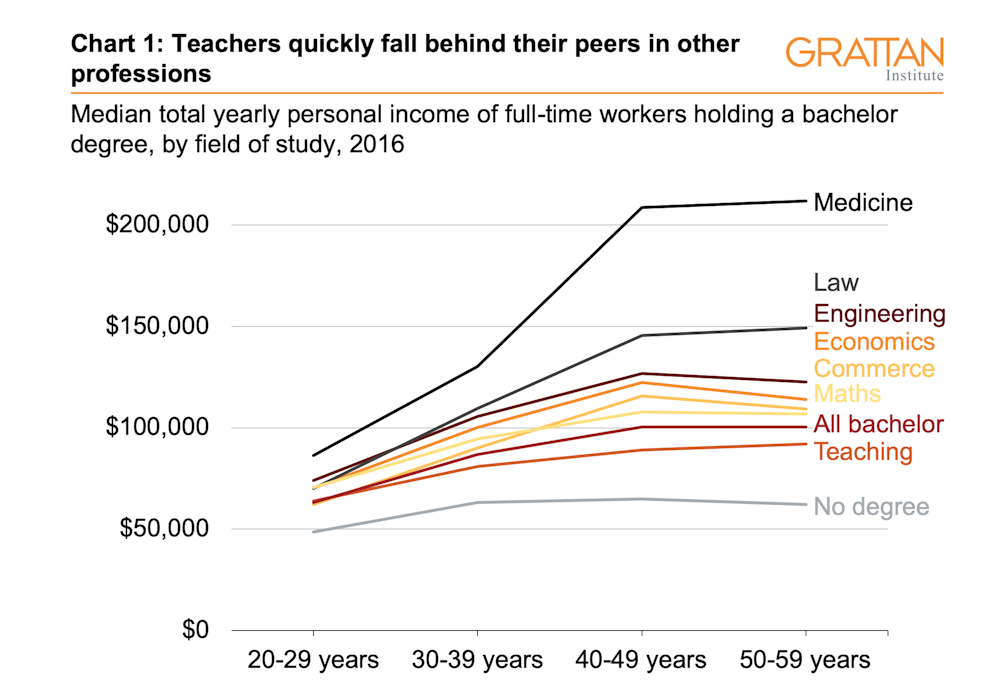
Here are the facts: Australian teachers get a very decent starting salary, but their pay quickly falls behind that of other professionals.

Getting teacher pay right is crucial to attracting the best and brightest to the classroom, so it’s important to debunk a few myths.


Read more: Better pay and more challenge: here’s how to get our top students to become teachers


How to measure a teacher’s pay

We should not fall into the trap of comparing Australia’s teacher salaries to other countries using dollar amounts, even after taking account of the cost of living. Australia is a rich country. Our incomes are relatively high, and our education system is competing with other industries to attract the best talent.

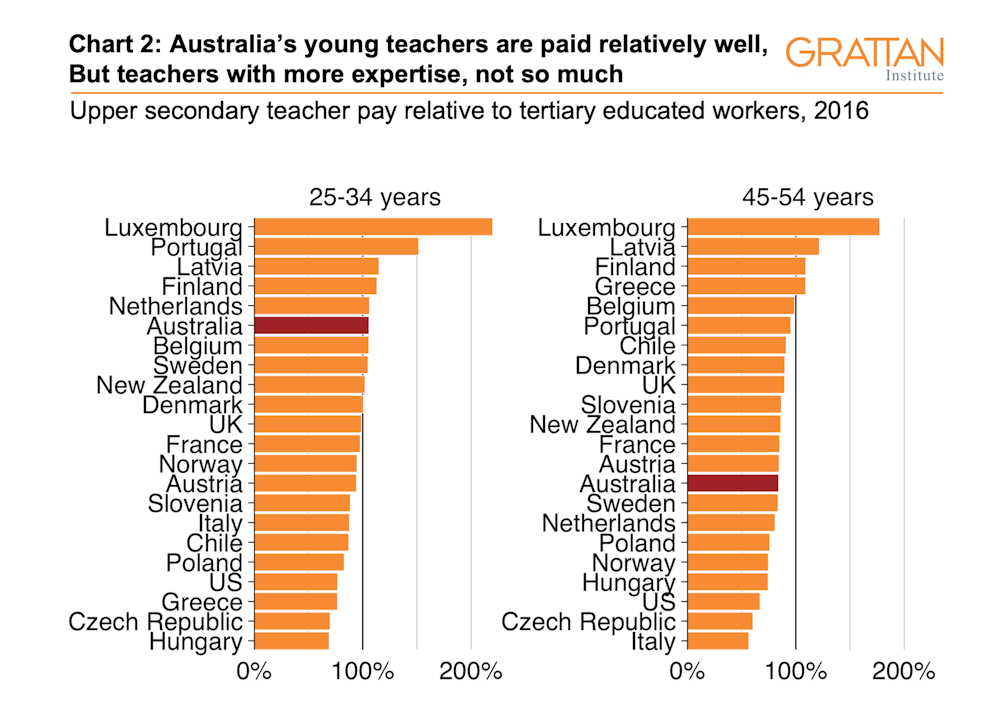
Chart 1 compares teachers’ pay with the pay of similar-aged professionals in Australia. Chart 2 shows how those numbers compare to other countries.

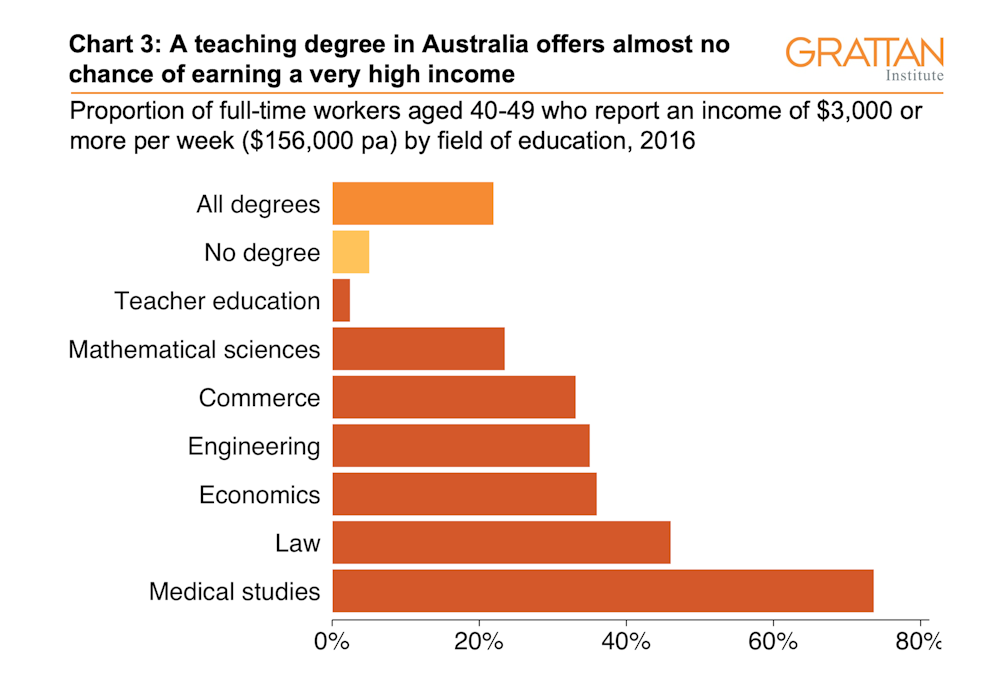
But average pay is not the only factor, so Chart 3 looks at what opportunity there is for Australian teachers to earn a very high income.

Young teachers are paid well, but expertise is not rewarded

The starting full-time salary for a classroom teacher in most Australian states is between $65,000 and $70,000, based on every enterprise bargaining agreement (EBA) we examined.

That’s reasonably competitive with the starting salary of a graduate with an engineering, commerce, or law degree, and has been improving over the past 15 years.

Includes people who studied a teaching degree but now work as principals. ‘No degree’ includes all levels of education below bachelor. Source: Australian Bureau of Statistics (2016 Census) Grattan Institute, Author provided

The trouble is that teacher pay doesn’t rise much with age or expertise. The pay scale for a classroom teacher stops rising after about nine years, while the incomes of their university educated peers in other professions keep rising well into their 30s and 40s.

It’s not like this in every country. Other countries reward teacher expertise with higher pay relative to other professionals. So while Australia’s pay for young secondary teachers is in the top half of the Organisation for Economic Co-operation and Development (OECD) countries, Australia’s pay for older secondary teachers is in the bottom half.

Most countries’ figures are from 2016 but some are from 2015. Source: Organisation for Economic Co-operation and Development (OECD) report, Education at a Glance (2018). Grattan Institute, Author provided

Any high-income Australian teachers?

People with a teaching degree in Australia have almost no chance of earning a very high income.

More than a third of engineering or commerce graduates in their 40s working full-time earn more than $3,000 a week ($156,000 a year).

But for graduates with a teaching degree, that figure is only 2.3%. As Chart 3 shows, if you want to earn a really high income in Australia, you’re often better off having no degree than having a bachelor degree in teaching.

Includes people whose work is unrelated to their degree. $156,000 is chosen because it is the highest income bracket in the Census. Doctors are much more likely to earn more than $156,000, but ‘medical studies’ also includes some other degrees. Source: Australian Bureau of Statistics (2016 Census). Grattan Institute, Author provided

Teacher pay matters. Most young people who did well at school are interested in becoming a teacher – but most of them are turned off by the big financial sacrifices teaching involves.

A Grattan Institute survey of almost 1,000 young high achievers (aged 18-25 and with an ATAR of 80 or higher) found about 70% said they would be willing to give teaching a go.

But university enrolment data show that only about 3% of high achievers actually choose teaching for their undergraduate studies.


Read more: How to make good arguments at school (and everywhere else)


Our new report, Attracting high achievers to teaching, proposes a $1.6 billion-a-year reform package for government schools to double the number of high-achieving young people who choose to become teachers within a decade.

The package includes $10,000-a-year scholarships for high achievers who take up teaching, and new career paths for expert teachers with pay of up to $180,000 a year. That’s about $80,000 more than the current highest standard pay rate for teachers in Australia.

If governments were to implement our blueprint, it would send a strong message to Australia’s best and brightest – if you want a challenging career where expertise is celebrated and paid accordingly, choose teaching.

ref. Three charts on teachers’ pay in Australia: it starts out OK, but goes downhill pretty quickly – http://theconversation.com/three-charts-on-teachers-pay-in-australia-it-starts-out-ok-but-goes-downhill-pretty-quickly-122782

Bamboo architecture: Bali’s Green School inspires a global renaissance

Source: The Conversation (Au and NZ) – By Davina Jackson, Honorary Academic, School of Architecture, University of Kent

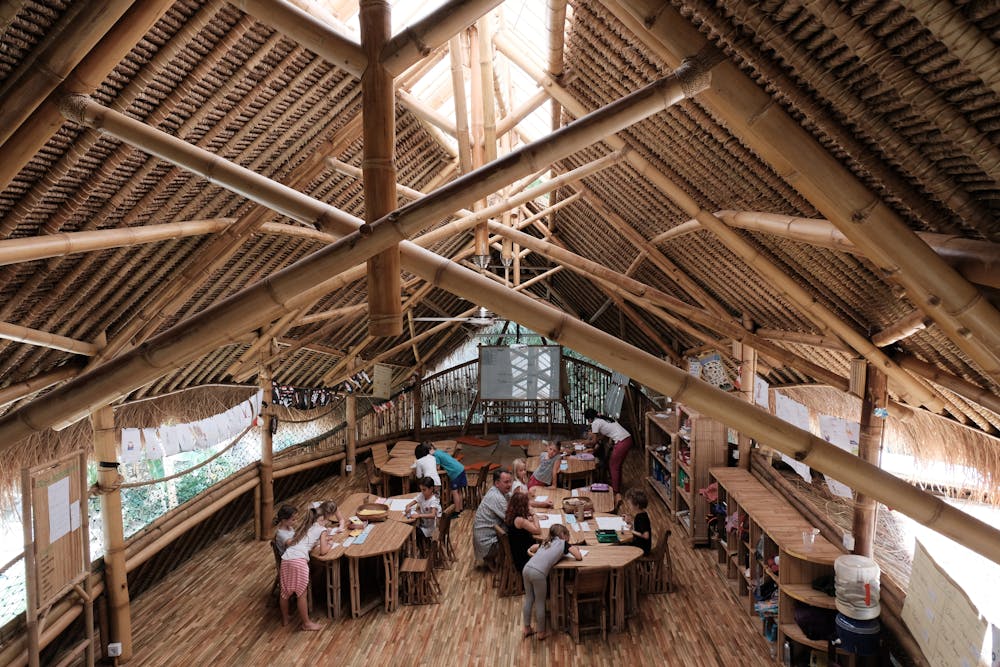
Bali’s Green School recently celebrated its first decade of educating toddlers through teenagers (and their digital nomad parents) about eco-ethical design and cooperative living. Set in a village near Ubud, this tropical jungle campus of quirky bamboo pavilions has become a globally influential exhibition of one of this century’s significant architectural trends.

There is a major renaissance in correctly growing, cutting, treating, drying and laminating bamboo so it can be used with confidence for substantial and near-permanent structures. Much of the inspiration for this has come from Green School founders John and Cynthia Hardy and their daughter Elora. Their TED talks and YouTube videos have been widely watched.

John Hardy talks about his Green School dream.

Read more: Bamboo could turn the world’s construction trade on its head


Bamboo always has been a basic construction material in tropical latitudes. But generally it has been used for inexpensive shacks, stalls, fences, scaffolding and sunscreens. If not treated, bamboo is highly susceptible to fire and naturally degrades within two or three years, because insects and fungi rapidly devour the sugar-and-starch-rich sap inside the canes.

In Bali during the 1990s, Irish-Australian designer Linda Garland pioneered contemporary uses of bamboo. She worked with University of Hamburg scientist Walter Liese to treat bamboo against the ravages of powderpost beetles and turn it into a commercially viable building material.

One essential preparation technique is to drill through the centres of the canes with long steel rods, then apply repellent and fire-resistant chemicals. Often this involves a soaking solution that includes borax salt powder. The bamboo is then dried out for several days to weeks.

Once the problems of fire and pests are solved, bamboo becomes a durable and versatile construction material. Courtesy of Green School Bali, Author provided

Technology helps transform practices

Ancient practices in China and Japan remain the gold standard for durable bamboo buildings.

Traditional Japanese rectilinear designs had gable roofs and rooms matching the dimensions of tatami mats.

Some Chinese bridges date back as far as the 10th century AD. Floating villages (bamboo platforms with clusters of huts) supported dozens of families as recently as the 17th century.

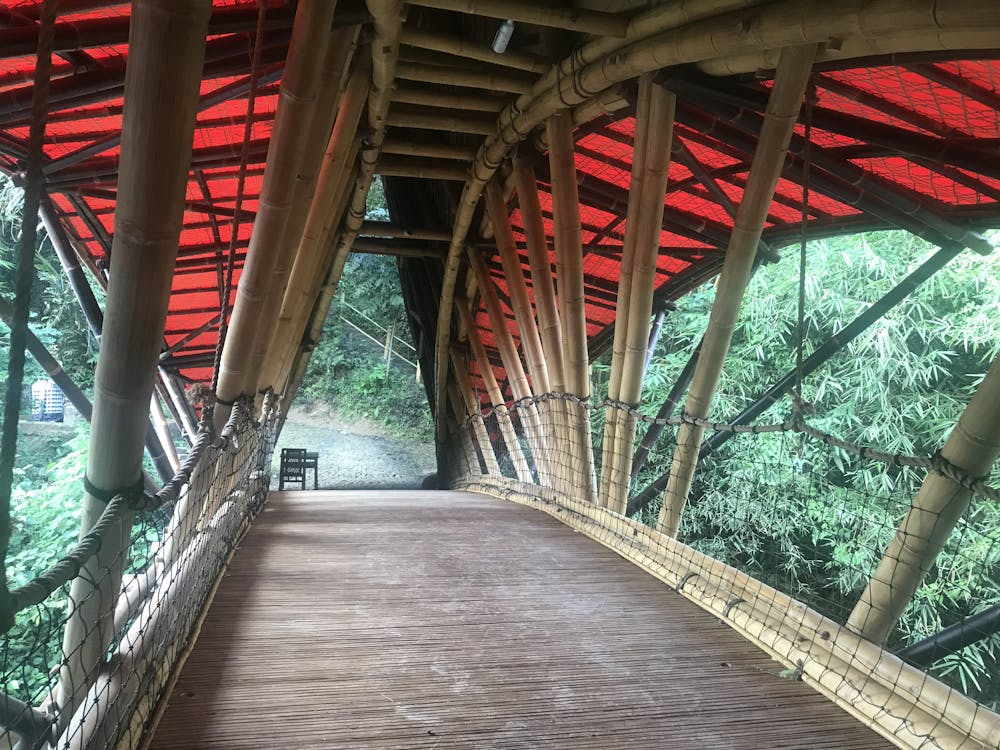
The bamboo bridge at the Green School has an ancient inspiration. Davina Jackson, Author provided

In Ecuador, archaeologists found a bamboo funeral chamber carbon-dated to 7500 BC. Ecuadorian bamboo, known as caña de Guayaquil (or Guaya), is exported to Peru, Colombia and other Latin American countries. Here bamboo buildings tend to be weatherproofed by thick coatings of mud. (David Witte has written a thesis on historical and contemporary bamboo buildings in South America.)

Today, Bali’s Green School and several associated enterprises, are prominent in a third millennium movement to build geometrically irregular, often sinuous, structures.

The irregular, sinuous structures of the Green School seen from above. John Singleton, courtesy of Green School Bali, Author provided (No reuse)

These outré styles obviously have been influenced by the trans-millennial technology revolution in digital modelling and manufacturing. Extremely asymmetrical architecture can now be fabricated precisely with metal, glass and masonry components.

However, the Hardys and their international team of bamboo building experts craft small-scale physical models of their designs. The artisans then copy these models on site at full scale. This manual system need not stop designers from sketching initial concepts on their screens.

Elora Hardy talks about the potential of bamboo, as both a sustainable resource and inspiration for innovative buildings.

Read more: Cheap, tough and green: why aren’t more buildings made of rammed earth?


What happens at the school?

The Green School educates more than 500 students from pre-kindergarten to Year 12. It complements standard curriculum subjects with various practical tasks and projects that build healthy and ecological skills and habits. Teachers, and parents co-opted as project leaders and mentors, encourage pupils to design and build specific structures that provide useful amenities for the campus.

Bamboo is used throughout the school. Davina Jackson, Author provided

One recent middle-school project produced a series of tiny shelters as quiet retreats. Each one is to be occupied by only one child at a time. A campus guide notes that Sir Richard Branson recently climbed into one of these cubby houses, a tiny netted bamboo platform hanging from a tree branch, without upsetting the apparently fragile enclosure.

Elora Hardy’s team at architecture, interior and landscape design company Ibuku designed and made most of the school’s buildings. They also have created yoga and cooking school pavilions, hotels, houses, restaurant interiors and permaculture gardens around Bali and in some Asian cities.

Elora Hardy’s team designed and made most of the school’s buildings. Davina Jackson, Author provided
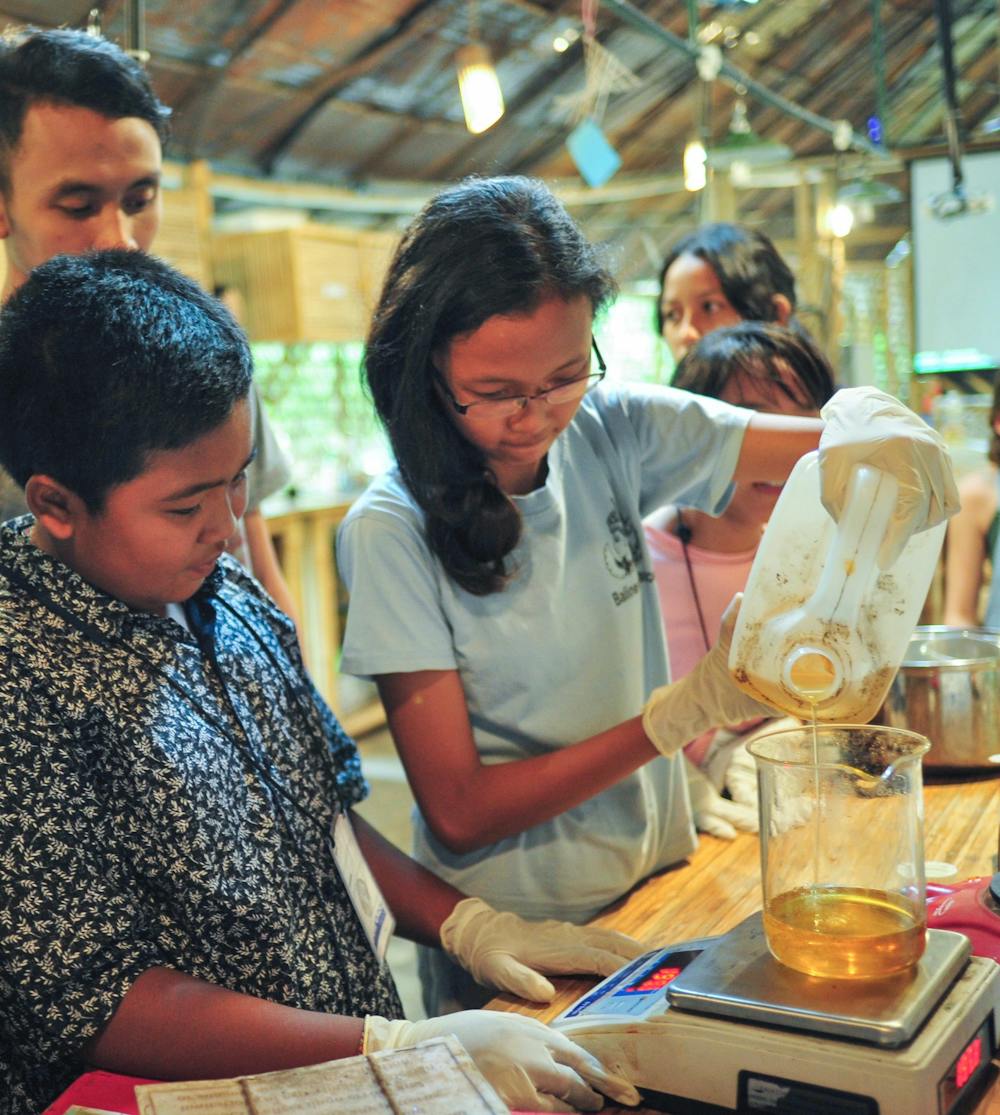
Students make biosoap in the Kul Kul Connection program. Courtesy of Green School Bali, Author provided

An affiliated venture also operates Green Camp residential courses for children and their parents visiting for one to 11 days. Their meals are cooked with vegetables grown at the Hardys’ Kul Kul permaculture farm.

Another family venture, Bamboo U, led by Orin Hardy, provides hands-on training for potential builders. The courses cover bamboo selection (different uses of seven preferred Balinese species), treatment, building design, modelling and on-site fabrication, including professionals from Ibuku as teachers.

A global embracing of bamboo

During the Green School’s first decade, a new generation of studios led by young Asian architects gained prominence and international awards for their creativity with bamboo. They include: Vo Trong Nghia (VTNA) and H&P Architects in Vietnam; Nattapon Klinsuwan (NKWD), Chiangmai Life Architects and Bambooroo in Thailand; Abin Design Studio and Mansaram Architects in India; Bambu Art in Bali; Atelier Sacha Cotture in the Philippines; HWCD, Penda (Chris Precht) and Li Xiaodong in China; and William Lim (CL3) in Hong Kong.

And some long-established, internationally renowned architecture firms have completed projects with significant uses of bamboo. They include Japanese architects Kengo Kuma, Arata Isozaki and Shigeru Ban, London-based Foster + Partners and Italy’s Renzo Piano.

Bamboo inspires its own architectural forms. Courtesy of Green School Bali, Author provided

Read more: Surviving climate change means transforming both economics and design


Many bamboo buildings today include timber or concrete slab floors because these can be laid consistently flat. But researchers at Empa, the Swiss materials research academy, have developed highly durable and temperature-inert floor and deck boards made with a composite of bamboo fibres and resin. These prototype boards are being tested in one of the Vision Wood student apartment modules slotted into Empa’s NEST testing facility at Dübendorf.

Meanwhile, the Green School is expanding from Bali. An associate campus opens next year on the west coast of New Zealand’s North Island – where bamboo is not naturally grown or legally used as an architectural material. Instead the Taranaki school will build aerial classrooms – pods on poles – using various local species of pine.

ref. Bamboo architecture: Bali’s Green School inspires a global renaissance – http://theconversation.com/bamboo-architecture-balis-green-school-inspires-a-global-renaissance-121248

Not so bad. Most of us who work long hours like the jobs we are in. Those who don’t, change jobs quickly

Source: The Conversation (Au and NZ) – By Mark Fabian, Lecturer, Australian National University

No biggie. Most of us who overwork like the jobs we are in. Those who don’t change jobs fairly quickly

Overwork? Most of us who work long hours like our jobs. Those who don’t, move on

We are forever being told that we work long hours, many of them not formally paid. And we do. Nearly a quarter of working Australians say they work more than 50 hours per week. Around half of them say they would like to work less.

We are told long hours are bad for mental health, bad for families, and bad for the environment. But if they are really so bad, why do we work them?

One explanation is that we have no choice – many of us are trapped in jobs that require excessive hours from which we can’t escape.

Trapped?

But in Australia, these claims have been rarely tested.

We’ve done so in a new paper which makes use of the HILDA Household Labour and Income Dynamics in Australia survey, and found them wanting.

Overall job satisfaction among overworkers is quite high, at an average of 7.1 out of 10. This is less than the level of satisfaction of workers in similar or identical jobs, who are working as many hours as they would like. Their overall satisfaction averages 7.9 out of 10. But nonetheless, overworkers like their jobs.

HILDA includes useful questions about the components of job satisfaction, including satisfaction with hours, pay, flexibility, security, and work itself.

Overworkers have relatively low satisfaction with hours and flexibility, at 5.1 and 6.1, respectively, compared with 7.9 and 7.8 for matched workers.


Read more: Go home on time! Working long hours increases your chance of having a stroke


But overworkers are compensated for these unwelcome hours with higher pay, better job security, and more interesting work. Their levels of satisfaction on these metrics are on par with those of matched workers or even exceed them in the case of satisfaction with the work itself.

The findings align with our findings about who is most likely to overwork. Managers are 10% more likely to work long hours than average workers, and professionals 5% more likely.

It gets better

HILDA follows the same people year after year, allowing us to track changes in work patterns over time. We use this remarkable feature to track dissatisfied overworkers (those reporting less than 5 on the satisfaction scale) to see whether they are are indeed “trapped” in unhappy jobs.

Every year, 28% of dissatisfied overworkers change jobs. On average their situation improves. Their wages are typically A$6 per hour higher and they work 11 hours per week fewer than dissatisfied overworkers who stay.

Those overworkers who don’t change jobs also typically see improvements.

Hours shrink over time

Over time, usually within two years, their hours fall back to the point at which they are no longer dissatisfied. We cannot see why in the data, but we can speculate that they are able to negotiate with their employers for fewer work hours or better pay or conditions.

What about those overworkers who remain dissatisfied after two years, don’t enjoy improvements in their conditions, and don’t change jobs – the ones who are trapped.

They are extremely rare.

Across the 15 years of HILDA data we examined, we found 13,069 cases of overwork and 1,929 cases of dissatisfied overwork. Only 139 did not change jobs within 24 months.

The number of cases is so small that we have to be be cautious when speculating about why they seem to be trapped.

We have identified two associations that deserve further investigation.

Very few have nowhere to go

First, 14% were hospitality, retail, or service managers; 10% were farm managers or agricultural workers; 8% were road and rail drivers. Each of these industries is characterised by rigid and often long work hours.

Second, very few of the trapped overworkers were educated to a university level. That makes them reliant on experience to command high wages. It means that changing jobs or industries to get fewer hours can cost them a lot in wages because they lose their job-specific and industry-specific experience.

Overall, becoming trapped in overwork is uncommon in Australia, meaning in this respect Australia’s labour market works well.

Incidentally, this is even more true for underwork.


Read more: Are you burnt out at work? Ask yourself these 4 questions


Workers who say they want to increase their working hours can usually do it within 12 months.

Part-time work is important for parents and others trying to juggle caring responsibilities and employment. It will also become increasingly important for older Australians who might want to stay employed but work fewer hours as they near retirement. It is wrong to see part-time work as a problem.

Indeed, a fixation on restoring the 38- or 40-hour week might be linked to traditional, patriarchal views of men working full-time and women staying at home. It would impede new and creative ways of sharing caring and employment.


Read more: It’s time to put the 15-hour work week back on the agenda


Intervening in labour markets to support the traditional working week would have large (negative) economic effects. People typically resolve concerns about working hours by themselves, usually to their satisfaction.

If we remain concerned about overwork – notwithstanding that most of those doing it don’t see it as a problem for long – it would be wisest to tackle it by tackling our culture (things such as the protestant work-ethic) rather than by doing anything to impede the workings of labour market.

ref. Not so bad. Most of us who work long hours like the jobs we are in. Those who don’t, change jobs quickly – http://theconversation.com/not-so-bad-most-of-us-who-work-long-hours-like-the-jobs-we-are-in-those-who-dont-change-jobs-quickly-122633

What it takes to navigate cultural differences in a global business world

Source: The Conversation (Au and NZ) – By Revti Raman Sharma, Senior Lecturer, Victoria University of Wellington

In an increasingly globally integrated business world, it is now widely accepted that cultural intelligence (CQ) is as essential as general and emotional intelligence.

But do organisations fully appreciate what cultural intelligence entails? Our study of Indian senior managers conducting business with New Zealand may help them do so.

Thinking outside cultural boundaries

Cultural intelligence has been defined as a specific form of intelligence “focused on capabilities to grasp, reason and behave effectively” in culturally diverse situations. It allows us to think outside our narrow cultural boundaries and decode complex cross-cultural interactions.


Read more: How universities can make graduates employable with connections to industry


When business partners are from other cultures, institutional differences may create challenges in communication and agreeing on mutually accepted managerial approaches. Cultural intelligence helps address such issues. It allows us to manage anxiety and uncertainty in unfamiliar environments.

Global managers with high cultural intelligence are non-judgemental, inquisitive, tolerant of ambiguity, cosmopolitan and inclusive. They understand the impact of their own culture in their dealings with others. They pause and verify their cultural assumptions before reaching conclusions. They are likely to develop trust with culturally different people and less likely to engage in exclusionary reactions.

Those with low cultural intelligence engage in stereotyping, which results in conflicts and failures.

Cultural intelligence and leadership

In a 2011 study of Swiss military officers with leadership responsibilities, cultural intelligence was found to be a stronger predictor of cross-border leadership effectiveness than both general and emotional intelligence. The study also found that people who are effective in domestic contexts may not be effective in cross-border settings.

Our new study surveyed 186 managers. We explored the interaction between four dimensions of cultural intelligence – cognitive, metacognitive, motivational and behavioural – and the quality of the managers’ relationships and institutional success. This included their ability to manage differences in rule enforcement, cultural values and ethical business practices.

People with high cognitive cultural intelligence are more likely to have broader knowledge of foreign politics and cultural and economic systems. But this on its own may result in negative outcomes because of “sophisticated stereotyping”. This reduces a complex culture to a shorthand description and applies it to all people in that culture.

Metacognitive cultural intelligence dampens this negative effect. People who have this skill are more likely to actively check stereotyping. They suspend judgement in intercultural contexts. They are consciously aware of other people’s cultural preferences, question cultural assumptions and can adjust their ways of thinking.

People who score high on motivational cultural intelligence have an intrinsic interest in being effective in culturally diverse situations. Behavioural cultural intelligence is about actively demonstrating culturally appropriate behaviour.

The theory is that these four dimensions of CQ help people gain legitimacy in a foreign environment because of their enhanced understanding of that environment, and conformity to norms and expectations.


Read more: Our culture affects the way we look after ourselves. It should shape the health care we receive, too


Cultural intelligence in practice

We expected to find that cognitive CQ would be most effective and that, combined with metacognitive CQ, it would improve relationship quality and institutional success. This proved only partly so.

Cognitive CQ and metacognitive CQ combined do have a significant positive effect on relationships but only a non-significant positive effect on institutional success. If metacognitive CQ is low, the effect of cognitive CQ on relationship quality is actually negative.

As expected, motivational CQ has a significant direct positive effect on both relationship quality and institutional success.

Contrary to our expectation, our study showed behavioural CQ to have a significant negative effect for organisational success and non-significant negative effect for relationships. This anomaly requires further investigation.

The study demonstrates that cognitive and metacognitive CQ have to interact to ensure quality relationships with business partners and successful management of cultural differences. Given these findings, and previous evidence of the positive effect of CQ on global leadership, managers need to strengthen weaker aspects through training and practice.

Cultural exposure has been shown to enhance CQ. It allows people to learn from experiences of diverse cultures. This opens their mind and increases cultural empathy, emotional stability and flexibility.

Our study also highlights the importance of relationship quality. Investing in sustaining quality relationships with business partners is critical for managing cultural differences.

ref. What it takes to navigate cultural differences in a global business world – http://theconversation.com/what-it-takes-to-navigate-cultural-differences-in-a-global-business-world-119975

Brutalism: how to love a concrete beast

Source: The Conversation (Au and NZ) – By DJ Huppatz, Associate professor, Architecture and Design, Swinburne University of Technology

No other architectural style elicits emotional reactions like Brutalism. Think monolithic concrete buildings composed of blunt rectangular forms, devoid of colour, decoration or symbolism, with cavernous interiors that complement the exterior’s hulking, inhuman scale.

Frequently described as dehumanising, depressing and oppressive, Brutalist buildings feature prominently in “world’s ugliest buildings lists”.

Despite this unpopularity, architects, preservationists and historians in Britain, the United States and Australia have embarked on numerous campaigns over the past decade to save Brutalist buildings from demolition.

How could anyone love such concrete beasts?

Australia’s High Court: a brutalist classic. Mick Tsikas

An honest material

Brutalism sounds intimidating (as in brutal), but its origins lie in a modernist penchant for béton brut (raw concrete). In the 1920s, famed French architect Le Corbusier popularised an architecture comprising simple cubic forms of raw concrete as the epitome of modernism.


Read more: The problem with reinforced concrete


For modernists, concrete was a futuristic material that could fulfil their utopian dreams of mass housing and urban renewal. It was flexible yet solid, malleable yet permanent. Unrefined concrete was an honest expression of their intentions, while plain forms and exposed structures were similarly sincere.

The Palace of Justice, Corbu Chandigarh, India, designed by Le Corbusier. Wikimedia Commons

And concrete has its own qualities. No two concrete surfaces look or feel the same. Textured with impressions of the wooden form-work or sandblasted to expose its gravel aggregate, concrete walls have a subtle beauty.

But Brutalist buildings (like all buildings) require regular maintenance, and concrete deteriorates. Brown stains leak from joints due to metal reinforcements rusting from within. Public buildings particularly suffer from neglect.

Callam Offices, Woden, ACT. Wikimedia Commons

After the second world war, with the advent of metal reinforcing, concrete came into its own with greater expanses and stronger structures and Brutalism become a global phenomenon. From Soviet Bloc housing complexes to Western European welfare state projects, Brutalism became a modern, efficient and cheap solution for mass public housing.

It also became a favoured style for public institutions, particularly government buildings, cultural complexes, schools, universities and hospitals.

An ethical approach

In a 1957 edition of Architectural Design, architects Alison and Peter Smithson argued that it was more than just a style:

Brutalism tries to face up to a mass-production society, and drag a rough poetry out of the confused and powerful forces which are at work. Up to now Brutalism has been discussed stylistically, whereas its essence is ethical.

The Smithsons’ best-known project and exemplar of British Brutalism was the Robin Hood Gardens, a high-rise public housing scheme in London completed in 1972. Its ethical dimension was a new approach to mass housing with generously-sized flats and two-metre-wide “streets in the air” running the length of the blocks every third floor. (But the flats were neglected for years and demolition of them began in 2017.)

Robin Hood Gardens photographed in 2017 before demolition. Wikimedia Commons

In the 1960s and 1970s, Brutalism became a global style, with few concessions to local climate or conditions and concrete monoliths were built in as diverse places as Singapore and Sao Paolo. Brutalism in the postcolonial world was functional, economical, and it made new nations appear progressive.

In Australia, prominent architect and critic Robin Boyd wrote sympathetically about Brutalism in The Australian Ugliness as it spread here in the 1960s.

Canberra’s High Court Building and National Gallery of Australia, public service buildings such as the Cameron Offices, Sydney’s UTS Tower and Brisbane’s Cultural Precinct are prominent local examples. Perth’s Art Gallery of WA is celebrating its 40th anniversary with the exhibition Perth Brutal: Dreaming in Concrete.

Fritz Kos Art Gallery of Western Australia 1979. Sourced from the collections of the State Library of Western Australia and reproduced with the permission of the Library Board of Western Australia (224276PD)

Controversy over the fate of Sydney’s Sirius building in the Rocks raised the issue of Brutalist conservation in Australia.


Read more: In praise of the Sirius building, a ruined remnant of idealistic times


Meanwhile, in Victoria, the intimidating Footscray Psychiatric Centre, was quietly recommended for Heritage listing recently by Heritage Victoria. Completed in 1976, this four-storey, windowless concrete block seems an unlikely Heritage contender, but it is certainly an exemplary Brutalist building.

Stuck with beasts

Beyond their architectural function, Brutalist buildings serve other uses. Skateboarders, graffiti artists and parkour practitioners, for example, have all used Brutalism’s concrete surfaces in innovative ways.

Brutalist architecture has also featured regularly in dystopian sci-fi films – from A Clockwork Orange to Blade Runner 2049 – and enthusiasts share moody, black and white photographs on Instagram’s Brut Group and the global activist database SOS Brutalism.

Whether we see Brutalist buildings as concrete monstrosities blighting our cities or heroic, modern sculptures from a pre-digital age is really a question of taste. But it is worth considering Brutalism’s ethics and politics further.

Firstly, Brutalism evokes an era of optimism and belief in the permanence of public institutions – government as well as public housing, educational and health facilities. Secondly, while demolishing Brutalist buildings often proves politically popular, they are typically replaced by private development.

Aesthetics provides a cover for this move, especially in inner cities where Brutalist institutions sit on valuable land. But restoration and renovation, rather than demolition and rebuilding, are often more sustainable solutions.

So before we call for the wrecking ball, we could look again at our concrete beasts. Below that rough skin, we might see a little brutish charm.

Perth Brutal: Dreaming in Concrete will be at the Art Gallery of Western Australia from 21 September 2019 – 3 February 2020.

ref. Brutalism: how to love a concrete beast – http://theconversation.com/brutalism-how-to-love-a-concrete-beast-122469

Victorians who switched energy retailers only save $45 a year – leaving hundreds on the table

Source: The Conversation (Au and NZ) – By Bruce Mountain, Director, Victoria Energy Policy Centre, Victoria University

There has long been a vigorous debate about the many and varied reasons why electricity prices in Australia are so high. An ACCC review found retail electricity markets mostly do not work in the interests of the customer – but this is only part of the story.

Another commonly accepted theory assumes that long-term customers of an electricity retailer pay a “loyalty tax” while those who switch every year save money.


Read more: If you need a PhD to read your power bill, buying wisely is all but impossible


But our research has found that Victorians who switch their energy providers typically save less than A$50 a year. This challenges the common understanding of how these markets work.

Questioning common wisdom

Working from the assumption that seeking better deals can save households significant amounts, governments throughout Australia have encouraged customers to switch retailers often. Switching rates in Australia are actually very high, especially so in Victoria.

To test how well the theory matches reality, the Victorian government provided my colleagues and I with 50,000 real electricity bills uploaded by Victorian households to the government’s price comparison website in late 2018. (These households agreed their bills could be used for research purposes and bill uploads were voluntary.)

Our sample is reasonably representative of the population, although we think these customers may be a little more engaged with the energy market than typical Victorians.

What we found challenges the commonly accepted theory of how the retail market works. As it turns out, for most customers, switching retailers does not greatly reduce the amount of money they leave on the table (the difference between their annual bills and the market’s best offers).

The typical customer that has not switched energy retailers in the last year could have saved A$281 per year (about 20% of their bill) if they had signed up to the best possible deal.


Read more: Australia’s energy woes will not be solved by reinforcing a monopoly


But in reality, customers that did switch retailers in the last year saved only A$45 a year, or about 3% of their annual bill. This suggests that customers are not switching to the best possible deals. A A$45 saving is not a great reward for the time and effort they would have spent searching and then switching.

The first reaction of many economists to our finding would be that the retail market is working: the competitive pressures from switchers shows profits have been competed away and there is now little to be gained from switching.

From this perspective, those who did not switch could rest easy that the market was working for them. This is, after all, how many markets work. I am often amazed at the quality of many things I buy, and their prices that fall without me having to do anything to bring it about.

However, this does not seem to be the full picture in the electricity market. All customers, switchers and remainers, are typically paying some 20% more than the cheapest available option.

And it’s not that there are just one or two fantastic deals that customers are missing – there is a good number of much cheaper deals that they are not finding.

We also cannot assume customers are looking for other qualities, like customer service, instead of lower prices: saving money is by far the main reason customers switch.

Why is this happening?

Our finding begs an explanation. We suggest it starts with the observation that while electricity is extremely valuable, it’s just a utility. While people get pleasure from buying many things, electricity is certainly not one of them. Quite understandably, most customers want to spend as little time as possible engaging in electricity markets.

Many offers are also eye-wateringly complex. Large businesses fare far better than households in the energy market, through the simple but costly method of hiring professional consultants to find the best deals.

So, we have a complex product that requires skill to buy well but customers are, quite rationally in most cases, reluctant to spend the time acquiring those skills. It is understandable why most people do not do well when they navigate the market on their own.

But when customers seek advice from price comparison websites and similar advisors – as around half seem to do – they are often not getting good advice.

Perhaps this is to be expected in a market in which advisors are almost always paid by the sellers, and customers have little ability to assess the quality of the advice they get.

There are no easy solutions. Governments face the often mutually inconsistent objectives of stimulating choice and making choice simpler. The task is difficult at the best of times, and governments are seldom good at engaging with dynamic, fast-moving markets.

Some might argue that cheaper retailers simply have to convince customers of their merits, relative to the more expensive offers from the other retailers that most customers select. But electricity must already be one of the most advertised products in Victoria.

About 110 years ago, economist Alfred Marshall suggested that a government could print a good edition of Shakespeare’s works, but it could not have got them written. While the carcass of municipal electric works belongs to the officials, he said, the genius belongs to free enterprise.


Read more: New regulations expose energy price gouging through ‘free’ comparison sites


The creation of a retail electricity market in Victoria 17 years ago sought to bring the “genius” of free enterprise to the sale of electricity to small customers. Taken in the round, the results so far are not entirely encouraging.

ref. Victorians who switched energy retailers only save $45 a year – leaving hundreds on the table – http://theconversation.com/victorians-who-switched-energy-retailers-only-save-45-a-year-leaving-hundreds-on-the-table-122786

Indonesian police arrest Papuan activists for ‘treason’

Pacific Media Watch Newsdesk

Indonesia police have arrested eight Papuan demonstrators for treason or “makar” in Jakarta, reports CNN Indonesia.

Indonesian People’s Front for West Papua spokesperson Surya Anta was reportedly among the arrested.

Two of the eight were arrested for allegedly flying the Morning Star flag during a rally in front of the state palace last week.

Anes Tabuni and Charles Kossa were arrested on charges of coordinating the protests, making the invitations, mobilising the protesters, preparing the flags and giving speeches.

MORE: Papuans raise Morning Star flag in Jakarta, burn Jayapura buildings

Metro Jaya public relations division head Senior Commissioner Argo Yuwono said that the two arrested men stood accused of committing “crimes against the state” and attempted treason (makar).

– Partner –

“It is strongly suspected that they committed crimes against state security and or conspiring to commit crimes against state security and makar,” said Yuwono.

During the arrests, police also secured evidence including two mobile phones, a banner, a T-shirt with a picture of the Morning Star, a scarf with the picture of the Morning Star and a megaphone.

The raising of the Morning Star – the West Papuan flag of independence – is considered a crime in Indonesia and carries with it a potential 15-year prison sentence.

Reaction from protestors
The arrests sparked a reaction from scores of fellow demonstrators who went to the Metro Jaya regional police headquarters on Saturday.

They planned to surrender themselves to police as a show of solidarity with their two colleagues as they had all participated in the rally.

“Overnight we communicated with all of the groups from Papua and West Papua calling on them to gather [at the Metro Jaya headquarters], we will go there and surrender ourselves, we also took part in the rally so please arrest us [too],” said Papuan student public relations officer Ambosius.

Ambosius said the protestors were calling on President Joko “Jokowi” Widodo and Indonesian police chief General Tito Karnavian to prepare jail cells for them.

“We won’t return home without our friends, we’ll get them home no matter what it takes,” he said.

Police surround dormitory
Ambosius said that the arrests occurred on the evening of Friday August 30, when police encircled the Lanijaya student dormitory in Depok and forced their way in.

He said the students were roused and the males ordered to remove their shirts. After an interrogation, Tabuni and Kossay were taken away by police to the Metro Jaya headquarters.

The other six activists were arrested on similar charges and have been brought in for police questioning, reports CNN Indonesia.

The legal team representing the arrested has confirmed that Surya Anta was arrested at a Jakarta shopping centre on Saturday afternoon.

Some of the other arrests took place at the same time as the solidarity action in front of the Metro Jaya regional police headquarters on Saturday.

Police also arrested three woman from Nduga regency in Papua at a Jakarta house.

Arrests ‘unwarranted’
According to a press release from the legal team, the arrests were carried out without warrants.

“The joint team of officers [making the arrest] also threatened them saying they weren’t allowed to take videos or pictures. The arresting officers even assaulted one of the women when they tried to break free,” read the press release.

The legal team is asking the police and other parties to prioritise the principles of human rights when processing the detainees.

Meanwhile, four Australian nationals are to be deported from Papua for allegedly taking part in the demonstrations, reports the Jakarta Post.

Indonesian officials have accused West Papuan liberation groups of collaborating with foreign entities to kindle unrest in the region.

Print Friendly, PDF & Email

Article by AsiaPacificReport.nz

The Great Barrier Reef outlook is ‘very poor’. We have one last chance to save it

Source: The Conversation (Au and NZ) – By Terry Hughes, Distinguished Professor, James Cook University

It’s official. The outlook for the Great Barrier Reef has been downgraded from “poor” to “very poor” by the Australian government’s own experts.

That’s the conclusion of the latest five-yearly report from the Great Barrier Reef Marine Park Authority, released on Friday. The report assessed literally hundreds of scientific studies published on the reef’s declining condition since the last report was published in 2014.

The past five years were a game-changer. Unprecedented back-to-back coral bleaching episodes in 2016 and 2017, triggered by record-breaking warm sea temperatures, severely damaged two-thirds of the reef. Recovery since then has been slow and patchy.

Fish swimming among coral on the Great Barrier Reef. AAP

Looking to the future, the report said “the current rate of global warming will not allow the maintenance of a healthy reef for future generations […] the window of opportunity to improve the reef’s long-term future is now”.

But that window of opportunity is being squandered so long as Australia’s and the world’s greenhouse gas emissions continue to rise.

The evidence on the reef’s condition is unequivocal

A logical national response to the outlook report would be a pledge to curb activity that contributes to global warming and damages the reef. Such action would include a ban on the new extraction of fossil fuels, phasing out coal-fired electricity generation, transitioning to electrified transport, controlling land clearing and reducing local stressors on the reef such as land-based runoff from agriculture.


Read more: Meet the super corals that can handle acid, heat and suffocation


But federal Environment Minister Sussan Ley’s response to the outlook report suggested she saw no need to take dramatic action on emissions, when she declared: “it’s the best managed reef in the world”.

Major coral bleaching events in 2016 and 2017 have devastated the reef.

The federal government’s lack of climate action was underscored by another dire report card on Friday. Official quarterly greenhouse gas figures showed Australia’s greenhouse gas emissions have risen to the highest annual levels since the 2012-13 financial year.

But rather than meaningfully tackle Australia’s contribution to climate change, the federal government has focused its efforts on fixing the damage wrought on the reef. For example as part of a A$444 million grant to the Great Barrier Reef Foundation, the government has allocated $100 million for reef restoration and adaptation projects over the next five years or so.

Solutions being supported by the foundation include a sunscreen-like film to float on the water to prevent light penetration, and gathering and reseeding coral spawn Separately, Commonwealth funds are also being spent on projects such as giant underwater fans to bring cooler water to the surface.

But the scale of the problem is much, much larger than these tiny interventions.


Read more: Extreme weather caused by climate change has damaged 45% of Australia’s coastal habitat


Climate change is not the only threat to the reef

The second biggest impact on the Great Barrier Reef’s health is poor water quality, due to nutrient and sediment runoff into coastal habitats. Efforts to address that problem are also going badly.

This was confirmed in a confronting annual report card on the reef’s water quality, also released by the Commonwealth and Queensland governments on Friday.

The Great Barrier Reef attained world heritage status in the 1980s. AAP

It showed authorities have failed to reach water quality targets set under the Reef 2050 Plan – Australia’s long-term plan for improving the condition of the reef.

For example the plan sets a target that by 2025, 90% of sugarcane land in reef catchments should have adopted improved farming practices. However the report showed the adoption had occurred on just 9.8% of land, earning the sugarcane sector a grade of “E”.

So yes, the reef is definitely in danger

The 2019 outlook report and other submissions from Australia will be assessed next year when the UNESCO World Heritage Committee meets to determine if the Great Barrier Reef should be listed as “in danger” – an outcome the federal government will fight hard to avoid.

An in-danger listing would signal to the world that the reef was in peril, and put the federal government under greater pressure to urgently prevent further damage. Such a listing would be embarrassing for Australia, which presents itself as a world’s-best manager of its natural assets.

Environment activists engaged in a protest action to bring attention to the dangers facing the Great Barrier Reef. AAP

The outlook report maintains that the attributes of the Great Barrier Reef that led to its inscription as a world heritage area in 1981 are still intact, despite the loss of close to half of the corals in 2016 and 2017.

But by any rational assessment, the Great Barrier Reef is in danger. Most of the pressures on the reef are ongoing, and some are escalating – notably anthropogenic heating, also known as human-induced climate change.


Read more: Great Barrier Reef Foundation chief scientist: science will lie at the heart of our decisions


And current efforts to protect the reef are demonstrably failing. For example despite an ongoing “control” program, outbreaks of the damaging crown-of-thorns starfish – triggered by poor water quality – have spread throughout the reef.

The federal government has recently argued that climate change should not form the basis for an in-danger listing, because rising emissions are not the responsibility of individual countries. The argument comes despite Australia having one of the highest per capita emissions rates in the world.

But as Australia’s greenhouse gas emissions continue to rise – an outcome supported by government policy – the continued downward trajectory of the Great Barrier Reef is inevitable.

ref. The Great Barrier Reef outlook is ‘very poor’. We have one last chance to save it – http://theconversation.com/the-great-barrier-reef-outlook-is-very-poor-we-have-one-last-chance-to-save-it-122785

Three students reported killed in West Papua as ‘confronting’ video emerges

Pacific Media Watch Newsdesk

Police-backed armed militias have killed three West Papuan students in Abepura district, Jayapura, reports the Guardian.

The students were reportedly killed in their dormitories as they tried to defend themselves from a pro-Jakarta group calling itself Masyarakat Nusantara (Archipelago Community).

The reports come as new video appeared to show soldiers firing at a crowd of peaceful demonstrators outside a government office in Deiyai last week. Six people were reportedly killed during the attack but police have so far denied the claim.

WATCH: Indonesian security forces open fire on Papuan protesters

In other parts of the city police intervened in an attack on West Papuans from a mob of violent Jayapura residents last week, resulting in one fatality reports Al Jazeera.

According to an eyewitness, residents in Jayapura’s administrative village of Argapura stopped a car carrying six Papuans from the highlands and attacked them with machetes before police arrived and evacuated them to a house.

– Partner –

Police secured the house but residents followed and began throwing rocks. Police responded by firing rubber bullets and one of the residents was hit and killed according to the witness.

The Deputy Mayor of Jayapura Rustan Saru, confirmed the death to Al Jazeera saying that the attacks by residents were in response to damage to property and businesses during the Papuan demonstrations.

An extra 6,000 security personnel have been deployed to Papua after protests began spreading across the region two weeks ago, reports RNZ.

While the protests were sparked in response to racism and prejudice levied at Papuans, they have since developed to incorporate the West Papuan cause for self-determination.

An ongoing internet blackout has been widely condemned as an impediment to accurate reporting of the situation in Papua and Indonesia.

Print Friendly, PDF & Email

Article by AsiaPacificReport.nz

‘Lock-on devices’ are a symbol of non-violent protest, but they might soon be banned in Queensland

Source: The Conversation (Au and NZ) – By Aidan Ricketts, Lecturer, School of Law and Justice, Southern Cross University, Southern Cross University

In the 30 years I worked as a protest police liaison, one memory in particular stands out. I once attended a protest where a group of women attempted to block a forestry road by lying together with linked arms and legs.

The ensuing melee as a group of male police attempted to pull apart the screaming women using pain compliance grips (moves to defeat the resistance of an arrestee, such as hyper-extending their wrist) was a chilling spectacle.


Read more: Protest art: rallying cry or elegy for the black-throated finch?


“Lock-on devices” – hardware like bicycle locks or handcuffs protesters use to secure themselves in their place of protest – would have provided a safer way of achieving the same result. And this was recently seen last week in Townsville.

Two elderly women locked themselves to the gates of a pipe supplier believed to have been contracted to supply the Adani mine project. Police took several hours to remove the arrestees, while the rest of the protest group was ordered to move across the road to continue the gathering.

The role of a police liaison includes walking police to lock-on installations and, if necessary, explaining the situation to them. What often follows is a negotiation about where the rest of the crowd can lawfully stand while police attend to the lock-on.

As a tool of non-violent civil-disobedience, using “lock-on” devices avoids risking group stand-offs with police, which can end up worse than rugby scrums. These devices certainly cause inconvenience, but it’s difficult to imagine how a person with one or both hands locked into a device could be anything but non-violent.

But the Queensland Premier Annastacia Palaszczuk recently proposed laws to outlaw the possession or use of protest lock-on devices.

While no bill has yet been presented, media reports suggest severe penalties will be imposed, including prison terms and large fines.

A war of words has erupted, with Palaszczuk referring to the use of lock-ons as part of the “sinister tactics” of climate change protesters. On the other hand, environmentalists and civil liberties groups, and even some in the state Labor party, condemn the proposed anti-protest laws as an assault on democracy.

Part of Palaszczuk’s rationale is that there have been instances of some lock-on devices containing dangerous items, such as glass or gas canisters aimed at deterring police. However, protest groups say no evidence has yet been provided to show this happening.


Read more: New research shows vast majority of Hong Kong protesters support more radical tactics


In any case, the possible issue could be better dealt with under existing legislation, or new legislation specifically targeting traps, rather than being used to justify a complete ban on all lock-on devices.

So what are lock-on devices?

Climate change protests are on the rise in Queensland, with groups like Extinction Rebellion and Front Line Action on Coal regularly using lock-on devices as part of the campaign to halt work on the Adani coal mine.

Lock on devices range from readily available bicycle locking devices through to home manufactured steel pipes, or concrete filled barrels in which protesters secure their arms to create a human obstruction.

They are favoured by activists – and clearly feared by some politicians – because they take significant time and expertise for police to remove protesters from the devices and to clear roads and blocked gateways.

Lock on devices range from readily available bicycle locking devices to home manufactured steel pipes. Author provided

And they have a long history as a tool of non-violent civil disobedience that goes back at least to the days of the suffragettes. More recently, they have been an important tool in blockades against old growth forest logging, coal seam gas and coal mine developments.

Attempts to ban these devices

Queensland isn’t the first state to try to ban lock-on devices. Similar laws were attempted in Western Australia in 2015, but drew extensive criticism from human rights groups including the UN High Commissioner for Human Rights, who released a statement saying:

Three United Nations human rights experts have urged the State Parliament of Western Australia not to adopt new legislation which would result in criminalising lawful protests and silencing environmentalists and human rights defenders.

The laws were abandoned in Western Australia following a change of government in 2017.

New South Wales has a law allowing police to seize lock-on devices, but it’s not an offence to possess or use these devices.

Despite the recent political furore in Queensland, police and protesters alike generally respond to lock-on devices during protests in a calm and orderly fashion.


Read more: Altruistic or self-serving? Four things judges consider when sentencing politically-motivated crimes


In fact, rather than being used by “extremist” protesters, there are incidents of senior citizens, war veterans and sports celebrities using this tactic.

A peaceful protest tool

It’s important to understand the philosophy behind “locking-on”. By choosing to put their own bodies in a vulnerable situation, the protesters are appealing to the humanity of police or others to treat them with care and respect.

The presence of lock on devices, particularly at blockade style protests, actually helps to maintain a peaceful, almost theatrical atmosphere for police and protesters alike.

The arrestee is passive, the police can act without interference and the rest of the protesters attend lawfully.

Vegan protests in Melbourne earlier this year saw protesters dragged away by police. Lock-on devices on the other hand help to avoid the need for bodily contact. Ellen Smith/AAP

As a symbol of non-violence, the lock-on celebrates a shared social contract where there is implicit trust that neither police nor protesters will use personal violence, but rather the rule of law will prevail in an orderly manner.

In societies where the rule of law and respect for human life have broken down, it would be extremely dangerous to disable yourself in front of your opponents. The safe use of lock-ons as a tactic for civil disobedience is a sign human rights and the rule of law are being respected on all sides.

ref. ‘Lock-on devices’ are a symbol of non-violent protest, but they might soon be banned in Queensland – http://theconversation.com/lock-on-devices-are-a-symbol-of-non-violent-protest-but-they-might-soon-be-banned-in-queensland-122472

How clean is your hospital room? To reduce the spread of infections, it could probably be cleaner

Source: The Conversation (Au and NZ) – By Brett Mitchell, Professor of Nursing, University of Newcastle

Imagine you need to go into hospital. First, you are likely to be seen in the emergency department, and then moved to a ward room for further treatment and recovery.

Unknown to you, the last patient in your room had an infection caused by a multi-drug resistant pathogen (bug) – meaning the standard antibiotics can’t fight it.

Unfortunately, research suggests if you are admitted to a room where the last patient had this kind of infection, you are significantly more likely to be infected by that same pathogen than if you were admitted to a room where the last patient wasn’t infected.

The consequences of a hospital infection can be serious, including a much longer stay in hospital and even death.

However, transferring the pathogen from patient to room to patient is less likely when the room is thoroughly cleaned.


Read more: 1 in 10 patients are infected in hospital, and it’s not always with what you think


All Australian hospitals employ cleaning staff who play an important role in patient safety. But some of this cleaning could be more effective.

Our research team developed a “bundle” of evidence-based hospital cleaning initiatives, and trialled this across 11 Australian hospitals.

We found it reduced the incidence of hospital-acquired infections. And in a paper recently published, we estimate implementing this bundle across the 11 hospitals saved more than A$1 million in health-care costs.

Reducing infection risk

Infections during a hospital stay affect one in ten patients. Hospital staff are aware of the dangers of infections, and reduce the risks by keeping their hands clean.

But staff and visitors can still transfer pathogens to patients, because these pathogens can remain dormant (but still alive) on surfaces for a long time. Some pathogens can survive in hospitals for days, or even months.

We can break the cycle of infection by creating cleaner hospitals with fewer dormant pathogens.

Hospital-grade cleaning products kill or remove common pathogens. But the product used is just one element of cleaning – the right technique is also important. Technique includes using the product according to the instructions, not contaminating already clean areas, using sufficient pressure to clean, and cleaning in the right spots.

Frequently touched surfaces such as light switches, emergency call-bells and bed rails are commonly contaminated with pathogens. These surfaces require extra cleaning.


Read more: Explainer: what are superbugs and how can we control them?


How frequently cleaning needs to occur in hospitals and the best methods to use are disputed. Decisions are complicated because you can’t see the bugs with the naked eye.

In Australia, there is considerable variation in approaches to hospital cleaning including in the use of cleaning products, the type of auditing used to check cleaning, and the training cleaning staff receive.

A cleaning ‘bundle’

Our research team developed a “bundle” of hospital cleaning initiatives based on expert opinion and scientific evidence. This included the use of a fluorescent gel, training and feedback to cleaning staff.

The fluorescent gel is invisible to the naked eye, but visible under a UV light. The gel is applied to surfaces before cleaning, and auditors can use the UV light to determine whether a surface was thoroughly cleaned.

After cleaning, if it’s been done properly, the gel should no longer be visible. Research has shown this approach, when combined with constructive feedback to cleaning staff, can greatly improve cleaning.

Although a room may look clean, it doesn’t mean bugs aren’t lurking. From shutterstock.com

We applied our cleaning bundle in 11 Australian hospitals and examined cleaning performance and infection rates before and after the change to cleaning. Our approach reduced the risk of an important drug-resistant bacteria (vancomycin-resistant enterococci) by 37%.

We also saw an improvement in cleaning success, measured by how often the florescent gel was removed after cleaning. Effective cleaning of frequently touched surfaces in patients’ rooms improved from 64% at the start of the trial to 84% at the end.

Investing in cleaners and cleaning

Spending money on improvements to cleaning practice should be given the same consideration as expensive new machines or new drugs. Improving cleaning reduces the risk of infection, which in turn saves lives, means fewer longer stays in hospital and the intensive care unit, and saves money.

We estimate the infections prevented by the cleaning “bundle” saved more than A$1 million in health benefits across the 11 hospitals by reducing treatment costs and length of hospital stays.

Of course, cleaning is not the only answer to dealing with hospital-acquired infections. Hand hygiene, identifying and isolating patients with certain infections, and correct insertion and maintenance of devices such as urinary catheters and drips are all important ways to reduce the spread of infections.


Read more: Infections, complications and safety breaches: why patients need better data on how hospitals compare


While the risk of infection for patients will never be zero, cleaning staff play an important role in patient safety. Yet they often go unrecognised.

Next time you visit a hospital, why not thank a member of the cleaning team for their role in reducing your risk of infection.

And patients should remember it’s more difficult to clean when tables, chairs and rooms are full of items. So reducing clutter will make it easier for cleaning staff to do their job.

ref. How clean is your hospital room? To reduce the spread of infections, it could probably be cleaner – http://theconversation.com/how-clean-is-your-hospital-room-to-reduce-the-spread-of-infections-it-could-probably-be-cleaner-122185

New research shows vast majority of Hong Kong protesters support more radical tactics

Source: The Conversation (Au and NZ) – By Samson Yuen, Assistant Professor of Political Science, Lingnan University

Three months on, there’s still no end in sight for the Hong Kong protest movement. What started as a demonstration against a bill to amend the city’s extradition laws has now morphed into a broader movement challenging the legitimacy of the government and seeking fundamental political reforms.

Every weekend, hundreds of thousands of protesters – sometimes more than a million – are still taking to the streets. The protests draw Hong Kongers from all walks of life: students, doctors, lawyers, journalists, teachers, civil servants, and, most recently, family members of police officers. The discussions on internet forums and encrypted messaging apps remain vibrant, with innovative ideas for new protest actions emerging frequently.

To better understand who the protesters are, as well as why and how they are protesting, I’ve conducted a series of large onsite surveys at 19 demonstrations since June 9, with the help of researchers from other universities. We have so far surveyed more than 8,000 protesters with a response rate of over 85%.

What the protesters are angry about

Our data show protesters tend to be young and highly educated. On average, half of our respondents are aged between 20 and 30. Around 77% said they had a tertiary (higher) education.

Few said they were unemployed, unlike protesters in other mass demonstrations around the world, like the Arab Spring uprisings and Spain’s Indignados movement.


Read more: Like ‘shooting water’: why the Hong Kong government must accept that compromise is the only way forward


Most respondents identified themselves as either democrats or localists. However, in the early stages of the protests, it is also notable that nearly 30% of respondents said that they were centrists or had no political affiliations. This dropped to around 15% by early August.

When asked why they were protesting, the vast majority of respondents (more than 90%) cited two main motivations: the complete withdrawal of the controversial extradition bill and an independent inquiry into excessive use of force by police against the protesters.

Interestingly, from July onwards, police violence has become a more pressing concern for respondents, with those who see it as “very important” rising from 85% to over 95%. Protesters have also increasingly said they are fighting for Hong Kong’s democracy, with those who see it as “very important” rising from 83% to 88%.

The resignation of Chief Executive Carrie Lam and other major officials was considered the least important reason for protesting. This suggests that a change in leadership is not viewed as a solution to the political crisis – unlike in 2003, when half a million people marched against changes to Hong Kong’s national security laws and demanded the resignation of then-leader C.H. Tung.

Instead, the protesters are seeking a fundamental reform of the entire political system.

For many of them, the extradition bill is just the surface of a rotting system. It merely exposes the underlying problems that have been swept under the carpet for many years: the lack of democratic representation in the policy-making and legislative process, the declining accountability of the government, the blatant domination by a small clique of business and pro-Beijing elites, the increasing unimportance of public opinion, and the steady encroachment on people’s political rights and civil liberties.

Most of the Hong Kong protesters are young, well-educated and employed. Roman Pilipey/EPA

Strong solidarity and acceptance of radical tactics

These same long-standing problems are what prompted the Umbrella Movement in 2014. But unlike the Umbrella protesters, who were intensely split over protest tactics, the current protest movement is exhibiting much stronger solidarity and resolution in achieving their demands.

The majority of respondents see themselves as “in the same boat” (that is, sharing the same fate) with one another. More 80% believe the protests should go on if the government refuses to offer anything other than the suspension of the bill. Among them, more than half support escalating the protests.

This extraordinary level of solidarity is striking. Part of this is because people have learned from the mistakes of the Umbrella Movement. Instead of pointing fingers at each another, protesters are this time using the phrase “do not split, do not sever our ties” to deal with conflicts. Misdeeds and transgressions are not condemned, but are now dealt with through collective reflection and friendly reminders.


Read more: Trust Me, I’m An Expert: Why the Hong Kong protesters feel they have nothing to lose


Fuelling protesters’ solidarity is their strong feeling of desperation. Our survey results show the majority of respondents do not expect any concessions from the government. This has remained steady from early on in the protests, and explains the emergence of slogans like “I want to perish together”.

We also found a high tolerance for the more radical and militant tactics of some of the younger protesters, even among those who consider themselves moderates.

Consistently, over 80% agree that peaceful assembly should combine with confrontational actions to maximize the impact of protests. In June, slightly less than 70% agreed that radical tactics were understandable when the government refuses to listen. That percentage rose to over 90% in the August 4 protests.

Where the protests are heading

No one knows what the “endgame” of the Hong Kong protests will be. The government is now hoping that mass arrests, coupled with the new start of the school year and the possible introduction of emergency regulations, may clear out the streets in the next few weeks, ideally before China’s National Day celebrations on October 1.

The strategy may work, but likely only in the short run. If the Hong Kong government continues to refuse to heed what people are legitimately asking for, the people will undoubtedly return to the streets.


Read more: Why Chinese and Hong Kong students clash in Australia: the patriotic v the protest movement


As research from other social movement studies has taught us, protests take place in cycles. The current protest movement in Hong Kong may eventually quiet down after a while, but another one may be brewing on the horizon.


The other researchers in the team include Francis Lee from the Chinese University of Hong Kong, Gary Tang from Hang Seng University of Hong Kong, and Edmund Cheng from the City University of Hong Kong.

ref. New research shows vast majority of Hong Kong protesters support more radical tactics – http://theconversation.com/new-research-shows-vast-majority-of-hong-kong-protesters-support-more-radical-tactics-122531

Young people are quoted in only 1% of news stories that affect them. No wonder so few trust the media

Source: The Conversation (Au and NZ) – By Tanya Notley, Senior Lecturer in Digital Media, Western Sydney University

On one unremarkable day in April this year, just over a third of news stories were about issues likely to impact young people, such as policies to address climate change, school teacher training, the impact of automation on future employment and proposed social media regulation.

Our snapshot study analysed the television and newspaper news in Australia on April 1, 2019. And our aim was to critique how young Australians aged four to 18 were included and represented in these traditional news forms that remain influential and popular, despite the rise of social media.


Read more: Media Files: Australians’ trust in news media is falling as concern over ‘fake news’ grows


In total, we analysed 276 news stories across eight national, state and regional newspapers and four national and state television news bulletins.

Of all the news stories we examined, only 11% included the views or experiences of young people. Usually, their inclusion was via adult mediators like parents, police and experts. Just 1% of news stories directly quoted a young person.

The topic of news stories where young people are the focus. Author provided

When young people were included in the news, we found it was most likely related to accidents and social welfare. They were absent from stories about the economy, politics, the environment and climate change.

Young people used as visual props

We also found young people were ten times more likely to be seen rather than heard in the news.

Of the news stories we analysed that day, 11% included a photograph or video footage of a young person or young people. Television news included images of young people almost twice as often as newspapers.

However, our analysis of these images finds young people are usually only peripherally included in the substance of the story, often acting as visual props to introduce colour or emotion, rather than being an integral part of the story itself.


Read more: How fake news gets into our minds, and what you can do to resist it


In this way, young Australians are not being given opportunities to speak about themselves and their experiences, with journalists not consulting them or taking them seriously.

The Australian news media provide an important lens through which we see ourselves and our nation: they both reflect and influence public discourse and priorities. So young people should be meaningfully included in the news to ensure we are all better informed of their views and experiences.

A trust crisis affecting the future of news

We’ve been hearing a great deal about the future of news media in recent years. Usually these public conversations focus on how news organisations survive in the digital age; the role of whistleblowers and journalists in a global news environment; and the issue of so-called fake news and its impact on democracy.

These issues are all urgent and complex. Perhaps it’s no surprise, then, that they have been the focus of our efforts in Australia to address problems associated with news. This includes through two ongoing parliamentary enquiries: one by the ACCC focused on news and digital platforms, and a second focused on press freedom.


Read more: From Richard Boyle and Witness K to media raids: it’s time whistleblowers had better protection


But surely the crisis in trust of the news media is just as urgent as these other issues.

The Australian 2019 Digital News report found just 44% of adults trusted Australian news. And our own 2017 survey of 1000 young Australians aged eight to 16 found just 23% have high levels of trust in news media organisations.

More representation of young people in the news will boost their trust in the media. Keenan Constance/Unsplash, CC BY-SA

This lack of trust is important to consider since many of the young people who responded to our national survey said they felt passionate about the role news played in their lives.

For instance, a boy in our study, aged 12 from Queensland, said:

Kids need to understand the world around us and not to just get scary news like murders and hurricanes [but] more news about jobs of the future and things that will be more helpful for our age group.

And a girl, 10, from Tasmania said:

[News] helps me understand the world and know what’s going on and how it might affect me and my family and friends.

The way forward

It’s likely young people’s lack of trust in news organisations is closely linked to their lack of representation.

One clear way for news organisations to begin building trust with young people is to start including them in news stories in meaningful ways.

It doesn’t have to be complicated. For example, in the many instances where young people are photographed, but not quoted, they could be asked to give their opinion or relay their experience.


Read more: Australians are less interested in news and consume less of it compared to other countries, survey finds


News organisations could also direct resources to undertake research about stories involving young people. They could build connections with youth-focused organisations who are well connected to young people, familiar with their experiences and with current research.

And they could track who they include as sources, experts and witnesses (considering gender, age range, race and ethnicity) to support organisational reflection on representation and bias.

This will take time and resources, but it seems prudent at a time when news organisations are trying to rebuild the public’s confidence in news integrity and support their own future viability.

ref. Young people are quoted in only 1% of news stories that affect them. No wonder so few trust the media – http://theconversation.com/young-people-are-quoted-in-only-1-of-news-stories-that-affect-them-no-wonder-so-few-trust-the-media-122464

Australia has a paracetamol poisoning problem. This is what we should be doing to reduce harm

Source: The Conversation (Au and NZ) – By Rose Cairns, Lecturer in Pharmacy, University of Sydney

Most of us take paracetamol every now and again to reduce pain or fever. As far as medications go, it’s one we’re unlikely to associate with harm.

But in a study published today in the Medical Journal of Australia, my colleagues and I reveal a concerning increase in paracetamol poisonings, and resulting liver damage, in Australia over the last decade.

In fact, paracetamol is actually the number one pharmaceutical Australian poisons centres receive calls about.

Paracetamol is safe if used appropriately, at a maximum of four grams per day in adults (equivalent to eight 500mg tablets, or six 665mg modified release tablets). However when this dose is exceeded, there is a potential for harm. And the bigger the dose, the greater the risk.

It’s time to consider restrictions, including reducing pack sizes and changing the way paracetamol is sold.


Read more: Weekly Dose: paracetamol may be our favourite mild painkiller, but it doesn’t work for everything


Our study

We analysed data from national hospital admissions, poisons centre calls, and coroners’ records to examine poisonings, liver injuries, and deaths.

The annual number of cases of paracetamol poisoning increased by 44% from 2007-2008 to 2016-2017.

In that time, we recorded more than 95,000 paracetamol-related hospitalisations.

Liver injury from paracetamol has doubled over the same period. This is likely because people are taking more tablets when they overdose than in previous years, increasing the risk of liver failure.

More than 200 people died from paracetamol poisoning in Australia in the ten year period.

What a paracetamol overdose does to your body

Paracetamol itself is not toxic, but in large amounts it overwhelms the body’s ability to process it safely. This can lead to build up of a toxic metabolite (or break-down product), which binds to liver cells, causing these cells to die.

The quantity that constitutes a toxic dose depends on circumstances including the time period in which the paracetamol is taken, and the person’s weight. But any adult ingesting more than four grams in a day could be at risk.

In severe cases, liver failure means the person will need a liver transplant, or they won’t survive.

Paracetamol is the leading cause of acute liver failure in the Western world.


Read more: We need to talk about this paracetamol problem….don’t we?


There is an antidote to paracetamol toxicity, called N-acetylcysteine (NAC), which is given as an intravenous infusion in hospital. Importantly, NAC works best when given early: it should be started before any symptoms appear. Symptoms of paracetamol poisoning – nausea, vomiting and abdominal pain – indicate damage has already started to occur.

Patients who take very large overdoses, and overdoses with modified release paracetamol, are more likely to sustain liver failure despite treatment with the antidote.

Modified release paracetamol comes in a higher strength, designed to be released over a longer period, which can be confusing and result in overdose.

Accidental vs intentional overdosing

Overdoses can be either accidental or intentional, and our figures include both.

Paracetamol is not a drug people become addicted to, or dependent on, in the same way people do with opioids or other drugs.

Intentional poisonings occur when people knowingly take too much paracetamol as a form of self-harm. In our research, about three-quarters of cases were intentional.

Dosing mistakes can occur when parents are giving paracetamol to their children. From shutterstock.com

People might accidentally overdose because they are in pain, and believe because paracetamol is so widely available, it must be safe. They take more than the recommended dose, or take multiple different paracetamol-containing products together, resulting in harm.

Poisons centres also receive calls about children having too much paracetamol, usually due to dosing errors or a child finding and ingesting the medicine.


Read more: Research Check: does paracetamol in pregnancy cause child behavioural problems?


Some tips to avoid accidentally overdosing

It’s important to be aware of the many brands of paracetamol-containing products, including cold and flu products, to avoid doubling up. People should also read the pack and ensure they follow the dosing instructions.

Parents should consider the following to avoid overdosing in children:

  • paracetamol should be stored out of reach (for example, don’t leave it on the bench or change table after use)
  • paracetamol can be dosed every four to six hours, but must not exceed four doses in a 24 hour period
  • keep track of doses given and when by writing them down
  • read the label carefully and ensure you understand how to use the syringe/dosing device correctly.

Changing the way paracetamol is sold

Paracetamol poisoning and resultant liver injury is preventable, and some simple public health measures could have a significant impact.

In Australia, paracetamol can be purchased outside of pharmacies (for example, in supermarkets) in packs of 20 tablets. In pharmacies, packs of 100 can be purchased without needing to speak to a pharmacist.

In both cases, there are no legal restrictions on the number of packs one person can purchase. This is out of step with many other countries, especially the UK and Europe.


Read more: Is it ok to give children pain killers? We asked five experts


The UK restricted packs to 32 tablets in pharmacies and 16 tablets outside of pharmacies in 1998, as a response to increasing deaths from paracetamol. This resulted in a long-term reduction in paracetamol poisonings, liver injury, and deaths.

Many European counties don’t allow non-pharmacy sales of paracetamol, and have small packs in pharmacies. Denmark has gone one step further, restricting paracetamol sales to those aged 18 and over.

Modified release paracetamol

In our study, modified release paracetamol overdoses increased by 38% each year, and were disproportionately involved in deaths.

Modified release paracetamol has been completely banned in Europe. This is due to documented harms, including increased risk of liver failure and death.

The Therapeutic Goods Administration recently announced modified release paracetamol would become Schedule 3 in 2020, meaning it will be behind the pharmacist’s counter.

This restriction is a step in the right direction, but ignores the fact regular paracetamol can be purchased in large quantities without consultation with a health-care professional.


Read more: Curious Kids: How does pain medicine work in the body?


Due to its widespread use, paracetamol is likely to remain a common source of poisoning. Our study shows it’s increasingly important we take measures to reduce harm from these events.

Restricting pack sizes and restricting availability of modified release paracetamol are crucial first steps. We also need increased public awareness of how to use paracetamol safely.

If this article has raised issues for you, or if you’re concerned about someone you know, call Lifeline on 13 11 14. For advice on suspected paracetamol overdose, call the Poisons Information Centre on 13 11 26.

ref. Australia has a paracetamol poisoning problem. This is what we should be doing to reduce harm – http://theconversation.com/australia-has-a-paracetamol-poisoning-problem-this-is-what-we-should-be-doing-to-reduce-harm-122532

Grim fire season looms but many Australians remain unprepared

Source: The Conversation (Au and NZ) – By Richard Thornton, Chief Executive Officer, Bushfire and Natural Hazards CRC

Bushfires are predicted to be worse than normal across much of Australia this summer but research shows many people, especially those in high-risk areas, remain unprepared.

The latest Australian Seasonal Bushfire Outlook shows the 2019-20 fire season has the potential to be an active season across the country, following a very warm and dry start to the year.

The east coast of Queensland, New South Wales, Victoria and Tasmania, as well as parts of southern Western Australia and South Australia, face above-normal fire potential. It means communities in those areas, and across Australia, should start planning their emergency fire response.

The ingredients for a bad fire season

Above-normal bushfire potential refers to the ability of a large fire to take hold. It takes into account recent and predicted weather for a particular area, the dryness of the land and forests, and recent fire history.

The year to date has been unusually warm and dry for large parts of Australia. In fact it has been the fifth-driest start to the year on record, and the driest since 1970. Some areas, such as New South Wales into southeastern Queensland, are into their third year of dry conditions.

Vast areas of Australia, particularly the east coast, have an above-normal fire potential this season. BNHCRC

The warming trend means that above average temperatures now tend to occur in most years, and 2019 has followed this pattern. These high temperatures further dry the landscape and vegetation.


Read more: The summer bushfires you didn’t hear about, and the invasive species fuelling them


An early start to the fire season has been declared in many areas across eastern Australia. The dry landscape means that any warm and windy conditions are likely to see elevated fire risk. However in some drought-affected areas, poor growth of grass and annual plants means that vegetation loads are reduced, which may lower the fire risk.

The climate outlook for the next few months is also a crucial factor. Of particular interest are the future tendencies of Pacific sea surface temperature associated with the El Niño-Southern Oscillation, as well as the Indian Ocean Dipole, major climate drivers over Australia.

Climate change doesn’t create bushfires, but can make them worse

Heat, drought, flood and fire are not new phenomena for Australia. What is different now is that there is an underlying 1℃ increase in average temperatures since industrial times began – the result of climate change – which means that the variability of normal events sits on top of that. So climate change alone doesn’t create a bad fire season, but can make the weather conditions conducive to very large and destructive fires.

A bushfire threatened homes near Lake Macquarie in August this year. AAP/Darren Pateman

Weather records are routinely being broken and all indications are that temperatures will continue to increase.

We cannot be sure what this means for extreme hazards like bushfire. This is an area in critical need of further research into weather prediction, land planning, infrastructure development, population trends and community awareness.

Firefighting resources are finite

The distribution and readiness of firefighting resources are also considered when calculating fire potential.

In Victoria’s East Gippsland, for example, forests have been extremely dry for many years. If a fire were to start under bad conditions, there is a high likelihood it would grow too large for local resources, and they would need to call for extra support from elsewhere.


Read more: Curious Kids: how do bushfires start?


Fire seasons are lengthening and overlapping across states, and indeed across the globe. So we need to think of new ways of dealing with bushfires, floods, cyclones, and heatwaves. The old ways of sharing resources such as aerial firefighting equipment, and fire fighters between Australian states and other countries, may not always be possible. So we need to discover better ways to manage all our resources.

Overlapping fire seasons means the sharing of fire crews and equipment between states may not always be possible. AAP

Be prepared, and get your kids involved

Research has identified significant trends of vulnerability linked to demographic changes, such as a growing and ageing population. For example, the population of those aged over 85 is predicted to double in the next 25 years. The general population is also increasingly shifting into traditionally hazard-prone areas such as forested or coastal rural areas.

Our research is consistently showing that many Australians, especially those in high risk areas, are not sufficiently ready for fire and have not established fire plans well ahead of time. For example, people may underestimate the risks to life and property if the fire danger is not rated as “catastrophic”. The research showed many properties were under-insured and some people overestimated the response capacity of fire services.

Experts say all Australians, not just those in high-risk areas, should prepare for the bushfire season. AAP

So, make sure you’ve got a plan, talk about it with your family and ensure you have back up plans B, C and D. Include your children in planning to help them prepare, and don’t forgot about your pets and animals too.

Backed by the research, emergency warnings to people under the threat of a fire have been transformed in recent years. But do not wait for a warning, as it might be too late. Everyone should be aware of their surroundings.

The latest outlook report is the work of the Bureau of Meteorology and fire and land management agencies around the country, brought together by the Bushfire and Natural Hazards Cooperative Research Centre.

For more information on how to prepare and be ready for the fire season, consult your local fire service website.

ref. Grim fire season looms but many Australians remain unprepared – http://theconversation.com/grim-fire-season-looms-but-many-australians-remain-unprepared-122711

Flexible working, the neglected congestion-busting solution for our cities

Source: The Conversation (Au and NZ) – By John L Hopkins, Theme Leader (Future Urban Mobility), Smart Cities Research Institute, Swinburne University of Technology

Traffic congestion is one of the most significant challenges facing our cities. Melbourne’s population is growing by around 325 people a day and is projected to overtake Sydney’s within a decade. Identified as the most congested city in the country, this was a factor in Melbourne losing its seven-year grip on the “world’s most liveable city” title last year.

One obvious solution to traffic congestion, caused mostly by workers commuting to jobs in the city centre during peak hours, might appear to be building more, or bigger, roads. But a less obvious answer, and potentially a more cost-effective one, might be to increase flexible working arrangements.

Our research has looked into ways to ease congestion by reducing the need for travel in congested areas in the first place. It shows city workers definitely have an appetite for flexible work hours and practices.

However, many (36%) still can’t or don’t work remotely. Those who do work remotely do so for a small fraction of the week – 1.1 days on average – even though a high percentage of their work tasks can be done anywhere.

More roads don’t solve the problem

Traditionally, congestion has simply been accepted as the starting point, with infrastructure being built to accommodate it. However, as a report on US research findings about so-called induced demand explains:

If you expand people’s ability to travel, they will do it more. […] Making driving easier means that people take more trips in the car than they otherwise would.

This increase in travel uses up any extra capacity improved infrastructure might bring. As a result, traffic levels and congestion remain constant.

A 2019 report from Infrastructure Australia observes that the huge number of road and rail projects in Sydney and Melbourne, both current and planned, will not prevent crippling congestion by 2031.


Read more: Do more roads really mean less congestion for commuters?


What did the flexible working study find?

This issue was the motivation for our study into alternative ways to ease congestion. It identified flexible working as one possible solution.

The term flexible working refers to arrangements that enable employees to adjust the number of hours they work, the pattern of those hours, or where they work. Flexible working has risen significantly in recent years, with many potential benefits for both employees and employers. Yet few studies have examined its potential to reduce traffic congestion.


Read more: Working four-day weeks for five days’ pay? Research shows it pays off


For our study, we surveyed 263 city workers from ten of Melbourne’s biggest employers. We asked them about their commuting habits, existing flexible working arrangements, attitudes toward flexible working and the nature of their work tasks.

We found 64% of workers were already taking advantage of some sort of flexible working arrangements that allowed them to work from a remote location, usually at home, an average of 1.1 days a week. And 83% of them either “liked” or “loved” the ability to do this.

Only 2% said none of their work could be performed from an alternative location. A majority of participants, 58%, indicated they could do at least half their work duties out of the office. Some 30% of the workers indicated 80% or more of their work duties could be performed remotely.

Breakdown of participants in flexible working survey. Author’s research, Author provided

Technology enables these flexible working opportunities. Laptops, smartphones, high-speed internet and cloud access were highlighted as the must-haves for remote working.

Many of us no longer need to travel to a fixed location to work because the tools of our labour are located there. The tools of our labour are now in our back pockets or work satchels.

Finland shows what’s possible

Urban congestion is a growing problem worldwide. Today, 55% of people live in urban areas, a figure expected to reach 68% by 2050. The use of motor vehicles is also growing rapidly.

But access to flexible working is growing around the world too.

Finland, a pioneer of flexible working practices, recently adopted a new Working Hours Act. It will give a majority of full-time employees the right to decide when and where they work for at least half of their working hours.

A similar flexible working bill was introduced to the UK Parliament in July by Conservative MP Helen Whately. She said:

The 40-hour, five-day working week made sense in an era of single-earner households and stay-at-home mums, but it no longer reflects the reality of how many modern families want to live their lives.

Our evidence from Melbourne suggests the appetite for, and availability of, flexible working will continue to increase as more people do it and more millennials take up leadership roles.

A small reduction in peak-hour commuter numbers could make the difference between being able to squeeze onto a train or not. Runs With Scissors/Flickr, CC BY-NC-ND

If the 64% of workers who now work remotely 1.1 days a week increased this to five days a fortnight, this could cut the number of daily commuters to Melbourne from 572,000 to 440,500 a day. If the remaining 36% of workers were also able to work remotely 50% of the time, daily commuter numbers would fall further to around 337,500, a total reduction of 41%.

Even much smaller reductions in commuter numbers could have significant impacts on congestion. An NRMA submission that advocated flexible working hours and practices to a 2013 NSW parliamentary inquiry noted:

As a rule of thumb, when traffic on congested roads reduces by 5%, traffic speeds increase 50% (even if this only means going from 20 to 30km/h) […] A small reduction in the amount of passengers during peak hours can sometimes make the difference between being able to squeeze onto a bus or train, or not.

In this era of growing urban congestion, an increase in flexible working practices appears to have serious potential for easing the strain on our roads and transport networks. Isn’t it about time we asked ourselves if we could all be a bit more flexible?

ref. Flexible working, the neglected congestion-busting solution for our cities – http://theconversation.com/flexible-working-the-neglected-congestion-busting-solution-for-our-cities-122130

How to get people to eat bugs and drink sewage

Source: The Conversation (Au and NZ) – By Nathan S Consedine, Professor of Health Psychology, University of Auckland

In wealthy societies we’ve become increasingly picky about what we eat. The “wrong” fruits and vegetables, the “wrong” animal parts, and the “wrong” animals inspire varying degrees of “yuck”.

Our repugnance at fruit and vegetables that fail to meet unblemished ideals means up to half of all produce is thrown away. Our distaste at anything other than certain choice cuts from certain animals means the same thing with cows and other livestock slaughtered for food. As for eating things like insects – perfectly good in some cultures – forget about it.

Disgust has its advantages. Its origins likely lie in the basic survival benefit of avoiding anything that smells or tastes bad. But disgust may also be an impediment to many of us adopting more sustainable lifestyles – from eating alternative sources of protein to drinking recycled water.


Read more: Eating insects: good for you, good for the environment


Can anything be done about this? The fact that disgust varies between cultures and across ages implies it can. But how?

We set out to answer this by getting a better grip on how disgust works, focusing on disgust in everyday food choices, rather than aversions to the unknown or unfamiliar.

Our research suggests some disgust responses, once set early in childhood, are hard to shift. But responses involving culturally conditioned ideas of what is “natural” may be modified over time.

Cultural conditions: insects have long been on the menu in Thailand. Narong Sangnak/EPA

Don’t eat that!

Disgust likely began as a powerful “basic” emotional reaction that evolved to steer us away from (and literally eject) potential contaminants – food that smelled and tasted bad. You can think of it as originally being a “don’t eat that” emotion.

The disgust system tends to be “conservative” – rejecting valid sources of possible nutrition that have characteristics implying they might be risky, and guiding us towards food choices that are ostensibly safer. Research by University of British Columbia psychologist Mark Schaller and colleagues suggests people who live in areas with historically high rates of disease not only have stricter food preparation rules but more “conservative” cultural traditions generally.

Is is unclear exactly how or when individual templates for what is disgusting are set, but generally what is seen as “disgusting” is set relatively early in life. Culture, learning and development all help shape disgust.

It’s just not natural!

In our study, we showed 510 adults pairs of “normal” and “alternative” products via an online survey, and asked them how much they would be willing to pay for the alternatives. We also asked them to rate which product was tastier, healthier, more natural, visually appealing and nutritious. Product pairs included:

  • shiny and typically shaped fruits and vegetables vs knobbly, blotchy, gnarled and multi-limbed examples.
  • plant protein foods vs insect-based foods
  • standard drinks vs drinks with ingredients reclaimed from sewage
  • standard medicines vs medicines with ingredients extracted from sewage.
Out of shape: using common fruits and vegetables meant the study’s results were not muddied by responses affected by fear of the unknown. www.shutterstock.com

Our results show that, even after statistically adjusting for obvious factors like pro-environmental attitudes, those with a greater “disgust propensity” are less willing to consume atypical (weird-looking) products.

This may seem rather obvious but most prior studies have muddled a food’s “novelty” with its possible disgusting properties (by asking people, for example, whether they’d eat bugs). By asking about really common fruits and vegetables, our study shows just how far disgust may reach in influencing what we consume.


Read more: Neigh-sayers: why we won’t agree to eat a dead horse


As importantly, our results suggest evaluations of a product’s perceived naturalness, taste, health risk, and visual appeal “explains” about half of the disgust effect.

In particular, lack of perceived “naturalness” was a frequently reason for unwillingness to pay for product alternatives. This result was in line with previous studies that have looked attitudes to eating insects or lab-grown meat. This is a promising area for social marketing.

Therapeutic responses

Given evidence about how much of what we consider disgusting is cultural and learned, marketing campaigns could help shift attitudes about what is “natural”. It has been done before. Consider this advertisement to naturalise sugar consumption.

Thinking differently about emotion-eliciting stimuli is termed “reappraisal”. Reappraisal has been shown to reduce disgust effects among those with obsessive compulsive disorder. Desensitisation (repeated exposures) seems less effective in reducing disgust (versus fear) among people with diagnosed phobias, but it may work better among the general population.


Read more: From disgust to deceit – a shorter path than you might think


Of course, such speculations remain untested and their ultimate success remains unclear.

But it wasn’t so long ago that Western consumers turned their noses up at fermented foods, and the notion of “friendly bacteria” made as much sense as “friendly fire”. More than a decade ago the residents of a drought-stricken Australian town voted against recycling sewage for drinking water. Now the residents of an Australian city accept recycled sewage being pumped back into the city’s groundwater.

Given time, circumstance and a little nudging, a future meal at your favourite Thai restaurant may well involve ordering a plate of insects.

ref. How to get people to eat bugs and drink sewage – http://theconversation.com/how-to-get-people-to-eat-bugs-and-drink-sewage-122328

Time to make fast fashion a problem for its makers, not charities

Source: The Conversation (Au and NZ) – By Mark Liu, Chancellors Postdoctoral Research Fellow, Fashion and Textiles Designer, University of Technology Sydney

Returning our old clothes to big fashion chains – rather than taking them to charity stores – could make fast fashion companies pay for their waste and fuel vital recycling research. Even better if we all do it at once.

Public protests, such as Extinction Rebellion’s colourful catwalk that blocked roads in central London in April, have raised awareness yet done little to motivate governments to address the environmental impact of the fast fashion industry.

“The government is out of step with the public who are shocked by the fact that we are sending 300,000 tonnes of clothes a year to incineration or landfill,” remarked British MP Mary Creagh in June this year, after that country’s parliament rejected a proposed garment tax on the fashion industry. “Urgent action must be taken to change the fast fashion business model which produces cheap clothes that cost the earth.”

At last week’s G7 summit, French president and host Emmanuel Macron announced a fashion industry pact with 150 brands promising to reduce environmental impact.

Changes are not happening fast enough. Residual fashion waste averages 2.25 million tonnes per year in Australia, with an estimated clothing value of $500 million. By 2030, it is predicted that the fashion industry will use two Earths’ worth of resources, with the demand for clothing increasing by 63%. But consumers can act now to influence corporations.

If you’re not part of the solution…

Even those who don’t purchase “fast fashion” – a term used to describe clothes that reproduce the latest catwalk designs at high speed and low cost – bear the consequences as garment waste enters landfill, contaminates air, soil and water.

Fast fashion companies take looks from the catwalk to the shopping centre as quickly as possible. www.shutterstock.com

While government and industry self-regulation have so far failed to make significant progress in this area, consumers have a role to play in protecting the environment.

Global Fashion Agenda’s Pulse 2019 report quotes research showing more than 50% of consumers would switch brands if offered an environmentally and socially friendly alternative. But that sustainability is a key purchasing criterion for just 7% of consumers, trailing high quality, looking successful and receiving good value for money.

There are already opportunities for consumers to engage with fast fashion companies on this issue. H&M and Zara have collection boxes instore to collect old clothing and recycle it into new garments. H&M will also donate 3c for every kilogram of clothing returning in this way to fund research into recycling technologies.

Investing in technology

Unfortunately, clothing recycling technology is in its infancy and the vast infrastructure to make recycling commercially viable does not exist. Many materials made from recycled material are blended with polyester or elastane to make materials that cannot be recycled again.

London’s Graduate Fashion Week this year featured garments made from recycled plastic. Rob Sheppard/Shutterstock

At the University of Technology Sydney we are developing new fabrics made from microalgae. This deep technology research requires significant investment, time, and expertise without a guaranteed outcome. Such research is not attractive to investors looking for an instant return. But this knowledge development is our only hope of building a truly circular fashion industry.

H&M’s commitment of 3c a kilogram may seem small. But if this commitment was applied to the 6000 kilograms of fast fashion dumped in Australian landfill every 10 minutes, it could add up to $180 every 10 minutes and $25,900 every 24 hours.

If Australians redirected fast fashion waste back to where it belongs, they could raise the equivalent of H&M’s Global Change Award, which funds sustainable fashion ideas to the tune of $1 million euro (A$1.6 million) within 64 days. Imagine the potential to raise money for research and infrastructure in this way given the 300,000 tonnes of waste dumped in the UK each year and the 16 million tonnes in the US.

Charity stores in Australia are flooded with fast fashion garments that they simply cannot use and then have to discard. According to the National Association of Charitable and Recycling Organisations, last year Australian charities paid $13 million a year to dispose of 60,000 tonnes of unusable donations.

Sending cheap cast-offs back to their producers would force big chains to pay for the afterlife of their garments, making mass overproduction less profitable.

Coordinating outfits and efforts

Returning clothing is a way of sending a clear signal to shareholders in a way that affects the profits of the company. It nudges employees within fast fashion companies to justify to their superiors and shareholders the need to move towards more sustainable practices.

Consumers could stage mass protests by organising to return used clothing to companies in a single day of action, burying the stores in their own waste and showing the scale of the problem.

A scene from the ABC’s War on Waste. ABC

A single change in behaviour has grand potential. Locally, 68% of those who watched the ABC’s War on Waste second series reported that they’d changed their habits. The series triggered Woolworths supermarket’s decision to remove 3.2 billion single-use plastic bags a year from its checkouts, inspired cafes and customers to adopt reusable cups, and led to hospitality businesses eliminating single-use plastic straws.

It is time to make corporations pay for their waste, fund research and change their business models. If they continue to disregard their environmental responsibilities, citizens have the power to bury their stores in their own waste.

We can return our old clothes to fast fashion companies and change the industry, one garment at a time.

ref. Time to make fast fashion a problem for its makers, not charities – http://theconversation.com/time-to-make-fast-fashion-a-problem-for-its-makers-not-charities-117977

Waratah is an icon of the Aussie bush (and very nearly our national emblem)

Source: The Conversation (Au and NZ) – By Jacob Krauss, Graduate Student, UNSW

On one of my first field trips as a young student, searching in sweltering September heat for banksia trees in the bush around Sydney, my eye was caught by a flash of remarkable crimson. Trudging over the red dust, we saw the beautiful waratah flower.

The cone-shaped flower sat upon a green leaf throne, sepals facing upward towards the heavens. The sun lit the red petals just right, and I felt a sense of awe for the flower emblem of New South Wales.


Read more: The mighty mulga grows deep and lives long


The rounded flower head and the green razored leaves are iconic. The long stem that can grow up to 4 metres tall allows it to stand above the other vegetation.

The waratah’s long stem lifts it high in the bush understory. Margaret Donald/Flickr, CC BY-NC-SA

There are five species of waratah flowers, although the species chosen for NSW’s emblem, Telopea speciosissima, is simply known as the New South Wales waratah.

These grow across southeastern Australia along the central coast and up the mountains from the Gibraltar range north of Sydney to Conjola in the south.


Read more: How I discovered the Dalveen Blue Box, a rare eucalypt species with a sweet, fruity smell


Robert Brown named the genus Telopea in 1810, which derives from the Greek word for “seen from afar” – just as I was able to spot the striking red flowers in the bush. (There is even a botanical journal named Teleopea, after the flower.)

This flower thrives in the shrub understory of open forest and survives despite sandstone soils and volcanic rock. Delicate, the flowers need lots of rainfall. There is also a rare white morph called “Wirrimbira white.” This form was found in the Robertson, NSW near the Kangaloon water catchment.

A beautiful white variation in Sydney’s Royal Botanic Gardens. Royal Botanic Garden Sydney/Flickr, CC BY-NC-SA

Warratahs have a lignotuber in their root system that allows them to store energy and nutrients. They can regenerate within two years after a wildfire destroys the main flower.

It flowers from September to November, though flowering is highly variable and is sensitive to the environment. The flower is pollinated by birds that feed on its sweet nectar. The plant releases brown leathery pods with large, winged seeds, which germinate readily – making it a popular garden ornament.


Read more: Do you know a Bunji from a Boorie? Meet our dictionary’s new Indigenous words


A lovely first alternate for national flower

The waratah flower is a cultural symbol, adorning Australiana ranging from stamps to the state flag of New South Wales. Because it was so common, it helped play a role in developing a colonial Australia’s cultural identity. In fact, it almost beat out the golden wattle as the national emblem back in the 1900s.

There was heated debate, but ultimately the waratah’s bias towards coastal habitat – which meant it was only found on the east coast of Australia and Tasmania – led to its loss. However, in 1962 the flower was proclaimed the official floral emblem of New South Wales.

The wonga pigeon is linked to the waratah in Indigenous Dreamtime stories. Bernard DUPONT/Flickr, CC BY-SA

There is a rich aboriginal history regarding the flower as well. Gulpilil’s Stories of the Dreamtime tells a story explaining how the white warratah became red. In the story, a female wonga pigeon flew above the tree canopy looking for her lost mate. She was caught by a hawk but broke free, tearing her breast. She landed on a white warratah and her flowing blood stained it red. As she flew from flower to flower, the blood from the wounds drenched all the flowers red.


Read more: Stories from the sky: astronomy in Indigenous knowledge


If you stick your finger in the flower when it is in bloom you’ll see the “blood” of the pigeon on your finger. The red nectar is sweet, and a medicinal tonic can be made from the red blooms.

It also made a striking impression on European artists in the 18th and 19th centuries. The flower can be seen on collections ranging from vases to statues and stained-glass windows.

An inflatable light installation in Vivid Sydney. Ashley/Flickr, CC BY-NC-SA

In 1915, Australian botanist R.T. Baker wrote, “The entire plant…lends itself to such a boldness of artistic ideas in all branches of Applied Art that it has few compeers amongst the representatives of the whole floral world.”


Read more: Silver moss is a rugged survivor in the city landscape


I first spotted the flower on one of my first experiences in the bush near Sydney, hunting banksia for a professor who studies the unique fire ecology of Australian plants in Royal National Park. It is one of my favourite Australian flowers, made even more special by the memory when I first encountered it on that sunny, September day.


Do you love native plants? Sign up to The Conversation’s Beating Around the Bush Facebook group.

ref. Waratah is an icon of the Aussie bush (and very nearly our national emblem) – http://theconversation.com/waratah-is-an-icon-of-the-aussie-bush-and-very-nearly-our-national-emblem-122706

Papuans raise Morning Star flag in Jakarta, burn Jayapura buildings

Pacific Media Watch Newsdesk

Papuan demands for a referendum on self-determination have erupted more strongly amid fears of civilian casualties in the Melanesian provinces of Papua and West Papua.

A government-imposed internet blackout is in place following a two-week wave of protests triggered by racial abuse against Papuan students in East Java, reports The Jakarta Post.

Thousands have been taking part in rallies across the West Papuan region as well as in some Javanese cities with protesters setting several buildings ablaze in the Papuan port capital of Jayapura.

READ MORE: Other Asia Pacific Report coverage on the West Papuan uprising

Thousands of Papuans occupy governor’s office after rioting

MULTIMEDIA: Papuan resistance against Jakarta grows

– Partner –

President Joko Widodo appealed for calm and West Papuan leaders, Benny Wenda, called for United Nations intervention to avoid a “bloodbath” by security forces, in reference to the 1991 Santa Cruz massacre in Timor-Leste when more than 250 mourners at a funeral were shot dead by Indonesian troops.

President Joko Widodo told news media he had ordered “firm action against anarchist and racist actions”, while pledging further development for the Papuans.

Resistance grows
A Jakarta Post multimedia report on the Papuan uprising. Image: Screenshot PMC

In a rare event, hundreds of emboldened Papuan students took to the streets in Jakarta on Wednesday, marching from the Army headquarters to the State Palace while carrying banned Bintang Kejora (Morning Star) flags, a symbol of the Papuan independence movement.

“The students and the people of Papua have agreed to call for a referendum,” protest coordinator Ambrosius said during the rally.

When they reached the front of the State Palace, protesters burned tyres and danced traditional Papuan dances while chanting.

The crowd dispersed peacefully at around 5:30 pm.

Demands spreading
Johnny Fernando of The Jakarta Post reports that the demands by Papuans for a referendum on self-determination have been spreading, amid reports of civilian fatalities in Papua.

In addition to a referendum, the protesters have also called for the governors of Papua and West Papua to facilitate a return of Papuan students back to their provinces.

The students also demanded that the Information and Communications Ministry lift the government-imposed internet blackout that has been in place in the country’s easternmost provinces since last week.

The protests have come amid reports that civilians had been shot by security forces during an antiracism rally in Deiyai regency, Papua. Eyewitnesses said that six protesters were feared dead and at least three others were injured during the incident.

Authorities have confirmed that one soldier died and at least two policemen were injured in the incident, but have yet to confirm civilian casualties.

Pressure on Pacific leaders
RNZ Pacific’s Jamie Tahana, who covered the recent Pacific Islands Forum in Tuvalu, reports that Pacific leaders have conceded that, to date, their stance on West Papua has achieved little.

“The last 10 days have seen some of the largest public mobilisations in Indonesia’s easternmost regions for years, with tens of thousands taking to the streets across Papua and West Papua provinces,” he reports.

Dozens have been arrested and there has been rioting in some areas, with the Parliament building in Manokwari razed.

More than 1000 police and military personnel have been deployed to bolster an already significant military presence in the region.

Jayapura buildings burn
Buildings ablaze in the West Papuan capital of Jayapura during pro-independence protests. Image: WP citizen media
Print Friendly, PDF & Email

Article by AsiaPacificReport.nz

Activists urge PM Ardern to act now on West Papua

By Michael Andrew

As Timor-Leste celebrates 20 years since the landmark vote that determined its independence from Indonesian rule, activists are urging the New Zealand government not to repeat mistakes from the past and back West Papuan independence until the last minute.

West Papua Action Auckland’s Maire Leadbeater said the New Zealand government largely ignored the “shocking violence” in Indonesian-ruled Timor-Leste in favour of fostering bilateral and military ties.

“The government sort of stuck with it’s very quiet do nothing say little approach,” she said.

READ MORE: Timor-Leste turns 20: Colonial past feeds problems of neocolonial present

Heavily involved in the Timor-Leste independence campaign, Leadbeater said it wasn’t until the violence and international pressure reached critical levels that the New Zealand government started to openly support the idea of an independence referendum.

Parallels have been drawn between Timor-Leste’s journey to independence and the ongoing movement in West Papua, which has culminated in violent protests and demonstrations over the past fortnight.

– Partner –

The protests were sparked when an Indonesian militia attacked West Papuan students in Sarabuya, pelting them with stones and calling them “monkeys.”

Papuan deaths and injuries have already been reported after Indonesian authorities deployed military personal to quell the demonstrations. The internet has also been shut down to prevent pro-Papuan support from spreading, prompting condemnation from rights and media groups the world over.

While the New Zealand government has stayed relatively quiet on the issue, Leadbeater said now is the time for it to speak up and condemn human rights violations rather than wait until they get worse.

“They don’t want to be left again do they, not changing until the absolute [last minute] and allowing the awful things to occur?”

WPAA has written an open letter to Jacinda Ardern urging her to condemn the racism that started the protests and end the internet blackout which is preventing journalists from reporting covering the story.

The current protests are the latest developments in the West Papuan quest for independence, which has been fought since the 1960’s when Indonesia claimed the former Dutch colony as its province through a widely discredited referendum.

Activist and former Green Party MP Catherine Delahunty said that the protests are a critical development in the struggle for West Papuan self-determination.

“This is not a moment for neighbouring countries to be silent. This is a moment that neighbouring countries should urge Indonesia to stop human rights abuses.”

While the government could not change Indonesia’s internal policy, she said Ardern should at least encourage Indonesia to allow a visit from the UN Human Rights Commission.

This would ensure the bloody process by which Timor-Leste gained its independence would not be repeated in West Papua, she said.

“I hope that East Timor is not the future for West Papua in the sense that hundreds of thousand people were murdered in the process of East Timor getting its independence.

“There is still this unspoken and unrepentant history really in the sense that there has never been recognition of how bad it was.”

Indonesia invaded Timor-Leste on December 9, 1975, nine days after it declared independence from the outgoing Portuguese administration.

Known as Operasi Seroja, it was largest military operation ever carried out by Indonesia.

It resulted in a number of Timorese casualties, with reports of Indonesian military indiscriminately killing civilians in the occupied cities.

The soldiers involved in the invasion are celebrated as heroes in Indonesia. According to news site KBR, the special forces unit involved in the invasion of Dili, the nanggala team, was honoured at the presidential palace two weeks ago for its service during the operation. 

Print Friendly, PDF & Email

Article by AsiaPacificReport.nz

Graduates beware, don’t fall for that unpaid job advert

Source: The Conversation (Au and NZ) – By Jessica Richards, Lecturer Sport Business Management, Western Sydney University

Sydney Football Club sparked outrage this week when it advertised for someone to work three to four days a week for nine months, as a volunteer.

The unpaid job, to work as a strength and conditioning assistant, was specifically looking for someone with a degree in human movement, exercise or sports science.

But the job ad was pulled on Wednesday amid a barrage of criticism online.

Sydney FC soon clarified that the position was actually for “¾ students each working 1 day per week for 9 months in our High Performance Dept”.

It said the original ad was “incorrectly worded & badly phrased”, a response that was not received kindly by those who had been following the story.

But questions remain about how volunteer work should be regulated to ensure any unpaid position is mutually beneficial for both graduates and employers.


Read more: Work Integrated Learning: why is it increasing and who benefits?


Offering unpaid positions that should be a paid position is against the law.

Fair Work Ombudsman Sandra Park has outlined very clearly the difference between an internship and what should be paid work:

Unpaid placements are lawful where they are part of a vocational placement related to a course of study. However, the law prohibits the exploitation of workers when they are fulfilling the role of an actual employee.

We’ve been here before

The issue raises again the problem of interns in the workplace, a matter the Fair Work Ombudsman investigated back in 2014.

The recommendation then was that unpaid internships and work experience should:

[…] not run for a long period of time, not be work that a normal employee would perform, not require the person to come to work or perform productive activities, and mostly benefit the person, not the business/organisation.

But what is a graduate to do when looking to gain entry to the workplace, especially something as competitive as the sporting industry?

Sport and volunteers

Sport has a long history of using volunteers to fill key gaps in the organisation and running of sporting events. The selling point for mega events such as the Commonwealth Games or the Olympics is that volunteers gain an invaluable, once-in-a-lifetime experience.

These volunteers are often used to guide athletes and sports fans around stadiums. Sport promoters also leverage the “glamour of being behind the scenes” of an international sporting tournament to drive volunteer numbers.

A volunteer directs spectators to the Olympic stadium in London, UK, ahead of a rehearsal for the opening ceremony in 2012. EPA/Michael Kappeler

A study done for the International Olympic Committee (IOC) on volunteers at the 2000 Sydney Olympics said their value at the time was at least A$109,756,925 for the 40,000 volunteers who provided assistance.

Now, 20 years later, Tokyo organisers will use twice that many volunteers. The 2020 Tokyo Olympics has put out a call for 80,000 volunteers, bringing debates about volunteering to the surface once more.

Internships get students in the door

Unpaid internships give students the opportunity to kick off their careers working in an industry they are passionate about. Our sports management students undertake a 120-hour internship as part of their degree, receiving vital experience and training within the sports industry.

Rowan Choi, a Western Sydney University sports management student. Western Sydney University

As Rowan Choi, a sports management student, put it:

These sorts of internships at big sports clubs are invaluable. They are a great opportunity for students to branch out and make connections with industry professionals, gaining experience you would not get anywhere else.

But while undergraduate students who undertake internships as part of their degree are under regulation by an academic supervisor, there is a growing concern that recent graduates may be left exposed, as the Sydney FC issue has highlighted.

Universities have work to do

If universities are to remain as stakeholders on the issue of internships, then that brings greater responsibility on them to prepare students for the world of work after they graduate.

From the day they start, students want to know what job they’ll get when they graduate and often use a range of metrics to determine their preferred choice of institution.

But are universities equipping our graduates well enough to know what a good opportunity looks like?

Recently it was found that 19% of students said they didn’t feel they had learnt enough to be job-ready.

Add to this the Australian government’s desire to link student outcomes to university funding, and this sets up a situation where higher education providers can no longer ignore the role they have in this matter.

What was once a case of offering internships and placements as an option is fast becoming an integral part of university study.

This is often easier said than done, considering students are generally adapting to the university environment and the pressures of study and not focusing on their career until their final year.

Research has found that by embedding work-readiness skills early, and then reinforcing these throughout the course, students are more likely to see the importance of including real-world experiences in their studies.


Read more: Work Integrated Learning: why is it increasing and who benefits?


Thus, by the time they reach the point at which an internship is offered, they have had time to consider the benefits and weigh up what is the best placement for them.

Our advice for graduates:

  • keep connected with the university and other graduates, via alumni services, for advice on opportunities that can further your career

  • network as an undergraduate to source an industry mentor who can help with career guidance

  • network widely within the company you want to work for to broaden your level of engagement and ensure you have an alternative contact point for any further opportunities.

Let’s hope some lessons have been learned by the recent Sydney FC posting. The club’s CEO, Danny Townsend, has apologised for any misunderstanding over the ad, but goes on to praise the important role internships play in people getting paid positions.

ref. Graduates beware, don’t fall for that unpaid job advert – http://theconversation.com/graduates-beware-dont-fall-for-that-unpaid-job-advert-122622

Religious Discrimination Bill is a mess that risks privileging people of faith above all others

Source: The Conversation (Au and NZ) – By Liam Elphick, Adjunct Research Fellow, Law School, University of Western Australia

The federal government released its draft Religious Discrimination Bill yesterday.

The idea behind the bill is sound: add the protected ground of “religious belief or activity” to existing federal discrimination protections for race, sex, disability and age.


Read more: The government has released its draft religious discrimination bill. How will it work?


Most would agree it’s wrong to discriminate against someone for the reason that they are of a certain faith – or, indeed, of no faith.

But this bill goes much further than other discrimination laws and weakens existing protections for LGBTIQ+ people, women, people with disabilities, and those from diverse racial and cultural backgrounds.

The month-long consultation process for the bill must be used to make key changes, or our discrimination laws will end up privileging people of faith above all others.

Special provisions for the ‘Folau case’

The Israel Folau case has clearly been front and centre in the drafting of the Religious Discrimination Bill.

If this bill had been law when Rugby Australia sacked Folau, he might have chosen to pursue a federal discrimination case.

Like all other discrimination laws, the bill prohibits indirect discrimination. This occurs where a condition or requirement is imposed in a general sense and this has the effect of disadvantaging people of a certain religious belief.

In all discrimination laws in Australia, a condition or requirement will not be discriminatory where it is “reasonable” in the circumstances. This is a general release valve that allows all sorts of everyday requirements to be imposed even where it might disadvantage certain group. One example is being required to work certain hours or at a specific location.

Under this provision, it would have been up to Folau to prove that Rugby Australia’s code of conduct disadvantaged people who held religious beliefs.

Rugby Australia would then have a defence if it could prove the requirement was “reasonable” in the circumstances.

This would be the same if a gay rugby player spoke out in support of marriage equality and was then sacked because Rugby Australia banned players from expressing views on marriage equality. The gay player would have to prove this ban disadvantaged gay players; Rugby Australia could then seek to prove it was reasonable as a defence.


Read more: Explainer: does Rugby Australia have legal grounds to sack Israel Folau for anti-gay social media posts?


However, the Religious Discrimination Bill goes well beyond this general indirect discrimination provision. It contains a separate specific provision dealing with “employer conduct rules” for employers with annual revenue over A$50 million.

This provides that a rule restricting or preventing an employee from making a religious “statement of belief” outside of work is not reasonable. This would mean such rules are likely to be unlawful discrimination.

The only way for an employer to escape this finding under the bill is if they can prove the rule was needed to avoid “unjustifiable financial hardship to the employer”. They can also escape liability if the statement the employee made was malicious or would harass, vilify or incite hatred towards a person or group.

Both of these are very high standards to meet. Rugby Australia may have struggled to meet the “unjustifiable financial hardship” test, even with the threat of key sponsors dropping out.

To harass, vilify or incite hatred are also high bars to meet – much higher than Australian vilification laws usually set.

No other discrimination law in Australia has this “employer conduct rule”.

This means an employer could sack you for expressing almost all views except those that are religious.

Overriding existing protections

The Religious Discrimination Bill also explicitly overrides existing discrimination protections for other groups.

The bill provides that a religious “statement of belief” made in good faith will not constitute discrimination under any Australian discrimination law.

It also provides that a statement of belief will not breach Tasmania’s strong anti-vilification protections. Tasmanian law prohibits people from offending, humiliating, intimidating, insulting or ridiculing others on the basis of attributes such as race, disability, sex, sexual orientation and gender identity.


Read more: Why Australia does not need a Religious Discrimination Act


This means a person in Tasmania could lawfully make a statement that humiliates, intimidates or ridicules people of a certain race, as long as they can prove there is some religious basis for that statement.

If someone was to make such a statement with no religious basis, it would remain unlawful.

This bill also appears to be the first and only example of a federal discrimination law explicitly overriding other discrimination laws.

Indeed, Australian discrimination law is largely premised on there being concurrent federal and state systems, neither of which overrides the other.

All other federal discrimination laws contain a specific provision noting that they are not intended to exclude or limit the operation of state laws that can operate concurrently.

In the Religious Discrimination Bill’s version of this clause, it explicitly draws attention to the override provisions for statements of religious belief. Those statements of belief retain priority over other discrimination laws.

No other groups protected by discrimination law are provided with this type of exclusion or override.

Broad exclusions for religious bodies

The bill also contains broad provisions on what is not religious discrimination.

One prominent example is found in section 10. Under this provision, where religious bodies act in good faith in conduct that “may reasonably be regarded” as being in accordance with their religious beliefs, these acts cannot be unlawful discrimination.

The definition of “religious body” includes religious schools, religious charities and any other body that is conducted in accordance with the teachings of a particular religion.


Read more: Why Australia needs a Religious Discrimination Act


Some aspects of this provision are uncontroversial – for example, that a religious school should be allowed to prioritise entry for students of the same faith.

However, section 10 is drafted so widely that it could, on the face of it, allow religiously affiliated charities to refuse to assist people of a different faith or of no faith. A Catholic-affiliated soup kitchen could, in theory, refuse to provide food to a Muslim person.

This provision is, again, far broader than clauses found in other federal discrimination laws.

The Sex Discrimination Act, which also protects LGBTIQ+ people, contains a provision stating that some religious acts are not discrimination. However this provision requires that the religious body’s act must “conform to” the beliefs of the religion or be “necessary” to avoid injury to religious sensibilities.

That test is much harder to satisfy than the Religious Discrimination Bill’s test of whether conduct “may reasonably be regarded” as being in accordance with religious beliefs.

More expansive than other discrimination laws

The bill contains various other provisions that go far beyond the scope of existing discrimination laws.

Section 8 prohibits any rule imposed by an employer on a health practitioner that would require them to perform services to which they have a religious objection. This could allow doctors to refuse to perform abortions or to perform any services for LGBTIQ+ people.

No such provision is found in any other discrimination law. This means that, under discrimination law, a doctor could refuse to perform services on religious grounds but not on the basis of any other attributes.

Section 11 provides that any reasonable conduct that is intended to “meet a need arising out of a religious belief” or reduce disadvantage based on religious belief will not be unlawful discrimination.

Other discrimination laws also have provisions that allow for positive measures to be taken to further opportunities. For example, women-only gyms are allowed even though this discriminates against men.

However, the provision in the Religious Discrimination Bill is far wider than other discrimination laws and could capture any number of unforeseen situations.

The government released another bill yesterday as part of its religious freedom package: the Human Rights Legislation Amendment (Freedom of Religion) Bill.

This bill amends all federal discrimination laws so that each contains a new “objects” provision. This provision would require judges, in assessing discrimination claims, to take into account the importance of all human rights, not just non-discrimination rights.

The explanatory memorandum to this bill notes that this provision is intended to ensure freedom of religion is taken into account when assessing any discrimination claims. Other rights could also be taken into account, such as freedom of speech.

This would mean an increased role for religious freedom when discrimination claims are brought on the basis of sex, or race, or LGBTIQ+ status. Over time, this would likely water down protections for other groups.

Amendments urgently needed

Overall, the draft Religious Discrimination Bill goes too far in prioritising religious rights over all others.

The idea behind the bill is a good one: to prohibit discrimination on the basis of religious belief or non-belief.

But, in its current form, the bill provides too many broad and special protections to those of religious faith. The consultation period provides an appropriate, if short, window in which to make necessary changes.

The bill should be scaled back so it matches the model and scope of federal discrimination laws protecting race, sex, disability and age. It should also be made clear that it does not override any existing protections for other groups under state laws.

We should not have one model of special protection for religious faith and a lesser model of protection for all other people.

ref. Religious Discrimination Bill is a mess that risks privileging people of faith above all others – http://theconversation.com/religious-discrimination-bill-is-a-mess-that-risks-privileging-people-of-faith-above-all-others-122631

Father’s days: increasing the ‘daddy quota’ in parental leave makes everyone happier

Source: The Conversation (Au and NZ) – By Sarah Duffy, Lecturer, School of Business, Western Sydney University

“To all the Dads in Australia,” Prime Minister Scott Morrison declared in his Father’s Day message last year, “keep up the good work, because the kids of our country need the best dads possible.”

What can a government do to encourage the best fathers possible? The single greatest gift might be functional parental leave policies that actually encourage men to take time off and be active early in family life.

Right now paternity leave in Australia isn’t working for fathers. Just one in four use the two weeks’ leave available to them as “partner pay” in the first year of a child’s life. The obvious reason is it is paid at the minimum wage, which means it doesn’t resolve the conflict that fathers face in choosing between financially supporting or spending time with their families.

We need to bridge the gap, because there’s increasing evidence that encouraging fathers to take paternity leave has positive, perhaps even surprising, results.

Increasing the daddy quota

Parental leave entitlements are a combination of government and workplace arrangements, so what’s available to dads can differ. The minimum entitlement in Australia, as mentioned, is the federal government-paid “Dad and Partner Pay” (DaPP). The government also provides 18 weeks’ pay at the minimum wage to the primary care giver, but fathers claim this in just 5% of cases.


Read more: Paid parental leave plan ignores economics of well-functioning families


The tendency is for mothers to also take the bulk of leave entitlements in “shared parental leave” systems, where leave is granted to the couple, who then decide how to split it. New Zealand and Canada have such systems, and the evidence is they do not encourage fathers to take leave.

Studies suggest increasing paternity leave is associated with both fathers and mothers being happier. www.shutterstock.com

The best example is probably Sweden, a pioneer of parental leave. It introduced generous entitlements in 1974, paying up to six months in shared leave. But just 10 days were reserved for dads. Just 6% of fathers took up any of the shared leave.

In 1995 Sweden upped the “daddy quota” to bring more balance to the scheme. Now the Swedish government mandates three months’ leave as the exclusive right of either parent, with a total of 480 days in shared parental leave.

Emerging evidence

There is increasing evidence of the benefits of ensuring a “daddy quota”.

A new study tracking the outcomes of paternity leave in South Korea since 2007 concludes that taking paternity leave is positively associated with life satisfaction for both fathers and mothers.

Iceland introduced four week’s dedicated paternity leave in 2001. A 2018 study of 600 families compared the relationship stability of couples who had children just after the reform with those who had children just before (and who were therefore ineligible). The researchers found fathers taking the leave was associated with significantly less relationship breakdown. Their divorce rate was 8.3% lower five years, and 3.4% 15 years later.

One probable reason for these surprising results is indicated in a 2014 Swedish study that suggests fathers’ taking more parental leave leads to greater later sharing of childcare and housework. The study, based on surveys of 235 women and 154 men, found there was subsequently more equal division of responsibilities when dads took more than a month’s paternity leave.

Improving the system

Given the opportunity, most fathers would like to take more family leave. In a 2014 survey of 1,000 new Australian dads who had taken DaPP leave, 75% said they wished they could have taken more leave. In more than half the cases, the reason was affordability. More than a quarter also reported experiencing discrimination when requesting or taking parental leave.

Given the emerging evidence of long-term positive benefits for families, we need to talk about ways to increase the daddy quota.


Read more: Fathers also want to ‘have it all,’ study says


Designing parental leave systems isn’t easy. Getting the balance right is hard. There are significant equity debates. Who pays? Is it more equitable to pay a flat or minimum rate? Is it more effective to peg the rate to an individual’s salary? Should there be a deadline on when leave is taken? The Swedish system, for example, gives parent seven years, recognising that children’s needs don’t diminish once they can feed themselves.

But if we truly want the best dads possible, we should be discussing how to support them with more than words.

ref. Father’s days: increasing the ‘daddy quota’ in parental leave makes everyone happier – http://theconversation.com/fathers-days-increasing-the-daddy-quota-in-parental-leave-makes-everyone-happier-122047

VIDEO: Michelle Grattan on Yang Hengjun’s arrest – and the government’s draft religious discrimination legislation

Source: The Conversation (Au and NZ) – By Michelle Grattan, Professorial Fellow, University of Canberra

University of Canberra Deputy Vice-Chancellor Professor Geoff Crisp Michelle Grattan discuss China’s formal arrest of Australian-Chinese writer and democracy advocate Dr. Yang Hengjun, as well as NSW ALP’s troubles after it was revealed they accepted money illegally from a Chinese property developer. They also talk about Christian Porter’s release of the government’s draft religious discrimination legislation.

ref. VIDEO: Michelle Grattan on Yang Hengjun’s arrest – and the government’s draft religious discrimination legislation – http://theconversation.com/video-michelle-grattan-on-yang-hengjuns-arrest-and-the-governments-draft-religious-discrimination-legislation-122720

Curious Kids: how do wounds heal?

Source: The Conversation (Au and NZ) – By Christina Parker, Senior Lecturer, Queensland University of Technology

If you have a question you’d like an expert to answer, send it to curiouskids@theconversation.edu.au.


I would like to know how wounds heal. – Simon, age 7.


Thank you for this excellent question, Simon. To explain how the body heals a break in the skin, I first need to explain a bit about how skin works.

Did you know the skin is the largest organ in the body? It has three layers that protect us from germs and help our body keep the right temperature. For example, when our body gets too hot, we have sweat glands in the skin that release salty water to cool us down (it’s like air conditioning in our bodies). Our skin also has a lot of sensors so we can touch and feel hot and cold.


Read more: Curious Kids: how does our blood fight viruses like chicken pox and colds?


Plugging the wound

Once we get a wound, the first thing the body tries to do is stop the bleeding.

Within minutes or even seconds, tiny things in your blood called “blood cells” start to group together, protecting and plugging up the wound to stop any more bleeding. A scab will start to form.

The body tries to plug up the wound as quick as it can. It wants to stop germs getting in through broken skin and making you really sick. But even as this happens, the wound may let out a bit of clear fluid that helps to clean the wound.

Your doctor may also decide to close your wound with stitches, special glue or staples to keep the skin together until the body has built new skin to heal.

Scabs help keep germs out. Shutterstock

Behind the scenes

Under the skin, your body is hard at work cleaning and fixing.

The wound may be swollen, red and painful. Doctors call this “inflammation”. Swelling like this means the body is sending more fluid, oxygen and blood cells to the wound to get to work fixing it.

In your blood there are special “soldier” cells in charge of fighting germs. They are called white blood cells, and as soon as you get a cut, your body will send a lot of white blood cells to the wound to get to work. They eat any germs that may have come in when your skin was broken and they also guide the healing process.

The blood cells in the body then work to start building new skin, layer by layer. One thing they do is tell the body to start producing more of a chemical called “collagen” which helps the skin form new layers.

It usually takes a few days for a wound to heal fully, but it sometimes takes much longer. If you get a really big wound, you might get a scar. A scar is also made out of collagen. It is a mark on your skin. Sometimes they stay there forever, and sometimes they disappear or get lighter over time.

White blood cells will eat any germs that may have come in when your skin was broken. Shutterstock

How to help your body fix a wound

It is important to keep the wound clean, damp and covered to help it heal quicker. Wounds that are left uncovered are likely to dry out and are not protected from other injuries.

If your wound creates a scab, it might get really itchy. But try not to scratch! Your skin is busy healing underneath. Just let it fall off on its own. Band-aids are perfect to protect small wounds from further injury.

You should eat healthy food to help fuel your body while it fixes itself. Your body needs protein (like meat, milk and cheese), carbohydrates (like bread and pasta) and vitamins (like oranges, carrots and spinach).

These foods supply energy for healing your wound, and help your immune system fight germs.


Read more: Curious Kids: why do we have two kidneys when we can live with only one?


Hello, curious kids! Have you got a question you’d like an expert to answer? Ask an adult to send your question to curiouskids@theconversation.edu.au

CC BY-ND

Please tell us your name, age and which city you live in. We won’t be able to answer every question but we will do our best.

ref. Curious Kids: how do wounds heal? – http://theconversation.com/curious-kids-how-do-wounds-heal-118603

NAPLAN results show Year 3 students perform better than Year 9 in writing, and it’s a worrying trend

Source: The Conversation (Au and NZ) – By Stewart Riddle, Senior Lecturer, University of Southern Queensland

The preliminary 2019 NAPLAN results released this week show a small “upturn” in performance on the writing task.

For each year level, the percentage of students at or above the national minimum standard increased slightly between the 2018 and 2019 NAPLAN writing task.

But once you scratch beneath the surface, you see a more important and concerning story is unfolding.


Read more: Better pay and more challenge: here’s how to get our top students to become teachers


In 2019, nearly 97% of Year 3 students across Australia met or exceeded the national minimum standard, whereas this figure drops to 82.9% for Year 9 students.

Of course, the 2019 Year 3 and Year 9 student cohorts are entirely different and there is little meaningful comparison to be made between them. But the 2019 Year 9 cohort were the 2013 Year 3 cohort.

When these Year 9 students were in Year 3 in 2013, 95% met or exceeded the national minimum standard. That means 12% fewer students are meeting the benchmark by the time they get to Year 9.

The NAPLAN website explains that the national minimum standards are “a snapshot of typical achievement” and warns that students who do not achieve them “are at risk of being unable to progress satisfactorily at school”.

This raises the question of what happens between Year 3 and Year 9. Why do we see such a drastic reduction in the proportion of students meeting the national minimum standard for the writing task?

It’s not about the basics

One thing is clear. The problem is not about the basics of reading and writing, because these skills are taught and assessed during primary school. As such, the high proportion of students in Year 3 who meet the grade is unsurprising.

The problem is one of progress, as a substantial proportion of students get stuck during their schooling. Additionally, the pressure to perform is much higher for Year 9 students because the bar is raised for this group.

By the time they reach Year 9, high school students are expected to be analytical, critical and creative in their writing. The 2019 NAPLAN writing task required students to construct a cohesive written argument that was engaging and persuasive, including the use of a range of persuasive devices.

Much of our education debate is given to arguing whether phonics or balanced literacy is best for teaching children how to read. There is no doubt that the basics in literacy are important building blocks for reading and writing. But we need to do more to support the development of comprehension and composition skills in upper primary school and the early years of high school.

Drilling into the data

We have to wait for the full national report to be released to be able to disaggregate the 2019 data. But the full data from 2018 and earlier years can easily be accessed online and there are clear and persistent trends that emerge.

First is the persistent downward trend in the percentage of students meeting the minimum standard from Year 3 to Year 9. This has occurred since the implementation of NAPLAN.

Second is the slowdown in growth between Years 7 and 9, which is also represented across all years.

For example, in 2017, the Year 7 cohort (the 2019 Year 9 cohort) had 87.9% who achieved the standard, of which 69.9% were above. By 2019, those same students had 82.9% who met the standard, with only 60.6% above the minimum.

So what is happening?

There is a well-known slump in performance in the middle years of high school, which has been attributed to factors including disengagement and absenteeism.

But much bigger factors are also at play.

Postcode and parents are largest indicators of success

It’s no secret that where students live and their backgrounds correlate to performance on standardised testing. This correlation appears to strengthen over the years. While performance in Year 3 has limited impact from socioeconomic factors, this becomes extremely pronounced by Year 9.

For example, when the Year 9 2018 NAPLAN results for the writing task are compared to parental education levels, students with parents who had a bachelors degree or higher had a 91.5% rate at or above the standard, whereas students with parents who finished school in Year 11 had a 56.2% rate at or above the standard.

Similar results can be found in the NAPLAN reports when comparing results against parental income and employment. For example, in the 2016 NAPLAN writing task, 97.2% of Year 9 students whose parents were in professional occupations met or exceeded the standard, compared with 63.5% of students whose parents had been unemployed for at least 12 months.

Location also matters. For Year 9 students living in major cities during 2017, 84.9% met or exceeded the benchmark in the writing task, compared with only 30.5% of students living in very remote areas.

The MySchool website uses a measure called the Index of Community Socio-Educational Advantage (ICSEA), which provides schools with a relative score based on factors including parental education and employment, geolocation and indigeneity.

The 2017 ICSEA Technical Report says 80% of the variance between schools’ performance on NAPLAN is due to factors outside the school. In other words, your postcode and parents have much more of an impact on your NAPLAN success than your school and teachers.

What can teachers do?

Although most factors influencing students’ performance on NAPLAN occur outside the school gates, there is much that teachers can do.


Read more: How to make good arguments at school (and everywhere else)


Teachers can develop a curriculum that engages students in critical and creative thinking, and encourages their language comprehension and composition skills as they progress through school.

The emphasis on the basics is not enough. We need an emphasis on sophistication of language and providing students with multiple opportunities to compose and comprehend literary and non-fiction texts in the classroom on a daily basis.

While this is a core part of high school English curriculum in the country, it must go beyond the English class and become embedded in school-wide practices that engage young people in rich language, literature and literacy experiences.

ref. NAPLAN results show Year 3 students perform better than Year 9 in writing, and it’s a worrying trend – http://theconversation.com/naplan-results-show-year-3-students-perform-better-than-year-9-in-writing-and-its-a-worrying-trend-122541

Papuans demand referendum – raise Morning Star flag by State Palace

Pacific Media Watch Newsdesk

Papuan demands for a referendum on self-determination have gained widespread momentum amid fears of civilian casualties in the Melanesian provinces of Papua and West Papua.

A government-imposed internet blackout is in place following a wave of protests triggered by racial abuse against Papuan students in East Java, reports The Jakarta Post.

Thousands have been taking part in rallies across the West Papuan region as well as in some Javanese cities.

READ MORE: Other Asia Pacific Report coverage on the West Papuan uprising

In a rare event, hundreds of emboldened Papuan students took to the streets in Jakarta on Wednesday, marching from the Army headquarters to the State Palace while carrying banned Bintang Kejora (Morning Star) flags, a symbol of the Papuan independence movement.

“The students and the people of Papua have agreed to call for a referendum,” protest coordinator Ambrosius said during the rally.

– Partner –

When they reached the front of the State Palace, protesters burned tyres and danced traditional Papuan dances while chanting.

The crowd dispersed peacefully at around 5:30 pm.

Demands spreading
Johnny Fernando of The Jakarta Post reports that the demands by Papuans for a referendum on self-determination have been spreading, amid reports of civilian fatalities in Papua.

In addition to a referendum, the protesters have also called for the governors of Papua and West Papua to facilitate a return of Papuan students back to their provinces.

The students also demanded that the Information and Communications Ministry lift the government-imposed internet blackout that has been in place in the country’s easternmost provinces since last week.

The protests have come amid reports that civilians had been shot by security forces during an antiracism rally in Deiyai regency, Papua. Eyewitnesses said that six protesters were feared dead and at least three others were injured during the incident.

Authorities have confirmed that one soldier died and at least two policemen were injured in the incident, but have yet to confirm civilian casualties.

Pressure on Pacific leaders
RNZ Pacific’s Jamie Tahana, who covered the recent Pacific Islands Forum in Tuvalu, reports that Pacific leaders have conceded that, to date, their stance on West Papua has achieved little.

“The last 10 days have seen some of the largest public mobilisations in Indonesia’s easternmost regions for years, with tens of thousands taking to the streets across Papua and West Papua provinces,” he reports.

Dozens have been arrested and there has been rioting in some areas, with the Parliament building in Manokwari razed.

More than 1000 police and military personnel have been deployed to bolster an already significant military presence in the region.

Print Friendly, PDF & Email

Article by AsiaPacificReport.nz

‘Gay gene’ search reveals not one but many – and no way to predict sexuality

Source: The Conversation (Au and NZ) – By Brendan Zietsch, ARC Future Fellow, The University of Queensland

It has long been clear that a person’s sexual preference – whether they prefer male or female sexual partners, or both – is influenced by his or her genetic makeup. The most straightforward evidence for this is that sexual preference is more likely to be the same in identical twin pairs, whose genetic makeup is identical, than in non-identical twin pairs, who share only around 50% of their genetic makeup.

What has been elusive is knowledge of what specific gene, or genes, are involved. A 1993 study found male sexual preference was influenced by a particular gene on the X chromosome, which the media naturally dubbed the “gay gene”. But a later study did not replicate this finding, and subsequent follow-ups yielded mixed results.


Read more: Born this way? An evolutionary view of ‘gay genes’


The problem was that these studies were too small to draw confident conclusions. There are millions of parts of our DNA that commonly differ between people. That means finding the genes associated with sexual preference is like finding a needle in a haystack.

So an international team of researchers, which I led, set out to tackle this problem. Our results are published today in Science.

Forceful approach

Our approach was simple: brute force. All else being equal, the larger a study, the more confident we can be in the results. So instead of sampling a few hundred or a few thousand individuals – as in previous genetic studies on sexual preference – we used a sample of nearly half a million.

To obtain such a large sample, we used data that had been collected as part of much broader projects. These included DNA data and responses to questionnaires from participants in the UK (as part of the UK Biobank study) and the US (as part of data collected from customers of the commercial ancestry firm 23andMe who consented to answering research questions about sexuality).

The downside of using these huge data sets was that the studies were not specifically designed to find genes for sexual preference, so we were limited by the questions participants happened to have been asked about their sexual behaviour. For both UK Biobank and 23andMe, participants reported whether they had ever had a same-sex sexual partner.

A person’s DNA essentially consists of millions of letters of code, and the letters differ among different individuals. So, to make a complicated story short, the next step was to test at every DNA location whether one letter was more common in participants who reported any same-sex partners than in those who reported only opposite-sex partners.

Not one gene but many

What we found is that there is no one “gay gene” – instead, there are many, many genes that influence a person’s likelihood of having had same-sex partners.

Individually, each of these genes has only a very small effect, but their combined effect is substantial. We could be statistically confident about five specific DNA locations; we could also tell with high confidence that there are hundreds or thousands of other locations that also play a role, although we couldn’t pinpoint where they all are.

Participants in the 23andMe data set answered questions not only about their sexual behaviour, but also attraction and identity. Taking all the genetic effects in combination, we showed that the same genes underlie variation in same-sex sexual behaviour, attraction, and identity.

Some of the genes that we could be sure about gave us clues about the biological underpinnings of sexual preference. One of those genes, as well as being associated with same-sex sexual behaviour in men, was also associated with male pattern balding. It is also near a gene involved in sexual differentiation – the process of masculinisation and feminisation of biological males and females, respectively. Sex hormones are involved in both baldness and sexual differentiation, so our finding implies that sex hormones may be involved in sexual preference too.

Other findings further reinforced the extreme complexity of the biology underlying sexual preference. First, genetic influences only partly overlapped in males and females, suggesting the biology of same-sex behaviour is different in males and females.

Second, we established that, on the genetic level, there is no single continuum from gay to straight. What’s more likely is that there are genes that predispose to same-sex attraction and genes that predispose to opposite-sex attraction, and these vary independently.

Because of the complexity of the genetic influences, we cannot meaningfully predict a person’s sexual preference from their DNA – nor was this our aim.

Possible misinterpretations

Scientific findings are often complex, and it is easy for them to be misrepresented in the media. Sexual preference has a long history of controversy and public misunderstanding, so it is especially important to convey a nuanced and accurate picture of our results.

But people tend to want black-and-white answers about complex issues. Accordingly, people may react to our findings by saying either: “No gay gene? I guess it’s not genetic after all!” or “Many genes? I suppose sexual preference is genetically fixed!” Both of these interpretations are wrong.


Read more: Differences between men and women are more than the sum of their genes


Sexual preference is influenced by genes but not determined by them. Even genetically identical twins often have completely different sexual preferences. We have little idea, though, what the non-genetic influences are, and our results say nothing about this.

To answer further questions the public might have about the study, we created a website with answers to frequently asked questions, and an explanatory video. In developing this website we drew on feedback from LGBTQ outreach and advocacy groups, dozens of LGBTQ rights advocates and community members, and workshops arranged by Sense about Science where representatives of the public, activists, and researchers discussed the results of the study.

ref. ‘Gay gene’ search reveals not one but many – and no way to predict sexuality – http://theconversation.com/gay-gene-search-reveals-not-one-but-many-and-no-way-to-predict-sexuality-122459