Recent jobs taken by former senior ministers Julie Bishop and Christopher Pyne have brought on ire of the Australian Senate, which is now concluding an inquiry into the matter.
The testimony before the inquiry has been extraordinary: not just for what was said, but for what wasn’t — Australia’s lobbying laws are almost totally ineffective.
Moreover, Bishop and Pyne’s example reflects an increasingly common problem, in which senior decision makers go on to lobby for the same organisations they once made decisions about. This problem — called the “revolving door” — is severely undermining efforts to regulate corruption and lobbying, and little attention has been paid to the matter by our major parties.
The regulation requires that ex-ministers not lobby members of government, the public service or defence force on matters relating to their former portfolios, and can not take advantage of privileged information recently gained in their role as minister. This applies for 18 months after they have left their roles.
In spite of this, former foreign minister Bishop took a role at one of the government’s biggest private aid contractors, Palladium, and former defence minister Pyne took a role with consulting firm EY to help build its defence business.
When asked to about these roles, both suggested they were not breaching the lobbying code, as they would not lobby for their clients.
And the person who was responsible for oversight, head of the prime minister’s department Martin Parkinson, agreed, telling the senate that there “was no evidence” that they had breached the code.
This is telling, and rests on the belief that to be a “lobbyist”, you must be active and explicit in representing your clients’ interests to government. But it also misses the point of our revolving-door prohibition.
The philosophical basis for prohibiting a minister from taking positions like Bishop’s and Pyne’s rests on three basic problems: the potential for bias, unfair access to former colleagues or subordinates, and the insider information a decision-maker has gained from their former role.
Perhaps the biggest problem is that of bias, which Parkinson’s testimony effectively ignored. There is the potential for a decision-maker to know — or even expect — that they will be later employed by the same companies and individuals that benefit from their decisions.
There is no accusation here that any recent ministers have engaged in such a subtle form of corruption. But that is also the problem: it would be impossible to know if it had.
Our laws require an explicit quid pro quo arrangement (that is, an obvious bribe) to have existed for someone to be found in breach of them. Short of someone confessing to the matter, this is very hard to prove. The days of “brown bags of cash” are largely gone, but it’s worth thinking of how the idea of a well-paying job might be similarly corrupting.
This is why the necessary response to the problem of the revolving door is to prohibit it (sometimes for up to five years), and have an independent regulator enforce the lobbying regime.
Changing the rules of the game
Aside from its inquiry into Bishop and Pyne’s new jobs, the Senate has just passed a bill legislating for a federal Independent Commission Against Corruption (ICAC), to be called an Integrity Commissioner, to oversee lobbying regulation.
This is important, as the prime minister’s department and attorney-general’s office have shown that they are unwilling to aggressively enforce the lobbying code. Since the code was adopted in 2008, there have been no recorded breaches, but this hardly reflects the absence of wrongdoing. Rather, as Parkinson inadvertently pointed out, the code is so narrowly worded that breaches are barely possible.
Beyond this, the question is what would happen if a genuine breach was discovered?
The answer is probably nothing. No part of the code sets out penalties. The most stringent punishment that could be dealt would be to deregister a lobbyist (even though many skirt this system altogether), or block a lobbyist’s access to decision-makers. Neither of these possible remedies has ever been used.
In other words, even if a national integrity commission is created, any lobbying laws it oversees would need to be dramatically improved.
Lobbying and the ‘marketplace of ideas’
There is an ideal of democracy based on the “marketplace of ideas”. In this ideal, a population hopes that ideas are heard equally and fairly, but that best ideas are the ones acted on. This is an important ideal, but it is only an ideal.
So, the challenge is to make the system as fair as possible. The current lobbying system doesn’t get close. Instead of ideas being presented to decision makers on “merit” (however defined), it is most easily accessed by those with the closest relationships to government. Consequentially, the current lobbying regime undermines Australia’s democracy.
Fixing this problem is not easy, but is doable. This requires major reform, but the path to such reform is clear – not a challenge of feasibility as much as of political will.
While people differ in the range and severity of their symptoms, common features include difficulties with communication and social interaction, restrictive and repetitive behaviours and interests, and sensory sensitivities.
According to the 2017 Autism in Australia report, autism is most prevalent among children aged five to 14, with 83% of Australians with an autism diagnosis aged under 25.
But while children are more likely to have a diagnosis of autism than adults, this doesn’t mean children “grow out” of autism.
Why are rates higher among children?
There are a number of reasons why the prevalence of autism is higher among school-aged children than adults, starting with the measurement.
“Prevalence” refers to the rate of diagnosis and/or self-reports, not the rate of actually having autism. As autism is a lifelong condition, it’s more likely the rates of actually having autism are stable across adults and children.
Diagnostic techniques and awareness of autism have improved dramatically in recent times. Many autistic adults would not have been given a formal diagnosis, but rather misdiagnosed or just seen as “weird”.
These days, there are clear benefits of having and reporting a diagnosis for school-aged children; including access to funding and educational support. This means parents who suspect their child has autism may seek out a diagnosis when in previous generations they would not.
There are far fewer benefits to having and reporting a diagnosis for adults, and many more barriers, including stigma and discrimination.
Some children lose their diagnosis
Autism is a lifelong condition. However, a small number of studies suggest a minority of children may “lose” their autism diagnosis.
The most common reason was “new information”, such as being diagnosed with another developmental, learning, emotional, or mental health condition.
Only 21% of the 187 parents reported their child had lost their diagnosis due to treatment or maturation; and only 4% (eight children) had a doctor or other professional confirm the child did not have ASD and did not have any other developmental, learning, emotional, or mental health condition.
A recent study in the Journal of Child Neurology examined the records of 569 children diagnosed with autism between 2003 and 2013. It found 7% (38 of the 569) no longer met the diagnostic criteria.
However, most were diagnosed with another behaviour disorder (such as attention-deficit hyperactivity disorder) or a mental health condition (such as anxiety disorder).
Just three children out of 569 did not “warrant” any alternative diagnosis.
Many autistic children learn to mask their symptoms and act like their neurotypical peers.Pressmaster/Shutterstock
The few studies that report on children who no longer met the criteria for a diagnosis of either autism or another condition are typically small-scale observational studies.
In 2014, for example, US psychiatry researchers studied 34 people aged eight to 21 years who were diagnosed with autism before the age of five but no longer met the criteria for a diagnosis. This was defined as the “optimal outcome”.
The researchers found the “optimal outcome” group did not differ from “typically developing” children on socialisation, communication, most language sub-scales and only three had below-average scores on face recognition.
So, a very very small number of children lose their diagnosis and appear to function normally. But these small-scale studies don’t have the capacity to differentiate between “growing out of” and “learning to mask” autism-related behaviours.
Masking symptoms
The diagnostic and statistical manual (DSM-5) used to classify mental health disorders states symptoms of autism start early and continue throughout life, though adults may be able to “mask” their symptoms – at least in some situations.
One of the unexpected findings of the 2014 study of people who lost their autism diagnosis is they tended to have high IQs. The researchers suggest high levels of cognition allowed this group of autistic people to identify and compensate for their social differences.
Many autistic people learn to mask their behaviours and thought patterns from a young age; and this is particularly common with girls. They learn that to fit in and be accepted by their peers they need to act and speak like neurotypical people.
Masking is physically and emotionally draining, and leads to a range of negative outcomes such as exhaustion, burnout, anxiety, and depression – as well as negative self-perception and low self-esteem.
Parents of children newly diagnosed with autism have to adjust to the idea their child’s life may be different from what they imagined.Natalia Lebedinskaia/Shutterstock
Australia, like many countries, has made great strides in the provision of educational supports for these students in primary and secondary school. Then we stop.
Of those who complete secondary school, only 19% receive a post-school qualification. This compares with 59% of those with any form of disability and 68% of those without a disability.
In terms of work, ABS data from 2015 shows the unemployment rate for people with an autism diagnosis was 31.6%; more than three times the rate for people with any disability (10%) and almost six times the rate of people without disability (5.3%).
Autistic children don’t grow into neurotypical adults, they grow into autistic adults who are under-serviced, isolated and stigmatised.
Until our employers, educational institutions, governments and communities fully understand this, we will continue to fail to provide them with appropriate educational and employment opportunities.
So, will your child grow out of their autism? Probably not, but with the right support, encouragement and understanding they might grow into it.
Multinational ice cream company Ben & Jerry’s will close its Australian stores for this month’s global climate strike and pay staff to attend the protest, amid a growing realisation in the business community that planetary heating poses an existential threat.
It is one of hundreds of business in Australia and many more overseas that plan to support the strike on Friday, September 20.
Millions of people around the world are expected to take part in the schools-led civil action, led by 16-year-old Swedish student and climate activist Greta Thunberg.
A young child holds a sign as part of a climate strike in Sydney in March 2019.AAP
The strike will call for decisive global action on climate change ahead of a major United Nations summit in New York on September 23.
Scientists themselves recently urged their colleagues to embrace political activism, even civil disobedience, arguing that using peer-reviewed research to influence policymakers has not brought about the radical change needed.
Ben & Jerry’s will close 35 shops across Australasia for the duration of the strike. The company’s Australian arm has declared that business as usual “is no longer a viable plan” in the face of a climate emergency. Or as the company says in its values statement: if it’s melted, it’s ruined.
No one will be spared from the effects of unmitigated climate change, and that includes the business community. That’s why I argue that all businesses should support the climate strike any way they can.
There is no escape
The Department of the Environment and Energy has warned of the pervasive effects on Australian business of higher temperatures, altered rainfall patterns and more frequent or intense fires, heatwaves, drought and storms.
The department says the changes will be felt “by every person and every organisation, public or private, and at all levels, from strategic management to operational activities”.
Firefighters battling a bushfire on the Sunshine Coast on September 9, 2019. Bushfires are expected to become more frequent and intense as a result of climate change.John Park/AAP
Many in the business sector recognise the looming challenge, including the Business Council of Australia which has called for a bipartisan energy and climate change policy framework.
So who’s already on board?
Ben & Jerry’s Australia and New Zealand marketing manager, Bert Naber, confirmed to me in an interview that the company would close its stores for several hours on September 20.
Staff will be paid while the stores are closed. The company is strongly encouraging staff to take part in the strike but their attendance is not compulsory.
A photo from June 2019 showing dogs hauling a sled over a rapidly melted ice sheet during an expedition in northwest Greenland.Steffen M. Olsen/Danish Meteorological Institute/ EPA
The company will also close its US stores for the strike, joining other retailers such as Patagonia, Lush Cosmetics, and personal care firm Seventh Generation.
Australian marketing agency Republic of Everyone is closing its business for the day. ounder Ben Peacock is encouraging his staff to attend the event and perhaps even take a volunteer role.
Other large organisations such as software giant Atlassian are making it as easy as possible for staff to attend.
Atlassian chief executive Mike Cannon-Brookes.HOWORTH
Atlassian chief executive Mike Cannon-Brookes said the climate crisis “demands leadership and action … But we can’t rely on governments alone.”
Cannon-Brookes co-founded Not Business As Usual, an alliance of progressive Australian companies pushing for greater action on climate change. As of September 9, more than 230 companies had joined the alliance and pledged to allow employees to strike including Future Super, Canva and Bank Australia.
On climate, business is a broad church
Calls from the Australian business sector for climate action have grown louder as the threat worsens. The sector has also demanded long-term certainty to assist with investment decisions – particularly energy businesses and large power consumers such as manufacturers.
Operations at Ravensthorpe nickel mine in Western Australia, owned by BHP. The firm has called for stronger climate action.BHP
However across the business community, research indicates that views are split on the need for stronger climate action.
Some parts of the business sector, such as insurance, reinsurance, financial services, renewable energy and energy efficiency have advocated for strong climate action early since the 1990s.
There are exceptions. [Global mining company BHP], for example, is now calling for stronger action because it recognises that climate change is a huge global challenge that requires an urgent collaborative market and policy response.
Climate-aware investors are also calling on companies to act. They include superannuation giant HESTA, which recently demanded that Australian oil and gas companies Woodside and Santos link executive pay to reducing their emissions.
Advice for employees wanting to attend the strike
Of course, many employers will not be closing their doors for the climate strike and some workers will have to seek leave from their jobs to attend. The exact rules surrounding this will depend on individual awards or enterprise agreements.
In some cases employees may be able to negotiate an arrangement with their manager to enable them to participate in the strike.
Swedish schoolgirl and climate activist Greta Thunberg, who has inspired climate strikes around the world.ALBA VIGARAY/EPA
While I strongly support the strike, I do not recommend “chucking a sickie” or not turning up for work so you can take part. That approach is likely to make your employer unhappy and leave them in the lurch.
I recommend that employees providing vital services, such as paramedics and the like, support the strike in ways other than leaving their duties. Supporting events in the lead-up to the strike can be found here.
National Tertiary Education Union president Alison Barnes told me in an interview on September 4 that “the time for urgent action is now … we encourage people to take appropriate leave or make necessary arrangements with their employers to attend [the strike]”.
Climate Explained is a collaboration between The Conversation, Stuff and the New Zealand Science Media Centre to answer your questions about climate change.
If you have a question you’d like an expert to answer, please send it to climate.change@stuff.co.nz
I would like to know to what extent regenerative agriculture practices could play a role in reducing carbon emissions and producing food, including meat, in the future. From what I have read it seems to offer much, but I am curious about how much difference it would make if all of our farmers moved to this kind of land management practice. Or even most of them. – a question from Virginia
To identify and quantify the potential of regenerative agriculture to reduce greenhouse gas emissions, we first have to define what it means. If regenerative practices maintain or improve production, and reduce wasteful losses on the farm, then the answer tends to be yes. But to what degree is it better, and can we verify this yet?
Let’s first define how regenerative farming differs from other ways of farming. For example, North Americans listening to environmentally conscious media would be likely to define most of New Zealand pastoral agriculture systems as regenerative, when compared to the tilled fields of crops they see across most of their continent.
If milk and meat-producing animals are not farmed on pasture, farmers have to grow grains to feed them and transport the fodder to the animals, often over long distances. It’s hard to miss that the transport is inefficient, but easier to miss that nutrients excreted by the animals as manure or urine can’t go back to the land that fed them.
Healthy soils
Returning nutrients to the land really matters because these build up soil, and grow more plants. We can’t sequester carbon in soil without returning nutrients to the soil.
New Zealand’s style of pastoral agricultural does this well, and we’re still improving as we focus on reducing nutrient losses to water.
Our pastoral soils tend to have as much carbon as they once did under forest, but concerns have been raised about carbon losses in some regions. Yet, we do still have two big problems.
First, the animals that efficiently digest tough plants – including cows, sheep, and goats – all belch the greenhouse gas methane. This is a direct result of their special stomachs, and chewing their cud. Therefore, farms will continue to have high greenhouse gas emissions per unit of meat and milk they produce. The recent Intergovernmental Panel on Climate Change (IPCC) report emphasised this, noting that changing diets can reduce emissions.
The second problem is worst in dairying. When a cow lifts its tail to urinate, litres of urine saturate a small area. The nitrogen content in this patch exceeds what plants and soil can retain, and the excess is lost to water as nitrate and to the air, partly as the powerful, long-lived greenhouse gas nitrous oxide.
Defining regenerative
Regenerative agriculture lacks a clear definition, but there is an opportunity for innovation around its core concept, which is a more circular economy. This means taking steps to reduce or recover losses, including those of nutrients and greenhouse gases.
Organic agriculture, which prohibits the use of antibiotics and synthetic pesticides and fertilisers, could potentially include regenerative agriculture. Organics once had the same innovative status, but now has a clear business model and supply chain linked to a price premium achieved through certification.
The price premium and regulation linked to certification can limit the redesign of the organic agricultural systems to incremental improvements, limiting the inclusion of regenerative concepts. It also means that emission studies of organic agriculture may not reveal the potential benefits of regenerative agriculture.
Instead, the potential for a redesign of New Zealand’s style of pastoral dairy farming around regenerative principles provides a useful example of how progress might work. Pastures could shift from ryegrass and clover to a more diverse, more deeply rooted mix of alternate species such as chicory, plantains, lupins and other grasses. This system change would have three main benefits.
Win-win-win
The first big win in farming is always enhanced production, and this is possible by better matching the ideal diet for cows. High performance ryegrass-clover pastures contain too little energy and too much protein. Diverse pastures fix this, allowing potential increases in production.
A second benefit will result when protein content of pasture doesn’t exceed what cows need to produce milk, reducing or diluting the nitrogen concentrated in the urine patches that are a main source of nitrous oxide emissions and impacts on water.
A third set of gains can result if the new, more diverse pastures are better at capturing and storing nutrients in soil, usually through deeper and more vigorous root growth. These three gains interrelate and create options for redesign of the farm system. This is best done by farmers, although models may help put the three pieces together into a win-win-win.
Whether you’re interested in local beef in Virginia, or the future of New Zealand’s dairy industry, the principles that define regenerative agriculture look promising for redesigning farming to reduce emissions. They may prove simpler than agriculture’s wider search for new ways of reducing greenhouse gas emissions, including genetically engineering ryegrass.
Sydney’s Inner West Council has a new policy that it is reported means “residents will no longer need to seek council approval to prune or remove trees within three metres of an existing home or structure”. Hold on, don’t reach for that chainsaw yet, because research shows good green infrastructure – trees, green roofs and walls – can add value to your home.
Green infrastructure offers significant, economic, social and environmental benefits. Urban greening is particularly important in dense urban areas like Sydney’s Inner West. Among its benefits, green infrastructure:
Some of these benefits accrue to owners/occupiers, whereas others provide wider societal benefits.
A 2017 study focusing on three Sydney suburbs found a 10% increase in street tree canopy could increase property values by A$50,000 on average. And the shading effect of trees can reduce energy bills by up to A$800 a year in Sydney. So retaining your green infrastructure – your trees, that is – can deliver direct financial gains.
On a larger scale, a collaborative project with Horticulture Innovation Australia Limited compared carbon and economic benefits from urban trees considering different landuses along sections of two roads in Sydney. Higher benefits were recorded for the Pacific Highway, with 106 trees per hectare and 58.6% residential land use, compared to Parramatta Road, with 70 trees per hectare and 15.8% residential.
For the Pacific Highway section, total carbon storage and the structural value of trees (the cost of replacing a tree with a similar tree) were estimated at A$1.64 million and A$640 million respectively. Trees were also valuable for carbon sequestration and removing air pollution.
Tree species, age, health and density, as well as land use, are key indicators for financial and wider ecosystem benefits. Specifically, urban trees in private yards in residential areas are vital in providing individual landowner and collective government/non-government benefits.
Take away the trees close to these houses in Marrickville, in Sydney’s Inner West, and how much would be left?Graeme Bartlett/Wikipedia, CC BY-SA
Challenges of growth
As populations grow, cities increase density, with less green infrastructure. The loss of greenery affects the natural environment and both human and non-human well-being.
Trees and other green infrastructure reduce some impacts of urban density. However, policies, government incentives and national priorities can produce progress in urban greening or lead to setbacks. In the case of the Inner West Council, for instance, the inability to fund monitoring of changes in tree cover could lead to reductions at the very time when we need more canopy cover.
Key concerns include installation and maintenance costs of green infrastructure (trees, green roofs and walls) in property development, and tree root damage. Knowledge and skills are needed to maintain green infrastructure. As a result, developers often consider other options more feasible.
In the short and long term, multiple performance benefits and economic and environmental values are needed to establish the viability of green infrastructure.
Stockholm shares many issues found in Australian cities. Stockholm houses over 20% of Sweden’s inhabitants, is increasing in density and redeveloping land to house a growing population. Aiming to be fossil-free by 2050, Stockholm acknowledges the built environment’s role in limiting climate change and its impacts.
In a research project we intend to use virtual reality (VR) and electroencephalogram (EEG) technology to assess perceptions of green infrastructure and reactions to it in various spaces.
Our project combines VR with EEG hardware, which measures human reactions to stimuli, to learn how people perceive and value green infrastructure in residential development.
Identifying all the value of green infrastructure
The many benefits of green infrastructure are both tangible and non-tangible. Economic benefits include:
those that directly benefit owners, occupants or investors – stormwater, increased property values and energy savings
other financial impacts – greenhouse gas savings, market-based savings and community benefits.
The various approaches to evaluating net value present a challenge in quantifying the value of green infrastructure. The most common – cost-benefit analysis, triple bottom line, life cycle assessment and life cycle costing – are all inadequate for evaluating trade-offs between economic and environmental performance. Conventional cost-benefit analysis is insufficient for investment analysis, as it doesn’t include environmental costs and benefits.
This is salient for green infrastructure, as owners/investors incur substantial direct costs, whereas various shareholders share the value. Perhaps, in recognition of the shared value, a range of subsidies could be adopted to compensate investors. Discounted rates anyone?
Recent efforts to evaluate the business case for green infrastructure include attempts to identify and quantify the creation of economic, environment and community/social value. However, an approach that includes a more comprehensive set of value drivers is needed to do this. This is the gap we aim to fill.
The results of experiments using VR and EEG technology and semi-structured interviews will provide a comprehensive understanding of green infrastructure. This will be correlated with capital and rental values to determine various degrees of willingness to pay.
With this knowledge, property developers in Sweden and Australia will be able to make a more informed and holistic business case for increasing green infrastructure for more liveable, healthy cities.
Maybe we can then persuade more people, including those in the Inner West, to hang onto their trees and leave the chainsaws in the garage.
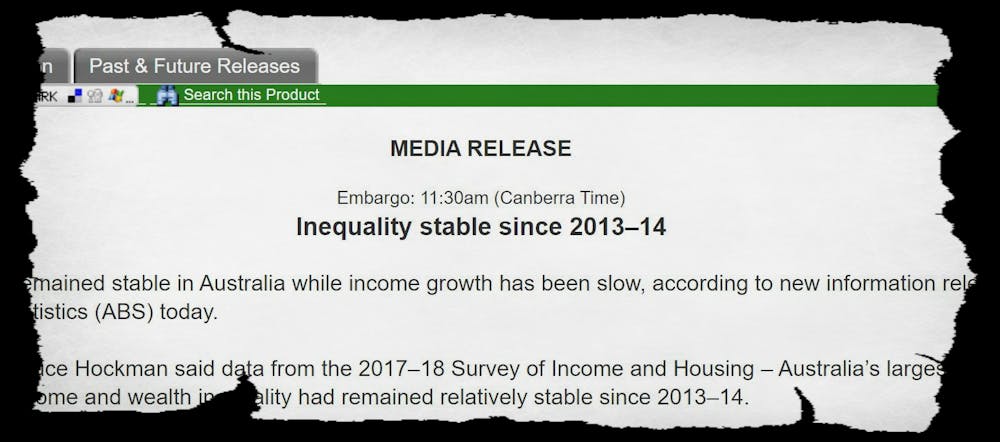
First it was the Bureau of Statistics. It produced an notoriously bland press release headed “Inequality stable since 2013-14” when its own analysts had told it there had been a “significant increase” in wealth inequality since 2011–12, that wealth inequality was “at its peak” since it was first measured, and that there had been “a significant downward change” in the wealth share of the bottom fifth of Australian households.
We know this only because of emails released by the Bureau of Statistics in response to a Freedom of Information request.
Christopher Sheil and Frank Stilwell drew attention to it in The Conversation and then went on to suggest that the Productivity Commission might have also been downplaying the growth in wealth inequality by producing its own bespoke measure at odds with others.
I am not convinced that the Productivity Commission did downplay the growth in wealth inequality, but that doesn’t mean sensitivity about inequality isn’t widespread in official circles, apparently including, as I will outline, the Australian Institute of Health and Welfare.
First, the Productivity Commission.
Sheil and Stilwell present a chart showing the Commission’s 2017 report to be “the odd man out” among five studies – the only one to show a decline in the share of wealth going to the top 10% between 2013-14 and 2015-16.
Productivity Commission understandable
But on the graph presented by the Productivity Commission itself the decline is miniscule.
The PC study also measured a different thing to the other studies: so-called equivalised wealth, which is wealth adjusted for household size and composition.
This isn’t the place to argue the merits of the PC approach (I have problems with it), merely to note that if the PC’s findings were substantially different from other findings, it might be because it was measuring something different.
Every two years since 1993 the AIHW has produced a report that presents reliable and detailed information about the need for and provision of welfare services such as aged care, child care, education, housing and disability services.
Every two years since 1993 the Australian Institute for Health and Welfare (AIHW) has produced a report that presents reliable and detailed information about the need for and provision of welfare services such as aged care, child care, education, housing and disability services.
I was involved in early discussions about the structure and content of Australia’s Welfare and have been asked (with others) to comment on draft chapters prior to release. In 1999 I contributed a chapter. I spoke at its launches in 1997 and 2005. I am a strong supporter of the AIHW and of its work.
In recent years it has added an overview of Australia’s welfare progress over a wide range of dimensions using a framework that covers 15 key indicators divided into seven themes.
It summarises recent changes in each indicator and indicates whether they are, on balance, favourable or unfavourable, or whether there has been no change or no clear trend.
One of the themes is material living conditions. The second of its three indicators is income inequality.
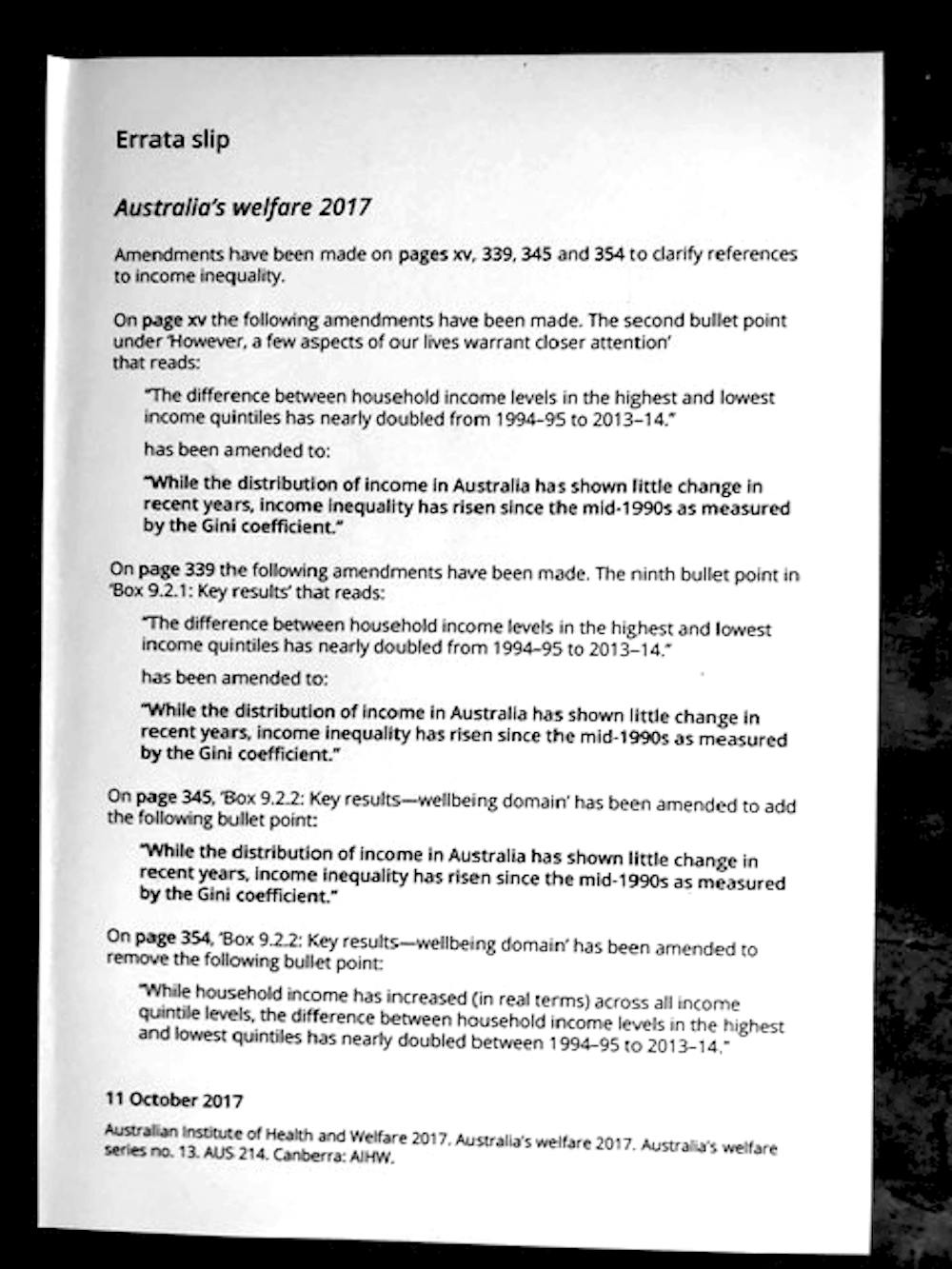
“Errata Slip”, AIHW
Table 9.2.2 summarises the changes between 2003-04 and 2013-14 as “unfavourable”.
Yet when I received my hard copy of that report in mid-November 2017, I was surprised to find a loose-leaf insert inside the front cover headed “Errata slip,” dated October 11, 2017.
An errata is usually a list of factual errors and corrections.
This one dealt not with factual errors but contained what were essentially three changes to the way in which income inequality was described, all of them the same.
In each case a phrase like this was removed
The difference between household income levels in the highest and lowest income quintiles has nearly doubled from 1994-95 to 2013-14
and replaced by one like this
While the distribution of income in Australia has shown little change in recent years, income inequality has risen since the mid-1990s as measured by the Gini coefficient.
Each quintile contains one-fifth of the population, where the top quintile contains those with the highest incomes and the bottom contains those with the lowest incomes.
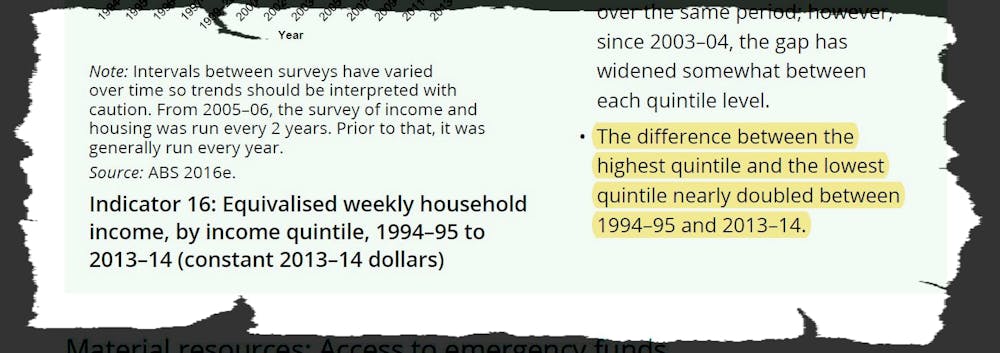
The statement that has been replaced is correct. The difference between household income levels in the highest and lowest income quintiles had nearly doubled between 1994-95 and 2013-14.
But it has been expunged from the version of the report that can be downloaded from the AIHW website, even though careful readers will note that one instance of it still survives unexpurgated on page 355.
Errata are normally reserved for correcting or removing gross errors of fact discovered after printing. In this case, the changes simply replaced a factually correct statement of what the data showed (that income inequality had gone up substantially) with one that was far more qualified.
I find it inconceivable that those responsible for producing such a well-researched, meticulously-checked, authoritative and extensively assessed (internally and externally) report would, at this very late stage, have decided to insist on the change themselves.
So did the Institute give in to external pressure to conform and fall in behind the (incorrect) government line that income inequality hasn’t grown? It’s hard to think of another explanation.
If this is the case, what the Institute did is made it easier for the Bureau of Statistics to dilute the message of its own statistics two years later.
Even stranger still…
One of the most bizarre aspects of this whole episode is that the current government has been actively pursuing policies designed to increase inequality – at least in the short-run – through substantial tax cuts for those at the top, and resistance to raising Newstart for those at the bottom.
Both have been justified on the grounds that widening income gaps will increase incentives to work and save and encourage more Australians to “have a go”.
It thus seems odd for the government to try to suppress or alter information that shows two of its policies working as planned, if that’s what’s happened here.
We need reliable and accurate data on inequality in order to monitor all aspects of our progress and tell whether programs are working as intended. Massaging presentations to make it look as if less is happening than actually is doesn’t serve public policy well.
The agencies that provide this data must abide by the strongest possible standards to ensure the integrity of their data. As far as is known, they do. But those standards have to extend to the presentation of their data. Without that, we will become less than we are, and we will have less idea of what we are doing.
A senior Liberal backbencher, Russell Broadbent, has strongly attacked the government’s legislation for mandatory sentencing for serious child sex offences under federal law and indicated he won’t vote for it in parliament.
Attorney-General Christian Porter specifically acknowledged the Victorian MP’s criticism – which was made at a backbench committee meeting on Monday – when briefing the Coalition parties on the legislation on Tuesday.
Broadbent has made it clear he would not vote for the bill, which will be introduced into parliament on Wednesday.
But he would not cross the floor – he wouldn’t be present for a vote.
Porter argued for the plan on the grounds that the sentencing had not been adequate in these cases.
But at Monday’s meeting Broadbent, a moderate, said mandatory sentencing interfered with the separation of powers, and removed the option for judges to take into account the particular circumstances of a case.
Announcing the details of the legislation last week Porter said 28% of child sex offenders convicted of federal offences in 2018-19 served no jail time.
Among those who got jail sentences “the average length of time that offenders spent in custody was just 18 months,” Porter said.
The government says that as well as mandatory sentencing, the legislation will
have a presumption against bail for serious and repeat offenders
increase maximum penalties, including up to life imprisonment for the most serious offences
contain presumptions in favour of cumulative sentences and actual imprisonment
ensure all sex offenders, when released, are adequately supervised
prevent courts discounting sentences on the grounds of good character where this was used to facilitate the crime.
Labor is opposed in principle to mandatory sentencing but has indicated it may agree to it when it is tied to child protection.
A spokesman for shadow attorney-general Mark Dreyfus said: “We haven’t yet seen the detail of this bill. When the government releases the bill we will go through our usual parliamentary processes. We will consider it in light of the advice from experts on how to best keep our children safe.”
The Law Council of Australia has opposed the mandatory sentencing plan, saying “sentencing is not a one-size-fits-all exercise, but this is the effect mandatory sentencing has.”
In 2000 three Liberal backbenchers, Petro Georgiou, Danna Vale, and Peter Nugent threatened to cross the floor over mandatory sentencing of Aboriginal juveniles in the Northern Territory. They were instrumental in stopping the practice. But Broadbent was not in parliament then – he had been defeated in 1998 and did not return until 2004.
Podcasts are often best enjoyed using a podcast app. All iPhones come with the Apple Podcasts app already installed, or you may want to listen and subscribe on another app such as Pocket Casts (click here to listen to Trust Me, I’m An Expert on Pocket Casts).
You can also hear us on Stitcher, Spotify or any of the apps below. Just pick a service from one of those listed below and click on the icon to find Trust Me, I’m An Expert.
Spring has barely arrived, and bushfires are burning across Australia’s eastern seaboard. More than 50 fires are currently burning in New South Wales, and some 15,000 hectares have burned in Queensland since late last week.
It’s the first time Australia has seen such strong fires this early in the bushfire season. While fire is a normal part of Australia’s yearly cycle and no two years are alike, what we are seeing now is absolutely not business as usual.
And although these bushfires are not directly attributable to climate change, our rapidly warming climate, driven by human activities, is exacerbating every risk factor for more frequent and intense bushfires.
The basics of a bushfire
For some bushfire 101, a bushfire is “an uncontrolled, non-structural fire burning in grass, scrub, bush or forest”. This means the fire is in vegetation, not a building (non-structural), and raging across the landscape – hence, uncontrolled.
For a bushfire to get started, several things need to come together. You need fuel, low humidity (which also often means the fuel itself has a low moisture content and is easier to burn), and oxygen. It also helps to have an unusually high ambient temperature and winds to drive the fire forward.
In Australia, we divide bushfires into two types based on the shape and elevation of the landscape.
First are flat grassland bushfires. These are generally fast-moving, fanned by winds blowing across flattish open landscapes, and burn through an area in 5–10 seconds and may smoulder for a few minutes. They usually have low to medium intensity and can damage to crops, livestock and buildings. These fires are easy to map and fight due to relatively straightforward access.
Second are hilly or mountainous bushfires. These fires are slower-moving but much more intense, with higher temperatures. As they usually occur in forested, mountainous areas, they also have more dead vegetation to burn and are harder to access and fight.
They burn slowly, passing through an area in 2-5 minutes and can smoulder for days. Fires in upper tree canopies move very fast. Mountainous bushfires actually speed up as they burn up a slope (since they heat and dry out the vegetation and atmosphere in front of the fire, causing a runaway process of accelerating fire movement).
About 70 blazes are still burning across Queensland.AAP Image/Dan Peled
Climate change and bushfire risk
To be clear, as previously reported, the current bushfires are not specifically triggered by climate change.
However, as bushfire risk is highest in warm to hot, dry conditions with low humidity, low soil and fuel load moisture (and are usually worse during El Niño situations) – all factors that climate change in Australia affects – climate change is increasing the risk of more frequent and intense bushfires.
Widespread drought conditions, very low humidity, higher than average temperatures in many places, and strong westerly winds driven by a negative Southern Annular Mode (all made worse by human-induced climate change) have collided right now over large areas of the eastern seaboard, triggering extremely unusual bushfire conditions – certainly catching many communities unawares before the start of the official bushfire season.
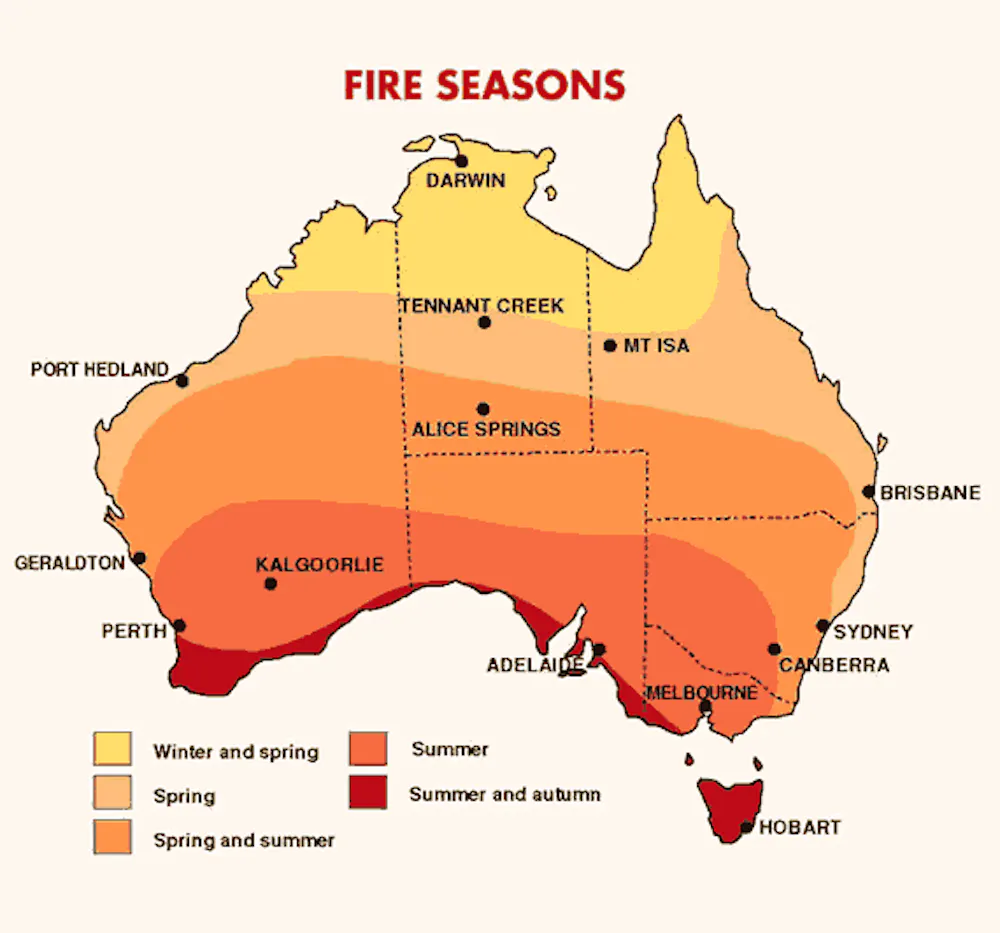
Different regions of Australia have traditionally experienced peak bushfire weather at different times. This has meant that individual households, communities and the emergency services have had specific periods of the year to prepare. These patterns now seem to be breaking down, and bushfires are happening outside these regular places and times.
Map of bushfire seasons.Bureau of Meteorology
New challenges for the emergency services
While experts recently forecast a worse-than-average coming bushfire season, the current emergency has essentially exploded out of nowhere.
Many Australian communities do know how to prepare but there is always some apathy at the start of bushfire season around getting households and communities bushfire-ready. When it’s still relatively cold and feeling like the last whisps of winter are still affecting us, bushfire preparation seems very far off.
Compounding our worsening bushfire conditions, we are increasingly building in bushfire-prone areas, exposing people and homes to fire. This tips the scales of risk further in favour of catastrophic losses. Sadly too, these risks always disproportionately affect the most vulnerable.
With such extensive fires over wide areas, the current emergency points to an extremely frightening future possibility: that emergency services become more and more stretched, responding to fires, floods, storms, tropic cyclones and a myriad other natural hazards earlier in each hazard season, increasingly overlapping.
Our emergency services do an amazing job but their resources and the energy of their staff and volunteers can only go so far.
Regularly the emergency services of one area or state are deployed to other areas to help respond to emergencies.
But inevitably, we will see large-scale disasters occurring simultaneously in multiple territories, making it impossible to share resources. Our emergency management workforce report they are already stressed and overworked, and losing the capacity to share resources will only exacerbate this.
Immediate challenges will be to continue funding emergency management agencies across the nation, ensuring the workforce has the necessary training and experience to plan and respond to a range of complex emergencies, and making sure local communities are involved in actively planning for emergencies.
Sometimes legal disputes are about more than money. Sometimes what is really wanted is an apology – an acknowledgement of wrongful treatment. As former President of the Human Rights and Equal Opportunity Commission, Sir Ronald Wilson, said in White v Gollan, an apology can restore a complainant’s “sense of dignity and self-worth”.
If the federal government’s proposed Religious Discrimination Bill becomes law, a person seeking an apology for religious discrimination will have a new avenue to do so.
As the law stands, the only federal protection against religious discrimination is in the Fair Work Act 2019. While a court can order remedies such as reinstatement or monetary compensation, there appears to be no case under the Fair Work Act which an employer has been ordered by a court to apologise for unlawful termination on the basis of discrimination – religious or otherwise.
In contrast, an apology can be ordered under the proposed Religious Discrimination Act in conjunction with the existing remedy provisions of the Australian Human Rights Commission Act 1986.
The Religious Discrimination Bill has been modelled, in part, on the Racial Discrimination Act. Like the Racial Discrimination Act, complaints made under the proposed Religious Discrimination Act will be made initially to the Australian Human Rights Commission. They may then be referred to the Federal Court if the parties are unable to resolve their dispute.
One of the orders the Federal Court can make is for an apology. The Human Rights Commission Act allows a court to make an order requiring a respondent “to perform any reasonable act or course of conduct to redress any loss or damage suffered by an applicant”. This can include an order to make a private and/or public apology.
There are several cases in which a court has ordered an apology for racial discrimination. In White v Gollan, for example, a publican was ordered to send a written apology and publish an apology in a newspaper circulating in the district after he refused to serve two people in the public bar because they were Aboriginal.
Courts consider that the aims of anti-discrimination legislation sometimes can be advanced by an order to apologise for unlawful discrimination.
In this respect, Israel Folau’s case highlights a difference between orders made under the Fair Work Act and orders that will be available under the proposed Religious Discrimination Act.
Earlier this year, Folau called for an apology from Rugby Australia. He said:
First and foremost I am hoping for an apology from Rugby Australia and an acknowledgement that even if they disagree with my views I should be free to peacefully express my religious beliefs without fear of retribution or exclusion.
Israel Folau’s lawyer, George Haros, has said an apology would “come a long way to resolving the dispute”.
However, Rugby Australia’s Chief Executive, Raelene Castle, has so far ruled out an apology, saying:
…inclusion means inclusion for everybody, and we’ve got portions of our community who were very hurt and upset by Israel’s comments, hence why we are in this situation.
The parties to the Folau case go to mediation on December 13. If that fails, the case will go to court in February next year. In his statement of claim, Folau has sought an apology. He will need to persuade the court that an apology order is necessary to “remedy” the effects of wrongful termination under the Act. However, obtaining an apology as an order rather than by negotiation is a long shot.
Given Rugby Australia’s reluctance to apologise so far, even if the court ordered an apology, would there be any point?
Some state tribunals have recognised that a distinction can be drawn between a personal, sincere and heartfelt apology, which cannot be compelled, and an apology that is an acknowledgement of wrongdoing under anti-discrimination legislation.
Despite the fact some judges regard an ordered apology as a contradiction in terms, identified benefits include a complainant receiving the remedy they seek, and public acknowledgement of unlawful conduct, which in turn promotes the aims of anti-discrimination laws.
Further, some cases show that once wrongdoing is found, those initially unwilling to apologise may be willing to do so. Finally, an ordered apology may restore a party’s sense of self-worth and dignity.
Undeniably, monetary compensation can be an important to remedy for the harmful effects of discrimination. Yet the opportunity to receive an apology order may prove to be an important additional remedy under the proposed legislation.
Source: The Conversation (Au and NZ) – By Rebecca Allen, PhD candidate researching galaxy formation and evolution, Swinburne University of Technology
Over the weekend, India attempted to make history by becoming just the fourth nation to successfully land a probe on the Moon. It came agonisingly close, but after journeying millions of kilometres, the Vikram lander lost contact in the final few hundred metres and crash-landed on the lunar surface.
But it would be both unfair and plain wrong to label the mission a failure.
Two-month trip
After a postponed launch, India’s Chandrayaan-2 spacecraft began its journey to the Moon on July 22.
Onboard it carried the Vikram lander and Pragyan rover, equipped to search the lunar south pole for water and other valuable resources. Everything seemed to be going according to plan. Chandrayaan-2 completed several orbits around Earth and then the Moon, slowly making its way closer to the lunar surface and taking photographs the whole time.
Trajectory of the Chandrayaan 2 spacecraft.Source: Indian Space Research Organisation.
On September 2, the Vikram lander separated and began to make its descent. All communications were normal until the lander was within 2km of its goal.
Then it went silent – a space engineer’s worst nightmare.
Chandrayaan-2 Surveys the lunar surface.Indian Space Research Organisation
Vikram, do you copy?
So far, the Indian Space Research Organisation’s (ISRO) engineers have not been able to reestablish communications with the lander. It’s likely Vikram landed with enough force to damage its communications equipment, as well as other instruments.
But all hope was not lost, as Chandrayaan-2 remained in orbit above the Moon and, with its high-resolution camera, was able to spot the lander. If oriented favourably, Vikram could still manage to power itself up.
ISRO has not admitted defeat and will keep trying to connect to Vikram for the next two weeks. However, the chances of success diminish with time.
While the Chandrayaan-2 mission has not gone as expected, it cannot be called a failure. The Chandrayaan-2 orbiter will continue to monitor the Moon for up to seven years and the high-resolution images it takes will be vital to future international efforts to land on the Moon.
Technically a success
The near success of Vikram’s landing should be celebrated. To appreciate just how hard it is, let’s delve into some physics.
Earth is rotating and also hurtling through space at more than 100,000km per hour. The Moon is almost 400,000km away and travelling around 4,000km per hour as it orbits Earth.
To reach the Moon, you first have to escape Earth’s gravity and ensure you’re going at the right speed to orbit Earth a few times before moving far enough to be caught by the Moon. Then you slowly decrease your distance to the lunar surface, inching closer over several orbits until you are low enough to use powered assistance to land.
It took the United States and Russia decades to design, plan and execute missions to the Moon. In fact, the ISRO was founded shortly after the successful Apollo 11 mission.
We should applaud the hard work India has done over the past 50 years to get this far. This sentiment was clear as Indian prime minister Narendra Modi addressed his country, all of whom stood in solidarity with the scientists who spent countless hours in pursuit of their goal.
The Beresheet lander was built by private company SpaceIL, which was chasing the coveted Google Lunar XPrize when an engine malfunction caused it to swan dive into the Moon’s surface.
I mention this mission to reiterate just how hard the task is, but also to demonstrate that the old Cold War space superpowers are no longer the only ones in the game. Countries and even private companies across the world are gaining spacefaring capabilities and undertaking incredible missions that will enable humankind to go further than ever before.
In the next five years, more than a dozen missions to the Moon from six different countries, including Japan and Korea, are slated. This doesn’t include NASA’s ambitious Artemis mission that seeks to put the first woman on the Moon.
But as the cliché goes, with great power comes great responsibility.
Now that countries across the world can send things into space, we must have solidarity as a global spacefaring community to consider how our actions up there will affect us on Earth and to ensure long-term success in space ventures.
This is not the last international space mission you will hear about in the news this year.
In coming years, we may even be discussing Australian ventures into space – and maybe even to the Moon itself.
Up to 35% of cancers worldwide might be caused by lifestyle factors such as diet and smoking. So how can we go about reducing our risk of bowel cancer?
Based on current evidence, a high fibre diet is important to reduce bowel cancer risk. Fibre can be divided into 2 types: insoluble fibre, which creates a bulky stool that can be easily passed along the bowel; and soluble fibre, which draws in water to keep the stool soft.
Fibre from cereal and wholegrains is an ideal fibre source. Australian guidelines suggest aiming for 30g of fibre per day for adults, but fewer than 20% of Australian adults meet that target.
Wheat bran is one of the richest sources of fibre, and in an Australian trial in people at high risk of bowel cancer, 25g of wheat bran reduced precancerous growths. Wheat bran can be added to cooking, smoothies and your usual cereal.
It’s not clear how fibre may reduce bowel cancer risk but possible mechanisms include reducing the time it takes food to pass through the gut (and therefore exposure to potential carcinogens), or through a beneficial effect on gut bacteria.
Oily fish may also have some protective elements. In people with hereditary conditions that make them prone to developing lots of precancerous growths (polyps) in the bowel, a trial where one group received a daily supplement of an omega 3 polyunsaturated fatty acid (found in fish oil) and one group received a placebo, found that this supplement was associated with reduced polyp growth. Whether this is also true for people at average risk of bowel cancer, which is most of the population, is unknown.
And while only an observational study (meaning it only shows a correlation, and not that one caused the other), a study of bowel cancer patients showed improved survival was associated with daily consumption of coffee.
What to avoid
It’s best to avoid large quantities of meat. International cancer authorities affirm there is convincing evidence for a relationship between high meat intake and bowel cancer. This includes red meat, derived from mammalian muscle such as beef, veal, lamb, pork and goat, and processed meat such as ham, bacon and sausages.
Processed meats have undergone a preservation technique such as smoking, salting or the addition of chemical preservatives which are associated with the production of compounds that may be carcinogenic.
Evidence also suggests a “dose-response” relationship, with cancer risk rising with increasing meat intake, particularly processed meats. Current Australian guidelines suggest minimising intake of processed meats as much as possible, and eating only moderate amounts of red meat (up to 100g per day).
What else can I do to reduce the risk of bowel cancer?
The key to reducing cancer risk is leading an overall healthy lifestyle. Adequate physical activity and avoiding excess fat around the tummy area is important. Other unhealthy lifestyle behaviours such as eating lots of processed foods have been associated with increased cancer risk.
And for Australians over 50, participating in the National Bowel Cancer Screening program is one of the most effective, and evidence-based ways, to reduce your risk.
There has been renewed scrutiny in recent weeks about spending on private school capital works. Alongside science labs, sporting fields, and “wellbeing spaces”, many of Australia’s richest schools feature elaborate performing arts centres.
Melbourne’s Wesley College’s redevelopment, for example, includes a $21 million music school and $2.3 million visual arts and design precinct. Meanwhile, programs for disadvantaged students who show artistic talent have relied on volunteers and small grants.
Usually comparisons between public and private schooling focus on academic or sporting outcomes – but what of creative education?
Increased engagement in arts education has wide ranging benefits for academic and social outcomes – and those most at risk have the most to gain. Research has long shown the arts offer many benefits beyond “art for arts sake”, with health, social and economic benefits which offer both private and public value.
Confidence gained from arts programs, and their capacity to support healthy risk taking improves academic outcomes and student behaviour. For teachers, the arts can be a way of connecting to children who struggle with conventional approaches.
An uncommon experience
Last year, the ABC’s Don’t Stop The Music showcased the work of the inspirational principal and staff at Challis Primary School, a disadvantaged school in the Perth suburbs.
Through a public donation program, the school was able to provide students with musical instruments to loan and access to music education experts. Over the series, we saw how engagement in the arts supports academic, social and emotional development – as well as redressing issues such as attrition and disengagement.
The program was lauded by school staff, parents and children, but it is not the common experience of students in Australian public schools.
Measuring creativity and the effects of arts engagement is not simple. But this will be the challenge for evaluators such as Programme for International Student Assessment, which will track creativity and critical thinking from 2021. The 2015 Australian PISA scores across reading literacy, mathematical literacy and scientific literacy placed in the middle performance range. An outcome of the measuring creativity may result in greater funding to public schools to lift the score depending on the outcome.
A non-national Australian curriculum
In 2011, then Minister of the Arts Peter Garrett enshrined arts into the Australian Curriculum.
This historic move meant all Australian children and young people would be entitled to arts education from their first moment of early schooling to the end of year 10.
But the implementation of this arts curriculum has not been fully realised. This is a result of two factors: the lack of training in arts delivery in tertiary teaching courses across Australia, and the lack of infrastructure and resources in public schools.
Don’t Stop The Music starkly showed the results of underfunding and sub-optimalfacilities for arts programs. The music program would not have been successful without the donations of instruments and additional support from external experts.
By contrast, the 2011 documentary Mrs Carey’s Concert focused on the music program at MLC School in Burwood, NSW – with its double-storey music centre – and the students’ biennial performance at the Sydney Opera House. In Don’t Stop the Music, students from Challis Primary School made do with practising in the library, staff room, or whatever empty space they can find.
Their support didn’t come from a multimillion dollar venue but from the tenacity of teachers who believed deeply in their students.
shall respect and promote the right of the child to participate fully in cultural and artistic life and shall encourage the provision of appropriate and equal opportunities for cultural, artistic, recreational and leisure activity.
Scott Rankin, CEO and Creative Director of Big hART, one of Australia’s leading arts and social change organisations, takes this further:
Culture is far from recreational, elitist or optional. It is an issue of justice, which plays out in pragmatic ways, as an essential service.
The centrality of the arts in the lives of children and young people is key to developing entrepreneurship, social intelligence, problem solving and critical thinking skills, which are becoming increasingly essential as preparation for work in the 21st century.
Students gain more from creative education than just art appreciation.Dan Himbrechts/AAP
The career outcomes for students who had access to state-of-the-art creative facilities versus those who did not have yet to be quantified in Australia. In 2016, British research showed that award-winning actors there were over twice as likely to have been educated at an independent school. Conversely, this was not true of popular musicians.
If inequitable education funding continues, Australia’s children and young people in low socio-economic or marginalised communities will not have the creative skills and innovation mindsets to see them become successful and productive citizens both now and in the future.
It’s time to reprioritise funding and direct it to Australia’s creative kids who could most benefit.
The relationship between ministers and the Australian public service has transformed from a partnership to one more like “master-servant”, with the “master” including the minister’s staff, according to former senior bureaucrat Andrew Podger.
Podger, who headed various federal departments and was public service commissioner, said this had come about through the “thickening” of the interaction between the public service and ministers, coupled with the professionalisation of politics.
Delivering the Parliamentary Library Lecture on Tuesday, Podger said the incentives for senior public servants had changed, and this had affected the way they acted.
“Controlling the public service to minimise political risk is too often given more weight than taking advantage of the intellectual capacity and administrative experience the APS has to offer’”, he said.
Some senior public servants tried to demonstrate “responsiveness” to please their “masters” “by devoting resources to more tactical and immediate support than to strategic and longer term advice”.
This was, in the term coined by the late Peter Aucoin, a Canadian expert on public administration, to exercise “promiscuous partisanship” – “a willingness to go too far in supporting the elected government’s political agenda and then switching when government changes, going too far again in supporting the new government’s political agenda.
“They presumably think this demonstrates non-partisanship, but it really just prostitutes the professional apolitical role of the APS, blurring the line between the role of the APS and that of ministerial staff and undermining the confidence of the parliament and the public in the APS as an apolitical institution,” Podger said.
His observations come ahead of the release of the Thodey review of the APS and after Scott Morrison has made it clear that he sees the service’s role as primarily implementation of the government’s agenda, downplaying its provision of wider advice.
Podger said he thought the view that a more independent public service offered ministers greater political risk than benefit “is more often the view of ministerial staff than ministers themselves”.
“A government genuinely determined to improve services to Australians and to pursue policies in our long-term interests should value a highly capable civil service.”
He was hopeful Morrison on reflection “takes a broader view of the important role of the APS that goes beyond service delivery and implementation of government policies, to encompass strategic policy advice that is taken seriously”.
Challenges the government would face, including those identified by Morrison in relation to the economy and global uncertainty, would require calling on expert bureaucratic advice, he said.
“Investing in the capability of the APS and nurturing it as an institution is a particular responsibility of any prime minister.”
Podger said the role of the public service commissioner needed strengthening. This was “particularly in light of the common practice in recent decades of prime ministers appointing individuals known and favoured personally by them as secretary of the Department of Prime Minister and Cabinet”.
Morrison has recently appointed Phil Gaetjens as head of the Prime Minister’s department. Gaetjens was chief of staff to Morrison when he was treasurer.
“The APS needs a clear and separate professional head of the service, focused on stewardship of the APS and its capability to serve future governments as well as the current one,” Podger said.
“The secretary of PM&C is the operational head, marshalling the resources of the APS to meet the requirements and lawful directions of the prime minister and the cabinet.”
Podger urged a more independent process for appointing departmental heads, with the APS commissioner taking the lead role in advising on secretary appointments.
Under this process, the prime minister would be required to consider advice from a panel led by the commissioner and including up to two other secretaries selected by the commissioner. If the PM did not follow the panel’s advice, he or she would have to table in parliament the reasons for selecting someone else.
Source: The Conversation (Au and NZ) – By Philippa Martyr, Lecturer, Pharmacology, Women’s Health, School of Biomedical Sciences, UWA, University of Western Australia
Would you like to go to your local pharmacy and buy prescription medicines without seeing the doctor first? Or would you like to collect your prescription medicines at the local supermarket?
These are some of the options canvassed now the Commonwealth government is negotiating the seventh Community Pharmacy Agreement with pharmacists.
Arguments are playing out as a type of “turf war” between the professions as each side discusses which is the safest, most cost-effective way to deliver health care over the next five years.
But the professions haven’t always existed as we know them today. And current “turf wars” are not new. In fact, history shows us the changing nature of the professions since medieval times.
Modern pharmacy traces its origins to the medieval apothecary. But so does modern medical practice. That’s because the job of apothecary doesn’t line up neatly with modern ideas of “doctor” and “pharmacist”.
By colonial times, medicine in Australia was largely unregulated and based on enthusiastic self-help. Home medicine chests were popular. They contained often-deadly raw materials such as antimony and opium for preparing home remedies for everything from constipation to breast cancer.
Medicine was a matter of “buyer beware”. You took your chances with your own medical theories, recipes and dosages. People also expected to buy whatever medical ingredients they needed from the nearest available shop – whether it was a pharmacy, a feed store or a grocer.
This shop sold a range of goods, not just medicines (The Capricornian, Rockhampton Qld, December 31 1898, p20).Trove Newspapers
Apothecary jars: apothecaries didn’t fit with modern notions of doctors or pharmacists. They did a bit of everything, including diagnose illness and dispense medicines.by callmekato is licensed under CC BY-NC-ND 2.0, CC BY
Over the course of the 20th century, Australia’s medical and pharmacy laws gradually limited pharmacists to preparing and dispensing medicines.
At the same time, poisons legislation reduced the range of drugs available over the counter. These included “patent medicines”, ready-made mixtures, some of which worked, some of which contained very little medicine.
The boundaries change again
Since then, the boundaries of what each profession is allowed to do has changed once more.
And some pharmacists want to do more. A March 2019 review found Western Australian pharmacists want to be able to prescribe medications for chronic illnesses like asthma and diabetes.
The world of unregulated medicine has gradually became more tightly managed, but now we are hearing calls for deregulation.
Doctors and pharmacists have always talked about protecting the public from risks. But there are other factors involved, like having a monopoly on an expensive product.
But still science continues to be out of favour with teens despite its potential use in a wide range of employment opportunities, beyond the traditional science careers.
Teens live in a world of science
Today’s teenagers have gown up in a world shaped by science. Most don’t know life without the internet and have the world at their fingertips (and parents to help) through computers, smartphones and other connected devices.
Schools are doing what they can to try to teach students the skills they need to prosper in a future that continues to be shaped by science, with increased use of automation, artificial intelligence and so on.
You would think students in this environment would jump at science as a subject that teaches critical thinking and problem solving – just the skills needed in this modern world.
But that’s just not happening.
There are plenty of books written on why students aren’t choosing science and government reports on why we need more science skills, so you might wonder what hasn’t been done.
That’s where my research comes in. I have studied as a scientist, teacher and marketer and I thought the problem might not be science at all, but how students see science compared to the other subjects they can choose. To me it looked like a purchase decision.
How students choose subjects
I wanted to know how students chose their subjects and how they saw science, so I asked them.
Initially, I spoke to 50 students from five New South Wales schools and then 15 adults (careers advisers and teachers) who helped students make their choices. I went to the information events at these schools and reviewed the subject choice documents given to students.
Next, a group of 379 Year 10 students were surveyed to ask about their subject choices. They were asked to rank 21 factors I found students considered when they chose their subjects. These factors included things such as parent advice, teacher advice, enjoyment of a subject, subject difficulty and the expected mark.
What I found was that the students seemed to use a two-stage process to choose their five to six subjects. The first stage was a choice on “love” or “hate” (they used those words). Then, with any subjects left over, they judged the value of the subject compared to the others available.
This value was in terms of how useful a subject was for a career or further study, and how much effort they would need to put in to get good marks. Unfortunately, this is where things go wrong for science.
Science looks like the bad buy
Students reported more often (16 against 7) that they saw science as harder than other subjects, and as harder to get marks. Students didn’t say they wanted to avoid work – it just had to be worth it.
Unfortunately, science has a problem here too. Students repeatedly commented that science wasn’t as useful as other subjects – unless you wanted to be a doctor, scientist, engineer or something similar.
I did not see anything at any of the school subject selection events that countered this idea. This makes science look like the bad buy. It’s seen as expensive in terms of time and effort to get marks, and as having limited use.
Yet science is useful in a range of careers, from carpentry to management and many other roles – basically any career that needs answers backed by evidence. Science helps us to understand and participate in the world in which we live.
But this is not clear to students. Their perception of the usefulness of science is very narrow, so there is no longer pressure to include it as a staple next to mathematics and English.
Seeing the value of science
Knowing this gives us something to work with. Along with all the other great work to help students love science, we can work on their perceptions of the value of science at the time they are choosing subjects.
Schools should invite people from a wide range of career backgrounds to come talk to students to share their ideas on how science is useful in their jobs.
We can also do some very practical things to make sure science is at its most attractive when students are choosing subjects – for example, doing fun work in the lab and not scaring them with any challenging exam just before they choose.
These teenagers do not take subject choice lightly – they know they may be closing the doors on some paths. It would be wrong to convince students to take any subject that’s not right for them, but this is about helping them see the value of science.
If they see that value of science subjects through good information and good experiences then they may decide to stay with science, at least for a couple more years.
The populations of these growing tropical cities already experience high temperatures made worse by high humidity. This means they are highly vulnerable to extreme heat events as a result of climate change.
For example, extremely hot weather overwhelmed Cairns last summer. By December 3 2018, the city had recorded temperatures above 35°C nine days in a row. Four consecutive days were above 40°C.
Cairns’ heatwave summer.Authors, using BOM temperature data
For our research, temperature and humidity sensors were strategically placed in the Cairns CBD to represent people’s experience of weather at street level. These recorded temperatures consistently higher than the Bureau of Meteorology (BoM) recordings, reaching 45°C at some points.
Highest temperatures recorded by James Cook University weather data sensors during the November-December 2018 heatwave in Cairns.Image: Bronson Philippa, Author provided
Local effects magnify heatwave impacts
Urban environments in general are hotter than non-urbanised surroundings that are covered by vegetation. The trapping of heat in cities, known as the urban heat island effect, has impacts on human health, animal life, social events, tourism, water availability and business performance.
The urban heat island effect intensifies the impacts of increasing heatwaves on cities as a result of climate change.
But it is important to remember that other local factors also influence these impacts. These include the scale, shape, materials, composition and growth of the built environment in a particular location and its surrounding areas.
The differences between the BoM data recorded at Cairns airport and the inner-city recordings show the impacts of urban expansion patterns, built form and choice of materials in tropical cities.
The linear layout of Cairns has, on one hand, enabled the formation of attractive places for commercial activities. As these activity centres evolve into focal points of urban life, they in turn influence all sorts of socioeconomic parameters.
On the other hand, the form the built environment takes changes the patterns of wind, sun and shade. These changes alter the urban microclimate by trapping heat and slowing or channelling air movements.
The layout and structures of Cairns CBD alter local microclimates by trapping heat and altering air flows.State of Queensland 2019, CC BY
To date, a large body of research has explored the undesired consequences of climate change and urban heat islands. However, the focus has been on capital and metropolitan cities with humid continental climates. Not many studies have looked at the economic and social impacts in the tropical context, where hot and humid conditions create extra heat stress.
Add the combined effects of climate change and urban heat islands and what are the socio-economic consequences of heatwaves in a tropical city like Cairns? We see that climate change adds another dimension to the relationship between cities, economic growth and development.
This presents a huge opportunity to start thinking about building cities that are not superficially greenwashed, but which instead tackle pressing issues such as climate variability and create sustainable business and social destinations.
In cold climates, heatwaves and urban heat islands are not necessarily undesired, but their negative impacts are more obvious and harmful in warmer climates. And these harmful impacts of heatwaves on our economy, environment and society are on the rise.
We have scientific evidence of the increasing length, frequency and intensity of heatwaves. The number of record hot days in Australia has doubled in the past five decades.
Increased exposure to heatwaves amplifies the adverse economic impacts on industries that are reliant on the health of their outdoor workers. This is in addition to the extreme heat-related fatalities and health-care costs of heatwave-related medical emergencies. As a PwC report to the Commonwealth on extreme heat events stated:
Heatwaves kill more Australians than any other natural disaster. They have received far less public attention than cyclones, floods or bushfires — they are private, silent deaths, which only hit the media when morgues reach capacity or infrastructure fails.
Heat also has direct impacts on economic production. A 2010 study found a 1°C increase resulted in a 2.4% reduction in non-agricultural production and a 0.1% reduction in agricultural production in 28 Caribbean-basin countries. Another study in 2012 found an 8% weekly loss of production when the temperature exceeded 32°C for six days in a row.
The recent changes in climate have had a significant negative effect on the productivity of Australian cropping farms, particularly in southwestern Australia and southeastern Australia.
Average climate effect on productivity of cropping farms in southwestern and southeastern Australia since 2000–01 (relative to average conditions from 1914–15 to 2014–15).Farm performance and climate, ABARES, CC BY
It’s not just farming that is vulnerable. A Victorian government report report this year estimated an extreme heatwave event costs the state’s construction sector A$103 million. The impact of heatwaves on the city of Melbourne’s economy is estimated at A$52.9 million a year on average.
According to this report, economic costs increase exponentially as the severity of heatwaves increases. This has obvious implications for cities in tropical regions.
As the next step in our research, we are examining the relationship between local urban features, urban heat islands, the resulting city temperatures and their direct and indirect (spillover) effects on local and regional economic activities.
Source: The Conversation (Au and NZ) – By Lisa Dethridge, Coordinator Masters of Media Professional Research; Game Design Research, RMIT University
Review: Ride Like a Girl
Award-winning actor Rachel Griffiths takes the reins on a large cast and crew to direct and co-produce this timely biopic. We focus on a rambunctious, country family with finely drawn brother-sister and father-daughter subplots.
The luminous Teresa Palmer (Hacksaw Ridge, Berlin Syndrome, A Discovery of Witches) stars as Michelle Payne, first victorious female Melbourne Cup jockey. Sam Neil plays her stubborn dad Paddy, patriarch of Victoria’s Payne racing family.
Michelle’s loyal brother is played by real-life “best strapper in Australia” Stevie Payne, who outshines the large professional cast playing himself.
Griffiths successfully adapts to her first role as director and maintains tight rein on her crew. Showing knowledge and experience of Hollywood narrative techniques, she calls the shots with confidence. The story blends classic Hollywood storytelling with Australian feelgood family fare.
Paddy Payne, Michelle Payne, Stevie Payne and Rachel Griffiths arrive at the world premiere of Ride Like A Girl in Melbourne on Sunday.Scott Barbour/AAp
Kids will love this movie. It’s about farmyards; single dads; a wedding; a funeral; horses – falling off them and getting back on – all leading to a fast climax and a no-nonsense denouement that will please most audiences. Sound predictable? Maybe.
But this is the stuff parents have been waiting for. A fascinating rite-of-passage for a gutsy heroine; all the pageantry of the sport of kings, with a gorgeous local cast playing the real-life Payne family of champions. Griffiths makes sure our hearts warm as two outsiders, Michelle and brother Stevie, overcome all odds to achieve their international Melbourne Cup victory.
Trailer for Ride Like a Girl.
A hundred to one odds
So what does it take for a young woman to train for and win the Melbourne Cup at odds of a hundred to one? Michelle Payne lives with nine siblings (eight of them jockeys) on her dad’s horse farm near Ballarat, genteel capital of the old gold-mining district.
We first meet a feisty five-year-old who’s besting her siblings at back yard races. Dad helps her understand the racetrack and memorise the data on all prior Melbourne Cup jockeys. So horsey is she that Michelle sleeps in the stable and skips class at the country Catholic school where a comical nun (Magda Szubanski) first admonishes and then supports the girl’s ambition.
Magda Szubanski as Sister Dominique, a nun on Payne’s side.Transmission films
We meet Michelle again at 15 as she plans her racing victories with brother Stevie who plays himself, a young man with Down Syndrome, treated as a “blessing” by his family.
Audiences will be hooked by Stevie’s bubbly humour and his natural rapport with both horses and the camera. There is no challenge to himself or his sister that can disrupt their magic circle. The Cup will one day be theirs!
We follow teen apprentice Michelle as she runs to the city and waits patiently on the outskirts of the Caulfield racing establishment. She’s up before dawn, training and getting to know characters at the track; pushing to earn her place as a pro jockey in their world. Her relentless energy drives the action through the trials of paternal conflict and a disastrous fall that threatens her life.
The special on-track race cameras reveal strife, spills and scuffles but do not dwell on suffering or conflict. The camera stays on Michelle’s persistent hard work and will to succeed.
A jockey’s life is depicted as extreme sport. The wiry Michelle is in ceaseless physical training: crunches and pushups; vitamins for breakfast. We melt in our seats as she wraps herself in plastic bags to sweat off the last kilo before race day.
Michelle Payne rides Think Champagne at Cranbourne Racecourse in August.Vince Caligiuri/AAP
There is no sex, no guns, no drugs and no violence in this story. But there’s plenty of drama. Michelle rides on despite doctors’ warning that another fall could kill her. Her confrontations with officials show her steely but careful determination to sustain her place in the ranks.
Patient diplomacy
Palmer shows us Michelle’s patient diplomacy. She does not whinge when given a tiny changing room at the track. She’s scornfully unafraid when a trainer makes a lewd proposal. Perhaps as a result of her dealings with grumpy dad, she persuades resistant officials and horse owners that she’s worthy of a Cup ride.
Teresa Palmer and Sam Neil in Ride Like a Girl.Lachlan Moore
Her cool head and superior horsemanship allow her to quietly and discretely upturn tradition. This softly-softly approach makes Michelle a feminine heroine with a tactful approach to sexual politics. By the final act, the racing fraternity support her every step of the way.
Ride Like a Girl is a feminised form of Joseph Campbell’s classic hero’s journey. We empathise with the passionate ambition of an heroic girl, pure of heart, with both maidenly and warrior traits.
In one parody of a traditional romance scene, Michelle breathlessly confesses, “Dad, I’ve found ‘The One.’” He asks, “how many legs does this Prince of yours have?”
True to the maiden heroines of legend, Michelle’s first love is for animals, in this case her steed, the Prince of Penzance whom she rides to victory with tender encouragements.
In utterly classic form, our heroine tries, falls, dares again and wins. She shares the rewards with a brother who, like her, is vulnerable but determined. This story is indeed made sweeter knowing it is all true.
Ride Like a Girl will be released in Australiac cinemas on 26th September.
Australians love sport. Whether it be record crowds at the recent Boomers v USA basketball game, or the record numbers who sign up as loyal members of our professional teams, sport plays a major role in the Australian community.
However, it is not just what happens on the court or field that matters. A new survey from Swinburne University has found that Australians think sports organisations do more for the greater good than government, religious organisations, or business.
This nationally representative survey of 1,000 people was a collaboration between Swinburne’s Sports Innovation Research Group and the Australian Leadership Index (ALI), a publicly available benchmark of leadership for the greater good across Australia.
The ALI tracks public perceptions and expectations of leadership for the greater good, as well as the drivers of perceived leadership for the greater good.
The findings show that 31.7% of people believe that sports organisations demonstrate leadership for the greater good to a “fairly large” or “extremely large” extent.
This is somewhat higher than local (30.2%) and state government (27%) and significantly higher than national businesses (24.6%) and the federal government (23.5%). Only charities and public sector institutions are perceived more favourably by the general community.
Why are sporting bodies such good community leaders?
From a community perspective, leadership for the public good occurs when leaders demonstrate high ethical standards, prioritise transparency and accountability even when it could have a negative impact on their administrations, and are responsive to the needs of the people they serve and the community.
Our survey found respondents’ perceptions of sporting bodies’ contribution to the greater good was driven primarily by how ethical they considered them to be.
The second most important factor was accountability — the extent to which institutions are seen to accept responsibility for their negative impacts.
Taken together, this suggests the responses of sport organisations to negative issues will have a critical impact on perceptions of their social leadership.
Such issues are common and often play out in public, high profile settings. Cricket Australia’s response to ball tampering and AFL’s responses to drugs, performance enhancing or otherwise, exemplify these issues.
Finally, the apparent focus of a sport on creating positive social outcomes, such as preventing discrimination and creating equal opportunities, was the third most important driver.
From national sport bodies to individual teams and athletes, sporting bodies increasingly engage in discretionary programs and initiatives – most commonly targeting health, education, gender equality, and social cohesion – to contribute to their communities.
Which sports organisations lead the way?
The initial stage of our research tested perceptions of a number of professional sports – those that operate with large administrative structures and generate significant revenue.
Of the sports we examined, netball was the ranked highest in terms of overall leadership for the greater good (34.2%). Netball Australia led the field in terms of perceived transparency, accountability and ethical standards.
The AFL (31.4%) was next best, scoring well in terms of its focus on creating positive social outcomes and its responsiveness to the people it serves.
Of the professional sports we examined, Rugby League (25.9%) and Rugby Union (24.5%) were seen as showing the least leadership for the greater good. Both scored low on accountability, ethical standards and focus on social value.
In the case of the latter, comments from the survey indicated there was significant controversy regarding the treatment of Israel Folau. Some respondents approved of the strong stand taken by Rugby Australia towards Folau. However, others regarded his treatment as excessive and motivated by commercial concerns rather than ethics.
Notably, community sports clubs are largely sustained by volunteers. At the community club level, volunteers include coaches, officials and administrators.
Community sport clubs build community cohesion, helping local people build friendships and social connections. Unlike large charitable organisations where there are concerns about donations being allocated to cover administrative costs, local organisations with high levels of community involvement – like community sport clubs – engender greater levels of public trust.
Consistent with this, our results show that 38.3% of Australians think community sport clubs demonstrate leadership for the greater good to a “fairly large” or “extremely large” extent. This is significantly better than the results obtained for State and National sport associations and Professional Sport Leagues.
Our results raise concerns related to recent predictions that local clubs will be replaced by larger sport organisations with corporate leadership and governance structures because of growing market pressures. A possible unintended consequence of this may be a corresponding decline in public trust in the leadership and governance of sport overall.
The benefits of leadership for social good
The majority of sport organisations in Australia are public bodies, reliant on public funding and support. The exception are larger corporate sport bodies, including professional leagues and sports, that have become self sufficient via commercial sport revenue streams.
These sports organisations share a desire to serve their communities. Our research affirms this notion, showing that sport organisations, especially community clubs, perform well in communities and compare favourably to other public and private bodies.
In the context of persistently low trust in institutions, in general, and government and business institutions, in particular, sport organisations appear to offer a glimmer of hope, and a powerful example, of leadership for the public good.
In Stephen King’s Pet Sematary, caretaker Jud Crandall warns against burying bodies in the old Indian burial ground. “They don’t come back the same”, the old man drawls, with a mix of desperation and horror in his voice.
If only television executives heeded this same advice.
Around the globe, recent reboots of some long loved, long dead, television programs highlight the unimaginative strategies studios are employing to out-manoeuvre each other in the race for higher ratings. Hitting our screens again of late have been the exhumed corpses of Beverly Hills 90210, Twin Peaks, Arrested Development, X-Files, Will & Grace and Roseanne, among others.
The revival of Beverly Hills 90210 has nothing on the original’s hair styles.Fox
I’ve dubbed this “Zombie TV”. It’s the type that could have only been created by television programmers adhering to The Simpsons adage: “We’ve tried nothing and we’re all out of ideas”.
Zombie reboots are old shows with the same cast and same locations. It’s like we’ve all just hitched a ride in Doc Brown’s DeLorean and teleported 20 years into the future. The latest Australian example is the beloved Seachange.
Originally on the ABC but now switched to Nine, this raising from the dead takes place 20 years after the original – but things don’t seem to have developed much for our characters in the years since.
Laura Gibson (Sigrid Thornton) is still dispensing her own brand of justice, Bob Jelly (John Howard) is still on the scrounge, and Heather Jelly (Kerry Armstrong) is still off with the pixies.
The underlying problem here is that a Channel Nine audience is very different to an ABC one – not least of all in age. The average age of an ABC viewer is 66; the average age of the Nine viewer is a sprightly 50.
Watching this reboot, it feels like writer Deb Cox has reacted to this audience change by writing in a much more light and flippant (if that’s possible) tone.
The comic aspects are at the fore while the drama (or melodrama) has been downplayed. Every scene has a comedic touch to it, so much so that the characters are more caricatures of their former selves. The brooding and at times poignant scenes of the original, such as Laura’s romances with Diver Dan (David Wenham) and Max Connors (William McInnes) have little place at Pearl Bay now – unless each ends with slapstick.
The heart of Seachange has been replaced with slapstick.Nine
But the main issue is that what was fresh and relevant in 1998 isn’t in 2019.
Times have changed
Twenty years ago, many dreamed of escaping the city commute and chaos for the peaceful surrounds of a small town by the water. But high unemployment, sky-rocketing ocean view house prices, limited educational opportunities and reduced entertainment options have taken the gloss off small-town living.
Many of those who made the change previously are now returning to the cities for these exact reasons.
So what is the place of a Seachange reboot after the zeitgeist has passed?
Seachange always hooked itself on the one premise that life away from the cities was so much better. Everything else in it was pretty much (beloved) stock standard melodrama, and the reboot hasn’t shifted to reflect current societal issues. Without that hook is the attraction of the show just another nostalgia kick?
Are we all just hoping for a return of Diver Dan?ABC
Mass grave robbery
Seachange, so far, seems unlikely to achieve the ratings success it is chasing. It premiered as the highest rating drama of 2019 with 787,000 metro viewers. By week two, a third of those viewers had been lost.
But it could still lead to mass grave robbery of Australian television programming. For television executives Zombie TV is a very enticing prospect. Australian networks need to abide by strict quotas on new drama, and original TV drama is risky – if it doesn’t work, heads can roll.
Bringing back an old, popular show, carries less risk – people tune in for nostalgia’s sake, at the very least. And, if it fails after that? Then the execs can claim, “It was huge 20 years ago, who knew it wouldn’t be now?” The failure is disowned.
Zombies have their origins in the voodoo religion of Haiti, where corpses were believed to be revived by black magic, becoming mindless creatures, or for slave labour or to carry out curses tormenting the living.
Maybe TV executives need to keep that in mind, too.
Although opportunities for women in policing have expanded over time, their overall numbers remain relatively low. Nationwide, about a third of all police personnel were women in 2017-18, but barriers remain to states achieving their goals of reaching 50-50 gender parity on police forces. Women are vastly underrepresented in senior roles, as well.
The changing role of women in policing
Women began to play a role in policing in the United Kingdom in the early 1900s, though this was initially limited to focusing on women and children impacted by war. By 1915, there were Women Police Service volunteer constables and officers patrolling streets across the country, though they were prevented from becoming a permanent part of the police force.
A female police patrol in London in 1918.UK Parliament
Women are still breaking into new areas of policing today. Queensland finally got its first female motorcycle officers in 2017, for instance, when two women passed the arduous three-week qualifying course.
Queensland rape squad course participants, 1977.Image PM3641 Courtesy of the Queensland Police Museum
Participation of women in policing
In the United States, women comprised just 12% of sworn police officers (police officers with general arrest powers) in 2014 – an increase of just four percentage points from 1987. It is worth noting, however, that women were better represented on police forces in bigger population centres.
Gender equity is slightly better in the United Kingdom, where women accounted for 30% of police officers in 2019, up from 26% in 2010.
And in Australia, 33.6% of sworn and unsworn police personnel were women in 2017-18, up marginally from 32.2% in 2012-13, according to the Report on Government Services 2019. While most states have increased the number of women in their ranks in recent years, New South Wales and the Northern Territory have been trending in the opposite direction over the past 12 months.
Australian women in policing 2012-18, including sworn and unsworn personnel.Report on Government Services 2019
Many police services across the country have now enacted strategies to achieve 50-50 gender equity for police staff. And several services, including the Australian Federal Police, have initiated independent reviews of their organisational culture and the prevalence of sex discrimination.
Breaking the glass ceiling and senior representation
In 2001, Christine Nixon was appointed Victoria’s chief commissioner, the first woman to be named head of an Australian police force. And the appointment of Katarina Carroll as the Queensland police commissioner this July marked the final breaking of the glass ceiling for that police service.
However, despite these high-level appointments, problems still exist in terms of the representation of women in senior ranks. A 2018 analysis of Queensland police data showed that women were proportionally underrepresented at every rank above inspector in that state. When questioned about this imbalance of female leadership, Queensland Police Commissioner Ian Stewart said:
Our promotions are based on people who can show merit. We will again not be changing our systems to promote people who don’t have the merit to do the job.
In South Australia, women made up 28.5% of sworn police in 2017, but only 18.5% of commissioned officers. The same disparity exists in Victoria, where women accounted for 28% of sworn police officers in 2017, but only 16% of the leadership roles.
A 2019 review of the NSW police promotion system found that women were also underrepresented in leadership roles in that state, but it did not find any overt discrimination.
Barriers to participation
Despite having gender-equity targets in place, many states struggle with the recruitment of women for police forces. Although the Queensland Police Force did reach 50-50 parity for its recruitment program in 2016-17, Stewart said it’s getting more difficult to attract female applicants.
If we don’t have enough we won’t change the standard, and we’ll have more male applicants than women in a recruit program. I think that will happen at times.
A Channel 7 News investigation found that Queensland police are struggling to find women recruits.
The Victoria Police Force last month announced it would provide targeted assistance for potential recruits to meet entry fitness standards in an effort to boost female participation.
In essence, there are two main barriers to increasing the numbers of women in policing: elements of sexism and discrimination that result from the male-dominated culture in police forces and the nature of the job itself.
A number of police services, including NSW, South Australia, Victoria and the Australian Federal Police, have conducted inquiries into the culture of their forces and made commitments to stamp out discrimination based on gender.
What these changes cannot do, however, is make some aspects of the job more attractive to women. Operational policing involves shift work, long hours, exposure to physical harm and mental trauma. As Stewart noted,
Twenty-four-hour shifts and 365-days-a-year work all take a toll on people, and particularly for women who are the primary raiser[s] of families
One potential solution is a bigger focus on flexible working arrangements and part-time policing arrangements to help improve the work-life balance for officers.
But it remains to be seen if these steps will make a difference. While the number of women in policing is on the rise, only time will tell if the goal of reaching 50-50 gender parity will someday become reality.
The Morrison government is having another shot at getting its proposal to drug test people on welfare through the Senate.
Welfare, health and drug treatment experts have consistently opposed the proposal since it was first introduced three years ago. They say these measures will only serve to further marginalise people on welfare and people who use drugs, and may have a range of unintended consequences such as homelessness.
If the government really wanted to assist people who have drug problems to return to work, it would increase funding for drug treatment.
What’s being proposed?
The new proposal appears very similar to those the Senate previously rejected in 2017 and 2018.
A two year trial would test around 5,000 new recipients of Newstart Allowance and Youth Allowance for a range of illegal drugs in three locations in Queensland, New South Wales and Western Australia.
Cocaine has been added to the list of drugs to be tested for. The list already included methamphetamine, MDMA (ecstasy), opioids (such as heroin) and cannabis in earlier versions.
Welfare recipients who test positive will be placed on income management, with 80% of their income quarantined.
They will undertake a second test within a month. Two positive tests will result in a referral to a medical professional for treatment. Ongoing treatment may be a requirement of their job plan.
If they return two positive tests, or they dispute a test and ask for another test, they will be required to repay the cost of the tests.
What is the rationale?
The government is attempting to frame the measure as a helping hand for people who have problems with drugs.
Social services minister Anne Ruston said the measure was not to punish people on welfare but to identify those who needed help.
During previous attempts to get this legislation through the Senate, former prime minister Malcolm Turnbull described it as a measure of “love”.
In the plan goes ahead, most people detected for drug taking won’t have problems with substance abuse.TK Kurikawa/Shutterstock
But a positive drug test is not an indicator of problems. It cannot distinguish between one-off, irregular or regular use. It cannot indicate how much of a drug has been used. So it will not be able to fulfil the government’s wish to identify those who need help.
Most people who use drugs do not have problems with them. Only 20% of people who use methamphetamine, for example, use it more than once a week. Using more often than weekly is a marker for dependence.
So the majority of people who test positive will probably not have a problem, and will be inadvertently and unnecessarily caught up in the treatment system.
Alcohol and tobacco are the drugs that cause the most harm, including dependence and longer-term health problems. They are also the biggest financial burden on the community. Neither is addressed under this measure, so it will not assist the majority of people who need help.
Prime Minister Scott Morrison has said the plan is “about helping people get off welfare, off the dole and into work”.
But there is no evidence drug use is a barrier to job seeking. In fact, most people who use drugs are employed.
A 2001 Canadian study concluded drug testing welfare recipients was an expensive process that would result in a very marginal increase in employment.
A 2013 position paper from the Australian National Council on Drugs, the Australian government’s previous drug advisory body, similarly concluded:
There is no evidence that drug testing welfare beneficiaries will have any positive effects for those individuals or for society, and some evidence indicating such a practice would have high social and economic costs. In addition, there would be serious ethical and legal problems in implementing such a program in Australia.
New Zealand originally looked at a scheme similar to the Australian proposal, but subsequently modified it to subsidise existing pre-employment testing. It tested more than 8,000 people on welfare and returned only 22 positive results.
Trials in the US found relatively few people who received government benefits tested positive to illicit drugs. Among seven states that trailed a similar measure in the US, nearly all of them had detection rates of less than 1%.
The trials showed little net benefit, also making it an expensive exercise.
The evidence in favour of forcing people into treatment is limited. It is less effective than voluntary treatment for long-term outcomes, and increases overdose risk.
Financial sanctions can lead to poorer outcomes in people with alcohol or other drug problems.
Every $1 spent on drug treatment saves about $7 in health, welfare and other costs to the community.
Drug treatment reduces drug use and harms, which has knock-on effects of improving participation in the community (including employment and training), improving health and well-being, and reducing criminal behaviour.
Yet there are too few drug treatment places for people who want it, let alone forcing people who don’t want or need it into treatment.
Along with drug testing welfare recipients, the government has announced a A$10 million treatment fund. But we need at least double the A$1.2 billion currently spent to just meet the existing demand for voluntary treatment.
The proposed measure is a blunt response to a nuanced problem. There are much more effective, and cost effective, ways to address both alcohol and other drug problems and unemployment than drug testing welfare recipients.
New Zealand passed the Misuse of Drugs Amendment into law last month, giving police discretion to take a health-centred approach rather than prosecuting those in possession of drugs, including class A drugs like methamphetamine, heroine and cocaine.
The new law also classifies two synthetic cannabinoids as class A drugs and allows for temporary drug class orders to be issued for emerging substances.
Drug use remains a criminal offence in New Zealand – police “discretion” not to prosecute is not tantamount to decriminalisation. I argue that the law change is a positive step towards a health and social response to drug use and misuse, so long as it doesn’t get lost in translation.
The amendment requires police to use their discretion not to prosecute when they find someone in possession of an illicit drug for personal use. Police are directed to consider whether prosecution is required in the public interest or whether a health-centred approach would be more beneficial.
The law change is one of several related government initiatives. The previous amendment, passed in December 2018, enabled the development of a medicinal cannabis scheme and legal defence against prosecution for terminally ill patients. And a referendum on recreational cannabis legislation will be held in conjunction with the 2020 general election.
These measures are in keeping with Prime Minister Jacinda Ardern’s decision not to join US President Donald Trump’s “war on drugs”. Instead, Ardern said New Zealand would pursue a “health-based” approach.
While driven in part by a shift in government policy, the amendment was also a response to the chief coroner’s report highlighting that 55 or more people died of synthetic cannabinoid drugs in the past two years. Two of the most dangerous of these, AMVB-FUBINACA and 5F-ABA, have been reclassified as class A drugs. Provisions have been made for temporary class drug orders to control new and potentially harmful drugs.
This will mean increased investigative powers for police and heavier sentences for importers, manufacturers and dealers of these substances. It will also enable government to react quickly to emerging high-risk drugs.
In practice, police already exercise discretion not to prosecute and have been doing so increasingly in recent years. Police charges for cannabis possession or use have fallen 70% in the past decade. On the other hand, drug offences for methamphetamine possession or use have risen sharply. Last year, for the first time, they outnumbered cannabis charges.
Overall, thousands of people continue to be convicted each year for minor drug use or possession. These people are disproportionately young and Māori.
The devil is in the detail. Reduced fear of prosecution will probably lead more people with drug-related problems to seek professional help. Potentially thousands who come to police attention will avoid being prosecuted each year. Instead, many will receive treatment and other forms of support that change their lives in positive ways.
Police and the courts should be freed up to focus on serious drug-related offences and other crime. The proportion of Māori being sentenced and imprisoned should reduce.
But these outcomes depend greatly on how police exercise their discretion not to prosecute. A huge shift in police culture, mindset and professional skill is required. The outcomes presuppose that accessible, specialist addiction and support services are readily available.
The recent government Inquiry into Mental Health and Addiction noted severe strain on existing services and called for an expanded range of treatment and detox services. This depends not only on additional funding, but requires strong leadership and significant change in the size and composition of New Zealand’s addiction-related workforce.
The amendment’s other provisions should help address the devastating impacts of new substances. The rate of their development will most likely accelerate, and some may be as, or more, dangerous than AMVB-FUBINACA and 5F-ABA. The effectiveness of the multi-agency early warning system will be critical in rapidly identifying these drugs.
The long road to ‘far-reaching’ drug reform
While regarded as a significant step in the right direction, many see this and the December 2018 amendment falling far short of being a comprehensive health and social response to drug use and misuse. Both the Law Commission in 2011 and the Inquiry into Mental Health and Addiction in 2018 called for a complete rewrite of the Misuse of Drugs Act (1975).
Drug use remains a criminal offence, even for terminally ill patients. Police discretion means that many people are still being arrested for possession and personal use of cannabis and other drugs. Māori could well continue to be unfairly targeted.
Many drug users are reliant on criminal gangs for supply. This both sustains gangs and other criminal operators, and brings users under the influence of dealers who can encourage progression to more harmful substances and criminal activity to sustain their drug use or addiction.
The upcoming referendum may in part address this in relation to cannabis. But more far-reaching reform will be required across the full spectrum of substances. In the interim, new measures will need to be carefully monitored and adapted to ensure that they conform with their intent.
Source: The Conversation (Au and NZ) – By Lucyna Kedziora-Chudczer, Program Manager / Adjunct Research Fellow, Swinburne University of Technology
If you have a question you’d like an expert to answer, send it to curiouskids@theconversation.edu.au.
Why does Saturn have rings? – Isla, age 7, Killarney.
Most people think many millions of years ago, Saturn didn’t have rings at all. Instead, it had a big moon moving around it.
Eventually, this moon came very close to Saturn while moving faster and faster around it.
This caused the moon to get pulled in two directions at once. It burst and broke into pieces that eventually spread around the planet into a flattened doughnut shape made of ice and rock.
The chunks kept smashing into each other, which made a lot of powdery dust and snow. Some chunks fell onto Saturn or floated off into space. That’s still happening today, and in the distant future the rings will disappear entirely.
Pieces of ice and rock spread around the planet into a flattened doughnut.Shutterstock
Here is a close up photo of Saturn’s rings.JPL/NASA
A few hundred years ago, an astronomer named Galileo looked at the sky through one of the first telescopes. When he used it to look at Saturn, he thought the planet looked a bit like the head of a teddy bear with two big ears. He thought it may be made of three planets.
Years later, astronomers used better telescopes and realised Saturn was surrounded by what looked like a large flat disk.
At first, astronomers thought the disk might actually touch Saturn. An astronomer named Christiaan Huygens thought the disk around Saturn was as solid as a pancake or a ring on a finger.
Another astronomer, Giovanni Cassini, was first to notice the ring had some gaps in it.
Now we know the rings are made of moon dust and rocks. And because Saturn is very far away from the Sun, it is a very cold planet. That means the rocks in Saturn’s rings are very icy. Some are even made entirely of ice, like snowballs.
Saturn’s rings are very bright because snow reflects sunlight strongly.
When people sent spaceships to other planets and took close-up photos, they discovered Jupiter, Uranus and Neptune also have rings. But these rings are very faint and hard to see from Earth. They also realised these planets have many moons – some smaller and some bigger than Earth’s Moon.
Thank you and goodbye, Cassini
If you are interested to learn more about Saturn and its beautiful rings, you might like to read about the Cassini–Huygens space research mission. It involved sending a spaceship (with no people on it) to Saturn.
It took about seven years for Cassini to get to Saturn. Then, for about 10 years, Cassini sent photographs and data back to Earth so we could learn as much as we could about Saturn before the spacecraft ran out of fuel. At the end of the mission, on Friday, September 15, 2017, Cassini dived into Saturn’s atmosphere.
Hello, curious kids! Have you got a question you’d like an expert to answer? Ask an adult to send your question to curiouskids@theconversation.edu.auPlease tell us your name, age and which city you live in. We won’t be able to answer every question but we will do our best.
Threatened species habitat larger than the size of Tasmania has been destroyed since Australia’s environment laws were enacted, and 93% of this habitat loss was not referred to the federal government for scrutiny, our new research shows.
Some 85% of land-based threatened species experienced habitat loss. The iconic koala was among the worst affected. More than 90% of habitat loss was not referred or submitted for assessment, despite a requirement to do so under Commonwealth environment laws.
Our research indicates the legislation has comprehensively failed to safeguard Australia’s globally significant natural values, and must urgently be reformed and enforced.
What are the laws supposed to do?
The EPBC Act was enacted in 1999 to protect the diversity of Australia’s unique, and increasingly threatened, flora and fauna. It was considered a giant step forward for biodiversity conservation and was expected to become an important legacy of the Howard Coalition government.
A dead koala outside Ipswich, Queensland. Environmentalists attributed the death to land clearing.Jim Dodrill/The Wilderness Society
The law aims to conserve so-called “protected matters” such as threatened species, migratory species, and threatened ecosystems.
Clearing and land use change is regarded by ecologists as the primary threat to Australia’s biodiversity. In Queensland, land clearing to create pasture is the greatest pressure on threatened flora and fauna.
Any action which could have a significant impact on protected matters, including habitat destruction through land clearing, must be referred to the federal government for assessment.
Loss of potential habitat for threatened species and migratory species, and threatened ecological communities. Dark blue represents habitat loss that has been assessed (or loss that occurred with a referral under the EPBC Act) and dark red represents habitat loss that has not been assessed (or loss that occurred without a referral under The Act). Three panels highlight the southern Western Australia coast (left), Tasmania (middle), and northern Queensland coast (right).Adapted from Ward et al. 2019
The law is not being followed
We examined federal government forest and woodland maps derived from satellite imagery. The analysis showed that 7.7 million hectares of threatened species habitat has been cleared or destroyed since the legislation was enacted.
Of this area, 93% was not referred to the federal government and so was neither assessed nor approved.
Bulldozer clearing trees at Queensland’s Olive Vale Station in 2015.ABC News, 2017
It is unclear why people or companies are not referring habitat destruction on such a large scale. People may be self-assessing their activities and concluding they will not have a significant impact.
Others may be seeking to avoid the expense of a referral, which costs A$6,577 for people or companies with a turnover of more than A$10 million a year.
Our research found that 1,390 (85%) of terrestrial threatened species experienced habitat loss within their range since the EPBC Act was introduced.
Among the top ten species to lose the most area were the red goshawk, the ghost bat, and the koala, losing 3 million, 2.9 million, and 1 million hectares, respectively.
In less than two decades, many other imperilled species have lost large chunks of their potential habitat. They include the Mount Cooper striped skink (25%), the Keighery’s macarthuria (23%) and the Southern black-throated finch (10%).
(a) The top 10 most severely impacted threatened species include those that have lost the highest proportion of their total habitat, and (b) species who have lost the most habitat, as mapped by the Federal Government.Adapted from Ward et al. 2019
What’s working, what’s not
We found that almost all referrals to the federal government for habitat loss were made by urban developers, mining companies and commercial developers. A tiny 1.3% of referrals were made by agricultural developers – despite clear evidence that land clearing for pasture development is the primary driver of habitat destruction.
Alarmingly, even when companies or people did refer proposed actions, 99% were allowed to proceed (sometimes with conditions).
The high approval rates may be derived, in part, from inconsistent application of the “significance” test under the federal laws.
Hundreds of protesters gather in Sydney in 2016 to demand that New South Wales retain strong land clearing laws.Dean Lewins/AAP
For example, in a successful prosecution in 2015, Powercor Australia and Vemco] were fined A$200,000 for failing to refer clearing of a tiny 0.5 hectares of a critically endangered ecosystem. In contrast, much larger tracts of habitat have been destroyed without referral or approval, and without any such enforcement action being taken.
Clearer criteria for determining whether an impact is significant would reduce inconsistency in decisions, and provide more certainty for stakeholders.
The laws must be enforced and reformed
If the habitat loss trend continues, two things are certain: more species will become threatened with extinction, and more species will become extinct.
The Act must, as a matter of urgency, be properly enforced to curtail the mass non-referral of actions that our analysis has revealed.
The left pie chart illustrates the breakdown of industries referring their actions by number of referrals; the right pie chart illustrates the breakdown of industries referring their actions by area (hectares). Both charts highlight the agricultural sector as a low-referring industry.Adapted from Ward et al. 2019
If nothing else, this will help Australia meet its commitment under the Convention on Biological Diversity to prevent extinction of known threatened species and improve their conservation status by 2020.
Mapping the critical habitat essential to the survival of every threatened species is also an important step. The Act should also be reformed to ensure critical habitat is identified and protected, as happens in the United States.
Australia is already a world leader in modern-day extinctions. Without a fundamental change in how environmental law is written, used, and enforced, the crisis will only get worse.
Source: The Conversation (Au and NZ) – By David Peetz, Professor of Employment Relations, Centre for Work, Organisation and Wellbeing, Griffith University
Wages growth for Australian workers is among the worst in the industrialised world. For more than a third of workers on individual contracts, wages aren’t growing at all.
Government economists have floated a range of reasons, from blaming workers not changing jobs enough to caps on public-service salaries. But the most obvious factor is the loss of worker power due to the decline in unionisation over the past three decades.
Low wage growth is a problem in most industrialised countries, but since 2013 Australia’s nominal wage growth has been less than half the OECD average, according to Jim Stanford at the Australia Institute’s Centre for Future Work.
Last year Stanford co-edited a book on the wages crisis in Australia, to which I contributed. In the book’s third chapter, Stephen Kinsella and John Howe declare “the erosion of workers’ rights is the most consequential, and actionable, factor behind the stagnation of wages in Australia”.
Percentage of workforce covered by collective agreements.OECD Database on Union Coverage
But some government economists seem to be struggling to recognise this.
In July, a deputy secretary of Treasury instead pointed to the problem of workers not switching jobs enough as warranting “further attention”.
It was as if, somehow, workers had collectively but separately decided not to apply for higher paying jobs, and this was a cause rather than an effect of lower worker power.
Last month the Reserve Bank governor, Philip Lowe, told the House of Representatives Standing Committee on Economics that caps on public-sector wage increases were part of the problem. This suggests the bank recognises there is an institutional element to the issue, though low wage growth is not just a public-sector problem.
Reserve Bank of Australia governor Philip Lowe appears before the House Economic Committee on 9 August 2019.Lukas Coch/AAP
One of the papers, by staff in the Reserve Bank’s Economic Research Department, found that union membership declines “are unlikely to account for much of the recent low wages growth”.
In the past Reserve Bank officials have complained that unions were too effective. In 1997, for example, the bank’s deputy governor worried about there being “excessive wage demands”.
The paper from the bank’s Economic Research Department is based on analysing statistics from the federal government’s Workplace Agreements Database. It’s a very good database, but it does not contain data on union density (membership as a proportion of employment). So it cannot be used to test if declining union density is affecting wage outcomes.
Union density is far from being a perfect measure of union power, but it is better than the proxies the paper uses.
In lieu of considering union density, the paper bases its conclusion on finding there has been no decline in the share of enterprise agreements negotiated with union involvement. It also finds wages in union agreements have continued to grow faster than wages in non-union agreements.
Neither of these findings proves wage stagnation is unconnected to declining union density. They only show that employees have even less bargaining power when they aren’t unionised.
We need stronger evidence than this to overturn decades of research showing unions raised wages.
Labour market monopsony
That said, the decline in union density is not the only issue. Changes to industrial relations laws have also made it harder for unions to obtain wage increases. Modelling the effects of such things is even harder for economists.
Research overseas points to local labour markets being increasingly dominated by a small number of employers. The US National Bureau of Economic Research suggests wages in more concentrated labour markets are 17% lower than wages in less concentrated labour markets.
Tacit or explicit agreements between employers to not poach workers, and “non-compete” clauses being forced on even low-skilled workers, also shift power from employees to employers.
As the late Princeton University economist Alan Krueger pointed out last year, monopsony power – the power of buyers (employers) when there are only a few – has probably always existed in labour markets “but the forces that traditionally counterbalanced monopsony power and boosted worker bargaining power have eroded in recent decades”.
So yes, there are a number of reasons why workers have less power, and why wages growth is weaker, than in the past. Among them, though, we cannot ignore the critical fall in union bargaining power.
New Zealand National Party leader, Simon Bridges. Image: Wikimedia Commons.
Pub Politics ep 2 ‘Does National Deserve to win 2020 Election’ 8pm Tuesday 10th Chapel Bar 147 Ponsonby Rd live streamed on The Daily Blog and EveningReport.nz – live from Chapel Bar: Featuring National Party Finance Spokesperson Paul Goldsmith & Former Leader of Labour Party David Cunliffe.
New Zealand National Party leader, Simon Bridges. Image: Wikimedia Commons.
FEATURING:
Finance Spokesperson of the National Party, Paul Goldsmith
A Fiji opposition MP has been suspended from parliament for six months for refusing to apologise to the Prime Minister.
Pio Tikoduadua and several other opposition MPs walked out of parliament on Friday night, after hours of debating a report into breaches of privilege by himself and Prime Minister Voreqe Bainimarama.
A report delivered to parliament on Friday by the Privileges Committee recommended parliament ask Tikoduadua to apologise to Bainimarama for making a personal attack on him in the House.
The report also cleared Bainimarama of forcefully touching the opposition MP – despite video footage showing the Prime Minister grabbing and shoving him outside parliament on 9 August – but recommended he apologise to Tikoduadua after admitting to verbally abusing him.
“I offer my unreserved apologies to him, to my colleagues, to the parliament and to you Mr Speaker Sir for my actions,” Bainimarama later told parliament.
– Partner –
But after a motion to amend the Privilege Committee’s recommendations and instead outright suspend the Prime Minister for two years was narrowly defeated, opposition MPs staged a walkout with Tikoduadua, who refused to apologise.
“If I am to choose between my seat and my dignity, I’d rather lose my seat,” he wrote on his Facebook page.
In line with the Privilege Committee’s recommendations, Tikoduadua was suspended without salary for six months on Friday.
Following the Prime Minister’s apology the speaker adjourned parliament until Tuesday 12 November.
This article is published under the Pacific Media Centre’s content partnership with Radio New Zealand
Since the first mapping of the human genome there has been interest in understanding which genetic factors underpin performance in sport.
With the rise of genetic testing among athletes, it remains to be seen exactly how the world of elite sport will be affected.
Last year the Chinese Ministry of Science and Technology revealed China will use genetic testing on its athletes ahead of the 2022 Winter Olympics, incorporating it into the official athlete selection process.
Concerns are mounting as the falling cost of genetic testing lead to worldwide interest in commercialising it. This is resulting in more direct-to-consumer tests being offered, without input from medical practitioners or genetic counselling.
Critics of these services worry about the quality controls of the genetic analyses and interpretation of results. They argue the services could lead to significant misinformation which could negatively impact an athlete’s sporting future.
China’s Jinjie Gong and Tianshi Zhong with their gold medals after winning the women’s Team Sprint Final at a Rio 2016 Olympic Games Track Cycling event.ALEJANDRO ERNESTO/AAP
A specialised approach
Two gene variants are commonly linked with sports performance. These are ACE II (associated with endurance athletes) and ACTN3 RR (associated with sprinters and power athletes).
While there is strong evidence these genes are related to sports performance, there’s little evidence that an individual’s sporting performance capacity can be predicted based on genes.
This is because sport is complex and very few sports are classified as solely a sprint, power or endurance sport. Also, many factors underpin athletic success including a broader variety of genetic traits and physical, environmental and psychological elements. All of these work in concert to impact overall performance.
That said, a knowledge of genetic predispositions is a potentially valuable tool for understanding individual responses to exercise training.
It’s possible understanding the relationships between genes and individual training responses can be used to better individualise athlete training programs.
A paper published this year reported those with particular gene variants linked to aerobic training adaptations showed greater training responsiveness after eight weeks of targeted training.
Therefore, genetic testing could potentially be used to personalise an athlete’s training program and improve the efficiency and results of training processes.
The ethical considerations
The debate over whether genetic testing of athletes actually works has been around for some time, especially regarding recruitment and selection programs.
Many are worried its use to determine sporting potential will pose a significant challenge to the spirit of the Olympics and similar contests.
In 2015 researchers examined the available literature on direct-to-consumer genetic testing for sports performance and talent identification, and published a consensus statement. This was followed by the Australian Institute of Sport’s 2016 Position Stand.
In these documents, genetics experts suggest no child or young athlete should have their training altered or be talent-spotted based on direct-to-consumer genetic testing. This is due to concerns around a lack of evidence-based interpretation of results, which may give aspiring athletes incorrect advice about their suitability for a sport.
Because of the complex nature of sports performance, the authors of the AIS Position Stand suggest genetic testing should never be used for inclusion or exclusion in a talent-identification program. They say the “use of genetic phenotypes as an absolute predictor of athletic prowess or sport selection is unscientific and unethical”.
In 2003 the Australian Law Reform Commission and National Health and Medical Research Council recommended discrimination laws be amended to make it illegal to discriminate on a person’s real or perceived genetic status.
The fact is, there is great potential for genetic testing to result in discrimination.
Keeping up with the inevitable
A study published last year examining elite sport in the United Kingdom found that most athletes and support staff surveyed weren’t aware of genetic testing for sport performance (92%) or injury risk assessment (91%).
When sport support staff were asked if they would consider genetic testing of their athletes, most were interested in the relationship between genetics and performance (61%) and injury susceptibility (78%). When asked whether testing should be used as a talent-identification tool, 51% of support staff were less willing to consider it.
Nonetheless, several nations are turning to genetic testing to determine athletic potential. In 2014 it was revealed Uzbekistan is also using genetic testing as a tool for finding future Olympians.
There are concerns more countries will follow suit and this could lead Olympic sport down a slippery slope, or even encourage gene doping programs.
To ensure a future in which we harness genetic testing while not compromising on fairness in sport, we must further research the benefits of knowing how genetics relate to human performance and injury risk. And we should apply this knowledge to enhance training processes.
The future should’t be in excluding individuals from sport but in finding ways to use genetics to precisely prescribe athletes’ training programs. This will help them chase their unique sporting dreams while remaining true to the Olympic spirit.
In the ongoing saga that is Britain’s attempted divorce from the European Union, Monday is shaping up to be the most significant day to date. Prime Minister Boris Johnson is expected once again to try to force a general election from a parliament that has him in a headlock.
Last week, opposition MPs and rebellious Conservatives voted to take back control of the parliamentary agenda from the government. They did so to block Johnson’s attempt to take the UK out of the EU without a deal to soften the blow. In this, they succeeded. But to break the deadlock, an election will have to come one way or another – and soon.
The resignation of work and pensions secretary Amber Rudd from Johnson’s cabinet is the latest blow to Johnson’s barely disguised attempt to leave the EU without a deal. Rejecting the deal currently on the table but coming up with nothing new of substance, Johnson’s strategy and tactics rested on bluster to scare the EU and rally the true believers at home.
Yet herein lies the problem with the crash-or-crash-through approach to politics: sometimes you just crash.
Johnson and the hard Brexiteers who took control of cabinet in July are the authors of their own misfortune. They have lost control of parliament through their reckless tactics.
Johnson won the leadership of the Conservatives just two months ago, promising to take the UK out of the EU on October 31, “no ifs, no buts”. This means that whenever it comes, the looming election will effectively be another referendum on Britain’s membership of the EU.
Whatever the pre-existing manifesto commitments, the ideal outcome for Johnson and the hard Brexiteers was always to leave without a deal.
Rudd’s resignation tweet confirmed as much. The hard Brexiteer theory was that Brexit could only truly succeed if it was realised in its pristine form: severing all economic and political ties with the EU with immediate effect.
But not everyone in the UK welcomed such liberation from all that EU food and medicine. Nor were they warmed by the thought of the renewed Britain that the hard Brexiteers insisted would emerge from the no-deal chaos.
Brexit has bent and contorted party loyalties. The radical push for no deal was a bridge too far for many Conservatives. It certainly was for Rudd and those 21 MPs who voted against the government on September 3 and were expelled for their troubles.
…the Brexit process has helped transform this once great Party into something more akin to a narrow faction, where an individual’s “conservatism” is measured by how recklessly one wishes to leave the European Union. Perhaps most disappointingly, it has increasingly become infected with the twin diseases of populism and English nationalism.
If this is how Lee feels, many other Conservatives are no doubt feeling the same.
Of course, for many voters, English nationalism and populism are not the disease, but the cure. In a rare moment of sincerity, Johnson meant what he said about being prepared to come out without a deal. But it was also designed to steal the new Brexit Party’s thunder.
Nigel Farage’s party secured the most votes in the elections to the European Parliament held in May (the deferred Brexit meant that the UK was still legally obliged to participate). These votes came principally from disgruntled Conservative voters, so doing something to win them back was important. Blaming the EU (especially the Irish) for no deal is a crucial plank in the hard Brexiteer strategy, but one that is backfiring.
Brexit’s political chaos should be manna from heaven for the main opposition, Jeremy Corbyn’s Labour Party. But the prospect of an election carries risks for Labour too. The idea of a Brexit borne on the tide of white, working class male revolt can be overstated.
Nevertheless, there are constituencies where a pro-Remain Labour MP represents pro-Leave constituents, and this creates an electoral dilemma. To come out as a “remain” party would please most of its urban professional support, but create a rift between remain- and leave-voting Labour supporters.
This has given rise to Labour’s confusing ambiguity on the issue in past months. It now supports a referendum if it wins an election for which it is currently blocking until Johnson asks the EU for another extension; which he refuses to do.
In any case, the Labour party needs to gain more than 70 seats to gain a majority, given its own defections. This would require a major shift in public opinion from the 2017 election. The best hope for no-dealers is not therefore a Labour government, but some sort of temporary coalition between Labour, the Liberal Democrats, the Greens, disgruntled ex-Conservatives and the Scottish National Party (SNP).
Of all the major parties, the SNP has the clearest vision for the United Kingdom: it wants to leave it. The party leadership is open about its desire to remain in the EU (even if an estimated 30% of their voters might disagree). The SNP’s dilemma is whether to make an alliance with other parties in Britain ostensibly to block a no-deal Brexit government, but ultimately in order to secede from the UK. Given most Remain voters in England identify as “British” this will be unpalatable to them.
In fact, Brexit is a misnomer in three ways: it is driven by a sense of English – rather than British – malaise. It’s transnational support from the Trump administration suggests the international and domestic agendas that come with the no-deal project. It is not just about “exit”, but comes with a program for domestic change of a radically conservative variety.
Whatever the drivers of Brexit, it is ultimately for the electorates in an increasingly divided UK to decide. It’s quite possible the forthcoming election will not alter the parliamentary arithmetic in any significant way.
But it’s the only way this arithmetic can change and so it must be embraced by a politics-weary electorate throughout the four nations of the UK.
Source: The Conversation (Au and NZ) – By Roberta Ryan, Professor, UTS Institute for Public Policy and Governance and UTS Centre for Local Government, University of Technology Sydney
Australians need greater housing diversity to meet their current and future housing needs. Yet increasing diversity, and meeting the need for more smaller dwellings in particular, has proved surprisingly difficult to achieve. Vested interests – both the big end of town and traditionalists seeking to preserve Australians’ suburban way of life – have come together in a rare alliance to argue against policies to deliver more diverse housing.
There are strong demographic drivers of the need for a more diverse range of housing in our cities. Not all current and future households want single standalone houses or multi-storey apartments.
There is strong community support for providing more housing choice in the areas where people already live. People as they approach retirement overwhelmingly want to stay in the same neighbourhood.
And just on the horizon is a huge demographic bubble of older Australians, many living in these large detached houses. This means much of our housing stock is likely to be under-used.
Furthermore, lifestyles are changing, including greater workforce participation by women and ever-increasing commute times. These changes have made smaller, lower-maintenance houses in inner and middle suburbs, with good public transport, very desirable places to live.
Despite these trends, our bigger cities offer limited variation in housing types. Australians mostly have a choice between single detached houses or high-density apartment living.
Housing that is neither a freestanding house nor an apartment accounts for only 14% of housing approvals in Sydney. Only 5,390 such homes were approved in 2015-16. This is despite current council zoning and planning controls offering the potential for almost 280,000 of these dwellings.
Dwelling supply from high-density apartments and from greenfield land releases will continue to provide the most significant proportion of future housing requirements.
However, there is a compelling case for an increase in different housing types in established urban areas, especially in middle suburbs developed in post war years.
Between 1919 and 1962, fewer terrace houses were built as they fell out of favour. Homes on quarter-acre blocks were built across Australian cities, aided by the construction of train lines and then the arrival of cars and motorways. Later, when strata title laws were introduced, apartments were increasingly developed.
Terrace houses fell out of favour, but more Australians now want compact homes in the middle suburbs that aren’t multistorey units.Nils Versemann/Shutterstock
But this housing legacy no longer meets the needs of large sections of our population, both old and young. The variety of housing supply has not kept pace with changing household needs, particularly as household sizes have shrunk and housing costs have soared.
Singles and couple-only households are increasing, accounting for more than 50% of all household types in some cities. Average household size has fallen below 2.5 people from more than 3 at the start of the 1990s.
Housing stock other than multistorey apartments or larger suburban homes will provide more affordable homes for smaller households. Compact, well-designed houses on smaller land parcels are around 25% more affordable than detached houses (for newer or more recent stock) in the same neighbourhoods.
There are no powerful interest groups advocating for housing diversity because this market, in infill suburbs, is widely dispersed among individual householders.
Oregon has become the first US state to comprehensively bar local governments from imposing exclusive single-family residential zoning, and to open up almost all residential zones to low-density housing stock. The Oregon experience shows that, after many years of trying alternative approaches, state government action was required to achieve housing diversity against the arguments of local councils, residents and the property industry. Neighbourhoods with this diversity of housing are now among the state’s most desirable.
A decade ago the Rudd federal government established the National Rental Affordability Scheme – NRAS. The scheme paid incentives to developers and community housing organisations that built new homes and rented them out for at least 20% below market rents for 10 years.
The Abbott government axed the scheme in 2014. Labor promised to reintroduce it if won the 2019 election. Now advocates of affordable housing are calling on the Morrison government to do the same.
But new research published by the Grattan Institute today concludes they are wrong. The NRAS was expensive, inefficient and mainly helped those not in greatest need.
Other policies, such as building social housing and boosting Commonwealth Rent Assistance, would be better targeted and waste less money along the way.
NRAS developers still on the program receive about A$11,000 of public money per unit per year (the subsidy was set originally at A$8,000, but indexed).
The problem is, A$11,000 is much more money than the developers need to cover the cost of the rental discount.
In 2016 the value of the 20% rental discount was slightly less than A$4,000 a year in the typical suburb in which NRAS properties were built.
The leftover value of the subsidy – about A$7,000 a year – was essentially a windfall gain for developers.
We estimate it provided windfall gains to private developers of at least A$1 billion, or roughly one-third of the total cost of the scheme.
Community housing providers also received windfall gains, although they would have reinvested the funds into more affordable housing or deeper rental discounts for tenants.
The scheme was also poor value for money because the subsidy didn’t vary depending on location or type of dwelling: the same subsidy was offered for a one-bedroom apartment or a three-bedroom home. Not surprisingly, the scheme ultimately funded a lot of small, cheap-to-build units.
Not directed at those most in need
The eligibility criteria were far too loose.
Someone can qualify to live in one of the NRAS dwellings left on the scheme with an income of up to A$50,000 – a good deal higher than the median income.
A couple can qualify if their household income is below A$70,000.
It means about half of all households that rent can qualify to live in an NRAS subsidised home. Half of them would be ineligible for Commonwealth Rent Assistance because their incomes are too high.
Only one-third of the households living in an NRAS home at the scheme’s peak in 2016 had gross household incomes below A$30,000 a year, whereas one-third had incomes above A$50,000 a year.
No extra housing
There’s also little evidence the NRAS led to much more housing being built than otherwise.
Government subsidies don’t create extra housing if they crowd out housing that would have been built anyway. Crowding out is most likely when supply is already constrained, as it is in major Australian cities where land-use rules prevent greater density in established suburbs. International research suggests affordable housing crowds out private housing.
No useful stimulus
Nor was the NRAS a useful stimulus. It began in 2008 at the height of the global financial crisis, but most NRAS properties were only approved between 2013 and 2015, by which time housing construction was already booming.
Instead of reinstating the NRAS, state and federal governments should focus on policies that will do the most (at least cost) to better house low-income Australians.
A Rudd-era policy the Morrison government should introduce is the Social Housing Initiative, which built 20,000 new social housing units and refurbished another 80,000 over two years at a cost of A$5.6 billion.
The economic hit was immediate: construction approvals spiked within 12 months of the announcement. A repeat today would provide a more effective boost to declining housing construction than a reinstated NRAS.
Boosting Commonwealth Rent Assistance by 40%, and indexing it to changes in rents typically paid by people receiving income support, would be a fairer and more cost-effective way to help the much larger number of lower-income earners struggling with housing costs.
The states should also fix planning rules that prevent more homes being built in inner and middle-ring suburbs of our largest cities. It would help a bit to make housing cheaper to buy and rent. Reforming tenancy rules would make renting more secure.
There is a powerful case for governments to do more to help house low-income Australians. But unless we learn from past mistakes, we will wind up with another expensive housing policy that does little to help those who most need that support.
First used in the 1940s, the term “woke” has resurfaced in recent years as a concept that symbolises awareness of social issues and movement against injustice, inequality, and prejudice.
But popularity has diluted its meaning and the idea has been cynically applied to everything from soft drink to razors, attracting criticism if too liberally applied.
One recent stretch for this term is the New Yorker magazine’s headline for a story about a vegan chef’s output, which read: What’s in a Woke McRib?
Being woke was originally associated with black Americans fighting racism, but has been appropriated by other activist groups – taking it from awareness and blackness to a colourless and timeless phenomenon.
Black Americans in their ongoing fight against racism and social injustice have used the term “woke” at key moments of history.
In literal terms, being woke refers to being awake and not asleep. One Urban Dictionary contributor defines woke as “being aware of the truth behind things ‘the man’ doesn’t want you to know”. Meanwhile, a concurrent definition signals a shift in meaning to “the act of being very pretentious about how much you care about a social issue”.
The Oxford dictionary expanded its definition of the word “woke” in 2017 to add it as an adjective meaning “alert to injustice in society, especially racism”.
In the 1942 first volume of Negro Digest, J. Saunders Redding used the term in an article about labor unions. Twenty years later, a 1962 New York Times article was titled: If You’re Woke You Dig It: No mickey mouse can be expected to follow today’s Negro idiom without a hip assist.
There is nothing more tragic than to sleep through a revolution […] The wind of change is blowing, and we see in our day and our age a significant development […] The great challenge facing every individual graduating today is to remain awake through this social revolution.
Fast forward to 2008, Erykah Badu sang “I stay woke” in her popular song Master Teacher. In July 2012, Badu tweeted a message to “stay woke” in solidarity with Russian rock group Pussy Riot, extending the fight for social injustice to another context.
Hashtags and tweets
From February 26, 2012 to April 19 2015, a sequence of incidents brought attention to the treatment of young black Americans by police and sparked an eruption in social justice and equality activism. In summer 2013, after George Zimmerman was found not guilty of killing teenager Trayvan Martin, the hashtag #blacklivesmatter was created, urging people to stay woke and be conscious of race struggles.
A review of Google keywords shows the search for defining wokeness surged post 2015 with phrases such as “defining woke”, “woke meme”, “woke urban”, and “woke define” used.
In 2017, Black Lives Matter protesters made their presence felt at a Unite the Right rally in Charlottesville, Virginia USA.Shutterstock
By September 2016, the phrase Black Lives Matter had been tweeted more than 30 million times. The phrase “stay woke” gained strength and became a symbol of movement and activism. Staying woke became the umbrella purpose for movements like #blacklivesmatter (fighting racism), the #MeToo movement (fighting sexism, and sexual misconduct), and the #NoBanNoWall movement (fighting for immigrants and refugees).
Work marketing
Big corporations on the look out for ways to develop attachment with their target audience, saw an opportunity beyond adopting human traits (humility, passion, sophistication) to adopt human behaviours (activism).
Pepsi’s woke soft drink campaign starring model Kendall Jenner was pulled after public criticism.
Riding on consumer tensions, corporations became activists, fighting for injustice. Nike’s social injustice campaign (featuring Colin Kaepernick), Pepsi’s short-lived advertisement featuring Kendall Jenner, and Gillette’s take on toxic masculinity, were among the most talked about examples.
But brands without a clear moral purpose were perceived by an increasingly cynical public as inauthentic: lecturing in morality but not practising what they preached. This spawned the meme “get woke, go broke”. On the one hand, corporations triggered public debate on key issues, on the other hand, they damaged the woke concept.
Late last year, Andrew Sullivan wrote about woke social awareness as an equal but opposing position to Evangelical Christianity:
And so the young adherents of the Great Awokening exhibit the zeal of the Great Awakening […] they punish heresy by banishing sinners from society or coercing them to public demonstrations of shame […] We have the cult of social justice on the left, a religion whose followers show the same zeal as any born-again Evangelical.
Going forward, brands will likely balance activism with safer and perhaps less polarising consumer engagement. Gillette’s latest campaign shifts the brand’s focus from big issues to more traditional local heroes.
With its parent company recently writing down the value of the brand, Gillette appears to have pivoted swiftly from its woke marketing messages.
Analysis by Dr Bryce Edwards – What sort of topsy-turvy political world have we arrived at? This week, the Government continued to defend its fiscally conservative approach, in direct opposition to economists who suggest more spending is warranted. Even Treasury, the Reserve Bank, the private sector, and National appear to be open to much greater spending.
On Tuesday, Finance Minister Grant Robertson had to once again defend to economists why the Government is being so fiscally conservative – see Victoria Young’sFinance minister Grant Robertson resists calls for fiscal stimulus. Covering the Minister’s inaugural “Bloomberg address” in Auckland, this article reports: “Robertson says he will spend if necessary but for now he is resisting calls to use fiscal policy to stimulate New Zealand’s economy.”
Surely it should be the other way around. Shouldn’t a Labour Government be spending strongly on health, education, and infrastructure, with opposition coming from economists worried about debt levels and deficits? That would certainly be the normal order of things. Instead, there is a growing economic consensus about the need for Robertson and his Government to stop being so stingy and start spending on things the country urgently needs.
But as Reserve Bank Governor Adrian Orr has said, “we live in very very very interesting times”. This comment is meant in terms of fiscal and monetary conditions, yet this also applies to the political response to these conditions.
The KiwiBuild fiasco has again raised the issue of why the Government isn’t willing to invest in a mass programme of house building. The KiwiBuild reset announcement had a number of commentators arguing that the Government should be expanding house production rather than scaling back its ambitions.
Most notably, Bernard Hickey argued yesterday that the Government could have undertaken a programme to make housing affordable, but this would have cost significant amounts of money and “would have necessitated a relaxation of the debt limit” – see: Young renters just got double toasted.
This couldn’t happen, Hickey says, because “our political class are still wedded to the idea that public debt should be as close to zero as is possible”. That means KiwiBuild, or any other proper house building programme, was always going to be undercut by a lack of ambition: “The decision by the Greens and Labour to both adopt the 20 percent debt target ruled out subsidising a mass house building programme.”
Hickey has argued many times for the Government to go beyond it’s highly-restrictive Budget Responsibility Rules and start spending. For example, last month he suggested that Robertson and Ardern have spent too many hours in the studio with Mike Hosking and this has made them overly-fearful of being more than National-lite on fiscal policy – see: The building case for big and long fiscal stimulus everywhere.
Similarly, former Labour politician Bryan Gould has complained that the current Government seems too “timid” and “foolish” to embark on the necessary state building programmes to meet New Zealand’s needs: “Many other countries around the world have followed this insight – not least, today, Japan and China – but, at various other times, countries like the pre-war United States re-arming under Franklin Roosevelt, and depression-ridden New Zealand under Michael Joseph Savage, when we built thousands of state houses and brought the Great Depression to an end in the 1930s” – see: More courage needed.
Gould says Robertson is failing to do the right and smart thing because he’s allowing National to set the political agenda: “It makes no sense for the government to be reluctant to borrow, when it can do so at virtually no cost, and could thereby provide a shot in the arm for a slowing economy – as well as proceeding with economically beneficial infrastructure projects. Sadly, Labour governments have often been unwilling to borrow when it would make sense to do so, for fear of being accused of profligacy, but this is to allow their opponents to set the agenda.”
And writing today, the boss of KiwiSaver company Simplicity, Sam Stubbs, says Government spending on infrastructure is urgent, and “In my 40 years of investing I’ve never seen such an opportunity. Why? Because demand, supply and price are in a rare and very close alignment. The demand for major infrastructure is clear, with many projects nationally and locally needing serious funding” – see: Government debt is low and borrowing is cheap; time to think very big.
Stubbs calls out the Government’s lack of action at a time when borrowing is so cheap and debt is so low: “fiscal restraint when interest rates are this low simply isn’t a rational way to manage any balance sheet, let alone a whole economy.” The Government’s reluctance to spend the necessary money just isn’t logical: “It’s looking increasingly like the Government is still wanting to save money for a rainy day, when its already raining. We need to build bridges over troubled waters in the short term, and we need them anyway. The case for investing heavily in infrastructure, using local money, is now compelling.”
Another private sector investor, Mark Fowler, writes in the Herald today that “the Government’s reluctance to spend” doesn’t make sense, and by building infrastructure they would be creating jobs, economic growth and valuable assets for the nation – see: Why are politicians so averse to investing for the future? (paywalled). He says Labour and National need to be listening more to the Reserve Bank, which is currently encouraging borrowing and spending.
Similarly, today TOP leader Geoff Simmons writes about the unsuccessful KiwiBuild reset, and argues that central government should be stepping in to fund the infrastructure necessary for massive new housing, and that this would be an “opportunity for the Government to finally be bold and transformative” – see: KiwiBuild reset shows Labour have completed their transition into National Lite.
The reluctance of politicians to deal properly with the “public infrastructure deficit” is also lamented by Pattrick Smellie, who says “our two main parties of government, National and Labour, are locked in a mindless contest to be the least willing to let the boat out on government debt” – see: Bone-headed debt debate ahead (paywalled).
Smellie points to Reserve Bank Governor Adrian Orr recently making “an unusually frank plea for the government to use its balance sheet strength” by spending more, and he says Orr’s request should be heeded. He argues that the “low-debt mantra” of the Finance Minister and others is harmful and unintelligent.
Although some more conservative economists are unconvinced about the need for a big spend-up, even former Reserve Bank economist Michael Reddell acknowledges that a good case can be made for more spending – see his blog post, Fiscal policy. He points out that by historical comparison, the current government is rather rightwing in its low level of expenditure.
What’s particularly interesting is Reddell’s calculations that the Labour-led Government are effectively spending less on health and education than National was under Bill English. Here’s his main point: “Education spending this year was last this low in 1988. Health spending has increased a little, but the share of GDP spent this year is lower than in all but the last two years of the previous National government. And this in a sector where the ageing population – and, arguably, advances in technology – could probably make a case for a rising share of government spending in GDP. At least if you were a party making the sorts of arguments Labour was making at the last election. There is something about their fiscal choices that – based on their professed values and rhetoric – doesn’t make a lot of sense to me”.
Nonetheless, the paradigm is changing fast, with everyone coming around to the need for increased government spending. This even includes the National Party. As Jenée Tibshraeny details, under finance spokesperson Paul Goldsmith National seems to be becoming much more fiscally liberal – see: National no longer sees need for government debt-to-GDP ratio to fall.
National is even relatively happy with the Government’s current levels of spending, with Goldsmith saying: “We think the figure at the moment is about right”. Furthermore, he says “if there are good opportunities to spend money on infrastructure, we’re open for that.”
This has been reinforced by a recent opinion piece by former National Finance Minister Steven Joyce, who has made the case for more spending. He’s outlined how at the time of the global financial crisis, his government spent more despite its declining income, and he argues it’s time for such an increase again – see: Here’s why the Government needs to spend more now.
Joyce says: “It makes sense in a slowing economy to bring forward infrastructure investment to boost economic activity and protect jobs. You get the economic boost from the extra spend, plus something to show for it. If you build the right infrastructure it can in turn boost economic growth in the future. Governments build things like hospitals, schools, prisons, electricity transmission lines, and new roads and railway tracks.”
Of course, National’s favoured target for infrastructure spending is on transport and roading, and Joyce claims the current Government are making disastrous cutbacks in this area.
With the clamour to spend more, there will now be a whole new debate on where this should occur. This topic is well covered by Liam Dann in his column, Get set for the most stimulating NZ election in a generation (paywalled). In this, he outlines how the ideological traditions of Labour and National will result in different areas for generosity at the next election. Beyond infrastructure spending – which both parties may end up agreeing on – it’s likely to be a question of more welfare spending (Labour) or tax cuts (National).
Regardless, Dann says to expect a new focus on spending over the next year: “Brace yourself, New Zealand. You’re about to get fiscally stimulated. With the Reserve Bank Governor, economists and business groups calling for the Government to inject more fuel into our slowing economic engine, the 2020 election is shaping up to be the most generous campaign in years. The time for austerity has passed. Politicians across the ideological spectrum have been given the green light to loosen the shackles on the Treasury vaults.”
For another very interesting discussion of these issues, see Thomas Coughlan’sNational and Labour on the same page on debt. He points to National’s recent loosening of fiscal policy as being highly significant: “The concession was massive. If National wins power in 2020 and sets its debt limit for the rest of term, it would mean an increase of $36 billion over the 10 per cent target set by the previous National government’s finance minister, Steven Joyce.”
The topsy-turvy aspect of the situation could even play out further, Coughlan says, with National willing to set spending/debt targets higher than Labour: “If National really wanted to do something for the economy, it would set a public debt target above Labour’s. Such a target would probably align quite closely with where the business community would like to see public debt.”
And, if that seems odd, Coughlan also points out that it’s Treasury – alongside the Reserve Bank – that is currently signaling the need for, or possibility of, much higher government spending: “Even Treasury – that famously hawkish Government ministry – said net debt could rise to roughly 30 per cent of GDP and still leave headroom for a crisis like an earthquake or a recession. The case for borrowing has never been greater.”
Much of the debate about greater government spending relates to the possible use of an aggressive injection of money into the economy by Government if some sort of sharp recession struck. The common term for this is “helicopter money” – which is well explained by Thomas Coughlan: “Helicopter money is the nickname for stimulating the economy by putting money in peoples’ accounts, as if you had thrown it out of a helicopter” – see: Give Kiwis ‘helicopter money’ cash payouts if economy crashes – Treasury.
Since the first mapping of the human genome there has been interest in understanding which genetic factors underpin performance in sport.
With the rise of genetic testing among athletes, it remains to be seen exactly how the world of elite sport will be affected.
Last year the Chinese Ministry of Science and Technology revealed China will use genetic testing on its athletes ahead of the 2022 Winter Olympics, incorporating it into the official athlete selection process.
Concerns are mounting as the falling cost of genetic testing lead to worldwide interest in commercialising it. This is resulting in more direct-to-consumer tests being offered, without input from medical practitioners or genetic counselling.
Critics of these services worry about the quality controls of the genetic analyses and interpretation of results. They argue the services could lead to significant misinformation which could negatively impact an athlete’s sporting future.
China’s Jinjie Gong and Tianshi Zhong with their gold medals after winning the women’s Team Sprint Final at a Rio 2016 Olympic Games Track Cycling event.ALEJANDRO ERNESTO/AAP
A specialised approach
Two gene variants are commonly linked with sports performance. These are ACE II (associated with endurance athletes) and ACTN3 RR (associated with sprinters and power athletes).
While there is strong evidence these genes are related to sports performance, there’s little evidence that an individual’s sporting performance capacity can be predicted based on genes.
This is because sport is complex and very few sports are classified as solely a sprint, power or endurance sport. Also, many factors underpin athletic success including a broader variety of genetic traits and physical, environmental and psychological elements. All of these work in concert to impact overall performance.
That said, a knowledge of genetic predispositions is a potentially valuable tool for understanding individual responses to exercise training.
It’s possible understanding the relationships between genes and individual training responses can be used to better individualise athlete training programs.
A paper published this year reported those with particular gene variants linked to aerobic training adaptations showed greater training responsiveness after eight weeks of targeted training.
Therefore, genetic testing could potentially be used to personalise an athlete’s training program and improve the efficiency and results of training processes.
The ethical considerations
The debate over whether genetic testing of athletes actually works has been around for some time, especially regarding recruitment and selection programs.
Many are worried its use to determine sporting potential will pose a significant challenge to the spirit of the Olympics and similar contests.
In 2015 researchers examined the available literature on direct-to-consumer genetic testing for sports performance and talent identification, and published a consensus statement. This was followed by the Australian Institute of Sport’s 2016 Position Stand.
In these documents, genetics experts suggest no child or young athlete should have their training altered or be talent-spotted based on direct-to-consumer genetic testing. This is due to concerns around a lack of evidence-based interpretation of results, which may give aspiring athletes incorrect advice about their suitability for a sport.
Because of the complex nature of sports performance, the authors of the AIS Position Stand suggest genetic testing should never be used for inclusion or exclusion in a talent-identification program. They say the “use of genetic phenotypes as an absolute predictor of athletic prowess or sport selection is unscientific and unethical”.
In 2003 the Australian Law Reform Commission and National Health and Medical Research Council recommended discrimination laws be amended to make it illegal to discriminate on a person’s real or perceived genetic status.
The fact is, there is great potential for genetic testing to result in discrimination.
Keeping up with the inevitable
A study published last year examining elite sport in the United Kingdom found that most athletes and support staff surveyed weren’t aware of genetic testing for sport performance (92%) or injury risk assessment (91%).
When sport support staff were asked if they would consider genetic testing of their athletes, most were interested in the relationship between genetics and performance (61%) and injury susceptibility (78%). When asked whether testing should be used as a talent-identification tool, 51% of support staff were less willing to consider it.
Nonetheless, several nations are turning to genetic testing to determine athletic potential. In 2014 it was revealed Uzbekistan is also using genetic testing as a tool for finding future Olympians.
There are concerns more countries will follow suit and this could lead Olympic sport down a slippery slope, or even encourage gene doping programs.
To ensure a future in which we harness genetic testing while not compromising on fairness in sport, we must further research the benefits of knowing how genetics relate to human performance and injury risk. And we should apply this knowledge to enhance training processes.
The future should’t be in excluding individuals from sport but in finding ways to use genetics to precisely prescribe athletes’ training programs. This will help them chase their unique sporting dreams while remaining true to the Olympic spirit.
Source: The Conversation (Au and NZ) – By Libby Callaway, Senior Lecturer, Occupational Therapy Department, School of Primary and Allied Healthcare, Monash University
Around 6,000 Australians aged under 65 live in aged care, and numbers have only changed slightly in the last decade.
Young people most commonly enter aged care after acquiring a disability. This means they need support in everyday activities, as well as specialised equipment, home modifications or accessible housing.
Nursing homes are no place for young people who want to be independent or live with their family or peers, but who lack affordable and accessible housing options and coordinated support to do so. Aged care is distressing for these people and their families.
A young person with disability needs highly specialised support, vastly different to that of an older person needing end-of-life care. The wrong type of support can lead to secondary physical and mental health problems, such as incontinence and depression.
This week’s royal commission hearings will give voice to younger Australians who have lived in aged care – people like Chris:
After experiencing a brain injury, and going through rehabilitation, at the age of 53 years and – having lived an independent life raising two children and working as a chef – I had no other option but to enter a nursing home. The nursing home felt like a prison to me.
Chris had no other option but to enter a nursing home.Chris Le Cerf, Author provided
Since the launch of the National Disability Insurance Scheme (NDIS), many young people with a disability have had more timely access to equipment and support. But the lack of accessible and affordable housing remains an issue, as does obtaining streamlined NDIS access and coordinated support when leaving hospital.
The NDIS – when delivered well – funds equipment, support and home modifications, and (for a smaller sub-group) Specialist Disability Accommodation.
NDIS Specialist Disability Accommodation payments offer funding for accessible housing, which is then coupled with shared or individualised support.
However, only people with the most extreme functional impairment (around 6% of NDIS participants) will get this funding. This leaves the remaining 94% to seek housing elsewhere.
In March this year, the Australian government announced a national action plan to halve the number of people under 65 entering aged care by 2025. The plan is to improve access to age-appropriate housing and supported living.
This group has also been prioritised for the new NDIS Complex Support Needs Pathway. This pathway includes specialised NDIS planning teams, National Disability Insurance Agency liaison, and support coordinators who understand the complex needs that may result from disability.
These are all positive steps. But policy failures in other areas will make this target difficult to achieve, including:
Too few new buildings meet the minimum standards for accessibility.Grejak/Shutterstock
So what can we do?
Beyond continued development of the NDIS, five other key activities are required:
1) A seamless and coordinated pathway from the health system to community living for young people with disability. This should include ways to divert this group from aged care and monitor people at risk of being placed there.
4) Coordination of the activities of the NDIS Quality and Safeguards Commission and the National Disability Insurance Agency. This will ensure regulatory activities aren’t duplicated, or affect the ability to provide a market of skilled NDIS providers for participants to buy services from; issues with NDIS implementation are minimised; and NDIS plans include flexible budgets for therapy, behaviour support, and disability support for everyday tasks.
Chris is a real example of the change possible when government leadership, community partnerships, accessible home and community design, and strategic policy responses are delivered.
After 18 months living in an aged care nursing home, Chris now lives in his own fully accessible unit, which has smart home automation and communication technologies. This technology allows Chris access to on-call support as needed, while offering privacy at home.
Chris’ unit is on the border of a university. So Chris can have additional support from health professional students for about 40 weeks a year. And Chris now contributes to both health professional student education and university research projects in paid roles.
Chris now lives in his own home and has access to the support he requires.Chris Le Cerf, Author provided
NDIS participant Chris Le Cerf co-authored this article.
Educating teachers who leave the profession early is a wasteful and inefficient use of public funds. Educational funding is diverted from school resources and facilities to recruitment and replacement.
Schools lose the expertise of new, high-achieving graduates and are destabilised and disrupted by any high staff turnover. Student learning can be compromised by this churn. It takes time for students to build relationships and adjust to learning with new teachers who are not guaranteed to be as expert as the ones they are replacing.
As for the early career teachers, the costs can be high in terms of the social, emotional, economic and (potentially) geographic dislocation that can occur when a graduate’s personal and career aspirations are damaged due to their decision to leave the teaching profession.
This issue is becoming more serious in Australia because we are experiencing early signs of a teacher supply problem. For example, fewer people are being attracted to a career in teaching.
There are growing shortages of teachers in specific subject areas such as mathematics and science.
There is also an increasing difficulty in recruiting teachers to schools in rural and remote regions, or in communities facing significant social and economic challenges.
Clearly, these ways of addressing a lack of teachers undermine the quality of education.
So we need to find ways to prevent good teachers from leaving the profession for the wrong reasons.
How to keep early career teachers
Our recent compilation of research from a group of international scholars offers new ways to retain early career teachers. Two related workforce development strategies stand out from this work.
It’s well known many early career teachers begin their working lives in insecure, casual work. This entrance into teaching often comes with low wages and few opportunities for the mentoring and other support that more securely employed teachers might experience.
In one contribution in our book, University of Canberra education researcher Barbara Preston’s argument is simple – rather than relying on new graduates to fill the (increasing) demand for casual work, workforce strategies should instead look to:
develop more robust ways to model the supply and demand for teachers
reduce the overall number of casual positions needed to staff schools by appointing more permanent teachers
professionalise relief and casual work by looking to create forms of permanent casual employment that are attractive for more senior teachers to take up (for example, as part of a transition to retirement)
regulate the forms of employment that can be undertaken by early career teachers.
Our research confirms that principals also play a crucial role in shaping what work is like for early career teachers.
For example, principals can think about the spaces allocated to new teachers in staff rooms. It’s important to have spaces that are inviting, make teachers feel welcome and where they can talk or engage in the private work they need to do for classes.
Staff rooms are also places where a lot of professional knowledge is exchanged and where new teachers can access the “know how” of more experienced teachers. These are important places where early career teachers can relax, take time out and refresh themselves for the next part of their busy day.
Principals can also restrict the extra work new teachers are asked to do out of the classroom, and position early career teachers as assets to their staff and the wider school community.
All these actions matter. They affect the relationships early career teachers build with their employer and subsequently have an impact on their view of the profession as a sustainable career choice.
We believe these human resource strategies will support early career teacher retention and reduce the attrition rate.
Former assistant minister Sarah Henderson, who lost her marginal seat of Corangamite at the election, will return to parliament after winning preselection for a Victorian Senate vacancy on Sunday.
She takes the spot left by former minister Mitch Fifield, who quit to become ambassador to the United Nations.
Henderson had the support of Prime Minister Scott Morrison. Treasurer Josh Frydenberg, who is deputy Liberal leader, lobbied hard for her.
She beat Greg Mirabella, husband of former senior Liberal MP Sophie Mirabella, 234 to 197 after other runners were eliminated.
Henderson, 55, a moderate, was assistant minister for social services, housing and disability services under Morrison.
After her win, Henderson thanked Morrison and Frydenberg for their support and promised to “hit the ground running”.
The NSW Liberal party has yet to choose a replacement for Arthur Sinodinos, who will leave the Senate soon to become ambassador to the United States.
Parliament returns on Monday after the winter break for a fortnight sitting, with the legislation including the extension of the rollout of the cashless welfare card and the introduction of a trial drug testing of 5000 new recipients of Newstart and the Youth Allowance. The government has previously not had the numbers to pass the trialling of drug testing.
The government is also proposing mandatory sentencing as part of a legislative crackdown on paedophiles. Attorney-General Christian Porter said last week 28% of child sex offenders convicted of federal offences in 2018-19 did not spend a single day in jail. Labor is against mandatory sentencing in principle, but has indicated it would agree to it when it is tied to a measure the ALP supports.
The government is casting items on its current legislative agenda as tests for Labor. Morrison, speaking to the NSW Liberal state council on Saturday, said:
I like to set them tests when we come back to parliament. Because I’m just trying to help. I know they’re struggling to work out who they are and what they’re about so I just thought I should ask them a few questions every time we come to parliament.
In relation to the cashless card, “The test is on them next week – whose side are they on when it comes to getting people off welfare and into work?”
On drug testing, “I want to help people get off welfare and into work. And drugs and substance abuse is an obstacle to that.”
Labor leader Anthony Albanese dismissed the government’s agenda as looking for distractions from economic issues.
He said there was no evidence the cashless welfare card had made any significant improvement on jobs. As for the drug tests, “are we really going to start drug testing those people over the age of 55 who are on Newstart?”
What I want to see from the government this week is a plan for economic growth and a plan for jobs, because that’s the main game that is facing Australia at the moment. The fact is, it’s out of touch.
Jackie Lambie, who holds a crucial crossbench vote in the Senate, said she had been a “big supporter” of the cashless card from the beginning.
She would not have a problem with the drug testing trials as long as anyone else who received money from the public purse – including parliamentarians and bureaucrats – was also subject to them. MPs and bureaucrats should “lead by example,” she said.
She had some concerns about mandatory sentencing. “It bothers me a little bit” because in some cases there might be mitigating circumstances.
Also in parliament this fortnight is legislation to protect farmers against trespassing activists.
But the government does not plan to push the medevac repeal legislation this fortnight. Lambie, who will hold the deciding vote on this, has made it clear she wants to see the Senate inquiry report, which will not be finished until October.
Pauline Hanson in a Sunday statement likened “Lambie’s sluggishness in supporting the medevac repeal bill to first calling for an official enquiry before firefighters can tackle raging bushfires.”
Hanson said she was keen to see the medevac repeal bill passed this week. Pointing also to the delay in the deportation of the Tamil family, whose case is before the federal court. Hanson said:
We seem to be losing control of our own country, so let’s repeal the medevac laws and deport all those who are ruled ineligible for refugee status.