One of the basic tenets of the ABC Act is independence from government. Yet once again, in contravention to that principle, the federal government is trying to push through major, unnecessary changes to the ABC’s governing laws.
The changes themselves might seem innocuous, even positive. They seek to ensure the ABC devotes more resources to covering regional Australia, and to mandate that its news reporting is “fair and balanced”.
Yet, they come at a time when the ABC has less funding than ever, in relative terms, to deal with the bureaucratic burdens these measures would impose.
If passed, these measures will also expose the organisation to political claims that it’s not doing its job. And they represent blatant political interference in how the ABC determines its objectives and what it spends its money on.
contribute to a sense of “regional” identity as well as “a sense of national identity”
reflect “geographical”, as well “cultural diversity”
establish a Regional Advisory Council that the ABC Board will have to consult “before making a [significant] change to a broadcasting service in a regional area”. The ABC also has to report annually on these consultations.
The bill suggests the council will cost $100,000 per year, while “other measures … are expected to have no financial impact”. But this is a ludicrous notion given the potential cost of expanding local services across the country.
This regional push by the Coalition government is no benign shepherding of the ABC back to its core duties. It’s actually designed to tie the corporation up in red tape and shift its attention away from national coverage – and the machinations of federal government.
The House of Representatives debated the proposed changes last month, splitting along party lines. A vote is likely in the house early next week. And unless there is significant public opposition, the bill could potentially be passed before the end of the year.
The legislation has been before parliament in various forms since 2015, but failed to get through. It has been the subject of two Senate investigations, most recently in 2018, with Coalition senators supporting its reintroduction to parliament.
However, dissenting reports from Labor and the Greens noted the ABC was already committed to regional coverage and couldn’t provide more without a funding increase.
Another mandate for ‘fair and balanced’ reporting
The second amendment due to be introduced during the spring sitting is similarly unnecessary. The Australian Broadcasting Corporation Amendment (Fair and Balanced) Bill, which is yet to be tabled, is a sop to One Nation Senator Pauline Hanson for her support with the Coalition government’s 2017 media ownership legislation.
As many critics noted when it was rejected, the legislation duplicates existing balance and fairness provisions in the ABC’s editorial policies, and has the potential to constrain coverage of contentious issues.
It is unclear why the Coalition is putting up this bill again, except as an attempt to keep Hanson on side in the Senate.
Increased pressure on public broadcasting
We have to read the political intent of these changes in light of the ongoing pressures on the ABC. In recent years, the broadcaster has been faced with
These latest proposals to amend the ABC Charter raise bigger questions about how we deal with media law reform. Crucially, to be effective and sustainable, it needs to be strategic, not ad hoc and politicised.
Ever since the ABC was established, one of the country’s most important public policy objectives has been ensuring regional media services. So, rather than tinkering with the ABC, or even granting private owners more concessions, what we need is a comprehensive analysis of media and communications services for regional, rural and remote communities.
The ACCC Digital Platforms Inquiry gave us important insights into the complexity of national media policy in a global environment and recommended stable, adequate budgets for the ABC and SBS.
Pointedly, the ACCC said they are not yet funded
to fully compensate for the decline in local reporting previously produced by traditional commercial publishers.
No amount of changes to the ABC Charter will fix that.
Evening Report looks into the separation of Kiwibank from New Zealand Post, and considers the impact on the public’s access to banking services in their communities.Kiwibank. What’s going on?
Kiwibank and New Zealand Post are in the process of separating the two businesses. This means that both Kiwibank and New Zealand Post are looking at their network models, going forward.
Kiwibank’s decision means that they are looking at having two different types of branches.
One type will be Kiwibank owned and will concentrate on purely banking services. The other type of Kiwibank outlet will be a Transactional Plus model for franchise branches.
This new model will affect the availability of services at the franchise branches which incorporate New Zealand Post.
There will be a reduction in services regarding opening and closing accounts. Foreign currency services will also be affected.Though it is understood that many franchise branches may still be able to continue providing these particular services.
Kiwibank Closures
Kiwibank launched in 2002 and by the end of that year had 211 branches situated throughout New Zealand. It was the brainchild of the late Jim Anderton, who advanced the idea that New Zealanders needed a bank of their own, a bank that operated on Kiwi values and as an alternative to dominant foreign owned and controlled banks. Kiwibank’s business model was pitched while Jim Anderton was the leader of the Alliance Party and deputy prime minister in the Labour-Alliance coalition government (1999-2002).
Kiwibank was able to open so many locations due to Kiwibank’s banking services being partnered with New Zealand Post. It was a clever move that ensured Kiwibank had a presence and branch all over the country.
But now, New Zealand Post and Kiwibank are in the process of separating out their services. This process will lead to a reduction of the number of actual physical branches.
As at October 18, 2019 there were 208 total physical points of presence for Kiwibank (number excludes ATMs).
This number is broken down into:
42 standalone Kiwibank branches (financial service only)
33 co-located shared service branches
115 co-located franchises
18 Kiwibank agents (transaction only).
In the period October 1, 2018 to September 30, 2019: 24 Kiwibank outlets that were shared with NZ Post were transitionedto standalone Kiwibank branches in the same location. Kiwibank also relocated in five areas – Tauranga, Henderson, Queenstown, Ashburton, and Porirua. Kiwibank also withdrew from 18 shared premises.
According to Kiwibank, where they have made the decision to withdraw, there are other branches in close proximity (no more than 15km away).
Kiwibank states: “We are also part of the NZBA coordinated Regional Hubs pilot and will provide shared banking services with five other banks in four regional locations including Martinborough, Opunake, Stoke and Twizel.”
In the next 12 months, Kiwibank has confirmed withdrawal dates for six locations. Also, Kiwibank is relocating in two areas, Westgate/North West and Newmarket, and opening a new Kiwibank standalone branch in Sylvia Park. Kiwibank also intends to transition five other shared Kiwibank and NZ Post shops to standalone Kiwibank branches which will stay in the same location.
Kiwibank has also confirmed it’s working through additional closure plans and communicating its intentions for further closures over the next 24 months.
Kiwibank defends its decision to close branches by pointing out that it is committed to retaining a presence in the regions and investing in standalone branches in places such as Westport, Whitianga and Tokoroa.For customers in urban areas where Kiwibank has withdrawn services other banking options are suggested.
In correspondence with Evening Report, Kiwibank states: “Branch numbers will continue to change as our separation from NZ Post plays out. For every city where we consolidate there is a regional town celebrating our investment in their community.”
It adds: “As you can see these changes are complex and the numbers constantly changing. Driving our strategy is feedback from Kiwibank customers who are telling us they want an environment better suited to more in-depth financial conversations. This means a focus on financial services and consideration to how we best meet customer demands and stay relevant for our customers in to the future.”
The Banking Environment – Physical banking services in New Zealand (as at October 2019)
Although it is the fifth largest bank in New Zealand, Kiwibank still has the largest retail footprint in New Zealand.
According to the 2018 KPMG Report on banking, Kiwibank is the only bank with more than 200 physical points of location.Australia New Zealand bank (ANZ) had 179 branches in 2018 while Westpac had 161 locations throughout New Zealand.All the major banks had a reduction in physical locations for banking according to the KPMG survey.
Kiwibank’s suggested solutions to reduced services
Senior citizens challenged by the modern internet world and the potential closure of their Kiwibank are being offered the support of a “Kiwibank Angel” and a hearty cuppa tea. This is designed to help people who remain unfamiliar with internet banking, to learn, or be assisted to complete their banking tasks.
Kiwibank also intends to tackle growing customer dissatisfaction with the withdrawal of physical banking services by partnering with Digital Inclusion Alliance Aotearoa. This is an Alliance that delivers ‘Stepping UP’ Digital Banking courses in libraries and community centres across the country. This course is open to anyone, not just Kiwibank customers.
Other ways Kiwibank intends to mitigate grumpy customers that feel ‘Jim’s bank’ is being messed with is by supporting Digital Inclusion Alliance Aotearoa’s DORA (Digital on Road Access) – a portable bus unit that travels around Aotearoa offering online banking training in retirement villages, near Marae and in other community locations.
At some Kiwibank branches there are a number of services provided such as providing identification through the Real Me service. But how many branches provide these services, and can new owner operator franchise outlets choose not to provide these and other services?
Kiwibank responds: “As at today we have 87 locations which provide RealMe identity services. Locations of the outlets offering RealMe is determined by geographic spread for the service rather than by operator choice. To date we have only included the service in eight of our standalone Kiwibank branches due to geographic coverage requirements.”
But is this good enough?
At present the banking jury is out on whether Kiwibank’s solutions will work in transitioning, and appeasing, discontented customers who want face-to-face customer service.
Kiwibank states: “Like other industries banking is being disrupted. The preferences of our customers are changing, and we must evolve to stay relevant.
“Although it is the fifth largest bank in New Zealand Kiwibank still has the largest retail footprint and we’re proud of that.
“We have committed to retaining a presence in the regions, investing in standalone branches in places such as Westport, Whitianga and Tokoroa. Where we have withdrawn services, it is in urban areas where there are other options nearby.
“We’re putting a lot of effort into education and support for our customers, especially those challenged by a changing world,” Kiwibank states.
Kiwibank’s board of directors are appointed by shareholders of Kiwi Group Holdings Limited (ACC, NZ Post and NZ Super Fund) in accordance with the Shareholders’ Agreement and requirements of the Reserve Bank. The shareholders are the New Zealand Government, currently represented by various ministers in the Labour-led Government.
EDITOR’S NOTE: Evening Report is continuing its investigation into whether Kiwibank will retain the elements of its original purpose and presence. We are seeking a response from the Government and have Official Information Act requests lodged with appropriate ministers. To be continued…
If you have a question you’d like an expert to answer, send it to curiouskids@theconversation.edu.au.
How are stars made? –Zali, age 8, Karkoo, South Australia.
How are stars made? Well, stars are not made, they make themselves! Or maybe I should say: they come into existence because of a powerful force of nature called gravity.
Galaxies are where new stars are born. In galaxies, there are very large and fluffy clouds of gas and dust called nebulae.
Gravity makes clumps inside these fluffy clouds – like raisins in a cake. When one of these clumps start to get tightly compacted and squished together, we say its density goes up. Density means how tightly something is compacted, or squished together.
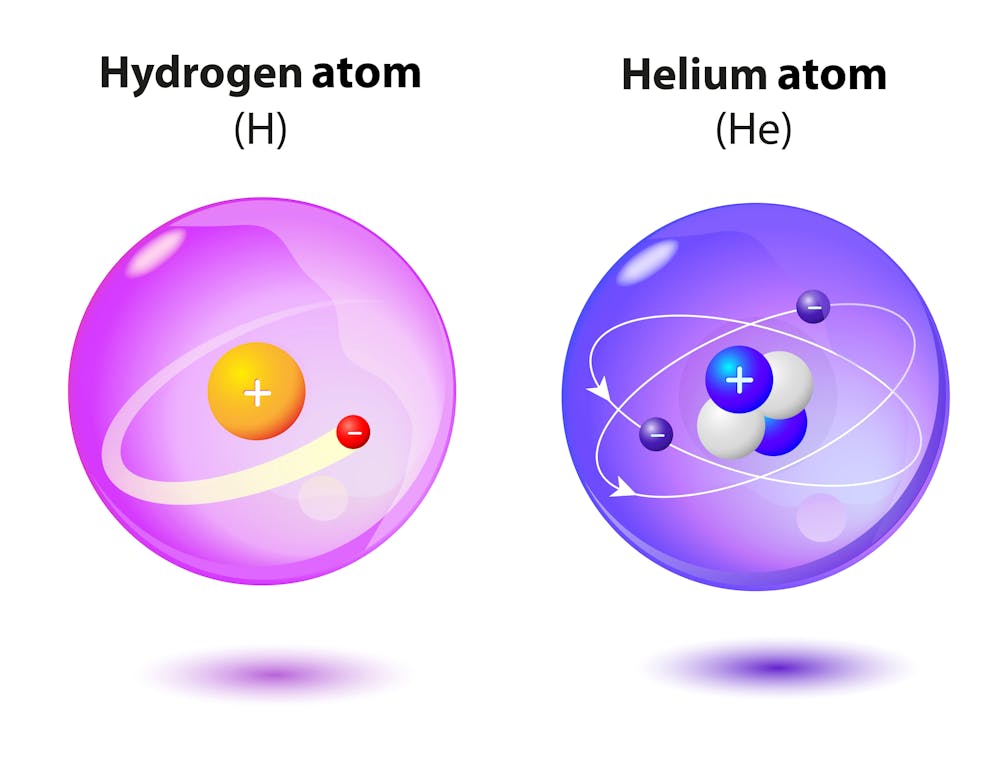
These dense clumps of gas also get hotter and hotter in the centre. When the gas in the centres of a clump reaches a certain temperature (millions of degrees), something quite special starts happening inside the clump: hydrogen atoms come together to form helium.
(As I am sure you know, atoms are like tiny building blocks that make up everything around us. You, me and all the gas and space dust – it’s all made of atoms).
When hydrogen atoms come together to form helium, it’s called nuclear fusion, and a lot of energy is released.Shutterstock
When hydrogen atoms come together to form helium, it’s called nuclear fusion. This process releases a lot of energy (it’s the opposite, yet similar process that happens when a nuclear bomb goes off). And this is how a star begins its life.
Just like us, stars are born, they live and then they die. Curiously, the length of a star’s life depends on its birth weight. Light, low mass stars live very, very long lives.
Our Sun, as you probably know, is actually a star. It is about 4.5 billion years old, and is in the middle of its life. In another five billion years it will get much, much bigger but then it will start to shrivel. After that, it will die. Its nuclear power source will switch off and it will just sit there, cooling, like a burnt out piece of charcoal in a barbecue.
Stars that are many times heavier than our Sun live much shorter lives. The most massive stars, live for only a million years or so. Their deaths are much more spectacular than the quiet shrivelling of Sun-type stars. They go out in a bang. Scientists call them “supernovae”.
The dusty nebulae from which stars form live within the spiral arms of galaxies like this.By The Hubble Heritage Team (AURA/STScI/NASA)NASA Headquarters – Greatest Images of NASA (NASA-HQ-GRIN) – http://nix.larc.nasa.gov/info;jsessionid=1sl2so6lc9mab?id=GPN-2000-000933&orgid=12http://imgsrc.hubblesite.org/hu/db/images/hs-1999-25-a-full_tif.tif
You’re made of star dust
Have you ever heard the saying “we are all made of star dust?” It’s actually true. Inside a star, helium atoms combine to make carbon, which is at the root of chemicals that you and all living things are made out of.
There is plenty we still do not understand about the mysterious lives of stars. Fortunately, we have large telescopes and space satellites to get better and better pictures. All we need is smart people like you to come and help figure out the puzzle!
All women know to expect the time in life when their periods finish and they reach menopause. Many might even look forward to it. What many women don’t know, however, is they will also experience symptoms in the time leading up to menopause. This is known as perimenopause.
On average perimenopause lasts for three to four years, usually starting in the mid to late 40s. Some women may experience it for only a few months, but for others it can be as long as a decade and can start as early as the mid-30s. During perimenopause a woman’s menstrual cycle will become irregular, they may experience lighter or heavier than normal bleeding, and intermittent spotting.
Women who have never given birth, and those with early puberty, or short menstrual cycles are more likely to experience earlier perimenopause.
What’s happening to my hormones?
The ovaries produce the female hormones oestrogen and progesterone, which control menstruation and ovulation (when an egg is released from the ovary).
From a woman’s late-30s, the number of eggs left in the ovaries decreases more quickly. Leading up to menopausal transition, the level of oestrogen changes, dropping rapidly around two years prior to menopause and stabilising around two years afterwards.
Progesterone also decreases towards menopause as it is produced only if an egg is released. Lack of progesterone can result in irregular, heavier, and prolonged menstrual periods during perimenopause.
• hot flushes (a sudden feeling of warmth or intense heat that spreads over the face and upper body)
• night/cold sweats
• anxiety, depressed mood, or mood swings
• sleep disturbance and fatigue
• vaginal dryness; discomfort during sexual intercourse
• frequent or urgent urination.
In the last one to two years of perimenopause, women are more likely to complain of low-oestrogen-associated symptoms, in particular vasomotor symptoms (hot flushes and night sweats) and vaginal dryness.
Some groups of women are also more likely to experience menopausal symptoms, including those who are: overweight or obese, smokers, of low socioeconomic status, and those with anxiety, depressive symptoms, or who feel stressed.
Weight gain
A recent US study found the menopausal transition is accompanied by accelerated gains in fat mass and simultaneous losses in lean mass, and these changes in body composition continue until two years after menopause. It was found weight gain began in premenopause and increased steadily during perimenopause (around 0.4 kg per year).
A lack of exercise, unhealthy eating, lower levels of education, insufficient sleep, the number of births a woman has had, and a family history of obesity may substantially contribute to weight gain in midlife.
Menopause causes weight gain, and extra weight worsens the symptoms of menopause. So maintaining a healthy diet and exercise regimen in midlife is important for women.from www.shutterstock.com
Treatment
For women who seek medical advice for their symptoms, menopausal hormone therapy (MHT, also known as hormone replacement therapy) is the most commonly prescribed treatment. Hormone therapy can help to relieve symptoms by replacing oestrogen levels that fall naturally during perimenopause.
GPs should discuss the short-term (up to five years) and long-term benefits and risks, before women decide to use hormone therapy, according to the college of obstetricians and gynaecologists.
If hormone therapy is not suitable, there are other non-hormonal treatments that can be discussed with the GP. This includes changing lifestyle factors such as improvements in diet, regular physical activity, optimal weight management, and quitting smoking.
For some women, menopausal symptoms such as vasomotor symptoms and fatigue can impact their performance at work. The Australasian Menopause Society recommends the following improvements to working conditions for women going through menopause which are based on the guidelines produced by the European Menopause and Andropause Society:
• raise awareness
• allow disclosure of troublesome symptoms
• review workplace temperature and ventilation
• reduce work-related stress
• allow flexible working arrangements
• provide easy access to cold drinking water and toilets.
Women still experience menstrual cycles during perimenopause and can fall pregnant, so contraception remains important. Contraception is required for two years after the last menstrual period in women aged under 50 years and one year in those over 50.
The use of combined hormonal contraceptives (such as pills, patches, or vaginal rings) until the age of 50 is acceptable if women are not at risk of heart disease or thrombosis. Risk factors include smoking, being overweight or obese, or having high blood pressure.
Hormonal contraceptives should not be used alongside hormonal treatments for menopause. Instead barrier methods (condoms or caps) or other methods (spermicides, implant or intrauterine devices).
That’s why my colleagues and I at the University of Sydney are launching a global database of horse behaviour. Both vets and owners can log a horse’s physical, mental and social development, creating an evidence base on what constitutes normal and abnormal equine behaviour, and what defines good, effective and humane training.
We have created an online behavioural assessment package for horses and ponies, called the Equine Behaviour Assessment and Research Questionnaire (E-BARQ) that collects anonymous data for horse behaviour researchers, veterinarians and coaches. It’s a not-for-profit project that allows the global horse-folk community to donate their observational data to the University of Sydney and gain useful benefits in return.
Photos of horses paired with life data can be very useful; for example, head shape is thought to predict behaviour.David Dirga/Shutterstock
Horse owners can upload photographs and videos to a custom-built app, recording their horse’s progress in training and competition over time. For the first time, they’ll also be able to compare their horse’s behaviour with that of other horses. The “share-&-compare” graphs will reveal attributes such as trainability, rideability, handling, compliance, boldness, and human social confidence.
There are two benefits. Firstly, owners can compare their horses’ behaviour to others around the world, giving them a useful benchmark.
Secondly, it will reveal the true impact of ancient traditions and modern trends. This can use used by everyone from the general riding public to veterinarians.
As E-BARQ can monitor the longitudinal consequences of different training methods, it can be a powerful tool for advancing horse welfare. It will also inform evidence-based judgements on the ethics and sustainability of horse sports.
Human safely, horse welfare
Horse vets know the importance of horse behaviour, as it often affects their safety. Indeed, a recent UK study has shown equine vet practice to be the civilian occupation with the highest risk of injury, surpassing firefighters. But vets also rely on owners to observe horse behaviour because it indicates health and recovery from surgery or disease. With the permission of owners, vets and riding coaches can monitor their clients’ horses over time in the app.
Being able to compare the behaviour of horses around the world will provide a hugely useful database.Grigorita Ko/Shutterstock
The questionnaire and app will expose how training and management influences horse behaviour, and vice versa. They will reveal how breeds differ in responses and illuminate breed-typical personality types, how male and female horses differ, how horses used in different disciplines (such as showjumping versus dressage) differ in their behaviour and how horse behaviour changes with maturation and training.
A horse’s behaviour has a direct impact on its usefulness and that, in turn, affects its value and – sadly – the care it receives. There is evidence from Europe that over 65% of horses outside the racing industry are slaughtered before the age of seven, very often for behavioural reasons.
Understandably, given riding is the most dangerous sport for children, parents crave authentic assessment of ponies’ behaviour. Information in E-BARQ could potentially help buyers identify warning signs of dangerous behaviours and make more informed choices.
By providing researchers with an unprecedented wealth of information, E-BARQ has the potential to revolutionise the way we train and manage our horses and, as a result, make real and lasting positive changes in horse welfare and the sustainability of horse sports.
As part of my research into how people experience this change I spoke in-depth with 12 people who moved to the small rural town of Stanthorpe in Queensland, population 5,406 at the last count.
Life in rural Stanthorpe is very different from city life.Shutterstock/Melanie Marriott
They came from international places as far away as Dublin and London, from Australian cities including Brisbane and Adelaide, as well as the Sunshine Coast.
While the majority moved because they wanted to be in the country, some arrived because visa requirements meant they had to work in a rural place. Others came for their partner, to be nearer family or, in one case, for a career opportunity for themselves.
These circumstances weren’t always entirely within their personal control.
Once they settled in, the majority found they were glad to be there. They enjoyed the level of trust people showed them, or the lack of traffic lights in town.
Others found the idyllic rural life wasn’t all it’s made out to be in media. For them, moving to the country meant limited leisure choices and life opportunities.
Here’s some of what they told me (not their real names).
City girls
Natalie moved because she’d been offered her dream job in Stanthorpe, but said she was “a city girl at heart”.
Being in a small country town was challenging for her. She found it really hard to meet people her age. She also mentioned how:
[…] when you’re in a small town, there’s no getting away from each other […] everybody knows what’s going on in your life.
She loved her new job and appreciated the way people helped each other out, but she was always seen as an outsider. This was partly due to her accent and the type of clothes she wore, which others commented on.
After several years in her job, she was offered an opportunity in Brisbane and took it, keen to get back to the city.
Christine, a middle-aged woman who moved for her husband, said she was “not a country girl”. While her home was “a very pretty spot”, she often journeyed back to Brisbane and Sydney for things she couldn’t access locally.
You can’t just make an appointment with a gynaecologist or an ophthalmologist, there are none. The major services aren’t here […]
But she said she had a better social life now than she had previously because country people “make time […] it’s a lovely community”.
Country girls
Rae had mostly grown up in cities but enjoyed the outdoors as a child and had “always been a country girl at heart”.
We love it (Stanthorpe). It ticks all the boxes, big enough that you don’t know everyone, but small enough that you know most people.
Asked if the media show country life as it really is, she said:
Those magazines seem far too glitzy for what I know as truth […] it’s more muddy gumboots and bikes out the front of houses.
Lucy said of the magazines “they’re selling the dream”. Even though she tried, she couldn’t quite replicate that dream in her own life.
The participants who accepted the disparity between media idyll and country reality seemed most content.
Kate said her country life was nothing like she envisaged it would be.
But that’s good, because I can still enjoy reading books and watch McLeod’s Daughters and keep them there as that fantasy of what I’d like it to be in the country.
Even though these were all grown women, they used the word “girl” when they described themselves.
This city girl or country girl moniker was used to show how they viewed themselves. It became a shorthand descriptor they and others could use to let people know if they were living in the “wrong” place, without upsetting the rural people around them with criticisms of the rural space.
While some remained in the country even though they weren’t thrilled about it, those who saw themselves as city girls either left or they maintained strong ties to the city in their everyday life, effectively straddling both worlds.
These conversations showed that if a person identified as “not from here”, that became an indicator they would remain feeling like an outsider and not adapt as easily as those who considered themselves as belonging.
Tania suggested the key to enjoying small town life was to get involved.
[…] the more involved you can get in things in the community, the quicker you’re going to settle into a country town.
She suggested local sports and bushwalking groups, classes, churches and other organisations such as the Country Women’s Association, Lions, Zonta and Rotary. Others suggested volunteering with groups such as Landcare or other groups as a way to create belonging.
While this might not work for everyone who makes the move from city to country, it’s a good place to start.
The just-announced inquiry into Australia’s retirement income system ought to be anything but run-of-the-mill.
Taking place 25 years after the introduction of compulsory superannuation, it provides an opportunity to either fix a broken system, or discard it as failed experiment.
Incremental reform won’t work.
There’s a budget problem
The first and most fundamental problem with compulsory super lies in fiscal arithmetic.
After a quarter of a century of compulsory super, some 70% of the aged population still rely on either a full or part age pension, which is an awful lot for a system whose stated aim is to substitute or supplement the age pension.
Modelling by actuarial firm Rice Warner predicts that it will still be 57% by 2038.
That’s right. After almost half a century of compulsory super – an entire working life – more than half the aged population will still be collecting the age pension.
It’s progress, of a sort.
By then then age pension will take up 2.5% of Australia’s economic output, down from the present 2.7%.
It will still account for one in every ten dollars spent by the government. That’s more than defence, twice as much as Medicare, and twice as much as the Commonwealth spends on schools.
In return, the government forgoes an enormous amount of revenue on superannuation tax concessions.
Its practice of taxing income paid as super contributions at 15% rather than the taxpayer’s marginal rate will cost the budget A$19 billion this financial year according to the Treasury, climbing to $23.3 billion in 2022-23.
Its practice of taxing super fund earnings at 15% (or less) rather than the marginal tax rate will cost the budget $20 billion this financial year, $23.6 billion in 2022-23.
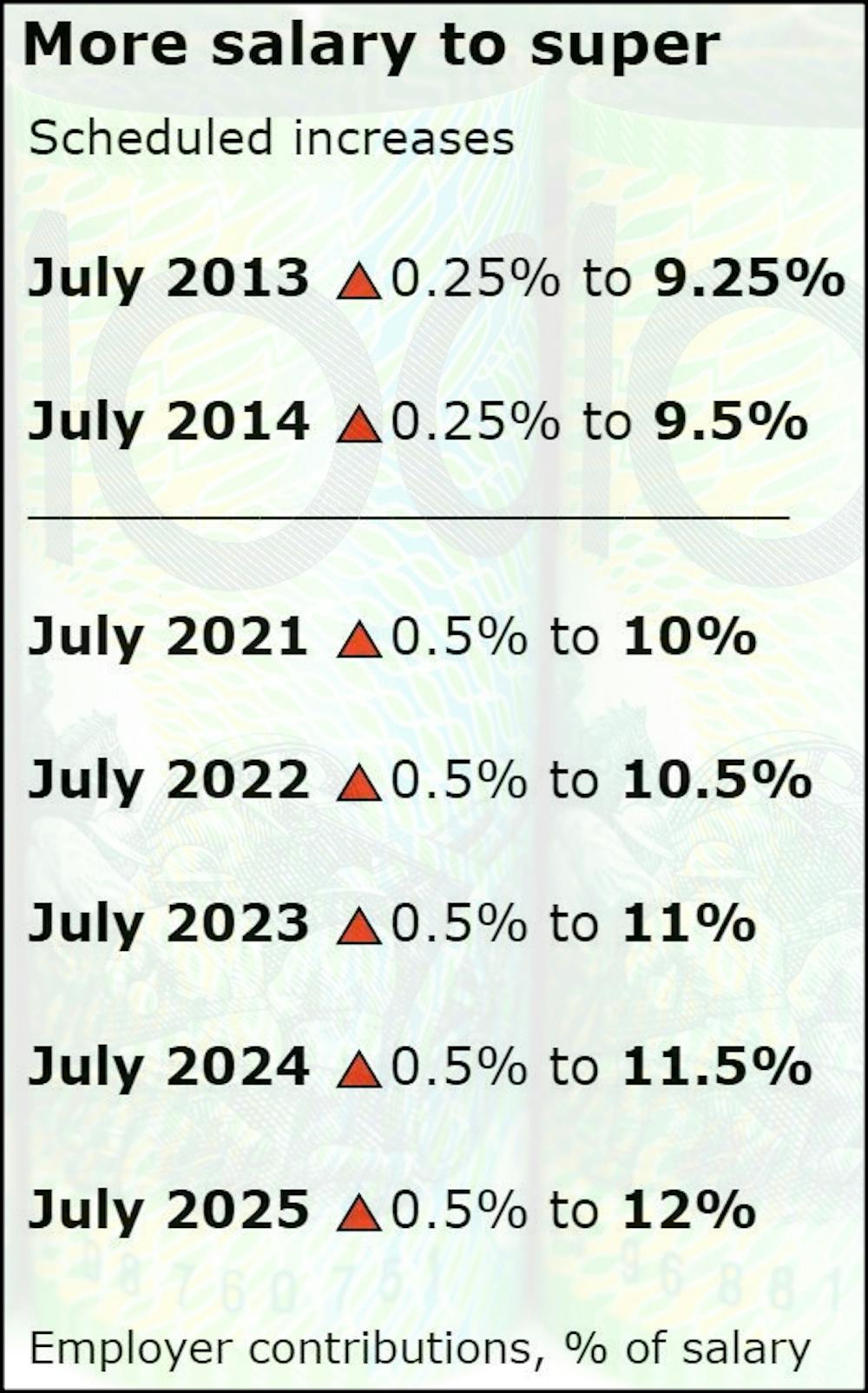
We are forcing workers to divert up to 9.5% of their salary into super (soon to be 12% unless that legislation is withdrawn) and losing enough tax revenue to fund scores of government programs or to cut general tax rates, in return for little change in what we spend on the pension.
There’s a returns problem
The second problem is what happens to the money. Not only are there quite a lot of poorly performing funds – something that has been widely discussed in the leadup to the inquiry – but fees charged are incredibly high.
The Productivity Commission finds that average fees are 1.1% of annual balances. More than 4 million of us pay more than 1.5%.
It mightn’t sound like much, but it’s a fair proportion of the average annual return of 3.5 percentage points above inflation.
In New Zealand, where the government selects the default schemes on criteria that include price, the average annual fee is 0.55%. In Chile, which tenders exclusively on the basis of price, the average fee is 0.47%.
Many of the funds justify their fees on the basis of their superior skill at picking stocks, which, as Nobel Prize winners Eugene Fama and Richard Thaler have discovered, is almost always a bad idea.
Even when they do less stock picking over time, upping the proportion of safer assets such as cash and bonds as their clients age, they continue to charge the fees they justify on the basis of the work they do picking stocks.
Equally bad is the lack of transparency about what they charge. Those of us who able to switch (and here are still some who can’t) find it hard to find out what we are paying.
Try it for yourself. I am, by many measures, a pretty sophisticated consumer of financial products, but it took me a ludicrous amount of time to find out what was being taken out of my account.
And there are ways out
Here’s what I’d use as two guiding principles.
The aged pension ought to provide a baseline dignified minimum for those who haven’t been able to provide for their retirement
Saving through the super ought to be tax-free on the way in, tax-free on fund earnings, and taxed at the marginal rate (including the 50% capital gains tax discount) on the way out
In order to cut fees and lift returns there ought to be a default offering that invests in a broad range of Australian equities indexes and costs no more than 0.15% to 0.20% per year – maximum.
It would be natural to have a sliding scale of allocation from 100% equities at (say) age 25 to 0% equities (and all cash plus bonds) at age 65. Again, these would be defaults that people could opt out of.
The tax advantage given to super would be the timing: at retirement versus as money goes in and it earns income. It would need to be justified by the savings that would accrue to the budget from getting these people off the aged pension.
Whether these numbers would stack up is an empirical question that would require careful analysis.
But it is important to remember that the rate of the pension, the retirement age, and the various tax rates and contribution caps are all within the government’s control.
It would have a lot of wriggle room to make the arithmetic work.
We should fix it, or axe it
If we are going to keep sequestering between 9.5% and 12% of people’s pay, we need a good reason.
It could be to provide them with a decent deal in retirement, or it could be to provide a good deal for the taxpayer.
The current system is questionable on both counts.
It would be vastly preferable to get to a system where only a relatively small number of people retired on to the government pension, and the rest saved enough for their retirement not to need to, through a series of incentives and nudges along with some compulsion.
It could be world-class. The system we have isn’t. And tinkering with it won’t help. We need a retirement income revolution.
The rise of artificial intelligence has led to widespread concern about the role of humans in the workplaces of the future.
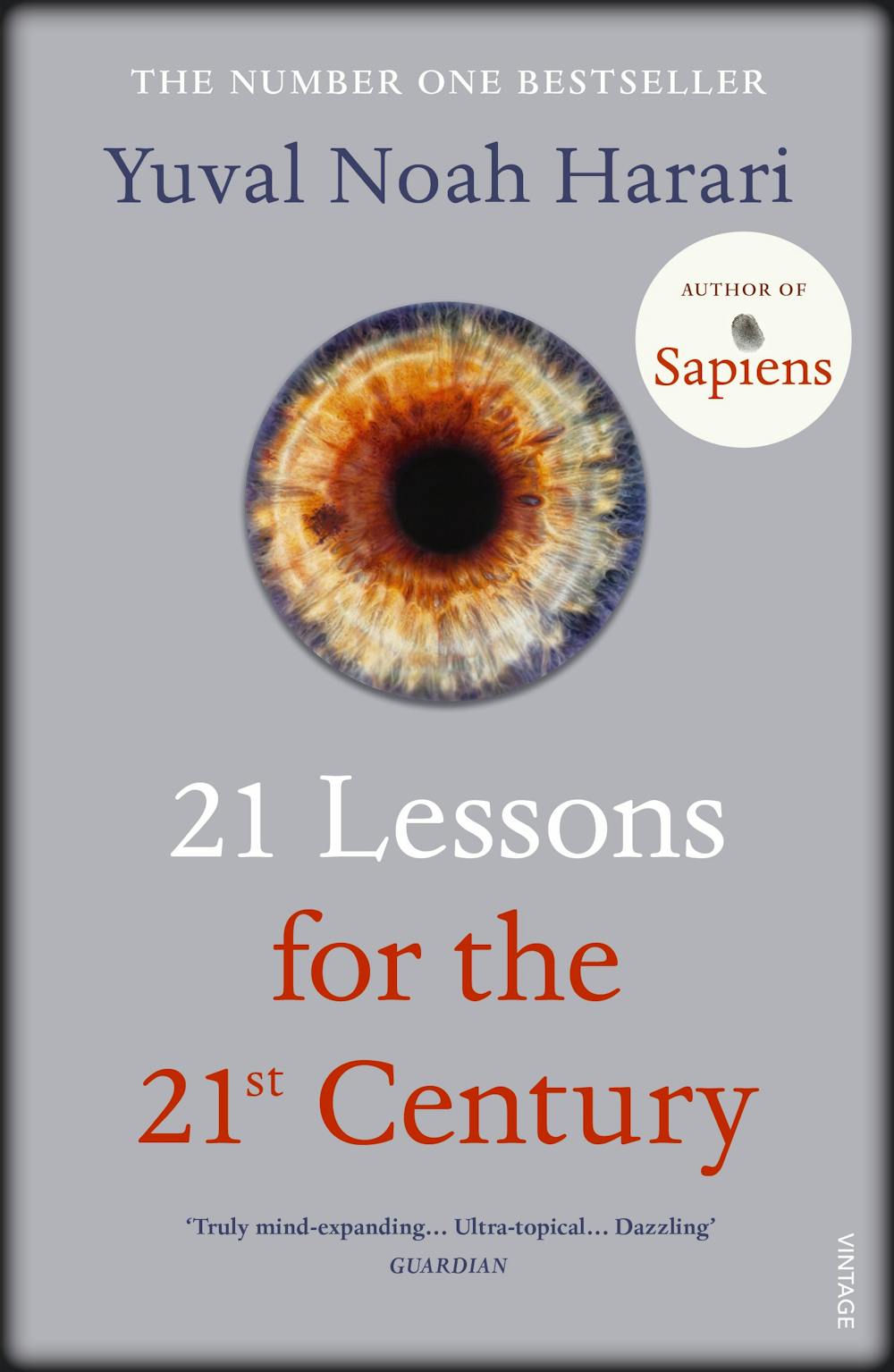
Indeed, Israeli historian, futurist and publishing sensation Yuval Noah Harari warns in his most recent book 21 Lessons for the 21st Century that there might one day be little need for human labour.
Harari fears the day will come when artificially intelligent algorithms outperform us in all respects that are useful to employers, consigning many or most of us to long-term unemployment.
Unlike humans, these algorithms won’t be conscious – they won’t feel in the way that we do as they perform their tasks – but they will be clever enough to outdo us in the job market, perhaps easily so. If we keep our jobs, we might work for them.
Harari’s arguments are based on the plausible assumption that living (and working) is about making choices.
More controversially he suggests that the processes that underpin our choices are algorithmic in nature and thus crank out our decisions about what to do, and how to do it, in way that is disconcertingly similar to the way a coffee vending machine goes through a series of steps to make a coffee.
algorithms controlling vending machines work through mechanical gears and electric circuits; the algorithms controlling humans work through sensations, emotions and thoughts
So everything we do is ultimately algorithmic. And worryingly the algorithms implemented by computers (our workplace rivals) are getting better and better.
But will artificially intelligent algorithms really have an edge over us in all respects? Perhaps not, if David Hodgson is right.
‘Incommensurables’ could be our edge
David Hodgson had the unusual distinction of being both a senior Australian judge and a philosopher of some note. After completing an undergraduate degree at the University of Sydney and doctoral studies at Oxford University under the supervision of perhaps the most influential legal philosopher of the 20th century, H.L.A Hart (who reportedly described Hodgson as the ablest student he had ever supervised), Hodgson went on to a career as a barrister.
He ultimately became a Judge of Appeal in the New South Wales Supreme Court before passing away in 2012.
If Hodgson is right we seem to have an advantage over machines when it comes to making decisions about “incommensurables”.
What’s an incommensurable?
Consider this question:
how do you decide what to do if you have to choose between helping a friend, and going on a date with a person you find attractive?
It’s difficult, because the there is no common metric to use in comparing the options. Even more so than the virtues of “apples” and “oranges”, the considerations of duty and desire are incommensurable – different in kind.
Returning to the workplace, there would seem to be a whole range of jobs that require reasoned judgements in the face of incommensurability.
For example, if an architect tries to balance considerations about the aesthetics of a building’s design against issues relating to the bearing of load, there is incommensurability, because the considerations are of a different kind.
Evolution might have given us that edge
How could an artificially intelligent robot reconcile issues of beauty against concerns about how long a building would remain standing? What metric would it use if the two values are indeed incommensurable? This might be tricky.
Hodgson speculated that evolution might have led to the emergence of consciousness and a form of free will in order to enable our ancestors to make good decisions in response to the forms of incommensurability they encountered.
This capacity might have given us an evolutionary edge and in my view might have bequeathed us an edge over machines. It may help architects and other workers address the decisions they must make.
Harari is surely right to warn about the avalanche of job disruption that appears to be coming, but if Hodgson and I are right, humans will remain more valuable in the labour market than Harari imagines. We will remain able to do things robots aren’t bred for.
Aboriginal and Torres Strait Islander readers are advised this article contains images and names of deceased people.
You leave Sydney and head for holidays on the South Coast. You plan to catch a quick surf, check out the boutiques and cafes, stroll around a local museum.
If you’re stopping in Berry you’ll notice a large steel sculpture in honour of two brothers, Alexander and David Berry. And in the main street you will encounter a bronze bust of Alexander, celebrating his determination to “replace bush and swamp”. The local hospital and a monument near the railway station recognise David. Old two-storey buildings along the main street, big trees and established gardens all add up to a picture of genteel pastoral history.
This polite scene ruptures if we know that Alexander Berry collected and traded in the bones of Aboriginal people, including those he had exhumed from their graves on his vast estate, Coolangatta.
Cultural institutions in our capital cities have begun to pay greater respect to Aboriginal and Torres Strait Islander communities. The Australian Museum in Sydney states “The First Nations collections belong to ancestors, to First Nations people of the present and to the young people of the future”. Melbourne Museum is “working to place First Peoples living cultures and histories at the core of our practice”.
But away from the cities and – despite the good intentions of many staff members – small museums lag behind, presenting tourists with stories that give a narrowed view of local histories.
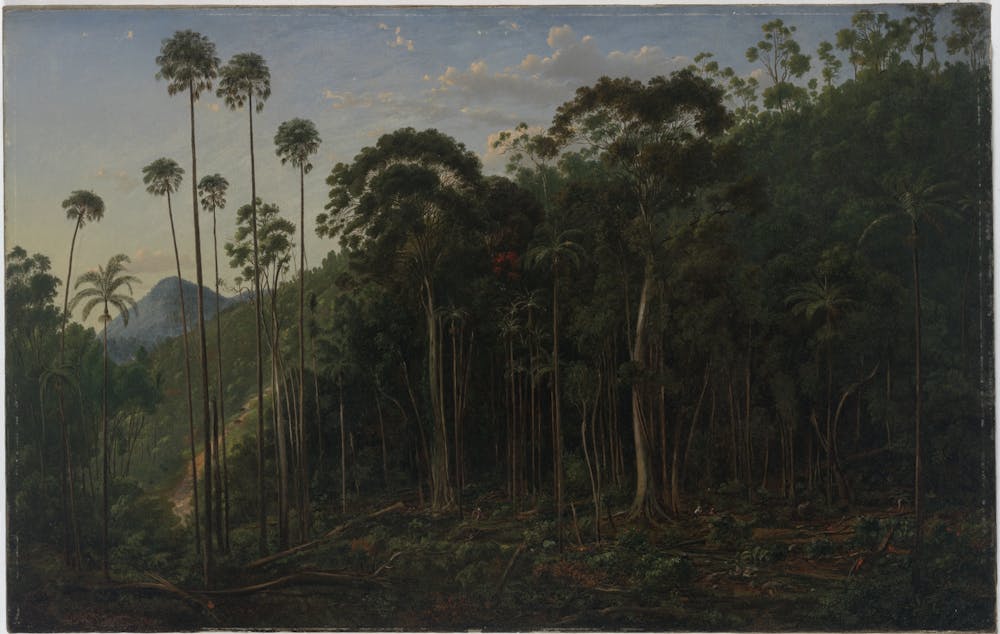
Cabbage Trees near the Shoalhaven River, 1860 painting by Eugene von Guerard.State Library of NSW
Three towns, the same story
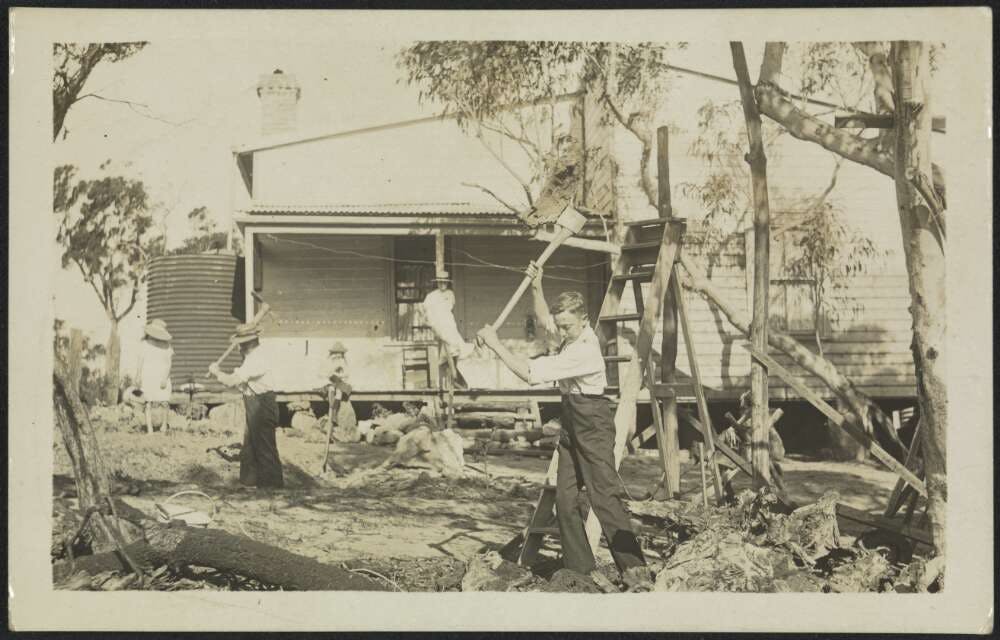
In a regional town museum you will probably encounter some version of the pioneer or settler story. This narrative is illustrated with the many farm tools, pieces of mining equipment, clothes, books, furniture and other domestic and civic artefacts donated by locals over the years.
In this version of history, pioneers move across the land, unencumbered by prior Aboriginal occupants, making it productive as they go. Small museums seem to get stuck in this white pioneer groove.
Historian Amanda Nettelbeck observes that Aboriginal and non-Aboriginal histories are often presented as two separate sides of colonial history, rather than as an obviously connected relationship between British settlement and Aboriginal dispossession.
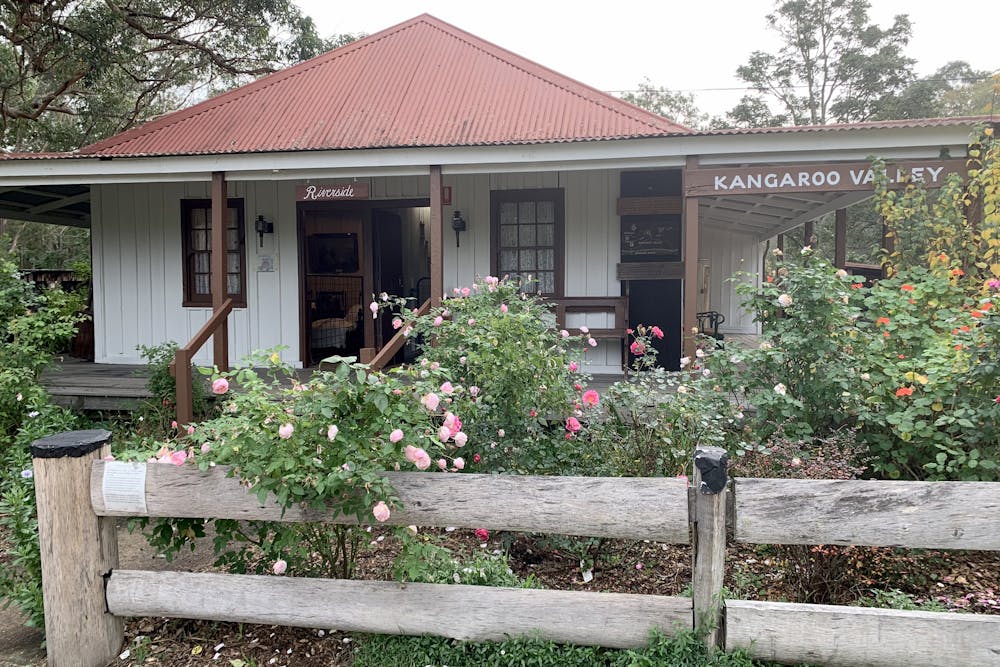
In the museums of Berry, Kangaroo Valley and Nowra, three towns central to the NSW South Coast tourism economy, the idea of a frontier (that space of conflict over land, resources, rights and sovereignty) is avoided. But how is this achieved, when the pioneer story depends on the frontier for its existence?
Looking at these three museums reveals artefacts of Aboriginal provenance are presented in ways that cast them as either relics of a distant past, symbols of a generic Aboriginality or curiosities with no political context. They celebrate the pioneer without acknowledging the founding dispossession of local Yuin people. Frontiers are messy; pioneers clean things up. And museums keep the story simple, neat and tidy.
Too hot to handle
This is not to say the dedicated volunteers who run these museums come down on one side of the “History Wars”. The staff who care for their collections are often keen to address their lack of information on specific Yuin histories.
Nowra Museum with nearby cabbage tree.Jen Saunders, Author provided (No reuse)
In 2017, Nowra Museum hosted the travelling exhibition This is where they travelled, which accompanied Paul Irish’s book Hidden in Plain View: the Aboriginal people of coastal Sydney. In the same year, the Berry Museum hosted the Yuin anthropologist, the late Les Bursill, who delivered a lecture on Yuin history of the South Coast. Kangaroo Valley Pioneer Village committee members responded to a draft of this essay, saying they would renew signage in the museum and were keen to pursue new research on local Aboriginal histories.
Despite this, the overwhelming story remains that of white settlers’ hard work and perseverance. And although part of the reason for the static nature of museum stories is lack of funds and a reliance on the time and energy of volunteers, the narrative’s repetitive nature – and its general wear and tear – may also be due to its omissions. Bruce Pascoe reframes the perception of Australian history as boring, by drawing our attention to what’s left out: “Australian history isn’t boring, it’s just too hot to handle.”
The blinkered storyline of small museums is a symptom of what US scholar Mark Rifkin calls “settler common sense”. Settler common sense describes the feeling of “taken-for-granted” possession of, and belonging to, a place which has been taken from someone else.
Settler common sense exists as “a given”: we (as a white person, I include myself) have the unquestionable right to possess that which doesn’t belong to us. It normalises settler possession of, and control over, land and the stories about that land. The pioneer or settler narrative relies on that assumption: white rights to non-white land, and white rights to the telling of history.
In one of the cottages in the recreated village hang two bark paintings, donated in the 1970s by a local who acquired them in Arnhem Land. In another cottage is a display case containing miniature souvenir versions of clubs, boomerangs and animal figurines.
Below these are a group of unlabelled grinding stones, which may or may not be from the local region. Labels for other objects in this display read “boomerang made from mulga wood” and “more mulga wood boomerangs” (mulga is a small tough acacia which grows in arid inland regions, not Kangaroo Valley). Other labels read: “replica of an emu egg”; and “fighting weapon could be used to split the enemy’s head open”.
These items are presented without context and without any relationship to Kangaroo Valley. They are accompanied by an illustrated word list entitled “Interpreting Aboriginal Symbols” and although the words are indeed Aboriginal, the language is Warrgamay, spoken by people of the Herbert River region of North Queensland.
By presenting objects that are replicas, miniatures, unlabelled or misleadingly labelled, the museum allows a generic “Aboriginality” to be visible while keeping it unrelated to Kangaroo Valley and local people. The presentation does not disrupt the Kangaroo Valley settler narrative because Aboriginal existence is presented as inauthentic and elsewhere.
Other histories about Kangaroo Valley tell a different story. The museum’s own archival sources document the many meetings in the region (albeit from colonial viewpoints) between local Aboriginal people and colonisers during the 1800s and 1900s, the large gatherings at Kangaroo Valley for ceremony and song-learning “for which they sometimes travel far” and the Aboriginal families who relied on work at the four timber mills in the town in the 1940s.
More than portraits
Drive south over the scenic mountain range from Kangaroo Valley and you will cross the Shoalhaven River to Nowra.
As a regional centre, Nowra has several museums to choose from: the Fleet Air Arm Museum for aircraft enthusiasts, Meroogal House Museum for lovers of old houses and domestic interiors, and the town museum run by the Shoalhaven Historical Society.
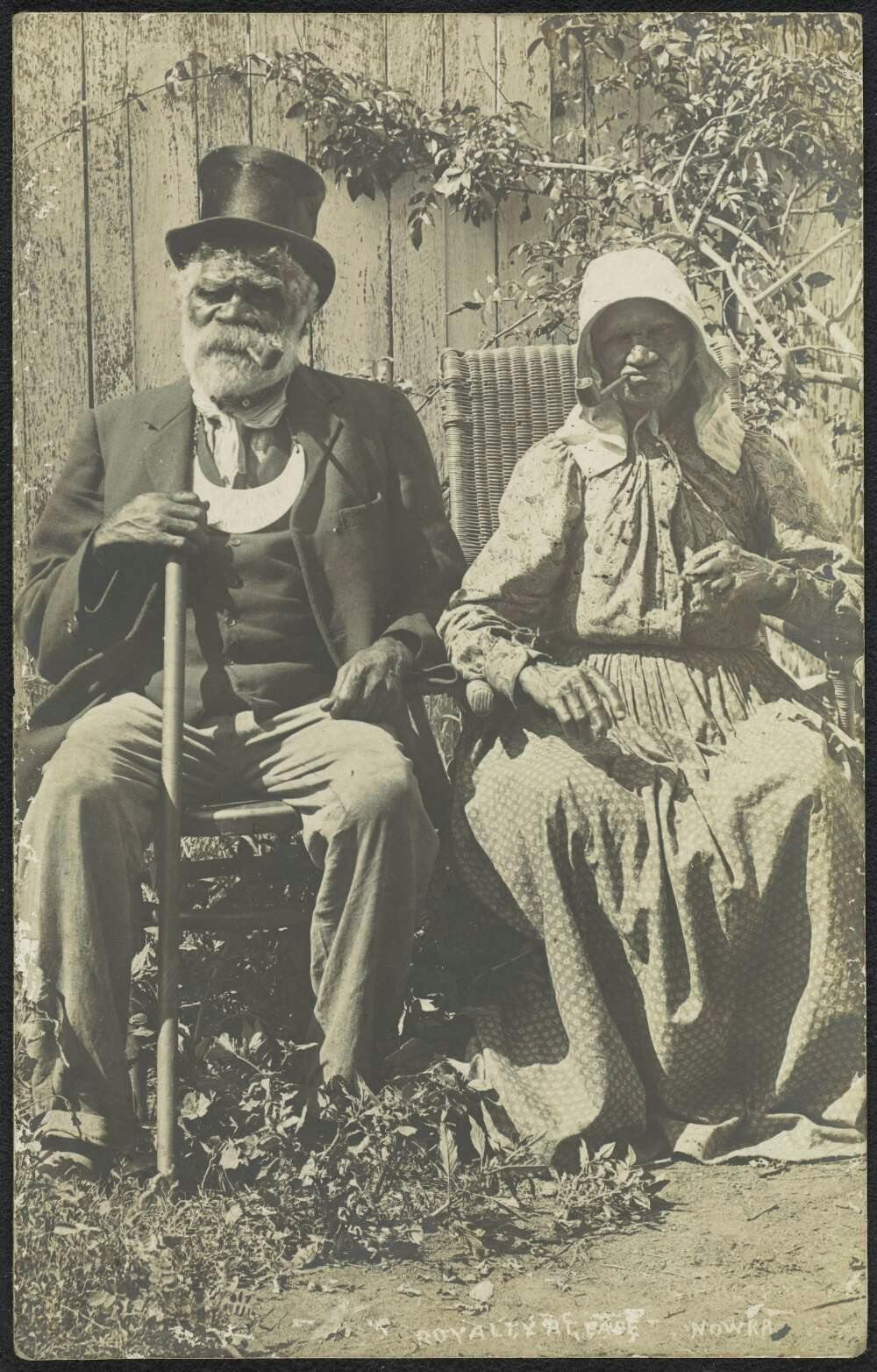
Nowra Museum’s exhibition of local Aboriginal presence is built around a collection of timber and stone artefacts and an impressive black and white photograph of an elderly couple, James Goulding and Mary Carpenter. They are seated on chairs in a garden, and wear European clothing typical of the early 1900s. Goulding, who also wears a top hat, has a ‘breastplate’ suspended from a chain, around his neck.
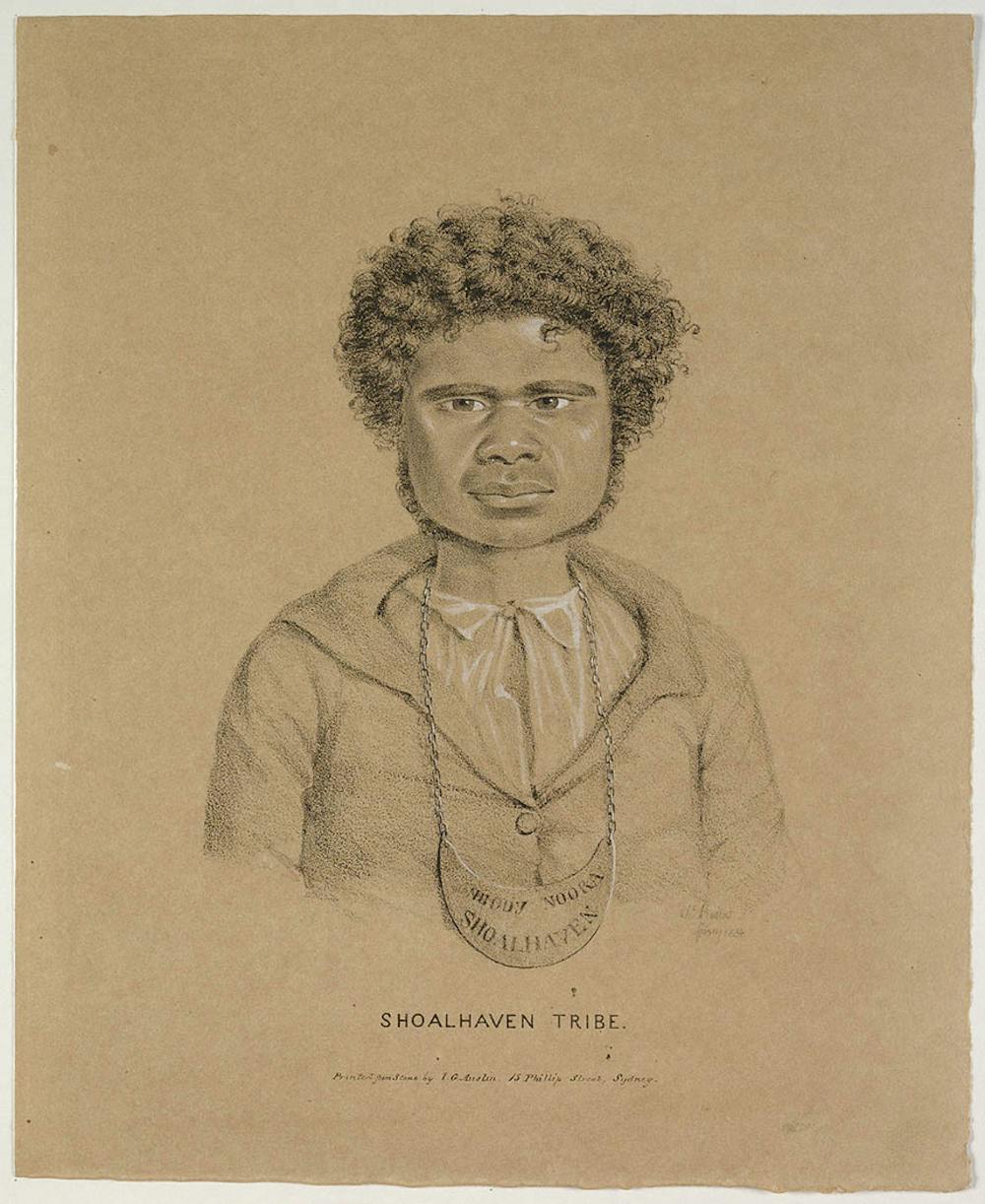
In a display case near the photograph, is a brass breastplate engraved with the name “Neddy Noora” and “Shoal Haven 1834”. Alongside this is a reproduction of a drawing that was part of a series of portraits of Aboriginal ‘kings’ and their wives done in Sydney by German-born Charles Rodius, in the early 1830s. The portrait shows the young Neddy Noora, wearing the breastplate over his European clothing.
The granting of breastplates to Aboriginal people signified a reward given for assistance or rescue and they were an attempt at gaining influence over individuals thought to be leaders.
Aboriginal recipients also had a stake in these tactics, no doubt being well aware of the hierarchies so blatant in colonial society. Offered as a status symbol, acceptance was the “gracious and prudent thing to do”. However, by the end of the 1800s, breastplates lacked political currency and became prized by white collectors.
Entangled
Engraved on the breastplate James Goulding wears are the words “Budd Billy King of Jarvis Bay” (sic). Budd Billy is an Anglicisation of Goulding’s Aboriginal name Budbili. Ngarigu linguist Jakelin Troy gives the meaning of budbili as “possum-skin rug”.
This single word from the Dharawal language of the Yuin nation, links a person and a place with important historical and cultural objects – a pre-colonial possum-skin rug and a colonial metal breastplate – both of which existed within the tangled cultures of the pre and early post-Federation era.
The breastplate given to Neddy Noora was found in Broughton Creek (near the town of Berry) in 1925. Neddy and another Aboriginal man, Toodwit (also known as Broughton), guided John Oxley’s expedition to mark an overland route between Sydney and Jervis Bay in 1819. Toodwit was central to Alexander Berry’s 1822 reconnoitre of the region.
Nowra Museum’s display has been updated recently to include a brief explanation of the political aspect of giving and receiving breastplates and when I contacted Lynne Allen, president of the Shoalhaven Historical Society, she explained that museum volunteers can provide visitors with an explanation of breastplates as a European construct.
She said that the large portrait of Mary Carpenter and James Goulding was “consistently amongst our visitors, Aboriginal or otherwise, the most popular of all our items”.
Does this popularity translate into greater awareness of our complex local histories? The people in these portraits are not just entangled with the white cultures that entered their lands but are linked to Yuin descendants today.
Berry Museum plays its part, presenting Alexander Berry as a soft-hearted adventurer yet hard-headed businessman, who was distressed by any form of human suffering. His interest in phrenology and trade in the skulls of Aboriginal people is not mentioned in Berry Museum.
In 1822, Berry and his business partner Edward Wollstonecraft were granted 10,000 acres on the Shoalhaven River by Governor Sir Thomas Brisbane. This possession of a vast section of Yuin land, renamed Coolangatta, gave Berry access to Aboriginal graves.
Collection of human skeletal remains, particularly skulls, was not uncommon in colonial societies. Berry and Governor Brisbane shared an interest in phrenology (the study of skull shape), and Brisbane donated a “skull of a native female of New South Wales” to the Phrenological Society of Edinburgh.
During the 1820s Berry also actively sought out skulls from associates in Tasmania. In 1827, in a letter accompanying a “craniological specimen”, Berry describes Arawarra, “the owner of the present specimen”, as a “once formidable warrior”, being carried by his son to “take a last look of Cooloomgatta (sic) now occupied by strangers”.
Berry describes how the “venerable old gentleman” died two days after this meeting and was buried on the Coolangatta estate. He goes on to describe the manner of Arawarra’s burial, stating that he “lived to an extreme old age and died in peace”.
The tourist space
Historian and cultural studies scholar, Katrina Schlunke, asks “what can and can’t be said in ‘tourist space’?”. Vandalisation of burial sites and collection of skulls does not fit with the image of Berry as a relaxing country getaway. And including the story of Arawarra carelessly may risk further desecration of Yuin protocols if not undertaken with extensive consultation with Elders and community members.
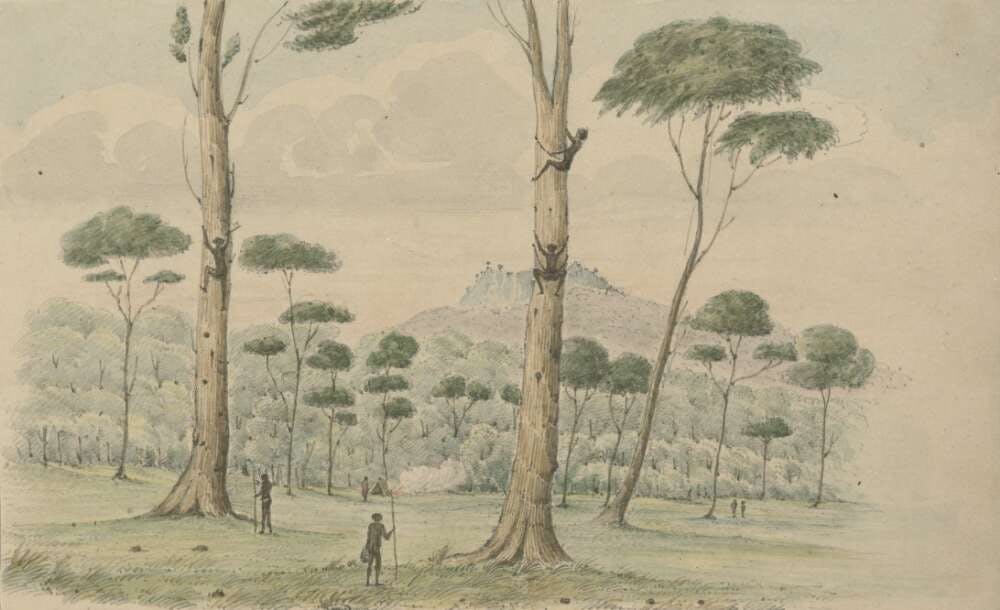
Robert Marsh Westmacott’s picture depicting the ‘View in the Kangaroo Valley showing the manner the Natives climb the trees for opossums and bandicoots’.National Library of Australia
Museums have never been neutral in the choices they make about what to display and how, but avoiding traumatic or difficult histories is not neutral either.
Wiradjuri curator at the Australian Museum, Nathan Sentance, states that museums and archives “should not just work to document bad history, but work to prevent bad history from happening”. Including the “bad” history of the town of Berry may work towards a better understanding of how replacing the bush and swamps greatly benefited some people at the ongoing expense of others.
Reinterpreting local histories is not for the fainthearted and the more the “top” layer of the pioneer story is disrupted, the more the “too hot to handle” stories emerge.
The Berry District Historical Society’s website claims, “the complete story of Alexander Berry is full of adventure and courage”. This pitch tells us there is some serious reconsideration needed regarding what constitutes a “complete” story.
More than a decade ago, Melbourne Museum displayed possum coats made by Koori women in an exhibition that connected modern visitors to Indigenous traditions.Julian Smith/AAP
History is messy
In 2018, the 10-Year Indigenous Roadmap, commissioned by peak body Australian Museums and Galleries Association, was finalised. The aim of the roadmap is to change “interactions, communication, understandings and ultimately, the Australian view of First Peoples”.
Small museums, with their wealth of material, stories, experience and passionate volunteer staff, could play an important part in achieving that aim.
Megan Davis, Cobble Cobble woman, Pro Vice Chancellor and Professor of Law at UNSW, reported that in the dialogues conducted in preparation for the Uluru Statement from the Heart, the overwhelming view was that “a nation cannot recognise people they do not know or understand”.
The truth-telling the Uluru Statement calls for, could be work that local museums, in partnership with Aboriginal communities, could contribute to in ways that profoundly reinvigorate how local histories get told.
Government sources insist shock jock Alan Jones didn’t drive Thursday’s announcement of a cash payment to drought-striken farmers about to be turfed off their household support because they’d reached the four year time limit.
They say the measure – giving up to $13,000 to a couple and $7500 to individuals at a cost of $12.8 million this financial year – had been in cabinet’s expenditure review committee process for some time.
But the National Farmers Federation says it wasn’t given any notice, which seems odd since drought minister David Littleproud is constantly referencing the NFF.
Regardless of the sequencing, Jones’ extraordinarily angry and emotional performance on Tuesday, haranguing Morrison on radio, breaking down on TV, and warning of dire political consequences if the government didn’t do something, certainly concentrated the prime minister’s mind.
As one official puts it, Morrison is “attuned to the zeitgeist”. Described more prosaically, the PM is highly sensitive to public opinion, and he judges that in metropolitan areas as well as the regions, people want more action – and then more still – to help those brought to their knees.
As for Jones, whatever impact his outbursts had on the government, the fact the announcement followed so soon will be used to burnish his much honed image of having political influence.
When he became PM, Morrison was immediately anxious to own the issue of the drought. He referred to it in his news conference the day he was elected leader, saying it was “the first thing I need to turn attention to”, and was quickly off to a drought-affected area.
Now he is feeling the full cost – political as well as financial – of that ownership, as he’s confronted with pressure on all sides.
NFF president Fiona Simson continues to say she doesn’t think the government has a drought policy.
The Coalition’s handling looks ad hoc and reactive. The responses of federal and state governments need to be better linked. For example, is there a case for federal help for moving breeding stock to agistment? Oh, the feds say, that’s in the state arena (rather than looking at augmenting state assistance). Drought policy is bedevilled by the old federal-state blame game, as shown by the wrangling over dam building.
Also, the government has no credible reason for keeping under wraps the report it commissioned from Stephen Day, who was its drought-coordinator, which would provide some useful overview.
Thursday’s announcement of the cash payment was messy: Morrison trumpeted it on radio at the same time as the Nationals unveiled it at a press conference.
(Morrison chose John Laws’ program, which he rarely goes on. Laws asked pointedly, “Why do you permit yourself to be harangued in the way that Alan Jones harangues you …[a lot of people] rather felt that it was a sign of weakness that you let Alan get away with what he got away with.”)
Some Nationals were unhappy at Morrison seemingly one-upping their leader Michael McCormack and his colleagues, especially as the PM went out of his way to tell listeners “that’s new news today on the John Laws programme”.
The problem is that disgruntled Nationals, under the pump in their seats, see it as symptomatic of a wider issue about Morrison’s approach. One senior National says: “Morrison is going to have to learn to build a deeper and more respectful relationship with the Nationals – find space for McCormack to be seen to be delivering for regional Australia.”
The Nationals’ problems go further. Outsiders observe the rivalry between the party’s deputy leader Bridget McKenzie and Littleproud, both of whom have stakes in drought policy. Littleproud was particularly upset at losing the agriculture portfolio to McKenzie after the election.
From the Coalition’s vantage point the drought debate – and the prime minister making himself so central in it – has raised unrealistic expectations of what government can do.
In prolonged drought, the harsh reality is some farmers will go under, just as in a recession, some city businesses will fail. There is only so much protection a government can or should provide. The difficulty for many farmers is deciding whether hanging on is worth the gamble, because there is no knowing how long it will be before the rains come.
On two fronts now Morrison, who likes to be in control, is at the mercy of events he can’t control. Apart from the drought, the International Monetary Fund’s downgrading this week of the growth outlook for the world and for Australia has reinforced the message that the government’s economic policy is on a knife edge.
The IMF downgrade takes the projection for Australia’s growth in 2019 to 1.7% – a year ago the IMF set it at 2.8%.
The situation poses a judgement call for the government – inject some stimulus quickly or hope that it can get through on its present fiscal setting, keeping its projected surplus (its top priority) intact.
Three reductions in interest rates in quick time haven’t had much effect in boosting the economy (and there is speculation about another). On the evidence to date, neither have the income tax cuts achieved what was hoped. People are not spending enough; many businesses are uncertain.
So far, the government has held out in face of exhortations from Reserve Bank Governor Philip Lowe to help on the fiscal side. (Lowe’s style might be at the opposite end of the advocacy spectrum to that of Jones, but he can pack a punch.)
Morrison and Treasurer Josh Frydenberg (who is in the US for the IMF and other meetings) this week defended their position on the surplus as a giving a buttress against bad times.
“A surplus is not an end in itself”, Morrison told parliament – “a surplus … is a means to an end,” the end being that “Australians can have confidence that we can meet the uncertainties that are ahead.”
He describes Labor’s calls for government action as reflecting its “penchant … for panic and crisis.”
As it stands by its unwillingness to inject immediate stimulus, the government is harking back to the Labor’s action in the global financial crisis and what it condemns as overreach. Probably it was, but going hard and going early was a cautionary policy that took out a hefty insurance premium against recession.
The period ahead will tell whether the government’s refusal to stimulate the economy does indeed show the “cool and clear heads” that Morrison boasts. Or whether it will turn out to be an unfortunate manifestation of pig headedness, with policy having to be modified subsequently. If the latter, let’s hope it won’t be a case of too little too late.
Feral cats are wreaking havoc on our native wildlife, eating more than a billion animals across Australia every year. But managing feral cats and reducing their impacts on our threatened species is challenging, to say the least.
Aside from killing native animals, feral cats spread parasites and diseases such as toxoplasmosis which can kill native wildlife or make them more susceptible to predators.
To reduce these impacts, we must reduce feral cat populations. The difficulty is finding the right approach.
There have been suggestions that dingoes could help conserve biodiversity by controlling feral cats. But the evidence does not support this approach.
We investigated the relationship between dingoes and feral cats in central Queensland. Contrary to previous suggestions, we found that cats remained abundant, active and widespread, regardless of whether dingoes were present or absent, and regardless of where or when dingoes were active.
Our findings suggest that proposals to restore or reintroduce dingoes to protect threatened species may do more harm than good.
Feral cats eat over a billion animals in Australia every year.Bronwyn Fancourt
Do dingoes create a ‘landscape of fear’?
Some studies have reported fewer cats in areas with dingoes, concluding that dingoes must be suppressing cat numbers. However, these studies typically estimate the number of dingoes and cats using the number of footprints on a sand plot, counts from spotlight searches, or even the raw number of images captured on camera traps.
Unfortunately, all of these methods are known to be poor measures of abundance. Accordingly, whether or not dingoes suppress the abundance of cats remains hotly debated.
It has also been suggested that dingoes create a ‘landscape of fear’, scaring cats and forcing them to change their behaviour to avoid dingoes. According to this hypothesis, dingoes might create cat-free periods or areas in the landscape, where threatened species could live without being harassed by cats.
By scaring cats away, some argue that dingoes might also prevent cats from hunting in the best areas, or hunting at the best times. Over time, this might even reduce cat populations by reducing their hunting success, body condition and breeding success.
A Kakadu dingo. New research shows dingoes failed to prevent feral cat activity.Peter Fleming
Dingoes did not exclude cats from any patches, and cats were widespread across our study sites. Not only were cats and dingoes active in the same areas, cat activity was actually higher in patches where dingoes roamed than in areas where dingoes were absent. This suggests that dingoes do not create cat-free refuges in the landscape to protect threatened species.
Cats and dingoes were also active at the same times. While activity times for dingoes and cats overlapped at both sites, there was slightly less overlap at one site. But interestingly, this was because dingoes, not cats, had shifted their activity.
Cat densities at our sites were around 50% higher than the national average. This means that dingoes are not controlling cat numbers, either by killing or scaring cats, changing cat behaviour, or reducing their hunting or breeding success. Cats remained active, abundant and widespread across our sites, and our evidence suggests they also hunt and breed successfully in areas with dingoes.
A group of world-leading taxonomists recently determined that dingoes are not a distinct species, but actually a type of dog. Cats have lived around dogs for tens of thousands of years, and have clearly learned how to outsmart them in order to coexist. Our findings suggest that feral cats are no different to their domestic cousins in their ability to outsmart and coexist with dingoes.
Cats and dogs have co-existed for thousands of years, suggesting feral cats won’t easily be scared by dingoes.AAP
Lessons from history
History is littered with examples of dingoes failing to protect threatened species from feral cats. Soon after European settlement, feral cats established and spread across Australia, causing the extinction of dozens of Australian native mammal species. This mass destruction occurred in the presence of dingoes, which had been introduced to Australia up to 5000 years earlier.
If the dingo couldn’t stop the spread of feral cats and protect threatened species from extinction while cats numbers were still low, it seems extremely unlikely that they could effectively suppress the two to six million feral cats that occupy 99.8% of Australia today.
The reintroduction of wolves to Yellowstone National Park in the United States is often touted as an example of how dingoes could restructure Australian ecosystems and protect our biodiversity. But Australia isn’t Yellowstone, and dingoes aren’t wolves. Wolves are a native top-order predator in Yellowstone, while the dingo is merely an introduced middle-sized predator in Australia.
Feral cats were breeding and hunting successfully in areas with high dingo activity.Bronwyn Fancourt
Dingoes eat threatened species too
Even if dingoes could suppress cats, dingoes are still predators that hunt and kill to survive. It is often claimed that dingoes are beneficial because they kill invasive pests and overabundant native animals. But they also kill the threatened species that they are supposed to protect.
Australia is rapidly losing the fight to save our threatened species. Trapping, shooting and exclusion fencing can all help control cats in small areas, but these approaches are not feasible, sustainable or effective over large areas.
Better approaches are needed to control invasive predators such as feral cats and protect our threatened species. But using one introduced predator to control another introduced predator is clearly not the solution.
This article was co-written by Dr Matt Gentle, a co-author of the research. Matt is a principal scientist with the Pest Animal Research Centre within Biosecurity Queensland.
If you have a question you’d like an expert to answer, send it to curiouskids@theconversation.edu.au.
Does chewing gum stay inside you for years? – Olivia, aged 12, Australia.
Great question, Olivia! The short answer is that most gum you swallow ends up in your poo. But if you swallow a lot of chewing gum, it can get stuck and cause problems.
Chewing gum existed 6,000 years ago. Our ancestors chewed gum made from black tar and tree sap. Just like today, people chewed gum to keep their mouth clean and stay alert.
Almost every civilisation chewed gum. The imperial Chinese chewed ginseng root to pass the time, while ancient Greek soldiers chewed tree bark on their march to battle.
Our modern gum is made from a flavoured synthetic rubber-like material, a softer and tastier version of the same stuff we use to make pencil erasers or bicycle tyres.
Gum is sticky and can be hard to remove. So swallowing a lot of it can cause problems.Shutterstock
A gum’s journey through our digestive system
Your gut is 10 metres of bendy tubes that turns food into energy for your body. This process starts in your mouth, where the teeth chew and grind up food into smaller pieces. The food then drops into the stomach, where acids and chemicals break it down into even smaller pieces. Now it’s ready for your body to absorb and turn into energy.
Anything not used is pushed through your gut (also known as the intestines). Gum cannot be broken into small pieces by chewing or by the chemicals in your stomach.
So the gut pushes and squeezes the chewing gum out as poo a few days after you swallow it. That is where most swallowed gum ends up.
Once you swallow food, it goes down your esophagus to your stomach then makes its way through the small and large intestines before it becomes poo.Shutterstock
What if you swallow a lot of gum?
Swallowing a lot of gum can cause it to stick together or stick to food in your gut. If you have ever stepped on a piece of gum before, you know how sticky it is.
In rare cases, this can form a blockage doctors call a “bezoar”. A young Israeli girl had to have a large bezoar surgically removed from her stomach after developing a habit of chewing and swallowing at least five wafers of chewing gum per day.
As long as you mostly spit your chewing gum out and put it in the bin, you will be okay.
In March last year, Frances McDormand won the Academy Award for Best Actress.
In her acceptance speech, she drew attention to the female nominees in the room and left them with two final words: “inclusion rider”.
Inclusion riders are contractual clauses that can be used by prominent stars like McDormand to demand quotas for greater employment of minority groups on- and off-screen.
Within weeks, a long list of actors including Brie Larson, Matt Damon and Michael B. Jordan had pledged to adopt an inclusion rider in future contracts. Last September, Warner Bros became the first major Hollywood studio to adopt a company-wide policy to implement an inclusion rider practice.
But what do Australian discrimination laws say about hiring practices based on attributes such as gender, race or disability?
Pressure to diversify
Developed in the US by Dr Stacy Smith, inclusion riders are designed to put pressure on film companies to diversify their hiring practices. They are particularly targeted at increasing diversity through supporting acting roles and positions among the crew.
An actor in a leading role could request a clause in their contract stipulating that Indigenous Australians must comprise at least 10% of the supporting cast in an Australian film, or 50% of the film crew must be women.
Through this, power imbalances in creative industries can begin to be rectified.
Discrimination laws in Australia protect most attributes symmetrically. For instance, this means men and women are both protected from sex discrimination.
Consider a male actor not selected for a supporting role where the lead actor’s contract required 50% of the supporting cast be female. If the male actor would have been selected but for the inclusion rider, he could mount a discrimination case.
These provisions permit otherwise unlawful discriminatory acts where they seek to further the opportunities of historically disadvantaged groups.
These laws also permit casting practices for particular roles on the basis of authenticity, through “genuine occupational requirement” provisions: a role can be written for a woman, or someone of Asian descent, and cast appropriately. The “genuine occupational requirement” provisions would not usually apply to inclusion riders, as riders target roles where these attributes are not “required” – such as supporting roles or off-screen roles.
Would inclusion riders be lawful?
We recently published a paper in the Media and Arts Law Review which examined the lawfulness of inclusion riders as “special measures”.
This is an especially difficult question because of the way these discrimination laws are drafted. Different policy reasons underpin each of the special measure provisions, such as “achieving substantive equality” (sex), “reducing a disadvantage” (age), and securing “adequate advancement” (race).
Inclusion riders that target groups across all four laws would therefore have to meet four different sets of requirements.
But the question essentially boils down to this: is the measure targeted at increasing opportunities for a disadvantaged group, and is it a reasonable and/or appropriate way of achieving this?
If a quota or measure is stricter, its rationale must be stronger. And the less represented a group is, the easier it is to make this rationale.
Our paper suggests inclusion riders are likely to meet this test and qualify as a special measure under all four laws. The groups targeted by inclusion riders are undoubtedly disadvantaged in the film industry.
When particular groups do achieve fair representation in creative industries, inclusion riders may then become unlawful. But this seems a long way off.
The rest of the ride
Despite inclusion riders likely being lawful under Australian discrimination laws, barriers to their implementation remain.
Producers may be concerned at the potential for discrimination claims and the consequential attention this could draw – even more so when measures must comply with four different federal laws and eight state and territory laws, which each provide different complex tests.
As such, we propose two reforms to encourage and empower actors and film companies to take up inclusion riders in Australia.
First, a new harmonised provision on special measures should be drafted. If each federal law contained the same special measures test this would provide certainty to producers seeking to implement inclusion riders. Though the harmonisation of all federal discrimination laws failed back in 2012, the harmonisation of a single provision should be more achievable.
Second, companies should be able to certify inclusion riders as lawful special measures.
The Australian Human Rights Commission currently has no power to approve particular special measures.
Allowing the Commission to certify such measures would provide producers with the preemptive authority and confidence to implement special measures. It could create greater certainty on the lawfulness of quotas in other sectors, too.
Inclusion riders aren’t the only answer
While inclusion riders provide an important and effective step towards the goal of achieving greater diversity in creative industries, it is not the only step to be taken.
Producers must consider how diverse groups are represented so as to avoid reinforcing stereotypes.
Pay parity also requires significant work: an inclusion rider cannot achieve its aims if more women are employed but they are paid vastly less than male counterparts.
Stakeholders could also build on Screen Australia’s Gender Matters program, which is already reaping benefits.
As then-Sex Discrimination Commissioner Elizabeth Broderick noted in a speech ten years ago on gender equality and quotas: “without a significant change in approaches the only thing we can expect is more of the same.”
If the response to McDormand’s speech is anything to go by, creative industries have the platform and opportunity to be leaders in this change.
Inclusion riders are a start: but more needs to be done to ensure we aren’t sitting here in another decade saying the same thing.
This article was co-authored with Monica Brierley-Hay (Associate, Federal Court of Australia)
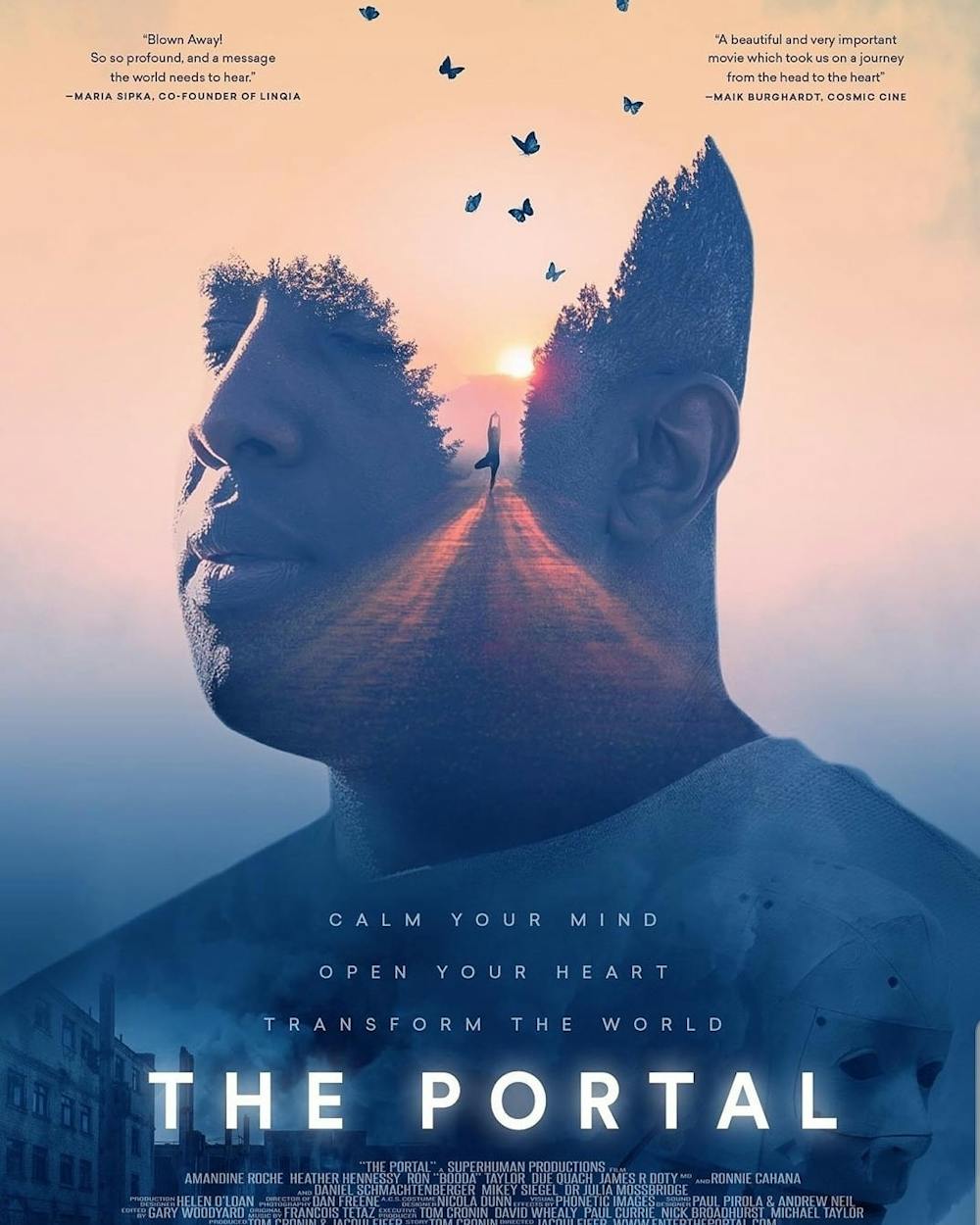
The Portal follows six individuals who undergo a personal transformation from trauma and struggle to calmness, self-acceptance, and compassion towards others. These personal changes are intertwined with contemplations about the broader struggles facing humanity and the role of technology.
The underlying claim is that stillness is not only a portal for personal transformation, but also a portal that ignites human potential for global transformation. The filmmakers contend that meditative practice has the power to move humankind from being on the verge of disconnection, chaos, and crisis to connection, calmness, and enlightenment.
While this might seem far-fetched, the film – slickly produced with stunning imagery – effectively captures our individual and collective challenges, highlighting the benefits people have experienced through various contemplative practices, and offering a hopeful vision of human potential.
The Portal promises enlightenment but it’s no quick fix.
Noise and haste
The movie begins with a powerful cacophony of noise, voices, and images – building up to a feeling of distress and a call to action that “something’s got to change”.
This sense of disruption, disconnection, and chaos then unfolds through the lives of six people from a range of backgrounds.
Supplied
The experiences of the individuals are developed through the course of the film, skipping between their stories, supported by recurrent images and music. Their issues – abuse, violence, career-ending injury, stroke, suicide, loneliness, depression, stress, intrusive thoughts, debt, emptiness – will be familiar to many adults, young and old.
Extending beyond the individual narratives, futurists and philosophers explore the state of the world and the role of technology. Some viewers will likely agree with the causes attributed to these problems, others will not.
One commentator observes that almost every problem that we are facing is human-generated. We are living in a time when many of our social systems are unstable, with technology accelerating life faster than we can adapt to it.
The film proposes meditation is the solution to these problems, providing a way to realise our human potential.
Each of the featured individuals finds resolution through stillness, achieved through forms of contemplative practice: guided meditation, yoga, prayer, or quiet reflection. A growing number of studies, reviews, and meta analyses suggest contemplative practices correlate with beneficial outcomes, but also point to how little is known about these techniques].
The film makes meditation accessible, supported by the personal experiences of everyday people – including a university student impacted by a traumatic childhood, a soldier suffering from PTSD, a Rabbi recovering from a stroke, and an athlete trying to rebuild her life. Each individual finds ways that work for them to create stillness, calming the chaos experienced within.
The viewer is subtlety invited to join in. Near the end of the film, the cacophony of images returns, this time with the chaos transforming into calmness and offering a few meditative moments of stillness.
Importantly, those featured in the film demonstrate that meditation is not a panacea, and also not an escape. It’s a practice they develop and consistently prioritise.
Each person, struggling with various traumas, learns to not ignore their past, but rather to accept and sit quietly with it. Meditation becomes an approach for the characters to face and accept their challenging histories, rather than avoid or be destroyed by them.
The film also points to the potential for contemplative practices to develop collective well-being. Through meditation and stillness, the individuals develop compassion for others, opening up the possibility for connection.
The film ends with a hopeful vision, suggesting the beautiful transformation that could emerge if each of us were to embrace our individual potential and contribute our part to the world.
Hopeful but sceptical
The stories in this film are compelling, though at times hard to follow. The images and music are engaging, but the driving story and key messages are at times unclear. The statements and claims by the futurists and researchers featured deserve continued debate and study by the scientific community.
Is meditation the answer to changing the world? The personal transformation of six individuals is a far cry from global transformation. Then again, change occurs one person at a time, and perhaps in stillness, creative solutions to the problems facing our society can indeed emerge.
Source: The Conversation (Au and NZ) – By Leah Ruppanner, Associate Professor in Sociology and Co-Director of The Policy Lab, University of Melbourne
The polls were wrong in the last US and Australian federal elections. Hillary Clinton was favoured to win at a margin of 85% to Donald Trump’s 15%. And Bill Shorten was expected to defeat Scott Morrison.
But what the polls perhaps didn’t reveal was that conservative candidates in both countries had captured an unexpected electorate: women.
Hillary Clinton performed poorly among white women because, as some argued, she couldn’t emotionally connect to voters.
Bill Shorten also lost women’s votes, pushing them towards the Coalition.
Women are swinging elections in the US and Australia in ways analysts have struggled to predict. So, what is going on with female voters? Our two recent studies can help explain.
Gender linked fate
Our earlier study suggests a key to understanding women’s political attitudes is their perception their futures are connected to what happens to other women, or their “gender linked fate”.
The idea of a linked fate has long been used to explain voting patterns of racial minority groups. Individual African-Americans, for example, have generally understood their futures to be closely tied to the well-being of the whole group.
This sense of linked fate helps explain why African-Americans vote as a block for more liberal candidates. Supporting the group is more important than individual preferences.
In this study, we assessed whether women experience a sense of linked fate to other women. And we found something striking in our US sample. Women’s perceptions of gender linked fate were contingent on two dimensions: their race and their marital status.
African-American women reported higher levels of gender-linked fate than whites, regardless of whether they were married, single or divorced. But for white and Latina women, gender-linked fate was tied to their marital status.
Only 18% of married white women reported their futures were strongly connected to other women compared to 38% of single and 30% of divorced white women. The patterns are similar for Latina women. This means for these two racial groups, heterosexual marriage leads them to feel less connected to other women.
Marriage is shown to shift couples’ attitudes, making them more similar to each other over the course of marriage. But, the shift is not even.
Rather, women become more conservative and see themselves as less connected to other women over the duration of the marriage.
Single women, on the other hand, are more supportive of feminist issues than married women, with feminist attitudes intensifying for women who rely more heavily on their own earnings.
Essentially, the institution of marriage traditionalises women’s attitudes and, as our study shows, this is pronounced for white women.
Weak gender linked fate
In the US, we found white married women’s lower levels of gender-linked fate helps explain their tendency to identify as a conservative and vote for the Republican party, and their weaker support for abortion.
Scott Morrison won the women’s vote last election.AAP Image/James Gourley
These findings are important in the context of American politics. The election of Donald Trump and the passage of heartbeat bills (a ban of any abortion once a heartbeat of a fetus can be detected, six to eight weeks after conception) across six US states are major swings to the right.
The assumption that women would vote for Clinton or that women would support abortion because they are women are not shown in the data.
Our research helps explain one piece of this puzzle – married white and Latina women don’t necessarily see their futures as tied to other women.
So, who are they tied to? Our research suggests men.
Women’s connection to men
We have since collected new data on 317 American white women and asked them about their connection to women and men.
From our interviews, we found conservative women were more likely to report that as things get better for men, they believed their own life also improved. Women who are more liberal were less likely to agree with this statement.
In contrast, liberal married women were more likely to say they would give up some of their resources (such as economic resources or class privilege) to benefit other women – a claim conservative women by and large did not make.
And, more politically liberal women reported their connection to other women has strengthened by 25% in the current political climate, over the past two years, compared to 8% among conservative women.
Simply, conservative white women are less connected to other women and more connected to men.
The US is distinct in its racial, political and marital composition, but there are some lessons to be learned for the current Australian political climate.
The 2019 federal election showed women weren’t aligned with Labor in the way the polls predicted.
Something in Coalition’s message resonates with Australian women. Our research suggests these messages may be particularly powerful to certain groups of women – married, white and conservative – who are watching their family’s futures change.
But these support networks are not always in place. Geographical or emotional distance from family members, conflict with friends, and the tendency for people with mental illness to withdraw from others means these individuals are often isolated.
In two Australian surveys – a national snapshot survey of Australian adults with psychosis and another looking at adults with long-term mental health conditions such as depression, anxiety, and psychosis – only one-quarter reported receiving regular assistance from family or friends. About three out of every four people living with mental illness reported the absence of a carer or other informal support.
For someone living with mental illness, having a carer or support person facilitates continuity of care and provides advocacy and support, particularly during and after episodes of acute illness.
People with mental illness are at their most vulnerable following discharge from hospital or other inpatient facilities. Reintegrating back into society can be challenging. And during this time, the risk of suicide is high.
It’s somewhat unsurprising, then, that people without a carer or support network face poorer outcomes in terms of recovery.
How does having a carer help?
Following hospitalisation for an acute episode of mental illness, people typically require assistance with a myriad of tasks.
They may need help with day-to-day activities like grocery shopping, cooking and cleaning. People in recovery may also need support to re-engage with the community, including returning to work or study.
They will likely benefit from assistance in adhering to care plans, including managing medications and attending follow-up appointments. A person recovering from hospitalisation for an eating disorder may need support from family members to ensure they are eating as much as they need to at mealtimes.
As well as these practical supports, someone recovering from an acute episode of mental illness requires ongoing emotional support which reaffirms their sense of self and capacity to recover.
We surveyed 105 Australian mental health carers and found the most commonly reported care tasks were “providing encouragement and motivation”, “prompting their loved ones to do things”, and “liaising with health professionals”.
Carers spent the majority of their caring time providing emotional support, and the least of their care time assisting with activities of daily living, such as feeding and dressing.
Research has shown having a carer increases the likelihood of follow-up care and better health outcomes in the short and long term. Following hospitalisation, carers can recognise and respond to early warning signs of relapse and encourage better engagement in prescribed care plans.
And although it’s rarely considered part of the caring role, safe and stable housing is crucial for recovery. Most mental health carers also live with the person they are caring for.
What about discharged patients who don’t have informal supports?
The transition from hospital to home can be frightening and difficult. Patients tend to become accustomed to the day-to-day hospital routine and in turn can feel increasingly disconnected from the outside world. These challenges are exacerbated in the absence of support from health professionals, family or friends.
Without family or carer involvement at discharge, a person with mental illness may be more likely to relapse and be readmitted, falling into a “revolving door” pattern of multiple hospitalisations.
A support person can help ensure medical appointments are organised and attended.From shutterstock.com
One study of older psychiatric patients found absent or dysfunctional family support was one of the strongest predictors of hospital readmission in the 18 months after discharge. Patients without reliable family support were nearly twice as likely to be readmitted to hospital than those who had dedicated family carers.
Similar results have been found in broader and larger samples. Among 1,384 adult patients admitted to a psychiatric hospital, unreliable social support at discharge was associated with an increased risk of being readmitted to hospital within one year.
Further, reduced social support and lack of continuity of care has been shown to be an important predictor of suicide following hospital discharge. For self-harm and suicide, the risk is most pronounced in the three months following discharge from hospital.
What needs to improve?
Alongside the absence of family support, lack of connection with community-based services and supports is similarly associated with poor post-discharge outcomes.
Discharge planning and transitional programs have been established to provide additional practical and emotional support to people with mental illness after they leave hospital. These have reported promisingresults in terms of preventing hospital readmission and promoting engagement with community treatment (such as psychological support services, medication monitoring, and alcohol and drug recovery services). Further research which identifies the key benefits of such programs is needed, using larger controlled studies.
Another solution is improving housing support for mental health patients after discharge. Programs such as Housing Mental Health Pathways in Victoria assist people with mental illness and a history of homelessness who have no suitable accommodation at the time of hospital discharge. More programs like this are needed.
The time following hospitalisation is one of the most vulnerable for people with mental illness. More needs to be done at both a community and policy level to better support people during this period – particularly those without a carer or informal support network.
If this article has raised issues for you or you’re concerned about someone you know, call Lifeline on 13 11 14.
I am in year 11 and I like to listen to music when I am studying, but my dad says that my brain is spending only half of its time studying and the other half is distracted by listening. He says it is better to leave my phone out of my room and concentrate on studying rather than listening to music. Is it OK to listen to songs when I am studying? – Robert, Year 11 student.
It’s a good question! In a nutshell, music puts us in a better mood, which makes us better at studying – but it also distracts us, which makes us worse at studying.
So if you want to study effectively with music, you want to reduce how distracting music can be, and increase the level to which the music keeps you in a good mood.
You may have heard of the Mozart effect – the idea that listening to Mozart makes you “smarter”. This is based on research that found listening to complex classical music like Mozart improved test scores, which the researcher argued was based on the music’s ability to stimulate parts of our minds that play a role in mathematical ability.
However, further research conclusively debunked the Mozart effect theory: it wasn’t really anything to do with maths, it was really just that music puts us in a better mood.
Research conducted in the 1990s found a “Blur Effect” – where kids who listened to the BritPop band Blur seemed to do better on tests. In fact, researchers found that the Blur effect was bigger than the Mozart effect, simply because kids enjoyed pop music like Blur more than classical music.
Being in a better mood likely means that we try that little bit harder and are willing to stick with challenging tasks.
When you study, you’re using your ‘working memory’ – that means you are holding and manipulating several bits of information in your head at once. Image By PlayTheTunes.
Music can distract us
On the other hand, music can be a distraction – under certain circumstances.
When you study, you’re using your “working memory” – that means you are holding and manipulating several bits of information in your head at once.
The research is fairly clear that when there’s music in the background, and especially music with vocals, our working memory gets worse.
Likely as a result, reading comprehension decreases when people listen to music with lyrics. Music also appears to be more distracting for people who are introverts than for people who are extroverts, perhaps because introverts are more easily overstimulated.
Some clever work by an Australia-based researcher called Bill Thompson and his colleagues aimed to figure out the relative effect of these two competing factors – mood and distraction.
They had participants do a fairly demanding comprehension task, and listen to classical music that was either slow or fast, and which was either soft or loud.
They found the only time there was any real decrease in performance was when people were listening to music that was both fast and loud (that is, at about the speed of Shake It Off by Taylor Swift, at about the volume of a vacuum cleaner).
But while that caused a decrease in performance, it wasn’t actually that big a decrease. And other similar research also failed to find large differences.
One study found a decrease in comprehension performance when people listened to music that was both fast and loud. But it wasn’t that big a decrease.Shutterstock
So… can I listen to music while studying or not?
To sum up: research suggest it’s probably fine to listen to music while you’re studying – with some caveats.
It’s better if:
it puts you in a good mood
it’s not too fast or too loud
it’s less wordy (and hip-hop, where the words are rapped rather than sung, is likely to be even more distracting)
Good planning needs integrity, and public participation should play a role in that.
But a row over a high-rise development proposed for suburban Brisbane shows what happens when the public feels left out of the planning process.
This highlights the problem with what is termed performance-based planning, which allows some controversial applications to be approved with little or no input from the community.
A plan submitted
Aged-care provider TriCare first lodged its application to develop a new facility in June 2017.
The site it chose was zoned for community facilities and the application was treated under Brisbane City Council’s performance-based planning rules as “code assessable development”.
Even though the developer was not required to give notice of the proposal to the local community, people soon got wind of it. They mobilisedstrongopposition to the planned development.
The developer was proposing three buildings of eight, 12 and 16 storeys in a locality characterised by dwellings that are mostly one to three storeys high.
In November 2017, the council rejected the application. The developer appealed.
TriCare then modified the proposal to the council’s satisfaction and the Queensland Planning and Environment Court approved the negotiated deal last month.
The approved design is for three buildings ranging from seven to eight storeys, a very significant scaling down of the original proposal.
Still no public consultation
But once again the local community was not involved in any of the negotiations or the court proceedings. This is because no community appeals are allowed on code assessable development.
Would the developer have got what it originally wanted if the community had not shown its opposition? And why didn’t the court even consider the community’s point of view?
In Queensland, code assessable development is considered a bounded form of assessment, which means it should be considered primarily against a planning scheme’s codes. The original aim was to speed up approvals for development applications broadly consistent with a council’s planning scheme.
These codes are written in a performance-based way. This means developers that only meet the overall outcomes of a code can still get their proposals across the line no matter what the code’s finer details state.
Overall outcomes are very often just that – broad statements of intent open to many different interpretations.
For example, in the TriCare case the applicable overall outcomes required development to be “generally consistent with the character of the area” and to “complement the prevailing, scale, height and bulk of expected development in the locality”.
The council – and the community – believed the initial application did not comply with these terms. The developer’s appeal argued its proposal was “generally consistent” with the character of the area as there were at least some medium-to-high-rise buildings in the area, including one nine-storey residential building on adjacent land.
Contrary to the council’s view, the developer argued:
The proposed development is of a scale, bulk and height that provides a high level of amenity and transitions sensitively to surrounding uses.
Evidently, code assessment is not quite the bounded and uncontroversial form of decision-making the legislators intended.
Planning with the community
In planning, good decision-making needs integrity. It needs to provide decisions the community knows to expect including, where appropriate, conditions that protect and respond to the needs of the community.
In Queensland, the parameters of performance-based planning have swung too far in favour of flexibility. We need to improve the drafting of performance-based codes.
Requirements to be “generally consistent with the character of the area” serve no useful purpose if the character of an area is hybrid, or has different meanings for the short- and long-term residents of that area.
There is also a huge distinction between code assessable development – where community members have no right of appeal – and impact assessable development – where public notification and third party appeal rights apply.
Yet whether applications are classed as impact or code assessable is a matter left to the discretion of individual councils with very little input from the community.
Further guidance needs to be given to better match assessment categories with community concerns.
Flexibility and discretion have a role to play in good planning. But if integrity, honesty and public trust are also goals then transparency and public accountability should be increased.
The value of public participation – both in its contribution to better design and for keeping the system accountable and honest – needs to be genuinely recognised and valued.
Not all development applications may warrant public appeal rights but a place at the table for the community somewhere along the line is surely warranted.
The Taringa development was initially assessed under legislation that has been superseded. But, as I warned last year, Queensland’s new Planning Act has done little to nothing to resolve the fundamental concerns this case raises.
The divisive story of the aged-care development in Taringa serves as a timely warning to other states looking to shift to a performance-based planning model.
When you wander down most supermarket aisles are you befuddled by too much choice? Do you feel overwhelmed when comparing new phone deals, insurance offers, energy provider plans?
There’s a lot of research in consumer behaviour that disputes the notion “more is better”. It says many of us, when confronted with too many options, either make poor decisions or avoid decisions altogether.
But not true for everyone. Some people thrive on choice. Our new research helps you determine if you have the personality type that laps up or overloads on choice.
More or less
Some choice, at least, is always better than no choice. Research using MRI, for example, shows higher activity in the brain’s reward and motivation systems when a person feels a sense of control in a situation.
A sense of autonomy at work, such as being free to choose hours of work, has been identified as crucial to well-being. For those with intellectual disabilities, being free to choose from a wide variety of activities has been shown to develop self-empowerment and social interaction.
Because of this instinctive preference choice, there’s a tendency to believe more choice might be better.
Over the past few decades, though, a growing body of research has challenged this premise.
In a pioneering experiment with supermarket shoppers, psychologists Sheena Iyengar and Mark Lepper found consumers confronted with a larger choice range were more likely to make a sub-optimal choice, or make no choice at all.
In one of their experiments, Sheena Iyengar and Mark Lepper used jams to test how shoppers coped with choice.www.shutterstock.com
As noted by another researcher, psychologist Barry Schwartz:
Consistent with the evidence that choice is not an unmixed blessing, results have begun to appear in the literature on human decision making to indicate that adding options for people can make the choice situation less rather than more attractive – that indeed, sometimes people prefer it if others make the choices for them
University of Sydney economist Robert Slonim suggests businesses knowingly use choice paralysis as a strategy to maximise profits: “They provide us with many plans and deals to make us feel like we are in control, but too many choices actually leads most of us to make a bad (or no) choice.” It’s particularly evident, he says, in mobile phone and energy markets.
But at what point does more become less? The experiments by Iyengar and Lepper offered participants an array of six, 24 or 30 choices. Might some participants have been just as decisive with 12 choices as six? Might they have even been happier?
Swiss economics psychologist Benjamin Scheibehenne and colleagues suggest it is impossible to make blanket predictions about where and when choice overload kicks in for individuals, based on analysing of 50 published and unpublished experiments in the area. They concluded:
In summary, we could identify a number of potentially important preconditions for choice overload to occur, but on the basis of the data on hand, we could not reliably identify sufficient conditions that explain when and why an increase in assortment size will decrease satisfaction, preference strength, or the motivation to choose.
This question of how individuals respond differently to choice is the basis of research by myself and colleagues Mathew Chylinski, Ko de Ruyter and E. Tory Higgins. Through field, lab and online experiments, we have identified a strong relationship between certain personality traits and ability to deal with choice.
How you do on the following quiz will be highly predictive of whether you love or get overloaded by more choice. The quiz, developed by a team of American and Italian researchers, has also been found to be relevant in consumer-related domains such as likelihood to procrastinate or accept default options.
If you scored lower than 32%, your personality suggests you prefer fewer options to choose from.
If you scored higher than 32%, then you tend to want more choice when making decisions. You have what we describe as strong “assessment orientation”. You are more likely to be motivated to evaluate every available alternative to make the best choice. You probably spend an extensive amount of time and energy assessing every possible alternatives prior to buying something. More options won’t phase you.
Know thyself
So while it may be that businesses purposefully provide extensive choice to “paralyse” consumers, if you’ve got the right personality, more may in fact be better.
The important thing is to understand which type of person you are. If you’re the type of person who loves researching and comparing, you’re in luck: you’ve got plenty of scope to make an informed decision.
If, on the other hand, you’re not assessment-orientated, you need to understand your limits and make a conscious effort to overcome choice paralysis or making the wrong decision.
Source: The Conversation (Au and NZ) – By Philip C. Almond, Emeritus Professor in the History of Religious Thought, The University of Queensland
In a speech in Albury last month, Prime Minister Scott Morrison told his audience that he was praying for rain in drought-affected areas.
“I pray for that rain everywhere else around the country,” he continued. “And I do pray for that rain. And I’d encourage others who believe in the power of prayer to pray for that rain and to pray for our farmers. Please do that.”
This week, Morrison spoke at a breakfast and praised prayers as “a reminder of our humility and our vulnerability […] that forms a unity”.
It appears prayer has become part of government public policy.
PM Scott Morrison prays for Australia.
What prayers are asking
Petitionary prayer is one of the traditional forms of Christian prayer. Broadly speaking, it has the form: “God, give me X”. In one of its most recent versions, “thought and prayers” are offered as condolence to those who are the victims of natural disasters or crimes. After the terrorist attack on the Christian Coptic cathedral in Egypt in late 2016, Scott Morrison declared, “My thoughts and prayers are with the Coptic community”.
St. Roch Praying to the Virgin for an End to the Plague by Jacques-Louis David (1780)Wikiart
Thoughts and prayers, when meant sincerely, is both an expression of personal sympathy and a request for God to give psychological comfort to those affected – to intervene spiritually, as it were. Praying for rain, on the other hand, is a request for God to intervene physically in the natural order of things.
In either case, God is being asked to intervene in the world. So petitionary prayer is essentially asking God to do miracles. The classic definition of a miracle was given by the Scottish 18th century philosopher David Hume: a miracle, he said, is “a violation of the laws of nature”.
More generally, following the philosopher J.L. Mackie, we might say a miracle occurs when something distinct from the natural order intrudes into the world. In the Christian case, God is this “something distinct”.
How good are miracles?
Miracles are at the very heart of the Christian tradition. The founder of Christianity, Jesus of Nazareth, was a miracle worker. He healed the sick, raised Lazarus from the dead, walked on water, cast out demons, turned water into wine, and so on.
Christianity bases its claims to truth on Jesus’ resurrection from the dead on the third day after his crucifixion. As St Paul put it, “If Christ has not been raised, then our proclamation has been in vain and your faith has been in vain” (1 Corinthians 15.14).
Petitionary prayer is a request to a higher power to intervene in the natural world.www.shutterstock.com
Miracles have always been an important part of Roman Catholicism’s evangelical outreach. Miracles, saints, and conversions all go together. So miracles come, not in utter loneliness, but trailing clouds of Catholic doctrines, claims to religious truth, invitations to join up, and encouragement to the faithful to keep coming back.
In more recent times, in the more conservative branches of Protestantism, miracles continue, not via saintly mediators, but through the direct intervention of God in response to the prayer and fasting of the faithful. The conservative Canberra Declaration group has declared this October a month of prayer and fasting for rain.
That said, since the 18th century Enlightenment, “miracle” has been a highly contested idea within the West. Believers and sceptics have begun to doubt the possibility of supernatural intervention into the world by God.
Can God help?
God’s activity in the world had now become a matter of philosophical rather than theological debate – a matter for rational discussion and not scriptural quarrel.
The new science came to focus on nature’s orderliness, simplicity, decorum, regularity, and uniformity. With that, the question of whether God could or ever did violate the regularity of nature assumed a new form. Could God break the laws of nature?
For some, like its major proponent – a humble schoolmaster named Peter Annet, the answer was simple. The laws of nature could not be violated. A miracle was defined as a violation of the laws of nature. Therefore miracles could not happen. Moreover, it was argued, God was unchanging. Since God established the laws of nature, they must be as unchangeable as he is.
God made the laws of nature as good as they could possibly be. Hence, God could not alter them to make them better, and would not alter them to make them worse.
This argument was a direct attack on the authority of the Bible and more importantly, reliant as it was on miracles, on the truth of Christianity itself. Accordingly, Annet was sentenced at the age of 68 in 1762 to stand in the pillory and to serve a prison sentence of one year’s hard labour.
As a result, others were more careful. While accepting that God could do miracles, they denied that he ever did or that we were entitled to believe that he had. Enter the Scottish philosopher David Hume. No humble schoolmaster this – but rather, by the time he published his essay Of Miracles in 1748, one of Europe’s greatest philosophers.
But would God help?
Hume accepted that the laws of nature could be violated. So God could do miracles. But did he? Hume’s argument against miracles was about weighing the evidence. The laws of nature were laws, he declared, because of the enormous amount of evidence that established them as laws.
So, he argued, the evidence for a miracle that violated a law of nature could never be greater than the evidence that had established the law in the first place. Put another way, evidence for violation of a natural law was actually decisive evidence against a miracle having occurred. Hence, a reasonable person would never accept that there was sufficient evidence to show that a miracle had, in fact, occurred.
The Resurrection by Sandro Botticelli (circa 1490)Wikiart
All of this was not to say that Jesus Christ did not rise from the dead. He may well have done so. However, for Hume, it was a law of nature that human beings could not rise from the dead “because that has never been observed in any age or country”.
In this way, evidence for one man such as Jesus Christ having done so could never outweigh the universal evidence that people do not do so. It would therefore never be reasonable to believe Jesus had risen from the dead.
Praying for rain
All this means God could make it rain if he were asked and if he wished to. But that said, if it did rain as a result of prayer, it would be difficult to demonstrate God had intervened to make it do so.
If the rain could not be naturally explained by meteorological science, then it’s possible divine cause came into play. Torrential rain falling out of a cloudless sky might do the trick. But if the rain were capable of a perfectly natural explanation, it could not qualify as a miraculous event.
Aerial vision of cattle being hand fed at Byron Station in northern NSW.Mick Tsikas/AAP
Putting aside the difficulties in showing God had made it rain, should we ask him to? As a supplement to a coherent climate change policy and actions flowing from it, it can hardly do any harm.
Indeed, it might encourage those who pray to become more environmentally active. But as a substitute for a coherent policy, it borders on the socially and politically irresponsible.
Believe it or not, relying on prayers would be theologically irresponsible too. Any theologian worth his or her salt would argue God made us responsible for the well-being of this planet. If I were a God asked to sort out climate problems caused by the actions of human beings, I would remain divinely aloof and simply say, “You messed it up, you fix it”.
Pacific diplomats, academics and youth leaders will gather in Auckland this week to discuss security, economic development and other pressing issues shaping the region’s future.
Pacific Futures will be held on October 18 and will feature speakers from across the region, including Samoa’s Deputy Prime Minister Afioga Fiame Naomi Mata’afa, New Zealand Minister of Pacific Peoples Aupito William Sio and New Zealand Deputy Prime Minister Winston Peters who will be giving the keynote speech.
New Zealand Institute of International Affairs Executive Director Melanie Thornton said that the conference will be “focussed squarely on the Pacific” with over 80 percent of speakers from the Pacific or of Pacific heritage.
“This conference will be vital for understanding the new dynamics in the Pacific and what these mean for the diplomatic community, the business community, and for Pasifika and New Zealand communities everywhere,” she said.
The public is also invited to attend the conference to gain an understanding of regional challenges and the positive work that is taking place in difference Pacific countries and organisations, she said.
– Partner –
Pacific security will likely be at the forefront of the conference, which will take place as China galvanises support and increases its foothold in the region.
However, Senior Lecturer of security studies at Massey University Dr Anna Powles, who will be presenting at the conference, said talks on China’s role in the Pacific will not dominate the agenda as it has done in other regionals meetings in recent years.
“The conference has deliberately shifted the framing of geopolitics in the Pacific in terms of what are Pacific perspectives on security issues.”
While she said the Kiribati and Solomon’s islands developments are likely to come up, she expects a far more “nuanced conservation” where the bilateral agency of Pacific nations are acknowledged.
Another key issue which is certain to be raised is the unrest in West Papua, which has seen over 30 people killed and many thousands displaced as the Indonesia military clashed with protestors.
Dr Powels said it was important that West Papua is discussed at the conference as it is very much a regional security issue.
“What is happening in Papua is a human security issue and because it is a human security issue, it is a regional security issue for New Zealand and a number of Pacific island countries.”
“New Zealand is a signatory to the Boe Declaration which provides an expanded concept of security inclusive of human security.”
“There is a potential role for New Zealand, similar to the honest broker role New Zealand played in respect to brokering peace in Bougainville, where New Zealand can offer ‘good offices’ to support dialogue between the key actors in Papua and Indonesia.”
Vanuatu Foreign Minister’s Minister Ralph Regenvanu who will also be speaking at the conference told Pacific Media Watch he intends raise the West Papua issue personally.
An outspoken advocate of West Papuan independence, Regenvanu commended the New Zealand government’s leadership on issues like climate change, which was robustly debated at the Pacific Islands Forum in Tuvalu in August.
“New Zealand is a model for what a developed country should be committing in terms of climate change,” he said.
Pacific Futures will also focus heavily on the growing influence of young people in Pacific developments with many representatives of youth organisations speaking.
Founder and CEO of Tonga Youth Leaders and Pacific Regional Rep for Commonwealth Youth Council Elizabeth V Kite said the conference will give a much-needed voice to the younger generations which are frequently excluded from decision making.
“Youth are leading the way in terms of highlighting issues such as climate change, but we are still not afforded equal say at decision making tables about our environment and future, which must change,” she said.
“If we are the ones to live out the future that is being planned today, we as young people must have a say in that and must be engaged with when these discussions and decisions are being made.”
Pacific Futures will take place at the Novotel Auckland Airport from 8am to 5pm on Friday October 18.
It has been more than two years since “clearance operations” by Myanmar’s security forces, the Tatmadaw, forced more than 700,000 Rohingya across the border to neighbouring Bangladesh.
During this time, the UN Security Council has remained silent on the plight of Rohingya, with China and Russia working to keep it off the council’s agenda.
But at the UN General Assembly last month, The Gambia announced it would take the Myanmar government to the International Court of Justice for the genocide of the Rohingya.
Vice-President Isatou Touray said The Gambia is:
a small country with a big voice on matters of human rights on the continent and beyond. […] The Gambia is ready to lead the concerted efforts for taking the Rohingya issue to the International Court of Justice on behalf of the Organisation of Islamic Cooperation and we are calling on all stakeholders to support this process.
Myanmar might finally be held accountable, but defending the Rohingya from genocide shouldn’t just be left to the global Islamic community. They need to be joined by countries with an interest in reducing the sexual and gender based violence at the core of the Tatmadaw’s genocidal campaign.
Otherwise, these important issues may not be sufficiently included in the case due to regional religious politics.
Sexual and gender violence
Last year, a Human Rights Council Fact-Finding Mission report detailed serious breaches of international humanitarian and human rights law by members of the Tatmadaw, including killing, rape, torture, arson and forced displacement.
The report also detailed how the Myanmar government, as a whole, was responsible for perpetrating these crimes, and should be held to account.
‘An OIC film on the Rohingya issue, a continuing tragedy of human rights violations and unimaginable humanitarian suffering’
In an additional report released in August this year, the fact-finding mission found sexual and gender based violence was:
part of a deliberate, well-planned strategy to intimidate, terrorise and punish a civilian population.
The sheer volume of pregnant women in the refugee camps was one early indicator of the extent to which sexual violence was used against women and girls. But the mission also found it was used against men, boys and trans people.
In general, the UN Security Council has recognised the use of sexual violence as genocide, but they haven’t tied it to the crisis in Myanmar.
The council has passed nine resolutions on women, peace and security. Among other things, these resolutions call for the protection of women and girls, men and boys from conflict-related sexual violence, and urge countries to end to impunity for these crimes.
So, it is of the utmost importance that the sexual- and gender-based violence used in the genocide is accounted for in any International Court of Justice (ICJ) case.
How can the ICJ help?
The ICJ adjudicates between states, not individuals. Although individuals commit genocidal acts, under the Genocide Convention of 1948, states also have responsibility for preventing and punishing the crime of genocide.
Myanmar signed the UN’s Genocide Convention in 1957, which contains an article giving the ICJ jurisdiction if another state thinks they’ve breached their obligations.
This means once the case comes before the court, it can make rulings within a matter of days that would be binding on the government of Myanmar, the Security Council, or both. What’s more, it can begin almost immediately and can have immediate effect inside Myanmar.
An ICJ case could also serve as a way to recognise and remedy the collective harm of the sexual- and gender-based violence, not just the harm experienced by individuals.
International efforts
The Gambia has called on other countries to join it in taking a case against Myanmar to the ICJ. Canadian civil society and parliamentarians have been working to convince their government to bring such a case for more than a year. Importantly, a case from Canada against Myanmar would include sexual- and gender-based violence.
And there are a range of reasons why Canada would step forward in support of The Gambia’s case. Taking such action would align with Canada’s foreign policy objectives, such as those on human rights and women, peace and security.
Canada is also campaigning for a seat on the UN Security Council, but they have stiff competition from Ireland and Norway.
Taking Myanmar to the ICJ would show Canada is a strong international actor, able to work for the good of global peace and security, navigating the full set of challenges posed by the permanent members of the Security Council.
ICJ cases are usually long and costly. Interested countries could offer financial assistance for The Gambia’s case. They can also join the case as co-applicants in support of The Gambia’s leadership.
Lastly, once the case is lodged, the court allows other countries to intervene. Countries unwilling to come forward as co-applicants could ensure gendered and sexual violence issues are included by making just such an intervention.
At the Security Council later this month, UN Member States will have the opportunity to participate in the annual open debate on women, peace and security.
By then, someone must surely be able to stand up and say:
we stand with The Gambia, we will take the government of Myanmar to the International Court of Justice, to hold them to account for the sexual and gender based violence they perpetrated as genocide against the Rohingya.
In this loosely autobiographical coming-of-age story, stand-up comic Ramy Youssef isn’t trying to promote a positive ideal of Egyptian American-Muslims to mainstream audiences. Instead, he crafts a more complex view.
Ramy is proud to be Muslim but struggles with the pressure to conform to a template of Arab Muslim masculinity that others around him seemed to have already worked out.
He works at a failing start-up with vague goals to “make a difference.” His best friends, a surgeon and restaurant owner, are already married with children.
His insecurities about “failing” as an Arab Muslim man hover in every interaction.
In his dating expeditions, we see Ramy unable to be the partner the women deserve. He gives himself a pass for premarital sex with non-Muslim partners but holds the young Muslim women in his life to higher standards. In attempts to “settle down” he goes on a blind date with a Muslim woman and comes up short when asked about his life goals.
In his own community, he is trying to live up to parental expectations: a stable job, a house, a family – pressures explored in Ali’s Wedding.
In Arab Australian and Muslim men, some academics have called the masculinity that emerges from these interwoven pressures “protest masculinity”: displayed through physical dominance, specific stylistic choices, and sporting interests.
Australian films Cedar Boys and The Combination have depicted this Arab Australian protest masculinity, where young men release the pressure through physical violence.
In a post-Cronulla Riots age, telling these stories makes sense.
Those films show some of the difficulties of young adulthood for some boys whose agency is stripped of them, international crises are pinned on them, and the intensity of community pressure looms large.
But the way young people respond to these pressures are not all the same.
They told me they felt pride in their cultural backgrounds, but they were worried about their future. They were uncertain about their sense of belonging among peers who had different interests.
Some were desperate to escape what they saw as suffocating local working class ideas about masculinity and ethnicity. But in prestigious fine arts courses they found themselves out of place, branded too “ethnic” to fit in.
Some thought the macho sexism displayed by their Arab-Australian school peers was a product of their ethnicity or culture. And while there are specific kinds of gender issues in Arab Muslim communities, when they reached university, socialising outside their neighbourhood, these young men learned sexism and misogyny features across all social, class, and cultural backgrounds.
These conversations about contemporary millennial masculinities, ethnicity and identity are at the core of Ramy.
Ramy performs neither protest masculinity, nor the role of ambitious migrant son. He isn’t a hero. And the show doesn’t attempt to make him one.
Not all masculinities can be stereotyped
We see a similar story in the new Australian film Slam.
Politically outspoken Ameena (Danielle Horvat) goes missing after a night performing slam poetry. Her brother Tarek Nasser (Adam Bakri) comforts himself by believing that she ran away, rather than confront the possibility of racially and gender-motivated violence against her – a considerable fear for young Arab and Muslim women in Australia.
Tarek denies the reality of racism in contemporary Australia. For survival, he focused on passing as non-Muslim and “non-Leb”, and on getting out of Bankstown – a socio-economically disadvantaged area home to a large population of Arabs and Muslims.
Now living comfortably in a middle class inner Sydney suburb, he runs a cafe with his Anglo-Australian wife. He goes by the name Ricky. He speaks in his native Arabic only with his mother.
He distances himself from the Arab Muslim community he grew up in, but is awkward in the non-Arab community he thought he had seamlessly settled into.
Like Ramy, he is not a stereotypical working class tough guy. He appears out of place alongside young men from his childhood neighbourhood, as we see when he goes to the boxing gym to find Ameena’s friends. He is similarly uneasy among his wealthy in-laws: equal parts distant and suspicious.
Tarek is a difficult character to like. He doesn’t even seem to like himself.
Like the participants in my research, Tarek has to reckon with the tensions of community and individual aspirations to “make it” in broader Australian society.
Both Ramy and Slam show representations of masculinity and how this relates to ethnicity, culture and the casual racism that confront some young Arab and Muslim men in everyday settings.
They also reveal the ways these young men are blind to the gender struggles of the women in their lives.
Rather than pin down these characters in absolutist ways – choosing to fulfil macho and pious patriarchal expectations or opting out altogether – Ramy and Tarek try to draw on positive elements of their upbringing and honestly negotiate the tensions in their identities.
In Slam, Tarek feels disconnected from his Arab Muslim community, but finds he doesn’t quite fit in an Anglo-Australian community, either.Bonsai Films
Tarek and Ramy’s supposed “failures” as young men are refreshing to watch.
It may be tempting to dismiss Tarek and Ramy for not being positive role models. But many who struggle to be the perfect, upwardly mobile migrant child will be able to relate to their experiences and inner turmoil.
These men are are flawed, nuanced and contradictory: a kind of masculinity that is necessary to see on screen. Especially for Arab Muslim young men whose stories are still rarely told in nuanced ways.
Slam opens in Australian cinemas October 17. Ramy is available in Australia on Stan.
“Investigations into this particular case involving the former Prime Minister have been ongoing and the weight of the evidence that came to light before the police detectives necessitated an application to be made to the courts for a warrant of arrest.
“We have made it very clear when we came into office that we will look into all outstanding criminal cases of national significance including police shootings as well as high level corruption cases,” Manning said.
– Partner –
Police located O’Neill at the crown hotel in Port Moresby but he has so far refused to cooperate.
According to RNZ Pacific, O’Neill has responded in a statement that he was not informed or presented with a warrant from any member of the police force.
“If this was a serious matter, not a political power play, a formal process would be in place that would have seen legal representation made to my office,” O’Neill said.
He said the corruption claims were “false and fabricated in a clumsy way by the Police Minister (Bryan Kramer) and relate to renovations to the Yangaum Health Centre in Madang”.
O’Neill said he would be available at any time to hear the complaint, “but I warn any member of the RPNGC who might be part of the Police Minister’s political unit, to think carefully and respect and honour the oath you swore to our Nation”.
Commissioner David Manning has appealed to O’Neill to cooperate and “avail himself to investigators.”
Climate Explained is a collaboration between The Conversation, Stuff and the New Zealand Science Media Centre to answer your questions about climate change.
If you have a question you’d like an expert to answer, please send it to climate.change@stuff.co.nz
There is a lot of discussion on the benefits of electric cars versus fossil fuel cars in the context of lithium mining. Please can you tell me which one weighs in better on the environmental impact in terms of global warming and why?
Electric vehicles (EVs) seem very attractive at first sight. But when we look more closely, it becomes clear that they have a substantial carbon footprint and some downsides in terms of the extraction of lithium, cobalt and other metals. And they don’t relieve congestion in crowded cities.
In this response to the question, we touch briefly on the lithium issue, but focus mainly on the carbon footprint of electric cars.
The increasing use of lithium-ion batteries as a major power source in electronic devices, including mobile phones, laptops and electric cars has contributed to a 58% increase in lithium mining in the past decade worldwide. There seems little near-term risk of lithium being mined out, but there is an environmental downside.
The best comparison is based on a life cycle analysis which tries to consider all the emissions of carbon dioxide during vehicle manufacturing, use and recycling. Life cycle estimates are never entirely comprehensive, and emission estimates vary by country, as circumstances differ.
A life cycle analysis of emissions considers three phases: the manufacturing phase (also known as cradle-to-gate), the use phase (well-to-wheel) and the recycling phase (grave-to-cradle).
The manufacturing phase
In this phase, the main processes are ore mining, material transformation, manufacturing of vehicle components and vehicle assembly. A recent study of car emissions in China estimates emissions for cars with internal combustion engines in this phase to be about 10.5 tonnes of carbon dioxide (tCO₂) per car, compared to emissions for an electric car of about 13 tonnes (including the electric car battery manufacturing).
Emissions from the manufacturing of a lithium-nickel-manganese-cobalt-oxide battery alone were estimated to be 3.2 tonnes. If the vehicle life is assumed to be 150,000 kilometres, emissions from the manufacturing phase of an electric car are higher than for fossil-fuelled cars. But for complete life cycle emissions, the study shows that EV emissions are 18% lower than fossil-fuelled cars.
In the use phase, emissions from an electric car are solely due to its upstream emissions, which depend on how much of the electricity comes from fossil or renewable sources. The emissions from a fossil-fuelled car are due to both upstream emissions and tailpipe emissions.
Upstream emissions of EVs essentially depend on the share of zero or low-carbon sources in the country’s electricity generation mix. To understand how the emissions of electric cars vary with a country’s renewable electricity share, consider Australia and New Zealand.
In 2018, Australia’s share of renewables in electricity generation was about 21% (similar to Greece’s at 22%). In contrast, the share of renewables in New Zealand’s electricity generation mix was about 84% (less than France’s at 90%). Using these data and estimates from a 2018 assessment, electric car upstream emissions (for a battery electric vehicle) in Australia can be estimated to be about 170g of CO₂ per km while upstream emissions in New Zealand are estimated at about 25g of CO₂ per km on average. This shows that using an electric car in New Zealand is likely to be about seven times better in terms of upstream carbon emissions than in Australia.
The above studies show that emissions during the use phase from a fossil-fuelled compact sedan car were about 251g of CO₂ per km. Therefore, the use phase emissions from such a car were about 81g of CO₂ per km higher than those from a grid-recharged EV in Australia, and much worse than the emissions from an electric car in New Zealand.
The recycling phase
The key processes in the recycling phase are vehicle dismantling, vehicle recycling, battery recycling and material recovery. The estimated emissions in this phase, based on a study in China, are about 1.8 tonnes for a fossil-fuelled car and 2.4 tonnes for an electric car (including battery recycling). This difference is mostly due to the emissions from battery recycling which is 0.7 tonnes.
This illustrates that electric cars are responsible for more emissions than their petrol counterparts in the recycling phase. But it’s important to note the recycled vehicle components can be used in the manufacturing of future vehicles, and batteries recycled through direct cathode recycling can be used in subsequent batteries. This could have significant emissions reduction benefits in the future.
So on the basis of recent studies, fossil-fuelled cars generally emit more than electric cars in all phases of a life cycle. The total life cycle emissions from a fossil-fuelled car and an electric car in Australia were 333g of CO₂ per km and 273g of CO₂ per km, respectively. That is, using average grid electricity, EVs come out about 18% better in terms of their carbon footprint.
Likewise, electric cars in New Zealand work out a lot better than fossil-fuelled cars in terms of emissions, with life-cycle emissions at about 333 g of CO₂ per km for fossil-fuelled cars and 128g of CO₂ per km for electric cars. In New Zealand, EVs perform about 62% better than fossil cars in carbon footprint terms.
Research shows high levels of exam stress can interfere with attention and reduce working memory, leading to lower performance. Early experiences of anxiety and stress can also set a precedent for mental-health problems in adulthood.
But how we see stress can actually make a difference to the way it affects us. Research shows if we believe stress is a helpful response that will increase our performance in a challenging event, it can be a tool that works to our advantage.
From good stress to bad stress
Stress is a normal experience when we have a challenging event. We can experience stress when learning something new, starting a new job or being in a race.
Our experience of “stress” is actually our body getting us ready to take on the challenge. A stress response is helpful as it can increase oxygen to the brain and improve attention, focus, energy and determination.
The runner in a race needs to be “stressed” to compete successfully. The young person sitting in an exam room needs it too.
Studies show people who are clear about their feelings are more likely to thrive on anxiety and stress and possibly use these to achieve their goals and find satisfaction at work.
The runner needs stress to succeed, and so does the student doing an exam.from shutterstock.com
Stress and anxiety can work for you. But they become bad when we evaluate events as a threat rather than a challenge and when we believe we don’t have enough resources to cope.
Exams are often treated as a threat because there is potential harm or loss related to our self-worth, identity, and commitments, goals and dreams. If we fail, we think we are a failure and we may never get the future we had hoped for. Our whole life is at stake.
How do we make stress good?
To put it simply, stress can be good if we believe it’s good. It’ll work for us if we develop a mindset that stress helps our performance, health and well-being (rather than seeing it as debilitating).
In a study from the United States, one group of young people were given information about stress before sitting an exam. The reading material explained stress was not harmful, but that it had evolved to help us cope and perform better. Another group were told to just ignore stress and suppress their emotions.
Researchers found the first group performed significantly better in the exam (average five marks improvement) than the group who used the ignore-and-relax approach.
In another study of exam stress, students who saw stress as an opportunity and used it for self-growth had increased performance and decreased emotional exhaustion. But students who saw stress as a threat showed decreased effort and performance.
Study will improve your resources, so you have them to draw on when the stress hits.from shutterstock.com
These studies didn’t examine how to eliminate exam stress. Instead they examined a change in the way students responded to it. Here are some tips for you use stress to your advantage.
Four ways to make stress work for you
1. Read your body differently
Start to read your stress response as being there to help you prepare for the challenge. Instead of seeing it as a threat, try to see it as a coping tool. When you are experiencing stress, you can say to yourself:
I am feeling a little uncomfortable; my heart is beating faster, but my body is getting me ready to compete.
2. Reframe the meaning of the event
Rather than framing exams as a threat, try to frame them as a challenge. Part of the reason they are seen as a threat is because your whole future, identity and worth appear to be at stake. This is not true. Exams are one very small part of your life that does not decide your whole future.
There are always other options, different pathways and opportunities. Vera Wang failed to get into the Olympic ice-skating team and became a world famous dress designer. Sometimes the path we imagine looks a little different.
Not all journeys are straight, and the best ones can have diversions.
Rather than ignoring the emotions, it’s better to feel them, accept them, and then try to use them to your advantage. You can say to yourself:
I feel this way because this goal is important to me, and my body is responding this way because it is getting me ready to perform.
4. Add to your resources
Clearly, changing your mindset is only helpful if you have the resources to cope. It would be like an athlete who is about to compete but has not trained. Put time into study, study in different ways (read, write ideas in your own words, talk about the ideas, draw them) and give yourself time to practise these ideas.
When you have done this, your stress response then draws on these resources.
Stress will always be present in our lives as we take on new challenges and grow as a person. When we see low-level stress as a threat it becomes one. It becomes a red flag that we are not coping, that these feelings are wrong and we should retreat. This is not true.
However, if you are feeling severe stress and anxiety in different settings and for an extended period of time you should see your GP and get support.
Yet in leaked audio recently published by The Verge, Facebook chief executive Mark Zuckerberg can reportedly be heard telling his staff that some of these reports “are, I think, a little over-dramatic”.
Out of touch and dismissive
While Zuckerberg acknowledges that Facebook moderators need to be treated humanely, overall he comes across in the recording as a person who sees human suffering as “a math problem”, as The Verge’s editor-in-chief Nilay Patel suggested on Twitter.
Zuckerberg’s response is troubling on several fronts, not least in minimising the impact of moderation on those who do it. It also works to discredit those who blow the whistle on poor working conditions.
In dismissing the real risks of poorly paid, relentless content moderation and implying that moderators who call out issues are “over-dramatic”, Zuckerberg risks compounding moderators’ trauma.
This is a result of what American psychologists Carly Smith and Jennifer Freyd call “institutional betrayal”, where the organisation we trust to support us, doesn’t. Worse still, this behaviour has also been shown to make people doubt their decision to report in the first place.
We also contacted Facebook about Zuckerberg’s comments and asked them to confirm or deny the working conditions of their moderators. They gave us the following statement:
We are committed to providing support for our content reviewers as we recognize that reviewing certain types of content can be hard. That is why everyone who reviews content for Facebook goes through an in-depth, multi-week training program on our Community Standards and has access to extensive support to ensure their well-being, which can include on-site support with trained practitioners, an on-call service, and healthcare benefits from the first day of employment. We are also employing technical solutions to limit exposure to graphic material as much as possible. This is an important issue, and we are committed to getting this right.
While Zuckerberg and Facebook acknowledge that moderators need access to psychological care, there are major structural issues that prevent many of them from getting it.
Bottom of the heap
If the internet has a class system, moderators sit at the bottom – they are modern day sin-eaters who absorb offensive and traumatic material so others don’t have to see it.
Most are subcontractors working on short-term or casual agreements with little chance of permanent employment and minimal agency or autonomy. As a result, they’re largely exiled from the shiny campuses of today’s big tech companies, even though many hold degrees from top-tier universities, as Sarah T. Roberts discusses in her book Behind The Screen.
As members of the precariat, they are reluctant to take time off work to seek care, or indicate they are unable to cope, in case they lose shifts or have contracts terminated. Cost of care is also a significant inhibitor. As Sarah Roberts writes, contract workers are oftenoften not covered by employee health insurance plans or able to afford their own private ccover.
Most platform moderators are hired through outsourcing firms that are woefully unqualified to understand the nuances of the job. One such company, Cognizant, reportedly allows moderators nine minutes each day of “wellness time” to “process” abhorrent content, with repercussions if the time is used instead for bathroom breaks or prayer.
Documentaries like The Moderators and The Cleaners reveal techno-colonialism in moderation centres in India, Bangladesh and the Philippines. As a whole, moderators are vulnerable humans in a deadly loop – Morlocks subject to the whims of Silicon Valley Eloi.
Organising for change
Despite moderators’ dismal conditions and the dismissiveness of Zuckerberg and others at the top of the tech hierarchy, there are signs that things are beginning to change.
In Australia, online community managers – professionals who are hired to help organisations build communities or audiences across a range of platforms, including Facebook, and who set rules for governance and moderation – have recently teamed up with a union, the Media, Entertainment and Arts Alliance, to negotiate labour protections.
This has been done through the Australian Community Managers network (ACM), which also provides access to training and peer support. ACM is also working with like-minded organisations around the world, including Bundesverband Community Management in Germany, Voorzitter Vereniging Community Management in the Netherlands, The Community Roundtable in the United States, and nascent groups in India and Vietnam.
These groups are professional communities of practice and union-like surrogates who advocate for their people, and champion their insights and perspectives.
As this movement grows, it may challenge the tech industry’s reliance on cheap, unprotected labour – which extends beyond moderation to countless other areas, including contract game development and video production.
The YouTubers’ union and beyond
Workers in the gaming industry are also starting to push back against frameworks that exploit their time, talent and, invariably, well-being (as illuminated by Hasan Minaj on Patriot Act). In Australia Gaming Workers Unite is mobilising games workers around issues of precarious employment, harassment (online and off), exploitation and more.
Although Mark Zuckerberg doesn’t seem to understand the human challenges of internetworked creativity, or the labour that enables his machine to work, he may yet have to learn. His remarks compound the material violence experienced by moderators, dismiss the complexity of their work and – most crucially – dismiss their potential to organise.
Platform chief executives can expect a backlash from digital workers around the world. The physical and psychological effects of moderation are indeed dramatic; the changes they’re provoking in industrial relations are even more so.
Source: The Conversation (Au and NZ) – By Kate Lycett, Senior Research Officer, Deakin University; Honorary Fellow, The University of Melbourne, Murdoch Children’s Research Institute
Three simple factors can predict whether a child is likely to be overweight or obese by the time they reach adolescence: the child’s body mass index (BMI), the mother’s BMI and the mother’s education level, according to our new research.
The study, published in the International Journal of Obesity, found these three factors predicted whether children of all sizes either developed weight problems or resolved them by age 14-15, with around 70% accuracy.
One in four Australian adolescents is overweight or obese. This means they’re likely to be obese in adulthood, placing them at higher risk of heart disease, diabetes, Alzheimer’s and cancer.
Combining these three factors may help clinicians target care to those most at risk of becoming obese in adolescence.
GPs are well placed to both prevent and treat excess weight and obesity. But time constraints make it difficult. Few parents make appointments to address concerns about weight, so most counselling occurs in the context of a visit for something else.
It’s also difficult for GPs to know which children might need this counselling. GPs don’t want to offer treatment to the overweight or obese child who is going to grow out it. Nor do they want to raise the topic of excess weight to a child who is in the normal weight range, without good reason.
Targeting care, whether treatment or prevention, to those who really need it avoids wasting resources and harm from over-treating children who will grow out of their weight issues. But until now, we haven’t been able to predict on the spot who these children are.
We set out to determine whether simple factors, such as those available to GPs in a standard appointment, could accurately predict which normal-weight children were likely to become overweight or obese, and which heavy children were likely to resolve to a normal weight by adolescence.
By drawing on the Longitudinal Study of Australian Children, we considered this question in close to 7,000 children. Children were recruited in 2004 at 0-12 months or four to five years of age and followed up every two years, across six time points, to age 10-11 and 14-15 years respectively.
At each time point, interviewers measured children’s height and weight (except 0-12 months), and parents reported their height and weight, allowing us to calculate their BMI.
We also selected 23 other obesity-related factors clinicians could readily ask in a routine appointment. These included historical factors – such as the child’s birth weight, duration of breastfeeding, mode of delivery and the mother’s education levels – and questions about how often they ate high-fat foods and sugary drinks, their enjoyment of physical activity, and levels of disadvantage in their neighbourhood.
The researchers also looked at how often the children ate high-fat food.Romrodphoto/Shutterstock
Other studies have tended to look at these factors in isolation or to examine predictive factors at a single time point. We were able to look at the combined effects of all the questions across all the time points throughout childhood.
What did we find?
Three consistent factors in both age groups predicted the development or resolution of weight problems by adolescence: the mother’s BMI, the child’s BMI and the mother’s level of education.
For every one unit increase in the child’s BMI at age six to seven, the odds of developing weight problems at 14-15 rose three-fold. It also halved the odds of the weight issues resolving.
Similarly, for every one unit increase of the mother’s BMI when the child was aged six to seven, the chance of the child developing weight problems by 14-15 increased by 5%. The odds of weight issues resolving decreased by 10%.
In addition, at two to five years of age, children whose mothers had a university degree had lower odds of being overweight or obese. For children who were already overweight or obese at two to five, those whose mothers had a university degree were more likely to have their weight issues resolved by adolescence.
Together, these three factors were around 70% accurate in predicting both the development and resolution of weight problems.
Only 13% of normal-weight six to seven year olds, with none of these three risk factors, became overweight or obese by age 14-15.
In contrast, 71% of those with all three risk factors became overweight or obese.
How could these findings improve care?
Unlike genetic information or blood tests, these three factors are available on the spot. And despite their apparent simplicity, they include a complex mix of genetic, environmental and lifestyle information about our health. This data is impossible to measure accurately in a brief – or even long – doctor’s appointment.
These three questions may help health practitioners target treatment to high-risk children.
Of course, even if we can accurately identify children at risk of becoming overweight or obese, we still lack effective prevention methods. Lifestyle interventions, such as counselling to improve the quality of their diet and increase physical activity, remain the first choices. However, the effectiveness of these interventions is limited. We urgently need more effective tools to prevent and manage excess weight and obesity in children.
If you’re concerned about your child’s weight, speak to a professional such as a dietitian, GP or paediatrician. They can also help manage other conditions that can accompany obesity, such as anxiety and high blood pressure.
And it never failed that during the dry years the people forgot about the rich years, and during the wet years they lost all memory of the dry years. It was always that way.
While author John Steinbeck was referring to California’s Salinas Valley, the phrase is particularly pertinent to Australia where the El Niño-Southern Oscillation exerts a profound influence. Water availability varies greatly across the country, both in space and time. El Niño conditions bring droughts and devastating bushfires, while La Niña is accompanied by violent rainfall, floods and cyclones.
This variability is innate to the Australian environment. And now, climate change means that in some regions, the dry years are becoming drier and the wet years are becoming less frequent. Managing water resources under a changing climate and burgeoning population requires innovative and realistic solutions that are different to those that have worked in the past.
Drought-proofing is impossible
Planning for the dry years involves setting sustainable usage limits, using more than one source of water, efficiency improvements, managed aquifer recharge, water recycling and evaluation of the best usage of water resources. It does not involve misleading claims of drought-proofing that infer we can somehow tame the unruly nature of our arid environment instead of planning and preparing for reality.
Unlike managing for the wet and dry periods, drought-proofing seeks to negate dry periods through infrastructure schemes such as large dams (subject to huge evaporative losses) and dubious river diversions. It fails to acknowledge the intrinsic variability of water availability in Australia, and modify our behaviour accordingly.
The reality is that in many parts of the country, groundwater is the sole source of water and the climate is very dry. A cornerstone of the recently launched $100 million National Water Grid Authority is the construction of more dams. But dams need rain to fill them, because without rain, all we have is empty dams. And we have enough of those already.
A history of denial
Just because Dorothea Mackellar wrote of “droughts and flooding rains” over 100 years ago, it doesn’t mean water management should proceed in the same vein it always has.
Australia has always had a variable climate, which changes significantly from year to year and also decade to decade. This not the same as a long-term climatic trend, better known as climate change.
Climate change is making parts of Australia even drier. Rainfall in the south-eastern part of Australia is projected to keep declining. We cannot rely on blind faith that rains will fill dams once more because they have in the past.
Yet inevitably, during the dry years, claims that Australia can be “drought-proofed” are renewed. Deputy Prime Minister Michael McCormack recently praised the Bradfield scheme, an 80 year old infrastructure project intending to divert northern river flows inland. It has been so thoroughly debunked on all scales, it is better described as a pipe-dream than piping scheme. It has no place in reasonable water management discourse.
The concept of drought-proofing harks back to the days of European settlement. Early water management techniques were more appropriate for verdant English fields than the arid plains of Australia.
In the early twentieth century, water resources were vigorously developed, with government-sponsored irrigation schemes and large dams constructed. During this time, little thought was given to sustainability. Instead, the goal was to stimulate inland settlement, agriculture and industry. Development was pursued despite the cost and ill-advised nature of irrigation in particular areas.
Shifting long entrenched perceptions of water management
All this said, irrigation certainly has its place: it supports a quarter of Australia’s agricultural output. And there are substantial efforts underway to rebalance water usage between irrigation and the environment.
However, acknowledgement of the relative scarcity of water in certain parts of Australia has only really occurred in the last 30 years or so.
Widespread droughts in the late 1970s and early 1980s highlighted the importance of effective water management and shifted long-entrenched perceptions of irrigation and development. Water reforms were passed, mandating future water development be environmentally sustainable development, which meant, for the first time, water resource management sought a balance between economic, social and environmental needs.
Antiquated ideas about drought-proofing, pushed by politicians, promise much yet deliver little. They distract attention and siphon funds from realistic solutions, or actually re-evaluating where and how we use our limited water resources.
We need practical, effective and well-considered management such as water recycling, efficiency measures and source-divestment that accounts for both shorter term climatic variability and long term changes in temperature and rainfall due to climate change. A big part of this is managing expectations through education.
Attempting to drought-proof Australia is not “managing for the dry periods”, as advocates claim. It is sticking our heads in the dry, salty sand and pretending the land is cool and green and wet.
You may mock the national anthem by singing “Our land abounds in nature strips” but what you might not know is how true that is. In Melbourne, for example, more than a third of all public green space is nature strips. (That figure includes roundabouts, medians and other green bits of the street.)
That’s a remarkable amount. The nature strip is everywhere. A million small patches combine into a giant park spanning the city, making it a significant player in our urban ecosystems.
Succulents, Agapanthus and Gazanias are the most common plantings on nature strips.Adrian Marshall CC BY 4.0, Author provided
Many residents go further and plant a street tree or some garden plants – succulents, Agapanthus and Gazanias are the most common. But the chances are that, whatever the garden on the nature strip, it’s against the rules.
The rules on nature strips vary from council to council. Some councils don’t allow any plantings. Others restrict plantings by height or allow only plants indigenous to the local area. In some areas, nature strips can only be planted to prevent erosion on steep slopes.
Some councils disallow food plants, for fear of historic lead contamination from leaded petrol. Others insist on no plants within a metre of the kerb and two metres of the footpath.
These bylaws are inconsistent and illogical. For instance, councils that insist on indigenous species nevertheless plant exotic street trees. Councils that say plants must be less than 30cm high to ensure they don’t block drivers’ sight lines still allow vehicles to park on the street, blocking sight lines.
Bylaws deny us many benefits
To have council bylaws restrict or disallow gardening in the nature strip flies in the face of common sense. Street greenery, whether its trees, shrubs or lawn, provides many benefits. The science is in on this.
Urban wildlife uses street greenery for habitat and food and as green corridors for movement.
Even for those who mow, the lawns of nature strips are not just turf grass. They are home to over 150 species of plants, based on my yet-to-be-published survey data for nearly 50 neighbourhoods, confirming earlier studies. Many of these, like the clovers, provide important resources for pollinators.
One US study showed that changing from a weekly mow to every three weeks increased the number of flowers in a lawn by 250%. Less mowing is good news for bees and butterflies.
An unpublished recent survey by the author and colleagues found gardening in the nature strip adds native plants to the streetscape, increases biodiversity and add structural complexity (more layers of plants, more types of stuff), which is important for many species.
The greater the diversity of plantings, the greater the benefits a nature strip can provide.TEDxMelbourne/Flickr, CC BY-NC-ND
But councils tend to be risk-averse. They worry they will be sued if someone trips on groundcover or stubs their toe on an out-of-place garden gnome.
Fortunately, this risk aversion isn’t universal. For instance, the City of Vincent in Western Australia is so keen for residents to convert lawn to waterwise plantings that it will remove turf and provide native plants.
But, as climate change looms, stubbed toes are not the main risk we should be worrying about. Rather, we must urgently remake our cities and our culture for sustainability and resilience.
One of the great things about gardening in the nature strip is that people are more likely to do it if their neighbours do it. It’s contagious, a positive-feedback loop creating a greener street.
Our recent survey found residents who garden in the nature strip have a greater sense of community than those who don’t.
A well-designed street garden, fully covering the nature strip, allowing pedestrian access to cars and using indigenous plants.Adrian Marshall CC BY 4.0, Author provided
Interestingly, the benefits nature strips provide are not equally distributed across the city. For instance, newer neighbourhoods have more nature strip than older neighbourhoods (though their trees are younger). People garden the nature strip more on minor roads than major roads, and in more socially advantaged neighbourhoods.
Almost a quarter of residential properties in Melbourne have some sort of nature strip gardening. If councils were to encourage this activity we might achieve more street greening with little cost to our cash-strapped councils. Such encouragement would also free many residents of their sense of frustration at being required to maintain the nature strip but forbidden to do anything more than mow.
Given that more than a third of our public green space is nature strip, the many small actions of residents can add up to substantial positive change.
It’s unlikely Daryl Morey, general manager of the Houston Rockets basketball team, realised he’d be sparking an international diplomatic incident when, on October 4, he tweeted the following Stand with Hong Kong logo.
The aftermath has seen retaliation from multiple layers of China’s political and corporate power structure. The furious response has sent a multibillion-dollar sports empire into crisis mode, with NBA officials running scared about losing revenue from the league’s most important foreign market.
The Chinese reaction tells a lot about China’s sensitivities. It’s also a lesson in the “realpolitik” the regime has learnt from its successful track record in bullying global sporting organisations to see things its way.
But it might also yet prove to be a lesson in overreach for an emerging superpower still coming to terms with its new economic muscle and the extent to which it can throw its weight around – particular in an arena that is still America’s game.
Chinese backlash
Following Morey’s tweet, the Chinese Consulate in Houston lodged an official complaint. The Chinese Basketball Association suspended dealings with the Rockets. China’s state broadcaster, China Central Television, and digital network Tencent (which has the digital streaming rights for NBA in China) suspended broadcasting NBA pre-season games. All of the NBA’s official Chinese partners have suspended ties with the league.
All this despite statements from the Rockets’ owner and the NBA distancing themselves from Morey’s tweet (NBA commissioner Adam Silver called the tweet “regrettable”), with Morey himself also deleting the tweet and issuing a grovelling apology.
The Chinese government’s power over the NBA also explains its desire to send a message that no one repeat Morey’s “erroneous comments”.
Basketball, and the NBA in particular, are hugely popular in China – with the Houston Rockets one of the most popular teams in the country. The head of the Chinese Basketball Association, basketball legend Yao Ming, is a former Rockets player. In recognition of the team’s Chinese supporter base, the Rockets occasionally play in Chinese-inspired uniforms.
Chinese NBA basketball star Yao Ming during the opening of the Olympic Village in Beijing in 2008.Gero Breloer/EPA
China is the NBA’s major growth market. The broadcast deal with Tencent alone is worth a reported US$1.5 billion (about A$2.2 billion) a year. NBA teams are now reportedly planning for the possibility that lost revenues from China will see the NBA reduce team salary caps by 10% to 15% – or up to about US$17 million a team.
The Chinese reaction is part of the Chinese Communist Party’s long history of seeing sports in political terms. This goes back to Mao Zedong, who as early as 1917, even before he turned towards Marxism, wanted Chinese youth to become “sports-conscious” to rectify the nation’s fortunes, and to correct the humiliation inflicted on China by Western powers during the 19th century.
Since its foundation, the People’s Republic of China in 1949 has used sports to push political objectives. Its efforts to stop Taiwan competing as the “Republic of China” in international sporting events include boycotting the 1956 Melbourne Olympic Games.
To appease China, Taiwan must now compete as Chinese Taipei in all international events, under the fiction it is a provisional or provincial body rather than an independent nation. Last year Taiwan accused China of bullying the East Asian Olympic Committee to revoke Taiwan’s permission to host the East Asian Youth Games.
On one score, China has flexed its muscle to get what it wants in this case. The reaction of the NBA and associated companies such as Nike, which pulled Rockets gear from its Chinese stores, shows American companies will kowtow to preserve access to the Chinese market.
But Beijing may have misjudged its heavy-handed approach to soft power this time. Arguably it has simply focused attention on the Hong Kong protest movement.
In the US, fans are turning up to NBA games with clothing and signs supporting the Hong Kong protests. Efforts by the NBA to discourage this by kicking them out has drawn more media attention. Politicians across the ideological spectrum, from conservative Republican Ted Cruz to Democratic presidential hopeful Elizabeth Warren, have criticised the NBA.
The US knows how to play this game. During the long Cold War between the US and the Soviet Union, hockey rinks, swimming pools, running tracks and basketball courts became theatres of proxy confrontation between the two superpowers – between capitalism and communism, freedom and tyranny, democracy and dictatorship.
In the face of rising tensions with the United States and China, they who’s they? might become the same. American companies may ideally wish to keep everybody onside, but if it comes to the crunch they’ll go with their biggest market over their second-biggest.
China might be part of the NBA’s future, but America is its heartland.
The last PM shock jock Alan Jones slapped down was Jacinda Ardern. His language was particularly offensive, advertisers deserted his program and he apologised to New Zealand’s leader. But at least Ardern didn’t have to endure the excoriating on-air encounter Scott Morrison had on Tuesday.
Jones unleashed his well-known tactics of lecturing and insult as he accused Morrison of failing the immediate needs of drought-striken farmers.
As Jones hectored Morrison, their battle came down to the repeated, and, for the seething Jones, existential question, “How does that feed a cow?”
Morrison had done his preparation. After Jones sent him a clip of a caller from “back of Bourke”, Morrison rang the man, got the family’s back story, and “took him through all the things we were doing”.
But – like many earlier targets of Jones’ wrath – Morrison found himself on the back foot in the face of the broadcaster’s tirade, which was replete with groans and the exasperated sigh.
As the Prime Minister threw up figures, Jones just wanted to know, “How does that feed a cow?”
Morrison said he’d like to answer – and he was sure the listeners would like to know – where the government money had gone, including funds to deal with pests and weeds.
Jones wasn’t moving from the groove. “How does that feed a cow? How does that feed a cow?”
“Alan, if you’ve got pests and weeds which are running over your property …”
This triggered the ultimate putdown. “Oh PM, don’t talk to me. I’m a farmer’s son – you’re not.” (On the putdown front, the water resources minister was written off as “the global warming advocate Littleproud”.)
In an exchange about household financial help, Jones told Morrison, “You go and tell Jenny that she can live on 250 bucks a week”.
Morrison protested, “it’s not just $250 a week, Alan”. He tried to elaborate, but Jones was back to basics, “How does that feed a cow and to keep it alive?”
When Morrison said that at this week’s National Farmers’ Federation (NFF) dinner a number of farmers had come up and thanked him for what the government was doing, Jones was dismissive. “Well, I must be talking to none of them”.
Jones moved on to the government’s former coordinator-general for drought, Stephen Day.
“You’ve got this Stephen Day…”, he said as Morrison, still trying to finish a previous point, vainly protested, “Alan, if you stop talking over me then I could probably answer your question”.
Jones wanted to know – as have many others, including the opposition – why Day’s report hadn’t been released.
“It’s coming through cabinet at present”, Morrison said, adding that it had already informed much of what the government had done.
“Well why can’t we see it? Why can’t we see the report?” Jones demanded.
Morrison waffled without providing an explanation beyond saying “cabinet is finalising its final response”. Instead, he tried to bring Jones on board by saying, “We both want the same thing. We want the farmers and the communities to be able to get through this drought” but the situation couldn’t be totally solved by “a magic cash splash”.
“We gave Indonesia a billion bucks without any questions [after the tsunami],” Jones said. “We’re doing seven times that,” Morrison replied.
Eventually the marathon ended when Jones said, “I don’t know whether it suits either of us but we’re beaten by the bell”.
The verbal boxing match brought to mind the time another 2GB shock jock, Ray Hadley, challenged Morrison over his loyalty, after Malcolm Turnbull’s coup against Tony Abbott, insisting he swear on a bible (that Morrison couldn’t find in the studio).
Morrison grabbed the issue of drought as a priority as soon as he became PM; since then, there has been a flurry of announcements and promises. Large funds have been allocated, although smoke and mirrors mean the $7 billion total is not quite what it seems.
There’s been tooing and froing between the government and the NFF, and argument about whether what the government has done amounts to a “drought policy”.
The opposition homed in on drought at Tuesday’s question time; earlier, David Littleproud gave the Coalition party room a presentation of the three parts of the government’s approach, which Morrison also outlined at the NFF dinner: immediate help to farming families, assistance for local communities, and measures for long term resilience.
Some 11 MPs spoke in the party room, where one subject was the need for those in metropolitan areas to understand more fully what the government is doing to help. As Victorian Liberal backbencher Russell Broadbent told parliament last month: “We who live on the coastal lands actually care about what’s happening to people in drought-affected areas.” They felt that if there was more to be done, it should be, he said.
The true story of one of the Pacific’s great waka builders and sailor has been captured in a stirring and visually gripping documentary.
Loimata: The Sweetest Tears follows the final years of Ema Siope, a Samoan born kiwi who endured a tumultuous past to reconnect with her roots across the Pacific by mastering the seafaring traditions of her ancestors.
Six-feet tall and immensely strong, Siope was one of the few woman in the world who could captain and build an ocean going waka hourua – a traditional twin-hulled sailing canoe in which she completed many ocean voyages.
Siope passed away in August this year, several years after she was diagnosed with cancer. The film starts at the time of diagnosis, following her to the rural New Zealand town of Taihape, where her parents migrated in the 1960s and then to Samoa to heal old wounds in her family’s past.
– Partner –
Directed by close friend Anna Marbrook, the initially self-funded film has received support from private donors, NZ On Air, and Maori Television.
However, in order to complete and screen the film in the next six months, a crowd funding campaign has been launched to raise the necessary funds.
Marbrook’s brother and co-producer, AUT Screen Production Lecturer Jim Marbrook says the title of the film can be translated as “tears”.
“The title of the film is Loimata: The Sweetest Tears. Because for all of us there’s this idea that there are tears of sadness, sad moments, but also tears of reconnection,” he says.
Reconnection is certainly a crucial theme of the film, which explores the distance and separation from culture so many in the Pacific diaspora experience after migrating to New Zealand.
“You know, you move from Samoa to New Zealand in the early 60s. So you’re living that kind of world, it’s disconnected from your Samoan culture, from where you grew up. And through that disconnection, Emma kind of lost her way a little bit,” Jim Marbrook says.
After living rough on the streets, embroiled in drugs and substance abuse, Siope sought to reconnect with her native culture, eventually leading to her prodigious waka building and ocean voyages back home.
“Loimata also refers to a piece of land, family land,” Jim Marbrook says.
“It’s up in Savai’i, where Ema’s family and her grandmother come from. So it’s a very important part of the film, that return to Loimata.”
Marbrook says it is much a story about Ema’s unique qualities as it is about her personal journey.
“This is a story that has to be told because it’s not only a story of reconnecting. It’s a story of showing leadership qualities and joining this waka culture.”
Eventually becoming a master craftswoman and mentor, Siope was initially schooled by waka-building legend Sir Hector Busby and taught to sail by Haunui captain Hoturoa Barclay-Kerr, both of whom are involved in the Tuia 250 Commemorations.
A characteristically discreet person who preferred the background, Siope approached Anna Marbrook about the story for the film two years ago.
Jim Marbrook says this was Siope’s way of finally announcing, “I’ve got things to say.”
While the film will likely be destined for overseas film festivals, Marbrook sees it opening in New Zealand and showing on the big screen.
Called a proudly Pacific story of transformation and healing, the film uses an array of captivating shots and video techniques to capture verdant vistas of Samoa and the inner world of the New Zealand waka community.
At a time when issues like disconnection, identity and the vital importance of the Pacific are growing in prominence, this film is likely to provide a soothing balance, while honouring the life and times of great woman whose wake will be felt for years to come.
Details of the crowdfunding campaign can be found at https://www.boosted.org.nz/projects/loimata
Source: The Conversation (Au and NZ) – By Benjamin Cowie, Director, WHO Collaborating Centre for Viral Hepatitis, The Peter Doherty Institute for Infection and Immunity
Around one-third of Australians living with hepatitis C have been cured in the last four years.
Hepatitis means inflammation of the liver. Hepatitis C is one of five varieties of viral hepatitis (A-E), and alongside hepatitis B, is responsible for the majority of illness caused by hepatitis.
Australia’s response to hepatitis C is seen as a leading example around the world, and the elimination of the disease as a major public health threat is looking like an increasingly achievable goal.
But the situation is much less promising for Australians living with hepatitis B, which is now the most common blood-borne viral infection in Australia. It affects more people than hepatitis C and HIV combined.
In our research published today, we show Australia is falling short of its targets to reduce the burden of hepatitis B. Looking to the way we’ve responded to hepatitis C may set us on a better path.
Hepatitis C treatment
There were an estimated 182,144 people living with chronic hepatitis C in Australia at the end of 2017.
A number of important drugs were listed on the Pharmaceutical Benefits Scheme (PBS) from 2016, making curative treatments available to nearly all Australians living with hepatitis C.
The number of treatments being initiated has fallen significantly since the early peak, and significant differences exist in who has accessed the treatments across Australia. Nonetheless, Australia’s response to hepatitis C is highly regarded as an example of how to rapidly scale up hepatitis C treatment in a population, including among people who inject drugs.
Recent data from New South Wales demonstrate access to hepatitis C cures has led to a drop in the number of people with hepatitis C dying from liver cancer, with the bend in the curve coinciding with listing of these new treatments on the PBS in 2016.
There were an estimated 221,420 people living with chronic hepatitis B in Australia in 2017. Along the trajectory of the disease, those who have liver disease or are at risk of developing liver disease require treatment.
Unlike hepatitis C, hepatitis B cannot be cured with current treatments, so ongoing antiviral therapy is required. This is similar to the treatment received by someone with HIV.
Although not a cure, the available treatments are effective. Current hepatitis B treatments have been associated with reducing the risk of liver cancer by around 50% in the first five years of treatment.
Scaling up such treatment and care will be a critical element in reversing the increasing tide of liver cancer deaths in Australia.
Hepatitis can cause mild to severe liver damage.From shutterstock.com
Targets
By 2030, the World Health Organisation has set out that 90% of people with hepatitis B should be diagnosed, 80% of those who meet criteria for treatment should be treated, and deaths due to hepatitis B should be reduced by 65% relative to 2015 globally.
In Australia, our Third National Hepatitis B Strategy sets targets to be achieved by 2022, including diagnosing 80% of people, engaging 50% of people in care, treating 20% of people, and reducing deaths due to hepatitis B by 30%.
Measuring progress towards these targets is complicated and requires consideration of a range of demographic and other factors. Considering most people living with hepatitis B in Australia were born overseas or are Aboriginal or Torres Strait Islander peoples, up-to-date estimates of Indigenous status and migration flows into and out of Australia are essential. Estimates of the prevalence of hepatitis B in different groups and detailed information about the natural history of hepatitis B in individuals over time is also important.
Our research
Taking these complexities into account, we’ve constructed a mathematical model simulating the burden of hepatitis B in the Australian population from 1951 to 2030. We wanted to see how Australia is faring in terms of meeting national and international targets.
By 2022, if current trends continue, the proportion of people diagnosed will reach 71% (short of the 80% goal). Some 11.2% of Australians living with hepatitis B will be on treatment (short of the 20% target). But we estimate the proportion who actually need treatment is around 30%, so we have a long way to go.
In related work mapping the burden of hepatitis B and estimating differences in treatment and care nationally we estimate only 20% of people living with hepatitis B are engaged in care (either being appropriately monitored or receiving treatment). Again, this is well short of the 50% target.
So why aren’t we meeting these targets?
Broader inequities in health access and outcomes for culturally and linguistically diverse groups and Aboriginal and Torres Strait Islander peoples play a substantial role. Together they represent over two-thirds of Australians living with hepatitis B.
Current delivery of treatment and care differs across the country. The experience and strategies used in those areas with higher levels of treatment and care should be examined and shared to address the inequities observed across Australia.
Like hepatitis C, Australia’s response to the needs of people living with HIV is viewed as being of a high standard. Two elements central to our responses to hepatitis C and HIV are currently missing for hepatitis B.
The first is strong, ongoing community engagement and leadership of the response by those affected. While organisations representing people living with HIV have existed since the 1980s and for hepatitis C since the 1990s, engagement with people living with hepatitis B has lagged well behind.
The second is treatment and care primarily being delivered in the community by primary care clinicians (especially GPs) – rather than in hospitals and by specialists, as is the case for most people living with hepatitis B. Many patients prefer seeing GPs and find this more convenient than waiting for hospital appointments and seeing specialists. This can be especially true for people living far from major hospitals, reflected in the fact hepatitis B treatment uptake is much lower than average in regional and rural areas of Australia.
Making it happen
Although both factors are priorities for action in the National Hepatitis B Strategy, progress will require ongoing funding and coordinated efforts by the Commonwealth, state and territory governments, primary health networks, and other partners.
The impact will be measured, not just in modelled estimates, but in real lives saved. While we’re not yet on track to meet our targets for hepatitis B in Australia, our modelling suggests even with the relatively low current uptake of treatment and care, 2,300 Australian lives were saved between 2000 and 2017, which otherwise would have been lost to liver cancer and liver failure caused by hepatitis B.
If we can translate what has been learned in our HIV and hepatitis C responses to increase access to essential care for Australians living with hepatitis B, thousands more lives can be saved in the next decade and beyond.
Jacinda Ardern addresses the United Nations Private Sector Forum, September 2019.
New Zealand Prime Minister, Jacinda Ardern. Image AsiaPacificReport.nz/RNZ.
Commentators across the political spectrum seem to agree – the Labour-led Government’s popularity is being damaged by its failure to deliver in Jacinda Ardern’s self-proclaimed “Year of Delivery”.
Instead, the delivery of bad news to Labour and the Government has come in two opinion polls out this week. Last night’s 1News-Colmar Brunton poll gave Labour its worst result in this poll for nearly two years, with National polling at its highest since it lost office in 2017 – see the poll results in Jessica Mutch McKay’s National and Act have numbers to form a government in latest 1News Colmar Brunton Poll.
The two polls do differ. 1News has Labour dropping three points to 40 percent, Ardern’s popularity down three points to 38 per cent, and National up by two points to 47 per cent. Whereas Newshub has Labour falling by nine percentage points to 42 per cent, Ardern’s popularity falling by 11 points to 38 per cent, and National up by seven points to 44 per cent.
Although not entirely in sync, there are some basic similarities between the two. As blogger David Farrar says, both polls show the following: “National ahead of Labour; National up; Labour down; NZ First below 5%; Greens over 5%” – see: David Farrar: Latest poll.
Farrar also quite rightly says that it’s these broad trends that are the most important take away, suggesting a very competitive election is on the cards for next year: “What both polls say is that an election at the moment would be a very very close result, either way. And they both say that Labour is losing support and National gaining. Individual polls are not as important as the trend.”
Analysing the 1News poll, the Herald’s Jason Walls points out that the twelve versions of this particular poll since the election have had National between 40 and 45 per cent, but this one puts them at their highest yet – at 47 per cent, which even Labour haven’t surpassed at its heights – see: Latest political poll: National surges to highest level since 2017.
In terms of Ardern’s declining popularity, Luke Malpass and Henry Cooke compare this decline with that of John Key, who they say took longer to fall to similar levels: “the lowest preferred Prime Minister rating former prime minister John Key ever received in the same poll was 36 per cent after almost a decade in government in November 2016” – see: New opinion poll has National in a winning position to form government with Act.
Labour’s “Year of Non-delivery”
Jacinda Ardern famously framed 2019 as the Government’s “Year of Delivery”, yet increasingly both the public and commentators are disappointed with how much is actually being delivered. The best evidence of this came in a Newshub poll result revealed last night, which Tova O’Brien says “shows even Labour supporters are being put off their party over its housing decisions” – see: Voters not satisfied with Government’s progress on housing – Newshub-Reid Research Poll.
Here are the key poll results: “Most people – 49.7 percent – said the Government is not doing enough to help first-home buyers, while 41.8 percent felt the Government is doing enough. Green voters really don’t think the Government is cutting it, with 60.1 percent saying not enough is being done, compared to just 27 percent who are satisfied.”
Labour voters seem particularly unimpressed by the Government’s non-delivery and other problems. According to this poll, of Labour voters “22.3 percent would change over the scrapping of the capital gains tax; 20.4 percent would change over KiwiBuild failures; 8.2 percent would change over Ihumatao”. Furthermore, “17.4 percent of Labour voters would consider a switch over its handling of the sexual assault investigation.”
Labour’s traditional supporters in the union movement are also impatient with the lack of significant employment relations reform. The CTU held its biennial conference today, and has hit out at the lack of progress, with president Richard Wagstaff urging Labour to get moving with its promises on gender equity and the introduction of Fair Pay Agreements (FPAs).
1News reports: “The leader of New Zealand’s union movement is urging Prime Minister Jacinda Ardern to get on with industrial reforms, warning that she risks falling short on an election promise” – see: Unions urge Ardern to move on industrial relations reform.
According to this, “The delay has caused concerns within the union movement that the reforms may have slipped down Ms Ardern’s pecking order”, and Wagstaff complains that the “prime minister talked about two being down by the time of the election. That’s looking like an unrealistic target now and when she announced that it sounded modest”.
Labour-aligned commentator Josie Pagani went on TVNZ’s Q+A programme last night, giving her verdict on what is going wrong for the party: “people think the country’s on the right track. Unemployment’s low, inflation’s low, interest rates are low. So it has to be something around people just not feeling like enough is being done, and when it is being done that it’s not being done competently” – see: Kiwis seeing Government ‘doesn’t know what it’s doing’ says Simon Bridges as National rises in 1News poll.
TVNZ’s political editor has some similar analysis about the lack of delivery by Labour: “We’re not seeing those big, expensive election promises being doled out yet. And there have been a number of issues that haven’t played out well for the Government” – see Jessica Mutch McKay’s Government that’s lost some ‘excitement’ sees voters ‘looking to National’.
Mutch McKay says: “I think the big thing is that we’re two years in for this Government and it’s just not quite as exciting as it was before. So people are looking to National”. Furthermore, the sexual assault allegations and how they have been handled by Labour are possibly damaging the party: “Labour has lost votes from middle aged women, suggesting the issue didn’t play well with them.”
Similarly, Newshub’s political editor Tova O’Brien focused on Labour’s non-delivery this year in explaining their current polling decline, as well as pointing to the various crises besetting Ardern’s administration. She says: “Jacinda Ardern’s personal popularity has been tarnished by a cacophony of cock-ups and controversies.”
Here’s her main point: “For a while, the rise and rise of Jacinda Ardern seemed unstoppable. She had political capital to burn – but then she started blazing it up. The Prime Minister and her party have been beset by a string of scandals and controversies, including the Labour sexual assault investigation, failing first-home buyers, the land dispute at Ihumātao and KiwiBuild flopping.”
The Herald’s Claire Trevett also explains what’s gone wrong for the Government: “Over the past two months, Labour churned out publicity material and online advertisements about the Government’s achievements. But it has struggled to dampen negative publicity about programmes such as KiwiBuild and to get over internal problems, such as its handling of allegations against a staffer. The most damaging element of that is in not the details about who did what. Rather it is damaging because it raises the question of whether a party that cannot run itself can run the country” – see: Polls put Jacinda Ardern and Simon Bridges in white-knuckle ride to election (paywalled).
In contrast, Trevett says the poll “marks the end of a strong couple of months for [Simon] Bridges and National, who have hammered home messages on business confidence and government effectiveness.”
She also makes a good point about the increase in undecided voters at the moment: “The 1 News poll also showed how much ground is still in play. The percentage of undecided voters had rocketed from 13 per cent to 18 per cent. That means almost one in five voters are going begging with less than a year until the election. All parties will be now preparing their engines to try to get them.”
Newstalk ZB’s Barry Soper has drawn parallels between the poll results and the downfall of Wellington mayor Justin Lester, saying that the Government could suffer the same fate as him – a Labour mayor losing after only one term in a Labour city – see: Worrying signs for Labour as Jacinda Ardern disowns Justin Lester. He also comments that the PM’s performance has been “great on the international stage, but far from stellar on the home front”.
For the AM Show’s Duncan Garner, the latest poll results are hardly a surprise given the lack of progress achieved this year by Labour: “Ardern was promising the year of delivery but it’s mid-October now and we’re still waiting by the letterbox” and “this Government has been found out big on talk, little to show for it” – see: Labour Government is big on talk with little to show for it.
Similarly, Newstalk ZB morning host Mike Hosking says: “Where Labour are so badly compromised is in delivery. They are a mess. Let’s not go down the list, but this is a Government whose reputation is now confirmed by polls to be a lot of noise and not a lot of delivery. The voters are calling them out” – see: Political polls confirm Labour Government is a lot of noise and not a lot of delivery.
Although it’s bad news for Labour that the party is losing votes to National, Hosking says he doesn’t believe the Newshub poll’s even worse ratings for Labour, calling it a “rogue poll”.
It’s actually the 1News poll that will be more alarming to Labour, according to Newsroom’s Sam Sachdeva, given it “shows National able to govern with Act” – see: Ardern still standing, but shaken by duo of poor polls.
Sachdeva says the scandal over the sexual assault allegations has obviously hurt both the PM and the Government, but “there are also problems on the policy front, with KiwiBuild beset by failure and broader concerns from left and right about the Government’s failure to invest in infrastructure and public services.”
Finally, is Labour being hurt by its ideological cautiousness? That’s the argument being put today by leftwing commentator Chris Trotter, who argues that both the party’s leadership and its cheerleaders are too invested in bland and centrist ways of thinking about politics, and this is ultimately turning voters off – see: Losing Labour’s Mills-Tone.
This is part of a new series looking at the national security challenges facing Australia, how our leaders are responding to them and how these measures are impacting society. Read other stories in the series here.
Australia’s social scientists and the intelligence agencies have a new joint role in protecting the country, but may need a more tech-savvy workforce to get there.
There are historical precedents for this kind of cooperation. In September 1939, just as war broke out in Europe, the Cambridge University scholar Alan Turing arrived at Bletchley Park to take up a position helping the UK government break the German codes and cipher machines.
Australia’s current geopolitical situation is obviously not as dire. But we are facing the same institutional problem. The country has not been able to develop an intelligence workforce that can keep up with the speed of advancing technologies today and their intensifying threat to our national security.
In 2012, Nick Warner, then-director general of the Australia Secret Intelligence Service (ASIS), first advocated the need for greater attention to the threat posed by advanced cyber technologies.
Seven years later, as the new director-general of the Office of National Intelligence (ONI), Warner again publicly asserted that accelerating technological change is
not only changing the business of intelligence; it’s changing the entire world.
Warner specifically mentioned recent innovations in nanotechnology, quantum computing, synthetic biology and facial recognition technology as among the most critical for our intelligence agencies to better understand.
As it stands, there are gaping holes in our capability to grasp both the threats posed by these new technologies, as well as the opportunities for our intelligence agents to use them in their missions.
On the threat side, one area where Australia and most other countries are weak is the need to have advanced, 24-hour monitoring and immediate remediation of cyber-intrusions for nationally connected systems.
This can only be done through the development of artificial intelligence applications unique to the country, its cyber-infrastructure, and the threat profile of potential adversaries. An algorithm for Australia’s system, for instance, will not work for the United States.
But how many Australians are qualified in this area? This shortfall in the number of candidates with high-tech qualifications to help remake our intelligence workforce is probably the main reason why leaders like Warner are going public with their concerns.
Enter the scholars
Around the time Warner made his speech this April, the Office of National Intelligence (ONI) asked the Academy of Social Sciences in Australia (ASSA) to advise it on how scholars could assist the agencies in doing their job better, including in the area of addressing new, advanced technologies.
ONI was following the lead of the chief intelligence agency in the United States, the Office of the Director of National Intelligence (ONDI), which had asked the US National Academies of Sciences, Engineering and Medicine to do the same thing.
The American scholars’ report revealed how the richest, most technologically advanced country in the world was struggling to maintain confidence in its intelligence capabilities at a time of emerging, often invisible or untraceable threats in cyberspace.
The most surprising conclusion of the American scholars was that the solutions would be found in areas of social policy and workforce development.
The report gave prominence to the emerging concept of social cyber-security. The focus, they said, had to be in forecasting the changes in human behaviour that have been caused by new cyber-technologies.
Developing a future high-tech workforce
Building off the US report, the Australian scholars’ most important recommendation was that our country needs a strategic plan for workforce development in the intelligence community that can deal with emerging cyber-threats.
They want to see a commitment to developing a bigger pipeline of more diverse and capable intelligence analysts, schooled as deeply in the social and political aspects of cyber-space as in the technical dimensions.
As I argued in a 2017 discussion paper on this topic – and as many others have also argued – Australia is not even close to a national workforce plan for a high-tech future.
The Coalition government, like the opposition, is happy to leave the universities to set the pace in terms of educating a future high-tech workforce. Only token amounts of money have been invested in new cyber-education programs by the government. That investment has come without any corresponding strategy at the federal level.
In spite of some small successes, the universities are not delivering. We need to know why. Are traditional universities even the appropriate venue for advanced cyber-social research and education?