CoveragePost
November 6, 2026
Keith Rankin writes; On the basis of 'negative income tax' accounting – which is part and parcel of economic liberalism's UBI, and which is essentially what Don Brash supported – a BUI is easily the most efficient kind of tax cut available to policymakers.
CoveragePost
November 6, 2026
Keith Rankin writes; My gut feeling now is that the Left will get 51% of party votes, and that there will be a larger – though not large – overhang on the Left than on the Right. That could be unwelcome news for Willie Jackson. Opportunity may get close to 10% of the party vote. Further, I think that there could be an opening for a National/Opportunity/Act government, without New Zealand First.
CoveragePost
November 2, 2026
Keith Rankin writes; Re the US Senate, the elections there may not see such a large 'blue wave', because the way that repugnant personality politics influences the Senate rather more than it influences the House; in the United States. Though in New Zealand we are seeing more of this kind of negative politics – especially directed at the two authentically Left parties.
CoveragePost
November 2, 2026
Keith Rankin writes; The actual election results will reflect a mix of these less-strategic and more-strategic scenarios. Whatever that mix turns out to be, there should be no reason for panic. New Zealanders are good at adapting in the medium term, and accepting the legal result in the immediate-term.
CoveragePost
October 28, 2026
Keith Rankin writes: Foreign policy should be at the fore of the New Zealand election debates, and not just because foreign events raise the price of diesel fuel. New Zealand should make itself visible to the world, not as a lifeboat or latter-day Noah's Ark, but as a committed non-judgemental advocate for world peace and diplomacy.
CoveragePost
October 23, 2026
Keith Rankin writes; ... by the way, that the cost of retirement is the resources that go into supporting retired people whether their money comes from a pension or from drawing down private savings. The biggest 'burden' is a country's affluent retired, who draw resources away from everyone else.
CoveragePost
October 21, 2026
Keith Rankin writes; Imagine a world in which all countries have an income tax scale which offers at least a Basic Universal Income. Then, all workers – all economic citizens – in the world should have access to some level of BUI; but in practice people who are citizens of one country but denizens of another would miss out. My view is that the BUI should be paid by their country of tax-residency rather than their country of formal citizenship.
CoveragePost
October 21, 2026
Keith Rankin writes; The general talk among the realist academic community is that the world is safer now, because the Euro-American 'unipolar moment' has been defeated – note past tense – and that the important political and academic discussions are about the present – not future – construction of a constructive multipolar world, and whether Europe can or will play any serious part in this future world order.
CoveragePost
October 21, 2026
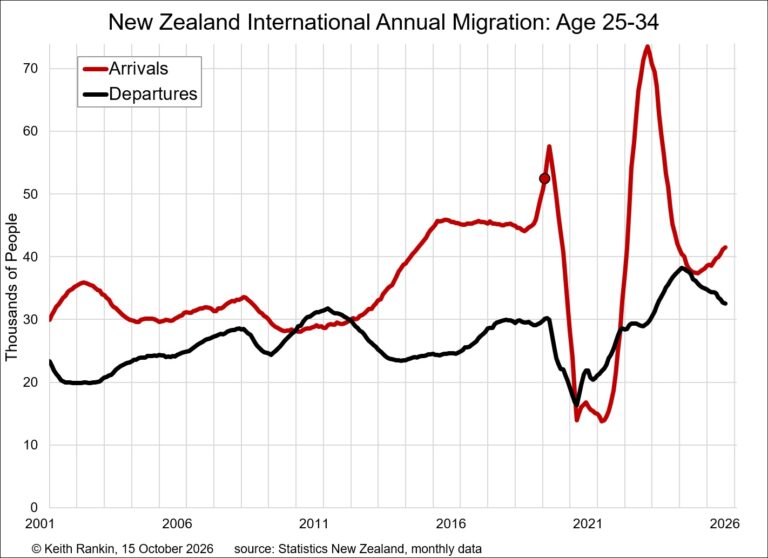
Keith Rankin writes: These age-specific data do not show the pattern of specifically trans-Tasman migration. Though we do know that this is the biggest component of emigration; indeed an even bigger component these days, given the heightened geopolitical risks of living further afield.
CoveragePost
October 15, 2026
Keith Rankin writes; Mercantilism is both a narrative about what the elite world is (as opposed to what someone might wish it to be), and a prescription for success within that world. That prescription may be best summarised as 'mining money'.
CoveragePost
October 12, 2026
Keith Rankin writes; Geopolitics – whether 'kinetic' or not – should be conducted in its own time and place; and with a rational balancing of risks and consequences. Munich Syndrome – trying to correct for past weakness as a form of present penance – risks converting one overstated past mistake into a much bigger present mistake with existential consequences for the near future.
CoveragePost
October 5, 2026
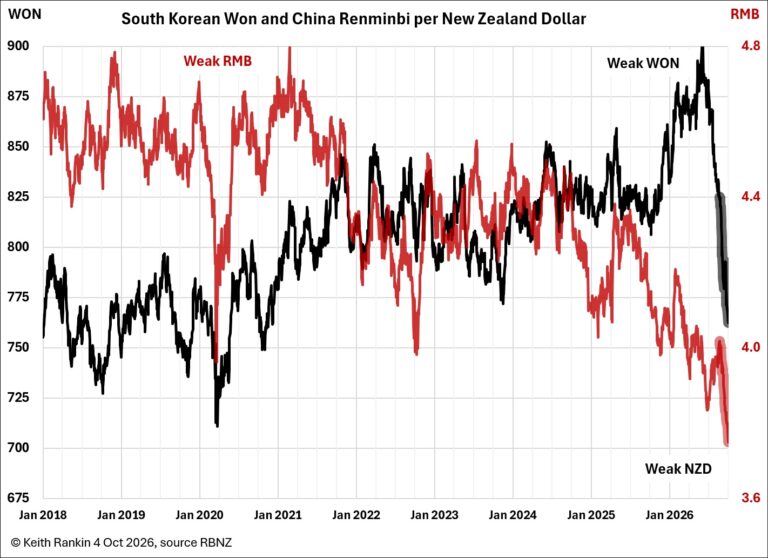
Keith Rankin writes; The declines in the last six weeks might be the start of a bigger depreciation; this is especially so in the sense that its not politically viable for the RBNZ to push interest rates up to the five-percent level which would be required for New Zealand to outcompete on interest rates the United States, the United Kingdom, and Australia, for floating international money.