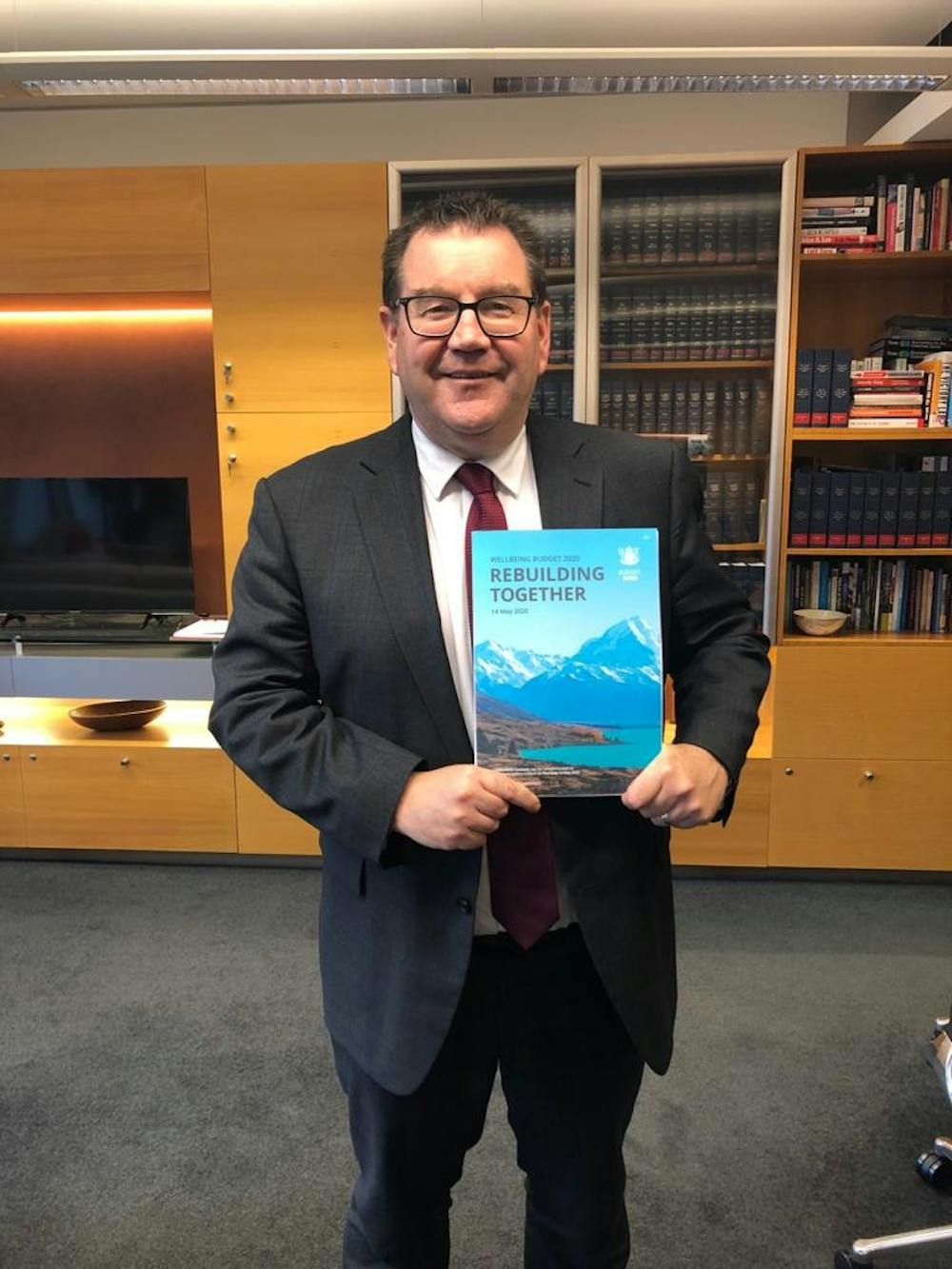
The budget was not this moment. It was about minimising the immediate crisis, with an eye to the forthcoming general election – not a pivot towards a low-emissions economy.
Under the circumstances, the budget’s short-term vision is not surprising. It is even morally necessary. Climate change is ultimately about people’s welfare too – which needs defending in the present as well as the future.
Quite rightly, a large chunk (NZ$5.6 billion) is earmarked for health. This is money not spent on climate action. But if people aren’t healthy and secure, less immediate challenges like climate change won’t get a look-in.
The same goes for the NZ$10.7 billion for economic support, building on NZ$12.1 billion already doled out as welfare subsidies, increased benefits, business tax relief and more. By necessity, the government is relying on available, if imperfect, spending levers.
Still, as time passes and the emphasis shifts from response to recovery to rebuild, long-term objectives like climate change should re-enter the picture. Back in December 2019 – before COVID-19 hit – a just transition to a low-emissions economy had been identified as one of the 2020 budget’s five priorities. For now, it has clearly taken a backseat, but New Zealand should return to it as part of the rebuild because of its economic promise.
A notable study led by Oxford University economist Cameron Hepburn argued climate-aligned fiscal recovery packages
could not only help shift the world closer to a net-zero emissions pathway, but could also offer the best economic returns for government spending.
Those returns are precisely what governments need to service the debt they’re incurring now.
Also, a net-zero emissions pathway avoids the costs of future shocks, whether that’s the looming volatility of oil or the hazards of climate change itself.
Aspects of the budget do respond to the twin crises of climate change and biodiversity loss. The stand-out is the NZ$1.1 billion for weed and pest control, biodiversity enhancement and regional restoration projects, including wetlands and waterways. These projects will sequester carbon – although the removal of wilding pines does the opposite.
Ecosystem restoration also supports climate adaptation by upgrading and expanding our “natural infrastructure” – forests, wetlands, rivers and lakes – to increase land resilience and improve water quality.
And these nature-based projects are arguably more “shovel-ready” than many “grey” infrastructure projects, given the low training requirements, minimal planning and outdoors work that meets social distancing norms. This investment – along with the NZ$1.6 billion boost for human capital through the trades and apprentices package – are this budget’s best expressions of the well-being approach, where the needs of the present and future are strongly aligned.
The NZ$56 million boost for the government’s insulation and heating programme is also welcome, if still insufficient in scale. This not only improves energy efficiency but also people’s health, and so reduces vulnerability to COVID-19. This is critical for addressing the health inequities the pandemic has exposed elsewhere.
But beyond this, climate-related initiatives get increasingly scrappy.
Tying up loose ends
New transport funding went entirely to rail, with more than NZ$1 billion in capital expenditure for renewing and upgrading existing networks. This is overshadowed by the NZ$6.8 billion New Zealand upgrade programme announced in January 2020, most of which went to roadworks.
A portion of this earlier spend is allocated to decarbonising the state sector, including schools and hospitals, through phasing out coal boilers and installing clean heating and lighting. Given that the health sector is estimated to contribute 3% to 8% of New Zealand’s carbon emissions, its decarbonisation is not trivial.
A question mark hangs over the NZ$20 billion that remains unallocated. It is likely held over for the “shovel-ready infrastructure” that featured prominently in the lead-up to the budget but not the budget itself. Here climate advocates should fight their corner for big-ticket projects, especially renewable energy generation. But it is sensible for New Zealand to not rush into large high-stakes investments in public transport, for instance, which could require a rethink in the COVID-19 era.
Government should also be encouraged to use its power of procurement. The budget offers the broad brushstrokes of government spending, but leaves room for finer, greener detail.
Why not demand all new construction conforms to a “wood first” policy to support a more sustainable forestry sector and avoid carbon-intensive steel and concrete? Why not insist that new roads have lanes for micro-mobility (scooters and bikes), charging stations for electric vehicles, or low-carbon asphalt?
Most voters will be grateful for this, wary of disruption upon disruption. It spells trouble for the dream of a quick climate fix – whether declarations of climate emergency, or piggybacking on crises like COVID-19. But climate action must carry on through the slow, patient work of persuading one another that it delivers a more secure, prosperous future.
Stay in touch with The Conversation’s coverage from New Zealand experts by signing up for our weekly NZ newsletter – delivered to you each Wednesday.
A High Court judge in Fiji has thrown out fines handed to 49 people who were caught breaching curfew or social gathering orders.
Justice Salesi Temo overruled the decisions of Magistrates Courts in Suva, Nausori, Tailevu, Vunidawa and Savusavu.
A night-time curfew and a ban on gatherings of more than a few people were imposed by the government in March, when the first case of covid-19 was found in Fiji.
Justice Temo yesterday ruled the fines meted were way too hefty, saying they were “cruel, degrading and disproportionate” for the offences committed.
Justice Temo also threw out the conviction of a 19-year-old girl who was convicted and fined F$500 for hugging her boyfriend at the Suva seawall, saying the publicity and guilty plea were punishment enough.
This article is republished by the Pacific Media Centre under a partnership agreement with RNZ.
If you havesymptomsof the coronavirus, call the NZ Covid-19 Healthline on 0800 358 5453 (+64 9 358 5453 for international SIMs) or call your GP – don’t show up at a medical centre.
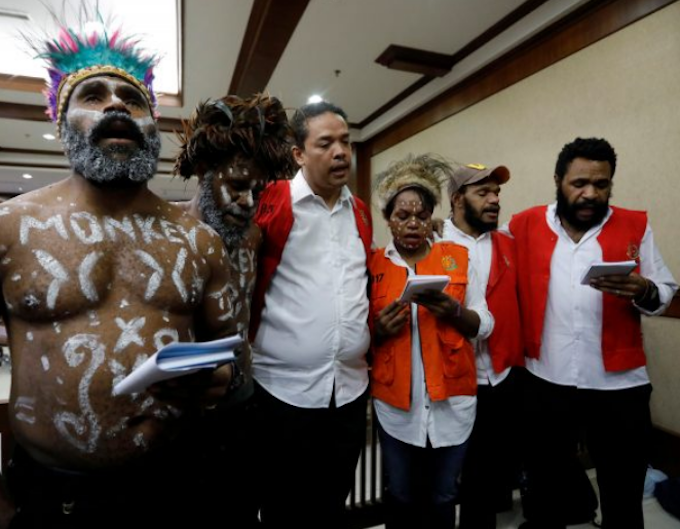
Indonesia has recently indicated it is considering investigating the killings of hundreds of thousands of people in the 1965 “anti-communist” purge under authoritarian leader Suharto.
If the inquiry goes ahead, it would mark a shift in the government’s long-standing failure to address past atrocities. It is unclear if they will include other acts of brutality alleged to have been committed by the Indonesian regime in the troubled region of West Papua.
While the number of killings peaked in the 1970s, they are rising again due to renewed activism for independence in the territory. In September 2019, as many as 41 people were killed in clashes with security forces and Jihadi-inspired militia.
Clashes between security forces and the West Papua National Liberation Army have escalated since January, which human rights groups say have resulted in at least five deaths. At least two other civilians were killed in another incident.
The latest violence was sparked by racial attacks on Papuan university students in Java last year, which prompted thousands of Papuans to protest against the government. The protests brought renewed media attention to human rights violations in the region and Papuans’ decades-long fight for autonomy.
However, because the international media have been prohibited from entering West Papua, the broader conflict has received relatively little attention from the outside world. (This week’s feature by ABC’s Foreign Correspondent program in Australia was a rare exception.)
Late last year, we embarked on a project to map the violence that has occurred in West Papua under Indonesian occupation.
This was in part inspired by the massacre mapping project of Indigenous people in Australia by the Guardian and University of Newcastle, and the Public Interest Advocacy Centre’s mapping of violence in Sri Lanka.
Our aim was to bring renewed attention to the protracted crisis in West Papua. We hope that by showing the extent of state-sanctioned violence going back decades, we might encourage the kind of international scrutiny that eventually led to intervention in East Timor.
The map only documents some of the massacres that have taken place in West Papua since the 1970s, as conditions in the territory make it difficult to accurately record and verify deaths. The challenges include a lack of resources for record-keeping, internal displacement and frequently destroyed properties, and a fear of reporting deaths. Others have disappeared, and their bodies have never been found.
We also encountered a relative dearth of data from the 1990s to 2010s, in part due to few journalists reporting on incidents during this period.
many killings were committed while Papuans were peacefully protesting for independence from Indonesia
given the numbers of troops posted to West Papua and the types of weapons at their disposal, the government should have had full knowledge of the extent of devastation caused by attacks by security forces and militia groups. (Indonesian security forces are generally known for being out of the government’s control)
in the vast majority of killings, the perpetrators have never been held to account by the government.
The government claims the National Human Rights Commission (Komnas HAM) is conducting inquiries into some of the more recent incidents, although there are concerns the body doesn’t have sufficient powers and the government has previously been reluctant to accept findings of abuses.
Why has the world stayed silent?
Both Australia and New Zealand have been hesitant about intervening in human rights crises in the region, particularly when Indonesia is involved.
In 2006, Australia signed the Lombok Treaty, which assured Jakarta it would respect the sovereignty of the Indonesian state and not support “separatist movements”.
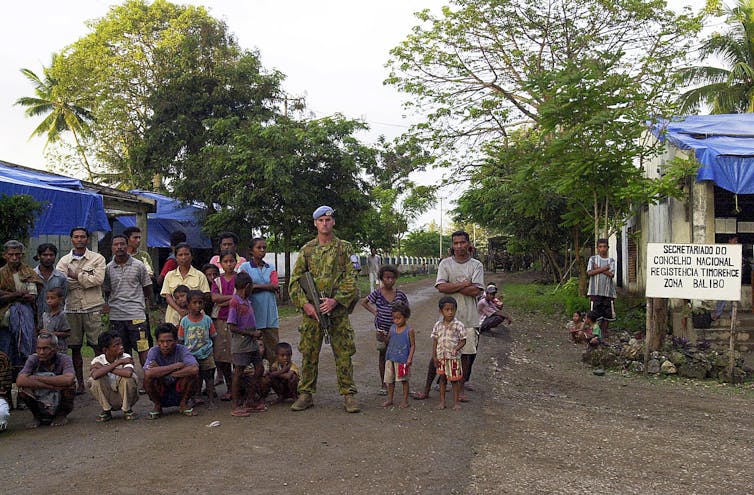
It was largely the diplomatic intervention at the international level by US President Bill Clinton, alongside the deployment of Australian Federal Police (AFP) working as unarmed civilian police for the UN mission in East Timor, that eventually secured the referendum.
Co-author Jaime Swift serving in East Timor in 2006.Author provided
Media coverage played a critical role in persuading the world to take action. In West Papua, the media have not had the same effect.
This is in part due to what the Indonesian security forces learned from East Timor on how to control the media. The Indonesian government has frequently cut internet services in West Papua, enacted a complete ban on foreign journalists and denied requests from the UN Human Rights Commission to investigate human rights violations.
Despite this, mobile phone videos of abuse continue to leak out.
In the absence of extensive media coverage, Papuan pro-democracy advocates and their supporters have been calling for a UN-sanctioned human rights investigation. There is also significant support from human rights defenders in Indonesia for such an inquiry.
As it now has a seat on the UN Human Rights Council, Indonesia should fully support such a move. However, the military retains considerable influence in the country, and holding commanders suspected of human rights abuses to account remains politically difficult.
In fact, President Joko Widodo last year appointed as his new defence minister Prabowo Subianto, who himself has been accused of human rights abuses.
Given these challenges, what will it take for the world to show enough moral courage to force change in West Papua?
The right way forward is clear. As a member of the UN Human Rights Council, Indonesia needs to put an end to the media ban in West Papuan, support an independent UN investigation and hold accountable those responsible within the government for violent acts.
If Indonesia does not take this course of action, then diplomatic pressure from the world will be required.
We are four months into a global virus outbreak, and public health awareness could well be at an all-time high. Which is why it is astonishing to discover that 92% of Australians don’t know the difference between a viral infection and a bacterial one.
The statistic comes from a survey carried out by CSIRO in March to inform our work on the OUTBREAK project – a multi-agency mission aimed at preventing outbreaks of antibiotic-resistant bacterial infections.
Our survey of 2,217 people highlights a disturbing lack of knowledge about germs and antibiotics. It reveals 13% of Australians wrongly believe COVID-19, a viral disease, can be treated with antibiotics, which target bacteria.
More than a third of respondents thought antibiotics would fix the ‘flu or a sore throat, while 15% assumed antibiotics were effective against chicken pox or diarrhoea.
While 25% of those surveyed had never heard of antibiotic resistance, 40% admitted having taken antibiotics that didn’t clear up an infection. And 14% had taken antibiotics as a precaution before travelling overseas, despite this being unnecessary and ineffective for warding off holiday ailments.
Fuelling the rise of superbugs
The results are deeply worrying, because people who do not understand how antibiotics work are more likely to misuse or overuse them. This in turn fuels the rise of drug-resistant bacteria (also known as “superbugs”) and life-threatening infections.
While COVID-19 has brought the economy to its knees, superbugs pose economic challenges too. Australian hospitals already spend more than A$11 million a year treating just two of the most threatening drug-resistant infections, ceftriaxone-resistant E. coli and methicillin-resistant MRSA.
Without effective antibiotics, thousands more people will die from sepsis and people will be sicker for longer, slashing the size of the workforce and productivity. By 2050, drug-resistant bacteria are forecast to cost the nation at least A$283 billion and kill more people than cancer.
One crucial way to stop this is to improve public understanding of the value of antibiotics. Antibiotics that lose their effectiveness are very difficult to replace, so they need to be treated with respect.
Almost all today’s antibiotics were developed decades ago and, of the 42 antibiotics under development worldwide, only five are considered truly new, and only one targets bacteria of greatest drug-resistance concern.
No time to waste
We don’t know the full impact of drug-resistant bacteria in Australia. With about 75% of emerging infectious diseases coming from animals, there is no time to waste in getting a better understanding of how superbugs are spreading between humans, the environment and animals. That’s where the OUTBREAK project comes in.
This network, led by the University of Technology Sydney, uses artificial intelligence to analyse an immense amount of human, animal and environmental data, creating a nationwide system that can predict antibiotic-resistant infections in real time. It maps and models responses and provides important information to doctors, councils, farmers, vets, water authorities, and other stakeholders.
OUTBREAK offers Australia a unique opportunity to get on the front foot against superbugs. It would save millions of lives and billions of dollars, and could even be scaled globally.
Alongside this high-tech response, we need Australians to get to know their germs, and stop taking antibiotics unnecessarily. Without antibiotics, we may find ourselves facing a host of new incurable diseases, even as the world grapples with COVID-19.
Much has been made of the COVID-19 lockdown cutting global carbon emissions. Energy use has fallen over recent months as the pandemic keeps millions of people confined to their homes, and businesses closed in many countries. Projections suggest global emissions could be around 5% lower in 2020 than last year.
What about Australia? Here we’ve seen sizeable reductions in electricity sector emissions, but mostly from the sustained expansion in solar and wind power rather than the lockdown.
That is good news. It means our electricity sector emissions will not bounce back once COVID-19 restrictions are lifted, as they might in other parts of the world.
But on the other hand, a prolonged recession could cloud the outlook for new investments in the power sector, including renewables.
What’s clear right now is this: COVID-19 restrictions matter far less to Australia’s power sector emissions this year than the shift away from coal and towards renewables.
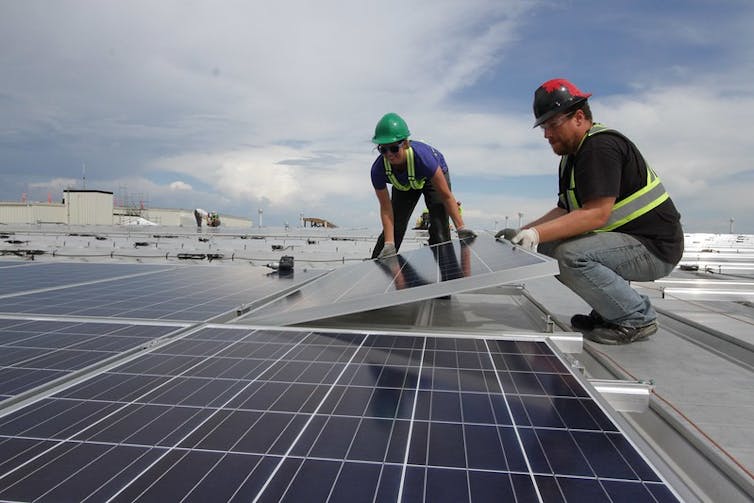
A recession would dampen investment in new power projects, including renewables.AAP
Small fall in electricity demand
We examined Australia’s National Electricity Market (NEM) in the seven weeks from March 16 (when national restrictions came into force) to May 4 this year. We compared the results to the same period in 2019.
The NEM covers all states and territories except Western Australia and the Northern Territory.
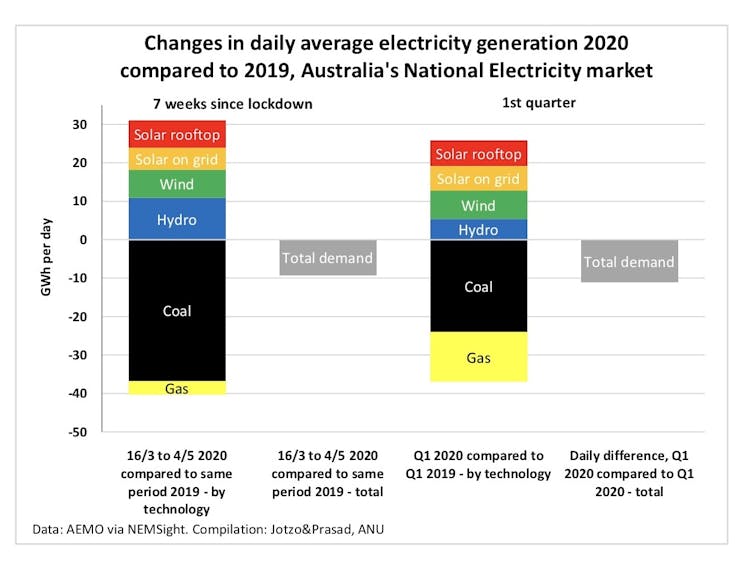
Total electricity demand was 3% lower during the first seven weeks of the lockdown, compared with the same period in 2019. About 2% of this was due to an actual fall in electricity use. The rest was due to extra rooftop solar panels installed since May 2019 which lowered demand on the grid.
Some of the 2% reduction may be due to cooler weather this autumn, leading to lower air conditioning use.
So while COVID-19 restrictions have hammered the economy in recent weeks, they haven’t had a big effect on electricity use. Most industrial and business power use has continued uninterrupted. Most office buildings have not fully shut down, although many people are working from home and use more electricity there.
A hefty drop in emissions
Despite the modest fall in electricity demand in the first seven weeks of lockdown, emissions fell substantially – by 8.5%. Comparing the first quarter of 2020 and 2019, emissions fell by 7%.
This is primarily because more renewable energy is now supplying the grid. Output from solar farms increased by 55% and from wind parks by 19% compared with the first quarter of 2019, reflecting massive amounts of new installed capacity coming online. Output from hydroelectricity increased by 18%, likely reflecting higher rainfall.
More renewables supply combined with falling demand means less output from fossil fuel power plants. Coal plant output fell 9% compared to the same period in 2019, entirely due to lower output by black coal plants in New South Wales and Queensland. Gas fired power output fell by 8%.
Electricity prices plunge
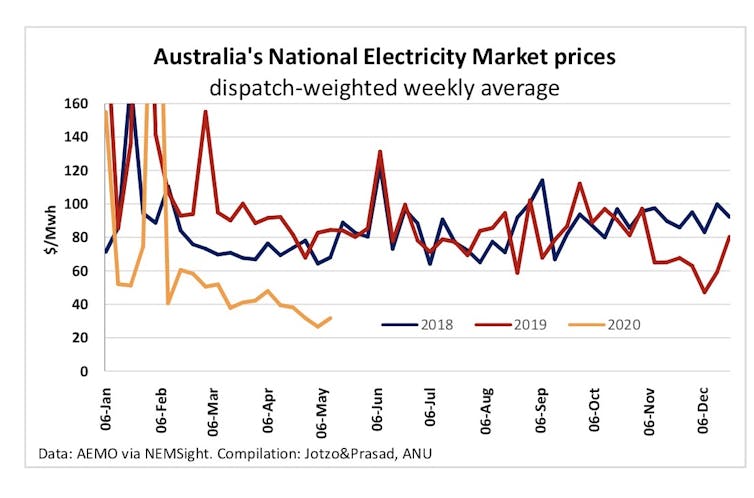
Meanwhile, wholesale prices in the NEM have fallen dramatically. The average price was 60% lower in the seven weeks since March 16 compared with the same period in 2019. A marked reduction in prices was evident from November 2019.
Why? One reason is that prices for natural gas are much lower and hence gas-fired power stations can make lower bids for electricity. Gas prices fell through much of 2019, and dropped further in the first quarter of 2020, associated with the pandemic-induced economic downturn. Gas plants often set the prices for everyone in the market, so this has a big effect on the market overall.
Also, coal and hydropower plants lowered their bids in this more competitive environment.
The outlook for wholesale prices remains flat. Gas prices seem unlikely to rebound soon. More wind and solar power will come into the market and there is no underlying growth trend in electricity demand.
Relaxation of COVID-19 restrictions is unlikely to make a big difference. What may drive prices up once again is the next large coal plant closure. The last one to close was Victoria’s Hazelwood plant in 2017.
What does this mean for coal and renewables?
Low wholesale electricity prices are good for consumers – in particular industry, where the wholesale price is a bigger proportion of the total charges for electricity supply. On the flip side, they mean less money for power generators.
Across the National Electricity Market, revenue for generators was about A$160 million per week lower during the first seven weeks of lockdown compared to the same period in 2019.
This revenue fall makes coal plants less profitable, and makes life uncomfortable for plants with relatively high costs for fuel and maintenance. It’s likely to push older plants closer to closure.
Lower prices also make investment in new renewable power less attractive. In recent years, average wholesale prices were well above the typical lifetime average costs of producing electricity from newly built solar and wind parks. There is also uncertainty around how prices will be set in power markets in the future, and how congestion of power transmission lines will be managed.
Nevertheless, the longer term prospects for renewables in Australia remain very good. Solar and wind power are the cheapest of all new generation technologies producing power, and solar power is expected to become even cheaper. A new coal-fired power plant, if one was ever built, would have far higher costs per megawatt hour. Costs for a nuclear plant would be higher still.
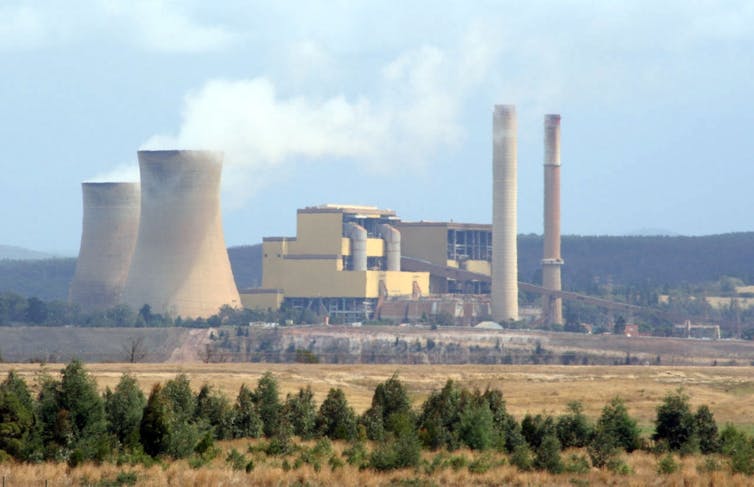
A drop in revenue during COVID-19 is bad news for coal-fired power generators.Wikimedia
The way forward
The numbers show Australia does not need a painful recession to drive carbon emissions down. It needs sustained investment in new, clean technology.
The better the Australian economy recovers, the more private businesses will invest in new energy supply. But if the world falls into a deep and lasting recession, and the Australian economy with it, then the prospects for private investment in new power plants will suffer.
In that case, governments may be well advised to invest public funds in clean energy, more so than they have in the past.
More than 80% of young adults who did a short spell of post-school education or training (such as a certificate or diploma), or went directly into work, were in full-time work by the time they were 25. This was compared to 64% of those who studied at university first.
A report by the National Centre for Vocational Education Research (NCVER), School-to-work pathways, outlines the transitions young people aged 16-25 make between school and employment.
This is based on the 2006 cohort of the Longitudinal Surveys of Australian Youth (LSAY). The LSAY follows cohorts of young people from the age of 15 as they transition from school to further study and work, until they are 25.
The report shows most of the cohort of 3,186 young people – who completed every survey from 2007-2016 – followed a simple university to work pathway or early entry into work after school. The latter generally includes some vocational education and training (VET).
But the remaining 17% had varied and complex transitions including frequent switching between higher education and VET, episodes of part-time work and repeatedly disengaging from the labour market.
Another report examined more closely the group of people aged 15-24 who weren’t in any work, education or training for six months or more.
It found those who were persistently not employed, and not in any education or training (including school) as teenagers (aged 15-19) were three to five times more likely to be so at 20-24 than those who were studying or employed during their teenage years. These teenagers were also more likely to have poorer education outcomes when they were 20-24.
VET and university before work
The first report identifies five different pathways young people took on the way from school to further study or work. These were:
higher education and work
early entry to full-time work
mix of higher education and VET
mixed and repeatedly disengaged from work or education
mostly working part-time.
Of the study sample, 60% chose a university pathway. But the early entry to full-time work pathway was the quickest route to employment. Nearly every young adult (97%) who took this pathway (which usually involves some VET) were employed full or part-time by the age of 25.
Out of young people who took the first, higher education to work pathway, 92% were employed in full or part time work by 25.
We looked at outcomes at the age of 25, which means many young people were still catching up in terms of full-time employment. This includes those who took a university pathway and studied full-time for longer.
About 23% of the study sample had left school early and were in full-time work shortly after – most of them were doing a vocational education and training course. About 69% of young people in this group had VET qualifications as their highest qualification by 25.
About half of this group did apprenticeships and traineeships as an express pathway to work.
The top three occupation groups for those who took this pathway and were employed by 25 were: technicians and trades workers, clerical and administrative workers, and community and personal service workers including child- aged- and disability-carers.
The top three occupation groups for those employed by 25 who first went to university were: professionals, clerical and administrative workers and community and personal service workers.
The other pathways reveal a more complex tapestry with lots of switching between having work, training or education, or being neither in work, or training or education.
Most (82%) of those who did a mix of university and VET, as well as most (66%) who worked part-time, experienced 6 to 15 transitions between the ages of 15 and 25.
Most (70%) young people in the mixed and repeatedly disengaged pathway went through 11 or more transitions. These included a frequent change in employment status, an unstable employment record and long periods of unemployment.
Young people who were less academically inclined (having lower maths and reading scores) had a higher likelihood of following the early entry to full-time work pathway.
Taking vocational education and training subjects at school decreased the likelihood of following the university pathway and increased the likelihood of an early entry to full-time work pathway.
Young people from lower socio-economic backgrounds were also less likely to engage in the university pathway, and more likely to follow the early entry to full-time work pathway.
What about those who aren’t in work or study?
Not all pathways led to employment by age 25.
About 5% of young people were in the mixed and repeatedly disengaged pathway. They were mostly unemployed after school and experienced long or multiple periods of not being in any education, employment or training.
The second report looked specifically at young people who were not working or studying. It showed the main predictors for being persistently out of work and not in any education or training were: leaving school early, having a child (particularly for those under the age of 20) and coming from a disadvantaged background.
Conventional wisdom holds going to university after school leads to better outcomes in terms of a full-time job with a good salary. But this does not hold true for all young people.
For some, doing an apprenticeship or going into full-time work straight after school may be a more suitable option than finishing school.
Policies should better reflect young people’s choices by providing more opportunities to pursue vocational education and training pathways, such as by giving secondary school students better access to VET.
Vocational education and training can also be a viable alternative among young people vulnerable to being disengaged, such as early school leavers who cannot find work. For others, such as those who are not in the labour force due to parenting responsibilities, a variety of social supports may be required.
The analysis here presents a useful categorisation of transitions but, due to constraints with the data, the proportions can’t be applied generally to the youth population.
Nevertheless, the initial LSAY sample is representative of the Australian population and remains useful in providing insights on youth transition pathways.
However, this outpouring of support often occurs with limited understanding of the actual conditions of affected people and the support they need. In contrast to the costly implementation of reconstruction projects, very little attention is paid to project evaluation. Non-governmental organisations (NGOs) and other humanitarian agencies often focus on short-term outcomes.
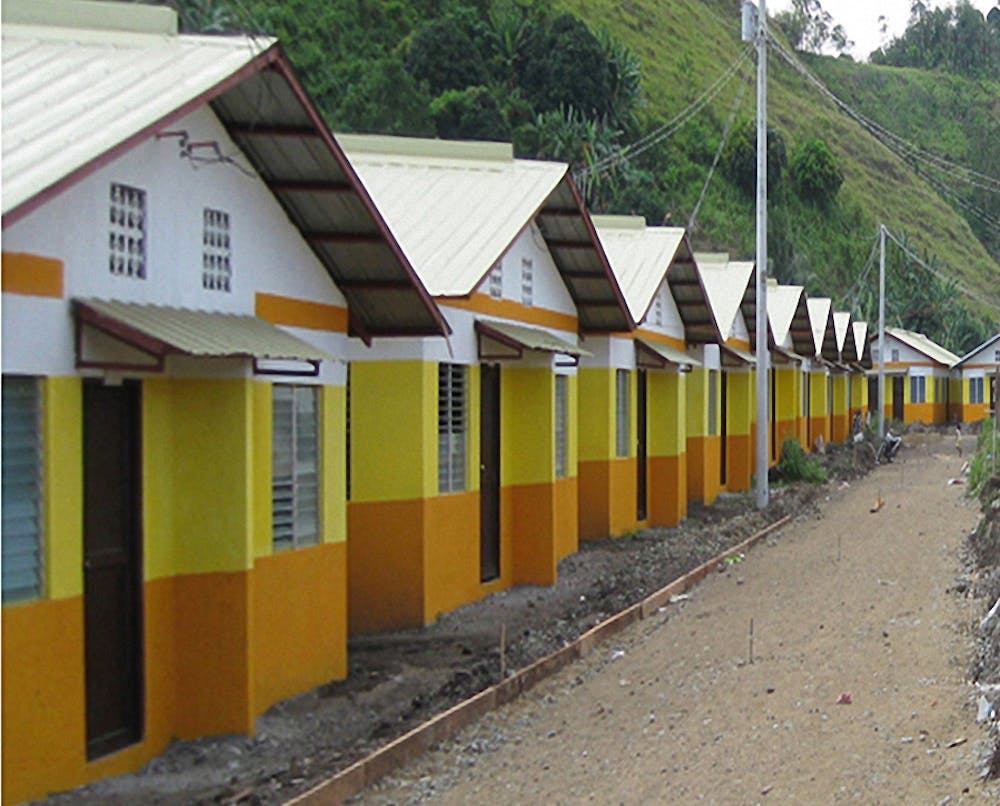
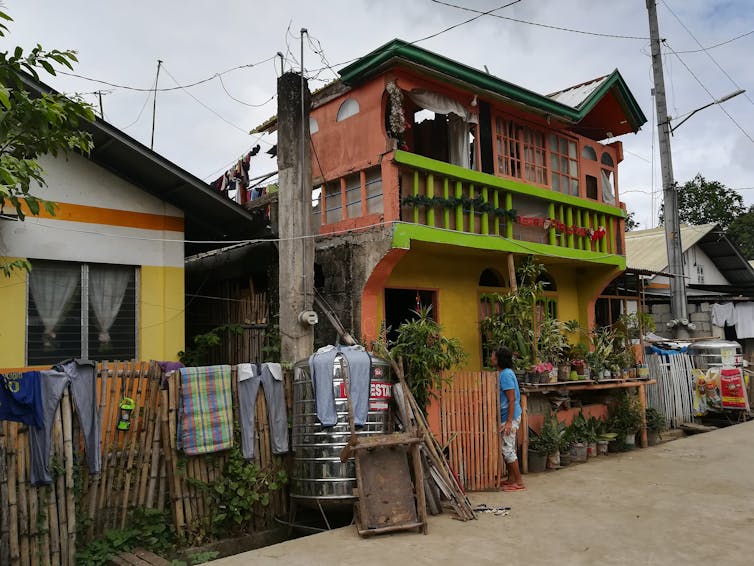
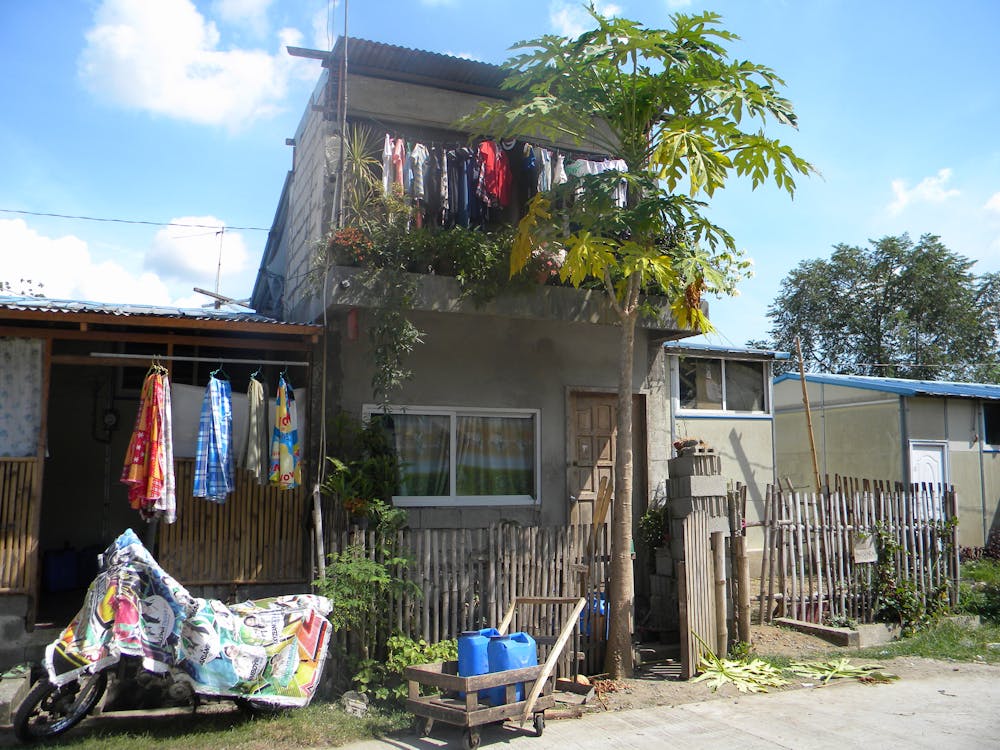
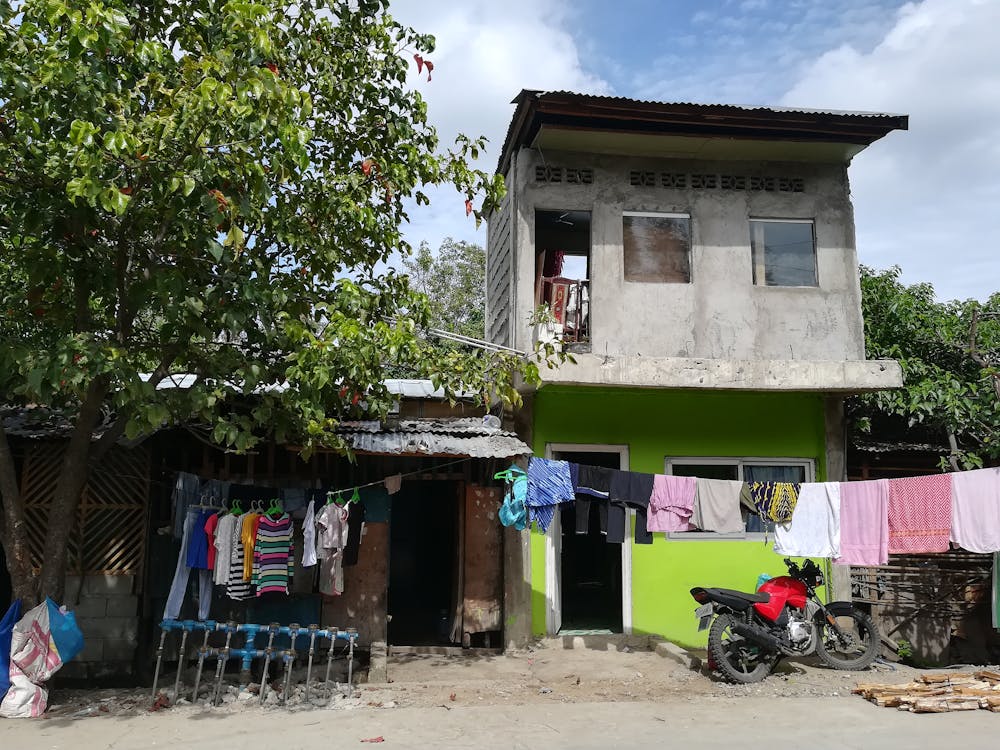
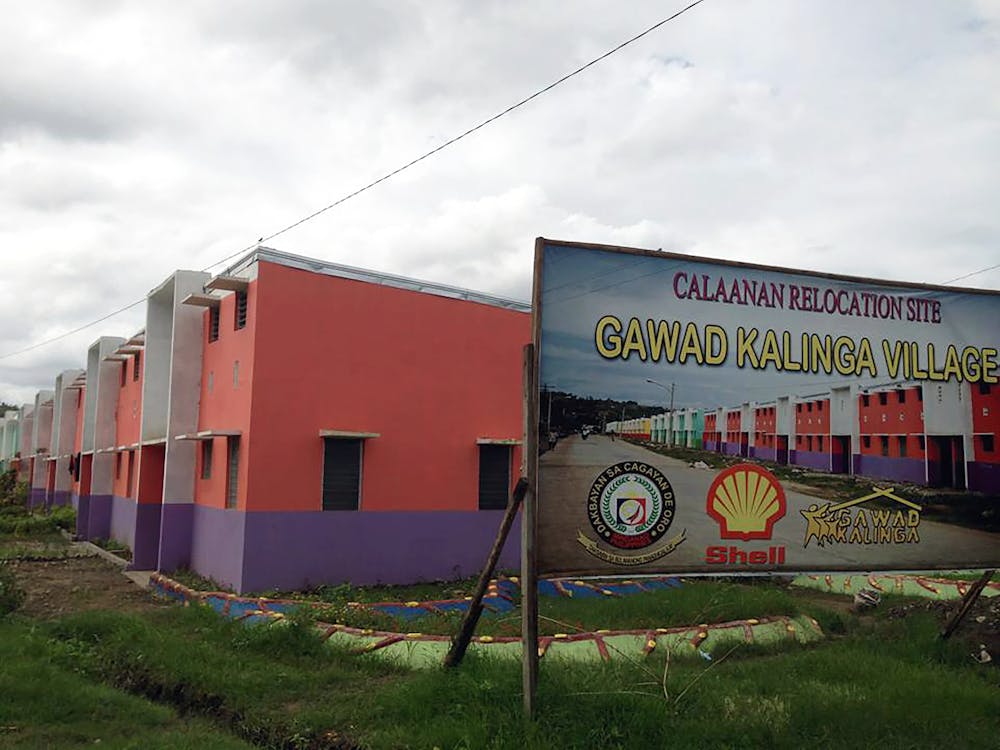
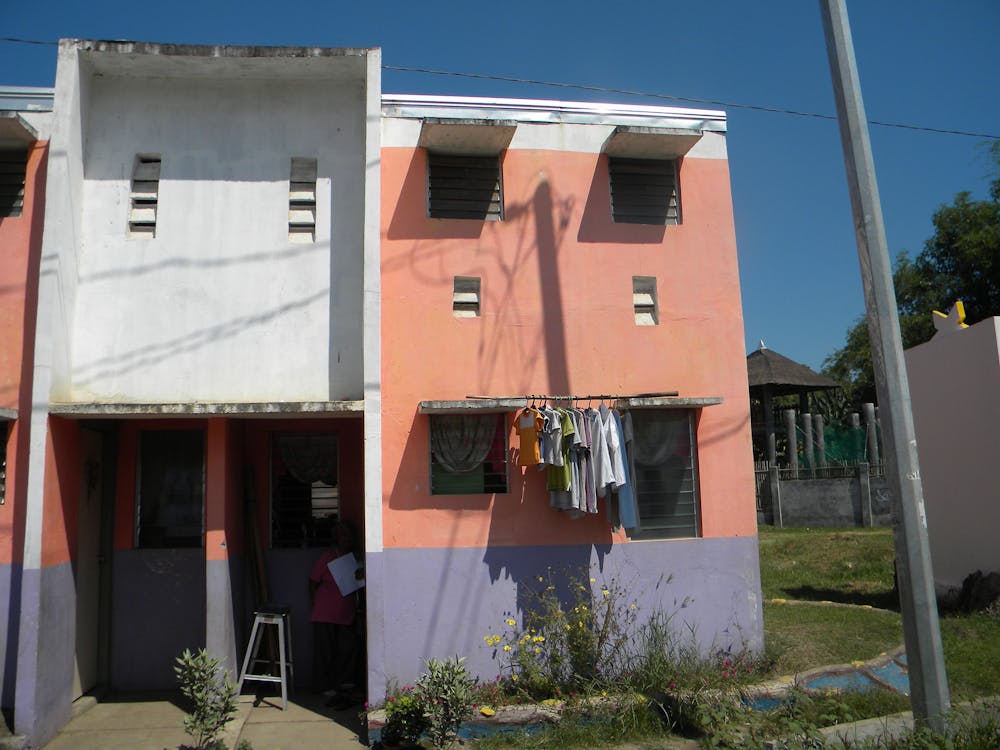
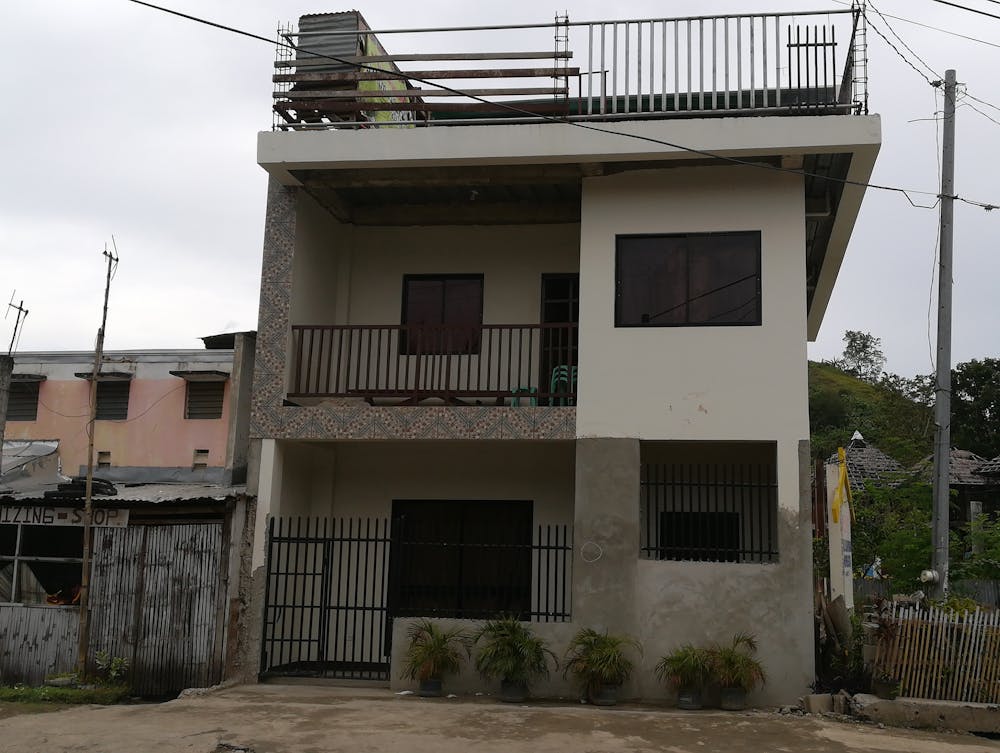
In fieldwork in the Philippines in 2014 and 2019, we explored how and why residents have improved the houses first built in 2012 when they were relocated after Typhoon Washi hit the city of Cagayan de Oro. Over the years, these modifications have produced more habitable housing. They have also added colour to otherwise dull and uniform housing units.
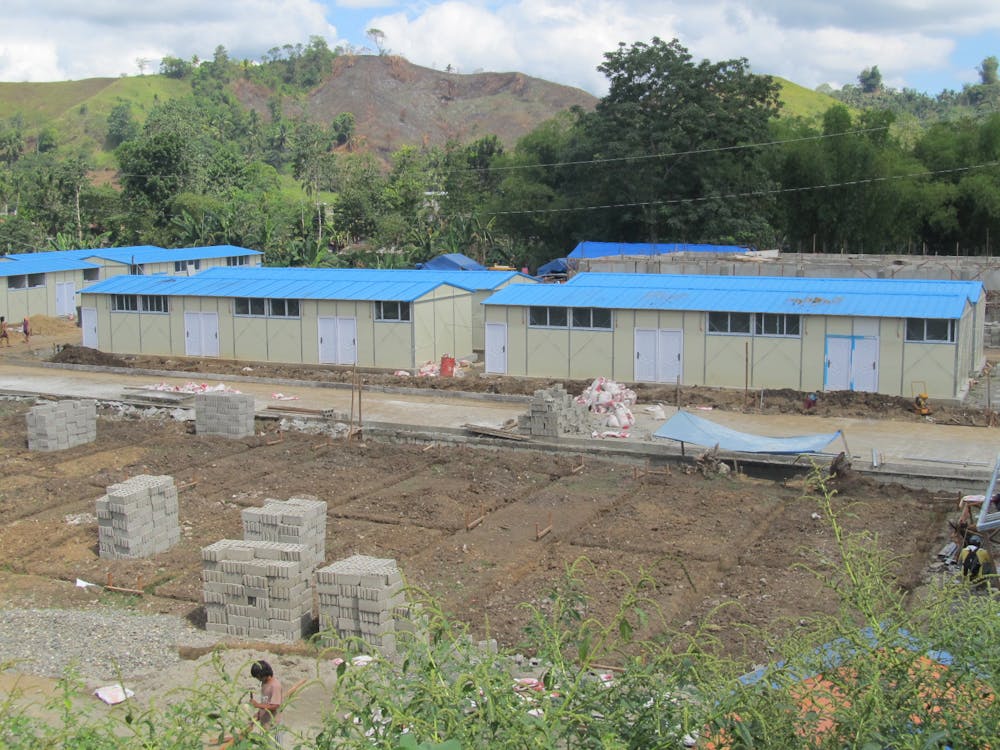
The evolution of a Habitat for Humanity block house from completion in 2012 (top) to July 2014 (middle) to December 2019.S. Carrasco 2014, 2019, Author provided
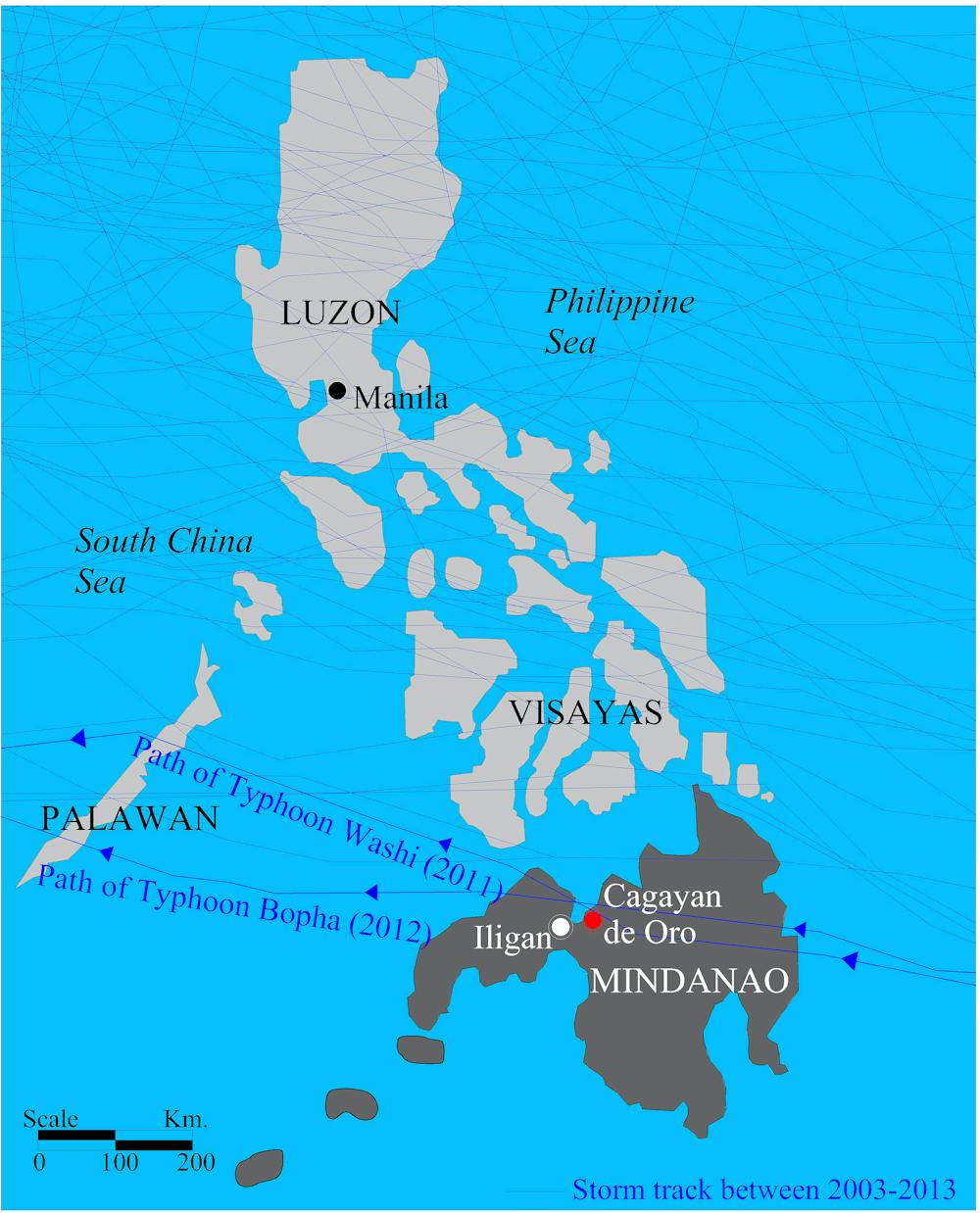
Typhoon exposure of the Philippines and the path of Typhoon Washi through Cagayan de Oro (red dot).Carrasco et al. (2016), Author provided
The 2019 World Risk Index ranked the Philippines among the countries most at risk of disasters in Asia and the ninth in the world. Typhoons are by far the most frequent hazard. The poor and those who live in vulnerable areas are most at risk.
On December 16 and 17 2011, Typhoon Washi (locally known as Sendong) devastated most of Cagayan de Oro, a regional city in Northern Mindanao. Washi displaced more than 250,000 people, almost 40% of the city population. Around 85% of the affected households, mostly poor families, lived in informal settlements near or along the Cagayan River.
After the typhoon, the state-led rehabilitation plan focused on building 11,225 permanent houses. Humanitarian agencies built 86% of these for households in relocation sites.
The government mobilised resources and tapped multiple stakeholders to fast-track construction. In April 2012, four months after the disaster, the first families moved in to their new houses.
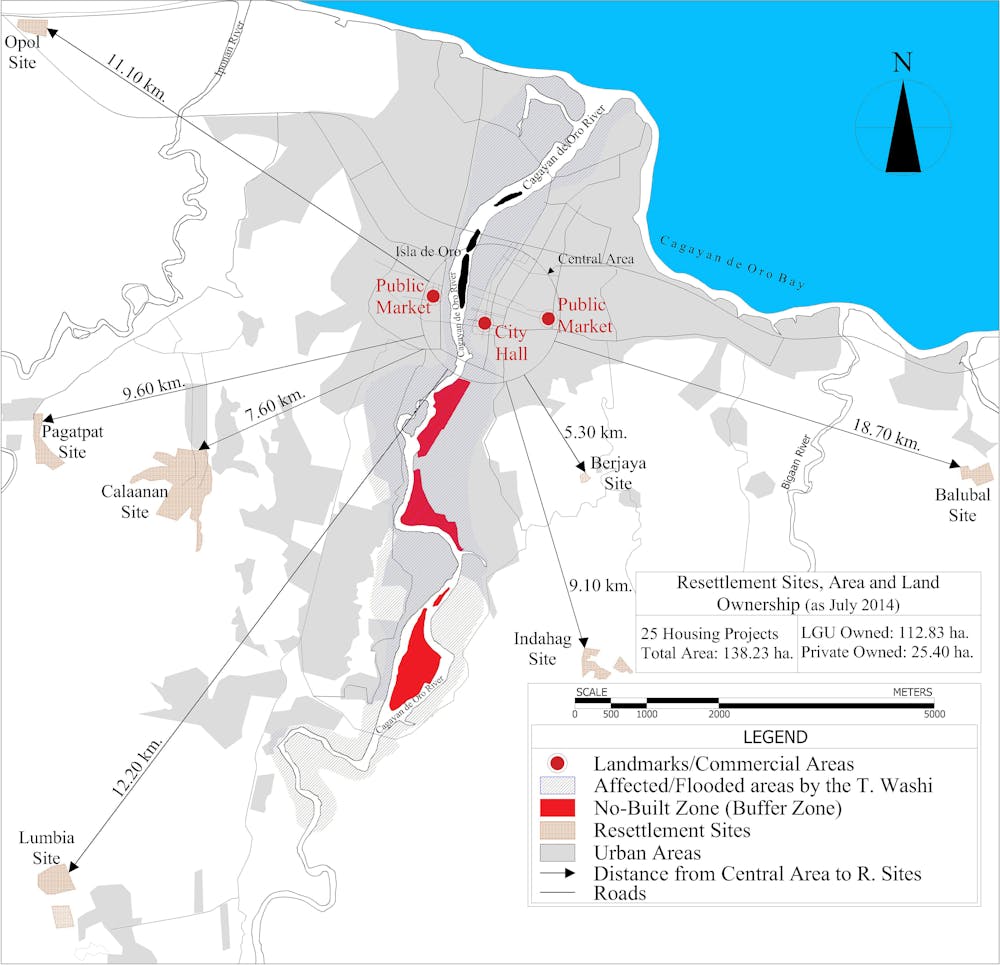
The new housing sites were 7 to 20 kilometres away from their original homes near the city centre. The former settlements were cleared and declared “no-build zones” to prevent relocated residents from returning.
Locations of Cagayan de Oro city and resettlement sites.Carrasco et al. (2017), Author provided
NGOs, volunteer groups and community-based organisations worked with local and national governments to build the new settlements and houses. Each organisation chose the housing type to be built, following minimum standards set by Philippine government agencies.
A row house built by the Filipino-Chinese Chamber of Commerce in 2012 (top), July 2014 (middle) and December 2019.S. Carrasco 2014, 2019, Author provided
Key considerations included access roads, communal facilities, sanitation, and water and power supply. In many cases however, communal taps or deep wells provided water, while electricity remained unavailable after years of occupation.
Another major concern is the limited floor area of housing units. Housing units of 21 square metres were provided for families of 12. In some units, temporary materials were used. The result was poor living conditions for resettled residents.
A row house built by NGO Gawad Kalinga and Shell after completion in 2012 (top), in July 2014 (middle) and in December 2019.S. Carrasco 2014, 2019, Author provided
Why residents renovate houses themselves
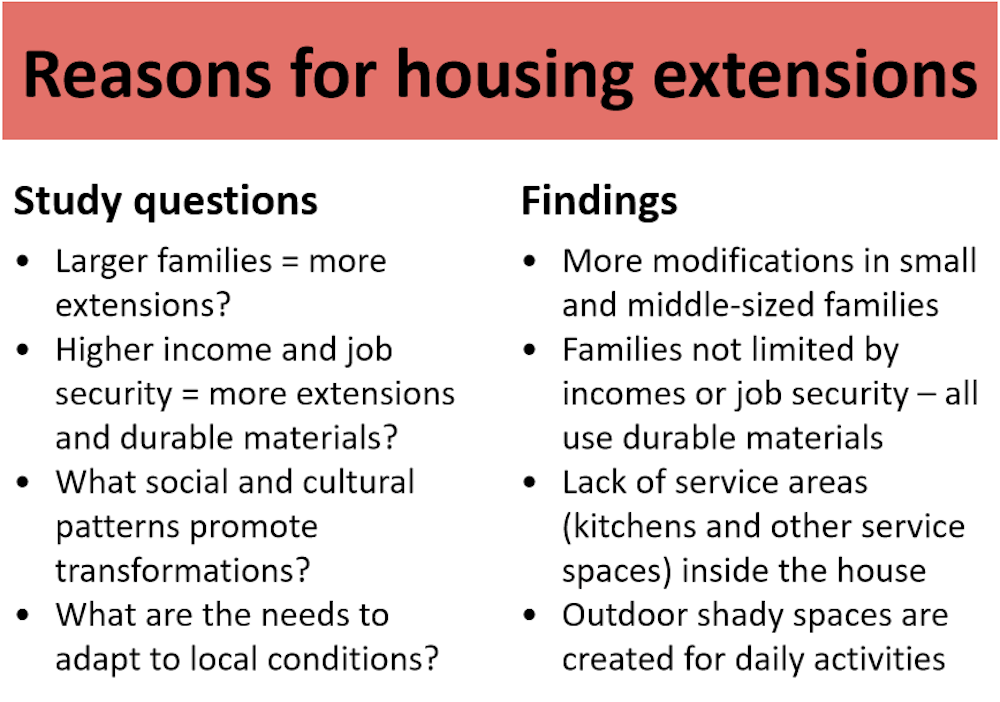
In our fieldwork, we saw how residents have progressively improved their houses by undertaking their own renovations. This work depended on their available resources and changing family needs and plans.
Livelihoods, for instance, emerge as a critical factor. Many residents have added an extra room or space to operate sari-sari stores (retail shops) and other home-based enterprises. The table below shows other overlapping reasons and motivations for housing modifications.
The impacts of the provided housing on the lives of residents affect later investments in housing construction by the residents themselves, or with support from humanitarian groups.
The lack of proper monitoring of the incremental housing modifications could compromise housing safety. Unreliable structural quality could leave some residents vulnerable to earthquakes or typhoons. Unregulated construction using makeshift materials also creates fire risks.
Our findings suggest these concerns should be at the centre of discussions on strategies that enable residents to incrementally expand their houses based on their needs and capacity at the time. Evaluation and supervision of incremental housing projects should be an integral aspect of humanitarian housing programs. These processes are as important as the project delivery itself.
Australia’s states and territories have begun relaxing the restrictions put in place to contain COVID-19.
From today, for instance, the most populous state, New South Wales, is allowing outdoor gatherings of ten people, the use of public pools and playground equipment, and home gatherings with up five visitors. Restaurants and cafes can also serve up to ten diners, so long as they follow the “four square metres rule” (meaning a premises will need a dining area of 40 square metres to seat ten patrons).
Many will welcome these developments. But they represent a difficult choice for governments.
Allowing the public greater freedoms will help boost both morale and economic activity. But it risks a second-wave outbreak of COVID-19 and a return to more stringent restrictions.
Easing off on social distancing rules while keeping COVID-19 under control with good but imperfect testing and contact tracing is a tough balancing act.
It’s made even tougher by the fact government rules do more than simply define what is permissible.
The rules also send a message to the public about the information authorities have, influencing personal perceptions and therefore behaviour, regardless of whether it is permitted.
Hearing the wrong story
So governments need to take into account not just the direct effect of rules but, crucially, the broader message absorbed by the public.
There’s a risk people will hear only part of the story, interpreting the easing of restrictions as a sign we’ve beaten the virus and are on our way back to normal.
This, in part, explains why New South Wales Premier Gladys Berejiklian urged continued vigilance when she announced relaxing of restrictions on May 10. “Just because we’re easing restrictions doesn’t mean the virus is less deadly or less of a threat,” she said. “All it means is we have done well to date.”
NSW Premier Gladys Berejiklian with the state’s chief medical officer, Kerry Chant, announcing the easing of restrictions on May 10 2020.Joel Carrett/AAP
An extra layer of complexity
Trying to ensure the public doesn’t misinterpret government messages makes decisions on when and how to ease restrictions particularly complex.
The key risk, of course, is that people infer from relaxed restrictions that the government now thinks risks are minimal and everyone can go back to life as it was in January 2020.
This signalling effect means governments need to be more cautious about relaxing restrictions.
On the other hand, the longer they seek to impose rules, particularly if other jurisdictions are easing restrictions, the more they risk losing their authority.
This conundrum can be seen in Australia’s second-most-populous state, Victoria. It has regularly imposed rules going further than those recommended by the federal government.
Dan Andrews, you would have seen all of the images of people out in Victoria over the weekend, clearly going beyond what was formally allowed in terms of social distancing. Have some Victorians, do you think, seen this federal three-step plan, observed that you’re going to take somewhat longer to deliver on some of the steps, and just taken matters into their own hands?
Victorian Premier Daniel Andrews addresses a press conference on May 11 2020.Daniel Pockett/AAP
It doesn’t help that the Victorian and federal governments differ despite both apparently acting on the advice of public health experts.
“Follow the medical advice” has been a powerful aphorism, but it is likely to weaken the further the response to COVID-19 moves from the “hammer” phase – using strict social distancing measures – to the “dance” phase – using more targeted measures such as contact tracing to contain the spread of the virus until there’s a vaccine.
Leading by example
One thing leaders can do to mitigate this problem is communicate to the public through their own behaviour.
Other countries have seen some some disturbingly mixed messages. Britain’s prime minister, Boris Johnson, for example, proudly talked about shaking hands with COVID-19 patients just weeks before he almost died from the virus. US President Donald Trump, among other things, has refused to wear a mask while Americans are being encouraged or required to.
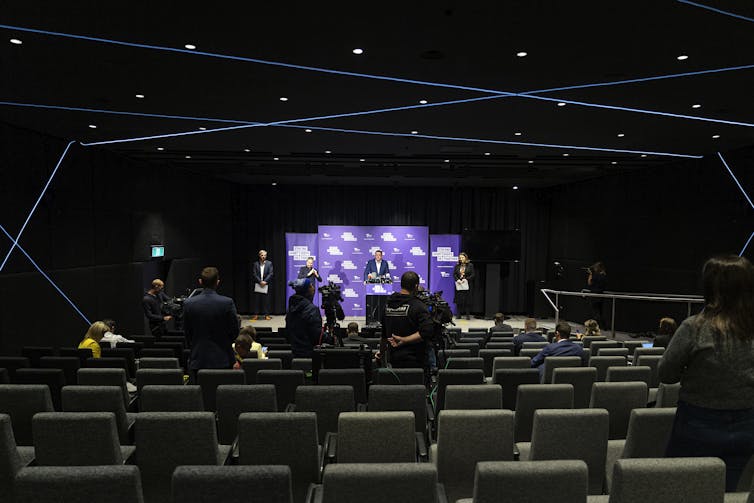
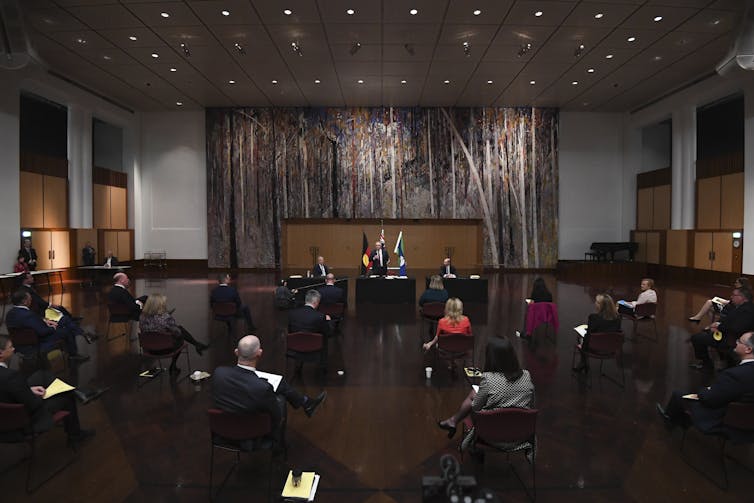
Australia’s politicians have generally done better. A notable example was federal Health Minister Greg Hunt admonishing mining magnate Andrew Forrest to maintain proper social distance at a press conference last month. That was a powerful reminder, as has been the sight of the prime minister, the chief medical officer and cabinet members standing appropriate distances apart.
Prime Minister Scott Morrison addresses a Coalition joint party room meeting on May 12 2020.Lukas Coch/AAP
The ‘horror-case scenario’
Perhaps what governments fear most is a breakdown in public compliance with social distancing that leads to large enough second-wave outbreaks to warrant a return to the conditions that applied in April.
This would be a huge blow, both to the economy and the national psyche – which is what will drive business and consumer confidence. Household spending accounts for nearly 60% of GDP, so confidence is crucial to recovery.
That confidence will depend not only on what rules governments put in place but what messages they send to the Australian public in coming months.
Source: The Conversation (Au and NZ) – By Claire Smith, Professor of Archaeology, College of Humanities, Arts and Social Sciences, Flinders University
What does self-isolation mean when you live in one of Australia’s most remote Aboriginal communities? What does social distancing mean when the average household holds 12-15 people? How do you think through viral vulnerability when people in your community already die too young and too frequently?
These are just a few of the questions that might be asked of Aboriginal people living in remote parts of Australia as the COVID-19 pandemic swirls around them and other Aboriginal communities across the nation.
We work with the communities of Barunga, Beswick, Manyallaluk and Borroloola in the Northern Territory. We have worked with the same communities for up to 30 years. We have recorded many changes through time and come to learn something about life in remote communities from Aboriginal people. We have learnt from elders, mid and younger generations.
Our new research comes from regular phone conversations with community members about the impact of COVID-19. These phone calls bridge the remote and urban divide, as we discuss what is known about the virus and how long before things get back to normal. By sharing the experiences of Aboriginal families who live in remote NT communities, more voices will find a place in the national conversation.
Safe in the bush
Aboriginal people have talked about feeling safe out bush, about following the rules of lockdown. Locals like Garrwa/Waanyi woman and Borroloola resident Gloria Friday praise their communities for “abiding by the rules, not running around, keeping an eye out and being really careful”. They are fully aware of the threat COVID-19 poses to their old people and those who are sick.
At a time when travel to and from these communities is prohibited, contact with the outside world is important. Barunga Elder and Junggayi (custodian) Narritj, says:
Phone call. You on that side, us on this side. We need that, too. We want to know what is happening in other places. We want to know the truth about that virus. (April 30 2020)
For people living in Borroloola, the spread of information has been rapid. As Gloria Friday explains:
Everyone with TV knows what’s going on. And I listen to news all the time, I’ve got a little radio and I listen to the news about the virus and what’s going on in the world.
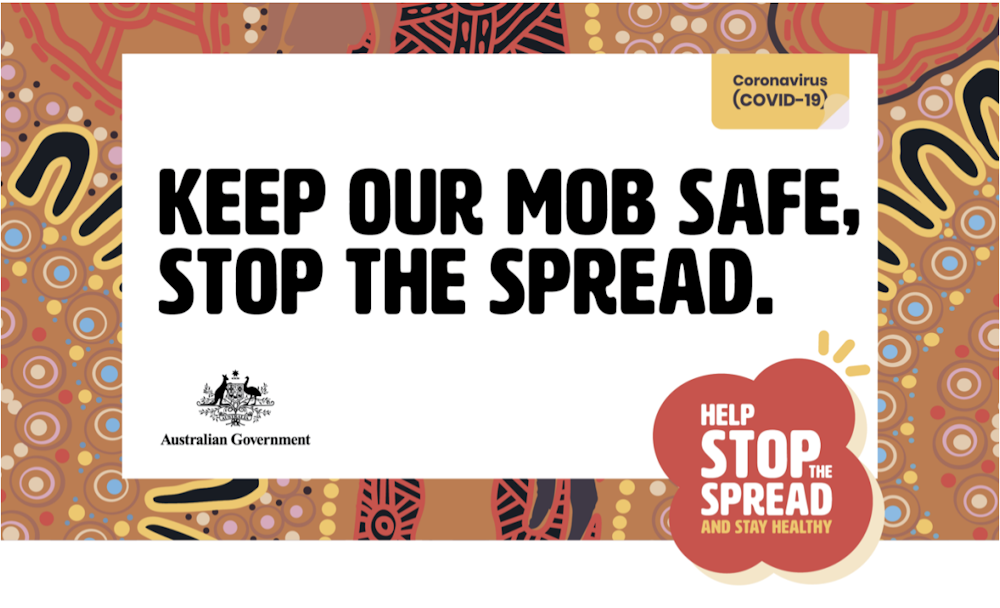
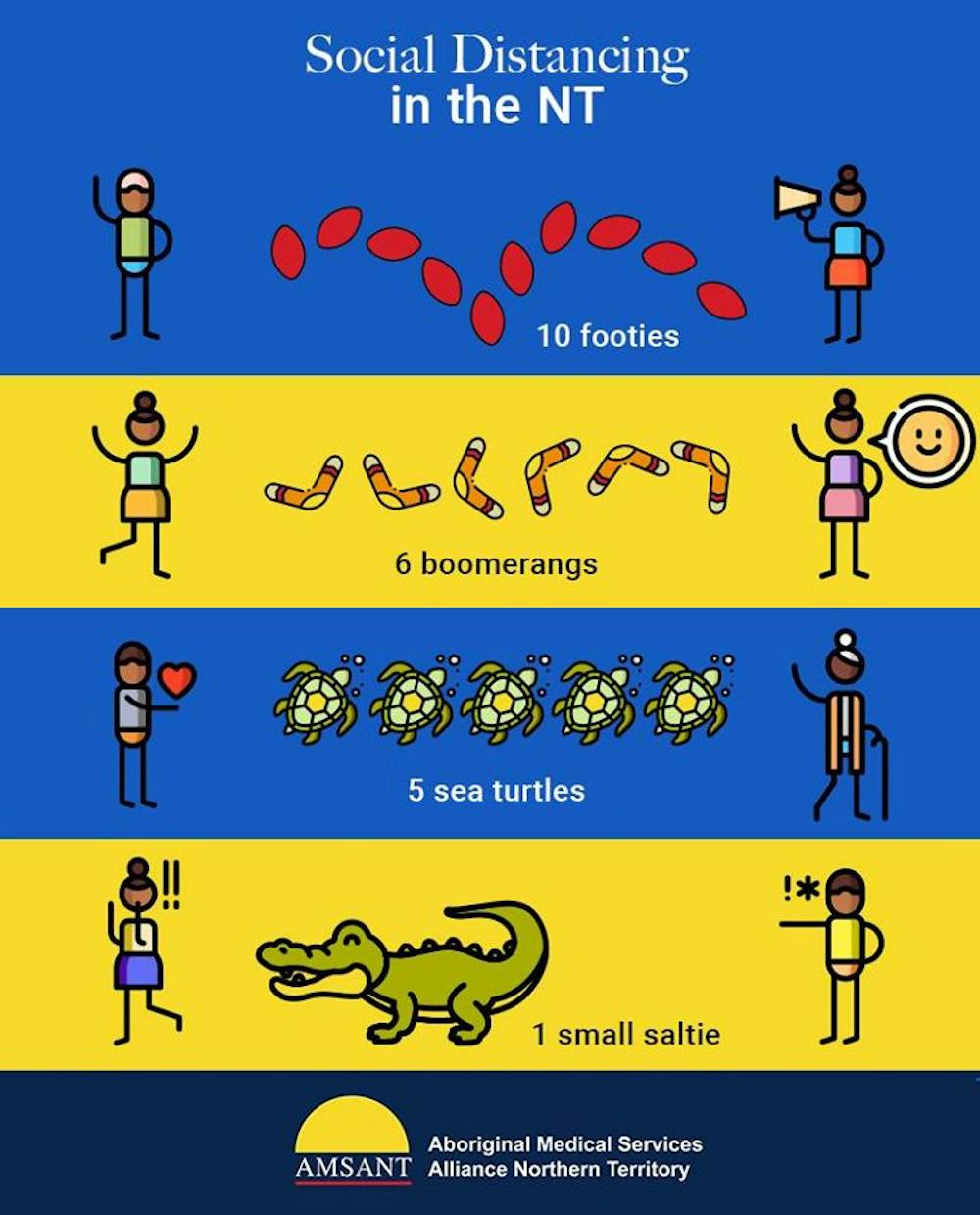
Official health messaging for Indigenous communities.Dept of Health
Vulnerable communities, new babies
Humans are vulnerable to disease for many reasons including age, gender, society, environment and ancestry. We know the COVID-19 risks are magnified for Aboriginal people in remote communities.
This is due to higher rates of other health issues, limited access to health care, greater reliance on outreach services and movement between communities.
The COVID-19 situation has brought specific health challenges to Aboriginal women in remote areas. For years it has been common for women to leave their communities to give birth in regional or major hospitals. This can bring sadness and a sense of dislocation from family, country and ceremony.
Because of COVID-19 lockdowns, women and their newborns are away longer from family and culture. They have to be quarantined before returning to country. An alternative approach is to restrict the mother’s movements when she is away from home. Bangirn, a young woman from Barunga who recently gave birth in Darwin, says:
I couldn’t go anywhere when in Darwin because I have recently had a baby. I wasn’t allowed to go out shopping to buy baby clothes or things for the baby. The doctors rushed me into Katherine hospital but I wasn’t allowed to go and buy baby things. My sister had to give me her daughter’s baby old clothes over the fence. Doctors gave me a paper saying that I didn’t go anywhere while in Darwin and Katherine. The paper shows that me and my partner could go back in the community. I couldn’t do food shopping while leaving Katherine or baby clothes. Barunga store hasn’t got anything for the baby. (May 5 2020)
It’s hard. Right now she’s got no warm clothes and this weather is cold. We’re keeping her warm with a big blanket. We’re safe but it’s hard, really hard. (May 11 2020)
We hope to understand these experiences and how they shape families, culture and connections into the future. This can help us to plan for any future pandemics and its impact on Indigenous communities.
The COVID-19 crisis adds to existing pressures on remote communities. Families already live with regular loss of life, frequent funerals and an overhanging grief that contributes to intergenerational trauma. Yet among these hardships communities also display incredible resilience. While COVID-19 poses a threat, this needs to be understood in relation to the hardships and the strengths of remote community life.
Little attention has been paid to the lived experience of social distancing across cultures. We need to understand how different peoples think about social distancing and isolation. For Graham and Gloria Friday, the best strategy for social distancing is “going out bush”, rather than staying in your house … because country is home.
If you out bush, you might find that bush medicine to fight it. Also out bush, you don’t have to worry about food in the shops, you can live off your land, fish, dugong, turtle, goanna, you can live off that. (April 9 2020)
Similarly in Barunga, one community member says their first response to being “locked up” was to go out bush and sit down on country. Anne Marie Lee, chair of the board of the Sunrise Health Service Aboriginal Corporation says:
More people are going out camping and fishing. People spend maybe a week out there. It’s a really good thing, eating that bush tucker again. People are looking more healthy. (May 11 2020)
Going bush can be an opportunity to learn new skills. Adam Macale, aged 15 from Manyallaluk, caught these fish.Rachael Kendino, Author provided (No reuse)
Going bush has had the added effect of strengthening families. As people hunt and fish, they are away from the worries of town. They are well fed and access to alcohol is limited. Young people learn traditional survival skills. The health and well-being effects of being out bush are part of long-standing and culturally defined preventative health-care strategies.
Some aspects of Aboriginal people’s experiences of lockdown are familiar to all Australians: the importance of socialising with extended family for mental and emotional well-being. Also, people seem to be more conscious of their health. Some community medical clinics report an influx of people getting flu vaccinations.
Yet another factor that shapes the COVID-19 experience for Aboriginal people in remote areas is the historical experience of being “locked up” on missions and in prison.
The NT has the highest imprisonment rate of any state or territory. Aboriginal and Torres Strait Islanders comprise 84% (1,477 prisoners) of the adult prisoner population. In 2018, the national average was 28%. Families in Borroloola have called for people to be returned home during the pandemic to ensure they are safe and away from the threat of virus infection in prison. The investment in family and making sure everyone is safe has been a driving focus for many in these communities.
Some good things, too
Perhaps unexpectedly, there have been some positives from the COVID-19 crisis.
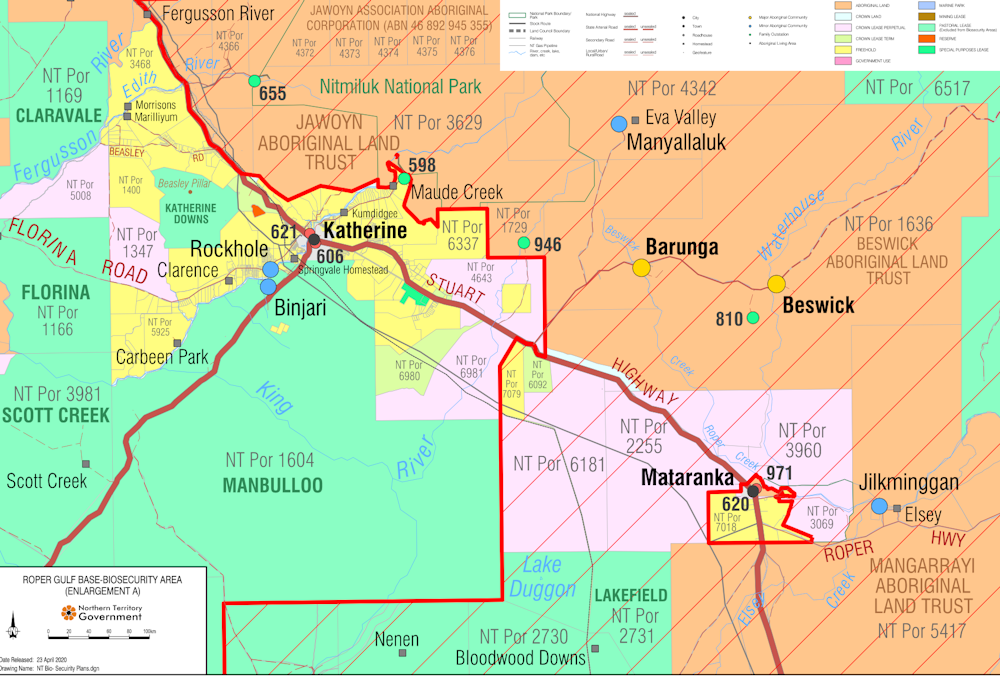
One of the first actions was for states and territories to nominate designated biosecurity areas. Travel to these areas was restricted to essential workers. Returning community members have to go into quarantine. This shutdown was sudden but it made some community members feel reassured. Beswick Traditional Owner, Esther Bulumbara says:
Suddenly everything stopped. It was a great shock to the Northern Territory. We thought only that overseas mob would get that. But police said everything had to close. Government mob, shire. It was lucky it was quick. If they didn’t know about it, it would have gone through the Northern Territory. (April 24 2020)
The lockdown bolstered trust in government and Aboriginal organisations. Graham Friday is among those “talking with all those big mob government officials” as community in Borroloola are consulted about when and how things might open up again.
Designated biosecurity areas near Katherine, Northern Territory.NT Govt.
People feel safe because their exposure to COVID-19 has been controlled. Reflecting on the situation in Borroloola, Gloria Friday says:
It’s amazing cause the virus never hit the community yet or nothing, and it was good because everyone was abiding by the rules. And because they limited the grog sale to six can, six can a day, everything was quiet and there’s been no problems in the town, everyone’s just been go out fishing and hunting. It’s been good. (May 1 2020).
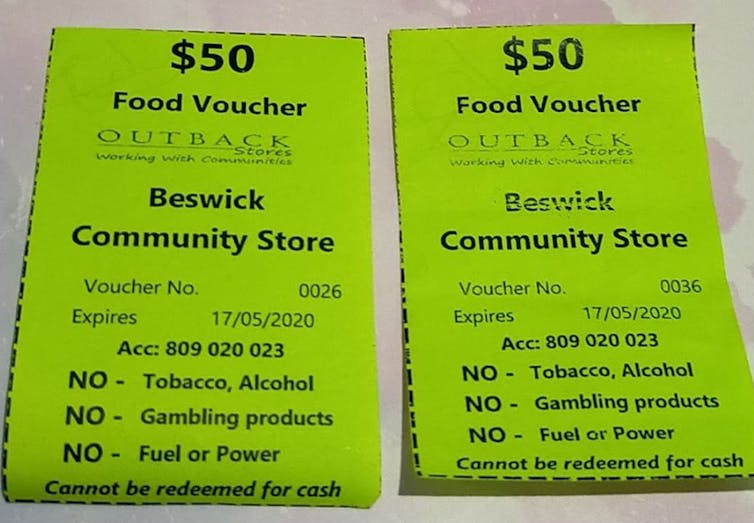
In some cases, COVID-19 has deepened relationships between Aboriginal people and the wider community. There has been unanticipated support. In the Katherine East region, large quantities of clothing were donated by Rockmans. Boxes of food were donated by Coles. Outback Stores issued food vouchers. Community members were surprised and pleased, reports Esther Bulumbara. She says:
Fiona from AIG donated all the boxes of clothes to Barunga and Beswick and Manyallaluk. It made people feel good. All the ladies they all came and got some clothes. Long sleeved shirts, woolly jumpers and coats. All new. And we got that Mob’s Choice in Bagala Store at Barunga now. Low prices, like at Woolies. (May 14 2020)
Rachael Kendino of Manyallaluk adds:
Every house at Manyallaluk got two boxes of food and a $50 voucher from Beswick store […] I like what the Roper Gulf Shire are doing. They pick up [people] every Thursday for shopping from Manyallaluk to Barunga store. Before we had to get taxi to go to Katherine to buy food […] Going in and return is $300 each way. She told me about online shopping, too. (May 8 2020)
Food vouchers from Beswick Community Store.Rachael Kendino
People are appreciative of the efforts made by local police to keep them safe and connected. The mail is taken 50 kilometres to the Central Arnhem Highway turn-off. It is handed over to police and taken to Maranboy police station, 10 kilometres from Barunga. A community representative comes to the police station to collect it. The letters are wiped down. Jessala McCale of Barunga reports:
Police officers must make sure that letters, mails are clean before handing it over the person who handles the mail. (May 5 2020)
Jawoyn Elder Jocelyn McCartney says:
The policeman are camping out there at the Barunga turnoff. Turn and turn. All day and all night. To make sure people don’t come out of community. People not allowed to come into our community because they might have that virus. (May 12 2020)
Getting the right information
Elsewhere in the world it has been noted “living without broadband has gone from a mild inconvenience to a near impossibility”. For remote communities, the problem can be how to get information on a global pandemic without internet.
Crisis communication must be tailored to different needs and in many forms. While Indigenous youth are savvy with social media, many older people watch television or listen to the radio to get information. Our community contacts spoke about President Trump and laboratories in Wuhan. Like all of us, Aboriginal people judge leaders and feel sadness for those who have died. As one community member made clear:
He’s a real mongrel that Trump, he just sits there while those bodies all pile up. (May 1 2020)
Aboriginal people in remote communities are well aware of what is happening across the world. The sense this problem is big and concerns all of us is not lost on them. Another community member from Borroloola reveals:
I’ve got family all round – Doomadgee, Normanton, Mt Isa, Townsville, Borroloola – and we really worry for all of them. We all worry about each other and ring each other all the time. All of them, everybody is quarantined all over the world, from Burketown, Mt Isa, Mornington Island, Italy, even America … the lot. (May 1 2020)
White man’s disease
Remote communities are not all the same. While many challenges are shared, each community has its own history and culture which shapes the present. Our preliminary research suggests COVID-19 messages are understood slightly differently across communities.
In some communities, reports from Italy and Spain seem very distant and of little relevance. In others, Aboriginal people of all ages watch television and trawl social media, sad for the “poor Italians” and “bodies piling up in the United States”.
Some talk about COVID-19 as a “white man’s disease”. Others, such as Graham Friday and members of his family (Gloria Friday and Adrianne Friday), see it as “everybody’s problem and everybody’s responsibility”.
One shared factor has been the pressure of acute food shortages in community stores. In the early days, some people responded by breaking quarantine restrictions to access local towns via back roads and dirt tracks. This placed their community at increased risk. The community and police responded in tandem. A Barunga community member says:
A couple of young boys tried to go into town. The policeman came and warned them. They going to get a fine. I told that boy ‘You got to stop that. No more. I can’t pay that fine for you’. (April 24 2020)
Police also set out clear social distancing expectation in Borroloola, as Gloria Friday explains:
Well the police only went and said they didn’t want to see no gambling, like ten people only in one place. But in the community they’re bored, they got nothing to do. Policeman went and told them once, and I think everybody listened. (May 1 2020).
A bullet dodged
At this time, Aboriginal people in the NT seem to have dodged a bullet. This is because swift and culturally appropriate action was taken by governments, Aboriginal organisations and communities themselves. The Northern Land Council and the Central Land Council, in particular, provided outstanding coordinated leadership in the fight against COVID-19.
There is a lesson for Australia’s efforts to Close the Gap: trusted Aboriginal leadership is essential to successful outcomes for Aboriginal communities.
COVID-19 is the first global pandemic caused by a coronavirus. It may not be the last. This crisis presents a unique opportunity to learn what success looks like in Aboriginal remote community health.
The United Nations has called for all member states to include the specific needs and priorities of Indigenous peoples in COVID-19 response planning. Population-based approaches are logical scientific steps to prevent the spread of a virus. However, they need to be compatible with the everyday cultural lifeways of remote Aboriginal communities.
The COVID-19 pandemic is a watershed moment. Old and enduring problems can be reassessed. The current crisis can be mined for fresh, action-oriented perspectives of Aboriginal people’s needs in preventative health care. This time of calamitous infection and threat of illness is not foreign to remote Aboriginal communities and culture bearers. Many have lived through previous flu epidemics and live with the scourge of chronic conditions.
While COVID-19 is presented as a health and an economic problem, it is also a social and a cultural challenge. Our research calls for attention to understanding Aboriginal people’s knowledge of the pandemic and their vulnerability and strengths at this time. Remote communities are full of intellectuals and people coming to terms with a challenge we all face. Yet they are making sense of this global crisis in their own local and culturally nuanced ways.
While we have focused on remote communities, all Aboriginal and Torres Strait Islander communities are at risk.
Community wisdom and cultural strengths are powerful starting points for effective and empowering health promotion. We need to identify local innovations and community solutions for dealing with COVID-19, and harness their drivers and logic. We need to develop culturally-driven, community-specific tools and strategies that can help protect Aboriginal communities from pandemics and provide lasting benefits.
Just a year ago, Scott Morrison was on the cusp of achieving what most had believed impossible. His ability as a campaigner, aided by the failure of his opponent to connect with the Australian public and Labor’s over-heavy policy bag, brought him the unexpected May 18 election victory.
Now he is riding another wave of success. But it’s thanks to the strangest and scariest of circumstances.
Morning Consult polling published in the May 9 issue of The Economist shows Morrison, with an approval rating of 64%, heading a selection of world leaders. Behind him are Trudeau (Canada), Merkel (Germany), Johnson (UK), Modi (India), Macron (France), AMLO (Mexico), Trump (US), Abe (Japan) and Bolsonaro (Brazil).
It’s a hell of a way to become top of the political pops.
Without the pandemic, Morrison would likely be going into the second year of this parliamentary term in a very sub-optimal position.
Voters would remember the past year more for his shocker performance during the bushfires, the “sports rorts” scandal and the controversy around minister Angus Taylor than for positive achievements.
In dealing with the COVID crisis, Morrison has succeeded (so far) because of his extreme pragmatism (the government’s huge spend defies its ideology), a willingness to listen, and his ability to learn from mistakes.
He heeded the health experts – though he balanced their advice with his own economic orientation (hence his rejection of the aim of eliminating the virus). In crafting the relief package he heeded Treasury advice.
Having been frustrated by the lack of federal government powers during the fires, and aware that, similarly, in the COVID crisis power overwhelmingly would rest with the states, he established the national cabinet to maximise Canberra’s clout.
He became a devotee of consensus politics, even when that meant embracing disagreement.
He’s used his communications skills to the maximum, and worked hard at switching from arrogance to empathy.
Every news conference, of which there are many (watched live by quite a few of the public) begin with a carefully crafted homily, which often has the feel of a sermon.
These are designed to connect, exhort and set a tone. (“This is a tough day for Australia, a very tough day. Almost 600,000 jobs have been lost,” he began his Thursday press conference about the horrifying figures that will be followed by even worse numbers.)
But extremely difficult as it has been, managing the “hot” stage of this crisis is likely easier than navigating the journey out which, at least for the foreseeable future, will have the virus lurking as activity steps up. As Boris Johnson said, charting his government’s way ahead, “it is coming down the mountain that is often more dangerous”. (He was echoing a similar line from Jacinda Ardern.)
If we think of the parliamentary cycle, where will Morrison be in May 2021, when (at most) the election will be 12 months away?
The unemployment queue will be shortening but still long. Many businesses, especially small ones, will have disappeared. There’ll have been stoushes about the government’s winding back its JobSeeker and JobKeeper programs, and the free child care it is currently providing. Perhaps it will have been forced to modify those wind-backs in some respects.
Treasurer Josh Frydenberg’s budget of October this year will have contained a massive deficit for 2020-21 (Deloitte estimates it at more than $131 billion), after an even bigger outcome for 2019-20. The government will be headed to a 2021 budget with a deficit, on Deloitte’s forecast, of more than $51 billion for 2021-22.
By May 2021, the government will be having a stab at reforms, the nature and extent of which are, at this point, unclear, probably even to it. Indeed, it needs to start managing expectations; while every parrot (to adopt a Keatingism) might be squawking about reform, there are no silver bullets.
Regardless, some or much of whatever the government does will be contested, by the opposition and by some stakeholders.
If proposals involve political losers, there’ll be blow back. On the other hand, there may also be disappointment from some, especially in business, that the reform agenda hasn’t gone far enough, and concern it doesn’t have sufficient heft to adequately stimulate growth.
To implement reforms, many of which lie in the remit of the states, the co-operation of the premiers will be needed. But political differences are likely to constrain this, even if the national cabinet were to be kept going in some form.
A wild card is whether the trade dispute with China gets worse in coming months. This is of course about a lot more than trade. It will be a serious economic problem if China is determined to punish Australia. Strong exports are being relied on to help us get through the crisis.
Anthony Albanese this week delivered Labor’s broad principles for Australia’s economic recovery. His main message was that we must not just “return to as we were”. Issues such as the excessive casualisation of jobs and jobseekers stuck in poverty had to be addressed, he said.
In short, Albanese is arguing the lessons of the pandemic feed into Labor’s advocacy of a fairer, better society. It was familiar if worthy territory, but with little evidence of any transformational ideas from the opposition.
The impending by-election in the Labor-held seat of Eden-Monaro will provide an early test of whether Morrison’s good performance over the virus translates into electoral reward. Albanese, however, has more at stake in this byelection than Morrison.
A loss would be a major knock to him personally and to morale in Labor, which has inevitably struggled on the sidelines during the crisis. It would reduce his authority with his colleagues, and sharpen his critics.
Assuming the ALP holds Eden-Monaro, Albanese in the coming two years has to do what Bill Shorten could not: that is, persuade people they can see him as prime minister. Given all the advantages of incumbency, and Morrison’s salesmanship skills, that’s harder than it might sound.
On the other hand, the unprecedented circumstances could as easily assist Labor as help the government.
As an election pitch, Morrison may be able to say, “look how well we handled the health crisis, supported so many people through the recession/depression, spurred economic recovery, and are now repairing the budget”.
But Labor may be able to counter, “Look how many people are still on the scrap heap, especially the young, in an economy where growth is still struggling, too much work is insecure, and some industries – such as tourism – can’t get out of the doldrums”.
Whether voters remember the disasters missed or mitigated, and believe the Coalition is the best manager in bad times, or they are preoccupied with the country’s continuing pain and blame the government for it, could determine the result of the election due early 2022.
In diplomacy, as in life, if you find yourself in a hole it is better to stop digging.
Prime Minister Scott Morrison has excavated a diplomatic cavity for himself and his country as a consequence of an unwise intervention in the debate about China’s responsibility for a coronavirus pandemic.
After a phone call with US President Donald Trump on April 22, during which the two leaders discussed China’s responsibility for the contagion, Morrison took it upon himself to push forward with an Australian coordinating role for an independent international inquiry into the origins of the pandemic.
Morrison wrote to world leaders offering Australia as a coordinator for an investigation of how the contagion came about. This would include examining the role of the China-sympathetic World Health Organisation in managing its spread.
Why Morrison decided to pursue such an intervention immediately after a call to the White House remains a mystery. In the annals of Australian diplomacy, this may well go down as one of the more questionable forays into international diplomacy.
One would have to go back to Robert Menzies’s vainglorious efforts on behalf of Australia’s imperial masters to mediate the Suez Crisis in 1956 to find an apt parallel.
Tracing the source
More than half a century later, another Australian prime minister has fumbled his way into a contentious international dispute. The issue is to what extent China should be held responsible for its mismanagement of the early stages of the pandemic.
This is an open question, which an independent international panel should investigate. China should not be let off the hook.
But the question remains: what possessed Morrison to project Australia into a lead role in holding China to account? Why did he find it necessary to leave an impression that Canberra was doing Washington’s bidding in doing so?
When Menzies made his inept foray into the Suez crisis, Australia had virtually nothing to lose commercially by intervening beyond concerns about a canal lifeline between the Red Sea and the Mediterranean.
But Canberra has much at stake in this latest diplomatic imbroglio. Unwisely, it has enabled Beijing go after an American ally vulnerable to economic blackmail due to Australia’s dependence on China trade.
All this calls into question the quality of Morrison’s China advice. In Canberra, it is an open secret that the moderating influences of the Department of Foreign and Trade have been sidelined.
Ragged China policymaking has enabled a ragtag group of anti-China government backbenchers, led by Liberal Andrew Hastie, a former SAS commander, to run riot. It was Hastie who, implicitly, likened China to Nazi Germany.
Lack of authority in the China-policy space is attributable partly to an unsteady approach by Morrison, and partly to a void in which the authority of Foreign Minister Marise Payne is barely visible.
No reasonable observer pretends that dealing with a surging and ruthless power in our region is anything but complex. This complexity requires a level of subtlety and firmness that has been absent from Australian policy-making towards China since the Malcolm Turnbull era.
In his legitimate championing of foreign interference legislation, Turnbull found himself in thrall to a hyperactive national security establishment and its hawkish anti-China posture.
As a consequence, he overreached in his declaration on three separate occasions Australia would “stand up” against foreign interference. This was a barely disguised – and highly provocative – reference to China.
No Australian prime minister has visited China since 2016.
In one of the more significant interventions in a vexed China debate, the influence of a security establishment was called out at the weekend by Dennis Richardson, a former director of the Australian Security Intelligence Organisation and head of both the Defence Department and DFAT, as well as a former ambassador to Washington.
Giving voice to widespread concerns about the pervasive influence of such an establishment inside and outside the bureaucracy, Richardson said:
If you’re going to shut the gate in respect of China, well, that’s fine provided we are prepared to accept that puts at risk more than $100 billion of exports that will impact on living standards of Australians. This is the problem when you try to wrap the totality of government under the umbrella of national security.
Trade as political weapon
Australia depends on China for one-third of its merchandise and services exports.
In the wake of Morrison’s diplomatic intervention, it did not take long for Beijing to exact crude penalties on an Australian government that had overreached.
China’s anti-dumping action against barley exporters has put in jeopardy trade worth about A$600 million a year. Its resort to technicalities to exclude meat shipments from four abattoirs has unnerved an entire industry.
Agricultural exporters are bracing themselves for further action. Australia’s lucrative dairy trade is vulnerable. Wine shipments are at risk. Wool sales might also be jeopardised.
China will have a long list of potential targets.
This includes thermal coal shipments. These were subjected last year to delays in coal carriers offloading cargo in the northern port of Dalian. Thermal coal from Indonesia and Russia was given preference.
At the time, it was assumed China was inflicting pain on the thermal coal industry in retaliation for Australia’s lobbying of its Five Eyes partners to exclude the Chinese telecommunications giant, Huawei, from a build-out of their 5G networks.
It is hard to exaggerate Beijing’s irritation over the Huawei intervention.
So what should the Morrison government do here that would be constructive diplomacy?
First, government officials need to get beyond a mindset that simplistically references Chinese bullying, as if this is a sufficient response to threats to Australia’s economic well-being.
The pressing question remains: how does Australia deal with a regional behemoth that seeks to bend a global rules-based order in its favour?
This is the reality we have to live with.
Morrison could do worse in the present situation than reset a clear policy towards China that defines Australia’s own interests in its own region.
He should restate words he used in an Asialink speech early in his tenure. He said:
[…] the government is fully aware of the complexity that is involved in our region and the challenges we face in the future […] And we are careful as a government to ensure that we don’t seek to make them any more complex than they need to be.
Morrison should have listened to his own advice.
He might consider writing personally to China’s President Xi Jinping along these lines. He needs to ignore those in his immediate circle and on a cacophonous backbench who would argue relations with China are a zero-sum game.
They are not. There needs to be give and take. This is not yielding to Chinese bullying. This is common sense.
Common sense should put a dampener on a belief that, at the wave of a wand, “supply chains” linking Australia and China can be remodelled. This sort of naïve view loses sight of the fact that, for as long as it is possible to foresee, bulk commodities will form the staple of the trading relationship.
Given this, Morrison would be advised to cease acting like a global traffic cop in efforts to hold China to account for the coronavirus pandemic.
What Australia should be doing – and should have done in the first place – is support international efforts to bring about an inquiry. It will have early opportunity next week when the World Health Assembly considers a European Commission resolution along those lines.
Morrison needs to pay less attention to a China-obsessed national security establishment and give more credence to advisers who actually know something about China. Most importantly, he should stop digging.
A $50 billion rescue fund sits at the centre of 2020’s “once in a generation Budget” as the country braces for the economic carnage promised by the covid-19 coronavirus pandemic.
The plan lays out the first $15.9 billion of investment including an extension of the wage subsidy scheme to the hardest hit businesses, free trades training, and a state house building programme.
Almost $14 billion has already been allocated to previously-announced initiatives, leaving about $20 billion unspent.
The hefty price tag promises to blow out debt to 53.6 percent of Gross Domestic Product (GDP) by 2023 and will leave the country in deficit for years to come.
Finance Minister Grant Robertson said the pandemic was a “one-in-100-year event” which demanded record spending.
– Partner –
“It is a once in a generation Budget. It is bold because the task we face is monumental,” he said.
And Treasury’s forecasts show just how tough that task could be, with unemployment predicted to more than double, surging to a peak 9.8 percent by September this year.
“This is the rainy day we have been preparing for – now we must weather the global storm,” Robertson said.
Support for business The 12-week wage subsidy scheme – set to expire in June – will be extended by another eight weeks for the worst-hit businesses.
From June 10, firms which can prove their revenue has halved over the previous 30 days compared to the year before will be eligible.
The payment remains at $585 per fulltime worker and will be paid to employers in a lump sum.
Up to $3.2bn has been set aside for the extension.
A $150m short-term loan scheme will also be rolled out to incentivise businesses to continue research and development programmes which might otherwise be shut down.
NZ Trade and Enterprise is set for a $216m boost to increase the number of exporters it can support.
The Budget acknowledges covid-19’s particular toll on the tourism sector with no end in sight for the country’s border closure.
An injection of $400 million will fund a domestic tourism campaign and support businesses to plan their next steps.
A separate $1.1 billion package has been set up with the aim of creating almost 11,000 jobs in the environment sector from pest control to wetland restoration.
Housing and infrastructure The government has committed to rolling out a home building programme to build 8000 new state houses over the next four to five years.
Kāinga Ora will borrow an estimated $5 billion to pay for the bulk of the houses and the Budget sets aside another $570 million in rent support.
The homes will include about 6000 public houses and 2000 transitional homes.
The Budget also commits an additional $3 billion to fund “shovel-ready” infrastructure projects, on top of the $12 billion spend-up announced earlier this year.
Ministers have already received nearly 2000 applications for funding and will soon decide which projects to push ahead with after receiving advice from officials.
Investment in rail has also been bumped up $1.2 billion to reach $4.6 billion.
Training and eduction Trades training for critical courses – such as building, construction and agriculture – will be made free for all ages over the next two years to help retrain people who have lost their jobs.
About $1.6 billion has been set aside for the entire Trades and Apprenticeships Training Package which will also help workplaces retain their trainees.
Out of the fund, $276 million will go towards setting up Workforce Development Councils and Skills Leadership Groups to monitor the job market around the country and plan for recovery.
Welfare The Budget is notably absent of “helicopter cash” initiatives or further significant increases in welfare payments.
In March, the government boosted most benefits by $25 a week. Today’s budget also increases the rates of foster care allowance and orphan’s benefit by the same amount.
Almost $80 million has been committed to social services, of which $32 million will go towards foodbanks and other community food services.
A $36 million fund has also been established to support community groups which support Māori, Pacific, refugee and migrant communities.
Tertiary students will also be able to apply for support from a $20 million hardship fund to help them get through the next few months.
The “Warmer Kiwi Homes” scheme has also been expanded to cover 90 percent of the costs of insulation or heating retrofit for low-income households.
The $56 million investment is expected to cover an extra 9000 houses.
The government is also spending $220 million over two years to grow its current school lunch scheme from 8000 students to about 200,000 by the middle of next year.
New Zealand’s budget brings a significant funding injection for health and disability services, amounting to around a 9% increase. It is the most substantial increase for the health sector in some time, and in this regard, aligns with the government’s 2019 well-being budget.
Overall, the budget provides an additional NZ$4.3 billion over the next four years. Most of that new investment is a welcome NZ$3.92 billion for the country’s 20 district health boards, many of which have been in perpetual deficit and haven’t received enough funding to cater for the demand on regional hospitals and community health care.
In this sense, the budget provides a long overdue catch up for the health sector, and it patches up the backlog COVID-19 created for elective medical procedures.
But unfortunately it misses the opportunity to make bigger, more systemic changes. The COVID-19 pandemic has shown the current regional approach to health care isn’t good enough to deal with a nationwide threat. So a more visionary budget would have overhauled the health system by supplementing district health boards with a central, nationwide focus.
Each district health board is a local health system responsible for planning and funding services within a geographic area, including public hospitals, disability support services, public health and primary care.
The NZ$3.92 billion boost for district health boards is intended to “improve financial sustainability and clinical performance” as well as provide for population ageing and growth, wage increases and inflation.
NZ$282.5 million over the next three years is to provide around 153,000 elective and planned surgeries, radiology scans and specialist appointments that have been delayed by the COVID-19 lockdown. It will also cater for people on waiting lists – a perpetual problem.
NZ$125 million over four years is for other COVID-19 related cost increases – presumably personal protective equipment and additional testing, treatment and contact-tracing. And there’s an additional almost NZ$850 million for disability support to relieve growing pressure on the sector and improve access to services such as home-based care.
Some of the finer detail is yet to be worked out. Firstly, the finance and health ministers said district health boards will be held to account for their performance with the new spending. This means those with deficits will be expected to improve their financial standing. This implies they will be under close government monitoring.
Clinical services will similarly be expected to show improvements in the number of procedures and patients coming through. In this regard, the budget provides more funds for more of the same. Hopefully this will bring improvements for the thousands of patients who languish on waiting lists or miss out on treatment because their condition has not yet deteriorated enough to be treated in the public sector.
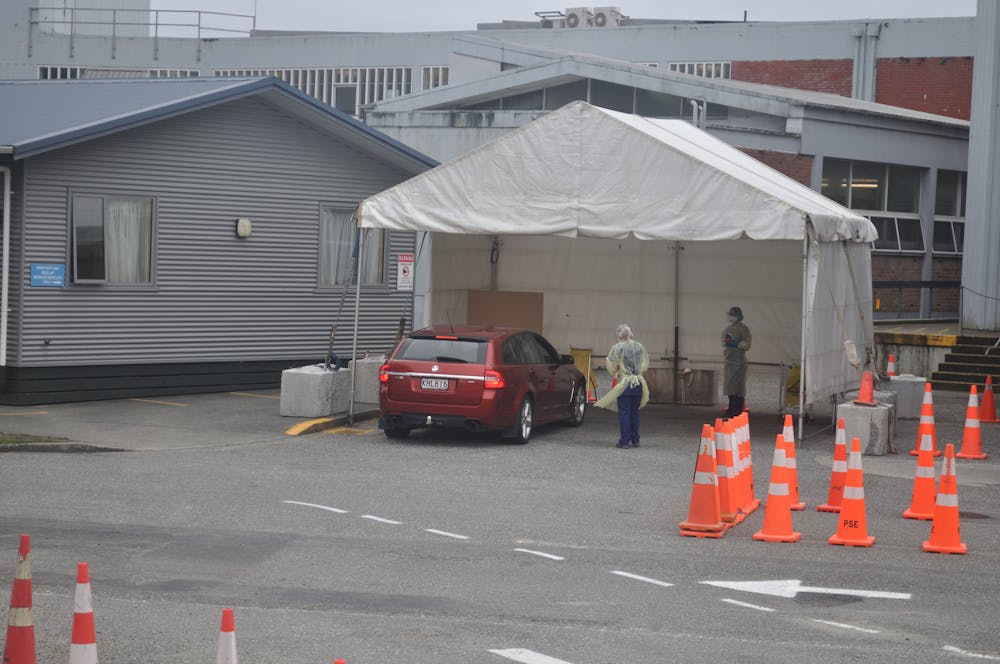
A Covid 19 testing station at Greymouth Base Hospital during New Zealand’s strict level 4 lockdown in April 2020.Lakeview Images/Shutterstock
COVID-19 and what still needs to be fixed
The COVID-19 pandemic has highlighted shortcomings in New Zealand’s health system, some of which are yet to be addressed.
Initially, medical staff in each region worked to different protocols for COVID-19 contact tracing and testing, and it was difficult to combine the data in a central database. While this has now been fixed as part of the country’s pandemic response, the budget doesn’t tackle any of these deeper issues.
The budget could have been an opportunity to forge ahead with much needed health system changes. I’ve suggested elsewhere that district health boards should be abolished and replaced by 20 hospital managers (preferably qualified health professionals) who work as a team. They would run regional hospitals, but be accountable to the Ministry of Health.
Their job should be working collaboratively and strategically, taking a national approach on any issues, including identifying and disseminating best practice across the sector. At the moment, there is no way of achieving this as the district health boards largely work in silos.
Funds should be allocated through a local alliance between primary care practitioners, hospital managers and other providers. This would increase capacity to fund innovations in care, such as investment in virtual consultation technology, which GPs have had to use during the COVID-19 lockdown. The budget was quiet on funding to allow GPs to work in more flexible ways – but the pandemic has highlighted considerable cracks and needs here.
Any such changes should be guided by two initiatives, at relatively low cost. First, investment in “operational excellence”, which research shows leads to higher overall performance. For health, this means better financial performance, quality of care and patient outcomes.
At the moment we continue to invest in a sector that undervalues management development. For this reason, we can expect future budgets to replicate the “catch up, patch up” approach.
Second, we need a national clinical leadership initiative. As with the first point, we have long undervalued the potential for our health professionals to provide leadership.
Studies show that medical services and hospitals led by physicians perform better. There have been failed attempts in New Zealand to develop a leadership initiative, but it is time to revisit this and train medical professionals to be excellent, both as clinicians and managers.
Stay in touch with The Conversation’s coverage from New Zealand experts by signing up for our weekly NZ newsletter – delivered to you each Wednesday.
Budget 2020’s focus on “jobs, jobs and jobs” is understandable, commendable and vital.
COVID-19 poses the largest threat to paid employment since the Great Depression almost 90 years ago. The number of people receiving Job Seeker Support (Work Ready) – the main benefit available for the unemployed – rose almost 50% between February and early May, from about 80,000 to 120,000.
That is a crisis in anyone’s language. Paid employment is not only important economically, it is about social and psychological health. This is reflected in a long-standing cross-party commitment to high employment levels and a high labour market participation rate. Significant and protracted unemployment serves no good purpose.
To combat this, the budget aims to protect existing jobs where possible, generate new jobs through targeted public investments, and ultimately create the conditions for a return to sustainable job growth.
But worse is still to come. Treasury is forecasting an unemployment rate of close to 10% before year’s end. Given the unprecedented impact of the pandemic, however, all such forecasts are highly conditional.
So can the 2020 budget help avoid mass unemployment? Are the measures announced sufficient to address the scale and distinctive aspects of the current crisis? A little context helps in answering such questions.
New Zealand started from a good position
By OECD standards, New Zealand entered the pandemic with a relatively low unemployment rate. In March 2020 the official unemployment rate was about 4.2%, slightly up on 4.0% in December 2019. This compared with pre-pandemic unemployment rates of around 4.0% in the UK, 5.2% in Australia and 7.4% in the Euro zone.
Fortunately, too, the government’s comprehensive wage subsidy scheme has so far limited the spike in unemployment. By contrast, the US unemployment rate rose dramatically from 4.4% in March to almost 15% in April, with more than 20 million jobs lost in recent weeks.
Goldman Sachs estimates the US unemployment rate may peak at 25%, comparable to the depths of the Great Depression. The real jobless rate, which includes those who want to work but have given up trying, is forecast to reach 35%.
Of course, the depth and duration of the economic downturn remains highly uncertain. Hence, policy responses must remain flexible and adaptive. Wisely, this budget recognises that. Finance minister Grant Robertson has reserved significant fiscal resources should they be required.
The impacts of this pandemic differ from any previous financial or seismic shock, so it poses distinctive and unusual policy challenges. Specific industries and sectors have been disproportionately affected (tourism, aviation, hospitality, retail, international education, and the arts), as have particular communities (such as those heavily dependent on international tourism).
Targeted and tailored policy interventions are essential, along with more broad-brush responses.
Again, the budget reflects this. Key policy measures include the targeted extension of the wage subsidy scheme for a further eight weeks for businesses experiencing more than a 50% reduction in turnover, a $400 million package for the tourist sector, a substantial boost to the infrastructure investment fund, and some additional support for research and development.
Unfortunately, as with previous recessions, COVID-19 will have a disproportionate impact on younger people. Since March, the increase in unemployment has been particularly marked among those aged 20-29. Tertiary students are among the hardest hit by the loss of job opportunities.
Significant and continuing efforts will be needed to minimise these inter-generational effects, and the budget goes some way to addressing these.
It includes a substantial trades and apprenticeship package (worth $1.6 billion), along with additional subsidised places for tertiary students, a modest increase in per student subsidy rates, extra support for employment services, specific initiatives for Māori and Pasifika students, and a new hardship fund for students.
But more assistance for the university sector will likely be needed over the next few years – not least because of the substantial loss of income from international students. Specific measures could include a strategic tertiary investment fund, an increase in the value of targeted student allowances, and a rise in student loan borrowing limits.
The recovery must be environmentally sustainable too
Finally, it is vital that the rush to protect and create jobs must not jeopardise future employment opportunities by contributing to poorer environmental outcomes. “Shovel-ready” projects must not be carbon-heavy.
New Zealand needs a genuinely sustainable economic recovery, one that enhances societal resilience, protects ecological values, and reduces greenhouse gas emissions.
To that end, the $NZ1 billion environmental jobs package is welcome. It will enhance pest control and ecological restoration, while also improving facilities in the national parks and reserves.
But investments of this kind will be undermined if the planned reforms to the Resource Management Act result in greater urban sprawl, the loss of valuable agricultural land, and higher transport emissions.
Ultimately, sustainable employment requires a sustainable environment.
Stay in touch with The Conversation’s coverage from New Zealand experts by signing up for our weekly NZ newsletter – delivered to you each Wednesday.
Nearly two million “rapid” antibody tests imported into Australia have been declared useless for determining whether someone has been exposed to the COVID-19 coronavirus.
Antibody tests are important for establishing who has had the virus, especially because many people infected seem to show no symptoms. There is also hope rapid tests could be used to diagnose active COVID-19, as the tests would be much quicker and less invasive than the current swabs, known as PCR tests.
But it’s hard to make one that works. It’s difficult to craft a test that is specific enough to detect just SARS-CoV-2 (the virus that causes COVID-19), and not other similar viruses. More importantly for diagnosis of active cases, it’s difficult to craft a test that is sensitive enough to detect SARS-CoV-2 antibodies early on during infection.
Antibodies tell us who has had the virus
An antibody is a small, Y-shaped molecule that binds to specific structures on viruses, called antigens. When these antibodies bind to the antigen on the virus, they can stop the viruses entering our cells and replicating.
Our immune system only makes antibodies to a virus we are infected with. Each antibody is unique, but we can have many different antibodies that bind to the same antigen. After we clear an infection, our immune system keeps a small number of these antibodies circulating in our blood. That way, if we get infected with the same virus again our immune system can ramp up production of the relevant antibodies.
Antibodies are Y-shaped molecules that attach directly to viruses, preventing them from entering our cells.Shutterstock
With social restrictions being eased in many countries, including Australia, it will be crucial to know who has already had the virus. But one Italian study found 43% of people who tested positive for COVID-19 had shown no symptoms. However, this is a pre-print study and has not been peer-reviewed, so the results should be treated with caution.
Accurate antibody tests can help us establish exactly how widespread asymptomatic infection is, helping authorities assess the true spread of the virus.
How do antibody tests work?
Antibody tests can also help scientists understand what a good immune response to the virus looks like. This is something we don’t yet fully understand, but we need to know for developing a vaccine.
To develop an antibody test, researchers choose a piece of the virus (a specific antigen) and make it in the lab. We can then use the antigen to fish out the antibodies specific to it, out of all the antibodies in human blood. In the laboratory, these tests can also determine how many antibodies against the virus are present in the blood.
Rapid antibody tests work more like a pregnancy test. Using these tests in the field involves taking a pinprick sample of a patient’s blood. If the blood contains antibodies that bind to the specific antigen, the result is positive. If not, the result is negative.
But for these tests to be useful, we need to be able to trust the results. The choice of antigen matters for both the sensitivity and the specificity of the antibody test.
Finger-prick tests aim to detect immune system proteins, called antibodies, that can bind to the SARS-CoV-2 virus.Adrees Latif/Reuters
Tests need to be more sensitive and specific
The sensitivity of the antibody test is important for avoiding “false negatives”, in which the patient’s blood appears free of antibodies against SARS-CoV-2 despite having previously been infected with it.
Therefore, the antigen chosen by test developers has to be a piece of the virus that the body makes significant numbers of antibodies against. Additionally, because our immune system has to make antibodies from scratch, it takes our immune system up to two weeks to make new antibodies.
So early on during infection, when we want to use rapid antibody tests for diagnosing COVID-19, we need a highly sensitive test. Otherwise we might be actively infected with the virus, but we could return a negative result on the antibody test because we haven’t made enough antibodies yet.
The specificity of the test is important for avoiding “false positives”. Sometimes, viruses can have very similar antigens, particularly if they are closely related. So SARS-CoV-2 antigens might be similar to antigens from SARS1, or to the common cold coronaviruses. A test that’s not specific enough may return a positive result to a different virus.
Think of it like trying to identify different types of fruit. Its easy to distinguish between an apple and an orange. But determining whether we have an orange or a mandarin is much harder. Our test has to be sensitive to more than just colour, shape, and texture of the fruit’s skin. We would need to look for a characteristic unique to the orange, such as the roundness of the orange, or how easy it is to peel the skin off.
The antigen used for the test must therefore be unique to SARS-CoV-2. Otherwise we might think someone has been exposed to the virus when they have only suffered a common cold.
The tests imported by the Australian federal government weren’t sensitive enough. The Doherty Institute found the tests had a high chance of producing a false negative, though the likelihood of producing a false positive was lower. The Institute also found the accuracy of the tests was much lower than what the companies selling the test claimed, highlighting the need for independent evaluation of these claims.
The pressure of the pandemic means the demand for these tests was high, and the government took a gamble and bought them before they had been properly checked.
But until we are confident of the sensitivity and specificity of the antigens used in a given antibody test, we can’t use them for diagnosing new COVID-19 cases, tracking the spread of COVID-19, or understanding the immune response.
The closure of the Australian arm of the youth-focused news organisation, BuzzFeed, is more evidence the advertising-supported media landscape is broken.
It’s a sad end for a news organisation that launched in 2014 with an ambition to shake up Australia’s hyper-concentrated media market.
Here are nine things Australians who care about journalism, and the state of our democracy, should know.
1. BuzzFeed is not the only online outlet to flounder here
But other digital offerings are surviving: these include Crikey, which came along in 2000, Mamamia (2007), The Conversation (2011), Guardian Australia (2013), The Saturday Paper (2014) and The New York Times (2017).
2. By grouping popular viral content and excellent journalism together, BuzzFeed created a disconnect
Due to the co-location of its popular and quality journalism, at the same time as BuzzFeed was being nominated for Pulitzer Prizes in the United States and the Walkley Awards in Australia, it also struggled with trust. The 2019 Canberra University Digital News Report survey found BuzzFeed was the country’s least trusted news brand.
3. BuzzFeed had been on shaky ground for a while
BuzzFeed cut about 200 staff globally in January 2019 amid a worldwide savings push. The Australian arm of BuzzFeed lost 11 of its 40 staff at the time.
4. BuzzFeed Australia has been home to many high-profile journalists
Since launching under founding editor Simon Crerar, it has employed its fair share of talented (and sometimes controversial) journalists who have broken significant stories and covered issues in innovative, unusual ways.
Lane Sainty was nominated for a Walkley Award for her coverage of the marriage equality debate, while Gina Rushton’s work on abortion is seen as contributing to last year’s decriminalisation in NSW.
Before recently running into trouble at the Financial Times, Mark Di Stefano was noted for his innovative coverage of Australian politics, including interviewing former foreign minister Julie Bishop by emoji.
5. It needed advertising dollars to survive
Like other digital natives, BuzzFeed relied on advertisements for its funding. It also leaned heavily on digital platforms (such as Google and Facebook) for website referrals.
BuzzFeed used social media posts extensively as a means of reaching audiences, and has over 2.5 million Facebook “likes”. As Australia’s 2019 Digital Platforms Inquiry reported, when Facebook changed its algorithm to prioritise posts from family and friends, BuzzFeed Australia really felt the change.
6. It went after younger readers
Although BuzzFeed attracted sneers from traditional news lovers for its fun “listicles” and viral videos on social media, it set out to attract a youth market.
It also won respect from peers in traditional media outlets.
BuzzFeed interviewed former foreign minister Julie Bishop via emoji.Lukas Coch/AAP
7. But those younger readers didn’t pay
There’s an old news adage that audiences will take more of what they need to know from those that give them what they want to know.
By providing non-news content alongside their journalism, BuzzFeed won attention from youth audiences to stories in a way other news outlets couldn’t.
Unfortunately, audiences prefer to pay for steaming services rather than news, as the 2019 Digital News Report found.
8. BuzzFeed covered stories that others would not do, or did them in a way that others would not
It recognised the importance of covering federal politics for young people. And it broke major stories, such as former employment minister Michaelia Cash’s office tipping off the media about union raids.
Although this also came at a cost. It reached an out of court settlement with former Labor MP Emma Husar in 2019, after she sued BuzzFeed for defamation.
Former Labor MP Emma Husar sued BuzzFeed for defamation.Paul Braven
It should not have been as innovative as it was, but BuzzFeed also specifically employed Indigenous journalists Allan Clarke and Amy McQuire to cover Indigenous issues.
9. This is the last thing Australia needs
As many noted on Twitter as the news broke, the last thing Australia needs right now is fewer media outlets, especially those that focus on stories overlooked by everyone else.
These include adequate funding for public broadcasting, expanding tax deductible provisions for donations to media outlets and forcing Google and Facebook to compensate media outlets for using their content.
If we don’t figure out how to pay for strong independent journalism in Australia, our nation will most certainly be the loser.
After weeks of remote learning due to COVID-19, many school students in New South Wales began a staggered return to classrooms this week. Students in other states, such as some in Queensland, were also back in the classroom from Monday.
Others like Victoria are weeks away from returning. Premier Daniel Andrews said some students (in prep, years 1 and 2, and years 11 and 12) will go back to school on May 26. And Western Australia’s Premier Mark McGowan announced all school students in the state must return to the classroom from May 18.
We surveyed more than 10,000 public school teachers in NSW to find out how they felt about being at school at the end of term one, their thoughts on remote learning and feelings about returning to school.
Our survey – with responses from April 17 to May 10 – showed fewer than one in four teachers felt safe working on the school site at the end of term one. But nearly 95% felt safe working from home.
During the school holidays, when the survey began, only 13% of teachers reported feeling happy to continue working in direct contact with children and colleagues.
So, has the flattening of the curve has been enough to reassure teachers it is now safe to work with students and colleagues in schools?
At the end of term one and the beginning of term two in NSW, many teachers were delivering online lessons from their classrooms to students at home, as well as to smaller numbers of students who continued to attend school.
Almost all these teachers felt pressured to continue working on the school site.
One teacher said:
As an older teacher with an older husband at home who has compromised lungs, I feel very anxious about being at school. I do not appreciate, after teaching in the public system for 40 years, being treated as a guinea pig and a political scapegoat.
Although teachers found remote learning difficult, more than 95% agreed it was needed to control the outbreak. More than 60% felt it would have been beneficial to introduce remote learning earlier.
More than 60% of teachers reported high levels of anxiety due to risks posed by the virus. One teacher said about returning to school:
I worry about teacher health if we return to face-to-face learning. My health condition has changed recently, and my anxiety about potentially having to return to school is increasing.
Much of the argument for reopening schools has focused on children being less likely to fall ill from the virus than adults. But many teachers argue that belies the fact children can be infected and transmit the virus.
As one teacher told us:
Students have contact with adults, and students can be carriers. It is ludicrous to expect teachers to return to work and put themselves and their families at risk. It is also ludicrous to ask teachers to be teaching effectively on site, when their stress levels will be going through the roof with fear of exposure to the virus.
Many said schools needed better protective equipment. In the lead-up to remote learning, schools had not been provided with masks or gloves. Many schools said they didn’t have enough soap or hand sanitiser.
We had no sanitiser, no soap and minimal toilet paper. We were not provided masks, gloves or any protective gear. Teachers had to buy their own hand soap for staff rooms. As time went on we had less and less. With the shopping centres emptying while we were working, we were not even able to buy supplies ourselves. The conditions are disgraceful.
One teacher said:
If protective equipment [masks and gloves] and regular cleaning by an external service were provided as well as sanitiser and soap, I feel it would be safe to have students back on a reduced timetable if needed.
Teachers’ concerns for their students
More than 80% of teachers felt unprepared for remote learning and faced a steep learning curve. But more than 80% reported being well supported by colleagues and school executives.
Overall, around 70% felt the arrangements were an adequate substitute given the circumstances, but only 25% were confident their students were learning well.
To support families with limited online resources, more than one-third of public school teachers printed and delivered pen and paper packages to students.
More than 80% were particularly worried about students with special needs, many of whom are at higher risk from the disease and also vulnerable to educational disruption.
One teacher said:
Most of my students have very limited access to internet […] most rarely make contact and are clearly struggling to engage in work.
Most teachers (80%) felt they were well resourced to teach remotely. But only about one-third felt their students were well resourced at home. Some 40% were clear many students were not properly resourced, and about 25% were unsure.
About half of the teachers felt frustrated by insufficient resources and daily technical difficulties.
An upside to this education disruption?
Although teachers faced many challenges, the majority agreed the pandemic response had also had some positive outcomes.
Nearly 90% agreed there was an up-skilling in digital and online education. Large proportions also agreed the pandemic had created more time for families to connect, communicate and work together, more teacher collaboration and greater community respect for teachers.
Finally, perhaps surprisingly, more than 60% agreed the epidemic had created a positive disruption to the current school system. It seems a majority of teachers have been waiting for a dramatic shift to their work. COVID-19 might not have been what they were expecting but many were glad something had changed.
I think this whole situation is an excellent opportunity […] to highlight the reasons behind the inequities that are coming to light. My own experience has been made more positive due to extremely supportive and amazing school executive staff.
Source: The Conversation (Au and NZ) – By Grant Duncan, Associate Professor for the School of People, Environment and Planning, Massey University
New Zealand Prime Minister Jacinda Ardern has won global admiration for her personal style. But how will Kiwis judge her government’s performance at the ballot-box in September?
A major factor in that decision will be how well today’s budget is received – and how well it achieves its stated aim of “responding, recovering and rebuilding” after COVID-19.
If she who was recently judged “the most effective leader on the planet” gets dumped in the coronavirus fallout, then what are the chances for Donald, Boris or Scott?
Finance minister Grant Robertson and the 2020 ‘Rebuilding Together’ budget, unlike any budget delivered in living memory.NZ Parliament
Late last year, finance minister Grant Robertson would have been expecting that May 2020 would see an optimistic Well-being Budget Mark 2.
Instead, it’s turned into his “rainy day budget”, as he abandons a conservative net public debt target of 20% of GDP. Debt is now projected to rise to 53.6% by 2023, as the government borrows to invest in jobs and runs deficits until at least 2024.
But budgets are political, not just technical, documents. With New Zealand’s general election still scheduled for September 19, the question remains the same: pandemic or no pandemic, will this budget help Labour win a second term in office?
International observers were entranced by Ardern’s leadership after the March 2019 terrorist attack in Christchurch. But, while support for her and her party surged, this was only temporary. By December, the centre-right National Party was polling at levels that would see them form the next government.
Then the pandemic hit, and New Zealand went into strict lockdown in late March. A leaked poll a month later put Labour on 55%, boosted by popular trust in the government’s decisive response to COVID-19.
But, like last year’s post-Christchurch surge, we should not assume this one will last either.
The economic crunch could flatten support for Ardern’s government by the time the election draws near. Budget 2020 is therefore critical to the maintenance of public confidence in the present government’s stewardship at a time of deep uncertainty.
Business confidence, which had dropped in late 2017 simply because Labour took office, understandably “plummeted” in April while the country was in lockdown.
It’s harder for governments to win elections when the economy is tanking, even if the cause of the recession has arisen offshore. A sitting government can claim credit for the bounce-back when it comes, if they have led a credible plan.
But the projections are bad – as they would be regardless of who’s in government. Crucially, unemployment is forecast to peak at 9.8% in September this year, right on time for the election.
So, is Robertson’s fiscal injection going where it’s most needed? New spending targets public health, housing and trades training, and the worst-affected industries and regions reliant on international tourism. But the opposition will attack Labour on its priorities.
Assuming that COVID-19 cases continue to decline, and without a deadly second wave, by the election public attention will have turned from disease control towards the genuine pain caused by unemployment, bankruptcies and reduced incomes.
Labour will need to maintain New Zealanders’ confidence that it is doing the best for economic recovery, especially in supporting businesses, while also keeping the virus out of the community. Among the electorate, however, there may be two schools of thought about the desirability of change to a centre-right government led by the National Party.
First, there is an old refrain in New Zealand that National is the party of sound economic management, while Labour is a spendthrift. This belief is not consistent with historical evidence. Principles of fiscal discipline are now well embedded in New Zealand. Both major parties are now fiscally conservative, but not inflexibly so. For example, National prudently ran deficits to support recovery after the global financial crisis.
But this is about political perception, not fiscal performance. National leader Simon Bridges was whistling the party chorus well before budget day. And in his post-budget speech he zeroed in on government borrowing amounting to $NZ80,000 per household, and the burden on future generations to repay it: “That’s equivalent to a second mortgage on every house.”
If such scepticism about Labour’s economic management prevails at the ballot-box, we could see a change of government.
Jacinda Ardern may be first-name-only popular overseas, but under New Zealand’s finely balanced proportional system she only just won a coalition majority at the previous election.
An alternative school of thought is that during economic recovery it’s unwise to dump a sitting government, provided they are doing basically the right things. Don’t change horses in mid-stream – especially when the stream is running rough. In late April, 87% of Kiwis approved of the government’s response to the pandemic.
If “the team of five million” gets behind Labour’s economic recovery plan as it did for the disease-control plan, then Ardern could form another government after the election.
But a lot could go wrong in the meantime. Budget 2020 is just one risky step on a rocky political path ahead.
At almost 10% of gross domestic product, and a much larger per cent of government spending, Australia’s fiscal response to the COVID-19 crisis has been one of the biggest in the world.
The government is spending an average of A$26 billion a month on programs that didn’t exist in February.
To put that in perspective, before COVID-19 the government’s total average monthly expenditure this financial year was going to be $42 billion.
While far from perfect, these emergency measures have been successful at supporting the incomes of many households and businesses.
But, as this chart shows, each and every one will be gone by the end of October, making October a very dangerous time for businesses and for the economy.
In his address to parliament on Tuesday, Treasurer Josh Frydenberg spoke of a return to work as restrictions were eased.
But he noted that any new outbreaks of COVID-19 could see restrictions re-imposed at a loss of more than $4 billion per week to the economy.
Treasurer Frydenberg’s address to parliament.MICK TSIKAS/AAP
Even if things go to plan, the harsh reality is that big parts of the economy are still likely to be doing less than they should for some time yet.
Most of the world has not fared as well as Australia in limiting deaths and the spread of the virus, which means global economic activity and demand will be weak for some time.
Businesses and consumers are likely to be cautious. Many will find themselves financially challenged because their loan and rent obligations were deferred rather than removed during the crisis.
Australia’s population growth will be much slower because of the reduction in temporary migration, hitting consumer-facing businesses and the broader economy.
Against this backdrop, the sudden withdrawal of massive government spending will leave an enormous hole in economy activity and the incomes of business and households.
The chart below shows that huge amounts of government support (more than 25% of gross domestic product) scheduled to vanish by the end of October.
It’s a recipe for a second downturn.
A much better approach would be to remove the measures slowly.
JobKeeper could be wound back in line with the recovery of individual businesses.
Reassessing eligibility after most physical distancing restrictions have been removed, particularly if the health situation is well controlled, seems sensible.
Support should end early for some, late for others
If the revenues of some businesses rebound to close to pre-coronavirus levels, they could come off JobKeeper early, before the September deadline.
But if the revenues of others remain weak because their operations are still constrained by health restrictions, the government could consider extending their JobKeeper payments beyond September.
Targeting support to the firms that need it most in this way would be a better use of taxpayers’ money – and it would help stop the economy falling off a “cliff” in late October.
The JobSekeer supplement could also be phased out more slowly than the government currently plans.
JobSeeker should stay higher than it was
The treasurer should settle on a new level of income support – lower than JobSeeker with the supplement but probably $75 to $100 a week better than JobSeeker without the supplement – so that people on it are spared significant financial distress while searching for work.
It could also announce a range of measures to boost demand in the danger zones that will be created by supports coming off.
There are plenty of good options.
one-off cash payments to households, which we know have boosted spending
more spending on mental health services or programs to help disadvantaged students catch up on learning lost
infrastructure spending on shovel-ready projects with good returns to the community including social housing, roads and school maintenance
Debt will need to be managed over the medium term, but it shouldn’t constrain the government from implementing the policies needed to drive recovery.
On Wednesday the Office of Financial Management unloaded $19 billion of new 10-year bonds in the biggest bond sale in Australian history after receiving bids for more than twice that many.
Women have been hurt more than men, losing 11.5% of the hours worked in March, compared to men who lost 7.5%.
Predictions of much bigger job losses for the young than the old have been proved correct, with workers aged 15 to 24 losing about 11% of employment compared to 3.4% for those aged 25 to 54, and 4.3% for the over 55s.
Queensland and NSW have so far fared better than other states.
To calculate its official rate the Australian Bureau of Statistics follows International Labor Organisation conventions in classifying employment and unemployment.
These classify as employed anyone who worked zero hours but was still being paid or who believed they had a job to go back to.
Much worse than it looks, and the bureau says so
This is important because the JobKeeper scheme means many workers in Australia fit these categories. It makes a difference.
For this reason, the bureau has provided an adjusted rate of unemployment which counts these workers as unemployed.
It puts our unemployment rate at 11.7% in April, up from 5.2% in March.
It is more in line with what we have been seeing in Canada and the United States.
And many workers have also withdrawn completely from looking for work.
In the past month the labour force participation rate fell by 2.5 percentage points.
Again, women have been hurt more than men, with an extra 2.9% of women out of the labour force compared to an extra 2.1% for men.
Statistically, these people have vanished. They are not employed, but they are not counted as unemployed because they say they are no longer available for work.
Generally in Australia, we all get along pretty well and feel good about our society.
Studies show we have a strong “social cohesion index,” which has remained relatively stable for the past seven years.
But we cannot take this for granted, especially if the coronavirus pandemic also leads to a recession.
In the context of COVID-19, Australia has seen its politicians take quick and decisive action to protect our health and our economy. But in the flurry of recent press conferences from state and federal leaders, social cohesion has been dangerously neglected.
The Australian Human Rights Commission says it recorded more complaints under the Racial Discrimination Act in February than at any time over the previous 12 months.
While complaints have remained within the high end of the normal range, since the start of February, one-third of all racism complaints made to the commission have been COVID-related.
Even before coronavirus, we were already seeing worrying examples of racism in Australia.
Even before coronavirus, there were worrying examples of racism in Australia.Darren Gray/ AAP
Last year, one in three NSW and Victorian school children reported being on the receiving end of racial discrimination from other kids.
The Executive Council of Australian Jewry has found a marked increase in the number of more serious incidents of anti-Semitism. In 2019, 40% of respondents to the Scanlon survey reported negative or very negative attitudes towards Muslims.
Far-right extremism is also on the rise, with ASIO warning small cells of people are meeting to salute Nazi flags.
Current levels of racism could get worse
None of this is good. What’s even more troubling is that it has the potential to balloon into something far worse in the near future, thanks to the COVID-precipitated economic downturn.
We know this from past experience. Economic downturn has been linked to an increase in racial discrimination again and again and again.
More precisely, it leads to scapegoating. Economic downturns precipitate scapegoating, because struggling people are looking specifically for someone, not just something, to blame. Often, that blame falls on ethnic minorities and immigrants.
Lawrence University psychologist Peter Glick is an expert on prejudice and discrimination. He says one of the main reasons people blame ethnic minorities is because it’s psychologically more appealing to do that than blame one’s own group, or accept that something happened outside of one’s control.
Indeed, accepting events that severely impact our lives (like recessions) are the result of natural forces (like an organically occurring virus) reinforces our feeling of a lack of control. And feeling a lack of control is arguably the defining feature of the COVID-19 pandemic.
Scapegoating is not haphazard
But blaming a group of people means action can be taken, often against them.
We may even be able to predict which ethnic minority groups are particularly vulnerable to scapegoating in these situations.
Scapegoating in this scenario is not haphazard. It focuses on specific type of ethnic minority – those that are perceived to be successful, but unintegrated or competitive with the dominant group.
So, ethnic minorities perceived as poor and unintegrated are less likely to be on the receiving end of blame and thus discrimination. It is the prosperous but untrusted minority we will accuse.
In recent times, there was an increase in racial prejudice in places like Italy and Britain during economic downturns such as the Great Recession of the 2000s.
Looking further back in history, there is the horrifying and violent treatment of Jewish people in Nazi Germany and Armenians in Ottoman-era Turkey, both of which occurred in the context of economic downturns.
Of course, it is ridiculous to suggest economic downturns are the sole cause of genocide, or that we are heading in such a monstrous direction.
But it is also unwise to ignore the repeated lessons about the impact of recession on relationships between ethnic groups in society.
We need specific support for Chinese Australians
In Australia, the historical precedence of the recession-racism link, coupled with our current struggles with race issues, means our nation is primed for strife.
We are in a moment of collective pause and planning. But in amongst the thinking about economic recovery, school openings and international travel, we need to be planning for a likely upswing in bigotry against ethnic minorities.
In particular, we should be anticipating which groups are most likely to bear the brunt of an increase in racism.
Chinese Australians were perceived as a threat to Australia before COVID-19, and are already reporting an increase in racist abuse during the pandemic. Most importantly, they are stereotyped as “competent but cold ” – a characterisation that makes them likely to be targeted in times of economic downturn.
Given these factors, it would be prudent to offer this community-specific, proactive support, and tackle any racism – towards them or any other group – decisively.
We need our leaders to step in
Political leaders are crucial in this regard.
Politicians can either stoke antagonism or lead the discourse in the other direction. They can aggressively counter any suggestion of racism and steer Australia through a difficult time, without allowing it to devour itself from the inside in the process.
We need our politicians to lead the discourse away from racism.Mick Tsikas/AAP
Recently we have seen examples of both.
Labor senator Kristina Keneally has called for a cut to temporary migration to put “Australian workers first”.
But other MPs have had a different emphasis. In the context of coronavirus, Labor’s multicultural affairs spokesperson Andrew Giles has been repeating Labor’s calls for an anti-racism strategy.
On matters as important as this, unequivocal guidance from the highest levels of politics is required.
Prime Minister Scott Morrison has already criticised COVID-related racism. But given that history shows us we are just at the beginning of what could be a protracted and dark period for race relations in Australia, much more must be done – and soon.
The PNG Defence Force has handed over three suspects for the killing of police Senior Inspector Andrew Tovere to the investigating police.
Assistant Police Commissioner Anthony Wagambie Jnr was accompanied by three officers to attend a muster parade at Port Moresby’s Murray Barracks yesterday.
The attendance was prompted by the invitation of the commanding officer in charge of Support Company purposely to address the troops.
PNG Senior Inspector Andrew Tovere … killed in a clash with off-duty soldiers. Image: The National
“I was given the opportunity to speak to our soldiers and after this parade we escorted the three suspects involved in late SIP Tovere’s murder [on May 8] to Boroko Police Station at around 10am.
“The three suspects were handed over by the PNGDF military police and are now being processed at Boroko Police Station,” he said in a statement.
– Partner –
Assistant Commissioner Wagambie said the three suspects would go through normal process of interview and charges will be laid against them.
“We will as much as possible get them to attend court today for mention to get their warrants to move them to Bomana CS.
“I have assured the military hierarchy and rank and file on parade that the security of the three soldiers is guaranteed.
“We have mobile squads stationed at Boroko Police Station to ensure their security is protected…
“I want to assure members of the PNGDF and residents of NCD [National Capital District] that police are on normal operations and we have taken control as of last Saturday after the incident…
“Both the murder and the subsequent confrontation at ATW is very unfortunate. Commissioner of Police will issue a separate statement in regards to this.”
Wagambie added that “normalcy” had returned to police activities as of Saturday evening and is calling on the police and PNGDF to remain calm as the process took its course.
Republished under a collaborative partnership with EMTV News.
Both China and the United States have suffered reputational damage with the Australian public as a result of their handling of the coronavirus crisis, according to a Lowy COVIDpoll.
Most Australians (68%) say they feel “less favourable towards China’s system of government” when thinking about China’s handling of the outbreak.
Nearly seven in ten (69%) think China has dealt with it badly.
An overwhelming 90% believe the US has performed badly. The US is rated at the bottom of a list of six countries, also including Singapore, the United Kingdom and Italy, in how well COVID has been handled.
In contrast, 93% think Australia has done well so far.
Building on the anti-Trump feeling that showed up in earlier Lowy polling, 73% said they would prefer Democratic candidate Joe Biden to become president at the November election, compared 23% who want Donald Trump to be re-elected.
The poll of 3036 was done April 14-27.
It comes as trade relations with China have become increasingly tense this week with disputes over Australian exports of barley and beef. China has suspended imports from four abattoirs in Australia and threatened hefty tariffs on Australian barley.
Although the barley row has been going on some time, as have some of the beef complaints, the actions on both fronts are seen as retaliation for Australia pushing for a inquiry into the origin and handling of COVID-19.
As of late Wednesday trade minister Simon Birmingham had not been able to get in contact with his Chinese counterpart.
The trade difficulties are also generating domestic pressure.
On Wednesday Queensland Premier Annastacia Palaszczuk said she was writing to Birmingham asking him to get a resolution to the beef dispute as soon as possible. She said thousands of Queensland jobs were involved.
Australia China Business Council CEO Helen Sawczak said: “To go out like a shag on a rock little Australia demanding an inquiry and insinuating blame was probably not a great foreign policy move.”
On the other hand some Coalition backbenchers have been taking strong public positions against China, complicating the government’s attempt to manage the disputes between the two countries.
In the Lowy poll, 37% said that when the world recovers from the crisis, China will be “more powerful” than it was before the crisis; 27% said it would be less powerful; 36% predicted no change. In 2009 in the wake of the global financial crisis 72% said China would be more powerful.
Just over half (53%) say the US will be less powerful; 41% predict no change; 6% believe American power will grow. In 2009 33% said the US would be less powerful than before.
Lowy’s Natasha Kassam, author of the Lowy report, said: “Despite Beijing’s efforts to shift the focus from its early mismanagement and coverup of the virus, to its apparent success in containment and providing support to struggling countries, Australians appear unconvinced.
“Australians’ views of China during the pandemic track with the previous downturn in sentiment towards China: in 2019, only a third of Australians said they trusted China, and the same number had confidence in China’s leader Xi Jinping to do the right thing in world affairs.
“As much as Australians have expressed disappointment in China’s handling of the outbreak, they are even more concerned by the response of the United States.
“While watching the current tragedy unfold in the United States, the competence and reliability of the United States is looming even larger as a question for Australians,” Kassam said.
In the poll, people gave a big thumbs up to Australian medical authorities and governments. More than nine in ten (92%) said they were confident the chief medical officers were doing a good job responding to the outbreak. The rating for states and territories was 86%, and 82% for the federal government. Confidence in the performance of the World Health Organisation was a much lower 59%.
Australians are not retreating from globalisation as a result of the crisis. Seven in 10 people say globalisation is “mostly good for Australia”. This is consistent with 2019.
Some 53% want “more global co-operation rather than every country putting their own interests first” in a global crisis.
A majority (59%) say they are just as likely to travel overseas as before, when COVID is contained.
Asked their preferred sources of information during the coronavirus outbreak (and allowed to choose up to three), 59% chose the Prime Minister and government officials, 50% government websites, 50% the ABC, 31% newspapers and news websites, 28% commercial, pay TV news and radio, 20% social media, and 5% word-of-mouth.
In a single year, extra-medical opioid use caused more than 2,200 deaths, 32,000 hospital admissions and resulted in the loss of over 70,000 years of life in Australia.
“Extra-medical” opioid use includes both the illegal use of opioids such as heroin, and the misuse of pharmaceutical opioids – that is, when they’re not used as prescribed or intended.
In a report released today, we’ve quantified the social costs of pharmaceutical opioid misuse and illicit opioid use in Australia over the financial year 2015-16.
We found extra-medical opioid use came at a cost of an estimated A$15.7 billion.
The scope of the problem
An Australian survey showed more than 645,000 people used extra-medical opioids in the previous year.
But because of the stigma around opioid use, estimates from national surveys of how many people use extra-medical opioids or how many people would be classified as “dependent” may be underestimates.
We used results from the Global Burden of Disease study to estimate more than 104,000 people in Australia were opioid-dependent in 2015-16, putting them at high risk of harms associated with their drug use.
While Australia has so far avoided the pharmaceutical opioid crisis seen elsewhere, especially in the United States, the number of Australian deaths due to pharmaceutical opioids outstrip those from heroin.
In 2017, only 28% of opioid deaths involved illicit opioids alone. Some 63% involved pharmaceutical opioids and the remainder involved both.
Let’s break down the costs
Premature deaths accounted for about 80% of the costs of opioids to society, both in tangible and intangible costs.
As the average age of death from opioids is quite young (43 years), each death results in many potential years of life being lost. We calculated 70,000 years of life were lost as a result of premature deaths from opioids in 2015-16.
The intangible cost is the value society is willing to pay to prevent pain and suffering or premature death, which we come to through a variety of modelling techniques.
The tangible costs are the economic contributions the deceased person would have made through employment and unpaid household work, as well as the costs to employers in replacing an employee.
Making up the tangible costs, we also found crime accounted for $940 million, workplace costs such as from absenteeism and injury were $460 million, hospital inpatient care $250 million, and costs to other health services were $830 million.
Typically, economic modelling doesn’t include any “harms” to the consumer, as those harms are part of a rational decision to consume. But for someone who has a drug dependence, that decision may be affected by the dependence and related consequences such as withdrawal.
As including those costs is controversial, we calculated them, but did not add them to our total. Based on data from the Global Burden of Disease study we estimated the value of the lost quality of life for the 104,000 people dependent on opioids at $14.9 billion.
We also looked at lost quality of life for partners and children living with a person dependent on opioids. We calculated there were more than 41,000 adults and 70,000 children living in these households in 2015-16.
Based on research on the impact of living with an alcohol dependent person, we estimated the value of their lost quality of life at $12 billion.
These tentative estimates were also omitted from the overall total.
Tackling the problem
Since a low point of 529 deaths in 2006, we’ve seen an increasing trend in deaths from extra-medical opioid use in Australia. But recent initiatives could serve to reduce deaths and other costs.
In Australia, “take home naloxone”, a drug that can reverse the effects of an opioid overdose, is increasingly available with support from the federal and state and territory governments.
While most deaths documented in our report were due to drug toxicity (overdose), liver disease and liver cancer due to hepatitis C virus (HCV) accounted for 39% of extra-medical opioid deaths.
In March 2016, the Pharmaceutical Benefits Scheme subsidised a new treatment for HCV.
This development has the potential to markedly reduce HCV related-disease and death for people dependent on opioids. A study in New South Wales has already noted a significant decline in HCV-related deaths and ill health in a broader population.
Needle and syringe programs remain important in preventing blood borne viruses for people who inject opioids. Along with access to opioid treatment (both pharmacological and psycho-social) these programs are central to our efforts to prevent and reduce opioid-related disease and deaths.
We’ve also seen regulatory changes. Between 2000 and 2013, 1,437 deaths involved codeine. So in 2018 increased restrictions were placed on over-the-counter medications containing codeine.
Initial findings are promising but we look forward to evidence about the longer-term effects of this approach.
There’s more we could be doing
It’s important to recognise costs are typically estimated, for example the amount of time a general practitioner spends treating opioid-related conditions.
There are also other costs we know occurred, but where we can’t attribute a specific amount to opioids, such as efforts at our borders to address drug importation. So overall expenditure is the best approximation rather than a definitive figure.
Social cost studies like this one provide a focus on the overall harms associated with a condition that can drive debate, policy reform and the allocation of health resources.
It’s critical we continue to enhance access to a range of treatments for opioid dependence and continue with other strategies already in place to tackle this tragic loss of life.
In addition, we need to focus on examining the impact of online supply of “counterfeit” and other pharmaceuticals outside of medical regulation, and develop targeted responses where indicated.
But pet cats are wreaking havoc too. Our new analysis compiles the results of 66 different studies on pet cats to gauge the impact of Australia’s pet cat population on the country’s wildlife.
The results are staggering. On average, each roaming pet cat kills 186 reptiles, birds and mammals per year, most of them native to Australia. Collectively, that’s 4,440 to 8,100 animals per square kilometre per year for the area inhabited by pet cats.
More than one-quarter of Aussie households have pet cats.Jaana Dielenberg, Author provided
If you own a cat and want to protect wildlife, you should keep it inside. In Australia, 1.1 million pet cats are contained 24 hours a day by responsible pet owners. The remaining 2.7 million pet cats – 71% of all pet cats – are able to roam and hunt.
What’s more, your pet cat could be getting out without you knowing. A radio tracking study in Adelaide found that of the 177 cats whom owners believed were inside at night, 69 cats (39%) were sneaking out for nocturnal adventures.
Surely not my cat
Just over one-quarter of Australian households (27%) have pet cats, and about half of cat-owning households have two or more cats.
Many owners believe their animals don’t hunt because they never come across evidence of killed animals.
But studies that used cat video tracking collars or scat analysis (checking what’s in the cat’s poo) have established many pet cats kill animals without bringing them home. On average, pet cats bring home only 15% of their prey.
Collectively, roaming pet cats kill 390 million animals per year in Australia.
This huge number may lead some pet owners to think the contribution of their own cat wouldn’t make much difference. However, we found even single pet cats have driven declines and complete losses of populations of some native animal species in their area.
On average, an individual feral cat in the bush kills 748 reptiles, birds and mammals a year – four times the toll of a hunting pet cat. But feral cats and pet cats roam over very different areas.
Pet cats are confined to cities and towns, where you’ll find 40 to 70 roaming cats per square kilometre. In the bush there’s only one feral cat for every three to four square kilometres.
So while each pet cat kills fewer animals than a feral cat, their high urban density means the toll is still very high. Per square kilometre per year, pet cats kill 30-50 times more animals than feral cats in the bush.
The impact of roaming pet cats on Australian wildlife.
Most of us want to see native wildlife around towns and cities. But such a vision is being compromised by this extraordinary level of predation, especially as the human population grows and our cities expand.
Many native animals don’t have high reproductive rates so they cannot survive this level of predation. The stakes are especially high for threatened wildlife in urban areas.
Pet cats living near areas with nature also hunt more, reducing the value of places that should be safe havens for wildlife.
The 186 animals each pet cat kills per year on average is made up of 110 native animals (40 reptiles, 38 birds and 32 mammals).
For example, the critically endangered western ringtail possum is found in suburban areas of Mandurah, Bunbury, Busselton and Albany. The possum did not move into these areas – rather, we moved into their habitat.
What can pet owners do?
Keeping your cat securely contained 24 hours a day is the only way to prevent it from killing wildlife.
It’s a myth that a good diet or feeding a cat more meat will prevent hunting: even cats that aren’t hungry will hunt.
A bell on a cat’s collar doesn’t stop hunting, it only makes hunting a little harder.Wes Mountain/The Conversation, CC BY-ND
Various devices, such as bells on collars, are commercially marketed with the promise of preventing hunting. While some of these items may reduce the rate of successful kills, they don’t prevent hunting altogether.
And they don’t prevent cats from disturbing wildlife. When cats prowl and hunt in an area, wildlife have to spend more time hiding or escaping. This reduces the time spent feeding themselves or their young, or resting.
In Mandurah, WA, the disturbance and hunting of just one pet cat and one stray cat caused the total breeding failure of a colony of more than 100 pairs of fairy terns.
Benefits of a life indoors
Keeping cats indoors protects pet cats from injury, avoids nuisance behaviour and prevents unwanted breeding.
Cats allowed outside often get into fights with other cats, even when they’re not the fighting type (they can be attacked by other cats when running away).
Two cats in Western Australia stopped fairy terns from breeding.Shutterstock
Roaming cats are also very prone to getting hit by a vehicle. According to the Humane Society of the United States, indoor cats live up to four times longer than those allowed to roam freely.
Indoor cats have lower rates of cat-borne diseases, some of which can infect humans. For example, in humans the cat-borne disease toxoplasmosis can cause illness, miscarriages and birth defects.
But Australia is in a very good position to make change. Compared to many other countries, the Australian public are more aware of how cats threaten native wildlife and more supportive of actions to reduce those impacts.
It won’t be easy. But since more than one million pet cats are already being contained, reducing the impacts from pet cats is clearly possible if we take responsibility for them.
As an emergency response to the potential mass unemployment created by the sudden lockdown, the Morrison government’s JobKeeper program has been reasonably successful.
An estimated 700 000 employers, accounting for 4.7 million workers have signed up.
On the other hand, the sign up of workers has been been about one million less than expected.
Some reflect the difficulty of defining a “job” in an environment in which permanent employment has been eroded in favour of casual employment and contracting and the gig economy.
Others seem arbitrary, such as the effective exclusion of local government and university employees, and workers whose employers are companies owned by foreign governments.
There will be bigger problems as time goes on.
Working life will change
Many workers will need to move.Dan Peed/AAP
JobKeeper helps workers keep their existing jobs, but it can’t do anything for those who are already unemployed, who leave their jobs, or who need to switch employers.
As the crisis continues, the number in these categories is going to grow, while the number of workers protected by the scheme will shrink.
In six months time, when JobKeeper is due to end, it seems reasonable to assume that most of the restrictions requiring businesses to close their doors will have been lifted.
Shops, cafes, gyms and bars will be open, with adaptations for social distancing.
But other parts of the economy won’t be anything like the “normal” that existed before the crisis.
Even after the domestic restrictions end, large-scale international travel won’t resume until an effective vaccine is found and distributed widely enough so that (at a minimum) all intending travellers can be vaccinated.
Tourism will be very different, as will work and commerce, with the shift to online working, shopping and medicine only partly reversed.
A much smaller number of people coming into the country (even if long-term arrivals are be allowed in subject to quarantine) means weaker construction and education industries.
And even if we recover fully, our customers in the rest of the world will not. Europe is already in a deep recession. The pandemic was slow to reach the United States, but the likely impacts on both health and the economy look to be even worse.
These shocks would be a challenge even to a strong economy. But Australia’s performance before the crisis was sluggish at best.
Unemployment had barely come down from the levels reached during the global financial crisis and under-employment had reached all time highs. Inflation was persistently below the Reserve Bank’s target range, reflecting the overall weakness of the economy.
In these circumstances, the idea that the economy will magically “snap back” to normal once restrictions are lifted is a dangerous fantasy.
If we are to avoid an era of sustained high unemployment similar to the one we had in the early 1990s, the government must act to stop it happening.
JobKeeper should be made portable
The first step should be to convert JobKeeper into a wage-subsidy program, in the hands of workers, not tied to previous employment. Unemployed workers could assign the subsidy to whichever employer willing to hire them under standard wages and conditions.
There are plenty of difficulties with such a program. The most immediate is the need to ensure that it creates additional jobs, rather than allowing employers to sack existing workers and replace them with subsidised new hires.
A second lot of problems arises, as with JobKeeper, because of the increasing prevalence of non-standard forms of employment.
These problems are not reasons to abandon the idea of wage subsidies. Rather, they imply that the government should be thinking about these problems now, rather than deferring the problem with the assertion that everything will return to normal in six months.
Much more will be needed to avoid mass unemployment.
Public services such as health and education will need to employ more people to deal with the extra requirements of social distancing, and the need for training and retraining.
Restructuring the economy will require the abandonment of free-market doctrine in favour of direct government involvement, including public ownership where necessary, at least for a while.
And while it is appropriate to meet the immediate needs of the economy through increased borrowing, we will ultimately need increased revenue, and we will probably need to forgo the lavish legislated tax cuts that were due to kick in from the mid-2020s.
I am feeling isolated. Is this a state, or an emotion? Rather than getting into the semantics of language, I will ask another question: what does isolation feel like?
Isolation feels like being stuck on the couch despite having time for a walk. Isolation feels like comfort eating nachos and box wine.
Our bodies are tired. Our minds slip and skid between blank boredom and anxious overthinking. What is happening to us, here in our homes, away from the routines and interactions that used to shape our days?
I am feeling isolated. Scholars of emotion talk about feelings as judgements – our considered response to what’s happening. These judgements tint our experience as we live it: like the transferred epithets of Wodehouse’s Bertie Wooster, “pronging a moody forkful” of eggs, or “balancing a thoughtful lump of sugar” on his teaspoon. Experience reaches us through these filters of judgement.
This morning I made myself a lonely piece of toast and am writing this article drinking a grateful-for-free-childcare cup of tea.
Would you like a grateful-for-free-childcare cup of tea?Kira auf der Heide/Unsplash
Every lonely person is lonely in their own way
Some of the effects of isolation are common to all human beings, across times and places. Humans have evolved as communal animals living in “families, tribes, and communities”. We feel “the pain of social isolation and the rewards of social connection”.
Beyond these human constants, our emotional experiences are powerfully shaped by our individual circumstances. Our communal and personal histories affect our expectations of life and our responses to events. In this sense, your feeling of isolation is different to mine. Like Tolstoy’s unhappy families, each of us is feeling this crisis in our own way.
Medical researchers of isolation note this recursive flow of emotion: symptoms like poor sleep and high blood pressure correlated not with measures of patients’ objective isolation, but their perceived isolation.
One person’s agonising loneliness is another’s boring staycation. We are as isolated as we feel.
Is this a place of loneliness, or a place of staycation joy?Sven Brandsma/Unsplash
This does not mean our feelings aren’t real. They are, in fact, the only reality we can know. Is there a meaningful difference between asking “How are you?” and “How are you feeling?”
Full bodied feeling
Our feelings are experienced by our whole selves: bodies, minds, emotions, all intertwined.
We feel the absence of human touch, we feel anxiety as we obsess over daily statistics, we feel exhausted by shopping trips that feel like ventures into no-man’s-land, we feel grief at the horrific headlines of death, and frustration at government responses. We feel loss and confusion about our about our identity and value as jobs disappear.
Those who contract COVID-19 report not only fear of dying, but boredom and anger at being isolated from family and friends.
We are feeling isolated. Despite our Tolstoyan uniqueness, we find comfort in shared feelings. We share memes about interminable Zoom meetings, or homeschooling, or day drinking. We feel seen, heard, understood – less isolated. These are called affiliative behaviours and they are a powerful coping strategy for all kinds of crises. Somehow our suffering is more bearable if another human being knows how we feel, and feels it too.
Connecting with one another, and feeling that we are in this together, can mitigate some of the pain of isolation. Sufferers during previous pandemics who felt their isolation was serving an altruistic goal of protecting their neighbours reported less negative emotions about isolation.
Political exiles have, throughout history, found ways to endure isolation. Early modern English nuns in exiled European convents drew upon antique history to comfort themselves, identifying with Biblical stories of suffering that finally resolve in homecoming and restored community.
Exiled nuns drew upon Biblical stories of suffering for comfort.Anton Hansch c1876/Wikimedia Commons
Prisoners in solitary confinement have relied on simple things like sunlight and human voices on the radio to keep the worst at bay.
They are feeling isolated. Isolation feels like being alone but it also feels like reaching beyond our usual spheres, feeling new empathy with people who were strangers before.
New parents, especially mothers, experience isolation with feelings familiar to many of us right now: “powerlessness, insufficiency, guilt, loss, exhaustion, ambivalence, resentment and anger”. Those who are young, or poor, or single, are especially at risk of feeling isolated, overwhelmed and worried.
In our empathy we are connected across social and economic gaps.
Emotional force
We are feeling isolated. Now, our shared emotions become a central part of how we make sense of the crisis.
Shared, collective emotion can be a strong driver of collective activity. Enough shared emotion can cause us to feel like a unified nation, our common humanity stronger than our superficial differences. Conversely, emotional sparks can create political cliques who cohere around shared anger towards other groups.
Scholars of emotion describe emotions as a force, not only felt within, but acting upon the external world. Emotions do things. Big, collective emotions do big things. We are only beginning to discover what isolation is doing to us.
Much has been written on the impact of the coronavirus pandemic on negative emotions, such as rising anxiety and the loneliness of self-isolation.
But while things may seem all doom and gloom, new data reveals it’s surprisingly rare for a person to experience purely negative emotions. More commonly, people are instead experiencing mixed emotions.
Psychologists have traditionally viewed emotions as falling along a single dimension, ranging from positive (such as happy or excited) to negative (such as sad or anxious). This implies at any given moment we feel “good” or “bad”, but not both. Positive and negative emotions have even been said to mutually inhibit each other – so if you are enjoying your day but receive some bad news, your positive mood is supposedly replaced by a negative one.
However, an alternative view suggests positive and negative emotions vary independently, and can therefore occur simultaneously. This allows for the experience of “mixed emotions”, such as feeling both happy and sad, or nervous but excited, at the same time.
There is now extensive evidence for the existence of mixed emotions. And new data reveals they may be surprisingly common.
Mixed emotions are more common than purely negative ones
A recent study led by Kate Barford (an author of this article) examined how mixed emotions arise in day-to-day life. Across three participant samples, Barford and her colleagues found mixed emotions typically emerge when negative emotions intensify (such as following a negative event), and blend with ongoing positive emotions.
Thus, bad feelings do not always extinguish positive ones, like flicking off a light switch. Rather, they more often transform a positive mood into mixed emotions.
Intriguingly, the study also found purely negative emotions (the absence of any concurrent positive emotions) are surprisingly rare. In all three samples, participants reported purely negative emotions less than 1% of the time during one to two weeks of daily life. In contrast, mixed emotions were reported up to 36% of the time.
This shows our negative emotions are rarely so strong that they overwhelm our positive ones, at least during everyday circumstances.
Mixed emotions are much more common than purely negative feelings.Adrian Swancar/Unsplash
Mixed emotions during the COVID-19 pandemic
Currently, most of us are not facing everyday circumstances. As the coronavirus spreads around the globe many nations have gone into lockdown, and most of us are wondering when life might return to normal. You might think negative emotions would dominate during such ominous times.
To find out, we surveyed 854 Australian residents about their emotional experiences in late March, as government restrictions were introduced. In line with widespread reporting, we found 72% of our sample were indeed experiencing negative emotions.
However, almost all of these people also reported feeling positive emotions, such as joy and contentment. And only 3% of our sample reported purely negative emotions as the crisis unfolded. In comparison, around 70% of people reported feeling mixed emotions – much higher than previous found by Barford and colleagues.
This chart shows the prevalence of mixed emotions, alongside purely positive and negative emotions, in a representative sample of 854 Australians aged 18-89 (about 44% males and 56% females). Data was collected by the authors in early April, 2020.
The high rate of mixed emotions during the COVID-19 crisis may be the result of increased negative emotions that blend with positive ones – as Barford and colleagues found previously.
Mixed emotions might also arise from conflicted thoughts and feelings about this predicament. For instance, we might dislike social distancing, but approve of it for the sake of our collective health. Or we might enjoy the novelty and flexibility of altered working arrangements (such as working from home), even though they can be disruptive.
Indeed, almost half of the participants in our sample reported they enjoyed tackling some of the challenges of lockdown.
Who experiences mixed emotions?
Our emotions are not determined simply by our circumstances, but also our personalities.
In the study by Barford and her colleagues, individuals scoring lower on a personality trait called “emotional stability” experienced more mixed emotions. This was because these individuals were more susceptible to increases in negative emotion, which blended with ongoing positive ones to create an overall bittersweet experience.
This same finding emerged in our survey in the context of COVID-19. We found the personality trait of low emotional stability was a stronger predictor of mixed emotions than other situational and demographic factors. These included age (younger people experienced more mixed emotions) and the extent of disruption to one’s day-to-day activities.
Interestingly, psychologists think mixed emotions may have some benefits. Specifically, whereas purely negative emotions can lead us to disengage from our goals, mixed emotions may prepare us to respond to uncertain situations in flexible ways, such as re-proritising our work projects, or socialising via Zoom.
So, while sentiments of fear and sadness are dominating the headlines, the high prevalence of mixed emotions during this pandemic may be good news for our mental health.
Source: The Conversation (Au and NZ) – By Kate Lycett, NHMRC Early Career Fellow, Murdoch Children’s Research Institute and Centre for Social and Early Emotional Development, Deakin University
As we start to think about rebuilding our lives in the midst of an ongoing pandemic, we need to be clearer than ever about what kind of Australia we want to live in, what counts as progress, and how we measure how well we’re succeeding.
This is because the indirect effects of this pandemic – social, emotional, educational and economic – will far outweigh the direct effects on physical health. We will need every ounce of clarity around our national identity (what we stand for) to ensure these don’t disproportionately impact the most vulnerable in our society.
Research shows how poorly some young Australians were faring:
The question now is how much worse these statistics will get as we enter the most significant economic downturn since the second world war.
The simple answer is we don’t know, but experts fear the worst for children and young people. This raises a pressing question about how we safeguard the well-being of future generations.
Positive changes brought by the pandemic
There are some reasons to be hopeful. The pandemic has forced us to find support in our local communities (albeit at a distance) and immediate families. For some, this has meant long walks in the park, getting to know neighbours and incredible acts of human kindness.
These simple things may be improving well-being in children and young people by helping them appreciate the natural world and better understand altruism. These values are often dismissed when we focus on developing the next generation to contribute to the economy rather than society.
We have seen the greatness of Australian civil society, too. The importance of protecting the health of every Australian has been a higher priority than protecting our wealth and economic growth.
However, health and economics are inextricably tied. As we adjust to living with coronavirus, we face the unenviable challenge of trying to spark an economic recovery while maintaining our focus on care for the most vulnerable in society. Herein lies a new test of Australian civic values.
Again, there is reason for hope. The nature of the pandemic has required societal changes that are more environmentally sound – greater localised food production, a focus on regional trade and Zoom meetings over travel. The more important things in life have been clarified for many.
Ironically, the pandemic may have paved the way for sweeping reforms that if sustained, could change society for the better.
Within these possibilities, it is essential we focus on the next generation because they are the future custodians of Australian civic values and society. It is time to elevate the well-being of children and young people as a new nation-building commitment, and fully invest in them as we adjust to our new norms.
Steps to ensure children’s well-being
We can do this in straightforward and concrete ways that can be implemented immediately. Key among these would be to
permanently increase income support, such as Newstart, and prevent long-term and structural unemployment to help bring children and young people out of poverty
invest in affordable and social housing construction to stimulate the economy and ensure all children and young people have a home
Leaders have been listening to experts and making decisions based on evidence throughout the pandemic. And as a result, confidence in government and social trust in Australia have improved.
It is time to choose the type of Australia we want to live in as we forge our new path with coronavirus. Let’s ensure we prioritise the health, well-being and security of our youngest citizens and future generations.
Stay-at-home orders have meant many people are happy to live in dispersed suburbs with free-standing, single-family homes. Quarantine feels less daunting with a backyard, plenty of storage space to stockpile supplies, and a big living room for morning stretches. Before the crisis, though, Australia was slowly moving toward urban density.
More apartments with communal amenities, rather than privatised space, were being built, creating less dependence on driving. It is easy to think these urbanites are now glumly looking out their windows towards the more spacious suburbs, wishing they had made different choices. Yet, despite the impacts of restrictions, Australia’s future is in urban density and not the suburban sprawl of the past.
Before the world changed and Australians were ushered inside en masse, the country was making great strides toward creating more compact, walkable cities. Denser neighbourhoods provided multiple benefits:
better access to transport alternatives to cars
the creation of vibrant commercial districts
increased ability to house more people during affordability and homelessness crises.
Density was achieved not just through towers for Asian investors in CBDs, but more subtle alterations such as townhouses and small blocks of flats. Residents moving into these neighbourhoods affirmed a sense of environmental consciousness, based on driving less, but also the belief in tight-knit communities with small businesses, parks and thriving street life.
Townhouses, like these in Hobart, increase urban density more unobtrusively than high-rise apartment blocks.David Lade/Shutterstock
With the onset of COVID-19, it seems Australia’s new-found love of city living might be over, reverting to the suburban norm. The suburbs always offered a sense of safety, now more than ever.
Yet much of this is illusory. People still have to go shopping and, in many cases, to work, where they could be exposed to the virus. People have just as much control over their physical space in an apartment as in a house. (The exception is the lifts, but distancing measures and gloves can easily reduce risk.)
Australians may be tempted to re-embrace suburbia out of nostalgia for pre-virus safety, but they should remember what brought them to cities in the first place. As the architect Robin Boyd bemoaned way back in his 1960 critique of suburbanisation, The Australian Ugliness:
… the suburbs’ stealthy crawl like dry rot eating into the forest edge.
With 60 years of government policy propping up sprawl through freeway construction and tax breaks like negative gearing, it continues to be its own kind of infection scarring the landscape.
The relentless spread of low-density Australian suburbs continues to expand our cities.Ben Rushton/AAP
Despite re-animated fears of living closer together, many countries that have successfully contained the coronavirus have some of the most densely populated cities in the world. These cities include Seoul, Hong Kong and Taipei. They have done this not by separating people but by increasing testing and contact tracing.
What is needed during a pandemic is not panic but effective public health. Prosperous, well-managed city governments are often best placed to offer these services to the community.
Negative examples like the United States, where the Trump administration has devolved responsibilities to states and cities, provide even more proof of why cities have to be at the forefront of public health campaigns, whether or not they choose that role voluntarily. The same could be said of Australia, where state governments in Victoria and New South Wales took the lead on restricting gatherings as the national government dithered.
Now, more than ever, we are appreciating urban life from afar: making lists of our favourite restaurants, changing our Zoom background during “virtual happy hour” to the interior of our local pub, and yearning for social connections that have migrated online.
We should listen to our desires and use this moment to double down on urban density when the crisis subsides, by funding mass transit and providing incentives to construct apartments rather than free-standing suburban homes.
Low-density living is less sustainable, less affordable and less fun. We should all remember that, despite currently having to keep our distance from one another.
COMMENT:Nik Naidu reflects on the 33rd anniversary of the original – first of four – coups in his homeland of Fiji.
Today is the 33rd anniversary of that fateful day when Fiji lost its political innocence, when the Fiji military overthrew a democratically elected “People’s government”.
Yes, 33 years have passed.
That first military coup on 14 May 1987, backed by failed politicians and Fiji’s indigenous and business power-elite, has since been repeated over and over.
And quite likely, the “coup culture”, as it is commonly referred to, will continue to plague Fiji’s future.
Now, in 2020, Fiji continues as a failed democracy.
– Partner –
And if unchecked, Fiji will end up joining the long list of the world’s other failed military-backed states.
Here are some sad facts, most of which have accelerated over the last 33 years, and are directly linked to the military coups:
Around 50 percent of Fiji’s 1 million residents live in dire poverty, earning less than $25 a week
50 percent of Fijians do not have access to safe drinking water and proper sanitation
Ethnic divisions are greater than ever before
Corruption is out of control, with nepotism and cronyism destroying the civil service. This has resulted in poor decision making and wastage of already scarce resources
Human rights of citizens are constantly undermined
Social media is monitored, and restrictions apply on what you can and cannot say. If you question the government on Facebook, you will most likely be arrested
The judiciary and courts have been compromised. Any judge or magistrate who dares question the government risks losing their positions
Parliament and its processes are prejudiced. Opposition parties have a limited voice, and legislative processes are non-inclusive and intolerant to different points of view
The Prime Minister is still the “real” commander of the Fiji army, which stands behind him, giving him authoritarian power
Media freedoms continue to be restricted by draconian laws. Journalists and media outlets are threatened with severe penalties and imprisonment
Freedom of speech is severely curtailed. Political gatherings and protest marches, things we take for granted in New Zealand, are strictly controlled
The military has completely entrenched itself in the civil service. Most government departments are headed by military officers and their family members and supporters
The military’s power is guaranteed in the current Constitution
People live in fear and uncertainty, with widespread state-backed intimidation and victimisation
The Security Forces (military, police, prisons) continue to violently oppress people with impunity
Power and control of the current government rests in the hands of two people
The Fiji military continues to be a racist institution. Its ethnic composition is still around 99 percent indigenous Fijian
Senior civil servants are regularly hired from overseas, and then mysteriously and unceremoniously removed from office soon after
Professionals and skilled workers continue to leave Fiji in droves, trying to escape lack of opportunity, high unemployment and low wages. Fiji’s loss is usually New Zealand and Australia’s gain
Trade unions have been almost completely curtailed. As a result, workers have very little protection
Hospitals are in an extremely poor state, with most patients expected to bring their own bedsheets and medicine. Imagine this in New Zealand!
Education standards have dramatically deteriorated, with low pass rates. Around 50 percent of Year 13 final year secondary students fail their exams
The majority of schools in Fiji are in extremely poor condition, with buildings in disrepair and reduced school funding
The country now faces major environmental challenges, including deforestation, unsustainable fishing practices, and the introduction of invasive species through poor border control
Fiji has put most of its economic “eggs in one basket” – tourism. This may be the undoing of the current regime. It has progressively dismantled the country’s previous top earner – sugar – through poor management, and sugar mill upgrades that were plagued by corruption. Now with closed borders due to the coronavirus pandemic, Fiji may not be able to recover from the economic fallout
Cherish our democracy We in Aotearoa-New Zealand sometimes take our democracy for granted. We must support, appreciate, celebrate and cherish it.
Fiji is an example of what happens when the rule of law is subverted, and bad leaders take over, resulting in poor governance, and lack of transparency and accountability.
Meanwhile, the power struggles, selfish leadership, and poor governance and decision making continues unchecked in Fiji.
And as the ever-growing gap between the haves and have-nots widens, it is the people who continue to suffer. Especially the 50 percent of Fijians who are so desperately poor.
Nik Naidu is a human rights advocate and a former spokesperson for the Coalition for Democracy in Fiji (CDF).
Source: Council on Hemispheric Affairs – Analysis-Reportage
By Yorlis Luna From Managua, Nicaragua
I think when many of us look at the world today we feel like we’re watching a science fiction movie: 22 million officially unemployed in the U.S. while analysts say the true figure may be double that[1],; predictions of the worst economic crisis since the Great Depression of the 1930s; and lines up to 15-hours-long where they are giving away food[2].
In Ecuador, they give the families of people who die from COVID-19 cardboard coffins[3], while other victims’ bodies lie in the streets or people’s homes with no one to collect them[4]. In Brazil[5], Colombia[6], and El Salvador[7] the pots-and-pans protests and demonstrations continue, despite the curfew and militarization because they closed the borders while domestic food production was insufficient, which caused food shortages that raised prices. Hunger has come to the homes and stomachs of the poor.
The World Food Program estimates that in addition to the 820 million people already going hungry in the world, 135 million more will suffer acute food insecurity as a preliminary impact of the health crisis. The main victims are women, infants, and children (UN, 2020). This in turn has major repercussions on health, nutrition, and humanitarian aid, causing larger flows of forced migration, displacement, violence, and social conflict.
In Latin America and the Caribbean there are already 19 million more people suffering from hunger and 37.71 million unemployed. “Model” countries such as the United States and its lackeys in Latin America are now paying the price for shrinking the State, cruelly privatizing basic services (particularly public health), and abandoning small farmers. Meanwhile, the countries continuously demonized as the “Troika of Tyranny,” Venezuela, Cuba, and Nicaragua, are demonstrating their moral superiority and capacity to effectively manage the crisis based on the strengths they have built in the public sector and with more organized and socially conscious societies, disciplined to work for the common good.
This once again reveals the lies, shamelessness, and cynicism of the hegemonic media that are concealing the truth: imperialism in all forms is not only bad, but its worldview continuously fails.
How are we doing in our besieged, slandered, and sanctioned Nicaragua?
I grew up in a Nicaragua that always appeared in public discourse as an object of pity. Its hand stretched out for charity in response to the hunger, extreme poverty, and pain afflicting our people. This was even worse in times of international crisis, such as the disaster created by Hurricane Mitch. I remember it as though it were yesterday. In the public schools, we children would get in line to receive a teaspoon of powdered milk wrapped in a sheet of notebook paper, and see some of our little classmates faint from hunger or simply be unable to pay attention or play outside. Our desk chairs, on which we had to make ourselves comfortable, were made from cement paving stones. And if you got sick, you were out of luck because there was no place to go for medical assistance. Not to mention the shoot-outs and nightly battles we heard between the “Come Muertos” and the “Galleros”—the two youth gangs in my neighborhood made up of ill-fed, barefoot boys.
Nowadays, Nicaragua is no longer on maps depicting the tragedy of extreme hunger or hopeless violence like its neighbors Honduras, Guatemala, and El Salvador. However, this fact is deliberately hidden by the corporate media.
Nicaragua is facing a fierce international smear campaign, with lie upon lie told in the world press, while a completely different situation is experienced within the country. In the context of COVID-19, families feel more economic pressure due to the indirect impacts on our open and capitalist economy, but there are also signs of a sense of normalcy, peace, and calm.
Many Latin American countries rushed to impose lockdowns with draconian, but inconsistent, measures: closing working class markets and small businesses, while international supermarket chains remain open in a display of unfair competition[8] which causes tremendous losses for small producers, merchants, and distributors. In contrast, Nicaragua did not “cut and paste” such policies to handle the health situation. Rather, its approach has been wise, measured, tailored to our context and reality, and appropriate for the number of cases. The focus has been on protecting the peasant and popular economy and the lives of most of the Nicaragua people who live off of it. This is an example of Mariátegui’s maxim: the revolution in Latin American should not be “a copy or imitation… it should be a heroic creation.” To each unique problem, a unique solution.
These decisions are backed by tangible and intangible achievements over 14 years of significant progress in promoting human dignity. This is particularly true for healthcare, with more hospital coverage, diversity and trained personnel. It is also true of education, security, production, and the building of roads in rural areas. And it is sustained by the confidence, tenacity, and daily sacrifice of thousands of Nicaraguan families that struggle on a daily basis to uphold the popular economy. It is sustained by the strength of the community health brigades in which the population merges with the government. And it is sustained by the hundreds of thousands of families of small and medium-sized farmers who are a bastion of production, producing around 80% of the food we Nicaraguans eat[9] .
Today, thanks to our peasant families and the public policies of the Sandinista government, Nicaragua is no longer on the hunger map. Instead, we are well on the way to food sovereignty because our food production is local and it is distributed in small clusters—even more true if one considers the size of the country. For this reason, there is enough food in Nicaragua at this difficult time, and prices have remained stable or fallen slightly.
The country’s peasant culture, and its talent and capacity to work in harmony with the earth, ensures that the words of President Daniel Ortega last month will remain true: “We will not die of hunger.” The first round of planting is about to start and farm families are lovingly preparing for it. They are getting their seeds ready, putting yokes on the ox teams, and just waiting for the first downpours, the aroma of damp earth, and a good moon to sow the sacred seeds of corn, rice, and beans that will ensure our resistance as a people once again.
Yorlis Gabriela Luna Delgado – Mathematician, popular educator, agroecologist, and researcher. PhD candidate in Ecology and Sustainable Development at the Colegio de la Frontera Sur, ECOSUR, Mexico.
Translation from original version in Spanish, by Jill Clark-Gollub, Assistant Editor/Translator at COHA
Quietly passing us by in these frenetic covid-19 coronavirus weeks as New Zealand takes a big step back to “normality” tomorrow – but it should be a step forwards for a “reset” – is the fate of those hugely wasteful and pointless war games: RIMPAC.
The biggest war games in the world and sponsored by the US Navy, the 27th Rim of the Pacific will be an “at sea only” mock showdown without the usual land and air forces involved.
Ironically, this year’s theme is “capable, adaptive, partners”.
Defending RIMPAC, the US Navy claims the exercise is designed to foster and sustain cooperative relationships, “critical to ensuring the safety of sea lanes and security in support of a free and open Indo-Pacific region”.
– Partner –
Admiral John Aquilino, Commander, US Pacific Fleet, adds: “We will operate safely, using prudent mitigation measures.”
But seriously what is the real justification for staging them at all given the global covid-19 crisis and the United Nations chief’s call on March 23 for a global ceasefire to focus on the “true fight of our lives”?
Silencing the guns Ten days later, UN Secretary-General António Guterres followed up with an open letter to the world repeating his plea and declaring: “To silence the guns, we must raise the voices for peace.” He said:
“Ten days ago, I issued an appeal for an immediate ceasefire in all corners of the globe to reinforce diplomatic action, help create conditions for the delivery of lifesaving aid, and bring hope to places that are among the most vulnerable to the covid-19 pandemic.
“This call was rooted in a fundamental recognition: There should be only one fight in our world today: our shared battle against covid-19.
“We know the pandemic is having profound social, economic and political consequences, including relating to international peace and security.
“We see it, for example, in postponement of elections or limitations on the ability to vote, sustained restrictions on movement, spiralling unemployment and other factors that could contribute to rising discontent and political tensions.
“In addition, terrorist or extremist groups may take profit from the uncertainty created by the spread of the pandemic.
“Nonetheless, the global ceasefire appeal is resonating across the world.”
Stalled ceasefire vote But it hasn’t resonated with isolationist Donald Trump’s United States. Washington “stunned” other members of the UN Security Council last Friday by preventing a vote on a resolution for a ceasefire in various conflicts around the world.
Responding in a recent Daily Blog column, campaigner John Minto wrote: “How brainless is this when we all know ships are floating viral incubators?”
Media reports have highlighted the grim case early last month of the USS Theodore Roosevelt, which was forced to put ashore in Guam more than 1100 crew members (more than a quarter of the ship’s total) infected with covid-19 and a row over the skipper who was the courageous whistleblower.
Captain Brett Crozier was relieved of his command after a letter he wrote to his superiors about the crisis was leaked to the media and he now has a desk job at US Pacific Fleet headquarters in San Diego, California.
French aircraft carrier Charles de Gaulle … recalled with 660 covid-19 infected crew members on board. Image: Al Jazeera
Then there was the case of the French aircraft carrier Charles de Gaulle, recalled 10 days early from deployment in the Atlantic on an anti-ISIS NATO exercise in the middle of last month. The ship was forced to put ashore 660 crew members – a third of the total – infected in a coronavirus outbreak.
At least 26 US Navy warships have reported cases of covid-19 infection, reports CNN.
A senior Navy official was cited as saying the ships were taken into port or maintenance yards for disinfecting but individual ships have not been publicly identified for “security reasons”.
More than 3500 US service members had been tested positive for the virus, including two deaths, by the end of April.
‘Dead keen’ for NZ Despite this, notes Minto, Defence Minister Ron Mark is “dead keen for New Zealand to take part”.
“We must join hands with people from around the Pacific and around the world to tell our governments to stop this dangerous behaviour,” adds Minto.
One of the bizarre footnotes to RIMPAC is the news that Israel is one of the countries that has pulled out this year. Why was it even in the mix in the first place?
Israel took part in the exercise for the first time in 2018 – along with 26 other nations, 47 surface ships, five submarines, 18 national land forces, and more than 200 aircraft and 25,000 military personnel, reports The Jerusalem Post.
However, in March the Israeli military cancelled all joint military drills because of the coronavirus pandemic.
“Given the global covid-19 pandemic, it is irresponsible to send New Zealand soldiers to interact with local communities in Hawai’i and to interact with soldiers from dozens of other nations. There is every probability that soldiers will transmit the virus, exacerbating the spread and imposing heavy tolls on vulnerable communities.”
The Jakarta Six … and now there are five left in prison after early release was denied by an Indonesian political intervention. Image: TAPOL/Licas News
Vindictive treatment for Jakarta Five Among other pandemic news that has dropped in the shadows is a revelation that the Jakarta Six activists – originally there were six but one has been released already – for Papua self-determination will languish in jail for their full jail terms and risk being infected.
Their plight and that of other political prisoners has already been canvased in an earlier edition of this Pacific Pandemic Diary column.
The five had been expected to be released early as part of the Indonesian government’s policy over prisoners in the light of the rapidly spreading virus. But this was cancelled by a last-minute political intervention from Jakarta.
Outrageous and vindictive.
According to the human rights watchdog TAPOL – which protested to the Indonesian government – Suryanta, Ambrosius Mulait, Dano Tabuni, and Charles Kossay are currently detained in Salemba Detention Center.
Ariana Elopere is detained at Pondok Bambu Detention Center where 24 prisoners have tested positive for covid-19.
“On Monday afternoon, the five remaining prisoners signed ‘letters of execution of sentences’ and in the evening, guarantors signed ‘letters of assimilation’. Yesterday [Tuesday], at midday, they signed letters confirming assimilation release, tested negative for covid-19 and were given rice and instant noodles by the detention centre to take home.”
Then they were told their planned release had been cancelled. They will now serve out their full sentences before being freed on May 26.
‘Brutal, deep and systemic’ Finally, with all the conflicted news of countries and states opening up their economies before they are ready, spare a thought for French Polynesia.
Senator Nuihau Laurey, put a cat among the pigeons by criticising the Tahiti local government for failing to cope adequately with the covid-19 pandemic, saying it was too dependent on France, and describing the impact of the crisis on the island paradise as “brutal, deep and systemic”.
This riled his party colleagues in a territory that has had 60 cases but no deaths with the Pape’ete leadership snorting what had he done for French Polynesia.
Unity, folks? Unity in the face of adversity facing us all.
Don’t shake hands, don’t high-five, and definitely don’t hug.
We’ve been bombarded with these messages during the pandemic as a way to slow the spread of COVID-19, meaning we may not have hugged our friends and family in months.
This might be really hard for a lot of us, particularly if we live alone. This is because positive physical touch can make us feel good. It boosts levels of hormones and neurotransmitters that promote mental well-being, is involved in bonding, and can help reduce stress.
In humans, the hormone oxytocin is released during hugging, touching, andorgasm. Oxytocin also acts as a neuropeptide, which are small molecules used in brain communication.
Touch also helps reduce anxiety. When premature babies are held by their mothers, both infants and mothers show a decrease in cortisol, a hormone involved in the stress response.
Positive touch can release oxytocin, which is involved in human bonding.Shutterstock
Touch promotes mental well-being
In adults with advanced cancer, massages or simple touch can reduce pain and improve mood. Massage therapy has been shown to increase levels of dopamine, a neurotransmitter (one of the body’s chemical messengers) involved in satisfaction, motivation, and pleasure. Dopamine is even released when we anticipate pleasurable activities such as eating and sex.
Serotonin is another neurotransmitter that promotes feelings of well-being and happiness. Positive touch boosts the release of serotonin, which corresponds with reductions in cortisol.
Social distancing during the pandemic has meant we’re barely touching each other, so it’s not surprising we might feel desperate for a hug.Jesus Merida/Sipa USA
But what about a lack of touch?
Due to social distancing measures during the COVID-19 pandemic, we should be vigilant about the possible effects of a lack of physical touch, on mental health.
It is not ethical to experimentally deprive people of touch. Several studies have explored the impacts of naturally occurring reduced physical touch.
For example, living in institutional care and receiving reduced positive touch from caregivers is associated with cognitiveanddevelopmental delays in children. These delays can persist for many years after adoption.
Less physical touch has also been linked with a higher likelihood of aggressive behaviour. One study observed preschool children in playgrounds with their parents and peers, in both the US and France, and found that parents from the US touched their children less than French parents. It also found the children from the US displayed more aggressive behaviour towards their parents and peers, compared to preschoolers in France.
Another study observed adolescents from the US and France interacting with their peers. The American kids showed more aggressive verbal and physical behaviour than French adolescents, who engaged in more physical touch, although there may also be other factors that contribute to different levels of aggression in young people from different cultures.
Maintain touch where we can
We can maintain touch with the people we live with even if we are not getting our usual level of physical contact elsewhere. Making time for a hug with family members can even help with promoting positive mood during conflict. Hugging is associated with smaller decreases in positive emotions and can lessen the impact of negative emotions in times of conflict.
In children, positive touch is correlated with more self-control, happiness, and pro-social skills, which are behaviours intended to benefit others. People who received more affection in childhood behave more pro-socially in adulthood and also have more secure attachments, meaning they display more positive views of themselves, others, and relationships.
In paediatric hospital settings, pet therapy results in improvements in mood. In adults, companion animals can decrease mental distress in people experiencing social exclusion.
Cuddling with pets is therapeutic and may help ease the mental health effects of social distancing.Shutterstock
If you live alone, and you don’t have any pets, don’t despair. There are many ways to promote mental health and well-being even in the absence of a good hug.
Staying in touch with friends and loved ones can increase oxytocin and reduce stress by providing the social support we all need during physical distancing.
Source: The Conversation (Au and NZ) – By Steven Hamilton, Visiting Fellow, Tax and Transfer Policy Institute, Crawford School of Public Policy, Australian National University
These were forgiven in the face of an impending calamity, but the health interventions have worked so well the generosity of the economic interventions is being reconsidered.
In light of a report the treasury is reevaluating the design of JobKeeper, it’s worth setting out where the scheme falls short and how it could be tweaked.
The fixed per-worker subsidy was a bad idea
The big flaw in JobKeeper is that it is paid as a fixed amount per worker, regardless of the hours worked or wage earned.
The COVID-19 economic crisis stems from businesses losing money and laying off workers due to a lack of customers – either voluntarily or by government fiat.
The ideal response would be to replace that lost revenue on the condition that businesses maintain their workers’ hours and wages.
With that condition, there would be no need to tie the amount of the subsidy to the number of workers on the payroll.
Doing so will save some firms and their workers’ jobs. But those with low margins and large fixed costs such as rent will be undercompensated, and others will be overcompensated.
Forcing firms to pay the entire subsidy to their workers (even where it means giving them a pay rise) limits their ability to use it to offset other costs. And it leads to all sorts of inequities among workers.
If the scheme must be tied to payroll, there are far better ways.
It could instead cover a portion of total payroll up to a ceiling with some additional support for non-payroll costs, of the kind offered in the United States and other countries.
To ensure no business got too much, the entire payment could be capped so the business made no more under JobKeeper than it did before the crisis.
Pay it up front and tax it back later if need be
Most businesses are eligible for JobKeeper if they expect turnover to fall by at least 30% in the coming quarter (or month if turnover is more than $20 million).
If things go better than expected and they end up not needing that much JobKeeper, they get to keep what’s been paid to them for the entire quarter, as long as their expectation was genuine.
We will accept your assessment of these turnovers, unless we have reason to believe that your calculation of your projected GST turnover was not reasonable.
But reasonable expectations are hard to police.
A better approach would be to pay businesses up front some proportion of total payroll for the same time period in the previous year.
Then, after the fact, what they are eligible for could be calculated based on actual payroll.
Any difference could be reconciled through the ordinary tax return process. Anything overpaid could be taxed back and any extra due could be paid out.
This would be simpler, clearer and better targeted, and solve the cash-flow problems businesses are complaining about.
Six months won’t be long enough for some
The scheme is set to end after six months on September 27 regardless of economic conditions.
Some businesses in some sectors are already back at work and others will come back soon. But some, such as those affected by the international travel ban, will be out of action until next year.
For those businesses that recover quickly, the turnover test will cut off support automatically. But for some others, the maximum six-month time frame will be too short.
A better approach would be to tie the duration to objective benchmarks tailored to particular sectors (such as the end of the international travel ban, for instance).
Extend it to workers who have missed out
Short-term casuals, most temporary visa holders, workers at certain foreign-controlled businesses, and employees at most universities were left out despite many of them working in the hardest-hit industries.
The reported underspend on JobKeeper makes these omissions all the more puzzling.
But the government made a clear commitment to these millions of businesses and workers to maintain a certain level of support for the full six months.
The last thing anyone needs right now, when the confidence of consumers and businesses is more critical than ever, is to have the government pull out the rug it extended.
While there’s a lot the treasurer could do, there’s also a good case for leaving things for now.
The New Zealand government’s recently announced NZ$50 million subsidy package to support local media was necessary and urgent – even if it came too late to save the Bauer magazine titles from closing.
But the injection of government cash did not address the underlying cause of the decline of New Zealand’s media, which predates the COVID-19 pandemic.
While the internet has created new opportunities for media and audiences alike, those opportunities have come at a price. Traditional media organisations now compete with giant digital platforms, not only for the attention of readers, but also for the advertising revenue that was once their lifeblood.
Adding insult to injury, the digital platforms compete for audiences’ attention partly by distributing the news content that was first created and published by those now-struggling media organisations.
This not only damages the media and public discourse, it is harmful to taxpayers.
A carefully designed digital service tax (DST) could redress the balance and help level the playing field for the New Zealand media. Such a tax would compensate New Zealand for revenue lost by its failure to tax the profits of non-resident tech giants operating in its territory.
Rules forcing the likes of Google and Facebook to compensate the creators of the media content they carry – as has been introduced in Australia – could also be helpful. Both options could be applied quickly if there was the political will.
The New Zealand market for internet advertising services is dominated by two multinationals – Google and Facebook. Unlike the local media, these giants do not pay income tax in New Zealand proportional to their local advertising revenues.
The attention economy: digital platforms sell advertising around news content created by ad-starved and struggling media.www.shutterstock.com
In 2015 Google, Facebook and Amazon accounted for 69% of digital ad revenues outside China. By 2018 their share had risen to 86%. But this growing share of global ad revenue is not matched by the income tax these firms pay in New Zealand.
Due to the complex way the digital giants report their finances, New Zealanders are left guessing how much ad revenue they generate. And yet, just across the Tasman, the Australian Competition and Consumer Commission (ACCC), the equivalent of the NZ Commerce Commission, has forced Google and Facebook to disclose their Australian targeted ad revenue for 2018.
The ACCC estimates Google generated around A$3.7 billion (NZ$3.9 billion) from ads placed on its own search pages and on third parties’ websites. Facebook’s ad revenue was around A$1.7 billion (NZ$1.8 billion).
Based on this data and the similarities between Australia and New Zealand, it is reasonable to conclude that in 2018 Google might have earned about NZ$720 million in New Zealand, and Facebook about NZ$349 million from targeted advertising only.
A disproportionately small tax take
Changes to reporting standards [made in 2014] mean Facebook isn’t required to file financial statements in New Zealand, so its 2018 tax bill is not public information. In 2018 Google NZ Ltd (an entity of Alphabet group) paid income tax of NZ$398,341 – about 0.055% of the estimated gross ad revenue “extracted” from the New Zealand market.
In Australia Google paid income tax A$26.5 million in 2018 (already a minimal amount), meaning Google New Zealand paid 66.5 times less income tax than its Australian equivalent for the same period. Given the New Zealand economy is about a seventh the size of Australia’s, this is an extremely wide disparity.
New Zealand has been reluctant to unilaterally adopt a DST, possibly to avoid conflict with the US. However, with many OECD members introducing a DST – including France, Italy and the United Kingdom – further delay is difficult to justify. The more countries that put a DST in place the more costly it will become for the US to retaliate.
The New Zealand government has said it prefers “an internationally agreed solution through the OECD” to the tax challenges of digitalisation. The OECD has agreed to find a “solution” by the end of 2020.
With rising tensions between Europe and the US over taxing highly digitalised multinational businesses, that timeframe is looking increasingly unrealistic.
California headquarters of Google and parent company Alphabet – a corporate structure with immense tax benefits.www.shutterstock.com
NZ can’t go it alone
The COVID-19 pandemic has further slowed the process. The delay favours the tech giants but not New Zealand and the other countries where they operate and pay little tax. These countries need to move quickly to stop the erosion of their tax bases.
New Zealand is unlikely to move without Australia on board, but Australia now seems more interested in other mechanisms to correct its relationship with the global tech giants.
The ACCC is developing a mandatory code of competitive conduct that will require Google and Facebook to pay news media for the use of their content. There are similar developments in France.
Such codes target anti-competitive conduct, whereas a DST involves compensation for the loss in revenue caused by outdated international tax rules. To some extent a DST is a charge for the dominant market position of multinational digital services firms.
The ACCC’s code is not a substitute for a digital services tax, but New Zealand could do worse than consider a similar scheme. In the end, both a DST and enforcing payment for content will be necessary if New Zealand wants its local media to survive, let alone thrive – and not just at the expense of taxpayers.
The coronavirus restrictions are slowly being eased but the pressures on families at home still probably lead to many tears of frustration.
It could be tensions about noise and clutter, keeping up with home schooling and mums and dads torn between parenting and their own work duties.
So to make sure our memories of being locked in with our families are as positive as possible, here are some evidence-based tips for calming down, preventing conflict and dealing with any sibling rivalry.
Take a deep breath
If you feel yourself getting angry at something, breathe in while counting to three. Then breathe out slowly counting to six (or any patterns with a slower out breath). If you do this ten times you should notice yourself becoming calmer.
If you’re too agitated to breathe slowly, put your hands on your heart and simply wait until you feel more relaxed. Try counting to ten or 100 before you react.
Leave the room and take a break. Plan to deal with the niggle another time. When you’re on break, do something to distract yourself like make a drink, listen to music, look at a beautiful picture or play a video game that is absorbing.
Different strategies work for different people, so try them all. Encourage your kids to keep trying if they don’t initially succeed. You need to practise any skill to make it feel natural. For younger children, taking a break may be simpler to master.
Ease the tension before things blow
It’s good to calm down from explosions but it’s even better if you can reduce the build-up in the first place.
Take time to share some of the problems upsetting people and see if as family you can negotiate a solution.
It’s likely everyone in your family is more tense because of the COVID-19 crisis. Many aspects can’t be easily fixed, like lost work or money stress, but others can, such as creating new routines or sharing space, resources or chores.
Work out different ways to get exercise indoors, like games or apps. Plan ahead for the times that need extra care, like when people are tired, or if difficult tasks need finishing. Let others know what to expect.
And importantly, lower expectations for everyone. What used to be easy might now be hard, and that’s okay.
Control the emotions
Help everyone work on managing their emotions. Just because you are experiencing extra distress doesn’t mean you should snap at your loved ones.
It could be spending time talking about what is going right and what is okay, working with your hands, meditation or prayer, time with your partner, reading or learning something new.
Every day, take time do something from your toolkit to chill out.
Talk to each other
When the tension is lower, quiet family conversations can help by naming any stresses. Naming things like “this is a stressful time” or “I’m a bit grumpy about work today” helps children process emotions.
Listen to your kid’s concerns, it might reveal something deeper.fizkes/Shutterstock
Listening and repeating back what others say makes people feel heard, and so does acknowledging shared feelings (“I miss my friends too”). When parents calmly talk about how some things cannot be easily changed, it builds acceptance.
Over time, the most powerful thing to prevent explosions is to notice when anger is building so you can deal with it before things escalate.
It’s useful to reflect on questions such as “Will this matter in 20 years?” and “Am I taking this too personally?”
You can help children by exploring what might really be bothering them. That argument about a toy might be about feeling sad. Try to listen for the deeper message, so they feel understood.
Calm that sibling rivalry
If sibling rivalry is driving you to distraction, the good news is it does not mean there is something wrong. Low-level sibling bickering is common during times of tension and boredom.
Make sure any sibling rivalry doesn’t get out of hand.FrameStockFootages/Shutterstock
But you should step in when the volume goes up with nasty name-calling or physical contact.
Acknowledge emotions, help the kids express what they feel and encourage empathy. Try to help them decide what’s fair, instead of imposing your view.
More serious incidents require you to stop the interaction. If there is harm, separate the kids, care for the hurt child and consider a consequence. Use time-outs to calm things down, not for punishment.
But like all conflict, prevention is better than punishment. Does one child need more attention, exercise, stimulation or structure? Do certain toys need to be put away, or shared?
Depending on the age of your children, you can help older kids to learn to react gently to provocation. Praise children when they take steps to manage their stress.
Remember, these are stressful times for many families around the world. If we can use this time to stay patient, manage tension and act with goodwill towards our loved ones, our families will be better equipped to weather COVID-19, and many other storms that will follow.
This article was co-written with help from Tori Cooke at No To Violence, Peter Streker at Community Stars, Carmel O’Brien at PsychRespect, and the University of Queensland’s students Ruby Green and Kiara Minto.
If you need confirmation of how much the world has changed, consider this. Finally I have a thing or two to teach Matthew McConaughey about performance.
McConaughey may have acted in more than 50 movies. He may have, among his accolades, two Golden Globes and an Oscar for best actor. He may be a professor of practice in television and film at the University of Texas.
But he’s just as much a newbie when it comes to Zoom, House Party and the like as the rest of us. It’s a performance reality many of us are not really ready for, despite video chat being nearly two decades old.
Whether it’s a games night, a wine with the gang, your new virtual classroom or boardroom, video conferencing is how many of us are maintaining a semblance of our old connections to loved ones, colleagues and community.
“I’m learning about this, a little bit,” McConaughey told late-night TV chat host Stephen Colbert after he hosted bingo over Zoom for Texan seniors.
“I was on a Zoom conference the other day and one of my friends in particular looked just sensational. He was uplit, he looked just like a czar! And I texted him: “What’s your Zoom game, bud?”
His friend’s game was to have considered video-conferencing as a stage, and then setting that stage using the elements used on any television or film set: lighting, sound and scenery.
What I want to talk about, though, is not the stage but what happens on it: performance.
Staging and performance
Performance is what I study in its broadest social sense as a researcher in persona studies. My speciality is celebrity persona. How celebrities strategically create and maintain public personas is the subject of my new book featuring famous Canadian women (including Margaret Trudeau, mother of Canada’s prime minister, and pop singer Shania Twain).
Shania Twain.Shutterstock
Persona comes from the Greek word for the mask worn by an actor to depict a character. It involves performance, though not acting in the usual sense. It is instead, in the words of leading persona scholars P. David Marshall, Christopher Moore and Kim Barbour:
A strategic public identity that is neither the true individual nor a false individual. It is an identity that is used to navigate the social world and only exists to manage collective connections. It is a performance of the self for strategies to be used in some public setting.
Who are you when you’re in public or interacting with others? How did you create that impression? Persona researchers investigate questions like these in a broad range of contexts – from relationships with family or colleagues to interacting through online video games and social media.
Just think of McConaughey, the good ol’ Texan boy and his development of his signature catchphrase – “alight alright alright”. It’s not false, but nor could it said to be true. It is persona.
Though it is often amplified in celebrities, everyone has a public persona. More than one, in fact.
How we present in a formal meeting is likely to differ to how we interact one-on-one with a close colleague. How we are with friends, and even different groups of friends, might be different again. So too with different family members.
We develop and cultivate these personas over a long period. We become so acclimatised to performing them that they feel “natural”.
Hide Self View
Video conferencing radically changes the conditions under which we interact with others.
As McConaughey’s Zoom mate recognised, it is a shiny new stage on which we’ve been thrust. What makes it different is that it enables (and requires) us to watch ourselves as we perform. This hyper-awareness of how we look and behave can be exhausting, and stressful. It’s not something even most actors ever need to do.
Which is why the “Hide Self View” option is so important.
When you enable this option, you are still performing your persona. You just don’t see it. It’s a little bit more like real life and the other “stages” we’re used to performing on.
Like audio-only phone calls. Here is a “stage” that is deeply familiar and provides some reprieve from the self-surveillance of video-conferencing.
So give yourself, and others, a break from video-conferencing if and when necessary. If you find it exhausting, there’s a good reason. The only real fix is to “switch off”.