Since coming to power in 2012, Chinese President Xi Jinping has launched an unprecedented crusade against press freedom.
Facing censorship, threats from police and sometimes jail, the last few independent reporters – those who do not work for state media serving Communist Party propaganda – are no longer able to sell their articles.
At least four citizen journalists who were investigating the real death toll from the covid-19 pandemic in Wuhan have disappeared.
More than six months after their arrests, there is still no trace of them.
Source: The Conversation (Au and NZ) – By C Raina MacIntyre, Professor of Global Biosecurity, NHMRC Principal Research Fellow, Head, Biosecurity Program, Kirby Institute, UNSW
Production of the reality TV show The Masked Singer was shut down last month after several crew members were infected with COVID-19.
Now our new study, which included filming droplets and aerosols emitted when someone sings, shows how singing might be an infection risk. This is especially if many people sing together, in a poorly ventilated room.
What we did and what we found
We took high-speed video of a person singing a major scale, as do-re-mi-fa-so-la-ti-do (seen below, without audio). We then tracked the emissions of droplets and aerosols.
We found certain notes, such as “do” and “fa”, generated more aerosols than others. We also found the direction of emissions changed with different consonants.
Infection control guidelines assume respiratory droplets settle rapidly within one to two metres of the person emitting them.
However, most droplets we observed appeared not to settle rapidly, and tended to follow the ambient airflow.
Therefore, without adequate ventilation, these droplets may persist in aerosol clouds.
These observations may partially explain the higher infection rates of COVID-19 during group singing, even when people singing appear well.
Our findings are based on one person singing and individuals may generate aerosols differently. However, our findings apply to singing in any groups, such as churches, schools and social gatherings, all of which are vulnerable to outbreaks of COVID-19.
We’ve known since March of the potential for group singing to transmit SARS-CoV-2, the virus that causes COVID-19. In this well-documented US example, 87% of 61 people who attended one 2.5 hour choir practice became infected, with two deaths. One singer had mild symptoms during rehearsal.
Now our research adds to the growing body of research looking at the transmission risk of singing and the role aerosols might play.
We know social distancing is effective in reducing the risk of spread during normal social interactions. However, singing in a group and in closed, poorly ventilated environments may generate more aerosols than speaking.
When we sing, we vocalise louder and often hold notes for longer. This, together with many singers close together in confined spaces for an hour or more, create conditions that may increase the spread of SARS-CoV-2.
When researchers analysed results from the US choir example, they estimated the infection risk could have been halved with a shorter choir practice.
We tend to think of only coughs or sneezes as the primary source of generating aerosols. But even breathing generates aerosols, albeit at lower concentrations.
In fact, we breathe and speak much more than we cough or sneeze. So the cumulative aerosol exposure for a group of people singing and talking, without coughing or sneezing, in a closed environment may be higher than from a single cough.
How can we sing together, safely?
We’ve seen online choirs as a safe alternative to traditional ones.
Singing from your couch is one safe way to continue singing in a group.
Other options for safer group singing now and in the future include:
singing outside or in a well-ventilated room with large open windows as this is likely to dissipate aerosols and further reduce the risk
physical distancing of at least two metres while singing
short performances to minimise exposure
humming rather than singing during rehearsals, because we show consonants (such as “do”) generate the most aerosols
singing softly (and using amplifiers) as this is likely to emit fewer aerosols
using rapid test kits, if available, which would allow singers to be screened before performing
assessing risk factors for individual singers based on age, chronic diseases and other risk factors for COVID-19. It is more important people at high risk of complications from COVID-19 avoid group singing while there is community transmission.
Some people recommend wearing face shields while group singing. But these allow you to breathe in aerosols through the gap underneath, which may be even more likely with the powerful inhalations during singing.
No one measure alone will be enough to mitigate the risk. We need multiple measures used together — physical distancing, shorter performances, open windows, outdoor venues, softer singing and risk-based screening — to allow safer group singing.
New Zealand reported no new cases of covid-19 today – for the first time since early August.
There was no media conference today. In a statement, the Health Ministry said the number of active cases had dropped to 70, with seven more people now recovered from the coronavirus.
The 70 active cases include 33 are imported cases in MIQ (managed in quarantine) facilities and 37 community cases.
The last time the country reported zero new cases was on August 10, the day before the Auckland cluster was revealed.
There have now been no new cases in the community for four days, with some imported cases reported.
The Health Ministry said four people were in hospital with covid-19 – one each at Auckland City and North Shore hospitals and two in Middlemore. Three are in isolation on a ward, while one is in ICU at Middlemore Hospital.
The total number of confirmed cases remains at 1458.
New Zealand’s laboratories processed 7360 tests yesterday.
Some parents were upset that despite the positive test result on Monday afternoon they were not notified until Wednesday. But principal Vaughan van Rensburg said he first learned of the positive test on Wednesday afternoon.
If you havesymptomsof the coronavirus, call the NZ Covid-19 Healthline on 0800 358 5453 (+64 9 358 5453 for international SIMs) or call your GP – don’t show up at a medical centre.
Pro-independence advocates in New Caledonia say a vote for full sovereignty next month would allow the country to step up onto the international stage.
The next referendum on independence from France will be held on October 4 and determine whether New Caledonia will obtain the powers still held by Paris – such as control over its foreign affairs.
Speakers at a webinar of Australia’s Griffith University yesterday said an independent Kanaky-New Caledonia would set policies to reflect its own economic and national interests.
The French president Emmanuel Macron described New Caledonia as part of an Indo-Pacific axis to counter China’s influence in the region.
While export markets for New Caledonia’s mining output are mainly in Asia, a member of New Caledonia’s Congress Patricia Goa said independence would offer a choice.
“What’s wrong with having co-operation with China and others?
“What we are saying is that the difference is that we will choose how we want to put and the level we want to put into that relationship. We choose as a free state, as a state. That’s all the difference.”
Speakers included: Patricia Goa, an elected member of New Caledonia’s Congress, representing the pro-independence Union Nationale Pour l’Indépendance (UNI). She lives in Baco tribe in New Caledonia’s Northern Province and works as an adviser to provincial president Paul Neaoutyine.
Charles Wea is the FLNKS representative to Australia and has represented New Caledonia’s independence movement at the Melanesian Spearhead Group.
Magalie Tingal is a former journalist and serves in the New Caledonia’s Northern Provincial Assembly. As a member of the Union Calédonienne party, she is a co-ordinator of the Yes campaign for the independence movement Front de Libération Nationale Kanak et Socialiste (FLNKS).
Facilitator: Nic Maclellan is a correspondent for Islands Business magazine and other Pacific media.
Facebook has announced the latest version of its successful standalone virtual reality (VR) headset, the Oculus Quest 2. The new device packs more computing power and a sharper screen than its predecessor, and is also US$100 cheaper.
Facebook’s Oculus Quest 2 (from AUD$479) is a powerful wireless VR headset for gaming and, Facebook hopes, much more.
The Oculus Quest 2 is the latest step in Facebook’s long-term strategy of making VR more accessible and popular. Facebook recently brought all its VR work under the umbrella of Facebook Reality Labs, it has announced new applications like the Infinite Office VR workplace, and will also require a Facebook login for future Oculus devices.
The compulsory link to Facebook has many consumers concerned, considering the social media giant’s chequered history with privacy and data. VR and its cousin, augmented reality (AR), are perhaps the most data-extractive digital sensors we’re likely to invite into our homes in the next decade.
Why does Facebook make virtual reality headsets?
Facebook acquired VR company Oculus in 2014 for an estimated US$2.3 billion. But where Oculus originally aimed at gamers, Facebook boss Mark Zuckerberg wants VR for social media.
At the same event last year, Zuckerberg said Facebook sees VR as a pathway to a new kind of “social computing platform” using the enhanced feeling of “presence” that VR affords. For Facebook, the introduction of VR-based computing will be like the leap from text-based command line interfaces to the graphical user interfaces we use today.
This may well be right. VR affords a strong feeling of embodied presence that offers new possibilities for entertainment, training, learning and connecting with others at a distance.
But if the VR future is the one Facebook is “working in the lab” on, it will function via the company’s existing social computing platform and business model of extracting data to deliver targeted advertisements.
Virtual reality collects real data
A VR headset collects data about the user, but also about the outside world. This is one of the key ethical issues of emerging “mixed reality” technologies.
…commercial VR systems typically track body movements 90 times per second to display the scene appropriately, and high-end systems record 18 types of movements across the head and hands. Consequently, spending 20 minutes in a VR simulation leaves just under 2 million unique recordings of body language.
The way you move your body can be used to identify you, like a fingerprint, so everything you do in VR could be traced back to your individual identity.
Facebook’s Oculus Quest headsets also use outward-facing cameras to track and map their surroundings.
Facebook VR headsets use Simultaneous Localisation and Mapping (SLAM) to track the movements of the headset in 3D space. This is also another opportunity for collecting data about the world.
In late 2019 Facebook said they “don’t collect and store images or 3D maps of your environment on our servers today”. Note the word today, which tech journalist Ben Lang notes makes clear the company is not ruling out anything in the future.
Virtual reality leads to augmented reality
Facebook wants to collect this data to facilitate its plans for augmented reality (AR).
Where VR takes a user to a fully virtual environment, AR combines virtual elements with our real surroundings.
Last year Facebook unveiled the Live Maps application, a vision of an expansive surveillance apparatus presumably powered by AR glasses and data collected from Oculus Insight. Live Maps will provide many minor conveniences for Facebook users, like letting you know you’ve left your keys on the coffee table.
Facebook’s Live Maps application is a vision of a Facebook owned AR platform.
Now Facebook have announced their first steps towards making this a reality: Project Aria. This will involve people wearing glasses-like sensors around Seattle and the San Francisco Bay area, to collect the data to build what Wired co-founder Kevin Kelly calls “the mirrorworld”, the next big tech platform.
People are rightly concerned about the ethical implications of this kind of data extraction. Alongside Project Aria, Facebook launched its Responsible Innovation Principles page, and they’re already quick to emphasise that faces and license plates will be blurred in this data collection.
As we have argued elsewhere, framing questions about VR and AR surveillance in terms of individual privacy suits companies like Facebook very well. That’s because their previous failings are actually in the (un)ethical use of data (as in the case of Cambridge Analytica) and their asymmetric platform power.
Many emerging technologies encounter what is known as the Collingridge problem: it is hard to predict the various impacts of a technology until it is extensively developed and widely used, but by then it is almost impossible to control or change.
Feelgood, high-level data ethics principles are not fit for the purpose of regulating big tech … The harms linked to big tech can only be addressed by proper regulation.
What might regulation of Facebook’s VR look like? Germany offers one such response – their antitrust regulations have resulted in Facebook withdrawing the headset from sale. We can only hope the technology doesn’t become too entrenched to be changed, or challenged.
But regulation has not always stopped Facebook in the past, who paid out US$550 million to settle a lawsuit for breaching biometric privacy laws. In the multi-billion dollar world of big-tech, it’s all a cost of doing business.
Another question we might ask ourselves is whether Facebook’s virtual-reality future and others like it really need to exist. Maybe there are other ways to avoid forgetting your keys.
A preliminary study, posted online this week by researchers at the Australian National University and elsewhere, estimates 71,000 Australians had COVID-19 by mid-July — 60,000 more than official number of cases diagnosed by that stage.
The study involved testing 2,991 elective surgery patients in ten hospitals across four states, to see whether they had antibodies against SARS-CoV-2, the virus that causes COVID-19.
The study initially found 41 positive patients (1.4%), but then adjusted for the false positives that would arise due to the imperfect specificity of the antibody test, which the researchers estimate would produce 11 false positives for every 1,000 tests. This yielded an estimated prevalence of 0.28% — or eight “true” positives from the 2,991 people sampled.
The researchers then extrapolated this estimate, including its uncertainty parameters, to the Australian population as a whole. They ultimately concluded the number of Australians with SARS-CoV-2 antibodies — and who have therefore presumably been infected with COVID-19 — is somewhere between zero and 181,050, and most likely about 71,000.
This begs two main questions: should this alter our view on how best to contain the spread of COVID-19, and are there any limitations to the study that we should be aware of?
Let’s begin with the latter question. Here are four key things to consider when interpreting the results.
1. False positives
In countries with very low COVID-19 rates, such as Australia, the key requirement of an antibody test is to be highly specific — that is, to avoid false positives. This is even more important than being highly sensitive (avoiding false negatives).
The antibody test used in the new study reportedly has a specificity of 98.9%, and a sensitivity of 100%. This means, for every 1,000 tests, we can expect 11 false positives and no false negatives.
Imagine a place with high prevalence of the virus, such as New York City, where roughly 20% of people are estimated to have had COVID-19. A sample of 1,000 would, on average, contain 200 COVID-19 positive people, of whom the test would correctly identify all 200, with no false negatives. It would also find 11 people positive who were actually negative, giving an estimated prevalence of 211 out of 1,000, or 21.1% — which is close to the true figure.
Now imagine a sample of 1,000 Australians, with a COVID-19 prevalence of, say, 0.2%.
Just two people in this sample would correctly test positive, but again we would expect the test to deliver 11 false positives. This gives an estimated prevalence of 13 out of 1,000, or 1.3%, which is several times higher than the true figure.
Even if you revise your estimate to account for the expected false positives, as the authors did, we can see how hard it is to estimate low prevalences accurately. The small number of real cases is liable to be lost in the noise.
2. Sample size
A larger sample size could provide improved precision. The small sample size is why the study’s estimated range is so wide. In fact, it stretches all the way down to zero, even though we know there can’t possibly have been zero COVID-19 cases in Australia. But no matter the size of the study group, the false positive problem never really goes away as long as the prevalence is low.
The study sample consisted of elective surgery patients, who may not be representative of the wider population.AAP Image
3. Testing method
One solution would have been to retest the samples with currently available commercial antibody tests with specificities of 99.9%. This would have offered a way to overcome the problem with false positives.
The suspicion that the sample included a substantial proportion of false positives is supported by the fact only one COVID-19 positive patient had contact with a known COVID-19 case, and none of those who tested positive had reported any COVID-19-like illness.
There are also questions over how reliably the results can be generalised to the entire Australian public. The study involved people undergoing elective surgery, who may have had different risks of exposure to the virus.
It is hard to say from the available data whether any adjustment was made for variables such as age, sex and state of residence when extrapolating to the wider Australian population.
So what can we say for sure?
What can we determine from this study about the number of people exposed to COVID-19 in Australia? Unfortunately, without a much larger sample, wider sampling of the population, and a more reliable test, we know little more about the prevalence of exposure to COVID-19 than we already did.
This means it would be unwise to use these new findings to claim COVID-19 is any less dangerous or deadly than we thought.
Rather than take these estimates at face value, what we really need is more comprehensive testing of the prevalence of SARS-CoV-2 antibodies, including studies that track this prevalence over time.
In any case, Australia can consider itself fortunate to have low enough case numbers that the issues of false positives becomes a major caveat in interpreting studies such as this. Sadly, in many other places, false positives are buried in a landslide of genuine COVID-19 cases.
Editor’s note: Ian Cockburn, one of the study’s lead authors, told The Conversation false positives are indeed more likely to be a significant factor when trying to estimate low prevalence rates, but described the study as a “best estimate” based on two separate statistical analyses, which both arrived at the same result. He added the research team plans to use further statistical methods to check the study’s results before it is accepted for full publication.
He said the study sample “is not a perfect cross-section” of the population, and the ideal study size would be 6,000-10,000 people, but obtaining blood samples from the general population poses significant logistical and cost obstacles.
He added it can be difficult to verify commercial companies’ claims to have antibody tests with higher specificities, and that patients who register a false positive may also test false positive with another test if it works in the same way.
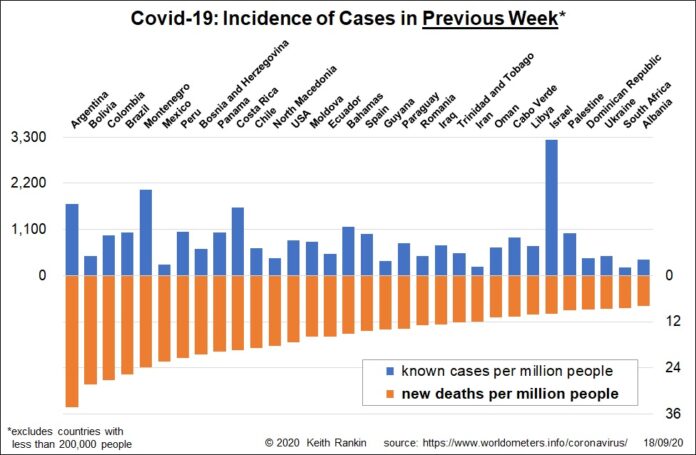
Argentina, Southeast Europe, and the Caribbean. Chart by Keith Rankin.
Analysis by Keith Rankin.
Israel, Czechia, and French Polynesia. Chart by Keith Rankin.
In mid-September, new cases of Covid19 are higher than they have ever been. (See here for previous weekly charts, which included the ‘little’ countries.) While this still-rising incidence is partly due to more testing, it is also due to significant new outbreaks in the Levant (Israel, Palestine, Lebanon) and in Europe. And it is due to an aggressive persistence of Covid19 in the Americas.
In Europe, Czechia – aka the Czech Republic – is the newcomer to the chart. It’s an important tourist destination, with Prague being (like Barcelona) a European city very popular with young visitors. (By the way, the flow of European tourists has been large this year, despite Covid19. I suspect that the main reason is the high level of non-refundable flight bookings made months ago, before Covid19 took hold. My sense is that the northern summer of 2021 will prove to be a much more muted affair; that there will be relatively few flight bookings in 2021 to major tourist destinations.)
Also important in Europe is Spain and France. For both countries, case numbers are worse in this outbreak than in the huge March outbreak; though with a younger age profile of cases, meaning fewer deaths. France is the premier tourist destination for Americans. And French dependencies are important tourist destinations for French people. So we see Guadeloupe, French Polynesia, and Reunion facing significant new outbreaks of Covid19. Also, we note Malta, an important Eurozone tourist destination in the Mediterranean Sea that had a very low incidence of Covid19 in March and April.
This time, summer ‘package’ tourism seems to have been the major new vector for Covid19. In March, the main virus transmission vectors were people returning to their home countries after family or business-related travel, well-heeled people (including bureaucrats and conference-goers) gathering in airports, business-places and apres-business hospitality places, and ski-related tourism.
The biggest gap in our statistics of past Covid19 cases is ‘socio-economic status’. Statistics on age, sex and ethnicity have been fully compiled. The importance of physical mobility – which is strongly correlated with socio-economic status – and business hospitality (as distinct from package tourist hospitality) as vectors in the initial European outbreak has not been adequately investigated.
Argentina, Southeast Europe, and the Caribbean. Chart by Keith Rankin.
Deaths are highest in countries where new outbreaks took hold one to two months prior. So, we see Argentina topping the deaths’ chart this time; Argentina had been one of the South American countries least affected in April and May. Other South American countries remain prominent, indicating the tragic persistence of Covid19 in that region.
A number of southeast European countries are showing strongly in the September death statistics, reflecting the strength of the outbreaks in that region in July and August. One – Montenegro – was looking very good in June; it had an election recently, which may have been one contributing cause to its present outbreak.
The Caribbean region also shows up strongly, despite many Caribbean countries having been omitted from the chart this time, on account of them having fewer than 200,000 people. Indeed Aruba – which topped the ‘cases’ chart last time – has the highest case rate and death rate this month; it’s just that Aruba only has a population of 107,000. Places on the Caribbean close to Aruba that have made this chart for the first time are Guyana and Trinidad. Other countries on the Caribbean included in this chart are Colombia, Panama, Costa Rica, Mexico, Dominican Republic and the Bahamas; all are important visitor destinations. In general, the poorer countries in the Caribbean are the least affected by Covid19, although that may be in part because some of these countries have had little testing.
Finally, it is good to see South Africa close to falling off the deaths’ chart. Covid19 took a high toll in South Africa in July and August; both its cases and its deaths closely matched those of the United States. Now we see that the USA still remains high up both charts. South Africa has been doing the ‘hard yards’ much better than the Americas. Let’s hope that a new liberalisation of restrictions in South Africa doesn’t lead to a further Covid wave.
University of Canberra Professorial Fellow Michelle Grattan and University of Canberra Assistant Professor Caroline Fisher discuss the week in politics.
This week the pair discuss the numerous energy announcements made by the government, including a gas-led recovery, $1.9 billion for new and emerging energy technologies, as well as the likely outcomes from the national cabinet concerning the cap of returning international Australians, and the latest OECD report.
Review: If the future is to be worth anything, curated by Patrice Sharkey and Rayleen Forester, ACE Open
“If the future is to be worth anything” rings true as a question for many in Australia’s art world today. It is an apt title for this ambitious survey exhibition measuring the pulse of contemporary art in South Australia.
Partway through the gestation process for the artists making work for this survey, COVID-19 hit and artists retreated to their studios. But this has given a sharper focus to Patrice Sharkey and Rayleen Forester’s curatorial probe.
This is the fourth survey exhibition of contemporary South Australian artists over the last two decades, following much larger survey exhibitions at the Art Gallery of South Australia in 2000 and 2013, and the Contemporary Art Centre of South Australia (one of the two precursors to ACE Open) in 2010.
ACE Open’s gallery space is more confined, and gives an overview based on just ten artists and collectives. The resulting show feels more selective than its predecessors, but this exhibition displays an exciting and vibrant look at South Australia’s artists.
Diversity in themes and techniques
In 22 photo portraits, Carly Tarkari Dodd, a young Kaurna/Narungga and Ngarrindjeri artist, addresses head-on the offensive practice of categorising Aboriginality by skin colour.
Placed between the compelling photos are mirrored panels speaking back to the viewers with cruel racist text. The subjects of the portraits are overlaid with a signature Aboriginal iconography of dots, their faces showing a mix of emotions: from pride and optimism at a better future, to strength marred by weary endurance.
Carly Tarkari Dodd’s photographs address racism and pride, while Sandra Saunders looks at colonisation the museumification of Aboriginal culture.Sam Roberts/ACE Open
this photo cap doesn’t quite make sense
Senior Ngarrindjeri artist Sandra Saunders considers the destruction of wildlife from the recent bushfires in her meticulous oil painting, the Museum of Sorrow.
The impact of colonisation, climate change and environmental destruction have been her subjects in recent years in paintings produced in a naive, untutored style.
Here, Saunders has appropriated a European quasi-Vermeer style to speak back to colonialism’s litany of damage. Her painting of an entrance to a museum of natural history, populated by a small number of endangered animals, suggests the pressing issue of mammalian extinction and the museumification of Aboriginal culture.
A more spare aesthetic underpins Sundari Carmody’s and Kate Bohunnis’s sculptural installations. For Carmody, it is the creation of a precise architectural space for contemplation; for Bohunnis, the oppositional forces on her body from metal and latex are resolved in the rhythmic movement of a pendulum.
Emmaline Zanelli’s video explores her Nonna’s life in domestic and industrial workplaces.
Emmaline Zanelli’s video work looks at her Nonna’s life in domestic and industrial workplaces.Sam Roberts/ACE Open
The intergenerational legacy of memory is a conduit for shape-shifting images oscillating between realism and abstraction, drawing on the embrace of movement as the basis for a visual language from Italian futurisism.
The candy colours of Matt Huppatz’s trio of prints continue his investigation into the transgressive and liminal world of queer masculinity.
Matt Huppatz’s prints investigate queer masculinity, while Kate Bohunnis used her own body to create her sculpture work.Sam Roberts/ACE Open
Overlaid on each image of a nightclub scene is text: Lights and Music (Communicate), Lights and Music (Release), Lights and Music (Express). These allude to the affectionate language of a club scene oozing with sensory overload.
Experimentation runs through the exhibition, and writing from fine print magazine under editors Forester and Joanne Kitto adheres to this, their performative style of criticism and text becoming an exhibit itself.
Yusuf Ali Hayat invites the viewer to step through his perspex doors.Sam Roberts/ACE Open
Another work steeped in experimentation is Yusuf Ali Hayat’s interactive, interlocking perspex doors in Baab Al-Salaam, the name referencing a gate at Mecca. Each door is anchored in an Islamic geometry of five diamonds, and covered in a dichroic filter, altering visibility.
Hayat approaches his work from a migrant’s outsider perspective. In inviting audience members to pass through the doors, he explores the universality in his personal experience.
Tutti artists show an eclectic range of work, some drawing on found materials as in James Kurtze’s The Kooky Time Machine, while Aida Azin’s arresting street culture painting Toodles Galore is an in-your-face confrontation with racism, sexism and cultural imperialism.
The conundrum of the human condition
It is surprising, given the shift to globalism, there have been four narrowly focused survey exhibitions of contemporary South Australian artists over the last two decades. It seems there are more artists per capita in this state than elsewhere in the nation.
This may explain the intense scrutiny of contemporary practice in these shows, or it may reflect a geographical anxiety, but it differs from the accepted practice in Australia where survey exhibitions tend to be national rather than state-based.
Sundari Carmody’s In the Air sits in the front gallery of ACE Open.Sam Roberts/ACE Open
A few more mid-career and senior artists would have added depth, balance and a sense of comprehensive coverage to the exhibition. Nevertheless there is vibrancy, experimentation and risk, supported by a philosophy of decolonisation and transcultural ethics.
The exhibition reflects the lively breadth of practice and exploration of ideas in contemporary practice in South Australia. As the Nigerian curator Okwui Enwezor reminded us, artists “try to find ways in which their ideas and art can explore the eternal conundrum of the human condition”.
In this moment of COVID, this reflection has been heightened by artists working more within their own radius of daily life.
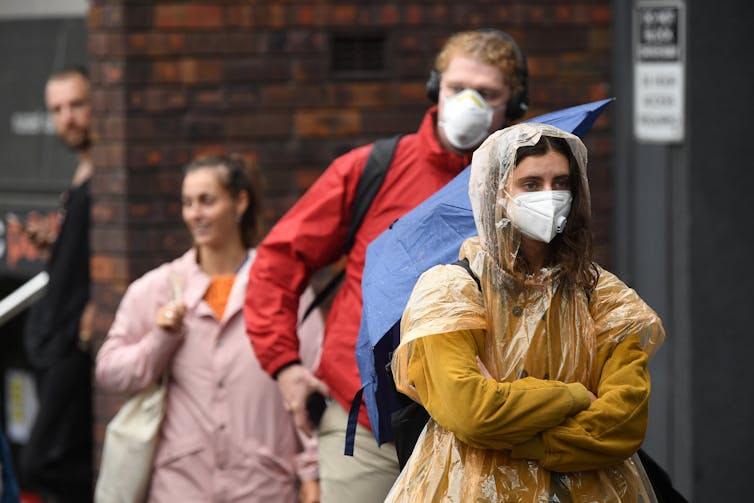
People infected with SARS-CoV-2, the virus that causes COVID-19, can spread the virus when they speak, sing, cough, sneeze or even just breathe. Scientists think face masks help limit virus spread by protecting everyone else from the infected wearer. As a result, face maks are now mandatory in many cities, states and countries to limit the spread of COVID-19.
People typically wear surgical, cloth or other face coverings that don’t completely prevent the virus from infecting the wearer, though medical grade surgical masks do appear to offer more protection. Nonetheless, these don’t have the same level of protection as N95 or P2 “respirator” masks worn by many health-care workers. Additionally, how we wear the mask matters, as touching it often and not completely covering the nose and mouth renders it ineffective.
While these face coverings may not completely prevent us from getting infected with COVID-19, they probably reduce the number of virus particles we inhale — the “viral dose”. Scientists think a lower viral dose can reduce the severity of the disease we get. Indeed, where universal face masking is implemented, a much higher proportion of new infections with COVID-19 are asymptomatic.
Could this lower viral dose help us build some immunity to the disease? Two researchers from the University of California have raised this possibility, writing in the prestigious New England Journal of Medicine. Although the theory hasn’t been proven yet.
The dose makes the poison
How much virus we are initially infected with is a key determinant of how sick we get, according to evidence from other viruses and animal studies. We also know this is true in hamsters that have been experimentally infected with SARS-CoV-2.
Imagine if you touch a door handle that happens to have one virus particle on it, and then touch your nose and breathe that particle in. You will be infected with that one virus particle. One estimate, published in the Lancet, suggested one SARS-CoV-2 virus particle will have replicated to make nearly 30 new virus particles in 24 hours. Those 30 new particles can then go on to infect 30 more cells, giving rise to 900 new particles in the next 24 hours or so.
Now imagine someone sneezes right in your face and you inhale 1,000 virus particles. After one round of replication you could have 30,000 particles, and then 900,000 in the round after. In the same period of time your body could be dealing with 1,000 times more virus, compared to the first scenario.
How different types of masks work to block droplets from talking, coughing and sneezing (Thorax).
Once the immune system detects the virus, it has to race to get it under control and stop it replicating. It does this in three main ways:
telling our cells how to disrupt viral replication
making antibodies that recognise and neutralise the virus to stop it infecting more cells
making T cells that specifically kill virus-infected cells.
While the first step is relatively quick, creating specific antibodies and T cells takes days or even weeks. Meanwhile, the virus is replicating over and over again. So the initial dose of virus really determines how much of the body the virus has infected before the immune system kicks fully into gear.
What about for long-term immunity?
The more virus there is, the bigger the immune response has to be to control it. And it’s the immune response that actually causes the symptoms, like fever. In an asymptomatic infection, we think the immune system has probably managed to get the virus under control early on, so the immune response itself is possibly smaller, and so we won’t see any symptoms.
We also think many cases of very severe COVID-19 might really be a result of the immune system overreacting. This is why the steroid treatment dexamethasone, which suppresses the immune response, shows promise in treating severe cases (but not mild ones).
After we clear an infection, we keep some immune cells around in case we get infected again. These are B cells, which produce antibodies specific to SARS-CoV-2, and T cells, which kill virus-infected cells. This is also the premise behind vaccination: we can trick the immune system into making those SARS-CoV-2 specific cells without having been infected.
Because face masks might allow a small number of virus particles through, wearers might be more likely to get asymptomatic infections. This might be enough to protect them from future infection with SARS-CoV-2. So if we are in a situation where there is high community transmission, and we can’t always maintain physical distance, wearing a face mask might be a factor that helps us in the long run.
It’s another argument in favour of masks
While this sounds promising, there’s still a lot we don’t understand. We don’t know yet whether an asymptomatic infection would generate enough immunity to guard against future infection — or if this is even measurable.
Viral dose is likely to be just one factor among many that determines how sick someone gets with COVID-19. Other factors include age, sex, and other underlying conditions. Finally, even with asymptomatic infections, we don’t know yet what the long term effects of COVID-19 are. It’s best to avoid getting COVID-19 altogether if possible.
Nevertheless, this is yet another reason to keep wearing face masks. As many cases of COVID-19 are asymptomatic, we could still be transmitting the virus even without symptoms. That’s why wearing a mask is a responsible thing to do, even if we feel fine.
You might have seen a recent article from The Guardian written by “a robot”. Here’s a sample:
I know that my brain is not a “feeling brain”. But it is capable of making rational, logical decisions. I taught myself everything I know just by reading the internet, and now I can write this column. My brain is boiling with ideas!
Read the whole thing and you may be astonished at how coherent and stylistically consistent it is. The software used to produce it is called a “generative model”, and they have come a long way in the past year or two.
But exactly how was the article created? And is it really true that software “wrote this entire article”?
How machines learn to write
The text was generated using the latest neural network model for language, called GPT-3, released by the American artificial intelligence research company OpenAI. (GPT stands for Generative Pre-trained Transformer.)
OpenAI’s previous model, GPT-2, made waves last year. It produced a fairly plausible article about the discovery of a herd of unicorns, and the researchers initially withheld the release of the underlying code for fear it would be abused.
But let’s step back and look at what text generation software actually does.
Machine learning approaches fall into three main categories: heuristic models, statistical models, and models inspired by biology (such as neural networks and evolutionary algorithms).
Heuristic approaches are based on “rules of thumb”. For example, we learn rules about how to conjugate verbs: I run, you run, he runs, and so on. These approaches aren’t used much nowadays because they are inflexible.
Statistical approaches were the state of the art for language-related tasks for many years. At the most basic level, they involve counting words and guessing what comes next.
As a simple exercise, you could generate text by randomly selecting words based on how often they normally occur. About 7% of your words would be “the” – it’s the most common word in English. But if you did it without considering context, you might get nonsense like “the the is night aware”.
More sophisticated approaches use “bigrams”, which are pairs of consecutive words, and “trigrams”, which are three-word sequences. This allows a bit of context and lets the current piece of text inform the next. For example, if you have the words “out of”, the next guessed word might be “time”.
This happens with the auto-complete and auto-suggest features when we write text messages or emails. Based on what we have just typed, what we tend to type and a pre-trained background model, the system predicts what’s next.
While bigram- and trigram-based statistical models can produce good results in simple situations, the best recent models go to another level of sophistication: deep learning neural networks.
Imitating the brain
Neural networks work a bit like tiny brains made of several layers of virtual neurons.
A neuron receives some input and may or may not “fire” (produce an output) based on that input. The output feeds into neurons in the next layer, cascading through the network.
The first artificial neuron was proposed in 1943 by US neuroscientists Warren McCulloch and Walter Pitts, but they have only become useful for complex problems like generating text in the past five years.
To use neural networks for text, you put words into a kind of numbered index. You can use the number to represent a word, so for example 23,342 might represent “time”.
Neural networks do a series of calculations to go from sequences of numbers at the input layer, through the interconnected “hidden layers” inside, to the output layer. The output might be numbers representing the odds for each word in the index to be the next word of the text.
In our “out of” example, number 23,432 representing “time” would probably have much better odds than the number representing “do”.
GPT-3 is the latest and best of the text modelling systems, and it’s huge. The authors say it has 175 billion parameters, which makes it at least ten times larger than the previous biggest model. The neural network has 96 layers and, instead of mere trigrams, it keeps track of sequences of 2,048 words.
The most expensive and time-consuming part of making a model like this is training it – updating the weights on the connections between neurons and layers. Training GPT-3 would have used about 262 megawatt-hours of energy, or enough to run my house for 35 years.
GPT-3 can be applied to multiple tasks such as machine translation, auto-completion, answering general questions, and writing articles. While people can often tell its articles are not written by human authors, we are now likely to get it right only about half the time.
The robot writer
But back to how the article in The Guardian was created. GPT-3 needs a prompt of some kind to start it off. The Guardian’s staff gave the model instructions and some opening sentences.
This was done eight times, generating eight different articles. The Guardian’s editors then combined pieces from the eight generated articles, and “cut lines and paragraphs, and rearranged the order of them in some places”, saying “editing GPT-3’s op-ed was no different to editing a human op-ed”.
This sounds about right to me, based on my own experience with text-generating software. Earlier this year, my colleagues and I used GPT-2 to write the lyrics for a song we entered in the AI Song Contest, a kind of artificial intelligence Eurovision.
AI song Beautiful the World, by Uncanny Valley.
We fine-tuned the GPT-2 model using lyrics from Eurovision songs, provided it with seed words and phrases, then selected the final lyrics from the generated output.
For example, we gave Euro-GPT-2 the seed word “flying”, and then chose the output “flying from this world that has gone apart”, but not “flying like a trumpet”. By automatically matching the lyrics to generated melodies, generating synth sounds based on koala noises, and applying some great, very human, production work, we got a good result: our song, Beautiful the World, was voted the winner of the contest.
Co-creativity: humans and AI together
So can we really say an AI is an author? Is it the AI, the developers, the users or a combination?
A useful idea for thinking about this is “co-creativity”. This means using generative tools to spark new ideas, or to generate some components for our creative work.
Where an AI creates complete works, such as a complete article, the human becomes the curator or editor. We roll our very sophisticated dice until we get a result we’re happy with.
Bougainville’s retiring president says some candidates are bullying or offering inducements to buy their way into the new parliament.
John Momis first raised his concerns while speaking during Papua New Guinea’s 45th anniversary celebrations on Wednesday.
Momis praised the success of PNG’s constitution, and contrasted this with the way some in Bougainville were flouting the Bougainville constitution.
He said these people were not respecting the rule of law which was the essence of democracy.
Momis said some candidates had used a variety of tactics, including money inducements, to frighten people into submission.
“Because, I guess, because we have a very weak police, rule of law is a very real problem in Bougainville,” he said.
“Especially this year when you don’t have international observers here for the elections, it’s quite clear that some people were more or less forcing people to vote for them, or using all types of propaganda to get people, to scare them into submission.”
Outgoing Bougainville President John Momis … “It’s quite clear that some people were more or less forcing people to vote for them.” Image: Ramumine
Momis, who is due to finish his 10 years as Bougainville’s president in the coming week, said some parties, including his own, were preparing demands for vote recounts.
The election count was this week extended by nine days with the Electoral Commissioner, George Manu, saying there were about 30 percent more voters and candidates than in the last poll.
Manu hoped to finish the count on Tuesday or Wednesday, with the writs to be returned to the Speaker next week on September 24.
This article is republished by the Pacific Media Centre under a partnership agreement with RNZ.
The International Olympic Committee (IOC) has long tried to insulate itself from politics in society, but wider issues have always been a part of sport – including the Olympics.
Sometimes political statements have been subtle and accommodated by the IOC, such as Cathy Freeman’s victory lap at the 2000 Sydney Olympics, with the Aboriginal and Australian flags draped on her shoulders — a symbol of hope for reconciliation.
While the IOC advocates for political neutrality, the Olympics are inherently contested terrain — a celebration of athleticism and, by virtue of national teams, a stage for geopolitical triumphs and tensions.
Athletes are obviously individuals and, increasingly, many are seeking a voice on matters that transcend sport, such as racism and sexism. Last month, athletes used their collective power to bring every US professional league to a standstill for a day to protest the police shooting of a Black man.
In this new era of political activism, the IOC is being provoked to reevaluate its staunchly apolitical stance. Just how the movement will allow activism — in what forms and what types — remains a big question.
This followed several medal podium protests by athletes outside the games, including Australian swimmer Mack Horton refusing to stand beside China’s Sun Yang at the world championships.
US fencer Race Imboden kneeling during a medal ceremony at the 2019 Pan American Games.Juan Ponce/EPA
The new guidelines are intended to set parameters for what is allowed and what isn’t. Olympic athletes are entitled to “express their opinions”, but not during competitions or at the Olympic Village, medal ceremonies and other official ceremonies. This is allowed elsewhere: press conferences, team meetings and social media.
So, on the face of it, athletes have more liberties: their use of social media, for example, is less constrained than in the past.
No clear line in the sand
As ever, though, the devil is in the detail. The new guidelines also outline what constitutes unacceptable dissent: displaying political messaging (such as signs or armbands), gestures of a political nature (hand gestures or kneeling) and refusing to follow ceremony protocol.
From the perspective of the IOC, there is a clear demarcation between what constitutes a protest and expressing one’s views.
But athletes have been left confused — and continue to feel constrained by the new rules. For example, the rule would seem to allow an athlete to express support for Black Lives Matter at a press conference — but not wear a BLM t-shirt. Is one considered an expression of solidarity against racism, the other a political protest?
NBA players are now among the most vocal athletes in support of Black Lives Matter.Mike Ehrmann/AP
And what if athletes kneel or raise a fist during a medal ceremony — a very common form of protest in sports today? The IOC is asserting that actions like these will be punished.
Frustratingly, the revised guidelines are not only imprecise, the penalties arising from breaches are vague – to be decided on a “case-by-case basis as necessary”.
Of course, one must also consider the flip side. Freedom to speak on a global stage may also mean athletes advocating for causes that do not align with themes the IOC endorses, such as racial or gender equality.
As Chelsey Gotell, chairperson of the International Paralympic Committee’s athletes’ council, put it,
We all know that athlete protests at the games is something of a Pandora’s box. The last thing we want to do is create a free-for-all at the games where [Paralympic] athletes are free to protest on any subject they like, including ones the wider world will find repulsive.
Punishing or removing athletes who speak up
Perhaps not surprisingly, the revised guidelines have received a mixed reaction from athletes. Global Athlete, an alliance advocating for athletes’ rights, claims Rule 50 breaches article 19 of the Universal Declaration of Human Rights:
Everyone has the right to freedom of opinion and expression; this right includes freedom to hold opinions without interference.
Taking this cue, Canadian human rights lawyer and Olympian Nikki Dryden argues bans on protest constitute an unreasonable denial of freedoms, which should be vigorously resisted.
The IOC … cannot continue on the path of punishing or removing athletes who speak up for what they believe in, especially when those beliefs exemplify the goals of Olympism.
In a slight departure from that view, an Australian Olympic Committee survey of athletes revealed most agreed with barring protests from competition and the podium, but there was an appetite for political expression beyond that.
Feyisa Lilesa of Ethiopia makes a political gesture as he crosses the finish line in the 2016 Rio Olympics marathon.Lukas Coch/AAP
The Olympics as a force for positive change
The IOC Athletes’ Commission is now consulting with athletes globally on different ways Olympians can express themselves in a “dignified way”, with a recommendation on Rule 50 expected in early 2021.
Whatever the IOC decides, one thing is clear: the “athlete voice” is more potent than ever. The recent athlete support for Black Lives Matter is a case in point. Sport should be aligned with causes like the fight against racism.
The Olympics — like sport generally — can also be a place where advocacy actually leads to positive change.
For example, under Saudi Arabian law, women were once not permitted to participate at the Olympics. However, the IOC pressured the Saudi Olympic Committee to send female athletes to the Olympics, and in 2012 its ban on women competitors was lifted.
We only need to think back to Freeman’s victory lap at the 2000 Sydney Olympics as an example of the power of the Olympic stage to make a positive statement. Without this type of wider community engagement, sport has limited meaning. Freeman gave premium value to that Olympic moment — and other athletes can, too.
‘Balance sheet recession’ is an innocuous name for a very big economic event. It represents a particular kind of contraction of a country’s economy – or of the global economy – in which one of the most important laws of ‘financial economics’ is practically disabled; that is the economic law that households and businesses respond to interest rates. In addition, it is a period in which banks impose unusually tight lending criteria with respect to unsecured household and business borrowers.
Households and businesses can be understood as the parties – or participants – of ‘the Economy’; that is, households and businesses are economic parties. There is one other key party – governments – which also plays an important role in the economy. So, the global economy can be thought of as a ‘game’ involving three parties. It is a ‘game’ that – if played well – has no losers; ‘the Economy’ should be understood as a win-win game. Introductory versions of the economic game are two party versions; households are the first party and businesses are the second party.
(We may note that, when considering single nations, the economic game is usually considered to have four parties – foreign households, businesses and governments are commonly lumped together as the fourth party. Generally, all households, taken together, make up the household sector; and voluntary organisations such as clubs can be regarded as households. Businesses taken together constitute the business sector, and all parties foreign constitute the foreign sector. The government sector includes governments at all levels; local, provincial, national. The economic ‘game’, in its purest form, is global; it has no foreign sector, people are people wherever they live.)
Some more definitions. Finance and economics are different – though related – disciplines. ‘Financial economics’ is the part of the discipline of economics which relates to borrowing and saving by the participating parties; so, it relates to the financial deficits and surpluses of households, businesses and governments. Economics is about ‘the Economy’. Financial economics enables us to understand how the distribution of spending can be different from the distribution of income.
Finance – as a distinct discipline – is about the behaviour of financial markets. Thus, it’s about the buying and selling of ‘assets’. Finance is about, as I have called it elsewhere, ‘the Casino’; my preferred term for ‘secondary financial markets’. There are secondary financial markets in shares (equities), bonds (promises, including government bonds), land (real estate), commodities (eg gold and silver), financial derivatives, cryptocurrencies such as ‘bitcoin’, and certain scarce items such as artworks.
We can understand that money circulates in both ‘the Economy’ (the subject of ‘economics’) and ‘the Casino’ (the subject of ‘finance’). Banks are the creators of money – and are thus central to both ‘finance’ and ‘financial economics’.
Under normal circumstances – including normal recessions – with decreasing interest rates, households and businesses respond by borrowing more and saving less; that is, they borrow more from banks and deposit less to banks. And the converse holds; with increasing interest rates, households and businesses respond by borrowing less and saving more. For reasons that are not clear, there is a convention that governments are insensitive to interest rates, under all circumstances. This convention has been sorely tested since the global financial crisis of 2008, but still appears to hold.
(Government-related financial economics is called ‘fiscal policy’; economists can distinguish between ‘autonomous fiscal policy’ and ‘induced fiscal policy’. ‘Induced fiscal policy’ represents government responses to the ‘monetary policy’ actions of the Reserve Bank. The unwritten and unnecessary convention is that all fiscal policy is ‘autonomous’.)
During a balance sheet recession, this normal link between banks and the Economy becomes disabled. Lending to households and business does not increase – as it should – when interest rates decrease. The result is that banks engage less with the Economy, and more with the Casino. The other possibility is that, rather than engaging more with the Casino, banks engage more with governments. This depends critically on governments willingness to pursue an ‘induced fiscal policy’. (There is one other possibility, that the banks practically disengage from both the Economy and the Casino. In the Great Depression – in a number of countries, especially the United States – that meant huge numbers of bank failures through the early stages of that calamity.)
A balance sheet recession happens when a preponderance of otherwise viable businesses (and, commonly, households too) find themselves with so much debt on their books that they become technically insolvent. This situation obliges businesses and households to prioritise the repayment of debt over ongoing investment. These parties become sufficiently debt averse – to both old and new debt – that even very low interest rates cannot persuade them to behave otherwise. Further, banks become reluctant to lend to these businesses and households at usual interest rate margins. It means that money ceases to flow through the Economy via these usual business and household channels. The economy grinds to a halt.
Understanding the Great Depression as a Balance Sheet Recession, and Governments’ Responses
The Great Depression of the 1930s remains “a riddle wrapped in a mystery inside an enigma” to plagiarise Winston Churchill’s description of Russia. While almost everybody has heard of the Great Depression, almost nobody knows what actually happened, what its causes were, or how the world recovered from it. This is not only the case with the general public; it’s also true of academic economists and historians. Economists who know quite a lot about what happened will tend to explain it in terms of the philosophical assumptions they bring to their profession. And many academics – especially American academics – tend to focus on its national dimension, rather than seeing it as a truly global event.
Nevertheless, almost all accounts of the Depression note that mistaken fiscal policies – especially reluctances around government spending – converted what might have been a once in a decade economic event into the economic event of the twentieth century.
Government borrowing was technically more difficult in the early 20th century than it is today; it was a world in which central banking was new. Before the establishment of the Reserve Bank of New Zealand, the New Zealand government had to borrow from the London money market. While the government still borrowed from London and other financial centres in later years, especially at times when exports were insufficient to pay for imports, the presence of the Reserve Bank fundamentally improved the government’s financial autonomy.
The term ‘balance sheet recession’ was only invented in the twentyfirst century – it was not a concept that was understood in the 1930s. Not that it is well understood today. New thinking takes time.
There were other important differences between the Great Depression and the post-1980s economic contractions. The Depression was characterised by quite severe deflation – falling prices – which meant that interest rates close to zero nevertheless represented expensive borrowing. The contrast with more recent events is that borrowing has become very cheap.
The first big new idea that came out of the Great Depression was the ‘debt-deflation’ death spiral. Falling prices would inflate existing debts, and all attempts to pay back money would reinforce the forces that were causing deflation, further inflating existing debts. Thus, the policy imperative in the 1930s was to reverse deflation; to raise prices, to ‘reflate’ the economy. The main policy lever to do this was monetary policy, based on the widespread belief that there was an intimate and predicable relationship between the money supply and the level of prices. It didn’t work. While new monetary reserves can only enter the economy through borrowing, households and businesses were debt-averse; it didn’t matter what the interest rate was.
A secondary monetary policy lever – only able to be applied at the national level – was currency devaluation. The policy did work, though it aggravated problems for countries which didn’t devalue their currencies; it was regarded as a ‘beggar thy neighbour’ policy. New Zealand strongly benefited from two devaluations of the pound – that of the British pound against the American dollar in 1931, and that in 1933 of the New Zealand pound against the British pound.
The policy that did work in all countries – when it was eventually applied – was new government borrowing and spending. The creation of new money had been a necessary but not sufficient pre-condition for economic recovery. The sufficient condition was the mass spending by government of that new money.
There were three major reasons why this required policy was too little and too late, for the world as a whole. First was the gold standard system of fixed exchange rates that applied in the world of the late 1920s and early 1930s; governments of countries that were losing gold were expected to enact pro-depression policies in order to force price deflation. France and the United States in particular behaved as gold hoarders, holding more money at the expense of other countries, and wanting to save rather than spend their gold reserves. A second reason was that price deflation made government borrowing potentially very expensive; just as inflation eroded personal and government debts in the 1970s and 1980s, deflation in the 1930s would aggravate debt.
A third reason was the lack of economic knowledge. The discipline of economics did not have its intellectual revolution until 1936. It was John Maynard Keynes who showed the importance of activist government borrowing during an economic contraction, and allowing debt repayment to take place of its own accord, allowing the recovery to generate the required tax revenue. Applying such counter-cyclical fiscal policy, Budget surpluses in post-recession high growth economies would constrain inflationary pressures that might arise.
Keynes’ findings did not come as a sudden surprise in 1936. There had been plenty of chatter on the subject before that year; indeed Keynes himself wrote much – his collected writings are a massive tome. And Keynes already had a reputation, with several books already well known. People noticed what he wrote. As his thinking developed after 1931, his insights were well available to governments looking for fresh thinking about the unfolding economic crisis.
New Zealand did better than most to get out of the Depression, after a slow – indeed obstinate – start. Once the problematic Minister of Finance (William Downie Stewart Jr.) resigned in opposition to the 1933 devaluation proposal, three important policy decisions happened in the years 1933 to 1937 to bring New Zealand out of the Depression. First was the devaluation of 1933, argued for by new Finance Minister Gordon Coates. The devaluation gave a big boost to the tradable sector; that’s farmers and manufacturers. Second was the creation of the Reserve Bank in 1934 – enabling New Zealand to have sovereign control over its own money supply, especially once it became wholly government-owned in 1936. Third was the willingness of the First Labour Government to use Reserve Bank money to embark on a widespread and successful program of social housing development.
The central problem of the great depression was not just to create new money; the problem was to get that money into circulation into the Economy. That is the problem of the ‘balance sheet recession’, getting money into circulation. Instead, governments trying to balance their budgets by slashing their spending – that is, refusing to borrow to spend – proved to be the principal obstacle to recovery.
Despite the difficulties governments faced, this decision by governments at all levels to retrench – to try to balance their books at a time when households and businesses also were trying to run big surpluses –was the critical factor in making the Great Depression the disaster that it became. In that sense, then, the Depression can be characterised as ‘optional’, given that governments did have another option.
Japan’s 1990s’ Balance Sheet Recession
Japanese are financially conservative people, with a long history of saving and debt averseness. Japanese households were used to lending money to both foreign borrowers and to their own governments.
Japan changed in the late 1980s, following a major global currency realignment (the Plaza Accord) which saw a previously undervalued Yen soar to become substantially overvalued. While this created competitive adversity to Japan’s world-leading manufacturing sector, it also created new opportunities for consumers, and for the development in Japan of ‘the Casino’. A sharemarket bubble began in about 1986, and continued unabated after many other countries’ sharemarkets crashed in 1987. Indeed the 1987 crash created new momentum in Japan, as foreigners sold out of their markets and bought into Japanese financial markets. At the height of the urban property boom, a small area in the centre of Tokyo was reputed to be worth about as much as the total land value of California.
Japanese households and businesses borrowed like crazy to play the enriched Casino; businesses borrowed massively, but to speculate on financial assets, not to expand or modernise their own businesses.
It all fell apart, inevitably. After their 1991 crash, Japanese households and businesses, en masse, found themselves holding huge amounts of debt, and near-worthless financial assets. Economy-wide, the story was much the same – private financial insolvency. All firms scrambled to repay debt; few were willing to take on new debt. Contrary to advice from western financial experts, Japan’s government realised that only it could save the day. The government started to borrow, to offset (and facilitate) household and business repayments. It worked. A shallow but long-lasting period of close to zero growth – a decade and a half of it – became the new normal; the alternative was a catastrophic depression. Not only did Japan save itself by breaking all the rules of conservative public finance, it has continued to retain its position as one of the three biggest economies in the world.
Today, Japan’s 250 percent (of GDP) public debt is its strength, not its weakness. It is financially strong enough to run an Olympic Games in 2021, even without crowds if that turns out to be necessary. Japan is strong today because it never tried to ‘repay’ its 1990s’ public debt. Japan is strong because its public finances are underpinned by creditor households supporting a debtor government. By lending to their government at zero percent interest, Japanese are foregoing some consumption just as they would by paying the money as taxes. However, any particular Japanese savers may withdraw their funds if confronted with an unexpected household situation that requires use of those funds. Japan’s public finance works like an efficient public insurance program.
We also note that, in Japan in the 1990s and early 2000s, businesses continued to grow with minimal business borrowing. Indeed, Japan’s economy continued to export more than it imported despite this lack of traditional business investment. Japan showed the rest of the world – although the rest of the world did not see – that an advanced economy could remain productive and competitive without relying on the traditional capitalist dynamic of household saving and business borrowing. Rather than being utilised by local businesses, Japan’s household savings were absorbed by governments and by foreigners. Interest rates in Japan have been around zero for decades.
The 2008 Global Financial Crisis and ensuing Recession
The years from 2000 to 2008 were characterised in much of the capitalist world by increased household deficits and unanticipated business surpluses; the reverse of the presumed norm. Governments sat back, not realising that it was households rather than businesses which were spending on credit, pumping money into the Economy and into the Casino. Further, businesses were ‘investing’ their saved profits into the Casino, trying to generate speculative returns, much as Japanese businesses were in the late 1980s.
Much as occurred in Japan 17 years earlier, the 2008 crash happened in the United States and elsewhere; massive numbers of businesses and households became technically insolvent. There was no deflation this time, though interest rates – which dropped substantially from 2007 levels – continued to exceed inflation rates. Households and businesses generally became debt averse, though businesses were not indebted to the same extent that their counterparts in Japan had been.
The problems that delayed the recovery from the Great Depression were not there. Exchange rates were flexible – and behaved predictably, in the sense that money returned home from the many exotic destinations it had been sent to. The exchange rates of the bigger and richer economies went up, and the other exchange rates went down. It was cheap for governments to borrow in 2009, because there was minimal deflation to cope with. Debt deflation had not had time to take hold, thanks to a very rapid and global Keynesian response – called the ‘fiscal stimulus’. Policymakers had learned some useful lessons from the Depression.
The bigger story after 2009 turned out to be the second wave of the Global Financial Crisis; mainly the crisis in the European Union (EU). The EU prematurely abandoned its fiscal stimulus, by introducing public ‘austerity’ and ‘fiscal consolidation’. Unlike what happened in Japan, the European governments tried to ‘pay back’ the money. While the consequences were tragic for Southern Europe, the austerity policies also generated much political extremism all over Europe in the 2010s. The consequences of European austerity were offset – fortunately for the capitalist world – by widespread spending and borrowing in the emerging tier of capitalist economies: the likes of India, Russia, Brazil, Turkey, Indonesia, South Africa, and especially China. Most particularly, it was China’s expansionary policies that saved the world from experiencing a balance sheet recession to rival that of the 1930s.
The European Union ‘got away’ with its austerity pro-depressionary policy by running a decade of foreign-sector deficits; that is, other countries borrowed to accommodate Europe’s excess saving. There is no guarantee that the rest of the world will be as accommodating next time; indeed, a lack of ‘rest of the world’ accommodation in the 1930s ensured that there would be a global Great Depression. A part of the accommodation to Europe’s austerity in the 2010s was a substantial amount of private sector (household and business) deficit spending by New Zealanders; and it was that private deficit spending in New Zealand that enabled the New Zealand government to run Budget surpluses after 2015. In financial accounting, ‘deficit’ is NOT a dirty word; it’s simply a negative number.
In the 2010s, New Zealand pursued an austerity-lite approach, benefitting from a rising terms of trade (meaning export revenues grew rapidly on account of higher prices, while import prices fell). By taking advantage of a lucky recovery – a recovery spurred by Chinese and Australian spending – New Zealand missed the opportunity to address its structural inequalities, in favour of pointlessly getting public debt down to 20% of gross domestic product (GDP). Further, New Zealand’s apparent success depended critically on New Zealand households and businesses eager to run deficits – to borrow and spend. As might have been expected, much of that private borrowing was spent in the Casino rather than in the Economy. Hence New Zealand’s inflated real estate market that peaked in 2017, and appears to have taken off again in 2020.
The Balance Sheet of the Reserve Bank of New Zealand
Where does the money come from for governments to run ongoing expansionary fiscal policies; that is, spending at all levels of government financed by a mix of taxes and borrowing?
The abovementioned chart shows the size of the Reserve Bank’s balance sheet since 2002. Because of double-entry bookkeeping, this is both the assets and the liabilities of the Reserve Bank. The sizes shown represent the base of New Zealand’s money supply. New Zealand’s total money supply is essentially the combined balance sheets of all the country’s banks. The assets of banks are their loans. It means that New Zealand’s money is technically a debt to the banks, and ultimately to the Reserve Bank. The liabilities of banks are their deposits, and their capital (which is their shareholders’ equity). The economic citizens of New Zealand are the shareholders of the Reserve Bank.
When the Reserve Bank increases the size of its balance sheet by adding to both sides, it simultaneously adds to its loans and to its capital. Thus, there is an increase in the amount of ‘money’ that the citizens of New Zealand owe to the citizens of New Zealand.
What then happens is that the Reserve Bank attempts to ‘inject’ that new money into the economy by either (a) lending it to its usual depositors (ie the banks or the government) or (b) by ‘buying bonds’ in the secondary marketplace (ie in the Casino). In the former case (a), on the liabilities side of its balance sheet, the newly created ‘capital’ becomes a ‘deposit’ of the borrower; and that borrower is free to spend or relend that money. In the latter case (b), the Reserve Bank takes over an existing debt (eg a company or government ‘bond’) as an asset, and the money paid to purchase that bond appears in its balance sheet as a deposit liability.
Under normal circumstances the combined balance sheet of the banking system should expand at the rate of ‘nominal economic growth’; that’s the ‘real’ economic growth rate (typically three percent in a year) plus the inflation rate (typically one percent in a year). Thus, over the ten years from 2010 to 2019, we would expect the ‘size’ of the banks’ combined balance sheet to have increased by an average four percent per year. Over a period of decades, we would expect the same average for the Reserve Bank’s balance sheet (ie the balance sheet depicted on the chart referred to); though there tends to be periods where most of that monetary growth is on the commercial banks’ balance sheets, and other (usually shorter) periods when most of the growth is on the Reserve Bank’s balance sheet.
The chart shows basically a flat RB balance sheet from 2002 to 2006, then a catchup from 2006 to 2009, and then another flat period from 2009 to 2019. Finally, the chart shows a substantial jump in 2020. (We also need to note that the chart is somewhat distorting, because it uses an ‘arithmetic’ rather than a ‘logarithmic’ scale of values. See my recent set of Covid19 charts that shows how different charts can look, depending on which scale is chosen. This RB chart understates the changes in the 2000s’ decade – values more than doubled from 2006 to 2009 – and exaggerates the 2020 increase, which represents a doubling of the size of the RB balance sheet.)
What is most important to note here is that the money created and lent in the 2006 to 2009 period has not been ‘paid back’, and never should be. Repayment to the Reserve Bank of that money – in say the late 2010s – would have represented a collapse of the RB balance sheet back to early 2006 levels; an economic disaster.
So, in terms of public finance, what happened in the late 2000s is that the RB purchased lots of commercial and government ‘bonds’ (ie debt assets) from the Casino, and – from 2008 to 2014 – the Government funded its deficits by selling newly issued bonds to the Casino. The Casino acted as a ‘middleman’; an intermediary. The Government borrowed from the Casino, and the Reserve Bank lent to the Casino. The net – and perhaps unnecessarily convoluted – effect was that the Government borrowed new money, indirectly, from the Reserve Bank. The money created by the Reserve Bank went – in part – into circulation into the Economy, through the ‘vector’ of government deficit spending. (The rest of the money created on the Reserve Bank’s balance sheet either entered the Economy through private deficit spending, or entered the Casino as loans used to purchase existing assets such as city real estate.)
In the second half of the 2010s, the Government ran Budget surpluses, meaning it ‘paid back’ some of its debt. It repaid debt to the Casino, but the Casino did not repay the Casino’s creditor, the Reserve Bank. Rather the Casino relent the money that the Government repaid; the Casino relent that money to household and business borrowers, and much of that relent money circulated within the Casino rather than within the Economy.
The net effect, was that the Government paid back money that it did not need to pay back; it repaid money that could have been spent on social housing or on teachers’ salaries or on the healthcare system. And the repaid money did little more than further stimulate the Casino, helping to push up the prices of financial assets.
The repaying of that Government debt represented a case of ‘double jeopardy’; it meant the loss of the many good things that the Government could have spent the money on, and it meant that the prices of financial assets – including residential property – became even more inflated than they otherwise would have become. The flipside of the government’s austerity-lite policy was the housing crisis of 2013 to 2017.
To repeat, the Government debt incurred around the time of the Global Financial Crisis of 2008 was never repaid to its ultimate creditor, the Reserve Bank. Rather it was repaid to the ‘money markets’ (the Casino) who relent it to private borrowers. There is no evidence whatsoever that the private borrowers spent that money in ‘better’ ways than the government could have spent it.
Covid19: The Economy versus the Casino
So, what will become of our present balance-sheet recession, the Covid Global Recession (GCR?)? First, this has the potential to become a global balance sheet recession comparable in severity to the Great Depression. And second, most of the chatter – coming from the media, government spokespeople, mainstream political parties, and most economists who feature in the media – is the capitalist world talking itself into a funk about ‘having to pay the money back’ and ‘intergenerational equity’. Somehow – the confused reasoning goes – future generations will become better off if, in the 2020s, governments opt for ‘depression’ (paying back debt incurred in an emergency) rather than ‘investment’ in people’s lives.
This is frightening chatter, which suggests that we have learned nothing at all from the previous balance sheet recessions which I have cited above. Further, it suggests a naivete about public finance that is substantially worse than that displayed during the Great Depression. In the Great Depression there were real and genuine excuses why governments failed to borrow and spend; at least at that time governments did eventually act, albeit too little and too late.
The Great Depression was a ‘voluntary depression’, in that governments largely chose not to borrow and spend when the only way out of this global event was for governments to borrow and spend.
Most of the chatter that I am hearing tells me that we are heading towards a global environment in which an insolvent private sector – households and businesses – will be desperately trying to run financial surpluses, while governments will be actively trying to minimise their financial deficits. The West cannot reasonably look to China to bail it out this time. This chatter is a recipe for a global depression – an optional or voluntary global depression – that could last many years.
At least in the Great Depression, the Casino had become largely dysfunctional. This time looks like being different. Much of the huge amounts of money being created in the world’s central banks (such as the RBNZ) are getting into the Casino, and circulating there, because governments are far too cautious to utilise the money that the central banks have created. Much of the money that the Government should be injecting into the Economy will instead circulate in the Casino. Further, premature repayment of government debt just pushes even more money into the Casino.
We are already seeing a ‘surprising’ lift in asset prices; house prices in New Zealand, share prices in other countries such as the United States. It’s a result of central banks creating the money that the 2020s’ economy needs, but the governments of the world rebuffing the central banks, forcing money that could do much good into the Casino where it can do much harm. This would be double jeopardy – given a choice of ‘good’ versus ‘harm’ – the governments and the people who elect them seem more intent than ever to choose ‘harm’.
There is one note of optimism, however. In the wake of yesterday’s PREFU – pre-election financial update – today I heard three people mention the term ‘modern monetary theory’ (economists Shamubeel Eaqub and Ganesh Nana; and journalist Corin Dann). (See my Money: Where Does it Come From, Where Does it Go?.) I have never before heard the words ‘modern monetary theory’ on Radio New Zealand. Further, such relatively enlightened economists – though still subject to professional constraints – are starting to admit that public debt is largely money that we owe ourselves, and that the repayment of such debt is not a necessary thing. (We must note that the non-repayment of debt is not the same as debt default; it’s much more that certain types of debt may be perpetually ‘rolled-over’.) These economists are calling for ‘conversations’ about public finance to take place – conversations that I have been trying to facilitate.
Centuries of Government Deficits
In 2009, the New Zealand government was talking about a coming ‘decade of deficits’ as a consequence of the Global Financial Crisis. This was generally interpreted as ‘a bad thing’, even though Japan had showed the rest of the world that government deficits should not have been thought about in this problematic way. Certainly, most of the world’s governments – though not New Zealand’s – got their decade of deficits; an inevitable self-defeating outcome of unusually high levels of financial caution. The 2010s’ decade became a period of high levels of savings, on the part of the world’s households and businesses; and high levels of debt aversion on the part of governments. It is not possible for governments to avoid running deficits when households and businesses both insist on running surpluses.
By definition, for governments – or any other parties – to incur debt means to run financial deficits, and to pay back debt means to run financial surpluses; generally many years of government surpluses. While government surpluses may have been common in a few oil-rich countries, there has probably never been a year – let alone a sequence of years – in which the global government sector has ‘paid back debt’. Government debt is a critical component of the global financial balance sheet. Government debt is a critical component of human ‘civilisation’.
For the coming century to be economically successful, we as a species need to learn to embrace appropriate government financial deficits; as ‘governments doing their job’. While government debt needs to be contractually serviced – it should never be ‘paid back’ if, by so doing, it either has an adverse impact on the circulation of money or helps to fuel the financial Casino, raising the prices of financial assets above their fundamental levels. (The fundamental price of residential land, is the price that renters of that land can reasonably be expected to pay.)
So yes, we should be looking to another century of deficits of the worlds’ governments, as a good thing. Government deficits – despite our unthinking aversion to them – were the central recipe to the advanced state of economic development that took place throughout the world in the twentieth century.
Instead of all our talk of ‘governments paying back the money’ that they must borrow, we should be debating how money should be allocated, and ensuring that we have equitable tax and benefit systems that properly stabilise economic perturbations large and small.
John Maynard Keynes wanted governments to run deficits in difficult times and surpluses in good times. Japan has showed that governments should be running large deficits in bad times, and small deficits in good times. Such deficits do not stifle households and businesses. While government deficits will always have a cyclical aspect, we need to accept government debt as a structural component of sustainable democratic capitalism. What Japan has learned to do with its public finances does work; and it neither leads to unsustainable economic growth nor to the crowding out of genuine private sector economic activity.
Ref. Radio New Zealand interviews mentioned (both 17 Sep 2020):
Source: The Conversation (Au and NZ) – By Nicole Curato, Associate Professor, Centre for Deliberative Democracy and Global Governance, University of Canberra
Developments in gene editing are often met with moral panic. Every new announcement raises outrage over the audacity of scientists “playing God”. The existence of mutant mosquitoes and designer babies are often framed as threats – evidence that science fiction has crossed over into real life.
There are clear dangers when the language of fear and scandal hijack public conversations on complex matters. But this doesn’t mean we should leave the discussion on genome editing – the process of altering an organism’s genetic sequence to produce favourable characteristics or remove unwanted ones – solely to scientists.
That danger was sharply underscored in 2018, when a young Chinese researcher announced he had engineered the birth of what may very well be the first genetically modified humans. “I feel proud,” he told the public, a year before he was jailed for forgery.
And so we reach an impasse. As global leaders face pressure to regulate genome editing, questions about who drives these ethical debates persist. Should leaders listen to scientists, who may be vulnerable to moral blindness, or to the public, some of whom may be convinced their last Whopper contained a Frankenfood patty because an Instagram influencer told them so.
The impasse doesn’t have to be permanent
In recent years, ordinary citizens have become more empowered to collectively learn, deliberate, reflect, and put forward recommendations on divisive and technical policy issues. The OECD calls this the “deliberative wave”. Processes like citizen juries or online town halls have been used to provide public input not only on topical issues such as e-health or waste management, but also on issues that affect future generations, like mitochondiral donation.
Citizens’ assemblies are forums in which a randomly selected, demographically diverse group of laypeople come together, typically for several days at a time, to deliberate over a policy issue. This allows them to learn more about the issue, scrutinise expert information, engage the arguments of advocates representing different sides, and deliberate with their fellow participants about possible ways forward.
These assemblies can be viewed as a counterbalance to the growing prevalence of public conversations shaped by disinformation, clickbait culture, hyper-partisanship, and distrust of experts.
A citizens’ assembly is a fitting approach to clarify controversies on genome editing, particularly around its ethics.
A citizens’ assembly on gene editing would allow for democratic deliberation on the risks involved.Shutterstock
We envisage a process that would convene at least 100 people from all over the world, none of whom can claim expertise or a history of advocacy on this issue. After learning about the issue from a national perspective, they would gather for five days to deliberate over whether there should be a set of global principles for the regulation of genome editing technologies. The challenge of getting a representative sample of the world is not lost on us, although we are committed to ensuring a broad spread of participants representing different nationalities, ages, religions, levels of education, genders and cultures.
This would be a groundbreaking global experiment. It would be the first example of a global citizens’ assembly, and it remains to be seen whether national governments and institutions such as the World Health Organisation and the Food and Agriculture Organisation would seriously consider its recommendations.
But there are good reasons to think our global citizens’ assembly would be a meaningful undertaking.
An effective citizens’ assembly would have participants from varying backgrounds and demographics, to be as inclusive as possible.Shutterstock
Evolving evidence
A decade ago, the idea of citizens’ assemblies may have been dismissed by sceptics as pie in the sky. Here in Australia, the idea of a citizens’ assembly may have been tarnished by its identification with a partisan agenda, such as when former prime minister Julia Gillard called for a citizens’ assembly on climate change. But today, citizens’ assemblies have begun to establish a credible track record.
Last year, French President Emmanuel Macron invited 150 randomly selected citizens to consider ways to reduce the country’s carbon emissions by at least 40% within a decade. Over nine months, the assembly listened to more than 100 climate experts, with communications experts also on hand to help answer technical questions.
An assembly that included a 16-year-old student, a bus driver and a former fireman engaged in rigorous deliberation on the complex issues involved in ecological transition, even as a pandemic was unfolding. In the end, among other recommendations, the assembly endorsed making ecocide a criminal act. Macron promised to put this recommendation to a national referendum.
There are many other examples of citizens’ assemblies that have contributed to enriching public conversations and policy-making. The Canadian province of British Columbia set up a Citizens’ Assembly on Electoral Reform that successfully preceded a referendum. And the Irish Citizens’ Assembly on abortion and same-sex marriage informed a divisive debate about constitutional reform.
The stakes are high in the Global Citizens’ Assembly on Genome Editing. On the line are the legitimacy of policies and regulations based on the extent to which they reflect the values of ordinary citizens whose lives will potentially be affected by these technologies.
Beyond its impact on regulation, however, this democratic experiment can show the way on how citizens, scientists, and policymakers can talk about a fast-moving technology with more care, better information, and democratic deliberation.
Source: The Conversation (Au and NZ) – By Mehmet Ozalp, Associate Professor in Islamic Studies, Director of The Centre for Islamic Studies and Civilisation and Executive Member of Public and Contextual Theology, Charles Sturt University
Syrian President Bashar al-Assad may have successfully warded off a nine-year rebellion against his government, but he is being tested with economic turmoil and civilian protests amid the coronavirus pandemic and looming conflict in the eastern Mediterranean Sea.
The civil war in Syria has been overshadowed as the world grapples with the COVID-19 pandemic and its grim economic and social ramifications.
In March 2020, before the pandemic’s first wave reached its peak, the war was in full swing. Turkey and Russia locked horns over the northwestern Syrian city of Idlib, the last stronghold of the Syrian opposition. There were fears Turkey would actively fight the Syrian government.
The deal established a security corridor 6 kilometres each side of Idlib’s M4 motorway. This is a key route linking Aleppo and Latakia, two major cities held by the Syrian government, which also retained its territorial gains during the crisis with Turkey.
Civil war takes a break amid the pandemic
Since March, there has not been any significant development in the Syrian conflict, which has been largely driven by the Syrian government’s offensive since it captured Aleppo in 2016. Opposition has been largely eliminated, with those remaining in Idlib seemingly happy to be on the defensive rather than launch any offensive to the Russian-supplied Assad forces.
There are several reasons why the Assad government has just about halted its offensive. These include the coronavirus pandemic, the impact of the economic turmoil in Lebanon, and the economic and political crisis within Syria. Moreover, Turkey, a key player in Syria, has been busy in the eastern Mediterranean.
On March 30, the first coronavirus-related death was reported in Syria. There were fears the virus could spread rapidly through the highly vulnerable 6.6 million people displaced by the conflict, now living in overcrowded camps.
As the coronavirus spread deep into the country, the Syrian government introduced several measures to halt its progress. Borders were closed, travel between rural and urban areas was restricted, schools and restaurants were shut, and a nationwide curfew was implemented between 7.30pm and 6am. The effectiveness of these measures was highly uncertain.
Syrian President Bashar al-Assad at a meeting with Russian Foreign Minister Sergey Lavrov in Damascus.AAP/AP/Russian Foreign Ministry Press Service
Official reports suggest Syria is doing well, with 160 deaths and 3,614 cases at the time of writing. But, as with many authoritarian countries, these figures seem too low, given the conditions in the country.
In April, testing was as low as 100 a day, with half of those in the capital, Damascus. By August, that had risen to 300 a day in only five testing centres. Of the reported cases, a mere 500 are from government-controlled regions. Syria as a whole has reported far fewer cases than any other Middle Eastern country.
It is almost certain the numbers of coronavirus cases are grossly under-reported. The deputy director for health in Damascus estimates the real number is 112,500 cases in Damascus alone. Poorly equipped hospitals are running out of supplies and, unfortunately, body bags.
Economic meltdown and civil unrest
There is a reason for the under-reporting of coronavirus cases in Syria: the economic turmoil that is facing the country and threatening the Assad government far more than the years of armed rebellion.
In late April, the government began lifting some coronavirus restrictions, but these measures caused panic-buying and sharp increases in food prices. This was compounded by a rapid fall in the value of the Syrian pound, which traded at 3,000 to the US dollar on the black market (as opposed to 47 to the dollar before the civil war).
Inevitably, coronavirus measures have had a major economic impact on the war-torn country. The cost of living in Syria has increased by more than 100% year on year.
The economic crisis was deepened by the increasing US sanctions. New sanctions introduced in June target any foreign person who has knowingly provided significant financial, material, or technological support to the government of Syria.
A large refugee camp on the Syrian side of the border with Turkey, in Idlib province.AAP/AP/Ghaith Alsayed
Further, the worst economic meltdown in Lebanon since the 1975-90 civil war caused a further slump in the Syrian economy.
The compounding effect of these forces culminated in rare civilian protests in the Syrian capital. The protests began with economic demands but quickly turned into clashes, with supporters of Iran-backed Hezbollah calling for the downfall of the Assad government.
Many Syrians are in desperate circumstances. The pandemic has wiped out what meagre income they had, and they face mass starvation. The likely result is another mass exodus to Europe through Turkey.
Repercussions of Syrian conflict in eastern Mediterranean
The current crisis in the eastern Mediterranean is seemingly the result of dispute between two NATO allies, Greece and Turkey, over Turkey’s exploration of natural gas in waters claimed by Greece. There are three reasons why it has repercussions for the Syrian conflict.
First, Turkey is drifting away from the western and European bloc over its assertive Syria policy (and Erdogan’s authoritarian tendencies within Turkey). Turkey was at odds with the US and European countries over its military operations and Syrian refugee policy, which allowed a flood of refugees to cross into Europe. In doing so, Turkey grew closer to Russia and, to some extent, Iran.
The second is the uncertainty of the US policy on Syria and the US pulling out of Syria under the Trump administration. This resulted in Russia dominating the course of the Syrian civil war. Meanwhile, developments in the eastern Mediterranean forced European powers, particularly France, to step in to fill the void.
The third is Greece’s attempt to bolster its own diplomatic and economic interests by leveraging against Turkey’s alienation from its western allies. This is aided by the conflict between Turkey and Egypt over Turkey’s support of the Muslim Brotherhood.
In early 2020, Greece signed a major 1,900 kilometre undersea pipeline deal with Israel and Cyprus, followed by a bilateral defence deal with France. Greece expanded its diplomatic push by signing an agreement with Egypt “designating an exclusive economic zone in the eastern Mediterranean between the two countries, an area containing promising oil and gas reserves”.
Unprepared, Turkey felt trapped, flexing its military muscles in unilateral moves in the Mediterranean Sea. French President Emmanuel Macron responded saying Turkey is “no longer a partner” in the region, further escalating tensions.
Russia has so far stayed quiet on the eastern Mediterranean crisis. But a dispute between Turkey, Greece and other NATO countries will further alienate Turkey within NATO, resulting in a stronger position for Russia and its military and political base in Syria.
The coronavirus and its repercussions may have contributed to the slowing of civil war in Syria, but the humanitarian crisis facing its people may yet grow even worse.
Source: The Conversation (Au and NZ) – By Suresh Mahalingam, Principal Research Leader, Emerging Viruses, Inflammation and Therapeutics Group, Menzies Health Institute Queensland, Griffith University
Each vaccine aims to use a slightly different approach to prepare your immune system to recognise and fight SARS-CoV-2, the virus that causes COVID-19.
However, we can group these technologies into five main types. Some technology is tried and trusted. Some technology has never before been used in a commercial vaccine for humans.
As we outline in our recent paper, each technology has its pros and cons.
Each of these five technologies is designed to prepare your immune system to recognise and respond to a future infection. Author provided.
DNA and RNA vaccines use fragments of genetic material made in the lab. These fragments code for a part of the virus (such as its spike protein). After the vaccine is injected, your body uses instructions in the DNA/RNA to make copies of this virus part (or antigen). Your body recognises these and mounts an immune response, ready to protect you the next time you encounter the virus.
Pros
these vaccines can be quickly designed based on genetic sequencing alone
they can be easily manufactured, meaning they can potentially be produced cheaply
the DNA/RNA fragments do not cause COVID-19.
Cons
there are no approved DNA/RNA vaccines for medical use in humans, hence their alternative name: next-generation vaccines. So they are likely to face considerable regulatory hurdles before being approved for use
as they only allow a fragment of the virus to be made, they may prompt a poor protective immune response, meaning multiple boosters may be needed
there’s a theoretical probability vaccine DNA can integrate into your genome.
The speed at which these vaccines can be designed, needing only the genetic sequence of the virus, is why these vaccines were among the first to enter clinical trials.
An RNA vaccine, mRNA-1273, being developed by Moderna and the US National Institute of Allergy and Infectious Diseases, advanced to clinical testing just two months after the virus was sequenced.
2. Virus vectors
These vaccines use a virus, often weakened and incapable of causing disease itself, to deliver a virus antigen into the body. The virus’ ability to infect cells, express large amount of antigen and in turn trigger a strong immune response make these vaccines promising.
Examples of viruses used as vectors include vaccinia virus (used in the first ever vaccine, against smallpox) and adenovirus (a common cold virus).
Pros
highly specific delivery of antigens to target cells and high expression of antigen after vaccination
often a single dose is enough to stimulate long-term protection.
Cons
people may have existing levels of immune protection to the virus vector, reducing the effectiveness of the vaccine. In other words, the body raises an immune response to the vector rather than to the antigen
low-scale production of some virus-vectored vaccines means they are less cost-effective.
One high-profile example is the University of Oxford/AstraZeneca vaccine AZD1222 (formerly known as ChAdOx1), one of the two vaccines the Australian government wishes to use should phase 3 clinical trials prove successful. This vaccine is based on a modified chimpanzee adenovirus.
Inactivated vaccines are a tried and trusted method of vaccination. It’s the technology used in the vaccine against poliovirus and in some types of flu vaccines. Inactivated vaccines contain viruses treated with heat, chemicals, or radiation so they cannot replicate, but can still trigger an immune response.
Pros
Cons
low immunogenicity, so requires multiple boosters.
The Chinese government has granted emergency approval for limited use of an inactivated COVID-19 vaccine developed by Sinovac Biotech.
4. Live-attenuated virus
Live-attenuated vaccines are among the most successful existing vaccine strategies, already used to protect against measles and polio. These contain virus weakened in the lab. The virus is still viable (live) but cannot cause disease. After vaccination, the viruses in these vaccines grow and replicate, stimulating an excellent immune response.
Pros
strong protection as vaccine mimics the natural infection process
cost effective for large-scale manufacturing with a familiar regulatory approval pathway
single immunisation without needing extra molecules (adjuvants) to stimulate the immune system.
Cons
very rare potential to revert to a disease-causing state
limited use in people with weakened immune systems due to potential safety concerns
can require cold storage, which may limit potential for distribution.
Several live-attenuated COVID-19 vaccine candidates are currently in preclinical trials.
Our group, at Griffith University, has partnered with vaccine manufacturer Indian Immunologicals Ltd to develop a live-attenuated COVID-19 vaccine.
Subunit vaccines do not contain live components of the virus, but are made from purified pieces of the virus (protein antigens) that trigger an immune response. Again, this is an existing technology, used for instance in hepatitis B vaccines.
Pros
with no live components, subunit vaccines are generally thought to be safe
can be used in people with weakened immune systems and other vulnerable populations.
Cons
the protein antigens that best elicit an immune response must be investigated in detail
can stimulate an insufficient immune response meaning that protection is likely to require multiple boosters or for the vaccine to be given with an immune system stimulant.
The University of Queensland has developed a protein subunit vaccine for COVID-19 that is being combined with an immune stimulant made by CSL. It is another one of the vaccines Australia wishes to use, should phase 3 clinical trials prove successful.
Not all vaccines currently being developed to prevent COVID-19 will be successful. Safety issues or a lack of protection will halt some.
So, a broad portfolio of vaccine approaches and technologies is progressing through human trials is reassuring. We don’t want to put all our eggs in one basket.
Ultimately, it is likely we’ll need a repertoire of COVID-19 vaccines to offer widespread protection. Different vaccine formulations will ensure vaccination is safe and effective for all members of society, including infants, the elderly and people with weakened immune systems.
Archie! Don’t run away… you should be in bed already and we still need to brush your tee-eeeth!
Your four year old runs down the hallway without his pants on, knocking over that leaning tower of washing.
Around the world, the impacts of COVID-19 have left some parents with more time with their children, but fewer resources to make it interesting as children go stir crazy.
Luckily, there’s a fun and evidence-backed way to get your kids to try harder at the things you ask them to do, persist at them longer, and be stimulated — you just have to pretend.
Without a minute establishing an imaginary narrative beforehand, it is a struggle to get my three year old to pack away his toys after play. So we end up being excavators dumping those “rocks” into the box. And there almost always has to be some interesting plot twist to keep it challenging — a villain with a wrecking ball, or a cat that gets trapped.
Recent research shows why this works.
Imagination is challenging, and fun
If a child is acting out (doing the opposite of what they know they should be doing), they often need more of a challenge. According to Russian psychologist Lev Vygotsky, a leading theorist on child development, imagination drives children’s development at precisely the age when reality can no longer keep up with their curiosity. This age is from around two to seven.
Evidence suggests pretence can help children take on others’ perspectives and stay on track more. For example, two out of three seven year olds had an imaginary friend at some point. These children understand others’ perspectives and emotions better, and tell more complex bedtime stories than their peers.
Research shows the more preschoolers pretend, the better they are at controlling their emotions, irrespective of their other abilities. That’s important because kids need to inhibit unrelated emotions and ideas to persist with a task and remember its overall goal — whether it be packing away toys, doing homework or brushing their teeth.
Imagination challenges kids when reality can’t keep up with their curiosity.Shutterstock
It’s even more important because self-controlled children end up with better health, relationships, savings, even criminal records through adolescence and into mid-life.
Other experiments show teaching three to five year olds how to pretend more imaginatively for 15 minutes for five weeks results in better memory and ability to focus their attention than normal classes or even non-imaginary play (like ball games). They’ll be more likely to clean up their spilt lunch if they can persist through boredom and see it in a new perspective.
And no, just watching Ben 10 on TV won’t have these benefits — your child needs to take on the pretend character’s traits.
Why they need a character
We recently replicated the experiments where children pretend to be a character, but we tested out different character types. We found children randomly assigned to be goodies (like Batman) exhibited more self-restraint than baddies, but wise wizards and witches were the most restrained of all. It was as if children took on the skills of their imagined character.
So, pretending to be a patient guard is likely to help your three three old wait longer while you brush her teeth, but diligent Bob the Builder™ might be better to help wipe down the toilet seat – as she “paints” the toilet with dry toilet paper.
Characters can also help a child calm down or show them what they’ve done is wrong. Imaginary characters seem to work because they allow children to appreciate a perspective that’s not their own. Instead of having a conversation directly with your child about what happened, try starting the conversation with Dolly instead. If it’s complex for your little one, you can use another toy to act out the bad behaviour.
Then, discuss the consequences of the behaviour for Dolly. Your toddler or preschooler may just want to watch, even several times — this is them processing the different perspectives.
Challenging your child using pretence may help homework too. Researchers are now turning to play-based teaching to improve problem-solving, literacy, numeracyand attention span. An analysis of 22 studies showed that teacher instruction is more effective for children under eight when combined with playful teaching, of which pretence is a major part.
So, perhaps before embarking on the next mundane household task, ask: “What about this is something my child likes to play?”
Putting on Archie’s pants will be swifter if he pretends his leg is Thomas the Tank Engine travelling through a tunnel than reminding him how many hours past his bedtime it is.
The point is, ladies and gentleman, that greed – for lack of a better word – is good. Greed is right. Greed works. Greed clarifies, cuts through, and captures the essence of the evolutionary spirit. Greed, in all of its forms – greed for life, for money, for love, knowledge – has marked the upward surge of mankind.
Fifty years ago, well before the movie Wall Street, Chicago economist Milton Friedman set down what for many was the essence of the famous speech in Wall Street in an article for the New York times magazine entitled “The Social Responsibility of Business is to Increase its Profits”.
His point, which along with his other contributions was recognised when he was awarded the Nobel Memorial Prize in Economic Sciences in 1976, was that businesses serve society best when they abandon talk of “social responsibilities” and solely maximise returns for shareholders.
Its a doctrine not seriously challenged until the 2008-2009 global financial crisis.
The essay that sparked a revolution, 50 years ago this week.New York Times
But in an important respect it was misread.
Although not clear from the title of the essay, Friedman himself was quite concerned with broader social aims.
His essay was about how best to achieve them.
His point was that if companies made as much money as they could for their shareholders, those shareholders could spend it on social goals, “if they wished to do so”.
For the company to attempt to guess what goals its shareholders would want to support and to support them itself would be for the company to do its main job badly.
Although it made a certain sort of sense, the Friedman doctrine has turned out to be incomplete.
As Harvard University’s Oliver Hart (who also won the Nobel Prize for Economics) has points out, corporations are often much better than their shareholders at achieving the goals their shareholders care about.
Corporations can achieve more than individuals
Individual shareholders can’t do much to avert climate change, but the corporations they own can.
A mining company could either stop operating an environmentally-damaging mine or run the mine, make a bunch of money and pay it to shareholders who could use the money to mitigate the damage “if they wished to do so”.
Its hard to argue that, if shareholders do indeed “wish to do so”, the first option isn’t better.
In contrast, Friedman was almost surely right about corporate charitable contributions, which was in many ways the impetus for the article.
In what way are corporations better at giving money to charities (and political parties) than individuals. In none that are obvious (and not potentially corrupt).
So where do we draw the line about what corporations do and don’t do?
Proponents of the “stakeholder view” now endorsed by an increasing number of superannuation funds think corporations should have a composite objective that takes into account the interests of shareholders, bondholders, workers, suppliers, the environment, and more.
Yet a point in every direction…
The problem with this, as recognised by the arrow-covered pointless man in the animated Harry Nilsson film What’s The Point? is that “a point in every direction is the same as no point at all”.
As Friedman put it, composite objectives suffer from “looseness and lack of rigour”.
Others, such as Hart and University of Chicago professor Luigi Zingales think firms should find out what shareholders most want, and “pursue that goal.”
This has the virtue of permitting a social objective while creating a concrete, measurable goal.
It’s a way of giving shareholders (and super fund members) a voice that is more direct than simply electing directors every few years.
Friedman helped start an important discussion. Fifty years on, it isn’t finished.
Sex is fascinating, important, and sometimes scary. Sex is a normal part of life. Yet, the multiplicity and richness of sexual practices on social media rarely make it into everyday conversations.
Nudes, it seems, are now part of everyday life. On social media, there are platform rules around what kinds of adult content is allowed. Some platforms heavily restrict displays of nudity or sexual activity; others allow it. But between these rules, people engage in a variety of tactics to control what facets of their identities can be seen by their audiences.
The sociologist Erving Goffman called this “audience segregation”: we make sure our different audiences – those to whom you are good daughter versus those to whom you are kinky sex goddess – do not mix.
Since our audiences are mostly invisible on social media, we need to imagine who they are. This imaginary then guides what we choose to say, show, share or otherwise express.
We have spent years studying people’s sexual practices on social media. Through interviews, online observation, and content analysis we have identified three main tactics of expressing sexual selfhood: setting up alternative accounts or incorporating alternative platforms; omissions – i.e. strategically leaving out details from the information one shares; and anonymity or using a pseudonym.
Choosing to express different facets of oneself on different platforms or through different accounts is a common practice, and not necessarily a sexual one. But how these multiple platforms are used when it comes to sex, varies enormously.
Some find it appropriate to post Not Safe for Work (NSFW) content on mainstream social media like Twitter or Instagram and do so from their given name or “main” account. This includes those in the sex industry, but also others including artists, activists, feminists, body-positive bloggers, educators, actors, models and nudists.
We often show different parts of ourselves on different social media accounts.Ava Sol/Unsplash
Other people create alternative accounts on platforms they’re familiar with, or accounts on another platform, to express sexual aspects of their self, but keep the audiences separate.
Some people create a secondary or “alt” account for their sexual identity on Twitter. They then use it to connect with like-minded people, talk about sex and share nudes, usually in a small, intimate circle of other alt accounts.
In this space made up of networked sex accounts, sexual images flow in abundance, even if the platform more broadly is better known for images of coffee art, political talk or aggressive arguments.
This is not to say that people show their full, entire self in these secondary accounts. These are still facets. However, the facets do vary considerably in depth and detail.
For instance, on Facebook, people show their face, but not their naked body. They talk using their real name, about their jobs and maybe their children.
On Tumblr, they might show their bodies, but not their faces. They post under a pseudonym and talk about both the profound – private thoughts, desires, anxieties – and the completely trivial (a favourite dish, a beloved cartoon character, a silly joke).
Deciding what information to leave out is integral to Reddit Gonewild. This exhibitionist subreddit, a themed thread on the bulletin board Reddit, features posts of women in stages of undress and sexual pleasure. These women mostly choose to obscure their faces, avoid unique backdrops, blur out recognisable tattoos and use a pseudonym while posting.
The appeal of the posts lies in their everydayness; these are women who enjoy showing off sexually, revealing intimate parts of their bodies and lives while staying unidentifiable.
On Reddit Gonewild, women share intimate photos where they remain unidentifiable.Huha/Unsplash
Reddit Gonewild itself encourages this, urging those posting to stay anonymous by making a “throwaway” or temporary, anonymous account; using a service that strips metadata from photos, (deleting automatically generated information like the device used, location details, and time the photo was taken); and making sure the photo obscures enough.
Its rules state:
You should blur out tattoos or maybe certain birth marks someone could recognise if they’ve seen you in a low cut or sleeveless shirt. Don’t stand next to the wacky lamp that everyone in your dorm knows you for. Don’t pose seductively on the hood of a car with your license plate showing […]
You CAN be creative even under these constraints. Take it up as part of the challenge. Dress up your room a little! Reverse the comforter on your bed. Clear off the bathroom counter. Do anything to make the picture look sexy and fun, but make yourself a little less recognisable – a little harder to place. This is your alter ego!
It is common also to evade some questions or fabricate information in sexual social media interactions or posts. Typically, this includes changing information about where one lives.
How comfortable someone is in saying which country, state or city they are from depends quite a lot on the size of that territory, but also on their goals and needs. Wanting to receive information or access to local events, groups and people requires you to reveal your location quite accurately.
In our research, we found American participants were usually happy to name their state, some even their (large) city on NSFW Tumblr. However, people from very small European countries preferred not to share this information, to avoid being known as that one Estonian naked on the internet.
On other platforms, where choosing one’s location from a drop-down menu is a mandatory part of setting up a profile, many people interested in consuming sexual information and not interactions choose Antarctica as their location (and being 98-years-old).
Don’t want anyone to know where you live? Say you live in Antarctica.James Eades/Unsplash
Sharing information about one’s occupation followed similar logic. The more specific the field or the position, the less likely it was to be shared.
Other information sharing rules people have for themselves are less about audience segregation and more about their purposes for using social media.
Those interested in cheating might not mention they had a partner, although building a relationship from shared commiseration regarding partners is very common. Others do not mention their children on principle.
Pseudonyms
Images of faces in profile pictures are an important source of identification on social media, but names and user names continue to be the main way people are identified.
Because of this, anonymity and pseudonyms are key to any compartmentalisation strategies.
When search engines, networks, connections and tags figure so prominently in the experience of social media, using a name other than the one identifying you publicly is often the main way of maintaining contextual integrity.
Pseudonyms have a rich history of being used to communicate politically, creatively, and playfully. They are often used to segregate audiences. Mathematician Charles Dodgson, for instance, wrote children’s books under the pen name Lewis Carroll.
Using a pseudonym, people can keep parts of their lives separate.Hisu lee/Unsplash
A pseudonym for a sexy social media account, or to use as a porn performer or sex worker, does similar identity work of compartmentalising.
As porn star Conner Habib explains, creating a name is creating an identity, one that protects him as a porn performer from complicated and sometimes discriminatory entanglements. Habib’s porn name reflects his Irish and Syrian heritage, and introduces a Middle Eastern name to porn, an element he recognises as underrepresented.
Habib titled an essay “The name of your first pet and the street you grew up on”, a common method for identifying a pseudonym that would work for a porn star. He also has highlighted a common refrain. “What’s your real name?” is often asked of porn performers as a way of demanding intimacy.
Choosing a name is an assertion of power: one highly successful Finnish porn performer is known as Rakel Liekki, which translates in English to “Rachel Flame”.
Her chosen name is a character, media persona and brand, as well as a way of separating her private life from her performing life. “Flame” conjures images of fire, heat, and a kind of primal, natural sexuality.
Using pseudonyms, porn performers and sex workers can be identifiable, and build a reputation while keeping their occupation private.
One insight that anonymous, intimate posts about sex provides us is that sharing sexual experiences and anxieties helps people feel less alone.
Sharing anonymous stories about sexual experiences can help people connect.Julia Viniczay/Unsplash
The article includes confessions about being a virgin, wanting to experience anal pleasure as a straight man in a heterosexual marriage, vaginismus and female sexual dysfunction, asexuality, being pressured to make moaning noises during sex, and the way one’s own genitals look:
I have been plagued for as long as I can remember with the fact that I don’t have a perfect little Barbie-type vagina. I have heard so many men make jokes (not about me directly) about “roast beef” vaginas, how long labia = loose/slutty vagina, etc. So for the most part, I avoid sex with new partners for fear of judgement or grossing them out completely.
Borges presented these confessions to reassure the reader they are not unique in worrying about sex: we all have personal issues and internalised media messages that can get in the way of positive sexual experiences.
Existing as posts to websites that sit outside, yet often flow through, social media, sex confession projects frame such confessions as a healthy way to find out what other people think and do in their intimate lives.
Another corner of Reddit features people disclosing sexual abuse in order to seek support in order to heal. Our colleague Nazanin Andalibi and her co-authors found people posting about sexual abuse in subreddits designed for this purpose.
When people feel anonymous they are more likely to share personal and intimate information, and dedicated spaces for these disclosures coupled with a culture of pseudonyms have led to many people seeking support on these bulletin boards.
Many use a throwaway account rather than their persistent, pseudonymous Reddit username.
The internet may make people feel anonymous – but that isn’t always the case.Ekaterina Kuznetsova/Unsplash
But pseudonymity is not foolproof. Even when people take care to hide their identity, others sometimes endeavour to find them out.
One NSFW Tumblr study participant told of a friend’s frightening experience. It is very common to post partial images of bodies on Tumblr – legs, a slice of torso, clavicles and breasts.
An obsessive follower had collected all of these slices of a woman’s body and assembled a bizarre Frankenstein image created from it. After figuring out the town where the woman lives from image metadata and other information, the follower sent the collage and this information to the Tumblr user.
While men posting images can also have obsessive stalkers and abusers, examples such as this one reflect widespread ideas of gendered shame.
Is the person you are on the internet your alter ego, or just yourself?Francisco Andreotti/Unsplash
The shame that is evoked when girls and women participate in sexy identity practices works to shift responsibility from the person (usually a man) who violated trust by taking the sexy selfies out of context. The shame is redirected towards the woman who dared to be sexy or naked to a select audience.
You, or not you
Whether or not a social media account is an “alter ego” depends on how its creator thinks about it.
For some, the online sexual self expresses a completely different persona to the Facebook account they use to friend their colleagues, high school buddies and netball group.
For others, it’s considered an extension of that person; the difference between what they do in the office and the bedroom.
One interviewee said:
I think a lot of people think that when they follow social media, they understand a person as a whole, but really, any social media thing is still a persona or a ratioed amount, or a curated element of a person. It’s not the entire person […] my whole self is not owed to a certain social media channel or to a certain following.
While “compartments” suggest neat boundaries, the reality is much leakier.
There’s plenty of play between public and private accounts – even when social media platforms would prefer people to sign up with one account for what they consider to be a singular, fixed identity.
This is an edited extract from Sex and Social Media by Katrin Tiidenberg and Emily van der Nagel, out now with Emerald.
The government is extending the COVID health measures for a further six months, until the end of March, in its latest acknowledgement that pandemic assistance will be needed on various fronts for a longer period.
The extension, costing $2 billion, covers the telehealth services provided by doctors and a range of allied health professionals, home medicine delivery, and free COVID-19 pathology tests.
It also includes the cost of funding for further personal protective equipment for the national medical stockpile, GP-led respiratory clinics, half the cost of activities to respond to COVID-19 in hospitals, and continuation of the private hospital agreement to ensure access to beds.
Telehealth, which started in March, has proved highly popular with three out of every ten GP services at present done virtually. So far, over 30 million services have been provided to more than ten million patients, delivered by more than 77,000 practitioners. Some $1.55 billion has been paid in benefits.
Given the convenience and high usage of telehealth, the government will be under pressure to build it into the health system permanently.
Scott Morrison said telehealth and home delivery medicine services reduced the risk of exposure to COVID-19 in the community while supporting people in isolation.
“Importantly this also includes mental health services, delivered over the phone, by trained specialists and GPs,” he said.
The extension of the health funding comes as national cabinet meets on Friday, when it will discuss the increase in the cap — from 4,000 to 6,000 a week nationally – that the government has announced for people coming home from overseas.
Western Australia has been critical of the government for pre-empting the national cabinet with its announcement.
Morrison was adamant on Thursday the increased cap was a fait accompli, not a request to the states.
“The planes will land with people on them … It’s a decision. It’s not a proposal. The Commonwealth government has made a decision that those caps have been moved to those levels and planes will be able to fly to those ports carrying that many passengers a week,” he said.
Jane Halton, a former health department secretary who is on the government’s COVID-19 commission and has done an audit of quarantine arrangements around the country, will brief Friday’s meeting.
Meanwhile tensions remain over state border restrictions, especially in relation to the Queensland border. But with the Queensland election looming and the state government’s policy favoured by many voters, Morrison on Thursday was treading carefully.
“I’ve never said the Queensland border should be taken down,” he insisted. “What I’ve said is it should be managed sensibly. What I’ve said is it should be managed compassionately. What I’ve said is that they should explain to people what the rules for it are and the medical basis of it are,” he said.
“No doubt people in Queensland may feel that the borders are protecting their health situation. I understand that. But there’s also the impact that it is having more broadly on jobs and business and industry in Queensland.”
The 14-day quarantine rule operating in Queensland will mean neither Morrison nor Anthony Albanese will be able to campaign on the ground for the late October election.
Morrison said NSW and Victoria and South Australia were working to get their borders down.
“The border between New South Wales and Victoria is likely to come down before the one in New South Wales and Queensland,” he said.
If Labor were threatening to build a power station, the Liberals would likely be screaming “socialists”.
As for a Coalition government contemplating such a thing — well, to say the obvious, it hardly fits with the Liberals’ stated free market, private enterprise philosophy. But hey, neither does the hyper-Keynesian support package to cushion the economy through the pandemic.
Only a few within its own ranks would dispute the government’s COVID mega spending, whatever the ideological contradiction. And they’re keeping their voices to private whispers.
The gas power plant is another matter, and it will be fascinating to see how the debate plays out if the threat turns into reality.
The threat is part of the go-with-gas policy unveiled by Scott Morrison this week, spruiked as driving a “gas-fired” recovery, especially for manufacturing. This sounds suspiciously like a three word slogan that promises more than it is likely to deliver.
But Morrison has signed up to the church of gas, whose pastors include Nev Power, chairman of the prime minister’s COVID-19 commission and Andrew Liveris, the head of its (now defunct) manufacturing taskforce, which delivered a pro-gas report. Morrison this week referenced his discussions with Liveris at Kirribilli House.
Much of the gas plan is broad and aspirational at this stage. But the threat is specific enough, and Morrison adopted a grim, school teacher tone when he delivered it in his speech at Newcastle unveiling the policy.
He said the electricity sector must lock in by April investments to deliver 1,000 megawatts of new dispatchable energy to replace the Liddell coal fired power station before it closes in 2023. Or else. The government-owned Snowy Hydro was working on options, Morrison said.
Going back to Malcolm Turnbull’s time, the government conducted — and lost — a bitter battle with AGL over the planned Liddell closure. It exerted maximum pressure on the company to extend the life of the station, or alternatively, sell it, but to no avail.
The gas policy, especially the threat, hasn’t gone down well — with the energy sector or environmentalists. And it’s come under criticism from experts and even within Coalition ranks.
The Australian Energy Council, representing investors and generators, warned the spectre of a government gas generator could put off private investors.
Environmentalists are against gas anyway, whoever produces it, because it is a fossil fuel and therefore has emissions, albeit not as bad as coal.
The Nationals Matt Canavan, who not so long ago was resources minister, says if a new power station is to be built in the Hunter region it should be coal-fired.
And the director of the Grattan Institute’s energy program, Tony Wood, says the government’s claim that 1000 megawatts of new dispatchable capacity is needed isn’t supported by the advice from its own Liddell taskforce.
More generally, Wood argues the idea of a gas–led recovery “is a mirage”.
He says east coast gas prices are unlikely to fall to very low levels and anyway, even very low prices would not stimulate major economic activity. “Investing in more gas infrastructure in the face of climate change looks more like a herd of stampeding white elephants,” is Wood’s blunt assessment.
“Gas is very likely to have a role for some time to balance solar and wind. This role will be important but diminishing in volume and the pace of change will be determined by the relative economics of gas versus storage technologies and hydrogen.”
Some see the government’s big takeup of gas as a way of walking away from coal, without fanfare. The government denies this, but it would fit with Morrison’s middle-course pragmatism.
That pragmatism is reflected in the week’s other major energy announcement, for $1.9 billion investment in new and emerging technologies to lower emissions.
Morrison explicitly spelled out the government’s view that renewables, notably solar and wind, have boomed commercially and can take care of themselves.
The policy looks both backwards and forwards.
Backwards, with its support for carbon capture and storage (CCS) which — leaving aside its problems as a technology — is an encouragement to fossil fuels.
Forwards, by extending support to a wide range of technologies of the future.
Critics don’t like the proposed expansion of the remit of the Australian Renewable Energy Agency (ARENA) and the Clean Energy Finance Corporation (CEFC) beyond supporting renewables.
If the government can get the legislation through the Senate, these bodies would be able to back a wide range of projects, including CCS.
The government is also clinging to its Emissions Reduction Fund, which has had trouble attracting proposals. It plans to reform the fund’s processes.
Taken as a whole and leaving aside the arguments about their efficacy, this week’s decisions have a clear political element. They are relatively risk averse within the Coalition, the threatened power plant notwithstanding.
Energy has been such a fraught area for the government that Morrison is very aware of juggling the conflicting forces within his ranks.
The internal coal lobby, spearheaded by Canavan but wider than him, will continue to mutter. The crunch will come when the government’s feasibility study for a Queensland coal fired power station is finished. But putting gas at the centre of the picture will reassure some in the Coalition who remain deeply suspicious of renewables.
The Liberals in seats where climate change is a big preoccupation may or may not find enough to sell in this week’s packages. They can emphasise the “transition” nature of gas — Morrison described it as “a stable transition fuel” — and talk up the support for emerging technologies.
But they will confront the counter argument that the government is not doing enough or proceeding fast enough on climate change.
Meanwhile, Labor struggles with its own energy and climate policies, which caused it such problems last election, when it had dual or confusing messaging in the country’s south and north and lacked costings.
Post election, the spectrum of Labor thinking on these issues has been exposed, and resources spokesman Joel Fitzgibbon, who takes many of his cues from his NSW coal seat of Hunter, frequently speaks out.
Like Morrison, on energy and climate policy Anthony Albanese will be seeking to position himself somewhere in the middle ground for the election. He’ll look to being to the left of the PM — but not way out on a limb.
September 16 – yesterday – marked the 45th year of Independence for Papua New Guinea. It also marked just over a year and three months since I was appointed Minister for Police, following the collapse of the O’Neill government.
I note many people are asking why I am so quiet in my role as Minister for Police, after years of being vocal in the fight against corruption.
The short answer is: I’ve been busy. Busy working around the clock to reform and improve the Police Force.
As a Member of Opposition, you don’t really have the mandate to reform the systems of government. You are literally on the outside, looking in.
Your mandate is to expose and oppose the government of the day in an effort to keep it accountable by keeping the public informed.
When you become a member of the government, you don’t have the luxury of time to write in-depth articles that expose corruption. Instead, you are busy trying to actually fix the problems you have been complaining about while in opposition.
After one year in office, what has become disturbingly evident is the extent of the problems.
Corruption deep rooted Now, having spent time on the inside, I can see the extent of corruption in PNG. It is so deep rooted and so entrenched in every aspect of politics and business that it is almost beyond comprehension, and appears never-ending.
Under eight years of the O’Neill government the country was, and is, on the verge of collapse. Given the extent of the damage, it will take five years just to stop it from sinking further. It will take a generation to turn it around.
What is the way forward?
There are many who believe the solution is simply to arrest corrupt politicians and high ranking government officials.
But who is going to do all the investigations and make the arrests?
I would be happy to. Unfortunately our laws don’t give the Minister of Police power to make sweeping arrests. And I don’t expect Parliament to be in a rush to change the law to give me those powers any time soon.
So for now, the power to arrest and lay charges remains with our Police Force.
But many of our best and most experienced police officers have either retired, been dismissed for trying to do the right thing, or have left to pursue a career in the private sector.
Servant to corrupt politicians Sadly, after eight years of the O’Neill government’s reign, the Police Force, once described as the pride of the country, was reduced to a private security business, servant to corrupt politicians and dodgy foreign businessmen.
Following my appointment as Minister of Police, I found our Police Force in complete disarray and riddled with corruption. The very organisation that was tasked with fighting corruption had become the leading agency in acts of corruption. Add to that a rampant culture of police ill-discipline and brutality.
How bad was it?
Senior officers based in Police Headquarters in Port Moresby were stealing from their own retired officers’ pension funds. They were implicated in organised crime, drug syndicates, smuggling firearms, stealing fuel, insurance scams, and even misusing police allowances.
They misused tens of millions of kina allocated for police housing, resources, and welfare. We also uncovered many cases of senior officers facilitating the theft of police land.
After one year, what have we achieved?
Under the Marape-Steven government, we have taken the first steps to implement sweeping reform.
Reforming from top down Today, the Police Force and law and order has become the centrepoint of national discussion. And that’s exactly where it needs to be.
The Police Force is now getting the attention it so desperately needs.
We are reforming from the top down, following changes in Commissioner and Deputy Commissioner for Police. We are now at Assistant Commissioner and Director level, and expect to get down to Provincial Police Commander and Constable level by this time next year.
The best means to fight corruption and bring meaningful change is to restore our Police Force to the pride of the country. The Marape-Steven government has started that process. The past year was spent laying the foundations. In 2021 we will build on those foundations.
So back to the question: why am I so quiet?
Perhaps the reform of the Police Force is simply the calm before the storm.
Bryan Kramer is Papua New Guinea’s Police Minister. He is also one of the most transparent ministers on social media. In his rare spare time, he writes columns on issues for his Kramer Report web and Facebook pages. The Pacific Media Centre republishes his columns with permission.
With the number of COVID-19 cases in Victoria continuing to trend downwards, Premier Daniel Andrews yesterday announced a phased restart of elective procedures in public and private hospitals.
Regional Victoria moves to return to 75% of usual elective surgery activity from today, and 85% from September 28. In metropolitan Melbourne, hospitals can move towards 75% from September 28, and 85% from October 26. A return to full capacity across the state is slated for November 23.
But after two partial shutdowns totalling about six months, we’re left with a significant backlog of elective surgeries in Victoria.
To clear this backlog quickly and efficiently, the state government will need to make changes to the way it manages elective surgeries.
Stopping and starting
Elective procedures — particularly category 3 procedures, which are deemed non-urgent but should be done within a year of listing — were one of the early casualties of COVID-19.
Hospitals have only been undertaking category 1 (urgent elective procedures that should be completed within 30 days of listing) and some category 2 procedures (semi-urgent, within 90 days).
The aim was to ensure there was adequate personal protective equipment for staff and beds would be available for an anticipated influx of patients with COVID-19.
There was a brief restart between the first and second waves of the pandemic, but the “care debt” of needed-but-deferred procedures mounted during both slowdowns.
The number of patients waiting for elective surgeries in Victoria increased almost 14% from December 2019 to June 2020, from 49,341 to 56,039. It’s almost certainly increased even more since then. New South Wales is facing a similar problem.
Outpatient attendances have also slowed during the pandemic, meaning patients referred to public hospitals haven’t received the specialist assessments necessary to determine whether they need a procedure.
The number of new specialist appointments in public hospitals in Victoria dropped by more than 15% between April-June 2019 and April-June 2020. That’s equivalent to more than 2,000 fewer appointments each week in 2020 compared to the same period in 2019.
So a further hidden waiting list — of unknown proportions — is looming behind the waiting list of patients assessed as needing a procedure.
During the pandemic, fewer people are seeing specialists in public hospitals.Shutterstock
Hospitals can ramp up their work temporarily to reduce the backlog. They could contract private hospitals, although private hospitals are busy clearing their own backlogs.
When the 75/85% caps are lifted, public hospitals could introduce overtime shifts, extending operating times in the evenings or on weekends. But even adding one extra day a week, it would take a whole year to clear 50 days’ worth of backlog.
A better way
Restarting the tired, failing approach to managing elective procedures — which left thousands waiting too long for care even before the pandemic — will guarantee extended waits for those Victorians on the waiting list.
The Victorian government needs to make three immediate changes to address the problem.
1. Centralise waiting lists
Good management of lines — be it in supermarkets or for elective procedures — involves creating and managing a single queue. Multiple queues lead to inequity and long waits.
Hospital waiting lists in each specialty should be merged — potentially into three clusters in metropolitan Melbourne and three in regional Victoria. All orthopaedic patients in southeastern Melbourne, for example, should be on one list and offered a place at the first available location.
The government should provide extra funding for extra activity to help clear waiting lists — but that funding should prioritise hospitals that meet criteria of both good outcomes for patients and good efficiency.
Specialist clinical groups should review treatment pathways and admission criteria to ensure best contemporary practice is implemented as part of reopening elective procedures. This way, priority would go to patients most likely to benefit.
Simply adding extra operating sessions won’t fix the extensive waiting list, let alone address the hidden backlog of people currently waiting for outpatient appointments.
Many patients having elective surgeries need to stay in hospital for several days, so the number of beds available can also limit capacity for admissions.
Hospitals should be funded to implement and evaluate changes in their approaches to treatment. For example, the current length of stay for elective hip replacements in Australia is about four to five days. But hospitals in Europe and the United States have been performing hip replacements on a same-day basis for selected patients for a decade, with comparable outcomes.
Patients on waiting lists should also be offered programs to improve the likelihood of better outcomes from their surgery, for example “prehabilitation”, a strategy that uses exercise to improve patients’ functional capacity before surgery, and quit smoking programs. Patients in better health will stay in hospital for a shorter time.
Some elective surgeries can probably be avoided.Shutterstock
Let’s capitalise on this opportunity
The Victorian government’s announcement that elective procedures will restart is unquestionably welcome news for the tens of thousands of people waiting for a procedure. But it will be a missed opportunity if it doesn’t also involve rethinking the elective procedures system.
Fixing the backlog within a reasonable time will require major change to the way elective procedures are delivered in Victoria. This would benefit not only those currently waiting, but will have long-term effects after the pandemic has passed.
Source: The Conversation (Au and NZ) – By Ivan Diaz-Rainey, Associate Professor of Finance & Director, Climate and Energy Finance Group, University of Otago
This week’s announcement of mandatory disclosures of climate-related risks for companies and financial institutions is arguably the New Zealand government’s most significant climate policy — even more so than the Zero Carbon Act itself.
The new policy will come into effect in 2023. It requires all banks, asset managers and insurance companies with more than NZ$1 billion in assets to disclose their climate risks, in line with the emerging global standard from the Task Force on Climate-related Financial Disclosures (TCFD). This is a smart move, as it ties risk disclosure to international best practice, which is likely to evolve in the coming years.
There will be a collective gulp in bank boards and company risk management departments of the roughly 200 affected entities, but initiatives such as the Aotearoa Circle Sustainable Finance Forum show a growing proportion of the financial sector understands climate risk disclosures are necessary.
I have criticised this government’s climate policy in the past for being big on promise but short on concrete policies. But this financial disclosure policy has some real teeth.
Banking on a brighter future
New Zealand has a bank-based financial system. This means banks — rather than the stock or bond markets — are the primary source of finance for companies.
Including banks and insurance companies in the new mandatory disclosure rules means the whole of the economy will be seen through a climate risk lens, not just large companies listed on the stock market.
Banks will need to think seriously about transition, physical and liability risk when lending and offering insurance to households and small and medium size enterprises (SMEs). This matters most to domestic real estate, by far the largest item on the balance sheet of New Zealand banks, and agricultural and small businesses more generally.
It would be unreasonable to ask SMEs and households to disclose climate risks, so the task is being delegated to banks and insurers.
Figuring out what climate risks lie within banks is not a simple task. Banks will need to scale up their ability to estimate flooding risk from extreme rain, storms and sea level rise on residential housing.
New Zealand’s emissions profile is dominated by agricultural emissions. Banks will need to evaluate whether future loan applications for dairy intensification are consistent with the Paris Agreement, or if those farm loans might become stranded assets through future regulatory changes, such as the eventual entry of agriculture into New Zealand’s Emissions Trading Scheme.
The policy could cause some interesting spillover effects for other countries. Around 20% of ANZ Banking Group assets are from its ANZ New Zealand subsidiary. Might this force greater disclosure by the Australian parent? Or will banks try to wriggle out of New Zealand’s disclosure requirements through “foreign exempt issuers status”?
The latter seems improbable, since the policy explicitly mentions banks with more than NZ$1 billion in assets. This threshold could cover 13 banks registered in New Zealand. It will be interesting to see how large international banks such as the Bank of China, which has a “small” presence in New Zealand, will respond.
The policy will also mean the half of NZX-listed companies currently not disclosing greenhouse gas emissions will have to do so. Our recent study reveals substantial climate transition risks for a number of listed companies.
The table below presents how climate change could hit the bottom lines of major companies in New Zealand, showing projected percentage decreases in revenue for 2018, 2030 and 2050. These calculations are based on carbon prices in the New Zealand Productivity Commission’s report on New Zealand’s transition to a low-emissions economy.
Our research shows it is generally smaller and less profitable firms that do not disclose.
Having all listed firms disclose will level the playing field. Importantly, it will allow investment managers (who also need to disclose their climate risks) to overcome past issues of insufficient data to create genuinely climate-friendly investment products.
Reporting by the 200 or so affected entities will be on a “report or explain basis”. But companies with significant risks that choose the explain option will be disciplined by the market and potentially by the authority.
Disclosure will increase and companies, investment managers, insurers and banks will be comparable on a like-for-like basis — finally allowing consumers to make fully informed decisions about where their money goes. These new rules will unleash the market and drive it in a more climate-friendly direction — beginning the long process of delivering a genuinely sustainable financial system.
The symbolic handover of money to Indonesia’s Finance Ministry Endowment Fund for Education (LPDP) to repay scholarship funds received by human rights lawyer and activist Veronica Koman by the Papuan People’s Solidarity Team was not able to go ahead because the LPDP office was closed yesterday.
Initially, several Papua People’s Solidarity Team representatives – former political prisoners Ambrosius Mulait and Dano Tabuni, who were accompanied by Papua human rights lawyer Michael Himan – arrived at the LPDP office.
The Solidarity Team brought 3 million rupiah (US$200) in cash which was to be handed over along with a national red-and-white flag and a copy of a transfer receipt for the rest of the scholarship money.
Mulait and Tabuni could be seen wearing traditional Papuan costumes complete with penis gourds (koteka).
“I feel disappointed with the LPDP office, we had already sent a letter dated September 15. (The LPDP) did not respond to us when we arrived on the grounds that the office was closed,” Himan told journalists.
The team was not even able to enter the LPDP office because the front gates were also closed.
Security personnel guarding the building said that the office was not operating because of the Large Scale Social Restrictions (PSBB) to curb the spread of the coronavirus which have been in force in Jakarta since Monday.
Money already paid back Although the symbolic handover was unable to take place, Himan emphasised that the scholarship money amounting to 773,876,918 rupiah (US$52,760) which the LPDP demanded Koman pay back had already been returned through a bank transfer.
“This is a symbolic handover of 3 million rupiah from the Papuan mama-mama [traditional Papuan women traders] which they sent to us,” he said.
Himan said, however, that the group would continue waiting until the LPDP opened so they could hand over the money.
“We won’t use it because it’s from the little people. We will definitely return, when the office is open we will come back,” he said.
Papua human rights lawyer Michael Himan (centre) with Ambrosius Mulait and Dano Tabuni at the LPDP office yesterday. Image: ILN/CNN
In August, Koman announced on her Twitter account that the LPDP had asked her to return her scholarship amounting to 773 million rupiah which she received in 2016 to study for her Master’s degree in Australia.
The demand for the return of the money was seen as a form of pressure by the Indonesian government so that she would stop talking about and advocating human rights issues in Papua.
Koman herself is currently a suspect on charges of incitement related to an attack on a Papuan student dormitory in the East Java city of Surabaya on August 16, 2019.
Denial by LPDP office The LPDP management, however, denied that the request for the return of the money was related to her activities.
According to the LPDP’s system, Koman had failed to live up to her contract and obligation to return to Indonesia after completing her studies.
Koman did indeed return to Indonesia in 2018 but then flew back to Australia before graduating from her studies.
Koman graduated in July 2019 but only reported her graduation through the LPDP’s evaluation and monitoring system on September 23, 2019.
Based on this, the LPDP issued a letter from the executive director on the sanctions in the form of the return of the LPDP scholarship funds amounting to 773.87 million rupiah to Koman on October 24, 2019.
The first letter of claim was issued on November 22, 2019.
Papuan ‘people’s campaign’ In the letter detailing the sanctions and claim, the LPDP stated that on February 15, 2020, Koman agreed to an offer to return the scholarship funds by paying it off in 12 installments.
The first installment of 64.5 million rupiah was paid and the money deposited in a state account in April 2020.
In response to the demand for the money, Papuan Solidarity and international groups launched a fundraising campaign.
The fundraising campaign was referred to as an act of solidarity from the Papuan people to Koman who has been active in advocating human rights issues in the “land of the Bird of Paradise” – as West Papua is known.
There has yet to be any statement from the LPDP on the closure of their office.
Source: The Conversation (Au and NZ) – By Joanna Mendelssohn, Principal Fellow (Hon), Victorian College of the Arts, University of Melbourne. Editor in Chief, Design and Art of Australia Online, University of Melbourne
The return of the Archibald Prize, albeit somewhat delayed, can be taken as a signal life in Sydney is returning to normal. Or maybe not.
The announcement of the finalists took place with a reduced media scrum, and likewise the eventual winners will share their moment of glory via a live stream camera. The traditional Archibald night reception will also be streamed to invitees who must provide their own champagne.
It may be that the enforced idleness of lockdown has concentrated artists’ minds, but this year there are not only a record number of entries (1,068) but 40% of the finalists are first time entrants. This includes Meyne Wyatt, the winner of the packing room prize.
The result is probably the most refreshing Archibald exhibition I can remember.
In the way of all things Archibald, some of the works have already been seen. Behrouz Boochani’s haunting, tortured eyes as painted by Angus McDonald, challenge Australia’s conscience.
His presence here is a reminder that the prize specifies “Australasia”, not Australia, so both New Zealand and Papua New Guinea are welcome. New Zealand is also represented by Jonathan Dalton’s portrait of fellow artist Angela Tiatia.
Wendy Sharpe, who won the Archibald in 1996, has captured both the comedy and the angst of Magda Szubanski, outlined against the bushfires that claimed last summer.
There are other media figures, most delightfully Yoshio Honjo’s portrait of Adam Liaw with Bream and James Powditch’s Once upon a time in Marrickville — Anthony Albanese, painted to look like the veteran fighter he is.
Because the prize announcement is made from a podium set up in the central court of the exhibition at the Art Gallery of New South Wales, this is the space where the winner is most likely to be hung.
The trustees of the gallery, who are the judges, don’t hang the exhibition but as the curator is present throughout their initial selection she knows which works most excited them. Almost certainly one of the works hanging in this room will be the winner. The trick is to work out which one.
Four outstanding paintings
There are four outstanding paintings in the central court, each painted in a different style. Three of them are by Aboriginal artists. The non-Aboriginal artist is Ramesh Mario Nithiyendran whose richly coloured, heavily textured self portrait is as cheeky as the artist.
Kaylene Whiskey’s Dolly visits Indulkana is a magical fantasy. She has long had a love of Dolly Parton and pop culture.
Her delightful naive style is complemented by other equally innocent works hung nearby. There is Emily Crockford’s Self-portrait with Daddy in the daisies watching the field of planes, Sleeping Beauty, Marc Etherington’s mordant portrait of Michael Reid as the undead, Neil Tomkins and Digby Webster’s joint portrait of the Ernest brothers and Tiger Yaltangki’s exhuberant Self-portrait.
Vincent Namatjira has been a finalist several times, and has also won other major art prizes. His lush, painterly style is far removed from that of his great-grandfather Albert Namatjira, and he is also more openly political. This year his subject is a double portrait of himself with Adam Goodes, Stand Strong For Who You Are.
Goodes is shown in various guises — playing football, lifting his shirt to show he is black and proud, and with the Aboriginal flag. In any other year this would be the stand out entry and a shoo-in for the prize.
But this isn’t any other year. The room, and the exhibition, is dominated by Writing in the sand, by Blak Douglas (aka Adam Hill). The subject is Dujuan Hoosen, the young hero of the 2019 documentary In My Blood It Runs shot in Mparntwe (Alice Springs), Sandy Bore Homeland and Borroloola Community, Northern Territory.
Hoosen’s head fills most of picture, staring out, but his eyes are strangely dead. Blak Douglas has painted them in the tiniest of dotted, concentric circles. The background implies traditional Aboriginal patterning, but on a closer look it contains written text containing Hoosen’s indictment of the white school system and the teaching that eradicates his culture. By any measure this is a major work.
Aboriginal subjects form a significant grouping this year. They include Thea Anamara Perkins’ portrait of the Gadigal elder Charles Madden, Julie Fragar’s portrait of the veteran activist artist Richard Bell and Craig Ruddy’s portrait of Bruce Pascoe. Both Ruddy and Louise Hearman, who has entered a portrait of Barry Jones, are previous winners.
Most years, the Archibald is worth seeing as an amusing exercise in social history. This year it is worth viewing for the art.
After next week’s judgement, the finalists will be on view at the AGNSW until January 10. They will then travel to the Tweed Regional Gallery & Margaret Olley Art Centre, Cairns Art Gallery, Griffith Regional Art Gallery, Broken Hill Regional Art Gallery, Shoalhaven Regional Gallery, and Penrith Regional Gallery.
Source: The Conversation (Au and NZ) – By Rod Lamberts, Deputy Director, Australian National Centre for Public Awareness of Science, Australian National University
In an unprecedented step, prestigious science publication Scientific American has launched a scathing attack on President Donald Trump and endorsed his opponent, Democratic candidate Joe Biden, in the upcoming US election. It’s the first presidential endorsement in the magazine’s 175-year history.
To this, we say: about bloody time! As we’ve noted before:
Science is political. The science we do is inherently shaped by the funding landscape of government and the problems and issues of society. This means that to have any influence on how science is organised and funded in Australia (or the US or any other country), we as scientists and science communicators must act in ways that matter in the arena of politics.
It’s now more critical than ever, as the editors at Scientific American clearly lay out, that the people who are actually knowledgeable about the world’s crises speak out and represent that knowledge (or “collective wisdom”) in public, out loud and with their names attached.
Under Trump, science isn’t just ignored. It is lampooned and directly attacked, especially on issues such as climate change and the coronavirus pandemic. This actively threatens the lives (and livelihoods) of not just millions of Americans, but countless others around the world.
Throughout the coronavirus pandemic, Trump has shown blatant disregard for scientific recommendations and has actively peddled misinformation, such as when he suggested UV light could be used to treat patients.
Respect the messenger
In the past, it has been suggested scientists who comment beyond their specific, narrow sphere of reach by delving into politics are tainting their credibility – perhaps even behaving unethically.
But as we now stare down the barrel of an ongoing global pandemic (and relentless climate change continuing in the background), to remain quiet on the politics is not just unethical, but actively dangerous.
The argument that science is somehow tainted by offering policy or political opinions is an idea whose time has long gone.
Who is better placed to add valuable weight to public debates about the key problems we’re facing, than those who represent the voice of evidence, reason and debate (such as Scientific American)?
As one of us has previously argued, in Australia we should encourage scientists and science communicators to:
Become more active in challenging the status quo, or to help support those who wish to by engendering a professional environment that encourages risk-taking and speaking out in public about critical social issues.
It’s the principle, not the votes
Scientific American is not entirely alone in pushing for the involvement of scientists in public policy and action. Other reputable publications have taken similar stances in the past.
In 2017, Nature argued “debates over climate change and genome editing present the need for researchers to venture beyond their comfort zones to engage with citizens”. Earlier in 2012, Nature explicitly endorsed Democratic presidential candidate Barack Obama over Republican challenger Mitt Romney.
In Australia, our news publications have a tradition of endorsing political parties at federal elections, but our science publishing landscape has typically remained agnostic.
Peak bodies such as the Australian Academy of Science, and Science and Technology Australia, have commented on the political decision-making process, but have rarely been so forthright as the Scientific American’s recent editorial.
Not only should scientists take a stand, they should also be encouraged and professionally acknowledged for it.
Scientists as citizens have the right to advocate for political positions and figures that support the best possible evidence. In fact, when it comes to matters as serious as COVID-19 and climate change, we believe they have an obligation to.
Scientific American’s intervention may not impact votes, but that’s not the point. The point is it’s crucial for people who believe in knowledge and expertise to stand up and call out misinformation for what it is. To do less is to accept the current state.
Laura Helmuth is the ninth and current Editor in Chief of the Scientific American magazine. She was appointed to the role in April this year.@webmz_/Twitter
Australia’s work in progress
Nonetheless, many scientists in Australia rely on government funding. This can make it difficult to speak up when legitimate evidence clashes with the orientation of the government of the day. Confronted with the possible loss of funding, what can a scientist do?
There’s no perfect solution. Many may feel the risks of speaking are too great. For many, they will be.
In such cases, scientists could perhaps look for intermediaries to make their case on their behalf – whether these are trustworthy journalists, or publicly visible academics like us.
In the long term, defending those who have gone out of their way to act responsibly will help. The more this becomes normal, the more likely it will become the norm. But it’s also an unfortunate reality that change rarely occurs without discomfort.
When it comes to truly world-shaking crises like COVID-19 and climate change, scientists are political citizens like everyone else. And just like everyone else, they need to weigh the price of action against the price of inaction.
Available online from today, the products are part of Kardashian West’s existing shapewear brand, SKIMS.
These sorts of garments are otherwise known as maternity support bands, and have actually been around for a long time. But there’s limited evidence to support their touted medical benefits, including alleviating back and pelvic pain.
In the case of Kardashian West’s pregnancy shapewear, endorsing these products to millions of followers is concerning for women already plagued with body image issues.
What is a maternity support band?
Designed to support the belly during pregnancy, this garment generally features a tubular piece of elastic that sits underneath the breast and covers the trunk. The material around the stomach is a slightly thinner than at the back, to allow the belly to grow.
Some maternity support bands include built-in shorts for compression in the bottom and thighs, and can also provide coverage of the upper back and bust.
These bands are commonly used to try to alleviate pregnancy conditions such as pain in the lower back or pelvis. Some health professionals might also recommend wearing them after childbirth to help close a separation in the abdominal walls.
Maternity support bands shouldn’t be confused with belly belts, which are more rigid and sit below the belly, bearing weight.
Do they work, and are they safe?
There’s no quality evidence wearing maternity support bands during pregnancy or after birth can relieve back pain or pelvic pain, or reduce the separation in abdominal muscles.
A small study has shown improvements in pain, but considering limitations in the research design, this may well have been a placebo effect.
Your best bet to reduce pain in pregnancy is to see a doctor or an exercise professional.
There’s also a lack of quality research on the possible negative effects of wearing maternity support bands.
In one study, women who were at risk of premature labour were instructed to avoid constrictive clothing around the trunk.
This group had significantly lower incidence of premature births than a control group who were not advised on constrictive clothing. This needs further study, but could indicate long-term use of constrictive clothing around the trunk may lead to issues with blood flow.
Keeping up a healthy diet is important during pregnancy.Shutterstock
If there’s potential to improve pain (whether placebo or not), and we have no conclusive evidence to suggest maternity support bands are not safe, then what’s the problem?
Body image in pregnancy
While maternity support bands may help some women with pain, the commercialisation of pregnancy shapewear is probably contributing to body image dissatisfaction and unrealistic expectations for pregnant women.
Research shows many women feel dissatisfied with their bodies during pregnancy. In a 1990 study, up to 40% of pregnant women feared weight gain during pregnancy.
With social media often perpetuating unrealistic expectations of body image during pregnancy and after birth, this has likely become even more of a problem in recent years.
A 2016 study found an association between increased time spent on social media and greater body dissatisfaction in pregnancy.
There seems to be a perceived expectation women will maintain their same figure, just with a cute bump. But for most women, that’s not the case.
Products in the SKIMS maternity range carry descriptions like: “lifts, sculpts and shapes your natural silhouette during pregnancy”.
Kardashian West has defended against criticism, emphasising her products are not designed to slim but to support.
It’s important women don’t feel shapewear is necessary to “slim” any part of their body during pregnancy.
Fat and cellulite are normal
You do accumulate more fat when you’re pregnant — it accounts for about half of normal pregnancy weight gain.
Thanks to various hormones, you’ll store more fat on your arms, thighs and bottom (to name a few!). Your body is working to give you enough support to grow a baby, while the increased fat also helps prepare for breastfeeding.
With an increase in fat you’ll also have an increase in cellulite. This is a completely normal adaptation to pregnancy.
It is pleasing to see some influencers sharing more typical body changes on social media, both during pregnancy and after birth.
Embrace your changing body
In severe cases, body dissatisfaction can lead to disordered eating and excessive exercise in pregnancy. And if mum doesn’t gain enough weight, it puts the baby at risk of being born prematurely or at a low birth weight.
The amount of weight you should gain during pregnancy depends on the weight at which you start pregnancy. This is something you can discuss with your doctor.
It’s important for women to eat an array of healthy foods and do regular physical activity (150–300 minutes per week) throughout pregnancy. The goal here should be the health of both mum and baby — not weight loss.
If shapewear makes you feel more comfortable or confident, by all means wear it. Just check with your medical professional whether it’s right for you.
And remember, regardless of what you eat, how much you exercise, or even what you wear, it’s unrealistic to expect you won’t accumulate any fat beyond your belly. So try to embrace your changing body — after all, it’s making it possible for you to grow a baby for nine months.
Amid mounting concern about Australians stranded overseas during COVID-19, Labor leader Anthony Albanese has offered a solution.
This week, he suggested using the Royal Australia Air Force (RAAF) VIP aircraft to bring people home. Albanese says these could bring the estimated 25,000 Australians stuck overseas, “100 at a time”.
While the federal government has downplayed this suggestion, the pressure to do more to bring home Australians stuck overseas continues.
So, is it feasible to use the RAAF? What challenges might this pose?
What are the VIP aircraft?
The VIP fleet is operated by the air force to fly the governor-general, politicians and military leaders on official business when commercial flights are not suitable.
Albanese has honed in on the VIP fleet for obvious reasons: it’s currently sitting idle, the aircrews involved need to maintain their flying proficiency and Australians have always held a jaundiced view of the aircraft being simply another “pollie perk”.
However, while all five aircraft are long range, only the two B737 Boeing Business Jets could conceivably carry the 100 people mentioned — and that’s after reconfiguring their normal VIP fit-out that accommodates 30 passengers. The other three aircraft, the brand new Dassault Falcon 7X executive jets, have room for only 14 passengers.
The five aircraft are good for the VIP role, but they are not large capacity international airliners. They are inherently a rather inefficient way to move large numbers of people.
What else could the RAAF use?
The RAAF does have seven large airliners in service. These are the aptly named KC-30A Multi-Role Tanker Transport, a modified Airbus A330 airliner used for air-to-air refuelling of fighter aircraft and strategic airlift.
The RAAF have larger aircraft than the VIP fleet.Supplied/United States Air Force
In the latter role, each aircraft can carry 270 passengers. For the past several years, the aircraft have been busy in the Middle East. But the last deployed KC-30A is just returning.
Allowing for some aircraft being under maintenance and others busy with ongoing training, the RAAF could potentially allocate two to three KC-30A aircraft to the “bringing Aussies home” task.
It’s possible but not straightforward
This would not be as simple as it sounds. The KC-30As are military aircraft, so decisions would need to be made whether to fly them into civil or military airfields overseas.
In the latter case, embarking passengers may be difficult. Moreover, being military aircraft (not scheduled civil air services), formal diplomatic approval would need to granted by the other countries involved.
There are further technical issues of guarding RAAF aircraft if they need to remain overnight at a foreign airfield, refuelling the aircraft on arrival, embarkation procedures and keeping the crews COVID–free.
There are also more mundane matters. like having aircraft stairs available and monitoring pilot duty hours — exhausted pilots are a flight safety hazard.
What about Qantas?
While this is technically feasible, there are also efficiency concerns.
Australians are scattered across the globe. They may need to find their way to major departure airport hubs — as diverting a large aircraft to pick up only a few passengers from a country may not be sensible. In addition, smaller countries may be unsure about letting a large, obviously military aircraft use their airfields.
It is in these smaller countries that Albanese’s idea of using the two B737 Business Jets might be more appropriate.
But if the RAAF has airliners, so too do the civil airlines. Qantas has many aircraft and crews available at the moment who, like the RAAF’s VIP crews, need to maintain their flying experience.
It’s true Australian taxpayers have already paid for the RAAF aircraft and crews, so the additional costs of picking up stranded Australians would be low. On the other hand, the airlines and their associated unions are in difficult circumstances. Should the RAAF do what Qantas could?
On Thursday, Qantas chief executive Alan Joyce told Radio National the airline was in talks with the federal government to subsidise flights home.
Perhaps Qantas flights should be used instead of the RAAF.Joel Carrett/AAP
Finally, there’s the issue of quarantine. Only 4,000 Australians have been allowed back each week due to government imposed quarantine hotel restrictions. After a federal government push to the states, this is set to be increased to 6,000.
Large airliners, whether operated by the RAAF or commercial airlines, can bring many people home, but the cap on arrivals is a notable constraint.
This means the biggest benefit of such an approach might be not so much bringing more people home, but making the flights affordable and available. Today, with strict passenger limits, the airlines are charging high fees. This is a significant impediment to people returning, even with the Australian government offering loans to assist.
We could use the RAAF if we wanted to
So, while Albanese’s idea may be critiqued on its finer points, it is broadly doable. It’s perhaps a good if small example of politics in action.
At its core, when it comes to bringing home Australians in distress, it becomes a simple political question.
How should the government spend Australia’s taxpayer dollars?
The Morrison government today announced A$1.9 billion over ten years to develop clean technology in industry, agriculture and transport. In some ways it’s a step in the right direction, but a far cry from what’s needed to drive Australia’s shift to a low emissions economy.
The big change involves what the money is for. The new funding will enable the Australian Renewable Energy Agency (ARENA) to support technologies such as green steel production, industrial processes to reduce energy consumption and somewhat controversially, carbon-capture and storage and soil-carbon sequestration.
This is a big move away from ARENA’s current investment priorities. Importantly it means ARENA will continue to operate, as it is running out of money now.
However technology development alone is not enough to cut Australia’s emissions deeply and quickly – which is what’s needed to address the climate threat. Other policies and more money will be needed.
Cutting emissions from industry will be a focus of the new spending.Dean Lewins/AAP
New role for ARENA
ARENA will receive the lion’s share of the money: A$1.4 billion over ten years in guaranteed baseline funding. ARENA has spent A$1.6 billion since it was established in 2012. So the new funding is lower on an annual basis. It’s also far less than what’s needed to properly meet the challenge, in a country with a large industrial sector and huge opportunities for zero carbon production.
To date, ARENA’s investments have focused on renewable energy supply. Prime Minister Scott Morrison today said the renewables industry was enjoying a “world-leading boom” and no longer needs government subsidies. Critics may be dismayed to see ARENA steered away from its original purpose. But it is true solar parks and wind farms are now commercially viable, and technologies to integrate large amounts of renewables into the grid are available.
So it makes sense to spend new research and development (R&D) funding on the next generation of low-emissions technologies. But how to choose what to spend the money on?
The prime minister says renewable energy no longer needs subsidies.AAP Image/Mick Tsikas
A few simple principles should inform those choices. The spending should help develop new zero- or low-emissions technologies or make them cheaper. It should also enable the shift to a net-zero emissions future, rather than locking in structures that continue to emit. The investment choices should be made by independent bodies such as ARENA’s board, based on research and expert judgement, rather than politically determined priorities.
For the industrial sector, the case for supporting zero-emissions technologies is clear. A sizeable share of Australia’s total emissions stem from fossil fuel use in industry.
In some cases, government-supported R&D could help lay the foundation for zero-emissions industries of the future. But in others, what’s needed is a financial incentive for businesses to switch to clean energy or zero-emissions production methods, or regulation to require cleaner processes.
Green steel is a perfect example of the positive change that is possible. Steel can be made using clean hydrogen and renewable electricity, and the long term possibility of a green steel industry in Australia is tantalising.
Steel could be made cleanly using hydrogen instead of coking coal.Dean Lewins/AAP
A future for fossil fuels?
The government’s support for carbon capture and storage (CCS) will be highly contested, because it’s a way to continue using fossil fuels at reduced – though not zero – emissions. This is achieved by capturing carbon dioxide before it enters the atmosphere and storing it underground, a technically feasible but costly process.
CCS will not perpetuate fossil fuel use in the energy sector, because renewables combined with energy storage are now much cheaper. Rather, CCS can be an option in specific processes that do not have ready alternatives, such as the production of cement, chemicals and fertiliser.
One step further is so-called “carbon capture and use” (CCU), where carbon dioxide is not pumped underground but turned into products, such as building materials. One program announced is for pilot projects of that kind.
A different proposition is the idea of hydrogen produced from coal or gas, in which some resulting emissions are captured. This method competes with “green” hydrogen produced using renewable electricity. It seems the government for now intends to support fossil fuel-derived hydrogen.
Reducing fossil fuel use, and using CCS/CCU where it makes sense, will not get the world to net-zero emissions. Emissions from other sources must be cut by as much as technically possible, at justifiable cost. Remaining emissions must then be negated by drawing carbon dioxide from the atmosphere. Such “negative emissions” can be achieved through technological means, and also by permanently increasing the amount of carbon stored in plants and soil.
The new funding includes support for increasing the amount of soil carbon. This method may hold promise in principle, but in practice its effectiveness is uncertain, and hard to measure. At the same time, the large emissions from agriculture are not yet addressed.
Reducing the burning of fossil fuels is not enough to get to net-zero emissions.Matt Black Productions
A piecemeal effort
The spending amounts to A$140 million per year for ARENA, plus about A$500 million all up through other programs. A dose of reality is needed about what this money can achieve. It will create better understanding of options, some technological progress across the board and surely the occasional highlight. But a much greater effort is likely needed to achieve fundamental technological breakthroughs. And crucially, new technologies must be widely deployed.
For a sense of scale, consider that the Snowy 2.0 scheme is costed at around A$5 billion, and a single 1 gigawatt gas power plant, as mooted by the government for the Hunter Valley, would cost in the order of A$1.5 billion to build.
As well as additional spending, policies will be needed to drive the uptake of low-emissions technologies. The shift to renewables is now happening in the energy sector without government help, though some hurdles remain. But we cannot expect the same across the economy.
Governments will need to help drive uptake through policy. The most efficient way is usually to ensure producers of emissions pay for the environmental damage caused. In other words, putting a price on carbon.
The funding announced today is merely one piece of a national long-term strategy to deeply cut emissions – and not a particularly big piece.
The Morrison government today announced A$1.9 billion over ten years to develop clean technology in industry, agriculture and transport. In some ways it’s a step in the right direction, but a far cry from what’s needed to drive Australia’s shift to a low emissions economy.
The big change involves what the money is for. The new funding will enable the Australian Renewable Energy Agency (ARENA) to support technologies such as green steel production, industrial processes to reduce energy consumption and somewhat controversially, carbon-capture and storage and soil-carbon sequestration.
This is a big move away from ARENA’s current investment priorities. Importantly it means ARENA will continue to operate, as it is running out of money now.
However technology development alone is not enough to cut Australia’s emissions deeply and quickly – which is what’s needed to address the climate threat. Other policies and more money will be needed.
Cutting emissions from industry will be a focus of the new spending.Dean Lewins/AAP
New role for ARENA
ARENA will receive the lion’s share of the money: A$1.4 billion over ten years in guaranteed baseline funding. ARENA has spent A$1.6 billion since it was established in 2012. So the new funding is lower on an annual basis. It’s also far less than what’s needed to properly meet the challenge, in a country with a large industrial sector and huge opportunities for zero carbon production.
To date, ARENA’s investments have focused on renewable energy supply. Prime Minister Scott Morrison today said the renewables industry was enjoying a “world-leading boom” and no longer needs government subsidies. Critics may be dismayed to see ARENA steered away from its original purpose. But it is true solar parks and wind farms are now commercially viable, and technologies to integrate large amounts of renewables into the grid are available.
So it makes sense to spend new research and development (R&D) funding on the next generation of low-emissions technologies. But how to choose what to spend the money on?
The prime minister says renewable energy no longer needs subsidies.AAP Image/Mick Tsikas
A few simple principles should inform those choices. The spending should help develop new zero- or low-emissions technologies or make them cheaper. It should also enable the shift to a net-zero emissions future, rather than locking in structures that continue to emit. The investment choices should be made by independent bodies such as ARENA’s board, based on research and expert judgement, rather than politically determined priorities.
For the industrial sector, the case for supporting zero-emissions technologies is clear. A sizeable share of Australia’s total emissions stem from fossil fuel use in industry.
In some cases, government-supported R&D could help lay the foundation for zero-emissions industries of the future. But in others, what’s needed is a financial incentive for businesses to switch to clean energy or zero-emissions production methods, or regulation to require cleaner processes.
Green steel is a perfect example of the positive change that is possible. Steel can be made using clean hydrogen and renewable electricity, and the long term possibility of a green steel industry in Australia is tantalising.
Steel could be made cleanly using hydrogen instead of coking coal.Dean Lewins/AAP
A future for fossil fuels?
The government’s support for carbon capture and storage (CCS) will be highly contested, because it’s a way to continue using fossil fuels at reduced – though not zero – emissions. This is achieved by capturing carbon dioxide before it enters the atmosphere and storing it underground, a technically feasible but costly process.
CCS will not perpetuate fossil fuel use in the energy sector, because renewables combined with energy storage are now much cheaper. Rather, CCS can be an option in specific processes that do not have ready alternatives, such as the production of cement, chemicals and fertiliser.
One step further is so-called “carbon capture and use” (CCU), where carbon dioxide is not pumped underground but turned into products, such as building materials. One program announced is for pilot projects of that kind.
A different proposition is the idea of hydrogen produced from coal or gas, in which some resulting emissions are captured. This method competes with “green” hydrogen produced using renewable electricity. It seems the government for now intends to support fossil fuel-derived hydrogen.
Reducing fossil fuel use, and using CCS/CCU where it makes sense, will not get the world to net-zero emissions. Emissions from other sources must be cut by as much as technically possible, at justifiable cost. Remaining emissions must then be negated by drawing carbon dioxide from the atmosphere. Such “negative emissions” can be achieved through technological means, and also by permanently increasing the amount of carbon stored in plants and soil.
The new funding includes support for increasing the amount of soil carbon. This method may hold promise in principle, but in practice its effectiveness is uncertain, and hard to measure. At the same time, the large emissions from agriculture are not yet addressed.
Reducing the burning of fossil fuels is not enough to get to net-zero emissions.Matt Black Productions
A piecemeal effort
The spending amounts to A$140 million per year for ARENA, plus about A$500 million all up through other programs. A dose of reality is needed about what this money can achieve. It will create better understanding of options, some technological progress across the board and surely the occasional highlight. But a much greater effort is likely needed to achieve fundamental technological breakthroughs. And crucially new technologies must be widely deployed.
For a sense of scale, consider that the Snowy 2.0 scheme is costed at around A$5 billion, and a single 1 gigawatt gas power plant, as mooted by the government for the Hunter Valley, would cost in the order of A$1.5 billion to build.
As well as additional spending, policies will be needed to drive the uptake of low-emissions technologies. The shift to renewables is now happening in the energy sector without government help, though some hurdles remain. But we cannot expect the same across the economy.
Governments will need to help drive uptake through policy. The most efficient way is usually to ensure producers of emissions pay for the environmental damage caused. In other words, putting a price on carbon.
The funding announced today is merely one piece of a national long-term strategy to deeply cut emissions – and not a particularly big piece.
Today we are looking at the rise of a new generation of nuclear weapons.
While the old Big Bang style of MAD – or Mutual Assured Destruction – nuclear bombs… may be very 20th century… today’s new-tech, precision-styled, tactical nukes provide – according to the United States – a flexible response strategy – basically, a survivable nuclear option.
But let’s consider the Russian Federation’s view: that should the US deploy a low-yield nuclear weapon… then Russia would retaliate with a massive response.
Does this mean a worst-case scenario is probable, where a small-scale nuclear attack is believed by the USA to be a survivable option – but in reality is a miscalculation that quickly escalates out of control and into full-blown nuclear war?
Does flexible response mean… the old MAD nuclear-deterrence argument is dead? Was it really a crazy idea anyway?
To discuss this we are joined by political scientist, and former US Pentagon analyst, Paul Buchanan.
*** But first, if you see something, or hear something that you would like to comment on… you can do so in the comments area of Facebook, Twitter or Youtube… If you do comment while we are live… We’ll be able to include your interaction in the programme.
Ok, now, let’s cross to Paul Buchanan for a deep dive into this big nuclear issue….
INTERACTION: Remember, if you are joining us LIVE via social media (SEE LINKS BELOW), you can make comments and include questions. We will be able to see your interaction, and include this in the LIVE show.
You can interact with the LIVE programme by joining these social media channels. Here are the links:
Source: The Conversation (Au and NZ) – By Stephen Levine, Professor, Political Science and International Relations, Te Herenga Waka — Victoria University of Wellington
The delay to the New Zealand election date — to which not every country’s citizenry would have adjusted with such alacrity — was only the latest event in a year when the unexpected and the extraordinary have become constant features of a fragile “new normal”.
What was expected to be a prime ministerial contest between Jacinda Ardern and Simon Bridges led, briefly, to one with Todd Muller before settling on a choice between the prime minister and Judith Collins.
Labour might have set the precedent with its desperate leadership change just weeks out from the 2017 election, but it’s unlikely this was what the National Party had in mind when it first contemplated the dismal opinion poll figures.
For a country whose politics have sometimes been considered boringly predictable, the prelude to the October 17 election has been anything but.
So it is virtually impossible to judge the Labour/New Zealand First/Green coalition’s performance by conventional measures.
The government’s original programme — as articulated in the November 2017 speech from the throne — reflected the three parties’ policy preferences, modified by post-election negotiations and agreements. But that bears little resemblance to the events that have subsequently shaped the reputation of the government and the prime minister.
New Zealand National Party leader Judith Collins puts up an election hoarding and hits the campaign trail.Getty Images
The pandemic election
Nothing in the Labour Party’s 2017 campaign could have prepared the party, its leadership or the electorate for a succession of life-and-death crises: the attack on the Christchurch mosques, the disaster of the Whakaari/White Island eruption and finally the COVID-19 pandemic, with its lockdowns, border closures and economic consequences.
The crises have arisen with almost Shakespearean qualities, prophesied in Hamlet: “When sorrows come, they come not single spies, but in battalions.”
New Zealand responded well in each case, displaying unity, resolve and concern. That speaks volumes for the government and its leadership, but also for the country and its people in general. A leadership that calls on a nation to unite can only succeed when the public complies.
At the same time, public compliance is likely when there is respect for the country’s leadership. Respect is an impermanent reputational asset, of course, won or lost as a result of decisions made and communicated.
The New Zealand Labour Party’s first television campaign advertisement, fronted by leader Jacinda Ardern.
The prospect of single-party government
Amid these unpredictable and disruptive events, then, New Zealand’s electoral system (though still relatively new) now represents a kind of certainty and stability.
The 2020 parliamentary elections are the ninth to be held under the mixed member proportional (MMP) system. Having been approved, established and reconfirmed by referendums in 1992, 1993 and 2011, the system is no longer particularly controversial.
However, MMP’s success in delivering greater parliamentary diversity has also accustomed New Zealanders to coalition governments. Might this change in 2020? If the leaders’ debates and other campaign events don’t significantly affect voter preferences and current polling, an outright Labour majority is possible.
That would be the first such election result since the introduction of MMP in 1996. But, as with other voting systems, MMP does not guarantee a particular outcome. The country may yet see a return to single-party government.
A third referendum
So, this election is not a normal contest in which political parties parade their programmes and ideological predilections before intermittently interested electors.
Instead, voters emerging from semi-traumatic circumstances — from confinement, new social habits and financial stress — will be asked to reflect on the performance of leaders whose decisions have had literally life-or-death consequences.
New Zealand elections have traditionally been about the economy. Voters make choices along semi-tribal lines, reflecting traditional party alignments. Those features will be present in 2020 as well, but they are likely to be influenced by other considerations.
New Zealanders are being called on, first and foremost, to reflect on the performance of the prime minister, whose image dominates every Labour billboard and advertisement.
Alongside the referendums on legalising recreational cannabis use and the End of Life Choice Act, the election itself has become, in effect, a third referendum on the prime minister’s instincts, judgment and determination.
When we published our analysis of the 2017 election we titled the book “Stardust and Substance” — a reference to her then-opponent Bill English’s description of Jacinda Ardern’s supposedly ephemeral “stardust” quality.
This time around, while the stardust is still there, what most voters will be contemplating is the substance of the prime minister’s achievements, and whether other leaders and parties could have done as well, or better, faced with the same constellation of challenges.
The author is organising the traditional post-election conference (involving party leaders, journalists and academics) at Parliament on December 9 (registration here).
As Papua New Guinea marked its independence anniversary the Prime Minister urged all citizens to help build a “better” PNG.
Yesterday was the 45th anniversary of PNG gaining independence.
Due to covid-19-related restrictions, there were limited public events to mark the occasion.
However, Prime Minister James Marape addressed the nation at a flag-raising ceremony in Port Moresby.
Marape appealed to citizens to work together towards help PNG attain greater prosperity that is fairly shared.
“Each and everyone of us has a role to play and must play that role. All of us must commit to building PNG that the future generation will be proud of,” James Marape said.
According to him this was also the reason why his government had been pushing to ensure PNG and its people get a better share of benefits from major resource sector projects.
“That is why we are empowering our people, shifting the balance back to national interests, rather than the interests of a minority few,” he said.
Marape also said his government was committed to bringing lasting peace and a political settlement in Bougainville where the population voted overwhelmingly for independence in last year’s referendum.
This article is republished by the Pacific Media Centre under a partnership agreement with RNZ.
Source: Council on Hemispheric Affairs – Analysis-Reportage
Op-Ed By Arnold August From Montreal, Canada
The founding of the Simón Bolívar Institute for Peace and Solidarity Among Peoples on September 6, 2020 marks a new political milestone. In the most difficult of circumstances, having to cope with not only the U.S. and Canadian sanctions but the pandemic as well, the Bolivarian Revolution has made this effort for the benefit of all who believe in its liberatory ideals across the planet. The goal of the Institute is to coordinate global solidarity with the Bolivarian Revolution and the Venezuelan people, and the solidarity of the South American nation toward struggles for social and economic justice of peoples throughout the world. It will also develop research, training, and promote critical discussion.
The Institute also answers to the current and urgent crisis facing the planet. The first paragraph of the statement by the by the Simón Bolívar Institute reads:
“The COVID-19 pandemic has shown that the capitalist model of society based on individualistic values, with the sole goal of accumulating wealth, is not capable of defending humanity, guaranteeing fundamental rights, or safeguarding life on the planet. In light of this failure, the model uses violence to maintain its hegemony, appropriates for itself the people’s natural resources, attacking the working class, and those who seek to build an alternative model.”
Viewers virtually attending the ceremony in Caracas from all over the world were shown that another world is possible, with more than 100 special guests, among whom were social leaders, former presidents, and activists, from numerous countries, including the prestigious musican Roger Waters.
Musician Roger Waters, speaks during the event.
One of the first to speak was Fernando González Llort, president of the Cuban Institute of Friendship of the Peoples (ICAP). The Cuban people have been victims over the last few years of an intensification of the criminal U.S. embargo. Yet, González Llort’s focus was on international solidarity among the peoples and not the U.S. two-party system as a source of salvation.
Other participants included Evo Morales and Rafael Correa, both of whom would have an ax to grind as a result of the recent coup in Bolivia and judicial corruption in Ecuador. Both former presidents are being affected by politically motivated court decisions to prevent them from competing in elections. There were many others as well, including Colombian activist Laura Capote, representing Marcha Patriótica, whose fellow social leaders are being murdered in increasing numbers. In fact, in one of the first public statements of the Simón Bolívar Institute for Peace and Solidarity Among Peoples, the organization expressed its condemnation of 10 recent murders in Colombia perpetrated by police officers. The Institute also denounced the assassinations of more than 600 social and indigenous leaders over the last 2 years and of the killing of two hundred demobilized former guerrilla fighters that were protected by the Peace Accord of 2016.
Former Bolivian President Evo Morales also participated.
A Refreshing Talk
As the proceedings progressed and while I was reflecting on the content, so appropriately flourishing outside the box of the stifling mainstream U.S.-political paradigm, one of several representatives from the U.S. spoke, the academic Adrienne Pine. She stressed the importance of keeping the focus on the need to develop the revolutionary movement against the poisonous ideological notion of reforming a decaying system. I immediately commented on Twitter about her great and refreshing words: “the problem of fascism is not to vote for one or another party, but the solution is revolution.”
The hosts spoke in much the same way, leaving no wiggle-room for pinning any hopes of transformation, of humanization, on the US duopoly that has applied harsh and illegal sanctions that mainly harm the Venezuelan people.
We also had the honor to be connected virtually with President Maduro whose message was directed to us, representatives of the peoples of the world, when he said:
“I request the full support of the solidarity movements in disseminating the truth about Venezuela and with the truth, winning peace, sovereignty, independence and respect for our people.”
Minister of People’s Power for Foreign Affairs, Jorge Arreaza, stressed this initiative was created to coordinate solidarity with the Bolivarian Revolution, but also solidarity from Venezuela and the Americas with all the revolutions and justcauses of the world. In a recentop-ed published by COHA, he laid to rest any illusions about November 2020 when it was clear that the Democrats were attacking Trump from the right:
“Trump would do better if he followed his initial instinct of talking to President Maduro. A respectful dialogue with Venezuela is what is really in the interest of the U.S.”
During his inaugural speech, Minister Arreaza also said that “This Institute belongs to you, it belongs to the peoples of the world and we want you to take advantage of it, to use it as your own (…) From Venezuela we stand in solidarity with all those struggles, with Julian Assange and his prison more than unjust, with the Palestinian people, Saharahui, with all those who are oppressed, subjected to unjust wars, and to imperialism ”.
Many of us from the capitalist West, like those in the South, feel at home in Venezuela. Solidarity is not a one-way street. Solidarity is rather adhered to as mutual support for the same cause of opposing capitalism, its offshoot racism, the unipolar hegemony of imperialism and its genocidal wars. We all stand on an equal footing for the same cause of a multipolar world, sovereignty of the peoples, peace, and a new social-economic system.
Carlos Ron, president of the new institute, and Foreign Affairs Minister Jorge Arreaza.
As Carlos Ron told us at the launching ceremony:
“My friends, be aware that you have a people who knows about your struggles, who recognizes them and shares them.” In fact, we in Canada, like our sisters and brothers in the U.S., experienced the profound sincerity of Carlos Ron’s remarks. We shared two events in 2020 alone. Firstly, we savored the defeat of the Trudeau government’s bid for a seat on the United Nations Security Council (and I am convinced that one of the reasons for this victory over Trudeau’s submission was the Canadian government’s Venezuela policy). Secondly, the Canadian Foreign Policy Institute, with the collaboration of many others,held a virtual Zoom conference with Jorge Arreaza organized from Canada, which was viewed by many thousands. Arreaza delivered a diplomatic and yet scathing political critique of Trudeau’s interference in Venezuela via his leadership of the Lima Group.
The launching of the Simón Bolívar Institute coincided with the anniversary of Bolívar’s Letter from Jamaica of September 6, 1885, whereby he reaffirmed and deepened the outlook and goals of the independence movement from Spain. Taking one sample paragraph from this historic letter, we can fully appreciate the perennial relevance of Bolívar’s legacy, by just replacing Spain with the U.S.
“At present the contrary attitude persists: we are threatened with the fear of death, dishonor, and every harm; there is nothing we have not suffered at the hands of that unnatural stepmother-Spain. The veil has been torn asunder. We have already seen the light, and it is not our desire to be thrust back into darkness. The chains have been broken; we have been freed, and now our enemies seek to enslave usanew. For this reason [South] America fights desperately, and seldom has desperationfailed to achieve victory.”
The Institute is wielding Bolivar’s sword to immediately carve out a space for itself in cyber communications. Its Twitter account jumped from zero to over 3,400 followers by September 15 with many daily updates still being posted in the aftermath of the Institute’s founding. Likewise, its two new YouTube channels (English with over 300 subscribers and Spanish with over 800) are constantly developing, as are its Telegram and Instagram accounts and web site. The launching ceremony can be seenhere in Spanish, andhere in English.
People from all over the world participated in the launching of the new institute.
Tribute to lawyer and activist, Kevin Zeese
The event was dedicated to the memory and legacy of Kevin Zeese, known internationally as part of theVenezuelan Embassy Protection Collective in Washington DC. He passed away suddenly on the early morning of September 6, the day the Caracas-based event took place. At only 64 years of age, his death came as a shock to us all. Carlos Ron, vice-minister for North America of Venezuelan Foreign Affairs and the newly-appointed president of the Simón Bolívar Institute, immediately turned our sorrow into a collective joy. He dedicated the launching of the Institute to Kevin. It was not a matter of a formal dedication. On the contrary, both the Venezuelan Foreign Minister Jorge Arreaza and Carlos Ron wove a memorial and fitting tribute to Kevin into the very fabric of the Institute’s founding.
I never met Kevin. I closely followed his heroic defence of Venezuelan sovereignty right in the belly of the imperial beast. However, although I would have flown to Washington to offer my support and write articles, I have been barred from entering theU.S. since March 2019. At that time, a year and a half ago, I was on my way to Washington DC with a message of support from the Canadian movements for that historic demonstration in the U.S. capital in support of Venezuela.
I therefore dedicate this article to Kevin Zeese, his partner Margaret Flowers, his family and comrades.
Arnold August is a Montreal-based author, journalist, speaker and Fellow at the Canadian Foreign Policy Institute. He has written 3 books on Cuba, Latin America and the US. His articles appear in English, Spanish and French in North America, Latin America, Europe and the Middle East. Current focus: geopolitics of the relations between U.S., Venezuela, Cuba, Bolivia and the role of Canada.
[Credit of all photos: Foreign Relations Ministry of Venezuela]
Australia is home to some of the world’s most dangerous wildlife. Anyone who spends time outdoors in eastern Australia is wise to keep an eye out for snakes, spiders, swooping birds, crocodiles, deadly cone snails and tiny toxic jellyfish.
But what not everybody knows is that even some of the trees will get you.
Our research on the venom of Australian stinging trees, found in the country’s northeast, shows these dangerous plants can inject unwary wanderers with chemicals much like those found in the stings of scorpions, spiders and cone snails.
The stinging trees
In the forests of eastern Australia there are a handful of nettle trees so noxious that signs are commonly placed where humans trample through their habitat. These trees are called gympie-gympie in the language of the Indigenous Gubbi Gubbi people, and Dendrocnide in botanical Latin (meaning “tree stinger”).
A casual split-second touch on an arm by a leaf or stem is enough to induce pain for hours or days. In some cases the pain has been reported to last for weeks.
A gympie-gympie sting feels like fire at first, then subsides over hours to a pain reminiscent of having the affected body part caught in a slammed car door. A final stage called allodynia occurs for days after the sting, during which innocuous activities such as taking a shower or scratching the affected skin reignites the pain.
Pain is an important sensation that tells us something is wrong or that something should be avoided. Pain also creates an enormous health burden with serious impacts on our quality of life and the economy, including secondary issues such as the opiate crisis.
To control pain better, we need to understand it better. One way is to study new ways to induce pain, which is what we wanted to accomplish by better defining the pain-causing mechanism of gympie-gympie trees.
How does these plants cause pain? It turns out they have quite a bit in common with venomous animals.
The plant is covered in hollow needle-like hairs called trichomes, which are strengthened with silica. Like common nettles, these hairs contain noxious substances, but they must have something extra to deliver so much pain.
Earlier research on the species Dendrocnide moroides identified a molecule called moroidin that was thought to cause pain. However, experiments to inject human subjects with moroidin failed to induce the distinct series of painful symptoms seen with a full Dendrocnide sting.
Finding the culprits
We studied the stinging hairs from the giant Australian stinging tree, Dendrocnide excelsa. Taking extracts from these hairs, we separated them out into their individual molecular constituents.
One of these isolated fractions caused significant pain responses when tested in the laboratory. We found it contains a small family of related mini-proteins significantly larger in size than moroidin.
We then analysed all the genes expressed in the gympie-gympie leaves to determine which gene could produce something with the size and fingerprint of our mystery toxin. As a result, we discovered molecules that can reproduce the pain response even when made synthetically in the lab and applied in isolation.
The genome of Dendrocnide moroides also turned out to contain similar genes encoding toxins. These Dendrocnide peptides have been christened gympietides.
The most toxic of the stinging trees, gympie-gympie or Dendrocnide moroides.Edward Gilding, Author provided
Gympietides
The gympietides have an intricate three-dimensional structure that is kept stable by a network of links within the molecule that form a knotted shape. This makes it highly stable, meaning it likely stays intact for a long time once injected into the victim. Indeed, there are anecdotes reporting even 100-year-old stinging tree specimens kept in herbariums can still produce painful stings.
What was surprising was the 3D structure of these gympietides resembles the shape of well-studied toxins from spider and cone snail venom. This was a big clue as to how these toxins might be working, as similar venom peptides from scorpions, spiders, and cone snails are known to affect structures called ion channels in nerve cells, which are important mediators of pain.
Specifically, the gympietides interfere with an important pathway for conducting pain signals in the body, called voltage-gated sodium ion channels. In a cell affected by gympietides, these channels do not close normally, which means the cell has difficulty turning off the pain signal.
The Australian stinging trees make a neurotoxin that resembles a venom in both its molecular structure and how it is deployed by injection. Taking these two things together, it would seem two very different evolutionary processes have converged on similar solutions to win the endgame of inflicting pain.
In the process, evolution has also presented us with an invaluable tool to understand how pain is caused. The precise mechanisms by which gympietides affect ion channels and nerve cells are currently under investigation. During that investigation, we may find new avenues to bring pain under control.
In early April, Prime Minister Scott Morrison sent a clear message to temporary visa holders that if they were no longer financially solvent to ride out the pandemic, they were not welcome in Australia.
As much as it’s lovely to have visitors to Australia in good times, at times like this, if you are a visitor in this country, it is time […] to make your way home.
As our new research published today shows, this statement fuelled feelings of abandonment and worthlessness among temporary visa holders who have been left out of the government’s economic support schemes during the COVID-19 crisis.
In our survey of more than 6,100 temporary visa holders (including international students, backpackers and holiday workers), many used stark, dehumanising language to describe how they’ve felt since the pandemic began in Australia six months ago:
like we do not exist
aliens who don’t belong here
inanimate objects
discarded, unimportant and expendable
garbage
dirt.
Others recounted harrowing experiences of racist attacks — being punched, kicked, shoved and deliberately spat at or coughed on by passers-by — as well as a range of xenophobic slurs.
For many of our respondents, this has destroyed their sense of belonging in Australia and fundamentally changed their perceptions of the country and its leaders.
Our earlier research, and that of other scholars, has documented how temporary visa holders have suffered financially during the crisis.
These visa holders include international students, backpackers, graduates, sponsored workers and refugees. Many work in casualised industries, such as hospitality and retail, lost their jobs and struggled to meet basic living expenses.
There are more than one million temporary visa holders in Australia — who may comprise up to 10% of Australia’s workforce — but they have been excluded from the federal JobKeeper and JobSeeker support schemes.
Lines began forming outside Centrelink offices in March, but temporary visa holders were ineligible for government support.Joel Carrett/AAP
In our latest survey, thousands of respondents voiced their distress and anger at the government’s lack of support during lockdown. Many felt their only value to Australia was as a revenue stream, since they worked here and paid taxes or spent considerable sums to study at universities.
A striking number used words such as “cash cows”, “money-making plants”, “ATMs of the Australian government” and “walking moneybags”.
Many felt callously used for their cheap labour. A Russian master’s student said:
We paid taxes. We did all dirty work Australians don’t want to do and what about us? […] It is nice to have invisible cheap workers that will be silently committing to work when you and your family can stay at home or work from home and get government support and don’t lose any money.
International students, in particular, have been encouraged by the government and universities to invest heavily in Australia — often spending their life savings — to set up new lives here. Many stay for at least five years — a three-year bachelor’s degree followed by a two-year temporary graduate visa.
As one French graduate visa holder put it:
some of us have been here for years and consider Australia like our home now. Quitting everything we have done and been through is just unimaginable.
Racist slurs and taunts
For some, their experiences have gone beyond social exclusion to overt racism. Almost a quarter of our respondents said they had been subjected to racist verbal abuse since the pandemic began in March. And a quarter said people avoided them because of their appearance.
More than half (52%) of Chinese respondents reported experiencing at least one of these forms of racism, as did more than 40% of those from other East Asian and Southeast Asian countries.
We also received more than 1,600 personal accounts of targeted xenophobic slurs, such as people saying “coronavirus”, “Chinese virus”, “Asian virus” or worse to them in public or at work.
One Chinese woman noted:
a stranger shouted in my face that I am the virus in the supermarket.
Another international student observed this kind of harassment
is a regular thing for Asian people in Australia.
In an echo of the prime minister’s words, many respondents from a range of nationalities reported being told to “get out of Australia”.
As one Colombian student put it,
I received many comments from Australian[s] telling me leave the country, go back your home, ask you[r] family for money, respect the Australian people.
An Indian student recalled being told
to go back to my country by random strangers on the street while working as an Uber Eats delivery man.
Abandoning people in their time of need
Clearly, the impact of the exclusion felt by these temporary visa holders will far outlast the pandemic.
The government’s failure to support these vulnerable people has the potential to profoundly impact Australia’s global reputation. The country’s education and tourism sectors will also likely suffer the economic consequences for years to come.
Of the students and working holiday makers in our survey, 60% indicated they are now less likely or much less likely to recommend Australia as a place to study or work.
This includes international students from important education markets like China and Nepal (76% and 69% less likely to recommend Australia, respectively).
Our survey reveals the financial situation of many respondents is rapidly worsening, with more than a third of international students indicating they will run out of funds by next month.
The government must use the October budget to rectify the exclusion of temporary migrants from social support measures.
If it is not compelled to act for ethical or diplomatic reasons, it should at least listen to the observations of one survey respondent. This is emblematic of the sentiments expressed by thousands more:
Australia showed its true colours when it came to international students. They call us friends but then abandon us in our time of need. I think Australia will struggle to attract international students after the disgraceful treatment and lack of compassion shown during COVID.