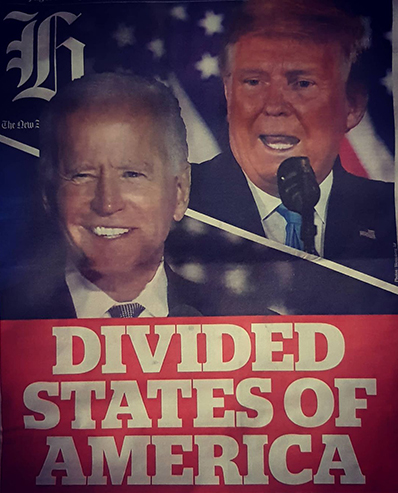
A leading New Zealand newspaper has branded the knife-edge US presidential election as a “nightmare” scenario in response to fears of civil disorder and a tarnished global image.
“The very face of the American consumerism was forced to mask up,” said The New Zealand Herald today as the nation “hunkered down and waited for the new President to be elected”.
“Crews arrived on Rodeo Drive in Beverly Hills, armed with sheets of plywood to board up each of the 70 boutiques and properties lining the high-end retain strip.”
A similar scene was playing out across the US on anticipation of strife, as former Vice-President Joe Biden held a narrow lead as the final result deopended on six crucial battleground states.
“At the time this edition went to press, it was too close to call with incumbent Donald Trump defying predictions to put in a strong showing,” the newspaper editorial said.
“US retailers hard hit by the covid-19 pandemic have already been hammered by public disorder peaking after the killing of George Floyd, a Black man, in police custody in Minneapolis which fuelled protests, some violent, across the country.
“US businesses have suffered property damage and theft worth an estimated US$1 billion in insured losses this year, according to conservative estimates from the Insurance Information Institute, making this year’s protests “the costliest civil disorder in US history”.
Display guns and ammunition removed “A week before the election, Walmart removed all guns and amunition from display, fearing that items would be targeted by frustrated supporters of the losing candidate.”
Today’s New Zealand Herald front page. Image: PMC screenshot
The Herald said the election was largely a referendum on Trump’s “handling of the virus”. However, while Trump had insisted the nation was “rounding the turn”on the virus, Dr Deborah Birx, coordinator of the White House coronavirus task force, had this week joined “a chorus of Trump administration scientists sounding the alarm about the current spike in infections”.
President Trump has overseen the pandemic in the US “reaching world record numbers – 9.42 million cases and still climbing”.
Outgoing US Ambassador to New Zealand Scott Brown said that no matter who won the US election, it would have no impact on Washington’s relationship with Wellington.
The tight race for the US presidency was matched by falling global trust in American leadership.
Americans and much of the world were waiting nervously to see whether Biden would be the next US president or Donald Trump extend his stay at the White House.
The US president is often regarded as the most powerful person in the world.
Changes in American foreign policy could benefit or hurt millions of people.
Trump has upended diplomacy in the past four years while Biden has promised to restore some of those ties.
The court case in New Caledonia brought by French Polynesia’s pro-independence leader Oscar Temaru against the French prosecutor over the Faa’a community station Radio Tefana has been deferred for a second time.
Last month, it was deferred until yesterday but it has now been rescheduled for November 25.
In June, Temaru had sought a preliminary ruling in Tahiti claiming state prosecutor Herve Leroy had violated the assumption that he was innocent.
However, the court in Pape’ete found it could not deal with the case impartially and ordered it to be moved to New Caledonia.
Temaru said the prosecutor had asserted that he was convicted of a crime although the trial process had not been concluded because the appeal was still pending.
Temaru had appealed a suspended six-month prison sentence given last year for exercising undue influence over funding arrangements for the community station Radio Tefana.
In June, Leroy ordered the seizure of US$100,000 from Temaru’s savings account before obtaining an authorisation by a judge as part of a new investigation into alleged abuse of public funds.
On Saturday, The Age reported the Andrews government had been discussing the possibility of a single coronavirus hospital to treat and quarantine Victorians who test positive to COVID.
The designated hospital would aim to relieve pressure on the state’s health-care system and minimise the spread of the virus within hospitals and the wider community.
The decision on whether to create a single hospital dedicated to COVID cases in Victoria is still some way off. And agreeing on a site and getting it up and running is even further away. But with reports the government is weighing up whether this is the right approach, it’s worth exploring the issues around this decision.
Localising risk
It’s important not to conflate the issue of whether establishing a single dedicated hospital makes sense with the issue of whether all COVID cases should be hospitalised.
These are two completely separate matters.
The question of whether all cases should be hospitalised, regardless of the severity of their infection, speaks to a broader range of issues. This article focuses on whether a single dedicated hospital makes sense for cases with severe illness.
The rationale for a dedicated hospital is primarily about giving better care to COVID patients who need medical intervention, while minimising the risk of disease being spread to other patients as well as health-care workers.
Putting the practical issues of costs and logistics aside, the theoretical case for establishing such a hospital is based on several considerations.
What’s the case for a designated COVID hospital?
There’s no doubt it can be a real challenge to keep health-care workers healthy during a pandemic. Melbourne has seen well over 3,000 COVID infections among health-care workers since the beginning of the pandemic. More than 70% of them were infected at work.
Cultivating a very specialised workforce, with the most appropriate facilities, who are highly competent in Personal Protective Equipment (PPE), seems like a sensible option to keep health-care workers safe. A designated COVID hospital would also make it easier to design workforce strategies to contain a cluster in staff if it were to occur.
Locating all COVID patients at one site also helps prevent patients at other hospitals from being infected with COVID while in hospital.
We’ve seen confirmed COVID-19 cases in healthcare workers soar over 3000 in Victoria since the beginning of the pandemic.Shutterstock
It’s not just health-care workers and patients who stand to benefit. Adopting best-practice infection control at a dedicated COVID hospital would also potentially limit opportunities for infections to spread back into the community from health-care settings. If we’ve learned anything over the past few months, it’s how easy it is for infections to move from the community to high-risk settings and back again.
Other issues
While this sounds very promising, a single COVID hospital would also present challenges. Implementing it would be a considerable task — including finding a suitable site and equipping it with appropriate facilities and staff.
It’s hard to know whether the cost-benefit equation would favour the proposal.
The government would need to work to ensure, after focusing many resources on such a facility, it doesn’t become overrun if there is another wave. On the contrary, it also runs the risk of becoming a white elephant if it isn’t used enough to justify the time and money.
The problem, of course, is it’s hard to make predictions about the future course of COVID in Victoria.
At this stage, according to the Victorian government, a single coronavirus hospital is on the table as just one of many options to help navigate this once-in-a-generation pandemic.
The fact it is being discussed, whether it is deemed appropriate or not, is a good thing. Victoria needs to be exploring all available options. We should hope for the best while planning for the worst.
As with most things, the detail of the proposal will be key to determining whether this is the right path to take. How patients and health-care staff are managed will need to be considered carefully.
We also know many COVID patients with severe disease will have a range of other illnesses too. For this reason, it will be important any dedicated coronavirus hospital has the expertise to manage patients’ full range of needs.
Last week, the Royal Commission into National Natural Disaster Arrangements (the “bushfire royal commission”) handed down its anticipated final report, with 80 recommendations on managing future emergencies.
Last summer’s horror bushfire season claimed 33 lives, although the real cost in human life might have been greater when smoke-related health issues are taken into account. More than 3,000 houses were destroyed in the 24 million hectares that burned.
It’s clear Australia has a lot to learn about managing risk and adapting to future extreme seasons, and the most effective strategy is better planning where and how we live and build. As the royal commission noted, “planning decisions and exposure to risk are inextricably linked”.
But while the report is extensive, covering many aspects of natural disasters and planning around land use, the royal commission stops short of recommending a national town planning policy.
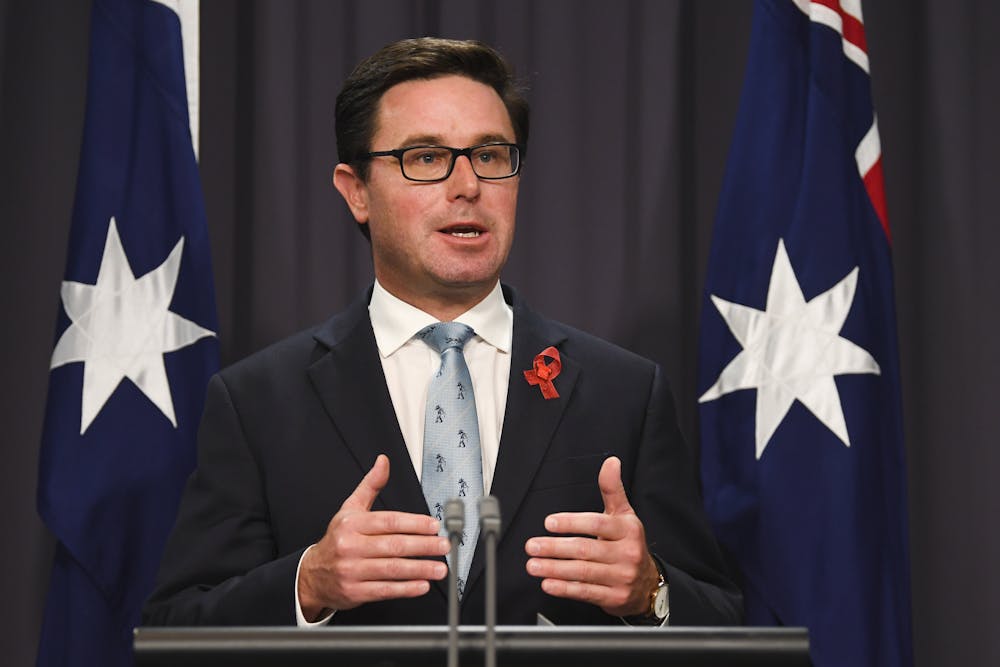
Federal emergency management minister David Littleproud said the government is committed to acting on the findings of the royal commission.AAP Image/Lukas Coch
Recommendations on planning
The commission considered all natural hazards, including drought, storms and floods, as well as bushfires.
It found the Australian community expected national leadership, and it pleaded for action and unity from all levels of government to improve natural disaster arrangements as risk grows under climate change. Ultimately, it writes, the federal government should “enhance and support” state and local government.
The commission also determined where people choose to live affects the extent of damage and harm from a disaster, even if consequences aren’t felt until decades later. Its recommendations around planning and building include:
improved communication of risk and hazard information for prospective property buyers
guidance from insurers on what risk mitigation strategies will be recognised for existing buildings
mandatory consideration of natural disaster risk in land-use planning decisions by state, territory and local government
review of the National Construction Code and its standards to understand how effective they are in reducing risk.
Adopting these recommendations is important because, as the Bushfire Building Council estimates in the report:
90% of buildings in bushfire prone areas in Australia have not been built to bushfire planning and construction regulations as they were built prior to regulation being applied.
Inheriting risk
Prospective landowners inherit risk when they purchase property, so effectively communicating this is essential and would encourage better “buy in”. While this is already occurring in some states, requirements vary considerably and communication should move beyond risk awareness.
Purchasers should also be provided with a detailed understanding of measures that can be implemented to reduce risk. This could be, for example, annual reminders for property maintenance, such as pruning trees and cleaning gutters.
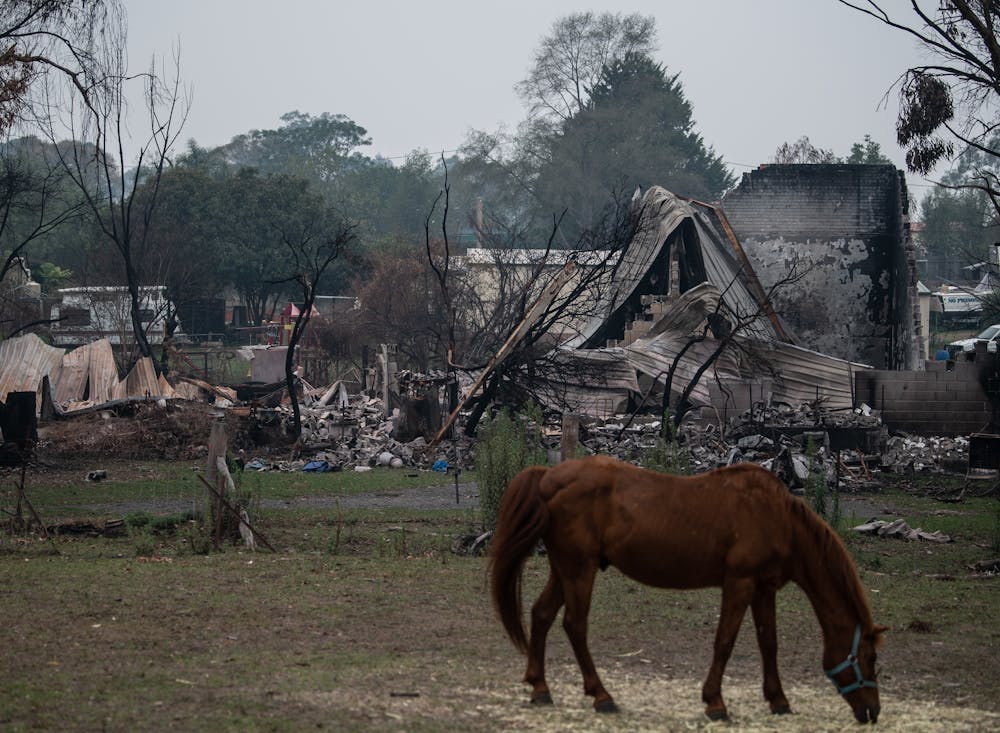
Bushfires swept through Cobargo on New Years Eve, 2019, killing two and destroying several homes and businesses.AAP Image/James Gourley
Insurance also should also play a larger role. By August 2020, almost 38,500 insurance claims valued at an estimated A$2.33 billion were lodged due to the bushfires.
Insurers need to provide guidance on what changes can be made to buildings to reduce risk, and we should encourage a consistent national insurance policy for these measures. This should be reflected in reduced insurance premiums.
Smarter town planning
Effective building standards are vital, but they should not be the primary mechanism for risk reduction. There must also be a focus on town planning to locate buildings in less hazard-prone areas.
Town planning functions and responsibilities are often managed by local government. However, state and territory governments still remain accountable to ensure local government has sufficient support.
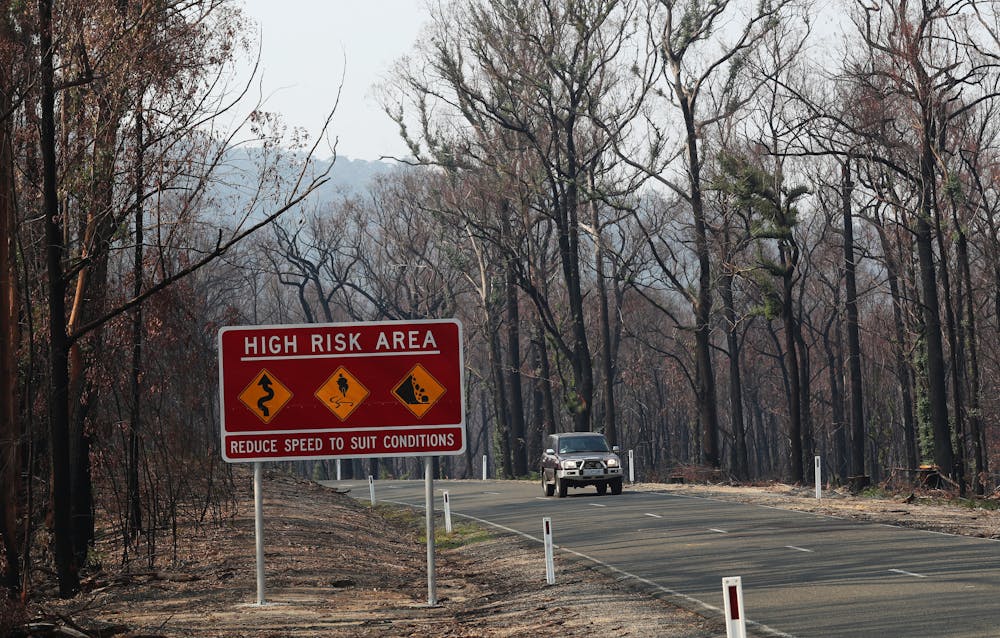
Despite these calls, homes continue to be built in high risk areas. As written in the royal commission’s report:
all states permit homes to be built in bushfire and flood prone areas, and the degree to which planning or building standards act to mitigate risk varies across jurisdictions.
Furthermore, the Insurance Council of Australia stated in the report that there’s “clear evidence of recent planning decisions placing communities at a known and obvious risk of disaster”.
For example, development for the suburb of Idalia in Townsville was only partially completed before it was inundated by a flood in February 2019. More than 3,300 homes were damaged.
Likewise, the town of Wytaliba lost about 25 homes in the recent bushfires, which is more than half of its total number of houses.
A national approach would allow communities to makes decisions within an agreed, evidence-based framework that’s understood by all stakeholders.AAP Image/David Crosling
Why we need a national policy
The commission has provided recommendations on what needs to be done — now we need the how.
The royal commission recognises the role of state, territory and local government in planning. But having diverse planning policies means there are differences in where we locate buildings, creates confusion and exposes communities to different levels of risk.
This is why Australia needs a national approach, with a consistent national policy that all levels of government should be responsible for managing.
A national approach would avoid development in high-risk areas, while still providing housing, employment, food and water security and environmental protection.
It would allow communities to make decisions within an agreed, evidence-based framework that’s understood by all stakeholders — the community, emergency sector, government and insurance industry. And it would establish boundaries to the level of risk that’s acceptable.
This policy would include a combination of avoidance of high-risk areas, improved building standards and standardised risk assessments. Importantly, it would get support from politicians, government, professionals and the entire community to boost resilience.
It’s of the utmost importance Australia gets this right, as more extreme bushfire seasons are undoubtedly in our future. As the royal commission stated, “support is one thing — action is another”.
Source: The Conversation (Au and NZ) – By Gwilym Croucher, Senior Lecturer, Melbourne Centre for the Study of Higher Education, University of Melbourne
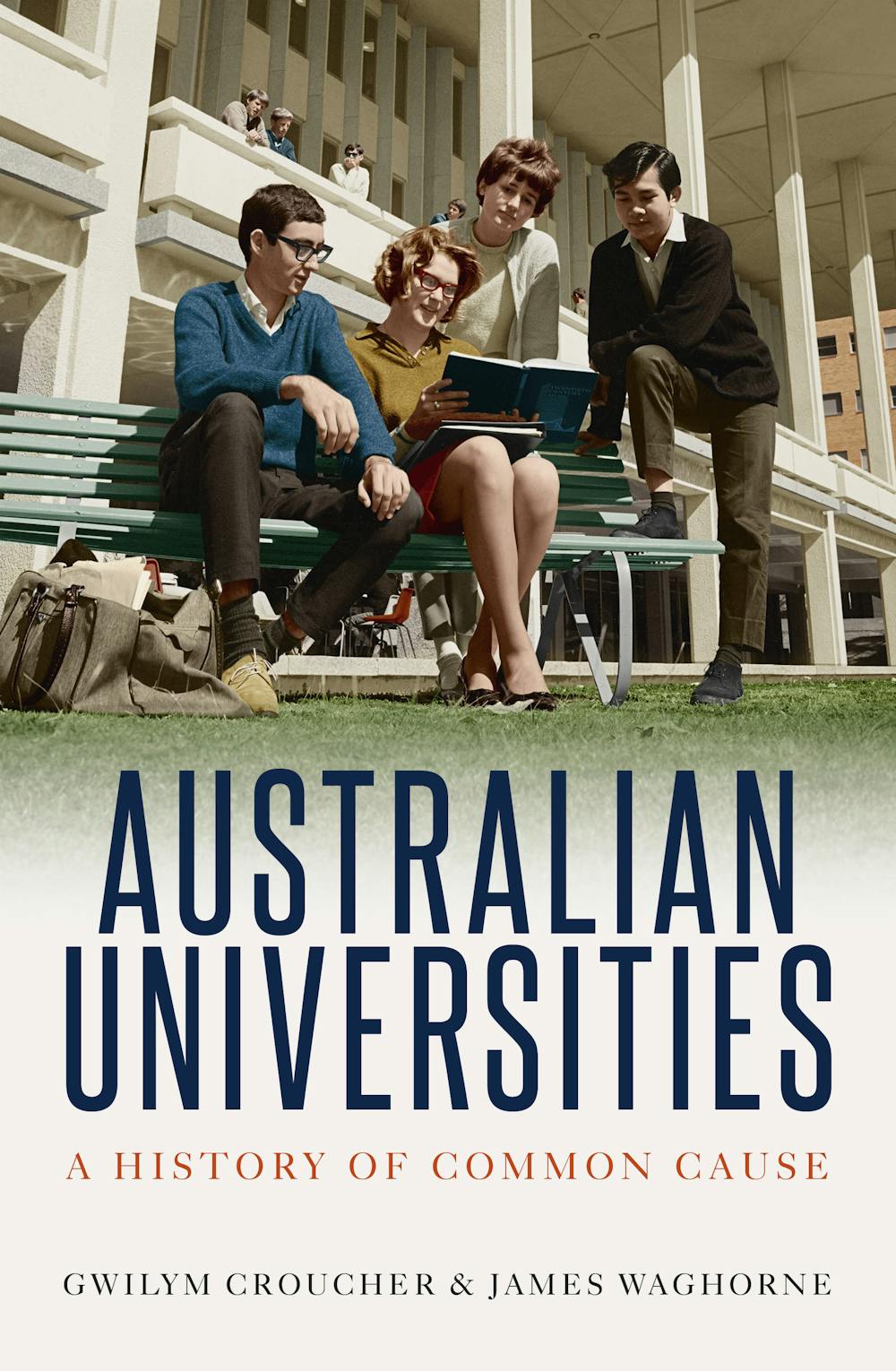
This is an edited extract of a new history, Australian Universities: A history of common cause, by Gwilym Croucher and James Waghorne (UNSW Press). In the early 1950s the universities faced an acute financial crisis, forcing them to find creative ways to lobby the Menzies government. The outcome was a resounding affirmation of the national importance of universities.
Unresolved problems of Commonwealth support for universities came to a head in 1952, when the funding recommended by the 1950 Mills Committee expired. Despite his oft-expressed affection for Australian universities, Robert Menzies’ refusal to appoint a standing committee to manage university funding or new inquiry left future Commonwealth support and funding uncertain. The government’s practice of delaying the passage of the States Grants (Universities) Act until just in time for the following year tested universities’ nerve.
The new history of Australian universities.UNSW Press
Coupled with this uncertainty was the problem of inflation, which had soared after the previous Labor government’s wage controls were lifted. The Commonwealth allocations so precisely calibrated in the middle of 1950 were increasingly inadequate. By 1952, the Australian Vice-Chancellors’ Committee (AVCC, predecessor of Universities Australia) estimated inflation had reduced the effective Commonwealth allocation by “up to 40%”.
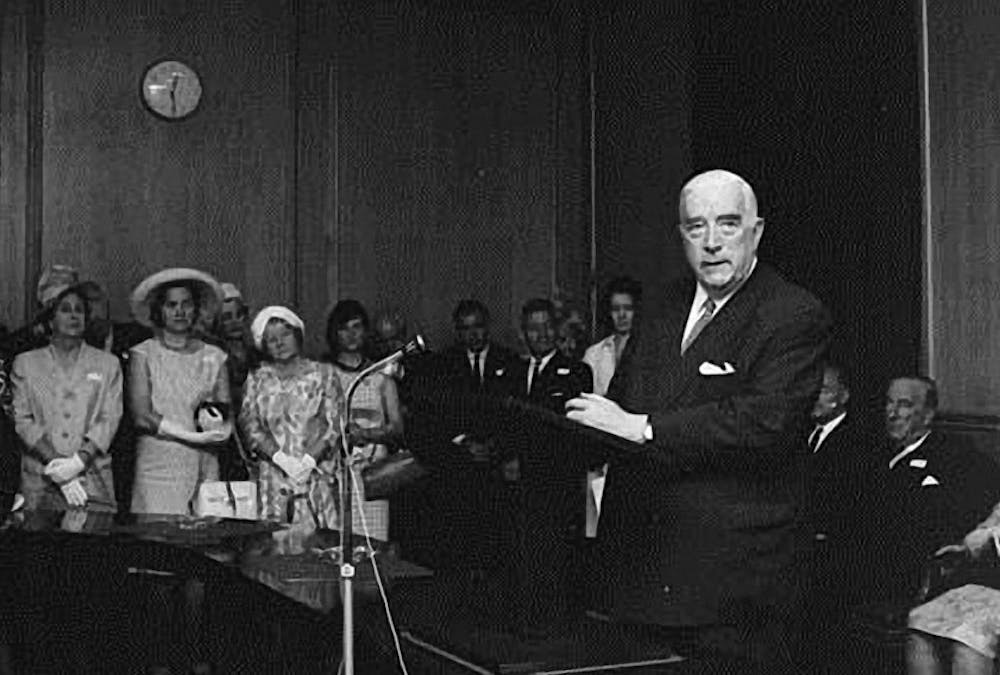
In October 1951 universities used the opportunity of the ceremony installing the first ANU chancellor, Stanley Melbourne Bruce, to send a deputation to the prime minister to urge him to initiate a “co-ordinated plan of development”. Menzies was unavailable. The visiting vice-chancellors had to be content with Paul Hasluck, minister for territories, as the prime minister’s representative.
The UWA vice-chancellor, Sir George Currie, later confessed to other universities that he “was not optimistic regarding the result”. Hasluck indicated the Commonwealth had limited interest in establishing a new committee that might bind it to increasing funding.
Their discreet appeals having failed, universities were compelled to adopt a more public stance. This meant a degree of co-ordinated public action universities had only infrequently practised. The University of Sydney appointed communications professionals to develop the public case.
They were not alone, though, in public advocacy. During a speech on the responsibility of science in the modern world, Ian Clunies Ross, head of the CSIRO and former Sydney professor, “turned an elegant celebration on the traditional role of the university into an urgent appeal for help”.
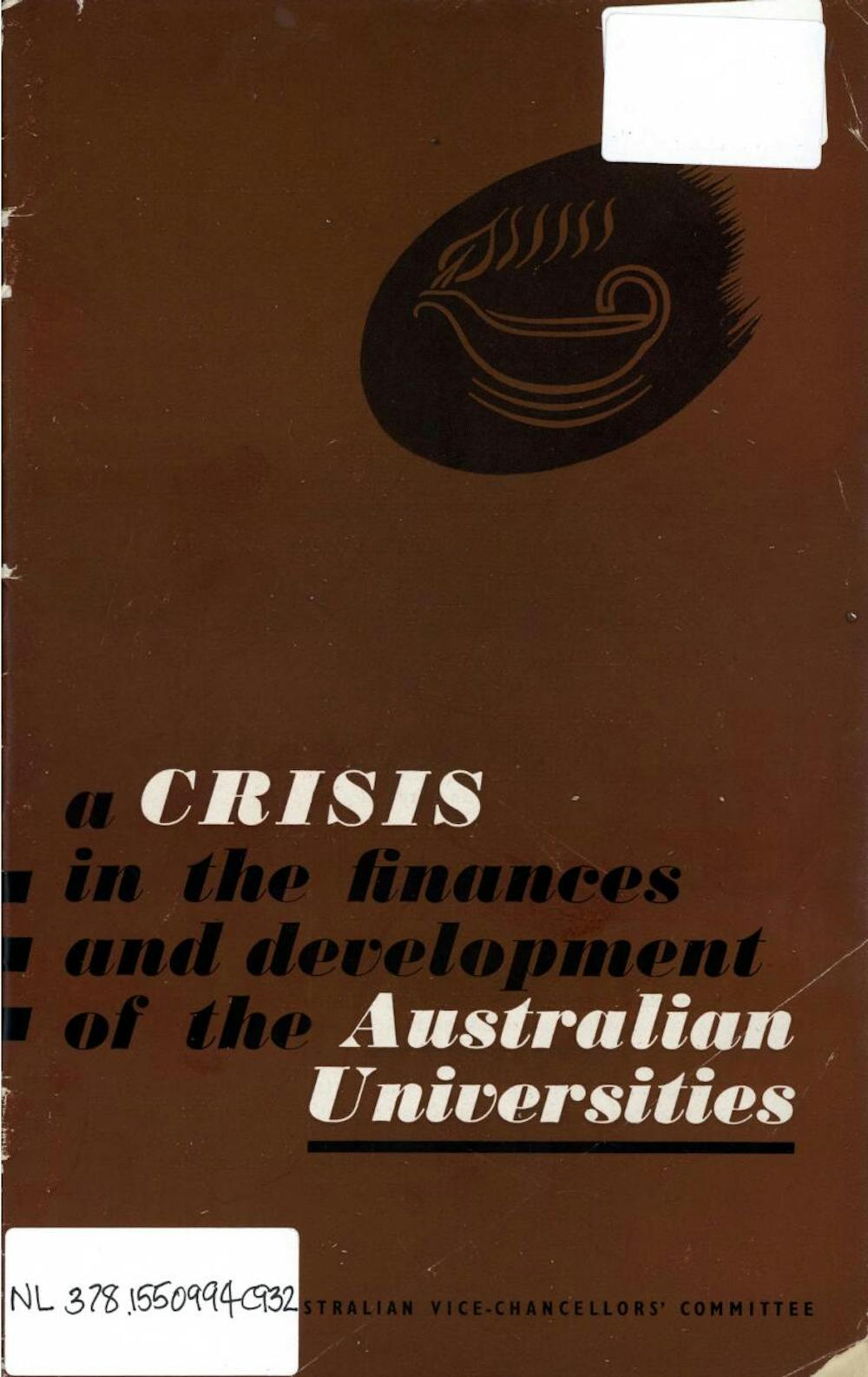
The publication shed the previous restraint of the AVCC’s public statements and presented the situation facing universities as a “crisis”. The combination of the loss of Commonwealth funding and rising inflation meant universities were worse off in real terms than they had been in 1939. The booklet presented concerns to the public, and made the case that the public should value universities’ contribution:
Universities are destined to play an increasingly important role in Australian development. Their future is a matter of grave concern to you and to every other member of the community. Yet there is an alarming degree of public apathy regarding their affairs. While they are accepted as an integral part of our educational system, there is little public appreciation of the wide nature of their responsibilities to the community.
The universities argued their role had expanded in the years after the second world war and they now performed many functions of vital national significance. Their tasks of transmitting knowledge to students, along with the training of professionals with technical expertise, such as “architects, engineers, scientists, doctors, dentists, lawyers, teachers, economists”, were now undertaken to meet national priorities.
Another role was in Commonwealth-supported research. Universities distinguished their contribution from the CSIRO’s mission-oriented investigation of specified problems. Universities had the freedom to advance knowledge and make discoveries where the end result was unknown. Moreover, they were the primary source of “specialist training in professions and science” essential for the national research enterprise.
All these benefits crossed state boundaries and had wide public utility. Research, for example, was not the private work of individuals, but rather provided a “threefold advantage”: in “advancing knowledge”, training research workers for government and industrial employment, and “indirectly maintaining the interest and vigour of the staff with a benefit to teaching standards”. Acknowledging that research did not always produce immediate economic benefits, they argued that their research training provided an essential prerequisite for growth of the economy.
The universities distributed 2,000 copies of the Crisis booklet in their campaign to build support for increased funding.Trove/National Library of Australia
Two thousand copies of the Crisis booklet were distributed to politicians, university governing bodies, professors and others “interested in increasing government support”. A media statement was drafted emphasising the problem of inflation. Journalists were encouraged to quote from the booklet as the official position of Australian universities.
In the wake of the publication of the booklet, Menzies reiterated his support for Australian universities. More promisingly, he indicated broad support for an immediate 20% increase in “second level” Commonwealth assistance, which benefited the smaller universities, and the establishment of a committee to respond to immediate needs and prepare a long-term plan for university development.
Yet by the following February the process had slowed. Universities became increasingly frustrated.
The 1953 Premiers’ Conference was scheduled for the day after the universities met, and the vice-chancellors telegraphed the Secretary of the Prime Minister’s Department, Allen Brown: “would it be possible to obtain the Prime Minister’s views on additional assistance for universities in current year”. Brown telephoned in reply that the Premiers’ Conference would be dealing with “weighty problems” and unfortunately would not have time to consider universities’ appeal.
The plight of universities was discussed at the conference and, in response to appeals from Victoria for more support, Menzies replied that they had done well “without a Commonwealth grant”. Left with little recourse, the vice-chancellors again wrote to the prime minister, reiterating their requests.
As universities sought to build a case for federal funds, they faced growing internal pressures to raise academic salaries. These had declined in real terms as inflation eroded their value. Some disciplines struggled to attract quality candidates.
In response, in 1952 staff formed a Federal Council of University Staff Associations of Australia (FCUSAA). In 1953 it pressed universities to support its campaign for wage increases.
In this, universities were hamstrung by their separate relationships with their respective state governments. While some universities, such as Sydney and Melbourne, had independently granted wage increases, others, such as Adelaide and Western Australia, were not in a financial position to do so. Nevertheless, universities supported the proposal with a statement of principle that academic salaries were “inadequate in view of changed economic conditions”.
While the funding impasse continued, the weight of the number of enrolments that had grown since the second world war squeezed operations, leaving little capacity to expand universities’ activities in line with international trends. In response to the deteriorating state of affairs, the AVCC conducted its own survey of the needs of universities to prepare for the appointment of a full government inquiry and to provide greater specificity to universities’ requests for funding in the meantime. The task of compiling a “Survey of University Needs” proved challenging and there was no certainty the members would agree to what emerged.
As the survey was being compiled, the AVCC prepared a public statement on the absolute minimum requirements of Australian universities. The timing was significant. On the eve of the May 29 1954 federal election, Menzies responded that he was “anxious not to involve the Commonwealth government in the internal affairs of universities”.
The AVCC report sought to answer profound questions about the shape and character of the whole system, such as the “optimum size of a university”, the “essential” facilities, what “special types of university” were necessary, considerations in determining the location of these universities, what residential component was important, what departments were “too expensive to be duplicated”, and where new facilities and departments were needed to overcome “overcrowding”.
It concluded that each should commence with Arts and Science, plus “at least one other faculty reflecting the needs of the district where the university or college is located”. These departments should be headed by professors and as “adequately staffed as possible”. Staff–student ratios should be as low as possible, with 2,500 to 3,000 students considered optimal, even though the Universities of Sydney and Melbourne had already grown to twice this size.
The report also acknowledged that larger universities, with more extensive offerings and a broad range of departments, had stronger reputations. The tension between good education and reputation was difficult to resolve.
At the March 1956 meeting, the AVCC chair, George Paton, announced the plans for university co-ordination would be shelved. He considered them no longer “desirable at the present stage” and went on to explain that Menzies had joined him for a private dinner at the Melbourne staff club, University House, at which he agreed to appoint a new inquiry, subject to approval from the states. Menzies asked universities for a list of names of “persons in the United Kingdom who would be suitable for appointment as chairman of such a committee”.
This breakthrough was greeted with acclamation by universities, which drew up a list at the top of which was the chair of the University Grants Committee in Britain, Sir Keith Murray. Vice-chancellors had been instrumental in the appointment of Murray, and Murray sought guidance from them upon his arrival.
Universities set out a template for the “ideal conditions” for a visit to an Australian university, including the time for a tour of the facilities and the order in which to speak to interest groups. Each visit began with an official exposition of the university’s submission, followed by informal talks with professorial and then non-professorial staff, then a meeting with student representatives. Finally, a formal meeting would be held with a university’s governing body, with subsequent informal conversations to “clear up points of doubt”.
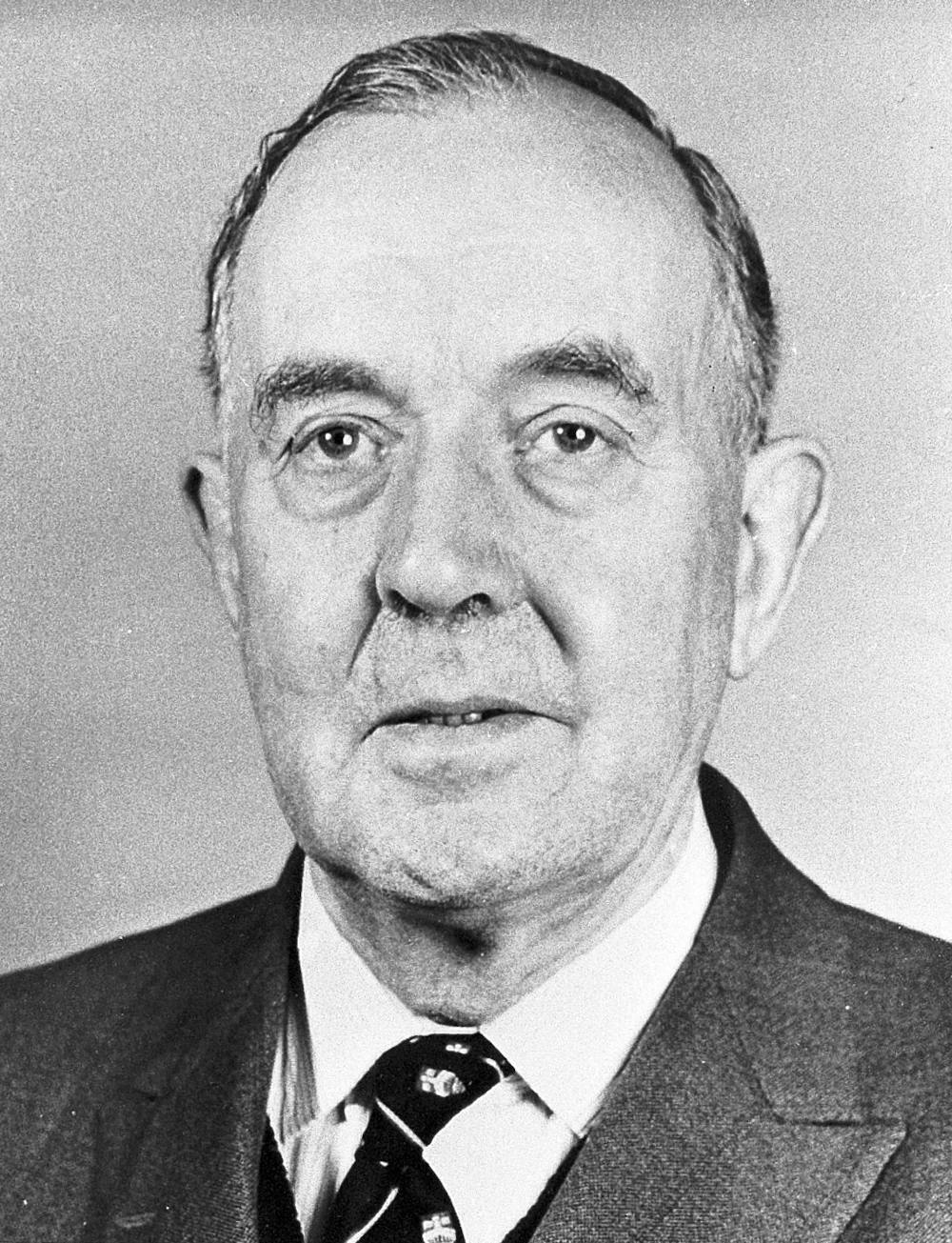
Sir Keith Murray agreed with vice-chancellors that ‘the problems appeared to be immediate and large’.Wikipedia, CC BY
Receiving this advice with gratitude, Murray agreed in a way that gave comfort to vice-chancellors that “the problems appeared to be immediate and large”. “Was anybody thinking in revolutionary terms?” he asked.
The universities’ planning work that went into formulating a co-ordinated approach was not wasted. It formed the basis of the AVCC submission to the Murray Committee. Drafted by Paton, the report emphasised the need for “long-range” planning, so universities were not “faced with a similar problem in two years’ time”, as they had been after the Mills Inquiry.
Although constitutional impediments prevented the “translating” of the University Grants Committee into Australia directly, the AVCC submission urged Murray to investigate the creation of an equivalent body. To clarify this for the British members of the committee, Paton explained:
If the Universities are to develop as they should, we must of necessity depend more on the Commonwealth for our financial requirements, while the Commonwealth has the superior power over taxation. But we are equally anxious that anything the Commonwealth might contribute should not merely ease the financial responsibilities of the States towards the Universities.
The Murray Committee considered the vice-chancellors’ submission alongside those of student groups and industry representatives, and undertook the review at remarkable speed with the support of Menzies. The final report drew particular attention to the vice-chancellors’ request for a similar organisation to the British University Grants Committee.
Menzies adopted the recommendations within three days of the report’s release. The government pledged to establish a permanent body with the support of the state governments. The body would reside in the Prime Minister’s Department, separate from the Office of Education, so as to distinguish it from the provision of primary and secondary education. It would have its own secretariat and, although Murray recommended that it act informally, at least at the beginning, it would be established as a statutory authority in 1959.
This went much of the way to meeting the vice-chancellors’ request, although they might have preferred the body to have a more public role.
The Murray Report cited Commonwealth estimates that the number of students would almost double over the following decade, following “rapid” population growth and the increasing numbers remaining in secondary school to matriculation. This, Murray argued, would require existing universities to take more students, as well as a new university in Sydney and Melbourne.
Yet this grossly underestimated the demand for higher education that came only a few years later. The [newly established] Australian Universities Commission immediately found itself grappling with a system growing more rapidly than anybody had imagined. New universities cast from the mould of the old would require unprecedented levels of public investment. In just five years a new committee of inquiry would be appointed to determine how this expansion could be supported.
Source: The Conversation (Au and NZ) – By Nicholas Williams, Associate Professor in Urban Ecology and Urban Horticulture, University of Melbourne
High demand for green space under COVID restrictions led councils in Melbourne to temporarily open golf courses to non-golfers and fuelled public calls to “unlock” or repurpose them permanently. However, this must be done carefully because many golf courses are oases of biodiversity in Australian cities. If more people visit golf courses, increased disturbance of wildlife is just one of the results that may be incompatible with their nature conservation values.
Between 2011 and 2014 we studied the biodiversity of green spaces throughout Melbourne’s south-eastern suburbs. We compared golf courses to nearby public parks and residential areas as these are the land uses that most commonly replace golf courses when they close.
The results surprised us. Golf courses contained the greatest diversity and abundance of beetles, bees, birds and bats of all the green spaces we studied. We found ground-nesting native bees that do not occur in much of the urban landscape because it is dominated by built surfaces and exotic flowering plants.
Golf courses have higher biodiversity than other green spaces in our cities.Nicholas Williams, Author provided
The minimum number of bird species we saw on a golf course was always higher than the maximum numbers at other green spaces. We found much more evidence of birds breeding. There was also a diverse array of insect-eating birds, which are in decline in many parts of Australia.
Some golf courses supported all ten bat species known to occur in this part of metropolitan Melbourne. Bat activity was ten times greater than in nearby areas of housing. Golf courses also supported twice as many bat species considered “sensitive” to urbanisation.
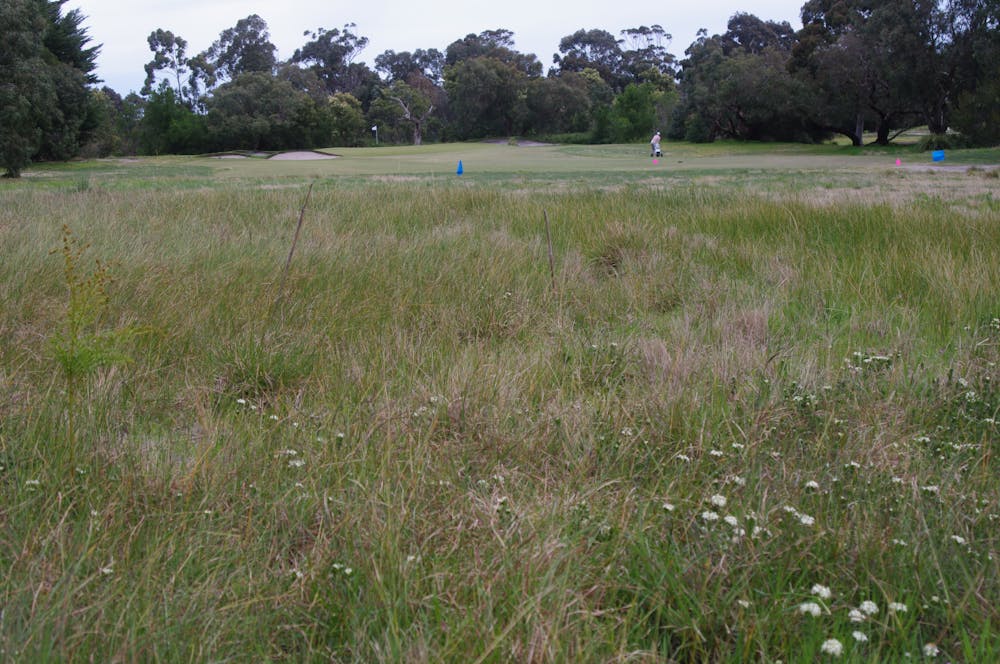
There are many reasons golf courses support far more than the typical “urban-adapted” fauna we see in our cities. A key factor is the complex vegetation structure in the large parts of golf courses where you don’t want to hit your golf ball – the “rough” and “out of bounds” areas.
Golfers fear the rough, but local wildlife loves the densely vegetated areas near Dandenong Creek at Glen Waverley Golf Course.Nicholas Williams, Author provided
These areas of long grass and dense, often native, shrubs have little to no human intervention. These conditions are rarely found in urban parks and residential gardens, which typically have highly managed vegetation. The relatively high proportion of native plant species, many indigenous to the area, is also very important.
This complex vegetation is critical habitat for a wide array of animals such as small insect-eating birds, larger reptiles and ground-dwelling mammals. For example, occurrence records show Northcote Golf Course is an important refuge for the small population of swamp wallabies living along Merri Creek in Melbourne’s inner north.
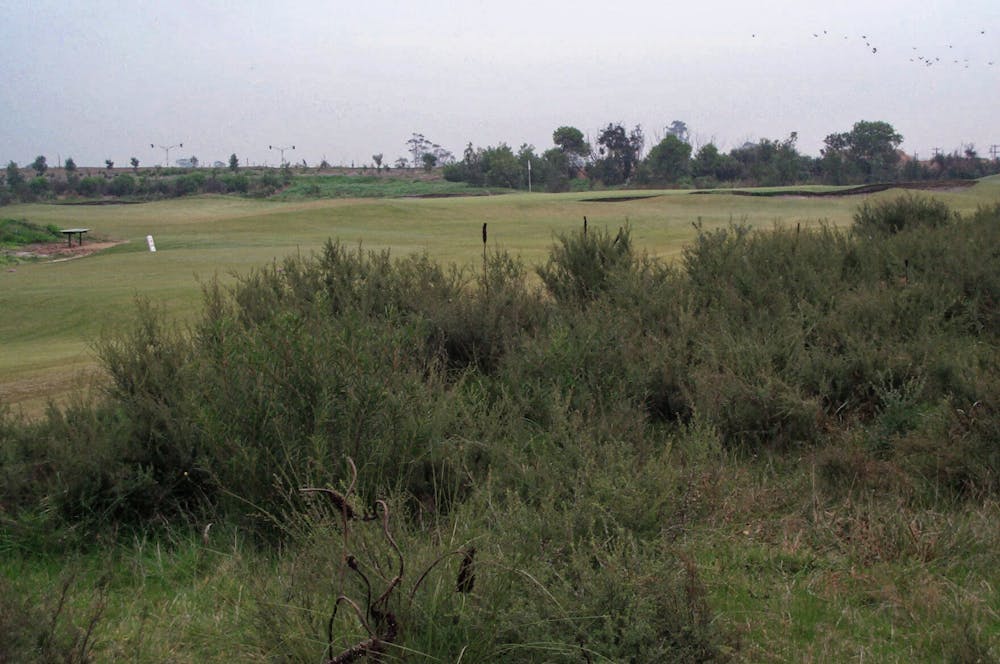
Areas of heathland are rare in cities, but heathland species have a refuge at Spring Valley Golf Course.Nicholas Williams, Author provided
Greater leaf litter accumulation and lower soil compaction mean these areas have healthier soils with more biological activity. These soils can also absorb stormwater more effectively, reducing the risk of urban flooding.
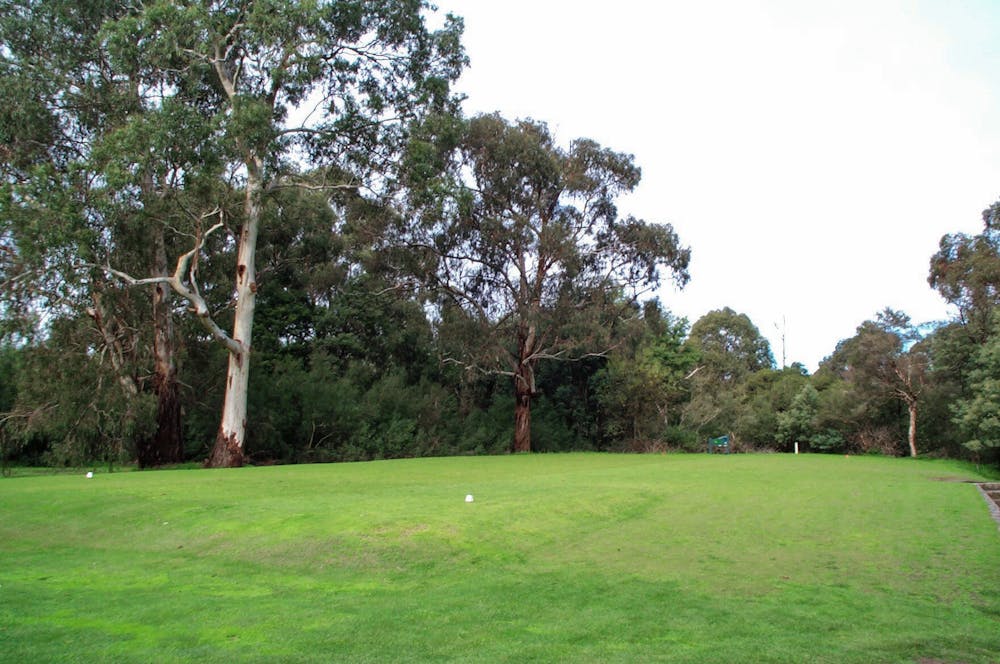
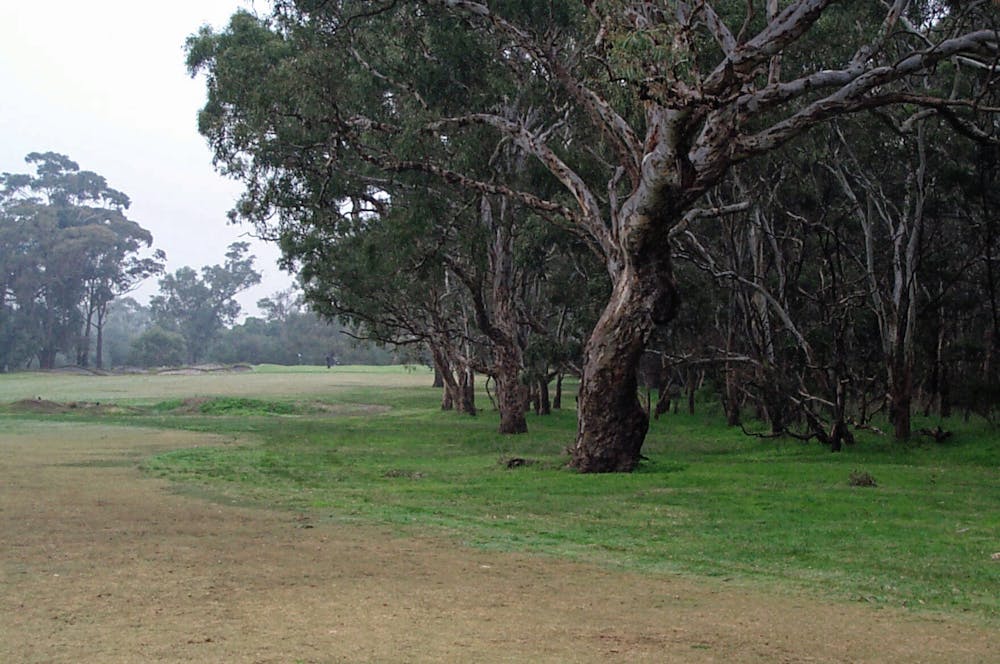
Another reason is that golf courses have many more large, old native trees. These mature trees are critical to the breeding success of hundreds of Australia’s animal species as they contain hollows, which are rare in urban areas. Because golf courses often prevent other uses, old trees can be left standing longer than is tolerated in other parts of the city.
Mature native trees provide critical habitat, including nesting hollows, for many species.Nicholas Williams, Author provided
Another important factor is the exclusion of dogs and ability to control foxes and cats, which protects vulnerable fauna.
Golf courses also provide a large expanse of dark vegetated habitat in an otherwise illuminated landscape. This habitat is critical for nocturnal animals such as bats, as well as many birds and invertebrates. Artificial light at night is emerging as one of the most pervasive threats to urban wildlife.
Large refuges of dark habitat in cities are unique and ought to be protected. However, this may be at odds with increased human activity, particularly if night lighting is needed to satisfy safety concerns.
We are not suggesting golf courses should not be made more accessible to the public. The COVID-19 restrictions on human movement have highlighted the value of urban green spaces as places to exercise, socialise and connect with nature. But if city golf courses are opened to the public, it is vital it not be done at the expense of their biodiversity.
Indeed, shared-use models may ensure golf courses remain viable in Australian cities. Recognition of their biodiversity, cooling and social benefits via mechanisms such as council rate rebates could help ease the financial pressures of decreasing membership.
The potential for golf course managers to improve the habitat that sustains biodiversity is also great. Ways to achieve this include tree planting, direct seeding of native grasses and wildflowers, and regeneration burns. Many course managers are eager to do this, although they have to proceed cautiously because it can affect the speed of play.
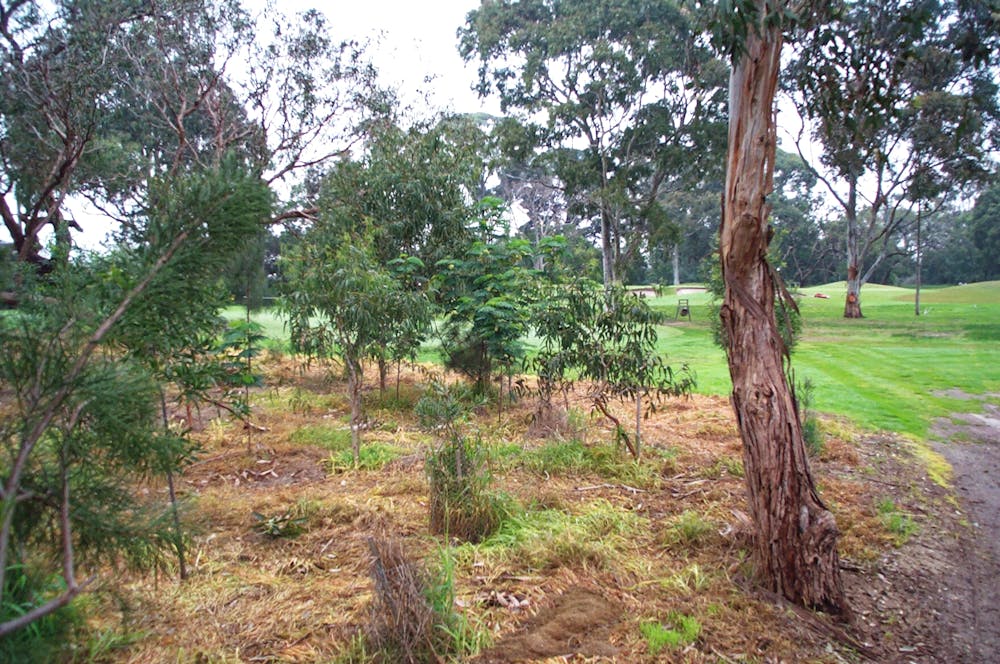
Revegetation projects like this one at Woodlands Golf Club add even more value for wildlife.Nicholas Williams, Author provided
Some urban golf courses support threatened species and communities, but all are biodiversity refuges in what can be a hostile urban landscape. We need to consider this when contemplating alternative uses.
Source: The Conversation (Au and NZ) – By Emlyn Dodd, Greece Fellow, Australian Archaeological Institute at Athens; Postdoctoral Research Fellow, Centre for Ancient Cultural Heritage and Environment, Macquarie University
Pompeii is famed for plaster-cast bodies, ruins, frescoes and the rare snapshot it provides of a rather typical ancient Roman city. But less famous is its evidence of viticulture.
Wild grapevines probably existed across peninsular Italy since prehistory, but it is likely the Etruscans and colonising Greeks promoted wine-making with domesticated grapes as early as 1000 BCE.
Pompeii, preserved after the eruption of Mount Vesuvius in 79 CE, sits within Campania on fertile volcanic soil with a temperate Mediterranean climate and reliable sources of water.
Pliny the Elder, living nearby Pompeii in 77 CE wrote of the “vine-growing hills and noble wine of Campania” and the poet Martial described vats dripping with grapes, and the “ridges Bacchus loved more than the hills of Nysa”.
The Greeks even referred to Campania as Oenotria – “the land of vines”.
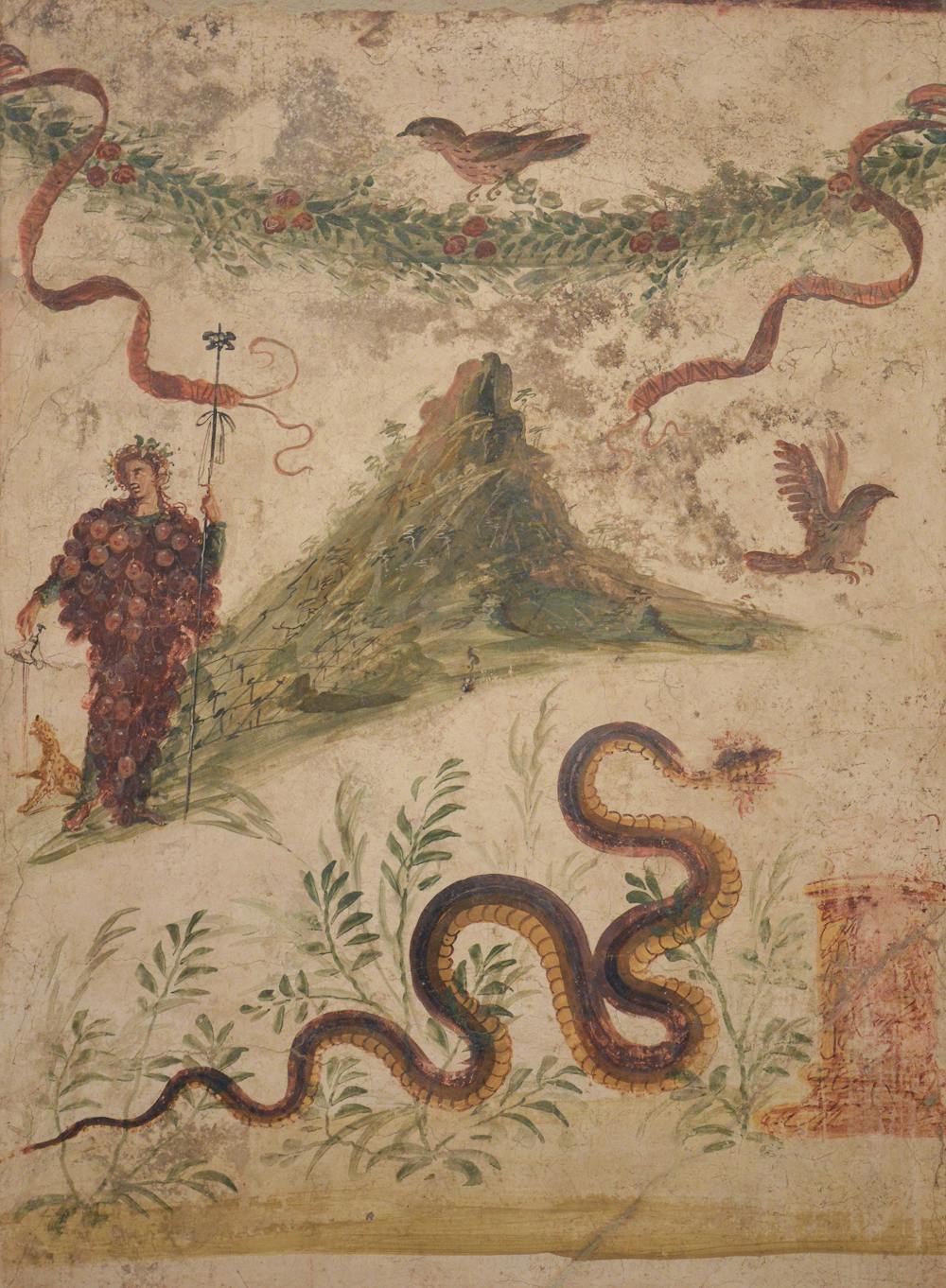
A fresco found in Pompeii, painted c 55-79 CE, depicting Bacchus covered in grapes and Vesuvius with trellised vines in background.Naples Archaeological Museum
A famous wine region
Over 150 Roman farms have been discovered in the Vesuvian region, and many engaged in viticulture. Some of the most famous ancient wines came from this region, including the honey-sweet and expensive Falernian wine.
Falernian was said to ignite when a flame was applied, suggesting an alcohol content of at least 40% – significantly higher than the 11% you could expect to buy from the bottle shop today.
While the Falernian was believed to be white, most ancient wines were red due to the less laborious production process.
A wide variety of wines could be found on the Roman wine market, flavoured with sea water, resin, spices and herbs like lavender and thyme, or even fermented in a smoke-filled room to impart flavour.
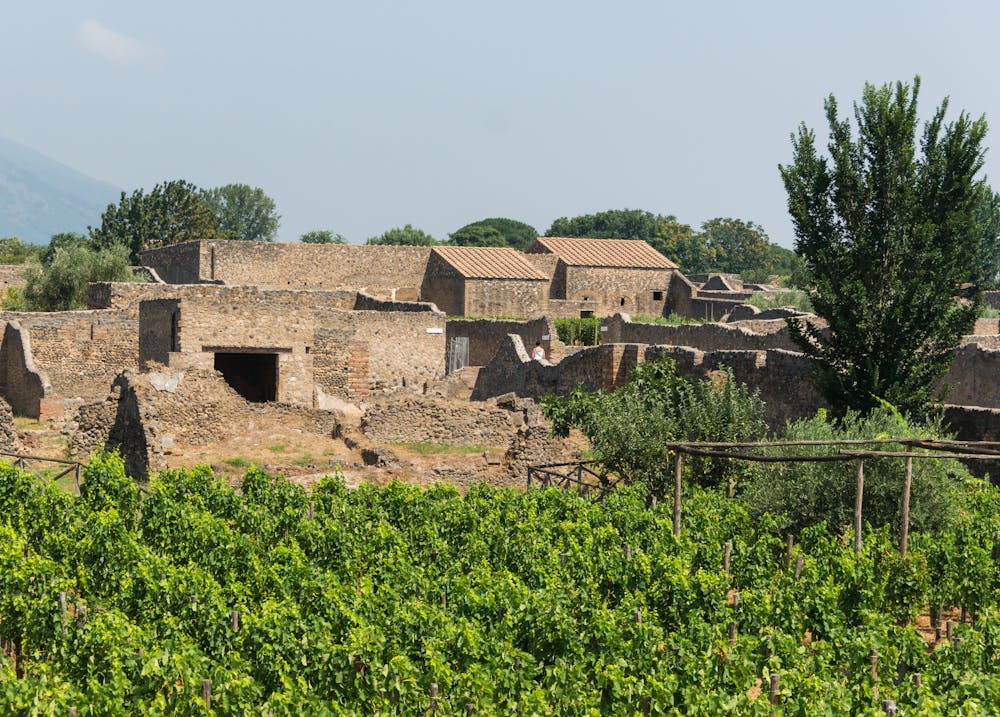
Vineyards are still planted in Pompeii today.Wikimedia Commons
There is even possible evidence for early counterfeit wine. Archaeologists have identified imitation ceramic transport jars produced elsewhere and stamped with fake Pompeian merchant stamps.
Agriculture among an ancient city
Within Pompeii’s city walls, vineyards hid behind taverns and inns as families and bar-keepers grew grapes on a smaller scale for their own tables and wine.
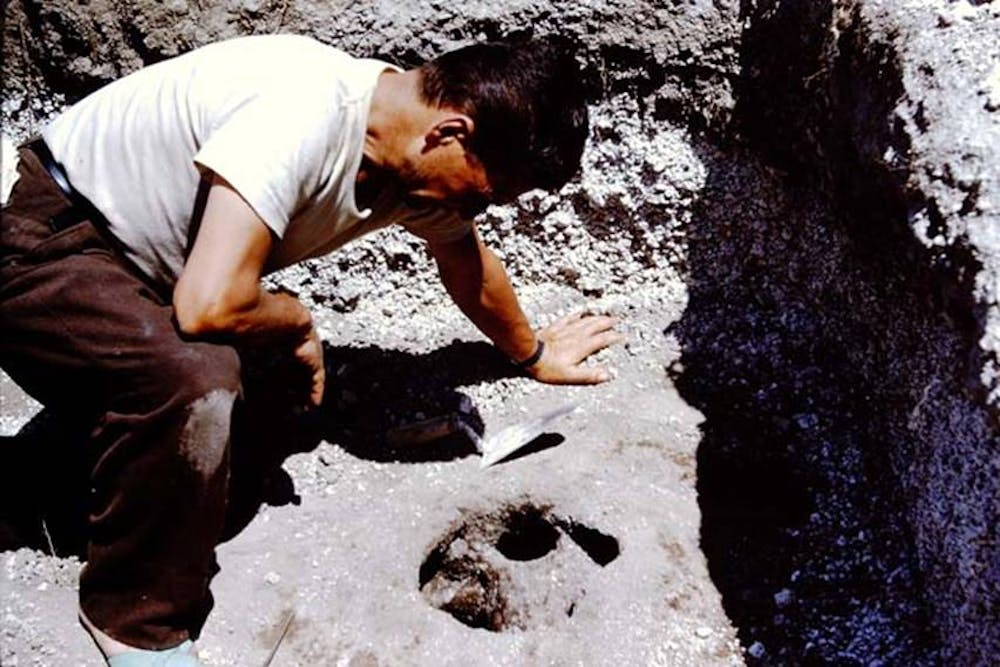
When vines were covered by the volcanic eruption and later decomposed, they left cavities in the debris. By filling these cavities with plaster, archaeologists were able to reveal vineyards over entire city blocks.
Excavations have revealed carbonised grape seeds and even whole preserved grapes caramelised from the volcanic eruption – their high sugar content gives them a glassy appearance easily spotted amongst the soil.
Gardens were everywhere in Pompeii. The archaeologist Wilhelmina Jashemski noticed at least one in each house and, in some larger elite residences, up to three or four. Many included vines to grow grapes for fruit and wine, but also to provide shade over triclinia dining areas.
If you visit the modern town surrounding Pompeii today, you will notice not much has changed in 2,000 years.
Opposite Pompeii’s amphitheatre is the Foro Boario. Misnamed because archaeologists originally thought the site was a cattle market, excavations in the 1960s revealed it was once actually an extensive vineyard.
Over 2,000 vines were found, with almost the exact spacing between each vine as recommended by the ancient agricultural writers Pliny and Columella. Each vine was attached to a stake and 58 fruit trees were also planted in the vineyard.
Local workers at the time of excavation even commented that the four depressions found around root cavities were identical to the holes holding water in their own vineyards.
At the back of the vineyard was found a small two-room structure housing a lever wine press and ten dolia – large ceramic fermentation jars buried into the ground to keep temperatures consistently cool.
There are also numerous triclinia for eating and drinking scattered among the vineyard, suggesting the owner did a thriving business opposite the amphitheatre, with gladiatorial patrons coming to relax, eat and drink before and after spectacles.
Resurrecting ancient wine
That such large and valuable pieces of land within the city walls were dedicated to wine-making gives insight to the profitable nature and high esteem viticulture held in Roman communities.
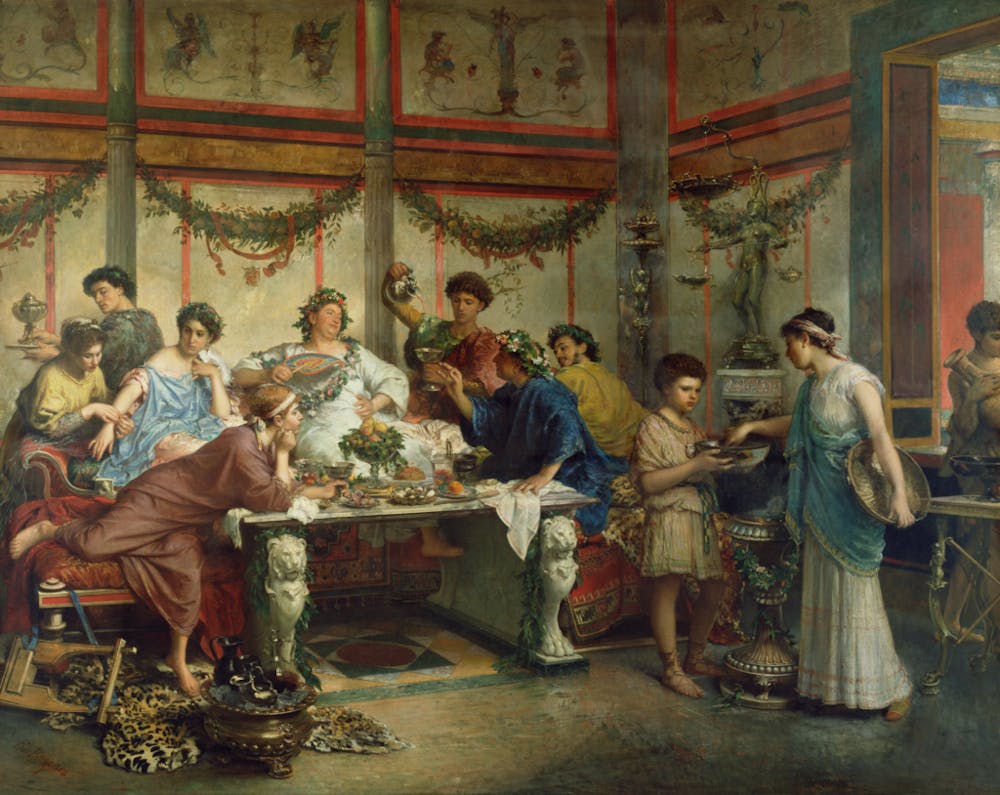
A Roman Feast depicted by Roberto Bompiani in the late 19th century.Getty Museum
Today, many of these vineyards have been replanted as they were at the time of the eruption, with relatives of ancient grape varieties like the Piedirosso: a fruity and floral grape with light herb and spiced flavours, perhaps related to Pliny’s ancient Columbina variety.
In 1996, the local Campanian winemaker, Mastroberardino, cultivated and processed these grapes using Roman techniques and created the Villa dei Misteri wine: ruby red in colour with a complex taste, including hints of vanilla, cinnamon and notes of spice and cherry.
It can be aged for 30 years or more – just like the 60-year-old Falernian drunk by Julius Caesar at his celebration banquet in 60 BC.
The government has secured deals for two further COVID-19 vaccines, taking its portfolio of agreements to four.
Under the latest agreements, to be announced by Scott Morrison on Thursday, Novavax would supply 40 million vaccine doses and Pfizer/BioNTech would provide 10 million doses.
The Novavax and Pfizer/BioNTech vaccines are expected to be available in Australia from early to mid next year, subject to the success of trials and the needed approvals.
This brings the government’s vaccine investment to more than $3.2 billion, with a total of 134 million doses.
Morrison, while cautioning that there was no assurance of an effective vaccine, said: “By securing multiple COVID-19 vaccines we are giving Australians the best shot at early access to a vaccine, should trials prove successful.
“We aren’t putting all our eggs in one basket and we will continue to pursue further vaccines should our medical experts recommend them.
“There are no guarantees that these vaccines will prove successful, however our strategy puts Australia at the front of the queue, if our medical experts give the vaccines the green light.”
The earlier vaccine agreements involve the University of Queensland/CSL and Oxford/AstraZeneca.
People are likely to need two doses of Novavax Inc’s vaccine, hence the 40 million doses. The vaccine, if it is found safe and effective, would be expected to arrive from early next year. It would be manufactured in the United States and the Czech Republic.
Novavax’s vaccine candidate began phase three clinical trials in the United Kingdom in September.
Under the other new agreement, the vaccine Pfizer and BioNTech are jointly developing would also be expected early next year, if the vaccine – now in phase three clinical trials – passes muster. It would be manufactured in the US, Belgium and Germany.
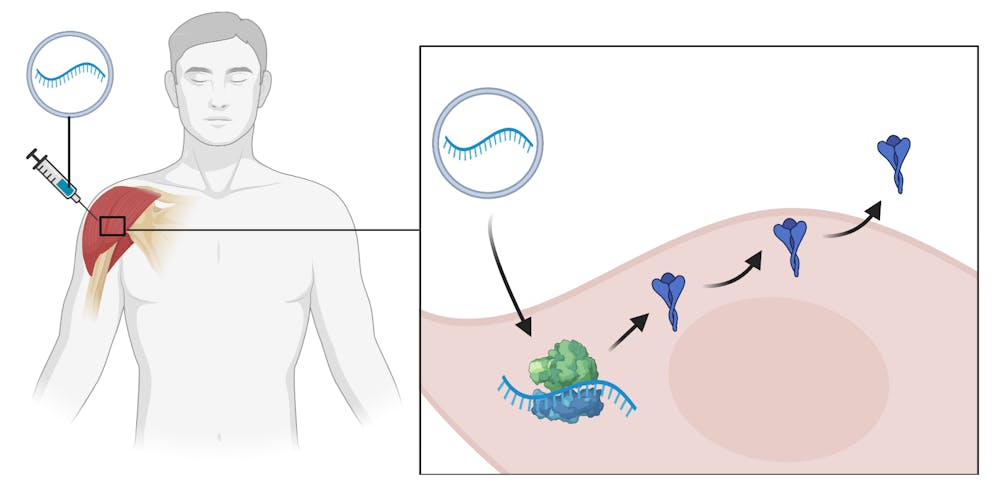
The Pfizer/BioNTech is a messenger ribonucleic acid (mRNA) type vaccine and the Novovax vaccine is a protein type vaccine.
Australia’s COVID-19 vaccine portfolio now has two protein vaccines and one mRNA and one viral vector type vaccine.
Health Minister Greg Hunt said: “The goal and the expectation is that Australians who sought vaccination will be vaccinated within 2021.”
Workers in health and aged care, and older people and others most vulnerable to COVID would have first access.
Vaccination places would initially include GPs, GP respiratory clinics, state and territory vaccination sites and workplaces such as aged care facilities.
The vaccine would be free and not mandatory.
The federal government is consulting with the states and territories, medical experts and industry peak bodies about the initial roll-out of the vaccination program early next year.
Internationally, Australia has also joined the COVAX facility, which would provide access to a large portfolio of vaccination candidates and manufactures around the world for up to half of the Australian population.
Following the sixth COVID-19 incursion in three months, New Zealand needs to shift from a one-size-fits-all strategy to a risk-based approach to border management.
Two staff have recently tested positive after coming into contact with international seafarers in the course of their duties at a managed isolation facility in Christchurch, where 31 mariners with COVID-19 remain in quarantine.
Mandatory testing of international mariners, who may be only briefly in the country to join their vessels, is being introduced from this week.
This latest incursion follows five earlier border failures since early August. One of these led to the recent outbreak in Auckland.
We propose an urgent shift to a traffic-light approach to border control. This system would facilitate travel to New Zealand from places that are free of COVID-19 (some Australian states and Pacific islands), while reducing the risk associated with travellers from jurisdictions with uncontrolled spread.
Keeping COVID-19 at the border
One of the recent border failures led to the relatively serious outbreak in Auckland, with 179 cases, three deaths and major social and economic impacts.
Two other outbreaks, including one from a returnee infected in a quarantine facility and the latest from port workers infected by incoming seafarers, were controlled at an early stage.
The others involved infections of border facility workers: health workers on two occasions and a maintenance worker.
These six events represent system failures — the goal should be to have complete containment of infection at the border and no cases in the community.
Contributing factors include the use of hotels for quarantine (for which they are not designed) and poor system design, including the lack of testing of seafarers flying into the country to join their ships.
Such failures could increase if the proportion of infected travellers coming to New Zealand increases as many parts of the world experience resurgences and rising infection rates. Given the marked difference in the intensity of the COVID-19 pandemic in different regions and countries, we propose a traffic-light system of risk stratification for jurisdictions from which travellers arrive in New Zealand.
New Zealand has much of the infrastructure already in place to support this shift, including a booking system that could help to manage it. We would also get very rapid data on whether it is working, based on the rate of positive cases detected at the border.
Green: quarantine-free travel with precautions
A growing number of countries in the Asia-Pacific region have eliminated COVID-19, notably most states of Australia. Some Pacific island jurisdictions have never had cases.
Quarantine-free travel should be possible from these jurisdictions, provided an assurance program is in place to ensure elimination requirements are being met, including adequate levels of testing. Since there is always a small risk of outbreaks from border control failures (Australia also uses hotels for quarantine, which failed in Victoria), we would need to consider retaining aome controls, such as:
rapid testing (using PCR methods) on arrival in New Zealand, or rapid antigen tests once these are considered reliable enough and are available in New Zealand
digital tracking for the first three weeks in New Zealand (via a traveller’s smartphone and with government-provided phones for those who don’t have their own)
paying a bond (eg NZ$1000) to be returned after three weeks if the traveller has adhered to the digital tracking system.
These could be states with evidence of ongoing pandemic spread, but where it is relatively well controlled (for example, in Japan, South Korea, Singapore). For this zone, the current measures (facility-based quarantine for 14 days and testing twice during that period) could apply, albeit with some refinements.
Facility-based quarantine periods could be shorter and replaced with home quarantine. The isolation period at home could be combined with the usual PCR testing, digital tracking, mask use and heavy fines for any breaches.
Various East Asian jurisdictions, including Taiwan, have successfully used home quarantine.
As above, a bond could be used to encourage adherence to the conditions.
Red: additional measures or no travel
Jurisdictions with uncontrolled pandemic spread (including US, UK, Russia and India) would fall into this category. For New Zealanders returning from these places, the government could require pre-travel measures in addition to the current quarantine.
The form of these measures needs careful development, but could include evidence of both pre-travel home quarantine (for three days or more) and negative pre-travel test results.
Such measures add to the burden these travellers face, but can be justified. They reduce the risk of outbreaks on incoming aircraft as well as the load on the isolation/quarantine facilities.
Quarantine facilities for these travellers could be restricted to those outside of Auckland, for example at the Ōhakea air base, ideally in purpose-built facilities with properly designed ventilation and no shared spaces.
If all these measures still resulted in high numbers of infected travellers arriving in New Zealand, we would need to consider suspending travel from these red-zone jurisdictions. New legislation could empower the government to allow for such constraint on the right of citizens to return to New Zealand from high-risk countries during a global pandemic.
Owing to the large numbers of mail ballots, counting in some states has been very slow. What we know is that Donald Trump won Florida, Texas, Ohio and Iowa. With the exception of Florida, these states were regarded as only winnable for Biden if he won by a landslide.
Trump is narrowly ahead with almost all votes counted in North Carolina. In Georgia, the New York Times needle gives Biden a slender 0.5% lead, largely because the remaining votes are from metropolitan Atlanta.
Trump’s win in Florida, where he leads by 3.4% with 96% in, was caused by a massive swing to Trump in Miami-Dade county. Biden only won Miami-Dade by 7%, compared to Hillary Clinton’s almost 30% margin in 2016. This county has many Cuban Americans, who far preferred Trump the second time. Trump also greatly overperformed with Hispanics in Texas.
Biden held the narrowly Clinton states of New Hampshire and Minnesota. The AP and Fox News have called Arizona for Biden. Biden won Nebraska’s second Congressional District. Biden is likely to hold Nevada and Maine.
While Trump currently has leads in Wisconsin, Michigan and Pennsylvania, early votes by mail are likely to heavily favour Biden when they are counted in the bigger population centres. If Biden wins two of these three, he would win the Electoral College by a minimum of 270-268 with Arizona, Nevada and Nebraska’s second.
Biden currently leads Trump by 49.8% to 48.5% in the national popular vote. However, Democratic strongholds such as California take four weeks after election day to count all their votes. Biden’s popular vote lead is certain to grow in the coming weeks.
For the most part, the polls understated Trump’s performance, particularly in Florida, Ohio and Iowa. The final Selzer Iowa poll was the big exception, giving Trump a seven-point lead.
A clue to the closeness of the result was a three-point jump in Trump’s net approval with likely or registered voters in a week, to -6.9%. It was likely Trump would do better with higher personal ratings.
In the Senate, Republicans lead Democrats by 47 to 46 with seven races uncalled. One Senate race in Georgia will go to a run-off, and the other one could too if Republican David Perdue fails to clear 50%. Democrats are likely to win the Arizona Senate, but Republicans Susan Collins and Thom Tillis are likely to hold Maine and North Carolina respectively.
Pending the one and possibly two runoffs in Georgia, Democrats are likely to gain just one net Senate seat. If Republicans hold both Georgian seats, they would retain a 52-48 Senate majority – a disappointing result for Democrats, who had been given a 75% chance to win the Senate by FiveThirtyEight.
In the House, Democrats have so far lost a net three seats, but would retain a majority with 232 of the 435 seats, down from 235.
Editor’s note: We will continue to update these figures as the vote continues over the coming days.
The Internet of Things (IoT) is already all around us. Online devices have become essential in industries from manufacturing and healthcare to agriculture and environmental management, not to mention our own homes. Digital consulting firm Ovum estimates that by 2022 Australian homes will host more than 47 million IoT devices, and the value of the global market will exceed US$1 trillion.
The IoT presents great opportunities, but it brings many risks too. Problems include excessive surveillance, loss of privacy, transparency and control, and reliance on unsafe or unsuitable services or devices.
Australia has been late to react. Even recent moves by the federal government to make IoT devices more secure have been far behind international developments.
A report launched today by the Australian Council of Learned Academies (ACOLA) may help get Australia up to speed. It supplies a wide-ranging, peer-reviewed base of evidence about opportunities, benefits and challenges the IoT presents Australia over the next decade.
Benefits of the Internet of Things
The report examines how we can improve our lives with IoT-related technologies. It explores a range of applications across Australian cities and rural, regional and remote areas.
Some IoT services are already available, such as the Smart Cities and Suburbs program run by local and federal governments. This program funds projects in areas such as traffic congestion, waste management and urban safety.
Health applications are also on the rise. The University of New England has piloted the remote monitoring of COVID-19 patients with mild symptoms using IoT-enabled pulse oximeters.
Augmented and virtual reality applications too are becoming more common. IoT devices can track carbon emissions in supply chains and energy use in homes. IoT services can also help governments make public transport infrastructure more efficient.
The benefits of the IoT won’t only be felt in cities. There may be even more to be gained in rural, regional and remote areas. IoT can aid agriculture in many ways, as well as working to prevent and manage bushfires and other environmental disasters. Sophisticated remote learning and health care will also benefit people outside urban areas.
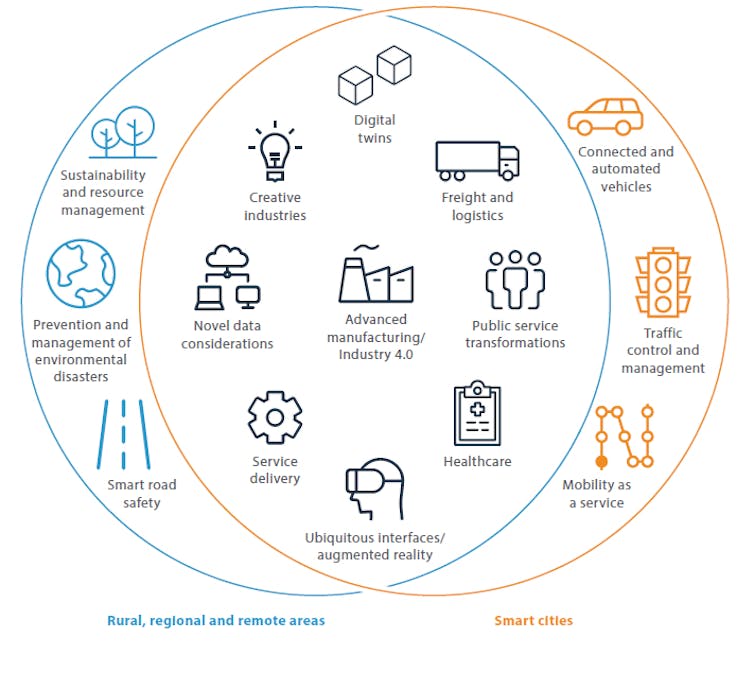
While some benefits of the IoT will be felt everywhere, some will have more impact in cities and others in rural, remote and regional areas.ACOLA, CC BY-NC
Opportunities for the Australian economy
The IoT presents critical opportunities for economic growth. In 2016-17, IoT activity was already worth A$74.3 billion to the Australian economy.
The IoT can facilitate more data-informed processes and automation (also known as Industry 4.0). This has immediate potential for substantial benefits.
One opportunity for Australia is niche manufacturing. Making bespoke products would be more efficient with IoT capability, which would let Australian businesses reach a consumer market with wide product ranges but low domestic volumes due to our small population.
Agricultural innovation enabled by the IoT, using Australia’s existing capabilities and expertise, is another promising area for investment.
IoT devices can collect huge amounts of sensitive data, and controlling that data and keeping it secure presents significant risks. However, the Australian community is not well informed about these issues and some IoT providers are slow to explain appropriate and safe use of IoT devices and services.
These issues make it difficult for consumers to tell good practice from bad, and do not inspire trust in IoT. Lack of consistent international IoT standards can also make it difficult for different devices to work together, and creates a risk that users will be “locked in” to products from a single supplier.
In IoT systems it can also be very complex to determine who is responsible for any particular fault or issue, because of the many possible combinations of product, hardware, software and services. There will also be many contracts and user agreements, creating contractual complexity that adds to already difficult legal questions.
The increased surveillance made possible by the IoT can lead to breaches of human rights. Partially or fully automated decision-making can also to discrimination and other socially unacceptable outcomes.
And while the IoT can assist environmental sustainability, it can also increase environmental costs and impacts. The ACOLA report estimates that by 2050 the IoT could consume between 1 and 5% of the world’s electricity.
Other risks of harmful social consequences include an increased potential for domestic violence, the targeting of children by malicious actors and corporate interests, increased social withdrawal and the exacerbation of existing inequalities for vulnerable populations. The recent death of a woman in rural New South Wales being treated via telehealth provides just one example of these risks.
Maximising the benefits of the IoT
The ACOLA report makes several recommendations for Australia to take advantage of the IoT while minimising its downsides.
ACOLA advocates a national approach, focusing on areas of strength. It recommends continuing investment in smart cities and regions, and more collaboration between industry, government and education.
ACOLA also recommends increased community engagement, better ethical and regulatory frameworks for data and baseline security standards.
The ACOLA report is only a beginning. More specific work needs to be done to make the IoT work for Australia and its citizens.
The report does outline key areas for future research. These include the actual experiences of people in smart cities and homes, the value of data, environmental impacts and the use of connected and autonomous vehicles.
New South Wales Premier Gladys Berejiklian today announced the border with Victoria will reopen on November 23.
It will be the first time people can freely cross the border since early July.
My preference would be to wait until both states have an extended period of time with zero community transmission of COVID. But I think the risk of a substantial outbreak from opening the border is low.
Victoria has done exceptionally well in squashing its second wave, and has now recorded five consecutive days of zero new cases. Even more pleasingly, the number of mystery cases — those with an unknown source — has dropped to just two in the past fortnight. In saying that, we’ll have to wait another week or so to see the effects of the latest round of eased restrictions.
For the first time in months, it looks as if the COVID situation is worse in NSW than Victoria. Arguably the risk of opening the border is greater for Victoria right now than it is for NSW. Indeed, Berejiklian said today that Victoria “may have, because of the lockdown, actually gone down a path of having eliminated it at this point in time”.
Today NSW recorded nine new cases, six of them among people already in hotel quarantine and three locally acquired. However, those three were already in isolation having previously been identified as close contacts of an existing case.
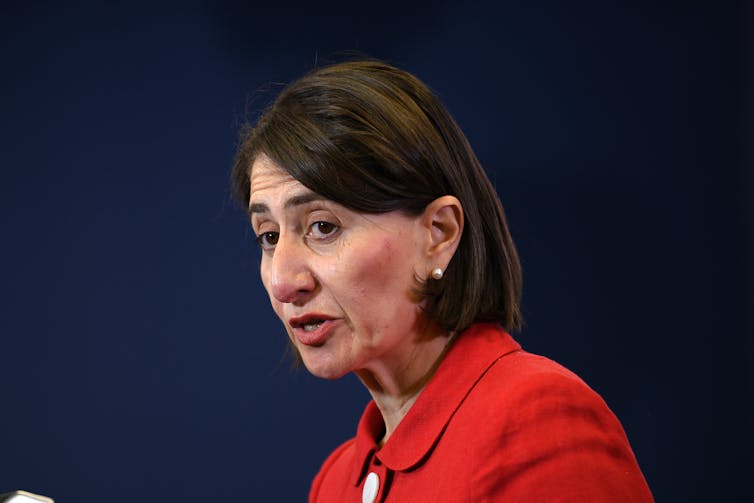
NSW Premier Gladys Berejiklian said reopening the border with Victoria was a ‘calculated risk’.DAN HIMBRECHTS/AAP
Elimination is on the cards
I’m concerned NSW is not going for elimination. It leaves the state as an outlier in Australia, with Victoria now joining all other states and territories by having zero community transmission (although Victoria’s official strategy is “aggressive suppression” rather than outright elimination).
I’d like to see NSW tighten restrictions in a few areas, because I think Australia now has a real shot at eliminating COVID. For example, NSW residents are currently allowed up to 20 visitors at a time, despite the Chief Health Officer recommending no more than ten. As homes are one of the greatest risk areas, why not follow this advice?
In saying that, NSW has shown it’s capable of controlling outbreaks with rapid contact tracing. And Victoria has substantially improved its contact-tracing system over the past few months.
Unfortunately, border reopening is likely to make contact tracing more difficult. Many people will cross state borders during summer, particularly over Christmas and New Year.
Contact tracing is currently done on a state-by-state basis, by local teams using their own data sets. It’s not clear whether and how these data will be shared as borders reopen.
For example, if someone is infectious while on a road trip holiday and visits a restaurant in regional Victoria, before driving to towns in NSW and then Queensland, how will contact tracing be organised and shared?
NSW has shown it’s capable of controlling outbreaks.DAN HIMBRECHTS/AAP
I’d like to see a coordinated national effort to centralise these data. Ideally, there should be a centralised body, such as an independent federal Centre for Disease Control, which could handle national contract tracing, with regional hubs in each state and territory. This would ensure all states and territories would use the same contact-tracing software, using staff trained to the same level.
A national contact tracing database would then enable the tracking of people travelling interstate. Perhaps a QR code system could be implemented on a national level, so visiting a pub in South Australia means it is recorded in a centralised national database.
A federal disease control agency could also ensure consistency of hotel quarantining, and training of security staff.
In late September, the Therapeutic Goods Administration approved four rapid antigen tests for COVID.
These tests work by detecting proteins on the outside of the virus, called antigens, from nasal swabs. And they can deliver results in 15 minutes or even quicker.
Yes, their accuracy is not quite as good as the standard COVID tests in that they tend to have a higher rate of false negatives. But I think there’s potential for these to be used as interstate travel increases.
For example, interstate travellers could get one of these tests while waiting for their flights in airports, while crossing land borders by car, or when leaving or arriving by sea.
Australia has done a fantastic job at controlling COVID, and is the envy of much of the world. Ideally, it would be good to have New South Wales take the extra step to eliminate COVID before borders are completely open, though this might be politically hard. Introducing additional measures like rapid antigen tests, and a hub and spokes contact-tracing system, would go a long way to ameliorating the small risks to other jurisdictions from New South Wales retaining its current suppression approach.
If you’re in a super fund, then, like it or not, you’ve got ethical decisions to make.
More than 10 million Australians have a superannuation account. Which means, effectively, more than 10 million of us are mini-shareholders with the capacity to influence future business decisions.
With that power, however small, comes responsibility. And nowhere more apparent than in relation to climate change.
Last month, the world’s biggest asset manager, BlackRock, surprised Australia’s biggest electricity producer and carbon dioxide emitter, AGL, by backing a motion that would have forced it to close its coal-fired plants earlier than planned.
The resolution at AGL’s annual general meeting failed, but when a global firm managing more than US$7 trillion in investors’ savings says it’s time to accelerate the exit from coal, it’s wise sit up and take notice.
Interestingly though, some of Australia’s biggest industry super funds, among them Cbus, Hesta and Aware, refused to support the motion, which was put forward by the Australasian Centre for Corporate Responsibility.
Work ‘behind the scenes’
It’s been a pattern with industry super funds.
Rather than using their overt voting power to try to change corporate behaviour, or divest from companies altogether, they say they prefer to exert influence behind the scenes, through conversations in board rooms and executive suites.
Take, UniSuper, to which I contribute. It says it engages with companies “to encourage rapid decarbonisation of their operations and supply chains”.
UniSuper is one of only three industry funds to commit to achieving net zero carbon emissions across its portfolio by 2050 — the others are Cbus and HESTA.
Yet doubling down on gas
UniSuper has joined eight other funds in divesting from companies that predominantly make their money from producing coal for electricity generation.
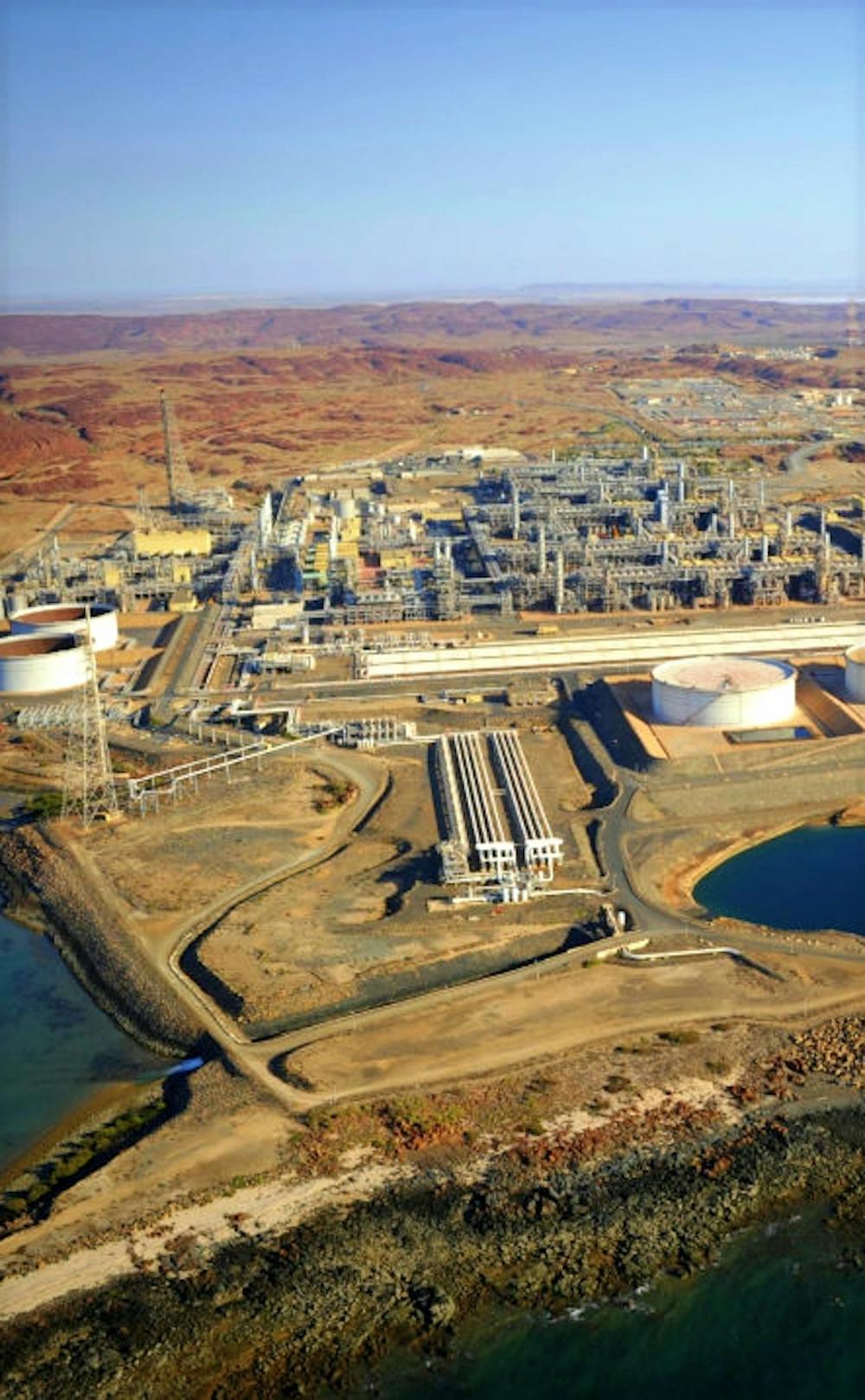
Big gas plans for the Burrup Peninsula.Woodside
Yet if your retirement savings are in UniSuper’ default balanced option, then they are partly invested in Woodside, a company seeking to build a huge new gas hub on the Burrup Peninsula in Western Australia.
Woodside says the hub, which will operate for “decades into the future”, could process more gas than the entire volume extracted so far from another of its resource projects, the North West Shelf which began operations 36 years ago.
If you’ve chosen UniSuper’s conservative option, then you are not only invested in Woodside, but also in Santos, which is behind the contested Narrabri coal seam gas project in NSW.
UniSuper’s annual report on climate risk also reveals smaller investments in gas producers Origin and Oil Search.
Experts say worldwide gas use needs to peak before 2030 in order to keep global warming below agreed levels.
It means UniSuper, and other big funds, are investing our collective retirement savings in firms whose corporate strategies threaten our collective future.
UniSuper cites AGL as an example why it stays with polluting companies. While it runs power stations fuelled by coal and gas, it also invests in renewable technology.
It says, if it were to divest, its AGL shares might be acquired by investors with less concern for the environment.
it can be in the best interests of the environment and society for the assets to be held by a responsible and reputable entity.
It’s a justification that could equally be used to defend running a gambling venue — if I didn’t install poker machines, someone else would, and at least I care for my customers.
(As it happens, UniSuper’s “balanced” option includes shares in Aristocrat Leisure, a leading maker of gaming machines.)
Super funds have more power than they use
The justification sidesteps the question of whether the investment itself is defensible.
And it ignores the opposing argument — that divestment by a leading super fund can send a powerful signal to the market that a company is not properly addressing climate risk or developing an appropriate strategies for a carbon-constrained world.
Any company not doing these things is putting our savings at risk.
According to expert legal opinion, its directors might be breaching their obligations under the Corporations Act.
We’ve got power ourselves
There are legitimate arguments to be had about the best way for super funds to push businesses to act more urgently on climate change, but as fund members, and the ultimate owners of our money, we need to make up our own minds and act accordingly.
To sit back and let others do it on our behalf is an abrogation of responsibility.
Superannuation may be compulsory, but we still have choices.
We can find out which companies our retirement savings are invested in, and swap to a more sustainable option in the same fund.
This can take some digging around, but as with UniSuper, some the information is available on the fund’s website or can be obtained by asking questions.
Or we can consider switching to a different fund altogether. There are websites that track and compare superannuation investments in fossil fuels.
For a range of reasons, it’s more difficult to switch to a new fund for UniSuper members.
But even where it isn’t possible, we can write to our funds, urging them to engage more actively on climate change. It’s easy to find the addresses. They are forever sending us emails.
It’s what they say they do with fossil fuel companies — engage them in conversations. We can tell them where we want our savings invested and how we want them to use their clout to influence company decisions and vote at shareholder meetings.
We can do this as individuals, and we can band together with like-minded fund members to speak with one voice.
With a combined A$2.9 trillion in assets, one fifth of which are invested in Australian companies listed on the stock exchange, super funds own a fair chunk of Australia’s most important companies.
It would be wrong for them not to take that responsibly seriously, just as it would be wrong of us not to take seriously what our savings are being used for.
It has been billed as the most significant US election in generations, and with nearly 100 million votes already cast, it is well underway.
An estimated 50 million more votes are expected on the last day of in-person voting on Tuesday (Wednesday NZ time), with mail-in ballots still making their way through the postal service, including from overseas and military voters.
It is not only the White House up for grabs, but all 435 seats in the House of Representatives and 35 of the 100-seat Senate.
In addition, 11 gubernatorial (state governor) races, various state legislatures, and a plethora of local judges, sheriffs, school boards and supervisory roles are also on the ballot. A quick glance at a US ballot illustrates how America has more democratically elected positions per capita than any other country in the world.
In the year following more than 1,000 former federal prosecutors confirming President Donald Trump would be indicted if not for the current immunity the Oval Office provides him, Trump has stepped up rhetoric that any election that he does not win is “rigged”.
Then came the “October surprise” from The New York Times that the president has at least US$400 million in personally guaranteed loans due over the next possible term and previously undisclosed Chinese bank accounts. This has brought the president’s priorities under intense scrutiny alongside a flailing economy and federal mismanagement of the covid pandemic response.
Citing these concerns, formal endorsements of Trump’s political opponent, former Vice-President Joe Biden, have come from unlikely places. Republican national security veterans, GOP governors and nonpartisan communities of scientists and physicians have endorsed Biden, some for the first time in the history of their organisations.
A group of 73 high-level former GOP US National security officials from administrations spanning Reagan to Bush Jr wrote in an open letter that Trump is “dangerously unfit to serve another term”, citing his undermining of the rule of law, failure to lead Americans through the pandemic, and damage to the US’s global reputation.
More than 780 prominent Republicans and Democrats, including former defence secretaries, ambassadors, and retired military brass, also decried Trump, writing that:
[…] thanks to his disdainful attitude and his failures, our allies no longer trust or respect us and our enemies no longer fear us.
A chorus of Trump’s own former administration officials have joined The Lincoln Project, Republican Voters against Trump, 43 for Biden (featuring members of the George W. Bush administration) and former staffers of late senator John McCain, to mount powerful testimonials targeting Trump’s base, independents and new voters.
The Biden camp has stressed a return to decency and cooperation, a United States of America. A popular ad encapsulates the message,
There is only one America. No Democratic rivers, no Republican mountains. Just this great land and all that’s possible on it with a fresh start. There is so much we can do if we choose to take on problems and not each other and choose a president who brings out our best.
Other “anyone but Trump” ads target voters who may have supported him in 2016 as a fiesty outsider, but have tired of the noise.
Ads, endorsements and of course polls are potentially useful indicators during the final week of voting. But what are some other trends that will likely impact electoral turnout and the results? Here are a few to look out for.
Millennial voter generation Against the tight margins of the 2016 election in a handful of decisive states, a new generation of voters has emerged who may tip the balance of power. They drove a higher turnout in the 2018 midterm election and are not only voting but running and winning office. Enter the millennials.
The US is on the cusp of a generational shift. This is the first US presidential election in which the millennial generation is now the largest voting-age cohort, displacing the baby boomers who have held the title since the 1970s.
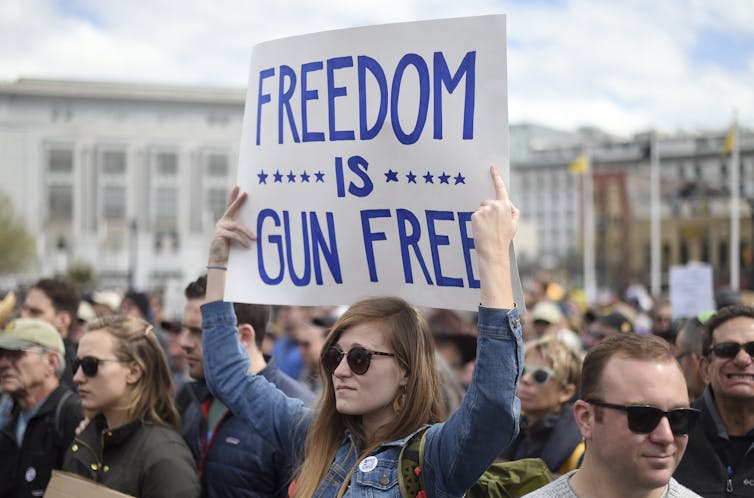
Younger millennials, who may have spent the previous presidential election in a high school walk out, or participated in the March for Our Lives for gun safety, are now eligible to vote.
Older millennials, who are approaching 40, grew up with high school shootings and are now watching their own young children do lockdown drills, rewarded with a candy if they remain quietly hidden in the toilet with their feet up to avoid detection.
Heartstopping PSA on school shootings released by Sandy Hook Promise.
Amid concern about growing economic inequality, the millennials will likely be the first generation to be less financially secure than their parents, and the most likely to compare themselves with international OECD peers who enjoy universal healthcare, gun control and better financial support during the pandemic.
None of these issues is well represented by the current administration, and so Trump’s approval rating hovers around 28 percent among that age group.
On these crucial issues, different informational diets between generations, political parties, and even families could drive very different voting patterns.
But the millennial vote could be decisive.
Young people will have a big say in the outcome of the 2020 election. Image: Josh Edelson/AAP/EPA
Disinformation – word of the year? If “post-truth” was the Oxford Dictionary’s Word of the Year in 2016, “disinformation” is in the running for 2020.
Disinformation – the deliberate spreading of false or misleading information in order to deceive – is a growing problem in democratic elections. It was a key theme in the Republican-chaired Senate Intelligence Committee report into Russian interference in the 2016 election.
These reports documented key disinformation techniques, narratives and purpose. Akin to Russian “active measures”, disinformation is used to undermine authoritative sources of information by blurring the line between fact and faction.
The most popular narrative, according to this report, was the myth of “voter fraud”.
While the 2016 disinformation campaign centred on voter fraud, the 2020 version targets mail-in voting. These ballots, cast in the middle of covid-19, are at the heart of competing narratives about the pandemic itself.
In this election, there has been a catalogue of disinformation about covid-19. While scientists, physicians and public health authorities have repeatedly warned the public and officials to take action to protect public health, the Trump administration has generally downplayed its severity.
Calling it “just the flu”, Trump said the problem impacts “virtually nobody”, even after nearly a quarter of a million Americans died. Recent research has shown Trump himself is one of the largest superspreaders of
‘If I Can Get Better Anyone Can Get Better’: Trump On covid-19 Recovery. Video: NBC News
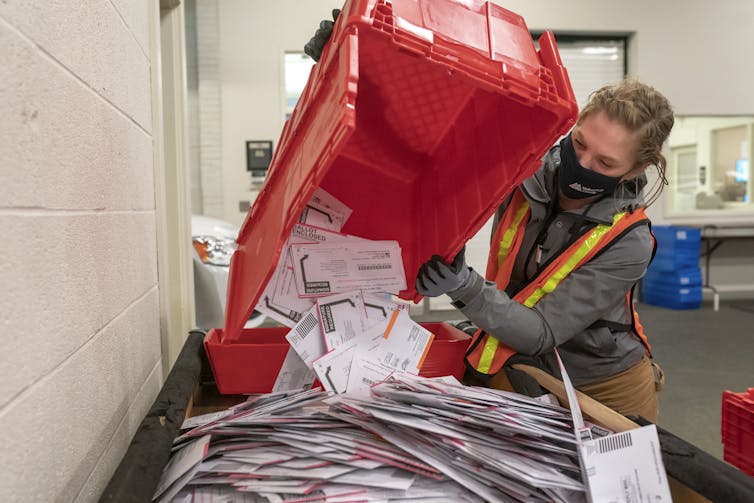
Some of that disinformation will affect how people cast their ballot. While 19 states have expanded mail-in ballot options as a result of the pandemic, others have made voting harder by closing voting places while not expanding alternate options.
Texas, for instance, refused to recognise covid-19 concerns as a valid reason for those under 65 to request a mail-in ballot, with South Carolina only recently reversing a similar restriction.
Disinformation about mail-in ballots is likely to feature in court challenges. Trump has insisted the results be known on election day, which would necessarily exclude mail-in ballots postmarked in time but not yet received through the mail, including those cast by overseas military voters.
He has repeatedly signalled that his appointees in the judicial system (which number in the hundreds) will help secure his win.
While it is unprecedented for a president to attack electoral integrity, state level actions are also important to consider.
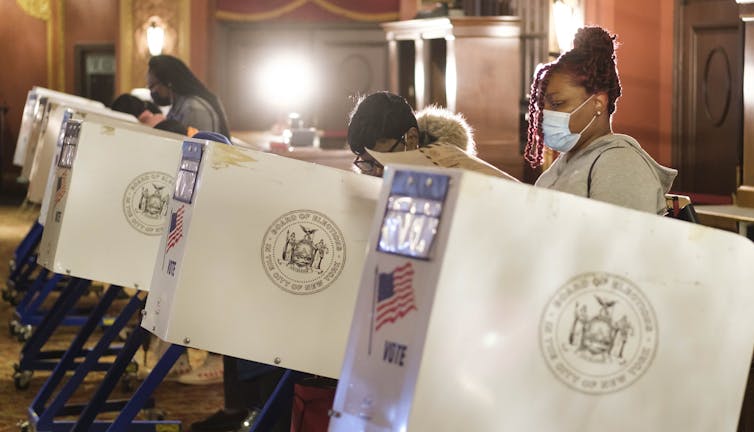
Elections run at state, county level Voting in the US is not easy to summarise. Devoid of democracy sausages and a non-partisan federal elections commission, elections are run at the state and county level, from voter rolls to polling locations and everything in between.
Each state is in charge of its own election, and there are nearly as many systems as there are states.
Five states, including Oregon, vote entirely by mail. Five other states vote entirely on machine, including Georgia, with no traditional paper audit trail.
Other state variations include the option of early in-person voting, whether voting places are open on a Sunday, how far in advance you must register to vote, and requirements for voter ID.
Each US state has its own voting requirements, arrangements and ballots. Image: Juston Lane/AA/EPA
Each state’s ballots look different, with users selecting their choices via handmarked bubble sheets, hole punches or hanging chads, the latter made famous in the 2000 recount in Florida that delivered George W. Bush his first term.
One of the quirks of the US voting system is the electoral college. The college is essentially a distribution of electoral votes among the states according to population size, updated after every 10-year census.
In 2020, several large states are in the spotlight as toss-ups, including Texas, which carries a prize of 38 electoral votes in the race to 270. It will be one to watch on election day, with early voter turnout already surpassing its 2016 total.
Texas is also the site of one of the most blatant attempts at disenfranchisement, with the GOP failing in its attempt to stop more than 120,000 ballots already cast in one of its largest counties.
Until recently, states were not allowed to make changes to voting procedures without judicial oversight. Plans to close significant numbers of polling places in certain districts, for instance, had to go through pre-clearance processes.
However, these protections were dismantled by a US Supreme Court ruling in 2013. This year’s presidential election will be only the second without those protections, and voter disenfranchisement could result.
One key method of disenfranchisement could be mail-in ballots. In an interview in August, Trump said he planned to block funding for the US postal service to prevent increased voting by mail.
A Trump appointee to the head of the postal service in July recently oversaw the destruction and dismantling of 700 mail processing machines, leading to more delays.
Simple polls of voting intention do not capture voter disenfranchisement and intimidation.
Intimidation tactics have been increasing across several key states. In Pennsylvania, New Jersey and North Carolina, official Republican party mailers warned voters their voting history is a matter of public record.
When the Democrats win the White House and you didn’t do your part to stop it, your neighbours will know. Voting is a matter of public record.
Experts warn of potential violence and rioting after the result. Growing polarisation, extremist groups such as QAnon threatening the use of force, and the availability of tactical weapons are all warning signs.
This year has seen more than 8 million more gun purchases than 2019, and scholars warn of increasing militia activity. Trump has publicly praised supporters who commit violence, including the Kenosha shooter.
International allies are also concerned. After Trump used armed guards to teargas peaceful protesters in Washington DC (which Australia watched live as its reporters were bashed on air), the Scottish Parliament voted to suspend exports of riot shields, tear gas and rubber bullets to the United States.
Australia recently updated its “do not travel” advisory to the US, citing civil unrest around the election.
Regardless of the outcome of the election, some of the trends may continue beyond Inauguration Day on January 21, 2021, affecting not just the US but its relationships with allies and adversaries alike.
Australia would do well to watch carefully and wait for the final results.
Jacinda Ardern’s new “covid cabinet” is pretty much the same as — and completely unlike — every previous government under the mixed member proportional (MMP) system.
The similarity involves the political accommodation reached between Labour and the Greens. Every government formed since 1996 has rested on such arrangements. This one does too.
The difference lies in Ardern’s administration being the first single-party majority government since the electoral rules changed in the mid-1990s. Add to that the arrangement with the Greens and they have a massive 74-seat bloc in the House — 13 more than is needed to govern.
In brute political terms, Ardern is at the head of one of (and perhaps the) biggest parliamentary alliances in the nation’s history.
The Greens’ consolation prize The deal announced over the weekend is a cooperation agreement. Think of it as the smallest of the consolation prizes, the thing you’re offered when your support is nice to have but not really necessary.
For the 15 percent of Green delegates who voted against it, perhaps it was just too small, and you can see their point. In the last government (when the party had eight rather than ten seats), the Greens held ten full or associate portfolios.
None of their ministers sat in cabinet, true, but there were four in the executive. Now there are only two, holding four portfolios between them — and they’re still not sitting at the top table.
Look more closely at the detail, though, and things get more interesting.
A new kind of MMP The Green ministers will participate in relevant cabinet committees and informal ministerial groups, have access to officials’ papers, and get to meet with the prime minister at least every six weeks. Labour and the Greens’ respective chiefs of staff will also meet regularly.
Nice to have … Jacinda Ardern signs the co-operation agreement with Green Party co-leaders Marama Davidson and James Shaw. Image: The Conversation/GettyImages
What’s more, the party will chair one parliamentary committee and get the deputy’s slot on another. In non-portfolio areas of mutual interest, Green spokespeople will have access to Labour ministers and departmental advice. All that and they get to publicly disagree with the government on policies that fall outside Green portfolios. That is not a bad policy haul for a party Labour does not need to form a government.
And there is no way any of it would have happened under the single-party majority governments we used to see under the previous first-past-the-post system. So it may be a consolation prize, but in fact it’s not that small.
New Foreign Affairs Minister Nanaia Mahuta … the first woman to hold the position. Image: The Conversation/GettyImages
A more diverse government As well as being the first single-party majority MMP government, it is also a diverse one. In her first term Ardern acknowledged the importance of having more women in cabinet. Nearly half (47 percent) of the new Parliament — and a majority of Labour’s caucus (53 percent) — are women.
To some extent this is reflected in the makeup of the executive. Eight of the 20 full cabinet members are women; in total, women comprise 43 percent of the wider administration. There are more women in the ministry than in the National Party’s caucus.
The executive also contains a solid number of people of colour: perhaps as many as a quarter of all ministers and parliamentary under-secretaries are non-Pākehā.
On election night, Labour’s Māori caucus conveyed a direct message to the prime minister about the importance of a solid Māori presence in cabinet. She appears to have listened.
Between them, Labour’s Māori MPs get five seats in cabinet. Add positions outside cabinet as well as the Greens’ Marama Davidson and Māori comprise 25 percent of all members of the executive. Perhaps most noteworthy is that Nanaia Mahuta becomes the country’s first female Minister of Foreign Affairs.
Ardern has also looked carefully at her back bench and the clutch of incoming MPs, bringing some of them into the political executive. Jan Tinetti and Kiri Allan have been marked for higher things for some time, while the newly minted MP Dr Ayesha Verrall comes straight into cabinet as an associate health minister.
Power and control Under certain circumstances a large parliamentary caucus can be a challenge. Thwarted egos, stifled ambitions, fits of pique — once the thrill of the election result has worn off, managing relations between those who are in government and the wider parliamentary party will be one of the chief challenges facing Labour’s whips.
The Green co-leaders aside, Ardern’s executive comprises 40 percent of the Labour party’s caucus. Given the conventions of collective cabinet responsibility, this means that members of the government have a near majority within caucus, so discipline shouldn’t be an issue — yet.
It is hard to overstate just how much control Ardern has over New Zealand’s 53rd Parliament. Even before special votes are counted, the parliamentary arithmetic renders National, ACT and the Māori Party virtually irrelevant.
Labour dominates the executive, and between them Labour and the Greens will dominate the legislature and its committees. Voters have placed considerable power in Ardern’s hands. It’s time to see what she does with it.
A clip from This Is Not A Movie, a 2020 documentary by about Robert Fisk. Video: Doc Edge Festival
Veteran journalist Robert Fisk, who for decades covered events in the Middle East and elsewhere as a foreign correspondent for the British newspaper The Independent, has died after suffering a suspected stroke at his Dublin home.
Fisk became unwell on Friday and was admitted to St Vincent’s Hospital where he died a short time later, reports Al Jazeera English.
Almost six months ago, RNZ Saturday Morning’s Kim Hill did the following interview with Fisk. The Pacific Media Centre republishes this article here as a tribute to the celebrated journalist.
Celebrated veteran war correspondent Robert Fisk believed that journalists aren’t automatons keeping neutral battle scores between oppressed and oppressors and are duty-bound to ensure history isn’t written by politicians.
Fisk, who had spent the past 40 years living in war zones covering conflicts in the Middle East, the Balkans and Ireland, died last Friday. He was 74.
He argued that journalists and editors cower from reporting honestly because of corporate and political influence.
He told Kim Hill in an interview in May that the notion unbiased reporting must not take a moral position was a nonsense and that journalists should, at the very least, challenge narratives of power, which were usually distortions of truth.
The high-profile career of the Englishman who took Irish nationality was the focus of This Is Not A Movie, a documentary by Canadian director Yung Chang about the journalist screened in New Zealand’s 2020 Doc Edge Festival.
Fisk broke several big stories in his time, even landing an interview with Osama bin Laden, notorious Saudi founder of the pan-Islamic terror group al-Qaeda.
A story that didn’t make it on to the front page of The Times – his former employer – was one exposing US responsibility for shooting down a Iranian passenger aircraft in 1988, at the tail end of the Iraq-Iran war.
Robert Fisk … exclusive interview with Osama Bin Laden. Image: RNZ
Verified story spiked The story, which Fisk verified using local air traffic control sources, was spiked and instead the paper published claims by the US navy that the pilot had tried to carry out a suicide mission on a US warship in the Gulf. His story was eventually published by Ireland’s Sunday Tribune, with Fisk resigning and moving to rival newspaper The Independent.
“I thought, that’s the time I go. If I’m going to risk my life for a newspaper but my editor will not risk his reputation with his owner over a story of mine then it’s time I left,” he said.
Fisk said The Times editor toed owner Rupert Murdoch’s political line, telling him his story was rubbish. An official inquiry by US authorities subsequently backed the content of Fisk’s story.
“It’s a sort of self-censorship… the problem is once you have a ruthless owner and you know your livelihood is in the pocket of that man – and if you’re not fortunate enough to have the reputation that can possibly get you another job – there is a tendency to start not wanting to rock the boat… so it’s in the journalists’ blood, as it is the editors’, not to do something that will cause a ‘crisis’.”
He said this power dynamic affected the way reporters framed stories and reflected the type of politically-contrived language used too. Not least in the Middle East, and especially when dealing with Israel’s occupation of Palestine.
“That’s why, for example, journalists refer to the Israeli wall separating the West Bank as a ‘security fence’, because they don’t want to offend the Israelis and Israel’s supporters by calling it a wall, even though it is higher and longer than the Berlin Wall.
“That’s why we call it a ‘Jewish settlement’ in the West Bank, when it’s a Jewish colony… which has a kind of soft impression of settlements in the Wild West perhaps, of course, you think of the Native Americans attacking them.
Distorting the Palestinian struggle “And also you have this thing where you must never talk about a war between Israel and the Palestinians, it’s always a dispute… it’s more of course, it’s one group of people stealing other people’s land. By de-semiticising this conflict, because we are frightened of what editors or owners will say… we effectively say ‘there must be something wrong when the Palestinians throw stones, they must be generically a violent people’. So, in a sense, we contribute towards warfare, by self-censorship.”
He rejected the concept of giving a false “balance” to stories – that, in some fashion, balance was the ultimate measure of reporting. It was not enough that a journalist merely kept an accurate score of events in a conflict situation, without taking into account history or power differentials.
The argument that a slave owner’s views on the slave trade must be used to strike balance in a story for it to be fair and accurate, he argued, was morally absurd. So too with a Nazi’s views in a story dealing with the extermination of Jews.
Fisk cites a contemporary example – the Sabra and Shatila massacre in 1982. Scores of Palestinians and Lebanese Shiites were killed by a militia linked to a right-wing Lebanese party, allies of Israel.
The names of at least 1390 were identified, with some death-toll estimates nearly tripling that number. Fisk was on the scene in Lebanon.
“I did not spend my time giving equal time to the killers,” he said. “I talked to the relatives of the dead and tried to find out the identities of the dead… My feeling is, you must be neutral and unbiased, but unbiased on the side of those who suffer.
“The idea that we are some kind of robotic creature that reports wars as if it’s a football match, where you give equal time to each side, is a bloody tragedy. It is not a football match.”
Landed in hot water Fisk’s manner of reporting landed him in hot water at times. In Belfast, he was accused of giving succour to the IRA because he exposed British security force brutality during the Anglo-Irish conflict, which ended in the 1990s.
More recently, he was attacked for undermining those attempting to overthrow Syria’s President Bashar al-Assad, after a story questioned proof Assad’s forces had carried out a deadly chemical attack in April 2018.
The documentary This Is Not A Movie highlights a story Fisk wrote that found no trace of a chemical attack in Douma that had supposedly killed dozens of civilians, a story widely disseminated by western media.
He travelled to the Syrian town and talked exhaustively with local people to find proof of the attack, even inspecting underground tunnels of interest, again finding nothing to back the veracity of the claims.
Fisk talked to a doctor, who said respiratory distress by civilians had been caused by a dust storm created by nearby joint Syrian and Russian bombings.
“The final report of Organisation for the Prevention of Chemical Weapons did in fact censor out some of the evidence by its own scientists so that it would say that it’s an open-and-shut case that Assad did use gas. In fact, its own staff could not finally prove gas was used,” he said.
This didn’t stop verbal attacks suggesting he’d done Assad a favour. Fisk brushed this off as merely something to be expected if a journalist was doing their job properly.
“If we don’t do that we’re handing over the writing of history to political parties,” he said.
‘Do our best to get at the truth’ “We simply have to bash on and do our best to get at the truth, even though in Douma I couldn’t establish what it was, at least we raise the doubt.”
Getting to grips with history was essential if serious reporters wanted to do their jobs properly, illuminating meaning behind what would otherwise seem random or vindictive acts of violence, Fisk said.
“I do very much think you cannot report a war or go to a war without at least a very good history book in your back pocket… without knowing what lies underneath the embers you don’t know why the fire is burning.”
An understanding of World War I and the 1919 Treaty of Versailles, which ended the war between Germany and allied forces, could account of much of the antecedents of conflict in the Middle East, he said. The treaty, in part, amounted to a carve-up of imperial rights to occupy nations and created divisive, artificial lines of territory across the region.
“I think there’s an automatic connection between the collapse of industrial civilisation and WWI and then a peace treaty that was effectively going to collapse the ruins of the Ottaman Empire in 1919 and from that came all these borders… particularly the borders of Iraq and Lebanon and Syria and Turkey and all my working life in the Middle East and indeed also in Yugoslavia and Belfast I’ve watched over the past 50 years all the people within those borders burn.
“I said to my friend in Beruit yesterday I think the reason we’re not finding evidence of covid-19 among the Middle Eastern people is that, for them, it was covid 1919 – Versailles was their infection and that continues now to spread its disease across the Middle East, of injustice, lack of independence and lack of freedom.”
Good journalism was needed as much now as at any time in history. He said the hope that the world was getting better with the defeat of Fascism and the establishment of post-war institutions like the United Nations and human rights organisations had proven false. The historical causes of conflict hadn’t be resolved.
Living with tragedy every day “When you go into the alleyways of the world, the Palestinian camps in Beirut for example, and you actually talk to the people there you realise that they are living in squalor and dirt because Arthur Balfour, the British foreign secretary, signed the Balfour Agreement in 1917, and because the victorious allies, principally the French and the British divided up the Middle East. Britain would have Palestine and France would get Syria and Lebanon in the aftermath of that war and for those people, waking up in their hovels everyday, Balfour signed the declaration last night.
“For them Versailles happened yesterday and history in their experience is something that they are living tragically with every day.
“Whereas we people can luxuriate in a post-war world with values of civilisation, or we think we do, and technology to look after us.”
Journalism should question our cozy, false impression of ourselves as enlightened and civilised Westerners, who conveniently see others embroiled in conflict as lacking these values. He also pointed out a Western hypocrisy of rightly attacking anyone who denied the German holocaust against the Jewish people, yet those in the West allowed Turkey to deny its own Armenian holocaust in 1915, when 1.5 million Christians were killed.
Our complicity in imperialist wars and attitudes should be challenged by reporting facts within an authentic historical context, shorn of political spin.
“One of the things I think journalists have to do, as well as recognise the goodness of ordinary people, is to try and find out why ordinary people do wicked things,” Fisk said.
“We all sort of participate in it in the sense that we wring our hands with anguish when a hospital is destroyed in northern Syria but when a hospital is destroyed in Mosul by an American aircraft we do not wring our hands.
Pandemic pushes Yemen from sight “We wait to see if the Americans will give us an explanation and then we hope that their claim that they didn’t hit the hospital is true. Same applies to wedding parties and medical centres in Afghanistan and so on.
“When you consider that half a million Iraqis might have died as a result of the Anglo-American illegal invasion of Iraq in 2003, when people used to say to me, ‘why don’t you want Tony Blair and George Bush put on trial’, I would always say ‘because they are not going to be put on trial’ there’s no point in wasting your energies’. Now I’m not so sure that would be my reply.”
With the current pandemic the focus of the world’s attention, the situation in places like Yemen had fallen from sight. But, he said, the intractable problems of the region were continuing without any respite.
“One of the great tragedies of the coronavirus pandemic is that the whole Middle East tragedy, of injustice, dispossession and blood, has basically faded away from all of us who are concentrating on our own families, our own countries, and we’ve largely forgotten that long after Covid-19 is in the history books, the same terrible history will continue in these regions.”
This article is republished by the Pacific Media Centre under a partnership agreement with RNZ.
While Australians were distracted last week by Melbourne’s lockdown ending and the final days of the Queensland and United States elections, both major parties joined forces in federal parliament to weaken political donations laws.
This will make it easier for federal politicians to accept secret donations from property developers.
What’s the backstory?
In 2019, the High Court upheld Queensland laws banning property developers from making donations to political parties. The ban was introduced by the Palaszczuk government after a recommendation by the state’s Crime and Corruption Commission.
The Queensland ban applies to donations made to state and local political campaigns as well as general donations to political parties. A general donation might be used for federal, state or local political purposes or for the costs of running a party.
At the same time, the High Court also struck down a 2018 federal law that said property developers could ignore state laws banning them from making general donations to political parties. (Yes — federal parliament really did pass a law overriding state anti-corruptionpowers!). The High Court said federal parliament has no power to regulate political donations that merely “might be” used for federal campaigns.
Property developers are also banned from making political donations in New South Wales and the ACT.
Allowing secret donations from dodgy donors
The legislation passed last week overrides state bans on property developer donations in two ways.
First, the legislation introduces a new provision to replace the 2018 federal law struck down by the High Court. This new provision allows property developers (and others banned from making donations under state laws) to ignore state laws banning them from making political donation where the donation is “for federal purposes”.
The High Court struck down a federal law on donations in 2019.Lukas Coch/AAP
Second, the legislation allows property developers and political parties to ignore state laws requiring that donations be disclosed. In NSW and Queensland, donations of $1,000 or more need to be disclosed. Under the new federal law, only donations of $14,300 or more made by property developers “for federal purposes” need to be disclosed.
The explanation given for the new laws is that state laws shouldn’t apply to federal donations.
According to Finance Minister Mathias Cormann, the new laws “better clarify” the interaction between federal and state electoral laws.
The revised provisions ensure that federal law only applies exclusively to donations that are expressly for federal purposes, while fully respecting the application of state laws to amounts used for state purposes.
Labor’s Don Farrell, who is shadow Special Minister of State, told the Senate,
it’s not Labor’s intention in any way to weaken any of those provisions already in place in the states, but the Commonwealth parliament should be able to make laws with respect to Commonwealth elections, and those laws should not be overridden by the states.
Why this is bad for integrity
If you are a property developer wanting to curry favour with the NSW Labor Party or the Queensland Liberal National Party, you are now allowed to make a donation of $14,299 and no one will ever know. All you need to do is tell the party the money is “for federal purposes”.
While the law requires parties to keep money donated “for federal purposes” in separate bank accounts, a donation “for federal purposes” frees up money from other, general donations to be used for state purposes.
The Greens and independent MPs lined up to criticise the new law. As member for Indi, Helen Haines told parliament
this bill locks in the status quo when it comes to the current political donations culture at the federal level.
Meanwhile, Tasmanian lower house MP Andrew Wilkie described the law as allowing “brazen money laundering”. Senator Jacqui Lambie said the law was “a doozy” of a way “to hide big donor money from the voters” and “the latest in a long line of betrayals of the public’s trust”.
Federal integrity laws are too weak
Federal parliament had an opportunity to introduce better federal political transparency measures. They could have lowered the federal donations disclosure threshold so the public knows where federal politicians get their money. They could have introduced real-time reporting of donations so the public doesn’t have to wait until after each election to find out the identities of the biggest donors.
Labor has introduced bills on both these measures. Instead of dealing with those, both major parties took the time and effort to override state anti-corruption laws.
To add icing on top, the Morrison government has now released a draft bill for a federal integrity commission with proposed powers so much weaker than existing state anti-corruption commissions that a former judge called it a “feather duster”.
The US has already seen record early voting in the presidential election, with more than 100 million people casting ballots before election day.
Now, the counting begins. With a variety of differences in when early votes and mail-in ballots can be tallied, as well as different closure times for polling places, the results will trickle in throughout the day (and evening).
We’ll be regularly updating this article as data becomes available and relying on The Associated Press to call individual state races.
There are plenty of other races being contested around the country, including, most importantly, the Senate. More than a third of the Senate seats (35 out of 100) are being contested — and the Democrats have a good chance of taking back control from the Republicans.
Of the 35 seats, the Republicans are defending 23 and the Democrats 12. The Democrats need a net gain of three seats to control the Senate if Joe Biden wins the presidency, and a net gain of four seats if Donald Trump is re-elected.
In an open letter, more than 1,200 academics from universities and institutes across Australia have written to the Victorian government to protest against the destruction of Djab Wurrung country as part of a highway duplication in the west of the state.
The letter follows the removal of the Directions Tree last week. The signatories listed below are both Indigenous and non-Indigenous.
We are Australian academics* writing to condemn the destruction of the 350 year-old sacred Djab Wurrung Directions Tree at the hands of the Victorian government. We call on the government to urgently halt works and protect the remaining Djab Wurrung trees and land from destruction.
We are historians, geographers, lawyers, criminologists, sociologists, scientists, anthropologists, social workers, linguists, archaeologists, artists, architects, philosophers, psychologists and other academics from universities around Australia. We have come together in our sorrow and anger at the colonial violence currently being perpetrated by the Victorian government against the Djab Wurrung people, and against all First Nations people in Australia.
While all trees hold value, especially in a climate crisis, the Djab Wurrung trees are so much more than “just trees”; they are living entities with significant historical, cultural and spiritual value and meaning. They are part of an important songline, and have been physically shaped by hundreds of years of First Nations culture and ceremonial practice.
Take the Directions Tree, for example, which was cut down with a chainsaw last week, and carted away unceremoniously on the back of a dump truck. This massive and strikingly beautiful 350-year-old Yellowbox tree with distinctive swirling bark, had been planted as a seed with the placenta from a Djab Wurrung child’s birth and its branches actively shaped and directed over time.
It would have been difficult to look at this tree — to truly bear witness to it — without forever changing the way one understands trees, our interconnectedness with nature, and the strength, depth, beauty and longevity of First Nations culture.
Consider too, the Birthing Tree, also known as a Grandmother Tree, estimated to be 800 years old and currently under imminent threat of destruction. She has a hollow at her base where over 50 generations of Djab Wurrung babies have been born, the fluids from their births merging with the root system and literally becoming part of the tree.
Sean Paris
Nearby, and leaning towards it, is the Grandfather Tree, believed to have been planted at the same time and connected via underground root systems. And surrounding them both are hundreds of other significant trees and artefacts, many of which are yet to be formally documented.
The Victorian government’s decision to clear this sacred Djab Wurrung land to make way for a particular version of highway re-routing that will save drivers two minutes travel time, is completely unnecessary. It represents the ongoing violence of our colonial state and its contempt for First Nations culture and people. It makes any talk of a Treaty with First Nations Victorians completely disingenuous.
We, as academics, therefore condemn the cutting down of the Directions Tree and the planned destruction of further sacred trees and artefacts. We condemn the timing of the destruction, under the cover of ongoing COVID rules, preventing defenders from traveling to the site, and under the cover of media and public focus on Melbourne’s long-awaited easing of lockdown.
We condemn the Victorian government’s apparent attempts to create doubt about which tree was destroyed and its significance, and to imply agreements with one group of government-recognised stakeholders amounted to respectful consultation. And we condemn the use of police and security to violently evict the peaceful Djab Wurrung Embassy, which was established by local elders to protect the site.
We urge the Victorian government to take up one of the other options for highway improvements that do not involve further destruction of this significant site, to urgently have these trees recognised as the culturally significant entities they are, and to enable the Djab Wurrung people to continue protecting them for future generations.
*The views expressed in this letter are those of the signatories and not their universities or institutions.
Open letter signatories
Professor Aileen Moreton-Robinson, Indigenous Studies, RMIT University
Professor Irene Watson, Law, University of SA
Professor Bronwyn Fredericks, Education and Health, University of Queensland
Dr Vicki L Couzens, Media, RMIT University
Dr Gary Foley, History, Victoria University
Tiriki Onus, Fine Arts and Music, University of Melbourne
Dr Lou Bennett AM, Social and Political Science, University of Melbourne
Associate Professor Chelsea Bond, Social Sciences and Health, University of Queensland
Alison Whittaker, Law, University of Technology Sydney
Amanda Porter, Law, University of Queensland
Kim Kruger, Moondani Balluk Academic Centre, Victoria University
Professor Bronwyn Carlson, Indigenous Studies, Macquarie University
Professor Gregory Phillips, Indigenous Health, Griffith University
Professor Peter Anderson, Education, Queensland University of Technology
Professor Yin Paradies, Sociology, Deakin University
Dr Ali Gumillya Baker, Indigenous and Australian Studies, Flinders University
Associate Professor Leesa Watego, Business, Queensland University of Technology
Associate Professor Sana Nakata, Political Science, University of Melbourne
Associate Professor Sandy O’Sullivan, Indigenous Studies, University of the Sunshine Coast
Dr Nikki Moodie, Sociology, University of Melbourne
Dr Sharlene Leroy-Dyer, Aboriginal Studies, University of Queensland
Dr Anthony McKnight, Education, University of Wollongong
Dr Summer May Finlay, Public Health, University of Wollongong
Dr Suzi Hutchings, Anthropology, RMIT University
Dr Tess Ryan, Leadership and Research Pathways, Australian Catholic University
Dr Danièle Hromek, Indigenous Design, Queensland University of Technology
Dr Crystal McKinnon, Social and Global Studies, RMIT University
Dr Jessa Rogers, Indigenous Studies, Macquarie University
Dr Julia Hurst, Aboriginal History, University of Melbourne
Aleryk Fricker, Indigenous Education, RMIT University
Ashley Perry, Indigenous Culture and Visual Art, University of Melbourne
Brett Biles, Indigenous Health, University of NSW
Cammi Murrup-Stewart, Aboriginal Wellbeing, Monash University
Catherine Doe, Indigenous Studies, RMIT University
Charlotte Franks, Indigenous Education, RMIT University
Dale Rowland, Psychology, Griffith University
Dominique Chen, Indigenous Studies, University of Queensland
Eddie Synot, Law, Griffith University
Emma Gavin, Indigenous Knowledges, Swinburne University
Aileen Marwung Walsh, History, Australian National University
Eugenia Flynn, Literary Studies, Queensland University of Technology
Holly Charles, Law, RMIT University
Jacynta Krakouer, Social Work, University of Melbourne
Jason Brailey, Indigenous Education, RMIT University
Latoya Rule, Social Work and Social Planning, Flinders University
Lewis Brown, Indigenous Education, RMIT University
Luke Williams, Science, RMIT University
Maddee Clark, Literature, University of Melbourne
Michael Colbung, Education, University of Adelaide
Mykaela Saunders, Indigenous Studies, University of Sydney
Natasha Ward, Indigenous Education and Research, RMIT University
Nicole Shanahan, Indigenous Education, RMIT University
Robyn Oxley, Criminology, Western Sydney University
Stacey Campton, Indigenous Engagement, RMIT University
Natalie Ironfield, Criminology, University of Melbourne
Neika Lehman, Film and Media, Anthropology, RMIT University
Dr Aaron Collins, Medicine, University of Melbourne
Aaron Magro, History, University of Melbourne
Associate Professor Abby Mellick Lopes, Design, University of Technology Sydney
Adam Crowe, Geography, Curtin University
Adam Spellicy, Media, RMIT University
Dr Adam Starr, Music, Melbourne Polytechnic
Associate Professor Adele Wessell, History, Southern Cross University
Dr Adrian Farrugia, Sociology, La Trobe University
Agata Pukiewicz, Legal Studies, Australian National University
Dr Aidan Craney, Anthropology, La Trobe University
Ainslee Meredith, Conservation, University of Melbourne
Dr Ainslie Meiklejohn, Humanities, Griffith University
Aisha Malik, Humanities, University of Sydney
Emeritus Professor Alan Rumsey, Anthropology, Australian National University
Associate Professor Alana Lentin, Humanities, Western Sydney University
Dr Alana Piper, History, University of Technology Sydney
Alana West, Sociology, University of Technology Sydney
Professor Alex Broom, Sociology, University of Sydney
Alex Cain, Philosophy, Monash University
Dr Alex Gawronski, Art, University of Sydney
Dr Alex Hansford-Smith, Physiotherapy, University of Melbourne
Dr Alex Kusmanoff, Conservation, RMIT University
Dr Alexandra Crosby, Design, University of Technology Sydney
Alexandra Haschek, Psychology, La Trobe University
Alexandre da Silva Faustino, Geography, RMIT University
Alexia Adhikari, Development, University of Adelaide
Alice Bellette, Literature, Deakin University
Associate Professor Alice Gaby, Linguistics, Monash University
Dr Alice Jones, Ecology, University of Adelaide
Alice Wighton, Anthropology, Australian National University
Alicia Flynn, Education, University of Melbourne
Alisa Yuko Bernhard, Musicology, University of Sydney
Alison Burns, International Studies, Deakin University
Dr Alison Holland, History, Macquarie University
Dr Alison Lullfitz, Ethnobiology, University of WA
Dr Alison Peel, Science, Griffith University
Alison Winning, Social Science, James Cook University
Professor Alison Young, Criminology, University of Melbourne
Alissa Flatley, Geography, University of Melbourne
Dr Alissa Macoun, Politics, Queensland University of Technology
Professor Alistair McCulloch, Education, University of SA
Dr Alistair Sisson, Geography, University of NSW
Allison Larmour, Politics, University of Sydney
Alys Young, Ecology, University of Melbourne
Alyssa Choat, Design, University of Technology Sydney
Alyssa Sigamoney, Criminology, RMIT University
Dr Amal Osman, Health, Flinders University
Dr Amanda Coles, Employment Relations, Deakin University
Professor Amanda Kearney, Anthropology, Flinders University
Dr Amelia Hine, Geography, Queensland University of Technology
Dr Amelia Johns, Media, University of Technology Sydney
Amélie Scalercio, Fine Arts, Monash University
Dr Amie O’Shea, Health, Deakin University
Dr Amy Barrow, Law, Macquarie University
Dr Amy Carrad, Public Health, University of Wollongong
Amy Cleland, Social Science, University of SA
Amy Hampson, Neuroscience, University of Melbourne
Dr Amy McKernan, Education, University of Melbourne
Dr Amy McPherson, Education, Australian Catholic University
Dr Amy Prendergast, Geography, University of Melbourne
Amy Thomas, Education, University of Technology Sydney
Amy-Jo Jory, Art, Swinburne University
Dr Ana Maria Ducasse, Languages, RMIT University
Ananya Majumdar, Social Science, RMIT University
Dr Anastasia Kanjere, Humanities, La Trobe University
Dr Anastasia Powell, Criminology, RMIT University
Professor Andrea Lamont-Mills, Psychology, University of Southern Queensland
Professor Andrea Durbach, Law, University of NSW
Associate Professor Andrea Rizzi, Arts, University of Melbourne
Associate Professor Andrew Bonnell, History, University of Queensland
Dr Andrew Brooks, Humanities, University of NSW
Associate Professor Andrew Butt, Urban Planning, RMIT University
Dr Andrew Lapworth, Geography, University of NSW
Dr Andrew Miller, Art, Flinders University
Associate Professor Andrew Murphie, Media, University of NSW
Andrew Murray, Architecture, University of Melbourne
Professor Andrew Scholey, Psychopharmacology, Swinburne University
Andrew Treloar, Art, University of Melbourne
Professor Andrew Vallely, Public Health, University of NSW
Dr Andrew Whelan, Sociology, University of Wollongong
Andy Bates, Design, Queensland University of Technology
Dr Andy Kaladelfos, Criminology, University of NSW
Andy White, Music, Melbourne Polytechnic
Dr Angela Dean, Environment Studies, Queensland University of Technology
Associate Professor Angela Kelly-Hanku, Anthropology, University of NSW
Angela Kintominas, Law, University of NSW
Angela Osborne, Communication, Deakin University
Dr Angelika Papadopoulos, Social Work, RMIT University
Angus Burns, Psychology, Monash University
Ani Landsu-Ward, Social Science, RMIT University
Professor Anina Rich, Neuroscience, Macquarie University
Dr Anita Trezona, Public Health, Deakin University
Associate Professor Anitra Nelson, Social Science, University of Melbourne
Anja Dickel, Pharmacy, University of SA
Dr Anja Kanngieser, Geography, University of Wollongong
Dr Anna Bowring, Public Health, Burnet Institute
Anna Dunn, Anthropology, University of Sydney
Anna Gross, Resources, University of Newcastle
Dr Anna Hermkens, Anthropology, Macquarie University
Dr Anna Hopkins, Ecology, Edith Cowan University
Anna Krohn, Education, University of Melbourne
Anna Loewendahl, Arts, University of Melbourne
Anna Nervegna, Architecture, University of Melbourne
Anna Tweeddale, Architecture, Queensland University of Technology
Dr Anna Willis, Archaeology, James Cook University
Dr Annalea Beattie, Writing, RMIT University
Dr Anne Décobert, Anthropology, University of Melbourne
Dr Anne Elvey, Theology, Monash University
Associate Professor Anne Junor, Employment Relations, University of NSW
Dr Anne Marie Ross, Education, University of Newcastle
Dr Annette Kroen, Urban Planning, RMIT University
Dr Annie Delaney, Industrial Relations, RMIT university
Dr Annie Gowing, Education, University of Melbourne
Associate Professor Anthony Hopkins, Law, Australian National University
Dr Anthony Kent, Social Science, RMIT University
Associate Professor Anthony Langlois, International Relations, Flinders University
Anthony Schulx, Music, Melbourne Polytechnic
Anthony Smith, Sociology, University of NSW
Antoine Mangion, Education, Australian Catholic University
Anwar Hossain, Ecology, University of Melbourne
Dr April Reside, Ecology, University of Queensland
Arden Haar, Geography, University of Melbourne
Dr Arlo Mountford, Arts, RMIT University
Dr Ascelin Gordon, Conservation, RMIT University
Ash Johnstone, Humanities, University of Wollongong
Ashley Barnwell, Sociology, University of Melbourne
Ashley Thomson, Anthropology, Australian National University
Dr Astrida Neimanis, Cultural Studies, University of Sydney
Badrul Hyder, Urban Studies, RMIT University
Associate Professor Barbara Kelly, Linguistics, University of Melbourne
Dr Barry Morris, Anthropology, Newcastle University
Associate Professor Bastien Llamas, Evolutionary Genomics, University of Adelaide
Dr Bek Christensen, Ecology, Queensland University of Technology
Dr Ben Silverstein, History, Australian National University
Associate Professor Ben Spies-Butcher, Sociology, Macquarie University
Dr Ben Vezina, Biology, Monash University
Dr Benjamin Cooke, Geography, RMIT University
Dr Benjamin Habib, International Relations, La Trobe University
Dr Benjamin Hegarty, Anthropology, University of Melbourne
Bernard Keo, History, Monash University
Dr Beth Cardier, Communications, Griffith University
Beth Marsden, History, La Trobe University
Bethany Kenyon, Social Sciences, RMIT University
Bethia Burgess, Criminology, University of Melbourne
Dr Betty Luu, Psychology, University of Sydney
Dr Bianca Fileborn, Criminology, University of Melbourne
Bianca Hennessy, Pacific Studies, Australian National University
Professor Billie Giles-Corti, Public Health, RMIT University
Associate Professor Bina Fernandez, Development Studies, University of Melbourne
Dr Bindi Bennett, Social Work, University of the Sunshine Coast
Dr Blair Williams, Political Science, Australian National University
Dr Blue Mahy, Education, Monash University
Professor Bob Hodge, Communication studies, Western Sydney University
Dr Bonny Cassidy, Writing, RMIT University
Dr Brian Cuddy, History, Macquarie University
Dr Bridget Harris, Criminology, Queensland University of Technology
Dr Bridget Lewis, Law, Queensland University of Technology
Dr Brigid Magner, Literature, RMIT University
Briony Neilson, History, University of Sydney
Dr Briony Towers, Psychology, RMIT University
Dr Brodie Evans, Social Justice, Queensland University of Technology
Bronwyn Ann Sutton, Education, Deakin University
Dr Bronwyn Cumbo, Education, Monash University
Dr Brooke Wilmsen, Geography, La Trobe University
Associate Professor Cai Wilkinson, International Studies, Deakin University
Professor Callum Morton, Fine Art, Monash University
Cally Mills, Nursing, Australian Catholic University
Cameron Coventry, History, Federation University
Professor Cameron Tonkinwise, Design, University of Technology Sydney
Dr Can Yalcinkaya, Media, Macquarie University
Dr Candice Boyd, Geography, University of Melbourne
Professor Carey Curtis, Planning, Curtin University
Professor Carla Treloar, Social Science, University of NSW
Dr Carly Monks, Archaeology, University of WA
Carmen Jacques, Anthropology, Edith Cowan University
Carol Que, Arts, University of Melbourne
Associate Professor Carol Warren, Anthropology, Murdoch University
Dr Caroline Mahoney, Education, Deakin University
Dr Caroline Wake, Theatre, University of NSW
Carolyn D’Cruz, Gender Studies, La Trobe University
Dr Carolyn Eskdale, Art, RMIT University
Professor Carolyn Whitzman, Urban Planning, University of Melbourne
Casey Hosking, Psychology, La Trobe University
Cat Macleod, Architecture, Melbourne Polytechnic
Professor Catherine Althaus, Public Administration, University of NSW
Professor Catherine Greenhill, Mathematics, University of NSW
Dr Catherine Hartung, Education, Swinburne University
Dr Catherine Innes Clover, Fine Art, Swinburne University
Professor Catherine McMahon, Health, Macquarie University
Dr Catherine Phillips, Geography, University of Melbourne
Catherine Townsend, Architecture, University of Melbourne
Catherine Weiss, Philosophy, RMIT University
Dr Cayne Layton, Ecology, University of Tasmania
Associate Professor Cecily Maller, Geography, RMIT University
Dr Chantel Carr, Geography, University of Wollongong
Charity Edwards, Architecture, Monash University
Associate Professor Charles Livingstone, Public Health, Monash University
Dr Charles Robb, Visual Arts, Queensland University of Technology
Professor Charles Sowerwine, History, University of Melbourne
Charlie Cooper, Psychology, University of Melbourne
Charlie Sofo, Visual Art, Monash University
Charlotte Day, Art, Monash University
Dr Chin Jou, History, University of Sydney
Dr Chloe Ward, European Studies, RMIT University
Associate Professor Chris Healy, Cultural Studies, University of Melbourne
Dr Chris Maylea, Social Work, RMIT University
Dr Chris Pam, Anthropology, James Cook University
Dr Chris Peers, Education, Monash University
Dr Chris Urwin, Archaeology, Monash University
Christel Antonites, Humanities, Queensland University of Technology
Dr Christina David, Social Work, RMIT University
Dr Christine Agius, Politics, Swinburne University
Dr Christo Bester, Neuroscience, University of Melbourne
Christopher Cordner, Philosophy, University of Melbourne
Christopher Hallam, Ecology, University of Melbourne
Dr Christopher McCaw, Education, University of Melbourne
Associate Professor Christy Newman, Sociology, University of NSW
Professor Ciaran O’Faircheallaigh, Politics, Griffith University
Dr Ciemon Caballes, Ecology, James Cook University
Claire Akhbari, Indigenous Studies, University of Melbourne
Dr Claire Loughnan, Criminology, University of Melbourne
Dr Claire Nettle, Politics, Flinders University
Dr Claire Spivakovsky, Criminology, University of Melbourne
Dr Clare Cooper, Design, University of Sydney
Associate Professor Clare Corbould, History, Deakin University
Dr Clare Land, History, Victoria University
Clare Rae, Fine Art, University of Melbourne
Dr Clare Southerton, Sociology, University of NSW
Dr Clare Weeden, Medicine, University of Melbourne
Professor Clare Wright, History, La Trobe University
Dr Claudia Marck, Public Health, University of Melbourne
Dr Clemence Due, Psychology, University of Adelaide
Connor Jolley, Geography, RMIT University
Dr Coralie Boulet, Microbiology, La Trobe University
Professor Corey Bradshaw, Ecology, Flinders University
Dr Corrinne Sullivan, Geography, Western Sydney University
Dr Courtney Babb, Urban Planning, Curtin University
Dr Courtney Morgans, Ecology, University of Queensland
Dr Courtney Pedersen, Visual Arts, Queensland University of Technology
Craig Lyons, Geography, University of Wollongong
Dr Cristy Clark, Law, University of Canberra
Dr Crystal Legacy, Urban Planning, University of Melbourne
Dr Cullan Joyce, Philosophy, University of Divinity
Dr Cynthia Hunter, Anthropology, University of Sydney
Daisy Bailey, History, Monash University
Daisy Gibbs, Public Health, University of NSW
Dr Dallas Rogers, Urbanism, University of Sydney
Associate Professor Damien Cahill, Politics, University of Sydney
Dr Dan Golding, Media, Swinburne University
Dr Daniel Brennan, Philosophy, Bond University
Dr Daniel Lopez, Philosophy, La Trobe University
Dr Daniel Ohlsen, Botany, University of Melbourne
Professor Daniel Palmer, Art, RMIT University
Daniel Reeders, Regulation and Governance, Australian National University
Associate Professor Daniel von Sturmer, Fine Art, Monash University
Dr Daniella Forster, Education, University of Newcastle
Professor Danielle Celermajer, Sociology, University of Sydney
Dr Dara Conduit, Politics, Deakin University
Professor Darryl Jones, Environmental Science, Griffith University
Dr Dave McDonald, Criminology, University of Melbourne
Dr David Brophy, History, University of Sydney
Professor David Carlin, Writing, RMIT University
Dr David Coombs, Public Policy, University of NSW
Dr David Hurwood, Ecology, Queensland University of Technology
Dr David Kelly, Geography, RMIT University
Dr David Pollock, Politics, RMIT University
Dr David Ripley, Philosophy, Monash University
Dr David Rousell, Education, RMIT University
Emeritus Professor David Rowe, Sociology, Western Sydney University
Dr David Singh, Sociology, University of Queensland
Associate Professor David Slucki, Sociology, Monash University
Dr David Smith, Politics, University of Sydney
Dr David Spencer, Communication, University of Canberra
Associate Professor Dawn Darlaston-Jones, Behavioural Science, University of Notre Dame
Dr Deb Batterham, Social Science, Swinburne University of Technology
Dr Debbi Long, Anthropology, RMIT University
Dr Deborah Apthorp, Psychology, University of New England
Dr Deborah Cleland, Governance, Australian National University
Deborah Lee-Talbot, History, Deakin University
Dr Deborah Moore, Education, Deakin University
Dr Debra McDougall, Anthropology, University of Melbourne
Declan Martin, Urban Planning, Monash University
Professor Deirdre Coleman, English, University of Melbourne
Dr Deirdre Hayes, Australian Studies, University of SA
Professor Devleena Ghosh, Social Science, University of Technology Sydney
Dr Diana Johns, Criminology, University of Melbourne
Dr Diana Shahinyan, English, Sydney University
Dimity Hawkins, History, Swinburne University
Dion Tuckwell, Design, Monash University
Dr Dolly Kikon, Anthropology, University of Melbourne
Dr Dominic De Nardo, Medicine, Monash University
Dr Dominique Moritz, Law, University of the Sunshine Coast
Dr Dominique Potvin, Ecology, University of the Sunshine Coast
Associate Professor Donna Houston, Geography, Macquarie University
Dr Duc Dau, Humanities, University of WA
Dr Eden Smith, History, University of Melbourne
Dr Eduardo Jordan, Journalism, Griffith University
Dr Effie Karageorgos, History, University of Newcastle
Dr Elena Benthaus, Humanities, Deakin University
Dr Elena Prieto, Education, University of Newcastle
Elena Tjandra, Geography, University of Melbourne
Dr Elese Dowden, Philosophy, University of Queensland
Dr Elise Klein, Public Policy, Australian National University
Dr Elizabeth Branigan, Anthropology, La Trobe University
Elizabeth Culhane, Philosophy, University of Queensland
Elizabeth Duncan, Geography, Sydney University
Elizabeth King, English, Macquarie University
Dr Elizabeth Orr, Social Work, University of Melbourne
Professor Elizabeth Povinelli, Anthropology, Charles Darwin University
Dr Elke Emerald, Education, Griffith University
Ellen Corrick, Geography, University of Melbourne
Elliot Gould, Ecology, University of Melbourne
Dr Ellyse Fenton, Politics, University of Queensland
Dr Emily Brayshaw, History, University of Technology Sydney
Emily Corbett, Gender Studies, La Trobe University
Dr Emily Gray, Education, RMIT University
Emily McColl-Gausden, Ecology, University of Melbourne
Emily Miller, Justice Studies, University of SA
Emily Miller, Archaeology, Griffith University
Dr Emily O’Gorman, Geography, Macquarie University
Associate Professor Emily Potter, Literature, Deakin University
Dr Emily Rugel, Epidemiology, University of Sydney
Emily Toome, Social Sciences, RMIT University
Dr Emily van der Nagel, Communication, Monash University
Emma Barnes, Social Science, University of NSW
Dr Emma Colvin, Criminology, Charles Sturt University
Emma George, Occupational Therapy, University of Adelaide
Professor Emma Kowal, Anthropology, Deakin University
Dr Emma Rehn, Environmental Science, James Cook University
Dr Emma Robertson, History, La Trobe University
Dr Emma Russell, Legal Studies, La Trobe University
Dr Emma Whatman, Gender Studies, Deakin University
Emmalee Ford, Biochemistry, University of Newcastle
Emmeline Kildea, Media, RMIT University
Dr Emmett Stinson, Literature, Deakin University
Epperly Zhang, Translation and Interpreting, RMIT University
Dr Erica Millar, Legal Studies, La Trobe University
Professor Erik Eklund, History, Federation University
Dr Erin Fitz-Henry, Anthropology, University of Melbourne
Dr Erin O’Donnell, Law, University of Melbourne
Erina McCann, Conservation, University of Melbourne
Associate Professor Euan Ritchie, Ecology, Deakin University
Associate Professor Eva Alisic, Social Science, University of Melbourne
Dr Eve Mayes, Education, Deakin University
Dr Eve Vincent, Anthropology, Macquarie University
Dr Ewan McDonald, Nursing, La Trobe University
Dr Fabian Kong, Epidemiology, University of Melbourne
Dr Faith Valencia-Forrester, Education, Griffith University
Felicia Jaremus, Education, University of Newcastle
Felicity Gray, Governance, Australian National University
Associate Professor Felicity Meakins, Linguistics, University of Queensland
Fernanda Quilici Mola, Fashion, RMIT University
Fernanda Soares, International Relations, RMIT University
Dr Fincina Hopgood, Screen Studies, University of New England
Dr Fiona Cameron, Heritage studies, Western Sydney University
Professor Fiona Haines, Criminology, University of Melbourne
Dr Fiona Lee, English, University of Sydney
Associate Professor Fiona Miller, Geography, Macquarie University
Professor Fiona Paisley, History, Griffith University
Professor Fiona Probyn-Rapsey, Humanities, University of Wollongong
Fran van Riemsdyk, Fine Art, RMIT University
Dr Francesca Dominello, Law, Macquarie University
Dr Francis Markham, Geography, Australian National University
Dr Freya Higgins-Desbiolles, Tourism, University of SA
Freya McLachlan, Justice, Queensland University of Technology
Freya Scott, Linguistics, University of Melbourne
Gabriel Caluzzi, Public Health, La Trobe University
Dr Gabriel da Silva, Engineering, University of Melbourne
Gabriela Franich, Criminology, RMIT University
Dr Garrity Hill, Sociology, Swinburne University
Dr Gemma Hamilton, Criminology, RMIT University
Dr Geoff Browne, Urban Planning, University of Melbourne
Dr Geoffrey Brown, Humanities, La Trobe University
Emeritus Professor Geoffrey Samuel, Anthropology, University of Sydney
George Burdon, Geography, University of NSW
Dr George Dertadian, Criminology, University of NSW
George Hatvani, Social Sciences, Swinburne University
Associate Professor George Newhouse, Law, Macquarie University
Georgia Carr, Linguistics, University of Sydney
Dr Georgia Garrard, Conservation, RMIT University
Dr Gerald Roche, Anthropology, La Trobe University
Gerard Ryan, Ecology, University of Melbourne
Dr Gerlinde Koeglreiter, Information Systems, Australian National University
Gerry McLoughlin, eUrbanism, Swinburne University
Professor Ghassan Hage, Anthropology, University of Melbourne
Dr Gilad Bino, Science, University of NSW
Dr Giles Fielke, Art History, University of Melbourne
Associate Professor Gillian Kidman, Education, Monash University
Professor Gillian Wigglesworth, Linguistics, University of Melbourne
Giselle Newton, Sociology, University of NSW
Gisselle Vila Benites, Geography, University of Melbourne
Dr Giulia Torello-Hill, Languages, University of New England
Dr Glenda Mejia, Global Studies, RMIT University
Glenn Abblitt, Education, RMIT University
Dr Glenn Althor, Environmental Science, Australian National University
Dr Graham Fulton, Biology, University of Queensland
Associate Professor Grant Hamilton, Ecology, Queensland University of Technology
Dr Greg Giannis, Education, La Trobe University
Professor Greg Hainge, Languages, University of Queensland
Professor Greg Restall, Philosophy, University of Melbourne
Guy Webster, Literature, University of Melbourne
Dr Hanna Torsh, Linguistics, Macquarie University
Dr Hannah McCann, Cultural Studies, University of Melbourne
Hannah Reardon-Smith, Music, Griffith University
Dr Hannah Robert, Law, La Trobe University
Hannah Weeramanthri, Social Work, University of Melbourne
Hanne Worsoe, Anthropology, University of Queensland
Associate Professor Hans Baer, Anthropology, University of Melbourne
Dr Haripriya Rangan, Geography, University of Melbourne
Dr Harriette Richards, Cultural Studies, University of Melbourne
Harrison Spratling, Education, Deakin University
Adjunct Professor Hartmut Fünfgeld, Geography, RMIT University
Hayden Moon, Theatre, Sydney University
Dr Hayley Henderson, Urban Planning, Australian National University
Dr Heather Francis, Neuropsychology, Macquarie University
Heather Jarvis, Media, RMIT University
Dr Helen Corney, Urban Studies, RMIT University
Professor Helen Dickinson, Public Administration, University of NSW
Dr Helen Grimmett, Education, Monash University
Dr Helen Johnson, Fine Art, Monash University
Dr Helen Keane, Sociology, Australian National University
Dr Helen Mayfield, Conservation, University of Queensland
Dr Helen Ngo, Philosophy, Deakin University
Dr Helen Pringle, Politics, University of NSW
Helen Rowe, Urban Policy, RMIT University
Helen South, Education, Charles Sturt University
Helen Taylor, Management, University of Technology Sydney
Dr Henk Huijser, Education, Queensland University of Technology
Hiranya Anderson, Health, Macquarie University
Dr Hoda Afshar, Humanities, University of Melbourne
Dr Holly Doel-Mckaway, Law, Macquarie Law School
Associate Professor Holly High, Anthropology, University of Sydney
Dr Holly Sitters, Ecology, University of Melbourne
Holly Smith, Palaeontology, Griffith University
Dr Honni van Rijswijk, Law, University of Technology Sydney
Dr Hugh Davies, Ecology, Charles Darwin University
Professor Hugh Possingham, Ecology, University of Queensland
Dr Ibolya Losoncz, Governance, Australian National University
Associate Professor Ilana Mushin, Linguistics, University of Queensland
Dr Imogen Bell, Mental health, University of Melbourne
Imogen Carr, Geography, University of Melbourne
Dr Imogen Richards, Criminology, Deakin University
Dr Indigo Willing, Sociology, Griffith University
Associate Professor Iris Duhn, Education, Monash University
Dr Iris Levin, Urban Planning, Swinburne University
Isabel Mudford, Sociology, Australian National University
Dr Isabel O’Keeffe, Linguistics, University of Sydney
Isabella Capezio, Photography, RMIT University
Isabella Saunders, Social science, University of NSW
Ishita Chatterjee, Architecture, University of Melbourne
Ivy Scurr, Anthropology, University of Newcastle
Associate Professor Jaap Timmer, Anthropology, Macquarie University
Dr Jack Noone, Psychology, University of NSW
Jackson Holloway, Philosophy, La Trobe University
Jaclyn Hopkins, History, La Trobe University
Dr Jacqueline Bradley, Visual Arts, National Art School
Dr Jacqueline Gothe, Design, University of Technology Sydney
Dr Jacqui Shelton, Fine Art, Monash University
Dr Jacquie Tinkler, Education, Charles Sturt University
Professor Jago Dodson, Urban Policy, RMIT University
Dr Jamee Newland, Health, University of NSW
James Barker, Ecology, University of Wollongong
James Blackwell, Politics, University of NSW
Dr James Bradley, History, University of Melbourne
Dr James Cleverley, Cultural Studies, University of Melbourne
Dr James Dunk, History, University of Sydney
Dr James Findlay, History, University of Sydney
Dr James Flexner, Archaeology, University of Sydney
Dr James Lesh, Heritage Studies, University of Melbourne
Professor James McCaw, Science, University of Melbourne
James Meese, Communications, RMIT University
Associate Professor James Oliver, Design, RMIT University
Dr James Radford, Ecology, La Trobe University
James Upjohn, Science, Monash University
Dr Jan-Hendrik, Geography, University of Melbourne
Dr Jane Carey, History, University of Wollongong
Professor Jane Wilkinson, Education, Monash University
Associate Professor Janet Hunt, Development Studies, Australian National University
Associate Professor Janet Stanley, Interdisciplinary, University of Melbourne
Janice Wright, Social Sciences, University of Wollongong
Janine Gertz, Sociology, James Cook University
Jannett Nieves, Social Studies, RMIT University
Dr Jarrod Hore, History, University of NSW
Jasmin McAleer, Archaeology, Australian National University
Dr Jasmine Westendorf, Politics, La Trobe University
Rev/Dr Jason Goroncy, Theology, University of Divinity
Javed Anwar, Education, RMIT University
Professor Javier Alvarez-Mon, Archaeology, Macquarie University
Dr Jay Daniel Thompson, Communications, RMIT University
Dr Jaye Early, Art, University of SA
Jaye Hayes, Arts Therapy, MIECAT Institute
Dr Jayne Rantall, History, La Trobe University
Professor Jayne White, Education, RMIT University
Dr Jayne Wilkins, Archaeology, Griffith University
Dr Jaz Hee-jeong Choi, Design, RMIT University
Professor Jeanette Kennett, Philosophy, Macquarie University
Jeanine Hourani, Public Health, University of Melbourne
Dr Jeannette Walsh, Social work, University of Wollongong
Associate Professor Jeannie Rea, Planetary Health, Victoria University
Associate Professor Jeff Babon, Biologist, Walter and Eliza Hall Institute
Jen Hocking, Midwifery, Australian Catholic University
Dr Jen Martin, Science, University of Melbourne
Dr Jenna Mead, English, University of WA
Jenna Mikus, Creative Industries, Queensland University of Technology
Dr Jennifer Audsley, Infectious Diseases, University of Melbourne
Associate Professor Jennifer Balint, Criminology, University of Melbourne
Associate Professor Jennifer Biddle, Visual Anthropology, University of NSW
Dr Jennifer Bleazby, Education, Monash University
Jennifer Campbell, Engineering, Griffith University
Dr Jennifer Caruso, History, University of Adelaide
Dr Jennifer Dowling, Languages, University of Sydney
Professor Jennifer Firn, Ecology, Queensland University of Technology
Dr Jennifer McConachy, Social Work, University of Melbourne
Jennifer Newsome, Musicology, Australian National University
Dr Jennifer Seevinck, Design, Queensland University of Technology
Dr Jennifer Silcock, Ecology, University of Queensland
Jennifer Witheridge, Urban Studies, Swinburne University
Dr Jeremiah Brown, Financial Wellbeing, University of NSW
Jeremy Eaton, Visual Art, University of Melbourne
Jeremy Gay, Social Science, RMIT University
Dr Jess Coyle, Indigenous Australian Studies, Charles Sturt University
Jess Hardley, Media, Murdoch University
Dr Jess Reeves, Environmental Science, Federation University
Dr Jessica Birnie-Smith, Linguistics, La Trobe University
Dr Jessica Campbell, Speech Pathology, University of Queensland
Dr Jessica Edwards, Health, University of Adelaide
Dr Jessica Gannaway, Languages, University of Melbourne
Dr Jessica Gerrard, Education, University of Melbourne
Jessica Gibbs, Archaeology, University of Queensland
Dr Jessica Hazel Horton, History, La Trobe University
Dr Jessica Kean, Gender Studies, University of Sydney
Jessica Lea Dunn, Design, University of Sydney
Dr Jessica Manousakis, Neuroscience, Monash University
Dr Jessica Megarry, Political Science, University of Melbourne
Jessica Priemus, Design, Curtin University
Dr Jessica Roberts, Ecology, Monash University
Associate Professor Jessica Wilkinson, Creative Writing, RMIT University
Dr Jessie Wells, Environmental Science, University of Queensland
Jidde Jacobi, Cognitive Sciences, Macquarie University
Dr Jill Fielding-Wells, Education, Australian Catholic University
Jill Pope, Anthropology, University of Melbourne
Dr Jill Vaughan, Linguistics, University of Melbourne
Dr Jillian Healy, Biological Science, Deakin University
Dr Jing Qi, Education, RMIT University
Jo Grant, Medical Anthropology, University of Newcastle
Dr Joanna Cruickshank, History, Deakin University
Dr Joanna Kyriakakis, Law, Monash University
Dr Joanne Dawson, Astronomy, Macquarie University
Dr Joanne Faulkner, Cultural Studies, Macquarie University
Dr Joanne Quick, Languages, Deakin University
Dr Joanne Watson, Disability and Inclusion, Deakin University
Jocelyn Bosse, Law, University of Queensland
Dr Jodi McAlister, Writing, Deakin University
Dr Joe Fontaine, Environmental Science, Murdoch University
Dr Joe Hurley, Urban Planning, RMIT University
Joe MacFarlane, Criminology, RMIT University
Dr Joel Barnes, History, University of Technology Sydney
Dr John Cox, Anthropology, La Trobe University
John Cumming, Creative Arts, Deakin University
Professor John Frow, English, University of Sydney
Professor John Langmore, Politics, University of Melbourne
Professor John Sinclair, Sociology, University of Melbourne
Dr John Taylor, Anthropology, La Trobe University
Professor Jon Barnett, Geography, University of Melbourne
Dr Jon Roffe, Philosophy, Melbourne School of Continental Philosophy
Jonas Ropponen, Fine Art, Monash University
Dr Jonathan Dimond, Arts, Melbourne Polytechnic
Dr Jonathan Symons, Politics, Macquarie University
Dr Joni Meenagh, Criminology, RMIT University
Jordan Hinton, Psychology, Australian Catholic University
Dr Jordana Silverstein, History, La Trobe University
Professor Joseph Pugliese, Cultural Studies, Macquarie University
Dr Josephine Browne, Sociology, Griffith University
Joshua Badge, Philosophy, Deakin University
Joshua Hernandez, Philosophy, La Trobe University
Joshua Hodges, Ecology, Charles Sturt University
Dr Jovana Mastilovic, Law, Griffith University
Judy Annear, Art History, University of Melbourne
Dr Judy Bush, Urban Planning, University of Melbourne
Dr Judy Taylor, Health, James Cook University
Dr Julia Dehm, Law, La Trobe University
Julia Hartelius, International Studies, RMIT University
Julia Lane, Cultural Studies, Edith Cowan University
Julian Aubrey Smith, Fine Arts, RMIT University
Julian McKinlay King, Political Science, University of Wollongong
Dr Julie Dean, Health, University of Queensland
Professor Julie Fitness, Psychology, Macquarie University
Dr Julie Healer, Science, Walter and Eliza Hall Institute
Dr Julie Kimber, Politics, Swinburne University of Technology
Dr Julie Moreau, Biology, Monash University
Associate Professor Julie Rudner, Community Development, La Trobe University
Juliet Gunning, Performing Arts, Swinburne University
Associate Professor Juliet Rogers, Criminology, University of Melbourne
Dr Jumana Bayeh, Arts, Macquarie University
Dr June Rubis, Geography, University of Sydney
Justin McCulloch, Geography, University of SA
Dr Justine Shih Pearson, Literature, University of Sydney
Jutta Beher, Ecology, University of Melbourne
Kai Tanter, Philosophy, University of Melbourne
Professor Kama Maclean, History, University of NSW
Professor Kane Race, Humanities, University of Sydney
Kara Sandri, Social Science, RMIT University
Karen Carlisle, Health, James Cook University
Dr Karen Cheer, Health, James Cook University
Dr Karen Crawley, Law, Griffith University
Associate Professor Karen Jones, Philosophy, University of Melbourne
Dr Karen Marangio, Education, Monash University
Professor Karen Trimmer, Education, University of Southern Queensland
Dr Kari Lancaster, Social Science, University of NSW
Karly Cini, Health, University of Melbourne
Dr Kassel Hingee, Statistics, Australian National University
Kate Barber, Art, Monash University
Kate Brody, Medicine, University of Melbourne
Kate Clark, Cultural Studies, Monash University
Dr Kate Davison, History, University of Melbourne
Dr Kate Dooley, Political science, University of Melbourne
Dr Kate Helmstedt, Mathematics, Queensland University of Technology
Dr Kate Howell, Food Systems, University of Melbourne
Kate Hume, Environmental Sciences, University of Melbourne
Dr Kate Johnston-Ataata, Sociology, RMIT University
Dr Kate Just, Art, University of Melbourne
Dr Kate O’Connor, Education, La Trobe University
Professor Kate Sweetapple, Design, University of Technology Sydney
Associate Professor Kate Thompson, Education, Queensland University of Technology
Kate Toone, Social work, Flinders University
Dr Kate Young, Public Health, Queensland University of Technology
Katerina Kokkinos-Kennedy, Performing Arts, University of Melbourne
Associate Professor Katerina Teaiwa, Pacific Studies, Australian National University
Professor Kath Gelber, Political Science, University of Queensland
Katherine Berthon, Ecology, RMIT University
Dr Katherine Curchin, Public Policy, Australian National University
Associate Professor Katherine Ellinghaus, History, La Trobe University
Dr Katherine Giljohann, Science, University of Melbourne
Professor Katherine Johnson, Community Psychology, RMIT University
Dr Kathleen Aikens, Education, Monash University
Dr Kathleen Flanagan, Sociology, University of Tasmania
Dr Kathleen Neal, History, Monash University
Kathleen Pleasants, Education, La Trobe University
Kathleen Smithers, Education, University of Newcastle
Dr Kathleen Tait, Education, Macquarie University
Dr Kathryn Coleman, Visual Art, University of Melbourne
Kathryn Knights, Ecology, University of Melbourne
Dr Kathryn Reardon-Smith, Ecology, University of Southern Queensland
Dr Kathryn Sellick, Social Work, University of Melbourne
Professor Kathryn Williams, Psychology, University of Melbourne
Professor Kathy Bowrey, Law, University of NSW
Associate Professor Katie Barclay, History, University of Adelaide
Professor Katie Holmes, History, La Trobe University
Dr Katie O’Bryan, Law, Monash University
Dr Katie Woolaston, Law, Queensland University of Technology
Katitza Marinkovic, Health, University of Melbourne
Katrin Koenning, Visual Art, RMIT University
Dr Katrina Raynor, Urban Planning, University of Melbourne
Kavita Gonsalves, Urban Studies, Queensland University of Technology
Dr Kaya Barry, Geography, Griffith University
Keagan Ó Guaire, Social Science, University of Melbourne
Associate Professor Keely Macarow, Art, RMIT University
Dr Keith Armstrong, Visual Arts, Queensland University of Technology
Dr Kelly Donati, Food studies, William Angliss Institute
Dr Kelly Gardiner, English, La Trobe University
Dr Kelly Hussey-Smith, Art, RMIT University
Dr Kelsie Long, Palaeoenvironments, Australian National University
Dr Kerrie Saville, Management, Deakin University
Dr Kerryn Drysdale, Health, University of NSW
Dr Kevin Lowe, Education, University of NSW
Kia Zand, Art, University of Melbourne
Kieran Stevenson, Writing, Deakin University
Dr Kim Davies, Education, Deakin University
Kim Newman, Archaeology, Griffith University
Kimberley de la Motte, Science, University of Queensland
Dr Kirrily Jordan, Politics, Australian National University
Dr Kirsten Small, Health, Griffith University
Kirstin Kreyscher, Humanities, Deakin University
Kirsty Howey, Cultural Studies, University of Sydney
Kris Vine, Health, James Cook University
Dr Kristal Cain, Biology, Australian National University
Kristen Bell, Urban Planning, RMIT University
Kristina Tsoulis-Reay, Fine Art, Monash University
Associate Professor Kurt Iveson, Geography, University of Sydney
Dr Kyle Harvey, History, University of Tasmania
Associate Professor Kym Rae, Indigenous Health, University of Queensland
Kymberly Louise, Disability Studies, Flinders University
Dr Lana Hartwig, Geography, Griffith University
Lanie Stockman, Social Policy, RMIT University
Dr Lara Palombo, Cultural Studies, Macquarie University
Dr Laresa Kosloff, Art, RMIT University
Larissa Fogden, Social Work, University of Melbourne
Dr Larissa Sandy, Criminology, RMIT University
Dr Laura Alfrey, Education, Monash University
Dr Laura Henderson, Cultural Studies, University of Melbourne
Dr Lauren Gawne, Linguistics, La Trobe University
Lauren Gower, Fine Art, University of Melbourne
Dr Lauren Istvandity, Cultural Studies, University of the Sunshine Coast
Dr Lauren Pikó, History, University of Melbourne
Dr Leah Barclay, Design, University of the Sunshine Coast
Dr Leah Lui-Chivizhe, History, University of Sydney
Dr Leah Williams Veazey, Sociology, University of Sydney
Dr Leanne Morrison, Accounting, RMIT University
Lee Valentine, Health, University of Melbourne
Dr Lenise Prater, Literary Studies, Monash University
Lenka Thompson, Social Science, University of Technology Sydney
Leonetta Leopardi, Linguistics, University of Melbourne
Dr Leonie Brialey, Creative Writing, University of Melbourne
Professor Lesley Head, Geography, University of Melbourne
Professor Lesley Hughes, Ecology, Macquarie University
Professor Lesley Stirling, Linguistics, University of Melbourne
Dr Leslie Eastman, Fine Art, RMIT University
Dr Leslie Roberson, Conservation, University of Queensland
Letitia Robertson, Finance, University of Southern Queensland
Dr Lew Zipin, Education, Victoria University
Dr Liam Ward, Media, RMIT University
Dr Libby Kruse, Medical Biology, University of Melbourne
Professor Libby Porter, Urban Planning, RMIT University
Dr Ligia Lopez Lopez, Education, University of Melbourne
Dr Lila Moosad, Public Health, University of Melbourne
Lina Koleilat, Ethnography, Australian National University
Lindall Kidd, Ecology, RMIT University
Dr Lindy Orthia, Science Communication, Australian National University
Dr Lisa Carson, Politics, University of NSW
Lisa de Kleyn, Social Science, RMIT University
Dr Lisa Hunter, Education, Monash University
Lisa Siegel, Education, Southern Cross University
Lisa Theiler, Anthropology, La Trobe University
Dr Lisa Vallely, Public Health, University of NSW
Associate Professor Lisa Wynn, Anthropology, Macquarie University
Dr Liz Barber, Public Health, University of SA
Dr Liz Brogden, Architecture, Queensland University of Technology
Associate Professor Liz Conor, History, La Trobe University
Liz Dearn, Mental Health, RMIT University
Liz McGrath, Social Work, RMIT University
Dr Lizzil Gay, Media, RMIT University
Dr Llewellyn Wishart, Education, Deakin University
Dr Lloyd White, Anatomy, La Trobe University
Dr Lobna Yassine, Social Work, Australian Catholic University
Professor Lorana Bartels, Criminology, Australian National University
Loretta Bellato, Social Sciences, Swinburne University
Dr Lorna Peters, Psychology, Macquarie University
Dr Louisa Willoughby, Linguistics, Monash University
Professor Louise D’Arcens, English, Macquarie University
Dr Louise Dorignon, Geography, RMIT University
Louise Weaver, Fine Art, RMIT University
Lu Lin, Cultural Studies, RMIT University
Luara Karlson, English, University of Melbourne
Dr Luci Pangrazio, Education, Deakin University
Lucinda Strahan, Writing, RMIT University
Dr Lucy Buzacott, Arts, University of Melbourne
Dr Lucy Gunn, Urban Studies, RMIT University
Associate Professor Lucy Nicholas, Sociology, Western Sydney University
Dr Lucy Van, Literature, University of Melbourne
Dr Luigi Gussago, Languages, La Trobe University
Professor Luke McNamara, Law, University of NSW
Luke Stafford, Biology, La Trobe University
Lydia Pearson, Fashion, Queensland University of Technology
Lyndall Murray, Cognitive Science, Macquarie University
Professor Lyndsey Nickels, Cognitive Science, Macquarie University
Dr Lyrian Daniel, Architecture, University of Adelaide
Madeline Dans, Biomedics, Burnet Institute
Dr Madeline Mitchell, Plant Sciences, RMIT University
Madeline Taylor, Design, University of Melbourne
Dr Maia Gunn Watkinson, Cultural Studies, University of NSW
Dr Maia Raymundo, Ecology, James Cook University
Dr Mandy Truong, Public Health, Monash University
Dr Marc Mierowsky, English, University of Melbourne
Dr Marc Pruyn, Education, Monash University
Dr Marcelo Svirsky, Politics, University of Wollongong
Marco Gutierrez, Environmental Policy, RMIT University
Dr Marcus Banks, Economics, RMIT University
Professor Marcus Foth, Design, Queensland University of Technology
Dr Maree Pardy, International Studies, Deakin University
Margareta Windisch, Social Work, RMIT University
Dr Margot Ford, Education, University of Newcastle
Dr Maria Giannacopoulos, Law, Flinders University
Dr Maria Karidakis, Linguistics, The University Of Melbourne
Maria Korochkina, Cognitive Science, Macquarie University
Dr Mariana Dias Baptista, Forest Science, RMIT University
Professor Marie Brennan, Education, University of SA
Dr Mariko Smith, Museum Studies, University of Sydney
Marita McGuirk, Ecologist, University of Melbourne
Dr Mark Bahnisch, Sociology, International College of Management
Associate Professor Mark Kelly, Philosophy, Western Sydney University
Mark Parfitt, Humanities, Curtin University
Dr Mark Shorter, Fine Arts, University of Melbourne
Dr Markela Panegyres, Visual Arts, University of Sydney
Dr Marnee Watkins, Education, University of Melbourne
Dr Marnie Badham, Creative Arts, RMIT University
Dr Martin Breed, Ecology, Flinders University
Associate Professor Martin Porr, Archaeology, University of WA
Professor Mary Lou Rasmussen, Sociology, Australian National University
Dr Mary Tomsic, History, Australian Catholic University
Dr Mathew Abbott, Philosophy, Federation University
Matt Novacevski, Planning, University of Melbourne
Dr Matthew Champion, History, Australian Catholic University
Professor Matthew Fitzpatrick, History, Flinders University
Dr Matthew Harrison, Education, Melbourne Graduate School of Education
Matthew Mitchell, Criminology, University of Melbourne
Dr Matthew Selinske, Conservation, RMIT University
Dr Max Kaiser, History, University of Melbourne
Dr Meagan Dewar, Biology, Federation University
Dr Meagan Tyler, Industrial Relations, RMIT University
Professor Meaghan Morris, Cultural Studies, University of Sydney
Dr Meera Varadharajan, Education, University of NSW
Dr Meg Foster, History, University of NSW
Dr Megan Evans, Environmental Policy, University of NSW
Dr Megan Good, Ecology, University of Melbourne
Dr Megan McPherson, Creative Arts, University of Melbourne
Megan Tighe, Politics, University of Tasmania
Dr Megan Weier, Social Policy, University of NSW
Mel Campbell, Media, University of Melbourne
Melanie Ashe, Media, Monash University
Dr Melanie Baak, Education, University of SA
Dr Melanie Davern, Public Health, RMIT University
Dr Melinda Mann, Education, Central Queensland University
Dr Melissa Hardie, English, University of Sydney
Professor Melissa Haswell, Health, University of Sydney
Melissa Laing, Social work, RMIT University
Dr Melissa Lovell, Political Science, Australian National University
Dr Melissa Neave, Urban Planning, RMIT University
Associate Professor Melissa Norberg, Psychology, Macquarie University
Dr Melissa Wolfe, Education, Monash University
Mercedes Zanker, Philosophy, La Trobe University
Dr Meredith Turnbull, Fine Art, Monash University
Dr Mia Martin Hobbs, History, University of Melbourne
Dr Micaela Pattison, History, University of Sydney
Dr Micaela Sahhar, Palestine Studies, University of Melbourne
Michael Bojkowski, Communications, RMIT University
Dr Michael Callaghan, Ethics, Deakin University
Professor Michael Gard, Human Movement, University of Queensland
Dr Michael Griffiths, English, University of Wollongong
Michael Julian, Indigenous Arts, University of Melbourne
Professor Michael McCarthy, Ecology, University of Melbourne
Michael McNally, Education, University of Queensland
Michael Pearson, History, Australian Catholic University
Dr Michael Richardson, Cultural Studies, University of NSW
Dr Michael Savic, Sociology, Monash University
Professor Michael Stumpf, Biology, University of Melbourne
Dr Michal Glikson, Visual Arts, Charles Darwin University
Michel Gerencir, Visual Language, Griffith Film School
Professor Michele Acuto, Politics, University of Melbourne
Associate Professor Michele Ruyters, Legal Studies, RMIT University
Professor Michelle Arrow, History, Macquarie University
Dr Michelle Carmody, Latin American Studies, University of Melbourne
Dr Michelle Langley, Archaeology, Griffith University
Dr Michelle Ludecke, Education, Monash University
Dr Michelle Redman-MacLaren, Public Health, James Cook University
Michelle Toy, Law, University of Technology Sydney
Professor Miguel Vatter, Politics, Flinders University
Dr Mike Jones, History, Australian National University
Dr Millicent Churcher, Philosophy, University of Sydney
Associate Professor Miranda Forsyth, Law, Australian National University
Dr Miranda Smith, Infectious Diseases, University of Melbourne
Dr Miri Forbes, Psychology, Macquarie University
Mittul Vahanvati, Urban Planning, RMIT University
Dr Moira Williams, Biology, University of Sydney
Dr Monica Barratt, Social Sciences, RMIT University
Dr Monica Behrend, Research Education, University of SA
Dr Monica Campo, Sociology, University of Melbourne
Monica Sestito, Italian Studies, University of Melbourne
Dr Monika Barthwal-Datta, International Relations, University of NSW
Monique Moffa, Criminology, RMIT University
Dr Morgan Harrington, Anthropology, Australian National University
Dr Morgan Tear, Psychology, Monash University
Morganna Magee, Design, Swinburne University
Muhammad Ali, Education, University of Queensland
Dr Nadia Rhook, Indigenous Studies, University of WA
Nahum McLean, Design, University of Technology Sydney
Naimah Talib, Geography, University of Melbourne
Professor Nan Seuffert, Law, University of Wollongong
Dr Naomi Indigp, Science, University of Queensland
Dr Naomi Parry, History, University of Tasmania
Dr Natalie Hendry, Media, RMIT University
Dr Natalie Osborne, Geography, Griffith University
Dr Natalya Turkina, Business, RMIT University
Natasha Cadenhead, Conservation, University of Melbourne
Natasha Heenan, Politics, University of Sydney
Dr Natasha Pauli, Geography, University of WA
Natasha Ufer, Ecology, University of Queensland
Dr Nathalie Butt, Ecology, University of Queensland
Nathan Pittman, Urban Planning, University of Melbourne
Dr Neil Maclean, Anthropology, University of Sydney
Nicholas Carson, Sociology, RMIT University
Dr Nicholas Hill, Sociology, RMIT University
Dr Nicholas Mangan, Fine Art, Monash University
Nicholas Ross, Politics, Australian National University
Dr Nicholas Tochka, Music, University of Melbourne
Dr Nick Brancazio, Philosophy, University of Wollongong
Dr Nick Kelly, Design, Queensland University of Technology
Dr Nick Schultz, Ecology, Federation University
Associate Professor Nick Thieberger, Linguistics, University of Melbourne
Dr Nicky Dulfer, Education, University of Melbourne
Dr Nicola Carr, Education, RMIT University
Associate Professor Nicola Henry, Social Sciences, RMIT University
Nicola Laurent, Archives, University of Melbourne
Nicole Davis, History, University of Melbourne
Professor Nicole Gurran, Urban Planning, University of Sydney
Associate Professor Nicole Rogers, Law, Southern Cross University
Dr Nikita Vanderbyl, Indigenous Studies, University of Melbourne
Professor Nikos Papastergiadis, Media, University of Melbourne
Dr Nikos Thomacos, Psychology, Monash University
Dr Nilmini Fernando, Sociology, Griffith University
Dr Nina Williams, Geography, University of NSW
Dr Niro Kandasamy, History, University of Melbourne
Olivia Price, Public Health, University of NSW
Dr Olwyn Stewart, Philosophy, University of Auckland
Dr Orana Sandri, Environmental Studies, RMIT University
Padraic Gibson, History, University of Technology Sydney
Pamela Buena, Education, University of NSW
Paris Hadfield, Geography, University of Melbourne
Pashew Nuri, Education, Monash University
Emeritus Professor Patricia Grimshaw, History, University of Melbourne
Dr Patrick Kelly, Media, RMIT University
Dr Paul Munro, Geography, University of NSW
Professor Paul Patton, Philosophy, Flinders University
Professor Paul Tacon, Archaeology, Griffith University
Dr Paula Satizabal, Geography, University of Melbourne
Dr Payal Bal, Ecology, University of Melbourne
Dr Peta Malins, Criminology, RMIT University
Peta Phelan, Health, University of Melbourne
Dr Peta White, Education, Deakin University
Dr Peter Balint, Politics, University of NSW
Dr Peter Chambers, Criminology, RMIT University
Associate Professor Peter Christoff, Geography, University of Melbourne
Associate Professor Peter Ellis, Fine Art, RMIT University
Peter Hogg, Architecture, Melbourne Polytechnic
Professor Peter Marius Veth, Archaeology, University of WA
Professor Peter Otto, Literary Studies, University of Melbourne
Dr Philippa Chandler, Geography, University of Melbourne
Dr Phillipa Bellemore, Sociology, Macquarie University
Dr Phoebe Everingham, Geography, University of Newcastle
Dr Phoebe Smithies, Physiotherapy, University of Melbourne
Pia Treichel, Geography, University of Melbourne
Pip Henderson, Public Health, Flinders University
Dr Piper Rodd, History, Deakin University
Polly Bennett, Sociology, Deakin University
Dr Poppy de Souza, Media, University of NSW
Dr Prashanti Mayfield, Geography, RMIT University
Priya Kunjan, Politics, University of Melbourne
Dr Quah Ee Ling Sharon, Sociology, University of Wollongong
Dr Rachael Burgin, Criminology, Swinburne University
Dr Rachael Dwyer, Education, University of the Sunshine Coast
Rachael Fernald, Social Work, RMIT University
Dr Rachel Buchanan, Education, University of Newcastle
Dr Rachel Burke, Linguistics, University of Newcastle
Dr Rachel Busbridge, Sociology, Australian Catholic University
Dr Rachel Chapman, Education, Melbourne Polytechnic
Dr Rachel Deacon, Health, University of Sydney
Rachel England, Environmental Studies, Australian National University
Dr Rachel Forgasz, Education, Monash University
Associate Professor Rachel Heath, Psychology, University of Newcastle
Rachel Iampolski, Geography, RMIT University
Dr Rachel Joy, Criminology, Australian College of Applied Psychology
Dr Rachel Loney-Howes, Criminology, University of Wollongong
Professor Rachel Nordlinger, Linguistics, University of Melbourne
Dr Rachel Thompson, Public Health, University of Sydney
Dr Rachel Toovey, Physiotherapy, University of Melbourne
Rachele Gore, Microbiology, RMIT University
Dr Radha O’Meara, Creative Writing, University of Melbourne
Radha Pathy, Psychology, Macquarie University
Associate Professor Raimondo Bruno, Psychology, University of Tasmania
Dr Randa Abdel-Fattah, Sociology, Macquarie University
Dr Rea Saunders, Indigenous Studies, University of Queensland
Dr Rebecca Ananian-Welsh, Law, University of Queensland
Rebecca Clements, Urban Planning, University of Melbourne
Dr Rebecca Colvin, Social Science, Australian National University
Dr Rebecca Defina, Linguistics, University of Melbourne
Rebecca Hiscock, Criminology, RMIT University
Dr Rebecca Olive, Cultural Studies, University of Queensland
Dr Rebecca Runting, Geography, University of Melbourne
Dr Rebecca Wheatley, Ecology, University of Tasmania
Dr Renae Fomiatti, Sociology, La Trobe University
Renee Cosgrave, Fine Art, Monash University
Dr Rhian Morgan, Anthropology, James Cook University
Dr Riccarda Peters, Neuroscience, University of Melbourne
Associate Professor Richard McDermid, Science, Macquarie University
Rifaie Tammas, Politics, University of Sydney
Dr Rimi Khan, Cultural Studies, RMIT University
Ritika Skand Vohra, Fashion, RMIT University
Professor Rob Moodie, Public Health, University of Melbourne
Dr Robert Boncardo, European Studies, University of Sydney
Associate Professor Robert Parkes, Education, University of Newcastle
Robert Polglase, Urban Studies, RMIT University
Dr Robin Bellingham, Education, Deakin University
Dr Robin Torrence, Archaeology, Australian Museum
Dr Robyn Babaeff, Education, Monash University
Robyn Boldy, Environmental Science, University of Queensland
Dr Robyn Schofield, Environmental Science, University of Melbourne
Dr Robyn Williams, Indigenous Health, Charles Sturt University
Dr Roger Alsop, Arts, University of Melbourne
Romana Begicevic, Health, Curtin University
Dr Ronnie Scott, Writing, RMIT University
Rosalie Willacy, Conservation, University of Queensland
Rose Macaulay, Psychology, University of Melbourne
Rosemary Gilby, Education, Monash University
Dr Rosey Billington, Linguistics, University of Melbourne
Roshan Sharma, Conservation, RMIT University
Rosie Joy Barron, Education, University of Melbourne
Dr Rosie Welch, Education, Monash University
Professor Rosita Henry, Anthropology, James Cook University
Rowena Booth, Education, RMIT University
Associate Professor Rowena Maguire, Environmental Law, Queensland University of Technology
Emeritus Professor Russell Meares, Psychiatry, University of Sydney
Dr Russell Richards, Systems Modelling, University of Queensland
Dr Ruth De Souza, Nursing, RMIT University
Dr Ruth Ford, History, La Trobe University
Dr Ruth Gamble, History, La Trobe University
Dr Ruth Morgan, History, Australian National University
Dr Ruth Richards, Feminist Theory, RMIT University
Dr Ryan Al-Natour, Teacher Education, Charles Sturt University
Dr Ryan Frazer, Indigenous Studies, Macquarie University
Dr Ryan Gustafsson, Philosophy, University of Melbourne
Sab D’Souza, Visual Arts, University of Technology Sydney
Sabrina Nemorin, Health, RMIT University
Dr Sadhbh Byrne, Psychology, University of Melbourne
Dr Sahar Ghumkhor, Criminology, University of Melbourne
Dr Sal Clark, International Relations, Swinburne University
Dr Sally Baker, Education, University of NSW
Sally Olds, Creative Writing, University of Melbourne
Associate Professor Sally Treloyn, Ethnomusicology, University of Melbourne
Dr Sam Schulzq, Education, Federation University
Associate Professor Samantha Ashby, Occupational Therapy, University of Newcastle
Dr Samantha Balaton-Chrimes, Politics, Deakin University
Samantha Bennett, Education, RMIT University
Samantha Colledge, Public Health, University of NSW
Samantha Mannix, Public Health, University of Melbourne
Dr Samantha McMahon, Education, University of Sydney
Sancintya Simpson, Fine Art, Griffith University
Associate Professor Sandie Suchet-Pearson, Geography, Macquarie University
Dr Sandra D’Urso, Theatre and Performance Studies, University of Melbourne
Sandra Penman, Forest Science, University of Melbourne
Associate Professor Sango Mahanty, Geography, Australian National University
Sara Fuller, Geography, Macquarie University
Associate Professor Sara Motta, Politics, University of Newcastle
Professor Sarah Bekessy, Ecology, RMIT University
Sarah Callahan, Gender Studies, Swinburne University
Dr Sarah Casey, Communication, University of the Sunshine Coast
Sarah Gurr, Education, University of Newcastle
Dr Sarah Holcombe, Anthropology, University of Queensland
Sarah Jane Jones, Communications, University of Technology Sydney
Professor Sarah Larkins, Health, James Cook University
Dr Sarah MacLean, Sociology, La Trobe University
Professor Sarah Maddison, Politics, University of Melbourne
Sarah McColl-Gausden, Ecology, University of Melbourne
Sarah McCook, Gender Studies, RMIT University
Dr Sarah Milne, Human Geography, Australian National University
Dr Sarah Pinto, History, Deakin University
Sarah Robertson, Geography, RMIT University
Dr Sarah Young, Education, University of Melbourne
Dr Sascha Fuller, Anthropology, University of Newcastle
Scheherazade Bloul, Politics, Deakin University
Scott Lyon, Communications, Swinburne University
Dr Scott Webster, Cultural Studies, Sydney University
Dr Seán Kerins, Politics, Australian National University
Dr Sean Lowry, Art, University of Melbourne
Dr Sebastian Cordoba, Social Work, RMIT University
Dr Serene Ho, Land Administration, RMIT University
Sertan Saral, Gender Studies, University of Sydney
Shaez Mortimer, Criminology, RMIT University
Dr Shakira Hussein, Sociology, University of Melbourne
Dr Shannon Woodcock, Indigenous Education, RMIT University
Dr Sharon Andrews, Public Policy, RMIT University
Dr Sharon Cooper, Education, University of Newcastle
Sharon Reid, Environmental Science, Federation University
Sharon Simon, Criminology, RMIT University
Shaunagh O’Sullivan, Mental Health, University of Melbourne
Dr Shayne beaver, Design, Queensland University of Technology
Associate Professor Shelley Marshall, Law, RMIT University
Shelly McGrath, Indigenous Studies, University of Newcastle
Dr Sherridan Emery, Education, University of Tasmania
Shirley Clifton, Education, University of Newcastle
Dr Sianan Healy, History, La Trobe University
Associate Professor Sigi Jottkandt, English, University of NSW
Professor Simon Batterbury, Environmental Studies, University of Melbourne
Simon Christie, Linguistics, University of Melbourne
Simona Castricum, Architecture, University of Melbourne
Dr Simone Louwhoff, Conservation, Federation University
Dr Simone Schmidt, Mental Health, University of Melbourne
Simone Sherriff, Public Health, University of Sydney
Siobhán Costigan, Communications, University of Technology Sydney
Dr Siobhan Irving, Anthropology, Macquarie University
Dr Siobhan McDonnell, Law, Australian National University
Siri Hayes, Fine Art, Monash university
Dr Sky Croeser, Internet Studies, Curtin University
Somaieh Ebrahimi, Sociology, RMIT University
Sonia Hines, Public Health, Flinders University
Sonia Qadir, Law, University of NSW
Soon-Tzu Speechley, Architecture, University of Melbourne
Dr Sophia Imran, Professional Studies, University of Southern Queensland
Sophie Hindes, Criminology, University of Melbourne
Dr Sophie Hollitt, Physics, University of Adelaide
Sophie Langley, Creative Arts, RMIT University
Sophie Pezzutto, Anthropology, Australian National University
Dr Sophie Rudolph, Education, University of Melbourne
Sophie Russell, Law, University of Technology Sydney
Sophie Smit, Cognitive Science, Macquarie University
Sophie-May Kerr, Geography, University of Wollongong
Soraya Zwahlen, Biology, Australian National University
Dr Stefan Lie, Design, University of Technology Sydney
Dr Stefanie Plage, Sociology, University of Queensland
Stella Marr, Archivist, University of Melbourne
Dr Stephanie Lavau, Sociology, University of Melbourne
Dr Stephanie Lusby, Anthropology, La Trobe University
Dr Stephen Atkinson, Art, University of SA
Dr Stephen Bell, Social Sciences, University of NSW
Dr Stephen Dann, Marketing, Australian National University
Professor Stephen Muecke, Cultural Studies, Flinders University
Dr Steven Geroe, Law, La Trobe University
Steven Kickbusch, Education, Queensland University of Technology
Stevie Howson, Law, University of Wollongong
Stuart Geddes, Communications, RMIT University
Professor Stuart Parsons, Biologist, Queensland University of Technology
Professor Stuart Phinn, Geography, University of Queensland
Sudha Soma, Business, University of Southern Queensland
Professor Sue Jackson, Geography, Griffith University
Dr Sue Meares, Psychology, Macquarie University
Professor Sue O’Connor, Archaeology, Australian National University
Professor Sujatha Fernandes, Sociology, University of Sydney
Dr Susan Clarke, Health, University of Sydney
Dr Susan Olney, Public Policy, University of Melbourne
Dr Susan Potter, Film Studies, University of Sydney
Dr Susanne Gannon, Education, Western Sydney University
Associate Professor Susie Moloney, Urban Planning, RMIT University
Suzannah Henty, Art History, University of Melbourne
Dr Suzanne Macqueen, Education, University of Newcastle
Dr Suzy Killmister, Philosophy, Monash university
Taiba Khelwaty, Education, Flinders University
Dr Tal Fitzpatrick, Visual Arts, University of Melbourne
Talei Mangioni, Pacific Studies, Australian National University
Tallace Bissett, Criminology, RMIT University
Dr Tamara Borovica, Social Sciences, University of Melbourne
Dr Tania Canas, Arts, University of Melbourne
Dr Tanja Dreher, Media, University of NSW
Tanya Eccleston, Fine Art, RMIT University
Dr Tanya King, Anthropology, Deakin University
Tasnim Sammak, Education, Monash University
Tayhla Ryder, Anthropology, Macquarie University
Taylah Gray, Law, University of Newcastle
Taylor Hardwick, Media, Swinburne University
Professor Ted Goranson, Information Science, Griffith University
Teresa Capetola, Health Promotion, Deakin university
Terri Ann Quan Sing, Literary Studies, La Trobe University
Dr Terry Leahy, Sociology, University of Newcastle
Tessa Toumbourou, Geography, University of Melbourne
Professor Thalia Anthony, Law, University of Technology Sydney
Thao Nguyen, Art History, RMIT University
Dr Thao Phan, Media Studies, Deakin University
Associate Professor Theresa Petray, Sociology, James Cook University
Dr Thomas Baudinette, International Studies, Macquarie University
Thomas Moore, Sociology, RMIT University
Dr Thomas Mullaney, Ecology, University of NSW
Dr Thomas Naderer, Biochemistry, Monash University
Thomas Norman, Public Health, La Trobe University
Professor Thomas Reuter, Anthropology, University of Melbourne
Tianna Killoran, History, James Cook University
Tierney Marey, Equity, Diversity and Inclusion, University of NSW
Tim Calabria, History, La Trobe University
Dr Tim Curran, Ecology, Lincoln University
Dr Tim Doherty, Ecology, University of Sydney
Dr Tim Werner, Geography, University of Melbourne
Dr Timo Rissanen, Fashion, University of Technology Sydney
Dr Timothy Jones, History, La Trobe University
Tina Grandinetti, Urban Studies, RMIT University
Tinonee Pym, Communications, Swinburne University
Dr Toby Fitch, Creative Writing, University of Sydney
Dr Toby Freeman, Public Health, Flinders University
Dr Toby Reed, Architecture, University of Melbourne
Dr Tom Heenan, Australian Studies, Monash University
Dr Tom Roberts, Geography, UNSW Canberra
Professor Tony Bennett, Cultural Studies, Western Sydney University
Emeritus Professor Tony Dalton, Urban Policy, RMIT University
Tony Williams, History, Monash University
Associate Professor Tooran Alizadeh, Urbanism, University of Sydney
Dr Trent Brown, Geography, University of Melbourne
Dr Tresa LeClerc, Communications, RMIT University
Professor Trevor Lithgow, Microbiology, Monash University
Dr Trevor Mccandless, Education, Deakin University
Dr Tristan Duncan, Public Health, La Trobe University
Tristan Ryan, Heritage, University of Sydney
Tyler King, Environmental Science, Deakin University
Tyler Riordan, Tourism, University of Queensland
Dr Tyne Daile Sumner, Literature, University of Melbourne
Una Stone, Criminology, RMIT University
Professor Valerie Harwood, Education, University of Sydney
Professor Vanessa Lemm, Philosophy, Flinders University
Vicki Holliday, Health, University of Newcastle
Associate Professor Vicki McKenzie, Educational Psychology, University of Melbourne
Vickie Zhang, Geography, University of Melbourne
Dr Victoria Mason, Political Science, Murdoch University
Dr Victoria Stead, Anthropology, Deakin University
Dr Victoria Tedeschi, Literary Studies, Deakin University
Dr Vince Polito, Cognitive Science, Macquarie University
Professor Wanning Sun, Media, University of Technology Sydney
Dr Wendy Bunston, Social Work, La Trobe University
Associate Professor Wendy Steele, Urban Planning, RMIT University
Associate Professor Wendy Wright, Conservation, Federation University
Yasaman Samie, Fashion, RMIT University
Dr Yasmine Musharbash, Anthropology, Australian National University
Adjunct Professor Yoland Wadsworth, Sociology, RMIT University
Dr Yung En Chee, Ecology, University of Melbourne
Dr Yuri Cath, Philosophy, La Trobe University
Professor Yves De Deene, Biomedical Engineering, Macquarie University
Dr Yves Rees, History, La Trobe University
Dr Zoe Dzunko, Writing, RMIT University
Professor Zoë Laidlaw, History, University of Melbourne
Zoe Teh, Mental Health, University of Melbourne
Dr Zoe Thomas, English, La Trobe University
Dr Zora Simic, History, University of NSW
Dr Zukeyka Zevallos, Sociology, Swinburne University
The Australian government is in talks with pharmaceutical company Pfizer about potentially supplying its COVID-19 vaccine. The company has also secured preliminary clearance to apply for a type of fast-tracked regulatory approval for this vaccine.
But even if clinical trials showed this vaccine was safe and effective, Australia couldn’t make enough doses. We just don’t have the manufacturing capacity or technology in place.
So, has Australia missed a trick in not tooling up for these mRNA vaccines?
What are mRNA vaccines?
mRNA vaccines are coated molecules of mRNA, similar to DNA, that carry the instructions for making a viral protein.
After injection into muscle, the mRNA is taken up by cells. Ribosomes, the cell’s protein factories, read the mRNA instructions and make the viral protein. These new proteins are exported from cells and the rest of the immunisation process is identical to other vaccines: our immune system mounts a response by recognising the proteins as foreign and developing antibodies against them.
mRNA vaccines work by delivering instructions to cells to make viral proteins. The body then makes these proteins, and the immune system recognises them and mounts an immune response.Created with BioRender.com, Author provided
mRNA vaccines have several advantages. Their production process is almost identical for any possible mRNA. This means mRNA vaccines can be rapidly designed for new viruses or strains. This speed of design is why the COVID-19 mRNA vaccines are current frontrunners, and will probably be the first to get approval by the US Food and Drug Administration.
mRNA vaccines can be potentially quicker and cleaner to make than other vaccines. Unlike other types of vaccines made in living cells such as chicken eggs or genetically modified cell cultures, mRNA molecules can be made in an apparatus called a bioreactor. Some mRNA vaccines, such as Imperial College London’s vaccine now undergoing testing, are even self-replicating. This means the mRNA can copy itself inside our cells, so protein production lasts longer and, potentially, fewer doses are needed.
However, mRNA vaccines also have some disadvantages. As a new technology, no mRNA vaccine has ever been approved for clinical use. Unlike other vaccines, we do not have years of data on the safety of this type of vaccine to reassure the public.
They also need to be stored at very low temperatures. For example, Moderna’s needs to be kept at -20℃ and Pfizer’s at -70℃. At normal refrigerator temperatures of 2-8℃, they tend to last just a day or two. This means distribution may be difficult, especially in the developing world.
And crucially, most countries — including Australia — don’t have the mRNA manufacturing capability needed to make these vaccines at the required scale. So while the production of mRNA is cleaner, it may also be slowed by supply chain issues.
Which mRNA vaccines are the frontrunners?
There are six mRNA COVID-19 vaccines in clinical trials:
mRNA-1273 (Moderna, US) and BNT162 (Pfizer/BioNTech, Germany), both in phase 3 trials
COVAC1 (Imperial College, UK) and Covidvax (People’s Liberation Army Academy of Military Sciences/Walvax Biotech, China), both in phase 1.
The Moderna and CureVac candidates are both part of the COVAX initiative, a World Health Organisation-sponsored drive to boost vaccine research and give member countries a wider range of potential candidates.
As a COVAX member, Australia will have access to buy and distribute either of these vaccines if successful in clinical trials, and could also license the technology to make the vaccines domestically.
But Australia does not currently have the capacity to manufacture clinical-grade mRNA vaccines. Melbourne-headquartered global biotech firm CSL can make protein-based vaccines, and has expanded its capacity to include DNA/viral vaccines, but not mRNA.
CSIRO has facilities for making clinical-grade proteins for phase 1 and 2 clinical trials, but not vaccine-grade mRNA, and not at the scale needed for clinical trials, let alone for immunising the entire population.
Concerns raised
Australian scientists recently raised concerns about the lack of capacity for mRNA vaccine production.
In August, federal science and technology minister Karen Andrews, called on Australian businesses to come forward if they can help with vaccine production and distribution.
It is not publicly known whether any company responded indicating it could make mRNA vaccines.
With the federal government prepared to invest A$330 million in research for COVID vaccines and treatment, and mRNA vaccines clearly leading the global race, it’s possible some Australian biotech firms could pivot to mRNA production.
The CSL global product pipeline includes an mRNA vaccine against the flu in pre-clinical development. But CSL has issued no public statement about its capacity for Australian production of clinical-grade mRNA vaccines if this, or one of the COVID-19 mRNA candidate vaccines, requires a local supply. CSL has not declared any desire to establish mRNA manufacturing in Australia at this time.
So what should Australia do?
Australia’s first option will be to buy doses from overseas. But despite the COVAX deal it may still be at the end of a long queue, given the hundreds of millions of doses of Pfizer mRNA vaccine already pre-purchased by the United States, Japan and the European Union, and similar deals for these and other countries in negotiation with Moderna.
Compare this with Germany, where a planned rollout of the Pfizer vaccine to the elderly will start 24 hours after emergency approval, potentially as early as this month.
With the dose costing US$20-40 per person, even if we can secure doses, it could cost up to A$1 billion to immunise the Australian population if we buy the vaccine.
The second option is to to set up production of mRNA vaccines here, potentially led by a biotech firm with approval to make clinical-grade therapeutics. As a rough estimate, we calculate it could cost as little as A$100 million to make sufficient vaccine domestically. But it will mean a significant lag time, perhaps 12 months, to set up the infrastructure and train staff.
The lack of capacity to make mRNA is both a threat and an opportunity for the Australian biotechnology sector. Given the speed at which this technology has been applied to COVID-19, it would be useful to have this production capacity in Australia, so we can quickly respond to future pandemics.
Beyond vaccines, mRNA could be used for other promising therapies for cancer and other genetic diseases.
There is also the opportunity for creative innovation in this area. Tesla used its robotics capacity to create an mRNA synthesis platform for German biotech firm CureVac.
With investment by the federal government and willingness from the private sector, Australia could be part of this innovation wave. This technology would be useful for COVID-19 mRNA vaccines, future pandemics, and future medicines more broadly.
The author thanks the following researchers for contributions that helped inform this article: Damian Purcell, Peter Doherty Institute, University of Melbourne; Colin Pouton, Monash Institute of Pharmaceutical Sciences; Thomas Preiss, John Curtin School of Medical Research, ANU; Pall Thordarson, UNSW; and Nigel McMillan, Griffith University.
This year marks a decade since the end of the Millennium Drought, when flood waters reached the mouth of the River Murray in 2010. For 1,200 days prior, Australia’s most iconic river had ceased flowing to the sea, causing populations of fish and other aquatic animals to plummet.
In particular, native migratory fish, including congolli (Pseudaphritis urvilli) and pouched lamprey (Geotria australis), were severely impacted by barriers to migration — such as barrages and weirs — and a lack of river flow.
However, our research has shown some clever engineering and increasing volumes of water for the environment are helping congolli and pouched lamprey to bounce back in record numbers.
With native fish in the Murray-Darling Basin just a fraction of what they were before European colonisation, rebuilding populations will be a long process. But learning from successes like this along the way will aid in the journey toward a healthier river.
An adult female congolli. These fish will spend 3-4 years in the River Murray before returning to the ocean to spawn.Brenton Zampatti, Author provided
What happened to fish in the Millennium Drought?
From 2001 to 2009, south-eastern Australia experienced the most severe drought in recorded history.
Unprecedented low rainfall and water extraction for irrigation and human consumption reduced water flows in the lower Murray by around 70%. Water levels in the Lower Lakes at the terminus of the river system fell to more than one metre below sea level.
To prevent saltwater from the ocean mixing with critical storages of freshwater, tidal barrages (dam-like structures) were closed, and the River Murray was disconnected from the sea.
This was a big problem for a number of migratory species, including pouched lamprey and congolli, which need to migrate between freshwater and saltwater to complete their lifecycles.
During the Millennium Drought, no lamprey were seen in the Lower Lakes and Coorong, while numbers of juvenile congolli declined. After more than three years of barrage closure, local populations were threatened with extinction.
But in late 2010, both species were saved by major flooding, when the Murray once again flowed to the sea, and abundances have continued to steadily improve over the past decade.
Several management initiatives were also critical in supporting recovery, even through the most recent drought. Notably, the installation of fish ladders and better water management. Fish ladders are water-filled channels with a series of steps that enable fish to swim around or over dams and weirs.
A fish ladder on the Murray Barrages. Fish swim through this structure to move from the estuary. into the freshwater lakes and River Murray. Without fish ladders, fish are seldom able to move past the barrages.Brenton Zampatti, Author provided
Supporting fish migrations
Native fish populations in the Murray-Darling Basin are estimated to be approximately 10% of those pre-European settlement. Barriers to fish movement and altered river flows are two principal causes of decline.
The Murray Barrages were constructed in the 1930s, without consideration of fish passage, and it was 70 years before the first fish ladder was constructed in 2003.
In 2020, there are now 11 fish ladders spread across the Murray Barrages, and our research has shown they effectively support vital migrations.
More fish ladders have been built on upstream weirs, together opening more than 2,000 kilometres of the River Murray to fish migration.
However, water must be available to operate the fish ladders, and this is where environmental water plays a role.
In 2009-10, approximately 120 gigalitres of environmental water were delivered across the Basin. By 2017-18, this volume was greater than 1,200 gigalitres and included substantial volumes across the Murray Barrages.
This increase has enabled the River Murray to continuously flow to the sea, restoring its natural characteristics, albeit at a significantly reduced volume.
What’s more, water for the environment has supported constant operation of the barrage fish ladders since 2010 — a huge win for lamprey and congolli.
The bounce back
From the lows of the Millennium Drought we have so far this year caught a record 101 individual pouched lamprey moving through the barrage fish ladders and proceeding upstream. This is up from last year’s catch of 61 fish.
Pouched lamprey has been found in record numbers.Brenton Zampatti, Author provided
Congolli populuations are also booming. From 2007 to 2010, we sampled a combined total of just over 1,000 congolli. Compare this to the summer of 2014-15, when we sampled more than 200,000 passing through the fishways.
Congolli is now one of the most abundant fish in the Coorong and upstream of the barrages in the Lower Lakes.
What the rest of the basin can learn from this
Fish ladders and environmental water have been successful in supporting fish migration at the Murray Barrages, yet across the Murray-Darling Basin, thousands of barriers remain and more are being considered, particularly in the northern Basin.
These barriers can impede the movements of fish that migrate wholly within freshwater, such as golden perch (Macquaria ambigua) and the threatened silver perch (Bidyanus bidyanus). This includes the spawning migrations of adults and downstream dispersal of juveniles.
Across the Murray-Darling Basin, fish populations are just 10% of what they were before colonisation.AAP Image/Dean Lewins
Mitigating the impacts of existing and new structures on the movement of fish is crucial to restoring native fish populations in the Murray-Darling Basin.
To help restore migratory fish throughout the basin, there must be greater understanding of the movement requirements of all fish life stages, the construction of effective fish ladders, and river flows must be sufficient to facilitate downstream movement, including of eggs and larval fish. The removal of barriers may also be a feasible option.
In any case, after 15 years of experience in the lower River Murray we’ve learnt protecting migratory fish is best achieved when researchers, the community, water managers and river operators collaborate closely. Such partnerships are the bedrock to establishing a healthier river.
Source: The Conversation (Au and NZ) – By Peter S. Field, Head of Humanities and Creative Arts and Associate Professor of American History, University of Canterbury
Just about every pollster and pundit in the United States predicts Joe Biden will prevail in the popular vote on November 3. Current polling puts the Democrat candidate somewhere between seven and eight points ahead.
For context, Hillary Clinton won the popular vote by 2% in 2016. If the polls are accurate, there is next to no chance that Donald Trump can win in 2020. He would need to close the gap to within 5%, likely under 4%.
The role of the Electoral College is crucial, however. George W. Bush’s victory in 2000 and Trump’s in 2016 demonstrated a central fact of American presidential elections: they are indirect. The popular vote does not determine the outcome.
Al Gore and Hillary Clinton know this stark political truth all too well. Despite outpolling their opponents, neither won the presidency. To become president, a candidate must garner a majority of electoral college votes, the total of which is equal to the full membership of the House and Senate. In 2020 the magic number is 270.
So, could there be a second upset? What might we watch to get an early clue of the outcome?
It’s Biden’s to lose
Firstly, the Republicans would have to close strongly. Trump has narrowed the gap in the most recent polling cycles. And he has barnstormed the battleground states until the last moment.
But in the COVID age, voting by mail may have changed the dynamic significantly. A record number of Americans have already voted, and nothing anyone can do will alter those votes cast.
Early voting: a US postal worker sorts ballots ahead of the election day deadline.GettyImages
The Trump-Pence ticket claims to have made inroads into Black and Hispanic voting blocs. The Republicans could score significant gains with males, too. Ironically, they could close the popular vote gap by polling better in California, New Jersey and New York but still accrue no advantage. Gaining minority support in blue states offers no improvement to the Republican electoral map.
By contrast, pollsters predict Biden winning the Electoral College vote along with a decisive majority of the popular vote.
Presumably he will win the states Clinton won in 2016. Beyond that he only has to flip (or hold, with 2016 being the outlier) the “blue wall” of Midwestern states: Pennsylvania, Michigan, Minnesota, and Wisconsin. Biden is from Scranton, Pennsylvania. Unlike Clinton, he has campaigned heavily in these states.
Democratic presidential candidate and former vice president Joe Biden at a drive-in rally in Pittsburgh near the end of the campaign.AAP
The states to watch
For all of us watching halfway across the world, look out for these early indicators of an upset — if one is in the offing.
Florida: Trump must win here, Texas and the rest of the South. Florida will be an early indicator. If early returns show Trump well ahead, if he’s polling well with Latinos and African Americans, if returns in Miami-Dade County are below predictions — then the Republicans prevail in the Sunshine State. A Trump re-election becomes possible, if still unlikely.
North Carolina (and Georgia): Trump must win the South. If early returns have Trump clearly ahead in Florida, then it’s very likely that he carries North Carolina and holds the South. Bonus: the senate race between the popular Democrat Cal Cunningham and incumbent Thom Tillis might be suggestive. If Tillis is winning handily, it’s likely Trump is stronger than pollsters had predicted. A Democratic Senate becomes less likely.
Pennsylvania: Biden is from Pennsylvania and the Democrats have hugely outspent Trump in the Keystone State (85% of more than US$700 million spent on TV ads has gone to Pennsylvania broadcasters and to those in the other big five swing states).
The Democrats will lose many of the rural counties, so they must poll well in Philadelphia, its suburbs and in Pittsburgh. Early returns from Philadelphia must be overwhelmingly Democratic. If the Democratic majority is less than expected or fewer turn up to vote, then Pennsylvania is very much in play.
Biden may have upset some voters for his comments in the final presidential debate about opposing fracking or drilling for oil on federal land. The oil industry remains a key economic factor in Pennsylvania politics.
Michigan and Minnesota: Here the down-ticket Michigan race might trump the presidential returns. A key early indicator would be the battle for the senate between Gary Peters and the Republican John James. The latter is popular but Peters has consistently polled at least five points ahead of his opponent.
If that race is tight, if James is close, then Michigan would be in play for Trump. Popular sentiment against COVID lockdowns and protests over the police killing of George Floyd might be greater than people were willing to confess to pollsters, with far-reaching implications for the returns on the night. A similar dynamic could be seen in Minnesota.
Donald Trump at a campaign rally in the swing state of Michigan in the final days of campaigning.AAP
A November surprise?
It is entirely possible that Biden prevails easily, and the Republicans lose North Carolina, Michigan, Minnesota, Arizona and Pennsylvania. Trump goes out not with a bang, but with a whimper.
It is also possible the election proves far tighter than the pundits would have it. All eyes would likely be on Pennsylvania and its 20 electoral votes. If that’s the case, then looking for early indicators was a fool’s errand. It will be at least four days until we have an idea of the final tally in Pennsylvania, with its disputed postal ballot deadline.
Hang on to your seats. If Trump pulls off another astonishing, deeply implausible upset it might be time to recall the battle of Yorktown and a tale as old as the American republic.
On October 19 1781, Lord Charles Cornwallis, Knight Companion of The Most Noble Order of the Garter, surrendered to George Washington and the American Continental Army. Defeated yet defiant, Cornwallis ordered the Redcoat band to accompany proceedings with the tune “The World Turned Upside Down”. If Trump wins Florida, you’ll know to cue up the old jig.
With an election taking place in the midst of a pandemic and an incumbent president committed to undermining the integrity and legitimacy of the electoral process, voting day in the US is likely to be very different this year.
The most obvious difference is many Americans won’t actually be going to the polls because more than half of all voters have already cast their ballots, either by early in-person voting or mail-in voting.
How many people voted by mail?
According to the US Elections Project, some 93 million Americans have already voted this year, more than 67% of the total votes cast in 2016.
And, notwithstanding President Donald Trump’s continual attempts to denigrate voting by mail, 63.5% of those early votes have been mail-in ballots.
Over 91 million mail-in votes have been requested in total this year and, as of the end of last weekend, almost 32 million were still yet to be returned
This will undoubtedly delay the vote count in many states immediately after the election — meaning we may not have a clear winner today.
If Biden ends up winning by a large margin on election night, the uncertainty will abate.AP/Andrew Harnik
Arrangements for processing and counting mail-in votes differ from state to state, as does the length of time after November 3 that mail-in votes can be received. The US Supreme Court has complicated matters by supporting a post-election day extension in Pennsylvania and North Carolina, despite Republican attempts to block this. However, the court has denied any extra time for Wisconsin voters.
There are also massive problems with the capacity of the US Postal Service to deliver mail-in votes on time, due in no small part to Trump’s refusal to provide it with a bailout earlier this year. In August, he even claimed he was opposed to USPS funding increases because he didn’t want states to make it easier for Americans to vote by mail.
Because of the contentiousness of mail-in voting, which Trump claims without evidence will lead to widespread voter fraud, it will not be surprising if there are more lawsuits after the election over late vote counting. That, too, could delay the results even further.
The Supreme Court has already been involved in this year’s election over deadlines for receipt of mail-in votes.
It is difficult to anticipate what other issues might reach the court by election day, but the Center for Public Integrity has identified hundreds of court cases across the US related to voter identification laws, signatures on mail-in ballots, felony disenfranchisement and a host of other issues designed to restrict and suppress voting.
Trump’s most recent Supreme Court nominee, Amy Coney Barrett, reinforces its conservative majority. There has been much debate over whether she should recuse herself from any case that involves Trump’s re-election, but, so far, she has refused to answer that question.
There could be legal challenges to any recounts, particularly in close battleground states, but it is unlikely there will be a repeat of anything like the court’s intervention in the 2000 presidential contest. Democrats now know what they need to do to sustain a constitutionally acceptable recount of votes.
Trump has made an appeal for 50,000 volunteers to be present at polling locations to ‘monitor’ the vote.Morry Gash/AP
Why do exit polls matter?
The other thing to watch on election day are the exit polls. With fewer people voting in person, the exit polls could be less reliable than in normal years.
Why does this matter? Exit polls are a vital ingredient in the mix of data that television networks use to project the winner in each state and, ultimately, the winner of the election.
Edison Research, which conducts exit polling for the major television networks, has already adapted its polling techniques] to accommodate the record numbers of early voters.
But with fewer voters exiting the polls, the networks will still need to be more cautious than usual when projecting the winner — especially if the contest is close and turns on the outcome in a handful of states.
Could there be violence?
Perhaps the most worrisome prospect is the spectre of violence on election day.
Trump has made an appeal for 50,000 volunteers to be present at polling locations to “monitor” the vote, an unsavoury practice that has long been associated with voter intimidation and suppression in the US.
For various complex reasons, a US District Court judge ruled in 2018 that a previous agreement between the two major parties not to intimidate or suppress minority voters could expire, which means the gloves are off this year.
According to a report in The Washington Post, Trump’s call for volunteers has prompted an enthusiastic response from neo-Nazis and right-wing activists, leading many state election and law enforcement officials to prepare for voter intimidation, arrests and even violence on election day.
When will we know who won?
The unique characteristics of this year’s presidential election mean the outcome may still be uncertain on the evening of November 3 (early afternoon on November 4 in Australia). It is also possible it could take two or three days before the result is known in the key battleground states of Michigan, Pennsylvania and Wisconsin.
It is also possible it could take two or three days before the result is known in the key battleground states of Michigan, Pennsylvania and Wisconsin.TRACIE VAN AUKEN.EPA
Democratic challenger Joe Biden is ahead in the polls in each of these states and, if he wins them, it is highly unlikely Trump will reach the 270 electoral votes needed to secure re-election.
If Biden ends up winning by a large margin on election night, the uncertainty will abate, as will the likelihood of any further legal challenges by Trump. But the prospect of this being apparent on election night is highly doubtful and the suspense of the 2020 presidential election may well continue for a few days more.
The most important of the five measures the Reserve Bank announced on Tuesday is the one that won’t whirr into place for a very long time.
Others start immediately. On Thursday the bank will wade into the market and start buying up bonds issued by Australian governments.
It’ll buy Commonwealth government bonds with five to seven years left to run on Mondays, Commonwealth bonds with seven to ten years left to run on Thursdays, and bonds issued by state governments on Wednesdays.
It’ll spend about A$5 billion a week, every week for six months until it has unloaded $100 billion.
1. $5 billion per week, week in, week out
As before, when it did this on a more limited scale, it won’t be buying the bonds from the governments that issued them, but from third parties such as super funds and investment managers.
What’s (very) different is that it will be forcing a particular sum of money into their hands.
Its earlier bond buying program (which will continue) spent only as much as was needed to achieve an interest rate target.
The new program will spend a particular sum of created money (the Reserve Bank creates it out of nothing) every week for six months, whatever happens to rates.
It’ll be true “quantitative easing”, in that it’s the quantity of money that will matter, not the price.
Once in the hands of investors who would really rather own bonds, they’ll have to do something with it, such as investing in a business that employs people. That’s the theory.
As well, with bonds harder to find in Australia, fewer foreigners will move money here to buy them propping up the Australian dollar. That should allow the Australian dollar to fall, making local businesses more competitive against those from overseas. That’s the other part of the theory.
On Tuesday, RBA Governor Philip Lowe ditched the fuzziness.LOUIE DOUVIS/AAP
2. Cash rate near zero
And that’s just one of five measures Reserve Bank Governor Philip Lowe announced this afternoon.
The once-watched cash rate which is the interest rate on unsecured overnight loans between banks, was cut to 0.25% in March amid hope that 0.25% was so low it wouldn’t need to be cut further.
Within days the actual cash rate at which banks transact business had fallen a good deal lower because, at 0.25%, many more of them wanted to lend than borrow. When it settled at about 0.14% the Reserve Bank didn’t bother to intervene to push it back up.
The new target of 0.10% will give banks almost no return for lending to each other and make borrowing from each other almost costless.
The separate rate for cash on deposit with the Reserve Bank will fall from 0.10% to as good as zero, 0.01%
If the cuts were passed on in full to bank customers they would cut the standard variable mortgage rate from around 3.2% to 3%. The rate on new mortgages would slide from 2.7% to 2.5%.
The rates on customer’s deposits, already near zero, would fall further.
3. Bond rate to 0.10%
The Reserve Bank had been targeting a three-year bond rate of 0.25%, buying as many bonds as were needed to keep it there. It’ll cut that target to 0.10% in line with its cut in the cash rate, buying as many bonds as are needed to get and keep the rate at 0.10%.
Three-year bonds are used to fund fixed three-year mortgages and personal and business loans. All will become even cheaper.
This bond-buying program, which will target the rate, is completely separate from, and additional to, the $5 billion per week the bank will spend buying longer-term bonds week in, week out.
4. Near-free loans to banks
Since March the government has been advancing money to private banks for three years for just 0.25%.
The more they expand their lending to business (and especially to small and medium sized business) the more it will it will advance them in accordance with a formula.
The formula won’t change but the rate will. From Thursday new loans under the program will be offered to banks for just 0.10%.
5. A commitment with teeth
Until now, the bank has been fuzzy about the circumstances in which it will eventually change course and start pushing rates back up.
the board will not increase the cash rate target until progress is being made towards full employment and it is confident that inflation will be sustainably within the 2–3 per cent target band
Whether or not “progress is being made” is subjective.
The commitment allowed the bank to assert that progress was being made and reverse course at its convenience.
Whether or not the bank was “confident” that inflation would be sustainably within its target band was even more subjective.
One word, big change
On Tuesday, Governor Philip Lowe ditched the fuzziness and replaced it with something measurable
The board will not increase the cash rate until “actual inflation” is sustainably within the 2% to 3% target range.
“For this to occur, wages growth will have to be materially higher than it is currently. This will require significant gains in employment and a return to a tight labour market.”
So prepared is the bank to bat for Australia that it won’t stop until there’s a “tight labour market”. And it has used the word “actual”.
No longer will the bank need to merely see “progress towards” an inflation rate of 2% to 3%. It will have to be faced with an “actual” inflation rate of 2% to 3%.
Low rates for a long, long time
Australia’s inflation rate hasn’t been sustainably between 2% and 3% for more than half a decade, and it is likely to be at least that long again until it gets back there, if ever.
Governor Lowe said the bank’s forecasts, to be published this Friday, will put the inflation rate at 1%. It’ll put wage growth at the lowest on record, less than 2%.
By tying the future of the cash rate to an actual inflation rate rather than a feeling about the inflation rate, Governor Lowe is tying the bank to a cash rate of close to zero for as far anyone can see.
It means that not only will it be as cheap as it has ever been to borrow (for a mortgage, a business, for anything) it means there’s no risk of that suddenly changing because the bank gets rush of blood to the head.
It has been billed as the most significant US election in generations, and with nearly 100 million votes already cast, it is well underway.
An estimated 50 million more votes are expected on the last day of in-person voting on Tuesday (Wednesday NZ time), with mail-in ballots still making their way through the postal service, including from overseas and military voters.
It is not only the White House up for grabs, but all 435 seats in the House of Representatives and 35 of the 100-seat Senate.
In addition, 11 gubernatorial (state governor) races, various state legislatures, and a plethora of local judges, sheriffs, school boards and supervisory roles are also on the ballot. A quick glance at a US ballot illustrates how America has more democratically elected positions per capita than any other country in the world.
In the year following more than 1,000 former federal prosecutors confirming President Donald Trump would be indicted if not for the current immunity the Oval Office provides him, Trump has stepped up rhetoric that any election that he does not win is “rigged”.
Then came the “October surprise” from The New York Times that the president has at least US$400 million in personally guaranteed loans due over the next possible term and previously undisclosed Chinese bank accounts. This has brought the president’s priorities under intense scrutiny alongside a flailing economy and federal mismanagement of the covid pandemic response.
Citing these concerns, formal endorsements of Trump’s political opponent, former Vice-President Joe Biden, have come from unlikely places. Republican national security veterans, GOP governors and nonpartisan communities of scientists and physicians have endorsed Biden, some for the first time in the history of their organisations.
A group of 73 high-level former GOP US National security officials from administrations spanning Reagan to Bush Jr wrote in an open letter that Trump is “dangerously unfit to serve another term”, citing his undermining of the rule of law, failure to lead Americans through the pandemic, and damage to the US’s global reputation.
More than 780 prominent Republicans and Democrats, including former defence secretaries, ambassadors, and retired military brass, also decried Trump, writing that:
[…] thanks to his disdainful attitude and his failures, our allies no longer trust or respect us and our enemies no longer fear us.
A chorus of Trump’s own former administration officials have joined The Lincoln Project, Republican Voters against Trump, 43 for Biden (featuring members of the George W. Bush administration) and former staffers of late senator John McCain, to mount powerful testimonials targeting Trump’s base, independents and new voters.
The Biden camp has stressed a return to decency and cooperation, a United States of America. A popular ad encapsulates the message,
There is only one America. No Democratic rivers, no Republican mountains. Just this great land and all that’s possible on it with a fresh start. There is so much we can do if we choose to take on problems and not each other and choose a president who brings out our best.
Other “anyone but Trump” ads target voters who may have supported him in 2016 as a fiesty outsider, but have tired of the noise.
Ads, endorsements and of course polls are potentially useful indicators during the final week of voting. But what are some other trends that will likely impact electoral turnout and the results? Here are a few to look out for.
Millennial voter generation Against the tight margins of the 2016 election in a handful of decisive states, a new generation of voters has emerged who may tip the balance of power. They drove a higher turnout in the 2018 midterm election and are not only voting but running and winning office. Enter the millennials.
The US is on the cusp of a generational shift. This is the first US presidential election in which the millennial generation is now the largest voting-age cohort, displacing the baby boomers who have held the title since the 1970s.
Younger millennials, who may have spent the previous presidential election in a high school walk out, or participated in the March for Our Lives for gun safety, are now eligible to vote.
Older millennials, who are approaching 40, grew up with high school shootings and are now watching their own young children do lockdown drills, rewarded with a candy if they remain quietly hidden in the toilet with their feet up to avoid detection.
Heartstopping PSA on school shootings released by Sandy Hook Promise.
Amid concern about growing economic inequality, the millennials will likely be the first generation to be less financially secure than their parents, and the most likely to compare themselves with international OECD peers who enjoy universal healthcare, gun control and better financial support during the pandemic.
None of these issues is well represented by the current administration, and so Trump’s approval rating hovers around 28 percent among that age group.
On these crucial issues, different informational diets between generations, political parties, and even families could drive very different voting patterns.
But the millennial vote could be decisive.
Young people will have a big say in the outcome of the 2020 election. Image: Josh Edelson/AAP/EPA
Disinformation – word of the year? If “post-truth” was the Oxford Dictionary’s Word of the Year in 2016, “disinformation” is in the running for 2020.
Disinformation – the deliberate spreading of false or misleading information in order to deceive – is a growing problem in democratic elections. It was a key theme in the Republican-chaired Senate Intelligence Committee report into Russian interference in the 2016 election.
These reports documented key disinformation techniques, narratives and purpose. Akin to Russian “active measures”, disinformation is used to undermine authoritative sources of information by blurring the line between fact and faction.
The most popular narrative, according to this report, was the myth of “voter fraud”.
While the 2016 disinformation campaign centred on voter fraud, the 2020 version targets mail-in voting. These ballots, cast in the middle of covid-19, are at the heart of competing narratives about the pandemic itself.
In this election, there has been a catalogue of disinformation about covid-19. While scientists, physicians and public health authorities have repeatedly warned the public and officials to take action to protect public health, the Trump administration has generally downplayed its severity.
Calling it “just the flu”, Trump said the problem impacts “virtually nobody”, even after nearly a quarter of a million Americans died. Recent research has shown Trump himself is one of the largest superspreaders of
‘If I Can Get Better Anyone Can Get Better’: Trump On covid-19 Recovery. Video: NBC News
Some of that disinformation will affect how people cast their ballot. While 19 states have expanded mail-in ballot options as a result of the pandemic, others have made voting harder by closing voting places while not expanding alternate options.
Texas, for instance, refused to recognise covid-19 concerns as a valid reason for those under 65 to request a mail-in ballot, with South Carolina only recently reversing a similar restriction.
Disinformation about mail-in ballots is likely to feature in court challenges. Trump has insisted the results be known on election day, which would necessarily exclude mail-in ballots postmarked in time but not yet received through the mail, including those cast by overseas military voters.
He has repeatedly signalled that his appointees in the judicial system (which number in the hundreds) will help secure his win.
While it is unprecedented for a president to attack electoral integrity, state level actions are also important to consider.
Elections run at state, county level Voting in the US is not easy to summarise. Devoid of democracy sausages and a non-partisan federal elections commission, elections are run at the state and county level, from voter rolls to polling locations and everything in between.
Each state is in charge of its own election, and there are nearly as many systems as there are states.
Five states, including Oregon, vote entirely by mail. Five other states vote entirely on machine, including Georgia, with no traditional paper audit trail.
Other state variations include the option of early in-person voting, whether voting places are open on a Sunday, how far in advance you must register to vote, and requirements for voter ID.
Each US state has its own voting requirements, arrangements and ballots. Image: Juston Lane/AA/EPA
Each state’s ballots look different, with users selecting their choices via handmarked bubble sheets, hole punches or hanging chads, the latter made famous in the 2000 recount in Florida that delivered George W. Bush his first term.
One of the quirks of the US voting system is the electoral college. The college is essentially a distribution of electoral votes among the states according to population size, updated after every 10-year census.
In 2020, several large states are in the spotlight as toss-ups, including Texas, which carries a prize of 38 electoral votes in the race to 270. It will be one to watch on election day, with early voter turnout already surpassing its 2016 total.
Texas is also the site of one of the most blatant attempts at disenfranchisement, with the GOP failing in its attempt to stop more than 120,000 ballots already cast in one of its largest counties.
Until recently, states were not allowed to make changes to voting procedures without judicial oversight. Plans to close significant numbers of polling places in certain districts, for instance, had to go through pre-clearance processes.
However, these protections were dismantled by a US Supreme Court ruling in 2013. This year’s presidential election will be only the second without those protections, and voter disenfranchisement could result.
One key method of disenfranchisement could be mail-in ballots. In an interview in August, Trump said he planned to block funding for the US postal service to prevent increased voting by mail.
A Trump appointee to the head of the postal service in July recently oversaw the destruction and dismantling of 700 mail processing machines, leading to more delays.
Simple polls of voting intention do not capture voter disenfranchisement and intimidation.
Intimidation tactics have been increasing across several key states. In Pennsylvania, New Jersey and North Carolina, official Republican party mailers warned voters their voting history is a matter of public record.
When the Democrats win the White House and you didn’t do your part to stop it, your neighbours will know. Voting is a matter of public record.
Experts warn of potential violence and rioting after the result. Growing polarisation, extremist groups such as QAnon threatening the use of force, and the availability of tactical weapons are all warning signs.
This year has seen more than 8 million more gun purchases than 2019, and scholars warn of increasing militia activity. Trump has publicly praised supporters who commit violence, including the Kenosha shooter.
International allies are also concerned. After Trump used armed guards to teargas peaceful protesters in Washington DC (which Australia watched live as its reporters were bashed on air), the Scottish Parliament voted to suspend exports of riot shields, tear gas and rubber bullets to the United States.
Australia recently updated its “do not travel” advisory to the US, citing civil unrest around the election.
Regardless of the outcome of the election, some of the trends may continue beyond Inauguration Day on January 21, 2021, affecting not just the US but its relationships with allies and adversaries alike.
Australia would do well to watch carefully and wait for the final results.
In August, NSW government arts agency Create NSW held a consultation into regional arts funding. Their discussion paper noted the recent drought, bushfire, flood and COVID-19 crises would require “innovative thinking about how to make existing support go further”.
Their current A$455,000 annual grant will be redistributed among the organisations they exist to serve.
Findings of the consultation have yet to be released.
Funding off a low base
The unexpected announcement — made just days before Artstate, Regional Arts NSW’s annual state-wide conference — is the latest in a series of concerning developments in NSW arts funding.
Arts funding has also been implicated in allegations of grant rorting. A NSW parliamentary inquiry questioned if Premier Gladys Berejiklian declared a conflict of interest in regards to the $30 million infrastructure grant to the Riverina Conservatorium of Music in Wagga Wagga.
The grant — valued at more than all grants to the state’s 18 other conservatories combined — was awarded after Berejiklian was lobbied by local representative Daryl Maguire, currently under an ICAC investigation.
NSW arts investment is among the lowest per capita in Australia: excluding large organisations, in 2017 NSW spent $18 per person on arts and culture, while Victoria spent $31 per person.
Only around $10 million of the state’s $59 million Arts & Cultural Funding Program in 2019-20 was directed to regional artists and organisations.
Regional arts organisations — like the Tweed River Art Gallery — receive only a fraction of the state’s cultural budget.AAP Image/James Shrimpton
The redistribution of Regional Arts NSW’s funding, reports the Sydney Morning Herald, is to “make declining levels of arts funding stretch further”.
At the expense of their capacity to work together on shared priorities, the 14 partner organisations will receive a boost of $28,000 per year.
Artists in regional NSW have recently spoken out about what’s at stake for their practice and their livelihoods.
Wiradjuri artist Michael Lyons of Sandhills Artefacts in Narrander told The Guardian more regional support is needed, “because I’m not selling to shops, I’m not selling to tourists”.
Regional artists just need some centre point where they can go and say, ‘Can you help me with this? What’s going on here?’
Dedicated support for these artists is needed now more than ever.
Supporting tourism by supporting the arts
With international borders closed and local economies struggling, creative communities will be key to regional economic recovery.
The recent Australia Council report into domestic arts tourism found those travelling for arts events are “more likely to stay longer and spend more”.
Regional NSW festivals include Cementa, in the small town of Kandos.
Speaking to The Australian, CEO of the Tourism Transport Forum Margy Osmond highlighted the potential impact of the arts on a post-pandemic revival.
[The arts] are probably the top-of-the-list reason why you get return visitors […] People often don’t clock the impact that the arts has on regional tourism and regional development
This defunding of Regional Arts NSW undermines the state’s capacity to strengthen regional creative communities and enterprise exactly when that’s needed most.
The shrinking role of service organisations
This decision sets a disturbing precedent for the state’s industry bodies.
Service organisations like Regional Arts NSW strengthen the capacity of artists and organisations.
Service organisations focus on statewide thinking to identify common needs, support common purposes and represent key issues to government and to the public. NSW was once nation-leading in recognising the importance of these organisations.
But as of 2020, Create NSW no longer has a specific funding program for sector service organisations.
Writing NSW may not survive after losing their funding, and devolved funding programs — like the NSW Artists Grants, formerly administered by NAVA — have been taken in-house.
Devolving funding through service organisations provided artists support through the application process by expert arts staff. This support is especially crucial for regional artists.
In regional areas, an understanding of specific needs is vital to nurturing great work. Great work then supports regional community development and creative industry growth.
The National Young Writers Festival, as part of Newcastle’s This Is Not Art festival, brings together artists from around the country.NYWF
This decision also calls into question the NSW delivery of the Regional Arts Fund.
This fund is administered by Regional Arts Australia on behalf of the Australian government, and delivered by state-based regional arts peak bodies.
Without Regional Arts NSW to deliver the fund, there is no dedicated regional organisation with a statewide focus to carry out this important work.
Where to from here?
Devaluing regional industry service and sector development is a backwards step for NSW at a time of instability and uncertainty.
A great many questions will be asked this week and beyond, aiming to restore confidence in the NSW government’s understanding of regional culture and commitment to public integrity.
With the state’s regional arts community gathering in Wagga Wagga for Artstate, the minister will have the opportunity to respond to these questions in person.
A call to abolish New Zealand’s Human Rights Commission and dismiss it as a “hard left” body forgets the role both sides of politics played in establishing the organisation. And the call comes at a time when, overseas, democracy and the right to speak out on issues are under threat.
ACT leader David Seymour also accused the commission of being “irrelevant” and “dangerous” in his call for the government organisation to be scrapped.
These include a right to a decent and affordable home, a living wage and an end to pay discrimination, more employment opportunities for disabled people and a national action plan against racism.
Politicians are asked to take account of the human rights promises made by successive governments. The commission also wants the growing partnership between the Crown and hapū and iwi to be advanced.
Democracy under threat
Overseas, during the COVID-19 pandemic, there has been a worsening of democracy and human rights in 80 countries, according to research from the US-based Freedom House, an organisation devoted to the support and defence of democracy around the world.
The researchers say:
Governments have responded by engaging in abuses of power, silencing their critics, and weakening or shuttering important institutions, often undermining the very systems of accountability needed to protect public health.
The recent rapid decline is an acceleration of a longer trend of declining democracy and the freedoms that it protects. Sri Lanka and Cambodia have been identified as states where democracy was already struggling and where there were weak safeguards against abuses of power.
The governments of Egypt, Guatemala and Zimbabwe, among others, were reported as using the pandemic to engage in further abuses of power, to silence critics and to weaken or shut down institutions.
On a positive note, Aotearoa New Zealand featured favourably in the Freedom House report, saying the government had announced a range of measures to make sure the election could go ahead during the pandemic.
But Aotearoa New Zealand is not immune from efforts to undermine human rights and democracy. David Seymour has made calls before to abolish the Human Rights Commission.
Following Seymour’s latest call, National’s Simon Bridges said the commission needed reform. He described some of the issues it raised, such as “fair pay and raising benefits and all of these other things”, as legitimate — but they “ain’t human rights”.
This type of thinking is reflected in the fact such rights are not protected by the New Zealand Bill of Rights Act 1990. The failure to include these rights makes it more difficult, but not impossible, for the commission (and the courts) to defend such rights.
But the right to adequate housing was enshrined in the United Nations’ Universal Declaration of Human Rights 1948. So too has the right to remuneration that ensures an existence worthy of human dignity, as has the right to social security.
The inclusion of such rights is largely due to the work of the first Labour government (1935–49), particularly then Prime Minister Peter Fraser. Aotearoa New Zealand accepted the UN declaration in December 1948.
A human rights framework
The origins of Aotearoa New Zealand’s own human rights framework begins in 1963 when the second National government (1960–72) tried, unsuccessfully, to pass a Bill of Rights Act. But it did pass the Race Relations Act in 1971.
This act prohibited racial discrimination and established the office of Race Relations Conciliator. It was the first time New Zealand legislation made reference to the specific mandate of human rights protection.
The third National government (1975–84) established the Human Rights Commission. The Human Rights Commission Act 1977 prohibited a wide range of discrimination and the Human Rights Commission was tasked with investigating breaches of the Act.
The same government also accepted the rights to adequate housing, work that ensured a decent living and social security as legally binding obligations in 1978.
The prohibition on discrimination was widened in 1993 under the fourth National government (1990–99).
In 2001, the fifth Labour government (1999–2008) extended the powers of the Human Rights Commission. The commission’s focus changed from anti-discrimination to broader human rights issues.
Employment rights for people with disabilities were also part of a suite of disability rights accepted by that government in 2008.
As for the call to advance the growing partnership between the Crown and hapū and iwi, the third Labour government (1972–75) oversaw the establishment of the Waitangi Tribunal in 1975, and the National Party did not object.
The fifth National government (2008–2017) achieved the highest number of Treaty of Waitangi settlements of any administration to date.
Cross party support
Clearly then, New Zealand’s commitment to human rights, and providing redress for breaches of Te Tiriti for that matter, is not – and has never been – grounded in a “left wing manifesto”, as David Seymour claims.
The strength of our democracy and commitment to human rights, including the right to free speech, means New Zealanders are free to agree or disagree with the Human Rights Commission’s call to action. We may also differ on what we understand actual human rights to be.
It’s one thing to engage in the merits of the debate about whether decent and affordable housing, a living wage, fair pay and adequate benefits should be regarded as human rights.
But it’s another thing to call for the abolition of an institution set up to promote respect for human rights and to ensure those rights are observed, as well as to make public statements on any human rights matter.
New Zealanders should be wary of any calls to abolish the Human Rights Commission. To do so, would be one step to towards diminished accountability on the part of our leaders and the silencing of government critics. As Freedom House reports, these are some of the tactics favoured by repressive regimes seeking to undermine democracy and human rights.
Twitter over the weekend “tagged” as manipulated a video showing US Democratic presidential candidate Joe Biden supposedly forgetting which state he’s in, while addressing a crowd. Biden’s “hello Minnesota” greeting contrasts with prominent signage reading “Tampa, Florida” and “Text FL to 30330”.
The Associated Press’s fact check confirmed the signs were added digitally and the original footage was indeed from a Minnesota rally. But by the time the misleading video was removed it had more than one million views, The Guardian reports.
If you use social media, the chances are you see (and forward) some of the more than 3.2 billion images and 720,000 hours of video shared daily. When faced with such a glut of content, how can we know what’s real and what’s not?
While one part of the solution is an increased use of content verification tools, it’s equally important we all boost our digital media literacy. Ultimately, one of the best lines of defence — and the only one you can control — is you.
Seeing shouldn’t always be believing
Misinformation (when you accidentally share false content) and disinformation (when you intentionally share it) in any medium can erode trust in civil institutions such as news organisations, coalitions and social movements. However, fake photos and videos are often the most potent.
For those with a vested political interest, creating, sharing and/or editing false images can distract, confuse and manipulate viewers to sow discord and uncertainty (especially in already polarised environments). Posters and platforms can also make money from the sharing of fake, sensationalist content.
Only 11-25% of journalists globally use social media content verification tools, according to the International Centre for Journalists.
In the original 1964 photo, King flashed the “V for victory” sign after learning the US Senate had passed the civil rights bill.
Beyond adding or removing elements, there’s a category of photo manipulation in which images are fused together.
Earlier this year, a photo of an armed man was photoshopped by Fox News, which overlaid the man onto other scenes without disclosing the edits, the Seattle Times reported.
Similarly, the image below was shared thousands of times on social media in January, during Australia’s Black Summer bushfires. The AFP’s fact check confirmed it’s not authentic and is actually a combination of severalseparatephotos.
Fully and partially synthetic content
Online you’ll also find sophisticated “deepfake” videos showing (usually famous) people saying or doing things they never did. Less advanced versions can be created using apps such as Zao and Reface.
A team from the Massachusetts Institute of Technology created this fake video showing US President Richard Nixon reading lines from a speech crafted in case the 1969 moon landing failed. (Youtube)
Or, if you don’t want to use your photo for a profile picture, you can default to one of several websites offering hundreds of thousands of AI-generated, photorealistic images of people.
These people don’t exist, they’re just images generated by artificial intelligence.Generated Photos, CC BY
Editing pixel values and the (not so) simple crop
Cropping can greatly alter the context of a photo, too.
We saw this in 2017, when a US government employee edited official pictures of Donald Trump’s inauguration to make the crowd appear bigger, according to The Guardian. The staffer cropped out the empty space “where the crowd ended” for a set of pictures for Trump.
Views of the crowds at the inaugurations of former US President Barack Obama in 2009 (left) and President Donald Trump in 2017 (right).AP
What about edits that only alter pixel values such as colour, saturation or contrast?
One historical example illustrates the consequences of this. Time magazine’s 1994 cover of OJ Simpson considerably “darkened” Simpson in his police mugshot. This added fuel to a case already plagued by racial tension, to which the magazine responded:
No racial implication was intended, by Time or by the artist.
Tools for debunking digital fakery
For those of us who don’t want to be duped by visual mis/disinformation, there are tools available — although each comes with its own limitations (something we discussed in our recent paper).
Invisible digital watermarking has been proposed as a solution. However, it isn’t widespread and requires buy-in from both content publishers and distributors.
Reverse image search (such as Google’s) is often free and can be helpful for identifying earlier, potentially more authentic copies of images online. That said, it’s not foolproof because it:
relies on unedited copies of the media already being online
doesn’t search the entire web
doesn’t always allow filtering by publication time. Some reverse image search services such as TinEye support this function, but Google’s doesn’t.
returns only exact matches or near-matches, so it’s not thorough. For instance, editing an image and then flipping its orientation can fool Google into thinking it’s an entirely different one.
Meanwhile, manual forensic detection methods for visual mis/disinformation focus mostly on edits visible to the naked eye, or rely on examining features that aren’t included in every image (such as shadows). They’re also time-consuming, expensive and need specialised expertise.
Still, you can access work in this field by visiting sites such as Snopes.com, which has a growing repository of “fauxtography”.
Computer vision and machine learning also offer relatively advanced detection capabilities for images and videos. But they too require technical expertise to operate and understand.
Moreover, improving them involves using large volumes of “training data”, but the image repositories used for this usually don’t contain the real-world images seen in the news.
If you use an image verification tool such as the REVEAL project’s image verification assistant, you might need an expert to help interpret the results.
The good news, however, is that before turning to any of the above tools, there are some simple questions you can ask yourself to potentially figure out whether a photo or video on social media is fake. Think:
was it originally made for social media?
how widely and for how long was it circulated?
what responses did it receive?
who were the intended audiences?
Quite often, the logical conclusions drawn from the answers will be enough to weed out inauthentic visuals. Access the full list of questions, put together by Manchester Metropolitan University experts, here.
Source: The Conversation (Au and NZ) – By Amie Hayley, NHMRC Peter Doherty Biomedical Early Career Research Fellow and Senior Research Fellow, Swinburne University of Technology
Around 25,000 Australians currently use medicinal cannabis products. They may be prescribed to relieve symptoms and pain associated with certain chronic medical conditions, for chemotherapy-induced nausea, or during palliative care.
In Australia, it’s an offence for someone to drive if they’re using medicinal cannabis products containing tetrahydrocannabinol (THC, the main psychoactive component of cannabis). If they injure another person in a traffic accident, they may face criminal charges of driving while impaired.
If they’re picked up at a roadside test, they’ll be penalised in the same way as someone who tests positive to illegal drugs.
But in Victoria, this could soon change. A parliamentary bill proposing to treat medicinal cannabis users like people who use other prescription drugs, rather than illegal drug users, is gaining support.
Generally, being on medication doesn’t mean you’re not allowed to drive. It seems fair that medicinal cannabis users should be treated in the same way as people who use legal drugs.
But we also need to weigh up any potential risks. Driving a car is a complex task that requires a driver to be attentive, competent and capable.
The relationship between cannabis and driving impairment is complex
Compared with drug-free drivers, drivers with high levels of THC have modestly increased odds of being responsible for a traffic accident resulting in injury or death.
Medicinal cannabis is different to the illegal stuff
Medicinal cannabis typically contains much less of the intoxicating component (THC), and more of the components that don’t produce a “high” (cannabidiol, or CBD). Compared with THC, CBD has much less effect on mood, awareness, thoughts, feelings and behaviour.
It’s not clear how CBD-only treatments might affect driving, although many studiesare ongoing. As it stands, patients taking CBD-only medicines can lawfully drive, as long as they are not impaired.
Australian medicinal cannabis products are generally CBD-only.Shutterstock
Sometimes, medicinal cannabis products are CBD/THC-balanced or THC-dominant. How medicinal cannabis might impair a person’s ability to drive safely seems to depend how much THC is in it. CBD does not offset this intoxicating effect.
Roadside testing
In Australia, THC is a controlled Schedule 8 drug under the Poisons Standard. Victoria has a zero-tolerance drug-driving policy for controlled drugs. This currently includes medicinal cannabis products that contain THC.
Under this system, drivers are screened at the roadside for cannabis (THC), (meth)amphetamine or 3,4-Methylenedioxymethamphetamine (MDMA) using a saliva test. Drivers who return a positive result will undergo verification (additional testing of a sample sent to a laboratory) to confirm how much of a drug is present.
The minimum penalty for testing positive to THC is a six-month loss of licence and a fine. Drivers must also complete an education program.
Roadside tests can’t differentiate between illegal recreational and medicinal cannabis products, or determine the THC concentration.
So patients legally prescribed medications that contain THC can be prosecuted in the same way as a driver who has consumed a higher level of THC for a non-medical reason.
High-THC cannabis reduces a driver’s ability to control the car or respond to unexpected situations.Shutterstock
Internationally, there’s been a move away from zero-tolerance approaches to systems that use thresholds to determine whether a person driving under the influence of THC is likely to be impaired.
Canada, and now many US states, have introduced limits of between 1, but no more than 5 nanograms of THC per millilitre of blood. This roughly equates to a blood alcohol content of 0.05%.
Penalties for having higher levels of THC are based on a graded system that factors in the level of drugs in the driver’s system, and whether the incident is a first or repeated offence. These laws apply to all drivers, including those with a medical authorisation to use cannabis.
The road ahead
As many as one in three Australian patients who use medicinal cannabis drive within three hours of taking their treatment. Some medications containing THC can be detected by roadside drug tests more than four hours after use, so patients who drive within this window may well be charged.
Determining whether patients who use medicinal cannabis products pose a risk to themselves or other road users is important for deciding what (if any) legislative changes would be appropriate. We need more research before we can move to a system like Canada or the US.
Introducing a conditional licence, subject to periodic review, may be one way of supporting people who use medicinal cannabis to drive lawfully and safely. A central registry could help law enforcement and health-care providers quickly reference what medication a driver is taking, at what dose, and for how long they’ve been using it.
As with other potentially impairing (but legal) medications, using mandatory driving hazard warning labels might be an easy way to help patients make better decisions about whether they are feeling well enough to drive when using these medications.
With greater access to a wider range of medicinal cannabis products, it’s important we support the rights of patients who use these medications and continue to drive, as well as ensuring the safety of all road users.
Future decisions must include equal input from patient advocates, research groups, road safety groups and law enforcement.
Hashtags are a pervasive feature of social media posts and used widely in search engines.
Anything with the intent of attracting a wide audience usually comes with a memorable hashtag — #MeToo, #FreeHongKong, #LoveWins, #BlackLivesMatter, #COVID19 and #SupremeCourt are just some examples.
First conceived in 2007 by blogger and open source advocate Chris Messina on Twitter, hashtags are now also escaping from social media contexts and appearing regularly in advertising and protest signs, and even in spoken language.
But are hashtags words?
If there is one thing linguists ought to know, it’s words. But when it comes to hashtags, the definition is not straightforward.
In our research, based on a collection of millions of New Zealand English tweets, we argue hashtags are, at best, artificial words.
Let’s first look at how we usually recognise words. The simplest way is by following a native speaker’s intuition.
If you had to identify the words in the previous sentence, you might begin by iterating everything separated by spaces: the, simplest, way and so on. But what would you do with “speaker’s”. Is that one word or two?
Laypeople will likely think of it as one word. Grammarians may argue it’s two, or even worse, 1.5 words: you have the speaker part and the possessive case marker (‘s), which is technically not a word, but not a non-word either (it is a clitic).
But using spaces as clues for word boundaries is a luxury available only to written languages. What about languages that only have a spoken form, such as Tinrin of New Caledonia?
Phonological cues — acoustic “spaces” or short pauses between words — are no more reliable. Many grammar words, such as articles (the, a) and prepositions (to, of, at) are used frequently but typically unstressed and uttered quickly, receiving virtually no “airtime” in the rush of content words like nouns, verbs and adjectives that carry the most important part of a message.
Just about every criterion proposed for words has its own problems, as described by linguists Laurie Bauer and Martin Haspelmath. Despite their seemingly straightforward nature, words are tricky for linguists.
A hashtag for Fridays for Future climate marches.Frank Molter/picture alliance via Getty Images
#HashtagsNotWords
There are two main theories regarding the linguistic status of hashtags. The first claims hashtags are like compound words. This is essentially a way of making new words by gluing two (or more) existing words together. In English, compounds can be spelled as one word (blackboard, greenhouse), or two words separated by spaces (bus stop, apple pie) or as hyphenated words (forget-me-not).
The second idea is that hashtags are words that arise from a completely different process, unlike anything we have seen before. This hashtagging is a much looser word-formation process, with fewer restrictions. As long as a hashtag symbol is used and no spaces appear between the parts, anything goes — #lovehashtagging, #lazysundayafternoon, #MāoriLanguageWeek.
Hashtags act like keywords in a library catalogue or search engine.Pierre Crom/Getty Images
Our research argues against both these proposals by rejecting the notion hashtags should be treated as words. We suggest hashtags are written to look orthographically like words, but their function is much broader and similar to keywords in a library catalogue or search engine.
But just because hashtags aren’t words per se, that doesn’t mean they are not linguistically interesting. On the contrary, we found hashtags allow tweeters to express themselves in many creative ways, and they are used for various functions, including humour and language play.
For example, some tweets start with the hashtag #youknowyoure(a)kiwiwhen or contain #growingupkiwi to reference, in a self-deprecating way, stereotypical Kiwi lifestyle qualities or childhood nostalgia.
In a more serious and controversial vein, in a bid to poke fun at the All Blacks’ performance of the haka before rubgy matches, the hashtag #hakarena references the Māori tribal dance haka and links it to the Latin American song macarena in what some consider a derogatory way.
The hashtags we analysed also showed new ways in which tweeters harness lexical resources from different languages. Hybrid hashtags, as we term them, are hashtags comprising one or more words from two distinct languages — in our case, English and Māori, the indigenous language of New Zealand. Examples include #kiaora4that and #letssharegoodtereostories.
Far from being a source of linguistic demise, social media language continues to help us understand a bit more of the puzzle of human communication.
Two weeks after Labour’s landslide election win, Prime Minister Jacinda Ardern announced a ministry that is more diverse than any seen before in New Zealand.
Of those inside cabinet, 40% are women, 25% are Māori (two in five of those are women), 15% are Pasifika (two in three are women), and 15% are LGBTQI — one of whom is Deputy Prime Minister Grant Robertson.
Beyond the 20 cabinet ministers, there are four ministers outside cabinet and two undersecretaries. Of these six, three are women, two are Māori, one is Pasifika and one is Indian. Green Party co-leaders Marama Davidson and James Shaw are also associate ministers outside cabinet. The diversity of Ardern’s new government runs deep.
There remain important voices missing from cabinet, however. As Jonny Wilkinson of disability support network Tiaho Trust noted, disabled people are the largest minority group in New Zealand but they lack representation in parliament and cabinet.
Race and gender diverse: new foreign minister Nanaia Mahuta, flanked by other senior Māori ministers.
Greater diversity over time
In 2017 Ardern set herself a target of a gender balanced cabinet. She missed achieving this in 2020 despite demands for, and achievement of, increased gender parity in government executive branches globally in recent years.
As the proportion of women in parliament increases, it is argued, so too does the pool of eligible candidates from which the prime minister can select women ministers.
Some leaders have ignored this, including former Australian prime minister Tony Abbott, who claimed there were insufficient women parliamentarians with the experience needed for cabinet. That position has become increasingly untenable over time.
While large scale comparative studies suggest women leaders are no more likely than their male counterparts to select women ministers, in New Zealand we know that it was Labour’s Helen Clark who substantially increased the proportion of women promoted to cabinet (from 11% in 1996 to 35% in 1999).
National Party Prime Minister John Key followed her example, ensuring his cabinets comprised at least 30% women. Ardern has moved the bar higher by selecting 40% women.
New to cabinet: Kiri Allan will be minister of conservation, minister of emergency management, associate minister for arts, culture and heritage, and associate minister for the environment.GettyImages
The gender quota debate
That we have yet to reach gender parity may raise questions in New Zealand and elsewhere. However, our major parties have long resisted implementing strict gender quotas, meaning incremental progress is the norm. That said, our global gender ranking has gone from 50th equal to 26th equal.
This contrasts with Canada’s Justin Trudeau, who in 2015 made history when he selected his first gender parity cabinet. There had been criticism of the policy by pundits who argued diversity and merit could not co-exist, but Trudeau’s response was pithy: “Because it’s 2015.”
Five years on, Ardern may have anticipated similar resistance. Asked about the basis of her cabinet selection, she said it was based on “merit, talent and diversity”. Gender balance was the byproduct, in other words.
We also know that not all ministries are created equal. Globally it is finance, foreign affairs, defence and other highly resourced portfolios that are most prized. These usually make up the leader’s inner circle (remember former Labour Prime Minister David Lange’s all male “fish and chip brigade”).
However, the Interparliamentary Union’s annual maps of women in world politics reveal these ministries continue to be allocated more often to men than women.
Women inside the inner circle
This is not the case in Labour’s new cabinet. Ardern’s inner circle (or top five if the photos are anything to go by) includes two women. The top ten positions in cabinet are shared equally between the sexes, with the portfolios alternating between women and men in order of seniority.
New Zealand’s first female foreign affairs minister is Nanaia Mahuta, former associate minister of trade and a senior member of Labour’s Māori caucus. Fourth ranked Megan Woods, who holds a number of big-budget portfolios, has been made associate minister of finance.
There are four new women ministers (one of whom has come straight into cabinet from outside parliament), who have portfolios of their own but who are also associate ministers working with other senior ministers. This is an important strategy — if those senior ministers take their roles seriously, it will ensure these more junior women are likelier to succeed.
The new Labour health team: from left, Andrew Little, Aupito William Sio, Chris Hipkins, Ayesha Verrall and Peeni Henare.GettyImages
The challenge of wider diversity
One question that remains for women’s organisations, however, is whether this new-look ministry will enhance the substantive representation of women and other minorities.
Women workers (as well as the young, Māori and Pasifika) have borne the brunt of job losses during the COVID-19 pandemic, meaning we need gender and diversity analyses applied to all future economic recovery commitments.
Similarly, our family and sexual violence rates remain high, although the cross-portfolio policy responses continue to be led by talented ministers from both Labour and the Greens.
Whether this will be a feminist-focused cabinet remains to be seen. But the diversity of expertise, perspectives and lived experiences among the women around the cabinet table offers an opportunity to bring more diversity into policy deliberations and decisions. As it should — after all, it’s 2020.
The controversial and banned practice of giving horses baking soda “milkshakes” before a race doesn’t work, according to our analysis of the available research.
Racing folklore says sodium bicarbonate milkshakes can boost racehorses’ endurance because the alkalinity of the baking soda helps counter the buildup of lactic acid in the blood when running.
This means any trainer still tempted to flout the ban on this tactic would be endangering their horses’ welfare and risking heavy sanctions over a practice that is basically snake oil.
Despite the fun-sounding name, milkshakes are anything but. The process involves inserting a tube up the horse’s nose, down its throat and into the stomach, and then pumping in a concentrated solution of sodium bicarbonate dissolved in water.
This can be stressful to the horse, and potential side-effects include lacerations to the nasal cavity, throat and oesophagus, gastrointestinal upset, and diarrhoea. It can even be fatal if the tube is mistakenly inserted into the trachea and the solution is pumped into the lungs.
It’s little wonder Racing Australia has banned the use of “alkalising agents” such as milkshakes on race day, with potentially career-ending ramifications for trainers caught doing it.
No boost after all
The effect of baking soda on athletic performance has been studied in human athletes for decades with inconclusive results, but has only been analysed in horses since the late 1980s.
Our analysis included data from eight experimental trials featuring 74 horses. Overall, sodium bicarbonate administration in the hours before treadmill tests or simulated race trials did not improve horses’ running performance in either type of test.
In fact, in treadmill exercise tests in which horses were not ridden by jockeys, sodium bicarbonate actually had a very small negative effect on running performance, albeit not a statistically significant one.
Whereas human athletes might gain a placebo effect from sodium bicarbonate, this is unlikely to apply to horses who don’t understand the intended point of the milkshake. And while some racehorse trainers may be educated in exercise physiology and the importance of blood pH, others may believe they work simply because received wisdom and racing folklore say so.
Racing aficionados steeped in tradition might respond with scepticism, or argue that research can’t replicate the unique conditions of race day. But given that our comprehensive analysis of a range of research trials shows no evidence that milkshakes work, we argue any recalcitrant trainers have a moral responsibility to listen to the science.
Milkshakes are already banned. But our research shows they deliver no benefit anyway. Trainers who are happy to continue this illicit practice and run the gauntlet of potential sanctions should consider whether it is worth it at all, and whether instead they should reconsider on moral, medical and scientific grounds.
It has been billed as the most significant US election in generations, and with nearly 100 million votes already cast, it is well underway. An estimated 50 million more votes are expected on the last day of in-person voting on Tuesday (Wednesday Australian time), with mail-in ballots still making their way through the postal service, including from overseas and military voters.
It is not only the White House up for grabs, but all 435 seats in the House of Representatives and 35 of the 100-seat Senate. In addition, 11 gubernatorial (state governor) races, various state legislatures, and a plethora of local judges, sheriffs, school boards and supervisory roles are also on the ballot. A quick glance at a US ballot illustrates how America has more democratically elected positions per capita than any other country in the world.
In the year following more than 1,000 former federal prosecutors confirming President Donald Trump would be indicted if not for the current immunity the Oval Office provides him, Trump has stepped up rhetoric that any election that he does not win is “rigged”.
Then came the “October surprise” from the New York Times that the president has at least US$400 million in personally guaranteed loans due over the next possible term and previously undisclosed Chinese bank accounts. This has brought the president’s priorities under intense scrutiny alongside a flailing economy and federal mismanagement of the COVID pandemic response.
Citing these concerns, formal endorsements of Trump’s political opponent, former Vice President Joe Biden, have come from unlikely places. Republican national security veterans, GOP governors and nonpartisan communities of scientists and physicians have endorsed Biden, some for the first time in the history of their organisations.
A group of 73 high-level former GOP US National security officials from administrations spanning Reagan to Bush Jr wrote in an open letter that Trump is “dangerously unfit to serve another term”, citing his undermining of the rule of law, failure to lead Americans through the pandemic, and damage to the US’s global reputation.
More than 780 prominent Republicans and Democrats, including former defence secretaries, ambassadors, and retired military brass, also decried Trump, writing that:
[…] thanks to his disdainful attitude and his failures, our allies no longer trust or respect us and our enemies no longer fear us.
A chorus of Trump’s own former administration officials have joined The Lincoln Project, Republican Voters against Trump, 43 for Biden (featuring members of the George W. Bush administration) and former staffers of late senator John McCain, to mount powerful testimonials targeting Trump’s base, independents and new voters.
The Biden camp has stressed a return to decency and cooperation, a United States of America. A popular ad encapsulates the message,
There is only one America. No Democratic rivers, no Republican mountains. Just this great land and all that’s possible on it with a fresh start. There is so much we can do if we choose to take on problems and not each other and choose a president who brings out our best.
Other “anyone but Trump” ads target voters who may have supported him in 2016 as a fiesty outsider, but have tired of the noise.
Ads, endorsements and of course polls are potentially useful indicators during the final week of voting. But what are some other trends that will likely impact electoral turnout and the results? Here are a few to look out for.
Against the tight margins of the 2016 election in a handful of decisive states, a new generation of voters has emerged who may tip the balance of power. They drove higher turnout in the 2018 midterm election and are not only voting but running and winning office. Enter the millennials.
The US is on the cusp of a generational shift. This is the first US presidential election in which the millennial generation is now the largest voting-age cohort, displacing the baby boomers who have held the title since the 1970s.
Younger millennials, who may have spent the previous presidential election in a high school walk out, or participated in the March for Our Lives for gun safety, are now eligible to vote. Older millennials, who are approaching 40, grew up with high school shootings and are now watching their own young children do lockdown drills, rewarded with a candy if they remain quietly hidden in the toilet with their feet up to avoid detection.
Amid concern about growing economic inequality, the millennials will likely be the first generation to be less financially secure than their parents, and the most likely to compare themselves with international OECD peers who enjoy universal healthcare, gun control and better financial support during the pandemic.
None of these issues is well represented by the current administration, and so Trump’s approval rating hovers around 28% among that age group.
On these crucial issues, different informational diets between generations, political parties, and even families could drive very different voting patterns.
But the millennial vote could be decisive.
Young people will have a big say in the outcome of the 2020 election.AAP/EPA/Josh Edelson
Disinformation
If “post-truth” was the Oxford Dictionary’s Word of the Year in 2016, “disinformation” is in the running for 2020.
Disinformation – the deliberate spreading of false or misleading information in order to deceive – is a growing problem in democratic elections. It was a key theme in the Republican-chaired Senate Intelligence Committee report into Russian interference in the 2016 election.
These reports documented key disinformation techniques, narratives and purpose. Akin to Russian “active measures”, disinformation is used to undermine authoritative sources of information by blurring the line between fact and faction.
The most popular narrative, according to this report, was the myth of “voter fraud”.
While the 2016 disinformation campaign centred on voter fraud, the 2020 version targets mail-in voting. These ballots, cast in the middle of COVID-19, are at the heart of competing narratives about the pandemic itself.
In this election, we’ve seen a catalogue of disinformation about COVID-19. While scientists, physicians and public health authorities have repeatedly warned the public and officials to take action to protect public health, the Trump administration has generally downplayed its severity.
Calling it “just the flu”, Trump said the problem impacts “virtually nobody”, even after nearly a quarter of a million Americans died. Recent research has shown Trump himself is one of the largest superspreaders of disinformation about COVID-19.
Some of that disinformation will affect how people cast their ballot. While 19 states have expanded mail-in ballot options as a result of the pandemic, others have made voting harder by closing voting places while not expanding alternate options. Texas, for instance, refused to recognise COVID-19 concerns as a valid reason for those under 65 to request a mail-in ballot, with South Carolina only recently reversing a similar restriction.
Disinformation about mail-in ballots is likely to feature in court challenges. Trump has insisted the results be known on election day, which would necessarily exclude mail-in ballots postmarked in time but not yet received through the mail, including those cast by overseas military voters. He has repeatedly signalled that his appointees in the judicial system (which number in the hundreds) will help secure his win.
While it is unprecedented for a president to attack electoral integrity, state level actions are also important to consider.
Disenfranchisement
Voting in the US is not easy to summarise. Devoid of democracy sausages and a non-partisan federal elections commission, elections are run at the state and county level, from voter rolls to polling locations and everything in between.
Each state is in charge of its own election, and there are nearly as many systems as there are states. Five states, including Oregon, vote entirely by mail. Five other states vote entirely on machine, including Georgia, with no traditional paper audit trail. Other state variations include the option of early in-person voting, whether voting places are open on a Sunday, how far in advance you must register to vote, and requirements for voter ID.
Each US state has its own voting requirements, arrangements and ballots.AAP/EPA/Justin Lane
Each state’s ballots look different, with users selecting their choices via handmarked bubble sheets, hole punches or hanging chads, the latter made famous in the 2000 recount in Florida that delivered George W. Bush his first term.
One of the quirks of the US voting system is the electoral college. The college is essentially a distribution of electoral votes among the states according to population size, updated after every 10-year census.
In 2020, several large states are in the spotlight as toss-ups, including Texas, which carries a prize of 38 electoral votes in the race to 270. It will be one to watch on election day, with early voter turnout already surpassing its 2016 total. It is also the site of one of the most blatant attempts at disenfranchisement, with the GOP failing in its attempt to stop more than 120,000 ballots already cast in one of its largest counties.
Until recently, states were not allowed to make changes to voting procedures without judicial oversight. Plans to close significant numbers of polling places in certain districts, for instance, had to go through pre-clearance processes. However, these protections were dismantled by a US Supreme Court ruling in 2013. This year’s presidential election will be only the second without those protections, and voter disenfranchisement could result.
One key method of disenfranchisement could be mail-in ballots. In an interview in August, Trump said he planned to block funding for the US postal service to prevent increased voting by mail. A Trump appointee to the head of the postal service in July recently oversaw the destruction and dismantling of 700 mail processing machines, leading to more delays.
Simple polls of voting intention do not capture voter disenfranchisement and intimidation.
Intimidation tactics have been increasing across several key states. In Pennsylvania, New Jersey and North Carolina, official Republican party mailers warned voters their voting history is a matter of public record.
When the Democrats win the White House and you didn’t do your part to stop it, your neighbors will know. Voting is a matter of public record.
Experts warn of potential violence and rioting after the result. Growing polarisation, extremist groups such as QAnon threatening the use of force, and the availability of tactical weapons are all warning signs.
This year has seen more than 8 million more gun purchases than 2019, and scholars warn of increasing militia activity. Trump has publicly praised supporters who commit violence, including the Kenosha shooter.
International allies are also concerned. After Trump used armed guards to teargas peaceful protestors in Washington DC (which Australia watched live as its reporters were bashed on air), the Scottish Parliament voted to suspend exports of riot shields, tear gas and rubber bullets to the United States.
Australia recently updated its “do not travel” advisory to the US, citing civil unrest around the election.
Regardless of the outcome of the election, some of the trends may continue beyond Inauguration Day on January 21, 2021, affecting not just the US but its relationships with allies and adversaries alike.
Australia would do well to watch carefully and wait for the final results.
Source: The Conversation (Au and NZ) – By Tilman Ruff, Associate Professor, Education and Learning Unit, Nossal Institute for Global Health, School of Population and Global Health, University of Melbourne
Aboriginal and Torres Strait Islander people should be aware this article contains the name of a deceased person.
The Treaty on the Prohibition of Nuclear Weapons received its 50th ratification on October 24, and will therefore come into force in January 2021. A historic development, this new international law will ban the possession, development, testing, use and threat of use of nuclear weapons.
Unfortunately the nuclear powers — the United Kingdom, France, the United States, Russia, China, Israel, India, Pakistan and North Korea — haven’t signed on to the treaty. As such, they are not immediately obliged to help victims and remediate contaminated environments, but others party to the treaty do have these obligations. The shifting norms around this will hopefully put ongoing pressure on nuclear testing countries to open records and to cooperate with accountability measures.
For the people of the Pacific region, particularly those who bore the brunt of nuclear weapons testing during the 20th century, it will bring a new opportunity for their voices to be heard on the long-term costs of nuclear violence. The treaty is the first to enshrine enduring commitments to addressing their needs.
From 1946, around 315 nuclear tests were carried out in the Pacific by the US, Britain and France. These nations’ largest ever nuclear tests took place on colonised lands and oceans, from Australia to the Marshall Islands, Kiribati to French Polynesia.
The impacts of these tests are still being felt today.
All nuclear tests cause harm
Studies of nuclear test workers and exposed nearby communities around the worldconsistently show adverse health effects, especially increased risks of cancer.
The total number of global cancer deaths as a result of atmospheric nuclear test explosions has been estimated at between 2 million and 2.4 million, even though these studies used radiation risk estimates that are now dated and likely underestimated the risk.
The number of additional non-fatal cancer cases caused by test explosions is similar. As confirmed in a large recent study of nuclear industry workers in France, the UK and US, the numbers of radiation-related deaths due to other diseases, such as heart attacks and strokes, is also likely to be similar.
The British conducted seven nuclear test explosions in Maralinga, South Australia. But there they also did over 600 ‘minor’ trials for bomb development, responsible for most of the ongoing contamination.NATIONAL ARCHIVES OF AUSTRALIA/AAP
‘We all got crook’
Britain conducted 12 nuclear test explosions in Australia between 1952 and 1957, and hundreds of minor trials of radioactive and toxic materials for bomb development up to 1963. These caused untold health problems for local Aboriginal people who were at the highest risk of radiation. Many of them were not properly evacuated, and some were not informed at all.
We may never know the full impact of these explosions because in many cases, as the Royal Commission report on British Nuclear Tests in Australia found in 1985: “the resources allocated for Aboriginal welfare and safety were ludicrous, amounting to nothing more than a token gesture”. But we can listen to the survivors.
The late Yami Lester directly experienced the impacts of nuclear weapons. A Yankunytjatjara elder from South Australia, Yami was a child when the British tested at Emu Field in October 1953. He recalled the “Black Mist” after the bomb blast:
It wasn’t long after that a black smoke came through. A strange black smoke, it was shiny and oily. A few hours later we all got crook, every one of us. We were all vomiting; we had diarrhoea, skin rashes and sore eyes. I had really sore eyes. They were so sore I couldn’t open them for two or three weeks. Some of the older people, they died. They were too weak to survive all the sickness. The closest clinic was 400 miles away.
His daughter, Karina Lester, is an ambassador for the International Campaign to Abolish Nuclear Weapons in Australia, and continues to be driven by her family’s experience. She writes:
For decades now my family have campaigned and spoken up against the harms of nuclear weapons because of their firsthand experience of the British nuclear tests […] Many Aboriginal people suffered from the British nuclear tests that took place in the 1950s and 1960s and many are still suffering from the impacts today.
More than 16,000 Australian workers were also exposed. A key government-funded study belatedly followed these veterans over an 18-year period from 1982. Despite the difficulties of conducting a study decades later with incomplete data, it found they had 23% higher rates of cancer and 18% more deaths from cancers than the general population.
An additional health impact in Pacific island countries is the toxic disease “ciguatera”, caused by certain microscopic plankton at the base of the marine food chain, which thrive on damaged coral. Their toxins concentrate up the food chain, especially in fish, and cause illness and occasional deaths in people who eat them. In the Marshall Islands, Kiritimati and French Polynesia, outbreaks of the disease among locals have been associated with coral damage caused by nuclear test explosions and the extensive military and shipping infrastructure supporting them.
Pacific survivors of nuclear testing haven’t been focused solely on addressing their own considerable needs for justice and care; they’ve been powerful advocates that no one should suffer as they have ever again, and have worked tirelessly for the eradication of nuclear weapons. It’s no surprise independent Pacific island nations are strong supporters of the new treaty, accounting for ten of the first 50 ratifications.
Pacific island nations make up 10 of the first 50 countries to ratify the treaty.Laisa Nainoka/Youngsolwara, Author provided (No reuse)
Negligence and little accountability
Some nations that have undertaken nuclear tests have provided some care and compensation for their nuclear test workers; only the US has made some provisions for people exposed, though only for mainland US residents downwind of the Nevada Test Site. No testing nation has extended any such arrangement beyond its own shores to the colonised and minority peoples it put in harm’s way. Nor has any testing nation made fully publicly available its records of the history, conduct and effects of its nuclear tests on exposed populations and the environment.
These nations have also been negligent by quickly abandoning former test sites. There has been inadequate clean-up and little or none of the long-term environmental monitoring needed to detect radioactive leakage from underground test sites into groundwater, soil and air. One example among many is the Runit concrete dome in the Marshall Islands, which holds nuclear waste from US testing in the 1940s and 50s. It’s increasingly inundated by rising sea levels, and is leaking radioactive material.
Runit Dome in the Marshall Islands is leaking nuclear waste from US testing in the 1940s and 50s.US Defense Special Weapons Agency/Wikimedia Commons
The treaty provides a light in a dark time. It contains the only internationally agreed framework for all nations to verifiably eliminate nuclear weapons.
It’s our fervent hope the treaty will mark the increasingly urgent beginning of the end of nuclear weapons. It is our determined expectation that our country will step up. Australia has not yet ratified the treaty, but the bitter legacy of nuclear testing across our country and region should spur us to join this new global effort.
It is difficult to know what to do when governments fail us. But there’s no need to wait until the next election to deal with the climate crisis, we can act now.
An overwhelming majority of Australians want action on climate change. And the federal government’s response to the COVID-19 pandemic shows governments can act decisively and effectively on imminent threats. But on climate action, there is a lack of political will.
So in the absence of federal leadership, what should be done? And who must do what?
Those questions are already being answered by state governments, councils, researchers, entrepreneurs and financiers who understand the climate problem. Their actions are slowing our slide to disaster – but they need others to step up.
There is an absence of will in federal parliament to deal with climate change.Mick Tsikas/AAP
States are filling the gap
Among the most important entities in climate action in Australia are the state and territory governments. The ACT was the first to eliminate fossil fuels for electricity generation. Tasmania is on track to be there by 2022, and has now set a 200% renewable energy target by 2040, with the additional clean energy to be used to produce hydrogen.
South Australia is also set to be powered solely by renewables by the 2030s. These jurisdictions show what can be done in Australia if there’s a political will, and successive governments stick with a plan.
Some larger states are catching up fast. New South Wales has recently gone from being one of the worst performers to among the best. The Berejiklian government has a ten-year plan to reach net-zero emissions by 2050, and the first stage prioritises the uptake of electric vehicles. It will change building codes to make it cheaper and easier to install electric charging points, encourage the uptake of electric vehicles by fleets, and change licensing and parking regulations to encourage their uptake.
If the states worked together to pursue the most ambitious targets and programs, Australia could do its bit to solve the climate problem.
The ACT now runs on 100% renewable energy.Mick Tsikas/AAP
Going local
Australia’s local councils have become powerhouses of innovative climate solutions. In June 2017 I attended the Climate Council’s Cities Power Partnership at Parliament House in Canberra. Some 34 mayors and councillors attended, and I listened with interest as one after another described the projects they were working on.
The breadth was astonishing, from promoting bulk buys of solar panels for disadvantaged residents to making low-carbon road surfaces at local plants. Many councils were planting trees, assisting with energy efficiency measures or converting waste to energy. Since that first meeting the Cities Power Partnership has grown hugely. It now includes more than 120 local governments, representing half of all Australians.
It is not just Australia’s local councils forging ahead with climate action. Individual households lead the world in producing clean energy. More than two million households — 21% of the nation’s total — have now installed solar panels. This, of course, was supported by the federal government’s renewable energy target. But it wouldn’t have happened without Australians paying good money for their rooftop solar panels.
Movements aimed at building momentum will doubtless continue. In September 2019, hundreds of thousands marched during the school climate strikes. The movement grew from a one-person protest by Swedish activist Greta Thunberg, which took place just a year earlier. In Australia the crowds were unprecedented, as was their passion.
The demonstrations have had limited impact on the federal government, but people are also organising in different ways. Extinction Rebellion, an group just two years old, is one of the potentially more potent. Its members are committed to breaking the law peacefully. Part of their power lies in the fact that they keep reminding the police, courts and politicians that their actions aim to save everybody’s children, not just their own.
An Extinction Rebellion video calling on leaders to save the future of today’s children.
But what of national politics?
Action by state governments, councils, individuals and groups will be critical to tackling climate change. But that still leaves the problem of federal parliament.
More pro-climate independents in federal parliament would shift our politics in the right direction. At the last election, voters in the northern Sydney seat of Warringah dispensed with incumbent Tony Abbott, in favour of independent candidate Zali Steggall (who won an astonishing 58% of the two-party preferred vote). It shows what’s possible when traditionally conservative voters get sick of being held to ransom by climate deniers in parliament.
But other deniers in the parliamentary party remain influential. Their modus operandi, as former prime minister Malcolm Turnbull has said, is that of terrorists threatening to blow the place up if they don’t get their way.
Getting more independents into parliament will not be easy. The major political parties, which have many millions of dollars to spend at elections, will fiercely oppose any challengers.
But imagine if the Liberal-Nationals were forced to rid themselves of denialists to head off challenges by independents. What if they could once more implement rational, enduring energy and climate policies? Well, we are at a moment in time where this might be possible.
Membership of both the Labor and Liberal parties has dwindled in recent decades. That means a tiny, self-selected portion of Australia’s population chooses the candidates we vote for.
This has exposed the Liberals, in particular, to hijack by climate deniers – given the small membership numbers, it’s not hard for denialist candidates to win preselection. But if party members let these wreckers run the show, Australia will continue on the path to catastrophe.
More pro-climate independents are needed to help shape national policy.Lukas Coch/AAP
Time to step up
Australians have become used to living with governments that don’t serve our interests. Many people are rightly cynical and disengaged from politics. And that’s exactly where the climate deniers would like us to be.
But to effect real change, we must shake free of apathy. New people will have to step up and join those who have been persevering in pushing for climate action for years.
With enough momentum, we can embark on the cure for this most wicked of problems.
This is an edited extract from The Climate Cure: Solving the Climate Emergency in the Era of COVID-19 by Tim Flannery (Text Publishing).
Treasurer Josh Frydenberg appears to have backed down.
An extraordinarily rushed timetable that would have allowed investors and others just 12 days to comment on draft legislation permitting companies to hold virtual rather than face-to-face annual general meetings has been extended by seven days, to the end of this week.
And Frydenberg has suggested he no longer supports it. He now says “reforms to the regulation of AGMs should enhance the ability of shareholders to interact with the board, not diminish it”.
The idea took hold when it became apparent COVID-19 would stop companies being able to hold physical meetings of shareholders.
In May the federal government announced a six-month temporary relaxation of the Corporations Act rules to allow companies to hold online shareholder meetings.
Then, in a surprising development two weeks ago (on October 19), the federal government published draft legislation to permanently allow companies to hold virtual-only shareholder meetings, including annual general meetings.
The reaction was caustic.
There are two main criticisms. One is focused on the process adopted by the government. The other is focused on the proposal itself.
The process was undoubtedly flawed. Twelve days — in the midst of the AGM season — is an exceptionally short amount of time to consider such important reform.
The more fundamental criticisms relate to what’s proposed.
We believe it will undermine the role of shareholder meetings in making company directors answer to shareholders.
Shorter questions, fewer questions
There is evidence this has already been happening.
At some AGMs, shareholders’ questions have been ignored.
The Australian Shareholders’ Association says a good AGM is an opportunity for healthy discussion and exchange of information and views. In contrast, a virtual meeting “is a sterile format where companies are able to ignore questions, and gloss over details”.
In the US, the Council of Institutional Investors (representing institutional investors with more than US$45 trillion under management) has complained to the US Securities and Exchange Commission about the virtual meetings held because of COVID-19 — calling them a “poor substitute for in-person shareholder meetings” that placed obstacles in the path of shareholders wanting to participate in a meaningful way.
Hard evidence is emerging
A study published in August about virtual shareholder meetings during COVID-19 supports these concerns.
Research by Miriam Schwartz-Ziv examined the transcripts and audio recordings for 94 US corporations that held an in-person or predominately in-person meeting last year and a virtual meeting this year.
The move to virtual meetings shortened the average meeting by 18%, decreased the time dedicated to providing a business update by 40%, and decreased the average time spent on answering questions by 14%.
Schwartz-Ziv says these findings:
may suggest that not having visibly present shareholders, and perhaps not observing shareholders’ responses throughout the meeting, ultimately leads to less information communicated by the company to the shareholders
Among the tactics used were company officials incorrectly stating there were no more questions and limiting questions to resolutions being voted on.
Shareholders are increasingly active
Right now shareholders are more active than ever, using AGMs to put matters such as climate change on the agenda.
This year’s Woodside Petroleum AGM made history when, for the first time in a major Australian listed company, a shareholder resolution requesting the company take action on climate change received more than 50% support from shareholders, even though the resolution was opposed by the company’s directors.
This type of activism, which is occurring in more companies, can indeed present challenges for directors who oppose the wishes of shareholders. Some of them might welcome an opportunity to limit questions.
There’s no rush
But that’s no reason for the government to facilitate it. The government’s proposal was rushed and poorly justified.
It would be better to debate the merits of permanently allowing what are called “hybrid” AGMs. This would involve a physical meeting along with online facilities for those who can’t be physically present.
In a new series, our writers explore their best worst film. They’ll tell you what the critics got wrong – and why it’s time to give these movies another chance.
In 2007, Columbia Pictures released the psychedelic Across the Universe, using 33 songs by The Beatles to form a story of young bohemians living in New York during the Vietnam War era.
Liverpool dockworker Jude (Jim Sturgess) heads to the US in search of his American father, where he becomes friends with Princeton dropout Max (Joe Anderson) and Max’s sister, Lucy (Evan Rachel Wood).
Max and Jude move to New York, sharing a flat with Prudence (T.V. Carpio), a lesbian runaway from Ohio; Sadie (Dana Fuchs), a Janis Joplin-like soul singer; and the Jimi Hendrix-like Jo-Jo (Martin Luther McCoy), who is fleeing the race riots in Detroit. When Lucy’s boyfriend is killed in Vietnam, she also moves to New York, where she and Jude fall in love.
The film is in a near-constant state of song — there are only 30 minutes of spoken dialogue – ending with the cast uniting in a rooftop performance of “All You Need is Love”. This mirrors The Beatles’ own final performance on the rooftop of the Apple Corps building in London in 1969.
The movie was blasted for its saccharine, hippy-dippy, sanitised depictions of the 60s. Critics called it commercialised fodder for bourgeois audiences who lacked any real engagement with the politics of the period – but I think the film actually asks something more complex of its audience.
A star director, a critical flop
Director Julie Taymor is most well known for her stage musical The Lion King (1997), for which she became the first woman to win the Tony Award for best direction of a musical. While she has mostly worked in theatre and opera, her films before Across the Universe included Titus (1999) and Frida (2002).
In the early 2000s, musicals based on popular songbooks experienced renewed popularity on stage and screen, and shows like American Idol (2002–), where contestants regularly sing 60s and 70s songs, became major hits.
The combination of a Beatles soundtrack and a star director should therefore have been a formula for a hit. But even with its popular soundtrack and Taymor’s credentials, Across The Universe did not replicate the success of other jukebox movie musicals of the decade like Moulin Rouge! (2001) or Mamma Mia! (2008).
The film was a total flop at the box office, making just US$29.6 million (A$41.8 million) against a production budget of US$70.8 million (A$99.9 million). It was slammed by critics.
Time Out described Across the Universe as “often so embarrassing to watch that you’ll be checking over your shoulder to check that no one’s looking.”
Stephen Holden from the New York Times called it “unadulterated white, middle-class baby boomer nostalgia”.
But these sentiments miss the beauty and the artistry of Taymor’s reinvention of the music and the period.
Our personal connection to pop music
Particularly interesting about Across the Universe is the way it activates a nostalgic longing for the counterculture of the 1960s through an absence of The Beatles – it is not a biopic about them, nor do they appear in the film.
Taymor uses The Beatles as a recognisable language. The characters take ownership of the songs’ sentiments, using popular music in the way ordinary people do all the time.
While Mamma Mia! completely decoupled ABBA’s songs from their origin, Across The Universe involves the audience in remembering The Beatles’ music, deploying these memories to make sense of the film and its reworking of the 1960s.
Jude and Max bond over their shared rejection of society and become involved in a free-wheeling group of artists; Jo-Jo, dejected after his brother is killed by the National Guard, joins Sadie in creating experimental music; Prudence runs away from home as she struggles with her sexuality.
All along, the Beatles’ songs allow the audience insight into young characters who struggle with identity, expression and emotional development. With glorious artistic direction and enthusiastic choreography, Taymor reworks the famous lyrics for new characters and a new narrative.
In I Want You (She’s So Heavy), the originally erotic song lyrics are sung by a frightening Uncle Sam during Max’s drafting appointment. Uncle Sam reaches out from his poster and drags Max into an aggressive medical examination that becomes a dance sequence with an army sergeant.
The song ends with Max and the fresh recruits carrying a giant Statue of Liberty through the Vietnamese jungle as they sing “she’s so heavy”.
This number resembles a trippy music video, relying on Taymor’s distinctive mix of theatrics, animation and puppetry. An originally sexy song becomes a frightening commentary on the senseless war in Vietnam.
When Max returns, he sings Happiness is a Warm Gun in a hospital ward with other injured soldiers. He hallucinates a vision of a beautiful nurse (Salma Hayek) who multiplies, administering morphine to the patients. The melancholy and nonsensical nature of the first verse is presented as Max’s incoherent ramblings to Lucy.
Across the Universe understands the ways a reworked cover version can be used as personal expression. I Want to Hold Your Hand is sung by the closeted Prudence as she pines after a fellow cheerleader.
A once cheerful upbeat pop song about a cutesy love interest turns into a slow lament of lost love.
Taymor says she set out to reimagine the film musical by harnessing the power of music videos as an alternative to traditional production numbers. The film successfully combined the film musical and the music video years before Glee (2009-15) used the same format when gay cheerleaders sang to each other.
Across the Universe was dismissed for its cliched pastiche of the 1960s. But if you consider the way the film re-purposed the music for a new 60s without the Beatles, Taymor reinvigorated both the film genre and the music we thought we knew.