Page 912

What’s behind Trump’s refusal to concede? For Republicans, the end game is Georgia and control of the Senate

Source: The Conversation (Au and NZ) – By Markus Wagner, Associate Professor of Law, University of Wollongong

The world may have expected the chaos and uncertainty of the US presidential election to end when Joe Biden was declared the winner last weekend. But these are not normal times and Donald Trump is not a conventional president.

Concessions that used to be a part of the political process have been replaced by baseless allegations of voter fraud and election stealing, loud, all-caps shouting on Twitter and plans for a “Million MAGA March” on Washington.

The courts are the proper venue for candidates to challenge the results of elections. But a legal process requires evidence of illegality — and as of yet, the Trump campaign has produced very little.

So, then, how long can Trump string things out — and, more importantly, what’s the end game?

More lawsuits are filed, with little chance of success

Lawsuits can be filed for a number of reasons after an election: violations of state law by local election officials, discrimination against voters, political manipulation of the outcome or irregularities in the ballot counting process.

The Trump campaign has filed numerous lawsuits in both state and federal courts. Some challenges in Georgia and Michigan were quickly dismissed.


Read more: Has Donald Trump had his Joe McCarthy moment?


In one case filed in Pennsylvania, Republicans sought to stop the vote count in Philadelphia on the grounds Trump campaign officials were not allowed to be close enough to the ballot-counting process.

Under questioning from the judge, the Trump campaign lawyers were forced to admit a “non-zero number” of Republican observers were present. The judge, clearly exasperated, responded by asking, “I’m sorry, then what’s your problem?”
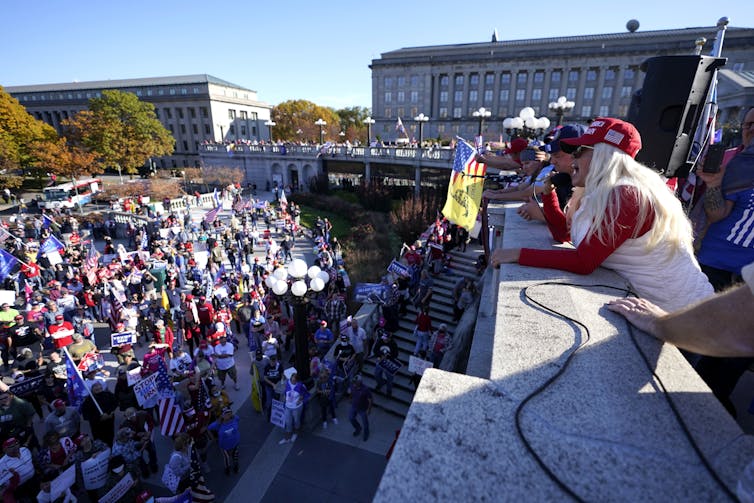
Trump supporters demonstrate near the Pennsylvania state Capitol last weekend. Julio Cortez/AP

In another filing before a federal court in Pennsylvania, the Trump campaign alleges voting by mail runs afoul of the Constitution’s equal protection clause, a claim bound to fail.

The most interesting – and perhaps most viable – case concerns whether a state court can extend the time limit for mail-in ballots to arrive.

In this case, the Trump campaign challenged a decision by the Pennsylvania Supreme Court to allow mail-in votes received up to three days after election day to be counted.


Read more: How votes are counted in Pennsylvania: Changing numbers are a sign of transparency, not fraud, during an ongoing process


The US Supreme Court twice declined to halt the counting of these votes, but did order the ballots to be segregated, leaving the door open to a challenge after the election.

A group of Republican attorneys-general filed a brief at the US Supreme Court this week urging it to take up the case.

Amy Coney Barrett, the newly appointed Supreme Court justice, did not participate in the earlier decisions, and it remains to be seen if her vote would change the outcome should the case reach the court.

Hoever, this may all be a moot point, as there are likely not enough late-arriving ballots for Trump to make up the sizeable gap to Biden in the state.

Even with a conservative majority, the US Supreme Court is unlikely to play a role in the election outcome. Patrick Semansky/AP

Attorney-general steps into the fray

Attorney-General William Barr has also inserted the Department of Justice into the post-election drama, authorising investigations by US attorneys into alleged voter fraud across the country. The move outraged the top official in charge of voter fraud investigations, prompting him to resign.

The Department of Justice has historically stayed out of elections, a policy Barr criticised in his memo, saying

such a passive and delayed enforcement approach can result in situations in which election misconduct cannot realistically be rectified.

The department’s about-face is important for several reasons. It changes long-standing practice, as Barr himself admits. The general practice, he wrote, had been to counsel that

overt investigative steps ordinarily should not be taken until the election in question has been concluded, its results certified, and all recounts and election contests concluded.

Of course, Barr has ingratiated himself with Trump before, most notably in his 2018 memo to the Justice Department expressing concerns over the Mueller investigation.

Many had wondered why Barr had remained unusually quiet for so long on the election. It appears he is back, and willing to support Trump and the Republican cause.

The end game: Georgia and the US Senate

Given Trump and Republicans have very little chance of overturning the result through these tactics, the question remains: what is the goal?

Yes, this all could be explained simply as Trump not liking to lose. But setting such indulgences aside, the reason for this obstruction appears to be two upcoming US Senate runoff elections scheduled for January 5.
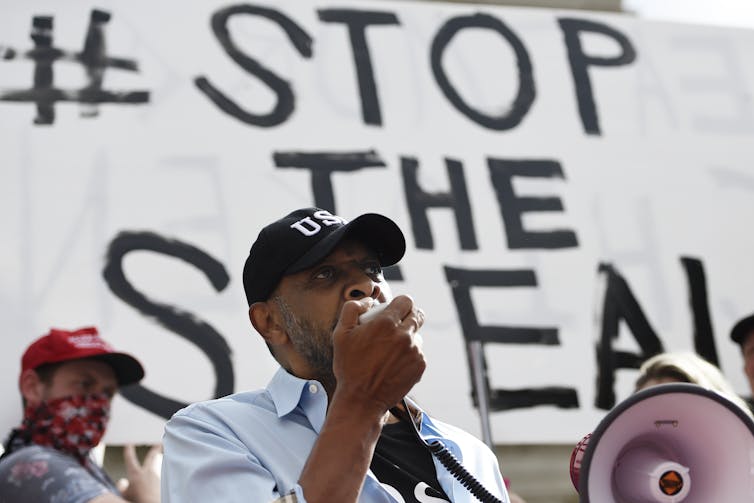
Georgia state Rep. Vernon Jones speaks at a Trump rally in Atlanta this week. Mike Stewart/AP

Under Georgia law, a runoff is required between the two candidates that came out on top if neither wins 50% of the vote in the state election.

The Republicans currently hold a 50-to-48-seat edge in the Senate, meaning control of the chamber now comes down to who wins the two Georgia runoffs.

The positions taken by Republican senators in recent days are telling — they have stood firmly behind Trump’s challenges and gone out of their way not to congratulate Biden on his victory. Republican Senator John Thune of South Dakota put it bluntly,

We need [Trump’s] voters […] we want him helping in Georgia.

The Senate plays a crucial role for the Biden presidency. If it remains in Republican hands, this could leave Biden with few avenues to implement his favoured policies on the economy, climate change or health care and would deny Democrats the ability to expand the Supreme Court.

Already, it’s clear the focus of the GOP is shifting toward Georgia. The two Republican Senate candidates this week called for the resignation of the secretary of state, a fellow Republican, repeating Trump’s baseless claims over voter fraud in Georgia.


Read more: Winning the presidency won’t be enough: Biden needs the Senate too


According to the Atlanta Journal-Constitution, this was done to appease Trump

lest he tweet a negative word about them and risk divorcing them from his base ahead of the consequential runoff.

Is democracy at stake?

It appears all these efforts are aimed at one goal: energising the Trumpian base for the Georgia run-off elections by delegitimising not only Biden, but the election process itself.

The long-term implications are momentous. The US is already bitterly divided, as demonstrated by the large voter turnout on both sides in the election. This division will only deepen the more Trump presses his claims and signals he won’t go away silently.

This continued fracturing of the US would prevent Biden from achieving one of the main goals he set out in his victory speech: bringing Republicans and Democrats together.

If half the country buys into his claims of a stolen election, the real danger is the erosion of democracy in the US as we know it.

ref. What’s behind Trump’s refusal to concede? For Republicans, the end game is Georgia and control of the Senate – https://theconversation.com/whats-behind-trumps-refusal-to-concede-for-republicans-the-end-game-is-georgia-and-control-of-the-senate-149903


Grattan on Friday: Labor’s Joel Fitzgibbon waves the lightsaber

Source: The Conversation (Au and NZ) – By Michelle Grattan, Professorial Fellow, University of Canberra

It’s unsurprising that Anthony Albanese is looking over his shoulder, because last term he was sitting on Bill Shorten’s shoulder, waiting for an opportunity to strike.

Parties might have put in place rules to prevent the rotating leadership that made our politics so dysfunctional a few years ago but those rules won’t ever be set in stone. They’ll always be vulnerable to ambition and desperation.

We’re heading towards the final parliamentary weeks of the year – cheerfully known as the “killing season” for leaders. Despite Labor’s turmoil and internal frustrations, however, Albanese will survive this one.

Nevertheless he and Labor are beset by divisions that have been on view for months but have now erupted spectacularly, with the resignation of resources spokesman Joel Fitzgibbon from the frontbench.

Most people out in the real word wouldn’t have heard of Joel. But they may have seen that TV advertisement for an insurance company in which a dog with a lightsaber demolishes half a house. Joel is waving a lightsaber; Albanese is looking at the insurance policy.

A veteran MP from the NSW coal seat of Hunter, convener of the NSW right faction, Fitzgibbon has a “project” – to bring Labor back “to what I describe as the sensible centre.”

In his mind, the “sensible centre” is where the opposition is more or less on the same page as the government on climate policy, and in better touch with, and more acutely attuned to, the needs and aspirations of the working class part of its base.

While Fitzgibbon professes loyalty to Albanese, the party remembers how in 2013 he agitated against Julia Gillard, to restore Kevin Rudd to the leadership. And he himself says, when asked whether he’d be willing to push for a change if he thought Labor in dire straights before the election, “I think senior people in the party have a responsibility to ensure that the party doesn’t go over the proverbial cliff”.

Meanwhile Fitzgibbon is certainly on a mission to get one person out of his job. He and climate spokesman Mark Butler have been at war for months, and now that he’s on the backbench, Fitzgibbon is openly declaring Butler should be shifted, in favour of someone who “doesn’t bring baggage” to the conversation.


Read more: Politics with Michelle Grattan: Joel Fitzgibbon on Labor climate policy and leadership


Butler’s “baggage” is Labor’s climate policy of last term.

Many of Fitzgibbon’s colleagues are in a rage about him. Not least because they had hoped this week to embarrass Scott Morrison over climate policy off the back the victory of Joe Biden, who’s very forward-leaning on the issue.

But also, while accepting Labor has to pull back somewhat from its stance last term, many in the opposition want a robust stand on climate and emissions that’s firmly differentiated from the government’s.

On the other hand, Fitzgibbon has supporters for his position – including importantly – in sections of the union movement.

Albanese is somewhere in the middle, wanting to make climate an issue but not with a policy that will leave Labor vulnerable to the Coalition’s damaging attacks of 2019, and make it harder to win some regional seats.

Fitzgibbon is probably right that it would be desirable to move Butler, and Albanese has the chance to do so in the reshuffle he plans following Morrison’s pre-Christmas ministerial changes. A new face would make the transition to a revised policy easier.

But such a switch would also be fraught. Butler (who has been regarded as one of Albanese’s Praetorian guard) is very committed to his portfolio and believes a robust policy is a positive for Labor.

“Australians are ambitious for strong climate action,” he said in the wake of the Fitzgibbon comments. “Anthony Albanese is committed to climate action and the jobs it will create, and so am I as Labor’s shadow climate change and energy minister.”

While Albanese could force him to move, that would reinforce the impression of a divided house and could bring bad blood. And shifting Butler would be seen as a sign of the opposition going soft on the climate issue, angering many ALP supporters for whom climate is key.

Finally, Fitzgibbon may have given Butler the ultimate protection. If Albanese moved him – something he’d be disinclined to do against Butler’s wishes – it would look like capitulation to the dog with the lightsaber.

Meanwhile Albanese struggles to make headway against Morrison in the time of pandemic politics. This has led him to overreach: his suggestion last week that Morrison should contact Donald Trump and convey “Australia’s strong view that democratic processes must be respected” was bizarre.

This was a few days before the 45th anniversary of governor-general John Kerr’s dismissal of Gough Whitlam. Would anyone have thought the US president should have been in contact with one of the players in that crisis?


Read more: Grattan on Friday: Palace letters make great reading but leave a republic as far away as ever


Although Albanese’s leadership is under pressure it is not under threat at this point for multiple reasons.

The rules, instigated by Rudd, on leadership change don’t bring total safety but they inhibit potential challengers.

More important, at present there is no alternative candidate who, in objective terms, would have an interest in making a run. In contrast, Albanese had every incentive to stalk Shorten – there was a winnable election around the corner.

The most obvious alternative to Albanese is shadow treasurer Jim Chalmers. But it is doubtful Chalmers would do better against Morrison. He’d be a fresh face but is still inexperienced; the rigours of leadership are very different from the demands of even the toughest shadow portfolio, especially in the run up to an election..

And if the odds are on Labor going down at the election, why would Chalmers want to burn himself for the future?

There is no white knight in the wings that can transform Labor’s prospects. Its problems involve leadership but they are deeper and more complex, as the internal debate about climate policy indicates.

As a disheartened Labor party looks to 2021, it won’t see many positives. Its best course is to get its house in order and remember that, just sometimes, things change very quickly.

ref. Grattan on Friday: Labor’s Joel Fitzgibbon waves the lightsaber – https://theconversation.com/grattan-on-friday-labors-joel-fitzgibbon-waves-the-lightsaber-149908

Covid-19: NZ tells Auckland workers in downtown to work from home

By RNZ News

A New Zealand covid-19 community case identified in Auckland today had called in sick to work after being tested but went to work wearing a mask after talking to their boss, officials say.

All people who work in downtown Auckland are being asked to work from home where possible tomorrow because of the new case.

Covid-19 Response Minister Chris Hipkins said there had still been no direct source of infection identified. Any changes to alert levels will be announced tomorrow, he said.

The next update on the case and any decisions will be tomorrow afternoon.

Director of Public Health Dr Caroline McElnay said Auckland Regional Public Health Service (ARPHS) had interviewed the person.

The student in her 20s was one of three cases announced at the afternoon media briefing today.

McElnay said the woman’s job was a customer-facing role. She called in sick to work after being tested but went to work after talking to her boss, although she wore a mask.

Uber trips to work
The person took Uber trips to work and those drivers are being contacted and advised to be tested.

Hipkins said it was a disappointing situation. He is asking employers to be “good” and accommodate staff calling in sick by allowing them to stay at home.

The person has three close contacts – a colleague and two friends – who are being tested and isolated, McElnay said.

All reported being well, but the two friends had been asked to isolate as a precaution.

There was no history of the positive case moving outside the Auckland CBD, she said.

Her apartment building is next door to a managed isolation facility.

The hotel had a fire alarm evacuation on Monday night, but that was not likely to be the source of the infection because the woman became symptomatic that same day.

Residents told go home
All residents of the Vincent Residences have been asked to go home and stay home while testing takes place. The apartment building is being deep cleaned and a mobile testing station would be available outside, Dr McElnay said.

ARPHS is informing the residents at the positive case’s apartment building of the information they need to know.

Dr McElnay said the person was already symptomatic, so reports of mingling between guests and the public are unlikely to point to a source of infection.

Hipkins said the case’s workplace numbers were quite small, but the apartment complex was quite large.

Testing at the site was “about to get under way”, he said, and suggestions of the source of the infection at this point were speculation.

This afternoon, the Covid Tracer app was used to send notifications to users who may have been at the same places as the positive case. The number of people who received the notifications is not yet known.

Print Friendly, PDF & Email

Article by AsiaPacificReport.nz

From COVID anxiety to harassment, more needs to be done on safety in taxis and rideshare services

Source: The Conversation (Au and NZ) – By Bianca Fileborn, Senior Lecturer in Criminology, University of Melbourne

The introduction of ridesharing services has transformed the way many of us travel. Alongside traditional taxis, app-based ridesharing services have made it easier than ever to travel privately for those who can afford it.

But how safe are taxi and rideshare services? Anecdotally, experiences of harassment and violence appear to be common for passengers.

Last year, media reports drew attention to attempts by individuals posing as Uber drivers to lure women into their vehicles in Melbourne. Incidents of drivers sexually assaulting passengers periodically occur. Perhaps the most notorious is the case of the UK’s “Black Cab Rapist”, John Worboys, who drugged and raped at least 90 women.

Although concerns about safety and harassment have been well documented in relation to public transport, limited data are available on experiences of harassment among both drivers and passengers of taxi and rideshare services.

In 2019, rideshare service Uber released a safety report for the first time. It revealed the company had received more than 3,000 reports of sexual assault perpetrated by drivers or other passengers in the United States between 2017 and 2018.

While there is no evidence harassment and assault occur more frequently in taxis and rideshares compared to the wider community, the specific contexts of these services are important to investigate. For instance, passengers can be isolated while using these services, and some use them to travel after consuming drugs and alcohol – factors that can increase the risk of harm.

Our research – which is currently under way – aims to shed light on these issues by exploring Victorians’ perceptions and experiences of safety and harassment when using taxi and rideshare services.


Read more: The same but different: what passengers like about Uber


Perceptions of safety pre- and post-COVID

As we began our research, the COVID-19 pandemic emerged, fundamentally changing how, where and when people travelled.

Lockdown and working from home led to reduced use of taxi and rideshare services for some. For others, anxiety about COVID transmission on public transport likely made taxi and rideshare services a more appealing option.

As Melbourne and the rest of the country come out of lockdown, people are going out again and having to consider how they travel. There might be a dilemma for some people in terms of whether they feel safe using taxi and rideshare services due to the perceived risk of COVID transmission.

Early findings from our survey of 94 Victorians suggest participants felt safer using rideshare services compared to taxi services before COVID-19. While participants reported factors that potentially reduced feelings of safety when using taxis – such as travelling alone or being intoxicated – they tended to report factors that promoted feelings of safety when using rideshare services. For example, the ability to track drivers and send tracking on to friends or loved ones, the rating system, automatic payment, and information about drivers, passengers and the ride being held by the app were all reported to improve perceptions of safety.

Since the pandemic, about half of participants report they feel equally safe using taxi and rideshare services compared to before the pandemic. Small numbers report feeling safer. However, many of our participants report feeling less safe about using taxi (38%) and rideshare (43%) services.

Based on written comments from participants, it appears that, in addition to physical safety concerns, people are experiencing concerns about health safety. These concerns include being in an enclosed space with the driver or other passengers, whether the car has been cleaned between each passenger, and the risk of acquiring COVID-19 from the driver or previous passengers.

Although rideshare services have introduced a range of measures to prevent COVID-19 transmission, drivers have similarly reported concerns about their health.

Health safety concerns have risen since the COVID-19 pandemic. Shutterstock

Experiences of harassment in taxis and rideshares

We also asked participants about experiences of harassment when using taxi and rideshare services.

Uber’s 2019 safety report indicated 99.9% of rides in the United States in 2017-18 had been completed without incident.

Similarly, our preliminary findings suggest experiences of harassment are not common. Nonetheless, a minority of participants have reported verbal harassment relating to gender (35.6%), sexuality (19.8%), race (10%) and disability (13.5%).

Sexual harassment is by far the most common form of harassment experienced by participants so far. Half of survey respondents had experienced unwanted flirting, while 46% experienced unwanted comments about their physical appearance. Participants have described their experiences of harassment as including:

several experiences where taxi drivers have either tried to flirt, made aggressively sexual statements, or touched me, and one specific one where the driver made several comments about knowing where I lived and how he’d date me.

Honestly there are too many to recount. In one instance, a taxi driver […] kept telling me how lonely he was and parked far away from home and would not let me leave the cab, forcing kisses on me and unwanted groping […] I was terrified. It wasn’t the first time I’ve been terrified of cab drivers either.

Participants also discussed feeling unsafe because of factors related to race, sexuality and disability. One participant with a disability, for example, shared experiences of being:

left in scary situations by drivers not wanting to pick up my guide dog.

Harassment occurred more commonly in taxis, with drivers responsible for these behaviours in the vast majority (84%) of incidents. However, there is no evidence drivers are more likely to perpetrate harassment and violence than other members of society.

Drivers are themselves often subject to high levels of abuse, harassment and violence.

It is also difficult to know if harassment is actually more common in taxis, or if this finding reflects the fact taxi services have been in use longer than rideshare services.


Read more: FactCheck: are ridesharing services like Uber no safer than hitchhiking?


The impacts of these experiences have been varied, including emotional distress, anxiety, anger, embarrassment and fear for personal safety. While some participants have reported no impacts, others have said they now avoid using taxis or rideshare services, or are hypervigilant when using them.

They also report safety strategies such as minimising alcohol consumption, not using a taxi or rideshare alone, giving the driver a fake address, and sharing registration or journey details with a friend. A small number of women said they only used women-only ridesharing services such as Shebah.

Getting there safely

Experiences of harassment do not only occur in taxi and rideshare contexts. However, the harassment that does occur in these contexts requires a tailored response working alongside broader prevention efforts.

Our participants valued app-based features such as GPS tracking and the ability to rate drivers. Taxi companies could consider introducing similar measures to improve perceptions of safety.

Although rideshare services have introduced several features that can promote feelings of safety among drivers and riders, further measures are needed. These would include greater transparency from taxi and rideshare companies about reports of harassment by drivers and riders, and how they are responding to these reports.

Our emerging findings make it clear much more work is required to prevent and better respond to reports of harassment.


We are still recruiting people to take part in our study. We are interested in a wide range of experiences of harassment – including sexist/sexual, gender-based, racist, ableist, homophobic and transphobic harassment – without any particular legal definition in mind. You do not need to have used a taxi or rideshare service during COVID-19 to take part. You can participate in the anonymous online survey here or you can also contact Elena at elena.cama@unimelb.edu.au if you would prefer to participate in a confidential interview.

For help with any of the issues mentioned in this piece, contact the National Sexual Assault, Family & Domestic Violence Counselling Line – 1800 RESPECT (1800 737 732).

ref. From COVID anxiety to harassment, more needs to be done on safety in taxis and rideshare services – https://theconversation.com/from-covid-anxiety-to-harassment-more-needs-to-be-done-on-safety-in-taxis-and-rideshare-services-149911

Victoria and NSW have funded preschool for 2021. It’s shaping up to be a federal election issue

Source: The Conversation (Au and NZ) – By Kate Noble, Education Policy Fellow, Mitchell Institute, Victoria University

This week, Victoria has pledged a $169.9 boost for preschool (called kinder in Victoria) to reduce fees for all four year olds and eligible three year olds in 2021. The announcement came a day after New South Wales pledged free community preschool for three to five year olds next year.

Unlike NSW, Victoria’s funding injection will apply to all preschool programs for four year olds, which includes those at daycare centres. While the premier said the funding was for “free kinder”, it’s not yet clear whether the “$2,000 per family” promise means some services with higher annual fees might still charge families a reduced amount to meet the gap.

Both the states’ announcements aim to support children’s access to early learning, while alleviating cost pressures to families as they cope with the fall-out of lockdowns and the economic downturn. It’s also hoped they’ll enable parents to take up work where they can.

But they’re also likely to increase the growing focus on early childhood education and care more broadly, which is shaping up to be a major issue leading into a possible federal election in 2021.

What’s happening with preschool in other states and territories?

While the latest funding announcements are most relevant to preschool, they also impact on childcare providers, as many of them embed preschool programs in their service. This means children take part in a structured, play-based program led by a qualified teacher for part of the time they’re at daycare.


Read more: Preschool benefits children and the economy. But the budget has left funding uncertain, again


The Australian government jointly funds preschool with the states and territories for one year per child — children attend around 600 hours per year. Preschool for four year olds is already free or very low cost in South Australia, Western Australia, the ACT, the NT and Tasmania.

Preschool isn’t free for most four-year-old children in Victoria, NSW and Queensland. While those governments subsidise preschool, most parents are still charged fees by providers to make up the gap between government funding and the cost of delivering services.

Fees vary, but can be in the region of $2,000 to $3,000 per year. Disadvantaged families can access additional subsidies so they don’t have to pay fees.

The past few years have seen some jurisdictions introduce funding for preschool for three-year-olds. In 2018, NSW announced subsidies for three-year-old community and mobile preschool (operating from multiple venues), with the subsidy rate increasing from 25-50% between 2019 and 2022.


Read more: Preschool benefits all children, but not all children get it. Here’s what the government can do about that


Victoria is rolling out subsidies for a second year of preschool over the next decade, and the ACT is working towards free preschool for three year olds over the coming years.

These initiatives were all in place before COVID hit. And while the pandemic’s impact on school students’ learning and mental health has been widely covered, the recession has also had a significant, albeit different, impact on preschoolers. These can include regression, disturbed sleep and anxiety. This can negatively affect social and emotional skills and school readiness.

Increasing funding to boost access to quality early education and care is an important tool for alleviating negative impacts on children and helping them to thrive before and in school. These measures can also support parents doing it tough, increase labour force participation and support economic recovery.

Where to from here?

Increased state and territory funding for preschool means parts of Australia were already moving towards two years of funded (in some cases, free) preschool even before COVID-19 arrived. This is a major shift, backed by evidence that shows the importance of two years of preschool to children’s health, well-being and academic outcomes.

All children deserve access to quality preschool, which gives them the skills they need before starting school. Shutterstock

But with funding and timing being determined by state governments, this major reform is happening in fits and starts. What’s lacking is a national approach that would provide more consistency.

Access and affordability will remain uneven across the country. With around one-fifth of Australian children starting school with developmental vulnerabilities, this should be cause for concern.

The future of childcare policy is much less certain. What’s clear is childcare has been placed on the mainstream policy agenda, with Labor making childcare its budget reply centrepiece. Labor’s promise includes increasing the maximum childcare subsidy to 90% and scrapping the annual subsidy cap for families earning up to $353,680 a year.

The current government has signalled it doesn’t have an an appetite for further reform. From its perspective, the snap-back (from free childcare during COVID) to pre-COVID funding arrangements is largely working.


Read more: Childcare is critical for COVID-19 recovery. We can’t just snap back to ‘normal’ funding arrangements


A smart approach would bring governments from all levels together (including local governments, many of whom operate services) to look at the early childhood education and care system as whole.

This means creating a more unified and simpler system across different types of education and care, which would provide consistent quality and flexibilty for all children and families, and address legitimate concerns held by educators.

As well as promising benefits for children, a more integrated, universal system would deliver significant benefits to families and the economy.

ref. Victoria and NSW have funded preschool for 2021. It’s shaping up to be a federal election issue – https://theconversation.com/victoria-and-nsw-have-funded-preschool-for-2021-its-shaping-up-to-be-a-federal-election-issue-149905

Vale Sizzler: the cheese toast king couldn’t keep up with dining trends

Source: The Conversation (Au and NZ) – By Katherine Kirkwood, PhD Candidate, Queensland University of Technology

After 35 years in Australia, the last plates of cheese toast will soon be served at Sizzler’s nine remaining outlets across Queensland, New South Wales and Western Australia.

The family-friendly restaurant, famous for the all-you-can-eat salad bar and cheesy TV ads, was once a suburban dining stalwart. But Sizzler’s closure on 15 November isn’t just another consequence of COVID-19.

Australia’s food values and tastes have changed since the chain’s heyday of the 1990s. Today, food is much more important in our everyday lives.

An era of casual dining

Sizzler began in the United States in the late 1950s, opening its first Australian restaurant in 1985 in the Brisbane suburb of Annerley. A novelty of the chain was its salad bar, which the Canberra Times in 1992 described as:

15 metres of salad choices, two soup choices and croutons and rolls, a potato casserole, savoury rice, two types of pasta (with the usual unfortunate consequences for pasta left sitting) with a meat, tomato and cream sauces, and four or five desserts.

Optional steak, seafood and chicken offerings could be served to your table. When the chain reached its Australian peak in the mid-1990s, our food culture was very different. Cuisine of the era was increasingly multicultural – as food author Cherry Ripe notes in her book Goodbye Culinary Cringe – but food was more often spoken about in utilitarian terms.

Sizzler positioned itself as food that was cheap and fast, but not “fast food”. Most of those who dined there, alongside the dine-in all-you-can eat Pizza Huts, earned under A$60,000 (approximately $110,000 today).

But over the past 25 years, the way Australian families dine has dramatically changed. Instead of a large “family friendly” diner, we are more likely to frequent a range of small, culturally diverse eateries.

The changing face of value

While Sizzler has attributed the shuttering of the final nine stores to the impact of COVID-19, the brand has experienced a slow death, with 19 outlets closing across Australia since 2015.

Its demise can be attributed to many factors.

Since Sizzler’s peak, Australian consumers have shown greater interest in food provenance, or understanding where their food comes from.

There are growing concerns about environmental impacts of the way we eat, particularly around food waste. These concerns become stark in buffet settings.

Other contemporary culinary interests include the ideals of “clean eating” and Instagrammable #foodporn – Sizzler isn’t entirely suited to either category.

Lobster, steak and chips
Sizzler’s meals aren’t exactly #foodporn. Mark James Miller/Wikimedia Commons, CC BY-SA

Once considered “alternative” approaches to eating, vegetarianism and veganism are also on the rise. By 2019, more than 2.5 million Australians were vegan or vegetarian.

We have embraced movements like flexitarianism (a mostly plant-based diet, with animal products eaten in moderation) and Meat Free Mondays. Sizzler is known for its salad bar, but the prominent grill offerings of steak, seafood and chicken don’t necessarily align with these culinary values.

Pressure has been placed on Sizzler, too, as fast-casual dining chains gain popularity, with companies like Guzman y Gomez and Grill’d focusing on ethical and healthy choices.

The pressures faced by Sizzler can also be seen in the Australian fine-dining sector. There has been an explosion of mid-tier, casual but trendy venues opening to accommodate diners’ changing tastes. This has led to closures of both “value for money” sit-down restaurants, like Sizzler, at one end of the spectrum, and fine dining at the other end.

Our notion of what constitutes “good value” has also evolved.

Until Sunday, a standard Sizzler all-you-can-eat salad bar will cost you $27.95. You can add $4 and get a rump steak, or $2 for a “Malibu Chicken Supreme” (think parmy-meets-Chicken-Cordon-Bleu).

But “value” now lies in the quality rather than quantity of one’s meal. As Australians’ idea of value is shifting, we are inclined to pay more for food we consider to be good quality – so $30 for an average steak and salad now seems rather steep.

This isn’t to say Australians are a bunch of food snobs.

In my 2014 research into food and food media habits, I spoke to then 38-year-old food enthusiast Melanie, who enjoyed trips to Adriano Zumbo’s Sydney patisserie and celebrated her sister’s 40th birthday dinner at Tom Colicchio’s New York restaurant – but she was not opposed to more lowbrow or fast-food offerings.

I will say I love fine dining, but if you offered me up Sizzler on a Sunday, I’m right there.

I hope Melanie got a booking at Sizzler to enjoy one last Sunday indulgence.

ref. Vale Sizzler: the cheese toast king couldn’t keep up with dining trends – https://theconversation.com/vale-sizzler-the-cheese-toast-king-couldnt-keep-up-with-dining-trends-148798

Biden’s pivot to science is welcome — Trump only listened to experts when it suited him

Source: The Conversation (Au and NZ) – By Sam Baron, Associate professor, Australian Catholic University

In his acceptance speech at the weekend, US President-Elect Joe Biden signalled a return to science as a key policy shift for the United States.

“Americans have called on us to […] marshal the forces of science and the forces of hope in the great battles of our time,” he said, assuring the public the Biden-Harris COVID plan “will be built on the bedrock of science”.

His message, on its surface, is a response to the Trump administration’s disdain for scientific advice, most notably in the COVID response and withdrawal from the Paris climate agreement.

But Biden’s remarks are deeper and more interesting than a simple spruik for science-led policy.

A track record of ignoring evidence

Is Trump’s administration anti-scientific? Yes and no.

According to a report compiled by the journal Science, the Trump White House has indeed pursued an agenda of suppressing science by slashing funding. But this agenda has been largely unsuccessful.

During Trump’s term, funding for the National Institutes for Health rose by 39% and the budget for the National Science Foundation rose by 17%. This is explained, at least in part, by Congress resisting the White House’s efforts to defund science.

Setting aside direct attacks on funding, the Trump administration has also positioned itself as anti-science in other, more visible ways.

It has a track record of ignoring scientific advice on issues ranging from the deadliness of COVID, to the impact of human activity on the climate, to the bizarre “Sharpiegate” episode in which Trump apparently used a marker pen to alter the forecast track of Hurricane Dorian.

A Qanon believer speaking to a public crowd.
The rightwing QAnon conspiracy is part of a wider trend of disdain for facts and evidence. Dario Lopez-MIlls/AP

Cherry picking to suit an agenda

Yet it would be wrong to paint Trump as unequivocally anti-science.

He poured money into quantum computing and artificial intelligence, and invested heavily in space exploration, promising a return to the Moon this decade. And, at the risk of stretching this argument beyond breaking point, he called on civil engineering to deliver his Mexican border wall.

Trump also used science to win an election. Let’s not forget the pivotal role of Cambridge Analytica in his victory over Hillary Clinton in 2016. A mixture of data science and empirical psychology delivered voters to Trump in the millions.

While it is difficult to know exactly what methods Cambridge Analytica used, it is possible that a method known as psychographic targeting was part of their approach. This involves analysing users’ behaviour on social media sites such as Facebook — for example, by tracking the content that individuals “like” — as a basis for delivering targeted advertising that fits a person’s personality.

It is perhaps no accident, then, that quantum computing and artificial intelligence got the thumbs-up. In the world of voter manipulation, it is hard to think of a scientific investment that would yield a better return.

Painting Trump’s administration as entirely anti-intellectual overlooks one of the key factors that delivered him electoral success in the first place. His 2016 victory was in one sense a scientific achievement, delivered by technological algorithms designed to exploit publicly available data with unprecedented effectiveness.

Such a result is absolutely repeatable. As long as methods such as psychographic targeting go unregulated in the political sphere, future candidates could leverage data science in much the way Trump did to win the White House.


Read more: Humans are hardwired to dismiss facts that don’t fit their worldview


Science in the public interest

Biden’s approach is not just a pivot back to respecting expertise, but also a pledge to embrace science in the public interest. The Biden-Harris COVID plan, for example, will be founded on expert advice but will also, as Biden explained, “be constructed out of compassion, empathy and concern”.

President-elect Joe Biden and Vice President-elect Kamala Harris in a meeting with Biden's COVID-19 advisory council.
On Monday, President-elect Joe Biden and Vice President-elect Kamala Harris attended a meeting with Biden’s COVID-19 advisory council. Carolyn Kaster/AP

Hopefully this heralds an end to the use of science to achieve narrow and selfish political ends, and a return to the appropriation of science for the common good.

While I applaud the kind of science Biden wants to embrace, I daresay he faces a difficult choice. If he refuses to use science to further any partisan political ends, his party runs the risk of getting rolled in the next election by a demagogue who does not suffer the same burden of decency.

Perhaps he can get ahead of this by asking us all to have a serious conversation, on a global scale, about the use of science in winning elections.


Read more: ‘Science is political’: Scientific American has endorsed Joe Biden over Trump for president. Australia should take note


At the very least, we should reject the narrative that the Trump administration repudiates science in its entirety. That only makes it harder to see the danger the improper use of science poses to democracy.

We are, it is often said, living in a post-truth world. The Trump administration’s denial of evidence, and its capacity to lie about everything from coronavirus cures to election results, provide several classic examples. After four years of “alternative facts”, Biden’s vocal support for scientific expertise was a breath of fresh air.

But, perhaps unintentionally, Biden has also revealed a dangerous faultline of democracy. By positioning his administration as one that uses science only for the common good, he is tacitly acknowledging democracy’s vulnerability to science and technology.

Biden’s words remind us that technological advances threaten to propel us into a world where political differences become irreconcilable, and respect for democratic norms is not guaranteed.

ref. Biden’s pivot to science is welcome — Trump only listened to experts when it suited him – https://theconversation.com/bidens-pivot-to-science-is-welcome-trump-only-listened-to-experts-when-it-suited-him-149734

Curious Kids: why do older adults get shorter?

Source: The Conversation (Au and NZ) – By Michelle Moscova, Senior Lecturer in Anatomy, UNSW

Hi I’m Miranda. I am ten years old and I live in California. My question is: why do older adults get shorter?

What an interesting question, Miranda!

Luckily, you don’t have to worry about this for some time. Until you are 30 or so (I know, it sounds old), you will continue to grow. However, after that, most people start to gradually shrink. So by the time you are 80 (yes, that seems really ancient), you would be 2-2.5 inches (5-6 centimetres) shorter.

Backs, muscles, joints

So, what exactly in your body shrinks this much? Ahh, this is another interesting question. The secret is in what keeps your body upright — your back. It is made up of 33 tiny little bones called vertebrae. Between most of these vertebrae are discs made of softer tissue.

The middle of these soft discs are like jelly, and are made mostly of water. These act like a shock absorber when you walk, run and jump.

Everything you ever wanted to know about the bones and discs in your back, in a song!

As you get older, these discs slowly lose water and become a tiny bit flatter. But because there are usually 23 of these discs, they make up a quarter of the height of your back. When each of them shrinks a little bit, it all adds up and you get shorter.

Older people’s muscles also get smaller and weaker, their bones get thinner and the spaces between the bones in their joints get smaller. Together, this can also change your height.

People can shrink too much

While a small change in height in older people is normal, shrinking too much — more than 2 inches (5cm) — can be a bit of a problem. It may be a sign of a disease where your bones become too weak and brittle, and are easier to break.

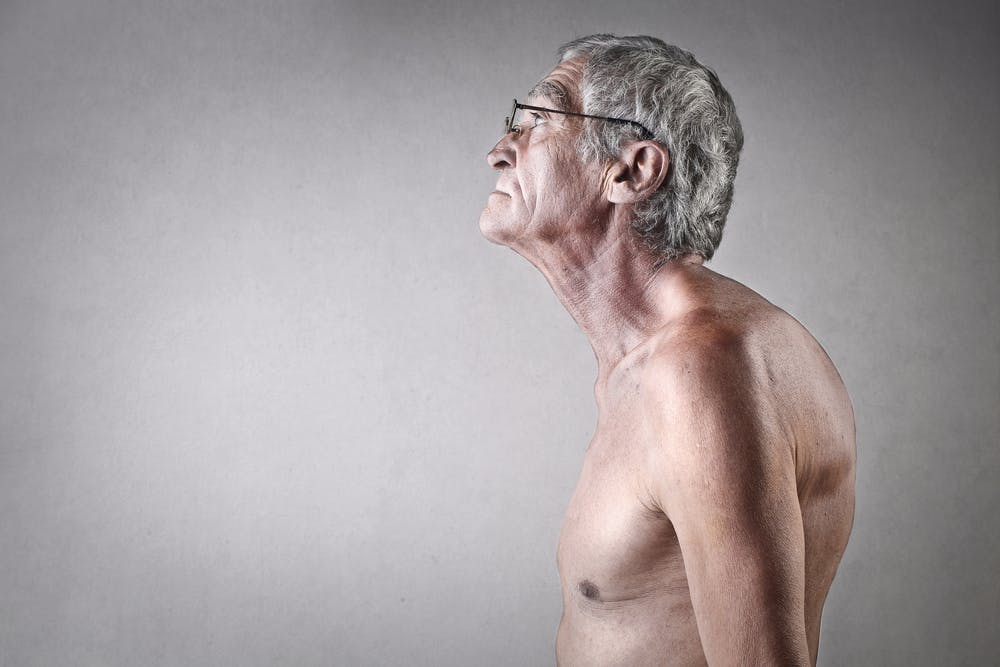
As muscles get weaker, especially muscles that support your back, your back may get a curved “hunchback”, which makes you look even shorter. Weaker muscles can also cause a sore back and problems with balance.

Elderly man with a hunchback
Some people can develop a hunchback, like this man, which makes them look even shorter. Shutterstock

So, is there anything you can do to stop getting shorter when you age? There certainly is. If you eat healthy food, exercise regularly and get outdoors to play in the sunshine from time to time, it will help keep your bones and muscles healthy and stop you getting too short when you are older.

Your height changes over the day

Another thing you may not realise is that even when you are young, your height changes throughout the day. You are actually tallest when you wake up in the morning, but you lose up to an inch (2.5cm) of your height within three hours of getting out of bed.

This is because when you sleep, your body rests and allows the water to get back into the jelly centres of the discs in your spine. But when you bounce out of bed, the pressure on these discs makes them lose water again and you get a little smaller.

So, if you really want to be the tallest you can be (getting picked for a basketball team, perhaps?), try to measure your height just after you get out of bed in the morning.


Hello, curious kids! Do you have a question you’d like an expert to answer? Ask an adult to send your question to curiouskids@theconversation.edu.au

ref. Curious Kids: why do older adults get shorter? – https://theconversation.com/curious-kids-why-do-older-adults-get-shorter-146766

VIDEO: Two experts on the race for a COVID-19 vaccine and preparing Australia and New Zealand for the next pandemic

Source: The Conversation (Au and NZ) – By Liz Minchin, Executive Editor

How hopeful should Australians and New Zealanders be about COVID-19 vaccines becoming available in 2021? And what do we need to learn from 2020 and this pandemic as we speed towards the new year?

On November 5 2020, The Conversation and Avid Reader bookshop hosted a special trans-Tasman online event, giving our readers a chance to question two leading vaccine and virus experts.

The video below features the University of Queensland’s Professor Paul Young, one of Australia’s top virologists and co-leader of the UQ vaccine project, and the University of Otago’s Professor David Murdoch, a clinical microbiologist and infectious diseases physician, who has consulted for the World Health Organization.

They’re in conversation with Liz Minchin and an audience of Conversation readers. You also get to hear from Molly Glassey, the editor of The Conversation’s yearbook, 2020: The Year That Changed Us.

The Conversation’s trans-Tasman COVID-19 event, held on November 5 2020.

Too long, can’t watch it all? Jump to these highlights

8:15 When will the UQ vaccine be ready? — Paul Young’s response

10:08 The Australian Health Minister Greg Hunt has said “the expectation is that Australians who sought vaccination will be vaccinated within 2021”. Do you agree? — Paul Young

11:24 Will there be COVID-19 vaccines available for some New Zealanders in 2021? — David Murdoch

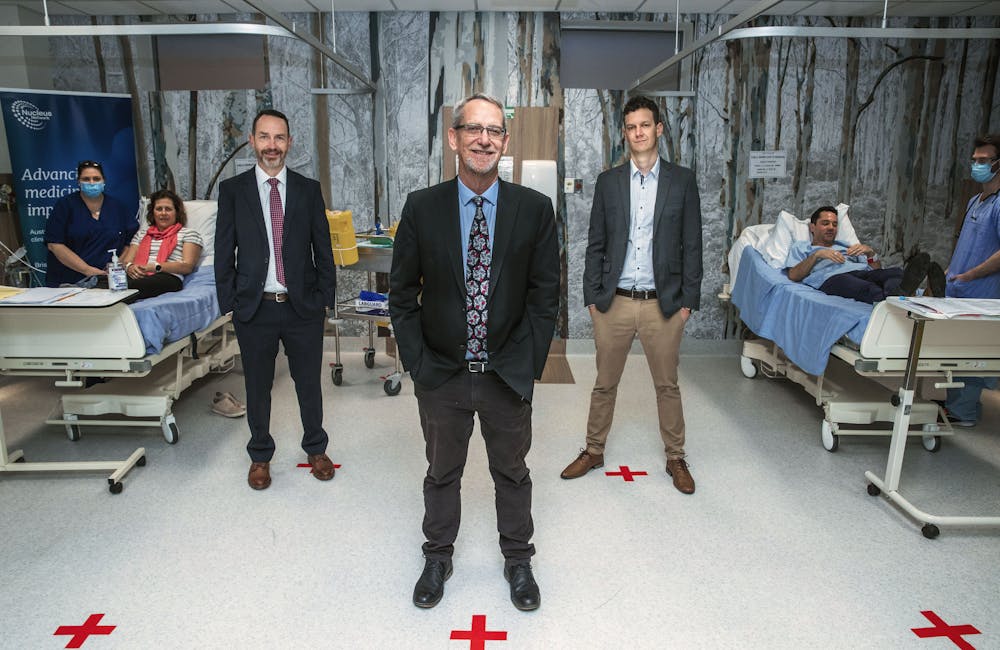
Researchers standing in a room with patients and nurses.
Healthy volunteers getting a trial dose of a University of Queensland developed vaccine in July 2020, with project co-leaders Professor Paul Young (centre), Professor Trent Munto (left) and Associate Professor Keith Chappell (right). The University of Queensland, Author provided

11:48 What are the lessons we need to learn from this pandemic? — Paul Young on the importance of discovery science.

16:57 David, you’ve said “COVID-19 is being referred to as a ‘once in a century event’ — but the next pandemic is likely to hit sooner than you think”. Why? — David Murdoch

18:53 A major new UN report warned up to 850,000 undiscovered viruses that could be transferred to humans are thought to exist in mammal and avian hosts. As co-director of One Health Aotearoa, can you quickly explain what a one health approach means, and why you argue Western countries like New Zealand and Australia need to adopt that approach? — David Murdoch

22:15 Paul Young on the risk of not having sovereign capacity to mass produce all types of vaccines in Australia, and how Australia and New Zealand are now talking about how to work together on producing future vaccines.

26:08 Audience Q&A: will there be different types of vaccines for different age groups? — Paul Young on how the UQ vaccine trial and others are working to include people aged 56 and over, the group most at risk of severe COVID.

Two women wearing masks outside New Zealand's parliament building in Wellington.
Hagen Hopkins/Getty Images

27:24 Audience Q&A: Whatever happened to the Russian vaccine? — Paul Young

28:15 Audience Q&A: Is climate change the main cause of the spread of diseases like this one? — David Murdoch

29:52 Audience Q&A: Long COVID in young people hasn’t yet arrived in full. Are we prepared to deal with the coming chronic disease load? — David Murdoch and Paul Young

32:15 Audience Q&A: Have you got any idea what [COVID-19 treatments] they gave to Donald Trump and whether they made him well? — Paul Young

33:30 Audience Q&A: What’s the relevance of the CSIRO in all this [COVID] research? — Paul Young

35:30 Audience Q&A: Are there any reassurances about side effects for people who get the vaccine early? — Paul Young

36:40 Audience Q&A: What commitment have Australia and New Zealand given to helping poorer countries pay for vaccines? — Paul Young and David Murdoch

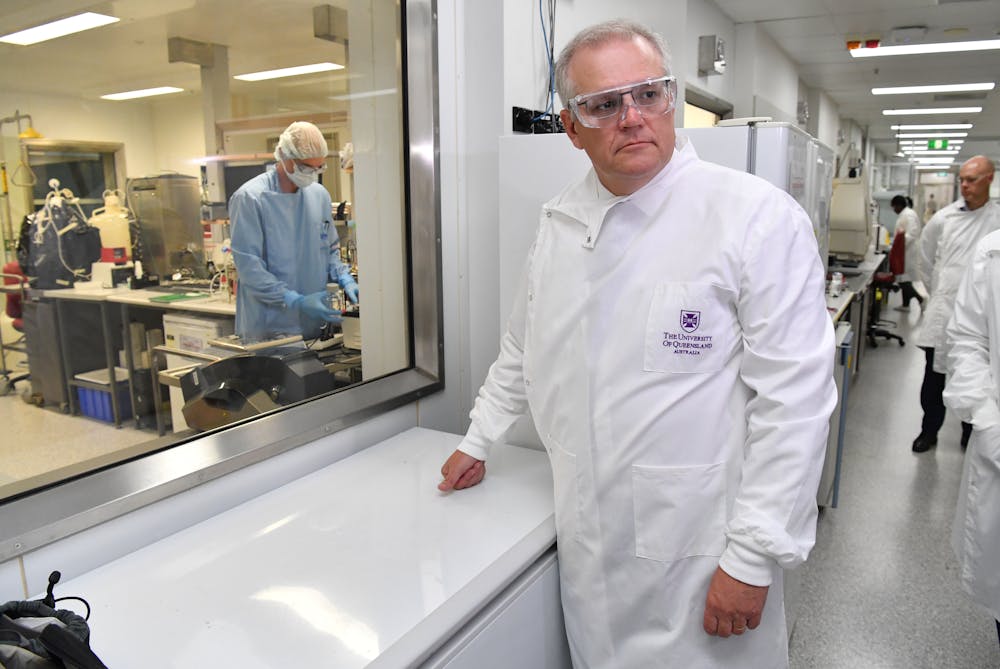
Scott Morrison in a white lab coat
Australian Prime Minister Scott Morrison touring the University of Queensland’s vaccine lab in October 2020. Darren England/AAP

37:50 Audience Q&A: The spread of viruses from animals: is it purely from consuming meat, or can it be picked up in other ways? — Paul Young

39:00 Audience Q&A: The UN report was frightening […] Is it inevitable this will be the pandemic century? — David Murdoch and Paul Young

50:00 Audience Q&A: Why aren’t we implementing an area-based “traffic light system” to stop the spread of COVID-19? — Paul Young and David Murdoch

52:30 Audience Q&A: What do we do to combat the rise of conspiracy theories and anti-vaccination information? — David Murdoch and Paul Young

Want to read more? Extra links mentioned in the event

ref. VIDEO: Two experts on the race for a COVID-19 vaccine and preparing Australia and New Zealand for the next pandemic – https://theconversation.com/video-two-experts-on-the-race-for-a-covid-19-vaccine-and-preparing-australia-and-new-zealand-for-the-next-pandemic-149726

10 reasons to stop whipping racehorses, including new research revealing the likely pain it causes

Source: The Conversation (Au and NZ) – By Paul McGreevy, Professor of Animal Behaviour and Animal Welfare Science, University of Sydney

Pressure is increasing on the global horse-racing industry to reconsider the use of whips in the sport.

Our research, published in the journal Animals, shows horses’ skin is very similar to humans’ in both thickness and the arrangement of nerve endings.

This adds to existing evidence that whipping is ineffective and unethical. Here we outline ten reasons why it’s time to drop the crop.

1. Horses’ skin appears just as sensitive as humans’

At the core of the debate is the question of whether horses experience pain when being whipped. A Sydney-based research team (of which one of us, Paul McGreevy, was a member) examined skin from 10 human cadavers and 20 euthanased horses under a microscope to explore any differences in their skin structure and nerve supply.

The results revealed no significant difference between humans and horses in the concentration of nerve endings in the outer, surface layer of skin.

2. Horses’ skin is no thicker than humans’

The new study also found no significant difference between humans and horses in the average thickness of this outer layer.

Horses need skin that is both robust and sensitive to touch, particularly from other horses or flying insects. The inner, base layer of skin in humans is significantly thinner than in horses, but this is not where the nerve endings lie.

Cross-sections of horse and human skin.
Microscopic cross-sections (400x magnification) of horse (left) and human skin. Images show the epidermis (top) and superficial dermis. Selected nerve endings are shown in red and marked with asterisks. Scale bars represent 20 micrometres. Tong et al. 2020, Author provided

3. Whip-free racing already exists

Norway outlawed the whipping of racehorses in 1982. In the United Kingdom, “hands and heels” races for apprentice jockeys have been part of the racing calendar since 1999. These events, in which the least experienced (and presumably most vulnerable) jockeys race without using the whip, is at complete odds with the industry’s contention that whips are essential for steering and safety. There are no reports from Norway or the UK of problems in the conduct of these races.

4. There’s no evidence whips make racing safer…

Whip use has been claimed to be essential for the safety of horses and jockeys. However, the impact of whip use on steering and safety had not been examined until a recent study compared “whipping-free” races, in which whips are held but not used, with “whipping-permitted” races.

Races of these two types were meticulously matched for racecourse, distance, number of runners, and “going” (turf conditions on the day). A detailed examination of stewards’ post-race reports revealed no difference between the two race types in movement of horses across the track and interference with other runners, and therefore no evidence whipping improves safety. This adds to evidence from jumps racing that whip use is associated with catastrophic falls.


Read more: Research shows whipping horses doesn’t make them run faster, straighter or safer — let’s cut it out


5. …or fairer…

The gambling industry has an interest in ensuring races are run with integrity, lest punters take their dollars elsewhere. Whip use is arguably the most visible sign that jockeys are indeed trying their hardest.

But the same study of stewards’ reports revealed no difference between “whipping-free” and conventional races in terms of the number of incidents related to jockey behaviour, such as careless riding or jockeys “dropping their hands” (indicative of not pushing the horse to run on).

The key to a fair race is not encouraging jockeys to use the whip, but rather ensuring all jockeys are subject to the same rules.

6. … or faster

The received wisdom is that whipping any horse makes it more likely to win. However, studies have shown increased whip use does not significantly affect speed at the finishing line, and the comparison study cited above found no difference in finishing times between whipping-free and conventional races.

What’s more, in “hands and heels” races, the jockey’s centre of mass is likely to remain directly above the horse’s centre of mass for more of the time, compared with when the jockeys are whipping the horses. So, the biomechanics of whip-free racing are arguably better for equine performance.

7. Whip rules are hard to police

The most prevalent breaches of the rules around whip use involve forehand strikes on more than five occasions before the 100-metre mark (44%), and the jockey’s arm being raised above shoulder height (24%). Studies of high-speed footage of 15 races revealed at least 28 rule breaches, involving nine horses, that were not recorded in stewards’ reports.

There are two reasons for this: the footage seen by racing stewards is filmed head-on, and is recorded at fewer frames per second than high-resolution video now provides. Head-on footage is preferred by stewards as it allows estimations of whip use on both sides of the horse, but it makes it harder to accurately police other aspects of whip use, such as the use of excessive force.

A separate study revealed more breaches are recorded at metropolitan than country or provincial racecourses, and by riders of horses that finished first, second, or third rather than in other positions. That said, horses that finished last were also worryingly vulnerable to whip-rule breaches.

What’s more, even legal whipping is likely to cause significant pain, given the similarity of human and horse skin.

Demonstration of the effect of a whip strike on human skin.

8. The public supports a ban on whipping

In a recent independent poll of more than 1,500 Australian adults, 75% thought horses should not be hit with a whip in the normal course of a race. The survey also found men were more than twice as likely as women to support whipping racehorses. Even among respondents who attended races or gambled on them at least once a week, 30% disagreed with whipping.

9. Whip-free racing still allows betting

While the ethics of promoting gambling is a different debate entirely, whip-free races in Norway and the UK still allow people to bet. It may even be more attractive to sponsors seeking assurance their brand is only associated with ethical activities.

10. Whipping tired animals in the name of sport is hard to justify

Horses have evolved to run away from painful pressure on their hindquarters, given the most likely natural cause of such stimulation is contact from a predator. Repeatedly whipping tired horses in the closing stages of a race is likely to be distressing and cause suffering. The horse’s loss of agency as it undergoes repeated treatment of this sort is thought to lead to the state of “learned helplessness”, in which animals learn they can do nothing to end their distress.


Read more: Put the baking soda back in the bottle: banned sodium bicarbonate ‘milkshakes’ don’t make racehorses faster


Racing must reckon with two key questions: does whipping actually work as intended, and is it an ethical way to treat a horse in the name of sport?

If the answer to both of those is “no”, a third question arises: why are jockeys still doing it?

ref. 10 reasons to stop whipping racehorses, including new research revealing the likely pain it causes – https://theconversation.com/10-reasons-to-stop-whipping-racehorses-including-new-research-revealing-the-likely-pain-it-causes-149271

An Australian man successfully sued his super fund over climate risk. Here’s what that means for your nest egg

Source: The Conversation (Au and NZ) – By Anita Foerster, Senior Lecturer, Monash University

The A$57 billion Rest super fund last week pledged to overhaul the way it manages climate risk, following a lawsuit by a 25-year-old member. The concession raises the bar for the way Australian superannuation funds respond to climate change.

The fact that Rest agreed to settle the case before a trial is significant. It indicates that the proposition behind the case – that super funds have a legal duty to identify, manage and disclose climate-related risks – is no longer disputed.

Rest has agreed to align its investments with net-zero emissions by 2050 and to publicly disclose its holdings, among other undertakings.

This is an ambitious and much-needed step up. It will influence how Australia’s A$3 trillion superannuation industry invests, and how our retirement savings are protected from climate risk.

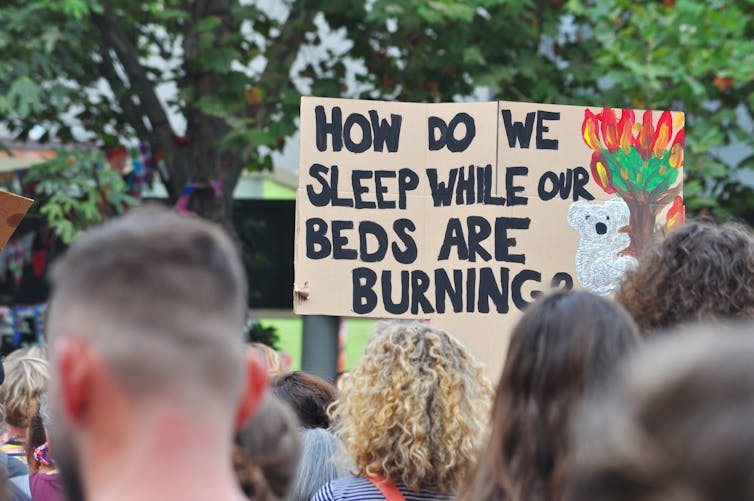
A sign at a climate rally
Australian companies, including super funds, are facing public pressure to respond to climate change. Shutterstock

Climate: a risky business

Brisbane man Mark McVeigh sued Rest for failing to disclose how the fund was managing the financial risks posed by climate change. These risks fall into two main categories:

  • physical risks from extreme events such as bushfires, storms and floods, which can damage assets and disrupt operations

  • risks arising from the transition to a low-carbon economy. These include new regulatory requirements to reduce greenhouse gas emissions, and associated market shifts.

Climate risks are directly relevant for companies in many sectors, particularly energy and mining. But super funds, which pool capital and invest in these companies, are also exposed via reduced asset values and investment returns.


Read more: Zali Steggall’s new climate change bill comes just as economic sectors step up


The legal claim alleged Rest’s trustee directors failed to act with care, skill and diligence when investing for McVeigh, by not properly considering the risks climate change poses to the fund’s investments.

In a statement as part of the settlement, Rest acknowledged climate change “could lead to catastrophic economic and social consequences … Accordingly, Rest, as a superannuation trustee, considers that it is important to actively identify and manage these issues.”

Rest also committed to significant changes to its investment practices. I analyse four of these pledges below, drawing on recent empirical research.

Cyclone damage to homes
Climate-related natural disasters such as cyclones can damage assets. Dan Peled/AAP

1. Net-zero emissions by 2050

Rest pledged to align its portfolio to the Paris Agreement. In doing so, it joins a small number of other Australian superfunds such as Hesta, as well as high-profile companies such as ANZ, that have made similar commitments.

Investors are still grappling with what it means to decarbonise and align portfolios with the Paris Agreement. The agreement doesn’t allocate specific emissions reductions to nations, but it does allow for calculation of a global “emissions budget”. This can be used to develop scenarios involving various mitigation measures over different time frames.

All Paris-aligned scenarios involve, at a minimum, very significant reductions in fossil fuel use. However, decarbonising existing portfolios is particularly challenging for Australian super funds. Many, including Rest, have substantial holdings in companies actively pursuing new fossil fuel projects such as Woodside Petroleum, Santos, Origin Energy, AGL and Caltex.

If Rest is serious about delivering on its pledge, it must divest from these companies, or secure a commitment to net-zero from these and the thousands of other companies in which it invests.

Coal mining equipment at a coal mine
Rest may have to divest from high-risk assets such as coal mines. Shutterstock

2. Publicly disclose portfolio holdings and climate risk exposure

The Australian superannuation industry is known for its poor transparency. One recent analysis found only a handful of Australian super funds publish a complete list of the companies in which they hold shares. Most only reported the top 10 or 20 holdings.

Disclosure of basic factual information, such as top holdings and assets under management, is highly variable between and within funds. It is very hard to find out which companies a super fund invests in, and to what extent. Funds’ disclosure of exposure to climate risks and their management is also patchy.

Rest has now committed to publicly disclose its full portfolio, as well as its approach to climate-related risks, in line with international best practice. This is a crucial step towards improvement across the industry.

3. Better consider climate-related risks

Super funds can address climate-related risks using a range of responsible investment approaches. These include negative screening, which involves excluding high-risk assets such as coal, oil or gas reserves.

Australian super funds already use this approach, but generally only apply it to “green” investment products which represent a tiny share of the overall portfolio.


Read more: Australia, the climate can’t wait for the next federal election. It’s time to take control


Unlike other large industry super funds, Rest does not appear to apply a climate-related screen, and it does not offer a green-labelled investment option. While these are not the only ways to manage climate risk, they are clear and highly visible approaches. There appears to be considerable scope for Rest to better address climate risk in its investment strategy and asset allocation. At the very least it has now committed to better disclose its approach.

4. Actively consider shareholder resolutions

Proposals by shareholders have recently emerged as a way to pressure Australian companies to disclose climate risks and commit to the clean energy transition. Super funds hold significant shareholdings in Australian companies, and how they vote can influence how a company responds.

Rest and others have a patchy record when it comes to supporting shareholder climate resolutions – even those simply asking for better climate risk disclosure. This underscores the considerable gap between Rest’s new commitment and recent practice.

Shareholders vote at a company AGM
Shareholder votes are used to pressure companies to act on climate. Richard Wainwright/AAP

Raising the bar

Rest’s new commitments are ambitious, and help consolidate an emerging “best practice” standard for superannuation funds on climate risk.

The commitments also underscore the key role super funds can play in society’s response to climate change. When climate is central to investment decision-making, funds can align capital and resources to the clean energy transition.

Because the case was settled out of court, Rest’s undertakings are not legally binding. However companies, regulators, interested members and NGOs will closely monitor whether the promises are implemented, and how the broader industry responds.


Read more: NSW has joined China, South Korea and Japan as climate leaders. Now it’s time for the rest of Australia to follow


ref. An Australian man successfully sued his super fund over climate risk. Here’s what that means for your nest egg – https://theconversation.com/an-australian-man-successfully-sued-his-super-fund-over-climate-risk-heres-what-that-means-for-your-nest-egg-149918

There’s no need for panic over China’s trade threats

Source: The Conversation (Au and NZ) – By James Laurenceson, Director and Professor, Australia-China Relations Institute (ACRI), University of Technology Sydney

China’s increasingly belligerent threats to close its markets to Australian exports have excited talk of a full-blown trade war.

But let’s not panic. These threats are best understood as psychological warfare, not a statement of reality.

Last week Hong Kong’s South China Morning Post reported the Chinese government was set to ban Australian imports of timber, sugar, copper ore and copper concentrates, wool, lobsters, barley and wine. These markets are worth about A$6 billion a year.

The message from Chinese state media in the days before the mooted bans were supposed to take effect was loud and clear. The China Daily editorialised that “Canberra only has itself to blame” and warned the Morrison government to “steer clear of Washington’s brinkmanship with China before it is too late”.

Already this year China has taken punitive action against Australian barley, beef and possibly coal, and threatened the loss of Chinese tourists and students.

China has a history of using coercive economic pressure as a political weapon.

In 2011, for example, it restricted salmon imports from Norway after the awarding of the 2010 Nobel Peace Prize to Chinese dissident Liu Xiaobo. In 2012 it banned bananas from the Philippines in the wake of territorial disputes in the South China Sea. And so on.

But such pressure has been narrowly focused, and China has been careful to maintain “plausible deniability”, using excuses like food safety concerns to avoid being taken to the World Trade Organisation for flouting international trade rules.

This action against Australian exports would be unprecedented in China’s economic statecraft. It would be impossible for China to deny its motives.

Politics by other means

Though the Chinese market for the seven threatened export products is valuable, it’s important to note they represent just 4% of the A$150 billion in Australia’s exports to China in 2019-20, and less than 2% of the value of all Australian exports.

The exports that are the backbone of the Australia-China trade relationship – such as iron ore – have avoided mention. That’s for good reason. In the first nine months of 2020, China relied on Australia for 60% of its imported iron ore – crucial to make the steel needed for building bridges, factories and high-rise apartment blocks.

Iron ore is used to make steel, needed for China's massive construction projects.
Iron ore is used to make steel, needed for China’s massive construction projects. Yan Keren/AP

Still, an argument could be made that the scale of aggregate economic damage isn’t the point.

Rather, by inflicting serious harm on lobster fisherman through to winemakers, the Chinese government is seeking to turn Australian producers into lobbyists that help it achieve its foreign policy objectives.

But if that’s the intention, there’s little evidence the plan is working.

With a few high-profile exceptions, Australian business groups have been conspicuously quiet as the bilateral political relationship has deteriorated since 2017.


Read more: Why the Australia-China relationship is unravelling faster than we could have imagined


Coercion can backfire

Indeed a key lesson from research on economic coercion is that success is difficult to achieve. One reason is that targets take steps to make themselves less vulnerable.

Chinese threats against Australia, for example, have led to calls for Australia to diversify its export markets.

With Australian public opinion towards China continuing to plummet, there is also the prospect of hardening the Australian government’s resistance to Chinese pressure.

As political scientist Greg McCarthy (a former BHP Billiton chair of Australian studies at Peking University) has argued, the “political ballast” for the Australian government’s China policy stems in large part from the “popularised perception of a China threat to national sovereignty”.

So it isn’t surprising China appears to have hesitated in moving from threat to action. Such moves would have hurt China too.


Read more: Australia depends less on Chinese trade than some might think


Leaving it to business

So far the Australian government is maintaining a steady approach to the trade relationship.

On Monday federal Trade Minister Simon Birmingham noted the “rumours” of an outright blanket did not “appear to have materialised”. While there were “areas of problem and concern” such as delays in live lobster shipments being cleared through Chinese customs, he said, “we will continue to work at an administrative and diplomatic level to try to understand and resolve those points of concern”.

Prime Minister Scott Morrison has maintained that judgments on trading with China “are not decisions that governments make for businesses”.

The rationale would appear to be that China’s targets for punishment will vary from sector to sector and change over time. With their own money on the line and their industry knowledge, businesses are best placed to assess developments and manage risks.

The government can certainly support those assessments by, for example, partnering with industry bodies to fund research into the risks exporters face, providing businesses with clarity on where it sees foreign policy headed and sharing insights gleaned from its diplomatic network and national security agencies.

With China’s purchasing power over the next decade forecast to grow more than that of the US, Japan, India and Indonesia combined, expect Australian businesses to craft more sophisticated strategies to manage coercive risk, rather than just looking to sell more to other markets.

Either way, Australia has less to fear from China’s trade threats than some might think.

ref. There’s no need for panic over China’s trade threats – https://theconversation.com/theres-no-need-for-panic-over-chinas-trade-threats-149828

Why is the government trying to make the cashless debit card permanent? Research shows it does not work

Source: The Conversation (Au and NZ) – By Elise Klein, Senior Lecturer, Australian National University

Dystopic policy in Australia is often hidden in plain sight.

As Curtin University Professor Suvendrini Perera has written, systematic failures are not necessarily “spectacular acts” but the “decisions and indecisions of bureaucratic oversights and misplaced assumptions”. And these amount to a “slow violence” over time.


Read more: Australia has been stigmatising unemployed people for almost 100 years. COVID-19 is our big chance to change this


One such failure is the Cashless Debit Card, which has been trialled in Australia since 2016.

Yet, among all the measures in last month’s budget was the news the Morrison government will make the trial scheme “ongoing”.

What is the Cashless Debit Card?

The Cashless Debit Card scheme quarantines 80% of social security payments to a cashless card, which prevents spending on alcohol, illegal drugs and gambling products.

Empty shopping trolley in supermarket aisle.
The card is supposed to quarantine welfare payment for essentials such as food and groceries. www.shutterstock.com

It is currently being trialled in Ceduna in South Australia, the East Kimberley in Western Australia, the Goldfields in WA and Hervey Bay region in Queensland, with about 12,000 people involved.

The card compulsorily includes a broad range of people receiving support for many reasons, including payments for disability, parenting, caring, unemployment and youth allowance. The Australian Human Rights Commission is among those who have pointed out the the card disproportionately impacts First Nations people.

Research shows it does not work

Peer-reviewed research has consistently shown the card, and income management more broadly, do not meet policy objectives. A 2020 academic study of multiple locations found compulsory income management “can do as much harm as good”.

Survey respondents reported not having enough cash for essential items, while the research found the card “can also stigmatise and infantilise users”.

My research examining the card in the East Kimberley shows it makes life more difficult for people subjected to it, including making it harder to manage money. People also reported the card made it more difficult to buy basic goods such as medicine and groceries.


Read more: ‘I don’t want anybody to see me using it’: cashless welfare cards do more harm than good


Other research from the Life Course Centre suggests compulsory income management has been linked to a reduction of birth weight and school attendance. The majority of these children are First Nations kids.

Bill before parliament

A bill to make the card permanent was introduced to parliament just a day after the budget was handed down.

If passed, it will also transfer about 25,000 people in the Northern Territory and Cape York who are on the Basics Card (an earlier version of income management) onto the Cashless Debit Card.

Introducing the bill to the House, Morrison government minister Trevor Evans said the card was delivering “significant benefits” in the trial communities.

The program has the objective of reducing immediate hardship and deprivation, helping welfare recipients with their budgeting strategies and reducing the likelihood that they will remain on welfare and out of the workforce for extended periods.

The government also says the card is used “just like an everyday bank card” and is seeing a reduction in drug and alcohol use and gambling.

Senate inquiry

But as highlighted above, the value of the scheme is heavily disputed by policy experts. People put on the card, community groups, lawyers and doctors also oppose any expansion of the card.

The card’s expansion has been the subject of a brief Senate inquiry, which is due to report on November 17.

This is the sixth Senate inquiry into the Cashless Debit Card. Each one has seen submissions from across the community which overwhelmingly reject the card.

First Nations groups have led the charge, stating income management is not in the spirit of self-determination and the current bill would “directly contradict the recent National Agreement on Closing the Gap”.

Smoke and mirrors

Trials of public policy programs require, by definition, research to examine their performance and to justify any continuation. Yet, the government continues to rely on anecdotes and the widely criticised 2017 evaluation by ORIMA Research as “proof” for the roll out of the Cashless Debit Card.

In 2018, the Australian National Audit Office found the ORIMA evaluation was methodologically flawed and unable to provide any credible conclusions regarding the real impact of the trial.

Aerial view of Hervey Bay, Queensland.
The card has been trialled in the Hervey Bay and Bundaberg region since 2019. www.shutterstock.com

In the latest bill, the government also misrepresents the findings from a 2014 evaluation of compulsory income management into the Northern Territory, claiming the findings were supportive of income management. Yet this evaluation,

[did] not find any consistent evidence of income management having a significant systematic positive impact.

Compelled by the Senate, the government has since commissioned the University of Adelaide to evaluate the scheme. This research was due to be released by the end of 2019 but is yet to be made public.

When asked about the report in Senate estimates last month, Social Services Minister Anne Ruston said it was not about deciding whether the card would continue, but to give advice on “what what was working particularly well”.

Perversely, the current bill also removes any need to further evaluate the Cashless Debit Card, instead opting to rely on the department to undertake its own desk-based research.

Why is evidence being ignored?

The protracted life of the Cashless Debit Card in Australian public policy shows the ongoing disregard for evidence-based policy making.

It also shows the continued slow violence against thousands of Australians who deserve much better from elected officials and the structures set up to support them.

Whilst it is easy not to pay attention to the mundane details of policy, the Cashless Debit Card shows we must.


Read more: ‘An insult’ – politicians sing the praises of the cashless welfare card, but those forced to use it disagree


ref. Why is the government trying to make the cashless debit card permanent? Research shows it does not work – https://theconversation.com/why-is-the-government-trying-to-make-the-cashless-debit-card-permanent-research-shows-it-does-not-work-149444

Keith Rankin Analysis – The New ‘Centre-Left’ Establishment

Keith Rankin.

Analysis by Keith Rankin.

The Linear Political Spectrum

Keith Rankin.

In both New Zealand and United States, we have just seen the political success of the one-dimensional political centre; perhaps a nudge to the left of centre.

By one-dimensional (or ‘linear’), we mean the traditional left-right political spectrum, whereby the ‘right’ means private capitalism aligned with institutional conservatism and minimal income redistribution, and the left advocates substantial income redistribution, government-directed compensation for the disadvantaged, and institutions which fully reflect population diversity. The ‘centre’ is thus a balance of these two ‘extremes’ of apportionment. This centre is epitomised by what might be called the ‘right’ faction of the governing New Zealand Labour Party; or by the United States’ Democratic Party (Bernie Sanders excepted).

For a while it looked as though 100 percent of MPs in New Zealand’s new parliament would belong to parties that all fitted neatly on the linear spectrum: two stale ‘left’ parties which self-label as ‘progressive’ (Labour and Green); and two stale ‘right’ parties (National and Act) which conform to linear conservatism. Only the Māori Party’s unexpected success has saved the new Parliament from this one-dimensional fate.

Centre Parties in past New Zealand Parliaments

New Zealand has had a number of small centre parties represented in Parliament in the ‘modern era’, which I date from the formation of the National Party in 1936: Social Credit, New Zealand First, United, Progressive, Māori.

Of these (Peter Dunne’s) United and (Jim Anderton’s) Progressive Party belonged on the linear spectrum. The Progressive Party fitted on the spectrum between Labour’s left and Labour’s right. United was a party whose leader neatly fitted true linear centre, and could thus practically align with either Labour or National to facilitate the formation of a centre-left or a centre-right government.

The other three centre parties all contained an additional dimension. Social Credit was/is a monetary reform party, the New Zealand variant of a movement which consolidated as a political force in the 1930s’ Great Depression. Social Credit was a mainly rural radical movement, such as the Granger movement in the United States in the late nineteenth century. It emphasised the financial power imbalances faced by precarious farmers and other provincial small businesses, and the use of interest payments to transfer income from the poor to the rich. As a political party in New Zealand, Social Credit was a breakaway from the Labour Party. It gained 11 percent of the popular vote in 1954, 14 percent in 1966, 16 percent in 1978, and 21 percent in 1981. In 1992 Social Credit joined another left-wing party, the Alliance.

Social Credit’s extra policy dimension was monetary reform. Financial reform is a project more important than ever this century, where capitalist economies have only been able to persevere with the help of ultra-low interest rates. The Modern Monetary movement has a (sort of) similar policy agenda (focusing on public finance); an agenda which requires both low interest rates and governments prepared to take advantage of them.

New Zealand First is an semi-liberal centrist party with a nationalist dimension. Indeed it could be classed as a mercantilist party, which makes it semi-attached to the new establishment, and not nearly as radical as it occasionally purported itself to be. It formed as a breakaway party from National in 1993, and, like United, was able to form coalition governments with either of the two larger parties (Labour and National) which occupy the linear political spectrum. Like the already mentioned Progressive and United Parties, New Zealand First was always identified with its political leader (Winston Peters) and will almost certainly fade from future relevance for the same reasons as those other two parties.

The Māori party has a clear ‘identity’ dimension, and depends on voters who prefer the linear-left of Labour to the linear-right of National. In its past tenure in Parliament it definitely ‘punched above its weight’, especially given that it never had the ‘balance of power’ that New Zealand First and United and (briefly) Social Credit have had. While its future political influence will be constrained by its supporters’ distaste for National, it still offers an opportunity for the expression of policy ideas which do not fit onto the linear political spectrum. Voters hoping for something different this decade should definitely consider voting Māori in future elections, because it is the nearest we have to a radical centre party in Parliament, and not necessarily because they are motivated by identity politics. The Māori Party should be cherished as an independent voice; not in any way stale.

We may also note that the Green Party (and its predecessor, the Values Party) started as an iconoclast centre party. Gradually, however, the Green Party moved to the unidimensional political spectrum, on the left, and has been drawn into a worldview that itself is the larger part of the problem that the environmentalist movement is there to address.

The Opportunities Party (TOP)

New Zealand did have an explicitly ‘radical centre’ party in the 2020 election. Sadly – and mainly because TOP no longer had its founder leader (Gareth Morgan) – who was popular with the media networks, and who in 2017 made it onto the media television debates. Despite that, TOP got 1.5 percent of the votes in 2020, polling highest of all the parties which have never been represented in Parliament.

TOP’s flagship policy is to convert to a Universal Basic Income funded mainly by a flat rate of income tax equal to the present top rate of 33 percent. TOP is a centrist capitalist party that effectively promotes the extra dimensional concept of ‘public equity’, and promotes equity principles (rather than redistributive principles) to address the searing inequality problems faced today in New Zealand and in other ‘liberal democracies’.

The political centre does not have to be bland. TOP deserves to be thanked for giving New Zealanders an ‘off the spectrum’ option. Further, by gaining a significantly higher percentage of special votes than of preliminary votes, TOP showed that it was getting through to many of the younger people who were looking for an iconoclast option. And, thanks in part to TOP’s efforts, at least one television journalist – Corran Dann I believe – was able to say that Universal Basic Income is now a mainstream policy option. I hope that TOP can survive, in one form or another, and continue to advocate for the radical centre.

The Future of the National Party

TOP’s policy agenda could be taken up by a National Party seeking a future as a genuine alternative to an establishment Labour Party that sits astride the one-dimensional centre. TOP, as a capitalist party unconstrained by one-dimensional conventions, may have achieved its main purpose if, looking back from the future, it proves to be a policy feeder to National. It is normal for ideas once regarded as ‘fringe’ to become mainstream; the conservative policy gatekeepers cannot keep out a good idea forever. In the case of Labour, this process of policy evolution has mainly taken place in the ‘identity politics’ space. It is now up to National to take a few risks, and to inject multi-dimensional thinking into the ‘economic capitalism’ policy space.

The Liberal Mercantilist Consensus

The new ‘Centre-Left’ establishment is a liberal mercantilist consensus – conservative, as just about all consensuses are – which buttresses an establishment worldview that predominates in academia, the finance industry, the mainstream media, and the public bureaucracy; as well as in New Zealand’s four linear-spectrum political parties. This worldview requires much unpacking that goes beyond the scope of this present essay (but see the checklists below). I should note that at least one academic publication suggests that liberal mercantilist philosophies may underpin key aspects of the European Union project.

Both the New Zealand Labour Party and the United States Democratic Party are fully committed to this entrenched normative political economy, without any awareness of other options, and insensitive to the stresses that liberal mercantilist assumptions place on the planet and the people. A good way to start would be for adherents of the new ‘leftish’ political mainstream to empathise with the people of the world who vote for the likes of Donald Trump, and to appreciate that the received truths of liberal mercantilism fail to gel with the realities of their lives. Donald Trump – an unreconstructed mercantilist himself – was never anything close to a solution to the concerns of American voters who aligned themselves against the Democratic Party worldview. But he tapped into a real concern about the evolution of ‘politically correct’ politics, and the new centre-slightly-left establishment ignores these concerns at its peril.

In New Zealand and elsewhere, the existential problems of economic inequity, environmental cost, and phobic public finance will only get worse. The new political establishment has no conceptual tools to address – or even properly acknowledge – these matters.

Memes

Liberalism is an essentially European political and philosophical project that dates from the second half of the seventeenth century. It is neither true nor false. Rather, it’s a lens which may be associated with the following conceptual icons:

  • private property rights
  • small government
  • market discipline
  • meritocracy (though ‘merit’ is ambiguous)
  • rules-based international order
  • strong enforcement of property rights and other rules
  • balanced government budgets
  • monetarism, with money understood as a kind of commodity
  • permissive
  • freedom to … (as distinct from ‘freedom from’)
  • equality of opportunity
  • inequality of outcome
  • compensation
  • Glorious Revolution (England, 1688)
  • John Locke (English philosopher)
  • globalisation, in the ideological rather than the technological sense
  • mechanism that’s largely self-adjusting, like clockwork
  • predictable, in a Newtonian sense

Mercantilism is for social science what alchemy is for physical science. Thus, mercantilism is false. While both alchemy and mercantilism represent stages in the development of science, mercantilism (unlike alchemy) continues to cohabit with social science. Economists do not learn about mercantilism, in the same sense that chemists and physicists do not study alchemy. Global historians know about mercantilism and its historical importance, but tend to compartmentalise it as an historical antecedent to economic and political theory rather than understanding it as an ongoing component of contemporary business, finance and politics.

These are the conceptual icons of mercantilism:

  • economic nationalism
  • exports good, imports bad
  • balance of payments (current account) surplus as a measure of national success
  • zero-sum competitive national rivalry, with winners and losers
  • economic imperialism, power, struggle
  • government-business nexus
  • business worldview
  • economic activity is ‘supply-driven’ (as opposed to ‘demand-driven’)
  • money and its tradable derivatives considered to be wealth
  • bitcoin (and similar) as new commodity money
  • making money as the economic purpose of life
  • holding onto money, miserliness
  • cost understood as the giving up of money
  • government aversion to ‘fiscal risk’
  • ascription of magic-like qualities to money
  • living to work; glorification of work
  • employment maximisation (as quite distinct from low unemployment)
  • maximisation of economic output
  • the third quarter of the second millennium as the age of mercantilism

Finally

Liberalism – in 1776 in the guise of Adam Smith’s classical economics – supposedly dealt to mercantilism, once and for all. But it only exposed the narrow more obvious fallacies of mercantilism (those zero-sum trade fallacies to which Donald Trump subscribes), while reinforcing some of the more intractable myths surrounding money, work, and wealth.

The United States, in 1776, was conceived by liberalism and born out of its mercantilist exploitation by Great Britain. New Zealand – as ‘New Zealand’ – was born out of mercantilism in 1642 (in the middle of the third quarter of the second millennium) as part of the explicit global business imperialism as conducted by the Dutch United Provinces (now the Netherlands).

Donald Trump is a shallow mercantilist, who became illiberal in order to fit the profile ascribed to him by his supporters. Angela Merkel, soon to retire as Chancellor of Germany, is a deep mercantilist and a liberal; modern Germany is the epitome of liberal mercantilism. The centrist grand coalition which has dominated German politics this century is the likely role model for the new New Zealand government, and also for the new United States government.

Negative interest rates could be coming. What would this mean for borrowers and savers?

Source: The Conversation (Au and NZ) – By Harry Scheule, Professor, Finance, UTS Business School, University of Technology Sydney

There’s a row brewing in the corridors of financial power. The Reserve Bank of New Zealand (RBNZ) recently advised the trading banks that the official cash rate might move from the barely positive into the negative.

Right now the RBNZ is holding off such a move in favour of other monetary stimulus measures. But the big banks strongly oppose negative rates, arguing they’ve had limited success overseas and that the country’s banking technology isn’t up to it.

For the central bank, however, it remains an option to stimulate spending, investment and employment as part of the COVID-19 recovery. By reducing the cost of borrowing, economic activity picks up — or so the theory goes.

Those turning to unconventional monetary policy include Japan, Switzerland and the European Union. Negative rates range from –0.1% to –0.8% for selected tiers of central bank deposits.

In the past, cash rate changes have fed through to changes in loan and deposit rates. For example, a 25-basis-point drop in the cash rate may result in an annual interest saving of $2,500 on a NZ$1 million loan.

At the current low interest rates, however, these changes are no longer passed on — significantly limiting the powers of the RBNZ.

Reserve Bank of NZ governor Adrian Orr speaking at a lecturn
Reserve Bank of New Zealand governor Adrian Orr: negative interest rates are an option. GettyImages

Yes, the bank pays you to borrow

It might sound crazy, but if the lending rate is negative and you borrow an amount on interest-only terms, the bank actually pays you interest every period. For example, Jyske Bank in Denmark is offering negative interest payments by effectively reducing the repayment period.

Banks should be comfortable offering negative rates to borrowers if, in turn, the banks themselves have savings and other funding at even lower rates.


Read more: With house prices soaring again the government must get ahead of the market and become a ‘customer of first resort’


But this is the issue: why would savers pay banks to accept deposits? First, they can hold their investments in cash at a zero-interest rate rather than pay a bank. Second, they can choose to invest in riskier assets with positive interest rates.

Because of this, only very large depositors (with limited ability to store cash) tend to leave their money in banks offering negative rates, while ordinary depositors receive a rate of zero or more.

But do negative rates work?

Arguably, the era of monetary policy as a tool for stimulating economic investment and activity has come to an end. Negative rates don’t necessarily translate into productive investment and growth.

Countries that have gone negative have not delivered the expected increases in spending and investment. Furthermore, the difficulty of passing negative rates on to depositors means lending and deposit rates no longer follow the cash rate.

This is also evident in Australia, where a cash rate drop from 0.25% to 0.15% has not been passed on to mortgage borrowers, except in isolated areas such as fixed-rate loans.

The chart below compares the average variable rate on mortgages with the New Zealand cash rate, with the gap growing over time. Charts for Australia and other developed economies would be comparable.

The Reserve Bank of Australia (RBA) has advised borrowers to change lenders if they don’t pass on rate cuts. But there is little central banks can do to offset what is a systemic problem.

What are the risks?

Negative interest rates are unlikely to be the right response to the current COVID shocks. Rather than leading to higher spending, we tend to see the opposite — more saving.

In the long run, however, depositors will seek greater returns and move their funds to riskier asset classes, including housing markets, which will push up prices and reduce affordability for new buyers.

Most economists agree inflation is not a concern for now. But what about the medium term? If interest rates climb again, highly leveraged mortgages may be difficult to service.


Read more: Explainer: why the government can’t simply cancel its pandemic debt by printing more money


Either way, negative rates are not a long-term solution to current economic challenges. We need to find ways to make the national economy more flexible, requiring fewer rescue interventions.

The fragility of supply chains and the still limited movement of labour, goods and services should be priorities. New technologies may become key — innovations that enable working from home and organising activities online have already saved whole industries.

Also, the banking system itself needs reform. Banks work on an assumption of once-in-a-thousand-year shocks — but we have seen two in the past 13 years!

After the 2008 global financial crisis, safety buffers in the financial systems were put in place. For example, bank capital requirements were set high, to be run down in economic downturns. Would now be the right time to run them down rather than insisting they be maintained?

Beyond reaching for negative rates, the need to rethink economic fundamentals and create systems that are more resilient to global shocks should be the lasting lessons of COVID-19.

ref. Negative interest rates could be coming. What would this mean for borrowers and savers? – https://theconversation.com/negative-interest-rates-could-be-coming-what-would-this-mean-for-borrowers-and-savers-149898

Vanuatu doubles quarantine period, halts domestic travel to Efate

By RNZ Pacific

The capital island of Vanuatu – Efate – is closed off today after the country’s first case of covid-19 was announced yesterday.

Stricter quarantine rules are also in place.

A ni-Vanuatu man who arrived in Port Vila from the US, via Australia and New Zealand, was confirmed with the coronavirus on Tuesday during routine testing.

Prime Minister Bob Loughman said the Council of Ministers had agreed that the period of quarantine for citizens being repatriated would now double to 28 days.

As well, Loughman announced that domestic travel connections to the main island Efate were being halted.

He said the council also agreed that all ni-Vanuatu citizens and residents wanting to return home from abroad must show negative test results at least 72 hours before departing for Vanuatu.

The man, who was asymptomatic, arrived in Vanuatu on November 4.

High-risk location
The government said that because he had been travelling from a high-risk location he was seated separately during flights and physical distancing was carried out at all times.

The man has been transferred to an isolation facility at the Vila Central Hospital in Vanuatu’s capital.

Loughman said that the government through its covid-19 taskforce was “prepared and ready” to keep the case contained.

He urged the public to co-operate with all frontline government agencies as they carry out their duties.

“There will be no restrictions on flights and ships bringing in cargo to the island of Efate, but the island of Efate will go on lockdown, meaning there will be no domestic travel to the island of Efate,” Loughman said.

“Anyone not respecting the new directives will be dealt with.”

Meanwhile, health authorities in Vanuatu are undertaking contact tracing for people who came in contact with the positive case.

This article is republished by the Pacific Media Centre under a partnership agreement with RNZ.

Vanuatu PM Bob Loughman
Vanuatu’s Prime Minister Bob Loughman …”Anyone not respecting the new directives will be dealt with.” Image: Hilaire Bule/RNZ Pacific
Print Friendly, PDF & Email

Article by AsiaPacificReport.nz

This super rare squid is a deep-sea mystery. We recently spotted not 1, but 5, in the Great Australian Bight

Source: The Conversation (Au and NZ) – By Hugh MacIntosh, Research Associate, Marine Invertebrates, Museums Victoria

The mysterious bigfin squid has been spotted in Australia’s waters for the first time. My colleagues and I from the CSIRO and Museums Victoria detail the encounters in our new research, published today in Public Library of Sciences ONE.

There have only been about a dozen bigfin squid sightings worldwide over the past two decades. Ours happened more than two kilometres below the ocean’s surface in the Great Australian Bight, off the coast of South Australia.

For many people, the phrase “deep-sea squid” may conjure up images of the giant squid, Architeuthis dux, or krakens with huge tentacles swimming in inky black water.

But there are dozens, if not hundreds, of other species of deep-sea squid and octopus (both members of the class Cephalopoda) that are just as mysterious.

First encounters with a slippery individual

For years, one of the only ways to sample the deep sea was to trawl the sea floor with nets. This often damaged the soft bodies of deep-sea organisms beyond recognition. These mangled specimens are then difficult to identify and reveal little to nothing about the creatures.

Fortunately, newer technologies such as remotely-operated vehicles (ROVs) equipped with high-definition cameras are letting scientists see species as they’ve never seen before — offering deeper insight into their shapes, colours and behaviours in the wild.

Bigfin squid, _Magnapinna_
Magnapinna is a member of the Cephalopoda class, which includes octopuses and cuttlefish. Osterhage et al., Author provided

The enigmatic bigfin squid, Magnapinna, is one case in point. When scientists first described the species in 1998, all they had to go by were some damaged specimens from Hawaii.

The most distinctive feature of these specimens were the large fins (at the very top of the body), which gave the squid its name. Years later, scientists exploring the deep Gulf of Mexico with ROVs realised they had come across Magnapinna in the wild.

They discovered that in addition to its distinctive fins, its arms had incredibly long filaments on the tips, making the bigfin squid unlike any other encountered.

These delicate filaments, which are mostly broken off in collected specimens, give Magnapinna an estimated total length of up to seven meters!

In 2001, scientists exploring the seafloor off Oahu, Hawaii, captured footage of a bigfin squid estimated to be between four and six metres long. (Monterey Bay Aquarium Research Institute)

Mysterious critters and where to find them

But despite deep-sea ROV surveys becoming more common, Magnapinna has remained elusive.

The handful of sightings have been as far apart as the Central Pacific, North and South Atlantic, Gulf of Mexico and Indian Ocean. This suggests a worldwide distribution.

Yet, the big fin squid had never been seen in Australian waters. That is, until recently, when our team took part in a major research project to better understand the biology and geology of the Great Australian Bight, through the Great Australian Bight Deepwater Marine Program.

On the CSIRO’s research vessel Investigator and charter vessel REM Etive, we surveyed as deep as five kilometres below the water’s surface. Using nets, ROVs and other camera equipment, we recorded hundreds of hours of video footage and uncovered thousands of species.

On one dive, as we watched the video feed from cameras far below us, a wispy shape emerged from the gloom. With large undulating fins, a small torpedo-shaped body and long stringy limbs, it was unmistakably Magnapinna. We yelled and brought the ROV to a halt to get a better look.

The meeting lasted about three minutes. During this time we managed to use parallel laser pointers to measure the squid’s length — about 1.8 meters — before it swam away into darkness.


Read more: Octopuses are super-smart … but are they conscious?


In total, we recorded five encounters with Magnapinna in the Great Australian Bight. Based on the animals’ measurements, we believe we recorded five different individuals: the most Magnapinna ever filmed in one place.

Most previous records have been of single Magnapinna, but our five squid were all found clustered close to each other. This might mean they like the habitat where they were found, but we’ll need more sightings to be sure.

Unexplained behaviours

The footage we captured has offered new information about Magnapinna’s ecology, behaviour and anatomy.

Previously, Magnapinna has been seen many meters off the sea floor in an upright posture, with arms held wide and filaments draping down. We’re not sure what the specific function of this behaviour is. It might be a way to find prey — akin to dangling sticky, sucker-covered fishing lines.

On our voyage, we saw the squid in a horizontal version of this pose, just centimetres off the sea floor, with its arms and filaments streaming behind. Again, we don’t know whether this behaviour is for travelling, avoiding predators or another method of searching for prey.

If you look at this photo carefully, you can a bigfin squid with its arms spread wide, and its filaments as faint lines stretching away to the bottom right. Osterhage et al.

One near-miss with a camera gave us a very closeup image of Magnapinna which showed filaments that appeared to be coiled like springs. This may be a means for Magnapinna to retract its filaments when needed, perhaps if it wanted to avoid damage, or reel in something it caught.

Until now, only one other cephalopod, the vampire squid (Vampyroteuthis infernalis), has been known to coil its filamentous appendages this way.

A close encounter just centimetres off the seabed shows the squid in a horizontal posture, with its arms spread and filaments dragging behind. Curiously, some of the filaments appear to be coiled like springs. Osterhage et al.

We have learned more about the mysterious bigfin squid. But until we have more sightings, or even an intact specimen, questions still remain. One thing we do know is ROV surveying has great potential to enhance our understanding of deep-sea animals.

With so much of the ocean around Australia yet to be explored, who knows what we’ll see coming out of the gloom next time?


Read more: Curious Kids: have people ever seen a colossal squid?


ref. This super rare squid is a deep-sea mystery. We recently spotted not 1, but 5, in the Great Australian Bight – https://theconversation.com/this-super-rare-squid-is-a-deep-sea-mystery-we-recently-spotted-not-1-but-5-in-the-great-australian-bight-149831

What now for Black Lives Matter? Whatever happens under Biden, the role of African American women will be vital

Source: The Conversation (Au and NZ) – By Clare Corbould, Associate Professor, Contemporary Histories Research Group, Deakin University

During the northern summer, anti-Trump sentiment fused with anti-racist activism in the US, causing huge numbers of Americans to protest all around the country.

President Donald Trump has been voted out of office, but the issues at the heart of Black Lives Matter remain as critical as ever.

In fact, the high turnout for both sides in the election demonstrates two things: the power of the movement and the need for it to continue.

But where does Black Lives Matter go from here?

Decentralised organisation is key

If you can’t name the three Black women — Alicia Garza, Patrisse Cullors and Opal Tometi — who coined the phrase “Black Lives Matter” in 2013, there’s a good reason for that.

Seeking to avoid what they saw as the mistakes of the Civil Rights Movement, they stayed low-key and used social media to facilitate local activists taking responsibility.

The 2020 US election has decisively demonstrated the power of this strategy, because it took varied local organisations to activate important pockets of Black voters, Latino voters, and young voters.

During the summer’s large protests, hundreds of thousands of people registered to vote, including a surge in Black voter registration.

A voter registration drive in Brooklyn, New York.
Voter registration drives were organised around the US ahead of election day. Bebeto Matthews/ AP

Activists learned their tactics from a long tradition. Decentralised organisation, often led by women, has always been integral to African Americans’ campaigns for rights. The Civil Rights Movement succeeded because of the work of women such as Ella Baker and Fannie Lou Hamer, which culminated in the 1965 Voting Rights Act.

But in 2013, a conservative-leaning Supreme Court ruled sections of the Voting Rights Act were unconstitutional. Nine states — including seven in the south, where voting had been closely supervised by the federal Department of Justice — were now able to limit the franchise.

In other words, those in power could resume discriminating against voters. So too could other states, now the threat of having such supervision imposed was removed. Voter suppression efforts, which were already a problem, have abounded since.

Black women lead the charge

African American women were the backbone of the Democratic Party’s 2020 electoral success.

Along with Kamala Harris successfully running for vice president, some 130 Black women ran for Congress — with almost 100 on the Democratic side.

Democratic politician and activist, Stacey Abrams, also led a new organisation, Fair Fight. Together with other organisers, it made Georgia a swing state by registering roughly one million additional voters since 2016. Nearly two-thirds are voters of colour.


Read more: Before Kamala Harris, many Black women aimed for the White House


In Atlanta and cities elsewhere, such as Detroit and Milwaukee, Black voters registered and turned out.

Not all African American voters favoured Democratic candidates, of course, but the proportion was high enough to deliver key states to the party. Importantly, the proportion of Black women who voted for Trump was small and, in Georgia for example, it was under half that of Black men.

Success beyond the election

The Black Lives Matter movement is much more expansive in its aims than either defeating Trump or putting a Democratic president in the White House.

Joe Biden has heeded those aims, noting during the campaign and in his first speech as president-elect that one of the nation’s major challenges is “systemic racism.”

US President-elect Joe Biden waving
Late in the campaign, Joe Biden and Kamala Harris expanded their vision of social justice. Carolyn Kaster/AP

Surveys this year have also shown unprecedented sympathy for Black Lives Matter causes among white Americans. While support has fallen in the months since protests following George Floyd’s death in May, unexpected groups of white people have demonstrated a concerted commitment to protesting.

Movement’s strength also brings out Republican vote

The record-breaking turnout for Trump, especially given the appalling failure to manage the COVID crisis, suggests the successes of Black Lives Matter have also generated a parallel backlash.

Trump certainly used the visibility of the protests to anchor his campaign around anti-Black Lives Matter rhetoric and sentiment. He tweeted “LAW AND ORDER!” many times, in his trademark all caps. When asked in the presidential debates about racism and racial inequality, he pivoted to this theme.


Read more: Republicans have used a ‘law and order’ message to win elections before. This is why Trump could do it again


Trump also railed against “critical race theory” and teaching history in schools that focused too heavily on racism.

Republicans joined Trump in attempting to frighten voters, by claiming Biden would heed the vision of Black Lives Matter activists to defund and abolish the police.

More than 70 million voters seem to have been persuaded or at least not dissuaded by Trump and Republicans’ racist dog-whistling.

Much more work to do

Anti-racist organisers knew long before Biden was even picked as the Democratic candidate it wouldn’t matter who won the White House, because true change comes only from grassroots activity.

The mission will be helped if the broad anti-racist coalition that seemed to emerge mid-year can be sustained, even without the galvanising presence of Trump in the White House.

Democrat organiser Stacey Abrams speaks at a rally.
Former gubernatorial candidate Stacey Abrams is credited with turning Georgia ‘blue’. Brynn Anderson/AP

In electoral terms, all eyes now move to Georgia, where it is likely that two “run-off” ballots will determine the balance of the federal Senate.

The boost to Abrams’ profile in the past week will be a boon for fundraising. Black Lives Matter organisers and Democrats will hope national attention also brings out reluctant voters and sustains the interest of first-time voters.

By the same token, Republicans will hope their own successful “All Lives Matter” rhetoric and tactics can provide sufficient ballast to win the two seats and retain control of the Senate.

In the medium-term, activists nationwide will continue to work to mitigate the varied forms of voter suppression, because these disproportionately affect voters of colour. The apparent closeness of the presidential election — a mirage produced by Republican state legislatures’ decision not to count mail-in ballots until election day — drew a great deal of attention to this widespread disenfranchisement.


Read more: Joe Biden wins the election, and now has to fight the one thing Americans agree on: the nation’s deep division


The long-term targets of Black Lives Matter activists are harder to pinpoint. But they include police violence, incarceration levels, and the many other injustices that stem from systemic racism, whether in the United States or other countries, including Australia.

In all arenas, the dispersed nature of the organising and the key role played by African American women will remain absolutely vital.

ref. What now for Black Lives Matter? Whatever happens under Biden, the role of African American women will be vital – https://theconversation.com/what-now-for-black-lives-matter-whatever-happens-under-biden-the-role-of-african-american-women-will-be-vital-148248

As Victoria’s COVID-free streak continues, it’s probably time to consider changing the rules around masks

Source: The Conversation (Au and NZ) – By Lara Herrero, Research Leader in Virology and Infectious Disease, Griffith University

After a devastating second wave, Victoria yesterday recorded its twelfth straight day of zero new COVID cases.

In light of the state’s progress, Premier Daniel Andrews announced the easing of several COVID restrictions on Sunday, including removing travel limits within Victoria, reopening gyms and cinemas, and allowing greater numbers in hospitality venues. Restrictions are set to ease further on November 23.

But one of the notable measures to remain is face masks. Every Victorian must still wear a mask in public — whether indoors or outdoors — and they risk a A$200 fine if they don’t.

Is it time this rule was relaxed? After all, Victoria’s COVID situation is beginning to look more and more like other Australian states and territories, which have seen prolonged stretches of zero community transmission. Yet it remains the only state where mask-wearing is compulsory.

What does a mask do anyway?

A highly contagious virus called SARS-CoV-2 causes COVID-19. We believe the virus most commonly spreads when we breathe in tiny contaminated droplets which a person infected with SARS-CoV-2 has released into the air when coughing, sneezing, or talking.

The virus may also spread when we touch our eyes, nose or mouth after coming into contact with surfaces viral droplets have settled onto.

Face masks primarily target that first route of transmission, appreciating many people with COVID-19 won’t display symptoms. By preventing both inward and outward flow of virus-carrying droplets, masks can protect both the wearer and other people.

It’s also possible that if our hands become contaminated with the virus, wearing a mask may stop us touching our face and becoming infected that way.


Read more: Which mask works best? We filmed people coughing and sneezing to find out


The effectiveness of any mask depends not just on its type, but also on wearing it correctly — so it covers your mouth and nose — and handling it carefully to avoid cross-contamination.

Widespread use of masks, together with sticking to other COVID-safe strategies, very likely helped Victoria to control its second wave. The use of similar approaches has been effective in other parts of the world, such as China, Italy and the United States, where the burden of COVID has been high.

A mask discarded on a path.
Masks remain compulsory in Victoria. James Ross/AAP

Are masks as important outside as they are inside?

Wearing masks inside, or outside where physical distancing is difficult, helps to slow the spread of SARS-CoV-2. It’s especially important in areas where many people congregate including in shops, elevators, public transport, or at outdoor sporting venues.

There are a couple of factors that make wearing masks less important outdoors, particularly when we’re not near other people. First, the high airflow outside means any virus-carrying droplets are more readily dispersed, and so we’re less likely to breathe them in, compared with poorly ventilated indoor environments.

Second, evidence suggests outdoor environmental conditions such as higher heat or humidity can reduce the survival of SARS-CoV-2.

Taken together, the risk of transmission outdoors where physical distancing is in place remains low.


Read more: How to talk to someone who doesn’t wear a mask, and actually change their mind


Is it time to change the rules?

Victoria is one of numerous states and jurisdictions around the world that have mandated masks during the pandemic. Of course, many of these places are experiencing significant community transmission, which Victoria isn’t.

Other Australian states recommend masks — particularly where it’s difficult to maintain physical distancing — but don’t mandate them.

While the continuation of the mask rule may be confusing and disappointing for many Victorians, the rationale is to keep the population safe and to safeguard the state’s strong progress.

A woman wears a mask in the supermarket.
It’s more important to wear a mask indoors than outdoors. Shutterstock

That said, if Victoria’s zero community transmission streak continues for more than 14 days altogether (which is enough time for most people to develop symptoms if infected) the state should start considering transition to an “indoors only” mask strategy.

This approach would require masks to be worn indoors, particularly in crowded and possibly poorly ventilated environments like shops and restaurants, and in transit, such as on public transport or in taxis.

Wearing masks outdoors would be recommended if physical distancing is difficult or if a person is more vulnerable to COVID. But the decision would be up to the individual.

Hopefully in time for summer

Masks become less tolerable as the weather gets warmer. There’s little doubt Victorians would be glad to be free from masks when going out walking, or for a picnic, or to the beach.

If Victoria remains on the path of no new cases — or at least none with an unknown source — we would think, and hope, that the current mask rules will be eased in time for the summer holiday period.

The challenge for Victoria’s health department will be to ensure the transition occurs safely. Venues need to maintain strong COVID-safe plans, including hand hygiene, distancing, regular sanitising, and “check ins” for easy contact tracing.

The success of an “indoors only” strategy or any relaxing of mask rules would likely depend on both residents and visitors to Victoria strictly adhering to remaining COVID restrictions. It would be important for people to use their judgement, and if they’re in a crowded place where it’s difficult to maintain physical distancing, to put on a mask.


Read more: Melbourne is almost out of lockdown. It’s time to trust Melburnians to make their own COVID-safe decisions


ref. As Victoria’s COVID-free streak continues, it’s probably time to consider changing the rules around masks – https://theconversation.com/as-victorias-covid-free-streak-continues-its-probably-time-to-consider-changing-the-rules-around-masks-149541

Paramedics have one of Australia’s most dangerous jobs — and not just because of the trauma they witness

Source: The Conversation (Au and NZ) – By Simon Sawyer, Lecturer in Paramedicine, Australian Catholic University

Allegations of widespread sex discrimination and gender-based bullying among Ambulance Victoria staff have highlighted just some of the problems faced by paramedics.

Since the allegations came to light last month, Ambulance Victoria has engaged the Victorian Equal Opportunity and Human Rights Commission to investigate.

While these reports are reason enough for drastic action, they are just part of a broader pattern of poor physical and mental health among Australian paramedics. The profession needs to change, and rapidly.

Paramedicine is one of the most dangerous jobs in Australia, according to epidemiologist Brian Maguire, who has researched violence against paramedics.

Researchers at Flinders University, led by Sharon Lawn (one of this article’s co-authors), published in July a systematic review of research on paramedics’ health. They found that, compared with other professions, paramedics have far higher rates of mental health disorders, workplace violence, workplace injuries, fatigue, sleep disorders and suicide.

There is a pervasive myth the impact of a career in paramedicine stems from unavoidable exposure to traumatic events. However, the researchers found paramedics say workplace culture — and how state and territory ambulance service management treat their staff — may play an even bigger role in the link between paramedicine and poor health.

Before looking at the changes needed, here are five key reasons why Australian paramedics often have poor health:

1. They are at the highest risk for workplace violence

According to Ambulance Victoria, a paramedic is assaulted in Victoria every 50 hours.

And it’s getting worse. A 2018 study by Maguire found reports of assaults against paramedics tripled between 2001 and 2014.

One study of 400 Australian health-care workers in 2003 found paramedics were at the highest risk of experiencing workplace violence.

Another study, led by Malcolm Boyle (another of this article’s co-authors), found many paramedic students undertaking clinical placements experience workplace violence, including sexual harassment by colleagues.

Two ambulances featuring written messages about how it's never OK to assault paramedics
Paramedics are at a high risk of assault and violence. But workplace culture also plays a big role in their poor health. James Ross/AAP

2. They are twice as likely to develop PTSD and to suicide

A national Australian study of emergency service workers found two out of five paramedics had been diagnosed with a mental health condition.

Just over 8% of paramedics suffer post-traumatic stress disorder (PTSD), which is double the national average, while 21% have anxiety and 27% depression.

A 2016 study showed paramedics are twice as likely to suicide compared with the general public.


Read more: Paramedics need more support to deal with daily trauma


3. They have significantly poorer sleep

Most paramedics work a mixture of day and night shifts in a single block, which is known to be one of the most damaging work patterns.

Researchers from RMIT surveyed 136 Australian paramedics and found they have significantly poorer sleep quality than the general population, and a significantly increased chance of developing sleeping disorders, which contribute to their already poor mental health.

4. They have the highest risk of workplace injury

Paramedics have the highest injury rate of any profession in Australia, double that of police, and are seven times more likely to be seriously injured at work than the national average.

Alarmingly, the fatality rate for paramedics is six times higher than the general population.

5. More than half of paramedics have ‘total burnout’

Burnout refers to a state of physical, emotional and mental exhaustion. It’s linked to an increased intention to leave one’s career, poorer patient care, and developing depression and anxiety.

One study of 893 Australian paramedics found two-thirds had “work-related burnout”, and more than half had “total burnout”, meaning the burnout was impacting both their personal and work lives.
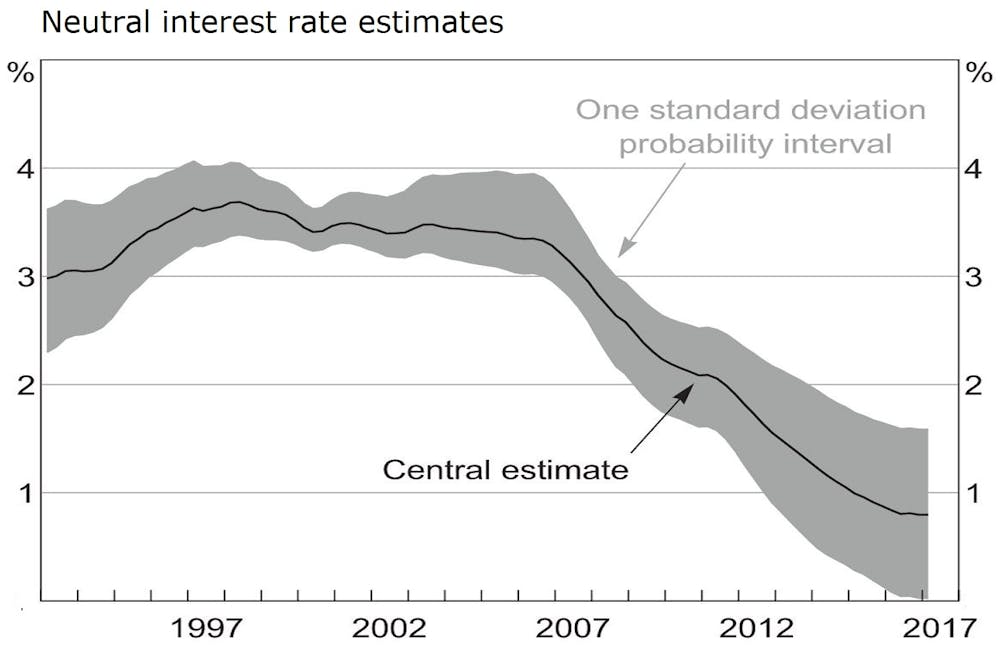
What has to change?

The evidence paints a bleak picture of paramedicine in Australia. If anything is clear from the recent bullying revelations, it’s that ambulance services are not being proactive enough about their staff’s health and well-being.

Research is showing that potentially the largest threat to paramedics’ well-being is not the traumatic scenes they encounter at work, but rather a workplace culture that undermines their physical and mental health. A fundamental change is needed to how ambulance services management support and treat their staff.

There is a clear need for an independent review into the management of state and territory ambulance services. What has occurred in Victoria is just the tip of the iceberg nationally. These cultural issues have existed for a long time. The decision by Ambulance Victoria to engage the Victorian Equal Opportunity and Human Rights Commission to investigate the allegations of bullying indicates removing decision-making power from the ambulance services is needed and more independent oversight is required nationally.

A young paramedic looking exhausted
State and territory ambulance services need to urgently address toxic workplace cultures. Shutterstock

High on the agenda for reform should be building ways of working that encourage healthy work-life balances. We need to address the impact of the career on all aspects of paramedic well-being, including mental health, healthy eating, quality exercise, better sleep, and access to support services. Some ambulance services have created positive change over recent years, but it’s clear this hasn’t been enough.

All forms of workplace violence, which includes bullying and harassment, must stop. There is a need to dismantle the punitive culture that punishes paramedics for speaking out. It’s clear many paramedics don’t feel supported or respected by their management.

Changing the culture is imperative

We also need to acknowledge and address the gender bias in paramedicine and create inclusive workplaces. Female paramedics are at more risk of workplace violence, burnout, and bullying and harassment. Ambulance services need to ensure the safety of all paramedics, as well as fair and open recruitment and development opportunities that don’t disadvantage women.

Most importantly, a drastic change in culture is needed. Ambulance culture is often centred on meeting productivity goals, without acknowledging the human cost. A key performance indicator in ambulance services has long been incident response times, and paramedics are held to account for every delay.

We need to have indicators on workforce health, and chief executives and boards need to be held just as accountable.

We shouldn’t have to sacrifice the health of our paramedic workforce to meet productivity targets.

ref. Paramedics have one of Australia’s most dangerous jobs — and not just because of the trauma they witness – https://theconversation.com/paramedics-have-one-of-australias-most-dangerous-jobs-and-not-just-because-of-the-trauma-they-witness-149540

Curious Kids: Do worms have blood? And if so, what colour is it?

Source: The Conversation (Au and NZ) – By Mark Sandeman, Honorary Professor, Federation University Australia

Do worms have blood, and if they do, what colour is it? Momo Bice, aged 9, Carlton

Hi Momo. Well, the short answer to your question is: yes. Many worms do have blood, and it is either colourless or pink, or red, or even green! But to answer your question properly, first we need to decide what type of worm we are talking about.

There are lots of different sorts of worms. Generally, a worm is any long, thin animal that does not have a backbone, but scientifically we recognise three types of worms: flatworms, roundworms and segmented worms. Worms live in the sea, in sand and soil. Some live inside plants or animals, and we call them parasites.

So let’s look at what blood you might find inside these different types of worms.

Segmented worm
Worms live in sea, sand soil, or – if we’re unlucky – even inside us. Shutterstock

The three worm types

Flatworms: These include tapeworms, which are parasites (meaning they live on a host organism), and planaria, which live in ponds and lakes. These animals are so flat they don’t even need blood. They absorb oxygen through their skin and it spreads directly to every cell in their body. As a result they are pretty much colourless, or whitish.

Roundworms: Also called nematodes, these worms are mainly found in soil. Roundworms can also live as parasites in humans, causing really nasty effects such as blindness and brain defects. One large roundworm that lives in the intestines of humans can grow to more than 35 centimetres – that’s longer than a standard ruler!

As the name suggests, roundworms are tube-shaped. Their body cavity contains fluid that delivers oxygen to its organs. But this fluid is not called blood, because it does not circulate around the body.


Read more: What are parasites and how do they make us sick?


Most roundworm species are very small, and so can diffuse oxygen through their skin to all parts of their body. But very large roundworms can’t do this as easily, especially when they live inside animals where there is not much oxygen. These large worms use an oxygen-carrying molecule called haemoglobin – more on that in a minute.

Segmented worms: These worms include earthworms, leeches and marine worms. Also known as annelids, the bodies of segmented worms are divided by grooves into a series of segments. Most have circulatory systems – that is, blood vessels and a heart that pumps blood around the body.

A flatworm
Flatworms have no body cavity. Shutterstock

So what colour is the blood?

The colour of blood in any animal is determined by the molecule that carries oxygen and other gases in and out of the body. If the molecule uses iron to carry the oxygen, then the blood is usually red. If it uses copper, the blood is usually blue. But these molecules can also be green and pink.

All these colours except blue are found in worms. Haemoglobin is the most common oxygen-carrying molecule, including in worms. Haemoglobin contains iron, which means most worm blood – including that of earthworms and leeches – is red.


Read more: Curious Kids: why do leeches suck our blood?


Some segmented worms use a different oxygen-carrying molecule called chlorocruorin. The blood of these worms can be either green or red.

One group of segmented marine worms has pink blood. This is because the molecule that carries the oxygen is a type of blood pigment, known as hemerythrin, which is described as pink or purple.

A few species of segmented worms don’t have any oxygen-carrying molecules at all, so their blood is colourless.

So, the answer to your question is that all segmented worms have blood, while roundworms and flatworms do not. The blood colour depends on the molecule that carries oxygen in that worm. And most worms have red blood, just like us!

Child's hands holding worms and soil
There are three worm types, and not all have blood. Shutterstock

ref. Curious Kids: Do worms have blood? And if so, what colour is it? – https://theconversation.com/curious-kids-do-worms-have-blood-and-if-so-what-colour-is-it-147578

Pandemic widens gap between government and Australians’ view of education

Source: The Conversation (Au and NZ) – By Melissa A. Wheeler, Senior Lecturer, Department of Management and Marketing, Swinburne University of Technology

The COVID-19 pandemic is changing Australians’ view of public education, our analysis of Australian Leadership Index (ALI) data shows. In contrast to the government’s instrumental view of education, with its focus on producing “job-ready graduates”, the public now takes a wider view of education as a public good.

Public education, such as public schools and universities, is understood as serving the interests of the many, not the few. And the importance of ethics and accountability has only become more pronounced throughout the pandemic.


Read more: 3 flaws in Job-Ready Graduates package will add to the turmoil in Australian higher education


The Australian Leadership Index has tracked public perceptions of leadership across a number of sectors, including public education, since 2018. We analysed ALI scores for public education through three periods – before COVID, first wave and second wave.

An intensifying debate about education

Since the pandemic began, debate about the role of education and its contribution to the public good has intensified. Universities have been at the centre of this debate.

Between January and March, before COVID-19 hit our shores, universities were in the public spotlight due to their reliance on international student fees.

In this period, the ALI score (our indexed measure of leadership) for public education dipped into the negative (-2) for the first time since we began tracking in September 2018.

During the first wave of COVID-19 (March-June), public discourse focused on the role of universities in finding a vaccine. At the same time, the exclusion of universities from the JobKeeper program forced them into cost-cutting, with implications for research output. More recently, news of wage theft in universities hit the headlines.


Read more: As universities face losing 1 in 10 staff, COVID-driven cuts create 4 key risks


Despite these challenges, the ALI score for education recovered strongly. It hit a peak (+19) in the June quarter and stabilised in the September quarter (+15).

Education and the public good

Over the past few months, the federal government has brought in sweeping changes intended to encourage students to study science, technology, engineering and mathematics. The stated aim is to produce “job-ready graduates” to fuel economic recovery.


Read more: The government is making ‘job-ready’ degrees cheaper for students – but cutting funding to the same courses


By contrast, our data show the Australian public takes a wider view of education.

Drawing on nationally representative surveys from September 2018 to September 2020, we statistically modelled how nine different factors have influenced public perceptions of leadership in education institutions.

We then plotted the importance of each factor (vertical axis) against the proportion of Australians who agree education is performing well on that factor (horizontal axis). The results show which factors are important in driving perceptions of education leadership, and also how the sector performs against them.

Vertical axis shows results of analysis that models impact of each of nine drivers on perceptions of leadership for the greater good. Horizontal axis shows proportion of Australians who believe education institutions show leadership for the greater good to a ‘fairly large’ or ‘extremely large’ extent. Mid points on each axis represent the average importance/performance across the nine drivers. Australian Leadership Index, Author provided

Notably, Australians see accountability, ethicality and creating social value as highly important for education institutions. The sector performs well against these factors.

By contrast, responsiveness to the needs of society and creating economic value are also important, but the sector underperforms against these factors.

In short, Australians believe that how public education creates value – through demonstrable commitments to ethics and accountability – is as important as the type of value it creates. This reflects an understanding that serving the public interest is as much about process as it is about outcome.

Overall, these results suggests a marked discrepancy between how the government and Australians view public education.

How views changed through the pandemic

Our data (click on the table to enlarge it) show how Australians’ view of public education changed through the course of the pandemic.

In the period before COVID (January-March), the sector’s apparent accountability, responsiveness to society, and a focus on economic value creation had the most influence on perceptions of the sector’s leadership.

In the first wave (April-June), ethics and balancing the needs of different groups became more important. Accountability, economic value creation and responsiveness to societal needs were also important. Performance scores improved across all five factors.

This possibly reflects the optimistic discourse around vaccine research, producing job-ready graduates and an element of sympathy for universities, as university staff lost their jobs and international students were left to fend for themselves.


Read more: ‘No one would even know if I had died in my room’: coronavirus leaves international students in dire straits


In the second wave (July-September), the focus shifted away from the sector’s economic contributions and its responsiveness to society. Instead, ethics, accountability and balancing the needs of different groups became most important.

Performance scores for balancing the needs of different groups decreased. This possibly reflects the changes to tertiary education funding, which triggered backlash from both domestic and international students.

Rethinking the role of universities

Australians have important decisions to make on the role of public education. Rather than positioning public education and universities as a panacea for economic recovery, a wider view is required.

Universities are uniquely positioned to serve the public good. The purpose of education leadership itself has been described as being “as and for public good”. This insight is reflected in the actions of university benefactors, who are motivated by a belief in the public good that only universities can create.

Although philanthropic support is vital, it is in the national interest to properly fund universities to enable them to serve and enhance the public good as only universities can.

ref. Pandemic widens gap between government and Australians’ view of education – https://theconversation.com/pandemic-widens-gap-between-government-and-australians-view-of-education-148991

Why zero interest rates are here to stay

Source: The Conversation (Au and NZ) – By John Quiggin, Professor, School of Economics, The University of Queensland

It’d be wrong to interpret last week’s Reserve Bank decision to cut its cash rate to 0.10% as an emergency response to the COVID crisis.

The implication would be that once the pandemic is controlled the economy will return to something like the pre-crisis “normal” and the ultra-low interest rates will end.

In reality, in this as in many other things, the pandemic has merely accelerated developments that have been underway for a long time.

One is the long-term decline in the “neutral” rate of interest.

The neutral rate is normally defined as the real (inflation-adjusted) rate of interest which is neither expansionary, pushing up inflation, nor contractionary, pushing up unemployment.

More importantly the neutral rate should be one that over time matches the total supply of savings with the total demand for those savings by businesses and households wanting to put them to work making buildings and equipment (capital investment).

‘Neutral’ is less than it was

As Treasury Secretary Stephen Kennedy observed in this year’s post-budget address, the neutral rate of interest has been falling for 40 years.

Reserve Bank estimates suggest it fell from around 3% in the 1980s and 1990s to around less than 1% in 2016.

Model -based estimates of real neutral rate. Rachael McCririck and Daniel Rees, Reserve Bank Bulletin September 2017

It will have fallen further since, and fallen more sharply since the pandemic began, turning negative.

One way to work that out what the Reserve Bank thinks the real neutral rate is now is to look at where the nominal cash rate is now (near zero) and what the bank says inflation will have to climb to before it will allow the cash rate to climb (2%).

This suggests the bank believes the real (inflation adjusted) neutral cash rate is minus 2%.


Read more: The government has just sold $15 billion of 31-year bonds. But what actually is a bond?


Another way to get a handle on it is to look at long-term real rates, one of the longest being the return on a 30-year US Treasury inflation-indexed bond.

Constant maturity, orange = recession. Federal Reserve Board of St. Louis

Like the Reserve Bank estimate of the neutral rate for Australia, this estimate for the US fell to around 1% by 2016.

Then it fell further, dropping to close to zero by the start of this year, before turning negative with the onset of the pandemic.

Even Alphabet, the parent of Google, is borrowing at less than the inflation target. Uladzik Kryhin/Shutterstock

Most other countries don’t sell inflation-indexed bonds with such long maturities. But the 50-year and 100-year non-indexed bonds issued by a number of OECD countries are yielding interest rates below 2%, the target rate of inflation for most central banks.

Even highly-rated private corporations like Alphabet (the parent of Google) are refinancing their debt with long-term bonds paying less than 2%.

Too much saving?

Much of the discussion of declining interest rates has focused on the idea of a “savings glut”, with a particular focus on China, which had very high savings rates early this century.

But China’s savings rate peaked some years ago and is headed down. Savings rates in other countries have been falling as well.

Too little investment

The real problem is a lack of demand for those saved funds.

Corporate profits have grown strongly, but instead of being reinvested they have often been returned to shareholders, through either dividends or share buybacks.

Companies seem to believe they don’t need that many funds.

The simplest explanation is that the dominant firms in an information economy don’t need much capital in the form of buildings and equipment to maintain their position.


Read more: Vital Signs. Business investment is flatlining, and it isn’t clear that suasion or a special allowance will help


The market value of a typical manufacturing or resource-based firm is usually about the same as the book value of the capital invested in the firm. In the jargon of financial markets, the price-book ratio is close to 1.

By contrast, leading firms in the information economy, such as Alphabet and Facebook, have price-book ratios of five or six. Microsoft and Apple, with profits derived from control of operating systems that require only gradual upgrades, have price-book ratios of 15 and 21.


Read more: We asked 13 economists how to fix things. All back the RBA governor over the treasurer


Public investment hasn’t come to the rescue enough, even when it has been cheap to borrow.

It’s been tightly constrained by decades of policy driven the ideas variously described as neoliberalism, economic rationalism and market liberalism.

Bank of England economist Lukasz Rachel and former US Treasury Secretary Larry Summers argue that in the absence of the large-scale public programs we have had, the neutral rate of interest would be even lower.

There’s no sign of a revival

When there’s a greater supply of something (savings) than there is demand for it (for investment) the price of it (the interest rate) won’t rise.

After we emerge from the pandemic we are going to have to adjust to a world where interest rates (at least adjusted for inflation) are permanently at or below zero.

As Dorothy says to Toto in the Wizard of Oz (believed by some to be an allegory about monetary policy) “we’re not in Kansas any more”.

ref. Why zero interest rates are here to stay – https://theconversation.com/why-zero-interest-rates-are-here-to-stay-149523

Streeton: an optimistic celebration of the golden boy of Australian art

Source: The Conversation (Au and NZ) – By Joanna Mendelssohn, Principal Fellow (Hon), Victorian College of the Arts, University of Melbourne. Editor in Chief, Design and Art of Australia Online, University of Melbourne

Review: Streeton, Art Gallery of New South Wales.

The Art Gallery of New South Wales has launched its summer season with a large, optimistic reconsideration of one of Australian art’s most favoured sons.

Curator Wayne Tunnicliffe has indicated that his decision to name the exhibition simply Streeton, without any subtitles, was part of his strategy to emphasise Streeton’s importance to Australian art and culture.

This assessment is hardly new. Lionel Lindsay, in The Art of Arthur Streeton of 1919 called him “our national painter”.

In 1923 when Streeton’s The Purple Noon’s Transparent Might was first exhibited in London, Lindsay wrote,

Streeton has painted the light and colour of Australia with such truth and beauty that his service to our country must ever remain the equivalent of Constable’s to England.

Arthur Streeton, The Purple Noon’s Transparent Might 1896 oil on canvas, 123 x 123 cm National Gallery of Victoria, Melbourne, purchased 1896. Photo: National Gallery of Victoria, Melbourne

Six years later, in 1929, James S. MacDonald, the then director of the AGNSW, claimed Streeton

has shown us our land as no one else has done, and is still our best exemplar of the craft and mystery of painting as applied to landscape.

Nora Streeton, Arthur Streeton with palette in Venice 1908. Private collection

In 1931, as a way of lifting spirits in the Great Depression, the cash-strapped gallery gave Streeton the first ever survey exhibition of work by a living Australian artist.

In the years between the two world wars, Streeton’s characteristic paintings of blue tinged bush, golden fields, and clear Australian skies spoke of a country that had never seen war. His work was easily seen as characteristic of Australian smug insularity.

Most are pure landscapes but some show stocky soldier settlers attempting to tame the land by culling trees. Others show cattle grazing in newly cleared land. In The Land of the Golden Fleece (1926) a flock of sheep confidently graze in a valley sheltered by the Grampians.

Arthur Streeton Land of the Golden Fleece 1926. oil on canvas, 92.3 x 146 cm Private collection, Sydney. Photo: Jenni Carter, AGNSW

It is not surprising this painting so effectively encapsulates the sentiment of the conservative establishment: a label on the frame indicates it is the proud possession of one of Australia’s gentleman’s clubs.

Conservatives and conservation

Streeton’s art is also a reminder that conservatives once cared about conservation. He was a passionate advocate for the need to conserve the Australian bush against the timber industry.

Silvan Dam of 1939 is a celebration of the tree clad landscape near his home in the Dandenongs. But in Silvan Dam and Donna Buang, AD 2000, painted the following year, the same subject becomes an apocalyptic vision condemning the then state government’s proposed logging of the forest. Stark, bleached, tree trunks stand against bare rock and denuded mountains.

Arthur Streeton Cremorne Pastoral 1895, oil on canvas, 91.5 x 137.2 cm, Art Gallery of New South Wales, Sydney, purchased 1895. Photo: Jenni Carter, AGNSW

Streeton’s advocacy for nature over industry was not new. In 1895, when living in Sydney, he painted Cremorne Pastoral, an exquisite landscape of a grassy hill framed by graceful trees and Sydney Harbour as a political response to a proposed coal mine.

It is one of many harbour subjects painted in his Sydney years. As the AGNSW is directly opposite Sirius Cove, where Streeton lived in the 1890s, the bias towards this subject matter is understandable. The camp where Streeton, Roberts and others lived during the 1890s recession was built by the Brasch brothers who were active patrons of the arts.

Arthur Streeton From my Camp (Sirius Cove) 1896, oil on plywood, 28 x 21.5 cm, Art Gallery of New South Wales, Sydney, bequest of Mrs Elizabeth Finley 1979. Photo: Jenni Carter, AGNSW

Reuben Brasch supplied the artists with discarded varnished cedar panels from his department store. Their dark tones and elongated shape encouraged Streeton to become more experimental in his composition.

The colours of the harbour of his paintings in this period are almost dazzling in their intense blue of the water and gold of the Sydney sandstone, with flashes of gum tree green.

A further room shows his second Sydney period, after his return from spending some years in England. These are virtuoso pieces, but lack the experimental flair of the earlier works.

His paintings of Coogee Beach, a subject previously painted by Tom Roberts and Charles Conder, deserve a close look as a reminder of how Sydney’s magnificent beaches have been so degraded.

Lack of context

If there is one problem I have with this exhibition, and indeed with all celebrations of the life of a single artist, it is the lack of context. From the beginning, Streeton was praised simply because he was an Australian, born with a natural talent developed with little formal teaching.

But this is not quite true. While he attended evening classes with Frederick McCubbin at the National Gallery School in Melbourne, the young artist met the academically trained Tom Roberts and the sophisticated adventurer Charles Conder.

Streeton’s art developed during his relationship with these more experienced artists. He painted alongside them at Box Hill and Eaglemont. The exhibition includes his Settler’s Camp (1888), a less than successful homage to Tom Roberts’ The Artists’ Camp (1886). Streeton was, however, a fast learner, and by the time he participated in the 9 by 5 Impressions exhibition, was their equal.

Arthur Streeton Settler’s Camp 1888 oil on canvas, 86.5 x 112.5 cm Private collection, Jugiong, NSW. Photo: Brenton McGeachie for AGNSW

The wall of Streeton’s paintings from that most radical of all Australian art exhibitions is a joy. Conder’s influence can be seen in many of Streeton’s earlier paintings, especially in his Symbolist works and in The Railway Station, Redfern (1893), a painting that successfully quotes Departure of the Orient – Circular Quay (1888).

Arthur Streeton The Railway Station, Redfern 1893 oil on canvas, 40.8 x 61 cm. Art Gallery of New South Wales, Sydney, gift of Lady Denison 1942. Photo: Jenni Carter, AGNSW

‘Smike’

The clearest indication of Streeton’s position in the early hierarchy of these brothers of the brush lies in the nickname bestowed on him by the dogmatic Roberts (aka “Bulldog”). Streeton was called “Smike”, after Nicholas Nickleby’s amiable but feeble-minded acolyte.

Arthur Streeton’s later career serves as a repudiation of that assessment. Travel broadened his perspective. He relished the exoticism of Egypt, where magical architecture took the place of gum trees. After initially being intimidated by the sophistication, class system and muted light of England, he did eventually achieve modest success in the centre of the empire.

At the end of World War I, he returned to Australia for real fame and fortune. In 1937, he became the only one of the artists who painted at Heidelberg to be honoured with a knighthood.

The last Arthur Streeton exhibition, curated by Geoffrey Smith for the National Gallery of Victoria in 1995, was shown in other state galleries. This much larger exhibition will not travel.

It is, however, on view throughout summer until February 14 2021. It is well worth the effort of an interstate trip for those newly liberated from quarantine.

ref. Streeton: an optimistic celebration of the golden boy of Australian art – https://theconversation.com/streeton-an-optimistic-celebration-of-the-golden-boy-of-australian-art-148341

Politics with Michelle Grattan: Joel Fitzgibbon on Labor climate policy and leadership

Source: The Conversation (Au and NZ) – By Michelle Grattan, Professorial Fellow, University of Canberra

Labor’s Joel Fitzgibbon this week quit the frontbench, ensuring he’ll become even more vocal in his campaign to have Labor’s climate policy move to the centre and the party give greater attention to the working class part of its constituency.

Fitzgibbon – who was shadow minister for resources – and climate spokesman Mark Butler have been at loggerheads, and in this podcast Fitzgibbon makes it clear he believes Butler should be moved when Albanese has an expected pre-Christmas reshuffle.

“I think a refresh in that area would be good … I think someone without his history, someone who doesn’t bring baggage, if you like, to the conversation might be better placed to prosecute Labor’s case in the broader electorate.”

Fitzgibbon was active in Labor’s 2013 leadership change back to Kevin Rudd.

He says he supports Albanese’s leadership. But asked whether, if it became clear next year Labor was heading to a likely really bad defeat, he would be willing to push for a change, he says: “I think senior people in the party have a responsibility to ensure that the party doesn’t go over the proverbial cliff.

“And none of us are as big or bigger than the party itself.

“The party has to be the key interest and its capacity to win government, because millions of people are relying upon us to be a government from time to time. And we owe it to them to be electable.”

Sounds like a warning.

Listen on Apple Podcasts

Stitcher Listen on TuneIn

Listen on RadioPublic

Additional audio

A List of Ways to Die, Lee Rosevere, from Free Music Archive.

ref. Politics with Michelle Grattan: Joel Fitzgibbon on Labor climate policy and leadership – https://theconversation.com/politics-with-michelle-grattan-joel-fitzgibbon-on-labor-climate-policy-and-leadership-149925

Gunmen shoot dead Philippines radio journalist outside his home

Pacific Media Watch Newsdesk

A radio journalist has been shot dead outside his home by two gunmen on a motorcycle, Philippines police said – four years after the provincial broadcaster survived a similar attempt to kill him.

Virgilio Maganes, 62, who lived northwest of Manila in the province of Pangasinan, was shot six times yesterday and died at the scene, police said, reports Al Jazeera.

Maganes is the 18th journalist to have been killed since President Rodrigo Duterte took office in 2016, and the 190th since Ferdinand Marcos was overthrown in 1986, according to the National Union of Journalists of the Philippines (NUJP).

Few of the perpetrators are ever brought to justice.

Maganes survived the previous attempt on his life by pretending to be dead.

“We demand that authorities work fast to solve his death, which could be related to the botched attempt on his life on November 8, 2016, when motorcycle-riding gunmen fired at him as he rode a tricycle,” the NUJP said.

On that occasion, the gunmen left a note at the scene saying: “I’m a drug pusher, don’t emulate me.”

Such messages were common in extrajudicial killings during the height of Duterte’s war on drugs that led to thousands of deaths.

Police said they had not established a motive for the attack on Maganes. At least two other journalists have been killed for doing their work in 2020, according to the Committee to Protect Journalists (CPJ), and both cases remain unsolved.

Reporters Without Borders said in a Tweet it was “terrible news” and called for an independent investigation to “find the culprits of this gruesome murder”.

The Presidential Task Force on Media Security, which was set up to tackle media murders, described the killing as “an act of cowardice” and vowed to hunt down those responsible, while Justice Secretary Menardo Guevarra said both Maganes’s murder and the 2016 attack would be investigated to establish whether they were linked to his work as a journalist.

Media under pressure
The Philippines is one of the most dangerous places in the world to be a journalist and the media has found itself under increasing pressure since Duterte was elected president.

ABS-CBN, the country’s largest broadcaster, was ordered to close after the regulator failed to renew the channel’s 25-year operating licence while veteran editor Maria Ressa and her online news site Rappler, are facing numerous court cases on charges ranging from tax evasion to defamation.

Both ABS-CBN and Rappler have been critical of Duterte’s drug war and his government’s policies.

The country’s largest newspaper, the Philippine Daily Inquirer, which has also published stories critical of the drug war, was pressured to be sold to Ramon Ang, an ally of the president, after Duterte threatened its owners with legal consequences.

The newspaper also reported on Duterte’s alleged hidden wealth in the run-up to the 2016 election.

The Duterte administration denies targeting media for its reporting.

Index on Censorship, which campaigns for freedom of expression, condemned Maganes’s killing.

“Press freedom has nosedived under Duterte who heads a constant campaign of harassment,” the organisation said on Twitter. “The world must come together in rage against these awful attacks.”

Print Friendly, PDF & Email

Article by AsiaPacificReport.nz

Biden has announced a COVID taskforce to guide him through the crisis. But there are many challenges ahead

Source: The Conversation (Au and NZ) – By Lesley Russell, Adjunct Associate Professor, Menzies Centre for Health Policy, University of Sydney

Tackling the health, economic and social crises wrought by the coronavirus pandemic is the first order of business for US president-elect Joe Biden and his transition team.

Biden this week announced his bipartisan coronavirus taskforce to begin work immediately and continue after he is sworn in as president in January.

The taskforce inherits a range of challenges. Coronavirus is now rampant in the US, and the Trump administration has run down the public health infrastructure and largely abandoned attempts to control the pandemic, preferring to gamble on the imminent arrival of a vaccine.

What will Biden inherit?

The pandemic in the US is now described as out of control. Hospitals in many states are overwhelmed, the economy is disrupted, and unemployment rates are double what they were in February.

The urgency of the problem is highlighted in forecasts released last week by the US Centers for Disease Control and Prevention. These predict that in the week ending November 28, there will be 450,000-960,000 new coronavirus cases and 4,600-11,000 deaths from COVID.

Even these stark warnings may be overly optimistic. On November 8, the US was averaging 116,448 new cases a day. So far, more than ten million Americans have been infected, and significant numbers remain disabled with prolonged side-effects. The situation will undoubtedly be much worse by the time Biden is sworn in on January 20.


Read more: Pandemic letter from America: how the US handling of COVID-19 provides the starkest warning for us all


Who is on the COVID taskforce and what will they do?

Biden’s coronavirus taskforce is headed by three physicians: Vivek Murthy, the former US surgeon general; David Kessler, the former commissioner of the Food and Drug Administration; and Marcella Nunez-Smith, who is recognised for her work on promoting health and health-care equity for marginalised populations. All are well known in public health, science and political circles.

Biden said in his acceptance speech these leading experts will:

…help take the Biden-Harris COVID plan and convert it into an action blueprint… That plan will be built on bedrock science… I’ll spare no effort, none, or any commitment, to turn around this pandemic.

The taskforce will build on several months of consultation and work under the auspices of the Biden campaign.

The Biden coronavirus plan, issued during the campaign, is a comprehensive document that recognises the responsibilities of the federal government in ensuring states, counties, local communities, health-care and incarceration facilities, educational systems and individuals have the protections, resources and information needed to address the pandemic. Special focus is placed on tackling the racial and ethnic disparities highlighted by the pandemic.

The taskforce must reach out to the states — both Democrat and Republican — as the Biden plan relies on their cooperation with new federal initiatives. These include possible mask mandates, supply chains for personal protective equipment, testing supplies, therapeutics, vaccines and needed additional health-care services.

Getting straight to business

The taskforce has already briefed Biden and vice president-elect Kamala Harris. Biden then issued a public statement on November 9, further detailing his plans for tackling the pandemic and rebuilding the economy.

His statement coincided with news from Pfizer about the promising test results for its coronavirus vaccine. Biden’s response was one of cautious optimism, in stark contrast to President Donald Trump, who hyped the stock market implications.


Read more: 90% efficacy for Pfizer’s COVID-19 mRNA vaccine is striking. But we need to wait for the full data


How will the taskforce work with the White House team?

The taskforce’s work is unlikely to step on the toes of the White House coronavirus advisory group, which has largely ceased to function as Trump has lost interest.

Trump has lashed out at Tony Fauci, director of the US National Institute of Allergy and Infectious Diseases, and threatened to fire him.

The former chief spokesperson for the White House coronavirus advisory group Deborah Birx has issued an urgent memo pleading for “much more aggressive action” to curb the virus.

Trump now listens only to the controversial Scott Atlas, a specialist in medical imaging rather than infectious diseases.

The Trump administration’s approach to the pandemic in recent months is succinctly summed up by White House chief of staff, Mark Meadows: “We are not going to control the pandemic.”

This is ironic in light of Meadows’ own infection, joining Trump and many other members of the White House in having contracted the coronavirus.

What else happens during this transition period?

In 2008, the outgoing Bush administration was willing to take advice and guidance from the Obama transition team on efforts to address the global financial crisis. Most notably, Bush agreed to Obama’s request to ask Congress to release more funds for the economic bailout.

Biden will now push to get the Senate to pass a coronavirus relief bill that is so urgently needed. This would include additional unemployment benefits and funding boosts for treatment, testing and tracing, and for education and health-care systems.

Democratic House speaker Nancy Pelosi and Republican Senate majority leader Mitch McConnell have each recently indicated their interest in passing such a measure, but they are at odds on the scope of legislation.

Could Biden’s input help them find common ground, or will partisanship prevail?

Many issues need to be tackled all at once

The Biden-Harris team will need to work simultaneously on these issues and a raft of others. Biden must, in short order, announce his cabinet and get them working on their agendas; assess which of Trump’s actions need to be undone (including withdrawal from the World Health Organisation and the Paris climate agreement); develop legislation and executive orders if he can’t get the Senate to work cooperatively and pass bills that come forward from the House of Representatives; and have a contingency plan in case the US Supreme Court overturns Obamacare in 2021.


Read more: Lives at ‘grave risk’: Trump’s withdrawal from the WHO is a hit to global health


Biden’s transition team features many people who previously worked for the Obama administration. This bodes well for strengthening and rebuilding Obamacare into Bidencare. Ensuring people have affordable access to health care has never been more important.

Biden has also promised to reinstate the national and international public health and first responder systems that Trump dismantled. This includes bringing back the White House National Security Council Directorate for Global Health Security and Biodefense and continued support for the work of the World Health Organisation.


Read more: The Trump administration has made the US less ready for infectious disease outbreaks like coronavirus


None of this will be successful unless, and until, Biden can bring Congress together to act and simultaneously begin healing the divisions in the nation. He must restore trust in government and science, ensure transparency and accountability, and build a common purpose so people will act for the common good. That’s a big ask — but the coronavirus pandemic demands it.


Read more: Joe Biden wins the election, and now has to fight the one thing Americans agree on: the nation’s deep division


ref. Biden has announced a COVID taskforce to guide him through the crisis. But there are many challenges ahead – https://theconversation.com/biden-has-announced-a-covid-taskforce-to-guide-him-through-the-crisis-but-there-are-many-challenges-ahead-149850

Why is the gender pay gap in the arts so large? Widespread discrimination is the most likely cause

Source: The Conversation (Au and NZ) – By David Throsby, Distinguished Professor of Economics, Macquarie University

Female artists across all areas of the arts experience gender-related disadvantage in pursuing their creative careers, which reflects discriminatory problems affecting women in society more generally.

This is our conclusion after delving more deeply into our 2014-15 data on the incomes of practising professional artists in Australia. Although women are more engaged as consumers and supporters of the Australian arts than men, the total income from all art and non-art sources for the average female artist was $41,600, 25% less than her male counterpart.

When it came to earnings from their creative practice alone, women earned 30% less than men. Across all fields of employment, the national gender pay gap is currently an estimated 14%.

Although accurate data are yet to be obtained for this year, there is no doubt that artists’ incomes generally have plummeted during the pandemic. Given the particularly vulnerable position of women, there are reasons to expect the gender pay gap to have grown even wider.


Read more: Coronavirus: 3 in 4 Australians employed in the creative and performing arts could lose their jobs


Possible reasons

In research underway, we are digging more deeply into the possible reasons why such a significant gap exists in the arts.

To some extent, the gender pay gap for artists may be influenced by the same sorts of factors that affect female workers across all labour markets. These include underrepresentation in leadership roles, casualised work arrangements, work/family conflicts, discriminatory hiring practices and prejudice.

But are there specific characteristics of women artists that make their income position even more precarious?

For instance, what of education? Education and training in the arts are somewhat more important in determining female artists’ income from creative work than for men, and, in fact, women artists are more educated on average. However, these differences are far from enough for women to catch up to their male colleagues’ income levels.

We wondered whether personal traits might also have an effect. In the wide-ranging literature on females in the workplace, attention has been paid to the influence of gender-related psycho-social characteristics. These include the proposition women are more caring, nurturing and communicative; more risk and competition-averse, and less likely to initiate negotiation. Men, on the other hand, are depicted as more assertive, aggressive and self-confident.

We have only limited data on such characteristics. Nevertheless, a few notable differences between men and women can be observed from our research. For example, female artists who believe receiving support from family and friends has helped them advance their career tend to have higher creative incomes on average than men, other things being held equal.


Read more: Giving it away for free – why the performing arts risks making the same mistake newspapers did


In addition, female artists who perceived themselves as having the wrong temperament, or a lack of self-confidence, or insufficient talent, or an inability to take risks, had relatively lower incomes from creative work than other women artists. Such an outcome is not evident among male artists, according to the survey data.

Yet none of these factors provides a significant explanation of the earnings difference between men and women artists. This leads us to conclude that gender inequity in the artistic workplace must ultimately be reflective of more fundamental issues relating to the treatment of women in society.

First Nations remote communities more equal

Prominent Arnhem Land Yolngu artist Djambawa Marawili photographed last year. In Arnhem Land, according to recent figures, the gender pay gap was negligible. NATSIAA/AAP

In separate analyses, we have been comparing male and female earnings for First Nations artists working in several remote communities in the Northern Territory and South Australia, using data from the National Survey of Remote Aboriginal and Torres Strait Islander Artists.

There are only minor differences between the genders in the levels of income earned by artists in these communities. For example, in Arnhem Land, women artists earned $8,600 from their creative work in 2017-18, while men earned $8,700.

There was a similarly insignificant difference between males and females in their total work incomes from all sources in that year. Women earned $23,400, compared to $23,000 for men.

Much the same result applies in other communities. It seems the gender gap affecting incomes of most female artists in Australia is not evident in these remote First Nations communities.

But it must be remembered that the incomes of First Nations artists are considerably lower than those of their non-Indigenous counterparts.

The results of our research for both mainstream and First Nations cultural practitioners highlight the particularity of the social and cultural context in which art is made.


Read more: To fix gender inequity in arts leadership we need more women in politics and chairing boards


But there are systemic features of this context in Australian society, such as attitudes to women in leadership, that perpetuate gender-based discrimination in working life.

For these problems to be overcome, it seems changes in attitudes and behaviours will be needed, not just within the arts community itself but — more importantly —in society at large.

ref. Why is the gender pay gap in the arts so large? Widespread discrimination is the most likely cause – https://theconversation.com/why-is-the-gender-pay-gap-in-the-arts-so-large-widespread-discrimination-is-the-most-likely-cause-149626

83% of Australians want tougher privacy laws. Now’s your chance to tell the government what you want

Source: The Conversation (Au and NZ) – By Normann Witzleb, Associate Professor in Law, Monash University

Federal Attorney-General Christian Porter has called for submissions to the long-awaited review of the federal Privacy Act 1988.

This is the first wide-ranging review of privacy laws since the Australian Law Reform Commission produced a landmark report in 2008.

Australia has in the past often hesitated to adopt a strong privacy framework. The new review, however, provides an opportunity to improve data protection rules to an internationally competitive standard.

Here are some of the ideas proposed — and what’s at stake if we get this wrong.


Read more: It’s time for privacy invasion to be a legal wrong


Australians care deeply about data privacy

Personal information has never had a more central role in our society and economy, and the government has a strong mandate to update Australia’s framework for the protection of personal information.

In the Australian Privacy Commissioner’s 2020 survey, 83% of Australians said they’d like the government to do more to protect the privacy of their data.

The intense debate about the COVIDSafe app earlier this year also shows Australians care deeply about their private information, even in a time of crisis.

Privacy laws and enforcement can hardly keep up with the ever-increasing digitalisation of our lives. Data-driven innovation provides valuable services that many of us use and enjoy. However, the government’s issues paper notes:

As Australians spend more of their time online, and new technologies emerge, such as artificial intelligence, more personal information about individuals is being captured and processed, raising questions as to whether Australian privacy law is fit for purpose.

The pandemic has accelerated the existing trend towards digitalisation and created a range of new privacy issues including working or studying at home, and the use of personal data in contact tracing.

A person looks at the COVIDSafe app on their phone.
Intense debate about privacy followed the release of the COVIDSafe app this year. DAVE HUNT/AAP

Australians are rightly concerned they are losing control over their personal data.

So there’s no question the government’s review is sorely needed.

Issues of concern for the new privacy review

The government’s review follows the Australian Competition and Consumer Commission’s Digital Platforms Inquiry, which found that some data practices of digital platforms are unfair and undermine consumer trust. We rely heavily on digital platforms such as Google and Facebook for information, entertainment and engagement with the world around us.

Our interactions with these platforms leave countless digital traces that allow us to be profiled and tracked for profit. The Australian Competition and Consumer Commission (ACCC) found that the digital platforms make it hard for consumers to resist these practices and to make free and informed decisions regarding the collection, use and disclosure of their personal data.

The government has committed to implement most of the ACCC’s recommendations for stronger privacy laws to give us greater consumer control.

However, the reforms must go further. The review also provides an opportunity to address some long-standing weaknesses of Australia’s privacy regime.

The government’s issues paper, released to inform the review, identified several areas of particular concern. These include:

  • the scope of application of the Privacy Act, in particular the definition of “personal information” and current private sector exemptions

  • whether the Privacy Act provides an effective framework for promoting good privacy practices

  • whether individuals should have a direct right to sue for a breach of privacy obligations under the Privacy Act

  • whether a statutory tort for serious invasions of privacy should be introduced into Australian law, allowing Australians to go to court if their privacy is invaded

  • whether the enforcement powers of the Privacy Commissioner should be strengthened.

AG Christian Porter walks in the House of Reps.
The federal attorney-general, Christian Porter, has called for submissions to the long-awaited review of the federal Privacy Act 1988. MICK TSIKAS/AAP

While most recent attention relates to improving consumer choice and control over their personal data, the review also brings back onto the agenda some never-implemented recommendations from the Australian Law Reform Commission’s 2008 review.

These include introducing a statutory tort for serious invasions of privacy, and extending the coverage of the Privacy Act.

Exemptions for small business and political parties should be reviewed

The Privacy Act currently contains several exemptions that limit its scope. The two most contentious exemptions have the effect that political parties and most business organisations need not comply with the general data protection standards under the Act.

The small business exemption is intended to reduce red tape for small operators. However, largely unknown to the Australian public, it means the vast majority of Australian businesses are not legally obliged to comply with standards for fair and safe handling of personal information.

Procedures for compulsory venue check-ins under COVID health regulations are just one recent illustration of why this is a problem. Some people have raised concerns that customers’ contact-tracing data, in particular collected via QR codes, may be exploited by marketing companies for targeted advertising.

A woman uses a QR code at a restaurant
Under current privacy laws, cafe and restaurant operators are exempt from complying with certain privacy obligations. Shutterstock

Under current privacy laws, cafe and restaurant operators are generally exempt from complying with privacy obligations to undertake due diligence checks on third-party providers used to collect customers’ data.

The political exemption is another area of need of reform. As the Facebook/Cambridge Analytica scandal showed, political campaigning is becoming increasingly tech-driven.

However, Australian political parties are exempt from complying with the Privacy Act and anti-spam legislation. This means voters cannot effectively protect themselves against data harvesting for political purposes and micro-targeting in election campaigns through unsolicited text messages.

There is a good case for arguing political parties and candidates should be subject to the same rules as other organisations. It’s what most Australians would like and, in fact, wrongly believe is already in place.


Read more: How political parties legally harvest your data and use it to bombard you with election spam


Trust drives innovation

Trust in digital technologies is undermined when data practices come across as opaque, creepy or unsafe.

There is increasing recognition that data protection drives innovation and adoption of modern applications, rather than impedes it.

A woman looks at her phone in the twilight.
Trust in digital technologies is undermined when data practices come across as opaque, creepy, or unsafe. Shutterstock

The COVIDSafe app is a good example. When that app was debated, the government accepted that robust privacy protections were necessary to achieve a strong uptake by the community.

We would all benefit if the government saw that this same principle applies to other areas of society where our precious data is collected.


Information on how to make a submission to the federal government review of the Privacy Act 1988 can be found here.


Read more: People want data privacy but don’t always know what they’re getting


ref. 83% of Australians want tougher privacy laws. Now’s your chance to tell the government what you want – https://theconversation.com/83-of-australians-want-tougher-privacy-laws-nows-your-chance-to-tell-the-government-what-you-want-149535

Aung San Suu Kyi wins big in Myanmar’s elections, but will it bring peace — or restore her reputation abroad?

Source: The Conversation (Au and NZ) – By Adam Simpson, Program Director, Master of Communication, University of South Australia

Last weekend, a few hours after the US presidential election was called for Joe Biden, Myanmar voters started lining up for their own chance to decide whether the National League for Democracy (NLD) government, led by Aung San Suu Kyi, would return for a second term.

With 5,643 candidates from 91 parties competing for 1,119 seats, at both the state and federal level, the country’s almost 38 million voters were asked to cast judgment on the last five years of NLD rule.

After three days of vote counting, the ruling party has claimed a huge victory, likely extending its resounding wins from the 2015 general election.

Under the military-authored constitution, a quarter of the seats in the national legislature are still reserved for military-appointed representatives, who generally vote as a bloc. The NLD, therefore, needed to win two-thirds of the elected seats to achieve a governing majority.

This requirement was designed by the military to be a high, almost impossible, threshold for any democratically oriented party in such a diverse, multi-ethnic political system. But it looks like the NLD has achieved it again, with ease.

Supporters of National League for Democracy celebrate their victory in Yangon. Lynn Bo Bo/EPA

The NLD appears to have displaced the military-backed Union Solidarity and Development Party (USDP) from some of its strongholds in rural areas and southern Mandalay. And its dominance in Yangon and much of the country has been met with jubilation among die-hard supporters, eager to see a further consolidation of the country’s democratic ambitions.

The renewed mandate for the NLD will also be taken by Suu Kyi’s millions of supporters as repudiation of the widespread international backlash against the government for its handling of the Rohingya crisis, which saw nearly a million people displaced in 2017.

This led to a genocide case being brought against Myanmar in the International Court of Justice and a dramatic fall from grace for Suu Kyi, in particular.


Read more: Aung San Suu Kyi’s extraordinary fall from grace


Conflict remains a big issue

During her first term, Suu Kyi sought to broker a new nationwide peace agreement with the various ethnic minority armed groups, but was frustrated by the entrenched complexities of the country’s borderland politics.

Well-armed militias, some of which draw considerable financial strength from wide-ranging illicit businesses, proved unwilling to accept her government’s claims on their territories.

In some of these areas, the Election Commission cancelled voting in the election, ostensibly due to the ongoing fighting. Northern Rakhine state and also areas of Chin, Shan, Kachin, Kayin and Mon states, and in Bago Region, were all affected by these cancellations.

In Rakhine and Chin states, however, elections were able to be held in NLD strongholds less affected by the conflict between the military and the Buddhist ethnic Rakhine Arakan Army, while voting was cancelled in areas held by ethnic minority parties.

A man injured in an alleged attack by Myanmar forces in Rakhine state in late October. Nyunt Win/EPA

In all, 22 seats in both houses of the national legislature will remain vacant until the conflicts have eased, which may not happen any time soon.

Because the decision to call off the voting in these areas benefited the NLD, it called into question the independence of the Election Commission.

About 1.5 million voters were disenfranchised by the move. This does not include the Rohingya in Rakhine state and refugee camps in Bangladesh who have historically been denied citizenship and voting rights.

Human Rights Watch has called the elections “fundamentally flawed”, and many countries have qualified their support for the result by highlighting this disenfranchisement.

Is the military really loosening its grip?

At best, the military will only grudgingly accept the election results, especially since its favoured party, the USDP, performed poorly.

The past five years have seen generally amiable relations between the NLD and the military, even in light of the military’s brutal “clearance operations” of the Muslim-minority Rohingya in Rakhine state in 2017.

Election officials count the ballots at a polling station in Yangon. Lynn Bo Bo/EPA

However, in the lead-up to the elections, the commander in chief of the military, Senior General Min Aung Hlaing, released a statement criticising the Election Commission, arguing that

weakness and deficiencies which were never seen in the previous elections are appearing.

He blamed the NLD for the commission’s performance and, the next day, argued the government was making “unacceptable mistakes”, insinuating he might not accept the election result.

Recently, a reputable website run by activists investigating the military was blocked and various opposition parties had their political broadcasts censored when they appeared on state television.

In addition to other restrictions on freedom of speech, the election cancellations, internet shutdowns, disenfranchisement of ethnic minorities and campaign restrictions due to COVID-19 have cast a pall over the vote.

Outlook for the new NLD government

While the treatment of the Rohingya — and Suu Kyi’s defence of the military’s crimes against them — is impossible to accept, foreign governments have little choice but to continue providing support for the newly empowered NLD government.

International pressure should continue to be applied, however, to resolve the Rohingya crisis and protect freedom of speech.

Voters wearing protective face masks line up to cast their ballots at a polling station. Thein Zaw/AP

If the military were to step in and take back control from the civilian-led government, this would, in every sense, be a significant backward step for democracy in Myanmar. While we have argued the chances of a coup looked relatively low during the NLD’s first term, recent events have demonstrated the military can always find an excuse to reassert itself at the centre of Myanmar politics.

To avoid further turbulence, and with its fresh mandate, Myanmar’s government will need to quickly concentrate on broad-based economic development and human security. The election result also offers a chance to focus on the peaceful resolution of longstanding conflicts in what remains a tragically divided and impoverished society.

ref. Aung San Suu Kyi wins big in Myanmar’s elections, but will it bring peace — or restore her reputation abroad? – https://theconversation.com/aung-san-suu-kyi-wins-big-in-myanmars-elections-but-will-it-bring-peace-or-restore-her-reputation-abroad-149619

Vaginismus: the common condition leading to painful sex

Source: The Conversation (Au and NZ) – By Anita M Elias, Senior lecturer, Dept O & G, Monash University

The social and cultural messages we receive around sex give the impression everyone’s “doing it” and it’s always fun and enjoyable. But for many people, having sexual intercourse is extremely painful or impossible. One of the leading causes of painful sex is vaginismus.

Vaginismus is an extremely common condition, that can have a huge impact on women, their partners and relationships. Yet many with it feel alone and without hope as it’s rarely talked about.

But women don’t need to live with it — it’s easy to diagnose and it’s treatable.

Painful sex

Australian research shows about 20% of women and 2% of men experience painful sex.

Male sexual problems, such as erectile dysfunction, have been in the public awareness since the advent of “the little blue pill” — Viagra. But sexual difficulties in women are missing from the story.

Without the push of pharmaceutical industries, awareness and knowledge about sexual difficulties in women (or people with vaginas who don’t identify as women) has not advanced in the same way as it has for men.


Read more: Sex and women’s diseases: it’s common and important to include men’s perspectives


A recent study, which is not yet published, found, in 2019 57% of female patients who attended the Sexual Medicine and Therapy clinic (Monash Health) attended because of painful sex. 60% of them had Vaginismus. Almost half of these women had experienced this for more than five years, and it had occurred in around one in five of these women for ten or more years.

What is vaginismus?

Vaginismus occurs when someone has persistent or recurrent difficulties in allowing vaginal entry of a penis, finger or any object, despite her wish to do so.

Couple fighting in bed.
Women with vaginismus may avoid any intimacy for fear it may lead to painful sex. This can significantly impact relationships leading to distance and conflict. Shutterstock

Some women experience fear, difficulties or pain from the first time they try to insert something into their vagina and instead of getting better, it can get worse over time. This is called “primary vaginismus”.

Others can be fine for years and develop pain at some later date. This is “secondary vaginismus”.

Vaginismus can be mild, moderate or severe. The pain is often described as burning, cramping, or a tight feeling. And for some, nothing can go into the vagina. Sufferers describe it as like hitting a brick wall.

The impact of vaginismus

Those with undiagnosed vaginismus can feel embarrassed or abnormal which can deter them from seeking help. And undiagnosed vaginismus can significantly impact self-esteem, and lead to anxiety or depression.


Read more: ‘Is it normal to get sore down there after sex?’


Those with vaginismus may avoid being sexual, as it can be a very painful experience. They also may avoid any intimacy for fear that it may lead to “sex”. This can significantly impact relationships, leading to distance and conflict.

Woman covering crotch
Undiagnosed vaginismus can significantly impact self-esteem, and lead to anxiety or depression. Shutterstock

It can also inhibit single people from forming relationships. They may avoid socialising, dating and meeting new partners, feeling burdened with a “shameful secret”.

Causes

When it comes to sex (and life), you can’t separate the mind and the body. Vaginismus is no exception. Underlying causes are extremely variable and often influenced by multiple factors.


Read more: Health Check: what is normal vaginal discharge and what’s not?


Sometimes there is no obvious cause, but common factors in the development of primary vaginismus include:

  • fear or anxiety: about pain, pregnancy or sexually transmitted infections. Generalised anxiety or other anxiety disorders can also cause vaginismus

  • taboos: cultural or religious taboos around sex, or inner conflict about whether to be sexual or not

  • unaroused sex: having sex when you don’t really want to

  • history of abuse: a history of physical, emotional or sexual trauma or abuse

  • unrealistic expectations: of sex leading to fear of not being “good enough”.

Secondary vaginismus can occur due to any of the above or after anything that leads to painful sex, such as:

  • relationship problems: leading to lack of libido or arousal

  • infections or skin problems: vaginal infections, such as thrush and vulval dermatological (skin) problems or Vulvodynia can cause vaginismus

  • gynaecological problems: such as endometriosis, gynaecological (or breast) cancer and it’s treatment or pelvic surgery

  • pregnancy: vaginismus can occur after pregnancy, delivery or as a new parent.

A normal reaction to any anxiety and fear is a tightening of muscles, and vaginismus occurs when this happens in the pelvic floor muscles. A strong pelvic floor is important, but we also need to learn how to relax it, when we want to.


Read more: 1 in 10 women are affected by endometriosis. So why does it take so long to diagnose?


Diagnosis

Vaginismus can usually be diagnosed by taking a careful history and looking at which factors may be causing it.

Women sitting on bed speaking with a doctor.
A physical examination is important for anyone experiencing painful sex, so no other contributing physical conditions are missed. Shutterstock

Those who suspect they may have vaginismus should initially seek help from GPs, gynaecologists, pelvic floor physiotherapists, sexologists or psychotherapists who have experience with this condition.

Medical professionals who are experienced in treating the condition will do an examination in a gentle, empowering way, only when the woman is ready to, so she is not distressed or traumatised in any way.


Read more: Isolation could improve how we think about and navigate sex and relationships


Treatment

Women should be reassured tightness in the pelvic floor is an involuntary, protective response they can learn to overcome, with help.

A multidisciplinary approach of management has been shown to be most effective, this includes:

  • education about vaginismus, the pelvic floor and sex

  • medical management of any underlying physical conditions

  • psychological management of any underlying worries

  • pelvic floor physiotherapy can help women learn how to relax, generally and in the pelvic floor

  • learning about what is pleasurable, as unaroused sex is a common cause of painful sex.

Woman should also be empowered to feel free to choose if, when and how to be sexual. Many women are either coerced into sex or are compliant for the sake of their partner’s needs.

They need to be supported to recognise and express their own needs and wishes. Although women can continue to be sexual in any way they wish, it’s vital to stop doing anything that hurts, such as continuing to try to have penetrative sex, while vaginismus is being treated.

ref. Vaginismus: the common condition leading to painful sex – https://theconversation.com/vaginismus-the-common-condition-leading-to-painful-sex-148801

Scientists thought these seals evolved in the north. 3-million-year-old fossils from New Zealand suggest otherwise

Source: The Conversation (Au and NZ) – By James Patrick Rule, Palaeontology PhD Candidate, Monash University

A fossil discovery in New Zealand has revealed a new species of monk seal that once called Australasia home. We introduce the three million-year-old seal, Eomonachus belegaerensis, in a paper published today in the Proceedings of the Royal Society B.

Eomonachus is the first monk seal species, living or extinct, ever found in the southern hemisphere — and the oldest found anywhere.

It’s rewriting everything experts thought they knew about the evolution of “monachines”, a group of seal relatives comprising the two living species of monk seal, the elephant seals, as well as certain species of Antarctic seals.

A diagram comparing the size of _Eomonachus belegaerensis_ with an adult human.
We estimate Eomonachus belegaerensis was about 2.5 meters long. Jaime Bran/Museum of New Zealand Te Papa Tongarewa, Author provided (No reuse)

On the brink of vanishing

Monk seals are some of the world’s rarest and most endangered marine mammals. There are fewer than 2,100 Mediterranean and Hawaiian monk seals alive today. The Caribbean monk seal was hunted to extinction by the 1950s.

Conservationists are now scrambling to save what’s left of Earth’s last exclusively tropical seals from disappearing.

A Hawaiian monk seal, and its pup, on a beach.
A Hawaiian monk seal emerges from the surf. This is an endangered species of earless seal (Phocidae family) that’s endemic to the Hawaiian Islands. Robert Harcourt (Macquarie University)

That said, we would be wrong to assume monk seals were doing just fine before humans began exploiting them. How they fared over the past few million years remains unclear. We also don’t know where they originated, as fossils are few and far between.

Scientists traditionally thought all monk seals evolved in the North Atlantic Ocean. Before the discovery of Eomonachus, monk seals had only been found in the Northern Hemisphere.

In fact, most monachine fossils are found in the north, even though several living monachines (Antarctic seals and elephant seals) live almost exclusively in the Southern Ocean.

The unexpected discovery of Eomonachus has completely flipped the evolutionary history not only of monk seals, but of all monachines — by placing all three in the Southern Hemisphere for the first time.


Read more: Marine species are more threatened than we thought – and we’ve only looked at 3%


A monk seal from New Zealand

The recovery of the first known Eomonachus fossils came in the form of seven skulls uncovered along the coast of Taranaki, on New Zealand’s North Island. The fossils were retrieved by local collectors and donated to the Te Papa Tongarewa and Canterbury museums.

The seven fossilised skulls of the extinct monk seal species Eomonachus. Erich Fitzgerald (Museums Victoria)

Our team eventually named the species Eomonachus belegaerensis. This translates to “dawn monk seal from Belegaer”. Belegaer is the fictional sea that lies west of “Middle Earth”, the land from J. R. R. Tolkein’s Lord of The Rings trilogy which is often associated with New Zealand.

But what were monk seals doing in New Zealand three million years ago?

Well, in the past, southern oceans were a lot warmer than they are today. And ancient monk seals, much like their modern relatives, lived in subtropical waters.

But until this year, few scientific studies on extinct monachines had been conducted in the southern hemisphere. This is likely why Eomonachus eluded scientists for so long.


Read more: In a land of ancient giants, these small oddball seals once called Australia home


The evolution of monachines

Following the unveiling of Eomonachus, we decided to re-investigate the evolution of the monachines.

Our research indicates this group of seals evolved in the Southern Hemisphere after all. This is in contrast with every theory previously put forward by scientists.

A picture of James Rule holding one of the monk seal fossils.
Monash University palaeontologist James Rule with one of the Eomonachus skull fossils found in New Zealand. Erich Fitzgerald/Museums Victoria

If there is indeed a southern origin for monachines, this would mean the group crossed the equator at least eight times throughout its evolutionary history.

However, the warm waters at the equator are widely accepted to be a thermal barrier which is difficult for marine mammals to cross.

If past monachines did jump between both hemispheres, they would have had broad environmental tolerances that let them do this. And this would have enabled their dispersal around the world.

It’s difficult to say conclusively whether modern seals share this trait, but we do know it’s rare for them to cross the equator during their lifetime.

Climate change and seal extinction

So why aren’t monk seals living around New Zealand now?

About 2.5 million years ago, marine megafauna experienced an extinction event, thought to have been caused by a drop in sea levels as a result of falling global temperature.

Previous research has theorised this change in climate spurred the extinction of many ancient seals in the Southern Hemisphere. This would have included Eomonachus, as well as other extinct monachines.

This suggests the world’s last two species of monk seal, vestiges of what was once likely a widespread group, are also at risk from climate change.

If sea levels continue to rise, the beaches monk seals rely on for resting and breeding may disappear. Rising temperatures could also disrupt food webs, making it difficult for them to find food.

While the discovery of Eomonachus is exciting, it can also be considered a cautionary tale.

ref. Scientists thought these seals evolved in the north. 3-million-year-old fossils from New Zealand suggest otherwise – https://theconversation.com/scientists-thought-these-seals-evolved-in-the-north-3-million-year-old-fossils-from-new-zealand-suggest-otherwise-149746

The Black Lives Matter movement has provoked a cultural reckoning about how Black stories are told

Source: The Conversation (Au and NZ) – By Amy Thomas, Research assistant, University of Technology Sydney

When the Black Lives Matter movement re-emerged powerfully this year, it encouraged a cultural reckoning about how Black stories are told, reaching deep into Australia’s mainstream media. Once more, research showed just how unselfconsciously white Australian media is.

Our study of 45 years of mainstream print news reportage of Aboriginal self-determination found the media overwhelming reports from and assumes a white standpoint.

Published in a book titled Does the media fail Aboriginal political aspirations? 45 years of news media reporting of key political moments, our findings signal that the media’s problems go deeper than representation.

A podcast series based on the book has now been released. In this five-part series, titled Black Stories Matter, we bring together media researchers, historians, policy makers, a former Aboriginal Affairs minister and members of the growing cohort of Aboriginal journalists, to discuss how we can disrupt the negative patterns of the past.

What emerges from our research — and from the podcast — is the degree to which a white lens distorts Black stories. Aboriginal political aspirations for treaties, self-determination and agreement-making have been met with procrastination and denial from successive Australian governments — and, as we discovered, Australian media.

This matters because reporting shapes the way Aboriginal political worlds are understood and talked about in public discourse.


Read more: Friday essay: death on the Darling, colonialism’s final encounter with the Barkandji


A media failure to take Aboriginal efforts seriously

Our study systematically examined the history of media coverage of moments where Aboriginal people have claimed their rights. It comes at a time when the Victorian government is negotiating a treaty, and when the NSW government, among others, has adopted policies in support of self-determination and agreement-making.

A majority Aboriginal research team undertook 11 case studies. We examined 90 mainstream news print stories, and compared them to Aboriginal community media coverage.

We began in Darwin, Larrakia country, in 1972, just prior to the victory of Gough Whitlam’s Labor Party in the federal election. The Larrakia nation’s attempt to deliver a petition to visiting Princess Margaret was symbolic of the growing confidence of the national land rights movement. Yet, in the reporting surrounding this, activism was described as failing and change was considered unlikely, unpopular and unnecessary.

Fast forward to a crucial event in 2017, when more than 250 Aboriginal and Torres Strait Islander representatives came together in the red centre of the country. After decades of consultation, inquiries, reports and recommendations, the Aboriginal polity arrived at a cohesive position and communicated the Uluru Statement from the Heart.

The word 'treaty' appears on a wall.
We found a failure to understand key concepts, such as treaty, in mainstream media reporting. BIANCA DE MARCHI/AAP Image

Initially, the reporting appeared sympathetic. But it dissolved once more into constraining narratives after the immediate rejection by then-Prime Minister Malcolm Turnbull, and the systematic reassertion by most media that reform was doable only if it did not challenge the subordination of Aboriginal sovereignty.

Over 45 years of Aboriginal people explaining and agitating with patience and persistence, the media almost always failed to take Aboriginal efforts seriously.

We found a failure to understand key concepts, such as the distinction between treaty, agreement-making, Makarrata and compact. If it was not for the Aboriginal media’s effective communication of Aboriginal demands, the historical record would be much impoverished.


Read more: Australia’s media has been too white for too long. This is how to bring more diversity to newsrooms


The coverage we reviewed in our study revolved around three dominant and repeated narratives.

The first, what we termed a “White Mastery narrative”, sees Aboriginality as a problem to be solved through assimilation, and Aboriginal political demands as an obstacle to a cohesive society. Present in the reporting on the Larrakia petition, it re-emerged around the time of Prime Minister John Howard’s emphasis on “practical reconciliation”.

The second, which we termed the “irreconciliation narrative”, was strongest in reporting on Aboriginal demands for a treaty through the 1980s. Here, great sympathy was undercut by the idea that Aboriginal calls for self-determination are impossible, “irreconcilable” demands, unpopular with the Australian populace. This narrative promotes a politics of procrastination on the one hand, and hopelessness on the other.

The third, which we termed the “subordination narrative” seeks to reposition Aboriginal desires for self-determination into frames of disadvantage and deficit. It sees the socioeconomic uplift of Aboriginal people as the most pressing concern. In this narrative, if addressing statistical inequality and “closing the gap” means subordinating Aboriginal self-determination, it’s justifiable.

The three dominant narratives demonstrate how a white lens distorts Black stories.

Another narrative, which we called the “sovereignty/nationhood narrative” only appeared in glimpses. It recognises the growing depth and strength of the Aboriginal polity, and acknowledges aspirations to self-governance as legitimate. In particular it validates the Aboriginal polity as an equal negotiating partner with the state.

Some examples of real headlines we came across in our study — and the narratives we identified across the reportage of each moment — are highlighted in the table at the end of this article.

Nuanced and complex representations of the Aboriginal polity

Over time, there were increasing invitations for opinion pieces in the mainstream media from Aboriginal voices. The Aboriginal polity engaged more deliberately with the media.

Yet, the media’s focus remained on parliamentary fracas, scandal and conflict. In the reports we examined, predominantly from Fairfax/Nine and News, we could not identify a single Aboriginal journalist at work.

We also examined Aboriginal media, such as Koori Mail or Land Rights News, for example. We found that, with far fewer resources, these outlets achieved nuanced and complex representations of the Aboriginal polity.

A person speaks on stage at a Black Lives Matter protest in Australia.
By understanding how the mainstream media has failed, we can also see the pathways to telling the Black stories that can change Australia’s future. Shutterstock

It should be a given for mainstream media outlets to place Aboriginal journalists at the centre of any attempt to tell Black stories. That, on its own, however, is not enough. Australia’s media landscape requires a transformation that needs to go much deeper than issues of representation.

By understanding how the mainstream media has failed, we can also see the pathways to telling the Black stories that can change Australia’s future. It is only by reconsidering its white standpoint that the media can give due justice to Black stories.


Subscribe to the Black Stories Matter podcast on your favourite podcast app: Apple Podcasts, Spotify, Stitcher.

Black Stories Matter was made by Impact Studios at the University of Technology Sydney — an audio production house combining academic research with audio storytelling for real world impact. The podcast was made with the support of Aboriginal Affairs NSW as part of a strategy to improve the dynamics between Aboriginal people and governments.

ref. The Black Lives Matter movement has provoked a cultural reckoning about how Black stories are told – https://theconversation.com/the-black-lives-matter-movement-has-provoked-a-cultural-reckoning-about-how-black-stories-are-told-149544

What’s in the ‘public interest’? Why the ABC is right to cover allegations of inappropriate ministerial conduct

Source: The Conversation (Au and NZ) – By Alexandra Wake, Program Manager, Journalism, RMIT University

Immediately after ABC’s Four Corners aired allegations about the conduct of government ministers Alan Tudge and Christian Porter, questions were raised about whether the report was in the “public interest”.

The Australian’s editor-at-large, Paul Kelly, said on Q&A that Porter was “trashed” by the program, adding

What the ABC has done tonight is that it’s crashed through some media barriers and created new media barriers. How far do we go in terms of our definition of the public interest?

We need to be very careful about the damage we do to people’s reputations here and ask ourselves is that an accurate portrait or was it a caricature?

Asked about the story in a Senate committee before the story aired, ABC managing director David Anderson defended it as “absolutely” being in the public interest.

It goes to conduct of ministers, ministers of the Crown, to be held to the highest standard in society. That’s the nature of the story.

Porter has denied the claims made against against him. He had earlier discussed considering legal options against the ABC, but played that down in an interview yesterday.


Read more: Why a code of conduct may not be enough to change the boys’ club culture in the Liberal Party


Even tawdry stories are in the public interest

Despite Porter’s protestations, the ABC clearly had an obligation to air a story that contained allegations of ministerial misconduct (however tawdry).

News reports about politicians, sex and booze are as old as time and have brought shame to many a politician, from the former Deputy Prime Minister Barnaby Joyce to Deputy Labor Leader Gareth Evans and the UK Secretary of War John Profumo.

The one clear duty of journalism is to hold those in power to account, and that appears to have been lost on those members of government as they reportedly attempted to pressure the ABC, its managers and journalists, over the broadcast.

Barnaby Joyce became embroiled in a scandal over his affair with his former media adviser. Lukas Coch/AAP

Standards for those in government

Many ethical issues arise from the broadcast, the attempt to pressure the ABC and the legal threats that have followed.

Even before the program had made it to air, the ABC’s management found themselves under attack, with an excruciating Senate Estimates Committee hearing a couple of hours before the broadcast.

But it certainly wasn’t a quick piece of “gotcha” journalism with a blurry photo at its centre. The Four Corners team have an exacting process to their work. For this story, the ABC said they interviewed 200 people over several months. They also contextualised the story beyond the two central politicians to raise real concerns about the place and safety of women who work in Parliament House.

Anderson also said the allegations had been thoroughly sourced and checked legally. Those named in the story were given “ample” opportunity to respond.

Moreover, while the so-called “bonk ban” on ministers having sexual relations with their staff was only introduced by Prime Minister Malcolom Turnbull in 2018, Cabinet ministers have had rules governing their behaviour since John Howard first established a public ministerial code in 1996.

Turnbull says he warned Porter about ‘unacceptable’ behaviour with a young female staffer. Mick Tsikas/AAP

Members of the Morrison Cabinet now sign up to a code of conduct which says they will “act with integrity” and be “open to public scrutiny and explanation”.

Specifically, there is no grey area in these ministerial standards on the point of sexual relationships with staff:

2.24. Ministers must not engage in sexual relations with their staff. Doing so will constitute a breach of this code.

Prime Minister Scott Morrison pointedly said this week that neither Porter nor Tudge were in breach of his code of conduct.

But allegations of sexual misconduct and power imbalances, even historic ones, are still clearly a cause for community concern, and cannot not be ignored by journalists or political leaders. Such matters are no longer private affairs between consenting adults.

Just ask the complainants at AMP, the former CEO of Seven in WA, or even former US president Bill Clinton.


Read more: AMP doesn’t just have a women problem. It has an everyone problem


Action should be taken

Regardless of the salacious allegations made on the Four Corners program, there is also a point to be made about the hypocrisy of politicians who market themselves as having “family values” and demand others follow “Australian values”.

Certainly, it is not edifying to watch details of alleged impropriety by politicians broadcast on television, and it’s uncomfortable that such stories inevitably impact those who are innocently caught up in the furore (particularly partners and children).

Tudge did issue a statement saying he regretted his actions “and the hurt it has caused my family”.


Read more: Is Canberra having a #metoo moment? It will take more than reports of MPs behaving badly for parliament to change


But with this story, Four Corners has not only produced a program that has interest from the public, it is also in the public’s interest.

There are many questions to be answered from the ministers named in the story and also those who knew about the allegations and did nothing (or even worse, promoted them).

The real outcome of this program should not be a defamation case, but rather action from Morrison. Questions over ministerial conduct are important. This is certainly a matter of public interest.

ref. What’s in the ‘public interest’? Why the ABC is right to cover allegations of inappropriate ministerial conduct – https://theconversation.com/whats-in-the-public-interest-why-the-abc-is-right-to-cover-allegations-of-inappropriate-ministerial-conduct-149821

Shaping sustainable finance – a roadmap for NZ’s future

By Simon Smith

A comprehensive new report by The Aotearoa Circle’ s Sustainable Finance Forum looks at how New Zealand can reform its financial system to help deal with the climate crisis.

Auckland University of Technology academics Dr David Hall and Alec Tang have been on the technical working group for the past two years that has helped to shape the Sustainable Finance: Roadmap for Action 2020 and its recommendations.

“Climate finance is one of the most neglected, yet most important, drivers of the transition to a low-emissions economy,” said Dr Hall.

The roadmap is an initiative involving major banks, insurers and other financial sector players. It builds on an earlier report co-authored by Dr Hall, Climate Finance Landscape for Aotearoa New Zealand, which was launched at AUT in April 2017 by the Minister for Climate Change James Shaw.

That was New Zealand’s first report on domestic climate finance, and several recommendations have since been implemented, including the establishment of the $100 million Green Investment Finance Ltd, a publicly-backed green investment fund, and the adoption of the mandatory climate risk reporting and disclosure requirements for all major New Zealand businesses.

The new Roadmap for Action 2020 takes this to the next level, publishing a series of commitments by financial sector actors to achieve more sustainable outcomes through their activities.

“Collectively, we need to change the way investment and lending decisions are made, so that environmental, social and economic factors are integral and negative impacts, both immediately and over the long term, are avoided,” the report says.

Dr Hall said the Sustainable Finance Forum sought to achieve this through changing mindsets, transforming the financial system, and financing the transformation.

Republished from AUT News.

Print Friendly, PDF & Email

Article by AsiaPacificReport.nz

Is Canberra having a #metoo moment? It will take more than reports of MPs behaving badly for parliament to change

Source: The Conversation (Au and NZ) – By Marija Taflaga, Lecturer, School of Political Science and International Relations, Australian National University

Sex and politics is a well-established theme of political life.

Often the debate comes back to whether or not politicians deserve private lives. The short answer is yes, of course. But this question is also misleading.

Too often the scandals arise out of political workplaces. While it might be Liberal Party ministers in the spotlight this time, this is not a problem exclusive to the Coalition. It is pervasive across political systems in Australia and worldwide.

Amid fresh allegations of MPs behaving badly, we need to look past the personal drama of each individual story and consider what they tell us about the wider structures in which politicians and their staff operate.

Minister-staff dynamics

Political staff are not public servants. They are employed under separate legislation and are hired and fired at the discretion of their boss — the minister, shadow minister or MP.

Staffers’ duties are poorly defined, and can range from emotional support to high level policy work. Their employment can be terminated with no notice (although this is currently under review in the latest enterprise bargaining agreement).


Read more: Porter rejects allegations of inappropriate sexual behaviour and threatens legal action after Four Corners investigation


There is little oversight over who MPs appoint, with involvement from party leaders typically viewed as interference. Indeed, there is little oversight of the work of political advisers generally — they cannot be summoned to appear before parliamentary committees.

Theoretically, ministers are responsible for their staff, but as we increasingly see, advisers can also be shields for their ministers, resigning when things go wrong.

While it may not be illegal or even immoral, the issue at stake here is a power imbalance. It is hard to argue sexual relations within this work environment could meet our modern standard of a mutually consensual relationship. Even if things start well, what happens if they end badly?

Political advisers turn into politicians

What happens in political offices matters for many reasons. Beyond creating safe workplaces, it also has an impact on who rises through the political ranks.

Evidence from across Westminster systems shows politicians increasingly have a background in political advising before they are elected.

Young businesswoman looking out window.
Many MPs do time as political advisers before they are elected. www.shutterstock.com

Emerging evidence also suggests a stint as an adviser is increasingly associated with the probability of selection to safe seats and, later, ministerial office.

Why? Because politics is a networks game. And as politics has become more professionalised, the skills political staff obtain are seen as more important than skills gained via community organising or pathways through party membership.

We already know this has a disproportionate impact on women. Women were less likely to gain experience via their party machines and are less likely to be promoted to the most senior ranks of political offices.


Read more: Why a code of conduct may not be enough to change the boys’ club culture in the Liberal Party


The type of work they do in political offices tends to be of a lower status, less strategic and with less access to ministers. Put another way, they are less likely to get the valuable experience they require to move forward in their careers and less likely to have seniority and power in the office.

Adding any unwanted sexual advances, or relationships which fail, place yet another barrier for young female staff. This was reflected in the case of two Liberal staffers who came forward with claims of sexual assault in 2019.

Parliament House is a workplace

It is true federal parliament is an atypical work environment: it is more intense than most and is more likely to breed a dimension of co-dependence with support staff than most other professions.

But parliament’s status as the seat of government does not make it “special” and therefore, beyond community standards.

House of Representatives chamber
Parliament House is an atypical work environment, but it still needs to meet community standards. Mick Tsikas/AAP

If anything, public expectations suggest politicians are held to a higher standard than most managers. This is because there is a recognition politicians are disproportionately powerful and influential. MPs regularly affirm their legitimacy by claiming to represent everyday Australians. This means they need to reflect community standards.

This trade-off between ministers’ privileges and responsibilities are reflected in the Statement of Ministerial Standards which begins with two principles:

The ethical standards required of Ministers in Australia’s system of government reflect the fact that, as holders of public office, Ministers are entrusted with considerable privilege and wide discretionary power.

In recognition that public office is a public trust, therefore, the people of Australia are entitled to expect that, as a matter of principle, Ministers will act with due regard for integrity, fairness, accountability, responsibility, and the public interest, as required by these Standards.

Importantly, the same dynamics that may result in sexual harassment for some staff, may also result in bullying for others. This is because the core issue is the asymmetry of power in the ministerial-staffing relationship, compounded by the intensity of the work environment and complicated by gender relations. All staff deserve better.

Currently, an inadequate complaints process, run by the Department of Finance, makes it difficult for staff to come forward if they feel they have been mistreated at work. It has only recently added sexual harassment and the complaints procedures are opaque.

There needs to be clearer and more effective mechanisms for all staff to seek support and redress.

What could we learn from around the world?

Both the United Kingdom and Canada have introduced new complaints mechanisms. The Canadian parliament has adopted a code of conduct and a complaints procedure. The UK Parliament has a behaviour code and complaints hotline.

However, both schemes have come in for criticism, ultimately because they do not fully address the imbalance between MPs and complainants.

This points to the fact that too much of the emphasis is on women (and junior staff) to cope, adapt or seek out resolutions after something has already happened.

Really, what is required is a deeper cultural change that sees parliament treated like any other workplace.

What happens now?

Is this Canberra’s #metoo moment? We should not get our hopes up.


Read more: #MeToo has changed the media landscape, but in Australia there is still much to be done


Without effective enforcement of the current ministerial code of conduct, which prohibits relationships with their staff, an adequate complaints process that does not disadvantage complainants and clear leadership that signals the need to shift the culture within parliament, it may not be.

After all, can Australians trust their politicians if there appears to be one rule for some and a different rule for others? Everyone needs to abide by, and be seen to abide by, the same rules and standards.

ref. Is Canberra having a #metoo moment? It will take more than reports of MPs behaving badly for parliament to change – https://theconversation.com/is-canberra-having-a-metoo-moment-it-will-take-more-than-reports-of-mps-behaving-badly-for-parliament-to-change-149819

The Crown season 4 review: a triumphant portrait of the 1980s with a perfectly wide-eyed Diana

Source: The Conversation (Au and NZ) – By Giselle Bastin, Associate Professor of English, Flinders University

Peter Morgan’s fourth season of The Crown faces perhaps its greatest challenge so far. The 1980s was one of the most documented, catalogued, debated and scrutinised decades of the House of Windsor. Morgan will, no doubt be keenly aware of viewers using telephoto lenses to, once again, see if the program-makers “get it right”.

They do.

Season four is a triumph of accuracy blended with creative invention that continues the program’s process of recentering the Queen (Olivia Colman).

Queen Elizabeth II’s main rivals for centre stage are Prime Minister Margaret Thatcher (played dazzlingly well by Gillian Anderson) and Lady Diana Spencer (played wide-eyed and en pointe by newcomer Emma Corrin).

The production standards, casting and acting are excellent; the script structure now well known to fans of the series; the costumes are without a stitch out of place; and they even — I never thought I’d type these words — get Diana’s hair and voice right.

Royal rituals

The series pivots around episode two, The Balmoral Test. Thatcher and Diana must adapt to royal ways during the Windsors’ annual decamping to Balmoral in Scotland. The seemingly jokey initiation ceremonies disguise a deeply serious process of vetting suitability to enter the royal fold.

Will they bring the right footwear and clothes for country life? (Diana yes, Thatcher, no). Do they know that dinner is at 8pm, not 6pm?; that no-one is to sit in Queen Victoria’s chair? (Thatcher, no).

Do they love blood sports such as fly-fishing, grouse hunting and — perhaps bloodiest of all — after dinner parlour games? (A big “no” for Maggie; Diana proves better at faking it).

The Queen salutes while riding a horse
Royal life is a series of rules and rituals. Liam Daniel/Netflix

The initiation rituals reveal the royals’ ignorance of the seismic social shift taking place in Britain. Thatcher’s ascendancy to Downing Street signalled an emergence of a system that recognised the validity of meritocracy over aristocracy, even monarchy.

Colman’s queen begins by enjoying pulling rank and the rug out from underneath Thatcher’s muddy feet during their bleak Balmoral summer, but she becomes increasingly discombobulated by a PM who imagines herself more regal than her sovereign.

Margaret Thatcher talks to the press
Margaret Thatcher’s election spoke to seismic shifts in UK politics. Des Willie/Netflix

During the 1985 Commonwealth Heads of Government Meeting, the Queen oversteps her constitutional role and presses for political action; the PM tears strips off her and puts her in her place with a level of frosty imperiousness that would have put Queen Victoria to shame.

The scenes between Anderson and Colman are spellbinding.

The hunter and the hunted

The season charts the civic unrest of the UK during a period of high unemployment and the clashes over nationalist spending for endeavours such as the Falklands War.

Episode five brings this narrative thread together with the break-in to Buckingham Palace by unemployed and socially dispossessed Londoner, Michael Fagan (Tom Brooke). Having scaled the palace walls, he sits on the Queen’s bed: a symbol of the bleeding and broken Britain under Thatcherite rule.


Read more: The death of Margaret Thatcher, and the legacy of ‘Thatcherism’


The other major storyline is the courtship and marriage of Charles (Josh O’Connor) and Diana. During her first visit to Balmoral, Diana is subjected to one of her first tests. She and Philip (Tobias Menzies) go deer stalking together with the aim of finishing off a 14-pointer Imperial stag that has been badly injured by an “overseas” hunter (echoes of the paparazzi?).

Diana and Charles talk
Diana’s relationship with Charles is, so often, a series of tests. Des Willie/Netflix

With Diana’s assistance, Philip cleanly dispatches the stag. The royal pair return to Balmoral ahead of a procession of the dead animal now strapped to the back of a horse — an unsettling premonition of what will be Diana’s coffin in her funeral procession 17 years later.

Having been an early ally, Philip moves to read Diana the rule book when the princess threatens to break out with her own royal show. Philip tells her:

Everyone in this system is lost, lonely, irrelevant, [an] outsider, apart from the one person, the only person that matters. She is the oxygen we all breathe, the essence of all our duty. Your problem […] is that you seem to be confused about who that person is.

A closing scene sees Diana framed against a wall-mounted stag, its horns appearing to be Diana’s own. The message is clear: the assassins Diana has to keep an eye out for may lurk within palace walls.

The bride stripped bare

It is poignant and clever that we do not get to see a full blown recreation of the “fairytale wedding of the century”. The Charles and Diana we meet in St Paul’s are there merely for their wedding rehearsal, Diana in plain clothes and fake wedding veil and train, the rehearsal wedding vows interrupted and left unsaid.

This is the bride stripped bare, the marriage finished before it’s even begun.


Read more: Diana revived the monarchy – and airing old tapes won’t change a thing


The rest of the royals drift through exhibiting degrees of pain and loneliness, all craving affection, recognition and meaning.

Princess Margaret continues to party and suffer hard. Princess Anne’s marriage (barely glimpsed in all four seasons) disappears altogether. Prince Andrew emerges as a smug and entitled buffoon (bring on season seven); and Camilla is, to say the least, equivocal about a future with Charles.

Margaret holds a cigarette and a whiskey.
Princess Margaret continues to party – and suffer. Des Willie/Netflix

Only the Queen and her husband seem to have found a happy place, with Philip her major protector, her Walsingham.

This latest series of The Crown opens with a close-up of the Queen preparing for ceremonial duty and ends with a close-up of Diana’s face as she poses for a family photo at Sandringham.

The Crown’s bookending of the two leading royal women signals the next season will be the Windsors’ reckoning with the late 20th century, a period of enormous adjustment and reinvention for the family.

The Crown season 4 will air on Netflix from November 15.

ref. The Crown season 4 review: a triumphant portrait of the 1980s with a perfectly wide-eyed Diana – https://theconversation.com/the-crown-season-4-review-a-triumphant-portrait-of-the-1980s-with-a-perfectly-wide-eyed-diana-149633

Biden will place Asia back at the centre of foreign policy – but will his old-school diplomacy still work?

Source: The Conversation (Au and NZ) – By Nick Bisley, Dean of Humanities and Social Sciences and Professor of International Relations at La Trobe University, La Trobe University

The election of Joe Biden represents not only a repudiation of Donald Trump and his divisiveness, but an embrace of centrism and a mainstream approach to government and policy.

On the global stage, as at home, Biden is likely to follow a familiar script. Most obviously, he will embrace America’s alliances and strengthen its engagement with multilateral institutions. Rhetorically at least, he will give human rights and democracy a much more prominent role in Washington’s approach to the world.

In short, he is likely to pursue a global role much more in line with how the US has acted globally since the end of the Cold War. While it might be tempting to assume Biden will run foreign policy as a continuation of the Obama administration, there will be some points of continuity but also key changes. And some very significant challenges will remain.

Asia, and particularly China, in focus

One area of continuity, with both Obama and Trump, will be the centrality of Asia to US global strategy. This is in part for the same reasons his predecessors made the region a priority: it will be the most consequential part of the world for decades to come. But it is also because stretched US finances will mean the country will be unable to sustain a significant European presence or the kinds of policies it has pursued in the Middle East.

For Obama, the “pivot” to Asia was a choice about where to focus efforts. For Biden, the scarcity of resources will focus the mind on Asia. It will also mean a scaling back of US activity in those other theatres.

The biggest foreign policy question facing Biden will be how to approach the People’s Republic of China. Under Trump, the US moved toward a posture, on paper at any rate, of full-spectrum strategic competition. The 2017 National Security Strategy described China as intent on eroding Washington’s global advantage, and the US would reorient the instruments of national power to contest that effort.

In practice, Trump’s China policy was incoherent and inconsistent. Trump himself pursued a peculiar relationship with Xi Jinping, even allegedly encouraging the herding of millions of Uyghurs into concentration camps.


Read more: Trump took a sledgehammer to US-China relations. This won’t be an easy fix, even if Biden wins


Biden is unlikely to move US China policy back to its “engage but hedge” setting of previous years – the mood in the US has hardened decisively, and not only because of Trump. However, the way the US competes with China is likely to change and there will be a need for co-operation. Biden won’t wind back the trade conflict significantly and moves to delink the two economies will continue, particularly in high-technology areas.

The US will continue to work to limit China’s ambitions to change Asia’s regional order, but it is likely to try to build on some areas of common interest to improve co-operation. The aim will be to advance their shared goals on that issue but also mitigate against the more damaging consequences of geopolitical competition.

This is most like to occur in relation to climate change. The Biden administration will put a very high premium on this vast threat and to advance that agenda meaningfully will require collaboration with China. So expect a more moderated approach to competition with the PRC but not an end to contestation in the region.

… and North Korea, too

North Korea was the scene of Trump’s most high-profile foreign policy gambit. While nuclear testing has stopped, it is increasingly clear that, in spite of protestations to the contrary from the president’s Twitter account, North Korea has a functional nuclear weapon capability.

The US-DPRK relationship, such as it is, has become highly personalised and the move away from Trump raises questions as to whether North Korea will revert to its bombastic past form – it has described Biden as a “rabid dog”. The most likely scenario will be a Biden administration that learns to live with a nuclear North Korea and, in contrast to Trump, works closely with its allies in South Korea to co-ordinate their approach.


Read more: ‘America First’ is no more, but can president-elect Biden fix the US reputation abroad?


Resuming normal transmission

The return to normality in Washington will greatly hearten America’s allies. They will no longer be ignored or, in some cases, overtly disparaged by the president. The Biden administration will place a strong emphasis on the role allies play in its foreign policy ambitions. It will value the alliances, rather than debase them, and use the reach they allow and political support they create to drive a more strategic approach to managing China.

But this greater value will not come cost-free. A financially constrained US will expect allies to do more to advance their shared security interests than they have in the past. This will be most evident in Asia, where treaty allies like Australia, Japan and South Korea will be under renewed pressure to play a more expansive, risky and expensive role in the region’s geopolitics. For Australia this will be a challenge in terms of both its capacity and its risk appetite.

A Biden presidency will restore dignity to US leadership and bring a much more integrated approach to managing its global interests. It will also act in stable and predictable ways.

But Biden will inherit an America whose power and credibility are in decline. The global institutions that the US built to stabilise international order and advance its interests are in a parlous state, and not only because of the attacks of the Trump presidency. It faces a global stage with ambitious emerging powers that have shrewdly used the incoherence of the Trump presidency to advance their position.

Biden’s election symbolises a return to orthodox ways in Washington. His instincts, and that of his foreign policy team, will be in line with how the US has approached the world for many decades.

We know the Trump approach has undermined US power and prestige. What remains to be seen is whether Biden’s instincts are the right ones in a dangerous and unstable global environment.


Read more: The China-US rivalry is not a new Cold War. It is way more complex and could last much longer


ref. Biden will place Asia back at the centre of foreign policy – but will his old-school diplomacy still work? – https://theconversation.com/biden-will-place-asia-back-at-the-centre-of-foreign-policy-but-will-his-old-school-diplomacy-still-work-148095