VIDEO: Paul G. Buchanan and Selwyn Manning present A View from Afar.
This week we discuss:
How nations that have a long history of trading with China, are becoming intolerant to the People’s Republic’s covert influence operations. Specifically:
* Why is China pursuing this 21st century-style of covert spying on its supposed trade-allies?
* How damaging are China’s influence operations among its Indo-Pacific trading partners?
* How can independent Asia-Pacific states walk a tight-rope where, on one hand they progress two-way trade with China, while ridding themselves of interference in their respective democracies and security-intelligence engagements?
INTERACTION: Remember, if you are joining us LIVE via social media (SEE LINKS BELOW), you can make comments and include questions. We will be able to see your interaction, and include this in the LIVE show.
You can interact with the LIVE programme by joining these social media channels. Here are the links:
Three government members of Papua New Guinea’s Parliament have tested positive for covid-19.
The MPs, whose names haven’t been publicised, have been in Prime Minister James Marape’s camp during the ongoing political standoff.
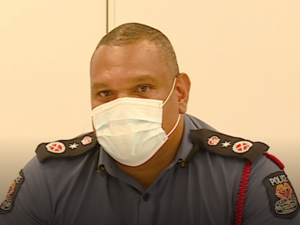
PNG’s Pandemic Response Controller David Manning said that an MP was initially tested at the weekend and returned a positive result.
According to Manning, the MP was isolated away from the rest of the government camp at Loloata Island, but that contact tracing unearthed more cases.
“As a result of further tests we did pick up another two positive cases, and of course they have now been isolated as well,” Manning told a media conference in Port Moresby.
“I have written in my capacity as controller to the Speaker of the national Parliament, advising him of the three positive cases, and as such I have recommended to him, consistent with our procedures as to what we expect in how to respond to this in so far as the Parliament is concerned.”
Health officials said any recall of parliament would need to follow safety guidelines. In the meantime any other MPs or parliamentary staff who have been in contact with the MP at the Loloata resort are to be isolated and tested.
All three cases are described by health officials as having “mild symptoms”. The new cases in the National Capital District take PNG’s total number of confirmed infections to date to 633.
PNG Pandemic Controller David Manning … contact tracing unearthed more cases. Image: EMTV News
Local media is also reporting that another MP who had been at the Loloata camp had since also left for Vanimo in PNG’s northwest, where opposition MPs are camped.
Health officers in Vanimo have been directed to test the MP and close contacts.
Supreme Court seeks consensus on date for Parliament Meanwhile, the PNG Supreme Court case on the legality of last week’s sitting of Parliament has been adjourned until today.
The application filed by former prime minister Peter O’Neill challenges the constitutionality of reconvening Parliament just over a week ago.
Speaker Job Pomat hastily called the sitting despite an earlier adjournment to next week allowed by his deputy.
The recall resulted in Parliament being adjourned to April.
This would enable Prime Minister James Marape to avoid a likely vote of no-confidence after dozens of MPs defected from his coalition this month.
According to the NBC, Chief Justice Sir Gibbs Salika urged parties in the proceedings to reach a consensus before the matter goes back for directional hearing tomorrow.
He suggests that if the opposition’s desired date for Parliament sitting on December 1 can be moved to another date, it can give time for the Supreme Court application to be heard.
This article is republished by the Pacific Media Centre under a partnership agreement with RNZ.
US Secretary of State-designate Antony Blinken promises both awkwardness and opportunity for Australia’s Morrison government.
Blinken could hardly represent a more striking contrast with his soon-to-be predecessor Mike Pompeo in his views on the need for America to reinvigorate alliances and address pressing global issues such as climate change.
He will bring to the job a lifetime of experience as a staff member of the Senate Foreign Relations Committee, foreign policy aide to President-elect Joe Biden over many years, and deputy secretary of state in the Obama administration.
The Blinken worldview could be summed up as “America together”, not “America first”. It was given expression in useful detail at a July 9 Hudson Institute dialogue on American Foreign Policy. This document should be compulsory reading for Coalition foreign policy advisers.
Pressure on climate change
First, let us consider the awkwardness for Australia of a Biden administration in which Blinken will play a central role.
After loitering in the shadows of a virtually non-existent US climate policy, the Australian government will now have little choice but to engage more constructively in global efforts to address global warming.
Morrison and his ministers will find it increasingly awkward to avoid a commitment to net zero global greenhouse emissions by 2050, in line with the policies of a new US administration.
Biden has foreshadowed such a commitment as a cornerstone of US foreign policy.
Likewise, Australia’s fudge of making use of leftover Kyoto carbon credits to enable it to meet its climate targets under the Paris Agreement will be difficult to sustain in a new more climate-activist era.
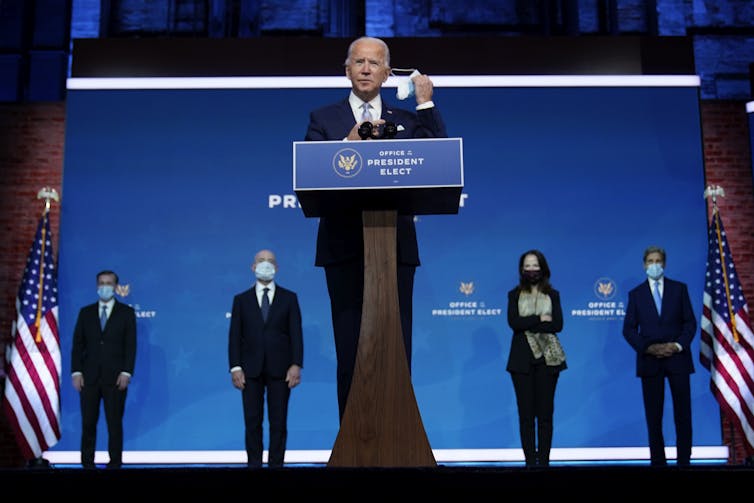
President-elect Joe Biden has signalled he will move to net zero carbon emissions by 2050. Australia has yet to make such a commitment.AAP/AP/Carolyn Kaster
This state of affairs will have implications for Australian domestic politics, in which counterproductive climate politicking has left the country without a sustainable energy policy for more than a decade.
Quite simply, [climate change] is arguably the one truly existential issue that we face. It has to be, and under a Biden administration would be, a number-one priority.
Blinken said that among early priorities of a Biden administration would be the convening of a summit of the world’s major carbon emitters to:
…rally countries not just on sticking with Paris, but to actually raise their ambitions and try to push progress further and faster.
He gave notice the US would work to insist that China:
…stop subsidising coal exports and outsourcing pollution to other countries by financing billions of dollars’ worth of dirty fossil fuel energy projects through the Belt and Road Initiative.
These initiatives will inevitably have implications for Australian coal exporters.
Blinken also talked about “locking in enforceable commitments to reduce emissions in global shipping and aviation”.
These are ambitious goals by any standards, and will inevitably feed into Australian policy debate. The Morrison government’s choice is either to get with the program or allow itself to be regarded as an outlier, along with Brazil and Saudi Arabia, of countries resistant to coordinated global efforts to bring down carbon emissions.
A chance to thaw the frost with China
On China, where Australian government policy has been all at sea, the incoming administration presents Australia with a chance to reset its relationship with its most important economic partner.
The incoming US administration should offer the Australian government, among other things, a chance to again re-set its testy relationship with China.
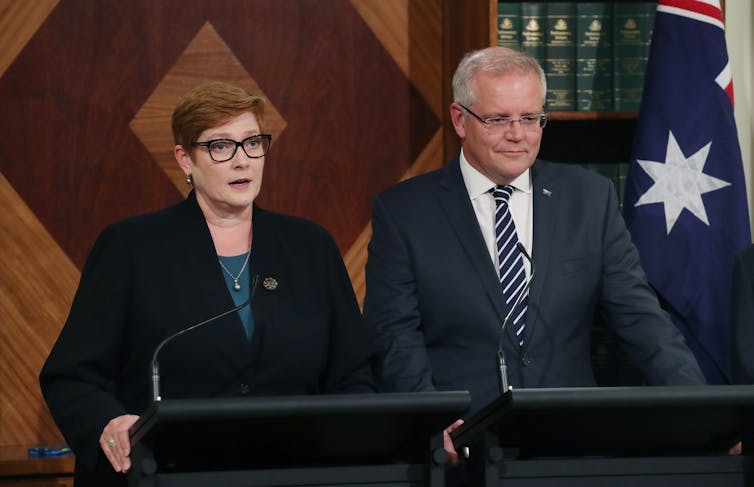
Those attempts at such a reset surfaced in a speech this week by Morrison to the UK Policy Exchange, a London-based conservative think tank. Here, the prime minister put aside some of the bluster that has characterised recent exchanges, in which Australia promised not to succumb to Chinese bullying.
In light of real harm being rendered to Australian businesses by Chinese boycotts, Morrison sounded more conciliatory:
Australia is not and has never been in the economic containment camp on China […] Australia desires an open, transparent and mutually beneficial relationship with China as our largest trading partner.
These words are unexceptional in themselves. But they clearly amount to an attempt by Morrison to take advantage of the potential for a fresh start offered by a new administration in Washington.
Blinken’s remarks on China to the Hudson Institute should be given close attention in Canberra. He points to the need for America to restore confidence in its own democracy first, so as to be in a sounder position to counter China’s rise.
Beijing had been able to take advantage of America’s inward-looking domestic turmoil over the past four years to advance its own global reach.
In turn, the US needed to revitalise its alliances to deal with China’s rise. Once that is done, a Biden administration would be able to:
…engage China and work with China, in areas where our interests clearly overlap, whether it is again contending with climate change, dealing with global health and pandemics, [or] dealing with the spread of dangerous weapons. We’re much better off, though, finding ways to cooperate when we’re acting from a position of strength than from a position of weakness.
These sentiments should be welcomed in Canberra, where a ragged China policy in recent years has tended to be consumed by security concerns. Restoring balance to that policy in coordination with an American push to bolster alliances of Western democracies would be desirable.
At his Hudson Institute event, Blinken addressed a range of contentious foreign policy issues. These included the vexed question of what to do about Iran’s nuclear ambitions. Biden has indicated he would like to revive America’s participation in the Iran nuclear deal abandoned by Donald Trump. However, this will be easier said than done, given the progress Tehran has made towards acquiring a breakout nuclear capability.
On the Middle East more generally, Blinken said:
I think we would be doing less not more in the Middle East.
This view no doubt reflects frustrations Blinken himself has experienced over many years in seeking to bridge seemingly intractable conflicts, such as the Palestinian issue, at the expense of other priorities.
Former Secretary of State John Kerry’s designation as America’s climate envoy attests to a Biden administration’s commitments on the global warming front. Kerry was one of the architects of the Paris Agreement.
Blinken’s nomination as secretary of state should be regarded as a positive development from Australia’s perspective, given his significant foreign policy experience and his proclaimed willingness, indeed determination, to work with friends and allies.
The Australian government, marinaded in a security mindset, would be advised to buy into what promises to be a much more expansive American foreign policy with climate as its centrepiece.
Source: The Conversation (Au and NZ) – By Nigel McMillan, Program Director, Infectious Diseases and Immunology, Menzies Health Institute, Griffith University
Early in the pandemic, many researchers feared people who contracted COVID could be reinfected very quickly. This was because several earlystudies showed antibodies seemed to wane after the first few months post-infection.
It was also partly because normal human coronaviruses, which are one cause of common colds and are cousins of SARS-CoV-2, do not generate long-lasting immunity, so we can get reinfected with them after 12 months.
But newpreliminary research suggests key parts of the immune system can remember SARS-CoV-2 for at least eight or nine months, and possibly for years.
Immune memory
When a country is invaded by an enemy, it rallies its forces, fights the war and hopefully repels the invaders. While the enemy has disappeared back to their own territory, a smart country sets up watchers to look for any signs of a new invasion. These lookouts know what the enemy looks like and are familiar with their uniform and how they travel.
Our immune system is exactly the same. Whenever we fight a bacterial or viral infection we leave behind certain cells that remember exactly what this invader looks like. These are called memory cells and their job, in the event of another “invasion”, is to warn our immune system early and ensure the right sort of response is mounted. It means we don’t have to start all over again to make a new response, and so reinfection is either eliminated or the time to recovery is much reduced.
This long-lived memory response can last a lifetime for some viruses such as measles.
We have two main parts of our adaptive immune response: B cells and T cells. Both of these cells can generate “memory”.
We’ll talk about B cells first. They make antibodies, which latch onto and destroy disease-causing agents such as viruses and bacteria.
A team of researchers from Australia, led by Menno van Zelm at Monash University, published a preliminary study last week showing the body can generate memory B cells specific to SARS-CoV-2. The research showed these cells last at least eight months, and likely even longer. This means these memory B cells could still rapidly produce antibodies against SARS-CoV-2 eight months post-infection, if the person were to be exposed to the virus again (although this work has not yet been peer-reviewed so should be treated with caution).
Other researchers from the United States showed memory B cells lasted at least six months, in a preliminary study also released last week.
While the researchers from Australia saw a drop in circulating antibodies against the virus after two months in the blood of the 25 patients they looked at, they found memory B cells against two important parts of the virus: the spike protein (what most vaccines are designed to target) and the “nucleocapsid”, another structural protein of the virus.
They say this should give long-lasting immunity.
But we can’t directly prove this, because that would involve reinfecting patients, which would be unethical. So to study this further, we have to rely on natural reinfections.
There have been just 26 confirmed cases of reinfection reported worldwide so far, according to a COVID reinfection tracker by Dutch news agency BNO News (although the true tally is likely higher). With 60 million people infected globally so far, reinfection therefore seems to be a very rare event.
Illustration of an antibody-producing B cell. New research suggests our immune system can remember how to produce antibodies against SARS-CoV-2 at least eight months after infection, and probably even longer.Shutterstock
What about T cells? These are cells that bind directly to infected human cells within the body and destroy them. All infected cells smuggle out bits of the invading pathogen onto their surface, as a kind of “SOS” signal that allows T cells to find the hidden enemy.
Researchers from the University of Oxford published a study in September showing memory T cell responses to SARS-CoV-2. This means certain T cells could remember how to respond to virus-infected cells, long after the initial infection was cleared —although there was no data on how long this may last.
A more recent study, published as a preliminary report last week from researchers in China and Germany, answers this question.
They studied patients from Wuhan, where the first reported COVID cases occurred, and who therefore have the oldest immune responses. They showed T cell memory responses were still present nine months after infection.
So what does this all mean going forward?
It would seem SARS-CoV-2 is not like its normal common cold coronavirus cousins. People’s immune responses to common cold coronaviruses typically don’t last very long, meaning we typically get reinfected by 12 months.
But it’s clear people’s immune systems can “remember” and respond to SARS-CoV-2. Interestingly, more severe coronavirus infections SARS and MERS appear to elicit longer-lasting responses up to three years.
So, people who’ve been naturally infected with SARS-CoV-2 can expect reinfection to be rare. If it does occur it will probably result in very mild disease, but otherwise they should be fully protected for at least eight or nine months after their first infection.
But we still don’t know what would happen if someone was re-exposed after this timeline — only time will tell.
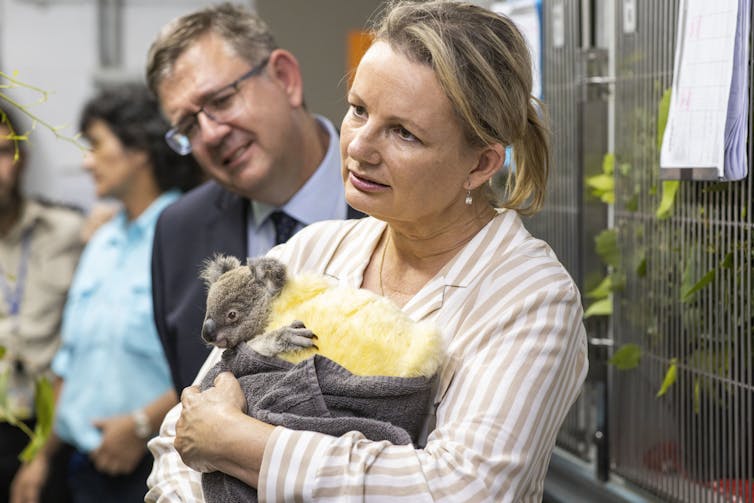
Federal environment minister Sussan Ley this week announced A$2 million for a national audit of Australia’s koalas, as part of an A$18 million package to protect the vulnerable species.
The funding might seem like a lot – and, truth be told, it is more than most threatened species receive. But the national distribution of koalas is vast, so the funding equates to about A$1.40 to survey a square kilometre. That means the way koalas are counted in the audit must be carefully considered.
Koalas are notoriously difficult to detect, and counts so far have been fairly unreliable. That can make it hard to get an accurate picture of how koalas are faring, and to know where intensive conservation effort is needed – especially after devastating events such as last summer’s bushfires.
Methods for counting koalas range from the traditional – people at ground level looking up into the trees – to the high-tech, such as heat-seeking drones. So let’s look at each method, and how we can best get a handle on Australia’s koala numbers.
Environment Minister Sussan Ley has pledged $2 million for a national koala count.Glenn Hunt/AAP
Why we need to know koala numbers
Gathering data about species distribution and population size is crucial, because governments use it to assess a species’ status and decide what protection it needs.
In announcing the funding, Ley said the new audit aims to fill data gaps, identify where koala habitat can be expanded, and establish an annual monitoring program.
So far, population estimates for koalas at the state and national level are rare and highly uncertain. For example, the last national koala count in 2012 estimated 33,000-153,000 in Queensland, 14,000–73,000 in NSW and 96,000-378,000 in the southern states.
This uncertainty can make it hard to detect changes in population trends quickly enough to do something about the threat, such as by limiting development or logging. However, the new audit can use methods not available in 2012, which should help with accuracy.
To date, estimates of koala numbers have been highly uncertain.Shutterstock
So how do you actually count koalas?
Finding a koala can be difficult. There may be few individuals spread over large areas. And koalas are well camouflaged and quiet, unless bellowing. Finally, they can sit high in the tree canopy.
In numerous research and management programs, we have observed that even the most experienced koala spotter may only see 20–80% of koalas present at a site, especially if the vegetation is thick or the terrain difficult to move through.
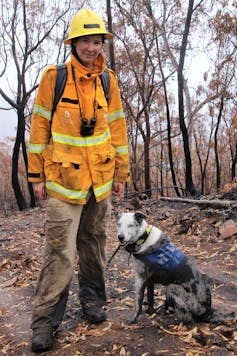
Romane Cristescu with detection dog USC x IFAW detection dog Bear. Detection dogs have been trained to locate koala and their scats.Detection Dogs for Conservation
Making the job even harder, existing koala habitat maps can be highly inaccurate and miss unexpected hotspots. However, computer modelling using the latest methods, if carefully validated on the ground, can produce more accurate maps.
Traditional surveys involve multiple people independently searching the same area, and correcting counts based on the number of koalas each observer sees. This helps account for the difficulties in koala counting, but it’s hard, slow and costly work.
Searching for koala scat (poo) also is a common method of determining koala habitat – wherever koalas spend time, they will leave scats. However, the small brown pellets are easily missed, and large surveys for scats are time consuming.
And because male koalas bellow during the breeding season, koalas can also be detected with acoustic surveys. Audio recorders are left at a survey sites and the recordings scanned for bellows to determine whether koalas are present.
Recently, heat-seeking drones have also been used to detect koalas. This method can be accurate and effective, especially in difficult terrain. We used them extensively to find surviving koalas after the 2019-20 bushfires.
Citizen scientists can also collect important data about koalas. Smartphone apps allow the community to report sightings around Australia, helping to build a picture of where koalas have been seen. However, these sightings are often limited to areas commonly traversed by people, such as in suburbia, near walking tracks and on private property.
Everyday citizens can help with koala counting.Shutterstock
Getting the koala count right
All these methods involve a complex mix of strengths and weaknesses, which means the audit will need input from koala ecologists if it’s to be successful. Survey methods and sites must be chosen strategically to maximise the benefits of the funding.
Robust research data exists, but is patchy across the koala’s entire range. The first step could include collating all current data, including community sightings, to determine where additional surveys are needed. This will allow for funding to be prioritised to fill data gaps.
It is promising that the announcement includes monitoring over the long term. This will help identify population trends and better understand the response of koalas to ongoing threats. It will also reveal whether actions to address koala threats are working.
Finally, while threats to koalas are generally well understood, they can vary between populations. So the audit should allow for “threat mapping” – identifying threats and looking for ways to mitigate them.
Saving an iconic species
Last summer’s bushfires highlighted how koalas, and other native species, are vulnerable to climate change. And the clearing of koala habitat continues, at times illegally.
Government inquiries and reviews have shown state and federal environment laws are not preventing the decline of koalas and other wildlife. The federal laws are still under review.
However, the new funding underpins an important step – accurate mapping of koalas and their habitat for protection and restoration. This is a crucial task in protecting the future of this iconic Australian species.
The koala count is critical to protecting the species.Shutterstock
The South Australian and Victorian governments have announced, and New South Wales is considering, road user charges on electric vehicles. This policy has drawn scorn from environmental advocates and motor vehicle lobbyists who fear it will slow the uptake of less-polluting vehicles. But, from a longer-term transport policy perspective, a distance-based road user charge on electric vehicles is an important step forward.
Superficially, a charge on electric vehicle use seems misguided. Road sector emissions are the worst contributors to climate change. Electric vehicles powered by clean energy offer the promise of near-zero emissions.
The downside lies not in the carbon benefits of these vehicles, but in their use as private passenger transport in congested urban areas and the costs this use imposes on cities. As renewable energy becomes cheaper, the marginal cost of every kilometre driven is likely to decline. As driving becomes cheaper, more of it is likely to occur.
More driving means more congestion. Inevitably, that increases demand for increasingly expensive road projects, such as Sydney’s WestConnex, or Melbourne’s Westgate Tunnel and North East Link. It certainly will run against the recognition in urban plans such as Plan Melbourne that we must shift to alternative transport modes.
If we don’t have a pricing regime that accounts for the cost of car use in cities, the transition to electric vehicles is likely to work against the wider goals of urban and transport policy.
The cheaper electric cars are to run, the greater the incentive to increase car use, with all the associated costs that imposes on cities.Mick Tsikas/AAP
How would distance-based charging work?
Many urban transport policy advocates have called for distance-based road-user charging to be imposed on all vehicles in cities. This sounds great in theory, but in practice is difficult for technical and political reasons of privacy and surveillance. Such concerns will diminish over time as cars increasingly incorporate automated telematics that necessarily track their movement.
Distance-based road-user charging efficiently matches road use to its costs – of infrastructure, congestion, noise, pollution and deaths. It improves on fuel excise, which drivers can nearly completely evade by using a highly efficient vehicle. It also goes beyond tolling to fund major roads, which typically apply only to specific links.
Second, road-user charging can be varied in response to demand that exceeds road capacities. Higher rates can be applied at peak times to ensure free-flowing traffic and shift travel to other times and modes. Various taxation reviews, including the 2009 Henry Taxation Review and Productivity Commission reports, have promoted such policies.
Would imposing such charges on electric vehicles retard their uptake?
Based on our work with ABS Census journey-to-work data, in Melbourne the average daily round-trip commuting distance by car is about 25 kilometres. The proposed Victorian charge is 2.5 cents per kilometre. Thus, in Melbourne the average daily commuter’s road user charge is likely to be 63 cents – $3.13 for a typical five-day working week. Over a 48-week working year that totals A$150, hardly a large sum for most people.
By comparison, a commuter in a conventional vehicle with the average current fuel efficiency of 10.9 L/100km will use about 2.73 litres of fuel on which they pay 42.3 cents per litre in fuel excise. That’s about $1.15 a day, or $5.75 a week.
The average tax saving for electric vehicles compared to conventional vehicles will be about 2.1 cents per kilometre. Electric vehicle drivers will be taxed about 53 cents a day, or $2.64 a week, less for their car work travel. They’ll be about $126 a year better off.
Commuting trips make up about 25% of car use, so electric car users’ overall savings are likely to be even greater.
It is difficult to see how such savings on excise tax are a disincentive to electric vehicle uptake. Fears of a “great big new tax”, as the Australia Institute puts it, seem unfounded, as are concerns that road-user charges would “slam the brakes on sales”.
Let’s be clear, the big barrier is the upfront cost of electric vehicles, about $10,000 more than their conventional equivalents. Advocates for electric vehicles should focus on that difference, and the failures in Australian government policy, not state road-user charges.
It needs to be recognised that, with lower marginal costs, electric vehicles are likely to be used more than conventional cars. That would increase pressure on urban road capacity. So while the new road-user charge of 2.5 cents per kilometre is flat across the time of day or the route driven, this will likely need to change.
Distance-based road-user charges have been politically controversial. Imposing a tiny charge on a minority vehicle type is an expedient way of introducing a needed reform. Fewer than 1.8% of vehicles in Australia are currently electric or hybrid. But as all cars become electric, distance-based road charges will become an increasingly powerful policy tool.
Thanks to advancing telematics, transport planners will eventually be able to impose variable road-user charging by time of day and route, similar to ride-hailing companies’ “surge” pricing. We could then apply novel approaches such as a cap-and-trade system. A city could allocate its motorists an annual kilometres quota, which is then traded to create a market for excess urban road use.
Road-user charges could be regressive for people with few alternatives to the car. But telematic tracking could allow for lower charges for less affluent households in dispersed outer suburbs with few other options.
To reduce this demand on resources and space, car use could be priced to shift travel to, and fund, more sustainable and city-friendly modes such as public transport, walking and cycling. We could even price the car out of cities completely. The most environmentally sustainable car, after all, is no car at all.
There is no doubt the COVID-19 crisis has incurred widespread economic costs. There is understandable concern that stronger measures against the virus, from social distancing to full lockdowns, worsen its impact on economies.
As a result, there has been a tendency to consider the problem as a trade-off between health and economic costs.
This view, for example, has largely defined the approach of the US federal government. “I think we’ve learned that if you shut down the economy, you’re going to create more damage,” said US Treasury Secretary Steve Mnuchin in June, as the Trump administration resisted calls to decisively combat the nation’s second COVID wave.
But the notion of a trade-off is not supported by data from countries around the world. If anything, the opposite may be true.
Data from 45 nations
Let’s examine available data for 45 nations from the Organisation for Economic Co-operation and Development, using COVID-19 data and economic indicators.
The COVID-19 statistics we’ll focus on are deaths per million of population. No single indicator is perfect, and these rates don’t always reflect contextual factors that apply to specific countries, but this indicator allows us to draw a reasonably accurate global picture.
The economic indicators we’ll examine are among those most widely used for overall evaluations of national economic performance. Gross domestic product (GDP) per capita is an index of national wealth. Exports and imports measure a country’s international economic activity. Private consumption expenditure is an indicator of how an economy is travelling.
Effects on GDP per capita
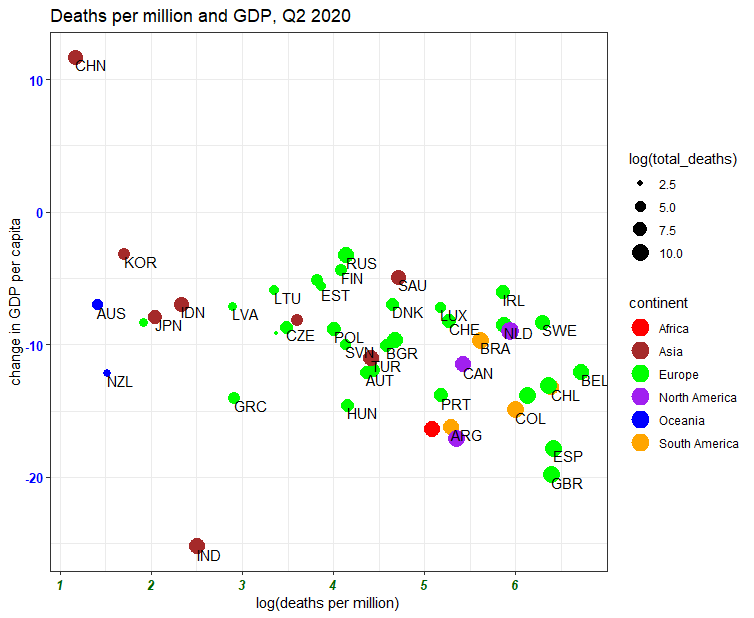
Our first chart plots nations’ deaths per million from COVID-19 against the percentage change in per capita GDP during the second quarter of 2020.
The size of each data point shows the scale of deaths per million as of June 30, using a logarithmic, or “log”, scale – a way to display a very wide range of values in compact graphical form.
Log(deaths per million) by percentage change in Q2 2020 GDP per capita.
If suppressing the virus, thereby leading to fewer deaths per million, resulted in worse national economic downturns, then the “slope” in figure 1 would be positive. But the opposite is true, with the overall correlation being -0.412.
The two outliers are China, in the upper-left corner, with a positive change in GDP per capita, and India at the bottom. China imposed successful hard lockdowns and containment procedures that meant economic effects were limited. India imposed an early hard lockdown but its measures since have been far less effective. Removing both from our data leaves a correlation of -0.464.
Exports and imports
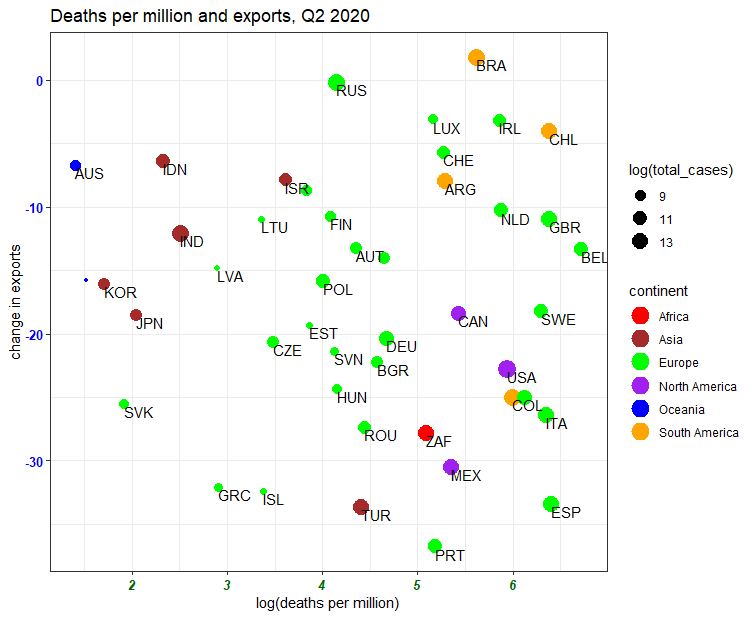
Our second chart shows the relationship between deaths per million and percentage change in exports.
If there was a clear trade-off between containing the virus and enabling international trade, we would see a positive relationship between the changes in exports and death-rates. Instead, there appears to be no relationship.
Log(deaths per million) by percentage change in Q2 2020 exports.
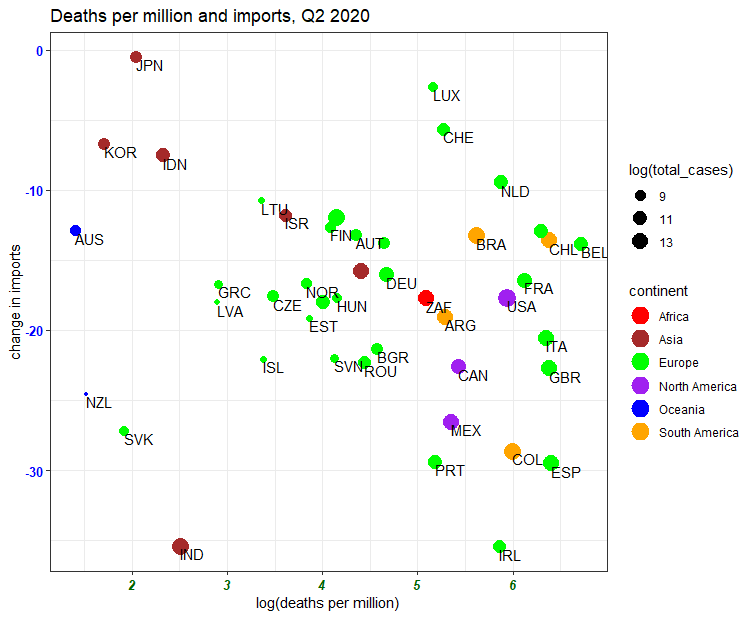
Our third chart shows the relationship between deaths per million and percentage change in imports. As with exports, a trade-off would show in a positive relationship. But there is no evidence of such a relationship here either.
Log(deaths per million) by percentage change in Q2 2020 imports.
Consumer spending
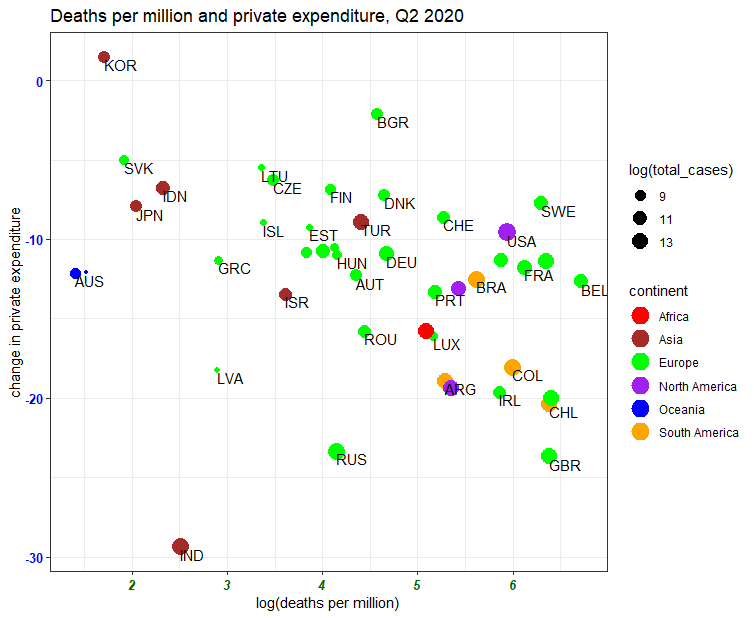
Our fourth chart shows the relationship between deaths per million and percentage change in private consumption expenditure. This complements the picture we get from imports and exports, by tracking consumer spending as an indicator of internal economic activity.
Log(deaths per million) by percentage change in Q2 2020 private consumption.
Again, no positive relationship. Instead, the overall negative relationship suggests those countries that succeeded (at least temporarily) in suppressing the virus were better off economically than those countries adopting a more laissez-faire approach.
National wealth
As a postscript to this brief investigation, let’s take a quick look at whether greater national wealth seems to have helped countries deal with the virus.
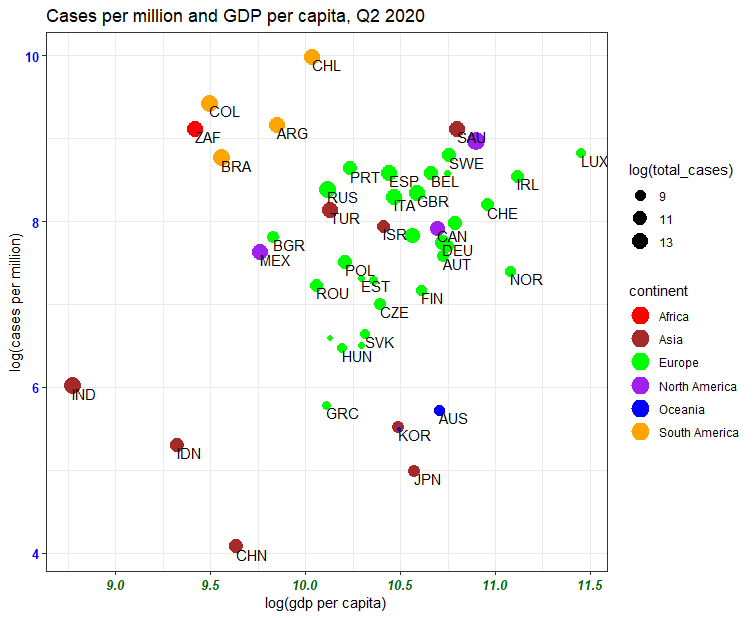
Our fifth and final chart plots cases per million (not deaths per million) against national GDP per capita.
Log(GDP per capita) by log(cases per million).
If wealthier countries were doing better at suppressing transmission, the relationship should be negative. Instead, the clusters by region suggest it’s a combination of culture and politics driving the effectiveness of nations’ responses (or lack thereof).
In fact, if we examine the largest cluster, of European countries (the green dots), the relationship between GDP per capita and case rates is positive (0.379) – the opposite of what we would expect.
The standard economic indicators reviewed here show, overall, countries that have contained the virus also tend to have had less severe economic impacts than those that haven’t.
No one should be misled into believing there is zero-sum choice between saving lives and saving the economy. That is a false dichotomy.
If there is anything to be learned regarding how to deal with future pandemics, it is that rapidly containing the pandemic may well lessen its economic impact.
If you’re an avid viewer of crime shows, you’ve probably come across cases in which an expert, often a psychologist, is called in to help solve a crime using their language analysis skills.
However, in real life it’s the job of forensic linguists like myself to provide such evidence in courts, here in Australia and around the world.
Forensic linguists can provide expert opinion on a variety of language-related dilemmas, including unattributed voice recordings, false confessions, trademark disputes and, of course, a fair share of threatening letters.
But what do we look for when doing this?
Reading between the lines (and everything else)
Linguistics is the scientific study of language. Thus, linguists are uniquely placed to provide expert opinions on how language is used. Linguists study:
grammatical structures, wherein changes in punctuation patterns between texts can signal different authors
semantics, which explores how speakers and listeners form meaning, such as when making sense of a written text
phonetics and phonology, which refer to the sounds of language. We can recognise subtle differences in the sound of a vowel when produced by different speakers, or by speakers of different dialects and languages.
sociolinguistics, which looks at how language use varies across different social groups. For example, we can identify when someone from a non-English language background might misunderstand a question. This is because the variety of English they’re familiar with would differ, in small but notable ways, from native English speakers.
Since the first known forensic linguistic case in 1953, all of the above abilities have proven invaluable in courts time and time again. Yet the work done by forensic linguists seems to largely elude members of the public.
Sociolinguistics is a branch of language study focused on the relationship between language and various groups in society.Shutterstock
A widely misunderstood field
Ironically, a big problem for forensic linguists (and linguistics in general) relates to language. It comes down to how we use the word “linguist”.
Some people think this refers to a person who speaks many different languages, or is particularly fluent in their speech or writing. These non-technical interpretations are easy to conflate with the academic discipline of linguistics.
But apart from causing linguists a headache at dinner parties, does it really matter if people misunderstand what linguists do?
It seems so. Widespread ignorance on the vitality of forensic linguistics has led to some of the most egregious miscarriages of justice in Australian history.
In 2018, the Western Australia Court of Appeal overturned the conviction of manslaughter for Gene Gibson, an Aboriginal man with a cognitive impairment for whom English was a third language.
Police interviewed Gibson without an interpreter, assuming one wasn’t needed to assess his English fluency. This neglect resulted in Gibson spending nearly five years in prison for a crime he didn’t commit.
In 2018, Gene Gibson was awarded a total A$1.5 million in compensation by the West Australian government, after being jailed for a crime he didn’t commit. Gibson’s lawyer Michael Lundberg (pictured) told the ABC the payment wasn’t as large as he’d hoped.Rebecca Le May/AAP
People who speak English as an additional language sometimes don’t know their legal rights in situations such as police interviews.
In the past, these defendants or witnesses have been treated as though they understood complex legal English simply because they could chat about the weather, or their family. Such casual conversations are not a suitable test for language fluency.
The verbose wild west of the web
Another example where linguistics intersects with criminals is found in the rapid increase in crimes involving digital communication. These online offences are made easy by the anonymity and reach allowed on social media platforms.
Correctly identifying individuals who post threatening, defamatory or false messages online is of chief importance for investigators as it can help protect those targeted.
Social media use has skyrocketed in the past decade, boosting the trend of ‘viral’ content. This has hugely shifted the defamation landscape.Shutterstock
This task, carried out by forensic linguists, is known as “authorship attribution”. It relies on correctly grouping together texts produced by the same author, by isolating textual features specific to that author.
These features are usually related to grammatical structure and are deeply embedded in each person’s individual authorial style. They are difficult to manipulate by would-be imposters.
Authorship attribution is certainly challenging, as there’s no “text fingerprint” or distinct pattern of language use that can be allocated to each of us. Still, big data analysis, combined with linguistic theory, is getting us closer to a reliable system.
A “stylistics” approach, featured in one Australian Story episode last month, describes patterns of language that are similar or different between two specific texts.
But this approach makes no attempt to calculate how common these patterns might be in any other authored text. This oversight is typical of non-linguists attempting to undertake linguistic analysis, as they often don’t know what constitutes a common feature of language.
For instance, if two documents feature the word “cant” (“can’t” without an apostrophe), a non-expert may see this as a strong indicator of a common author.
But according to the Birmingham Blog Corpus — a collection of almost 630,000,000 words taken from blogs — this word is spelled without an apostrophe about 3.6% of the time.
Technology-facilitated analysis
More reliable methods of identifying authorship, or identifying a speaker in a voice recording, are possible with both specialised linguistic knowledge and computer processing power.
Advancing this field doesn’t require any fancy new technology. It requires more investment in Australia’s capacity for forensic linguistic research. In an increasingly digital world, in-depth research on text authorship and voice identification will prove crucial to future law enforcement.
It’s also important we increase awareness of the power (and limitations) of linguistic analysis among the general public, and especially among officers of the law and judiciary.
Bringing more linguistics into schools, such as with Victoria’s VCE English Language subject, would be a great way to equip the next generation of these experts.
Source: The Conversation (Au and NZ) – By Shaun Rosier, Practice-based PhD Researcher in Landscape Architecture, Te Herenga Waka — Victoria University of Wellington
New Zealand has more than 1,100 registered quarries. Some of these mined sites are small, rural operations, but a significant number are large and complex, and within a city’s urban boundaries.
As part of the resource consent application for a mining project, quarry operators are usually issued with a quarry management plan, which outlines what needs to happen to the landscape once mining has finished.
Most local government bodies require quarry operators to do little more than smooth the altered landscape, redistribute topsoil across these slopes, plant some new vegetation, and manage any onsite waterways to prevent surface erosion.
But restoring the ecology of an extracted site isn’t enough any more.
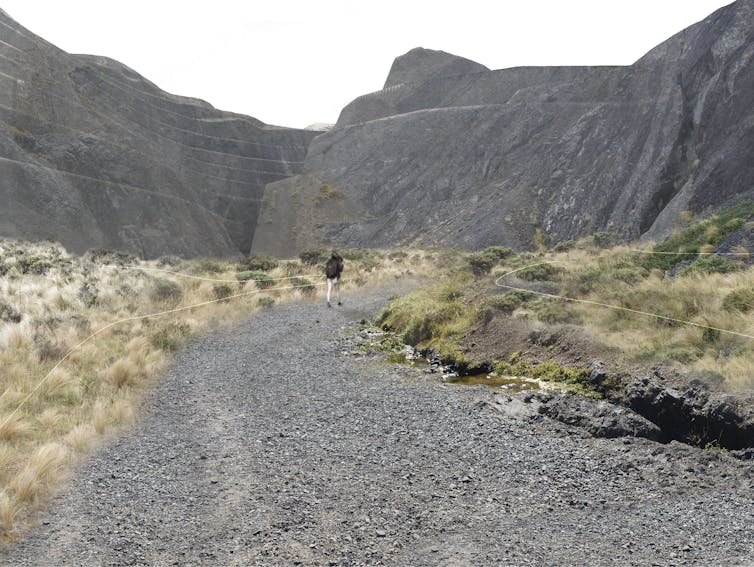
My research at the Horokiwi Quarry in Wellington explores how design-led remediation projects can restore the ecology of a mined landscape as well as creating new public landscapes that can be used for recreation.
The southern half of the Horokiwi Quarry has been reshaped and the massive bench to the left entirely removed.Author provided
Conditions of remediation
Quarry management plans currently pay attention to returning the topography of a mined site to a “natural” condition during the remediation. Quarries and mines extract material from the earth, and by necessity alter the surface dramatically.
Often a large amount of material has to be removed first to access the desired aggregate material or rare mineral. Once remediation begins, this material is spread across the site to create a natural appearance, suitable for revegetation. The landscape is smoothed over, pits filled in, and topsoil distributed.
Likewise, the revegetation strategy remains relatively simple. Most remediation projects rely on spraying a seed-fertiliser-mulch mix over these freshly contoured slopes. In difficult conditions, this is often paired with manual planting to establish cover for pioneer species.
These strategies typically use regionally specific plants, ideally sourcing the seed stock from the area to help establish a robust and appropriate ecology.
These processes are all used to restore a site back to a “natural character”, but what this means is left undefined. The Resource Management Act (RMA), under which mining resource consent applications have to be made, says miners have:
…a duty to avoid, remedy or mitigate any adverse effect on the environment arising from an activity.
While the RMA does not define this natural character condition that is to be preserved or restored, it provides some guidance in the New Zealand Coastal Policy Statement.
Here, natural character is determined to be underpinned by natural processes, elements and patterns. But as some planners and designers have made clear, this is still an unclear position.
It relies on a problematic distinction between nature and culture, where nature is something different and unaltered from humans. Or, as US environmental historian William Crononwrites:
The place where we are is the place where nature is not.
Problematic results
Most remedial works are successful from a biological point of view, leading to full or partial restoration of ecological processes. For example, the limestone quarry at Cape Foulwind has been relatively successful in its biophysical remediation. But the site is close to local communities and on a major tourist route, and could play a bigger role as a public space.
On the other hand, the remediation of the Mikonui Valley mine, on conservation land on the West Coast, has arguably been a failure, described as a “moonscape” by conservationists. The company paid a bond to the Department of Conservation to allow it to mine on public land, but it has not remediated the land to an acceptable degree, and likely never will.
Behind this is the larger issue that remediation was only seriously considered at the end of the extraction process. Doing so left little room for other design options.
Recent research has called for a different approach, especially for quarries and mines within urban areas where landscape architects are involved throughout the entire extraction process.
Using their knowledge and skill sets could bring the extracted landscape significantly closer to a desirable outcome. It would also allow for new spaces, including parks, housing, recreation or ecological reserves.
A proposal for the remediation of the Horokiwi Quarry would turn it into a regional park, connected to the surrounding suburbs and the cities of Wellington and Lower Hutt.Author provided
This is an important shift for urban quarry sites. Establishing a design process that works in parallel with the extraction process would allow sites such as the Horokiwi Quarry to play a role in the public life of a city.
This large aggregate quarry has a remaining lifespan of 20-30 years, and presents an ideal case to develop remediation techniques that can bring the most out of this landscape.
The design proposal builds on the experience of a landscape of extreme scale and mass. Facilities such as sports fields, gathering spaces, relaxation and a mix of pathways all feed off the experience of the landscape.
At the same time, new ecological sites are established where appropriate to create a different relationship between visitors and the landscape.
Pathways are designed to give visitors a sense of the scale of the quarried site.Author provided
Turning post-extraction landscapes such as the Horokiwi Quarry into public spaces confronts us with their scale and otherworldliness. It can change how we relate to the environment.
We have to remediate these sites in a way that moves us to recognise our relationship with extraction and consumption. This might not be pretty, but it is necessary.
From the 1980s right through to the global financial crisis, the standard response in Australia and elsewhere to too weak or too strong an economy has been monetary policy — the manipulation of interest rates by a central bank, in our case the Reserve Bank.
Rates can be moved quickly, and central banks are seen to be independent and to behave responsibly, while governments are seen as making decisions for political rather than economic reasons.
But since the global financial crisis (in much of the world) and since COVID (in Australia) managing the economy has come to be seen once again as the role of the government through spending and tax decisions — so-called fiscal policy.
One reason is interest rates have fallen so low there’s been little left to cut.
After the 1990s recession, the Reserve Bank cut its cash rate from 17% to 7.5%. After the financial crisis it cut it from 6% to 3.25%. By the time COVID came around the rate was already at a record low of 0.75%
The bank did cut, as much as it could — first to a new record low of 0.5%, then to 0.25% and now to 0.1%, but there’s little more it can do, at least with the cash rate.
Rate cuts have been used up
And there’s little that whatever cuts it could make could do to boost the economy. Their immediate impact would be to push up the prices of houses and other assets and worsen inequality.
So the government has turned to fiscal policy. Since the onset of the pandemic the Commonwealth has provided A$257 billion in direct economic support; about 13% of GDP.
By comparison, in response to the global financial crisis it spent $72 billion; about 6% of GDP.
It will help, but it will do little about the underlying reason why rate cuts have become ineffective, which is an excess of savings over opportunities to invest them.
We’re in a savings glut
As far back as the mid-2000s the then chairman of the US Federal Reserve, Ben Bernanke, was talking about a savings glut: too many savings chasing too few opportunities to invest.
Too many savings chasing too few opportunities.Ashwin/Shutterstock
For a while the US and other economies remained strong as the downward pressure of excess savings on demand was held at bay by households borrowing ever increasing amounts in order to spend.
That escape valve closed after the global financial crisis, and numerous (mostly American) economists began talking about ongoing slow economic growth, which they described as “secular stagnation”.
There are two suggested explanations. One involves supply. It might be that the ability of the economy to supply more of what we want is slowing.
The other involves demand. It might be that we not demanding enough of the things the economy can produce.
Potential supply might be slowing because modern-day technological progress, principally in the form of information and communications technology, is having less of an impact than previous new technologies such as electricity, the internal combustion engine or the automated production line.
Australia’s treasury has also suggested the Australian economy might be less dynamic, with lower levels of firm entry and job switching, slower adoption of frontier technologies and processes, and less labour reallocation of resources from low to high productivity firms.
It is these supply-side constraints that have captured the attention of the Australian authorities.
On the other hand, in the US, former Treasury Secretary Lawrence Summers has pointed out that if supply-side constraints were the principal problem, inflation would have been expected to accelerate as capacity to supply fell short of demand, whereas in fact it has decelerated.
Low spending means low investment
What’s more likely is there’s insufficient demand for the goods and services the economy is able to supply.
This would explain why firms are reluctant to invest (and invest in new technology) to make more goods and services, a reluctance that might itself be slowing technological progress and the rate of increase in potential supply so that it better matches the slow increase in demand.
Treasury Secretary Steven Kennedy.AAP
It would also explain why interest rates have been falling. Businesses don’t need funds to invest on the scale they once would have, however widely available those funds are.
According to Australia’s treasury secretary Steven Kennedy, this savings glut is the reason the neutral interest rate (the real cash rate that is neither expansionary or contractionary) has been falling over the last 40 years.
He attributes these lower rates to “some combination of population ageing, the productivity slowdown and lower preferences for risk among investors”.
Given the international literature, it is surprising he hasn’t also identified changes in the distribution of incomes.
As is well known, higher income families tend to have a higher propensity to save than low income families.
Our incomes are becoming more skewed
This means changes in the distribution of incomes can drive changes in demand.
In Australia’s case — and Australia is far from the worst among the advanced economies — over each of the decades in the 1990s and 2000s male real earnings grew by about 30% at the top of the distribution, while at the bottom of the distribution they grew not at all in the 1990s only by 10% in the 2000s.
For females, real earnings grew by about 15% for women on below median earnings in each of the decades, while at the top of the distribution, female real earnings grew by 25% in the 1990s and 35% in the 2000s.
Although the available data doesn’t show any further increase in income inequality during the 2010s, it shows the previous increases haven’t been reversed.
For fiscal policy to be effective from here on it will need to be directed toward Australians with high propensity to spend and away from Australians with a high propensity to save. This means it will have to adopt as a goal a more egalitarian distribution of incomes, and perhaps wealth.
We’ll need to boost low incomes
So far, the government response to the COVID crisis has been good in this respect.
Looking to the future, a sustained recovery in demand is unlikely to come from extra spending on infrastructure. These projects typically employ few people and have either no business cases or business cases of dubious value.
Nor will it come from general fiscal support, including income tax cuts for high earners with high propensities to save.
Long-term, it will have to involve boosting the earning potential of low earners.
Education and services are the places to start
This will mean, as a first priority, boosting spending on education and training in order to improve skills and earning power and better suit skills to needs.
The second priority has to be improving the quality of and access to government services.
Services such as aged care have suffered from under-funding, denying employment opportunities to low earners and denying others support.
In addition, cutting the cost of childcare and a revamping its means tests would encourage many women to increase their hours of work and thus their family income, as well as creating more jobs for carers.
One of the great benefits of fiscal policy is that it can be targeted in this way, refashioned to improve income distribution and consumer demand.
It is another reason for preferring it over monetary policy for some time to come.
Women have had a fraught historical relationship to swearing. Long regarded as guardians of morality and respectability, their use of swear words has been policed and punished in various ways. Yet women have a rich history of using such language as a means of challenging oppression.
These tensions have been evident in Australia since the time of colonisation. Convict women were likely to be labelled as “whores” and “strumpets”. Colonial commentators and figures of authority often questioned the moral character of these women; their use of insulting language was taken as confirmation of immorality.
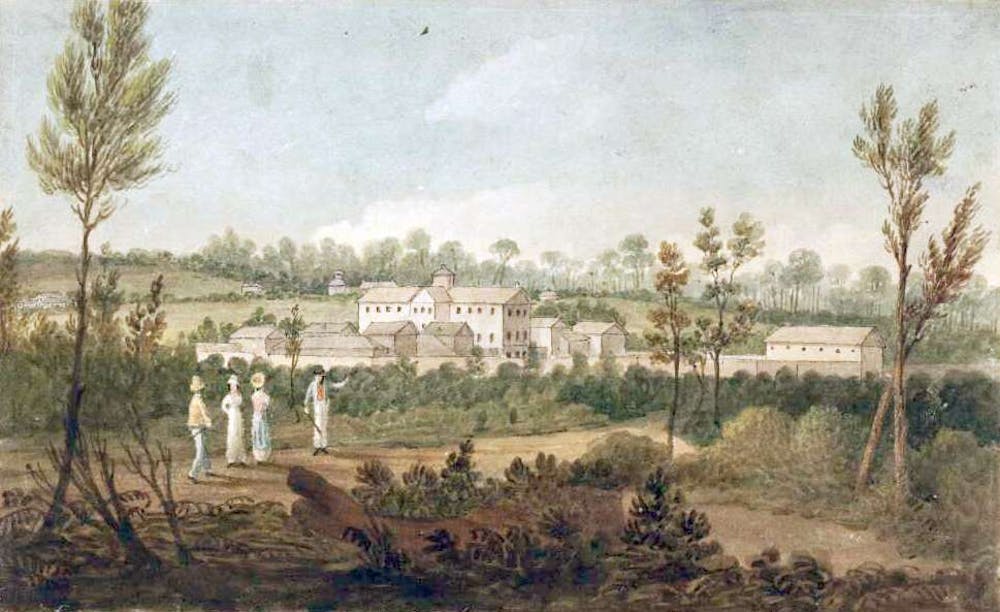
Yet convict women used such language to mock and defy authority. When one woman in the colony of Sydney was threatened with being flogged for using obscene language towards her master, she replied to his threat using more bad language.
Augustus Earle’s painting of the Parramatta Female Factory, circa 1826. Convict women often used bad language to mock authority.Wikimedia Commons
While convicts could be punished for “insolent” language, by the middle of the 19th century, vagrancy laws were used to control the use of “profane” and “obscene” language in public. Colonial newspapers and court records reveal a large number of such cases were brought before police magistrates. And many of those charged were women.
One called her husband a “bloody bugger” while in a pub. Another called her female neighbour “a bloody whore and a bloody bitch”.
While men swore often, women’s bad language was far more likely to be of concern. An 1850 commentary, published in the Moreton Bay Courier, called on husbands to exercise their authority and prevent wives from publicly using “obscene and filthy language”.
Women could also be charged as being “common scolds”, a common-law charge originating in English law often used to control those considered to be “public nuisances”. Colonial newspapers reveal that many of the cases involving these charges were disputes between neighbours.
In 1849, for instance, two women were accused of being common scolds by their neighbours because of their constant quarrelling and use of the “most obscene and blasphemous language”.
A question of class
Women charged with these kinds of offences were predominantly working class. Alana Piper and Victoria Nagy’s study of female prisoners in Australia from 1860 to 1920 reveals the bulk of women’s offences were minor, and included “disorderly, indecent or riotous behaviour” and obscene and abusive language.
Middle-class women’s speech was not publicly policed. It was, rather, contained through the norms of respectability. An 1885 Australian etiquette manual instructed women to avoid “vulgar exclamations”.
Diggers, seen here in a trench at Lone Pine in 1915, were renowned for their swearing.Wikimedia Commons
Yet popular culture embraced a masculinist mythology of Australian swearing. By the end of the 19th century, swearing could be a source of humour and even seen as something acceptable if used by certain types, such as the bullock driver (notorious for his swearing), and the bushman.
The hard work required of these men excused such language. This justification (and even embrace) of male swearing culminated in the first world war “digger”.
The bad language of the larrikin digger ranged from the more acceptable “bloody” and “bastard” to words such as “bugger” and “fuck”. The Australian soldier was renowned for his swearing as well as his slang.
If the first wave of Australian feminists sought to operate from a position of respectability, second wave feminists embraced the possibilities offered by flouting such respectability.
Amid the counterculture of the 1960s and 1970s, and the associated women’s liberation movement, bad language was used to challenge prevailing social and cultural norms. Women such as journalist and activist Wendy Bacon and feminist author and academic Germaine Greer became known for (and even subject to charges for) their bad language.
Germaine Greer in 1972.AP
Bacon was charged initially as an editor of an edition of the UNSW magazine Tharunka that had included the poem “Cunt is a Christian word”.
She protested the trial wearing a sign reading, “I have been fucked by God’s steel prick” and was charged for wearing an obscene publication. She was ultimately sentenced to eight days in prison.
But if words such as “fuck” and “cunt” could be used to shock, they were also part of a feminist reclamation as women claimed control over their bodies and their sexuality.
Swearing today
Swearing today can still be seen as more easily claimed by men than women, but this has slowly shifted.
Women comedians, writers, and activists have all played a role in claiming a right to use bad language. For example, women comedians such as Kitty Flanagan and Jane Turner and Gina Riley (best known as Kath and Kim) have made clever use of swearing in their performances.
The use of swearing by women in public has been increasingly normalised. Yet women are still more likely to be judged for swearing, which can still be seen as “unladylike”. And for some, the swear words themselves can be problematic with their references to women’s body parts and objectification of women as sex objects.
Scott Morrison has encouraged federal public servants to engage with their Chinese counterparts, saying these are important connections particularly given the tensions in the bilateral relationship.
Answering a question during a virtual forum on Wednesday with federal bureaucrats, Morrison said officials were not burdened like ministers or prime ministers with “the overlays of the international relations”.
“One of the advantages that you would have is to be able to engage on the technical, on the direct, leverage on the relationships that you already have.
“I would see that as an important connection, particularly at a time when there are tensions – and of course there are tensions,” Morrison said. “In those circumstances, we rely more on these official engagements.”
Australia’s trading relationship with China is presently bedevilled by the imposition of impediments on a range of Australian exports; Trade Minister Simon Birmingham and other ministers have not been able to get their phone calls returned by their Chinese counterparts.
Speaking earlier this week, Morrison emphasised that Australia “desires an open, transparent and mutually beneficial relationship with China as our largest trading partner”.
The Secretary of the Foreign Affairs Department, Frances Adamson, said in a Wednesday speech that China may now wrongly believe it can largely set its terms of future engagement with the world.
Adamson said with its rising economic weight “unsurprisingly … China wants to set, rather than merely adopt, international standards. China wants to lead, rather than simply join, international institutions.”
China’s economic recovery from the COVID crisis would be important in how the region and the world came out “from what threatens to be a long and uneven recovery from the COVID-recession,” she said.
“But the questions around China are much more wide-ranging than simply its economic approach. No power this large and globally integrated can escape scrutiny or debate,” she said.
“The rest of the world has done a lot of thinking about China’s power and what it means.
“But it is less apparent that China has carefully considered other countries’ reactions to its conduct internationally. China may have reached a point where it believes that it can largely set the terms of its future engagement with the world.
“If it has, it is mistaken – and that is because there is far more to be gained for China, and for everyone else, through working constructively and collaboratively within the international system, without resort to pressure or coercion.”
At the public service forum, the CEO of the Australian Fisheries Management Authority, Wez Norris, said for those in the “weeds” of Australia’s administrative dealings with China “there doesn’t appear to be a lot of consistency in … how we go about trading off things like domestic commercial interests against our wider trade and relationship interests”.
Morrison said in his reply that the Chinese government had said publicly that “they are not engaging in any sort of political activity in relation to these quite specific issues that are arising in trade.
“Well, we take that at face value, but that is a line and a position that I would have thought that officials can actually repeat in being able to engage on the technicalities.
“Whether it’s dealing with issues on barley or fisheries or any of these sorts of things where there are technical matters being raised … we’ve just got to work the problem.
“That’s what I’m relying on officials to do. I’m not asking officials to solve the international relations issue, that falls to me and ministers and others.”
Morrison said it was “a complex and … difficult environment”. His message to the officials was “keep up the connections and do all you can to improve them and keep the dialogue going at that level, because business and industry are relying on that to enable us to try and mitigate the impact of some of these measures that are being introduced” by the Chinese.
The “stuff” that went on between politicians and leaders was “not something that should have to trouble the working relationship that you’re engaged in”.
Labor’s foreign affairs spokeswoman Penny Wong said Morrison should do more to seek to resolve the problems in the trading relationship with China “at leadership level”.
Campaigners at a TAPOL-hosted global webinar have called on the people of Australia, New Zealand, United Kingdom, United States and other countries to stop funding military training for Indonesian security forces who are “killing innocent West Papuans”.
Rosa Moiwend, a member of the War Resisters International, said West Papuans wanted to live peacefully without any oppression by the military – this was the hope of the indigenous Melanesian people.
“If your government is actually behind this scenario, I think the main thing you have to do is to go and talk to your government, Parliament members and question them about your tax money,” she said.
“Where does your tax money go? Does it go to pay [for] the war or is the tax money used for the purpose of human lives?”
Moiwend said many people across the world loved peace and justice, so they were anti-military and war.
Stopping governments funding military training was a must for activists.
Moiwend, a strong Melanesian and Pacific woman, gave an inspiring message to activists around the world to stand up firmly and speak out about the arms business that was violating human rights and killing people everywhere, “including the lives of innocent West Papuans”.
Sharing militarist experiences An organiser said a key objective of the webinar was to give an opportunity to lawyers, activists, and supporters of a Make West Papua Safe campaign to share their experiences of militarisation and militarised policing.
Other speakers in the London-hosted webinar on Monday included Elijah Dacosta, a TAPOL campaigner; Yohanis Mambrassar, a lawyer for West Papuan human rights activists; Yones Douw, head of the justice and peace department of the Papua Kemah Gospel Church; author and researcher Jason MacLeod, co-founder of Make West Papua Safe; and Zelda Grimshaw, a Make West Papua Safe campaigner.
TAPOL (Tahanan Politik) is a British-based organisation campaigning for human rights and democracy in Indonesia.
“TAPOL was founded in 1973, and in the beginning the TAPOL campaign was focusing on releasing political prisoners in Indonesia,” said Dakosta.
But later the seriousness of military occupation became increasingly important.
“We have expanded to raise awareness on human rights issue in Aceh, East Timor and West Papua,” said Dakosta.
The Make West Papua Safe logo … campaign against Indonesian militarism. Image: PMC screenshot
Yohanes Mambrasar, a West Papuan lawyer gave an illuminating description on what has been happening over human rights violence by state institutions towards indigenous people of West Papua.
“There has been increasing repression. We are seeing violent actions by the TNI (Indonesian National Armed Forces) and police against unarmed peaceful civilians who are gathering to express their political aspirations. We can really see this increasing year by year, even month by month,” said Mambrassar.
Human rights advocacy Mambrassar who has been working on human rights advocacy said that during 2019 and 2020 “we are seeing this crackdown on protesting West Papuans.”
But they were also seeing a lot of violence towards villagers, who were suspected of supporting independence or having “separatist sympathies”, such as in Nduga, Intan Jaya, and other regions.
He said the violence was now extended to the virtual world where some people who disseminated information on social media such as Facebook and YouTube would face cyber-attacks. They were even physically attacked by the police or armed forces.
RNZ Pacific reports that Indonesian military denied shooting civilians in Papua. Papua’s police chief said that reports of a new military operation in the troubled Nduga regency were a “hoax”.
Church advocate Yones Douw … “right through until today the violence has continued.” Image: PMC screenshot
However, Yones Douw, head of the justice and peace department of KIMI church (West Papua Kemah Gospel Church), said that violence had never stopped since Indonesia had occupied West Papua.
“Really the violence has not changed since 1961 to 1969, 1969 to 2020, and 2020, when special autonomy was declared here in West Papua – right through until today the violence has continued,” said Douw.
Douw, a human rights activist, said that when special autonomy was introduced, Jakarta said that West Papuans would be 90 percent independent.
Promises ‘only words’ He said this was “only words – in fact, we have been seeing increasing violence”.
“So, if special autonomy went the way it was supposed to, West Papuan people should be protected and cared for. But that has not happened at all,” Douw said.
“Why is [the violence] increasing like this? Well, if you find a pastor who is speaking about the suffering of his congregation, he will be called a separatist. Anyone who speaks about human rights will be called as separatist, anyone who speaks about the welfare of Papuan people will be labelled as separatist,” he said.
He said that the Indonesian laws granting freedom of expression did not hold in West Papua. Even journalists, human rights activists, and some church leaders could not work without feeling a sense of fear.
“These are school students who are being shot, these are student who are walking around their own villages and without even any question they are being shot.
“Imagine what it is like if you are an older person, there is just no freedom at all to move,” said Douw.
Author Jason MacLeod … responding to students’ “go to hell” message to the Australian and New Zealand governments. Image: PMC screen shot
Stopping foreign support Jason MacLeod, co-founder of Make West Papua Safe, said he had collaborated with New Zealand activist Maire Leadbeater and Rosa Moiwend in launching this campaign.
The campaign was “to stop foreign government support for the Indonesian police and military,” said MacLeod.
He said it was a peaceful movement seeking to stop New Zealand and Australian government funding and training for the Indonesian police and military which every day brutally repressed the indigenous people of West Papua.
Brisbane-based MacLeod, who has been working on West Papua issues for the last 30 years, said the motivation behind the founding of the Make West Papua Safe campaign was in response to students speaking out in Jayapura.
Asked what they had thought about the New Zealand and Australian governments’ help for the Indonesian military, the students replied that both governments “can go to hell”, said MacLeod.
The activists, lawyers, and human rights defenders called on the people in Australia, New Zealand, United Kingdom, United States, the Pacific, Africa, Caribbean, Europe and Asia to raise their voices support of stopping military oppression in West Papua.
Contributed by a postgraduate communication studies student at Auckland University of Technology.
The increase in the compulsory superannuation contribution, legislated to rise next July from 9.5% to 10%, is being fiercely debated following the release of the retirement income report.
In this podcast we hear the views of Brendan Coates, Director of the Household Finances Program at the Grattan Institute and Greg Combet, former Labor minister, and chair of Industry Super Australia.
Coates, who opposes the July and later scheduled rises, says ultimately the money comes out of the worker’s pay because employers will increase wages more slowly.
Coates argues the present superannuation arrangements are adequate for most retirees who own their homes, and will be in the future.
Although he says retirees potentially face financial stress if renting, Coates wouldn’t favour letting people dip willy nilly into their super for a deposit on their first home. But “if the rate of compulsory super goes to 12% as legislated, I think the right answer is not … to let them take out their super for housing, it’s to let them take out anything above 9.5% each year” for any purpose.
Combet flatly opposes the use of super accounts for housing.
“If we are concerned about housing affordability and trying to lift the level of home ownership in the country, you don’t go and cannibalise another part of the retirement income system, the superannuation system.
“You address the issues of housing supply. You address the issues of housing affordability, and you can take some specific public policy measures for helping first home buyers.”
In response to the criticism that higher contributions will diminish wage growth, Combet says: “Let’s go back to the 90’s. Paul Keating promised to get to a 12% super guarantee. John Howard froze it… No compensating pay rises that are discernible anywhere.”
The Victorian government has announced an investment of nearly A$1.6 billion for public schools to ensure students with disability are supported in the classroom.
The money will double the number of students with disability receiving extra support to 55,000.
Further detail on the funding is imminent. But this seems to be news of a major upskilling (up to 1,730 jobs across the state by 2025) of the Victorian school workforce and a move towards a higher quality, inclusive school system.
But making Victorian schools truly inclusive involves changing the prevailing culture. A 2019 report highlighted multiple barriers to ensuring students with disability were included in in Australian schools.
They included widespread discrimination towards children with disability, and under-trained teachers.
When the Victorian government announced the new funding, it said:
A world-leading pilot in more than 100 schools will now be rolled out across the state, to identify and respond to the needs of students with disability.
We don’t know anything else yet about this pilot but the fact this basic knowledge has to be gained by a new initiative shows how much change is needed in schools to even approach inclusion.
Recently I gave evidence at the Disability Royal Commission and heard sadly familiar stories from families and students. Young people with a disability described how a “one size fits all” education failed to meet their needs.
The stories revealed that flexibility, empathy and compassion from teachers would have often made a huge difference. Vulnerable kids often become angry, demotivated and disengaged in classrooms with standardised teaching. This is because their needs are not being met or because often they simply can’t attain the same academic level as kids who don’t have a disability.
Worse still, when kids have misbehaved they are often “managed” or “disciplined”, or suspended and expelled. This pushes students with disabilities out of mainstream schools, into limbo or special provision — ultimately reducing their opportunities later in life.
So, how can Victorian schools use this investment?
1. Help teachers know how to best help students with disability
This is a golden opportunity for a socially just and quality education system in Victoria.
But schools and the state government should acknowledge the scale of challenges involved. They should reflect this in their planning, underpinned by funded research.
One challenge, for instance, is a chronic lack of knowledge among many teachers in regular schools about how to help students with disabilities learn, make friends and be part of the life of the school. This includes taking part in school performances and excursions.
Often, even if students are physically present, teachers don’t know how to adapt the curriculum (what subject content needs to be taught) so students with disability can make progress in mathematics or literacy for example.
Funded, evidence-based and accredited professional learning for Victorian teachers, accompanied by high quality applied examples, can help address this gap in knowledge. This will also provide professionals with confidence that inclusion can succeed.
2. Address the systemic dysfunction that blocks inclusion
Some education policies work against inclusion. For instance, policies like NAPLAN act as disincentives for schools to enrol students with disabilities if they believe they won’t attain strong test results. Such beliefs can prompt illegal gate-keeping practices such as those highlighted at the recent Disability Royal Commission.
Applied research, which asks professionals what’s preventing inclusion and what can be done to address cultural or systemic barriers, would help make smart decisions on spending this funding.
International studies reveal many educational initiatives falter over time. Schools quietly drop newly learned practices and return to custom, however ineffective or unjust. For example, Positive Behaviour Interventions and Support is an effective program tens of thousands of US schools have used to help students with social, emotional and behaviour issues. Unfortunately the program seems to be faltering in some US schools. This is because schools have returned to their punitive approach (three strikes, you’re out) to problem behaviours.
Studies have identified steps to avoid this problem. The first step is having a thorough, research-based assessment around the needs and resources necessary. It’s not clear if the Victorian government has completed this step.
3. Target the funding
Targeted initiatives can make the most of Victoria’s investment. A funded travelling behaviour roadshow, staffed by behaviour specialists, could provide mobile advice statewide for parents and schools on how to improve young people’s behaviour — avoiding the use of suspension or expulsion from school.
Expert advice and support could be provided on-site to help teachers use effective and evidence-based strategies.
Research has suggested promising new approaches to behaviour, which are already successfully used in health and psychology but need to be adapted to use in schools. Cognitive behavioural therapy is one example.
A direct investment approach like this avoids paying expensive private consultants and commercial organisations out of public funding to implement change. This is a common problem affecting public educational initiatives.
4. Ensure these changes are sustained
To ensure the education system sustains these changes, our future teachers need to be included. The state government should partner with organisations offering teacher education in Victoria.
Students who may have previously been ineligible for targeted support — such as those with autism, dyslexia or complex behaviours — are included in the funding announcement.
Successful initiatives in England have targeted dyslexia and funded accredited postgraduate programs for teachers providing the advanced knowledge required to identify and support students with dyslexia. Teachers gained specialist teacher status.
Universities offering teacher education programs and the state government can work together to ensure the content of teacher education programs is tweaked to reflect this priority and fully prepares the school workforce.
Many of us are aware of the enormous threat of antibiotic- (or “antimicrobial”) resistant bacteria on human health. But few realise just how pervasive these superbugs are — antimicrobial-resistant bacteria have jumped from humans and are running rampant across wildlife and the environment.
My research is revealing the enormous breadth of wildlife species with superbugs in their gut bacterial communities (“microbiome”). Affected wildlife includes little penguins, sea lions, brushtailed possums, Tassie devils, flying foxes, echidnas, and a range of kangaroo and wallaby species.
To combat antibiotic resistance, we need to use “One Health” — an approach to public health that recognises the interconnectedness of people, animals and the environment.
Tackling antimicrobial resistance with One Health requires studying resistance in bacteria from people, domesticated animals, wildlife and the environment.
Tasmanian devils are among the species we’ve found harbouring resistant bacteria.Shutterstock
Humans have solely driven the emergence and spread of antimicrobial-resistant bacteria, mainly through the overuse, and often misuse, of antibiotics.
The spread of superbugs to the environment has mainly occurred through human wastewater. Medical and industrial waste, which pollute the environment with the antibiotics themselves, worsen the issue. And the ability for antibiotic-resistant genes to be shared between bacteria in the environment has propelled antimicrobial resistance even further.
Generally, wildlife closer to people in urban areas are more likely to carry antimicrobial-resistant bacteria, because we share our homes, food waste and water with them.
For example, our recent research showed 48% of 664 brushtail possums around Sydney and Melbourne tested positive for antibiotic-resistant genes.
Hundreds of possums around Sydney and Melbourne have resistant bacteria.Shutterstock
Whether animals are in captivity or the wild also plays a role in their levels of antimicrobial resistance.
For example, we found only 5.3% of grey-headed flying-foxes in the wild were carrying resistance traits. This jumps to 41% when flying-foxes are in wildlife care or captivity.
Likewise, less than 2% of wild Australian sea lions we tested had antibiotic-resistant bacteria, compared to more than 40% of those in captivity. We’ve found similar trends between captive and wild little penguins, too.
And more than 40% of brush-tailed rock wallabies in a captive breeding program were carrying antibiotic resistance genes compared to none from the wild.
So why is this a problem?
An animal with antibiotic-resistant bacteria may be harder to treat with antibiotics if it’s injured or sick and ends up in care. But generally, we’re yet to understand their full impact – though we can speculate.
We’ve found new types of resistant genes in flying-fox communities.Shutterstock
For wildlife, resistant bacteria are essentially “weeds” in their microbiomes. These microbial weeds may disrupt the microbiomes, impairing immunity or increasing the risk of infection by other agents.
Another problem relates to how antimicrobial-resistant bacteria can spread their resistant genes to other bacteria. Sharing genes between bacteria is a major driver for new resistant bacterial strains.
We’ve been finding more types of resistant genes in an animal’s microbiome than we do in comparison to commonly studied bacteria, such as Escherichia coli. This means some wildlife bacteria may have acquired resistance genes, but we don’t know which.
Many of the wildlife species we’ve examined also carry human-associated bacterial strains — strains known to cause, for instance, diarrhoeal disease in humans. In wildlife, these bacteria could potentially acquire novel resistance genes making them harder to treat if they spread back to people.
This is something we found in grey-headed flying-fox microbiomes, which had new combinations of resistant genes. These, we concluded, originated from the outside environment.
How do we mitigate this threat?
Antimicrobial stewardship — using the best antibiotic when a bacterial infection is diagnosed, and using it appropriately — is a big part of tackling this global health issue.
The World Health Organisation appointed the Environment Minister Sussan Ley to a global leaders group to fight antimicrobial resistance.AAP Image/Mick Tsikas
The 2020 strategy builds on a previous strategy by better incorporating the environment, in what should be a true “One Health” approach. The World Health Organisation’s appointment of Ley supports this.
Antimicrobial stewardship is equally important for those in veterinary fields as well as medical doctors. As Australia leads the world in wildlife rehabilitation, antimicrobial stewardship should be a major part of wildlife care.
For the rest of us, preventing our superbugs from spilling over to wildlife also starts with taking antibiotics appropriately, and recognising antibiotics work only for bacterial infections. It’s also worth noting you should find a toilet if you’re out in the bush (and not “go naturally”), and not leave your food scraps behind for wild animals to find.
The 2020 strategy recognises the need for better communication to strengthen stewardship and awareness. This should include education on the issues of antimicrobial resistance, what it means for wildlife health, and how to mitigate it.
Citizens tackle antibiotic resistance in the wild.
This is something my colleagues and I are tackling through our citizen science project, Scoop a Poop, where we work with school children, community groups and wildlife carers who collect possum poo around the country to help us better understand antimicrobial resistance in the wild.
The power of working with citizens to better the health of our environment cannot be overstated.
Parents have faced unprecedented stress during the pandemic as they care for children while juggling paid work from home.
However, very little research so far has focused on family well-being during the pandemic.
So we asked more than 2,000 parents to tell us in their own words about the pandemic’s impact on their families. We did this in April 2020, during Australia’s first lockdown. Our publishedstudy is the largest of its kind in Australia, and one of very few internationally looking into families’ experiences of the pandemic.
Families’ responses followed six key themes.
1. Boredom, depression and mental health
Parents reported a spectrum of emotions. They said they and their children were stressed, trapped and bored. New and existing mental health conditions also challenged the equilibrium in a number of families. One mother of two children said:
My mental health has taken a really bad hit and I’m struggling to support my children.
2. Families missed things that keep them healthy
Families missed sport, extracurricular activities, visits with family and friends, playgrounds, places of worship, trips to connect with the natural world, and other family supports. A mother of three children said:
We used to see family, friends, go to church and do kids’ activities like playgroup a lot […] Cutting all of that out to stay home has been hard. We miss being able to see our family and friends, to do activities outside of home that are more than a walk around the block. We’re all tense and exhausted.
3. Changing family relationships
Family relationships changed, which we called the “push-pull of intimacy”.
Strained relationships were common, including increased conflict and arguments between parents, parents and children, and between siblings.
The demands of caring for children was a source of discord, requiring more from already exhausted parents or creating tension in the family as a result of bickering and fighting as a result of being “cooped up”. One mother of two said:
We have too much time together. We are often irritable with each other. My child wants more social interaction from me that I can’t give.
For many, there was a sense that goodwill between family members was “wearing thin”. But in some families, closer bonds emerged. A father of three said:
It’s been great. Lots of quality time together.
Families faced many new challenges during lockdown.Shutterstock
4. The unprecedented demands of parenthood
The loss of important structures in the community, particularly schools, reveals the extent to which such institutions play a pivotal role in raising healthy families and children, with parents alone unable to provide the proverbial village that children need. A mother of three said:
COVID-19 had turned me into a stay-at-home mum, primary teacher, speech therapist, occupational therapist, strict budgeter, with no social outlet or relief. And I’m doing this alone with my health-care worker husband being overworked.
5. The unequal burden
For people with physical or mental health conditions, lockdown restrictions were especially hard to endure. A father of one child told us about his family’s experience of being confined to a small space:
My wife is on the spectrum which makes being in a confined space with others quite difficult for her — and those around her. Confined space gives her little room for calming, so her anger events have increased.
Families living in small apartments with limited outdoor space were also highly challenged, using words such as “suffocating” and “going insane”. Families facing economic worries were also a group in need. A single mother of two children said:
Shopping alone is now a huge stress as I don’t want to expose my babies […T]he price rise in food has caused us now to only be able to buy enough food for a week so we are having less in each meal to ensure the children eat three meals a day. Most days I now miss meals so they can eat.
6. Holding on to positivity
Parents told us the pandemic provided an opportunity to cultivate “appreciation”, “tolerance and understanding” as well as “learning to cope and develop patience”.
Some parents said they were grateful for what they had and were relatively fortunate compared with others.
Parents were also grateful for access to the internet, a safe space to call home, enough food to eat, time to spend together, good health, financial stability and “having enough”. One mother of two children said:
I was quite panicked to begin with, but the kids love being with us all the time and are building relationships with each other.
Our large, diverse sample of Australian parents captured a range of experiences. Although more than 80% of our participants were mothers, we also heard fathers’ experiences.
Some of these experiences are likely to be similar to those of families around the world. However, the Australian experience may also be unique. Coming out of a tragic season of bushfires, many families may have already had stretched emotional and financial resources to handle another crisis.
The unique experiences of Victorian families, who endured a second period of longer and harsher lockdown, are worthy of follow-up research, as their resilience was likely pushed to the limit.
COVID-19 is not over, and we need to continue to ask parents and individuals how they are doing. Studies like ours, together with those comparing family experiences around the world, will also help researchers, policymakers, and service providers understand how to preserve community and family supports if we have future lockdowns or pandemics.
If this article has raised issues for you, or if you’re concerned about someone you know, call Lifeline on 13 11 14.
As Australian consumers step out of their loungewear post-lockdown, many might be looking to buy new clothes for themselves or as gifts.
Whether you’re buying sweatpants or sequins, online or in-store, ethical fashion shopping can be confusing. There are so many terms, certifications, and accreditation systems — not to mention the marketing spin and corporate greenwashing — to navigate.
Our recent research examined the impact modern slavery laws have had on consumer awareness about ethical fashion, as part of a larger project on modern slavery.
We surveyed over a hundred participants, conducting additional interviews with 22 of them via Zoom during July and August 2020. They told us that although they felt well informed about the broader issues, they struggled with knowing what was truly ethical or sustainable at the point of purchasing an item.
Our work coincides with research, released by Oxfam today, showing big Australian fashion brands entrench worker inequality and poverty — especially for women — with unethical businesses practices.
Modern slavery
The introduction of the Modern Slavery Act in 2018 made Australia one of only a handful of places with legislated reporting requirements on modern slavery practices. The Act requires large companies to report on the supply chains that sustain their businesses. It also potentially serves to reassure consumers about where and how their clothes are made. Or does it?
Workers in the global fashion supply chain, such as these Indonesian seamstresses, come under Australia’s modern slavery laws.Rio Lecatompessy/Unsplash, CC BY
Many of our research participants felt overwhelmed when trying to locate and interpret information about where, how and by whom their garments are made. One interviewee said:
I feel really conflicted because [Japanese megastore] Uniqlo is so good for basics and often they’re made out of good materials like linen but I know that they are not great, not very sustainable, not very ethical … it’s hard.
Those wanting to be “conscious consumers” find that they need to get acquainted with accreditation and certification systems, stay up to date with ethical shopping guides, and know what it means for garment workers to receive a living wage or be a union member.
Participants also recognised that the time, energy and resources necessary to make informed decisions are not available to everyone.
Many participants were deeply sceptical of the corporate packaging of sustainability and ethical production. The renewed popularity of secondhand and vintage fashion indicates some consumers are mitigating confusion by opting out of buying new things altogether.
Nevertheless, there is considerable trust for flagship eco-brands such as Patagonia, as well as smaller labels that connect consumers with the garment maker or material sourced. The shoppers we interviewed said they trusted local fashion labels such as Arnsdorf and online marketplaces such as Well Made Clothes over larger corporate entities.
The fashion industry’s big retailers promote products that meet ethical or sustainable standards, such as David Jones’ Mindfully Made collection, the Iconic’s Considered Edit, and Kmart’s partnership with the Better Cotton Initiative.
Very few participants were aware of the Australian Modern Slavery Act. Most believe that “modern slavery” refers only to “off-shore” production, not garment workers in Australia. In fact, the Act requires Australian businesses to report on modern slavery risks in both global and domestic operations.
• Oxfam has previously published an annual Naughty or Nice List. Oxfam has released a new report and company tracker to show how big brands and their factories rate in terms of providing a living wage to workers — who are mostly women. Poor purchasing practices included aggressive price negotiation, inaccurate forecasting of orders, short lead times and last-minute changes to orders — all of which can make working conditions tougher.
Oxfam found that H&M Group performed relatively well on ratings by factories. Big W, Kmart and Target Australia were close behind, followed by Cotton On, Inditex (Zara) and Myer. The survey results show that factories rated The Just Group and Mosaic Brands as the worst performers.
Our Modern Slavery consumer research indicates that shoppers recognise the challenges of conscious consumption and their own tendency to “suspend their ethics” when they feel overwhelmed by information, judge their need for an item as “urgent”, or are simply seduced by an appealing garment.
The last thing I bought was actually totally different to my usual shopping habits … I bought a fast fashion thing [online], which I never do!
Many shoppers reported buying consciously for themselves but giving up when it came to purchasing clothes for their children or other family members.
I would say the vast majority of what I buy for the kids is definitely not ethical.
Recognising consumers’ challenges and good intentions is crucial if we are to improve the ethics of the global fashion system.
Rather than simply increasing the number of certifications or accreditations brands should adhere to, our research suggests we would do better to increase consumer knowledge of those that already exist — and what they mean in practice.
Source: The Conversation (Au and NZ) – By Swati Nagar, Lecturer, International Business, Strategy and Entrepreneurship, Auckland University of Technology
The COVID border restrictions might be saving lives but they’re also threatening the livelihoods of New Zealand farmers, unless a way can be found to allow Pacific Island seasonal workers to return and pick the crops.
Since its inception in 2007, the Recognised Seasonal Employer (RSE) scheme has enabled thousands of Pacific workers to be employed on New Zealand’s farms and orchards for around four months each year.
But not this year, due to the stringent border controls. Workers already in New Zealand when the borders closed have since been repatriated, leaving a severe workforce shortage.
As we head into peak harvest time, growers can only watch and wait as NZ$9.5 billion worth of fruit and vegetables go unpicked and risk rotting in place.
If this summer’s crops quite literally go to the birds, then farms may go under, families will suffer and consumers will see the price of seasonal produce skyrocket. The recent NZ$30 a kg price of courgettes — more than triple the normal price — was a warning.
Aside from allowing migrant workers to return safely, the other often proposed solution is to encourage newly unemployed Kiwi job seekers to do the work. Both present challenges.
Market signals: the price of courgettes tripled due to the cost of picking during a critical labour shortage.www.shutterstock.com
The problems with picking
Leading growers say the arduous nature of the work makes it difficult to attract and retain domestic workers — even in an economic recession.
Too often billed as “unskilled”, crop picking is actually highly specialised work. Growers invest time and money training seasonal workers to ensure their crops are harvested correctly and handled with the care needed to command good prices.
Such investments show the relationship between many growers and pickers is more than simply transactional. For many, it’s an ongoing, personal and professional engagement that is renewed annually.
The average domestic worker — particularly those who have never considered crop picking — may simply not have the skills or availability required for the job.
As for the money, farm workers receive a minimum wage (NZ$18.90 an hour) base rate, plus holiday pay. If they want to earn more, labourers can work more hours or pick more fruit.
Figures from the industry show the average pay over the past season ranged from NZ$21.64 to NZ$27.36.
Low pay is an issue
Ironically, the RSE scheme itself is at least partially to blame for the low rates of pay. The introduction of the scheme capped most jobs in the agriculture and horticulture sectors at NZ$20 an hour.
While this is considered a relatively high rate for migrant workers, domestic workers may not view it as a sustainable income.
However, some growers believe paying more may not necessarily generate greater interest from domestic workers. One Waikato berry farm owner who has been working with the Ministry of Social Development to hire domestic workers has said people “weren’t applying”.
Logistics are also a challenge for many unemployed domestic workers. Rural, seasonal work may be geographically distant or simply not realistic as a solution to long-term unemployment.
The disruptive nature of the job also creates problems with childcare and other domestic responsibilities, as well as maintaining a work-life balance. Those issues are less pressing for migrant workers who arrive with the sole purpose of earning, and whose families and networks are prepared for their absence.
Towards a migrant solution
Though the government has begun investigating a possible trans-Pacific travel bubble, it may well be months before that becomes a reality.
Given the urgency of the situation, one solution lies in restructuring the current government-run Managed Isolation and Quarantine (MIQ) system — perhaps using an adapted public-private partnership (PPP) model.
These MIQ facilities could be dedicated to accommodating Pacific Island migrant workers employed under the RSE scheme. The facilities would be funded and resourced privately by the agricultural industry, in strict compliance with Ministry of Health requirements.
One leading grower who sees the benefit of the idea is Francie Perry of Perry’s Berries, New Zealand’s largest strawberry grower:
We’ve got a facility that would be suitable for quarantine and we could quarantine 71 people in it and that would get us through.
It’s commendable the government is encouraging the industry to find ways around its reliance on offshore workers and offer greater incentives to attract and retain Kiwi employees.
Collaborating to establish an apprenticeship programme to encourage young New Zealanders to consider employment in our horticulture and agriculture sectors makes sense.
But this is a long-term vision, not a solution to the immediate crisis.
In the interim, a public-private approach to managed quarantine offers a viable solution that will benefit both the industry and the workers desperate to return to our fields, farms and orchards. The time to act is now.
Throughout 2020, there have been vocal and highly visible protests in Thailand against the government of Prayut Chan-o-cha, who led the 2014 coup against the government of Yingluck Shinawatra. He then became the head of the junta that ruled Thailand until 2019.
The people taking to the streets are young, educated, urban Thais. As a group, they bear little resemblance to the “redshirt” protesters of 2010, or the older generation of Democrat Party supporters who followed Suthep Thaugsuban onto the streets in 2014.
This constitution unsurprisingly guaranteed a major role for the military in a quasi-democratic structure of government. In particular, the military was to nominate the 250-member Senate in the bicameral legislature. Elections for the lower house, the House of Representatives, were set for 2019.
In the event, the military and the established political parties, in particular the Palang Pacharath Party (which was formed to enable senior military officers to run for parliament), the Democrat Party and Pheu Thai, the successor to the Thai Rak Thai party established by Thaksin Shinawatra, were much taken aback by the emergence and substantial success of a new party known as Future Forward (FF).
Thai Prime Minister Prayut Chan-o-cha.AAP/Royal Thai government handout
Future Forward won 18% of the popular vote and 81 of the total of 500 seats, the third-largest number of seats. The new government, a coalition dominated by Palang Pracharath, quickly concluded the success of the new party was bad news. It deployed the Election Commission, later backed by the Constitutional Court, to dissolve the party and ban its principal leaders (Thanathorn Juangroongruangkit and Piyabutr Saengkanokkul) from holding political office.
This was met with outrage by young people attracted by the leadership of Future Forward and its policies – particularly control of the military, public social expenditure, and the substantive decentralisation of government. Its dissolution ushered in several months of “flash mobs” of protesters at unheralded locations, mainly in Bangkok. That has evolved into more formally organised protest rallies from the middle of this year.
Taking to the streets
There was a large rally in the vicinity of the Grand Palace, home to Thailand’s king, in August. Protesters demanded the government resign and the monarchy’s place in Thai governance be reformed. They also wanted a new constitution and an end to the harassment of protesters.
On September 19, a further rally at Democracy Monument led to a march on Government House in Bangkok. Before the day was over, the protesters had crossed paths (some say by police design) with a royal motorcade carrying the queen and crown prince, and the protesters and police tangled outside Government House.
The prime minister’s reaction was to extend an existing state of emergency (put in place as part of an attempt to control the spread of COVID-19) to include a ban on assemblies of more than five people.
Pro-democracy protesters push a police bus in an attempt to break through a barricade on their way to Government House in Bangkok.AAP/EPA/Diego Azubel
The following evening, thousands gathered at Ratchaprasong intersection in the commercial heart of Bangkok in defiance of the limitation on assembly (which was dumped in the following days).
Since then multiple rallies have been held at various points throughout Bangkok, unannounced except on social media (notably the messaging app Telegram).
The tone of the police response to the protests changed at a large rally outside Parliament House in November. Inside, parliament was discussing seven proposals for constitutional reform; outside, the police used a water cannon and tear gas on the large crowd of protesters. At least 41 people were injured, with reports of five wounded by gunshot.
A water cannon had been used on an earlier occasion, after which the police committed not to deploy the weapon again.
What happened inside parliament house was a “stitch-up”: in setting the agenda for discussions of a new constitution, the majority of the members of parliament repudiated the one proposal supported by the protesters, the iLaw proposal.
The iLaw proposal was the only one to call for the revocation of all of the policies introduced by the military junta, the NCPO, to restore an elected Senate and the practice of selecting a prime minster from among elected members of the parliament. It would also ensure that constitutional reform would not exclude reform of the monarchy.
The two proposals deemed acceptable by the government and opposition parties in parliament, which will presumably now be reconciled with each other, do not include any of these features.
In response to police actions, the protesters marched on police headquarters and threw pots of paint at the entrance. With confrontations between police and protesters becoming increasingly violent, the prime minister has also indicated the gloves are off.
Too late for compromise?
The next rally is set for November 25 at the office of the Crown Property Bureau. That means taking the fight right up to the king, whose recent appropriation of assets of the Crown Property Bureau was critical in prompting the protesters’ demand for reform of the role of the monarch.
Royalists, supporters of the king, have become more vocal and numerous and obvious in their bright yellow clothing at their rallies, and may be expected to turn out at the offices of the CPB.
The protesters are young. They are represented as being one side of a generational divide. They are vulnerable to being charged under Section 112 of the criminal code that specifies the crime of lese majeste, which forbids criticism of royalty.
But perhaps they are sheltered: the young protesters are in many cases the progeny of the older generation of supporters of the present government; their material interests, are the material interests of the earlier generation. Those interests in turn have been protected by the government.
All the same, the younger side of the generational divide has met again the profound disdain of their elders. Arguably a line has now been crossed. As a prominent protest leader, Jatupat “Pai Dao Din” Boonpattarasaksa, has proclaimed, the time for compromise has passed.
This means we need to be thinking more carefully about how the roll-out will work. This includes looking at a no-fault compensation scheme in the rare and unlikely event someone is harmed by a COVID-19 vaccine.
Most Australians would get vaccinated … but not all
Many Australians will be eager to be vaccinated against COVID-19 as soon as possible. Research in April found nearly 86% of Australian adults surveyed would have a vaccine.
But a significant proportion of people are either unsure about the COVID-19 vaccine, or say they would not have one. This could affect the uptake rates needed for community protection.
CSL in Melbourne has already begun manufacturing the AstraZeneca vaccine.Darrian Traynor/AAP
In October, a survey done for the ABC also found only 70% of respondents thought a vaccine would be “safe” or “mostly safe”.
Vaccines are rigorously tested and monitored for safety prior to, during, and after administration. But most of us have not given these background processes much thought until recently.
Adverse reactions to vaccination are typically minor, such as brief soreness at the injection site. Sometimes a reaction will need medical attention and cause a short or long-term health impairment. A serious adverse reaction following vaccination is extraordinarily rare.
For Australians who would not automatically get a COVID vaccine, their trust and confidence in both the vaccine and the system could be bolstered if they knew they would be taken care of in the extremely unlikely event of a serious adverse reaction.
Existing protections are not good enough
In the recent federal budget, the government promised to indemnify vaccine manufacturers if members of the public were to sue following an adverse reaction.
This would make the companies feel safe about operating in the country. However, it is a missed opportunity to also make the public feel safe about what would happen following an adverse event.
Usually, an injured victim must bring a case to court in order to receive compensation. To win, the victim must demonstrate they suffered a harm, the defendant was at fault, and there is a causal connection between the defendant’s fault and the harm. This is more complex than it sounds.
A further problem is that when it comes to vaccinations, extremely rare adverse reactions often occur without negligence. This means there is no one to sue.
Why a no-fault scheme makes sense
A no-fault compensation scheme removes both the adversarial nature of litigation and the onerous requirement of establishing fault.
An injured party is only required to demonstrate they suffered a harm and some form of causal link between the harm and the vaccine.
These schemes already exist in most high-income countries — including the United Kingdom, United States and New Zealand — for non-COVID vaccines.
However, to date, Australia has not had a no-fault compensation scheme for vaccine injury, despite policies that compel Australians to vaccinate their children.
Other countries are leading the way
The lack of no-fault scheme in Australia is problematic in general. In the current pandemic, this policy gap is even more of a concern.
The COVID-19 vaccine will need to meet rigorous safety and efficacy criteria to be approved in Australia. However, the truncated timeframe for its development means governments need to be prepared for any unknowns.
Experts in the UK are also looking at a specific compensation scheme for a COVID vaccine.John Cairns/AP/AAP
Some might conclude the National Disability Insurance Scheme could take care of anybody who suffered an adverse event following vaccination. However, the NDIS follows fundamentally different logic, in that it provides services for people living with disability, rather than compensating for an injury.
Other countries with existing no-fault compensation schemes are on the front foot to deal with this issue. So far, some experts in the UK have called for a “bespoke” scheme just for a COVID vaccine rather than using existing systems. This is because the rare adverse events that may follow COVID-19 vaccination are as yet unknown.
So, how should Australia design one?
The roll-out of a COVID-19 vaccine provides a unique opportunity for Australia to implement either a standalone scheme for COVID-19 in the first instance, or move straight to a more comprehensive scheme to cover all vaccines.
There are numerous funding options available. We believe this should be funded out of general government revenue — through the tax system — as this can be targeted towards different incomes and reflects the fact it is a common good.
There are risks in implementing a no-fault compensation scheme, either for routine vaccination or COVID-19. In the US and the UK, such schemes have not necessarily reassured people about vaccine safety, and in some cases have created narratives for anti-vax activists (that certain vaccines are “dangerous”).
However, the absence of such a scheme leaves our country open to scare campaigns about unforeseen injuries. This could place our entire vaccination program in jeopardy.
Aside from the damage of a “bad news” story, we also need to make sure people are properly compensated if they are the rare victims of a vaccine that benefits everybody.
The time of thinking about vaccination as an individual matter is over. Similarly, it is time to stop leaving the rare risk of vaccine injury as a burden on individuals.
Storms or tropical cyclones usually get the blame when Australia’s beaches suffer severe erosion. But on the New South Wales north coast at Byron Bay, another force is at play.
Over the past six months, tourists and locals have been shocked to see Byron’s famous Main Beach literally disappearing, inundated with water and debris. In October, lifesavers were forced to temporarily close the beach because they couldn’t get rescue equipment onto the sand. Resident Neil Holland, who has lived in the area for 47 years, told the ABC:
It’s the first time I’ve seen it this bad in all the time that I’ve been here, and it hasn’t stopped yet. The sand is just being taken away by the metre.
So what’s happening? To find the answer, we combined a brief analysis of satellite imagery with previous knowledge about the process behind the erosion and how it has been occurring at Byron Bay. The erosion is due to a process known as “headland bypassing”, and it is quite different to erosion from storms.
What is headland bypassing?
Headland bypassing occurs when sand moves from one beach to another around a solid obstruction, such as a rocky headland or cape. This process is mainly driven by wave energy. Along the coast of southeast Australia, waves generate currents that move sand mostly northward along the northern NSW coastline, and on towards Queensland.
However, sand does not flow evenly or smoothly along the coast: when sand arrives at a beach just before a rocky headland, it builds up against the rocks and the beach grows wider. When there is too much sand for the headland to hold, or there’s a change in wave conditions, some sand will be pushed around the headland – bypassing it – before continuing its journey up the coast.
This large lump of moving sand is called a “sand pulse” or “sand slug”. The sand pulse needs the right wave conditions to move towards the shore. Without these conditions, the beach in front of the pulse is deprived of sand and the waves and currents near the shore erode the beach.
Headland bypassing was first described in the 1940s. However, only about 20 years ago was it recognised as an important part of the process controlling sand moving along the coast. Since then, with better technology and more data, researchers have studied the process in more detail, and helped to shed light on how headland bypassing might affect long-term coastal planning.
Recent studies have shown wave direction is particularly important to headland bypassing. Importantly, weather patterns that produce waves are affected by climate drivers including the El Niño Southern Oscillation and the Interdecadal Pacific Oscillation. So, future changes in the way these drivers behave will affect the waves and currents that move sand along our coast, which in turn affects headland bypassing and beach erosion.
Byron Bay’s beaches have badly eroded in recent months.Byron Shire Council
What’s happening at Byron Bay?
In October and November this year, a large amount of sand was present just north of Cape Byron, from Wategos Beach to The Pass Beach. As this sand pulse grew, Clarkes Beach, and then Main Beach, were starved of their usual sand supply and began to erode.
The sand pulse is visible on satellite images from around April 2020. Each month, it slowly moves westward into the bay. As the sand pulse grows, the beach ahead of the pulse gradually erodes. At present Main Beach is at the eroding stage.
Similar erosion was observed at Main Beach in the early 1990s. The beach became wider again from 1995 to 2007. From 2009 onwards, the shoreline erosion slowly began again, and became very noticeable in the past six months.
The effect of sand pulses on beach erosion is not exclusive to Byron Bay. It has been described previously in other locations, such as NSW’s Kingscliff Beach in 2011. In that case, the erosion risked damaging a nearby holiday park and bowling club.
Satellite images showing sand movement around Cape Byron.Author provided
When will this end?
Mild waves from the east to northeast, which usually occur from October to April each year, will help some of the sand pulse move onto Clarkes Beach and then further along to Main Beach. This normally happens over several months to a year. But it’s hard to say exactly when the beach will be fully restored.
This uncertainty underscores the need to better forecast these processes. This would help us to predict when bypassing sand pulses will occur and to manage beach erosion.
Climate change is expected to affect wave conditions, although the exact impact on the headland bypassing process remains unclear. However, better predictions would allow the community to be informed early about expected impacts, and officials could better manage and plan for future erosion.
Meanwhile, Byron Bay waits and watches – knowing at least that the erosion problem will eventually improve.
The sand at Main Beach at Byron Bay, pictured here under good conditions, will eventually return.AAP
Unexpectedly, the need to control the spread of the coronavirus has consumed healthcare systems. The healthcare workforce’s pivotal role in our pandemic response has been in the public spotlight. The experience has exposed knowledge gaps in curriculums, bringing to the fore questions about the education and training of front line healthcare workers.
The pandemic has highlighted the importance of including infection control, mental healthcare and ageing and aged care in all educational programs for health professions.
Infection control
All healthcare disciplines are expected to include infection control contents and principles in the curriculum. However, the teaching of this content was not designed to address a pandemic of historic proportions. Nor are healthcare workers specifically taught to apply infection controls in their workplaces with a pandemic in mind.
COVID-19 cases included many medical staff who weren’t fully prepared to cope with a pandemic.Peter Dejong/AP/AAP
Infection control protocol during this pandemic requires all front-line healthcare workers to wear protective personal equipment, observe strict hand hygiene and adhere to contact-tracing measures.
In addition to including the classic “chain of infection” in teaching healthcare, we need to ensure students can apply these concepts in specific clinical settings. For example, aged care homes have a different set of infection control challenges from hospitals. These include potential breaches of isolation and infection containment measures by COVID-positive residents visiting other residents, a lack of dedicated isolation rooms and staff with limited training.
Infection control goes beyond competence in the use of protective gear and isolation measures. Management skills are needed to ensure everyone follows recommended infection control practices within their organisations.
For example, registered nurses in aged care must oversee and manage staff adherence to infection control protocols with their facility. These workers include students, cooks and cleaners, so they too must have the essential infection control knowledge and training.
Aged care homes that acted decisively to implement measures appropriate for a pandemic protected their residents from COVID-19.belushi/Shutterstock
Ageing and aged care
Older people are unquestionably at greater risk of serious illness or death from COVID-19. To protect them, visits by family and friends are often curtailed, particularly in residential aged care facilities. Not surprisingly, loneliness and social isolation are increasing among older people.
In the context of the COVID-19 pandemic, it is crucial that healthcare students are well prepared to provide optimal care for our most vulnerable age group.
However, not all healthcare programs include content that incorporates approaches to psychological distress and a potential mental health crisis. COVID-19 has exposed this gap in the education of healthcare workers who have had to attend to patients’ mental health needs during the pandemic.
The lack of social contacts under COVID-19 restrictions has been challenging for people’s mental health.Photographee.eu/Shutterstock
The emergence of COVID-19 has highlighted the need for healthcare curriculums to include pandemic preparedness.
Preparedness of course includes clinical competence of healthcare workers. However, a successful pandemic response also requires building resilience at a time of change in health systems. Students need to be prepared for changes in health-service delivery such as the use of telehealth and digital platforms.
Access to healthcare must be maintained even in the midst of a pandemic.
COVID-19 has raised ethical and moral issues relating to the rights of every individual to health. The pandemic has exposed inequalities at every level – for example, rationing healthcare resources for older people. It’s vital that healthcare curriculums integrate content on upholding human rights during a pandemic.
Understanding the social determinants of health in a pandemic also helps provide contexts for infection control, care for vulnerable groups and prevention of mental health issues.
Attention to the most vulnerable groups, people and their families who experienced COVID-19 deaths, and an understanding of universal health coverage are fundamental for healthcare students during this pandemic and beyond.
Throughout the coronavirus recession we’ve been told there’s a balancing act when it comes to lives.
On one hand, lockdowns save lives by limiting the spread of coronavirus.
On the other, they are said to cost lives by winding back economic activity and pushing up unemployment and misery.
Some argue that on balance they increase deaths rather than preventing them.
Some claim the “great lockdown” will be as destructive as the Great Depression. Others talk of sharp increases in suicide rates. Others say it is complex and we just don’t know.
We are able to offer an alternative fact-based perspective, at least when it comes to Australia.
Downturns can save lives
In a just-published discussion paper we have examined the relationship between Australian unemployment and deaths over the four decades between 1979 and 2017 using administrative data sorted by state, age, sex, and cause of death.
Unemployment is a good proxy for economic downturns. As has been happening this year, unemployment goes up when the economy turns down.
Economic downturns mean fewer road accidents.stefanolszak/Shutterstock
On average we find no relationship between unemployment and mortality. In particular, we find no significant increase in suicide rates.
But we do find a significant effect on motor vehicle deaths.
The higher the unemployment rate, the fewer motor vehicle deaths.
In this respect, economic downturns save lives, mainly among young men aged 15 to 34.
We find that for each percentage point increase in the unemployment rate, 70 young lives are saved per annum.
Our estimates imply 425 fewer deaths from road accidents than normal in 2020 if the unemployment rate climbs from 5.1% to 10% in 2020 as predicted by the Reserve Bank.
Separate from our study, the Bureau of Statistics count shows that at times this year we’ve had fewer than normal non-COVID deaths.
Our findings aren’t that unusual. Minimal and even overall life-saving effects of economic downturns have been observed in the United States, Germany, Canada, France, the OECD and the Asia-Pacific.
Potential reasons why were set out by National Bureau of Economic Research economist Christopher Ruhm in a 2000 paper entitled Are Recessions Good for Your Health?
He argued that while economic downturns usually come with financial hardship, they leave people with more time to seek treatment, socialise, care for their relatives, and engage in healthier lifestyles. Fewer hours commuting mean fewer road accidents and fewer hours at work mean fewer workplace accidents.
But our findings are different in one respect. In contrast to recent findings for the US, we find no impact of weaker economic conditions on the mortality rates of relatively vulnerable populations such as very young children (0-4 years) and the elderly (65-84 years), nor on mortality due to heart disease, respiratory disease, cerebrovascular disease, pneumonia or influenza.
Health systems help
One reason for the difference between our findings for Australia and those for the US might be that in countries with universal health care downturns don’t deprive people of health coverage.
During the current recession there are reasons to be even more optimistic.
Our estimates of lives we would expect to be saved among young men might be exceeded due to the impact of working from home and lockdowns in keeping traffic off the roads.
Sydney ranks in the top 25 most deadly cities in the world for road accidents. Australia relies heavily on the car for transport, with almost 65% of all kilometres travelled and 90% of commuting kilometres travelled being by car.
Nevertheless, we present our findings with caution. The current crisis is unprecedented. They do not preclude an impact on suicides this time, although there’s so far no evidence for one.
They certainly don’t preclude an impact on wellbeing. But it would be wrong to conclude that downturns cost lives overall. In Australia, over the past 40 years, we’ve found no evidence that they do.
If this article has raised issues for you, or if you’re concerned about someone you know, call Lifeline on 13 11 14.
Though we take a staggering number of photos each year (an estimated 1.43 trillion in 2020), we share relatively few of these and are using our cameras in different ways compared to the days of film.
Analysing how we use our camera phones, which are responsible for 90.9% of all photographs taken, and the images we share with them can reveal important insights about who we are and what we value.
I examined the lifecycle of a pool of about 5,000 images taken by more than a dozen people living in Australia to see what they photographed, “screenshotted”, and shared in a four-week period in early 2019.
I also interviewed these amateur photographers about how they used their phones to make images.
Women versus men
On average, one in four images on our smartphones is a screenshot, of say, a social media post or recipe.
And out of every four images, about 1.74 are of objects, 1.07 are of humans, 1 is of the built or natural environment, and just .18 are of animals. (The missing .01 percent are indeterminate because they are either underexposed or blurry.
Women and men seem to use their camera rolls differently. Women in the study were much more likely to photograph themselves or have themselves photographed.
They took selfies 8.6 times more often than men and were photographed 3.5 times more often than men. Women documented their possessions 5.4 times more than men.
Women in the study took selfies 8.6 times more often than men.Unsplash/Mateus Campos Felipe, CC BY
Meanwhile, men were more than twice as likely to photograph strangers, such as passersby on the street, tourists, or crowds at gigs, beaches or parks.
Only 6.5%, on average, of the overall image pool was shared by its owner on soial media. Thus, the vast majority of images remained on participants’ camera rolls.
When they did share, nine out of 10 users shared to a single platform. Instagram was the most popular sharing platform, followed by Snapchat and then Facebook.
Study participants only shared 6.5% of the images they captured on camera phones.T. J. Thomson, Author provided
Photos of people and animals were the most shared, followed by places, and objects.
Participants were keen to share visual media with common reference points — presenting a consistent aesthetic motif to their followers — and images they considered flattering.
Interviewees told me they whipped out their camera phones for five primary reasons.
1. Making memories
The urge to hold onto experience is strong. As one participant put it:
I’m getting ready to move so I’m just trying to get as many memories of my dogs as possible.
Another participant, prompted by a photo they’d taken, added:
I was out with my family going bowling and I took this because I wanted to have something as a reminder of that.
2. New experiences, rare treats or first times
These experiences included major milestones, such as the first day at university or moving into a new home, as well as more banal and everyday activities, such as when a normally busy space was uncharacteristically empty. One participant remembered:
This, I sent it [a photo of me working on my laptop in a coffee shop] to my friend and said, ‘I’m here’. It was a Polish coffee shop and no one else was there. No other customers and I thought it was kind of funny.
3. Ideas and inspiration
Some users took screenshots of tattoos they wanted to get, while others captured recipes, people posing, or arrangements of objects they liked. One interviewee said:
I’ll often screenshot photos of influencers I follow to try to copy makeup looks, outfits, how they edit their photos, that kind of thing.
4. Evidence and receipts
Phones were handy to document rental car damage, a builder’s progress, or dubious social media claims. One man noted:
There’s a group in my hometown called ‘[Redacted] Whispers’ and this person was telling a story and it reminded me of a video I had seen and I questioned the authenticity of it … I don’t remember if I shared it to anyone. I just remember taking the screenshot to prove, if need be, that I didn’t believe it.
5. Communication aids
When a contact asks, “Where are you?” or “What are you doing?”, some camera phone users reported they simply take a picture of their location or themselves and send it in response instead of typing a reply.
It’s just easier to send a photo than to explain.
When users do share images, Instagram is the most popular platform.Unsplash/Noiseporn
That participants used their smartphones most often to document objects is a testament to how digital technology has changed what we visually value.
Where once pictures of loved ones and travel destinations filled photo albums and scrapbooks, our camera rolls are now filled primarily with mundane and quotidian objects.
Humans came a distant second and environments came in an even more distant third. This indicates we’re using our smartphones for more functional purposes, such as screenshotting a work roster or timetable, compared to when we used cameras for more primarily aesthetic or relational purposes.
But when it comes to sharing, we still value human connection and disproportionately share images of humans over things or places.
As the number of images taken in 2021 is expected to grow again, consider what you photograph and screenshot in the coming year and what this reveals about yourself, your place in society, and your values.
News of successful COVID-19 vaccine trials has raised hopes in the Pacific that the hard-hit tourism industry will begin to re-open in 2021.
Even before the vaccine announcements, there was excitement in the Cook Islands over a recent New Zealand government delegation to survey the country’s borders and discuss a potential travel bubble.
Cook Islands Private Sector Taskforce chairperson Fletcher Melvin spoke for many when he said:
The New Zealand officials are here, and that has been the biggest breakthrough for many, many months. We are hopeful they will get here and see we are prepared and confirm that we are COVID-free and we are ready to welcome Kiwis back to our shores.
At the same time, New Zealand Prime Minister Jacinda Ardern dampened hopes of a trans-Tasman bubble before Christmas due to different tolerances for community transmission in New Zealand and Australia.
Beyond the ongoing uncertainty, though, the possibility of a Cook Islands-New Zealand bubble raises further questions about how Pacific tourism can and should be revived in general.
Culture and commerce
Our research examines these questions and provides interesting insights into how Pacific peoples are re-imagining the place of tourism in their lives.
The global pandemic has effectively closed Pacific state borders to international tourists for eight months. With thousands of jobs gone and economies undermined, many people in Fiji, Vanuatu, Samoa, Cook Islands and beyond have had to make huge adjustments.
In many cases, they have adapted to the lack of tourism income by drawing on their natural, cultural and spiritual resources. From this we can appreciate the strengths of Pacific cultures and how they might adapt to future uncertainties, including those associated with climate change.
Those affected by the pandemic now report wanting more time for family (including caring for the vulnerable), planting food and fishing, sharing surplus harvests, attending to cultural and religious obligations, relearning traditional skills and strengthening food systems.
Beyond the resort (Upolu, Samoa): Pacific communities have been resilient and adaptable.GettyImages
Old ways should change
The crisis, while difficult, has allowed people to consider a more regenerative approach to tourism based on well-being and better work-life balance. As one Fijian elder put it:
Tourism must complement our way of life, rather than taking over.
The “old” tourism model is now seen by some as compromising their family’s well-being. Working long hours while commuting daily from a village to a hotel, or spending six weeks away from home at an island resort before getting one week off, is not ideal for parents of young children.
Many are on casual contracts and earn just above the minimum wage: FJ$2.68 (NZ$1.84) per hour in Fiji and NZ$7.60 per hour in Cook Islands.
Most tourism employees want tourism to return, but they hope for better terms, wages and working conditions. While a few called for caps on numbers in heavily touristed areas, others urged governments to open up new locations and promote off-season tourism.
People would also like to see greater local ownership and control of tourism enterprises, including joint ventures, building on existing strengths such as cultural or tropical garden tours and agri-tourism.
More local control of tourism ventures is called for, building on traditional skills and strengths.Pedram Pirnia, Author provided
Life beyond tourism
Despite 73% of those surveyed living in households that experienced a major decline in income due to COVID-19, 38% were unsure about staying in tourism, or would prefer to find jobs in other areas.
Those interviewed sought more opportunities to pursue higher education, training in IT and trades, and wanted greater government support for creative industries.
This need for economic diversification is acknowledged across the Pacific region. But there has been little progress or policy development by governments to diversify economies in meaningful ways during the pandemic.
Perhaps understandably, given the severe economic pressures, many governments have focused on returning to the way things were. Fiji has enthusiastically urged tourists to return, opening “blue lanes” for yachties and a “bula bubble” for wealthy travellers.
Towards a new model
In this context the pandemic is being seen as an interruption, albeit welcome in some ways, to business as usual. As one Cook Islands elder expressed it:
This time to me is about restoring and renewing things, relationships, and giving our environment time to restore and breathe again before it gets busy, because I’m optimistic we will come out of this. People want to travel.
However, the pandemic should also provide an opportunity for Pacific countries to reset and chart a new way forward. When travel bubbles do open, they should do so in a way that benefits Pacific peoples, complements their way of life, and builds resilience in the process.
If and when Pacific travel is allowed again, the clear calls for culture and well-being to play a more central role in the lives of communities must be heard. One woman, a former resort employee in Fiji, put it well:
This break has given us a new breath of life. We have since analysed and pondered on what are the most important things in life apart from money. We have strengthened our relationships with friends and family, worked together, laughed and enjoyed each other’s company. We have strengthened our spiritual life and have never felt better after moving back to the village.
The Labor party will hold its national conference “virtually”, before Easter next year, Anthony Albanese has announced.
The conference had been due to happen in Canberra next month but was put off due to COVID.
But some in the party complain that having the conference – which has 400 delegates – online will mean it will be even more highly stage-managed than in recent years. It seems a decision driven more by convenience and politics than health issues given COVID now appears under control in Australia.
Although Scott Morrison has indicated he intends to run into 2022, Labor has to be prepared for an election late next year, making it important for Albanese to keep the conference as predictable and friction-free as possible.
Albanese on Tuesday told the ABC the party’s national executive this week will discuss arrangements for the conference, with the dates to be finalised when the parliamentary sitting calendar is available.
He said the virtual staging of the two-day conference would draw on the experience of the Democratic Convention in the United States this year.
“In New South Wales, we held a party convention here for one day about six weeks ago. So, we have that experience.”
Observers would be able to watch the proceedings, he said.
Labor has already a draft platform drawn up for the conference.
Friday’s national executive meeting is also due to discuss the way ahead for the Victorian ALP. Earlier this year the executive intervened in the Victorian branch and installed administrators, after revelations of branch stacking.
Meanwhile Morrison next week will attend parliament’s question time virtually on three days, because he will still be in quarantine at The Lodge after his recent trip to Japan.
The Prime Minister has been busy with online activities since going into isolation, attending the G20 leaders meeting at the weekend, and before that, APEC, and delivering a speech on Monday night to a British audience. He is also doing some school functions. On Tuesday he shot a video on the latest AstraZeneca vaccine news. The company announced its vaccine was up to 90% effective.
On Tuesday he had a call – by phone – with Indonesia President Joko Widodo after the two saw each other at six virtual summit sessions over the past two weekends, including the East Asia Summit and APEC.
Among other matters they discussed COVID and progress on vaccine trials, as well as economic issues, and agreed to look for opportunities to increase bilateral co-operation further.
Source: The Conversation (Au and NZ) – By Nicholas Wood, Associate Professor, Discipline of Childhood and Adolescent Health, University of Sydney
AstraZeneca has become the latest pharmaceutical company to reveal promising results in clinical trials, for its viral vector vaccine developed with the University of Oxford.
In a group given two full doses of the vaccine at least one month apart, the vaccine demonstrated 62% efficacy at preventing COVID. Interestingly, in another group initially given a half dose of vaccine, followed by a full dose, the efficacy was 90%.
This news follows similarly promising results for both Pfizer/BioNTech and Moderna’s mRNA vaccines. Press announcements indicated both had efficacy above 90% in preventing symptomatic COVID-19.
It’s important to remember none of these results have yet been published in a peer-reviewed journal. It’s also important to consider that while these figures are encouraging, they don’t necessarily tell us everything we need to know about how well the vaccines will work in the real world.
What does efficacy mean?
When clinical trials report their results — and the media follow — the correct term is “efficacy”, rather than “effectiveness”.
Vaccine efficacy is the extent to which a vaccine achieves its intended effect under ideal circumstances, such as in a randomised clinical trial.
Vaccine effectiveness is the extent to which a vaccine achieves its intended effect in the usual clinical setting — so, when it’s used in the real world.
We never really know how effective vaccines are until they’re used in large numbers of people outside of a trial. This is partly because trials select those who can and can’t take part.
Many thousands of volunteers are currently taking part in phase 3 trials for COVID vaccines. Pfizer has more than 43,000 participants; Moderna more than 30,000; and AstraZeneca more than 11,000.
But it’s important to recognise that although the participants are great in number, they’re not necessarily representative of all members of the population.
All clinical trials have inclusion and exclusion criteria. These are rules the researchers set at the outset of the trial to determine who is and isn’t allowed to take part. They may exclude certain people due to potential safety concerns.
In general, participants don’t have any severe underlying medical conditions, or if they do, they are usually under good control.
The phase 3 protocols for the Pfizer, Moderna, and AstraZeneca vaccines all have similar exclusion criteria, as you can see in this table.
People who have previously had COVID-19, are pregnant, have weakened immune systems, have had recent blood transfusions, or have an unstable medical condition (for example, they’ve recently been hospitalised for their disease) were not allowed to take part in the trials.
The blood transfusions point is not because of safety concerns, but because the transfusion may inhibit the immune response to the vaccine.
But this all means efficacy data from the trials so far reflect how generally healthy, non-pregnant people respond to the vaccines. It may not be the same in those people who have been excluded.
At this stage, Australia has signed up for the Pfizer and AstraZeneca vaccines should they meet the relevant safety and efficacy standards and gain regulatory approval.
Pfizer has applied to the US Food and Drug Administration (FDA) for an emergency use authorisation, while AstraZeneca has said it will “immediately” prepare to submit its data to regulatory authorities around the world.
The FDA and any other regulators that receive applications — likely including the Therapeutic Goods Administration in Australia — will assess the vaccines on a case-by-case basis. They will consider the target population to receive the vaccine (for example, older people or health-care workers), the characteristics of the vaccine, and all relevant evidence on the vaccine’s safety and efficacy we have so far from preclinical and human trials.
The regulators will also need to decide whether to authorise the vaccine for groups who were excluded from the trial, such as pregnant women. In any event, this emergency use authorisation is an early, or conditional approval, as the phase 3 trials are still ongoing.
AstraZeneca is the latest to release results for its COVID-19 vaccine candidate.Dan Himbrechts/AAP
Over time, we’ll accumulate more data on the safety and efficacy on these three vaccine candidates, as participants complete the phase 3 trials, and possibly from further clinical trials including different groups who were initially excluded. For example, further studies might evaluate the vaccine’s safety and efficacy in immunosuppressed people or pregnant women.
Monitoring how well the vaccine works and how safe it is will continue as the vaccine is rolled out in the community, outside of a tightly controlled clinical trial.
The early efficacy results from the Pfizer, Moderna and AstraZeneca trials are very encouraging. They may lead to an emergency use authorisation in selected populations, with vaccines potentially rolling out in the coming months.
However, we’re only at the beginning of the story. As we transition from these trials to the real world, we must continue to monitor whether any approved vaccine is safe and effective — not just efficacious — across the spectrum of the population.
COMMENT:By Ena Manuireva and Tony Fala in Auckland
Tomorrow – November 25 – is D-Day for Tahitian pro-independence leader Oscar Temaru’s trial in New Caledonia and advocates and activists across the Pacific are rallying in his support against the “colonial actions” taken by the French administration.
Temaru requested this postponed date to enable him to prepare his defence against this press freedom case that involves:
A judgment for the closure and a fine of NZ$1.25 million against the pro-independent Radio Tefana, the “voice for accountability” by the local and French governments;
Seizure of nearly NZ$150,000 from Temaru’s personal account while the trial was still pending, “trampling on the presumption of innocence”;
Oscar Temaru … court case involving the pro-independence community Radio Tefana delayed. Image: Tahiti.Infos.com
Facing up to injustice Solidarity must stand in the face of injustice. From the annexation of Mā’ohi Nui in 1843 to the 30-year period of nuclear testing in the Pacific, followed by the mismanagement of covid-19, the Mā’ohi Nui people continue to endure French colonialism and imperialism.
Temaru’s struggle is the Mā’ohi Nui people’s struggle for freedom.
A solidarity campaign is being launched which includes:
Organisers speaking on the issues of nuclear testing and climate change in Mā’ohi Nui and activist communities in Auckland in 2021;
Plans for a Mā’ohi Nui education day at Auckland University of Technology’s marae in Auckland in early 2021 in close consultation with Oscar Temaru; and
Temaru being invited to speak via Zoom from his base in Pape’ete and he will engage in a short talanoa with activists and students.
Invited to the gathering Members of the Tahitian and Kanak communities living in Auckland will be invited to the gathering.
Invitations will be sent to academics, activists, journalists, Pacific community members, and students to debate the following topics: • The Mā’ohi Nui road to independence as a key theme in the education day; • The continuing legacy of nuclear testing upon the health of the Ma’ohi Nui people today; • Climate Change in Mā’ohi Nui; and • The indigenous response to covid 19 in Ma’ohi Nui today.
The organisers hope that a Mā’ohi Nui solidarity network in support of Temaru and the people in the five archipelagos of French Polynesia will emerge organically out of the education day.
This contemporary organising work proceeds is based on the understanding that other Moana communities have acted in solidarity with Oscar Temaru and his people since the 1970s.
Established bonds Tangata whenua activists in Aotearoa established bonds of whakawhanaungatanga (making connections) with Oscar Temaru and the Mā’ohi Nui people since the 1970s.
So did Pacific peoples in the Nuclear Free and Independent Pacific (NFIP) movement who forged strong bonds of friendship and solidarity with Temaru and the Mā’ohi Nui people.
The late Jean-Marie Tjibaou of the Kanak and Socialist National Liberation Front (FLNKS) in New Caledonia worked closely with Temaru and the Ma’ohi Nui people in the struggle for independence.
The modest solidarity work evolving in Auckland today follows in the wake of earlier generations of Pakeha and Moana activists who fought for the health, wellbeing, and independence of the Mā’ohi Nui people and their long-serving fighter Oscar Temaru.
The co-authors, Ena Manuireva and Tony Fala, are doctoral candidates and researchers and are organisers of the solidarity groups. They can be contacted here for more information.
A legal challenge will be filed in the High Court this week in a bid to block the Solomon Islands government’s decision to temporarily ban Facebook from the country.
Prime Minister Manasseh Sogavare announced yesterday in Parliament that his government would push ahead with the temporary suspension, citing cyber-bullying, abuse and a threat to national security among his reasons.
He said the suspension would come into force once consultation with stakeholders had been completed.
Sogavare confirmed Facebook would be blocked from Solomon Islands until a law was in place.
But while Sogavare is still planning to shut down Facebook, he faces a legal challenge.
Fresh from hearing the prime minister’s latest statement yesterday, one individual who has already defeated the state in a court battle over Facebook is challenging the Sogavare government’s decision.
Blogger Peterson Boso, 44, who is popular for his posts on Sore Boko, is the frontline man challenging the government.
Legal challenge “Yes my lawyers are putting together our challenge. We will challenge the government on behalf of the people,” Boso told SBM Online today.
“I feel the government is wrong but the only way to prove that is via the High Court.”
Two months ago Boso walked free from court after a judge found that there was no law to govern Facebook in the Solomon Islands to deal with his case.
Boso posted on his Facebook page that Solomon Islands had had its first case of covid-19 at a time when there were no confirmed cases in the country.
The state alleged Boso’s post was in breach of the state of public emergency but it failed to prove this in court.
Now Boso is leading the charge against the government and will challenge what he considers as an unlawful action.
He said the government’s role was to a make law to regulate Facebook users and administrators.
Ban ‘going too far’ “But to ban it now is going too far. We have a Telecommunication Commission that deals with service providers such as Telekom and Bmobile,” he said.
Boso added that there was currently no law and so to suspend or ban Facebook now was unconstitutional.
“The law permits that our rights can be restricted only if prescribed by law. So far there is no applicable law,” he said.
“See, only the court can declare that the government’s decision infringes our rights. And only to extent or degree of infringement the court can declare that government’s decision is inconsistent with the Constitution.”
According to Boso’s lawyers they would be filing a restraining order against the government to stop it from suspending Facebook.
The government decision has been very unpopular and the country’s many Facebook users criticising the government on social media platforms.
Robert Iroga is editor and publisher of Solomon Business Magazine. Articles are republished with permission.
Over the course of a single week South Australia was plunged into one of the world’s strictest, and briefest, lockdowns.
The drama, estimated to have cost the state’s economy A$100 million, came down to pizza – specifically, fears the state’s outbreak of COVID-19 was an especially virulent strain transmissable by pizza boxes.
In the end it actually came down to a kitchen hand lying about having a second job at a pizzeria, rather than simply being a customer as he first told contact tracers.
South Australian premier Steven Marshall has said authorities will use “all and every avenue to throw the book at this person”. Members of South Australia Police’s “Taskforce Protect” have reportedly combed through hundreds of hours of CCTV and seized phones, a laptop and a hard drive “directly related to the person of interest”.
It is understandable state authorities would want to signal the importance of truthfulness in this scenario. But the instinct to grasp punitive measures fails to account for the cause of the problem.
This debacle again illustrates the problem of insecure and low-paid work, and the moral jeopardy it forces on hundreds of thousands of people really just trying to make ends meet.
We’ve seen this before, in Victoria, with the problem of nursing home staff and meat processing workers still going to work and not self-isolating despite having COVID symptoms.
Now South Australia has illuminated the problems of workers in “essential” jobs having to moonlight in second jobs, and perhaps feeling the need to lie about it.
We need a holistic response that considers the systemic reasons that force people into such situations to preserve their livelihood.
At least two links in the chain of events leading to the South Australian outbreak highlight the problem of precarious and insecure work.
The first is how the pizzeria – the Woodville Pizza Bar – became a transmission vector.
That had to do with a kitchen hand at the pizzeria also working as a security guard at Peppers Hotel, one of the hotels being used to quarantine travellers returning to the state. He apparently caught the virus from a cleaner at the hotel, who caught it from a quarantined guest.
This part of the story has prompted calls for workers at quarantine hotels to be banned from from working second jobs.
To which the obvious retort should be: if we don’t want people to work two jobs, perhaps we should ensure they have enough hours and pay so they don’t need to.
The second link – the man who lied about working at the pizzeria – speaks to the predicament faced by tens of thousands of people in Australia on visas (in this case, a temporary graduate visa). In a bizarre coincidence, he too was working in the kitchen at another quarantine hotel (The Stamford).
There are an estimated 900,000 foreign nationals in Australia on visas with work rights, almost always with restrictions. The jobs they find are often insecure low-paid casual or gig jobs, possibly cash in hand.
Many of these jobs – in hospitality, for instance – were the first to disappear with lockdowns. And because they aren’t citizens, they have been excluded from federal government financial support.
Sure lying is wrong – particularly if it shuts a city down.
But it should also be unsurprising in the face of fear – and fear of losing work is central to insecure work.
This is compounded for migrant workers by an additional fear: losing the right to stay in the country, through breaking rules that limit working hours. But they often have little choice, as the only way to make enough money to compensate for being exploited and often earning well below the minimum wage.
What has happened in South Australia is a symptom of the same problem that bedevilled Victoria’s outbreak. It should have been foreseeable. Researchers have been warning about the negatives for years. The pandemic has made them plain.
A punitive and knee-jerk call for punishment is at best another half measure. It won’t fix the systematic problem of precarious work.
Young children often write as they speak. But the way we speak and the way we write isn’t quite the same. When we speak, we often use many clauses (which include groups of words) in a sentence. But when we write – particularly in academic settings — we should use fewer clauses and make the meaning clear with fewer words and clauses than if we were speaking.
To be able to do this, it’s useful to understand specific written language tools. One effective tool in academic writing is called grammatical metaphor.
The kind of metaphor we are more familiar with is lexical metaphor. This is a variation in meaning of a given expression.
For example, the word “life” can be literally understood as the state of being alive. But when we say “food is life”, metaphorically it means food is vital.
Halliday’s concept of grammatical metaphor is when ideas that are expressed in one grammatical form (such as verbs) are expressed in another grammatical form (such as nouns). As such, there is a variation in the expression of a given meaning.
There are many types of grammatical metaphor, but the most common is done through nominalisation. This is when writers turn what are not normally nouns (such as verbs or adjectives) into nouns.
For example, “clever” in “she is clever” is a description or an adjective. Using nominalisation, “clever” becomes “cleverness” which is a noun. The clause “she is clever” can be turned into “her cleverness” which is a noun group.
“Sings” in “he sings”, which is a doing term or a verb, can be expressed by “his singing”, in which “singing” is a noun.
In these examples, the adjective “clever” and the verb “sings” are both expressed in nouns — “cleverness” and “singing”.
Grammatical metaphor, which is often done through nominalisation like in the examples above, typically features in academic, bureaucratic and scientific writing. Here are four reasons it’s important.
1. It shortens sentences
Grammatical metaphor helps shorten explanations and lessen the number of clauses in a sentence. This is because more information can be packed in noun groups rather than spread over many clauses.
Below is a sentence with three clauses:
When humans cut down forests (clause one), land becomes exposed (2) and is easily washed away by heavy rain (3).
With grammatical metaphor or nominalisation, the three clauses become just one.
Deforestation causes soil erosion.
“When humans cut down forests” (a clause) becomes a noun group – “deforestation”. The next two clauses (2 and 3) are converted into another noun group – “soil erosion”.
2. It more obviously shows one thing causing another
Grammatical metaphor helps show that one thing causes another within one clause, rather than doing it between several clauses. We needed three clauses in the first example to show one action (humans cutting down forests) may have caused another (land being exposed and being washed away by heavy rain).
Grammatical metaphor shortens sentences and makes room for more information.Shutterstock
But with grammatical metaphor, the second version realises the causal relationship between two processes in only one clause. So it becomes more obvious.
3. It helps connect ideas and structure text
Below are two sentences.
The government decided to reopen the international route between New Zealand and Hobart. This is a significant strategy to boost Tasmania’s economy.
Using grammatical metaphor, the writer can change the verb “decided” to the noun “decision” and the two sentences can become one.
The decision to reopen the international route between New Zealand and Hobart is a significant strategy to boost Tasmania’s economy.
This allows the writer to expand the amount and density of information they include. It means they can make further comment about the decision in the same sentence, which helps build a logical and coherent text. And then the next sentence can be used to say something different.
4. It formalises the tone
Using grammatical metaphor also creates distance between the writer and reader, making the tone formal and objective. This way, the text establishes a more credible voice.
Nominalisation — as a linguistic tool — is introduced in Year 8 in the Australian Curriculum: English. It implicitly appears in various forms of language knowledge from Year 1 to Year 10.
It becomes common across subject areas in the upper primary years. And it is intimately involved in the increasing use of technical and specialised knowledge of different disciplines in secondary school.
But the term “grammatical metaphor” is not explicitly used in the Australian Curriculum: English and is less known in school settings. As a result, a vast majority of school teachers might not be aware of the relationship between grammatical metaphor and effective academic writing, as well as how grammatical metaphor works in texts.
This calls for more attention to professional learning in this area for teachers and in Initial Teacher Education (ITE) programs. This will help equip student teachers and practising teachers with pedagogical content knowledge to teach and prepare their students to write effectively in a variety of contexts.
Grocon, the Australian construction empire that grew from the family concreting business started by Luigi Grollo in Melbourne in 1948, is on its last legs.
But Grocon, the privately held property development empire headed by Luigi’s grandson Daniel Grollo, will continue to operate.
Media outlets have breathlessly reported Grollo’s announcement that Grocon’s construction business is insolvent, meaning it is no longer able to pay its debts, and that external administrators have been called in (as the law requires) to sort out if the business can be sold or its assets liquidated to pay off at least some of what is owed.
The Grocon group, though, is more than a construction business, having found better money-making opportunites in property development and being a landlord. It is a web of many legal entities and holding companies.
Exactly how much of the web is being put into administration is not yet clear – as a private company, disclosure requirements are fewer than those for public companies (listed on a stock exchange).
But based on Grocon’s track record – and common practice in the Australian building industry – the most likely upshot is that Grocon will cut its losses on ailing entities without affecting the profitable parts of the greater empire.
One thing seems sure, though. Daniel Grollo and other executives will not be at risk of losing their homes and livelihoods. The real losses will be felt by others.
Development beats construction
Luigi Grollo’s construction business began with pouring concrete on small projects. As time went by its projects got bigger. In the 1970s it moved beyond building for other entities into property development on its own account – acquiring land, gaining development approval, building and then selling or leasing the finished product.
Development, which requires a certain amount of vision, access to capital and solid political connections, is the route to making serious money.
Construction, by comparison, provides limited opportunities for a big payday and plenty of opportunities to make a hash of it.
The landscape for Australia’s “Tier 1” builders – the contractors able to take on the largest projects – has been poor for several years.
Lendlease, for example, announced in December 2019 it was selling its engineering construction business to Spanish infrastructure conglomerate Acciona. The sale followed huge losses on projects such as the Melbourne Metro underground rail project and Sydney’s NorthConnex motorway tunnel project.
John Holland, the builder of Melbourne’s West Gate Tunnel and the Sydney Metro light-rail project, lost A$60 million in 2019. CIMIC Group (previously known as Leighton) made a net loss of A$1 billion.
Grocon’s Barangaroo stoush
The stated catalyst for Grocon’s announcement about its construction business is a legal dispute with Infrastructure New South Wales, the state authority overseeing the development of Sydney’s Barangaroo precinct. Different companies are developing and building different parts of the project.
Grocon blames losses from Sydney’s Barangaroo development for forcing its hand.Dan Himbrechts/AAP
In 2018 Crown Resorts and developer Lendlease fought and won a legal case against Infrastructure NSW over fears buildings being built by a Grocon-led consortium as part of the “Central Barangaroo” precinct would block harbour views from Crown’s casino hotel and Lendlease’s high-rise apartments in the “Barangaroo South” precinct.
Grocon subsequently pulled out (selling its interests to Chinese partner Aqualand). It is suing Infrastruture NSW for A$270 million in compensation for not informing Grocon it needed to factor in sight lines from the Crown Resorts and Lendlease buildings.
Grollo blamed Infrastructure NSW for “forcing our hand to place the construction business into administration”:
While I have spoken before about moving Grocon away from the construction business model to new initiatives such as build to rent, I did not want to call in administrators.
But Grollo has said such things before.
In October last year Grocon put two subsidiaries into insolvency over a dispute with commercial landlord Dexus involving A$28 million in unpaid rent for space leased in Brisbane’s 480 Queen Street building.
Australian Securities and Investments Commission records indicate 27 Grocon entities have been deregistered or cancelled since about 2006. That leaves, by my count, 31 registered companies. How many of these will now be placed in administration is unclear.
The construction industry is notorious for the use of insolvency and administration mechanisms, dominating the statistics out of all proportion to its share of the economy.
Many in the industry see it as a normal business practice.
It’s a cost-effective solution, but it leaves subcontractors and other suppliers owed money in the lurch. It creates waves of bankruptcies among smaller businesses – electricians, plumbers, plasterers and so on – who have often secured business loans with their homes. Many are left destitute. It helps explain the industry’s high suicide rate.
Is it right for a big operator with substantial resources to slice and dice its operating companies to ensure it continues to prosper while its subcontractor and consultant creditors are ruined?
The construction union – with which Grocon has long battled – has called for a national scheme to compensate subcontractors when a head contractor goes bust.
Construction workers picket Grocon’s Myer Emporium building site in Melbourne in September 2012. The CFMEU-organised blockade was later ruled illegal and the construction union agreed in 2015 to pay Grocon A$3.55 million in damages.Julian Smith
But this is an invitation to continue to privatise profits and socialise losses.
The first step governments could take is to adopt procurement policies using value-based assessments rather than just choosing tenders based substantially on price.
They should also not try to transfer unmanageable risks to constructors and consultants, including setting unachievable budgets and programs.
This would encourage contractors to submit honest tenders and deliver quality projects without exploiting the smaller players they rely on.
Effective monitoring of downstream activities, including payments to subcontractors, is also vital.
If we are going to have a construction industry that does not rely on the public purse to pick up the pieces, we don’t need another inquiry or royal commission. We do need a co-ordinated effort to fix the obvious problems, including effective laws to stop insolvency and administration being standard business practice.
Administrators and liquidators should have readier access to the assets of other companies in a group and also the assets of directors.
The New South Wales Law Reform Commission has released its recommendations for reform of the state’s sexual consent laws.
After a process lasting more than two-and-a-half years, the report is a disappointment to survivors and advocates seeking comprehensive reforms.
The review was sparked by the advocacy of Saxon Mullins, the complainant in the high-profile rape case of Luke Lazarus.
A jury found Lazarus guilty of rape in 2015, but his conviction was overturned on appeal. He was then acquitted in a judge-only trial. An appeal court found a legal error in the judge’s reasoning, but ruled it would be “oppressive” for Lazarus to face a third trial.
The Lazarus case highlighted the complexity of consent law in NSW after two trial judges applied the law incorrectly. However, the Law Reform Commission report fails to address the main concerns raised by the case.
Importantly, the reforms would not require defendants to try to find out whether a person wants to have sex before claiming they believed the person consented. This undermines attempts to enshrine affirmative consent in NSW law.
Mistaken belief in consent
The central issue in the Lazarus case was whether he believed on “reasonable grounds” that Mullins was consenting. Judge Robyn Tupman ruled he did, because Mullins supposedly “did not say ‘stop’ or ‘no’” and “did not take any physical action” to resist him.
This approach is concerning, since sexual assault victims often “freeze”, meaning they do not physically resist their attackers. Recent research shows defendants are more likely to allege a mistaken belief in consent where a victim freezes during the attack.
The NSW Court of Criminal Appeal decided the judge made a mistake in failing to discuss what (if any) steps Lazarus took to ascertain consent. However, even if she had addressed this issue, the result might not have changed.
NSW law does not require a defendant to check whether the other person wants to have sex before alleging a mistaken belief. It merely says the court must consider any steps they took to do so.
This means anything the defendant did to ascertain consent, no matter how inadequate, can be used to support their alleged mistake. However, a defendant who did nothing to obtain consent can still be acquitted on this basis.
a person who does not take steps to check if their sexual partner consents should not be allowed to argue that they believe there was consent.
However, the review did not embrace this change. It cited concern for “the rights of accused persons” – even though a positive steps requirement has existed in Tasmania and Canada for more than 15 years without apparent problems.
Affirmative consent
The review aimed to promote an affirmative consent standard. This means consent must be active and ongoing throughout a sexual encounter. It is based on “yes means yes”, rather than simply “no means no”.
To this end, the report proposes new jury directions to address widespread misconceptions about sexual violence. It acknowledges the substantial body of peer-reviewed evidence showing the impact of “rape myths” on criminal trials.
The report recommends the law should expressly state a person does not consent to sex if they do not say or do anything to indicate consent, as well as that a person does not consent simply because they don’t physically or verbally resist.
These changes could help address cases where the victim freezes during an assault. However, the lack of any positive steps requirement for mistaken belief in consent undermines the recommendations.
A defendant would be unable to argue the victim consented just because she didn’t say no. But the defendant could still use the victim’s lack of resistance to support an alleged mistaken belief in consent – as in the Lazarus case.
A positive steps requirement is therefore fundamental to affirmative consent.
Withdrawal of consent
The NSW Law Reform Commission’s reforms would clarify that a person who consents to a particular sexual act doesn’t consent to a different act. This would cover cases where a person covertly removes a condom during sex or switches to another type of sexual act without consent.
The report also recommends the law expressly state that a person may withdraw consent to sex by words or conduct at any time. This proposal might at first seem consistent with an affirmative consent standard.
However, the change would require a person to actively revoke consent once it is given. This is unrealistic where, for example, a person becomes unconscious during a sexual act or a consensual sexual interaction turns violent.
The proposal on withdrawal of consent has therefore been described as “a wolf in sheep’s clothing”. It would undermine affirmative consent by placing the onus on victims to resist aggressive or non-consensual sexual behaviour.
The NSW Law Reform Commission’s recommendations are a missed opportunity for the state to lead the way in making affirmative consent the law.
Instead, after two-and-a-half years – and thousands of submissions and survey responses – the proposals still fall short of shifting responsibility for sexual violence onto the perpetrators.
In a new series, writers pay tribute to fictional detectives on page and on screen.
Hard-boiled doesn’t come close to describing Sam Spade.
He’s the original Private Investigator on which all other PIs are based. You’ll be very glad to have him on your side, and terrified to have him as your opponent.
Spade was the invention of the great noir crime writer, Dashiell Hammett, who published his first novel in 1929. Spade is often overlooked for the dashing Philip Marlowe, created by the more well-known crime writer, Raymond Chandler, who began publishing soon after Hammett stopped in the late 1930s.
Chandler was clearly influenced by Hammett, with Marlowe and Spade sharing many of the same qualities — tough, no-nonsense, hard-drinking and wise-cracking. Both are morally upright. And they share an eye for the ladies. But I’ve always thought that Spade was smarter than Marlowe, and had a deeper insight into the human condition, especially when that condition involved murder, blackmail and theft.
Dashiell Hammett photographed in 1934.Wikimedia Commons
Serial contender
Spade and the first story he appeared in, The Maltese Falcon, made their debut in the 1920s Black Mask magazine, serialised over five editions.
Hammett wrote four other Spade stories for different magazines, collected in A Man called Spade and Other Stories. He also created the characters of Nick and Nora Charles (The Thin Man) and the Continental Op (Red Harvest and The Dain Curse).
In The Maltese Falcon, Spade investigates the sudden murder of his partner, Miles Archer, while fending off a myriad of shady characters — Joel Cairo, Wilmer Cook, Kasper Gutman and Spade’s love interest, Brigid O’Shaughnessy — all focused on locating a stolen fabled gold and jewelled black falcon figure. It was so popular it was soon released as a novel.
Humphrey Bogart played Spade in the second film portrayal, which became a hit when it was screeened in 1941. He portrayed Spade as Hammett described him:
Spade has no original … For your private detective does not … want to be an erudite solver of riddles in the Sherlock Holmes manner; he wants to be a hard and shifty fellow, able to take care of himself in any situation, able to get the best of anybody he comes in contact with, whether criminal, innocent bystander or client.
Spade isn’t just some rough and ready thug. He’s got smarts about him. Not just street smarts, but a psychological insight into what drives people to do the things they do. And he knows that motivation is often driven by greed, investigating according to the edict of “Follow the Money” some 47 years before the saying was uttered in the All the President’s Men.
Spade looks at others through a prism of distrust, dishonesty and deceit. But with his own personal honour intact. The fantastic thing about Spade, which you don’t realise until the end of The Maltese Falcon, is that he knows every single person he comes across is a liar and a fraud.
‘He’s as fast on the draw … as he in the drawing room!’
In his cynical and sceptical manner, he never believes anything anyone says to him at any stage.
Spade’s whole masterful performance is in pretending to believe each liar, to lull them into thinking he’s an easily manipulated stooge, while giving each of the other characters enough rope to, in some cases literally, hang themselves.
The magic of The Maltese Falcon is watching the liars try to out lie each other while Spade stands there chuckling to himself and pretending to believe their tangling webs of fiction.
Even when he makes out that he’s desperate, that his life is on the line as the police try to pin his partner’s murder on him, it is only a ploy to get the liars to stretch their version of the truth even thinner, and thus reveal their intentions even more clearly.
That’s where Spade’s charisma comes from. He’s the lone honest man in a room, playing all the players.
Spade knows there’s no honour amongst thieves so he plays Cairo, Gutman, Cook, and O’Shaughnessy off against each other, seeing who can be the most debased in their greed for the Falcon.
Coincidentally, Bogart played Philip Marlowe in Chandler’s The Big Sleep (1946) five years after The Maltese Falcon. And while Bogart lends both characters his distinctive delivery, there are major differences. Marlowe is not as edgy as Spade. He’s more trusting — a sucker for a pretty face. Spade isn’t any of these.
At the end of The Maltese Falcon, Brigid O’Shaughnessy accuses Spade of just pretending to love her because he is going to hand her over to the police for murder. But he responds, “I don’t care who loves who! I won’t play the sap!”
And even though Spade truly does love her, and will agonise over the decision to do so for the rest of his life, he still turns her in. That’s because Spade doesn’t play the sap for anyone.
He’s smarter and he’s made of stronger stuff than the rest of us. Maybe even something worth more than what he tells the cops is inside the black bird: “The stuff dreams are made of”.
Source: The Conversation (Au and NZ) – By Ramon Zenel Shaban, Clinical Chair and Professor of Infection Prevention and Disease Control at the University of Sydney, University of Sydney
Airline travel health advice has so far mostly focused on how to stay hydrated and avoid deep vein thrombosis. What passengers really want, however, is a heightened focus on infection prevention and disease control, free masks, complimentary hand sanitiser, and more space between passengers on the plane.
That’s according to our new study, published in the journal Infection, Disease and Health, which drew on survey responses from 205 frequent flyers across the world.
Airline ticket bookings are likely to soar as borders open between New South Wales, Victoria and Queensland.
The aviation industry, which has been decimated by COVID-19, must work hard to restore customers’ faith in their commitment to infection control measures.
Here’s what you need to know if you’re considering taking a plane trip soon — and what the airlines can do to reduce risk.
Adopting a set of well established infection prevention and control measures will help minimise the risk of contracting COVID during a flight.
We would fly, if we had to — but we would follow all the same measures we would if we were catching a train or other form of public transport.
Those measures include, but are not limited to:
staying home if unwell. Even if you have the mildest respiratory symptoms, such as a slightly sore throat or hint of a fever, you should not go to the airport and you should not catch a plane. Self-isolate and get tested without delay
washing your hands regularly or using alcohol-based hand rub systematically
observing physical distancing
staying seated and avoiding touching your face
where physical distancing isn’t possible, wearing a face mask.
These are the same long-held set of recommendations you should be following anyway, whether you are catching the train to work or shopping in a supermarket.
Using these well established infection control measures routinely and systematically will render the risk of contracting COVID during a plane trip low.
Adopting a set of well established infections prevention and control measures will help to minimise the risk of contracting COVID-19 during a flight.Shutterstock
Passengers want more from airlines
The main finding from our study is that the flying public — in particular, frequent flyers — want more from their airlines about how to keep safe from infectious diseases.
We surveyed 205 frequent-flying adults across Facebook, Twitter and LinkedIn on what they thought airlines need to do to restore passengers confidence and sense of security.
We found:
75.6% reported feeling “somewhat” to “extremely” concerned about contracting an infectious disease while flying, particularly respiratory-related infectious diseases
Only 9.8% thought their preferred airline saw their health as an “essential priority”
86.8% wanted airlines to provide complimentary hand sanitiser
86.8% wanted airlines to provide complimentary sanitary wipes
64.4% wanted airlines to provide complimentary masks
90.7% wanted airlines to provide more information about preventing the spread of infections, which would make the majority feel safer to fly.
More than half of respondents reported never carrying their own alcohol-based hand sanitiser or sanitary wipes on flights in the past. Female respondents were more likely to carry alcohol-based hand sanitisers or sanitary wipes while flying.
We also asked respondents how often they wore a face mask before COVID, to protect themselves from infectious diseases while travelling by air. The vast majority (83.4%) said they never wore one.
However, the majority (83.4%) reported they would to “some extent” feel safe to fly if all passengers and staff were required to wear face masks while flying.
In other words, our study showed people are really prepared to engage in behaviours to reduce risk — some of which they expect airlines to support and others they would support themselves.
COVID-19 spreads around the world on planes
According to the International Air Transport Association, since 2020 began there have been “44 cases of COVID-19 reported in which transmission is thought to have been associated with a flight journey (inclusive of confirmed, probable and potential cases)”.
It’s important to note COVID-19 is a disease spread globally very quickly, via travellers who are infected.
Like many countries, Australia has imposed mandatory quarantine for international arrivals, which is where the infection in travellers is identified. That shows we — both passengers and airlines — must do all we can to implement proper infection prevention control measures around air travel.
Many airlines have introduced measures to reduce COVID-19 risk, such as temperature screening, physical distancing at check-in, and encouraging masks at the airport. That’s good but the research is telling us passengers want more.
Many airlines have introduced measures to reduce COVID-19 risk, such as temperature screening, physical distancing at check-in and encouraging masks at the airport. But passengers want more.Shutterstock
As promising results emerge from the many COVID-19 vaccine trials underway around the world, Qantas CEO Alan Joyce has said:
We are looking at changing the terms and conditions to say for international travellers that we will ask people to have the vaccination before they get on the aircraft.
Vaccination is a really important way to prevent the spread of disease and it’s useful for airlines to signal vaccines are coming and are important to them.
We have some way to go before vaccines are available, and there much we don’t yet know — such as how long immunity from a vaccine might last or if booster doses might be required. So there are a range of factors to consider if airlines are to mandate vaccination for their passengers.
It’s useful for airlines to signal vaccines are coming and are important to them.Shutterstock
Joyce has also said it would be “uneconomical” to leave the middle seat in every row empty, instead pointing out its aircraft air conditioning units feature hospital-grade HEPA filters, which remove 99.9% of all particles, including viruses.
HEPA filters in closed spaces make good sense and are important. But they are not the be all and end all. If I am next to someone on a plane who unknowingly has COVID-19 and they are not wearing a face mask and they sneeze on me, and their droplets get into my eyes, nose or mouth, then I am at risk of contracting COVID-19 despite HEPA filtration in the cabin.
In other words, the best protection comes from adopting basic measures systematically. That includes staying home, isolating and getting tested if you have even the mildest of symptoms. It means regular hand hygiene, avoiding touching your face, physical distancing, and using a face mask if you cannot physically distance.
Practising these measures routinely, together with other measures like cabin air filtration, go a long way to keep us safe from infectious diseases when we fly.
We compared the levels of physical activity of New Zealanders before and during the country’s major lockdown between March and May. We found 38.5% of our sample were doing more physical activity then they did prior to lockdown. But 36% did less and 25.5% were doing about the same.
More interesting was that people whose physical activity was either below or at the World Health Organization’s (WHO) recommended guideline of 150 minutes of moderate activity per week increased their activity, while those who were highly active pre-lockdown did less.
Understanding motivation
Approved lockdown activities specifically allowed exercise and physical activity as long as people stayed in their local neighbourhood. These messages reinforced the benefits of being active, which are well recognised for both physical health and mental health.
Our study shows 23% of participants decided to increase their physical activity to improve their physical and mental health. Both the New Zealand government and the WHO emphasised the link between exercise and health and our results back it up — being physically active during lockdown was associated with greater self-reported psychological well-being. We measured this using the WHO-5 Well-being Index.
During New Zealand’s lockdown, people put teddies in windows to encourage children to go for walks.Steve Todd/Shutterstock
Motivation is not an all-or-nothing phenomenon. There are different types of motivation and each has a different influence on how likely a person is to change their behaviour and to maintain a new habit.
Someone who enjoys being active and sees the value of it experiences what is called autonomous motivation. This provides a strong impetus for people to continue being active in the long term.
In contrast, someone who is active because they feel they have to be (for example, their GP told them they need to improve a health condition) or to avoid feeling guilty about not getting enough exercise is experiencing controlled motivation.
Our results show that, during lockdown, people’s levels of physical activity were associated with autonomous motivation, reflecting research from other countries.
Previous research has shown autonomous motivation leads to sustained physical activity behaviour. People who recognise and value the physical and mental health benefits of being active are likely to have continued being active once lockdown restrictions were lifted.
The role of context
Two other popular reasons for being active during lockdown were because people had more time (25%) or simply because it was a good excuse to get outside (19%). This might partly explain why some people stopped their physical activity after lockdown.
Once lockdown finished, the extra spare time many people reported was likely reduced again. Similarly, once restrictions were lifted, the use of physical activity as an excuse to get outside wasn’t necessary.
Autonomous motivation is not the only influence on whether physical activity is sustained or not.
Habits are formed as a result of repeated behaviours. Once a habit has been formed, it becomes automatic, thus taking very little to no conscious cognitive effort to maintain.
A key feature of habit formation is the role of context. If the context is kept constant during the early days of a new behaviour, it is more likely to become a habit. During lockdown, people spent a lot of time in and around one specific context — their home.
Exercising at home.Kate Green/Getty Images
Consistently undertaking activities in the same location, possibly at the same time (another influence on successful habit formation), would have helped make physical activity habitual.
But this mechanism works both ways. When “bad” habits are formed, they are often more difficult to break.
Holding on to good habits
Our research shows lockdown prompted people to make changes. But then the end of lockdown changed the context in which new habits were formed, which might explain why activity levels dropped again.
That’s not to say these habits are lost forever. It just takes a bit of conscious effort to transpose the habit to a new context — to non-lockdown real life. Having autonomous motivation will support this recommitment.
If you find yourself less active now compared to the lockdown period, you can use this time as an opportunity for another reset. Think about why being physically active is important to you.
Whether to experience all the wonderful health benefits, as a chance to reconnect with family and friends, or any other reason you value, you can use this motivation to recommit to new habits. Identify times and places to be physically active, and repeat.
Source: The Conversation (Au and NZ) – By Kathryn Williams, Professor in environmental psychology, School of Ecosystem and Forest Sciences, University of Melbourne
With three hearts, blue blood, no bones and eight limbs attached to a bulbous head, octopuses seem like they’re from another planet. But in My Octopus Teacher, the hugely popular nature documentary on Netflix, these cephalopods as not only presented as remarkable — but relatable.
The documentary seeks to evoke empathy by telling a story about the bond between a human and a wild octopus off the coast of Cape Town, South Africa.
Burnt out film maker Craig Foster seeks solace in the ocean. He gains the trust of an octopus through daily visits to her world, and presents an engrossing story of her short life and its impact on him.
As a group of conservation social scientists researching how people relate to the natural world, we are curious about what this type of storytelling might mean for wildlife conservation. Let’s look at what the research says.
Empathy with non-humans
Scientific literature is increasingly recognising the importance of storytelling in science, including to help people empathise with the natural world and build support for conservation.
Stories encourage empathy by helping people experience events from the perspective of others. One feels and responds to the world through anothers’ “eyes” — or tentacles — and this shift of viewpoint is linked to the feeling of being transported to “another world”.
My Octopus Teacher transports viewers to the world of an amazing kelp forest, where one may sense trust and intimacy as the octopus wraps her tentacles around the narrator’s finger. Or distress as the octopus is hunted by a shark. And joy as she cleverly evades the threat.
In fact, research shows empathising with other animals or plants can promote positive relationships between humans and wildlife.
A 2007 experiment, for example, asked people to view photographs of an injured bird or felled tree and to either imagine how the bird or tree felt or to view the photographs objectively.
At the end of the experiment, people who empathised were more likely to express concern for the bird or tree and donate to an environmental charity.
Portraying an octopus as ‘human-like’ can be tricky
But stories that engage empathy can still bring challenges for conservation. One reason relates to concerns about anthropomorphism — ascribing human characteristics to things other than humans.
Some viewers may see this in, for instance, the narrator’s suggestion the octopus “dies for her offspring” or “suffers” from losing an arm.
The relationship between anthropomorphism and conservation is hotly debated.
For marine biologist Zoë Doubleday in an interview with Australian Geographic, the suggestion the octopus “dies for her offspring” implies a moral decision rather than a biological imperative, which was among the parts of the film she sees as anthropomorphic.
Others warn against imposing human ways of seeing the world onto nature. Human ideas of social interaction may cloud the way viewers interpret scenes of the octopus resting on Foster’s chest, leaving what the octopus actually seeks with such behaviour unexplored.
On the other hand, there are arguments that “appropriate anthropomorphism” can promote conservation. Showing an octopus is intelligent or feels pain would be considered appropriate as it’s consistent with scientific understanding, and could raise awareness of an animal that rarely features in conservation campaigns.
Research from the US earlier this year suggests people who attribute “human-like” qualities of free will and emotions to animals are more likely to place value on humans and wildlife co-existing — a key conservation goal.
The diver, Craig Foster, has a special relationship with the female octopus.IMDb
The slippery boundary between humans and non-humans is at the heart of My Octopus Teacher. But as viewers respond in different ways to how animals are depicted in stories, where we “draw the line in the sand” depends on individual values and cultural norms.
From empathy to action
Another challenge in using stories to promote conservation relates to whether empathy actually promotes action.
Empathy can cause distress if there’s no clear way to act in response to those feelings. So it’s worth reflecting on the lack of any obvious “call to action” in My Octopus Teacher — the film doesn’t explicitly ask us to donate money or change our behaviour such as what we eat.
We do learn from the epilogue that Craig Foster went on to establish The Sea Change Project to raise awareness of South Africa’s kelp forest. But the viewer is largely left to draw their own conclusions about how to respond to the empathy evoked.
Empathy can also lead to people backing the welfare of familiar species over less relatable — but still important — ones. For example, viewers may be less concerned for the welfare of the many pyjama sharks that hunt the octopus.
Some conservation scientists argue empathy should not be a moral code for conservation since it could undermine support for some actions that protect ecosystems, such as killing invasive, but charismatic, species like feral horses and cats.
This isn’t much of a risk in My Octopus Teacher, which actually says a lot about the importance of ocean ecosystems as a whole. The narrator talks about his re-found love for the ocean, its wildness, and the connections he observes between animals and plants.
Even so, these connections to the wider system may be outshone by the compelling story of one human and one octopus.
Stories for conservation
We conclude the emotive approach to storytelling used in My Octopus Teacher could be positive for wildlife conservation. There is certainly evidence that empathy can drive concern for wildlife as well as positive action.
The impact on conservation will, however, depend on how viewers respond to the emotive qualities of the story. Do they dismiss it as overly sentimental, feel empathy for just one octopus, or concern for the ocean ecosystem she inhabits? It will also depend on whether viewers can imagine positive ways to act on their feelings.
We think the world needs more stories like My Octopus Teacher. We encourage conservationists to communicate through stories, making sure these stories evoke empathy not only for individual animals and plants but for whole communities of living beings, and that they suggest multiple pathways for conservation action.