Page 896

Australia on alert as Sydney’s northern beaches COVID cluster grows, linked to US strain

Source: The Conversation (Au and NZ) – By Catherine Bennett, Chair in Epidemiology, Deakin University

It’s the last thing anyone wanted to hear, a week out from Christmas. But the growing cluster of COVID-19 cases linked to Sydney’s northern beaches has put Australia on alert.

There are now 28 cases associated with the cluster, with 25 linked directly either to the Avalon RSL, Avalon Bowlo, or both, NSW Health confirmed earlier today. A further two cases are direct contacts of the 25. One case identified via contact tracing, who had been at one of the Avalon venues, had subsequently flown to Queensland, but has since returned to New South Wales.

Genomic testing shows the strain from the northern beaches cluster to be an international variant of the virus, one currenty circulating in the United States. But what we don’t yet know is exactly how and when this international strain entered the country and how it spread to the community. One traveller still in quarantine, who has a similar strain and arrived in early December, is being investigated as a possible index case.

The Sydney van driver who tested positive earlier this week, after transporting international air crew, was also likely infected with a US strain of the virus, but a different variant. There have been no other cases associated with him so far and his close contacts remain in quarantine. In other words, it looks like he did not seed the transmission we’re seeing in Sydney’s northern beaches.

Travel plans disrupted

Today’s news further complicates Sydneysiders’ interstate travel plans, with most states and territories announcing various, and rapidly changing, travel restrictions.

If this cluster continues to grow, it looks likely northern beaches residents will have to rethink their Christmas plans and avoid large gatherings, especially of multi-generational families.

Some of the cases who acquired their infection in Avalon are from different areas in Sydney, and so there is still a risk the spread might be wider than the immediate northern beaches area. This will become clearer over the next couple of days as the contacts of these cases are tested, and as people who attended possible exposure sites across Sydney are tested.

NSW Premier Gladys Berejiklian also said residents of other parts of Sydney should be on high alert:

Nobody should be getting on public transport without wearing a mask, nobody in Greater Sydney should be going to a supermarket or a place of worship without wearing a mask[…] It would just be crazy.

A list of sites where people may have been exposed, and are required to come forward for testing, is being updated regularly.

Where did this strain come from?

Genomic testing involves looking at the genetic sequence of various viral isolates to see if they are related. This can tell us whether cases within a cluster are linked, and can help identify the source of the outbreak — whether linked to other local cases, or a new introduction of the virus into the community, as in this case.

Genomic testing has already told us the virus at the centre of the northern beaches cluster is likely a US strain of SARS-CoV-2, the virus that causes COVID-19. But we still don’t know how it ended up in the community and in the northern beaches.

The traveller in quarantine, who has a similar strain, arrived in early December. If this is the source, it limits the time the virus has been circulating in Sydney to two weeks or so, which would be somewhat reassuring — there may only be one or two cases in the chain of transmission between the arrival of the virus and the cluster we now know about.


Read more: ‘Genomic fingerprinting’ helps us trace coronavirus outbreaks. What is it and how does it work?


At this stage, we can’t rule in, or out, the possibility of other sources of this virus strain, including infected international aircrew. But news that quarantine arrangements for this group will be tightened, recognising it is a “weak link” in our chain of defence, is very welcome.

Air crews will now quarantine in one of two police hotels between flights rather than being spread across 20 or more city hotels where oversight of compliance with quarantine was left up to the airlines.

Contact tracing is also important

Evidence so far points to a significant “seeding event” on December 11. In other words, a person (or persons) who attended the Avalon venues at this time is thought to have been infectious, infecting a number of people while there. Some of these cases then attended a second local venue a couple of days later and more people were infected there.

The initial “index” case who attended the Avalon RSL on December 11 while infectious has not yet been identified. This person might not have been tested and remains unknown, or they did test this week but are no longer positive as they had recovered from their infection.

The index case could also be one of the cases we do know about — they may have been still asymptomatic on December 11 but infectious, and not developed symptoms till a few days later. Other secondary cases may have developed symptoms at a similar time if they had a particularly short incubation period, therefore it can be difficult to pinpoint who the index case might be.

We already have at least two secondary cases reported among contacts of those cases who attended these venues. That’s why it’s important to trace not just the immediate contacts of those infected, but the contacts of those contacts so that people who have already been exposed and infected, but are not yet infectious, are in quarantine pending the results of COVID testing.

If the evidence points to people in Avalon being infected more than a week ago where PCR tests (the type usually used to diagnose people) might not still work as the virus has been cleared, then authorities can use serology tests to check for past infection. This helps trace backwards, to understand the source of infections, and importantly, how this particular strain was introduced into the community. This also helps identify and shut down any “silent” chains of transmission that might have been missed upstream from the current cluster.

It’s really important to do this as quickly and as aggressively as possible.

What should we be doing in the meantime?

Northern beaches residents will need to continue following current NSW Health advice: limit movement of people into, out of and around the area; work from home where possible; avoid gathering in large numbers or in high-risk venues; and wear masks when they can’t physically distance.

NSW Health is doing all the right things to suppress this cluster. That includes identifying all the key sites where people may have been exposed, especially in Avalon, starting the process of identifying contacts of contacts, and opening up more testing clinics. This, together with the fact that all cases so far can be linked back to the key exposure sites means we are in a good position.

But a lot can happen in the week between now and Christmas. If the cluster spreads more widely, expect further travel restrictions, border closures and a very different Christmas to the one we were expecting only a few days ago.


Read more: Eradication, elimination, suppression: let’s understand what they mean before debating Australia’s course


ref. Australia on alert as Sydney’s northern beaches COVID cluster grows, linked to US strain – https://theconversation.com/australia-on-alert-as-sydneys-northern-beaches-covid-cluster-grows-linked-to-us-strain-152310
A COVID-19 vaccine that prevents both the disease and viral transmission is the aim. Until then, here’s what we need to do

Source: The Conversation (Au and NZ) – By Kazi Mizanur Rahman, Clinical Senior Lecturer, University of Sydney

Another day, another announcement about a COVID-19 vaccine. Whether that’s talk of results from clinical trials, emergency approval or plans for countries to prioritise certain groups for vaccination.

But we still don’t know if current vaccines prevent disease and also prevent people transmitting the virus to others.

This not only has implications for vaccines we’ve been hearing about recently, but vaccines still in development.

Here’s why preventing viral transmission is so important. And here’s what we still need to do while we wait for a vaccine that prevents viral transmission.


Read more: A vaccine will be a game-changer for international travel. But it’s not everything


Preventing disease vs viral transmission

The Pfizer/BioNTech COVID-19 vaccine has been shown to be safe and effective in late-stage clinical trials at preventing COVID-19, including severe disease, after infection. But we still don’t know if the vaccine prevents transmission of the virus from an infected person to a healthy one.

In fact, according to reports so far, this was not an endpoint or outcome measure of its trial. In other words, the vaccine trial was not designed to find this out.

However, it is not surprising we do not have this information at this stage. It is not feasible to determine whether the vaccine prevents spread in a trial involving about 43,000 participants. This would need routine testing of trial participants, a huge undertaking.

So, for us to get this type of information, drug companies, public health programs and researchers will need to work together to gather data once the vaccines are rolled out into the community.

This can be part of disease surveillance in a population. Alternatively, we could monitor a particular group, or location, containing people at high risk of viral transmission. Either way, this group (or cohort) would need to be monitored over time, and their infection status compared with whether or not they had the vaccine.


Read more: The Oxford/AstraZeneca vaccine is the first to publish peer-reviewed efficacy results. Here’s what they tell us — and what they don’t


Then there’s the Oxford/AstraZeneca vaccine trials. There is early indication this vaccine may reduce person-to-person transmission of the virus. The investigators pointed to the observed reduction in asymptomatic infections among the vaccine recipients.

Although, it is still not certain to what extent asymptomatic people can transmit the virus and how much of a reduction in person-to-person transmission could be attributed to the vaccine. We need further analysis to know for sure.


Read more: We may have to accept a ‘good enough’ COVID-19 vaccine, at least in 2021


We still don’t know if herd immunity is possible

We still do not know whether the COVID-19 vaccines are suitable for all community members including those with certain health conditions or who are pregnant. However, the theory is that if we vaccinate a critical proportion of the population, we can protect the unvaccinated, via herd immunity.

But we cannot tell, at this point, whether herd immunity in a particular community is achievable through COVID-19 vaccination, given we have not seen robust evidence current vaccine candidates are halting transmission of the virus.

It is also too early to know how well the COVID-19 vaccines work in different populations — such as the elderly, children, pregnant women, and in some racially and ethnically diverse populations — as these groups were not a major part of or even involved in the clinical trials we’re now getting results from.

Finally, we still do not know how long the immunity developed from the COVID-19 vaccines will last.

What are the implications?

The distinction between vaccines that prevent the development of the disease and those that also prevent viral transmission has many implications.

For instance, because we have yet to see robust evidence current vaccine candidates reduce viral transmission, there’s a risk vaccinated people may think a vaccine offers more protection than it does, and may spread the virus to unvaccinated people, perhaps by not maintaining proper hygiene, socially distancing or wearing masks where needed.

There’s also a risk people who are unvaccinated may develop a false sense of security. They may think vaccinated people around them have developed immunity via vaccination to prevent transmission, or think they are protected via herd immunity.

So future COVID-19 vaccines should focus more on the prevention of the transmission of the virus plus preventing development of the disease.

One example is the Novavax vaccine, which Australia has signed an agreement for, should it prove safe and effective after late-stage clinical trials are completed.

In preclinical, and early-stage clinical trials, the vaccine has shown a high level of immune response, providing protection from infection and disease. However, further analysis is needed to know the details.


Read more: What do we know about the Novavax and Pfizer COVID vaccines that Australia just signed up for?


Our lives won’t ‘return to normal’ just yet

With all this uncertainty, it is important we are realistic when thinking about what 2021 will look like.

Even with the release of the vaccine, we are only half-way back to normal. Hygiene, physical distancing, the need for COVID-19 testing and other public health measures will continue to be critical.


Read more: Vaccines alone won’t keep Australia safe in 2021. Here’s what else we need to do


ref. A COVID-19 vaccine that prevents both the disease and viral transmission is the aim. Until then, here’s what we need to do – https://theconversation.com/a-covid-19-vaccine-that-prevents-both-the-disease-and-viral-transmission-is-the-aim-until-then-heres-what-we-need-to-do-151839

Open data shows lightning, not arson, was the likely cause of most Victorian bushfires last summer

Source: The Conversation (Au and NZ) – By Dianne Cook, Professor of Business Analytics, Monash University

As last summer’s horrific bushfires raged, so too did debate about what caused them. Despite the prolonged drought and ever worsening climate change, some people sought to blame the fires largely on arson.

Federal Coalition MPs were among those pushing the arsonist claim. And on Twitter, a fierce hashtag war broke out: “#ClimateEmergency” vs “#ArsonEmergency”.

Fire authorities rejected the arson claims, saying most fires were thought to be caused by lightning.

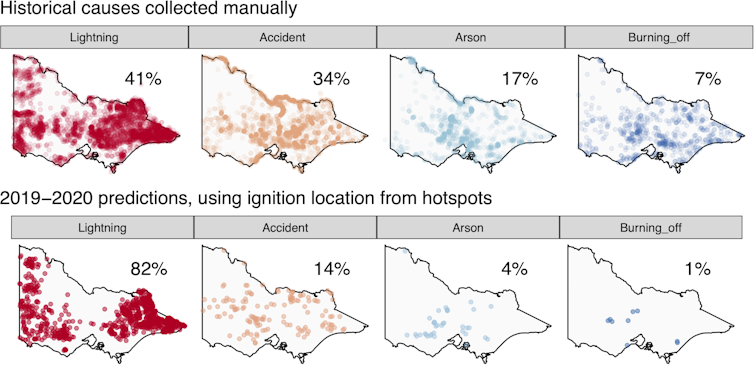
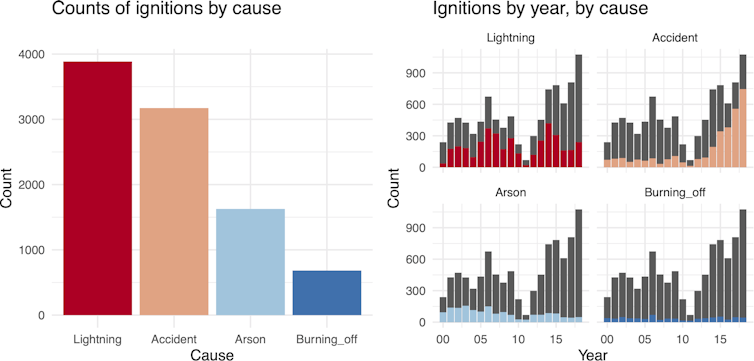
We dug into open data resources to learn more about the causes of last summer’s bushfires in Victoria, and further test the arson claim. Our analysis suggests 82% of the fires can be attributed to lightning, 14% to accidents and 1% to burning off. Only 4% can be attributed to arson.

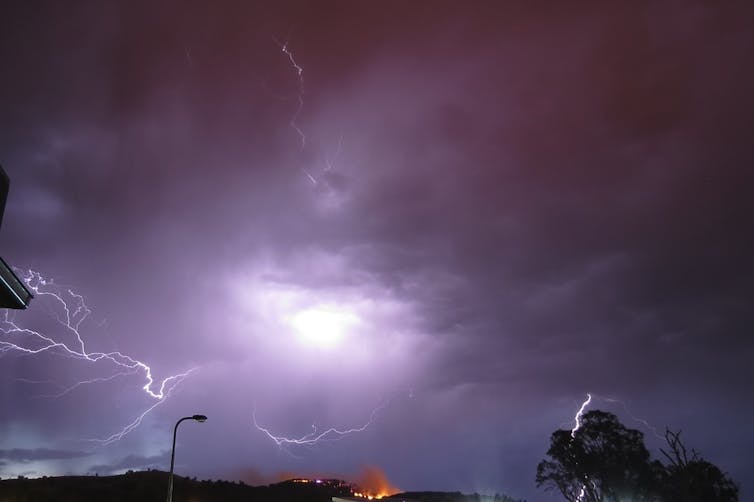
Lightning in the sky
Lightning, not arson, caused most Victorian bushfires last summer. Twitter

What we did

We started with hotspots data taken from the Himawari-8 satellite, which shows heat source locations over time and space, in almost real time. We omitted hotspots unlikely to be bushfires, and used a type of data mining called “spatiotemporal clustering” – where time dimension is introduced to geographic data – to estimate ignition time and location.

We supplemented this with data from other sources: temperature, moisture, rainfall, wind, sun exposure, fuel load, as well as distance to camp sites, roads and Country Fire Authority (CFA) stations.


Read more: Bushfires, bots and arson claims: Australia flung in the global disinformation spotlight


Victoria’s Department of Environment, Land, Water and Planning (DELWP) holds historical data on bushfire ignition from 2000 to the 2018-19 summer. The forensic research required to determine fire cause is laborious, and remotely sensed data from satellites may be useful and more immediate.

By training our model on the historical data, we can more immediately predict causes of last summer’s fires detected from satellite data. (Note: even though we were analysing events in the past, we use the term “predict” because authorities have not released official data.)

DELWP’s data attributes 41% of fires to lightning, 17% to arson, 34% to accidents and 7% to hazard reduction or back burning which escaped containment lines (which our analysis refers to as burning off).

Causes of fires from 2000-2019. Lightning is most common cause. The number of fires is increasing, and this is mostly due to accidents. Own work

To make predictions for the 2019-20 bushfires, we needed an accurate model for causes in the historical data. We trained the model to predict one of four causes – lightning, accident, arson, burning off – using a machine learning algorithm.

The model performed well on the historical data: 75% overall accuracy, 90% accurate on lightning, 78% for accidents, and 54% for arson (which was mostly confused with accident, as would make sense).

The most important contributors to distinguishing between lightning and arson (or accident) ignition were distance to CFA stations, roads and camp sites, and average wind speed.

As might be expected, smaller distances to CFA stations, roads and camp sites, and higher than average winds, meant the fire was most likely the result of arson or accident. In the case of longer distances, where bush would have been largely inaccessible to the public, lightning was predicted to be the cause.

Spatial distribution of causes of fires from 2000-2019, and predictions for 2019-2020 season. Own work

What we found

Our model predicted that 82% of Victoria’s fires in the summer of 2019-2020 were due to lightning. Most fires were located in densely vegetated areas inaccessible by road – similar to the historical locations. (The percentage is double that in the historical data, though, probably because the satellite hotspot data can see fire ignitions in locations inaccessible to fire experts).

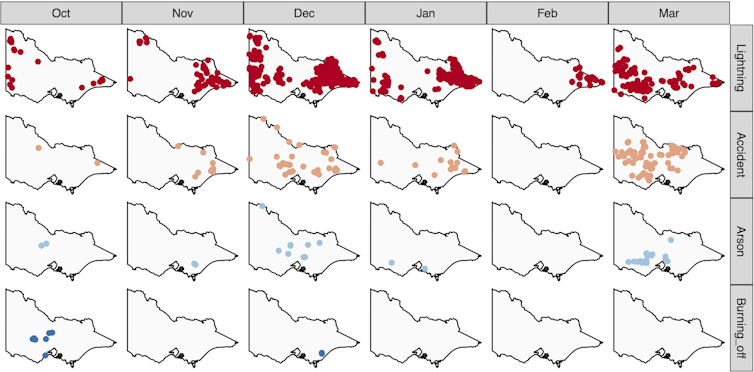
All fires in February 2020 were predicted to be due to lightning. Accident and arson were commonly predicted causes in March, and early in the season. Reassuringly, ignition due to burning off was predicted primarily in October 2019, prior to the fire restrictions.

Spatio-temporal distribution of cause predictions for 2019-2020 season. Reassuringly, fires due to burning off primarily occurred in October, prior to fire restrictions. February fires were all predicted to be due to lightning. Own work

Quicker fire ignition information

Our analysis used open-data and open-source software, and could be applied to fires elsewhere in Australia.

This analysis shows how we can quickly predict causes of bushfires, using satellite data combined with other information. It could reduce the work of fire forensics teams, and provide more complete fire ignition data in future.

The code used for the analysis can be found here. Explore the historical fire data, predictions for 2019-2020 fires, and a fire risk map for Victoria using this app.


This analysis is based on thesis research by Monash University Honours student Weihao Li. She was supervised by the author, and former Principal Inventive Scientist at AT&T Labs Research, Emily Dodwell. The Australian Centre of Excellence for Mathematical and Statistical Frontiers supported Emily’s travel to Australia to start this project. The full analysis is available here.

ref. Open data shows lightning, not arson, was the likely cause of most Victorian bushfires last summer – https://theconversation.com/open-data-shows-lightning-not-arson-was-the-likely-cause-of-most-victorian-bushfires-last-summer-151912

Before and after: 4 new graphics show the recovery from last summer’s bushfire devastation

Source: The Conversation (Au and NZ) – By Jorg Michael Hacker, Chief Scientist at Airborne Research Australia (ARA); and Professor, Flinders University

Two days before Christmas last year, a fire reached our heritage-protected bush property in the Adelaide Hills, and destroyed our neighbour’s house. For the next two weeks we were on constant alert to keep the fire in check.

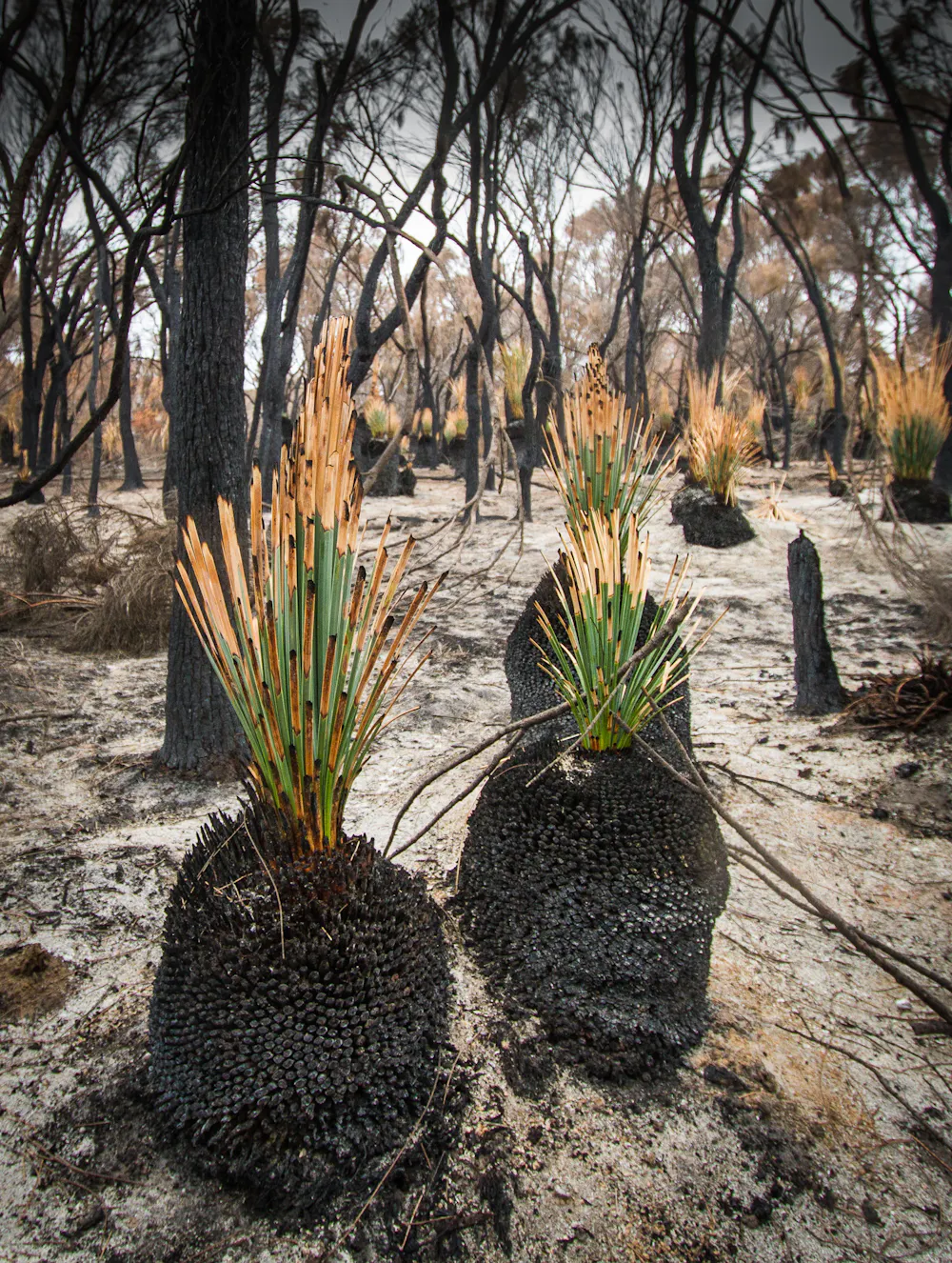
Green shoots of grass trees after bushfire
Grass trees are some of the first plants to regrow after a bushfire. Wikimedia, CC BY

A few weeks later, I flew over fire-affected areas in the Adelaide Hills and had my first aerial view of the devastation. Fighting fires around my home, and what I saw on this flight, convinced me to get involved with helping recovery in the aftermath of the fires.

In the past year, I’ve taken high-resolution aerial data to monitor the recovery of fire-affected areas and help with post-fire efforts. This work includes clearing access tracks into burnt forests, locating unburnt areas within burnt forests to serve as refuges for wildlife, or simply documenting the degree of destruction.

I now have a unique dataset – a combination of very high-resolution and detail from three sensors: aerial photography, airborne Lidar (a way to measure distances with laser light) and hyperspectral imaging (looking at the landscape and vegetation with hundreds of narrow wavelengths).

Flying at just 250 metres above the ground, it’s possible to generate complete three-dimensional views and animations of the landscape and its features at resolutions in the 10cm-range.

Usually such airborne data is only available to government agencies, industry and sometimes researchers, but rarely to the general public. So we decided to make the data publicly available, so anyone can download it. It will help you appreciate the level of destruction, and how it varied for different landscapes.

My property, for example, is showing strong regrowth, but most of our neighbour’s block burnt so intensely that even now, after nearly one year, there’s very little regrowth even in terms of ground cover.

Here are a few examples of the landscape’s recovery around Kangaroo Island, generated from our data.


Bushfires decimated almost half of Kangaroo Island. The image sequence above shows a small area on Kangaroo Island before the fires and about one, three and nine months afterwards.

Before the fires, the landscape was dominated by dense bushland, which the fires nearly completely destroyed. The first signs of regrowth were visible after three months, and even more so after nine months.

The imagery is so detailed you can inspect the regrowth even for individual trees and scrubs. And in the slider below, you can more clearly compare how well the bushland regrew between February and October this year.


Much of Australia’s native flora have evolved to cope with fire. Grass trees are among the first species to recover, and the Lidar data below demonstrates just how dramatic this recovery is.

Thousands of grass trees (“yuccas”) on Kangaroo Island grew up to seven metre-high flowers in the months after the fires. This is a typical phenomenon for this species after fire, and we were lucky enough to see this first hand on our bushland property, too.


The video below shows the regrowth in and around a tree plantation on Kangaroo Island, directly after the fires and then after nine months. You can clearly see the intense regrowth on the ground and near the bottom of the burnt trees.

Usually firegrounds are observed via satellite imagery, imagery captured from high-flying survey aircraft and, more recently, using unmanned aerial vehicles (drones). None of these observations can map the landscape at the exceptionally high detail over large areas and with the combination of sensors as we have flown.

High-resolution aerial photographs at pixel sizes as small as five centimetres can be put together in a mosaic, covering many square kilometres. Combined with Lidar, and the hyperspectral scanner, we get detailed animations, such as those in the video, which can zero in on various intricate aspects, such as vegetation health.


How these datasets can help bushfire recovery

With a some moderate funding, we can continue these regular mapping flights next year and beyond to learn how these areas develop. We can put this into context with other factors, such as burn severity, soil structure and vegetation type.

Such detailed datasets would assist researchers assessing flammability and fuel load (dried vegetation) which, in turn, would help prevent and even fight future fires.


Read more: Fire-ravaged Kangaroo Island is teeming with feral cats. It’s bad news for this little marsupial


Flammability and fuel load, alongside the slope of the landscape, are key parameters in computer simulations of fire behaviour. High resolution datasets depicting landscapes before and after bushfire can verify the simulation results, and help to improve the performance of the models.

Our datasets can also be useful for people needing to access areas directly after the fires, such as identifying where burnt trees have fallen, or are just about to do so.

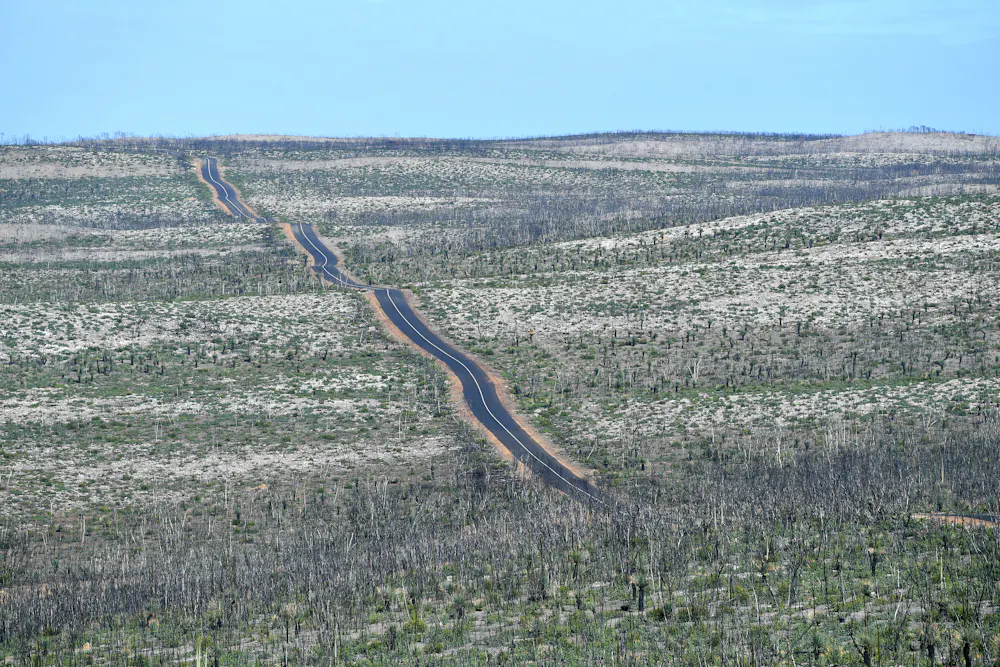
A straight road through a burnt-out landscape in Kangaroo Island, some regrowth shown.
A view of regrowth on Kangaroo Island in June, 2020, from the Bunker Hill Lookout. AAP Image/David Mariuz

For our own bushland block in the Adelaide Hills, these detailed imagery and datasets means we can study the regrowth from the Cudlee Creek Fire almost a year ago, as well as from previous fires. For example, some areas were burnt in the 2015 Sampson Flat Fire and had already regrown over the four years — only to be burnt again.

Continuing such flights would require a comparatively low amount of funding. However, this is currently not available in the standard government grant system. You can download data from the mapping flights over Adelaide Hills and Kangaroo Island.


Read more: Yes, native plants can flourish after bushfire. But there’s only so much hardship they can take


ref. Before and after: 4 new graphics show the recovery from last summer’s bushfire devastation – https://theconversation.com/before-and-after-4-new-graphics-show-the-recovery-from-last-summers-bushfire-devastation-149073

Before and after: these 4 graphics show the recovery of last summer’s bushfire devastation

Source: The Conversation (Au and NZ) – By Jorg Michael Hacker, Chief Scientist at Airborne Research Australia (ARA); and Professor, Flinders University

Two days before Christmas last year, a fire reached our heritage-protected bush property in the Adelaide Hills, and destroyed our neighbour’s house. For the next two weeks we were on constant alert to keep the fire in check.

Green shoots of grass trees after bushfire
Grass trees are some of the first plants to regrow after a bushfire. Wikimedia, CC BY

A few weeks later, I flew over fire-affected areas in the Adelaide Hills and had my first aerial view of the devastation. Fighting fires around my home, and what I saw on this flight, convinced me to get involved with helping recovery in the aftermath of the fires.

In the past year, I’ve taken high-resolution aerial data to monitor the recovery of fire-affected areas and help with post-fire efforts. This work includes clearing access tracks into burnt forests, locating unburnt areas within burnt forests to serve as refuges for wildlife, or simply documenting the degree of destruction.


Read more: Summer bushfires: how are the plant and animal survivors 6 months on? We mapped their recovery


I now have a unique dataset – a combination of very high-resolution and detail from three sensors: aerial photography, airborne Lidar (a way to measure distances with laser light) and hyperspectral imaging (looking at the landscape and vegetation with hundreds of narrow wavelengths).

Flying at just 250 metres above the ground, it’s possible to generate complete three-dimensional views and animations of the landscape and its features at resolutions in the 10cm-range.

Usually such airborne data is only available to government agencies, industry and sometimes researchers, but rarely to the general public. So we decided to make the data publicly available, so anyone can download it. It will help you appreciate the level of destruction, and how it varied for different landscapes.

My property, for example, is showing strong regrowth, but most of our neighbour’s block burnt so intensely that even now, after nearly one year, there’s very little regrowth even in terms of ground cover.

Here are a few examples of the landscape’s recovery around Kangaroo Island, generated from our data.


Bushfires decimated almost half of Kangaroo Island. The image sequence above shows a small area on Kangaroo Island before the fires and about one, three and nine months afterwards.

Before the fires, the landscape was dominated by dense bushland, which the fires nearly completely destroyed. The first signs of regrowth were visible after three months, and even more so after nine months.

The imagery is so detailed you can inspect the regrowth even for individual trees and scrubs. And in the slider below, you can more clearly compare how well the bushland regrew between February and October this year.


Much of Australia’s native flora have evolved to cope with fire. Grass trees are among the first species to recover, and the Lidar data below demonstrates just how dramatic this recovery is.

Thousands of grass trees (“yuccas”) on Kangaroo Island grew up to seven metre-high flowers in the months after the fires. This is a typical phenomenon for this species after fire, and we were lucky enough to see this first hand on our bushland property, too.


The video below shows the regrowth in and around a tree plantation on Kangaroo Island, directly after the fires and then after nine months. You can clearly see the intense regrowth on the ground and near the bottom of the burnt trees.

Usually firegrounds are observed via satellite imagery, imagery captured from high-flying survey aircraft and, more recently, using unmanned aerial vehicles (drones). None of these observations can map the landscape at the exceptionally high detail over large areas and with the combination of sensors as we have flown.

High-resolution aerial photographs at pixel sizes as small as five centimetres can be put together in a mosaic, covering many square kilometres. Combined with Lidar, and the hyperspectral scanner, we get detailed animations, such as those in the video, which can zero in on various intricate aspects, such as vegetation health.


How these datasets can help bushfire recovery

With a some moderate funding, we can continue these regular mapping flights next year and beyond to learn how these areas develop. We can put this into context with other factors, such as burn severity, soil structure and vegetation type.

Such detailed datasets would assist researchers assessing flammability and fuel load (dried vegetation) which, in turn, would help prevent and even fight future fires.


Read more: Fire-ravaged Kangaroo Island is teeming with feral cats. It’s bad news for this little marsupial


Flammability and fuel load, alongside the slope of the landscape, are key parameters in computer simulations of fire behaviour. High resolution datasets depicting landscapes before and after bushfire can verify the simulation results, and help to improve the performance of the models.

Our datasets can also be useful for people needing to access areas directly after the fires, such as identifying where burnt trees have fallen, or are just about to do so.

A straight road through a burnt-out landscape in Kangaroo Island, some regrowth shown.
A view of regrowth on Kangaroo Island in June, 2020, from the Bunker Hill Lookout. AAP Image/David Mariuz

For our own bushland block in the Adelaide Hills, these detailed imagery and datasets means we can study the regrowth from the Cudlee Creek Fire almost a year ago, as well as from previous fires. For example, some areas were burnt in the 2015 Sampson Flat Fire and had already regrown over the four years — only to be burnt again.

Continuing such flights would require a comparatively low amount of funding. However, this is currently not available in the standard government grant system. You can download data from the mapping flights over Adelaide Hills and Kangaroo Island.


Read more: Yes, native plants can flourish after bushfire. But there’s only so much hardship they can take


ref. Before and after: these 4 graphics show the recovery of last summer’s bushfire devastation – https://theconversation.com/before-and-after-these-4-graphics-show-the-recovery-of-last-summers-bushfire-devastation-149073

Fiji declares state of disaster as TC Yasa wreaks havoc in Vanua Levu

By RNZ Pacific

Many houses in Fiji’s Vanua Levu have been destroyed, some families sheltered under beds and tables in their houses and others in cane plantations, as Cyclone Yasa wreaked havoc in many parts of the Northern Division, Fiji Village reports.

Buildings and crops were been destroyed in Fiji’s second largest island and there’s been widespread flooding and landslides.

Fiji had earlier declared a state of natural disaster.

Yasa is heading south through the Southern Lau Island group.

In Bua, some people had to flee as their houses disintegrated in the wind.

In Koro, destructive winds and heavy rain are being felt in Nasau Village and people have been relocated to two evacuation centres.

Panapasa Nayabakoro, who lives in Koro, said 32 people are sheltering at the Nasau Health Centre and the rest are in a school. He said most of their houses are flooded and some were houses blown away.

A teacher at Nacamaki District School in Koro, Ilisabeta Daurewa, said they are experiencing damaging winds and several kitchen sheds in the village have been blown away.

She said more than 100 people are taking shelter in six classrooms at the school.

Taveuni, where more than 1,400 people spent the night in evacuation centres, is still being hit by winds.

Emergency personnel will be able to assess the scale of the damage once it is safe for crews to go out, the National Disaster Management Office says.

Yasa shows signs of weakening
Yasa is showing signs of weakening after striking overnight, but it remains a category five storm.

Sakeasi Waibuta from Fiji’s Met Service said the storm sat over Vanua Levu for three hours.

“It remains …a category 5, but intensity-wise for the winds, it has dropped from 240 kilometres per hour to 200 kilometres per hour.

“On satellite it is showing signs of initial weakening.”

Waibuta said the were still waiting on full reports on damage, and storm surges had also been expected.

This article is republished by the Pacific Media Centre under a partnership agreement with RNZ.

Article by AsiaPacificReport.nz

Not just complacency: why people are reluctant to use COVID-19 contact-tracing apps

Source: The Conversation (Au and NZ) – By Farkhondeh Hassandoust, Lecturer, Auckland University of Technology

This week’s announcement of two new COVID-19 vaccine pre-purchase deals is encouraging, but doesn’t mean New Zealanders should become complacent about using the NZ COVID Tracer app during the summer holidays.

The immunisation rollout won’t start until the second quarter of 2021, and the government is encouraging New Zealanders to continue using the app, including the recently upgraded bluetooth function, as part of its plan to manage the pandemic during the holiday period.


Read more: How to keep COVID-19 at bay during the summer holidays — and help make travel bubbles a reality in 2021


During the past weeks, the number of daily scans has dropped significantly, down from just over 900,000 scans per day at the end of November to fewer than 400,000 in mid-December.

With no active cases of COVID-19 in the commmunity, complacency might be part of the issue in New Zealand, but as our research in the US shows, worries about privacy and trust continue to make people reluctant to use contact-tracing apps.

Concerns about privacy and surveillance

We surveyed 853 people from every state in the US to identify the factors promoting or inhibiting their use of contact-tracing applications. Our survey reveals two seemingly contradictory findings.

Individuals are highly motivated to use contact-tracing apps, for the sake of their own health and that of society as a whole. But the study also found people are concerned about privacy, social disapproval and surveillance.

The findings suggest people’s trust in the data collectors is dependent on the technology features of these apps (for example, information sensitivity and anonymity) and the privacy protection initiatives instigated by the authorities.

With the holiday season just around the corner — and even though New Zealand is currently free of community transmission — our findings are pertinent. New Zealanders will travel more during the summer period, and it is more important than ever to use contact-tracing apps to improve our chances of getting on top of any potential outbreaks as quickly as possible.

How, then, to overcome concerns about privacy and trust and make sure New Zealanders use the upgraded app during summer?

The benefits of adopting contact-tracing apps are mainly in shared public health, and it is important these societal health benefits are emphasised. In order to quell concerns, data collectors (government and businesses) must also offer assurance that people’s real identity will be concealed.

It is the responsibility of the government and the office of the Privacy Commissioner to ensure all personal information is managed appropriately.


Read more: An Australia–NZ travel bubble needs a unified COVID contact-tracing app. We’re not there


Transparency and data security

Our study also found that factors such as peer and social influence, regulatory pressures and previous experiences with privacy loss underlie people’s readiness to adopt contact-tracing apps.

The findings reveal that people expect regulatory protection if they are to use contact-tracing apps. This confirms the need for laws and regulations with strict penalties for those who collect, use, disclose or decrypt collected data for any purpose other than contact tracing.

The New Zealand government is working with third-party developers to complete the integration of other apps by the end of December to enable the exchange of digital contact-tracing information from different apps and technologies.

The Privacy Commissioner has already endorsed the bluetooth upgrade of the official NZ COVID Tracer app because of its focus on users’ privacy. And the Ministry of Health aims to release the source code for the app so New Zealanders can see how their personal data has been managed.

Throughout the summer, the government and ministry should emphasise the importance of using the contact-tracing app and assure New Zealanders about the security and privacy of their personal data.

Adoption of contact-tracing apps is no silver bullet in the battle against COVID-19, but it is a crucial element in New Zealand’s collective public health response to the global pandemic.

ref. Not just complacency: why people are reluctant to use COVID-19 contact-tracing apps – https://theconversation.com/not-just-complacency-why-people-are-reluctant-to-use-covid-19-contact-tracing-apps-152085

A thread of the cosmic web: astronomers spot a 50 million light-year galactic filament

Source: The Conversation (Au and NZ) – By Ray Norris, Professor, School of Science, Western Sydney University

At the very largest scale, the Universe consists of a “cosmic web” made of enormous, tenuous filaments of gas stretching between gigantic clumps of matter. Or that’s what our best models suggest. All we have seen so far with our telescopes are the stars and galaxies in the clumps of matter.

So is the cosmic web real, or a figment of our models? Can we confirm our models by detecting these faint gaseous filaments directly?

Until recently, these filaments have been elusive. But now a collaboration between Australian radio astronomers and German x-ray astronomers has detected one.

On the largest scales, matter in the Universe is arranged in a cosmic web consisting of filaments of gas separated by voids, with clusters where the filaments meet each other. From the MAGNETICUM simulation, courtesy of Klaus Dolag, Universitäts-Sternwarte München, Ludwig-Maximilians-Universität München, Germany

CSIRO’s newly completed Australian Square Kilometre Array Pathfinder (ASKAP) telescope in Western Australia is starting to produce a large-scale picture of the Universe in radio frequencies. This telescope can see deeper than any other radio telescope, producing new discoveries, such as the unexplained Odd Radio Circles or ORCs.

CSIRO’s Australian Square Kilometre Array Pathfinder telescope in Western Australia. Ray Norris

Seeing with radio waves and x-rays

This year has also seen the publication of the first observations by the German eROSITA Space Telescope, which is giving us our deepest large-scale picture of the Universe in x-ray frequencies. Both of these next-generation telescopes have an unprecedented ability to scan large areas of sky at once, so they are beautifully matched to study the large-scale features of the Universe. Together, they can achieve much more than either on its own, so naturally we have joined forces.

The seven cameras of the eROSITA Space Telescope, enabling it to image the x-rays from large areas of the sky. Max Planck Institut for Extraterrestrial Physics

The first result from this collaboration is the discovery of a cosmic filament of hot gas. This study was led by Thomas Reiprich of the University of Bonn and Marcus Brueggen of the University of Hamburg, and involved Australian scientists from CSIRO and from Curtin, Macquarie, Monash and Western Sydney universities. It is published today in two papers in the journal Astronomy and Astrophysics.

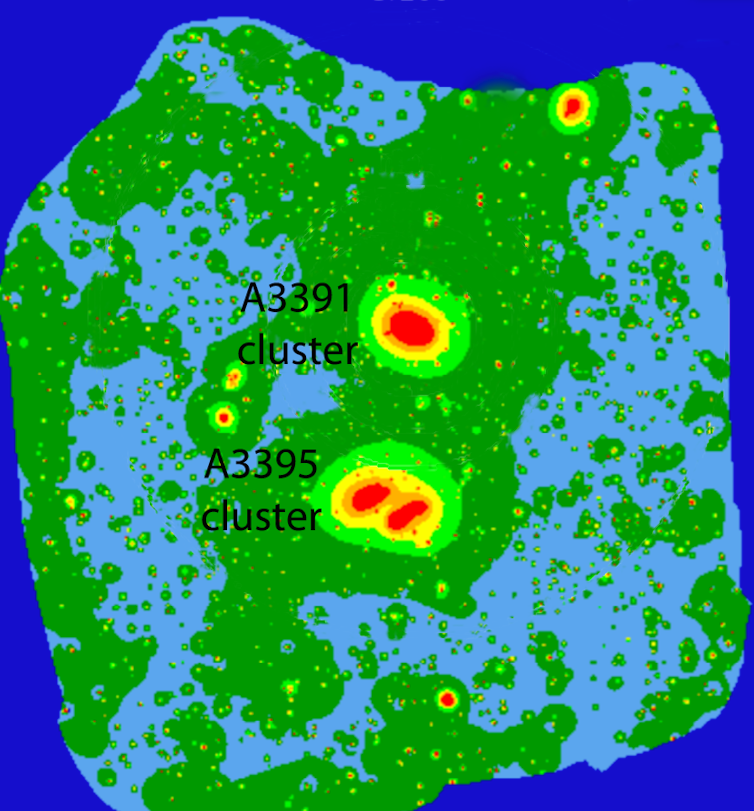
eROSITA image showing the clusters at the centre, and the dark green gaseous filament stretching 50 million light-years from the bottom left to the top right. Thomas Reiprich

The cosmic web

The Big Bang 13.8 billion years ago produced a Universe filled with invisible dark matter, together with a featureless gas of hydrogen and helium, and little else. Over the next few billion years, the gas clumped together under the attraction of gravity, forming filaments of matter with vast empty voids between them. The filaments probably contain more than half the matter in the Universe, even though the filaments themselves contain just ten particles per cubic metre – less than the best vacuum we can create on Earth.

Nearly all the galaxies we see today, including our own Milky Way, are thought to have formed in these filaments. We think galaxies then slide along the filaments until they fall into the dense clusters of galaxies clumped together at junctions where filaments meet.

This image, from a simulation called Magneticum, shows clumps moving along filaments, merging with the main systems to form ever larger, denser, and hotter structures. A movie is available at https://astro.uni-bonn.de/~reiprich/A3391_95/ . Thomas Reiprich (link to paper)

But until now, all this was hypothetical — we could see the galaxies and clusters, but we couldn’t see the gaseous filaments themselves. Now, eROSITA has directly detected the hot gas in a filament 50 million light-years long. This is an important step forward, confirming our model of the cosmic web is correct.


Read more: We’ve mapped a million previously undiscovered galaxies beyond the Milky Way. Take the virtual tour here.


A smooth ride

We also expected the hot gas would whip up electrons to produce radio frequency emissions, but, curiously, we don’t detect the filament with ASKAP. This tells us the hot gas is flowing smoothly, without the turbulence that would accelerate electrons to produce radio waves. So the galaxies are getting a smooth ride as they fall into the clusters.

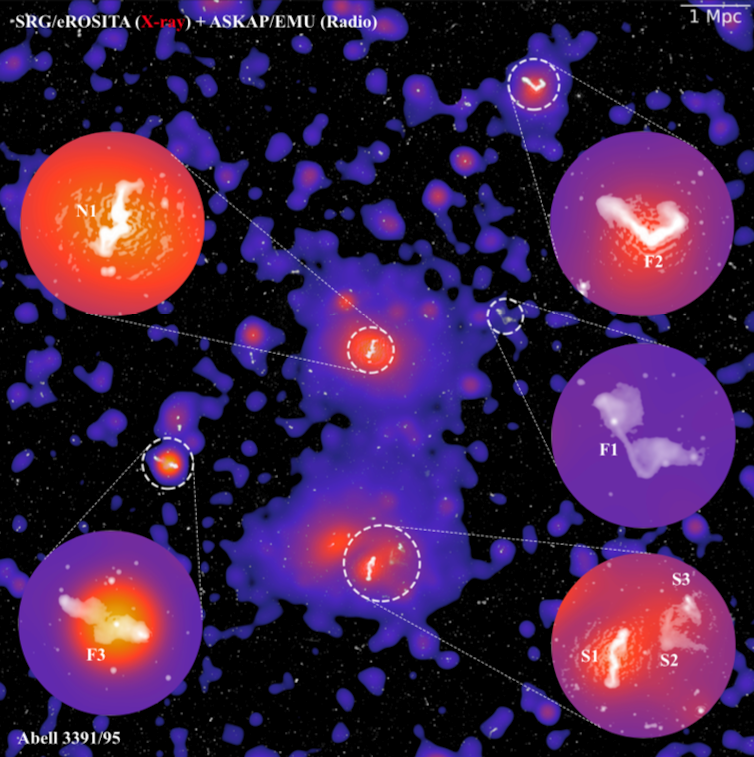
We can see the individual galaxies falling into the clusters in the radio images from ASKAP. At radio wavelengths, we often see galaxies bracketed by a pair of jets, caused by electrons squirting out from near the black hole in the centre of the galaxy.

However, in our radio images of these clusters, we see the jets bent and distorted as they are buffeted by intergalactic winds in the dense gas in the clusters. Again, this is a good confirmation of our models.

ASKAP radio data (white) overlaid on the eROSITA x-ray image (coloured). The circles show individual radio galaxies. The jets of the radio galaxies, normally straight, are bent into contorted shapes by the intergalactic winds within the clusters. Marcus Brueggen.

This work is not only important as confirmation of our model of the Universe, but is also the first result to come from the collaboration between ASKAP and eROSITA. These two telescopes are beautifully matched to survey our Universe, seeing the Universe as it has never been seen before, and I expect this discovery to be the first of many.


We acknowledge the Wajarri Yamatji people as the traditional owners of the ASKAP Observatory site.


Read more: ‘WTF?’: newly discovered ghostly circles in the sky can’t be explained by current theories, and astronomers are excited


ref. A thread of the cosmic web: astronomers spot a 50 million light-year galactic filament – https://theconversation.com/a-thread-of-the-cosmic-web-astronomers-spot-a-50-million-light-year-galactic-filament-151569

Joe Biden’s approach to the Middle East will be very different from Trump’s, especially on Iran

Source: The Conversation (Au and NZ) – By Tony Walker, Vice-chancellor’s fellow, La Trobe University

Canberra policymakers will be conducting a root-and-branch reassessment of Australia’s foreign policy following Donald Trump’s defeat in the US presidential election and ahead of an incoming Democrat administration.

Top of the list of items for review will be a leaden-footed China policy. Chinese trade reprisals for perceived Australian slights are doing real harm to Australia’s economic interests.

However, there are other areas of concern that demand attention in anticipation of Joe Biden’s presidency.

High on this agenda will be Middle East policy, which has suffered from the Trump administration’s transactional approach to a region in which America surrendered its traditional “honest broker” role in favour of an “Israel-first” approach.

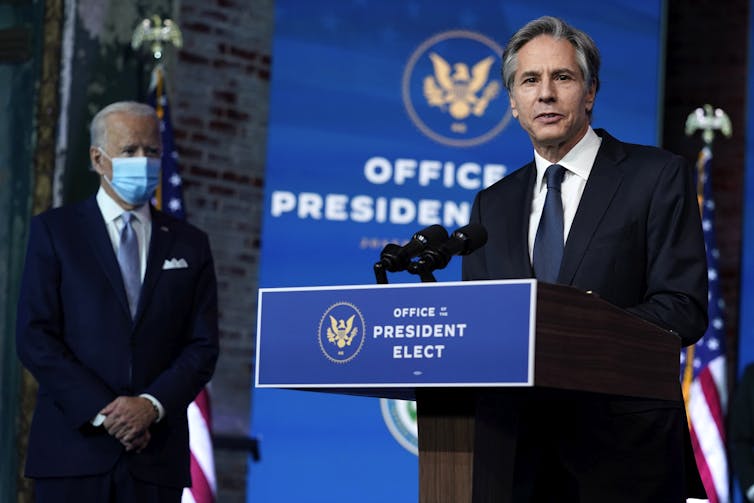
US Secretary of State-designate Antony Blinken might say, as he did at a Hudson Institute event earlier this year, that “I think we would be doing less not more in the Middle East”.


Read more: From ‘America first’ to ‘America together’: who is Antony Blinken, Biden’s pick for secretary of state?


However, in the world’s most volatile region, history shows this aspiration is easier said than realised. Successive US administrations have endeavoured to pull back from the Middle East. Circumstances conspire to make this difficult.

From an Australian perspective, a Biden administration will inevitably shift the tone of America’s responses to Middle East challenges. This includes attitudes to the Palestinians.

Biden will not be showing the same tolerance for Israel’s settlement expansion as his predecessor, nor would he countenance unilateral Israeli annexation of territories under occupation.

The new administration will return to a two-state formula in its approach to Middle East peacemaking. This is a phrase that was sidelined during the Trump administration.

The incoming Biden administration, with Antony Blinken as secretary of state, will show less tolerance for Israel’s settlement expansion. Carolyn Kaster/AP/AAP

Canberra policymakers will need to be agile as these shifts work their way through American Middle East policy, which will be less ideological and more focused on what might be described as core principles.

These principles will involve greater emphasis on human rights. This is not good news for serial human rights-abusing countries such as Saudi Arabia, or Israel in its treatment of the Palestinians, for that matter.

Climate issues will weigh, too. This will be awkward for laggards on climate like Saudi Arabia.

A Biden administration can also be expected to take a less tolerant view of inroads Russia and Turkey have made in the Middle East. Both countries have factored themselves into regional calculations in ways not apparent when Biden served as vice-president in the Obama administration.

Moscow and Ankara are now significant regional players down into the Gulf and west to North Africa in their extraterritorial meddling in fractured states such as Libya.

Regional architecture is vastly more complex and, if possible, more challenging than it was four years ago.

This brings us, inevitably, to Iran.

Biden has made clear that among his early foreign policy priorities will be to rejoin the Iran nuclear deal (the Joint Comprehensive Plan of Action, JCPOA) signed in 2015 by the five permanent members of the United Nations Security Council plus Germany and the European Union.


Read more: Sanctions, a failing economy and coronavirus may cause Iran to change its involvement in Syria


An agreement to forestall an Iranian acquisition of a nuclear capability was the crowning foreign policy achievement of the Obama administration.

Trump irresponsibly abandoned the JCPOA in 2018.

In a September 13 essay on CNN.com, Biden said:

If Iran returns to strict compliance with the nuclear deal, the United States would rejoin the agreement as a starting point for follow-on negotiations.

In the process, the US would lift crippling oil sanctions imposed by Trump. These have done considerable damage to Iran’s economy.

US sanctions in Iran have crippled the country’s economy. Abedin Taherkenareh/EPA/AAP

However, debate on rejoining the JCPOA without concessions from Iran will be fraught.

A Biden administration would come under considerable pressure to renegotiate aspects of the JCPOA after rejoining. This would include an extension of the original 15-year moratorium on Iran’s ability to produce a nuclear device.

US negotiators would be expected to pressure Iran to wind back its support for regional proxies in Lebanon, Syria, Iraq, Yemen and the Palestinian territories.

Washington would also seek to curb Iran’s exports of precision guided missiles to allies in the region and further afield.

Tehran has said such issues would not be on the table in the event of a renegotiated JCPOA. These are highly complex matters.

What does make sense are indications a Biden administration would seek to involve other interested parties in a renegotiated JCPOA.

Biden’s foreign policy team has been talking about link? adding regional players like Saudi Arabia and the United Arab Emirates. This would certainly help address nuclear proliferation concerns.

In an interview with the New York Times this month, Biden warned of the risks of a nuclear arms race in the Middle East involving Egypt, Saudi Arabia and Turkey in the event that Iran acquires a breakout nuclear capability.

The last goddam thing we need in that part of the world is a build-up of nuclear capability.

Canberra will not have issues with this approach.

Australia’s response to the Trump administration’s abandonment of the JCPOA was cautious. The government conducted a review of Australia’s support and then quietly shelved any objections it might have had.

In any case, Australia hardly rates as anything more than a bystander, albeit one that has maintained diplomatic representation in Tehran since the days of the shah.

This has been useful, as was demonstrated recently by the role Australia’s ambassador in Tehran played in the release of Australian-UK researcher Kylie Moore-Gilbert from a two-year incarceration.


Read more: Kylie Moore-Gilbert has been released. But will a prisoner swap with Australia encourage more hostage-taking by Iran?


With Australia’s trading relationship with China so stressed, further developing existing markets and seeking new opportunities will be a preoccupation.

While Australia’s trade with the Middle East is relative small, it is significant. Two-way trade with the region, mostly in the Gulf, amounts to about 2.5% of total trade. The United Arab Emirates and Saudi Arabia are the most prospective markets for Australian goods and services.

The Gulf region is also home to four of the world’s largest sovereign wealth funds. At A$11 billion, the UAE’s investment in Australia is worth noting.

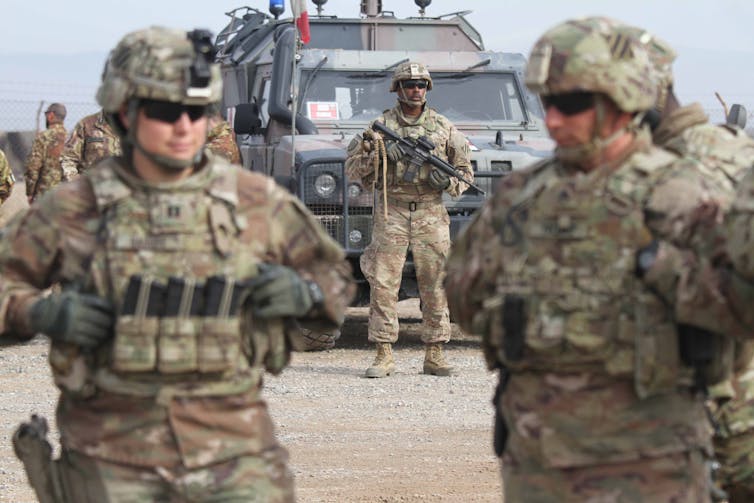
An Australian review of Middle East policy will inevitably involve assessments of what a Biden administration will mean for Australia’s involvement in Afghanistan.

The Trump administration has announced it will draw down its troop presence from the current 4,500 to 2,500 by early 2021. This follows a “peace agreement” with the Taliban struck in February.

Biden has been agnostic on Afghanistan. He was a dissenting voice in the Obama administration against a surge in troops in 2008-2009, but lost that argument.

He is thought likely to favour retaining a small, residual counter-terrorism force in Afghanistan. On his record, he would be most reluctant to increase numbers.

In Australia’s case, its combat troops have long gone. It retains a small training contingent with the Afghan army. This is likely to remain the case under present circumstances.

President-elect Joe Biden is unlikely to favour sending more US troops to Afghanistan. Jalil Rezayee/EPA/AAP

Finally, in October, Canberra made an important decision about its role in the Middle East. This received little attention at the time.

Defence Minister Linda Reynolds announced Australia would end its naval presence in the Gulf, where the navy had been conducting patrols.

As part of its 2020 Defence Strategic Update, Reynolds said “an increasingly challenging strategic environment” was “placing greater demand on ADF resources closer to home”.

Given China’s continued rise, that would seem to be an understatement.

ref. Joe Biden’s approach to the Middle East will be very different from Trump’s, especially on Iran – https://theconversation.com/joe-bidens-approach-to-the-middle-east-will-be-very-different-from-trumps-especially-on-iran-151987

Christmas is a special time on the maternity ward. But it’s not all tinsel and mince pies

Source: The Conversation (Au and NZ) – By Hannah Dahlen, Professor of Midwifery, Associate Dean Research and HDR, Midwifery Discipline Leader, Western Sydney University

Having a baby at Christmas can be both a joyous time and a cause for anxiety. This Christmas, with a pandemic sweeping the world, there may also be some unique considerations on parents’ minds.

So if you’re one of the women on the maternity ward around Christmas time, you might want to know what to expect.

Can your partner be with you when the time comes? Will there be tinsel? What if you don’t celebrate Christmas?


Read more: Schnapps, whipping and sacks: how Christmas traditions evolved around the world


What are the chances of a Christmas baby?

In Australia, December 25 is actually the least likely day of the year to be born, closely followed by December 26. So finding room at the inn to give birth in 2020 shouldn’t be a problem.

We also see a similar pattern in other countries that celebrate Christmas. The main reason is some women (and some staff) want to avoid births on that day, so they are more likely to schedule births early.

But this year may be different. Christmas is around 40 weeks after Australia’s nationwide COVID lockdown in March and April. So, we’ll soon see if we end up delivering more “lockdown babies”.

But what is it actually like?

In some ways, Christmas on a maternity ward is pretty much like any workplace with staff rostered on for December 25. There’s lots of good (read: sugary) food, funny hats and festive bling. But of course, the prospect of helping “catch” (midwife term for deliver) a Christmas baby makes it much more special.

If you ask any midwife what it’s like to “catch a baby” or care for new parents on Christmas Day, they break into a smile and have a lovely story. I recently asked for some anecdotes, and my inbox was soon filled with heartwarming snippets, along with photos of Christmas decorations festooning the maternity units.

One midwife told me:

I was dressed in a very festive, fully sequinned Christmas shirt and I responded to a call bell over in the birthing unit, as everyone was busy. A lovely mother was in the bathroom giving birth. I caught her baby and suggested she now move over to the bed to birth the placenta, when she looked me in the eye and asked if we should call a midwife. She thought I was a visitor.

Another midwife recalled:

Late in the evening on Christmas Eve, a small group of nuns came to the birthing unit to enquire if there was likely to be a birth soon. I advised them (with consent from the woman I was looking after) that the woman was likely to birth just after midnight. Each nun nodded to one another and smiled at me, as they thanked me for this insight. Then, when it came time for the baby to be born, the couple and I heard the most beautiful choir of angels outside the birthing room, singing Away in a Manger quietly. It was heavenly, so beautiful. We all cried tears of happiness and joy together.

Will this Christmas be different?

In Australia we are lucky COVID case numbers are down, and the strictest health measures have been lifted. Some hospitals still have limits on the number of support people who can be present at the birth, and how many visitors you can have afterwards. It’s best to check your maternity unit’s specific arrangements.

Staff will make great efforts to make this a time of celebration. Women often go home early when giving birth at Christmas, and this is not just due to COVID. Women told me of being discharged home just in time for Christmas lunch to be with their families and being waited on hand and foot. If this is what’s in store for you, be sure to rest. And no cooking Christmas lunch!

Will there be tinsel in birth units this year?

Many midwives love to decorate the maternity units they work in, although COVID requirements have made it trickier this year. One midwife told me how beautifully her team “decorated the wards on a Sunday when the managers were not about and on Monday were promptly told to take [the decorations] down due to COVID”.

Nevertheless, I received many pictures of innovative (and easily wiped down) COVID-safe decorations.

Author provided

It is also important to remember many cultures and countries do not celebrate Christmas. But you don’t have to observe Christmas to enjoy a little respite at the end of a tough year.

But what happens every year after giving birth to a Christmas Day baby? One mother told me the worst thing is the “sympathy all the time. We make it his own special day in his own special way”. Another told me her daughter loves having her birthday at Christmas and just pretends the whole world has “turned the celebrations on for her”. Other mums say they have a smaller celebration on the actual day and another one further away from Christmas.


Read more: Why Call the Midwife satisfies our enduring need for heroic stories of fertility and birth


Christmas can also be a vulnerable time

Christmas can also be a time of vulnerability for women, children and families. Close family may live far away, or there may be a lack of support in a woman’s life. Family, domestic and sexual violence can increase.

Alcohol, which flows freely during this time, can add to the danger. Pregnant women are more vulnerable to domestic violence anyway and this escalates at Christmas time.

Women experiencing difficulty breastfeeding may also feel they have little support over the holiday period.

For parents who have lost a baby this year, either through miscarriage, stillbirth or neonatal death, Christmas, which is all about celebration and family, can add to the grief.


Read more: Five ways to help parents cope with the trauma of stillbirth


And 2020 has been a particularly tough year for many of us. Our mental health has been tested and exhaustion may have set in. Some people have lost friends or family members, or lost their job. Women in particular have shouldered much of the burden of home-schooling and caring for the family.

Whatever this year has held for you, go gently, and remember you are not alone. Christmas time, on maternity wards and everywhere else, is a celebration of new life and new hope.


If this article has raised issues for you or someone you know, contact: Lifeline – 13 11 14 or text 0477 13 11 14; Beyond Blue – 1300 224 636; National Sexual Violence, Domestic Family Violence Counselling Service – 1800 737 732; SANDS miscarriage, stillbirth and newborn death support – 1300 072 637; Australian Breastfeeding Association helpline – 1800 686 268, download the mum2mum app for ongoing support, or hire a breast pump.

ref. Christmas is a special time on the maternity ward. But it’s not all tinsel and mince pies – https://theconversation.com/christmas-is-a-special-time-on-the-maternity-ward-but-its-not-all-tinsel-and-mince-pies-150063

It’s not production quality that counts in educational videos – here’s what students value most

Source: The Conversation (Au and NZ) – By Sarah Dart, Lecturer in Learning & Teaching Development, Impact and Recognition, Queensland University of Technology

The use of educational videos in schools and universities was on the rise before COVID-19. Now, with continuing disruption by the pandemic, more educators are developing educational videos to support student learning. Similarly, students are increasingly looking to places like YouTube for educational content.

Intuitively, we might think a video’s production quality is what matters – fancy recording equipment, a professional studio environment and flawless editing. While these “bells and whistles” can be attractive, some of the most successful educational YouTube channels actually use very simple production styles. For example, Khan Academy records handwriting on a tablet screen. Eddie Woo of WooTube often films his high school classroom teaching.

A Khan Academy video covering adding and subtracting fractions.

Research confirms production quality isn’t as critical as we might at first think. Production quality ranks behind perceived learning gains, educators’ delivery style and video length as reasons for liking educational videos. Research even shows we are more inclined to watch educational videos filmed in an informal setting than big-budget studio productions!


Read more: Videos won’t kill the uni lecture, but they will improve student learning and their marks


So what makes an educational video effective?

Our perceptions of how easy a technology is to use and its usefulness determine whether we will engage. If we think a video is too hard to use or unhelpful, we won’t bother with it! This is known as the “Technology Acceptance Model”.

I was interested in using this model to understand what specific factors made educational videos effective. I developed videos that demonstrated solutions to maths-based problems for university engineering subjects. These videos were designed as an optional supplement to lectures and tutorials.

Solving for a ‘resultant couple’ – a first-year engineering concept.

To understand what influenced engagement, I asked students what they liked about the videos. I also asked what could be improved.

I then isolated recurring themes to identify the most important factors. This is what I found.


Read more: How creative use of technology may have helped save schooling during the pandemic


Influences on ease of use

Accessibility

A key advantage of videos over face-to-face learning is access – students can watch videos at a time and place of their choice. This has been especially critical during the COVID-19 lockdowns.

The platform used to distribute videos (such as YouTube) plays a role through system reliability and user-friendliness. Features like playlists and push notifications can also be considered for enhancing ease of access.

Personal agency

Videos enable students to personalise and self-pace their learning through content selection and video controls. Unlike face-to-face classes, students can conveniently pause a video to consider posed questions. Students can then restart when ready to get feedback on their responses. Students can also rewatch challenging sections while skipping over easy parts.

I found these learning strategies were extremely popular. In my research, 90% of students independently solved the problems I presented.

Findability

Students appreciate being able to find information easily. Concise and well-labelled videos support navigation to relevant content in a timely manner. Time stamps can also be used to communicate where in a video specific aspects are covered.

Instructional design and production

When educators use a conversational delivery style it creates a social partnership, which encourages learners to try harder to understand their educator. This improves learning through videos. As this personal approach aligns well with an informal environment, it can explain why students embrace simple production styles.

young woman smiles at her teacher during an online lecture
A conversational delivery style can encourage learners to try harder to understand their educator because they feel engaged in a social partnership. fizkes/Shutterstock

Read more: 5 tips on how unis can do more to design online learning that works for all students


Influences on usefulness

Narration

Verbal explanations can efficiently communicate thinking processes, highlight misconceptions and relate ideas together. This enables students to readily develop understanding, which is strongly tied to their academic performance.

For these reasons, students like narration in videos, which goes well beyond what static documents like textbooks offer. In my research, students found videos particularly useful when they felt the narration explicitly and thoroughly communicated the logic behind solution processes.

Content scaffolding

Providing video content that gradually increases in difficulty supports students to develop skills without becoming overwhelmed. This is important because students who feel out of their depth are at risk of disengaging.

In my research, many students wanted to be extended by increasingly challenging problems. Students also varied the “degree of difficulty” when attempting questions by only watching video segments to prompt when stuck or to verify their solution.

Assessment alignment

As assessment is a core driver of learning, content needs to be closely aligned with assessment for students to consider videos useful. Consistent with this, my research shows students are most likely to engage with videos to support their assessment attempts.


Read more: In a world of digital bystanders the challenge is for all of us to design engaging online education


Final thoughts

COVID-19 has meant educators have produced a lot of videos this year. Given the time pressures, these often weren’t high-quality productions, but students were still able to learn a great deal.

As we return to a new “normal”, educators looking to enhance their video resources should remember what students value most – easy-to-use informal videos with clear explanations aligned to their needs.

ref. It’s not production quality that counts in educational videos – here’s what students value most – https://theconversation.com/its-not-production-quality-that-counts-in-educational-videos-heres-what-students-value-most-151573

Vital Signs: 4 things Australia’s COVID response got right

Source: The Conversation (Au and NZ) – By Richard Holden, Professor of Economics, UNSW

2020 began simply, if dramatically enough in some sense.

We spent the first months preoccupied with bushfires that blackened both our natural environment and our international reputation for taking climate change seriously. Who would have thought that would have been the easy part?

Then came a global pandemic, the largest public health emergency and greatest economic contraction in a century.

Australia has emerged as the nation that may have dealt with these twin crises the best. But it was not obvious we would do so — certainly not in February 2020.

It is important to scrutinise the reasons for our success. In particular, what parts are due to good policy, and what parts to luck?

Tentative beginnings

Australia’s initial response to COVID-19 was less certain than, for example, New Zealand’s. In debates about shutting schools, for example there was always a pull to the policy with the least economic impact.

While most economists have supported putting public health policy first, not all in academia, government or the media have agreed. There has been much talk about “the Swedish model”, achieving “herd immunity” naturally, and that the costs of lockdowns far outweigh their benefits.

On March 10, I declared the opposite, in article published by the Australian Financial Review. Rather, I wrote, “the economic costs of being reactive are likely to be much larger than the costs of being decisive”.


Read more: Vital Signs: the COVID-19 crisis in aged care shows elimination is the only effective strategy


At the time the article was published there were 93 cases of COVID-19 in Australia and three deaths. It was the week Prime Minister Scott Morrison declared he would attend a rugby league match just moments after outlining the government’s advice to ban large crowd gatherings. Our borders were still gapingly open.

I said in that piece “one doesn’t need to be an epidemiologist to understand the logic of exponential growth”.

We got our dose of exponential growth, with cases and deaths, respectively, growing quickly. Our leaders got the message and acted decisively. Morrison even gave up on his beloved Sharks games.


Read more: Vital Signs: the cost of lockdowns is nowhere near as big as we have been told


4 keys to Australia’s COVID success

With relatively swift action, we got four crucial things in place:

  • we lowered the base rate of infections

  • we got a serious testing regimen in place

  • we developed effective contract tracing

  • we built hospital capacity if things went awry.

These are the facts of the case, and they are undisputed.

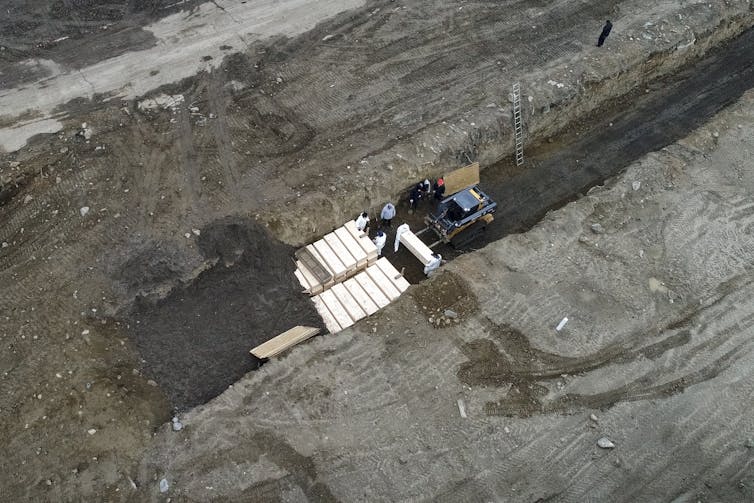
The places that didn’t do these things used Olympic ice rings as morgues (Spain) and dug temporary graves in parks (New York). We did better. We would not have done better had we listened to the naysayers.

Bodies of people who died with COVID-19 are buried in a trench on Hart Island, in the Bronx borough of New York, on April 9 2020.
Bodies of people who died with COVID-19 are buried in a trench on Hart Island, in the Bronx borough of New York, on April 9 2020. John Minchillo/AP

The year evolved. And so did we. And so did our national debate.

Victoria made a colossal mistake, for which there still needs to be a proper accounting. But if we have learned nothing else from 2020, it is that expertise and informed public debate are essential for good policy.


Read more: Vital Signs: Victoria’s privatised quarantine arrangements were destined to fail


Top marks for a work in progress

Australia’s economic response has been world-class.

Fiscal support measures such as JobSeeker and JobKeeper were crucial to a public health recovery leading to economic recovery.

But the job is not done.

Sure, the JobSeeker benefits need to taper down over time. But the questions are how much and how fast.

Wage subsidies can’t go on forever, but when to end them without destroying businesses small and large, and jobs along with them?

These will be be the hard questions for Treasurer Josh Frydenberg and the rest of the Morrison government in 2021.

In 2020, nonetheless, it has – through a great measure of skill and some measure of luck – helped avoid a COVID catastrophe in Australia.

Let us hope Scott Morrison deals with the everyday as well as he has dealt with the exceptional.

ref. Vital Signs: 4 things Australia’s COVID response got right – https://theconversation.com/vital-signs-4-things-australias-covid-response-got-right-152172

No spare change: how charities, buskers and beggars aren’t feeling so festive in our cashless society

Source: The Conversation (Au and NZ) – By Spencer M. Ross, Assistant Professor of Marketing, University of Massachusetts Lowell

Collectors for the Paralympic Games carried donation buckets ahead of the recent Santa parade in Auckland, asking for gold coin donations. Onlookers shrugged them off: “Sorry, no cash on me!”

To the rescue, a charity volunteer waved a contactless “tap-and-go” machine that could connect straight to users’ bank accounts. But only a few people reached for their wallets to pull out their cards.

This anecdote reflects a global trend. As the Salvation Army reports, the usual American holiday fundraising drive has struggled in 2020, with 50% fewer donations than last year.

Cash is changing hands less frequently than ever before. In the US, it accounted for 30% of retail purchases in 2020, down from 40% in 2009. In the UK, the change has been even more rapid: only 23% of payments are made in cash, down from 60% in 2009.

We may be becoming a cashless society, but our research shows people are also less receptive to using contactless technology when casually solicited by charities. What happens when your traditional business model relies on bills and coins?

Cash is running out

Cheques and bank cards have been around for decades, but financial technology (fintech) innovations have increased exponentially in recent years. From tap-and-go card readers at retail sites and e-banking apps on smart phones, to peer-to-peer payment apps such as Venmo and PayPal that allow one-touch cashless money transfers, it’s a digital consumer world.


Read more: Brand activism is moving up the supply chain — corporate accountability or commercial censorship?


COVID-19 has further fuelled the cashless revolution. In the early days of the pandemic, the World Health Organization had to deny reports that cash was spreading the coronavirus, but advised people to wash their hands after touching real money. Digital finance and fintech apps saw a 24-32% boost in daily download rates as the pandemic surged.

The declining velocity of cash transactions even led to the US Federal Reserve rationing certain denominations in mid-2020, telling commercial banks it was running out of spare change. Cash withdrawals fell precipitously in the UK, with 40% fewer people withdrawing money from ATMs than in 2019.

By November, “contactless preferred” signs had become the new norm for consumers.

A street performer in Boston soliciting both cash and P2P app donations. Author provided

Overcoming consumer resistance

While retailers and online merchants have benefited from cashless payment options, donation-seekers are left rattling an empty cup.

Aside from people carrying less cash, our research suggests another major reason is that people simply don’t expect to see beggars or buskers with a swipe machine, or a QR code or Venmo symbol on their signs.

We tested this using simple measures of reaction time. People responded faster to cashless options in retail settings or with institutional charities, but took the longest to respond in casual situations, such as street appeals or requests for cash outside malls and shops.


Read more: Woke washing: what happens when marketing communications don’t match corporate practice


This makes sense: it feels relatively normal at a formal charity gala, for instance, to use cashless payment methods. For casual fundraisers and the needy, however, it is a major obstacle.

Unlike other kinds of charitable donation, giving to the homeless and needy is almost exclusively impulsive. People typically donate spare change if and when they have it. It’s hardly surprising, then, that beggars and panhandlers have been seeing less spare change since 2015.

A question of trust

panhandler with sign
A Boston panhandler soliciting donations through the Venmo payment app. Author provided

However, there are initiatives aimed at helping donation-seekers adapt to the new normal. Salvation Army bell ringers in the US now accept Apple Pay and Google Pay, while some buskers list their Venmo handles on their instrument cases.

In China, WeChat QR codes are distributed to the homeless to allow mobile donations. And in California, 32% of homeless people have been gifted smart phones from social programs to help them access social and governmental services.


Read more: NZ businesses are still including potentially unfair terms in their general contracts — consumers deserve better


Dipjar is a one-swipe credit card machine that bundles transactions for non-profit organisations. And The Busking Project offers a peer-to-peer payment app that allows fans to connect to street performers and make in-app donations.

Yet scepticism and prejudice tend to greet old-fashioned donation-seekers using modern payment methods. There is an element of trust involved in swiping a credit card, and our research suggests these solutions will have limited practical effect for the foreseeable future.

We need to remember, of course, that consumer acceptance of credit, swipe and other non-cash payment methods has evolved over 50 years. The next time a worthy group or needy individual asks for your help and presents a swipe machine or an app, your response will help determine the pace of this next evolutionary step.

ref. No spare change: how charities, buskers and beggars aren’t feeling so festive in our cashless society – https://theconversation.com/no-spare-change-how-charities-buskers-and-beggars-arent-feeling-so-festive-in-our-cashless-society-151024

Friday essay: how a long-lost list is helping us remap Darug place names and culture on Dyarubbin, the Hawkesbury River

Source: The Conversation (Au and NZ) – By Grace Karskens, Emeritus Professor of History, UNSW

In 2017, I came across an extraordinary document in Sydney’s Mitchell Library: a handwritten list of 178 Aboriginal place names for Dyarubbin, the Hawkesbury River, compiled in 1829 by a Presbyterian minister, the Reverend John McGarvie. I was stunned. I stared at the screen, hardly believing my eyes.

After years of research, my own and others, I thought most of the Aboriginal names for the river were lost forever, destroyed in the aftermath of invasion and dispossession. Yet, suddenly, this cache of riches.

A page from Rev McGarvie’s 1829 list of Aboriginal names for places on Dyarubbin, the Hawkesbury River. Mitchell Library, State Library of New South Wales

I could see McGarvie had taken a lot of care with this list, correcting spelling and adding pronunciation marks. The names appear in geographic order, so they also record where he and his Darug informant/s travelled along the riverbanks. Perhaps most important of all, McGarvie often included locational clues, like settlers’ farms, creeks and lagoons.

An extraordinary idea dawned on me: what if we could restore these names to their places on the river? And then: what if these beautiful, rolling words — like Bulyayorang and Marrengorra and Woollootottemba — came back into common usage?

Naming Country

Place names have enormous significance in Aboriginal society and culture. As in all societies, they signal the meanings people attach to places, they encode history and geography, they are way-finding devices and common knowledge. Place names are crucial elements of shared understandings of Country, history, culture, rights and responsibilities.

Often place names are parts of larger naming systems — they name places on Dreaming tracks reaching across Country. Singular names can also embed the stories of important events and landmarks involving Ancestral Beings in places and memory. Anthropologist and linguist Jim Wafer points out their use in songs, which are memory devices, or “audible maps … travelling song cycles that narrate mythical journeys”.

Dyarubbin, the Hawkesbury River, flows through the heart of a vast arc of sandstone Country encircling Sydney and the shale-soil Cumberland Plain on the east coast of New South Wales. The river has a deep human history, one of the longest known in Australia.

Axe grinding grooves on Dyarubbin. Joy Lai

The ancestors of Darug, Darkinyung and Gundungurra people have lived in this region for around 50,000 years. Their history, culture and spirituality are inseparable from their river Country. A mere two centuries ago, ex-convict settlers took land on the river and began growing patches of wheat and corn in the tall forests. Darug men and women resisted the invasion fiercely and sometimes successfully.

Between 1794 and 1816, Dyarubbin was the site of one of the longest frontier wars in Australian history. Invasion and colonisation kicked off a slow and cumulative process of violence, theft of Aboriginal children, dispossession and the ongoing annexation of the river lands.

Jasmine Seymour, Women of Dyarubbin. Jasmine Seymour

Yet despite this sorry history, Dyarubbin’s people managed to remain on their Country, and they still live on the river today.

McGarvie’s list contrasts strikingly with the modern landscapes of the Hawkesbury and Western Sydney. Once, every place on this river and its tributaries had an Aboriginal name. Now only a handful survive on maps and in common usage.

With some important exceptions, the Traditional Owners, the Darug, rarely see themselves represented in key heritage sites, or in the everyday reminders and triggers of public memory – like place names.

Yet Western Sydney is now home to one of the biggest populations of Darug and other Aboriginal people in Australia. Could McGarvie’s list be a way to begin to shift the shape of our landscapes towards a recognition of Darug history and culture?

Living on Country

This idea stayed with me, so I contacted Darug knowledge-holders, artists and educators Leanne Watson, Erin Wilkins, Jasmine Seymour and Rhiannon Wright: the response was instant and enthusiastic. We designed the project together and were thrilled when it won the NSW State Library’s Coral Thomas Fellowship

The project’s Darug researchers want most of all to research, record and recover environmental and cultural knowledge and raise awareness of Darug presence and history in the wider community.

Because the Darug history of Dyarubbin is continuous, the project includes an oral history component, recording 20th century Darug voices and stories of the river.

Looking back, it seems uncanny that McGarvie’s list reappeared when it did — after all, we are in the midst of an extraordinary period of Aboriginal cultural renewal and language revitalisation.


Read more: The state of Australia’s Indigenous languages – and how we can help people speak them more often


It was obvious that McGarvie’s words could be more than a list of names: it could be the key to a bigger story about the Dyarubbin, the Darug history that was lost, submerged below what historian Tom Griffiths calls “the white noise of history making”.

But to do this, we needed to put the words in their wider context: we needed to see the river whole. So, besides reconnecting the list to Traditional Owners, the project explores Dyarubbin’s history, ecology, geography, archaeology and languages.

Early maps showing the old river farms helped us work out where the Darug place names belong and digitally map them. They also record long-lost landscapes of swamps, lagoons and creeks — important places for Aboriginal people that have since been modified or disappeared altogether.

Brown’s Lagoon Wilberforce 1844. NSW State Archives and Records

The “Returns of Aboriginal Natives” are lists of Aboriginal people living in New South Wales in the 1830s, including the groups who lived on various parts of Dyarubbin and its tributaries. Reverend McGarvie’s diaries show he knew many of these Darug people.

The letters and journals of Hawkesbury settlers are thoroughly colonial-centred, yet they contain hints about the ways Darug people continued to live on their Country throughout the 19th century.

For example, they befriended some of the settlers, like the Hall family at Lilburndale, and cultivated these relationships over generations. The Hall family papers in the Mitchell Library hold some powerful and poignant traces: store receipts for goods Darug people were purchasing from them, and lists of the work they did at Lilburndale.

The archaeological record for this region is astonishingly rich. Dyarubbin and its tributary Gunanday (the Macdonald River) are part of a much larger archaeological zone, reaching from the Blue Mountains and the Wollemi in the west, up to the Hunter Valley and Lake Macquarie in the north. Many of the major recorded archaeological sites have sacred, spiritual and ceremonial significance, especially those located on high places.

Gunanday (the Macdonald River). Joy Lai

Closer to the river, Paul Irish’s archaeological mapping has revealed how much Darug cultural landscape survives today, within the “settler” landscape.

From Richmond in the south to Higher Macdonald in the north, the river corridors alone are lined with more than 200 archaeological sites, including engravings, grinding grooves and rock shelters, some with scores or hundreds of images in ochre, white clay and charcaol.

Darug women Jasmine Seymour and Rhiannon Wright visit a painted rockshelter. Joy Lai

Perhaps the most important aspect of the project are the field trips — getting out on Country, following in the footstep of McGarvie and his Darug friends, to see how all of this comes together. For Aboriginal people especially, visiting Country is a spiritual experience: they sense past and present converging, and the presence of their Ancestors.

Words for Country

What about the words on McGarvie’s list? What can they tell us? Linguist Jim Wafer and I worked with the Darug team members on a glossary, scouring dictionaries of seven local and adjacent Aboriginal languages for glosses, or meanings.

Many of these remain tentative; some words have two possible glosses. This project is, after all, only the beginning of what will hopefully be a much longer journey of discovery.

Nevertheless, McGarvie’s list has unlocked a wealth of information as well as intriguing and suggestive patterns — the place names open a marvellous word-window onto the Darug world of Dyarubbin in late 1820s.

They can be roughly grouped in four interrelated and often overlapping categories: the natural world of plants and creatures, geography and landforms, stone and earth, salt and fresh water; the social world of corroboree and contest grounds, camps and places to source materials for tools and implements; a metaphoric pattern — using words for parts of the body (mouth, arm, finger, eyes) for places on the river; and names with spiritual meanings, signifying sacred places.

Are there larger patterns in McGarvie’s list of place names? Here again, mapping the names, relocating them on Country, revealed something about how Darug people thought of Dyarubbin: as a series of zones, each which particular characteristics.

For example, on the west side of the river between Sackville and Wilberforce are 16 named lagoons or words meaning lagoons, including four different words which appear to signify different types of lagoons: Warretya, Warang, Warradé, Warrakia.

It was Warretya (lagoon) Country. Rich in birdlife, fish, turtles, eggs and edible plants, lagoons were very important places for Darug people, especially women, who harvested the edible roots and shoots of water plants such as cumbungi, water ribbon and common nardoo.

Aunty Edna Watson, Yellamundi. Aunty Edna Watson

There were lagoons on the opposite side of the river, too, but here the series of place names around Cattai Creek tell us that this was Dugga (thick brush/rainforest) Country.

Massive Riverflat forest once lined all of Dyarubbin’s alluvial reaches; in sheltered gullies this forest graded into rainforest. Other place names in this area suggest the tree species which grew in these forests: Boolo, coachwood, Tamangoa, place of Port Jackson figs, Karowerry, native plum tree, Booldoorra, soft corkwood. And there are places named for implements, like clubs (Kanogilba, Berambo), and fish spears (Mating), which may have been fashioned from the fine, hard timbers of some of these trees.

These Dugga place names suggest something significant about Dyarubbin’s human and ecological history, too. The settler invasion is often assumed to have completely destroyed earlier landscapes, converting the bush to cleared, farmed fields. But these tree and forest names suggest that parts of the great forests survived for over three decades, and that Darug people went on using them.

Perhaps most significant and evocative are the place names which signal sacred zones on Dyarubbin. There are two different words meaning “rainbow”: Dorumbolooa and Gunanday.

The great Eel Being

Both are located in places with dramatic cliffs and sharp river bends. These words are probably linked with Gurangatty, the great Eel Being, who is associated with rainbows, and who created the river and its valley in the Dreaming, leaving awesome chasms and sinuous bends in his wake. McGarvie’s list reconnects us with the sacred river.

Leanne Watson, Big Eel. Leanne Watson

Such words remind us of something obvious, and profound. If Aboriginal people are to be at the centre of their own stories, we need to look beyond European history and landscapes, beyond European knowledge and ways of thinking, and towards an Aboriginal sense of Country — the belief that people, animals, Law and Country are inseparable, that the land is animate and inspirited, that it is a historical actor.

Leanne Watson’s painting Waterholes, inspired by the project, expresses this sense of Country. Her painting represents the beautiful lagoons around Ebenezer near Wilberforce and all the nourishment and materials they offered people. Now we can name some of those lagoons: Boollangay, Marrumboollo, Kallangang.

Leanne Watson, Waterholes. Leanne Watson

What now? Two exhibitions are planned for 2021: one at the State Library of NSW, and the other at Hawkesbury Regional Gallery. Staff at NSW Spatial Services/the NSW Geographic Names Board have generously offered their skills and time to create a digital Story Map, which will allow readers to virtually explore Darug Dyarubbin.

A series of illustrated essays, or “story cycle”, to be published on the online Dictionary of Sydney at the State Library of New South Wales, will present more in-depth narratives. Ultimately, we plan to launch dual naming projects, which will restore these names to Dyarubbin Country.

These are truth-telling projects: they will tell the story of invasion, dispossession and frontier war. But they will also explore Darug history, culture, places and names, and the way Dyarubbin and its surrounding high lands still throb with spiritual meaning and power, and the “ancient sovereignty” of Aboriginal people.

ref. Friday essay: how a long-lost list is helping us remap Darug place names and culture on Dyarubbin, the Hawkesbury River – https://theconversation.com/friday-essay-how-a-long-lost-list-is-helping-us-remap-darug-place-names-and-culture-on-dyarubbin-the-hawkesbury-river-148004

Grattan on Friday: Six issues on Scott Morrison’s mind over summer

Source: The Conversation (Au and NZ) – By Michelle Grattan, Professorial Fellow, University of Canberra

When he ended 2019 amid literal and political smoke, it would have seemed inconceivable Scott Morrison could finish 2020 on a high. Or that he’d have reached there on the back of Australia’s worst downturn since the Depression.

Morrison learned from his mistakes of last summer, about how he needed to adapt his own style, and where power really lies in the federation. That knowledge served him well in the COVID crisis.

He was ever-present, with frequent news conferences, and the creation of the “national cabinet” – a success despite arguments and fragmentation – maximised the federal government’s clout in a situation where the preponderance of power rested with the states.

The imperatives of 2021 will be different – assuming we remain largely COVID-free. In juggling the dual health-economic challenges, the emphasis will be on the latter. Reducing unemployment will be top priority, requiring some delicate balancing as the fiscal life support is removed.

And Australia will be operating in a world where COVID is still rampant, and in a situation further complicated by deep tensions in our relationship with China.

The public may – or may not – be in more of a mood for political disputation in 2021, which they certainly haven’t been this year. If they are not, that will work against Anthony Albanese.

The (bad) times have suited Morrison, including making it easier to keep his own troops in line. Next year will bring the climate debate seriously to the fore – never easy to manage internally.

With a very healthy lead as preferred prime minister, Morrison feels confident he has Albanese’s measure. But one uncertainty is whether Labor might change leaders. How would Morrison have to adapt his style if he faced Jim Chalmers or, more intriguingly, Tanya Plibersek?

As he now contemplates an unpredictable 2021, what issues will the PM have front of mind? And what do experts believe should be done on them?

THE ECONOMY

Thursday’s budget update told a better story than expected as recently as the October budget. The virus’s containment and massive fiscal support have made Australia one of the few positive standouts in a devastated world.

Growth is forecast at 4.5% in calender 2021, after a fall of 2.5% in 2020. Unemployment, 6.8% in November, is set to peak at 7.5% in the 2021 March quarter. But it won’t be “comfortably” under 6% (5.25%) until 2024.

Despite the encouraging prospects, Treasurer Josh Frydenberg emphasises the road ahead will be tough and long, as we move to a post-COVID economy, and there are risks to the recovery.

“These include the timing, distribution, and effectiveness of the vaccine in stopping the spread of the virus globally; trade tensions that limit Australia’s access to international export markets; and domestic economic uncertainty that could lead to higher household savings and lower consumption,” he said.

THE EXPERT’S VIEW

Saul Eslake, independent economist: “What the government has to do is manage and accelerate the transition from policies that support pre-existing jobs and businesses to policies that nurture the new jobs and businesses that will be sustainable in the post-COVID world – and in a ‘post China’ world where we need to diversify markets”.


Read more: So far so good: MYEFO budget update shows recovery gathering pace


CHINA

The bilateral relationship was already bad, but the 2020 deterioration has been spectacular and alarming. Riled by various Australian policies, China was further angered by the early call for a COVID inquiry.

China is now targeting Australian exports ranging from barley and wine to coal; this week Australia referred the barley dispute to the World Trade Organisation. Earlier, the parliamentary year ended with legislation on foreign investment and agreements with foreign governments that had China in the sights.

Handling the relationship is Australia’s 2021 foreign policy conundrum. There’s no obvious way forward, with China determined to make an example of Australia, as payback and a warning to other countries.

Morrison repeatedly declares the government wants ministerial and leadership dialogue to resume. The Chinese show no interest. Things have been made harder by COVID’s “virtual” summit diplomacy. If 2021 sees some face-to-face summits there’ll be chances for in-person encounters.

THE EXPERT’S VIEW

Richard McGregor, China specialist at the Lowy Institute: “The solution is not entirely in Australia’s hands. But assuming we want to dial this down, we have to find the right combination of firm language (which offers no retreat from our core interests) and diplomatic signalling which encourages China to also agree to establish a floor under the bilateral relationship”.


Read more: Taking China to the World Trade Organisation plants a seed. It won’t be a quick or easy win


CLIMATE POLICY

Morrison has been shifting on climate, and where he lands will be important for domestic politics and Australia’s international reputation. Eyes are on whether he’ll commit Australia to the target of zero net emissions by 2050, endorsed by all states and, in a recent Essential poll, 81% of Australians.

Joe Biden’s election, Britain’s strong stance, next year’s Glasgow climate conference, and the possibility of trade barriers – all will put pressure on Australia. But Morrison has to contend with Nationals and some Liberals for whom the 2050 target is anathema.

THE EXPERT’S VIEW

Tony Wood, director of the Grattan Institute’s energy program: “Morrison should announce that the government’s strategic objective is net zero emissions by 2050. To make that credible, he should complement his government’s technology focus with a commitment to deliver an economy-wide investment framework to deploy these technologies, with legislated milestones tightly set in the short term and consistent with the strategic objective in the long term”.


Read more: The Paris Agreement 5 years on: big coal exporters like Australia face a reckoning


INDUSTRIAL RELATIONS

Hard liners see the government’s reform package as a Clayton’s effort; pragmatists say it’s sensibly moderate. It will be highly contested over the summer, but the government is signalling it will compromise. Morrison doesn’t want IR to cost votes. However he needs some results, which means persuading Senate crossbenchers.

THE EXPERT’S VIEW

Ray Markey, emeritus professor of employment relations, Macquarie University: “The government should rebalance its employer-influenced proposals to genuinely protect casuals and gig workers, and support genuine enterprise bargaining”.


Read more: Chance for genuine industrial relations reform thrown under the omnibus


AGED CARE

The government this week announced $1 billion extra, but the big decisions await the royal commission’s February report. We know – from COVID which claimed nearly 700 lives among aged care residents and from the commission’s interim findings – the system is unfit for purpose, as it faces the baby boomer bubble.

THE EXPERT’S VIEW

Joseph Ibrahim, geriatrician, Monash University: “The aged care legislation should be rewritten to put human rights at its centre, and enough money provided so older people can enjoy their lives in the same way as everyone else”.


Read more: 3 ways to transform our ‘Soviet-style’ aged-care mess into a system that puts older Australians first


WAR CRIMES

The fallout out from the inquiry into alleged Australian atrocities in Afghanistan has been swift and divisive, with some serving and former soldiers furious at Defence Force Chief Angus Campbell’s plan to remove a sub-unit’s citation and the government’s forcing him to delay. Veterans also attacked Defence Minister Linda Reynolds’ frank reference to “incidents of alleged cold-blooded murder”.

THE EXPERT’S VIEW

Neil James, executive director of the Australian Defence Association: “We just need to let passions cool so objective decisions can be made in the new year”.

The ways ahead on all these issues will be complex. In political terms, the question is whether Morrison can maintain in the new circumstances of 2021 the ascendancy he established, somewhat unexpectedly, in 2020.


Read more: Grattan on Friday: Australia’s war crimes in Afghanistan – how could those up the chain not know?


ref. Grattan on Friday: Six issues on Scott Morrison’s mind over summer – https://theconversation.com/grattan-on-friday-six-issues-on-scott-morrisons-mind-over-summer-152181

Politics with Michelle Grattan: Treasurer Josh Frydenberg on promising budget figures

Source: The Conversation (Au and NZ) – By Michelle Grattan, Professorial Fellow, University of Canberra

This week’s update shows an improvement on the numbers in the budget that was delivered only 10 weeks ago. The prospects for growth and employment have been revised upwards. While the forecast for the deficit remains massive, at nearly $200 billion, it has been revised down.

Read more: So far so good: MYEFO budget update shows recovery gathering pace


But even as we return to some sort of normality, it will be many years before the economy resembles its pre-COVID self. And the Parliamentary Budget Office predicts the federal budget won’t leave its deficit behind in this decade.

Treasurer Josh Frydenberg joins the podcast to discuss Thursday’s budget update and the economy’s future.

Frydenberg acknowledges the road back will be tough, for the economy and the budget.

Given the “huge economic shock” of COVID, the “unprecedented spending” will leave us in the red for a long time. “There will be a very challenging fiscal environment for years out of this crisis.”

The economic future looks vastly better than in the hairy initial days of the COVID crisis.

“Very early on it was uncertain, and many of us feared the worst.”

“Treasury told me early on in the pandemic that the unemployment rate could reach 10%, and, but for Jobkeeper, reach 15%. That’s a very different world to the one that you and I face today.”

“Programmes like JobKeeper, the cash flow boost, the JobSeeker Coronavirus Supplement, the $750 payments, now $250 payments to pensioners and to carers and others on income support have very much helped pull Australia through this challenging time.

“Australians go into Christmas with real cause for optimism and hope.”

Listen on Apple Podcasts

Stitcher Listen on TuneIn

Listen on RadioPublic

Additional audio

A List of Ways to Die, Lee Rosevere, from Free Music Archive.

ref. Politics with Michelle Grattan: Treasurer Josh Frydenberg on promising budget figures – https://theconversation.com/politics-with-michelle-grattan-treasurer-josh-frydenberg-on-promising-budget-figures-152243

So far so good: MYEFO budget update shows recovery gathering pace

Source: The Conversation (Au and NZ) – By Peter Martin, Visiting Fellow, Crawford School of Public Policy, Australian National University

Outside of Victoria the number of hours worked has almost returned to where it was – nowhere near where it would have been, but almost where it was.

Employment figures released as Treasurer Josh Frydenberg was unveiling the mid-year budget update show 1,298 billion hours were worked outside of Victoria in November, just a whisker short of the 1,303 billion worked in March, before things went south.

On a graph it looks like a “V”, the much-talked about V-shaped recovery.


Monthly hours worked in all jobs, excluding Victoria

Seasonally adjusted. ABS Labour Force, Australia

Eagle-eyed readers will note that hours worked were turning down before the coronavirus crisis. They peaked in September last year.

Victoria itself has bounced back sharply from the lowpoint of its lockdown in August.

Then it put in 417 billion hours of paid work. In November, with its lockdown over, it put in 453 billion, not too far sort of its peak of 476 billion before things turned bad.

Frydenberg says 85% of the 1.3 million Australians who either lost their jobs or saw their working hours reduced to zero are back at work.


Read more: It isn’t right to say we are out of recession, as these six graphs demonstrate


The numbers reflected in the so-called MYEFO budget update.

With more people back in jobs more quickly, and people leaving JobKeeper more quickly than expected in the October budget, the projected deficits will be somewhat smaller, peaking at just under A$200 billion this financial year instead of just over A$200 billion as expected in October.

The budget will still remain in deficit for as long as anyone can forecast, at least ten years, and even after that the government’s net debt will still exceed one third of gross domestic product, although falling interest rates will mean net interest payments start to fall before net debt does.

Some government loans cost it 5% to 5.75% per year in interest. As they expire in the next the years they will be replaced by loans costing 1% or less, and in some cases less than zero, where bidders for bonds offer negative interest rates.

Soaring iron ore prices have pushed up estimates of this year’s company tax take from the $84.5 billion expected in October to $87.9 billion.

At the time of the budget on October 6, the “cost and freight” spot iron ore price (which includes the cost of getting to it to the buyer) was near US$120 a tonne. In the ten weeks since it has climbed to US$150 a tonne.


Spot iron ore price, US$ per tonne, cost and freight

marketindex.com.au

The budget papers express the price differently, as a “free-on-board” price, which excludes shipping and is about US$10 less than the cost and freight price.

In what it says is a “prudent judgement”, the update expects the free-on-board price to glide down to US$55 a tonne by September 2021, meaning it expects it to more than halve.

Much depends on how quickly Brazil ramps up production after a series of catastrophic dam collapses and coronavirus interuptions.

The sooner it does, the sooner the price will halve and the volumes of Australian iron ore sold will wind back, cutting company tax revenue. China would rather buy from Brazil than Australia.


Read more: Robodebt was a policy fiasco with a human cost we have yet to fully appreciate


Boosting the budget is an improved forecast for employment. The unemployment rate is now expected to get down to 5.25% by June 2024, somewhat below the 5.5% expected at budget time.

Working the other way is a self-inflicted injury. Tucked away in Appendix A of the update is confirmation of the cost of settling the case brought against the government on behalf of victims of Robodebt who were sent often-incorrect automatically-generated notices alleging that they had to pay back benefits.

It’ll cost $112 million, on top of the $705 million that’s been refunded.

ref. So far so good: MYEFO budget update shows recovery gathering pace – https://theconversation.com/so-far-so-good-myefo-budget-update-shows-recovery-gathering-pace-152227

Taking China to the World Trade Organisation plants a seed. It won’t be a quick or easy win

Source: The Conversation (Au and NZ) – By Weihuan Zhou, Senior Lecturer and member of Herbert Smith Freehills CIBEL Centre, Faculty of Law, UNSW Sydney, UNSW

Australia is reportedly ready to initiate its first litigation against China at the World Trade Organisation.

China has this year taken punitive action against imports of Australian coal, wine, beef, lobster and barley.

It is the five-year 80.5% barley tariff China imposed in May that Australia will take to the World Trade Organisation. More than half of all Australian barley exports in 2019 were sold to China, worth about A$600 million a year to Australian farmers.


CC BY

Chinese authorities began an anti-dumping investigation into Australian barley in November 2018. Anti-dumping trade rules are meant to protect local producers from unfair competition from “dumped” imported goods.

Dumping occurs where a firm sells goods in an overseas market at a price lower than the normal value of the goods. China calculated the normal value of barley using “best information available” on the grounds that Australian producers and exporters failed to provide all information Chinese investigators requested.

The barley tariff will last for five years unless Chinese investigators initiate a review and decide to extend it beyond 2025.

What can Australia hope to achieve from a WTO dispute?

Not a quick and easy win. A formal resolution will likely take years. But it plants a seed, starting a structured process for dialogue. This is an important step in the right direction.


Read more: Barley is not a random choice – here’s the real reason China is taking on Australia over dumping


A lengthy process

WTO litigation is no quick fix. There is a set process that moves through three phases – consultation, adjudication and compliance.

The standard timetable would ideally have disputes move through consultation and adjudication within a year. In reality it often take several years, particularly if appeals or compliance actions are involved.

The timetable schedules 60 days for the first stage of negotiations, though these can take many more months. That’s worthwhile if it leads to a resolution. But given the tensions between China and Australia, a quick resolution looks remote.

The adjudication process typically involves a decision by a WTO panel followed by an appeal to the organisation’s Appellate Body.

A WTO panel is meant to issue its decision within nine months of its establishment, but it usually takes much more time. If the panel’s decision is appealed, the Appellate Body is meant to make its decisions within 90 days, but nor is this time frame met in many cases.

Once a WTO decision is final, it is up to the losing party to comply with the ruling. That may include a request for time to make the necessary changes. In practice, this can take six to 15 months.

Barley crop
China’s tariff on Australian barley comprises an ‘anti-dumping duty’ of 73.6% and a ‘countervailing duty’ of 6.9%. Ted S. Warren/AP

Read more: An all-out trade war with China would cost Australia 6% of GDP


Appeals blockage

One complication is the current non-functioning WTO appeals process. Appointing judges to the WTO’s Appellate Body requires agreement from all WTO member nations. US obstruction of new appointments has reduced the number of judges to zero, and the Appellate Body requires three judges to hear appeals.

This paralysis has created a major loophole, enabling an “appeal into the void” to block unfavourable rulings.

In light of this, the 27 European Union nations and 22 other WTO members – including both China and Australia – have signed on to a temporary appeals process known as the “multi-party interim appeal arbitration arrangement” (MPIA).

Given China’s commitment to the WTO and its dispute settlement system, there is no reason to anticipate it snubbing interim arrangements if an appeal arises. But the appeal process is also likely to take just as long as the Appellate Body procedure.

No guaranteed win

Federal Trade Minister Simon Birmingham has expressed confidence in Australia’s “strong case” but victory against China is not assured.

China’s tariff on Australian barley comprises an “anti-dumping duty” of 73.6% and a “countervailing duty” of 6.9%. Anti-dumping and countervailing calculations are highly technical. Whether China’s barley tariff has violated WTO rules will require detailed examination of its methodology.

A key challenge to the Chinese methodology is that it largely disregarded information on domestic sales by Australian barley producers and used data from Australian sales to Egypt.

The WTO has found China’s use of similar methods in several past disputes breached WTO rules. But every case depends on very specific facts. The past rulings against China do not necessarily predict the result here.


Read more: Why China believed it had a case to hit Australian barley with tariffs


No compensation

Even if Australia is successful, a “win” isn’t total.

The WTO system is designed to make states change their ways. It is not designed to compensate those harmed by illegal trade measures. In other words, an Australian win may require China only to remove the tariff, not compensate those who paid more or lost revenue as a result.

There is also a risk that China could simply initiate a re-investigation of the barley tariff, which might lead to a decision to impose duties very similar to the original ones. In some past disputes, it took China five years or longer to remove duties.

So even if the World Trade Organisation rules in favour of Australia, this might not lead to the tariff’s end before its current expiry date in 2025.

Still the best option

Despite all this, the World Trade Organisation is Australia’s best step.

The WTO is not perfect, but it is now a tested and respected mechanism to resolve trade disputes.

WTO litigation also compels the disputing parties to enter into consultations – and talking is something Australia’s officials have had difficulty having with their Chinese counterparts.

China might drag its heels in other ways, but it can be expected to respect the WTO’s procedural rules and enter into these negotiations. Those talks could help repair communication channels better than missives through social media and press conferences.

Chinese Foreign Ministry spokesperson Zhao Lijian, at a briefing in Beijing on November 17, says Australia should do something 'to promote mutual trust and cooperation' in response to Australian trade minister Simon Birmingham calling for dialogue and dis
Chinese Foreign Ministry spokesperson Zhao Lijian, at a briefing in Beijing on November 17, says Australia should do something ‘to promote mutual trust and co-operation’ in response to Australian Trade Minister Simon Birmingham calling for dialogue and discussion. AP

Litigation the new normal

In commencing a formal dispute, Australia also sends a firm but dignified message – that it is willing to use international rules and procedures to solve grievances.

WTO litigation is a normal feature of trade relations between countries. Even close allies bring disputes against one another – such as New Zealand’s case against Australia’s restrictions on New Zealand apples, or Australia’s case against Canadian restrictions on imported wines in liquor stores.

China and Australia badly need a relationship reset. Meeting in a rules-based forum with structured processes for dialogue can do no harm.

ref. Taking China to the World Trade Organisation plants a seed. It won’t be a quick or easy win – https://theconversation.com/taking-china-to-the-world-trade-organisation-plants-a-seed-it-wont-be-a-quick-or-easy-win-152173

The year everything got cancelled: how the arts in Australia suffered (but survived) in 2020

Source: The Conversation (Au and NZ) – By Jo Caust, Associate Professor and Principal Fellow (Hon), School of Culture and Communication, University of Melbourne

The arts sector has been through a trial by fire this year. Most activities planned from March had to be cancelled, or modified to such an extent they were no longer recognisable.

The challenge for many is the sector is complex: not defined by one artform, one form of artistic expression or one mode of organisation. Those not familiar with this complexity find it hard to come to grips with or make sense of.


Read more: A litany of losses: a new project maps our abandoned arts events of 2020


The federal government, in particular, has been very slow in both recognising the damage to the sector with the sudden closures, and in taking any significant action to address it.

Coronavirus-specific funding didn’t start to be distributed by the government until November through its RISE program — eight months after the calamity hit. A very long time for artists and arts organisations to survive without assistance.

For some, state governments stepped up and provided support.

But the message to artists from the federal government was: you are not important to the national agenda, and therefore we can — and will — ignore you.

Victorian Premier Daniel Andrews tours the reopened National Gallery of Victoria on November 25. David Crosling/AAP

Read more: The government says artists should be able to access JobKeeper payments. It’s not that simple


The collapse of arts degrees

Being ignored was one thing. But then the federal government decided it should ensure there was no future in the arts by decreeing an education in the arts and the humanities to be effectively an indulgence.

From 2021, arts and the humanities will become as expensive as law degrees. Rapidly and across the country, universities started to axe or modify their arts offerings.

We have Monash getting rid of its theatre studies and musicology programs; Newcastle and La Trobe getting rid of their drama departments; an Australian National University proposal to downgrade its arts school; Griffith’s Queensland College of the Arts cutting courses in fine arts, photography and design; and Flinders announcing “a temporary pause” to enrolling students in its acting degree in 2021.


Read more: Friday essay: amid a war on culture, are Australia’s art schools an endangered species?


When universities focus on being businesses first and educational institutions second, they are willing collaborators in the degradation of Australian’s arts and culture.

There is a dreadful feeling this is just the beginning, and there will be many more to follow across the country.

It seems the federal government has no idea how long it takes to develop these arts programs, and that once they are gone, they are gone.

The capacity for the country to continue to train a range of performers, directors, musicians, artists, writers and curators will be dramatically affected.

What is also so frustrating is the arts are excellent at job creation. This is the mantra the government keeps repeating: they want to create more jobs. But there is a bias to what sectors they will support.

Supported industry sectors seem to be generally male dominated, such as construction, mining and agriculture. The arts and education sectors are female dominated and ignored.


Read more: High-viz, narrow vision: the budget overlooks the hardest hit in favour of the hardest hats


Alternatively, perhaps the government does not see the arts sector as a natural supporter of the coalition parties — thus they may as well take them out of the game.

Even provided with evidence about the impact of the creative and cultural sector to the economy, as well as to the long term development of the country’s capacity to adapt to contemporary needs, it seems the arts and cultural sector is neither valued nor respected.

It is short-term thinking at best, creating a bleak and uninspiring future for our young people.

The ‘non-essential’ artist

Through the year we have seen some amazing things happen, and some really disappointing ones.

When some of our major orchestra and opera companies dismiss their artists, and musicians are framed as “non-essential”, all our perceptions about what an arts organisation is are thrown out the window.

Musicians play music outside in casual clothes
Members of Opera Australia Orchestra performing at a rally outside the offices of Opera Australia after they were stood down without pay in March. AAP Image/Joel Carrett

Are some major arts organisations just a shallow corporate shell, only there for the benefit of their board and management? Opera Australia is the most well-funded arts company in the country, receiving a minimum of A$26 million in government funding in 2020, and yet stood down its musicians without pay in March.

The company was later placed on JobKeeper, nearly a third of the orchestra was made redundant in September.

Light in the dark

Despite this gloomy picture, there have been some wonderful adjustments by artists and arts organisations. The embrace of the digital medium has enabled greater access by audiences to all forms of arts practice, both locally and internationally.

The Australia Council hosted a series of excellent online training workshops.

The Melbourne Fringe managed 250 events despite the lockdowns by adapting to the conditions and going online.

The Melbourne Virtual Concert Hall enabled musicians to continue to perform for much of the year and receive an income.

Production image
When live theatre was able to return – as with the Sydney Theatre Company’s The Picture of Dorian Gray – seats sold out. STC/Dan Boud

There was online streaming of events and exhibitions from around the world and a sense of a global arts world surviving and adapting, despite the pandemic.

Most importantly, when live performance has been possible, audiences are booking shows out, and savouring the experience of being in a real theatre again.

ref. The year everything got cancelled: how the arts in Australia suffered (but survived) in 2020 – https://theconversation.com/the-year-everything-got-cancelled-how-the-arts-in-australia-suffered-but-survived-in-2020-152180

Podcast: A View from Afar with Paul Buchanan + Selwyn Manning on a Biden-led USA in SOPAC

A View from Afar
A View from Afar
Podcast: A View from Afar with Paul Buchanan + Selwyn Manning on a Biden-led USA in SOPAC
Loading
/

Paul G. Buchanan and Selwyn Manning present A View from Afar and in this episode they discuss:

  • The US Electoral College Vote confirms Joe Biden as president-elect
  • What does this mean for the South-Pacific?
  • China + US are global powers operating in the SOPAC. But how does France fit into this mix?

Keith Rankin Essay – Queen of Hearts

Keith Rankin.

Essay by Keith Rankin.

Keith Rankin.

I recently watched Season Four of ‘The Crown’. Yes, it’s a drama, not a documentary. The two dominant characters – outside of the Windsor bloodline – were Princess Diana and Prime Minister Margaret Thatcher. Both characters were probably overplayed, but only slightly.

Diana was a social but shallow ‘girl’ (“younger than her biological age” according to Princess Anne in The Crown), the diametric opposite to Prince Charles’ austere and detached persona. We know that, after the couple formally separated in 1992 – the Queen’s annus horribilis – Diana aspired to be a “Queen of people’s hearts”. Indeed, that’s very much what Diana was.

Margaret Thatcher – the Iron Lady – was austere in a different way to Prince Charles. She was portrayed as constantly rabbiting on about the government’s financial deficit and about the United Kingdom’s inflation rate. And, indeed, that is how she is known in posterity.

It struck me that our prime minister – Jacinda Arden – is a blend of these two famous women; a queen of hearts with teeth.

Jacinda Ardern is a political maestro. She understands and exploits the importance of political optics in our uniquely shallow political age. She understands the need to look and seem ‘progressive’, even if she is not; and she does the optics very well. Basically, Jacinda Ardern is a career politician, who doesn’t really stand for anything, but very much wants to be loved. She is also well versed in the art of politics; she has teeth, she is not soft and fluffy like Diana’s public persona, and she knows how to exploit a good tragedy and to use such tragedies to fill policy vacuums.

We don’t really know what Ms Ardern’s feelings about inflation would be. Most likely they would be ‘hawkish’, much like Margaret Thatcher’s and Helen Clark’s were. What we do know – albeit from clear inference rather than public proclamation – is that Jacinda Ardern is a fiscal conservative.

Like a good Swabian housewife (and here), Ms Ardern wants to balance the books, and leave a bit to spare. That is a priority that comes to her before properly addressing acknowledged problems like poverty, pay equity, climate change, ‘deficits’ in health and education and infrastructure, and housing. She is not unlike a late medieval English queen who would toss just enough alms from her not-too-ostentatious carriage. (I have in mind Elizabeth of York – the ‘White Princess’, wife of King Henry VII, allegedly the face of the Queen of Hearts on a deck of cards. Her miserly husband – though not a bad king in the wider scheme of things – was supposedly the lead character in the nursey rhyme Sing a Song of Sixpence.)

Politically, Jacinda Ardern is not unlike Germany’s Angela Merkel. She has planted herself firmly in the political centre, the centre of liberal democracies’ one dimensional political spectrum. In the absence of future global shocks far more shocking than Covid19, Ms Ardern could be New Zealand’s prime minister until 2040 before moving on to a United Nations’ career.

Ms Merkel – leader of Germany’s centre-right Christian Democratic party – effectively sidelined her main opposition party. She included the Social Democratic Party in her government (out of necessity, given the electoral arithmetic that she faced), much as New Zealand First was included in the previous New Zealand government. In Germany, the two centre parties are like “Saatchi and Saatchi” (to quote the late Jim Anderton describing New Zealand’s Labour and National). In New Zealand, Jacinda Ardern occupies political ground zero, and I don’t see her budging for a while. There’s nothing the other parties can do unless they take political risks and move off the one-dimensional political spectrum. Issues like public equity and unorthodox public finance should be central to any appropriate political risk-taking.

Some people believe that women are on average better (for example, more consensual) political leaders than men. And it has certainly been claimed that female leaders have performed better on Covid19 than have male leaders (though most claimants ignore European Union president Ursula von der Leyen). While for the most part the biological sex of a country’s political leader is probably a minor factor – women differ markedly from each other, just as men do – it is just possible that women are more predisposed towards conservative public finance than are men. Certainly, the four political leaders in New Zealand who stepped outside of this self-imposed political constraint are now recognised as four of our most important political leaders ever: Julius Vogel, Joseph Ward, Michael Joseph Savage, and Robert Muldoon. All were important because of their financial radicalism; in all cases except Savage this reputation began with these men’s tenures as Ministers of Finance. On the other hand, all our five major female political leaders – and like Margaret Thatcher and Angela Merkel – have been known for their commitments to orthodox financial rigour. (In New Zealand’s case I include Ruth Richardson as an important political leader. In 1991 it was Ruth Richardson – Finance Minister – and Jenny Shipley who pushed through the benefit cuts; I remember driving over the Rakaia Gorge bridge in 1991, and seeing the distasteful left-wing graffiti Burn Shipley Burn. Ms Richardson’s swansong was the 1994 Fiscal Responsibility Act, which is now firmly embedded in our Public Finance Act. This piece of egregious legislation effectively makes illegal political contributions such as those of Vogel et. al.)

One policy issue worth noting is that of pay equity, which is about narrowing the average remuneration gap between male and female employees. The biggest problem here is that females are disproportionately employed by government, or government organisations (eg health and education), or government-subsidised markets (eg rest-home care). This means that emphasis on orthodox public finance is probably the greatest impediment to the achievement of pay equity goals. Government is a miserly employer. This government likes to govern by exhortation, and not by ‘putting its money where its mouth is’.

Another policy issue to note relates to infrastructure. The 2020s is going to become the decade of international air freight, whereby – as in shipping and railways – freight operations will become the bread and butter of the aviation industry. Just as the Auckland Harbour bridge represented a necessary subsidy to the trucking industry in New Zealand, so international air freight subsidies will be necessary to maintain the global trading economy, and New Zealand’s part in it. Quicker action in this area would allow for relief to the many problems now faced by container shipping, and would lead to significant fiscal returns.

Finally, I note that an important part of the optics of our Queen of Hearts is the well-placed famous picture of Michael Joseph Savage, first Labour Prime Minister of New Zealand, the genial Australian immigrant who was known for both his kindness and his willingness to entertain – and indeed to implement – financially progressive policies. While I would like Jacinda Ardern to prove me wrong, I am sure that she is tough but rigid (like Frau Merkel), and not at all like the man whose image she gains political advantage from.

How to keep COVID-19 at bay during the summer holidays — and help make travel bubbles a reality in 2021

Source: The Conversation (Au and NZ) – By Michael Plank, Professor in Mathematics, University of Canterbury

Recent announcements on travel bubbles and quarantine-free travel between New Zealand and Australia from early next year will be welcome news for whānau and friends as well as businesses and the tourism industry.

But as the prime minister made clear, the travel bubble will be contingent on the virus remaining well under control in both countries.

We will need to keep up testing rates on both sides of the Tasman to ensure that, if and when there is another community outbreak of COVID-19, we detect it before it gets too big.

And with the summer holidays about to begin, we will all need to remain vigilant.

What to do on your summer holidays

The virus won’t be taking a summer holiday so, if we want to have one, there are three main things we all need to do:

  1. Scan in wherever you go using the NZ COVID Tracer app and enable the bluetooth tracing function.

  2. Use a mask on public transport or in crowded places.

  3. If you feel unwell, stay home and call Healthline — you can get tested for free no matter where in New Zealand you are.

As the government outlined this week as part of its resurgence planning, people need to be prepared to change holiday plans if there is an outbreak.

This means having a backup plan in case you need to stay longer than expected, or being prepared to return home early. If we all play our part, we will be able to enjoy a well-earned break safely and help make a travel bubble with Australia and the Pacific a reality in 2021.

Risk of re-incursions from managed isolation

If trans-Tasman travellers were exempt from the current requirement to spend 14 days in a managed isolation facility, this would free up capacity for New Zealanders returning from elsewhere.

This sounds like a good thing, but it comes with its own risks. COVID-19 is still raging around the world. There were more than 595,000 new cases and 12,700 deaths from COVID-19 globally on December 15 alone and these grim records are being shattered with heartbreaking regularity.

With these sorts of numbers, the risk of people arriving from the northern hemisphere and carrying the virus is higher than ever. Increasing the number of arrivals from countries with high prevalence will unfortunately increase the risk of COVID-19 leaking out of our managed isolation facilities.


Read more: An Australia–NZ travel bubble needs a unified COVID contact-tracing app. We’re not there


New Zealand has had at least six re-incursions of COVID-19 into the community from managed isolation facilities in the last four months. These include a maintenance worker and nurses working at quarantine facilities, a returnee who caught COVID-19 in managed isolation and the Defence Force cluster.

We have been able to contain most of these without needing to increase alert levels. But if this pattern continues, sooner or later we are likely to experience a larger outbreak. We need to remain vigilant and recognise that any increase in the number of arrivals from high-risk countries will lead to an increase in the risk of community outbreaks.

Travel bubbles might not be forever

If we do get a significant community outbreak in New Zealand or Australia, it’s possible travel restrictions will have to be brought back, at least until the outbreak is controlled. This could mean that travellers are required to self-isolate at home or in a quarantine facility and get tested before or after travelling.

This is similar to the situation in Australia, where each state has its own rules about travellers entering from other states, and these rules change depending on case numbers in each state. Having robust contingency plans and being able to adapt to a rapidly developing situation is key to stopping the virus getting out of control.

This may mean travel plans get disrupted or cancelled from time to time, but this is an unfortunate reality of life in an ongoing global pandemic.


Read more: Pacific tourism is desperate for a vaccine and travel freedoms, but the industry must learn from this crisis


The prospect of a travel bubble with the Cook Islands will also be welcome news for people with whānau in the Cooks and tourists alike. The biggest risk with this bubble is that COVID-19 could be transported from New Zealand to the Cook Islands, where it could cause a devastating outbreak.

New Zealand has a history of exporting infectious diseases to the Pacific, the most recent example being Samoa’s measles epidemic in 2019. We need to make sure we don’t end up repeating this with COVID-19.

Again, continued community testing in New Zealand will be critical in minimising this risk.

ref. How to keep COVID-19 at bay during the summer holidays — and help make travel bubbles a reality in 2021 – https://theconversation.com/how-to-keep-covid-19-at-bay-during-the-summer-holidays-and-help-make-travel-bubbles-a-reality-in-2021-152014

Curious Kids: why are our tears salty?

Source: The Conversation (Au and NZ) – By Matthew Barton, Senior lecturer, School of Nursing and Midwifery, Griffith University

Why are tears salty? — Aarna, aged 6

Hi Aarna, thanks for your great question! I’m going to start off by telling you a little bit of a story about sea turtles. That might seem strange, but don’t worry, it will all make sense soon.

When mother sea turtles sneak onto the beach at night to lay their eggs, if you look really carefully you might see them shedding a few tears. Ancient legend believes mother turtles are crying because they will never get to meet their babies.

But scientists have discovered sea turtles aren’t really crying. Instead, they’re getting rid of salt from their bodies, through weeping some very salty tears.


Read more: Curious Kids: Why do tears come out of our eyes when we cry?


As sea turtles live in salty seawater, and their favourite food is jellyfish, (which are made mostly of seawater!) they build up too much salt in their bodies, which can be poisonous. So they need to “cry” this salt out of their bodies to survive.

If we eat too much salt or it builds up in our bodies, our kidneys help to flush it out when we go to the toilet. But sea turtle kidneys aren’t as clever as human kidneys, and they can’t get rid of enough salt in their wee.

So, sea turtles have a special salt gland in each eye, which is twice the size of their brains, that pumps this extra salt into their tears.

These turtle tears are so salty, some animals such as butterflies have been spotted licking these turtle tears.

When it looks like sea turtles are crying, it doesn’t mean they’re sad. Shedding salty tears helps them get rid of salt from their bodies. Wikimedia commons, CC BY

But what about us humans?

If you’ve ever licked a tear coming down your cheek, it probably tasted a little bit salty. But if our kidneys work better than turtles’, and we don’t eat jellyfish for breakfast, then why are our tears still salty?

Well, all fluids in our bodies have a little bit of salt in them. This salt is made into electricity to help our muscles contract and our brains to think. The amount of salt in our body fluids (like tears, sweat, and saliva) is about the same as the amount of salt in our blood — just under 1%, or about two teaspoons of salt per litre.

So our tears are much less salty than sea turtles’ tears, although still a little bit salty.


Read more: Curious Kids: how do sea creatures drink sea water and not get sick?


3 types of tears

The saltiness of your tears can actually vary depending on what kind of tears your eyes are making.

That’s right, your eyes — or a part of your eyes called the lacrimal gland, to be precise — make three different types of tears. These are called basal tears, reflex tears and emotional tears.

  • basal tears keep your eyes wet and stop nasty germs infecting your eyes

  • reflex tears are made when your eyes need to wash away something harmful that gets in, such as smoke or a grain of sand

  • emotional tears are the kind you cry when you’re feeling very happy or sad.

Basal tears and reflex tears have more salt in them than emotional tears, which is important for keeping your eyes healthy. Emotional tears contain more of other things, including a hormone (a special type of chemical in your body) that works like a natural painkiller. This might help to explain why we sometimes feel better after having a good cry.


Read more: Curious Kids: why do we cry?


Next time you shed a slightly salty tear, take a minute to think how lucky you are to have kidneys that control the salt levels in your body, and you don’t have to cry salty tears to stay alive, like those mother turtles.


Hello, curious kids! Do you have a question you’d like an expert to answer? Ask an adult to send your question to curiouskids@theconversation.edu.au

ref. Curious Kids: why are our tears salty? – https://theconversation.com/curious-kids-why-are-our-tears-salty-151369

5 evidence-based ways teachers can help struggling students

Source: The Conversation (Au and NZ) – By Erin Leif, Senior Lecturer, Educational Psychology & Inclusive Education, Monash University

New South Wales recently introduced a draft Student Behaviour Strategy. This was released on the heels of a report suggesting Indigenous students and students with disabilities are more likely to experience exclusionary practices, such as suspension from school, in response to challenging classroom behaviour.

The behaviour strategy recognises the need for all students to be able to access

safe and respectful learning environments, the support of a skilled workforce and access to evidence-based interventions targeted to their diverse needs.

The strategy noted behaviour support is critical for creating effective and engaging classrooms. But it also noted the urgent need to build the capacity of teachers to better support students with their behaviour at school.

Last week, the Victorian government pledged $1.6 billion to transform the way students with disabilities receive support in schools. More than $100 million dollars will go directly toward increasing the capacity of teachers to adopt and use evidence-based practices to support the meaningful inclusion of students with disabilities in their local schools.


Read more: Victoria is boosting disability support in schools by A$1.6 billion. Here are 4 ways to make the most of it


Although new initiatives from the two states are welcome, it will take time before we see their effects in the classroom. But we don’t need to wait for for reforms to be rolled out to start to change the way we support struggling students.

There are a number of evidence based practices that have shown to dramatically reduce challenging student behaviour at school. Here are five of them.

1. The whole school must be involved

First, all schools should adopt a prevention mindset. If there are concerns about a student’s behavioural, academic or emotional skills, there is overwhelming evidence for the benefits of assessing them early to find which areas they need help with.

A recent US study showed schools that put in place a framework called School-Wide Positive Behaviour Interventions and Supports reported significantly fewer student suspensions than schools that did not. Under this framework, every student receives behavioural support. Students at risk are given extra support and their progress is monitored.


Read more: Teachers shouldn’t have to manage behaviour issues by themselves – schools need to support them


Other studies have found this kind of system approach, adopted by the whole school, is associated with improved student social behaviour, and reduced suspensions and disciplinary referrals. It also improves staff well-being and teacher self-efficacy, as well as relationships between teachers and students.

2. Set positive expectations early

Teachers can create specific and clear behavioural expectations for all students early in the school year. For instance, teachers can set out that students should stop and listen when the teacher is talking, and show students best way to get their attention when they need help.

Studies have shown preschoolers who learn a variety of social and classroom behaviours early on demonstrate better social behaviour, and less challenging behaviour at school.

Kindergarten kids listening intently to the teacher.
Preschoolers who learn positive behaviours are less likely to demonstrate challenging behaviours at school. Shutterstock

Creating clear expectations can go a long way toward preventing challenging behaviours in the classroom. These expectations should be strengths-based and emphasise what students can and should do.

Professor of Psychology and Child Psychiatry at Yale University, Dr Alan Kazdin, says adults should avoid using “stop”, “no” or “don’t” when giving kids instructions. They should instead tell the child what they should be doing (this is known as the “positive opposite”).

For instance, instead of saying “don’t run in the hallway”, explain to students they are expected to walk calmly in the hallway, and then model this behaviour.

3. Reward the positives

Teachers can identify specific positive or praiseworthy behaviours, such as helping others, completing work quietly and taking turns with items. When a teacher sees a student doing something positive, they can “catch them” by issuing the student with a hand-written note (or “caught you” card) that describes what they did well.

The student’s family could also be updated regularly. This would create a positive partnership between home and school.

A study showed classroom behaviour management strategies that focused on recognising and rewarding positive behaviours were more effective than reactive and punitive strategies. They helped increase student academic engagement and sense of teacher well-being.

4. Break down tasks

If your student struggles or shows challenging behaviours during certain activities, then the task may be too difficult. Break it down, practise the skill yourself, and write down each individual step toward the end goal.

Start by teaching the first step in the sequence. Provide the level of assistance your student needs to complete the step, and then fade out your assistance as the student becomes more independent. Once the student is independently completing the first step, add the next and so on.

This strategy is called task analysis, and it can be an incredibly useful way to change the difficulty level of a task and provide some targeted support to students having trouble learning a new skill.

5. Find out why kids are acting out

Decades of research has shown the best way to help students with challenging behaviour is by understanding the reason behind this behaviour. And then, by altering the environment and teaching new skills that allow the student to have their needs met in a safer and more understandable way.

Challenging behaviour in the classroom is like an iceberg. On the surface it might look like hitting, screaming, running out of the classroom, ripping up materials or refusing to participate. Under the surface, students are responding to an environment they find challenging.


Read more: NSW wants to change rules on suspending and expelling students. How does it compare to other states?


A functional behaviour assessment is a process that helps teachers discover what’s going on below the surface for the student.

It’s a problem-solving strategy designed to inform behaviour support strategies to address individual students’ needs and skills. Education departments across Australia are increasingly recognising the value of such assessments and offering guides for teachers and students.

We know schools find addressing challenging behaviour in their classrooms one of the most difficult aspects of their job. It can result in teacher burnout and can substantially harm the student.

Education departments have begun investing in professional learning in evidence based behavioural practices. But teachers and school leaders must see the value of training in this area and elect to participate, as it is not currently mandatory.

ref. 5 evidence-based ways teachers can help struggling students – https://theconversation.com/5-evidence-based-ways-teachers-can-help-struggling-students-151478

LIVE: A View from Afar with Paul Buchanan + Selwyn Manning on a Biden-led USA in SOPAC


Live at 12:05pm (NZ DST or 6pm US EST) Paul G. Buchanan and Selwyn Manning will present A View from Afar to discuss:

  • The US Electoral College Vote confirms Joe Biden as president-elect
  • What does this mean for the South-Pacific?
  • China + US are global powers operating in the SOPAC. But how does France fit into this mix?

LIVE COMMENTS: If you join us while we are live via Facebook, Twitter or Youtube, do comment as we will be able to bring your comments, questions and views into the live programme.

Here are the interaction accounts:

Eastern Australia has hundreds of enigmatic volcanoes. New research shows how they formed

Source: The Conversation (Au and NZ) – By Ben Mather, Computational Geophysicist, University of Sydney

The landscape of eastern Australia is dotted with hundreds of extinct volcanoes. They gave rise to an environment to which Aboriginal people have been connected for tens of thousands of years, and the rich soils upon which modern Australia has grown in the last few hundred years.


Read more: When the Bullin shrieked: Aboriginal memories of volcanic eruptions thousands of years ago


Yet until recently, these volcanoes posed a geological mystery. There are two common ways volcanoes form: at the edges of tectonic plates, or on top of blobs of hot material called “mantle plumes”, which rise from the planet’s deep interior. For most of eastern Australia’s volcanoes, however, neither of these explanations fits the bill.

We have now solved the puzzle. By studying the history of the eruptions and the chemical makeup of the rocks they spat out, we discovered a previously unknown geological mechanism that links volcanoes from Far North Queensland to the southern tip of Tasmania.

Australia’s volcanic connection

You may be surprised to learn that hundreds of volcanoes erupted along the entire eastern side of Australia over the past 100 million years. This volcanism also extended offshore to New Zealand and the submerged continent of Zealandia.


Read more: What are lost continents, and why are we discovering so many?


Map showing Australia and Zealandia's volcanoes, mostly located down Australia's east coast
There are many volcanoes across Australia and Zealandia. Highlights for volcano spotters include: (A) Sawn Rocks in New South Wales, (B) Glass House Mountains and (C) Undara Lava Tubes in Queensland, (D) Mt Gambier in South Australia, (E) Organ Pipes in Victoria and (F) Cradle Mountain in Tasmania. Jo Condon / Mahsa-Chitsaz / Luisa Denu / Jane Farquhar / Charles G / Nick Carson / Laura Smetsers

Most of the world’s volcanoes form when a process called “subduction” pushes parts of the seafloor down into Earth’s mantle, where it melts and produces volcanism at the surface. The best-known example of this kind of volcanism is the Ring of Fire around the Pacific Ocean.

Alternatively, chains of volcanic islands may be built by hot material rising from the Earth’s deep interior – called “mantle plumes” – in a process that created the likes of Hawaii, Iceland, and the Galapagos Islands. These so-called “hotspot chains” track the movement of tectonic plates as new islands form over a stationary mantle plume.

Most volcanoes are clustered near subduction zones, where oceanic crust is recycled into the Earth’s mantle, or above hotspots which create chains of islands in the oceans. University of Saskatchewan

However, most of the volcanoes in our backyard are not related to mantle plumes and are not close to plate boundaries. So why are they here?

Examining Australia’s volcanic pulse

Our study, published today in Science Advances, shows the frequency of volcanic eruptions in eastern Australia and Zealandia depends on what’s happening to the seafloor some 3,000 kilometres further east.

Why does this happen? It’s all to do with how much water and carbon dioxide are trapped in the seafloor, which is recycled down into the mantle.

Over many millions of years, a reservoir of these volatile ingredients has built up in the mantle, more than 410 kilometres below the surface. This reservoir stays dormant beneath the Australian plate, until tectonic forces create bursts of movement.


Read more: Australia’s volcanic history is a lot more recent than you think


As slabs of seafloor are subducted at the Tonga-Kermadec Trench, which runs from New Zealand all the way to Samoa, the vibrations reach all way to the mantle reservoir beneath eastern Australia and Zealandia. As a result, water and carbon dioxide shake loose from the reservoir and rise up to produce volcanic eruptions at the surface.

We found our first piece of evidence for this driving process in the deep history of volcanic eruptions in the region. There were two gradual increases in volcanism, one between 60 million years ago and 21 million years ago, and the other from 10 million years ago to 2 million years ago. These periods were separated by a brief (in geological terms) lull in eruption frequency.

Reconstruction of volcanism and subduction in eastern Australia and Zealandia since 120 million years ago in map view, visualised in AuScope enabled GPlates software.

Both episodes were produced by major reorganisations of Earth’s tectonic plates, in which the plates rapidly change speed and direction. These changes led to the subduction of a massive pile of western Pacific seafloor, which in turn caused volcanic activity as water and carbon dioxide were shaken from their reservoir in the mantle.

Our model in section view together with a graph of volcanism through time.
Our new model of volcanism shown as a slice through the Earth (sectional view), visualised together with the region’s volcanism over the last 100 million years. Jo Condon / Ben Mather

Fingerprinting Australia’s mystery volcanoes

In 2019 we travelled aboard the CSIRO research vessel Investigator to collect rock samples from underwater volcanoes and map thousands of kilometres of seafloor. Supplied

This subduction process is not unique to the Australian east coast. What sets the east Australia-Zealandia region apart is that the seafloor being pushed under the continent from the western Pacific is rich in materials that contain water and carbon dioxide.

Not only that, but these materials seem to collect at a shallow depth in the mantle over a long period of time, rather than sink deeper into Earth’s interior. This creates a zone deep in the mantle right under the east coast of Australia that is enriched with volatile materials.

We examined the chemical composition of rocks produced by these ancient eruptions across the region and found the vast majority shared common chemical fingerprints. These fingerprints told us the eruptions across the eastern third of Australia and Zealandia came from a common mantle reservoir, which could only have formed from the subduction of ancient seafloor. This was the final piece of the puzzle that helped us connect seemingly random volcanoes over 100 million years of history.

New ‘eyes’ to explore abroad and at home

Combining the perspectives of volcanic history, tectonic plate movements and geochemistry may also help us to unlock other explosive mysteries of our natural world. We hope to test our model further in other enigmatic regions where volcanoes appear in the middle of tectonic plates, such as the western United States, eastern China, and around Bermuda.

In the meantime, we hope our discoveries give you a new way to look at the many beautiful volcanic hills and other features of eastern Australia. If you’re driving around the countryside this summer, here are our top five volcanic highlights for your travelling pleasure:


This study was carried out by researchers from the University of Sydney, Monash University and GNS Science in Dunedin, New Zealand. It was enabled by Australia’s National Collaborative Research Infrastructure Strategy (NCRIS) via AuScope and The Office of the Chief Scientist and Engineer, NSW Department of Industry.

ref. Eastern Australia has hundreds of enigmatic volcanoes. New research shows how they formed – https://theconversation.com/eastern-australia-has-hundreds-of-enigmatic-volcanoes-new-research-shows-how-they-formed-151578

Gas cooking is associated with worsening asthma in kids. But proper ventilation helps

Source: The Conversation (Au and NZ) – By Ian Musgrave, Senior lecturer in Pharmacology, University of Adelaide

“You’re cooking with gas” is a familiar term associated with doing the right thing and doing it well. But is cooking with gas doing the wrong thing for our health?

Increasing evidence suggests cooking with gas may make asthma worse in children. However, proper use of range hoods could reduce that risk.

What’s in gas?

Gas is excellent for cooking — it switches on in an instant and is easily adjustable.

But burning gas produces a variety of byproducts, some relatively benign and some not so benign for human health. And that’s without even considering the wider health effects of climate change, to which burning fossil fuels such as gas is the major contributor.


Read more: ‘Unjustifiable’: new report shows how the nation’s gas expansion puts Australians in harm’s way


The natural gas supplied to domestic appliances such as stoves is almost all methane, with traces of other hydrocarbons such as ethane and some nitrogen and carbon dioxide (CO₂).

Natural gas burns very efficiently, as you can see from the blue, non-smoky flames on your cooktop. The process releases CO₂ and water, with traces of other gases.

For every kilogram (1,000 grams) of CO₂ produced from burning natural gas, 34g of carbon monoxide, 79g of nitrogen oxides and 6g of sulfur dioxide are also released. Several studies have found formaldehyde is released too, but I couldn’t find any studies that stated how much.

Burning gas also releases microscopic particles of soot, often referred to as PM2.5 (particulate matter less than 2.5 micrometres in diameter). Cooking with gas stovetops produces twice as much PM2.5 than electric stoves.

Gas is much cleaner to burn than coal. Coal burning typically produces 125 times as much sulfur dioxide as gas, and around 700 times the PM2.5 levels.

There’s a link with asthma in kids

But while a gas stove is much less polluting than a coal fire, some of the emissions can nevertheless accumulate in the home, and potentially have significant health effects.

Nitrogen dioxide and PM2.5 particles in particular are associated with poor health. PM2.5 particles are released by bushfires, diesel exhaust and wood-burning heaters, among others. They get deep into the lungs, and the toxins carried on the particles get absorbed into the blood stream.


Read more: ‘Like having a truck idling in your living room’: the toxic cost of wood-fired heaters


It’s not clear whether gas stoves are a significant likely cause of health problems, because households have many other potential sources of indoor pollution too. Many homes use gas heaters, which generate similar emissions to stoves, and there are multiple sources of formaldehyde other than natural gas combustion (such as furniture, adhesives and carpets).

A child holding an asthma inhaler
Evidence is mounting that gas stove use is associated with an increased risk of asthma in children. Shutterstock

Untangling the health effects of gas stoves is therefore very complex. Because nitrogen dioxide and PM2.5 particles have a marked effect on breathing, a substantial amount of research has been directed to asthma.

The effects on gas stoves of adult asthma isn’t clear. A large study using the US Third National Health and Nutrition Examination Survey found no association between gas stove use and respiratory problems. A review of 45 epidemiological studies showed no consistent effect of gas stove use on respiratory health in adults.

But there is stronger evidence of effects on child health. One population study in the Netherlands showed gas cooking was correlated with increased risk of asthma in children. This study used meta-analysis, a statistical analysis that combines the results of multiple scientific studies to improve the detection of associations. The authors concluded:

children living in a home with gas cooking have a 42% increased risk of having current asthma, a 24% increased risk of lifetime asthma and an overall 32% increased risk of having current and lifetime asthma.

A US study showed gas cookers increase the amount of nitrogen dioxide inside the home and increased the use of night-time inhalers by children with asthma. But paradoxically there was no increase in asthma symptoms.

A 1980s study of children in six US cities found a strong association with smoking in the home and respiratory issues, but no such association with gas stove use.

But an Australian study in the Latrobe valley of 80 households with children between 7 and 14 years old showed an association between gas stove use and asthma. Children from households with gas stoves were around twice as likely to be diagnosed with asthma as children from households without gas stoves. However, this study couldn’t show whether gas stove use caused asthma. The authors suggested the nitrogen dioxide exposure may increase sensitivity to allergens.

Another Australian study, from 2018, gives an estimate of how strong the risk is (as opposed to the association).

It used modelling to determine the proportion of asthmatic Australian children whose asthma could be attributed to exposure to gas stoves. It used the prevalence of asthma in Australian children, the prevalence of gas cooking in Australia, and the risk from the Netherlands meta-analysis of asthma association with gas stoves described above.

The authors estimated 12.3% of the asthma in children who were exposed to gas stoves was due to the stove exposure itself.

Again, this analysis cannot say whether gas stove exposure caused asthma, or exacerbated existing cases.

Can we reduce the risk?

Almost certainly. Good ventilation will reduce levels of nitrogen dioxide and PM2.5 particles in your home.

Most modern houses are better insulated than the draughty homes of my youth, but better insulation means more accumulation of household pollutants. Fortunately, many modern homes also have modern stoves with a range hood. If properly installed, this will exhaust the nitrogen dioxide and PM2.5 particles. But the key issue is having them installed properly and using them — a hood that isn’t turned on won’t remove these pollutants.

A range hood above a gas stovetop
When used, range hoods can be effective at reducing particles released when cooking with gas. Shutterstock

The 2018 study on the prevalence of gas cooking in Australia found using a high-efficiency range hood could reduce the risk of childhood asthma due to gas stoves from 12.8% to 3.4%.

However, it also found 44% of people in Melbourne with range hoods said they didn’t use them regularly.

Even if you don’t have access to a range hood, improving natural airflow in houses will not only reduce the products of gas burning that are associated with asthma, but will also reduce other household pollutants with overall health benefits.


Read more: 5 tips for ventilation to reduce COVID risk at home and work


While there’s no need to rip out your gas stove, you can certainly take simple actions to reduce the risk, particularly if you have children or if anyone in your home is asthmatic.

And when it comes time to replace the stove, consider a non-gas appliance as it will have fewer health implications and reduce your carbon footprint too.

ref. Gas cooking is associated with worsening asthma in kids. But proper ventilation helps – https://theconversation.com/gas-cooking-is-associated-with-worsening-asthma-in-kids-but-proper-ventilation-helps-151591

How the size and shape of dried leaves can turn small flames into colossal bushfires

Source: The Conversation (Au and NZ) – By Jamie Burton, PhD Candidate, University of Melbourne

The 2020-21 fire season is well underway, and we’ve watched in horror as places like K’gari (Fraser Island) burn uncontrollably, threatening people and their homes and devastating the environment.


Read more: The K’gari-Fraser Island bushfire is causing catastrophic damage. What can we expect when it’s all over?


To lessen the impact of fires, we need to know when they are likely to burn and how intensely. Central to this is the flammability of litter beds — the layer of dead leaves, needles, twigs and bark on the forest floor.

Every large fire begins as a small fire, igniting and initially spreading through the litter bed, but what makes some litter beds more flammable than others?

Aerated litter beds fuel bigger fires

Over the past few years, fire scientists across the world have been busy tackling this burning question. In tropical forests in the Amazon, oak forests in North America and eucalypt woodlands in Australia, they have been collecting leaf litter beds and burning them in the laboratory to understand why litter beds from some plant species burn differently to others.

Each of these studies focused on leaf litter beds made up of a single species, and each identified a range of drivers of flammability. These drivers relate to both the characteristics of the individual litter particle (leaf, needle or branch) and the litter bed itself.


Read more: Not all blackened landscapes are bad. We must learn to love the right kind


Our new research sought to consolidate these studies to find the common drivers of flammability between different single-species litter beds from different parts of the world.

From our meta-analysis, we found “litter packing” and “litter bulk density” were key factors in litter bed flammability.

Litter packing is a measure of how many gaps are between the dried leaves, needles and branches, and is important for determining how much air is available for burning. Likewise, litter bulk density is a measure of how much litter there is, and is important for determining how quickly and how long litter burns.

Oak tree litter bed
The litter bed from oak trees. The curly leaves create air gaps throughout the litter bed, which lead to bigger fires. Jamie Burton, Author provided

We found loosely packed litter beds spread fire faster, burned for shorter periods of time and were more consumed by the flames. Importantly, we found this was universal across different types of litter beds.

We also identified the characteristics of leaves, needles and branches that cause variations in litter packing and litter bulk density.

For example, if the litter particles are “curly” and have a high surface area to volume ratio, then they’ll form litter beds with low packing ratios which burn faster and have higher consumption. Examples include leaves from some oak (Quercus) species.


Read more: Tree ferns are older than dinosaurs. And that’s not even the most interesting thing about them


At the opposite end, small and less curly leaves form densely packed litter beds which are less aerated. Examples include coast tea tree (Leptospermum laevigatum) and conifers with small needles such as Larix and Picea. This results in slower moving fires, which do not consume all the litter.

For eucalypt litter beds, things are a little more complicated. Some species have thick and flat leaves which pack densely, so fire spreads more slowly and less litter is consumed. Other species, such as the southern blue gum (Eucalyptus globulus), have larger leaves which tend to pack less densely, so fires burn more quickly with taller flames.

Eucalyptus litter bed
The litter bed of eucalyptus trees. Jamie Burton, Author provided

How can this information help us manage fires?

Of course, under extreme fire weather conditions, any litter bed will burn. However, at the beginning of a fire or under mild conditions, differences in litter characteristics may strongly influence how that fire spreads. Research on this can be useful for many aspects of fire management and planning.

For example, if we know which plants produce less flammable litter, we can select them for planting around houses, landscaping in fire-prone areas and also use them as green firebreaks to reduce the risk to people and homes. If a fire was to start, it may spread less quickly and be less intense, making it easier to contain and put out.

_Allocasuarina_ needle litter
Allocasuarina species with long thin needles tend to pack loosely, leading to faster flame spread and shorter burning times. Jamie Burton, Author provided

But also it may not be that straightforward. When deciding which species to plant, the flammability of living plants needs to be considered, as well. Some plants that have less flammable litter may actually be highly flammable as a living plant. For example, although coast tea tree may form densely packed litter beds, the high oil content in the leaves makes it highly flammable as a living plant.

Our findings could also be used for predicting fire behaviour. For example, our results could be integrated into fire behaviour models, such as the Forest Flammability Model, which uses information on the composition and structure of the plant community to predict fire behaviour.

Next steps

Our study provides information on what leaf and litter characteristics affect flammability in litter beds composed of a single species. But in many forests, litter beds are made up of a variety of plant species, and more research is needed to understand what happens to litter packing and flammability in these multi-species litter beds.

Sydney red gum
The bark of the Sydney red gum tends to take longer to ignite, but burns for longer than its leaves. Shutterstock

Besides different species, litter beds also contain different components such as twigs and bark. For example, in a mature wet eucalypt forest, bark and twigs can make up to 44% of the litter bed.

And for some eucalypt species, we already know bark burns differently to leaves. For example, the flaky bark of the Sydney red gum (Angophora costata) tends to take longer to ignite, but burns for a longer time compared to its leaves.

With fires becoming more frequent and fire seasons becoming longer, research into litter bed flammability has never been more needed.


Read more: ‘I felt immense grief’: one year on from the bushfires, scientists need mental health support


ref. How the size and shape of dried leaves can turn small flames into colossal bushfires – https://theconversation.com/how-the-size-and-shape-of-dried-leaves-can-turn-small-flames-into-colossal-bushfires-150951

Stressed out, dropping out: COVID has taken its toll on uni students

Source: The Conversation (Au and NZ) – By Susan Harris Rimmer, Professor and Director of the Policy Innovation Hub, Griffith Business School, Griffith University

It’s a tough time to be a university student. Amid a global pandemic, overstretched mental health services and sweeping university staff cuts, students have had to attend classes and hand in assignments while juggling work, family and finances. For international students, isolation, cultural differences and extra expenses added to their worries.

Unsurprisingly, university enrolments have plummeted. While COVID-19 has taken a toll on everyone’s mental health – Beyond Blue reported a 66% increase in demand for its services in April compared to 2019 – it’s a massive concern for many young people. Yet tertiary students have been largely overlooked.


Read more: ‘No one would even know if I had died in my room’: coronavirus leaves international students in dire straits


To counter the looming mental health crisis and improve student retention, federal and state governments must respond to the needs of these students beyond spouting platitudes and advising them to exercise, drink water and think positively.

Under pressure before the pandemic

Here are the facts: about 60% of university students are aged between 15 and 24. Suicide is the leading cause of death in this age group. One in four young people experience depression or anxiety in any one year.

The average wait time for a first therapy session at a Headspace centre – a government-funded youth mental health program – is 25.5 days. Many don’t reach out at all because of the stigma surrounding mental health, privacy concerns, lack of time and financial constraints.


Read more: Why coronavirus impacts are devastating for international students in private rental housing


And 2020 made life harder

Then COVID-19 struck.

This pandemic has increased youth unemployment, added to academic stress and made it harder for students to follow self-care routines – the daily habits that are vital to good mental health and well-being. More students than ever are at risk and the mental health system might not be able to cope.


Read more: 5 charts on how COVID-19 is hitting Australia’s young adults hard


After COVID-19 restrictions took effect, the unemployment rate of students aged 15-24 who study full-time increased by up to 12% in June compared to 2019. Their participation rate – the proportion employed or actively looking for work – fell by 21% in May compared to 2019.

Financial pressures associated with job losses can increase the risk of mental health problems. Particularly at risk are international students who were excluded from JobSeeker and JobKeeper payments and isolated from their families and support networks. International students may also face challenges seeking assistance due to stigma, language and cultural barriers and financial issues.


Read more: COVID-19 increases risk to international students’ mental health. Australia urgently needs to step up


Challenges increased at uni too

Students have also had to adapt to online learning. Many universities still haven’t gone back to in-person classes. Online videos replaced lecture halls, despite students being told pre-COVID that attending in-person lectures was vital, with lower attendance linked to poorer results.

Some universities did adopt measures to help minimise the impact of COVID on student grades. Even so, the sweeping staff cuts at several universities will have impacts on learning outcomes.


Read more: As universities face losing 1 in 10 staff, COVID-driven cuts create 4 key risks


Academic success is harder to achieve than ever and the stakes are high, especially when you might be paying thousands of dollars per course. Bad grades reduce your future employability and repeating courses affects when you graduate.

Stay active, eat healthily and reach out when you need help is the traditional mental health advice doled out to first-year students. But in 2020, when the gyms closed and you couldn’t go out with your friends, it wasn’t that simple.

Isolated young woman staring out of window
Enforced social isolation made it hard for many students to follow the routines that maintain good mental health. Adam Nieścioruk/Unsplash

Most universities do offer some mental health support services. However, these vary between institutions and were already overstretched before the pandemic. While a new framework released by youth mental health research centre Orygen is a promising start, it is yet to be implemented.

The support available to students can be overly reliant on self-help methods or involve long wait times. During COVID, many of these services have gone online, which raises concerns about efficacy and privacy.

Domestic students are eligible for a government-subsidised mental health plan, but the public system faces many of the same issues as university services. International students must pay the full cost.

With the challenges 2020 has thrown at students, it’s no surprise tertiary enrolments fell. Enrolments for 20-to-24-year-olds were down by 66,100 students from 2019. The loss of fee revenue has already undermined the university sector.

The implications for gender equity are also serious, as those who dropped out were overwhelmingly women.


Read more: No one escaped COVID’s impacts, but big fall in tertiary enrolments was 80% women. Why?


We can do more to help

So it is a tough time to be a university student, but does it have to be? Solutions have already been proposed. In June, a Productivity Commission inquiry report called for:

  • expanded online mental health services for tertiary students

  • increased data collection

  • greater support for international students

  • legislative amendments requiring all tertiary institutions to have a student mental health and well-being strategy.

In September, the Australian Human Rights Commission recommended:

  • more investment in youth-focused mental health services

  • more government support for educational institutions to deliver quality online learning

  • making youth employment a key focus of the economic recovery.

Other measures such as psychological support services on campus, university-run guidance programs, greater flexibility regarding workloads and reassurance that students won’t be discriminated against due to mental illness would also help.

If the government were to adopt any of these suggestions it would be a step in the right direction. However, despite the dire consequences of mishandling this issue, it remains to be seen whether the government will step up and support universities and the mental health of students.

ref. Stressed out, dropping out: COVID has taken its toll on uni students – https://theconversation.com/stressed-out-dropping-out-covid-has-taken-its-toll-on-uni-students-152004

The dos and don’ts of donating — how to give wisely this Christmas

Source: The Conversation (Au and NZ) – By Krystian Seibert, Industry Fellow, Centre for Social Impact, Swinburne University of Technology

Christmas is nearly here, and as we enjoy buying presents for family and friends, it’s also a time when many of us think about donating to charity.

As last summer’s bushfires showed, the devastation caused by natural disasters can lead to an outpouring of generosity.

This Christmas is also different because of the very challenging year we’ve experienced.


Read more: Feeling pressured to buy Christmas presents? Read this (and think twice before buying candles)


Although Australia has escaped the worst of the COVID-19 pandemic, it has still hit our communities hard. Charities have been under increased pressure, while at the same time, donations have dropped off and fundraising events have had to be cancelled.

So if you have the means to do it, this Christmas there’s even more reason to donate. Here are some tips to make sure you’re donating your precious funds wisely.

First, do some research

Making a donation will often reflect the causes we care about and where we think there’s a need. We will often be guided by our emotions and give on the spur of the moment, and there’s nothing wrong with that.

But it’s also worthwhile doing some research before you provide your credit card details. Even if you’re only giving a small amount, a few minutes of research can help inform your decision and provide you with more confidence about your choice.

Woman places money into a Salvation Army Christmas appeal bucket.
Christmas is the most popular time for Australians to give to charity. Rogelio V Solis/AP/AAP

The Australian Charities and Not-for-profits Commission is our national charities regulator. It has a free public register where you can search for a charity and access all sorts of information about its activities, governance and finances. Before donating to a charity, it’s worth looking them up to check they are registered.

Many charities have websites and they have a wide range of information about their activities and how your donation will be used. It’s a good idea to have a read through their information before you donate. But be aware, if it’s a very small charity, it may not have a fancy website — so this does not necessarily mean it doesn’t do good work.

Doing some research is also important to make sure you are donating to the people you think you are. Scammers can pose as genuine charities to try and steal your money. The Australian Competition and Consumer Commission’s Scamwatch has information about what to look out for. This includes a lack of proper identification for those collecting in person.

Next, read the fine print

When making a donation, make sure to read the terms and conditions.

For example, if receiving a tax deduction is important, make sure the organisation you’re donating to is a so-called “deductible gift recipient”. This should be clear on the donation page, but it’s also something you can check yourself using the federal government’s ABN Lookup tool.


Read more: Beware of bushfire scams: how fraudsters take advantage of those in need


A donation made directly to a charity may be used for a specific appeal, but it may also be for the charity’s broader activities. So, bear that in mind.

In recent years we’ve seen the rise of third party platforms that aim to make donating easier. It’s important to understand how they work.

If donating through a Facebook fundraiser, like Celeste Barber’s bushfire appeal, your donation is subject to various terms. For example, you’re not actually donating to the charity nominated in the fundraiser, but the “PayPal Giving Fund Australia”. This is a public foundation that acts like a holding account before the donation is passed on. Importantly, it retains full legal control over the donation once you’ve made it.

If you’re donating through a platform such as GoFundMe, you may not be donating to a charity at all, but an individual or a group without charity status. They may still do excellent work and be able to respond rapidly to areas of need in a community, but there are fewer protections around how your funds are used.


Read more: Celeste Barber’s story shows us the power of celebrity fundraising … and the importance of reading the fine print


If you’re setting up a fundraiser yourself, make sure you are fully across the terms of the fundraiser. This will help avoid the same sort of confusion that we saw with Barber’s bushfire appeal, and how the funds she raised could be used.

Remember, running a charity is complex

Although it’s understandable donors often want all their money to go straight to the “frontline” as soon as possible, running a charity is complex.

Charities need to employ skilled staff, rent offices, and do due diligence on how they distribute their funds.

Comedian Celeste Barber at a bushfire relief concert.
Comedian Celeste Barber’s Facebook effort raised $51 million for bushfire victims, but there was confusion about how it had to be spent. Joel Carrett/AAP

So don’t begrudge charities that spend some of their donated funds on administration and overhead costs – in fact, be happy they do. Research has shown the level of overhead costs is a very poor indicator of a charity’s effectiveness. Lower overheads can actually be associated with lower impact.

It’s also important to recognise charities are subject to extensive oversight and scrutiny, and will generally do their best to meet the needs of those they serve and the expectations of their donors.

A recent review by the charities regulator found three high profile charities — the Red Cross, NSW Rural Fire Service and WIRES — were “credible and professional in managing donations” following last summer’s bushfires.

As the review also pointed out, responding to a disaster requires a phased response. When using funds, charities must balance immediate needs with those further down the path of recovery.

But donate with confidence

After reading this, you may think donating to charity is complicated. Rest assured, it isn’t!

Doing some simple research and being aware of some pitfalls isn’t hard, and it can help you give more comfortably. If you have the capacity to give, then it’s a great way to make a difference, because every dollar counts.

And if you have the ability to make a regular monthly donation, think about doing that as well. Charities rely on a steady income stream to really have an impact, so a regular donation is a really effective way to contribute to a cause that’s important to you.

ref. The dos and don’ts of donating — how to give wisely this Christmas – https://theconversation.com/the-dos-and-donts-of-donating-how-to-give-wisely-this-christmas-150530

Negative rates explained: how money for (less than) nothing is helping out the budget

Source: The Conversation (Au and NZ) – By Isaac Gross, Lecturer in Economics, Monash University

A week ahead of Thursday’s budget update, it finally happened.

Instead of the government paying to borrow in a way that would add to the burden on the budget (as has happened since time immemorial) it actually got paid to borrow.

Think about that. Investors with millions of dollars to lend went to the Australian treasury and said not only we won’t charge you interest, but furthermore we will pay you 0.01% to make sure that you take it.

Not all of the borrowing the government did on that day was for negative interest rates; the rest was for slightly positive rates, but the dam has been broken.

The loan is short-term, being repaid in March 2021, and the payment to the government is still small relative to the scope of the budget. But future, bigger bond auctions might yield bigger payments at even lower (ie more negative) interest rates.

Who’d lend for less than nothing?

Australia is late to the party. Interest rates on government borrowings are below zero in Japan and much of Europe. Bloomberg news now says that a jaw-dropping US$18 trillion of global debt is trading at negative rates.

Germany for example can borrow at minus 0.8%. And while Treasury’s borrowing last week was only for three months, investors are willing to lend to Germany at negative interest rates for 30 years!


Read more: The government has just sold $15 billion of 31-year bonds. But what actually is a bond?


Who’d lend money for less than nothing? Many of us do it when we put money in deposit accounts.

Our banks might pretend they are giving us (a small amount of) interest, but in practice it’s often drowned out by the fees, meaning we end up paying them to take our money.

Chingfoto/Shutterstock

We do it because it is convenient, and a lot safer than storing the money under our floorboards.

The same sort of convenience is at play when a large financial firm finds itself stuck with half a billion dollars.

Storing it can be daunting. A billion dollars of physical cash weighs around 10 tonnes (even more, if it isn’t in $100-dollar bills), roughly equivalent to four Toyota Hilux!

Not only is cash a physical burden you also need to keep it secure which adds to the cost of holding it.

Lenders want safe storage

Getting an institution to take their money, even paying it to take it, thus isn’t a bad alternative.

And for safe custody, minus 0.01% might be a better rate (a less negative rate) than the firm can get elsewhere. Lending at minus 0.01% costs some money, but buying a safe and hiring security may well cost more.


Read more: 5 ways the Reserve Bank is going to bat for Australia like never before


And if the Australian dollar goes up before the loan expires, they might get back more than they lent when measured in foreign currency terms, negative interest rates notwithstanding.

The Australian government wanted to borrow $1.5 billion on that Thursday. It was flooded with $8.2 billion of offers, most of them offering a slightly positive interest rate.

It’s how Australia compares that matters

That’s how keen investors are to park money with the Australian government. It’s why the dollar has been climbing as Australia increasingly looks to be a safer place to invest than countries still being ravaged by the coronavirus.

A lot depends on the alternatives. If rates dive further overseas, more deeply negative rates here will be enough to satisfy some lenders.

If good moderately-safe investment opportunities turn up outside of the government sector (if only) investors will look there instead.

Now that negative rates have arrived, there’s no telling where they’ll go.

ref. Negative rates explained: how money for (less than) nothing is helping out the budget – https://theconversation.com/negative-rates-explained-how-money-for-less-than-nothing-is-helping-out-the-budget-152082

Assassin’s Creed: after 13 years, 12 games and a ton of sales, what’s the secret to the franchise’s success?

Source: The Conversation (Au and NZ) – By Tof Eklund, Lecturer, Auckland University of Technology

Ubisoft’s Assassin’s Creed series is one of the world’s best-selling video game series. Featuring settings ranging from Ancient Greece to the French revolution, Assassin’s Creed: Valhalla, released last month, takes the player into the mind of Evior, a viking raider who invades England.

Little about Assassin’s Creed is unique or new: many games feature historical settings, with or without time travel; there are countless third-person action and action role playing games — and the entire video game industry is preoccupied with making each game look and sound better than the last.

Even Assassin’s Creed’s signature stealth action gameplay, which allows the player to sneak past foes, set ambushes, and avoid notice … or eschew subtlety and rush in with a battle-cry, was first deployed by Eidos’ Thief: The Dark Project, in 1998.

First appearing in 2007, the franchise has spanned a dozen big budget PC and console games and inspired mobile tie-ins, comics, novels, board games, a film and a forthcoming Netflix live action series. So what’s its secret?

Part of it is the varied settings, stretching from Ancient Egypt to Renaissance Italy to the near future. But the real secret sauce, I’d argue, is in the motto of the in-game Assassins: “nothing is true, everything is permitted.”

Assassin’s Creed Brotherhood went to Rome. Ubisoft

Fast and loose with history

Assassin’s Creed plays fast and loose with history, simultaneously putting huge amounts of effort into the reproduction of historical architecture and styles while also staging an endless war between the Assassins, who fight for the freedom of all humanity, and the Templars, who believe peace can only be achieved when everyone is under their thumb.

The series has sparked copious novels. Goodreads

The game enables the protagonist to put on an in-game headset known as an Animus device — an interactive history simulation. Rather than a time machine, the Animus uses the plot device of “genetic memory”. Protagonists can access their ancestors’ memories through their DNA to justify diversions not only from history but also possibility.

Like the play within the play in Hamlet, no-one really dies in an Animus simulation. This is an accepted fact of the plot. The goal isn’t to fix the past, but to learn from it, and apply that understanding within the world of the game. This gives players consistency in terms of the series’ world and overarching plot, while also allowing each game to explore a different historical setting.

Small twists on familiar game-play paired with diverse settings have kept fans hooked as the games moved from 15th century Venice to 18th century Boston, to 5th century BC Athens, and beyond. There’s a different chapter of the eternal war between the Assassins and the Templars to relive in each game, a new Animus simulation.

In an era where games, from indie hit Undertale to military shooter Spec Ops: The Line, ask players to consider the consequences of their actions, the Assassin’s Creed games ask the player to identify with groups often seen as “the bad guys”. Assassins, pirates, and invaders are the heroes here.

The player can engage in assassination, piracy and colonisation without hesitation because it’s only an Animus simulation.

A motto coined by Nietzsche

The actual historical Knights Templar are hard to get a grip on. Prominent in the 12th and 13th centuries, they fought brutally in, and profited greatly from, the Crusades. The order was later disbanded on false charges of heresy, with some burnt at the stake for confessions extracted under torture. More recently, they have grown popular with conspiracy theorists and white supremacists.


Read more: Knights Templar: still loved by conspiracy theorists 900 years on


On the other hand, the Hashashins, the historical “Assassins” that inspired Assassin’s Creed, are infamous. This Ismaili sect was active at the same time as the Templars, but in Persia (modern-day Iran) and Syria, far from the Crusades. Often incorrectly described as a cult of pot-smoking killers without fear or remorse, the motto “nothing is true, everything is permitted” has been attributed to their founder, Hassan-i Sabbāh.

Edvard Munch, Portrait of Friederich Nietzsche, 1906. Wikimedia Commons

Slovakian-Italian author Vladimir Bartol collected rumours and created salacious details about the Hashashins in his 1938 novel Alamut. In it, stoned Assassins were carried to a hidden garden full of beautiful women and told they were seeing a vision of paradise.

Assassin’s Creed took its motto from Bartol’s novel, but Bartol was actually quoting Friedrich Nietzsche. The first recorded instance of the the maxim “nothing is true, everything is permitted” is in Nietzsche’s Thus Spoke Zarathrusta(1883).

In this philosophical novel, Nietzsche develops his concept of the endless return, of living the same life over and over. That’s exactly what players do in the Assassin’s Creed games.


Read more: Explainer: Nietzsche, nihilism and reasons to be cheerful


Valhalla

In Assassin’s Creed: Valhalla, the life you are living over is that of Evior. The player controls Layla Hassan, a modern-day Assassin, as she inhabits Evior, and he or she (the game lets you choose or periodically swap genders based on those genetic memories) re-stages the Norse invasion of the British Isles.

Evior’s back-story and motivations are textbook: s/he’s the orphan who needs to prove their worth, beat a nemesis and save their community. It’s a rubber stamp that leaves the player free to go i viking, raiding coastal settlements and camps, butchering any opposition, pillaging valuable goods, and using them to establish and fortify a Norse settlement in England.


Read more: What does the word ‘Viking’ really mean?


Being an Assassin’s Creed game, the player also has the opportunity to infiltrate English cities, assassinating foes and rivals before quietly slipping away … or cutting a gory swath to freedom.

Fandom is all about wanting new experiences that make you feel the same way you did when you first became a fan. It’s a challenge for creators to provide something fresh and interesting but faithful to what fans already know and love.

Assassin’s Creed has worked this out: each version of the game is absolutely familiar, but makes that familiarity feel new.

ref. Assassin’s Creed: after 13 years, 12 games and a ton of sales, what’s the secret to the franchise’s success? – https://theconversation.com/assassins-creed-after-13-years-12-games-and-a-ton-of-sales-whats-the-secret-to-the-franchises-success-150265

The Taiwan ‘prize’ and the US-China rivalry in the Pacific

ANALYSIS: By Sheldon Chanel in Suva

The uproar over the recent fisticuffs between Chinese and Taiwanese diplomats in Fiji may have subsided, with the Fijian police declaring the case closed, but the incident has left analysts in the Pacific concerned about what they called Beijing’s increasingly hostile tactics in the region.

The altercation took place on October 8 when Chinese diplomats tried to gatecrash an event marking Taiwan’s national day. Violence ensued and a Taiwanese diplomat was hospitalised with a head injury.

Analysts say it was just one outcome of the intensifying geostrategic competition in the Pacific pitting China against the United States and its allies.

“With the increased United States presence in the region, China is concerned about losing any hard-gained ground, especially over Taiwan,” said Dr Shailendra Singh, head of the University of the South Pacific’s (USP) journalism programme.

“When the ‘prize’ is Taiwan, the stakes are very high and China will fight very hard,” Dr Singh said.

Ties between the US and China are at their lowest in decades over disputes ranging from trade, the coronavirus pandemic and Beijing’s actions in Hong Kong, Xinjiang and the South China Sea.

Amid the plummeting relations, Washington has stepped up its support for Taiwan, a self-ruled island that Beijing considers a renegade province, recently approving the potential sale of more than $3 billion worth of arms to the territory.

The US-China rivalry in the Pacific – a region that is home to four of the 15 countries that maintain diplomatic relations with Taiwan – is also drawing in other Washington allies, including Australia, New Zealand and the United Kingdom, according to Singh.

The US and its allies are increasing development aid to the island nations of the Pacific to counter China’s growing economic clout in the region, while a newly formed bipartisan caucus in the US Congress has introduced a draft law seeking to boost Washington’s presence in the region.


China’s influence in the South Pacific. Video: Al Jazeera

If passed, the Blue Pacific Act will allocate $1 billion in funding for each of the next five years with the aims of increasing maritime security cooperation as well as supporting regional economic and social development.

China, meanwhile, is the third-largest donor to the region, behind Australia and New Zealand, and has used economic incentives such as grants and concessional loans to woo Pacific countries, including lobbying them to cut off relations with Taiwan.

‘Dominant relationship’
For many analysts, the Taiwan-China kerfuffle in Fiji evoked memories of China’s brazenness at the 2018 Asia-Pacific Economic Cooperation (APEC) summit in Port Moresby, Papua New Guinea (PNG). That summit ended without a communique, a first in the forum’s 30-year history, amid growing tensions between China and the US.

Map of Fiji
The Taiwan-China kerfuffle in Fiji evoked memories of China’s brazenness at the 2018 Asia-Pacific Economic Cooperation (APEC) summit in Port Moresby. Map: Al Jazeera

Throughout the meeting, the Chinese delegation was accused of trying to pressure the hosts and the others into acceding to their demands, with sections of the media describing Beijing’s tactics as “tantrum diplomacy”.

This included unprecedented scenes with police called in following an attempt by the Chinese delegates to storm the PNG foreign minister’s office, reportedly as part of a bid to influence the draft of the summit communique.

PNG played down the 2018 incident, just as Fiji did this year, failing to rebuke or reprimand China’s diplomats and the Fiji police closing the case by merely stating that two parties had resolved the matter “amicably”.

This has left China-watchers in the region worried that Beijing’s increasingly “aggressive” tactics to pursue its interests in the Pacific, including isolating Taiwan, may actually be working in its favour.

Professor Vijay Naidu, a senior Fiji sociology academic, said China was able to get away with the clash over Taiwanese diplomats because of their “dominant relationship” with Suva.

Fiji recognises the “One China” policy and does not have formal relations with Taiwan.

“The assertive behaviour of the People’s Republic of China is not new with regards to Taiwan,” Dr Naidu said. “Beijing sees Taiwan as a subordinate part of China, and in time, as is happening in Hong Kong, attempts will be made to make this a reality.”

Dr Naidu said Pacific countries were mindful of not offending China given Beijing’s significant economic clout. China’s concessional loans and grants in the Pacific amounted to $1.5 billion between 2006 and 2017, compared with Taiwan’s $271 million, according to figures from the Sydney-based Lowy Institute.

That was why “a tiff between diplomats of China and Taiwan is no big deal” for the Pacific islands, said Naidu.

‘Quid pro quo’
According to Dr Sandra Tarte, head of school and director of politics and international affairs at the University of the South Pacific (USP), Taiwan has been a casualty of the strengthening relations between China and Fiji, particularly when Fiji was isolated following a coup in 2006 led by Voreqe Bainimarama, who was elected as prime minister in 2014 and again in 2018.

“You could say it has been a kind of quid pro quo,” said Dr Tarte. “In exchange for China’s political and economic support, Fiji downgraded its ties with Taiwan, including closing its trade mission in Taipei and forcing the name change of the Taiwan trade office in Fiji.”

China’s ongoing determination to further isolate Taiwan was evident last year when it tried to court Tuvalu, which turned down a $400 million offer from various Chinese companies to build artificial islands against rising sea levels.

Instead, Tuvalu signed a historic investment agreement with the US in October, giving it access to debt and equity financing for infrastructure projects, seen as a reward for sticking with Taiwan.

“For Taiwan’s other allies in the Pacific, who knows what will happen? But you can expect that the US – for one – will seek to ensure they remain tied to Taiwan and not be tempted to switch like Kiribati and Solomons recently did,” Dr Tarte said.

Al Jazeera map of Tuvalu
For Taiwan’s other allies in the Pacific – such as Tuvalu – who knows what will happen? Map: Al Jazeera

In addition to Tuvalu, the Marshall Islands, Nauru and Palau maintain diplomatic ties with Taiwan.

Experts say that there is also the potential for foreign policy matters to affect local politics and cause instability, as seen in the Solomon Islands after it switched ties from Taiwan to China in December 2019.

The country’s largest province, Malaita, which remains loyal to Taiwan, has refused to recognise the switch and pledged to hold an independence vote, a move that the central government has rejected.

China will also be a factor in the upcoming renegotiation of The Compacts of Free Association between the US and the Marshall Islands, Palau and Federated States of Micronesia. The Compacts have existed since the 1980s, giving the US military unfettered access to the region’s waters, land and airspace in exchange for development assistance.

More leverage
Dr Gordon Nanau, a senior lecturer at USP’s School of Government, Development and International Affairs, said China’s presence meant the three Micronesian states had some leverage to extract more concessions from the US.

“In the recent past, USA indicated its interest to move into a trust fund kind of arrangement with its Micronesian friends, a move not really favoured by the Compact states,” Dr Nanau said.

“With the increasing Chinese influence, I am sure the Compact states will have more space to negotiate a better arrangement or to continue with the current Compact arrangement with US.”

He added that the “important thing for all Pacific island states would be to properly understand and be able to manage each of these diplomatic relationships the best they could”.

These developments and ever-changing scenarios bring challenges and opportunities for Pacific Island countries, which have demonstrated a desire to ensure their unique development challenges are taken into account at the global level.

They increasingly want to have a say in the programmes that are implemented in their names, supposedly for their benefit.

“Given the geopolitical interests of various powers in the region, we must not fall into the anti-Asian, anti-China, and anti-Taiwan prejudices and racism,” said Professor Naidu.

“It is critical that [Pacific island countries] see what is in their best interest, meaning the interest of their citizens and not a few elements of the elite.”

Sheldon Chanel is a freelance journalist based in Fiji and a graduate of the University of the South Pacific journalism programme. This article was originally published by Al Jazeera today and has been republished with permission.

Print Friendly, PDF & Email

Article by AsiaPacificReport.nz

Keith Rankin Chart Analysis – Covid-19: Eastern Europe and Canada

Slovenia, a prosperous Eastern bloc Eurozone country. Chart by Keith Rankin.

Analysis by Keith Rankin.

Slovenia, a prosperous Eastern bloc Eurozone country. Chart by Keith Rankin.

With respect to the Covid19 pandemic, our news media is biased towards the United States and Western Europe. Little do we know that the worst affected region of the world over the last month or two has been Eastern Europe and the Caucasus. This region was relatively unaffected in March and April. Two of the worst affected are Czechia (Czech Republic) and Slovenia; both are in the European Union and Slovenia is in the Eurozone. Slovenia – bordering Austria – has a higher GDP per person than five or six other countries in the Eurozone; on a par with Spain. And Slovenia is like New Zealand; it has world-class rowers and cyclists; and beautiful mountains and lakes.

In the first European wave of Covid19, Slovenia had similar levels of Covid19 to New Zealand; about magnitude 3.5 on known cases and nearer to magnitude 4 on all cases. Recovery in both Slovenia and New Zealand was comparatively quick. But then, from day 90 (20 May) to day 250 (27 October) Slovenia experienced persistent exponential growth of known cases, with deaths growing markedly from day 210 (17 September). While initially this exponential growth was due to more testing, from August it was clearly due to a growth of cases that would not be recognised for what it really was until far too late.

Since the end of October, Slovenia has been at magnitude 5 for known cases, substantially higher than the United States. Based on deaths, Slovenia’s daily case incidence has been at magnitude 5.5, one percent of the population catching Covid19 every 3 days. In the northern hemisphere autumn, almost all other Eastern European countries have had similar experiences.

Manitoba. Chart by Keith Rankin.
British Columbia. Chart by Keith Rankin.
Quebec. Chart by Keith Rankin. Selected Canadian provinces; Manitoba (Winnipeg) is like Slovenia.

One of the more scientific ways to analyse the epidemiology of Covid19 is to do a comparative analysis of states within federations (including the countries of the European Union). A particularly useful federation is Canada, a high incidence country with relatively few Covid-deniers, and a high degree of provincial autonomy.

Of particular interest is Manitoba, which had less than half the incidence of Covid19 in April compared to New Zealand. Now Manitoba is at magnitude 5, with daily infection rates at one per thousand people. Manitoba is now the worst in Canada.

Manitoba introduced mandatory mask-wearing in indoor public spaces in Winnipeg on 25 September 2020, and a much stronger province-wide mandate from early November. The impression I have is that mask mandates were used as an alternative to comprehensive testing and contact tracing. Further, even today, the only place in Canada subject to ‘stay-at-home’ orders is Toronto (in Ontario). This was clearly an unsuccessful strategy; Covid19 is out of control in Winnipeg.

In British Columbia, there was no mask mandate until 19 November 2020. While British Columbia fared substantially worse than Manitoba in April – see the deaths – its exponential growth in the second half of the year has been substantially slower than in Manitoba. Of course, there are other factors in play, such as the differing experiences of the neighbouring US states. Manitoba borders North Dakota, which was very badly hit a few months ago.

Overall, the worst-hit province in Canada has been Quebec. In April and May, Quebec was at case magnitude 5, worse than Italy. Nearly one person in a thousand in Quebec died of Covid19 in the period from late March to June, equivalent to 5,000 New Zealanders. In the autumn, Quebec quickly climbed to a magnitude 4.5 case incidence of Covid19, despite the implementation of mask mandates from July 2020.

Canada has been trying to use masking as a substitute for lockdowns. It doesn’t work. And provinces with the earliest mask mandates have, if anything, worse outcomes than states which, for longer, took a more relaxed attitude to masks. We note that New Zealand’s excellent record on Covid19 is due to stay-at-home emergency orders, not to the mandatory wearing of masks. (And Taiwan’s excellent record is mainly due to border management, testing and contact tracing.)

Canada has been trying to manage Covid19 on the cheap. New Zealand should not be allowed to do the same, in 2021.

RSF protests over arrest of Filipina journalist for ‘planted firearms’

Pacific Media Watch newsdesk

Reporters Without Borders (RSF) demands the immediate and unconditional release of Lady Ann Salem, a Manila-based alternative journalist who was arrested on a firearms charge at the end of a raid on her home in which the police planted the evidence.

The co-founder of the alternative media network Altermidya and editor of the Manila Today news site, Salem – also known as “Icy” Salem – is now facing up to 20 years in prison on a trumped-up charge of illegal possession of firearms and explosives, a charge that does not allow release on bail.

When the police arrived at her home in a Manila suburb at around 9 am on December 10, they refused to let her contact her lawyer and made her turn her face to the wall while they carried out a search.

“While I was forced to turn my back for an hour, they planted the evidence,” she managed to tell another journalist as she was being led away to a police vehicle.

The police claim they found four .45 pistols and four grenades during the search.

“The police clearly planted the evidence to incriminate ‘Icy’ Salem in an utterly shameless manner,” said Daniel Bastard, the head of RSF’s Asia-Pacific desk.

“In view of their shocking methods, we demand this journalist’s immediate and unconditional release. This latest attack on independent media by the Philippine authorities just discredits President Rodrigo Duterte’s government on the international stage.”

‘Red-tagging’
The police used exactly the same method when they arrested Frenchie Mae Cumpio, the editor of the Eastern Vista news website in the eastern city of Tacloban on February 7. Police officers planted firearms in her home when carrying out her arrest.

Like Manila Today, Eastern Vista is part of the Altermidya network of alternative media outlets that are committed to independent journalism and to defending the most marginalised sectors of Philippine society.

As a result, they are routinely branded as communist by the authorities, a process known as “red-tagging.”

A hangover from the Cold War and, before that, from when the country was a US colony, “red-tagging” is a typically Philippine practice under which dissenting individuals or groups, including journalists and media outlets, are identified to the police and paramilitaries as legitimate targets for arbitrary arrest or, worse still, summary execution.

Relentless war
During a parliamentary hearing on December 1, the government-run National Task Force to End Local Communist Armed Conflict (NTF-ELCAC) formally labelled members of the Altermidya network as violent communist activists without presenting a “shred of evidence” in support of this claim.

Altermidya is the latest victim of the Duterte administration’s relentless war against independent media. Its targets include Maria Ressa, the founder and CEO of the independent news website Rappler, who had to post bail and appear in court on December 4 as a result of a new warrant for her arrest on a charge of online criminal defamation.

Ressa is currently the subject of at least eight different cases by various government agencies.

Last July, the irascible and authoritarian president’s supporters in congress drove the final nails into the coffin of the country’s biggest radio and TV network, ABS-CBN, by refusing to give it a new franchise, after previously refusing to extend its 25-year franchise when it expired in May.

The Philippines is ranked 136th out of 180 countries in RSF’s 2020 World Press Freedom Index.

Print Friendly, PDF & Email

Article by AsiaPacificReport.nz

Yes, older Australians need more home-care funding. But these dribs and drabs only make a dent in the waiting list

Source: The Conversation (Au and NZ) – By Stephen Duckett, Director, Health Program, Grattan Institute

Aged care in Australia is underfunded. As a consequence, many older Australians don’t have the support they need.

Today’s federal government announcement of A$850 million for an additional 10,000 home care packages goes some way to addressing the long waiting list of people who need support at home. But it’s not enough.

The announcement, worth A$1 billion in total, is part of the Mid-Year Economic and Fiscal Outlook (MYEFO). It also encompasses funding for various COVID-related response measures in aged care, such as further mental health and allied health support for people in residential aged care.


Read more: Morrison likely to elevate aged care to cabinet, as government boosts its funding by $1 billion


‘A cruel and discriminatory system’

When Australians need care and support in older age, the vast majority want to receive it at home. Yet most of Australia’s aged-care funding goes to people in residential care.

Unlike Medicare, where anyone can see a doctor without interminable waits, aged care is a rationed system, with available home-care plans limited by government planning and budget controls.

Australia’s capped system leaves many older Australians without the support they need, when they need it. As at June this year, 102,000 people were waiting for a home-care package at their level of need.

An elderly man sitting in a wheelchair.
Most Australians want to grow old at home — but they don’t necessarily get this option. Shutterstock

Currently, about 115,000 people receive care at their approved level, which means the number of people waiting is only marginally less than the number with a package that meets their needs. This is unacceptable.

The Royal Commission into Aged Care Quality and Safety, in its 2019 interim report, urged the government to immediately address this significant shortage of home-care packages, calling it a “cruel and discriminatory system”.

We need extraordinary measures, not dribs and drabs

The government’s recent announcements, in the October federal budget for an additional 23,000 packages, and now in the MYEFO for an additional 10,000 packages, recognises the increasing demand for home care. It will go some way in supporting many older Australians who are languishing on waiting lists for more than a year.

But these additional packages are still inadequate. They will not abolish the home-care waiting list, and nor does the government foreshadow a timeline to do so.

The royal commission handed down its interim report more than a year ago. Yet the waiting list has fallen by only 17,000 places between June 2019 and June 2020.

You would expect the extraordinary demand to call for extraordinary measures, yet the additional 10,000 packages announced in this MYEFO is nothing out of the ordinary. Indeed, Prime Minister Scott Morrison stated the government has provided “10,000 additional home care packages at MYEFO every year for the past three years”.

These 10,000 packages bring the total number of new packages since the royal commission’s report to just over 50,000 — not enough to make an acceptable dent in the waiting list.


Read more: Australians want more funding for higher-quality aged care — and most are willing to pay extra tax to achieve it


Catering to need

Home-care packages operate on a spectrum from level 1 to level 4. Level 1 is designed for people with the lowest needs, and level 4 is for those with the highest needs.

The 23,000 additional packages announced in the October budget included a disproportionate number of cheaper, lower-level packages. About 22% of new packages were at level 1, even though people assessed as needing a level 1 package made up only 3% of people waiting for a package at their level.

The misallocation problem looks set to continue; it’s been reported that one-quarter of the 10,000 new packages are also at level 1.

A smiling home-care worker is greeted by an older person at the front door.
Home-care packages operate on a spectrum of need — but the way they are funded doesn’t always match. Shutterstock

There’s no time to wait

It’s not enough for the government merely to dribble out more packages to look like it’s doing something.

What’s more, simply announcing more packages, without also introducing improvements to how the money is used, just puts more money into a flawed system.

The government must do more to solve the problems in the home-care system, such as bloated administrative fees — which average almost one-third of package costs — and a lack of information to help people choose the most appropriate home-care provider.

Importantly, the government should immediately phase in the obvious changes needed to improve the system — especially to expand home care to reduce the waiting list for higher-level care, as flagged in the royal commission’s interim report.

Last year’s interim report, the many hearings since, and Counsel Assisting submissions, provide ample evidence that the aged-care system needs to be fundamentally transformed. This will take years, and the government cannot afford to wait for the royal commission’s final report due to be released in February 2021.


Read more: 3 ways to transform our ‘Soviet-style’ aged-care mess into a system that puts older Australians first


ref. Yes, older Australians need more home-care funding. But these dribs and drabs only make a dent in the waiting list – https://theconversation.com/yes-older-australians-need-more-home-care-funding-but-these-dribs-and-drabs-only-make-a-dent-in-the-waiting-list-152165

Review: Fiona Foley’s Biting the Clouds is a visceral look at opium and control on the colonial frontier

Source: The Conversation (Au and NZ) – By Maria Nugent, Co-Director, Australian Centre for Indigenous History, Australian National University

Review: Biting the Clouds: a Badtjala perspective on the Aboriginals Protection and Restriction of the Sale of Opium Act by Fiona Foley, UQP

In late 1897, the colonial Queensland parliament introduced the oddly named the Aboriginals Protection and Restriction of the Sale of Opium Act, joining colonial panic about Aboriginal people’s opium use with a new regime of protective governance.

Concern about this — especially the use of charcoal opium, the toxic ash left in pipes — had been growing since the 1870s, and there was evidence opium was being used as payment for Aboriginal labour and sex.

Penalties for opium supply to Aboriginal people were included in the new legislation, but the Act was mainly designed as a program of protection, structured around establishing a series of large reserves to which Aboriginal people were forcibly removed.

Aboriginal people throughout the colony were placed under an intrusive and destructive regime. Few escaped the tendrils of the legislation into their lives during the 20th century. It affected every Aboriginal family in the state.

Memories of being “Under the Act” (the title which Willie Thaiday gave to his powerful memoir published in 1981) still remain strong.


Read more: Enforcing assimilation, dismantling Aboriginal families: a history of police violence in Australia


Making the hidden visible

Badtjala woman and visual artist Fiona Foley has re-searched and re-presented the 1897 Act through her art and, more recently, in her doctoral studies.

This has involved creating a series of public artworks that engage with the Act and what she describes as a “hidden history” of the use of opium as payment to Aboriginal people.

One such a work is Black Opium (2006): 777 cast aluminium poppy heads arranged in an infinity shape hang from the ceiling at the State Library of Queensland.

Black Opium, commissioned by the State Library of Queensland, 2006. UQP

Foley describes the work’s effect as “stunning and sombre”.

Located in a void in the building and looking down over four stories, she says the piece references a “collective amnesia” about opium in colonial Queensland.

Foley spells out her long engagement with colonial and Badtjala history and The 1897 Act in her new book, Biting the Clouds, a euphemism for opium use.

Based on Foley’s doctoral thesis, Biting the Clouds is designed to accompany the short films, public art installations and other creative works she has produced over her career. Taken together, they provide powerful interpretations and accounts of a history so violent, so elusive, and so destructive it takes a mammoth effort to fathom.

This is Foley’s gift: she refuses to turn away from this difficult-to-detect and hard-to-face past.

Grasping for truth

In her photographic series Horror Has A Face (2017), Foley creates vividly and opulently imagined scenes of opium dens.

“As I am not bound by accuracy”, she writes, “here I have allowed this scene to be as rich and flamboyant as I dare imagine”. These creatively reenacted scenes open out onto new understandings of Aboriginal people on Queensland’s colonial frontiers.

In other images in the series, she uses models to re-photograph notorious historical figures in Queensland, such as erstwhile politician and protector Archibald Meston and Anglican missionary Ernest Gribble.

The Protector, from the series Horror Has a Face, Fiona Foley, 2017. Courtesy of Andrew Baker Art Dealer

In these images, Foley prompts the viewer to see beneath the casual respectability presented by their faces to the world, and to bring to mind the part the archetypal “protector” and “missionary” played in determining Aboriginal people’s lives and futures.

History’s hurts

One of Foley’s themes throughout the book is the ways in which history hurts — and not only history in the sense of what has happened in the past. Rather, history as the accumulated and authorised body of knowledge: knowledge subsequently produced and consumed as a truthful account of what happened.


Read more: For Aboriginal artists, personal stories matter


For Foley — as for others — the silences, obfuscations, mistakes, denials and rationalisations of history have the power to produce a new set of harms, experienced by later generations as a form of re-traumatisation.

Book cover

Biting the Clouds is an eloquent example of the ways in which the visual arts — through a deep and visceral engagement with memory, experience, emotion and story — can mediate and remediate the force of inherited histories on contemporary experience.

In this regard, the book’s title takes on another meaning: an evocative metaphor for the experience of trying to reach back into the past and grasp its truths. Like clouds, the complex reality which one tries to grab dissipates or shifts shape the closer one gets to it.

That is the quality of the frontier.

The historian Tom Griffiths once remarked: “When, as historians, we get close to the ‘frontier’ — that dangerous site of cultural encounter — we often find it evaporating either into intimacy or distance.”

Facing horrors

This work of approaching the frontier is not the preserve of professional historians alone. We all must turn to face the colonial past. When we do, the challenge is to see it with the clear-eyed and steely gaze it requires.

That is what Foley offers us in this book: a candid account of her own monumental effort to look and to see.

And by giving colonial horror a face that appears at once familiar and strange, she challenges us all to do the same.

ref. Review: Fiona Foley’s Biting the Clouds is a visceral look at opium and control on the colonial frontier – https://theconversation.com/review-fiona-foleys-biting-the-clouds-is-a-visceral-look-at-opium-and-control-on-the-colonial-frontier-151748

The best gift in the galaxy: an astronomer’s guide to buying a home telescope

Source: The Conversation (Au and NZ) – By Rebecca Allen, Swinburne Space Office Project Coordinator | Manager Swinburne Astronomy Productions, Swinburne University of Technology

Since time immemorial, humans have been fascinated by the night sky.

Our relationship with it was forever changed in the early 1600s, when Galileo Galilei raised a small hand-held telescope to the sky and became the first person to see Jupiter’s moons and Saturn’s rings.

Optical telescopes today range from pocket telescopes just a few inches long, to the colossal Thirty Meter Telescope being built in Hawaii (which will weigh more than 1,400 tonnes).

There are even bigger arrays of telescopes that observe in radio wavelengths, such as the Australian Square Kilometre Array Pathfinder (ASKAP) radio telescope.


Read more: We’ve mapped a million previously undiscovered galaxies beyond the Milky Way. Take the virtual tour here.


These large telescopes used for research don’t have a typical “eyepiece”. Rather, they use highly specialised computer-connected sensors that record signals from the sky.

The good news, however, is there are plenty of telescopes in more manageable sizes which you can use at home to observe moons, gas giant rings and maybe even deep sky objects such as nebulae or the Andromeda galaxy.

But before buying a home telescope, there are some points to consider. Who will be using it (other than you)? What do you want to observe? And just as important, how much are you willing to spend?

Andromeda Galaxy
About 2.5 million light-years away from Earth, the Andromeda galaxy is the closest major galaxy to our own, the Milky Way. Shutterstock

Reflectors and refractors

Optical telescopes are designed to capture light emitted by stars and reflected by planets and moons. You can think of them as light-collecting buckets. The bigger they are, the more light they’ll catch.

This light then has to be focused to form an image. There are two types of optical telescopes available on the market today: reflectors and refractors. Reflectors use mirrors to bend incoming light; refractors use lenses.

Of the two options, reflectors are relatively cheaper. A few hundred dollars will buy you an instrument much larger than the refractor Galileo used. But bigger also means heavier and harder to transport.

Refractors are smaller, easier to transport and produce sharp images — but they’re more expensive, with a 100mm diameter telescope costing about A$500.

The larger the primary glass lens (where the light enters) of a refractor, the longer the whole telescope must be to focus the light rays. At the same time, the larger a lens, the harder it is to make. So there’s a limit to how big refractors can be.

Although refractors and reflectors are the two classic telescope designs, today there are many types of hybrid telescopes that combine elements of both.

The best choice for beginners

Dobsonian reflector telescopes are often recommended as a great first telescope for budding astronomers. They can be set up in as little as 20 minutes.

Dobsonians have very simple mounts called “Altitude-Azimuthal” mounts, which are moved by hand to a target of choice. They move in the up-and-down (altitude) and left-to-right (azimuthal) directions.

This diagram represents the insides of a Dobsonian reflector telescope. Light enters from the left, is reflected off a large mirror at the base of the telescope and then again reflected off a second mirror where it’s focused into the eye piece (the red X). Wikimedia Commons

To get the most from your telescope, you’ll need accessories. You’d probably want some different-sized eyepieces to change the telescope’s magnification. Also, anti-glare and anti-light pollution filters are highly recommended if you live in a residential area.

The simplicity of Dobsonians makes them great for observing our Moon and other planets in the Solar system. A good size to start with is a 6″ (150mm) Dobsonian. On average, this will set you back about A$500.

Astrophotography

At-home astrophotography can be done with either type of optical telescope but requires more specialised equipment. For deep-sky photos, the more you spend, the better your results will be.

A SkyWatcher f/5 newtonian telescope with an Equatorial GoTo mount.
This telescope is attached to a GoTo equatorial mount. These can automatically point a telescope at an astronomical object the user selects. Both axes are driven by a motor. Flickr/Jon Baglo, CC BY-NC-ND

You’ll need a telescope with very good optics and a computerised “GoTo” equatorial mount.

These motor-powered mounts take into account Earth’s rotation and can automatically point you to a selected object. This feature is very popular, so most major brands sell telescopes with it built in.

You’ll also need an external power source and accessories including a DSLR camera, camera adaptor, timer shutters and filters (depending on the type of astrophotography you want to do). Once you’re set up, your camera can capture the night sky.

There are many processing techniques you can use after to help you get incredible compositions, as well as dedicated online forums for advice.

Cosmic contributions by the public

Amateur astronomers do much more than just take beautiful photos. They also help professionals. Over the decades, citizen scientists have discovered a plethora of comets and asteroids.

Now they’re helping with larger projects, too. One example is Galaxy Zoo, a crowdsourced project that asks volunteers to sort thousands of galaxies into different groups based on appearance.

There have been more than 60 scientific papers published as a result of these volunteering efforts. In 2017, some viewers of the ABC’s Stargazing Live program discovered a five-planet system orbiting a star. It became the subject of a paper on which they were credited as authors.

For anyone considering astronomy as a hobby, a good start would be to visit your local astronomical society. There are now more than 30 across Australia.

Society members are passionate about astronomy, often own a wide range of equipment and hold regular meetings for people with all levels of experience.


Read more: SpaceX’s Starlink satellites are about to ruin stargazing for everyone


ref. The best gift in the galaxy: an astronomer’s guide to buying a home telescope – https://theconversation.com/the-best-gift-in-the-galaxy-an-astronomers-guide-to-buying-a-home-telescope-151374